NIST IR 4262 日本語訳
英語タイトル : Secure Data Network Systems (SDNS) Key Management Documents日本語タイトル : セキュアデータネットワークシステム(SDNS)の鍵管理文書
公開日 : 1990-02-01
原文URL : https://csrc.nist.gov/pubs/ir/4262/final
翻訳編集 : 自動生成(有志による非公式の日本語訳), 原文取得日 : 2026-10-31, 訳文 : 1078 / 1088 ブロック
[要約] NIST IR 4262 は、セキュアデータネットワークシステム(SDNS)の鍵管理文書を収めた報告書で、Charles Dinkel が編集しました。SDNS のアーキテクチャと関連仕様は、国家安全保障局(NSA)が後援した複数組織のプロジェクトで開発され、OSI アーキテクチャにおけるセキュリティサービスの標準化の基礎として示されています。NIST は、SDNS プロジェクトの第 I 期で生まれた仕様を、セキュリティ製品の政府および民間の潜在的な利用者からの検討と意見を求めるために公表しており、仕様は完全でも完全に整合しているわけでもなく、標準化の過程で変更される可能性があると述べています。収録された文書は、SDNS 鍵管理プロファイル、鍵管理アプリケーションサービス要素が提供するサービスの定義、同要素が提供するサービスのプロトコルの仕様、トラフィック鍵属性ネゴシエーションです。
NISTIR 90-4262
NISTIR 90-4262
SECURE DATA NETWORK SYSTEM (SDNS) KEY MANAGEMENT DOCUMENTS
セキュアデータネットワークシステム(SDNS)の鍵管理文書
Charles Dinkel
Editor
Charles Dinkel
編集者
U.S. DEPARTMENT OF COMMERCE
National Institute of Standards and Technology
National Computer Systems Laboratory
Gaithersburg, MD 20899
米国商務省
国立標準技術研究所(NIST)
国立コンピュータシステム研究所(NCSL)
Gaithersburg, MD 20899
U.S. DEPARTMENT OF COMMERCE
Robert A. Mosbacher, Secretary
Lee Mercer, Deputy Under Secretary for Technology
NATIONAL INSTITUTE OF STANDARDS AND TECHNOLOGY
John W. Lyons, Director
米国商務省
Robert A. Mosbacher、長官
Lee Mercer、技術担当商務次官補
国立標準技術研究所(NIST)
John W. Lyons、所長
NISTIR 90-4262
NISTIR 90-4262
SECURE DATA NETWORK SYSTEM (SDNS) KEY MANAGEMENT DOCUMENTS
セキュアデータネットワークシステム(SDNS)の鍵管理文書
Charles Dinkel
Editor
Charles Dinkel
編集者
U.S. DEPARTMENT OF COMMERCE
National Institute of Standards and Technology
National Computer Systems Laboratory
Gaithersburg, MD 20899
米国商務省
国立標準技術研究所(NIST)
国立コンピュータシステム研究所(NCSL)
Gaithersburg, MD 20899
February 1990
1990年2月
U.S. DEPARTMENT OF COMMERCE
Robert A. Mosbacher, Secretary
Lee Mercer, Deputy Under Secretary for Technology
NATIONAL INSTITUTE OF STANDARDS AND TECHNOLOGY
John W. Lyons, Director
米国商務省
Robert A. Mosbacher、長官
Lee Mercer、技術担当商務次官補
国立標準技術研究所(NIST)
John W. Lyons、所長
Table of Contents
目次
Page
ページ
SDNS Secure Data Network System Key Management Profile
SDNS セキュアデータネットワークシステム 鍵管理プロファイル
SDNS Secure Data Network System Key Management Profile Definition of Services Provided by the Key Management Application Source Element
SDNS セキュアデータネットワークシステム 鍵管理プロファイル 鍵管理アプリケーションサービス要素が提供するサービスの定義
SDNS Secure Data Network System Key Management Protocol Traffic Key Attribute Negotiation
SDNS セキュアデータネットワークシステム 鍵管理プロトコル トラフィック鍵属性ネゴシエーション
FOREWORD
序文
The Secure Data Network System (SDNS) architecture and a set of associated specifications were developed through a multi-organizational project sponsored by the National Security Agency (NSA). They are presented here as a basis for standardization of security services in the Open Systems Interconnection (OSI) architecture. The National Institute of Standards and Technology (NIST) intends to encourage widespread adoption of the resulting standards and the implementation of these security services into a wide spectrum of vendor products.
セキュアデータネットワークシステム(SDNS)アーキテクチャと、それに関連する一連の仕様は、国家安全保障局(NSA)が後援する複数組織によるプロジェクトを通じて開発されました。これらは、開放型システム間相互接続(OSI)アーキテクチャにおけるセキュリティサービスの標準化の基礎として、ここに示されています。国立標準技術研究所(NIST)は、その結果として生まれる標準の広範な採用と、これらのセキュリティサービスを幅広いベンダー製品に実装することを奨励するつもりです。
NIST is publishing the specifications that resulted from Phase I of the SDNS project for review and comment from potential government and commercial users of security products. The specifications are not complete or totally consistent, either internally or with a number of other security projects in the National and International Standards arena. Readers of these documents should recognize that these specifications are subject to modification for various reasons as they progress through the standards process. The sponsor and participants in the SDNS project are acknowledged for the work accomplished and their support in developing and releasing these specifications.
NIST は、SDNS プロジェクトの第 I 期で生まれた仕様を、セキュリティ製品の政府および民間の潜在的な利用者からの検討と意見を求めるために公表します。これらの仕様は、それ自体の内部でも、国内標準および国際標準の分野にある他の多くのセキュリティプロジェクトとの間でも、完全でも完全に整合しているわけでもありません。これらの文書の読者は、標準化の過程が進むにつれて、これらの仕様がさまざまな理由で変更される可能性があることを認識しておく必要があります。成し遂げられた作業と、これらの仕様の策定および公開に対する支援について、SDNS プロジェクトの後援者と参加者に謝意を表します。
The SDNS project was initiated by NSA to investigate methods of implementing security in a distributed computer network. The results of this project include a set of specifications that include security services, protocols and mechanisms for protecting user data in networks that are based on the OSI computer network model. Productive security services that protect user data are specified and supportive security services, such as key management and access control, are also provided. No cryptographic algorithms are included in these specifications.
SDNS プロジェクトは、分散コンピュータネットワークにセキュリティを実装する方法を調査するために NSA が開始しました。このプロジェクトの成果には、OSI コンピュータネットワークモデルに基づくネットワークで利用者データを保護するための、セキュリティサービス、プロトコル、メカニズムを含む一連の仕様が含まれます。利用者データを保護する生産的なセキュリティサービスが規定されているほか、鍵管理やアクセス制御などの支援的なセキュリティサービスも提供されています。これらの仕様には、暗号アルゴリズムは含まれていません。
NIST is working with NSA and industry to identify and develop a framework of base standards for network security. In 1989, NIST established the OSI Security Laboratory where interested researchers from government and industry develop and demonstrate new ideas in network security. The major goals of NIST's network security activities are to:
NIST は、NSA および産業界と協力して、ネットワークセキュリティの基盤となる標準の枠組みを特定し、策定しています。1989年、NIST は OSI Security Laboratory を設立しました。ここでは、政府と産業界の関心ある研究者が、ネットワークセキュリティの新しい考え方を開発し、実証しています。NIST のネットワークセキュリティ活動の主な目標は、次のとおりです。
•Identify and develop security standards for open systems
•オープンシステム向けのセキュリティ標準を特定し、策定すること
•Specify a key management system that supports these security standards
•これらのセキュリティ標準を支える鍵管理システムを規定すること
•Encourage the development of interoperable equipment
•相互運用可能な機器の開発を奨励すること
The documents resulting from Phase I of the SDNS project are as follows:
SDNS プロジェクトの第 I 期で生まれた文書は、次のとおりです。
•SDN.301 - Security Protocol 3 (SP3)
•SDN.301 - セキュリティプロトコル 3(SP3)
•SDN.401 - Security Protocol 4 (SP4)
•SDN.401 - セキュリティプロトコル 4(SP4)
•SDN.601 - Key Management Profile - Communication Protocol Requirements for Support of the SDNS Key Management Protocol
•SDN.601 - 鍵管理プロファイル - SDNS 鍵管理プロトコルをサポートするための通信プロトコル要件
•SDN.701 - Message Security Protocol
•SDN.701 - メッセージセキュリティプロトコル
•SDN.702 - SDNS Directory Specifications for Utilization with the SDNS Message Security Protocol
•SDN.702 - SDNS メッセージセキュリティプロトコルとあわせて利用するための SDNS ディレクトリ仕様
•SDN.801 - Access Control Concepts Document
•SDN.801 - アクセス制御概念文書
•SDN.802 - Access Control Specification
•SDN.802 - アクセス制御仕様
•SDN.902 - Key Management Protocol - Definition of Services Provided by the Key Management Application Service Element
•SDN.902 - 鍵管理プロトコル - 鍵管理アプリケーションサービス要素が提供するサービスの定義
•SDN.903 - Key Management Protocol - Specification of the Protocol for Services Provided by the Key Management Application Service Element
•SDN.903 - 鍵管理プロトコル - 鍵管理アプリケーションサービス要素が提供するサービスのプロトコルの仕様
•SDN.906 - Key Management Protocol - SDNS Traffic Key Attribute Negotiation
•SDN.906 - 鍵管理プロトコル - SDNS トラフィック鍵属性ネゴシエーション
Because of the wide spread interest in the SDNS project, NIST is publishing these ten documents as three Reports entitled: Security Protocols, Key Management, and Access Control. The following diagram shows the relationship and contents of these reports.
SDNS プロジェクトへの関心が広いことから、NIST はこれら 10 の文書を、セキュリティプロトコル、鍵管理、アクセス制御という 3 つの報告書として公表します。次の図は、これらの報告書の関係と内容を示しています。
| NIST REPORT | ||||
|---|---|---|---|---|
| SECURITY PROTOCOLS | SDN.301 SECURITY PROTOCOL 3 (SP3) | SDN.401 SECURITY PROTOCOL 4 (SP4) | SDN.701 MESSAGE SECURITY PROTOCOL | SDN.702 DIRECTORY SPECS FOR USE WITH MSP |
| KEY MANAGEMENT | SDN.601 KEY MANAGEMENT PROFILE | SDN.902 KMP DEFINITION OF SERVICES PROVIDED BY KM ASE | SDN.903 KMP SERVICES PROVIDED BY KM ASE | SDN.906 KMP TRAFFIC KEY ATTRIBUTE NEGOTIATION |
| ACCESS CONTROL | SDN.801 ACCESS CONTROL CONCEPT DOCUMENT | SDN.802 ACCESS CONTROL SPECIFICATION |
| NIST の報告書 | ||||
|---|---|---|---|---|
| セキュリティプロトコル | SDN.301 セキュリティプロトコル 3(SP3) | SDN.401 セキュリティプロトコル 4(SP4) | SDN.701 メッセージセキュリティプロトコル | SDN.702 MSP とあわせて利用するためのディレクトリ仕様 |
| 鍵管理 | SDN.601 鍵管理プロファイル | SDN.902 KMP: 鍵管理 ASE が提供するサービスの定義 | SDN.903 KMP: 鍵管理 ASE が提供するサービス | SDN.906 KMP: トラフィック鍵属性ネゴシエーション |
| アクセス制御 | SDN.801 アクセス制御概念文書 | SDN.802 アクセス制御仕様 |
INTRODUCTION
序論
NISTIR 90-4262 includes four documents dealing with key management which were developed by the National Security Agency (NSA) as output from the Secure Data Network System (SDNS) project. SDN.601, Communication Protocol Requirements for Support of the SDNS Key Management Protocol, supplies a profile for the implementation of SDNS Key Management services in Open Systems. It is primarily concerned with providing guidance for implementation agreements on the variety of protocol stacks that are needed to satisfy the Key Management Application Process (KMAP) requirements in various communication specific environments. It also specifies the protocol support required at the transport, network, data link, and physical layers for varying communication environments; namely Packet Switched Networks (PSN), Local Area Networks (LAN), and direct dial Public Switched Telephone Networks (PSTN).
NISTIR 90-4262 には、鍵管理を扱う 4 つの文書が含まれています。これらは、国家安全保障局(NSA)が、セキュアデータネットワークシステム(SDNS)プロジェクトの成果として作成したものです。SDN.601「SDNS 鍵管理プロトコルをサポートするための通信プロトコル要件」は、オープンシステムにおける SDNS 鍵管理サービスを実装するためのプロファイルを示しています。主として、さまざまな通信固有の環境で鍵管理アプリケーションプロセス(KMAP)の要件を満たすために必要となる多様なプロトコルスタックについて、実装合意のための指針を示すことに関わります。また、さまざまな通信環境、すなわちパケット交換網(PSN)、ローカルエリアネットワーク(LAN)、直接ダイヤルの公衆交換電話網(PSTN)について、トランスポート層、ネットワーク層、データリンク層、物理層で必要となるプロトコルのサポートも規定しています。
SDN.902, Definition of Services Provided by the Key Management Application Service Element (KMASE), defines in an abstract way the key management services within the OSI Application Layer in terms of:
SDN.902「鍵管理アプリケーションサービス要素(KMASE)が提供するサービスの定義」は、OSI アプリケーション層における鍵管理サービスを、次の観点から抽象的に定義しています。
a) the primitive actions and events of the service;
a) サービスのプリミティブな動作とイベント
b) the parameter data associated with each primitive action and event; and
b) 各プリミティブな動作およびイベントに関連するパラメータデータ
c) the relationship between and the valid sequences of these actions and events.
c) これらの動作とイベントの間の関係と、有効な順序
The standard only defines the services in terms of an abstract model. It implies neither a particular implementation of the services, nor does it imply a particular representation of the service primitives.
この標準は、サービスを抽象モデルの観点からのみ定義しています。サービスの特定の実装を示唆するものではなく、サービスプリミティブの特定の表現を示唆するものでもありません。
The protocol specified in SDN.903, Specification of the Protocol for Services Provided by the Key Management Application Service Element, describes the KMASE services provided to the Key Management Application Process (KMAP) to support applications in a distributed open systems environment. Key management provides for the generation, distribution, and updating of traffic encryption keys. Some management capabilities for authentication and access control are provide by the KMAP.
SDN.903「鍵管理アプリケーションサービス要素が提供するサービスのプロトコルの仕様」に規定されたプロトコルは、分散オープンシステム環境でアプリケーションを支援するために、鍵管理アプリケーションプロセス(KMAP)に提供されるKMASEサービスを記述しています。鍵管理は、トラフィック暗号化鍵の生成、配布、更新を提供します。認証とアクセス制御のための管理機能の一部は、KMAPによって提供されます。
SDN.906, SDNS Traffic Key Attribute Negotiation, specifies the framework of the SDNS security attribute negotiation service. It supplements SDN.902 and SDN.903 where traffic key security service attributes negotiation is specified.
SDN.906「SDNS トラフィック鍵属性ネゴシエーション」は、SDNS セキュリティ属性ネゴシエーションサービスの枠組みを規定しています。これは、トラフィック鍵のセキュリティサービス属性のネゴシエーションが規定されている SDN.902 と SDN.903 を補足するものです。
The four key management documents of NISTIR 90-4262 support the security protocols addressed in NISTIR 90-4250 and the access control documents covered in NISTIR 90-4259.
NISTIR 90-4262 の 4 つの鍵管理文書は、NISTIR 90-4250 で取り上げているセキュリティプロトコルと、NISTIR 90-4259 が扱うアクセス制御文書を支えるものです。
Comments and feedback are solicited by NIST.
NIST は、意見とフィードバックを求めています。
SPECIFICATION SDN.601
Revision 1.5 1989-08-11
仕様 SDN.601
改訂 1.5 1989-08-11
SDNS Secure Data Network System Key Management Profile Communication Protocol Requirements for Support of the SDNS Key Management Protocol
SDNS セキュアデータネットワークシステム 鍵管理プロファイル SDNS 鍵管理プロトコルをサポートするための通信プロトコル要件
Source: The SDNS Protocol and Signaling Working Group
出典: The SDNS Protocol and Signaling Working Group
Introductory note:
前置き:
This document provides the framework for the SDNS Key Management Profile. It is subject to change during the development phase of SDNS.
この文書は、SDNS 鍵管理プロファイルの枠組みを示すものです。SDNS の開発段階の間に変更される場合があります。
TABLE OF CONTENTS
目次
0. Introduction
0. 序論
This document specifies a profile for the implementation of SDNS Key Management services in Open Systems. It is primarily concerned with providing guidance for implementation agreements on the variety of protocol stacks that are needed to satisfy the Key Management Application Process (KMAP) requirement in various communication specific environments.
この文書は、オープンシステムにおける SDNS 鍵管理サービスを実装するためのプロファイルを規定します。主として、さまざまな通信固有の環境で鍵管理アプリケーションプロセス(KMAP)の要件を満たすために必要となる多様なプロトコルスタックについて、実装合意のための指針を示すことに関わります。
1. Scope and field of Application
1. 適用範囲と適用分野
This profile specifies the protocol support services the KMAP requires from the Application Control Service Elements (ACSE), the ISO Presentation layer kernel, and the ISO Session layer. It also specifies the protocol support required at the transport, network, data link, and physical layers for varying communication environments; namely, Packet Switched Networks (PSN), Local Area Networks (LAN), and direct dial Public Switched Telephone Networks (PSTN).
このプロファイルは、KMAP がアプリケーション制御サービス要素(ACSE)、ISO プレゼンテーション層カーネル、ISO セッション層に求めるプロトコルサポートサービスを規定します。また、さまざまな通信環境、すなわちパケット交換網(PSN)、ローカルエリアネットワーク(LAN)、直接ダイヤルの公衆交換電話網(PSTN)について、トランスポート層、ネットワーク層、データリンク層、物理層で必要となるプロトコルのサポートも規定します。
2. Use of ASEs and Lower Layer Services
2. ASE および下位層サービスの利用
The protocols referenced in the following paragraphs are required to provide the basic connection oriented message traffic, at ISO layers seven through five, for use in performing key management functions. At layer four and below, several different options are available to support a variety of envisioned SDNS connection and connectionless oriented environments.
以下の段落で参照するプロトコルは、鍵管理機能を実行する際に使用する、ISO の第 7 層から第 5 層までの基本的なコネクション型メッセージトラフィックを提供するために必要です。第 4 層以下では、想定されるさまざまな SDNS のコネクション型およびコネクションレス型の環境をサポートするために、いくつかの異なる選択肢が利用できます。
The KMAP protocol stack alternatives are depicted in Figure 1. As illustrated in figure 1, the KMASE always requires the services of the ISO layer 7 ACSE, the ISO layer 6 Presentation kernel, and the ISO Session Protocol, at layer 5. The Presentation and Session layer protocols shall be implemented in accordance with Government Open System Interconnection Profile (GOSIP) standards, which supplement ISO standards for SDNS components developed for U.S. Government use.
KMAP のプロトコルスタックの代替案を図 1 に示します。図 1 に示すとおり、KMASE は常に、ISO 第 7 層の ACSE、ISO 第 6 層のプレゼンテーションカーネル、第 5 層の ISO セッションプロトコルのサービスを必要とします。プレゼンテーション層およびセッション層のプロトコルは、米国政府の利用向けに開発された SDNS コンポーネントについて ISO 標準を補足する、政府開放型システム間相互接続プロファイル(GOSIP)標準に従って実装しなければなりません。
For Department of Defense (DoD) Transmission Control Protocol (TCP) and Internet Protocol (IP) implementations, the ISO Session layer must be mapped to the DoD Transport layer. The specifics of this mapping are beyond the scope of this document.
国防総省(DoD)の伝送制御プロトコル(TCP)およびインターネットプロトコル(IP)の実装では、ISO セッション層を DoD トランスポート層にマッピングしなければなりません。このマッピングの詳細は、この文書の範囲外です。
The Transport layer will use ISO TP class 0 when direct dial PSTN connections are required. For SDNS key management support, TP(0) will only be used in conjunction with the "public domain” X.PC specification. The Transport layer requires ISO TP class 4 when the ISO Connectionless Network Protocol (CLNP) is employed for SDNS key management support. The DoD’s TCP must be used for the transport layer when the DoD Internet Protocol (IP) is employed at the connectionless network layer. The use of DoD’s TCP is dependent upon a standard mapping convention from the ISO Session layer, as stated above.
直接ダイヤルの PSTN 接続が必要な場合、トランスポート層は ISO TP クラス 0 を使用します。SDNS 鍵管理のサポートでは、TP(0) は「パブリックドメイン」の X.PC 仕様とあわせてのみ使用します。SDNS 鍵管理のサポートに ISO コネクションレスネットワークプロトコル(CLNP)を使用する場合、トランスポート層には ISO TP クラス 4 が必要です。コネクションレスのネットワーク層で DoD のインターネットプロトコル(IP)を使用する場合、トランスポート層には DoD の TCP を使用しなければなりません。DoD の TCP の使用は、上述のとおり、ISO セッション層からの標準的なマッピング規約に依存します。
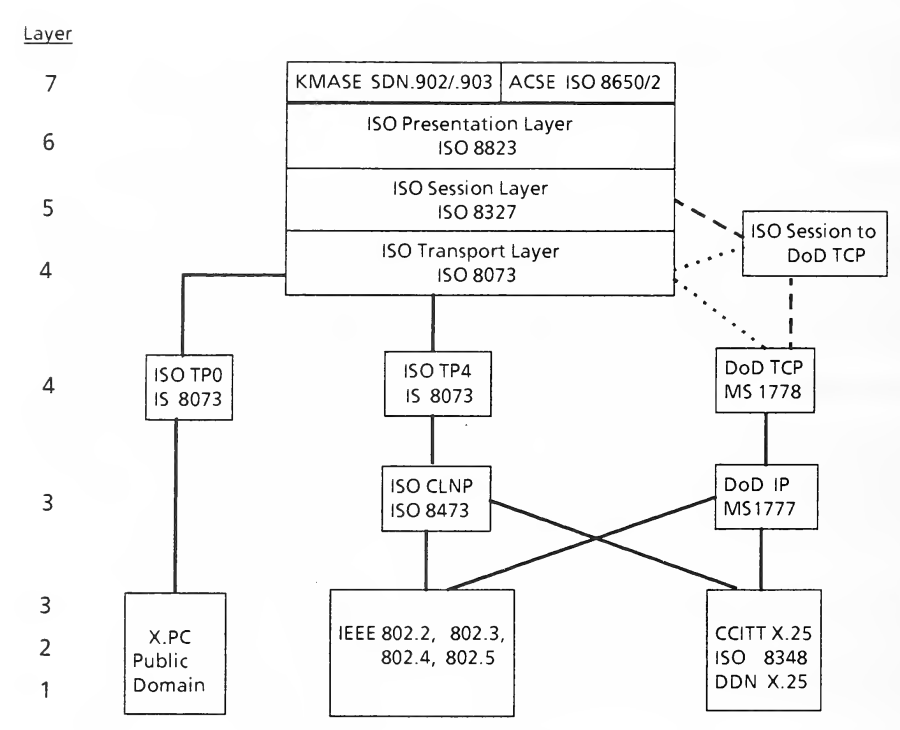
プロトコルスタックの図。左端に「Layer」(レイヤー)という見出しと層番号(7、6、5、4、4、3、3、2、1)の列があります。上部の積み重ねた箱は、第7層が「KMASE SDN.902/.903」と「ACSE ISO 8650/2」、第6層が「ISO Presentation Layer ISO 8823」、第5層が「ISO Session Layer ISO 8327」、第4層が「ISO Transport Layer ISO 8073」です。Session Layer から右側の「ISO Session to DoD TCP」へ破線が延び、そこから下の「DoD TCP MS 1778」へ破線が延びています。Transport Layer からは「ISO Session to DoD TCP」と「DoD TCP MS 1778」へ点線が延びています。Transport Layer から下へ実線が延び、「ISO TP0 IS 8073」(左)と「ISO TP4 IS 8073」(中央)につながります。「ISO TP0」は下の「X.PC Public Domain」(第3、2、1層)につながります。「ISO TP4」は「ISO CLNP ISO 8473」へ、「DoD TCP」は「DoD IP MS1777」(第3層)へつながります。「ISO CLNP」と「DoD IP」はそれぞれ交差する線で、下部の「IEEE 802.2, 802.3, 802.4, 802.5」と「CCITT X.25 ISO 8348 DDN X.25」の両方につながります。
Notes:
注:
ISO Session Layer to DoD Transport Layer (TCP) "protocol bridge" is not a standard.
ISO セッション層から DoD トランスポート層(TCP)への「プロトコルブリッジ」は、標準ではありません。
ISO Presentation, Session, and Transport Layers may be supplemented by GOSIP for U.S. Government components.
ISO のプレゼンテーション層、セッション層、トランスポート層は、米国政府のコンポーネントについては GOSIP によって補足される場合があります。
ISO Transport Layer classes 1, 2, and 3 are not used for SDNS Key Management.
ISO トランスポート層のクラス 1、2、3 は、SDNS 鍵管理には使用されません。
Figure 1. THE KMAP PROTOCOL STACK ALTERNATIVES
図 1. KMAP プロトコルスタックの代替案
At the Network layer, the ISO CLNP standard is employed when ISO TP(4) is utilized at the Transport layer. CLNP may interface to X.25 layer 3, or to the Data Link layer for broadcast LANs (IEEE 802 standards). The DoD IP connectionless network protocol is used when DoD TCP is utilized at the Transport layer. IP may interconnect to an underlying X.25 layer 3, or to the data link layer for LANs using IEEE 802 standards.
ネットワーク層では、トランスポート層で ISO TP(4) を使用する場合に、ISO CLNP 標準を用います。CLNP は、X.25 の第 3 層、またはブロードキャスト LAN(IEEE 802 標準)のデータリンク層とインタフェースしてもよいです。トランスポート層で DoD TCP を使用する場合には、DoD IP コネクションレスネットワークプロトコルを用います。IP は、基盤となる X.25 の第 3 層、または IEEE 802 標準を使用する LAN のデータリンク層と相互接続してもよいです。
At the Data Link and Physical layers, CCITT’s X.25 and/or DDN X.25, or IEEE 802 standards may be employed. For direct dial, the X.PC "public domain" protocol shall be used. X.PC is specified in publication number NPD-269, available, without charge, from McDonnell Douglas.
データリンク層および物理層では、CCITT の X.25 もしくは DDN X.25、または IEEE 802 標準を使用してもよいです。直接ダイヤルでは、X.PC「公開」プロトコルを使用しなければなりません。X.PC は、McDonnell Douglas から無料で入手できる出版物番号 NPD-269 に規定されています。
(Note that it is also viable for ISO TP(4) to use ISO CONS without a connectionless network layer. It is also viable, in some parts of the world, to have X.25 virtual circuit LANs. Both of these are prominent implementations and terminology used in Europe, primarily as a result of PTT controls. If or when SDNS devices are available for export to European countries, this is an important consideration for SDNS implementors.)
(ISO TP(4) が、コネクションレスネットワーク層を介さずに ISO CONS を使用することも可能です。また、世界の一部の地域では、X.25 仮想回線 LAN を使用することも可能です。これらはいずれも、主に PTT による規制の結果として、ヨーロッパで広く見られる実装および用語です。SDNS 機器がヨーロッパ諸国へ輸出可能になる場合、または輸出可能になった時点で、これは SDNS 実装者にとって重要な考慮事項です。)
2.1. Application-Control-Service-Elements (ACSE)
2.1. アプリケーション制御サービス要素(ACSE)
ACSE is specified in ISO 8650/2. All Specific Application Service Elements (SASE) - i.e., what the KMASE is in the ISO application layer, use ACSE to establish, release, and abort connections with peer SASE. All ACSE Protocol Data Unit (APDU) types and service primitives specified in the ISO standard are required for all SDNS key management applications.
ACSE は ISO 8650/2 に規定されています。すべての特定アプリケーションサービス要素(SASE)、すなわち ISO アプリケーション層における KMASE のようなものは、ピアの SASE とのコネクションの確立、解放、中止に ACSE を使用します。ISO 標準に規定されているすべての ACSE プロトコルデータユニット(APDU)の種類とサービスプリミティブは、すべての SDNS 鍵管理アプリケーションで必要です。
Cooperating SDNS implementations shall support all mandatory parameters specified in the ACSE protocol standard. Unsupported parameter options shall not result in a protocol error.
連携する SDNS 実装は、ACSE プロトコル標準に規定されているすべての必須パラメータをサポートしなければなりません。サポートされないパラメータオプションがあっても、プロトコルエラーになってはなりません。
2.2. Presentation-Protocol (PP)
2.2. プレゼンテーションプロトコル(PP)
Connection oriented Presentation protocols (PP) exist to ensure that the information content of APDUs and KPDUs are preserved during their transit between application entities. Functions performed by PP include negotiation of transfer syntaxes and transformation to/from transfer syntax. Services include connection establishment and release, context management, and information transfer. Cooperating SDNS devices shall use a single transfer syntax for KPDUs.
コネクション型のプレゼンテーションプロトコル(PP)は、APDU および KPDU の情報内容が、アプリケーションエンティティ間の伝送中に保持されることを保証するために存在します。PP が行う機能には、転送構文のネゴシエーションと、転送構文への変換および転送構文からの変換が含まれます。サービスには、コネクションの確立と解放、コンテキスト管理、情報転送が含まれます。連携する SDNS 機器は、KPDU に単一の転送構文を使用しなければなりません。
2.3. Session-Protocol (SP)
2.3. セッションプロトコル(SP)
Connection oriented Session Protocol provides the means for the organized exchange of data between cooperating application entities. Services provided by the protocol include the establishment and release of connections and the exchange of data in an orderly manner.
コネクション型のセッションプロトコルは、連携するアプリケーションエンティティ間でデータを組織的に交換する手段を提供します。このプロトコルが提供するサービスには、コネクションの確立と解放、およびデータの秩序だった交換が含まれます。
Cooperating SDNS implementations shall support all SPDU types and primitives used by the session kernel, duplex, and expedited data functional units. All mandatory parameters shall be supported for each of the functional units. Details of the functional units and SPDU parameters are defined in ISO 8327. Unsupported parameter options shall not result in a protocol error or PDU discard.
連携する SDNS 実装は、セッションカーネル、全二重、緊急データの各機能単位が使用するすべての SPDU の種類とプリミティブをサポートしなければなりません。各機能単位について、すべての必須パラメータをサポートしなければなりません。機能単位と SPDU パラメータの詳細は、ISO 8327 に定義されています。サポートされないパラメータオプションがあっても、プロトコルエラーになったり PDU が破棄されたりしてはなりません。
Where DoD TCP is the underlying Transport layer protocol, there shall exist a mapping of the ISO Session Protocol and the DoD TCP. Such mapping shall be defined in an appropriate DoD standard. Until such a standard is available, implementors are discouraged from implementing this form of protocol stack.
DoD TCP が基盤となるトランスポート層プロトコルである場合、ISO セッションプロトコルと DoD TCP のマッピングが存在しなければなりません。このマッピングは、適切な DoD 標準で定義しなければなりません。そのような標準が利用できるようになるまでは、実装者はこの形式のプロトコルスタックの実装を控えるよう推奨されます。
2.4. Transport Layer Protocols
2.4. トランスポート層プロトコル
2.4.1 Transport-Protocol (TP) Class 4
2.4.1 トランスポートプロトコル(TP)クラス 4
Connection oriented Transport Protocol Class 4 provides reliable transparent transfer of data between cooperating KMAPs which operate over the connectionless-mode network service. Services provided by TP4 include the means to:
コネクション型のトランスポートプロトコルクラス 4 は、コネクションレスモードのネットワークサービス上で動作する、連携する KMAP 間で、信頼性のある透過的なデータ転送を提供します。TP4 が提供するサービスには、次のための手段が含まれます。
•establish transport connections and negotiate Quality of Service (QOS) parameters;
•トランスポートコネクションを確立し、サービス品質(QOS)パラメータをネゴシエーションすること。
•transfer Transfer Service Data Units (TSDU) with or without concatenation and separation, segmenting and separating, and splitting and recombining;
•連結と分離、セグメント化と分離、分割と再結合を行う場合も行わない場合も、転送サービスデータユニット(TSDU)を転送すること。
•control TSDU rate (flow control);
•TSDU の速度を制御すること(フロー制御)。
•transfer expedited TSDUs subject to separate flow control; and,
•別個のフロー制御の対象となる緊急 TSDU を転送すること。
•release the transport connection.
•トランスポートコネクションを解放すること。
TP(4) shall be implemented when the underlying network protocol is the ISO Connectionless Network Protocol (CLNP). Cooperating TP4 implementations shall support all Transport PDU (TPDU) types and primitives used by the Session service to transfer KMP data between cooperating SDNS devices. All mandatory parameters for TPDUs shall be implemented, as defined in ISO 8073 and DIS 8073/AD2. Unsupported parameter options shall not result in a protocol error or PDU discard.
基盤となるネットワークプロトコルが ISO コネクションレスネットワークプロトコル(CLNP)である場合は、TP(4) を実装しなければなりません。連携する TP4 実装は、セッションサービスが連携する SDNS 機器間で KMP データを転送するために使用する、すべてのトランスポート PDU(TPDU)の種類とプリミティブをサポートしなければなりません。TPDU のすべての必須パラメータは、ISO 8073 および DIS 8073/AD2 に定義されているとおりに実装しなければなりません。サポートされないパラメータオプションがあっても、プロトコルエラーになったり PDU が破棄されたりしてはなりません。
2.4.2. Transport-Protocol (TP) Class 0
2.4.2. トランスポートプロトコル(TP)クラス 0
Connection oriented Transport Protocol Class 0 provides transparent transfer of data between cooperating KMAPs operating over ISO connection oriented network service protocols. Services provided by TP0 include the means to:
コネクション型のトランスポートプロトコルクラス 0 は、ISO コネクション型ネットワークサービスプロトコル上で動作する、連携する KMAP 間で、透過的なデータ転送を提供します。TP0 が提供するサービスには、次のための手段が含まれます。
•establish transport connection;
•トランスポートコネクションを確立すること。
•transfer TSDUs; and,
•TSDU を転送すること。
•release transport connections.
•トランスポートコネクションを解放すること。
TP(0) is required to support all SDNS key management exchanges in the "dial-up" access mode. This access mode requires the underlying services of the X.PC "public domain" protocol. Details of TP0 TPDUs and Session Protocol primitives are defined in ISO 8073. Cooperating TP0 implementations shall support all TPDUs and Session Protocol primitives, and all mandatory parameters. Unsupported optional parameters shall not result in a protocol error or PDU discard.
「ダイヤルアップ」アクセスモードでのすべての SDNS 鍵管理のやり取りをサポートするには、TP(0) が必要です。このアクセスモードでは、X.PC「公開」プロトコルの基盤サービスが必要です。TP0 の TPDU とセッションプロトコルのプリミティブの詳細は、ISO 8073 に定義されています。連携する TP0 実装は、すべての TPDU とセッションプロトコルのプリミティブ、およびすべての必須パラメータをサポートしなければなりません。サポートされないオプションパラメータがあっても、プロトコルエラーになったり PDU が破棄されたりしてはなりません。
2.4.3. DoD Transmission-Control-Protocol (TCP)
2.4.3. DoD 伝送制御プロトコル(TCP)
TCP is required to support SDNS key management exchanges that are compelled to operate within internets that already exist with a significant number of IP routers. This kind of implementation is not encouraged, but may be necessary in some cases to keep the cost of deploying SDNS components to a minimum; for example, where IP routers are the only available routers on networks where SDNS devices are to be deployed. Consistent implementations of this type may not be feasible until ISO Session layer to DoD transport layer protocol mappings are standardized.
すでに多数の IP ルーターが存在するインターネットワーク内で動作せざるを得ない SDNS 鍵管理のやり取りをサポートするには、TCP が必要です。この種の実装は推奨されませんが、SDNS コンポーネントの配備費用を最小限に抑えるために必要となる場合があります。たとえば、SDNS 機器を配備するネットワークで利用できるルーターが IP ルーターだけである場合です。ISO セッション層から DoD トランスポート層へのプロトコルマッピングが標準化されるまでは、この種の一貫した実装は実現可能でない場合があります。
Details of TCP TPDUs and primitives are defined in Military Standard (MILSTD) 1778. Cooperating TCP implementations shall support all TPDUs and Session Protocol (mapped) primitives (To Be Determined) and all mandatory parameters. Unsupported optional parameters shall not result in a protocol error or PDU discard.
TCP の TPDU とプリミティブの詳細は、軍用標準(MILSTD)1778 に定義されています。連携する TCP 実装は、すべての TPDU とセッションプロトコル(マッピングされた)のプリミティブ(今後決定予定)、およびすべての必須パラメータをサポートしなければなりません。サポートされないオプションパラメータによって、プロトコルエラーが発生したり PDU が破棄されたりしてはなりません。
2.5. Network Layer Protocols
2.5. ネットワーク層プロトコル
2.5.1. ISO Connectionless-mode-Network-Protocol (CLNP)
2.5.1. ISO コネクションレスモードネットワークプロトコル(CLNP)
The ISO CLNP shall be used when the ISO TP Class 4 transport protocol is employed. Details of CLNP NPDUs and primitives are defined in ISO 8473. CLNP NPDU primitives and all mandatory parameters shall be implemented in accordance with ISO 8473. Unsupported optional parameters shall not result in a protocol error or PDU discard.
ISO TP クラス 4 トランスポートプロトコルを使用する場合は、ISO CLNP を使用しなければなりません。CLNP の NPDU とプリミティブの詳細は、ISO 8473 に定義されています。CLNP の NPDU プリミティブとすべての必須パラメータは、ISO 8473 に従って実装しなければなりません。サポートされないオプションパラメータがあっても、プロトコルエラーになったり PDU が破棄されたりしてはなりません。
2.5.2. DoD Connectionless-mode Internet Protocol (IP)
2.5.2. DoD コネクションレスモードインターネットプロトコル(IP)
The DoD IP shall be used when the DoD TCP transport protocol is employed. Details of IP NPDUs and primitives are defined in MILSTD 1777. IP, including the Internet Control Message Protocol (ICMP), primitives and all mandatory parameters shall be implemented In accordance with MILSTD 1777. Unsupported optional parameters shall not result in a protocol error or PDU discard.
DoD TCP トランスポートプロトコルを使用する場合は、DoD IP を使用しなければなりません。IP の NPDU とプリミティブの詳細は、MILSTD 1777 に定義されています。インターネット制御メッセージプロトコル(ICMP)を含む IP のプリミティブとすべての必須パラメータは、MILSTD 1777 に従って実装しなければなりません。サポートされないオプションパラメータがあっても、プロトコルエラーになったり PDU が破棄されたりしてはなりません。
2.5.3. CCITT X.25 Packet Layer Protocol (PLP)
2.5.3. CCITT X.25 パケット層プロトコル(PLP)
The X.25, layer 3, shall be used for SDNS key management exchanges that use either TCP/IP or TP(4)/CNLP for X.25 network connectivity. Details of X.5 PLP NPDUs and primitives are defined in ISO 8348. X.25 PLP NPDU primitives and all mandatory parameters shall be implemented in accordance with ISO 8348. Unsupported optional parameters shall not result in protocol error or PDU discard.
X.25 ネットワークの接続性のために TCP/IP または TP(4)/CNLP のいずれかを使用する SDNS 鍵管理のやり取りには、X.25 の第 3 層を使用しなければなりません。X.5 PLP の NPDU とプリミティブの詳細は、ISO 8348 に定義されています。X.25 PLP の NPDU プリミティブとすべての必須パラメータは、ISO 8348 に従って実装しなければなりません。サポートされないオプションパラメータがあっても、プロトコルエラーになったり PDU が破棄されたりしてはなりません。
(Note: Where DDN and/or BLACKER X.25 layer 3 implementation are required, variances from ISO 8348 may be required.)
(注: DDN または BLACKER、あるいはその両方の X.25 第 3 層の実装が必要な場合は、ISO 8348 からの逸脱が必要になることがあります。)
2.6. Data Link and Physical Layer Protocols
2.6. データリンク層および物理層プロトコル
2.6.1. Direct Dial Public Switched Telephone Network Data Link and Physical Layers
2.6.1. 直接ダイヤル公衆交換電話網のデータリンク層および物理層
The X.PC "public domain" protocol shall be used for all key management exchanges that are required over direct dial PSTNs. Details of the X.PC protocol are available from McDonnell Douglas, under the publication title NPD-269. For SDNS key management exchange support, the X.PC protocol shall operate in the packet mode only; i.e., not the character mode.
直接ダイヤルの PSTN 上で必要となるすべての鍵管理のやり取りには、X.PC「パブリックドメイン」プロトコルを使用しなければなりません。X.PC プロトコルの詳細は、McDonnell Douglas から、出版物名 NPD-269 として入手できます。SDNS 鍵管理のやり取りのサポートでは、X.PC プロトコルをパケットモードだけで動作させなければなりません。すなわち、文字モードでは動作させません。
(Note: X.PC also has some network layer functionality, (i.e., addressing, packet assembly/disassembly, and multiple virtual circuit support - even through the underlying connection is strictly circuit switched [point-to-point].))
(注: X.PC には、ネットワーク層の機能(アドレス指定、パケットの組立て・分解、複数の仮想回線のサポート)もあります。基盤となる接続が厳密に回線交換[ポイントツーポイント]であるにもかかわらず、これらの機能を備えています。)
2.6.2. IEEE 802.X Data Link and Physical Layer Protocols
2.6.2. IEEE 802.X データリンク層および物理層プロトコル
IEEE 802 protocol standards shall be employed for key management exchanges that are required over LANs. Details of 802.2, 802.3, 802.4, and 802.5 are available from the IEEE. It is envisioned that there may be some diversion from the specifics of IEEE 802.2 and 802.3 standards for various Ethernet (a trademark of Xerox Corporation) implementations.
LAN 上で必要となる鍵管理のやり取りには、IEEE 802 プロトコル標準を使用しなければなりません。802.2、802.3、802.4、802.5 の詳細は、IEEE から入手できます。各種の Ethernet(Xerox Corporation の商標)の実装では、IEEE 802.2 および 802.3 標準の細部からの逸脱がいくらか生じる可能性が想定されています。
2.6.3. CCITT X.25 Data Link and Physical Layer Protocols
2.6.3. CCITT X.25 データリンク層および物理層プロトコル
Implementors that employ X.25 protocols shall do so in accordance with CCITT X.25 protocol specifications at layers 2 and 1.
X.25 プロトコルを使用する実装者は、第 2 層と第 1 層で CCITT X.25 プロトコル仕様に従わなければなりません。
SPECIFICATION SDN.902
Revision 3.2 1989-08-01
仕様 SDN.902
改訂 3.2 1989-08-01
SDNS Secure Data Network System Key Management Protocol Definition of Services provided by the Key Management Application Service Element
SDNS セキュアデータネットワークシステム 鍵管理プロトコル 鍵管理アプリケーションサービス要素が提供するサービスの定義
Source: SDNS Protocol and Signaling Working Group
Key Management Sub-Group
出典: SDNS Protocol and Signaling Working Group
Key Management Sub-Group
Introductory note :
前置き:
This document provides the framework for the SDNS Key Management Protocol Specification. It is subject to change after the development phase of SDNS.
この文書は、SDNS 鍵管理プロトコル仕様の枠組みを示すものです。SDNS の開発段階の後に変更される場合があります。
Table of Contents
目次
0. Introduction
0. 序論
This section defines the key management services as provided by the Key Management Application Service Element (KMASE). The services defined are of the category Specific Application Service Element (SASE). It provides facilities to support the key management activities required by and in support of cooperating Key Management Application Processes (KMAP) including the establishment of traffic encryption keys (TEK), the updating of TEKs, the distribution of Certificate Revocation Lists (CRL), and the interactive and staged rekey with the Key Management System (KMS).
この節では、鍵管理アプリケーションサービス要素(KMASE)が提供する鍵管理サービスを定義します。定義されるサービスは、特定アプリケーションサービス要素(SASE)のカテゴリに属します。これらのサービスは、連携する鍵管理アプリケーションプロセス(KMAP)が必要とする鍵管理活動、およびその活動を支援する機能を提供します。これには、トラフィック暗号化鍵(TEK)の確立、TEK の更新、証明書失効リスト(CRL)の配布、ならびに鍵管理システム(KMS)との対話型および段階的な再鍵(rekey)が含まれます。
1. Scope and field of application
1. 適用範囲と適用分野
This specification defines in an abstract way the key management services within the OSI Application Layer in terms of:
この仕様は、OSI アプリケーション層における鍵管理サービスを、次の観点から抽象的に定義します。
a) the primitive actions and events of the service;
a) サービスのプリミティブな動作とイベント
b) the parameter data associated with each primitive action and event; and
b) 各プリミティブな動作およびイベントに関連するパラメータデータ
c) the relationship between and the valid sequences of these actions and events.
c) これらの動作とイベントの間の関係、およびこれらの有効な順序
This standard only defines the services in terms of an abstract model. It implies neither a particular implementation of the services, nor does it imply a particular representation of the service primitives. As this is a service definition, there are no conformance testing requirements.
この標準は、サービスを抽象モデルの観点からのみ定義します。サービスの特定の実装を示唆するものではなく、サービスプリミティブの特定の表現を示唆するものでもありません。これはサービス定義であるため、適合性試験の要件はありません。
2. References
2. 参照文書
ISO IS 7498/1 Information Processing Systems - Open Systems Interconnection - Basic Reference Model.
ISO IS 7498/1 Information Processing Systems - Open Systems Interconnection - Basic Reference Model.
ISO IS 7498/2 Information Processing Systems - Open Systems Interconnection - Security Architecture.
ISO IS 7498/2 Information Processing Systems - Open Systems Interconnection - Security Architecture.
ISO DIS 8649 Information Processing Systems- Open Systems Interconnection-Association Control Service Element Service Definition.
ISO DIS 8649 Information Processing Systems- Open Systems Interconnection-Association Control Service Element Service Definition.
ISO TR8509 Information Processing Systems - Open Systems Interconnection - Service Conventions.
ISO TR8509 Information Processing Systems - Open Systems Interconnection - Service Conventions.
SDN.801 SDNS Access Control Concept Document.
SDN.801 SDNS Access Control Concept Document.
SDN.802 SDNS Access Control Specification.
SDN.802 SDNS Access Control Specification.
SDN.903 SDNS Key Management Protocol: Specification of the protocol for services provided by the Key Management Application Service Element.
SDN.903 SDNS Key Management Protocol: Specification of the protocol for services provided by the Key Management Application Service Element.
SDN.906 SDNS Traffic Key Attribute Negotiation.
SDN.906 SDNS Traffic Key Attribute Negotiation.
3. Definitions
3. 定義
This document uses definitions contained in the Reference Model for Open Systems Interconnection (ISO IS 7498/1) including the Security Architecture (ISO IS DIS 7498/2).
この文書では、セキュリティアーキテクチャ(ISO IS 7498/2)を含む開放型システム間相互接続の参照モデル(ISO IS 7498/1)に含まれる定義を用います。
In addition the following definitions are used:
これに加えて、次の定義を用います。
Credentials -- information exchanged between SDNS components which authenticates each component and used to form a TEK between the components.
クレデンシャル(Credentials)-- SDNS コンポーネント間で交換される情報で、各コンポーネントを認証し、コンポーネント間の TEK を形成するために使われます。
Certificate Revocation List -- the list of key material identifiers which have been invalidated.
証明書失効リスト(Certificate Revocation List)-- 無効化された鍵素材識別子のリストです。
key material -- information supplied by the KMS that contains a component's credentials and private information.
鍵素材(key material)-- KMS が提供する、コンポーネントのクレデンシャルと非公開情報を含む情報です。
Initiator -- the KMAP which initiates the establishment of an application association.
イニシエーター(Initiator)-- アプリケーションアソシエーションの確立を開始する KMAP です。
Rekey -- the process by which new key material is obtained from the KMS either directly or via a rekey agent.
再鍵(Rekey)-- KMS から直接、または再鍵エージェントを経由して、新しい鍵素材を入手するプロセスです。
Rekey Agent -- a SDNS component authorized to act as an intermediary between the KMS and other SDNS components for the delivery of key material.
再鍵エージェント(Rekey Agent)-- 鍵素材の配送のために、KMS と他の SDNS コンポーネントとの間で仲介者として動作することを認可された SDNS コンポーネントです。
Responder -- the KMAP which responds to a request for establishment of the application association.
レスポンダー(Responder)-- アプリケーションアソシエーションの確立の要求に応答する KMAP です。
Signed -- a method used to provide authentication of the originator of a message.
署名付き(Signed)-- メッセージの発信者の認証を提供するために使われる方法です。
Universal-ID -- identifies the universal to which a credential belongs.
ユニバーサル ID -- クレデンシャルが属するユニバーサルを識別します。
4. Abbreviations
4. 略語
| ACSE | Association Control Service Element |
| ASE | Application Service Element |
| CRL | Certificate Revocation List |
| K-MIB | Key Management Information Base |
| ICV | Integrity Check Value |
| KID | Key Identifier |
| KMS | Key Management System |
| KMAE | Key Management Application Entity |
| KMAP | Key Management Application Process |
| KMASE | Key Management Application Service Element |
| PDU | Protocol Data Unit |
| SDNS | Secure Data Network System |
| TEK | Traffic Encryption Key |
| TEK-MIB | Traffic Encryption Key Management Information Base |
| ACSE | アソシエーション制御サービス要素(Association Control Service Element) |
| ASE | アプリケーションサービス要素(Application Service Element) |
| CRL | 証明書失効リスト(Certificate Revocation List) |
| K-MIB | 鍵管理情報ベース(Key Management Information Base) |
| ICV | 完全性チェック値(Integrity Check Value) |
| KID | 鍵識別子(Key Identifier) |
| KMS | 鍵管理システム(Key Management System) |
| KMAE | 鍵管理アプリケーションエンティティ(Key Management Application Entity) |
| KMAP | 鍵管理アプリケーションプロセス(Key Management Application Process) |
| KMASE | 鍵管理アプリケーションサービス要素(Key Management Application Service Element) |
| PDU | プロトコルデータユニット(Protocol Data Unit) |
| SDNS | セキュアデータネットワークシステム(Secure Data Network System) |
| TEK | トラフィック暗号化鍵(Traffic Encryption Key) |
| TEK-MIB | トラフィック暗号化鍵管理情報ベース(Traffic Encryption Key Management Information Base) |
5. Conventions
5. 表記規約
This part of the KMP specification uses the descriptive conventions in the OSI Service Conventions in ISO/TR 8509. In Section 9, the definition of each KMASE service includes a table that lists the parameters of its primitives. For a given primitive, the presence of each parameter is described by one of the following values :
KMP 仕様のこの部分は、ISO/TR 8509 の OSI サービス規約にある記述規約を用います。第 9 節では、各 KMASE サービスの定義に、そのプリミティブのパラメータを列挙した表が含まれます。あるプリミティブについて、各パラメータが存在するかどうかは、次のいずれかの値で表されます。
| blank | not applicable |
| M | presence mandatory |
| U | presence is a user option |
| 空欄 | 適用なし |
| M | 存在が必須 |
| U | 存在はユーザーの任意 |
In addition, the notation ( = ) indicates that a parameter value is semantically equal to the value to its left in the table.
さらに、表記 ( = ) は、パラメータの値が、表で左にある値と意味的に等しいことを示します。
6. Model and Basic Concept
6. モデルと基本概念
This service definition uses the abstract model for a service defined in the OSI Service Conventions in ISO TR 8509. The model defines the interactions between two cooperating KMAPs. The KMAP consists of two parts: the information processing part, and the communication part, which is represented by the KMAE. When communication is required between two KMAPs, an application association is established between invocations of the processes’ KMAEs. The KMAE represents an addressable set of communication capabilities which are defined by the KMASE and the ACSE.
このサービス定義は、ISO TR 8509 の OSI サービス規約に定義されたサービスの抽象モデルを用います。このモデルは、連携する 2 つの KMAP の間の相互作用を定義します。KMAP は、情報処理部と、KMAE で表される通信部の 2 つの部分から構成されます。2 つの KMAP の間で通信が必要になると、それらのプロセスの KMAE の呼び出しの間にアプリケーションアソシエーションが確立されます。KMAE は、KMASE と ACSE によって定義される、アドレス指定可能な通信機能の集合を表します。
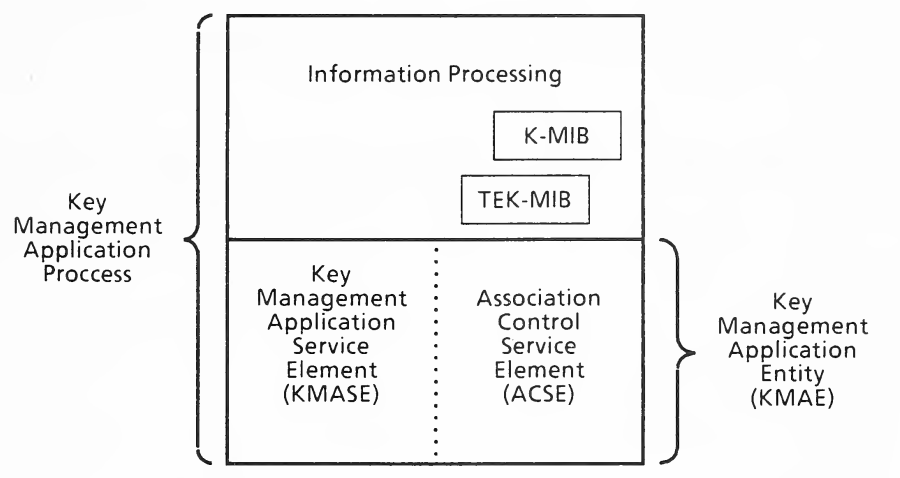
KMP のモデルを示す図です。大きな枠が横線で上下に分かれ、上の部分は「Information Processing」(情報処理)で、中に「K-MIB」と「TEK-MIB」の小さな箱があります。下の部分は点線で左右に分かれ、左が「Key Management Application Service Element (KMASE)」、右が「Association Control Service Element (ACSE)」です。左側の枠全体にかかる括弧には「Key Management Application Process」(鍵管理アプリケーションプロセス)、右側の下の部分にかかる括弧には「Key Management Application Entity (KMAE)」(鍵管理アプリケーションエンティティ)と書かれています。
KMP Model
KMP モデル
The KMASE is driven by service request and response primitives from the KMAP and by indication primitives from the presentation service provider. The KMASE, in turn, issues indication and confirm primitives to the KMAP, and issues request primitives to the ACSE and the presentation service provider.
KMASE は、KMAP からのサービス要求プリミティブと応答プリミティブ、およびプレゼンテーションサービスプロバイダーからの通知プリミティブによって駆動されます。KMASE は、これを受けて、KMAP に通知プリミティブと確認プリミティブを発行し、ACSE とプレゼンテーションサービスプロバイダーに要求プリミティブを発行します。
The KMAP administers the Management Information Bases (K-MIB and the TEK-MIB) in the sense of updating data in the MIBs upon receipt of indications and confirms, and retrieving parameters from the MIBs when issuing requests and responses. The K-MIB is a security MIB used to store key material. The TEK-MIB is a security MIB used to store the TEK, KID, and attributes regarding the use of the TEK.
KMAP は、管理情報ベース(K-MIB と TEK-MIB)を管理します。これは、通知と確認を受け取ったときに MIB のデータを更新し、要求と応答を発行するときに MIB からパラメータを取り出すという意味です。K-MIB は、鍵素材を保存するために使われるセキュリティ MIB です。TEK-MIB は、TEK、KID、および TEK の使用に関する属性を保存するために使われるセキュリティ MIB です。
These services require information exchange with other SDNS KMAPs and with the KMS KMAP. The following services are provided:
これらのサービスには、他の SDNS KMAP および KMS の KMAP との情報交換が必要です。次のサービスが提供されます。
a) Exchange TEK and security service information with other SDNS components.
a) 他の SDNS コンポーネントと TEK およびセキュリティサービス情報を交換します。
b) Update TEKs.
b) TEK を更新します。
c) Perform rekey operation with KMS or with a rekey agent. Seed key conversion is a special case of the rekey operation.
c) KMS または再鍵エージェントとの間で再鍵操作を行います。シード鍵の変換は、再鍵操作の特殊な場合です。
d) Obtain the Certificate Revocation List (CRL).
d) 証明書失効リスト(CRL)を入手します。
e) Report cryptographic key usage errors and routing information.
e) 暗号鍵の使用エラーおよびルーティング情報を報告します。
7. Overview of Service
7. サービスの概要
This standard defines the following services for key management:
この標準は、鍵管理について次のサービスを定義します。
a) K-EXCH-CRED
a) K-EXCH-CRED
b) K-TRY-ME
b) K-TRY-ME
c) K-NO-KEY
c) K-NO-KEY
d) K-TEK-ATTRIBUTES
d) K-TEK-ATTRIBUTES
e) K-UPDATE-TEK
e) K-UPDATE-TEK
f) K-IREKEY
f) K-IREKEY
g) K-REQUEST-SREKEY
g) K-REQUEST-SREKEY
h) K-DELIVER-SREKEY
h) K-DELIVER-SREKEY
i) K-GET-CRL
i) K-GET-CRL
The K-EXCH-CRED service enables a KMAP to exchange credentials with a cooperating KMAP for the purpose of mutual authentication and subsequent formation of a TEK.
K-EXCH-CRED サービスは、KMAP が、相互認証とその後の TEK の形成のために、連携する KMAP とクレデンシャルを交換できるようにします。
The K-TRY-ME service enables a KMAP to inform a cooperating KMAP that it is authorized to provide security services for a specific network service access point.
K-TRY-ME サービスは、KMAP が、特定のネットワークサービスアクセスポイントに対してセキュリティサービスを提供することが認可されていることを、連携する KMAP に知らせることができるようにします。
The K-NO-KEY service enables a KMAP to inform a cooperating KMAP that traffic has been received protected under a key for which the receiver has no valid KID.
K-NO-KEY サービスは、受信側が有効な KID を持たない鍵で保護されたトラフィックを受信したことを、KMAP が連携する KMAP に知らせることができるようにします。
The K-TEK-ATTRIBUTES service verifies the cryptographic compatibility of a TEK, negotiates the communication and security attributes associated with the TEK, and exchanges CRL numbers. Additionally, K-TEK-ATTRIBUTES allows a KMAP to associate the attributes of a previous TEK with a new TEK.
K-TEK-ATTRIBUTES サービスは、TEK の暗号上の互換性を検証し、TEK に関連する通信およびセキュリティ属性をネゴシエーションし、CRL 番号を交換します。さらに、K-TEK-ATTRIBUTES により、KMAP は以前の TEK の属性を新しい TEK に関連付けることができます。
The K-UPDATE-TEK service enables a KMAP to update a TEK without exchanging credentials.
K-UPDATE-TEK サービスは、KMAP が、クレデンシャルを交換することなく TEK を更新できるようにします。
The K-IREKEY service enables a KMAP or Rekey Agent KMAP to interactively obtain new key material from the KMS. Multiple sets of key material may be obtained by sequential use of this service.
K-IREKEY サービスは、KMAP または再鍵エージェント KMAP が、KMS から対話的に新しい鍵素材を入手できるようにします。このサービスを順次使用することで、複数の鍵素材のセットを入手してもよいです。
The K-REQUEST-SREKEY service enables a KMAP to request the staged rekey of key material through a Rekey Agent KMAP. The credentials which are sent to the Rekey Agent with this service are later forwarded to the KMS with the K-IREKEY service.
K-REQUEST-SREKEY サービスは、KMAP が、再鍵エージェント KMAP を通じて鍵素材の段階的再鍵を要求できるようにします。このサービスで再鍵エージェントに送られるクレデンシャルは、後で K-IREKEY サービスで KMS に転送されます。
The K-DELIVER-SREKEY service enables a Rekey Agent to deliver key material to a component which has previously requested a staged rekey by the use of the K-REQUEST-SREKEY service.
K-DELIVER-SREKEY サービスは、再鍵エージェントが、K-REQUEST-SREKEY サービスを使用して以前に段階的再鍵を要求したコンポーネントに、鍵素材を配送できるようにします。
The K-GET-CRL service enables a KMAP to obtain a CRL from a cooperating KMAP (e.g. the KMS KMAP). The new CRL is delivered only if the requestor has an older version of the CRL than the responder.
K-GET-CRL サービスは、KMAP が、連携する KMAP(たとえば KMS の KMAP)から CRL を入手できるようにします。新しい CRL が配送されるのは、要求側が、応答側よりも古い版の CRL を持っている場合だけです。
8. Relationship to Other ASEs and Lower Layer Services
8. 他の ASE および下位層サービスとの関係
The KMASE is a specific application service element. As specified here it does not describe a complete communications service, but instead relies on the Association Control Service Element (ACSE). The KMASE requires an existing application-association controlled by ACSE. The KMASE also assumes the use of the P-DATA service of the Presentation Service for transferring SDNS key management messages between peer SDNS entities.
KMASE は、特定アプリケーションサービス要素です。ここに規定されているとおり、完全な通信サービスを記述するものではなく、アソシエーション制御サービス要素(ACSE)に依存します。KMASE は、ACSE によって制御される既存のアプリケーションアソシエーションを必要とします。また KMASE は、ピアの SDNS エンティティ間で SDNS 鍵管理メッセージを転送するために、プレゼンテーションサービスの P-DATA サービスを使用することを想定しています。
9 Service Definition
9 サービスの定義
This section contains the definitions of the primitives a KMAP uses to obtain KMASE services.
この節には、KMAP が KMASE サービスを得るために使用するプリミティブの定義が含まれます。
Table 1 -- KMASE Services
表 1 -- KMASE サービス
| Service | Type |
|---|---|
| K-EXCH-CRED | Confirmed |
| K-TRY-ME | Unconfirmed |
| K-NO-KEY | Unconfirmed |
| K-TEK-ATTRIBUTES | Confirmed |
| K-UPDATE-TEK | Confirmed |
| K-IREKEY | Confirmed |
| K-REQUEST-SREKEY | Confirmed |
| K-DELIVER-SREKEY | Confirmed |
| K-GET-CRL | Confirmed |
| サービス | 種類 |
|---|---|
| K-EXCH-CRED | 確認型 |
| K-TRY-ME | 非確認型 |
| K-NO-KEY | 非確認型 |
| K-TEK-ATTRIBUTES | 確認型 |
| K-UPDATE-TEK | 確認型 |
| K-IREKEY | 確認型 |
| K-REQUEST-SREKEY | 確認型 |
| K-DELIVER-SREKEY | 確認型 |
| K-GET-CRL | 確認型 |
9.1. K-EXCH-CRED Service
9.1. K-EXCH-CRED サービス
The KMAP uses the K-EXCH-CRED service to request an exchange of credentials with a cooperating KMAP. It is a confirmed service.
KMAP は、連携する KMAP とのクレデンシャルの交換を要求するために、K-EXCH-CRED サービスを使用します。これは確認型サービスです。
9.1.1. K-EXCH-CRED Parameters
9.1.1. K-EXCH-CRED パラメータ
Table 2 lists the K-EXCH-CRED parameters.
表 2 に K-EXCH-CRED のパラメータを示します。
Table 2 -- K-EXCH-CRED parameters
表 2 -- K-EXCH-CRED パラメータ
| Parameter name | req | ind | rsp | cnf |
|---|---|---|---|---|
| univ-id | M | M(=) | ||
| init-cred | M | M(=) | ||
| init-kid | M | M(=) | M(=) | M(=) |
| resp-cred | M | M(=) | ||
| resp-kid | M | M(=) | ||
| result | M | M(=) |
| パラメータ名 | req | ind | rsp | cnf |
|---|---|---|---|---|
| univ-id | M | M(=) | ||
| init-cred | M | M(=) | ||
| init-kid | M | M(=) | M(=) | M(=) |
| resp-cred | M | M(=) | ||
| resp-kid | M | M(=) | ||
| result | M | M(=) |
9.1.1.1. univ-id
9.1.1.1. univ-id
This parameter is required on the request primitive. It is passed on the indication primitive. It contains the universal-ID which applies to the initiator's key material.
このパラメータは、要求プリミティブで必要です。通知プリミティブに引き渡されます。イニシエーターの鍵素材に適用されるユニバーサル ID を含みます。
9.1.1.2. init-cred
9.1.1.2. init-cred
This parameter is required on the request primitive. It is passed on the indication primitive. It contains the initiator’s credentials which must be exchanged with the peer SDNS entity to form a TEK.
このパラメータは、要求プリミティブで必要です。通知プリミティブに引き渡されます。TEK を形成するために、ピアの SDNS エンティティと交換しなければならない、イニシエーターのクレデンシャルを含みます。
9.1.1.3. init-kid
9.1.1.3. init-kid
This parameter is required on the request and response primitives. It is passed on the indication and confirm primitives. It contains the identifier the initiator KMAP will associate with the TEK.
このパラメータは、要求プリミティブと応答プリミティブで必要です。通知プリミティブと確認プリミティブに引き渡されます。イニシエーター KMAP が TEK に関連付ける識別子を含みます。
9.1.1.4. resp-cred
9.1.1.4. resp-cred
This parameter is required on the response primitive. It is passed on the confirm primitive. It contains the responder’s credentials which must be exchanged with the cooperating KMAP to form a TEK.
このパラメータは、応答プリミティブで必要です。確認プリミティブに引き渡されます。TEK を形成するために、連携する KMAP と交換しなければならない、レスポンダーのクレデンシャルを含みます。
9.1.1.5. resp-kid
9.1.1.5. resp-kid
This parameter is required on the response primitive. It is passed on the confirm primitive. It contains the identifier the responder KMAP associates with the TEK.
このパラメータは、応答プリミティブで必要です。確認プリミティブに引き渡されます。レスポンダー KMAP が TEK に関連付ける識別子を含みます。
9.1.1.6. result
9.1.1.6. result
This parameter is required on the response primitive. It is passed on the confirm primitive. It indicates the success of the operation.
このパラメータは、応答プリミティブで必要です。確認プリミティブに引き渡されます。操作が成功したかどうかを示します。
9.2. K-TRY-ME Service
9.2. K-TRY-ME サービス
The KMAP uses the K-TRY-ME service to notify a cooperating KMAP that a specific end-system does not have a SDNS component, but can be reached through this (the K-TRY-ME initiator) SDNS component. It is an unconfirmed service.
KMAP は、特定のエンドシステムには SDNS コンポーネントがありませんが、この SDNS コンポーネント(K-TRY-ME のイニシエーター)を通じて到達できることを、連携する KMAP に通知するために、K-TRY-ME サービスを使用します。これは非確認型サービスです。
9.2.1. K-TRY-ME Parameters
9.2.1. K-TRY-ME パラメータ
Table 3 lists the K-TRY-ME parameters.
表 3 に K-TRY-ME のパラメータを示します。
Table 3 -- K-TRY-ME parameters
表 3 -- K-TRY-ME パラメータ
| Parameter name | req | ind |
|---|---|---|
| end-sys-addr | M | M(=) |
| パラメータ名 | req | ind |
|---|---|---|
| end-sys-addr | M | M(=) |
9.2.1.1. end-sys-addr
9.2.1.1. end-sys-addr
This parameter must be included on the request primitive and is passed on the indication primitive. It contains the address of the end system which has no SDNS component and which uses this SDNS component as a gateway.
このパラメータは、要求プリミティブに含めなければならず、通知プリミティブに引き渡されます。SDNS コンポーネントを持たず、この SDNS コンポーネントをゲートウェイとして使用するエンドシステムのアドレスを含みます。
9.3. K-NO-KEY Service
9.3. K-NO-KEY サービス
The KMAP uses the K-NO-KEY service to inform a cooperating KMAP that traffic has been received protected under a key for which the receiver has no valid key id. It is an unconfirmed service.
KMAP は、受信側が有効な鍵識別子を持たない鍵で保護されたトラフィックを受信したことを、連携する KMAP に知らせるために、K-NO-KEY サービスを使用します。これは非確認型サービスです。
9.3.1. K-NO-KEY Parameters
9.3.1. K-NO-KEY パラメータ
Table 4 lists the K-NO-KEY parameters.
表 4 に K-NO-KEY のパラメータを示します。
Table 4 --K-NO-KEY parameters
表 4 --K-NO-KEY パラメータ
| Parameter name | req | ind |
|---|---|---|
| rcvd-kid | M | M(=) |
| pdu-count | U | U(=) |
| パラメータ名 | req | ind |
|---|---|---|
| rcvd-kid | M | M(=) |
| pdu-count | U | U(=) |
9.3.1.1. rcvd-kid
9.3.1.1. rcvd-kid
This parameter is required on the request primitive. It is passed on the indication primitive. It contains the KID the initiator KMAP has determined to be invalid.
このパラメータは、要求プリミティブで必要です。通知プリミティブに引き渡されます。イニシエーター KMAP が無効と判断した KID を含みます。
9.3.1.2. pdu-count
9.3.1.2. pdu-count
This parameter may be included on the request primitive. It is passed on the indication primitive. It contains the number of PDUs the initiator KMAP has received protected under the invalid key identifier and the period of time and time units during which reception has taken place.
このパラメータは、要求プリミティブに含めてもよいです。通知プリミティブに引き渡されます。イニシエーター KMAP が、無効な鍵識別子で保護された状態で受信した PDU の数と、受信が行われた期間および時間単位を含みます。
9.4. K-TEK-ATTRIBUTES Service
9.4. K-TEK-ATTRIBUTES サービス
Cooperating KMAPs use the K-TEK-ATTRIBUTES service to negotiate the communication and security attributes to be assigned a TEK. Cooperating KMAPs may also use this service to assign the attributes of an existing TEK to a new TEK. It is a confirmed service.
連携する KMAP は、TEK に割り当てる通信およびセキュリティ属性をネゴシエーションするために、K-TEK-ATTRIBUTES サービスを使用します。連携する KMAP は、既存の TEK の属性を新しい TEK に割り当てるためにも、このサービスを使用してもよいです。これは確認型サービスです。
9.4.1. K-TEK-ATTRIBUTES Parameters
9.4.1. K-TEK-ATTRIBUTES パラメータ
Table 5 lists the K-TEK-ATTRIBUTES parameters.
表 5 に K-TEK-ATTRIBUTES のパラメータを示します。
Table 5 -- K-TEK-ATTRIBUTES parameters
表 5 -- K-TEK-ATTRIBUTES パラメータ
| Parameter name | req | ind | rsp | cnf |
|---|---|---|---|---|
| init-kid | M | M(=) | ||
| resp-kid | M | M(=) | ||
| proposed-options | U | U(=) | ||
| selected-options | M | M(=) | ||
| add-info | U | U(=) | U | U(=) |
| old-resp-kid | U | U(=) | ||
| crl-ver | M | M(=) | M | M(=) |
| result | M | M(=) |
| パラメータ名 | req | ind | rsp | cnf |
|---|---|---|---|---|
| init-kid | M | M(=) | ||
| resp-kid | M | M(=) | ||
| proposed-options | U | U(=) | ||
| selected-options | M | M(=) | ||
| add-info | U | U(=) | U | U(=) |
| old-resp-kid | U | U(=) | ||
| crl-ver | M | M(=) | M | M(=) |
| result | M | M(=) |
9.4.1.1. init-kid
9.4.1.1. init-kid
This parameter is required on the response primitive. It is passed on the confirm primitive. It contains the identifier the initiator KMAP associates with the TEK.
このパラメータは、応答プリミティブで必要です。確認プリミティブに引き渡されます。イニシエーター KMAP が TEK に関連付ける識別子を含みます。
9.4.1.2. resp-kid
9.4.1.2. resp-kid
This parameter is required on the request primitive. It is passed on the indication primitive. It contains the identifier the responder KMAP associates with the TEK.
このパラメータは、要求プリミティブで必要です。通知プリミティブに引き渡されます。レスポンダー KMAP が TEK に関連付ける識別子を含みます。
9.4.1.3. Options
9.4.1.3. オプション
9.4.1.3.1. proposed options
9.4.1.3.1. 提案オプション(proposed options)
This parameter may be included on the request primitive. It is passed on the indication primitive. It contains the sets of options the requestor will support.
このパラメータは、要求プリミティブに含めてもよいです。通知プリミティブに引き渡されます。要求側がサポートするオプションのセットを含みます。
9.4.1.3.2. selected options
9.4.1.3.2. 選択オプション(selected options)
This parameter is required on the response primitive. It is passed on the confirm primitive. It contains the set of options the responder has selected.
このパラメータは、応答プリミティブで必要です。確認プリミティブに引き渡されます。レスポンダーが選択したオプションのセットを含みます。
The options which are negotiated by the exchange of the Ssrq and Ssrs KPDUs establish some of the characteristics of the communication between peer entities which share a traffic key. The negotiated options are represented as sets of parameters within the Ssrq/Ssrs KPDUs. Some of the options are dependent on other options.
Ssrq KPDU と Ssrs KPDU の交換によってネゴシエーションされるオプションは、トラフィック鍵を共有するピアエンティティ間の通信の特性の一部を確立します。ネゴシエーションされたオプションは、Ssrq/Ssrs KPDU 内のパラメータのセットとして表されます。オプションの一部は、他のオプションに依存します。
Note - see SDN.906, SDNS Traffic Key Attribute Negotiation, for further information.
注 - 詳細は、SDN.906「SDNS トラフィック鍵属性ネゴシエーション」を参照してください。
9.4.1.4. add-info
9.4.1.4. add-info
This parameter may be included on the request and response primitives. It is passed on the indication and confirm primitives. It contains additional information to be included as attributes of the key. The additional information may include:
このパラメータは、要求プリミティブと応答プリミティブに含めてもよいです。通知プリミティブと確認プリミティブに引き渡されます。鍵の属性として含める追加情報を含みます。追加情報には、次のものが含まれる場合があります。
•auxilary vector information
•補助ベクトル情報
•signed lists of networks the SDNS component serves
•SDNS コンポーネントがサービスを提供するネットワークの署名付きリスト
•proposed encryptor/decryptor addresses
•提案された暗号化装置/復号装置のアドレス
Note - see SDN.906, SDNS Traffic Key Attribute Negotiation, for further information.
注 - 詳細は、SDN.906「SDNS トラフィック鍵属性ネゴシエーション」を参照してください。
9.4.1.5. old-resp-kid
9.4.1.5. old-resp-kid
This parameter may be included on the request primitive. It is passed on the indication primitive. It contains an indicator that the KMAP wishes to associate the attributes of another TEK with the key specified by the init-KID and resp-KID parameters. Only the initiator of the cryptographic association specifies this parameter. If specified, the initiator omits the proposed options.
このパラメータは、要求プリミティブに含めてもよいです。通知プリミティブに引き渡されます。KMAP が、別の TEK の属性を、init-KID パラメータと resp-KID パラメータで指定される鍵に関連付けることを望んでいるという指示子を含みます。このパラメータを指定するのは、暗号アソシエーションのイニシエーターだけです。指定する場合、イニシエーターは提案オプションを省略します。
9.4.1.6. crl-ver
9.4.1.6. crl-ver
This parameter must be included on the request and response primitives. It is passed on the indication and confirm primitives. This parameter contains the unsigned version number of the current CRL used by the KMAP.
このパラメータは、要求プリミティブと応答プリミティブに含めなければなりません。通知プリミティブと確認プリミティブに引き渡されます。このパラメータは、KMAP が使用している現行の CRL の、署名なしのバージョン番号を含みます。
9.4.1.7. result
9.4.1.7. result
This parameter is required on the response primitive. It is passed on the confirm primitive. It indicates the success or failure of the operation.
このパラメータは、応答プリミティブで必要です。確認プリミティブに引き渡されます。操作が成功したか失敗したかを示します。
9.5. K-UPDATE-TEK Service
9.5. K-UPDATE-TEK サービス
The KMAP uses the K-UPDATE-TEK service to request a traffic key update for a TEK held by the cooperating KMAPs. This operation replaces an existing traffic key with a new traffic key. The traffic key, upon which the update operation was performed, is deleted. The communication and security attributes associated with the new key are the same as those of the previously existing key. It is a confirmed service.
KMAP は、連携する KMAP が保持する TEK のトラフィック鍵の更新を要求するために、K-UPDATE-TEK サービスを使用します。この操作は、既存のトラフィック鍵を新しいトラフィック鍵に置き換えます。更新操作の対象となったトラフィック鍵は削除されます。新しい鍵に関連する通信およびセキュリティ属性は、以前に存在していた鍵と同じです。これは確認型サービスです。
9.5.1. K-UPDATE-TEK Parameters
9.5.1. K-UPDATE-TEK パラメータ
Table 6 lists the K-UPDATE-TEK parameters.
表 6 に K-UPDATE-TEK のパラメータを示します。
Table 6 -- K-UPDATE-TEK parameters
表 6 -- K-UPDATE-TEK パラメータ
| Parameter name | req | ind | rsp | cnf |
|---|---|---|---|---|
| resp-kid | M | M(=) | ||
| new-init-kid | M | M(=) | M(=) | M(=) |
| new-resp-kid | M | M(=) | ||
| result | M | M(=) |
| パラメータ名 | req | ind | rsp | cnf |
|---|---|---|---|---|
| resp-kid | M | M(=) | ||
| new-init-kid | M | M(=) | M(=) | M(=) |
| new-resp-kid | M | M(=) | ||
| result | M | M(=) |
9.5.1.1. resp-kid
9.5.1.1. resp-kid
This parameter is required on the request primitive. It is passed on the indication primitive. It contains the identifier the responder KMAP associates with the existing TEK.
このパラメータは、要求プリミティブで必要です。通知プリミティブに引き渡されます。レスポンダー KMAP が既存の TEK に関連付ける識別子を含みます。
9.5.1.2. new-init-kid
9.5.1.2. new-init-kid
This parameter is required on the request and response primitives. It is passed on the indication and confirm primitives. It contains the identifier the initiator KMAP associates with the new TEK.
このパラメータは、要求プリミティブと応答プリミティブで必要です。通知プリミティブと確認プリミティブに引き渡されます。イニシエーター KMAP が新しい TEK に関連付ける識別子を含みます。
9.5.1.3. new-resp-kid
9.5.1.3. new-resp-kid
This parameter is required on the response primitive. It is passed on the confirm primitive. It contains the identifier the responder KMAP associates with the new TEK.
このパラメータは、応答プリミティブで必要です。確認プリミティブに引き渡されます。レスポンダー KMAP が新しい TEK に関連付ける識別子を含みます。
9.5.1.4. result
9.5.1.4. result
This parameter is required on the response primitive. It is passed on the confirm primitive. It indicates the success of the operation.
このパラメータは、応答プリミティブで必要です。確認プリミティブに引き渡されます。操作が成功したかどうかを示します。
9.6. K-IREKEY Service (Interactive Rekey)
9.6. K-IREKEY サービス(対話型再鍵)
The KMAP uses the K-IREKEY service to request directly and interactively updated key material with the KMS. It may be used to rekey a single set of key material or sequentially to rekey multiple sets of key material. It is a confirmed service.
KMAP は、KMS に対して鍵素材を直接かつ対話的に更新するよう要求するために、K-IREKEY サービスを使用します。このサービスは、1組の鍵素材の再鍵、または複数組の鍵素材の順次再鍵に使用してもよいです。これは確認型サービスです。
9.6.1. K-IREKEY Parameters
9.6.1. K-IREKEY パラメータ
Table 7 lists the K-IREKEY parameters.
表 7 に K-IREKEY のパラメータを示します。
9.6.1.1. resp-kid
9.6.1.1. resp-kid
This parameter is required on the request primitive. It is passed on the indication primitive. It contains the identifier the KMS associates with the TEK used for this exchange.
このパラメータは、要求プリミティブで必要です。通知プリミティブに引き渡されます。この交換に使用される TEK に KMS が関連付ける識別子を含みます。
9.6.1.2. univ-id
9.6.1.2. univ-id
This parameter is required on the request primitive. It is passed on the indication primitive. It contains the universal-ID associated with the key material and CRL version number.
このパラメータは、要求プリミティブで必要です。通知プリミティブに引き渡されます。鍵素材および CRL バージョン番号に関連付けられたユニバーサル ID を含みます。
9.6.1.3. rekey-cred
9.6.1.3. rekey-cred
This parameter may be included on the request primitive. It is passed on the indication primitive. The KMS performs the rekey operation based on these credentials when present.
このパラメータは、要求プリミティブに含めてもよいです。通知プリミティブに引き渡されます。このクレデンシャルが存在する場合、KMS はこれに基づいて再鍵操作を行います。
9.6.1.4. crl-ver
9.6.1.4. crl-ver
This parameter must be included on the request and response primitives. It is passed on the indication and confirm primitives. On the request and indication primitives, it contains the version number of the CRL held by the KMAP to be rekeyed. On the response and confirm primitives, it contains the version number of the CRL held by the KMS.
このパラメータは、要求プリミティブと応答プリミティブに含めなければなりません。通知プリミティブと確認プリミティブに引き渡されます。要求プリミティブと通知プリミティブでは、再鍵される KMAP が保持する CRL のバージョン番号を含みます。応答プリミティブと確認プリミティブでは、KMS が保持する CRL のバージョン番号を含みます。
Table 7 -- K-IREKEY parameters
表 7 -- K-IREKEY パラメータ
| Parameter name | req | ind | rsp | cnf |
|---|---|---|---|---|
| resp-kid | M | M(=) | ||
| univ-id | M | M(=) | ||
| rekey-cred | U | U(=) | ||
| crl-ver | M | M(=) | M | M(=) |
| ref-num | U | U(=) | U(=) | U(=) |
| ekr | M | M(=) | M | M(=) |
| init-kid | M | M(=) | ||
| kms-cred-A | M | M(=) | ||
| kms-cred-B | M | M(=) | ||
| new-k-mat-A | M | M(=) | ||
| new-k-mat-B | M | M(=) | ||
| new-crl | U | U(=) | ||
| new-univ-crl | U | U(=) | ||
| no-more | U | U(=) | ||
| result | M | M(=) |
| パラメータ名 | req | ind | rsp | cnf |
|---|---|---|---|---|
| resp-kid | M | M(=) | ||
| univ-id | M | M(=) | ||
| rekey-cred | U | U(=) | ||
| crl-ver | M | M(=) | M | M(=) |
| ref-num | U | U(=) | U(=) | U(=) |
| ekr | M | M(=) | M | M(=) |
| init-kid | M | M(=) | ||
| kms-cred-A | M | M(=) | ||
| kms-cred-B | M | M(=) | ||
| new-k-mat-A | M | M(=) | ||
| new-k-mat-B | M | M(=) | ||
| new-crl | U | U(=) | ||
| new-univ-crl | U | U(=) | ||
| no-more | U | U(=) | ||
| result | M | M(=) |
9.6.1.5. ref-num
9.6.1.5. ref-num
This parameter may be included on the request and response primitives. It is passed on the indication and confirm primitives. It is used by the KMAP to associate received key material (new-k-material) with the corresponding outstanding rekey requests.
このパラメータは、要求プリミティブと応答プリミティブに含めてもよいです。通知プリミティブと確認プリミティブに引き渡されます。KMAP が、受信した鍵素材(new-k-material)を、対応する未処理の再鍵要求に関連付けるために使用されます。
9.6.1.6. ekr
9.6.1.6. ekr
This parameter must be included on the request and response primitives. It is passed on the indication and confirm primitives. It is used by the initiator KMAP to indicate expectance of an electronic key replacement and by the KMS KMAP to indicate success of the electronic key replacement procedure.
このパラメータは、要求プリミティブと応答プリミティブに含めなければなりません。通知プリミティブと確認プリミティブに引き渡されます。イニシエーター KMAP が電子鍵交換を期待していることを示すため、また KMS KMAP が電子鍵交換手順の成功を示すために使用されます。
9.6.1.7. init-kid
9.6.1.7. init-kid
This parameter is required on the response primitive. It is passed on the confirm primitive. It contains the identifier the initiator KMAP associates with the TEK used for this exchange.
このパラメータは、応答プリミティブで必要です。確認プリミティブに引き渡されます。この交換に使用される TEK にイニシエーター KMAP が関連付ける識別子を含みます。
9.6.1.8. kms-cred-A and kms-cred-B
9.6.1.8. kms-cred-A および kms-cred-B
These parameters must be included on the response primitive. They are passed on the confirm primitive. They contain the credentials of the KMS.
これらのパラメータは、応答プリミティブに含めなければなりません。確認プリミティブに引き渡されます。KMS のクレデンシャルを含みます。
9.6.1.9. new-k-mat-A and new-k-mat-B
9.6.1.9. new-k-mat-A および new-k-mat-B
These paramenters are required on the response primitive. They are passed on the confirm primitive. They contain the updated key material.
これらのパラメータは、応答プリミティブで必要です。確認プリミティブに引き渡されます。更新された鍵素材を含みます。
9.6.1.10. new-crl
9.6.1.10. new-crl
This parameter may be included on the response primitive. It is passed on the confirm primitive. It contains the CRL held by the KMS.
このパラメータは、応答プリミティブに含めてもよいです。確認プリミティブに引き渡されます。KMS が保持する CRL を含みます。
9.6.1.11. new-univ-crl
9.6.1.11. new-univ-crl
This parameter may be included on the response primitive. It is passed on the confirm primitive. It contains the CRL (held by the KMS) of the new universal.
このパラメータは、応答プリミティブに含めてもよいです。確認プリミティブに引き渡されます。新しいユニバーサルの CRL(KMS が保持するもの)を含みます。
9.6.1.12. no-more
9.6.1.12. no-more
This parameter may be included on the response primitive. It is passed on the confirm primitive. It is a flag indicating that the KMS will not accept any additional rekey requests at this time.
このパラメータは、応答プリミティブに含めてもよいです。確認プリミティブに引き渡されます。KMS がこの時点でそれ以上の再鍵要求を受け付けないことを示すフラグです。
9.6.1.13. result
9.6.1.13. result
This parameter is required on the response primitive. It is passed on the confirm primitive. It contains the success or failure of the operation.
このパラメータは、応答プリミティブで必要です。確認プリミティブに引き渡されます。操作が成功したか失敗したかを含みます。
9.7. K-REQUEST-SREKEY Service (Staged Rekey)
9.7. K-REQUEST-SREKEY サービス(段階的再鍵)
The initiator KMAP uses the K-REQUEST-SREKEY service to request updated key material from the KMS via a rekey agent. This is useful when direct access to the KMS is unavailable. It may be used to rekey a single set of key material or sequentially to rekey multiple sets of key material. It is a confirmed service.
イニシエーター KMAP は、再鍵エージェントを介して KMS に更新された鍵素材を要求するために、K-REQUEST-SREKEY サービスを使用します。これは、KMS に直接アクセスできない場合に有用です。1 組の鍵素材を再鍵するためにも、複数組の鍵素材を順次再鍵するためにも使用してもよいです。これは確認型サービスです。
9.7.1. K-REQUEST-SREKEY Parameters
9.7.1. K-REQUEST-SREKEY パラメータ
Table 8 lists the K-REQUEST-SREKEY parameters.
表 8 に K-REQUEST-SREKEY のパラメータを示します。
Table 8 -- K-REQUEST-SREKEY parameters
表 8 -- K-REQUEST-SREKEY パラメータ
| Parameter name | req | ind | rsp | cnf |
|---|---|---|---|---|
| resp-kid | M | M(=) | ||
| univ-id | M | M(=) | ||
| rekey-cred | M | M(=) | ||
| ref-num | M | M(=) | ||
| ekr | M | M(=) | ||
| ckl-ver | M | M(=) | ||
| init-kid | M | M(=) | ||
| result | M | M(=) |
| パラメータ名 | req | ind | rsp | cnf |
|---|---|---|---|---|
| resp-kid | M | M(=) | ||
| univ-id | M | M(=) | ||
| rekey-cred | M | M(=) | ||
| ref-num | M | M(=) | ||
| ekr | M | M(=) | ||
| ckl-ver | M | M(=) | ||
| init-kid | M | M(=) | ||
| result | M | M(=) |
9.7.1.1. resp-kid
9.7.1.1. resp-kid
This parameter is required on the request primitive. It is passed on the indication primitive. It contains the identifier the agent associates with the TEK.
このパラメータは、要求プリミティブで必要です。通知プリミティブに引き渡されます。エージェントが TEK に関連付ける識別子を含みます。
9.7.1.2. univ-id
9.7.1.2. univ-id
This parameter is required on the request primitive. It is passed on the indication primitive. It contains the universal-ID associated with the key material and CRL version number.
このパラメータは、要求プリミティブで必要です。通知プリミティブに引き渡されます。鍵素材および CRL バージョン番号に関連付けられたユニバーサル ID を含みます。
9.7.1.3. rekey-cred
9.7.1.3. rekey-cred
This parameter is required on the request primitive and is passed on the indication primitive. It contains the credentials the KMS uses in the rekey operation.
このパラメータは、要求プリミティブで必要であり、通知プリミティブに引き渡されます。KMS が再鍵操作で使用するクレデンシャルを含みます。
9.7.1.4. crl-ver
9.7.1.4. crl-ver
This parameter must be included on the request primitive. It is passed on the indication primitive. It contains the version number of the CRL held by the KMAP to be rekeyed.
このパラメータは、要求プリミティブに含めなければなりません。通知プリミティブに引き渡されます。再鍵される KMAP が保持する CRL のバージョン番号を含みます。
9.7.1.5. ref-num
9.7.1.5. ref-num
This parameter is required on the response primitive. It is passed on the confirm primitive. The requesting KMAP uses this parameter to associate key material received via the K-DELIVER-REKEY service with the corresponding outstanding rekey requests. It contains the reference identifier the Rekey Agent KMAP associates with the key material.
このパラメータは、応答プリミティブで必要です。確認プリミティブに引き渡されます。要求側の KMAP は、このパラメータを使って、K-DELIVER-REKEY サービスを介して受信した鍵素材を、対応する未処理の再鍵要求に関連付けます。再鍵エージェント KMAP が鍵素材に関連付ける参照識別子を含みます。
9.7.1.6. ekr
9.7.1.6. ekr
This parameter must be included on the request primitive. It is passed on the indication primitive. It indicates whether the initiator KMAP is expecting an electronic key replacement.
このパラメータは、要求プリミティブに含めなければなりません。通知プリミティブに引き渡されます。イニシエーター KMAP が電子鍵交換を予定しているかどうかを示します。
9.7.1.7. init-kid
9.7.1.7. init-kid
This parameter is required on the response primitive. It is passed on the confirm primitive. It contains the identifier the initiator KMAP associates with the TEK used for this exchange.
このパラメータは、応答プリミティブで必要です。確認プリミティブに引き渡されます。この交換に使用される TEK にイニシエーター KMAP が関連付ける識別子を含みます。
9.8. K-DELIVER-SREKEY Service
9.8. K-DELIVER-SREKEY サービス
An initiator KMAP uses the K-DELIVER-REKEY service to request delivery of new key material from a Rekey Agent KMAP. It may be used to deliver a single set of key material or sequentially to deliver multiple sets of key material. It is a confirmed service.
イニシエーター KMAP は、再鍵エージェント KMAP に新しい鍵素材の配送を要求するために、K-DELIVER-REKEY サービスを使用します。1 組の鍵素材を配送するためにも、複数組の鍵素材を順次配送するためにも使用してもよいです。これは確認型サービスです。
9.8.1. K-DELIVER-SREKEY Parameters
9.8.1. K-DELIVER-SREKEY パラメータ
Table 9 lists the K-DELIVER-SREKEY parameters.
表 9 に K-DELIVER-SREKEY のパラメータを示します。
9.8.1.1. resp-kid
9.8.1.1. resp-kid
This parameter is required on the request primitive. It is passed on the indication primitive. It contains the identifier the Rekey Agent (the responder) associates with the TEK used for this exchange.
このパラメータは、要求プリミティブで必要です。通知プリミティブに引き渡されます。この交換に使用される TEK に再鍵エージェント(レスポンダー)が関連付ける識別子を含みます。
9.8.1.2. ref-num
9.8.1.2. ref-num
This parameter is required on the request primitive. It is passed on the indication primitive. It contains the reference identifier the Rekey Agent KMAP associates with the key material.
このパラメータは、要求プリミティブで必要です。通知プリミティブに引き渡されます。再鍵エージェント KMAP が鍵素材に関連付ける参照識別子を含みます。
Table 9 -- K-DELIVER-SREKEY parameters
表 9 -- K-DELIVER-SREKEY パラメータ
| Parameter name | req | ind | rsp | cnf |
|---|---|---|---|---|
| resp-kid | M | M(=) | ||
| ref-num | M | M(=) | ||
| ekr | M | M(=) | ||
| init-kid | M | M(=) | ||
| kms-cred-A | M | M(=) | ||
| kms-cred-B | M | M(=) | ||
| new-k-mat-A | M | M(=) | ||
| new-k-mat-B | M | M(=) | ||
| crl-ver | M | M(=) | ||
| new-crl | U | U(=) | ||
| new-univ-crl | U | U(=) | ||
| result | M | M(=) |
| パラメータ名 | req | ind | rsp | cnf |
|---|---|---|---|---|
| resp-kid | M | M(=) | ||
| ref-num | M | M(=) | ||
| ekr | M | M(=) | ||
| init-kid | M | M(=) | ||
| kms-cred-A | M | M(=) | ||
| kms-cred-B | M | M(=) | ||
| new-k-mat-A | M | M(=) | ||
| new-k-mat-B | M | M(=) | ||
| crl-ver | M | M(=) | ||
| new-crl | U | U(=) | ||
| new-univ-crl | U | U(=) | ||
| result | M | M(=) |
9.8.1.3. ekr
9.8.1.3. ekr
This parameter must be included on the response primitive. It is passed on the confirm primitive. It indicates whether the initiator KMAP is receiving an electronic key replacement.
このパラメータは、応答プリミティブに含めなければなりません。確認プリミティブに引き渡されます。イニシエーター KMAP が電子鍵交換を受け取っているかどうかを示します。
9.8.1.4. kms-cred-a and kms-cred-b
9.8.1.4. kms-cred-a および kms-cred-b
These parameters are required on the response primitive and are passed on the confirm primitive. They contain the credentials of the KMS.
これらのパラメータは、応答プリミティブで必要であり、確認プリミティブに引き渡されます。KMS のクレデンシャルを含みます。
9.8.1.5. new-k-mat-a and new-k-mat-b
9.8.1.5. new-k-mat-a および new-k-mat-b
These parameters are required on the response primitive. They are passed on the confirm primitive. They contain the new key material.
これらのパラメータは、応答プリミティブで必要です。確認プリミティブに引き渡されます。新しい鍵素材を含みます。
9.8.1.6. crl-ver
9.8.1.6. crl-ver
This parameter is required on the response primitive. It is passed on the confirm primitive. It contains the version number of the CRL held by the KMS.
このパラメータは、応答プリミティブで必要です。確認プリミティブに引き渡されます。KMS が保持する CRL のバージョン番号を含みます。
9.8.1.7. new-crl
9.8.1.7. new-crl
This parameter may be included on the response primitive. It is passed on the confirm primitive. It contains the CRL held by the KMS.
このパラメータは、応答プリミティブに含めてもよいです。確認プリミティブに引き渡されます。KMS が保持する CRL を含みます。
9.8.1.10. new-univ-crl
9.8.1.10. new-univ-crl
This parameter may be included on the response primitive. It is passed on the confirm primitive. It contains the new CRL (held by the KMS) of the new universal.
このパラメータは、応答プリミティブに含めてもよいです。確認プリミティブに引き渡されます。新しいユニバーサルの CRL(KMS が保持するもの)を含みます。
9.8.1.11. init-kid
9.8.1.11. init-kid
This parameter is required on the response primitive. It is passed on the confirm primitive. It contains the identifier the initiator KMAP associates with the TEK used for this exchange.
このパラメータは、応答プリミティブで必要です。確認プリミティブに引き渡されます。この交換に使用される TEK にイニシエーター KMAP が関連付ける識別子を含みます。
9.8.1.8. result
9.8.1.8. 結果
This parameter is required on the response primitive. It is passed on the confirm primitive. It contains the success or failure of the operation.
このパラメータは、応答プリミティブで必要です。確認プリミティブに引き渡されます。操作が成功したか失敗したかを含みます。
9.9. K-GET-CRL Service
9.9. K-GET-CRL サービス
The cooperating KMAP uses the K-GET-CRL service to request the CRL from a SDNS entity. It is a confirmed service.
連携する KMAP は、SDNS エンティティに CRL を要求するために、K-GET-CRL サービスを使用します。これは確認型サービスです。
9.9.1. K-GET-CRL Parameters
9.9.1. K-GET-CRL パラメータ
Table 10 lists the K-GET-CRL parameters.
表 10 に K-GET-CRL のパラメータを示します。
Table 10 -- K-GET-CRL parameters
表 10 -- K-GET-CRL パラメータ
| Parameter name | req | ind | rsp | cnf |
|---|---|---|---|---|
| resp-kid | M | M(=) | ||
| crl-ver | M | M(=) | ||
| init-kid | M | M(=) | ||
| new-crl* | U | U(=) | ||
| currentcrl* | U | U(=) | ||
| result | M | M(=) |
| パラメータ名 | req | ind | rsp | cnf |
|---|---|---|---|---|
| resp-kid | M | M(=) | ||
| crl-ver | M | M(=) | ||
| init-kid | M | M(=) | ||
| new-crl* | U | U(=) | ||
| currentcrl* | U | U(=) | ||
| result | M | M(=) |
9.9.1.1. resp-kid
9.9.1.1. resp-kid
This parameter is required on the request primitive. It is passed on the indication primitive. It contains the identifier the responder KMAP associates with the TEK.
このパラメータは、要求プリミティブで必要です。通知プリミティブに引き渡されます。レスポンダー KMAP が TEK に関連付ける識別子を含みます。
9.9.1.2. crl-ver
9.9.1.2. crl-ver
This parameter is required on the request primitive. It is passed on the indication primitive. On the request and indication primitives, it contains the CRL version number of the CRL held by the initiator KMAP.
このパラメータは、要求プリミティブで必要です。通知プリミティブに引き渡されます。要求プリミティブと通知プリミティブでは、イニシエーター KMAP が保持する CRL の CRL バージョン番号を含みます。
9.9.1.3. init-kid
9.9.1.3. init-kid
This parameter is required on the response primitive. It is passed on the confirm primitive. It contains the identifier the initiator KMAP associates with the TEK.
このパラメータは、応答プリミティブで必要です。確認プリミティブに引き渡されます。イニシエーター KMAP が TEK に関連付ける識別子を含みます。
9.9.1.4. new-crl
9.9.1.4. new-crl
This parameter may be included on the response primitive. It is passed on the confirm primitive. It contains the signed CRL held by the responder KMAP.
このパラメータは、応答プリミティブに含めてもよいです。確認プリミティブに引き渡されます。レスポンダー KMAP が保持する署名付き CRL を含みます。
9.9.1.5 current-crl
9.9.1.5 現在のCRL
This parameter may be included on the response primitive. It is passed on the confirm primitive. It contains the CRL version number held by the responder KMAP.
このパラメータは、応答プリミティブに含めてもよいです。確認プリミティブに引き渡されます。レスポンダー KMAP が保持する CRL のバージョン番号を含みます。
9.9.1.6. result
9.9.1.6. 結果
This parameter is required on the response primitive. It is passed on the confirm primitive. It contains a notification of the success or failure of the operation.
このパラメータは、応答プリミティブで必要です。確認プリミティブに引き渡されます。操作が成功したか失敗したかの通知を含みます。
10. Sequencing Information for KMASE Services
10. KMASE サービスの順序情報
This section defines the interaction among the KMP services.
この節は、KMP サービス間の相互作用を定義します。
10.1. K-EXCH-CRED Sequencing Information
10.1. K-EXCH-CRED の順序情報
10.1.1. Type of Service
10.1.1. サービスの種類
K-EXCH-CRED is a confirmed service.
K-EXCH-CRED は確認型サービスです。
10.1.2. Usage Restrictions
10.1.2. 使用上の制限
Only the initiator of the application association may request the K-EXCH-CRED service, except after a K-TRY-ME or K-NO-KEY service. After a K-TRY-ME or K-NO-KEY service, only the responder of the application association service may request the K-EXCH-CRED.
K-EXCH-CRED サービスを要求できるのは、アプリケーションアソシエーションのイニシエーターだけです。ただし、K-TRY-ME サービスまたは K-NO-KEY サービスの後は除きます。K-TRY-ME サービスまたは K-NO-KEY サービスの後は、アプリケーションアソシエーションのレスポンダーだけが K-EXCH-CRED を要求できます。
The K- EXCH-CRED service must be (*or must have been) invoked prior to the use of the following services:
次のサービスを使用する前に、K-EXCH-CRED サービスを呼び出さなければなりません(または、すでに呼び出されていなければなりません)。
•K-TEK-ATTRIBUTES
•K-TEK-ATTRIBUTES
•K-IREKEY
•K-IREKEY
•K-REQUEST-SREKEY
•K-REQUEST-SREKEY
•K-DELIVER-SREKEY
•K-DELIVER-SREKEY
•K-GET-CRL
•K-GET-CRL
•K-UPDATE-TEK*
•K-UPDATE-TEK*
10.1.3. Disrupted Services
10.1.3. 中断されるサービス
The K-EXCH-CRED service does not disrupt any services.
K-EXCH-CRED サービスは、どのサービスも中断しません。
10.1.4. Disrupting Services
10.1.4. 中断するサービス
The A-ABORT and the A-P-ABORT services disrupt the K-EXCH-CRED service.
A-ABORT サービスと A-P-ABORT サービスは、K-EXCH-CRED サービスを中断します。
10.2. K-TRY-ME Service Sequencing Information
10.2. K-TRY-ME サービスの順序情報
10.2.1. Type of Service
10.2.1. サービスの種類
K-TRY-ME is an unconfirmed service.
K-TRY-ME は非確認型サービスです。
10.2.2. Usage Restrictions
10.2.2. 使用上の制限
Only the initiator of the application association may request the K-TRY-ME service.
K-TRY-ME サービスを要求できるのは、アプリケーションアソシエーションのイニシエーターだけです。
10.2.3. Disrupted Services
10.2.3. 中断されるサービス
The K-TRY-ME service does not disrupt any services.
K-TRY-ME サービスは、どのサービスも中断しません。
10.2.4. Disrupting Services
10.2.4. 中断するサービス
The A-ABORT and the A-P-ABORT services disrupt the K-TRY-ME service.
A-ABORT サービスと A-P-ABORT サービスは、K-TRY-ME サービスを中断します。
10.2.5. Further Sequencing Information
10.2.5. 順序に関するその他の情報
Following a K-TRY-ME request, the requestor must make no further requests on the application association.
K-TRY-ME 要求の後、要求側は、そのアプリケーションアソシエーションでそれ以上の要求を行ってはなりません。
10.3. K-NO-KEY Service Sequencing Information
10.3. K-NO-KEY サービスの順序情報
10.3.1. Type of Service
10.3.1. サービスの種類
K-NO-KEY is an unconfirmed service.
K-NO-KEY は非確認型サービスです。
10.3.2.Usage restrictions
10.3.2. 使用上の制限
Only the initiator of the application assocation may request the K-NO-KEY service.
K-NO-KEY サービスを要求できるのは、アプリケーションアソシエーションのイニシエーターだけです。
10.3.3. Disrupted services
10.3.3. 中断されるサービス
The K-NO-KEY service does not disrupt any services.
K-NO-KEY サービスは、どのサービスも中断しません。
10.3.4. Disrupting services
10.3.4. 中断するサービス
The A-ABORT and the A-P-ABORT services disrupt the K-NO-KEY service.
A-ABORT サービスと A-P-ABORT サービスは、K-NO-KEY サービスを中断します。
10.3.5. Further Sequencing Information
10.3.5. 順序に関するその他の情報
Following a K-NO-KEY request, the requestor must make no further requests on the application association.
K-NO-KEY 要求の後、要求側は、そのアプリケーションアソシエーションでそれ以上の要求を行ってはなりません。
10.4. K-TEK-ATTRIBUTES Sequencing Information
10.4. K-TEK-ATTRIBUTES の順序情報
10.4.1. Type of Service
10.4.1. サービスの種類
K-TEK-ATTRIBUTES is a confirmed service.
K-TEK-ATTRIBUTES は確認型サービスです。
10.4.2. Usage Restrictions
10.4.2. 使用上の制限
The KMAP may only use the K-TEK-ATTRIBUTES service after a successful credential exchange. Only the initiator of the application association may request the K-TEK-ATTRIBUTES, except following a K-TRY-ME or K-NO-KEY service. After a K-TRY-ME or K-NO-KEY service, only the responder of the application association may request the K-TEK-ATTRIBUTES service.
KMAP が K-TEK-ATTRIBUTES サービスを使用できるのは、クレデンシャル交換が成功した後だけです。K-TEK-ATTRIBUTES を要求できるのは、アプリケーションアソシエーションのイニシエーターだけです。ただし、K-TRY-ME サービスまたは K-NO-KEY サービスの後は除きます。K-TRY-ME サービスまたは K-NO-KEY サービスの後は、アプリケーションアソシエーションのレスポンダーだけが K-TEK-ATTRIBUTES サービスを要求できます。
10.4.3. Disrupted Services
10.4.3. 中断されるサービス
The K-TEK-ATTRIBUTES service does not disrupt any services.
K-TEK-ATTRIBUTES サービスは、どのサービスも中断しません。
10.4.4. Disrupting Services
10.4.4. 中断するサービス
The A-ABORT and the A-P-ABORT services disrupt the K-TEK-ATTRIBUTES service.
A-ABORT サービスと A-P-ABORT サービスは、K-TEK-ATTRIBUTES サービスを中断します。
10.4.5 Further Sequencing Information
10.4.5 順序に関するその他の情報
Following the use of a K-TEK-ATTRIBUTES service, no further services (with the exception of the K-UPDATE-TEK, K-TRY-ME, and K-NO-KEY services) may be requested on the application association until a K-EXCH-CRED service is performed.
K-TEK-ATTRIBUTES サービスを使用した後は、K-EXCH-CRED サービスが実行されるまで、そのアプリケーションアソシエーションで、それ以上のサービス(K-UPDATE-TEK、K-TRY-ME、K-NO-KEY の各サービスを除く)を要求してはなりません。
10.5. K-UPDATE-TEK Sequencing Information
10.5. K-UPDATE-TEK の順序情報
10.5.1. Type of Service
10.5.1. サービスの種類
K-UPDATE-TEK is a confirmed service.
K-UPDATE-TEK は確認型サービスです。
10.5.2. Usage Restrictions
10.5.2. 使用上の制限
Only the initiator of the association may request the K-UPDATE-TEK service.
K-UPDATE-TEK サービスを要求できるのは、アソシエーションのイニシエーターだけです。
10.5.3. Disrupted Services
10.5.3. 中断されるサービス
The K-UPDATE-TEK service does not disrupt any services.
K-UPDATE-TEK サービスは、どのサービスも中断しません。
10.5.4. Disrupting Services
10.5.4. 中断するサービス
The A-ABORT and the A-P-ABORT services disrupt the K-UPDATE-TEK service.
A-ABORT サービスと A-P-ABORT サービスは、K-UPDATE-TEK サービスを中断します。
10.6. K-IREKEY Service Sequencing Information
10.6. K-IREKEY サービスの順序情報
10.6.1. Type of Service
10.6.1. サービスの種類
K-IREKEY is a confirmed service.
K-IREKEY は確認型サービスです。
10.6.2. Usage Restrictions
10.6.2. 使用上の制限
Only the requester of the credential exchange may use the K-IREKEY after a credential exchange.
クレデンシャル交換の後に K-IREKEY を使用できるのは、クレデンシャル交換の要求側だけです。
10.6.3. Disrupted Services
10.6.3. 中断されるサービス
The K-IREKEY service does not disrupt any services.
K-IREKEY サービスは、どのサービスも中断しません。
10.6.4. Disrupting Services
10.6.4. 中断するサービス
The A-ABORT and the A-P-ABORT services disrupt the K-IREKEY service.
A-ABORT サービスと A-P-ABORT サービスは、K-IREKEY サービスを中断します。
10.6.5. Further Sequencing Information
10.6.5. 順序に関するその他の情報
The KMAP may use the K-IREKEY service multiple times following a single credential exchange. Following a K-IREKEY service, the KMAP may use no other key management services on the same application association.
KMAP は、1 回のクレデンシャル交換の後に、K-IREKEY サービスを複数回使用してもよいです。K-IREKEY サービスの後は、KMAP は、同じアプリケーションアソシエーションで他の鍵管理サービスを使用してはなりません。
10.7. K-REQUEST-SREKEY Service Sequencing Information
10.7. K-REQUEST-SREKEY サービスの順序情報
10.7.1. Type of Service
10.7.1. サービスの種類
K-REQUEST-SREKEY is a confirmed service.
K-REQUEST-SREKEY は確認型サービスです。
10.7.2. Usage Restrictions
10.7.2. 使用上の制限
Only the initiator, after a successful credential exchange, may request the K-REQUEST-SREKEY service.
K-REQUEST-SREKEY サービスを要求できるのは、クレデンシャル交換が成功した後のイニシエーターだけです。
10.7.3. Disrupted Services
10.7.3. 中断されるサービス
The K-REQUEST-SREKEY service does not disrupt any services.
K-REQUEST-SREKEY サービスは、どのサービスも中断しません。
10.7.4. Disrupting Services
10.7.4. 中断するサービス
The A-ABORT and the A-P-ABORT services disrupt the K-REQUEST-SREKEY service.
A-ABORT サービスと A-P-ABORT サービスは、K-REQUEST-SREKEY サービスを中断します。
10.7.5. Further Sequencing Information
10.7.5. 順序に関するその他の情報
The KMAP may use the K-REQUEST-SREKEY service multiple times following a single credential exchange. Following a K-REQUEST-SREKEY service, no other key management services may be used on the same application association.
KMAP は、1 回のクレデンシャル交換の後に、K-REQUEST-SREKEY サービスを複数回使用してもよいです。K-REQUEST-SREKEY サービスの後は、同じアプリケーションアソシエーションで他の鍵管理サービスを使用してはなりません。
10.8. K-DELIVER-SREKEY Service Sequencing Information
10.8. K-DELIVER-SREKEY サービスの順序情報
10.8.1. Type of Service
10.8.1. サービスの種類
K-DELIVER-SREKEY is a confirmed service.
K-DELIVER-SREKEY は確認型サービスです。
10.8.2. Usage Restrictions
10.8.2. 使用上の制限
Only the initiator, after a successful credential exchange, may request the K-DELIVER-SREKEY service.
K-DELIVER-SREKEY サービスを要求できるのは、クレデンシャル交換が成功した後のイニシエーターだけです。
10.8.3. Disrupted Services
10.8.3. 中断されるサービス
The K-DELIVER-SREKEY service does not disrupt any services.
K-DELIVER-SREKEY サービスは、どのサービスも中断しません。
10.8.4. Disrupting Services
10.8.4. 中断するサービス
The A-ABORT and the A-P-ABORT services disrupt the K-DELIVER-SREKEY service.
A-ABORT サービスと A-P-ABORT サービスは、K-DELIVER-SREKEY サービスを中断します。
10.8.5. Further Sequencing Information
10.8.5. 順序に関するその他の情報
The KMAP may use the K-DELIVERY-SREKEY service multiple times following a single credential exchange. Following a K-DELIVER-SREKEY service, no other key management services may be used on the same application association.
KMAP は、1 回のクレデンシャル交換の後に、K-DELIVERY-SREKEY サービスを複数回使用してもよいです。K-DELIVER-SREKEY サービスの後は、同じアプリケーションアソシエーションで他の鍵管理サービスを使用してはなりません。
10.9. K-GET-CRL Service Sequencing Information
10.9. K-GET-CRL サービスの順序情報
10.9.1. Type of Service
10.9.1. サービスの種類
K-GET-CRL is a confirmed service.
K-GET-CRL は確認型サービスです。
10.9.2. Usage Restrictions
10.9.2. 使用上の制限
Only the initiator, after a successful credential exchange, may request the K-GET-CRL service.
K-GET-CRL サービスを要求できるのは、クレデンシャル交換が成功した後のイニシエーターだけです。
10.9.3. Disrupted Services
10.9.3. 中断されるサービス
The K-GET-CRL service does not disrupt any services.
K-GET-CRL サービスは、どのサービスも中断しません。
10.9.4. Disrupting Services
10.9.4. 中断するサービス
The A-ABORT and the A-P-ABORT services disrupt the K-GET-CRL service.
A-ABORT サービスと A-P-ABORT サービスは、K-GET-CRL サービスを中断します。
11. Sequencing Information for ACSE Services
11. ACSE サービスの順序情報
In addition to the disrupted services defined in ISO DIS 8649, the A-ABORT and A-P-ABORT services disrupt all KMP services.
ISO DIS 8649 で定義されている中断されるサービスに加えて、A-ABORT サービスと A-P-ABORT サービスは、すべての KMP サービスを中断します。
SPECIFICATION SDN.903
Revision 3.2 1989-08-01
仕様 SDN.903
改訂 3.2 1989-08-01
SDNS Secure Data Network System Key Management Protocol Specification of the protocol for services provided by the Key Management Application Service Element
SDNS セキュアデータネットワークシステム 鍵管理プロトコル 鍵管理アプリケーションサービス要素が提供するサービスのプロトコルの仕様
Source: SDNS Protocol and Signaling Working Group
Key Management Sub-Group
出典: SDNS Protocol and Signaling Working Group
Key Management Sub-Group
Introductory note :
前置き:
This document provides the framework for the SDNS Key Management Protocol Specification. It is subject to change after the development phase of SDNS.
この文書は、SDNS 鍵管理プロトコル仕様の枠組みを示すものです。SDNS の開発段階の後に変更される場合があります。
Table of Contents
目次
0. Introduction
0. 序論
This document specifies the protocol for the services provided to the Key Management Application Process (KMAP) by an application service element - the Key Management Application Service Element (KMASE) - to support applications in a distributed open systems environment.
この文書は、分散オープンシステム環境でアプリケーションを支援するために、アプリケーションサービス要素である鍵管理アプリケーションサービス要素(KMASE)が、鍵管理アプリケーションプロセス(KMAP)に提供するサービスのプロトコルを規定します。
Key management provides for the generation, distribution, and updating of traffic encryption keys (TEKs). Some management capabilites for authentication and access control are provided by the KMAP.
鍵管理は、トラフィック暗号化鍵(TEK)の生成、配布、更新を提供します。認証とアクセス制御のための管理機能の一部は、KMAP によって提供されます。
1. Scope and Field of Application
1. 適用範囲と適用分野
This document specifies the protocol and procedures for the Key Management Application Service Element. The KMASE services are provided in conjunction with the Association Control Service Element (ACSE) and the presentation service.
この文書は、鍵管理アプリケーションサービス要素のプロトコルと手順を規定します。KMASE サービスは、アソシエーション制御サービス要素(ACSE)およびプレゼンテーションサービスと組み合わせて提供されます。
The KMASE procedures are defined in terms of:
KMASE の手順は、次の観点から定義されます。
a) the interactions between cooperating KMASE protocol machines through the use of the presentation service; and
a) プレゼンテーションサービスを使用した、連携する KMASE プロトコルマシン間の相互作用
b) the interactions between the KMASE protocol machine and its service user.
b) KMASE プロトコルマシンとそのサービス利用者との間の相互作用
This document specifies conformance requirements for systems implementing these procedures.
この文書は、これらの手順を実装するシステムの適合性要件を規定します。
2. References
2. 参照文書
ISO 7498/1 Information Processing Systems - Open Systems Interconnection - Basic Reference Model.
ISO 7498/1 Information Processing Systems - Open Systems Interconnection - Basic Reference Model.
ISO 7498/2 Information Processing Systems - Open Systems Interconnection - Security Architecture.
ISO 7498/2 Information Processing Systems - Open Systems Interconnection - Security Architecture.
ISO DIS 8649 Information Processing Systems - Open Systems Interconnection - Association Control Element Service Definition.
ISO DIS 8649 Information Processing Systems - Open Systems Interconnection - Association Control Element Service Definition.
ISO DIS 8650 Information Processing Systems - Open Systems Interconnection - Association Control Protocol Specificaton.
ISO DIS 8650 Information Processing Systems - Open Systems Interconnection - Association Control Protocol Specificaton.
ISO 8348 Information Processing Systems - Data communications - Network Service Definition.
ISO 8348 Information Processing Systems - Data communications - Network Service Definition.
ISO DIS 8822 Information Processing Systems - Open Systems Interconnection - Connection oriented presentation service definition.
ISO DIS 8822 Information Processing Systems - Open Systems Interconnection - Connection oriented presentation service definition.
ISO DIS 8824 Information Processing Systems - Open Systems Interconnection - Specification of Abstract Syntax Notation One (ASN.1).
ISO DIS 8824 Information Processing Systems - Open Systems Interconnection - Specification of Abstract Syntax Notation One (ASN.1).
ISO DIS 8825 Information Processing Systems - Open Systems Interconnection - Specification of basic encoding rules for Abstract Syntax Notation One (ASN.1).
ISO DIS 8825 Information Processing Systems - Open Systems Interconnection - Specification of basic encoding rules for Abstract Syntax Notation One (ASN.1).
SDN.801 SDNS Access Control Concept Document.
SDN.801 SDNS Access Control Concept Document.
SDN.802 SDNS Access Control Specification.
SDN.802 SDNS Access Control Specification.
SDN.902 SDNS Key Management Protocol: Definition of Services provided by the Key Management Application Service Element.
SDN.902 SDNS Key Management Protocol: Definition of Services provided by the Key Management Application Service Element.
SDN.906 SDNS Traffic Key Attribute Negotiation.
SDN.906 SDNS Traffic Key Attribute Negotiation.
3. Definitions
3. 定義
This document uses definitions contained in the Reference Model for Open Systems Interconnection (IS 7498/1) including the Security Architecture (IS 7498/2).
この文書では、セキュリティアーキテクチャ(IS 7498/2)を含む開放型システム間相互接続の参照モデル(IS 7498/1)に含まれる定義を用います。
In addition the following definitions are used:
これに加えて、次の定義を用います。
Credentials -- information exchanged between SDNS component which authenticates the component and is used to form a traffic encryption key between the components.
クレデンシャル(Credentials)-- SDNS コンポーネント間で交換される情報で、コンポーネントを認証し、コンポーネント間のトラフィック暗号化鍵を形成するために使われます。
Certificate Revocation List -- the list of key material identifiers which have been invalidated.
証明書失効リスト(Certificate Revocation List)-- 無効化された鍵素材識別子のリストです。
key material -- information supplied by the KMS that contains a component's credentials and private information.
鍵素材(key material)-- KMS が提供する、コンポーネントのクレデンシャルと非公開情報を含む情報です。
Initiator -- the KMAP which initiates the establishment of the application association.
イニシエーター(Initiator)-- アプリケーションアソシエーションの確立を開始する KMAP です。
Rekey -- the process by which new key material is obtained from the KMS either directly or via a rekey agent.
再鍵(Rekey)-- KMS から直接、または再鍵エージェントを経由して、新しい鍵素材を入手するプロセスです。
Rekey Agent -- a SDNS component authorized to act as an intermediary between the KMS and other SDNS components for the delivery of key material.
再鍵エージェント(Rekey Agent)-- 鍵素材の配送のために、KMS と他の SDNS コンポーネントとの間で仲介者として動作することを認可された SDNS コンポーネントです。
Responder -- the KMAP which responds to a request for establishment of the application association.
レスポンダー(Responder)-- アプリケーションアソシエーションの確立の要求に応答する KMAP です。
Signed -- a method used to provide authentication of the originator of a message.
署名付き(Signed)-- メッセージの発信者の認証を提供するために使われる方法です。
Universal-ID -- identifies the universal to which a credential belongs.
ユニバーサル ID -- クレデンシャルが属するユニバーサルを識別します。
4. Abbreviations
4. 略語
4.1. Data Units
4.1. データユニット
| Abbreviation | Meaning |
|---|---|
| KPDU | Key Management Protocol Data Unit |
| 略語 | 意味 |
|---|---|
| KPDU | 鍵管理プロトコルデータユニット(Key Management Protocol Data Unit) |
4.2. Types of Key Management Protocol data units
4.2. 鍵管理プロトコルデータユニットの種類
| Abbreviation | Meaning |
|---|---|
| Nkrq | New Key Request KPDU |
| Nkrs | New Key Response KPDU |
| Tryme | Try Me addressing KPDU |
| Nokey | No Valid Key KPDU |
| EKpdu | Encrypted KPDU |
| Ssrq | Security Service Request KPDU |
| Ssrs | Security Service Response KPDU |
| Rkrq | Interactive ReKey Request KPDU |
| Rkrs | Interactive ReKey Response KPDU |
| Srkrq | Staged ReKey Request KPDU |
| Srkrs | Staged ReKey Response KPDU |
| Srdrq | Staged Rekey Delivery Request KPDU |
| Srdrs | Staged Rekey Delivery Response KPDU |
| Crrq | CRL Exchange Request KPDU |
| Crrs | CRL Exchange Response KPDU |
| Kurq | Key Update Request KPDU |
| Kurs | Key Update Response KPDU |
| Estat | Encrypted Status KPDU |
| 略語 | 意味 |
|---|---|
| Nkrq | 新規鍵要求 KPDU(New Key Request KPDU) |
| Nkrs | 新規鍵応答 KPDU(New Key Response KPDU) |
| Tryme | Try Me アドレス指定 KPDU(Try Me addressing KPDU) |
| Nokey | 有効な鍵なし KPDU(No Valid Key KPDU) |
| EKpdu | 暗号化 KPDU(Encrypted KPDU) |
| Ssrq | セキュリティサービス要求 KPDU(Security Service Request KPDU) |
| Ssrs | セキュリティサービス応答 KPDU(Security Service Response KPDU) |
| Rkrq | 対話型再鍵要求 KPDU(Interactive ReKey Request KPDU) |
| Rkrs | 対話型再鍵応答 KPDU(Interactive ReKey Response KPDU) |
| Srkrq | 段階的再鍵要求 KPDU(Staged ReKey Request KPDU) |
| Srkrs | 段階的再鍵応答 KPDU(Staged ReKey Response KPDU) |
| Srdrq | 段階的再鍵配送要求 KPDU(Staged Rekey Delivery Request KPDU) |
| Srdrs | 段階的再鍵配送応答 KPDU(Staged Rekey Delivery Response KPDU) |
| Crrq | CRL 交換要求 KPDU(CRL Exchange Request KPDU) |
| Crrs | CRL 交換応答 KPDU(CRL Exchange Response KPDU) |
| Kurq | 鍵更新要求 KPDU(Key Update Request KPDU) |
| Kurs | 鍵更新応答 KPDU(Key Update Response KPDU) |
| Estat | 暗号化ステータス KPDU(Encrypted Status KPDU) |
4.3. Other Abbreviations
4.3. その他の略語
| Abbreviation | Meaning |
|---|---|
| ACSE | Association Control Service Element |
| ASE | Application Service Element |
| CRL | Certificate Revocation List |
| K-MIB | Key Management Information Base |
| ICV | Integrity Check Value |
| KID | Key Identifier |
| KMS | Key Management Center |
| KMAE | Key Management Application Entity |
| KMAP | Key Management Application Process |
| KMASE | Key Management Application Service Element |
| KMP | Key Management Protocol |
| PDU | Protocol Data Unit |
| SDNS | Secure Data Network System |
| TEK | Traffic Encryption Key |
| TEK-MIB | Traffic Encryption Key Management Information Base |
| 略語 | 意味 |
|---|---|
| ACSE | アソシエーション制御サービス要素(Association Control Service Element) |
| ASE | アプリケーションサービス要素(Application Service Element) |
| CRL | 証明書失効リスト(Certificate Revocation List) |
| K-MIB | 鍵管理情報ベース(Key Management Information Base) |
| ICV | 完全性チェック値(Integrity Check Value) |
| KID | 鍵識別子(Key Identifier) |
| KMS | 鍵管理センター(Key Management Center) |
| KMAE | 鍵管理アプリケーションエンティティ(Key Management Application Entity) |
| KMAP | 鍵管理アプリケーションプロセス(Key Management Application Process) |
| KMASE | 鍵管理アプリケーションサービス要素(Key Management Application Service Element) |
| KMP | 鍵管理プロトコル(Key Management Protocol) |
| PDU | プロトコルデータユニット(Protocol Data Unit) |
| SDNS | セキュアデータネットワークシステム(Secure Data Network System) |
| TEK | トラフィック暗号化鍵(Traffic Encryption Key) |
| TEK-MIB | トラフィック暗号化鍵管理情報ベース(Traffic Encryption Key Management Information Base) |
5. Conventions
5. 表記規約
Each procedure in this specification lists the KPDUs and the parameters used by the procedure. The structure of each KMASE KPDU is specified in clause 9 using the abstract syntax notation of ISO DIS 8824.
この仕様の各手順は、その手順が使用する KPDU とパラメータを列挙します。各 KMASE KPDU の構造は、ISO DIS 8824 の抽象構文記法を用いて、箇条 9 で規定されます。
6. Overview of the Protocol
6. プロトコルの概要
6.1 Service Provision
6.1 サービスの提供
The protocol specified in this document provides the KMASE services defined in the SDNS Key Management Protocol: Definition of Services provided by the Key Management Application Service Element (SDN.902).
この文書で規定するプロトコルは、SDNS Key Management Protocol: Definition of Services provided by the Key Management Application Service Element(SDN.902)で定義された KMASE サービスを提供します。
These services are listed in Table 1.
これらのサービスを表 1 に示します。
Table 1 -- KMASE Services
表 1 -- KMASE サービス
| Service | Type |
|---|---|
| K-EXCH-CRED | Confirmed |
| K-TRY-ME | Unconfirmed |
| K-NO-KEY | Unconfirmed |
| K-TEK-ATTRIBUTES | Confirmed |
| K-UPDATE-TEK | Confirmed |
| K-IREKEY | Confirmed |
| K-REQUEST-SREKEY | Confirmed |
| K-DELIVERY-SREKEY | Confirmed |
| K-GET-CRL | Confirmed |
| サービス | 種類 |
|---|---|
| K-EXCH-CRED | 確認型 |
| K-TRY-ME | 非確認型 |
| K-NO-KEY | 非確認型 |
| K-TEK-ATTRIBUTES | 確認型 |
| K-UPDATE-TEK | 確認型 |
| K-IREKEY | 確認型 |
| K-REQUEST-SREKEY | 確認型 |
| K-DELIVERY-SREKEY | 確認型 |
| K-GET-CRL | 確認型 |
6.2. Use of Services
6.2. サービスの利用
The Key Management Protocol needs a transfer service to pass information in the form of KMP KPDUs between cooperating KMAEs. This service is provided by the KMASE. This specification assumes an existing application association, established and released by means of ACSE. The Key Management Protocol defined in this specification assumes the use of the connection-oriented presentation services (ISO DIS 8822) and the ACSE services (ISO DIS 8649).
鍵管理プロトコルには、連携する KMAE 間で KMP KPDU の形式の情報を受け渡すための転送サービスが必要です。このサービスは KMASE が提供します。この仕様は、ACSE によって確立・解放される既存のアプリケーションアソシエーションを前提としています。この仕様で定義する鍵管理プロトコルは、コネクション型プレゼンテーションサービス(ISO DIS 8822)と ACSE サービス(ISO DIS 8649)の使用を前提としています。
6.2.1. ACSE Services
6.2.1. ACSE サービス
The KMASE requires access to the A-ABORT and A-RELEASE services.
KMASE は、A-ABORT サービスと A-RELEASE サービスにアクセスできる必要があります。
6.2.2. Use of the Presentation-service
6.2.2. プレゼンテーションサービスの利用
The KMASE requires access to the P-DATA service.
KMASE は、P-DATA サービスにアクセスできる必要があります。
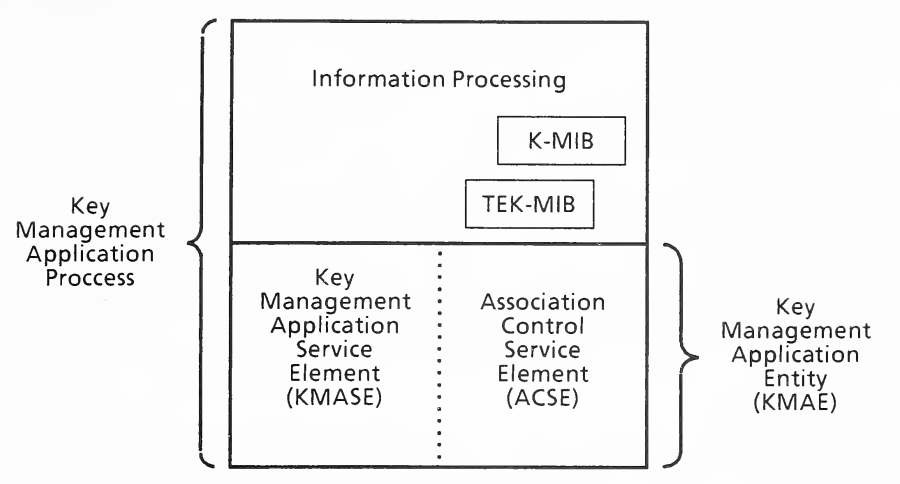
KMP のモデルを示す図です。大きな枠が横線で上下に分かれ、上の部分は「Information Processing」(情報処理)で、中に「K-MIB」と「TEK-MIB」の小さな箱があります。下の部分は点線で左右に分かれ、左が「Key Management Application Service Element (KMASE)」、右が「Association Control Service Element (ACSE)」です。左側の枠全体にかかる括弧には「Key Management Application Process」(鍵管理アプリケーションプロセス)、右側の下の部分にかかる括弧には「Key Management Application Entity (KMAE)」(鍵管理アプリケーション実体)と書かれています。
KMP Model
KMP モデル
6.3. Model
6.3. モデル
The KMAP comprises two parts: the information processor part and the communication part represented by the KMAE. When communication is required between two KMAPs, an application association is established between invocations of the processes’ KMAEs. The KMAE represents an addressable set of communication capabilities which are defined by the KMASE and the ACSE.
KMAP は、情報処理部と、KMAE で表される通信部の 2 つの部分から構成されます。2 つの KMAP の間で通信が必要になると、それらのプロセスの KMAE の呼び出しの間にアプリケーションアソシエーションが確立されます。KMAE は、KMASE と ACSE によって定義される、アドレス指定可能な通信機能の集合を表します。
During the use of the KMASE services, the existence of an application association between cooperating KMAEs is presumed. The nature and purpose of communication over the application association are determined by the information processing context and the application context which are established for it.
KMASE サービスの使用中は、連携する KMAE 間にアプリケーションアソシエーションが存在することが前提となります。アプリケーションアソシエーション上の通信の性質と目的は、そのために確立された情報処理コンテキストとアプリケーションコンテキストによって決まります。
Note that each application association may be identified in an end system by an internal, implementation dependent, mechanism so that the KMASE service user, the KMASE, and the ACSE can refer to it.
各アプリケーションアソシエーションは、KMASE のサービス利用者、KMASE、ACSE がそれを参照できるように、エンドシステム内で、実装に依存する内部の仕組みによって識別されてもよいことに注意してください。
The KMASE is driven by service request and response primitives from the KMAP and by indication primitives from the presentation service provider. The KMASE, in turn, issues indication and confirm primitives to the KMAP and request primitives to the ACSE and the presentation service provider.
KMASE は、KMAP からのサービス要求プリミティブと応答プリミティブ、およびプレゼンテーションサービスプロバイダーからの通知プリミティブによって駆動されます。KMASE は、これを受けて、KMAP に通知プリミティブと確認プリミティブを発行し、ACSE とプレゼンテーションサービスプロバイダーに要求プリミティブを発行します。
The KMAP administers the K-MIB and the TEK-MIB in the sense of updating data in the IB upon receipt of indications and confirms and retrieving parameters from the IB when issuing requests and responses. K-MIB is a security MIB used to store key material. TEK-MIB is a security MIB used to store TEK, key identifiers (KIDs) and attributes regarding the use of the TEK.
KMAP は、K-MIB と TEK-MIB を管理します。これは、通知と確認を受け取ったときに IB のデータを更新し、要求と応答を発行するときに IB からパラメータを取り出すという意味です。K-MIB は、鍵素材を保存するために使われるセキュリティ MIB です。TEK-MIB は、TEK、鍵識別子(KID)、および TEK の使用に関する属性を保存するために使われるセキュリティ MIB です。
7. Elements of Procedure
7. 手順の要素
This section contains the elements of procedure of the Key Management Protocol. The procedures define the transfer of KPDUs whose abstract syntax is defined in Section 9.
この節は、鍵管理プロトコルの手順の要素を含みます。これらの手順は、抽象構文が第 9 節で定義される KPDU の転送を定義します。
7.1. Exchange Credentials
7.1. クレデンシャルの交換
7.1.1. Purpose
7.1.1. 目的
This procedure is used to exchange the credentials necessary to form a traffic encryption key (TEK) for communications between SDNS components.
この手順は、SDNS コンポーネント間の通信のためのトラフィック暗号化鍵(TEK)を形成するために必要なクレデンシャルを交換するために使われます。
7.1.2. PDUs and Parameters
7.1.2. PDU とパラメータ
This procedure uses the following KPDUs and parameters:
この手順は、次の KPDU とパラメータを使用します。
•Nkrq
•Nkrq
•init-kid
•init-kid
•univ-id
•univ-id
•init-cred
•init-cred
•Nkrs
•Nkrs
•init-kid
•init-kid
•resp-kid
•resp-kid
•resp-cred
•resp-cred
7.1.3. Procedure
7.1.3. 手順
The credentials required to establish a TEK are exchanged by one KMASE (the initiator) transmitting a Nkrq KPDU to the other KMASE (the responder), which replies with a Nkrs KPDU.
TEK を確立するために必要なクレデンシャルは、一方の KMASE(イニシエーター)が Nkrq KPDU をもう一方の KMASE(レスポンダー)に送信し、レスポンダーが Nkrs KPDU で返信することによって交換されます。
The initiator KMASE uses the parameters from the K-EXCH-CRED request primitive to build a Nkrq KPDU. This KPDU contains the initiator's KID for the new TEK (init-kid), the universal-ID (univ-id), and the initiator's credentials (init-cred). This Nkrq KPDU is sent to the responder KMASE.
イニシエーター KMASE は、K-EXCH-CRED 要求プリミティブのパラメータを使用して、Nkrq KPDU を組み立てます。この KPDU には、新しい TEK についてのイニシエーターの KID(init-kid)、ユニバーサル ID(univ-id)、およびイニシエーターのクレデンシャル(init-cred)が含まれます。この Nkrq KPDU は、レスポンダー KMASE に送信されます。
On receipt of an Nkrq, the responder KMASE issues a K-EXCH-CRED indication primitive to the KMAP. The responder KMASE now expects a K-EXCH-CRED response primitive from the KMAP containing the responder KID and the responder's credentials.
Nkrq を受信すると、レスポンダー KMASE は KMAP に K-EXCH-CRED 通知プリミティブを発行します。レスポンダー KMASE は、これ以降、レスポンダーの KID とレスポンダーのクレデンシャルを含む K-EXCH-CRED 応答プリミティブが KMAP から届くのを待ちます。
The responder KMASE uses the parameters from the K-EXCH-CRED response primitive to prepare a Nkrs KPDU, when the parameters indicate a successful exchange. This KPDU contains the initiator’s KID for the new TEK (init-kid), the responder’s KID for the new TEK (resp-kid), and the responder’s credentials (resp-cred). The Nkrs KPDU is sent to the initiator KMASE. If the K-EXCH-CRED response primitive indicates a failure result, the responder KMASE issues an A-ABORT request primitive to the ACSE.
レスポンダー KMASE は、パラメータが交換の成功を示している場合、K-EXCH-CRED 応答プリミティブのパラメータを使用して Nkrs KPDU を作成します。この KPDU には、新しい TEK についてのイニシエーターの KID(init-kid)、新しい TEK についてのレスポンダーの KID(resp-kid)、およびレスポンダーのクレデンシャル(resp-cred)が含まれます。Nkrs KPDU は、イニシエーター KMASE に送信されます。K-EXCH-CRED 応答プリミティブが失敗の結果を示している場合、レスポンダー KMASE は ACSE に A-ABORT 要求プリミティブを発行します。
When the initiator KMASE receives the Nkrs KPDU, it issues a K-EXCH-CRED confirm primitive to the KMAP indicating the success of the exchange credentials procedure.
イニシエーター KMASE は、Nkrs KPDU を受信すると、クレデンシャル交換手順の成功を示す K-EXCH-CRED 確認プリミティブを KMAP に発行します。
7.2. Try Me Notification
7.2. Try Me 通知
7.2.1. Purpose
7.2.1. 目的
The Try Me procedure is a notification to a SDNS KMASE that, to reach a specified end-system, the KMASE may establish a key with the SDNS component sending this message.
Try Me 手順は、指定されたエンドシステムに到達するために、KMASE がこのメッセージを送信する SDNS コンポーネントとの間で鍵を確立してもよいことを、SDNS KMASE に知らせる通知です。
7.2.2. PDUs and Parameters
7.2.2. PDU とパラメータ
This procedure uses the following KPDUs and parameters:
この手順は、次の KPDU とパラメータを使用します。
•Tryme
•Tryme
•end-sys-addr
•end-sys-addr
7.2.3. Procedure
7.2.3. 手順
The initiator KMASE uses the parameters from the K-TRY-ME request primitive to prepare a Tryme KPDU. This KPDU contains the end-system address served by the initiator KMASE (end-sys-addr). The initiator KMASE sends the Tryme KPDU to the cooperating KMASE. The initiator KMASE does not expect any response.
イニシエーター KMASE は、K-TRY-ME 要求プリミティブのパラメータを使用して、Tryme KPDU を作成します。この KPDU には、イニシエーター KMASE がサービスを提供するエンドシステムのアドレス(end-sys-addr)が含まれます。イニシエーター KMASE は、Tryme KPDU を連携する KMASE に送信します。イニシエーター KMASE は、応答を期待しません。
When the responder KMASE receives a Tryme KPDU, the responder KMASE issues a K-TRY-ME indication primitive to the KMAP. The responder KMASE does not expect a K-TRY-ME response primitive.
レスポンダー KMASE は、Tryme KPDU を受信すると、KMAP に K-TRY-ME 通知プリミティブを発行します。レスポンダー KMASE は、K-TRY-ME 応答プリミティブを期待しません。
7.3. No Key Notification
7.3. No Key 通知
7.3.1. Purpose
7.3.1. 目的
The No Key procedure is a notification to a SDNS KMASE that traffic has been received which is protected under an invalid key.
No Key 手順は、無効な鍵で保護されたトラフィックを受信したことを SDNS KMASE に知らせる通知です。
7.3.2. PDUs and Parameters
7.3.2. PDU とパラメータ
This procedure uses the following KPDUs and parameters:
この手順は、次の KPDU とパラメータを使用します。
•Nokey
•Nokey
•rcvd-kid
•rcvd-kid
•pdu-count
•pdu-count
7.3.3 Procedure
7.3.3 手順
The initiator KMASE uses the parameters from the K-NO-KEY request primitive to prepare a Nokey KPDU. This KPDU contains the invalid KID which has been received (rcvd-kid) and the number of received KPDUs protected under that key during a certain time period (pdu-count). The Nokey KPDU is sent to the cooperating KMASE. The initiator KMASE does not expect a response.
イニシエーター KMASE は、K-NO-KEY 要求プリミティブのパラメータを使用して、Nokey KPDU を作成します。この KPDU には、受信した無効な KID(rcvd-kid)と、一定の期間にその鍵で保護された状態で受信した KPDU の数(pdu-count)が含まれます。Nokey KPDU は、連携する KMASE に送信されます。イニシエーター KMASE は、応答を期待しません。
When the responder KMASE receives a Nokey KPDU, it issues a K-NO-KEY indication primitive to the responder KMAP. The responder KMASE does not expect a response primitive.
レスポンダー KMASE は、Nokey KPDU を受信すると、レスポンダー KMAP に K-NO-KEY 通知プリミティブを発行します。レスポンダー KMASE は、応答プリミティブを期待しません。
7.4. Encrypted KPDU Procedure
7.4. 暗号化 KPDU 手順
7.4.1. Purpose
7.4.1. 目的
The Encrypted KPDU Procedure is used by either the initiator or responder KMASE to encrypt and transfer KPDUs.
暗号化 KPDU 手順は、イニシエーターまたはレスポンダーの KMASE が、KPDU を暗号化して転送するために使用します。
7.4.2. PDUs and Parameters
7.4.2. PDU とパラメータ
This procedure uses the following KPDUs and parameters:
この手順は、次の KPDU とパラメータを使用します。
•EKpdu
•EKpdu
•remote-kid*
•remote-kid*
•contents**
•contents**
•PlainTextKpdu
•PlainTextKpdu
•plaintext***
•plaintext***
•icv
•icv
•padding
•padding
* NOTE: The remote-kid is either the init-kid or the resp-kid depending on context of the KPDU.
* 注: remote-kid は、KPDU の文脈に応じて、init-kid または resp-kid のいずれかです。
** NOTE: The contents parameter is the result of the encryption function.
** 注: contents パラメータは、暗号化関数の結果です。
***NOTE: The plaintext parameter consists of one of the following KPDUs:
***注: plaintext パラメータは、次のいずれかの KPDU で構成されます。
•Ssrq
•Ssrq
•Ssrs
•Ssrs
•Rkrq
•Rkrq
•Rkrs
•Rkrs
•Srkrq
•Srkrq
•Srkrs
•Srkrs
•Srdrq
•Srdrq
•Srdrs
•Srdrs
•Crrq
•Crrq
•Crrs
•Crrs
•Kurq
•Kurq
•Kurs
•Kurs
•Estat
•Estat
7.4.3. Procedure
7.4.3. 手順
The PlainText Kpdu comprises the plaintext, the icv and optional padding. The plaintext is one of the following KPDUs:
PlainText Kpdu は、plaintext、icv、および任意の padding で構成されます。plaintext は、次のいずれかの KPDU です。
•Ssrq
•Ssrq
•Ssrs
•Ssrs
•Rkrq
•Rkrq
•Rkrs
•Rkrs
•Srkrq
•Srkrq
•Srkrs
•Srkrs
•Srdrq
•Srdrq
•Srdrs
•Srdrs
•Crrq
•Crrq
•Crrs
•Crrs
•Kurq
•Kurq
•Kurs
•Kurs
•Estat
•Estat
The KMASE produces the icv as a function of the parameter plaintext. The KMASE appends any optional padding that is required. The KMASE encrypts the PlainText Kpdu and the result of encryption is the parameter contents.
KMASE は、パラメータ plaintext の関数として icv を生成します。KMASE は、必要な任意の padding を付加します。KMASE は PlainText Kpdu を暗号化し、その暗号化の結果がパラメータ contents になります。
The EKpdu comprises the KID (remote-kid) and contents. The KMASE forms the EKpdu by prepending the remote-kid to the contents, and then the formation of the EKpdu is complete.
EKpdu は、KID(remote-kid)と contents で構成されます。KMASE は、remote-kid を contents の前に付加して EKpdu を形成し、これで EKpdu の形成は完了します。
When a KMASE receives an EKpdu, it uses the remote-kid to select the correct TEK to decrypt the contents. After decryption, the result is a PlainText Kpdu, which is one of the above possible KPDUs and an icv. The KMASE then verifies the icv.
KMASE は、EKpdu を受信すると、remote-kid を使って、contents を復号するための正しい TEK を選択します。復号後の結果は PlainText Kpdu であり、上記のいずれかの KPDU と icv になります。そのうえで KMASE は icv を検証します。
If the receiving KMASE does not possess the TEK identified by the remote-kid, the receiving KMASE issues an A-ABORT. Also, if decryption fails or if the icv fails verification, the KMASE issues an A-ABORT.
受信側の KMASE が、remote-kid で識別される TEK を持っていない場合、受信側の KMASE は A-ABORT を発行します。また、復号に失敗した場合、または icv の検証に失敗した場合にも、KMASE は A-ABORT を発行します。
NOTE: The decryption of the EKpdu verifies the cryptographic compatibility of the TEK established by the Nkrq and Nkrs exchange.
注: EKpdu の復号は、Nkrq と Nkrs の交換によって確立された TEK の暗号上の互換性を検証します。
NOTE: This procedure uses the basic encoding rules defined in ISO DIS 8825 to form the PlainText Kpdu prior to encryption and the EKpdu after encryption.
注: この手順は、暗号化の前の PlainText Kpdu と、暗号化の後の EKpdu を形成するために、ISO DIS 8825 で定義された基本符号化規則を使用します。
7.5. Attribute Negotiation
7.5. 属性ネゴシエーション
7.5.1. Purpose
7.5.1. 目的
The Ssrq and Ssrs KPDU exchange is used to verify the cryptographic compatibility of the TEK established by the Nkrq and Nkrs exchange, to negotiate and establish the communication and security services associated with the TEK, and to exchange Certificate Revocation List (CRL) version numbers.
Ssrq KPDU と Ssrs KPDU の交換は、Nkrq と Nkrs の交換によって確立された TEK の暗号上の互換性を検証し、TEK に関連する通信およびセキュリティサービスをネゴシエーションして確立し、証明書失効リスト(CRL)のバージョン番号を交換するために使われます。
7.5.2. PDUs and parameters
7.5.2. PDU とパラメータ
This procedure uses the following KPDUs and parameters:
この手順は、次の KPDU とパラメータを使用します。
•Ssrq
•Ssrq
•old-resp-kid
•old-resp-kid
•crl-ver
•crl-ver
•proposed-options
•proposed-options
•add-info
•add-info
•Ssrs
•Ssrs
•crl-ver
•crl-ver
•selected-options
•selected-options
•add-info
•add-info
•Estat
•Estat
•estatus
•estatus
•doNotTryBefore
•doNotTryBefore
7.5.3. Procedure
7.5.3. 手順
Security and communication attributes are negotiated by means of one KMASE (the initiator) transmitting a Ssrq KPDU to the other KMASE (the responder), which replies with a Ssrs KPDU. The initiator specifies a list of sets of negotiable communication and security parameter options in the Ssrq KPDU. The responder specifies the selected set of options in the Ssrs KPDU.
セキュリティ属性と通信属性は、一方の KMASE(イニシエーター)が Ssrq KPDU をもう一方の KMASE(レスポンダー)に送信し、レスポンダーが Ssrs KPDU で返信することによってネゴシエーションされます。イニシエーターは、ネゴシエーション可能な通信およびセキュリティのパラメータオプションのセットの一覧を、Ssrq KPDU で指定します。レスポンダーは、選択したオプションのセットを Ssrs KPDU で指定します。
The initiator KMASE uses the parameters from the K-TEK-ATTRIBUTES request primitive to prepare a Ssrq KPDU. The Ssrq KPDU contains the old responder KID (old-resp-kid), the initiator's CRL version number (crl-ver), option sets (proposed-options), and additional information (add-info). Option sets contain all sets of options that the initiator will allow. Option set preference is determined by first-to-last precedence in the ordering. After forming the Ssrq KPDU, the initiator KMASE encodes the KPDU into the PlainText Kpdu format, encrypts the PlainText Kpdu, and encodes the result into the EKpdu format. The cryptographic key used for both the icv and the encryption is the previously formed TEK. The KMASE sends the EKpdu to the responder KMASE.
イニシエーター KMASE は、K-TEK-ATTRIBUTES 要求プリミティブのパラメータを使用して、Ssrq KPDU を作成します。Ssrq KPDU には、旧レスポンダー KID(old-resp-kid)、イニシエーターの CRL バージョン番号(crl-ver)、オプションセット(proposed-options)、および追加情報(add-info)が含まれます。オプションセットには、イニシエーターが許容するすべてのオプションのセットが含まれます。オプションセットの優先順位は、並び順の先頭から末尾への優先順位で決まります。Ssrq KPDU を形成した後、イニシエーター KMASE は、その KPDU を PlainText Kpdu の形式に符号化し、PlainText Kpdu を暗号化し、その結果を EKpdu の形式に符号化します。icv と暗号化の両方に使用される暗号鍵は、先に形成された TEK です。KMASE は、EKpdu をレスポンダー KMASE に送信します。
On receipt of a EKpdu, the responder KMASE performs the EKpdu decryption and icv verification. If either operation fails, the KMASE issues an A-ABORT request primitive to the ACSE. If both decryption and icv verification are successful, the KMASE issues a K-TEK-ATTRIBUTES indication primitive to the responder KMAP. The KMASE now expects a K-TEK-ATTRIBUTES response primitive.
EKpdu を受信すると、レスポンダー KMASE は、EKpdu の復号と icv の検証を行います。どちらかの操作が失敗した場合、KMASE は ACSE に A-ABORT 要求プリミティブを発行します。復号と icv の検証の両方が成功した場合、KMASE は、レスポンダー KMAP に K-TEK-ATTRIBUTES 通知プリミティブを発行します。KMASE は、これ以降、K-TEK-ATTRIBUTES 応答プリミティブを待ちます。
The responder KMASE uses the parameters from the K-TEK-ATTRIBUTES response primitive to prepare a Ssrs KPDU when the parameters indicate successful attribute negotiation. The Ssrs KPDU contains the responder's CRL version number (crl-ver), option set (selected-options), and additional information (add-info). The Option Set contains the set of communication and security option parameters chosen from the initiator's sets in the Ssrq. After forming the Ssrs KPDU, the KMASE encodes the KPDU into the PlainText Kpdu format, encrypts the PlainText Kpdu, encodes the result into the EKpdu format and sends it to the initiator KMASE. The cryptographic key used for both the icv and the encryption is the previously formed TEK. If the parameters of the K-TEK-ATTRIBUTES response primitive indicate a failure of the attribute negotiation operation, the responder KMASE prepares an Estat KPDU instead of the Ssrs KPDU. The Estat KPDU contains a status (estatus). When the failure is service-not-available-at-this-time, the earliest time the initiator KMAP should attempt the request again is included (doNotTryBefore). After forming the Estat KPDU, the responder KMASE encodes the KPDU into the PlainText Kpdu format, encrypts the PlainText Kpdu, encodes the result into the EKpdu format, and sends it to the initiator KMASE.
レスポンダー KMASE は、パラメータが属性ネゴシエーションの成功を示している場合、K-TEK-ATTRIBUTES 応答プリミティブのパラメータを使用して Ssrs KPDU を作成します。Ssrs KPDU には、レスポンダーの CRL バージョン番号(crl-ver)、オプションセット(selected-options)、および追加情報(add-info)が含まれます。オプションセットには、Ssrq にあるイニシエーターのセットから選ばれた、通信およびセキュリティのオプションパラメータのセットが含まれます。Ssrs KPDU を形成した後、KMASE は、その KPDU を PlainText Kpdu の形式に符号化し、PlainText Kpdu を暗号化し、その結果を EKpdu の形式に符号化して、イニシエーター KMASE に送信します。icv と暗号化の両方に使用される暗号鍵は、先に形成された TEK です。K-TEK-ATTRIBUTES 応答プリミティブのパラメータが属性ネゴシエーション操作の失敗を示している場合、レスポンダー KMASE は、Ssrs KPDU の代わりに Estat KPDU を作成します。Estat KPDU には、ステータス(estatus)が含まれます。失敗の原因が service-not-available-at-this-time(現時点ではサービスを利用できない)である場合は、イニシエーター KMAP が要求を再試行すべき最も早い時刻(doNotTryBefore)が含まれます。Estat KPDU を形成した後、レスポンダー KMASE は、その KPDU を PlainText Kpdu の形式に符号化し、PlainText Kpdu を暗号化し、その結果を EKpdu の形式に符号化して、イニシエーター KMASE に送信します。
When the initiator KMASE receives the EKpdu, it performs the EKpdu decryption and icv verification. If either operation fails, the initiator KMASE issues an A-ABORT request primitive to the ACSE. If both the decryption and icv verification are successful, the KMASE issues a K-TEK-ATTRIBUTES confirm primitive to the initiator KMAP indicating the success or failure of the attribute negotiation operation.
イニシエーター KMASE は、EKpdu を受信すると、EKpdu の復号と icv の検証を行います。どちらかの操作が失敗した場合、イニシエーター KMASE は ACSE に A-ABORT 要求プリミティブを発行します。復号と icv の検証の両方が成功した場合、KMASE は、イニシエーター KMAP に、属性ネゴシエーション操作の成功または失敗を示す K-TEK-ATTRIBUTES 確認プリミティブを発行します。
7.5.4. Option Sets
7.5.4. オプションセット
The options which are negotiated by the exchange of the Ssrq and Ssrs KPDUs establish some of the characteristics of the communication between peer entities which share a traffic key. The negotiated options are represented as sets of parameters within the Ssrq/Ssrs KPDUs. Some of the options are dependent on other options.
Ssrq KPDU と Ssrs KPDU の交換によってネゴシエーションされるオプションは、トラフィック鍵を共有するピアエンティティ間の通信の特性の一部を確立します。ネゴシエーションされたオプションは、Ssrq/Ssrs KPDU 内のパラメータのセットとして表されます。オプションの一部は、他のオプションに依存します。
Note - see SDN.906, SDNS Attribute Negotiation, for further information.
注 - 詳細は、SDN.906「SDNS 属性ネゴシエーション」を参照してください。
7.5.5. add-info
7.5.5. add-info
In addition to the negotiation of options, the Ssrq and Ssrs exchange may provide the communicating entities with some additional information. This information is optional and its use by the recipient is a local matter. Some of the information may be signed by the KMS or an authorized directory service. The following sections describe some of the possible information which may appear in the Ssrq and Ssrs exchanges.
オプションのネゴシエーションに加えて、Ssrq と Ssrs の交換では、通信するエンティティに追加情報を提供してもよいです。この情報は任意であり、受信側がどう使うかはローカルの事項です。情報の一部は、KMS または認可されたディレクトリサービスによって署名される場合があります。以下の各節では、Ssrq と Ssrs の交換に現れる可能性のある情報の一部を説明します。
Note - see SDN.906, SDNS Traffic Key Attribute Negotiation, for further information.
注 - 詳細は、SDN.906「SDNS Traffic Key Attribute Negotiation」を参照してください。
7.5.6. Other PDU Fields
7.5.6. その他の PDU フィールド
Also included in the Ssrq and Ssrs are fields containing information that is exchanged. These are:
Ssrq と Ssrs には、交換される情報を含むフィールドも含まれます。それらは次のとおりです。
Old Responder KID (old-resp-kid) - notify the responder that the initiator wishes to associate the options of a current TEK with the newly formed TEK and use them on the existing cryptographic association. The proposed options field in the Ssrq is absent. The original TEK is then zeroized. This parameter is present in the Ssrq and is set only by the Initiator of the TEK. If the responder KMAP is successful in associating the correct set of attributes with the newly formed TEK, those attributes are represented in the selected-options parameter of the Ssrs.
Old Responder KID(old-resp-kid)- イニシエーターが、現在の TEK のオプションを新たに形成された TEK に関連付け、既存の暗号アソシエーションでそれらを使用したいと考えていることを、レスポンダーに通知します。Ssrq の proposed-options フィールドは存在しません。その後、元の TEK はゼロ化されます。このパラメータは Ssrq に存在し、TEK のイニシエーターだけが設定します。レスポンダー KMAP が、新たに形成された TEK に正しい属性のセットを関連付けることに成功した場合、それらの属性は、Ssrs の selected-options パラメータに表されます。
CRL version number (crl-ver) - contains notification of the initiator's CRL version in the Ssrq and the responder's CRL version in the Ssrs.
CRL バージョン番号(crl-ver)- Ssrq ではイニシエーターの CRL バージョン、Ssrs ではレスポンダーの CRL バージョンの通知を含みます。
7.6. Traffic Key Update
7.6. トラフィック鍵の更新
7.6.1. Purpose
7.6.1. 目的
The Traffic Key Update procedure is used to obtain a new common traffic encryption key from an existing traffic key. All TEK attributes associated with the old TEK are assigned to the new key. The new key replaces the existing key.
トラフィック鍵更新手順は、既存のトラフィック鍵から新しい共通のトラフィック暗号化鍵を入手するために使われます。旧 TEK に関連付けられていたすべての TEK 属性は、新しい鍵に割り当てられます。新しい鍵は、既存の鍵を置き換えます。
7.6.2. PDUs and parameters
7.6.2. PDU とパラメータ
This procedure uses the following KPDUs and parameters:
この手順は、次の KPDU とパラメータを使用します。
•Kurq
•Kurq
•new-init-kid
•new-init-kid
•Kurs
•Kurs
•new-resp-kid
•new-resp-kid
7.6.3. Procedure
7.6.3. 手順
A new traffic key is generated by means of one KMASE (the initiator) transmitting a Kurq KPDU to the other KMASE (the responder), which replies with a Kurs KPDU. The TEK attributes associated with the original traffic key are associated with the new TEK.
新しいトラフィック鍵は、一方の KMASE(イニシエーター)が Kurq KPDU をもう一方の KMASE(レスポンダー)に送信し、レスポンダーが Kurs KPDU で返信することによって生成されます。元のトラフィック鍵に関連付けられていた TEK 属性は、新しい TEK に関連付けられます。
The initiator KMASE uses the parameters from the K-UPDATE-TEK request primitive to prepare a Kurq KPDU for the responder KMASE. The Kurq KPDU contains the KID the initiator has assigned to the new key (new-init-kid). After forming the Kurq KPDU, the KMASE encodes the KPDU into the PlainText Kpdu format, encrypts the PlainText Kpdu, encodes the result into the EKpdu format. The cryptographic key used for both the icv and the encryption is the existing TEK. The KMASE sends the EKpdu to the responder KMASE.
イニシエーター KMASE は、K-UPDATE-TEK 要求プリミティブのパラメータを使用して、レスポンダー KMASE 向けの Kurq KPDU を作成します。Kurq KPDU には、イニシエーターが新しい鍵に割り当てた KID(new-init-kid)が含まれます。Kurq KPDU を形成した後、KMASE は、その KPDU を PlainText Kpdu の形式に符号化し、PlainText Kpdu を暗号化し、その結果を EKpdu の形式に符号化します。icv と暗号化の両方に使用される暗号鍵は、既存の TEK です。KMASE は、EKpdu をレスポンダー KMASE に送信します。
When the responder receives the EKpdu, it performs the EKpdu decryption and icv verification. If either operation fails, the responder KMASE issues an A-ABORT request primitive to the ACSE. If both the decryption and icv verification operations are successful, the responder KMASE issues a K-UPDATE-TEK indication primitive to the KMAP. The responder KMASE now expects a K-UPDATE-TEK response primitive from the KMAP.
レスポンダーは、EKpdu を受信すると、EKpdu の復号と icv の検証を行います。どちらかの操作が失敗した場合、レスポンダー KMASE は ACSE に A-ABORT 要求プリミティブを発行します。復号と icv の検証の両方の操作が成功した場合、レスポンダー KMASE は KMAP に K-UPDATE-TEK 通知プリミティブを発行します。レスポンダー KMASE は、これ以降、KMAP からの K-UPDATE-TEK 応答プリミティブを待ちます。
The responder KMASE uses the parameters from the K-UPDATE-TEK response primitive to prepare a Kurs KPDU, when the K-UPDATE-TEK response primitive indicates that the key update operation is successful. The Kurs KPDU contains the KID the responder has assigned to the updated TEK (new-resp-kid). After forming the Kurs KPDU, the responder KMASE encodes the KPDU into the PlainText Kpdu format, encrypts the PlainText Kpdu, encodes the result into the EKpdu format and sends it to the initiator KMASE. The cryptographic key used for both the icv and the encryption is the newly formed TEK. If the K-UPDATE-TEK response primitive indicates a failure of the key update operation, the responder KMASE issues an A-ABORT request primitive to the ACSE.
レスポンダー KMASE は、K-UPDATE-TEK 応答プリミティブが鍵更新操作の成功を示している場合、その応答プリミティブのパラメータを使用して Kurs KPDU を作成します。Kurs KPDU には、レスポンダーが更新後の TEK に割り当てた KID(new-resp-kid)が含まれます。Kurs KPDU を形成した後、レスポンダー KMASE は、その KPDU を PlainText Kpdu の形式に符号化し、PlainText Kpdu を暗号化し、その結果を EKpdu の形式に符号化して、イニシエーター KMASE に送信します。icv と暗号化の両方に使用される暗号鍵は、新たに形成された TEK です。K-UPDATE-TEK 応答プリミティブが鍵更新操作の失敗を示している場合、レスポンダー KMASE は ACSE に A-ABORT 要求プリミティブを発行します。
When the initiator KMASE receives the EKpdu, it performs the EKpdu decryption and icv verification. If either operation fails, the initiator KMASE issues an A-ABORT request primitive to the ACSE. If both the decryption and icv verification are successful, the KMASE issues a K-UPDATE-TEK confirm primitive to the initiator KMAP indicating the success of the key update operation.
イニシエーター KMASE は、EKpdu を受信すると、EKpdu の復号と icv の検証を行います。どちらかの操作が失敗した場合、イニシエーター KMASE は ACSE に A-ABORT 要求プリミティブを発行します。復号と icv の検証の両方が成功した場合、KMASE は、イニシエーター KMAP に、鍵更新操作の成功を示す K-UPDATE-TEK 確認プリミティブを発行します。
7.7. Interactive Rekey
7.7. 対話型再鍵
7.7.1. Purpose
7.7.1. 目的
The Interactive Rekey procedure is used by the KMASE of a SDNS component to directly and interactively exchange rekey information with the KMASE in a KMS.
対話型再鍵手順は、SDNS コンポーネントの KMASE が、KMS 内の KMASE と再鍵情報を直接かつ対話的に交換するために使用します。
7.7.2. PDUs and parameters
7.7.2. PDU とパラメータ
This procedure uses the following KPDUs and parameters:
この手順は、次の KPDU とパラメータを使用します。
•Rkrq
•Rkrq
•univ-id
•univ-id
•rekey-cred
•rekey-cred
•ekr
•ekr
•crl-ver
•crl-ver
•ref-num
•ref-num
•Rkrs
•Rkrs
•kms-cred-A
•kms-cred-A
•kms-cred-B
•kms-cred-B
•new-k-mat-A
•new-k-mat-A
•new-k-mat-B
•new-k-mat-B
•ekr
•ekr
•crl-ver
•crl-ver
•ref-num
•ref-num
•new-crl
•new-crl
•new-univ-crl
•new-univ-crl
•no-more
•no-more
•Estat
•Estat
•estatus
•estatus
•doNotTryBefore
•doNotTryBefore
7.7.3. Procedure
7.7.3. 手順
A SDNS component obtains new key material by means of the KMASE (the initiator) transmitting a Rkrq KPDU to the KMS KMASE (the responder), which replies with a Rkrs KPDU.
SDNS コンポーネントは、KMASE(イニシエーター)が Rkrq KPDU を KMS KMASE(レスポンダー)に送信し、レスポンダーが Rkrs KPDU で返信することによって、新しい鍵素材を入手します。
The initiator KMASE uses the parameters from the K-IREKEY request primitive to prepare a Rkrq KPDU. This KPDU contains the universal-ID associated with the key material to be replaced (univ-id), and the current CRL version number held by the initiator SDNS component and associated with the universal-ID (crl-ver). If the initiator is a rekey agent, the Rkrq KPDU may also contain the credentials to be rekeyed (rekey-cred). If the component is expecting an electronic key replacement, the ekr parameter (ekr) is set to TRUE . Additionally, if this is the second part of a staged rekey procedure, the Rkrq KPDU contains the reference number (ref-num). After forming the Rkrq KPDU, the initiator KMASE encodes the KPDU into the PlainText Kpdu format, encrypts the PlainText Kpdu, encodes the result into the EKpdu format and sends it to the KMS KMASE.
イニシエーター KMASE は、K-IREKEY 要求プリミティブのパラメータを使用して、Rkrq KPDU を作成します。この KPDU には、置き換える鍵素材に関連付けられたユニバーサル ID(univ-id)と、イニシエーター SDNS コンポーネントが保持していてそのユニバーサル ID に関連付けられた現在の CRL バージョン番号(crl-ver)が含まれます。イニシエーターが再鍵エージェントである場合、Rkrq KPDU には、再鍵されるクレデンシャル(rekey-cred)が含まれてもよいです。コンポーネントが電子鍵交換を予定している場合、ekr パラメータ(ekr)は TRUE に設定されます。さらに、これが段階的再鍵手順の第 2 部である場合、Rkrq KPDU には参照番号(ref-num)が含まれます。Rkrq KPDU を形成した後、イニシエーター KMASE は、その KPDU を PlainText Kpdu の形式に符号化し、PlainText Kpdu を暗号化し、その結果を EKpdu の形式に符号化して、KMS KMASE に送信します。
When the KMS KMASE receives the EKpdu, it performs the EKpdu decryption and icv verification. If either operation fails, the KMS KMASE issues an A-ABORT request primitive to the ACSE. If both decryption and icv verification are successful, the KMS KMASE issues a K-IREKEY indication primitive to the KMS KMAP. The KMS KMASE now expects a K-IREKEY response primitive.
KMS KMASE は、EKpdu を受信すると、EKpdu の復号と icv の検証を行います。どちらかの操作が失敗した場合、KMS KMASE は ACSE に A-ABORT 要求プリミティブを発行します。復号と icv の検証の両方が成功した場合、KMS KMASE は KMS KMAP に K-IREKEY 通知プリミティブを発行します。KMS KMASE は、これ以降、K-IREKEY 応答プリミティブを待ちます。
The KMS KMASE uses the parameters from the K-IREKEY response primitive to prepare a Rkrs KPDU, when the rekey operation is successful. This KPDU contains the KMS credentials (kms-cred-A and kms-cred-B), the new key material (new-k-mat-A and new-k-mat-B), and the current KMS CRL version number associated with the universal-ID under which this rekey was performed (crl-ver). If the CRL version is more recent than the initiator's CRL version, the Rkrs also contains the new CRL signed by the KMS (new-crl). If the component is also receiving an electronic key replacement, the ekr parameter (ekr) is set to TRUE. Additionally, if this is the second part of a staged rekey procedure, the Rkrs KPDU contains the reference identifier (ref-num). If this rekey process is a universal rekey, the Rkrs KPDU also contains the new universal key material in the new-k-mat fields (new-k-mat-A and new-k-mat-B) and CRL of the new universal (new-univ-crl). Optionally, the Rkrs KPDU may contain a flag to indicate that the KMS cannot accept any further rekey requests on this association at this time (no-more). After forming the Rkrs KPDU, the KMS KMASE encodes the KPDU into the PlainText Kpdu format, encrypts the PlainText Kpdu, encodes the result into the EKpdu format and sends it to the initiator KMASE. If the K-IREKEY response primitive indicates a failure of the interactive rekey operation, the KMS KMASE prepares a Estat KPDU instead of a Rkrs KPDU. The Estat KPDU contains a status (estatus). When the failure is service-not-available-at-this-time, the earliest time the initiator KMAP should attempt the request again is included (doNotTryBefore). After forming the Estat KPDU, the responder KMASE encodes the KPDU into the PlainText Kpdu format, encrypts the PlainText Kpdu, encodes the result into the EKpdu format and sends it to the initiator KMASE.
KMS KMASE は、再鍵操作が成功した場合、K-IREKEY 応答プリミティブのパラメータを使用して Rkrs KPDU を作成します。この KPDU には、KMS のクレデンシャル(kms-cred-A と kms-cred-B)、新しい鍵素材(new-k-mat-A と new-k-mat-B)、およびこの再鍵が行われたユニバーサル ID に関連付けられた KMS の現在の CRL バージョン番号(crl-ver)が含まれます。CRL のバージョンがイニシエーターの CRL バージョンより新しい場合、Rkrs には、KMS が署名した新しい CRL(new-crl)も含まれます。コンポーネントが電子鍵交換も受け取る場合、ekr パラメータ(ekr)は TRUE に設定されます。さらに、これが段階的再鍵手順の第 2 部である場合、Rkrs KPDU には参照識別子(ref-num)が含まれます。この再鍵プロセスがユニバーサル再鍵である場合、Rkrs KPDU には、new-k-mat フィールド(new-k-mat-A と new-k-mat-B)に新しいユニバーサル鍵素材と、新しいユニバーサルの CRL(new-univ-crl)も含まれます。任意で、Rkrs KPDU には、KMS がこの時点でこのアソシエーションでそれ以上の再鍵要求を受け付けられないことを示すフラグ(no-more)が含まれてもよいです。Rkrs KPDU を形成した後、KMS KMASE は、その KPDU を PlainText Kpdu の形式に符号化し、PlainText Kpdu を暗号化し、その結果を EKpdu の形式に符号化して、イニシエーター KMASE に送信します。K-IREKEY 応答プリミティブが対話型再鍵操作の失敗を示している場合、KMS KMASE は、Rkrs KPDU の代わりに Estat KPDU を作成します。Estat KPDU には、ステータス(estatus)が含まれます。失敗の原因が service-not-available-at-this-time(現時点ではサービスを利用できない)である場合は、イニシエーター KMAP が要求を再試行すべき最も早い時刻(doNotTryBefore)が含まれます。Estat KPDU を形成した後、レスポンダー KMASE は、その KPDU を PlainText Kpdu の形式に符号化し、PlainText Kpdu を暗号化し、その結果を EKpdu の形式に符号化して、イニシエーター KMASE に送信します。
When the initiator KMASE receives the EKpdu, it performs the EKpdu decryption and icv verification. If either operation fails, the initiator KMASE issues an A-ABORT request primitive to the ACSE. If both the decryption and icv verification are successful, the KMASE issues a K-IREKEY confirm primitive to the initiator KMAP indicating the success or failure of the rekey operation.
イニシエーター KMASE は、EKpdu を受信すると、EKpdu の復号と icv の検証を行います。どちらかの操作が失敗した場合、イニシエーター KMASE は ACSE に A-ABORT 要求プリミティブを発行します。復号と icv の検証の両方が成功した場合、KMASE は、イニシエーター KMAP に、再鍵操作の成功または失敗を示す K-IREKEY 確認プリミティブを発行します。
7.8. Staged Rekey
7.8. 段階的再鍵
7.8.1. Staged Rekey Request
7.8.1. 段階的再鍵要求
7.8.1.1. Purpose
7.8.1.1. 目的
The Staged Rekey Request procedure is used by the KMASE of a SDNS component to pass rekey information to the KMASE of a Rekey Agent. This is useful in an environment where direct access to the KMS is unavailable.
段階的再鍵要求手順は、SDNS コンポーネントの KMASE が、再鍵エージェントの KMASE に再鍵情報を渡すために使用します。これは、KMS に直接アクセスできない環境で有用です。
Note: The staged rekey procedure is defined only for an exchange between a rekey agent and a "terminal" SDNS component. Exchanges between two rekey agents are for further study.
注: 段階的再鍵手順は、再鍵エージェントと「端末」SDNS コンポーネントとの間の交換についてのみ定義されています。2 つの再鍵エージェント間の交換は、今後の検討課題です。
7.8.1.2. PDUs and parameters
7.8.1.2. PDU とパラメータ
This procedure uses the following KPDUs and parameters:
この手順は、次の KPDU とパラメータを使用します。
•Srkrq
•Srkrq
•univ-id
•univ-id
•rekey-cred
•rekey-cred
•crl-ver
•crl-ver
•ekr
•ekr
•Srkrs
•Srkrs
•ref-num
•ref-num
•Estat
•Estat
•estatus
•estatus
•doNotTryBefore
•doNotTryBefore
7.8.1.3. Procedure
7.8.1.3. 手順
A SDNS component may request new key material from a Rekey Agent by the KMASE (the initiator) transmitting a Srkrq KPDU to the Rekey Agent KMASE (the responder), which replies with a Srkrs KPDU.
SDNS コンポーネントは、KMASE(イニシエーター)が Srkrq KPDU を再鍵エージェント KMASE(レスポンダー)に送信し、レスポンダーが Srkrs KPDU で返信することによって、再鍵エージェントに新しい鍵素材を要求してもよいです。
The initiator KMASE uses the parameters from the K-REQUEST-SREKEY request primitive to prepare a Srkrq KPDU. The Srkrq KPDU contains the universal-ID associated with the key material to be replaced (univ-id) and the current CRL version number held by the initiator SDNS component and associated with the universal-ID (crl-ver). Additionally, the Srkrq KPDU contains the credentials that the KMS should use to perform the rekey operation (rekey-cred) and a notification of whether the initiator expects an electronic key replacement (ekr). After forming the Srkrq KPDU, the initiator KMASE encodes the KPDU into the PlainText Kpdu format, encrypts the PlainText Kpdu, encodes the result into the EKpdu format and sends it to the responder KMASE.
イニシエーター KMASE は、K-REQUEST-SREKEY 要求プリミティブのパラメータを使用して、Srkrq KPDU を作成します。Srkrq KPDU には、置き換える鍵素材に関連付けられたユニバーサル ID(univ-id)と、イニシエーター SDNS コンポーネントが保持していてそのユニバーサル ID に関連付けられた現在の CRL バージョン番号(crl-ver)が含まれます。さらに、Srkrq KPDU には、KMS が再鍵操作を行う際に使用すべきクレデンシャル(rekey-cred)と、イニシエーターが電子鍵交換を期待しているかどうかの通知(ekr)が含まれます。Srkrq KPDU を形成した後、イニシエーター KMASE は、その KPDU を PlainText Kpdu の形式に符号化し、PlainText Kpdu を暗号化し、その結果を EKpdu の形式に符号化して、レスポンダー KMASE に送信します。
When the Rekey Agent KMASE receives the EKpdu, it performs the EKpdu decryption and icv verification. If either operation fails, the Rekey Agent KMASE issues an A-ABORT request primitive to the ACSE. If both decryption and icv verification are successful, the rekey agent KMASE issues a K-REQUEST-SREKEY-indication primitive to the Rekey Agent KMAP. The Rekey Agent KMASE now expects a K-REQUEST-SREKEY response primitive from the KMAP.
再鍵エージェント KMASE は、EKpdu を受信すると、EKpdu の復号と icv の検証を行います。どちらかの操作が失敗した場合、再鍵エージェント KMASE は ACSE に A-ABORT 要求プリミティブを発行します。復号と icv の検証の両方が成功した場合、再鍵エージェント KMASE は、再鍵エージェント KMAP に K-REQUEST-SREKEY 通知プリミティブを発行します。再鍵エージェント KMASE は、これ以降、KMAP からの K-REQUEST-SREKEY 応答プリミティブを待ちます。
The Rekey Agent KMASE uses the parameters from the K-REQUEST-SREKEY reponse primitive to prepare a Srkrs KPDU, when the K-REQUEST-SREKEY response primitive indicates a successful operation. The Srkrs KPDU contains the ref-num generated by the Rekey Agent (ref-num). After forming the Srkrs KPDU, the responder KMASE encodes the KPDU into the PlainText Kpdu format, encrypts the PlainText Kpdu, encodes the result into the EKpdu format and sends it to the initiator KMASE.
K-REQUEST-SREKEY 応答プリミティブが操作の成功を示している場合、再鍵エージェント KMASE は、その K-REQUEST-SREKEY 応答プリミティブのパラメータを使用して Srkrs KPDU を作成します。Srkrs KPDU には、再鍵エージェントが生成した ref-num(ref-num)が含まれます。Srkrs KPDU を形成した後、レスポンダー KMASE は、その KPDU を PlainText Kpdu の形式に符号化し、PlainText Kpdu を暗号化し、その結果を EKpdu の形式に符号化して、イニシエーター KMASE に送信します。
If the K-REQUEST-SREKEY response primitive indicates a failure, the Rekey Agent KMASE prepares a Estat KPDU instead of a Srkrs KPDU. The Estat KPDU contains a status (estatus). When the failure is service-not-available-at-this-time, the earliest time the initiator KMAP should attempt the request again is included (doNotTryBefore). After forming the Estat KPDU, the responder KMASE encodes the KPDU into the PlainText Kpdu format, encrypts the PlainText Kpdu, encodes the result into the EKpdu format and sends it to the initiator KMASE.
K-REQUEST-SREKEY 応答プリミティブが失敗を示している場合、再鍵エージェント KMASE は、Srkrs KPDU の代わりに Estat KPDU を作成します。Estat KPDU には、ステータス(estatus)が含まれます。失敗の原因が service-not-available-at-this-time(現時点ではサービスを利用できない)である場合は、イニシエーター KMAP が再び要求を試みてよい最も早い時刻(doNotTryBefore)が含まれます。Estat KPDU を形成した後、レスポンダー KMASE は、その KPDU を PlainText Kpdu の形式に符号化し、PlainText Kpdu を暗号化し、その結果を EKpdu の形式に符号化して、イニシエーター KMASE に送信します。
When the initiator KMASE receives the EKpdu, it performs the EKpdu decryption and icv verification. If either operation fails, the initiator KMASE issues an A-ABORT request primitive to the ACSE. If both the decryption and icv verifications are sucessful, the KMASE issues a K-REQUEST-SREKEY confirm primitive to the initiator KMAP indicating the success or failure of the Staged Rekey Request operation.
イニシエーター KMASE は、EKpdu を受信すると、EKpdu の復号と icv の検証を行います。どちらかの操作が失敗した場合、イニシエーター KMASE は ACSE に A-ABORT 要求プリミティブを発行します。復号と icv の検証の両方が成功した場合、KMASE は、イニシエーター KMAP に、段階的再鍵要求操作の成功または失敗を示す K-REQUEST-SREKEY 確認プリミティブを発行します。
7.8.2. Staged Rekey Delivery
7.8.2. 段階的再鍵配送
7.8.2.1. Purpose
7.8.2.1. 目的
The Staged Rekey Delivery procedure is used by the KMASE of a SDNS component to take delivery of rekey information from a Rekey Agent.
段階的再鍵配送手順は、SDNS コンポーネントの KMASE が、再鍵エージェントから再鍵情報の配送を受けるために使用します。
7.8.2.2. PDUs and parameters
7.8.2.2. PDU とパラメータ
This procedure uses the following KPDUs and parameters:
この手順は、次の KPDU とパラメータを使用します。
•Srdrq
•Srdrq
•ref-num
•ref-num
•Srdrs
•Srdrs
•kms-cred-A
•kms-cred-A
•kms-cred-B
•kms-cred-B
•new-k-mat-A
•new-k-mat-A
•new-k-mat-B
•new-k-mat-B
•ekr
•ekr
•crl-ver
•crl-ver
•new-crl
•new-crl
•new-univ-crl
•new-univ-crl
•Estat
•Estat
•estatus
•estatus
•doNotTryBefore
•doNotTryBefore
7.8.2.3 Procedure
7.8.2.3 手順
Delivery of new key material to a SDNS component from a Rekey Agent is accomplished by means of the initiator KMASE sending a Srdrq KPDU to the Rekey Agent KMASE (the responder), which replies with a Srkrs KPDU.
再鍵エージェントから SDNS コンポーネントへの新しい鍵素材の配送は、イニシエーター KMASE が Srdrq KPDU を再鍵エージェント KMASE(レスポンダー)に送信し、レスポンダーが Srkrs KPDU で返信することによって行われます。
The initiator KMASE uses the parameters from the K-DELIVER-SREKEY request primitive to prepare a Srdrq KPDU. The Srdrq KPDU contains the reference number as generated by the Rekey Agent (ref-num). After forming the Srdrq KPDU, the initiator KMASE encodes the KPDU into the PlainText Kpdu format, encrypts the PlainText Kpdu, encodes the result into the EKpdu format and sends it to the responder KMASE.
イニシエーター KMASE は、K-DELIVER-SREKEY 要求プリミティブのパラメータを使用して、Srdrq KPDU を作成します。Srdrq KPDU には、再鍵エージェントが生成した参照番号(ref-num)が含まれます。Srdrq KPDU を形成した後、イニシエーター KMASE は、その KPDU を PlainText Kpdu の形式に符号化し、PlainText Kpdu を暗号化し、その結果を EKpdu の形式に符号化して、レスポンダー KMASE に送信します。
When the Rekey Agent KMASE receives the EKpdu, it performs the EKpdu decryption and icv verification. If either operation fails, the Rekey Agent KMASE issues an A-ABORT request primitive to the ACSE. If both decryption and icv verification are successful, the Rekey Agent KMASE issues a K-DELIVERY-SREKEY indication primitive to the Rekey Agent KMAP. The Rekey Agent KMASE now expects a K-DELIVER-SREKEY response primitive.
再鍵エージェント KMASE は、EKpdu を受信すると、EKpdu の復号と icv の検証を行います。どちらかの操作が失敗した場合、再鍵エージェント KMASE は ACSE に A-ABORT 要求プリミティブを発行します。復号と icv の検証の両方が成功した場合、再鍵エージェント KMASE は、再鍵エージェント KMAP に K-DELIVERY-SREKEY 通知プリミティブを発行します。再鍵エージェント KMASE は、これ以降、K-DELIVER-SREKEY 応答プリミティブを待ちます。
The Rekey Agent KMASE uses the parameters from the K-DELIVER-SREKEY reponse primitive to prepare a Srdrs KPDU, when the K-DELIVER-SREKEY response primitive indicates a successful operation. The Srdrs KPDU contains the KMS credentials (kms-cred-A and kms-cred-B), the new key material (new-k-mat-A and new-k-mat-B). Also, the Srdrs KPDU contains the current crl version number associated with the universal-ID at the time the KMS performed the rekey operation (crl-ver). The new CRL (new-crl) may also be present. Additionally, the Srdrs KPDU contains a notification as to whether the initiator received an electronic key replacement (ekr). If this rekey process is a universal rekey, the Rkrs KPDU also contains the new universal key material in the new-k-mat fields (new-k-mat-A and new-k-mat-B) and CRL of the new universal (new-univ-crl). After forming the Srdrs KPDU, the responder KMASE encodes the KPDU into the PlainText Kpdu format, encrypts the PlainText Kpdu, encodes the result into the EKpdu format and sends it to the initiator KMASE.
再鍵エージェント KMASE は、K-DELIVER-SREKEY 応答プリミティブが操作の成功を示している場合、その応答プリミティブのパラメータを使用して Srdrs KPDU を作成します。Srdrs KPDU には、KMS のクレデンシャル(kms-cred-A と kms-cred-B)、新しい鍵素材(new-k-mat-A と new-k-mat-B)が含まれます。また、KMS が再鍵操作を実行した時点で universal-ID に関連付けられていた現在の CRL バージョン番号(crl-ver)も含まれます。新しい CRL(new-crl)も含まれる場合があります。さらに、Srdrs KPDU には、イニシエーターが電子鍵交換を受け取ったかどうかの通知(ekr)が含まれます。この再鍵プロセスがユニバーサル再鍵である場合、Rkrs KPDU には、new-k-mat フィールド(new-k-mat-A と new-k-mat-B)内の新しいユニバーサル鍵素材と、新しいユニバーサルの CRL(new-univ-crl)も含まれます。Srdrs KPDU を形成した後、レスポンダー KMASE は、その KPDU を PlainText Kpdu の形式に符号化し、PlainText Kpdu を暗号化し、その結果を EKpdu の形式に符号化して、イニシエーター KMASE に送信します。
If the K-DELIVER-SREKEY response primitive indicates a failure, the Rekey Agent KMASE prepares a Estat KPDU instead of a Srdrs KPDU. The Estat KPDU contains a status (estatus). When the failure is service-not-available-at-this-time, the earliest time the initiator KMAP should attempt the request again is included (doNotTryBefore). After forming the Estat KPDU, the responder KMASE encodes the KPDU into the PlainText Kpdu format, encrypts the PlainText Kpdu, encodes the result into the EKpdu format and sends it to the initiator KMASE.
K-DELIVER-SREKEY 応答プリミティブが失敗を示している場合、再鍵エージェント KMASE は、Srdrs KPDU の代わりに Estat KPDU を作成します。Estat KPDU には、ステータス(estatus)が含まれます。失敗の原因が service-not-available-at-this-time(現時点ではサービスを利用できない)である場合は、イニシエーター KMAP が再び要求を試みるべき最も早い時刻(doNotTryBefore)が含まれます。Estat KPDU を形成した後、レスポンダー KMASE は、その KPDU を PlainText Kpdu の形式に符号化し、PlainText Kpdu を暗号化し、その結果を EKpdu の形式に符号化して、イニシエーター KMASE に送信します。
When the initiator KMASE receives the EKpdu, it performs the EKpdu decryption and icv verification. If either operation fails, the initiator KMASE issues an A-ABORT request primitive to the ACSE. If both the decryption and icv verifications are sucessful, the initiator KMASE issues a K-DELIVER-SREKEY confirm primitive to the initiator KMAP indicating the success or failure of the deliver rekey operation.
イニシエーター KMASE は、EKpdu を受信すると、EKpdu の復号と icv の検証を行います。どちらかの操作が失敗した場合、イニシエーター KMASE は ACSE に A-ABORT 要求プリミティブを発行します。復号と icv の検証の両方が成功した場合、イニシエーター KMASE は、イニシエーター KMAP に、再鍵配送操作の成功または失敗を示す K-DELIVER-SREKEY 確認プリミティブを発行します。
7.9. CRL Retrieval
7.9. CRL の取得
7.9.1. Purpose
7.9.1. 目的
The Crrq and Crrs KPDU exchange is used to request and send a copy of the CRL signed by the KMS.
Crrq KPDU と Crrs KPDU の交換は、KMS が署名した CRL の写しを要求し、送信するために使われます。
7.9.2. PDUs and Parameters
7.9.2. PDU とパラメータ
This procedure uses the following KPDUs and parameters:
この手順は、次の KPDU とパラメータを使用します。
•Crrq
•Crrq
•crl-ver
•crl-ver
•Crrs
•Crrs
•currentcrl
•currentcrl
•new-crl
•new-crl
•Estat
•Estat
•estatus
•estatus
•doNotTryBefore
•doNotTryBefore
7.9.3. Procedure
7.9.3. 手順
The CRL list is retrieved by means of one KMASE (the initiator) transmitting a Crrq KPDU to the other KMASE (the responder), which replies with a Crrs KPDU.
CRL リストは、一方の KMASE(イニシエーター)が Crrq KPDU をもう一方の KMASE(レスポンダー)に送信し、レスポンダーが Crrs KPDU で返信することによって取得されます。
The initiator KMASE uses the parameters from the K-GET-CRL request primitive to prepare a Crrq KPDU. The Crrq KPDU contains the version number of the initiator’s crl (crl-ver). After forming the Crrq KPDU, the initiator KMASE encodes the KPDU into the PlainText Kpdu format, encrypts the PlainText Kpdu, encodes the result into the EKpdu format and sends it to the responder KMASE. The cryptographic key used for both the icv and the encryption is the previously formed TEK.
イニシエーター KMASE は、K-GET-CRL 要求プリミティブのパラメータを使用して、Crrq KPDU を作成します。Crrq KPDU には、イニシエーターの crl のバージョン番号(crl-ver)が含まれます。Crrq KPDU を形成した後、イニシエーター KMASE は、その KPDU を PlainText Kpdu の形式に符号化し、PlainText Kpdu を暗号化し、その結果を EKpdu の形式に符号化して、レスポンダー KMASE に送信します。icv と暗号化の両方に使用される暗号鍵は、先に形成された TEK です。
When the responder KMASE receives the EKpdu, it performs the EKpdu decryption and icv verification. If either operation fails, the responder KMASE issues an A-ABORT request primitive to the ACSE. If both decryption and icv verification are successful, the KMASE issues a K-GET-CRL indication primitive to the responder KMAP. The responder KMASE now expects a K-GET-CRL response primitive.
レスポンダー KMASE は、EKpdu を受信すると、EKpdu の復号と icv の検証を行います。どちらかの操作が失敗した場合、レスポンダー KMASE は ACSE に A-ABORT 要求プリミティブを発行します。復号と icv の検証の両方が成功した場合、KMASE は、レスポンダー KMAP に K-GET-CRL 通知プリミティブを発行します。レスポンダー KMASE は、これ以降、K-GET-CRL 応答プリミティブを待ちます。
The responder KMASE uses the parameters from the K-GET-CRL response primitive to prepare a Crrs KPDU, when the K-GET-CRL parameters indicate a successful operation. The Crrs KPDU contains either the current signed CRL (for the universal associated with the current TEK) held by the responder SDNS component (new-crl) or the CRL version number (currentcrl) if the initiator’s CRL version is current. After forming the Crrs KPDU, the responder KMASE encodes the KPDU into the PlainText Kpdu format, encrypts the PlainText Kpdu, encodes the result into the EKpdu format, and sends it to the initiator KMASE. If the K-GET-CRL response primitive indicates a failure of the get CRL operation (e.g. the responder cannot supply the CRL at this time, or does not support CRL exchanges), the responder KMASE prepares a Estat KPDU instead of a Crrs KPDU. The Estat KPDU contains a status (estatus). When the failure is service-not-available-at-this-time, the earliest time the initiator KMAP should attempt the request again is included (doNotTryBefore). After forming the Estat KPDU, the responder KMASE encodes the KPDU into the PlainText Kpdu format, encrypts the PlainText Kpdu, encodes the result into the EKpdu format and sends it to the initiator KMASE.
レスポンダー KMASE は、K-GET-CRL のパラメータが操作の成功を示している場合、K-GET-CRL 応答プリミティブのパラメータを使用して Crrs KPDU を作成します。Crrs KPDU には、レスポンダー SDNS コンポーネントが保持する(現在の TEK に関連付けられたユニバーサルの)現在の署名付き CRL(new-crl)、またはイニシエーターの CRL バージョンが最新である場合は CRL バージョン番号(currentcrl)のいずれかが含まれます。Crrs KPDU を形成した後、レスポンダー KMASE は、その KPDU を PlainText Kpdu の形式に符号化し、PlainText Kpdu を暗号化し、その結果を EKpdu の形式に符号化して、イニシエーター KMASE に送信します。K-GET-CRL 応答プリミティブが CRL 取得操作の失敗(たとえば、レスポンダーが現時点で CRL を提供できない、または CRL の交換をサポートしていない場合)を示している場合、レスポンダー KMASE は、Crrs KPDU の代わりに Estat KPDU を作成します。Estat KPDU には、ステータス(estatus)が含まれます。失敗の原因が service-not-available-at-this-time(現時点ではサービスを利用できない)である場合は、イニシエーター KMAP が再び要求を試みるべき最も早い時刻(doNotTryBefore)が含まれます。Estat KPDU を形成した後、レスポンダー KMASE は、その KPDU を PlainText Kpdu の形式に符号化し、PlainText Kpdu を暗号化し、その結果を EKpdu の形式に符号化して、イニシエーター KMASE に送信します。
When the initiator KMASE receives the EKpdu, it performs the EKpdu decryption and icv verification. If either operation fails, the initiator KMASE issues an A-ABORT request primitive to the ACSE. If both the decryption and icv verification are successful, the initiator KMASE issues a K-GET-CRL confirm primitive to the initiator KMAP indicating the success or failure of the get CRL operation.
イニシエーター KMASE は、EKpdu を受信すると、EKpdu の復号と icv の検証を行います。どちらかの操作が失敗した場合、イニシエーター KMASE は ACSE に A-ABORT 要求プリミティブを発行します。復号と icv の検証の両方が成功した場合、イニシエーター KMASE は、イニシエーター KMAP に、CRL 取得操作の成功または失敗を示す K-GET-CRL 確認プリミティブを発行します。
7.10. Encrypted Status Procedure
7.10. 暗号化ステータス手順
7.10.1. Purpose
7.10.1. 目的
The respondor KMASE uses the Encrypted Status procedure when the KMAP issues a response primitve with a failure result.
レスポンダー KMASE は、KMAP が失敗の結果を伴う応答プリミティブを発行した場合に、暗号化ステータス手順を使用します。
7.10.2. PDU and Parameters
7.10.2. PDU とパラメータ
•Estat
•Estat
•estatus
•estatus
•doNotTryBefore
•doNotTryBefore
7.10.3. Procedure
7.10.3. 手順
When the responder KMAP issues a response primitive with a failure result, the KMASE generates an Estat. The parameter estatus contains the result value, and the value represents a failure when it is greater than zero. The following codes represent the various failure responses:
レスポンダー KMAP が失敗の結果を伴う応答プリミティブを発行すると、KMASE は Estat を生成します。パラメータ estatus は結果の値を含み、その値が 0 より大きい場合は失敗を表します。次のコードは、さまざまな失敗の応答を表します。
When the KMASE receives an Estat KPDU, it delivers a confirm primitive with estatus, and optionally doNotTryBefore, as the result parameter.
KMASE は、Estat KPDU を受信すると、estatus(および任意で doNotTryBefore)を結果パラメータとして含む確認プリミティブを渡します。
The KMASE includes the doNotTryBefore parameter in the Estat when the failure is service-not-available-at-this-time. The parameter doNotTryBefore is UTC Time and is the earliest time the initiator KMAP should attempt the request again.
KMASE は、失敗の原因が service-not-available-at-this-time(現時点ではサービスを利用できない)である場合、Estat に doNotTryBefore パラメータを含めます。パラメータ doNotTryBefore は UTC 時刻であり、イニシエーター KMAP が再び要求を試みるべき最も早い時刻です。
8. Mapping to Used Services
8. 使用されるサービスへのマッピング
This clause defines how the presentation-service primitives described in ISO 8822 are used by the KMASE. Table 2 defines the mapping of the KMASE service primitives and KPDUs to the presentation-service primitives.
この箇条は、ISO 8822 に記載されているプレゼンテーションサービスのプリミティブが KMASE によってどのように使用されるかを定義します。表 2 は、KMASE のサービスプリミティブと KPDU の、プレゼンテーションサービスプリミティブへのマッピングを定義します。
Table 2 -- Presentation-service Mapping Overview
表 2 -- プレゼンテーションサービスのマッピングの概要
| KMP Service | KPDU | Presentation Service |
|---|---|---|
| K-EXCH-CRED req/ind | Nkrq | P-DATA request/indication |
| K-EXCH-CRED rsp/cnf | Nkrs | P-DATA request/indication |
| K-TRY-ME req/ind | Tryme | P-DATA request/indication |
| K-NO-KEY req/ind | Nokey | P-DATA |
| K-TEK-ATTRIBUTES req/ind | Ssrq | P-DATA request/indication |
| K-TEK-ATTRIBUTES rsp/cnf | Ssrs | P-DATA request/indication |
| K-TEK-ATTRIBUTES rsp-/cnf- | Estat | P-DATA request/indication |
| K-UPDATE-TEK req/ind | Kurq | P-DATA request/indication |
| K-UPDATE-TEK rsp/cnf | Kurs | P-DATA request/indication |
| K-IREKEY req/ind | Rkrq | P-DATA request/indication |
| K-IREKEY rsp/cnf | Rkrs | P-DATA request/indication |
| K-IREKEY rsp-/cnf- | Estat | P-DATA request/indication |
| K-REQUEST-SREKEY req/ind | Srkrq | P-DATA request/indication |
| K-REQUEST-SREKEY rsp/cnf | Srkrs | P-DATA request/indication |
| K-REQUEST-SREKEY rsp-/cnf- | Estat | P-DATA request/indication |
| K-DELIVER-SREKEY req/ind | Srdrq | P-DATA request/indication |
| K-DELIVER-SREKEY rsp/cnf | Srdrs | P-DATA request/indication |
| K-DELIVER-SREKEY rsp-/cnf- | Estat | P-DATA request/indication |
| K-GET-CRL req/ind | Crrq | P-DATA request/indication |
| K-GET-CRL rsp/cnf | Crrs | P-DATA request/indication |
| K-GET-CRL rsp-/cnf- | Estat | P-DATA request/indication |
| KMP サービス | KPDU | プレゼンテーションサービス |
|---|---|---|
| K-EXCH-CRED req/ind | Nkrq | P-DATA request/indication |
| K-EXCH-CRED rsp/cnf | Nkrs | P-DATA request/indication |
| K-TRY-ME req/ind | Tryme | P-DATA request/indication |
| K-NO-KEY req/ind | Nokey | P-DATA |
| K-TEK-ATTRIBUTES req/ind | Ssrq | P-DATA request/indication |
| K-TEK-ATTRIBUTES rsp/cnf | Ssrs | P-DATA request/indication |
| K-TEK-ATTRIBUTES rsp-/cnf- | Estat | P-DATA request/indication |
| K-UPDATE-TEK req/ind | Kurq | P-DATA request/indication |
| K-UPDATE-TEK rsp/cnf | Kurs | P-DATA request/indication |
| K-IREKEY req/ind | Rkrq | P-DATA request/indication |
| K-IREKEY rsp/cnf | Rkrs | P-DATA request/indication |
| K-IREKEY rsp-/cnf- | Estat | P-DATA request/indication |
| K-REQUEST-SREKEY req/ind | Srkrq | P-DATA request/indication |
| K-REQUEST-SREKEY rsp/cnf | Srkrs | P-DATA request/indication |
| K-REQUEST-SREKEY rsp-/cnf- | Estat | P-DATA request/indication |
| K-DELIVER-SREKEY req/ind | Srdrq | P-DATA request/indication |
| K-DELIVER-SREKEY rsp/cnf | Srdrs | P-DATA request/indication |
| K-DELIVER-SREKEY rsp-/cnf- | Estat | P-DATA request/indication |
| K-GET-CRL req/ind | Crrq | P-DATA request/indication |
| K-GET-CRL rsp/cnf | Crrs | P-DATA request/indication |
| K-GET-CRL rsp-/cnf- | Estat | P-DATA request/indication |
Each KPDU is transferred as user data of the P-DATA service. The P-DATA service is an unconfirmed service.
各 KPDU は、P-DATA サービスのユーザーデータとして転送されます。P-DATA サービスは非確認型サービスです。
The use of the P-DATA request and P-DATA indication primitive parameters is as follows:
P-DATA 要求および P-DATA 通知プリミティブのパラメータの使い方は、次のとおりです。
User Data The KPDU to be transferred. Its maximum size is not restricted in this mapping.
ユーザーデータ 転送される KPDU。このマッピングでは、その最大サイズは制限されません。
9. Abstract Syntax Definition of KPDUs
9. KPDU の抽象構文定義
This section uses the Abstract Syntax Notation One specified in DIS 8824, Specification of Abstract Syntax Notation One (ASN.1), to define the PDUs exchanged by the key management protocol. This is done without determining the way an instance of this type is to be represented (by a sequence of octets) during transfer. Encoding rules are used to produce a transfer syntax for the types defined in the abstract syntax. The Encoding Rules to be used for the transfer syntax of the following Abstract Syntax are specified in DIS 8825, Specification of Basic Encoding Rules for ASN.1.
この節は、鍵管理プロトコルが交換する PDU を定義するために、DIS 8824「Specification of Abstract Syntax Notation One (ASN.1)」に規定された抽象構文記法 1(Abstract Syntax Notation One)を用います。これは、この型のインスタンスが転送中にどのように(オクテット列によって)表現されるかを決定することなく行われます。符号化規則は、抽象構文で定義された型の転送構文を生成するために使用されます。以下の抽象構文の転送構文に使用する符号化規則は、DIS 8825「Specification of Basic Encoding Rules for ASN.1」に規定されています。
10. Conformance
10. 適合性
An implementation claiming conformance to SDNS Specification SDN.903 shall comply with the requirements in SECTIONS 10.1 through 10.3.
SDNS 仕様 SDN.903 への適合を主張する実装は、第 10.1 節から第 10.3 節までの要件に従わなければなりません。
10.1. Statement Requirements
10.1. 表明要件
An implementor shall state the following:
実装者は、次の事項を表明しなければなりません。
a) the application for which conformance is claimed.
a) 適合を主張するアプリケーション。
10.2. Static Requirements
10.2. 静的要件
The system shall:
システムは、次のことをしなければなりません。
a) conform to the abstract syntax definition of KPDU’s defined in section 9.
a) 第 9 節で定義された KPDU の抽象構文定義に適合すること。
10.3. Dynamic Requirements
10.3. 動的要件
The system shall:
システムは、次のことをしなければなりません。
a) conform to the elements of procedure defined in section 7,
a) 第 7 節で定義された手順の要素に適合すること。
b) conform to the mappings to the used services, for which conformance is claimed, as defined in section 8.
b) 第 8 節で定義された、適合を主張する使用サービスへのマッピングに適合すること。
Annex A. KMP State Machine Description
附属書 A. KMP 状態機械の記述
This annex describes the key management protocol in terms of state tables. The state tables show how the protocol moves from one state to another according to the incoming events.
この付録は、鍵管理プロトコルを状態表によって記述します。状態表は、入力イベントに応じてプロトコルがある状態から別の状態へどのように移るかを示します。
A.1. Conventions
A.1. 表記規約
The intersection of an incoming event (row) and a state (column) forms a cell.
入力イベント(行)と状態(列)の交点がセルを形成します。
In the state table, a blank cell represents the combination of an incoming event and a state that is not defined for the KMASE. Columns or rows which would be blank are omitted from the state tables. Additionally, the association release and abort events are omitted from the state tables because the actions to be taken on receipt of these events are the same regardless of the state.
状態表では、空白のセルは、KMASE について定義されていない、入力イベントと状態の組合せを表します。空白になる列や行は、状態表から省略されています。さらに、アソシエーションの解放と中止のイベントは、これらのイベントを受信したときに行うべき動作が状態にかかわらず同じであるため、状態表から省略されています。
A non-blank cell represents an incoming event and a state that is defined for the KMASE. Such a cell contains one or more action lists. An action list may be either mandatory or conditional. If a cell contains a mandatory action list, it is the only action list in the cell.
空白でないセルは、KMASE について定義されている入力イベントと状態を表します。このようなセルには、1 つ以上の動作リストが含まれます。動作リストは、必須のものも条件付きのものもあります。セルに必須の動作リストが含まれる場合、それがそのセル内の唯一の動作リストです。
A mandatory action list contains:
必須の動作リストには、次のものが含まれます。
a) optionally one or more outgoing events, and
a) 任意で 1 つ以上の出力イベント
b) a resultant state.
b) 結果の状態
A conditional action list contains:
条件付きの動作リストには、次のものが含まれます。
a) a predicate expression comprising predicates and Boolean operators (* represents the Boolean NOT), and
a) 述語と論理演算子からなる述語式(* は論理 NOT を表す)
b) a mandatory action list. (This mandatory action list is used only if the predicate expression is true).
b) 必須の動作リスト(この必須の動作リストは、述語式が真である場合にのみ使われる)
A.2. Actions to be taken by the KMASE
A.2. KMASE が行うべき動作
The KMASE state table defines the action to be taken by the KMASE in terms of optional outgoing events and the resultant state of the application-association.
KMASE の状態表は、KMASE が行うべき動作を、任意の出力イベントとアプリケーションアソシエーションの結果の状態という観点から定義します。
A.2.1 Invalid Intersections
A.2.1 無効な交点
Blank cells indicate an invalid intersection of an incoming event and state. If such an intersection occurs, one of the following actions is taken:
空白のセルは、入力イベントと状態の無効な交点を示します。そのような交点が生じた場合は、次のいずれかの動作が行われます。
a) If the incoming event comes from the KMP-user, any action taken by the KMASE is a local matter.
a) 入力イベントが KMP ユーザーから来たものである場合、KMASE が行う動作はローカルの事項です。
b) If the incoming event is related to a received APDU, PS- provider, or ACSE, the KMASE issues an A-ABORT request primitive to ACSE.
b) 入力イベントが、受信した APDU、PS プロバイダー、または ACSE に関連している場合、KMASE は ACSE に A-ABORT 要求プリミティブを発行します。
A.2.2 Valid Intersections
A.2.2 有効な交点
If the intersection of the state and incoming event is valid, one of the following actions is taken:
状態と入力イベントの交点が有効である場合は、次のいずれかの動作が行われます。
a) If the cell contains a mandatory action list, the KMASE takes the actions specified.
a) セルに必須の動作リストが含まれる場合、KMASE は規定された動作を行います。
b) If a cell contains one or more conditional action lists, for each predicate expression that is true, the KMASE takes the actions specified. If none of the predicate expressions are true, the KMASE takes one of the actions defined in section A.2.1.
b) セルに 1 つ以上の条件付きの動作リストが含まれる場合、KMASE は、真である述語式ごとに、規定された動作を行います。述語式のどれも真でない場合、KMASE は、第 A.2.1 節で定義された動作のいずれかを行います。
A.3. Incoming Events
A.3. 入力イベント
Incoming Events
入力イベント
| Abbreviated Name | Name and Description |
|---|---|
| EXCreq | K-EXCH-CRED request |
| EXCrsp+ | K-EXCH-CRED response success |
| EXCrsp- | K-EXCH-CRED response failure |
| ATTreq | K-TEK-ATTRIBUTES request |
| ATTrsp+ | K-TEK-ATTRIBUTES response success |
| ATTrsp- | K-TEK-ATTRIBUTES response failure |
| UPDreq | K-UPDATE-TEK request |
| UPDrsp+ | K-UPDATE-TEK response success |
| UPDrsp- | K-UPDATE-TEK response failure |
| IREKEYreq | K-IREKEY request |
| IREKEYrsp+ | K-IREKEY response success |
| IREKEYrsp- | K-IREKEY response failure |
| SREKEYreq | K-REQUEST-SREKEY request |
| SREKEYrsp+ | K-REQUEST-SREKEY response success |
| SREKEYrsp- | K-REQUEST-SREKEY response failure |
| SDLIVRreq | K-DELIVER-SREKEY request |
| SDLIVRrsp+ | K-DELIVER-SREKEY response success |
| SDLIVRrsp- | K-DELIVER-SREKEY response failure |
| CRLreq | K-GET-CRL request |
| CRLrsp+ | K-GET-CRL response success |
| CRLrsp- | K-GET-CRL response failure |
| TRYMEreq | K-TRYME request |
| ASSOC_INIT | Notification of A-ASSOCIATE confirm success |
| ASSOC_RESP | Notification of A-ASSOCIATE response success |
| ASSOC_TER | Notification of A-RELEASE, A-ABORT,or A-P-ABORT request or indication |
| NKRQ | New key request KPDU |
| NKRS | New key response KPDU |
| SSRQ | Security services request KPDU |
| SSRS | Security services response KPDU |
| RKRQ | Rekey request KPDU |
| RKRS | Rekey response KPDU |
| SRKRQ | Request Staged ReKey request KPDU |
| SRKRS | Request Staged ReKey response KPDU |
| SRDRQ | Deliver Staged Rekey request KPDU |
| SRDRS | Deliver Staged Rekey response KPDU |
| CRRQ | Certificate Revocation List request KPDU |
| CRRS | Certificate Revocation List response KPDU |
| KURQ | Key update request KPDU |
| KURS | Key update response KDPU |
| ESTAT | Encrypted Status KPDU |
| TRYME | Tryme Addressing KPDU |
| NOKEY | No Valid Key KPDU |
| 略称 | 名称と説明 |
|---|---|
| EXCreq | K-EXCH-CRED 要求 |
| EXCrsp+ | K-EXCH-CRED 応答成功 |
| EXCrsp- | K-EXCH-CRED 応答失敗 |
| ATTreq | K-TEK-ATTRIBUTES 要求 |
| ATTrsp+ | K-TEK-ATTRIBUTES 応答成功 |
| ATTrsp- | K-TEK-ATTRIBUTES 応答失敗 |
| UPDreq | K-UPDATE-TEK 要求 |
| UPDrsp+ | K-UPDATE-TEK 応答成功 |
| UPDrsp- | K-UPDATE-TEK 応答失敗 |
| IREKEYreq | K-IREKEY 要求 |
| IREKEYrsp+ | K-IREKEY 応答成功 |
| IREKEYrsp- | K-IREKEY 応答失敗 |
| SREKEYreq | K-REQUEST-SREKEY 要求 |
| SREKEYrsp+ | K-REQUEST-SREKEY 応答成功 |
| SREKEYrsp- | K-REQUEST-SREKEY 応答失敗 |
| SDLIVRreq | K-DELIVER-SREKEY 要求 |
| SDLIVRrsp+ | K-DELIVER-SREKEY 応答成功 |
| SDLIVRrsp- | K-DELIVER-SREKEY 応答失敗 |
| CRLreq | K-GET-CRL 要求 |
| CRLrsp+ | K-GET-CRL 応答成功 |
| CRLrsp- | K-GET-CRL 応答失敗 |
| TRYMEreq | K-TRYME 要求 |
| ASSOC_INIT | A-ASSOCIATE 確認成功の通知 |
| ASSOC_RESP | A-ASSOCIATE 応答成功の通知 |
| ASSOC_TER | A-RELEASE、A-ABORT、または A-P-ABORT の要求または通知 |
| NKRQ | 新規鍵要求 KPDU |
| NKRS | 新規鍵応答 KPDU |
| SSRQ | セキュリティサービス要求 KPDU |
| SSRS | セキュリティサービス応答 KPDU |
| RKRQ | 再鍵要求 KPDU |
| RKRS | 再鍵応答 KPDU |
| SRKRQ | 段階的再鍵の要求 要求 KPDU |
| SRKRS | 段階的再鍵の要求 応答 KPDU |
| SRDRQ | 段階的再鍵の配送 要求 KPDU |
| SRDRS | 段階的再鍵の配送 応答 KPDU |
| CRRQ | 証明書失効リスト要求 KPDU |
| CRRS | 証明書失効リスト応答 KPDU |
| KURQ | 鍵更新要求 KPDU |
| KURS | 鍵更新応答 KDPU |
| ESTAT | 暗号化ステータス KPDU |
| TRYME | Tryme アドレス指定 KPDU |
| NOKEY | 有効な鍵なし KPDU |
A.4. Outgoing Events
A.4. 出力イベント
Outgoing Events
出力イベント
| Abbreviated Name | Name and Description |
|---|---|
| EXCind | K-EXCH-CRED indication |
| EXCcnf+ | K-EXCH-CRED confirm success |
| ATTind | K-TEK-ATTRIBUTES indication |
| ATTcnf+ | K-TEK-ATTRIBUTES confirm success |
| ATTcnf- | K-TEK-ATTRIBUTES confirm failure |
| UPDind | K-UPDATE-TEK indication |
| UPDcnf+ | K-UPDATE-TEK confirm success |
| UPDcnf- | K-UPDATE-TEK confirm failure |
| IREKEYind | K-IREKEY indication |
| IREKEYcnf+ | K-IREKEY confirm success |
| IREKEYcnf- | K-IREKEY confirm failure |
| SREKEYind | K-REQUEST-SREKEY indication |
| SREKEYcnf+ | K-REQUEST-SREKEY confirm success |
| SREKEYcnf- | K-REQUEST-SREKEY confirm failure |
| SDLIVRind | K-DELIVER-SREKEY indication |
| SDLIVRcnf+ | K-DELIVER-SREKEY confirm success |
| SDLIVRcnf- | K-DELIVER-SREKEY confirm failure |
| CRLind | K-GET-CRL indication |
| CRLcnf+ | K-GET-CRL confirm success |
| CRLcnf- | K-GET-CRL confirm failure |
| NOKEYind | K-NOKEY indication |
| TRYMEind | K-TRYME indication |
| NKRQ | New key request KPDU |
| NKRS | New key response KPDU |
| SSRQ | Security services request KPDU |
| SSRS | Security services response KPDU |
| RKRQ | Rekey request KPDU |
| RKRS | Rekey response KPDU |
| SRKRQ | Staged ReKey Request KPDU |
| SRKRS | Staged ReKey Response KPDU |
| SRDRQ | Deliver Rekey Request KPDU |
| SRDRS | Deliver Rekey Reponse KPDU |
| CRRQ | Certificate Revocation List KPDU |
| CRRS | Certificate Revocation List KPDU |
| KURQ | Key update request KPDU |
| KURS | Key update response KDPU |
| ESTAT | Encrypted Status KPDU |
| TRYME | Tryme Addressing KPDU |
| NOKEY | No Valid Key KPDU |
| A-ABORT | ACSE A-ABORT service request |
| A-RELEASE | ACSE A-RELEASE service request |
| 略称 | 名称と説明 |
|---|---|
| EXCind | K-EXCH-CRED 通知 |
| EXCcnf+ | K-EXCH-CRED 確認成功 |
| ATTind | K-TEK-ATTRIBUTES 通知 |
| ATTcnf+ | K-TEK-ATTRIBUTES 確認成功 |
| ATTcnf- | K-TEK-ATTRIBUTES 確認失敗 |
| UPDind | K-UPDATE-TEK 通知 |
| UPDcnf+ | K-UPDATE-TEK 確認成功 |
| UPDcnf- | K-UPDATE-TEK 確認失敗 |
| IREKEYind | K-IREKEY 通知 |
| IREKEYcnf+ | K-IREKEY 確認成功 |
| IREKEYcnf- | K-IREKEY 確認失敗 |
| SREKEYind | K-REQUEST-SREKEY 通知 |
| SREKEYcnf+ | K-REQUEST-SREKEY 確認成功 |
| SREKEYcnf- | K-REQUEST-SREKEY 確認失敗 |
| SDLIVRind | K-DELIVER-SREKEY 通知 |
| SDLIVRcnf+ | K-DELIVER-SREKEY 確認成功 |
| SDLIVRcnf- | K-DELIVER-SREKEY 確認失敗 |
| CRLind | K-GET-CRL 通知 |
| CRLcnf+ | K-GET-CRL 確認成功 |
| CRLcnf- | K-GET-CRL 確認失敗 |
| NOKEYind | K-NOKEY 通知 |
| TRYMEind | K-TRYME 通知 |
| NKRQ | 新規鍵要求 KPDU |
| NKRS | 新規鍵応答 KPDU |
| SSRQ | セキュリティサービス要求 KPDU |
| SSRS | セキュリティサービス応答 KPDU |
| RKRQ | 再鍵要求 KPDU |
| RKRS | 再鍵応答 KPDU |
| SRKRQ | 段階的再鍵要求 KPDU |
| SRKRS | 段階的再鍵応答 KPDU |
| SRDRQ | 再鍵配送要求 KPDU |
| SRDRS | 再鍵配送応答 KPDU |
| CRRQ | 証明書失効リスト KPDU |
| CRRS | 証明書失効リスト KPDU |
| KURQ | 鍵更新要求 KPDU |
| KURS | 鍵更新応答 KDPU |
| ESTAT | 暗号化ステータス KPDU |
| TRYME | Tryme アドレス指定 KPDU |
| NOKEY | 有効な鍵なし KPDU |
| A-ABORT | ACSE A-ABORT サービス要求 |
| A-RELEASE | ACSE A-RELEASE サービス要求 |
A.5 Key Management Protocol Machine States
A.5 鍵管理プロトコルマシンの状態
| State Name | Description |
|---|---|
| IDLE | Unassociated, no application association in place |
| SLAVE_ASSOC | Associated, responder, application association in place |
| MSTR_ASSOC | Associated, initiator, application association in place |
| SLAVE_KEYED | Responder, successful credential exchange completed |
| MSTR_KEYED | Initiator, successful credential exchange completed |
| MSTR_REKEY | Initiator, successful credential exchange completed and only interactive rekeys may be performed |
| MSTR_SRKEY | Initiator, successful credential exchange completed and only staged rekeys may be performed. |
| WF_EXCrsp | Waiting for K_EXCH_CRED response primitive |
| WF_ATTrsp | Waiting for K_TEK_ATTRIBUTES response primitive |
| WF_CRLrsp | Waiting for K_GET_CRL response primitive |
| WF_UPDrsp | Waiting for K_UPDATE_TEK response primitive |
| WF_IREKEYrsp | Waiting for K_IREKEY response primitive |
| WF_NKRS | Waiting for NKRS KPDU |
| WF_SSRS | Waiting for SSRS KPDU |
| WF_CRRS | Waiting for CRRS KPDU |
| WF_KURS | Waiting for KURS KPDU |
| WF_RKRS | Waiting for RKRS KPDU |
| WF_SRKRS | Waiting for SRKRS KPDU |
| WF_SRDRS | Waiting for SRDRS KPDU |
| WF_SREKEYrsp | Waiting for K_SREKEY response primitive |
| WF_SDLIVRrsp | Waiting for K_DELIVER_REKEY response primitive |
| 状態名 | 説明 |
|---|---|
| IDLE | 未関連付け。アプリケーションアソシエーションが存在しない |
| SLAVE_ASSOC | 関連付け済み、レスポンダー。アプリケーションアソシエーションが存在する |
| MSTR_ASSOC | 関連付け済み、イニシエーター。アプリケーションアソシエーションが存在する |
| SLAVE_KEYED | レスポンダー。クレデンシャル交換が成功して完了している |
| MSTR_KEYED | イニシエーター。クレデンシャル交換が成功して完了している |
| MSTR_REKEY | イニシエーター。クレデンシャル交換が成功して完了しており、対話型再鍵のみ実行できる |
| MSTR_SRKEY | イニシエーター。クレデンシャル交換が成功して完了しており、段階的再鍵のみ実行できる |
| WF_EXCrsp | K_EXCH_CRED 応答プリミティブを待っている |
| WF_ATTrsp | K_TEK_ATTRIBUTES 応答プリミティブを待っている |
| WF_CRLrsp | K_GET_CRL 応答プリミティブを待っている |
| WF_UPDrsp | K_UPDATE_TEK 応答プリミティブを待っている |
| WF_IREKEYrsp | K_IREKEY 応答プリミティブを待っている |
| WF_NKRS | NKRS KPDU を待っている |
| WF_SSRS | SSRS KPDU を待っている |
| WF_CRRS | CRRS KPDU を待っている |
| WF_KURS | KURS KPDU を待っている |
| WF_RKRS | RKRS KPDU を待っている |
| WF_SRKRS | SRKRS KPDU を待っている |
| WF_SRDRS | SRDRS KPDU を待っている |
| WF_SREKEYrsp | K_SREKEY 応答プリミティブを待っている |
| WF_SDLIVRrsp | K_DELIVER_REKEY 応答プリミティブを待っている |
A.6 State Tables
A.6 状態表
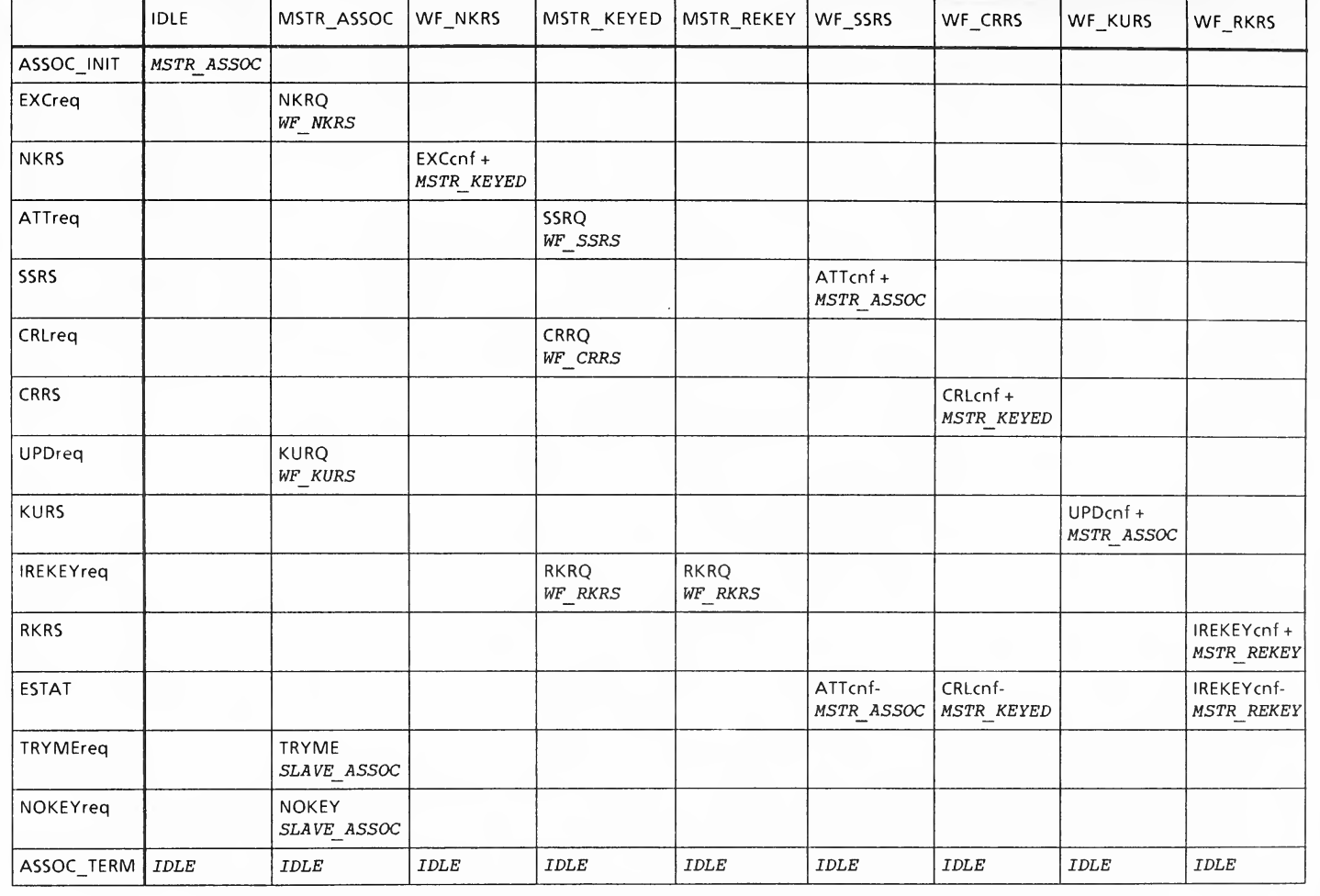
原本では横向きに印刷された状態表です(画像は正立させています)。表題はありません。列は 9 つの状態(IDLE、MSTR_ASSOC、WF_NKRS、MSTR_KEYED、MSTR_REKEY、WF_SSRS、WF_CRRS、WF_KURS、WF_RKRS)、行は 15 の入力イベントです。記入のあるセルには、出力するイベントと、その下に斜体で次の状態が書かれ、その他のセルは空欄です。記入のあるセル(入力イベント: 状態ごとの出力と次の状態)は次のとおりです。ASSOC_INIT: IDLE では MSTR_ASSOC へ / EXCreq: MSTR_ASSOC では NKRQ を出力して WF_NKRS へ / NKRS: WF_NKRS では EXCcnf + を出力して MSTR_KEYED へ / ATTreq: MSTR_KEYED では SSRQ を出力して WF_SSRS へ / SSRS: WF_SSRS では ATTcnf + を出力して MSTR_ASSOC へ / CRLreq: MSTR_KEYED では CRRQ を出力して WF_CRRS へ / CRRS: WF_CRRS では CRLcnf + を出力して MSTR_KEYED へ / UPDreq: MSTR_ASSOC では KURQ を出力して WF_KURS へ / KURS: WF_KURS では UPDcnf + を出力して MSTR_ASSOC へ / IREKEYreq: MSTR_KEYED では RKRQ を出力して WF_RKRS へ、MSTR_REKEY では RKRQ を出力して WF_RKRS へ / RKRS: WF_RKRS では IREKEYcnf + を出力して MSTR_REKEY へ / ESTAT: WF_SSRS では ATTcnf- を出力して MSTR_ASSOC へ、WF_CRRS では CRLcnf- を出力して MSTR_KEYED へ、WF_RKRS では IREKEYcnf- を出力して MSTR_REKEY へ / TRYMEreq: MSTR_ASSOC では TRYME を出力して SLAVE_ASSOC へ / NOKEYreq: MSTR_ASSOC では NOKEY を出力して SLAVE_ASSOC へ / ASSOC_TERM: すべての状態で IDLE。表の記入は以上です。
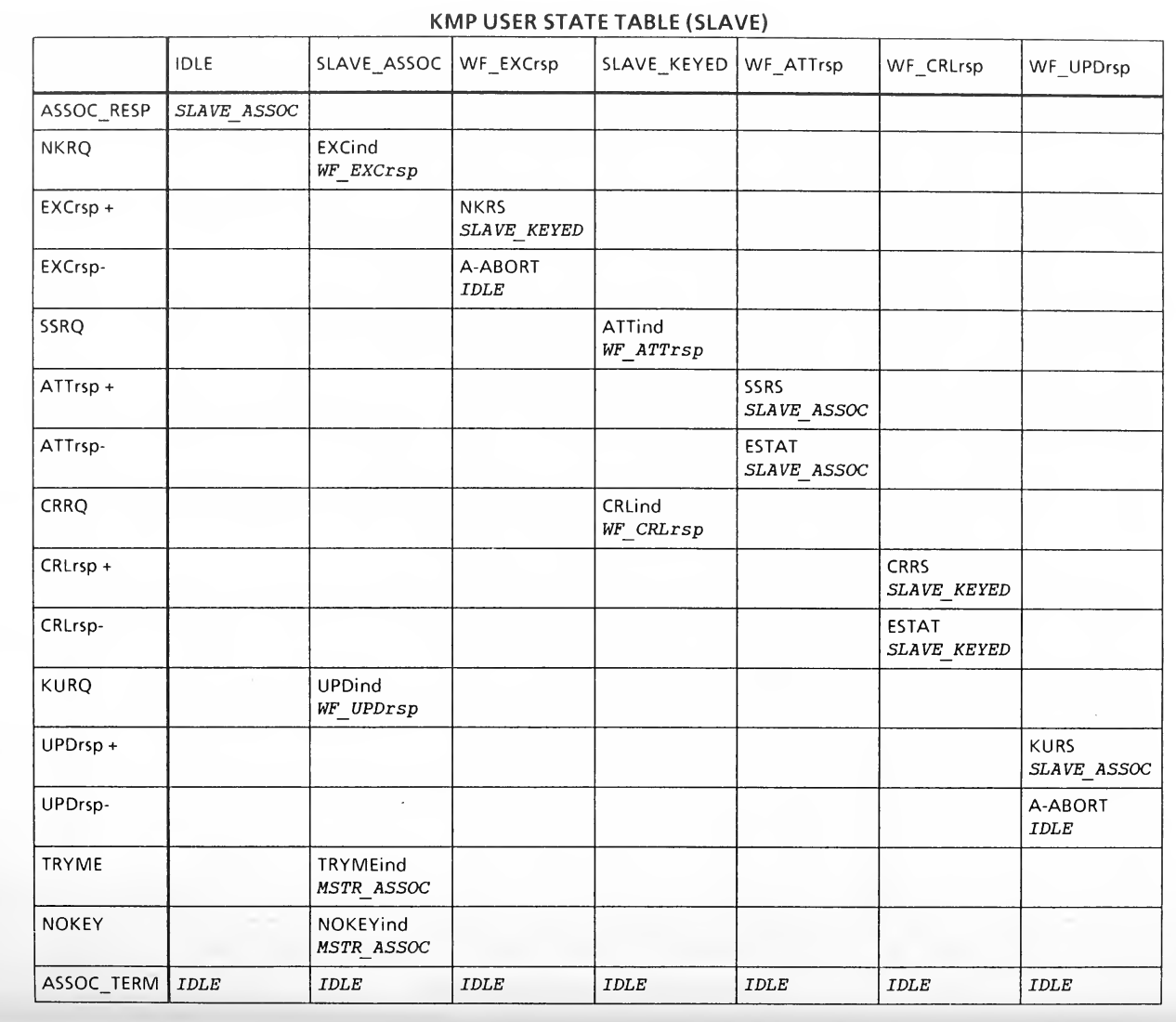
原本では横向きに印刷された状態表です(画像は正立させています)。表題は「KMP USER STATE TABLE (SLAVE)」です。列は 7 つの状態(IDLE、SLAVE_ASSOC、WF_EXCrsp、SLAVE_KEYED、WF_ATTrsp、WF_CRLrsp、WF_UPDrsp)、行は 16 の入力イベントです。記入のあるセルには、出力するイベントと、その下に斜体で次の状態が書かれ、その他のセルは空欄です。記入のあるセル(入力イベント: 状態ごとの出力と次の状態)は次のとおりです。ASSOC_RESP: IDLE では SLAVE_ASSOC へ / NKRQ: SLAVE_ASSOC では EXCind を出力して WF_EXCrsp へ / EXCrsp +: WF_EXCrsp では NKRS を出力して SLAVE_KEYED へ / EXCrsp-: WF_EXCrsp では A-ABORT を出力して IDLE へ / SSRQ: SLAVE_KEYED では ATTind を出力して WF_ATTrsp へ / ATTrsp +: WF_ATTrsp では SSRS を出力して SLAVE_ASSOC へ / ATTrsp-: WF_ATTrsp では ESTAT を出力して SLAVE_ASSOC へ / CRRQ: SLAVE_KEYED では CRLind を出力して WF_CRLrsp へ / CRLrsp +: WF_CRLrsp では CRRS を出力して SLAVE_KEYED へ / CRLrsp-: WF_CRLrsp では ESTAT を出力して SLAVE_KEYED へ / KURQ: SLAVE_ASSOC では UPDind を出力して WF_UPDrsp へ / UPDrsp +: WF_UPDrsp では KURS を出力して SLAVE_ASSOC へ / UPDrsp-: WF_UPDrsp では A-ABORT を出力して IDLE へ / TRYME: SLAVE_ASSOC では TRYMEind を出力して MSTR_ASSOC へ / NOKEY: SLAVE_ASSOC では NOKEYind を出力して MSTR_ASSOC へ / ASSOC_TERM: すべての状態で IDLE。表の記入は以上です。
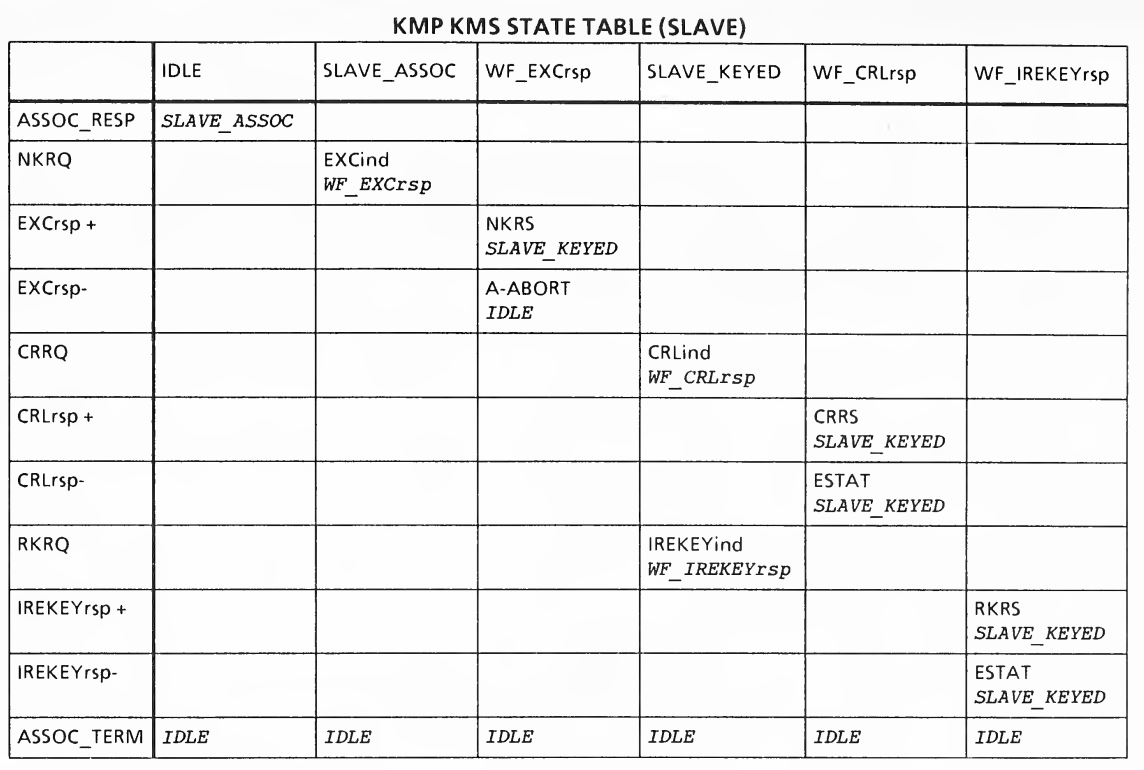
原本では横向きに印刷された状態表です(画像は正立させています)。表題は「KMP KMS STATE TABLE (SLAVE)」です。列は 6 つの状態(IDLE、SLAVE_ASSOC、WF_EXCrsp、SLAVE_KEYED、WF_CRLrsp、WF_IREKEYrsp)、行は 11 の入力イベントです。記入のあるセルには、出力するイベントと、その下に斜体で次の状態が書かれ、その他のセルは空欄です。記入のあるセル(入力イベント: 状態ごとの出力と次の状態)は次のとおりです。ASSOC_RESP: IDLE では SLAVE_ASSOC へ / NKRQ: SLAVE_ASSOC では EXCind を出力して WF_EXCrsp へ / EXCrsp +: WF_EXCrsp では NKRS を出力して SLAVE_KEYED へ / EXCrsp-: WF_EXCrsp では A-ABORT を出力して IDLE へ / CRRQ: SLAVE_KEYED では CRLind を出力して WF_CRLrsp へ / CRLrsp +: WF_CRLrsp では CRRS を出力して SLAVE_KEYED へ / CRLrsp-: WF_CRLrsp では ESTAT を出力して SLAVE_KEYED へ / RKRQ: SLAVE_KEYED では IREKEYind を出力して WF_IREKEYrsp へ / IREKEYrsp +: WF_IREKEYrsp では RKRS を出力して SLAVE_KEYED へ / IREKEYrsp-: WF_IREKEYrsp では ESTAT を出力して SLAVE_KEYED へ / ASSOC_TERM: すべての状態で IDLE。表の記入は以上です。
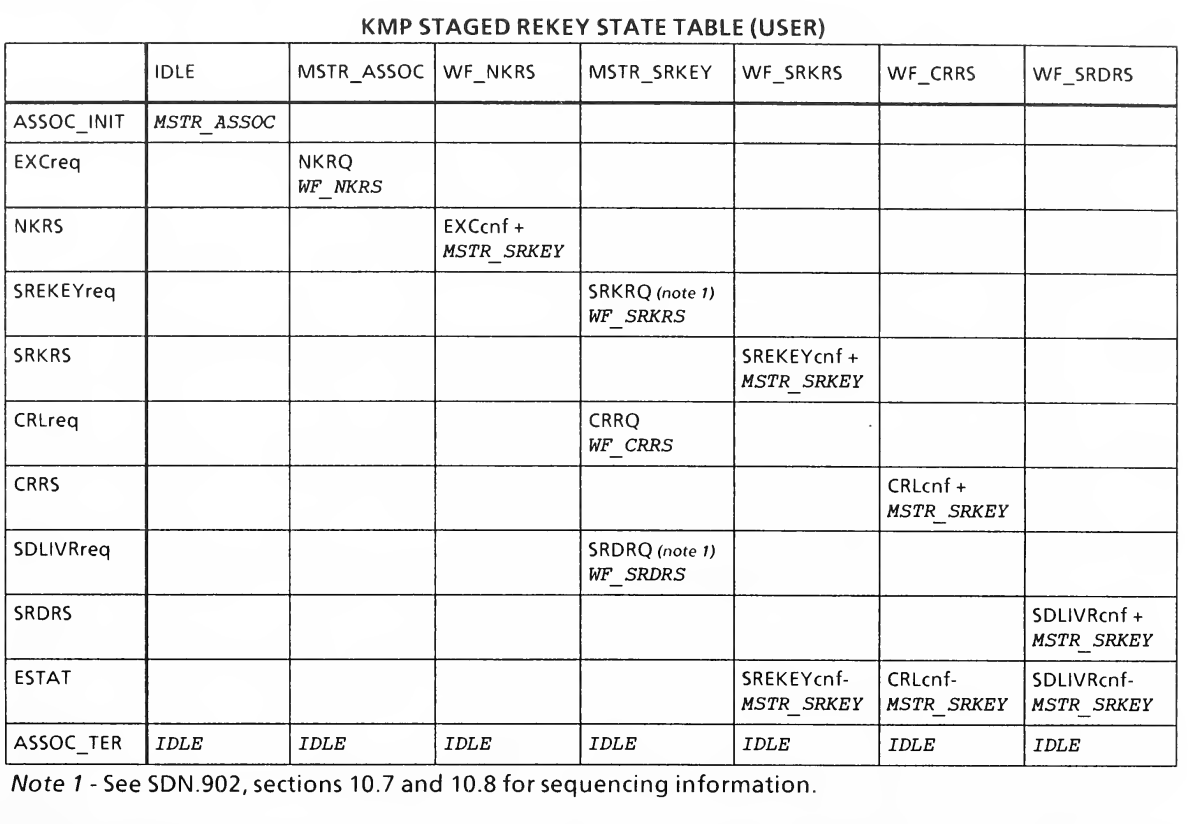
原本では横向きに印刷された状態表です(画像は正立させています)。表題は「KMP STAGED REKEY STATE TABLE (USER)」です。列は 7 つの状態(IDLE、MSTR_ASSOC、WF_NKRS、MSTR_SRKEY、WF_SRKRS、WF_CRRS、WF_SRDRS)、行は 11 の入力イベントです。記入のあるセルには、出力するイベントと、その下に斜体で次の状態が書かれ、その他のセルは空欄です。記入のあるセル(入力イベント: 状態ごとの出力と次の状態)は次のとおりです。ASSOC_INIT: IDLE では MSTR_ASSOC へ / EXCreq: MSTR_ASSOC では NKRQ を出力して WF_NKRS へ / NKRS: WF_NKRS では EXCcnf + を出力して MSTR_SRKEY へ / SREKEYreq: MSTR_SRKEY では SRKRQ (note 1) を出力して WF_SRKRS へ / SRKRS: WF_SRKRS では SREKEYcnf + を出力して MSTR_SRKEY へ / CRLreq: MSTR_SRKEY では CRRQ を出力して WF_CRRS へ / CRRS: WF_CRRS では CRLcnf + を出力して MSTR_SRKEY へ / SDLIVRreq: MSTR_SRKEY では SRDRQ (note 1) を出力して WF_SRDRS へ / SRDRS: WF_SRDRS では SDLIVRcnf + を出力して MSTR_SRKEY へ / ESTAT: WF_SRKRS では SREKEYcnf- を出力して MSTR_SRKEY へ、WF_CRRS では CRLcnf- を出力して MSTR_SRKEY へ、WF_SRDRS では SDLIVRcnf- を出力して MSTR_SRKEY へ / ASSOC_TER: すべての状態で IDLE。表の記入は以上です。表の下に「注 1: 順序に関する情報については、SDN.902 の 10.7 節と 10.8 節を参照してください。」とあります。
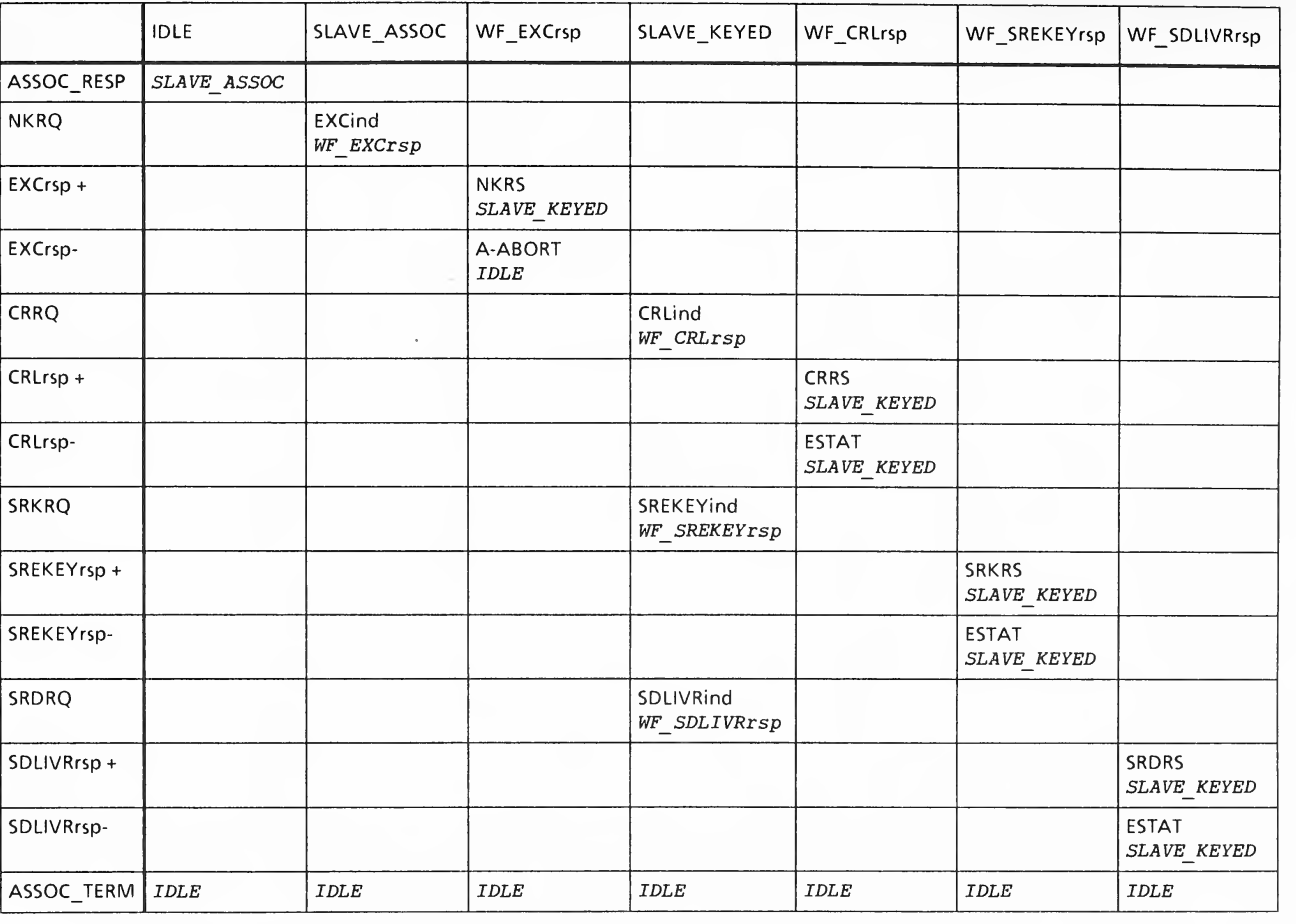
原本では横向きに印刷された状態表です(画像は正立させています)。表題はありません。列は 7 つの状態(IDLE、SLAVE_ASSOC、WF_EXCrsp、SLAVE_KEYED、WF_CRLrsp、WF_SREKEYrsp、WF_SDLIVRrsp)、行は 14 の入力イベントです。記入のあるセルには、出力するイベントと、その下に斜体で次の状態が書かれ、その他のセルは空欄です。記入のあるセル(入力イベント: 状態ごとの出力と次の状態)は次のとおりです。ASSOC_RESP: IDLE では SLAVE_ASSOC へ / NKRQ: SLAVE_ASSOC では EXCind を出力して WF_EXCrsp へ / EXCrsp +: WF_EXCrsp では NKRS を出力して SLAVE_KEYED へ / EXCrsp-: WF_EXCrsp では A-ABORT を出力して IDLE へ / CRRQ: SLAVE_KEYED では CRLind を出力して WF_CRLrsp へ / CRLrsp +: WF_CRLrsp では CRRS を出力して SLAVE_KEYED へ / CRLrsp-: WF_CRLrsp では ESTAT を出力して SLAVE_KEYED へ / SRKRQ: SLAVE_KEYED では SREKEYind を出力して WF_SREKEYrsp へ / SREKEYrsp +: WF_SREKEYrsp では SRKRS を出力して SLAVE_KEYED へ / SREKEYrsp-: WF_SREKEYrsp では ESTAT を出力して SLAVE_KEYED へ / SRDRQ: SLAVE_KEYED では SDLIVRind を出力して WF_SDLIVRrsp へ / SDLIVRrsp +: WF_SDLIVRrsp では SRDRS を出力して SLAVE_KEYED へ / SDLIVRrsp-: WF_SDLIVRrsp では ESTAT を出力して SLAVE_KEYED へ / ASSOC_TERM: すべての状態で IDLE。表の記入は以上です。
SPECIFICATION SDN.906
Revision 1.3b 1989-09-18
仕様 SDN.906
改訂 1.3b 1989-09-18
SDNS Secure Data Network System Key Management Protocol SDNS Traffic Key Attribute Negotiation
SDNS セキュアデータネットワークシステム 鍵管理プロトコル SDNS トラフィック鍵属性ネゴシエーション
Source: SDNS Protocol and Signaling Working Group
Key Management Sub-Group
出典: SDNS Protocol and Signaling Working Group
Key Management Sub-Group
Introductory note:
前置き:
This document specifies the framework of the SDNS Key Management Protocol Security Attribute Negotiation service. It supplements SDN.902 and SDN.903 where traffic key security service attributes negotiation is specified. This document is being circulated for comment and approval. It is subject to change during the development phase of SDNS.
この文書は、SDNS 鍵管理プロトコルのセキュリティ属性ネゴシエーションサービスの枠組みを規定します。これは、トラフィック鍵のセキュリティサービス属性のネゴシエーションが規定されている SDN.902 と SDN.903 を補足するものです。この文書は、意見を募り承認を得るために回覧されています。SDNS の開発段階の間に変更される場合があります。
Table of Contents
目次
7.5.1 Auxillary Vector add-info
7.5.1 補助ベクトル add-info
7.8 result Parameter
7.8 result パラメータ
9. ASN.1 Specification For KPDU Attribute Sets
9. KPDU 属性セットの ASN.1 仕様
10. ASN.1 Specification For KPDU Additional Information
10. KPDU 追加情報の ASN.1 仕様
0. Introduction
0. 序論
This document defines the SDNS key management attribute negotiation service provided by the Key Management Application Service Element (KMASE). The attribute negotiation service provides facilities to support optional security services that are required by Key Management Application Processes (KMAPs) in support of both supplemental access control requirements, and the specific security protocols accommodated by the cooperating SDNS components (i.e., SP2, SP3, SP4, SPN). The attribute negotiation services and Key Protocol Data Unit (KPDU) definitions associated with these services are inherently part of the Key Management Protocol (KMP). This document, therefore, is a direct supplement to the SDNS Key Management Service Definition and Protocol Specifications (SDN.902 and SDN.903, respectively).
この文書は、鍵管理アプリケーションサービス要素(KMASE)が提供する SDNS 鍵管理属性ネゴシエーションサービスを定義します。属性ネゴシエーションサービスは、補足的なアクセス制御要件と、連携する SDNS コンポーネントが収容する特定のセキュリティプロトコル(すなわち SP2、SP3、SP4、SPN)の両方を支えるために、鍵管理アプリケーションプロセス(KMAP)が必要とする任意のセキュリティサービスを支える機能を提供します。属性ネゴシエーションサービスと、これらのサービスに関連する鍵プロトコルデータユニット(KPDU)の定義は、本来、鍵管理プロトコル(KMP)の一部です。したがってこの文書は、SDNS 鍵管理サービス定義およびプロトコル仕様(それぞれ SDN.902 と SDN.903)を直接補足するものです。
1. Scope and field of application
1. 適用範囲と適用分野
This document applies to those SDNS key management applications which utilize the SDNS attribute negotiation process to apply specific security and communication attributes to a Traffic Encryption Key (TEK) immediately following TEK formation by the KMASE initiator and responder.
この文書は、KMASE のイニシエーターとレスポンダーによるトラフィック暗号化鍵(TEK)の形成の直後に、特定のセキュリティ属性と通信属性を TEK に適用するために SDNS 属性ネゴシエーションプロセスを利用する、SDNS 鍵管理アプリケーションに適用されます。
2. References
2. 参照文書
IS 8824 Information Processing Systems - Open Systems Interconnection Specification of Abstract Syntax Notation One (ASN.1)
IS 8824 Information Processing Systems - Open Systems Interconnection Specification of Abstract Syntax Notation One (ASN.1)
IS 8825 Information Processing Systems - Open Systems Interconnection Specification of Basic Encoding Rules (BER) for ASN.1
IS 8825 Information Processing Systems - Open Systems Interconnection Specification of Basic Encoding Rules (BER) for ASN.1
SDN.802 SDNS Access Control Specification
SDN.802 SDNS Access Control Specification
SDN.902 SDNS Key Management Protocol: Definition of Services provided by the Key Management Application Service Element
SDN.902 SDNS Key Management Protocol: Definition of Services provided by the Key Management Application Service Element
SDN.903 SDNS Key Management Protocol: Specification of the Protocol for services provided by the Key Management Application Service Element.
SDN.903 SDNS Key Management Protocol: Specification of the Protocol for services provided by the Key Management Application Service Element.
3. Definitions
3. 定義
This document uses the definitions contained in the Reference Model for Open Systems Interconnection (IS 7498/1), including the Security Architecture (IS 7498/2). Additionally, the document uses definitions contained in section 3.0 (Definitions) of both SDN.902 and SDN.903.
この文書では、セキュリティアーキテクチャ(IS 7498/2)を含む開放型システム間相互接続の参照モデル(IS 7498/1)に含まれる定義を用います。さらに、この文書は、SDN.902 と SDN.903 の両方の第 3.0 節(定義)に含まれる定義を用います。
4. Abbreviations
4. 略語
This document uses abbreviations contained in section 4.0 (Abbreviations) of both SDN.902 and SDN.903.
この文書では、SDN.902 と SDN.903 の両方の第 4.0 節(略語)に含まれる略語を用います。
5. Conventions
5. 表記規約
The structure of the attribute negotiation parameters are specified using Abstract Syntax Notation One (ASN.1), as defined in ISO 8824. The ASN.1 specified attributes defined in this document are intended to be "exported" to the KMASE ASN.1 specifications, provided in SDN.903, where "AttributeSet" and "Add-Info" are called out as the specific placeholders. [Reference: SDN.903, pp 23]
属性ネゴシエーションパラメータの構造は、ISO 8824 に定義された抽象構文記法 1(ASN.1)を用いて規定されます。この文書で定義される ASN.1 で規定された属性は、SDN.903 に示されている KMASE の ASN.1 仕様に「エクスポート」されることを意図しています。そこでは、「AttributeSet」と「Add-Info」が具体的なプレースホルダーとして指定されています。[参照: SDN.903, pp 23]
6. Basic Concept
6. 基本概念
The basic concept of the attribute negotiation portion of the KMASE is to establish the security and communication service attributes and conditions which are mutually acceptable to both the initiating and responding parties of the Traffic Encryption Key (TEK) generation processes of both KMASE. The KMASE TEK generation process is specified in SDN.902 and SDN.903.
KMASE の属性ネゴシエーション部分の基本概念は、両方の KMASE におけるトラフィック暗号化鍵(TEK)生成プロセスの開始側と応答側の双方にとって相互に受け入れられる、セキュリティおよび通信サービスの属性と条件を確立することです。KMASE の TEK 生成プロセスは、SDN.902 と SDN.903 に規定されています。
Once a collaborative TEK has been generated by both parties, via the New Key Request (Nkrq) and New Key Response (Nkrs) KPDU exchange process of the KMASE, security service options are negotiated by the initiating KMASE by sending a Security Services Request (Ssrq) KPDU to the receiving KMASE, and the receiving KMASE responding to the Ssrq with a Security Services Response (Ssrs) KPDU. The Ssrq and Ssrs KPDUs are both encrypted using the TEK generated as a successful result of the preceding Nkrq and Nkrs exchange. Therefore, the Ssrs and Ssrq KPDU exchange process not only provides security service attribute negotiation, the exchange also serves as a mutual "liveness check" of the freshly generated TEK; i.e., bilateral authentication of the peer KMASEs.
双方が、KMASE の新規鍵要求(Nkrq)KPDU と新規鍵応答(Nkrs)KPDU の交換プロセスによって協調的な TEK を生成すると、開始側の KMASE が受信側の KMASE にセキュリティサービス要求(Ssrq)KPDU を送信し、受信側の KMASE がセキュリティサービス応答(Ssrs)KPDU で Ssrq に応答することによって、セキュリティサービスのオプションがネゴシエーションされます。Ssrq KPDU と Ssrs KPDU は、どちらも、直前の Nkrq と Nkrs の交換が成功した結果として生成された TEK を使って暗号化されます。したがって、Ssrs と Ssrq の KPDU の交換プロセスは、セキュリティサービス属性のネゴシエーションを提供するだけでなく、新たに生成された TEK についての相互の「生存確認」、すなわちピアの KMASE 同士の双方向認証としても機能します。
The Ssrq KPDU sent by the initiating KMASE may contain a set of service options that it supports, called proposed-options, as well as (optionally) additional information, that is domain specific, called add-info. The proposed-options Attribute Set contains the set of those security services and attributes that are standard - i.e., universally understood by all KMASE, and are those specifically supported by the initiating KMASE. Those standard security services and attributes understood by all KMASE, but not supported by the initiating KMASE, are simply not included in the initiating KMASE's proposed-options set. The optional add-info contains domain specific attributes that may be negotiated in addition to the standard negotiated attributes.
開始側の KMASE が送信する Ssrq KPDU には、proposed-options と呼ばれる、自らがサポートするサービスオプションのセットと、(任意で)add-info と呼ばれる、ドメイン固有の追加情報が含まれてもよいです。proposed-options 属性セットには、標準の、すなわちすべての KMASE が普遍的に理解するセキュリティサービスと属性のうち、開始側の KMASE が具体的にサポートするものが含まれます。すべての KMASE が理解するものの、開始側の KMASE がサポートしない標準のセキュリティサービスと属性は、開始側の KMASE の proposed-options セットに含められないだけです。任意の add-info には、標準のネゴシエーション属性に加えてネゴシエーションされてもよい、ドメイン固有の属性が含まれます。
In turn, the Ssrs KPDU, sent to the initiating KMASE by the responding KMASE, contains a set of options that it has selected, from the Ssrq KPDU's proposed-options (given the Ssrq KPDU contained these attributes -i.e., it does not have to), called selected-options, and, optionally, add-info data. If, however, the proposed-options or optional add-info attributes sent to the responding KMASE in the Ssrq KPDU are unacceptable, then the responding KMASE may respond with an Estat KPDU, indicating that the Ssrq KPDU or its service options are in error or fail to meet the requirements of the responding KMASE.
一方、応答側の KMASE が開始側の KMASE に送信する Ssrs KPDU には、Ssrq KPDU の proposed-options の中から自らが選択したオプションのセット(selected-options と呼ばれます。Ssrq KPDU にこれらの属性が含まれていた場合の話であり、含まれていなくてもよい)と、任意で add-info データが含まれます。ただし、Ssrq KPDU で応答側の KMASE に送られた proposed-options または任意の add-info 属性が受け入れられない場合、応答側の KMASE は、Ssrq KPDU またはそのサービスオプションに誤りがあるか、応答側の KMASE の要件を満たしていないことを示す Estat KPDU で応答してもよいです。
If the Ssrs KPDU contains a set of (valid) selected-options, and optionally an add-info set of attributes, and the initiating KMASE accepts, and is in harmony with the selected-options and optionally the add-info set of attributes, then those selected options and optional add-info attributes are used to initialize the selected peer entity security protocols in each component, and are (in most instances) associated directly with the TEK that has been generated.
Ssrs KPDU に(有効な)selected-options のセットと、任意で add-info 属性のセットが含まれ、開始側の KMASE がその selected-options と、任意で add-info 属性のセットを受け入れ、それに同意する場合、それらの選択されたオプションと任意の add-info 属性は、各コンポーネント内の選択されたピアエンティティのセキュリティプロトコルを初期化するために使われ、(ほとんどの場合)生成された TEK に直接関連付けられます。
Subsequent secure communication between the selected peer security protocols (SP) is directly bound to the TEK and regulated by the specific services agreed upon in association with the TEK.
選択されたピアのセキュリティプロトコル(SP)間のその後の安全な通信は、TEK に直接結び付けられ、TEK に関連して合意された特定のサービスによって規制されます。
If the response to the Ssrq KPDU is an Estat KPDU, or if the initiator KMASE can not accept the Ssrs KPDU options or optionally add-info attributes, and it then subsequently sends an Estat KPDU to the responder, then the connection is terminated and the TEK generated is discarded by both parties.
Ssrq KPDU への応答が Estat KPDU である場合、またはイニシエーター KMASE が Ssrs KPDU のオプションまたは任意の add-info 属性を受け入れられず、その後レスポンダーに Estat KPDU を送信する場合、接続は終了され、生成された TEK は双方によって破棄されます。
7. Attribute Negotiation Service
7. 属性ネゴシエーションサービス
The KMASE K-TEK-ATTRIBUTES service provides the attribute negotiation activities. The K-TEK-ATTRIBUTES service verifies the cryptographic compatibility with the TEK, negotiates the communication and security attributes associated with the TEK, and exchanges Compromised Key List (CRL) numbers. Additionally, K-TEK-ATTRIBUTES allows a KMAP to associate the attributes of a previous TEK with a new TEK. The K-TEK-ATTRIBUTES parameters are illustrated in Table 1.
KMASE の K-TEK-ATTRIBUTES サービスは、属性ネゴシエーションの活動を提供します。K-TEK-ATTRIBUTES サービスは、TEK との暗号上の互換性を検証し、TEK に関連する通信およびセキュリティ属性をネゴシエーションし、危殆化鍵リスト(Compromised Key List、CRL)の番号を交換します。さらに、K-TEK-ATTRIBUTES により、KMAP は以前の TEK の属性を新しい TEK に関連付けることができます。K-TEK-ATTRIBUTES のパラメータを表 1 に示します。
Table 1 -- K-TEK-ATTRIBUTES parameters
表 1 -- K-TEK-ATTRIBUTES パラメータ
| Parameter Name | Req | ind | rsp | cnf |
|---|---|---|---|---|
| init-kid | M | M(=) | ||
| resp-kid | M | M(=) | ||
| proposed-options | U | U(=) | ||
| selected-options | M | M(=) | ||
| add-info | U | U(=) | U | U(=) |
| old-resp-kid | U | U(=) | ||
| crl-ver | M | M(=) | ||
| result | M | M(=) |
| パラメータ名 | Req | ind | rsp | cnf |
|---|---|---|---|---|
| init-kid | M | M(=) | ||
| resp-kid | M | M(=) | ||
| proposed-options | U | U(=) | ||
| selected-options | M | M(=) | ||
| add-info | U | U(=) | U | U(=) |
| old-resp-kid | U | U(=) | ||
| crl-ver | M | M(=) | ||
| result | M | M(=) |
Legend:
凡例:
| blank | -- not applicable |
| M | -- presence is mandatory |
| U | -- presence is user option |
| = | -- p value is semantically equal to value to its left in the table |
| 空欄 | -- 適用なし |
| M | -- 存在が必須 |
| U | -- 存在はユーザーの任意 |
| = | -- p の値は、表で左にある値と意味的に等しい |
7.1 init-kid
7.1 init-kid
This K-TEK-ATTRIBUTES parameter is required on the response primitive. It is passed on the confirm primitive. It contains the identifier the initiator KMAP associates with the TEK. This service parameter is specified in SDN.902, and its KPDU ASN.1 specification described in SDN.903.
この K-TEK-ATTRIBUTES パラメータは、応答プリミティブで必要です。確認プリミティブに引き渡されます。イニシエーター KMAP が TEK に関連付ける識別子を含みます。このサービスパラメータは SDN.902 に規定されており、その KPDU の ASN.1 仕様は SDN.903 に記述されています。
7.2 resp-kid
7.2 resp-kid
This K-TEK-ATTRIBUTES parameter is required on the request primitive, and passed on the indicate primitive. It contains the identifier the responder KMAP associates with the TEK. This service parameter is specified in SDN.902, and its KPDU ASN.1 specification described in SDN.903.
この K-TEK-ATTRIBUTES パラメータは、要求プリミティブで必要であり、通知プリミティブに引き渡されます。レスポンダー KMAP が TEK に関連付ける識別子を含みます。このサービスパラメータは SDN.902 に規定されており、その KPDU の ASN.1 仕様は SDN.903 に記述されています。
7.3 proposed-options
7.3 proposed-options
This K-TEK-ATTRIBUTES parameter is optional on the request primitive, and, if used, is passed on the indicate primitive. It contains the set of options the initiating KMASE will support. The Attributes Set that constitute the proposed-options, and selected-options are not detailed in SDN.902, and not specified in ASN.1 in SDN.903. Definition of the Attributes Set is the major motivation for this document. The list of Attribute Set options may indicate any or all of the following:
この K-TEK-ATTRIBUTES パラメータは、要求プリミティブでは任意であり、使用する場合は通知プリミティブに引き渡されます。開始側の KMASE がサポートするオプションのセットを含みます。proposed-options と selected-options を構成する属性セットは、SDN.902 では詳述されておらず、SDN.903 でも ASN.1 で規定されていません。この文書の主な動機は、属性セットを定義することです。属性セットのオプションの一覧は、次のいずれか、またはすべてを示してもよいです。
•Confidentiality Service Only Option Indicator
Choice of:
•機密性サービスのみのオプション指示子
次のいずれかを選択:
•SP2 Option Indicator
Parameters:
-- Confidentiality algorithm identifier
-- Single security level identifier (optional)
-- SP2 version number
•SP2 オプション指示子
パラメータ:
-- 機密性アルゴリズム識別子
-- 単一セキュリティレベル識別子(任意)
-- SP2 バージョン番号
•SPN* Option Indicator
Parameters:
-- Confidentiality algorithm identifier
-- Single security level identifier (optional)
-- SPN version number
•SPN* オプション指示子
パラメータ:
-- 機密性アルゴリズム識別子
-- 単一セキュリティレベル識別子(任意)
-- SPN バージョン番号
•SP4C Option Indicator
Parameters:
-- Confidentiality algorithm identifier
-- Single security level identifier (optional)
-- SP4C version number
•SP4C オプション指示子
パラメータ:
-- 機密性アルゴリズム識別子
-- 単一セキュリティレベル識別子(任意)
-- SP4C バージョン番号
•Both Confidentiality and Integrity Services Option Indicator
Choice of:
•機密性サービスと完全性サービスの両方のオプション指示子
次のいずれかを選択:
•SP2 Option Indicator
Parameters:
-- Confidentiality and Integrity algorithm identity
-- Single security level identifier (optional)
-- Per PDU security label (optional)
-- SP2 version number
•SP2 オプション指示子
パラメータ:
-- 機密性および完全性アルゴリズム識別子
-- 単一セキュリティレベル識別子(任意)
-- PDU 単位のセキュリティラベル(任意)
-- SP2 バージョン番号
•SP3 A, I, or D Option Indicators
Parameters:
-- Confidentiality and Integrity algorithm identity
-- Single security level identifier (optional)
-- Per PDU security label (optional)
-- SP3 (A, I, or D) version number
•SP3 A、I、または D のオプション指示子
パラメータ:
-- 機密性および完全性アルゴリズム識別子
-- 単一セキュリティレベル識別子(任意)
-- PDU 単位のセキュリティラベル(任意)
-- SP3(A、I、または D)バージョン番号
•SPN* Option Indicator
Parameters:
-- Confidentiality and Integrity algorithm identity
-- Single security level identifier (optional)
-- Per PDU security label (optional)
-- SPN version number
•SPN* オプション指示子
パラメータ:
-- 機密性および完全性アルゴリズム識別子
-- 単一セキュリティレベル識別子(任意)
-- PDU 単位のセキュリティラベル(任意)
-- SPN バージョン番号
•SP4C Option Indicator
Parameters:
-- Confidentiality and Integrity algorithm identity
-- Single security level identifier (optional)
-- Per PDU security label (optional)
-- Final sequence number
-- SP4C version number
•SP4C オプション指示子
パラメータ:
-- 機密性および完全性アルゴリズム識別子
-- 単一セキュリティレベル識別子(任意)
-- PDU 単位のセキュリティラベル(任意)
-- 最終シーケンス番号
-- SP4C バージョン番号
•Integrity Only Option Indicator
Choice of:
•完全性のみのオプション指示子
次のいずれかを選択:
•SP3 A, I, or D Option Indicators
Parameters:
-- Integrity algorithm identity
-- Single security level identifier (optional)
-- Per PDU security label (optional)
-- SP3 A, I, or D version number
•SP3 A、I、または D のオプション指示子
パラメータ:
-- 完全性アルゴリズム識別子
-- 単一セキュリティレベル識別子(任意)
-- PDU 単位のセキュリティラベル(任意)
-- SP3 A、I、または D のバージョン番号
•SPN Option Indicator
Parameters:
-- Integrity algorithm identity
-- Single security level identifier (optional)
-- Per PDU security label, (optional)
-- SPN version number
•SPN オプション指示子
パラメータ:
-- 完全性アルゴリズム識別子
-- 単一セキュリティレベル識別子(任意)
-- PDU 単位のセキュリティラベル(任意)
-- SPN バージョン番号
•SP4C Option Indicator
Parameters:
-- Integrity algorithm identity
-- Single security level identifier (optional)
-- Per PDU security label
-- Final sequence number
-- SP4C version number
•SP4C オプション指示子
パラメータ:
-- 完全性アルゴリズム識別子
-- 単一セキュリティレベル識別子(任意)
-- PDU 単位のセキュリティラベル
-- 最終シーケンス番号
-- SP4C バージョン番号
* SPN is equivalent to SP4E and SP3N
* SPN は SP4E および SP3N と同等です
Hence, the list of proposed-options has a tree structure, where some options are dependent on other options. These dependencies are illustrated in the following trees.
このように、proposed-options の一覧は木構造になっており、一部のオプションは他のオプションに依存します。これらの依存関係を、次の木で示します。
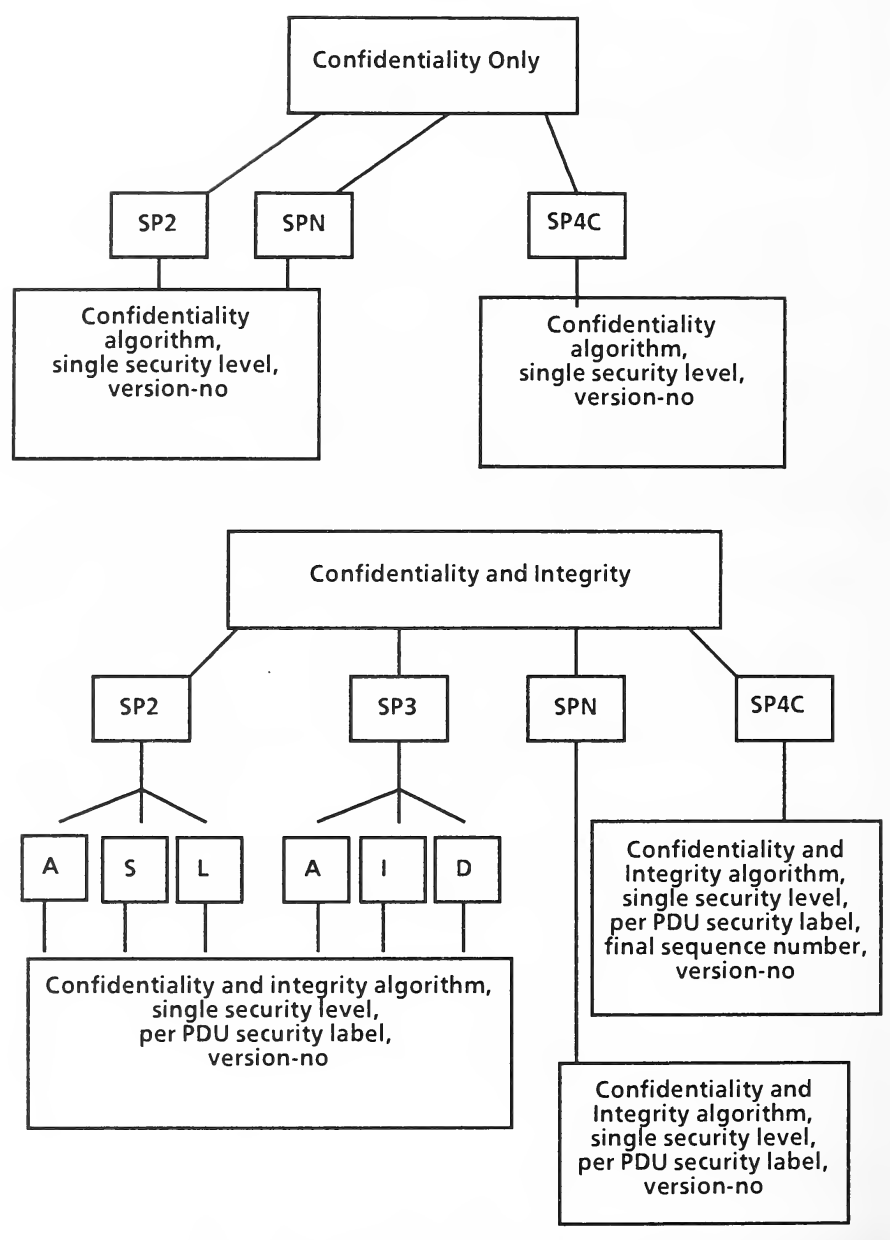
選択肢の木が 2 つあります。上の木では「Confidentiality Only」(機密性のみ)が「SP2」「SPN」「SP4C」に分かれます。SP2 と SPN は同じ箱「Confidentiality algorithm, single security level, version-no」に、SP4C は別の箱「Confidentiality algorithm, single security level, version-no」につながります。下の木では「Confidentiality and Integrity」(機密性と完全性)が「SP2」「SP3」「SPN」「SP4C」に分かれます。SP2 は「A」「S」「L」に、SP3 は「A」「I」「D」に分かれ、この 6 つはすべて 1 つの箱「Confidentiality and integrity algorithm, single security level, per PDU security label, version-no」につながります。SP4C は「Confidentiality and Integrity algorithm, single security level, per PDU security label, final sequence number, version-no」に、SPN は「Confidentiality and Integrity algorithm, single security level, per PDU security label, version-no」につながります。
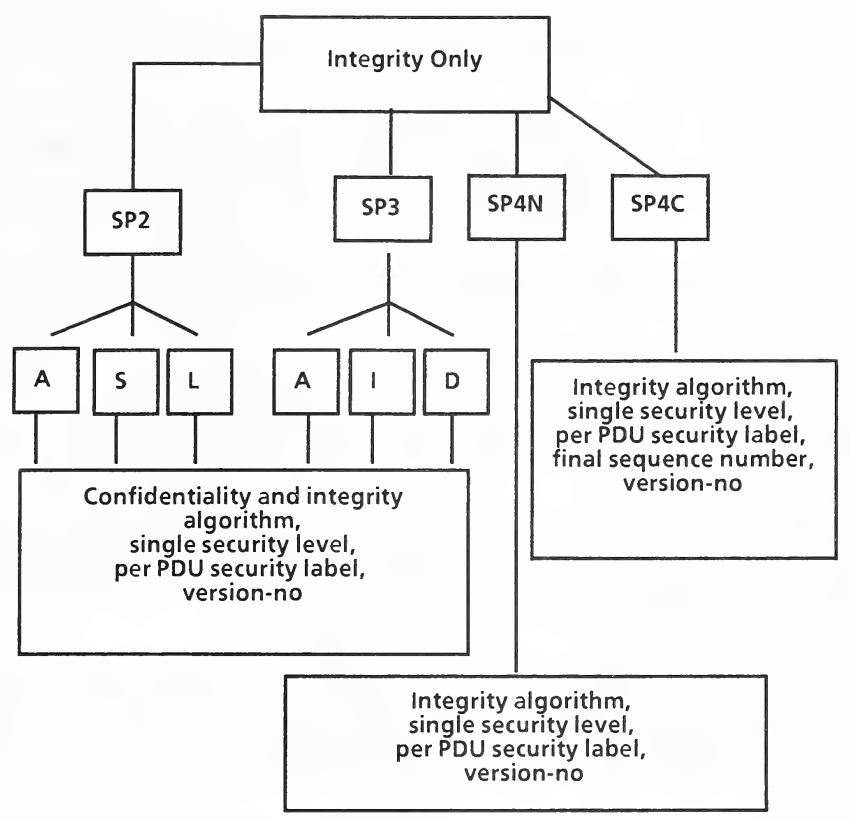
選択肢の木です。「Integrity Only」(完全性のみ)が「SP2」「SP3」「SP4N」「SP4C」に分かれます。SP2 は「A」「S」「L」に、SP3 は「A」「I」「D」に分かれ、この 6 つはすべて 1 つの箱「Confidentiality and integrity algorithm, single security level, per PDU security label, version-no」(原本の印字どおり)につながります。SP4C は「Integrity algorithm, single security level, per PDU security label, final sequence number, version-no」に、SP4N は「Integrity algorithm, single security level, per PDU security label, version-no」につながります。
At the first tree level, the confidentiality/integrity services to be used are requested. The allowable options are:
木の第 1 レベルでは、使用する機密性/完全性サービスが要求されます。許容されるオプションは次のとおりです。
•confidentiality only
•機密性のみ
•confidentiality and integrity
•機密性および完全性
•integrity
•完全性
The next tree level specifies the security protocol and its mode to be used with the key. The allowable values and the mnemonics are:
次の木のレベルでは、鍵とともに使用するセキュリティプロトコルとそのモードを指定します。許容される値とニーモニックは次のとおりです。
| SP2 - | SP2 protocol |
| SP3 - | SP3 protocol using either address or header protection |
| SPN - | Intersection of SP3N and SP4E |
| SP4C - | Connection-oriented SP4 |
| SP2 - | SP2 プロトコル |
| SP3 - | アドレス保護またはヘッダー保護のいずれかを使用する SP3 プロトコル |
| SPN - | SP3N と SP4E の共通部分 |
| SP4C - | コネクション型 SP4 |
When SP3 is the specified protocol, the protected header format is chosen at the next level of the tree; i.e., the mode. The allowable values and mnemonics are:
指定されたプロトコルが SP3 である場合、保護されたヘッダー形式は、木の次のレベル、すなわちモードで選択されます。許容される値とニーモニックは次のとおりです。
| A - | SP3 mode which includes source and destination NSAP addresses in a protected header |
| I - | SP3 mode which includes the ISO ConnectionLess Network Protocol (CLNP) and a protected CLNP header |
| D - | SP3 mode which includes the DoD Internet Protocol (IP) and a protected IP header. |
| A - | 送信元および宛先の NSAP アドレスを保護されたヘッダーに含める SP3 モード |
| I - | ISO コネクションレスネットワークプロトコル(CLNP)と保護された CLNP ヘッダーを含む SP3 モード |
| D - | DoD インターネットプロトコル(IP)と保護された IP ヘッダーを含む SP3 モード。 |
The tree leaves contain a list of the remaining options. Illustrations, above, highlight which options are allowable for the security services and protocol modes selected. The remainder of this section describes each of the remaining negotiation options.
木の葉には、残りのオプションの一覧が含まれます。上の図は、選択されたセキュリティサービスとプロトコルモードに対して、どのオプションが許容されるかを強調して示しています。この節の残りでは、残りの各ネゴシエーションオプションを説明します。
7.3.1 Confidentiality Algorithm
7.3.1 機密性アルゴリズム
The confidentiality algorithm option is used for negotiating which symmetric algorithm(s) to use for the data confidentiality service of the security protocol and mode chosen. This algorithm is different than that used to form the TEK.
機密性アルゴリズムのオプションは、選択されたセキュリティプロトコルとモードのデータ機密性サービスにどの共通鍵アルゴリズムを使用するかをネゴシエーションするために使われます。このアルゴリズムは、TEK を形成するために使われるものとは異なります。
7.3.2 Integrity Algorithm
7.3.2 完全性アルゴリズム
The integrity algorithm option is used for negotiating use of integrity algorithms, other than that used to form the TEK. This option includes the negotiation of the icv length. The icv length can be any of the following:
完全性アルゴリズムのオプションは、TEK を形成するために使われるもの以外の完全性アルゴリズムの使用をネゴシエーションするために使われます。このオプションには、icv の長さのネゴシエーションが含まれます。icv の長さは、次のいずれかにできます。
| icv-len2 | Integrity with a 2 byte icv length, |
| icv-len4 | Integrity with a 4 byte icv length, |
| icv-len6 | Integrity with a 6 byte icv length, |
| icv-len8 | Integrity with a 8 byte icv length, |
| icv-len10 | Integrity with a 10 byte icv length, or |
| icv-len12 | Integrity with a 12 byte icv length. |
| icv-len2 | icv の長さが 2 バイトの完全性、 |
| icv-len4 | icv の長さが 4 バイトの完全性、 |
| icv-len6 | icv の長さが 6 バイトの完全性、 |
| icv-len8 | icv の長さが 8 バイトの完全性、 |
| icv-len10 | icv の長さが 10 バイトの完全性、または |
| icv-len12 | icv の長さが 12 バイトの完全性。 |
7.3.3 Confidentiality and Integrity Algorithm
7.3.3 機密性および完全性アルゴリズム
The confidentiality and integrity algorithm option is used for negotiating use of algorithms other than that used to form the TEK for data security. This option includes the negotiation of the algorithm mode and the icv length, as defined above.
機密性および完全性アルゴリズムのオプションは、データセキュリティのために TEK を形成するために使われるもの以外のアルゴリズムの使用をネゴシエーションするために使われます。このオプションには、上で定義したアルゴリズムのモードと icv の長さのネゴシエーションが含まれます。
7.3.4 Per KPDU Security Label and Format
7.3.4 KPDU 単位のセキュリティラベルと形式
This option is used to negotiate the existence and format of an explicit security label on every PDU exchanged while using the TEK identified. The choices for this option and the mnemonics are:
このオプションは、識別された TEK を使用している間に交換されるすべての PDU に、明示的なセキュリティラベルを付けるかどうかと、その形式をネゴシエーションするために使われます。このオプションの選択肢とニーモニックは次のとおりです。
| ppl abs | Per PDU security label absent |
| ppl DoD | DoD security label per PDU |
| ppl xxx | xxx security label per PDU |
| ppl abs | PDU 単位のセキュリティラベルなし |
| ppl DoD | PDU 単位の DoD セキュリティラベル |
| ppl xxx | PDU 単位の xxx セキュリティラベル |
NOTE: xxx is yet to be defined.
注: xxx はまだ定義されていません。
7.3.5 Single Security Level
7.3.5 単一セキュリティレベル
This option is used to negotiate a single security level for the TEK identified.
このオプションは、識別された TEK に対する単一のセキュリティレベルをネゴシエーションするために使われます。
7.3.6 Final Sequence Numbers
7.3.6 最終シーケンス番号
The final sequence numbers option is used to negotiate connection truncation protection. The choices and mnemonics are:
最終シーケンス番号のオプションは、コネクションの切り詰めに対する保護をネゴシエーションするために使われます。選択肢とニーモニックは次のとおりです。
| true - | Final sequence numbers are exchanged at the closing of transport connections when using this TEK, |
| false - | Final sequence numbers are not exchanged at the closing of the transport connections when using this TEK. |
| true - | この TEK を使用している場合、トランスポートコネクションの終了時に最終シーケンス番号が交換される、 |
| false - | この TEK を使用している場合、トランスポートコネクションの終了時に最終シーケンス番号は交換されません。 |
7.3.7 SP Version Numbers
7.3.7 SP バージョン番号
The SP version numbers are used to negotiate the use of a particular SP version; e.g., there may be n versions of SP3D.
SP バージョン番号は、特定の SP バージョンの使用をネゴシエーションするために使われます。たとえば、SP3D には n 個のバージョンが存在する場合があります。
7.4 selected options
7.4 選択オプション(selected options)
This parameter is required on the response primitive. It is passed on the confirm primitive. It contains the set of options the responder has selected from either the proposed-options attributes the initiator has sent in the Ssrq KPDU (if included in the Ssrq KPDU), or the responder has exclusively chosen (if the Ssrq KPDU did not contain proposed-options).
このパラメータは、応答プリミティブで必要です。確認プリミティブに引き渡されます。イニシエーターが Ssrq KPDU で送ってきた proposed-options 属性の中から(Ssrq KPDU に含まれていた場合)レスポンダーが選択した、またはレスポンダーが(Ssrq KPDU に proposed-options が含まれていなかった場合)独自に選択した、オプションのセットを含みます。
7.5 add-info
7.5 add-info
This optional parameter may be included on the request and response primitives. It is passed on the indication and confirm primitives. It indicates that additional information is required (and supplied) to further accommodate local domain system management necessities, such as access control and addressing information to be included as (associated) attributes of the traffic key. The additional information may include:
この任意のパラメータは、要求プリミティブと応答プリミティブに含めてもよいです。通知プリミティブと確認プリミティブに引き渡されます。トラフィック鍵の(関連する)属性として含める、アクセス制御やアドレス指定情報など、ローカルドメインのシステム管理上の必要性にさらに対応するために、追加情報が必要である(かつ提供される)ことを示します。追加情報には、次のものが含まれる場合があります。
•auxiliary vector information,
•補助ベクトル情報、
•signed lists of networks the SDNS component serves.
•SDNS コンポーネントがサービスを提供するネットワークの署名付きリスト。
7.5.1 Auxillary Vector Information
7.5.1 補助ベクトル情報
The use of auxillary vectors (AV) is a local domain matter. The information contained in an AV is used to augment that which is contained in a user's "primary certificate". The information may be added identification, authentication, or access control data. The AV may be signed by the SDNS KMS or an "Auxillary Vector Management System" (AVMS). The reader is referred to the SDNS Access Control Specification, SDN.802 for further information.
補助ベクトル(AV)の使用は、ローカルドメインの事項です。AV に含まれる情報は、利用者の「プライマリ証明書」に含まれる情報を補うために使われます。この情報は、追加の識別、認証、またはアクセス制御のデータであってもよいです。AV は、SDNS KMS または「補助ベクトル管理システム」(AVMS)によって署名される場合があります。詳細は、SDNS Access Control Specification(SDN.802)を参照してください。
7.5.2 Add-Info For Signed List of Network Addresses
7.5.2 ネットワークアドレスの署名付きリストの add-info
An SP3 entity located at an intermediate system may send to its peer entity a list of the end systems reachable via the entity.
中間システムにある SP3 エンティティは、そのエンティティを介して到達可能なエンドシステムのリストを、ピアエンティティに送信してもよいです。
7.6 old-resp-kid
7.6 old-resp-kid
This parameter may be included on the request primitive. It is passed on the indication primitive. It contains an indicator that the KMASE wishes to associate the attributes of another TEK with the key specified by the init-kid and resp-kid parameters. Only the initiator of the cryptographic association specifies this parameter. If specified, the initiator omits the proposed options. This service parameter is fully specified in SDN.902 and described in ASN.1 form in SDN.903.
このパラメータは、要求プリミティブに含めてもよいです。通知プリミティブに引き渡されます。KMASE が、別の TEK の属性を、init-kid パラメータと resp-kid パラメータで指定される鍵に関連付けることを望んでいるという指示子を含みます。このパラメータを指定するのは、暗号アソシエーションのイニシエーターだけです。指定する場合、イニシエーターは提案オプションを省略します。このサービスパラメータは SDN.902 に完全に規定されており、SDN.903 に ASN.1 形式で記述されています。
7.7 crl-version
7.7 crl-version
This parameter must be included on the request and response primitives. It is passed on the indication and confirm primitives. This parameter contains the unsigned version number of the current CRL used by the KMAP. This service parameter is fully specified in SDN.902 and described in ASN.1 form in SDN.903.
このパラメータは、要求プリミティブと応答プリミティブに含めなければなりません。通知プリミティブと確認プリミティブに引き渡されます。このパラメータは、KMAP が使用している現行の CRL の、署名なしのバージョン番号を含みます。このサービスパラメータは SDN.902 に完全に規定されており、SDN.903 に ASN.1 形式で記述されています。
7.8 result
7.8 result
This parameter is required on the response primitive. It is passed on the confirm primitive. It indicates the success or failure of the operation. This service parameter is fully specified in SDN.902 and described in ASN.1 form in SDN.903.
このパラメータは、応答プリミティブで必要です。確認プリミティブに引き渡されます。操作が成功したか失敗したかを示します。このサービスパラメータは SDN.902 に完全に規定されており、SDN.903 に ASN.1 形式で記述されています。
8. Attribute Negotiation Flow
8. 属性ネゴシエーションの流れ
Security options are negotiated by means of one KMASE (the initiator) transmitting a Ssrq KPDU to the other KMASE (the responder), which replies with a Ssrs KPDU. The initiator specifies a set of preferred and alternative security options in the Ssrq KPDU. The responder specifies the selected set of security options in the Ssrs KPDU.
セキュリティオプションは、一方の KMASE(イニシエーター)が Ssrq KPDU をもう一方の KMASE(レスポンダー)に送信し、レスポンダーが Ssrs KPDU で返信することによってネゴシエーションされます。イニシエーターは、望ましいセキュリティオプションと代替のセキュリティオプションのセットを Ssrq KPDU で指定します。レスポンダーは、選択したセキュリティオプションのセットを Ssrs KPDU で指定します。
Using the parameters from the K-TEK-ATTRIBUTES request primitive, the initiator KMASE prepares a Ssrq KPDU for the responder KMASE. The Ssrq KPDU contains a list of preferred and alternative options. Default values are assumed for options which are omitted from the preferred and alternative sets. After forming the Ssrq KPDU, the KMASE computes an icv and then encrypts the KPDU. The cryptographic key used for both the icv and the encryption is the previously formed traffic key. The KMASE sends the Ssrq KPDU to the peer KMASE.
イニシエーター KMASE は、K-TEK-ATTRIBUTES 要求プリミティブのパラメータを使用して、レスポンダー KMASE 向けの Ssrq KPDU を作成します。Ssrq KPDU には、望ましいオプションと代替のオプションの一覧が含まれます。望ましいオプションのセットと代替のオプションのセットから省略されたオプションには、既定値が想定されます。Ssrq KPDU を形成した後、KMASE は icv を計算し、その後 KPDU を暗号化します。icv と暗号化の両方に使用される暗号鍵は、先に形成されたトラフィック鍵です。KMASE は、Ssrq KPDU をピアの KMASE に送信します。
On receipt of a Ssrq KPDU, the responder KMASE decrypts the preferred and alternative options and verifies the icv. If either of these operations fails, the KMASE sends a STAT KPDU to the peer KMASE indicating the cause of the failure. After decrypting and verifying the icv of the KPDU, the KMASE issues a K-TEK-ATTRIBUTES indication primitive to the responder. The KMASE now expects a K-TEK-ATTRIBUTES response primitive from the responder containing the selected options, and, optionally, add-info data.
Ssrq KPDU を受信すると、レスポンダー KMASE は、望ましいオプションと代替のオプションを復号し、icv を検証します。どちらかの操作が失敗した場合、KMASE は、失敗の原因を示す STAT KPDU をピアの KMASE に送信します。KPDU を復号し icv を検証した後、KMASE はレスポンダーに K-TEK-ATTRIBUTES 通知プリミティブを発行します。KMASE は、これ以降、選択されたオプションと、任意で add-info データを含む K-TEK-ATTRIBUTES 応答プリミティブが、レスポンダーから届くのを待ちます。
Using the parameters from the K-TEK-ATTRIBUTES response primitive, the responder KMASE prepares a Ssrs KPDU. After forming the Ssrs KPDU, the KMASE computes an icv and then encrypts the KPDU. The cryptographic key used for both the icv and the encryption is the previously formed traffic key. The Ssrs KPDU is sent to the initiator KMASE.
レスポンダー KMASE は、K-TEK-ATTRIBUTES 応答プリミティブのパラメータを使用して、Ssrs KPDU を作成します。Ssrs KPDU を形成した後、KMASE は icv を計算し、その後 KPDU を暗号化します。icv と暗号化の両方に使用される暗号鍵は、先に形成されたトラフィック鍵です。Ssrs KPDU は、イニシエーター KMASE に送信されます。
If the parameters of the K-TEK-ATTRIBUTES response primitive indicates a failure, the KMASE sends an Estat KPDU instead of a Ssrs KPDU.
K-TEK-ATTRIBUTES 応答プリミティブのパラメータが失敗を示している場合、KMASE は、Ssrs KPDU の代わりに Estat KPDU を送信します。
On receipt of a Ssrs KPDU the initiator KMASE decrypts the KPDU and verifies the icv. The KMASE issues the K-TEK-ATTRIBUTES confirm primitive to the KMASE user application indicating the success or failure of the operation as well as the selected options, and, optionally, any add-info data.
Ssrs KPDU を受信すると、イニシエーター KMASE は、KPDU を復号し、icv を検証します。KMASE は、KMASE ユーザーアプリケーションに、操作の成功または失敗と、選択されたオプション、および任意の add-info データを示す K-TEK-ATTRIBUTES 確認プリミティブを発行します。
If the initiator KMASE receives an Estat KPDU while awaiting the Ssrs KPDU, the KMASE issues a K-TEK-ATTRIBUTES confirm response to the KMASE user application indicating the failure of the option negotiation process.
イニシエーター KMASE が、Ssrs KPDU を待っている間に Estat KPDU を受信した場合、KMASE は、KMASE ユーザーアプリケーションに、オプションのネゴシエーションプロセスの失敗を示す K-TEK-ATTRIBUTES 確認応答を発行します。
9. Exportable AttributeSet Abstract Syntax Specifications
9. エクスポート可能な AttributeSet の抽象構文仕様
The following Ssrq and Ssrs KPDU AttributeSet definitions, expressed in ASN.1 form, should be "imported" to the KMASE ASN.1 specifications defined in SDN.903, where the placeholder "AttributeSet" is established.
次の Ssrq KPDU と Ssrs KPDU の AttributeSet 定義は、ASN.1 形式で表現されており、プレースホルダー「AttributeSet」が設けられている SDN.903 で定義された KMASE の ASN.1 仕様に「インポート」すべきです。
10. Exportable Additional Information Abstract Syntax Specifications
10. エクスポート可能な追加情報の抽象構文仕様
The following Ssrq and Ssrs KPDU AddInfo definitions, expressed in ASN.1 form, should be "imported" to the KMASE ASN.1 specifications defined in SDN.903, where the placeholder "AddInfo" is established.
次の Ssrq KPDU と Ssrs KPDU の AddInfo 定義は、ASN.1 形式で表現されており、プレースホルダー「AddInfo」が設けられている SDN.903 で定義された KMASE の ASN.1 仕様に「インポート」すべきです。
| NIST-114A (REV. 3-89) U.S. DEPARTMENT OF COMMERCE NATIONAL INSTITUTE OF STANDARDS AND TECHNOLOGY BIBLIOGRAPHIC DATA SHEET | |
|---|---|
| 1. PUBLICATION OR REPORT NUMBER | NISTIR 90- 4262 |
| 2. PERFORMING ORGANIZATION REPORT NUMBER | |
| 3. PUBLICATION DATE | MARCH 1990 |
| 4. TITLE AND SUBTITLE | |
| 5. AUTHOR(S) | Charles Dinkel - Editor |
| 6. PERFORMING ORGANIZATION (IF JOINT OR OTHER THAN NIST, SEE INSTRUCTIONS) | U.S. DEPARTMENT OF COMMERCE NATIONAL INSTITUTE OF STANDARDS AND TECHNOLOGY GAITHERSBURG, MD 20899 |
| 7. CONTRACT/GRANT NUMBER | |
| 8. TYPE OF REPORT AND PERIOD COVERED | |
| 9. SPONSORING ORGANIZATION NAME AND COMPLETE ADDRESS (STREET, CITY, STATE, ZIP) | National Security Agency - Information Security Applications Group 9800 Savage Road, SDNS SPO (C23) Fort Meade, MD 20755-6000 |
| 10. SUPPLEMENTARY NOTES | [ ] DOCUMENT DESCRIBES A COMPUTER PROGRAM; SF-185, FIPS SOFTWARE SUMMARY, IS ATTACHED. |
| 11. ABSTRACT (A 200-WORD OR LESS FACTUAL SUMMARY OF MOST SIGNIFICANT INFORMATION. IF DOCUMENT INCLUDES A SIGNIFICANT BIBLIOGRAPHY OR LITERATURE SURVEY, MENTION IT HERE.) | The Secure Data Network System project, known as SDNS, implements computer to computer communications security for distributed applications. The internationally accepted Open Systems Interconnection (OSI) computer networking architecture provides the framework for SDNS. SDNS uses the layering principles of OSI to implement secure data transfers between computer nodes of local area and wide area networks. This publication includes four key management documents developed by the National Security Agency (NSA) as output from the SDNS project. SDN.601 supplies a profile for the implementation of SDNS Key Management services in Open Systems. The definition of services provided by the Key Management Application Service Element (KMASE) is provided by SDN.902. The protocol specified in SDN.903 describes the KMASE services provided to the Key Management Application Process (KMAP) to support applications in a distributed open system environment. The framework of the SDNS security attribute negotiation service is described in SDN.906. |
| 12. KEY WORDS (6 TO 12 ENTRIES; ALPHABETICAL ORDER; CAPITALIZE ONLY PROPER NAMES; AND SEPARATE KEY WORDS BY SEMICOLONS) | computer security; key management; key management application process; key management protocols; SDNS; security protocols; traffic encryption; traffic key ;network security |
| 13. AVAILABILITY | [X] UNLIMITED [ ] FOR OFFICIAL DISTRIBUTION. DO NOT RELEASE TO NATIONAL TECHNICAL INFORMATION SERVICE (NTIS). [ ] ORDER FROM SUPERINTENDENT OF DOCUMENTS, U.S. GOVERNMENT PRINTING OFFICE, WASHINGTON, DC 20402. [X] ORDER FROM NATIONAL TECHNICAL INFORMATION SERVICE (NTIS), SPRINGFIELD, VA 22161. |
| 14. NUMBER OF PRINTED PAGES | 98 |
| 15. PRICE | A05 |
| NIST-114A (REV. 3-89) 米国商務省 国立標準技術研究所(NIST) 書誌データシート | |
|---|---|
| 1. 刊行物または報告書の番号 | NISTIR 90- 4262 |
| 2. 実施組織の報告書番号 | |
| 3. 発行日 | 1990年3月 |
| 4. 題名および副題 | |
| 5. 著者 | Charles Dinkel - 編集者 |
| 6. 実施組織(共同の場合、または NIST 以外の場合は、記入要領を参照) | 米国商務省 国立標準技術研究所(NIST) GAITHERSBURG, MD 20899 |
| 7. 契約・助成金番号 | |
| 8. 報告書の種類および対象期間 | |
| 9. 後援組織の名称および正式な住所(番地、市、州、郵便番号) | National Security Agency - Information Security Applications Group 9800 Savage Road, SDNS SPO (C23) Fort Meade, MD 20755-6000 |
| 10. 補足事項 | [ ] 文書がコンピュータプログラムについて記述している場合: SF-185、FIPS ソフトウェア概要を添付。 |
| 11. 要旨(最も重要な情報の事実に基づく 200 語以内の要約。文書に重要な文献目録または文献調査が含まれる場合は、ここに記載) | SDNS として知られるセキュアデータネットワークシステムのプロジェクトは、分散アプリケーションのためのコンピュータ間通信のセキュリティを実装します。国際的に受け入れられている開放型システム間相互接続(OSI)のコンピュータネットワークアーキテクチャが、SDNS の枠組みを提供しています。SDNS は、OSI の階層化の原則を用いて、ローカルエリアネットワークおよび広域ネットワークのコンピュータノード間での安全なデータ転送を実装します。この刊行物には、SDNS プロジェクトの成果として国家安全保障局(NSA)が作成した 4 つの鍵管理文書が含まれています。SDN.601 は、オープンシステムにおける SDNS 鍵管理サービスを実装するためのプロファイルを示しています。鍵管理アプリケーションサービス要素(KMASE)が提供するサービスの定義は、SDN |
| 12. キーワード(6〜12 項目、アルファベット順、固有名詞のみ大文字、キーワードはセミコロンで区切る) | コンピュータセキュリティ; 鍵管理; 鍵管理アプリケーションプロセス; 鍵管理プロトコル; SDNS; セキュリティプロトコル; トラフィック暗号化; トラフィック鍵; ネットワークセキュリティ |
| 13. 入手可能性 | [X] 無制限 [ ] 公式配布用。国立技術情報サービス(NTIS)には提供しません。 [ ] 政府印刷局(GPO)の文書管理官(Superintendent of Documents)(Washington, DC 20402)から注文。 [X] 国立技術情報サービス(NTIS)(Springfield, VA 22161)から注文。 |
| 14. 印刷ページ数 | 98 |
| 15. 価格 | A05 |