NIST IR 4518 日本語訳
英語タイトル : National Aeronautics and Space Administration's (NASA) Automated Information Security Handbook日本語タイトル : 米国航空宇宙局(NASA)の自動化情報セキュリティハンドブック
公開日 : 1991-03-01
原文URL : https://csrc.nist.gov/pubs/ir/4518/final
翻訳編集 : 自動生成(有志による非公式の日本語訳), 原文取得日 : 2026-10-31, 訳文 : 1067 / 1067 ブロック
[要約] NIST IR 4518 は、米国航空宇宙局(NASA)の自動化情報セキュリティハンドブック(NHB 2410.9、1990 年 9 月施行)を示す報告書です。ハンドブックは、NMI 2410.7 とあわせて、積極的で効果的なプログラムを策定し、実施し、維持するための一貫した方針、手順、およびガイダンスを提供するものです。規定は NASA のすべての組織と NASA の支援請負業者に適用され、主に本部のプログラム室コンピュータセキュリティ管理者(PO-CSM)と現場センターのセンターコンピュータセキュリティ管理者(CCSM)が使用することを想定しています。ただし、上級管理者から技術支援要員まで、誰もがプログラム全体の概念と自分の関わりをすばやく理解できるように構成されているとされています。
NISTIR 4518
NISTIR 4518
National Aeronautics and Space Administration’s (NASA) Automated Information Security Handbook
米国航空宇宙局(NASA)の自動化情報セキュリティハンドブック
Edward Roback
NIST Coordinator
Edward Roback
NIST コーディネーター
U.S. DEPARTMENT OF COMMERCE
National Institute of Standards and Technology
Gaithersburg, MD 20899
米国商務省
国立標準技術研究所
Gaithersburg, MD 20899
U.S. DEPARTMENT OF COMMERCE
Robert A. Mosbacher, Secretary
NATIONAL INSTITUTE OF STANDARDS AND TECHNOLOGY
John W. Lyons, Director
米国商務省
Robert A. Mosbacher 長官
国立標準技術研究所
John W. Lyons 所長
NISTIR 4518
NISTIR 4518
National Aeronautics and Space Administration’s (NASA) Automated Information Security Handbook
米国航空宇宙局(NASA)の自動化情報セキュリティハンドブック
Edward Roback
NIST Coordinator
Edward Roback
NIST コーディネーター
U.S. DEPARTMENT OF COMMERCE
National Institute of Standards and Technology
Gaithersburg, MD 20899
米国商務省
国立標準技術研究所
Gaithersburg, MD 20899
March 1991
1991 年 3 月
U.S. DEPARTMENT OF COMMERCE
Robert A. Mosbacher, Secretary
NATIONAL INSTITUTE OF STANDARDS AND TECHNOLOGY
John W. Lyons, Director
米国商務省
Robert A. Mosbacher 長官
国立標準技術研究所
John W. Lyons 所長
Forward
まえがき
This National Institute of Standards and Technology Interagency Report (NISTIR) presents the National Aeronautics and Space Administration's (NASA) Automated Information Security Handbook. The Handbook provides NASA's overall approach to automated information systems security including: program goals and objectives, assignment of responsibilities, risk assessment, foreign national access, contingency planning and disaster recovery, awareness training, procurement, certification, planning, and special considerations for microcomputers.
この国立標準技術研究所省庁間報告書(NISTIR)は、米国航空宇宙局(NASA)の自動化情報セキュリティハンドブックを示すものです。このハンドブックは、自動化情報システムのセキュリティに対する NASA の全体的な取り組みを示しており、プログラムの目標と目的、責任の割当て、リスクアセスメント、外国人によるアクセス、コンティンジェンシープランニングと災害復旧、意識向上トレーニング、調達、認証、計画策定、およびマイクロコンピュータに関する特別な考慮事項を含みます。
Note that Chapters seven through nine, which deal exclusively with the protection of classified information, have not been included in this publication. Such requirements are well known and are readily available in other forms.
機密情報の保護だけを扱う第 7 章から第 9 章は、本刊行物に含めていません。そのような要件はよく知られており、ほかの形で容易に入手できます。
The National Institute of Standards and Technology (NIST) makes no claim or endorsement of this Handbook. However, as this material may be of use to other organizations, the report is being reprinted by NIST to provide for broad public dissemination of this federally sponsored work. This publication is part of a continuing effort to assist federal agencies in accordance with NIST's mandate under the Computer Security Act of 1987.
国立標準技術研究所(NIST)は、このハンドブックについて、いかなる主張も推奨も行いません。ただし、この資料はほかの組織の役に立つ可能性があるため、連邦政府が後援するこの成果を広く一般に公開できるよう、NIST が本報告書を再掲載するものです。本刊行物は、1987 年コンピュータセキュリティ法に基づく NIST の権限に従って連邦機関を支援する継続的な取り組みの一環です。
NIST expresses its appreciation to the NASA's Information Resources Management Office of the Office of Management for their kind permission to publish this report.
NIST は、本報告書の公開を快く許可してくださった NASA 管理部の情報資源管理室に謝意を表します。
Questions regarding this publication should be addressed to the Associate Director for Computer Security, National Computer Systems Laboratory, Building 225, Room B154, National Institute of Standards and Technology, Gaithersburg, MD, 20899.
本刊行物に関する質問は、National Institute of Standards and Technology, National Computer Systems Laboratory, Building 225, Room B154, Gaithersburg, MD, 20899 のコンピュータセキュリティ担当次長宛てに送付してください。
Additional copies of this publication may be purchased through the National Technical Information Service, Springfield, VA, 22161, telephone: (703) 487-4650.
本刊行物の追加の写しは、National Technical Information Service, Springfield, VA, 22161(電話: (703) 487-4650)から購入できます。
NHB 2410.9
SEPTEMBER 1990
NHB 2410.9
1990 年 9 月
AUTOMATED INFORMATION SECURITY HANDBOOK
自動化情報セキュリティハンドブック
INFORMATION RESOURCES MANAGEMENT OFFICE
OFFICE OF MANAGEMENT
NATIONAL AERONAUTICS & SPACE ADMINISTRATION
情報資源管理室
管理部
米国航空宇宙局
NASA AUTOMATED INFORMATION SECURITY HANDBOOK
NASA 自動化情報セキュリティハンドブック
PREFACE
序文
Public Law and National Policy require Federal agencies to establish automated information systems security programs to assure adequate levels of security for all agency automated information systems, whether maintained in-house or commercially.
公法および国家政策は、連邦機関に対し、庁内で保守されるか商用で保守されるかを問わず、すべての機関の自動化情報システムに適切なレベルのセキュリティを確保するため、自動化情報システムセキュリティプログラムを確立することを求めています。
Automated information systems security is becoming an increasingly important issue for all NASA managers. Rapid advancements in computer technology and the demanding nature of space exploration and space research have made NASA increasingly dependent on computers to store, process, and transmit vast amounts of mission support information. In many cases, automated processes are an integral function that directly contributes to the success of a NASA mission. In today's electronically-based society, the practice of effective computer security management principles is an inherent function of good business and good professional practice.
自動化情報システムのセキュリティは、NASA のすべての管理者にとって、ますます重要な課題になっています。コンピュータ技術の急速な進歩と、宇宙探査および宇宙研究の厳しい性質により、NASA は、大量のミッション支援情報を保存し、処理し、送信するために、ますますコンピュータに依存するようになっています。多くの場合、自動化された処理は、NASA ミッションの成功に直接寄与する不可欠な機能です。今日の電子化された社会では、効果的なコンピュータセキュリティ管理の原則を実践することは、優れた事業運営と優れた専門的実務に本来備わる機能です。
The computer security management processes covered by this Handbook exemplify our efforts to assure that scientific missions and business functions are carried out in an accurate, safe, accountable, and efficient manner. This Handbook, in addition to NMI 2410.7, "Assuring the Security and Integrity of NASA Automated Information Resources," provides consistent policies, procedures, and guidance to assure that an aggressive and effective program is developed, implemented, and sustained. The provisions of this Handbook apply to all NASA organizations and NASA support contractors. Generally excluded are contractor or research facility automated information resources not under direct NASA management control.
このハンドブックが扱うコンピュータセキュリティ管理のプロセスは、科学的ミッションと事業機能が、正確、安全、説明可能、かつ効率的な方法で遂行されるようにするという、私たちの取り組みを示すものです。このハンドブックは、NMI 2410.7「Assuring the Security and Integrity of NASA Automated Information Resources」とともに、積極的で効果的なプログラムを策定し、実施し、維持するための一貫した方針、手順、およびガイダンスを提供します。このハンドブックの規定は、すべての NASA 組織と NASA の支援請負業者に適用されます。NASA の直接の管理下にない請負業者または研究施設の自動化情報資源は、一般に対象外です。
This Handbook is intended primarily for use by Program Office Computer Security Managers (PO-CSM's) at Headquarters and Center Computer Security Managers (CCSM's) at field centers; however, it has been structured to allow anyone from senior management to technical support personnel to quickly understand the overall concepts and their personal relationship to the program. The intention of providing implementation flexibility in the guidance portions is to encourage the exercise of sound judgement by those closest to a problem. PO-CSM's and CCSM's are expected to apply common sense in determining appropriate variations and exceptions that may become necessary in specific computing environments.
このハンドブックは、主に本部のプログラム室コンピュータセキュリティ管理者(PO-CSM)および現場センターのセンターコンピュータセキュリティ管理者(CCSM)が使用することを想定しています。ただし、上級管理者から技術支援要員まで、誰もがプログラム全体の概念と、自分がそのプログラムにどう関わるかをすばやく理解できるように構成されています。ガイダンスの部分に実施上の柔軟性を持たせているのは、問題に最も近い立場にある人々が健全な判断を働かせることを促すためです。PO-CSM と CCSM は、特定のコンピューティング環境で必要になる可能性のある適切な変更や例外を判断する際に、常識を働かせることが期待されています。
This Handbook is issued in loose-leaf form and will be revised by page changes. Comments and suggestions concerning this Handbook should be addressed to the NASA Automated Information Security Program Manager, Code NTD, NASA Headquarters, Washington, DC 20546.
このハンドブックはルーズリーフ形式で発行され、ページ単位の変更によって改訂されます。このハンドブックに関するコメントおよび提案は、NASA Automated Information Security Program Manager, Code NTD, NASA Headquarters, Washington, DC 20546 宛てに送付してください。
Associate Administrator
for Management
管理担当
副長官
DISTRIBUTION:
SDL 1(SIQ)
配布先:
SDL 1(SIQ)
TABLE OF CONTENTS
目次
Paragraph — Page
段落 — ページ
CHAPTER 1. PROGRAM OVERVIEW
第 1 章 プログラム概要
a. Management Issue
a. 管理上の課題
b. Value of Information and Computing Resources
b. 情報およびコンピューティング資源の価値
c. Life-Cycle Phases
c. ライフサイクルの段階
f. Terminology
f. 用語
a. Public Image
a. 公的イメージ
b. Increasing Incidents
b. 増加するインシデント
c. Management Priority
c. 管理上の優先事項
a. Initial Policy
a. 当初の方針
b. Initial Handbook
b. 当初のハンドブック
c. Summary of Other Milestones
c. その他のマイルストーンの概要
a. National Organizations
a. 全国組織
b. National Documents
b. 国家文書
CHAPTER 2. PROGRAM ORGANIZATION AND MANAGEMENT
第 2 章 プログラムの組織と管理
200 Introduction — 2-1
200 はじめに — 2-1
201 Management Philosophies — 2-1
201 管理哲学 — 2-1
a. Integration — 2-1
a. 統合 — 2-1
b. Decentralization — 2-1
b. 分散化 — 2-1
c. Perfection — 2-1
c. 完全性の追求 — 2-1
Paragraph — Page
段落 — ページ
202 NASA Automated Information Security Program Goal and Objectives — 2-2
202 NASA 自動化情報セキュリティプログラムの目標と目的 — 2-2
a. Goal — 2-2
a. 目標 — 2-2
b. Objectives — 2-2
b. 目的 — 2-2
203 Program Elements — 2-3
203 プログラムの要素 — 2-3
a. Basic Elements — 2-3
a. 基本要素 — 2-3
b. Sustaining Program Effectiveness — 2-5
b. プログラムの有効性の維持 — 2-5
204 NASA Computer Security Policy — 2-5
204 NASA のコンピュータセキュリティ方針 — 2-5
205 Headquarters Roles and Responsibilities — 2-6
205 本部の役割と責任 — 2-6
a. Overview — 2-6
a. 概要 — 2-6
b. Multidisciplinary Coordination — 2-6
b. 多分野にわたる調整 — 2-6
c. NASA Automated Information Security Program Manager — 2-6
c. NASA 自動化情報セキュリティプログラム管理者 — 2-6
d. Headquarters Program Offices — 2-9
d. 本部のプログラム室 — 2-9
e. Other Headquarters Offices — 2-10
e. その他の本部の部署 — 2-10
206 Individual Responsibilities for Computer Security — 2-10
206 コンピュータセキュリティに関する個人の責任 — 2-10
207 Program Organizational Structure — 2-12
207 プログラムの組織構造 — 2-12
208 Management Review and Compliance Assurance Process — 2-12
208 管理レビューおよびコンプライアンス保証プロセス — 2-12
a. Headquarters Reviews — 2-14
a. 本部によるレビュー — 2-14
b. Center Reviews — 2-14
b. センターによるレビュー — 2-14
c. DPI Reviews — 2-14
c. DPI によるレビュー — 2-14
CHAPTER 3. CENTER AND DPI REQUIREMENTS
第 3 章 センターおよび DPI の要件
300 Center Requirements — 3-1
300 センターの要件 — 3-1
a. Designation of Authorities — 3-1
a. 権限者の指定 — 3-1
b. CCSM Responsibilities — 3-1
b. CCSM の責任 — 3-1
c. Identifying DPI's — 3-2
c. DPI の特定 — 3-2
d. Identifying Additional Entities — 3-4
d. 追加の主体の特定 — 3-4
301 DPI Requirements — 3-4
301 DPI の要件 — 3-4
a. Designation of Authorities — 3-4
a. 権限者の指定 — 3-4
b. DPI-CSO Responsibilities — 3-4
b. DPI-CSO の責任 — 3-4
302 Management Process — 3-5
302 管理プロセス — 3-5
a. Risk Assessments — 3-6
a. リスクアセスメント — 3-6
b. Certifying Requirements — 3-6
b. 要件の認証 — 3-6
Paragraph — Page
段落 — ページ
c. Personnel Screening — 3-6
c. 要員の審査 — 3-6
d. Access Protection and Accountability — 3-6
d. アクセス保護と説明責任 — 3-6
e. Compliance Assurance — 3-6
e. コンプライアンス保証 — 3-6
f. Contingency and Disaster Recovery Plans — 3-7
f. コンティンジェンシープランおよび災害復旧計画 — 3-7
g. Approval of Methodologies — 3-7
g. 方法論の承認 — 3-7
303 Risk Assessment Process — 3-7
303 リスクアセスメントのプロセス — 3-7
304 Protective Measures to Prevent Misuse and Abuse — 3-10
304 誤用および濫用を防ぐ保護対策 — 3-10
305 Certification Process — 3-10
305 認証プロセス — 3-10
a. New or Modified Applications — 3-11
a. 新規または変更されたアプリケーション — 3-11
b. Recertifications — 3-12
b. 再認証 — 3-12
306 Procedures for Screening Non-Federal Personnel — 3-13
306 連邦政府以外の要員を審査する手順 — 3-13
a. Scope and Applicability — 3-13
a. 範囲と適用性 — 3-13
b. Objective — 3-13
b. 目的 — 3-13
c. Screening Procedure — 3-13
c. 審査手順 — 3-13
307 Controlling Access By Foreign Nationals — 3-14
307 外国人によるアクセスの管理 — 3-14
a. Introduction — 3-14
a. はじめに — 3-14
b. Purpose — 3-14
b. 目的 — 3-14
c. Categories — 3-14
c. 区分 — 3-14
d. Sponsors — 3-14
d. スポンサー — 3-14
e. Submission/Approval of Requests — 3-16
e. 申請の提出と承認 — 3-16
f. Exceptions — 3-16
f. 例外 — 3-16
308 Contingency and Disaster Recovery Planning — 3-16
308 コンティンジェンシープランニングと災害復旧計画策定 — 3-16
a. Definitions — 3-16
a. 定義 — 3-16
b. Plan Content — 3-18
b. 計画の内容 — 3-18
309 Computer Security Incident Response (CSIR) Capability — 3-19
309 コンピュータセキュリティインシデント対応(CSIR)能力 — 3-19
a. Responsibilities — 3-19
a. 責任 — 3-19
b. Objectives — 3-19
b. 目的 — 3-19
c. Procedure Elements — 3-19
c. 手順の要素 — 3-19
d. Non-duty Hours Considerations — 3-21
d. 勤務時間外の考慮事項 — 3-21
310 Computer Security Awareness and Training (CSAT) — 3-21
310 コンピュータセキュリティ意識向上およびトレーニング(CSAT) — 3-21
a. Continuous CSAT — 3-21
a. 継続的な CSAT — 3-21
b. Multifaceted Approach — 3-23
b. 多面的な取り組み — 3-23
311 Procurement of Products and Services — 3-24
311 製品およびサービスの調達 — 3-24
a. Introduction — 3-24
a. はじめに — 3-24
Paragraph — Page
段落 — ページ
b. NASA Contracting Environment — 3-25
b. NASA の契約環境 — 3-25
c. Project Manager Responsibilities — 3-25
c. プロジェクト管理者の責任 — 3-25
d. Sponsoring Organization Responsibilities — 3-25
d. 後援組織の責任 — 3-25
e. Contracting Officer Responsibilities — 3-25
e. 契約担当官の責任 — 3-25
f. Evaluating Security Capabilities — 3-26
f. セキュリティ能力の評価 — 3-26
g. Contract Administration — 3-26
g. 契約管理 — 3-26
h. Requirements for Contractor-Operated DPI's — 3-26
h. 請負業者が運営する DPI の要件 — 3-26
CHAPTER 4. AUTOMATED INFORMATION CATEGORIES AND SENSITIVITY/CRITICALITY LEVELS
第 4 章 自動化情報の区分と機微性・重要度レベル
400 Introduction — 4-1
400 はじめに — 4-1
a. Information Categories — 4-1
a. 情報の区分 — 4-1
b. Sensitivity/Criticality Levels — 4-3
b. 機微性・重要度レベル — 4-3
401 Information Categories — 4-4
401 情報の区分 — 4-4
402 Sensitivity/Criticality Levels — 4-8
402 機微性・重要度レベル — 4-8
a. Introduction — 4-8
a. はじめに — 4-8
b. Automated Information and Applications — 4-8
b. 自動化情報とアプリケーション — 4-8
c. Computer Systems — 4-8
c. コンピュータシステム — 4-8
403 Protection Measure Baseline Considerations — 4-10
403 保護対策ベースラインの考慮事項 — 4-10
a. Sensitivity/Criticality Level 0 — 4-10
a. 機微性・重要度レベル 0 — 4-10
b. Sensitivity/Criticality Level 1 — 4-11
b. 機微性・重要度レベル 1 — 4-11
c. Sensitivity/Criticality Level 2 — 4-11
c. 機微性・重要度レベル 2 — 4-11
d. Sensitivity/Criticality Level 3 — 4-12
d. 機微性・重要度レベル 3 — 4-12
CHAPTER 5. COMPUTER SECURITY PLANNING
第 5 章 コンピュータセキュリティ計画策定
500 Introduction — 5-1
500 はじめに — 5-1
501 Headquarters Computer Security Planning — 5-1
501 本部のコンピュータセキュリティ計画策定 — 5-1
a. NASA Automated Information Security Program Plan — 5-1
a. NASA 自動化情報セキュリティプログラム計画 — 5-1
b. Program Office Computer Security Plan (PO-CSP) — 5-2
b. プログラム室コンピュータセキュリティ計画(PO-CSP) — 5-2
502 Center Computer Security Planning — 5-3
502 センターのコンピュータセキュリティ計画策定 — 5-3
a. Center Computer Security Plan (CCSP) — 5-3
a. センターコンピュータセキュリティ計画(CCSP) — 5-3
b. Content and Format — 5-4
b. 内容と形式 — 5-4
503 DPI Computer Security Planning — 5-6
503 DPI のコンピュータセキュリティ計画策定 — 5-6
a. Purpose — 5-6
a. 目的 — 5-6
b. Content — 5-6
b. 内容 — 5-6
Paragraph — Page
段落 — ページ
504 DPI Contingency and Disaster Recovery Plans — 5-8
504 DPI のコンティンジェンシープランおよび災害復旧計画 — 5-8
505 External Requests for Reports on Planning Activity — 5-8
505 計画策定活動に関する報告の外部からの要求 — 5-8
CHAPTER 6. SPECIAL CONSIDERATIONS FOR MICROCOMPUTERS
第 6 章 マイクロコンピュータに関する特別な考慮事項
600 Introduction — 6-1
600 はじめに — 6-1
a. Security Principles — 6-1
a. セキュリティの原則 — 6-1
b. Security Implications — 6-1
b. セキュリティ上の影響 — 6-1
601 Special Protective Measures for Microcomputers — 6-1
601 マイクロコンピュータの特別な保護対策 — 6-1
a. Technical Protective Measures — 6-1
a. 技術的保護対策 — 6-1
b. Administrative Protective Measures — 6-2
b. 管理的保護対策 — 6-2
c. Physical Protective Measures — 6-2
c. 物理的保護対策 — 6-2
d. Personnel Protective Measures — 6-2
d. 要員に関する保護対策 — 6-2
APPENDICES
付録
CHAPTER 1. PROGRAM OVERVIEW
第 1 章 プログラム概要
100 INTRODUCTION
100 はじめに
a. Management Issue. Computer security is an increasingly important issue for all NASA managers. Modern technology and the demands of space research have made NASA more and more dependent on computers to store and process vast amounts of information that support sensitive and mission-critical functions. NASA's computer and information assets have such great value that they must be managed to the same extent as the more traditional organizational assets (i.e., people, money, equipment, natural resources, and time).
a. 管理上の課題。コンピュータセキュリティは、NASA のすべての管理者にとって、ますます重要な課題になっています。現代の技術と宇宙研究の要請により、NASA は、機微な機能やミッションクリティカルな機能を支える大量の情報を保存し処理するために、ますますコンピュータに依存するようになっています。NASA のコンピュータ資産と情報資産は非常に大きな価値を持つため、従来からある組織の資産(すなわち、人、資金、設備、天然資源、時間)と同じ程度に管理しなければなりません。
b. Value of Information and Computing Resources. The value of NASA's information and computing resources and the importance of NASA missions create a need for these resources to be adequately protected to assure availability, integrity, and confidentiality, as appropriate. The appropriate protection of automated information must be motivated and supported by the managers who own or use that information.
b. 情報およびコンピューティング資源の価値。NASA の情報資源およびコンピューティング資源の価値と NASA ミッションの重要性から、これらの資源を、必要に応じて可用性、完全性、機密性が確保されるよう適切に保護する必要があります。自動化情報の適切な保護は、その情報を所有または使用する管理者が動機づけ、支援しなければなりません。
c. Life-Cycle Phases. Some automated systems are acquired "off the shelf" and can be used immediately. Others must be specially designed, developed, and implemented over months or years. Once an automated system is fully operational, the options available to provide computer security are somewhat limited. However, if security is designed into an automated system, the safeguard options are vastly increased and the safeguard costs over the life of the system are substantially reduced. This is true for computer hardware, system software, and application software. Therefore, it is important for NASA managers to ensure that security is appropriately addressed in all phases of the life cycle for automated systems, especially in the early planning stages.
c. ライフサイクルの段階。自動化システムには、「既製品」として調達してすぐに使えるものもあれば、数か月から数年をかけて特別に設計し、開発し、実装しなければならないものもあります。自動化システムがいったん完全に運用段階に入ると、コンピュータセキュリティを確保するために選べる手段はやや限られます。しかし、セキュリティを自動化システムに設計の段階から組み込んでおけば、防護策の選択肢が大幅に増え、システムの存続期間全体にわたる防護策のコストも大幅に減ります。これは、コンピュータのハードウェア、システムソフトウェア、アプリケーションソフトウェアのいずれにも当てはまります。したがって、NASA の管理者は、自動化システムのライフサイクルのすべての段階、特に初期の計画段階で、セキュリティが適切に扱われるようにすることが重要です。
d. History. In the past, NASA computer security guidance was provided through the following:
d. 経緯。これまで、NASA のコンピュータセキュリティに関するガイダンスは、次のものによって提供されてきました。
(1) NASA Handbook (NHB) 2410.1, "Information Processing Resources Management," April 1985.
(1) NASA Handbook (NHB) 2410.1, "Information Processing Resources Management," 1985 年 4 月。
(2) Assorted NASA policy letters, such as:
(2) 次のような各種の NASA 方針書簡:
(a) "Interim Standard for Identification of NASA Sensitive Automated Information and Applications," NASA Headquarters (HQ) Code NT letter, November 1987.
(a) "Interim Standard for Identification of NASA Sensitive Automated Information and Applications," NASA 本部(HQ)Code NT 書簡、1987 年 11 月。
(b) "Responding to and Reporting Automated Information Security Incidents," NASA HQ Code NT letter, January 1988.
(b) "Responding to and Reporting Automated Information Security Incidents," NASA HQ Code NT 書簡、1988 年 1 月。
(3) Assorted NASA guidelines, such as:
(3) 次のような各種の NASA ガイドライン:
(a) "Guidelines for Certification of Existing Sensitive Systems," July 1982.
(a) "Guidelines for Certification of Existing Sensitive Systems," 1982 年 7 月。
(b) "Guidelines for Development of NASA Computer Security Training Programs," May 1983.
(b) "Guidelines for Development of NASA Computer Security Training Programs," 1983 年 5 月。
(c) "Guidelines for Developing NASA ADP Security Risk Management Plans," August 1983.
(c) "Guidelines for Developing NASA ADP Security Risk Management Plans," 1983 年 8 月。
(d) "Guidelines for Developing NASA ADP Security Risk Reduction Decision Studies," January 1984.
(d) "Guidelines for Developing NASA ADP Security Risk Reduction Decision Studies," 1984 年 1 月。
(e) "NASA ADP Risk Analysis Guidelines," July 1984.
(e) "NASA ADP Risk Analysis Guidelines," 1984 年 7 月。
(f) "NASA Guidelines for Assuring the Adequacy and Appropriateness of Security Safeguards in Sensitive Applications," September 1984.
(f) "NASA Guidelines for Assuring the Adequacy and Appropriateness of Security Safeguards in Sensitive Applications," 1984 年 9 月。
(g) "NASA Guidelines for Meeting DOD Accreditation Requirements for Processing Classified Data," March 1985.
(g) "NASA Guidelines for Meeting DOD Accreditation Requirements for Processing Classified Data," 1985 年 3 月。
(h) "Guidelines for Contingency Planning," November 1982.
(h) "Guidelines for Contingency Planning," 1982 年 11 月。
(i) "Guidelines for Selection of Backup Strategies," November 1982.
(i) "Guidelines for Selection of Backup Strategies," 1982 年 11 月。
e. References. Appendix A lists the references used in this Handbook, which expands on NMI 2410.7, "Assuring the Security and Integrity of NASA Automated Information Resources," and replaces the following:
e. 参考文献。付録 A に、このハンドブックで用いた参考文献を挙げます。このハンドブックは NMI 2410.7, "Assuring the Security and Integrity of NASA Automated Information Resources" を発展させたものであり、次のものに置き換わります。
(1) NHB 2410.1, Chapter 3.
(1) NHB 2410.1 の第 3 章。
(2) All prior computer security policy letters.
(2) 過去のコンピュータセキュリティ方針書簡のすべて。
(3) All of the documents listed in subparagraph d(3).
(3) 副項 d(3) に挙げた文書のすべて。
f. Terminology. Appendix B is a list of abbreviations. Appendix C provides definitions for most of the terms used in this Handbook. Given the number of terms unique to the computer and/or security disciplines, readers should familiarize themselves with the definitions in Appendix C before going on to Chapter 2.
f. 用語。付録 B は略語の一覧です。付録 C は、このハンドブックで使用する用語の大部分の定義を示しています。コンピュータ分野やセキュリティ分野に固有の用語が多いため、読者は、第 2 章に進む前に、付録 C の定義に慣れておくべきです。
101 PURPOSE
101 目的
The purpose of this Handbook is to present more specific guidance on the general computer security management philosophies, policies, and requirements outlined in NMI 2410.7. This Handbook is intended to be used by the Center Computer Security Managers (CCSM's) and HQ Program Office Computer Security Managers (PO-CSM's). This Handbook is not intended to be site specific. Centers are encouraged to supplement this Handbook with procedures, duties, and titles in order to tailor guidance to their unique environments.
このハンドブックの目的は、NMI 2410.7 に概説されている、コンピュータセキュリティ管理に関する一般的な管理哲学、方針、および要件について、より具体的なガイダンスを示すことです。このハンドブックは、センターコンピュータセキュリティ管理者(CCSM)と本部(HQ)プログラム室コンピュータセキュリティ管理者(PO-CSM)が使用することを想定しています。このハンドブックは特定の拠点向けに作られたものではありません。各センターは、それぞれ固有の環境に合わせてガイダンスを調整するため、このハンドブックを手順、職務、および役職名で補足することが推奨されます。
102 ORGANIZATIONAL SCOPE
102 組織上の適用範囲
a. The provisions of this Handbook apply to all NASA organizations and support contractor organizations as provided by law and/or contract and as implemented by the appropriate contracting officer. Generally excluded are contractor or research facility computing and information resources not under direct NASA management cognizance or that are merely incidental to a contract (e.g., a contractor's payroll and personnel system). The managing organization (i.e., NASA center or NASA HQ Program Office) may, through the appropriate contracting officer, elect to include any information and computing resources excluded by this Handbook.
a. このハンドブックの規定は、法律または契約が定める範囲で、また適切な契約担当官が実施するとおりに、すべての NASA 組織および支援請負業者の組織に適用されます。NASA の直接の管理権限下にない、または契約に付随するにすぎない請負業者または研究施設のコンピューティング資源および情報資源(たとえば、請負業者の給与・人事システム)は、一般に対象外です。管理組織(すなわち、NASA センターまたは NASA HQ プログラム室)は、適切な契約担当官を通じて、このハンドブックの対象外とされている情報資源およびコンピューティング資源を対象に含めることを選択できます。
b. Within reason, the provisions of this Handbook should be applied in university environments (where NASA is supported through formal agreements such as grants, cooperative agreements, contracts, and purchase orders). NASA managers/sponsors of such activities should take a reasonable approach that will not impose unnecessary constraints on the open university environment. The extent of compliance with this Handbook in university environments needs to be evaluated on a case-by-case basis and may range from minimal compliance (i.e., for one-time research activities in which there is no clear indication that NASA is the information owner) to more stringent compliance (i.e., for universities processing NASA-owned information on a long-term basis). A risk assessment should be conducted to identify acceptable risk exposures and determine how unacceptable risk exposures can reasonably be reduced to more acceptable levels.
b. 合理的な範囲で、このハンドブックの規定は、大学の環境(NASA が補助金、協力協定、契約、発注書などの正式な取決めを通じて支援を受ける場合)にも適用すべきです。このような活動を担当する NASA の管理者・後援者は、開放的な大学の環境に不必要な制約を課さない、合理的な方法をとるべきです。大学の環境でこのハンドブックにどの程度従うかは、個別に評価する必要があり、最小限の遵守(すなわち、NASA が情報の所有者であることが明確でない単発の研究活動の場合)から、より厳格な遵守(すなわち、大学が NASA 所有の情報を長期にわたり処理する場合)までの幅があり得ます。受け入れ可能なリスクエクスポージャーを特定し、受け入れ不可能なリスクエクスポージャーをどうすれば合理的により受け入れやすい水準まで下げられるかを判断するため、リスクアセスメントを実施すべきです。
103 SYSTEMS COVERED
103 対象となるシステム
This Handbook covers the protection of all NASA computer systems including the information they store and process. It also provides for the continuity of operations of computer systems and applications.
このハンドブックは、NASA のすべてのコンピュータシステムと、それらが保存し処理する情報の保護を対象とします。また、コンピュータシステムとアプリケーションの運用継続についても定めています。
104 EXCEPTIONS
104 例外
In certain situations, other protective measures may already be in place to meet the general requirements contained in this Handbook. Exceptions from implementing the specifics of this Handbook may be granted by the managing organization overseeing the data processing installation's (DPI) activities. Delegation of this exception authority shall be no lower than the CCSM. PO-CSM's have exception authority for systems under their purview.
状況によっては、このハンドブックに含まれる一般的な要件を満たす保護対策が、すでに講じられている場合があります。このハンドブックの具体的な内容を実施することの例外は、データ処理施設(DPI)の活動を監督する管理組織が認めることができます。この例外を認める権限の委任は、CCSM より下位にしてはなりません。PO-CSM は、自らの所管するシステムについて例外を認める権限を持ちます。
105 NASA COMPUTER SYSTEMS ENVIRONMENT
105 NASA のコンピュータシステム環境
NASA represents one of the larger, more complex, and diverse computing environments in the Federal Government. NASA has an annual information technology resource budget exceeding $1 billion that supports nine NASA centers and the Jet Propulsion Laboratory (JPL). It is recognized that while JPL is viewed as a NASA center, it is a facility performing research and development for NASA under contract to California Institute of Technology (Caltech) and thus NASA policy is applicable to JPL to the extent provided for in the NASA/Caltech contract. These centers manage computer resources on a decentralized basis at a large number of DPI's, many of which are operated under contract. The computer system configurations range from the largest mainframe and supercomputers to minicomputers, microcomputers, and intelligent/engineering work stations. Computing operations support earth and space mission functions for a full array of processing environments ranging from administrative computing in office settings to scientific and engineering computing in academic, research center, production plant, and space vehicle environments. Providing appropriate protection in such diverse environments involves a continuing management process of balancing user needs for unrestricted access to information with the sometimes conflicting requirements to control access and preserve integrity.
NASA は、連邦政府の中でも規模が大きく、複雑で、多様なコンピューティング環境の一つです。NASA の情報技術資源の年間予算は 10 億ドルを超え、9 つの NASA センターとジェット推進研究所(JPL)を支えています。JPL は NASA センターとみなされていますが、California Institute of Technology(Caltech)との契約に基づいて NASA のための研究開発を行う施設であるため、NASA の方針は、NASA と Caltech の契約が定める範囲で JPL に適用されることが認識されています。これらのセンターは、多数の DPI で分散的にコンピュータ資源を管理しており、その多くは契約に基づいて運営されています。コンピュータシステムの構成は、最大規模のメインフレームやスーパーコンピュータから、ミニコンピュータ、マイクロコンピュータ、インテリジェントなエンジニアリング用ワークステーションにまで及びます。コンピューティング業務は、オフィスでの事務処理から、学術機関、研究センター、生産工場、宇宙機の環境における科学技術計算まで、あらゆる処理環境における地球・宇宙ミッションの機能を支えています。このように多様な環境で適切な保護を行うには、情報への制限のないアクセスを求める利用者のニーズと、アクセスを制御し完全性を維持するという、ときに相反する要件との間で均衡をとる管理プロセスを、継続的に行う必要があります。
106 IMPORTANCE OF AN EFFECTIVE COMPUTER SECURITY PROGRAM
106 効果的なコンピュータセキュリティプログラムの重要性
a. Public Image. NASA has high public visibility due to the nature of its operations. Human safety during manned space flight and the success of research and military missions in space are highly dependent on the reliability of supporting computer resources and the integrity of automated information. Public and Congressional confidence in the Space Program are directly keyed to the clarity of NASA's commitment to excellence in all areas.
a. 公的イメージ。NASA は、その業務の性質上、社会から高い注目を集めています。有人宇宙飛行における人間の安全や、宇宙での研究ミッションおよび軍事ミッションの成功は、支援するコンピュータ資源の信頼性と自動化情報の完全性に大きく左右されます。宇宙計画に対する国民と議会の信頼は、あらゆる分野で卓越性を追求するという NASA の姿勢の明確さに直接結びついています。
b. Increasing Incidents. In recent years all Federal agencies have experienced an increase in international electronic intrusions and electronic worm/virus penetrations. These problems are expected to become more technically complex and more widespread with advancements in computer and telecommunication technologies. Therefore, it has become increasingly important to develop a Computer Security Incident Response (CSIR) capability to minimize the effects of such incidents. See paragraph 309 for details of such a response capability.
b. 増加するインシデント。近年、すべての連邦機関で、国際的な電子的侵入と、電子的なワーム・ウイルスによる侵入が増加しています。これらの問題は、コンピュータ技術と通信技術の進歩に伴い、技術的にさらに複雑になり、さらに広がると予想されています。そのため、こうしたインシデントの影響を最小限に抑えるコンピュータセキュリティインシデント対応(CSIR)能力を整備することが、ますます重要になっています。このような対応能力の詳細は、段落 309 を参照してください。
c. Management Priority. The importance to senior NASA management of an effective computer security program was indicated by the NASA Administrator in a policy letter dated July 8, 1988, to all NASA employees. The letter expressed the Administrator's personal expectations for "full support ... cooperation ... and an aggressive program ...."
c. 管理上の優先事項。NASA の上級管理者にとって効果的なコンピュータセキュリティプログラムが重要であることは、NASA 長官が 1988 年 7 月 8 日付で全 NASA 職員に宛てた方針書簡で示されました。この書簡は、「全面的な支援……協力……そして積極的なプログラム……」に対する長官自身の期待を表明するものでした。
107 NASA AUTOMATED INFORMATION SECURITY PROGRAM BACKGROUND
107 NASA 自動化情報セキュリティプログラムの背景
a. Initial Policy. In 1979 NASA formally implemented its computer security program by defining and promulgating agencywide policies regarding the security and integrity of agency computing facilities. The main focus was on maintaining continuity of operations and minimizing the potential for improper use of computing facilities. These policies were issued in accordance with the Office of Management and Budget (OMB) Circular A-71, Transmittal Memorandum No. 1, July 27, 1978, "Security of Federal Automated Information Systems." This memorandum required each Federal agency to establish a computer security program.
a. 当初の方針。1979 年に NASA は、機関のコンピューティング施設のセキュリティと完全性に関する機関全体の方針を定めて公布することにより、コンピュータセキュリティプログラムを正式に実施しました。主眼は、運用の継続性を維持することと、コンピューティング施設の不適切な使用の可能性を最小限に抑えることに置かれていました。これらの方針は、Office of Management and Budget(OMB)Circular A-71, Transmittal Memorandum No. 1, 1978 年 7 月 27 日、"Security of Federal Automated Information Systems" に従って発行されました。この覚書は、各連邦機関にコンピュータセキュリティプログラムを確立することを求めていました。
b. Initial Handbook. NASA's basic computer security policy was augmented in 1980 with the publication of extensive guidelines for implementing computer security requirements within the agency. These guidelines were published in NHB 2410.1, "Information Processing Resources Management." NHB 2410.1 was updated in 1982 and again in 1985. NASA operated under its basic policy (circa 1979) until 1988, when it published NMI 2410.7, "Assuring the Security and Integrity of NASA Automated Information Resources." NASA then began restructuring its computer security program to bring the agency into compliance with the Computer Security Act of 1987 and technological advances in computing and telecommunication systems.
b. 当初のハンドブック。NASA の基本的なコンピュータセキュリティ方針は、1980 年に、機関内でコンピュータセキュリティ要件を実施するための広範なガイドラインが公表されたことで補強されました。これらのガイドラインは、NHB 2410.1, "Information Processing Resources Management" として公表されました。NHB 2410.1 は 1982 年と 1985 年に更新されました。NASA は、1988 年に NMI 2410.7, "Assuring the Security and Integrity of NASA Automated Information Resources" を公表するまで、基本方針(1979 年頃)に基づいて運営されていました。その後 NASA は、機関を 1987 年コンピュータセキュリティ法、ならびにコンピュータシステムおよび通信システムの技術的進歩に適合させるため、コンピュータセキュリティプログラムの再構築に着手しました。
c. Summary of Other Milestones. The agency has had an established computer security program since 1979; a full-time automated Information Security Program Manager since 1985; computer security awareness and training (CSAT) since 1983; and management evaluations of agency computer security activities since 1979.
c. その他のマイルストーンの概要。NASA は、1979 年からコンピュータセキュリティプログラムを確立しており、1985 年から常勤の自動化情報セキュリティプログラム管理者を置き、1983 年からコンピュータセキュリティ意識向上およびトレーニング(CSAT)を行い、1979 年から機関のコンピュータセキュリティ活動の管理評価を行っています。
108 ORIGIN OF NATIONAL POLICY
108 国家政策の起源
a. National Organizations. As presented in Exhibit 1-1, the NASA Automated Information Security Program is based on public laws promulgated by Congress. The following organizations then issued national policies, standards, and guidelines:
a. 国家機関。別添 1-1 に示すとおり、NASA 自動化情報セキュリティプログラムは、議会が制定した公法に基づいています。その後、次の組織が国家の方針、標準、およびガイドラインを発行しました。
(1) The Department of Commerce (DOC).
(1) 商務省(DOC)。
(2) The National Institute for Standards and Technology (NIST).
(2) 国立標準技術研究所(NIST)。
(3) The Office of Management and Budget (OMB).
(3) 行政管理予算局(OMB)。
(4) The Office of Personnel Management (OPM).
(4) 人事管理局(OPM)。
(5) The National Security Agency (NSA).
(5) 国家安全保障局(NSA)。
(6) The Department of Defense (DOD).
(6) 国防総省(DOD)。
(7) The General Services Administration (GSA).
(7) 一般調達局(GSA)。
(8) Various Presidential committees on computer and telecommunications systems security.
(8) コンピュータおよび通信システムのセキュリティに関する各種の大統領委員会。
b. National Documents. National policy and guidance documents include:
b. 国家文書。国家の方針およびガイダンスの文書には、次のものがあります。
(1) Computer Security Act of 1987 (PL 100-235).
(1) Computer Security Act of 1987(PL 100-235)。
(2) Executive Order 12356.
(2) Executive Order 12356。
(3) OMB Circular A-130.
(3) OMB Circular A-130。
(4) NIST Federal Information Processing Standards (FIPS) Publications.
(4) NIST Federal Information Processing Standards (FIPS) Publications。
(5) DOD guidance on protecting classified information.
(5) 機密情報の保護に関する DOD のガイダンス。
(6) NSA guidance on trusted computer systems.
(6) トラステッドコンピュータシステムに関する NSA のガイダンス。
(7) OPM Personnel Letter 732.
(7) OPM Personnel Letter 732。
(8) GSA Federal Information Resource Management Regulation (FIRMR).
(8) GSA Federal Information Resource Management Regulation(FIRMR)。
(9) GSA Federal Information Processing Management Regulation.
(9) GSA Federal Information Processing Management Regulation。
(10) GSA Federal Acquisition Regulation (FAR).
(10) GSA Federal Acquisition Regulation(FAR)。
EXHIBIT 1-1
NATIONAL POLICY AND GUIDANCE
別添 1-1
国家の方針およびガイダンス
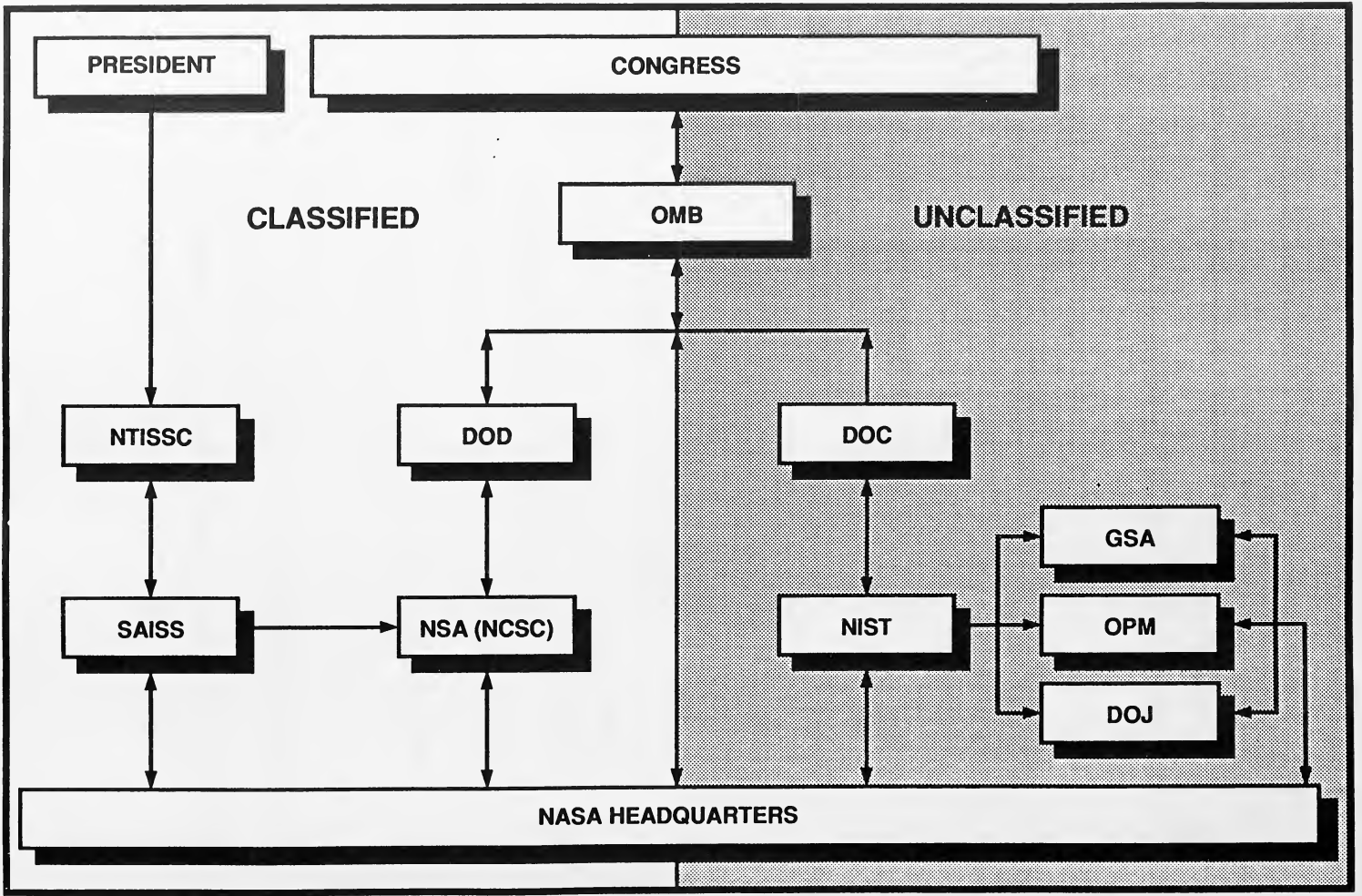
枠で囲んだ組織図で、縦に CLASSIFIED(秘密区分)の領域(左、網掛けなし)と UNCLASSIFIED(非秘密区分)の領域(右、網掛け)に分かれています。上部に PRESIDENT(大統領)の箱(左)と横長の CONGRESS(議会)の箱があります。秘密区分側では、PRESIDENT から NTISSC へ下向きの矢印があり、NTISSC と SAISS は双方向の矢印で、SAISS から NSA (NCSC) へは矢印で、DOD と NSA (NCSC) は双方向の矢印で結ばれています。中央では、CONGRESS と OMB が双方向の矢印で結ばれ、OMB の下から出る線が DOD(秘密区分側)と DOC(非秘密区分側)へ分かれ、さらに下の NASA HEADQUARTERS(NASA 本部)まで延びており、これらの接続には矢印が付いています。非秘密区分側では、DOC と NIST が双方向の矢印で結ばれ、NIST から GSA、OPM、DOJ へ矢印が出ています。GSA、OPM、DOJ は、NASA HEADQUARTERS へ下りる線とも矢印で結ばれています。下部の横長の NASA HEADQUARTERS の箱は、SAISS、NSA (NCSC)、OMB からの線、NIST と双方向の矢印で結ばれています。
CHAPTER 2. PROGRAM ORGANIZATION AND MANAGEMENT
第 2 章 プログラムの組織と管理
200 INTRODUCTION
200 はじめに
This Chapter covers the NASA Automated Information Security Program goal, objectives, organizational structure and management.
この章は、NASA 自動化情報セキュリティプログラムの目標、目的、組織構造、および管理を扱います。
201 MANAGEMENT PHILOSOPHIES
201 管理哲学
a. Integration. The NASA Automated Information Security Program is designed to provide appropriate, cost-effective protection for sensitive, classified, mission critical, life support, and high-dollar-value information and computing resources. In this regard, NASA has an extensive computer security program that is highly integrated into its management functions through points-of-contact, intra-agency working groups, councils, and committees. These management and coordinating bodies range from a senior management Information Resources Management (IRM) Council to CCSM's, local Data Processing Installation Computer Security Officials (DPI-CSO's), and Computer Security Coordinators (CSC's) at the computer system level.
a. 統合。NASA 自動化情報セキュリティプログラムは、機微情報、機密情報、ミッションクリティカルな情報、生命維持に関わる情報、および高額な価値を持つ情報とコンピューティング資源を、適切で費用対効果の高い方法で保護するよう設計されています。この点で NASA は、連絡窓口、機関内の作業部会、評議会、委員会を通じて管理機能に高度に統合された、広範なコンピュータセキュリティプログラムを持っています。これらの管理・調整組織は、上級管理者による情報資源管理(IRM)評議会から、CCSM、各地のデータ処理施設コンピュータセキュリティ責任者(DPI-CSO)、さらにコンピュータシステムレベルのコンピュータセキュリティコーディネーター(CSC)にまで及びます。
b. Decentralization. Due to NASA's highly decentralized approach to managing a large number of diverse computer environments nationwide, a decentralized approach for managing automated information security has been taken. NASA HQ interprets national policy and guidance and issues general policy and guidance appropriate for the NASA computing environment. Each center is responsible for establishing and sustaining a computer security program that assures that each DPI under its cognizance complies with computer security requirements that are consistent with the DPI's unique computing environment. Specific protective decisions (e.g., cost-effective approaches, benefits to be derived) are made by management at the center and DPI levels based on risk assessment activities. Functional security requirements and technical security specifications are to be integrated into appropriate system life-cycle phases and appropriate security-related responsibilities included in job descriptions and performance evaluation criteria. Compliance is assured through multiple levels of top-down management and compliance review activities.
b. 分散化。NASA は、全国に存在する多数の多様なコンピュータ環境を高度に分散した方法で管理しているため、自動化情報セキュリティの管理にも分散型の取り組みがとられています。NASA HQ は、国家の方針とガイダンスを解釈し、NASA のコンピューティング環境に適した一般的な方針とガイダンスを発行します。各センターは、その管轄下にある各 DPI が、その DPI 固有のコンピューティング環境に即したコンピュータセキュリティ要件に確実に従うようにするコンピュータセキュリティプログラムを確立し、維持する責任を負います。具体的な保護の決定(たとえば、費用対効果の高い方法や得られる便益)は、リスクアセスメント活動に基づいて、センターおよび DPI の管理者が行います。機能的なセキュリティ要件と技術的なセキュリティ仕様は、システムライフサイクルの適切な段階に組み込まなければならず、セキュリティに関する適切な責任を職務記述書と業績評価基準に盛り込まなければなりません。コンプライアンスは、トップダウンの複数の階層による管理とコンプライアンスレビュー活動を通じて確保されます。
c. Perfection. A state of absolute protection is not practical nor desirable in most cases. Numerous reasons include the following:
c. 完全性の追求。絶対的な保護の状態は、ほとんどの場合、現実的でも望ましくもありません。その理由は数多くあり、次のものがあります。
(1) Absolute protection would make the agency's systems virtually unusable by the research community for which the agency's mandate, under the Space Act of 1958, is to provide the most useful information to the widest possible audience.
(1) 絶対的な保護を行うと、機関のシステムは、研究コミュニティにとって事実上使えなくなります。機関は、1958 年宇宙法に基づき、最も有用な情報を可能な限り広い対象に提供することを使命としています。
(2) Some vulnerabilities may not be known, as in the case where vendor-supplied operating systems contain security flaws.
(2) ベンダーが提供するオペレーティングシステムにセキュリティ上の欠陥が含まれている場合のように、一部の脆弱性は知られていない可能性があります。
(3) Computer and network technology is constantly advancing at a rapid pace. While these advances create new opportunities for our scientists and engineers, they also offer new opportunities for those who wish to do mischief.
(3) コンピュータ技術とネットワーク技術は、絶えず急速に進歩しています。こうした進歩は、科学者や技術者に新たな機会をもたらす一方で、いたずらを企てる者にも新たな機会を与えます。
(4) Protection must be applied in a cost-effective manner in order to meet agency responsibilities in its expenditures of public funds.
(4) 公金の支出に関する機関の責任を果たすため、保護は費用対効果の高い方法で適用しなければなりません。
202 NASA AUTOMATED INFORMATION SECURITY PROGRAM GOAL AND OBJECTIVES
202 NASA 自動化情報セキュリティプログラムの目標と目的
a. Goal. The goal of the NASA Automated Information Security Program is to provide cost-effective protection that assures the integrity, availability, and confidentiality of NASA automated information resources. Thus, the main focus in scientific and engineering environments is to provide appropriate cost-effective protection and management emphasis that assures the appropriate levels of information integrity and computing resource availability without unnecessarily impacting innovative productivity or the advancement of technology. In these environments and in the administrative environments, where the sensitive or classified nature of information calls for mandatory or discretionary protection from unauthorized disclosure, additional consideration must be given for providing cost-effective protection that assures information confidentiality.
a. 目標。NASA 自動化情報セキュリティプログラムの目標は、NASA の自動化情報資源の完全性、可用性、機密性を確保する、費用対効果の高い保護を提供することです。したがって、科学・工学環境での主眼は、革新的な生産性や技術の進歩に不必要な影響を与えることなく、適切な水準の情報の完全性とコンピューティング資源の可用性を確保する、適切で費用対効果の高い保護を提供し、管理上の重点を置くことです。これらの環境および事務管理環境では、情報が機微または機密であるために不正開示に対する強制的または任意の保護が求められる場合、情報の機密性を確保する費用対効果の高い保護を提供することについて、さらに考慮しなければなりません。
b. Objectives. The objectives of the NASA Automated Information Security Program are to:
b. 目的。NASA 自動化情報セキュリティプログラムの目的は、次のとおりです。
(1) Protect against deliberate or accidental corruption of NASA automated information.
(1) NASA の自動化情報の意図的または偶発的な破壊に対して保護すること。
(2) Protect against deliberate or accidental actions that cause NASA automated information resources to be unavailable to users when needed.
(2) NASA の自動化情報資源が、必要なときに利用者から利用できなくなる、意図的または偶発的な行為に対して保護すること。
(3) Ensure that there is no deliberate or accidental disclosure of NASA sensitive or classified automated information.
(3) NASA の機微な、または機密の自動化情報が、意図的にも偶発的にも開示されないようにすること。
203 PROGRAM ELEMENTS
203 プログラムの要素
a. Basic Elements. The basic elements of the NASA Automated Information Security Program are illustrated in Exhibit 2-1. They are to be employed in appropriate combinations to adequately protect sensitive, critical, valuable, and important NASA information and computing assets at acceptable levels of risk. The NASA Automated Information Security Program covers both classified and unclassified assets.
a. 基本要素。NASA 自動化情報セキュリティプログラムの基本要素を、別添 2-1 に示します。これらの要素は、NASA の機微な、重大な、価値のある、重要な情報資産およびコンピューティング資産を、受け入れ可能なリスク水準で適切に保護するよう、適切に組み合わせて用いることになっています。NASA 自動化情報セキュリティプログラムは、機密資産と非機密資産の両方を対象とします。
(1) Computer Security Policy/Guidance. Computer security policies and guides are needed to define the overall framework (including lines of authority, main points-of-contact, range of responsibilities, requirements, procedures, and management processes) for implementing and sustaining an efficient and cost-effective NASA Automated Information Security Program.
(1) コンピュータセキュリティ方針・ガイダンス。コンピュータセキュリティの方針とガイドは、効率的で費用対効果の高い NASA 自動化情報セキュリティプログラムを実施し維持するための全体的な枠組み(指揮系統、主な連絡窓口、責任の範囲、要件、手順、管理プロセスを含む)を定めるために必要です。
(2) Computer Security Planning. Computer security planning must provide a consistent and specific approach for determining short- and long-range management objectives, developing security enhancement proposals, mapping proposals to budget requests, and assuring the implementation of appropriate cost-effective protective measures.
(2) コンピュータセキュリティ計画策定。コンピュータセキュリティの計画策定は、短期および長期の管理目的の決定、セキュリティ強化案の作成、案と予算要求との対応づけ、および適切で費用対効果の高い保護対策の実施の確保について、一貫した具体的な方法を示さなければなりません。
(3) Sensitivity and Criticality Identification. The information and computing resources used to support NASA missions have various levels of sensitivity and criticality. These levels need to be determined, since they are critical to deciding which protective measures are most appropriate.
(3) 機微性および重要度の識別。NASA のミッションを支えるために使用される情報資源およびコンピューティング資源には、さまざまな水準の機微性と重要度があります。これらの水準は、どの保護対策が最も適切かを決める際に重要であるため、決定する必要があります。
(4) Risk Management. NASA managers need to continually identify and analyze potential threats to NASA's computing environments and reduce risk exposures to acceptable levels. This process is called risk management.
(4) リスク管理。NASA の管理者は、NASA のコンピューティング環境に対する潜在的な脅威を継続的に特定して分析し、リスクエクスポージャーを受け入れ可能な水準まで低減する必要があります。このプロセスをリスク管理と呼びます。
(5) Protective Measure Baseline. There are numerous combinations of technical, physical, administrative, and personnel protective measures available to NASA managers. A baseline of these protective measures needs to be defined/suggested to facilitate development of acceptable levels of protection for computing and information resources managed by NASA or operated/processed in support of NASA missions.
(5) 保護対策ベースライン。NASA の管理者が利用できる技術的、物理的、管理的、および要員に関する保護対策には、数多くの組合せがあります。NASA が管理する、または NASA のミッションを支援して運用・処理されるコンピューティング資源および情報資源について、受け入れ可能な水準の保護の整備を促進するため、これらの保護対策のベースラインを定義または提案する必要があります。
(6) Certifications/Recertifications. Certifications and recertifications of automated applications document that current risk levels are acceptable. They also document the accountability for the acceptance of residual risks and complete the evaluation process for protective measures (controls and checks) programmed into automated applications.
(6) 認証・再認証。自動化アプリケーションの認証と再認証は、現在のリスク水準が受け入れ可能であることを文書化します。また、残存リスクを受け入れることに対する説明責任を文書化し、自動化アプリケーションにプログラムされた保護対策(管理策とチェック)の評価プロセスを完了させます。
EXHIBIT 2-1
NASA AUTOMATED INFORMATION SECURITY PROGRAM LOGO
別添 2-1
NASA 自動化情報セキュリティプログラムのロゴ
(7) Multilevel Compliance Assurance Mechanism. Management and compliance reviews should be periodically conducted to sustain optimal security levels at all centers and DPI's.
(7) 多層的なコンプライアンス保証の仕組み。すべてのセンターおよび DPI で最適なセキュリティ水準を維持するため、管理レビューとコンプライアンスレビューを定期的に実施すべきです。
(8) Incident Response. It is necessary to develop specific and appropriate responses to the various security incidents that may occur. It is also necessary to provide feedback information to senior management on significant incident situations. This information also supports the tracking of agencywide trends.
(8) インシデント対応。発生し得るさまざまなセキュリティインシデントに対して、具体的で適切な対応を整備する必要があります。また、重大なインシデントの状況について、上級管理者にフィードバック情報を提供する必要があります。この情報は、機関全体の傾向を追跡することにも役立ちます。
(9) Continuous CSAT. Continuous CSAT is necessary to elevate and sustain management and personnel awareness and provide specific guidance to personnel who design, implement, use, or maintain computer systems.
(9) 継続的な CSAT。管理者と要員の意識を高めて維持し、コンピュータシステムを設計、実装、使用、または保守する要員に具体的なガイダンスを提供するには、継続的な CSAT が必要です。
b. Sustaining Program Effectiveness. After policies and procedures have been established and initial security management tasks have been accomplished at the centers and DPI's, the ongoing aspects of risk assessment, recertification, computer security awareness and training, and compliance review activities should continually refresh local automated information security programs and keep them alive. The ongoing aspects of significant incident reporting and annual submission of automated information security program plans should provide managers at the center and HQ levels with sufficient information to continually reassess current program status and determine future management direction.
b. プログラムの有効性の維持。方針と手順が確立され、センターおよび DPI で初期のセキュリティ管理業務が完了した後は、リスクアセスメント、再認証、コンピュータセキュリティ意識向上およびトレーニング、コンプライアンスレビュー活動という継続的な取り組みによって、各地の自動化情報セキュリティプログラムを常に更新し、維持すべきです。重大なインシデントの報告と、自動化情報セキュリティプログラム計画の年次提出という継続的な取り組みによって、センターおよび HQ レベルの管理者に、現在のプログラムの状況を継続的に再評価し、今後の管理の方向性を決定するための十分な情報を提供すべきです。
204 NASA COMPUTER SECURITY POLICY
204 NASA のコンピュータセキュリティ方針
It is NASA policy that:
NASA の方針は、次のとおりです。
a. Technical,
a. 技術的、
b. Personnel,
b. 要員に関する、
c. Administrative,
c. 管理的、
d. Environmental, and
d. 環境的、および
e. Access
e. アクセスに関する
protective measures be used, alone or in combination, to cost-effectively provide an appropriate level of protection for NASA automation assets, and especially for automated information. The rigor of controls should be commensurate with the sensitivity level of the information resources to be protected. Selection of protective measures for a specific computing environment should be based on an assessment of risks and the existence of reasonable ratios between the costs/benefits of proposed protective measures and the sensitivity, criticality, and/or value of the assets requiring protection. Appropriate emphasis should be placed on:
保護対策を、単独でまたは組み合わせて用い、NASA の自動化資産、特に自動化情報に対して、適切な水準の保護を費用対効果の高い方法で提供すること。管理策の厳格さは、保護対象の情報資源の機微性の水準に見合ったものにすべきです。特定のコンピューティング環境に対する保護対策の選択は、リスクのアセスメントと、提案される保護対策の費用・便益と、保護を要する資産の機微性、重要度、価値との間に妥当な比率が存在することに基づくべきです。次のものには、適切な重点を置くべきです。
f. Automated information,
f. 自動化情報、
g. Computer hardware, and
g. コンピュータハードウェア、および
h. Computer software
h. コンピュータソフトウェア
to assure that they are appropriately protected from threats that include unauthorized:
これらが、次のような不正な行為を含む脅威から適切に保護されるようにするためです。
i. Access,
i. アクセス、
j. Alteration,
j. 改ざん、
k. Destruction,
k. 破壊、
l. Removal (e.g., theft),
l. 持ち出し(たとえば、盗難)、
m. Disclosure,
m. 開示、
n. Use/abuse, and
n. 使用・濫用、および
o. Delays
o. 遅延
as a result of improper actions or adverse events.
これらは、不適切な行為または悪影響のある事象の結果として生じるものです。
205 HEADQUARTERS ROLE AND RESPONSIBILITIES
205 本部の役割と責任
a. Overview. There are many organizations that have roles and responsibilities related to implementing and managing the NASA Automated Information Security Program, although the Head of each Federal agency has ultimate responsibility.
a. 概要。NASA 自動化情報セキュリティプログラムの実施と管理に関わる役割と責任を持つ組織は数多くありますが、最終的な責任は各連邦機関の長にあります。
b. Multidisciplinary Coordination
b. 多分野にわたる調整
(1) Management Disciplines. All traditional management disciplines and functions must be employed in a coordinated fashion to effectively manage security. The reason for this multidisciplinary situation is that, over the years, NASA has become more electronically-based and dependent on automation technologies to support all aspects of its operations and missions.
(1) 管理分野。セキュリティを効果的に管理するには、従来の管理分野と機能のすべてを、調整された形で用いなければなりません。このように多分野にわたる状況が生じているのは、長年の間に NASA がより電子化され、業務とミッションのあらゆる面を支えるために自動化技術に依存するようになったためです。
(2) Security Disciplines. As shown in Exhibit 2-2, there are many security-related disciplines, each with its own set of policies and procedures. Each security discipline is almost always an entirely separate career field throughout the Federal Government. Only when all such disciplines are working together, in a highly coordinated fashion, can the entire security process function properly and efficiently. Thus, it is important for computer security managers at all levels to regularly coordinate with other security-related disciplines.
(2) セキュリティ分野。別添 2-2 に示すように、セキュリティに関連する分野は数多くあり、それぞれに固有の方針と手順があります。それぞれのセキュリティ分野は、連邦政府全体を通じて、ほとんどの場合まったく別個の職種になっています。そうしたすべての分野が、高度に調整された形で連携して初めて、セキュリティプロセス全体が適切かつ効率的に機能します。したがって、あらゆる階層のコンピュータセキュリティ管理者が、セキュリティに関連するほかの分野と定期的に調整することが重要です。
c. NASA Automated Information Security Program Manager. As shown in Exhibit 2-3, NASA primary authority for managing an agencywide computer security program has been delegated through the Assistant Administrator for Management to the Assistant Associate Administrator for IRM. In addition to the general requirements of NMI 2410.7:
c. NASA 自動化情報セキュリティプログラム管理者。別添 2-3 に示すとおり、機関全体のコンピュータセキュリティプログラムを管理する NASA の主たる権限は、管理担当長官補から IRM 担当副長官補へ委任されています。NMI 2410.7 の一般要件に加え、次の責任を担います。
EXHIBIT 2-2
COMPUTER SECURITY'S RELATIONSHIPS WITH OTHER SECURITY DISCIPLINES
別添 2-2
コンピュータセキュリティとほかのセキュリティ分野との関係
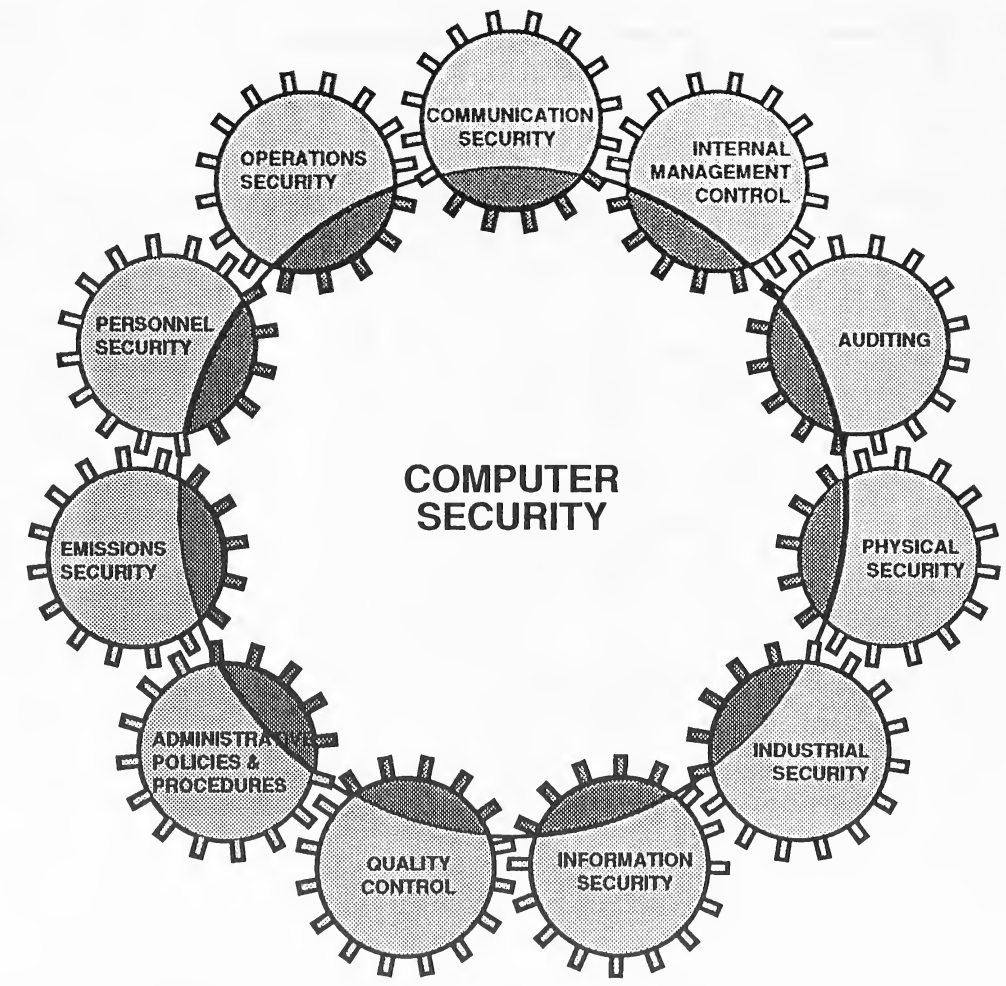
中央の COMPUTER SECURITY(コンピュータセキュリティ)という文字を囲んで、11 個の歯車が輪の形に並び、隣どうしでかみ合っています。各歯車にはセキュリティ関連の分野名が書かれています。上から時計回りに、COMMUNICATION SECURITY(通信セキュリティ)、INTERNAL MANAGEMENT CONTROL(内部管理統制)、AUDITING(監査)、PHYSICAL SECURITY(物理セキュリティ)、INDUSTRIAL SECURITY(産業セキュリティ)、INFORMATION SECURITY(情報セキュリティ)、QUALITY CONTROL(品質管理)、ADMINISTRATIVE POLICIES & PROCEDURES(管理上の方針と手順)、EMISSIONS SECURITY(電磁放射セキュリティ)、PERSONNEL SECURITY(人的セキュリティ)、OPERATIONS SECURITY(運用セキュリティ)です。各歯車の中心側の部分は濃く網掛けされています。
EXHIBIT 2-3
HEADQUARTERS ROLES AND RESPONSIBILITIES
別添 2-3
本部の役割と責任
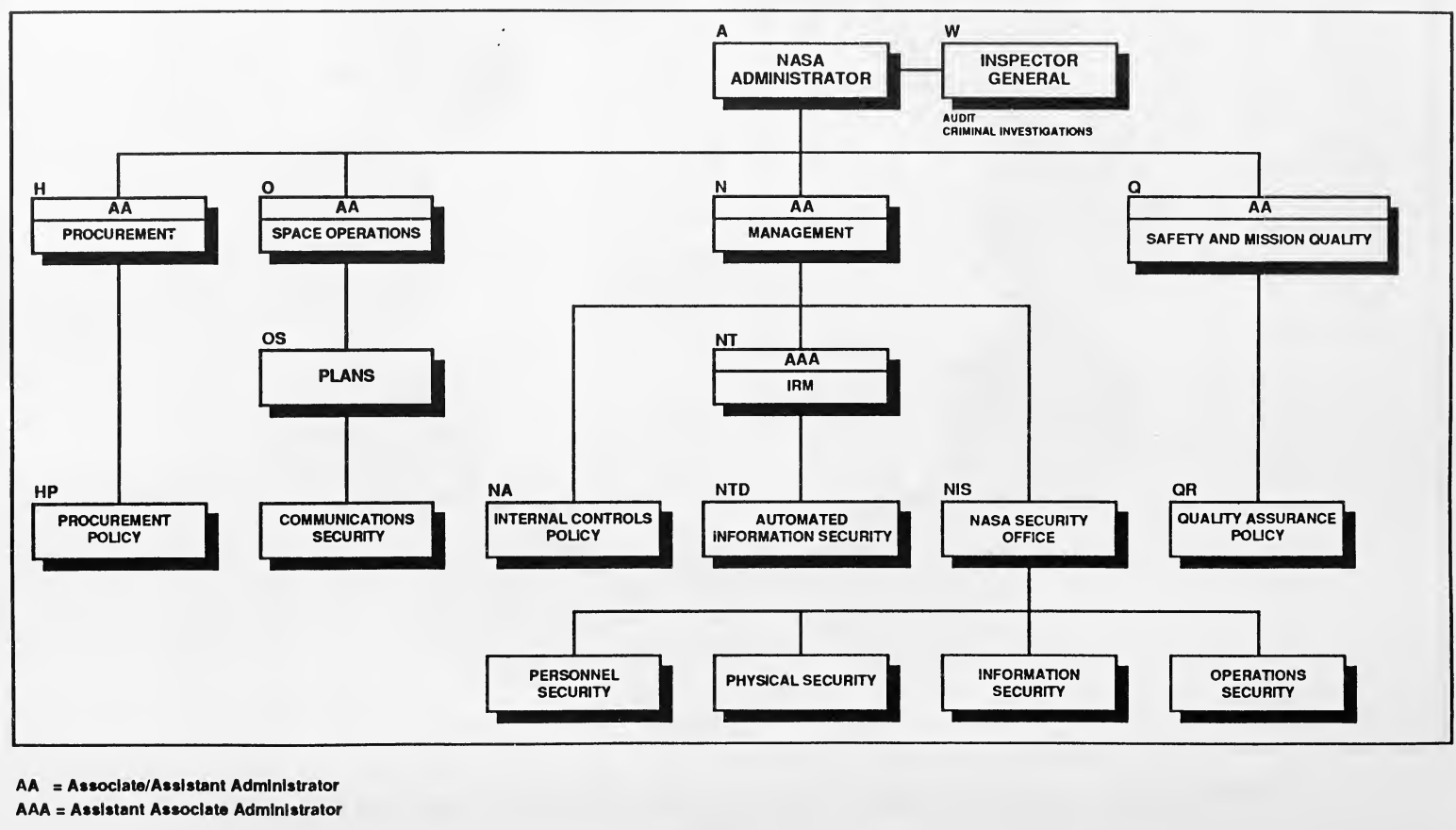
枠で囲んだ組織図で、その下に凡例があります。各箱の左上に組織コードが付いています。最上部に NASA ADMINISTRATOR(NASA 長官、A)があり、横に INSPECTOR GENERAL(監察総監、W)がつながり、その下に AUDIT, CRIMINAL INVESTIGATIONS(監査、犯罪捜査)と書かれています。長官の下に AA と見出しの付いた 4 つの箱があります。PROCUREMENT(調達、H)の下に PROCUREMENT POLICY(HP)、SPACE OPERATIONS(宇宙運用、O)の下に PLANS(OS)、その下に COMMUNICATIONS SECURITY があります。MANAGEMENT(管理、N)からは INTERNAL CONTROLS POLICY(NA)、AAA と見出しの付いた IRM(NT)とその下の AUTOMATED INFORMATION SECURITY(NTD)、NASA SECURITY OFFICE(NASA 保安局、NIS)へ枝分かれし、NASA SECURITY OFFICE からはさらに PERSONNEL SECURITY、PHYSICAL SECURITY、INFORMATION SECURITY、OPERATIONS SECURITY へ枝分かれしています。SAFETY AND MISSION QUALITY(安全・ミッション品質、Q)の下に QUALITY ASSURANCE POLICY(QR)があります。凡例は AA = Associate/Assistant Administrator、AAA = Assistant Associate Administrator です。
(1) The Assistant Associate Administrator for IRM shall:
(1) IRM 担当副長官補は、次のことをしなければなりません。
(a) Designate a management official knowledgeable in both computing and computer security management principles and practices to be the NASA Automated Information Security Program Manager; and
(a) コンピューティングとコンピュータセキュリティ管理の原則および実務の両方に精通した管理職員を、NASA 自動化情報セキュリティプログラム管理者に指名すること。
(b) Apprise Center Directors, through appropriate Program Associate Administrators, of program management reviews conducted in response to the requirements of NMI 2410.7 and this Handbook and make recommendation for improvements, as appropriate.
(b) NMI 2410.7 とこのハンドブックの要件に応じて実施されたプログラム管理レビューについて、適切なプログラム担当副長官を通じてセンター長に知らせ、必要に応じて改善を勧告すること。
(2) The NASA Automated Information Security Program Manager shall:
(2) NASA 自動化情報セキュリティプログラム管理者は、次のことをしなければなりません。
(a) Serve as an agency focal point of coordination among NASA senior management, HQ Program Offices, centers, and external organizations on automated information security matters.
(a) 自動化情報セキュリティに関する事項について、NASA の上級管理者、HQ プログラム室、センター、および外部組織の間の、機関の調整窓口を務めること。
(b) Develop and coordinate the implementation of agency plans, policies, procedures, and guidelines related to the requirements of NMI 2410.7 and this Handbook.
(b) NMI 2410.7 とこのハンドブックの要件に関連する機関の計画、方針、手順、およびガイドラインを策定し、その実施を調整すること。
(c) Conduct program management reviews of centers to assess the sustained effectiveness of center management oversight processes that have been implemented at DPI's under center management cognizance and make recommendations to the Assistant Associate Administrator for IRM, through the Director, IRM Policy Division, for improvement, as appropriate.
(c) センターの管理下にある DPI で実施されているセンターの管理監督プロセスが継続的に有効であるかどうかを評価するため、センターのプログラム管理レビューを実施し、必要に応じて、IRM 政策部長を通じて IRM 担当副長官補に改善を勧告すること。
(d) Coordinate the review and dissemination of information identifying emerging trends to keep NASA management informed.
(d) NASA の管理者に最新情報を提供し続けるため、新たな傾向を特定する情報の確認と周知を調整すること。
d. Headquarters Program Offices. In addition to the general requirements of NMI 2410.7, Program Associate Administrators shall:
d. 本部のプログラム室。NMI 2410.7 の一般要件に加えて、プログラム担当副長官は、次のことをしなければなりません。
(1) Promulgate Program Office specific policies, procedures, and guidelines related to the general requirements of NMI 2410.7 and this Handbook, as deemed appropriate.
(1) 必要に応じて、NMI 2410.7 とこのハンドブックの一般要件に関連する、プログラム室固有の方針、手順、およびガイドラインを公布すること。
(2) Designate a management official knowledgeable in both computing and computer security methods and practices to be the PO-CSM. The PO-CSM should serve as a focal point to coordinate agencywide activities required in NMI 2410.7 and this Handbook between the HQ Automated Information Security Program Manager and cognizant Program Office organizations. In cases where multiple organizational levels or program area applications exist, Assistant PO-CSM's and/or CSC's may be designated to accomplish specific computer security responsibilities.
(2) コンピューティングとコンピュータセキュリティの方法および実務の両方に精通した管理職員を、PO-CSM に指名すること。PO-CSM は、NMI 2410.7 とこのハンドブックが求める機関全体の活動を、HQ 自動化情報セキュリティプログラム管理者と所管のプログラム室組織との間で調整する窓口を務めるべきです。複数の組織階層またはプログラム分野のアプリケーションが存在する場合、特定のコンピュータセキュリティ責任を果たすために、PO-CSM 補佐または CSC を指名する場合があります。
(3) Implement and coordinate an appropriate management oversight process that ensures awareness and compliance with applicable portions of NMI 2410.7 and this Handbook in cognizant organizations.
(3) 所管の組織において、NMI 2410.7 とこのハンドブックの該当部分に対する認識とコンプライアンスを確保する、適切な管理監督プロセスを実施し調整すること。
(4) Assure that all NASA and appropriate NASA contractor computing and telecommunications resources processing NASA information are identified and included under the management of a DPI.
(4) NASA の情報を処理する、NASA および該当する NASA 請負業者のすべてのコンピューティング資源と通信資源が特定され、DPI の管理下に含まれるようにすること。
(5) Assure that, through the contracting officer, all appropriate contractors are required to comply with applicable provisions of NMI 2410.7 and this Handbook.
(5) 契約担当官を通じて、適切なすべての請負業者に、NMI 2410.7 とこのハンドブックの該当する規定を遵守することを求めること。
(6) Review and concur on exceptions from implementing specific requirements of this Handbook.
(6) このハンドブックの特定の要件を実施することの例外を確認し、同意すること。
e. Other Headquarters Offices. Other HQ offices that play an integral role include the:
e. その他の本部の部署。そのほか、不可欠な役割を果たす HQ の部署には、次のものがあります。
(1) Inspector General, which has independent audit and criminal investigation responsibilities.
(1) 監察総監室。独立した監査および犯罪捜査の責任を負います。
(2) NASA Security Office, which has traditional security responsibilities in the areas of personnel security, physical security, and national (including defense-related) security documents and operations control.
(2) NASA 保安室。要員のセキュリティ、物理的セキュリティ、ならびに国家(防衛関連を含む)のセキュリティ文書と運用管理の分野で、従来からのセキュリティ上の責任を負います。
(3) Office of Space Operations, which has agencywide responsibilities for telecommunications security.
(3) 宇宙運用室。通信セキュリティについて、機関全体にわたる責任を負います。
(4) Office of Procurement, which has responsibilities for ensuring that appropriate functional security requirements are included in acquisitions for automated information products and services.
(4) 調達室。自動化情報の製品およびサービスの調達に、適切な機能的セキュリティ要件が含まれるようにする責任を負います。
(5) Management Operations Office, which has responsibilities for the NASA Internal Controls Program.
(5) 管理運営室。NASA 内部統制プログラムの責任を負います。
(6) Office of Safety, Reliability, Maintainability, and Quality Assurance, which has responsibilities related to automated information resources supporting manned space flight.
(6) 安全・信頼性・保守性・品質保証室。有人宇宙飛行を支える自動化情報資源に関連する責任を負います。
EXHIBIT 2-4
WHO IS RESPONSIBLE FOR AUTOMATED INFORMATION SECURITY?
別添 2-4
自動化情報セキュリティの責任者は誰か
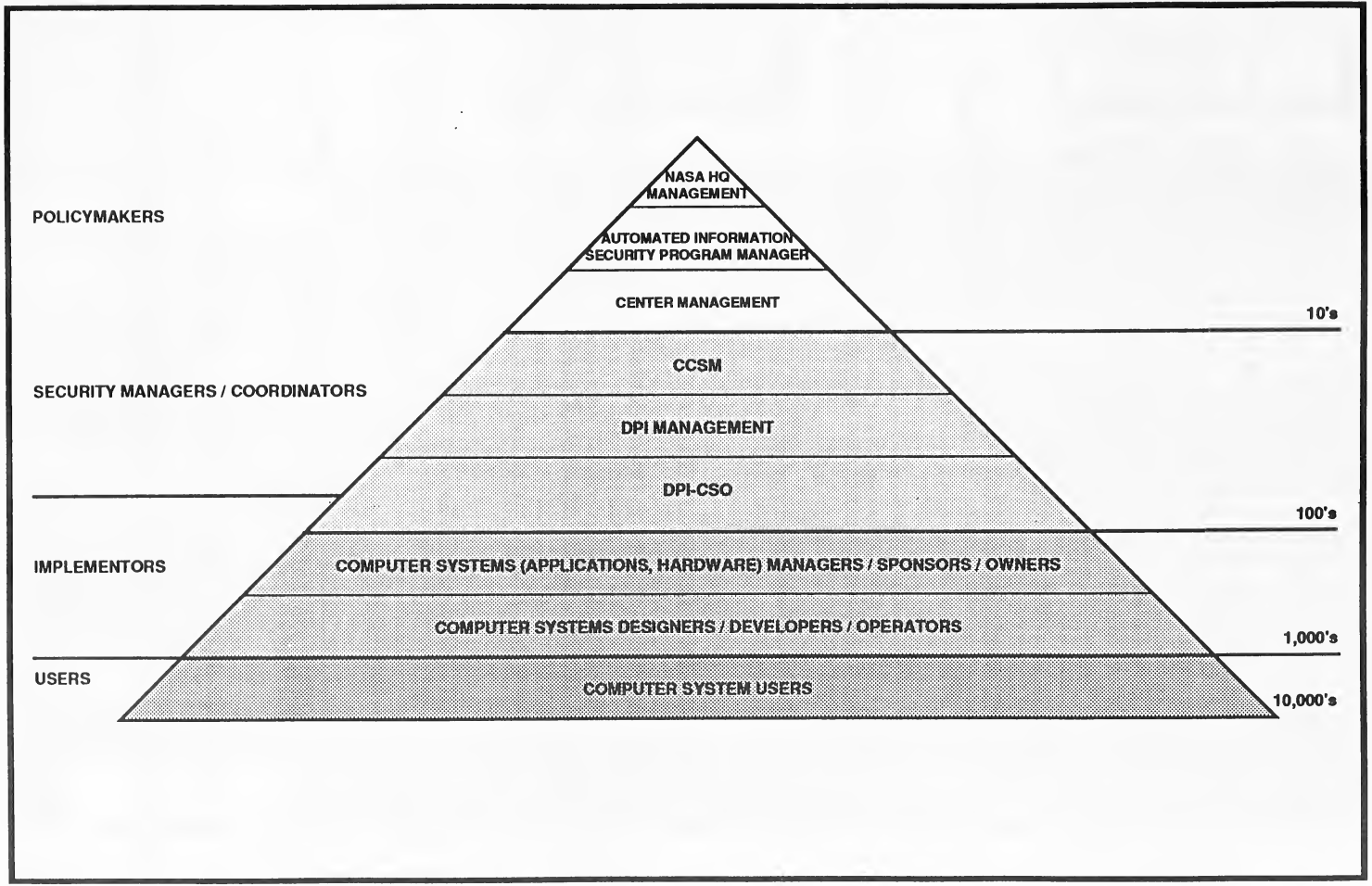
枠の中のピラミッドで、横に層に分かれています。頂点から順に、NASA HQ MANAGEMENT(NASA 本部の管理者)、AUTOMATED INFORMATION SECURITY PROGRAM MANAGER(自動化情報セキュリティプログラム管理者)、CENTER MANAGEMENT(センターの管理者)(この 3 層は網掛けなし)、CCSM、DPI MANAGEMENT、DPI-CSO、COMPUTER SYSTEMS (APPLICATIONS, HARDWARE) MANAGERS / SPONSORS / OWNERS、COMPUTER SYSTEMS DESIGNERS / DEVELOPERS / OPERATORS、COMPUTER SYSTEM USERS(これらは網掛け)です。左側のラベルが層をまとめており、POLICYMAKERS(方針決定者、上の 3 層)、SECURITY MANAGERS / COORDINATORS(セキュリティ管理者/調整者、CCSM から DPI-CSO まで)、IMPLEMENTORS(実施者、COMPUTER SYSTEMS の 2 層)、USERS(利用者、底辺の層)で、グループの間は水平線で区切られています。右側のラベルは各区切り線での人数の規模を示し、10's、100's、1,000's、底辺で 10,000's です。
206 INDIVIDUAL RESPONSIBILITIES FOR COMPUTER SECURITY
206 コンピュータセキュリティに関する個人の責任
As illustrated in Exhibit 2-4, the situation discussed in paragraph 205 dictates that virtually everyone in the organization who manages, designs, programs, operates, or uses NASA automated information resources has personal job-related responsibilities that contribute toward meeting the goal and objectives of the NASA Automated Information Security Program. The practice of effective computer security management principles normally becomes an integral function of good business/professional practice when it can be demonstrated that positive benefits can be derived. For example:
別添 2-4 に示すとおり、段落 205 で述べた状況から、NASA の自動化情報資源を管理し、設計し、プログラムし、運用し、または使用する組織内の事実上すべての人が、NASA 自動化情報セキュリティプログラムの目標と目的の達成に寄与する、職務上の個人的な責任を負っています。効果的なコンピュータセキュリティ管理の原則の実践は、明確な便益が得られることを示せる場合に、通常、優れた事業・専門的実務に不可欠な機能になります。たとえば、次のとおりです。
a. Appropriately restricting unauthorized access can greatly contribute to ensuring information/system integrity and availability.
a. 不正なアクセスを適切に制限することは、情報・システムの完全性と可用性の確保に大きく寄与できます。
b. Systems that are well planned and passed through a quality assurance/certification process are normally more efficient and have fewer maintenance problems in operational use.
b. 十分に計画され、品質保証・認証プロセスを経たシステムは、通常、より効率的で、運用での保守上の問題が少なくなります。
c. Technology that is used in a controlled environment can be expected to have greater reliability.
c. 管理された環境で使用される技術は、より高い信頼性が期待できます。
207 PROGRAM ORGANIZATIONAL STRUCTURE
207 プログラムの組織構造
a. In order to effectively manage the day-to-day aspects of a computer security program, in a large and diverse organization like NASA, a network of designated managers must be established at all levels throughout the organization. Exhibit 2-5 illustrates the relationship between NASA-designated computer security managers and officials at the HQ, center, and DPI levels.
a. NASA のように大規模で多様な組織で、コンピュータセキュリティプログラムの日常的な側面を効果的に管理するには、組織全体のあらゆる階層に、指名された管理者のネットワークを確立しなければなりません。別添 2-5 は、NASA が指名したコンピュータセキュリティ管理者・責任者と、HQ、センター、DPI の各階層との関係を示しています。
b. Headquarters Level. The NASA Automated Information Security Program Manager has a direct working relationship and communications link with HQ PO-CSM's and CCSM's to focus on resolving NASA issues.
b. 本部の階層。NASA 自動化情報セキュリティプログラム管理者は、NASA の問題の解決に重点を置くため、HQ の PO-CSM および CCSM と直接の業務関係と連絡経路を持ちます。
c. Center Level. Each CCSM has a direct working relationship and communication link with DPI-CSO's to focus on resolving center-level issues.
c. センターの階層。各 CCSM は、センター階層の問題の解決に重点を置くため、DPI-CSO と直接の業務関係と連絡経路を持ちます。
208 MANAGEMENT REVIEW AND COMPLIANCE ASSURANCE PROCESS
208 管理レビューおよびコンプライアンス保証プロセス
Since computer security compliance levels have an inherent tendency to degrade with time, management reviews are necessary to retain a high level of compliance. Therefore, the NASA Automated Information Security Program will require periodic management reviews at all levels.
コンピュータセキュリティのコンプライアンス水準には、時間とともに低下するという本質的な傾向があるため、高いコンプライアンス水準を保つには管理レビューが必要です。したがって、NASA 自動化情報セキュリティプログラムでは、あらゆる階層で定期的な管理レビューが求められます。
EXHIBIT 2-5
NASA AUTOMATED INFORMATION SECURITY PROGRAM STRUCTURE (Part 1)
別添 2-5
NASA 自動化情報セキュリティプログラムの構造(第 1 部)
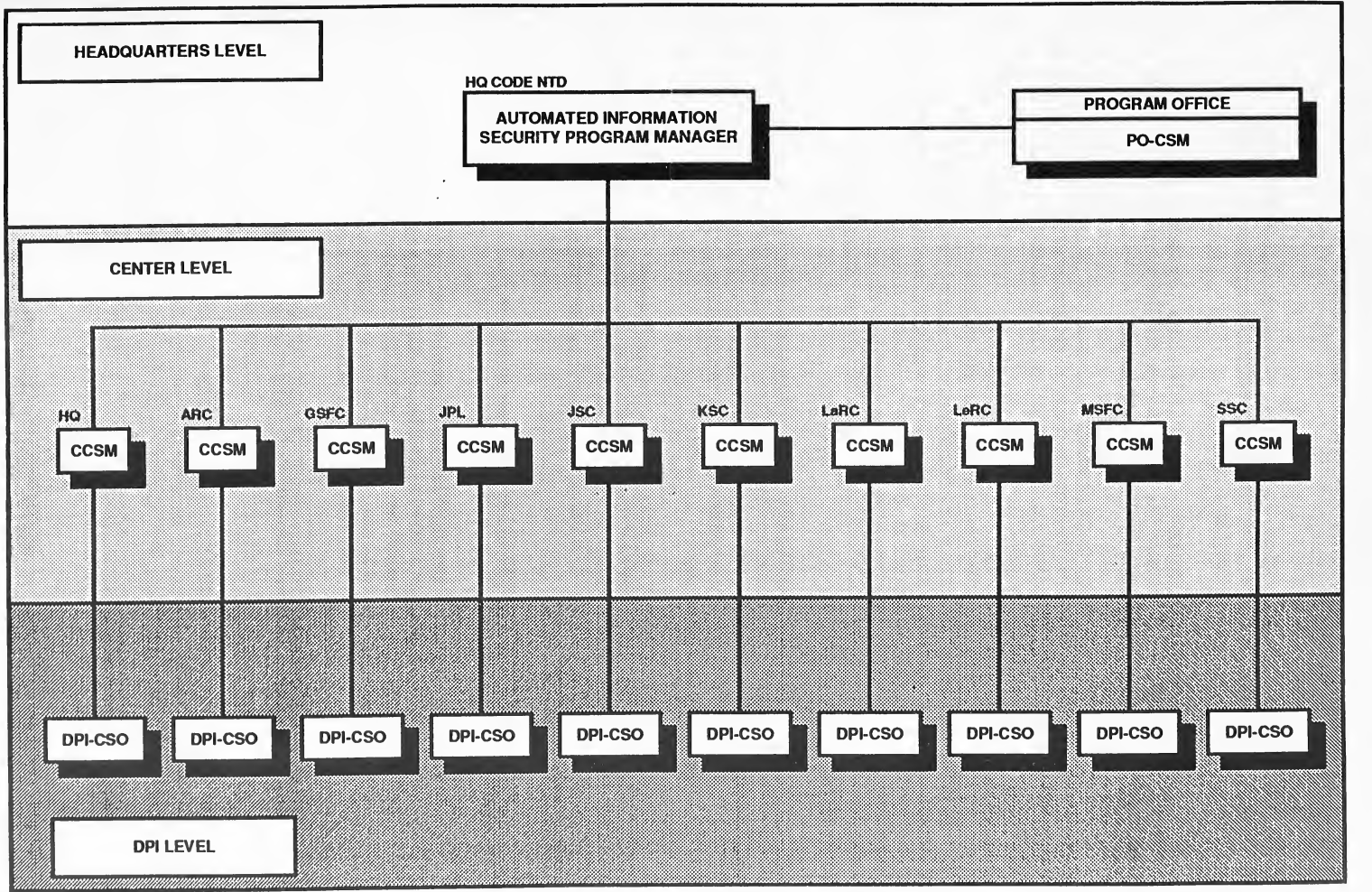
枠で囲んだ組織図で、HEADQUARTERS LEVEL(本部レベル)、CENTER LEVEL(センターレベル、薄い網掛け)、DPI LEVEL(DPI レベル、濃い網掛け)の 3 つの帯に分かれています。本部レベルでは、HQ CODE NTD と記した AUTOMATED INFORMATION SECURITY PROGRAM MANAGER(自動化情報セキュリティプログラム管理者)の箱が、PROGRAM OFFICE / PO-CSM の箱と線で結ばれています。センターレベルでは、プログラム管理者から出た線が 10 個の CCSM の箱へ枝分かれし、それぞれ HQ、ARC、GSFC、JPL、JSC、KSC、LaRC、LeRC、MSFC、SSC と記されています。DPI レベルでは、各 CCSM が重ねて描かれた(複数の)DPI-CSO の箱と線で結ばれています。
a. Headquarters Reviews. NASA HQ will conduct periodic management reviews of centers to evaluate their management and coordination of programs at DPI's under their cognizance.
a. 本部によるレビュー。NASA HQ は、各センターが所管の DPI のプログラムをどのように管理し調整しているかを評価するため、センターの定期的な管理レビューを実施します。
b. Center Reviews. Centers will conduct periodic compliance reviews at DPI's under their cognizance at least every 1 to 3 years. Review activities should be focused in the following four areas:
b. センターによるレビュー。各センターは、所管の DPI で、少なくとも1年ごと、遅くとも3年ごとに定期的なコンプライアンスレビューを実施します。レビュー活動は、次の4つの分野に重点を置くべきです。
(1) Tracking Systems and Random Checks. Tracking systems are needed to monitor recommendations from review activities (e.g., compliance reviews, recertifications, risk assessments). Random checks and tests ensure actual implementations of appropriate procedures and that protective measures do, in fact, reduce identified risk exposures to acceptable levels.
(1) 追跡システムと無作為チェック。レビュー活動(たとえば、コンプライアンスレビュー、再認証、リスクアセスメント)による勧告を監視するために、追跡システムが必要です。無作為チェックとテストにより、適切な手順が実際に実施されていること、および保護対策が実際に、特定されたリスクエクスポージャーを受け入れ可能な水準まで低減していることを確認します。
(2) Security Incidents. Reported security incidents should be tracked to determine trends, to identify general problem areas and security needs, and to ensure implementation of appropriate procedures and protective measures. The result should be fewer incidents.
(2) セキュリティインシデント。報告されたセキュリティインシデントは、傾向を把握し、一般的な問題領域とセキュリティ上のニーズを特定し、適切な手順と保護対策の実施を確保するために、追跡すべきです。その結果、インシデントの件数は減るはずです。
(3) Contingency Planning. Contingency and disaster recovery plans provide overall protection when other safeguarding features may have failed. Such plans should be in place and periodically tested, at a minimum, for the most sensitive and critical systems.
(3) コンティンジェンシープランニング。コンティンジェンシープランと災害復旧計画は、ほかの防護機能が機能しなくなったときに、全体的な保護を提供します。このような計画は、少なくとも最も機微で重要なシステムについて整備し、定期的にテストすべきです。
(4) CSAT. Managers should ensure that continuous CSAT is conducted at DPI's, as appropriate.
(4) CSAT。管理者は、適宜、DPI で継続的な CSAT が実施されるようにすべきです。
c. DPI Reviews. Each DPI will conduct ongoing self-assessment review activities to include CSAT, risk assessments, and recertification reviews of applications supporting sensitive or mission-critical functions to sustain optimal levels of security.
c. DPI によるレビュー。各 DPI は、最適なセキュリティ水準を維持するため、CSAT、リスクアセスメント、および機微な機能またはミッションクリティカルな機能を支えるアプリケーションの再認証レビューを含む、継続的な自己評価レビュー活動を実施します。
CHAPTER 3. CENTER AND DPI REQUIREMENTS
第 3 章 センターおよび DPI の要件
300 CENTER REQUIREMENTS
300 センターの要件
a. Designation of Authorities. In addition to the general requirements of NMI 2410.7, Center Directors shall:
a. 権限者の指定。NMI 2410.7 の一般要件に加えて、センター長は、次のことをしなければなりません。
(1) Promulgate specific center policies, procedures, and guidelines related to the general requirements of NMI 2410.7 and this Handbook, as deemed appropriate; and
(1) 必要と判断される場合には、NMI 2410.7 とこのハンドブックの一般要件に関連する、センター固有の方針、手順、およびガイドラインを公布すること。
(2) Designate, in writing, a management official knowledgeable in both computing and computer security methods and practices to be the CCSM.
(2) コンピューティングとコンピュータセキュリティの方法および実務の両方に精通した管理職員を、CCSM として書面で指名すること。
b. CCSM Responsibilities. The CCSM shall serve as a focal point to manage a program that is responsive to the Center Director and coordinate activities required by NMI 2410.7 and this Handbook between the HQ Automated Information Security Program Manager and cognizant DPI's. In cases where multiple DPI's exist, Assistant CCSM's may be designated to accomplish specific center computer security responsibilities. The CCSM responsibilities include:
b. CCSM の責任。CCSM は、センター長に対して責任を負うプログラムを管理する窓口を務め、NMI 2410.7 とこのハンドブックが求める活動を HQ 自動化情報セキュリティプログラム管理者と所管の DPI との間で調整しなければなりません。複数の DPI が存在する場合は、特定のセンターコンピュータセキュリティ責任を果たすため、CCSM 補佐を指名してもよいです。CCSM の責任には、次のものがあります。
(1) Implementing and coordinating an appropriate management oversight process that ensures awareness and compliance with the Center Computer Security Program.
(1) センターのコンピュータセキュリティプログラムに対する認識とコンプライアンスを確保する、適切な管理監督プロセスを実施し調整すること。
(2) Assuring that each NASA and appropriate NASA contractor DPI under his/her cognizance develops, implements, and sustains an effective computer security program that ensures awareness and compliance at the DPI level.
(2) 管轄下にある NASA の各 DPI および該当する NASA 請負業者の各 DPI が、DPI レベルでの認識とコンプライアンスを確保する効果的なコンピュータセキュリティプログラムを策定し、実施し、維持するようにすること。
(3) Scheduling and conducting periodic compliance reviews at cognizant DPI's to assess the adequacy of security plans, the sustained effectiveness of its computer security procedures and program, and to make recommendations for improvement, as appropriate. Compliance reviews should be conducted every 1 to 3 years based on the reviewing management's judgement. Factors to be considered in making this decision include the reviewing management's perception of the sensitivity, criticality, and/or value of the computing and information assets to be protected at each DPI.
(3) 所管の DPI で定期的なコンプライアンスレビューを計画して実施し、セキュリティ計画の妥当性、コンピュータセキュリティ手順およびプログラムの有効性が継続しているかを評価し、必要に応じて改善を勧告すること。コンプライアンスレビューは、レビューを行う管理者の判断に基づき、1~3年ごとに実施すべきです。この判断では、各 DPI で保護すべきコンピューティング資産および情報資産の機微性、重要度、または価値に関する、レビューを行う管理者の認識を考慮します。
(4) Assuring that procedures are implemented for identifying computer security incidents that occur at DPI's under his/her cognizance. These procedures shall ensure that significant computer security incidents are reported to the HQ Automated Information Security Program Manager immediately following detection and that significant incident information received from HQ is disseminated to cognizant DPI's. (See paragraph 309 for a description of this procedure.)
(4) 管轄下の DPI で発生するコンピュータセキュリティインシデントを特定する手順が実施されるようにすること。これらの手順により、重大なコンピュータセキュリティインシデントは、検知の直後に HQ 自動化情報セキュリティプログラム管理者に報告され、HQ から受け取った重大なインシデントの情報は、所管の DPI に周知されなければなりません。(この手順の説明は段落 309 を参照してください。)
(5) Assuring that, through the contracting officer, all appropriate contractors comply with applicable provisions of NMI 2410.7, this Handbook, and center computer security directives.
(5) 契約担当官を通じて、適切なすべての請負業者が、NMI 2410.7、このハンドブック、およびセンターのコンピュータセキュリティ指令の該当する規定を遵守するようにすること。
(6) Coordinating all functional security requirements with organizations/individuals having procurement, training, or security-related responsibilities (e.g., those having responsibilities in personnel security, physical security, national (including defense-related) security, telecommunications security, information security, internal management control, auditing, quality assurance/control, administrative security, emissions security, and operations security).
(6) すべての機能的セキュリティ要件を、調達、トレーニング、またはセキュリティに関する責任を持つ組織・個人(たとえば、要員のセキュリティ、物理的セキュリティ、国家(防衛関連を含む)のセキュリティ、通信セキュリティ、情報セキュリティ、内部管理統制、監査、品質保証・管理、管理上のセキュリティ、電磁放射セキュリティ、運用セキュリティに責任を持つ組織・個人)と調整すること。
c. Identifying DPI's. As illustrated in Exhibits 2-4 and 3-1, the focus of implementing technical requirements begins at the center and DPI levels. Center management is to ensure that all NASA and appropriate NASA contractor computing and telecommunication resources processing NASA information are identified and included under the management of a DPI. A DPI is established by drawing an imaginary boundary around a logical grouping of information, computing, and telecommunications resources for the purpose of managing those resources as an identifiable entity. CCSM's are responsible for assuring that DPI's have been identified. This is accomplished by negotiating with organizations under the cognizance of center management to determine the most logical approach. For example, DPI's might represent logical groupings of information, computing, and telecommunications resources within the boundaries of:
c. DPI の特定。別添 2-4 と 3-1 に示すとおり、技術的要件の実施は、センターと DPI の階層から始まります。センターの管理者は、NASA の情報を処理するすべての NASA の、および適切な NASA 請負業者のコンピューティング資源と通信資源が、特定され、DPI の管理下に含まれるようにしなければなりません。DPI は、情報資源、コンピューティング資源、通信資源の論理的なまとまりの周りに仮想の境界を引き、それらの資源を識別可能な主体として管理する目的で設置されます。CCSM は、DPI が特定されるようにする責任を負います。これは、センターの管理者の管轄下にある組織と交渉して、最も論理的な方法を決定することで行われます。たとえば、DPI は、次の境界内にある情報資源、コンピューティング資源、通信資源の論理的なまとまりを表す場合があります。
(1) A physical structure at a geographic location (e.g., an entire building or a central computing facility).
(1) ある地理的な場所にある物理的な構造(たとえば、建物全体や中央コンピューティング施設)。
(2) An organizational structure (e.g., HQ or center organizational codes).
(2) 組織構造(たとえば、HQ またはセンターの組織コード)。
(3) A combination of these approaches.
(3) これらの方法の組合せ。
The grouping of computer systems for computer security requirements should be consistent, if possible, with that used for DPI's as defined in the Information Technology System Plan (ITSP) submitted annually by each NASA center.
コンピュータセキュリティ要件のためのコンピュータシステムのまとめ方は、可能であれば、NASA の各センターが毎年提出する情報技術システム計画(ITSP)で定義された DPI のまとめ方と一貫したものにすべきです。
EXHIBIT 3-1
NASA AUTOMATED INFORMATION SECURITY PROGRAM STRUCTURE (Part 2)
別添 3-1
NASA 自動化情報セキュリティプログラムの構造(第 2 部)
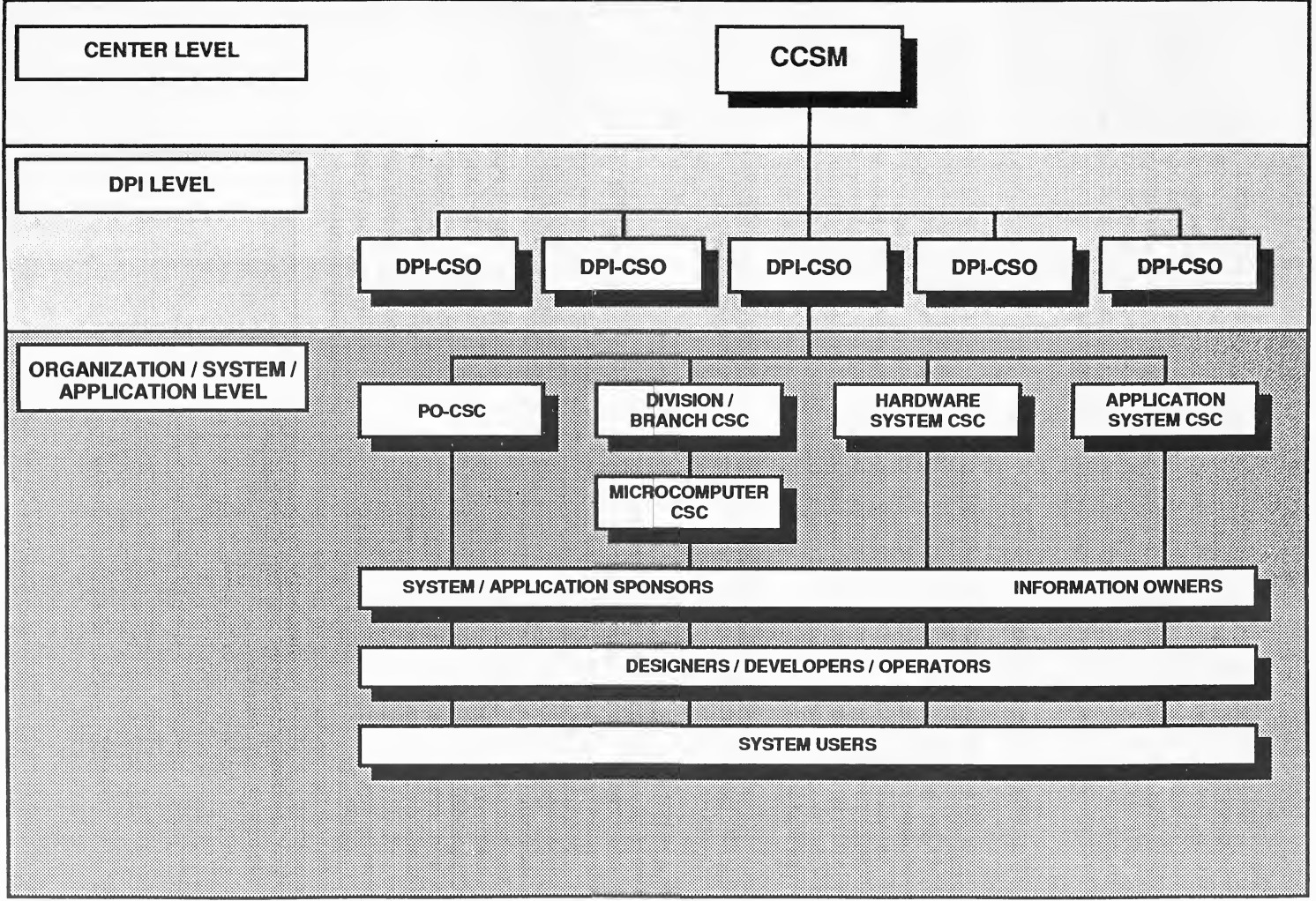
枠で囲んだ組織図で、CENTER LEVEL(センターレベル)、DPI LEVEL(DPI レベル)、ORGANIZATION / SYSTEM / APPLICATION LEVEL(組織/システム/アプリケーションレベル)の 3 つの帯に分かれています。センターレベルには CCSM の箱があります。DPI レベルでは、CCSM から出た線が 5 つの DPI-CSO の箱へ枝分かれしています。組織/システム/アプリケーションレベルでは、中央の DPI-CSO から出た線が PO-CSC、DIVISION / BRANCH CSC(その下に MICROCOMPUTER CSC)、HARDWARE SYSTEM CSC、APPLICATION SYSTEM CSC へ枝分かれしています。これらから下りる縦線が、3 本の横長の帯 SYSTEM / APPLICATION SPONSORS(右端に INFORMATION OWNERS)、DESIGNERS / DEVELOPERS / OPERATORS、SYSTEM USERS を貫いています。
d. Identifying Additional Entities. DPI-CSO's are responsible for determining if identification of additional entities under the DPI is needed to more effectively manage and coordinate aspects of the DPI computer security program. These entities could represent logical groupings of information, computing, and telecommunications resources associated with sub-elements of the DPI organization, major hardware or software configurations, or clusters of microcomputers.
d. 追加の主体の特定。DPI-CSO は、DPI のコンピュータセキュリティプログラムの各側面をより効果的に管理し調整するため、DPI の配下に追加の主体を特定する必要があるかどうかを判断する責任を負います。これらの主体は、DPI 組織の下位要素、主要なハードウェアまたはソフトウェアの構成、あるいはマイクロコンピュータの集まりに関連する、情報資源、コンピューティング資源、通信資源の論理的なまとまりを表す場合があります。
301 DPI REQUIREMENTS
301 DPI の要件
a. Designation of Authorities. Each NASA (or appropriate NASA contractor) manager in charge of a NASA center shall assure that a management official, knowledgeable in both computing and computer security management methods and practices, is designated as the DPI-CSO. Day-to-day security responsibilities may be delegated to technical support personnel. In cases where multiple computer systems or program area applications exist, CSC's may be designated to accomplish specific security responsibilities.
a. 権限者の指定。NASA センターを担当する各 NASA(または適切な NASA 請負業者)の管理者は、コンピューティングとコンピュータセキュリティの管理方法および実務の両方に精通した管理職員が、DPI-CSO に指名されるようにしなければなりません。日常的なセキュリティ責任は、技術支援要員に委任してもよいです。複数のコンピュータシステムまたはプログラム分野のアプリケーションが存在する場合は、特定のセキュリティ責任を果たすために、CSC を指名できます。
b. DPI-CSO Responsibilities. (See Exhibit 3-2.) The DPI-CSO in coordination with the appropriate CCSM shall:
b. DPI-CSO の責任。(別添 3-2 を参照してください。)DPI-CSO は、適切な CCSM と調整して、次のことをしなければなりません。
(1) Implement and administer a management process appropriate to the DPI environment to ensure that sensitivity and/or criticality of information is determined by the application sponsors/owners and that appropriate administrative, technical, physical, and personnel protective measures are incorporated into all new and existing computer systems and applications processing sensitive or mission-critical information to achieve and sustain an acceptable level of security. (See paragraph 302 for a description of this management process.)
(1) 情報の機微性または重要度がアプリケーションの後援者・所有者によって決定されるようにし、機微な情報またはミッションクリティカルな情報を処理するすべての新規および既存のコンピュータシステムとアプリケーションに、受け入れ可能な水準のセキュリティを達成し維持するための適切な管理的、技術的、物理的、および要員に関する保護対策が組み込まれるようにするため、DPI の環境に適した管理プロセスを実施し運営すること。(この管理プロセスの説明は段落 302 を参照してください。)
EXHIBIT 3-2
別添 3-2
DPI-CSO RESPONSIBILITIES
DPI-CSO の責任
•Management Process
•管理プロセス
•Protection Planning
•保護の計画策定
•Protection Control
•保護の管理
•Contingency Planning
•コンティンジェンシープランニング
•Incident Identification
•インシデントの識別
•Awareness & Training
•意識向上とトレーニング
•Coordination
•調整
(2) Formulate, continually update, and annually review a DPI computer security plan, which will allow the appropriate approving (i.e., DPI) or reviewing (e.g., center and HQ Program Office) authorities to judge the comprehensiveness and effectiveness of the DPI computer security program. In cases where multiple DPI's, computer systems, or program area applications exist, multiple plans may be appropriate. The planning process may also be integrated into center-level planning activities as deemed appropriate by the CCSM. (See paragraph 503 for a description of the required contents of a DPI Computer Security Plan.)
(2) DPI のコンピュータセキュリティ計画を作成し、継続的に更新し、毎年見直すこと。これにより、承認を行う当局(すなわち DPI)またはレビューを行う当局(たとえば、センターおよび HQ プログラム室)が、DPI のコンピュータセキュリティプログラムの包括性と有効性を判断できるようになります。複数の DPI、コンピュータシステム、またはプログラム分野のアプリケーションが存在する場合は、複数の計画が適切なことがあります。計画策定のプロセスは、CCSM が適切と判断すれば、センター階層の計画策定活動に統合してもよいです。(DPI コンピュータセキュリティ計画に必要な内容の説明は段落 503 を参照してください。)
(3) Develop and implement protective measures designed to prevent misuse and abuse of computing resources. (See paragraph 304 for a description of these protective measures.)
(3) コンピューティング資源の誤用および濫用を防ぐよう設計された保護対策を策定し、実施すること。(これらの保護対策の説明は段落 304 を参照してください。)
(4) Develop and implement a process, as appropriate, for providing contingency planning and reasonable continuity of operations for computer systems and computer applications supporting mission-critical functions. (See paragraph 308 for a description of this process.)
(4) ミッションクリティカルな機能を支えるコンピュータシステムとコンピュータアプリケーションについて、コンティンジェンシープランニングと妥当な運用継続を提供するプロセスを、必要に応じて策定し実施すること。(このプロセスの説明は段落 308 を参照してください。)
(5) Develop and implement procedures in coordination with the CCSM for identifying computer security incidents and reporting significant computer security incidents, as described in paragraph 309.
(5) 段落 309 に述べるとおり、コンピュータセキュリティインシデントを識別し、重大なコンピュータセキュリティインシデントを報告するための手順を、CCSM と調整して策定し実施すること。
(6) Assure that plans are developed and implemented for conducting continuous CSAT to ensure that NASA and appropriate NASA contractor personnel involved in managing, designing, developing, or maintaining computer applications processing sensitive or mission-critical information, and who use computer systems, are aware of their security responsibilities and know how to fulfill them. This includes being kept aware of vulnerabilities and being trained in techniques to enhance security. (See paragraph 310.)
(6) 機微な情報またはミッションクリティカルな情報を処理するコンピュータアプリケーションの管理、設計、開発、または保守に携わり、コンピュータシステムを使用する NASA および適切な NASA 請負業者の要員が、自らのセキュリティ責任を認識し、それを果たす方法を知っているようにするため、継続的な CSAT を実施する計画が策定され、実施されるようにしなければなりません。これには、脆弱性について常に認識させておくことと、セキュリティを強化する技法についてトレーニングを行うことが含まれます。(段落 310 を参照してください。)
(7) Coordinate all functional security requirements with organizations/individuals having procurement, training, or security-related responsibilities, e.g., those having responsibilities in personnel security, physical security, national (including defense-related) security, telecommunications security, information security, internal management control, auditing, quality assurance, administrative security, emissions security, and operations security.
(7) すべての機能的セキュリティ要件を、調達、トレーニング、またはセキュリティに関する責任を持つ組織・個人(たとえば、要員のセキュリティ、物理的セキュリティ、国家(防衛関連を含む)のセキュリティ、通信セキュリティ、情報セキュリティ、内部管理統制、監査、品質保証、管理上のセキュリティ、電磁放射セキュリティ、運用セキュリティに責任を持つ組織・個人)と調整すること。
302 MANAGEMENT PROCESS
302 管理プロセス
The management process must ensure that the following, as a minimum, are carried out (see Exhibit 3-3):
管理プロセスは、少なくとも次のことが確実に実施されるようにしなければなりません(別添 3-3 を参照してください)。
a. Risk Assessments. Periodic risk assessments must be conducted for new and existing DPI's to assure that appropriate, cost-effective protective measures are incorporated and are commensurate with the sensitivity, criticality, and value of associated computer systems, computer applications, and information processed. (See paragraph 303 for a description of the risk assessment process.)
a. リスクアセスメント。新規および既存の DPI について、適切で費用対効果の高い保護対策が組み込まれ、それらが関連するコンピュータシステム、コンピュータアプリケーション、および処理される情報の機微性、重要度、価値に見合ったものとなるように、定期的なリスクアセスメントを実施しなければなりません。(リスクアセスメントのプロセスの説明は段落 303 を参照してください。)
EXHIBIT 3-3
別添 3-3
MANAGEMENT PROCESS
管理プロセス
•Risk Assessments
•リスクアセスメント
•Application Certification / Recertification
•アプリケーションの認証・再認証
•Functional Security Requirements
•機能的セキュリティ要件
•Security Specifications
•セキュリティ仕様
•Security Design Reviews
•セキュリティ設計レビュー
•System Tests
•システムテスト
•Certification / Recertification
•認証・再認証
•Personnel Screening
•要員の審査
•Access Control & Accountability
•アクセス制御と説明責任
•Compliance Assurance
•コンプライアンス保証
•Contingency Planning
•コンティンジェンシープランニング
•Disaster Recovery
•災害復旧
•Operations Continuity
•運用継続
•Approval of Methodologies
•方法論の承認
b. Certifying Requirements. Procedures must be established for defining functional security requirements, developing technical security specifications, conducting security design reviews and system tests, certifying and recertifying computer applications processing sensitive or mission-critical information at appropriate phases of the system life cycle, and approving technical security specifications for the acquisition of computing resources or related services. (See paragraph 305 for minimum functional security requirements and certification procedures.)
b. 要件の認証。機能的セキュリティ要件を定義し、技術的セキュリティ仕様を策定し、セキュリティ設計レビューとシステムテストを実施し、システムライフサイクルの適切な段階で機微な情報またはミッションクリティカルな情報を処理するコンピュータアプリケーションを認証・再認証し、コンピューティング資源または関連サービスの調達のための技術的セキュリティ仕様を承認するための手順を、確立しなければなりません。(最小限の機能的セキュリティ要件と認証手順は段落 305 を参照してください。)
c. Personnel Screening. Personnel who participate in managing, designing, developing, operating, or maintaining computer applications processing sensitive or mission-critical information, or who access automated sensitive or mission-critical information, must be appropriately screened to a level commensurate with the sensitivity, criticality, or value of the information to be accessed or handled and the risk and magnitude of loss or harm that could be caused by the individual. Federal personnel are to be screened in accordance with the Federal Personnel Manual, Section 732. Guidance on screening non-Federal personnel is presented in paragraph 306.
c. 要員の審査。機微な情報またはミッションクリティカルな情報を処理するコンピュータアプリケーションの管理、設計、開発、運用、または保守に携わる要員、あるいは自動化された機微な情報またはミッションクリティカルな情報にアクセスする要員は、アクセスまたは取り扱う情報の機微性、重要度、または価値と、その個人によって引き起こされる可能性のある損失または損害のリスクおよび規模に見合った水準まで、適切に審査しなければなりません。連邦職員は、Federal Personnel Manual, Section 732 に従って審査することになっています。連邦政府以外の要員の審査に関するガイダンスは、段落 306 に示されています。
d. Access Protection and Accountability. Appropriate protective measures must be established, to the extent economically and technically feasible, for maintaining personal accountability of individual users granted access to sensitive or mission-critical information and for ensuring that they have access to no more information than they are authorized to access.
d. アクセス保護と説明責任。機微な情報またはミッションクリティカルな情報へのアクセスを許可された個々の利用者の個人的な説明責任を維持し、それらの利用者が、アクセスを許可された範囲を超える情報にアクセスしないようにするため、経済的および技術的に実行可能な範囲で、適切な保護対策を確立しなければなりません。
e. Compliance Assurance. Followup procedures must be in place to assure implementation of protective measures in accordance with recommendations from compliance review and certification and recertification activities.
e. コンプライアンス保証。コンプライアンスレビュー、認証、再認証の活動による勧告に従って保護対策が確実に実施されるよう、フォローアップの手順を整えておかなければなりません。
f. Contingency and Disaster Recovery Plans. Appropriate disaster recovery plans and contingency plans must be established and maintained to prevent loss of information, minimize interruption, and provide reasonable continuity of computer services should adverse events occur that would prevent normal operations.
f. コンティンジェンシープランおよび災害復旧計画。通常の運用を妨げる悪影響のある事象が発生した場合に、情報の損失を防ぎ、中断を最小限に抑え、コンピュータサービスの妥当な継続性を確保するため、適切な災害復旧計画とコンティンジェンシープランを確立し、維持しなければなりません。
g. Approval of Methodologies. Computer security planning, risk assessment, and security certification methodologies shall be approved by appropriate management officials.
g. 方法論の承認。コンピュータセキュリティの計画策定、リスクアセスメント、およびセキュリティ認証の方法論は、適切な管理職員によって承認されなければなりません。
303 RISK ASSESSMENT PROCESS
303 リスクアセスメントのプロセス
a. NASA recognizes the importance of conducting risk assessments as a basis for making informed management decisions related to accepting identified risk exposures or implementing appropriate cost-effective protective measures to reduce risk exposures to acceptable levels. When used appropriately, risk assessment is a very effective management tool. It should serve to provide a systematic approach for:
a. NASA は、特定されたリスクエクスポージャーを受け入れるか、リスクエクスポージャーを受け入れ可能な水準まで低減する適切で費用対効果の高い保護対策を実施するかに関する、情報に基づく管理上の決定の基礎として、リスクアセスメントを実施することの重要性を認識しています。リスクアセスメントは、適切に用いれば、非常に有効な管理手段です。リスクアセスメントは、次のことを行うための体系的な方法を提供すべきです。
(1) Determining the relative value, sensitivity, and criticality of DPI information and computing resources.
(1) DPI の情報資源とコンピューティング資源の相対的な価値、機微性、重要度を決定すること。
(2) Assessing potential threats and perceived risk exposure levels.
(2) 潜在的な脅威と、認識されているリスクエクスポージャーの水準を評価すること。
(3) Identifying existing protective measures.
(3) 既存の保護対策を特定すること。
(4) Identifying and assessing additional protective alternatives.
(4) 追加の保護手段の選択肢を特定し、評価すること。
(5) Determining acceptability of identified risk levels.
(5) 特定されたリスク水準が受け入れ可能かどうかを判断すること。
(6) Documenting the assessment process and resulting management decisions.
(6) アセスメントのプロセスと、その結果としての管理上の決定を文書化すること。
b. Risk assessments may vary from an informal review of a small-scale microcomputer installation to a formal, fully documented analysis (i.e., risk analysis) of a large-scale computer installation. Since risk assessments can involve many disciplines and organizations, a team approach is recommended, regardless of the size of the systems being analyzed. A tremendous amount of time and effort can be saved by bringing together the right people with the needed knowledge and experience to review concerns and make subjective judgements, based on professional experience and knowledge.
b. リスクアセスメントは、小規模なマイクロコンピュータ設備の非公式なレビューから、大規模なコンピュータ設備の正式で完全に文書化された分析(すなわち、リスク分析)まで、さまざまな形をとり得ます。リスクアセスメントには多くの分野や組織が関わり得るため、分析するシステムの規模にかかわらず、チームで取り組むことが推奨されます。必要な知識と経験を持つ適切な人々を集めて、懸念事項を検討し、専門的な経験と知識に基づく主観的な判断を行えば、膨大な時間と労力を節約できます。
c. DPI's should continue to be given flexibility for selecting methodologies and implementing risk assessment programs that are most appropriate for their computing environments. However, the risk assessment process must ensure, at a minimum, the following (see Exhibit 3-4):
c. DPI には、それぞれのコンピューティング環境に最も適した方法論を選択し、リスクアセスメントプログラムを実施するための柔軟性を、引き続き与えるべきです。ただし、リスクアセスメントのプロセスは、少なくとも次のことを確実に実施しなければなりません(別添 3-4 を参照してください)。
EXHIBIT 3-4
別添 3-4
RISK ASSESSMENT STEPS
リスクアセスメントの手順
1.Determine Scope
1.適用範囲の決定
2.Identify & Value Hardware & Software Assets
2.ハードウェア資産とソフトウェア資産の特定と評価
3.Identify Information Assets
3.情報資産の特定
•Determine Sensitivity
•機微性の決定
•Determine Criticality
•重要度の決定
•Determine Value
•価値の決定
•Determine Potential Adverse Impacts
•潜在的な悪影響の決定
4.Identify Existing Controls
4.既存の管理策の特定
5.Identify Threats & Estimate Risks
5.脅威の特定とリスクの推定
6.Analyze Costs & Benefits Of Potential Controls
6.潜在的な管理策の費用と便益の分析
7.Recommend Actions
7.措置の勧告
8.Document Actions
8.措置の文書化
9.Followup Review
9.フォローアップレビュー
(1) A risk assessment methodology is selected (i.e., qualitative, quantitative, or a combination of both) that includes the following elements and logical steps, as appropriate:
(1) 次の要素と論理的な手順を、必要に応じて含むリスクアセスメントの方法論(すなわち、定性的、定量的、またはその両方の組合せ)を選択すること。
(a) Determination of Risk Assessment Scope. For example, a risk assessment may consider an entire DPI, including all hardware, software, and telecommunication aspects, or may be limited to an assessment of an individual mainframe or microcomputer system. Regardless of the approach, the scope of the risk assessment should be planned and maintained within manageable limits, and the level of effort should be commensurate with the nature of the DPI being assessed. For example, a risk assessment of a stand-alone microcomputer installation could be done informally by the owner of the information.
(a) リスクアセスメントの適用範囲の決定。たとえば、リスクアセスメントでは、ハードウェア、ソフトウェア、通信の各側面をすべて含む DPI 全体を対象とする場合もあれば、個々のメインフレームまたはマイクロコンピュータのシステムの評価に限定する場合もあります。どの方法をとる場合でも、リスクアセスメントの適用範囲は、管理可能な範囲に収めて計画し維持すべきであり、作業の水準は、評価する DPI の性質に見合ったものにすべきです。たとえば、スタンドアロンのマイクロコンピュータ設備のリスクアセスメントは、情報の所有者が非公式に実施できます。
(b) Asset Identification and Value. Identification of major DPI assets and general approximations of their current replacement value in order to establish a basis for making informed decisions on protective measures as described in subparagraph (g) below. For example, if it is known that the approximate value of computing resources within the scope of the risk assessment is about $1 million, it may make sense to spend several hundred dollars or several thousand dollars to enhance protective measures.
(b) 資産の特定と評価。下記の副項 (g) に述べる保護対策について、情報に基づく決定を行う基礎を確立するため、DPI の主要な資産を特定し、その現在の交換価値の概算を行うこと。たとえば、リスクアセスメントの適用範囲内にあるコンピューティング資源の概算価値が約 100 万ドルであるとわかっている場合、保護対策の強化に数百ドルまたは数千ドルを費やすことには意味があるでしょう。
(c) Determination of Potential Impacts. General determination of collective sensitivity, criticality, and/or value of information processed or stored at the DPI and potential impacts if information is misused, altered, destroyed, or disclosed. This determination should be based on an analysis of individual functional security requirements (which are prepared by sponsor/owners) of computer applications processed.
(c) 潜在的な影響の決定。DPI で処理または保存される情報の全体としての機微性、重要度、価値と、情報が誤用、改ざん、破壊、または開示された場合の潜在的な影響を、概括的に決定すること。この決定は、処理されるコンピュータアプリケーションの個々の機能的セキュリティ要件(後援者・所有者が作成するもの)の分析に基づくべきです。
(d) Identification of existing protective measures (i.e., those already in place).
(d) 既存の保護対策(すなわち、すでに講じられているもの)の特定。
(e) Identification of existing and potential threats and hazards and qualitative estimates of risk exposure and/or quantitative calculations; for example, Annual Loss Expectancy (ALE) associated with potential adverse events.
(e) 既存の、および潜在的な脅威と危険の特定、ならびにリスクエクスポージャーの定性的な推定または定量的な計算。たとえば、潜在的な悪影響のある事象に関連する年間損失予測(ALE)。
(f) Determination of acceptable risk exposures, and/or determination of alternative protective measures, associated benefits, and associated costs needed to reduce identified risk exposures and/or ALE to acceptable levels.
(f) 受け入れ可能なリスクエクスポージャーの決定、または、特定されたリスクエクスポージャーや ALE を受け入れ可能な水準まで低減するために必要な、代替の保護対策、関連する便益、および関連する費用の決定。
(g) Recommendations for accepting risk exposures and/or ALE's, or recommendations for additional appropriate protective measures that are needed to improve security (reducing risk exposure and/or ALE) based on an analysis of the ratio between the estimated cost/benefit of proposed protective measures and the value/sensitivity of information/computing resources requiring protection. The cost of protective measures should not normally exceed a reasonable percentage of the value of assets requiring protection (as identified in subparagraphs (b) and (c)).
(g) リスクエクスポージャーや ALE を受け入れるための勧告、または、提案する保護対策の推定費用対効果と、保護を要する情報やコンピューティング資源の価値や機微性との比率の分析に基づき、セキュリティを改善する(リスクエクスポージャーや ALE を低減する)ために必要な追加の適切な保護対策の勧告。保護対策の費用は、通常、保護を要する資産の価値(副項 (b) および (c) で特定したもの)の妥当な割合を超えるべきではありません。
(h) Documentation of actions taken or planned as a result of the risk assessment findings and recommendations.
(h) リスクアセスメントの所見と勧告の結果として講じた、または計画した措置の文書化。
(i) Followup procedures to assure that all actions planned have been carried out.
(i) 計画したすべての措置が実施されたことを確実にするフォローアップの手順。
(2) Risk assessments are performed:
(2) リスクアセスメントは、次の時期に実施されます。
(a) Prior to construction or operational use of a new DPI.
(a) 新しい DPI の構築または運用開始の前。
(b) Whenever there is a significant change to an existing DPI.
(b) 既存の DPI に重大な変更があるたび。
(c) At periodic intervals, established by the DPI-CSO, that are commensurate with the sensitivity or criticality of the information processed by the DPI, but not to exceed 5 years if no risk assessment has been performed during that time.
(c) DPI が処理する情報の機微性または重要度に見合うよう DPI-CSO が定める周期で、ただし、その間にリスクアセスメントが実施されていない場合は 5 年を超えない間隔で。
(3) The selected risk assessment methodologies and results are approved by appropriate management officials at the center and DPI levels and taken into consideration when certifying or recertifying computer applications processing sensitive or mission-critical information.
(3) 選択したリスクアセスメントの方法論と結果は、センターおよび DPI の階層の適切な管理職員によって承認され、機微な情報またはミッションクリティカルな情報を処理するコンピュータアプリケーションを認証または再認証する際に考慮されます。
(4) Risk assessment results are available for consideration during the evaluation of internal controls, conducted in accordance with NMI 1200.7, "NASA's Internal Control System," that apply to DPI's or computer applications processing sensitive or mission-critical information.
(4) 機微な情報またはミッションクリティカルな情報を処理する DPI またはコンピュータアプリケーションに適用される内部統制について、NMI 1200.7, "NASA's Internal Control System" に従って実施する評価の際に、リスクアセスメントの結果を検討できるようにすること。
304 PROTECTIVE MEASURES TO PREVENT MISUSE AND ABUSE
304 誤用および濫用を防ぐ保護対策
In addition to other appropriate protective measures (such as those covered in Chapter 4), protective measures to prevent misuse and abuse of computing resources should include the following (see Exhibit 3-5):
コンピューティング資源の誤用および濫用を防ぐための保護対策は、(第 4 章で扱うものなど)そのほかの適切な保護対策に加えて、次のものを含むべきです(別添 3-5 を参照してください)。
a. Developing and implementing a procedure, where technically and economically feasible, to maintain automated computer system logs of access to multiuser computer systems to determine whether unauthorized accesses are being attempted.
a. 不正なアクセスが試みられていないかどうかを判断するため、技術的および経済的に実行可能な場合に、マルチユーザーのコンピュータシステムへのアクセスについて、コンピュータシステムの自動ログを保持する手順を策定し実施すること。
EXHIBIT 3-5
別添 3-5
RECOMMENDED PROTECTIVE MEASURES
推奨される保護対策
•Access Log
•アクセスログ
•Random File Sampling
•ファイルの無作為抽出
•Awareness Procedures
•意識向上の手順
•Incident Response Procedures
•インシデント対応の手順
b. Reviewing the contents of computer system files, by means of random sampling, at unannounced intervals.
b. 予告なしの間隔で、無作為抽出によってコンピュータシステムのファイルの内容を確認すること。
c. Developing and implementing awareness procedures requiring all personnel who access computer systems to have a working knowledge of computer security ethics, responsibilities, policies, and procedures.
c. コンピュータシステムにアクセスするすべての要員に、コンピュータセキュリティの倫理、責任、方針、および手順に関する実務的な知識を持つことを求める、意識向上の手順を策定し実施すること。
d. Ensuring that all actions constituting suspected or confirmed significant computer security incidents are brought to the immediate attention of the appropriate DPI-CSO; that the extent and cause of any incident is determined; and that reasonable steps are taken to minimize the probability of further incidents including additional training, counseling, disciplinary action, and/or notifying criminal investigative and law enforcement authorities, as appropriate.
d. 重大なコンピュータセキュリティインシデントの疑いがある、または確認された行為のすべてが、適切な DPI-CSO にただちに知らされるようにすること。また、インシデントの範囲と原因が特定され、追加のトレーニング、カウンセリング、懲戒処分、必要に応じて犯罪捜査当局および法執行当局への通知など、さらなるインシデントの可能性を最小限に抑える妥当な措置がとられるようにすること。
305 CERTIFICATION PROCESS
305 認証プロセス
Certification is required to provide reasonable assurance that a proposed or significantly changed computer application that processes sensitive or mission-critical information meets all applicable requirements and the original design specifications and that installed protective measures are adequate and functioning properly prior to operational use. The The certification process should involve all those individuals who have participated (or will participate) in the sponsoring, planning, designing, programming, operation, and/or use of the application. Since this process could involve many organizations and individuals, a team approach is recommended. A representative from each functional area should be responsible for witnessing the system test and signing off on his or her area of responsibility. The primary responsibility for accomplishing certification tasks in coordination with the DPI-CSO should reside within the sponsoring/data owner organization. The DPI-CSO of the installation in which the application will be processed should assure that the following process has taken place prior to operational use:
認証は、機微な情報またはミッションクリティカルな情報を処理する、提案された、または大幅に変更されたコンピュータアプリケーションが、該当するすべての要件と当初の設計仕様を満たしており、導入された保護対策が運用開始前に適切であり正しく機能していることについて、妥当な保証を提供するために必要です。認証プロセスには、そのアプリケーションの後援、計画策定、設計、プログラミング、運用、または使用に携わった(または携わる予定の)すべての人が関与すべきです。このプロセスには多くの組織と個人が関与し得るため、チームで取り組むべきです。各機能分野の代表者は、システムテストに立ち会い、自らの責任範囲について承認する責任を負うべきです。DPI-CSO と調整して認証業務を完了させる主たる責任は、後援組織またはデータ所有者の組織に置くべきです。アプリケーションが処理される設備の DPI-CSO は、運用開始前に次のプロセスが実施されていることを確認すべきです。
a. New or Modified Applications. For new or significantly changed computer applications that process level 2 through level 3 (as defined in Chapter 4) sensitive or mission-critical information, assure that (see Exhibit 3-6):
a. 新規または変更されたアプリケーション。レベル 2 からレベル 3(第 4 章で定義)の機微な情報またはミッションクリティカルな情報を処理する、新規または大幅に変更されたコンピュータアプリケーションについて、次のことを確認します(別添 3-6 を参照してください)。
(1) Functional security requirements are defined by the system and/or information sponsors/owners based on established installation procedures that include the following:
(1) 機能的セキュリティ要件は、次のことを含む確立された設備の手順に基づき、システムまたは情報の後援者・所有者によって定義されていること。
EXHIBIT 3-6
別添 3-6
CERTIFYING NEW / MODIFIED APPLICATIONS
新規・変更されたアプリケーションの認証
•Sponsor / Owner Requirements
•後援者・所有者の要件
•Sensitivity, Criticality & Vulnerability
•機微性、重要度、および脆弱性
•Integrity, Availability & Confidentiality
•完全性、可用性、および機密性
•Potential Impacts
•潜在的な影響
•Acceptable Interruptions / Delays
•許容できる中断・遅延
•Replacement Values
•交換価値
•Functional Security Requirements
•機能的セキュリティ要件
•Technical Security Specifications
•技術的セキュリティ仕様
•Existing Risk Assessments
•既存のリスクアセスメント
•Design Review & Systems Tests
•設計レビューとシステムテスト
•Certification Document
•認証文書
(a) Identifying and determining the nature of the sensitivity and/or criticality of information to be processed as discussed in Chapter 4 of this Handbook, and determining how the information may be vulnerable to potential threats (e.g., misuse, alteration, destruction, or disclosure);
(a) このハンドブックの第 4 章で述べるとおり、処理される情報の機微性または重要度の性質を特定して判断し、その情報が潜在的な脅威(たとえば、誤用、改ざん、破壊、開示)に対してどのように脆弱であり得るかを判断すること。
(b) [illegible] primary and secondary system security concerns (i.e., integrity, availability, confidentiality);
(b) 主要および副次的なシステムセキュリティ上の懸念(すなわち、完全性、可用性、機密性)を特定すること。
(c) Determining potential impacts if sensitive or mission-critical information is misused, altered, destroyed, or disclosed (e.g., embarrassment, legal liability);
(c) 機微な情報またはミッションクリティカルな情報が誤用、改ざん、破壊、または開示された場合の潜在的な影響(たとえば、体面の失墜、法的責任)を判断すること。
(d) Determining when an application that supports a mission-critical function must be back in operation after an interruption to avoid adversely affecting the mission of the user or the sponsoring/owner organization; and
(d) ミッションクリティカルな機能を支えるアプリケーションが、利用者または後援・所有組織のミッションに悪影響を及ぼさないよう、中断の後、いつまでに運用に復帰していなければならないかを判断すること。
(e) Determining general approximation of replacement values associated with the application/information;
(e) アプリケーションまたは情報に関連する交換価値の概算を判断すること。
(2) System designers develop technical security specifications that detail functional security requirements and describe how specific protective techniques will be employed. These specifications should be described in technical terms that system developers and programmers can implement;
(2) システム設計者が、機能的セキュリティ要件を詳述し、特定の保護技法をどのように用いるかを記述する技術的セキュリティ仕様を作成すること。これらの仕様は、システム開発者とプログラマーが実装できる技術的な言葉で記述すべきです。
(3) Functional security requirements and technical security specifications are reviewed and approved prior to acquiring or starting formal development;
(3) 機能的セキュリティ要件と技術的セキュリティ仕様は、調達または正式な開発の開始前に確認され、承認されること。
(4) Results of risk assessments performed at the DPI in which the computer application will be processed are taken into consideration when defining and approving technical security specifications for computer applications;
(4) コンピュータアプリケーションが処理される DPI で実施されたリスクアセスメントの結果が、コンピュータアプリケーションの技術的セキュリティ仕様を定義し承認する際に考慮されること。
(5) Security design reviews and system tests are conducted and approved prior to operational use of computer applications; and
(5) セキュリティ設計レビューとシステムテストが、コンピュータアプリケーションの運用開始前に実施され、承認されること。
(6) Upon successful completion of the system test, the computer application is certified prior to operational use as meeting requirements of documented and approved functional security requirements, technical security specifications, and related DPI procedures, and that results of the system test demonstrate that the application, computer system, and DPI protective measures are adequate and functioning properly.
(6) システムテストが無事に完了した後、運用開始前に、コンピュータアプリケーションが、文書化され承認された機能的セキュリティ要件、技術的セキュリティ仕様、および関連する DPI の手順の要件を満たしていること、ならびにシステムテストの結果が、アプリケーション、コンピュータシステム、および DPI の保護対策が適切であり正しく機能していることを示していることについて、認証されること。
b. Recertifications. For operational applications processing sensitive or mission-critical information assure that:
b. 再認証。機微な情報またはミッションクリティカルな情報を処理する運用中のアプリケーションについて、次のことを確認します。
(1) Periodic reviews are conducted and recertifications are made of the continued adequacy and proper functioning of protective measures;
(1) 保護対策が引き続き適切であり、正しく機能していることについて、定期的なレビューが実施され、再認証が行われること。
(2) The recertification process takes into consideration all available information (e.g., other reviews and audits that may have been conducted subsequent to the last certification); and
(2) 再認証のプロセスが、入手可能なすべての情報(たとえば、前回の認証の後に実施された可能性のあるほかのレビューや監査)を考慮に入れること。
(3) Recertifications are conducted at least every 3 years, as appropriate. Time intervals should be commensurate with the sensitivity/criticality of the information processed. If no significant change has taken place and no deficiencies have been identified in other review activities, the recertification process may be less stringent than the initial certification process.
(3) 再認証が、適宜、少なくとも 3 年ごとに実施されること。その間隔は、処理される情報の機微性・重要度に見合ったものにすべきです。重大な変更がなく、ほかのレビュー活動でも欠陥が特定されていない場合は、再認証のプロセスを、最初の認証プロセスより厳格でないものにしてもよいです。
306 PROCEDURES FOR SCREENING NON-FEDERAL PERSONNEL
306 連邦政府以外の要員を審査する手順
Based on requirements in OMB Circular A-130, this procedure has been developed in coordination with the NASA Security Office (HQ Code NIS), which has primary responsibility for establishing policy relating to the screening of all NASA and appropriate NASA contractor (i.e., non-Federal) personnel who participate in the design, development, operation, or maintenance of automated systems, or who access sensitive or mission-critical information. The CCSM, in joint coordination with the Center Security Office, should assure that proper procedures are in place for screening non-Federal personnel.
この手順は、OMB Circular A-130 の要件に基づき、自動化システムの設計、開発、運用、または保守に携わる、あるいは機微な情報またはミッションクリティカルな情報にアクセスする、NASA の全要員および適切な NASA 請負業者(すなわち、連邦政府以外)の要員の審査に関する方針を定める主たる責任を負う NASA 保安室(HQ Code NIS)と調整して策定されました。CCSM は、センター保安室と共同で調整し、連邦政府以外の要員を審査する適切な手順が整備されているようにすべきです。
a. Scope and Applicability
a. 範囲と適用性
(1) This procedure provides guidance for the screening of non-Federal personnel who are U.S. citizens and are being granted access to NASA computer systems or the NASA sensitive/critical information they process. For guidance on protecting access by foreign nationals, see paragraph 307.
(1) この手順は、NASA のコンピュータシステム、またはそれらが処理する NASA の機微・重要な情報へのアクセスを許可される、米国市民である連邦政府以外の要員の審査に関するガイダンスを示します。外国人によるアクセスの保護に関するガイダンスは、段落 307 を参照してください。
(2) This guidance need not apply to non-Federal personnel who have or within the last 5 years received a NASA or other Government agency access authorization (or classified clearance) based on a favorable Government-conducted investigation. Access may be granted by the Center Security Office using an adjudication process.
(2) このガイダンスは、政府が実施した良好な結果の調査に基づいて、NASA またはほかの政府機関のアクセス権限(または機密取扱許可)を現在持っている、または過去 5 年以内に付与された、連邦政府以外の要員には適用する必要はありません。アクセスは、センター保安室が裁定プロセスを用いて許可してもよいです。
b. Objective. Personnel screening is to be conducted only to determine an individual's eligibility, or continued eligibility, for access to NASA computer systems or the sensitive/critical information he or she processes. Personnel screening is not to be construed as a determination of suitability for employment.
b. 目的。要員の審査は、個人が NASA のコンピュータシステム、またはその個人が処理する機微・重要な情報にアクセスする資格、または引き続きアクセスする資格があるかどうかを判断することだけを目的として行うものです。要員の審査は、雇用の適格性の判断と解釈してはなりません。
c. Screening Procedure
c. 審査手順
(1) The Center Security Office screens Federal employees in accordance with OMB/OPM standards, which require the designation of "position sensitivity levels" for all ADP-computer positions. For screening non-Federal personnel, "position sensitivity levels" are assigned to people, rather than positions, since most non-Federal personnel do not have position descriptions.
(1) センター保安室は、すべての ADP・コンピュータ関連の職位に「職位の機微性レベル」を指定することを求める OMB/OPM の標準に従って、連邦職員を審査します。連邦政府以外の要員の審査では、連邦政府以外の要員の大半は職務記述書を持たないため、「職位の機微性レベル」は職位ではなく人に割り当てられます。
(2) Each individual should be screened to a level commensurate with the sensitivity or value of the information to be handled and the risk and magnitude of loss or harm that could be caused by that individual. In general, the level of screening of a non-Federal employee will be influenced by the sensitivity/criticality level of the system the employee will be working on. See Exhibit 3-7 for screening levels.
(2) 各個人は、取り扱う情報の機微性または価値と、その個人が引き起こし得る損失または損害のリスクと大きさに見合った水準まで審査すべきです。一般に、連邦政府以外の従業員の審査水準は、その従業員が作業するシステムの機微性・重要度レベルによって左右されます。審査水準については別添 3-7 を参照してください。
(3) Personnel screening is a protective measure generally applied based on assessments of other protective measures already in place, potential risk exposures, cost and benefits to be derived, and feasibility of implementation. Functional area managers/sponsors are responsible for designating "position sensitivity levels" to non-Federal personnel. These designations are then forwarded to the Center Security Office. Based on the designated "position sensitivity level" of the non-Federal employee, the Center Security Office will make a determination as to the level of screening required and begin the screening process.
(3) 要員の審査は、すでに講じられているほかの保護対策、潜在的なリスクエクスポージャー、期待される便益に対する費用、および実施の実行可能性の評価に基づいて適用される保護対策であるのが一般的です。機能分野の管理者・後援者は、連邦政府以外の要員に「職位の機微性レベル」を指定する責任を負います。これらの指定は、その後センター保安室に送付されます。センター保安室は、連邦政府以外の従業員に指定された「職位の機微性レベル」に基づいて、必要な審査の水準を判断し、審査プロセスを開始します。
307 CONTROLLING ACCESS BY FOREIGN NATIONALS
307 外国人によるアクセスの管理
a. Introduction. The NASA Office of External Relations has primary responsibility for establishing NASA policy on controlling access to NASA facilities by foreign nationals (i.e., all individuals who are not citizens or nationals of the United States). Refer to NMI 1371.3, "Coordination of Foreign Visitor Activities," for additional information.
a. はじめに。NASA 対外関係室は、外国人(すなわち、米国の市民または国民ではないすべての個人)による NASA 施設へのアクセスの管理に関する NASA の方針を定める主たる責任を負います。追加の情報は、NMI 1371.3, "Coordination of Foreign Visitor Activities" を参照してください。
b. Purpose. The following policy and procedure has been developed from the perspective of the NASA AIS Program by the Office of IRM in coordination with the Office of External Relations. It sets forth NASA guidelines on controlling electronic access by foreign nationals to NASA computer systems that process sensitive or mission-critical information.
b. 目的。次の方針と手順は、NASA AIS プログラムの観点から、IRM 室が対外関係室と調整して策定したものです。この方針と手順は、機微な情報またはミッションクリティカルな情報を処理する NASA のコンピュータシステムへの外国人による電子的なアクセスを管理するための、NASA のガイドラインを定めています。
c. Categories. There are two basic categories of foreign nationals that seek access to NASA computer systems: (1) those hired by contractors to perform work tasks in the normal course of business; and (2) those who seek access pursuant to international partnership agreements to conduct work on major multinational projects (e.g., Space Station). Foreign nationals, under category (1) above, that are hired by contractors in the normal course of business, need to be investigated and managed much like other contractor employees. Foreign nationals, under category (2) above, need to be managed consistent with requirements that are negotiated into international partnership agreements.
c. 区分。NASA のコンピュータシステムへのアクセスを求める外国人には、基本的に 2 つの区分があります。(1) 通常の業務の過程で作業を行うために請負業者に雇用された者、(2) 国際パートナーシップ協定に基づいて、大規模な多国間プロジェクト(たとえば、宇宙ステーション)で作業を行うためにアクセスを求める者です。上記の区分 (1) の、通常の業務の過程で請負業者に雇用された外国人は、ほかの請負業者の従業員とほぼ同様に調査し、管理する必要があります。上記の区分 (2) の外国人は、国際パートナーシップ協定に盛り込まれて交渉された要件に沿って管理する必要があります。
d. Sponsors. Requests for foreign national access to NASA computer systems must be sponsored by a NASA or another appropriate U.S. Government agency or contractor organization.
d. 後援者。外国人による NASA のコンピュータシステムへのアクセスの要請は、NASA、またはほかの適切な米国政府機関もしくは請負業者の組織が後援しなければなりません。
EXHIBIT 3-7
SCREENING LEVELS FOR NON-FEDERAL EMPLOYEES WORKING WITH COMPUTERS
別添 3-7
コンピュータを扱う連邦政府以外の従業員の審査レベル
| AUTOMATED INFORMATION SYSTEM SENSITIVITY / CRITICALITY LEVEL | SCREENING LEVEL* |
|---|---|
| 0 | None |
| 1 | National Agency Check |
| 2 | National Agency Check |
| 3 | Background Investigation |
| 自動化情報システムの機微性・重要度レベル | 審査レベル* |
|---|---|
| 0 | なし |
| 1 | National Agency Check |
| 2 | National Agency Check |
| 3 | Background Investigation |
e. Submission/Approval of Requests. CCSM shall assure that appropriate procedures are in place to evaluate requests for foreign national access. Requests for foreign national access to NASA computer systems are to be submitted through the appropriate DPI-CSO (i.e., at the installation where primary access will occur) to the Center Security Office for appropriate investigation and approval. Requests for access by foreign nationals from designated areas will be reviewed on a case-by-case basis. Refer to Exhibit 3-8 for additional guidance.
e. 申請の提出と承認。CCSM は、外国人によるアクセスの申請を評価する適切な手順を確保しなければなりません。外国人による NASA のコンピュータシステムへのアクセスの申請は、適切な DPI-CSO(すなわち、主たるアクセスが行われる設備の DPI-CSO)を通じてセンター保安室に提出され、適切な調査と承認を受けます。指定地域の外国人によるアクセスの申請は、個別に審査されます。追加のガイダンスは、別添 3-8 を参照してください。
f. Exceptions. Requests for foreign national access which present unusual concerns for a Center's Security Office should be coordinated with the Headquarters Security Office, appropriate Headquarters Program Office, and the Headquarters International Relations Division (Code XIC) for further analysis and concurrence.
f. 例外。センターの保安室にとって特別な懸念が生じる外国人によるアクセスの申請は、さらなる分析と同意を得るため、本部保安室、適切な本部プログラム室、および本部国際関係部(Code XIC)と調整すべきです。
308 CONTINGENCY AND DISASTER RECOVERY PLANNING
308 コンティンジェンシープランニングと災害復旧計画策定
a. Definitions. Disaster recovery plans for DPI's and contingency plans for applications shall provide for minimizing interruptions and reasonable continuity of services if adverse events occur that prevent normal operations. These planning activities may be integrated with each other or other planning activities at the discretion of the CCSM.
a. 定義。DPI の災害復旧計画とアプリケーションのコンティンジェンシープランは、通常の運用を妨げる悪影響のある事象が発生した場合に、中断を最小限に抑え、サービスの妥当な継続性を確保するものでなければなりません。これらの計画策定活動は、CCSM の裁量により、互いに、またはほかの計画策定活動と統合してもよいです。
(1) Disaster Recovery Plan. Disaster recovery plans are documents containing procedures for emergency response, extended backup operations, and post-disaster recovery should a DPI experience a partial or total loss of computer resources and physical facilities. The primary objectives of these plans, in conjunction with computer application contingency plans, are to provide a reasonable assurance that a DPI can recover from such incidents, continue to process mission-critical applications in a degraded mode (i.e., as a minimum, process computer applications previously identified as most critical) and return to a normal, mode of operation within a reasonable time. Such plans are a protective measure generally applied based on assessments of other protective measures already in place, potential risk exposures, costs and benefits to be derived, and feasibility of implementation.
(1) 災害復旧計画。災害復旧計画は、DPI がコンピュータ資源および物理的施設の一部または全部を失った場合の、緊急対応、長期のバックアップ運用、災害後の復旧の手順を含む文書です。これらの計画の主な目的は、コンピュータアプリケーションのコンティンジェンシープランとあわせて、DPI がそのようなインシデントから復旧し、ミッションクリティカルなアプリケーションを縮退モードで処理し続け(すなわち、最低限、あらかじめ最重要と特定されたコンピュータアプリケーションを処理し)、妥当な期間内に通常の運用モードに戻れることについて、合理的な保証を提供することです。このような計画は、すでに講じられているほかの保護対策、潜在的なリスクエクスポージャー、得られる費用と便益、および実施の実行可能性の評価に基づいて適用される保護対策であるのが一般的です。
(2) Contingency Plans. Contingency plans describe procedures and identify personnel necessary to respond to abnormal situations and ensure that computer application sponsors/owners can continue to process important applications in the event that computer support at the primary DPI is interrupted (e.g., appropriate automated and/or manual backup capabilities should be considered). These plans are developed in conjunction with computer application or data sponsors/owners and are maintained at the primary and backup data processing installation.
(2) コンティンジェンシープラン。コンティンジェンシープランは、異常な状況に対応するために必要な手順を記述し、要員を特定するものであり、主たる DPI のコンピュータによる支援が中断した場合でも、コンピュータアプリケーションの後援者・所有者が重要なアプリケーションの処理を継続できるようにするものです(たとえば、適切な自動化されたバックアップ機能、または手作業によるバックアップ機能を検討すべきです)。これらの計画は、コンピュータアプリケーションまたはデータの後援者・所有者と協力して策定され、主たるデータ処理施設とバックアップのデータ処理施設で維持されます。
EXHIBIT 3-8
MINIMUM INFORMATION FOR FOREIGN NATIONAL ACCESS REQUESTS
別添 3-8
外国人によるアクセス申請に必要な最小限の情報
1.BACKGROUND DATA
1.背景データ
•Personal
•個人情報
•Full name.
•フルネーム。
•Birthplace.
•出生地。
•Current citizenship or country.
•現在の市民権または国。
•Social Security Number (if available).
•社会保障番号(わかる場合)。
•Permits
•許可証
•Passport number; place & date of issuance.
•旅券番号、発行場所・発行日。
•Visa number & type; place & date issued; expiration date.
•査証番号・種類、発行場所・発行日、有効期限。
•Alien work permit, if applicable.
•外国人労働許可証(該当する場合)。
•Representation
•代表関係
•Nationality (Attach documentation).
•国籍(書類を添付)。
•U.S. Government Agency or NASA Center serving as sponsor (Attach documentation).
•後援者となる米国政府機関または NASA センター(書類を添付)。
2.NATURE OF REQUEST
2.申請の性質
•Hardware to be accessed
•アクセスするハードウェア
•Specific computer system(s).
•特定のコンピュータシステム。
•Specific terminal location(s) [Complete address, street, city, state, and dial-in access telephone number].
•特定の端末の場所[完全な住所、番地、市、州、およびダイヤルイン接続用の電話番号]。
•Files / Applications to be accessed
•アクセスするファイル・アプリケーション
•File / Application names.
•ファイル・アプリケーションの名前。
•Level of requested access (READ-only, WRITE, EXECUTE).
•申請するアクセスのレベル(READ-only、WRITE、EXECUTE)。
•File owner / Custodian (Name, title & organization) [Attach permission documentation from the data owner and/or application Sponsor].
•ファイルの所有者・管理者(氏名、役職、組織)[データ所有者またはアプリケーションの後援者からの許可を示す書類を添付]。
•Sensitivity levels of files, application systems, and computer systems.
•ファイル、アプリケーションシステム、およびコンピュータシステムの機微性レベル。
•Access period requested
•申請するアクセス期間
•Commencement-to-end date (Month, day, & year).
•開始日から終了日まで(月、日、年)。
•Termination date (Month, day, & year).
•終了日(月、日、年)。
•Justification (For this particular period).
•正当な理由(この特定の期間について)。
3.JUSTIFICATION FOR ACCESS
3.アクセスの正当な理由
•Exact nature of assignment requiring access.
•アクセスを必要とする業務の具体的な内容。
•Reasons why hard copy access is insufficient.
•紙の資料によるアクセスでは不十分な理由。
4.SECURITY CONTROLS TO BE IMPLEMENTED / USED
4.実施・使用するセキュリティ管理策
•Physical access to facilities and hardware.
•施設およびハードウェアへの物理的なアクセス。
•File access (i.e., technical controls in the operating system).
•ファイルへのアクセス(すなわち、オペレーティングシステムの技術的管理策)。
•Physical, administrative, and/or online monitoring of the individual.
•個人に対する物理的、管理的、またはオンラインでの監視。
b. Plan Content. Contingency and disaster recovery plans for a DPI should include:
b. 計画の内容。DPI のコンティンジェンシープランと災害復旧計画には、次のものを含めるべきです。
(1) Identification of applications support mission-critical functions. This information should be derived from functional security requirements developed by owners/sponsors.
(1) ミッションクリティカルな機能を支えるアプリケーションの特定。この情報は、所有者・後援者が策定した機能的セキュリティ要件から得るべきです。
(2) Potential impacts to the DPI should unnecessary processing delays occur.
(2) 不要な処理の遅延が生じた場合の、DPI への潜在的な影響。
(3) When applications must be back in operation after an interruption to avoid adversely affecting the critical missions of the users or the sponsoring/owner organizations. This information should be derived from functional security requirements developed by owners/sponsors.
(3) 利用者または後援・所有組織の重要なミッションに悪影響を及ぼさないために、中断後、アプリケーションをいつまでに運用に復帰させる必要がありますか。この情報は、所有者・後援者が策定した機能的セキュリティ要件から得るべきです。
(4) The relative criticality of each application to the overall mission of the local organization, the center, HQ Program Office, or the Federal agency, and establishing priorities to restore processing support in a logical fashion after an interruption. The relative ranking of applications should be based on recommendations from sponsor/owner organizations and approved by DPI management.
(4) 各アプリケーションの、地元組織、センター、HQ プログラム室、または連邦機関の全体的なミッションに対する相対的な重要度と、中断の後に処理の支援を論理的な順序で復旧させるための優先順位の確立。アプリケーションの相対的な順位づけは、後援・所有組織からの勧告に基づき、DPI の管理者が承認すべきです。
(5) The appropriate amount of documentation. The amount of documentation detailed in these plans should be commensurate with the nature of the DPI (e.g., documented in more detail for large complex DPI's supporting multiuser computer systems and documented in less detail for small DPI's supporting single-user computer systems).
(5) 適切な量の文書化。これらの計画に詳述する文書化の量は、DPI の性質に見合ったものにすべきです(たとえば、マルチユーザーのコンピュータシステムを支える大規模で複雑な DPI ではより詳細に文書化し、シングルユーザーのコンピュータシステムを支える小規模な DPI ではあまり詳細でなく文書化します)。
(6) Test intervals and providing reasonable assurance that recovery requirements can be met.
(6) テストの間隔と、復旧要件を満たせることについての妥当な保証の提供。
(a) Contingency plans for new applications should be operationally tested at the supporting DPI during initial system tests, and at time intervals commensurate with the associated risk of harm or loss that could be experienced. It is the sponsor/owner organization's responsibility to ensure that a DPI can meet specified functional security requirements. This includes identifying and considering alternative processing DPI's or providing additional funding to enhance protective measures at the supporting DPI.
(a) 新しいアプリケーションのコンティンジェンシープランは、最初のシステムテストの際に、またそれ以降は、想定される損害または損失の関連リスクに見合った間隔で、支援する DPI で運用テストを行うべきです。DPI が指定された機能的セキュリティ要件を満たせるようにすることは、後援・所有組織の責任です。これには、代替の処理用 DPI を特定して検討することや、支援する DPI の保護対策を強化するための追加の資金を提供することが含まれます。
(b) Disaster recovery plans should be tested at least annually using a cost-effective and reasonable approach. For example, a limited test based on sample test data from the most critical applications normally provides meaningful results.
(b) 災害復旧計画は、費用対効果が高く妥当な方法で、少なくとも年 1 回テストすべきです。たとえば、最も重要なアプリケーションのサンプルテストデータに基づく限定的なテストにより、通常は有意義な結果が得られます。
(c) Formal written agreements should be established to ensure that sufficient processing capacity and time will be available to meet the recovery requirements of computer applications when backup processing at an alternate DPI is considered necessary.
(c) 代替の DPI でのバックアップ処理が必要と考えられる場合に、コンピュータアプリケーションの復旧要件を満たすのに十分な処理能力と時間を確保できるよう、正式な書面による合意を確立すべきです。
(7) Identifying key individuals and developing proper emergency notification and response procedures.
(7) 主要な担当者の特定と、適切な緊急連絡と対応の手順の策定。
309 COMPUTER SECURITY INCIDENT RESPONSE (CSIR) CAPABILITY
309 コンピュータセキュリティインシデント対応(CSIR)能力
a. Responsibilities. Each NASA and appropriate NASA contractor DPI is responsible for establishing a CSIR capability. The CCSM should serve as the primary management point-of-contact and further designate technical support individuals to serve as technical points-of-contact. The CCSM should maintain a listing of all management and technical points-of-contact at DPI's under their cognizance. It is important to formulate strategies and approaches to minimize adverse affects from computer security incidents. A documented, center plan for major incident response, assigning specific responsibilities and including a plan for interacting with the media, is an excellent starting point.
a. 責任。NASA の、および適切な NASA 請負業者の各 DPI は、CSIR 能力を確立する責任を負います。CCSM は、管理面の主たる連絡窓口を務め、さらに技術支援の担当者を技術面の連絡窓口に指名すべきです。CCSM は、管轄下の DPI における管理面と技術面のすべての連絡窓口の一覧を維持すべきです。コンピュータセキュリティインシデントによる悪影響を最小限に抑える戦略と方法を策定することが重要です。大規模なインシデントへの対応について、具体的な責任を割り当て、報道機関との連携計画を含む、文書化されたセンターの計画は、優れた出発点です。
b. Objectives. The following procedure has been developed as a method for timely reporting of significant computer security incidents, for determining the type of information to be reported, and for appropriate follow-on activities after initial notification of an incident. Reports of significant computer security incidents will be used to alert NASA and appropriate NASA contractor DPI's to computer system vulnerabilities, unauthorized access to computer systems, and other problems that could adversely affect any NASA or appropriate NASA contractor site. Sharing incident information can result in vulnerabilities being identified, computer security awareness being elevated, and risk exposures being minimized. The timely reporting of significant computer security incidents also serves to alert NASA management to situations that might affect flight readiness or receive adverse public attention.
b. 目的。次の手順は、重大なコンピュータセキュリティインシデントを適時に報告する方法、報告する情報の種類を決定する方法、およびインシデントの最初の通知後の適切な後続の活動を定める方法として策定されました。重大なコンピュータセキュリティインシデントの報告は、NASA の、および適切な NASA 請負業者の DPI に、NASA または適切な NASA 請負業者の拠点に悪影響を及ぼし得るコンピュータシステムの脆弱性、コンピュータシステムへの不正アクセス、およびその他の問題を警告するために使用されます。インシデント情報を共有することにより、脆弱性が特定され、コンピュータセキュリティの意識が高まり、リスクエクスポージャーを最小限に抑えられる可能性があります。重大なコンピュータセキュリティインシデントを適時に報告することは、飛行の準備態勢に影響し得る、または社会から否定的な注目を集め得る状況を NASA の管理者に警告することにも役立ちます。
c. Procedure Elements. The following procedure provides necessary steps for reporting significant computer security incidents at DPI's that have implemented (or are in the process of implementing) the NASA Automated Information Security Program. Use of this procedure should be compatible with incident and emergency response and reporting procedures that may already be in place.
c. 手順の要素。次の手順は、NASA 自動化情報セキュリティプログラムを実施している(または実施しつつある)DPI で、重大なコンピュータセキュリティインシデントを報告するために必要な手順を示します。この手順の使用は、すでに整備されている可能性のあるインシデント・緊急時の対応および報告の手順と整合すべきです。
(1) Immediately after detection of a significant computer security incident (i.e., an incident that could affect other DPI's under the cognizance of the same center), the DPI-CSO should notify the appropriate CCSM. If it is determined that the incident could affect other NASA or NASA contractor installations under the cognizance of the center, an immediate notification should be sent to all appropriate technical points-of-contact. The ultimate objective of this initial notice is to alert other DPI's to potential problems that may impact them. The initial notice should provide the following:
(1) 重大なコンピュータセキュリティインシデント(すなわち、同じセンターの管轄下にあるほかの DPI に影響し得るインシデント)を検知した直後に、DPI-CSO は、適切な CCSM に通知すべきです。インシデントが、センターの管轄下にあるほかの NASA の、または NASA 請負業者の設備に影響し得ると判断された場合は、適切なすべての技術面の連絡窓口に、ただちに通知を送付すべきです。この最初の通知の最終的な目的は、ほかの DPI に、自らに影響し得る潜在的な問題を警告することです。最初の通知には、次のことを含めるべきです。
(a) A general description of what occurred.
(a) 何が起きたかの概括的な説明。
(b) If appropriate, characterization of perpetrator(s) thought to be involved (i.e., insider, outsider).
(b) 適切な場合は、関与したと考えられる行為者の特徴(すなわち、内部者か外部者か)。
(c) What corrective actions are recommended, have been taken, or are planned.
(c) 勧告されている、実施された、または計画されている是正措置。
(2) If the CCSM determines that the incident is significant at the center level (i.e., that it could represent significant loss, affect mission readiness, affect other centers, and/or attract public attention), the CCSM should:
(2) CCSM が、インシデントはセンター階層で重大である(すなわち、重大な損失を表す可能性がある、ミッションの準備態勢に影響する、ほかのセンターに影響する、または社会の注目を集める可能性がある)と判断した場合、CCSM は、次のことをすべきです。
(a) Immediately notify the NASA HQ Automated Information Security Program Manager.
(a) NASA HQ 自動化情報セキュリティプログラム管理者に、ただちに通知すること。
(b) Coordinate with all appropriate technical points-of-contact who support the affected constituencies (e.g., UNIX, VAX, MS-DOS, Macintosh, etc.).
(b) 影響を受ける利用者層(たとえば、UNIX、VAX、MS-DOS、Macintosh など)を支援する、適切なすべての技術面の連絡窓口と調整すること。
(c) Immediately notify the appropriate center CCSM's, who should coordinate with their affected constituencies.
(c) 適切なセンターのCCSMにただちに通知し、各CCSMは影響を受ける関係者と調整すべきです。
(3) The CCSM, in consultation with the Center Security Office and the DPI-CSO, as appropriate, should determine what type of support (e.g., technical, Inspector General, local law enforcement, FBI, legal, physical or personnel security, classification, and/or public relations) is required. Names and telephone numbers of persons contacted in these organizations should be maintained and included in follow-on reports. Should a classification review determine that an incident affects a classified environment (and therefore, is itself classified), all communications between the DPI, center, Center Security Office, HQ Security Office, and NASA Automated Information Security Program Manager must be through secure channels. (See Chapters 7, 8, and 9.)
(3) CCSM は、必要に応じてセンター保安室および DPI-CSO と協議し、どのような種類の支援(たとえば、技術、監察総監、地元の法執行機関、FBI、法務、物理的セキュリティまたは要員のセキュリティ、機密指定、広報)が必要かを判断すべきです。これらの組織で連絡をとった担当者の氏名と電話番号は、保持し、後続の報告に含めるべきです。機密指定のレビューにより、インシデントが機密環境に影響する(したがって、インシデント自体が機密である)と判断された場合、DPI、センター、センター保安室、HQ 保安室、および NASA 自動化情報セキュリティプログラム管理者の間のすべての連絡は、セキュアな経路を通じて行わなければなりません。(第 7 章、第 8 章、および第 9 章を参照してください。)
(4) After all applicable information has been obtained, a written follow-on report should be forwarded, through the same NASA channels, to the NASA Automated Information Security Program Manager. This follow-on report should contain the minimum information shown in Exhibit 3-9.
(4) 該当するすべての情報が得られた後、書面による後続の報告を、同じ NASA の経路を通じて、NASA 自動化情報セキュリティプログラム管理者に送付すべきです。この後続の報告には、別添 3-9 に示す最小限の情報を含めるべきです。
(5) A copy of these significant computer security incident reports should be retained by the CCSM and DPI-CSO. The retention period for these records should be determined by the CCSM. Factors to be considered in determining this retention period include the need for availability of this information during periodic security reviews, risk assessments, and trend analysis activities.
(5) これらの重大なコンピュータセキュリティインシデントの報告の写しは、CCSM と DPI-CSO が保管すべきです。これらの記録の保存期間は、CCSM が決定すべきです。この保存期間を決定する際に考慮する要素には、定期的なセキュリティレビュー、リスクアセスメント、および傾向分析の活動の際に、この情報を利用できるようにしておく必要性があります。
(6) The NASA Automated Information Security Program Manager will serve as the main point-of-coordination among NASA center senior management, NASA HQ Program Offices, NASA senior management, and external organizations.
(6) NASA 自動化情報セキュリティプログラム管理者は、NASA のセンターの上級管理者、NASA HQ プログラム室、NASA の上級管理者、および外部組織の間の、主たる調整窓口を務めます。
(7) The center closest to the occurrence of a significant computer security incident should assume a lead role in developing accurate reports of related facts and coordinating public releases of information with the local Public Relations Office, the NASA Automated Information Security Program Manager, and Headquarters Public Affairs, Code P.
(7) 重大なコンピュータセキュリティインシデントの発生場所に最も近いセンターは、関連する事実の正確な報告書を作成し、情報の公表を、地元の広報室、NASA 自動化情報セキュリティプログラム管理者、および本部広報部(Code P)と調整する際に、主導的な役割を担うべきです。
d. Non-duty Hours Considerations. Current listings should be maintained of emergency situations and designated NASA CSIR management officials to be notified. The listing should be complete with after-hours phone numbers and designated alternates for each official. These procedures should be integrated, as appropriate, with local procedures for after-hours incident response. Emergency situations after-hours that require immediate HQ involvement should be directed to the Goddard Space Flight Center (GSFC) Emergency Console. Calls will then be forwarded to the responsible management official.
d. 勤務時間外の考慮事項。緊急事態と、通知すべき者として指定されたNASA CSIR管理職員の一覧を、常に最新の状態に維持すべきです。この一覧には、各職員の時間外の電話番号と指定された代理者を漏れなく記載すべきです。これらの手順は、必要に応じて、時間外のインシデント対応に関する現地の手順と統合すべきです。本部の即時の関与を必要とする時間外の緊急事態は、Goddard Space Flight Center(GSFC)緊急コンソールに連絡すべきです。連絡はその後、担当の管理職員に転送されます。
310 COMPUTER SECURITY AWARENESS AND TRAINING (CSAT)
310 コンピュータセキュリティ意識向上およびトレーニング(CSAT)
a. Continuous CSAT. Continuous CSAT is required at centers and DPI's to sustain the effectiveness of the NASA Automated Information Security Program. Employees who understand their responsibilities, the need for security, and what they must do to promote it are one of the best protections against computer security incidents. Therefore, training should be provided on an ongoing basis to employees and contractors, as appropriate. New employees should receive awareness training during their initial orientation. Refresher training should be offered at least annually. Additional training will be required whenever there are major changes in a computing environment or the protective measures baseline.
a. 継続的な CSAT。NASA 自動化情報セキュリティプログラムの有効性を維持するため、センターと DPI では継続的な CSAT が必要です。自らの責任、セキュリティの必要性、およびそれを促進するために何をしなければならないかを理解している従業員は、コンピュータセキュリティインシデントに対する最も有効な防御手段の一つです。したがって、トレーニングは従業員と、必要に応じて請負業者に対し、継続的に提供すべきです。新規の従業員は、最初のオリエンテーションの際に意識向上トレーニングを受けるべきです。リフレッシャートレーニングは、少なくとも年1回提供すべきです。コンピューティング環境または保護対策のベースラインに大きな変更があるたびに、追加のトレーニングが必要になります。
EXHIBIT 3-9
MINIMUM INFORMATION FOR FOLLOW-ON INCIDENT REPORT CONTENT
別添 3-9
後続のインシデント報告の内容に必要な最小限の情報
1.DATE AND TIME OF INCIDENT
1.インシデントの日時
2.LOCATION OF INCIDENT: DPI and/or appropriate identification of affected hardware and software.
2.インシデントの場所:DPI、および/または影響を受けたハードウェアとソフトウェアの適切な特定。
3.NATURE OF THE INCIDENT
3.インシデントの性質
A.What caused the incident.
A.インシデントの原因。
B.Characterization of perpetrator(s) thought to be involved (i.e., insider, outsider).
B.関与したと考えられる行為者の特徴(すなわち、内部者か外部者か)。
C.Sensitivity level of information involved*.
C.関係する情報の機微性レベル*。
4.EFFECTS OF THE INCIDENT
4.インシデントの影響
A.Organizational element affected.
A.影響を受けた組織の部署。
B.What is affected [e.g., computer center, hardware, communication networks, software (including version number)].
B.影響を受けたもの[たとえば、コンピュータセンター、ハードウェア、通信ネットワーク、ソフトウェア(バージョン番号を含む)]。
5.CORRECTIVE ACTIONS TAKEN OR PLANNED
5.講じた、または計画している是正措置
6.TECHNICAL SUPPORT, LAW ENFORCEMENT, LEGAL COUNSEL, SECURITY, CLASSIFICATION, AND PUBLIC RELATIONS CONTACTS MADE, AS APPROPRIATE
6.必要に応じて行った、技術支援、法執行機関、法律顧問、セキュリティ、機密指定、広報の連絡先との連絡
7.WHAT IMPLICATION DOES THIS INCIDENT HAVE FOR OTHER SITES, IF ANY, AND WHICH OTHER SITES HAVE BEEN NOTIFIED
7.このインシデントがほかの拠点に与える影響(ある場合)と、通知したほかの拠点はどこか
8.RECOMMENDATIONS CONCERNING THE FOLLOWING
8.次の事項に関する勧告
A.Assistance needed by the DPI.
A.DPI に必要な支援。
B.Need to change or establish new policies and/or procedures.
B.方針または手順を変更する必要性、または新たに確立する必要性。
C.Additional action that should be taken by higher authorities.
C.上位の当局がとるべき追加の措置。
9.NAME AND TELEPHONE NUMBER OF LEAD DPI-CSO
9.主担当の DPI-CSO の氏名と電話番号
10.NON-DUTY HOUR ACTIONS, IF ANY
10.勤務時間外の措置(ある場合)
A.Time and name of NASA Duty Officer contacted.
A.連絡をとった NASA 当直責任者の時刻と氏名。
B.Determinations made.
B.行った判断。
C.Actions taken.
C.講じた措置。
b. Multifaceted Approach. NASA has a multifaceted approach (e.g., top-down and bottom-up, internal and external sources, etc.) to CSAT. It is believed that an effective CSAT program must offer more to personnel than just an hour of classroom training once a year or a limited selection from NASA-sponsored training activities. The training should incorporate a variety of instructional approaches and be appropriate for the target audience. To this end, NASA sponsors many internal security conferences, seminars, workshops, and meetings which are considered part of the overall NASA CSAT Program. NASA encourages personnel to seek both internal and external CSAT sources to meet specific job-related needs. Sources available include:
b. 多面的な取り組み。NASA は、CSAT について多面的な取り組み(たとえば、トップダウンとボトムアップ、内部と外部の情報源など)を行っています。効果的な CSAT プログラムは、要員に対して、年に 1 回の 1 時間の教室でのトレーニングや、NASA が後援するトレーニング活動の限られた選択肢以上のものを提供しなければならないと考えられています。トレーニングは、さまざまな教育的手法を取り入れ、対象となる受講者に適したものにすべきです。この目的のため、NASA は、NASA CSAT プログラム全体の一部とみなされる多くの内部セキュリティ会議、セミナー、ワークショップ、および会合を後援しています。NASA は、要員が職務上の特定のニーズを満たすため、内部と外部の両方の CSAT の情報源を探すことを奨励しています。利用可能な情報源には、次のものがあります。
(1) Annual NASA-Specific Conference. The IRM Office sponsors an annual computer security conference that is specific to NASA computing environments. This conference provides a forum for and promotes interaction among (NASA employee and NASA contractor) computer security representatives from NASA HQ, centers, and DPI's. It also facilitates the exchange of technical and management information related to protecting computer systems and automated information throughout the NASA community.
(1) NASA 固有の年次会議。IRM 室は、NASA のコンピューティング環境に特化した年次コンピュータセキュリティ会議を後援しています。この会議は、NASA HQ、センター、および DPI のコンピュータセキュリティ担当者(NASA 職員および NASA 請負業者)が交流する場を提供し、その交流を促進します。また、NASA コミュニティ全体でコンピュータシステムと自動化情報を保護することに関する技術情報および管理情報の交換も促進します。
(2) Annual CCSM Working Group Sessions. The IRM Office sponsors at least two CCSM Working Group Meetings per year for the purpose of bringing all CCSM's together to share current information, solve common problems, and plan future NASA Automated Information Security Program management strategies.
(2) 年次 CCSM 作業部会の会合。IRM 室は、すべての CCSM が集まり、最新情報を共有し、共通の問題を解決し、今後の NASA 自動化情報セキュリティプログラムの管理戦略を計画するため、年に少なくとも 2 回の CCSM 作業部会の会合を後援しています。
(3) NASA Electronic Computer Security Bulletin Board. The IRM Office, with administrative support from the HQ Office of Space Flight, sponsors a NASA bulletin board service on NASAMAIL for the purpose of sharing current management and technical information related to computer security within the NASA and the NASA contractor community.
(3) NASA 電子コンピュータセキュリティ掲示板。IRM 室は、HQ 宇宙飛行室の管理面での支援を受けて、NASA および NASA 請負業者のコミュニティ内でコンピュータセキュリティに関する最新の管理情報と技術情報を共有するため、NASAMAIL 上で NASA の掲示板サービスを後援しています。
(4) Periodic Computer Security Highlight Articles. The IRM Office publishes "IRM Highlights" on a weekly basis. This publication contains timely articles on all aspects of IRM and normally includes articles on computer security. Articles on computer security are made available on the NASAMAIL Computer Security Bulletin Board. Centers are encouraged to disseminate this information to cognizant DPI's or extract information to enhance their own periodic publications that are disseminated to raise security awareness of current issues.
(4) コンピュータセキュリティに関する定期的な注目記事。IRM 室は「IRM Highlights」を毎週発行しています。この刊行物は、IRM のあらゆる側面に関する時宜を得た記事を掲載しており、通常、コンピュータセキュリティに関する記事も含みます。コンピュータセキュリティに関する記事は、NASAMAIL コンピュータセキュリティ掲示板で利用できます。各センターは、この情報を所管の DPI に周知するか、情報を抜粋して独自の定期刊行物を充実させ、現在の課題についてのセキュリティ意識を高めるために配布するよう奨励されています。
(5) Ongoing DPI Training. CSAT is required to sustain the effectiveness of the NASA Automated Information Security Program. Flexibility is given to allow this training to be conducted in a manner that is cost-effective and appropriate for a DPI. Some options include:
(5) 継続的な DPI トレーニング。NASA 自動化情報セキュリティプログラムの有効性を維持するために、CSAT が必要です。このトレーニングを、費用対効果が高く DPI に適した方法で実施できるように、柔軟性が与えられています。選択肢には、次のようなものがあります。
(a) Formal Classroom Training.
(a) 正式な教室でのトレーニング。
(b) Self-Instruction Courses.
(b) 自習コース。
(c) Computer-Assisted Instruction (CAI).
(c) コンピュータ支援教育(CAI)。
(d) Movies (16 mm).
(d) 映画(16 mm)。
(e) Videotapes.
(e) ビデオテープ。
(f) Newsletters and Bulletins.
(f) ニュースレターと会報。
(6) Ongoing Training from External Sources. NASA and NASA contractor personnel are encouraged to evaluate their specific CSAT needs and seek additional generic and specialized training from external sources (e.g., OPM, GSA, Department of Agriculture Graduate School, DOD Computer Institute, National Computer Security Center, and commercial vendors).
(6) 外部の情報源による継続的なトレーニング。NASA と NASA 請負業者の要員は、自らの特定の CSAT のニーズを評価し、外部の情報源(たとえば、OPM、GSA、Department of Agriculture Graduate School、DOD Computer Institute、National Computer Security Center、商用ベンダー)から、追加の汎用的および専門的なトレーニングを受けることが推奨されます。
(7) Significant Incident Reporting (Feedback Loop). Reports of significant incidents are used to alert other centers and DPI's to potential threats and other problems that could adversely affect their operations. Through the sharing of incident information NASA management can be kept informed, national trends can be determined, computer security awareness can be elevated, and potential risk exposures minimized.
(7) 重大なインシデントの報告(フィードバックループ)。重大なインシデントの報告は、ほかのセンターや DPI に対し、それらの運用に悪影響を及ぼし得る潜在的な脅威やその他の問題を警告するために使われます。インシデント情報を共有することで、NASA の管理者に情報が行き渡り、全国的な傾向を把握でき、コンピュータセキュリティの意識を高め、潜在的なリスクエクスポージャーを最小限に抑えることができます。
(8) Sharing of Security Tools and Techniques. The NASA Automated Information Security Program establishes a network of computer security contacts at all organizational levels. Individuals at all levels are encouraged to establish professional working relationships with their counterparts for the purpose of improving communications and sharing effective computer security tools and techniques. Such relationships are vital to reduce burden, solve common computer security problems, and provide effective response during significant incident situations. The IRM Office encourages all centers to continually submit effective management tools and technical techniques they have developed for dissemination to other centers for evaluation and implementation consideration.
(8) セキュリティツールと技法の共有。NASA 自動化情報セキュリティプログラムは、あらゆる組織階層にコンピュータセキュリティの連絡先のネットワークを確立します。あらゆる階層の個人が、連絡を改善し、有効なコンピュータセキュリティのツールと技法を共有するため、相手方の担当者との専門的な協力関係を築くことが推奨されます。このような関係は、負担を減らし、共通のコンピュータセキュリティ上の問題を解決し、重大なインシデントの状況で効果的に対応するために不可欠です。IRM 室は、すべてのセンターに対し、自らが開発した有効な管理ツールと技術的な技法を、ほかのセンターが評価し導入を検討できるよう周知するために、継続的に提出することを奨励しています。
311 PROCUREMENT OF PRODUCTS AND SERVICES
311 製品およびサービスの調達
The Office of Procurement (Code H) has primary responsibility for developing policy and guidance related to NASA procurements. The following guidance has been developed by the IRM Office from the NASA Automated Information Security Program perspective in coordination with the Office of Procurement.
調達室(Code H)は、NASA の調達に関する方針とガイダンスを策定する主たる責任を負います。次のガイダンスは、NASA 自動化情報セキュリティプログラムの観点から、IRM 室が調達室と調整して策定したものです。
a. Introduction. Functional security requirements must be developed by sponsors/owners to integrate appropriate security protective measures into hardware, software, telecommunications, or supporting contractor services. Also, detailed technical security specifications must be developed by designers. These requirements (e.g., risk assessment, technical hardware/software measures, design reviews, system tests, certification prior to operational use, personnel screening, CSAT) must be included in technical specifications and solicitations/contracts.
a. はじめに。ハードウェア、ソフトウェア、通信、または請負業者による支援サービスに適切なセキュリティ保護対策を組み込むため、機能的セキュリティ要件は後援者・所有者が策定しなければなりません。また、詳細な技術的セキュリティ仕様は設計者が策定しなければなりません。これらの要件(たとえば、リスクアセスメント、技術的なハードウェア・ソフトウェア対策、設計レビュー、システムテスト、運用開始前の認証、要員の審査、CSAT)は、技術仕様書および入札依頼書・契約書に含めなければなりません。
b. NASA Contracting Environment. Due to the nature of NASA operations, NASA has virtually every type of contractual situation for the acquisition of computer products and related support services. Because of the diverse range of procurement and contractual situations and the degree of management that may exist between NASA and any given contractor, a reasonable approach must be taken. Procurement and contractual situations must be evaluated on a case-by-case basis in order to avoid imposing unnecessary constraints on contractors that are not under the direct management of NASA.
b. NASA の契約環境。NASA の業務の性質上、NASA には、コンピュータ製品および関連する支援サービスの調達について、事実上あらゆる種類の契約の状況があります。調達と契約の状況が多様であること、および NASA と個々の請負業者の間に存在し得る管理の度合いを考慮して、妥当な方法をとらなければなりません。NASA の直接の管理下にない請負業者に不必要な制約を課すことを避けるため、調達と契約の状況は、個別に評価しなければなりません。
c. Project Manager Responsibilities. The DPI management official (e.g., the Project Manager or the Contracting Officer's Technical Representative (COTR)) is responsible for assuring that appropriate functional security requirements, technical security specifications, and methods for evaluating security adequacy are included in solicitation documents.
c. プロジェクト管理者の責任。DPI の管理職員(たとえば、プロジェクト管理者または契約担当官技術代理人(COTR))は、適切な機能的セキュリティ要件、技術的セキュリティ仕様、およびセキュリティの妥当性を評価する方法が、入札関係の文書に含まれるようにする責任を負います。
d. Sponsoring Organization Responsibilities. Functional security requirements and technical security specifications shall be developed and approved by sponsors of the acquisition and reviewed by the designated DPI-CSO. General guidance for some types of functional security requirements are included in GSA's FIRMR. Other DPI-specific requirements will have to be developed based on the protective techniques selected as the result of a risk assessment and further guidance, which may be provided by NASA procurement offices, GSA, and NIST. To the extent feasible, functional security requirements should be stated in functional terms (i.e., "what" is needed) relative to security objectives. This will permit the DPI to benefit from new technology or an innovative application of existing technology.
d. 後援組織の責任。機能的セキュリティ要件と技術的セキュリティ仕様は、調達の後援者が策定して承認し、指定された DPI-CSO が確認しなければなりません。一部の種類の機能的セキュリティ要件に関する一般的なガイダンスは、GSA の FIRMR に含まれています。そのほかの DPI 固有の要件は、リスクアセスメントの結果として選択された保護技法と、NASA の調達部署、GSA、および NIST が提供する場合があるさらなるガイダンスとに基づいて策定しなければなりません。機能的セキュリティ要件は、実行可能な範囲で、セキュリティ目的に関連する機能面の言葉(すなわち、「何が」必要か)で記述すべきです。これにより、DPI は、新しい技術や既存の技術の革新的な応用の恩恵を受けられるようになります。
e. Contracting Officer Responsibilities. For the procurement of computing resources or related support services, contracting officers shall:
e. 契約担当官の責任。コンピューティング資源または関連する支援サービスの調達について、契約担当官は、次のことをしなければなりません。
(1) Ensure that no action is taken on a request for proposal or procurement for computing resources or related support services unless appropriate functional security requirements and specifications are included in accordance with established DPI procedures.
(1) 確立された DPI の手順に従って適切な機能的セキュリティ要件と仕様が含まれている場合に限り、コンピューティング資源または関連する支援サービスに関する提案依頼または調達について措置を講じるようにすること。
(2) Ensure that NASA technical proposal instructions include a statement requiring a detailed outline and demonstration of the offeror's computer security capabilities that comply with the functional security requirements of the solicitation and contract.
(2) NASA の技術提案の指示書に、提案者が、入札依頼書と契約書の機能的セキュリティ要件に適合するコンピュータセキュリティ能力を詳細に概説し、実演することを求める記述が含まれるようにすること。
(3) Include a clause in solicitations and contracts requiring the contractor to comply with the functional security requirements set forth in applicable parts of NMI 2410.7 and this Handbook.
(3) 入札依頼書と契約書に、請負業者が NMI 2410.7 とこのハンドブックの該当する部分に定められた機能的セキュリティ要件を遵守することを求める条項を含めること。
f. Evaluating Security Capabilities. Proposal evaluators shall review the offeror's proposed approach and witness live test demonstrations, as appropriate, to evaluate the adequacy of protective measures and the capability of the offeror to meet the functional security requirements and technical security specifications contained in the solicitation and contract. Exceptions to live test demonstrations will be considered in cases where it may be determined to be cost prohibitive. Proposal evaluators shall then certify, if appropriate, the adequacy of the offeror's compliance. This certification shall be obtained by the contracting officer before proceeding with the procurement.
f. セキュリティ能力の評価。提案の評価者は、保護対策の妥当性と、入札依頼書および契約書に含まれる機能的セキュリティ要件および技術的セキュリティ仕様を満たす提案者の能力を評価するため、提案者が提案した方法を確認し、必要に応じて実地テストの実演に立ち会わなければなりません。費用が過大になると判断される場合には、実地テストの実演の例外が考慮される場合があります。その後、提案の評価者は、適切な場合、提案者の適合の妥当性を認証しなければなりません。調達を進める前に、契約担当官がこの認証を取得しなければなりません。
g. Contract Administration. CCSM's and DPI-CSO's shall conduct in coordination with their Contracting Officer, COTR, and Project Managers, periodic reviews of contracts in progress to ensure continued compliance with functional security requirements. All instances of noncompliance shall be reported to the Contracting Officer or designated representative.
g. 契約管理。CCSM および DPI-CSO は、機能的セキュリティ要件への継続的な適合を確保するため、契約担当官、COTR、およびプロジェクト管理者と調整して、進行中の契約を定期的にレビューしなければなりません。不適合のすべての事例は、契約担当官または指定された代理人に報告しなければなりません。
h. Requirements for Contractor-Operated DPI's. As indicated in paragraph 102, the provisions of this Handbook apply to support contractor organizations as provided by law and/or contract, and as implemented by the appropriate contracting officer. The center and DPI management processes should assure that, in contracts for equipment, software, the operation of DPI's, or related services:
h. 請負業者が運営する DPI の要件。段落 102 に示したとおり、このハンドブックの規定は、法律または契約が定める範囲で、また適切な契約担当官が実施する形で、支援請負業者の組織に適用されます。センターおよび DPI の管理プロセスは、機器、ソフトウェア、DPI の運営、または関連サービスの契約において、次のことを確実にすべきです。
(1) Appropriate functional security requirements and specifications are included in procurement specifications and/or statements of work.
(1) 適切な機能的セキュリティ要件と仕様が、調達仕様書または作業範囲記述書に含まれていること。
(2) Functional security requirements and technical security specifications are reasonably sufficient for the intended application; that they comply with established DPI procedures; and that protective provisions at the acquired DPI are adequate and functioning properly prior to operational use.
(2) 機能的セキュリティ要件と技術的セキュリティ仕様が、意図されたアプリケーションにとって合理的に十分であること、確立された DPI の手順に適合していること、および調達した DPI の保護規定が運用開始前に適切であり正しく機能していること。
(3) Resource-sharing service agreements provide for compliance with applicable provisions of NMI 2410.7 and this Handbook by responsible management officials at the acquired processing DPI.
(3) 資源共有サービス協定が、調達した処理用 DPI の責任ある管理職員による、NMI 2410.7 とこのハンドブックの該当する規定の遵守を定めていること。
CHAPTER 4. AUTOMATED INFORMATION CATEGORIES AND SENSITIVITY/CRITICALITY LEVELS
第 4 章 自動化情報の区分と機微性・重要度レベル
400 INTRODUCTION
400 はじめに
There are two important concepts covered in this Chapter. The first concept is that there are reasonably definable "categories" of information, each with its own unique management and security concerns. The second is that once automated information has been categorized, it is necessary to determine a relative sensitivity and/or criticality level for that information, so appropriate protective measures can be considered and a protective measures baseline established for supporting software, hardware, and telecommunication systems. The technical depth of a risk analysis, type and frequency of security awareness training, and the requirement for incident reporting are all examples of areas where increasing sensitivity level should cause increased emphasis and resource expenditures.
この章では、2 つの重要な概念を扱います。1 つ目の概念は、情報には、それぞれに固有の管理上およびセキュリティ上の懸念を持つ、合理的に定義できる「区分」があるということです。2 つ目は、自動化情報をいったん区分した後、その情報の相対的な機微性または重要度のレベル、あるいはその両方を決定する必要があるということです。これにより、適切な保護対策を検討し、支援するソフトウェア、ハードウェア、通信システムに対する保護対策のベースラインを確立できます。リスク分析の技術的な深さ、セキュリティ意識向上トレーニングの種類と頻度、およびインシデント報告の要件は、いずれも、機微性レベルが高まるほど重点と資源の支出を増やすべき領域の例です。
a. Information Categories. Information categories are simply logical groupings of information that are based on a legal requirement, a policy requirement, or a management concern to treat a category of information in a particular way. An understanding of these categories is the first step in determining the nature of the sensitivity and/or criticality of automated information and the types of protective measures that may be appropriate when the information is processed by a computer system or transmitted over a telecommunications network. In order to assist application sponsors and information owners with the sometimes subjective task of identifying the nature of sensitive automated information and identifying automated information that supports mission-critical functions, NASA has developed a method for categorizing automated information (as illustrated in Exhibit 4-1). All information falls into one or more of these categories.
a. 情報の区分。情報の区分とは、法的要件、方針上の要件、または特定の区分の情報を特定の方法で扱うという管理上の関心に基づく、情報の論理的なまとまりにすぎません。これらの区分を理解することは、自動化情報の機微性または重要度、あるいはその両方の性質と、その情報がコンピュータシステムで処理される、または通信ネットワークで送信される場合に適切となり得る保護対策の種類を判断するための第一歩です。機微な自動化情報の性質を特定し、ミッションクリティカルな機能を支える自動化情報を特定するという、ときに主観的な作業について、アプリケーションの後援者と情報の所有者を支援するため、NASA は自動化情報を区分する方法を開発しました(別添 4-1 に示します)。すべての情報は、これらの区分の 1 つ以上に該当します。
EXHIBIT 4-1
NASA AUTOMATED INFORMATION CATEGORIES
別添 4-1
NASA の自動化情報の区分
| CATEGORY | EXPLANATION | |
|---|---|---|
| # | NAME | |
| 1 | INFORMATION ABOUT PERSONS | Information related to personnel, medical, and similar information. All information covered by the Privacy Act of 1974 falls into this category. |
| 2 | FINANCIAL, COMMERCIAL, AND TRADE SECRET INFORMATION | Information related to financial information and applications, commercial information received in confidence, or trade secrets (i.e., proprietary). Also included in this category are payroll automated decision-making procurement, inventory, and other such financially-related systems. |
| 3 | NASA INTERNAL OPERATIONS | Information related to the internal operations of NASA. This category includes personnel rules, bargaining positions, and advance information concerning procurement actions. |
| 4 | INVESTIGATION, INTELLIGENCE-RELATED, AND SECURITY INFORMATION | Information related to investigations for law enforcement purposes, intelligence-related information that cannot be classified, but is subject to confidentiality, and extra security controls. Includes detailed security plans, but does not include general plans, policies, or requirements. |
| 5 | OTHER FEDERAL AGENCY INFORMATION | Information that is required by statute or another Federal agency. This category includes information that is not the primary responsibility of NASA. |
| 6 | UNCLASSIFIED NATIONAL SECURITY-RELATED INFORMATION | National defense and intelligence-related information subject to the policy, procedural, and protection requirements established under National Security Decision Directive (NSDD) 145 by the National Telecommunications and Information Systems Security Committee. |
| 7 | NATIONAL RESOURCE SYSTEMS INFORMATION | Information related to the protection of a national resource (e.g., the Space Shuttle and related support systems). |
| 8 | MISSION-CRITICAL INFORMATION | Information that has been designated as critical to a NASA mission. |
| 9 | OPERATIONAL INFORMATION | Information that requires protection during operations. This is usually time-critical information. |
| 10 | LIFE-CRITICAL INFORMATION | Information critical to life-support systems (i.e., information whose inaccuracy, loss, or alteration reasonably could be expected to result in loss of life). |
| 11 | HIGH OR NEW TECHNOLOGY INFORMATION | Information relating to high or new technology prohibited from disclosure to certain foreign governments, or that may require an export license from the Department of State and/or the Department of Commerce. |
| 12 | OTHER UNCLASSIFIED INFORMATION | Any information for which there is a management concern related to its adequate protection, but does not logically fall into one or more of the above 11 categories . Use of this category should be rare. |
| 13 | CLASSIFIED NATIONAL SECURITY-RELATED INFORMATION | Information classified for national defense purposes (i.e., under E.O. 12356). |
| 区分 | 説明 | |
|---|---|---|
| # | 名称 | |
| 1 | 人に関する情報 | 人事、医療、およびそれに類する情報に関する情報。1974 年プライバシー法の対象となるすべての情報が、この区分に該当します。 |
| 2 | 財務、商業、および営業秘密の情報 | 財務情報とアプリケーション、内密に受け取った商業情報、または営業秘密(すなわち、専有情報)に関する情報。この区分には、給与、自動化された意思決定、調達、在庫、およびその他のこのような財務関連のシステムも含まれます。 |
| 3 | NASA の内部業務 | NASA の内部業務に関する情報。この区分には、人事規則、交渉上の立場、および調達措置に関する事前情報が含まれます。 |
| 4 | 捜査、情報活動関連、およびセキュリティの情報 | 法執行を目的とする捜査に関する情報、機密に指定できないが機密性と追加のセキュリティ管理策の対象となる情報活動関連の情報。詳細なセキュリティ計画を含みますが、一般的な計画、方針、または要件は含みません。 |
| 5 | ほかの連邦機関の情報 | 法令またはほかの連邦機関が必要とする情報。この区分には、NASA が主たる責任を負わない情報が含まれます。 |
| 6 | 非機密の国家安全保障関連の情報 | 国家電気通信・情報システムセキュリティ委員会が国家安全保障決定指令(NSDD)145 に基づいて定めた、方針、手続、および保護の要件の対象となる、国防および情報活動関連の情報。 |
| 7 | 国家資源システムの情報 | 国家の資源(たとえば、スペースシャトルと関連する支援システム)の保護に関する情報。 |
| 8 | ミッションクリティカルな情報 | NASA のミッションにとって重要であると指定された情報。 |
| 9 | 運用情報 | 運用中に保護を必要とする情報。通常は、時間的に厳しい情報です。 |
| 10 | 生命に関わる情報 | 生命維持システムにとって重要な情報(すなわち、その不正確さ、損失、または改ざんが人命の損失につながると合理的に予想される情報)。 |
| 11 | 先端技術または新技術の情報 | 特定の外国政府への開示が禁止されている、または国務省もしくは商務省の輸出許可を必要とする場合がある、先端技術または新技術に関する情報。 |
| 12 | その他の非機密情報 | その適切な保護に関して管理上の関心があるものの、上記の 11 の区分の 1 つ以上に論理的に該当しない情報。この区分の使用は、まれであるべきです。 |
| 13 | 機密の国家安全保障関連の情報 | 国防の目的で機密に指定された情報(すなわち、E |
b. Sensitivity/Criticality Levels. NASA has established four hierarchical "levels" of sensitivity/criticality to assist application sponsors, information owners, system designers, and system developers (see Exhibit 4-2). All automated information falls into one of these four sensitivity/criticality levels, in which each level has a generic set of protective measure considerations (as illustrated in Exhibit 4-3). The following paragraphs describe the 13 automated information categories, the four sensitivity/criticality levels, and the protective measure considerations for each level.
b. 機微性・重要度レベル。NASA は、アプリケーションの後援者、情報の所有者、システム設計者、およびシステム開発者を支援するため、機微性・重要度について 4 つの階層的な「レベル」を設けています(別添 4-2 を参照してください)。すべての自動化情報は、これら 4 つの機微性・重要度レベルのいずれかに該当し、各レベルには、保護対策に関する一般的な考慮事項の組があります(別添 4-3 に示します)。以降の段落では、13 の自動化情報の区分、4 つの機微性・重要度レベル、および各レベルの保護対策に関する考慮事項を説明します。
EXHIBIT 4-2
NASA UNCLASSIFIED AUTOMATED INFORMATION SENSITIVITY / CRITICALITY LEVELS
別添 4-2
NASA の非機密の自動化情報の機微性・重要度レベル
| AUTOMATED INFORMATION SENSITIVITY / CRITICALITY LEVEL | EXPLANATION |
|---|---|
| AUTOMATED INFORMATION, AUTOMATED APPLICATIONS, OR COMPUTER SYSTEMS THE INACCURACY, ALTERATION, DISCLOSURE, OR UNAVAILABILITY OF WHICH: | |
| 0 |
|
| 1 |
|
| 2 |
|
| 3 |
|
| 自動化情報の機微性・重要度レベル | 説明 |
|---|---|
| 次のような、不正確さ、改ざん、開示、または利用不能が生じる自動化情報、自動化アプリケーション、またはコンピュータシステム: | |
| 0 |
|
| 1 |
|
| 2 |
|
| 3 |
|
401 INFORMATION CATEGORIES
401 情報の区分
a. As shown in Exhibit 4-1, NASA has defined 13 categories of information to facilitate managing automated information. The predominant statutory bases for these categories are:
a. 別添 4-1 に示すとおり、NASA は、自動化情報の管理を容易にするため、13 の情報の区分を定義しています。これらの区分の主な法的根拠は、次のとおりです。
(1) Federal Managers Financial Integrity Act of 1982 (Public Law 97-255; 31 U.S.C. 66a).
(1) 1982 年連邦管理者財務完全性法(Public Law 97-255; 31 U.S.C. 66a)。
(2) Paperwork Reduction Act of 1980 (Public Law 96-511; 44 U.S.C. 3501).
(2) 1980 年書類事務削減法(Public Law 96-511; 44 U.S.C. 3501)。
(3) Freedom of Information Act of 1974 (Public Law 93-502; 5 U.S.C. 552b).
(3) 1974 年情報自由法(Public Law 93-502; 5 U.S.C. 552b)。
(4) Privacy Act of 1974 (Public Law 93-579; 5 U.S.C. 552a).
(4) 1974 年プライバシー法(Public Law 93-579; 5 U.S.C. 552a)。
b. Categories 1-5 are derived from the statutes indicated above in subparagraph a and apply to all Federal agencies. Category 6 is derived from guidance in NSDD 145. Categories 7-12 are derived from assorted Federal directives. Category 13 is derived from Presidential Executive Order (E.O.) 12356. The categories are defined in the following paragraphs.
b. 区分 1〜5 は、上記の副項 a に示した法令に由来し、すべての連邦機関に適用されます。区分 6 は、NSDD 145 のガイダンスに由来します。区分 7〜12 は、各種の連邦政府の指令に由来します。区分 13 は、大統領令(E.O.)12356 に由来します。これらの区分は、以降の段落で定義します。
(1) Information About Persons (Category 1). This category includes information related to personnel, medical, and similar information. All information covered by the Privacy Act of 1974 falls into this category.
(1) 人に関する情報(区分 1)。この区分には、人事、医療、およびそれに類する情報に関する情報が含まれます。1974 年プライバシー法の対象となるすべての情報が、この区分に該当します。
(2) Financial, Commercial, and Trade Secret Information (Category 2). Category 2 includes information from applications such as financial, procurement, inventory, and decision making. It also includes commercial information received in confidence, trade secrets, and proprietary information.
(2) 財務、商業、および営業秘密の情報(区分 2)。区分 2 には、財務、調達、在庫、意思決定などのアプリケーションからの情報が含まれます。また、内密に受け取った商業情報、営業秘密、および専有情報も含まれます。
(3) NASA Internal Operations (Category 3). This incudes information related to the internal operations of NASA. This category includes certain personnel rules, bargaining positions, advance information concerning procurement actions, etc.
(3) NASA の内部業務(区分 3)。これには、NASA の内部業務に関する情報が含まれます。この区分には、特定の人事規則、交渉上の立場、調達措置に関する事前情報などが含まれます。
EXHIBIT 4-3
PROTECTIVE MEASURE CONSIDERATIONS (Part 1)
別添 4-3
保護対策に関する考慮事項(第 1 部)
| LEVEL OF SENSITIVITY/CRITICALITY PROTECTION CATEGORY | LEVEL 0 Considerations | LEVEL 1 (All level 0 considerations plus:) |
|---|---|---|
| ACCESS CONTROL | User identification and passwords to uniquely identify each person. Maintain log of all accesses to multi-user systems. | Physical, procedural, or technical controls that allow physical and/or logical control over authorization for and access to the system and processing resources. |
| CONFIGURATION MANAGEMENT | Catalog of all files. Licenses for all software used. | A configuration management process that controls changes to any security-related and sensitive software, hardware, or procedure for the system. |
| BACKUP COPIES OF SOFTWARE | At least one generation of backup application software. Monthly backups of changed data files. | At least two generations of backups with the oldest generation being stored at a location other than the immediate vicinity of the system. |
| PHYSICAL ACCESS | Physical security required when the computing resources are unattended. | Systems physically protected to prevent unauthorized access, theft, or destruction. Physical key locks for microcomputer fixed/hard disks. Separate locks should also be used to prevent hardware theft. |
| NETWORK ACCESS | Passwords required to access any network. When doing file transfers, error checking/correction software required. | |
| PERSONNEL SECURITY | All users trained in automated applications they use, proper software handling procedures, and basic computer security. | National Agency Check (NAC) Screening. |
| ENVIRONMENTAL CONTROLS | Proper dust, water, temperature, humidity, and ventilation controls required. Also, power surge protection required. | |
| STORAGE MEDIA | Proper storage bins or containers required for data storage media. | |
| COMMUNICATIONS | Communications links will be approved by the responsible CCSM(s) prior to implementation. | |
| AUDIT TRAILS | ||
| LOGOFF / TIME OUT FEATURES | ||
| DATA BASE MANAGEMENT SYSTEMS | ||
| INFO & APPLICATION PROTECTION | Random unannounced reviews of system files. | |
| CONTINGENCY/ DISASTER RECOVERY PLANS | Contingency and Disaster Recovery Plans should be developed in accordance with paragraph 308. |
| 機微性・重要度のレベル 保護の区分 | レベル 0 考慮事項 | レベル 1 (レベル 0 のすべての考慮事項に加えて:) |
|---|---|---|
| アクセス制御 | 各人を一意に識別するための利用者識別子とパスワード。 マルチユーザーシステムへのすべてのアクセスのログを保持すること。 | システムおよび処理資源に対する許可とアクセスを、物理的または論理的に管理できる、物理的、手続的、または技術的な管理策。 |
| 構成管理 | すべてのファイルの目録。 使用するすべてのソフトウェアのライセンス。 | システムのセキュリティ関連および機微なソフトウェア、ハードウェア、または手順の変更を管理する構成管理プロセス。 |
| ソフトウェアのバックアップ | アプリケーションソフトウェアのバックアップを少なくとも 1 世代。変更されたデータファイルの月次バックアップ。 | 少なくとも 2 世代のバックアップ。最も古い世代は、システムのすぐ近くとは別の場所に保管すること。 |
| 物理的アクセス | コンピューティング資源が無人のときは、物理的セキュリティが必要。 | 不正アクセス、盗難、破壊を防ぐために物理的に保護されたシステム。マイクロコンピュータの固定ディスク・ハードディスクには物理的な鍵付きロック。ハードウェアの盗難を防ぐために、別個のロックも使用すべきです。 |
| ネットワークアクセス | あらゆるネットワークへのアクセスにパスワードが必要。ファイル転送の際は、エラー検査・訂正ソフトウェアが必要。 | |
| 要員のセキュリティ | すべての利用者に、使用する自動化アプリケーション、適切なソフトウェアの取扱い手順、および基本的なコンピュータセキュリティについてトレーニングを行います。 | National Agency Check(NAC)による審査。 |
| 環境管理策 | 適切な防塵、防水、温度、湿度、換気の管理が必要。また、サージ電力からの保護が必要。 | |
| 記憶媒体 | データ記憶媒体には、適切な保管容器または収納箱が必要。 | |
| 通信 | 通信リンクは、実施前に、担当の CCSM が承認します。 | |
| 監査証跡 | ||
| ログオフ・タイムアウト機能 | ||
| データベース管理システム | ||
| 情報およびアプリケーションの保護 | システムファイルの、予告なしの無作為なレビュー。 | |
| コンティンジェンシープラン・災害復旧計画 | コンティンジェンシープランと災害復旧計画は、段落 308 に従って策定すべきです。 |
EXHIBIT 4-3
PROTECTIVE MEASURE CONSIDERATIONS (Part 2)
別添 4-3
保護対策に関する考慮事項(第 2 部)
| LEVEL OF SENSITIVITY/CRITICALITY PROTECTION CATEGORY | LEVEL 2 (All level 0 and 1 considerations plus:) | LEVEL 3 (All level 0, 1, and 2 considerations plus:) |
|---|---|---|
| ACCESS CONTROL | Protection measures that allow for:
| Controls that can at all times restrict and log individual user access by system resource, application, and data files. Authorization to access system resources, applications, and data files must be confirmed by the sponsors/owners (reconfirmation every 6 months). Non-use of encryption justified. |
| CONFIGURATION MANAGEMENT | Controls are in place that allow data bases to be stored off-line. | |
| BACKUP COPIES OF SOFTWARE | ||
| PHYSICAL ACCESS | ||
| NETWORK ACCESS | On Selected Systems: Written consent, identifying other network nodes authorized to access the system node obtained from the responsible DPI-CSO prior to enabling any network connection. | Written consent, identifying other network nodes authorized to access the system node obtained from the responsible DPI-CSO prior to enabling any network connection. |
| PERSONNEL SECURITY | National Agency Check Screening | Background Investigation (BI) Screening |
| ENVIRONMENTAL CONTROLS | ||
| STORAGE MEDIA | ||
| COMMUNICATIONS | A well-defined/described path for the initial user identification and authentication processes. Data encryption on selected systems. | No uncontrolled dial-up access or unauthorized connections to external networks. Non-use of encryption justified. |
| AUDIT TRAILS | System generation of journals or audit logs, of access to the system and to information and applications at the individual user level. | |
| LOGOFF / TIME OUT FEATURES | System logoff of work stations that have not been in communication with the Central Processing Unit (CPU) for a period of time determined by installation management. | |
| DATA BASE MANAGEMENT SYSTEMS | Systems to provide for the integrity, confidentiality, and availability of all information resident in the data base. The data base administrator is responsible for ensuring that sponsors/owners are informed and concur in all defined access privileges to and uses of their information. | |
| INFO & APPLICATION PROTECTION | Sensitivity level indicators will be associated with all system resources, information, and applications at all times. | |
| CONTINGENCY/ DISASTER RECOVERY PLANS |
| 機微性・重要度のレベル 保護の区分 | レベル 2 (レベル 0 と 1 のすべての考慮事項に加えて:) | レベル 3 (レベル 0、1、2 のすべての考慮事項に加えて:) |
|---|---|---|
| アクセス制御 | 次のことを可能にする保護対策:
| システム資源、アプリケーション、データファイルごとに、個々の利用者のアクセスを常に制限し、記録できる管理策。システム資源、アプリケーション、データファイルにアクセスする許可は、後援者・所有者が確認しなければなりません(6 か月ごとに再確認)。 暗号を使用しないことの正当化。 |
| 構成管理 | データベースをオフラインで保存できる管理策が整備されています。 | |
| ソフトウェアのバックアップ | ||
| 物理的アクセス | ||
| ネットワークアクセス | 選定されたシステムの場合: ネットワーク接続を有効にする前に、担当の DPI-CSO から、システムノードへのアクセスを許可されたほかのネットワークノードを明示した書面による同意を得ること。 | ネットワーク接続を有効にする前に、担当の DPI-CSO から、システムノードへのアクセスを許可されたほかのネットワークノードを明示した書面による同意を得ること。 |
| 要員のセキュリティ | National Agency Check による審査 | Background Investigation(BI)による審査 |
| 環境管理策 | ||
| 記憶媒体 | ||
| 通信 | 最初の利用者の識別と認証のプロセスのための、明確に定義・記述された経路。 選定されたシステムでのデータの暗号化。 | 管理されていないダイヤルアップアクセスや、外部ネットワークへの不正な接続は認めません。 暗号を使用しないことの正当化。 |
| 監査証跡 | システムへのアクセス、および情報とアプリケーションへのアクセスについて、個々の利用者の階層で、ジャーナルまたは監査ログをシステムが生成すること。 | |
| ログオフ・タイムアウト機能 | 設備の管理者が定めた時間にわたって中央処理装置(CPU)と通信していないワークステーションの、システムによるログオフ。 | |
| データベース管理システム | データベースに存在するすべての情報の完全性、機密性、可用性を確保するシステム。データベース管理者は、情報へのすべての定義済みのアクセス権限と用途について、後援者・所有者に知らされ、同意が得られていることを確実にする責任を負います。 | |
| 情報およびアプリケーションの保護 | 機微性レベルの指標が、常に、すべてのシステム資源、情報、およびアプリケーションに関連づけられます。 | |
| コンティンジェンシープラン・災害復旧計画 |
(4) Investigatory, Intelligence-Related, and Security Information (Category 4). This category includes information related to police intelligence and/or law enforcement investigations or informants. It also includes some computer security information (such as detailed security plans for the protection of systems and specific automation vulnerabilities). Note that this category does not include general plans, policies, or requirements, nor does it include Federal or national security intelligence information.
(4) 捜査、情報活動関連、およびセキュリティの情報(区分 4)。この区分には、警察の情報活動または法執行の捜査もしくは情報提供者に関する情報が含まれます。また、一部のコンピュータセキュリティ情報(システムの保護のための詳細なセキュリティ計画や、特定の自動化に関する脆弱性など)も含まれます。この区分には、一般的な計画、方針、または要件は含まれず、連邦政府または国家安全保障に関する情報活動の情報も含まれないことに注意してください。
(5) Other Federal Agency Information (Category 5). Other Federal agency information includes information whose gathering and/or maintenance is required by statute or another Federal agency. Information in this category is not the primary responsibility of NASA. For example, this category would include DOD or Department of Energy (DOE) information processed in NASA computers for DOD or DOE, respectively.
(5) ほかの連邦機関の情報(区分 5)。ほかの連邦機関の情報には、その収集または維持が法令またはほかの連邦機関によって求められている情報が含まれます。この区分の情報は、NASA が主たる責任を負うものではありません。たとえば、この区分には、DOD または Department of Energy(DOE)のために NASA のコンピュータで処理される、DOD または DOE の情報が含まれます。
(6) Unclassified National Security-Related Information (Category 6). This category includes national defense and Federal intelligence-related information subject to the policy, procedural, and protective requirements established by the National Telecommunications and Information Systems Security Committee (NTISSC). This information may require protection in addition to that required under NASA guidance. This information is not classifiable under E.O. 12356, but requires protection in accordance with NTISSC policy.
(6) 非機密の国家安全保障関連の情報(区分 6)。この区分には、国家電気通信・情報システムセキュリティ委員会(NTISSC)が定めた、方針、手続、および保護の要件の対象となる、国防および連邦政府の情報活動関連の情報が含まれます。この情報は、NASA のガイダンスが求めるものに加えて、保護が必要となる場合があります。この情報は、E.O. 12356 に基づいて機密に指定することはできませんが、NTISSC の方針に従った保護が必要です。
(7) National Resource System Information (Category 7). This is information related to the protection of a national resource (such as the Space Shuttle or the Space Station Freedom.)
(7) 国家資源システムの情報(区分 7)。これは、国家の資源(スペースシャトルや宇宙ステーション Freedom など)の保護に関する情報です。
(8) Mission-Critical Information (Category 8). This is information that has been designated as critical to the NASA mission.
(8) ミッションクリティカルな情報(区分 8)。これは、NASA のミッションにとって重要であると指定された情報です。
(9) Operational Information (Category 9). This is information that requires protection during operations. It is usually time-critical information.
(9) 運用情報(区分 9)。これは、運用中に保護を必要とする情報です。通常は、時間的に厳しい情報です。
(10) Life-Critical Information (Category 10). This is information critical to life support systems (i.e., information whose inaccuracy, loss or alteration reasonably could be expected to result in loss of life).
(10) 生命に関わる情報(区分 10)。これは、生命維持システムにとって重要な情報(すなわち、その不正確さ、損失、または改ざんが人命の損失につながると合理的に予想される情報)です。
(11) High or New Technology Information (Category 11). This is information relating to high or new technology prohibited from disclosure to certain foreign governments or may require an export license from the Department of State and/or the Department of Commerce.
(11) 先端技術または新技術の情報(区分 11)。これは、特定の外国政府への開示が禁止されている、または国務省もしくは商務省の輸出許可を必要とする場合がある、先端技術または新技術に関する情報です。
(12) Other Unclassified Information (Category 12). This is any information that does not logically fall into one or more of the 11 categories and that is not classified for national security purposes. Use of this category should be very rare.
(12) その他の非機密情報(区分 12)。これは、11 の区分の 1 つ以上に論理的に該当せず、国家安全保障の目的で機密に指定されてもいない、あらゆる情報です。この区分の使用は、きわめてまれであるべきです。
(13) Classified National Security-Related Information (Category 13). This is information classified for national security purposes (i.e., under E.O. 12356). All computer security actions related to this category are covered in Chapters 7, 8, and 9 of this Handbook.
(13) 機密の国家安全保障関連の情報(区分 13)。これは、国家安全保障の目的で機密に指定された情報(すなわち、E.O. 12356 に基づくもの)です。この区分に関連するコンピュータセキュリティ上の措置は、すべてこのハンドブックの第 7 章、第 8 章、および第 9 章で扱います。
402 SENSITIVITY/CRITICALITY LEVELS
402 機微性・重要度レベル
a. Introduction. The sensitivity levels defined in Exhibit 4-2 are based on the amount of harm or loss that could be experienced from an adverse event that affects the availability, integrity, or confidentiality of NASA computing or information resources. A hypothetical relationship between the automated information categories and sensitivity/criticality levels is presented in Exhibit 4-4 for general guidance only. Detailed analyses should be conducted by information sponsors and owners, on a case-by-case basis, and should be reviewed by a DPI-CSO before making any final sensitivity and/or criticality determinations. The sensitivity/criticality of automated information should also be periodically re-evaluated, as the influencing factors change.
a. はじめに。別添 4-2 で定義した機微性レベルは、NASA のコンピューティング資源または情報資源の可用性、完全性、または機密性に影響する悪影響のある事象によって生じ得る損害または損失の大きさに基づいています。自動化情報の区分と機微性・重要度レベルとの仮定上の関係を、一般的なガイダンスとしてのみ、別添 4-4 に示します。詳細な分析は、情報の後援者と所有者が個別に実施すべきであり、機微性または重要度、あるいはその両方の最終的な判断を行う前に、DPI-CSO が確認すべきです。自動化情報の機微性・重要度は、影響を与える要因が変化するのに応じて、定期的に再評価すべきです。
b. Automated Information and Applications. The sensitivity and/or criticality of automated information is determined by applicable sponsors and information owners. A sensitivity and/or criticality level should also be assigned to each automated application, based on the sensitivity and/or criticality of the automated information the application will process. The sensitivity/criticality level of an automated application is at least as high as the most sensitive/critical automated information that will be processed by that application. The internal formulas or the information editing criteria in the application source code could raise the sensitivity/criticality level of the application even higher than the information it handles.
b. 自動化情報とアプリケーション。自動化情報の機微性または重要度、あるいはその両方は、該当する後援者と情報の所有者が決定します。機微性または重要度、あるいはその両方のレベルは、アプリケーションが処理する自動化情報の機微性または重要度に基づいて、各自動化アプリケーションにも割り当てるべきです。自動化アプリケーションの機微性・重要度レベルは、そのアプリケーションが処理する最も機微な・重要な自動化情報と、少なくとも同じ高さです。アプリケーションのソースコード内の内部の計算式や情報の編集基準によって、アプリケーションの機微性・重要度レベルが、取り扱う情報のレベルよりもさらに高くなる場合があります。
c. Computer Systems. DPI-CSO's should assign each NASA computer a sensitivity/criticality level, based on the sensitivity/criticality level of the applications processed on each computer system. Each computer system should have a sensitivity/criticality level that is at least as high as that of the most sensitive/critical application processed. However, significant replacement costs, unusually large numbers of applications supported, and/or an unusually large volume of information processed can raise the sensitivity/criticality level of a computer system even higher than the sensitivity/criticality level of the most sensitive/critical application processed on that system.
c. コンピュータシステム。DPI-CSO は、各コンピュータシステムで処理されるアプリケーションの機微性・重要度レベルに基づいて、各 NASA コンピュータに機微性・重要度レベルを割り当てるべきです。各コンピュータシステムの機微性・重要度レベルは、処理される最も機微な・重要なアプリケーションのレベルと、少なくとも同じ高さにすべきです。ただし、交換費用が大きい場合、支援するアプリケーションの数が異常に多い場合、または処理する情報の量が異常に多い場合には、コンピュータシステムの機微性・重要度レベルが、そのシステムで処理される最も機微な・重要なアプリケーションの機微性・重要度レベルよりもさらに高くなる場合があります。
EXHIBIT 4-4
CATEGORIES AND SENSITIVITIES
別添 4-4
区分と機微性
| INFORMATION CATEGORY | TITLE | MINIMUM SENSITIVITY LEVEL | |||
|---|---|---|---|---|---|
| 0 | 1 | 2 | 3 | ||
| 1 | Personal | ● | |||
| 2 | Financial, Commercial, and Trade Secret | ● | |||
| 3 | NASA Internal Operations | ● | |||
| 4 | Investigatory, Intelligence-related, and Security | ● | |||
| 5 | Other Federal Agency | ● | |||
| 6 | Unclassified National Security-Related | ● | |||
| 7 | National Resource Systems | ● | |||
| 8 | Mission-Critical | ● | |||
| 9 | Operational | ● | |||
| 10 | Life-Critical | ● | |||
| 11 | High or New Technology | ● | |||
| 12 | Other Unclassified | ● | |||
| 情報の区分 | 名称 | 最小機微性レベル | |||
|---|---|---|---|---|---|
| 0 | 1 | 2 | 3 | ||
| 1 | 人に関する情報 | ● | |||
| 2 | 財務、商業、および営業秘密 | ● | |||
| 3 | NASA の内部業務 | ● | |||
| 4 | 捜査、情報活動関連、およびセキュリティ | ● | |||
| 5 | ほかの連邦機関 | ● | |||
| 6 | 非機密の国家安全保障関連 | ● | |||
| 7 | 国家資源システム | ● | |||
| 8 | ミッションクリティカル | ● | |||
| 9 | 運用 | ● | |||
| 10 | 生命に関わる | ● | |||
| 11 | 先端技術または新技術 | ● | |||
| 12 | その他の非機密 | ● | |||
NOTE: Category 13, Classified Information, is covered in Chapters 7 through 9.
注: 区分 13 の機密情報は、第 7 章から第 9 章で扱います。
403 PROTECTIVE MEASURE BASELINE CONSIDERATIONS
403 保護対策ベースラインの考慮事項
Protective measure considerations for each sensitivity and/or criticality level are presented as general guidance in the following paragraphs. The selection or omission of protective measures should be justified and based on the results of a risk assessment. DPI's may elect to increase their protection, add additional protective measures, or establish a mandatory minimum protective measures baseline, as they deem appropriate. (See Exhibit 4-3. Also, see paragraph 304.)
機微性または重要度、あるいはその両方のレベルごとの保護対策に関する考慮事項を、以降の段落に一般的なガイダンスとして示します。保護対策の選択または省略は、リスクアセスメントの結果に基づいて正当化すべきです。DPI は、適切と判断すれば、保護を強化すること、追加の保護対策を加えること、または必須の最小限の保護対策ベースラインを確立することを選択してもよいです。(別添 4-3 を参照してください。また、段落 304 も参照してください。)
a. Sensitivity/Criticality Level 0. Sensitivity level systems should provide for adequate protection of information through the following protective measures:
a. 機微性・重要度レベル 0。機微性・重要度レベル 0 のシステムは、次の保護対策により、情報の適切な保護を提供すべきです。
(1) Access Protection. Whenever a single computer system is used by more than one person (whether or not that use is concurrent), physical, procedural, and technical protective measures should be provided that allow for identification and authentication of individual users and to prevent access by unauthorized persons.
(1) アクセス保護。単一のコンピュータシステムを複数の人が使用する場合は(同時に使用するかどうかを問わず)、個々の利用者を識別し認証でき、権限のない人によるアクセスを防止できる、物理的、手続的、および技術的な保護対策を提供すべきです。
(2) Configuration Management. All files should be cataloged and there should be licenses for all software used.
(2) 構成管理。すべてのファイルを目録に記載し、使用するすべてのソフトウェアのライセンスを備えておくべきです。
(3) Back-up Copies of Software. At least one generation of backup software should be maintained. Backups of changed information files should also be maintained.
(3) ソフトウェアのバックアップ。ソフトウェアのバックアップを少なくとも 1 世代は保持すべきです。変更された情報ファイルのバックアップも保持すべきです。
(4) Physical Access. Physical security (such as door locks and cable locks) should be required when the automated information resources are unattended.
(4) 物理的アクセス。自動化情報資源が無人のときは、(ドアの錠やケーブルの錠などの)物理的セキュリティを求めるべきです。
(5) Personnel Security. All users of computer systems should be trained in the automated applications they use, proper software handling procedures, and basic computer security practices.
(5) 要員のセキュリティ。コンピュータシステムのすべての利用者に、使用する自動化アプリケーション、適切なソフトウェアの取扱い手順、および基本的なコンピュータセキュリティの実務について、トレーニングを行うべきです。
(6) Environmental Measures. Proper environmental measures (to minimize the impacts of dust, water, temperature, humidity, and ventilation) should be required. Also, power surge protection should be required for hardware.
(6) 環境対策。(防塵、防水、温度、湿度、換気の影響を最小限に抑える)適切な環境対策を求めるべきです。また、ハードウェアにはサージ電力からの保護を求めるべきです。
(7) Storage Media. Proper storage bins or containers should be required for information storage media (e.g., disks, tapes, etc.).
(7) 記憶媒体。情報の記憶媒体(たとえば、ディスク、テープなど)には、適切な保管容器または収納箱を求めるべきです。
(8) Communications. The communications links connecting the computer system to other systems, networks, workstations, or terminals should be approved by responsible management prior to the implementation of the connection.
(8) 通信。コンピュータシステムをほかのシステム、ネットワーク、ワークステーション、または端末に接続する通信リンクは、接続を実施する前に、責任ある管理者が承認すべきです。
b. Sensitivity/Criticality Level 1. Sensitivity level 1 systems should provide all Sensitivity level 0 protective measures as well as:
b. 機微性・重要度レベル 1。機微性・重要度レベル 1 のシステムは、機微性・重要度レベル 0 のすべての保護対策に加えて、次のものを備えるべきです。
(1) Access Protection. Physical, procedural, or technical protective measures should be provided that allow physical and/or logical management of authorization and access to the system and processing resources.
(1) アクセス保護。システムおよび処理資源に対する許可とアクセスを、物理的または論理的に管理できる、物理的、手続的、または技術的な保護対策を提供すべきです。
(2) Configuration Management. A configuration management process should be developed and maintained that monitors changes to any security-related and sensitive software, hardware, or procedure for the system.
(2) 構成管理。システムのセキュリティ関連および機微なソフトウェア、ハードウェア、または手順の変更を監視する構成管理プロセスを、策定し維持すべきです。
(3) Back-up Copies of Software. At least two generations of back-ups should be maintained, with the oldest generation being stored at a location other than the immediate vicinity of the system.
(3) ソフトウェアのバックアップ。バックアップを少なくとも 2 世代保持し、最も古い世代は、システムのすぐ近くとは別の場所に保管すべきです。
(4) Physical Access. Systems should be physically protected to prevent unauthorized access, theft, or destruction. Physical key locks should be used on microcomputer fixed/hard disks. Separate physical locks should also be used to prevent hardware theft.
(4) 物理的アクセス。システムは、不正アクセス、盗難、破壊を防ぐために物理的に保護すべきです。マイクロコンピュータの固定ディスク・ハードディスクには、物理的な鍵付きロックを使用すべきです。ハードウェアの盗難を防ぐために、別個の物理的なロックも使用すべきです。
(5) Network Access. Passwords should be required for access to or from any network. Use of software that provides error checking and some error correction capability should be required when performing file transfers using networks.
(5) ネットワークアクセス。あらゆるネットワークへの、またはネットワークからのアクセスには、パスワードを求めるべきです。ネットワークを使用してファイル転送を行う際は、エラー検査と一部のエラー訂正の能力を提供するソフトウェアの使用を求めるべきです。
(6) Contingency and Disaster Recovery Plans. Contingency Plans for applications and Disaster Recovery Plans for computer installations should be developed to provide for minimal interruptions and reasonable continuity of services. These plans should be developed in accordance with paragraph 308.
(6) コンティンジェンシープランおよび災害復旧計画。サービスの中断を最小限に抑え、妥当な継続性を確保するため、アプリケーションのコンティンジェンシープランとコンピュータ設備の災害復旧計画を策定すべきです。これらの計画は、段落 308 に従って策定すべきです。
c. Sensitivity/Criticality Level 2. Sensitivity level 2 systems should implement the protective measures required for sensitivity levels 0 and 1, in addition to the following:
c. 機微性・重要度レベル 2。機微性・重要度レベル 2 のシステムは、機微性・重要度レベル 0 と 1 に求められる保護対策に加えて、次のものを実施すべきです。
(1) Access Protection. Physical, procedural, and technical protective measures should be provided that allow for:
(1) アクセス保護。次のことを可能にする、物理的、手続的、および技術的な保護対策を提供すべきです。
(a) Restriction of the functional capabilities of individual users.
(a) 個々の利用者の機能的な能力の制限。
(b) Ability for individual users to manage access (e.g., read, modify, or delete) by other individual users to their information and applications.
(b) 個々の利用者が、自らの情報とアプリケーションに対するほかの個々の利用者のアクセス(たとえば、読み取り、変更、または削除)を管理できること。
(c) Consideration of encryption of stored data.
(c) 保存データの暗号化の検討。
(2) Audit Trails. The system should provide for the generation of journals, or audit logs, of accesses to the system and to information and applications at the individual user level. Access to journals and audit logs should be restricted to a well-defined group of users authorized by DPI management.
(2) 監査証跡。システムは、システムへのアクセス、および情報とアプリケーションへのアクセスについて、個々の利用者の階層で、ジャーナルまたは監査ログを生成できるようにすべきです。ジャーナルと監査ログへのアクセスは、DPI の管理者が許可した、明確に定義された利用者のグループに制限すべきです。
(3) Communications. All communication paths for the system should be described, and a well-defined path should exist for the initial user identification and authentication processes. Encryption of data to be transmitted should be evaluated by sponsors/owners.
(3) 通信。システムのすべての通信経路を記述し、初回の利用者識別および認証プロセスのための、明確に定義された経路を設けるべきです。送信するデータの暗号化については、スポンサー/所有者が評価すべきです。
(4) Network Access. Written consent, identifying other network nodes authorized to access the system node, should be obtained from responsible DPI management prior to enabling any network connection or interconnection.
(4) ネットワークアクセス。ネットワーク接続または相互接続を有効にする前に、責任ある DPI の管理者から、システムノードへのアクセスを許可されたほかのネットワークノードを明示した書面による同意を得るべきです。
(5) Logoff/Time Out Features. The system should logoff work stations that have not been in communication with the CPU for a period of time determined by DPI management.
(5) ログオフ・タイムアウト機能。システムは、DPI の管理者が定めた時間にわたって CPU と通信していないワークステーションを、ログオフさせるべきです。
(6) Data Base Management Systems (DBMS's). DBMS's should provide for the integrity, confidentiality, and availability of all information resident in the data base. Individuals responsible for data base administration are responsible for ensuring that information owners are informed of and concur in all defined access privileges to and uses of their information.
(6) データベース管理システム(DBMS)。DBMS は、データベースに存在するすべての情報の完全性、機密性、可用性を確保すべきです。データベース管理を担当する者は、情報へのすべての定義済みのアクセス権限と用途について、情報の所有者に知らされ、同意が得られていることを確実にする責任を負います。
d. Sensitivity/Criticality Level 3. Sensitivity level 3 systems should implement the minimum protective measures required for sensitivity levels 0, 1, and 2, in addition to the following:
d. 機微性・重要度レベル 3。機微性・重要度レベル 3 のシステムは、機微性・重要度レベル 0、1、2 に求められる最小限の保護対策に加えて、次のものを実施すべきです。
(1) Access Protective Measures. Access protective measures should be provided that can at all times restrict and log individual user access by system resource, application, and information files. Authorization to access system resources, applications, and information files must be confirmed by the information owners and shall be reconfirmed periodically, but at least every 6 months.
(1) アクセスの保護対策。システム資源、アプリケーション、情報ファイルごとに、個々の利用者のアクセスを常に制限し、記録できるアクセスの保護対策を提供すべきです。システム資源、アプリケーション、情報ファイルにアクセスする許可は、情報の所有者が確認しなければならず、定期的に、少なくとも 6 か月ごとに再確認しなければなりません。
(2) Information and Application Labels. Sensitivity level indicators should be associated with computing resources, applications, and information while Level 3 sensitive information is being processed.
(2) 情報とアプリケーションのラベル。レベル 3 の機微な情報を処理している間は、機微性レベルの指標を、コンピューティング資源、アプリケーション、および情報に関連づけるべきです。
(3) Configuration Management. Protective measures should be in place to allow data bases to be stored offline.
(3) 構成管理。データベースをオフラインで保存できる保護対策を整備しておくべきです。
(4) Communications. There should be no uncontrolled dial-up access or unauthorized connections to external networks. Management decisions not to use data encryption should be justified. Threats and risks associated with connections to wide-area and/or internationally linked networks shall be evaluated by sponsors/owners, and the resulting management decisions should be justified.
(4) 通信。管理されていないダイヤルアップアクセスや、外部ネットワークへの認可されていない接続があるべきではありません。データの暗号化を使用しないという管理上の決定は、正当化すべきです。広域ネットワークまたは国際的に接続されたネットワークへの接続に関連する脅威とリスクは、スポンサー/所有者が評価しなければなりません。その結果としての管理上の決定は正当化すべきです。
CHAPTER 5. COMPUTER SECURITY PLANNING
第 5 章 コンピュータセキュリティ計画策定
500 INTRODUCTION
500 はじめに
This Chapter presents details of the required computer security planning activities. Specifically, it covers the NASA Automated Information Security Program Plan, the NASA HQ Program Office Computer Security Plan (PO-CSP), the Center Computer Security Plan (CCSP), the DPI Computer Security Plan (DPI-CSP), and Contingency Plans. A discussion of how NASA complies with external requests for planning information is found in paragraph 505.
この章では、必要なコンピュータセキュリティの計画策定活動の詳細を示します。具体的には、NASA 自動化情報セキュリティプログラム計画、NASA HQ プログラム室コンピュータセキュリティ計画(PO-CSP)、センターコンピュータセキュリティ計画(CCSP)、DPI コンピュータセキュリティ計画(DPI-CSP)、およびコンティンジェンシープランを扱います。NASA が計画策定情報の外部からの要求にどのように対応するかについての説明は、段落 505 にあります。
501 HEADQUARTERS COMPUTER SECURITY PLANNING
501 本部のコンピュータセキュリティ計画策定
a. NASA Automated Information Security Program Plan
a. NASA 自動化情報セキュリティプログラム計画
(1) Scope. The NASA Automated Information Security Program Plan is agencywide in scope. It does not provide detailed planning information for any particular center, computer system, or automated application. However, it documents goals, objectives, agencywide program management strategies, agencywide computer security awareness and training strategies, and approaches for conducting management reviews to ensure optimal levels of security are sustained.
(1) 範囲。NASA 自動化情報セキュリティプログラム計画は、機関全体を対象とします。特定のセンター、コンピュータシステム、または自動化アプリケーションについての詳細な計画策定情報は提供しません。ただし、目標、目的、機関全体のプログラム管理戦略、機関全体のコンピュータセキュリティ意識向上およびトレーニングの戦略、ならびに最適なセキュリティ水準を維持するための管理レビューの実施方法を文書化します。
(2) Purpose. The purpose of the NASA Automated Information Security Program Plan is to document the overall NASA Automated Information Security Program goal, objectives, directions, and strategies for the NASA Automated Information Security Program Manager.
(2) 目的。NASA 自動化情報セキュリティプログラム計画の目的は、NASA 自動化情報セキュリティプログラム全体の目標、目的、方向性、および戦略を、NASA 自動化情報セキュリティプログラム管理者のために文書化することです。
(3) Manager. The NASA Automated Information Security Program Manager is responsible for developing, implementing, monitoring, and evaluating this plan.
(3) 管理者。NASA 自動化情報セキュリティプログラム管理者は、この計画を策定し、実施し、監視し、評価する責任を負います。
(4) Distribution. The NASA Automated Information Security Program Plan shall be distributed to all NASA CCSM's and PO-CSM's.
(4) 配布。NASA 自動化情報セキュリティプログラム計画は、すべての NASA CCSM および PO-CSM に配布しなければなりません。
(5) Publication Date. The NASA Automated Information Security Program Plan shall be revised annually and published by October 1.
(5) 発行日。NASA 自動化情報セキュリティプログラム計画は、毎年改訂し、10 月 1 日までに発行しなければなりません。
(6) Period Covered. The NASA Automated Information Security Program Plan details the computer security accomplishments of the past fiscal year, as well as the plans for the current budget year plus one. Thus, it covers a total of 3 years.
(6) 対象期間。NASA 自動化情報セキュリティプログラム計画は、前会計年度のコンピュータセキュリティの実績と、当年度の予算年度に 1 年を加えた期間の計画を詳述します。したがって、合計で 3 年間を対象とします。
(7) Relationship with Other Plans
(7) ほかの計画との関係
(a) The NASA Automated Information Security Program Plan provides input for national computer security submission requirements from OMB and NIST. PO-CSP's, CCSP's, and DPI-CSP's should operate within the NASA Automated Information Security Program goal and objectives, as defined in the NASA Automated Information Security Program Plan.
(a) NASA 自動化情報セキュリティプログラム計画は、OMB と NIST に対する国家レベルのコンピュータセキュリティ提出要件に関する情報を提供します。PO-CSP、CCSP、および DPI-CSP は、NASA 自動化情報セキュリティプログラム計画で定義された NASA 自動化情報セキュリティプログラムの目標と目的の範囲内で運用すべきです。
(b) Major security activities reported in the Program Office and center computer security plans should be reflected in the NASA Automated Information Security Program Plan.
(b) プログラム室とセンターのコンピュータセキュリティ計画で報告された主要なセキュリティ活動は、NASA 自動化情報セキュリティプログラム計画に反映すべきです。
(8) Content and Format. The content and format for the NASA Automated Information Security Program Plan is shown in Exhibit 5-1.
(8) 内容と形式。NASA 自動化情報セキュリティプログラム計画の内容と形式を、別添 5-1 に示します。
EXHIBIT 5-1
別添 5-1
NASA AUTOMATED INFORMATION SECURITY PROGRAM PLAN FORMAT
NASA 自動化情報セキュリティプログラム計画の形式
•MANAGEMENT SUMMARY
•管理概要
•Background
•背景
•History
•経緯
•CURRENT SITUATION
•現状
•FUTURE STRATEGIES
•将来の戦略
b. Program Office Computer Security Plan (PO-CSP)
b. プログラム室コンピュータセキュリティ計画(PO-CSP)
(1) Program Offices are designated for agencywide programs. Many of these programs use computers and/or computer applications at NASA centers. PO-CSM's must ensure that HQ PO-CSP's address this use. PO-CSP's should be coordinated with appropriate center and DPI level CSP's to assure consistency.
(1) プログラム室は、機関全体のプログラムのために指名されます。これらのプログラムの多くは、NASA のセンターにあるコンピュータまたはコンピュータアプリケーションを使用します。PO-CSM は、HQ の PO-CSP がこの使用を扱うようにしなければなりません。PO-CSP は、一貫性を確保するため、適切なセンターおよび DPI 階層の CSP と調整すべきです。
(2) The PO-CSP should provide overall direction for computer security planning and adequate management summary information to support management oversight functions that assure appropriate security of all program office automated information resources. The content should be consistent with and provide input for the NASA Automated Information Security Program Plan. PO-CSP's may reference more detailed information found in other Program Office, center, or DPI plans. Actual computer security planning activities should be integrated into the more traditional planning activities, to the extent feasible, at Program Offices, centers, and DPI's.
(2) PO-CSP は、コンピュータセキュリティの計画策定の全体的な方向性と、プログラム室のすべての自動化情報資源の適切なセキュリティを確保する管理監督機能を支える、適切な管理概要の情報を提供すべきです。その内容は、NASA 自動化情報セキュリティプログラム計画と一貫したものとし、同計画への入力を提供すべきです。PO-CSP は、ほかのプログラム室、センター、または DPI の計画にあるより詳細な情報を参照してもよいです。実際のコンピュータセキュリティの計画策定活動は、実行可能な範囲で、プログラム室、センター、および DPI で、より従来型の計画策定活動に統合すべきです。
(3) PO-CSP's should be updated annually and copies forwarded to the NASA Automated Information Security Program Manager by July 15.
(3) PO-CSP は、毎年更新し、写しを 7 月 15 日までに NASA 自動化情報セキュリティプログラム管理者に送付すべきです。
502 CENTER COMPUTER SECURITY PLANNING
502 センターのコンピュータセキュリティ計画策定
a. Center Computer Security Plan (CCSP)
a. センターコンピュータセキュリティ計画(CCSP)
(1) Scope. A computer security plan is needed for each NASA center.
(1) 範囲。コンピュータセキュリティ計画は、各 NASA センターに必要です。
(2) Purpose. The purpose of the CCSP is to summarize the status and direction of computer security activities throughout the center and at DPI's under the cognizance of the center. The intent is not to repeat details already documented in each DPI-CSP, but to integrate these plans into one consolidated document enabling DPI managers to plan for major computer security activities, to resolve inter-DPI conflicts and inconsistencies, and to provide overall computer security oversight and coordination at the center level.
(2) 目的。CCSP の目的は、センター全体とセンターの管轄下にある DPI でのコンピュータセキュリティ活動の状況と方向性を要約することです。その意図は、各 DPI-CSP にすでに文書化されている詳細を繰り返すことではなく、これらの計画を 1 つの統合文書にまとめることです。これにより、DPI の管理者が主要なコンピュータセキュリティ活動を計画し、DPI 間の対立や不整合を解決し、センター階層でコンピュータセキュリティの全体的な監督と調整を行えるようにします。
(3) Manager. The CCSM is responsible for the development and maintenance of a computer security plan covering all automated information resources under the management or oversight of his or her center.
(3) 管理者。CCSM は、自らのセンターの管理または監督下にあるすべての自動化情報資源を対象とするコンピュータセキュリティ計画の策定と維持に責任を負います。
(4) Distribution. A copy of the CCSP should be sent to the NASA Automated Information Security Program Manager by July 15, but its primary use is for center managers.
(4) 配布。CCSP の写しは、7 月 15 日までに NASA 自動化情報セキュリティプログラム管理者に送付すべきですが、主たる用途はセンターの管理者向けです。
(5) Publication Date. The CCSP shall be updated/revised annually and published by July 1.
(5) 発行日。CCSP は、毎年更新・改訂し、7 月 1 日までに発行しなければなりません。
(6) Period Covered. Computer security plans for NASA centers should comprehensively cover computer security activities over a 3-year period (prior year through current budget year plus one).
(6) 対象期間。NASA センターのコンピュータセキュリティ計画は、3 年間(前年度から、当年度の予算年度に 1 年を加えた期間まで)のコンピュータセキュリティ活動を包括的に対象とすべきです。
(7) Relationship with Other Plans. Center emergency response plans should reflect the security activities in the CCSP. The CCSP should incorporate, in summary form, information from all DPI-CSP's under the management or oversight of the center. In case of differences between a PO-CSP and a CCSP, the CCSP shall take precedence. If a PO-CSP requires more security than provided by the CCSP, the sponsoring PO shall be responsible for providing additional funding to meet such requirements. However, PO-CSP's must at least meet minimum baseline security requirements of a CCSP.
(7) ほかの計画との関係。センターの緊急対応計画は、CCSP のセキュリティ活動を反映すべきです。CCSP は、センターの管理または監督下にあるすべての DPI-CSP の情報を、要約した形で盛り込むべきです。PO-CSP と CCSP との間に相違がある場合は、CCSP が優先しなければなりません。PO-CSP が CCSP より高いセキュリティを求める場合は、後援する PO が、その要件を満たすための追加の資金を提供する責任を負います。ただし、PO-CSP は、少なくとも CCSP の最小限のベースラインのセキュリティ要件を満たさなければなりません。
b. Content and Format. The level of detail in the CCSP is determined by the complexity and scope of the center's automated information resources. A sample format is shown in Exhibit 5-2.
b. 内容と形式。CCSP の詳細さの水準は、センターの自動化情報資源の複雑さと範囲によって決まります。形式の例を、別添 5-2 に示します。
(1) Introduction and Overview. The "Introduction and Overview" paragraph should define the Center Computer Security Program environmental context. This might include:
(1) 序論と概要。「序論と概要」の段落では、センターコンピュータセキュリティプログラムの環境的な背景を定義すべきです。これには、次のものが含まれる場合があります。
(a) Identifying those constraints that may impact the implementation of the overall Center Security Program.
(a) センターセキュリティプログラム全体の実施に影響し得る制約の特定。
(b) Describing the management structures, relationships, and personnel (DPI-CSO's, information owners and users, application sponsors, working groups, committees, etc.) that have responsibilities for the implementation and maintenance of the Center Computer Security Program.
(b) センターコンピュータセキュリティプログラムの実施と維持に責任を持つ、管理構造、関係、および要員(DPI-CSO、情報の所有者と利用者、アプリケーションの後援者、作業部会、委員会など)の記述。
(c) Describing the management processes established to ensure that DPI activities are carried out in a timely and complete fashion.
(c) DPI の活動が適時かつ完全に実施されるようにするために確立された管理プロセスの記述。
(2) Center Computer Security Program Goal and Objectives. The CCSP should have a paragraph clearly defining the Center Computer Security Program goal and objectives.
(2) センターコンピュータセキュリティプログラムの目標と目的。CCSP には、センターコンピュータセキュリティプログラムの目標と目的を明確に定義する段落を設けるべきです。
(3) Major Computer Security Activities
(3) 主要なコンピュータセキュリティ活動
(a) The "Major Computer Security Activities" paragraph should describe all significant computer security activities over the 3-year period. Each activity could be related to the computer security goal and objectives defined earlier. For each year in the 3-year period, centers could cover specific activities with actual or anticipated completion dates.
(a) 「主要なコンピュータセキュリティ活動」の段落では、3 年間のすべての重要なコンピュータセキュリティ活動を記述すべきです。各活動は、先に定義したコンピュータセキュリティの目標と目的に関連づけることができます。センターは、3 年間の各年について、特定の活動を、実際の、または予想される完了日とともに記載できます。
(b) These activities should be consistent with those shown in the applicable DPI-CSP's. However, they would appear here in summary form only. Specific activities might include, but are not limited to:
(b) これらの活動は、該当する DPI-CSP に示されたものと一貫させるべきです。ただし、ここでは要約した形でのみ記載します。具体的な活動には、次のものが含まれる場合がありますが、これらに限定されません。
(1) Risk Management.
(1) リスク管理。
(2) Application Certifications.
(2) アプリケーションの認証。
(3) Management Reviews.
(3) 管理レビュー。
(4) Computer Security Training.
(4) コンピュータセキュリティトレーニング。
(5) Personnel Screening.
(5) 要員の審査。
(6) Network Security.
(6) ネットワークセキュリティ。
(7) Contractor Security.
(7) 請負業者のセキュリティ。
(8) Major Incident Resolutions.
(8) 大規模なインシデントの解決。
(9) Conferences.
(9) 会議。
(10) Reporting Problems.
(10) 問題の報告。
EXHIBIT 5-2
CENTER COMPUTER SECURITY PLAN
別添 5-2
センターコンピュータセキュリティ計画
1.EXECUTIVE SUMMARY
1.エグゼクティブサマリー
2.INTRODUCTION AND OVERVIEW
2.序論と概要
3.GOALS (NOTE: These are center-wide computer security program goals)
3.目標(注: これらはセンター全体のコンピュータセキュリティプログラムの目標です)
4.OBJECTIVES
4.目的
5.COMPUTER SECURITY ACTIVITIES
(NOTE: Each activity should list which computer security goals and objectives it supports.)
5.コンピュータセキュリティ活動
(注: 各活動には、それが支えるコンピュータセキュリティの目標と目的を記載すべきです。)
a.Prior Year Accomplishments
a.前年度の実績
b.Current Budget Year Activities
b.当予算年度の活動
c.Current Budget Year Plus One Activities
c.当予算年度に 1 年を加えた期間の活動
6.COMPUTER SECURITY ACTIONS REQUIRING COORDINATION WITH OTHER CENTERS, NASA HEADQUARTERS, OR OTHER FEDERAL AGENCIES
6.ほかのセンター、NASA 本部、またはほかの連邦機関との調整が必要なコンピュータセキュリティ上の措置
7.OTHER COMMENTS
7.その他の所見
(c) Where possible, centers could identify the financial and personnel resources needed to support the computer security activities. These needs could include NASA personnel, contractual support, and personnel training. When funding is endemic to the development, operation, or maintenance of computer systems or automated applications, centers could estimate the percentage of that funding that is (or will be) directed toward computer security activities.
(c) 可能な場合、センターは、コンピュータセキュリティ活動を支えるために必要な財務面と要員面の資源を特定できます。これらのニーズには、NASA の要員、契約による支援、および要員のトレーニングが含まれる場合があります。資金がコンピュータシステムまたは自動化アプリケーションの開発、運用、または保守に固有のものである場合、センターは、その資金のうち、コンピュータセキュリティ活動に向けられている(または向けられる予定の)割合を見積もることができます。
503 DPI COMPUTER SECURITY PLANNING
503 DPI のコンピュータセキュリティ計画策定
a. Purpose. The purpose of the DPI-CSP is to provide a document that serves as the management summary of more detailed information that may be associated with the basic elements of the DPI's computer security program. It should serve as a basis for informing management of security needs, performing security assessments, performing management and compliance reviews, and facilitating the extraction of summary information in response to center, HQ, or other Federal agency requests for planning information. The extent to which this planning activity is integrated into the center planning activities is left to the discretion of each CCSM; however, a DPI must comply with the center's CSP.
a. 目的。DPI-CSP の目的は、DPI のコンピュータセキュリティプログラムの基本要素に関連する可能性のある、より詳細な情報の管理概要として機能する文書を提供することです。この文書は、セキュリティニーズを管理者に知らせ、セキュリティ評価を実施し、管理レビューおよびコンプライアンスレビューを実施し、センター、HQ、またはほかの連邦機関から計画情報の提供を求められた際に要約情報を抽出しやすくするための基礎とすべきです。この計画策定活動をセンターの計画策定活動にどの程度組み込むかは、各 CCSM の裁量に委ねられています。ただし、DPI はセンターの CSP に従わなければなりません。
b. Content. The DPI-CSP must be kept current and should include elements that are relative to the coverage of the plan and to the computing environment of the DPI, as follows (see Exhibit 5-3):
b. 内容。DPI-CSP は常に最新の状態に保たなければならず、計画の対象範囲および DPI のコンピューティング環境に該当する次の要素を含めるべきです(別添 5-3 を参照してください)。
(1) Summary of the management process describing the general administrative, technical, physical, and personnel protective measures employed at the DPI. If special provisions apply to selective computer systems or applications, this information should be included.
(1) DPI で採用している一般的な管理的、技術的、物理的、および要員保護対策を記述した管理プロセスの要約。特定のコンピュータシステムまたはアプリケーションに特別な規定が適用される場合は、その情報を含めるべきです。
(2) Reference to list(s) that uniquely identify computer applications that process sensitive or mission-critical information, the sponsors and/or owners of such applications, and the computer systems that provide processing support.
(2) 機微な情報またはミッションクリティカルな情報を処理するコンピュータアプリケーション、そのようなアプリケーションの後援者または所有者、および処理を支援するコンピュータシステムを、一意に識別する一覧への参照。
EXHIBIT 5-3
別添 5-3
DPI COMPUTER SECURITY PLAN ELEMENTS
DPI コンピュータセキュリティ計画の要素
•Current Controls
•現在の管理策
•Application Sensitivities
•アプリケーションの機微性
•Contingency Plans
•コンティンジェンシープラン
•Actions Schedule
•措置のスケジュール
•Review Results
•レビューの結果
•Awareness & Training
•意識向上とトレーニング
•Security Tools
•セキュリティツール
•Incident Identification
•インシデントの識別
•Security Contacts
•セキュリティの連絡先
(3) Reference to contingency and disaster recovery plans.
(3) コンティンジェンシープランと災害復旧計画への参照。
(4) Reference to schedules indicating planned and completed risk assessments, certifications/recertifications, compliance reviews, and CSAT sessions. Schedules should, at a minimum, indicate the fiscal year planned for such tasks.
(4) 計画済みおよび完了済みのリスクアセスメント、認証・再認証、コンプライアンスレビュー、および CSAT セッションを示すスケジュールへの参照。スケジュールは、少なくとも、これらの業務を計画している会計年度を示すべきです。
(5) Reference to documents containing the results of the latest compliance reviews, risk assessments, security design reviews, system tests, certifications/recertifications, and followup actions on previous recommendations from these review activities.
(5) 最新のコンプライアンスレビュー、リスクアセスメント、セキュリティ設計レビュー、システムテスト、認証・再認証の結果と、これらのレビュー活動による過去の勧告に対するフォローアップの措置を含む文書への参照。
(6) Reference to a plan for continually providing CSAT to personnel who manage, design, develop, operate, maintain, or use computer systems. Plans for off-site users may be less specific and describe approaches for disseminating security awareness and training information (e.g., online tutorials and security bulletins).
(6) コンピュータシステムを管理し、設計し、開発し、運用し、保守し、または使用する要員に CSAT を継続的に提供する計画への参照。外部の利用者向けの計画は、それほど具体的でなくてもよく、セキュリティ意識向上およびトレーニングの情報を周知する方法(たとえば、オンラインのチュートリアルやセキュリティ会報)を記述してもよいです。
(7) Identification of software tools used to enhance security.
(7) セキュリティを強化するために使用するソフトウェアツールの特定。
(8) Reference to the procedures for identifying computer security incidents and reporting significant incidents.
(8) コンピュータセキュリティインシデントを識別し、重大なインシデントを報告するための手順への参照。
(9) Reference to lists of key personnel and how they can be contacted during emergencies. Key personnel may include but are not limited to:
(9) 主要な担当者の一覧と、緊急時に連絡をとる方法への参照。主要な担当者には、次の者が含まれる場合がありますが、これらに限定されません。
(a) The DPI-CSO.
(a) DPI-CSO。
(b) Assistant DPI-CSO's.
(b) DPI-CSO 補佐。
(c) CSC's.
(c) CSC。
(d) Computer security incident response personnel.
(d) コンピュータセキュリティインシデント対応要員。
(1) DPI management.
(1) DPI の管理者。
(2) Operations.
(2) 運用。
(3) Technical support.
(3) 技術支援。
(4) Information sponsors/owners/users.
(4) 情報の後援者・所有者・利用者。
(e) Physical emergency response personnel.
(e) 物理的な緊急対応要員。
(1) Building maintenance.
(1) 建物の保守。
(2) Building protective services.
(2) 建物の防護サービス。
(3) Fire department.
(3) 消防署。
504 DPI CONTINGENCY AND DISASTER RECOVERY PLANS
504 DPI のコンティンジェンシープランおよび災害復旧計画
Contingency and Disaster Recovery Plans are covered in paragraph 308.
コンティンジェンシープランと災害復旧計画は、段落 308 で扱います。
505 EXTERNAL REQUESTS FOR REPORTS ON PLANNING ACTIVITY
505 計画策定活動に関する報告の外部からの要求
a. NASA is subject to ongoing requests for reports of computer security planning activity from such external agencies as OMB, NIST, NSA, GSA, and GAO. To reduce management burden and administrative paperwork, detailed documentation (related to the basic elements of computer security planning) should be maintained at the lowest organizational levels. This information should be stored in ways that make it easily located, extracted, analyzed, and formatted.
a. NASA は、OMB、NIST、NSA、GSA、GAO などの外部機関から、コンピュータセキュリティの計画策定活動の報告に関する要求を、継続的に受けています。管理上の負担と事務的な書類作業を減らすため、(コンピュータセキュリティの計画策定の基本要素に関連する)詳細な文書は、最も下位の組織階層で保持すべきです。この情報は、所在を確認し、抽出し、分析し、書式を整えることが容易な方法で保存すべきです。
b. Exhibit 5-4 illustrates the relationship of all NASA computer security planning activities. The flow of planning information (from general requirements to specific security information) provides a master directory and cross-reference system for locating detailed documentation on any specific aspect of the agencywide CSP. This systematic approach eliminates the need to retain multiple copies of documents at DPI, center, and Headquarters levels. However, this structure requires that:
b. 別添 5-4 に、NASA のすべてのコンピュータセキュリティ計画策定活動の関係を示します。計画策定情報の流れ(一般的な要件から具体的なセキュリティ情報まで)は、機関全体の CSP のあらゆる特定の側面についての詳細な文書の所在を確認するための、マスターディレクトリと相互参照の仕組みとなります。この体系的な方法により、DPI、センター、本部の各階層で文書の複数の写しを保持する必要がなくなります。ただし、この構造では、次のことが必要です。
(1) The NASA Automated Information Security Program Plan references more detailed information contained in HQ Program Office and center computer security plans.
(1) NASA 自動化情報セキュリティプログラム計画が、HQ プログラム室およびセンターのコンピュータセキュリティ計画に含まれるより詳細な情報を参照すること。
(2) The Program Office and center plans reference more detailed information contained in DPI-CSP.
(2) プログラム室およびセンターの計画が、DPI-CSP に含まれるより詳細な情報を参照すること。
(3) The DPI-CSP references more detailed information in computer system-level documentation.
(3) DPI-CSP が、コンピュータシステム階層の文書に含まれるより詳細な情報を参照すること。
c. An example of an external request is documented in OMB Bulletin 88-16, issued July 6, 1988. OMB Bulletin 88-16 required computer systems that processed sensitive information to be identified by drawing logical boundaries around major application support systems and/or general hardware support systems, based on the similarities among functional security requirements and options. NASA is able to comply with such requests using existing organizational structures (i.e., HQ Program Offices, centers, and DPI's) and consolidating information contained in existing documentation (at all levels).
c. 外部からの要求の例は、1988 年 7 月 6 日に発行された OMB Bulletin 88-16 に記載されています。OMB Bulletin 88-16 は、機微な情報を処理するコンピュータシステムを、機能的セキュリティ要件と選択肢の類似性に基づいて、主要なアプリケーション支援システムまたは汎用ハードウェア支援システムの周りに論理的な境界を引いて特定することを求めていました。NASA は、既存の組織構造(すなわち、HQ プログラム室、センター、DPI)を使用し、(あらゆる階層の)既存の文書に含まれる情報を統合することで、このような要求に対応できます。
EXHIBIT 5-4
RELATIONSHIPS AMONG COMPUTER SECURITY PLANNING ACTIVITIES
別添 5-4
コンピュータセキュリティ計画策定活動の関係
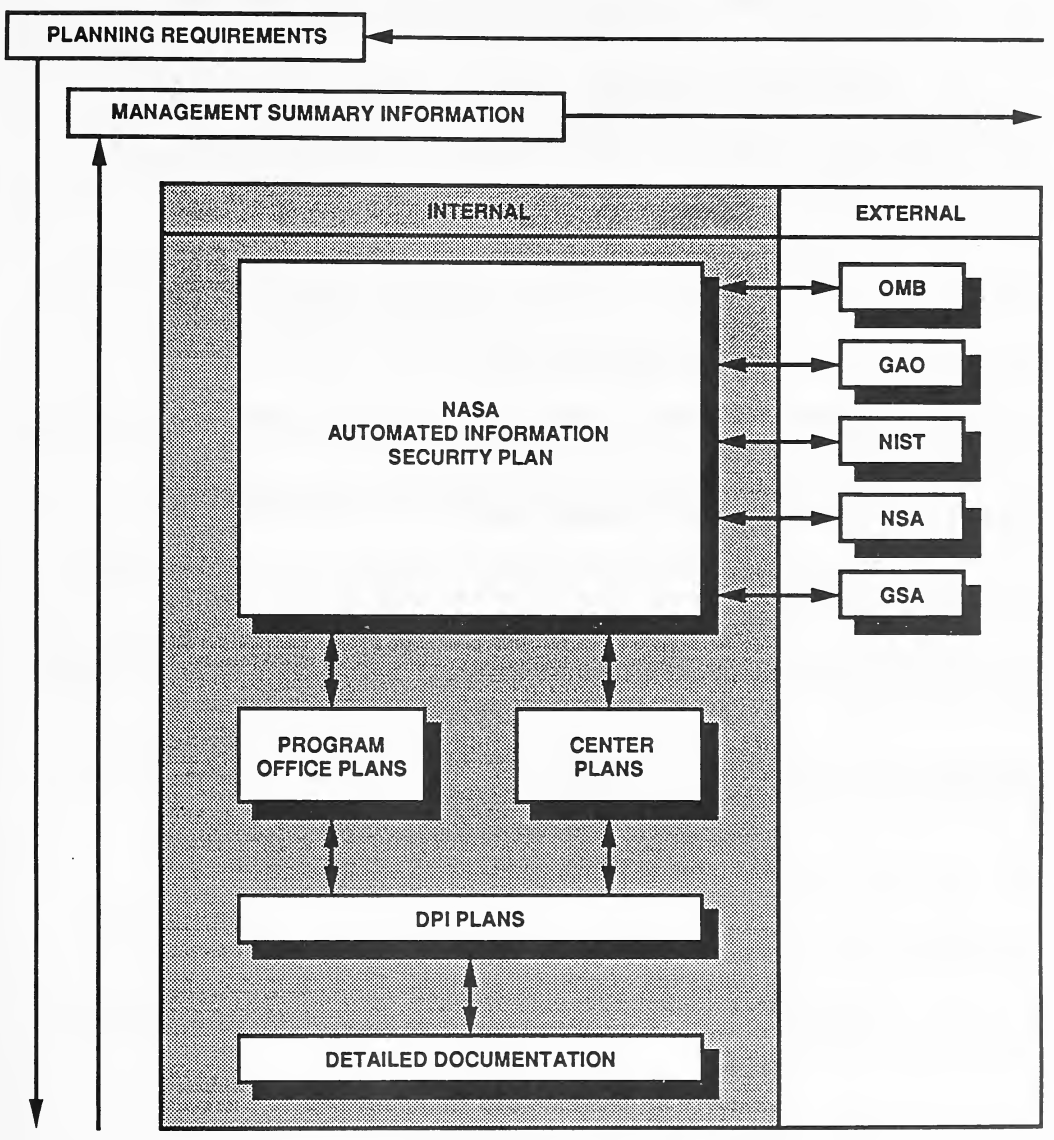
計画活動の関係を示す図です。上部では、右から来る矢印が PLANNING REQUIREMENTS(計画要件)の箱に入り、そこから出た線が左端を下へ延びて下端に矢印があります。その下では、左端を上る線が MANAGEMENT SUMMARY INFORMATION(管理概要情報)の箱に矢印で入り、その箱から右へ矢印が出ています。下の枠は INTERNAL(内部、左、網掛け)と EXTERNAL(外部、右)に分かれています。INTERNAL の中には上から、大きな箱 NASA AUTOMATED INFORMATION SECURITY PLAN(NASA 自動化情報セキュリティ計画)、それぞれ双方向の矢印でこれと結ばれた PROGRAM OFFICE PLANS(プログラムオフィス計画)と CENTER PLANS(センター計画)、その両方と双方向の矢印で結ばれた DPI PLANS(DPI 計画)、DPI PLANS と双方向の矢印で結ばれた DETAILED DOCUMENTATION(詳細文書)があります。EXTERNAL には OMB、GAO、NIST、NSA、GSA の箱があり、それぞれ NASA の計画と双方向の矢印で結ばれています。
CHAPTER 6. SPECIAL CONSIDERATIONS FOR MICROCOMPUTERS
第 6 章 マイクロコンピュータに関する特別な考慮事項
600 INTRODUCTION
600 はじめに
a. Security Principles. All the computer security policies, standards, responsibilities, guidelines, principles, and techniques covered in Chapters 1 through 5 apply to microcomputers. However, the application of those policies, standards, responsibilities, guidelines, principles, and techniques can vary dramatically.
a. セキュリティの原則。第 1 章から第 5 章で扱ったコンピュータセキュリティの方針、標準、責任、ガイドライン、原則、および技法は、すべてマイクロコンピュータに適用されます。ただし、これらの方針、標準、責任、ガイドライン、原則、および技法の適用方法は、大きく異なる場合があります。
b. Security Implications. Microcomputer characteristics result in security implications not normally found on mainframes:
b. セキュリティ上の影響。マイクロコンピュータの特性により、メインフレームでは通常見られないセキュリティ上の影響が生じます。
(1) The increased use of microcomputers on networks has exposed them to external threats.
(1) ネットワークでのマイクロコンピュータの使用が増えたことで、マイクロコンピュータは外部からの脅威にさらされるようになりました。
(2) Microcomputer operating systems have few, if any, security features designed into them.
(2) マイクロコンピュータのオペレーティングシステムは、設計に組み込まれたセキュリティ機能がほとんど、あるいはまったくありません。
(3) Most users do not understand the protective measures available for microcomputers.
(3) 大半の利用者は、マイクロコンピュータで利用できる保護対策を理解していません。
(4) Microcomputers normally operate in office areas and are, therefore, accessible to most employees.
(4) マイクロコンピュータは通常、オフィス区域で運用されるため、ほとんどの従業員が近づくことができます。
(5) Microcomputers are easy to move, and therefore can be easily stolen. In addition, moving a microcomputer can damage it internally.
(5) マイクロコンピュータは移動が容易であるため、容易に盗まれる可能性があります。さらに、マイクロコンピュータを移動すると、内部が損傷する場合があります。
(6) Most users do not understand that protective measures are necessary to safeguard the valuable data, and not just the loss of the computer hardware.
(6) 大半の利用者は、保護対策が、コンピュータのハードウェアの損失だけでなく、貴重なデータを防護するためにも必要であることを理解していません。
601 SPECIAL PROTECTIVE MEASURES FOR MICROCOMPUTERS
601 マイクロコンピュータの特別な保護対策
The following paragraphs identify security implications of microcomputers that require special protective measures.
以降の段落では、特別な保護対策を必要とするマイクロコンピュータのセキュリティ上の影響を特定します。
a. Technical Protective Measures. The following technical protective measures for microcomputers are available as software or hardware add-ons:
a. 技術的保護対策。マイクロコンピュータ向けの次の技術的保護対策は、ソフトウェアまたはハードウェアのアドオンとして利用できます。
(1) Sensitive information encryption.
(1) 機微な情報の暗号化。
(2) Computer access control using passwords.
(2) パスワードを用いたコンピュータのアクセス制御。
(3) Erased disk area overwrite.
(3) 消去したディスク領域の上書き。
(4) Disk backup.
(4) ディスクのバックアップ。
(5) Deleted files retrieval.
(5) 削除したファイルの回復。
(6) Authorized program execution control.
(6) 許可されたプログラムの実行制御。
b. Administrative Protective Measures. The following administrative protective measures are available for microcomputers:
b. 管理的保護対策。マイクロコンピュータ向けの次の管理的保護対策が利用できます。
(1) Virus-free microcomputer input verification.
(1) ウイルスに感染していないマイクロコンピュータへの入力の検証。
(2) Licenses for all software purchased for use.
(2) 使用のために購入したすべてのソフトウェアのライセンス。
c. Physical Protective Measures. The following physical protective measures are available for microcomputers:
c. 物理的保護対策。マイクロコンピュータ向けの次の物理的保護対策が利用できます。
(1) Keyboard lock.
(1) キーボードロック。
(2) Computer tie-down device.
(2) コンピュータ固定具。
(3) Diskette storage cabinet.
(3) フロッピーディスクの保管キャビネット。
(4) Removable hard disk.
(4) 着脱式ハードディスク。
(5) Lockable office or enclosure.
(5) 施錠できる事務室または囲い。
d. Personnel Protective Measures. Personnel security for microcomputers might include:
d. 要員に関する保護対策。マイクロコンピュータの要員のセキュリティには、次のものが含まれる場合があります。
(1) User Security Awareness and Training.
(1) 利用者のセキュリティ意識向上とトレーニング。
(2) Employee Screening and Monitoring.
(2) 従業員の審査と監視。
APPENDIX A. REFERENCES
付録 A 参考文献
A. FEDERAL DOCUMENTS
A. 連邦政府の文書
1.Executive Order 12356, "National Security Information," dated April 1982.
1.Executive Order 12356, "National Security Information," 1982 年 4 月付。
2.Office of Management and Budget (OMB) Circular A-130, "Management of Federal Information Resources," dated December 1985.
2.Office of Management and Budget (OMB) Circular A-130, "Management of Federal Information Resources," 1985 年 12 月付。
3.OMB Bulletin 88-16, "Guidance for Preparation and Submission of Security Plans for Federal Computer Systems Containing Sensitive Information," dated July 1988.
3.OMB Bulletin 88-16, "Guidance for Preparation and Submission of Security Plans for Federal Computer Systems Containing Sensitive Information," 1988 年 7 月付。
4.Office of Personnel Management Regulation, "Training Requirement for the Computer Security Act," dated July 1988.
4.Office of Personnel Management Regulation, "Training Requirement for the Computer Security Act," 1988 年 7 月付。
5.Title 41, Code of Federal Regulations, Chapter 201, Parts 201- 6 and 201-7, entitled "Protection of Personal Privacy," and "Security of Information Resource Systems," respectively.
5.Title 41, Code of Federal Regulations, Chapter 201, Parts 201- 6 and 201-7、それぞれ "Protection of Personal Privacy" および "Security of Information Resource Systems" と題するもの。
6.National Bureau of Standards (now the National Institute for Standards and Technology) "Computer Security Training Guidelines," dated July 1988.
6.National Bureau of Standards (now the National Institute for Standards and Technology) "Computer Security Training Guidelines," 1988 年 7 月付。
7.Federal Information Processing Standards Publication (FIPS PUB) 73, "Guidelines for Security of Computer Applications," dated June 1980.
7.Federal Information Processing Standards Publication (FIPS PUB) 73, "Guidelines for Security of Computer Applications," 1980 年 6 月付。
8.FIPS PUB 39, "Glossary for Computer Systems Security," dated February 1976.
8.FIPS PUB 39, "Glossary for Computer Systems Security," 1976 年 2 月付。
9.DOD Trusted Computer System Evaluation Criteria, DOD 5200.28-STD, dated December 1985.
9.DOD Trusted Computer System Evaluation Criteria, DOD 5200.28-STD, 1985 年 12 月付。
10.National Computer Security Center, NCSC-TG-004, Version 1, "Glossary of Computer Security Terms," dated October 1988.
10.National Computer Security Center, NCSC-TG-004, Version 1, "Glossary of Computer Security Terms," 1988 年 10 月付。
B. NASA MANAGEMENT INSTRUCTIONS AND HANDBOOKS
B. NASA 管理指示書およびハンドブック
1.NMI 1152.19, "NASA Information Security Program Committee."
1.NMI 1152.19, "NASA Information Security Program Committee."
2.NMI 1200.7, "NASA's Internal Control System."
2.NMI 1200.7, "NASA's Internal Control System."
3.NMI 1371.3, "Coordination of Foreign Visitor Activity."
3.NMI 1371.3, "Coordination of Foreign Visitor Activity."
4.NMI 1610.3, "Personnel Security Program."
4.NMI 1610.3, "Personnel Security Program."
5.NHB 1610.6, "NASA Personnel Security Handbook."
5.NHB 1610.6, "NASA Personnel Security Handbook."
6.NMI 1630.2, "Delegation of Authority to Certify for Access to Restricted Data."
6.NMI 1630.2, "Delegation of Authority to Certify for Access to Restricted Data."
7.NHB 1640.4, "NASA Information Security Program."
7.NHB 1640.4, "NASA Information Security Program."
8.NMI 1640.7, "Delegation of Authority to Make Determinations in Original Classification Matters."
8.NMI 1640.7, "Delegation of Authority to Make Determinations in Original Classification Matters."
9.NMI 1650.1, "Industrial Security Policies and Procedures."
9.NMI 1650.1, "Industrial Security Policies and Procedures."
10.NHB 2410.1, "Information Processing Resources Management."
10.NHB 2410.1, "Information Processing Resources Management."
11.NMI 2410.7, "Assuring the Security and Integrity of NASA Automated Information Resources."
11.NMI 2410.7, "Assuring the Security and Integrity of NASA Automated Information Resources."
12.NMI 2520.1, "Communications System Management."
12.NMI 2520.1, "Communications System Management."
13.NMI 9810.1, "The NASA Investigations Program."
13.NMI 9810.1, "The NASA Investigations Program."
C. NASA HEADQUARTERS IRM OFFICE DOCUMENTS
C. NASA 本部 IRM 室の文書
NASA Computer Security Awareness and Training (CSAT) Guide, dated April, 1990.
NASA Computer Security Awareness and Training (CSAT) Guide、1990 年 4 月付。
APPENDIX B. ABBREVIATIONS
付録 B 略語
| Abbreviation | Meaning |
|---|---|
| ADP | Automatic Data Processing |
| AIS | Automated Information System |
| AOSS | Automated Office Support Systems |
| ARC | Ames Research Center |
| CAI | Computer-Assisted Instruction |
| CCSM | (NASA) Center Computer Security Manager |
| CCSP | (Field) Center Computer Security Plan |
| COMSEC | Communications Security |
| CPU | Central Processing Unit |
| CRT | Cathode Ray Tube |
| CSAT | Computer Security Awareness and Training |
| CSC | Computer Security Coordinator |
| CSIR | Computer Security Incident Response |
| CSM | Computer Security Manager |
| CSP | Computer Security Plan |
| DAA | Designated Approving Authority |
| DBMS | Data Base Management System |
| DOC | Department of Commerce |
| DOE | Department of Energy |
| DOD | Department of Defense |
| DOJ | Department of Justice |
| DPI | Data Processing Installation |
| DPI-CSO | Data Processing Installation Computer Security Official |
| DPI-CSP | Data Processing Installation Computer Security Plan |
| E.O. | Executive Order |
| FBI | Federal Bureau of Investigation |
| FIPS PUB | Federal Information Processing Standard Publication |
| FIRMR | Federal Information Resources Management Regulation |
| FY | Fiscal Year |
| GSA | General Services Administration |
| GSFC | Goddard Space Flight Center |
| HQ | Headquarters (NASA) |
| IDS | Intrusion Detection System |
| IRM | Information Resources Management |
| ITSP | Information Technology Systems Plan |
| LaRC | Langley Research Center |
| LCM | Life-Cycle Management |
| LeRC | Lewis Research Center |
| JPL | Jet Propulsion Laboratory |
| JSC | Lyndon B. Johnson Space Center |
| KSC | John F. Kennedy Space Center |
| MCSC | Microcomputer Security Coordinator |
| MSFC | George C. Marshall Space Flight Center |
| NASA | National Aeronautics and Space Administration |
| NCSC | National Computer Security Center |
| NHB | NASA Handbook |
| NIST | National Institute of Standards and Technology |
| NMI | NASA Management Instruction |
| NTISSC | National Telecommunications and Information Systems Security Committee |
| NTISSI | National Telecommunications and Information Systems Security Instruction |
| NSA | National Security Agency |
| NSDD | National Security Decision Directive |
| OMB | Office of Management and Budget |
| OPM | Office of Personnel Management |
| OPSEC | Operations Security |
| PC | Personal Computer |
| PCL | Personnel (Security) Clearance |
| PDS | Protected Distribution System |
| PO-CSM | (NASA HQ) Program Office Computer Security Manager |
| PO-CSP | (NASA HQ) Program Office Computer Security Plan |
| SAISS | Subcommittee on Automated Information Systems Security (NTISSC) |
| SSC | John C. Stennis Space Center |
| U.S.C. | United States Code |
| 略語 | 意味 |
|---|---|
| ADP | 自動データ処理 |
| AIS | 自動化情報システム |
| AOSS | 自動化事務支援システム |
| ARC | エイムズ研究センター |
| CAI | コンピュータ支援教育 |
| CCSM | (NASA)センターコンピュータセキュリティ管理者 |
| CCSP | (現場)センターコンピュータセキュリティ計画 |
| COMSEC | 通信セキュリティ |
| CPU | 中央処理装置 |
| CRT | ブラウン管 |
| CSAT | コンピュータセキュリティ意識向上およびトレーニング |
| CSC | コンピュータセキュリティコーディネーター |
| CSIR | コンピュータセキュリティインシデント対応 |
| CSM | コンピュータセキュリティ管理者 |
| CSP | コンピュータセキュリティ計画 |
| DAA | 承認権限者 |
| DBMS | データベース管理システム |
| DOC | 商務省 |
| DOE | エネルギー省 |
| DOD | 国防総省 |
| DOJ | 司法省 |
| DPI | データ処理施設 |
| DPI-CSO | データ処理施設コンピュータセキュリティ責任者 |
| DPI-CSP | データ処理施設コンピュータセキュリティ計画 |
| E.O. | 大統領令 |
| FBI | 連邦捜査局 |
| FIPS PUB | 連邦情報処理標準刊行物 |
| FIRMR | 連邦情報資源管理規則 |
| FY | 会計年度 |
| GSA | 一般調達局 |
| GSFC | ゴダード宇宙飛行センター |
| HQ | (NASA)本部 |
| IDS | 侵入検知システム |
| IRM | 情報資源管理 |
| ITSP | 情報技術システム計画 |
| LaRC | ラングレー研究センター |
| LCM | ライフサイクル管理 |
| LeRC | ルイス研究センター |
| JPL | ジェット推進研究所 |
| JSC | リンドン・B・ジョンソン宇宙センター |
| KSC | ジョン・F・ケネディ宇宙センター |
| MCSC | マイクロコンピュータセキュリティコーディネーター |
| MSFC | ジョージ・C・マーシャル宇宙飛行センター |
| NASA | 米国航空宇宙局 |
| NCSC | 国家コンピュータセキュリティセンター |
| NHB | NASA ハンドブック |
| NIST | 国立標準技術研究所 |
| NMI | NASA 管理指示書 |
| NTISSC | 国家電気通信・情報システムセキュリティ委員会 |
| NTISSI | 国家電気通信・情報システムセキュリティ指示書 |
| NSA | 国家安全保障局 |
| NSDD | 国家安全保障決定指令 |
| OMB | 行政管理予算局 |
| OPM | 人事管理局 |
| OPSEC | 運用セキュリティ |
| PC | パーソナルコンピュータ |
| PCL | 要員(セキュリティ)クリアランス |
| PDS | 保護された配線システム |
| PO-CSM | (NASA HQ)プログラム室コンピュータセキュリティ管理者 |
| PO-CSP | (NASA HQ)プログラム室コンピュータセキュリティ計画 |
| SAISS | 自動化情報システムセキュリティ小委員会(NTISSC) |
| SSC | ジョン・C・ステニス宇宙センター |
| U.S.C. | 合衆国法典 |
APPENDIX C. DEFINITIONS
付録 C 定義
ACCEPTABLE RISK - A level of risk at which there is reasonable assurance of management acceptance. In practice, acceptability of risk is a judgement call, based on local details (e.g., security specifications, systems testing results, appropriateness and completeness of the requirements definitions, perceptions of the threat environments, and compliance with applicable policies).
ACCEPTABLE RISK - 管理者による受け入れが合理的に確実であるリスクの水準。実際には、リスクの受け入れ可能性は、現地の詳細(たとえば、セキュリティ仕様、システムテストの結果、要件定義の適切さと完全さ、脅威環境の認識、該当する方針への準拠)に基づく判断によります。
ACCESS CONTROL - The process of limiting access to information or to resources of a computer system to authorized users.
ACCESS CONTROL - 情報またはコンピュータシステムの資源へのアクセスを、許可された利用者に限定するプロセス。
ACCESS CONTROL MEASURES - Hardware and software features, physical controls, operating procedures, management procedures, and various combinations of these designed to detect or prevent unauthorized access to a computer system and to enforce access control.
ACCESS CONTROL MEASURES - コンピュータシステムへの不正アクセスを検知または防止し、アクセス制御を実施するために設計された、ハードウェアとソフトウェアの機能、物理的管理策、運用手順、管理手順、およびそれらのさまざまな組合せ。
ACCOUNTABILITY - The property that enables activities on a computer system to be traced to individuals who can then be held responsible for their activities.
ACCOUNTABILITY - コンピュータシステム上の活動を個人に追跡でき、その個人にそれらの活動の責任を負わせることができるようにする特性。
ACCOUNTABILITY INFORMATION - A set of records, often referred to as an audit trail, that provides documentary evidence of processing, or other actions related to the security of a computer system.
ACCOUNTABILITY INFORMATION - 監査証跡と呼ばれることの多い、コンピュータシステムのセキュリティに関連する処理またはその他の行為の文書化された証拠を提供する、一連の記録。
ACCREDITATION - The formal declaration by a designated official that an automated information system or network is approved to operate:
ACCREDITATION - 自動化情報システムまたはネットワークが、次の条件で運用することを承認されたという、指定された職員による正式な宣言:
•In a particular security mode;
•特定のセキュリティモードで。
•With a prescribed set of technical and nontechnical security safeguards;
•規定された一連の技術的および非技術的なセキュリティ防護策を伴って。
•Against a defined threat;
•定義された脅威に対して。
•In a given operational environment;
•所与の運用環境で。
•Under a stated operational concept;
•定められた運用概念の下で。
•With stated interconnections to other automatic information systems or networks; and
•ほかの自動化情報システムまたはネットワークとの定められた相互接続を伴います。
•At an acceptable level of risk for which the accrediting official has formally assumed responsibility.
•承認を行う職員が正式に責任を負った、受け入れ可能なリスクの水準で。
The accreditation statement affixes security responsibility with the accrediting official and shows that appropriate care has been taken for security.
承認の記述は、セキュリティに対する責任を承認を行う職員に帰属させるものであり、セキュリティについて適切な注意が払われたことを示します。
ADMINISTRATIVE SECURITY - The management procedures and constraints, operational procedures, accountability procedures, and supplemental controls established to provide an acceptable level of protection for classified information.
ADMINISTRATIVE SECURITY - 機密情報に対して受け入れ可能な水準の保護を提供するために確立された、管理手順と制約、運用手順、説明責任の手順、および補足的な管理策。
APPLICATION - A set of commands, instructions, and procedures, usually in software, which cause a computer system to process information. To avoid confusion in this Handbook, the phrase "automated application" is normally used.
APPLICATION - コンピュータシステムに情報を処理させる、通常はソフトウェアの形をとる、一連のコマンド、命令、および手順。このハンドブックでは混乱を避けるため、通常、「自動化アプリケーション」という言い方を用います。
APPLICATION INTERNAL CONTROLS - Security controls in the application software. The objectives of these controls include information validation, user identity verification, user service authorization verification, journaling, variance detection, and encryption.
APPLICATION INTERNAL CONTROLS - アプリケーションソフトウェア内のセキュリティ管理策。これらの管理策の目的には、情報の妥当性確認、利用者の本人確認、利用者のサービス認可の確認、ジャーナリング、差異の検知、および暗号化が含まれます。
APPROPRIATE - Actions, policies, procedures, or events that are reasonably defensible, based on local environments, risk assessments, and generally accepted practices. Since the NASA Computer Security Program Manager does not and cannot prescribe sufficient and reasonable detailed procedures for all situations NASA-wide, local managers must make many decisions concerning the appropriateness of local actions, policies, procedures, and events. These decisions will be discussed during regular management reviews by NASA HQ personnel.
APPROPRIATE - 現地の環境、リスクアセスメント、および一般に受け入れられている慣行に基づいて、合理的に擁護できる措置、方針、手順、または事象。NASA コンピュータセキュリティプログラム管理者は、NASA 全体のあらゆる状況について十分かつ合理的な詳細手順を規定しておらず、規定することもできないため、現地の管理者は、現地の措置、方針、手順、および事象の適切さに関して、多くの決定を行わなければなりません。これらの決定は、NASA HQ の職員による定期的な管理レビューで議論されます。
ASSURANCE TESTING - A process used to determine that the security features of a system are implemented as designed, and that they are adequate for the proposed environment. This process may include hands-on functional testing, penetration testing, and/or verification.
ASSURANCE TESTING - システムのセキュリティ機能が設計どおりに実装されていること、およびそれらが想定される環境に対して適切であることを判断するために用いられるプロセス。このプロセスには、実機での機能テスト、ペネトレーションテスト、または検証が含まれる場合があります。
AUTHENTICATION - The act of verifying the claimed identity of an individual, station, or originator.
AUTHENTICATION - 個人、端末、または発信者の主張された識別情報を検証する行為。
AUTHORIZATION - The privilege granted to an individual by a designated official to access information based upon the individual's clearance and need-to-know.
AUTHORIZATION - 指定された職員が、個人のクリアランスと知る必要性に基づいて、その個人に情報へアクセスする特権を付与すること。
AUTOMATED INFORMATION - All recorded information regardless of its media form (e.g., audible tone; paper; magnetic core, tape, or disk; microform; electronic signal; and visual/screen displays) that is processed by or stored for the purpose of being processed by a computer system. The terms "automated information," "automated data," "information," and "data" are considered synonymous and used interchangeably in this Handbook.
AUTOMATED INFORMATION - コンピュータシステムによって処理される、または処理を目的として保存される、媒体の形態(たとえば、可聴音、紙、磁気コア・テープ・ディスク、マイクロフォーム、電子信号、視覚・画面表示)を問わない、すべての記録された情報。「自動化情報」、「自動化データ」、「情報」、「データ」という用語は、このハンドブックでは同義とみなされ、互換的に使用されます。
AUTOMATED INFORMATION RESOURCES - Data and information; computers, ancillary equipment, software, firmware, and similar procedures; services, including support services; and related resources used for the acquisition, storage, manipulation, management, movement, control, display, switching, interchange, transmission, or reception of data or information.
AUTOMATED INFORMATION RESOURCES - データと情報、コンピュータ、補助機器、ソフトウェア、ファームウェア、および類似の手順、支援サービスを含むサービス、ならびに、データまたは情報の取得、保存、操作、管理、移動、制御、表示、交換、相互変換、送信、または受信に使用される関連資源。
AUTOMATED OFFICE SUPPORT SYSTEMS (AOSS) - AOSS includes stand-alone microprocessors, word processors, memory typewriters, and terminals connected to mainframes.
AUTOMATED OFFICE SUPPORT SYSTEMS (AOSS) - AOSS には、スタンドアロンのマイクロプロセッサ、ワードプロセッサ、メモリ付きタイプライター、およびメインフレームに接続された端末が含まれます。
AVAILABILITY - The state that exists when data can be obtained within an acceptable period of time.
AVAILABILITY - データを許容できる時間内に取得できるときに存在する状態。
CATEGORY - A grouping of information for which specific labelling and/or handling must be used and which should influence the choice of computer security controls. This Handbook lists 13 of these information categories.
CATEGORY - 特定のラベル付けまたは取扱い、あるいはその両方を用いなければならず、コンピュータセキュリティ管理策の選択に影響を与えるべき、情報のまとまり。このハンドブックでは、これらの情報区分を 13 挙げています。
CENTER - A major NASA site as defined in NMI 1101.2, "NASA Organization and Definition of Terms." The following are considered NASA centers:
CENTER - NMI 1101.2, "NASA Organization and Definition of Terms" で定義された、NASA の主要な拠点。次のものが NASA のセンターとみなされます。
•Ames Research Center (ARC)
•Ames Research Center (ARC)
•George C. Marshall Space Flight Center (MSFC)
•George C. Marshall Space Flight Center (MSFC)
•Goddard Space Flight Center (GSFC)
•Goddard Space Flight Center (GSFC)
•John C. Stennis Space Center (SSC)
•John C. Stennis Space Center (SSC)
•John F. Kennedy Space Center (KSC)
•John F. Kennedy Space Center (KSC)
•Langley Research Center (LaRC)
•Langley Research Center (LaRC)
•Lewis Research Center (LeRC)
•Lewis Research Center (LeRC)
•Lyndon B. Johnson Space Center (JSC)
•Lyndon B. Johnson Space Center (JSC)
•NASA Headquarters (HQ)
•NASA Headquarters (HQ)
CERTIFICATION - A written acknowledgement (by a NASA management official) that there is reasonable assurance that an automated application and its automated environment:
CERTIFICATION - 自動化アプリケーションとその自動化された環境について、次のことが合理的に確信できるという、(NASA の管理職員による)書面による確認:
•Meet all applicable NASA and other Federal policies, regulations, and standards covering security; and
•セキュリティに関する、該当するすべての NASA およびその他の連邦政府の方針、規則、標準を満たしていること。
•Have been tested and technically evaluated thoroughly enough to demonstrate that the installed security controls are adequate.
•導入されたセキュリティ管理策が適切であることを示すのに十分なだけ、テストおよび技術的評価が行われていること。
Certification is based on applicable vulnerability analyses, risk analyses, management reviews, testing reports, etc. Certification is the final management decision point in the quality control process which assures the automated application and the current operational environment (such as, hardware, operating systems, communications systems, and multiuser security packages) are sufficiently secure to support that automated application.
認証は、該当する脆弱性分析、リスク分析、管理レビュー、テスト報告書などに基づきます。認証は、自動化アプリケーションと現在の運用環境(たとえば、ハードウェア、オペレーティングシステム、通信システム、マルチユーザー向けセキュリティパッケージ)が、その自動化アプリケーションを支えるのに十分に安全であることを確保する品質管理プロセスにおける、最終的な管理上の決定点です。
CLASSIFIED COMPUTER SECURITY PROGRAM - All of the technological safeguards and managerial procedures established and applied to computer facilities and computer systems (including computer hardware, software, and data) in order to ensure the protection of classified information.
CLASSIFIED COMPUTER SECURITY PROGRAM - 機密情報の保護を確実にするために、コンピュータ施設とコンピュータシステム(コンピュータのハードウェア、ソフトウェア、およびデータを含む)に対して確立され適用される、技術的な防護策と管理手順のすべて。
CLASSIFIED DATA/CLASSIFIED INFORMATION - Top Secret, Secret, and/or Confidential information, regardless of category, for which NASA is responsible, and which requires safeguarding in the interest of national security.
CLASSIFIED DATA/CLASSIFIED INFORMATION - NASA が責任を負い、国家安全保障のために保護が必要な、区分を問わない、Top Secret、Secret、または Confidential の情報。
CLEARING - The overwriting of information on magnetic media such that the media may be reused. (This does not change the classification level of the media.) For example, volatile memory can be "cleared" by removing power from the unit for a minimum of one minute.
CLEARING - 磁気媒体を再利用できるようにするため、媒体上の情報を上書きすること。(これにより、媒体の機密区分のレベルは変わりません。)たとえば、揮発性メモリは、装置の電源を最低 1 分間切ることで「クリア」できます。
COMMUNICATIONS SECURITY (COMSEC) - The protection resulting from all measures designed to deny unauthorized persons information of value that might be derived from the possession and study of telecommunications, or to mislead unauthorized persons in their interpretation of the results of such possession and study.
COMMUNICATIONS SECURITY (COMSEC) - 電気通信を入手して調べることで得られる価値ある情報を権限のない者に知られないようにする、または、そのように入手して調べた結果の解釈について権限のない者を誤らせることを目的とする、すべての対策によって得られる保護。
COMPLIANCE REVIEW - A review and examination of records, procedures, and review activities at a DPI in order to assess the computer security posture and ensure compliance with this Handbook. This review is normally conducted by the CCSM at a field center having cognizance over the DPI and having management responsibilities for implementing this Handbook.
COMPLIANCE REVIEW - コンピュータセキュリティの態勢を評価し、このハンドブックへの準拠を確保するため、DPI で記録、手順、およびレビュー活動をレビューおよび検査すること。このレビューは通常、その DPI を所管し、このハンドブックを実施する管理上の責任を負う現場センターの CCSM が実施します。
COMPROMISE - The disclosure of classified data to persons who are not authorized to receive such data.
COMPROMISE - 機密データを、そのデータの受領を許可されていない者に開示すること。
COMPROMISING EMANATIONS (TEMPEST) - Unintentional data-related or intelligence-bearing signals that, if intercepted and analyzed, could disclose classified information being transmitted, received, handled, or otherwise processed by any information processing equipment.
COMPROMISING EMANATIONS (TEMPEST) - 傍受されて分析された場合に、情報処理装置が送信、受信、取り扱い、またはその他の方法で処理している機密情報を開示するおそれのある、意図しないデータ関連信号または情報を伝える信号。
COMPUTER FACILITY - One or more rooms, generally contiguous, containing the elements of a computer system.
COMPUTER FACILITY - コンピュータシステムの要素を収容する、通常は隣接した 1 つまたは複数の部屋。
COMPUTER SECURITY INCIDENT - An adverse event associated with a computer system that results in:
COMPUTER SECURITY INCIDENT - コンピュータシステムに関連する、次のいずれかをもたらす悪影響のある事象:
•A failure to comply with security regulations or directives;
•セキュリティに関する規則または指令に従わないこと。
•An attempted, suspected, or actual compromise of sensitive or classified information;
•機微な情報または機密情報の危殆化の試み、疑い、または実際の危殆化。
•The waste, fraud, abuse, loss, or damage of Government property or information; or
•政府の財産または情報の浪費、不正、濫用、損失、または損害。
•The discovery of a vulnerability.
•脆弱性の発見。
COMPUTER SYSTEM - A logical aggregation of automated information resources into a related set of processing capabilities performing one or a series of generally related tasks. For example, interconnected mainframe computers, served by front-end communications processors, maintained and operated under a specific contract, and associated peripheral input/output and storage devices, performing a number of administrative tasks could be considered a "computer system." A single minicomputer supporting a variety of graphics work stations and/or controlling experimental equipment could also be considered a "computer system." Included in this definition are word processors, microprocessors, personal computers, controllers, AOSS, memory typewriters, and other stand-alone or special computer systems.
COMPUTER SYSTEM - 関連する一連の処理能力を実行する自動化情報資源を論理的に集約したもので、通常は互いに関連する1つまたは複数のタスクを実行します。たとえば、フロントエンド通信プロセッサーに接続され、特定の契約の下で保守および運用され、関連する周辺入出力装置および記憶装置を備え、さまざまな管理業務を実行する相互接続されたメインフレームコンピュータは、「コンピュータシステム」とみなすことができます。さまざまなグラフィックスワークステーションを支援し、または実験装置を制御する単一のミニコンピュータも、「コンピュータシステム」とみなすことができます。この定義には、ワードプロセッサ、マイクロプロセッサ、パーソナルコンピュータ、コントローラ、AOSS、メモリ付きタイプライター、およびその他のスタンドアロンまたは特殊なコンピュータシステムが含まれます。
CONFIDENTIALITY - The state that exists when data are held in confidence and are protected from unauthorized disclosure.
CONFIDENTIALITY - データが内密に保持され、不正な開示から保護されているときに存在する状態。
CONFIGURATION MANAGEMENT - Control of changes made to a computer system's hardware, software, and/or documentation (including an inventory of the system elements) throughout the development and operational life of the system.
CONFIGURATION MANAGEMENT - システムの開発と運用の全期間にわたる、コンピュータシステムのハードウェア、ソフトウェア、または文書(システム要素の目録を含む)、あるいはそのすべてに加えられる変更の管理。
CONTINGENCY PLAN - A document, developed in conjunction with application owners and maintained at the primary and backup computer installation, which describes procedures and identifies the personnel necessary to respond to abnormal situations (including disasters). Contingency plans help managers ensure that computer application owners continue to process (with or without computers) mission-critical applications in the event that computer support is interrupted.
CONTINGENCY PLAN - アプリケーション所有者と協力して作成され、主たるコンピュータ設備とバックアップ用コンピュータ設備に保管される文書で、異常な状況(災害を含む)に対応するための手順を記述し、必要な要員を特定します。コンティンジェンシープランは、コンピュータによる支援が中断した場合でも、コンピュータアプリケーション所有者がミッションクリティカルなアプリケーションの処理を(コンピュータを使用するかどうかにかかわらず)続けられるよう、管理者を支援します。
CRITICAL RESOURCES - Those physical and information assets required for the performance of the installation's mission.
CRITICAL RESOURCES - 設備のミッションの遂行に必要な、物理的資産と情報資産。
CRITICALITY RATING - An importance-related and/or time-related designation assigned to a computer application that indicates when it must be back in operation to avoid mission impacts after a disaster or interruption in computer support services at a multiuser installation. To facilitate prioritized recovery procedures and for operating at offsite backup facilities in a degraded mode, computer applications should be assigned criticality ratings of varying importance (e.g., most critical, critical, important, deferrable). Applications with the same criticality rating should be additionally ranked (e.g., numerically) according to installation-determined processing priorities and perceptions of importance.
CRITICALITY RATING - コンピュータアプリケーションに割り当てられる重要度または時間、あるいはその両方に関する指定であり、マルチユーザー設備でコンピュータ支援サービスが災害または中断に見舞われた後、ミッションへの影響を避けるために、いつまでに運用を再開しなければならないかを示すものです。優先順位を付けた復旧手順を容易にし、オフサイトのバックアップ施設で縮退モードで運用するため、コンピュータアプリケーションには、重要度の異なる重大度区分(たとえば、最重要、重大、重要、延期可能)を割り当てるべきです。同じ重大度区分のアプリケーションは、設備が定める処理の優先順位と重要性の認識に従って、さらに(たとえば数値で)順位付けすべきです。
DATA PROCESSING INSTALLATION (DPI) - A logical grouping of one or more computer systems with common environmental and/or security characteristics for computer security management purposes.
DATA PROCESSING INSTALLATION (DPI) - コンピュータセキュリティ管理の目的のための、共通の環境またはセキュリティの特性を持つ、1 つ以上のコンピュータシステムの論理的なまとまり。
DESTRUCTION - The physical alteration of computer system media or computer system components such that they can no longer be used for storage or retrieval of information.
DESTRUCTION - コンピュータシステムの媒体またはコンピュータシステムの構成要素を、情報の保存や取り出しにもはや使用できないように物理的に変えること。
DISASTER RECOVERY PLANS - Documents containing procedures for emergency response, extended backup operations, and post-disaster recovery should a computer installation experience a partial or total loss of computer resources and physical facilities. The primary objectives of these plans, in conjunction with contingency plans, are to provide reasonable assurance that a computer installation can recover from such incidents, continue to process mission-critical applications in a degraded mode and return to a normal mode of operation within a reasonable time. Such plans are a protective measure generally applied based on assessments of risk, cost, benefit, and feasibility and an evaluation of other protective measures in place.
DISASTER RECOVERY PLANS - コンピュータ設備がコンピュータ資源および物理的施設の一部または全部を失った場合の、緊急対応、長期のバックアップ運用、災害後の復旧の手順を含む文書。これらの計画の主な目的は、コンティンジェンシープランとあわせて、コンピュータ設備がそのようなインシデントから復旧し、ミッションクリティカルなアプリケーションを縮退モードで処理し続け、妥当な期間内に通常の運用モードに戻れることについて、妥当な保証を提供することです。このような計画は、リスク、費用、便益、実行可能性の評価と、すでに講じられているほかの保護対策の評価に基づいて適用される保護対策であるのが一般的です。
EXCLUSION AREA - A security area for the protection of classified materials where mere access to the area would result in access to those classified materials.
EXCLUSION AREA - 機密資料を保護するためのセキュリティ区域であり、その区域に立ち入るだけで、それらの機密資料にアクセスできてしまう区域。
INFORMATION - The terms "information," "data," "material," "documents," and "matter" are considered synonymous and used interchangeably in this Handbook. They refer to all data regardless of its physical form (e.g., data on paper printouts, tapes, disks or disk packs, in memory chips, in Random Access Memory (RAM), in Read Only Memory (ROM), on microfilm or microfiche, on communication lines, and on display terminals).
INFORMATION - 「情報」、「データ」、「資料」、「文書」、「事項」という用語は、このハンドブックでは同義とみなされ、互換的に使用されます。これらは、物理的な形態(たとえば、紙の印刷物、テープ、ディスクまたはディスクパック、メモリチップ、ランダムアクセスメモリ(RAM)、読み出し専用メモリ(ROM)、マイクロフィルムまたはマイクロフィッシュ、通信回線、表示端末上のデータ)を問わない、すべてのデータを指します。
INFORMATION RESOURCES MANAGEMENT (IRM) - The planning, budgeting, organizing, directing, training, and control of information and related resources (such as personnel, equipment, funds, and technology).
INFORMATION RESOURCES MANAGEMENT (IRM) - 情報と関連する資源(たとえば、要員、設備、資金、技術)の、計画、予算編成、組織化、指揮、トレーニング、および管理。
INSTALLATION SECURITY OFFICER - The designated Security Officers at a NASA Center who are responsible for the center's personnel, physical, information, industrial, and operations security programs.
INSTALLATION SECURITY OFFICER - NASA センターで指定されたセキュリティ担当官であり、そのセンターの要員、施設、情報、産業、および運用に関する各セキュリティプログラムに責任を負う者。
INTEGRITY - The state that exists when computerized data are the same as those in the source documents or have been correctly computed from source data and have not been exposed to accidental or malicious alteration or destruction.
INTEGRITY - コンピュータ化されたデータが、原本の文書と同じであるか、原本のデータから正しく計算されており、偶発的または悪意のある改ざんや破壊にさらされていないときに存在する状態。
INTELLIGENCE INFORMATION - Classified information defined as intelligence information by Director of Central Intelligence Directive 1/19.
INTELLIGENCE INFORMATION - Director of Central Intelligence Directive 1/19 により諜報情報と定義された機密情報。
LABEL - The marking of an item of information to reflect its information category and/or security classification. An internal label is contained within the confines of the medium containing the information and reflects the classification and sensitivity of that information. An external label is a visible and readable marking on the outside of the medium (or the cover of the medium) that reflects the category and/or classification of the information within the medium.
LABEL - 情報の項目に、その情報区分または機密区分、あるいはその両方を反映するためにつけるマーキング。内部ラベルは、情報を含む媒体の範囲内に含まれ、その情報の機密区分と機微性を反映します。外部ラベルは、媒体の外側(または媒体のカバー)にある、目に見えて読み取れるマーキングで、媒体内の情報の区分または機密区分、あるいはその両方を反映します。
LIMITED AREA - A security area for the protection of classified matter where guards, security inspectors, or other internal controls can prevent access.
LIMITED AREA - 機密事項を保護するためのセキュリティ区域であり、警備員、保安検査官、またはその他の内部管理策により、アクセスを防止できる区域。
LONG-RANGE PLAN - A written description of the strategy for implementing a program covering the next 5 years.
LONG-RANGE PLAN - 今後 5 年間を対象とするプログラムを実施する戦略の、書面による記述。
MULTILEVEL SYSTEMS - Systems/networks that incorporate the mode of operation that allows two or more classification levels (including unclassified) of information to be processed simultaneously within the same system when some users are not cleared for all levels of information present.
MULTILEVEL SYSTEMS - 一部の利用者が、存在するすべてのレベルの情報についてクリアランスを持たない場合に、同じシステム内で 2 つ以上の機密区分レベル(非機密を含む)の情報を同時に処理できる運用モードを取り入れた、システムまたはネットワーク。
MANAGEMENT REVIEW - A review and examination of records, activities, policies, and procedures established by field centers to manage and coordinate computer security programs under their cognizance. This review is normally conducted by Headquarters personnel with NASA-wide computer security program management responsibilities.
MANAGEMENT REVIEW - 現場センターが、その管轄下のコンピュータセキュリティプログラムを管理し調整するために確立した、記録、活動、方針、および手順を調べて検討すること。このレビューは、通常、NASA 全体のコンピュータセキュリティプログラムを管理する責任を負う本部の職員が実施します。
MISSION-CRITICAL INFORMATION - Plain text or machine-encoded data that, as determined by competent authority (e.g., information owners), have high importance related to accomplishing a NASA mission and require special protection because unnecessary delays in processing could adversely affect the ability of NASA, an owner organization, or a NASA center to accomplish such missions.
MISSION-CRITICAL INFORMATION - 権限のある当局(たとえば、情報の所有者)が決定した、NASA のミッションの達成に関する重要度が高く、処理の不要な遅延が NASA、所有組織、または NASA センターのそうしたミッションを達成する能力に悪影響を及ぼし得るため、特別な保護を必要とする、平文または機械符号化されたデータ。
NETWORK - A communications medium and all components attached to that medium that are responsible for the transfer of information. Such components may include computer systems, packet switches, telecommunications controllers, key distribution centers, technical control devices, and other networks.
NETWORK - 通信媒体と、その媒体に接続され情報の転送を担う、すべての構成要素。そのような構成要素には、コンピュータシステム、パケット交換機、通信制御装置、鍵配布センター、技術管理装置、およびほかのネットワークが含まれる場合があります。
NON-FEDERAL PERSONNEL - Non-civil servant employees. The use of the term non-Federal personnel in paragraph 306 of this Handbook does not include foreign nationals.
NON-FEDERAL PERSONNEL - 公務員でない従業員。このハンドブックの段落 306 での連邦政府以外の要員という用語には、外国人は含まれません。
OPERATIONS SECURITY (OPSEC) - OPSEC is the process of denying adversaries information about friendly intentions, capabilities, plans and programs by identifying, controlling and protecting intelligence information and indicators associated with planning and conducting military operations as well as other defense activities not already afforded adequate protection as classified information.
OPERATIONS SECURITY (OPSEC) - OPSEC は、軍事作戦の計画と実施に関連する諜報情報および指標を特定し、管理し、保護するとともに、機密情報としてすでに十分な保護を受けていないその他の防衛活動に関連する諜報情報および指標を特定し、管理し、保護することによって、味方の意図、能力、計画、およびプログラムに関する情報を敵対者に与えないようにするプロセスです。
PASSWORD - A protected word, phrase, or a string of symbols that is used to authenticate the identity of a user.
PASSWORD - 利用者の識別情報を認証するために使われる、保護された単語、語句、または記号列。
PASSWORD SPACE - The total number of possible passwords that can be created by a given password generation scheme.
PASSWORD SPACE - 特定のパスワード生成方式で作成できる、可能なパスワードの総数。
PERSONNEL SCREENING - A protective measure applied to determine that an individual's access to sensitive information is admissible. The need for and extent of the screening process is normally based on an assessment of risk, cost, benefit, and feasibility, as well as other protective measures in place. Effective screening processes are applied in such a way as to allow a range of implementation, from minimal procedures to more stringent procedures commensurate with the sensitivity of the data to be accessed and the magnitude of harm or loss that could be caused by the individual.
PERSONNEL SCREENING - 個人による機微な情報へのアクセスが許容されることを判断するために適用される保護対策。審査プロセスの必要性と程度は、通常、リスク、費用、便益、実行可能性の評価と、すでに講じられているほかの保護対策に基づいて決まります。効果的な審査プロセスは、アクセスするデータの機微性と、その個人が引き起こし得る損害または損失の大きさに見合って、最小限の手順からより厳格な手順までの幅を持たせて実施できるように適用されます。
PERSONNEL SECURITY - The procedures established to ensure that all personnel who have access to classified information have the required authorization, as well as the appropriate clearances.
PERSONNEL SECURITY - 機密情報にアクセスするすべての要員が、適切なクリアランスに加えて、必要な許可を持つことを確実にするために確立された手順。
PHYSICAL SECURITY - The use of locks, guards, badges, alarms, procedures, and similar measures (alone or in combination) to control access to a computer system and related equipment, and structures from espionage, theft, waste, fraud, abuse, or damage by accident, fire, and environmental hazards.
PHYSICAL SECURITY - コンピュータシステムと関連機器および構造物へのアクセスを管理するとともに、スパイ行為、盗難、浪費、不正、濫用、または事故、火災、環境上の危険による損害から保護するために、錠、警備員、バッジ、警報、手順、および同様の対策を単独でまたは組み合わせて使用すること。
PROGRAM OFFICE (HEADQUARTERS) - A focal point within NASA HQ (such as Codes M, O, R, and S) with management control responsibility for research and development activity within their functional area at NASA field centers.
PROGRAM OFFICE (HEADQUARTERS) - NASA 本部内の窓口(Code M、O、R、S など)であり、NASA の現場センターにおける、それぞれの機能分野の研究開発活動について、管理統制の責任を負うもの。
PROPERTY PROTECTION AREA - An area set aside for the protection of property, as required by this Handbook.
PROPERTY PROTECTION AREA - このハンドブックの定めに従い、財産を保護するために設けられた区域。
PROTECT AS RESTRICTED DATA (PARD) - A handling method for computer-generated numerical data, or related information, which is not readily recognized as classified or unclassified because of the high volume of output and low density of potentially classified data. Information is designated as PARD because it has not had a sensitivity (classification) review and must be protected under a different set of security rules.
PROTECT AS RESTRICTED DATA (PARD) - コンピュータが生成した数値データまたは関連情報の取扱い方法で、出力量が多く、機密である可能性のあるデータの密度が低いために、機密か非機密かを容易に判別できないものに対するもの。情報は、機微性(機密区分)のレビューを受けておらず、別のセキュリティ規則の下で保護しなければならないため、PARD として指定されます。
PROTECTED DISTRIBUTION SYSTEM (PDS) - A telecommunications system to which acoustical, electrical, electromagnetic, and physical safeguards have been applied to permit its use for secure electrical or optical transmission of unencrypted classified information or sensitive unclassified information.
PROTECTED DISTRIBUTION SYSTEM (PDS) - 音響的、電気的、電磁的、および物理的な防護策が適用され、暗号化されていない機密情報または機微な非機密情報の、セキュアな電気的または光学的な送信に使用できるようにした通信システム。
PROTECTION INDEX - A measure of perceived risk determined from the combination of the clearance level of users and the classification of the data on the classified computer system. The determination of this index is described in Chapter 8.
PROTECTION INDEX - 機密コンピュータシステムの利用者のクリアランスレベルとデータの機密区分の組合せから決まる、認識されたリスクの尺度。この指標の決定方法は、第 8 章で説明します。
PROTECTION MEASURES - Physical, administrative, personnel, and technical security measures that, when applied separately or in combination, are designed to reduce the probability of harm, loss, damage to, or compromise of, a computer system or automated information.
PROTECTION MEASURES - 単独でまたは組み合わせて適用されたときに、コンピュータシステムまたは自動化情報の損害、損失、毀損、または危殆化の可能性を低減するように設計された、物理的、管理的、要員に関する、および技術的なセキュリティ対策。
QUALITATIVE RISK ASSESSMENT - A risk assessment that uses labels (such as, high, medium, and low), rather than actual numbers, to characterize anticipated likelihood and extent of harm to automated information resources.
QUALITATIVE RISK ASSESSMENT - 自動化情報資源に対して予想される損害の可能性と程度を、実際の数値ではなくラベル(高、中、低など)を用いて特徴づけるリスクアセスメント。
QUANTITATIVE RISK ASSESSMENT - A risk assessment that requires the use of actual numbers, calculations of Annual Loss Expectancy (ALE), and mathematical probabilities to characterize the anticipated likelihood and extent of harm to automated information resources.
QUANTITATIVE RISK ASSESSMENT - 自動化情報資源に対して予想される損害の可能性と程度を特徴づけるために、実際の数値、年間損失予測(ALE)の計算、および数学的な確率の使用を必要とするリスクアセスメント。
RECERTIFICATION - An ongoing assurance that a previously certified system has been periodically reviewed, that compliance with established protection policies and procedures remains in effect, and that security risks remain at an acceptable level.
RECERTIFICATION - 以前に認証されたシステムが定期的にレビューされていること、確立された保護の方針と手順への準拠が引き続き有効であること、およびセキュリティリスクが受け入れ可能な水準にとどまっていることについての、継続的な保証。
RISK ASSESSMENT - An identification of a specific computer facility's assets, the threats to these assets, and the computer facility's vulnerability to those threats. Risk assessment is a management tool that provides a systematic approach for:
RISK ASSESSMENT - 特定のコンピュータ施設の資産、それらの資産に対する脅威、およびそれらの脅威に対するコンピュータ施設の脆弱性の特定。リスクアセスメントは、次のことを行うための体系的な方法を提供する管理手段です。
•Determining the relative value and sensitivity of computer installation assets;
•コンピュータ設備の資産の相対的な価値と機微性を決定すること。
•Assessing vulnerabilities;
•脆弱性を評価すること。
•Assessing loss expectancy or perceived risk exposure levels;
•損失予測または認識されているリスクエクスポージャーの水準を評価すること。
•Assessing existing protection features and additional protection alternatives or acceptance of risk; and
•既存の保護機能と、追加の保護の選択肢またはリスクの受け入れを評価すること。
•Documenting management decisions.
•管理上の決定を文書化すること。
Decisions for implementing additional protection features are normally based on the existence of a reasonable ratio between cost/benefit of the safeguard and sensitivity/value of the assets to be protected. Risk assessments may vary from an informal review of a small-scale microcomputer installation to a more formal and fully-documented analysis (i.e, risk analysis) of a large-scale computer installation. Risk assessment methodologies may vary from qualitative or quantitative approaches to any combination of these two approaches.
追加の保護機能を実施するかどうかの決定は、通常、防護策の費用対効果と、保護対象となる資産の機微性・価値との間に妥当な関係があることに基づきます。リスクアセスメントは、小規模なマイクロコンピュータ設備に対する非公式なレビューから、大規模なコンピュータ設備に対する、より正式で完全に文書化された分析(すなわち、リスク分析)まで、さまざまな形をとり得ます。リスクアセスメントの方法論は、定性的または定量的な方法から、これら2つの方法の任意の組合せまで、さまざまです。
SANITIZATION - The elimination of classified information from a computer system or media associated with a computer system to permit the reuse of the computer system or media at a lower classification level, or to permit the release to uncleared personnel or personnel without the proper information access authorizations.
SANITIZATION - コンピュータシステムまたはコンピュータシステムに関連する媒体を、より低い機密区分レベルで再利用できるようにするため、あるいはクリアランスのない要員または適切な情報アクセス許可のない要員に引き渡せるようにするために、そのコンピュータシステムまたは媒体から機密情報を除去すること。
SECURITY AREA - A physically defined space containing classified matter (documents or material) subject to physical protection and personnel access controls.
SECURITY AREA - 物理的な保護と要員のアクセス管理の対象となる、機密事項(文書または資料)を収容する、物理的に画定された空間。
SECURITY DESIGN REVIEW - A review process in which the objective is to ascertain whether implemented protective measures meet the original system design and approved computer application security requirements. The security design review may be a separate activity or an integral function of the overall application system design review activity.
SECURITY DESIGN REVIEW - 実施された保護対策が、当初のシステム設計および承認されたコンピュータアプリケーションのセキュリティ要件を満たしているかどうかを確認することを目的とするレビュープロセス。セキュリティ設計レビューは、独立した活動の場合も、アプリケーションシステム全体の設計レビュー活動の不可欠な機能の場合もあります。
SENSITIVE ADP POSITION - A personnel position that cannot be occupied until completion of an employee background check.
SENSITIVE ADP POSITION - 従業員の身元調査が完了するまで就くことのできない要員の職位。
SENSITIVE INFORMATION - Plain text or machine-encoded data that, as determined by competent authority (e.g., information owners), have relative sensitivity and require mandatory protection because of statutory or regulatory restrictions (e.g., "for official use only" information, information subject to the Privacy Act of 1974, etc.) or require a degree of discretionary protection because inadvertent or deliberate misuse, alteration, disclosure, or destruction could adversely affect National or other NASA interests (e.g., program- critical information or controlled scientific and technical information, which may include computer codes (computer programs) used to process such information).
SENSITIVE INFORMATION - 権限のある当局(たとえば、情報の所有者)が決定した相対的な機微性を持つ平文または機械符号化されたデータであり、法令上または規則上の制限(たとえば、「公務限定」の情報、1974年プライバシー法の対象となる情報など)により必須の保護を必要とするもの、または、不注意もしくは意図的な誤用、改ざん、開示、破壊が国家またはその他のNASAの利益に悪影響を及ぼし得るため、裁量による一定程度の保護を必要とするもの(たとえば、プログラムにとって重要な情報や、そのような情報を処理するために使用されるコンピュータコード(コンピュータプログラム)を含む場合がある、管理対象の科学技術情報)です。
SENSITIVITY AND/OR CRITICALITY LEVELS - Four NASA hierarchical groupings (labeled 0 through 3) used to help determine which computer security controls are needed.
SENSITIVITY AND/OR CRITICALITY LEVELS - どのコンピュータセキュリティ管理策が必要かを判断する助けとして用いられる、NASA の 4 つの階層的なまとまり(0 から 3 までのラベル)。
SHORT-RANGE PLAN - A 1-year (i.e., tactical) plan.
SHORT-RANGE PLAN - 1 年間(すなわち、戦術的)の計画。
SIGNIFICANT CHANGE - A change in a computer installation that could impact overall processing requirements and conditions or installation security requirements (e.g., adding a local area network; changing from batch to online processing; adding dial-up capability; carrying out major hardware configuration upgrades; operating system changes; making major changes to the physical installation; or changing installation location).
SIGNIFICANT CHANGE - コンピュータ設備における、全体的な処理要件と条件、または設備のセキュリティ要件に影響し得る変更(たとえば、ローカルエリアネットワークの追加、バッチ処理からオンライン処理への変更、ダイヤルアップ機能の追加、ハードウェア構成の大規模なアップグレードの実施、オペレーティングシステムの変更、物理的な設備の大規模な変更、設備の場所の変更)。
SIGNIFICANT COMPUTER SECURITY INCIDENT - An event that would be of concern to senior NASA management due to potential for public interest or embarrassment to the organization, or potential for occurrence at other NASA sites. These events may include: unauthorized access, theft, an interruption to computer service or protective controls, an incident involving damage, a disaster, or discovery of a vulnerability.
SIGNIFICANT COMPUTER SECURITY INCIDENT - 社会の関心を集める可能性や組織の体面を損なう可能性、あるいはほかの NASA の拠点で発生する可能性があるために、NASA の上級管理者にとって懸念となる事象。これらの事象には、不正アクセス、盗難、コンピュータサービスまたは保護管理策の中断、損害を伴うインシデント、災害、または脆弱性の発見が含まれる場合があります。
SPONSOR/OWNER - The local management individual with overall responsibility for the functional area supported by the an automated application. The sponsor/owner is the person responsible for development of functional security requirements.
SPONSOR/OWNER - 自動化アプリケーションによって支援される機能分野について全体的な責任を負う現地の管理者。後援者・所有者は、機能的セキュリティ要件の策定に責任を負う者です。
SYSTEM DESIGNER - The person who interprets the functional security requirements (developed by the application sponsor/owner) and designs the technical security specifications.
SYSTEM DESIGNER - (アプリケーションの後援者・所有者が策定した)機能的セキュリティ要件を解釈し、技術的セキュリティ仕様を設計する者。
SYSTEM DEVELOPER - The person who incorporates the technical security specifications into an operational system.
SYSTEM DEVELOPER - 技術的セキュリティ仕様を運用システムに組み込む者。
TECHNICAL FEASIBILITY ANALYSIS - A study to determine alternative controls for reducing identified risks.
TECHNICAL FEASIBILITY ANALYSIS - 特定されたリスクを低減するための代替の管理策を決定する調査。
TELECOMMUNICATIONS SECURITY - The domain of computer security that is concerned with protecting the point-to-point communication (e.g., input device to computer, computer to computer, etc.) of sensitive unclassified information with appropriate cost-effective measures (e.g., data encryption and protected distribution systems). Such communications generally occur via data communication systems, links, and devices such as wide area networks, local area networks, telephone/wire lines, fiber optics, radio waves/microwaves, and integrated circuits.
TELECOMMUNICATIONS SECURITY - 機微な非機密情報の点対点通信(たとえば、入力装置からコンピュータへ、コンピュータからコンピュータへなど)を、適切で費用対効果の高い対策(たとえば、データの暗号化や保護された配布システム)で保護することを扱う、コンピュータセキュリティの領域。そのような通信は、一般に、広域ネットワーク、ローカルエリアネットワーク、電話線・有線回線、光ファイバー、電波・マイクロ波、集積回路などのデータ通信システム、リンク、および装置を介して行われます。
TEMPEST - A code name referring to the investigation and study of compromising emanations. It is sometimes used synonymously with the term "compromising emanations" (e.g., TEMPEST tests and TEMPEST inspections).
TEMPEST - 危殆化につながる漏洩電磁波の調査と研究を指すコードネーム。「compromising emanations」という用語と同義で使われることもあります(たとえば、TEMPEST テストや TEMPEST 検査)。
TRUSTED COMPUTER SYSTEM - A system that employs sufficient hardware and software integrity measures to allow its use for simultaneously processing a range of classified information.
TRUSTED COMPUTER SYSTEM - さまざまな機密情報を同時に処理するために使用できるよう、十分なハードウェアおよびソフトウェアの完全性対策を採用しているシステム。
USER - Any individual who can operate any equipment, implement a procedure that can access the computer system, input commands to the computer system, or receive output from the computer system without intervention of an authorized reviewing official. Note that a user may not necessarily be an authorized user of a computer system.
USER - 権限のあるレビュー担当職員の介入なしに、機器を操作し、コンピュータシステムにアクセスできる手順を実施し、コンピュータシステムにコマンドを入力し、またはコンピュータシステムから出力を受け取ることができる個人。利用者は、必ずしもコンピュータシステムの許可された利用者であるとは限らないことに注意してください。
VERIFIABLE IDENTIFICATION FORWARDING - An identification method used in networks that allows the sending host to verify that an authorized user on its system is attempting a connection to another host. The sending host transmits the required user authentication information to the receiving host. The receiving host can then verify that the user is validated for access to its system. This operation may be transparent to the user.
VERIFIABLE IDENTIFICATION FORWARDING - ネットワークで使用される識別方法であり、送信側ホストが、自らのシステム上の許可された利用者が別のホストへの接続を試みていることを検証できるようにするものです。送信側ホストは、必要な利用者認証情報を受信側ホストに送信します。受信側ホストは、その利用者が自らのシステムへのアクセスを認められていることを確認できます。この処理は、利用者に対して透過的な場合があります。
APPENDIX D. LIST OF EXHIBITS
付録 D 別添一覧
Number Title — Page
番号 題名 — ページ
1-1 National Policy and Guidance — 1-8
1-1 国家の方針およびガイダンス — 1-8
2-1 NASA Automated Information Security Program Logo — 2-4
2-1 NASA 自動化情報セキュリティプログラムのロゴ — 2-4
2-2 Computer Security's Relationships With Other Security Disciplines — 2-7
2-2 コンピュータセキュリティとほかのセキュリティ分野との関係 — 2-7
2-3 Headquarters Roles and Responsibilities — 2-8
2-3 本部の役割と責任 — 2-8
2-4 Who Is Responsible for Automated Information Security? — 2-11
2-4 自動化情報セキュリティの責任者は誰か — 2-11
2-5 NASA Automated Information Security Program Structure (Part 1) — 2-13
2-5 NASA 自動化情報セキュリティプログラムの構造(第 1 部) — 2-13
3-1 NASA Automated Information Security Program Structure (Part 2) — 3-3
3-1 NASA 自動化情報セキュリティプログラムの構造(第 2 部) — 3-3
3-2 DPI-CSO Responsibilities — 3-4
3-2 DPI-CSO の責任 — 3-4
3-3 Management Process — 3-6
3-3 管理プロセス — 3-6
3-4 Risk Assessment Steps — 3-8
3-4 リスクアセスメントの手順 — 3-8
3-5 Recommended Protective Measures — 3-10
3-5 推奨される保護対策 — 3-10
3-6 Certifying New/Modified Applications — 3-11
3-6 新規・変更されたアプリケーションの認証 — 3-11
3-7 Screening Levels for Non-Federal Employees Working With Computers — 3-15
3-7 コンピュータを扱う連邦政府以外の従業員の審査レベル — 3-15
3-8 Minimum Information for Foreign National Access Requests — 3-17
3-8 外国人によるアクセス申請に必要な最小限の情報 — 3-17
3-9 Minimum Information for Follow-On Incident Report Content — 3-22
3-9 後続のインシデント報告の内容に必要な最小限の情報 — 3-22
4-1 NASA Automated Information Categories — 4-2
4-1 NASA の自動化情報の区分 — 4-2
4-2 NASA Unclassified Automated Information Sensitivity/Criticality Levels — 4-3
4-2 NASA の非機密の自動化情報の機微性・重要度レベル — 4-3
Number Title — Page
番号 題名 — ページ
4-3 Protective Measure Considerations (Part I) — 4-5
4-3 保護対策に関する考慮事項(第 I 部) — 4-5
4-3 Protective Measure Considerations (Part II) — 4-6
4-3 保護対策に関する考慮事項(第 II 部) — 4-6
4-4 Categories and Sensitivities — 4-9
4-4 区分と機微性 — 4-9
5-1 NASA Automated Information Security Program Plan Format — 5-2
5-1 NASA 自動化情報セキュリティプログラム計画の形式 — 5-2
5-2 Center Computer Security Plan — 5-5
5-2 センターコンピュータセキュリティ計画 — 5-5
5-3 DPI Computer Security Plan Elements — 5-6
5-3 DPI コンピュータセキュリティ計画の要素 — 5-6
5-4 Relationships Among Computer Security Planning Activities — 5-9
5-4 コンピュータセキュリティ計画策定活動の関係 — 5-9
8-1 Incident Ranking Table — 8-6
8-1 インシデントの順位づけ表 — 8-6
8-2 Initial Incident Reporting Procedures — 8-7
8-2 最初のインシデント報告の手順 — 8-7
8-3 Accreditation Process for Systems Processing NASA Classified Information — 8-9
8-3 NASA の機密情報を処理するシステムの承認プロセス — 8-9
APPENDIX E. CLASSIFIED SYSTEM SECURITY PLAN
付録 E 機密システムセキュリティ計画
A classified system security plan is prepared as the basic system security document and as evidence that the proposed classified computer system, or update to an existing classified computer system, meets the appropriate computer security program requirements for classified processing. The plan is used throughout the certification and accreditation process and serves for the lifetime of the system as the formal record of the system and its environment as approved for operation. It also serves as the basis for inspections of classified systems. The CCSM shall maintain a current copy of all approved system security plans for the installation. The DAA shall maintain current accreditation documentation of systems for which they are the designated approving authority (i.e., accrediting official).
機密システムセキュリティ計画は、基本的なシステムセキュリティ文書として、また、提案された機密コンピュータシステム、または既存の機密コンピュータシステムの更新が、機密処理に関する適切なコンピュータセキュリティプログラムの要件を満たしていることの証拠として作成されます。この計画は、認証および認定のプロセス全体を通じて使用され、運用が承認されたシステムとその環境の正式な記録として、システムの存続期間中、役立ちます。また、機密システムの検査の基礎としても役立ちます。CCSM は、その施設に関するすべての承認済みシステムセキュリティ計画の最新の写しを保持しなければなりません。DAA は、自らが指定承認権限者(すなわち、認定を行う職員)となっているシステムの最新の認定文書を保持しなければなりません。
Note: A classified system security plan may contain classified information and shall be marked and protected according to NASA's established policies and procedures for classified handling.
注: 機密システムセキュリティ計画には、機密情報が含まれる場合があり、機密の取扱いに関する NASA の確立された方針と手順に従って、マーキングし保護しなければなりません。
1. ATTACHED DOCUMENTS. Where sections of the following information are common to several classified computer systems at an installation, the information may be contained in a separate document and that document attached to or referenced in each system security plan.
1. 添付文書。以下の情報のうち、設備の複数の機密コンピュータシステムに共通する節がある場合、その情報は別個の文書に含め、その文書を各システムセキュリティ計画に添付するか、各計画から参照してもよいです。
2. CLASSIFIED SYSTEM SECURITY PLAN CONTENTS. The plan formally documents the operation of a classified system and the mechanisms that are used to control access and protect the system and its information. To make appropriate accreditation decisions, the DAA needs to understand the complete system environment. Therefore, at a minimum, each plan shall contain the following information:
2. 機密システムセキュリティ計画の内容。この計画は、機密システムの運用と、システムおよびその情報へのアクセスを制御し保護するために使用される仕組みを、正式に文書化します。適切な承認の決定を行うため、DAA はシステム環境の全体を理解する必要があります。したがって、各計画は、少なくとも次の情報を含まなければなりません。
a. The identification and location of the computer system.
a. コンピュータシステムの識別情報と場所。
b. The name, location, and phone number of the responsible CCSM or DPI-CSO.
b. 担当の CCSM または DPI-CSO の氏名、場所、電話番号。
c. A narrative description of the classified computer system and the rules for permitting and denying access to the information that is processed, stored, transferred, or accessed by the system. These rules must describe how access will be controlled based on the classification of information processed, and the clearance level and need-to-know of users.
c. 機密コンピュータシステムの説明文と、システムが処理し、保存し、転送し、またはアクセスする情報へのアクセスを許可し、拒否する規則。これらの規則は、処理される情報の機密区分と、利用者のクリアランスレベルおよび知る必要性に基づいて、アクセスをどのように管理するかを記述しなければなりません。
d. A description of the system's computing environment that includes at least:
d. システムのコンピューティング環境の説明。少なくとも次のものを含みます。
(1) Determination of the protection requirements for the system.
(1) システムの保護要件の決定。
(2) Description of the methods used to meet the above protection requirements including a description of security related software.
(2) セキュリティ関連ソフトウェアの説明を含む、上記の保護要件を満たすために用いる方法の説明。
(3) The level and amount of classified information to be processed, stored, transferred, or accessed in the system.
(3) システムで処理され、保存され、転送され、またはアクセスされる機密情報のレベルと量。
(4) The architecture of the system, including all hardware components, showing the organization, interconnections, and interfaces of these components. (A schematic drawing may be used to satisfy this requirement.)
(4) すべてのハードウェア構成要素を含む、システムのアーキテクチャ。これらの構成要素の構成、相互接続、およびインタフェースを示すもの。(この要件を満たすために、概略図を用いてもよいです。)
(5) A detailed inventory of the classified system components including software and hardware.
(5) ソフトウェアとハードウェアを含む、機密システムの構成要素の詳細な目録。
(6) Description of the control mechanisms to be used for review and approval of modifications to the classified system.
(6) 機密システムの変更の確認と承認に使用する、管理の仕組みの説明。
e. The evidence, or basis for certification, that each of the requirements of this Handbook have been met. This description shall specifically address the requirements of at least the following areas:
e. このハンドブックの各要件が満たされていることの証拠、または認証の根拠。この説明は、少なくとも次の分野の要件に具体的に対応しなければなりません。
(1) Personnel Security.
(1) 要員のセキュリティ。
(2) Physical Security.
(2) 物理的セキュリティ。
(3) Telecommunications Security.
(3) 通信セキュリティ。
(4) Hardware and Software Security.
(4) ハードウェアとソフトウェアのセキュリティ。
(5) Administrative Security.
(5) 管理上のセキュリティ。
f. A description of the management controls established to prevent waste, fraud, and abuse.
f. 浪費、不正、および濫用を防ぐために確立された管理統制の説明。
g. A risk assessment that provides a measure of the relative vulnerabilities and threats.
g. 相対的な脆弱性と脅威の尺度を示すリスクアセスメント。
h. A description of the security training required for the personnel associated with the classified computing system.
h. 機密コンピューティングシステムに関係する要員に必要なセキュリティトレーニングの説明。
i. The procedures to be used by the personnel associated with the classified system for reporting any computer security incidents to appropriate management. These procedures shall include the actions to be taken to secure the classified system during a security-related incident.
i. 機密システムに関係する要員が、コンピュータセキュリティインシデントを適切な管理者に報告するために用いる手順。これらの手順には、セキュリティ関連のインシデントの間に機密システムを保全するためにとる措置を含めなければなりません。
j. The contingency plan and recovery procedures for the classified system, including the designation of persons responsible for carrying out particular procedures, and the plan for testing the operations of the contingency plan.
j. 機密システムのコンティンジェンシープランと復旧手順。特定の手順の実施を担当する者の指名と、コンティンジェンシープランの運用をテストする計画を含みます。
k. A description of the process used to protect the current backup copies of critical software, information, and documentation.
k. 重要なソフトウェア、情報、および文書の最新のバックアップを保護するために用いるプロセスの説明。
l. Escort procedures, including procedures unique to this classified system.
l. この機密システム固有の手順を含む、立会い手順。
m. A description of the controls for access to the classified system. If passwords are used for access control, describe how they are selected, their length, the size of the password space, etc.
m. 機密システムへのアクセス管理策の説明。アクセス制御にパスワードを使用する場合は、その選び方、長さ、パスワード空間の大きさなどを記述します。
n. The procedures for operating the system in an interim period during updates or changes to the system.
n. システムの更新または変更の間の暫定期間にシステムを運用する手順。
o. If remote diagnostic services are to be used, specify the methods of connection and disconnection and related security measures.
o. 遠隔診断サービスを使用する場合は、接続と切断の方法、および関連するセキュリティ対策を指定します。
| NIST-114A (REV. 3-90) U.S. DEPARTMENT OF COMMERCE NATIONAL INSTITUTE OF STANDARDS AND TECHNOLOGY BIBLIOGRAPHIC DATA SHEET | |
|---|---|
| 1. PUBLICATION OR REPORT NUMBER | NISTIR 4518 |
| 2. PERFORMING ORGANIZATION REPORT NUMBER | |
| 3. PUBLICATION DATE | MARCH 1991 |
| 4. TITLE AND SUBTITLE | National Aeronautics and Space Administration's (NASA) Automated Information Security Handbook |
| 5. AUTHOR(S) | Edward Roback, NIST Coordinator |
| 6. PERFORMING ORGANIZATION (IF JOINT OR OTHER THAN NIST, SEE INSTRUCTIONS) | U.S. DEPARTMENT OF COMMERCE NATIONAL INSTITUTE OF STANDARDS AND TECHNOLOGY GAITHERSBURG, MD 20899 |
| 7. CONTRACT/GRANT NUMBER | |
| 8. TYPE OF REPORT AND PERIOD COVERED | NISTIR |
| 9. SPONSORING ORGANIZATION NAME AND COMPLETE ADDRESS (STREET, CITY, STATE, ZIP) | Reprinted by permission of National Aeronautics and Space Administration, Washington, DC 20546 |
| 10. SUPPLEMENTARY NOTES | |
| 11. ABSTRACT (A 200-WORD OR LESS FACTUAL SUMMARY OF MOST SIGNIFICANT INFORMATION. IF DOCUMENT INCLUDES A SIGNIFICANT BIBLIOGRAPHY OR LITERATURE SURVEY, MENTION IT HERE.) | The National Aeronautics and Space Administration's (NASA) Automated Information Security Handbook provides NASA's overall approach to automated information systems security including discussions of such aspects as: program goals and objectives, assignment of responsibilities, risk assessment, foreign national access, contingency planning and disaster recovery, awareness training, procurement, certification, planning, and special considerations for microcomputers. |
| 12. KEY WORDS (6 TO 12 ENTRIES; ALPHABETICAL ORDER; CAPITALIZE ONLY PROPER NAMES; AND SEPARATE KEY WORDS BY SEMICOLONS) | accreditation; ADP security; automated information system security; certification; computer security; contingency plan; risk assessment; telecommunications security |
| 13. AVAILABILITY | [X] UNLIMITED [ ] FOR OFFICIAL DISTRIBUTION. DO NOT RELEASE TO NATIONAL TECHNICAL INFORMATION SERVICE (NTIS). [ ] ORDER FROM SUPERINTENDENT OF DOCUMENTS, U.S. GOVERNMENT PRINTING OFFICE, WASHINGTON, DC 20402. [X] ORDER FROM NATIONAL TECHNICAL INFORMATION SERVICE (NTIS), SPRINGFIELD, VA 22161. |
| 14. NUMBER OF PRINTED PAGES | 106 |
| 15. PRICE | A06 |
| NIST-114A (REV. 3-90) U.S. DEPARTMENT OF COMMERCE NATIONAL INSTITUTE OF STANDARDS AND TECHNOLOGY BIBLIOGRAPHIC DATA SHEET | |
|---|---|
| 1. 刊行物または報告書の番号 | NISTIR 4518 |
| 2. 実施組織の報告書番号 | |
| 3. 刊行日 | 1991 年 3 月 |
| 4. 題名および副題 | National Aeronautics and Space Administration's (NASA) Automated Information Security Handbook |
| 5. 著者 | Edward Roback, NIST Coordinator |
| 6. 実施組織(共同の場合または NIST 以外の場合は、指示を参照) | U.S. DEPARTMENT OF COMMERCE NATIONAL INSTITUTE OF STANDARDS AND TECHNOLOGY GAITHERSBURG, MD 20899 |
| 7. 契約・補助金番号 | |
| 8. 報告書の種類および対象期間 | NISTIR |
| 9. 後援組織の名称および完全な住所(番地、市、州、郵便番号) | National Aeronautics and Space Administration の許可を得て再掲載(Washington, DC 20546) |
| 10. 補足事項 | |
| 11. 要旨(最も重要な情報を 200 語以内で事実に基づいて要約したもの。文書に重要な参考文献または文献調査が含まれる場合は、ここに記載します。) | 米国航空宇宙局(NASA)の自動化情報セキュリティハンドブックは、自動化情報システムのセキュリティに対する NASA の全体的な取り組みを示しており、プログラムの目標と目的、責任の割当て、リスクアセスメント、外国人によるアクセス、コンティンジェンシープランニングと災害復旧、意識向上トレーニング、調達、認証、計画策定、およびマイクロコンピュータに関する特別な考慮事項などの側面についての議論を含みます。 |
| 12. キーワード(6〜12 項目。アルファベット順。固有名詞のみ大文字。キーワードはセミコロンで区切る) | accreditation; ADP security; automated information system security; certification; computer security; contingency plan; risk assessment; telecommunications security |
| 13. 入手可能性 | [X] 無制限 [ ] 公式配布用。国立技術情報サービス(NTIS)には送付しないこと。 [ ] 注文先: SUPERINTENDENT OF DOCUMENTS, U.S. GOVERNMENT PRINTING OFFICE, WASHINGTON, DC 20402。 [X] 注文先: NATIONAL TECHNICAL INFORMATION SERVICE (NTIS), SPRINGFIELD, VA 22161。 |
| 14. 印刷ページ数 | 106 |
| 15. 価格 | A06 |