NIST IR 5247 日本語訳
英語タイトル : Workshop on Security Procedures for the Interchange of Electronic Documents: Selected Papers and Results日本語タイトル : 電子文書の交換におけるセキュリティ手順に関するワークショップ:選定論文と結果
公開日 : 1993-08-01
原文URL : https://csrc.nist.gov/pubs/ir/5247/final
翻訳編集 : 自動生成(有志による非公式の日本語訳), 原文取得日 : 2026-10-31, 訳文 : 323 / 330 ブロック
[要約] NIST IR 5247 は、NIST と行政管理予算局(OMB)が後援し、1992 年 11 月 12 日と 13 日に Maryland 州 Gaithersburg の NIST で開催された、電子文書の交換におけるセキュリティ手順に関するワークショップの報告書です。ワークショップを開催した根本的な理由は、組織間で文書を電子的に伝送する際のセキュリティ手順の使用に関する規則を策定する必要があったことで、この伝送は通常、電子データ交換(EDI)標準を用いるものです。報告書には、ワークショップの目的と進め方、モデル、セキュリティ対策方針、その他のセキュリティ上の懸念、提案事項、NIST の活動に対する提案をまとめた「概要と結果」があります。ほかに、ワークショップの告知と、参加者およびオブザーバーの一覧を収めています。
NISTIR 5247
NISTIR 5247
Workshop on Security Procedures for the Interchange of Electronic Documents: Selected Papers and Results
電子文書の交換におけるセキュリティ手順に関するワークショップ: 選定論文と結果
Roy G. Saltman
Editor
Roy G. Saltman
編者
U.S. DEPARTMENT OF COMMERCE
Technology Administration
National Institute of Standards and Technology
Computer Systems Laboratory
Gaithersburg, MD 20899
米国商務省
技術局
国立標準技術研究所(National Institute of Standards and Technology)
コンピュータシステム研究所(Computer Systems Laboratory)
Gaithersburg, MD 20899
NISTIR 5247
NISTIR 5247
Workshop on Security Procedures for the Interchange of Electronic Documents: Selected Papers and Results
電子文書の交換におけるセキュリティ手順に関するワークショップ: 選定論文と結果
Roy G. Saltman
Editor
Roy G. Saltman
編者
U.S. DEPARTMENT OF COMMERCE
Technology Administration
National Institute of Standards and Technology
Computer Systems Laboratory
Gaithersburg, MD 20899
米国商務省
技術局
国立標準技術研究所(National Institute of Standards and Technology)
コンピュータシステム研究所(Computer Systems Laboratory)
Gaithersburg, MD 20899
August 1993
1993 年 8 月
U.S. DEPARTMENT OF COMMERCE
Ronald H. Brown, Secretary
TECHNOLOGY ADMINISTRATION
Mary L. Good, Under Secretary for Technology
NATIONAL INSTITUTE OF STANDARDS AND TECHNOLOGY
Arati Prabhakar, Director
米国商務省
Ronald H. Brown 長官
技術局
Mary L. Good 技術担当次官
国立標準技術研究所
Arati Prabhakar 所長
Workshop on Security Procedures for the Interchange of Electronic Documents
電子文書の交換におけるセキュリティ手順に関するワークショップ
Table of Contents
目次
Announcement of the Workshop
ワークショップの告知
List of Participants and Observers
参加者およびオブザーバーの一覧
Linking Security and the Law of Computer-Based Commerce by Michael S. Baum
コンピュータを利用した商取引におけるセキュリティと法の結び付き — Michael S. Baum 著
Balanced Electronic Data Interchange Security by Irvin Chmielewski
バランスの取れた電子データ交換のセキュリティ — Irvin Chmielewski 著
The Need for Risk Analysis by Robert V. Jacobson
リスク分析の必要性 — Robert V. Jacobson 著
Health Care Perspective on Security Procedures for EDI by Jim Orr
EDI のセキュリティ手順に関する医療分野の視点 — Jim Orr 著
On the Optimal Expenditure of Computer Security Costs by Roy G. Saltman
コンピュータセキュリティ費用の最適な支出 — Roy G. Saltman 著
The Legal Viability of Electronically Submitted Environmental Compliance Reports by David S. Schwarz
電子的に提出された環境コンプライアンス報告書の法的有効性 — David S. Schwarz 著
Authenticity and Assurance by Horton Sorkin
真正性と保証 — Horton Sorkin 著
What Price Data Security? by John L. Stelzer
データセキュリティの代償 — John L. Stelzer 著
Security Requirements and Evidentiary Issues in the Interchange of Electronic Documents: Steps Toward Developing a Security Policy by Peter N. Weiss
電子文書の交換におけるセキュリティ要件と証拠に関する問題:セキュリティポリシー策定に向けて — Peter N. Weiss 著
Note: Some of the papers included in this volume are copyrighted. The copyright-holders have granted permission to NIST to publish those papers herein but they retain all other rights.
注: 本書に収録した論文の一部には著作権があります。著作権者は、NIST が当該論文を本書に掲載することを許諾していますが、それ以外の権利はすべて留保しています。
Workshop on Security Procedures for the Interchange of Electronic Documents
電子文書の交換におけるセキュリティ手順に関するワークショップ
Summary and Results
概要と結果
Purpose of Workshop
ワークショップの目的
A Workshop on Security Procedures for the Interchange of Electronic Documents, sponsored by the National Institute of Standards and Technology (NIST) and the Office of Management and Budget (OMB), was held at NIST in Gaithersburg, Maryland, on November 12th and 13th, 1992. The impetus for the workshop and some of the issues that were planned for consideration are discussed in the Announcement paper included in this report.
国立標準技術研究所(NIST)と行政管理予算局(OMB)が後援する「電子文書の交換におけるセキュリティ手順に関するワークショップ」が、1992 年 11 月 12 日および 13 日に、メリーランド州 Gaithersburg の NIST で開催されました。ワークショップを開催するきっかけと、検討を予定していた問題のいくつかについては、本報告書に収録した告知文書で説明しています。
The fundamental reason for the workshop was that rules for the use of security procedures needed to be devised for the electronic transmission of documents between organizations. This transmission process, usually utilizing electronic data interchange (EDI) standards, is being implemented to reduce paperwork, reduce response times between buyers and sellers, reduce requirements for inventory on-hand, reduce transcription errors, and allow for the computer-based filing and analysis of transmitted documents without the need for re-entry of the data. Applications include purchasing, regulatory and environmental reporting, customs and tariff filings, benefits management, and claims and disbursement information.
ワークショップを開催した根本的な理由は、組織間で文書を電子的に伝送する際のセキュリティ手順の使用に関する規則を策定する必要があったことです。この伝送プロセスは、通常は電子データ交換(EDI)標準を用いるもので、事務処理の削減、売り手と買い手の間の応答時間の短縮、手持ち在庫の要件の削減、転記誤りの削減、および、データを再入力することなく、伝送された文書をコンピュータで保管・分析できるようにすることを目的として導入が進められています。用途には、購買、規制・環境に関する報告、関税・通関の申告、給付金の管理、請求・支払いに関する情報などがあります。
The need for security procedures is particularly acute for transmissions in which there are no equivalent paper documents in use. The full benefits of EDI and related techniques cannot be obtained without elimination of the equivalent paper documents, but generally accepted rules for the selection of particular protective techniques for electronic transmissions have not yet been established. Selected security procedures would need to be effective for an environment in which a Federal agency may have a very large number of interchange partners.
セキュリティ手順の必要性は、相当する紙の文書が使われていない伝送において、特に切実です。EDI および関連技術の利点を十分に得るには、相当する紙の文書をなくす必要がありますが、電子的な伝送に対して特定の保護技術を選択するための一般に受け入れられた規則は、まだ確立されていません。選定するセキュリティ手順は、連邦機関が非常に多数の交換相手を持つ可能性のある環境で有効でなければなりません。
Some of the concerns that have been raised about electronic transmission of documents are: (1) whether the true source of a received document could be ascertained, (2) whether there could be confidence that the document has not been altered in transit, (3) whether confidentiality in transit could be assured if required, (4) whether the originator could obtain assurance that the document was received by the intended recipient and, if so, (5) whether it was received prior to a specified deadline. The purpose of security procedures would be to mitigate these concerns.
文書の電子伝送について提起された懸念には、次のようなものがあります。(1) 受信した文書の真の送信元を確認できるか、(2) 文書が伝送中に改ざんされていないと確信できるか、(3) 必要な場合に、伝送中の機密性を保証できるか、(4) 発信者が、文書が意図した受信者に受け取られたという保証を得られるか、さらに、得られる場合に、(5) 文書が指定された期限より前に受け取られたかどうか。セキュリティ手順の目的は、これらの懸念を軽減することです。
Requirements for security may be satisfied to varying degrees by differing techniques, some more costly than others. In many cases, the more costly solutions provide greater assurance. In addition, the Computer Security Act of 1987 requires risk-based solutions for Federal agencies, that is, implemented protective measures must be commensurate with the risk of harm that could result from actual loss of data security or integrity.
セキュリティの要件は、技術によって満たされる程度が異なり、費用が高い技術もあれば、そうでないものもあります。多くの場合、費用が高い解決策ほど、より高い保証が得られます。加えて、1987 年コンピュータセキュリティ法(Computer Security Act of 1987)は、連邦機関に対してリスクに基づく解決策を求めています。すなわち、実施する保護措置は、データのセキュリティまたは完全性が実際に失われた場合に生じ得る損害のリスクに見合ったものでなければなりません。
A major issue faced by the workshop was the categorization of security objectives. In addition, the workshop needed to consider whether more than one level of risk could be specified in any category. If more than one level could be specified, then different security procedures might be appropriate for the several levels.
ワークショップが直面した主要な問題の一つは、セキュリティ目標の分類でした。加えて、どの分類についても複数のリスクレベルを指定できるかどうかを検討する必要がありました。複数のレベルを指定できる場合には、それぞれのレベルに異なるセキュリティ手順が適切となる可能性があります。
Workshop Process
ワークショップの進め方
The number of attendees at the workshop was limited, in order to provide a significant opportunity for active participation. The size of the available room, as well as the requirement of active participation, determined the upper limit. Participation was by invitation, and the final count of active attendees included 18 from the Federal Government, two from Federally-funded research and development centers, and 14 from the private sector. One private-sector participant could not attend but was able to submit a paper for consideration. Six observers were also in attendance. Participants were invited to submit papers in advance of the workshop, following their review of the Announcement. These papers were distributed to all attendees, and the papers selected for inclusion in this report are being made available to the public with the permission of their authors.
参加者の積極的な参加の機会を十分に確保するため、ワークショップの出席者数は限定されました。使用できる部屋の広さと、積極的な参加という要件によって、上限が決まりました。参加は招待制で、積極的に参加した出席者の最終的な人数は、連邦政府から 18 人、連邦政府資金による研究開発センターから 2 人、民間部門から 14 人でした。民間部門の参加者 1 人は出席できませんでしたが、検討のための論文を提出することができました。オブザーバーも 6 人が出席しました。参加者は、告知を確認したうえで、ワークショップに先立って論文を提出するよう求められました。これらの論文は全出席者に配布され、本報告書に収録するために選んだ論文は、著者の許可を得て一般に公開しています。
A reason for requiring attendance by invitation was to assure a distribution of expertise among the needed disciplines and types of experience. Disciplines particularly sought were law, internal control/auditing, security technology, and risk analysis. Current experiences particularly sought were application to EDI within the participant's discipline, or involvement with security and auditability concerns in EDI system implementation or in management of value-added networks. The effort to attract the relevant disciplines and experiences was successful.
招待制とした理由の一つは、必要な専門分野と経験の種類にわたって専門知識が分布するようにするためでした。特に求めた専門分野は、法律、内部統制・監査、セキュリティ技術、およびリスク分析でした。特に求めた実務経験は、参加者の専門分野における EDI の適用、または EDI システムの導入やバリューアドオンネットワークの管理におけるセキュリティと監査可能性に関する問題への関与でした。関連する専門分野と経験を持つ人々を集める取り組みは成功しました。
Following introductory remarks by Lynn McNulty, Associate Director for Computer Security of NIST's Computer Systems Laboratory, and Bruce McConnell, Chief, Information Policy Branch of OMB, the workshop proceeded through its established agenda under the able moderation of Professor Henry Perritt, Jr. of Villanova University Law School. The agenda provided for a number of presentations by individuals involved with implementation of EDI or related systems. These presentations were made by representatives of the following Federal agencies: U.S. Customs Service (Hugh Davis), Defense Logistics Agency (Capt. Bruce Bennett and William Fox), Environmental Protection Agency (David Schwarz), Securities and Exchange Commission (John Penhollow), and Department of Veterans Affairs (Larry Shows). In addition, discussions of specific issues were presented by panels of two or three participants. These panels were on the subjects of risk analysis (Bob Jacobson, Paul Ryan and Julie Smith), legal and policy concerns (Michael Baum and Peter Weiss), the role of value-added networks (James Morgan and John Stelzer), auditing of EDI (Paul Moo and Horton Sorkin), and a national public key infrastructure (Charles Chamberlain, David Gill and Jerome Svigals).
NIST コンピュータシステム研究所のコンピュータセキュリティ担当副所長 Lynn McNulty と、OMB の情報政策課長 Bruce McConnell による冒頭の挨拶の後、ワークショップは、Villanova University 法科大学院の Henry Perritt, Jr. 教授の巧みな司会のもと、定められた議事に沿って進められました。議事には、EDI または関連システムの導入に携わる人々による発表が複数含まれていました。これらの発表は、次の連邦機関の代表者が行いました。米国関税局(Hugh Davis)、国防兵站局(Capt. Bruce Bennett と William Fox)、環境保護庁(David Schwarz)、証券取引委員会(John Penhollow)、退役軍人省(Larry Shows)。加えて、個別の問題に関する議論は、2〜3 人の参加者からなるパネルが提示しました。パネルの主題は、リスク分析(Bob Jacobson、Paul Ryan、Julie Smith)、法律・政策上の懸念(Michael Baum と Peter Weiss)、バリューアドオンネットワークの役割(James Morgan と John Stelzer)、EDI の監査(Paul Moo と Horton Sorkin)、国家公開鍵基盤(Charles Chamberlain、David Gill、Jerome Svigals)でした。
Near the end of the first day of the workshop, a set of "prospective propositions" was distributed to the participants. These propositions were a set of statements that, if adopted, could constitute basic security guidance in implementing an EDI system. Included with the propositions was a description of a model situation in which the propositions would be applicable, and a list of security objectives that were addressed by the propositions. The propositions, the model, and the security objectives were discussed by the participants on the second afternoon of the workshop, and recommendations for their revision were made.
ワークショップの初日の終わり近くに、「見込み提案事項(prospective propositions)」の一式が参加者に配布されました。これらの提案事項は、採用されれば、EDI システムを導入する際の基本的なセキュリティ指針となり得る一連の記述でした。提案事項には、それらが適用可能となる想定状況の説明と、提案事項が対象とするセキュリティ目標の一覧が添えられていました。提案事項、モデル、およびセキュリティ目標は、ワークショップの二日目の午後に参加者によって議論され、その修正に関する勧告が出されました。
The Model
モデル
The propositions are to apply in situations in which there are a very large number, i.e., hundreds, thousands, and eventually tens of thousands, of non-Federal organizations or individuals desiring to interchange electronic documents with Federal agencies. The information transmitted between the government and its various "trading partners" may include business, financial, regulatory, administrative, or personal data, having greater or lesser sensitivity depending on the particular application.
提案事項は、非常に多数、すなわち数百、数千、最終的には数万にのぼる、連邦機関と電子文書を交換したい連邦政府以外の組織または個人がいる状況に適用されます。政府とさまざまな「取引相手(trading partners)」の間で伝送される情報には、業務、金融、規制、行政、または個人に関するデータが含まれる場合があり、その機微性は個々の用途によって高かったり低かったりします。
To support the interchanges, there are available a number of value-added networks (VANs), each of which has store-and-forward capability and has the function of connecting pairs of end-users for communication sessions. While there are other methods of electronic interchange, the use of VANs is expected to be the most widespread method, and a method that is challenging from a security viewpoint. Each end-user is assumed to be connected to one or more VANs by data communications from a computing system. VAN interconnections make possible transmissions between interchange partners who employ different VANs.
交換を支えるため、複数のバリューアドオンネットワーク(VAN)が利用可能です。各 VAN は蓄積交換の機能を持ち、エンドユーザーのペアを通信セッションのために接続する働きをします。電子的な交換には他の方法もありますが、VAN の利用が最も広く普及する方法になると見込まれ、セキュリティの観点では困難を伴う方法でもあります。各エンドユーザーは、コンピューティングシステムからのデータ通信によって、1 つ以上の VAN に接続されていると想定します。VAN 同士が相互接続されることで、異なる VAN を使用する交換相手の間でも伝送が可能になります。
Security Objectives
セキュリティ目標
A list of security objectives is a fundamental precondition in any discussion of the effectiveness of the interchange of electronic documents. Lists of security objectives are provided in the papers included in this report by Michael Baum, Jim Orr, Horton Sorkin, David Schwarz, John Stelzer, and Peter Weiss. The list presented here includes those characteristics upon which general agreement was obtained.
セキュリティ目標の一覧は、電子文書交換の有効性を論じるうえでの根本的な前提条件です。本報告書に収録した Michael Baum、Jim Orr、Horton Sorkin、David Schwarz、John Stelzer、Peter Weiss の各論文には、セキュリティ目標の一覧が示されています。ここに示す一覧には、全般的な合意が得られた特性を含めています。
Content integrity - non-alteration within designated portions of a document.
内容の完全性(Content integrity) - 文書の指定された部分内で改変されていないこと。
Sequencing integrity - ordering of received documents in the sequence intended by the originator, as repetitions, omissions, and mis-orderings are easily identified.
順序の完全性(Sequencing integrity) - 受信した文書が発信者の意図した順序に並んでいること。重複、欠落、順序の誤りは容易に識別されます。
Confidentiality - prevention of unauthorized disclosure.
機密性(Confidentiality) - 権限のない開示の防止。
Originator authentication - confidence that the purported originator (individual or organization) is the actual originator. There are degrees of confidence.
発信者の認証(Originator authentication) - 発信者とされる者(個人または組織)が実際の発信者であるという確信。確信には程度があります。
Recipient authentication - confidence that the document has been received by the recipient designated by the originator. There are degrees of confidence.
受信者の認証(Recipient authentication) - 文書が、発信者が指定した受信者に受け取られたという確信。確信には程度があります。
Timely delivery - delivery prior to a specified deadline.
適時の配達(Timely delivery) - 指定された期限より前の配達。
Other Security Concerns
その他のセキュリティ上の懸念
Non-repudiation: The workshop was unable to reach agreement as to whether this concept should be additionally included as a separate security objective. Some participants in the workshop noted that the international standard on security architecture, ISO 7498-2-1988(E), in its section 5.2, includes non-repudiation as a security service "which can be provided optionally within the framework of the OSI Reference Model." In the ISO standard, non-repudiation is defined (section 5.2.5) as providing "proof" to one of the parties to the interchange against a false denial of involvement by the other party. The ISO standard, however, contemplates that only cryptographic techniques can provide non-repudiation. Other workshop participants asserted that it is the role of a third-party arbiter, such as a judge, arbitrator or jury, to consider the evidentiary weight of any denial of involvement. In such a situation, the demonstrated comparative trustworthiness of documented audit trails will likely determine which party will prevail. Proposition 14 (see below) reflects this view, and suggests that VANs, under certain circumstances, could provide the necessary evidence for non-repudiation.
否認防止(Non-repudiation): ワークショップでは、この概念を別個のセキュリティ目標として追加すべきかどうかについて、合意に至りませんでした。ワークショップの参加者の一部は、セキュリティアーキテクチャに関する国際標準 ISO 7498-2-1988(E) が、その 5.2 節で、否認防止を「OSI 参照モデルの枠組みの中で任意に提供できる」セキュリティサービスとして含めていることを指摘しました。この ISO 標準では、否認防止は(5.2.5 節で)、交換の当事者の一方に対して、他方の当事者による関与の虚偽の否定に対する「証拠」を提供するものと定義されています。ただし、ISO 標準は、暗号技術だけが否認防止を提供できると想定しています。ほかの参加者は、関与の否定に関する証拠の重みを検討するのは、裁判官、仲裁人、陪審員などの第三者の判断者の役割であると主張しました。このような状況では、文書化された監査証跡の相対的な信頼性が実証されることが、どちらの当事者が勝つかを左右する可能性が高くなります。提案事項 14(後述)はこの見解を反映しており、VAN が一定の状況において否認防止に必要な証拠を提供できる可能性を示唆しています。
System-wide Security: While the propositions presented below primarily concern security of the EDI link between interchange partners, users of EDI must be concerned also with the security of their own and their interchange partner's internal systems. It must be recognized that the EDI process encompasses three broad phases - origination, transmission, and reception. Proposition 6 sets forth a necessary relationship between link security and system-wide security.
システム全体のセキュリティ: 以下に示す提案事項は、主として交換相手間の EDI リンクのセキュリティを対象としていますが、EDI の利用者は、自らの内部システムおよび交換相手の内部システムのセキュリティにも関心を持たなければなりません。EDI のプロセスは、発信、伝送、受信という 3 つの大きな段階を含むことを認識する必要があります。提案事項 6 は、リンクのセキュリティとシステム全体のセキュリティとの間に必要な関係を定めています。
Propositions
提案事項
The security propositions, as revised as a result of the participants' consideration, are a major output of the workshop. While these propositions do not represent a formal consensus of the workshop, they reflect the sense of the discussions regarding the need for appropriate security in the interchange of electronic documents. Designers and implementers of EDI systems may use these propositions as guidance in establishing security controls for their systems. The propositions, and the papers included in this report, plus detailed system requirements, should point the way to selection of the most cost-effective security technology and internal controls.
参加者による検討の結果として修正されたセキュリティの提案事項は、ワークショップの主要な成果です。これらの提案事項はワークショップの正式な合意を表すものではありませんが、電子文書の交換における適切なセキュリティの必要性に関する議論の趣旨を反映しています。EDI システムの設計者および導入者は、これらの提案事項を、自らのシステムにセキュリティ管理策を確立する際の指針として利用してもよいです。提案事項と本報告書に収録した論文に、詳細なシステム要件を加えれば、最も費用対効果の高いセキュリティ技術と内部統制を選ぶ道筋が示されるはずです。
Analogy With Protective Techniques For Paper Documents
紙の文書に対する保護技術との類推
1.Protective techniques provided for documents in electronic media should be analogous to protective techniques provided for documents of similar sensitivity in paper media.
1.電子媒体の文書に対して提供する保護技術は、紙媒体の同程度の機微性を持つ文書に対して提供する保護技術と類似したものにすべきです。
Commentary to 1: The security objectives identified above are needed for any system of data interchange, even paper. As Peter Weiss notes in his paper included in this report, "... the security protections associated with the traditional use of paper and signatures are so transparent to users and so customary that little thought is given to whether particular transactions require their use." The idea embodied in Proposition 1 is that if data sensitivity remains constant with change to a new transmission system then, with due regard for the technical characteristics of each system, the risk is roughly the same. Thus, if it were not necessary to encypher the data for high assurance of confidentiality in paper, it may not be necessary to encrypt the same data in an electronic transmission. In practice, however, this view is somewhat controversial. Some are of the opinion that "if you are willing to put your information in the mail, you should be willing to entrust it to a VAN." Others are fearful that existing electronic transmission systems are not adequately secure.
提案事項 1 に対する解説: 上に挙げたセキュリティ目標は、紙も含め、あらゆるデータ交換システムに必要です。Peter Weiss が本報告書に収録した論文で述べているように、「... 紙と署名を従来から用いることに伴うセキュリティ上の保護は、利用者にとってきわめて自明であり、きわめて慣例的であるため、個々の取引にそれらの使用が必要かどうかはほとんど考えられていない」のです。提案事項 1 に込められた考え方は、新しい伝送システムに変わってもデータの機微性が変わらないのであれば、各システムの技術的特性を適切に考慮したうえで、リスクはおおむね同じだということです。したがって、紙で機密性を高い確信度で確保するためにデータを暗号化する必要がなかったのであれば、電子的な伝送でも同じデータを暗号化する必要はないかもしれません。しかし実際には、この見方はやや議論を呼ぶものです。「情報を郵便に出してもよいのなら、VAN にも託してよいはずだ」と考える人もいれば、既存の電子的な伝送システムのセキュリティは十分ではないと懸念する人もいます。
Risk and Levels of Security Confidence
リスクとセキュリティ確信度のレベル
2.Confidence that any particular security objective has been achieved may be higher or lower, depending on the protective methodologies and technologies employed. A small number of security levels is envisioned with a variety of techniques available for use to ensure that the specified level of confidence is achieved.
2.特定のセキュリティ目標が達成されたという確信の度合いは、用いる保護の方法論や技術によって、高くも低くもなり得ます。少数のセキュリティレベルが想定されており、指定された確信度を達成するために、さまざまな技術を利用できます。
Commentary to 2: A number of papers included in this report propose several security levels. Michael Baum proposes three numbered levels and defines each level with "baseline" characteristics. Peter Weiss proposes four levels, including a non-sensitive level. Jim Orr identifies types of data transmissions in health care applications for each of three risk levels: low, medium, and high. Irvin Chmielewski states that a "balance of high and low tech solutions to achieve EDI security has made the process workable in the real world where large numbers of trading partners are involved." All participants recognized that a "one size fits all" approach to document interchange security would be inefficient and likely impossible.
提案事項 2 に対する解説: 本報告書に収録した複数の論文が、いくつかのセキュリティレベルを提案しています。Michael Baum は番号付きの 3 つのレベルを提案し、各レベルを「ベースライン」の特性で定義しています。Peter Weiss は、機微でないレベルを含む 4 つのレベルを提案しています。Jim Orr は、医療分野の用途におけるデータ伝送の種類を、低・中・高の 3 つのリスクレベルごとに特定しています。Irvin Chmielewski は、「高度な技術と低度な技術の解決策をバランスよく組み合わせて EDI のセキュリティを達成したことで、多数の取引相手が関わる実社会でそのプロセスが成り立つようになった」と述べています。すべての参加者が、文書交換のセキュリティに対して「万能の」アプローチを取ることは非効率であり、おそらく不可能であると認識しました。
3.The level of confidence implemented should be selected according to the risk and magnitude of the harm that could occur if the protection should fail, with due regard for the costs to achieve increased confidence.
3.実施する確信度のレベルは、保護が失敗した場合に生じ得る損害のリスクと大きさに応じて、確信度を高めるための費用を適切に考慮したうえで選択すべきです。
Commentary to 3: The wording used here mirrors the risk-based standard embodied in the Computer Security Act of 1987. Roy Saltman, in his paper, compares this concept with that of Article 4A of the Uniform Commercial Code, which calls for "commercially reasonable security." Another concept is that "procedures and technology should be used that are available at a cost lower than the value of the potential risks." Saltman states that these three concepts are consistent in that they recognize that there is an optimal level of expenditures, or "point of diminishing returns" for computer security.
提案事項 3 に対する解説: ここで用いている文言は、1987 年コンピュータセキュリティ法(Computer Security Act of 1987)に盛り込まれたリスクに基づく基準を反映しています。Roy Saltman は論文の中で、この考え方を、「商業的に合理的なセキュリティ」を求める統一商事法典(Uniform Commercial Code)第 4A 編の考え方と比較しています。もう一つの考え方は、「潜在的なリスクの価値より低い費用で利用できる手順と技術を使うべきである」というものです。Saltman は、これら 3 つの考え方は、コンピュータセキュリティには最適な支出水準、すなわち「収穫逓減の点」があると認識している点で整合していると述べています。
4.Determination of a required level of confidence implies the carrying out of a risk analysis. Part of risk analysis is evaluation of the standards of proof that will be applied in resolving disputes over the integrity and authenticity of information handled by the system.
4.必要な確信度のレベルを決定することは、リスク分析を実施することを意味します。リスク分析の一部は、システムが扱う情報の完全性と真正性に関する紛争を解決する際に適用される証明の基準を評価することです。
Commentary to 4: Risk analysis is the subject of the paper by Robert Jacobson. All EDI systems are not the same, Jacobson says, and therefore it is not possible to design a single security program. EDI risks can only be handled effectively with rational risk management. Perfect security is infinitely expensive, but inadequate security leads to unnecessary risk-related losses. A quantitative risk assessment needs to be performed because the cost of security measures is stated in monetary terms, Jacobson states, and installing a security measure is not prudent unless its benefit outweighs its cost. With regard to resolving disputes, Jacobson proposes that quantitative risk assessment techniques could be used to analyze the cost/benefit of a service to automatically log messages between interchange partners; the log could serve as a neutral audit trail. Participants pointed out, however, that risk is often difficult to quantify and that a qualitative risk analysis may be adequate, albeit somewhat more subjective. It was suggested that adequate practical experience with various types of interchanges will soon be available to enable risks to be assessed more confidently.
提案事項 4 に対する解説: リスク分析は、Robert Jacobson の論文の主題です。Jacobson は、すべての EDI システムが同じではないため、単一のセキュリティプログラムを設計することはできないと述べています。EDI のリスクは、合理的なリスク管理によってのみ効果的に扱えます。完全なセキュリティは際限なく高価になりますが、不十分なセキュリティはリスクに関連した不要な損失を招きます。Jacobson は、セキュリティ対策の費用は金額で表されるため、定量的なリスクアセスメントを実施する必要があり、セキュリティ対策の導入は、その便益が費用を上回らない限り賢明ではないと述べています。紛争の解決に関して、Jacobson は、交換相手間のメッセージを自動的に記録するサービスの費用対効果を、定量的なリスクアセスメント技術で分析できること、その記録を中立的な監査証跡として使えることを提案しています。しかし参加者は、リスクの定量化はしばしば困難であり、やや主観的にはなるものの、定性的なリスク分析で十分な場合もあると指摘しました。さまざまな種類の交換について十分な実務経験がまもなく得られ、リスクをより確信を持って評価できるようになるだろうという意見も出されました。
5.A particular document type may require higher levels of confidence for some security objectives than for others. Additionally, the required level of confidence may vary, for the same document type, according to the risk inherent in the data being interchanged, e.g., a high-value purchase order versus a low-value purchase order.
5.特定の文書の種類では、一部のセキュリティ対策方針に対して、他の対策方針よりも高い確信度のレベルが必要になる場合があります。さらに、同じ文書の種類でも、交換されるデータに内在するリスク(たとえば、高額の購買注文と少額の購買注文)に応じて、必要な確信度のレベルが異なる場合があります。
Commentary to 5: Jim Orr, in his paper, specifically identifies four separate security categories, and three levels of risk in each category. In this typology, the transmission of certain types of data could have high risk in one category and low risk in another. Both Orr and Peter Weiss point out in their papers that the monetary value with which the interchange is concerned has an effect on risk, with low value interchanges less risky than high-value interchanges. This concept already exists in the area of paper-based transactions. Specifically, the Federal Government, in its Federal Acquisition Regulation, identifies a procurement for less than $25,000 as a "small purchase" and requires less documentation and simpler procedures, often including solicitation of prices telephonically, for completion of the transaction.
提案事項 5 に対する解説: Jim Orr は論文の中で、4 つの別個のセキュリティの区分と、各区分における 3 つのリスクレベルを明確に特定しています。この類型では、ある種のデータの伝送が、ある区分では高リスクで、別の区分では低リスクとなることがあります。Orr と Peter Weiss はともに論文の中で、交換が関わる金額がリスクに影響を与え、少額の交換は高額の交換よりリスクが低いと指摘しています。この考え方は、紙ベースの取引の分野にすでに存在します。具体的には、連邦政府は連邦調達規則(Federal Acquisition Regulation)で、25,000 ドル未満の調達を「少額購入(small purchase)」と位置づけ、取引を完了するために必要な文書を減らし、しばしば電話での価格の引き合いを含む、より簡単な手順を求めています。
Total System Security vs. Interchange Link Security:
システム全体のセキュリティと交換リンクのセキュリティ:
6.The implemented security of a data interchange system should be consistent with the security of the originator's and recipient's internal systems. Good access control to the internal systems will add to confidence in the authenticity of transmitted documents, and effective controlled access to sensitive databases will add to confidentiality when that is required.
6.データ交換システムに実装するセキュリティは、発信者および受信者の内部システムのセキュリティと整合させるべきです。内部システムへの適切なアクセス制御は、伝送される文書の真正性に対する確信を高めます。また、機微なデータベースへのアクセスを効果的に制御することで、機密性が必要な場合にその機密性を高めます。
Commentary to 6: Irvin Chmielewski, in his paper, stresses "application systems that will utilize EDI" rather than just EDI. This leads him to consider overall security, not just data link security. He states, "... applications, both client/server and host-based, at the manufacturers and their trading partners, must provide full security of all information and resources." In the paper by Horton Sorkin, the security of the data interchange is related to the internal control structure as seen by an auditor of a client's system. Sorkin states that the standard audit objectives for each transaction do not change with EDI; the same concerns are translated to the new technology. "The loss of controlled and prenumbered paper stock is supplanted by concerns over counters, date-time mechanisms, and authorization and internal access controls. It does not appear to make much sense to be concerned about EDI transmission security if internal controls at the business application level are inadequate," Sorkin states.
提案事項 6 に対する解説: Irvin Chmielewski は論文の中で、EDI だけでなく「EDI を利用するアプリケーションシステム」を重視しています。これにより、彼はデータリンクのセキュリティだけでなく全体のセキュリティを考えるに至っています。彼は、「... 製造者とその取引相手におけるクライアント/サーバー型とホスト型の両方のアプリケーションは、すべての情報と資源の完全なセキュリティを提供しなければならない」と述べています。Horton Sorkin の論文では、データ交換のセキュリティは、監査人から見た顧客のシステムの内部統制の構造に関連づけられています。Sorkin は、取引ごとの標準的な監査目的は EDI によって変わらず、同じ関心事が新しい技術に置き換わるだけだと述べています。「管理され連番が付けられた紙の用紙の喪失は、カウンター、日時の仕組み、承認および内部アクセス統制に関する懸念に取って代わられます。業務アプリケーションの水準での内部統制が不十分であれば、EDI の伝送のセキュリティを気にすることにはあまり意味がないと思われる」と Sorkin は述べています。
Non-cryptographic Internal Control and Security Techniques:
暗号を用いない内部統制およびセキュリティ技術:
7.There are non-cryptographic techniques that can be used to provide confidence in document integrity and originator authentication at a lower level than could be assured with cryptographic techniques. There are no non-cryptographic techniques that can provide high confidence of confidentiality in document interchange.
7.暗号技術で保証できる水準よりは低いものの、文書の完全性と発信者の認証に対する確信を与えるために使える、暗号を用いない技術があります。文書交換において、機密性に対する高い確信を与えられる暗号を用いない技術はありません。
Commentary to 7: Peter Weiss provides a list of computer security techniques applicable to EDI, presented in generally ascending order of security strength. The lower-level techniques presented are non-cryptographic. Weiss points out that the list of techniques is generally consistent with that contained in the American Bar Association's Model Payments Agreement and Commentary ("Model Agreement"). 32 Jurimetrics 601 (Summer, 1992). Similarly, Michael Baum's Security Baseline - Level 1 includes only non-cryptographic techniques.
提案事項 7 に対する解説: Peter Weiss は、EDI に適用できるコンピュータセキュリティ技術の一覧を、おおむねセキュリティの強度が上がる順に示しています。一覧のうち下位の技術は、暗号を用いないものです。Weiss は、この技術の一覧が、米国法曹協会(American Bar Association)の Model Payments Agreement and Commentary(「Model Agreement」)に含まれるものとおおむね整合していると指摘しています。32 Jurimetrics 601 (Summer, 1992). 同様に、Michael Baum のセキュリティベースライン - レベル 1 には、暗号を用いない技術だけが含まれています。
The issue of confidentiality is the most difficult analytically. On the one hand, the business community has accepted the relatively low level of confidentiality provided by the postal system as adequate and the risk of their information being improperly divulged as adequately low. Therefore, it must be demonstrated that the risk of such disclosure on electronic networks is also acceptably low. On the other hand, only cryptographic techniques can provide high confidence of confidentiality. While the installation costs of encryption may be low, the maintenance costs (especially at the administrative level) is an impediment to the use of this technology. Moreover, data encryption is not now in wide use for commercial transactions, even those that are considered sensitive.
機密性の問題は、分析のうえで最も難しいものです。一方で、産業界は、郵便制度が提供する比較的低い機密性のレベルを許容できるものとして受け入れており、自らの情報が不適切に漏えいするリスクも十分に低いと考えています。したがって、電子ネットワークにおけるそのような漏えいのリスクも許容できるほど低いことを示す必要があります。他方で、機密性に対して高い確信を与えられるのは暗号技術だけです。暗号化の導入費用は低いかもしれませんが、保守費用(特に管理面)は、この技術の利用の障害になっています。さらに、データの暗号化は、機微とされる取引であっても、現在のところ商取引では広く使われていません。
8.Some form of standard receipt acknowledgment should be returned to the originator within an agreed-upon time period when the document is to further an implied or explicit contractual or legal relationship. Such acknowledgment confirms receipt.
8.文書が、黙示的または明示的な契約上または法律上の関係を前進させるものである場合は、合意した期間内に、何らかの形式の標準的な受領通知を発信者に返すべきです。このような通知は受領を確認するものです。
Commentary to 8: Horton Sorkin states that "The sending of a [functional acknowledgment] without errors reported, or the sending of an Application Advice ... or a specific application response, is an implicit acknowledgement that the security process was successful." Functional acknowledgement is included also by Peter Weiss in his list of security techniques. Michael Baum cites the Model Agreement as stating that "the receipt by the sender of an acknowledgment from the recipient shall constitute conclusive evidence that the subject communication was received and is syntactically correct."
提案事項 8 に対する解説: Horton Sorkin は、「エラーが報告されていない [機能確認(functional acknowledgment)] の送信、またはアプリケーション通知(Application Advice)... もしくは特定のアプリケーション応答の送信は、セキュリティのプロセスが成功したことの暗黙の確認応答である」と述べています。機能確認は、Peter Weiss もセキュリティ技術の一覧に含めています。Michael Baum は、Model Agreement が「送信者が受信者から確認応答を受け取ったことは、当該通信が受信され、構文的に正しいことの確定的な証拠となる」と述べていることを引用しています。
9.An additional method of lower-level authentication is the inclusion in the document of passwords or codes known only to the interchange partners.
9.低いレベルの認証の追加的な方法は、交換相手だけが知っているパスワードまたはコードを文書に含めることです。
Commentary to 9: The use of imbedded references is included by Peter Weiss in his list of security techniques. This technique can be conceived as an extension of a log-on process. The use of references that validate the message originator is similar to a second log-on being done on the interchange partner's system, subsequent to an initial log-on to the originator's system.
提案事項 9 に対する解説: Peter Weiss は、埋め込み参照の使用をセキュリティ技術の一覧に含めています。この技術は、ログオンプロセスの拡張と考えることができます。メッセージの発信者を検証する参照の使用は、発信者のシステムに最初にログオンした後、交換相手のシステムに二度目のログオンを行うことに似ています。
10.In cases of lower risk, confidence in message integrity may be obtained by reasonableness checks on data values, and by the matching recalculation by the recipient of real and hash totals that cover the essential parameters of the document. Additionally, document integrity may be further assured by the successful retransmission of its essential content back to the originator.
10.リスクが低い場合は、データ値に対する妥当性チェックと、文書の本質的なパラメータを対象とする実数合計とハッシュ合計を受信者が再計算して突き合わせることによって、メッセージの完全性に対する確信を得てもよいです。さらに、文書の本質的な内容を発信者へ再送信して成功すれば、文書の完全性をいっそう保証できます。
Commentary to 10: In a commercial environment, data integrity may be much more significant than confidentiality. Reasonableness checks and recalculations on data values make sense, even if there is no concern whatsoever about the transmission link. Data values may be in error due to mistakes at the interchange partner's computer, and the risk of monetary loss in making decisions on incorrect data may be high. Weiss reports that the Model Agreement states that "Consistency checking of the payment amount with prior transactions or customer profiles" is a verification technique. Retransmission back to the originator may be simple to execute. It may only require the turnaround of the message as received, with the addition of an indication of acknowledgment meaning, for example, "We have received your message stating ..." or "We agree to carry out the request in your message that ..."
提案事項 10 に対する解説: 商取引の環境では、データの完全性が機密性よりもはるかに重要な場合があります。データ値に対する妥当性チェックと再計算は、伝送リンクについて何の懸念もない場合でも意味があります。データ値は、交換相手のコンピュータにおける誤りのために間違っていることがあり、誤ったデータに基づいて判断を下すことで金銭的損失を被るリスクは高い場合があります。Weiss は、Model Agreement が「支払額を過去の取引または顧客プロファイルと照らして整合性をチェックすること」を検証技術として挙げていると報告しています。発信者への再送信は、容易に実行できる場合があります。受信したメッセージをそのまま折り返し、確認応答の意味を示す文言を付け加えるだけで済むかもしれません。たとえば、「『...』と述べる貴方のメッセージを受領しました」や「貴方のメッセージにある『...』という依頼を実行することに同意します」という文言です。
Cryptographic Techniques for Confidence Under High Risk:
高リスクにおいて確信を得るための暗号技術:
11.In cases of highest risk, the use of cryptographic techniques is necessary to assure document integrity and originator authentication. Techniques using public key encryption, i.e., digital signatures, should be considered when the risk for loss of integrity or failure of authentication exceeds the cost associated with the use of such techniques.
11.最もリスクが高い場合には、文書の完全性と発信者の認証を保証するために、暗号技術の使用が必要です。公開鍵暗号を用いる技術、すなわちデジタル署名は、完全性の喪失または認証の失敗のリスクが、そのような技術の使用に伴う費用を上回る場合に検討すべきです。
Commentary to 11: All of the authors who listed types and strengths of techniques specified cryptographic techniques as the strongest and most applicable to messages of the highest risks. However, a method of general key management and distribution at a reasonable overhead cost for the large numbers of expected interchange partners would be necessary to a make cryptographic techniques an integral part of electronic commerce.
提案事項 11 に対する解説: 技術の種類と強度を一覧にした著者は全員、暗号技術を最も強力で、最もリスクの高いメッセージに最も適したものとして挙げていました。しかし、暗号技術を電子商取引に不可欠な一部とするには、見込まれる多数の交換相手に対して、妥当な間接費用で一般的な鍵管理と配布を行う方法が必要になります。
Originator Accountability - Organization or Individual:
発信者の責任追跡可能性 - 組織か個人か:
12.In assessing risk and developing security plans, agencies should be explicit about whether legal responsibility is imposed on the organizations or the individuals serving as interchange partners; accountability should be sought at the appropriate level.
12.リスクを評価し、セキュリティ計画を策定する際に、各機関は、交換相手となる組織と個人のどちらに法的責任が課されるのかを明確にすべきです。責任追跡可能性は、適切なレベルで求めるべきです。
Commentary to 12: David Schwarz, in his paper included in this report, makes an important distinction between organizational and individual accountability. This distinction may be necessary, says Schwarz, if criminal enforcement action is to be taken against individuals. It could be essential in such cases to have strong evidence that the specific individuals believed to be responsible for criminal conduct be positively identified as being the source of incriminating electronic documents. Conceivably, for this type of prosecution to be successful, claims that an electronic signature was 'forged' might have to be refuted.
提案事項 12 に対する解説: David Schwarz は、本報告書に収録した論文で、組織の責任追跡可能性と個人の責任追跡可能性を区別することが重要であると述べています。Schwarz によれば、個人に対して刑事上の執行措置を取る場合には、この区別が必要になることがあります。そのような場合には、犯罪行為に責任があると考えられる特定の個人が、罪を示す電子文書の発信元であると積極的に特定されることを示す強力な証拠が不可欠になる可能性があります。この種の訴追が成功するためには、電子署名が「偽造された」という主張に反駁しなければならないことも考えられます。
13.Costs to assure originator authentication are likely to be less if accountability can be associated with organizations rather than with individuals.
13.発信者の認証を保証する費用は、責任追跡可能性を個人ではなく組織に関連づけることができれば、低くなる可能性が高いです。
Commentary to 13: Accountability to an individual at the originating location may require technological and administrative techniques of a more complex and costly nature than accountability to the organization. In addition, at the receiving location, the need for individual accountability of a received message implies a detailed concern for proper authorization, again a more complex requirement. Organizational accountability should be adequate for the majority of commercial and administrative interchanges which do not have direct regulatory or enforcement implications.
提案事項 13 に対する解説: 発信元における個人への責任追跡可能性には、組織への責任追跡可能性よりも複雑で費用のかかる技術的・管理的な手法が必要になる場合があります。加えて、受信側では、受信したメッセージについて個人の責任追跡可能性が求められることは、適切な承認に対する詳細な配慮が必要になることを意味し、これもまたより複雑な要件です。規制や執行に直接関係しない大多数の商取引や行政上のデータ交換では、組織の責任追跡可能性で十分であるべきです。
Use of VANs as Trusted Third Parties:
信頼できる第三者としての VAN の利用:
14.If VANs could be established to act as neutral and trusted third parties, they could be employed to provide a high level of confidence in originator and recipient authentication when accountability is determined to be with the organizations interchanging data. When trusted VANs are used, placement of a message in the recipient's mailbox by a VAN, without any disclaimer, constitutes assurance that the message comes from the purported sending organization; a report of this receipt back to the originator similarly constitutes assurance that the message was received by the specified recipient organization.
14.VAN を中立で信頼できる第三者として機能するように構築できれば、責任追跡可能性がデータを交換する組織にあると判断された場合に、発信者の認証と受信者の認証に高い確信を与えるために VAN を利用できます。信頼できる VAN を使用する場合、VAN が免責事項なしにメッセージを受信者のメールボックスに置くことは、そのメッセージが送信者とされる組織から来たことの保証となります。この受領を発信者に報告することも、同様に、メッセージが指定された受信者組織に受け取られたことの保証となります。
Commentary to 14: VANs transmit messages that they obtain at senders' mailboxes and deliver to recipients' mailboxes. They can provide complete audit trail information from mailbox to mailbox if needed VAN interconnections are effectively implemented. With adequate user access-control to mailboxes, this process may provide sufficient authentication and timely delivery information for many, if not most, commercial and administrative applications. John Stelzer, in his paper, discusses the satisfaction of security objectives by VANs. He says, "Judicious and consistent use of the broad array of security and control tools available in the EDI standards and from EDI networks can provide a high level of reasonable assurance that all six of the security and control objectives are being met in all but the most critical transactions."
提案事項 14 に対する解説: VAN は、送信者のメールボックスで入手したメッセージを伝送し、受信者のメールボックスに配信します。VAN の相互接続が有効に実装されていれば、必要に応じて、メールボックスからメールボックスまでの完全な監査証跡の情報を提供できます。利用者によるメールボックスへのアクセス制御が適切であれば、このプロセスは、大半とまではいかなくとも多くの商取引や行政上の用途に対して、十分な認証と適時の配達に関する情報を提供できる可能性があります。John Stelzer は論文の中で、VAN によるセキュリティ目標の達成を論じています。彼は、「EDI 標準および EDI ネットワークで利用できる幅広いセキュリティ・統制手段を、慎重かつ一貫して使用すれば、最も重大な取引を除くすべての取引で、6 つのセキュリティ・統制の目標すべてが満たされているという合理的な保証を高い水準で与えられる」と述べています。
Proposals for NIST Activities
NIST の活動に対する提案
In the course of their deliberations, the participants undertook a discussion on the topic of future activities for NIST. Some of the proposals that were made are listed here, without valuation of their merit. In addition, Jim Orr has made a number of recommendations in his paper as to what the Federal Government could do on subjects related to EDI in health care.
ワークショップの参加者は、審議の過程で、NIST の今後の活動というテーマについて議論しました。出された提案のいくつかをここに挙げますが、その是非については評価していません。加えて、Jim Orr は論文の中で、医療分野の EDI に関連する事項について連邦政府ができることに関して、多くの勧告を行っています。
Proposal: NIST should evaluate risk-analysis methodologies related to electronic commerce issues, with a view towards developing more detailed guidance for agencies that do risk analysis.
提案: NIST は、リスク分析を行う機関に対してより詳細な指針を策定することを視野に入れ、電子商取引の問題に関連するリスク分析の方法論を評価すべきです。
Proposal: NIST should undertake a careful investigation of the concept of trusted intermediaries and the mechanism of how they come to be trusted. Users will be reliant on the intermediary's registration and certificate management activities. This may put an enormous burden on some kind of infrastructure that does not exist right now. Models that could be used include common carrier regulation, licensing activities, and the notary public function.
提案: NIST は、信頼できる仲介者(trusted intermediaries)という概念と、それらがどのようにして信頼されるようになるかという仕組みについて、慎重に調査すべきです。利用者は、仲介者の登録および証明書管理の活動に依存することになります。これは、現在は存在しない何らかの基盤に、非常に大きな負担がかかる可能性があります。利用できるモデルには、コモンキャリアの規制、免許活動、公証人の機能などがあります。
Proposal: NIST should encourage the directions in which development of commercial products for security should be headed. This would involve defining the best possible security environment in terms of products, security features, and cost, obtainable within the near-term and mid-term.
提案: NIST は、セキュリティに関する商用製品の開発が進むべき方向を促すべきです。これには、近い将来および中期的に実現可能な、製品、セキュリティ機能、費用の面で可能な限り最善のセキュリティ環境を定義することが含まれます。
NIST will consider these proposals.
NIST は、これらの提案を検討します。
UNITED STATES DEPARTMENT OF COMMERCE
National Institute of Standards and Technology
Gaithersburg, Maryland 20899
Computer Systems Laboratory
March 24, 1992
米国商務省
国立標準技術研究所
メリーランド州 Gaithersburg 20899
コンピュータシステム研究所
1992 年 3 月 24 日
Announcement of a Workshop on Security Procedures for the Interchange of Electronic Documents
電子文書の交換におけるセキュリティ手順に関するワークショップの告知
November 12 and 13, 1992
1992 年 11 月 12 日および 13 日
1. Immediate Origin of the Workshop
1. ワークショップの直接の発端
A need for accelerated development of Government-wide security procedures for the interchange of sensitive-but-unclassified electronic documents has been recognized by the National Institute of Standards and Technology (NIST) and by the President's Office of Management and Budget (OMB). A recent General Accounting Office (GAO) Decision (B-245714, 12/13/91), directed to NIST on the subject of the use of electronic data interchange (EDI) technology to create valid obligations, suggests that specific security procedures are desired that would protect interchanges as a function of risk. Risk-based implementation of protective techniques is a concept set out in the Computer Security Act of 1987. The GAO Decision, an advisory opinion, did not (nor would it be expected to) identify such specific procedures.
機微だが非機密の電子文書の交換に関する政府全体のセキュリティ手順の策定を加速する必要があることは、国立標準技術研究所(NIST)と大統領府の行政管理予算局(OMB)が認識しています。有効な債務負担行為を成立させるための電子データ交換(EDI)技術の使用について NIST に宛てて出された最近の会計検査院(GAO)の決定(B-245714、1991 年 12 月 13 日)は、リスクに応じて交換を保護する具体的なセキュリティ手順が求められていることを示唆しています。保護技術をリスクに基づいて実施するという考え方は、1987 年コンピュータセキュリティ法(Computer Security Act of 1987)に示されています。助言的意見である GAO の決定は、そのような具体的な手順を特定していません(また、特定することも期待されていません)。
Specific "generally accepted" procedures (as in "GAAP", generally accepted accounting procedures) have not yet been developed by the appropriate security, audit, accounting, and legal professional organizations, because of the newness of the application. These organizations are, for example, the Information Systems Security Association, Institute of Internal Auditors, Electronic Data Processing (EDP) Auditors Association, American Institute of Certified Public Accountants, American Bar Association, etc. Consequently, there is no authoritative basis for immediately promulgating acceptable Federal procedures.
具体的な「一般に認められた」手順(「GAAP」、すなわち generally accepted accounting procedures のような)は、この用途が新しいため、関係するセキュリティ、監査、会計、法律の専門職団体によってまだ策定されていません。これらの団体とは、たとえば、Information Systems Security Association、Institute of Internal Auditors、Electronic Data Processing(EDP)Auditors Association、American Institute of Certified Public Accountants、American Bar Association などです。その結果、容認可能な連邦の手順をただちに公布するための権威ある根拠はありません。
It was agreed that the development of procedures should begin with a workshop on the subject. Those persons who would be asked to participate would be those most knowledgeable and experienced in the field, and they would be selected so as to represent the various pertinent professional competencies, and well as both the public and private sectors. The function of the workshop would be to develop a consensus on the types of protective techniques that should be implemented as a function of risk. The output of the workshop would provide a foundation for the development of a Federal implementation requirement, possibly a Federal Information Processing Standard (FIPS).
手順の策定は、この主題に関するワークショップから始めることで合意されました。参加を依頼するのは、この分野に最も精通し経験の豊富な人々であり、関連するさまざまな専門的能力と公共部門・民間部門の双方を代表するように選ばれます。ワークショップの役割は、リスクに応じて実施すべき保護技術の種類について合意を形成することです。ワークショップの成果は、連邦の実施要件、場合によっては連邦情報処理標準(FIPS)を策定するための基礎となります。
2. Issue Background
2. 問題の背景
The meetings at OMB of the interagency Electronic Signature and Message Authentication Task Force over the past two years have highlighted the issue of protective techniques needed in the interchange of electronic documents. In this context, "electronic document" means a predefined and structured message, transmitted as part of a business activity, that is interchanged electronically between computers of different organizations. The predefined structure makes possible the use of computer software for the composition and decomposition of the messages, thereby eliminating much human intervention in message processing. Before the implementation of electronic interchange, such a document would have been prepared in paper and transmitted manually, usually by mail. The new process is generally referred to as EDI, and to be consistent with FIPS Publication 161 on EDI and to make maximum use of available software and system designs, the messages should be composed using the suite of standard formats developed by the national or international EDI standards bodies.
過去 2 年間にわたる OMB での省庁間の電子署名およびメッセージ認証タスクフォース(Electronic Signature and Message Authentication Task Force)の会合により、電子文書の交換に必要な保護技術の問題が浮き彫りになりました。ここで「電子文書」とは、業務活動の一環として伝送される、あらかじめ定義された構造を持つメッセージで、異なる組織のコンピュータ間で電子的に交換されるものを意味します。あらかじめ定義された構造により、メッセージの作成と分解にコンピュータソフトウェアを使用することが可能になり、メッセージ処理における人手の介在の多くが不要になります。電子的な交換が実施される前は、このような文書は紙で作成され、通常は郵便で手作業により送られていました。この新しいプロセスは一般に EDI と呼ばれ、EDI に関する FIPS Publication 161 と整合させ、利用可能なソフトウェアとシステム設計を最大限に活用するために、メッセージは国内または国際の EDI 標準化団体が策定した標準フォーマット群を使用して作成すべきです。
2.1 Benefits of EDI Over Paper-based Interchange
2.1 紙ベースの交換に対する EDI の利点
The primary thrust of EDI has been in private-sector commerce, for use in procurement of goods by manufacturers from material and component suppliers and by retailers or wholesalers from manufacturers or other suppliers. Significant use is made of EDI to replace paper media for specific documents such as requests for quotes (RFQs), purchase orders, shipping and receiving notices, bills of lading, invoices, and remittance advices. A transmission of actual monetary value using electronic funds transfer (EFT) may be combined with an EDI remittance advice (which is just data, as are all EDI messages) to pay a supplier through its bank and inform the supplier of the payment, in a composite message.
EDI の主な推進力は民間部門の商取引にあり、製造業者が原材料・部品の供給業者から、また小売業者や卸売業者が製造業者その他の供給業者から行う物品の調達に使われています。見積依頼書(RFQ)、購買注文書、出荷・受領通知、船荷証券、請求書、送金通知書といった特定の文書については、紙の媒体を置き換えるために EDI が相当に使われています。電子資金移動(EFT)による実際の金銭的価値の伝送を、EDI の送金通知書(EDI のすべてのメッセージと同様に単なるデータです)と組み合わせると、供給業者の取引銀行を通じた支払いと、供給業者への支払いの通知を、複合メッセージで行うことができます。
EDI has gained wide acceptance in the private sector through cost reduction, elimination of paperwork, reduction of the transcription process and consequent transcription errors, reduction of response time in notifying trading partners of the need for re-supply, and better management of inventory (using so-called "just-in-time" control) that the speed-up makes possible.
EDI は、費用の削減、事務処理の排除、転記作業とそれに伴う転記誤りの削減、補充の必要を取引相手に通知する際の応答時間の短縮、およびそのスピードアップによって可能になる在庫のより良い管理(いわゆる「ジャストインタイム」の管理)によって、民間部門で広く受け入れられるようになりました。
2.2 Applications of EDI in the Federal Government
2.2 連邦政府における EDI の応用
Interchanges of electronic documents by Federal agencies will be, in the near term, primarily with private sector organizations, but eventually more widely with the public at-large. While the most widespread Federal application at this time is for the procurement process, as in the private sector, other Federal applications are Government-specific. These additional applications will concern the submission of tax information, and of many types of documents that certify that specifically identified activities now meet or will meet the requirements of Federal law or regulation. In general, a document is appropriate for electronic replacement when it can be simply structured in a standard format amenable to computer processing, the volume of interchanges is high enough for long-term fiscal savings, and a substantial portion of the Government's interchange partners for the document have access to the necessary technologies.
連邦機関による電子文書の交換は、近い将来は主として民間部門の組織との間で行われますが、最終的には一般の人々との間でより広く行われるようになります。現時点で最も広く行われている連邦の用途は、民間部門と同様に調達プロセスですが、そのほかの連邦の用途は政府に固有のものです。これらの追加の用途は、税情報の提出、および、特定された活動が連邦の法律または規則の要件を現在満たしている、または将来満たすことを証明する多くの種類の文書の提出に関するものになります。一般に、文書が電子的な置き換えに適しているのは、コンピュータ処理に適した標準フォーマットで容易に構造化できること、交換量が長期的な財政上の節約につながるほど多いこと、およびその文書に関する政府の交換相手の相当数が必要な技術を利用できることという条件を満たす場合です。
2.3 The Security Issue in Private-Sector Acceptance of EDI With a Government Partner
2.3 政府を相手とする場合の EDI の民間部門による受け入れにおけるセキュリティの問題
Widespread acceptance of EDI will only occur if it has, and is perceived by the business community to have, at least the same level of security as the existing paper-based system, and if the administrative overhead and additional costs, if any, in achieving the same or a higher level of security can be justified by the benefits obtained. To the extent that EDI uses telecommunications or magnetic media to transmit the data, the implementation of security must focus on the confidence that users will have that the new methods meet business requirements; specifically, that "reasonable" assurance is achieved that document authenticity, confidentiality, and integrity are preserved to the extent needed. The concept of "commercially reasonable security" is embodied in accepted commercial codes.
EDI が広く受け入れられるのは、EDI が既存の紙ベースのシステムと少なくとも同じレベルのセキュリティを備えており、かつ産業界からもそのように受け止められている場合、および、同等またはより高いレベルのセキュリティを達成するための管理上の負担と追加費用があるとしても、それが得られる便益によって正当化できる場合に限られます。EDI がデータの伝送に電気通信または磁気媒体を使用する限り、セキュリティの実装は、新しい方法が業務要件を満たしているという利用者の確信、具体的には、文書の真正性、機密性、完全性が必要な程度に保たれているという「合理的な」保証が達成されているという確信に重点を置かなければなりません。「商業的に合理的なセキュリティ」という概念は、認められた商事法規に盛り込まれています。
Electronic and paper media share many of the same security risks. However, the security characteristics associated with the traditional use of paper and signatures are so transparent to users and are so routine that little thought is given to them. In paper media, confidentiality is ensured by placing the message in a secure container - an envelope, perhaps enhanced with a seal - which is then delivered to its destination by a trusted courier. The authenticity of the document is likewise ensured by physical means - handwritten signatures, seals, notarizations, etc. Statutory and regulatory requirements routinely specify that communications be "in writing," "signed," "verified," or "acknowledged." These have become so ubiquitous that most routine paper-based communications, particularly forms, customarily contain a requirement for a signature even in the absence of any specific legal or administrative directive that an original autograph signature actually be affixed.
電子媒体と紙媒体には、セキュリティ上のリスクの多くが共通しています。しかし、紙と署名を従来から用いることに伴うセキュリティ上の特性は、利用者にとってきわめて自明であり、きわめて日常的であるため、ほとんど意識されていません。紙媒体では、メッセージを安全な容器、たとえば封印を施した封筒に入れ、信頼できる運び手が宛先まで届けることで機密性が確保されます。文書の真正性も同様に、手書きの署名、印章、公証などの物理的な手段で確保されます。制定法や規則の要件では、通信が「書面による」「署名された」「検証された」「確認された」ものであることを定めるのが通例です。これらはあまりに広く行き渡っているため、日常的な紙ベースの通信の大半、特に書式は、原本の自筆署名を実際に付すよう求める具体的な法的または行政上の指示がなくても、慣例として署名の要件を含んでいます。
The electronic replacements for these existing security features, including their administrative overhead and cost implications for Government's private-sector interchange partners, are the subject of this workshop.
本ワークショップの主題は、これらの既存のセキュリティ機能に代わる電子的な手段であり、政府の民間部門の交換相手にとっての管理上の負担と費用への影響も含みます。
3. Examples of Government Interchanges
3. 政府の交換の例
The following examples are intended to provide an indication of the volume of particular interchanges, the types and characteristics of interchanges, and the types and numbers of partners that will be experienced by Federal agencies as electronic interchange becomes prevalent.
次の例は、電子的な交換が普及するにつれて連邦機関が経験することになる、特定の交換の量、交換の種類と特徴、および相手の種類と数の目安を示すためのものです。
The Defense Department (DoD) estimates that its universe of potential vendors for procurement via EDI includes about 300,000 companies, most of which are extremely small. The overwhelming majority (over 98%) of contract actions by DoD are for orders less than $25,000, which are called "small purchases" in the language of the Federal Acquisition Regulations (FAR). These purchases require less formality for approval. Typical small purchases would include such requisitions as a carton of salad oil containers for a military commissary, or a gross of tongue depressors for a military field first-aid station. Of the 700,000 orders placed by DoD under General Services Administration multiple-award schedules in fiscal year 1988, 667,000 were for small purchases.
国防総省(DoD)は、EDI による調達の対象となり得る納入業者の母集団に、約 30 万社が含まれ、そのほとんどがきわめて小規模であると見積もっています。DoD の契約行為の圧倒的多数(98% 超)は 25,000 ドル未満の発注で、これは連邦調達規則(FAR)の用語で「少額購入(small purchases)」と呼ばれます。これらの購入は、承認に必要な手続きが少なくて済みます。典型的な少額購入には、軍の食料品店向けのサラダ油容器 1 箱や、軍の野戦救護所向けの舌圧子 1 グロスといった請求が含まれます。1988 会計年度に DoD が一般調達局(General Services Administration)の複数落札スケジュールに基づいて行った 70 万件の発注のうち、66 万 7 千件が少額購入でした。
The Environmental Protection Agency (EPA) is currently implementing two applications of X12 transaction sets (i.e., national standard message types), called Hazardous Waste Manifest, and Report of Hazardous Waste Activity, in cooperation with 40 states. The states expect to receive a total of about 4,000 manifests a week from a universe of about 100,000 organizations. The EPA estimates that for all its programs, there might be as many as 1 million organizations that might be submitting some type of form, from time to time.
環境保護庁(EPA)は現在、40 の州と協力して、有害廃棄物マニフェスト(Hazardous Waste Manifest)および有害廃棄物活動報告書(Report of Hazardous Waste Activity)という X12 トランザクションセット(すなわち国の標準メッセージ種別)の 2 つの用途を導入しています。各州は、約 10 万の組織から、1 週間に合計約 4,000 件のマニフェストを受け取ると見込んでいます。EPA は、全プログラムを合わせると、何らかの種類の書式を随時提出する可能性のある組織が最大 100 万に達するかもしれないと見積もっています。
The Health Care Financing Administration (HCFA) is automating the receipt of financial information from Health Maintenance Organizations (HMOs). The information is financially sensitive. HCFA expects to receive about 1900 such reports per year, but each form is currently about 25 to 30 pages of data, on both sides of the page.
医療財政庁(HCFA)は、ヘルスメンテナンス組織(HMO)からの財務情報の受領を自動化しています。この情報は財務上機微なものです。HCFA は、年間約 1900 件のそのような報告書を受け取ると見込んでいますが、各書式は現在、両面で約 25〜30 ページのデータになります。
The Federal Communications Commission receives about 300,000 applications per year for a certain class of mobile radio transmitters typically used at construction sites and other locations where persons at a distance from each other must communicate in order to work together. Applications, typically received from a universe of about 100,000 organizations, are amenable to use of EDI.
連邦通信委員会(Federal Communications Commission)は、建設現場など、互いに離れた人々が共に作業するために通信しなければならない場所で一般に使われる、ある種別の移動無線送信機について、年間約 30 万件の申請を受け付けています。申請は、通常約 10 万の組織の母集団から受け付けており、EDI の使用に適しています。
The Internal Revenue Service is developing a program that includes the electronic filing of tax and information returns. Clearly, the number of organizations and individuals eventually participating could be on the order of millions, and the information received would be financially sensitive.
内国歳入庁(Internal Revenue Service)は、税の申告書と情報申告書の電子提出を含むプログラムを開発しています。最終的に参加する組織と個人の数が数百万の規模になり得ること、受け取る情報が財務上機微なものであることは明らかです。
4. Workshop Considerations
4. ワークショップの検討事項
4.1 Summary of Assurance Requirements
4.1 保証要件の概要
In many cases, issuance of a document by the originator and its transmittal to the recipient constitutes establishment of an obligation or certification. Assurance of originator authentication may be required, and a non-repudiation capability, although probably not needed for a majority of document types, is nevertheless a potential requirement. Additionally, assurance is often needed that a document has not been changed in transit, and has actually reached its recipient in an appropriate time interval or in advance of a particular time. A further concern is with confidentiality. Some documents contain company-proprietary data, such as official bids as responses to RFQs, and information about company financial conditions; other documents may contain personal data, such as medical information. A summary of available EDI security techniques is contained in the NIST Computer Systems Laboratory (CSL) Bulletin on Security Issues in the Use of Electronic Data Interchange, June, 1991.
多くの場合、発信者による文書の発行と受信者へのその送付は、債務または証明の成立を意味します。発信者の認証の保証が必要になる場合があり、否認防止の機能は、大半の種類の文書では不要と思われるものの、それでも要件となる可能性があります。加えて、文書が伝送中に変更されていないこと、および適切な時間内または特定の時刻より前に実際に受信者に届いたことの保証が必要になる場合も多くあります。さらに、機密性も懸念事項です。文書の中には、RFQ に対する正式な入札など、企業の専有データや、企業の財務状況に関する情報を含むものがあります。また、医療情報など個人データを含む文書もあります。利用可能な EDI のセキュリティ技術の概要は、NIST コンピュータシステム研究所(CSL)の Bulletin on Security Issues in the Use of Electronic Data Interchange(1991 年 6 月)に記載されています。
4.2 Risk Categories and Risk Levels
4.2 リスクの区分とリスクレベル
A possible workshop outcome is that several risk categories, for example, authentication, integrity, confidentiality, and time-sensitive assurance of delivery, will be identified, and that it will be agreed that each document type should be rated separately for risk in each category. In addition, several risk levels could be defined, thereby making possible the specification of varying strengths of protection as a function of level.
ワークショップの成果として、たとえば認証、完全性、機密性、時間に敏感な配達の保証といったいくつかのリスクの区分が特定され、各文書の種類を区分ごとに別々にリスクの格付けをすることが合意される可能性があります。加えて、いくつかのリスクレベルを定義し、レベルに応じて保護の強度を変えて規定できるようにすることも考えられます。
The specification of risk categories and levels, if eventually adopted, would not extend to the evaluation of particular electronic documents. It will remain the responsibility of each Federal agency to specify the particular level and category of each electronic document that it interchanges. Thus, questionnaires and delivery orders could be determined by the agencies involved to have a low level of authentication risk, while tax information submitted by a filer could be established to have a high level of risk in that category, as well as a significant confidentiality risk. A particular type of electronic document may have different levels of risk for different categories or applications. For example, purchase orders used for low-dollar-value transactions may be determined to have low authentication risk, while otherwise identical purchase orders used for high-value transactions may carry a greater risk.
リスクの区分とレベルの規定は、仮に最終的に採用されても、個々の電子文書の評価にまでは及びません。各連邦機関が交換する電子文書ごとの特定のレベルと区分を規定することは、引き続き各機関の責任です。したがって、質問票や納入指図書は、関係する機関によって認証リスクが低いレベルと判断される一方で、申告者が提出する税情報は、その区分でリスクが高いレベルとされ、さらに機密性のリスクも大きいとされる場合があります。特定の種類の電子文書は、区分や用途によってリスクのレベルが異なる場合があります。たとえば、少額の取引に使われる購買注文書は認証リスクが低いと判断されても、それ以外は同一でも高額の取引に使われる購買注文書は、より大きなリスクを伴う場合があります。
4.3 Criterion of the Computer Security Act of 1987
4.3 1987 年コンピュータセキュリティ法の基準
For establishment of particular protective techniques, the likelihood of occurrence of the several types of exposures must be considered and it must be determined, in a general sense, what expense is reasonable for protection against them. This is the essential requirement of the Computer Security Act of 1987, which assigns to NIST responsibility for developing standards and guidelines needed to assure the cost-effective security and privacy of sensitive information in Federal computer systems. The Act states that implementation of protective techniques shall be "commensurate with the risk and magnitude of the harm resulting from the loss, misuse, or unauthorized access to or modification of the information ..." For messages where confidentiality is a major issue, it might be determined that it is worth the expenditure to protect against eavesdropping if that can be done at a reasonable cost and with reasonable administrative simplicity. For messages for which assurance of delivery is an issue, or for which undesired changes in numerical values contained within the message would be seriously detrimental, appropriate protections may be recommended, again using reasonable cost and administrative simplicity as criteria.
特定の保護技術を確立するには、いくつかの種類のエクスポージャーが生じる可能性を考慮し、それらに対する保護にどの程度の支出が合理的かを一般的な意味で判断しなければなりません。これは、連邦コンピュータシステムにおける機微な情報の費用対効果の高いセキュリティとプライバシーを確保するために必要な標準とガイドラインを策定する責任を NIST に与えている、1987 年コンピュータセキュリティ法(Computer Security Act of 1987)の本質的な要件です。同法は、保護技術の実施は「情報の損失、不正使用、または不正アクセスや改変によって生じる損害のリスクと大きさに見合ったものとしなければならない ...」と定めています。機密性が主要な問題であるメッセージについては、妥当な費用と妥当な管理上の簡便さで実現できるのであれば、盗聴に対する保護に支出する価値があると判断される可能性があります。配達の保証が問題となるメッセージや、メッセージに含まれる数値の望ましくない変更が重大な損害を与えるメッセージについては、同じく妥当な費用と管理上の簡便さを基準として、適切な保護が推奨されることがあります。
4.4 Selection of Specific Protective Techniques
4.4 特定の保護技術の選択
The kinds of protective techniques associated with documents embodied in paper media must be appropriate to the media, and analogous electronic techniques at the same level of protection must be appropriate to the new medium. In electronic media, alteration of transmissions as a function of electrical noise or equipment malfunction is a possibility that does not arise with paper media. In addition, passive eavesdropping is a possibility, equivalent to someone steaming open an envelope to read the contents in paper media, but possibly more easily done without detection. Active (and malicious) modification of messages also has some possibility of occurrence.
紙媒体の文書に伴う保護技術の種類は、その媒体に適したものでなければならず、同じ保護レベルの類似した電子的な技術は、新しい媒体に適したものでなければなりません。電子媒体では、電気的雑音や機器の故障による伝送内容の変化が起こり得ますが、これは紙媒体では生じません。加えて、紙媒体で誰かが封筒を蒸気で開けて中身を読むのに相当する受動的な盗聴の可能性があり、しかも検知されずに行うことが、おそらくより容易です。メッセージの能動的な(悪意のある)改変が起こる可能性も、ある程度あります。
Misdirection of messages, longer-than-expected delay, or the total loss of a message in the delivery system are also possible risks to be considered; these arise with manual delivery as well as with an electronic system. However, due to the computer-based nature of an electronic system in which there is storage as well as the ability to establish and maintain audit trails, tracing and recovery in a short period of time are much more likely than with a paper-based delivery system. Selected protective techniques should be able to take advantage of these system characteristics.
メッセージの誤配、予想より長い遅延、配達システムにおけるメッセージの完全な損失も、考慮すべきリスクとなります。これらは電子システムだけでなく手作業による配達でも生じます。しかし、電子システムはコンピュータを基盤とし、記憶装置があり、監査証跡を確立して維持することもできるため、紙ベースの配達システムに比べて、短時間での追跡と復旧がはるかに可能になります。選択する保護技術は、これらのシステムの特性を活用できるようにすべきです。
There is the possibility of using techniques of both types of media to satisfy requirements, and this is being done now. Trading partner agreements may be executed in paper, with manual signatures, in which the agreements provide for acceptance of each partner's electronic transmissions without regard to the presence of a signature on the electronic messages. Whether this is feasible with the very large number and, in many cases, anonymity of the Government's interchange partners is a question for the workshop.
要件を満たすために両方の媒体の技術を使うことも可能であり、現在すでに行われています。取引相手との合意書を紙で手書きの署名を付して締結し、その合意書で、電子メッセージに署名があるかどうかにかかわらず各相手の電子的な伝送を受け入れることを定める場合があります。政府の交換相手が非常に多く、多くの場合匿名であることを前提に、これが実行可能かどうかは、ワークショップにとっての問題です。
An essential question for this workshop is: what are appropriate electronic protective techniques for the several risk categories and levels, given the transmission environment, and how should they be implemented? It is hoped that a consensus will be reached.
本ワークショップにとって本質的な問いは、伝送環境を前提として、複数のリスクの区分とレベルに対して適切な電子的な保護技術は何か、そしてそれらをどのように実施すべきか、ということです。合意に達することが期待されます。
As an example of a potential recommendation, use of hash totals to assure the integrity of numerical values could be proposed by the workshop to be appropriate for a low level of risk, while use of cryptographic techniques could be recommended for a high level of risk in the same category. Similarly, it could be proposed that for a high level of risk of assurance of correct delivery, a full-content acknowledgement should be sent while for lower levels, either a functional acknowledgement or none at all would be appropriate.
考えられる勧告の例として、数値の完全性を保証するためのハッシュ合計の使用は、リスクが低いレベルでは適切であるとワークショップから提案され、同じ区分でリスクが高いレベルでは、暗号技術の使用が推奨される可能性があります。同様に、正しい配達の保証のリスクが高いレベルでは完全な内容の確認応答を送るべきであり、より低いレベルでは機能確認を送るか、まったく送らないかのいずれかが適切であるという提案も考えられます。
Workshop participants must keep in mind the fact that they are considering protective techniques for only part of a total system: the internal systems of the various originators and recipients of electronic documents are beyond the scope of this effort. Nevertheless, questions of comparative security levels may be considered, as the levels of protection achieved in internal systems, particularly for authentication and confidentiality, may affect the requirements for levels of protection in interchange of electronic documents. A possible recommendation of the workshop could concern the relative protection levels of internal and interchange subsystems for any or all of the risk categories.
ワークショップの参加者は、自分たちが総合的なシステムの一部に対する保護技術だけを検討しているという事実を念頭に置かなければなりません。電子文書のさまざまな発信者と受信者の内部システムは、この取り組みの範囲外です。それでも、内部システムで達成される保護のレベル、特に認証と機密性に関するレベルは、電子文書の交換における保護レベルの要件に影響する可能性があるため、セキュリティレベルの相対的な比較の問題は検討してもよいです。ワークショップが行う可能性のある勧告として、任意またはすべてのリスクの区分について、内部のサブシステムと交換のサブシステムの相対的な保護レベルに関するものが考えられます。
4.5 Value-Added Networks (VANs)
4.5 バリューアドオンネットワーク(VAN)
The use of a private company serving as a public carrier is likely to be more widespread for general electronic delivery than is now current for documents in paper media. From the point of view of the necessary protective techniques, the capability of the carrier to carry out a function of trust, as well as liabilities for failure to do so, are important considerations. The ability of the carrier, serving as a VAN, to provide audit trails of time and place of origination and receipt is fundamental, especially if more than one VAN must be involved to finally deliver the message. It is hoped that the workshop can provide guidance in the security, audit, and legal arenas as to what capabilities should be requested of such private carriers, in terms of their conduct towards the messages carried, their responsibilities to their customers, and the information about the messages carried that must be made available to the originators and recipients.
民間企業が公共の運送業者として機能することは、紙媒体の文書で現在行われているよりも、電子的な配達全般でより広く行われる可能性が高いです。必要な保護技術という観点では、運送業者が信頼に関わる機能を果たす能力と、それを果たせなかった場合の責任が重要な考慮事項になります。VAN として機能する運送業者が、発信と受信の時刻と場所に関する監査証跡を提供できることは、特にメッセージを最終的に届けるために複数の VAN が関与しなければならない場合に、根本的に重要です。ワークショップが、そのような民間の運送業者に対して、運ぶメッセージの扱い、顧客に対する責任、および運んだメッセージについて発信者と受信者が利用できるようにしなければならない情報の観点から、どのような能力を求めるべきかについて、セキュリティ、監査、法律の分野に指針を示せることが期待されます。
4.6 Workshop Format and Results
4.6 ワークショップの形式と結果
Workshop participants will be drawn from experts in various pertinent areas: EDI system implementation, computer security, EDP auditing, law of electronic commerce, VAN systems management, etc., and from both the public and private sectors. Each participant will be asked to prepare a short but succinct paper on a pertinent topic and to present that paper to the other participants. Papers on experience with EDI in the private sector and its translation to Government interchange, use of VANs as trusted third-parties, and applicability and acceptability of specific types of security techniques, will be particularly needed.
ワークショップの参加者は、EDI システムの導入、コンピュータセキュリティ、EDP 監査、電子商取引に関する法律、VAN システムの管理など、関連するさまざまな分野の専門家の中から、公共部門と民間部門の両方から選ばれます。各参加者は、関連するテーマについて短く簡潔な論文を作成し、他の参加者に向けて発表するよう求められます。特に必要とされるのは、民間部門における EDI の経験とその政府の交換への展開、信頼できる第三者としての VAN の利用、特定の種類のセキュリティ技術の適用可能性と受容可能性に関する論文です。
Papers on private-sector experience should pay special attention to achievement and assurance of trust and acceptability of received messages among trading partners, and acceptance by internal and external auditors, and legal counsel, of system controls and system validity. Papers on applicability of specific types of security techniques should pay special attention to the issues of administrative complexity, security benefits, and costs per subscriber of implementing those techniques in situations in which Federal agencies receive messages from hundreds of thousands, possibly millions, of partners with limited resources. Improvements in cost-effectiveness of protective techniques over time, due to advanced technical developments and to economies of scale in manufacture and use, must be factored into the selection process.
民間部門の経験に関する論文は、取引相手間での受信メッセージの信頼と受容可能性の達成と保証、および内部監査人・外部監査人や法律顧問によるシステムの統制とシステムの妥当性の受け入れに、特に注意を払うべきです。特定の種類のセキュリティ技術の適用可能性に関する論文は、連邦機関が、限られた資源しか持たない数十万、場合によっては数百万の相手からメッセージを受け取る状況において、それらの技術を実施する際の管理上の複雑さ、セキュリティ上の便益、および加入者あたりの費用の問題に、特に注意を払うべきです。技術の進歩と、製造および使用における規模の経済によって、保護技術の費用対効果が時間とともに向上することは、選定のプロセスに織り込まなければなりません。
It is expected that the workshop, to be held at NIST, will initially convene in a plenary session, and presentations of interest to everyone will then be given. Special groups may then be formed around particular issues such as definition of risk categories and risk levels, use of VANs as trusted third-parties, and specific security techniques. Groups may make tentative recommendations, and then bring them back to another plenary, where the final workshop output will be generated. The presented papers, a summary of the discussions, and specific workshop recommendations will be published by NIST.
ワークショップは NIST で開催され、まず全体会合で開会し、その後、全員に関心のある発表が行われる予定です。その後、リスクの区分とリスクレベルの定義、信頼できる第三者としての VAN の利用、特定のセキュリティ技術といった個別の問題ごとに、特別グループが編成されることがあります。グループは暫定的な勧告を作成し、それを別の全体会合に持ち寄って、ワークショップの最終的な成果を作成することができます。発表された論文、議論の要約、およびワークショップの具体的な勧告は、NIST が刊行します。
5. Participation in the Workshop
5. ワークショップへの参加
Expressions of interest in participation in the workshop are solicited, and should be communicated to NIST by August 1, 1992. Invitations to participate will be extended shortly thereafter. Questions about the workshop should be directed to:
ワークショップへの参加希望を募集しており、1992 年 8 月 1 日までに NIST に連絡すべきです。参加への招待は、その後まもなく行われます。ワークショップに関する質問は、次の宛先にお寄せください。
Peter Weiss
Office of Management and Budget
phone: 202-395-4814
Peter Weiss
Office of Management and Budget
phone: 202-395-4814
または
Roy G. Saltman
NIST
B154 Technology Building
Gaithersburg, MD 20899
phone: 301-975-3376
E-mail: saltman@ecf.ncsl.nist.gov
Roy G. Saltman
NIST
B154 Technology Building
Gaithersburg, MD 20899
phone: 301-975-3376
E-mail: saltman@ecf.ncsl.nist.gov
Workshop on Security Procedures for the Interchange of Electronic Documents: List of Participants and Observers
電子文書の交換におけるセキュリティ手順に関するワークショップ: 参加者およびオブザーバーの一覧
[Excerpt from 参加者名簿(個人の住所・電話番号を含む), © 各参加者 — not reproduced on this unofficial site]
[参加者名簿(個人の住所・電話番号を含む) からの引用。第三者(各参加者)の著作物のため、この非公式サイトには掲載していません。原本 PDF を参照してください。]
[Excerpt from Linking Security and the Law of Computer-Based Commerce, © 外部の著者(原本の記載による) — not reproduced on this unofficial site]
[Linking Security and the Law of Computer-Based Commerce からの引用。第三者(外部の著者(原本の記載による))の著作物のため、この非公式サイトには掲載していません。原本 PDF を参照してください。]
[Excerpt from Balanced Electronic Data Interchange Security, © 外部の著者(原本の記載による) — not reproduced on this unofficial site]
[Balanced Electronic Data Interchange Security からの引用。第三者(外部の著者(原本の記載による))の著作物のため、この非公式サイトには掲載していません。原本 PDF を参照してください。]
[Excerpt from The Need for Risk Analysis, © 外部の著者(原本の記載による) — not reproduced on this unofficial site]
[The Need for Risk Analysis からの引用。第三者(外部の著者(原本の記載による))の著作物のため、この非公式サイトには掲載していません。原本 PDF を参照してください。]
[Excerpt from Health Care Perspective on Security Procedures for EDI, © 外部の著者(原本の記載による) — not reproduced on this unofficial site]
[Health Care Perspective on Security Procedures for EDI からの引用。第三者(外部の著者(原本の記載による))の著作物のため、この非公式サイトには掲載していません。原本 PDF を参照してください。]
On the Optimal Expenditure of Computer Security Costs
コンピュータセキュリティの費用の最適な支出について
by Roy G. Saltman
National Institute of Standards and Technology
Roy G. Saltman 著
国立標準技術研究所
Note: The views expressed in this paper are the author's, and not those of the National Institute of Standards and Technology.
注: 本論文で述べられている見解は著者のものであり、国立標準技術研究所のものではありません。
The question of how much security is enough is not a question that began with computers. The issue is pertinent in any situation of defense against an unpredictable opponent, regardless of whether the adversary has human intelligence and effective technology, or is a natural force such as a hurricane or earthquake.
どれだけのセキュリティで十分かという問いは、コンピュータとともに始まったものではありません。この問題は、相手が人間の知性と有効な技術を持っているか、ハリケーンや地震のような自然の力であるかにかかわらず、予測不能な相手から防御するあらゆる状況に当てはまります。
In many situations, it is not easy to quantitatively specify levels of expenditures, or to authoritatively articulate the solidity of defenses to be implemented, because the probabilities and strengths of attacks cannot be accurately predicted nor the losses accurately estimated. In some of these cases, guidelines and general principles are offered instead of specificity.
多くの状況では、攻撃の確率と強さを正確に予測することも、損失を正確に見積もることもできないため、支出のレベルを定量的に規定したり、実施すべき防御の堅固さを権威をもって明確に示したりすることは容易ではありません。そのような場合の一部では、具体性の代わりに、指針と一般原則が示されます。
General Principle for Federal Agencies
連邦機関に対する一般原則
A general principle is enunciated in the Computer Security Act of 1987 (P.L. 100-235). Under this act, each Federal agency is to establish a plan for computer system security and privacy that is
一般原則は、1987 年コンピュータセキュリティ法(Computer Security Act of 1987、P.L. 100-235)に明記されています。この法律のもとで、各連邦機関は、コンピュータシステムのセキュリティとプライバシーに関する計画を策定することになっており、その計画は
"commensurate with the risk and magnitude of the harm"
"損害のリスクと大きさに見合った"
resulting from any compromise of system integrity or confidentiality. Each plan is to be submitted to NIST for its advice and comment. The plan is expected to involve expenditure of resources, since it "shall be subject to disapproval by the Director of the Office of Management and Budget." One may interpret the principle as stating that there must be a trade-off between expenditures for security and the cost that a loss would cause, given some understanding of the likelihood of the loss.
ものでなければなりません。この損害は、システムの完全性または機密性が危殆化したことによって生じるものです。各計画は、助言と意見を得るために NIST に提出されます。計画は、「行政管理予算局長による不承認の対象となる」ため、資源の支出を伴うと見込まれます。この原則は、損失が生じる可能性についての何らかの理解を前提として、セキュリティへの支出と、損失が引き起こす費用との間にトレードオフがなければならないことを述べていると解釈できます。
Principle Available to the Private Sector
民間部門が利用できる原則
In the private sector, an authoritative source discussing the implementation of security is the legal document called Title 4A of the Uniform Commercial Code (UCC). The UCC was developed as a proposed law to be adopted uniformly by the States, to simplify interstate commerce. If State commercial codes differed, interstate commerce could be a morass of conflicting legal requirements. Title 4A, concerning funds transfers, was drafted by the American Law Institute and the National Conference of Commissioners of State Laws. It is now adopted in most States, e.g., Maryland [1].
民間部門では、セキュリティの実施を論じる権威ある典拠は、統一商事法典(Uniform Commercial Code、UCC)第 4A 編という法的文書です。UCC は、州際取引を簡素化するために、各州が統一的に採用することを想定した法案として作成されました。州の商事法典が異なっていれば、州際取引は法的要件が相互に衝突する泥沼になりかねません。資金移動を扱う第 4A 編は、American Law Institute と National Conference of Commissioners of State Laws が起草しました。現在では、たとえばメリーランド州など、大半の州で採用されています [1]。
Title 4A, sec. 202, discusses liability for loss when a "security procedure" that is "commercially reasonable" is used by a customer to issue a payment order to a bank. "Commercial reasonableness" is not defined technically in Title 4A, but it is stated to be a question of law determined by, among other things, "the size, type,and frequency of payment orders normally issued by the customer to the bank, ... and security procedures in general use by customers and receiving banks, similarly situated."
第 4A 編の 202 条は、顧客が銀行に支払指図を出す際に「商業的に合理的な」「セキュリティ手順」を用いた場合の、損失に対する責任を論じています。「商業的合理性」は第 4A 編では技術的に定義されていませんが、「顧客が銀行に通常出す支払指図の規模、種類、頻度、... および、同様の立場にある顧客と受領銀行が一般に用いているセキュリティ手順」などによって決まる法律問題であるとされています。
However, what is in general use may not fully characterize what is prudent. Michael Baum, one of the leaders in the interpretation of laws applicable to EDI, cites the case of the ship T.J. Hooper. The ship foundered in a storm at a time when weather radios were available but not mandated to be used. The ship did not have a radio to receive weather alerts. Owners of lost cargo won a judgment against the ship owners, despite the lack of the requirement. As Baum states,
しかし、一般に用いられているものが、慎重さを完全に表しているとは限りません。EDI に適用される法律の解釈の第一人者の 1 人である Michael Baum は、T.J. Hooper 号という船の事例を挙げています。この船は、気象ラジオが利用可能であったものの使用が義務づけられていなかった時期に、嵐の中で遭難しました。この船には、気象警報を受信するための無線機がありませんでした。義務づけがなかったにもかかわらず、失われた積荷の所有者は、船主に対して勝訴しました。Baum は次のように述べています。
"Regardless of current industry practices, if new or improved technologies and procedures are available at a cost lower than the value of the potential risks, failure to implement them could result in increased liability exposure." [2]
「現在の業界の慣行にかかわらず、新しい技術や改良された技術および手順が、潜在的なリスクの価値より低い費用で利用できる場合、それらを実施しなかったことは、賠償責任を負うリスクの増大につながり得ます。」[2]
A key phrase, for the purpose of this paper, is "available at a cost lower than the value of the potential risks." Here, as in the Computer Security Act, a trade-off for security expenditures is proposed. Baum makes this concept explicit in a comment on those security experts advocating procedures and technologies that may result in extreme system trustworthiness but that may be too stringent for commercial use. Baum states:
本論文の目的にとって重要な語句は、「潜在的なリスクの価値より低い費用で利用できる」です。ここでは、コンピュータセキュリティ法と同様に、セキュリティ支出に関するトレードオフが提案されています。Baum は、システムの信頼性を極限まで高めるものの、商業利用には厳格すぎる可能性のある手順や技術を主張するセキュリティの専門家に対するコメントの中で、この概念を明確にしています。Baum は次のように述べています。
"While this position [of advocating stringent techniques] may be commendable in its intent, it does not adequately address realistic trade-offs between EDI security considerations and economic constraints." [3]
「この [厳格な技術を主張する] 立場は、意図としては称賛に値するかもしれませんが、EDI のセキュリティ上の考慮事項と経済的制約との間の現実的なトレードオフには、十分に対処していません。」[3]
A Mathematical Interpretation
数学的な解釈
Economist Edwin Mansfield rhetorically asks "What proportion of the people who commit crimes of a certain kind should society try to apprehend and convict?" He continues, "Your first reaction may be that they all should be caught and convicted, but if so, it is easy to show that you ought to reconsider." [4]
経済学者の Edwin Mansfield は、「ある種類の犯罪を犯す人々のうち、社会はどれだけの割合を逮捕し有罪にしようとすべきか」と修辞的に問いかけています。彼は続けて、「最初の反応は、全員を捕まえて有罪にすべきだということかもしれませんが、そうであれば、再考すべきだと示すのは容易です」と述べています。[4]
Mansfield has presented a useful graphical explanation of the fact that it does not pay to enforce the laws perfectly. The explanation is contained in the figure included with this paper; it could apply to any type of crime, but it is used here for violations of computer security.
Mansfield は、法律を完全に執行しても割に合わないという事実について、有用な図による説明を示しています。その説明は、本論文に収めた図に含まれています。この図はどのような種類の犯罪にも当てはまりますが、ここではコンピュータセキュリティの違反に対して用います。
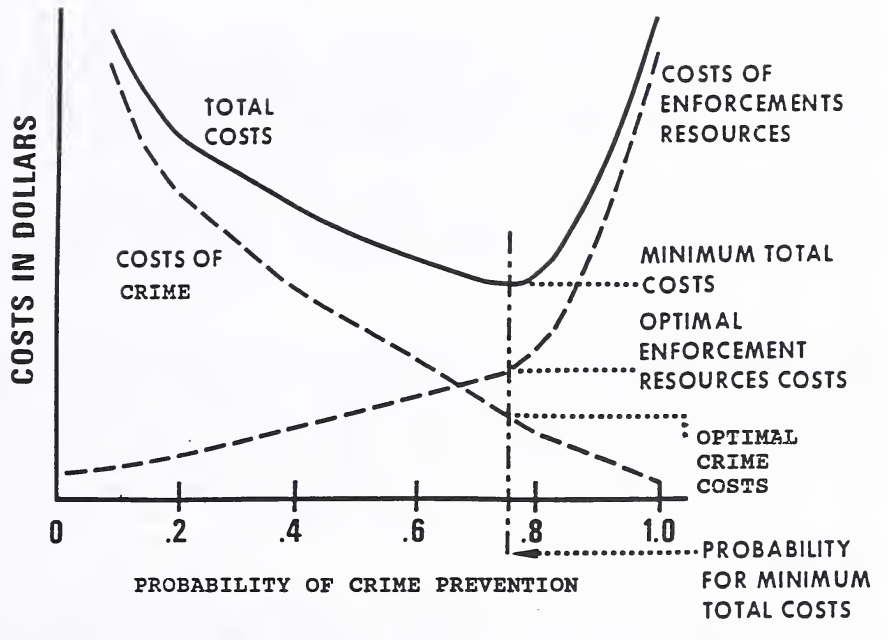
折れ線グラフ(スキャン画像)。縦軸は「COSTS IN DOLLARS」(費用(ドル))で目盛りはなく、横軸は「PROBABILITY OF CRIME PREVENTION」(犯罪防止の確率)で「0」「.2」「.4」「.6」「.8」「1.0」の目盛りがあります。破線の曲線「COSTS OF CRIME」(犯罪の費用)は左上から下がり、1.0 でほぼ 0 になります。破線の曲線「COSTS OF ENFORCEMENTS RESOURCES」(取締り資源の費用)は左からゆるやかに上がり、1.0 に近づくと急に上がります。実線の U 字形の曲線「TOTAL COSTS」(総費用)は左上から下がって約 0.75 で最小になり、その後急に上がります。約 0.75 の位置に縦の一点鎖線が引かれ、この最小点を通ります。この線から右側のラベルへ点線が引かれています。「MINIMUM TOTAL COSTS」(最小の総費用)は総費用曲線の最小点、「OPTIMAL ENFORCEMENT RESOURCES COSTS」(最適な取締り資源の費用)は取締り費用曲線との交点、「OPTIMAL CRIME COSTS」(最適な犯罪の費用)は犯罪費用曲線との交点を指します。横軸上のこの線の足からは点線の矢印が「PROBABILITY FOR MINIMUM TOTAL COSTS」(総費用を最小にする確率)へ伸びています。
The Optimal Level of Computer Security Enforcement
コンピュータセキュリティ執行の最適レベル
It can be seen in the figure that total costs are the sum of two primary costs. One primary cost is the cost of enforcement of the laws. As more resources are utilized for enforcement, the probability of crime prevention increases. This result is due to one or both of the causes that (1) commission of the crime is more difficult technologically, or (2) apprehension is more likely based on the experience of other perpetrators.
図から、総費用が 2 つの主要な費用の合計であることがわかります。主要な費用の 1 つは、法律の執行の費用です。執行により多くの資源を使うほど、犯罪を防止できる確率が高まります。この結果は、(1) 犯罪の実行が技術的により困難になる、(2) 他の実行者の経験に基づいて、逮捕される可能性が高くなる、という原因の一方または両方によるものです。
This effect of increase of prevention assumes that there is a monotonic relationship between expenditure of resources and effectiveness of efforts. This may or may not be true initially, but if it is not, new procedures and technologies that are more effective at lower cost are likely to be found and used. Thus, it is likely to be true in the long run.
この防止の増加という効果は、資源の支出と取り組みの有効性との間に単調な関係があることを前提としています。これは、当初は成り立つ場合もあれば成り立たない場合もありますが、成り立たない場合には、より低い費用でより有効な新しい手順や技術が見つかり、使われるようになる可能性が高いと考えられます。したがって、長期的には成り立つ可能性が高いと考えられます。
The second primary cost is the cost of crime itself. As the laws are enforced more leniently, and the probability of prevention decreases, the cost of crime increases. An assumption here is that the cost of crime monotonically increases with its incidence, an assumption that would be difficult to dispute.
2 つ目の主要な費用は、犯罪そのものの費用です。法律の執行が緩やかになり、防止の確率が下がるにつれて、犯罪の費用は増加します。ここでの前提は、犯罪の費用が発生件数に応じて単調に増加するということであり、この前提に異論を唱えることは難しいでしょう。
Thus, total costs are the sum of two other costs, one of which correlates with an increase in prevention probability, and one of which correlates with a decrease in the same variable. Consequently, total costs have a minimum at some probability of prevention less than one. In effect, it does not pay to stop all crime.
このように、総費用は 2 つの別の費用の合計であり、一方は防止の確率の上昇と相関し、他方は同じ変数の低下と相関します。その結果、総費用は、1 未満のある防止確率で最小になります。実際のところ、すべての犯罪を止めることは割に合いません。
This graphical presentation that there is an optimal expenditure of enforcement resources is consistent with the several similar concepts identified above. These concepts are that security implementations should be "commensurate with the risk and magnitude of the harm," (Computer Security Act), that security should be "commercially reasonable," (UCC 4A), and that procedures and technologies should be used that are "available at a cost lower than the value of the potential risks" (Michael Baum).
執行資源の最適な支出があるというこの図による提示は、上で挙げた類似した複数の概念と整合しています。それらの概念とは、セキュリティの実施は「損害のリスクと大きさに見合った」ものであるべきである(コンピュータセキュリティ法)、セキュリティは「商業的に合理的」であるべきである(UCC 4A)、手順と技術は「潜在的なリスクの価値より低い費用で利用できる」ものを使うべきである(Michael Baum)というものです。
References
参考文献
[1] The Annotated Code of the Public General Laws of Maryland - Commercial Law, Enacted by Chapter 49, Acts 1975; 1992 Replacement Volume. Charlottesville, VA, The Michie Company.
[1] The Annotated Code of the Public General Laws of Maryland - Commercial Law, Enacted by Chapter 49, Acts 1975; 1992 Replacement Volume. Charlottesville, VA, The Michie Company.
[2] Michael S. Baum, "Commercially Reasonable Security: A Key to EDI Enforceability," Actionline, Vol. 8, No. 11, Nov. 1989; Southfield, MI, Automotive Industry Action Group.
[2] Michael S. Baum, "Commercially Reasonable Security: A Key to EDI Enforceability," Actionline, Vol. 8, No. 11, Nov. 1989; Southfield, MI, Automotive Industry Action Group.
[3] ibid.
[3] ibid.
[4] Edwin Mansfield, Microeconomics, (Shorter Second Edition), W.W. Norton, 1976, pp. 146-147.
[4] Edwin Mansfield, Microeconomics, (Shorter Second Edition), W.W. Norton, 1976, pp. 146-147.
The Legal Viability of Electronically Submitted Environmental Compliance Reports*
電子的に提出される環境コンプライアンス報告書の法的有効性*
David S. Schwarz, Chief
Information Policy Branch
Office of Policy, Planning and Evaluation
United State Environmental Protection Agency
David S. Schwarz 課長
情報政策課
政策・計画・評価局
米国環境保護庁
*The views expressed in this paper are the author's and do not reflect any official position of the USEPA
*本論文で述べられている見解は著者のものであり、USEPA の公式の立場を反映するものではありません。
I. INTRODUCTION
I. はじめに
The USEPA is currently pilot testing the use of electronic data interchange (EDI) for industry submission of compliance reports under regulatory programs that implement air, water, and hazardous waste statutes. To date, for purposes of legal documentation, these pilots have all relied on concomitant paper submissions, e.g., a paper certification form. Hence, as yet the EPA experience with EDI does not offer a case that would exemplify true, paperless, electronic reporting, or would provide a test of its legal viability. The focus of this paper will therefore be prospective: considering the conditions that these pilot applications will have to satisfy before true EDI can be legally viable.
USEPA は現在、大気、水、有害廃棄物に関する制定法を実施する規制プログラムのもとで、産業界によるコンプライアンス報告書の提出に電子データ交換(EDI)を用いる試行を行っています。これまでのところ、法的な記録のために、これらの試行ではすべて、紙による提出(たとえば紙の証明書式)が併用されています。したがって、EPA の EDI の経験は、現時点では、真に紙を使わない電子的な報告の例や、その法的有効性の検証の機会を提供するものではありません。そのため本論文の焦点は将来に向けたもので、真の EDI が法的に有効となるために、これらの試行的な用途が満たさなければならない条件を検討します。
Our pilots are introducing EDI into regulatory programs that represent a substantial portion of EPA's core command and control responsibilities, and under these programs compliance reporting is used (in some cases together with inspections) as the primary mechanism for enforcing environmental standards and regulations. Of course, where violations are alleged, these enforcement activities culminate in some sort of legal proceeding--often in court--to seek civil and/or criminal penalties. It is in such proceedings that compliance reports play their most critical role: either to serve directly as evidence of environmental wrongdoing, or else--where there are issues of falsification--to demonstrate fraud in conjunction with other, independent evidence of environmental violations. Clearly, electronically submitted versions of compliance reports must be admissible as evidence in such cases with exactly the same force as their paper counterparts; for all practical purposes, this requirement provides both the necessary and the sufficient conditions for the legal viability of EDI in our applications.
私たちの試行は、EPA の中核的な指揮統制の責務のかなりの部分を占める規制プログラムに EDI を導入するものであり、これらのプログラムでは、コンプライアンス報告書が(場合によっては検査とあわせて)環境基準と規則を執行するための主要な仕組みとして使われています。もちろん、違反が申し立てられた場合、これらの執行活動は、民事上および/または刑事上の罰則を求めるための何らかの法的手続(多くは裁判所での手続)に行き着きます。コンプライアンス報告書がその最も重大な役割を果たすのは、そのような手続においてです。すなわち、環境に関する不正行為の証拠として直接用いられるか、あるいは、改ざんが問題となる場合に、環境違反に関する他の独立した証拠とあわせて不正を立証するために用いられます。そのような事案では、電子的に提出されたコンプライアンス報告書は、紙の報告書とまったく同じ効力で証拠として許容されなければならないことは明らかです。実際上、この要件が、私たちの用途における EDI の法的有効性の必要条件と十分条件の両方を与えます。
Admissibility of a submitted document as legal evidence can be analyzed as entailing one or more of a number of standard elements: originator authentication, non-repudiation, message integrity, and date/time certification; it may also involve questions of confidentiality. For each of these elements in turn, the discussion that follows will attempt to identify the hard cases (if there are any)--that is, the kind(s) of environmental enforcement case(s) in which the element is most difficult to satisfy, and what such satisfaction requires. When we put these pieces together, they should give us a picture of the strongest conditions that an environmental EDI application would have to satisfy. Against this background, we can then consider how strong the conditions must be for legally viable EDI in the typical or 'baseline' case of environmental compliance reporting.
提出された文書が法的な証拠として許容されることは、発信者の認証、否認防止、メッセージの完全性、日時の証明という標準的な要素の 1 つ以上を伴うものとして分析でき、機密性の問題も関わる場合があります。以下の議論では、これらの各要素について順に、(存在するなら)困難な事案、すなわち、その要素を満たすことが最も難しい種類の環境執行事案と、それを満たすために何が必要かを特定することを試みます。これらの要素を組み合わせると、環境分野の EDI の用途が満たさなければならない最も厳しい条件の全体像が得られるはずです。この背景を踏まえ、環境コンプライアンス報告という典型的な、すなわち「ベースライン」の事案において、法的に有効な EDI のために条件がどの程度厳しくなければならないかを検討できます。
II. REQUIREMENTS FOR ADMITTING DOCUMENTS IN ENVIRONMENTAL ENFORCEMENT PROCEEDINGS: THE HARD CASES
II. 環境執行手続における文書の許容要件: 困難な事案
1. Originator Authentication. A legally valid compliance report must identify both the submitting organization--usually a private-sector company--and a responsible individual within that organization who certifies that the data submitted on the report is correct. In the normal case, these identifications are not an issue for enforcement officials. Either the data in the report show a violation or it does not. If they do, then appropriate follow-up actions are taken, e.g. fines are imposed. If there is a dispute at all, then it is over what the data show, or whether they are accurate, and this is resolved by carrying out plant inspections, looking at plant records or other data, or whatever.
1. 発信者の認証。法的に有効なコンプライアンス報告書は、提出する組織(通常は民間部門の企業)と、報告書で提出されるデータが正しいことを証明する、その組織内の責任ある個人の両方を特定しなければなりません。通常の事案では、これらの特定は執行担当者にとって問題になりません。報告書のデータが違反を示しているか、違反を示していないかのどちらかです。示している場合は、罰金の賦課など、適切なフォローアップの措置が取られます。何らかの争いがあるとすれば、それはデータが何を示しているか、あるいはそれが正確かどうかについてであり、これは、工場の検査を実施したり、工場の記録やその他のデータを調べたりすることなどで解決されます。
However, establishing the identity of a certifying individual can be a concern where the Agency is trying to assign liability for purposes of obtaining damages. These are typically cases of civil liability, and the concern will be particularly pressing where the company in question is insolvent--so that any liability that exists passes to responsible individuals. Probably the best examples come from the Superfund program, in determining "potentially responsible parties" (PRPs) for a Superfund site cleanup. Often, the company that created the problem has gone out of business. The task is then to trace individuals from that organization who were responsible for the activities--e.g., the disposal of wastes--that now necessitate a cleanup. To identify such individuals, it is often very helpful to be able establish that it was their signature on a hazardous waste manifest, or that they were the certifying official in some financial transaction. However, this kind of evidence--connecting individuals with documents--may not be critical. These individuals may be assigned liability simply by virtue of the positions they held in the defunct company, and we can usually find evidence of this that is independent of their connection with the documents in question.
しかし、同庁が損害賠償を得る目的で責任を割り当てようとしている場合には、証明を行う個人の身元を確立することが懸念事項になり得ます。これらは典型的には民事責任の事案であり、問題の企業が支払不能の場合は、存在する責任が責任ある個人に移るため、懸念は特に切実になります。おそらく最良の例は、スーパーファンドの浄化に向けて「潜在的責任当事者(PRP)」を特定するスーパーファンドプログラムに見られます。問題を引き起こした企業が廃業していることもよくあります。その場合の課題は、現在は浄化が必要となっている活動(たとえば廃棄物の処分)に責任のあったその組織の個人を追跡することです。そのような個人を特定するには、有害廃棄物マニフェストに彼らの署名があったこと、あるいは何らかの金融取引で彼らが証明を行う担当者であったことを立証できると、大いに役立つことが多くあります。しかし、この種の証拠、すなわち個人と文書を結びつける証拠は、決定的ではないかもしれません。これらの個人は、すでに存在しない企業で就いていた地位のために責任を割り当てられる場合があり、問題の文書との関係とは無関係に、そのことを示す証拠を通常は見つけることができます。
The identity of the submitting organization can also be an issue, for example, where there is some question that this identity has been misrepresented. This would be a case of fraudulent submission, and, this fraud itself might becomes the subject of an enforcement action. As an example, consider a case where a company is supposed to have effluent samples analyzed by a certified laboratory, which is to submit a report of the analytic data directly to EPA (or to a delegated state agency). Fearing that an analysis will reveal serious violations of permit limits, the company might file such a report itself, fraudulently representing the report as coming from its laboratory. In establishing this fraud, the Agency must be able to demonstrate that the submitter is in fact the company, notwithstanding the laboratory name and address and forged signatures on the report. Of course, in doing this, the Agency would not be relying on any connection between the submitted document and the names and signatures on that document--since it is just this connection that is being discredited. Indeed, the Agency might not need to rely on any evidence internal to the document or its circumstances of submission at all (although, of course, such evidence might be very useful), since there will also be the evidence of testimony, company records, and authentic laboratory analyses.
提出する組織の身元も、たとえばその身元が偽って示されたという疑いがある場合などには、問題になり得ます。これは不正な提出の事案であり、この不正自体が執行措置の対象になる可能性があります。例として、企業が排水試料を認定された検査機関に分析させ、その検査機関が分析データの報告書を EPA(または権限を委任された州機関)に直接提出することになっている場合を考えてみます。分析によって許可限度の重大な違反が明らかになることを恐れた企業が、自らその報告書を提出し、検査機関から来たものであると偽って示す可能性があります。この不正を立証するには、同庁は、報告書に検査機関の名称と住所、および偽造された署名があるにもかかわらず、提出者が実際には当該企業であることを示せなければなりません。もちろん、そうするにあたって、同庁は、提出された文書と、その文書上の名称や署名との結びつきには依拠しません。まさにその結びつきが疑われているからです。実際には、同庁は、文書自体またはその提出状況に関する証拠には依拠する必要がないかもしれません(もちろん、そのような証拠は非常に有用かもしれません)。証言、企業の記録、真正な検査機関の分析という証拠もあるからです。
In the examples so far, either it's not critical that we establish the identity of a document's originator, or it's not critical to use the evidence provided by the submitted document itself to do this. Nonetheless, in at least one class of cases originator authentication will be of paramount importance, where we are taking criminal enforcement action against an individual. Probably the best example here is the case where a company submits fraudulent data under its own name, with the Agency then taking criminal action against the certifying officials, to penalize these individuals as responsible for perpetrating the fraud. To do this, enforcement officials must determine that the identity of these individuals is as the submission represents them, in addition to confirming that the submission did indeed come from the company in question, and was not just a malicious prank. After all, it is just in their capacity as certifying officials that these individuals are criminally liable. If it turns out that it is not their signatures on the document, then the case against the individuals in question is considerably weakened--unless it can be shown that they directed others to sign the document as their agents. It's worth adding that allegations of fraud may not be necessary to have a criminal case against individuals in their capacity of certifying officials. A submission may truly report certain environmental violations and might thereby make the certifying officials criminally liable, by virtue of providing evidence the these officials knew of--but did nothing to prevent or mitigate--the occurrence.
これまでの例では、文書の発信者の身元を確立することが重要でない場合があるか、あるいは、そのために提出された文書自体が示す証拠を使うことが重要でない場合がありました。それでも、少なくとも 1 つの種類の事案、すなわち個人に対して刑事上の執行措置を取る場合には、発信者の認証が最も重要になります。おそらく最良の例は、企業が自社の名義で不正なデータを提出し、同庁が、不正を行った責任者としてこれらの個人を罰するために、証明を行った担当者に対して刑事措置を取る事案です。そのためには、執行担当者は、提出物が実際に当該企業から来たものであり、単なる悪意のあるいたずらではないことを確認することに加え、これらの個人の身元が提出物の示すとおりであることを確定しなければなりません。結局のところ、これらの個人が刑事責任を負うのは、まさに証明を行う担当者という立場においてだからです。文書上の署名が彼らのものではないとわかった場合、彼らが代理人として他の者に署名するよう指示したことを示せない限り、当該の個人に対する訴えは大きく弱まります。付け加えておくと、証明を行う担当者という立場にある個人に対する刑事事件では、不正の申し立てが必ずしも必要とは限りません。提出物が実際に特定の環境違反を報告しており、担当者らがその発生を知りながら、防止も軽減もしなかったことを示す証拠を提供することで、担当者らが刑事責任を問われる可能性があります。
In any event, it is in these criminal cases that admitting a submission as evidence is likely to depend most heavily on determining the identity of its originator. And, in making this determination in such cases, some sort of demonstrable causal link between originator and submission is likely to play its most critical role. This will be clearer in the context of non-repudiation.
いずれにしても、提出物を証拠として許容するかどうかが、その発信者の身元の確定に最も大きく左右される可能性が高いのは、これらの刑事事件です。そして、そのような事案でこの確定を行う際には、発信者と提出物との間に何らかの立証可能な因果関係があることが、最も重大な役割を果たす可能性が高いです。このことは、否認防止の文脈でいっそう明確になります。
2. Non-repudiation. The issue of repudiation will be most important--and likely most difficult--in those cases where we are most concerned with originator authentication. As we have seen, these are cases of criminal enforcement against individuals, the most prominent being those that involve fraud. In these cases of criminal fraud, of course, the Agency must establish intent to certify falsely, and it is just this makes the question of repudiation must critical: the accused will obviously have strong motivation to deny any intentional connection with the document in question, and the fact of a signature may be our only real evidence of anyone's intent.
2. 否認防止。否認の問題が最も重要で、おそらく最も難しくなるのは、発信者認証が最も重要となる事案です。これまで見てきたように、これらは個人に対する刑事上の執行措置の事案で、最も顕著なのは詐欺に関わるものです。もちろん、このような刑事詐欺の事案では、同庁は虚偽の証明をする意図を立証しなければなりません。まさにこのことが否認の問題を最も重要なものにしています。被告人には、問題の文書との意図的な結びつきを否定する強い動機があることは明らかであり、署名があるという事実が、誰かの意図に関する唯一の実質的な証拠かもしれないからです。
In such cases we may, for example, have to refute claims that the signature was 'forged', or reproduced without authorization. To do this, normally only a demonstration of the necessary causal connection between certifying official and the document in question will suffice--e.g., demonstrating that given the style of writing and the chemistry of the ink, the signature could not have been produced by any other hand. It will not do to argue that by virtue of his/her position in the company, the official could be 'presumed' to have certified the submission, since this does not establish the requisite intent. Of course, there are sometimes other, independent ways of establishing intent, e.g. evidence of other actions of the individual that show knowledge of compliance problems and a disposition to deceive, or testimony of others that were authorized to sign for the individual under investigation. If sufficiently strong, these may allow prosecution to refute the attempted repudiations without appealing to the characteristics of the document itself. However, bound up as it is with establishing intent, it is hard to see that the issue of repudiation could be simply side-stepped--at least in these cases of criminal fraud.
このような事案では、たとえば、署名が「偽造された」、あるいは許可なく複製されたという主張に反駁しなければならないことがあります。そのためには、通常は、証明を行う担当者と問題の文書との間に必要な因果関係があることを示す、たとえば筆跡の特徴とインクの化学的性質から、その署名は他人の手では作成できなかったことを示すしかありません。担当者は企業内の地位からして提出物を証明したと「推定できる」と論じても、必要な意図を立証することにはならないため、通用しません。もちろん、意図を立証するほかの独立した方法が存在する場合もあります。たとえば、コンプライアンス上の問題を知っていたことと欺く性向を示す、その個人の他の行為の証拠や、調査対象の個人に代わって署名する権限を与えられていた他の者の証言です。これらが十分に強ければ、訴追側は、文書自体の特性に頼ることなく、否認の試みに反駁できる場合があります。しかし、否認の問題は意図の立証と結びついているため、少なくともこれらの刑事上の不正の事案では、単に回避できるとは考えにくいです。
Of course, as we turn from the criminal to the civil context, the question of intent drops out, and, correspondingly, any attempt to repudiate the identity of individuals certifying particular documents is much less of a worry. For example, while it may help greatly to know that John Smith's name was on a hazardous waste manifest, he may be liable for the unhappy fate of one of his company's barrels of PCBs simply by virtue of being the owner or operator of that company. Of course, we must still be able to refute attempts to repudiate the identification of John Smith's company as the originator, but this again may not require that we focus on who signed the document. Since a hazardous waste manifest involves many interactions between an originating company and other organizations, there may be many different ways to establish where it came from.
もちろん、刑事から民事の文脈に移ると、意図の問題はなくなり、それに応じて、特定の文書を証明した個人の身元を否認しようとする試みも、ずっと心配ではなくなります。たとえば、ジョン・スミスの名前が有害廃棄物マニフェストにあったことを知ることは大いに役立つかもしれませんが、彼は、単にその企業の所有者または運営者であることを理由に、自社の PCB の樽の 1 つに起きた不幸な顛末の責任を負う可能性があります。もちろん、ジョン・スミスの企業が発信者であると特定することを否認する試みには、依然として反駁できなければなりませんが、これもまた、誰が文書に署名したかに焦点を当てる必要はないかもしれません。有害廃棄物マニフェストには、発信元の企業と他の組織との間の多くのやり取りが関わるため、それがどこから来たかを立証する方法はたくさんあり得ます。
3. Message Integrity. For both originator authentication and non-repudiation, the question of fraud has divided the difficult cases from the relatively easy. We will find the same to be true here. Where fraud is not an issue, then generally an enforcement case will raise questions of message integrity where the defendant disputes the content of submissions that show violations. Such disputes do not normally create serious problems. Where the EPA receives reports that show violations, investigators typically follow up by conducting inspections and performing tests to provide confirming data before taking a case to court. It would be an extraordinary case indeed where the Agency's primary evidence of violations was signed certifications to that effect; hence, it is normally beside the point here to argue at length over whether what the Agency offers as the defendant's submission is in fact what the defendant submitted.
3. メッセージの完全性。発信者の認証と否認防止のいずれについても、不正の問題が、困難な事案と比較的容易な事案とを分けてきました。ここでも同じことが言えます。不正が問題でない場合、一般に、執行事案でメッセージの完全性が問題になるのは、被告が、違反を示す提出物の内容を争う場合です。このような争いは、通常は深刻な問題を生じません。EPA が違反を示す報告書を受け取った場合、調査官は通常、事案を裁判所に持ち込む前に、検査を実施し、試験を行って、裏づけとなるデータを得ることでフォローアップします。同庁が違反に関して持つ主要な証拠が、そのことを述べた署名入りの証明書であるような事案は、実に例外的です。したがって、同庁が被告の提出物として提示するものが、被告が実際に提出したものかどうかを長々と論じることは、通常は的外れです。
Of course, the Agency cannot be indifferent to the integrity of such submissions. A consistent pattern of discrepancies between the contents of Agency databases and what submitters claim to have sent would seriously undermine EPA's credibility in court--let alone its general ability to manage its programs. However, good audit trails and other QA/QC procedures associated with normal database management are usually regarded as adequate to take care of these concerns.
もちろん、同庁は、そのような提出物の完全性に無関心ではいられません。同庁のデータベースの内容と、提出者が送ったと主張する内容との間に食い違いが一貫して見られるなら、EPA のプログラムを管理する全般的な能力は言うまでもなく、裁判所での EPA の信頼性が大きく損なわれます。しかし、通常のデータベース管理に伴う良好な監査証跡とその他の QA/QC 手順が、これらの懸念に対処するのに十分と見なされるのが普通です。
We are back to cases of fraud, then, and in this context the cases of concern are primarily those where we need to establish submission of false data. The issue of message integrity arises specifically where we must confront that claim that the appearance of falsification was introduced by errors in transmission or by changes made to the document while it was in the Agency's custody. It is not clear how critical this issue will be. On the one hand, if the allegation of falsification is confined to a single document, with no other supporting evidence of criminal intent--and against a background in which the defendant has generally been a good actor--then we can imagine that the government's case may turn on whether the document provided to the court can be shown to reflect exactly the data submitted, and the evidence here would have to be unimpeachable. On the other hand, it is difficult to imagine that EPA would bring criminal charges where the case hung by such a slender thread. Presumably, the Agency would have the evidence of actual environmental violations--which the submission in question was alleged to be trying to hide--as well as the confirmation offered by company records and by the testimony of witnesses. These could easily make a strong case for motivation to deceive, and against this background it would be difficult for a defendant to gain much credit for the assertion that the document in court does not truly reflect his submission. Of course, EPA would still need to demonstrate that it had adequate procedures in place to assure the integrity of its database--and the mechanisms for receiving input. After all, our claims of fraud in these cases is only as strong as our assertions of message integrity.
そこで、再び不正の事案に戻ります。この文脈で懸念されるのは、主として虚偽データの提出を立証する必要がある事案です。メッセージの完全性の問題が特に生じるのは、改ざんのように見えるものは、伝送中のエラーや、同庁が保管している間に文書に加えられた変更によって生じたものだという主張に対処しなければならない場合です。この問題がどれほど重大になるかははっきりしません。一方、改ざんの申し立てが単一の文書に限られ、刑事上の意図を裏づける他の証拠がなく、被告が一般に法令を順守してきたという背景がある場合には、政府の訴えは、裁判所に提出された文書が、実際に提出されたデータを正確に反映していることを示せるかどうかにかかる可能性があります。その場合、この点の証拠は非の打ちどころのないものでなければならないでしょう。他方、そのような細い糸にかかっている事案で、EPA が刑事告発をするとは想像しにくいです。おそらく同庁には、問題の提出物が隠そうとしたと申し立てられている実際の環境違反の証拠に加え、企業の記録や証人の証言による裏づけもあるでしょう。これらは欺く動機を示す強い訴えを容易に成り立たせるでしょうし、このような背景のもとでは、法廷にある文書が自分の提出物を真に反映していないという被告の主張が信用されるのは難しいでしょう。もちろんEPA は、データベースと入力受付の仕組みの完全性を保証する適切な手順を整備していることも示す必要があります。結局のところ、これらの事案における不正の主張は、メッセージの完全性についての主張と同じ強さしか持ちません。
4. Date/time Certification. While EPA reporting requirements include specifications of schedules and deadlines, the failure to meet a deadline per se is rarely the subject of an enforcement action. However, a consistent pattern of late submissions, or a late submission connected with a critical violation of environmental standards will certainly be a part of the evidence that EPA would want to use on behalf of civil or criminal actions. Therefore, at least the date and time of the receipt of the submission would need to be verifiable in such cases. It is not clear whether we would need more than this, e.g. in cases where a dispute arose over when the submission was sent. If the role of date/time evidence was to show patterns of behavior, then a set of well-documented receipt dates should be sufficient to turn aside claims that there was an inherent inconsistency between when the Agency was claiming it got reports and when they were actually submitted.
4. 日時の証明。EPA の報告要件には日程と期限の規定が含まれていますが、期限を守らなかったこと自体が執行措置の対象となることはまれです。しかし、提出の遅れが一貫して見られるパターンや、環境基準の重大な違反に関連する提出の遅れは、民事または刑事の措置のために EPA が使いたいと考える証拠の一部に間違いなくなります。したがって、そのような事案では、少なくとも提出物を受領した日時は検証可能でなければなりません。これ以上のこと、たとえば、提出物がいつ送られたかをめぐって争いが生じた事案で、さらに必要になるかどうかははっきりしません。日時の証拠の役割が行動のパターンを示すことであれば、十分に記録された受領日の一式があれば、同庁が報告書を受け取ったと主張する日と、実際に提出された日との間に内在的な不一致があるという主張をかわすのに十分なはずです。
It is worth noting, however, that there is at least one kind of case where the date of sending a document is of independent interest. Under hazardous waste rules, the liability of treatment, storage, or disposal facilities (TSDFs) for waste that they reship can depend on how long they have kept this waste; generally, if they keep it more than fifteen days then they acquire the generator's liability for the waste if they ship it elsewhere. The primary pieces of evidence for how long a shipment has stayed at a TSDF are the dates on the manifests indicating the arrival and the subsequent departure of this shipment--and these should coincide with the dates on which the TSDF sends copies of these manifests to the appropriate state agencies. Many legal consequences can flow from assigning generator liability for this shipment to the TSDF. And, it is at least possible that this attribution will turn on determining the dates on which manifests were submitted (although evidence from transporter records and testimony should also be available in the normal case).
ただし、文書を送信した日付が独立して重要となる事案が、少なくとも 1 種類あることに注意が必要です。有害廃棄物の規則では、処理・保管・処分施設(TSDF)が再発送する廃棄物に対する責任は、その廃棄物を保管していた期間によって決まる場合があります。一般に、15 日を超えて保管した場合、他所へ発送すると、その廃棄物について排出者と同じ責任を負うことになります。ある積荷が TSDF にどれだけの期間とどまっていたかを示す主要な証拠は、その積荷の到着とその後の出発を示すマニフェスト上の日付であり、これらは、TSDF がマニフェストの写しを関係する州機関に送る日付と一致するはずです。この積荷について排出者責任が TSDF に帰属すれば、多くの法的帰結が生じ得ます。そして、この帰属が、マニフェストの提出日を確定できるかどうかに左右される可能性もあります(もっとも、通常は運搬業者の記録や証言による証拠も得られるはずです)。
5. Confidentiality. For purposes of admitting documents as evidence in enforcement actions, maintaining the confidentiality of what is submitted is not very relevant. Nonetheless, the ability to maintain confidentiality is of great importance to the Agency where submissions are legitimately asserted to contain 'confidential business information' (CBI). CBI constitutes a significant proportion of the submissions to the Agency under certain programs, especially those in the areas of pesticides and toxic substances. Under these programs, companies may submit closely held chemical formulae or formulator recipes, as well as sensitive production and financial data. Whether or not such submissions came to be associated with an enforcement action, failure to preserve the confidentiality of CBI--either as the data was submitted or as it was maintained--could subject the Agency to claims for damages. Therefore, quite independently of enforcement considerations, EPA will need special measures to assure the confidentiality of CBI data when submitted electronically.
5. 機密性。執行措置で文書を証拠として許容する目的では、提出されたものの機密性を保つことはあまり関係がありません。それでも、提出物が「機密の企業情報(CBI)」を含んでいると正当に主張されている場合には、機密性を保つ能力は同庁にとって非常に重要です。CBI は、特定のプログラム、とりわけ農薬や有害物質の分野のプログラムで、同庁への提出物のかなりの割合を占めます。これらのプログラムでは、企業は、機微な生産データや財務データに加えて、厳重に保持された化学式や調合者の配合を提出する場合があります。そのような提出物が執行措置に関連することになったかどうかにかかわらず、CBI の機密性を、データが提出される際にも保管される際にも保てなかった場合、同庁は損害賠償の請求を受ける可能性があります。したがって、執行上の考慮事項とはまったく無関係に、EPA は、電子的に提出される際に CBI データの機密性を保証する特別な措置を必要とするでしょう。
III. APPLYING EDI AT EPA: THE HARD CASE AND THE BASELINE
III. EPA における EDI の適用: 困難な事案とベースライン
Based on the preceding discussion, it appears that cases of criminal fraud erect the highest barriers to the admission of submitted documents as evidence. They require us to establish the identity of both the submitting company and the certifying individual(s). To refute attempts to repudiate these identifications, these criminal fraud cases generally require that we demonstrate a strong causal connection between the document and the certifying individuals--with evidence at least as strong as that which links a signature on paper to the hand that produced it. In addition, they require that we establish the integrity of our records or database--and our procedures for receiving submissions--with a high degree of confidence, and they may also require that we provide good evidence of the date/time of the submission.
ここまでの議論に基づくと、刑事上の不正の事案が、提出された文書を証拠として許容するうえで最も高い障壁になると考えられます。これらの事案では、提出した企業と、証明を行った個人の両方の身元を確立する必要があります。これらの特定を否認する試みに反駁するため、刑事上の不正の事案では一般に、文書と証明を行った個人との間に強い因果関係があることを、少なくとも紙の署名とそれを書いた手とを結びつける証拠と同程度に強い証拠で示す必要があります。加えて、同庁の記録またはデータベースの完全性と、提出物を受け付ける手順の完全性を高い確信度で確立する必要があり、提出の日時に関する十分な証拠の提示も必要になる場合があります。
Criminal fraud, then, provides the hard case for applying EDI to environmental reporting. Compliance reports that are vulnerable to fraud will therefore place very strong conditions on an EDI application if the electronic submissions are to be legally viable. The question, then, is how far are such compliance reports from the baseline of typical EPA reporting. The answer, unfortunately, is that they are at this baseline. Looking across EPA programs, compliance reporting is almost wholly a matter of self-monitoring (or auditing) and certification. Clearly, a company finding itself in serious violation of environmental standards, or limits set by permit, has at least some potential motivation for misrepresenting its situation--in hopes that this will go unnoticed by environmental agencies and that the company will thereby escape the penalties. Across EPA programs, then, the threat that such fraudulent reports will be uncovered, and subject their authors to criminal penalties, is probably the keystone of our enforcement strategy.
したがって、刑事上の不正は、環境報告に EDI を適用する際の困難な事案となります。不正に対して脆弱なコンプライアンス報告書は、電子的な提出が法的に有効であるためには、EDI の用途に非常に強い条件を課すことになります。そこで問題は、そのようなコンプライアンス報告書が、EPA の典型的な報告のベースラインからどれだけ離れているかです。残念ながら、答えは、それらがまさにそのベースラインにあるということです。EPA の各プログラムを見渡すと、コンプライアンス報告は、ほぼ完全に自己監視(または監査)と証明によるものです。環境基準や許可で定められた限度に対して重大な違反を犯していることに気づいた企業には、環境当局に気づかれず、それによって罰則を免れることを期待して、自らの状況を偽って伝えようとする動機が、少なくとも何らかの形で生じ得ることは明らかです。したがって、EPA の各プログラムを通じて、そのような不正な報告書が発覚し、その作成者が刑事罰の対象となるという脅威が、おそらく私たちの執行戦略の要です。
The possibility of fraud is certainly of concern in the cases of the reports for which EPA is currently attempting to introduce EDI: the hazardous waste manifest (HWM) and the discharge monitoring report (DMR). Taking these in order, the HWM is used, among things, to identify the contents of (usually sealed) containers that comprise the shipment of waste. The generator of the waste prepares this document, and--if he is trying to get rid of materials that are very difficult and/or expensive to have disposed of legally--he may be tempted to misrepresent what he is shipping. EPA and its delegated State agencies would certainly want to be able to deter this sort of fraud with the threat of criminal prosecution.
不正の可能性は、EPA が現在 EDI の導入を試みている報告書、すなわち有害廃棄物マニフェスト(HWM)と排出モニタリング報告書(DMR)の事案で、間違いなく懸念されます。順に見ていくと、HWM は、用途の一つとして、廃棄物の積荷を構成する(通常は封をされた)容器の中身を特定するために使われます。廃棄物の排出者がこの文書を作成するのであり、合法的に処分するのが非常に難しいか費用が高い物質を処分しようとしている場合、排出者は発送するものを偽って伝えたい誘惑にかられるかもしれません。EPA と権限を委任された州機関は、この種の不正を刑事訴追の脅威によって抑止できるようにしたいと間違いなく考えるでしょう。
Turning to the DMR, companies that have permits to discharge effluent under the National Pollutant Discharge Elimination System (NPDES) are required under the terms of their permits to sample and test their effluent at specified intervals to assure that they are conforming to the required pollutant limits. The DMRs report the results of such tests, and, obviously, if such results show serious violations of permitted limits then there is the temptation to try to disguise this fact. Since a DMR may give EPA the only warning it could have of an impending environmental catastrophe--e.g., the 'killing' of a body of water--we cannot treat lightly the possibility of fraud in this case either.
DMR に目を向けると、国家汚染物質排出削減システム(NPDES)のもとで排水を排出する許可を持つ企業は、許可の条件により、所定の間隔で排水を採取して試験し、必要な汚染物質の限度に適合していることを確認することを求められます。DMR はそのような試験の結果を報告するもので、その結果が許可された限度の重大な違反を示している場合、そのことを偽装しようとする誘惑が生じることは明らかです。DMR は、差し迫った環境上の大惨事(たとえば水域の「死滅」)について EPA が受け取ることのできる唯一の警告になる可能性があるため、この場合も不正の可能性を軽視することはできません。
Between them, the DMR and the HWM very likely affect the overwhelming majority of the organizations regulated under environmental statutes--a universe that numbers well over 100,000 entities. Therefore, it does not seem possible to restrict the scope of the 'hard' cases for legally viable EDI by drawing a line around a subset that might be involved in criminal fraud. This is probably the place to scotch another hopeful thought as well: that we might draw a line based on the dollar value of damage or risk. Unfortunately, the dollar value of environmental damage that might be associated with fraudulent reporting cannot be predetermined. It is not like the case of a contract or purchase order where we know and specify in advance that we are dealing with a quantity of goods or services worth less than $ 25 K. So far as we know, any case of misreporting could potentially entail millions of dollars of damage; we have no way of excluding this possibility in advance.
DMR と HWM を合わせると、環境に関する制定法の規制対象となる組織の圧倒的多数、すなわち 10 万をはるかに超える主体にほぼ確実に影響します。したがって、刑事上の不正に関与しそうな部分集合の周りに線を引くことで、法的に有効な EDI の「困難な」事案の範囲を限定することは不可能と思われます。ここで、もう一つの期待も打ち消しておきましょう。それは、損害額またはリスクの金額に基づいて線を引けるのではないか、という考えです。残念ながら、不正な報告に伴い得る環境損害の金額は、あらかじめ決めておくことができません。取り扱うのが 2 万 5 千ドル未満の物品やサービスの量であることを事前に把握して規定できる、契約や購買注文の場合とは違います。私たちの知る限り、虚偽報告のどの事案にも数百万ドルの損害が伴う可能性があり、この可能性を事前に排除する方法はありません。
IV. CONCLUDING THOUGHTS
IV. 結びの考察
To summarize this analysis, in applying EDI to environmental compliance reporting we must generally provide for the contingency that any particular submission may have to satisfy conditions for admissibility in criminal fraud cases. This would seem to require, among other things, the general use of an 'electronic signature' that creates a link to individuals originating the submission strong enough to support a claim of criminal intent. It likely also requires strong measures to validate the integrity of our EDI transmissions, and, possibly the application of something like 'write once read many' (WORM) technology to assure the integrity of our databases. In addition, we may need an audit trail that certifies date/time of transmission, and provisions for confidentiality of message--such as encryption--if we are to receive CBI.
この分析をまとめると、環境コンプライアンス報告に EDI を適用する際には、どの提出物であっても、刑事上の不正の事案で証拠として許容される条件を満たさなければならない可能性を、一般に考慮しておく必要があります。これには、とりわけ、刑事上の意図の主張を裏づけられるほど強い、提出物を発信した個人との結びつきを生み出す「電子署名」の一般的な使用が必要と思われます。また、EDI の伝送の完全性を検証するための強力な措置も必要になる可能性が高く、データベースの完全性を保証するために、「ライトワンス・リードメニー」(WORM)技術のようなものを適用することも考えられます。加えて、CBI を受け取るのであれば、伝送の日時を証明する監査証跡と、暗号化など、メッセージの機密性に関する措置が必要になるかもしれません。
Many of these requirements would be taken care of by the infrastructure that EPA might in any case expect to have in place to implement EDI, e.g., secure databases and appropriate value-added network (VAN) services. However, it is at least possible that provisions for adequate 'electronic signatures' would also impose special technology requirements on our rather large community of submitters. In wrestling with this problem, it is likely that EPA will not be alone, since our concerns with criminal fraud in compliance reporting appear to have strong analogues in the context of filing tax returns. As the Internal Revenue Service (IRS) moves toward paperless tax filing, they, like EPA, will need to preserve the use of their submissions in criminal prosecution of fraudulent reporting. If there are workable approaches to this problem for the IRS, these may point the way toward (or provide) solutions for the EPA.
これらの要件の多くは、EPA が EDI を実施するためにいずれにしても整備すると見込まれる基盤、たとえば安全なデータベースや適切なバリューアドオンネットワーク(VAN)のサービスによって、対応されるでしょう。しかし、適切な「電子署名」のための措置が、私たちのかなり大きな提出者のコミュニティにも特別な技術要件を課す可能性は、少なくともあります。この問題に取り組むにあたり、EPA は単独ではないと思われます。コンプライアンス報告における刑事上の不正に関する私たちの懸念は、税の申告書の提出の文脈に強い類似点があると思われるからです。内国歳入庁(IRS)が紙を使わない税の申告に向かうにつれ、IRS も EPA と同様に、不正な報告の刑事訴追において提出物を使用できる状態を保つ必要があります。IRS にとってこの問題に実行可能な取り組み方があるなら、それは EPA の解決策に向かう道筋を示す(あるいは解決策となる)かもしれません。
[Excerpt from Authenticity and Assurance, © 外部の著者(原本の記載による) — not reproduced on this unofficial site]
[Authenticity and Assurance からの引用。第三者(外部の著者(原本の記載による))の著作物のため、この非公式サイトには掲載していません。原本 PDF を参照してください。]
[Excerpt from What Price Data Security?, © 外部の著者(原本の記載による) — not reproduced on this unofficial site]
[What Price Data Security? からの引用。第三者(外部の著者(原本の記載による))の著作物のため、この非公式サイトには掲載していません。原本 PDF を参照してください。]
Security Requirements and Evidentiary Issues in the Interchange of Electronic Documents: Steps Toward Developing a Security Policy
電子文書の交換におけるセキュリティ要件と証拠上の問題: セキュリティポリシー策定への段階
by Peter N. Weiss1
Peter N. Weiss1 著
I. Introduction
I. はじめに
It is widely expected that the impact of computerization on commerce will be as great as that of the industrial revolution.2 Electronic messaging techniques, particularly Electronic Data Interchange (EDI), hold great promise to become the preferred methods of communicating administrative and business information. But widespread use of these techniques of electronic commerce will occur only if they have, and are perceived to have, the same or similar level of security as paper-based systems. The concept of security focuses on ensuring the integrity and availability of communications and, to the extent necessary, guaranteeing confidentiality.
コンピュータ化が商取引に与える影響は、産業革命の影響に匹敵するほど大きいと広く予想されています。2 電子メッセージング技術、特に電子データ交換(EDI)は、行政情報や業務情報の通信で好まれる方法になる大きな見込みがあります。しかし、これらの電子商取引の技術が広く使われるようになるのは、それらが紙ベースのシステムと同じか類似したレベルのセキュリティを備えており、かつそのように受け止められている場合に限られます。セキュリティの概念は、通信の完全性と可用性を確保し、必要な範囲で機密性を保証することに重点を置いています。
Electronic and paper media share many of the same security risks. However, the security protections associated with the traditional use of paper and signatures are so transparent to users and so customary that little thought is given to whether particular transactions require their use. Thus, statutory and regulatory provisions commonly specify that communications be "in writing," "signed," "verified," or "acknowledged." These have become so ubiquitous that most routine paper-based communications, particularly forms, contain a facial requirement for a signature -- even in the absence of any specific legal or administrative directive that an original autograph signature actually be affixed.
電子媒体と紙媒体には、セキュリティ上のリスクの多くが共通しています。しかし、紙と署名を従来から用いることに伴うセキュリティ上の保護は、利用者にとってきわめて自明であり、きわめて慣例的であるため、個々の取引にそれらの使用が必要かどうかはほとんど考えられていません。そのため、制定法や規則の規定では、通信が「書面による」「署名された」「検証された」「確認された」ものであることを定めるのが通例です。これらはあまりに広く行き渡っているため、日常的な紙ベースの通信の大半、特に書式は、原本の自筆署名を実際に付すよう求める具体的な法的または行政上の指示がなくても、見た目に署名の要件を含んでいます。
In electronic communications environments using techniques such as EDI, however, these security characteristics are no longer "automatic," but must be designed into each particular application. The Computer Security Act of 19873 provides a framework for determining what security characteristics are appropriate for particular applications. Although the Act only directly addresses Federal computer systems, its principles should be generally accepted. The Act defines sensitive information as including "any information, the loss, misuse, or unauthorized access to or modification of which could adversely affect the national interest or the conduct of Federal programs, or the privacy [of] individuals...." It requires each agency to consider the risk to such sensitive information and to "establish a plan for the security and privacy of each Federal computer system...that is commensurate with the risk and magnitude of the harm resulting from the loss, misuse or unauthorized access to or modification of the information contained in such system."
しかし、EDI などの技術を使う電子通信の環境では、これらのセキュリティ上の特性はもはや「自動的」ではなく、個々の用途ごとに設計に組み込まなければなりません。1987 年コンピュータセキュリティ法(Computer Security Act of 1987)3 は、どのようなセキュリティ特性が個々の用途に適切かを判断するための枠組みを提供しています。この法律が直接対象とするのは連邦コンピュータシステムだけですが、その原則は一般に受け入れられるべきです。同法は、機微な情報には、「その損失、不正使用、不正アクセスまたは改変が、国益、連邦プログラムの遂行、または個人のプライバシーに悪影響を与え得る情報」が含まれると定義しています。同法は、各機関に対し、そのような機微な情報に対するリスクを検討し、「各連邦コンピュータシステムのセキュリティとプライバシーに関する計画を、当該システムに含まれる情報の損失、不正使用、不正アクセスまたは改変によって生じる損害のリスクと大きさに見合ったものとして策定する」ことを求めています。
1 The views set forth are those of the author and do not necessarily represent those of the Office of Management and Budget.
1 述べられている見解は著者のものであり、必ずしも行政管理予算局の見解を表すものではありません。
2 International Chamber of Commerce, Uniform Rules of Conduct for Interchange of Trade Data by Teletransmission (hereinafter "UNCID Rules"), ICC Publication No. 452 (1988).
2 International Chamber of Commerce, Uniform Rules of Conduct for Interchange of Trade Data by Teletransmission (hereinafter "UNCID Rules"), ICC Publication No. 452 (1988).
3 Pub. L. No. 100-235, 40 U.S.C. 759 note.
3 Pub. L. No. 100-235, 40 U.S.C. 759 note.
As the Computer Security Act recognizes, the goal of information security is to manage and minimize risk. The same information which has monetary or other value requiring risk management also may be called upon as evidence to prove the facts associated with particular transactions. A paper purchase order or invoice may become evidence in a contract dispute, and the information in a regulatory filing may be required for enforcement proceedings. In the evidentiary context, the focus is on whether the information is generated in the normal course of business in a manner which maximizes the likelihood that it is reliable and trustworthy.4 Little consideration has been given, however, to the particular mix of elements which will effectuate the goals of the Act in the EDI context:
コンピュータセキュリティ法が認めているように、情報セキュリティの目標は、リスクを管理し最小化することです。リスク管理を要する金銭的またはその他の価値を持つ情報は、個々の取引に関わる事実を立証する証拠として求められることもあります。紙の購買注文書や請求書が契約紛争で証拠となることもあり、規制上の届出に含まれる情報が執行手続で必要になることもあります。証拠の文脈で重点が置かれるのは、その情報が、信頼でき信用できる可能性が最大になる方法で、通常の業務の過程で生成されているかどうかです。4 しかし、EDI の文脈で同法の目標を実現する要素の特定の組み合わせについては、ほとんど検討されていません:
What is needed, then, is a security policy. Various techniques are available to authenticate the source and verify the content of and to control access to electronically transmitted documents. However, there is little jurisprudential guidance as to whether and, if so, under what circumstances these security techniques will provide the requisite assurance of reliability. This lack of guidance concerning security techniques is reflected in the multiplicity of current security and authentication practices within the EDI community.5
したがって必要なのは、セキュリティポリシーです。電子的に伝送される文書について、送信元を認証し、内容を検証し、アクセスを制御するためのさまざまな技術が利用できます。しかし、これらのセキュリティ技術が、必要な信頼性の保証を提供するかどうか、提供するとすればどのような状況においてかについては、法理上の指針がほとんどありません。このセキュリティ技術に関する指針の欠如は、EDI のコミュニティ内に現在存在する、多様なセキュリティおよび認証の慣行に表れています。5
4 See, U.S. Department of Justice, "Admissibility of Electronically Filed Federal Records as Evidence," (October 1991)(hereinafter "Justice Department guidelines"), reprinted in Information Resources Management Plan of the U.S. Government (December 1991); and "Performance Guideline for the Legal Acceptance of Records Produced by Information Technology Systems," Association for Information and Image Management, AIIM TR31-1992 (hereinafter "performance guideline").
4 See, U.S. Department of Justice, "Admissibility of Electronically Filed Federal Records as Evidence," (October 1991)(hereinafter "Justice Department guidelines"), reprinted in Information Resources Management Plan of the U.S. Government (December 1991); and "Performance Guideline for the Legal Acceptance of Records Produced by Information Technology Systems," Association for Information and Image Management, AIIM TR31-1992 (hereinafter "performance guideline").
5 Draft American Bar Association resolution, "Security Techniques in Electronic Transactions," Version 3.0, August 9, 1991. The resulting ABA Resolution did not, however, articulate a substantive security policy, but rather encouraged its development:
The [ABA] supports action by federal and state governments, international organizations, and private entities to: (a) facilitate and promote the orderly development of legal standards to support and encourage the use of information in electronic form, including appropriate legal and professional education; (b) encourage the use of appropriate and properly implemented security techniques, procedures and practices to assure authenticity and integrity of information in electronic form; and (c) recognize that information in electronic form, where appropriate, may be considered to satisfy legal requirements regarding a writing or signature to the same extent as information on paper or in other conventional forms, when appropriate security techniques, practices and procedures have been adopted.
ABA Resolution No. 115 (August 19, 1992).
5 Draft American Bar Association resolution, "Security Techniques in Electronic Transactions," Version 3.0, August 9, 1991. その結果として成立した ABA の決議は、実質的なセキュリティポリシーを明示するものではなく、その策定を奨励するものでした:
[ABA]は、次の目的のために、連邦政府および州政府、国際機関、民間団体が行動することを支持します。(a) 適切な法教育および専門教育を含め、電子形式の情報の使用を支援し促進する法的基準の秩序ある発展を促進します。(b) 電子形式の情報の真正性と完全性を保証するため、適切かつ適正に実施されたセキュリティ技術、手順および実務の使用を奨励します。(c) 適切な場合、適切なセキュリティ技術、実務および手順が採用されていれば、電子形式の情報は、紙その他の従来の形式の情報と同程度に、書面または署名に関する法的要件を満たすものとみなされ得ることを認めます。
ABA Resolution No. 115 (August 19, 1992).
II. Steps Toward Developing a Security Policy
II. セキュリティポリシー策定への段階
The purpose of this paper is to present three preliminary steps toward the development of a security policy for the interchange of electronic documents. Its underlying thesis is that issues of legal admissibility and computer security are intertwined and must be considered together.
本論文の目的は、電子文書の交換に関するセキュリティポリシーを策定するための 3 つの予備的な段階を示すことです。その根底にある主張は、法的な許容性の問題とコンピュータセキュリティの問題は絡み合っており、あわせて検討しなければならないということです。
First, it briefly reviews basic principles of the law of evidence in order to identify the characteristics of electronic records which maximize the likelihood of their admissibility as evidence. This review suggests that the characteristics associated with the evidentiary value of electronic documents are essentially the same as those associated with maintaining the security of the information. It concludes that the provision of adequate security under the risk-based standard of the Computer Security Act also serves to ensure that the electronic records may be admissible as evidence.
第 1 に、証拠として許容される可能性を最大にする電子記録の特性を特定するため、証拠法の基本原則を簡単に概観します。この概観は、電子文書の証拠としての価値に関わる特性が、情報のセキュリティを維持することに関わる特性と本質的に同じであることを示唆しています。そして、コンピュータセキュリティ法のリスクに基づく基準のもとで適切なセキュリティを提供することは、電子記録が証拠として許容されることの確保にもつながるという結論に至ります。
Second, it analyses the security characteristics associated with traditional paper-based communications and compares the functions performed by each with the security services available in electronic data interchange and similar technologies. It demonstrates that although the transition from paper-based communications to electronic techniques poses some unique risks, the essential security requirements are the same.
第 2 に、従来の紙ベースの通信に伴うセキュリティ特性を分析し、それぞれが果たす機能を、電子データ交換や類似の技術で利用できるセキュリティサービスと比較します。紙ベースの通信から電子的な技術への移行には特有のリスクがあるものの、本質的なセキュリティ要件は同じであることを示します。
Finally, it presents a possible security classification scheme for various EDI applications, and suggests presumptively adequate security techniques for each to serve as a starting point for the development of the security plans required by the Computer Security Act and good practice. Each security plan must evaluate the risks associated with the loss, misuse or compromise of the information against the costs associated with the various techniques available to mitigate those risks. Its purpose is to identify those techniques which achieve a reasonable risk/cost balance under the circumstances.
最後に、さまざまな EDI の用途に対する可能なセキュリティ分類の枠組みを示し、それぞれについて、推定上十分なセキュリティ技術を提案します。これは、コンピュータセキュリティ法が求めるセキュリティ計画や、優れた実践に沿った計画を策定する際の出発点となります。各セキュリティ計画では、情報の損失、不正使用、侵害に伴うリスクを、そうしたリスクを軽減するために利用できる各種技術に伴う費用と比較して評価しなければなりません。その目的は、状況に応じてリスクと費用の妥当なバランスを実現する技術を特定することです。
Questions of legal admissibility and computer security are but two sides of the same coin. For example, if a systems manager retained the services of a competent litigator to help design an EDI application in a cost effective manner which would assure a high degree of likelihood that the outputs of the system would be admissible, the system manager would, in the process, have met the requirements of the Computer Security Act. On the other side, had the systems manager retained the services of a security specialist versed in the risk/cost methodology of the Computer Security Act to perform the same task, the outcome should be precisely the reverse -- a high degree of likelihood that the outputs of the application would be admissible as evidence would be assured. Recognition of this essential unity between system integrity and the evidentiary value of system outputs should help to alleviate unfounded, but often expressed, concerns regarding whether electronic documents and their various signature analogues are "legal."6
法的な許容性の問題とコンピュータセキュリティの問題は、同じ硬貨の表裏にすぎません。たとえば、システム管理者が、システムの出力が証拠として許容される可能性を高い水準で保証できる、費用対効果の高い方法で EDI の用途を設計するために、有能な訴訟弁護士の協力を得たとすれば、その過程でコンピュータセキュリティ法の要件を満たしたことになります。反対に、システム管理者が、コンピュータセキュリティ法のリスク・費用の方法論に通じたセキュリティ専門家の協力を得て同じ作業を行ったとすれば、その結果はまったく逆となるはずです。すなわち、その用途の出力が証拠として許容される可能性が高い水準で保証されるはずです。システムの完全性とシステム出力の証拠としての価値との間にある、この本質的な一体性を認識すれば、電子文書とその各種の署名類似物が「合法」かどうかについて、根拠がないにもかかわらずしばしば表明される懸念を和らげるのに役立つでしょう。6
6 Indeed, these concerns should by now have definitively been laid to rest. In general, signature and writing requirements are not legal barriers to electronic commerce:
"The concern with electronic signatures...is a red herring. A variety of techniques for authenticating electronic documents exist that are as good or better than traditional handwritten signatures...There is growing agreement...that authentication and signature concerns can be addressed by existing legal concepts in conjunction with adequate audit and recordkeeping controls."
Perritt, The Electronic Agency and the Traditional Paradigms of Administrative Law, 44 Admin. Law Review 79 (Winter 1992)(emphasis added). See also, ABA Resolution No. 115 (August 19, 1992) footnote 5 supra; "Signature Requirements under EDGAR," Decision of the SEC General Counsel, January 13, 1986 ("Requirements for 'signatures,'... may be satisfied by means other than manual writing on paper...or the use of Personal Identification Numbers (PINs). In fact, the electronic transmission of an individual's name may legally serve as that person's signature, provided it is transmitted with the present intention to authenticate."); and "National Institute of Standards and Technology -- Use of Electronic Data Interchange Technology to Create Valid Obligations," Comp. Gen. Dec. No. B-245714 (December 13, 1991)(Contracts formed using EDI satisfy statutory writing and signature requirements so long as technology used provides same degree of assurance and certainty as traditional "paper and ink" methods of contract formation).
6 実際、これらの懸念は、今ではもう決定的に払拭されているはずです。一般に、署名や書面の要件は、電子商取引に対する法的な障壁ではありません:
"The concern with electronic signatures...is a red herring. A variety of techniques for authenticating electronic documents exist that are as good or better than traditional handwritten signatures...There is growing agreement...that authentication and signature concerns can be addressed by existing legal concepts in conjunction with adequate audit and recordkeeping controls."
Perritt, The Electronic Agency and the Traditional Paradigms of Administrative Law, 44 Admin. Law Review 79 (Winter 1992)(emphasis added). 参照: ABA Resolution No. 115 (August 19, 1992)、前掲注 5; "Signature Requirements under EDGAR," Decision of the SEC General Counsel, January 13, 1986 ("Requirements for 'signatures,'... may be satisfied by means other than manual writing on paper...or the use of Personal Identification Numbers (PINs). In fact, the electronic transmission of an individual's name may legally serve as that person's signature, provided it is transmitted with the present intention to authenticate."); および "National Institute of Standards and Technology -- Use of Electronic Data Interchange Technology to Create Valid Obligations," Comp. Gen. Dec. No. B-245714 (December 13, 1991)(Contracts formed using EDI satisfy statutory writing and signature requirements so long as technology used provides same degree of assurance and certainty as traditional "paper and ink" methods of contract formation).
III. Evidentiary Requirements for Electronic Documents
III. 電子文書に対する証拠要件
Although the law is sometimes criticized as slow to keep pace with progress,7 the reality of the information revolution has been recognized by the courts:
法は進歩に追いつくのが遅いと批判されることもありますが、情報革命が現実に起きていることは裁判所によって認識されています:7
... [N]o court could fail to notice the extent to which business today depends on computers for a myriad of functions. Perhaps the greatest utility of a computer ... is its ability to store large quantities of information which may be quickly retrieved on a selective basis. Assuming that properly functioning computer equipment is used, once the reliability and trustworthiness of the information put into the computer has been established, the computer printouts should be received as evidence of the transactions covered by the input.8
... 今日の業務が、無数の機能をコンピュータに依存している程度に気づかない裁判所はあり得ません。おそらくコンピュータの最大の有用性は、大量の情報を保存し、選択的にすばやく取り出せることにある ... 適切に機能するコンピュータ機器が使われていることを前提とすれば、コンピュータに入力された情報の信頼性と信用性が確立されたならば、コンピュータの出力は、入力が対象とする取引の証拠として受け入れられるべきです。8
Without going into the details of the application of the "best evidence" and "hearsay" rules,9 it is sufficient to note that as a general matter computerized records are admissible as evidence provided that they are authenticated and can withstand challenge regarding their genuineness. This authentication requirement is satisfied "by evidence sufficient to support a finding that the matter in question is what its proponent claims."10 This is done in legal proceedings by "laying a foundation" that will qualify the evidence as being what is purported to be (e.g. a record prepared in the ordinary course of business).
「最良証拠」と「伝聞」の規則の適用の詳細には立ち入りませんが、9 一般論として、コンピュータ化された記録は、認証され、その真正性に関する異議に耐えられる限り、証拠として許容されると述べれば十分です。この認証の要件は、「問題の事柄が、提出者の主張するとおりのものであることを裏づける認定を支えるのに十分な証拠によって」満たされます。10 法的手続では、証拠をそのとおりと称されるもの(たとえば通常の業務の過程で作成された記録)として適格とする「基礎の確立」によって、これが行われます。
Electronically filed Federal records are almost invariably offered as business records prepared in the ordinary course of business. During the process of laying the foundation, the proponent of the evidence seeks to demonstrate the authenticity and reliability of the information, and the opponent tries to challenge those assertions:
電子的に提出された連邦の記録は、ほとんど例外なく、通常の業務の過程で作成された業務記録として提出されます。基礎を確立する過程で、証拠の提出者は情報の真正性と信頼性を示そうとし、反対当事者はそれらの主張に異議を唱えようとします:
... [T]he foundation for admission of (computerized records)consists of showing the input procedures used, the tests for accuracy and reliability and the fact that an established business relies on the computerized records in the ordinary course of carrying on its activities. The (opposing) party then has the opportunity to cross-examine concerning company practices with respect to the input and as to the accuracy of the computer as a memory bank and retriever of information....[T]he court (must) "be satisfied with all reasonable certainty that both the machine and those who supply its information have performed their functions with utmost accuracy." ... [T]he trustworthiness of the particular records should be ascertained before they are admitted and... the burden of presenting an adequate foundation for receiving the evidence should be on the parties seeking to introduce it rather than upon the party opposing its introduction.11
... (コンピュータ化された記録の)許容の基礎は、使用された入力手順、正確性と信頼性の試験、および確立された企業が通常の活動の過程でそのコンピュータ化された記録に依拠しているという事実を示すことにあります。そのうえで(反対)当事者には、入力に関する会社の慣行と、情報の記憶装置および検索装置としてのコンピュータの正確性について、反対尋問を行う機会がある ... 裁判所は、「機械と、その情報を供給する者の双方が、最大限の正確さをもって機能を果たしたことについて、あらゆる合理的な確実性をもって納得し」なければならない ... 個々の記録の信用性は、それが許容される前に確かめられるべきであり、... 証拠を受け入れるための適切な基礎を示す責任は、その提出に反対する当事者ではなく、提出を求める当事者にあるべきです。11
7 See Weiss, "Law and Technology: Can They Keep Abreast?," 8:4 Government Information Quarterly 377 (Nov. 1991).
7 See Weiss, "Law and Technology: Can They Keep Abreast?," 8:4 Government Information Quarterly 377 (Nov. 1991).
8 Harris v. Smith, 372 F.2d 806 (8th Cir. 1967)(emphasis added).
8 Harris v. Smith, 372 F.2d 806 (8th Cir. 1967)(emphasis added).
9 These are discussed in detail in the Justice Department guidelines, supra note 4.
9 これらについては、Justice Department guidelines, supra note 4 で詳しく論じられています。
10 Federal Rule of Evidence 901(a).
10 Federal Rule of Evidence 901(a).
Federal records management regulations also incorporate these evidentiary principles and provide similar guidance to Federal agencies in carrying out their responsibilities.12
連邦の記録管理規則にもこれらの証拠原則が盛り込まれており、連邦機関が責務を果たすうえで同様の指針を示しています。12
In sum, the law of evidence does not rest on inflexible paper-based rules which should pose a barrier to the use of electronic commercial practices. Rather, it is concerned with the underlying integrity of the information on which a judge or jury can reasonably rely in reaching a just conclusion to a particular controversy. Modern rules of evidence and court decisions appear to have come to terms with the realities of business and professional practice -- the ever-growing dependence on information technology systems for records production and maintenance.13
要するに、証拠法は、電子的な商慣行の利用に対する障壁となるような、融通のきかない紙ベースの規則に立脚しているわけではありません。むしろ、裁判官や陪審が個々の争いについて公正な結論に達する際に合理的に依拠できる、情報の根底にある完全性を重視しています。現代の証拠規則と裁判所の判決は、業務や専門職の実務の現実、すなわち記録の作成と維持を情報技術システムにますます依存するようになっていることに折り合いをつけているようです。13
The essential questions posed by the law of evidence in this context can be summarized as follows:
この文脈で証拠法が提起する本質的な問いは、次のようにまとめられます:
Electronic messages present four distinct evidentiary problems:
電子メッセージには、4 つの別個の証拠上の問題があります:
1.Proving that an electronic communication actually came from the party that it purports to come from;
1.電子通信が、それが来たとされる当事者から実際に来たものであることを証明すること。
2.Proving the content of the transaction, namely, the communications that actually occurred between the parties during the contract formation process;
2.取引の内容、すなわち契約の成立過程で当事者間に実際に行われた通信を証明すること。
3.Reducing the possibility of deliberate alteration of the contents of the electronic record of the transactions;
3.取引の電子記録の内容が意図的に改変される可能性を減らすこと。
11 United States v. Russo, 480 F.2d 1228 (6th Cir. 1973).
11 United States v. Russo, 480 F.2d 1228 (6th Cir. 1973).
12 "Judicial Use of Electronic Records," at Par.11, Federal Information Management Regulation (FIRMR) Bulletin B-1, "Electronic Records Management," and at 36 C.F.R. Part 1234.24.
12 "Judicial Use of Electronic Records," at Par.11, Federal Information Management Regulation (FIRMR) Bulletin B-1, "Electronic Records Management," and at 36 C.F.R. Part 1234.24.
13 "Performance guideline" supra note 4 at Section 2.4.
13 "Performance guideline" supra note 4 at Section 2.4.
4.Reducing the possibility of inadvertent alteration of the contents of the electronic record of the transactions.14
4.取引の電子記録の内容が不注意で改変される可能性を減らすこと。14
The key evidentiary issue is the weight that a court will give to electronic records. "This will primarily be a question of agreeing to, and implementing, adequate security procedures."15 These concerns with the identification of the originator, the integrity of the content of the communication, and with reducing the likelihood of alteration, which are at the heart of the law of evidence, are precisely the concerns which must be addressed in the context of EDI security. Thus, any combination of security controls which provides assurance that these characteristics have not been compromised will also provide a high degree of confidence that the contents of the communications will be admissible as evidence. The following sections of this paper will examine the security characteristics associated with both paper and electronic media, and will suggest a security classification scheme which may be of assistance in determining the appropriate mix of security techniques for particular EDI applications.
証拠上の主要な問題は、裁判所が電子記録に与える重みです。「これは主として、適切なセキュリティ手順に合意し、それを実施するかどうかの問題となります。」15 発信者の特定、通信内容の完全性、改変の可能性の低減に関するこれらの懸念は、証拠法の中核にあるものであり、まさに EDI のセキュリティの文脈で対処しなければならない懸念です。したがって、これらの特性が損なわれていないという保証を与えるセキュリティ統制の組み合わせは、通信内容が証拠として許容されるという高い確信も与えます。本論文の以降の節では、紙媒体と電子媒体の両方に伴うセキュリティ特性を検討し、個々の EDI の用途に適したセキュリティ技術の組み合わせを決める際に役立つ可能性のある、セキュリティ分類の枠組みを提案します。
IV. Security Characteristics of Paper-Based Communications
IV. 紙ベースの通信のセキュリティ特性
Traditional paper-based communications accompanied by handwritten signatures provide three essential security characteristics: message integrity, originator authentication, and non-repudiation. Depending on the nature of the communication, an additional security characteristic, confidentiality, may be desired. The efficacy of the various techniques used to ensure the desired level of security in turn depends on the adequacy of the administrative controls associated with their use.
手書きの署名を伴う従来の紙ベースの通信は、メッセージの完全性、発信者の認証、否認防止という 3 つの本質的なセキュリティ特性を提供します。通信の性質によっては、機密性というもう一つのセキュリティ特性が望まれる場合もあります。望まれるセキュリティのレベルを確保するために使われるさまざまな技術の有効性は、その使用に伴う管理上の統制が適切かどうかに左右されます。
Message integrity is the assurance that the content of a communication is complete and has not been changed prior to receipt. This is accomplished by a number of features, the primary ones being those associated with the use of writing itself: inks which make erasure and alteration easily perceptible, salutations and closings which constrain the length of the message, and even the size of the paper which may limit the addition of text. For applications requiring additional security, techniques such as the use of engraved backgrounds, chemically treated papers or lamination in plastic are used to make alteration particularly difficult.
メッセージの完全性とは、通信の内容が完全であり、受領前に変更されていないという保証です。これは多くの特徴によって達成されますが、主なものは筆記そのものに伴う特徴です。たとえば、消去や改変が容易に見て取れるインク、メッセージの長さを制約する書き出しと結びの言葉、文章の追加を制限し得る紙の大きさなどがあります。追加のセキュリティが必要な用途では、彫刻を施した地模様、化学処理をした紙、プラスチックによるラミネートなどの技術を使って、改変を特に困難にします。
14 Baum & Perritt, Electronic Contracting, Publishing and EDI Law, Section 6.23, "Evidentiary Issues" (Wiley 1991).
14 Baum & Perritt, Electronic Contracting, Publishing and EDI Law, Section 6.23, "Evidentiary Issues" (Wiley 1991).
15 Edwards, Ed., Information Technology and the Law (Second Edition)(Macmillan, 1990) at p. 241.
15 Edwards, Ed., Information Technology and the Law (Second Edition)(Macmillan, 1990) at p. 241.
Originator authentication provides assurance that the communication originated with the named source. This is most commonly provided by the handwritten signature or, historically, by the seal of the author. The authentication purpose of the signature or the seal has two conceptual parts: First, they add a degree of formality, increasing the likelihood of actual assent to the terms contained in the document. Second, they serve to identify the document with the originator, because signatures and seals tend to be unique. In most commercial transactions today, these functions are served primarily by the use of letterhead or pre-printed forms, and in formal documents of a routine nature such as checks and negotiable instruments printed signatures or "autopens" are often used to fulfill legal and customary requirements for signatures. Higher levels of originator authentication can be provided by the use of watermarked or other special paper such as those generally used for negotiable instruments.
発信者の認証は、通信が名指しされた送信元から発せられたという保証を与えます。これは、最も一般的には手書きの署名によって、歴史的には作成者の印章によって提供されます。署名または印章の認証の目的には、概念上 2 つの部分があります。第 1 に、これらは一定の形式性を加え、文書に含まれる条件への実際の同意が得られる可能性を高めます。第 2 に、署名や印章は固有のものである傾向があるため、文書を発信者と結びつける役割を果たします。今日の商取引の大半では、これらの機能は主にレターヘッドや印刷済みの書式の使用によって果たされており、小切手や流通証券のような定型的な正式文書では、署名に関する法的および慣習的な要件を満たすために、印刷された署名や「オートペン」がしばしば使われます。より高いレベルの発信者の認証は、流通証券に一般に使われる透かし入りの紙などの特殊な紙を使うことで提供できます。
Non-repudiation is a stronger form of authentication which relates to the ability of a disinterested third party reasonably to conclude that the identified originator intended to be bound by the substance of the communication. This function is most commonly performed by the original autograph signature affixed to a document having facially adequate message integrity. During the early development of contract law, primary reliance was placed on the individual’s seal as indicating intent to be bound. Only in the 20th Century did the signature gain its present prominence, and the special status accorded contracts under seal only disappeared as states enacted the Uniform Commercial Code. Enhanced forms of non-repudiation have generally involved the use of witnesses. Even after the use of written records of business and other transactions became common in the late Middle Ages, the most important enhanced form of non-repudiation remained witnesses. This formal reliance on witnesses is carried over today in the attestation of wills and the use of notaries public.
否認防止は、より強い形の認証であり、利害関係のない第三者が、特定された発信者が通信の内容に拘束される意図を持っていたと合理的に結論づけられる能力に関わります。この機能は、見た目に十分なメッセージの完全性を備えた文書に付された原本の自筆署名によって最も一般的に果たされます。契約法の初期の発展期には、拘束される意図を示すものとして、個人の印章に主として依拠していました。署名が今日のような重要性を得たのは 20 世紀になってからにすぎず、捺印契約に与えられていた特別な地位は、各州が統一商事法典を制定したことで初めて消滅しました。否認防止の強化された形態は、一般に証人の利用を伴ってきました。中世後期に業務その他の取引の書面記録の使用が一般的になった後でも、否認防止の最も重要な強化された形態は、証人であり続けました。この証人への形式的な依拠は、今日、遺言の立会証明や公証人の利用に引き継がれています。
Confidentiality is the ability to limit access to the information contained in a communication. This has generally been accomplished with some combination of security markings, envelopes, seals, trusted messengers, and by the use of codes and ciphers.
機密性は、通信に含まれる情報へのアクセスを制限する能力です。これは一般に、機密区分の表示、封筒、封印、信頼できる使者、暗号表や暗号の使用の何らかの組み合わせによって達成されてきました。
Central to the efficacy of message security is the use of adequate administrative controls. As paper-based communications took on forms more diverse than the handwritten document with affixed signature, communicating entities had to establish internal procedures to assure the efficacy of the various security techniques they wished to utilize. These ranged from limiting access to the official seal, and later to the letterhead and autopen, to ensuring the trustworthiness of message carriers and witnesses.16
メッセージのセキュリティの有効性の中心にあるのは、適切な管理上の統制の使用です。紙ベースの通信が、署名を付した手書きの文書よりも多様な形をとるようになるにつれ、通信する主体は、使いたいさまざまなセキュリティ技術の有効性を保証するために、内部の手順を確立しなければなりませんでした。これらは、公式の印章へのアクセスの制限、のちにはレターヘッドやオートペンへのアクセスの制限から、メッセージの運び手や証人の信頼性の確保にまで及びました。16
As explained below, these same security characteristics and procedures are associated with electronic communications, particularly EDI. The primary difference is that the ubiquity of these techniques in paper-based systems and their transparency to users results in their being given little attention. It is generally only when cost becomes a relevant factor -- e.g. the costs associated with special papers, autopens, or bonded couriers -- that attention is given to the risk/cost equation. In EDI systems, however, no intrinsic security "baseline" analogous to the forensic characteristics provided by paper, ink and signatures exists. Rather, each technique as applied to any particular application carries a price.
以下で説明するように、これらと同じセキュリティ特性と手順は、電子通信、特に EDI にも関連しています。主な違いは、紙ベースのシステムではこれらの技術があまりに広く行き渡っていて、利用者にとって自明であるために、ほとんど注意が向けられないことです。リスクと費用の収支に注意が向けられるのは、一般に、費用が関係してくる場合、たとえば特殊な紙、オートペン、保証付きの運び屋に伴う費用などの場合に限られます。しかし EDI システムには、紙、インク、署名がもたらす鑑識上の特性に類似した、本質的なセキュリティの「ベースライン」が存在しません。むしろ、個々の用途に適用される各技術には、それぞれ対価が伴います。
V. Security Characteristics of Electronic Data Interchange
V. 電子データ交換のセキュリティ特性
"...each time a new system or tool is produced, our more or less conscious attachment to tradition leads us to expect guarantees which were previously not only never fulfilled but were not even asked for."17
「... 新しいシステムや道具が生み出されるたびに、伝統に対する私たちの多かれ少なかれ意識的な愛着のせいで、以前はまったく実現されていなかっただけでなく、求められてもいなかった保証を期待してしまいます。」17
The use of electronic commerce techniques does not necessarily increase transactional risk beyond that experienced in a paper-based environment, but in some ways can actually reduce the likelihood of legal disputes ever arising. This is in spite of the fact that, unlike paper-based communications, electronic communications can be changed without a trace. For example, some security techniques are built into relevant communications protocols (e.g. X.25 and X.400) and the EDI standards themselves contain headers, password fields and control information. These characteristics, coupled with the speed of communication afforded by EDI and the decreased likelihood of transcription errors, may well lessen the frequency of disputes caused by the transmission of erroneous information.
電子商取引の技術を使うことは、紙ベースの環境で経験されるものを超えて取引上のリスクを必ずしも増やさず、むしろある面では法的な紛争が生じる可能性を実際に減らし得ます。紙ベースの通信とは違って、電子通信は痕跡を残さずに変更できるにもかかわらず、そうなのです。たとえば、一部のセキュリティ技術は、関連する通信プロトコル(X.25 や X.400 など)に組み込まれており、EDI 標準そのものにも、ヘッダー、パスワードのフィールド、制御情報が含まれています。これらの特性は、EDI が可能にする通信の速さや、転記誤りの可能性の低下とあわせて、誤った情報の伝送によって生じる紛争の頻度を下げる可能性が十分にあります。
A common-sense corollary to the risk-based standard set forth in the Computer Security Act is that, except where the use of computers increases risk, the use of computers should not create new requirements for the conduct of business beyond those that exist in a paper environment, unless the additional security obtained from those measures is worth the additional cost.18 Looked at from the standpoint of potential threats, "[s]uch controls should make the cost of obtaining data greater than the potential value of obtaining or modifying the data."19
コンピュータセキュリティ法が定めるリスクに基づく基準から常識的に導かれる帰結は、コンピュータの使用がリスクを高める場合を除き、それらの措置から得られる追加のセキュリティが追加の費用に見合わない限り、コンピュータの使用によって、紙の環境に存在する要件を超える新たな業務遂行上の要件を生じさせるべきではないということです。18 潜在的な脅威の観点から見れば、「そのような統制は、データを入手するための費用を、データを入手または改変することで得られる潜在的な価値より大きくするものでなければならない」のです。19
16 OMB Circular No. A-123, Internal Control Systems, sets forth the present requirements for administrative controls in Federal agencies.
16 OMB Circular No. A-123, Internal Control Systems は、連邦機関における管理上の統制に関する現在の要件を定めています。
17 A.A. Martino, quoted in Edwards, supra, p. 241.
17 A.A. Martino, quoted in Edwards, supra, p. 241.
Security characteristics of paper-based media -- hand or typewritten signatures and letterhead -- are relatively easy to defraud, yet we use them unless the particular transaction is of such value that the cost of additional precautions seems justified. Certain electronic techniques can provide security beyond that available in a paper environment, and should be used when they will cost-effectively control new or previously uncontrollable risks. The point is that security is not an absolute, but must be tailored to the particular circumstances in order to be "commercially reasonable."20
紙ベースの媒体、すなわち手書きやタイプによる署名とレターヘッドのセキュリティ特性は比較的容易に欺くことができますが、追加の予防措置の費用が正当化されるほど個々の取引の価値が高い場合を除き、私たちはそれらを使います。ある種の電子的な技術は、紙の環境で利用できるものを超えるセキュリティを提供でき、新たな、あるいはこれまで統制できなかったリスクを費用対効果よく統制できる場合には、使うべきです。要点は、セキュリティは絶対的なものではなく、「商業的に合理的」であるために、個々の状況に合わせて調整しなければならないということです。20
As in a paper-based system, the use of appropriate administrative controls is essential to assuring security in EDI applications. These include organizational arrangements such as separation of duties, physical security, and techniques for message authorization. Adequate administrative controls are central to the ability effectively to make use of the various techniques available to ensure the requisite level of security in the particular EDI application. In an electronic commerce environment, administrative controls also must be agreed upon and followed by trading partners. The International Chamber of Commerce's UNCID rules set forth a code of conduct under which trading partners may agree on such factors as appropriate identifiers, acknowledgments of transactions, confirmation of contents, protection of sensitive data, and data storage and transaction logging.21
紙ベースのシステムと同様に、適切な管理上の統制の使用は、EDI の用途でセキュリティを保証するために不可欠です。これには、職務の分離、物理的セキュリティ、メッセージの承認の技術などの組織的な取り決めが含まれます。適切な管理上の統制は、個々の EDI の用途で必要なセキュリティのレベルを確保するために利用できるさまざまな技術を効果的に活用する能力の中心にあります。電子商取引の環境では、管理上の統制は、取引相手の間でも合意し、遵守しなければなりません。International Chamber of Commerce の UNCID 規則は、取引相手が、適切な識別子、取引の確認応答、内容の確認、機微なデータの保護、データの保管と取引の記録などの要素について合意できる行動規範を定めています。21
The following is a description of the various computer security techniques applicable to EDI, followed by an indication of which of the four security characteristics, discussed above, they tend to satisfy. They are listed in a generally ascending order of security strength.22 However, the strength of each technique depends on how it is integrated into the system and the accompanying administrative controls.
以下に、EDI に適用できるさまざまなコンピュータセキュリティ技術の説明を示し、続いて、上で論じた 4 つのセキュリティ特性のうち、それらがどれを満たす傾向があるかを示します。これらは、おおむねセキュリティの強度が上がる順に並べています。22 ただし、各技術の強度は、それがシステムにどのように統合されているか、および付随する管理上の統制によって決まります。
18 McConnell, "Electronic Data Interchange in the U.S. Government: An Active Ingredient of Electronic Commerce," 1991:1 EDI Forum 17, reprinted from A Five Year Plan for Meeting the Automatic Data Processing and Telecommunications Needs of the Federal Government (November, 1990).
18 McConnell, "Electronic Data Interchange in the U.S. Government: An Active Ingredient of Electronic Commerce," 1991:1 EDI Forum 17, reprinted from A Five Year Plan for Meeting the Automatic Data Processing and Telecommunications Needs of the Federal Government (November, 1990).
19 ISO 7498, Addendum 2.
19 ISO 7498, Addendum 2.
20 See Uniform Commercial Code, Article 4A.
20 次を参照: Uniform Commercial Code, Article 4A.
21 Note 2 supra.
21 前掲の注 2。
•Access controls. The use of logon techniques including passwords, key cards or other tokens, remote job entry protocols or other unique identifiers such as fingerprint configuration or other biometric characteristics, which identify users and restrict access to an EDI application. Originator authentication, non-repudiation, confidentiality.
•アクセス制御。パスワード、キーカードその他のトークン、リモートジョブ入力プロトコル、指紋の形状などの固有の識別子や他の生体特性を含む、利用者を識別し、EDI の用途へのアクセスを制限するログオン技術の使用。発信者の認証、否認防止、機密性。
•Imbedded references. The use of agreed reference numbers or passwords, either generic to the parties or specific to particular transactions, within a message. Originator authentication, non-repudiation.
•埋め込み参照。メッセージ内での、当事者に共通のものであるか、個々の取引に固有のものであるかを問わない、合意された参照番号またはパスワードの使用。発信者の認証、否認防止。
•Functional acknowledgment. A requirement for a confirmation message to be returned each time a message is received, but which does not repeat back the contents of the message. Analogous to a postal return receipt. Originator authentication, non-repudiation.
•機能確認。メッセージを受信するたびに確認メッセージを返すという要件で、メッセージの内容を繰り返して返すことはしないもの。郵便の配達証明に類似。発信者の認証、否認防止。
•Message repetition acknowledgment. A requirement for a confirmation message to include the full contents or critical elements of the message sent. Message integrity, originator authentication, non-repudiation.
•メッセージ反復確認応答。確認メッセージに、送信したメッセージの全内容または重要な要素を含めるという要件。メッセージの完全性、発信者の認証、否認防止。
•Internal message verification. Recalculation and verification of real totals and/or hash totals to protect against altered values of essential fields of a message. Hash totals are summations for checking purposes of similar fields, such as those containing part numbers, which would otherwise not be summed. Message integrity.
•内部メッセージ検証。メッセージの重要なフィールドの値が改変されていないかを確認するための、実数合計やハッシュ合計の再計算と検証。ハッシュ合計は、部品番号を含むフィールドなど、通常は合計しない類似のフィールドを、チェックの目的で合計したものです。メッセージの完全性。
•Trusted Third-Party. The use of a third-party service provider or value added network (VAN) to provide message status reports, message filing and audit services, and other security services. Originator authentication, message integrity (depending on service), non-repudiation, confidentiality.
•信頼できる第三者。メッセージの状態報告、メッセージの提出と監査サービス、その他のセキュリティサービスを提供するための、第三者のサービスプロバイダーまたは付加価値通信網(VAN)の使用。発信者の認証、メッセージの完全性(サービスによる)、否認防止、機密性。
•Cryptographic message authentication. Techniques which utilize message authentication codes (MAC) and "digital signatures" calculated from all bits in the message using a secret encryption key. May be verified, if desired, by a recipient having possession of a decryption key. See, e.g. FIPS PUB 113. Originator authentication, message integrity, non-repudiation.
•暗号によるメッセージ認証。メッセージ認証コード(MAC)や、メッセージの全ビットから秘密の暗号鍵を使って計算する「デジタル署名」を利用する技術。希望すれば、復号鍵を持つ受信者が検証できます。例として FIPS PUB 113 を参照してください。発信者の認証、メッセージの完全性、否認防止。
22 Additional discussion of each is contained in the NIST Computer Systems Laboratory Bulletin "Security Issues in the Use of Electronic Data Interchange" (June 1991), and the references cited therein.
22 それぞれの追加の議論は、NIST Computer Systems Laboratory Bulletin "Security Issues in the Use of Electronic Data Interchange"(1991 年 6 月)およびそこに引用されている参考文献に含まれています。
•Data encryption. Encrypts all bits of a message. Keys used for confidentiality must be different than those used for cryptographic message integrity, and both parties must have key access. See, FIPS PUB 46-1. Confidentiality, non-repudiation.23
•データ暗号化。メッセージの全ビットを暗号化します。機密性に使う鍵は、暗号によるメッセージの完全性に使う鍵とは異なるものでなければならず、両当事者が鍵にアクセスできなければなりません。FIPS PUB 46-1 を参照してください。機密性、否認防止。23
These security techniques and their functions are summarized in Table 1. Their relative strengths are not indicated in the Table. They comprise a menu of techniques which, alone or in combination, can provide various levels of security.24 Each, however, has its cost in terms of administrative effort as well as the hardware and software needed for their implementation. The mapping of security techniques to function is for general guidance and is based on expected usage. For instance, access controls and message authentication techniques can provide non-repudiation if the techniques are strong and the application supports it. Conversely, cryptography without administrative controls may not provide non-repudiation.
これらのセキュリティ技術とその機能を表 1 にまとめます。表には、それぞれの相対的な強度は示していません。これらは、単独または組み合わせることで、さまざまなレベルのセキュリティを提供できる技術のメニューを構成しています。24 ただし、それぞれに、管理上の労力と、実施に必要なハードウェアおよびソフトウェアの面で費用がかかります。セキュリティ技術と機能の対応づけは、一般的な指針のためのもので、予想される使われ方に基づいています。たとえば、アクセス制御とメッセージ認証の技術は、その技術が強力で、用途がそれを支えるのであれば、否認防止を提供できます。反対に、管理上の統制を伴わない暗号は、否認防止を提供しないかもしれません。
23 The practical and cost implications of the use of public key versus private key cryptosystems for message authentication and data encryption are beyond the scope of this paper.
23 メッセージ認証とデータ暗号化に、公開鍵暗号方式と共通鍵暗号方式のどちらを使うかに伴う実務上および費用上の含意は、本論文の範囲外です。
24 This listing is generally consistent with that contained in the ABA's "Model Payments Agreement and Commentary," 32 Jurimetrics Journal No. 3 (1992), which lists verification techniques of generally ascending strength:
"(a) Sequence number consistency;
(b) Comparison of control totals with Remittance Information associated with a payment;
(c) Use and confirmation of a valid password/user ID combination;
(d) Communication call back procedures, and use of private or leased communication lines;
(e) A syntactical check on the Transaction Set as received, together with the subsequent communication of a Functional Acknowledgment to the Transaction Set's originator;
(f) Consistency checking of the payment amount with prior transactions or customer profiles;
(g) Smart cards and 'tokens;'
(h) Message Authentication Codes; and
(i) Digital signatures."
24 この一覧は、ABA の "Model Payments Agreement and Commentary," 32 Jurimetrics Journal No. 3 (1992) に含まれるものとおおむね整合しており、同文書は、おおむね強度が上がる順に次の検証技術を挙げています:
「(a) シーケンス番号の整合性。
(b) 制御合計と、支払いに関連する送金情報との比較。
(c) 有効なパスワードとユーザー ID の組み合わせの使用と確認。
(d) 通信のコールバック手順、および専用または借り上げの通信回線の使用。
(e) 受信したトランザクションセットの構文チェックと、それに続くトランザクションセットの発信者への機能確認の送信。
(f) 支払額を過去の取引または顧客プロファイルと照らした整合性のチェック。
(g) スマートカードと「トークン」。
(h) メッセージ認証コード。
(i) デジタル署名。」
VI. Presumptive Security Levels for Various Electronic Data Interchange Applications
VI. 各種の電子データ交換の用途に対する推定セキュリティレベル
The security assessment associated with each EDI application should include an examination of the substantive nature of each transaction type and an analysis of the risks and threats associated with each. Applications range from those which are not sensitive (e.g. reports of order status or questionnaires involving information without privacy or business confidentiality implications), through those with low to medium levels of sensitivity (e.g. procurement transactions and regulatory reporting), to those with high sensitivity (e.g. electronic funds transfer). The desired mix of security techniques will differ for each.
各 EDI の用途に関するセキュリティ評価には、各取引の種類の実質的な性質の検討と、それぞれに伴うリスクと脅威の分析を含めるべきです。用途は、機微でないもの(たとえば、注文状況の報告書や、プライバシーまたは企業秘密の含意のない情報に関する質問票)から、機微性が低から中程度のもの(たとえば、調達取引や規制上の報告)、機微性が高いもの(たとえば、電子資金移動)にまで及びます。望ましいセキュリティ技術の組み合わせは、それぞれで異なります。
It is also important to recognize that it is the substance of the transaction rather than its form which is critical to the security analysis as well as to the issues associated with legal admissibility.25 For example, an EDI purchase order which is of relatively low dollar value and which is part of a routine course of dealings between trading partners would likely have a low level of risk from tampering or other threats. Likewise, it would require a relatively straightforward foundation for admissibility as evidence in the event of a dispute. On the other hand, an identically formatted EDI purchase order which is of a high dollar value and exchanged between parties who have never done business before would likely have a higher level of risk from tampering or repudiation. It would require a more extensive foundation for admissibility in evidence.
セキュリティ分析においても、法的な許容性に関わる問題においても、重要なのは取引の形式ではなく実質であることを認識することも重要です。25 たとえば、金額が比較的少額で、取引相手間の日常的な取引の一部である EDI の購買注文書は、改ざんなどの脅威によるリスクが低いレベルである可能性が高いです。同様に、紛争が生じた場合に証拠として許容されるための基礎も、比較的簡単なもので済むでしょう。他方で、形式がまったく同じでも、金額が高額で、過去に取引のない当事者間で交換される EDI の購買注文書は、改ざんまたは否認によるリスクがより高い可能性が高いです。証拠として許容されるためには、より広範な基礎が必要になるでしょう。
Since this analysis focuses on the security of the data interchange process, it does not examine a related issue relevant to admissibility: the security of the storage of messages after receipt. One of the keys to laying a proper evidentiary foundation is the ability to demonstrate that an organization's recordkeeping practices are such that their outputs can be deemed credible reflections of their inputs.26 Thus, the evidentiary showing regarding records security may also vary based on media and storage techniques. For example, it is likely that electronic records stored on write-once-read-many (WORM) optical media may be considered to have a higher degree of security, and hence be more readily admissible, than records stored on magnetic media.27 The security characteristics of an organization's data storage methods must, of course, be considered as part of the overall security analysis:
この分析はデータ交換プロセスのセキュリティに焦点を当てているため、許容性に関連する別の問題、すなわち受信後のメッセージの保管のセキュリティは検討しません。適切な証拠上の基礎を確立するための鍵の一つは、組織の記録保管の慣行が、その出力を入力の信頼できる反映と見なせるようなものであることを示せることです。26 したがって、記録のセキュリティに関する証拠上の立証も、媒体や保管の技術によって異なる場合があります。たとえば、ライトワンス・リードメニー(WORM)の光媒体に保管された電子記録は、磁気媒体に保管された記録よりも高いセキュリティを持つと見なされ、したがって許容されやすい可能性が高いです。27 組織のデータ保管方法のセキュリティ特性は、当然ながら、全体のセキュリティ分析の一部として検討しなければなりません:
25 Contrary to some popular belief, use of encrypted message authentication techniques is not necessary to satisfy legal "signature" requirements. See fn. 6 supra. For example, the Comptroller General's opinion suggests that an electronic signature must be "bound" to the data, and that only encryption can fulfill that requirement. However, signatures in paper media are not "bound" to the data content in the same manner as encryption, but are merely "affixed" to the paper, sometimes even before the data is written. Furthermore, the legal literature is devoid of any reference to a "binding" requirement. Rather, encryption is but one of a number of techniques that can satisfy signature requirements.
25 一部の通説に反して、法的な「署名」の要件を満たすのに、暗号化されたメッセージ認証技術の使用は必要ありません。前掲の注 6 を参照してください。たとえば、会計検査院長の意見は、電子署名がデータに「結び付け」られていなければならず、その要件を満たせるのは暗号化だけであることを示唆しています。しかし、紙媒体の署名は、暗号化と同じようにデータの内容に「結び付け」られているわけではなく、単に紙に「付されている」だけで、データが書かれる前に付されることさえあります。さらに、法律文献には、「結び付け」の要件に関する言及はまったくありません。むしろ、暗号化は、署名の要件を満たせる数ある技術の一つにすぎません。
Good electronic record systems design ensures that archives and records retention needs are designed into the system. While such design features may be difficult to incorporate in PC-based systems, the communications link...is an obvious and fail-safe point of capture for maintaining a comprehensive record....Technical means could ensure that nothing gets into the system without being entered in a docket and having an archival copy made. The integrity would be greater than that achievable with human- and paper-based systems.28
優れた電子記録システムの設計は、アーカイブと記録保存の必要がシステムに設計として組み込まれていることを確実にします。そのような設計上の機能は PC ベースのシステムには組み込みにくいかもしれませんが、通信リンクは ... 包括的な記録を維持するための、明白でフェイルセーフな捕捉点です ... 技術的手段により、記録簿への記入とアーカイブ用の写しの作成を伴わずには、何もシステムに入らないようにすることができます。完全性は、人手と紙によるシステムで達成できるものよりも高くなるでしょう。28
The following schema is intended to aid in security analyses of EDI applications. It sets forth four general categories each with increasing levels of security requirements, suggests a mix of security techniques presumptively appropriate for each level, and provides examples of applications which generally would be considered to be in the particular security category.
次の枠組みは、EDI の用途のセキュリティ分析に役立てることを意図したものです。セキュリティ要件が段階的に高まる 4 つの一般的な区分を示し、各レベルに推定上適切なセキュリティ技術の組み合わせを提案し、その区分に属すると一般に考えられる用途の例を示します。
•Non-Sensitive. Applications which do not involve the obligation of Federal funds and which do not have regulatory or privacy implications. Examples include order status information, material inspection and receiving reports, and some questionnaires. For these applications, reasonable access controls should be adequate with other techniques optional.
•機微でないもの。連邦資金の債務負担行為を伴わず、規制やプライバシーに関する含意のない用途。例には、注文状況の情報、資材の検査・受領報告書、一部の質問票があります。これらの用途では、合理的なアクセス制御で十分なはずであり、他の技術は任意です。
•Sensitive (Low). Applications which have no significant incentive for tampering by third-parties. These include most small purchase transactions, orders, invoices, bills of lading, and most regulatory reporting applications. Originator authentication and non-repudiation can generally be satisfied by functional acknowledgments, and the risk of tampering and privacy concerns, if any, can be minimized through access controls. Additional authentication and non-repudiation techniques such as message repetition, internal message verification, and imbedded references are optional.
•機微(低)。第三者による改ざんの重大な動機がない用途。これには、ほとんどの少額購入の取引、注文、請求書、船荷証券、およびほとんどの規制上の報告の用途が含まれます。発信者の認証と否認防止は、一般に機能確認によって満たすことができ、改ざんのリスクとプライバシーの懸念は、あるとしても、アクセス制御によって最小化できます。メッセージの反復、内部メッセージ検証、埋め込み参照といった追加の認証および否認防止の技術は任意です。
26 See, Justice Department guidelines, supra note 5.
26 前掲の注 5 の司法省ガイドラインを参照してください。
27 Id. at note 2.
27 同上、注 2。
28 Perritt, "Electronic agency" supra note 6.
28 Perritt, "Electronic agency" 前掲の注 6。
•Sensitive (Medium). Applications which present significant incentives for tampering and/or for which a reasonable level of confidentiality should be maintained. These include responses to Invitations for Bids and Requests for Proposals as well as applications for valuable benefits or substantial payments. Either of two strategies may be used. Cryptographic data authentication as described in FIPS PUB 113 or similar techniques provide strong protection against tampering. The use of message repetition acknowledgment, or other message verification techniques, in conjunction with a trusted third-party service provider may be adequate provided that the service provider has strong system access controls and adequate recordkeeping and audit mechanisms.
•機微(中)。改ざんの重大な動機がある、あるいは、合理的なレベルの機密性を維持すべき用途。これには、入札招請書や提案依頼書への回答、価値のある給付金や多額の支払いの申請が含まれます。2 つの戦略のいずれかを使えます。FIPS PUB 113 に記載された暗号によるデータ認証や類似の技術は、改ざんに対して強力な保護を提供します。メッセージ反復確認応答やその他のメッセージ検証技術を、信頼できる第三者のサービスプロバイダーと併用することは、そのサービスプロバイダーが強力なシステムアクセス制御と適切な記録保管・監査の仕組みを備えていれば、十分な場合があります。
•Sensitive (High). Applications where message confidentiality is of particular concern, or where there is a particularly great risk from lack of message integrity, and access related controls are deemed inadequate. These include the protection of particularly sensitive though unclassified information such as electronic funds transfer transactions. Generally, encryption techniques are recommended, either full text encryption for confidentiality or cryptographic message authentication.
•機微(高)。メッセージの機密性が特に懸念される、あるいは、メッセージの完全性の欠如による特に大きなリスクがあり、アクセスに関する統制では不十分と見なされる用途。これには、電子資金移動の取引など、非機密でありながら特に機微な情報の保護が含まれます。一般に、暗号技術が推奨され、機密性のための全文の暗号化か、暗号によるメッセージ認証のいずれかを用います。
These sensitivity levels and their presumptive security techniques, along with examples of each, are summarized in Table 2. It should be noted that particular transactions may have varying levels of sensitivity for differing parameters. For example, while encryption may be considered appropriate for an electronic funds transfer, the remittance advice information related to the transfer may have a low degree of sensitivity for originator authentication and message integrity. Depending on the nature of the transaction, there may or may not be confidentiality concerns. Thus, the analysis may at times be multi-dimensional.
これらの機微性のレベルと、推定上のセキュリティ技術、およびそれぞれの例を、表 2 にまとめます。個々の取引は、パラメータによって機微性のレベルが異なる場合があることに注意すべきです。たとえば、電子資金移動には暗号化が適切と考えられる一方で、その移動に関連する送金通知情報は、発信者の認証とメッセージの完全性については機微性が低い場合があります。取引の性質によっては、機密性の懸念があることもないこともあります。したがって、分析が多面的になる場合もあります。
Dealing with confidentiality concerns is particularly challenging. On the one hand, only cryptographic techniques can ensure a high degree of confidentiality. However, in paper-based systems, the business community has accepted that the confidentiality provided by the postal system is adequate and that the risk of their information being improperly divulged is acceptably low. Therefore, it may be that the risk of such disclosure on electronic networks, absent the use of encryption, is also acceptably low. This depends on an analysis of the strength of the access controls related to the system and the type of transaction.
機密性の懸念への対処は、特に難しい課題です。一方で、高い機密性を確保できるのは暗号技術だけです。しかし紙ベースのシステムでは、産業界は、郵便制度が提供する機密性を十分なものとして受け入れ、自らの情報が不適切に漏えいするリスクも十分に低いと考えています。したがって、暗号化を使わない電子ネットワークにおけるそのような漏えいのリスクも、十分に低いのかもしれません。これは、システムに関連するアクセス制御の強度と、取引の種類の分析にかかっています。
This may be the case since the private sector routinely transmits confidential business information unencrypted. While it is certainly possible for data to be intercepted while it is on a vendor’s network, it is more likely to be improperly accessed while it is still in the hands of the company. When data spies use telecommunications networks, it is usually to gain access to a company’s computers.
民間部門が機密の企業情報を日常的に暗号化せずに伝送していることから、そうなるのかもしれません。データがベンダーのネットワーク上にある間に傍受される可能性は確かにありますが、それが不正にアクセスされる可能性は、企業の手元にある間のほうが高いです。データのスパイが電気通信ネットワークを使うのは、通常、企業のコンピュータにアクセスするためです。
If parties to particular transactions think that the risk of disclosure from unsecured telecommunications links is too high, then additional levels of security can be added. While the installation costs of a data encryption capability may be low, the maintenance costs (especially at the administrative level) may be an impediment to the use of this technology, at least in the near term. Moreover, data encryption is not now in wide use for commercial transactions other than funds transfer. Careful attention must be paid to the risk/cost tradeoffs in these situations.
個々の取引の当事者が、保護されていない電気通信リンクからの漏えいのリスクが高すぎると考える場合は、セキュリティの追加レベルを加えることができます。データ暗号化機能の導入費用は低いかもしれませんが、保守費用(特に管理面)は、少なくとも近い将来は、この技術の利用の障害になる場合があります。さらに、データ暗号化は、資金移動以外の商取引では、現在のところ広く使われていません。これらの状況では、リスクと費用のトレードオフに注意を払わなければなりません。
VI. Conclusion
VI. 結論
The thesis of this paper is that evidentiary issues and security requirements are two sides of the same coin. And in the realm of security "one size" does not fit all, just as in the law of evidence the foundational showing will vary with the particular circumstances.
本論文の主張は、証拠上の問題とセキュリティ要件は同じ硬貨の表裏であるということです。そして、セキュリティの領域では、証拠法で基礎の立証が個々の状況によって異なるのと同様に、「万能」は通用しません。
A simple hypothetical problem should elucidate the point. Party A sends Party B an electronic purchase order in standard EDI format. Parties Y and Z do the same. In both cases disputes arise necessitating the use of the two purchase orders as evidence. Here, however, the similarities end. Parties A and B, it turns out, are established trading partners engaged in a regular course of business involving the routine exchange of electronic purchase orders. The transaction at issue involved a standard commercial product and did not carry an extraordinary dollar value. Parties Y and Z, however, are strangers who -- although they possess and utilize EDI capabilities -- have never done business together before. Furthermore, the transaction was of a high dollar value and was for the purchase of a custom manufactured item.
簡単な仮定の問題が、この点を明らかにするでしょう。当事者 A が当事者 B に、標準的な EDI 形式の電子購買注文書を送ります。当事者 Y と Z も同じことをします。どちらの場合も紛争が生じ、2 つの購買注文書を証拠として使う必要が出てきます。しかし、ここで類似点は終わります。当事者 A と B は、電子購買注文書の日常的な交換を伴う通常の取引を行っている、確立した取引相手であることがわかります。問題の取引は標準的な商品に関するもので、特別な金額ではありませんでした。一方、当事者 Y と Z は、EDI の機能を持ち、利用してはいるものの、これまで一緒に取引をしたことのない他人同士です。さらに、その取引は高額で、特注品の購入に関するものでした。
Although the two EDI purchase orders were essentially identical, from an evidentiary standpoint the two transactions were totally different. The burden party A must carry in order to have its purchase order admitted into evidence is relatively light. The use of basic security techniques -- password access control, generally reliable audit capability, probably the use of a VAN -- should suffice to have the evidence admitted. Party Y, however, must bear a heavy evidentiary burden. The controls used by party A would probably not suffice. Strong originator authentication, message integrity, and non-repudiation -- probably encryption techniques -- should have been used.
2 つの EDI 購買注文書は本質的に同一でしたが、証拠の観点では、2 つの取引はまったく別物でした。当事者 A が自らの購買注文書を証拠として許容させるために負うべき負担は、比較的軽いものです。パスワードによるアクセス制御、一般に信頼できる監査機能、おそらく VAN の使用といった基本的なセキュリティ技術の使用で、証拠として許容されるには十分なはずです。しかし、当事者 Y は重い証拠上の負担を負わなければなりません。当事者 A が用いた統制は、おそらく十分ではないでしょう。強力な発信者の認証、メッセージの完全性、否認防止(おそらく暗号技術)を使っていなければならなかったはずです。
Likewise, from the standpoint of the Computer Security Act's risk-based standard, the two transactions bear little resemblance. For parties A and B, use of sophisticated and potentially costly security techniques as a supplement to routine control and audit practices would have been unnecessary to satisfy the Act. For parties Y and Z, they would probably have been essential.
同様に、コンピュータセキュリティ法のリスクに基づく基準の観点からも、2 つの取引はほとんど似ていません。当事者 A と B にとっては、日常的な統制および監査の実務に加えて、高度で費用がかかり得るセキュリティ技術を使うことは、同法を満たすためには不要だったでしょう。当事者 Y と Z にとっては、おそらく不可欠だったでしょう。
In sum, the development of security plans as required by the Computer Security Act and good practice involves a common sense approach to risk assessment. Analyzing the security requirements of particular applications can be aided by considering the security characteristics which the application should possess as well as the sensitivity level for each. As enhanced security techniques become more cost effective and increasingly ubiquitous, the task will become easier. However, careful assessment of the risk/cost tradeoffs must be made as part of this process. Attention to these factors should satisfy applicable legal requirements.
要するに、コンピュータセキュリティ法が求め、また良い実践でもあるセキュリティ計画の策定には、リスクアセスメントに対する常識的なアプローチが伴います。個々の用途のセキュリティ要件の分析は、その用途が備えるべきセキュリティ特性と、それぞれの機微性のレベルを考慮することで助けられます。強化されたセキュリティ技術の費用対効果が高まり、ますます広く行き渡るにつれて、この作業は容易になるでしょう。ただし、このプロセスの一環として、リスクと費用のトレードオフを慎重に評価しなければなりません。これらの要因に注意を払えば、適用される法的要件を満たせるはずです。
Table 1: Document Interchange Security Techniques and Characteristics
表 1: 文書交換のセキュリティ技術と特性
| SECURITY TECHNIQUES | CHARACTERISTICS | |||
|---|---|---|---|---|
| Originator Authentication | Confidentiality | Non-repudiation | Message Integrity | |
| Access Controls* | X | X | X | |
| Imbedded References | X | X | ||
| Functional Acknowledgment | X | X | ||
| Message Repetition Acknowledgment | X | X | X | |
| Internal Message Verification | X | |||
| Trusted Third-Party | X | X | X | X |
| Cryptographic Data Authentication | X | X | X | |
| Data Encryption | X | X | ||
| セキュリティ技術 | 特性 | |||
|---|---|---|---|---|
| 発信者の認証 | 機密性 | 否認防止 | メッセージの完全性 | |
| アクセス制御* | X | X | X | |
| 埋め込み参照 | X | X | ||
| 機能確認 | X | X | ||
| メッセージ反復確認応答 | X | X | X | |
| 内部メッセージ検証 | X | |||
| 信頼できる第三者 | X | X | X | X |
| 暗号によるデータ認証 | X | X | X | |
| データ暗号化 | X | X | ||
* Access controls include a variety of techniques providing a wide range of security strength.
* アクセス制御には、幅広いセキュリティ強度を提供するさまざまな技術が含まれます。
| Sensitivity Level and Presumptive Security Techniques | Application Examples | |
|---|---|---|
| Procurement | Non-Procurement | |
| Sensitive (High) | ||
| Text Encryption per FIPS PUB 46-1 | Protection of Logistics Unclassified Sensitive (PLUS) | Regulatory and other reporting with particular confidentiality concerns |
| EFT encryption | Electronic Funds Transfer | Electronic funds transfer |
| Sensitive (Medium) | ||
| Cryptographic message authentication or Message repetition acknowledgment through trusted third-party | Invitations for Bids Requests for Proposals | Regulatory and other reporting with significant incentive for third-party tampering |
| Sensitive (Low) | ||
| Access controls, Functional acknowledgment Optional: Message repetition, Internal message verification, Imbedded references | Requests for Quotations Orders under existing contracts Invoices Government Bills of Lading | Regulatory and other reporting: tax filings customs filings environmental reports Personnel actions |
| Non-Sensitive | ||
| Access controls | Bidders mailing list information Status of orders Reports on orders received Material inspection and receiving reports | Questionnaires without confidential or proprietary information |
| 機微性のレベルと推定上のセキュリティ技術 | 用途の例 | |
|---|---|---|
| 調達 | 調達以外 | |
| 機微(高) | ||
| FIPS PUB 46-1 によるテキストの暗号化 | Protection of Logistics Unclassified Sensitive (PLUS) | 特に機密性が懸念される規制上の報告その他の報告 |
| EFT の暗号化 | 電子資金移動(Electronic Funds Transfer) | 電子資金移動 |
| 機微(中) | ||
| 暗号によるメッセージ認証 または 信頼できる第三者を通じたメッセージ反復確認応答 | 入札招請書 提案依頼書 | 第三者による改ざんの重大な動機がある規制上の報告その他の報告 |
| 機微(低) | ||
| アクセス制御、 機能確認 省略可能: メッセージの反復、内部メッセージ検証、 埋め込み参照 | 見積依頼書 既存の契約に基づく注文 請求書 政府の船荷証券 | 規制上の報告その他の報告: 税の申告 通関の申告 環境報告書 人事発令 |
| 機微でないもの | ||
| アクセス制御 | 入札者のメーリングリスト情報 注文の状況 受領した注文に関する報告書 資材の検査・受領報告書 | 機密情報や専有情報を含まない質問票 |