NIST IR 5424 日本語訳
英語タイトル : A Study of Federal Agency Needs for Information Technology Security日本語タイトル : 連邦機関の情報技術セキュリティに関するニーズの調査
公開日 : 1994-05-01
原文URL : https://csrc.nist.gov/pubs/ir/5424/final
翻訳編集 : 自動生成(有志による非公式の日本語訳), 原文取得日 : 2026-10-31, 訳文 : 1416 / 1416 ブロック
[要約] NIST IR 5424 は、連邦機関が情報技術(IT)セキュリティ要件を満たすために何を必要としているかを明らかにして文書化するために、NIST が行った調査の(ドラフト)報告書です。1992 年 2 月から 8 月にかけて、商務省、教育省、司法省、航空宇宙局、社会保障庁の 5 つの対象機関に焦点を当て、12 回の聞き取りと IT セキュリティニーズ評価のアンケート調査を行いました。アンケートの回答数は 224 件で、回答者は 36 項目の候補ニーズについて、重要度と緊急度を示しました。調査の結果は、今後の NIST の IT セキュリティ標準、ガイダンスおよび関連活動を計画するための基盤として用いるとされており、報告書には調査結果と所見が示されています。
NISTIR 5424
NISTIR 5424
A Study of Federal Agency Needs for Information Technology Security
連邦機関の情報技術セキュリティに関するニーズの調査
Dennis M. Gilbert
Dennis M. Gilbert
U.S. DEPARTMENT OF COMMERCE Technology Administration National Institute of Standards and Technology Computer Security Division Computer Systems Laboratory Gaithersburg, MD 20899
米国商務省 技術管理局(Technology Administration) 米国国立標準技術研究所(NIST) コンピュータセキュリティ部門(Computer Security Division) コンピュータシステム研究所(Computer Systems Laboratory) Gaithersburg, MD 20899
A Study of Federal Agency Needs for Information Technology Security
連邦機関の情報技術セキュリティに関するニーズの調査
Dennis M. Gilbert
Dennis M. Gilbert
U.S. DEPARTMENT OF COMMERCE Technology Administration National Institute of Standards and Technology Computer Security Division Computer Systems Laboratory Gaithersburg, MD 20899
米国商務省 技術管理局(Technology Administration) 米国国立標準技術研究所(NIST) コンピュータセキュリティ部門(Computer Security Division) コンピュータシステム研究所(Computer Systems Laboratory) Gaithersburg, MD 20899
May 1994
1994 年 5 月
U.S. DEPARTMENT OF COMMERCE Ronald H. Brown, Secretary TECHNOLOGY ADMINISTRATION Mary L. Good, Under Secretary for Technology NATIONAL INSTITUTE OF STANDARDS AND TECHNOLOGY Arati Prabhakar, Director
米国商務省 Ronald H. Brown 長官 技術管理局(TECHNOLOGY ADMINISTRATION) Mary L. Good、技術担当次官 米国国立標準技術研究所 Arati Prabhakar、NIST 所長
PREFACE
序文
This (draft) report presents the results of a NIST study to determine and document what federal agencies need to meet their information technology (IT) security requirements. A meeting of the NIST IT Security Needs Study Working Group was held at NIST in September 1992 to review and comment on the study results. This report reflects the working group input.
この(ドラフト)報告書は、連邦機関が情報技術(IT)セキュリティ要件を満たすために何を必要としているかを明らかにして文書化するために NIST が行った調査の結果を示しています。調査結果を検討してコメントするため、1992 年 9 月に NIST で NIST IT セキュリティニーズ調査ワーキンググループの会合が開かれました。本報告書は、そのワーキンググループの意見を反映しています。
It should be noted that this study was conducted before such subjects as the National Information Infrastructure (NII) and the Information super highway had reached the levels of public awareness and discussion that they currently enjoy. However, a rapidly changing technological environment was an implicit assumption of the study. It is felt that the study results are still relevant, appropriate, and timely.
この調査は、国家情報基盤(NII)や情報スーパーハイウェイといった話題が、現在のような一般の認知度と議論の水準に達する前に実施されたことに留意してください。ただし、急速に変化する技術環境は、この調査の暗黙の前提でした。調査結果は今もなお、適切で、妥当で、時宜にかなっていると考えられます。
ABSTRACT
概要
In carrying out its charter to help federal agencies meet their individual information technology (IT) security requirements, the National Institute of Standards and Technology (NIST) must understand what agencies need to meet those requirements. The initial effort to improve NIST's ability to identify and assess these agency needs consisted of reviewing existing documented sources of IT security-related requirements and needs, conducting an in-depth study, and establishing ongoing mechanisms to facilitate communication between NIST and agencies. The recently conducted study involved interviews with federal agency staff and a survey in which respondents indicated the importance and immediacy of a set of three dozen candidate needs. Study participants were selected to represent a wide variety of federal IT security environments, applications, individual perspectives, and data processing environments.
米国国立標準技術研究所(NIST)は、連邦機関がそれぞれの情報技術(IT)セキュリティ要件を満たせるよう支援するという責務を果たすうえで、機関がそれらの要件を満たすために何を必要としているかを理解しなければなりません。機関のこうしたニーズを特定して評価する NIST の能力を高める最初の取り組みは、IT セキュリティに関連する要件とニーズについて、すでに文書化された情報源を確認すること、詳細な調査を実施すること、そして NIST と各機関の間の意思疎通を促進する継続的な仕組みを整えることでした。最近実施した調査では、連邦機関の職員への聞き取りと、回答者が 36 項目の候補ニーズの重要度と緊急度を示すアンケート調査を行いました。調査の参加者は、連邦の IT セキュリティ環境、アプリケーション、個人の視点、およびデータ処理環境の幅広い多様性を代表するように選ばれました。
The results of the study contribute to a sound basis for planning future NIST IT security standards, guidance, and related activities. NIST is committed to developing and documenting a clear understanding of agency needs in this area and to using the documented, validated needs as input to its program planning process.
調査の結果は、今後の NIST の IT セキュリティ標準、ガイダンスおよび関連活動を計画するための確かな基盤となります。NIST は、この分野における機関のニーズについて明確な理解を築いて文書化し、文書化して検証したニーズを自らのプログラム計画プロセスへの入力として用いることを約束します。
This report documents the study.
本報告書は、この調査を文書化したものです。
EXECUTIVE SUMMARY
エグゼクティブサマリー
INTRODUCTION
はじめに
NIST has completed a study to help understand and document what federal agencies need to satisfy their information technology (IT) security requirements. NIST will consider the study results in shaping its programs to help agencies satisfy those needs and to plan for the effective use of NIST resources. In addition to NIST IT security management, other potential audiences of this report include those agency staff concerned with IT security management, policy, planning, implementation, and training. The report can be used by these staff to consider their IT security needs or provide input to those who may be a source of help. (Note: For the remainder of this Executive Summary, the term "security" refers to "IT security.")
NIST は、連邦機関が情報技術(IT)セキュリティ要件を満たすために何を必要としているかを理解して文書化する助けとするため、調査を完了しました。NIST は、機関がそれらのニーズを満たす助けとなるようにプログラムを形づくり、NIST の資源を効果的に使う計画を立てるために、調査結果を検討します。本報告書の読者としては、NIST の IT セキュリティ管理者のほかに、IT セキュリティの管理、方針、計画、実装およびトレーニングに携わる機関の職員が考えられます。これらの職員は、自らの IT セキュリティニーズを検討したり、支援の提供元となりうる人々に情報を提供したりするために、本報告書を利用できます。(注: このエグゼクティブサマリーの以降では、「セキュリティ」という語は「IT セキュリティ」を指します。)
The study, conducted from February to August 1992, focused on five target agencies, selected to represent a variety of federal security environments. These agencies were the Department of Commerce, Department of Education, Department of Justice, National Aeronautics and Space Administration, and Social Security Administration. The study involved interviews with agency staff and the use of an IT security needs assessment survey. Respondents were asked to identify their security needs from a list of three dozen candidates and indicate the importance (none, low, medium, high, and very high) and immediacy (immediate, near term, and long term) of each. Other federal, private sector, and professional organizations were invited to participate.
1992 年 2 月から 8 月にかけて実施した調査は、連邦のセキュリティ環境の多様性を代表するように選んだ 5 つの対象機関に焦点を当てました。これらの機関は、商務省、教育省、司法省、航空宇宙局、および社会保障庁です。調査では、機関の職員への聞き取りと、IT セキュリティニーズ評価のアンケート調査を行いました。回答者には、36 項目の候補の中から自らのセキュリティニーズを特定し、それぞれについて重要度(なし、低、中、高、非常に高)と緊急度(即時、近い将来、長期)を示すよう求めました。ほかの連邦機関、民間部門および専門家組織にも、参加を呼びかけました。
Security needs data were gathered from the target agencies. A dozen interviews were conducted with approximately 85 agency staff participating in the interviews. Survey responses numbered 224. Each target agency representative (TAR), the prime contact from each target agency, identified those in his/her organization to be interviewed and to receive surveys. This was done following discussion among the study team, which consisted of the TARs and the NIST study coordinator. (Note: The study team was sometimes augmented by NIST staff for the interviews.)
セキュリティニーズに関するデータは、対象機関から収集しました。12 回の聞き取りを行い、約 85 人の機関職員が聞き取りに参加しました。アンケートの回答数は 224 件でした。各対象機関代表者(TAR)、すなわち各対象機関の主な窓口担当者は、自らの組織の中で聞き取りの対象とする人と、アンケートを受け取る人を特定しました。これは、TAR と NIST の調査コーディネーターで構成される調査チームでの議論を経て行われました。(注: 聞き取りでは、調査チームに NIST の職員が加わることもありました。)
A study working group, consisting of approximately 30 invited federal and private sector representatives, provided direction to the study. The group met in February 1992 to comment on the overall approach and methodology, and again in September 1992 to review the study results. This study report reflects the working group input.
調査の方向性は、連邦および民間部門の代表者のうち招待された約 30 人で構成する調査ワーキンググループが示しました。このグループは、全体的なアプローチと手法についてコメントするため 1992 年 2 月に、また調査結果を確認するため 1992 年 9 月に会合を開きました。この調査報告書は、そのワーキンググループの意見を反映しています。
PROFILE OF SURVEY RESPONDENTS AND RESPONSES
アンケート回答者と回答の概要
Of the 224 total survey responses, 88 percent came from the target agencies. Two of the responses indicated they represented a single "corporate" reply for their agency. Of those respondents that indicated a government grade, 44 percent were GS or GM 13 or 14 and 24 percent were GS or GM 15 or SES. Twenty-eight percent indicated they were a computer security officer; 19 percent indicated computer, data processing (DP), or information resources management (IRM); and 9 percent indicated functional or line management. Thirty-three percent reported less than one year security-related experience and 19 percent reported three to five years of such experience. Almost half (47 percent) chose not to provide this information. Survey respondents were provided the opportunity to request anonymity and approximately 40 percent chose to do so.
アンケートの回答 224 件のうち、88 パーセントは対象機関からのものでした。2 件の回答は、それぞれ自らの機関を代表する組織全体としての単一の回答であると示していました。政府の職階を示した回答者のうち、44 パーセントは GS または GM の 13 または 14 で、24 パーセントは GS または GM の 15 または SES でした。28 パーセントはコンピュータセキュリティ担当官であると示し、19 パーセントはコンピュータ、データ処理(DP)または情報資源管理(IRM)であると示し、9 パーセントは機能部門またはライン管理者であると示しました。33 パーセントはセキュリティ関連の経験が 1 年未満であると回答し、19 パーセントはその経験が 3〜5 年であると回答しました。半数近く(47 パーセント)は、この情報を提供しないことを選びました。アンケートの回答者には匿名を希望する機会が与えられ、約 40 パーセントが匿名を希望しました。
RESPONDENT RATINGS OF SURVEY CANDIDATE NEEDS
アンケートの候補ニーズに対する回答者の評価
The 36 candidate needs from the survey were organized and presented to respondents in four groups. Respondents rated both the importance and immediacy of each candidate need. Ratings were converted to numbers. Based on these numbers, "weighted" average importance and immediacy values were calculated for each of the 36 candidate needs. However, because it appears respondents gave more attention to responses concerning importance than to those concerning immediacy, and because there was a strong relationship between importance and immediacy in survey responses, the rest of the analysis was based primarily on importance responses.
アンケートの 36 項目の候補ニーズは、4 つのグループに整理して回答者に提示しました。回答者は、各候補ニーズの重要度と緊急度の両方を評価しました。評価は数値に変換しました。この数値に基づいて、36 項目の候補ニーズそれぞれについて、「加重」平均の重要度と緊急度の値を算出しました。ただし、回答者は緊急度に関する回答よりも重要度に関する回答に注意を払ったと思われること、またアンケートの回答では重要度と緊急度の間に強い関係があったことから、以降の分析は主に重要度の回答に基づいています。
FINDINGS AND OBSERVATIONS
調査結果と所見
General
全般
Some people are looking for the "silver bullet" for their security concerns, and, of course, there is none. The good news, however, is that there were very few of these people among those interviewed and much of the help requested in the interviews and survey responses already exists or is being developed by NIST and others. Also, many agencies are making a significant effort to identify and solve their security problems.
セキュリティ上の懸念に対する「特効薬」を求める人もいますが、もちろんそのようなものはありません。ただし、良い知らせとして、聞き取りの対象者のうちそのような人はごくわずかであり、聞き取りとアンケートの回答で求められた支援の多くは、すでに存在するか、NIST などが開発中です。また、多くの機関が、自らのセキュリティ問題を特定して解決するために、相当の努力を払っています。
Many security needs were expressed in the course of the study. Some were simple. Some were complicated. Some were tangential. Many were fundamental. Most were interrelated. The study team noted only 24 percent of the surveys expressed one or more additional needs and only 13 percent provided additional comments.
調査の過程では、多くのセキュリティニーズが表明されました。単純なものもあれば、複雑なものもありました。周辺的なものもあれば、根本的なものも多くありました。ほとんどは相互に関連していました。調査チームは、追加のニーズを 1 つ以上表明したアンケートが 24 パーセントにすぎず、追加のコメントを寄せたものが 13 パーセントにすぎなかったことに留意しました。
A number of those interviewed expressed appreciation at the opportunity to focus on security, and also to discuss their problems and frustrations. A number of people said they saw the survey as a tool they could use to better understand the security needs of their constituency.
聞き取りの対象者の多くが、セキュリティに焦点を当てる機会、そして自らの問題や不満を話し合う機会があったことに感謝を表しました。多くの人が、このアンケートを、自らが代表する人々のセキュリティニーズをよりよく理解するために使えるツールとみなしていると述べました。
Overall, needs related to technical approaches, methodologies, and products were rated higher in average importance than other subgroups of candidate needs. Needs in this group, in turn, consisted of a subgroup addressing "specific security environments" and a subgroup addressing "particular areas of concern." The security environments subgroup included needs related to LANs, linking systems in one security architecture, integrating open system products, secure dial-in and laptops, and database security. This subgroup provided the strongest showing as a subgroup.
全体として、技術的アプローチ、方法論および製品に関するニーズは、候補ニーズのほかのサブグループよりも平均の重要度が高く評価されました。このグループのニーズは、さらに、「特定のセキュリティ環境」に対応するサブグループと、「特定の懸念領域」に対応するサブグループで構成されていました。セキュリティ環境のサブグループには、LAN、1 つのセキュリティアーキテクチャへのシステムの連携、オープンシステム製品の統合、セキュアなダイヤルインとラップトップ、およびデータベースセキュリティに関するニーズが含まれていました。このサブグループは、サブグループとして最も高い結果を示しました。
The subgroup that addressed particular areas of concern included needs related to access control and authentication, public access by client populations, individual user accountability, minimum controls for sensitivity levels, satisfying (inter)national criteria, troubleshooting security problems, security in software development and software engineering, and computer security tools evaluations. This subgroup had the lowest average as a subgroup.
特定の懸念領域に対応するサブグループには、アクセス制御と認証、利用者集団による公衆アクセス、個々のユーザーの説明責任、機微度レベルごとの最小限の管理策、(国際)国内基準の充足、セキュリティ問題のトラブルシューティング、ソフトウェア開発とソフトウェア工学におけるセキュリティ、およびコンピュータセキュリティツールの評価に関するニーズが含まれていました。このサブグループは、サブグループとして最も低い平均でした。
Findings and Observations
調査結果と所見
Below is a summary of the findings and observations made during the agency security needs study, expressed in terms of issues that emerge from the study. As may be expected, remarks made in the interviews and additional comments offered by survey respondents do not fall into neat, distinct categories. Overlaps and interrelationships exist. It is the opinion of the study team that some of the remarks made by study participants may be based on an incomplete or inaccurate understanding on the part of the respondents or interviewees, or the result of misinterpretations or miscommunications among study participants and the study team. (See the full report for discussion of the issues listed below.)
以下は、機関のセキュリティニーズ調査で得られた調査結果と所見を、調査から浮かび上がった課題の形でまとめたものです。予想されるとおり、聞き取りでの発言とアンケート回答者が寄せた追加のコメントは、整然とした別個の区分には収まりません。重複や相互関係があります。調査チームの意見では、調査参加者の発言の一部は、回答者または聞き取りの対象者の不完全または不正確な理解に基づいているか、調査参加者と調査チームの間の誤解や意思疎通の齟齬によるものである可能性があります。(以下に挙げる課題の議論については、報告書の全文を参照してください。)
Some General Issues
一般的な課題
•Concern was expressed about dealing with new and changing technical and processing environments
•新たな技術環境や変化する技術環境、および処理環境への対処について懸念が表明された
•A more detailed understanding of security requirements is desired
•セキュリティ要件について、より詳細な理解が望まれている
•"Filtering" or simplifying of requirements is wanted by users less sophisticated about security issues and concerns
•セキュリティの問題や懸念に詳しくない利用者は、要件の「絞り込み」または単純化を求めている
•Study participants see NIST as a key player in addressing their security needs
•調査参加者は、NIST を、自らのセキュリティニーズに対処するうえでの重要な担い手とみなしている
Issues Concerning Policy, Management, and Planning
方針、管理および計画に関する課題
•Many respondents feel hampered by limited resources and budgets and frustrated in justifying security resources
•多くの回答者が、限られた資源と予算に制約を受け、セキュリティ資源を正当化することに不満を感じている
•Users want security requirements to be reasonable and relevant
•利用者は、セキュリティ要件が妥当で関連性のあるものであることを求めている
•Users want realistic, practical, integrated federal security policy
•利用者は、現実的で実用的、かつ統合された連邦セキュリティ方針を求めている
•There were varying perspectives regarding the need for additional "external" security requirements, i.e., those placed by federal oversight organizations
•「外部」のセキュリティ要件、すなわち連邦の監督組織が課す要件を追加する必要性については、さまざまな見方があった
•Security needs to be integrated into overall management and planning
•セキュリティは、全体的な管理と計画に統合される必要がある
•Users are concerned about addressing security in an environment of competing (production and other) demands
•利用者は、(生産やその他の)競合する要求がある環境でセキュリティに対処することを懸念している
•Users are concerned about defining, identifying, and protecting sensitive information and systems
•利用者は、機微な情報とシステムを定義し、特定し、保護することを懸念している
•Users want to know how to securely share/exchange data and resources with other agencies and with industry
•利用者は、ほかの機関や産業界とデータや資源を安全に共有・交換する方法を知りたがっている
•Users want to know how to address security throughout the system development life cycle
•利用者は、システム開発ライフサイクルの全体を通じてセキュリティに対処する方法を知りたがっている
•Help is wanted in communicating with vendors and contractors
•ベンダーや請負業者との意思疎通に関する支援が求められている
Issues Concerning Basic Security Functions and Activities
基本的なセキュリティ機能と活動に関する課題
•Users want tools and guidance regarding risk management
•利用者は、リスク管理に関するツールとガイダンスを求めている
•In protecting sensitive systems, users want to know what is expected, appropriate, and adequate
•機微なシステムを保護するにあたり、利用者は、何が期待され、適切で、十分であるのかを知りたがっている
•Contingency planning, disaster recovery, and backups were identified as significant issues by survey respondents
•緊急時対応計画、災害復旧およびバックアップは、アンケートの回答者によって重要な課題として特定された
Issues Concerning Security Awareness and Training
セキュリティの意識向上とトレーニングに関する課題
•There is strong support for security awareness and training
•セキュリティの意識向上とトレーニングには、強い支持がある
•Executive-level security awareness and training are viewed as critical to obtaining top management support
•経営幹部レベルのセキュリティ意識向上とトレーニングは、トップマネジメントの支持を得るために不可欠とみなされている
Issues Concerning Technical Approaches, Methodologies, and Products Dealing with Security
セキュリティに関する技術的アプローチ、方法論および製品に関する課題
•Technical approaches to satisfy security objectives must be simple, cheap, practical, and "real world"
•セキュリティ目標を満たす技術的アプローチは、単純で、安価で、実用的で、「実世界」に即したものでなければならない
•Help is sorely needed in applying security in LANs, networks, and open systems, and to workstations and PCs in these environments
•LAN、ネットワーク、およびオープンシステム、ならびにこれらの環境のワークステーションや PC にセキュリティを適用するうえで、支援が切実に必要とされている
•Significant interest was expressed in security of databases, distributed data, and distributed processing
•データベース、分散データ、および分散処理のセキュリティに、大きな関心が示された
•There was some interest in products and tools to control access
•アクセスを制御する製品やツールに、いくらかの関心があった
•There was moderate interest in identification, authentication, and encryption and some confusion about alternatives
•識別、認証および暗号化には中程度の関心があり、代替手段をめぐっては若干の混乱があった
•Federal criteria, trusted products, and the need for technical evaluation of products rated low in the survey compared to other needs
•連邦基準、トラステッド製品、およびアンケートでほかのニーズと比べて低く評価された製品の技術的評価の必要性
Issues Concerning Security Information and Sources of Help
セキュリティ情報と支援の提供元に関する課題
•There is lack of awareness of available sources of help
•利用可能な支援の提供元が認識されていない
•A clearinghouse and the free flow of information about security are wanted
•セキュリティに関する情報のクリアリングハウスと自由な流通が求められている
CONCLUSIONS
結論
These conclusions are based on discussions among the study team, the TARs, the study working group, and NIST staff. The study working group, at a meeting in September 1992, indicated that the needs expressed in this report are consistent with the data presented and with their experience and understanding of the federal security environment.
これらの結論は、調査チーム、TAR、調査ワーキンググループおよび NIST 職員の間の議論に基づいています。調査ワーキンググループは、1992 年 9 月の会合で、本報告書に示したニーズが、提示されたデータと、連邦のセキュリティ環境に関する自らの経験および理解に合致していると述べました。
It should be noted that the study did not find security needs that were unimportant. It appeared to the study team that assistance in any of the need areas would be of value to at least some of the study participants. However, taken as a whole, some needs were clearly identified as more important to the participants than others. A full appreciation by study participants of all of the needs may have to wait for more universal and in-depth awareness and understanding of security issues and technology.
この調査では、重要でないセキュリティニーズは見つからなかったことに留意すべきです。調査チームには、どのニーズ領域に対する支援も、少なくとも一部の調査参加者にとっては価値があると思われました。ただし、全体として見ると、一部のニーズは、ほかのニーズよりも参加者にとって明らかに重要であると特定されました。調査参加者がすべてのニーズを十分に理解するには、セキュリティの問題と技術についての、より普遍的で深い認識と理解を待たなければならないかもしれません。
There is a Need for New NIST Technical Guidance Documents and for a Major Revision/Update of Existing Documents
NIST の新しい技術ガイダンス文書と、既存の文書の大幅な改訂・更新が必要である
The study team found a clear need for a major revision and update of a number of the NIST FIPS publications and related technical guidance documents, as well as the need for new documents. The following areas were explicitly identified in the survey (i.e., ranked among or near the top third) as requiring attention. Their importance to study participants was echoed in the interviews and affirmed by the study working group. (Respective importance rankings are given in parentheses.)
調査チームは、NIST の FIPS 刊行物と関連する技術ガイダンス文書の多くについて、大幅な改訂と更新が必要であること、また新しい文書が必要であることを明確に認めました。次の領域は、アンケートで(すなわち、上位 3 分の 1 の中またはその近くに順位付けされ)対応が必要であると明示的に特定されました。調査参加者にとってのこれらの重要性は、聞き取りでも同様に確認され、調査ワーキンググループによって確証されました。(それぞれの重要度の順位は括弧内に示しています。)
Specific technical environments needing attention:
対応が必要な特定の技術環境:
•LANs (rank 1)
•LAN(順位 1)
•the integration of PCs, LANs, and mainframes in one security architecture (rank 2)
•PC、LAN およびメインフレームの 1 つのセキュリティアーキテクチャへの統合(順位 2)
•database security (rank 3)
•データベースセキュリティ(順位 3)
•secure dial-in and laptops (rank 6)
•セキュアなダイヤルインとラップトップ(順位 6)
•integration of open system environment products (rank 11)
•オープンシステム環境の製品の統合(順位 11)
Policy, management, and technical areas and basic security functions needing attention:
対応が必要な方針、管理および技術の領域と、基本的なセキュリティ機能:
•security in the system development life cycle (rank 4)
•システム開発ライフサイクルにおけるセキュリティ(順位 4)
•contingency and disaster recovery planning (rank 5)
•緊急時対応計画と災害復旧計画(順位 5)
•defining and protecting sensitive systems (rank 8)
•機微なシステムの定義と保護(順位 8)
•developing security plans (rank 9)
•セキュリティ計画の策定(順位 9)
•risk analysis (rank 10)
•リスク分析(順位 10)
•information collection, dissemination, and sharing (rank 12)
•情報の収集、配布および共有(順位 12)
There is a Need to Help Agencies Develop Robust and Integrated Security Programs
機関が堅牢で統合されたセキュリティプログラムを策定するための支援が必要
It appears to the study team that agencies need help in developing robust and integrated security programs. Such a program is more than a collection of computer security and privacy plans prepared in accordance with Office of Management and Budget (OMB) Bulletin 90-08, but includes the full range of technical policies and procedures and the implementation of cost-effective, risk-based controls. It also includes federal policy integrating security, IRM, personnel, acquisition, internal controls, and financial management.
調査チームには、機関が堅牢で統合されたセキュリティプログラムを策定するための支援を必要としていると思われます。そのようなプログラムは、行政管理予算局(OMB)Bulletin 90-08 に従って作成されたコンピュータセキュリティ計画とプライバシー計画の集まりにとどまらず、技術的な方針と手順の全範囲、および費用対効果の高いリスクベースの管理策の実装を含みます。また、セキュリティ、IRM、人事、調達、内部統制および財務管理を統合する連邦の方針も含みます。
There is a Need for More Federal and Agency Security Resources, and a Need to Better Leverage Resources
連邦および機関のセキュリティ資源の増強と、資源のより良い活用が必要である
A frequently heard theme during the study was that there were not enough security resources to do the job the way those who had direct responsibility for security would like to do it. This translates into a need for additional resources, a way to better leverage existing resources, or a combination of both.
調査中、セキュリティに直接責任を負う人々が望むやり方で業務を遂行するには、セキュリティ資源が足りないという意見が頻繁に聞かれました。これは、追加の資源、既存の資源をより効果的に活用する方法、またはその両方が必要であることを意味します。
There is a Need to Access Relevant Information and a Need to More Effectively Share Information
関連する情報にアクセスする必要性と、情報をより効果的に共有する必要性がある
The study team and study working group found a strong need for a national state-of-the-art clearinghouse of all public domain security documents and publications, and a strong need to find more structured ways in which to facilitate cooperative efforts among agencies to share knowledge, experience, and documents developed by federal agencies. The study working group encouraged the use of special focused workgroups to collaboratively address the updates, revisions, and new documents, and they reported a willingness on the part of the federal security community to participate in such efforts. The study working group also saw potential value in establishing an electronic group decision support system (GDSS) center that could be used to more effectively facilitate group-developed guidance documents and training tools in the area of IT security.
調査チームと調査ワーキンググループは、公開領域のセキュリティ文書および刊行物をすべて扱う、最先端の全国的な情報提供拠点が強く必要であること、また、連邦機関が作成した知識、経験および文書を共有する機関間の協力的な取り組みを促進する、より体系的な方法を見つけることが強く必要であることを認めました。調査ワーキンググループは、更新、改訂および新しい文書に共同で取り組むために、特定の主題に焦点を当てた作業グループを用いることを奨励し、連邦のセキュリティコミュニティにはそうした取り組みに参加する意思があると報告しました。調査ワーキンググループはまた、IT セキュリティの分野で、グループで作成するガイダンス文書やトレーニングツールの作成をより効果的に促進するために利用できる、電子的なグループ意思決定支援システム(GDSS)センターを設置することにも、潜在的な価値を見いだしました。
There is a Need for Guidance and Assistance and for Authoritative Information Regarding Security
セキュリティに関するガイダンスと支援、および信頼できる情報が必要である
There was general agreement on the need for, and value of, guidance and assistance in the technical and non-technical areas of security. There was also a related need for an "authoritative" source for information regarding security policy and the application of security technology.
セキュリティの技術分野と非技術分野において、ガイダンスと支援が必要であること、またそれに価値があることについて、全般的な合意がありました。セキュリティ方針とセキュリティ技術の適用に関する情報について、「権威ある」情報源が必要であるという関連するニーズもありました。
There is a Lack of Consensus Regarding the Need for Stronger Federal and Agency Security Policy
連邦および機関のセキュリティ方針をより強力にする必要性については、合意が得られていない
Some study participants wanted to see both governmentwide and agencywide enforcement language and mechanisms to put "teeth" into security policy. There were others, however, that felt very strongly that establishing additional security requirements through federal directives was unnecessary and could be counter-productive.
調査参加者の一部は、セキュリティ方針に「実効性」を持たせるため、政府全体および機関全体に適用される執行の文言と仕組みを求めました。しかし、連邦の指令によって追加のセキュリティ要件を定めることは不要であり、逆効果になりうると強く感じる人々もいました。
There is a Need to Raise the Level of Security Awareness of Agency Management and Raise the Stature of Security Practitioners
機関の管理者のセキュリティ意識を高め、セキュリティ実務者の地位を高める必要がある
Study participants were concerned about level of awareness of security issues by executives, functional managers, and information resource managers. It was felt that lack of awareness by these people made it extremely difficult to communicate with them about security and for security to effectively compete for resources with other management concerns. In many organizations, security continues to be an "additional duty." The study working group felt that establishing a separate job series for security professionals would raise management awareness about the importance of security. It was also felt that actions leading to the professionalization of security practitioners was a positive step.
調査参加者は、経営幹部、機能部門の管理者および情報資源管理者のセキュリティ問題に対する認識の水準を懸念していました。これらの人々の認識不足により、セキュリティについて彼らと意思疎通することが極めて困難になり、また、セキュリティがほかの管理上の懸念と資源を効果的に競うことも極めて困難になると考えられていました。多くの組織で、セキュリティは今も「追加の職務」です。調査ワーキンググループは、セキュリティ専門職のために独立した職種系列を設けることで、セキュリティの重要性に対する管理者の意識が高まると考えました。また、セキュリティ実務者の専門職化につながる取り組みは前向きな一歩であるとも考えられました。
There is a Need to Better Anticipate Security Requirements and Needs and Better Anticipate What Kinds and Forms of Support Will be Available
セキュリティ要件とニーズをより適切に見通し、どのような種類と形態の支援が利用できるようになるかをより適切に見通す必要がある
Agencies need to do a better job anticipating their security requirements and needs. Vendors would be better able to respond to changing government security repuirements, if these needs are more effectively communicated. This process could be helped if federal planners provided information about long range strategic directions. Also helpful would be stronger federal liaisons with the vendor community so the availability of vendor products will be "in sync" with near-term and long-term federal security needs.
機関は、自らのセキュリティ要件とニーズをより適切に見通す必要があります。これらのニーズがより効果的に伝えられれば、ベンダーは、変化する政府のセキュリティ要件にもっとうまく対応できるようになります。連邦の計画担当者が長期的な戦略の方向性に関する情報を提供すれば、このプロセスは助けられるでしょう。また、ベンダー製品の入手可能性が連邦の短期および長期のセキュリティニーズと「同期」するよう、ベンダーコミュニティとの連邦の連絡窓口を強化することも有益でしょう。
IN SUMMARY
まとめ
Those organizations the study team worked with and visited appear to have a deep commitment to security, despite a number of constraints, limitations, and frustrations. They are looking for a clear statement of what is required and expected of them with regard to security - and they expect these requirements to make sense and to be consistent with their other requirements.
調査チームが協力し、訪問した組織は、多くの制約、限界および不満があるにもかかわらず、セキュリティに深くコミットしているようです。これらの組織は、セキュリティに関して自らに何が求められ期待されているのかについて、明確な記述を求めています。そして、これらの要件が理にかなったものであり、ほかの要件と整合していることを期待しています。
While agencies regard NIST as one important source for help, they are by no means standing idly by. They are actively developing programs that work for them. They are also beginning to coordinate their efforts with other agencies. There is clearly a need for federal agencies to continue to be proactive regarding security and define the role they will assume in their own behalf. In this regard, it is recommended that federal agencies continue to monitor their security needs, communicate these needs to the central agencies, seek sources of help from within the federal community, and be generous in the sharing of their own experiences, efforts, and products.
機関は、NIST を支援の重要な提供元の 1 つとみなしていますが、決して手をこまねいているわけではありません。機関は、自らに有効なプログラムを積極的に開発しています。また、ほかの機関と取り組みを調整し始めてもいます。連邦機関が、セキュリティに関して積極的であり続け、自らのために担う役割を定める必要があることは明らかです。これに関して、連邦機関は、自らのセキュリティニーズを引き続き監視し、これらのニーズを中央機関に伝え、連邦コミュニティの内部から支援の提供元を探し、自らの経験、取り組みおよび成果物を惜しみなく共有することが推奨されます。
Finally, this study is but one piece of a much larger mosaic. We believe this study is an important element in providing a sound basis for planning future NIST security-related efforts. In addition to NIST and the other central agencies, each agency's staff, including agency security, management, and individual users, are among those who play an integral role in providing comprehensive security for the federal government. In deciding where to apply resources and energies, it is important to take into account the roles and relationships among all these players. There is an open invitation and welcome for all to join in the search for and development of solutions that serve our community.
最後に、この調査は、はるかに大きなモザイクの一片にすぎません。私たちは、この調査が、今後の NIST のセキュリティ関連の取り組みを計画するための確かな基盤を提供するうえで、重要な要素であると考えています。NIST やほかの中央機関に加えて、各機関のセキュリティ担当者、管理者および個々の利用者を含む職員は、連邦政府に包括的なセキュリティを提供するうえで不可欠な役割を果たす人々です。資源と労力をどこに投じるかを決めるにあたっては、これらすべての関係者の役割と関係を考慮することが重要です。私たちのコミュニティに役立つ解決策を探して開発することに、すべての人が加わるよう、広く呼びかけ、歓迎します。
ACKNOWLEDGEMENTS
謝辞
STUDY PARTICIPANTS AND REPORT CONTRIBUTORS
調査参加者と報告書への貢献者
Dennis Gilbert, NIST Study Coordinator
Dennis Gilbert, NIST 調査コーディネーター
Judy Bloom, DOJ, TAR
Judy Bloom, DOJ, TAR
Lisa Carnahan, NIST
Lisa Carnahan, NIST
Rick Carr, NASA, TAR
Rick Carr, NASA, TAR
Charles Dinkel, NIST
Charles Dinkel, NIST
Jack Garnish, SSA, TAR
Jack Garnish, SSA, TAR
Bob Gignilliat, HHS, AC
Bob Gignilliat, HHS, AC
Irene Gilbert Perry, NIST
Irene Gilbert Perry, NIST
Judy Gilsinn, NIST, AC
Judy Gilsinn, NIST, AC
Marty Gray, NIST
Marty Gray, NIST
Joan Hash, SSA, TAR
Joan Hash, SSA, TAR
Barbara Guttman, NIST
Barbara Guttman, NIST
D. Richard Kuhn, NSIT
D. Richard Kuhn, NSIT
Patrick Leone, PTO, AC
Patrick Leone, PTO, AC
Nickilyn Lynch, NIST
Nickilyn Lynch, NIST
Sadie Pitcher, DOC
Sadie Pitcher, DOC
Dennis Steinauer, NIST
Dennis Steinauer, NIST
Merv Stuckey, formerly Census, AC
Merv Stuckey, formerly Census, AC
Marianne Swanson, NIST
Marianne Swanson, NIST
John Tressler, DoED, TAR
John Tressler, DoED, TAR
Becky Vasvary, NOAA, AC
Becky Vasvary, NOAA, AC
TAR - denotes target agency representative
TAR - 対象機関代表者(target agency representative)を示す
AC - denotes agency coordinator
AC - 機関コーディネーター(agency coordinator)を示す
SPECIAL THANKS
特別な謝辞
A special thanks to all those who took the time to complete a needs assessment form or to participate in a needs assessment interview. Special thanks also to the target agency representatives for their contributions throughout the design and conduct of the study. Thanks to the agency coordinators and others who identified respondents and interviewees, or who coordinated the distribution and collection of the surveys or arranged for interview meetings. Additional thanks to the study working group members for their initial and continued input.
ニーズ評価の用紙に記入し、またはニーズ評価の聞き取りに参加するために時間を割いてくださったすべての方々に、特に感謝します。調査の設計と実施の全体を通じて貢献してくださった対象機関代表者にも、特に感謝します。回答者と聞き取りの対象者を特定し、アンケートの配布と回収を調整し、または聞き取りの会合を手配してくださった機関コーディネーターなどの皆さまにも感謝します。さらに、当初から継続して意見を寄せてくださった調査ワーキンググループの構成員の皆さまにも感謝します。
NIST FEDERAL AGENCY INFORMATION TECHNOLOGY (IT) SECURITY NEEDS STUDY
NIST 連邦機関の情報技術(IT)セキュリティニーズ調査
TABLE OF CONTENTS
目次
PREFACE — Intro-iii
序文 — Intro-iii
ABSTRACT — Intro-iv
概要 — Intro-iv
EXECUTIVE SUMMARY — Intro-v
エグゼクティブサマリー — Intro-v
ACKNOWLEDGEMENTS — Intro-xiv
謝辞 — Intro-xiv
TABLE OF CONTENTS — Intro-xv
目次 — Intro-xv
I. INTRODUCTION — I-1
I. はじめに — I-1
A. Introduction — I-1
A. はじめに — I-1
B. Purpose, Scope, and Intended Audience — I-1
B. 目的、範囲および想定読者 — I-1
C. Security "Needs" vs. "Requirements" — I-2
C. セキュリティの「ニーズ」と「要件」 — I-2
D. Related Activities and Documents by NIST and Others — I-3
D. NIST などによる関連する活動と文書 — I-3
E. Overview of the Document — I-4
E. 文書の概要 — I-4
II. APPROACH AND METHODOLOGY — II-1
II. アプローチと方法論 — II-1
A. The Study Working Group and the Initial Planning Meeting — II-1
A. 調査ワーキンググループと最初の計画会合 — II-1
B. Overall Approach and Methodology — II-1
B. 全体的なアプローチと方法論 — II-1
C. Use of Target Agencies, Target Agency Representatives (TARs), Surveys, and Interviews — II-1
C. 対象機関、対象機関代表者(TAR)、アンケートおよび聞き取りの利用 — II-1
D. Anonymity of Survey Responses and Interviews — II-3
D. アンケートの回答と聞き取りの匿名性 — II-3
III. ANALYSIS OF SURVEY DATA — III-1
III. アンケートデータの分析 — III-1
A. Introduction — III-1
A. はじめに — III-1
B. Profile of Survey Responses and Respondents — III-1
B. アンケートの回答と回答者の概要 — III-1
C. Respondent Ratings of Survey Candidate Needs — III-6
C. アンケートの候補ニーズに対する回答者の評価 — III-6
D. Consistency of the Rankings — III-14
D. 順位の一貫性 — III-14
IV. FINDINGS, OBSERVATIONS, AND DISCUSSION — IV-1
IV. 調査結果、所見および議論 — IV-1
A. Some General Comments Regarding the Survey, the Interviews, and the Study — IV-1
A. アンケート、聞き取りおよび調査に関する一般的なコメント — IV-1
B. Overall Survey Results — IV-1
B. アンケート結果の全体 — IV-1
B.1 Summary of Survey Results — IV-1
B.1 アンケート結果の要約 — IV-1
B.2 A Low Importance Rating in the Survey Does Not Mean that the Subject Is Unimportant — IV-2
B.2 アンケートで重要度の評価が低くても、その主題が重要でないことを意味するわけではない — IV-2
C. Discussion of Findings and Observations — IV-3
C. 調査結果と所見の議論 — IV-3
C.1 General — IV-3
C.1 全般 — IV-3
C.2 Issues Concerning Policy, Management, and Planning — IV-6
C.2 方針、管理および計画に関する課題 — IV-6
C.3 Issues Concerning Basic Security Functions and Activities — IV-12
C.3 基本的なセキュリティ機能と活動に関する課題 — IV-12
C.4 Issues Concerning Security Awareness and Training — IV-14
C.4 セキュリティの意識向上とトレーニングに関する課題 — IV-14
C.5 Issues Regarding Technical Approaches, Methodologies, and Products Dealing with Security — IV-15
C.5 セキュリティに関する技術的アプローチ、方法論および製品に関する課題 — IV-15
C.6 Issues Concerning Security Information and Sources of Help — IV-20
C.6 セキュリティ情報と支援の提供元に関する課題 — IV-20
C.7 Study Participants See NIST as a Key Player in Addressing their Security Needs — IV-22
C.7 調査参加者は、NIST を自らのセキュリティニーズに対処するうえでの重要な担い手とみなしている — IV-22
V. CONCLUSIONS — V-1
V. 結論 — V-1
A. Overview of Conclusions — V-1
A. 結論の概要 — V-1
B. Conclusions Regarding Needs — V-2
B. ニーズに関する結論 — V-2
B.1 Need for Specific Technical Guidance Documents — V-2
B.1 特定の技術ガイダンス文書の必要性 — V-2
B.2 Needs Related to IT Security Management, Policy, Training and Information — V-3
B.2 IT セキュリティの管理、方針、トレーニングおよび情報に関するニーズ — V-3
C. Further Validation of Study Results — V-6
C. 調査結果のさらなる検証 — V-6
D. NIST Activities that Support Agency Needs — V-7
D. 機関のニーズを支援する NIST の活動 — V-7
E. Some Final Thoughts — V-7
E. 最後の所感 — V-7
LIST OF TABLES — Intro-xvi
表の一覧 — Intro-xvi
LIST OF APPENDICES — Appendix-1
付録の一覧 — Appendix-1
LIST OF TABLES
表の一覧
Table — Content
表 — 内容
III-1 Target Agency Survey Participation in the Agency Security Study
III-1 機関セキュリティ調査への対象機関のアンケート参加状況
III-2 Distribution of Responses by How Respondent Received the Needs Assessment Survey
III-2 回答者がニーズ評価アンケートを受け取った方法別の回答の分布
III-3 Distribution of Responses by Government Grade Designation
III-3 政府の職階区分別の回答の分布
III-4 Distribution of Responses by Title, Occupation, Position, or Area of Concern
III-4 肩書き、職種、役職または担当領域別の回答の分布
III-5 Distribution of Responses by Security-related Experience
III-5 セキュリティ関連の経験別の回答の分布
III-6 Target Agency Interview Participation
III-6 対象機関の聞き取りへの参加状況
III-7 Percentage Distribution of Importance Ratings of Candidate Needs
III-7 候補ニーズの重要度評価の割合分布
III-8 Percentage Distribution of Importance Ratings of Candidate Needs in Descending Order by Average Importance
III-8 平均重要度の降順で示した、候補ニーズの重要度評価の割合分布
III-9 Ranking of Importance of Candidate Needs Among All Respondents and Selected Government Grades
III-9 全回答者および選択された政府職階別に見た候補ニーズの重要度の順位
APX(N)-1 Distribution of Importance and Immediacy Responses — Appendix-87
APX(N)-1 重要度と緊急度の回答の分布 — Appendix-87
APX(O)-1 Relationship between Calculated Average Importance and Average Immediacy Values — Appendix-88
APX(O)-1 算出した平均重要度と平均緊急度の値の関係 — Appendix-88
APX(Q)-1 Ranking of Importance of Candidate Needs Among All Respondents and Selected Government Grades — Appendix-90
APX(Q)-1 全回答者および選択された政府職階別に見た候補ニーズの重要度の順位 — Appendix-90
APX(R)-1 Differences in Rankings of Importance of Candidate Needs Among All Respondents and Selected Government Grades — Appendix-93
APX(R)-1 全回答者および選択された政府職階における候補ニーズの重要度の順位の差 — Appendix-93
APX(S)-1 Average Importance and Immediacy Values of Candidate Needs in Descending Order by Average Importance — Appendix-96
APX(S)-1 平均重要度の降順で示した、候補ニーズの平均重要度と平均緊急度の値 — Appendix-96
APX(T)-1 Normalized Average Importance and Immediacy Values of Candidate Needs in Descending Order by Average Importance — Appendix-99
APX(T)-1 平均重要度の降順で示した、候補ニーズの正規化した平均重要度と平均緊急度の値 — Appendix-99
APX(U)-1 Variations in Average Importance Ratings of Candidate Needs in Descending Order by Average Importance — Appendix-102
APX(U)-1 平均重要度の降順で示した、候補ニーズの平均重要度評価のばらつき — Appendix-102
APX(V)-1 Average Importance and Immediacy Values of Candidate Needs by Candidate Need Category and Subcategory — Appendix-106
APX(V)-1 候補ニーズのカテゴリとサブカテゴリ別の、候補ニーズの平均重要度と平均緊急度の値 — Appendix-106
APX(W)-1 Measures of Dispersion of Average Importance and Average Immediacy Ratings for Total Responses — Appendix-108
APX(W)-1 全回答における平均重要度と平均緊急度の評価の散らばりの尺度 — Appendix-108
APX(Y)-1 Percentage Distribution of Importance Ratings of Candidate Needs in Descending Order by Average Importance — Appendix-110
APX(Y)-1 平均重要度の降順で示した、候補ニーズの重要度評価の割合分布 — Appendix-110
LIST OF APPENDICES
付録の一覧
Appendix — Content
付録 — 内容
A FIRMPOC Survey and Results
A FIRMPOC のアンケートと結果
B NIST Federal Agency IT Security Needs Study Survey
B NIST 連邦機関 IT セキュリティニーズ調査のアンケート
C Selected Federal IT Security-related Directives
C 選定された連邦の IT セキュリティ関連指令
D OMB, NIST, NSA Agency Assistance Visits
D OMB、NIST、NSA による機関支援訪問
E Study Working Group Meeting Participants
E 調査ワーキンググループ会合の参加者
F Sources of Information on IT Security Requirements and Needs
F IT セキュリティ要件とニーズに関する情報源
G Potential Candidates for Ongoing Channels of Communications
G 継続的な意思疎通経路の候補
H NIST Security-Related Activities
H NIST のセキュリティ関連活動
I Additional NIST Security-Related Activities
I NIST のその他のセキュリティ関連活動
J Additional Sources of IT Security Information and Help
J IT セキュリティの情報と支援のその他の提供元
K Description of FISSEA and the FISSEA DACUM Effort
K FISSEA と FISSEA DACUM の取り組みの説明
L List of Titles or Job Responsibilities of Needs Study Participants
L ニーズ調査参加者の肩書きまたは職務責任の一覧
M Detailed Discussion of Specific Findings and Observations
M 個別の調査結果と所見の詳細な議論
N Distribution of Importance and Immediacy Responses
N 重要度と緊急度の回答の分布
O Relationship between Calculated Average Importance and Average Immediacy Values
O 算出した平均重要度と平均緊急度の値の関係
P Calculation of Average Importance and Average Immediacy Values Used in the Analysis
P 分析に用いた平均重要度と平均緊急度の値の算出
Q Ranking of Importance of Candidate Needs Among All Respondents and Selected Government Grades
Q 全回答者と選定された政府職階における候補ニーズの重要度の順位
R Differences in Rankings of Importance of Candidate Needs Among All Respondents and Selected Government Grades
R 全回答者と選定された政府職階における候補ニーズの重要度の順位の差
S Average Importance and Immediacy Values of Candidate Needs in Descending Order by Average Importance
S 平均重要度の降順で示した、候補ニーズの平均重要度と平均緊急度の値
T Normalized Average Importance and Immediacy Values of Candidate Needs in Descending Order by Average Importance
T 平均重要度の降順で示した、候補ニーズの正規化した平均重要度と平均緊急度の値
U Variations in Average Importance Ratings of Candidate Needs in Descending Order by Average Importance
U 平均重要度の降順で示した、候補ニーズの平均重要度評価のばらつき
V Average Importance and Immediacy Values of Candidate Needs Related by Candidate Need Category and Subcategory
V 候補ニーズのカテゴリとサブカテゴリ別の候補ニーズの平均重要度と平均緊急度の値
W Measures of Dispersion of Average Importance and Average Immediacy Ratings for Total Responses
W 全回答における平均重要度と平均緊急度の評価の散らばりの尺度
X Count of Survey Responses by Agency or Organization Affiliation
X 機関または組織の所属別のアンケート回答数
Y Percentage Distribution of Importance Ratings of Candidate Needs in Descending Order by Average Importance
Y 平均重要度の降順で示した、候補ニーズの重要度評価の割合分布
SECTION I. INTRODUCTION
第 I 節 はじめに
A. Introduction
A. はじめに
Changes in information technology (IT) have significant impact on how organizations do business. The federal government has long recognized the value of its information and its IT resources. Federal directives issued during the past two decades have addressed IT development, acquisition, use, and management. More recently, as change has accelerated and the use of IT has become even more fundamental, awareness of sensitive information, systems, and applications has increased. This awareness goes hand-in-hand with an improved understanding of the threats to and vulnerabilities of IT assets and the need to protect them. (Note that for the remainder of this study report, the term "security" refers to "IT security.")
情報技術(IT)の変化は、組織の事業の進め方に大きな影響を与えます。連邦政府は、自らの情報と IT 資源の価値を長く認識してきました。過去 20 年間に出された連邦の指令は、IT の開発、調達、利用および管理を扱ってきました。最近では、変化が加速し、IT の利用がさらに根本的なものになるにつれて、機微な情報、システムおよびアプリケーションについての認識が高まっています。この認識は、IT 資産に対する脅威と脆弱性、およびそれらを保護する必要性についての理解の向上と、表裏一体です。(この調査報告書の以降では、「セキュリティ」という語は「IT セキュリティ」を指します。)
Federal agencies and other organizations are faced with a variety of requirements concerning the protection of sensitive information and the resources used to store and process that sensitive information. These security requirements derive from a number of sources, including legal and regulatory responsibility; Privacy Act and other privacy concerns regarding employees, clients, and customers; fiduciary and custodial responsibility; national security; desire for public, client, and customer confidence; good management and business practice; fear of fraud and embezzlement; fear of litigation and increased regulation; and ethical concerns. The rapidly changing IT environment and a number of short-term and long-term trends raise new IT protection concerns and challenges.
連邦機関やその他の組織は、機微な情報と、その機微な情報を保存・処理するために使われる資源の保護に関する、さまざまな要件に直面しています。これらのセキュリティ要件は、法的および規制上の責任、プライバシー法をはじめとする職員・クライアント・顧客に関するプライバシー上の懸念、受託者責任および保管責任、国家安全保障、国民・クライアント・顧客の信頼を得たいという意向、優れた管理と事業慣行、不正や横領への恐れ、訴訟と規制強化への恐れ、そして倫理的な懸念など、多くの源から生じています。急速に変化する IT 環境と、短期・長期のいくつかの傾向は、IT の保護に関する新たな懸念と課題を生んでいます。
What are these needs and requirements? How do we determine what help agencies and other organizations need to address these requirements? What resources are available to help and what are the means to focus resources appropriately? A number of recent efforts attempt to address these questions. The study is one such endeavor.
これらのニーズと要件とは何でしょうか。機関やその他の組織がこれらの要件に対処するためにどのような支援を必要としているかを、どのように判断すればよいでしょうか。支援に利用できる資源は何であり、資源を適切に集中させる手段は何でしょうか。最近の多くの取り組みが、こうした問いに答えようとしています。この調査も、そうした取り組みの 1 つです。
B. Purpose, Scope, and Intended Audience
B. 目的、範囲および想定読者
The National Institute of Standards and Technology (NIST) is chartered with helping federal agencies meet their individual security requirements. It is of critical importance that NIST has an accurate understanding of what agencies need to meet those requirements in order to more effectively structure its security program. To improve its ability to identify and assess agency needs, NIST conducted a study which involved interviews with federal agency staff and the use of an security needs assessment survey. Respondents identified their security needs from a list of candidate needs and indicated the importance and immediacy of each. Federal, private sector, and professional organizations took part in the study. Also, a study working group representing the federal and private sectors participated in the design of the study and the validation of study results.
米国国立標準技術研究所(NIST)は、連邦機関がそれぞれのセキュリティ要件を満たせるよう支援する責務を負っています。NIST が自らのセキュリティプログラムをより効果的に構成するためには、機関がそれらの要件を満たすために何を必要としているかを NIST が正確に理解していることが、極めて重要です。機関のニーズを特定して評価する能力を高めるため、NIST は、連邦機関の職員への聞き取りと、セキュリティニーズ評価調査の実施を含む調査を行いました。回答者は、候補ニーズの一覧から自らのセキュリティニーズを特定し、それぞれの重要度と緊急度を示しました。この調査には、連邦、民間部門および専門家の組織が参加しました。また、連邦と民間部門を代表する調査ワーキンググループが、調査の設計と調査結果の検証に参加しました。
The results of the study will help NIST more fully understand the security needs of federal agencies, affirm NIST planned research, support, and outreach activities, and provide a sound basis for future planning of NIST's security program. The study results also provide a base for an on-going assessment of federal agency security needs.
調査の結果は、NIST が連邦機関のセキュリティニーズをより十分に理解し、NIST が計画している研究、支援および啓発活動を裏付け、今後の NIST のセキュリティプログラムの計画に確かな基盤を提供するのに役立ちます。調査結果はまた、連邦機関のセキュリティニーズを継続的に評価するための土台にもなります。
This study focused primarily on the needs of federal agencies to address their non-classified security requirements. The results of the study and NIST's response, however, may be applicable to a wider audience that includes interested parties in the private sector. (See NISTIR 4976, Assessing Federal and Commercial Information Security Needs, regarding similarity and differences between the federal and private sectors.)
この調査は、主に、連邦機関が非機密のセキュリティ要件に対処するためのニーズに焦点を当てました。ただし、調査結果と NIST の対応は、民間部門の関係者を含む、より広い読者にも当てはまる可能性があります。(連邦部門と民間部門の類似点と相違点については、NISTIR 4976, Assessing Federal and Commercial Information Security Needs を参照してください。)
The remarks of study participants were not limited to those areas definitely within NIST's scope and charter, but include concerns that fall within the purview of other central agencies. The study team thought it useful to pass these along. As can be seen in Section V, Conclusions, some of the identified needs are more appropriately addressed by other organizations.
調査参加者の発言は、NIST の範囲と責務に明確に含まれる領域に限られず、ほかの中央機関の所管に属する懸念も含んでいました。調査チームは、これらも伝えておくことが有益だと考えました。第 V 節「結論」からわかるとおり、特定されたニーズの一部は、ほかの組織が対処するほうが適切です。
A primary intended audience of this study is NIST security management. Among other potential audiences are those agency staff concerned with security management, policy, planning, implementation, and training who want to either consider their security needs or provide input to those who may represent a source of help.
この調査の主な想定読者は、NIST のセキュリティ管理者です。そのほかの想定読者には、セキュリティの管理、方針、計画、実装およびトレーニングに携わる機関の職員で、自らのセキュリティニーズを検討したい人、または支援の提供元となりうる人々に情報を提供したい人が含まれます。
C. Security "Needs" vs. "Requirements"
C. セキュリティの「ニーズ」と「要件」
For the purpose of this report, a distinction is made between security "requirements" and security "needs." As used in this report, security "requirements" are levied on an agency or an organization from an external source, e.g., Office of Management and Budget (OMB) Circular A-130, Appendix III. Requirements encompass WHAT security action is to be done, and perhaps WHY. "Needs" encompasses understanding the HOW, WHO, and HELP sought in meeting the requirements, e.g., guidance on how to do contingency planning. It is assumed agencies know their requirements, but look for help to meet these requirements.
この報告書では、セキュリティの「要件」とセキュリティの「ニーズ」を区別しています。この報告書で使う場合、セキュリティの「要件」とは、行政管理予算局(OMB)Circular A-130 の付録 III のように、外部の情報源から機関や組織に課されるものです。要件は、どのようなセキュリティ上の行動をとるべきか(WHAT)、そしておそらくその理由(WHY)を含みます。「ニーズ」は、要件を満たすにあたって求める方法(HOW)、担当者(WHO)および支援(HELP)を理解することを含みます。たとえば、緊急時対応計画の策定方法に関するガイダンスです。機関は自らの要件を知っていますが、その要件を満たすための支援を求めていると想定しています。
D. Related Activities and Documents by NIST and Others
D. NIST などによる関連する活動と文書
Recent activities by NIST and others provided background and additional understanding of agency security needs. These include:
NIST などによる最近の活動は、機関のセキュリティニーズに関する調査の背景となり、その理解を深めました。これらには次のものが含まれます。
•Computer security curriculum development efforts by the Federal information system Security Educators' Association (FISSEA) (See Appendix K.)
•Federal information system Security Educators' Association(FISSEA)によるコンピュータセキュリティのカリキュラム開発の取り組み(付録 K を参照)
•Office of Management and Budget (OMB), NIST, and the National Security Agency (NSA) agency assistance visits made in accordance with OMB Bulletin 90-08 (and the results of the NIST and NSA Computer Security and Privacy Plans review effort done in accordance with OMB Bulletin 88-16) (See Appendix D.)
•OMB Bulletin 90-08 に従って行われた、行政管理予算局(OMB)、NIST および国家安全保障局(NSA)による機関支援訪問(および、OMB Bulletin 88-16 に従って行われた、NIST と NSA によるコンピュータセキュリティ・プライバシー計画の審査の結果)(付録 D を参照)
•NISTIR 4976, Assessing Federal and Commercial Information Security Needs, detailing similarities and differences between the federal and private sectors. This NIST study discusses the technical information protection methods used in computers or application systems in government and industry. The study involved meetings and discussions with key persons in 17 federal agencies, 10 commercial organizations, and one state government, between March and June 1991. Approximately 120 people were interviewed. The study provides input to NIST's Minimum Security Requirements and Federal Criteria efforts. (See Appendix I.)
•NISTIR 4976, Assessing Federal and Commercial Information Security Needs。連邦部門と民間部門の類似点と相違点を詳述しています。この NIST の調査は、政府と産業界のコンピュータやアプリケーションシステムで用いられている、技術的な情報保護の手法を論じています。調査では、1991 年 3 月から 6 月にかけて、17 の連邦機関、10 の民間組織および 1 つの州政府の主要な人物と会合・議論を行いました。約 120 人に聞き取りを行いました。この調査は、NIST の最小セキュリティ要件および連邦基準の取り組みに情報を提供しています。(付録 I を参照)
•The NIST Framework Handbook effort (See Appendix I.)
•NIST の Framework Handbook の取り組み(付録 I を参照)
•The NIST Integrated OSI, ISDN, and Security Program (See Appendix I.)
•NIST の Integrated OSI, ISDN, and Security Program(付録 I を参照)
•The President's Council on Integrity and Efficiency produced a Model Framework for computer security addressing a list of 55 controls.
•President's Council on Integrity and Efficiency は、55 項目の管理策に対処するコンピュータセキュリティのモデルフレームワークを作成しました。
•Computers at Risk: Safe Computing in the Information Age, produced by the National Research Council's System Security Study Committee
•Computers at Risk: Safe Computing in the Information Age。National Research Council の System Security Study Committee が作成
(Also see Appendix F.)
(付録 F も参照)
E. Overview of the Document
E. 文書の概要
Section I provides an introduction and background into the NIST agency security needs study. Section II describes the approach and methodology of the study. Section III presents an analysis of the survey data. Section IV presents the results of the interviews and other study findings. Section V contains conclusions and recommendations. A series of Appendices provide supplementary detailed information and a set of references that may be of value to the reader.
第 I 節は、NIST の機関セキュリティニーズ調査の導入と背景を示します。第 II 節は、調査のアプローチと方法論を説明します。第 III 節は、アンケートデータの分析を示します。第 IV 節は、聞き取りの結果とその他の調査結果を示します。第 V 節は、結論と提言を含みます。一連の付録は、補足的な詳細情報と、読者に役立つ可能性のある参考文献を提供します。
SECTION II. APPROACH AND METHODOLOGY
第 II 節 アプローチと方法論
A. The Study Working Group and the Initial Planning Meeting
A. 調査ワーキンググループと最初の計画会合
In order to get a broad perspective and support for the study, NIST hosted a meeting of invited participants in February 1992 to review and comment on the study approach and methodology and to provide ideas and suggestions for improving the study plan. This study working group, consisting of approximately 30 federal and private sector representatives, provided direction to the study. The group met again in September 1992 to review the study results. This study report reflects the study working group input. (See Appendix E for a listing of attendees at the February 1992 planning meeting and the September review meeting.)
調査に対する幅広い視点と支援を得るため、NIST は、1992 年 2 月に招待された参加者による会合を開催し、調査のアプローチと方法論を検討してコメントしてもらうとともに、調査計画を改善するための考えや提案を出してもらいました。連邦と民間部門の約 30 人の代表者で構成されるこの調査ワーキンググループが、調査の方向性を示しました。このグループは、調査結果を確認するため、1992 年 9 月に再び会合を開きました。この調査報告書は、調査ワーキンググループの意見を反映しています。(1992 年 2 月の計画会合と 9 月の確認会合の出席者の一覧は、付録 E を参照してください。)
B. Overall Approach and Methodology
B. 全体的なアプローチと方法論
Based on the results of the February 1992 planning meeting, the study team developed an approach and methodology, which included:
1992 年 2 月の計画会合の結果に基づいて、調査チームは次を含むアプローチと方法論を策定しました。
•reviewing existing documented requirements and needs
•すでに文書化された要件とニーズを確認すること
•conducting a survey of federal agency security needs
•連邦機関のセキュリティニーズに関するアンケート調査を実施すること
•interviewing agency staff regarding their security needs
•機関の職員にセキュリティニーズについて聞き取りを行うこと
C. Use of Target Agencies, Target Agency Representatives (TARs), Surveys, and Interviews
C. 対象機関、対象機関代表者(TAR)、アンケートおよび聞き取りの利用
The study focused on five target agencies, selected because they represent a variety of federal security environments. These agencies are the Department of Commerce, Department of Education, Department of Justice, National Aeronautics and Space Administration, and Social Security Administration. (NOTE: Originally there were four target agencies, with Department of Education joining after the start of the process.) It was agreed the study would involve interviews with agency staff, identified by representatives of the target agencies, and the use of an security needs assessment survey. After informal consultation, a formal request for participation was made by NIST to the target agencies. (See Section III.B regarding a limited distribution of surveys beyond the target agencies. Also see Section III.B for a summary of the number of survey responses and interview meetings held with each of the target agencies.)
この調査は、連邦のセキュリティ環境の多様性を代表するという理由で選んだ 5 つの対象機関に焦点を当てました。これらの機関は、商務省、教育省、司法省、米国航空宇宙局(NASA)および社会保障庁です。(注: 当初の対象機関は 4 つで、教育省はプロセスの開始後に加わりました。)調査では、対象機関の代表者が特定した機関職員への聞き取りと、セキュリティニーズ評価アンケートを用いることで合意しました。非公式の協議の後、NIST は対象機関に正式に参加を依頼しました。(対象機関以外へのアンケートの限定的な配布については第 III.B 節を参照してください。また、各対象機関のアンケート回答数と聞き取り会合数の要約も第 III.B 節を参照してください。)
Each target agency representative (TAR), the prime contact from each target agency, had significant duties and responsibilities which encompass security. Based on a number of meetings with these representatives, and input from the study working group, an security needs assessment survey form was developed by the study team. The survey asked respondents to indicate the importance and immediacy of each of three dozen candidate needs. There was also opportunity provided to elaborate on the candidate needs, specify other needs, or offer comments. (The survey was based, in part, on the responses to a questionnaire that was completed by members of FIRMPOC in early FY 1992. That questionnaire, which used an open-ended format, requested information on what NIST could do to support agency security efforts. All of the target agencies had participated in the FIRMPOC survey. See Appendix A for a list of needs expressed in the FIRMPOC questionnaire responses.)
各対象機関代表者(TAR)、すなわち各対象機関の主な窓口担当者は、セキュリティを含む重要な職務と責任を担っていました。これらの代表者との複数回の会合と、調査ワーキンググループからの意見に基づいて、調査チームはセキュリティニーズ評価アンケートを作成しました。アンケートでは、回答者に、候補となる36のニーズそれぞれの重要度と緊急度を示すよう求めました。また、候補となるニーズを詳しく述べたり、ほかのニーズを指定したり、コメントを記入したりする機会も設けられました。(このアンケートは一部、1992 会計年度初頭に FIRMPOC の構成員が回答した質問票への回答に基づいています。その質問票は自由記述形式で、機関のセキュリティの取り組みを支援するために NIST に何ができるかについての情報を求めていました。対象機関はすべて FIRMPOC のアンケートに参加していました。FIRMPOC の質問票への回答で表明されたニーズの一覧については、付録 A を参照してください。)
In consultation with the study team, which consisted of the TARs and the NIST project coordinator, each TAR identified those who should receive surveys and who should be interviewed. The question of how many were left up to the TARs. (See Section III.B for information regarding the types of study participants and also see Appendix L for a list of job titles or responsibilities of those interviewed.) The TARs were instructed that those selected should reflect diverse security environments. (Note: The study team was occasionally augmented by NIST staff for the interviews.)
TAR と NIST のプロジェクトコーディネーターで構成される調査チームとの協議のうえで、各 TAR は、アンケートを受け取るべき人と、聞き取りを受けるべき人を特定しました。人数は TAR に任されました。(調査参加者の種類に関する情報は第 III.B 節を、聞き取りの対象者の肩書きまたは職務責任の一覧は付録 L を参照してください。)TAR は、選ぶ人々が多様なセキュリティ環境を反映すべきであると指示されました。(注: 聞き取りでは、調査チームに NIST の職員が加わることもありました。)
It was also emphasized that it was not the "agency" that was being surveyed or interviewed, but rather a set of individuals, who collectively with those from the other target agencies, would communicate security needs from a variety of federal perspectives, applications, and security and data processing environments. The agency was not being "graded," reviewed, or audited in any way. The study team wanted to get input from security, information resources management (IRM), IT operations, and functional or applications systems. The study team also wanted to get management, administrative, and technical perspectives. It was explained that no one meeting or group would necessarily address all of these perspectives.
また、アンケートや聞き取りの対象は「機関」ではなく、ほかの対象機関の人々と合わせて、連邦のさまざまな視点、アプリケーション、セキュリティ環境およびデータ処理環境からセキュリティニーズを伝える個人の集まりであることも強調されました。機関が、いかなる形でも「評価」、審査または監査されるわけではありませんでした。調査チームは、セキュリティ、情報資源管理(IRM)、IT 運用、および機能部門またはアプリケーションシステムから意見を得たいと考えていました。また、調査チームは、管理、運営および技術の視点も得たいと考えていました。1 つの会合やグループが、必ずしもこれらすべての視点に対応するわけではないことが説明されました。
It was emphasized that all agency protocols, idiosyncracies, and ways of doing business would be respected. Respondents and interviewees were encouraged to view the interviews and needs assessment survey as opportunity rather than a "have to" chore.
すべての機関の手順、独自の慣例および業務の進め方が尊重されることが強調されました。回答者と聞き取りの対象者は、聞き取りとニーズ評価アンケートを、「やらなければならない」雑務ではなく、機会としてとらえるよう促されました。
The TARs discussed a concern that if surveys were returned through a management chain, there was a possibility they would get "sc[illegible]ed." Most of the TARs opted to have the surveys sent directly to NIST, with the [illegible] being available to the TARs if they desired, subject to confidentiality considerations discussed below.
TAR は、調査票が管理系統を通じて返送されると、「sc[判読不能]ed」される可能性があるという懸念について議論しました。ほとんどの TAR は、調査票を NIST に直接送ることを選び、[判読不能]は、TAR が希望すれば、後述する機密性の考慮事項に従って TAR が利用できるようにしました。
Given all these considerations, the TARs were asked to develop a plan for completing the surveys for their agency, including milestones. Although not required to do so, each of the TARs decided to use their existing security organization, structure, or distribution channels for the distribution of the surveys.
これらすべてを考慮して、TAR は、マイルストーンを含む、自らの機関でアンケートを完了させる計画を作成するよう求められました。義務ではありませんでしたが、各 TAR は、アンケートの配布に、既存のセキュリティ組織、体制または配布経路を使うことを決めました。
Surveys were distributed in May and June 1992. Concurrently, interviews, except for Department of Education, were conducted and completed by late June. Explored in the interviews were the individuals' primary security issues, concerns, and problems - in terms of impact on the organization's ability to conduct its business and perform its mission. Nearly all interviews were attended by the NIST study team and the TAR from the organization being interviewed. Interviews generally lasted from one to two hours.
アンケートは 1992 年 5 月と 6 月に配布されました。並行して、教育省を除く聞き取りが実施され、6 月末までに完了しました。聞き取りでは、組織が事業を行い使命を果たす能力への影響という観点から、個人の主要なセキュリティ上の課題、懸念および問題が探られました。ほぼすべての聞き取りに、NIST の調査チームと、聞き取りを受ける組織の TAR が出席しました。聞き取りは通常 1〜2 時間かかりました。
(Note: An individual experienced with survey instruments was consulted in developing the survey. Also, there was consensus among TARs regarding the process for survey distribution and identifying interviewees. The criteria of reasonableness was applied, but beyond that, no attempt was made to achieve statistical validity in the study. It was felt an objective of the approach and methodology - to obtain input that represented a variety of federal security and IT environments and staff perspectives - was achieved.)
(注: アンケートの作成にあたっては、調査票に詳しい人物に相談しました。また、アンケートの配布と聞き取りの対象者の特定のプロセスについて、TAR の間で合意がありました。妥当性の基準は適用しましたが、それを超えて、調査に統計的な妥当性を持たせる試みは行いませんでした。連邦のセキュリティおよび IT 環境と職員の視点の多様性を代表する意見を得るという、アプローチと方法論の目標は達成されたと考えられました。)
A draft study report was prepared and another meeting of the study working group was convened in September 1992 to discuss the study and its conclusions. This report reflects the input from the study working group.
調査報告書のドラフトが作成され、調査とその結論を議論するため、1992 年 9 月に調査ワーキンググループの会合が再び開かれました。本報告書は、調査ワーキンググループの意見を反映しています。
D. Anonymity of Survey Responses and Interviews
D. アンケートの回答と聞き取りの匿名性
Study participants were informed their involvement was strictly voluntary, the study was not part of an audit or Computer Security Act (PL 100-235) security and privacy plans review effort, the study team was looking for candid input, and requests for anonymity would be honored. To encourage candid replies, respondents were given the opportunity of requesting anonymity. Forty percent either explicitly requested anonymity or did not provide identifying information.
調査参加者には、参加は完全に任意であること、この調査は監査やコンピュータセキュリティ法(PL 100-235)に基づくセキュリティ・プライバシー計画の審査の一環ではないこと、調査チームは率直な意見を求めていること、匿名を求める要望は尊重されることが伝えられました。率直な回答を促すため、回答者には匿名を希望する機会が与えられました。40 パーセントは、匿名を明示的に求めたか、身元を特定する情報を提供しませんでした。
SECTION III. ANALYSIS OF SURVEY DATA
第 III 節 アンケートデータの分析
A. Introduction
A. はじめに
The data collected from the federal agency security needs assessment survey is presented in this section in narrative and tabular form. This information is supplemented with more detailed material in the referenced appendices. The data is further examined in Section IV, where it is discussed in conjunction with the results of the study interviews and additional needs and comments made by survey respondents. (Note: In the tables in Section III, percent data may not add up to 100 percent, because of rounding. However, 100 is used as the percentage for the total number of responses.)
連邦機関のセキュリティニーズ評価アンケートから収集したデータは、この節で文章と表の形式で示します。この情報は、参照する付録のより詳細な資料で補足されています。データは第 IV 節でさらに検討され、聞き取りの結果や、アンケート回答者が述べた追加のニーズおよびコメントとあわせて議論されます。(注: 第 III 節の表では、丸めのため、割合のデータの合計が 100 パーセントにならないことがあります。ただし、回答の総数の割合には 100 を用いています。)
B. Profile of Survey Responses and Respondents
B. アンケートの回答と回答者の概要
A total of 224 survey responses were received. The vast majority of these (88 percent) came from the target agencies. The table below shows the distribution of survey responses from the target agencies.
アンケート回答は合計 224 件寄せられました。その大多数(88 パーセント)は対象機関からのものでした。次の表は、対象機関からのアンケート回答の分布を示します。
TABLE III-1 TARGET AGENCY SURVEY PARTICIPATION IN THE AGENCY SECURITY NEEDS STUDY
表 III-1 機関セキュリティニーズ調査への対象機関のアンケート参加状況
| Source of Response | Number of Survey Responses | Percent of Total |
|---|---|---|
| Department of Commerce | 73 | 33 |
| Department of Education | 37 | 15 |
| Department of Justice | 42 | 19 |
| National Aeronautics and Space Administration | 4 | 2 |
| Social Security Administration | 41 | 19 |
| Number of Target Agency Responses | 197 | 88 |
| Number of Non-target Agency Responses | 27 | 12 |
| Total Number of Responses | 224 | 100 |
| 回答の出所 | アンケート回答数 | 全体に占める割合 |
|---|---|---|
| 商務省 | 73 | 33 |
| 教育省 | 37 | 15 |
| 司法省 | 42 | 19 |
| 航空宇宙局 | 4 | 2 |
| 社会保障庁 | 41 | 19 |
| 対象機関の回答数 | 197 | 88 |
| 対象機関以外の回答数 | 27 | 12 |
| 回答の総数 | 224 | 100 |
Other federal, private sector, and professional organizations were invited to respond to the needs assessment by completing the survey form. Surveys were distributed to the study working group, members of the Federal Computer Security Program Managers' Forum, and a number of others who made requests. There was some overlap among the groups. Unfortunately, few besides the target agencies chose to respond to the survey. One other agency provided approximately 5 percent of the responses. Only 1 response was clearly identifiable as non-government, with federal agencies representing fully 99 percent of the responses. It should be noted two of the surveys indicated they represented agency or "corporate" positions. (See Appendix X for a complete count of survey responses by agency or organization affiliation.)
ほかの連邦機関、民間部門および専門家組織にも、アンケート用紙に記入してニーズ評価に回答するよう呼びかけました。アンケートは、調査ワーキンググループ、Federal Computer Security Program Managers' Forum の構成員、および要望のあった多くの人々に配布されました。これらのグループの間には重複がありました。残念ながら、対象機関以外でアンケートに回答することを選んだ人はほとんどいませんでした。対象機関以外の 1 機関が、回答の約 5 パーセントを提供しました。明らかに非政府と特定できた回答は 1 件のみで、連邦機関が回答の実に 99 パーセントを占めていました。2 件のアンケートは、機関または「企業」としての立場を代表していると示していたことに留意してください。(機関または組織の所属別のアンケート回答数の完全な集計は、付録 X を参照してください。)
Respondents indicated they received their surveys from two primary sources - either from their agency sponsor (63 percent) or directly from NIST (14 percent).
回答者は、アンケートを 2 つの主な経路から受け取ったと示しました。機関のスポンサーから受け取った(63 パーセント)か、NIST から直接受け取った(14 パーセント)かです。
TABLE III-2 DISTRIBUTION OF RESPONSES BY HOW RESPONDENT RECEIVED THE NEEDS ASSESSMENT SURVEY
表 III-2 回答者がニーズ評価アンケートを受け取った方法別の回答の分布
| How Survey Was Received | Number | Percent |
|---|---|---|
| From agency or organization sponsor | 140 | 63 |
| Via NIST Computer Security BBS | 1 | 0 |
| Directly from NIST | 31 | 14 |
| Other or undetermined | 49 | 22 |
| TOTALS | 224 | 100 |
| アンケートの受け取り方 | 件数 | 割合 |
|---|---|---|
| 機関または組織のスポンサーから | 140 | 63 |
| NIST Computer Security BBS 経由 | 1 | 0 |
| NIST から直接 | 31 | 14 |
| その他または不明 | 49 | 22 |
| 合計 | 224 | 100 |
The following is the distribution of responses by government grade designation. The results indicate the survey received attention from high level management. A significant portion of the total responses (50 percent) were submitted by employees at the GS/GM-14 level or above. A government grade could be determined for 80 percent of those who submitted surveys.
次に、政府の職階区分別の回答の分布を示します。この結果は、アンケートが上級管理者の注意を引いたことを示しています。回答総数のかなりの部分(50 パーセント)は、GS/GM-14 以上の職員から提出されました。アンケートを提出した人の 80 パーセントについては、政府の職階を特定できました。
TABLE III-3 DISTRIBUTION OF RESPONSES BY GOVERNMENT GRADE DESIGNATION
表 III-3 政府の職階区分別の回答の分布
| Government Grade | Number | Percent |
|---|---|---|
| GS/GM-12 or lower | 30 | 13 |
| GS/GM-13 | 40 | 18 |
| GS/GM-14 | 58 | 26 |
| GS/GM-15 | 46 | 21 |
| SES | 6 | 3 |
| Other or undetermined | 44 | 20 |
| TOTALS | 224 | 100 |
| 政府の職階 | 件数 | 割合 |
|---|---|---|
| GS/GM-12 以下 | 30 | 13 |
| GS/GM-13 | 40 | 18 |
| GS/GM-14 | 58 | 26 |
| GS/GM-15 | 46 | 21 |
| SES | 6 | 3 |
| その他または不明 | 44 | 20 |
| 合計 | 224 | 100 |
The following table provides a distribution of survey responses by title, occupation, position, or area of concern. It appears a variety of relevant perspectives were represented among the survey responses. (See Appendix L for a full list of represented titles, occupations, positions, or areas of interest.)
次の表は、肩書き、職種、役職または担当領域別のアンケート回答の分布を示します。アンケートの回答には、関連するさまざまな視点が含まれていたようです。(表されている肩書き、職種、役職または関心領域の全一覧は、付録 L を参照してください。)
TABLE III-4 DISTRIBUTION OF RESPONSES BY TITLE, OCCUPATION, POSITION, OR AREA OF CONCERN
表 III-4 肩書き、職種、役職または担当領域別の回答の分布
| Title, Occupation, Position, or Area of Concern | Number | Percent |
|---|---|---|
| Computer Security Officer | 62 | 28 |
| Computer/DP Management | 29 | 13 |
| Director | 20 | 9 |
| Functional/Line Management | 20 | 9 |
| IRM | 14 | 6 |
| System Analyst | 13 | 6 |
| Other | 66 | 30 |
| TOTALS | 224 | 100 |
| 肩書き、職種、役職または担当領域 | 件数 | 割合 |
|---|---|---|
| コンピュータセキュリティ担当官 | 62 | 28 |
| コンピュータ/DP の管理者 | 29 | 13 |
| 部長(Director) | 20 | 9 |
| 機能部門/ライン管理者 | 20 | 9 |
| IRM | 14 | 6 |
| システムアナリスト | 13 | 6 |
| その他 | 66 | 30 |
| 合計 | 224 | 100 |
The following table shows the distribution of survey responses by the identified security-related experience. It is not readily apparent why there were so few total responses to this environment profile question (only 52 percent) or why there are no responses to one to three years experience. It is interesting that approximately one third of all respondents and two fifths of those who answered this question indicated less than one year experience. This may reflect the way security assignments are made. It could indicate security is often a secondary duty and staff are rotated through the assignment for brief periods of time.
次の表は、特定されたセキュリティ関連の経験別のアンケート回答の分布を示します。この環境プロファイルの質問への回答が、なぜこれほど少なかった(52 パーセントのみ)のか、また 1〜3 年の経験の回答がなぜ 1 件もないのかは、容易にはわかりません。回答者全体の約 3 分の 1、この質問に答えた人の約 5 分の 2 が経験 1 年未満であると示したことは興味深いです。これは、セキュリティの任務の割り当て方を反映している可能性があります。セキュリティが副次的な職務であることが多く、職員が短期間でこの任務を交代していることを示している可能性があります。
TABLE III-5 DISTRIBUTION OF RESPONSES BY SECURITY-RELATED EXPERIENCE
表 III-5 セキュリティ関連の経験別の回答の分布
| Years of Experience | Number | Percent |
|---|---|---|
| None | 1 | 0 |
| Less than 1 year | 73 | 33 |
| 1 to 3 years | 0 | 0 |
| 3 to 5 years | 41 | 19 |
| 5 to 10 years | 2 | 1 |
| Over 10 years | 2 | 1 |
| No response, other, or undetermined | 105 | 47 |
| TOTALS | 224 | 100 |
| 経験年数 | 件数 | 割合 |
|---|---|---|
| なし | 1 | 0 |
| 1 年未満 | 73 | 33 |
| 1〜3 年 | 0 | 0 |
| 3〜5 年 | 41 | 19 |
| 5〜10 年 | 2 | 1 |
| 10 年超 | 2 | 1 |
| 無回答、その他または不明 | 105 | 47 |
| 合計 | 224 | 100 |
The following table shows a profile of the target agency participation in the study interviews. (Note: Department of Education became a target agency late in the process and time and scheduling constraints precluded conducting interviews with their staff.)
次の表は、対象機関の聞き取りへの参加状況の概要を示します。(注: 教育省は手続きの終盤に対象機関となったため、時間と日程の制約により、同省の職員への聞き取りは実施できませんでした。)
TABLE III-6 TARGET AGENCY INTERVIEW PARTICIPATION
表 III-6 対象機関の聞き取りへの参加状況
| Target Agency | Number of Interview Meetings | Number Interviewed |
|---|---|---|
| Department of Commerce | 4 | 39 |
| Department of Education | 0 | 0 |
| Department of Justice | 4 | 16 |
| National Aeronautics and Space Administration | 1 | 9 |
| Social Security Administration | 3 | 23 |
| Target Agency Totals | 12 | 87 |
| 対象機関 | 聞き取り会合の数 | 聞き取りを受けた人数 |
|---|---|---|
| 商務省 | 4 | 39 |
| 教育省 | 0 | 0 |
| 司法省 | 4 | 16 |
| 米国航空宇宙局 | 1 | 9 |
| 社会保障庁 | 3 | 23 |
| 対象機関の合計 | 12 | 87 |
C. Respondent Ratings of Survey Candidate Needs
C. アンケートの候補ニーズに対する回答者の評価
In order to help respondents structure their thinking about their needs, the 36 candidate needs from the survey were organized and presented in four groups, with each candidate need having a need number associated with its group. The candidate needs appearing in each group are given in Table III-7. The first group contains needs related to policy, management, and planning. The second group contains needs related to basic security functions and activities. The third group contains needs related to technical approaches, methodologies, and products. The fourth group contains needs related to the access to and sharing of security information. The first group was further subdivided in to federal policy and agency security, management and planning. The third group was further subdivided in to area of concern and specific security environments. (See Appendix B for a copy of the survey and a fuller description of the candidate needs.)
回答者が自らのニーズについて考えを整理しやすくするため、アンケートの36項目の候補ニーズは4つのグループに整理して提示し、各候補ニーズにはそのグループに対応するニーズ番号を付けました。各グループに含まれる候補ニーズは、表III-7に示します。第1のグループは、方針、管理および計画に関するニーズを含みます。第2のグループは、基本的なセキュリティ機能と活動に関するニーズを含みます。第3のグループは、技術的アプローチ、方法論および製品に関するニーズを含みます。第4のグループは、セキュリティ情報へのアクセスと共有に関するニーズを含みます。第1のグループは、さらに連邦の方針と機関のセキュリティ、管理および計画に分けました。第3のグループは、さらに懸念領域と特定のセキュリティ環境に分けました。(アンケートの写しと候補ニーズのより詳しい説明は、付録Bを参照してください。)
Respondents reported both importance and immediacy ratings for each candidate need. However, based on the interviews, it appears respondents gave more attention to responses related to importance than to those related to immediacy. Not surprisingly, though, there was a strong relationship between importance and immediacy in survey responses. That is, higher levels of importance of candidate needs had associated ratings of greater immediacy, meaning respondents reported needing them sooner on the average. The rest of the analysis in this section and in Section IV is based primarily on importance responses. (See Appendix N and Appendix O for the overall distribution of and relationship between importance and immediacy survey responses.)
回答者は、各候補ニーズについて、重要度と緊急度の両方の評価を報告しました。ただし、聞き取りに基づくと、回答者は緊急度に関する回答よりも重要度に関する回答に注意を払ったようです。とはいえ当然ながら、アンケートの回答では、重要度と緊急度の間に強い関係がありました。すなわち、候補ニーズの重要度が高いほど、緊急度の評価も高く、回答者が平均してそれらをより早く必要としていると報告したことを意味します。この節と第 IV 節の以降の分析は、主に重要度の回答に基づいています。(重要度と緊急度のアンケート回答の全体的な分布とその関係は、付録 N と付録 O を参照してください。)
Table III-7 also shows the percentage distribution of importance responses. It is presented in candidate need number order and grouped as described above.
表 III-7 には、重要度の回答の割合分布も示しています。表は、候補ニーズの番号順に、上述のグループ分けで示しています。
(Note: In Tables III-7 and III-8 and in the appendices "No Resp." or "No Response" means no response was given in that percent of survey responses. Also note Tables III-7 and III-8 are continued on second and third pages.)
(注: 表 III-7 と表 III-8、および付録における「No Resp.」または「No Response」は、アンケートの回答のその割合で回答がなかったことを意味します。また、表 III-7 と表 III-8 は、2 ページ目と 3 ページ目に続きます。)
KEY TO TYPE OF CANDIDATE SECURITY NEED: A=assistance; G=guidance; P=policy; PR=products; S=standards; TA=technical approaches; TI=technical information
候補となるセキュリティニーズの種類の凡例: A=支援(assistance)、G=ガイダンス(guidance)、P=方針(policy)、PR=製品(products)、S=標準(standards)、TA=技術的アプローチ(technical approaches)、TI=技術情報(technical information)
TABLE III-7 PERCENTAGE DISTRIBUTION OF IMPORTANCE RATINGS OF CANDIDATE NEEDS
表 III-7 候補ニーズの重要度評価の割合分布
| Need No. | Candidate Need | Importance | |||||
|---|---|---|---|---|---|---|---|
| No Resp. | None or Not Appl. | Low | Mod-er-ate | High | Very High | ||
| Needs Related to Policy, Management, and Planning | |||||||
| Federal Policy | |||||||
| A01 | P/G-integrating ITS policies and directives | 5 | 4 | 20 | 32 | 28 | 11 |
| A02 | P-owner of sensitive systems | 3 | 7 | 21 | 31 | 29 | 9 |
| A03 | P/G/TR-executive/mgt SA&T | 4 | 6 | 15 | 33 | 31 | 12 |
| A04 | P-putting ethics in OPM regs | 7 | 12 | 26 | 34 | 18 | 3 |
| A05 | P-ITS in system development life cycle | 3 | 3 | 16 | 33 | 29 | 15 |
| A06 | P-collection, dissemination, sharing | 3 | 4 | 21 | 33 | 27 | 12 |
| A07 | P-emergency response capability | 4 | 9 | 17 | 28 | 34 | 8 |
| Agency Security Management and Planning | |||||||
| A08 | G-agency ITS policy | 4 | 7 | 21 | 38 | 23 | 6 |
| A09 | G/S-defining sensitive systems | 4 | 5 | 17 | 30 | 31 | 12 |
| A10 | G-developing security plans | 4 | 5 | 17 | 32 | 33 | 8 |
| A11 | G-management-level ITS planning | 4 | 9 | 16 | 34 | 28 | 9 |
| Needs Related to Basic Security Functions and Activities | |||||||
| B01 | G/PR/A-risk analysis | 2 | 7 | 20 | 29 | 28 | 14 |
| B02 | G/A-contingency and disaster recovery plans | 4 | 7 | 13 | 30 | 34 | 13 |
| B03 | G/TA/A-impact of security violations | 3 | 4 | 25 | 32 | 29 | 8 |
| B04 | G/A-disaster recovery testing | 5 | 10 | 20 | 34 | 22 | 9 |
| B05 | G/A-emergency response capability | 6 | 8 | 23 | 32 | 25 | 5 |
| B06 | G/A-independent security verification reviews | 5 | 8 | 28 | 31 | 22 | 5 |
| B07 | G/A-certification and accreditation | 6 | 11 | 26 | 29 | 20 | 9 |
| B08 | G/A-comprehensive personnel security pgm. | 4 | 14 | 28 | 29 | 20 | 6 |
| B09 | G/ | 4 | 5 | 18 | 38 | 26 | 10 |
| Needs Related to Technical Approaches, Methodologies, and Products | |||||||
| Area of Concern | |||||||
| C01 | TA/PR-access control and authentication | 5 | 10 | 23 | 31 | 22 | 9 |
| C02 | TA/G-public access by client populations | 6 | 11 | 29 | 25 | 25 | 5 |
| C03 | G/PR-individual user accountability | 6 | 8 | 21 | 33 | 24 | 8 |
| C04 | G/S-minimum controls for sensitivity levels | 3 | 8 | 23 | 29 | 25 | 11 |
| C05 | PR/S-satisfying (inter)national criteria | 9 | 21 | 29 | 27 | 10 | 4 |
| C06 | G/PR/TA-troubleshooting ITS problems | 4 | 11 | 22 | 29 | 22 | 11 |
| C07 | G/PR-EDI, PKE, DS, and elec. authentication | 5 | 8 | 21 | 31 | 22 | 13 |
| C08 | TA/PR-ITS in s/w development and s/w engrg | 5 | 9 | 21 | 27 | 29 | 10 |
| C09 | TI-computer security tools (evaluations) | 5 | 7 | 17 | 43 | 22 | 7 |
| Specific Security Environments | |||||||
| C10 | S/G/TA/PR-LANs | 4 | 6 | 8 | 16 | 42 | 25 |
| C11 | G/PR/TI-linking PCs/LANs/MFs in 1 ITS arch | 3 | 6 | 8 | 21 | 37 | 24 |
| C12 | G-integrating open system products | 6 | 9 | 13 | 32 | 27 | 13 |
| C13 | G/TA-secure dial- in and laptops | 4 | 9 | 15 | 22 | 36 | 14 |
| C14 | G-database security | 2 | 6 | 14 | 25 | 34 | 18 |
| Needs Related to Access to and the Sharing of Security Information | |||||||
| D01 | Clearinghouse of ITS information | 5 | 8 | 15 | 36 | 25 | 11 |
| D02 | Better flow of info from NIST to constituency | 8 | 10 | 18 | 30 | 23 | 10 |
| ニーズ番号 | 候補ニーズ | 重要度 | |||||
|---|---|---|---|---|---|---|---|
| 無回答 | なし/該当なし | 低 | 中 | 高 | 非常に高 | ||
| 方針、管理および計画に関するニーズ | |||||||
| 連邦の方針 | |||||||
| A01 | P/G-ITS の方針と指令の統合 | 5 | 4 | 20 | 32 | 28 | 11 |
| A02 | P-機微なシステムの所有者 | 3 | 7 | 21 | 31 | 29 | 9 |
| A03 | P/G/TR-経営幹部・管理者向けの SA&T | 4 | 6 | 15 | 33 | 31 | 12 |
| A04 | P-OPM 規則への倫理の盛り込み | 7 | 12 | 26 | 34 | 18 | 3 |
| A05 | P-システム開発ライフサイクルにおける ITS | 3 | 3 | 16 | 33 | 29 | 15 |
| A06 | P-収集、周知、共有 | 3 | 4 | 21 | 33 | 27 | 12 |
| A07 | P-緊急対応能力 | 4 | 9 | 17 | 28 | 34 | 8 |
| 機関のセキュリティ管理と計画 | |||||||
| A08 | G-機関の ITS 方針 | 4 | 7 | 21 | 38 | 23 | 6 |
| A09 | G/S-機微なシステムの定義 | 4 | 5 | 17 | 30 | 31 | 12 |
| A10 | G-セキュリティ計画の策定 | 4 | 5 | 17 | 32 | 33 | 8 |
| A11 | G-管理者レベルの ITS 計画 | 4 | 9 | 16 | 34 | 28 | 9 |
| 基本的なセキュリティ機能と活動に関するニーズ | |||||||
| B01 | G/PR/A-リスク分析 | 2 | 7 | 20 | 29 | 28 | 14 |
| B02 | G/A-緊急時対応計画と災害復旧計画 | 4 | 7 | 13 | 30 | 34 | 13 |
| B03 | G/TA/A-セキュリティ違反の影響 | 3 | 4 | 25 | 32 | 29 | 8 |
| B04 | G/A-災害復旧のテスト | 5 | 10 | 20 | 34 | 22 | 9 |
| B05 | G/A-緊急対応能力 | 6 | 8 | 23 | 32 | 25 | 5 |
| B06 | G/A-独立したセキュリティ検証審査 | 5 | 8 | 28 | 31 | 22 | 5 |
| B07 | G/A-認証とアクレディテーション | 6 | 11 | 26 | 29 | 20 | 9 |
| B08 | G/A-包括的な人的セキュリティプログラム | 4 | 14 | 28 | 29 | 20 | 6 |
| B09 | G/ | 4 | 5 | 18 | 38 | 26 | 10 |
| 技術的アプローチ、方法論および製品に関するニーズ | |||||||
| 懸念領域 | |||||||
| C01 | TA/PR-アクセス制御と認証 | 5 | 10 | 23 | 31 | 22 | 9 |
| C02 | TA/G-クライアント層による一般利用 | 6 | 11 | 29 | 25 | 25 | 5 |
| C03 | G/PR-個々のユーザーの説明責任 | 6 | 8 | 21 | 33 | 24 | 8 |
| C04 | G/S-機微度レベルごとの最小限の管理策 | 3 | 8 | 23 | 29 | 25 | 11 |
| C05 | PR/S-(国際)国内基準の充足 | 9 | 21 | 29 | 27 | 10 | 4 |
| C06 | G/PR/TA-ITS 問題のトラブルシューティング | 4 | 11 | 22 | 29 | 22 | 11 |
| C07 | G/PR-EDI、PKE、DS および電子認証 | 5 | 8 | 21 | 31 | 22 | 13 |
| C08 | TA/ | 5 | 9 | 21 | 27 | 29 | 10 |
| C09 | TI-コンピュータセキュリティツール(の評価) | 5 | 7 | 17 | 43 | 22 | 7 |
| 特定のセキュリティ環境 | |||||||
| C10 | S/G/TA/PR-LAN | 4 | 6 | 8 | 16 | 42 | 25 |
| C11 | G/PR/TI-PC、LAN、MF の 1 つの ITS アーキテクチャへの連携 | 3 | 6 | 8 | 21 | 37 | 24 |
| C12 | G-オープンシステム製品の統合 | 6 | 9 | 13 | 32 | 27 | 13 |
| C13 | G/TA-セキュアなダイヤルインとラップトップ | 4 | 9 | 15 | 22 | 36 | 14 |
| C14 | G-データベースセキュリティ | 2 | 6 | 14 | 25 | 34 | 18 |
| セキュリティ情報へのアクセスと共有に関するニーズ | |||||||
| D01 | ITS 情報のクリアリングハウス | 5 | 8 | 15 | 36 | 25 | 11 |
| D02 | NIST から関係者への情報の流れの改善 | 8 | 10 | 18 | 30 | 23 | 10 |
In order to rank and further analyze the candidate needs, letter designations used by respondents to report importance and immediacy of each candidate need were converted to numbers. Based on these numbers, a "weighted" average importance value and a "weighted" average immediacy value was calculated for each of the 36 candidate needs. (See Appendix P for the specifics of this calculation.)
候補ニーズを順位付けしてさらに分析するため、回答者が各候補ニーズの重要度と緊急度を報告するために用いた文字の区分を、数値に変換しました。この数値に基づいて、36 項目の候補ニーズそれぞれについて、「加重」平均の重要度の値と「加重」平均の緊急度の値を算出しました。(この計算の詳細は、付録 P を参照してください。)
The following table presents the percentage distribution of importance ratings for each candidate need. It is in descending order by the calculated average importance value for all responses for each need (i.e., a ranking of number 1 indicates the highest importance rating and a ranking of number 36 indicate the lowest importance rating. Ratings of no importance, not applicable, or low importance are grouped together, as are those of high importance and very high importance. The groupings were done to more clearly show patterns in importance ratings. (See Appendix Y for an ungrouped version of this table.)
次の表は、各候補ニーズの重要度評価の割合分布を示します。各ニーズについて全回答から算出した平均重要度の値の降順に並んでいます(すなわち、順位1は最も高い重要度評価を、順位36は最も低い重要度評価を示します)。重要度なし、該当なし、または重要度が低いという評価はまとめられ、重要度が高い評価と非常に高い評価もまとめられています。こうした区分は、重要度評価のパターンをより明確に示すために設けられました。(この表の未集約版については、付録Yを参照してください。)
(Note that in Table III-8 the top, middle, and bottom thirds of the ranked needs are separated by a thick line.)
(表 III-8 では、順位付けしたニーズの上位、中位および下位の 3 分の 1 が、太線で区切られていることに留意してください。)
KEY TO TYPE OF CANDIDATE SECURITY NEED: A=assistance; G=guidance; P=policy; PR=products; S=standards; TA=technical approaches; TI=technical information
候補となるセキュリティニーズの種類の凡例: A=支援(assistance)、G=ガイダンス(guidance)、P=方針(policy)、PR=製品(products)、S=標準(standards)、TA=技術的アプローチ(technical approaches)、TI=技術情報(technical information)
TABLE III-8 PERCENTAGE DISTRIBUTION OF GROUPED IMPORTANCE RATINGS OF CANDIDATE NEEDS IN DESCENDING ORDER BY AVERAGE IMPORTANCE
表 III-8 平均重要度の降順で示した、候補ニーズのまとめた重要度評価の割合分布
| Rank | Need No. | Candidate Need | Importance | |||
|---|---|---|---|---|---|---|
| No Resp. | None, N/A, or Low | Mod-er-ate | High or Very High | |||
| 1 | C10 | S/G/TA/PR-LANs | 4 | 14 | 16 | 67 |
| 2 | C11 | G/PR/TI-linking PCs/LANs/MFs in 1 ITS arch | 3 | 14 | 21 | 61 |
| 3 | C14 | G-database security | 2 | 20 | 25 | 52 |
| 4 | A05 | P-ITS in system development life cycle | 3 | 19 | 33 | 44 |
| 5 | B02 | G/A-contingency and disaster recovery plans | 4 | 20 | 30 | 47 |
| 6 | C13 | G/TA-secure dial- in and laptops | 4 | 24 | 22 | 50 |
| 7 | A03 | P/G/TR-executive/mgt SA&T | 4 | 21 | 33 | 43 |
| 8 | A09 | G/S-defining sensitive systems | 4 | 22 | 30 | 43 |
| 9 | A10 | G-developing security plans | 4 | 22 | 32 | 41 |
| 10 | B01 | G/PR/A-risk analysis | 2 | 27 | 29 | 42 |
| 11 | C12 | G-integrating open system products | 6 | 24 | 32 | 40 |
| 12 | A06 | P-collection, dissemination, sharing | 3 | 25 | 33 | 39 |
| 13 | A01 | P/G-integrating ITS policies and directives | 5 | 24 | 32 | 39 |
| 14 | B09 | G/ | 4 | 23 | 38 | 36 |
| 15 | D01 | Clearinghouse of ITS information | 5 | 23 | 36 | 36 |
| 16 | A07 | P-emergency response capability | 4 | 26 | 28 | 42 |
| 17 | C07 | G/PR-EDI, PKE, DS, and elec. authentication | 5 | 29 | 31 | 35 |
| 18 | A02 | P-owner of sensitive systems | 3 | 28 | 31 | 38 |
| 19 | A11 | G-management-level ITS planning | 4 | 25 | 34 | 37 |
| 20 | B03 | G/TA/A-impact of security violations | 3 | 29 | 32 | 37 |
| 21 | C08 | TA/PR-ITS in s/w development and s/w engrg | 5 | 30 | 27 | 39 |
| 22 | C04 | G/S-minimum controls for sensitivity levels | 3 | 31 | 29 | 36 |
| 23 | C09 | TI-computer security tools (evaluations) | 5 | 34 | 43 | 29 |
| 24 | D02 | Better flow of info from NIST to constituency | 8 | 28 | 30 | 33 |
| 25 | C03 | G/PR-individual user accountability | 6 | 29 | 33 | 32 |
| 26 | B04 | G/A-disaster recovery testing | 5 | 30 | 34 | 31 |
| 27 | A08 | G-agency ITS policy | 4 | 28 | 38 | 29 |
| 28 | C06 | G/PR/TA-troubleshooting ITS problems | 4 | 33 | 29 | 33 |
| 29 | C01 | TA/PR-access control and authentication | 5 | 33 | 31 | 31 |
| 30 | B05 | G/A-emergency response capability | 6 | 31 | 32 | 30 |
| 31 | B07 | G/A-certification and accreditation | 6 | 37 | 29 | 29 |
| 32 | B06 | G/A-independent security verification reviews | 5 | 36 | 31 | 27 |
| 33 | C02 | TA/G-public access by client populations | 6 | 40 | 25 | 30 |
| 34 | B08 | G/A-comprehensive personnel security pgm. | 4 | 42 | 29 | 26 |
| 35 | A04 | P-putting ethics in OPM regs | 7 | 38 | 34 | 21 |
| 36 | C05 | PR/S-satisfying (inter)national criteria | 9 | 50 | 27 | 14 |
| 順位 | ニーズ番号 | 候補ニーズ | 重要度 | |||
|---|---|---|---|---|---|---|
| 無回答 | なし、該当なし、または低 | 中程度 | 高または非常に高 | |||
| 1 | C10 | S/G/TA/PR-LAN群 | 4 | 14 | 16 | 67 |
| 2 | C11 | G/ | 3 | 14 | 21 | 61 |
| 3 | C14 | G-データベースセキュリティ | 2 | 20 | 25 | 52 |
| 4 | A05 | P-システム開発ライフサイクルにおけるITS | 3 | 19 | 33 | 44 |
| 5 | B02 | G/A-緊急時対応計画と災害復旧計画 | 4 | 20 | 30 | 47 |
| 6 | C13 | G/TA-セキュアなダイヤルインとラップトップ | 4 | 24 | 22 | 50 |
| 7 | A03 | P/G/TR-経営幹部・管理者向けSA&T | 4 | 21 | 33 | 43 |
| 8 | A09 | G/S-機微なシステムの定義 | 4 | 22 | 30 | 43 |
| 9 | A10 | G-セキュリティ計画の策定 | 4 | 22 | 32 | 41 |
| 10 | B01 | G/PR/A-リスク分析 | 2 | 27 | 29 | 42 |
| 11 | C12 | G-オープンシステム製品の統合 | 6 | 24 | 32 | 40 |
| 12 | A06 | P-収集、普及、共有 | 3 | 25 | 33 | 39 |
| 13 | A01 | P/G-ITSの方針と指令の統合 | 5 | 24 | 32 | 39 |
| 14 | B09 | G/ | 4 | 23 | 38 | 36 |
| 15 | D01 | ITS情報のクリアリングハウス | 5 | 23 | 36 | 36 |
| 16 | A07 | P-緊急対応能力 | 4 | 26 | 28 | 42 |
| 17 | C07 | G/PR-EDI、PKE、DSおよび電子認証 | 5 | 29 | 31 | 35 |
| 18 | A02 | P-機微なシステムの所有者 | 3 | 28 | 31 | 38 |
| 19 | A11 | G-管理者レベルのITS計画 | 4 | 25 | 34 | 37 |
| 20 | B03 | G/TA/A-セキュリティ違反の影響 | 3 | 29 | 32 | 37 |
| 21 | C08 | TA/ | 5 | 30 | 27 | 39 |
| 22 | C04 | G/S-機微度レベルごとの最小限の管理策 | 3 | 31 | 29 | 36 |
| 23 | C09 | TI-コンピュータセキュリティツール(評価) | 5 | 34 | 43 | 29 |
| 24 | D02 | NISTから関係者への情報の流れの改善 | 8 | 28 | 30 | 33 |
| 25 | C03 | G/PR-個々のユーザーの説明責任 | 6 | 29 | 33 | 32 |
| 26 | B04 | G/A-災害復旧のテスト | 5 | 30 | 34 | 31 |
| 27 | A08 | G-機関のITS方針 | 4 | 28 | 38 | 29 |
| 28 | C06 | G/ | 4 | 33 | 29 | 33 |
| 29 | C01 | TA/PR-アクセス制御と認証 | 5 | 33 | 31 | 31 |
| 30 | B05 | G/A-緊急対応能力 | 6 | 31 | 32 | 30 |
| 31 | B07 | G/A-認証とアクレディテーション | 6 | 37 | 29 | 29 |
| 32 | B06 | G/A-独立したセキュリティ検証審査 | 5 | 36 | 31 | 27 |
| 33 | C02 | TA/G-クライアント集団による公衆アクセス | 6 | 40 | 25 | 30 |
| 34 | B08 | G/A-包括的な人員セキュリティプログラム | 4 | 42 | 29 | 26 |
| 35 | A04 | P-OPM規則への倫理の盛り込み | 7 | 38 | 34 | 21 |
| 36 | C05 | PR/S-(国際)国内基準の充足 | 9 | 50 | 27 | 14 |
D. Consistency of the Rankings
D. 順位の一貫性
While the calculations of average importance do produce a ranking of candidate needs, in some cases the difference from one ranked need to the one above it or the one below it, is very small. However, it does appear there is an overall pattern which shows a markedly stronger preference for those candidates needs whose average importance ranked the highest average over those candidate needs ranked near the bottom. For the most part this was borne out in the interviews and in discussions with the TARs and the study working group members.
平均重要度の計算によって候補ニーズの順位は得られますが、順位付けされたあるニーズと、その1つ上または1つ下のニーズとの差がごく小さい場合もあります。ただし全体としては、平均重要度が上位にランクされた候補ニーズが、下位にランクされた候補ニーズより明らかに強く選好される傾向が見られます。この傾向は、おおむね、聞き取りやTARおよび調査ワーキンググループの構成員との議論でも裏付けられました。
(See Appendix S for the actual calculated average importance and immediacy values. Also see Appendix T for the values from Appendix S "normalized" to the overall average importance and average immediacy values. Also see Appendix U for a presentation of the variations of average importance values in terms of calculated averages, normalized averages, number of standard deviations each average importance value is from the overall mean or average importance value for all responses, and the percentage of total responses that rated each candidate need highly or very highly important.)
(実際に算出した平均重要度と平均緊急度の値は、付録Sを参照してください。また、付録Sの値を、全体の平均重要度と平均緊急度の値に合わせて「正規化」した値については、付録Tも参照してください。さらに、平均重要度の値のばらつきを、算出平均、正規化平均、各平均重要度の値が全回答の平均重要度(全体平均)から何標準偏差離れているか、および各候補ニーズを重要度が高いまたは非常に高いと評価した回答が全回答に占める割合の形で示したものについては、付録Uも参照してください。)
In order to see if responses differed with government grade, the importance values of candidate needs for all respondents (224) were compared with those who indicated their government grade was GS/GM-13/14 (98) or GS/GM-15, SES (52). The average importance rating for each candidate need was calculated. The candidate needs for each group were then ranked from 1 to 36 or from high to low importance (with 1 being highest average importance and 36 being the lowest average importance). A comparison was then made to see if noticeable differences exited in the way the three groups (i.e., All, 13/14, 15/SES) rank each of the 36 candidate needs. Appendix R shows differences among the ratings for each group for each candidate need. In Table III-9, a subset of Appendix Q, the candidate needs with differences of 10 or more between the 13/14 and the 15/SES rankings are shown.
回答が政府の職階によって異なるかどうかを確かめるため、全回答者(224 人)の候補ニーズの重要度の値を、政府の職階が GS/GM-13/14 であると示した人(98 人)、または GS/GM-15 もしくは SES であると示した人(52 人)の値と比較しました。各候補ニーズの平均重要度評価を算出しました。次に、各グループの候補ニーズを、1 から 36 まで、すなわち重要度の高いものから低いものへと順位付けしました(1 が平均重要度が最も高く、36 が平均重要度が最も低い)。そのうえで、3 つのグループ(すなわち、全体、13/14、15/SES)が 36 項目の各候補ニーズを順位付けする方法に、顕著な違いがあるかどうかを比較しました。付録 R は、各候補ニーズについて、グループ間の評価の差を示します。付録 Q の一部である表 III-9 は、13/14 と 15/SES の順位の差が 10 以上ある候補ニーズを示します。
KEY TO TYPE OF CANDIDATE SECURITY NEED: A=assistance; G=guidance; P=policy; PR=products; S=standards; TA=technical approaches; TI=technical information
候補となるセキュリティニーズの種類の凡例: A=支援(assistance)、G=ガイダンス(guidance)、P=方針(policy)、PR=製品(products)、S=標準(standards)、TA=技術的アプローチ(technical approaches)、TI=技術情報(technical information)
TABLE III-9 RANKING OF IMPORTANCE OF CANDIDATE NEEDS AMONG ALL RESPONDENTS AND SELECTED GOVERNMENT GRADES
表 III-9 全回答者と選択した政府職階における候補ニーズの重要度の順位
| Need No. | Candidate Need | Over-all Rank | Rank for 13/14 | Rank for 15/SES |
|---|---|---|---|---|
| A09 | G/S-defining sensitive systems | 8 | 8 | 19 |
| A10 | G-developing security plans | 9 | 3 | 22 |
| C12 | G-integrating open system products | 11 | 26 | 6 |
| D01 | Clearinghouse of ITS information | 15 | 15 | 25 |
| A11 | G-management-level ITS planning | 19 | 16 | 30 |
| A08 | G-agency ITS policy | 28 | 17 | 35 |
| B07 | G/A-certification and accreditation | 31 | 34 | 23 |
| ニーズ番号 | 候補ニーズ | 全体の順位 | 13/14 の順位 | 15/SES の順位 |
|---|---|---|---|---|
| A09 | G/S-機微なシステムの定義 | 8 | 8 | 19 |
| A10 | G-セキュリティ計画の策定 | 9 | 3 | 22 |
| C12 | G-オープンシステム製品の統合 | 11 | 26 | 6 |
| D01 | ITS 情報のクリアリングハウス | 15 | 15 | 25 |
| A11 | G-管理者レベルの ITS 計画 | 19 | 16 | 30 |
| A08 | G-機関の ITS 方針 | 28 | 17 | 35 |
| B07 | G/A-認証とアクレディテーション | 31 | 34 | 23 |
The three groups viewed many needs similarly in terms of importance. However, there were some notable differences. For example, Table III-9 shows the 15/SES group ranked candidate needs:
3 つのグループは、多くのニーズを重要度の点で同じように見ていました。しかし、顕著な違いもいくつかありました。たとえば、表 III-9 は、15/SES グループが次の候補ニーズを
•C12 (guidance on integrating open systems products) and
•C12(オープンシステム製品の統合に関するガイダンス)
•B07 (guidance and assistance related to certification and accreditation)
•B07(認証とアクレディテーションに関するガイダンスと支援)
substantially more important than the 13/14 group. (These two candidate needs are shaded in the table.)
13/14 グループよりも大幅に重要であると順位付けしたことを示します。(この 2 つの候補ニーズは、表中で網掛けされています。)
The table also shows the 13/14 group ranked candidate needs:
表はまた、13/14グループで順位付けされた候補ニーズを示しています。
•A08 (guidance on developing agency security policy),
•A08(機関のセキュリティ方針の策定に関するガイダンス)、
•A09 (guidance and standards on defining sensitive systems),
•A09(機微なシステムの定義に関するガイダンスと標準)、
•A10 (guidance on developing security plans),
•A10(セキュリティ計画の策定に関するガイダンス)、
•A11 (guidance on management-level security planning), and
•A11(管理者レベルのセキュリティ計画に関するガイダンス)、および
•D01 (clearinghouse of security information)
•D01(セキュリティ情報のクリアリングハウス)
substantially higher (i.e., more important) than their 15/SES counterparts. It is interesting to note A08-A11 are the four candidate needs directly related to agency security management and planning.
15/SES の対応するグループよりも大幅に高い(すなわち、より重要な)ものでした。A08〜A11 は、機関のセキュリティ管理と計画に直接関連する 4 つの候補ニーズであることは興味深いです。
SECTION IV. FINDINGS, OBSERVATIONS, AND DISCUSSION
第 IV 節 調査結果、所見および議論
A. Some General Comments Regarding the Survey, the Interviews, and the Study
A. アンケート、聞き取りおよび調査に関する一般的なコメント
Some people are looking for the "silver bullet" for their security concerns, and, of course, there is none. The good news is, however, there were very few of these people among those interviewed and much of the help requested in the interviews and survey responses already exists or is being developed by NIST and others. Also, many agencies are making a significant effort to identify and solve their security problems.
セキュリティ上の懸念に対する「特効薬」を求める人もいますが、もちろんそのようなものはありません。ただし、良い知らせとして、聞き取りの対象者のうちそのような人はごくわずかであり、聞き取りとアンケートの回答で求められた支援の多くは、すでに存在するか、NIST などが開発中です。また、多くの機関が、自らのセキュリティ問題を特定して解決するために、相当の努力を払っています。
Many security needs were expressed in the course of the study. Some were simple. Some were complicated. Some were tangential. Many were fundamental. Most were interrelated. The study team noted only 24 percent of the surveys expressed one or more additional needs and only 13 percent provided additional comments.
調査の過程では、多くのセキュリティニーズが表明されました。単純なものもあれば、複雑なものもありました。周辺的なものもあれば、根本的なものも多くありました。ほとんどは相互に関連していました。調査チームは、追加のニーズを 1 つ以上表明したアンケートが 24 パーセントにすぎず、追加のコメントを寄せたものが 13 パーセントにすぎなかったことに留意しました。
A number of those interviewed expressed appreciation at the opportunity to focus on security, and also to discuss their problems and frustrations. A number of people said they saw the survey as a tool they could use to better understand the security needs of their constituency.
聞き取りの対象者の多くが、セキュリティに焦点を当てる機会、そして自らの問題や不満を話し合う機会があったことに感謝を表しました。多くの人が、このアンケートを、自らが代表する人々のセキュリティニーズをよりよく理解するために使えるツールとみなしていると述べました。
B. Overall Survey Results
B. アンケート結果の全体
B.1 Summary of Survey Results
B.1 アンケート結果の要約
The following is a summary of the ratings of subgroups of candidate needs based on their calculated average importance. (See Table III-7 and Appendix V.) It should be noted, for the most part, the interviews and additional comments from respondents supported the survey results. However, there were instances where persons interviewed voiced somewhat differing priorities.
以下は、算出した平均重要度に基づく候補ニーズのサブグループの評価の要約です。(表 III-7 と付録 V を参照してください。)おおむね、聞き取りと回答者の追加コメントはアンケート結果を裏付けていたことに留意すべきです。ただし、聞き取りの対象者がやや異なる優先順位を述べた例もありました。
Overall, needs related to technical approaches, methodologies, and products were rated higher in average importance then other subgroups of candidate needs. Needs in this group, in turn, consisted of a subgroup addressing specific security environments and a subgroup addressing particular areas of concern and subgroups addressing. The security environments subgroup included needs related to LANs, linking systems in one security architecture, integrating open system products, secure dial-in and laptops, and database security. This subgroup provided the strongest showing as a subgroup.
全体として、技術的アプローチ、方法論および製品に関するニーズは、候補ニーズのほかのサブグループよりも平均重要度が高く評価されました。このグループのニーズは、さらに、特定のセキュリティ環境に対応するサブグループと、特定の懸念領域に対応するサブグループで構成されていました。セキュリティ環境のサブグループには、LAN、1つのセキュリティアーキテクチャ内でのシステムの連携、オープンシステム製品の統合、セキュアなダイヤルインとラップトップ、およびデータベースセキュリティに関するニーズが含まれていました。このサブグループは、サブグループとして最も高い結果を示しました。
The particular environments subgroup included needs related to access control and authentication, public access by client populations, individual user accountability, minimum controls for sensitivity levels, satisfying (inter)national criteria, troubleshooting security problems, security in software development and software engineering, and computer security tools evaluations. This subgroup had the lowest average as a subgroup. Only candidate need C07, guidance and products related to electronic data interchange, private key encryption, digital signatures and electronic authentication, was slightly above the overall average.
特定の環境のサブグループには、アクセス制御と認証、クライアント集団による公衆アクセス、個々のユーザーの説明責任、機微度レベルごとの最小限の管理策、(国際)国内基準の充足、セキュリティ問題のトラブルシューティング、ソフトウェア開発とソフトウェア工学におけるセキュリティ、およびコンピュータセキュリティツールの評価に関するニーズが含まれていました。このサブグループは、サブグループ全体として最も低い平均でした。電子データ交換、秘密鍵暗号化、デジタル署名および電子認証に関するガイダンスと製品である候補ニーズC07だけが、全体平均をわずかに上回っていました。
The group of candidate needs related to policy, management, and planning consisted of a subgroup of needs addressing federal policy and a subgroup of needs addressing agency security management and planning. The needs in the group were rated at or above the calculated average importance for all candidate needs. The one exception was candidate need A04, policy on putting ethics in OPM regulations, which ranked substantially below the average.
方針、管理および計画に関する候補ニーズのグループは、連邦の方針に対応するニーズのサブグループと、機関のセキュリティ管理と計画に対応するニーズのサブグループで構成されていました。このグループのニーズは、全候補ニーズの算出した平均重要度と同等かそれ以上に評価されました。唯一の例外は、OPM 規則への倫理の盛り込みに関する方針である候補ニーズ A04 で、平均を大きく下回る順位でした。
Overall, needs related to basic security functions and activities were rated lower than average. Only needs B01, guidance, products, and assistance with risk analysis, B02, guidance and assistance with contingency and disaster recovery plans, and B09, guidance, products, assistance, and materials for security awareness and training, did better than the average.
全体として、基本的なセキュリティ機能と活動に関するニーズは、平均を下回る評価でした。平均を上回ったのは、リスク分析に関するガイダンス、製品および支援であるニーズ B01、緊急時対応計画と災害復旧計画に関するガイダンスと支援であるニーズ B02、およびセキュリティの意識向上とトレーニングに関するガイダンス、製品、支援および教材であるニーズ B09 だけでした。
Together, the group of needs related to accessing and sharing security information was just at the overall average. One candidate need in the group, D01, clearinghouse of security information, was a little above the average. The other candidate need in the group, D02, better flow in information from NIST to its constituency, was a little below average.
セキュリティ情報へのアクセスと共有に関するニーズのグループは、全体として、ちょうど全体の平均でした。このグループの候補ニーズの 1 つ、すなわちセキュリティ情報のクリアリングハウスである D01 は、平均をやや上回っていました。このグループのもう 1 つの候補ニーズ、すなわち NIST から関係者への情報の流れの改善である D02 は、平均をやや下回っていました。
B.2 A Low Importance Rating in the Survey Does Not Mean that the Subject Is Unimportant
B.2 アンケートで重要度の評価が低くても、その主題が重要でないことを意味しない点
It is important to note a relatively low importance rating does not mean the subject of the need or the underlying requirement is not important. It may simply be a statement about the importance of help to a respondent in addressing a particular requirement. For example, there is agreement on the importance of security awareness and training. However, if this area is "under control," then a respondent could rate the importance of external help in this area as low. It should also be noted a relatively low importance rating may be caused by less than full appreciation and knowledge of the importance or long-term value of a particular subject.
相対的に低い重要度の評価が、そのニーズの主題や根底にある要件が重要でないことを意味しない点に留意することが重要です。それは単に、特定の要件に対処するうえで、支援が回答者にとってどれだけ重要かを述べたものにすぎない場合があります。たとえば、セキュリティ意識向上とトレーニングが重要であることについては、合意があります。しかし、この領域が「管理下にある」場合、回答者はこの領域における外部支援の重要度を低く評価することがあります。また、相対的に低い重要度の評価は、特定の主題の重要性や長期的な価値を十分に認識し理解していないことによって生じる場合もあることに留意すべきです。
C. Discussion of Findings and Observations
C. 調査結果と所見の議論
Below is a summary of the findings and observations made during the agency security needs study. Appendix M contains additional material from the interviews and comments made by survey respondents. Each section below represents a collection of related thoughts. As may be expected, remarks made in the interviews and additional comments offered by survey respondents do not fall into neat, distinct categories. Overlaps and interrelationships among issues exist. It is the opinion of the study team that some of the remarks made by study participants may be based on an incomplete or inaccurate understanding on the part of the respondents or interviewees, or the result of misinterpretations or miscommunications among study participants and the study team. However, understanding where study participants lack a full appreciation of what is required and what resources are available may provide insight into how best to serve federal agencies. Also note that opinions reported here are not necessarily shared by NIST or the study team members. Departures from a full understanding of what is required and what resources are available on the part of some study participant may provide insight into how best to serve federal agencies. Wherever "disconnects" exist, they need to be recognized, understood, and addressed.
以下は、機関のセキュリティニーズ調査で得られた調査結果と所見の要約です。付録Mには、聞き取りとアンケート回答者のコメントから得られた追加資料が含まれています。以下の各節は、関連する考えの集まりを表しています。予想されるとおり、聞き取りでの発言とアンケート回答者が寄せた追加コメントは、整然とした別個の区分には収まりません。課題の間には重複や相互関係があります。調査チームの意見では、調査参加者の発言の一部は、回答者または聞き取り対象者の不完全または不正確な理解に基づいているか、調査参加者と調査チームの間の誤解や意思疎通の齟齬によるものである可能性があります。しかし、調査参加者が何が求められ、どのような資源が利用できるかを十分に理解していない点を把握することは、連邦機関に最も適切に役立つ方法についての洞察を与えるかもしれません。また、ここに報告する意見は、NISTや調査チームの構成員が必ずしも共有するものではないことにも留意してください。一部の調査参加者が、何が求められ、どのような資源が利用できるかを十分に理解していないことも、連邦機関に最も適切に役立つ方法についての洞察を与えるかもしれません。「断絶」がある場合は、どこでもそれを認識し、理解し、対処する必要があります。
The sections here and in Appendix M are loosely organized to correspond to the major groupings of candidate needs as presented in the needs assessment survey. (See Table III-7.) However, there is not a one-to-one mapping of the discussion sections and the candidate needs as presented in the survey. This is due to the fact some subjects were raised in the interviews that did not readily lend themselves to a particular candidate need and suggested a different grouping.
ここと付録 M の各節は、ニーズ評価のアンケートで示した候補ニーズの主要なグループ分けに対応するように、ゆるやかに編成しています。(表 III-7 を参照してください。)ただし、議論の各節とアンケートで示した候補ニーズとは、一対一には対応していません。これは、聞き取りで取り上げられた主題の中に、特定の候補ニーズにうまく当てはまらず、異なるグループ分けを示唆したものがあったためです。
C.1 General
C.1 全般
C.1.a Concern was Expressed about Dealing with New and Changing Technical and Processing Environments
C.1.a 新しく変化する技術環境および処理環境への対処に関する懸念
One of the major concerns of interviewees was facing the new and changing technical and processing environments. In some cases, the changes were evolutionary. In other cases, changes were occurring more dramatically. Many expressed concern about how they would carry out their security responsibilities under these changing conditions. They indicated they are looking for help in anticipating what the new technology will bring so they can better understand the new threats and vulnerabilities and be ready with commensurate protections. Those interviewed said they wanted to be able to look toward the future - and transition to what is coming. How does an agency change directions? They also wanted technical details about future security products.
聞き取りの対象者の主要な懸念の 1 つは、新しく変化する技術環境と処理環境に直面することでした。変化が漸進的な場合もありました。変化がより劇的に起きている場合もありました。多くの人が、こうした変化する状況の下で、セキュリティ上の責任をどのように果たすのかについて、懸念を表明しました。新しい技術が何をもたらすかを見通す手助けを求めており、それによって新たな脅威と脆弱性をよりよく理解し、それに見合った防護策を用意できるようにしたいと述べました。聞き取りの対象者は、将来を見据え、これから来るものへと移行できるようにしたいと述べました。機関はどのように方向を転換するのでしょうか。また、将来のセキュリティ製品に関する技術的な詳細も求めていました。
Among the new and changing environments mentioned were more work being performed at home (telecommuting), increased citizen access to government data and services, major system modernization projects, more work being over telephone lines, increasing use of PCs as front-ends in major processing systems, more automation of functions, more electronic distribution of functions, more extensive use of networks, use of very large and distributed data bases, greater use of electronic documents, and a continuing migration to open systems environments.
言及された新しく変化する環境には、在宅での業務の増加(テレワーク)、市民による政府のデータとサービスへのアクセスの増加、大規模なシステム近代化プロジェクト、電話回線を通じた業務の増加、主要な処理システムにおけるフロントエンドとしての PC の利用の増加、機能の自動化の進展、機能の電子的な分散の進展、ネットワークのより広範な利用、非常に大規模で分散したデータベースの利用、電子文書の利用の拡大、およびオープンシステム環境への移行の継続が含まれていました。
C.1.b A More Detailed Understanding of Security Requirements is Desired
C.1.b セキュリティ要件に関するより詳細な理解への要望
Among those interviewed, there appears to be a reasonable level of awareness and comfort with the general notion of security requirements and the federal directives from which they flow. However, considerable concern, even frustration, was expressed about what is expected of an agency under current policy and guidance and with the specific meaning of the requirements and how these requirements were to be translated into action. Interviewees wanted to know specifically what was expected and how that would be measured. The need for a common interpretation of requirements was often repeated by participants.
聞き取りの対象者の間では、セキュリティ要件という一般的な考え方と、その根拠となる連邦の指令について、相応の水準の認識と安心感があるようです。しかし、現行の方針とガイダンスの下で機関に何が期待されているのか、要件が具体的に何を意味するのか、またそれらの要件をどのように行動に落とし込むのかについて、かなりの懸念、さらには不満が表明されました。聞き取りの対象者は、具体的に何が期待されているのか、そしてそれがどのように測定されるのかを知りたがっていました。要件について共通の解釈が必要であることは、参加者によって繰り返し述べられました。
C.1.c It is not Clear Where to Most Effectively Focus Security Policy, Guidance, Training, and Assistance
C.1.c セキュリティ方針、ガイダンス、トレーニングおよび支援をどこに最も効果的に重点化すべきかが不明確
Given the great diversity of security environments among and within agencies, it was unclear how to most effectively target security policy, guidance, training, and assistance. At what level and in what form can help be best delivered? Ideally, interviewees look for policy and guidance that is neither too general nor too specific. If requirements and help are too general, they run the risk of being bland and meaningless. If they are too specific, they may ignore the practical realities of individual environments and lack sufficient flexibility. Interviewees acknowledge achieving the correct mix is difficult to accomplish.
機関の間および機関の内部でセキュリティ環境が非常に多様であることを踏まえると、セキュリティ方針、ガイダンス、トレーニングおよび支援を、どのように最も効果的に対象とするかは明確ではありませんでした。支援は、どのレベルで、どのような形で提供するのが最善でしょうか。理想的には、聞き取りの対象者は、一般的すぎず、具体的すぎもしない方針とガイダンスを求めています。要件や支援が一般的すぎると、無難で意味のないものになるおそれがあります。具体的すぎると、個々の環境の現実的な事情を無視し、十分な柔軟性を欠くおそれがあります。聞き取りの対象者は、適切な組み合わせを実現することが難しいと認めています。
A number of interviewees felt system owners, whom the interviewees considered the most knowledgeable about the system, should make the security decisions. They felt this should be done at the lowest level appropriate to the situation and this is where attention and help should be focused. One way to accomplish this suggestion is by providing examples based on a "common" configuration, situation, or environment - and then let the user make the necessary situation-specific or environment-specific adjustments.
聞き取りの対象者の多くは、システムについて最も詳しいと考えられるシステム所有者が、セキュリティに関する判断をすべきだと感じていました。これは状況に適した最も低いレベルで行うべきであり、注意と支援はそこに集中させるべきだと感じていました。この提案を実現する 1 つの方法は、「共通の」構成、状況または環境に基づく例を提供し、そのうえで利用者に、状況または環境に固有の必要な調整を行ってもらうことです。
C.1.d "Filtering" is Wanted by Users Less Sophisticated about Security Issues and Concerns
C.1.d セキュリティの問題や懸念に詳しくない利用者による「絞り込み」の要望
A number of interviewees noted help to users needs to take into account differences in experience and sophistication among users. In many cases, we are dealing with users less sophisticated about security issues and technology. At each of the levels within the agency at which security is implemented, there needs to be appropriate "filtering" or simplifying. It did not appear to be of particular significance who did the "filtering." However, there was also some discussion as to the optimum placement of this "filtering of material" support. A number of interviewees felt, because of limited resources, this could be best implemented at the agency level, rather than at a subunit level.
聞き取りの対象者の多くが、利用者への支援では、利用者の経験や習熟度の違いを考慮する必要があると指摘しました。多くの場合、セキュリティの問題や技術にあまり詳しくない利用者を相手にしています。機関内でセキュリティが実装される各レベルで、適切な「絞り込み」または簡略化が必要です。誰が「絞り込み」を行うかは、特に重要ではないようでした。ただし、この「資料の絞り込み」支援をどこに配置するのが最適かについても議論がありました。聞き取りの対象者の多くは、資源が限られているため、下位部門のレベルよりも機関レベルで実施するのが最善だと感じていました。
Users and data owners wanted to be informed of problems and provided with simple, easy to use tools. Those responsible with helping others with security, wanted to know how to get the right information to the right people.
利用者とデータ所有者は、問題について知らされ、単純で使いやすいツールを提供されることを望んでいました。他者をセキュリティ面で支援する責任者は、適切な情報を適切な人々に届ける方法を知りたがっていました。
The area of security for PCs and multi-user systems was identified as one in which help is needed. Interviewees said having a agency-wide or governmentwide place to call to get security information and assistance would be helpful. The model of a PC help desk or user assistance office was noted as one that was successful and had user support. One suggestion was to have a place where a system administrator could call up for product-specific information for security products and tools. Such a centralized resource person is needed to help configure new multi-user workstations with all the necessary patches. This person would get the system administrator "up to speed" and help maintain and distribute patches for all users. Having access to a "resource desk" or "help desk" covering categories of information and using a 1-800 number was among the possibilities offered. Some even raised the possibility of the use of a 1-900 number as a possible way of paying part of the cost of such a service.
PC とマルチユーザーシステムのセキュリティの領域は、支援が必要な領域として特定されました。聞き取りの対象者は、セキュリティ情報と支援を得るために電話できる、機関全体または政府全体の窓口があれば役立つだろうと述べました。PC ヘルプデスクやユーザー支援オフィスのモデルは、成功し、利用者の支持も得ているものとして挙げられました。ある提案は、システム管理者がセキュリティ製品やツールについて製品固有の情報を問い合わせられる場所を設けることでした。新しいマルチユーザーワークステーションを、必要なすべてのパッチとともに構成する手助けをするため、そのような一元的な担当者が必要です。この担当者は、システム管理者の習熟を助け、すべての利用者向けのパッチの維持と配布を支援します。情報の区分を網羅し、1-800 の番号を使う「リソースデスク」または「ヘルプデスク」を利用できるようにすることも、提示された選択肢の 1 つでした。そのようなサービスの費用の一部を負担する方法として、1-900 の番号を使う可能性を挙げる人さえいました。
C.2 Issues Concerning Security Policy, Management, and Planning
C.2 セキュリティ方針、管理および計画に関する課題
C.2.a Many Feel Hampered by Limited Resources and Budgets and Frustrated in Justifying Security Resources
C.2.a 多くの人が限られた資源と予算に制約され、セキュリティ資源の正当化に苦慮している状況
A number of those interviewed said they did not have enough resources (dollars, people, equipment) to do their jobs effectively. They said security was competing with other management and programmatic needs and was not doing well in the competition. They felt requirements were being placed on them, without the commensurate resource support. This issue was frequently introduced with, "You probably can't do anything about this, but...." Interviewees saw this as a continuing problem.
聞き取りの対象者の多くが、自らの職務を効果的に遂行するための資源(資金、人員、機器)が足りないと述べました。セキュリティは、ほかの管理上およびプログラム上のニーズと競合しており、その競争でうまくいっていないと述べました。それに見合う資源の支援がないまま、要件が課されていると感じていました。この問題は、しばしば「おそらくこれについて何もできないでしょうが…」という前置きとともに持ち出されました。聞き取りの対象者は、これを継続的な問題とみていました。
It was felt the lack of resources for security had a number of causes, including competition for the same limited resources. Another was an incomplete understanding on the part of management of the role of security. It seemed especially difficult to justify staff. In general, those who were interviewed expressed confidence their people were capable of performing the necessary security functions, but also voiced concern that there were not enough people to do all of the work. A number of interviewees said they would like to see NIST help them justify the need for an security program and supporting staff. Some thought this could be done indirectly by helping to increase the level of security awareness on the part of executive and functional managers. (See discussion on security awareness and training of executives in Sections C.4.b) Some interviewees wanted a separate security budget in order to get appropriate attention and response from management.
セキュリティ資源の不足には、限られた同じ資源をめぐる競合など、いくつかの原因があると考えられていました。もう1つの原因は、管理者がセキュリティの役割を十分に理解していないことでした。特に、人員の必要性を正当化するのは難しいようでした。一般に、聞き取りの対象者は、自分たちの職員には必要なセキュリティ機能を果たす能力があると確信している一方、すべての業務をこなすには人手が足りないという懸念も表明しました。聞き取りの対象者の多くは、セキュリティプログラムとその支援要員の必要性を正当化するためにNISTの支援を得たいと述べました。これは、経営幹部や機能部門の管理者のセキュリティ意識を高める支援によって間接的に実現できると考える人もいました。(経営幹部のセキュリティ意識向上とトレーニングに関する議論は、第C.4.b節を参照してください。)管理者から適切な注意と対応を得るため、独立したセキュリティ予算を求める聞き取り対象者もいました。
In a survey of 154 security staff conducted by Government Computer News and reported on in their October 12, 1992 issue, lack of resources was the most common explanation offered by respondents for inadequate security programs.
Government Computer News が実施し、1992 年 10 月 12 日号で報告された、154 人のセキュリティ担当者を対象とする調査では、不十分なセキュリティプログラムの理由として回答者が最も多く挙げたのは、資源の不足でした。
In regard to dealing with security budgets and resources, many of those interviewed wanted to know what others are doing in similar situations.
セキュリティの予算と資源への対処に関して、聞き取りの対象者の多くが、似た状況でほかの人々が何をしているのかを知りたがっていました。
C.2.b Interviewees are Concerned about Addressing Security in an Environment of Competing (Production and Other) Demands
C.2.b 聞き取りの対象者は、(生産やその他の)競合する要求がある環境でセキュリティに対処することを懸念している
One of the issues frequently raised in the interviews was of the conflicting demands faced by those responsible for implementing security. Security is required for an organization to perform its mission. Management and users often fail to recognize this role of security. The "political" environments of some organizations result in security being paid "lip service" and tolerated as long as it does not interfere with production schedules.
聞き取りで頻繁に挙がった課題の 1 つは、セキュリティの実装に責任を負う人々が直面する、相反する要求でした。組織が使命を果たすためには、セキュリティが必要です。管理者や利用者は、セキュリティのこの役割をしばしば認識していません。一部の組織の「政治的な」環境では、セキュリティは口先だけで重視され、生産スケジュールを妨げない限りにおいて容認されるという結果になっています。
Many interviewed reported users and clients complain security slows system response time. This is a particular concern in high volume, mission critical, or potentially life-threatening situations. The interviewees were looking for products and methods to achieve desired levels of both security and performance. Some saw the need for guidelines that identify a comprehensive security policy without adversely affecting system operations or production capability.
聞き取りの対象者の多くが、利用者やクライアントから、セキュリティがシステムの応答時間を遅くするという苦情が寄せられていると報告しました。これは、大量処理、ミッションクリティカル、または生命に関わりうる状況では、特に懸念されることです。聞き取りの対象者は、望ましい水準のセキュリティと性能の両方を達成する製品と方法を求めていました。システムの運用や生産能力に悪影響を与えることなく、包括的なセキュリティ方針を特定するガイドラインが必要だと考える人もいました。
A number of those interviewed felt their immediate management thinks security is critical, but they were concerned their upper management doesn't see any value-added results or savings. Given the lack of an apparent payoff, the managers don't want to burden their staffs. Some thought including security in Management by Objective (MBO) performance elements, other performance plans, and position descriptions would be a step in the right direction. (See discussion on security awareness and training of executives in Sections C.4.b.)
聞き取りの対象者の多くが、直属の管理者はセキュリティが重要だと考えていますが、上位の管理者は付加価値のある成果やコスト削減を何も見いだしていないことを懸念していました。目に見える見返りがないため、管理者は自らの職員に負担をかけたくないと考えています。セキュリティを、目標管理(MBO)の業績評価の要素、その他の業績計画および職務記述書に盛り込むことが、正しい方向への一歩になると考える人もいました。(経営幹部のセキュリティ意識向上とトレーニングに関する議論は、第 C.4.b 節を参照してください。)
C.2.c Interviewees Want Federal and Agency Security Requirements to be Reasonable and Relevant. They Want Realistic, Practical, Integrated Federal Security Policy, Directives, and Guidance
C.2.c 聞き取りの対象者は、連邦と機関のセキュリティ要件が妥当で関連性のあるものであることを求めている。現実的で実用的、かつ統合された連邦のセキュリティ方針、指令およびガイダンスを求めている
One purpose of federal and agency policy and directives is to explicitly define "acceptable" and "unacceptable." Another is to provide a context in which certain behaviors are "expected." Policy should provide an understanding which creates the incentive for the desired behaviors. Interviewees said "good" policy and guidance should answer the question of "Why security?" by clearly communicating to the reader: It makes sense. It's consistent with good management and business practices. IT'S THE LAW!
連邦と機関の方針および指令の目的の 1 つは、「許容される」ことと「許容されない」ことを明確に定義することです。もう 1 つは、特定の行動が「期待される」文脈を提供することです。方針は、望ましい行動への動機付けを生む理解を提供すべきです。聞き取りの対象者は、「良い」方針とガイダンスは、読み手に次のことを明確に伝えることで、「なぜセキュリティか」という問いに答えるべきだと述べました。それは理にかなっています。それは優れた管理と事業慣行に合致しています。それは法律です。
Many thought policy should sustain and encourage good management practices. Survey responses showed most of the candidate needs that directly addressed federal policy ranked in the top third or middle third of the candidate needs.
多くの人が、方針は優れた管理慣行を支え、促進するものであるべきだと考えていました。アンケートの回答では、連邦の方針に直接対応する候補ニーズの大半が、候補ニーズの上位 3 分の 1 または中位 3 分の 1 に順位付けされました。
Many interviewees expressed a willingness to respond to security requirements. However, they did expect these requirements should be reasonable and practical, contribute to accomplishing their mission, reflect an understanding and appreciation of their specific situation and environment, and consistently integrate with IT management requirements. Some saw a need for general, consistent policy and guidance across networks, PCs, hosts, databases, and specialized services.
多くの聞き取りの対象者は、セキュリティ要件に対応する意思があると表明しました。ただし、これらの要件は、妥当で実用的であり、自らの使命の達成に資し、自らの特定の状況と環境への理解と配慮を反映し、IT 管理の要件と一貫して統合されているべきだと期待していました。ネットワーク、PC、ホスト、データベースおよび専門的なサービスにわたる、一般的で一貫した方針とガイダンスが必要だと考える人もいました。
The need was loudly expressed for policy requirements that recognized the realities of the environments. Such policy should recognize the notion of "scalable" requirements - the notion that "one size fits all" is not always applicable in this arena. Guidance supporting policy would take into account variations in dealing with very small versus very large, complex systems. For example, some saw a need for a "scaling" of requirements for the security plans and other activities depending on the size and type of system and on the sensitivity of information or the sensitivity of the system. In general, the interviewees conveyed an appreciation of the actual or potential sensitivity of their systems.
環境の現実を認識した方針要件が必要であるという意見が、強く表明されました。そのような方針は、「拡張可能な」要件という考え方、すなわち「万能の 1 つの解」がこの領域では常に当てはまるとは限らないという考え方を認識するべきです。方針を支えるガイダンスは、ごく小規模なシステムと非常に大規模で複雑なシステムとを扱う際の違いを考慮に入れるでしょう。たとえば、システムの規模と種類、および情報の機微度またはシステムの機微度に応じて、セキュリティ計画やその他の活動の要件を「スケーリング」する必要があると考える人もいました。一般に、聞き取りの対象者は、自らのシステムの実際のまたは潜在的な機微度を理解していることを示しました。
Most looked to OMB to take the leadership role with regard to policy. Many also felt policy should be accompanied by guidance, tools, and other support agencies need to implement the policy. Many of those interviewed looked to NIST to play a leading role with respect to guidance in this area. Many of those interviewed looked to OMB, NIST, the agencies, and other members of the security community to work collaboratively to address federal security.
大半の人が、方針については OMB が主導的な役割を担うことを期待していました。また、多くの人が、方針には、機関が方針を実施するために必要なガイダンス、ツールおよびその他の支援が伴うべきだと感じていました。聞き取りの対象者の多くが、この領域のガイダンスについて NIST が主導的な役割を果たすことを期待していました。聞き取りの対象者の多くが、OMB、NIST、機関、およびセキュリティコミュニティのほかの構成員が協力して、連邦のセキュリティに対処することを期待していました。
C.2.d Security Needs to be Integrated into Overall Management and Planning
C.2.d セキュリティは、全体的な管理と計画に統合される必要がある
Another of the really loud messages heard by the study team was that security is not an "island" unto itself, but rather an integral part of what an organization does and how it manages its resources, especially its IT resources. It was important to those interviewed that management take security seriously and view it in a larger context. They felt that executives and managers must be educated and their awareness raised about security to motivate them to "do the right thing." These executives and managers must also be aware of the role of policy, guidance, and tools to make the integration happen.
調査チームが耳にしたもう 1 つの非常に強いメッセージは、セキュリティはそれ自体で完結する「島」ではなく、組織が行うことや、資源、特に IT 資源の管理の仕方の不可欠な一部だということでした。聞き取りの対象者にとっては、管理者がセキュリティを真剣に受け止め、より大きな文脈でとらえることが重要でした。経営幹部と管理者には、セキュリティについて教育し、認識を高めて、「正しいことを行う」よう動機付けなければならないと感じていました。これらの経営幹部と管理者はまた、統合を実現する方針、ガイダンスおよびツールの役割も認識していなければなりません。
Many of those interviewed wanted to see security plans integrated into overall agency mission plans. They wanted to see all agency review requirements integrated, including those concerning IRM, internal controls, material weaknesses, and the Federal Managers Financial Integrity Act (FMFIA). Such integration would help security to more effectively compete with other agency objectives.
聞き取りの対象者の多くが、セキュリティ計画が機関全体の使命計画に統合されることを望んでいました。IRM、内部統制、重大な欠陥、連邦管理者財務保全法(FMFIA)に関するものを含め、機関のすべての審査要件が統合されることを望んでいました。そのような統合は、セキュリティがほかの機関の目標とより効果的に競う助けとなるでしょう。
Without a full appreciation of security issues by management, there is a distinct danger risk analyses and security plans will "just sit on the shelf," and decisions will be made without the support and "teeth" only senior-level management can provide. Many of those interviewed indicated security needs to be a management priority. If it is looked upon as just an administrative and bureaucratic exercise, there is no value added.
管理者がセキュリティの問題を十分に理解していなければ、リスク分析とセキュリティ計画が「棚ざらしになる」明確な危険があり、上級管理者だけが提供できる支持と「実効性」のないまま判断が下されることになります。聞き取りの対象者の多くが、セキュリティは管理上の優先事項である必要があると述べました。セキュリティが単なる事務的で官僚的な作業とみなされるなら、付加価値はありません。
C.2.e There were Varying Perspectives Regarding Additional External Security Requirements
C.2.e 外部のセキュリティ要件を追加する必要性については、さまざまな見方があった
The study team observed varying attitudes regarding whether security should be "required" (i.e., mandated) or, rather, whether it should be the subject of guidance.
調査チームは、セキュリティを「要求」する(すなわち、義務付ける)べきか、それともガイダンスの対象とするべきかについて、さまざまな姿勢があることを観察しました。
The security people interviewed understood the value of protecting sensitive information and resources, and doing so was their direct responsibility. Some of these people wanted to be able to point to some documented authority when they are told by others, "Show me where it says I have to do it. Otherwise, I have more pressing things to do." They felt although there are existing laws and directives (e.g., the Computer Security Act and OMB Circular A-130), these did not fully serve the security people in these circumstances.
聞き取りを行ったセキュリティ担当者は、機微な情報と資源を保護することの価値を理解しており、そうすることは自らの直接の責任でした。これらの人々の中には、ほかの人から「それをしなければならないと書いてある場所を示してほしいです。そうでなければ、私にはもっと差し迫ったことがある」と言われたときに、文書化された何らかの根拠を示せるようにしたいと考える人もいました。コンピュータセキュリティ法や OMB Circular A-130 のような既存の法律と指令はあるものの、こうした状況ではセキュリティ担当者の役に十分には立っていないと感じていました。
Some of these people felt that in their own environments security was well ingrained in the culture. They therefore were less likely to view external requirements to implement security as a burden. The requirements were more likely to be viewed in a larger IT context. It also appeared that such a view permitted a person requesting additional resources to do so more confidently.
これらの人々の中には、自らの環境ではセキュリティが文化に深く根付いていると感じている人もいました。そのため、セキュリティを実装するための外部の要件を、負担とみなす可能性は低くなっていました。要件は、より大きな IT の文脈でとらえられる可能性が高くなっていました。また、そのような見方があると、追加の資源を求める人が、より自信を持ってそうできるようにもなるようでした。
Other interviewees, however, felt very strongly that additional requirements were not needed and current requirements were adequate. These people felt what would be helpful was meaningful guidance that would make it easier to do what they already know they needed to do. They felt additional security requirements would be burdensome and would make their jobs harder, not easier.
一方、ほかの聞き取りの対象者は、追加の要件は必要なく、現行の要件で十分だと強く感じていました。これらの人々は、自らがすでに必要だと知っていることを、より行いやすくしてくれる有意義なガイダンスこそが役に立つと感じていました。追加のセキュリティ要件は負担となり、自らの職務を楽にするのではなく、困難にすると感じていました。
C.2.f Users are Concerned and Confused about Defining, Identifying, and Protecting Sensitive Information and Systems
C.2.f 利用者は、機微な情報とシステムを定義し、特定し、保護することについて、懸念し、混乱している
This candidate need directly related to sensitive information and systems (need A09) was eighth in terms of rated importance and interviewees were very vocal about this subject. Some laws and directives such as the Computer Security Act and OMB Circular A-130 provide definitions of "sensitive," "sensitive information," "sensitive application," and "sensitive system." These laws and directives offer latitude to the agency in applying the definitions. As in other areas, the principles are understood at a high level. However, there is much confusion, uncertainty, and frustration as to how they should be applied in specific situations, or when they should be applied, how one knows if it has been done correctly, and who certifies as to the correctness. Many of the interviewees expressed a need for clearer definitions that are easier to apply in their environments. Some felt examples of how these terms are to be applied in real-world situations would be helpful.
機微な情報とシステムに直接関連するこの候補ニーズ(ニーズ A09)は、評価された重要度で 8 位であり、聞き取りの対象者はこの主題について非常に強く意見を述べました。コンピュータセキュリティ法や OMB Circular A-130 などの一部の法律と指令は、「機微」、「機微な情報」、「機微なアプリケーション」および「機微なシステム」の定義を示しています。これらの法律と指令は、定義の適用について機関に裁量を与えています。ほかの領域と同様に、原則は高い水準では理解されています。しかし、それらを特定の状況でどのように適用すべきか、いつ適用すべきか、正しく行われたかどうかをどのように知るのか、そして誰が正しさを証明するのかについては、多くの混乱、不確かさおよび不満があります。聞き取りの対象者の多くが、自らの環境でより適用しやすい、より明確な定義が必要だと述べました。これらの用語を実世界の状況でどのように適用するかの例があれば役立つと感じる人もいました。
Some of those interviewed felt they were constantly in the position of being second-guessed. They were uncertain about how much security was needed and how to justify what they implemented.
聞き取りの対象者の一部は、自らが常に判断や対応を後から疑問視される立場に置かれていると感じていました。どれだけのセキュリティが必要なのか、また実装したものをどのように正当化するのかについて、確信が持てませんでした。
This is also related to some other notions and definitions of "system" and "ownership" and "responsibility" and "due care." Questions included: What is a system?; Is it the hardware or the software or the data or the communications?; What is ownership?; What does ownership imply or entail?; and What are the limits of responsibility?
これは、「システム」、「所有」、「責任」および「相当の注意」に関するほかのいくつかの考え方や定義にも関連しています。問いには、次のものが含まれていました。システムとは何か。ハードウェアか、ソフトウェアか、データか、通信か。所有とは何か。所有は何を意味し、何を伴うのか。責任の限界は何か。
Although the message about the need for standard definitions relating to "sensitive" was clear, interviewees differed with respect to the organizational level (i.e., federal, agency, organization unit) at which this should be done. Many felt levels of sensitivity (and corresponding protections) are a function of the specific agency mission and environment.
「機微」に関する標準的な定義が必要であるというメッセージは明確でしたが、聞き取りの対象者の間では、これをどの組織レベル(すなわち、連邦、機関、組織単位)で行うべきかについて、意見が分かれました。多くの人が、機微度のレベル(および対応する保護)は、特定の機関の使命と環境によって決まると感じていました。
Some issues identified in the interviews as directly related to the definitions of "system" and "sensitive" are: 1) determining appropriate controls for each defined system, and 2) certifying a system is adequately protected (including selecting a basis for certification). One interview group wanted to see a "system security features minimal requirements list" for each level of "sensitive system" in each of the general support and major applications system categories. (See discussion on certification and minimum protections in Section C.3.b. Also see Appendix I for a description of the NIST minimum security requirements document.)
聞き取りで「システム」と「機微」の定義に直接関連するとして特定された課題には、次のものがあります。1) 定義された各システムに適切な管理策を決定すること、2) システムが適切に保護されていることを証明すること(証明の根拠の選択を含む)。ある聞き取りのグループは、一般支援システムと主要アプリケーションシステムの各区分における「機微なシステム」の各レベルについて、「システムのセキュリティ機能の最小要件の一覧」を設けることを望んでいました。(認証と最小限の保護に関する議論は、第 C.3.b 節を参照してください。また、NIST の最小セキュリティ要件文書の説明は、付録 I を参照してください。)
C.2.g Users Want to Know How to Securely Share/Exchange Data and Resources with Other Agencies and with Industry. A Few also Want Help in Dealing with Vendors and Contractors
C.2.g 利用者は、ほかの機関や産業界とデータや資源を安全に共有・交換する方法を知りたがっている。ベンダーや請負業者への対処に関する支援を求める人も少数いる
Issues concerning sharing of information and resources are closely tied to concerns expressed about definitions of the terms "sensitive" and "system." Instances of such sharing among government entities and other institutions are increasing. A number of interviewees spoke about system definition and responsibility issues which arise when a system interacts with entities outside of the system's physical, logical, or organizational boundaries. Specific problem areas are computers used for telecommunications, networked computers, and systems that utilize contractor support or facilities. Determining the boundaries of security responsibility for a mainframe complex running several applications or very large applications that encompass diverse hardware and sub-applications is also difficult. The study working group felt there is a need for agencies which share data or resources to have a way to determine the security for that data and resources are appropriate and adequate. (See NISTIR 4409 on the Computer Security and Privacy Plans Review Project for a further discussion of system aggregation, system boundaries, telecommunications and networking, system interfaces, and contractors.)
情報と資源の共有に関する課題は、「機微」と「システム」という用語の定義について表明された懸念と密接に結び付いています。政府機関やその他の組織の間で、そのような共有の事例が増えています。聞き取りの対象者の多くが、システムがその物理的、論理的または組織的な境界の外にある主体とやり取りする際に生じる、システムの定義と責任に関する課題について話しました。具体的な問題領域は、電気通信に使われるコンピュータ、ネットワークに接続されたコンピュータ、および請負業者の支援や施設を利用するシステムです。複数のアプリケーションを動かすメインフレーム複合体や、多様なハードウェアとサブアプリケーションを包含する非常に大規模なアプリケーションについて、セキュリティ責任の境界を決定することも困難です。調査ワーキンググループは、データや資源を共有する機関には、そのデータと資源に対するセキュリティが適切で十分であるかどうかを判断する方法が必要だと感じていました。(システムの集約、システムの境界、電気通信とネットワーキング、システムインタフェースおよび請負業者に関するさらなる議論は、コンピュータセキュリティ・プライバシー計画審査プロジェクトに関する NISTIR 4409 を参照してください。)
Some of those interviewed were in situations in which they are required/directed to use another agencies' facilities. They were seeking help in formulating questions the supporting facilities must answer regarding responsibilities and protections. Some interviewees expressed a need for security standards among agencies who share information. The standards should ensure uniform handling of information. They suggested a standard is needed regarding the handling of data by the receiving agency. Data-sharing agreements are primarily addressed with memorandums of understanding between the parties. (See the Computer Matching and Privacy Act regarding some aspects of the sharing of agency data.)
聞き取りの対象者の一部は、ほかの機関の施設を使うことを義務付けられている、または指示されている状況にありました。これらの人々は、責任と保護に関して、支援する施設が答えなければならない質問を作成するための支援を求めていました。情報を共有する機関の間のセキュリティ標準が必要だと述べた聞き取りの対象者もいました。その標準は、情報の取扱いの統一を確保するものであるべきです。受け取る機関によるデータの取扱いに関する標準が必要であると示唆しました。データ共有の取決めは、主として当事者間の了解覚書で扱われます。(機関のデータの共有の一部の側面については、Computer Matching and Privacy Act を参照してください。)
Only 25 percent of the respondents rated developing a personnel security program as highly important or very highly important. However, a small amount of interest was expressed in the interviews in guidance to train and bring contractors and other third parties "up to speed" regarding different security environments and the need to greatly speed the background investigations required for employee and contractor personnel security clearances.
人的セキュリティプログラムの策定を、重要度が高いまたは非常に高いと評価した回答者は、25 パーセントにすぎませんでした。ただし、聞き取りでは、さまざまなセキュリティ環境について請負業者やその他の第三者を「習熟」させるための教育・訓練のガイダンスと、職員や請負業者の人的セキュリティクリアランスに必要な身元調査を大幅に迅速化する必要性に、少数ながら関心が示されました。
Dealing with vendors was raised in a number of interviews and in remarks by survey respondents. Some indicated it was hard to get industry's attention. They saw a need for establishing liaisons with the vendor community and in pooling requirements to motivate vendors to respond to current and projected requirements. They also wanted to know what products vendors were planning and what protections would be incorporated in those products.
ベンダーへの対処は、複数の聞き取りとアンケート回答者の発言で取り上げられました。産業界の関心を引くのは難しいと述べた人もいました。ベンダーコミュニティとの連絡窓口を設けること、および要件をまとめてベンダーに現在と将来の要件への対応を促すことの必要性を見いだしていました。また、ベンダーがどのような製品を計画しているのか、そしてそれらの製品にどのような保護が組み込まれるのかも知りたがっていました。
C.2.h Many Want to Know How to Address Security Throughout the System Development Life Cycle
C.2.h 多くの人が、システム開発ライフサイクルの全体を通じてセキュリティに対処する方法を知りたがっている
The need for early emphasis on security in the system development life cycle was expressed by many. A related need was fourth among the candidate needs rated in the survey (with 44 percent calling such need highly or very highly important). The importance of needs in this area was also indicated in the interviews, with the difficulty and cost of retrofitting security after a system is in place being noted. Many of those interviewed saw a need for tools and guidance on the role of each player in building security into the system at the earliest stages was requested. (See NIST SP 800-4, Computer Security Considerations in Federal Procurements: A Guide for Procurement Initiators, Contracting Officers, and Computer Security Officials, for a discussion of computer security considerations in federal procurements and NIST SP 500-153, Guide to Auditing Controls and Security: A System Development Life Cycle Approach, regarding life cycle security considerations.)
システム開発ライフサイクルの早い段階でセキュリティを重視する必要性は、多くの人が表明しました。関連するニーズは、アンケートで評価された候補ニーズの 4 位でした(44 パーセントが、そのニーズを重要度が高いまたは非常に高いと答えました)。この領域のニーズの重要性は、聞き取りでも示され、システムが稼働した後でセキュリティを後付けすることの難しさと費用が指摘されました。聞き取りの対象者の多くが、システムの最も早い段階にセキュリティを組み込むうえで、各関係者の役割に関するツールとガイダンスが必要だと考えていました。(連邦の調達におけるコンピュータセキュリティの考慮事項については NIST SP 800-4, Computer Security Considerations in Federal Procurements: A Guide for Procurement Initiators, Contracting Officers, and Computer Security Officials を、ライフサイクルにおけるセキュリティの考慮事項については NIST SP 500-153, Guide to Auditing Controls and Security: A System Development Life Cycle Approach を参照してください。)
C.3 Issues Concerning Basic Security Functions and Activities
C.3 基本的なセキュリティ機能と活動に関する課題
C.3.a The Need for Tools and Guidance Regarding Risk Management Ranked High
C.3.a リスク管理に関するツールとガイダンスの必要性は、高く順位付けされた
The candidate need that explicitly identified risk analysis was ranked 10th in importance by survey respondents. Additionally, many related needs were expressed in the interviews and in the additional comments by survey respondents. These included the need for better understanding of all aspects of risk analysis and its role in the whole risk management process. Also identified was the need for guidance and tools for specific activities within the process. It was noted by a number of interviewees that these tools should be flexible to be easily applied to their environment and not be more complex than is absolutely necessary to adequately address the problem. Some of those interviewed indicated they had developed manual and automated tools they would be willing to share with others.
リスク分析を明示した候補ニーズは、アンケート回答者による重要度で 10 位に順位付けされました。さらに、聞き取りと、アンケート回答者の追加のコメントでは、関連する多くのニーズが表明されました。これには、リスク分析のあらゆる側面と、リスク管理プロセス全体におけるその役割をよりよく理解する必要性が含まれていました。また、プロセス内の個々の活動に関するガイダンスとツールの必要性も特定されました。聞き取りの対象者の多くが、これらのツールは自らの環境に容易に適用できる柔軟なものであり、問題に十分に対処するために絶対に必要な水準を超えて複雑であってはならないと指摘しました。聞き取りの対象者の一部は、手作業のツールと自動化されたツールを自ら開発しており、ほかの人と共有してもよいと述べました。
C.3.b In Protecting Sensitive Systems, Users Want to Know What is Expected, Appropriate, and Adequate
C.3.b 機微なシステムを保護するにあたり、利用者は、何が期待され、適切で、十分であるのかを知りたがっている
Although the survey candidate need that explicitly addressed certification did not get a high importance score (only 29 percent of the respondents rated it highly or very highly important), related needs were more strongly expressed in the interviews. Issues concerning "what is expected?", "what is appropriate?", and "what is good enough?" were echoed a number of times. They wanted consistent rules everybody played by, so auditors know what to look for and users know what to do. Meaningful checklists, something analogous to an Underwriter's Laboratory (UL) seal or NSA's "Orange Book" evaluation process for products, were sought by those interviewed. A government standard for the certification and accreditation of systems and networks were offered as a way to address this set of needs. The standard would be spelled out in terms of step 1, step 2, step 3 and would include who or what level signs off and a NIST "stamp of approval" on products and procedures to protect sensitive systems.
認証を明示したアンケートの候補ニーズは、高い重要度の得点を得ませんでした(回答者のわずか 29 パーセントが、重要度が高いまたは非常に高いと評価)が、関連するニーズは聞き取りでより強く表明されました。「何が期待されているのか」、「何が適切か」、「何をもって十分とするのか」という課題は、何度も繰り返されました。人々は、全員が従う一貫した規則を求めており、それによって、監査人は何を見ればよいかを知り、利用者は何をすればよいかを知ることができます。聞き取りの対象者は、意味のあるチェックリストや、Underwriter's Laboratory(UL)の認証マークや NSA の製品評価プロセス「Orange Book」に類するものを求めていました。このニーズに対処する方法として、システムとネットワークの認証とアクレディテーションに関する政府の標準が提案されました。その標準は、ステップ 1、ステップ 2、ステップ 3 の形で詳述され、誰が、またはどのレベルが承認するかを含み、機微なシステムを保護する製品と手順に対する NIST の「承認の印」を含むものになります。
A number of those interviewed indicated it would be extremely useful if NIST clearly defined minimum standards of what is acceptable. They felt too many of the areas appear to be subject to interpretation. They wanted the standards to be clear and "real world," and they felt examples and references to current environments (e.g., LANs, WANs) would be of value.
聞き取りの対象者の多くが、何が許容されるかについての最小限の標準を NIST が明確に定義すれば、極めて有益だと述べました。あまりにも多くの領域が解釈に委ねられているように見えると感じていました。標準は明確で「実世界」に即したものであることを望み、現在の環境(たとえば LAN、WAN)の例や参照があれば価値があると感じていました。
Some of those interviewed said help is also needed in performing independent conformance reviews. They indicated guidance on what to look for in such reviews, and guidance on how to verify that controls (e.g., those described in a security plan) are in place and adequate, would be of value.
聞き取りの対象者の一部は、独立した適合性審査を行ううえでも支援が必要だと述べました。そうした審査で何を見るべきかに関するガイダンスや、管理策(たとえば、セキュリティ計画に記述されたもの)が実施されており十分であることをどのように検証するかに関するガイダンスが、価値を持つだろうと述べました。
C.3.c Contingency Planning, Disaster Recovery, and Backups Were Identified as Significant by Survey Respondents
C.3.c 緊急時対応計画、災害復旧およびバックアップは、アンケートの回答者によって重要な課題として特定された
The area of contingency planning and disaster recovery was fifth among the candidate needs rated by survey respondents. Forty-six percent rated this area as being either highly or very highly important. Although the subject did not come up often in the interviews, those that did raise the subject indicated it is important to them. Checklists, fill-in-the-blanks, and "reasonable" guidance that took into account the size and complexity of the system were identified as being needed. Related guidance applicable to LANs and distributed and remote systems were also desired. As with other areas of identified needs, those interviewed wanted to know what others are doing in this area.
緊急時対応計画と災害復旧の領域は、アンケート回答者が評価した候補ニーズの 5 位でした。回答者の 46 パーセントが、この領域を重要度が高いまたは非常に高いと評価しました。この主題は聞き取りでは頻繁には出ませんでしたが、取り上げた人々は、自らにとって重要だと述べました。チェックリスト、穴埋め式の様式、およびシステムの規模と複雑さを考慮した「妥当な」ガイダンスが必要だと特定されました。LAN、分散システムおよびリモートシステムに適用できる関連するガイダンスも求められていました。特定されたほかのニーズの領域と同様に、聞き取りの対象者は、この領域でほかの人々が何をしているのかを知りたがっていました。
C.4 Issues Concerning Security Awareness and Training
C.4 セキュリティの意識向上とトレーニングに関する課題
C.4.a There is Strong Support for Security Awareness and Training. Needed are Realistic and Meaningful Requirements and Guidance, Training, and Materials Geared to "Real World" Circumstances.
C.4.a セキュリティ意識向上とトレーニングへの強い支持と、「実世界」の状況に即した現実的で有意義な要件、ガイダンス、トレーニングおよび教材の必要性
The importance of security awareness and training (SA&T) was one of the major themes of the interviews and in comments included in the surveys. Additionally, SA&T ranked just below the top third in terms of importance of candidate needs.
セキュリティの意識向上とトレーニング(SA&T)の重要性は、聞き取りとアンケートに含まれたコメントの主要なテーマの 1 つでした。さらに、候補ニーズの重要度において、SA&T は上位 3 分の 1 のすぐ下に位置していました。
SA&T issues raised in the interviews include: general and specific understanding of the training problems; identifying, understanding, and evaluating potential solutions; finding resources (i.e., sources of training, training aids, and materials); and implementing solutions. Many interviewees saw a need to determine the correct level at which to apply related policy, guidance, training, tools, materials, or assistance.
聞き取りで取り上げられた SA&T の課題には、トレーニング上の問題の一般的および具体的な理解、解決策の候補の特定、理解および評価、資源(すなわち、トレーニングの提供元、トレーニング用具および教材)の発見、そして解決策の実装が含まれます。聞き取りの対象者の多くが、関連する方針、ガイダンス、トレーニング、ツール、教材または支援を適用する適切なレベルを決定する必要があると考えていました。
Most of those interviewed saw value in and strongly supported the principle of SA&T. However, some interviewees expressed concern and frustration that current training requirements frequently offered little correlation between the training requirements and what the user needed to know to perform his or her job. They reported current requirements encourage a look at "numbers" and "box checking" (such as the number of hours or courses, or whether a particular film was viewed) rather than at the quality and relevancy of the training. Interviewees wanted consistent and realistic SA&T requirements expressed in terms of goals and ends rather than in terms of means or subjects to be taught. It was acknowledged that the distinction between "learning objective" and "course content" can be difficult to make.
聞き取りの対象者の大半は、SA&Tの原則に価値を認め、強く支持していました。しかし一部の対象者は、現行のトレーニング要件では、要件と、利用者が職務を遂行するために知る必要のあることとの相関がほとんど示されないことが多いという懸念と不満を表明しました。現行の要件は、トレーニングの質や関連性ではなく、「数」や「チェック欄を埋めること」(時間数やコース数、特定の映像を視聴したかどうかなど)に目を向けることを促していると報告しました。聞き取りの対象者は、教える手段や主題ではなく、目標と成果の観点から表現された、一貫性のある現実的なSA&T要件を求めていました。「学習目標」と「コース内容」の区別をつけるのが難しい場合があることは認識されていました。
There was wide agreement on the need for tools and materials to help with SA&T. There was also general consensus that the tools should be designed to be flexible for maximum tailoring by the agency so they could be geared to the specific situation. Some felt those closest to the situation were in the best position to know what was needed. Others thought general training (awareness & agency policies and procedures) needs to be conducted at the agency level.
SA&T を支援するツールと教材が必要であることについては、広範な合意がありました。また、ツールは、機関が最大限に調整できる柔軟なものとして設計し、特定の状況に合わせられるようにすべきだという全般的な合意もありました。状況に最も近い人々が、何が必要かを知るのに最も適した立場にあると感じる人もいました。一般的なトレーニング(意識向上と機関の方針・手順)は機関レベルで実施する必要があると考える人もいました。
Many of those interviewed expressed a need for security training. A number of them indicated they saw a void in the training available on protection sensitive, unclassified systems (analogous to the ones provided by NSA for classified data and systems). Many looked to NIST to do such training or assist in establishing a course that would be geared toward their needs. Among the types of education, training, or help interviewees thought NIST could provide were: executive-level class on information security; specific education on useful topics; and resources to answer questions (e.g., who should accredit systems?)
聞き取りの対象者の多くが、セキュリティトレーニングの必要性を述べました。その多くが、機微な非機密システムの保護に関して利用できるトレーニングに空白があると見ていました(機密データとシステムについて NSA が提供しているものに類するもの)。多くの人が、そうしたトレーニングを NIST が実施するか、自らのニーズに合わせたコースの設立を支援することを期待していました。聞き取りの対象者が、NIST が提供できると考えた教育、トレーニングまたは支援の種類には、情報セキュリティに関する経営幹部向けの講座、有用な主題に関する個別の教育、および疑問(たとえば、誰がシステムをアクレディテーションすべきか)に答える資源がありました。
Funding for training did not appear to be an issue for some, although the funding issue was not pursued.
トレーニングの資金は、一部の人々にとっては問題ではないようでしたが、資金の問題は追及されませんでした。
Many of the groups indicated they are always looking for new approaches to security awareness and training. One of the potential ways to raise awareness about security within the IT community identified in the interviews was to have "credentials" established for security professionals. Also, there was the strong desire to know what others are doing and to share where practical. As an example of the potential of such sharing, the exchange of information currently taking place regarding training authoring systems was given. (See NIST SP 500-172, Computer Security Guidelines, for information concerning training areas and audience categories. Also see the NISTIR 4846, Computer Security Training and Awareness Course Compendium and Appendix K for a description of the FISSEA Develop-a-Curriculum (DACUM) effort.)
多くのグループが、セキュリティの意識向上とトレーニングに関する新しいアプローチを常に探していると述べました。聞き取りで特定された、IT コミュニティ内でセキュリティに関する意識を高める可能性のある方法の 1 つは、セキュリティ専門家のための「資格」を設けることでした。また、ほかの人々が何をしているのかを知り、実現可能な場合は共有したいという強い希望もありました。そのような共有の可能性の例として、現在行われているトレーニングのオーサリングシステムに関する情報交換が挙げられました。(トレーニング分野と対象者区分に関する情報は、NIST SP 500-172, Computer Security Guidelines を参照してください。また、FISSEA の Develop-a-Curriculum(DACUM)の取り組みの説明は、NISTIR 4846, Computer Security Training and Awareness Course Compendium と付録 K を参照してください。)
C.4.b Executive-level Security Awareness and Training Are Viewed as Critical to Obtaining Top Management Support
C.4.b 経営幹部レベルのセキュリティ意識向上とトレーニングは、トップマネジメントの支持を得るうえで不可欠との認識
One of the areas of needs ranked particularly high (seventh among rated candidate needs) related to executive and management SA&T. This was strongly echoed by the interviewees who felt this was needed because of the role, model, and message executives and managers presented to the rest of the organization. It was also very important because these were people who are making the resource and budget decisions that affect the organization's security program. (See Section C.2.a for a discussion regarding justifying security resources and Section C.2.b for a discussion about addressing security in an environment of competing (production and other) demands.)
特に高く順位付けされたニーズの領域の 1 つ(評価された候補ニーズの 7 位)は、経営幹部と管理者の SA&T に関するものでした。この必要性は、経営幹部と管理者が組織のほかの部分に示す役割、手本およびメッセージを理由に必要だと感じていた聞き取りの対象者から、強く支持されました。また、これらの人々が、組織のセキュリティプログラムに影響する資源と予算の決定を行っているため、非常に重要でもありました。(セキュリティ資源の正当化に関する議論は第 C.2.a 節を、競合する(生産やその他の)要求がある環境でセキュリティに対処することに関する議論は第 C.2.b 節を参照してください。)
C.5 Issues Regarding Technical Approaches, Methodologies, and Products Dealing with Security
C.5 セキュリティに関する技術的アプローチ、方法論および製品に関する課題
C.5.a Help is Strongly Needed with Technical Approaches to Satisfy Security Objectives. Help Must Be Simple, Cheap, Practical, and "Real World"
C.5.a セキュリティ目標を満たす技術的アプローチへの強い支援ニーズと、単純で安価、実用的かつ「実世界」に即した支援の必要性
There was a clear message from the surveys and interviews that technical help with regard to security is sorely needed. (See Section C.1.a for overall survey results.) However, repeatedly, the study team heard the themes of cheap, practical, "real world," simple, reliable, easy to use in terms of the technical help they wanted. People don't want to have to "struggle" to get their jobs done.
アンケートと聞き取りから、セキュリティに関する技術的支援が切実に必要とされているという明確なメッセージがありました。(アンケート結果の全体は、第 C.1.a 節を参照してください。)しかし、調査チームは、求められる技術的支援について、安価で、実用的で、「実世界」に即し、単純で、信頼でき、使いやすいというテーマを繰り返し耳にしました。人々は、職務を果たすために「格闘」しなければならない状態を望んでいません。
Many people said the scale of any security activity should be responsive and appropriate -"there are grades of everything" - e.g., mini plans. Some interviewees saw simple tools and guidance as a means to avoid having to go to a contractor, based on the unnecessary complexity of an security task needed to be done or tool needed to be used. Some also felt when guidance and tools are small and simple, it is easier to understand, tailor, and share them.
多くの人が、セキュリティ活動の規模は状況に応じて調整され、適切であるべきだと述べました。「何事にも段階がある」という考え方で、たとえば小規模な計画を立てます。聞き取りの対象者の中には、実施すべきセキュリティ作業や使用すべきツールを不必要に複雑にしなくてもよいよう、単純なツールとガイダンスを使えば請負業者への依頼を避けられると考える人もいました。また、ガイダンスとツールが小規模で単純なら、理解し、調整し、共有しやすいと感じる人もいました。
C.5.b Help is Sorely Needed in Applying Security in LANs, Networks, and Open Systems, and to Workstations and PCs found in these Environments
C.5.b LAN、ネットワーク、オープンシステムおよびこれらの環境にあるワークステーションやPCへのセキュリティ適用に対する切実な支援ニーズ
Needs related to LANs got the highest rating of importance among the candidate needs in the survey. Approximately two-thirds of those responding said needs in this area were either highly or very highly important. Strong needs in this area were also voiced in the interviews. It was felt new guidance and tools must take into consideration that "nearly everything is networked."
LAN に関するニーズは、アンケートの候補ニーズの中で最も高い重要度の評価を得ました。回答者の約 3 分の 2 が、この領域のニーズは重要度が高いまたは非常に高いと述べました。この領域の強いニーズは、聞き取りでも述べられました。新しいガイダンスとツールは、「ほぼすべてがネットワークでつながっている」ことを考慮に入れなければならないと感じられていました。
Candidate needs related linking PCs, LANs, and mainframes ranked second highest among the responses in the survey (with 61 percent indicating it was highly or very highly important). It is taken as given PCs are integral to our use of IT. This message was emphasized in the discussions with the interview groups.
PC、LAN およびメインフレームの連携に関する候補ニーズは、アンケートの回答の中で 2 番目に高く順位付けされました(61 パーセントが、重要度が高いまたは非常に高いと示しました)。PC が私たちの IT の利用に不可欠であることは、自明のこととされています。このメッセージは、聞き取りグループとの議論で強調されました。
A resounding message from respondents and interviewees was that since these new environments were an everyday reality, they wanted guidance and tools to know what protections are adequate and appropriate and how to perform basic security functions (e.g., risk analysis and contingency planning and disaster recovery). A number of interviewees were looking for product-specific and environment-specific technical information and technical approaches. Many were looking to NIST to tell them what was necessary to do.
回答者と聞き取りの対象者からの強いメッセージは、これらの新しい環境が日常の現実であるため、どのような保護が十分で適切か、また基本的なセキュリティ機能(たとえば、リスク分析、緊急時対応計画、災害復旧)をどのように行うかを知るための、ガイダンスとツールが必要だということでした。聞き取りの対象者の多くが、製品固有および環境固有の技術情報と技術的アプローチを求めていました。多くの人が、何をする必要があるのかを NIST が示すことを期待していました。
Interestingly, guidance on integrating open systems ranked in the top third of needs among all respondents and even higher, sixth, among GS/GM 15s and SESs.
興味深いことに、オープンシステムの統合に関するガイダンスは、全回答者の中ではニーズの上位 3 分の 1 に入り、GS/GM 15 と SES の間ではさらに高い 6 位でした。
C.5.c There was Some Interest in Having an Emergency Response Capability
C.5.c 緊急対応能力にいくらかの関心があった
None of the survey questions explicitly mentioned viruses. However, two candidate needs addressed emergency response capability, which is a way some organizations address virus attacks. Forty-two percent of the respondents thought the need for a policy related to having an emergency response capability (A07) was highly important or very highly important and rated this need 16th. Thirty percent of the respondents thought the need for guidance and assistance related to having an emergency response capability (B05) was highly important or very highly important and rated this need 30th.
アンケートの設問には、ウイルスを明示的に挙げたものはありませんでした。しかし、2 つの候補ニーズが、一部の組織がウイルス攻撃に対処する方法である緊急対応能力を扱っていました。回答者の 42 パーセントは、緊急対応能力の保有に関する方針の必要性(A07)が、重要度が高いまたは非常に高いと考え、このニーズを 16 位と評価しました。回答者の 30 パーセントは、緊急対応能力の保有に関するガイダンスと支援の必要性(B05)が、重要度が高いまたは非常に高いと考え、このニーズを 30 位と評価しました。
During the course of the interviews, and from respondent comments, a number of issues were raised with respect to viruses and emergency or incident response. The following is a sampling of them:
聞き取りの過程と回答者のコメントから、ウイルスと緊急対応またはインシデント対応について、多くの課題が挙がりました。以下はその一部です。
•Need for operational or policy guidelines the users or system administrators can follow, including installing system patches.
•システムパッチのインストールを含め、利用者やシステム管理者が従える運用上または方針上のガイドラインの必要性。
•Need for a national level incident response.
•全国レベルのインシデント対応の必要性。
•A number of interviewees expressed concern about the potential for Unix viruses. They said guidance and products may be needed in the near term.
•聞き取りの対象者のうち何人かが、Unix ウイルスの可能性について懸念を表明しました。近い将来にガイダンスと製品が必要になるかもしれないと述べました。
•Need for a constant upgrade of virus scanners to filter out suspicious code that will likely appear. Need to look at issues of re-infection and false alarms.
•出現しそうな疑わしいコードを除去するため、ウイルススキャナを常に更新する必要性。再感染と誤検知の問題を検討する必要性。
•Need virus protection software for all machines.
•すべてのマシン向けのウイルス防御ソフトウェアの必要性。
•Need guidance on how to prevent employees from importing personal virus-infected diskettes.
•職員がウイルスに感染した私物のフロッピーディスクを持ち込むことを防ぐ方法に関するガイダンスの必要性。
•Need for distinguishing technical and administrative approaches to virus protection and to pursue both.
•ウイルス対策における技術的アプローチと管理的アプローチを区別し、両方を追求する必要性。
•Need for protecting software across open systems from corruption due to viruses.
•オープンシステム全体のソフトウェアを、ウイルスによる破損から保護する必要性。
Some knowledge, but not a lot, was expressed regarding the Forum of Incident Response and Security Teams (FIRST). (See Appendix Z for additional information.)
Forum of Incident Response and Security Teams(FIRST)については、いくらかの知識は示されましたが、多くはありませんでした。(追加情報は付録 Z を参照してください。)
C.5.d Significant Interest was Expressed in Security of Databases, Distributed Data, and Distributed Processing
C.5.d データベース、分散データおよび分散処理のセキュリティに対する大きな関心
Database security ranked very high (third) among survey respondents. Issues concerning the protection of distributed data and distributed processing capabilities were also important to many of those interviewed.
データベースセキュリティは、アンケート回答者の間で非常に高く(3 位に)順位付けされました。分散データと分散処理能力の保護に関する課題も、聞き取りの対象者の多くにとって重要でした。
Some of the related issues or needs identified included:
特定された関連する課題やニーズには、次のものがありました。
•Need guidance on what to do about the physical distribution of the database (including all the data on PC floppies).
•データベースの物理的な分散(PC のフロッピーディスク上のすべてのデータを含む)にどう対処するかに関するガイダンスの必要性。
•Need guidance on the monitoring of IT resources in light of the potential access by one individual to huge repositories of information from many agencies.
•多くの機関の膨大な情報の蓄積に、1 人の個人がアクセスしうることを踏まえた、IT 資源の監視に関するガイダンスの必要性。
•Need guidance on categorization and labelling.
•分類とラベル付けに関するガイダンスの必要性。
•Need guidance on how to administer security in a decentralized environment.
•分散環境でセキュリティをどのように管理するかに関するガイダンスの必要性。
•Need guidance on uploading/downloading between PCs and mainframes.
•PC とメインフレームの間のアップロード・ダウンロードに関するガイダンスの必要性。
•Need guidance and policy for maintaining data integrity in a cooperative processing environment.
•協調処理環境でデータの完全性を維持するためのガイダンスと方針の必要性。
Interviewee concern was expressed that the whole area of distributed processing and distributed responsibility was filled with many unexplored and unimagined potential problems. As one interviewee said, "We don't know what we don't know." (See Appendix I for a description of the NIST Integrated OIS, ISDN, and Security Program for related information. Also see Section C.4.b on LANs, networks, and OSI.)
分散処理と分散した責任という領域全体が、未知で想像もつかない多くの潜在的な問題に満ちているという懸念が、聞き取りの対象者から表明されました。ある対象者が述べたように、「何がわかっていないのかさえ、私たちにはわからない」のです。(関連情報については、NIST の Integrated OIS, ISDN, and Security Program の説明を付録 I で参照してください。LAN、ネットワークおよび OSI については、第 C.4.b 節も参照してください。)
C.5.e There was Some Interest in Products and Tools to Control Access
C.5.e アクセスを制御する製品やツールへの関心
This category rated relatively low among the survey candidate needs (with only 31 percent rating it highly or very highly important). However, the issue of access control was communicated more strongly in the interviews.
この区分は、アンケートの候補ニーズの中で相対的に低く評価されました(重要度を高いまたは非常に高いと評価した回答者はわずか31パーセントでした)。しかし、アクセス制御の課題は、聞き取りではより強く伝えられました。
Some interviewees were looking for tools and products for access control, but were also concerned that the particular method used be workable in their environment and with their users, customers, and clients. Some looked to combinations of biometrics and secure ID tokens as possibilities. Most seemed to be looking beyond simple passwords and were looking for solutions incorporated into products.
聞き取りの対象者の一部は、アクセス制御のためのツールや製品を探していましたが、用いる特定の方法が、自らの環境と、利用者、顧客およびクライアントにとって実用的であることも懸念していました。バイオメトリクスとセキュア ID トークンの組み合わせを可能性として挙げる人もいました。大半は、単純なパスワードの先を見据え、製品に組み込まれた解決策を求めているようでした。
C.5.f There was Moderate Interest in Identification, Authentication, and Encryption and Some Confusion about Alternatives
C.5.f 識別、認証、暗号化への中程度の関心と、選択肢をめぐる混乱
A number of those interviewed expressed interest in getting help in these areas. The candidate need covering access control and authentication (need C01) was 29th among rated needs, with 31 percent of respondents rating this need highly important or very highly important. The candidate need addressing electronic data interchange, public key encryption, digital signatures, and electronic authentication (need C07) was 17th among rated needs, with 35 percent of respondents rating this need highly important or very highly important.
聞き取りの対象者の何人かが、これらの領域で支援を得ることに関心を示しました。アクセス制御と認証を扱う候補ニーズ(ニーズC01)は、評価対象のニーズの中で29位であり、回答者の31パーセントが重要度を高いまたは非常に高いと評価しました。電子データ交換、公開鍵暗号、デジタル署名および電子認証を扱う候補ニーズ(ニーズC07)は、評価対象のニーズの中で17位であり、回答者の35パーセントが重要度を高いまたは非常に高いと評価しました。
In general, interviewees were unclear about what they were required to use or do, what options were available, how to evaluate among alternatives, what products and technologies were approved and by whom, and how to build in these technologies as part of the system development process. They were interested in not only what would work and provide the desired degree of protection, but also what would stand up against scrutiny and challenge. Cost of implementation and operation was a major issue to many of those interviewed who had a need for application of these technologies. Another consideration was ease of use and convenience, especially in high volume production environments.
一般に、聞き取りの対象者は、何を使い、何を行うことが求められているのか、どのような選択肢があるのか、代替手段をどう評価するのか、どの製品や技術が誰によって承認されているのか、そしてこれらの技術をシステム開発プロセスの一部としてどのように組み込むのかが明確ではありませんでした。何が機能して望ましい程度の保護を提供するかだけでなく、精査や異議に耐えられるものは何かにも関心を持っていました。実装と運用の費用は、これらの技術を適用する必要がある聞き取り対象者の多くにとって大きな問題でした。特に大量処理の運用環境では、使いやすさと利便性も考慮事項でした。
C.5.g Need for Products and Systems Satisfying National/International Criteria for Protection Rate Low in the Survey Compared to Other Needs
C.5.g 保護に関する国内・国際基準を満たす製品およびシステムの必要性は、調査ではほかのニーズと比べて低く評価
Needs in the survey that directly addressed national and international criteria ranked the lowest among the rated candidate needs, with only 14 percent of the respondents identifying this need as highly or very highly important. However, there was interest expressed for this area and for trusted systems during the interviews. There was one area of national and international criteria that did generate interest in the interviews. This area was in regards to the minimum security requirements for systems and the ability to buy commercial off-the-shelf (COTS) products that incorporate these security features.
アンケートで国内および国際的な基準を直接扱ったニーズは、評価対象となった候補ニーズの中で最も低く順位付けされ、回答者のわずか14パーセントが、このニーズを重要度が高いまたは非常に高いと評価しました。しかし、聞き取りでは、この領域とトラステッドシステムに関心が示されました。国内および国際的な基準に関して、聞き取りで関心を集めた領域が1つありました。それは、システムの最小セキュリティ要件と、これらのセキュリティ機能を組み込んだ市販の既製(COTS)製品を購入できることに関するものでした。
The study working group felt the low ranking may have been due, in part, to the fact the survey wording did not clearly express the intent of this need. It was felt a revised statement of the candidate need may have produced a truer assessment of its importance. What follows are the original wording of the candidate need and a rewording that might have avoided some possible confusion:
調査ワーキンググループは、順位が低かったのは、一部には、アンケートの文言がこのニーズの意図を明確に表現していなかったためかもしれないと感じました。候補ニーズを言い換えた記述であれば、重要度をより正確に評価できたかもしれないと感じられました。以下は、候補ニーズの元の文言と、起こりえた混乱を避けられたかもしれない言い換えです。
Original version as it appeared in the agency security needs study:
機関セキュリティニーズ調査に載っていた元の版:
"[PR], [S] satisfying national/international criteria"
「[PR]、[S] 国内・国際的な基準を満たすこと」
(Further Description: "Products and systems satisfying national/international criteria for protection of data and systems and that address integrity and availability in addition to confidentiality")
(追加の説明: 「データとシステムを保護するための国内・国際的な基準を満たし、機密性に加えて完全性と可用性にも対処する、製品とシステム」)
Potentially clearer version:
より明確になりえた版:
"[PR], [S], [TA] for trusted technology that consider a wider range of functionality appropriate for unclassified, sensitive systems than now covered in NSA's TCSEC ("Orange Book"), and which satisfy national/international "criteria""
「[PR]、[S]、[TA] NSA の TCSEC(「Orange Book」)が現在扱っているものよりも、非機密で機微なシステムに適した幅広い機能を考慮し、かつ国内・国際的な「基準」を満たす、トラステッド技術のためのもの」
(Further Description: "Products, standards, and technical assistance for trusted technology that consider a wider range of functionality appropriate for unclassified, sensitive systems than now covered in NSA's Trusted Computer Systems Evaluation Criteria, "Orange Book," (i.e., for protections of data and systems that more directly address integrity and availability in addition to confidentiality), and which satisfy national/international "criteria." International computer security criteria is used to develop trusted IT products that can be used to help protect important information of the government, whether it is sensitive or classified. This type of criteria helps to broaden the market for these products making them more available to potential buyers. International criteria also increases the number of COTS products available for various computer security needs.")
(追加の説明: 「NSA の Trusted Computer Systems Evaluation Criteria「Orange Book」が現在扱っているものよりも、非機密で機微なシステムに適した幅広い機能(すなわち、機密性に加えて完全性と可用性により直接対処する、データとシステムの保護)を考慮し、かつ国内・国際的な「基準」を満たす、トラステッド技術のための製品、標準および技術支援。国際的なコンピュータセキュリティ基準は、機微か機密かを問わず、政府の重要な情報の保護に役立てることのできる、トラステッドなIT製品の開発に用いられます。この種の基準は、これらの製品の市場を広げ、潜在的な購入者がより入手しやすくします。国際基準はまた、さまざまなコンピュータセキュリティのニーズに利用できるCOTS製品の数を増やします。」)
C.6 Issues Concerning to Security Information and Sources of Help
C.6 セキュリティ情報と支援の提供元に関する課題
C.6.a There is Lack of Awareness of Available Sources of Help
C.6.a 利用可能な支援の提供元が認識されていない
The study team found lack of awareness of available help and resources to be a major issue. It is an area that represents lost or untapped potential for federal agencies.
調査チームは、利用可能な支援や資源が知られていないことが大きな課題であると明らかにしました。これは連邦機関にとって、失われている、または活用されていない潜在力を示す領域です。
While clearly there are not existing answers to many of the needs expressed, the study team came across many situations in which those interviewed were not aware of existing solutions, products, and answers. This was especially true regarding awareness of many of NIST's documents and services.
表明されたニーズの多くには既存の解決策がないことは明らかですが、調査チームは、聞き取りの対象者が既存の解決策、製品および答えを知らない場面に数多く出会いました。これは特に、NIST の多くの文書やサービスが知られていないことに当てはまりました。
The study team found the study participants had a great hunger for information. This phenomenon manifested itself in the survey responses and in the interviews. Respondents and interviewees wanted to know what others are doing, how they are addressing particular issues and problems, and what products, documents, tools, procedures, and studies others have that could be made available. The study team was heartened that many such things are available and that the producing agencies are eager to share what they have.
調査チームは、調査参加者が情報を強く求めていることを明らかにしました。この現象は、アンケートの回答と聞き取りに表れました。回答者と聞き取りの対象者は、ほかの人々が何をしているのか、特定の課題や問題にどのように対処しているのか、また、ほかの人々がどのような製品、文書、ツール、手順および調査を持っており、そのうち何を利用可能にできるのかを知りたがっていました。調査チームは、そのようなものの多くが利用可能であり、それを作成した機関が自らの持つものを共有することに熱心であることに、勇気づけられました。
Some of the interviewees were not fully familiar with a number of existing resources regarding available help and for knowing what others are doing. These resources include the Federal Computer Security Program Managers' Forum, the NIST Computer Security BBS, the NIST Security Clearinghouse, and such meetings and conferences as the NIST/NSA co-sponsored National Computer Security Conference. (See Appendix I and Appendix H for descriptions of these activities.)
聞き取りの対象者の一部は、利用可能な支援や、ほかの人々が何をしているかを知るための既存の資源を、十分には知りませんでした。これらの資源には、Federal Computer Security Program Managers' Forum、NIST Computer Security BBS、NIST Security Clearinghouse、および NIST と NSA が共催する National Computer Security Conference などの会合や会議があります。(これらの活動の説明は、付録 I と付録 H を参照してください。)
C.6.b A Clearinghouse and the Free Flow of Information about Security Are Wanted
C.6.b セキュリティに関する情報のクリアリングハウスと自由な流通が求められている
One of the loudest messages heard in the interviews and comments of respondents concerns security needs and desires related to the flow of information. The message was not expressed as loudly in the survey responses, with the candidate need explicitly addressing the clearinghouse function being ranked in the middle third in terms of importance and only 36 percent of the respondents rated this either highly or very highly important. However, related needs were expressed in many forms.
聞き取りと回答者のコメントで最も強く聞かれたメッセージの1つは、情報の流れに関するセキュリティのニーズと要望です。このメッセージは、アンケートの回答ではそれほど強く表明されませんでした。クリアリングハウス機能を明示的に扱う候補ニーズは、重要度の中位3分の1に位置し、これを重要度が高いまたは非常に高いと評価した回答者はわずか36パーセントでした。しかし、関連するニーズはさまざまな形で表明されました。
Interviewees indicated they see a clearinghouse as more than a collection of and repository for information - although it certainly is that. It is also a concept and way of looking at the needs of the community it is serving. It is also a collection of activities and services. Some saw the clearinghouse as potentially part of a very proactive federal role with regard to getting maximum "bang for the buck" in terms of work already done. They also saw it being used to stimulate security-related activity. Another possible role for the clearinghouse was in identifying the "holes" in a federal security master plan.
聞き取りの対象者は、クリアリングハウスを、情報の収集と保管の場にとどまらないものと見ていると述べました。もちろんそれも含みますが、同時に、それが対象とするコミュニティのニーズを捉える概念であり、その捉え方でもあります。また、一連の活動とサービスでもあります。クリアリングハウスを、すでに行われた作業から最大の「費用対効果」を得るという点で、連邦が非常に積極的に果たす役割の一部となりうるものと見る人もいました。また、セキュリティ関連の活動を促進するために使われることも見込んでいました。クリアリングハウスのもう1つの可能な役割は、連邦のセキュリティマスタープランの「穴」を特定することでした。
A number of respondents and interviewees said they would like to see models or examples of things they needed to do or produce. Agency policies, procedures, computer security programs, training modules, security plans, contingency and disaster recovery plans were among the things identified.
回答者と聞き取りの対象者の多くが、自らが行う、または作成する必要があるものについて、モデルや例を見たいと述べました。特定されたものの中には、機関の方針、手順、コンピュータセキュリティプログラム、トレーニングモジュール、セキュリティ計画、緊急時対応計画と災害復旧計画がありました。
Although not raised as a major issue, there was discussion in the interviews regarding the form of the information being shared or accessed. There seemed to be a general consensus that electronic form was better than non-electronic and friendly, easy, quick retrieval improved the system's potential use.
主要な課題として挙げられたわけではありませんが、聞き取りでは、共有またはアクセスされる情報の形式について議論がありました。電子形式は非電子形式より優れており、使いやすく迅速な検索によってシステムの利用可能性が高まるという点で、全般的な合意があったようです。
Interviewees did not necessarily care where the clearinghouse resided or that it resided in only one place. However, many of those interviewed saw NIST playing an important role in this area. (See Appendix I for a description of the NIST Computer Security Interagency Information Center and Appendix I for a description of the NIST Computer Security BBS.)
聞き取りの対象者は、クリアリングハウスがどこに置かれるか、あるいは1か所だけに置かれるかどうかを、必ずしも気にしていませんでした。ただし、聞き取りの対象者の多くは、この領域でNISTが重要な役割を果たしていると見ていました。(NIST Computer Security Interagency Information Centerの説明は付録Iを、NIST Computer Security BBSの説明は付録Iを参照してください。)
C.7 Study Participants See NIST as a Key Player in Addressing their Security Needs
C.7 調査参加者が、セキュリティニーズへの対処における重要な担い手とみなすNIST
Although only one question in the survey explicitly addressed NIST's role (i.e., need D02, better flow of information from NIST to its constituency), nearly all of the other survey candidate needs implicitly addressed this issue. There was consensus that NIST should play a key role in helping agencies address their security requirements. There was also general agreement that NIST's role in security ought to be further clarified.
アンケートでNISTの役割を明示的に扱った設問は1つだけ(すなわち、ニーズD02、NISTから関係者への情報の流れの改善)でしたが、ほかのほぼすべてのアンケート候補ニーズが、この課題を暗黙のうちに扱っていました。機関が自らのセキュリティ要件に対処するのを支援するうえで、NISTは重要な役割を果たすべきだという合意がありました。また、セキュリティにおけるNISTの役割はさらに明確にされるべきだという全般的な合意もありました。
Two issues came up with respect to NIST providing help to its constituency. One issue was that NIST publications and documents exist that might be of help, but the users are unaware of them. (See above discussion on the lack of awareness of available help resources.) The other issue concerns NIST publications and documents that exist and cover the general subject area, but are not adequate (perhaps because of quality, level of specificity, currency) for the user's problem. Interviewees felt both issues need to be addressed.
NISTが関係者に支援を提供することに関して、2つの課題が挙がりました。1つは、役に立つ可能性のあるNISTの刊行物や文書が存在するのに、利用者がそれを知らないことでした。(利用可能な支援資源が認識されていないことに関する上の議論を参照してください。)もう1つは、一般的な主題領域を扱うNISTの刊行物や文書は存在するものの、(おそらく品質、具体性の水準、最新性のために)利用者の問題には不十分であるという課題です。聞き取りの対象者は、両方の課題に対処する必要があると感じていました。
Support for an expanded NIST role was voiced. Many want to see NIST be more proactive, reduce time in getting new or revised standards out and ensure the user community is informed of these changes. They wanted NIST to provide useful, meaningful help. They also wanted NIST to have the authority and they wanted to see more situations where NIST gives its "stamp of approval." NIST's security efforts are respected by those interviewed, despite recognition of constraints of NIST budget limitations.
NISTの役割拡大を支持する声が上がりました。多くの人が、NISTにはより積極的に行動し、新規または改訂された標準を公表するまでの時間を短縮し、利用者コミュニティにこれらの変更を確実に知らせてほしいと考えていました。NISTには有用で意味のある支援を提供してほしいと望んでいました。また、NISTに権威を持たせ、NISTが「承認の印」を与える場面をもっと増やしてほしいと考えていました。NISTの予算上の制約は認識されているものの、聞き取りの対象者はNISTのセキュリティの取り組みを尊重しています。
SECTION V. CONCLUSIONS
第 V 節 結論
A. Overview of Conclusions
A. 結論の概要
The conclusions made in this section are based on the agency needs survey and interviews and on discussions among the study team, the TARs, the study working group, and NIST staff. The study working group has indicated the needs expressed in this report are consistent with the data presented and with their experience and understanding of the federal security environment.
この節で述べる結論は、機関のニーズに関するアンケートと聞き取り、ならびに調査チーム、TARs、調査ワーキンググループおよびNIST職員の間の議論に基づいています。調査ワーキンググループは、本報告書に示したニーズが、提示されたデータと、連邦のセキュリティ環境に関する自らの経験および理解に合致していると述べています。
It should be noted the study did not find security needs that were "unimportant." It appears to the study team that assistance in any of the need areas identified would be of value to at least some of the study participants. However, taken as a whole, some needs were clearly identified as more important to the participants than others. A full appreciation by study participants of all of the candidate needs listed in the survey may have to wait for more universal and in-depth awareness and understanding of security issues and technology.
この調査では、「重要でない」セキュリティニーズは見つからなかったことに留意してください。調査チームには、特定されたどのニーズ領域に対する支援も、少なくとも一部の調査参加者にとって価値があると思われます。ただし、全体として見ると、一部のニーズはほかのニーズよりも参加者にとって明らかに重要であると特定されました。調査参加者がアンケートに挙げたすべての候補ニーズを十分に理解するのは、セキュリティの問題と技術について、より広く深い認識と理解が広まるまで待つことになるかもしれません。
Section B.1 addresses the needs for specific technical guidance documents on a variety of subjects as directly expressed in the agency needs survey and confirmed by the interviews and discussions with the TARs, the study working group, and with others. While some of the needs in the other sections below also derive directly from the survey, for the most part, Sections B.2.a through B.2.g address needs gleaned from analysis and discussions, and include needs in the area of security management (including resources), policy, access to information and security awareness and training (especially with regard to executive management), and knowing what security requirements will be imposed and the type of help that will be needed and that can be anticipated. Section C speaks to the need for further validation of the study and continuing assessment of security needs. Looked at another way, Section B.1 covers needs describing the "what," i.e., the technical security help being sought, and Sections B.2.a through B.2.g cover the "how" or the processes that could facilitate that help. Section C covers the outcome and follow-on activities to the study itself. Section D talks about NIST actions that support agency security needs. Section E presents some final thoughts.
第 B.1 節は、機関のニーズに関するアンケートで直接表明され、聞き取りと、TAR、調査ワーキンググループおよびほかの人々との議論で確認された、さまざまな主題に関する特定の技術ガイダンス文書のニーズを扱います。以下のほかの節のニーズの一部も、アンケートから直接導かれたものですが、第 B.2.a 節から第 B.2.g 節は、おおむね分析と議論から得られたニーズを扱い、セキュリティ管理(資源を含む)、方針、情報へのアクセス、セキュリティの意識向上とトレーニング(特に経営幹部に関して)、そしてどのようなセキュリティ要件が課され、どのような種類の支援が必要になり、また見込めるのかを知ることの領域のニーズを含みます。第 C 節は、調査のさらなる検証と、セキュリティニーズの継続的な評価の必要性を述べます。別の見方をすると、第 B.1 節は「何を」、すなわち求められている技術的なセキュリティ支援を表すニーズを扱い、第 B.2.a 節から第 B.2.g 節は、その支援を促進しうる「どのように」、すなわちプロセスを扱います。第 C 節は、調査そのものの成果とその後の活動を扱います。第 D 節は、機関のセキュリティニーズを支援する NIST の行動を述べます。第 E 節は、最後の所感を示します。
B. Conclusions Regarding Needs
B. ニーズに関する結論
B.1 Need for Specific Technical Guidance Documents
B.1 特定の技術ガイダンス文書の必要性
B.1.a There is a Need for New NIST Technical Guidance Documents and for a Major Revision/Update of Existing Documents
B.1.a NIST の新しい技術ガイダンス文書と、既存の文書の大幅な改訂・更新が必要である
The study team found a clear need for a major revision and update of a number of the NIST FIPS pubs and related technical guidance documents, as well as the need for new documents. The following areas were explicitly identified in the survey (i.e., ranked among or near the top third) as requiring attention. Their importance to study participants was echoed in the interviews and affirmed by the study working group. (Respective rankings and survey need number are given in parentheses.)
調査チームは、NIST の FIPS 刊行物と関連する技術ガイダンス文書の多くについて、大幅な改訂と更新が必要であること、また新しい文書が必要であることを明確に認めました。次の領域は、アンケートで(すなわち、上位 3 分の 1 の中または上位 3 分の 1 に近い順位で)対応が必要であると明示的に特定されました。調査参加者にとってのこれらの重要性は、聞き取りでも繰り返し示され、調査ワーキンググループによって確認されました。(それぞれの順位とアンケートのニーズ番号は括弧内に示しています。)
Specific technical environments needing attention:
対応が必要な特定の技術環境:
•LANs (rank 1, need C10)
•LAN(順位 1、ニーズ C10)
•integration of PCs, LANs, and mainframes in one security architecture (rank 2, need C11)
•PC、LAN およびメインフレームの 1 つのセキュリティアーキテクチャへの統合(順位 2、ニーズ C11)
•database security (rank 3, need C14)
•データベースセキュリティ(順位 3、ニーズ C14)
•secure dial-in and laptops (rank 6, need C13)
•セキュアなダイヤルインとラップトップ(順位 6、ニーズ C13)
•integration of open system environment products (rank 11, need C12)
•オープンシステム環境の製品の統合(順位 11、ニーズ C12)
Policy, management, and technical areas and basic security functions needing attention:
対応が必要な方針、管理および技術の領域と、基本的なセキュリティ機能:
•security in the system development life cycle (rank 4, need A05)
•システム開発ライフサイクルにおけるセキュリティ(順位 4、ニーズ A05)
•contingency and disaster recovery planning (rank 5, need B02)
•緊急時対応計画と災害復旧計画(順位 5、ニーズ B02)
•defining and protecting sensitive systems (rank 8, need A09)
•機微なシステムの定義と保護(順位 8、ニーズ A09)
•developing security plans (rank 9, need A10)
•セキュリティ計画の策定(順位 9、ニーズ A10)
•risk analysis (rank 10, need B01)
•リスク分析(順位 10、ニーズ B01)
•information collection, dissemination, and sharing (rank 12, need A06)
•情報の収集、普及および共有(順位 12、ニーズ A06)
(Note: Policy, guidance, and training promoting security policy awareness among executive level functional and technical managers (rank 7, need A03) and guidance, products, assistance, and materials for security awareness and training (rank 14, need B09) are addressed in Section A.4, below. Policy and guidance on integrating security policies and directives (rank 13, need A01) is addressed below in Section A.2. Needs related to a clearinghouse of security information (rank 15, need D01) are addressed in Section A.4.)
(注: 経営幹部レベルの機能部門および技術部門の管理者の間でセキュリティ方針の認識を促進する方針、ガイダンスおよびトレーニング(順位 7、ニーズ A03)と、セキュリティの意識向上とトレーニングのためのガイダンス、製品、支援および教材(順位 14、ニーズ B09)は、後述の第 A.4 節で扱います。セキュリティ方針と指令の統合に関する方針とガイダンス(順位 13、ニーズ A01)は、後述の第 A.2 節で扱います。セキュリティ情報のクリアリングハウスに関するニーズ(順位 15、ニーズ D01)は、第 A.4 節で扱います。)
Among the types of documents needed is a series of "how to" documents. These would explain to the reader how to use the updated, revised, and new policies, standards, and guidelines, referred to above. These documents would emphasize the interpretive nature of the updated, revised, and new policies, standards, and guidelines. They would show how to apply the policies, standards, and guidelines in different environments and clarify the "enforceability" (i.e., mandatory or optional) aspects of each document.
必要な文書の種類には、一連の「ハウツー」文書があります。これらは、上で述べた更新、改訂および新規の方針、標準およびガイドラインを、読み手がどのように使うかを説明するものになります。これらの文書は、更新、改訂および新規の方針、標準およびガイドラインが解釈を伴う性質のものであることを強調するでしょう。これらは、方針、標準およびガイドラインをさまざまな環境にどのように適用するかを示し、各文書の「強制力」(すなわち、必須か任意か)の側面を明確にします。
As indicated in Section IV, emphasis of any guidance documents must be on help that is simple, cheap, practical, and "real world."
第 IV 節で示したとおり、あらゆるガイダンス文書では、単純で、安価で、実用的で、「実世界」に即した支援を重視しなければなりません。
B.2 Needs Related to IT Security Management, Policy, Training and Information
B.2 IT セキュリティの管理、方針、トレーニングおよび情報に関するニーズ
B.2.a There is a Need to Help Agencies Develop Fully Robust and Integrated Security Programs
B.2.a 機関が完全に堅牢で統合されたセキュリティプログラムを策定する支援が必要である
While not specifically addressed as such in the survey, it appears to the study team that agencies need help in developing fully robust and integrated security programs. Such a program is more than a collection of computer security and privacy plans prepared in accordance with OMB Bulletin 90-08. It includes the full range of technical policies and procedures and the implementation of cost-effective, risk-based controls that are addressed starting with the system development life cycle. Needed in this area are commonly agreed upon definitions of "system," "sensitive," and "adequate protection." Also needed are consistent and integrated federal IT management directives to ensure they appropriately reflect security considerations. These would include federal policy integrating security, IRM, personnel, acquisition, internal controls, and financial management. (See Sections IV.C.2.d and IV.C.2.h.)
アンケートでは、そのようなものとしては特に扱われていませんが、調査チームには、機関が完全に堅牢で統合されたセキュリティプログラムを策定するための支援を必要としていると思われます。そのようなプログラムは、OMB Bulletin 90-08 に従って作成されたコンピュータセキュリティ計画とプライバシー計画の集まりにとどまりません。システム開発ライフサイクルから始まる、技術的な方針と手順の全範囲、および費用対効果の高いリスクベースの管理策の実装を含みます。この領域で必要なのは、「システム」、「機微」および「適切な保護」について、共通に合意された定義です。また、連邦の IT 管理の指令が、セキュリティの考慮事項を適切に反映していることを確実にするため、それらが一貫しており統合されていることも必要です。これには、セキュリティ、IRM、人事、調達、内部統制および財務管理を統合する連邦の方針が含まれます。(第 IV.C.2.d 節と第 IV.C.2.h 節を参照してください。)
B.2.b There is a Need for More Federal and Agency Security Resources and a Need to Better Effectively Use and Leverage Resources
B.2.b 連邦および機関のセキュリティ資源の増強と、資源のより効果的な利用と活用が必要である
As indicated in Section IV, a frequently heard theme was there were not enough security resources to do the job the way those who had direct responsibility for security would like to do it. This translates into a need for additional resources, a way to better leverage existing resources, or both. (See Section IV.C.2.a)
第 IV 節で示したとおり、セキュリティに直接責任を負う人々が望むやり方で任務を果たすには、セキュリティ資源が足りないという主題が頻繁に聞かれました。これは、追加の資源、既存の資源をより良く活用する方法、またはその両方が必要であることを意味します。(第 IV.C.2.a 節を参照してください。)
B.2.c There is a Need to Access Relevant Information and a Need to More Effectively Share Information Regarding Security
B.2.c 関連する情報にアクセスする必要性と、セキュリティに関する情報をより効果的に共有する必要性がある
One way to leverage resources is to get at and share information. The study and study working group found a strong need for a national state-of-the-art clearinghouse of all public domain security documents and publications. This would include policies, procedures, guidelines, manuals, models, and tools either produced for governmentwide or agency-specific use. The study working group felt strongly this would require a high visibility, proactive leadership role and committed participation by the entire federal community. It was felt the continued growth of the NIST computer security BBS and the NIST Computer Security Interagency Information Center (CSIISC) clearinghouse were steps in that direction. (See Appendix I.)
資源を活用する1つの方法は、情報を入手して共有することです。調査と調査ワーキンググループは、パブリックドメインのセキュリティ文書および刊行物をすべて集めた、最先端の全国的なクリアリングハウスが強く必要であると判断しました。これには、政府全体または機関固有の用途のために作成された方針、手順、ガイドライン、マニュアル、モデルおよびツールが含まれます。調査ワーキンググループは、これには、注目度の高い積極的なリーダーシップの役割と、連邦コミュニティ全体による確約された参加が必要になると強く感じていました。NISTのコンピュータセキュリティBBSとNIST Computer Security Interagency Information Center(CSIISC)クリアリングハウスが継続的に成長していることは、その方向への一歩であると考えられていました。(付録Iを参照してください。)
There is a strong need to find more structured ways in which to facilitate cooperative efforts among agencies to share knowledge, experience, and documents developed by federal agencies. Study participants thought a federal organization might provide leadership in this area.
連邦機関が作成した知識、経験および文書を共有する機関間の協力的な取り組みを促進する、より体系的な方法を見つけることが強く必要とされています。調査参加者は、連邦の組織がこの領域でリーダーシップを発揮するかもしれないと考えていました。
The study working group encouraged the use of special focused workgroups to collaboratively address the updates, revisions, and new documents. The study working group reported a willingness on the part of the federal security community to participate in such efforts. The study working group saw this as a way to leverage limited resources and a way to bring vital, additional "real world" experience to bear. It has been suggested that existing federal organizations, such as the Federal Computer Security Program Managers' Forum, might provide leadership for such activities.
調査ワーキンググループは、更新、改訂および新しい文書に共同で取り組むために、特定の主題に焦点を当てた作業グループを用いることを奨励しました。調査ワーキンググループは、連邦のセキュリティコミュニティにはそうした取り組みに参加する意思があると報告しました。調査ワーキンググループは、これを、限られた資源を活用する方法であり、不可欠な「実世界」の経験をさらに加える方法であると見ていました。Federal Computer Security Program Managers' Forum などの既存の連邦組織が、そのような活動でリーダーシップを発揮するかもしれないことが示唆されています。
The study working group saw potential value in establishing an electronic group decision support system (GDSS) center that could be used to more effectively facilitate group-developed guidance documents and training tools in the area of IT security. The center could be used as a general federal resource to support other federal (interagency and intra-agency) group decision-making processes. (See Appendix K for a description of FISSEA DACUM effort.) (See Section IV.C.6)
調査ワーキンググループは、IT セキュリティの分野で、グループで作成するガイダンス文書やトレーニングツールをより効果的に支援するために利用できる、電子的なグループ意思決定支援システム(GDSS)センターを設置することに、潜在的な価値を見いだしました。このセンターは、ほかの連邦の(機関間および機関内の)グループ意思決定プロセスを支援する、連邦の汎用的な資源として使えるかもしれません。(FISSEA DACUM の取り組みの説明は、付録 K を参照してください。)(第 IV.C.6 節を参照してください。)
B.2.d There is a Need for Guidance, Assistance, and for Authoritative Information Regarding Security
B.2.d セキュリティに関するガイダンスと支援、および信頼できる情報が必要である
There was general agreement on the need for, and value of, guidance and assistance in the technical and non-technical areas of security. There was also a related need for an "authoritative" source for information regarding security policy and the application of security technology. Some pointed to the National Computer Security Center's use of "desk officers" as a possible model. Others saw value in a "help desk" or a 1-800 or even 1-900 telephone number to provide the desired help. (See Section IV.C.1.d.)
セキュリティの技術分野と非技術分野において、ガイダンスと支援が必要であること、またそれに価値があることについて、全般的な合意がありました。セキュリティ方針とセキュリティ技術の適用に関する情報について、「権威ある」情報源が必要であるという関連するニーズもありました。National Computer Security Center による「デスクオフィサー」の利用を、可能なモデルとして挙げる人もいました。望まれる支援を提供する「ヘルプデスク」や、1-800、さらには 1-900 の電話番号に価値を見いだす人もいました。(第 IV.C.1.d 節を参照してください。)
B.2.e There is a Lack of Consensus Regarding the Need for Stronger Federal and Agency Security Policy
B.2.e 連邦および機関のセキュリティ方針をより強力にする必要性については、合意が得られていない
Some study participants wanted to see both governmentwide and agencywide enforcement language and mechanisms to put "teeth" into security policy. Such policy statements, directives, and procedures would provide clear statements or roles and responsibilities regarding security. Some felt requiring the inclusion of security-related elements in individual performance plans would be useful. There were others, however, who felt very strongly that establishing additional security requirements through federal directives was unnecessary and could be counter-productive. They felt current policy is adequate and any additional requirements should be internally generated. What was needed was help in doing what they knew had to be done. (See Section IV.C.2.e.)
調査参加者の一部は、セキュリティ方針に「実効性」を持たせるため、政府全体および機関全体で、強制のための文言と仕組みを求めました。そのような方針の記述、指令および手順は、セキュリティに関する役割と責任の明確な記述を提供するでしょう。個々の業績計画にセキュリティ関連の要素を含めることを義務付けることが有益だと感じる人もいました。しかし、連邦の指令によって追加のセキュリティ要件を定めることは不要であり、逆効果になりうると強く感じる人々もいました。現行の方針は十分であり、追加の要件は内部で生み出すべきだと感じていました。必要なのは、自らがしなければならないと知っていることを行うための支援でした。(第 IV.C.2.e 節を参照してください。)
B.2.f There is a Need to Raise the Level of Security Awareness of Agency Management and Raise the Stature of Security Practitioners
B.2.f 機関の管理者のセキュリティ意識向上の水準を高め、セキュリティ実務者の地位を高める必要がある
There was concern among interviewees regarding the awareness of security issues and concerns by executives, functional managers, and information resource managers. It was felt lack of awareness made it extremely difficult to communicate with them about security and for security to effectively compete for resources with other management concerns. The study working group identified the need for a federal organization to provide leadership and tools to assist agencies by: 1) providing them with security awareness materials; and 2) developing security training materials suitable for a variety of audiences, with particular priority placed on materials geared to executives and functional managers. The study working group thought this was an appropriate role for NIST.
聞き取りの対象者の間には、経営幹部、機能部門の管理者および情報資源管理者によるセキュリティの問題と懸念への認識について、懸念がありました。認識が不足していることが、セキュリティについてこれらの人々と意思疎通することを極めて困難にし、セキュリティがほかの管理上の懸念と資源を効果的に競うことを極めて困難にしていると感じられていました。調査ワーキンググループは、連邦の組織が、次のことによって機関を支援するリーダーシップとツールを提供する必要があると特定しました。1) 機関にセキュリティ意識向上の教材を提供すること、2) さまざまな対象者に適したセキュリティトレーニングの教材を開発すること。経営幹部と機能部門の管理者向けの教材に、特に優先度を置きます。調査ワーキンググループは、これは NIST にふさわしい役割だと考えました。
It appears that in many organizations, security continues to be an "additional duty." The study working group felt that establishing a separate job series for security professionals would raise management awareness about the importance of security. The study working group also felt strongly the security function should be separated organizationally from operations. This was thought necessary to avoid undue influence under work situation pressures. It was also felt steps leading to the professionalization of security practitioners was a good thing. (See Section IV.C.4)
多くの組織で、セキュリティは今も「追加の職務」のままであるようです。調査ワーキンググループは、セキュリティ専門職のために独立した職種系列を設けることが、セキュリティの重要性に対する管理者の意識を高めるだろうと考えました。調査ワーキンググループはまた、セキュリティ機能を、運用から組織的に分離すべきだと強く感じていました。これは、業務上の圧力の下での不当な影響を避けるために必要だと考えられました。また、セキュリティ実務者の専門職化につながる措置は良いことだとも感じられました。(第 IV.C.4 節を参照してください。)
B.2.g There is a Need to Better Anticipate Security Requirements and Needs and Better Anticipate What Kinds and Forms of Support Will be Available
B.2.g セキュリティ要件とニーズをより適切に見通し、どのような種類と形態の支援が利用できるようになるかをより適切に見通す必要がある
Agencies need to do a better job anticipating their security requirements and needs. Vendors would be better able to respond to changing government security repuirements, if these needs are more effectively communicated. This process could be helped if federal planners provided information about long range strategic directions. Also helpful would be stronger federal liaisons with the vendor community so the availability of vendor products will be "in sync" with near-term and long-term federal security needs.
機関は、自らのセキュリティ要件とニーズをより適切に見通す必要があります。これらのニーズがより効果的に伝えられれば、ベンダーは、変化する政府のセキュリティ要件にもっとうまく対応できるようになります。連邦の計画担当者が長期的な戦略の方向性に関する情報を提供すれば、このプロセスは助けられるでしょう。また、ベンダー製品が入手可能になる時期が、連邦の短期および長期のセキュリティニーズと「同期」するよう、ベンダーコミュニティとの連邦の連絡窓口を強化することも有益でしょう。
The study working group felt that there was a need for some organization to work with the vendor community to encourage the development of a security "architecture" and products that support the architecture. The architecture would permit the development of IT and security products that could function in a variety of environments, including multi-vendor distributed processing. (See Section IV.C.1.a)
調査ワーキンググループは、セキュリティの「アーキテクチャ」と、そのアーキテクチャを支える製品の開発を促すために、ベンダーコミュニティと協力する何らかの組織が必要だと感じていました。そのアーキテクチャは、マルチベンダーの分散処理を含むさまざまな環境で機能しうる IT 製品とセキュリティ製品の開発を可能にするでしょう。(第 IV.C.1.a 節を参照してください。)
In an attempt to anticipate and respond to future needs, a number of national and international efforts are underway aimed at developing criteria and evaluation processes. These efforts are directed toward systems providing single level and multilevel security. (See Appendix I for a discussion of criteria-related efforts.)
将来のニーズを見通して対応する試みとして、基準と評価プロセスの開発を目的とする、国内および国際的な取り組みが多数進められています。これらの取り組みは、単一レベルおよび多重レベルのセキュリティを提供するシステムに向けられています。(基準に関連する取り組みの議論は、付録 I を参照してください。)
C. Further Validation of Study Results
C. 調査結果のさらなる検証
The study working group echoed a message voiced at the beginning and heard throughout the study - i.e., the security needs determined in this study should be further validated among the community through discussions with a variety of audiences. Further, they felt there is a need to periodically update the picture of federal security needs developed in this study and to assess progress in addressing those needs.
調査ワーキンググループは、調査の初めに述べられ、調査を通じて聞かれたメッセージ、すなわち、この調査で明らかになったセキュリティニーズは、さまざまな対象者との議論を通じて、コミュニティの中でさらに検証されるべきだというメッセージを繰り返しました。さらに、この調査で描かれた連邦のセキュリティニーズの全体像を定期的に更新し、それらのニーズへの対応の進捗を評価する必要があると感じていました。
D. NIST Activities that Support Agency Needs
D. 機関のニーズを支援する NIST の活動
A number of current NIST efforts directly or indirectly address the collection of needs expressed in the survey, particularly the ones that were among those indicated to be more important. (See Appendices H, I, and J for additional details and for some sources of information for those who are determining security needs or looking for help in addressing those needs)
NIST の現在の多くの取り組みは、アンケートで表明されたニーズのまとまり、特に重要度が高いと示されたニーズに、直接的または間接的に対応しています。(追加の詳細と、セキュリティニーズを判断している人やそれらのニーズへの対応に役立つ情報を探している人のための情報源については、付録 H、I および J を参照してください。)
It is expected NIST will be further developing ongoing communications channels. This may involve: maintaining regular liaisons with key federal groups (e.g., President's Council on Integrity and Efficiency (PCIE), Federal Computer Security Program Managers' Forum (FCSPMF), Federal Information Resources Manager's Policy and Oversight Committee (FIRMPOC), Federal Data Center Managers Council (FDCMC); Federal Information Systems Security Educators' Association (FISSEA), and private sector organizations. It is also expected NIST will be further developing informal communications channels (e.g., electronic mail forum(s), NIST Computer Security Bulletin Board System (BBS), and other BBSs), and maintaining ongoing agency interactions, including representing NIST on security-related working groups and steering committees. (See Appendix H.)
NISTは継続的な意思疎通経路をさらに整備すると見込まれます。これには、主要な連邦グループ(たとえば、President's Council on Integrity and Efficiency(PCIE)、Federal Computer Security Program Managers' Forum(FCSPMF)、Federal Information Resources Manager's Policy and Oversight Committee(FIRMPOC)、Federal Data Center Managers Council(FDCMC)、Federal Information Systems Security Educators' Association(FISSEA))および民間部門組織との定期的な連絡窓口の維持が含まれることがあります。また、NISTは、非公式の意思疎通経路(たとえば、電子メールフォーラム、NIST Computer Security Bulletin Board System(BBS)、その他のBBS)をさらに整備し、セキュリティ関連の作業グループや運営委員会でNISTを代表することを含め、機関との継続的なやり取りを維持すると見込まれます。(付録Hを参照してください。)
E. Some Final Thoughts
E. 最後の所感
Those organizations the study team worked with and visited appear to have a deep commitment to security, despite a number of constraints, limitations, and frustrations. They are looking for a clear statement of what is required and expected of them with regard to security - and they expect these requirements to make sense and to be consistent with their other requirements. In simple terms, they are basically saying, "Give us a clear statement of what is expected of us. Give us resources to do the job. Provide us support and assistance in doing the job. And we'll get the job done."
調査チームが協力し、訪問した組織は、多くの制約、限界および不満があるにもかかわらず、セキュリティに深く取り組んでいるようです。これらの組織は、セキュリティに関して自らに何が求められ期待されているのかについて、明確な記述を求めています。そして、これらの要件が理にかなったものであり、ほかの要件と整合していることを期待しています。簡単に言えば、基本的に次のように述べています。「私たちに何が期待されているのかを明確に示してほしいです。任務を果たすための資源を与えてほしいです。任務を果たすうえでの支援と援助を提供してほしいです。そうすれば、私たちは任務を果たします」。
While agencies regard NIST as one important source for help, they are not standing idly by. They are developing programs that work for them. They are also beginning to coordinate their efforts with other agencies. There is clearly a need for federal agencies to continue to be proactive with regard to IT security and define the role that they need to assume in their own behalf. In this regard, it is recommended federal agencies continue to monitor their security needs, communicate these needs to the central agencies, seek sources of help from within the federal community, and be generous in the sharing of their own experiences and products.
機関は、NIST を支援の重要な提供元の 1 つとみなしていますが、手をこまねいているわけではありません。機関は、自らに有効なプログラムを開発しています。また、ほかの機関と取り組みを調整し始めています。連邦機関が IT セキュリティに関して積極的であり続け、自らのために担う必要のある役割を定める必要があることは明らかです。この点で、連邦機関は、自らのセキュリティニーズを引き続き監視し、これらのニーズを中央機関に伝え、連邦コミュニティ内から支援の提供元を探し、自らの経験と成果物を惜しみなく共有すべきです。
It was clear from the September 1992 study working group meeting and from discussions with the target agency staff and TARs that the security community wants to know what help they can expect with their security needs. They want to know what NIST itself will do, what NIST will do to facilitate the projects of others, what NIST understands other agencies will do, and what NIST understands agencies will do for themselves. NIST is committed to using the results of this study as input to its planning process and to communicating that through its annual report, its security program strategic plan, and through other forums. NIST is also committed to communicating the study results to others as appropriate.
1992年9月の調査ワーキンググループ会合と、対象機関の職員およびTARとの議論から、セキュリティコミュニティが、自らのセキュリティニーズについてどのような支援を期待できるのかを知りたがっていることが明らかでした。知りたいのは、NIST自身が何を行うのか、他者のプロジェクトを促進するためにNISTが何を行うのか、ほかの機関が何を行うとNISTが理解しているのか、そして機関が自らのために何を行うとNISTが理解しているのかです。NISTは、この調査結果を計画プロセスへの入力として用い、その内容を年次報告書、セキュリティプログラム戦略計画、およびその他のフォーラムを通じて伝えることに取り組んでいます。NISTはまた、適宜、調査結果をほかの関係者に伝えることにも取り組んでいます。
Finally, this study is but one piece of a much larger mosaic. We believe this project is an important element in providing a sound basis for planning future NIST security-related efforts. In addition to NIST and the other central agencies, each agency, its security staff and structure, and individual users are among those that play an integral role in providing comprehensive security for the federal government. In deciding where to apply resources and energies, it is important to take into account the roles and relationships among all these players. There is an open invitation and welcome for all to join in the search for and development of solutions that serve our community.
最後に、この調査は、はるかに大きなモザイクの一片にすぎません。私たちは、このプロジェクトが、今後の NIST のセキュリティ関連の取り組みを計画するための確かな基盤を提供するうえで、重要な要素であると考えています。NIST やほかの中央機関に加えて、各機関、そのセキュリティ担当者と体制、および個々の利用者は、連邦政府に包括的なセキュリティを提供するうえで不可欠な役割を果たす人々です。資源とエネルギーをどこに投じるかを決めるにあたっては、これらすべての関係者の役割と関係を考慮することが重要です。私たちのコミュニティに役立つ解決策を探して開発することに、すべての人が加わるよう、広く呼びかけ、歓迎します。
LIST OF APPENDICES
付録の一覧
| APPENDIX | CONTENT |
|---|---|
| A | FIRMPOC Survey and Results |
| B | NIST Federal Agency IT Security Needs Study Survey |
| C | Selected Federal IT Security-related Directives |
| D | OMB, NIST, NSA Agency Assistance Visits |
| E | Study Working Group Meeting Participants |
| F | Sources of Information on IT Security Requirements and Needs |
| G | Potential Candidates for Ongoing Channels of Communications |
| H | NIST Security-Related Activities |
| I | Additional NIST Security-Related Activities |
| J | Additional Sources of IT Security Information and Help |
| K | Description of FISSEA and the FISSEA DACUM Effort |
| L | List of Titles or Job Responsibilities of Needs Study Participants |
| M | Detailed Discussion of Specific Findings and Observations |
| N | Distribution of Importance and Immediacy Responses |
| O | Relationship between Calculated Average Importance and Average Immediacy Values |
| P | Calculation of Average Importance and Average Immediacy Values Used in the Analysis |
| Q | Ranking of Importance of Candidate Needs Among All Respondents and Selected Government Grades |
| R | Differences in Rankings of Importance of Candidate Needs Among All Respondents and Selected Government Grades |
| S | Average Importance and Immediacy Values of Candidate Needs in Descending Order by Average Importance |
| T | Normalized Average Importance and Immediacy Values of Candidate Needs in Descending Order by Average Importance |
| U | Variations in Average Importance Ratings of Candidate Needs in Descending Order by Average Importance |
| V | Average Importance and Immediacy Values of Candidate Needs Related by Candidate Need Category and Subcategory |
| W | Measures of Dispersion of Average Importance and Average Immediacy Ratings for Total Responses |
| X | Count of Survey Responses by Agency or Organization Affiliation |
| Y | Percentage Distribution of Importance Ratings of Candidate Needs in Descending Order by Average Importance |
| 付録 | 内容 |
|---|---|
| A | FIRMPOCアンケートと結果 |
| B | NIST連邦機関ITセキュリティニーズ調査アンケート |
| C | 選定された連邦ITセキュリティ関連指令 |
| D | OMB、NIST、NSAによる機関への支援訪問 |
| E | 調査ワーキンググループ会合の参加者 |
| F | ITセキュリティ要件とニーズに関する情報源 |
| G | 継続的な意思疎通経路の候補 |
| H | NISTのセキュリティ関連活動 |
| I | NISTの追加のセキュリティ関連活動 |
| J | ITセキュリティ情報と支援の追加の情報源 |
| K | FISSEAとFISSEA DACUMの取り組みの説明 |
| L | ニーズ調査参加者の肩書きまたは職務上の責任の一覧 |
| M | 個別の調査結果と所見の詳細な議論 |
| N | 重要度と即時性の回答の分布 |
| O | 算出した平均重要度と平均即時性の値の関係 |
| P | 分析に用いた平均重要度と平均即時性の値の算出 |
| Q | 全回答者および選定された政府職階における候補ニーズの重要度順位 |
| R | 全回答者および選定された政府職階における候補ニーズの重要度順位の差 |
| S | 平均重要度の降順で示した候補ニーズの平均重要度と即時性の値 |
| T | 平均重要度の降順で示した候補ニーズの正規化平均重要度と即時性の値 |
| U | 平均重要度の降順で示した候補ニーズの平均重要度評価のばらつき |
| V | 候補ニーズのカテゴリおよびサブカテゴリ別の候補ニーズの平均重要度と即時性の値 |
| W | 全回答における平均重要度と平均即時性の評価の散らばりの尺度 |
| X | 機関または組織への所属別のアンケート回答数 |
| Y | 平均重要度の降順で示した候補ニーズの重要度評価の割合分布 |
APPENDIX A — FIRMPOC SURVEY AND RESULTS
付録 A — FIRMPOC のアンケートと結果
The following are the information technology (IT) security needs expressed in response to a questionnaire distributed to the members of the Federal Information Resources Manager's Policy and Oversight Committee (FIRMPOC). These responses were used as one of the bases for the agency IT security needs assessment survey.
以下は、Federal Information Resources Manager's Policy and Oversight Committee(FIRMPOC)の構成員に配布された質問票への回答として表明された、情報技術(IT)セキュリティのニーズです。これらの回答は、機関の IT セキュリティニーズ評価アンケートの基礎の 1 つとして使われました。
The FIRMPOC questionnaire presented the respondent with a set of open-ended questions, including the following:
FIRMPOC の質問票は、回答者に、次を含む一連の自由記述形式の質問を示しました。
•What problems do you think NIST should be solving?
•NIST が解決すべき問題は何だと思いますか。
•What specific information security standards or guidance do you think that NIST needs to develop?
•NIST が策定する必要があると思う、特定の情報セキュリティ標準やガイダンスは何ですか。
•What additional specific information security-related services do you think that NIST needs to develop?
•NIST が開発する必要があると思う、情報セキュリティに関連する追加の特定のサービスは何ですか。
The responses are presented below with one or more keywords, subjectively determined by the study team. Each keyword or set of keywords is followed by the related needs expressed in the FIRMPOC responses.
回答は、調査チームが主観的に決めた 1 つ以上のキーワードとともに、以下に示します。各キーワードまたはキーワードの組の後に、FIRMPOC の回答で表明された関連するニーズが続きます。
KEYWORDS DERIVED FORM THE FIRMPOC SURVEY
FIRMPOC のアンケートから得られたキーワード
access authorization, access control
アクセス認可、アクセス制御
•Access authorization and control
•アクセス認可と制御
•How to integrate manual controls, software, and physical controls to achieve reliable, effective access control
•信頼でき、効果的なアクセス制御を実現するために、手作業の管理策、ソフトウェアおよび物理的な管理策をどのように統合するか
•Identify techniques and products which supplement passwords (i.e., highly reliable, cost-effective tools to protect sensitive data from unauthorized access)
•パスワードを補う技術と製品(すなわち、機微なデータを不正なアクセスから保護する、信頼性が高く費用対効果の高いツール)を特定すること
agency needs, coordination, and communications
機関のニーズ、調整および意思疎通
•NIST should continue to periodically survey independent agencies through the Federal Computer Security Program Managers' Forum and other organizations
•NIST は、Federal Computer Security Program Managers' Forum やその他の組織を通じて、独立機関に定期的にアンケートを実施し続けるべきです。
authentication, digital signatures
認証、デジタル署名
•Authentication, digital signatures
•認証、デジタル署名
automated information, legal admissibility
自動化された情報、法的な証拠能力
•Guidance on practices regarding legal admissibility of automated information (text, image, etc.)
•自動化された情報(テキスト、画像など)の法的な証拠能力に関する慣行についてのガイダンス
budgets, security management, contingency planning
予算、セキュリティ管理、緊急時対応計画
•Funding of organization-wide central contingency planning, including implementation, testing, and follow-up, controlled at the administration level
•実施、テストおよびフォローアップを含む、管理レベルで統制された組織全体の中央緊急時対応計画への資金提供
•Separate agency budgets for AIS security
•AIS セキュリティのための機関ごとの独立した予算
business problems, business solutions
業務上の問題、業務上の解決策
•Assistance in obtaining (user-oriented) solutions to business problems targeted to the federal community, not as technical as those required by the scientific community - industry product marketing brochures are an example - could be used for getting federal comments
•連邦コミュニティを対象とした、科学コミュニティに求められるものほど技術的ではない業務上の問題への(利用者志向の)解決策を得るための支援。産業界の製品販売パンフレットなどがその例であり、連邦側の意見を得るために利用できます。
certification, accreditation, system development
認証、アクレディテーション、システム開発
•Certification and accreditation procedures should be standards rather than guidelines - so as to ensure inclusion in the system development process
•システム開発プロセスへの組み込みを確実にするため、認証とアクレディテーションの手続きはガイドラインではなく標準であるべきです。
•Lack of certification of applications
•アプリケーションの認証が行われていないこと
CERTs, incident response, contingency planning authentication and verification, electronic signatures
CERT、インシデント対応、緊急時対応計画、認証と検証、電子署名
•Specific guidance, similar to FIPS 87 - contingency planning, related to setting up a CERT to anticipate and address specific emergencies
•FIPS 87 と同様の、緊急時対応計画に関する具体的なガイダンス。特定の緊急事態を見通して対処するための CERT の設置に関するもの
clearinghouse, product reviews
クリアリングハウス、製品レビュー
•NIST should provide a clearinghouse for agency-developed computer security policies and guidelines, in electronic form categorization, using CSA categories for sensitivity
•NIST は、機関が作成したコンピュータセキュリティ方針とガイドラインのクリアリングハウスを、機微度について CSA の区分を使って分類した電子形式で提供すべきです。
•Clearinghouse of experience with computer security wares (hardware and software)
•コンピュータセキュリティ製品(ハードウェアとソフトウェア)に関する経験のクリアリングハウス
computer criminals
コンピュータ犯罪者
•Establish guidance on the prosecution of computer criminals
•コンピュータ犯罪者の訴追に関するガイダンスを定めること
computer network security
コンピュータネットワークセキュリティ
•Computer network security
•コンピュータネットワークセキュリティ
•Importance of computer/network security as "only management control factor" capable of assuring C,I,A for our government
•コンピュータ/ネットワークセキュリティは、政府の C、I、A を保証できる「唯一の管理上の制御要素」であるという重要性
computer security awareness and training, minimum training requirements
コンピュータセキュリティの意識向上とトレーニング、最小限のトレーニング要件
•Mandatory minimum security training requirements
•義務付けられる最小限のセキュリティトレーニング要件
•Expand the IRM security awareness campaign
•IRM のセキュリティ意識向上キャンペーンを拡大すること
computer security needs, computer security policy
コンピュータセキュリティのニーズ、コンピュータセキュリティ方針
•Effort to identify and prioritize needs is good - need for strong national oversight for OMB/NIST/NSA - Congress needs to be kept informed
•ニーズを特定して優先順位を付ける取り組みは有益。OMB/NIST/NSAによる強力な全国的監督が必要。議会に情報を提供し続ける必要があります。
computer security planning
コンピュータセキュリティ計画
•"Nuts and bolts" guide to ADP security planning and preparing security plans
•ADP セキュリティ計画とセキュリティ計画の作成に関する「実務的な」ガイド
computer security policy, computer security management security
コンピュータセキュリティ方針、コンピュータセキュリティ管理 セキュリティ
•OMB/NIST/NSA should work together to explore the identification and development of mechanisms to determine feasibility of national computer security implementation initiatives so agencies can better understand and prioritize their actions
•OMB/NIST/NSA は、機関が自らの行動をよりよく理解して優先順位を付けられるよう、全国的なコンピュータセキュリティ実装の取り組みの実現可能性を判断する仕組みの特定と開発を検討するために協力すべきです。
contingency planning
緊急時対応計画
•AIS contingency planning
•AIS の緊急時対応計画
contingency planning
緊急時対応計画
•Contingency planning
•緊急時対応計画
contingency planning, disaster recovery
緊急時対応計画、災害復旧
•Contingency planning, disaster recovery
•緊急時対応計画、災害復旧
criteria, sensitivity levels, evaluation
基準、機微度レベル、評価
•Criteria for evaluating sensitivity levels
•機微度レベルを評価するための基準
cryptographic security measures
暗号によるセキュリティ対策
•Determining when and how sensitive information must be protected with cryptographic security measures - law mandating protection, especially for exchanges with the public
•機微な情報を暗号によるセキュリティ対策でいつ、どのように保護しなければならないかを判断すること。保護を義務付ける法律、特に一般市民との情報交換に関するもの。
cryptography
暗号技術
•Cryptography
•暗号技術
data categorization
データの分類
•NIST should develop policies and guidelines regarding data categorization, using CSA categories for sensitivity
•NIST は、機微度に CSA の区分を使用して、データの分類に関する方針とガイドラインを策定すべきである
database management security
データベース管理のセキュリティ
•Database management security
•データベース管理のセキュリティ
DES, export controls, international standards
DES、輸出管理、国際標準
•Ability to exchange encrypted information on an international basis - new DES standards not subject to export controls
•暗号化された情報を国際的に交換できること。輸出管理の対象とならない新しい DES 標準
electron authentication and verification, electronic signatures
電子認証と検証、電子署名
•FIPS PUB on document authentication and verification, a logical extension to project to establish electronic signature standard
•文書の認証と検証に関する FIPS PUB。電子署名標準を確立するプロジェクトの論理的な拡張
electronic FAX
電子 FAX
•FAX machines
•FAX 機
electronic forms
電子フォーム
•Problems with making electronic forms a reality
•電子フォームを現実のものとするうえでの問題
electronic mail security
電子メールのセキュリティ
•Electronic mail security
•電子メールのセキュリティ
electronic signature, legal aspects
電子署名、法的側面
•Agreement between legal community and computing community on electronic signatures
•電子署名について、法曹界とコンピューティングコミュニティの間で合意すること
•Electronic signatures
•電子署名
emergency response teams
緊急対応チーム
•Emergency response teams
•緊急対応チーム
evaluation, certification, encryption, authentication
評価、認定、暗号化、認証
•A formal NIST evaluation/certification program for encryption/authentication techniques or devices for sensitive, but unclassified data for civil agencies
•民間機関向けの、機微だが非機密のデータのための暗号化/認証の技術または装置に関する、NIST の正式な評価・認証プログラム
•Adoption of a simple governmentwide procedure for evaluating and certifying controls
•管理策を評価し認証するための、単純な政府全体の手順の採用
federal criteria, trusted systems
連邦基準、トラステッドシステム
•Federal Criteria for Trusted Systems
•トラステッドシステムの連邦基準
•Use FCSPMF to support policy and guidelines through workshops and group participation
•ワークショップとグループ参加を通じて、方針とガイドラインを支援するために FCSPMF を使うこと
•NIST should expedite work with NSA to develop criteria that reflect civilian concerns (including integrity and availability) to lead to low cost COTS security and accredited products to compete worldwide
•NIST は、低コストの COTS セキュリティ製品とアクレディテーション済み製品が世界で競争できるよう、民間の懸念(完全性と可用性を含む)を反映した基準を策定するために、NSA との作業を急ぐべきです
•Civilian LAN and WAN security standards, and maybe revise and adapt DoD's Trusted Network Criteria, leading to COTS tested and accredited products to compete worldwide
•民間向けの LAN と WAN のセキュリティ標準。場合によっては、DoD の Trusted Network Criteria を改訂して適合させ、試験とアクレディテーションを受けた COTS 製品が世界で競争できるようにする
federal regulation, computer security management and planning
連邦規則、コンピュータセキュリティの管理と計画
•Briefing on status of revising OMB Cir A-130
•OMB Circular A-130 の改訂状況に関する説明
•OMB/NIST/NSA coordination to expedite rev of OMB Cir A-130 - as national umbrella policy for AIS classified/unclassified security, to include a clear national requirement related to incident response capability, periodic on-site security reviews, use of encryption to protect sensitive/critical data, and others
•OMB/NIST/NSA は、機密・非機密の AIS セキュリティに関する国の包括的な方針として、OMB Circular A-130 の改訂を急ぐために調整します。これには、インシデント対応能力、定期的な現地のセキュリティ審査、機微/重要なデータを保護するための暗号の使用などに関する、明確な国の要件を含める
federal regulations, new technologies
連邦規則、新しい技術
•Expedite update of OMB Cir A-130 to reflect new processing capabilities and technologies, with priority on distributed processing, electronic facsimile, record keeping, archiving, and LANs)
•新しい処理能力と技術を反映するため、OMB Circular A-130 の更新を急ぎます。分散処理、電子ファクシミリ、記録の保持、アーカイブおよび LAN を優先する
•Expedite update of OMB Cir A-130 to reflect new processing capabilities and technologies, with priority on distributed processing, electronic facsimile, record keeping, archiving, and lans)
•新しい処理能力と技術を反映するため、OMB Circular A-130 の更新を急ぎます。分散処理、電子ファクシミリ、記録の保持、アーカイブおよび lan を優先する
•NIST should develop and revise standards and guidance iaw new A-130
•NIST は、新しい A-130 に従って標準とガイダンスを策定・改訂すべきです
FIPS, updating, current technology and industry practices
FIPS、更新、現在の技術と産業界の慣行
•Revise FIPS to conform with current technology and industry practices (micro, mini, mainframe, distributed environments, communications, etc), especially FIPS 31, 65, 87, 102
•現在の技術と産業界の慣行(マイクロ、ミニ、メインフレーム、分散環境、通信など)に適合するよう、FIPS を改訂します。特に FIPS 31、65、87、102
general computer security
コンピュータセキュリティ全般
•Additional help is needed in security
•セキュリティについて追加の支援が必要である
GOSIP, POSIX, SDNS
GOSIP、POSIX、SDNS
•NIST should develop integrated telecommunications and computer security program guidance, building on FIPS 146-1, GOSIP standards documents, especially FIPS 65 (risk analysis), FIPS 87 (contingency planning), and FIPS 102 (certification and accreditation)
•NIST は、FIPS 146-1、GOSIP の標準文書、特に FIPS 65(リスク分析)、FIPS 87(緊急時対応計画)および FIPS 102(認証とアクレディテーション)を基礎として、電気通信とコンピュータセキュリティを統合したプログラムのガイダンスを策定すべきです
•Authentication protocols developed and included in the GOSIP suites
•GOSIP スイートで開発され、含まれる認証プロトコル
•Briefing on the importance of integrating security into POSIX and GOSIP standards - and increased importance of new technical security features
•セキュリティを POSIX と GOSIP の標準に統合することの重要性、および新しい技術的なセキュリティ機能の重要性の高まりに関する説明
•GOSIP standards which ensure effective authentication of authorized users, with SDNS protocols included in the GOSIP suites asap
•認可された利用者の効果的な認証を確保する GOSIP 標準。SDNS プロトコルを GOSIP スイートにできるだけ早く含める
•POSIX extensions which address integrity and authentication - NIST should provide support for the development of integrity and authentication standards
•完全性と認証に対処する POSIX の拡張。NIST は、完全性と認証の標準の開発を支援すべきである
incident response, incident coordination
インシデント対応、インシデント調整
•Briefing on the importance of agency computer/network incident response/handling capabilities - and what OMB/NIST/NSA see as effective capability at the national level
•機関のコンピュータ/ネットワークのインシデント対応・処理能力の重要性、および OMB/NIST/NSA が国レベルで効果的な能力と考えるものに関する説明
•OMB, NIST, and NSA should work closely together to further develop a significant national incident coordination capability
•OMB、NIST および NSA は、重要な国のインシデント調整能力をさらに発展させるために、密接に協力すべきである
integrity, baseline controls
完全性、ベースラインの管理策
•Establishment of governmentwide baseline integrity/security controls for sensitive systems
•機微なシステムのための、政府全体のベースラインの完全性/セキュリティ管理策の確立
LAN, WAN, network security
LAN、WAN、ネットワークセキュリティ
•Local and wide area network security
•ローカルエリアネットワークとワイドエリアネットワークのセキュリティ
•Comprehensive guidance for civilian LANs
•民間向け LAN の包括的なガイダンス
•LAN security
•LAN セキュリティ
lines of communication
意思疎通の経路
•Better lines of communication between those establishing direction and guidance and those having to follow the guidance
•方向性とガイダンスを定める人々と、そのガイダンスに従わなければならない人々の間の、より良い意思疎通の経路
•Clearer guidance to minimize different interpretations
•解釈の違いを最小限にするための、より明確なガイダンス
•Brief FIRMPOC on entire spectrum of government's many varied AIS security interests
•政府の多様な AIS セキュリティ上の関心の全範囲について、FIRMPOC に説明すること
minimum security controls, requirements, criteria
最小限のセキュリティ管理策、要件、基準
•An overall regulation addressing minimum security controls for specific systems should be developed and enforced
•特定のシステムに対する最小限のセキュリティ管理策を扱う全体的な規則を策定し、施行すべきです
•Standard for implementation of minimum AIS security in the government
•政府における最小限の AIS セキュリティを実装するための標準
•Minimum standards for security of different platforms - micros, mainframes, networks
•マイクロコンピュータ、メインフレーム、ネットワークなど、異なるプラットフォームのセキュリティの最小限の標準
network security
ネットワークセキュリティ
•Governmentwide mandatory minimum requirements policy, carrying the force of law, and requiring centralized management and oversight within each agency
•法的な強制力を持ち、各機関内での一元的な管理と監督を求める、政府全体の義務的な最小限要件の方針
•Guide to network safeguards and when to use them
•ネットワークの保護措置と、その使用時期に関するガイド
•NIST publications need to be updated to place more emphasis on "interconnected network systems"
•NIST の刊行物は、「相互接続されたネットワークシステム」をより重視するよう更新すべきです
network security, lines of communication
ネットワークセキュリティ、意思疎通の経路
•Increasing importance of network security in the government
•政府におけるネットワークセキュリティの重要性の高まり
•Guidelines needed on how to most effectively conduct risk assessment, penetration testing, certification, compliance auditing in network environments
•ネットワーク環境でリスク評価、ペネトレーションテスト、認証、コンプライアンス監査を最も効果的に行う方法に関するガイドラインが必要である
•Guide for conducting a network security review
•ネットワークセキュリティ審査を実施するためのガイド
•Guide for building security in the network's system life cycle
•ネットワークのシステムライフサイクルにセキュリティを組み込むためのガイド
•Network security and contingency planning
•ネットワークセキュリティと緊急時対応計画
new and emerging technologies
新しい技術と新興技術
•FIRMPOC subgroup to evaluate issues in connection with new and emerging technologies from an IRM perspective
•IRM の観点から、新しい技術と新興技術に関する課題を評価する FIRMPOC の小グループ
NIST publications
NIST の刊行物
•FIPS List 91 needs to be a current central directory of all NIST standards and guidelines on AIS security
•FIPS List 91 は、AIS セキュリティに関する NIST のすべての標準とガイドラインの、最新の中央ディレクトリである必要がある
NIST standards and guidance
NIST の標準とガイダンス
•Establish 3-5 year review/updating cycle for all NIST standards and guidance
•NIST のすべての標準とガイダンスについて、3〜5 年の見直し・更新サイクルを確立します
NIST standards and guidance
NIST の標準とガイダンス
•Update critical computer security standards documents, especially FIPS 65 (risk analysis), FIPS 87 (contingency planning), and FIPS 102 (certification and accreditation)
•重要なコンピュータセキュリティ標準文書、特に FIPS 65(リスク分析)、FIPS 87(緊急時対応計画)および FIPS 102(認証とアクレディテーション)の更新
Open System Environments
オープンシステム環境
•Security standards for Open Systems Environments, including encryption of x.400 bodyparts, authentication in x.500, transaction processing, file transfer
•x.400 ボディパートの暗号化、x.500 における認証、トランザクション処理、ファイル転送を含む、オープンシステム環境のセキュリティ標準
•Applicability of security measures to open systems environments presented in a way that simplifies complex terminology - perhaps with the use of pictorial guides
•複雑な用語を分かりやすく示す方法(おそらく図解ガイドの使用)で提示する、オープンシステム環境におけるセキュリティ対策の適用可能性
•Open systems security
•オープンシステムのセキュリティ
Orange Book, criteria
Orange Book、基準
•Orange Book replacement so vendors can supply products that meet these requirements
•ベンダーがこれらの要件を満たす製品を供給できるようにするための、Orange Book の後継
OSI, network security
OSI、ネットワークセキュリティ
•OSI/network security
•OSI/ネットワークセキュリティ
outreach, awareness, NIST programs
啓発、意識向上、NIST のプログラム
•Agencies needs to know more about NIST's current programs
•各機関は、NIST の現在のプログラムについて、より多くの知識を得る必要があります
POSIX, integrity, authentication
POSIX、完全性、認証
•POSIX FIPS PUB needs to be expanded to include security - integrity and authentication - should be developed in cooperation with IEEE
•POSIX の FIPS PUB は、セキュリティ(完全性と認証)を含むよう拡張する必要があります。IEEE と協力して開発すべきです
privacy
プライバシー
•Laws for privacy consistent with what tax payers are willing to pay to secure their tax data
•納税者が自らの納税データを保護するために進んで支払う額に見合ったプライバシー関連の法律
public access, electronic information
一般アクセス、電子情報
•Problems associated with "public access" to automated government information
•自動化された政府の情報への「一般アクセス」に伴う問題
public key encryption, digital signature
公開鍵暗号、デジタル署名
•Briefing on use and advantages of public key encryption with an integrated digital signature feature
•統合されたデジタル署名機能を持つ公開鍵暗号の使用と利点に関する説明
•Public Key Encryption and Digital Signature standards asap with a national requirement for a 5 year phased implementation
•公開鍵暗号とデジタル署名の標準をできるだけ早く定め、5 年間の段階的な実装を国の要件とする
requirements, needs assessment
要件、ニーズ評価
•More useful methods of assessing and determining security requirements
•セキュリティ要件を評価・判断する、より有用な方法
risk analysis, risk management
リスク分析、リスク管理
•Risk analysis, risk management
•リスク分析、リスク管理
•NIST certification of risk management packages iaw FIPSPUBS
•FIPSPUBS に従ったリスク管理パッケージの NIST による認証
security awareness and training
セキュリティの意識向上とトレーニング
•Security training modules developed by a number of agencies working together
•複数の機関が協力して開発したセキュリティトレーニングモジュール
•Awareness and training for system developers
•システム開発者向けの意識向上とトレーニング
security controls
セキュリティ管理策
•Minimum security controls for each sensitivity level
•機微度レベルごとの最小限のセキュリティ管理策
security in ADP acquisitions
ADP 調達におけるセキュリティ
•Continued work by NIST and GSA to assure agencies identify and address security requirements in ADP acquisitions
•機関が ADP 調達においてセキュリティ要件を特定して対処することを確実にするための、NIST と GSA による継続的な作業
security management, security function, security organization
セキュリティ管理、セキュリティ機能、セキュリティ組織
•Elevate management level attention of AIS security - possibly making AIS security a function of the Secretary's office
•AIS セキュリティに対する管理者レベルの注意を高めること。AIS セキュリティを長官室の機能とすることも考えられる
security needs, sources of needs information
セキュリティニーズ、ニーズ情報の情報源
•Use of department security and program officials to identify agency information security requirements, including administration/agency security officers, key field security officials, major program/ project management
•機関の情報セキュリティ要件を特定するために、省庁のセキュリティ担当者とプログラム担当者を活用すること。これには、省庁・機関のセキュリティ担当官、主要な現場のセキュリティ担当者、主要なプログラム/プロジェクト管理者が含まれます
security reviews
セキュリティ審査
•Guidance on security reviews of application programs
•アプリケーションプログラムのセキュリティ審査に関するガイダンス
standards and guidance
標準とガイダンス
•FIRMPOC subgroup to review draft security standards and guidance to ensure NIST publications appropriately reflect IRM concerns
•NIST の刊行物が IRM の懸念を適切に反映するよう、セキュリティ標準とガイダンスのドラフトを審査する FIRMPOC の小グループ
•NIST should officially distribute draft proposals that affect security while they are under development by ISO and CCITT
•NIST は、ISO と CCITT で策定中のセキュリティに影響する草案を、公式に配布すべきである
•Continued NIST effort on DES and GOSIP standards
•DES と GOSIP の標準に関する NIST の継続的な取り組み
trusted systems
トラステッドシステム
•Briefing on how trusted systems technology can be selectively applied to protect systems and meet 5 year implementation requirement
•トラステッドシステム技術を選択的に適用して、システムを保護し、5 年間の実装要件を満たす方法に関する説明
•A national directive which requires trusted systems (C2 functionality) for certain categories of information where confidentiality and/or integrity are primary - with 5 year phased implementation
•機密性や完全性が主眼となる特定の区分の情報について、トラステッドシステム(C2 機能)を求める国の指令。5 年間の段階的な実装を伴う
viruses
ウイルス
•NIST leading a FCSMF subcommittee on IT security requirements
•IT セキュリティ要件に関する FCSMF の小委員会を NIST が主導すること
•NIST publication "Computer Viruses from A to Z"
•NIST の刊行物「Computer Viruses from A to Z」
APPENDIX B — NIST FEDERAL AGENCY IT SECURITY NEEDS STUDY SURVEY FORM
付録 B — NIST 連邦機関 IT セキュリティニーズ調査のアンケート用紙
The following is a copy of the NIST Federal Agency IT Security Needs Study survey form.
以下は、NIST 連邦機関 IT セキュリティニーズ調査のアンケート用紙の写しです。
NIST FEDERAL AGENCY INFORMATION TECHNOLOGY (IT) SECURITY NEEDS STUDY SURVEY FORM
NIST 連邦機関の情報技術(IT)セキュリティニーズ調査のアンケート用紙
May 1992
1992 年 5 月
Computer Security Division National Institute of Standards and Technology Gaithersburg, MD
米国国立標準技術研究所(NIST) コンピュータセキュリティ部門(Computer Security Division) Gaithersburg, MD
DRAFT 5/1/92
ドラフト 5/1/92
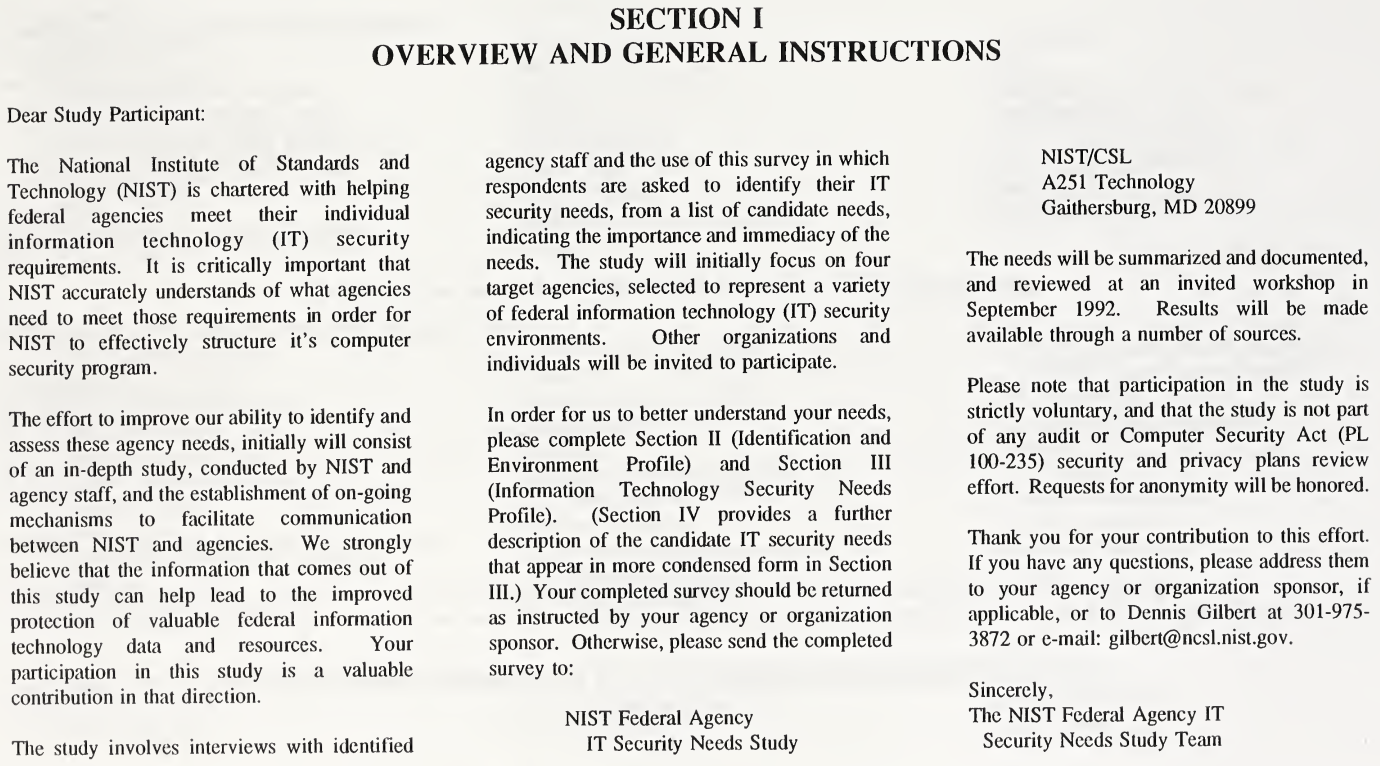
「SECTION I / OVERVIEW AND GENERAL INSTRUCTIONS」(第 I 部 概要と記入の一般的な説明)と題した調査票のページで、「Dear Study Participant:」(調査参加者の皆様)で始まる 3 段組みの書簡です。要旨は次のとおりです。NIST は連邦政府機関が各自の情報技術(IT)セキュリティ要件を満たせるよう支援する任務を負っており、NIST がコンピュータセキュリティプログラムを組み立てるには、要件を満たすために各機関が何を必要としているかを正確に理解することが非常に重要です。機関のニーズを特定・評価する取り組みは、当初は NIST と機関職員による詳細な調査と、NIST と機関の間の継続的な連絡の仕組みづくりから成ります。参加は、連邦政府の情報技術のデータと資源の保護の向上に向けた貴重な貢献だと述べています。調査は、選ばれた機関職員への聞き取りと本調査票から成り、回答者は候補となるニーズの一覧から自分の IT セキュリティのニーズを選び、それぞれの重要度と緊急度を示します。当初は、連邦政府のさまざまな IT セキュリティ環境を代表するよう選んだ 4 つの対象機関に絞り、他の組織や個人にも参加を呼びかけます。回答者には第 II 部(識別情報と環境のプロファイル)と第 III 部(情報技術セキュリティのニーズのプロファイル)への記入を求めます。第 IV 部は、第 III 部に簡潔な形で示した候補のニーズをさらに説明します。記入済みの調査票は、所属機関・組織の窓口(スポンサー)の指示どおりに返送し、指示がなければ NIST Federal Agency IT Security Needs Study, NIST/CSL, A251 Technology, Gaithersburg, MD 20899 へ送ります。ニーズは要約・文書化され、1992 年 9 月の招待制ワークショップで検討され、結果はさまざまな経路で公開されます。参加は完全に任意で、この調査はいかなる監査や、コンピュータセキュリティ法(PL 100-235)に基づくセキュリティ・プライバシー計画の審査の一部でもなく、匿名の希望は尊重されます。質問は所属機関・組織の窓口、または Dennis Gilbert(電話 301-975-3872、電子メール gilbert@ncsl.nist.gov)へ寄せるよう案内しています。署名は「Sincerely, The NIST Federal Agency IT Security Needs Study Team」(NIST 連邦政府機関 IT セキュリティニーズ調査チーム)です。
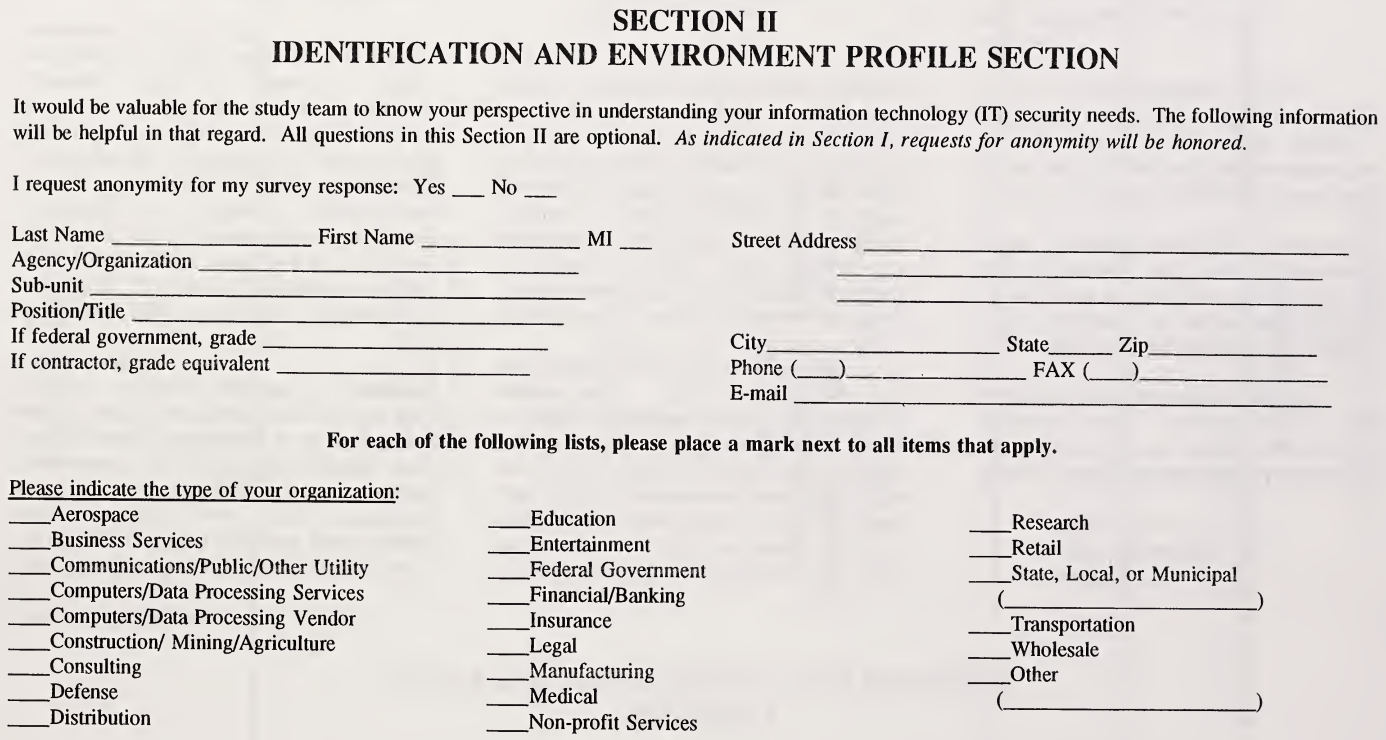
「SECTION II / IDENTIFICATION AND ENVIRONMENT PROFILE SECTION」(第 II 部 識別情報と環境のプロファイル)と題した調査票のページです。前文は「情報技術(IT)セキュリティのニーズを理解するうえで、回答者の立場を調査チームが知ることは有益です。以下の情報はそのために役立ちます。第 II 部の質問はすべて任意です。第 I 部で述べたとおり、匿名の希望は尊重されます。」です。続いて「I request anonymity for my survey response: Yes ___ No ___」(回答の匿名を希望する: はい・いいえ)の欄があります。記入欄は「Last Name」(姓)、「First Name」(名)、「MI」(ミドルネームの頭文字)、「Agency/Organization」(機関・組織)、「Sub-unit」(下位部署)、「Position/Title」(職位・役職)、「If federal government, grade」(連邦政府職員の場合は等級)、「If contractor, grade equivalent」(請負業者の場合は相当する等級)、「Street Address」(番地、3 行)、「City」(市)、「State」(州)、「Zip」(郵便番号)、「Phone ( )」(電話)、「FAX ( )」、「E-mail」(電子メール)です。太字の指示「For each of the following lists, please place a mark next to all items that apply.」(以下の各一覧で、当てはまる項目すべてに印を付けてください)の後に、「Please indicate the type of your organization:」(組織の種類を示してください)の一覧があり、各項目の前に記入欄があります。項目は Aerospace(航空宇宙)、Business Services(ビジネスサービス)、Communications/Public/Other Utility(通信・公益・その他の公益事業)、Computers/Data Processing Services(コンピュータ・データ処理サービス)、Computers/Data Processing Vendor(コンピュータ・データ処理ベンダー)、Construction/ Mining/Agriculture(建設・鉱業・農業)、Consulting(コンサルティング)、Defense(防衛)、Distribution(流通)、Education(教育)、Entertainment(娯楽)、Federal Government(連邦政府)、Financial/Banking(金融・銀行)、Insurance(保険)、Legal(法律)、Manufacturing(製造)、Medical(医療)、Non-profit Services(非営利サービス)、Research(研究)、Retail(小売)、State, Local, or Municipal(州・地方・市町村、括弧内に記入欄)、Transportation(運輸)、Wholesale(卸売)、Other(その他、括弧内に記入欄)です。
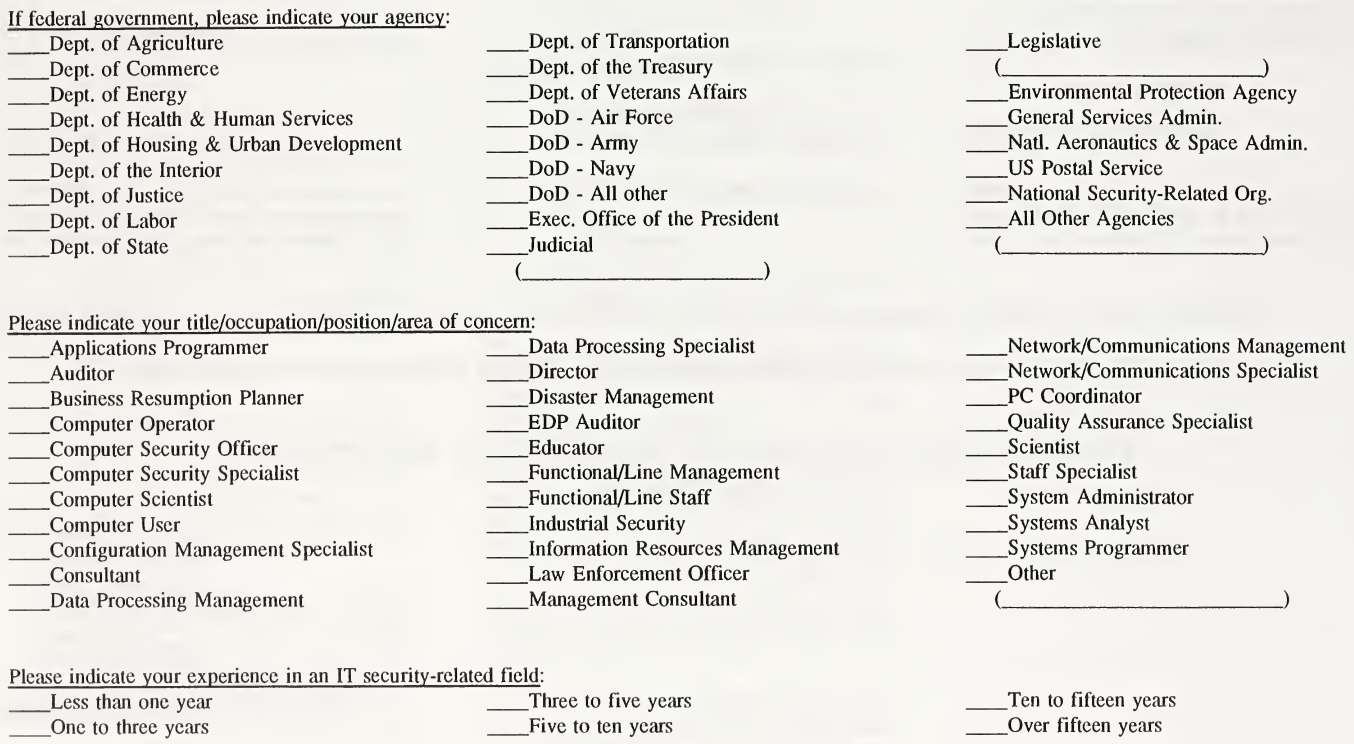
調査票のページ(第 II 部の続き)で、3 つのチェック一覧があり、各項目の前に記入欄があります。「If federal government, please indicate your agency:」(連邦政府の場合は所属機関を示してください): Dept. of Agriculture(農務省)、Dept. of Commerce(商務省)、Dept. of Energy(エネルギー省)、Dept. of Health & Human Services(保健福祉省)、Dept. of Housing & Urban Development(住宅都市開発省)、Dept. of the Interior(内務省)、Dept. of Justice(司法省)、Dept. of Labor(労働省)、Dept. of State(国務省)、Dept. of Transportation(運輸省)、Dept. of the Treasury(財務省)、Dept. of Veterans Affairs(退役軍人省)、DoD - Air Force(国防総省 空軍)、DoD - Army(国防総省 陸軍)、DoD - Navy(国防総省 海軍)、DoD - All other(国防総省 その他)、Exec. Office of the President(大統領府)、Judicial(司法府、括弧内に記入欄)、Legislative(立法府、括弧内に記入欄)、Environmental Protection Agency(環境保護庁)、General Services Admin.(一般調達局)、Natl. Aeronautics & Space Admin.(航空宇宙局)、US Postal Service(郵政公社)、National Security-Related Org.(国家安全保障関連組織)、All Other Agencies(その他の機関、括弧内に記入欄)です。「Please indicate your title/occupation/position/area of concern:」(肩書・職業・職位・担当分野を示してください): Applications Programmer(アプリケーションプログラマー)、Auditor(監査人)、Business Resumption Planner(業務再開計画担当)、Computer Operator(コンピュータオペレーター)、Computer Security Officer(コンピュータセキュリティ責任者)、Computer Security Specialist(コンピュータセキュリティ専門家)、Computer Scientist(コンピュータ科学者)、Computer User(コンピュータ利用者)、Configuration Management Specialist(構成管理専門家)、Consultant(コンサルタント)、Data Processing Management(データ処理管理)、Data Processing Specialist(データ処理専門家)、Director(部長・所長)、Disaster Management(災害管理)、EDP Auditor(EDP 監査人)、Educator(教育者)、Functional/Line Management(業務・ライン管理職)、Functional/Line Staff(業務・ライン職員)、Industrial Security(産業セキュリティ)、Information Resources Management(情報資源管理)、Law Enforcement Officer(法執行官)、Management Consultant(経営コンサルタント)、Network/Communications Management(ネットワーク・通信の管理)、Network/Communications Specialist(ネットワーク・通信の専門家)、PC Coordinator(PC 調整担当)、Quality Assurance Specialist(品質保証専門家)、Scientist(科学者)、Staff Specialist(スタッフ専門職)、System Administrator(システム管理者)、Systems Analyst(システムアナリスト)、Systems Programmer(システムプログラマー)、Other(その他、括弧内に記入欄)です。「Please indicate your experience in an IT security-related field:」(IT セキュリティ関連分野での経験を示してください): Less than one year(1 年未満)、One to three years(1〜3 年)、Three to five years(3〜5 年)、Five to ten years(5〜10 年)、Ten to fifteen years(10〜15 年)、Over fifteen years(15 年超)です。
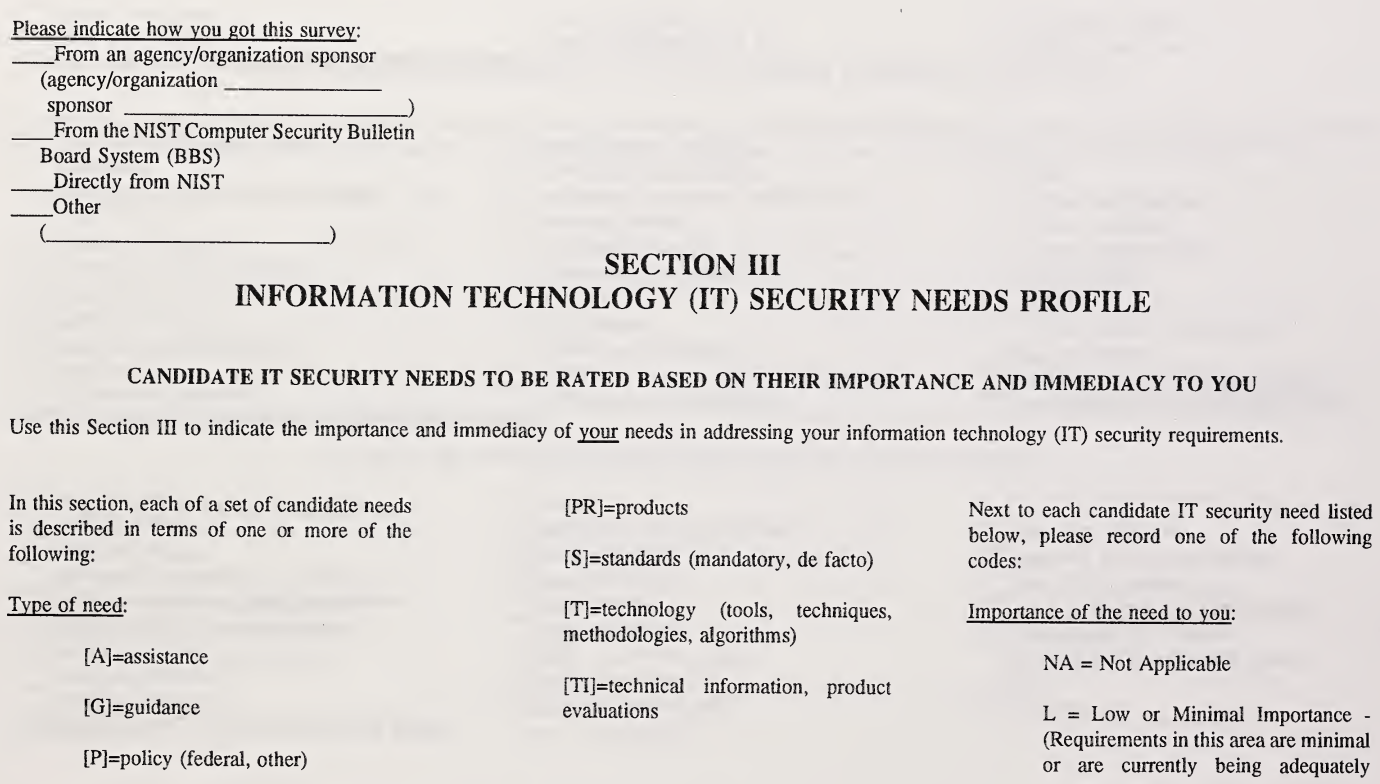
調査票のページです。「Please indicate how you got this survey:」(この調査票の入手経路を示してください)の一覧があり、各項目の前に記入欄があります。項目は「From an agency/organization sponsor (agency/organization sponsor ____)」(機関・組織の窓口から。窓口名の記入欄あり)、「From the NIST Computer Security Bulletin Board System (BBS)」(NIST のコンピュータセキュリティ電子掲示板(BBS)から)、「Directly from NIST」(NIST から直接)、「Other (____)」(その他、記入欄あり)です。続いて見出し「SECTION III / INFORMATION TECHNOLOGY (IT) SECURITY NEEDS PROFILE」(第 III 部 情報技術(IT)セキュリティのニーズのプロファイル)と小見出し「CANDIDATE IT SECURITY NEEDS TO BE RATED BASED ON THEIR IMPORTANCE AND IMMEDIACY TO YOU」(回答者にとっての重要度と緊急度で評価する、候補の IT セキュリティのニーズ)があります。本文は「この第 III 部では、情報技術(IT)セキュリティ要件に取り組むうえでの、あなたのニーズ(your に下線)の重要度と緊急度を示してください。」「この部では、候補となる各ニーズを、次の一つ以上の観点で記述しています。」です。「Type of need:」(ニーズの種類)は [A]=assistance(支援)、[G]=guidance(指針)、[P]=policy (federal, other)(政策・方針(連邦、その他))、[PR]=products(製品)、[S]=standards (mandatory, de facto)(標準(義務、事実上))、[T]=technology (tools, techniques, methodologies, algorithms)(技術(ツール、技法、方法論、アルゴリズム))、[TI]=technical information, product evaluations(技術情報、製品評価)です。「以下に挙げる候補の IT セキュリティのニーズそれぞれの横に、次のコードのいずれかを記入してください。」として、「Importance of the need to you:」(あなたにとってのニーズの重要度)の NA = Not Applicable(該当しない)、L = Low or Minimal Importance - (Requirements in this area are minimal or are currently being adequately(重要度が低いか最小限。この分野の要件は最小限であるか、現在十分に……、次のページに続く)が示されています。
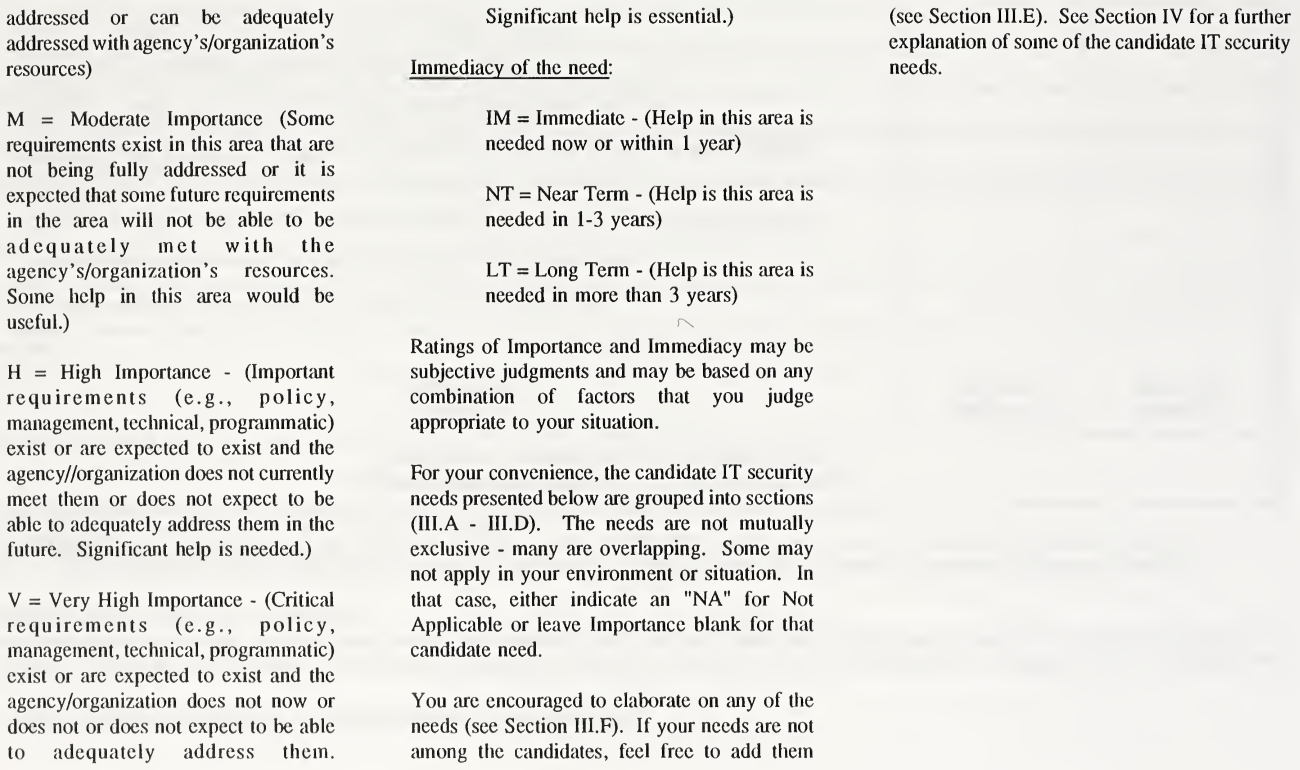
調査票のページ(第 III 部の説明の続き)です。前ページのコード L の続きは「……対処されているか、機関・組織の資源で十分に対処できる)」です。「M = Moderate Importance」(中程度の重要度。この分野に十分に対処されていない要件がある、または将来この分野の要件の一部を機関・組織の資源で十分に満たせないと見込まれる。この分野で多少の支援があると役立つ)。「H = High Importance」(高い重要度。重要な要件(例: 方針、管理、技術、計画)が存在するか存在すると見込まれ、機関・組織は現在それを満たしていない、または将来十分に対処できる見込みがない。大きな支援が必要)。「V = Very High Importance」(非常に高い重要度。重大な要件(例: 方針、管理、技術、計画)が存在するか存在すると見込まれ、機関・組織は現在それに対処できておらず、また将来も十分に対処できる見込みがない。大きな支援が不可欠)。「Immediacy of the need:」(ニーズの緊急度)は、「IM = Immediate」(即時。この分野の支援が今または 1 年以内に必要)、「NT = Near Term」(近い将来。この分野の支援が 1〜3 年以内に必要)、「LT = Long Term」(長期。この分野の支援が 3 年より先に必要)です。続いて「重要度と緊急度の評価は主観的な判断でよく、回答者が自分の状況に適切と判断する要因をどのように組み合わせて基づかせてもかまいません。」「便宜のため、以下に示す候補の IT セキュリティのニーズは節(III.A〜III.D)に分けてあります。ニーズは互いに排他的ではなく、多くは重なり合っています。回答者の環境や状況に当てはまらないものもあるでしょう。その場合は、その候補のニーズに該当しないことを示す「NA」を記入するか、重要度を空欄のままにしてください。」「どのニーズについても詳しく説明することを勧めます(第 III.F 節を参照)。自分のニーズが候補の中に無ければ、自由に追加してください(第 III.E 節を参照)。候補の IT セキュリティのニーズの一部についての詳しい説明は第 IV 部を参照してください。」とあります。
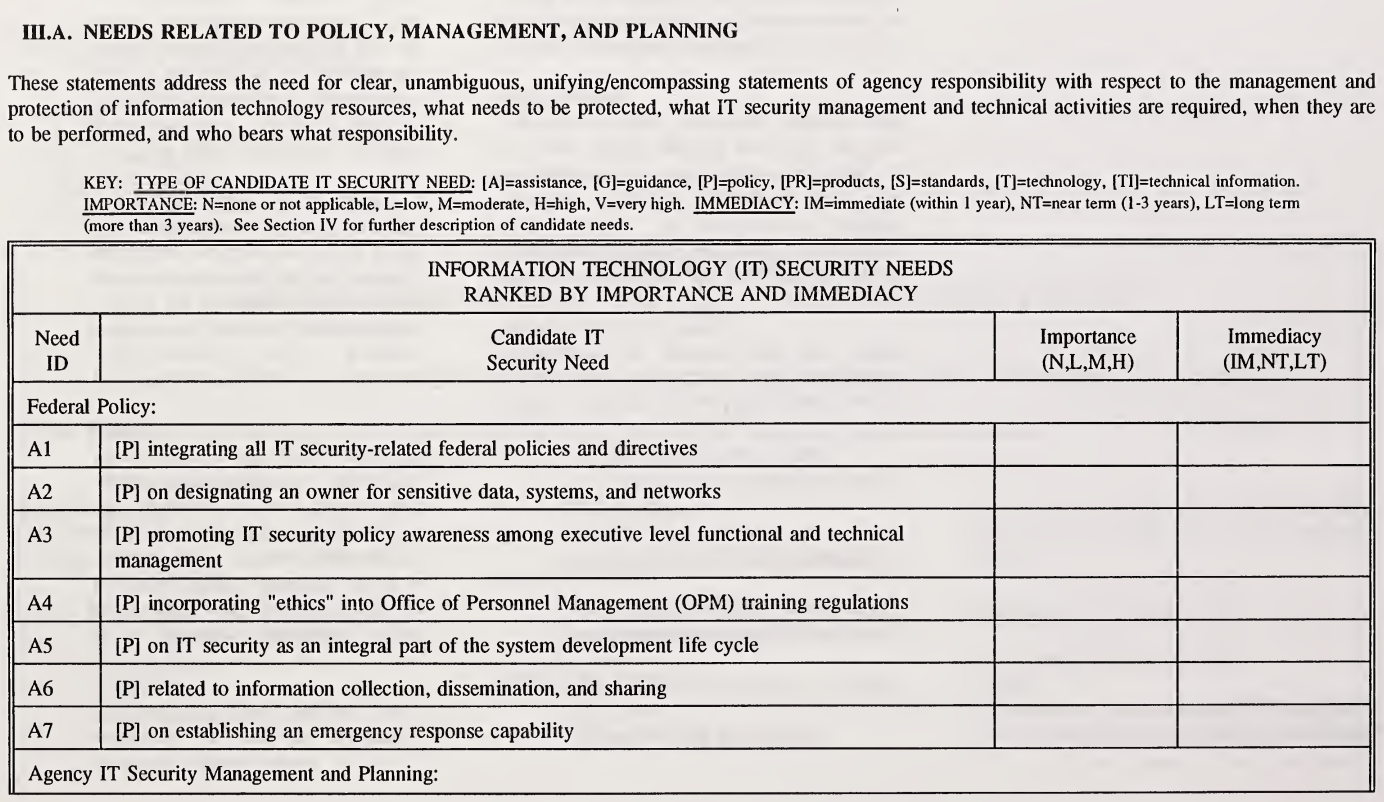
「III.A. NEEDS RELATED TO POLICY, MANAGEMENT, AND PLANNING」(III.A. 方針・管理・計画に関するニーズ)と題した調査票のページです。前文は「これらの記述は、情報技術資源の管理と保護に関する機関の責任、何を保護すべきか、どのような IT セキュリティの管理活動と技術的活動が必要か、それをいつ行うか、誰がどの責任を負うかについての、明確で曖昧さのない、統一的・包括的な記述の必要性を扱います。」です。KEY(凡例)は、候補の IT セキュリティのニーズの種類が [A]=assistance(支援)、[G]=guidance(指針)、[P]=policy(方針)、[PR]=products(製品)、[S]=standards(標準)、[T]=technology(技術)、[TI]=technical information(技術情報)、重要度が N=none or not applicable(なし・該当しない)、L=low(低)、M=moderate(中)、H=high(高)、V=very high(非常に高い)、緊急度が IM=immediate(即時、1 年以内)、NT=near term(近い将来、1〜3 年)、LT=long term(長期、3 年より先)で、候補のニーズの詳しい説明は第 IV 部を参照するよう記しています。評価表の題は「INFORMATION TECHNOLOGY (IT) SECURITY NEEDS RANKED BY IMPORTANCE AND IMMEDIACY」(重要度と緊急度で順位付けした情報技術(IT)セキュリティのニーズ)で、列は「Need ID」(ニーズ ID)、「Candidate IT Security Need」(候補の IT セキュリティのニーズ)、「Importance (N,L,M,H)」(重要度)、「Immediacy (IM,NT,LT)」(緊急度)です。重要度と緊急度の列は回答者が記入する空欄です。グループ「Federal Policy:」(連邦の方針)の行は、A1「[P] integrating all IT security-related federal policies and directives」(IT セキュリティ関連の連邦の方針と指令をすべて統合する[方針])、A2「[P] on designating an owner for sensitive data, systems, and networks」(機微なデータ・システム・ネットワークの所有者の指定に関する[方針])、A3「[P] promoting IT security policy awareness among executive level functional and technical management」(幹部レベルの業務・技術の管理者の間で IT セキュリティ方針の意識を高める[方針])、A4「[P] incorporating "ethics" into Office of Personnel Management (OPM) training regulations」(人事管理局(OPM)の研修規則に「倫理」を組み込む[方針])、A5「[P] on IT security as an integral part of the system development life cycle」(IT セキュリティをシステム開発ライフサイクルの不可欠な一部とすることに関する[方針])、A6「[P] related to information collection, dissemination, and sharing」(情報の収集・配布・共有に関する[方針])、A7「[P] on establishing an emergency response capability」(緊急対応能力の確立に関する[方針])です。最後の行はグループ見出し「Agency IT Security Management and Planning:」(機関の IT セキュリティの管理と計画)で、次のページに続きます。

調査票のページで、III.A の評価表(列は「Need ID」(ニーズ ID)、「Candidate IT Security Need」(候補の IT セキュリティのニーズ)、「Importance (N,L,M,H)」(重要度)、「Immediacy (IM,NT,LT)」(緊急度)。評価の 2 列は空欄)の続きです。「Agency IT Security Management and Planning:」(機関の IT セキュリティの管理と計画)の行は、A8「[G] on developing an agency/organization IT security policy」(機関・組織の IT セキュリティ方針の策定に関する[指針])、A9「[G] [S] defining information and system sensitivity and criticality levels」(情報とシステムの機微性・重要性のレベルを定める[指針][標準])、A10「[G] on computer security planning at the management level」(管理レベルでのコンピュータセキュリティ計画に関する[指針])、A11「[G] on developing security plans」(セキュリティ計画の作成に関する[指針])です。
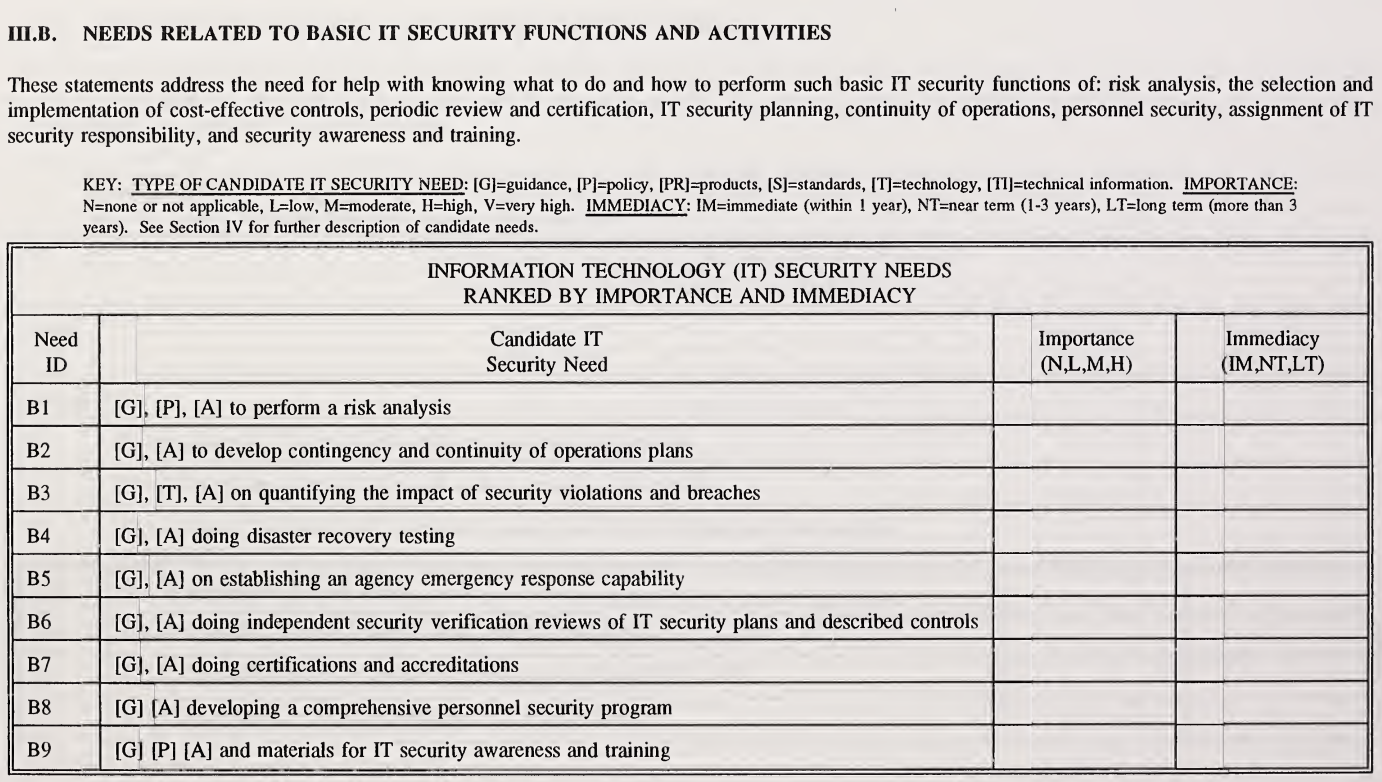
「III.B. NEEDS RELATED TO BASIC IT SECURITY FUNCTIONS AND ACTIVITIES」(III.B. 基本的な IT セキュリティの機能と活動に関するニーズ)と題した調査票のページです。前文は「これらの記述は、リスク分析、費用対効果の高い管理策の選定と実装、定期的な見直しと認証、IT セキュリティ計画、業務の継続、人的セキュリティ、IT セキュリティの責任の割り当て、セキュリティの意識向上と研修といった基本的な IT セキュリティの機能について、何をすべきか、どう実施するかを知るための支援の必要性を扱います。」です。KEY(凡例)は、候補の IT セキュリティのニーズの種類が [G]=guidance(指針)、[P]=policy(方針)、[PR]=products(製品)、[S]=standards(標準)、[T]=technology(技術)、[TI]=technical information(技術情報)、重要度が N=none or not applicable(なし・該当しない)、L=low(低)、M=moderate(中)、H=high(高)、V=very high(非常に高い)、緊急度が IM=immediate(即時、1 年以内)、NT=near term(近い将来、1〜3 年)、LT=long term(長期、3 年より先)で、候補のニーズの詳しい説明は第 IV 部を参照するよう記しています。評価表の題は「INFORMATION TECHNOLOGY (IT) SECURITY NEEDS RANKED BY IMPORTANCE AND IMMEDIACY」(重要度と緊急度で順位付けした情報技術(IT)セキュリティのニーズ)で、列は「Need ID」(ニーズ ID)、「Candidate IT Security Need」(候補の IT セキュリティのニーズ)、「Importance (N,L,M,H)」(重要度)、「Immediacy (IM,NT,LT)」(緊急度)です。重要度と緊急度の列は回答者が記入する空欄です。行は、B1「[G], [P], [A] to perform a risk analysis」(リスク分析を行うための[指針][方針][支援])、B2「[G], [A] to develop contingency and continuity of operations plans」(緊急時計画と業務継続計画を作成するための[指針][支援])、B3「[G], [T], [A] on quantifying the impact of security violations and breaches」(セキュリティ違反・侵害の影響の定量化に関する[指針][技術][支援])、B4「[G], [A] doing disaster recovery testing」(災害復旧試験の実施の[指針][支援])、B5「[G], [A] on establishing an agency emergency response capability」(機関の緊急対応能力の確立に関する[指針][支援])、B6「[G], [A] doing independent security verification reviews of IT security plans and described controls」(IT セキュリティ計画と記載された管理策の独立したセキュリティ検証レビューの実施の[指針][支援])、B7「[G], [A] doing certifications and accreditations」(認証と認定の実施の[指針][支援])、B8「[G] [A] developing a comprehensive personnel security program」(包括的な人的セキュリティプログラムの策定の[指針][支援])、B9「[G] [P] [A] and materials for IT security awareness and training」(IT セキュリティの意識向上と研修のための[指針][方針][支援]と教材)です。
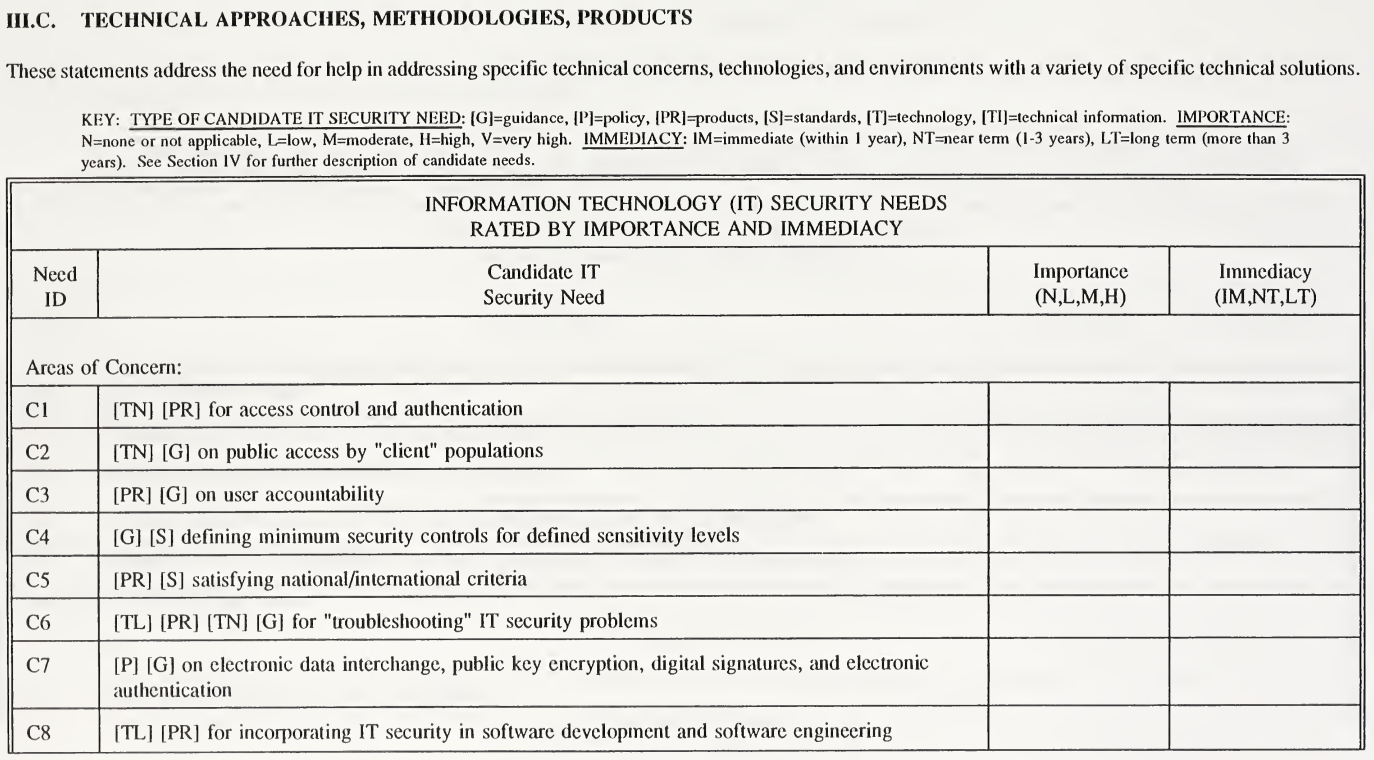
「III.C. TECHNICAL APPROACHES, METHODOLOGIES, PRODUCTS」(III.C. 技術的な手法・方法論・製品)と題した調査票のページです。前文は「これらの記述は、特定の技術的な懸念、技術、環境に、さまざまな特定の技術的解決策で取り組むための支援の必要性を扱います。」です。KEY(凡例)は、候補の IT セキュリティのニーズの種類が [G]=guidance(指針)、[P]=policy(方針)、[PR]=products(製品)、[S]=standards(標準)、[T]=technology(技術)、[TI]=technical information(技術情報)、重要度が N=none or not applicable(なし・該当しない)、L=low(低)、M=moderate(中)、H=high(高)、V=very high(非常に高い)、緊急度が IM=immediate(即時、1 年以内)、NT=near term(近い将来、1〜3 年)、LT=long term(長期、3 年より先)で、候補のニーズの詳しい説明は第 IV 部を参照するよう記しています。評価表の題は「INFORMATION TECHNOLOGY (IT) SECURITY NEEDS RATED BY IMPORTANCE AND IMMEDIACY」(重要度と緊急度で評価した情報技術(IT)セキュリティのニーズ)で、列は「Need ID」(ニーズ ID)、「Candidate IT Security Need」(候補の IT セキュリティのニーズ)、「Importance (N,L,M,H)」(重要度)、「Immediacy (IM,NT,LT)」(緊急度)です。重要度と緊急度の列は回答者が記入する空欄です。グループ「Areas of Concern:」(懸念の分野)の行は、C1「[TN] [PR] for access control and authentication」(アクセス制御と認証のための[TN][製品])、C2「[TN] [G] on public access by "client" populations」(「顧客」層による公衆アクセスに関する[TN][指針])、C3「[PR] [G] on user accountability」(利用者の説明責任に関する[製品][指針])、C4「[G] [S] defining minimum security controls for defined sensitivity levels」(定めた機微性のレベルごとの最低限のセキュリティ管理策を定める[指針][標準])、C5「[PR] [S] satisfying national/international criteria」(国内・国際の基準を満たす[製品][標準])、C6「[TL] [PR] [TN] [G] for "troubleshooting" IT security problems」(IT セキュリティの問題の「トラブルシューティング」のための[TL][製品][TN][指針])、C7「[P] [G] on electronic data interchange, public key encryption, digital signatures, and electronic authentication」(電子データ交換、公開鍵暗号、デジタル署名、電子認証に関する[方針][指針])、C8「[TL] [PR] for incorporating IT security in software development and software engineering」(ソフトウェア開発とソフトウェア工学に IT セキュリティを組み込むための[TL][製品])です。コード [TN] と [TL] は原本の印字どおりで、KEY では定義されていません。
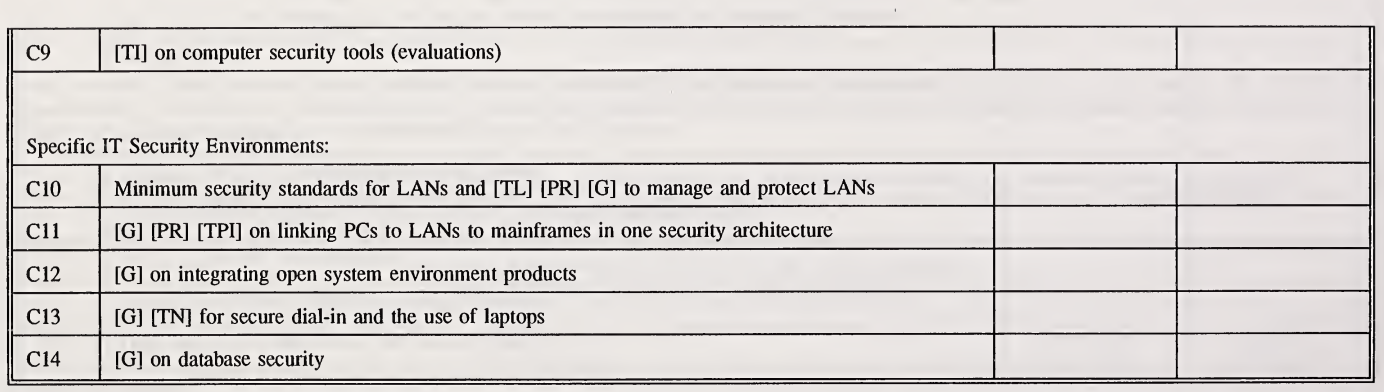
調査票のページで、III.C の評価表(列は「Need ID」(ニーズ ID)、「Candidate IT Security Need」(候補の IT セキュリティのニーズ)、「Importance (N,L,M,H)」(重要度)、「Immediacy (IM,NT,LT)」(緊急度)。評価の 2 列は空欄)の続きです。C9「[TI] on computer security tools (evaluations)」(コンピュータセキュリティツールに関する[技術情報](評価))。グループ「Specific IT Security Environments:」(特定の IT セキュリティ環境)の行は、C10「Minimum security standards for LANs and [TL] [PR] [G] to manage and protect LANs」(LAN の最低限のセキュリティ標準と、LAN を管理・保護するための[TL][製品][指針])、C11「[G] [PR] [TPI] on linking PCs to LANs to mainframes in one security architecture」(PC・LAN・メインフレームを一つのセキュリティアーキテクチャでつなぐことに関する[指針][製品][TPI])、C12「[G] on integrating open system environment products」(オープンシステム環境の製品の統合に関する[指針])、C13「[G] [TN] for secure dial-in and the use of laptops」(安全なダイヤルイン接続とラップトップの利用のための[指針][TN])、C14「[G] on database security」(データベースセキュリティに関する[指針])です。コード [TL]、[TPI]、[TN] は原本の印字どおりで、KEY では定義されていません。
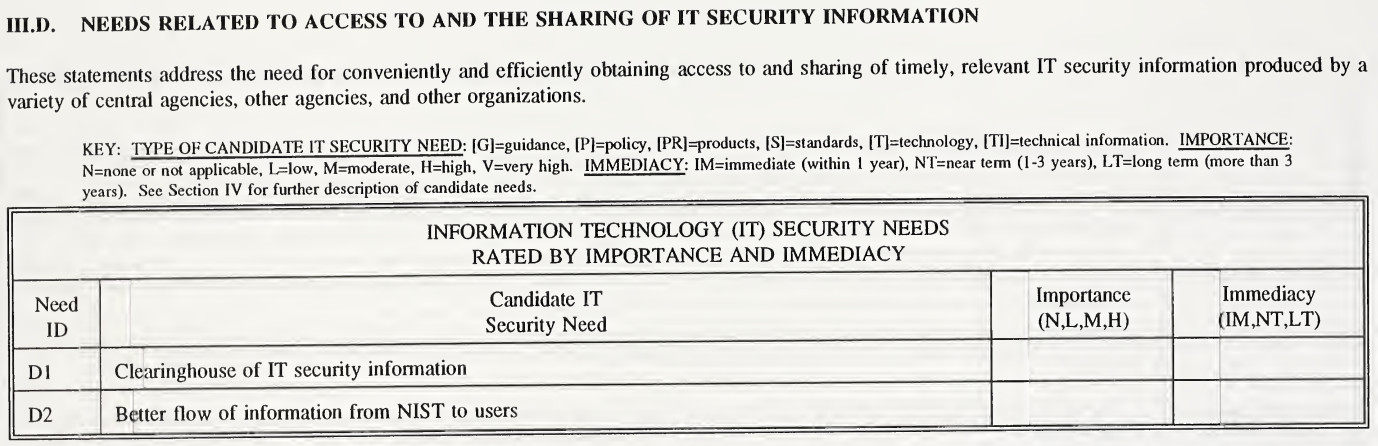
「III.D. NEEDS RELATED TO ACCESS TO AND THE SHARING OF IT SECURITY INFORMATION」(III.D. IT セキュリティ情報の入手と共有に関するニーズ)と題した調査票のページです。前文は「これらの記述は、さまざまな中央機関、他の機関、他の組織が作成する、時宜を得た関連性のある IT セキュリティ情報を、便利かつ効率的に入手・共有する必要性を扱います。」です。KEY(凡例)は、候補の IT セキュリティのニーズの種類が [G]=guidance(指針)、[P]=policy(方針)、[PR]=products(製品)、[S]=standards(標準)、[T]=technology(技術)、[TI]=technical information(技術情報)、重要度が N=none or not applicable(なし・該当しない)、L=low(低)、M=moderate(中)、H=high(高)、V=very high(非常に高い)、緊急度が IM=immediate(即時、1 年以内)、NT=near term(近い将来、1〜3 年)、LT=long term(長期、3 年より先)で、候補のニーズの詳しい説明は第 IV 部を参照するよう記しています。評価表の題は「INFORMATION TECHNOLOGY (IT) SECURITY NEEDS RATED BY IMPORTANCE AND IMMEDIACY」(重要度と緊急度で評価した情報技術(IT)セキュリティのニーズ)で、列は「Need ID」(ニーズ ID)、「Candidate IT Security Need」(候補の IT セキュリティのニーズ)、「Importance (N,L,M,H)」(重要度)、「Immediacy (IM,NT,LT)」(緊急度)です。重要度と緊急度の列は回答者が記入する空欄です。行は、D1「Clearinghouse of IT security information」(IT セキュリティ情報のクリアリングハウス)、D2「Better flow of information from NIST to users」(NIST から利用者への情報の流れの改善)です。
「III.E. OTHER IT SECURITY NEEDS」(III.E. その他の IT セキュリティのニーズ)と題した調査票のページです。前文は「この節で、追加の IT セキュリティのニーズを挙げ、その優先度を指定してください。」です。KEY(凡例)は、候補の IT セキュリティのニーズの種類が [G]=guidance(指針)、[P]=policy(方針)、[PR]=products(製品)、[S]=standards(標準)、[T]=technology(技術)、[TI]=technical information(技術情報)、重要度が N=none or not applicable(なし・該当しない)、L=low(低)、M=moderate(中)、H=high(高)、V=very high(非常に高い)、緊急度が IM=immediate(即時、1 年以内)、NT=near term(近い将来、1〜3 年)、LT=long term(長期、3 年より先)で、候補のニーズの詳しい説明は第 IV 部を参照するよう記しています。評価表の題は「INFORMATION TECHNOLOGY (IT) SECURITY NEEDS RATED BY IMPORTANCE AND IMMEDIACY」(重要度と緊急度で評価した情報技術(IT)セキュリティのニーズ)で、列は「Need ID」(ニーズ ID)、「Candidate IT Security Need」(候補の IT セキュリティのニーズ)、「Importance (N,L,M,H)」(重要度)、「Immediacy (IM,NT,LT)」(緊急度)です。重要度と緊急度の列は回答者が記入する空欄です。行 E1、E2、E3、E4、E5 は、回答者が記入するための空欄です。
「III.F. FURTHER DESCRIPTION OF DESIGNATED NEEDS AND ADDITIONAL COMMENTS」(III.F. 指定したニーズの詳しい説明と追加のコメント)と題した調査票のページです。指示「この欄に追加のコメントを書き、選んだ IT セキュリティのニーズについて詳しく説明してください。どの IT セキュリティのニーズについて述べているかを明記してください。」の後に、記入用の空白の罫線が 30 本ほどあります。
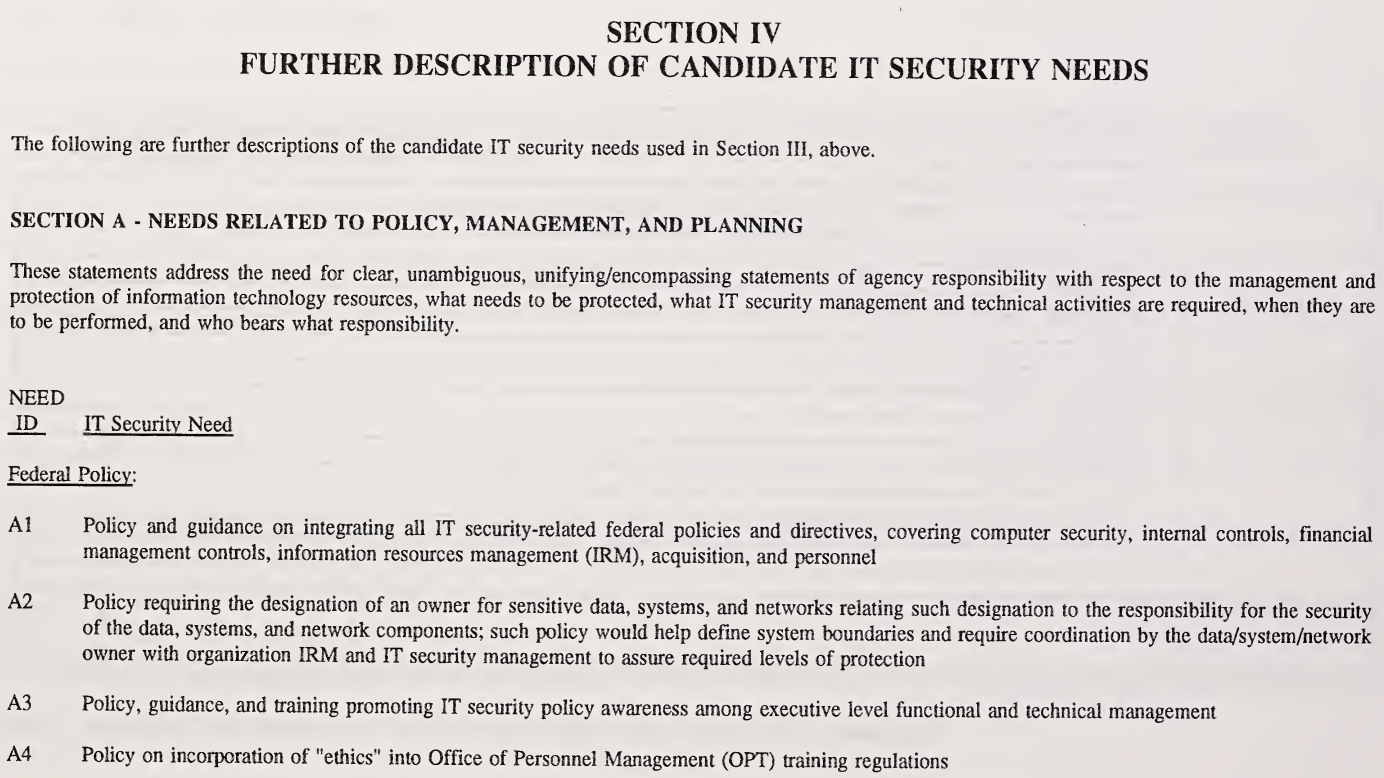
「SECTION IV / FURTHER DESCRIPTION OF CANDIDATE IT SECURITY NEEDS」(第 IV 部 候補の IT セキュリティのニーズの詳しい説明)と題した調査票のページで、「以下は、上の第 III 部で用いた候補の IT セキュリティのニーズの詳しい説明です。」とあります。小見出し「SECTION A - NEEDS RELATED TO POLICY, MANAGEMENT, AND PLANNING」(A 節 方針・管理・計画に関するニーズ)の前文は III.A と同じで、IT 資源の管理と保護に関する機関の責任(何を保護すべきか、どのような IT セキュリティの管理活動と技術的活動が必要か、それをいつ行うか、誰がどの責任を負うか)について、明確で曖昧さがなく、統一的で包括的な記述が必要であると述べています。列見出し「NEED ID」(ニーズ ID)と「IT Security Need」(IT セキュリティのニーズ)の一覧で、グループ「Federal Policy:」(連邦の方針)の項目は次のとおりです。A1: コンピュータセキュリティ、内部統制、財務管理の統制、情報資源管理(IRM)、調達、人事にわたる、IT セキュリティ関連の連邦の方針と指令をすべて統合するための方針と指針。A2: 機微なデータ・システム・ネットワークの所有者の指定を義務づけ、その指定をそれらのセキュリティに関する責任と結び付ける方針。この方針はシステムの境界を定めるのに役立ち、必要な保護レベルを確保するため、所有者に組織の IRM・IT セキュリティ管理部門との調整を求めるものです。A3: 幹部レベルの業務・技術の管理者の間で IT セキュリティ方針の意識を高めるための方針・指針・研修。A4: 人事管理局の研修規則に「倫理」を組み込むことに関する方針(原本では略称が「OPT」と印字されています)。
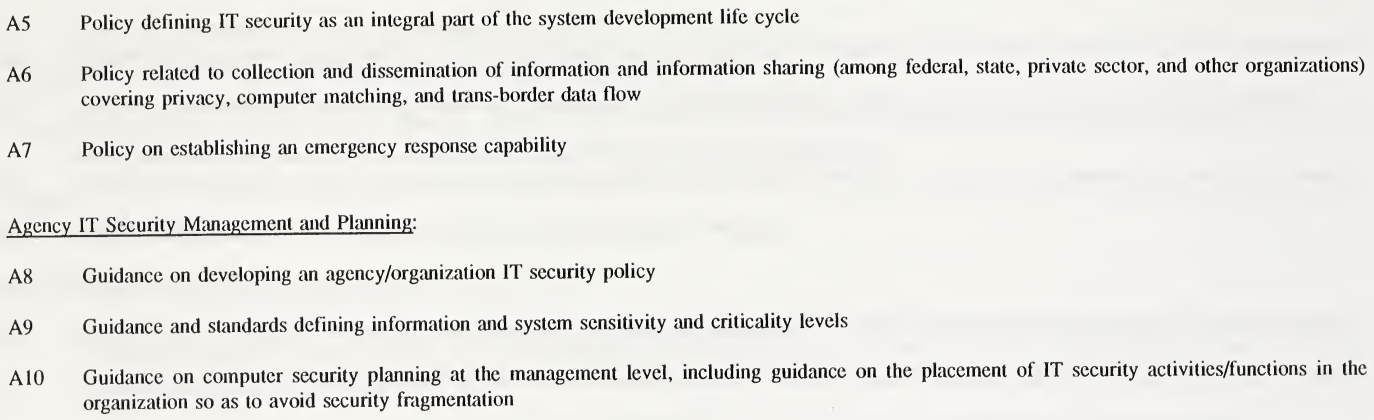
調査票のページ(第 IV 部 A 節の続き)です。A5: IT セキュリティをシステム開発ライフサイクルの不可欠な一部と定める方針。A6: プライバシー、コンピュータ照合、国境を越えるデータの流れを対象とする、情報の収集・配布と(連邦・州・民間部門・その他の組織の間の)情報共有に関する方針。A7: 緊急対応能力の確立に関する方針。グループ「Agency IT Security Management and Planning:」(機関の IT セキュリティの管理と計画)。A8: 機関・組織の IT セキュリティ方針の策定に関する指針。A9: 情報とシステムの機微性・重要性のレベルを定める指針と標準。A10: 管理レベルでのコンピュータセキュリティ計画に関する指針。セキュリティの分断を避けるよう、組織内で IT セキュリティの活動・機能をどこに置くかについての指針を含みます。
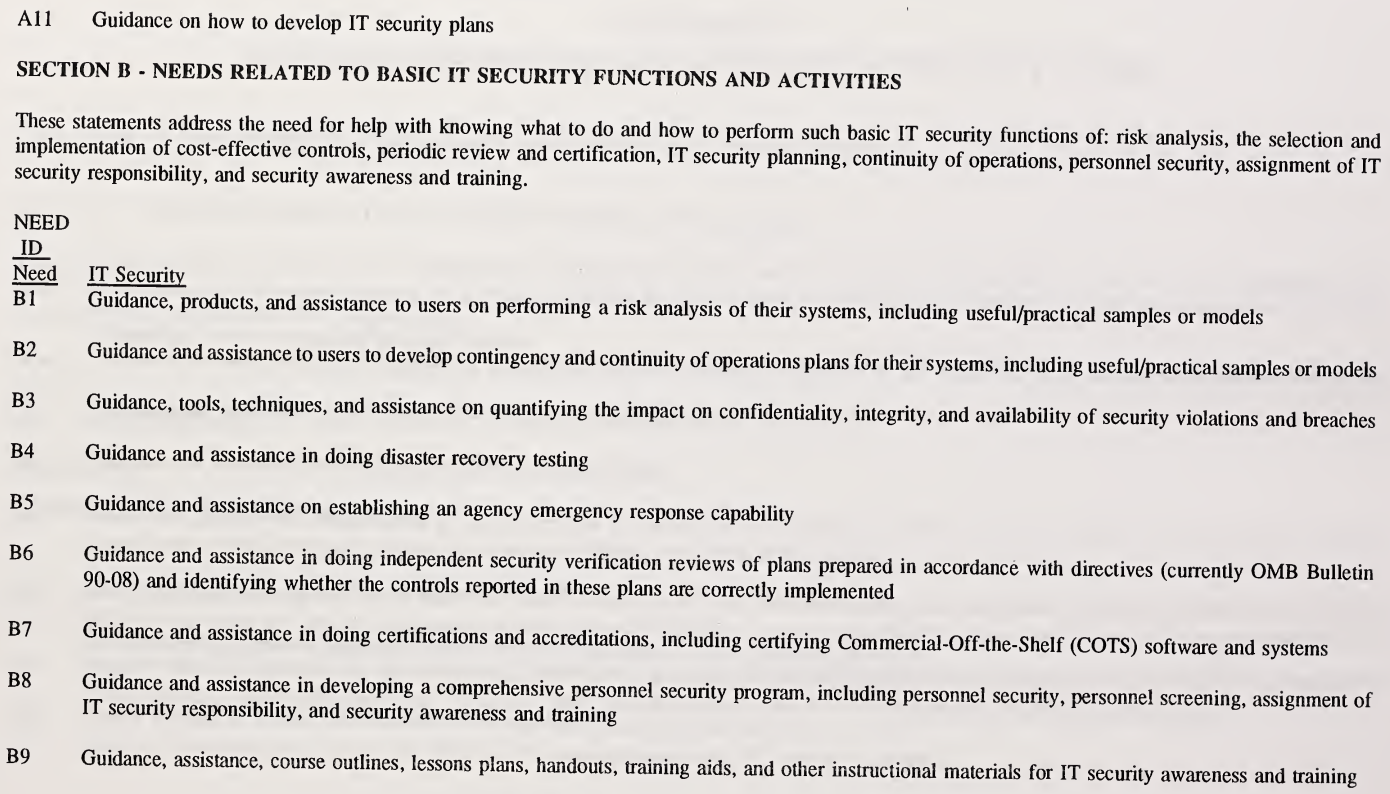
調査票のページ(第 IV 部の続き)です。A11: IT セキュリティ計画の作成方法に関する指針。小見出し「SECTION B - NEEDS RELATED TO BASIC IT SECURITY FUNCTIONS AND ACTIVITIES」(B 節 基本的な IT セキュリティの機能と活動に関するニーズ)の前文は III.B と同じで、リスク分析、費用対効果の高い管理策の選定と実装、定期的な見直しと認証、IT セキュリティ計画、業務の継続、人的セキュリティ、IT セキュリティの責任の割り当て、セキュリティの意識向上と研修といった基本的な機能について、何をすべきか、どう実施するかを知るための支援の必要性を扱います。列見出しは「NEED ID Need」と「IT Security」と印字されています。B1: 利用者が自分のシステムのリスク分析を行うための指針・製品・支援(役に立つ実用的な見本やモデルを含む)。B2: 利用者が自分のシステムの緊急時計画と業務継続計画を作成するための指針と支援(役に立つ実用的な見本やモデルを含む)。B3: セキュリティ違反・侵害が機密性・完全性・可用性に与える影響を定量化するための指針・ツール・技法・支援。B4: 災害復旧試験の実施の指針と支援。B5: 機関の緊急対応能力の確立に関する指針と支援。B6: 指令(現在は OMB Bulletin 90-08)に従って作成された計画の独立したセキュリティ検証レビューを行い、計画に報告された管理策が正しく実装されているかを確かめるための指針と支援。B7: 市販(COTS)のソフトウェアとシステムの認証を含む、認証と認定の実施の指針と支援。B8: 人的セキュリティ、人員の審査、IT セキュリティの責任の割り当て、セキュリティの意識向上と研修を含む、包括的な人的セキュリティプログラムの策定の指針と支援。B9: IT セキュリティの意識向上と研修のための指針、支援、講座の概要、授業計画、配布資料、研修教材、その他の教材。
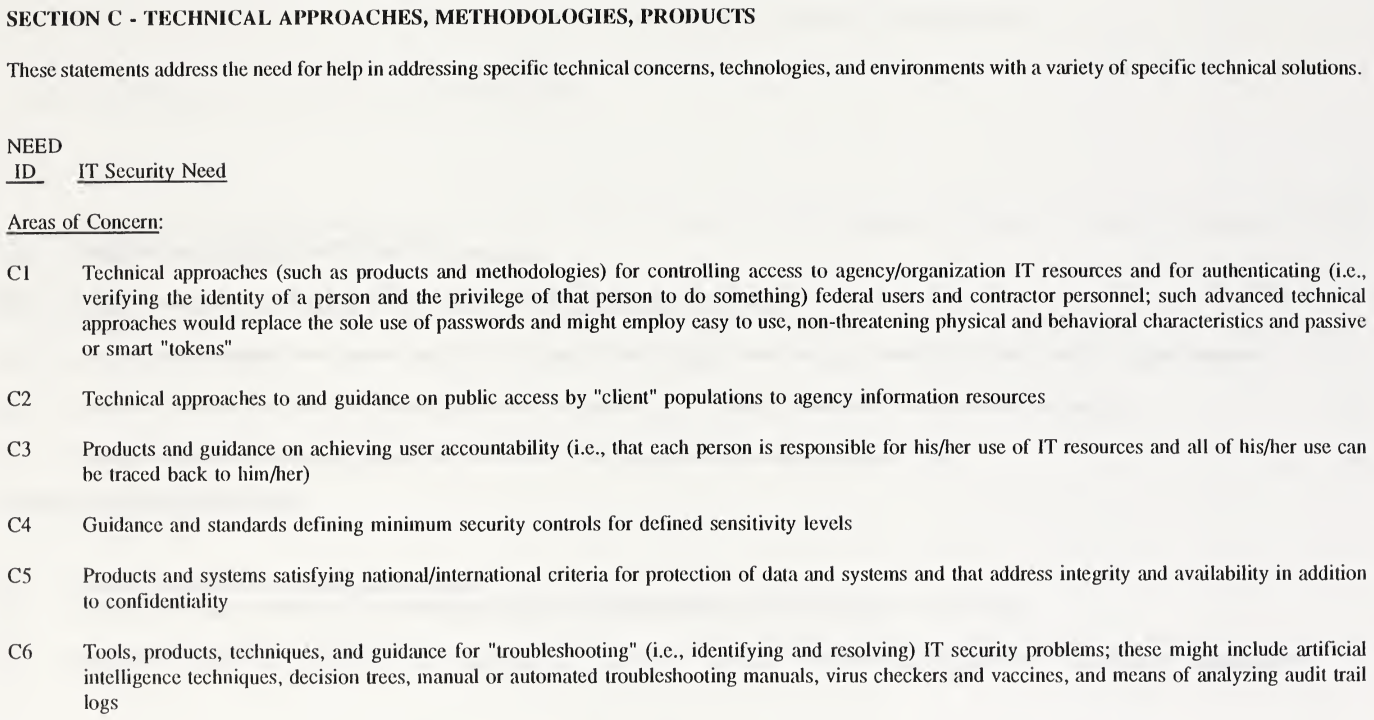
調査票のページ(第 IV 部の続き)で、小見出し「SECTION C - TECHNICAL APPROACHES, METHODOLOGIES, PRODUCTS」(C 節 技術的な手法・方法論・製品)があり、前文は III.C と同じく、特定の技術的な懸念、技術、環境にさまざまな特定の技術的解決策で取り組むための支援の必要性を扱うと述べています。列見出しは「NEED ID」と「IT Security Need」で、グループ「Areas of Concern:」(懸念の分野)の項目は次のとおりです。C1: 機関・組織の IT 資源へのアクセスを制御し、連邦政府の利用者と請負業者の職員を認証する(人の身元と、その人が何かを行う権限を確かめる)ための技術的手法(製品や方法論など)。こうした高度な手法はパスワードだけに頼る方式に代わるもので、使いやすく威圧感のない身体的・行動的特徴や、受動型またはスマート型の「トークン」を用いることが考えられます。C2: 「顧客」層による機関の情報資源への公衆アクセスのための技術的手法と指針。C3: 利用者の説明責任(各人が自分の IT 資源の利用に責任を持ち、その利用をすべて本人までたどれること)を実現するための製品と指針。C4: 定めた機微性のレベルごとの最低限のセキュリティ管理策を定める指針と標準。C5: データとシステムの保護に関する国内・国際の基準を満たし、機密性に加えて完全性と可用性にも対処する製品とシステム。C6: IT セキュリティの問題の「トラブルシューティング」(特定と解決)のためのツール・製品・技法・指針。人工知能の技法、決定木、手作業または自動のトラブルシューティング手引き、ウイルス検査ソフトとワクチン、監査証跡ログの分析手段などが考えられます。
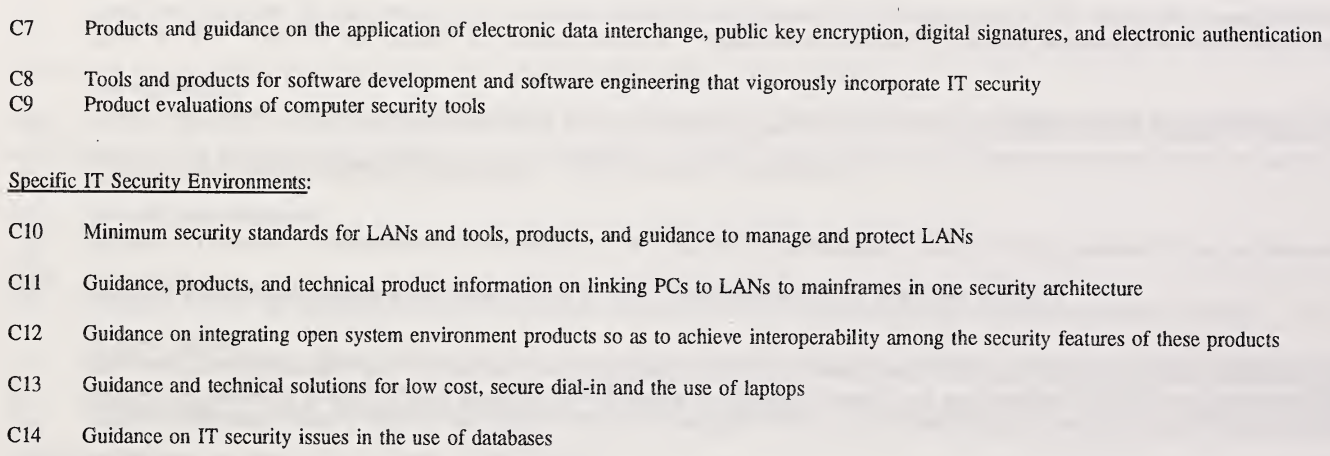
調査票のページ(第 IV 部 C 節の続き)です。C7: 電子データ交換、公開鍵暗号、デジタル署名、電子認証の適用に関する製品と指針。C8: IT セキュリティを積極的に組み込んだ、ソフトウェア開発とソフトウェア工学のためのツールと製品。C9: コンピュータセキュリティツールの製品評価。グループ「Specific IT Security Environments:」(特定の IT セキュリティ環境)。C10: LAN の最低限のセキュリティ標準と、LAN を管理・保護するためのツール・製品・指針。C11: PC・LAN・メインフレームを一つのセキュリティアーキテクチャでつなぐための指針・製品・技術的な製品情報。C12: オープンシステム環境の製品を統合し、それらの製品のセキュリティ機能の相互運用性を実現するための指針。C13: 低コストで安全なダイヤルイン接続とラップトップの利用のための指針と技術的解決策。C14: データベースの利用における IT セキュリティの問題に関する指針。
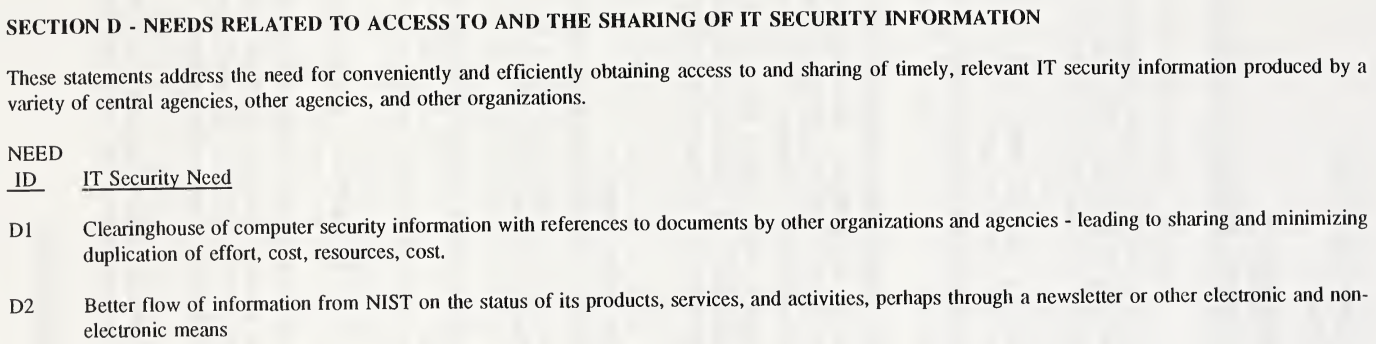
調査票のページ(第 IV 部の続き)で、小見出し「SECTION D - NEEDS RELATED TO ACCESS TO AND THE SHARING OF IT SECURITY INFORMATION」(D 節 IT セキュリティ情報の入手と共有に関するニーズ)があり、前文は III.D と同じく、中央機関・他の機関・他の組織が作成する時宜を得た関連性のある IT セキュリティ情報を、便利かつ効率的に入手・共有する必要性を扱うと述べています。列見出しは「NEED ID」と「IT Security Need」です。D1: 他の組織や機関の文書への参照を備えたコンピュータセキュリティ情報のクリアリングハウス。これにより共有が進み、労力・費用・資源の重複が最小限になります(原本では末尾に「cost」が重ねて書かれています)。D2: NIST の製品・サービス・活動の状況についての、NIST からの情報の流れの改善。ニュースレターやその他の電子的・非電子的な手段によることが考えられます。
APPENDIX C — SELECTED FEDERAL SECURITY-RELATED DIRECTIVES
付録 C — 選択した連邦のセキュリティ関連指令
The following is an extract of Appendix A of NISTIR 4749, Statements of Work for Federal Computer Security Services: For Use In-House or Contracting Out. See that document for a fuller descriptions of applicable laws and directives.
以下は、NISTIR 4749, Statements of Work for Federal Computer Security Services: For Use In-House or Contracting Out の付録 A からの抜粋です。該当する法律と指令のより詳しい説明については、その文書を参照してください。
FEDERAL MANAGERS' FINANCIAL INTEGRITY ACT OF 1982 (Pub. L. 97-225)
1982 年連邦管理者財務保全法(FEDERAL MANAGERS' FINANCIAL INTEGRITY ACT OF 1982、Pub. L. 97-225)
This law enacted the main provisions of OMB Circular A-123. Its purpose is to ensure that agencies maintain effective systems of accounting and administrative controls against fraud, waste and abuse.
この法律は、OMB Circular A-123 の主要な規定を制定しました。その目的は、機関が不正、浪費および濫用に対する、会計上および管理上の効果的な統制の仕組みを維持することを確実にすることです。
PAPERWORK REAUTHORIZATION ACT OF 1986 (Pub. L. 99-500)
1986 年文書業務削減再承認法(PAPERWORK REAUTHORIZATION ACT OF 1986、Pub. L. 99-500)
This law clarified the Brooks Act definition of "ADPE" to include telecommunications, ADP services and support services. This law gave permanent protest jurisdiction to the GSA Board of Contract Appeals (GSBCA). Implementation of this law in the Federal Information Resources Management Regulation (FIRMR) resulted in the adoption of the term "Federal Information Processing (FIP) Resources" to encompass all resources defined by the Brooks Act amendment.
この法律は、Brooks Act の「ADPE」の定義を、電気通信、ADP サービスおよび支援サービスを含むように明確化しました。この法律は、GSA Board of Contract Appeals(GSBCA)に恒久的な異議申立ての管轄権を与えました。この法律を Federal Information Resources Management Regulation(FIRMR)で実施した結果、Brooks Act の改正で定義されたすべての資源を包含する用語として、「連邦情報処理(FIP)資源」が採用されました。
COMPUTER SECURITY ACT OF 1987 (Pub. L. 100-235)
1987 年コンピュータセキュリティ法(COMPUTER SECURITY ACT OF 1987、Pub. L. 100-235)
This law amends the NBS Organic Act of 1901, Federal Property and Administrative Services Act of 1949 and Brooks Act of 1965 to add provisions on the protection of computer-related assets (e.g., hardware, software, and data). This Act:
この法律は、1901 年 NBS 組織法、1949 年連邦財産・行政サービス法、および 1965 年 Brooks Act を改正し、コンピュータ関連の資産(たとえば、ハードウェア、ソフトウェア、データ)の保護に関する規定を追加しました。この法律は、次のことを行います。
•assigns responsibility of development of computer security guidelines and standards to the NIST;
•コンピュータセキュリティのガイドラインと標準を策定する責任を NIST に割り当てます。
•requires federal agencies identify existing and under development systems that contain sensitive information;
•機微な情報を含む、既存のシステムおよび開発中のシステムを、連邦機関が特定することを求めます。
•requires development of a security plan for each identified sensitive computer system; and
•特定された機微なコンピュータシステムごとに、セキュリティ計画を策定することを求めます。
•requires mandatory periodic training in computer security awareness and accepted computer security practice of all employees involved with the management, use, or operation of federal computer systems within or under the supervision of a federal agency.
•連邦機関の内部またはその監督下にある連邦のコンピュータシステムの管理、利用または運用に関わるすべての職員に対し、コンピュータセキュリティの意識向上と、容認されたコンピュータセキュリティの慣行に関する定期的な研修を義務付けます。
Current instructions for implementing the Computer Security Act are provided in OMB Bulletin 90-08, Guidance for the Preparation of the Security Plans for Federal Computer Systems that Contain Sensitive Information.
コンピュータセキュリティ法を実施するための現行の指示は、OMB Bulletin 90-08, Guidance for the Preparation of the Security Plans for Federal Computer Systems that Contain Sensitive Information に示されています。
PRIVACY ACT OF 1974 (Pub. L. 93-579)
1974 年プライバシー法(PRIVACY ACT OF 1974、Pub. L. 93-579)
This law was enacted to provide for the protection of information related to individuals maintained in federal information systems, and to grant access to such information by the individual. The law establishes criteria for maintaining the confidentiality of sensitive data and guidelines for determining which data are covered.
この法律は、連邦の情報システムで保持される個人に関する情報の保護を定め、その個人がその情報にアクセスすることを認めるために制定されました。この法律は、機微なデータの機密性を維持するための基準と、どのデータが対象となるかを判断するためのガイドラインを定めています。
OMB Circular A-130 implements provisions of this act. FIPS PUB 41 provides computer security guidelines for implementing the act.
OMB Circular A-130 は、この法律の規定を実施するものです。FIPS PUB 41 は、この法律を実施するためのコンピュータセキュリティのガイドラインを示しています。
FREEDOM OF INFORMATION ACT (Pub. L. 90-23)
情報自由法(FREEDOM OF INFORMATION ACT、Pub. L. 90-23)
This law makes federal information readily available to the public. It also establishes the conditions under which information may be withheld form the public to ensure that certain information such as trade secrets be protected.
この法律は、連邦の情報を一般市民が容易に入手できるようにします。また、営業秘密などの特定の情報が確実に保護されるよう、情報を一般市民に対して開示しないことができる条件も定めています。
OMB CIRCULAR A-123, INTERNAL CONTROL SYSTEMS
OMB CIRCULAR A-123、内部統制システム
OMB Circular-123 has specific policies and standards for federal agencies for establishing and maintaining internal controls in their programs and administration activities. This includes requirements for vulnerability assessments and internal control reviews. The main provisions of A-123 became law through the enactment of the Federal Manager's Financial Integrity Act of 1982.
OMB Circular-123 は、連邦機関がそのプログラムと管理活動の内部統制を確立し維持するための、具体的な方針と標準を定めています。これには、脆弱性評価と内部統制審査の要件が含まれます。A-123 の主要な規定は、1982 年連邦管理者財務保全法(Federal Manager's Financial Integrity Act of 1982)の制定によって法律となりました。
OMB CIRCULAR A-127, FINANCIAL MANAGEMENT SYSTEMS
OMB CIRCULAR A-127、財務管理システム
OMB Circular A-127 has specific policies and standards for federal agencies for establishing and maintaining internal controls in financial management systems. This includes requirements for annual reviews of agency financial systems which build on reviews required by OMB Circular A-123.
OMB Circular A-127 は、連邦機関が財務管理システムの内部統制を確立し維持するための、具体的な方針と標準を定めています。これには、OMB Circular A-123 が求める審査を土台とする、機関の財務システムの年次審査の要件が含まれます。
OMB CIRCULAR A-130, MANAGEMENT OF FEDERAL INFORMATION RESOURCES
OMB CIRCULAR A-130、連邦情報資源の管理
OMB Circular A-130, Appendix III, Security of Federal Automated Information Systems, has specific requirements for establishing the agency computer security program. The program should include application security, personnel security, information technology installation security, and security awareness and training programs. It also assigns responsibilities to the Department of Commerce, Department of Defense, General Services Administration, and Office of Personnel Management. Federal agencies are required to address security in their annual internal control report required under OMB Circular A-123.
OMB Circular A-130 の付録 III(Security of Federal Automated Information Systems)は、機関のコンピュータセキュリティプログラムを確立するための具体的な要件を定めています。このプログラムには、アプリケーションセキュリティ、人的セキュリティ、情報技術の設置環境のセキュリティ、およびセキュリティ意識向上・研修プログラムが含まれるべきです。また、商務省、国防総省、一般調達局および人事管理局に責任を割り当てています。連邦機関は、OMB Circular A-123 が求める年次の内部統制報告書の中で、セキュリティに対処することが求められています。
APPENDIX D — DISCUSSION OF THE OMB, NIST, NSA AGENCY ASSISTANCE VISITS
付録 D — OMB、NIST、NSA による機関支援訪問に関する議論
In July of 1990, OMB issued OMB BULLETIN 90-08, Guidance for Preparation of Security Plans for Federal Computer Systems that Contain Sensitive Information. Its purpose was to provide federal agencies guidance on computer security planning activities required under the Computer Security Act of 1987. The Bulletin indicated that visits by OMB, NIST, and NSA staff would be scheduled with agencies to discuss the agency's implementation of the Act. NIST and NSA were to provide technical advice and assistance on the agency's security needs as requested. These visits were completed in the Summer of 1992. A report of that activity has been prepared. The report is entitled, "Observations of Agency Computer Security Practices and Implementation of OMB Bulletin No. 90-08: 'Guidance for Preparation of Security Plans for Federal Computer Systems that Contain Sensitive Information,' February 1993." The following is extracted from the Executive Summary of that report.
1990 年 7 月、OMB は OMB BULLETIN 90-08, Guidance for Preparation of Security Plans for Federal Computer Systems that Contain Sensitive Information を発行しました。その目的は、1987 年コンピュータセキュリティ法に基づいて求められるコンピュータセキュリティ計画活動について、連邦機関に指針を示すことでした。この Bulletin は、OMB、NIST および NSA の職員が機関を訪問し、機関によるこの法律の実施について議論する日程を組むことを示していました。NIST と NSA は、要請に応じて、機関のセキュリティニーズに関する技術的な助言と支援を提供することになっていました。これらの訪問は、1992 年の夏に完了しました。その活動の報告書が作成されています。報告書の題名は、「Observations of Agency Computer Security Practices and Implementation of OMB Bulletin No. 90-08: 'Guidance for Preparation of Security Plans for Federal Computer Systems that Contain Sensitive Information,' February 1993」です。以下は、その報告書のエグゼクティブサマリーからの抜粋です。
Based on the observations of the agency visit team, "OMB, NIST and NSA propose the following steps to improve Federal computer security.
機関訪問チームの所見に基づき、「OMB、NIST および NSA は、連邦のコンピュータセキュリティを改善するため、次の措置を提案します。
1.Focus Management Attention on Computer Security:
1.コンピュータセキュリティに管理者の注意を向ける:
•OMB will state in forthcoming guidance that lack of compliance with certain computer security requirements should be considered a material weakness under the Federal Manager's Financial Integrity Act.
•OMB は、今後のガイダンスで、特定のコンピュータセキュリティ要件への不遵守は、Federal Manager's Financial Integrity Act に基づく重大な弱点とみなすべきであると述べます。
•The OMB/NIST/NSA team will again visit agencies that have reported computer security as a "high-risk area."
•OMB/NIST/NSA のチームは、コンピュータセキュリティを「高リスク領域」として報告した機関を、再び訪問します。
2.Improve Planning for Security:
2.セキュリティの計画を改善する:
•OMB will require planning for computer security as a critical element of agency IRM planning in its revision of OMB Circular No. A-130, "Management of Federal Information Resources."
•OMB は、OMB Circular No. A-130「Management of Federal Information Resources」の改訂で、コンピュータセキュリティの計画を、機関の IRM 計画の重要な要素として要求します。
3.Update Security Awareness Training
3.セキュリティの意識向上トレーニングを更新する
•NIST, with OPM assistance, will review the computer security awareness and training guidelines to assure they are still viable. Agencies will incorporate these guidelines into their awareness and training programs.
•NIST は、OPM の支援を得て、コンピュータセキュリティの意識向上とトレーニングのガイドラインが今も有効であることを確認するため、それらを見直します。機関は、これらのガイドラインを自らの意識向上・トレーニングプログラムに取り入れます。
•OMB will revise OMB Circular No. A-130 to require agencies to:
•OMB は、機関に次のことを求めるため、OMB Circular No. A-130 を改訂します。
•Assure that new employees and contractors complete awareness and training before they begin using Federal systems.
•新しい職員と請負業者が、連邦のシステムを使い始める前に、意識向上とトレーニングを修了することを確実にします。
•Assure completion of awareness and training by employees of other agencies before allowing them to access sensitive systems.
•ほかの機関の職員が機微なシステムにアクセスすることを認める前に、その職員が意識向上とトレーニングを修了していることを確実にします。
•Assure periodic refresher training for employees and contractors.
•職員と請負業者の定期的な復習トレーニングを確実にします。
4.Improve Contingency Planning and Incident Response Capabilities:
4.緊急時対応計画とインシデント対応能力の改善
•OMB will require agencies to:
•OMB は、機関に次のことを求めます。
•Periodically test contingency plans for their most sensitive systems.
•最も機微なシステムの緊急時対応計画を、定期的にテストします。
•Establish formal incident response capability.
•正式なインシデント対応能力を確立します。
5.Improve Communication of Useful Security Techniques:
5.有用なセキュリティ技法の伝達の改善
•NIST will enhance its efforts to raise awareness of know solutions to security problems.
•NIST は、セキュリティ問題に対する既知の解決策の認知を高める取り組みを強化します。
6.Assess Security Vulnerabilities in Emerging Information Technologies:
6.新興情報技術におけるセキュリティ脆弱性の評価
•NIST and NSA will assess the security vulnerabilities inherent in emerging information technologies and provide guidance to help agencies mitigate against those vulnerabilities."
•NIST と NSA は、新興の情報技術に固有のセキュリティ脆弱性を評価し、機関がそれらの脆弱性を緩和するのに役立つガイダンスを提供します。
APPENDIX E — STUDY WORKING GROUP MEETING PARTICIPANTS
付録 E — 調査ワーキンググループ会合の参加者
A study working group, consisting of approximately 30 invited federal and private sector representatives, provided direction to the study. The group met in February 1992 to comment on the overall approach and methodology and again in September 1992 to review the study results. The following are the participants in the September 1992 meeting.
連邦と民間部門の代表者のうち招待された約 30 人で構成される調査ワーキンググループが、調査の方向性を示しました。このグループは、全体的なアプローチと方法論についてコメントするため 1992 年 2 月に、また調査結果を確認するため 1992 年 9 月に会合を開きました。以下は、1992 年 9 月の会合の参加者です。
PARTICIPANTS IN THE FEBRUARY 1992 INITIAL PLANNING MEETING
1992 年 2 月の最初の計画会合の参加者
Non-NIST Participants
NIST 以外の参加者
Mr. Ed Borodkin, NCSC
Mr. Ed Borodkin, NCSC
Mr. Fred Brandt, Department of State
Mr. Fred Brandt, Department of State
Mr. Richard W. Carr, NASA
Mr. Richard W. Carr, NASA
Ms. Mary Casey, Department of Justice
Ms. Mary Casey, Department of Justice
Mr. Rob Cowart, Lockheed Space Operations Corp.
Mr. Rob Cowart, Lockheed Space Operations Corp.
Mr. Dan Gambel, Grumman Data Systems
Mr. Dan Gambel, Grumman Data Systems
Mr. Dain Gary, Software Engineering Institute
Mr. Dain Gary, Software Engineering Institute
Mr. Frank Guglielmo, Department of Justice
Mr. Frank Guglielmo, Department of Justice
Mr. John Ippolito, Comsis
Mr. John Ippolito, Comsis
Ms. Ann Horth, General Services Administration
Ms. Ann Horth, General Services Administration
Mr. Howard Keough, ASIS, Consultant
Mr. Howard Keough, ASIS, Consultant
Mr. Vic Maconachy, National Computer Security Educators, c/o NSA
Mr. Vic Maconachy, National Computer Security Educators, c/o NSA
Mr. Wayne Madsen, Computer Sciences Corp.
Mr. Wayne Madsen, Computer Sciences Corp.
Mr. Vic Marshall, Booz-Allen and Hamilton
Mr. Vic Marshall, Booz-Allen and Hamilton
Ms. Sally Meglathery, ISSA, c/o New York Stock Exchange
Ms. Sally Meglathery, ISSA, c/o New York Stock Exchange
Mr. Nick Pantiuk, Grumman Data Systems
Mr. Nick Pantiuk, Grumman Data Systems
Ms. Sadie Pitcher, Department of Commerce
Ms. Sadie Pitcher, Department of Commerce
Mr. Steve Smith, Department of Transportation
Mr. Steve Smith, Department of Transportation
Ms. Mary Sue Stone, Department of State
Ms. Mary Sue Stone, Department of State
Mr. John Tressler, Department of Education
Mr. John Tressler, Department of Education
Ms. Diane Vigue, Department of Transportation
Ms. Diane Vigue, Department of Transportation
NIST Participants
NIST の参加者
Mr. Jon Arneson; Ms. Patty Edfors; Mr. David Ferraiolo; Mr. Dennis Gilbert; Ms. Irene Gilbert; Ms. Barbara Guttman; Mr. Jerry Linn; Mr. Dennis Steinauer; and Ms. Marianne Swanson
Mr. Jon Arneson; Ms. Patty Edfors; Mr. David Ferraiolo; Mr. Dennis Gilbert; Ms. Irene Gilbert; Ms. Barbara Guttman; Mr. Jerry Linn; Mr. Dennis Steinauer; and Ms. Marianne Swanson
PARTICIPANTS IN THE SEPTEMBER 1992 STUDY RESULTS REVIEW WORKSHOP
1992 年 9 月の調査結果検討ワークショップの参加者
NIST and Non-NIST Participants
NIST と NIST 以外の参加者
Ms. Judy Bloom, U.S. Department of Justice
Ms. Judy Bloom, U.S. Department of Justice
Mr. Ed Borodkin, National Computer Security Center
Mr. Ed Borodkin, National Computer Security Center
Mr. Richard W. Carr, National Aeronautics Space Administration
Mr. Richard W. Carr, National Aeronautics Space Administration
Ms. Dorothea de Zafra, Department of Health & Human Services, Public Health Service
Ms. Dorothea de Zafra, Department of Health & Human Services, Public Health Service
Mr. Donald Franklin, Department of Veterans Affairs
Mr. Donald Franklin, Department of Veterans Affairs
Mr. Bill Garvin, Social Security Administration
Mr. Bill Garvin, Social Security Administration
Mr. Dennis Gilbert, NIST/CSL
Mr. Dennis Gilbert, NIST/CSL
Ms. Irene Gilbert Perry, NIST/CSL
Ms. Irene Gilbert Perry, NIST/CSL
Mr. Stephen W. Greenfield, Department of Health and Human Services
Mr. Stephen W. Greenfield, Department of Health and Human Services
Mr. John Haines, Department of the Interior
Mr. John Haines, Department of the Interior
Mr. John Ippolito, Comsis
Mr. John Ippolito, Comsis
Ms. Rhonda Joseph, Department of Transportation
Ms. Rhonda Joseph, Department of Transportation
Mr. William G. Logan, Department of Health and Human Services
Mr. William G. Logan, Department of Health and Human Services
Mr. Vic Maconochy, National Computer Security Educators
Mr. Vic Maconochy, National Computer Security Educators
Mr. Nick Pantiuk, Grumman Data Systems
Mr. Nick Pantiuk, Grumman Data Systems
Ms. Sadie Pitcher, Department of Commerce
Ms. Sadie Pitcher, Department of Commerce
Mr. Dennis Steinauer, NIST/CSL
Mr. Dennis Steinauer, NIST/CSL
Mr. John Tressler, Department of Education
Mr. John Tressler, Department of Education
APPENDIX F — SOURCES OF INFORMATION ON IT SECURITY REQUIREMENTS AND NEEDS
付録 F — IT セキュリティ要件とニーズに関する情報源
The following documents were identifed by participants at the February 1992 meeting of the study working group as being potential sources of informaiton regarding IT security requirements and needs.
次の文書は、調査ワーキンググループの 1992 年 2 月の会合の参加者によって、IT セキュリティ要件とニーズに関する情報の潜在的な情報源として特定されました。
Potential Sources of Information
情報の潜在的な情報源
•NIST Annual Report
•NIST Annual Report
•NIST PUBS LIST 91
•NIST PUBS LIST 91
•Descriptions of related activities by NIST and other organizations
•NIST などの組織による関連する活動の説明
•NIST Framework Handbook outline and description
•NIST Framework Handbook の概要と説明
•OMB Bulletin 90-08, OMB Circular A-130, Notes on A-130 from Computer Security Managers' Forum work group
•OMB Bulletin 90-08、OMB Circular A-130、Computer Security Managers' Forum 作業グループによる A-130 に関する覚書
•PCIE/PCMI Model Framework
•PCIE/PCMI Model Framework
•NIST draft - Minimum Security Functionality Requirements (MSFR) for Multi-User Operating Systems (Now NISTIR 5153 "Minimum Security Requirements for Multi-user Operating Systems, A Protection Profile for the U.S. Information Security Standard.")
•NIST ドラフト - Minimum Security Functionality Requirements (MSFR) for Multi-User Operating Systems(現在は NISTIR 5153 "Minimum Security Requirements for Multi-user Operating Systems, A Protection Profile for the U.S. Information Security Standard.")
•NISTIR 4976, Assessing Federal and Commercial Information Security Needs
•NISTIR 4976, Assessing Federal and Commercial Information Security Needs
•NISTIR 4846, Computer Security Course Compendium plus supplement
•NISTIR 4846, Computer Security Course Compendium 、および補遺
•Computers At Risk, National Science Foundation
•Computers At Risk, National Science Foundation
•National Security Agency's "Rainbow Series"
•National Security Agency の「Rainbow Series」
•Security-related publications and directives from GSA, OPM, and GAO
•GSA、OPM および GAO によるセキュリティ関連の刊行物と指令
•Reference appendices in NISTIR 4749, Sample Statements of Work for Federal Computer Security Services: For Use In-house or Contracting Out
•NISTIR 4749, Sample Statements of Work for Federal Computer Security Services: For Use In-house or Contracting Out の参考付録
APPENDIX H — POTENTIAL CANDIDATES FOR ON-GOING CHANNELS OF COMMUNICATIONS
付録 H — 継続的な意思疎通経路の候補
The following was prepared from notes taken by Marianne Swanson, NIST, at a meeting of the channels of communications subgroup, at the February 1992 meeting of the study working group. The session chair for the meeting was Sally Meglathery, ISSA/NY Stock Exchange.
以下は、調査ワーキンググループの 1992 年 2 月の会合における意思疎通経路の小グループの会合で、NIST の Marianne Swanson が取ったメモから作成しました。この会合のセッション議長は、Sally Meglathery(ISSA/NY Stock Exchange)でした。
Participants
参加者
Mr. Rob Cowart, Lockheed Space Operations Corp.
Mr. Rob Cowart, Lockheed Space Operations Corp.
Ms. Sally Meglathery, NY Stock Exchange/ISSA
Ms. Sally Meglathery, NY Stock Exchange/ISSA
Mr. Steve Smith, Department of Transportation
Mr. Steve Smith, Department of Transportation
Mr. John Tressler, Department of Education
Mr. John Tressler, Department of Education
Mr. Rick Carr, National Aeronautics and Space Administration
Mr. Rick Carr, National Aeronautics and Space Administration
Ms. Marianne Swanson, NIST
Ms. Marianne Swanson, NIST
Mr. Dennis Steinauer, NIST
Mr. Dennis Steinauer, NIST
Need for Open Channels
開かれた経路の必要性
The channels of communications subgroup began discussion by describing to whom the communications channels should be open. It was agreed that communications with and between NIST and NSA must be kept open at all times. The agencies should be able to communicate not only with NIST and NSA, but also with each other. The idea of an automated network (e.g., Internet) where information is passed back and forth to agencies then down through internal agency e-mail was discussed as a means for rapid transmission of information.
意思疎通経路の小グループは、意思疎通経路を誰に開くべきかを説明することから議論を始めました。NIST および NSA との通信、ならびに NIST と NSA の間の通信は、常に可能な状態に保たなければならないことで合意しました。各機関は、NIST および NSA とだけでなく、相互にも意思疎通できるようにすべきです。情報を機関との間でやり取りし、その後、機関内部の電子メールを通じて伝達する自動化ネットワーク(たとえば Internet)の考え方が、情報を迅速に伝達する手段として議論されました。
Use of Existing Tools, Mechanisms, and Resources
既存のツール、仕組みおよび資源の利用
The idea of an automated network was taken a step further by an example given by one agency. In the example, at an executive working group meeting, twelve executives used specialized software which took their individual ideas, then synthesized the ideas for feedback. The result was a consensus building mechanism that took three to four hours instead of three to four days. This same type of mechanism could be used by NIST to obtain information, agreement, or feedback from various federal agencies on any of a number of IT security-related issues.
自動化されたネットワークの考え方は、ある機関が挙げた例によって、さらに一歩進められました。その例では、幹部作業グループの会合で、12 人の幹部が専門のソフトウェアを使い、個々の考えを取り込んだうえで、それらを統合してフィードバックを得ました。その結果、合意形成に3〜4日ではなく3〜4時間で済む仕組みが実現しました。NIST は、これと同じ種類の仕組みを使って、IT セキュリティに関連するさまざまな課題について、各連邦機関から情報、合意またはフィードバックを得ることができます。
It was agreed by the subgroup that e-mail has many benefits, but the reality is that not all agencies are "connected" to an outside, or even internal, network. The NIST Computer Security Bulletin Board System was discussed as an existing means of disseminating information to any individual who has access to a modem and a personal computer. It was suggested that an index of the bulletin boards' contents be provided routinely. The index should be functional and sorted by topic area and keyword.
小グループは、電子メールには多くの利点があるものの、現実にはすべての機関が外部の、あるいは内部のネットワークにさえ「接続」されているわけではないことで合意しました。NIST Computer Security Bulletin Board System は、モデムとパーソナルコンピュータを使える個人なら誰にでも情報を普及させる、既存の手段として議論されました。掲示板の内容の索引を定期的に提供することが提案されました。索引は実用的で、主題の領域とキーワードで並べるべきです。
An additional use for the bulletin board was brought up. The board could be used to conduct surveys. The bulletin board software has the capability to require or make available to users customized questionnaires.
掲示板のもう 1 つの用途が挙げられました。掲示板をアンケート調査の実施に使えるというものです。掲示板のソフトウェアには、利用者に対して独自の質問票を必須としたり、利用できるようにしたりする機能があります。
Another idea for distributing information is for NIST to attach to each new publication a diskette that contains a copy of the publication in (ASCII). This copy can than be posted into agencies' internal e-mail systems.
情報を配布するもう1つの案は、NIST が新しい刊行物のそれぞれに、その刊行物の写しを(ASCII 形式で)収めたフロッピーディスクを添付することです。この写しは、その後、機関内部の電子メールシステムに掲載できます。
The discussion on using existing mechanisms concluded with the concept of using the Federal Computer Security Mangers Forum as a vehicle to obtain the needs of agencies. This could be accomplished in a formal manner by placing this "requirement" in the Forum charter. A working group, either within or outside the Forum, could develop the list, then the Forum would validate the list.
既存の仕組みの利用に関する議論は、機関のニーズを得る手段として Federal Computer Security Managers Forum を使うという考え方で締めくくられました。これは、この「要件」をフォーラムの憲章に定めることで、正式な形で実現できます。フォーラムの内部または外部の作業グループが一覧を作成し、その後フォーラムがその一覧を検証する、という形にできます。
Tapping Into Existing Organizations
既存の組織の活用
The subgroup identified a number of existing organizations and recommended that NIST should contact the boards of private and federal groups to get on their mailing lists and to let them know NIST would like to participate in their organizations. By NIST participating at this level, the vendors and groups may "buy into" the standards and policies that NIST is involved with. NIST should make documents available for distribution at the various conferences and participate in the conferences by speaking and vending (i.e., having booths describing NIST products and services). Communications between groups should be two ways -- NIST receiving agency needs and other information, as well as informing the groups what NIST is doing or considering doing.
サブグループは、多数の既存組織を特定し、NIST は民間および連邦のグループの役員会に連絡して、それらの郵送先リストに加わり、NIST がその組織に参加したいと考えていることを伝えるべきだと提言しました。NIST がこのレベルで参加することにより、ベンダーやグループが、NIST が関与する標準と方針に「賛同」する場合があります。NIST は、各種会議で配布できるよう文書を用意し、講演や出展(すなわち、NIST の製品とサービスを説明するブースの設置)によって会議に参加すべきです。グループ間の意思疎通は双方向で行うべきです。つまり、NIST は機関のニーズやその他の情報を受け取るとともに、NIST が何を行っているか、または何を行うことを検討しているかをグループに知らせるべきです。
The subgroup came up with the following list of organizations that could be targeted by NIST:
小グループは、NIST が対象とできる組織として、次の一覧を挙げました。
•American Bankers Association (ABA)
•American Bankers Association(ABA)
•American Society for Industrial Security (ASIS)
•American Society for Industrial Security(ASIS)
•Computer Security Institute (CSI)
•Computer Security Institute(CSI)
•Federal Computer Crime Investigators (FCCI)
•Federal Computer Crime Investigators(FCCI)
•Federal IRM Policy Council (FIRMPOC)
•Federal IRM Policy Council(FIRMPOC)
•Federal Computer Security Managers' Forum (FCSMF)
•Federal Computer Security Managers' Forum(FCSMF)
•Forum of Incident Response and Security Teams (FIRST)
•Forum of Incident Response and Security Teams(FIRST)
•Information Systems Security Administration (ISSA)
•Information Systems Security Administration(ISSA)
•Information Systems Security Foundation (ISSF)
•Information Systems Security Foundation(ISSF)
•Securities Industries Association
•Securities Industries Association
A final way for NIST to become involved is to host a workshop at the National Computer Security Conference where a large working group could validate the list of needs that had been compiled by the Federal Managers Computer Security Forum. The subgroup concluded by agreeing that NIST needs good and continuing feedback at all times.
NIST が関与するもう 1 つの最終的な方法は、National Computer Security Conference でワークショップを主催し、Federal Managers Computer Security Forum がまとめたニーズの一覧を、大規模な作業グループが検証できるようにすることです。小グループは、NIST が常に良質で継続的なフィードバックを必要としていることに合意して、議論を締めくくりました。
APPENDIX H — NIST INFORMATION TECHNOLOGY (IT) SECURITY ACTIVITIES
付録 H — NIST の情報技術(IT)セキュリティ活動
The following is extracted from a NIST brochure describing some of NIST's IT security activities. See the actual brochure for a fuller description of activities. Some of the activities described here are also described in other appendices. Call (301) 975-2934 for additional information. Also see Appendix I for additional related information.
以下は、NISTのITセキュリティ活動の一部を説明するNISTのパンフレットからの抜粋です。活動のより詳しい説明は、実際のパンフレットを参照してください。ここで説明する活動の一部は、ほかの付録でも説明されています。追加情報は(301) 975-2934に電話してください。関連する追加情報については、付録Iも参照してください。
Cooperative Activities with Other Organizations
ほかの組織との協力活動
CSL works closely with users in other organizations to learn about their experiences and needs for technical products and services. By sponsoring and participating in conferences, workshops, and meetings, CSL is able to share information, inform users and vendors of its activities, and learn what others are doing. In addition, CSL responds to requests for advice and consultation, providing direct technical assistance to federal agencies on a cost-reimbursable basis for a limited number of projects related to its program. CSL evaluates computer security methods such as those developed by the National Security Agency (NSA) for the protection of national security information. If investigation shows that these methods can be adapted for the protection of unclassified information, CSL transfers the appropriate technology to other government organizations and to the private sector.
CSL は、ほかの組織の利用者と緊密に協力し、技術的な製品とサービスに関する経験とニーズを把握しています。会議、ワークショップおよび会合を後援し、参加することにより、CSL は情報を共有し、自らの活動を利用者とベンダーに知らせ、ほかの人々の取り組みを知ることができます。さらに、CSL は助言と相談の要請に応え、そのプログラムに関連する限られた数のプロジェクトについて、費用償還を条件に連邦機関に直接技術支援を提供します。CSL は、国家安全保障情報を保護するために National Security Agency(NSA)が開発したものなど、コンピュータセキュリティ手法を評価します。調査によって、これらの手法を非機密情報の保護に適応できると判明した場合、CSL は適切な技術をほかの政府組織および民間部門に移転します。
Integrated OSI, ISDN, and Security Program
OSI、ISDNおよびセキュリティ統合プログラム
CSL established a cooperative program to bring together the resources of federal agencies and private organizations to fund specific projects lasting no more than two years each. Tasks covered under this program include the following subject areas: Open Systems Interconnection (OSI); Integrated Services Digital Network (ISDN); network security; computer security; computer-related telecommunications initiatives; network management; data handling; distributed processing; and the interoperability, portability, and scalability of systems. (See Appendix I for additional information.)
CSLは、連邦機関と民間組織の資源を結集して、それぞれ2年以内の特定のプロジェクトに資金を提供するための協力プログラムを設けました。このプログラムの対象となるタスクには、次の主題領域が含まれます。開放型システム間相互接続(OSI)、統合サービスデジタル網(ISDN)、ネットワークセキュリティ、コンピュータセキュリティ、コンピュータ関連の電気通信の取り組み、ネットワーク管理、データの取り扱い、分散処理、システムの相互運用性、可搬性およびスケーラビリティです。(追加情報は付録Iを参照してください。)
Development of Standards
標準の策定
Through participation in national and international standards organizations, CSL contributes to the development of worldwide consensus standards for computers and related telecommunications. Representing the interests of federal government computer users in industry standards-writing committees, CSL develops standards to meet federal government requirements. When there are no appropriate voluntary industry standards that meet federal needs, CSL may develop the needed standards, frequently with participation by other federal agencies and industry organizations. This has been the case for many of the computer security standards and guidelines.
CSL は、国内および国際的な標準化組織に参加することで、コンピュータと関連する電気通信に関する世界的な合意標準の策定に貢献しています。業界の標準策定委員会で連邦政府のコンピュータ利用者の利益を代表しながら、CSL は連邦政府の要件を満たす標準を策定します。連邦のニーズを満たす適切な任意の業界標準がない場合、CSL は、多くの場合ほかの連邦機関や業界組織の参加を得て、必要な標準を策定することがあります。これは、コンピュータセキュリティの標準とガイドラインの多くに当てはまってきました。
Research and Outreach
研究と啓発
CSL supports the development of conformance test methods that are needed by both vendors and users. Such tests for conformance of products to standards enable vendors to properly implement standards in their computer products. The tests help users determine that the products they acquire are in conformance with standards and are compatible with each other. Test methods and related activities are laboratory-based and frequently conducted cooperatively with other organizations. CSL publishes research findings in reports and technical papers that are disseminated through seminars, workshops, conferences, and user forums.
CSL は、ベンダーと利用者の双方に必要な適合性試験の方法の開発を支援しています。製品が標準に適合しているかどうかを確認するこうした試験により、ベンダーは標準を自社のコンピュータ製品に適切に実装できます。試験は、利用者が、調達する製品が標準に適合し、互いに互換性があることを確認する助けとなります。試験の方法と関連する活動は、研究所を拠点とし、多くの場合ほかの組織と協力して実施されます。CSL は、研究成果を報告書と技術論文として公表し、セミナー、ワークショップ、会議および利用者フォーラムを通じて普及させています。
Solutions to Security Problems
セキュリティ問題の解決策
As systems and users become more sophisticated, new and more sophisticated controls will be needed to protect computer information. However, many basic controls are available now and include a broad range of management and technical measures. CSL has developed many of the needed basic controls which have been issued in standards and guidelines covering both management and technical approaches to computer security.
システムと利用者がより高度になるにつれて、コンピュータ情報を保護するための、新しくより高度な管理策が必要になります。ただし、多くの基本的な管理策はすでに利用可能であり、管理的および技術的な幅広い対策を含みます。CSL は、必要な基本的管理策の多くを開発し、コンピュータセキュリティに対する管理的アプローチと技術的アプローチの両方を対象とする標準とガイドラインとして発行してきました。
Emergency Response Activities
緊急対応活動
Recent incidents involving self-replicating computer viruses in computer systems and networks used and operated by the federal government have underscored the need for improved governmentwide coordination and support. For the past several years, CSL has worked closely with other federal agencies to establish emergency response capabilities and to coordinate identification and response to acute computer and telecommunications security incidents.
連邦政府が使用し運用するコンピュータシステムとネットワークで、自己複製するコンピュータウイルスが関わる最近のインシデントは、政府全体の調整と支援を改善する必要性を浮き彫りにしました。過去数年間、CSL は、ほかの連邦機関と緊密に協力して緊急対応能力を確立し、深刻なコンピュータと電気通信のセキュリティインシデントの特定と対応を調整してきました。
Risk Management
リスク管理
Implementation of effective information security measures must be based on a balance between the cost of controls and the need to reduce risk or expected loss. "Absolute" security could be achieved only at unlimited cost. Since federal agencies cannot spend unlimited funds to achieve complete security, CSL is investigating risk management techniques that will help agencies identify risks and select cost-effective control measures. In cooperation with NSA, a risk management laboratory has been established for study of these problems.
効果的な情報セキュリティ対策の実装は、管理策の費用と、リスクまたは予想される損失を減らす必要性との間のバランスに基づかなければなりません。「絶対的な」セキュリティは、無制限の費用をかけた場合にのみ達成できます。連邦機関は完全なセキュリティを達成するために無制限の資金を使うことはできないため、CSL は、機関がリスクを特定し、費用対効果の高い管理策を選択する助けとなるリスク管理の技法を調査しています。NSA と協力して、これらの問題を研究するためのリスク管理研究所が設立されました。
Contingency Planning
緊急時対応計画
Since computers and networks fail, often leaving users unable to accomplish critical processing, CSL has developed guidance to assist users and managers in providing effective contingency planning. Effective planning and operational procedures are needed to assure that critical applications and data are available in a timely manner.
コンピュータとネットワークは故障し、しばしば利用者が重要な処理を実行できなくなるため、CSL は、利用者と管理者が効果的な緊急時対応計画を立てる助けとなるガイダンスを開発しました。重要なアプリケーションとデータを適時に利用できるようにするためには、効果的な計画と運用手順が必要です。
Computer Security Framework
コンピュータセキュリティのフレームワーク
A comprehensive framework is being developed to guide federal managers in their efforts to identify, implement, and assess the relative cost and adequacy of security controls in computer and communications environments. The framework will also provide an introduction to the field of information security. (See Appendix I for additional information.)
コンピュータおよび通信環境におけるセキュリティ管理策の相対的な費用と十分性を、連邦の管理者が特定し、実施し、評価する取り組みを導く、包括的なフレームワークが策定されています。このフレームワークは、情報セキュリティ分野の入門も提供します。(追加情報は付録 I を参照してください。)
Technical Solutions
技術的解決策
Security technology includes standards and guidelines for network security, data encryption, message authentication, network access controls, and trusted technology. Access control, authentication, integrity, confidentiality, and non-repudiation services will be needed to support an Open System Environment (OSE), a conceptual framework that provides a set of information system building blocks with associated interfaces, services, protocols, and data formats. The integration of different systems, architectures, and networks raises computer security concerns and the need to address security in a unified way. CSL is working with the voluntary standards community to develop an OSE security architecture that identifies network security services, the placement of those services within the network, and mechanisms to implement the services. CSL also works with the Open System Environment Implementors Workshop (OIW) to identify needed security standards.
セキュリティ技術には、ネットワークセキュリティ、データの暗号化、メッセージ認証、ネットワークアクセス制御およびトラステッド技術に関する標準とガイドラインが含まれます。アクセス制御、認証、完全性、機密性および否認防止のサービスは、関連するインタフェース、サービス、プロトコルおよびデータ形式を伴う一連の情報システムの構成要素を提供する概念的な枠組みである、オープンシステム環境(OSE)を支えるために必要になります。異なるシステム、アーキテクチャおよびネットワークの統合は、コンピュータセキュリティ上の懸念と、セキュリティに統一された方法で対処する必要性を生じさせます。CSL は、任意標準のコミュニティと協力して、ネットワークセキュリティサービス、それらのサービスのネットワーク内での配置、およびサービスを実装する仕組みを特定する、OSE セキュリティアーキテクチャを開発しています。CSL はまた、Open System Environment Implementors Workshop(OIW)とも協力して、必要なセキュリティ標準を特定しています。
Future Activities
今後の活動
As technology changes and the use of computer and communications technology increases, there will be greater demand by both government and industry for additional tools to protect sensitive information, especially in open, distributed systems.
技術が変化し、コンピュータと通信技術の利用が増えるにつれて、特にオープンな分散システムにおいて、機微な情報を保護するための追加のツールに対する、政府と産業界の双方からの需要が高まります。
Formal Methods. The interconnection of complex systems for "off-the-shelf" components will increase the need for formal methods to determine security requirements and capabilities.
形式手法。市販の構成要素を用いて複雑なシステムを相互接続することは、セキュリティ要件と能力を判断するための形式手法の必要性を高めます。
Network Design. High-speed data networks for connecting high-speed computers will need security solutions that are part of the network design, not afterthoughts.
ネットワーク設計。高速コンピュータを接続する高速データネットワークには、後付けではなく、ネットワーク設計の一部としてのセキュリティ解決策が必要になります。
Integrated Security Controls. Techniques will be needed for integrating security controls throughout the life cycle of systems.
統合されたセキュリティ管理策。システムのライフサイクル全体にわたってセキュリティ管理策を統合する技法が必要になります。
Threat Prevention and Detection. Security awareness will continue to be a high priority. As networks are interconnected, there will be increased requirements to prevent and detect potential threats to these systems.
脅威の防止と検知。セキュリティの意識向上は、引き続き高い優先度を保ちます。ネットワークが相互接続されるにつれて、これらのシステムに対する潜在的な脅威を防止し検知することへの要求が高まります。
Publications
刊行物
The NIST Special Publication 500 series, Computer Systems Technology; the NIST Special Publication 800 series, Computer Security Technology; and NIST Interagency Reports (NISTIRs) are available for sale by the Government Printing Office (GPO) or the National Technical Information Service (NTIS). Security awareness guides for users, managers, and executives have been published to assist federal employees in improving computer security practices. Call CSL Publications at (301) 975-2821 for a copy of NIST Publication List 91, Computer Security Publications. In addition, CSL publishes a quarterly newsletter which often features articles on computer security and FIPS activities relating to systems security issues. New publications and upcoming technical conferences are also covered.
NIST Special Publication 500 シリーズ(Computer Systems Technology)、NIST Special Publication 800 シリーズ(Computer Security Technology)、および NIST 省庁間報告書(NISTIR)は、Government Printing Office(GPO)または National Technical Information Service(NTIS)で販売されています。連邦職員がコンピュータセキュリティの慣行を改善する助けとなるよう、利用者、管理者および経営幹部向けのセキュリティ意識向上ガイドが発行されています。NIST Publication List 91, Computer Security Publications の写しは、CSL Publications((301) 975-2821)に電話して入手してください。さらに、CSL は四半期ごとのニュースレターを発行しており、コンピュータセキュリティや、システムセキュリティの問題に関連する FIPS の活動に関する記事がしばしば掲載されます。新しい刊行物と今後の技術会議も取り上げられます。
Managers' Forum
管理者フォーラム
The Federal Computer Security Managers' Forum is an ongoing opportunity for federal managers to share information, build upon the experience of other agencies, and avoid duplication of effort. The forum promotes broad dissemination of useful computer security materials within the federal government in a timely manner.
Federal Computer Security Managers' Forum は、連邦の管理者が情報を共有し、ほかの機関の経験を土台とし、作業の重複を避けるための、継続的な機会です。このフォーラムは、有用なコンピュータセキュリティの資料を、連邦政府内に適時に広く普及させることを推進しています。
Computer Security Planning
コンピュータセキュリティ計画
Office of Management and Budget, NSA, and CSL staff members have visited federal agencies to discuss their computer security programs, the implementation of security plans, and the security of systems. Reinforcing the need for continued management awareness and support for computer security planning, these visits followed a joint NIST/NSA review of agency computer security plans in 1988-89. NISTIR 4409, 1989 Computer Security and Privacy Plans (CSPP) Review Project: A First-Year Federal Response to the Computer Security Act of 1987, describes the review effort in detail.
行政管理予算局(OMB)、NSA および CSL の職員は、連邦機関を訪問し、その機関のコンピュータセキュリティプログラム、セキュリティ計画の実施およびシステムのセキュリティについて議論しました。コンピュータセキュリティ計画に対する管理者の継続的な認識と支援が必要であることを裏付けるものとして、これらの訪問は、1988〜89 年に NIST と NSA が合同で行った機関のコンピュータセキュリティ計画の審査に続くものでした。NISTIR 4409, 1989 Computer Security and Privacy Plans (CSPP) Review Project: A First-Year Federal Response to the Computer Security Act of 1987 は、その審査の取り組みを詳しく説明しています。
Training
トレーニング
Computer security training conducted by federal agencies helps to increase staff awareness of the need for computer security. CSL issued NIST Special Publication 500-172, Computer Security Training Guidelines, to assist agency personnel to implement the computer security training requirements of the legislation. Broad enough to be applicable in all federal agencies, the guidelines are organized by audience categories, training content areas, and knowledge and skill areas to assist agencies in developing or acquiring training programs that meet their specific needs. NISTIR 4846, Computer Security Training & Awareness Course Compendium, assists federal agencies in locating computer security training.
連邦機関が実施するコンピュータセキュリティのトレーニングは、コンピュータセキュリティの必要性に対する職員の意識を高める助けとなります。CSL は、機関の職員が法律の求めるコンピュータセキュリティのトレーニング要件を実施する助けとなるよう、NIST Special Publication 500-172, Computer Security Training Guidelines を発行しました。このガイドラインは、すべての連邦機関に適用できるほど広範で、機関が自らの特定のニーズを満たすトレーニングプログラムを開発または調達する助けとなるよう、対象者区分、トレーニング内容領域、および知識とスキルの領域ごとに編成されています。NISTIR 4846, Computer Security Training & Awareness Course Compendium は、連邦機関がコンピュータセキュリティのトレーニングを探す助けとなります。
Validation Services
検証サービス
To support the use of the DES by both the federal and private sectors, CSL validates commercial devices for correct implementation of the data encryption, message authentication, and key management standards. This benefits both buyers and sellers of data encryption devices. When purchasing devices validated by CSL, consumers are assured that the devices were designed properly and that they are compatible with other devices that implement the standard. Developers of devices have stable standards that they can incorporate into a variety of products and sell to users in government and the private sector.
連邦部門と民間部門の双方による DES の使用を支援するため、CSL は、データ暗号化、メッセージ認証および鍵管理の標準が正しく実装されているかどうかについて、市販の装置を検証しています。これは、データ暗号化装置の買い手と売り手の双方に利益をもたらします。CSL が検証した装置を購入する場合、消費者は、その装置が適切に設計され、標準を実装するほかの装置と互換性があることを保証されます。装置の開発者は、さまざまな製品に組み込んで、政府と民間部門の利用者に販売できる、安定した標準を得られます。
APPENDIX I — ADDITIONAL NIST IT SECURITY-RELATED ACTIVITIES
付録 I — NIST のその他の IT セキュリティ関連活動
This appendix describes the following NIST IT Security-related activities:
この付録は、次の NIST の IT セキュリティ関連活動を説明します。
•NIST Computer Security Interagency Information Sharing Center (CSIISC) (Clearinghouse)
•NIST Computer Security Interagency Information Sharing Center(CSIISC)(クリアリングハウス)
•NIST Framework Handbook (Currently Under Development)
•NIST Framework Handbook(現在策定中)
•NIST Computer Security Bulletin Board System
•NIST Computer Security Bulletin Board System
•National Computer Security Conference
•National Computer Security Conference
•Federal Computer Security Program Managers' Forum
•Federal Computer Security Program Managers' Forum
•Forum of Incident Response and Security Teams (FIRST)
•Forum of Incident Response and Security Teams(FIRST)
•NIST Integrated OSI, ISDN, and Security Program
•NIST Integrated OSI, ISDN, and Security Program
•NIST Study on Assessing Federal and Commercial Information Security Needs
•NIST Study on Assessing Federal and Commercial Information Security Needs
•NIST Minimum Security Requirements and Federal Criteria Efforts
•NIST の最小セキュリティ要件および連邦基準策定の取り組み
Also see Appendix H.
付録 H も参照してください。
NIST Computer Security Interagency Information Sharing Center (CSIISC)
NIST Computer Security Interagency Information Sharing Center(CSIISC)
The Computer Security Interagency Information Sharing Center (CSIISC), under NIST, is a clearinghouse which maintains a variety of information systems security documentation for the purpose of sharing with other federal agencies. In order to encourage participation, we have proposed that the CSIISC be a joint effort in that users are required to contribute information.
NIST の下にある Computer Security Interagency Information Sharing Center(CSIISC)は、ほかの連邦機関と共有する目的で、さまざまな情報システムセキュリティの文書を保管するクリアリングハウスです。参加を促すため、利用者に情報の提供を求める共同の取り組みとして CSIISC を運営することを提案しています。
Examples of documentation that are maintained are: computer security policy statements; certification/accreditation procedures; risk assessment methodologies; computer security position descriptions; position papers, and work-in-progress of major computer security efforts underway by federal departments and agencies. Also, the CSIISC maintains pertinent laws, circulars, bulletins and the like with regard to information security. Additionally, the CSIISC has a variety of training materials, including training videos.
保管されている文書の例は、コンピュータセキュリティ方針の声明、認証・アクレディテーションの手順、リスク評価の方法論、コンピュータセキュリティの職務記述書、立場表明文書、および連邦の省庁と機関が進めている主要なコンピュータセキュリティの取り組みの進捗中の作業です。また、CSIISC は、情報セキュリティに関連する法律、通達、Bulletin などを保管しています。さらに、CSIISC には、トレーニング用ビデオを含むさまざまなトレーニング教材があります。
The CSIISC is a complementary activity to that of the NIST Computer Security Bulletin Board System. (See Appendix M for a description of the BBS.)
CSIISC は、NIST Computer Security Bulletin Board System の活動を補完する活動です。(BBS の説明は付録 M を参照してください。)
NIST Framework Handbook (draft currently under development)
NIST Framework Handbook(現在策定中のドラフト)
The following is a brief description of the NIST framework handbook, a draft of which is currently under development. Selected draft chapters of the document are being released in the form of CSL Bulletins, to make the information they present available more rapidly.
以下は、現在ドラフトが策定されている NIST の Framework Handbook の簡単な説明です。この文書のドラフトの一部の章は、そこで示す情報をより迅速に利用できるようにするため、CSL Bulletin の形で公開されています。
The purpose of this handbook is to provide assistance to managers who are trying to secure their resources. This handbook serves as an introduction to the field of security. It highlights security considerations and methods. The handbook will assist managers understand the important concepts, cost considerations, and interrelationships of security controls. This knowledge is vital for managers to make informed decisions about which types of controls are appropriate within their environments. This handbook does not describe detailed steps necessary to implement an security program. Rather, it provides references to how-to books and articles that provide further detailed information.
このハンドブックの目的は、自らの資源を保護しようとしている管理者を支援することです。このハンドブックは、セキュリティ分野の入門として役立ちます。セキュリティに関する考慮事項と手法を取り上げています。このハンドブックは、管理者が重要な概念、費用の考慮事項、およびセキュリティ管理策の相互関係を理解する助けとなります。この知識は、管理者が自らの環境でどの種類の管理策が適切かについて、十分な情報に基づいて判断するうえで不可欠です。このハンドブックは、セキュリティプログラムの実施に必要な詳細な手順を説明するものではありません。代わりに、さらに詳しい情報を提供する実践ガイドや記事を参照先として示します。
This handbook targets federal employees who have security responsibilities, but need assistance in understanding IT security concepts and techniques. The handbook will help the reader to gain an understanding of their IT security needs and develop a sound security approach.
このハンドブックは、セキュリティ上の責任を負うものの、IT セキュリティの概念と技法を理解するための支援を必要とする連邦職員を対象としています。ハンドブックは、読者が自らの IT セキュリティニーズを理解し、確かなセキュリティアプローチを策定する助けとなります。
While the Handbook is primarily a management guide, it assumes that the reader has a basic familiarity with IT systems. The handbook does not require the reader to have any familiarity with IT security.
このハンドブックは主に管理者向けのガイドですが、読者が IT システムに関する基本的な知識を持っていることを前提としています。読者が IT セキュリティの知識を持っていることは求めていません。
The target reader of this handbook has direct responsibility for the protection of Federal information and/or computing resources (federal interest) and the authority to allocate/reallocate resources to implement security controls. The target reader could be a program, project, or system manager or staff member. This could include federal, state, contractor, or grantee employees.
このハンドブックの対象読者は、連邦の情報やコンピューティング資源(連邦の利害)の保護に直接の責任を負い、セキュリティ管理策を実施するために資源を配分・再配分する権限を持つ人です。対象読者は、プログラム、プロジェクトまたはシステムの管理者や担当者である場合があります。これには、連邦、州、請負業者または補助金受領者の職員が含まれます。
Although the handbook is targeted for federal employees, the concepts presented are equally applicable to the private sector, as are the cost considerations and interdependencies. While there are many differences between federal and private sector computing, especially in terms of priorities and legal constraints, the underlying principles of IT security and the available safeguards are the same.
ハンドブックは連邦職員を対象としていますが、示す概念は、費用の考慮事項や相互依存関係と同様に、民間部門にも同じように当てはまります。連邦と民間部門のコンピューティングには、特に優先事項と法的制約の点で多くの違いがありますが、IT セキュリティの基本原則と利用可能な保護措置は同じです。
This Handbook is divided into five sections:
このハンドブックは、5 つの節に分かれています。
•Section 1 - Overview - The Overview contain three subsections: the Introduction; the Approach to Security; and Threats, Vulnerabilities and Risk. The Approach to Security explains the underlying principles of IT security and serves as a basic introduction. The Threats, Vulnerabilities and Risk provides background to the reader on some key aspects of IT security.
•第 1 節 - 概要 - 概要には 3 つの小節があります。「はじめに」、「セキュリティへのアプローチ」、「脅威、脆弱性およびリスク」です。「セキュリティへのアプローチ」では、IT セキュリティの基本原則を説明し、基本的な入門として役立ちます。「脅威、脆弱性およびリスク」では、IT セキュリティの主要な側面のいくつかについて、読者に背景情報を提供します。
•Sections 2,3,4 - The next three sections, Management, Operational, and Technical Controls, provide the reader with information about specific controls. The categorization of the controls into three areas was done as an aide to the reader in locating information on specific areas or topics. Most of the controls cross the boundaries between management, operational, and technical. Each chapter within the three controls sections will discuss the basic concepts of the control, the cost considerations, and the interdependencies with other controls.
•第 2、3、4 節 - 続く 3 つの節、管理的管理策、運用的管理策、および技術的管理策は、読者に個別の管理策に関する情報を提供します。管理策を 3 つの領域に分類したのは、読者が特定の領域や主題の情報を見つけやすくするためです。管理策の大半は、管理的、運用的、技術的の境界をまたぎます。3 つの管理策の節の各章では、その管理策の基本的な概念、費用の考慮事項、およびほかの管理策との相互依存関係を説明します。
•Section 5 - This section will provide practical examples on how to implement the protections described in the previous sections.
•第 5 節 - この節は、前の節で説明した保護をどのように実施するかについて、実践的な例を示します。
NIST Computer Security Bulletin Board System
NIST Computer Security Bulletin Board System
The following information is extracted from a NIST brochure describing the computer security bulletin board system.
以下の情報は、コンピュータセキュリティ掲示板システムを説明する NIST のパンフレットからの抜粋です。
The National Institute of Standards and Technology's Computer Security Division maintains an electronic bulletin board system (BBS) focusing on information systems security issues. The security bulletin board is operated as part of the NIST Computer Security Resource and Response Center. It is intended to encourage sharing of information that will help users and managers better protect their data and systems. The BBS contains the following types of information:
米国国立標準技術研究所のコンピュータセキュリティ部門(Computer Security Division)は、情報システムのセキュリティの問題に焦点を当てた電子掲示板システム(BBS)を運営しています。このセキュリティ掲示板は、NIST Computer Security Resource and Response Center の一部として運営されています。利用者と管理者が自らのデータとシステムをよりよく保護する助けとなる情報の共有を促すことを目的としています。この BBS には、次の種類の情報が含まれます。
•awareness and reference materials
•意識向上の資料と参照資料
•bibliographies of security-relevant publications
•セキュリティに関連する刊行物の書誌
•lists of security-related seminars and conferences
•セキュリティ関連のセミナーと会議の一覧
•recent NIST and other publications that deal with security issues
•セキュリティの問題を扱う、最近の NIST などの刊行物
•software reviews
•ソフトウェアのレビュー
•archive of computer security incident alert information issued by various computer security response centers
•さまざまなコンピュータセキュリティ対応センターが発行した、コンピュータセキュリティインシデントの警告情報のアーカイブ
•information about actual incidents and how to protect against or correct known system vulnerabilities
•実際のインシデントと、既知のシステムの脆弱性を防御または修正する方法に関する情報
The bulletin board system contains three subsystems:
この掲示板システムには、3 つのサブシステムがあります。
•The bulletin subsystem consists of eight topic menus with numerous bulletins listed under each topic. Each bulletin contains a limited amount of information, normally consisting of one to three pages. The bulletins can be viewed on the computer screen or can be downloaded (i.e., transferring the entire file to the user's system) for future reference.
•ブレティンのサブシステムは、8 つの主題メニューで構成され、各主題の下に多数のブレティンが一覧されています。各ブレティンには限られた量の情報が含まれ、通常は 1〜3 ページです。ブレティンは、コンピュータの画面で閲覧するか、将来の参照のためにダウンロード(すなわち、ファイル全体を利用者のシステムに転送すること)できます。
•The file subsystem consists of larger amounts of information that can only be viewed by "downloading." The files are separated into directories that can be viewed prior to selecting files to download.
•ファイルのサブシステムは、「ダウンロード」でのみ閲覧できる、より大量の情報で構成されます。ファイルはディレクトリに分けられ、ダウンロードするファイルを選ぶ前にディレクトリを閲覧できます。
•The message subsystem permits users and the system operator (sysop) to exchange short messages, primarily for administrative or informational purposes.
•メッセージのサブシステムでは、利用者とシステムオペレータ(sysop)が、主に管理上または情報提供の目的で、短いメッセージを交換できます。
The BBS is available 24 hours a day, seven days a week. Each BBS user has a maximum of 70 minutes a day, 60 minutes on one call. With a modem, dial (301) 948-5717 for 300, 1200 or 2400 baud rate or dial (301) 948-5140 for 9600 baud rate. To access the BBS via the Internet, use the telnet command, for example: Type 'telnet csrc.nist.gov' or 'telnet 129.6.54.11'
BBS は、1 日 24 時間、週 7 日利用できます。各 BBS 利用者は、1 日に最大 70 分、1 回の通話で 60 分まで利用できます。モデムを使い、300、1200 または 2400 ボーの速度では (301) 948-5717 に、9600 ボーの速度では (301) 948-5140 にダイヤルします。Internet 経由で BBS にアクセスするには、telnet コマンドを使います。たとえば、'telnet csrc.nist.gov' または 'telnet 129.6.54.11' と入力します。
The BBS is menu driven and offers an on-line help feature. If more assistance is required, an extensive user's guide for operating all major functions of this BBS is available.
BBS はメニュー形式で、オンラインヘルプ機能を備えています。さらに支援が必要な場合は、この BBS のすべての主要な機能の操作を説明する、詳細なユーザーズガイドを利用できます。
For further information, a copy of the BBS brochure, or a copy of the BBS User's Guide contact:
詳細情報、BBS のパンフレットの写し、または BBS ユーザーズガイドの写しについては、次にお問い合わせください。
National Institute of Standards and Technology Computer Security Bulletin Board System (CS/BBS) A-216 Technology Gaithersburg, MD 20899 (301) 975-3359
National Institute of Standards and Technology Computer Security Bulletin Board System (CS/BBS) A-216 Technology Gaithersburg, MD 20899 (301) 975-3359
National Computer Security Conference
National Computer Security Conference
The National Computer Security Conference is a professional conference sponsored by the National Institute of Standards and Technology's Computer Systems Laboratory (NIST/CSL) and the National Security Agency's National Computer Security Center (NSA/NCSC).
National Computer Security Conference は、米国国立標準技術研究所のコンピュータシステム研究所(NIST/CSL)と、国家安全保障局の National Computer Security Center(NSA/NCSC)が後援する専門家会議です。
The conference has been held annually for approximately the past 15 years in the Baltimore-Washington area. It typically covers three and one-half days during which representatives from government, industry, and academia share information and learn of new ways to apply information security technology. It offers multiple tracks for the needs of users, vendors, and the research and development communities. The conference is usually attended by 1,500 - 2,000.
この会議は、過去約 15 年間、毎年 Baltimore-Washington 地域で開催されてきました。通常は 3 日半にわたり、政府、産業界および学界の代表者が情報を共有し、情報セキュリティ技術を応用する新しい方法を学びます。利用者、ベンダー、および研究開発コミュニティのニーズに応える複数のトラックがあります。通常、1,500~2,000 人が会議に出席します。
For additional information about the conference, contact the NIST/NCSC conference registrar at 301-975-2775.
会議に関する追加情報については、NIST/NCSC の会議登録担当(301-975-2775)にお問い合わせください。
Federal Computer Security Program Managers’ Forum
Federal Computer Security Program Managers’ Forum
The following is taken from material prepared by the Federal Computer Security Program Managers’ Forum.
以下は、Federal Computer Security Program Managers’ Forum が作成した資料からの引用です。
As a result of its leadership mandate in the Computer Security Act of 1987, the National Institute of Standards and Technology organized the Federal Computer Security Program Managers' Forum. The Forum provides an ongoing opportunity for managers of federal computer security programs to exchange information of use to other programs, build on the experiences of other programs, and reduce possible duplication of effort. The Forum promotes broad dissemination of useful computer security materials within the federal government in a timely manner. The Forum addresses issues related to the security of unclassified federal computer and telecommunications systems. For further information, call NIST at 301-975-3868.
1987 年コンピュータセキュリティ法におけるリーダーシップの責務の結果として、米国国立標準技術研究所は、Federal Computer Security Program Managers' Forum を組織しました。このフォーラムは、連邦のコンピュータセキュリティプログラムの管理者が、ほかのプログラムの役に立つ情報を交換し、ほかのプログラムの経験を土台とし、作業の重複の可能性を減らすための、継続的な機会を提供します。フォーラムは、有用なコンピュータセキュリティの資料を、連邦政府内に適時に広く普及させることを推進しています。フォーラムは、非機密の連邦コンピュータおよび電気通信システムのセキュリティに関する課題を扱います。詳細は、NIST(301-975-3868)にお電話ください。
Forum of Incident Response and Security Teams (FIRST)
Forum of Incident Response and Security Teams(FIRST)
The Forum of Incident Response and Security Teams (FIRST) is a group of incident response teams whose members work together voluntarily to deal with computer security problems and their prevention. The objective of FIRST is to further communication among Computer Security Incident Response Capabilities (CSIRCs) and to foster increased participation in incident response-related activities. There are two types of participation in the forum. Forum Members are incident response teams that assist a defined constituency in preventing and handling computer security-related incidents. Liaisons are individuals or representatives of organizations other than emergency response teams that have a legitimate interest in and value to the forum. Government and private sector organizations in North America and Europe participate. For information call 301-975-3411.
Forum of Incident Response and Security Teams(FIRST)は、コンピュータセキュリティ上の問題とその予防に対処するため、構成員が自発的に協力するインシデント対応チームのグループです。FIRST の目的は、Computer Security Incident Response Capabilities(CSIRCs)の間の意思疎通を促進し、インシデント対応関連の活動への参加を拡大することです。フォーラムへの参加には 2 種類あります。フォーラムメンバーは、定義された対象集団がコンピュータセキュリティ関連インシデントを予防し、対処するのを支援するインシデント対応チームです。リエゾンは、緊急対応チーム以外の組織に属する個人またはその代表者であり、フォーラムに正当な関心を持ち、フォーラムに価値をもたらします。北米と欧州の政府および民間部門の組織が参加しています。詳細は 301-975-3411 にお電話ください。
NIST Integrated OSI, ISDN, and Security Program
NIST Integrated OSI, ISDN, and Security Program
The following was supplied by the NIST Integrated OSI, ISDN, and Security Program staff.
以下は、NIST Integrated OSI, ISDN, and Security Program の職員から提供されたものです。
The National Institute of Standards and Technology has initiated the Integrated OSI, ISDN and Security (IOIS) Program in order to bring together the resources of federal agencies and private organizations to address technology issues associated with all aspects of distributed systems. The IOIS Program is designed to be a multi-organization, multi-year activity with specific projects lasting no more than two years each. A few of the subject areas included in this program are Open Systems Interconnection, Integrated Services Digital Network, network security, distributed processing and telecommunications security. The objectives of the IOIS Program are to provide a coordinated and cooperative program for government and industry; to provide federal agencies with assistance in emerging computer, communications, and/or security issues; and to assure integration of integrity and security into communications and computer technologies.
米国国立標準技術研究所は、分散システムのあらゆる側面に関連する技術的課題に対処するため、連邦機関と民間組織の資源を結集する Integrated OSI, ISDN and Security(IOIS)Program を開始しました。IOIS Program は、複数の組織が参加する複数年の活動として設計されており、特定のプロジェクトはそれぞれ 2 年以内です。このプログラムに含まれる主題領域の一部は、開放型システム間相互接続、統合サービスデジタル網、ネットワークセキュリティ、分散処理および電気通信のセキュリティです。IOIS Program の目的は、政府と産業界のための調整された協力的なプログラムを提供すること、新たなコンピュータ、通信またはセキュリティの課題について連邦機関を支援すること、そして通信技術とコンピュータ技術に完全性とセキュリティが確実に統合されるようにすることです。
NIST Study on Assessing Federal and Commercial Information Security Needs
NIST Study on Assessing Federal and Commercial Information Security Needs
The following is extracted from NISTIR 4976, Assessing Federal and Commercial Information Security Needs. Call (301) 975-2934 for additional information.
以下は、NISTIR 4976, Assessing Federal and Commercial Information Security Needs からの抜粋です。追加情報は (301) 975-2934 に電話してください。
Federal government and private industry relies heavily on information processing systems to meet their individual operational, financial, and information technology requirements. Corruption, unauthorized disclosure, or theft of resources have the potential to disrupt operations and could have financial, legal, human safety, personal privacy, and public confidence impact.
連邦政府と民間産業界は、それぞれの運用、財務および情報技術の要件を満たすために、情報処理システムに大きく依存しています。資源の破損、不正な開示または窃取は、業務を中断させる可能性があり、財務、法務、人の安全、個人のプライバシーおよび国民の信頼に影響を及ぼす可能性があります。
Each organization interviewed exhibited unique security characteristics described in terms of the organization's missions and goals. Security needs were further characterized from system to system within an organization.
聞き取りを行った各組織は、その組織の使命と目標の観点で説明される、固有のセキュリティ上の特性を示しました。セキュリティニーズは、組織内のシステムごとにも、さらに特徴付けられました。
System and organizational security requirements were found to be based on a higher set of environmental and policy factors and conditions. Computer security technology is applied uniquely in each situation even though there are common concerns.
システムと組織のセキュリティ要件は、より上位の環境要因および方針要因と条件に基づいていることがわかりました。コンピュータセキュリティ技術は、共通の懸念があるにもかかわらず、それぞれの状況に固有の形で適用されます。
Because each organization has unique security needs, security products have been applied on a case by case basis to meet individual security threats and concerns. Products should be flexible enough to serve a broad spectrum of security needs at the operating system level, the application level, the organizational level, and the site level. Organizational security requirements also change over time and cannot be totally specified at the time of product acquisition.
各組織には固有のセキュリティニーズがあるため、セキュリティ製品は、個々のセキュリティ上の脅威と懸念に対応するため、ケースバイケースで適用されてきました。製品は、オペレーティングシステムのレベル、アプリケーションのレベル、組織のレベル、およびサイトのレベルで、幅広いセキュリティニーズに応えられるほど柔軟であるべきです。組織のセキュリティ要件も時間とともに変化し、製品の調達時点で完全に特定することはできません。
For organizations that process unclassified sensitive information, the availability of a greater variety of trusted products that go beyond C2 in terms of functionality and flexibility is needed. There is a demand to address data integrity in a more direct and user friendly manner. Vendors should consider new mechanisms that directly address discretionary and non-discretionary controls, such as role-based access controls, separation of duties, separation of transactions, and user-oriented least privilege.
非機密の機微な情報を処理する組織には、機能と柔軟性の点で C2 を超える、より多様なトラステッド製品が利用できることが必要です。データの完全性に、より直接的で使いやすい方法で対処することへの需要があります。ベンダーは、ロールベースのアクセス制御、職務の分離、トランザクションの分離、利用者志向の最小権限など、任意および非任意の管理策に直接対処する新しい仕組みを検討すべきです。
Most organizations felt security standards should include a wide range of assurances including a "generally accepted commercial practice" level. This new level should minimize the cost of developing new systems or retro-fitting new security functionality in existing systems.
大半の組織は、セキュリティ標準には、「一般に容認された商用慣行」の水準を含む、広範な保証を含めるべきだと感じていました。この新しい水準は、新しいシステムの開発や、既存のシステムへの新しいセキュリティ機能の後付けにかかる費用を最小限にすべきです。
Nearly all of those interviewed expressed the desire to have an independent third party give a "stamp of approval" with regard to the trustworthiness of the systems they were buying. However, the current evaluation and certification process (i.e., with respect to a TCSEC class) was not perceived by users as meeting their needs for a variety of reasons.
聞き取りの対象者のほぼ全員が、購入するシステムの信頼性について、独立した第三者から「承認の印」を得たいという希望を表明しました。しかし、現行の評価・認証プロセス(すなわち、TCSEC のクラスに関するもの)は、さまざまな理由から、利用者のニーズを満たすものとは受け止められていませんでした。
Those interviewed felt that security standards have failed to emerge allowing comprehensive implementation to integrate security across a multi-vendor environment. A system should provide a single user view of security services across a wide range of operating systems. Security features should inter-operate with other security services on both local and remote machines, without the need to train users in new security products. Security technology must support users working effectively together, sharing information, resources and network applications from whatever desktop device they choose within their authority, while providing a common set of security services.
聞き取りの対象者は、マルチベンダー環境全体でセキュリティを統合する包括的な実装を可能にするセキュリティ標準が、まだ確立されていないと感じていました。システムは、幅広いオペレーティングシステムにわたるセキュリティサービスについて、利用者に単一の見え方を提供すべきです。セキュリティ機能は、利用者に新しいセキュリティ製品のトレーニングを施す必要なく、ローカルとリモートの両方のマシン上の他のセキュリティサービスと相互運用すべきです。セキュリティ技術は、共通のセキュリティサービス群を提供しながら、利用者が自らの権限の範囲内で選んだどのデスクトップ装置からでも、効果的に協力し、情報、資源およびネットワークアプリケーションを共有できるようにしなければなりません。
The findings of this study have attempted to identify basic security needs of IT product users, administrators, developers, and evaluators based on actual organizational practices. Although the findings of this study should not be considered conclusive, it is hoped that they will be contemplated in the development of future protection requirements, standards, guidelines and evaluation programs.
この調査の結果は、実際の組織の慣行に基づいて、IT 製品の利用者、管理者、開発者および評価者の基本的なセキュリティニーズを特定しようとしたものです。この調査の結果を結論とみなすべきではありませんが、将来の保護要件、標準、ガイドラインおよび評価プログラムの策定で考慮されることが期待されます。
NIST Minimum Security Requirements and Federal Criteria Efforts
NIST の最小セキュリティ要件と連邦基準の取り組み
The following is extracted from NISTIR 5153 "Minimum Security Requirements for Multi-user Operating Systems, A Protection Profile for the U.S. Information Security Standard." Call (301) 975-2934 for additional information.
以下は、NISTIR 5153 "Minimum Security Requirements for Multi-user Operating Systems, A Protection Profile for the U.S. Information Security Standard." からの抜粋です。追加情報は (301) 975-2934 に電話してください。
The Minimum Security Requirements for Multi-User Operating Systems (MSR) document provides basic commercial computer system security requirements applicable to both government and commercial organizations. These requirements include technical measures that can be incorporated into multi-user, remote-access, resource-sharing, and information-sharing computer systems. The MSR document was written from the prospective of protecting the confidentiality and integrity of an organization's resources and promoting the continual availability of these resources. The MSR presented in this document form the basis for the commercially oriented protection profiles in Volume II of the draft Federal Criteria for Information Technology Security document (known as the Federal Criteria). The Federal Criteria is currently a draft and supersedes this document.
Minimum Security Requirements for Multi-User Operating Systems(MSR)文書は、政府と民間の組織の双方に適用できる、基本的な商用コンピュータシステムのセキュリティ要件を示します。これらの要件には、マルチユーザー、リモートアクセス、資源共有および情報共有のコンピュータシステムに組み込める技術的対策が含まれます。MSR 文書は、組織の資源の機密性と完全性を保護し、これらの資源の継続的な可用性を促進するという観点から書かれています。この文書で示す MSR は、Federal Criteria for Information Technology Security 文書(Federal Criteria として知られる)のドラフトの第 II 巻にある、商用志向のプロテクションプロファイルの基礎となります。Federal Criteria は現在ドラフトであり、この文書を置き換えます。
The MSR document has been developed by the MSR Working Group of the Federal Criteria Project under National Institute of Standards and Technology (NIST) leadership with a high level of private sector participation. Its contents are based on the Trusted Computer System Evaluation Criteria (TCSEC) C2 criteria class, with additions from current computer industry practice and commercial security requirements specifications.
MSR 文書は、National Institute of Standards and Technology(NIST)の主導の下、民間部門の高い参加を得て、Federal Criteria Project の MSR ワーキンググループが策定しました。その内容は、Trusted Computer System Evaluation Criteria(TCSEC)の C2 基準クラスに基づき、現在のコンピュータ業界の慣行と商用セキュリティ要件仕様からの追加を含みます。
APPENDIX J — ADDITIONAL SOURCES OF IT SECURITY INFORMATION AND HELP
付録 J — IT セキュリティの情報と支援のその他の提供元
Below are some sources of information for those who are determining security needs or looking for help in addressing those needs. Also see Appendix H and Appendix I.
以下は、セキュリティニーズを判断している人や、それらのニーズに対処するための支援を探している人のための、情報の提供元です。付録 H と付録 I も参照してください。
CSL Bulletins published by NIST
NIST が発行する CSL Bulletin
Each bulletin presents an in-depth discussion of a single topic of significant interest to the information systems community. Among the bulletins available are those on Data Encryption Standard; Guidance to Federal Agencies on the Use of Trusted Systems Technology; Computer Virus Attacks; Security Issues in the Use of Electronic Data Interchange; The GOSIP Testing Program; FIPS 140 - A Standard in Transition; An Introduction to Secure Telephone Terminals; TCP/IP or OSI? Choosing a Strategy for Open Systems; Advanced Authentication Technology; and Establishing a Computer Security Incident Response Capability. Bulletins are issued on an as-needed basis and are available from CSL Publications, NIST B151, Technology Bldg., Gaithersburg, MD 20899, telephone (301)975-2821 or FTS 879-2821.
各 Bulletin は、情報システムのコミュニティにとって大きな関心のある単一の主題を、詳しく論じています。入手できる Bulletin には、Data Encryption Standard、Guidance to Federal Agencies on the Use of Trusted Systems Technology、Computer Virus Attacks、Security Issues in the Use of Electronic Data Interchange、The GOSIP Testing Program、FIPS 140 - A Standard in Transition、An Introduction to Secure Telephone Terminals、TCP/IP or OSI? Choosing a Strategy for Open Systems、Advanced Authentication Technology、および Establishing a Computer Security Incident Response Capability に関するものがあります。Bulletin は必要に応じて発行され、CSL Publications, NIST B151, Technology Bldg., Gaithersburg, MD 20899(電話 (301)975-2821 または FTS 879-2821)から入手できます。
Other NIST publications
NIST のその他の刊行物
Call the Computer Systems Laboratory (CSL) at (301)975-2821 to receive NIST Publication List 91, Computer Security Publications, an annotated bibliography of NIST computer security documents. Documents can be purchased through the Government Printing Office (GPO) at (202) 783-3238 and the National Technical Information Service (NTIS) at (703) 487-4780.
NIST のコンピュータセキュリティ文書の注釈付き書誌である NIST Publication List 91, Computer Security Publications を受け取るには、Computer Systems Laboratory(CSL)の (301)975-2821 に電話してください。文書は、Government Printing Office(GPO)の (202) 783-3238 または National Technical Information Service(NTIS)の (703) 487-4780 を通じて購入できます。
The National Computer Security Center (NCSC) Compusec Technical Publications
National Computer Security Center(NCSC)の Compusec Technical Publications
Known as the "Rainbow Series." Although these documents have been developed to support the processing and protection of classified data, they contain information that may be of value to those with sensitive non-classified environments. Contact (301) 766-8729 for a list of publications.
「Rainbow Series」として知られています。これらの文書は、機密データの処理と保護を支援するために作成されたものですが、機微な非機密環境を持つ人々にとって価値のある情報を含んでいる場合があります。刊行物の一覧は (301) 766-8729 にお問い合わせください。
Glossaries
用語集
The NCSC publication NCSC-TG-004, Glossary of Computer Security Terms
NCSC の刊行物 NCSC-TG-004, Glossary of Computer Security Terms
CSL has NISTIR 4659, Glossary of Computer Security Terminology. CSL Bulletin, Bibliography of Computer Security Glossaries, Sept 1990, describes several glossaries.
CSL には NISTIR 4659, Glossary of Computer Security Terminology があります。CSL Bulletin, Bibliography of Computer Security Glossaries, Sept 1990 は、いくつかの用語集について説明しています。
NIST Computer Security Bulletin Board System (BBS)
NIST Computer Security Bulletin Board System(BBS)
The BBS emphasizes information systems security issues and contains awareness and reference materials, including bibliographies, security-related seminar and conference lists, and information about actual computer security incidents and how to protect against or correct known system vulnerabilities. The BBS number is (301) 948-5717 (300,1200 or 2400 baud); (301) 948-5140 (9600 baud); and voice (301) 975-3359.
この BBS は、情報システムのセキュリティ問題を重視し、書誌、セキュリティ関連のセミナーと会議の一覧、実際のコンピュータセキュリティインシデント、および既知のシステム脆弱性からシステムを保護する方法や脆弱性を修正する方法に関する情報など、意識向上の資料と参照資料を含んでいます。BBS の番号は、(301) 948-5717(300、1200 または 2400 ボー)、(301) 948-5140(9600 ボー)、音声は (301) 975-3359 です。
NCSC Bulletin Board System on DOCKMASTER
DOCKMASTER 上の NCSC Bulletin Board System
NSA sponsors the NCSC Bulletin Board System on DOCKMASTER which has over 3000 subscribers and serves as a focal point for interacting and exchanging computer security-related ideas among users. For information, call in Maryland, (301) 850-4446; outside Maryland, (800) 336-3625.
NSA は、DOCKMASTER 上の NCSC Bulletin Board System を後援しています。これは 3000 人を超える加入者を持ち、利用者がコンピュータセキュリティ関連の考えを交流・交換するための中心となっています。詳細は、Maryland 州内は (301) 850-4446、Maryland 州外は (800) 336-3625 にお電話ください。
Risk Management Laboratory
Risk Management Laboratory
NIST, with NSA, operates a Risk Management Laboratory in Gaithersburg, Maryland which investigates tools and techniques for risk management. Call (301) 975-3359 for more information.
NIST は、NSA とともに、Maryland 州 Gaithersburg で Risk Management Laboratory を運営しており、リスク管理のツールと技法を調査しています。詳細は (301) 975-3359 にお電話ください。
National Computer Security Conference
National Computer Security Conference
This large multi-track, multilevel conference, co-sponsored by NIST and NSA, is held annually in the Fall in the Baltimore-Washington area and provides an extensive look at what is happening and what is being sought in security on the part of both the federal and private sectors.
NIST と NSA が共催するこの大規模な複数トラック・複数レベルの会議は、毎年秋に Baltimore-Washington 地域で開催され、連邦部門と民間部門の双方におけるセキュリティの現状と求められているものを幅広く紹介しています。
APPENDIX K — DESCRIPTION OF FISSEA AND THE FISSEA DACUM EFFORT
付録 K — FISSEA と FISSEA DACUM の取り組みの説明
The following description of FISSEA is taken from material prepared by FISSEA.
FISSEA に関する以下の説明は、FISSEA が作成した資料からの引用です。
DESCRIPTION OF THE FEDERAL INFORMATION SYSTEMS SECURITY EDUCATORS' ASSOCIATION (FISSEA)
Federal Information Systems Security Educators' Association(FISSEA)の説明
The purpose of the Federal Information Systems Security Educators' Association (FISSEA) is to:
Federal Information Systems Security Educators' Association(FISSEA)の目的は次のとおりです。
a. Elevate the general level of security awareness and knowledge within the federal government and federally related workforce.
a. 連邦政府内および連邦に関連する労働力におけるセキュリティの意識と知識の全般的な水準を高めること。
b. Provide for the exchange of information regarding--and for the improvement of--information systems security training and education programs throughout the federal government, and by its contractors and academic institutions.
b. 連邦政府全体ならびにその請負業者および学術機関が実施する情報システムセキュリティのトレーニングおよび教育プログラムについて、情報交換を促進し、その改善を図ること。
c. Provide for the professional development of the members.
c. 会員の専門能力の開発を図ること。
The organization, its officers and members, seek to make a difference in information systems security education and training by actively coordinating training developments with educators involved in program development. Annually, an award is presented to the candidate selected as Educator of the Year honoring distinguished accomplishments in security training.
この組織とその役員および会員は、プログラム開発に携わる教育者と連携してトレーニング開発を積極的に調整することで、情報システムセキュリティ教育とトレーニングに変化をもたらそうとしています。毎年、セキュリティトレーニングにおける顕著な功績を称え、年間最優秀教育者に選ばれた人に賞が贈られます。
Membership is open to information systems security professionals, professional trainers and educators, and managers responsible for information systems security training programs in federal agencies - to include the contractors of these agencies and faculty members of accredited educational institutions.
会員資格は、情報システムセキュリティの専門家、専門のトレーナーと教育者、および連邦機関における情報システムセキュリティのトレーニングプログラムに責任を負う管理者に開かれています。これには、これらの機関の請負業者や、認定された教育機関の教員も含まれます。
Members are encouraged to participate in the annual FISSEA conference and to serve on any of the standing committees or participate with the ad hoc task groups. Currently, there are four standing committees involving: conference planning; standards for training courses and materials; resource sharing; and, communications.
会員は、毎年の FISSEA 会議に参加すること、いずれかの常設委員会に所属すること、または臨時のタスクグループに参加することが奨励されます。現在、常設委員会は 4 つあり、会議の計画、トレーニングコースと教材の標準、資源共有、およびコミュニケーションを扱います。
An interested individual may become a member upon application to FISSEA, or upon paid registration to attend the annual FISSEA conference. There is no additional membership fee.
関心のある個人は、FISSEA に申し込むか、毎年の FISSEA 会議への参加登録料を支払うことで、会員になれます。追加の会費はありません。
Questions and requests for information may be directed to:
質問や情報の請求は、次にお寄せください。
PHS/Office of the Asst. Secretary for Health, Ms. Janet C. Jelen, 5600 Fishers Lane, Room 17-53, Rockville, MD 20857, Telephone: (301) 443-6420, Fax: (301) 443-1823
PHS/Office of the Asst. Secretary for Health, Ms. Janet C. Jelen, 5600 Fishers Lane, Room 17-53, Rockville, MD 20857, Telephone: (301) 443-6420, Fax: (301) 443-1823
The stated purpose of FISSEA is to safeguard all of the facility, equipment, and data resources used for processing sensitive information. This goal is accomplished through the following specific objectives:
FISSEA が掲げる目的は、機微な情報の処理に使われる施設、機器およびデータ資源のすべてを保護することです。この目標は、次の具体的な目標を通じて達成されます。
1.Comparative examination of instructional methodologies with reference to target audience categories;
1.対象者区分に関連付けた、教育方法論の比較検討。
2.Improvement of training course and materials design, with reference to subject content and intended level of systems security expertise;
2.主題の内容と、想定するシステムセキュリティの専門知識のレベルに関連付けた、トレーニングコースと教材の設計の改善。
3.Improvement of training needs analyses and training evaluation techniques;
3.トレーニングニーズ分析とトレーニング評価の技法の改善。
4.Cooperative development/sharing of successful methodologies and training materials;
4.成功した方法論とトレーニング教材の、共同での開発と共有。
5.Cross-fertilization of ideas and expertise among systems security professionals and professional trainers and educators; and
5.システムセキュリティの専門家と、専門のトレーナーおよび教育者の間での、考えと専門知識の相互交流。
6.Recognition of individual members' achievements.
6.個々の会員の功績の表彰。
MOTTO: A quotation from Christa McAuliffe, the teacher-astronaut who perished in the Challenger disaster in 1986, shall be the organization's motto: "I touch the future; I teach."
モットー: 1986 年の Challenger 号の事故で亡くなった教師宇宙飛行士 Christa McAuliffe の言葉を、この組織のモットーとします。「私は未来に触れます。私は教えます。」
DESCRIPTION OF THE FISSEA DACUM EFFORT
FISSEA DACUM の取り組みの説明
The following is a recent effort by the Federal Information Systems Security Educators' (FISSEA) Association. It is described here because the subject matter addressed and the tools employed have potential application to identifying and validating agency security needs determining sources of help in addressing those needs.
以下は、Federal Information Systems Security Educators' Association(FISSEA)による最近の取り組みです。扱われた主題と用いられたツールは、機関のセキュリティニーズを特定して検証し、それらのニーズへの対応に役立つ支援の入手先を判断する際に応用できる可能性があるため、ここで説明します。
Overview
概要
During the week of July 20-24, 1992, FISSEA sponsored a DACUM (develop a curriculum) workshop at a Idaho State University. The workshop brought together a group that had both interest and investment in information technology (IT) security training and awareness. Idaho State University was used because of its group decision support system (GDSS). (Other names for the technology include: electronic consensus building, electronic brainstorming, electronic meeting system, computer-supported cooperative work, and groupware). The facility, called the Simplot Decision Center, (named after a prime sponsor, the Simplot Corp.) was developed, and the workshop was facilitated, by Prof. Corey Schou, chair of the ISU Information Systems Department of the College of Business.
1992 年 7 月 20〜24 日の週に、FISSEA は Idaho State University で DACUM(develop a curriculum)ワークショップを後援しました。このワークショップには、情報技術(IT)のセキュリティトレーニングと意識向上に関心を持ち、そこに力を注いでいるグループが集まりました。Idaho State University が会場に選ばれたのは、グループ意思決定支援システム(GDSS)があったためです。(この技術には、電子的な合意形成、電子ブレーンストーミング、電子会議システム、コンピュータ支援協調作業、グループウェアなどの別名があります。)Simplot Decision Center と呼ばれるこの施設(主要な後援者である Simplot Corp. にちなんで命名)は、ISU College of Business の Information Systems Department の学科長である Prof. Corey Schou が開発し、同氏がワークショップの進行役を務めました。
Dr. Schou has been active with the computer security educators. He also led a project that developed, under DoD sponsorship, a set of Information Security Modules suitable for incorporation in courses in colleges of business and information systems programs - the Green Book. He has been evolving his "world class" GDSS at ISU for a while. Corey reports successful workshops with a number of private sector and other organizations.
Schou 博士は、コンピュータセキュリティ教育者の間で活動してきました。また、DoD の後援の下、ビジネススクールや情報システムプログラムの講座に取り入れるのに適した、一連の Information Security Modules(Green Book)を開発したプロジェクトも率いました。同氏は、ISU で「世界水準の」GDSS をしばらく前から発展させてきました。Corey は、民間部門の組織やその他の組織とのワークショップが成功したことを報告しています。
The version of the software used by the group was developed by the University of Arizona under sponsorship by IBM. IBM has set up a number of GDSSs for their own use and for use of those renting the facilities, using an IBM-developed variation of the UA product. The technology does not mandate that all participants be at the same location.
グループが使ったソフトウェアのバージョンは、IBM の後援の下、University of Arizona が開発しました。IBM は、UA の製品を IBM が改変したものを用いて、自社および施設を利用する人々のために、多くの GDSS を設置しています。この技術は、すべての参加者が同じ場所にいることを求めません。
The workshop was attended by the following:
ワークショップには、次の人々が出席しました。
Mr. Jim Colborn, Indian Health Services
Mr. Jim Colborn, Indian Health Services
Mr. Duane Fagg, Paragon
Mr. Duane Fagg、Paragon
Mr. Jim Frost, ISU, Comp. Sci. Faculty, Simplot Decision Ctr. Operator
Mr. Jim Frost、ISU、Comp. Sci. Faculty、Simplot Decision Ctr. Operator
Mr. Dennis Gilbert, NIST
Mr. Dennis Gilbert、NIST
Mr. Vic Maconochy, NSA, FISSEA chair, Meeting Host
Mr. Vic Maconochy、NSA、FISSEA chair、Meeting Host
Ms. Martha Leonette, USPS, ADP Security Branch
Ms. Martha Leonette、USPS、ADP Security Branch
Mr. John Mailliard, FBI, Deputy, Regional Processing Center
Mr. John Mailliard、FBI、Deputy、Regional Processing Center
Ms. Sharon Muzik, Naval Electronic System Enginering Facility
Ms. Sharon Muzik、Naval Electronic System Engineering Facility
Mr. John Nguyen, USPS, Field Program Training Branc
Mr. John Nguyen、USPS、Field Program Training Branch
Ms. Joan Pohly, AF, Cryptologic Support Center
Ms. Joan Pohly、AF、Cryptologic Support Center
Mr. Jim Powers, Naval Fleet Nemerical Oceanograhpy Center
Mr. Jim Powers、Naval Fleet Numerical Oceanography Center
Mr. Corey Schou, ISU, Meeting Facilitator
Mr. Corey Schou、ISU、会議進行役
Mr. Bill Spano, NSA, National Cryptologic School
Mr. Bill Spano、NSA、National Cryptologic School
Mr. John Tressler, Dept of Education
Mr. John Tressler、Dept of Education
Workshop Purpose
ワークショップの目的
The purpose of the workshop was to develop "useful" computer security basics training modules based on the "Todd" training framework model presented in NIST SP 500-172 and the new OPM Regulation 5 CFR 930, Training Requirement of the Computer Security Act. It is the intention of FISSEA to take the output from the workshop, clean and complete it, and present the results to NIST as a proposed NIST SP or other appropriate NIST publication. If that is successful, the plan is to do other training categories and present them to NIST for proposed publication.
ワークショップの目的は、NIST SP 500-172 で示された「Todd」トレーニングフレームワークモデルと、コンピュータセキュリティ法のトレーニング要件に関する新しい OPM Regulation 5 CFR 930 に基づいて、「有用な」コンピュータセキュリティの基礎トレーニングモジュールを開発することでした。FISSEA は、ワークショップの成果を整理・完成させ、提案する NIST SP またはその他の適切な NIST 刊行物として NIST に提出する意向です。それが成功すれば、ほかのトレーニング区分についても同様の取り組みを行い、刊行を提案するため NIST に提出する計画です。
Success of the Workshop
ワークショップの成功
Dr. Schou speaks of "success" in terms of time to achieve stated objectives, the quality of the product, and the feelings and sense of achievement of the participants. The workshop was highly successful on a number of counts:
Schou 博士は、「成功」を、掲げた目標を達成するまでの時間、成果物の質、そして参加者の気持ちと達成感の観点から捉えています。ワークショップは多くの点で大きな成功を収めました:
•A significant piece of work was accomplished regarding curriculum development for basic security awareness for a range of audience categories. (Note: the five audience categories of SP 500-172 was expanded to eight). (One of the nice things about the approach is that you not only end up with a "product" from the workshop, but the tools capture the various intermediate steps as an audit trail on the process.)
•さまざまな対象者区分に向けた、セキュリティの基本的な意識向上カリキュラムの開発に関して、重要な作業が達成されました。(注: SP 500-172 の 5 つの対象者区分は 8 つに拡張されました。)(このアプローチの優れた点の 1 つは、ワークショップから「成果物」が得られるだけでなく、ツールが途中の各段階をプロセスの監査証跡として記録することです。)
•The workshop demonstrated the potential of electronic brainstorming for curriculum development and for other group decision-making and document development efforts. The group's efforts were significantly advanced by the use of the tools. The process promoted involvement, consensus, and investment in the outcome of the workshop by the participants.
•このワークショップは、カリキュラム開発や、その他のグループ意思決定および文書作成の取り組みにおける電子ブレーンストーミングの可能性を示しました。ツールの利用によって、グループの作業は大きく進展しました。このプロセスは、参加者の関与、合意形成、およびワークショップの成果に対する当事者意識を促しました。
•The workshop provided the audience and ISU with a better understanding of the strengths and limitations of current set of tools and appreciation of those under development. The workshop also pointed out the importance of the facilitator, operator, and group host or sponsor in the process.
•このワークショップは、対象者と ISU に、現在のツール群の強みと限界、および開発中のツール群についてのより良い理解と認識を提供しました。ワークショップはまた、このプロセスにおける進行役、オペレータ、およびグループの主催者または後援者の重要性も示しました。
•The subject matter and materials identified and developed at the DACUM workshop is a perspective on agency needs regarding security.
•DACUM ワークショップで特定され、開発された主題と資料は、セキュリティに関する機関のニーズについての 1 つの見方です。
Opportunities Offered by the Use of GDSS Technology
GDSS 技術の利用がもたらす機会
The techniques described here have significant potential. Possible areas where these techniques could be cost-effectively used are those in which: a) NIST and other central agencies refine, validate, and keep current their understanding of evolving agency security needs; b) NIST and other central agencies evaluate the effectiveness of directives, products, and services; and c) NIST and other central agencies adjust program priorities to be congruent with constituent needs; d) individual agencies perform similar self-assessments regarding their security programs. e) NIST develops documents in collaboration with committees or other organizations; and f) NIST and other groups participates in other consensus-based activities - e.g., standards development.
ここで説明した技法には、大きな可能性があります。これらの技法を費用対効果高く使える可能性のある領域は、次のとおりです。a) NIST とその他の中央機関が、進展する機関のセキュリティニーズについての理解を洗練し、検証し、最新に保ちます。b) NIST とその他の中央機関が、指令、製品およびサービスの有効性を評価します。c) NIST とその他の中央機関が、プログラムの優先順位を関係者のニーズに合うように調整します。d) 個々の機関が、自らのセキュリティプログラムについて同様の自己評価を行います。e) NIST が、委員会やその他の組織と協力して文書を作成します。f) NIST とその他のグループが、標準策定など、合意に基づくほかの活動に参加します。
Subsequent DACUM Efforts
その後の DACUM の取り組み
Based on the success of the July 1992 DACUM (I), DACUMs II and III were held in August 1993 and November 1993, respectively. DACUM I developed awareness briefing material for executives and program and functional managers. DACUM II validated and enhanced the NIST model for relating audience categories, security training areas, and training levels, as presented in SP 500-172. DACUM 3, held in November 1993, significantly refined the common body of knowledge (i.e., foundation for security for training, curricula, and testing). Each of the DACUM workshop products has been (or is being) made available to the federal and private sector security communities for their direct use or further refinement.
1992 年 7 月の DACUM(I)の成功を受けて、DACUM II と III がそれぞれ 1993 年 8 月と 1993 年 11 月に開催されました。DACUM I は、経営幹部、ならびにプログラムおよび機能部門の管理者向けの意識向上ブリーフィング資料を開発しました。DACUM II は、SP 500-172 で示された、対象者区分、セキュリティトレーニング領域およびトレーニングレベルを関連付ける NIST モデルを検証し、強化しました。1993 年 11 月に開催された DACUM 3 は、共通の知識体系(すなわち、トレーニング、カリキュラムおよびテストのためのセキュリティの基盤)を大幅に洗練しました。DACUM ワークショップの各成果物は、連邦と民間部門のセキュリティコミュニティが直接使い、またはさらに洗練できるよう、提供されています(または提供されつつあります)。
APPENDIX L — LIST OF TITLES OR JOB RESPONSIBILITIES OF NEEDS STUDY PARTICIPANTS
付録 L — ニーズ調査参加者の肩書きまたは職務責任の一覧
The following are some of the titles or job responsibilities identified by 87 staff members interviewed in the NIST Federal Agency IT Security Needs Study:
以下は、NIST 連邦機関 IT セキュリティニーズ調査で聞き取りを行った 87 人の職員が挙げた、肩書きまたは職務責任の一部です。
Title or Job Responsibility
肩書きまたは職務責任
•Admin. Officer
•管理担当官
•Administration Management of Physical/Logical Security
•物理的・論理的セキュリティの管理運営
•ADP Support for Contingency Planning/Disaster
•緊急時対応計画・災害対応のための ADP 支援
•ADP Program Manager
•ADP プログラム管理者
•Agency AIS Manager
•機関の AIS 管理者
•AIS Support
•AIS 支援
•All system development and automation
•すべてのシステム開発と自動化
•Any staff-level work including ADP Security
•ADP セキュリティを含む、あらゆるスタッフレベルの業務
•Application Software Development/Maintenance
•アプリケーションソフトウェアの開発・保守
•Automation and Security Implementation
•自動化とセキュリティの実装
•Branch Chief Operations, Program Software
•運用・プログラムソフトウェア担当の課長
•Budget, Planning, Security, and Personnel
•予算、計画、セキュリティおよび人事
•Cause Development of Software
•ソフトウェア開発を行わせる
•Central Audit and Security Requirements
•中央の監査とセキュリティ要件
•Chief, Info. System & Equip.
•情報システム・機器担当の長
•Comp. Security IRM planning
•コンピュータセキュリティ IRM 計画
•Computer Operations
•コンピュータ運用
•Computer Security
•コンピュータセキュリティ
•Condensed matter research
•凝縮系の研究
•Data Center Manager
•データセンター管理者
•Data Management Systems Division IRM
•データ管理システム部門の IRM
•Data Center Operational Responsibilities
•データセンターの運用責任
•Data Center Operations Procedures, Tech. Sec
•データセンターの運用手順、技術的セキュリティ
•Director of Security
•セキュリティ部長
•Info System Security Programs - Central and National
•情報システムセキュリティプログラム - 中央および全国
•Information Security
•情報セキュリティ
•IRM Management Program
•IRM 管理プログラム
•LAN, Intelligent Workstation Management Team
•LAN、インテリジェントワークステーション管理チーム
•LAN/IRM/Security
•LAN/IRM/セキュリティ
•LANS, PCs, Groupware
•LAN、PC、グループウェア
•Manage ADP Security Program
•ADP セキュリティプログラムの管理
•Manual Transactions to Application System
•アプリケーションシステムへの手作業のトランザクション
•Management of Division
•部門の管理
•Management of IRM Scientists
•IRM の科学者の管理
•Managing HQ Computer Security Program
•本部のコンピュータセキュリティプログラムの管理
•Network Administrator
•ネットワーク管理者
•Overall Security
•セキュリティ全般
•Oversee Bureau Classification Program
•局の機密区分プログラムの監督
•Overseer Center AIS Responsibility
•センターの AIS 責任を担う監督者
•PC Computer Maintenance, Network Backup
•PC・コンピュータの保守、ネットワークのバックアップ
•Physical Security, Policy, Guidance & Implementation
•物理的セキュリティ、方針、ガイダンスと実装
•Program Office AIS Manager
•プログラム部門の AIS 管理者
•Project Manager for Paperless Processing
•ペーパーレス処理のプロジェクト管理者
•Protecting Privacy of Personal Data
•個人データのプライバシー保護
•Quality Assurance and Configuration Management
•品質保証と構成管理
•Security Admin and Operations
•セキュリティの管理運営と運用
•Security (Info. & Physical), Risk Management
•セキュリティ(情報および物理)、リスク管理
•Software Development for Non-Contiguous Trade Stats
•非隣接地域の貿易統計のソフトウェア開発
•State Disability Determination Services
•州の障害認定サービス
•Support of Agency AIS Manager
•機関の AIS 管理者の補佐
•Supv Computer, Programmer/Analyst, Applications
•コンピュータ、プログラマ/アナリスト、アプリケーションの監督者
•System Development and Maintenance
•システムの開発と保守
•Systems Programming Security
•システムプログラミングのセキュリティ
•Telecom Planning and Policy ADP Security
•電気通信の計画と方針、ADP セキュリティ
•Security Coordinator, Software Engineering
•セキュリティコーディネーター、ソフトウェア工学
•ITSO LAN Administration
•ITSO の LAN 管理
•LAB Computer Security
•LAB のコンピュータセキュリティ
•Security Management
•セキュリティ管理
•Security Officer
•セキュリティ担当官
•NET Security
•ネットワークセキュリティ
The following are the titles, occupations, and areas of concern and counts reported by survey respondents. Please note that a respondent could indicate more than one title, occupation, or area of concern.
以下は、アンケート回答者が報告した肩書き、職種および担当領域と、その件数です。回答者は、複数の肩書き、職種または担当領域を示すことができたことに留意してください。
Title, Occupation, Area of Concern (Count)
肩書き、職種、担当領域(件数)
Business resumption (3)
事業再開(3)
Computer security officer (60)
コンピュータセキュリティ担当官(60)
Computer (6)
コンピュータ(6)
Configuration mgt (2)
構成管理(2)
Consultant (1)
コンサルタント(1)
Computer/DP operations (31)
コンピュータ/DP の運用(31)
Computer/DP vendor(4)
コンピュータ/DP のベンダー(4)
Director (20)
部長(20)
Disaster management (3)
災害管理(3)
EDP auditor (2)
EDP 監査人(2)
Functional/line management (19)
機能部門/ラインの管理(19)
Functional/line operations (1)
機能部門/ラインの運用(1)
Industrial security (1)
産業セキュリティ(1)
Information resources management (17)
情報資源管理(17)
Law enforcement officer (4)
法執行官(4)
Network/communications management (4)
ネットワーク/通信の管理(4)
Network/communications operations (1)
ネットワーク/通信の運用(1)
PC coordinator (6)
PC コーディネーター(6)
Programmer/analyst (14)
プログラマ/アナリスト(14)
Scientist (2)
科学者(2)
Systems analyst/programmer (13)
システムアナリスト/プログラマ(13)
APPENDIX M — DETAILED DISCUSSION OF SPECIFIC FINDINGS AND OBSERVATIONS
付録 M — 個別の調査結果および所見に関する詳細な検討
This appendix presents detailed material related to the findings and observations made during the agency security needs study. It is intended to complement the discussions in Section IV.C, which were prepared and distilled from material in this appendix. As noted there, each section represents a collection of related thoughts. As may be expected, remarks made in the interviews and additional comments offered by survey respondents do not fall into distinct categories. Overlaps and interrelationships among issues exist. Opinions, comments, and attitudes of study participants are included, in addition to the direct expressions of needs. It is the opinion of the study team that some of these statements made by study participants may be based on an incomplete or inaccurate understanding on the part of the participants, or they may be the result of misinterpretations or miscommunications. They are nonetheless presented here as reported because the study team thinks that wherever "disconnects" exist, they need to be recognized, understood, and addressed. Also note that opinions reported here are not necessarily shared by NIST or the study team members.
この付録は、機関のセキュリティニーズ調査で得られた調査結果と所見に関する詳細な資料を示します。これは、この付録の資料から作成され、要約された第 IV.C 節の議論を補完することを目的としています。そこで述べたとおり、各節は関連する考えの集まりを表しています。予想されるとおり、聞き取りでの発言とアンケート回答者が寄せた追加のコメントは、別個の区分には収まりません。課題の間には、重複や相互関係があります。ニーズの直接の表明に加えて、調査参加者の意見、コメントおよび姿勢も含まれています。調査チームの意見では、調査参加者によるこれらの発言の一部は、参加者の理解が不完全または不正確であることに基づく可能性があり、あるいは参加者による誤解や意思疎通の齟齬の結果である可能性があります。それでも、「断絶」が存在する場合はどこでも、それを認識し、理解し、対処する必要があると調査チームが考えているため、報告されたとおりにここに示します。また、ここに報告する意見は、NIST や調査チームの構成員が必ずしも共有するものではありません。
As with Section IV.C, the sections here are loosely organized to correspond to the major groupings of groupings of candidate needs as presented in the needs assessment survey. (See Table III-7.) However, there is not a one-to-one mapping of the discussion sections and the survey needs. This is due to the fact that some subjects were raised in the interviews that did not readily lend themselves to a particular candidate need and suggested a different grouping.
第 IV.C 節と同様に、ここの各節は、ニーズ評価のアンケートで示された候補ニーズの主要なグループ分けに対応するように、ゆるやかに編成しています。(表 III-7 を参照してください。)ただし、議論の各節とアンケートのニーズとは、一対一には対応していません。これは、聞き取りで取り上げられた主題の中に、特定の候補ニーズにうまく当てはまらず、異なるグループ分けを示唆したものがあったためです。
The sections below are numbered to correspond to those of Section IV.C. Note that not all sections from Section IV.C are represented in this appendix.
以下の各節の番号は、第 IV.C 節の番号に対応しています。第 IV.C 節のすべての節がこの付録に含まれているわけではないことに留意してください。
(C.1.a) Concern was Expressed about Dealing with New and Changing Technical and Processing Environments
(C.1.a)新たな技術環境および処理環境への対処に関する懸念
•Those interviewed said that they wanted to be able to look toward the future - and transition to what is coming. How does an agency change directions? They wanted technical details about future security packages. One interviewee wanted to know what should he put into procurements for systems he is going to get in two years? How much memory should he be buying in PCs to run future security packages? This interviewee wanted a broad "spectrum analysis" of what security packages of the future will do.
•聞き取りの対象者は、将来を見据え、これから到来するものへ移行できるようにしたいと述べました。機関はどのように方向を転換するのでしょうか。将来のセキュリティパッケージに関する技術的な詳細を求めていました。ある対象者は、2 年後に導入するシステムの調達に何を盛り込むべきかを知りたがっていました。将来のセキュリティパッケージを動かすために、PC にどれだけのメモリを購入すべきなのでしょうか。この対象者は、将来のセキュリティパッケージが何を実現するかについて、幅広い「スペクトル分析」を求めていました。
•One of the issues faced by some of those interviewed is that some of their workloads are so large, complex, and integrated that some of the off-the-shelf security products can limit performance unacceptably.
•聞き取りの対象者の一部が直面している課題の 1 つは、業務負荷が非常に大きく、複雑で、統合されているため、市販のセキュリティ製品の一部では性能が許容できないほど制限される場合があることです。
•One respondent rated the need for implementation of cost-effective and efficient safeguards in very large, high-volume systems to be very highly important. Another, similarly rated the need for products capable of handling new and modern technology and related staff training.
•ある回答者は、非常に大規模で大量処理のシステムにおける、費用対効果が高く効率的な保護措置の実装のニーズを、重要度が非常に高いと評価しました。別の回答者も同様に、新しく現代的な技術を扱える製品と、関連する職員のトレーニングのニーズを、重要度が非常に高いと評価しました。
(C.1.d) "Filtering" is Wanted by Users Less Sophisticated about Security Issues and Concerns
(C.1.d)セキュリティの問題や懸念に詳しくない利用者が求める「絞り込み」
•It was clear from the interviews that having voluminous agency policies and procedures was not sufficient to "get the message across." Interviewees reported that big packages don't get read. Because of limited time and conflicting demands, they need to know what does or doesn't apply to them. They need synopses. They don't want to read anything "big" (unless they know it is the book they need). They need "direct" access to the "right" information, but they don't have the time to dig for it. Some indicated that the NIST computer security BBS contains useful information, but it is sometimes difficult to find what is needed. They said that a notice on material they receive, such as "This does / does not apply to you" would be very helpful in sorting out what they do or don't need. There was also some discussion as to the optimum placement of this "filtering of material" support. A number of interviewees felt that, because of limited resources, this could be best implemented at the agency level, rather than at a subunit level.
•聞き取りから、機関の方針と手順が大量にあるだけでは、「メッセージを伝える」には不十分であることが明らかでした。聞き取りの対象者は、大きな資料一式は読まれないと報告しました。限られた時間と相反する要求のため、自らに当てはまるものと当てはまらないものを知る必要があります。要約が必要です。(必要な本だとわかっている場合を除き)「大きな」ものは何も読みたくありません。「適切な」情報への「直接の」アクセスが必要ですが、それを掘り起こす時間はありません。NIST のコンピュータセキュリティ BBS には有用な情報があるものの、必要なものを見つけるのが難しいことがあると述べた人もいました。受け取る資料に、「これはあなたに当てはまる/当てはまらない」といった注記があれば、自らに必要なものと不要なものを仕分けるのに非常に役立つと述べました。この「資料の絞り込み」支援を最適にどこへ置くかについても、議論がありました。聞き取りの対象者の多くは、資源が限られているため、これは下位部門のレベルよりも機関のレベルで実施するのが最善であると感じていました。
•Another interviewee saw the need for a way to choose among solution possibilities to security questions and concerns, perhaps using some sort of decision tree.
•別の対象者は、セキュリティに関する疑問や懸念に対する解決策の候補の中から選ぶ方法が必要だと考えており、おそらく何らかの決定木のようなものを想定していました。
(C.2) Issues Concerning Security Policy, Management, and Planning
(C.2)セキュリティ方針、管理および計画に関する課題
(C.2.a) Many Feel Hampered by Limited Resources and Budgets and Frustrated in Justifying Security Resources
(C.2.a)多くの人が直面する、限られた資源と予算による制約、およびセキュリティ資源の正当化に伴う不満
•In general, those interviewed expressed confidence that their people were capable of performing the necessary security functions, but also voiced concern that there were not enough people to do all of the work.
•一般に、聞き取りの対象者は、自らの職員が必要なセキュリティ機能を果たす能力があると確信していると述べましたが、すべての業務をこなすには人手が足りないという懸念も表明しました。
•Interviewees wanted to know what others are doing in similar situations.
•聞き取りの対象者は、似た状況でほかの人々が何をしているのかを知りたがっていました。
•Some interviewees wanted a separate security budget in order to get appropriate attention and response from management.
•管理者から適切な注意と対応を得るために、独立したセキュリティ予算を求める聞き取りの対象者もいました。
•One respondent commented: "While I personally see the need for an in-depth, standardized security policy and agency enforcement of a policy, the plain and simple fact of today's budgetary restraints allow us to provide a minimum level of involvement in computer security implementation and review. Until such time that congress and the executive branch realize the importance of and critical nature of computer security, I can't see this issue receiving much more than token support and enforcement of existing computer security regulations."
•ある回答者は、次のようにコメントしました。「私個人としては、詳細で標準化されたセキュリティ方針と、機関による方針の施行が必要だと考えていますが、今日の予算上の制約という単純明快な事実により、コンピュータセキュリティの実装と審査への関与は最小限の水準にとどまらざるをえません。議会と行政府が、コンピュータセキュリティの重要性と極めて重大な性質を認識するまでは、この問題が、既存のコンピュータセキュリティ規則に対する形だけの支持と施行以上のものを得られるとは思えません。」
(C.2.c) Interviewees Want Federal and Agency Security Requirements to be Reasonable and Relevant. They Want Realistic, Practical, Integrated Federal Security Policy, Directives, and Guidance
(C.2.c)聞き取りの対象者が求める、妥当で関連性のある連邦および機関のセキュリティ要件、ならびに現実的で実用的かつ統合された連邦のセキュリティ方針、指令およびガイダンス
•Many interviewees expressed a desire to respond to requirements that were reasonable and practical, that contributed to accomplishing their mission, and that reflected an understanding and appreciation of their specific situation and environment.
•多くの聞き取りの対象者が、妥当で実用的であり、自らの使命の達成に資し、自らの特定の状況と環境への理解と配慮を反映した要件に対応したいという希望を表明しました。
•In one interview, the group wanted to see a "scaling" of requirements for the security plans depending on the size and type of system. Those interviewed suggested that requirements need also to be "scaled" depending on the sensitivity of information or the sensitivity of the system. This part of the discussion centered around the requirements for plans for PCs and workstations (small systems). The interviewees conveyed an appreciation of the actual or potential sensitivity of those systems.
•ある聞き取りでは、グループは、システムの規模と種類に応じて、セキュリティ計画の要件を「調整」することを望んでいました。聞き取りの対象者は、情報の機微度またはシステムの機微度に応じて、要件も「調整」する必要があると示唆しました。議論のこの部分は、PC とワークステーション(小規模なシステム)の計画の要件を中心に行われました。聞き取りの対象者は、それらのシステムの実際の、または潜在的な機微度を認識していることを示しました。
•One respondent wrote the following: "Our office's view of this subject is colored by the fact that our systems are very simple, and have local application only. We believe the amount of time and attention our office has had to spend on this issue is very far in excess of its payoff for us. We are also concerned for the amount of time spent across the Department (and the paper generated) on security plans. There may be 1,500 or more separate plans produced. I do not for a minute expect that much information can be absorbed or synthesized effectively. I am very concerned that we have created a paperwork Frankenstein."
•ある回答者は、次のように書きました。「この主題に対する私たちの部署の見方は、私たちのシステムが非常に単純で、ローカルでしか使われないという事実に左右されています。私たちの部署がこの問題に費やさなければならなかった時間と注意は、私たちにとっての見返りをはるかに超えていると考えます。また、省全体でセキュリティ計画に費やされる時間(と作成される書類)の量も懸念しています。1,500 件以上の別個の計画が作成されている可能性があります。それほど多くの情報を効果的に吸収したり統合したりできるとは、少しも思いません。私たちは、書類業務のフランケンシュタインを生み出してしまったのではないかと非常に懸念しています。」
•One purpose of federal and agency policy and directives is to explicitly define "acceptable" and "unacceptable." Another is to provide a context in which certain behaviors are "expected." Policy needs to also provide an understanding which creates the incentive for the desired behaviors.
•連邦と機関の方針および指令の目的の 1 つは、「許容される」ことと「許容されない」ことを明確に定義することです。もう 1 つは、特定の行動が「期待される」文脈を提供することです。方針はまた、望ましい行動への動機付けを生む理解も提供する必要があります。
•Survey responses showed that candidate needs that directly addressed federal policy ranked just below the top third of the candidate needs.
•アンケートの回答では、連邦の方針に直接対応する候補ニーズは、候補ニーズ全体の順位で上位3分の1のすぐ下に位置していました。
•The need for a common interpretation of requirements was often repeated by participants.
•要件について共通の解釈が必要であることは、参加者によって繰り返し述べられました。
•There was much confusion and frustration about what is expected of an agency under current policy and guidance.
•現行の方針とガイダンスの下で機関に何が期待されているのかについて、多くの混乱と不満がありました。
•One respondent indicated that risk analysis policy needs to be rewritten and that the current use of annual loss expectancy is not realistic. The respondent rated this need very highly important and immediate.
•ある回答者は、リスク分析の方針を書き直す必要があり、年間予想損失額の現在の使い方は現実的ではないと述べました。この回答者は、このニーズを重要度が非常に高く、緊急度も高いと評価しました。
•Many thought that policy should sustain and encourage good management practices. One group thought that whatever policy changes are made - NO MORE REPORTS! Another felt that security policy should not be pro forma and bureaucratic, and that there should be less policy and more help.
•多くの人が、方針は優れた管理慣行を維持し、促進すべきだと考えていました。あるグループは、どのような方針変更を行うにしても「これ以上の報告書はやめてほしい」と考えていました。別のグループは、セキュリティ方針は形式的で官僚的であってはならず、方針は減らして支援を増やすべきだと感じていました。
•One group saw the need for OMB leadership in distinguishing "system" versus "management" controls. The group saw the need for consolidated and integrated guidance. Another said that requirements, mandates, etc. should be consolidated into one reference document, because there exists too much overlap in requirements to handle each independently.
•あるグループは、「システム」の管理策と「管理」の管理策を区別するうえで、OMB のリーダーシップが必要だと考えました。このグループは、統合された一貫したガイダンスが必要だと考えました。別のグループは、要件が重複しすぎていて個別に対処できないため、要件や指令などを 1 つの参照文書に統合すべきだと述べました。
•One group expressed a need for general, consistent policy and guidance across networks, PCs, hosts, databases, and specialized services.
•あるグループは、ネットワーク、PC、ホスト、データベースおよび専門的なサービスにわたる、一般的で一貫した方針とガイダンスが必要だと述べました。
•If large differences exist among agencies and environments, how do you determine the level of help to provide? One suggestion was that you give examples based on a "common" configuration, situation, or environment - and then let the user make the necessary situation-specific or environment-specific adjustments.
•機関と環境の間に大きな違いがある場合、提供する支援のレベルをどのように決めればよいのでしょうか。1 つの提案は、「共通の」構成、状況または環境に基づく例を示し、そのうえで利用者に、状況または環境に固有の必要な調整を行ってもらうことでした。
•Another group identified the need for policy and guidance to help integrate OMB Bulletins A-123 and A-130 and FMFIA reviews. Currently this agency has developed an in-house policy, but they emphasized that OMB needs to take the lead in this area, with NIST providing guidance at the agency level.
•別のグループは、OMB Bulletin A-123 と A-130 および FMFIA の審査を統合する助けとなる方針とガイダンスの必要性を指摘しました。現在、この機関は内部方針を策定していますが、この領域では OMB が主導し、NIST が機関レベルのガイダンスを提供すべきだと強調しました。
•One respondent commented, "In general terms, how can security issues be addressed in coordination with other system assessment requirements? We are interested in eliminating redundant reporting and analysis within" the department.
•ある回答者は、「一般論として、セキュリティの問題をほかのシステム評価要件とどのように調整して扱えばよいのでしょうか。私たちは、省内での重複する報告と分析をなくすことに関心があります」とコメントしました。
•Another respondent saw the need for a "Clear separation of DoD security requirements from security" as very highly important and immediate.
•別の回答者は、「DoD のセキュリティ要件とセキュリティの明確な分離」の必要性を、重要度が非常に高く、緊急度も高いと見ていました。
(C.2.d) Security Needs to be Integrated into Overall Management and Planning
(C.2.d)全体的な管理と計画へのセキュリティの統合
•One group felt that system owners, who are the individuals most knowledgeable about the system, should make the security decisions. They felt that this should be done at the lowest level appropriate to the situation.
•あるグループは、システムについて最も詳しい個人であるシステム所有者が、セキュリティに関する判断をすべきだと考えていました。彼らは、判断は状況に応じた適切な最も低いレベルで行うべきだと考えていました。
•Another group acknowledged that their immediate management thinks that security is critical, but they were concerned that their upper-management doesn't recognize that security "stuff" (their term) needs to be done. The group said that their upper level managers do not see any value-added results or savings. Given the lack of an apparent payoff, the managers don't want to burden their staffs.
•別のグループは、直属の管理者はセキュリティが重要だと考えている一方で、上位の管理者はセキュリティ関連の「取り組み」(彼らの用語)を実施する必要性を認識していないことを懸念していると述べました。このグループによると、上位の管理者は付加価値のある成果やコスト削減を何も見いだしていません。目に見える見返りがないため、管理者は職員に負担をかけたくないと考えています。
•A number of those interviewed thought that including security in Management by Objective (MBO) performance elements, other performance plans, and position descriptions would be a step in the right direction.
•聞き取りの対象者の多くは、セキュリティを、目標管理(MBO)の業績評価の要素、その他の業績計画および職務記述書に盛り込むことが、正しい方向への一歩になると考えていました。
•One respondent suggested the use of case studies to convince management that security has validity and leads to better products. These studies could show management what happens when both "good" and "bad" security practices are employed. The case studies should be short and provide enough information to keep the manager interested. Another respondent said that policy and standards related to a separate security budget was a very highly important and immediate need.
•ある回答者は、セキュリティには妥当性があり、より良い成果物につながることを管理者に納得させるため、事例研究を使うことを提案しました。これらの事例研究は、「良い」セキュリティ慣行と「悪い」セキュリティ慣行を採用した場合に何が起きるかを管理者に示せます。事例研究は短く、管理者の関心を保つのに十分な情報を提供すべきです。別の回答者は、独立したセキュリティ予算に関する方針と標準が、重要度と緊急度がともに非常に高いニーズだと述べました。
•One group thought that management involvement in audits and reviews, with the requirement for senior management sign-off, would be consistent with the spirit of OMB Circular A-130 and lead to more resources in terms of time, people, and dollars. This same group expressed concern about the future interoperability of security services and how that could be accomplished in an environment of increasing interoperability of computer services. This agency needed help in integrating IT, security, and management controls.
•あるグループは、監査と審査に管理者が関与し、上級管理者の承認を必須とすることは、OMB Circular A-130 の精神に合致し、時間、人員および資金の面でより多くの資源につながると考えました。このグループはまた、セキュリティサービスの将来の相互運用性と、コンピュータサービスの相互運用性が高まる環境でそれをどう実現するかについて、懸念を表明しました。この機関は、IT、セキュリティおよび管理的管理策の統合について、支援を必要としていました。
(C.2.f) Users are Concerned about Defining, Identifying, and Protecting Sensitive Information and Systems
(C.2.f)機微な情報とシステムの定義、特定および保護に関する利用者の懸念
•One group wanted data categorization/sensitivity rules for sensitive, unclassified information and systems similar to those for protecting classified information and systems.
•あるグループは、機密情報と機密システムを保護する規則に類する、機微な非機密情報とシステムのデータ分類/機微度の規則を求めていました。
•One interviewee noted the potential complexity of determining information sensitivity and pointed to the problem related to bringing together or "aggregating" information from different sources. Despite the complexity and the apparent uniqueness of environments and needs, most of those interviewed appeared to be looking for simpler rules regarding what is sensitive and levels of sensitivity. Most agreed that whatever the definitions, they had to be reasonable.
•ある聞き取りの対象者は、情報の機微度を判断することの潜在的な複雑さを指摘し、異なる情報源の情報を集める、つまり「集約」することに関連する問題を挙げました。環境とニーズの複雑さと一見した独自性にもかかわらず、聞き取りの対象者の大半は、何が機微であり、機微度のレベルがどうあるかについて、より単純な規則を求めているようでした。大半は、定義がどのようなものであれ、妥当でなければならないという点で一致していました。
•There appeared to be confusion over the definition of a system, despite some additional guidance in OMB Bulletin 90-08. One group said that would like to see the definition of a system include a "security point of view" with an accompanying discussion of the pros and cons of different security approaches. Concern was also expressed about the appropriate combining of systems for computer security planning and reporting purposes. One group said that they had defined each application of a general purpose system as a system and consequently are doing risk analyses on each of them that are remarkably similar. Other groups noted the issue of PCs in the definition of a system. One group indicated that currently they define each PC as a system and now need 5,000 risk analyses.
•OMB Bulletin 90-08 に追加のガイダンスがあるにもかかわらず、システムの定義をめぐって混乱があるようでした。あるグループは、システムの定義に「セキュリティの観点」を含め、異なるセキュリティアプローチの長所と短所についての議論を添えてほしいと述べました。コンピュータセキュリティの計画と報告のためにシステムを適切にまとめることについても、懸念が表明されました。あるグループは、汎用システムの各アプリケーションを1つのシステムとして定義しており、その結果、それぞれについて非常によく似たリスク分析を行っていると述べました。ほかのグループは、システムの定義におけるPCの問題を指摘しました。あるグループによると、現在は各PCを1つのシステムとして定義しており、そのため5,000件のリスク分析が必要です。
•One group wanted an individual to be assigned responsibility for every information asset. It was unclear how this would be implemented, given that different agencies have different cultures, environments, and needs. One interviewee suggested that such an assignment be as close as possible to those who create the data, saying "people understand info they create."
•あるグループは、すべての情報資産に責任者を割り当てることを望んでいました。機関によって文化、環境およびニーズが異なることを考えると、これをどのように実施するかは明確ではありませんでした。ある聞き取りの対象者は、そのような割り当ては、データを作成する人にできるだけ近いところで行うよう示唆し、「人は自分が作成した情報を理解している」と述べました。
•Another system sensitivity issue concerns data that is non-FOIA releasable. One group reported being required to use protections that they do not think are appropriate for their real threats and real risks. Because of considerations unique to their agency and systems, they often find themselves in situations where the rules regarding protections do not make sense to them.
•システムの機微度に関するもう 1 つの課題は、情報自由法(FOIA)で公開できないデータに関するものです。あるグループは、自らの実際の脅威と実際のリスクにとって適切だとは考えていない保護の使用を求められていると報告しました。自らの機関とシステムに固有の事情のため、保護に関する規則が自らにとって意味をなさない状況にしばしば置かれていると述べました。
•Two issues directly related to the definitions of "system" and "sensitive" are: 1) the appropriate controls for each defined system, and 2) certification that a system is adequately protected and on what basis. One interview group wanted to see a "system security features minimal requirements list" for each level of "sensitive system" in each of the general support and major applications system categories.
•「システム」と「機微」の定義に直接関連する 2 つの課題は、1) 定義された各システムに適切な管理策、2) システムが適切に保護されていることの証明と、その根拠です。ある聞き取りのグループは、一般支援システムと主要アプリケーションシステムの各区分における「機微なシステム」の各レベルについて、「システムのセキュリティ機能の最小要件の一覧」を設けることを望んでいました。
(C.2.g) Users Want to Know How to Securely Share Information and Resources with Other Agencies and with Industry. A Few also Want Help in Dealing with Vendors and Contractors.
(C.2.g)ほかの機関や産業界との情報・資源の安全な共有方法に関する利用者の要望、およびベンダーや請負業者への対処に関する一部の利用者の支援要望
•One group suggested that NIST provide guidance for organizations that share another's facilities. Both user and sponsor should play a role in addressing security needs and concerns.
•あるグループは、他者の施設を共有する組織向けのガイダンスをNISTが提供するよう提案しました。セキュリティ上のニーズと懸念への対処では、利用者とスポンサーの両方が役割を果たすべきです。
•Another issue raised was the need to strike a balance between maintaining confidentiality of records versus sharing information cost-effectively within the government and with outside activities (e.g., state). Guidance is also needed by agencies that use another agency's computers to process and provide third-agency access to unclassified data. One group said that they need policy and guidance on responsibility for continuity of service.
•挙げられたもう 1 つの課題は、記録の機密性の維持と、政府内および外部の活動(たとえば州)との間で情報を費用対効果高く共有することとの間で、バランスをとる必要性でした。ほかの機関のコンピュータを使って非機密データを処理し、第三の機関によるアクセスを提供する機関にも、ガイダンスが必要です。あるグループは、サービスの継続性に対する責任に関する方針とガイダンスが必要だと述べました。
•Only 25 percent of the respondents rated developing a personnel security program as highly important or very highly important. Related issues, however, were raised in a number of interviews and in remarks by survey respondents. Dealing with vendors was another issue identified by some.
•人的セキュリティプログラムの策定を、重要度が高いまたは非常に高いと評価した回答者は、25パーセントにすぎませんでした。ただし、関連する課題は、複数の聞き取りとアンケート回答者の発言で取り上げられました。ベンダーへの対処も、一部の回答者が特定した課題でした。
•One group said that it was hard to get industry's attention. This group had a high production volume and other performance concerns that stretched the performance and capacities of their security products to the limits. Help in establishing liaisons with the vendor community and in pooling requirements to motivate vendors to respond to current and projected requirements was a need of this group.
•あるグループは、産業界の関心を引くのは難しいと述べました。このグループは大量の生産処理を行い、ほかにも性能上の懸念があり、セキュリティ製品の性能と容量は限界に達していました。このグループには、ベンダーコミュニティとの連絡窓口を設け、要件を集約して、現在および将来の要件に対応するようベンダーを促すための支援が必要でした。
•One group needed guidance to bring contractors and other third parties "up to speed" regarding different security environments.
•あるグループは、さまざまなセキュリティ環境について請負業者やその他の第三者を「習熟」させるためのガイダンスを必要としていました。
•Some of the groups indicated that issues dealing with personnel screening, suitability, system sensitivity, clearances, etc., needed to be clarified.
•一部のグループは、人員の審査、適格性、システムの機微度、クリアランスなどに関する課題を明確にする必要があると述べました。
•One of the respondents said that "one of the best things that could be done to improve overall security is to greatly speed the background investigations required for employee and contractor personnel security clearances."
•ある回答者は、「全体的なセキュリティを改善するためにできる最善のことの1つは、職員や請負業者の人員に対するセキュリティクリアランスに必要な身元調査を大幅に迅速化することです」と述べました。
•Another respondent desired quick, inexpensive, and realistic personnel screening guidelines.
•別の回答者は、迅速で安価で現実的な人員審査のガイドラインを望んでいました。
•Other respondents suggested the following needs with related importance and immediacy values: guidance on equating security training to position type and job responsibilities (4,2); policy and standards for a career series for information systems security professionals (5,1); and assistance, guidance, policy, and standards for writing position descriptions for a computer security officer position (4,1).
•そのほかの回答者は、関連する重要度と緊急度の値とともに、次のニーズを挙げました。セキュリティトレーニングを職位の種類と職務責任に対応付けることに関するガイダンス(4,2)、情報システムセキュリティ専門職のための職種系列に関する方針と標準(5,1)、およびコンピュータセキュリティ担当官の職務記述書を書くための支援、ガイダンス、方針および標準(4,1)。
(C.2.h) Users Want to Know How to Address Security Throughout the System Development Life Cycle
(C.2.h)システム開発ライフサイクル全体を通じたセキュリティ対処方法に関する利用者の要望
•One respondent noted that PC or LAN security is generally not considered until after the equipment is purchased and installed; this needs to be addressed at the beginning of the procurement.
•ある回答者は、PC や LAN のセキュリティは、機器が購入され設置されるまで一般に考慮されないと指摘しました。これは、調達の最初の段階で対処する必要があります。
•The question of "What does it mean to do a security plan for a developmental system?" was raised by one of the interviewees.
•「開発中のシステムでセキュリティ計画を作成するとは、どういうことか」という疑問が、聞き取りの対象者の 1 人から挙がりました。
•One respondent noted the need not only for standards and evaluation criteria, but also products that walk the planner and manager through the logical paths (e.g., computer-aided system engineering tools). The respondent said that such product development approaches will ultimately save personnel resources, dollars, and time.
•ある回答者は、標準と評価基準だけでなく、計画担当者と管理者を論理的な経路に沿って導く製品(たとえば、コンピュータ支援システムエンジニアリングツール)も必要だと指摘しました。この回答者は、そのような製品開発のアプローチが、最終的には人的資源、資金および時間を節約すると述べました。
(C.3) Issues Concerning Basic Security Functions and Activities
(C.3)基本的なセキュリティ機能と活動に関する課題
(C.3.a) The Need for Tools and Guidance Regarding Risk Management Ranked High
(C.3.a)リスク管理に関するツールとガイダンスの必要性は高く評価
•Needs and their related importance and immediacy values included:
•ニーズと、関連する重要度と緊急度の値には、次のものが含まれていました。
•Methods for scaling the risk analysis process and verifying that controls are in place;
•リスク分析のプロセスをスケーリングし、管理策が実施されていることを検証する方法。
•Cleaner definitions and equations for risk analysis;
•リスク分析のための、より明快な定義と数式。
•Improved software "tools" for risk analysis;
•リスク分析のための、改善されたソフトウェア「ツール」。
•Improvements to the risk assessment process, including an improved risk model applied to system development life cycle (SDLC) deliverables and certified government sources for threat, vulnerability, frequency, and safeguard effectiveness (5,1); and
•システム開発ライフサイクル(SDLC)の成果物に適用される改善されたリスクモデル、ならびに脅威、脆弱性、頻度および保護措置の有効性に関する認証された政府の情報源を含む、リスク評価プロセスの改善(5,1)。
•Definitive vulnerability assessments (5,1).
•決定的な脆弱性評価(5,1)。
•A standardized methodology for mainframe risk analysis (5,1)
•メインフレームのリスク分析のための標準化された方法論(5,1)
•One interview group noted that even a good risk analysis does not always provide a "good enough" fall back position when something adverse happens. And, the group noted that inevitably it does. There appeared to be a need for better understanding of all aspects of the risk management process.
•ある聞き取りのグループは、優れたリスク分析であっても、何か不都合なことが起きたときに「十分に使える」代替策を常に提供できるわけではないと指摘しました。そして、そのような事態は必ず起きると述べました。リスク管理プロセスのあらゆる側面について、より深く理解する必要があるようでした。
(3.b) In Protecting Sensitive Systems, Users Want to Know What is Expected, Appropriate, Adequate
(3.b)機微なシステムを保護するにあたり、利用者は、何が期待され、適切で、十分であるのかを知りたがっている
•A number of interviewees said they would like to see meaningful checklists. Others said they would like to see something analogous to an Underwriter's Laboratory (UL) seal or NSA's "Orange Book" evaluation process.
•聞き取りの対象者の多くが、意味のあるチェックリストを見たいと述べました。Underwriter's Laboratory(UL)の認証マークや NSA の「Orange Book」の評価プロセスに類するものを見たいと述べた人もいました。
•Also reported was the need for a list of items to be used to certify a system. One interviewee said he would like to see a certification process which made use of an automated security assessment tools package for UNIX systems. This package would check a system to see if patches had been installed and that known holes in the operating system had been plugged.
•システムを認証するために使う項目の一覧が必要だという報告もありました。ある聞き取りの対象者は、UNIX システム向けの自動化されたセキュリティ評価ツールのパッケージを利用する認証プロセスを望んでいると述べました。このパッケージは、システムにパッチがインストールされているか、オペレーティングシステムの既知の穴がふさがれているかを確認するものです。
•One respondent said that there is a need for compliance reviews and evaluations to be conducted within each agency. Without such reviews, the respondent noted, the effectiveness of the entire security program within an agency is diminished. There was an implicit request for guidance in that area.
•ある回答者は、各機関の内部で、コンプライアンス審査と評価を実施する必要があると述べました。そのような審査がなければ、機関全体のセキュリティプログラムの有効性が低下すると、この回答者は指摘しました。この領域のガイダンスを暗黙のうちに求めていました。
•One interviewee noted that sometimes certification is ignored in situations where systems are shared between and among organizations.
•ある聞き取りの対象者は、システムが組織間で共有される状況では、認証が無視されることがあると指摘しました。
•One interview group cited the need for guidance on software certification.
•ある聞き取りのグループは、ソフトウェアの認証に関するガイダンスの必要性を挙げました。
(C.4) Issues Concerning Security Awareness and Training
(C.4)セキュリティの意識向上とトレーニングに関する課題
(C.4.a) There is Strong Support for Security Awareness and Training
(C.4.a)セキュリティの意識向上とトレーニングには、強い支持がある
•A number of those interviewed expressed a need for security training. It was noted by some interviewees that NSA unclassified computer security training (which NSA plans to terminate) does not fit their needs. Some felt that a federal security training void exists. They suggested NIST take over this training, or assist in establishing a course. They felt that NIST would be able to include state-of-the-art issues in such a course, and that it would be geared toward their needs. Funding for training did not appear to be an issue, even for those organizations having small security budgets.
•聞き取りの対象者の多くが、セキュリティトレーニングの必要性を述べました。NSA の非機密コンピュータセキュリティトレーニング(NSA は終了を計画している)は、自らのニーズに合わないと述べた対象者もいました。連邦のセキュリティトレーニングに空白があると感じる人もいました。NIST がこのトレーニングを引き継ぐか、コースの設立を支援するよう示唆しました。NIST であれば、そのようなコースに最先端の課題を含めることができ、自らのニーズに合わせたものになると感じていました。トレーニングの資金は、セキュリティ予算が小さい組織でも、問題ではないようでした。
•One group recommended that NIST develop and provide training tools that agencies could tailor to their specific needs, for example, a specific training module such as "a good password." The tools should be designed to be flexible for maximum tailoring by the agency and simple so that they can be used by non-computer experts.
•あるグループは、NIST が、機関が自らの特定のニーズに合わせて調整できるトレーニングツールを開発して提供するよう推奨しました。たとえば、「良いパスワード」のような特定のトレーニングモジュールです。ツールは、機関が最大限に調整できる柔軟なものとして設計し、コンピュータの専門家でない人が使えるよう単純なものにすべきです。
•One interviewee noted that the security training that he is required to give his workers is not applicable to his environment. To illustrate the point, the interviewee gave the example of a requirement of two hours of annual training for a category of staff that made minimal use of computers, when only 1/2 hour of annual training was required in the staff's primary function, which had significant safety and security functions as an integral part. In fact, the interviewee offered that many of these employees weren't sufficiently computer literate to understand two hours of computer security training. The interviewee was unclear as to what organization level (federal, department, agency, bureau) and which SA&T requirements were most contributing to this situation. It was acknowledged that the distinction between "learning objective" and "course content" can be difficult to make.
•ある聞き取りの対象者は、自らが部下に実施するよう求められているセキュリティトレーニングが、自らの環境に当てはまらないと指摘しました。これを説明するため、この対象者は、コンピュータをほとんど使わない区分の職員に年 2 時間のトレーニングが求められる一方で、安全とセキュリティの機能が不可欠な部分となっている、その職員の主たる職務では年 30 分のトレーニングしか求められていない例を挙げました。実際、この対象者は、これらの職員の多くが、2 時間のコンピュータセキュリティトレーニングを理解できるほどコンピュータに習熟していないと述べました。この対象者は、どの組織レベル(連邦、省、機関、局)の、どの SA&T 要件が、この状況に最も寄与しているのかがはっきりしませんでした。「学習目標」と「コース内容」の区別をつけるのは難しい場合があることは、認められていました。
•A balanced training program, one that is neither too general nor too specific is needed. If requirements are too specific they may ignore the practical realities of individual environments. If they are too general, they run the risk of being bland and meaningless. Achieving the correct mix is difficult to achieve.
•一般的すぎず、具体的すぎもしない、バランスのとれたトレーニングプログラムが必要です。要件が具体的すぎると、個々の環境の現実的な事情を無視するおそれがあります。一般的すぎると、無難で意味のないものになるおそれがあります。適切な組み合わせを実現することは困難です。
•Also needed is a determination of the correct level at which to provide policy, guidance, training, or assistance. One respondent indicated that training program materials and sources should be made available to allow points of contact to tailor offerings. The respondent thought that general training (awareness & agency policies and procedures) needs to be conducted as the agency level.
•方針、ガイダンス、トレーニングまたは支援を提供する適切なレベルの判断も必要です。ある回答者は、窓口担当者が提供内容を調整できるよう、トレーニングプログラムの教材と提供元を利用できるようにすべきだと述べました。この回答者は、一般的なトレーニング(意識向上と機関の方針・手順)は機関レベルで実施する必要があると考えていました。
•One interviewee indicated that the frequency of training should be only as often as necessary. That interviewee said that training should not create a burden. The person was particularly annoyed at the training accreditation burden under the Paperwork Reduction Act, as he understood it to be.
•ある聞き取りの対象者は、トレーニングの頻度は必要な範囲にとどめるべきだと述べました。この対象者は、トレーニングが負担を生んではならないと述べました。この人は、自らが理解したところの文書業務削減法(Paperwork Reduction Act)に基づくトレーニングのアクレディテーションの負担に、特にいらだっていました。
•As with a number of other areas, there was concern about "reinventing the wheel." Those interviewed expressed interest in who is doing what in terms of SA&T.
•ほかの多くの領域と同様に、「車輪の再発明」への懸念がありました。聞き取りの対象者は、SA&T について、誰が何をしているのかに関心を示しました。
•One interviewee expressed interest in the mechanics and potential benefit of self-education.
•ある聞き取りの対象者は、自己教育の仕組みと潜在的な利点に関心を示しました。
•Several people said there is a definite need for security awareness training. One group noted that when auditors visit, their staff are often asked questions they cannot answer. The implication was that these were questions that the staff should be able to answer. They saw SA&T as part of the remedy. Others, however, thought that auditors needed SA&T. To further underscore a benefit of training, one survey respondent commented that "I recently participated in a training session for preparing sensitive system security plans. If I had not, many of my responses in that area would have shown higher need for guidance."
•何人かが、セキュリティ意識向上トレーニングの明確な必要性があると述べました。あるグループは、監査人が訪れるとき、自らの職員がしばしば答えられない質問をされると指摘しました。それは、職員が答えられるべき質問だったことを示唆しています。彼らは、SA&T がその改善策の一部だと考えていました。しかし、監査人にこそ SA&T が必要だと考える人もいました。トレーニングの利点をさらに強調するため、あるアンケート回答者は、「私は最近、機微なシステムのセキュリティ計画を作成するためのトレーニングセッションに参加しました。もし参加していなかったら、その領域での私の回答の多くは、ガイダンスへのより高い必要性を示していただろう」とコメントしました。
•Another person said that there is a need for agency-specific training. His agency has hired a security professional with an array of talent and experience to assist with the tailoring.
•別の人は、機関固有のトレーニングが必要だと述べました。この人の機関は、調整を手伝わせるため、幅広い才能と経験を持つセキュリティ専門家を雇用しました。
•One group that has heavy contractor involvement, indicated that assuring that contractors are appropriately made aware and trained and "brought up to speed" was a significant concern and burden that was not being easily or fully addressed.
•請負業者の関与が大きいあるグループは、請負業者に適切に認識させ、トレーニングを施し、「習熟させる」ことを確実にするのは、大きな懸念であり負担であり、容易にも十分にも対処できていないと述べました。
•One group noted the use of a newsletter to get the SA&T information out. Another recommended better feedback to trade journals regarding security issues and concerns.
•あるグループは、SA&T の情報を広めるためにニュースレターを使っていると述べました。別のグループは、セキュリティの問題や懸念について、業界誌へのより良いフィードバックを推奨しました。
•A number of those interviewed wanted help in justifying security. One interviewee noted that, for people that he is dealing with, security is an ingrained cultural anchor - and that you just need to convince them computer security is a security issue. Others expressed similar themes in that security was an easier "sell" if users and staff could see it in terms of what is necessary to get their job done, rather than as an additional burden.
•聞き取りの対象者の多くが、セキュリティを正当化する支援を求めていました。ある対象者は、自らが相手にしている人々にとって、セキュリティは根付いた文化的な拠り所であり、コンピュータセキュリティがセキュリティの問題であると納得してもらうだけでよいと述べました。ほかの人々も、利用者や職員が、セキュリティを追加の負担としてではなく、職務を果たすために必要なものとして見られれば、セキュリティは「売り込み」やすくなるという、同様のテーマを述べました。
•One group noted that when they tried to do continuity of operations and risk analyses, they had to educate themselves. They were not able to find useful material. They happened to "stumble" across some NIST FIPS that helped. They are looking for NIST to provide three types of education/training:
•あるグループは、業務継続とリスク分析を行おうとしたとき、自ら学ばなければならなかったと述べました。有用な資料を見つけられませんでした。たまたま NIST の FIPS をいくつか「見つけ」、それが役立ちました。このグループは、NIST が 3 種類の教育・トレーニングを提供することを求めています。
•Executive-level class on information security
•情報セキュリティに関する経営幹部向けの講座
•Specific education on useful topics
•有用な主題に関する個別の教育
•Resources to answer questions (e.g., who should accredit systems?)
•疑問(たとえば、誰がシステムをアクレディテーションすべきか)に答える資源
•One group said that it would like to see "credentials" established for security professionals. The group saw such professionalization as representing potential for raised awareness about IT within the IT community.
•あるグループは、セキュリティ専門家のための「資格」を設けることを望んでいました。このグループは、そのような専門職化が、IT コミュニティ内での IT に関する意識を高める可能性を表していると見ていました。
•The following are some additional needs related to SA&T as submitted in survey responses with an indication of their (Importance,Immediacy) using the codes described is Section II, above.
•以下は、アンケートの回答で提出された、SA&T に関連する追加のニーズで、上記の第 II 節で説明した符号を使った(重要度、緊急度)を示しています。
Additional Needs (Importance,Immediacy)
追加のニーズ(重要度、緊急度)
•Products capable of handling new and modern technology, and staff training (5,1)
•新しい最新の技術を扱える製品と、職員のトレーニング(5,1)
•Guidance on equating security training to position type, job responsibilities (4,2)
•セキュリティトレーニングを職位の種類と職務責任に対応付けることに関するガイダンス(4,2)
•Easy guidelines for IT assessment security needs (4,1)
•IT 評価のセキュリティニーズに関する簡単なガイドライン(4,1)
•More training (5,1)
•より多くのトレーニング(5,1)
•Awareness materials - posters, supplies, etc. (5,1)
•意識向上の資料 - ポスター、備品など(5,1)
•Awareness materials - videos, films, pamphlets (5,1)
•意識向上の資料 - ビデオ、映画、パンフレット(5,1)
•Products providing visual information - posters, etc. (3,2)
•視覚的な情報を提供する製品 - ポスターなど(3,2)
•Guidance, policy, products, and training in minimum security awareness training guidelines (4,2)
•最小限のセキュリティ意識向上トレーニングのガイドラインに関するガイダンス、方針、製品およびトレーニング(4,2)
•Training providing training information on security awareness to all federal computer users (4,1)
•すべての連邦のコンピュータ利用者にセキュリティ意識向上に関するトレーニング情報を提供するトレーニング(4,1)
•Training for management
•管理者向けのトレーニング
•PCs - techniques, training awareness
•PC - 技法、トレーニング、意識向上
•Awareness training
•意識向上トレーニング
•Using the latest technology and techniques that provide security
•セキュリティを提供する最新の技術と技法の利用
(C.4.b) Executive-level Security Awareness and Training Seen as Necessary to Obtain Management Support
(C.4.b)管理者の支持を得るために必要とみなされる、経営幹部レベルのセキュリティ意識向上とトレーニング
•It was felt that there was a need to help this level of management understand the consequences of implementing or not implementing protections. (NIST SP 500-172 and Appendix K for a description of the FISSEA DACUM effort.)
•このレベルの管理者が、保護策を実施した場合と実施しなかった場合の結果を理解できるよう支援する必要があると感じられていました。(FISSEA DACUM の取り組みの説明は、NIST SP 500-172 と付録 K を参照してください。)
•One respondent noted that, "Upper echelons of management need an awareness of the importance of "IT" Security. Managers sometimes have little interest where higher costs are involved. Budgets and staffing in many cases are neglected."
•ある回答者は、「上位の管理者には、『IT』セキュリティの重要性についての認識が必要です。管理者は、費用が高くなる場合にはほとんど関心を示さないことがあります。予算と人員は、多くの場合なおざりにされている」と述べました。
(C.5) Issues Regarding Technical Approaches, Methodologies, and Products Dealing with Security
(C.5)セキュリティに関する技術的アプローチ、方法論および製品に関する課題
(C.5.a) Help is Strongly Needed with Technical Approaches to Satisfy Security Objectives. Help Must Be Simple, Cheap, Practical, and "Real World"
(C.5.a)セキュリティ目標を満たす技術的アプローチに関する支援の強い必要性。支援に求められるのは、単純で、安価で、実用的で、「実世界」に即していること
•One respondent wrote, "It would be extremely useful if NIST clearly defined minimum standards of what is acceptable. Too many of the areas appear to be "gray" and are subject to interpretation. Standards should be clear and should be "real world." Examples and references to current environments; i.e., LANS, WANS, etc., would be useful."
•ある回答者は、次のように書きました。「何が許容されるかについての最小限の標準を NIST が明確に定義すれば、極めて有益でしょう。あまりにも多くの領域が『グレー』で、解釈に委ねられているように見えます。標準は明確で、『実世界』に即したものであるべきです。現在の環境、すなわち LAN、WAN などの例や参照があれば役立つでしょう。」
•One of the groups wanted these characteristics in terms of tools for cheap, reliable access control, including absolute ID, credentialing, and identifying phone callers. They wanted assistance with related technical, administrative, legal, political, and social problems.
•あるグループは、絶対的な ID、資格付与、電話の発信者の特定を含む、安価で信頼できるアクセス制御のツールについて、これらの特性を求めていました。関連する技術的、管理的、法的、政治的および社会的な問題についての支援を求めていました。
•Another group needed a model for risk analysis and contingency planning. They wanted tools for unsophisticated users. Otherwise, they said, there is broad variation, the analysis is too complex, and specially trained people are needed to solve the problem.
•別のグループは、リスク分析と緊急時対応計画のモデルを必要としていました。習熟していない利用者向けのツールを求めていました。そうでなければ、ばらつきが大きく、分析が複雑すぎて、問題を解決するには特別に訓練された人が必要になると述べました。
•Still another group wanted to simplify both tools and guidance. They find some standards and guidance so complicated there is nothing to do but "get a contractor and fork over $100K." In reality, they think they could do a good contingency plan in house, but the standards and guidance don't make it easy to do this. They said that their people "don't read anything big."
•さらに別のグループは、ツールとガイダンスの両方を単純にすることを望んでいました。一部の標準とガイダンスは非常に複雑で、「請負業者を雇って 10 万ドルを支払う」以外にできることがないと考えています。実際には、緊急時対応計画は内部で十分に作れると考えているものの、標準とガイダンスがそれを容易にしてくれません。自らの職員は「大きなものは何も読まない」と述べました。
•The tools should be small and flexible for maximum tailoring by the using agency. The tools should be simple for non-computer experts.
•ツールは、利用する機関が最大限に調整できるよう、小さく柔軟であるべきです。ツールは、コンピュータの専門家でない人にも単純であるべきです。
•One group said that they were looking for things that are cheap, fast, efficient, new, innovative, and professional.
•あるグループは、安価で、迅速で、効率的で、新しく、革新的で、専門的なものを求めていると述べました。
(C.5.b) Help is Sorely Needed in Applying Security in LANs, Networks, and Open Systems, and to PCs in These Environments
(C.5.b)LAN、ネットワーク、オープンシステムおよびこれらの環境にある PC へのセキュリティ適用に関する支援の切実な必要性
•One group said that LAN guidance is needed most. New guidance that is being developed must take into consideration that everything is networked. Guidance on what to do and what type of products to use to secure LANs is needed. Currently, most concerns are at the host level, not during transmission. People need to be aware of the vulnerabilities that are involved in the transmission of data.
•あるグループは、LAN のガイダンスが最も必要だと述べました。策定中の新しいガイダンスでは、すべてがネットワークでつながっていることを考慮に入れる必要があります。LAN を保護するために何をすべきか、どの種類の製品を使うべきかに関するガイダンスが必要です。現在、懸念の大半は伝送中ではなくホストのレベルにあります。人々は、データの伝送に伴う脆弱性を認識する必要があります。
•One interviewed group expressed concern because they provide huge amounts of data to other agencies and they are dealing with that amount of data across a network.
•聞き取りを行ったあるグループは、ほかの機関に膨大な量のデータを提供しており、その量のデータをネットワーク越しに扱っているため、懸念を表明しました。
•One group was concerned about protection from illegal access over Internet, where there was a great need to provide information and get information, and at the same time protect against the more sophisticated attacks. Interest was expressed in the subject of a secure internet gateway and firewall.
•あるグループは、情報を提供し入手する大きな必要性がある Internet 経由の不正アクセスからの保護を懸念しており、同時に、より高度な攻撃からも保護する必要がありました。セキュアなインターネットゲートウェイとファイアウォールに関心が示されました。
•One of the groups wanted product-specific recommendations and guidance on LANs, including the basic security features for LANs.
•あるグループは、LAN の基本的なセキュリティ機能を含む、LAN に関する製品固有の推奨事項とガイダンスを求めていました。
•One of the groups interviewed wanted open systems guidance. They want to know where is the "keeper of the gate" and how to prevent inappropriate access to information.
•聞き取りを行ったあるグループは、オープンシステムのガイダンスを求めていました。「門番」はどこにいるのか、情報への不適切なアクセスをどのように防ぐのかを知りたがっています。
•One of the respondents asked for security guideline development for LANs which needs to occur in parallel with LAN and network implementation, not as a de facto standard.
•ある回答者は、LAN のセキュリティガイドラインの策定を、事実上の標準としてではなく、LAN とネットワークの実装と並行して行う必要があると求めました。
•The following are some of the related needs expressed by respondents or interviewees in this area, with indications of (Importance,Immediacy) if appropriate:
•以下は、この領域で回答者や聞き取りの対象者が表明した関連するニーズの一部で、該当する場合は(重要度、緊急度)を示しています。
•Policy and guidance for security within a cooperative processing environment. (mainframe to PC; mainframe to LAN) (4,3)
•協調処理環境(メインフレームから PC、メインフレームから LAN)内のセキュリティに関する方針とガイダンス。(4,3)
•Security processing network for distributing large volumes of classified data throughput U.S. and South America (5,1)
•米国と南米全域にわたる大量の機密データ配信のためのセキュリティ処理ネットワーク(5,1)
•Guidance, assistance and products for minimum security standards for bridges and routers (5,1)
•ブリッジとルータの最小限のセキュリティ標準に関するガイダンス、支援および製品(5,1)
•Guidance, standards, assistance, and technical approaches for large wans in developing a plan and performing (5,1)
•大規模な WAN で計画を策定し実施するための、ガイダンス、標準、支援および技術的アプローチ(5,1)
•Technical approaches for standard methodology for communications architecture risk analysis (5,1)
•通信アーキテクチャのリスク分析の標準的な方法論のための技術的アプローチ(5,1)
•Guidance and assistance on developing continuity of operation plans for telecommunications activities (4,1)
•電気通信活動の業務継続計画の策定に関するガイダンスと支援(4,1)
•Fax security (4,2)
•FAX のセキュリティ(4,2)
•Protection of Cellular Radio (5,1)
•携帯無線の保護(5,1)
•Guidance, products, and technical approaches on security for electronic dissemination through bulletin boards, anonymous FTP, etc. (4,2)
•掲示板、匿名 FTP などを通じた電子配信のセキュリティに関するガイダンス、製品および技術的アプローチ(4,2)
•Communications & BBS Security Measures (4,1)
•通信と BBS のセキュリティ対策(4,1)
•More products and technical approaches for security of PCs, LANS, Unix Systems security products and technical approaches that permit openness and information dissemination, but protect integrity
•PC、LAN、Unix システム向けのセキュリティ製品と技術的アプローチ、および開放性と情報の配信を可能にしつつ完全性を保護するセキュリティ製品と技術的アプローチの拡充
•It was noted by some of those interviewed that security for mainframes was more mature and many mainframe tools have been developed. More is needed in the area of PCs, LANs, and WANs.
•聞き取りの対象者の一部は、メインフレームのセキュリティはより成熟しており、多くのメインフレーム向けツールが開発されていると指摘しました。PC、LAN および WAN の領域では、さらなる取り組みが必要です。
•Some of the PC-related needs expressed by respondents, along with their (Importance,Immediacy) values, were:
•回答者が表明した PC 関連のニーズの一部と、その(重要度、緊急度)の値は、次のとおりです。
•Access control & authentication need to be extended to PC's (more so than advances ID & authentication) (5,1)
•アクセス制御と認証を PC に拡張する必要がある(識別・認証の高度化以上に)(5,1)
•Guidance and policy on security requirements for database management systems for micro computers (4,1)
•マイクロコンピュータのデータベース管理システムのセキュリティ要件に関するガイダンスと方針(4,1)
•Standards and guidance for development of secure microcomputer-based software (4,2)
•安全なマイクロコンピュータベースのソフトウェアの開発に関する標準とガイダンス(4,2)
•C2 Level of security evaluations of PC security software & hardware (4,1)
•PC のセキュリティソフトウェアとハードウェアの C2 レベルのセキュリティ評価(4,1)
•Minimum security on PCs (4,1)
•PC の最小限のセキュリティ(4,1)
•Agency-wide security software for PC's rather than having individual offices do purchasing locally (5,1)
•各部署が現地で購入するのではなく、PC 向けの機関全体のセキュリティソフトウェアを用意すること(5,1)
•Purchasing guidelines for a site license of PC security software (4,1)
•PC セキュリティソフトウェアのサイトライセンスの購入ガイドライン(4,1)
(C.5.e) There was Some Interest in Products and Tools to Control Access
(C.5.e)アクセス制御製品やツールへの一定の関心
•Most seemed to be looking beyond simple passwords and looking for solutions incorporated in products. However, one respondent, who thought ID and authentication should to be extended to PCs, said "I think proper administration (based on good guidance / procedures) is more important than advanced authentication techniques."
•大半は、単純なパスワードの先を見据え、製品に組み込まれた解決策を求めているようでした。ただし、識別・認証を PC に拡張すべきだと考えていたある回答者は、「適切な管理(優れたガイダンス/手順に基づく)のほうが、高度な認証技術よりも重要だと思う」と述べました。
(C.5.f) There was Moderate Interest in Identification, Authentication, and Encryption and Some Confusion about Alternatives
(C.5.f)識別、認証および暗号化には中程度の関心があり、代替手段をめぐっては若干の混乱があった
•One agency was looking for an electronic signature that could not be questioned by GAO.
•ある機関は、GAO に疑問を呈されえない電子署名を求めていました。
•One interviewee wanted guidance on the use of biometrics and an evaluation of biometric products.
•ある聞き取りの対象者は、バイオメトリクスの使用に関するガイダンスと、バイオメトリクス製品の評価を求めていました。
•One group wanted guidance and consideration of tradeoffs in the use of personal ID versus terminal ID. This was needed in system design and system development considerations.
•あるグループは、個人 ID と端末 ID の使用におけるトレードオフに関するガイダンスと考察を求めていました。これは、システム設計とシステム開発の検討で必要でした。
•One interviewed group expressed a need for a digital signature program that is cheap (or at least reasonable) to implement, especially with multiple verifications. The group also predicted a problem with non-repudiation for some special category of users who may want to repudiate signatures on receipts.
•聞き取りを行ったあるグループは、特に複数の検証がある場合に、実装が安価な(または少なくとも妥当な)デジタル署名プログラムが必要だと述べました。このグループはまた、領収書に対する署名を否認したがる特別な区分の利用者について、否認防止の問題が生じると予測していました。
•Another group wanted assistance with selecting biometrics, smart cards, and tokens.
•別のグループは、バイオメトリクス、スマートカードおよびトークンの選択に関する支援を求めていました。
•One of the concerns raised in a interview session was the need for electronic signatures and electronic documents, but not being able to afford the 20,000 copies of the software package that is required.
•聞き取りのセッションで挙がった懸念の 1 つは、電子署名と電子文書が必要であるのに、必要とされるソフトウェアパッケージを 2 万部購入する余裕がないことでした。
•One group was looking for better standards for encryption and approved devices. The person was not clear on what was approved, and by whom.
•あるグループは、暗号化に関する標準と、承認済み装置に関する標準の改善を求めていました。この人は、何が、誰によって承認されているのかが、はっきりしていませんでした。
•One group dealing with much sensitive information wanted to encrypt cheaply, legally, and in a way that would be accepted by auditors.
•多くの機微な情報を扱うあるグループは、安価に、合法的に、そして監査人に受け入れられる方法で暗号化したいと考えていました。
•Another interviewee spoke of the need for a one-way signature process so that with e-mail you know the source of the message.
•別の聞き取りの対象者は、電子メールでメッセージの送信元がわかるよう、一方向の署名プロセスが必要だと述べました。
•Still another interview group wanted approved Data Encryption Standard (DES) products. Having approved DES equipment is very important to them, and they reported feeling constrained in their security architecture because of not knowing what's approved.
•さらに別の聞き取りのグループは、承認された Data Encryption Standard(DES)製品を求めていました。承認された DES 機器を持つことは、彼らにとって非常に重要であり、何が承認されているかがわからないため、セキュリティアーキテクチャに制約を感じていると報告しました。
•Some of the additional needs expressed include:
•表明された追加のニーズには、次のものが含まれます。
•EDI, electronic filing, digital signatures in the foreign trade arena.
•外国貿易の分野における EDI、電子申告、デジタル署名。
•Policy, standards, and technical assistance on the use of electronic signatures as evidence in criminal prosecutions. (5,1)
•刑事訴追での証拠としての電子署名の使用に関する、方針、標準および技術支援。(5,1)
•Standards and guidance on public key encryption for distribution of DES keys (5,1)
•DES 鍵の配布のための公開鍵暗号に関する標準とガイダンス(5,1)
•Signatures and authentication of IT data (5,1)
•IT データの署名と認証(5,1)
(C.5.g) Federal Criteria, Trusted Products, and the Need for Technical Evaluation of Products Rated Low in the Survey Compared to Other Needs
(C.5.g)連邦基準、トラステッド製品、および調査でほかのニーズと比べて低く評価された製品の技術的評価の必要性
•Some related needs and comments expressed by the respondents and interviewees include the following:
•回答者と聞き取りの対象者が表明した関連するニーズとコメントの一部は、次のとおりです。
•Policy, standards, and technical information on future product evaluations as to which ones will be done by NIST and which ones will be done by the NCSC (4,2)
•今後の製品評価のうち、どれを NIST が行い、どれを NCSC が行うかに関する、方針、標準および技術情報(4,2)
•Policy and guidance on NIST approved security products testing/evaluation labs (4,2)
•NIST が承認するセキュリティ製品の試験・評価ラボに関する方針とガイダンス(4,2)
•Policy, guidance, and standards about new "Federal Criteria" for security
•セキュリティに関する新しい「Federal Criteria」についての方針、ガイダンスおよび標準
•Policy and guidance on working with ITCSEC and NIST requirements (5,1)
•ITCSEC と NIST の要件への対応に関する方針とガイダンス(5,1)
•NIST approval should be as common as the "UL" label on electronic appliances so that government procurements meet basic and simple security guidelines.
•NIST の承認は、電気製品の「UL」ラベルと同じくらい一般的であるべきです。そうすれば、政府の調達が基本的で単純なセキュリティガイドラインを満たせます。
•Publishing NIST document that provides trusted system guidance to civilian agencies (replace NSA Orange Book) (4,2)
•民間機関向けにトラステッドシステムのガイダンスを提供する NIST 文書の公表(NSA の Orange Book に代わるもの)(4,2)
C.6 Needs and Concerns Related to Security Information and Sources of Help
C.6 セキュリティ情報と支援の提供元に関するニーズと懸念
C.6.b Wanted is a Clearinghouse and the Free Flow of Information about Security
C.6.b セキュリティに関する情報のクリアリングハウスと自由な流通が求められている
•A number of respondents and interviewees said that they would like to see models or examples of things they needed to do or produce. Agency policies, procedures, computer security programs, training modules, security plans, contingency and disaster recovery plans were among the things identified.
•回答者と聞き取りの対象者の多くが、自らが行う、または作成する必要があるものについて、モデルや例を見たいと述べました。特定されたものの中には、機関の方針、手順、コンピュータセキュリティプログラム、トレーニングモジュール、セキュリティ計画、緊急時対応計画と災害復旧計画がありました。
•One interviewee noted that getting information out is very important and that NIST has authority and structure to do it. So that person's advice was, "DO IT!"
•ある聞き取りの対象者は、情報を発信することは非常に重要であり、NIST にはそれを行う権限と体制があると指摘しました。そのため、その人の助言は「実行してください!」でした。
•One respondent reported that, "Faced with increasing budget cuts, agencies are finding it difficult to allocate the administrative and technical personnel resources needed to develop and implement security programs. NIST could function as both the coordinator and provider of standard definitions, technical products, research reports, etc., relating to computer security. Acting as the "electronic" clearinghouse, NIST could coordinate agency efforts and provide a bulletin board service that would effectively, efficiently, and economically implement security mandates. Issues such as "levels" of system sensitivity, computer resource monitoring (in terms of data integrity as well as CPU / memory / IO applications usage), general support / major application systems "standard" security features (based on, for example, "Orange Book" type criteria) need products developed. If Government agencies have developed some automated and / or manual products, NIST should evaluate and distribute them to other agencies as either models or methodologies."
•ある回答者は、次のように報告しました。「予算削減が進む中で、機関は、セキュリティプログラムを策定し実施するために必要な管理要員と技術要員の資源を割り当てることを難しいと感じています。NIST は、コンピュータセキュリティに関する標準的な定義、技術的な製品、研究報告書などの、調整役と提供元の両方を担えるでしょう。『電子的な』クリアリングハウスとして機能することで、NIST は機関の取り組みを調整し、セキュリティの義務付けを効果的、効率的かつ経済的に実施する掲示板サービスを提供できます。システムの機微度の『レベル』、コンピュータ資源の監視(データの完全性と、CPU/メモリ/IO のアプリケーションの使用状況の両面)、一般支援/主要アプリケーションシステムの『標準的な』セキュリティ機能(たとえば、『Orange Book』型の基準に基づく)といった課題には、製品の開発が必要です。政府機関が自動化された、または手作業の製品を開発している場合、NIST はそれを評価し、モデルまたは方法論として、ほかの機関に配布すべきです。」
•Among the things that respondents and interviewees reported wanting to see as part of the clearinghouse function were the following, with identified (Importance,Immediacy):
•回答者と聞き取りの対象者が、クリアリングハウス機能の一部として見たいと報告したものを、重要度と緊急度(Importance,Immediacy)とともに次に示します。
Additional Needs (Importance,Immediacy)
追加のニーズ(重要度、緊急度)
•Assistance, technical approaches, technical information, and training on centralized collection, categorization & dissemination of product, platform & environment vulnerability, reported incidents, and recommended safeguards (5,1)
•製品、プラットフォームおよび環境の脆弱性、報告されたインシデント、および推奨される保護措置の、一元的な収集、分類および普及に関する、支援、技術的アプローチ、技術情報およびトレーニング(5,1)
•Information on new viruses & education methods (5,1)
•新しいウイルスと教育方法に関する情報(5,1)
•Information on computer security laws pending in Congress (4,2)
•議会で審議中のコンピュータセキュリティ法に関する情報(4,2)
•Guidance on security issues and developments concerning IT, from other agencies (4,2)
•IT に関するセキュリティの課題と動向についての、ほかの機関からのガイダンス(4,2)
•Multi agency shared federal radio programs
•複数機関で共有する連邦無線通信プログラム
•Threat history collection (4,1)
•脅威の履歴の収集(4,1)
•Policy, guidance, and standards related to Bulletin Board Services (5,1)
•掲示板サービスに関する方針、ガイダンスおよび標準(5,1)
•Exchange of information between agencies and other organizations to prevent re-inventing the wheel (5,1)
•車輪の再発明を防ぐための、機関とほかの組織の間での情報交換(5,1)
(C.7) Wants and Ideas Regarding the Role of NIST
(C.7)NIST の役割に関する要望と提案
•Support for an expanded NIST role was voiced. The following is a collection of some of the comments heard by the study team in the interviews relating to NIST:
•NIST の役割の拡大を支持する声が上がりました。以下に、聞き取りで調査チームが耳にした、NIST に関連するコメントの一部をまとめます。
•NIST's role and identity are not clearly defined.
•NIST の役割と位置付けは、明確に定義されていません。
•NIST should be a respected place that they can refer to and gain credence for their position.
•NIST は、彼らが参照し、自分たちの立場の信頼性を高めるために頼れる、尊敬される存在であるべきです。
•Agencies look to NIST for answers to some of their security concerns.
•機関は、自らのセキュリティ上の懸念の一部について、NIST に答えを求めています。
•They want NIST to say "This is OK!"
•NIST に「これで問題ない」と言ってほしいです。
•Many wanted advice from NIST, but not simplistic advice.
•多くの人が NIST からの助言を求めていましたが、単純すぎる助言は求めていませんでした。
•NIST should assess the value of its guidance and the impact of that guidance on agency resources.
•NIST は、自らのガイダンスの価値と、そのガイダンスが機関の資源に与える影響を評価すべきです。
•There is a role for NIST as coordinator of interagency tools.
•NIST には、機関間ツールの調整役としての役割があります。
•NIST has authority and structure to get information out. It is important that NIST do it.
•NIST には、情報を発信する権限と体制があります。NIST がそれを行うことが重要です。
•NIST should convince senior management that they should be involved in R&D for security.
•NIST は、上級管理者に、セキュリティの研究開発に関与すべきだと納得させるべきです。
•Need NIST help to justify dollars of security, especially for OMB Circular basics.
•セキュリティへの資金を正当化するために、特に OMB Circular の基本事項について、NIST の支援が必要です。
•A NIST role should be to funnel research dollars to areas where it is needed. Perhaps it can do this by working with those agencies actively investigating and developing programs in security, such as DARPA, DOE, NASA, and the USAF.
•NIST の役割は、研究資金を必要とされる領域に振り向けることであるべきです。おそらく、DARPA、DOE、NASA、USAF など、セキュリティのプログラムを積極的に調査し開発している機関と協力することで、これを行えます。
•NIST should institutionalize the process of assessing needs. This shouldn't be a one-shot thing.
•NIST は、ニーズを評価するプロセスを制度化すべきです。これは一度きりのものであってはならありません。
•NIST should have a structure and a stronger computer security program. There should be support for the program from a technology, policy, and other perspectives, analogous to what NSA has.
•NIST には、体制とより強力なコンピュータセキュリティプログラムがあるべきです。NSA が持っているものに類する、技術、方針およびその他の観点からのプログラムへの支援があるべきです。
•NIST should do a better job getting information out.
•NIST は、情報の発信をもっとうまく行うべきです。
•NIST should create theoretical or conceptual models for IT protection. These models would be analogous to the ones that have been developed by DoD and incorporated in the "Orange Book." There is lack of policy in this area.
•NIST は、IT 保護のための理論的または概念的なモデルを作成すべきです。これらのモデルは、DoD が開発し、「Orange Book」に組み込まれたものに類するものになります。この領域では方針が不足しています。
•NIST should provide an information service to federal agencies using a model like that provided by private information service companies. The service would help the user ask the question and solve the problems. The service would provide some answers and refer users to relevant literature. It could incorporate "how to"s and product evaluations. One interviewee said that it is OK with him if NIST did not recommend products as long as NIST describes issues.
•NIST は、民間の情報サービス会社が提供するようなモデルを用いて、連邦機関に情報サービスを提供すべきです。このサービスは、利用者が質問をし、問題を解決する助けとなります。サービスは、いくつかの答えを提供し、利用者を関連する文献に案内します。「ハウツー」や製品評価を組み込むこともできます。ある聞き取りの対象者は、NIST が課題を説明する限り、製品を推奨しなくても構わないと述べました。
•The need to have existing NIST guidance revised and updated is very highly important and immediate. This is necessary for the guidance to be effective.
•既存の NIST のガイダンスを改訂・更新する必要性は、重要度が非常に高く、緊急度も高いです。これは、ガイダンスを効果的にするために必要です。
•NIST needs an security "priesthood" and a structure.
•NIST には、セキュリティの専門家集団と体制が必要です。
•There seems to be some confusions about the role of NIST documents regarding the degree to which contain direction which is mandatory and which contain only advice and guidance. There is probably misinterpretation on this score.
•NIST 文書の役割について、どの文書が必須の指示を含み、どの文書が助言とガイダンスのみを含むのかをめぐって、いくらか混乱があるようです。この点で、おそらく誤解があります。
•Prefer NIST material that isn't "wishy-washy."
•「どっちつかず」ではない NIST の資料を好みます。
•NIST should recommend organizational structures by which agencies can implement security programs.
•NIST は、機関がセキュリティプログラムを実施できる組織体制を推奨すべきです。
•NIST should distribute videos and other training materials.
•NIST は、ビデオやその他のトレーニング教材を配布すべきです。
•NIST should know where the expertise exists in the community.
•NIST は、コミュニティのどこに専門知識があるかを把握しているべきです。
•NIST should raise consciousness and increase awareness about threats and vulnerabilities, perhaps by using "horror stories."
•NIST は、おそらく「恐怖体験談」を用いて、脅威と脆弱性についての意識を高め、認識を深めるべきです。
•NIST should be more proactive, reduce time in getting new or revised standards out and ensure that the user community is informed of these changes.
•NIST は、より積極的になり、新規または改訂された標準を出すまでの時間を短縮し、利用者コミュニティにこれらの変更が確実に知らされるようにすべきです。
•Need initiatives and studies from NIST earlier versus later so that timely actions can be taken based on discoveries.
•発見に基づいて適時に行動をとれるよう、NIST による取り組みや調査をより早い段階で行う必要があります。
APPENDIX N — DISTRIBUTION OF IMPORTANCE AND IMMEDIACY BASED ON TOTAL RESPONSES
付録 N — 全回答に基づく重要度と緊急度の分布
The following table shows the distribution of importance and immediacy values based on total survey responses in terms of total counts and percentages. There were 224 surveys, each with 36 responses to the candidate needs, for a total of 8,064 total responses.
次の表は、アンケートの全回答に基づく重要度と緊急度の値の分布を、件数と割合で示します。アンケートは224件あり、それぞれで候補ニーズ36件に回答したため、回答の総数は8,064件でした。
TABLE APX(N)-1 DISTRIBUTION OF IMPORTANCE AND IMMEDIACY RESPONSES
表 APX(N)-1 重要度と緊急度の回答の分布
| Import-ance | Immediacy | ||||
|---|---|---|---|---|---|
| No Response | Immediate | Near Term | Long Term | Total | |
| No Response | 356 (4.4) | 9 (0.1) | 2 (0.0) | 0 (0.0 | 367 (4.6) |
| None or Not Appl. | 529 (6.6) | 23 (0.3) | 25 (0.3) | 81 (1.0) | 658 (8.1) |
| Low | 192 (2.4) | 121 (1.5) | 372 (4.6) | 893 (11.1) | 1,578 (19.6) |
| Moderate | 5 (0.1) | 332 (4.1) | 1,656 (20.5) | 471 (5.8) | 2,464 (30.6) |
| High | 5 (0.1) | 947 (11.7) | 1,111 (13.8) | 94 (1.2) | 2,157 (26.7) |
| Very High | 25 (0.3) | 700 (8.7) | 93 (1.2) | 22 (0.3) | 840 (10.4) |
| Total | 1,112 (13.8) | 2,132 (26.4) | 3,259 (40.4) | 1,561 (19.4) | 8,064 (100) |
| 重要度 | 緊急度 | ||||
|---|---|---|---|---|---|
| 無回答 | 即時 | 近い将来 | 長期 | 合計 | |
| 無回答 | 356 (4.4) | 9 (0.1) | 2 (0.0) | 0 (0.0 | 367 (4.6) |
| なし/該当なし | 529 (6.6) | 23 (0.3) | 25 (0.3) | 81 (1.0) | 658 (8.1) |
| 低 | 192 (2.4) | 121 (1.5) | 372 (4.6) | 893 (11.1) | 1,578 (19.6) |
| 中 | 5 (0.1) | 332 (4.1) | 1,656 (20.5) | 471 (5.8) | 2,464 (30.6) |
| 高 | 5 (0.1) | 947 (11.7) | 1,111 (13.8) | 94 (1.2) | 2,157 (26.7) |
| 非常に高 | 25 (0.3) | 700 (8.7) | 93 (1.2) | 22 (0.3) | 840 (10.4) |
| 合計 | 1,112 (13.8) | 2,132 (26.4) | 3,259 (40.4) | 1,561 (19.4) | 8,064 (100) |
c,ccc - actual count; (pp.p) - percentage of total responses
c,ccc - 実際の件数;(pp.p) - 回答総数に占める割合
APPENDIX O — RELATIONSHIP BETWEEN CALCULATED AVERAGE IMPORTANCE AND AVERAGE IMMEDIACY VALUES
付録 O — 算出した平均重要度と平均緊急度の値の関係
The following table shows the relationship between importance and immediacy in survey responses. It indicates that higher levels of importance of candidate needs had associated lower average immediacy values, meaning respondents reported needing them sooner on the average. As noted previously, the average importance value for all responses was 3.12 and the average immediacy value for all responses was 1.93. (See Appendix W for an explanation of the calculation of average importance and average immediacy.)
次の表は、アンケートの回答における重要度と緊急度の関係を示します。これは、候補ニーズの重要度が高いほど、平均緊急度の値が低く、回答者が平均してそれらをより早く必要としていると報告したことを示しています。前述のとおり、全回答の平均重要度の値は 3.12 で、全回答の平均緊急度の値は 1.93 でした。(平均重要度と平均緊急度の計算の説明は、付録 W を参照してください。)
TABLE APX(O)-1 RELATIONSHIP BETWEEN CALCULATED AVERAGE IMPORTANCE AND AVERAGE IMMEDIACY VALUES
表 APX(O)-1 算出した平均重要度と平均緊急度の値の関係
| Average Importance | Average Immediacy |
|---|---|
| 1 | 2.45 |
| 2 | 2.56 |
| 3 | 2.06 |
| 4 | 1.60 |
| 5 | 1.16 |
| 3.12 | 1.93 |
| 平均重要度 | 平均緊急度 |
|---|---|
| 1 | 2.45 |
| 2 | 2.56 |
| 3 | 2.06 |
| 4 | 1.60 |
| 5 | 1.16 |
| 3.12 | 1.93 |
APPENDIX P — CALCULATION OF AVERAGE IMPORTANCE AND AVERAGE IMMEDIACY VALUES USED IN THE ANALYSIS
付録 P — 分析に用いた平均重要度と平均緊急度の値の算出
In order to rank and further analyze the candidate needs, letter designations used by respondents to report importance and immediacy of each candidate need were converted to numbers. For importance, 0 corresponds to no response, 1 corresponded to no importance, 2 to low importance, 3 to moderate importance, 4 to high importance, and 5 to very high importance. For immediacy, o corresponds to no response, 1 corresponded to an immediate need, a 2 to a near-term need, and a 3 to a long-term need. Based on these numbers, a "weighted" average importance value and a "weighted" average immediacy value was calculated for each of the 36 candidate needs as follows:
候補ニーズを順位付けしてさらに分析するため、回答者が各候補ニーズの重要度と緊急度を報告するために用いた文字の区分を、数値に変換しました。重要度については、0 は無回答、1 は重要度なし、2 は重要度が低い、3 は重要度が中程度、4 は重要度が高い、5 は重要度が非常に高いことに対応します。緊急度については、0 は無回答、1 は即時のニーズ、2 は近い将来のニーズ、3 は長期的なニーズに対応します。これらの数値に基づいて、36 項目の候補ニーズそれぞれについて、「加重」平均重要度値と「加重」平均緊急度値を次のように算出しました。
Average Importance Value =
平均重要度の値 =
where:
ここで:
\(\mathrm{IMP}(x)\) = count of survey responses with Importance value \(x\)
\(\mathrm{IMP}(x)\) = 重要度の値が \(x\) であるアンケート回答の件数
Average Immediacy =
平均緊急度 =
where:
ここで:
\(\mathrm{IMM}(x)\) = count of survey responses with Immediacy value \(x\)
\(\mathrm{IMM}(x)\) = 緊急度の値が \(x\) であるアンケート回答の件数
The overall weighted average Importance ranking for all candidate needs is 3.12. An importance value of 3.00 would equate to a rating of moderate importance. The overall weighted average Immediacy ranking for all candidate needs is 1.93. An immediacy value of 2.00 would equate to a rating of near term immediacy.
全候補ニーズの全体の加重平均の重要度の順位は 3.12 です。重要度の値 3.00 は、重要度が中程度という評価に相当します。全候補ニーズの全体の加重平均の緊急度の順位は 1.93 です。緊急度の値 2.00 は、近い将来の緊急度という評価に相当します。
APPENDIX Q — RANKING OF IMPORTANCE OF CANDIDATE NEEDS AMONG ALL RESPONDENTS AND SELECTED GOVERNMENT GRADES
付録 Q — 全回答者と選択した政府職階における候補ニーズの重要度の順位
KEY TO TYPE OF CANDIDATE SECURITY NEED: A=assistance; G=guidance; P=policy; PR=products; S=standards; TA=technical approaches; TI=technical information
候補となるセキュリティニーズの種類の凡例: A=支援(assistance)、G=ガイダンス(guidance)、P=方針(policy)、PR=製品(products)、S=標準(standards)、TA=技術的アプローチ(technical approaches)、TI=技術情報(technical information)
TABLE APX(Q)-1 RANKING OF IMPORTANCE OF CANDIDATE NEEDS AMONG ALL RESPONDENTS AND SELECTED GOVERNMENT GRADES
表 APX(Q)-1 全回答者と選択した政府職階における候補ニーズの重要度の順位
| Need No. | Candidate Need | All | 13/14 | 15/SES |
|---|---|---|---|---|
| C10 | S/G/TA/PR-LANs | 1 | 1 | 2 |
| C11 | G/PR/TI-linking PCs/LANs/MFs in 1 ITS architecture | 2 | 2 | 1 |
| C14 | G-database security | 3 | 4 | 4 |
| A05 | P-ITS in system development life cycle | 4 | 5 | 3 |
| B02 | G/A-contingency and disaster recovery plans | 5 | 6 | 8 |
| C13 | G/TA-secure dial-in and laptops | 6 | 9 | 5 |
| A03 | P/G/TR-executive/mgt SA&T | 7 | 10 | 9 |
| A09 | G/S-defining sensitive systems | 8 | 8 | 19 |
| A10 | G-developing security plans | 9 | 3 | 22 |
| B01 | G/PR/A-risk analysis | 10 | 7 | 15 |
| C12 | G-integrating open system products | 11 | 26 | 6 |
| A06 | P-collection, dissemination, sharing | 12 | 12 | 7 |
| A01 | P/G-integrating ITS policies and directives | 13 | 20 | 16 |
| B09 | G/ | 14 | 11 | 11 |
| D01 | Clearinghouse of ITS information | 15 | 15 | 25 |
| A07 | P-emergency response capability | 16 | 22 | 14 |
| C07 | G/PR-EDI, PKE, DS, and elec. authentication | 17 | 19 | 12 |
| A02 | P-owner of sensitive systems | 18 | 14 | 10 |
| A11 | G-management-level ITS planning | 19 | 16 | 30 |
| B03 | G/TA/A-impact of security violations | 20 | 21 | 18 |
| C08 | TA/PR-ITS in s/w development and s/w engineering | 21 | 18 | 13 |
| C04 | G/S-minimum controls for sensitivity levels | 22 | 13 | 17 |
| C09 | TI-computer security tools (evaluations) | 23 | 27 | 24 |
| D02 | Better flow of info from NIST to constituency | 24 | 23 | 31 |
| C03 | G/PR-individual user accountability | 25 | 24 | 20 |
| B04 | G/A-disaster recovery testing | 26 | 25 | 32 |
| C06 | G/PR/TA-troubleshooting ITS problems | 27 | 28 | 21 |
| A08 | G-agency ITS policy | 28 | 17 | 35 |
| C01 | TA/PR-access control and authentication | 29 | 29 | 26 |
| B05 | G/A-emergency response capability | 30 | 30 | 29 |
| B07 | G/A-certification and accreditation | 31 | 34 | 23 |
| B06 | G/A-independent security verification reviews | 32 | 31 | 28 |
| C02 | TA/G-public access by client populations | 33 | 33 | 27 |
| B08 | G/A-comprehensive personnel security program | 34 | 32 | 32 |
| A04 | P-putting ethics in OPM regs | 35 | 35 | 34 |
| C05 | PR/S-satisfying (inter)national criteria | 36 | 36 | 36 |
| ニーズ番号 | 候補ニーズ | 全体 | 13/14 | 15/SES |
|---|---|---|---|---|
| C10 | S/G/TA/PR-LAN群 | 1 | 1 | 2 |
| C11 | G/PR/TI-PC、LAN、MF を 1 つの ITS アーキテクチャに連携 | 2 | 2 | 1 |
| C14 | G-データベースセキュリティ | 3 | 4 | 4 |
| A05 | P-システム開発ライフサイクルにおける ITS | 4 | 5 | 3 |
| B02 | G/A-緊急時対応計画と災害復旧計画 | 5 | 6 | 8 |
| C13 | G/TA-安全なダイヤルアップ接続とラップトップ | 6 | 9 | 5 |
| A03 | P/G/TR-経営幹部・管理者向けの SA&T | 7 | 10 | 9 |
| A09 | G/S-機微なシステムの定義 | 8 | 8 | 19 |
| A10 | G-セキュリティ計画の策定 | 9 | 3 | 22 |
| B01 | G/PR/A-リスク分析 | 10 | 7 | 15 |
| C12 | G-オープンシステム製品の統合 | 11 | 26 | 6 |
| A06 | P-収集、普及、共有 | 12 | 12 | 7 |
| A01 | P/G-ITS の方針と指令の統合 | 13 | 20 | 16 |
| B09 | G/ | 14 | 11 | 11 |
| D01 | ITS 情報のクリアリングハウス | 15 | 15 | 25 |
| A07 | P-緊急対応能力 | 16 | 22 | 14 |
| C07 | G/PR-EDI、PKE、DS および電子認証 | 17 | 19 | 12 |
| A02 | P-機微なシステムの所有者 | 18 | 14 | 10 |
| A11 | G-管理者レベルの ITS 計画 | 19 | 16 | 30 |
| B03 | G/TA/A-セキュリティ違反の影響 | 20 | 21 | 18 |
| C08 | TA/ | 21 | 18 | 13 |
| C04 | G/S-機微度レベルごとの最小限の管理策 | 22 | 13 | 17 |
| C09 | TI-コンピュータセキュリティツール(評価) | 23 | 27 | 24 |
| D02 | NIST から関係者への情報の流れの改善 | 24 | 23 | 31 |
| C03 | G/PR-個々のユーザーの説明責任 | 25 | 24 | 20 |
| B04 | G/A-災害復旧のテスト | 26 | 25 | 32 |
| C06 | G/PR/TA-ITS 問題のトラブルシューティング | 27 | 28 | 21 |
| A08 | G-機関の ITS 方針 | 28 | 17 | 35 |
| C01 | TA/PR-アクセス制御と認証 | 29 | 29 | 26 |
| B05 | G/A-緊急対応能力 | 30 | 30 | 29 |
| B07 | G/A-認証とアクレディテーション | 31 | 34 | 23 |
| B06 | G/A-独立したセキュリティ検証審査 | 32 | 31 | 28 |
| C02 | TA/G-クライアント層による一般利用 | 33 | 33 | 27 |
| B08 | G/A-包括的な人的セキュリティプログラム | 34 | 32 | 32 |
| A04 | P-OPM 規則への倫理の盛り込み | 35 | 35 | 34 |
| C05 | PR/S-(国際)国内基準の充足 | 36 | 36 | 36 |
APPENDIX R — DIFFERENCES IN RANKINGS OF IMPORTANCE OF CANDIDATE NEEDS AMONG ALL RESPONDENTS AND SELECTED GOVERNMENT GRADES
付録 R — 全回答者と選択した政府職階における候補ニーズの重要度の順位の差
(Note: In the table, for "A vs. B," a positive number indicates that B was rated more important than A, and a negative number indicates that B was rated less important that A.)
(注: 表中の「A vs. B」では、正の数は B が A より重要と評価されたことを示し、負の数は B が A より重要でないと評価されたことを示します。)
KEY TO TYPE OF CANDIDATE SECURITY NEED: A=assistance; G=guidance; P=policy; PR=products; S=standards; TA=technical approaches; TI=technical information
候補となるセキュリティニーズの種類の凡例: A=支援(assistance)、G=ガイダンス(guidance)、P=方針(policy)、PR=製品(products)、S=標準(standards)、TA=技術的アプローチ(technical approaches)、TI=技術情報(technical information)
TABLE APX(R)-1 DIFFERENCES IN RANKINGS OF IMPORTANCE OF CANDIDATE NEEDS AMONG ALL RESPONDENTS AND SELECTED GOVERNMENT GRADES
表 APX(R)-1 全回答者と選択した政府職階における候補ニーズの重要度の順位の差
| Need No. | Candidate Need | All | Diff. All vs. 13/14 | Diff. All vs. 15/SES | Diff. 13/14 vs. 15/SES |
|---|---|---|---|---|---|
| C10 | S/G/TA/PR-LANs | 1 | 0 | -1 | -1 |
| C11 | G/PR/TI-linking PCs/LANs/MFs in 1 ITS architecture | 2 | 0 | 1 | 1 |
| C14 | G-database security | 3 | -1 | -1 | 0 |
| A05 | P-ITS in system development life cycle | 4 | -1 | 1 | 2 |
| B02 | G/A-contingency and disaster recovery plans | 5 | -1 | -3 | -2 |
| C13 | G/TA-secure dial-in and laptops | 6 | -3 | 1 | 4 |
| A03 | P/G/TR-executive/mgt SA&T | 7 | -3 | -2 | 1 |
| A09 | G/S-defining sensitive systems | 8 | 0 | -11 | -11 |
| A10 | G-developing security plans | 9 | 6 | -13 | -19 |
| B01 | G/PR/A-risk analysis | 10 | 3 | -5 | -8 |
| C12 | G-integrating open system products | 11 | -15 | 5 | 20 |
| A06 | P-collection, dissemination, sharing | 12 | 0 | 5 | 5 |
| A01 | P/G-integrating ITS policies and directives | 13 | -7 | -3 | 4 |
| B09 | G/ | 14 | 3 | 3 | 0 |
| D01 | Clearinghouse of ITS information | 15 | 0 | -10 | -10 |
| A07 | P-emergency response capability | 16 | -6 | 2 | 8 |
| C07 | G/PR-EDI, PKE, DS, and elec. authentication | 17 | -2 | 5 | 7 |
| A02 | P-owner of sensitive systems | 18 | 4 | 8 | 4 |
| A11 | G-management-level ITS planning | 19 | 3 | -11 | -14 |
| B03 | G/TA/A-impact of security violations | 20 | -1 | 2 | 3 |
| C08 | TA/PR-ITS in s/w development and s/w engineering | 21 | 3 | 8 | 5 |
| C04 | G/S-minimum controls for sensitivity levels | 22 | 9 | 5 | -4 |
| C09 | TI-computer security tools (evaluations) | 23 | -4 | -1 | 3 |
| D02 | Better flow of info from NIST to constituency | 24 | 1 | -7 | -8 |
| C03 | G/PR-individual user accountability | 25 | 1 | 5 | 4 |
| B04 | G/A-disaster recovery testing | 26 | 1 | -7 | -8 |
| C06 | G/PR/TA-troubleshooting ITS problems | 27 | -1 | 6 | 7 |
| A08 | G-agency ITS policy | 28 | 11 | -7 | -18 |
| C01 | TA/PR-access control and authentication | 29 | 0 | 3 | 3 |
| B05 | G/A-emergency response capability | 30 | 0 | 1 | 1 |
| B07 | G/A-certification and accreditation | 31 | -3 | 8 | 11 |
| B06 | G/A-independent security verification reviews | 32 | 1 | 4 | 3 |
| C02 | TA/G-public access by client populations | 33 | 0 | 6 | 6 |
| B08 | G/A-comprehensive personnel security program | 34 | 2 | 2 | 0 |
| A04 | P-putting ethics in OPM regs | 35 | 0 | 1 | 1 |
| C05 | PR/S-satisfying (inter)national criteria | 36 | 0 | 0 | 0 |
| ニーズ番号 | 候補ニーズ | 全体 | 差: 全体と 13/14 | 差: 全体と 15/SES | 差: 13/14 と 15/SES |
|---|---|---|---|---|---|
| C10 | S/G/TA/PR-LAN群 | 1 | 0 | -1 | -1 |
| C11 | G/PR/TI-PC、LAN、MF を 1 つの ITS アーキテクチャに連携 | 2 | 0 | 1 | 1 |
| C14 | G-データベースセキュリティ | 3 | -1 | -1 | 0 |
| A05 | P-システム開発ライフサイクルにおける ITS | 4 | -1 | 1 | 2 |
| B02 | G/A-緊急時対応計画と災害復旧計画 | 5 | -1 | -3 | -2 |
| C13 | G/TA-安全なダイヤルアップ接続とラップトップ | 6 | -3 | 1 | 4 |
| A03 | P/G/TR-経営幹部・管理者向けの SA&T | 7 | -3 | -2 | 1 |
| A09 | G/S-機微なシステムの定義 | 8 | 0 | -11 | -11 |
| A10 | G-セキュリティ計画の策定 | 9 | 6 | -13 | -19 |
| B01 | G/PR/A-リスク分析 | 10 | 3 | -5 | -8 |
| C12 | G-オープンシステム製品の統合 | 11 | -15 | 5 | 20 |
| A06 | P-収集、普及、共有 | 12 | 0 | 5 | 5 |
| A01 | P/G-ITS の方針と指令の統合 | 13 | -7 | -3 | 4 |
| B09 | G/ | 14 | 3 | 3 | 0 |
| D01 | ITS 情報のクリアリングハウス | 15 | 0 | -10 | -10 |
| A07 | P-緊急対応能力 | 16 | -6 | 2 | 8 |
| C07 | G/PR-EDI、PKE、DS および電子認証 | 17 | -2 | 5 | 7 |
| A02 | P-機微なシステムの所有者 | 18 | 4 | 8 | 4 |
| A11 | G-管理者レベルの ITS 計画 | 19 | 3 | -11 | -14 |
| B03 | G/TA/A-セキュリティ違反の影響 | 20 | -1 | 2 | 3 |
| C08 | TA/ | 21 | 3 | 8 | 5 |
| C04 | G/S-機微度レベルごとの最小限の管理策 | 22 | 9 | 5 | -4 |
| C09 | TI-コンピュータセキュリティツール(評価) | 23 | -4 | -1 | 3 |
| D02 | NIST から関係者への情報の流れの改善 | 24 | 1 | -7 | -8 |
| C03 | G/PR-個々のユーザーの説明責任 | 25 | 1 | 5 | 4 |
| B04 | G/A-災害復旧のテスト | 26 | 1 | -7 | -8 |
| C06 | G/PR/TA-ITS 問題のトラブルシューティング | 27 | -1 | 6 | 7 |
| A08 | G-機関の ITS 方針 | 28 | 11 | -7 | -18 |
| C01 | TA/PR-アクセス制御と認証 | 29 | 0 | 3 | 3 |
| B05 | G/A-緊急対応能力 | 30 | 0 | 1 | 1 |
| B07 | G/A-認証とアクレディテーション | 31 | -3 | 8 | 11 |
| B06 | G/A-独立したセキュリティ検証審査 | 32 | 1 | 4 | 3 |
| C02 | TA/G-クライアント層による一般利用 | 33 | 0 | 6 | 6 |
| B08 | G/A-包括的な人的セキュリティプログラム | 34 | 2 | 2 | 0 |
| A04 | P-OPM 規則への倫理の盛り込み | 35 | 0 | 1 | 1 |
| C05 | PR/S-(国際)国内基準の充足 | 36 | 0 | 0 | 0 |
APPENDIX S — AVERAGE IMPORTANCE AND IMMEDIACY VALUES OF CANDIDATE NEEDS IN DESCENDING ORDER BY AVERAGE IMPORTANCE
付録 S — 平均重要度の降順で示した、候補ニーズの平均重要度と平均緊急度の値
The table below presents average importance and average immediacy values for each of the candidate needs. They are presented in descending order by average importance. Note: The larger the importance value, the more important the candidate need as reported by respondents. The smaller the immediacy value, the shorter the time frame in which that candidate need is wanted by respondents (i.e., the more urgent). (See Appendix W for a summary of the measures of dispersion for the data in this table.)
次の表は、各候補ニーズの平均重要度と平均緊急度の値を示します。平均重要度の降順に並べています。注: 重要度の値が大きいほど、回答者が報告したその候補ニーズの重要度が高いことを示します。緊急度の値が小さいほど、回答者がその候補ニーズを望む期間が短い(すなわち、より緊急である)ことを示します。(この表のデータの散らばりの尺度の要約は、付録 W を参照してください。)
KEY TO TYPE OF CANDIDATE SECURITY NEED: A=assistance; G=guidance; P=policy; PR=products; S=standards; TA=technical approaches; TI=technical information
候補となるセキュリティニーズの種類の凡例: A=支援(assistance)、G=ガイダンス(guidance)、P=方針(policy)、PR=製品(products)、S=標準(standards)、TA=技術的アプローチ(technical approaches)、TI=技術情報(technical information)
TABLE APX(S)-1 AVERAGE IMPORTANCE AND IMMEDIACY VALUES OF CANDIDATE NEEDS IN DESCENDING ORDER BY AVERAGE IMPORTANCE
表 APX(S)-1 平均重要度の降順で示した、候補ニーズの平均重要度と平均緊急度の値
| Need No. | Candidate Need | Average Import. | Average Immed. |
|---|---|---|---|
| C10 | S/G/TA/PR-LANs | 3.73 | 1.54 |
| C11 | G/PR/TI-linking PCs/LANs/MFs in 1 ITS architecture | 3.67 | 1.58 |
| C14 | G-database security | 3.46 | 1.72 |
| A05 | P-ITS in system development life cycle | 3.38 | 1.83 |
| B02 | G/A-contingency and disaster recovery plans | 3.33 | 1.76 |
| C13 | G/TA-secure dial-in and laptops | 3.32 | 1.80 |
| A03 | P/G/TR-executive/mgt SA&T | 3.29 | 1.77 |
| A09 | G/S-defining sensitive systems | 3.29 | 1.76 |
| A10 | G-developing security plans | 3.23 | 1.85 |
| B01 | G/PR/A-risk analysis | 3.22 | 1.79 |
| C12 | G-integrating open system products | 3.22 | 2.00 |
| A06 | P-collection, dissemination, sharing | 3.21 | 1.95 |
| A01 | P/G-integrating ITS policies and directives | 3.21 | 1.84 |
| B09 | G/ | 3.19 | 1.85 |
| D01 | Clearinghouse of ITS information | 3.18 | 1.98 |
| A07 | P-emergency response capability | 3.15 | 1.84 |
| C07 | G/PR-EDI, PKE, DS, and elec. authentication | 3.14 | 2.06 |
| A02 | P-owner of sensitive systems | 3.13 | 1.77 |
| A11 | G-management-level ITS planning | 3.12 | 1.86 |
| B03 | G/TA/A-impact of security violations | 3.12 | 1.97 |
| C08 | TA/PR-ITS in s/w development and s/w engineering | 3.09 | 2.03 |
| C04 | G/S-minimum controls for sensitivity levels | 3.09 | 1.89 |
| C09 | TI-computer security tools (evaluations) | 3.07 | 1.99 |
| D02 | Better flow of info from NIST to constituency | 3.06 | 1.94 |
| C03 | G/PR-individual user accountability | 3.02 | 1.99 |
| B04 | G/A-disaster recovery testing | 3.01 | 2.01 |
| A08 | G-agency ITS policy | 3.00 | 1.87 |
| C06 | G/PR/TA-troubleshooting ITS problems | 3.00 | 2.05 |
| C01 | TA/PR-access control and authentication | 2.97 | 1.97 |
| B05 | G/A-emergency response capability | 2.95 | 2.02 |
| B07 | G/A-certification and accreditation | 2.90 | 2.07 |
| B06 | G/A-independent security verification reviews | 2.86 | 2.13 |
| C02 | TA/G-public access by client populations | 2.82 | 2.14 |
| B08 | G/A-comprehensive personnel security program | 2.74 | 2.13 |
| A04 | P-putting ethics in OPM regs | 2.74 | 2.19 |
| C05 | PR/S-satisfying (inter)national criteria | 2.41 | 2.41 |
| Total | 3.12 | 1.93 |
| ニーズ番号 | 候補ニーズ | 平均重要度 | 平均緊急度 |
|---|---|---|---|
| C10 | S/G/TA/PR-LAN群 | 3.73 | 1.54 |
| C11 | G/PR/TI-PC、LAN、MF を 1 つの ITS アーキテクチャに連携 | 3.67 | 1.58 |
| C14 | G-データベースセキュリティ | 3.46 | 1.72 |
| A05 | P-システム開発ライフサイクルにおける ITS | 3.38 | 1.83 |
| B02 | G/A-緊急時対応計画と災害復旧計画 | 3.33 | 1.76 |
| C13 | G/TA-安全なダイヤルアップ接続とラップトップ | 3.32 | 1.80 |
| A03 | P/G/TR-経営幹部・管理者向けの SA&T | 3.29 | 1.77 |
| A09 | G/S-機微なシステムの定義 | 3.29 | 1.76 |
| A10 | G-セキュリティ計画の策定 | 3.23 | 1.85 |
| B01 | G/PR/A-リスク分析 | 3.22 | 1.79 |
| C12 | G-オープンシステム製品の統合 | 3.22 | 2.00 |
| A06 | P-収集、普及、共有 | 3.21 | 1.95 |
| A01 | P/G-ITS の方針と指令の統合 | 3.21 | 1.84 |
| B09 | G/ | 3.19 | 1.85 |
| D01 | ITS 情報のクリアリングハウス | 3.18 | 1.98 |
| A07 | P-緊急対応能力 | 3.15 | 1.84 |
| C07 | G/PR-EDI、PKE、DS および電子認証 | 3.14 | 2.06 |
| A02 | P-機微なシステムの所有者 | 3.13 | 1.77 |
| A11 | G-管理者レベルの ITS 計画 | 3.12 | 1.86 |
| B03 | G/TA/A-セキュリティ違反の影響 | 3.12 | 1.97 |
| C08 | TA/ | 3.09 | 2.03 |
| C04 | G/S-機微度レベルごとの最小限の管理策 | 3.09 | 1.89 |
| C09 | TI-コンピュータセキュリティツール(評価) | 3.07 | 1.99 |
| D02 | NIST から関係者への情報の流れの改善 | 3.06 | 1.94 |
| C03 | G/PR-個々のユーザーの説明責任 | 3.02 | 1.99 |
| B04 | G/A-災害復旧のテスト | 3.01 | 2.01 |
| A08 | G-機関の ITS 方針 | 3.00 | 1.87 |
| C06 | G/PR/TA-ITS 問題のトラブルシューティング | 3.00 | 2.05 |
| C01 | TA/PR-アクセス制御と認証 | 2.97 | 1.97 |
| B05 | G/A-緊急対応能力 | 2.95 | 2.02 |
| B07 | G/A-認証とアクレディテーション | 2.90 | 2.07 |
| B06 | G/A-独立したセキュリティ検証審査 | 2.86 | 2.13 |
| C02 | TA/G-クライアント層による一般利用 | 2.82 | 2.14 |
| B08 | G/A-包括的な人的セキュリティプログラム | 2.74 | 2.13 |
| A04 | P-OPM 規則への倫理の盛り込み | 2.74 | 2.19 |
| C05 | PR/S-(国際)国内基準の充足 | 2.41 | 2.41 |
| 合計 | 3.12 | 1.93 |
APPENDIX T — NORMALIZED AVERAGE IMPORTANCE AND IMMEDIACY VALUES OF CANDIDATE NEEDS IN DESCENDING ORDER BY AVERAGE IMPORTANCE
付録 T — 平均重要度の降順で示した、候補ニーズの正規化した平均重要度と平均緊急度の値
The table below presents the average importance and immediacy values from Appendix Z normalized by dividing each average importance by the mean average importance value (3.12) and by dividing each average immediacy by the mean average immediacy value (1.93). They are presented in descending order by average importance. Note: The larger the importance value, the more important the candidate need as reported by respondents. The smaller the immediacy value, the shorter the time frame in which that candidate need is wanted by respondents (i.e., the more urgent).
次の表は、付録 Z の平均重要度と平均緊急度の値を、各平均重要度を平均重要度の平均値(3.12)で割り、各平均緊急度を平均緊急度の平均値(1.93)で割って正規化したものを示します。平均重要度の降順に並べています。注: 重要度の値が大きいほど、回答者が報告したその候補ニーズの重要度が高いことを示します。緊急度の値が小さいほど、回答者がその候補ニーズを望む期間が短い(すなわち、より緊急である)ことを示します。
KEY TO TYPE OF CANDIDATE SECURITY NEED: A=assistance; G=guidance; P=policy; PR=products; S=standards; TA=technical approaches; TI=technical information
候補となるセキュリティニーズの種類の凡例: A=支援(assistance)、G=ガイダンス(guidance)、P=方針(policy)、PR=製品(products)、S=標準(standards)、TA=技術的アプローチ(technical approaches)、TI=技術情報(technical information)
TABLE APX(T)-1 NORMALIZED AVERAGE IMPORTANCE AND IMMEDIACY VALUES OF CANDIDATE NEEDS IN DESCENDING ORDER BY AVERAGE IMPORTANCE
表 APX(T)-1 平均重要度の降順で示した、候補ニーズの正規化した平均重要度と平均緊急度の値
| Need No. | Candidate Need | Norm. Average Import. | Norm. Average Immed. |
|---|---|---|---|
| C10 | S/G/TA/PR-LANs | 1.20 | 0.80 |
| C11 | G/PR/TI-linking PCs/LANs/MFs in 1 ITS architecture | 1.19 | 0.82 |
| C14 | G-database security | 1.14 | 0.89 |
| A05 | P-ITS in system development life cycle | 1.10 | 0.95 |
| B02 | G/A-contingency and disaster recovery plans | 1.08 | 0.91 |
| C13 | G/TA-secure dial-in and laptops | 1.07 | 0.93 |
| A03 | P/G/TR-executive/mgt SA&T | 1.06 | 0.92 |
| A09 | G/S-defining sensitive systems | 1.06 | 0.91 |
| A10 | G-developing security plans | 1.06 | 0.96 |
| B01 | G/PR/A-risk analysis | 1.04 | 0.93 |
| C12 | G-integrating open system products | 1.04 | 1.04 |
| A06 | P-collection, dissemination, sharing | 1.03 | 1.01 |
| A01 | P/G-integrating ITS policies and directives | 1.02 | 0.96 |
| B09 | G/ | 1.02 | 0.96 |
| D01 | Clearinghouse of ITS information | 1.02 | 1.03 |
| A07 | P-emergency response capability | 1.01 | 0.96 |
| C07 | G/PR-EDI, PKE, DS, and elec. authentication | 1.01 | 1.07 |
| A02 | P-owner of sensitive systems | 1.01 | 0.92 |
| A11 | G-management-level ITS planning | 1.01 | 0.97 |
| B03 | G/TA/A-impact of security violations | 1.00 | 1.02 |
| C08 | TA/PR-ITS in s/w development and s/w engineering | 1.00 | 1.05 |
| C04 | G/S-minimum controls for sensitivity levels | 0.98 | 0.98 |
| C09 | TI-computer security tools (evaluations) | 0.98 | 1.03 |
| D02 | Better flow of info from NIST to constituency | 0.97 | 1.01 |
| C03 | G/PR-individual user accountability | 0.96 | 1.03 |
| B04 | G/A-disaster recovery testing | 0.96 | 1.04 |
| A08 | G-agency ITS policy | 0.95 | 0.97 |
| C06 | G/PR/TA-troubleshooting ITS problems | 0.94 | 1.06 |
| C01 | TA/PR-access control and authentication | 0.94 | 1.02 |
| B05 | G/A-emergency response capability | 0.93 | 1.05 |
| B07 | G/A-certification and accreditation | 0.92 | 1.07 |
| B06 | G/A-independent security verification reviews | 0.91 | 1.11 |
| C02 | TA/G-public access by client populations | 0.89 | 1.11 |
| B08 | G/A-comprehensive personnel security program | 0.89 | 1.11 |
| A04 | P-putting ethics in OPM regs | 0.85 | 1.14 |
| C05 | PR/S-satisfying (inter)national criteria | 0.74 | 1.25 |
| Total | 1.00 | 1.00 |
| ニーズ番号 | 候補ニーズ | 正規化平均重要度 | 正規化平均緊急度 |
|---|---|---|---|
| C10 | S/G/TA/PR-LAN群 | 1.20 | 0.80 |
| C11 | G/PR/TI-PC、LAN、MF を 1 つの ITS アーキテクチャに連携 | 1.19 | 0.82 |
| C14 | G-データベースセキュリティ | 1.14 | 0.89 |
| A05 | P-システム開発ライフサイクルにおける ITS | 1.10 | 0.95 |
| B02 | G/A-緊急時対応計画と災害復旧計画 | 1.08 | 0.91 |
| C13 | G/TA-安全なダイヤルアップ接続とラップトップ | 1.07 | 0.93 |
| A03 | P/G/TR-経営幹部・管理者向けの SA&T | 1.06 | 0.92 |
| A09 | G/S-機微なシステムの定義 | 1.06 | 0.91 |
| A10 | G-セキュリティ計画の策定 | 1.06 | 0.96 |
| B01 | G/PR/A-リスク分析 | 1.04 | 0.93 |
| C12 | G-オープンシステム製品の統合 | 1.04 | 1.04 |
| A06 | P-収集、普及、共有 | 1.03 | 1.01 |
| A01 | P/G-ITS の方針と指令の統合 | 1.02 | 0.96 |
| B09 | G/ | 1.02 | 0.96 |
| D01 | ITS 情報のクリアリングハウス | 1.02 | 1.03 |
| A07 | P-緊急対応能力 | 1.01 | 0.96 |
| C07 | G/PR-EDI、PKE、DS および電子認証 | 1.01 | 1.07 |
| A02 | P-機微なシステムの所有者 | 1.01 | 0.92 |
| A11 | G-管理者レベルの ITS 計画 | 1.01 | 0.97 |
| B03 | G/TA/A-セキュリティ違反の影響 | 1.00 | 1.02 |
| C08 | TA/ | 1.00 | 1.05 |
| C04 | G/S-機微度レベルごとの最小限の管理策 | 0.98 | 0.98 |
| C09 | TI-コンピュータセキュリティツール(評価) | 0.98 | 1.03 |
| D02 | NIST から関係者への情報の流れの改善 | 0.97 | 1.01 |
| C03 | G/PR-個々のユーザーの説明責任 | 0.96 | 1.03 |
| B04 | G/A-災害復旧のテスト | 0.96 | 1.04 |
| A08 | G-機関の ITS 方針 | 0.95 | 0.97 |
| C06 | G/PR/TA-ITS 問題のトラブルシューティング | 0.94 | 1.06 |
| C01 | TA/PR-アクセス制御と認証 | 0.94 | 1.02 |
| B05 | G/A-緊急対応能力 | 0.93 | 1.05 |
| B07 | G/A-認証とアクレディテーション | 0.92 | 1.07 |
| B06 | G/A-独立したセキュリティ検証審査 | 0.91 | 1.11 |
| C02 | TA/G-クライアント層による一般利用 | 0.89 | 1.11 |
| B08 | G/A-包括的な人的セキュリティプログラム | 0.89 | 1.11 |
| A04 | P-OPM 規則への倫理の盛り込み | 0.85 | 1.14 |
| C05 | PR/S-(国際)国内基準の充足 | 0.74 | 1.25 |
| 合計 | 1.00 | 1.00 |
APPENDIX U — VARIATIONS IN AVERAGE IMPORTANCE RATINGS OF CANDIDATE NEEDS IN DESCENDING ORDER BY AVERAGE IMPORTANCE
付録 U — 平均重要度の降順で示した、候補ニーズの平均重要度評価のばらつき
In order to examine the significance of the differences among average importance ratings, the number of standard deviations from the mean and the percentage of importance responses that rated as either highly important or very highly important were calculated for each candidate need. The results are shown in the following table.
平均重要度評価間の差の有意性を調べるため、各候補ニーズについて、平均から何標準偏差離れているか、および重要度の回答のうち「重要度が高い」または「非常に高い」と評価された回答の割合を算出しました。結果を次の表に示します。
KEY TO TYPE OF CANDIDATE SECURITY NEED: A=assistance; G=guidance; P=policy; PR=products; S=standards; TA=technical approaches; TI=technical information
候補となるセキュリティニーズの種類の凡例: A=支援(assistance)、G=ガイダンス(guidance)、P=方針(policy)、PR=製品(products)、S=標準(standards)、TA=技術的アプローチ(technical approaches)、TI=技術情報(technical information)
TABLE APX(U)-1 VARIATIONS IN AVERAGE IMPORTANCE RATINGS OF CANDIDATE NEEDS IN DESCENDING ORDER BY AVERAGE IMPORTANCE
表 APX(U)-1 平均重要度の降順で示した、候補ニーズの平均重要度評価のばらつき
| Nd. No. | Candidate Need | Avg. Import. | Norm. Avg. Import. | No. of Std Dv. fr Mean | Perct. High or Very High Import. |
|---|---|---|---|---|---|
| C10 | S/G/TA/PR-LANs | 3.73 | 1.20 | 2.49 | 66.1 |
| C11 | G/PR/TI-linking PCs/LANs/MFs in 1 ITS arch | 3.67 | 1.19 | 2.24 | 61.2 |
| C14 | G-database security | 3.46 | 1.14 | 1.39 | 52.7 |
| A05 | P-ITS in system development life cycle | 3.38 | 1.10 | 1.06 | 44.2 |
| B02 | G/A-contingency and disaster recovery plans | 3.33 | 1.08 | 0.86 | 46.4 |
| C13 | G/TA-secure dial-in and laptops | 3.32 | 1.07 | .0.82 | 49.6 |
| A03 | P/G/TR-executive/mgt SA&T | 3.29 | 1.06 | 0.69 | 42.9 |
| A09 | G/S-defining sensitive systems | 3.29 | 1.06 | 0.69 | 43.3 |
| A10 | G-developing security plans | 3.23 | 1.06 | 0.45 | 41.5 |
| B01 | G/PR/A-risk analysis | 3.22 | 1.04 | 0.41 | 42.0 |
| C12 | G-integrating open system products | 3.22 | 1.04 | 0.41 | 39.7 |
| A06 | P-collection, dissemination, sharing | 3.21 | 1.03 | 0.37 | 38.4 |
| A01 | P/G-integrating ITS policies and directives | 3.21 | 1.02 | 0.37 | 38.4 |
| B09 | G/ | 3.19 | 1.02 | 0.29 | 36.2 |
| D01 | Clearinghouse of ITS information | 3.18 | 1.02 | 0.24 | 36.2 |
| A07 | P-emergency response capability | 3.15 | 1.01 | 0.12 | 42.0 |
| C07 | G/PR-EDI, PKE, DS, and elec. authentication | 3.14 | 1.01 | 0.08 | 35.7 |
| A02 | P-owner of sensitive systems | 3.13 | 1.01 | 0.04 | 37.9 |
| A11 | G-management-level ITS planning | 3.12 | 1.01 | 0.00 | 36.6 |
| B03 | G/TA/A-impact of security violations | 3.12 | 1.00 | 0.00 | 36.6 |
| C08 | TA/PR-ITS in s/w development and s/w engrg | 3.09 | 1.00 | -0.12 | 38.4 |
| C04 | G/S-minimum controls for sensitivity levels | 3.09 | 0.98 | -0.12 | 36.6 |
| C09 | TI-computer security tools (evaluations) | 3.07 | 0.98 | -0.20 | 29.0 |
| D02 | Better flow of info from NIST to constituency | 3.06 | 0.97 | -0.24 | 33.5 |
| C03 | G/PR-individual user accountability | 3.02 | 0.96 | -0.41 | 31.7 |
| B04 | G/A-disaster recovery testing | 3.01 | 0.96 | -0.45 | 31.3 |
| A08 | G-agency ITS policy | 3.00 | 0.95 | -0.49 | 33.5 |
| C06 | G/PR/TA-troubleshooting ITS problems | 3.00 | 0.94 | -0.49 | 29.0 |
| C01 | TA/PR-access control and authentication | 2.97 | 0.94 | -0.61 | 30.8 |
| B05 | G/A-emergency response capability | 2.95 | 0.93 | -0.69 | 30.4 |
| B07 | G/A-certification and accreditation | 2.90 | 0.92 | -0.90 | 29.0 |
| B06 | G/A-independent security verification reviews | 2.86 | 0.91 | -1.06 | 27.2 |
| C02 | TA/G-public access by client populations | 2.82 | 0.89 | -1.22 | 29.5 |
| B08 | G/A-comprehensive personnel security pgm. | 2.74 | 0.89 | -1.55 | 25.4 |
| A04 | P-putting ethics in OPM regs | 2.74 | 0.85 | -1.55 | 21.4 |
| C05 | PR/S-satisfying (inter)national criteria | 2.41 | 0.74 | -2.41 | 13.8 |
| Total | 3.12 | 1.00 | 0 | 37.2 |
| ニーズ番号 | 候補ニーズ | 平均重要度 | 正規化平均重要度 | 平均からの標準偏差の数 | 重要度が高いまたは非常に高いの割合(%) |
|---|---|---|---|---|---|
| C10 | S/G/TA/PR-LAN群 | 3.73 | 1.20 | 2.49 | 66.1 |
| C11 | G/PR/TI-PC、LAN、MF を 1 つの ITS アーキテクチャに連携 | 3.67 | 1.19 | 2.24 | 61.2 |
| C14 | G-データベースセキュリティ | 3.46 | 1.14 | 1.39 | 52.7 |
| A05 | P-システム開発ライフサイクルにおける ITS | 3.38 | 1.10 | 1.06 | 44.2 |
| B02 | G/A-緊急時対応計画と災害復旧計画 | 3.33 | 1.08 | 0.86 | 46.4 |
| C13 | G/TA-安全なダイヤルアップ接続とラップトップ | 3.32 | 1.07 | 0.82 | 49.6 |
| A03 | P/G/TR-経営幹部・管理者向けの SA&T | 3.29 | 1.06 | 0.69 | 42.9 |
| A09 | G/S-機微なシステムの定義 | 3.29 | 1.06 | 0.69 | 43.3 |
| A10 | G-セキュリティ計画の策定 | 3.23 | 1.06 | 0.45 | 41.5 |
| B01 | G/PR/A-リスク分析 | 3.22 | 1.04 | 0.41 | 42.0 |
| C12 | G-オープンシステム製品の統合 | 3.22 | 1.04 | 0.41 | 39.7 |
| A06 | P-収集、普及、共有 | 3.21 | 1.03 | 0.37 | 38.4 |
| A01 | P/G-ITS の方針と指令の統合 | 3.21 | 1.02 | 0.37 | 38.4 |
| B09 | G/ | 3.19 | 1.02 | 0.29 | 36.2 |
| D01 | ITS 情報のクリアリングハウス | 3.18 | 1.02 | 0.24 | 36.2 |
| A07 | P-緊急対応能力 | 3.15 | 1.01 | 0.12 | 42.0 |
| C07 | G/PR-EDI、PKE、DS および電子認証 | 3.14 | 1.01 | 0.08 | 35.7 |
| A02 | P-機微なシステムの所有者 | 3.13 | 1.01 | 0.04 | 37.9 |
| A11 | G-管理者レベルの ITS 計画 | 3.12 | 1.01 | 0.00 | 36.6 |
| B03 | G/TA/A-セキュリティ違反の影響 | 3.12 | 1.00 | 0.00 | 36.6 |
| C08 | TA/ | 3.09 | 1.00 | -0.12 | 38.4 |
| C04 | G/S-機微度レベルごとの最小限の管理策 | 3.09 | 0.98 | -0.12 | 36.6 |
| C09 | TI-コンピュータセキュリティツール(評価) | 3.07 | 0.98 | -0.20 | 29.0 |
| D02 | NIST から関係者への情報の流れの改善 | 3.06 | 0.97 | -0.24 | 33.5 |
| C03 | G/PR-個々のユーザーの説明責任 | 3.02 | 0.96 | -0.41 | 31.7 |
| B04 | G/A-災害復旧のテスト | 3.01 | 0.96 | -0.45 | 31.3 |
| A08 | G-機関の ITS 方針 | 3.00 | 0.95 | -0.49 | 33.5 |
| C06 | G/PR/TA-ITS 問題のトラブルシューティング | 3.00 | 0.94 | -0.49 | 29.0 |
| C01 | TA/PR-アクセス制御と認証 | 2.97 | 0.94 | -0.61 | 30.8 |
| B05 | G/A-緊急対応能力 | 2.95 | 0.93 | -0.69 | 30.4 |
| B07 | G/A-認証とアクレディテーション | 2.90 | 0.92 | -0.90 | 29.0 |
| B06 | G/A-独立したセキュリティ検証審査 | 2.86 | 0.91 | -1.06 | 27.2 |
| C02 | TA/G-クライアント層による一般利用 | 2.82 | 0.89 | -1.22 | 29.5 |
| B08 | G/A-包括的な人的セキュリティプログラム | 2.74 | 0.89 | -1.55 | 25.4 |
| A04 | P-OPM 規則への倫理の盛り込み | 2.74 | 0.85 | -1.55 | 21.4 |
| C05 | PR/S-(国際)国内基準の充足 | 2.41 | 0.74 | -2.41 | 13.8 |
| 合計 | 3.12 | 1.00 | 0 | 37.2 |