NIST IR 6416 日本語訳
英語タイトル : Applying Mobile Agents to Intrusion Detection and Response日本語タイトル : 侵入検知および対応へのモバイルエージェントの適用
公開日 : 1999-10-01
原文URL : https://csrc.nist.gov/pubs/ir/6416/final
翻訳編集 : 自動生成(有志による非公式の日本語訳), 原文取得日 : 2026-10-31, 訳文 : 401 / 401 ブロック
[要約] NIST IR 6416 は、侵入検知システム(IDS)にモバイルエージェント(MA)を用いるという、比較的未開拓の領域への最初の試みとして書かれた報告書です。報告書は、現在の IDS に見られる問題を列挙し、MA が提供する潜在的な解決策を提案するとともに、IDS の機能要件と性能要件を整理しています。IDS に MA を使う場合の利点としてネットワーク遅延の克服や動的な適応などを、欠点としてセキュリティや性能などを論じています。さらに、多地点検知や巡回エージェントといった侵入検知の研究領域と、攻撃者の自動追跡や証拠の自動収集といった侵入対応の研究領域について、具体的な研究テーマを提案しています。
NISTIR 6416
NISTIR 6416
Applying Mobile Agents to Intrusion Detection and Response
侵入検知および対応へのモバイルエージェントの適用
Wayne Jansen
Peter Mell
Tom Karygiannis
Don Marks
Wayne Jansen
Peter Mell
Tom Karygiannis
Don Marks
U.S. DEPARTMENT OF COMMERCE
Technology Administration
Computer Security Division
National Institute of Standards and Technology
100 Bureau Drive
Gaithersburg, MD 20899
米国商務省
技術局
コンピュータセキュリティ部門
国立標準技術研究所
100 Bureau Drive
Gaithersburg, MD 20899
October 1999
1999 年 10 月
U.S. DEPARTMENT OF COMMERCE
William M. Daley, Secretary
TECHNOLOGY ADMINISTRATION
Cheryl L. Shavers, Under Secretary for Technology
NATIONAL INSTITUTE OF STANDARDS AND TECHNOLOGY
Raymond G. Kammer, Director
米国商務省
William M. Daley 長官
技術局
Cheryl L. Shavers 技術担当次官
国立標準技術研究所
Raymond G. Kammer 所長
Table of Contents
目次
1. Introduction
1. はじめに
This report is an initial foray into the relatively unexplored terrain of using Mobile Agents (MAs) for Intrusion Detection Systems (IDSs). It is a research guide that helps identify the most promising areas of mobile agent IDS research. After providing some background information, we enumerate the problems found in current IDSs and propose potential solutions offered by MAs. The report suggests innovative ways to apply agent mobility to address shortcomings of current IDS designs and implementations. We then discuss performance advantages and disadvantages that occur when using MAs for IDSs. The practical discussion of performance leads into proposals for several new intrusion detection paradigms enabled by MAs. While the report focuses mostly on the benefits derived from mobility, we also take into consideration the features gained from agent technology, such as autonomous components, which offer significant benefits. We explore these benefits in some detail and propose specific research topics in both the intrusion detection and intrusion response areas.
本報告書は、侵入検知システム(IDS)にモバイルエージェント(MA)を用いるという、比較的未開拓の領域への最初の試みです。モバイルエージェントを用いた IDS の研究のうち、最も有望な領域を特定するための研究の手引きです。背景情報を示した後、現在の IDS に見られる問題を列挙し、MA が提供する潜在的な解決策を提案します。本報告書は、現在の IDS の設計と実装の欠点に対処するために、エージェントの移動性を応用する革新的な方法を示します。次に、IDS に MA を使う場合に生じる性能上の利点と欠点を論じます。性能に関する実際的な議論は、MA によって可能になる新しい侵入検知のパラダイムのいくつかについての提案につながります。本報告書は、主として移動性から得られる利点に焦点を当てていますが、自律的な構成要素など、エージェント技術から得られる機能にも、大きな利点があるため注意を払います。これらの利点をある程度詳しく検討し、侵入検知と侵入対応の両方の領域について、具体的な研究テーマを提案します。
1.1. Background
1.1. 背景
Intrusion Detection Systems (IDSs) are proliferating throughout corporate, government, and academic computer networks. It is estimated that sales of IDS tools reached $100 million in 1998 [BACE99]. Intrusion detection is not an emerging research field. It is a well-established commercial area with several large competitors like Cisco and Network Associates1. Admittedly, the IDS products themselves produce many false positives and do not detect all known attacks. However, the development of IDS products is likely to parallel the past development of anti-virus software. Original anti-virus software created an alarm every time users created new files. However, over several years the anti-virus software has progressed to the point that few users even notice that the anti-virus software is running and they have confidence that it detects all known viruses.
侵入検知システム(IDS)は、企業、政府、学術機関のコンピュータネットワークに広がりつつあります。IDS ツールの売上は 1998 年に 1 億ドルに達したと推定されています [BACE99]。侵入検知は、新興の研究分野ではありません。Cisco や Network Associates1 のような大手の競合企業がいる、確立した商業分野です。確かに、IDS 製品自体は多くの誤検知を生じ、既知の攻撃のすべてを検知するわけではありません。しかし、IDS 製品の開発は、過去のウイルス対策ソフトウェアの開発と並行して進む可能性が高いです。初期のウイルス対策ソフトウェアは、利用者が新しいファイルを作成するたびに警報を出していました。しかし、数年かけてウイルス対策ソフトウェアは、動作していることに気づく利用者がほとんどいない水準にまで進歩し、利用者は、既知のウイルスをすべて検知してくれると信頼しています。
The concept of creating an intrusion detection system was first proposed in 1980 by James Anderson [ANDE80]. However, the field did not take off until 1987 when Dorothy Denning published an intrusion detection model [DENN87]. In 1988, at least three IDS prototypes were created [BAUE88] [SEBR88] [SMAH88]. In the following years, an ever-increasing number of research prototypes were explored. The US government, realizing that its computer systems were insecure, provided significant funding for research in IDSs. Hundreds of millions of dollars have probably been spent on IDS research within the last ten years.
侵入検知システムを作るという概念は、1980 年に James Anderson が初めて提案しました [ANDE80]。しかし、この分野が軌道に乗ったのは、1987 年に Dorothy Denning が侵入検知のモデルを発表してからです [DENN87]。1988 年には、少なくとも 3 つの IDS のプロトタイプが作られました [BAUE88] [SEBR88] [SMAH88]。その後の数年間で、ますます多くの研究用プロトタイプが探究されました。米国政府は、自国のコンピュータシステムが安全でないことを認識して、IDS の研究に多額の資金を提供しました。過去 10 年間に、IDS の研究には、おそらく数億ドルが費やされました。
Because intrusion detection has become a mature industry and a proven technology, nearly all of the easy problems have been solved. No major breakthroughs in intrusion detection research have recently been made. Instead, commercial companies are mostly perfecting existing intrusion detection techniques. With the maturation of the intrusion detection field, traditional lines of intrusion detection research are having diminishing returns. Therefore, future intrusion detection research is expected to focus on relatively unexplored areas such as:
侵入検知は成熟した産業であり、実証された技術となったため、容易な問題のほとんどすべてが解決されています。最近、侵入検知の研究で大きな突破口は開かれていません。むしろ、商用企業は主として既存の侵入検知技術を完成させています。侵入検知分野が成熟するにつれて、従来の侵入検知研究の路線は、収穫逓減に陥っています。そのため、今後の侵入検知研究は、次のような比較的未開拓の領域に焦点を当てると見込まれます:
•Attack response mechanisms,
•攻撃への対応メカニズム、
•Architectures for highly distributed intrusion detection systems,
•高度に分散された侵入検知システムのアーキテクチャ、
•Intrusion detection inter-operability standards, and
•侵入検知の相互運用性標準、および
•New paradigms for performing intrusion detection.
•侵入検知を実行するための新しいパラダイム。
1.2. Mobile Agent Technology
1.2. モバイルエージェント技術
IDSs implemented using MAs is one of the new paradigms for intrusion detection. MAs are a particular type of software agent, having the capability to move from one host to another. A software agent can be defined as [BRAD97]:
MA を用いて実装される IDS は、侵入検知の新しいパラダイムの 1 つです。MA は、あるホストから別のホストへ移動する能力を持つ、特定の種類のソフトウェアエージェントです。ソフトウェアエージェントは、次のように定義できます [BRAD97]:
“… a software entity which functions continuously and autonomously in a particular environment … able to carry out activities in a flexible and intelligent manner that is responsive to changes in the environment … Ideally, an agent that functions continuously … would be able to learn from its experience. In addition, we expect an agent that inhabits an environment with other agents and processes to be able to communicate and cooperate with them, and perhaps move from place to place in doing so.”
「… 特定の環境で継続的かつ自律的に機能するソフトウェア実体であり、… 環境の変化に応答する柔軟かつ知的な方法で活動を実行できるものです。… 理想的には、継続的に機能するエージェントは、自らの経験から学習できるでしょう。さらに、他のエージェントやプロセスと共存する環境にいるエージェントは、それらと通信し協力でき、そうする過程で場所から場所へ移動できる可能性もあると期待されます。」
Mobile agents have been a research topic of interest for several years, yet this research has for the most part remained within laboratories and has not experienced a wide-scale adoption by industry. The development of the World Wide Web application, however, has dramatically stimulated interest in this area of research by offering the possibility of a widely deployed application that could use mobile agent technology. The research community visualizes mobile agents launched via web browsers to gather information and interact with any node in the network. IBM and General Magic were early pioneers of this vision, [CHES95, HARR95]. Concurrent with this effort, ARPA sponsored a Knowledge Sharing program. The KQML language [FINI94] was developed under this program and remains one of the viable Agent Communication Languages (ACLs).
モバイルエージェントは、数年前から関心を集める研究テーマでしたが、この研究は大部分が研究室の中にとどまり、産業界で広く採用されるには至っていません。しかし、World Wide Web アプリケーションの発展は、モバイルエージェント技術を利用できる、広く展開されたアプリケーションの可能性を提示することで、この研究分野への関心を劇的に刺激しました。研究コミュニティは、Web ブラウザーから起動されるモバイルエージェントが、情報を収集し、ネットワーク上のあらゆるノードと対話する姿を思い描いています。IBM と General Magic は、この構想の初期の先駆者でした [CHES95, HARR95]。これと並行して、ARPA は Knowledge Sharing プログラムを後援しました。KQML 言語 [FINI94] はこのプログラムのもとで開発され、現在も実用的なエージェント通信言語(ACL)の 1 つです。
This research area was reformulated in the '95-'96 time frame when Java was released by Sun Microsystems. Although Java is simply a new interpreted computer language, it is designed for network interactions and is a powerful enabling technology for mobile code. Web browsers were quickly “Java-enabled” and the IT community seemed convinced that mobile code would quickly become a reality.
この研究領域は、Sun Microsystems が Java を公開した 95〜96 年ごろに再編されました。Java は単に新しいインタープリター型のコンピュータ言語にすぎませんが、ネットワークでの相互作用のために設計されており、モバイルコードを可能にする強力な技術です。Web ブラウザーはすぐに「Java 対応」になり、IT コミュニティは、モバイルコードがまもなく現実になると確信したようでした。
The Java language provided some system independence and considerable security features were included in the language and implementations. These are not unique features, of course, they simply were implemented better in Java than other languages and so Java became extremely popular. During this same period, numerous proposals for mobile agent implementations were fielded. For example, the Lava system [WU96, HANS97] was developed at North Carolina State University. This system focused on security problems and developed a simple security policy for applets. Mitre Corporation [FARM96, FARM97] also pursued work in this area, developing authentication mechanisms and defining a taxonomy of security related problems.
Java 言語は、ある程度のシステム非依存性を提供し、言語と実装にはかなりのセキュリティ機能が含まれていました。これらはもちろん、Java 固有の機能ではなく、他の言語よりも Java のほうがうまく実装されていたために、Java は非常に普及したのです。この同じ時期に、モバイルエージェントの実装に関する多数の提案が提出されました。たとえば、Lava システム [WU96, HANS97] は North Carolina State University で開発されました。このシステムはセキュリティ問題に焦点を当て、アプレットのための単純なセキュリティポリシーを開発しました。Mitre Corporation [FARM96, FARM97] もこの分野の研究に取り組み、認証の仕組みを開発し、セキュリティに関連する問題の分類体系を定義しました。
An important observation to make about most of the early work in this field is the assumption made by most researchers about a totally open system. That is, the security problems being addressed are those found in a system with open connectivity and with the maximum possible threats. Several researchers reached conclusions indicating that the paradigm was not useful since there were always certain threats that could not be adequately countered while maintaining a totally open system.
この分野の初期の研究の大半について指摘しておくべき重要な点は、ほとんどの研究者が完全にオープンなシステムを想定していたことです。すなわち、対処していたセキュリティ問題は、接続性がオープンで、考え得る最大の脅威にさらされているシステムに見られるものでした。複数の研究者が、完全にオープンなシステムを維持したままでは、適切に対抗できない脅威が常に存在するため、このパラダイムは有用でないという結論に達しました。
Partly because of these conclusions, as well as well publicized attacks against early Java-enabled systems, security related problems have hindered the widespread adoption of MA technology. Security architectures have been defined, but they contain too much residual risk for most applications. Recent work at the University of Tulsa, for example, proposes using mobile agents for data mining purposes. Such an application requires providers of information to keep their systems "open" to a multitude of users, most of whom are unknown to the host. A good overview of current mobile agent projects and technology is provided in [MARR98].
こうした結論に加え、初期の Java 対応システムに対する広く知られた攻撃もあって、セキュリティに関連する問題が、MA 技術の広範な採用を妨げてきました。セキュリティアーキテクチャは定義されていますが、大半の用途には残存リスクが大きすぎます。たとえば、University of Tulsa での最近の研究は、データマイニングの目的にモバイルエージェントを使うことを提案しています。このような用途では、情報の提供者が、多数の利用者(その大半はホストにとって未知の者)に対して自らのシステムを「オープン」にしておく必要があります。現在のモバイルエージェントのプロジェクトと技術の良い概観は、[MARR98] に示されています。
However, relatively little work has been done on using a mobile agent architecture for the purpose of providing a security capability, such as intrusion detection. If a mobile agent architecture is designed for a specific purpose such as system administration or security function maintenance, then strong authentication may be enforced and the residual risk decreases significantly.
しかし、侵入検知のようなセキュリティ機能を提供する目的で、モバイルエージェントのアーキテクチャを使うことに関する研究は、比較的少ししか行われていません。モバイルエージェントのアーキテクチャが、システム管理やセキュリティ機能の保守といった特定の目的のために設計されていれば、強力な認証を強制でき、残存リスクは大幅に減ります。
While MAs are an extraordinarily powerful tool, their implementation has been hindered by security considerations. These security considerations are especially critical for intrusion detection systems, with the result that most security research in this field has concentrated upon the architecture necessary to provide security for mobile agents. We claim that such negative results are not fatal to the proposed study since these security issues are likely to be addressed by the research community and there will be few authorized users of the MA-based IDSs within an organization.
MA は非常に強力なツールですが、その実装はセキュリティ上の考慮事項によって妨げられてきました。これらのセキュリティ上の考慮事項は、侵入検知システムにとって特に重大であり、その結果、この分野のセキュリティ研究の大半は、モバイルエージェントのセキュリティを提供するために必要なアーキテクチャに集中してきました。このような否定的な結果は、提案する研究にとって致命的ではないと私たちは主張します。これらのセキュリティ問題は研究コミュニティによって対処される可能性が高く、また、組織内で MA ベースの IDS を使用する認可された利用者は少ないからです。
1.3. Related Work
1.3. 関連研究
Current work in applying agents to intrusion detection is being conducted at a number of research labs, including the University of Idaho, the University of New Mexico, the Army Research Laboratory, Iowa State University, Purdue University, and the Information-technology Promotion Agency in Japan. The existence of other work in this field is encouraging, however, existing research lacks the scope necessary for successful integration of the two fields. In many cases, these projects are in preliminary stages, don’t directly involve intrusion detection, or don’t use the mobility aspect of agents. Thus, the current work is exciting, but not complete, and supports a more thorough investigation of Mobile Agent Intrusion Detection Systems (MAIDS).
エージェントを侵入検知に適用する現在の研究は、University of Idaho、University of New Mexico、Army Research Laboratory、Iowa State University、Purdue University、日本の情報処理推進機構など、多くの研究機関で行われています。この分野に他の研究が存在することは心強いことですが、既存の研究には、2 つの分野を首尾よく統合するのに必要な広がりが欠けています。多くの場合、これらのプロジェクトは予備的な段階にあるか、侵入検知に直接関与していないか、エージェントの移動性の側面を使っていません。したがって、現在の研究は刺激的ですが、完全ではなく、モバイルエージェント侵入検知システム(MAIDS)のより徹底した調査を後押しするものです。
1.3.1. Autonomous Agents for Intrusion Detection
1.3.1. 侵入検知のための自律エージェント
The Autonomous Agents for Intrusion Detection (AAFID) effort at Purdue [BALA98] is in many ways a classical IDS with agents used mainly as a means for structuring the intrusion detection collection component into a set of lightweight software components which can be easily reconfigured. AAFID employs a hierarchy of agents. At the root of the hierarchy are monitors, which provide global command and control and perform analysis of information flowing from lower level nodes. At the leaves are agents that collect event information. The agents reside on special purpose agent platforms, called transceivers. Transceivers perform command and control of locally running agents and the analysis or reduction processing of the information received from the agents. Transceivers feed processed information onto monitors. Agents appear to be static once they are deployed to a transceiver, but are also replaceable through reconfiguration.
Purdue 大学の侵入検知のための自律エージェント(Autonomous Agents for Intrusion Detection、AAFID)の取り組み [BALA98] は、多くの点で古典的な IDS であり、エージェントは主として、侵入検知の収集コンポーネントを、容易に再構成できる軽量なソフトウェアコンポーネントの集合として構造化する手段として使われています。AAFID はエージェントの階層を使用します。階層の最上位にはモニターがあり、全体の指揮統制を行い、下位のノードから流れてくる情報を分析します。末端にはイベント情報を収集するエージェントがあります。エージェントは、トランシーバーと呼ばれる専用のエージェントプラットフォーム上に存在します。トランシーバーは、ローカルで動作するエージェントの指揮統制と、エージェントから受け取った情報の分析または削減の処理を行います。トランシーバーは、処理した情報をモニターに渡します。エージェントは、トランシーバーに展開されると静的であるように見えますが、再構成によって置き換えることもできます。
1.3.2. Hummingbird
1.3.2. Hummingbird
The University of Idaho has developed the Hummingbird project [FRIN98]. This is one of the more ambitious distributed intrusion detection prototypes available. The Hummingbird system is a distributed system for managing misuse data. While the system uses some agent technology, the agents are not autonomous, nor are they mobile. Only the data collection is distributed and control remains centralized. Emphasis is placed on sharing security relevant data among sites having different security domains. The tools, algorithms, data reduction and visualization techniques offer considerable promise for use in a mobile agent system. Hummingbird does not implement new security features to protect itself. Instead, it relies on the Kerberos [NEUM94] system.
University of Idaho は、Hummingbird プロジェクト [FRIN98] を開発しました。これは、利用可能な分散型侵入検知のプロトタイプの中でも、より野心的なものの 1 つです。Hummingbird システムは、不正使用データを管理するための分散システムです。このシステムは一部にエージェント技術を使っていますが、エージェントは自律的でも移動可能でもありません。分散されているのはデータ収集だけで、制御は集中したままです。重点が置かれているのは、異なるセキュリティドメインを持つサイト間で、セキュリティに関連するデータを共有することです。ツール、アルゴリズム、データ削減および可視化の技術は、モバイルエージェントシステムでの利用に大きな可能性を秘めています。Hummingbird は、自らを守るための新しいセキュリティ機能を実装していません。代わりに、Kerberos [NEUM94] システムに依存しています。
1.3.3. Java Agents for Meta-Learning
1.3.3. メタ学習のための Java エージェント
The Java Agents for Meta-Learning (JAM) project [LEE99] at Columbia University, NY, applies meta-learning to distributed data mining, using intelligent agents. Intelligent agents employ artificial intelligence techniques to model knowledge and reasoning, as well as behavior, in multi-agent societies or domains. The design has two key components: local fraud detection agents that learn how to detect fraud and provide intrusion detection services within a single corporate information system, and a secure, integrated meta-learning system that combines the collective knowledge acquired by individual local agents. Data mining, like neural networks and other single-point learning applications, does not enable knowledge sharing among agents. The meta-learning approach attempts to overcome this limitation by integrating a number of separately learned classifiers embodied as remote agents.
ニューヨーク州の Columbia University の Java Agents for Meta-Learning(JAM)プロジェクト [LEE99] は、知的エージェントを使って、分散データマイニングにメタ学習を適用しています。知的エージェントは、人工知能の技術を用いて、マルチエージェントの社会や領域における知識と推論、および行動をモデル化します。設計には 2 つの主要なコンポーネントがあります。1 つは、不正の検知方法を学習し、単一の企業情報システム内で侵入検知サービスを提供するローカルな不正検知エージェント、もう 1 つは、個々のローカルエージェントが獲得した集合的な知識を組み合わせる、安全で統合されたメタ学習システムです。データマイニングは、ニューラルネットワークやその他の単一地点での学習の用途と同様に、エージェント間の知識の共有を可能にしません。メタ学習のアプローチは、リモートエージェントとして具現化された、別々に学習された複数の分類器を統合することで、この制約を克服しようとするものです。
1.3.4. Intelligent Agents for Intrusion Detection
1.3.4. 侵入検知のための知的エージェント
This project at Iowa State University [HELM98] involves an IDS based upon intelligent agent technology, in a manner somewhat similar to JAM. Agent mobility allows various types of intelligent agents that employ classifier algorithms to travel among collection points, referred to as “data cleaners,” and uncover suspicious activities. The agent algorithms are standard sequence identification methods and feature vector identification detection mechanisms. The architecture is hierarchical, with a data warehouse at the root, data cleaners at the leaves, and classifier agents in between. A classifier agent specializes on a specific category of intrusion and is capable of collaborating with agents of another category to determine the severity level of an activity deemed suspicious. Moving the computational analysis (i.e., the classifier agent) to each collection point, avoids the costly movement of information to an aggregation unit. The results provide a good basis for follow-on work, since the approach establishes the capability to define intrusion detection agents that target individual systems and subsystems.
Iowa State University でのこのプロジェクト [HELM98] は、JAM とやや似た形で、知的エージェント技術に基づく IDS を扱っています。エージェントの移動性により、分類アルゴリズムを用いるさまざまな種類の知的エージェントが、「データクリーナー」と呼ばれる収集地点の間を移動して、不審な活動を明らかにできます。エージェントのアルゴリズムは、標準的な系列識別の手法と、特徴ベクトル識別による検知の仕組みです。アーキテクチャは階層型で、最上位にデータウェアハウス、末端にデータクリーナー、その間に分類エージェントがあります。分類エージェントは特定の種類の侵入に特化しており、別の種類のエージェントと協調して、不審と判断された活動の深刻度を判定できます。計算分析(すなわち分類エージェント)を各収集地点に移すことで、情報を集約装置へ移すための高コストな処理を避けられます。この結果は、後続の研究のための良い基礎となります。このアプローチによって、個々のシステムとサブシステムを標的とする侵入検知エージェントを定義する能力が確立されるからです。
1.3.5. Advanced Telecommunications/Information Distribution Program
1.3.5. 先進電気通信・情報配信プログラム
Work being done by the Army on the Advanced Telecommunications/Information distribution Research Program (ATIRP) [CONN99, JACO99, BARR98] addresses the detection computer vulnerabilities using MAs, not intrusion detection. However, intrusion detection modules could easily be substituted for vulnerability assessment modules to create a rudimentary IDS. A central dispatcher launches agents to one or more target nodes to test for known vulnerabilities and report back results. Agents are composed dynamically using a genetic algorithm, which continually attempts to maximize the likelihood of discovering existing vulnerabilities. The gene pool from which agents evolve consists of code fragments that correspond to a detection technique and have been designed for composition with other fragments. The architecture has significant security capabilities and is based upon cryptographic signatures and public key certificates. Identical or similar capabilities would be required in an IDS. The system would have to be expanded to manage an IDS, since inter-agent communication is more critical in intrusion detection than in vulnerability scanning.
陸軍が Advanced Telecommunications/Information distribution Research Program(ATIRP)[CONN99, JACO99, BARR98] で行っている研究は、MA を使ってコンピュータの脆弱性を検知するものであり、侵入検知ではありません。しかし、脆弱性評価のモジュールを侵入検知のモジュールに置き換えることで、初歩的な IDS を容易に作れます。中央のディスパッチャーが、1 つ以上の標的ノードにエージェントを送り出し、既知の脆弱性を試験して結果を報告させます。エージェントは遺伝的アルゴリズムを使って動的に構成され、遺伝的アルゴリズムは、既存の脆弱性を発見する可能性を最大化しようと継続的に試みます。エージェントが進化する元になる遺伝子プールは、検知技術に対応し、他の断片と組み合わせるように設計されたコード断片で構成されています。このアーキテクチャには、重要なセキュリティ機能があり、暗号による署名と公開鍵証明書に基づいています。IDS でも、同一または類似の機能が必要になるでしょう。侵入検知では、脆弱性スキャンよりもエージェント間の通信が重要であるため、このシステムは IDS を管理できるように拡張する必要があるでしょう。
1.3.6. Intrusion Detection Agent System
1.3.6. 侵入検知エージェントシステム
The Information-technology Promotion Agency (IPA) in Japan, is developing an IDS called the Intrusion Detection Agent system (IDA) [ASAK99]. The IDA is a multi-host-based IDS. Instead of analyzing all of the users' activities, IDA works by watching specific events that may relate to intrusions, referred to as Marks Left by Suspected Intruder (MLSI). If an MLSI is found, IDA gathers information related to the MLSI, analyzes the information, and decides whether or not an intrusion has occurred.
日本の情報処理推進機構(IPA)は、侵入検知エージェントシステム(Intrusion Detection Agent system、IDA)[ASAK99] という IDS を開発しています。IDA は、マルチホスト型の IDS です。IDA は、利用者の活動をすべて分析するのではなく、侵入に関係する可能性のある、Marks Left by Suspected Intruder(MLSI)と呼ばれる特定のイベントを監視することで機能します。MLSI が見つかると、IDA は MLSI に関連する情報を収集して分析し、侵入が発生したかどうかを判断します。
The IDA system relies on mobile agents to trace intruders among the various hosts involved in an intrusion and to gather information. The architecture is hierarchical, with a central manager at the root and a variety of agents at the leaves. A sensor is an agent that resides at a node in search of MLSIs. Upon discovery of such information, the sensor notifies the manager who dispatches a tracing agent to the host. The tracing agent initiates an information-gathering agent to collect related information at the host, before moving onto any other site identified as a suspected point of origin. The manager collects and integrates the results from the information-gathering agent as they return. Possible duplication caused by multiple sensors detecting the same intrusion is resolved through a message board at each monitored host. The developers indicate that the resulting multi-agent system is an efficient and effective way for detecting intrusions.
IDA システムは、侵入に関わるさまざまなホストの間で侵入者を追跡し、情報を収集するために、モバイルエージェントに依存しています。アーキテクチャは階層型で、最上位に中央のマネージャー、末端にさまざまなエージェントがあります。センサーは、ノードに常駐して MLSI を探すエージェントです。そのような情報を発見すると、センサーはマネージャーに通知し、マネージャーは追跡エージェントをそのホストに派遣します。追跡エージェントは、情報収集エージェントを起動してそのホストで関連情報を収集させたうえで、侵入の発信元と疑われる他のサイトへ移動します。マネージャーは、情報収集エージェントが戻ってくると、その結果を収集して統合します。複数のセンサーが同じ侵入を検知することで生じ得る重複は、監視対象の各ホストにあるメッセージボードを通じて解消されます。開発者は、その結果としてのマルチエージェントシステムが、侵入を検知するための効率的で効果的な方法であると述べています。
2. IDS Requirements
2. IDS の要件
At least one past effort has identified desirable characteristics for an IDS. In [CROS95], the authors indicate that, regardless on what mechanisms an IDS is based, it must do the following:
過去の少なくとも 1 つの取り組みで、IDS に望ましい特性が特定されています。[CROS95] では、著者らは、IDS がどのような仕組みに基づくものであっても、次のことをしなければならないと述べています:
•Run continuously without human supervision,
•人による監督なしに継続的に動作すること、
•Be fault tolerant and survivable,
•フォールトトレラントで生存性があること、
•Resist subversion,
•転覆に抵抗すること、
•Impose minimal overhead,
•最小限のオーバーヘッドしか課さないこと、
•Observe deviations from normal behavior,
•通常の動作からの逸脱を観測すること、
•Be easily tailored to a specific network,
•特定のネットワークに容易に合わせられること、
•Adapt to changes over time, and
•時間の経過に伴う変化に適応すること、および
•Be difficult to fool.
•欺くのが難しいこと。
We have developed a similar set of requirements along two themes: functional and performance requirements.
私たちは、機能要件と性能要件という 2 つのテーマに沿って、同様の一連の要件を作成しました。
2.1. Functional Requirements
2.1. 機能要件
As the network-computing environment increases in complexity, so do the functional requirements of IDSs. Common functional requirements of an IDS being deployed in current or near-term operational computing environments (see Appendix A for more information on the operational environments envisioned) include the following:
ネットワークコンピューティング環境の複雑さが増すにつれて、IDS の機能要件も増しています。現在または近い将来の運用コンピューティング環境に展開される IDS に共通する機能要件には、次のものがあります(想定している運用環境の詳細は付録 A を参照):
•The IDS must continuously monitor and report intrusions.
•IDS は、侵入を継続的に監視して報告しなければなりません。
•The IDS must supply enough information to repair the system, determine the extent of damage, and establish responsibility for the intrusion.
•IDS は、システムを修復し、被害の範囲を判断し、侵入の責任を明らかにするのに十分な情報を提供しなければなりません。
•The IDS should be modular and configurable as each host and network segment will require their own tests and these tests will need to be continuously upgraded and eventually replaced with new tests.
•各ホストとネットワークセグメントにはそれぞれ独自の試験が必要で、それらの試験は継続的にアップグレードし、最終的には新しい試験に置き換える必要があるため、IDS はモジュール式で構成可能であるべきです。
•Since the IDS is assigned the critical role of monitoring the security state of the network, the IDS itself is a primary target of attack. The IDS must be able to operate in a hostile computing environment and exhibit a high degree of fault-tolerance and allow for graceful degradation.
•IDS はネットワークのセキュリティ状態を監視するという重要な役割を担うため、IDS 自体が攻撃の主要な標的となります。IDS は、敵対的なコンピューティング環境で動作でき、高いフォールトトレランスを示し、段階的な縮退を可能にしなければなりません。
•The IDS should be adaptive to network topology and configuration changes as computing elements are dynamically added and removed from the network.
•IDS は、コンピューティング要素がネットワークに動的に追加・削除されるため、ネットワークトポロジーと構成の変更に適応すべきです。
•Anomaly detection systems should have a very low false alarm rate. Given the projected increase in network connectivity and traffic, simply decreasing the percentage of overall false alarms may not be sufficient as their absolute number may continue to rise.
•異常検知システムは、誤警報率を非常に低く抑えるべきです。ネットワーク接続性とトラフィックの増加が予測されることから、全体の誤警報の割合を下げるだけでは、誤警報の絶対数が増え続ける可能性があるため、十分ではないかもしれません。
•The IDS should be able to learn from past experiences and improve its detection capabilities over time. A self-tuning IDS will be able to learning from false alarms with the guidance of system administrators and eventually on its own.
•IDS は、過去の経験から学習し、時間をかけて検知能力を向上させるべきです。自己調整型の IDS は、システム管理者の指導のもとで誤警報から学習でき、最終的には自力で学習できるようになります。
•The IDS should be able to be easily and frequently updated with attack signatures as new security advisories and security patches become available and new vulnerabilities and attacks are discovered.
•IDS は、新しいセキュリティ勧告やセキュリティパッチが利用可能になり、新たな脆弱性や攻撃が発見されるたびに、攻撃シグネチャを容易かつ頻繁に更新できるべきです。
•Decision support tools will be necessary to help system administrators respond to various attacks. The IDS will be required not only to detect anomalous events, but also to take automated corrective action.
•システム管理者がさまざまな攻撃に対応するのを助けるために、意思決定支援ツールが必要になります。IDS には、異常なイベントを検知するだけでなく、自動的な是正措置を取ることも求められます。
•The IDS should be able to perform data fusion and be able to process information from multiple and distributed data sources such as firewalls, routers, and switches. As real-time detection demands push networked-based solutions to re-programmable hardware devices that can download new capabilities, the IDS will need to be able to communicate with the hardware-based devices.
•IDS は、データフュージョンを実行でき、ファイアウォール、ルーター、スイッチなど、複数の分散したデータソースからの情報を処理できるべきです。リアルタイム検知の要求によって、ネットワークベースの解決策は、新しい機能をダウンロードできる再プログラム可能なハードウェアデバイスへと移行しつつあります。そのため、IDS はハードウェアベースのデバイスと通信できる必要があります。
•Data reduction tools will be necessary to help the IDS process the information gathered from data fusion techniques. Data mining tools will be helpful in running statistical analysis tools on archived data in support of anomaly detection techniques.
•IDS がデータフュージョンの技術で収集した情報を処理するのを助けるために、データ削減ツールが必要になります。データマイニングツールは、異常検知の技術を支えるため、アーカイブされたデータに対して統計分析ツールを実行するのに役立ちます。
•The IDS should be capable of providing an automated response to suspicious activity. Rapid changes in network conditions and limited network administration expertise make it difficult for system administrators to diagnose problems and take corrective action to minimize the damage that intruders can cause.
•IDS は、不審な活動に対して自動的な対応を提供すべきです。ネットワーク状況の急速な変化と、ネットワーク管理の専門知識の限界のために、システム管理者が問題を診断し、侵入者が与え得る損害を最小限にする是正措置を取ることは困難です。
•The ability to detect and react to distributed and coordinated attacks will become necessary. Coordinated attacks against a network will be able to marshal greater forces and launch many more and varied attacks against a single target. These attacks can be permutations of known attacks, be rapidly evolving, and be launched at little cost to the attackers.
•分散型の協調攻撃を検知して反応する能力が必要になります。ネットワークに対する協調攻撃は、より大きな戦力を結集し、単一の標的に対してはるかに多くの多様な攻撃を仕掛けられるようになります。これらの攻撃は、既知の攻撃の順列であったり、急速に進化したり、攻撃者にはほとんど費用をかけずに仕掛けられたりします。
•Distributing the computational load and the diagnostic capabilities to agents scattered throughout the network adds a level of fault-tolerance, but it is often necessary for the system administrator to have control over the IDS from a central location.
•計算負荷と診断機能を、ネットワーク全体に散らばるエージェントに分散すると、フォールトトレランスの水準が加わりますが、システム管理者が中央の場所から IDS を制御できる必要がある場合も多くあります。
•The IDS should be able to work with other Commercial Off-the-Shelf (COTS) security tools, as no vendor toolset is likely to excel in or to provide complete coverage of the detection, diagnosis, and response responsibilities. The IDS framework should be able to integrate various data reduction, forensic, host-based, and network-based security tools. Interoperability and conformance to standards will further increase the value of the IDS.
•検知、診断、対応の責務のすべてにわたって優れている、あるいは完全な網羅性を提供するベンダーのツールセットはおそらく存在しないため、IDS は他の市販(COTS)のセキュリティツールと連携すべきです。IDS のフレームワークは、さまざまなデータ削減、フォレンジック、ホストベース、ネットワークベースのセキュリティツールを統合すべきです。相互運用性と標準への適合は、IDS の価値をさらに高めます。
•IDS data often requires additional analysis to assess any damage to the network after an intrusion has been detected. Although the anomalous event was the first detected, it may not be the first attempt to gain unauthorized access to the network. Post event analysis will be needed to identify compromised machines before the network can be restored to a safe condition.
•IDS のデータは、侵入が検知された後にネットワークへの損害を評価するため、追加の分析を必要とすることがよくあります。異常なイベントが最初に検知されたものであっても、それがネットワークへの不正アクセスを試みた最初のものとは限りません。ネットワークを安全な状態に復旧させる前に、危殆化したマシンを特定するため、事後の分析が必要になります。
•The IDS itself must also be designed with security in mind. For example, the IDS must be able to authenticate the administrator, audit administrator actions, mutually authenticate IDS devices, protect the IDS data, and not create additional vulnerabilities.
•IDS 自体も、セキュリティを念頭に置いて設計しなければなりません。たとえば、IDS は、管理者を認証し、管理者の操作を監査し、IDS のデバイスを相互に認証し、IDS のデータを保護できなければならず、新たな脆弱性を生み出してはなりません。
2.2. Performance Requirements
2.2. 性能要件
An IDS that is functionally correct, but that detects attacks too slowly is of little use. Thus we must enumerate several performance requirements for IDSs. The IDS performance requirements include:
機能として正しくても、攻撃の検知が遅すぎる IDS はほとんど役に立ちません。そのため、IDS のいくつかの性能要件を列挙する必要があります。IDS の性能要件には、次のものがあります:
•To the extent possible, anomalous events or breaches in security should be detected in real-time and reported immediately to minimize the damage to the network and the loss or corruption of confidential information.
•可能な限り、異常なイベントやセキュリティ侵害は、ネットワークへの被害と機密情報の損失や破損を最小限にするため、リアルタイムで検知し、直ちに報告すべきです。
•The IDS must not place undue burden or interfere with the normal operations for which the systems were bought and deployed to begin with. This requirement makes it necessary for the agents to be cognizant of the consumption of network resources for which they are competing. There is a tradeoff between additional levels of security monitoring and the performance penalty to be paid by other applications.
•IDS は、システムが当初購入され展開された目的である通常の運用に、過度の負担をかけたり、妨げたりしてはなりません。この要件のため、エージェントは、自らが競合しているネットワーク資源の消費を認識している必要があります。セキュリティ監視のレベルを追加することと、他のアプリケーションが払う性能上の代償との間には、トレードオフがあります。
•The IDS must be scalable. As new computing devices are added to the network, the IDS must be able to handle the additional computational and communication load.
•IDS はスケーラブルでなければなりません。新しいコンピューティングデバイスがネットワークに追加されるときには、IDS が、追加される計算負荷と通信負荷を処理できなければなりません。
3. Mobile Agents for Intrusion Detection
3. 侵入検知のためのモバイルエージェント
For mobile agents to be useful for intrusion detection, it is necessary that many, if not all, hosts and network devices are installed with an MA platform. This is not a far-fetched assumption because an MA platform is general-purpose software that enables organizations to implement many different applications. If MAs become popular, every new host may come preinstalled with a MA platform just as today most personal computers come bundled with a Java interpreter in the web browser. Contrast this to many IDS schemes that assume that a host-based IDS is installed on every host. It is generally too expensive to install a proprietary solution (like a host-based IDS) on every host in a network, but it is not unusual to install a general-purpose interpreter (like an MA platform and Java virtual machine) on every host.
モバイルエージェントが侵入検知に有用であるためには、すべてではないにしても、多くのホストとネットワークデバイスに MA プラットフォームがインストールされている必要があります。MA プラットフォームは、組織がさまざまな多くのアプリケーションを実装できる汎用ソフトウェアであるため、これは突飛な想定ではありません。MA が普及すれば、今日のパーソナルコンピュータの大半が Web ブラウザーに Java インタープリターを同梱しているのと同じように、新しいホストのすべてに MA プラットフォームが事前にインストールされるようになるかもしれません。これを、すべてのホストにホストベースの IDS がインストールされていると想定する多くの IDS の方式と比べてみてください。ネットワーク内のすべてのホストに(ホストベースの IDS のような)独自の解決策をインストールすることは、一般に費用がかかりすぎますが、すべてのホストに(MA プラットフォームや Java 仮想マシンのような)汎用のインタープリターをインストールすることは、珍しくありません。
3.1. Advantages
3.1. 利点
A number of advantages of using mobile code and mobile agent computing paradigms have been proposed [LANG98, SMIT88]. These advantages include: overcoming network latency, reducing network load, executing asynchronously and autonomously, adapting dynamically, operating in heterogeneous environments, and having robust and fault-tolerant behavior. This section examines these claims and evaluates their applicability to the design of ID systems.
モバイルコードとモバイルエージェントのコンピューティングパラダイムを使うことには、多くの利点があると提唱されてきました [LANG98, SMIT88]。これらの利点には、ネットワーク遅延の克服、ネットワーク負荷の軽減、非同期かつ自律的な実行、動的な適応、異種環境での動作、堅牢でフォールトトレラントな動作があります。本節では、これらの主張を検討し、ID システムの設計への適用可能性を評価します。
3.1.1. Overcoming Network Latency
3.1.1. ネットワーク遅延の克服
Mobile agents are useful for applications that need to respond in real time to changes in their environment, because they can be dispatched from a central controller to carry out operations directly at the remote point of interest. In addition to detecting and diagnosing potential network intrusions, an IDS needs to provide an appropriate response in order to protect and defend the network from malicious behavior. While a central controller can send messages to the nodes within the network and issue instructions on how to respond to a particular condition or perceived threat, the approach is problematic. For example, the central controller may have to respond to a number of events throughout the network in addition to handling its normal processing load and become a bottleneck or a single point of failure. If connections to this central server are slow or unreliable, the network communications are susceptible to unacceptable delays. Mobile agents, since they are distributed throughout the network, may take advantage of alternate routes around any problem communication links.
モバイルエージェントは、環境の変化にリアルタイムで対応する必要があるアプリケーションに有用です。中央のコントローラーから送り出して、関心のあるリモートの地点で直接、操作を実行できるからです。IDS は、潜在的なネットワーク侵入を検知して診断することに加え、悪意のある行為からネットワークを保護して防御するために、適切な対応を提供する必要があります。中央のコントローラーは、ネットワーク内のノードにメッセージを送り、特定の状況や認識された脅威への対応方法を指示できますが、この方法には問題があります。たとえば、中央のコントローラーは、通常の処理負荷に加えて、ネットワーク全体の多数のイベントに対応しなければならない場合があり、ボトルネックや単一障害点になる可能性があります。この中央サーバーへの接続が遅かったり信頼できなかったりすると、ネットワーク通信は許容できない遅延にさらされます。モバイルエージェントは、ネットワーク全体に分散しているため、問題のある通信リンクを迂回する別の経路を利用できる場合があります。
It will always be faster to send a message to a network node to execute predetermined, resident code, rather than send a mobile agent to the node. However, such an architecture requires that all response and reconfiguration actions be predefined, replicated and distributed throughout the network. The response mechanism then constitutes, in effect, a large distributed database, raising serious administration problems concerning configuration management, consistency and transaction control. Innovative responses, by definition, must be transmitted at least once to each affected node, either by conventional network means, a series of messages, or by a mobile agent. Of these choices, the mobile agent technique offers the fastest response.
モバイルエージェントをノードに送るよりも、あらかじめ決められた常駐コードを実行するメッセージをネットワークノードに送るほうが、常に高速です。しかし、そのようなアーキテクチャでは、すべての対応と再構成の動作をあらかじめ定義し、複製して、ネットワーク全体に配布する必要があります。すると、対応の仕組みは実質的に大規模な分散データベースを構成することになり、構成管理、一貫性、トランザクション制御に関する深刻な管理上の問題が生じます。革新的な対応は、定義上、影響を受ける各ノードに少なくとも 1 回は送信されなければならず、その方法は、従来のネットワーク手段、一連のメッセージ、またはモバイルエージェントのいずれかです。これらの選択肢のうち、モバイルエージェントの手法が最も速い対応を提供します。
3.1.2. Reducing Network Load
3.1.2. ネットワーク負荷の軽減
One of the most pressing problems facing current IDSs is the processing of the enormous amounts of data generated by the network traffic monitoring tools and host-based audit logs. IDSs typically process most of this data locally. However, abstracted forms of the data are often sent to other network locations where the data is further abstracted and then eventually sent to a central processing site that evaluates abstracted results from all location in the network. Even though the data is usually abstracted before being sent out on the network, the amount of data can still place a considerable communication load on the network. Mobile agents offer an opportunity to reduce the network load by eliminating the need for this data transfer.
現在の IDS が直面する最も差し迫った問題の 1 つは、ネットワークトラフィックの監視ツールとホストベースの監査ログが生成する膨大な量のデータの処理です。IDS は通常、このデータの大半をローカルで処理します。しかし、データの抽象化された形式が、他のネットワーク上の場所に送られ、そこでデータがさらに抽象化されて、最終的にネットワーク内のすべての場所からの抽象化された結果を評価する中央の処理サイトに送られることがよくあります。データは通常、ネットワークに送り出される前に抽象化されますが、それでもデータ量はネットワークにかなりの通信負荷をかける可能性があります。モバイルエージェントは、このデータ転送の必要をなくすことで、ネットワーク負荷を減らす機会を提供します。
Mobile agents are well suited for ad hoc, flexible, search and analysis problems involving multiple distributed resources that require specialized tasks that are not supported by the data server. A mobile agent-based search and data analysis approach can help decrease network traffic resulting from the transfer of large amounts of data across a network for local processing. Instead of transferring the data across the network, mobile agents can be dispatched to the machine on which the data resides, essentially moving the computation to the data, instead of moving the data to the computation, thus reducing the network load for such a scenario. Clearly, transferring an agent that is smaller in size than the data to be transferred reduces the network load. These benefits hold when the comparison is made between encrypted lightweight mobile agents and the relatively larger data to be transferred.
モバイルエージェントは、データサーバーがサポートしていない専門的なタスクを必要とする、複数の分散した資源が関わる、アドホックで柔軟な検索と分析の問題に適しています。モバイルエージェントに基づく検索およびデータ分析のアプローチは、ローカルで処理するためにネットワークを越えて大量のデータを転送することで生じるネットワークトラフィックを減らすのに役立ちます。データをネットワークを越えて転送する代わりに、データのあるマシンにモバイルエージェントを送り出すことができます。これは、実質的に、データを計算のところへ移動させるのではなく、計算をデータのところへ移動させるものであり、このようなシナリオでのネットワーク負荷を減らします。転送するデータよりもサイズの小さいエージェントを転送すれば、ネットワーク負荷が減ることは明らかです。これらの利点は、暗号化された軽量なモバイルエージェントと、転送対象の比較的大きなデータとを比べた場合にも成り立ちます。
3.1.3. Asynchronous Execution and Autonomy
3.1.3. 非同期実行と自律性
IDS architectures that are coordinated by a central host require reliable communication paths to the network sensors and intermediate processing nodes. The critical role played by this central controller makes it a likely target of attack. Mobile agent frameworks allow IDSs to continue operation in the event of the failure of a central controller or communication link. Unlike message passing routines or Remote Procedure Call (RPC), once the mobile agent is launched from a home platform it can continue to operate autonomously even if the host platform from where it was launched is no longer available or connected to the network. The coordination of IDS sensors and filters can be protected from the loss of network connections since the mobile agents do not require control by another process. A mobile agent's inability to communicate with central controller would not prevent it from carrying out its assigned tasks.
中央のホストが調整する IDS のアーキテクチャでは、ネットワークセンサーと中間の処理ノードへの信頼できる通信経路が必要です。この中央のコントローラーが果たす重要な役割のため、それは攻撃の標的になりやすいです。モバイルエージェントのフレームワークでは、中央のコントローラーや通信リンクが故障した場合でも、IDS は動作を継続できます。メッセージパッシングのルーチンやリモートプロシージャコール(RPC)とは異なり、モバイルエージェントは、ホームプラットフォームから起動されると、起動元のホストプラットフォームがもはや利用できなくなったり、ネットワークから切断されたりしても、自律的に動作を継続できます。モバイルエージェントは他のプロセスによる制御を必要としないため、IDS のセンサーとフィルターの調整は、ネットワーク接続の喪失から保護できます。モバイルエージェントが中央のコントローラーと通信できなくても、割り当てられたタスクを実行することは妨げられません。
Although disconnected operation is possible, a number of issues need to be addressed. Distributing the functions of a central controller among the network components is a non-trivial problem. Another problem concerns the operational methods of MAs themselves. For example, Java-based MAs typically load their class files dynamically, as needed, from their home platform. The ability to dynamically load classes also has security implications. If the home platform is not available, these class files may be provided by the local host or must be found and transferred from a remote trusted host. Class loading from a remote platform or the local host platform raises a number of security issues. The class files may have been modified in such a way as to alter the functionality of the agent or even to allow for eavesdropping of the agents' transactions. Class versioning problems may also yield problems from which the MAs may be able to recover.
切断された状態での動作は可能ですが、対処すべき問題がいくつかあります。中央のコントローラーの機能をネットワークの構成要素に分散することは、容易ではない問題です。もう 1 つの問題は、MA 自体の動作方法に関するものです。たとえば、Java ベースの MA は通常、クラスファイルをホームプラットフォームから必要に応じて動的に読み込みます。クラスを動的に読み込む能力には、セキュリティ上の含意もあります。ホームプラットフォームが利用できない場合、これらのクラスファイルは、ローカルホストが提供するか、リモートの信頼できるホストから探して転送しなければなりません。リモートプラットフォームやローカルのホストプラットフォームからクラスを読み込むと、多くのセキュリティ上の問題が生じます。クラスファイルは、エージェントの機能を変更したり、エージェントの処理の盗聴を可能にしたりするように改変されている可能性があります。クラスのバージョン管理に関する問題が生じることもあり、MA はその問題から回復できる場合があります。
3.1.4. Structure and Composition
3.1.4. 構造と構成
MAs allow for a natural way to structure and design an IDS. For example, rather than a monolithic static system, an IDS can be divided into data producer and data analyzer components and represented as agents. The data producer provides an interface to the networks it sniffs or audit trails it filters. Multiple analyzers, each responsible for detecting a single attack or a small set of attacks, interact with the producer to look for attacks. Under such a framework, MAs from multiple vendors can be used to create an IDS. If a company has the best detector for attack X and another company has the best detector for attack Y, then we can use MAs from both vendors to detect X and Y. Even where manufacturers do not produce agent-based products, it may be possible to reconstitute the product as an agent through wrapping or other techniques. In such an environment, users can also write customized MAs to detect events specific to their environment and work seamlessly with the other MA components. Although this approach applies equally as well to an IDS composed of static components, the agent orientation and mobility considerations provide inherent motivation for identifying and compartmentalizing functionality.
MA は、IDS を構造化し設計する自然な方法を提供します。たとえば、IDS は、一枚岩の静的なシステムではなく、データ生成部とデータ分析部のコンポーネントに分割し、エージェントとして表現できます。データ生成部は、スニッフィングするネットワークや、フィルタリングする監査証跡へのインターフェースを提供します。それぞれが単一の攻撃または少数の攻撃の検知を担当する複数の分析部が、生成部と連携して攻撃を探します。このようなフレームワークのもとでは、複数のベンダーの MA を使って IDS を構築できます。ある企業が攻撃 X に対して最良の検知器を持ち、別の企業が攻撃 Y に対して最良の検知器を持っているなら、両方のベンダーの MA を使って X と Y を検知できます。製造者がエージェントベースの製品を作っていない場合でも、ラッピングなどの技術によって、製品をエージェントとして再構成できる可能性があります。このような環境では、利用者は、自らの環境に固有のイベントを検知するカスタマイズした MA を書き、他の MA コンポーネントとシームレスに連携させることもできます。このアプローチは、静的なコンポーネントで構成される IDS にも同じように当てはまりますが、エージェント指向と移動性の考慮により、機能の特定と区分けに本質的な動機が与えられます。
3.1.5. Adapting Dynamically
3.1.5. 動的な適応
Just as the network's configuration, topology, and traffic characteristics change over time, so should the types of network tests performed and activities monitored. Each computing node in the network will require different tests and these tests will change over time; some tests will no longer be necessary, while new tests will need to be added to the test suite as new vulnerabilities and threats evolve. MAs provide a versatile and adaptive computing paradigm as they can be retracted, dispatched, cloned, or put to sleep as network and host conditions change. For example, as better MAs detectors for an attack are developed they can be sent out on the network to replace the older version, or if an MA is producing too many false positives it can be recalled or gracefully terminated.
ネットワークの構成、トポロジー、トラフィックの特性が時間とともに変化するのと同様に、実行されるネットワーク試験の種類と、監視される活動も変化すべきです。ネットワーク内の各コンピューティングノードには異なる試験が必要で、それらの試験は時間とともに変化します。不要になる試験もあれば、新たな脆弱性や脅威が進化するにつれて、試験群に新しい試験を追加する必要も生じます。MA は、ネットワークやホストの状況の変化に応じて、呼び戻したり、送り出したり、複製したり、休止させたりできるため、多用途で適応的なコンピューティングパラダイムを提供します。たとえば、ある攻撃に対するより優れた MA 検知器が開発されると、それをネットワークに送り出して古いバージョンを置き換えることができ、MA が誤検知を出しすぎている場合は、呼び戻したり、段階的に終了させたりできます。
MAs also have the ability to sense their execution environment and autonomously react to changes. For example, if the computational load of the host platform is too high and the host's performance doesn't meet the agent's service expectations, the agent and its data can move to another machine that can better satisfy its computational needs. MAs can distribute themselves among the hosts in the network in such a way as to maintain the optimal configuration for solving a particular problem.
MA には、実行環境を感知し、変化に自律的に反応する能力もあります。たとえば、ホストプラットフォームの計算負荷が高すぎて、ホストの性能がエージェントのサービスへの期待を満たさない場合、エージェントとそのデータは、その計算上の必要をよりよく満たせる別のマシンへ移動できます。MA は、特定の問題を解決するための最適な構成を維持するように、ネットワーク内のホストの間に自らを分散できます。
3.1.6. Operating in Heterogeneous Environments
3.1.6. 異種環境での動作
Large enterprise networks are typically comprised of many different computing platforms and computing devices. One of the greatest benefits of MAs is the implementation of interoperability at the application layer. Interoperability at the computer or transport layer, such as solutions provided by single vendors, requires significant changes to the host’s environment. Interoperability at the presentation layer, such as the CIDF model [CIDF], limits flexibility in updating the system for new attacks. Conversely, while MA frameworks must be installed on each host, MAs themselves are independently configurable. Since mobile agents are generally computer and transport-layer independent, and dependent only on their execution environment, they offer an attractive approach for heterogeneous system integration. MAs' ability to operate in heterogeneous computing environments is made possible by a virtual machine or interpreter on the host platform. Data fusion efforts can be facilitated by having mobile agents run on switches, routers, and other networking elements. MAs can run on any computing node that can host an agent platform. The ability of MAs to operate in heterogeneous environments also provides an opportunity for the easy integration of network-based and host-based tools operating on various platforms. COTS interoperability may also be facilitated via the use of Agent Communication Languages (ACL) designed for network security testing and intrusion detection domains. Although the MA framework allows an IDS to operate in heterogeneous environments, the tests performed or tasks assigned to the mobile agents are for the most part platform-dependent. Therefore, unless a common programming interface for intrusion detection functions is available, agents must either be restricted to a single class of host or be designed to accommodate heterogeneity in some fashion (e.g., dynamically load or intrinsically convey the host dependent code).
大規模なエンタープライズネットワークは、通常、多くの異なるコンピューティングプラットフォームとコンピューティングデバイスで構成されています。MA の最大の利点の 1 つは、アプリケーション層での相互運用性を実現することです。単一のベンダーが提供する解決策のような、コンピュータ層やトランスポート層での相互運用性は、ホストの環境に大きな変更を必要とします。CIDF モデル [CIDF] のような、プレゼンテーション層での相互運用性は、新しい攻撃に備えてシステムを更新する際の柔軟性を制限します。これに対し、MA のフレームワークは各ホストにインストールする必要がありますが、MA 自体は独立して構成できます。モバイルエージェントは一般にコンピュータ層やトランスポート層に依存せず、実行環境にだけ依存するため、異種システムの統合に魅力的なアプローチを提供します。MA が異種のコンピューティング環境で動作できるのは、ホストプラットフォーム上の仮想マシンまたはインタープリターのおかげです。モバイルエージェントをスイッチ、ルーター、その他のネットワーク要素上で実行させることで、データフュージョンの取り組みを促進できます。MA は、エージェントプラットフォームをホストできるあらゆるコンピューティングノード上で実行できます。MA が異種環境で動作できることは、さまざまなプラットフォームで動作するネットワークベースのツールとホストベースのツールを容易に統合する機会も提供します。COTS の相互運用性も、ネットワークセキュリティの試験と侵入検知の領域のために設計されたエージェント通信言語(ACL)を使うことで促進される可能性があります。MA のフレームワークにより、IDS は異種環境で動作できますが、モバイルエージェントが実行する試験や割り当てられるタスクは大部分がプラットフォームに依存します。したがって、侵入検知の機能に共通のプログラミングインターフェースが利用できない限り、エージェントは単一の種類のホストに限定するか、何らかの方法で異種性に対応するよう設計しなければなりません(たとえば、ホスト依存のコードを動的に読み込むか、そのコードを本来的に内包して持ち運びます)。
3.1.7. Robust and Fault-tolerant Behavior
3.1.7. 堅牢でフォールトトレラントな動作
The ability of mobile agents to react dynamically to unfavorable situations and events makes it easier to build robust distributed systems. For example, if a host is being shut down, all agents executing on that machine are warned, whenever possible, and given time to dispatch and continue their operation while preserving their execution state on another host in the network. Their support for disconnected operation and distributed design paradigms eliminate single point of failure problems and allow mobile agents to offer fault-tolerant characteristics. While there are many features of MAs that enable applications to be robust and fault-tolerant, we should mention a few drawbacks.
モバイルエージェントが不利な状況やイベントに動的に反応できることで、堅牢な分散システムを構築しやすくなります。たとえば、あるホストがシャットダウンされる場合、そのマシン上で実行中のすべてのエージェントには、可能な限り警告が出され、ネットワーク内の別のホストへ移動して実行状態を保ちながら動作を継続できる時間が与えられます。切断された状態での動作と分散設計のパラダイムをサポートすることで、単一障害点の問題がなくなり、モバイルエージェントはフォールトトレラントな特性を提供できます。アプリケーションを堅牢でフォールトトレラントにする MA の特徴は多くありますが、いくつかの欠点も述べておくべきです。
The ability of the mobile agents to move from one platform to another in a heterogeneous environment has been made possible by the use of virtual machines and interpreters. Virtual machines and interpreters, however, can offer only limited support for preservation and resumption of the execution state in heterogeneous environments because of differing representations in the underlying hardware. For example, the full execution state of an object cannot be retrieved in Java. Information such as the status of the program counter and frame stack is currently forbidden territory for Java programs.
異種環境でプラットフォーム間を移動するモバイルエージェントの能力は、仮想マシンとインタープリターの使用によって可能になっています。しかし、仮想マシンとインタープリターは、基盤となるハードウェアの表現が異なるため、異種環境での実行状態の保存と再開について、限られたサポートしか提供できません。たとえば、Java では、オブジェクトの実行状態の全体を取得することはできません。プログラムカウンターやフレームスタックの状態などの情報は、現在のところ、Java プログラムにとって立入禁止の領域です。
Conventional fault-recovery techniques aren't sufficient for the mobile agent computing paradigm. For example, checkpointing before and after arrival, and upon completion of certain transactions or events may be necessary to ensure for acceptable fault-recovery. With each check-pointing procedure and non-repudiation mechanism invoked, however, more overhead is introduced. Even though an arsenal of techniques exist to provide security and fault-tolerance, the designer must be careful in selecting which mechanisms to use and how they impact the overall system performance and functionality.
従来のフォールト回復の技術は、モバイルエージェントのコンピューティングパラダイムには十分ではありません。たとえば、許容できるフォールト回復を確保するために、到着の前後、および特定のトランザクションやイベントの完了時にチェックポイントを取ることが必要になる場合があります。しかし、チェックポイント処理と否認防止の仕組みを呼び出すたびに、オーバーヘッドが増えます。セキュリティとフォールトトレランスを提供する技術は数多くありますが、設計者は、どの仕組みを使うか、およびそれらがシステム全体の性能と機能にどう影響するかを、慎重に選択しなければなりません。
Although mobile agents possess a great deal of autonomy and perform well in disconnected operations, the failure of the home platform or other platforms that the agents rely on to provide security services can seriously reduce their intended functionality. Even though a mobile agent can become more fault-tolerant by moving to another machine, the mobile agent's reliance on the safe operation of a safe home or trusted platform places restrictions on its functionality. Designers of mobile agent platforms are also faced with tradeoffs between security and fault-tolerance. For example, in order to address the security risks involved in "multi-hop" agent mobility, some agent architectures have been built on centralized client-server models requiring agents to return to a central server before moving on to another host machine [JUMPIN]. Clearly, addressing the security risks in this manner renders all the mobile agents vulnerable to a failure of the central server.
モバイルエージェントは大きな自律性を持ち、切断された状態での動作でもよく機能しますが、ホームプラットフォームや、エージェントがセキュリティサービスの提供を頼るその他のプラットフォームが故障すると、意図された機能が大きく損なわれる可能性があります。モバイルエージェントは、別のマシンに移動することでフォールトトレラント性を高められますが、安全なホームプラットフォームや信頼できるプラットフォームの安全な動作にモバイルエージェントが依存していることが、その機能に制約をもたらします。モバイルエージェントのプラットフォームの設計者は、セキュリティとフォールトトレランスの間のトレードオフにも直面します。たとえば、「マルチホップ」のエージェントの移動に伴うセキュリティリスクに対処するために、エージェントが別のホストマシンに移動する前に中央サーバーへ戻ることを求める、集中型のクライアント・サーバーモデルに基づいて構築されたエージェントアーキテクチャもあります [JUMPIN]。このような方法でセキュリティリスクに対処すると、すべてのモバイルエージェントが中央サーバーの故障に対して脆弱になることは明らかです。
3.1.8. Scalability
3.1.8. スケーラビリティ
The computational load on centralized IDSs increases as more processing nodes are added to the networks they monitor. As networking technology continues to improve, increased bandwidth and network traffic will place greater demands on these centralized architectures. Distributed MA IDS architectures are one of several options that allow computational load and diagnostic responsibilities to be distributed throughout a network. As the number of computing elements in the network increases, agents can be cloned and dispatched to new machines in the network.
集中型の IDS にかかる計算負荷は、監視対象のネットワークに処理ノードが追加されるにつれて増加します。ネットワーク技術が向上し続けるにつれて、帯域幅とネットワークトラフィックの増加は、これらの集中型アーキテクチャにより大きな負担をかけます。分散型の MA による IDS のアーキテクチャは、計算負荷と診断の責務をネットワーク全体に分散できる、いくつかの選択肢の 1 つです。ネットワーク内のコンピューティング要素の数が増えるにつれて、エージェントを複製し、ネットワーク内の新しいマシンに送り出すことができます。
3.2. Disadvantages
3.2. 欠点
The obvious disadvantage of using MAs is the concern that they will introduce vulnerabilities into the network. However, this is not the only disadvantage to implementing Mobile Agent Intrusion Detection System (MAIDS). MA solutions may not perform fast enough to meet the IDS’s needs. In addition, the MAs may contain large amounts of code thus prohibiting rapid transfers between hosts. Finally, limited industry experience and modeling tools for formulating MA solutions to applications in general and IDSs in particular are also factors, as is the additional complexity involved in developing agent-based applications when compared with more traditional forms.
MA を使うことの明白な欠点は、MA がネットワークに脆弱性をもたらすのではないかという懸念です。しかし、これはモバイルエージェント侵入検知システム(MAIDS)を実装する際の唯一の欠点ではありません。MA による解決策は、IDS のニーズを満たすのに十分な速さで動作しないかもしれません。加えて、MA に大量のコードが含まれる場合、ホスト間の迅速な転送が妨げられる可能性があります。最後に、アプリケーション全般、特に IDS に対する MA の解決策を形成するための業界の経験とモデリングツールが限られていることも要因であり、従来の形態と比べてエージェントベースのアプリケーションの開発に伴う複雑さが増すことも要因です。
3.2.1. Security
3.2.1. セキュリティ
The security concerns related to mobile code are one of the main obstacles to the widespread use of this technology. The MA computing paradigm presents a number of security threats that are not addressed by conventional security techniques. Standard security techniques must be modified or new techniques invented to address these threats. The security threats can be classified into four broad categories: agent-to-agent, agent-to-platform, platform-to-agent, and other-to-agent platform. The agent-to-agent category represents the set of threats in which agents exploit security weaknesses of other agents or launch attacks against other agents. The agent-to-platform category represents the set of threats in which agents exploit security weaknesses of or launch attacks against an agent platform. The platform-to-agent category represents the set of threats in which platforms compromise the security of agents. The other-to-agent platform category represents the set of threats in which external entities, including agents and agent platforms, threaten the security of an agent platform.
モバイルコードに関するセキュリティ上の懸念は、この技術の広範な利用に対する主な障害の 1 つです。MA のコンピューティングパラダイムは、従来のセキュリティ技術では対処できない多くのセキュリティ上の脅威をもたらします。これらの脅威に対処するには、標準的なセキュリティ技術を修正するか、新しい技術を考案しなければなりません。セキュリティ上の脅威は、エージェントからエージェント、エージェントからプラットフォーム、プラットフォームからエージェント、その他からエージェントプラットフォームの 4 つの大きな区分に分類できます。エージェントからエージェントの区分は、エージェントが他のエージェントのセキュリティ上の弱点を悪用したり、他のエージェントに攻撃を仕掛けたりする脅威の集合を表します。エージェントからプラットフォームの区分は、エージェントがエージェントプラットフォームのセキュリティ上の弱点を悪用したり、エージェントプラットフォームに攻撃を仕掛けたりする脅威の集合を表します。プラットフォームからエージェントの区分は、プラットフォームがエージェントのセキュリティを危殆化させる脅威の集合を表します。その他からエージェントプラットフォームの区分は、エージェントやエージェントプラットフォームを含む外部の主体が、エージェントプラットフォームのセキュリティを脅かす脅威の集合を表します。
The capability of IDSs to initiate automated responses alleviates the burden placed on system administrators to immediately diagnose suspicious activity and take corrective action. However, this new capability raises security issues within the context of agents. MAs may need to run with administrative or root privileges to perform responses and other tasks. This can cause serious security risk if malicious MAs can be introduced into the system by an attacker. Processes that run with administrative or root privileges introduce new threats and expose the network additional security risks. Moreover, in many instances installing patches or making administrative changes to a system can have an unforeseen effect on existing applications and services.
IDS が自動的な対応を開始できる能力は、システム管理者が不審な活動を直ちに診断して是正措置を取らなければならないという負担を軽減します。しかし、この新しい能力は、エージェントの文脈でセキュリティ上の問題を引き起こします。MA が対応やその他のタスクを実行するために、管理者権限や root 権限で動作する必要が生じる場合があります。攻撃者が悪意のある MA をシステムに送り込むことができる場合、これは深刻なセキュリティリスクを引き起こす可能性があります。管理者権限や root 権限で動作するプロセスは、新たな脅威をもたらし、ネットワークを追加のセキュリティリスクにさらします。さらに、多くの場合、システムにパッチを適用したり管理上の変更を加えたりすることは、既存のアプリケーションとサービスに予期しない影響を与える可能性があります。
While these threats exist, they can be mitigated by building upon conventional security techniques. If a MAIDS system can restrict processing to only those agents digitally signed by a security administrator, it greatly reduces the security vulnerabilities, since an attacker can not change the code of an agent to cause it to be malicious. However, an attacker may be able to alter the data of an MA and thereby cause it to perform malicious actions. Additional techniques exist that can be applied to the security problem. Such techniques include mechanisms to control access to computational resources, cryptographic methods to encipher information exchanges, cryptographic methods to identify and authenticate users, agents, and platforms, and mechanisms to audit security relevant events occurring at the agent platform.
これらの脅威は存在しますが、従来のセキュリティ技術を土台にすることで軽減できます。MAIDS システムが、セキュリティ管理者がデジタル署名したエージェントだけに処理を限定できれば、攻撃者はエージェントのコードを変更して悪意あるものにすることができないため、セキュリティ上の脆弱性は大幅に減ります。ただし、攻撃者が MA のデータを改変し、それによって悪意のある動作を行わせることができる場合があります。このセキュリティ問題に適用できる追加の技術も存在します。そのような技術には、計算資源へのアクセスを制御する仕組み、情報交換を暗号化する暗号的手法、利用者・エージェント・プラットフォームを識別し認証する暗号的手法、エージェントプラットフォームで発生するセキュリティ関連のイベントを監査する仕組みがあります。
More recently developed techniques aimed at mobile code and mobile agent security have for the most part evolved along traditional lines [JANS99]. Techniques devised for protecting the agent platform include Software-Based Fault Isolation, Safe Code Interpretation, State Appraisal, Path Histories, and Proof Carrying Code. Some general-purpose techniques for protecting an agent, include Partial Result Encapsulation, Mutual Itinerary Recording, Itinerary Recording with Replication and Voting, Execution Tracing, Environmental Key Generation, Computing with Encrypted Functions, and Obfuscated Code (Time Limited Black Box). Present day agent systems often include one or more of these mechanisms.
モバイルコードとモバイルエージェントのセキュリティを目的として、より最近開発された技術は、大部分が従来の路線に沿って進化してきました [JANS99]。エージェントプラットフォームを保護するために考案された技術には、Software-Based Fault Isolation、Safe Code Interpretation、State Appraisal、Path Histories、Proof Carrying Code があります。エージェントを保護するための汎用的な技術には、Partial Result Encapsulation、Mutual Itinerary Recording、Itinerary Recording with Replication and Voting、Execution Tracing、Environmental Key Generation、Computing with Encrypted Functions、Obfuscated Code(Time Limited Black Box)があります。今日のエージェントシステムには、これらの仕組みのうち 1 つ以上が含まれていることがよくあります。
3.2.2. Performance
3.2.2. 性能
One of the most challenging problems facing IDSs is improving the speed with which they can identify malicious activity. Not only must IDSs detect attacks quickly, but they must also process system events in real time. This task is becoming ever more difficult as network bandwidth increases. Mobile agent software will generally hinder rather than help an IDS’s ability to rapidly process events and detect attacks. MA runtime environments slow down MAIDS especially if they are implemented in slow interpreted languages. The solution is to use MAIDS for some functions, but have core IDS work performed by statically located systems. The performance demands are so high for IDSs that some are starting to be implemented directly in hardware. It may be useful to have MAIDS communicate directly to the more efficient non-MAIDS components.
IDS が直面する最も困難な問題の 1 つは、悪意のある活動を識別できる速度の向上です。IDS は、攻撃を迅速に検知しなければならないだけでなく、システムのイベントをリアルタイムで処理しなければなりません。この課題は、ネットワーク帯域幅が増加するにつれて、ますます難しくなっています。モバイルエージェントのソフトウェアは、一般に、IDS がイベントを迅速に処理し攻撃を検知する能力を助けるのではなく、妨げます。MA の実行時環境は、特に低速なインタープリター型言語で実装されている場合、MAIDS を遅くします。解決策は、一部の機能に MAIDS を使い、IDS の中核の作業は静的に配置されたシステムで行うことです。IDS に対する性能要求は非常に高いため、直接ハードウェアで実装され始めているものもあります。MAIDS が、より効率的な非 MAIDS のコンポーネントと直接通信するようにすると有用かもしれません。
The performance limitations of scripting and interpreted languages when compared to native code do not offer a promising solution to this problem, as the advantage of heterogeneity offered by these languages come at the cost of speed. When performance criteria are taken into consideration, it is more likely that IDSs will be built using a combination of mobile agents, static agents, and other technologies.
スクリプト言語やインタープリター型言語の、ネイティブコードと比較した性能上の限界は、この問題に対する有望な解決策を提供しません。これらの言語が提供する異種性という利点は、速度を犠牲にして得られるものだからです。性能の基準を考慮すると、IDS は、モバイルエージェント、静的エージェント、その他の技術を組み合わせて構築される可能性が高いです。
3.2.3. Code Size
3.2.3. コードサイズ
IDSs are complex pieces of software. Agents that perform IDS services may thus be required to contain a large amount of code. If these agents are supposed to do operating system specific tasks on multiple operating systems then this code base may get extremely large. The size of MA code may limit the functionality of MAIDS because it will take a long time to transfer an agent between hosts. In addition, such a transfer will require greater computing and network resources. A possible solution to this problem is to have some agents statically locate themselves and have them offer standard Application Programming Interfaces (APIs) to agents that move between machines. Thus, the majority of the code base for the IDS remains stationary while the minority part is mobile.
IDS は複雑なソフトウェアです。そのため、IDS のサービスを実行するエージェントには、大量のコードが含まれていなければならない場合があります。これらのエージェントが、複数のオペレーティングシステムでそれぞれのオペレーティングシステムに固有のタスクを行うことになっている場合、このコードベースは非常に大きくなる可能性があります。MA のコードのサイズは、エージェントをホスト間で転送するのに長い時間がかかるため、MAIDS の機能を制限する可能性があります。加えて、そのような転送には、より多くの計算資源とネットワーク資源が必要になります。この問題の考えられる解決策は、一部のエージェントを静的に配置し、マシン間を移動するエージェントに標準のアプリケーションプログラミングインターフェース(API)を提供させることです。こうすれば、IDS のコードベースの大部分は固定されたままで、少数の部分だけが移動します。
3.2.4. Lack of A Priori Knowledge
3.2.4. 事前知識の欠如
Large enterprise networks are comprised of several different hardware platforms, running several different operating systems, each having different configurations and running different applications. It is not trivial for the mobile agents to have a priori knowledge about how a system is configured, how data is arranged, and still remain lightweight. Static and less transient agents may be more familiar with how data is locally arranged and accessed, and able to act as intermediaries between mobile agents and other platforms. Localized data may be more efficiently manipulated through standard APIs.
大規模なエンタープライズネットワークは、複数の異なるハードウェアプラットフォームで構成され、複数の異なるオペレーティングシステムが動作し、それぞれが異なる構成を持ち、異なるアプリケーションを実行しています。モバイルエージェントが、システムがどのように構成されているか、データがどのように配置されているかについて事前知識を持ちながら、軽量であり続けることは、容易ではありません。静的で移動の少ないエージェントのほうが、データがローカルでどのように配置されアクセスされるかに詳しく、モバイルエージェントと他のプラットフォームとの間の仲介役として機能できる場合があります。ローカルのデータは、標準の API を通じて、より効率的に操作できる場合があります。
3.2.5. Limited Exposure
3.2.5. 限られた露出
The client-server computing paradigm is well understood and quite mature as a technology, but the area of distributed control of mobile agent systems is still the subject of many research efforts. An agent’s envisioned autonomous behavior, involving collaboration with other agents at various network locations, creates a dynamic environment that requires new design methodologies and modeling tools to properly formulate and construct agent-based systems. The lack of mature agent design methodologies and modeling tools makes this task difficult, but the problem is likely to be overcome as commercial demand for these product increases and is eventually satisfied.
クライアント・サーバー型のコンピューティングパラダイムは、技術としてよく理解されていて成熟していますが、モバイルエージェントシステムの分散制御の領域は、依然として多くの研究の対象です。エージェントに想定される自律的な動作は、ネットワーク上のさまざまな場所にある他のエージェントとの協調を伴うため、エージェントベースのシステムを適切に定式化して構築するのに新しい設計方法論とモデリングツールを必要とする、動的な環境を生み出します。成熟したエージェントの設計方法論とモデリングツールがないために、この作業は困難になっていますが、これらの製品への商業的な需要が高まり、最終的に満たされるにつれて、この問題は克服される可能性が高いです。
3.2.6. Coding and Deployment Difficulties
3.2.6. コーディングと展開の困難
MAs that are developed in-house or purchased from trusted vendors are likely to undergo the same software engineering methods as their non-mobile counterparts in order to assure the quality of code. This standard development process historically produces code with many faults. MAs' inherent capabilities, such as moving and cloning, add more complexity to the design and development process. Given this added complexity, MAIDS will be even more prone to faults than their non-MA counterparts. Further hampering near term MAIDS deployment is a lack of MA design, development, and management tools, needed before any large-scale deployment of agent-based applications becomes feasible. Agent developers and administrators could also benefit from better resource control mechanisms in MA platforms.
自社で開発した、または信頼できるベンダーから購入した MA は、コードの品質を保証するため、移動しないものと同じソフトウェア工学の手法を経る可能性が高いです。この標準的な開発プロセスは、歴史的に多くの欠陥を含むコードを生み出してきました。移動や複製といった MA に固有の能力は、設計と開発のプロセスにさらなる複雑さを加えます。この複雑さが加わることで、MAIDS は、MA を使わないものよりもいっそう欠陥を生じやすくなります。エージェントベースのアプリケーションの大規模な展開が実現可能になる前に必要となる、MA の設計、開発、管理のツールが不足していることも、近い将来の MAIDS の展開をさらに妨げています。エージェントの開発者と管理者は、MA プラットフォームにおけるより優れた資源制御の仕組みからも恩恵を受けられます。
4. Innovations in Intrusion Detection Systems
4. 侵入検知システムにおける革新
Intrusion detection systems are less than perfect. [MART99] outlines a number of shortcomings of currently deployed IDSs, which are summarized as follows:
侵入検知システムは完璧ではありません。[MART99] は、現在展開されている IDS の多くの欠点を概説しており、次のように要約できます:
•No generic building methodology,
•汎用の構築方法論がないこと、
•Lack of efficiency,
•効率の欠如、
•Lack of portability among monitored environments,
•監視対象の環境間での移植性の欠如、
•Limited flexibility (includes tailorability, scalability, and dynamic reconfigurablity),
•限られた柔軟性(調整可能性、スケーラビリティ、動的な再構成可能性を含む)、
•Limited upgradability of detection techniques,
•検知技術の限られたアップグレード性、
•Difficult maintenance of rule sets,
•ルールセットの保守の困難、
•No performance and coverage benchmarks, and
•性能とカバレッジのベンチマークがないこと、および
•No good way to test effectiveness.
•有効性を試験するための優れた方法がないこと。
Developers continue to solve some of these shortcomings through the refinement of existing techniques, but some shortcomings are inherent in the way IDSs are constructed. While mobile agents can help improve IDSs in many areas, they offer no help in others. For example, the ability of an IDS to detect attacks from a single vantage point, by looking at information from a single host, a single application, or a single network interface (i.e., single point detection), is the primary problem facing IDS manufacturers. Mobile agent technology cannot enhance the ability of an IDS to perform single point detection of attacks or reduce false positive rates. Moreover, in most cases, mobile agent technology slows down the ability of an IDS to process events thereby actually decreasing its detection ability. This is a severe limitation for single point IDSs attempting to evaluate events in real time.
開発者は、既存の技術の改良によって、これらの欠点のいくつかを解決し続けていますが、欠点の中には、IDS の構築方法に固有のものもあります。モバイルエージェントは、多くの領域で IDS の改善に役立ちますが、他の領域では役に立ちません。たとえば、単一のホスト、単一のアプリケーション、または単一のネットワークインターフェースからの情報を見ることで、単一の観測点から攻撃を検知する IDS の能力(すなわち単一地点での検知)は、IDS 製造者が直面する主要な問題です。モバイルエージェント技術は、IDS が攻撃の単一地点での検知を行う能力を高めたり、誤検知率を下げたりすることはできません。さらに、ほとんどの場合、モバイルエージェント技術は、IDS がイベントを処理する能力を遅くし、結果として実際には検知能力を低下させます。これは、イベントをリアルタイムで評価しようとする単一地点型の IDS にとって深刻な制約です。
This does not mean that MAs are not useful to IDSs. MAs can solve several major problems with IDSs, but more importantly, as discussed below, they can provide IDSs with performance benefits and heretofore unseen capabilities. For example, the mobility of agents make them ideal for detection schemes that follow a “cop on the beat,” “immune system,” or other model.
これは、MA が IDS に有用でないという意味ではありません。MA は IDS のいくつかの主要な問題を解決できますが、それ以上に重要なことに、以下で論じるように、IDS に性能上の利点と、これまでになかった能力を提供できます。たとえば、エージェントの移動性は、「巡回する警官」「免疫システム」やその他のモデルに従う検知の方式に理想的です。
4.1. Useful Characteristics of MAs
4.1. MA の有用な特性
MAs have many characteristics that enable them to enhance intrusion detection technology. Mobility is obviously one of the most important capabilities, and we can certainly benefit from it. However, other agent capabilities also lend themselves to intrusion detection technology. Agent technology and agent applications mimic collections of autonomous and intelligent individuals. Classes of individuals have special purposes and each can operate independently from the others. Each individual talks to other individuals that it meets and exchanges information. This paradigm is in sharp contrast to the traditional programming paradigm where a master logic unit controls a set of slave units. The slaves have no autonomy and perform exactly what the master logic unit commands. Variations of the traditional approach include multiple units with set duties and set communication channels. There may not be a central controller and each unit may rely on the other units to perform their job. If one unit ceases to function, the other units are not intelligent enough (or don’t have the authority) to solve the problem. This traditional distributed programming paradigm works well when components can be relied upon to function. Even by using redundant components, an attacker can disable a small finite number of backups. This traditional design is easy to implement and is an efficient solution to many problems. Agent technology is a great contrast to this design since it attempts to give each agent an understanding of its environment along with the authority to independently make decisions.
MA には、侵入検知技術を高められる多くの特性があります。移動性は明らかに最も重要な能力の 1 つであり、私たちはそこから確実に恩恵を受けられます。しかし、エージェントの他の能力も侵入検知技術に適しています。エージェント技術とエージェントアプリケーションは、自律的で知的な個体の集まりを模倣します。個体の集団にはそれぞれ特別な目的があり、各個体は他の個体から独立して動作できます。各個体は、出会った他の個体と話し、情報を交換します。このパラダイムは、マスターの論理ユニットが一連のスレーブユニットを制御する従来のプログラミングパラダイムとは著しく対照的です。スレーブには自律性がなく、マスターの論理ユニットが命令したことを正確に実行します。従来のアプローチの変形には、決まった役割と決まった通信チャネルを持つ複数のユニットを備えるものがあります。中央のコントローラーが存在せず、各ユニットが他のユニットに役割の遂行を頼る場合もあります。1 つのユニットが機能しなくなると、他のユニットには問題を解決するだけの知性がないか、解決する権限がありません。この従来の分散プログラミングパラダイムは、コンポーネントが機能すると信頼できる場合にはうまく機能します。冗長なコンポーネントを使っても、攻撃者は有限個のバックアップを無効化できます。この従来の設計は実装が容易で、多くの問題に対する効率的な解決策です。エージェント技術は、各エージェントに環境を理解させ、独立して意思決定を行う権限を与えようとするため、この設計とは大きく対照的です。
MAs are by nature autonomous, collaborative, self-organizing, and mobile. These features are not found in traditional distributed programs, and enable IDSs to implement completely new approaches for doing intrusion detection, some of which are based on analogies found in nature and in society.
MA は、本来的に、自律的で、協調的で、自己組織化し、移動可能です。これらの特徴は従来の分散プログラムにはなく、IDS が侵入検知を行うための完全に新しいアプローチを実装できるようにします。その中には、自然界や社会に見られる類推に基づくものもあります。
Picture a collection of MAs as a colony of bees. Each bee has the ability to fly to flowers and glean pollen just like MAs can move among hosts and process data. Bees have no need to carry large flowers home. Similarly, MAs can avoid having to transfer intrusion detection data located at a collection point, back to a central repository. This research is described under Multi-Point Detection.
MA の集まりを、ミツバチの群れにたとえてみてください。各ミツバチには、花へ飛んで花粉を集める能力があり、これは MA がホスト間を移動してデータを処理できるのと同じです。ミツバチは、大きな花を巣に運ぶ必要はありません。同様に、MA は、収集地点にある侵入検知データを、中央のリポジトリへ転送し戻す必要を避けることができます。この研究は、多地点検知で説明します。
Another analogy is to picture a collection of MAs doing IDS work as a colony of ants. Step on one or even hundreds of the workers, and the colony continues to function. In addition, ants can move away when they see a foot descending. MAs can be built with similar attack resistance since they are autonomous and mobile, and killing a few should not harm an ideally constructed MA application. This research is described under the section on Eliminating Single Points of Failure.
もう 1 つの類推は、IDS の仕事をする MA の集まりを、アリのコロニーにたとえることです。働きアリを 1 匹、あるいは何百匹踏みつぶしても、コロニーは機能し続けます。加えて、アリは足が降りてくるのを見ると逃げることができます。MA は自律的で移動可能なため、同様の攻撃への耐性を持たせて構築でき、理想的に構築された MA のアプリケーションでは、いくつかを殺されても害は生じないはずです。この研究は、単一障害点の排除に関する節で説明します。
MAs can also be viewed as a collection of guards. Security companies do not want to incur the expense of posting a guard in every hall of a building. Instead, they have a guard walk through each hall periodically checking for intrusions. Likewise, MAs enable one to periodically check hosts for security problems without having to install checking software on every host. This research is described under Roaming Agents.
MA は、警備員の集まりとして見ることもできます。警備会社は、建物のすべての廊下に警備員を配置する費用を負担したくありません。代わりに、警備員に各廊下を歩かせ、定期的に侵入がないかを確認させます。同様に、MA を使えば、すべてのホストに確認用のソフトウェアをインストールすることなく、ホストのセキュリティ上の問題を定期的に確認できます。この研究は、巡回エージェントで説明します。
These are just a few examples of how colonies of autonomous mobile agents can benefit intrusion detection technology. Mobility is an important aspect, but that alone is not sufficient. MAs need to be able to operate autonomously and operate in consort with other agents. These features enable new intrusion detection paradigms.
これらは、自律的なモバイルエージェントの群れが侵入検知技術にどのように役立つかを示す、ほんの数例にすぎません。移動性は重要な側面ですが、それだけでは十分ではありません。MA は、自律的に動作し、他のエージェントと協調して動作できる必要があります。これらの特徴が、新しい侵入検知のパラダイムを可能にします。
4.2. Research Areas
4.2. 研究領域
From the previous discussions, it should be clear that MAs do not add fundamentally new capabilities to actually detecting (non-distributed) attacks or increasing the speed with which one detects these attacks. There is, however, the potential to apply the advantages that mobile agents bring with them to significantly improve the way in which IDSs are designed, constructed, deployed, and operated.
これまでの議論から、MA は、(分散していない)攻撃を実際に検知することや、その検知の速度を上げることに、根本的に新しい能力を加えるものではないことは明らかなはずです。しかし、モバイルエージェントがもたらす利点を応用して、IDS の設計、構築、展開、運用の方法を大幅に改善できる可能性があります。
4.2.1. Multi-point Detection2
4.2.1. 多地点検知2
IDSs perform multi-point detection by analyzing events at multiple locations in order to detect distributed or staged attacks. The events may come from multiple hosts, applications, or network interfaces. Multi-point detection is technically difficult even when an IDS can process all of the distributed events. However, few IDSs can afford the network bandwidth required to move the (usually massive) logs of the distributed events to a centralized location for processing. A common solution used by many IDS vendors is to perform filtering and data abstraction on each distributed log file before consolidating the events. However, this further complicates the already difficult problem of detecting distributed attacks because we are now using abstracted data.
IDS は、分散型または段階的な攻撃を検知するため、複数の場所でイベントを分析することによって、多地点検知を行います。イベントは、複数のホスト、アプリケーション、ネットワークインターフェースから来る場合があります。多地点検知は、IDS が分散したイベントのすべてを処理できる場合でも、技術的に困難です。しかし、分散したイベントの(通常は膨大な)ログを、処理のために集中した場所へ移動させるのに必要なネットワーク帯域幅を負担できる IDS はほとんどありません。多くの IDS ベンダーが使う一般的な解決策は、イベントを統合する前に、分散した各ログファイルに対してフィルタリングとデータの抽象化を行うことです。しかし、これでは、抽象化されたデータを使うことになるため、分散型攻撃の検知というもともと難しい問題がさらに複雑になります。
Multi-point detection is especially useful in detecting attacks on a network, as opposed to attacks on a host. That is, the objective of a coordinated attack may be to gain access to network resources, not access to a particular host. Mobile agents may learn of this strategy by correlating attacks on gateways, hosts, modems, servers and other points of exposure to outside entities. Host-based systems will only realize that individual components are under attack, and cannot speculate on the larger strategy.
多地点検知は、ホストへの攻撃ではなく、ネットワークへの攻撃の検知に特に役立ちます。すなわち、協調攻撃の目的は、特定のホストへのアクセスではなく、ネットワーク資源へのアクセスを得ることかもしれません。モバイルエージェントは、ゲートウェイ、ホスト、モデム、サーバー、その他の外部の主体にさらされた地点に対する攻撃を相関づけることで、この戦略を知ることができるかもしれません。ホストベースのシステムは、個々の構成要素が攻撃を受けていることにしか気づかず、より大きな戦略を推測することはできません。
MAs may benefit multi-point detection technology by allowing the massive amount of distributed log data to stay stationary. An MA analysis engine could move among data pools to perform multi-point detection on the original logs. This is an ideal application of MAs, where one needs to transfer the computation to the data instead of the data to the computation. Research is needed to determine how an agent can efficiently collect and analyze data in a piecemeal fashion as it travels around to different information sources to perform multi-point analysis. That is, instead of the information moving one time to a central site and being analyzed in a collective fashion, it would now need to be reduced and moved multiple times (i.e., with each hop) and done so efficiently.
MA は、分散した膨大な量のログデータをその場にとどめておけるようにすることで、多地点検知の技術に役立つ可能性があります。MA の分析エンジンが、データ群の間を移動して、元のログに対して多地点検知を実行することもできます。これは、データを計算のところへ移動させるのではなく、計算をデータのところへ移動させる必要がある、MA の理想的な応用です。エージェントが、多地点分析を行うために異なる情報源を巡る間に、データを断片的に効率よく収集して分析するにはどうすればよいかを明らかにするための研究が必要です。すなわち、情報が一度に中央のサイトへ移動して集合的に分析されるのではなく、情報を削減して複数回(すなわちホップのたびに)移動させ、それを効率よく行う必要があります。
4.2.2. Attack Resistant Architectures
4.2.2. 攻撃耐性のあるアーキテクチャ
IDSs often use hierarchical architectures for reasons of efficiency and centralized control (for more information see Appendix B on architectural issues). Envision an IDS that implements a hierarchical architecture without the capability to dynamically reconfigure relationships to compensate for failure of key components. Single point detection occurs at the leaves (as well as data gathering for multi-point detection). The results from the leaf nodes are sent up the hierarchy to internal nodes that perform data abstraction (and possibly multi-point detection). The data is continuously abstracted until it reaches a command and control node at the root. This design has no redundant communication lines, resulting in many single points of failure. An attacker can cut off a control branch of the IDS by attacking an internal node or decapitate the IDS by taking out the root. Even a small number of redundant backup hosts created for each key node is not beyond the reach of a knowledgeable and determined attacker.
IDS は、効率と集中制御のため、階層型のアーキテクチャを使うことがよくあります(詳細は、アーキテクチャ上の問題に関する付録 B を参照)。重要なコンポーネントの故障を補うように関係を動的に再構成する能力を持たない、階層型アーキテクチャを実装した IDS を想像してください。単一地点での検知は末端で行われます(多地点検知のためのデータ収集も同様です)。末端のノードからの結果は階層を上へ送られ、データの抽象化(および場合によっては多地点検知)を行う内部ノードに届きます。データは、最上位の指揮統制ノードに到達するまで継続的に抽象化されます。この設計には冗長な通信回線がなく、その結果、多くの単一障害点があります。攻撃者は、内部ノードを攻撃することで IDS の制御の枝を切り離したり、最上位を取り除くことで IDS の首を切り落としたりできます。重要なノードごとに作られた少数の冗長なバックアップホストでさえ、知識があり決意の固い攻撃者の手の届かないものではありません。
While several solutions to this problem exist, MAs readily apply since MAs are by nature autonomous. A collaborative multi-agent system can be self organizing and thus adaptive to attack. Some obvious areas for research and experimentation include:
この問題にはいくつかの解決策がありますが、MA は本来的に自律的であるため、容易に適用できます。協調するマルチエージェントシステムは自己組織化でき、したがって攻撃に適応できます。研究と実験の明白な領域には、次のものがあります:
•Completely distributed and decentralized IDS architectures where there exist no single points of failure and there exist numerous redundant information pathways.
•単一障害点が存在せず、多数の冗長な情報経路が存在する、完全に分散した非集中型の IDS アーキテクチャ。
•Standard hierarchical IDSs where an MA backs each node up and restores any lost functionality out of sight of an attacker.
•各ノードを MA がバックアップし、攻撃者の目の届かないところで失われた機能を復元する、標準的な階層型の IDS。
•Mobile agent IDSs that relocate when any suspicious activity is detected.
•不審な活動が検知されたときに移転するモバイルエージェント型の IDS。
4.2.3. Abstract Interfaces
4.2.3. 抽象インターフェース
MAs are autonomous and usually small in order to enhance transmission efficiency. Thus, a single MA is unlikely to perform all event generation tasks (logging), data abstraction tasks, and attack detection tasks. Thus, multiple autonomous MAs must communicate with one another about events and attacks. Also, MAs may need to communicate with statically located traditional event generators. These communication requirements may be a great hurdle in developing MAIDS.
MA は自律的であり、通常は、伝送効率を高めるため小さく作られます。そのため、単一の MA がイベント生成のタスク(ログ記録)、データ抽象化のタスク、攻撃検知のタスクのすべてを実行する可能性は低いです。したがって、複数の自律的な MA が、イベントや攻撃について互いに通信しなければなりません。また、MA は、静的に配置された従来のイベント生成器と通信する必要がある場合もあります。これらの通信要件は、MAIDS を開発するうえで大きなハードルになる可能性があります。
We need to define abstract interfaces for event generation, abstracted events, and attack descriptions. Several alternative forms of abstraction include representation as a management information base, a program library, or an agent dialogue. The information must be specific enough for each MA to perform their desired computation (e.g. detect an attack), but general enough to avoid being computationally expensive. A flexible scheme is needed whereby MAs can subscribe for the specific information that they need. If too many MAs request information and the system becomes overloaded, an elegant back off algorithm is needed to strip excess requests.
イベント生成、抽象化されたイベント、攻撃の記述について、抽象インターフェースを定義する必要があります。抽象化の別の形式には、管理情報ベース、プログラムライブラリ、エージェントの対話としての表現があります。情報は、各 MA が望ましい計算(たとえば攻撃の検知)を実行できる程度に具体的でありながら、計算コストが高くならない程度に一般的でなければなりません。MA が必要とする特定の情報の配信を購読できる、柔軟な方式が必要です。あまりに多くの MA が情報を要求してシステムが過負荷になった場合は、過剰な要求を取り除く洗練されたバックオフアルゴリズムが必要です。
4.2.4. Knowledge Sharing
4.2.4. 知識の共有
Often, several completely independent IDSs are deployed in an organization. Ideally these IDSs would share information about recent attacks in a way that would enhance their ability to detect future attacks. This is not specifically a MAIDS research field, but MAs enable new paradigms of knowledge sharing by easily implementing mobile and autonomous components. While we can build distributed and decentralized IDSs using MAs, it is unclear how the MAs can ideally share knowledge about events in the network. Knowledge sharing architectures need to be developed that take advantage of the autonomous and distributed nature of MAs.
組織に、完全に独立した複数の IDS が展開されていることがよくあります。理想的には、これらの IDS は、将来の攻撃を検知する能力を高めるような形で、最近の攻撃に関する情報を共有するでしょう。これは MAIDS に特有の研究分野ではありませんが、MA は、移動可能で自律的なコンポーネントを容易に実装することで、知識共有の新しいパラダイムを可能にします。MA を使って分散型で非集中型の IDS を構築することはできますが、MA がネットワーク内のイベントに関する知識を理想的にどう共有できるかは、明らかではありません。MA の自律的で分散的な性質を活用する、知識共有のアーキテクチャを開発する必要があります。
A more short-term view of research with knowledge sharing and MAs is to attempt to overcome the shortcomings of network based IDSs using MAs. Network-based IDSs are typically located next to an organization’s firewall and sniff the traffic of possibly thousands of hosts. In this situation, it is impractical for an IDS to emulate the protocol stack of each host that it is protecting. In most cases, the IDS does not know what operating systems are running on each host. Thus, IDSs are forced to filter network packets using a generic network protocol stack. Attackers take advantage of this by sending a target host packets that are interpreted differently by the IDS and by the target. This is done using various fragmentation, sequence number, and packet flag tricks [PTAC98]. The attacker then penetrates the target while the IDS is blind to the attack.
知識共有と MA に関する研究の、より短期的な見方は、MA を使ってネットワークベースの IDS の欠点を克服しようとするものです。ネットワークベースの IDS は、通常、組織のファイアウォールの隣に置かれ、おそらく数千のホストのトラフィックをスニッフィングします。この状況では、IDS が、保護している各ホストのプロトコルスタックをエミュレートすることは非現実的です。ほとんどの場合、IDS は、各ホストでどのオペレーティングシステムが動作しているかを知りません。そのため、IDS は、汎用のネットワークプロトコルスタックを使ってネットワークパケットをフィルタリングせざるを得ません。攻撃者は、IDS と標的とで解釈が異なるパケットを標的のホストに送ることで、これを利用します。これは、さまざまなフラグメント化、シーケンス番号、パケットフラグの細工を使って行われます [PTAC98]。そして、IDS がその攻撃に気づかない間に、攻撃者は標的に侵入します。
MAs can assist IDSs with this problem by coordinating between network sniffing IDSs and target hosts. If the network-based IDS is able to emulate multiple protocol stacks, then MAs may probe hosts to find out what operating system and applications are running. Alternatively, MAs can be deployed to hosts to detect attacks that utilize protocol stack differences. Thus, the MAs can work as host-based IDSs in conjunction with a network-based IDS in order to catch attackers trying to deceive the network-based IDS. It is possible that deploying the host-based MAIDS may be computationally costly and so this may only be done when somewhat suspicious traffic patterns are seen that are not themselves identifiable as an attack. There are many variations, but in all MAs can work with statically placed network based IDSs to prevent/detect an attacker’s attempts to disguise himself.
MA は、ネットワークをスニッフィングする IDS と標的のホストの間を調整することで、この問題に関して IDS を支援できます。ネットワークベースの IDS が複数のプロトコルスタックをエミュレートできる場合、MA がホストを探査して、どのオペレーティングシステムとアプリケーションが動作しているかを調べることができます。あるいは、プロトコルスタックの違いを利用する攻撃を検知するために、MA をホストに展開することもできます。このように、MA は、ネットワークベースの IDS を欺こうとする攻撃者を捕らえるため、ネットワークベースの IDS と組み合わせて、ホストベースの IDS として働くことができます。ホストベースの MAIDS の展開は計算コストが高い可能性があるため、それ自体は攻撃と特定できないものの、やや疑わしいトラフィックパターンが見られたときにだけ行うことが考えられます。多くのバリエーションがありますが、いずれの場合も、MA は、静的に配置されたネットワークベースの IDS と連携して、攻撃者が自らを偽装しようとする試みを防止または検知できます。
4.2.5. Roaming Agents
4.2.5. 巡回エージェント
Each agent may perform specific tests (much like a mobile sensor) and randomly roam the network. When the test indicates some possibility of an intrusion, the agent may ask for additional tests at the site. Only after the suspicion level has been raised high enough is the actual alarm given. Notice that the attack is confirmed by executing only relevant tests, and the entire suite of tests does not have to remain resident at every node.
各エージェントは、(移動式のセンサーのように)特定の試験を実行し、ネットワーク内をランダムに巡回できます。試験が侵入の可能性を示すと、エージェントは、その場所での追加の試験を要求できます。警報が実際に発せられるのは、疑いのレベルが十分に高まった後に限られます。攻撃が、関連する試験だけを実行して確認されること、試験群の全体がすべてのノードに常駐している必要がないことに注意してください。
Random sampling has been successfully used for many years for quality control in manufacturing. Fundamentally, if a random sample detects a problem, then a more comprehensive series of tests needs to be run. The mathematics is well understood and the parameters may be calculated. For example, it is possible to calculate the average length of time before an attack is discovered, the average number of systems likely to be infected before discovery, the bandwidth consumed, and the average computation at each node. The mobile agents themselves can also have statistical properties such as the rate at which they test nodes, their size, the diversity of nodes visited, etc. Changes to these statistical features may indicate an attack on the agent itself.
ランダムサンプリングは、製造業の品質管理で長年にわたり成功裏に使われてきました。基本的に、ランダムなサンプルが問題を検知した場合は、より包括的な一連の試験を実行する必要があります。数学はよく理解されており、パラメータを計算できます。たとえば、攻撃が発見されるまでの平均時間、発見までに感染する可能性の高い平均のシステム数、消費される帯域幅、各ノードでの平均的な計算量を計算できます。モバイルエージェント自体にも、ノードを試験する頻度、サイズ、訪れるノードの多様性などの統計的な性質を持たせることができます。これらの統計的な特徴の変化は、エージェント自体への攻撃を示している可能性があります。
Since mobile agents roam throughout the network, they may not be constantly resident at every node. Consequently, those nodes without a resident agent are vulnerable until an appropriate agent arrives. This situation, however, is not as deleterious as it first appears. Very high "false positive" alarm rates plague conventional IDSs. Consequently, administrators ignore most alarms and rarely detect intrusions during their first appearance. Rather, clues gradually accumulate until the administrator makes a determined effort to explain some anomaly. It is therefore not necessarily true that an MA random sampling structure will significantly degrade the detection process; the results depend upon the attacks and the criticality of the system. In addition, such a system may work well in conjunction with a traditional IDS.
モバイルエージェントはネットワーク内を巡回するため、すべてのノードに常に常駐しているとは限りません。その結果、常駐するエージェントがないノードは、適切なエージェントが到着するまで脆弱です。しかし、この状況は、最初に見えるほど有害ではありません。従来の IDS は、非常に高い「誤検知」の警報率に悩まされています。その結果、管理者は大半の警報を無視し、侵入を最初に現れたときに検知することはまれです。むしろ、手がかりが徐々に蓄積し、管理者が何らかの異常を説明するために本腰を入れて取り組むようになります。したがって、MA のランダムサンプリングの構造が検知のプロセスを大幅に低下させるとは、必ずしも言えません。結果は、攻撃とシステムの重要度によって決まります。加えて、そのようなシステムは、従来の IDS と組み合わせることでうまく機能する可能性があります。
Roaming MAs can be used as detectors in an anomaly based IDS. Roving MA detectors can generate events from locations in the network previously inaccessible to statically installed anomaly detectors. Agents collect statistics about the performance of the network or hosts, which is not meaningful at individual nodes, but may be meaningful in aggregate. The data should exhibit some regularity, and significant changes would be cause for concern. By correlating events from across the network, we may be able to detect new attacks and with a lower false-alarm rate.
巡回する MA は、異常ベースの IDS の検知器として使えます。巡回する MA の検知器は、静的にインストールされた異常検知器にはこれまでアクセスできなかった、ネットワーク内の場所からイベントを生成できます。エージェントは、ネットワークやホストの性能に関する統計を収集します。この統計は、個々のノードでは意味を持ちませんが、集計すれば意味を持つ場合があります。データには何らかの規則性があるべきで、顕著な変化は懸念の原因となるでしょう。ネットワーク全体のイベントを相関づけることで、新しい攻撃を、より低い誤警報率で検知できるかもしれません。
4.2.6. Unpredictability
4.2.6. 予測不能性
An attacker may successfully break in to a host with a conventional host based IDS and not be detected immediately. This could happen either because the attack was too clever for the IDSs or because the IDSs only scans the host for attacks periodically due to performance considerations. In this event, the attacker now has free reign to inspect and alter the IDS, install backdoors, and remove evidence of the attack from the audit log.
攻撃者が、従来のホストベースの IDS を備えたホストに侵入しても、すぐには検知されないことがあります。これは、攻撃が IDS にとって巧妙すぎた場合や、性能上の考慮から IDS がホストを定期的にしかスキャンしない場合に起こり得ます。この場合、攻撃者は、IDS を自由に調べて改変し、バックドアをインストールし、監査ログから攻撃の証拠を消すことができます。
A MAIDS solution is also vulnerable to the same kind of attack. However, MAs offer some benefits for detecting such tampering. As each new mobile agent arrives at the host, it embodies a fresh copy of the intrusion detection procedures. Some of these checks may make sure that the agent platform is unaltered. For example, an agent could calculate a checksum of a static system file or perform a similar integrity check on some aspect of the platform, and report the result upon return to a point where validity can be determined. An unexpected result would warrant remedial action.
MAIDS の解決策も、同種の攻撃に対して脆弱です。しかし、MA は、そのような改ざんを検知するうえで、いくつかの利点を提供します。新しいモバイルエージェントがホストに到着するたびに、そのエージェントは侵入検知手順の新しい写しを具現化します。これらの確認の一部は、エージェントプラットフォームが改変されていないことを確かめるものでもよいでしょう。たとえば、エージェントは、静的なシステムファイルのチェックサムを計算したり、プラットフォームのある側面に対して同様の完全性チェックを行ったりし、有効性を判断できる地点に戻ったときに、その結果を報告できます。予期しない結果は、是正措置を正当化するでしょう。
The inter-arrival times of agents, their reporting mechanism, and the exact nature of their detection algorithm may also be made unpredictable. Depending on the goal of the attack, the attacker may not be willing to kill the agent platform, as it would be suspicious for a host to suddenly not accept MAIDS. Instead, the attacker can modify the MA platform to blind incoming agents. The degree of difficulty in modifying the agent platform to blind, but not otherwise hamper agents could vary widely. However, if standard IDS interfaces exist the effort could be as simple as replacing the appropriate system library. One way of dealing with the problem of platform subversion is to incorporate the agent platform into the kernel. Even though the kernel can be subverted, the difficulty of modifying the kernel raises the level of difficulty of disabling the IDS. Hardware solutions exist for preventing tampering with the host platforms, but they tend to be prohibitively expensive for general use.
エージェントの到着間隔、報告の仕組み、検知アルゴリズムの正確な性質も、予測不能にできます。攻撃の目的によっては、ホストが突然 MAIDS を受け入れなくなると怪しまれるため、攻撃者はエージェントプラットフォームを停止させたくないかもしれません。代わりに、攻撃者は、到着するエージェントを盲目にするよう MA プラットフォームを改変できます。エージェントを盲目にする一方で、それ以外の動作は妨げないようエージェントプラットフォームを改変する難しさは、大きく異なる可能性があります。しかし、標準の IDS インターフェースが存在する場合、その労力は、該当するシステムライブラリを置き換える程度に単純かもしれません。プラットフォームの乗っ取りの問題に対処する 1 つの方法は、エージェントプラットフォームをカーネルに組み込むことです。カーネルも乗っ取られ得るものの、カーネルを改変する難しさは、IDS を無効にする難しさのレベルを高めます。ホストプラットフォームの改ざんを防ぐハードウェアによる解決策は存在しますが、一般に利用するには非常に高価になりがちです。
The areas for research revolve mainly around applying unpredictability as a complement to other mechanisms. While unpredictability does not apply to denial of service or other short lived attacks, it does address those attacks that attempt to use the penetrated host as a base of operation for further exploits and leave potentially incriminating evidence. The goal is to increase the likelihood that such a successful penetration attack does not elude detection indefinitely.
研究の領域は、主として、他の仕組みを補完するものとして予測不能性を適用することを中心としています。予測不能性は、サービス拒否やその他の短時間の攻撃には適用されませんが、侵入したホストをさらなる攻撃の拠点として使い、犯罪への関与を示す可能性のある証拠を残す攻撃には対処できます。その目標は、そのような侵入攻撃が成功した場合に、それが無期限に検知を逃れることのない可能性を高めることです。
4.2.7. Genetic Diversity
4.2.7. 遺伝的多様性
IDSs created with MAs can be viewed as a collection of autonomous entities. However, usually each MA will not be unique in the sense of having a distinct set of instructions from which it runs. Typically, one will create classes of agents and members of the same class will have different data, but the same instructions. For example, one class of agents may run around the network looking for a particular vulnerability.
MA で作られた IDS は、自律的な実体の集まりと見なすことができます。しかし、通常、各 MA は、それが実行する固有の命令の集合を持つという意味で、一意ではありません。通常は、エージェントの種類を作り、同じ種類のメンバーは、データは異なりますが、命令は同じになります。たとえば、あるエージェントの種類は、特定の脆弱性を探してネットワーク内を走り回るかもしれません。
The problem with this approach, and with standard IDSs, is that the tests that are run are predictable. With standard IDSs, an attacker can buy a copy of the IDS and figure out the exact signature used to detect the attack. This knowledge gives the attacker an advantage when penetrating a network.
このアプローチと標準的な IDS の問題は、実行される試験が予測可能なことです。標準的な IDS では、攻撃者は IDS の写しを購入し、攻撃の検知に使われる正確なシグネチャを割り出せます。この知識は、攻撃者がネットワークに侵入する際に有利に働きます。
What if agents that detected a particular attack each had a slightly different detection signature. The attacker then could not predict exactly what detection algorithm is going to be used to detect his attack. The drawback is that by using different detection signatures, each will have a different false positive and false negative rate. We are forcing ourselves to use non-optimal signatures. However, these rates can be bound to a reasonable range and then we can still take advantage of using MAs that detect particular attack differently.
特定の攻撃を検知するエージェントが、それぞれ少しずつ異なる検知シグネチャを持っていたらどうでしょうか。そうすれば、攻撃者は、自らの攻撃を検知するのにどの検知アルゴリズムが使われるかを正確に予測できません。欠点は、異なる検知シグネチャを使うことで、それぞれに異なる誤検知率と検知漏れ率が生じることです。私たちは、最適ではないシグネチャを使わざるを得なくなります。しかし、これらの率を妥当な範囲に抑えることはでき、そのうえで、特定の攻撃を異なる方法で検知する MA を使う利点を得られます。
One way to teach agents different ways to detect attacks is to give agent base knowledge about an attack and have them automatically learn their own technique for detecting it. Have a human describe, in some standard language, every aspect of an attack. Create agents that can read the description language. Using a variety of machine learning algorithms, agents can use different aspects of an attack and formulate an attack signature. If one puts these agents in an isolated network and launches the attack, through a feedback loop the agents can calculate their detection rates and false positive rates. Agents with low detection rates can make small modifications to their randomly generated attack signature in an attempt to improve. The result will be a large set of agents each of whom detects an attack with a different signature. The better agents can be deployed throughout a network. Thus, MAs can automatically learn attack signatures and learn different signatures. This will prevent the attacker from predicting the exact signatures used and thus enhance the distributed IDS.
エージェントに攻撃を検知する異なる方法を教える 1 つの方法は、エージェントに攻撃に関する基礎知識を与え、検知のための独自の手法を自動的に学習させることです。人間に、何らかの標準的な言語で攻撃のあらゆる側面を記述させます。その記述言語を読めるエージェントを作ります。さまざまな機械学習アルゴリズムを使い、エージェントは攻撃のさまざまな側面を利用して、攻撃シグネチャを作成できます。これらのエージェントを隔離されたネットワークに置いて攻撃を実行すれば、フィードバックループを通じて、エージェントは自らの検知率と誤検知率を計算できます。検知率の低いエージェントは、ランダムに生成した攻撃シグネチャに小さな修正を加えて、改善を試みることができます。その結果、それぞれが異なるシグネチャで攻撃を検知する、大量のエージェントの集合が得られます。より優れたエージェントは、ネットワーク全体に展開できます。このように、MA は攻撃シグネチャを自動的に学習し、異なるシグネチャを学習できます。これにより、攻撃者が使われる正確なシグネチャを予測することが難しくなり、分散型 IDS が強化されます。
5. Innovations in Intrusion Response
5. 侵入対応における革新
As their name implies, IDSs have traditionally focused on detecting attacks. While detection serves a useful purpose, oftentimes a human does not analyze the reports from an IDS for some time. This gives an attacker a window of opportunity in which to freely operate before being countered by a systems administrator. During this time, the attacker may steal critical data, install invisible back doors, use the penetrated host to attack other sites, or subtly corrupt information. Ideally, an attacker should not be given any time to extend their grasp on a network.
その名称が示すとおり、IDS は従来、攻撃の検知に重点を置いてきました。検知は有益な目的を果たしますが、IDS からの報告を人間がしばらく分析しないことがよくあります。これにより、攻撃者は、システム管理者に対抗されるまでの間、自由に活動できる機会を得ます。この間に、攻撃者は重要なデータを盗んだり、見えないバックドアをインストールしたり、侵入したホストを使って他のサイトを攻撃したり、情報を巧妙に破壊したりする可能性があります。理想的には、攻撃者にはネットワーク内でその影響力を拡大する時間を一切与えるべきではありません。
Because of this, many IDSs are beginning to implement automated response capabilities. The IDS detects an attack and immediately responds in order to kick the attacker out of the network. This sounds simple, but in practice it is very difficult to accomplish. For safety and technical concerns (i.e., the response could be used to an attackers benefit), IDSs initiate only very weak responses. We present ways in which MAs can help solve this problem, however, first we explore existing automated response mechanisms and the challenges facing them.
このため、多くの IDS は自動対応の機能を実装し始めています。IDS は攻撃を検知すると、攻撃者をネットワークから締め出すために直ちに対応します。これは単純に聞こえますが、実際には達成が非常に困難です。安全上および技術上の懸念(すなわち、その対応が攻撃者の利益のために利用される可能性)から、IDS が開始する対応はごく限定的です。この問題の解決に MA がどう役立つかを示しますが、その前に、既存の自動対応の仕組みと、それらが直面する課題を検討します。
5.1. Existing Response Mechanisms
5.1. 既存の対応メカニズム
Existing response mechanisms in commercial IDSs are somewhat weak when compared to the goal of automatically ousting an attacker from the network. The automated response mechanisms currently implemented fall into two categories: enhanced notification and attacker filtering.
市販の IDS にある既存の対応メカニズムは、攻撃者をネットワークから自動的に排除するという目標に照らすと、やや弱いものです。現在実装されている自動対応メカニズムは、通知の強化と攻撃者のフィルタリングという 2 つの区分に分かれます。
Enhanced notification mechanisms are designed to inform systems administrators of important attacks as soon as possible. They thus decrease the time window an attacker has before being countered by a human. In the event of an important attack, IDSs e-mail system administrators, pop up notification windows on their monitors, or even page them.
通知強化のメカニズムは、重要な攻撃をできるだけ早くシステム管理者に知らせるように設計されています。これにより、攻撃者が、人間に対抗されるまでに持つ時間の猶予が減ります。重要な攻撃が発生した場合、IDS は、システム管理者に電子メールを送ったり、モニターに通知ウィンドウをポップアップ表示したり、ポケットベルで呼び出したりさえします。
Attack filtering methods actively stop an attacker. One popular technique is to interrupt a TCP connection between an attacker and a target. IDSs do this by sniffing the malicious connection to determine packet sequence numbers and then by inserting reset packets to kill the connection. Another popular attack filtering technique is to dynamically change the routing permissions table in routers and firewalls. Typically, an IDS disallows packets from an attacker’s IP address or subnet from traversing the network’s routers or firewall. The target can also be cut off using this technique in order to prevent the attacker from launching attacks from the target host. Using these attack filtering methods, an IDS attempts to disrupt the attacker’s access to the target and stop the attacker from sending more malicious packets into the network.
攻撃フィルタリングの方法は、攻撃者を能動的に止めます。広く使われる技術の 1 つは、攻撃者と標的の間の TCP 接続を中断させるものです。IDS は、悪意のある接続をスニッフィングしてパケットのシーケンス番号を調べ、リセットパケットを挿入して接続を切断することでこれを行います。もう 1 つの広く使われる攻撃フィルタリングの技術は、ルーターとファイアウォールのルーティング許可テーブルを動的に変更することです。通常、IDS は、攻撃者の IP アドレスまたはサブネットからのパケットが、ネットワークのルーターやファイアウォールを通過することを許可しないようにします。この技術を使って、標的のホストから攻撃者が攻撃を仕掛けるのを防ぐために、標的を切り離すこともできます。これらの攻撃フィルタリングの方法を使い、IDS は、攻撃者の標的へのアクセスを妨害し、攻撃者がそれ以上悪意のあるパケットをネットワークに送るのを止めようとします。
While IDSs are making great strides in the realm of automated responses, the current functionality is not sufficient. The existing response mechanisms are too weak to stop sophisticated attackers. Currently implemented response mechanisms are not sufficient because they assume that attacks take time to launch and that attackers are limited to using a single IP address or subnet. However, modern computer attacks are usually launched using automated attack programs. These programs break into computers very quickly using only a few packets and can penetrate a host before an IDS detects and responds to the attack. The attack program can quickly install a back door. Then the attacker approaches the compromised machine from a new IP address, uses the back door, and the IDS does not detect the apparent normal entry into the host. Another problem occurs when the attacker is launching denial of service attacks. In this case each packet may be spoofed with a different IP address thus making filtering of the attack packets impossible.
IDS は自動対応の領域で大きく前進していますが、現在の機能は十分ではありません。既存の対応メカニズムは、高度な攻撃者を止めるには弱すぎます。現在実装されている対応メカニズムが不十分なのは、攻撃の開始には時間がかかり、攻撃者は単一の IP アドレスまたはサブネットの使用に限られると想定しているからです。しかし、現代のコンピュータ攻撃は、通常、自動化された攻撃プログラムを使って開始されます。これらのプログラムは、わずかなパケットだけを使って非常に高速にコンピュータに侵入し、IDS が攻撃を検知して対応する前にホストに侵入できます。攻撃プログラムは、バックドアをすばやくインストールできます。その後、攻撃者は新しい IP アドレスから、危殆化したマシンに接近してバックドアを使い、IDS は、ホストへの見かけ上は正常な侵入を検知しません。別の問題は、攻撃者がサービス拒否攻撃を仕掛けている場合に生じます。この場合、各パケットが異なる IP アドレスで偽装されている可能性があり、攻撃パケットのフィルタリングは不可能になります。
5.2. Ideal Response Mechanisms
5.2. 理想的な対応メカニズム
Assume an attacker has penetrated a network and corrupted some hosts. The ideal response gathers evidence of the attacker’s activity, removes the attacker’s access to the network, undoes the damage, and reconfigures the network to resist the attacker’s penetration technique. It is impossible in today’s environment to automate this ideal response since humans themselves have great difficulty enacting it. We can not automate what we ourselves can not do. However, we can automate an approximation of this ideal response. Our approximation should have the following capabilities not found in current automated response software:
攻撃者がネットワークに侵入し、一部のホストを破壊したと仮定します。理想的な対応は、攻撃者の活動の証拠を集め、攻撃者のネットワークへのアクセスを除去し、損害を元に戻し、攻撃者の侵入手法に耐えるようにネットワークを再構成することです。今日の環境で、この理想的な対応を自動化することは不可能です。人間自身がそれを実行するのに大きな困難を抱えているからです。私たちは、自分たちにできないことを自動化することはできません。しかし、この理想的な対応の近似を自動化することはできます。私たちの近似には、現在の自動対応ソフトウェアにはない、次の能力が必要です:
•The ability to dynamically modify or shut down the target. This capability enables the IDS to automatically remove the intruder from the target, protect it from further damage by shutting it down, or perform an enhanced audit of the attacker’s actions.
•標的を動的に改変またはシャットダウンする能力。この能力により、IDS は標的から侵入者を自動的に排除したり、標的をシャットダウンしてさらなる損害から保護したり、攻撃者の行動に対する強化された監査を実行したりできます。
•The ability to dynamically modify or shut down the attacking host. With insider attacks, this enables the IDS to automatically stop the generation of the attack as well as record evidence of the attacker’s actions.
•攻撃元のホストを動的に変更またはシャットダウンする能力。内部者による攻撃では、これにより、IDS は攻撃の発生を自動的に止めるとともに、攻撃者の行動の証拠を記録できます。
•The ability to determine the host which is launching the attack. When attack packets are being spoofed, they can only be traced to an Ethernet wire by querying each router as to the source of the packets. Once the correct Ethernet is found, each host on the Ethernet must be analyzed in order to determine which is responsible for launching the attack. Thus an IDS must provide the capability to trace the path of an attacker.
•攻撃を仕掛けているホストを特定する能力。攻撃パケットが偽装されている場合、それらをたどって特定できるのは、各ルーターにパケットの送信元を問い合わせることで、Ethernet の回線までです。正しい Ethernet が見つかったら、どのホストが攻撃を仕掛けているのかを特定するために、その Ethernet 上の各ホストを分析しなければなりません。したがって、IDS は、攻撃者の経路を追跡する能力を提供しなければなりません。
•The ability to monitor all network traffic to and from the target. It is necessary to record for evidence the packets that the attacker sends to the target. In addition, it is necessary to record packets leaving the target since it may be used as a jump point to penetrate other hosts
•標的との間のすべてのネットワークトラフィックを監視する能力。攻撃者が標的に送るパケットを証拠として記録する必要があります。加えて、標的が他のホストに侵入するための中継点として使われる可能性があるため、標的から出ていくパケットも記録する必要があります。
•The ability to modify the routing and firewall permission tables on every firewall and router. We often want to isolate the attacker or target in order to prevent further damage. Such isolation can limit legitimate traffic and so we want to optimally place the filters such that the attacker is constrained the most while allowing the most legitimate traffic.
•すべてのファイアウォールとルーターで、ルーティングおよびファイアウォールの許可テーブルを変更する能力。さらなる損害を防ぐために、攻撃者または標的を隔離したいことがよくあります。そのような隔離は正当なトラフィックを制限する可能性があるため、攻撃者が最も制約され、かつ最も多くの正当なトラフィックが通れるように、フィルターを最適に配置したいところです。
This list of required capabilities needed to approximate an ideal response implies that security services are installed on every host and network device. This does not mean, however, that every network component needs to have an IDS installed that is aware of the rest of the network. Nor does it imply that these security services need to be proprietary solutions. Each network component could have a security server installed that performs some detect and response functions. The security servers may have a standard API that would allow them to be used by a distributed IDS scheme. Thus, every network device needs detect and respond capability but no single proprietary scheme needs to be installed everywhere. This vision is being realized in the router market where one can now dynamically change routing filters from remote locations.
理想的な対応に近づけるために必要なこの能力の一覧は、セキュリティサービスがすべてのホストとネットワークデバイスにインストールされていることを意味します。しかし、これは、すべてのネットワーク構成要素に、ネットワークの残りの部分を認識する IDS がインストールされている必要があるという意味ではありません。また、これらのセキュリティサービスが独自の解決策である必要があるという意味でもありません。各ネットワーク構成要素に、検知と対応の機能の一部を実行するセキュリティサーバーをインストールできます。セキュリティサーバーには、分散型の IDS の方式で使えるようにする標準の API を持たせることができます。したがって、すべてのネットワークデバイスには検知と対応の能力が必要ですが、単一の独自の方式をあらゆる場所にインストールする必要はありません。この構想は、リモートの場所からルーティングのフィルターを動的に変更できるようになった、ルーターの市場で実現しつつあります。
It is unlikely that all network devices will soon be installed with security servers that can be controlled with a common API. It would be very difficult to get the security community to agree on such a standard and splintering standards promote proprietary solutions. However, we also think it is also unlikely that companies will want to install a proprietary security solution on every host and network device. The cost of installation and maintenance of such a scheme would be overwhelming. Therefore, it seems unlikely that, without MAs, the security infrastructure that is needed to approximate the ideal response can be cost effectively implemented.
すべてのネットワークデバイスに、共通の API で制御できるセキュリティサーバーが、まもなくインストールされるとは考えにくいです。そのような標準にセキュリティ分野の合意を得ることは非常に難しく、標準が分裂すると独自の解決策が促進されます。しかし、企業がすべてのホストとネットワークデバイスに独自のセキュリティの解決策をインストールしたがるとも考えにくいと私たちは考えます。そのような方式の導入と保守にかかる費用は、膨大になるでしょう。したがって、MA なしに、理想的な対応に近づけるために必要なセキュリティ基盤を費用対効果よく実装できるとは考えにくいです。
5.3. An MA Automated Response Solution
5.3. MA による自動対応の解決策
Mobile agent technology can solve the problem of installing and maintaining the security infrastructure needed to approximate an ideal response. Using MAs, it is not necessary to install a security server on every device as the MAs can automatically travel through the network and install the appropriate software on the appropriate types of network devices. This way, companies are not locked into using a single proprietary solution and uninstalling one solution and installing another can be almost automatic. MAs can provide the security servers that are required at each network device and also implement the distributed IDS that detects attacks and issues responses.
モバイルエージェント技術は、理想的な対応に近づけるために必要なセキュリティ基盤の導入と保守の問題を解決できます。MA を使えば、MA がネットワークを自動的に移動して、適切な種類のネットワークデバイスに適切なソフトウェアをインストールできるため、すべてのデバイスにセキュリティサーバーをインストールする必要はありません。こうすれば、企業は単一の独自の解決策に縛られず、ある解決策を削除して別の解決策をインストールすることも、ほぼ自動で行えます。MA は、各ネットワークデバイスに必要なセキュリティサーバーを提供するとともに、攻撃を検知して対応を出す分散型の IDS も実装できます。
MAs enhance a system’s ability to automatically respond because MAs make it possible to make all network components part of the same security scheme. Responses can be initiated at any place in the network, which gives systems the capability to optimize the locations at which they initiate responses. Furthermore, MAs enhance an IDS’s ability to trace an attacker through the attacked network, to respond on the target, respond on the attacker, and to collect network/host evidence about the attack.
MA は、すべてのネットワーク構成要素を同じセキュリティの方式の一部にすることを可能にするため、システムが自動的に対応する能力を高めます。対応はネットワーク内のどこからでも開始でき、これにより、システムには、対応を開始する場所を最適化する能力が与えられます。さらに、MA は、攻撃されたネットワークを通じて攻撃者を追跡し、標的に対応し、攻撃者に対応し、攻撃に関するネットワークおよびホストの証拠を収集する、IDS の能力を高めます。
5.4. Research Areas
5.4. 研究領域
Like many other areas, MAs do not add fundamentally new capabilities to automated response. However, MAs may help transition some automated response ideas from an impractical and costly scheme into a solution that can be implemented in a cost-effective manner. Thus, many of these research areas are not specifically about MAs, but they are areas that need MAs to be practical and they are areas that have been ignored previously because of their seeming impracticality.
他の多くの領域と同様、MA は自動対応に根本的に新しい能力を加えるものではありません。しかし、MA は、自動対応に関する一部の考え方を、非現実的で費用のかかる方式から、費用対効果よく実装できる解決策へと移行させるのに役立つ可能性があります。したがって、これらの研究領域の多くは MA に特有のものではありませんが、現実的になるために MA を必要とする領域であり、非現実的に見えたためにこれまで無視されてきた領域です。
5.4.1. Automated Tracing of Attackers
5.4.1. 攻撃者の自動追跡
We envision future IDSs tracing attacker’s paths within IDS enabled networks. This feature is useful for two reasons. First, attackers often log into a chain of many hosts before attacking a target. Thus, to find the attacker one must trace back along the chain. Second, attackers sometimes can spoof their source address. It is necessary to determine the actual source of these packets and the way to do this is to trace the packets from LAN to LAN until the source LAN is found. Finding the actual host launching the packets requires visiting the hosts within a LAN since attackers can spoof MAC addresses as well as IP addresses. Many attacks originate from outside of a network and thus could not ultimately be traced, however insider attacks are a large concern. Whether an attack is from an insider or an outsider, IDSs need to determine this and locate the location of the attacker as best as possible.
将来の IDS は、IDS が有効なネットワーク内で攻撃者の経路を追跡するようになると考えています。この機能は、2 つの理由で有用です。第 1 に、攻撃者は、標的を攻撃する前に、多数のホストの連鎖にログインすることがよくあります。したがって、攻撃者を見つけるには、その連鎖をたどって遡る必要があります。第 2 に、攻撃者が送信元アドレスを偽装できる場合があります。これらのパケットの実際の送信元を特定する必要があり、そのための方法は、送信元の LAN が見つかるまで、パケットを LAN から LAN へとたどることです。攻撃者は IP アドレスだけでなく MAC アドレスも偽装できるため、パケットを送出している実際のホストを見つけるには、LAN 内のホストを訪れる必要があります。多くの攻撃はネットワークの外部から発生するため、最終的にはたどれませんが、内部者による攻撃は大きな懸念です。攻撃が内部者によるものか外部者によるものかにかかわらず、IDS は、これを判断し、攻撃者の位置を可能な限り突き止める必要があります。
Effectively tracing an attacker from LAN to LAN requires the ability to sniff on every Ethernet segment in the network. Finding the host on an Ethernet segment that is lying about its identity requires analyzing each host on an Ethernet segment. Thus, to adequately trace an attacker through a network an IDS needs the capability to sniff on every Ethernet segment and to analyze every host. Ordinarily, the infrastructure required to support this kind of tracing would be prohibitively expensive. However, MAs provide a very cheap way to do this provided that MA platforms are widely installed.
攻撃者を LAN から LAN へと効果的に追跡するには、ネットワーク内のすべての Ethernet セグメントでスニッフィングできる能力が必要です。Ethernet セグメント上で、自らの身元を偽っているホストを見つけるには、その Ethernet セグメント上の各ホストを分析する必要があります。したがって、ネットワークを通じて攻撃者を十分に追跡するには、IDS が、すべての Ethernet セグメントでスニッフィングし、すべてのホストを分析する能力を必要とします。通常、この種の追跡を支える基盤は、法外に高価になるでしょう。しかし、MA プラットフォームが広くインストールされていれば、MA はこれを行う非常に安価な方法を提供します。
There are several issues that a tracing system should address. If an attacker has compromised a host, then the MA platform may not function. Thus, any tracing system must gather data from many locations and compare the results. In addition, not all hosts may support MAs and thus the system will need to understand the topology of the network and sniff traffic at the optimal locations in order to pick up the attacker’s trail. Finally, what the attacker sends along each link in his attack chain may be completely different data. For example, the attacker could use link encryption. In this scenario, to trace the attacker the system may need to apply sophisticated artificial intelligence techniques or decision-making algorithms.
追跡システムが対処すべき問題がいくつかあります。攻撃者がホストを危殆化させている場合、MA プラットフォームが機能しないことがあります。したがって、追跡システムは、多くの場所からデータを収集し、結果を比較しなければなりません。加えて、すべてのホストが MA をサポートしているとは限らないため、システムは、ネットワークのトポロジーを理解し、攻撃者の足跡を拾うために、最適な場所でトラフィックをスニッフィングする必要があります。最後に、攻撃者が攻撃の連鎖の各リンクに沿って送るものは、まったく異なるデータである可能性があります。たとえば、攻撃者はリンク暗号化を使うことができます。このシナリオで攻撃者を追跡するには、システムは高度な人工知能の技術や意思決定アルゴリズムを適用する必要があるかもしれません。
Assuming the existence of MA platforms, the tracing system can automatically deploy across the network with very little installation time needed. The main research problem in building these systems is to anticipate a clever attacker. An automated tracing system needs to:
MA プラットフォームが存在すると仮定すれば、追跡システムは、ほとんど導入時間をかけずに、ネットワーク全体に自動的に展開できます。これらのシステムを構築するうえでの主な研究課題は、巧妙な攻撃者を予期することです。自動追跡システムには、次のことが必要です:
•Intelligently collect evidence of an attackers trail,
•攻撃者の足跡の証拠を知的に収集すること、
•Adaptively operate when some hosts are not participating in the tracing scheme (e.g. not running an MA platform), and
•一部のホストが追跡の方式に参加していない場合(たとえば MA プラットフォームを実行していない場合)でも、適応的に動作すること、および
•Have the ability to search many paths simultaneously while not overwhelming the network with agents.
•エージェントでネットワークを圧迫することなく、多くの経路を同時に探索する能力を持つこと。
5.4.2. Automated Evidence Gathering
5.4.2. 証拠の自動収集
Currently, it is impractical to automatically gather evidence for an attack from many different sources. The problem is having the right software running at the right place at the right time. MAs offer the ability to run anything, anywhere, at any time. It is therefore conceivable that evidence may be gathered from different hardware platforms, different operating systems, and even different applications such as web servers.
現在のところ、多くの異なる情報源から攻撃の証拠を自動的に収集することは非現実的です。問題は、適切なソフトウェアを、適切な場所で、適切なときに動作させることです。MA は、任意のものを、任意の場所で、任意のときに実行する能力を提供します。したがって、異なるハードウェアプラットフォーム、異なるオペレーティングシステム、さらには Web サーバーなどの異なるアプリケーションから、証拠を収集できると考えられます。
It is very easy to audit so much information on a host that the capacity to store the logs fills up quickly. It is even easier to run up against this barrier when saving the audit logs of every host on the network and trying to record the network traffic on each Ethernet wire. Thus, systems administrators can not record all evidence in a network.
ホスト上で非常に多くの情報を監査すると、ログを保存する容量がすぐにいっぱいになってしまいます。ネットワーク上のすべてのホストの監査ログを保存し、各 Ethernet 回線上のネットワークトラフィックを記録しようとすると、この壁にさらに容易に突き当たります。したがって、システム管理者は、ネットワーク内のすべての証拠を記録することはできません。
MAs may determine what types of evidence are most needed for that network, for the type of attack being investigated, and at what locations in the network. This is likely to be different if the evidence is for internal use as compared to legal use. The MAs may then move to the appropriate locations and start up relevant audit services (if they are not already enabled). MAs can thus intelligently audit the network by dynamically reconfiguring the audit capabilities of every host. The MAs can strongly audit suspicious or important network locations while lightly auditing other areas. Thus, MAs can reduce the amount of wasted evidence that must be stored.
MA は、そのネットワークや調査対象の攻撃の種類に応じて、ネットワーク内のどの場所でどの種類の証拠が最も必要かを判断できる可能性があります。これは、証拠が内部での使用のためか、法的な使用のためかによって異なる可能性が高いです。そのうえで MA は、適切な場所へ移動し、関連する監査サービスを(まだ有効でなければ)起動できます。このように MA は、すべてのホストの監査機能を動的に再構成することで、ネットワークを知的に監査できます。MA は、不審な、あるいは重要なネットワーク上の場所を強力に監査し、他の領域は軽く監査できます。こうして、MA は、保存しなければならない無駄な証拠の量を減らせます。
Evidence gathering MAs should be in constant contact with IDSs that provide it with suspicious locations in the network. With this collaborative technique, evidence gathering MAs will often be able to fully audit host and network traffic generated by attackers.
証拠を収集する MA は、ネットワーク内の不審な場所を提供する IDS と常に連絡を取り合っているべきです。この協調的な技術により、証拠を収集する MA は、攻撃者が生成するホストとネットワークのトラフィックを、しばしば完全に監査できるようになります。
5.4.3. MA Operations on an Attacker’s Host
5.4.3. 攻撃者のホスト上での MA の動作
In the event of an attack, automated responses normally occur in the network at routers or firewalls. These elements typically try to separate the attacker from the target. However, if possible it would also be beneficial to launch automated responses on the attacker's host. Such a counter-attack may not succeed as the attacker has control of his own host and so this technique would not replace router or firewall based responses. However, responding on the attacker’s host gives an IDS a much greater power to restrict the attacker’s actions. Without MAs, it is unlikely that an IDS could get enough access to an attacker’s host in order to initiate responses. Because of this, the field of responding to an attacker on his own host has not been researched. Having MA platforms installed throughout a network will enable IDSs to initiate these kinds of responses and thereby necessitate this type of research.
攻撃が発生した場合、自動対応は通常、ネットワーク内のルーターやファイアウォールで行われます。これらの要素は、通常、攻撃者を標的から切り離そうとします。しかし、可能であれば、攻撃者のホスト上で自動対応を開始することも有益です。攻撃者は自らのホストを制御しているため、そのような反撃は成功しないかもしれず、したがってこの技術は、ルーターやファイアウォールに基づく対応に取って代わるものではありません。しかし、攻撃者のホスト上で対応することにより、IDS は、攻撃者の行動を制限するはるかに大きな力を得ます。MA なしに、IDS が対応を開始するのに十分な攻撃者のホストへのアクセスを得られる可能性は低いです。このため、攻撃者のホスト上で攻撃者に対応する分野は、これまで研究されてきませんでした。ネットワーク全体に MA プラットフォームをインストールしておくことで、IDS がこの種の対応を開始できるようになり、その結果、この種の研究が必要になります。
There are not many responses that can be taken by routers and firewalls to stop attacks. The responses consist of filtering out certain types of traffic or killing connections. Alternatively, there are an enormous number of useful responses that could be implemented on an attacker’s host. We need to research what types of responses are most useful. We need to research what types of responses work best against an attacker using particular types of attack tools.
攻撃を止めるためにルーターやファイアウォールが取れる対応は、多くありません。対応は、特定の種類のトラフィックをフィルタリングで除去するか、接続を切断するかです。これに対して、攻撃者のホスト上で実装できる有用な対応は、膨大な数にのぼります。どの種類の対応が最も有用かを研究する必要があります。特定の種類の攻撃ツールを使う攻撃者に対して、どの種類の対応が最もよく機能するかを研究する必要があります。
5.4.4. MA Operations on a Target Host
5.4.4. 標的ホスト上での MA の動作
When attacked, it is obviously vital to automatically respond on the target host. Such a response can prevent the attacker from using the penetrated host to further compromise one’s network and to recover damage done by the attacker.
攻撃された場合、標的のホスト上で自動的に対応することが不可欠であることは明らかです。そのような対応は、攻撃者が侵入したホストを使ってネットワークをさらに侵害するのを防ぎ、攻撃者が与えた損害からの復旧に役立ちます。
Much of the research defined for MA operations on the attacking host carry over to this area. However, the attacker will not typically be as firmly entrenched on the target host as he is on the attacking host. The attacker may only have user access, not administrator access to the host, and the attacker probably has not subverted many of the standard host services. Thus, if an IDS acts quickly, the target host will be a correctly functioning system that has an attacker as one of its users.
攻撃元のホスト上での MA の動作について定義した研究の多くは、この領域にも引き継がれます。しかし、攻撃者は、通常、攻撃元のホストほど、標的のホストには強く根を張っていません。攻撃者は、ホストへのユーザーアクセスしか持たず、管理者アクセスは持っていない場合があり、標準的なホストのサービスの多くを破壊していない可能性が高いです。したがって、IDS が迅速に行動すれば、標的のホストは、利用者の 1 人として攻撃者がいる、正しく機能するシステムになります。
An MA can be sent by an IDS to the target to engage the attacker. Since the MA is automated it may often move faster than an attacker’s manual actions. However, an attacker may use automated tools that can act faster than the MA. Despite the fact that the MA may lose the battle for the target, an IDS should dispatch an MA in the hopes of its success.
IDS は、攻撃者と交戦させるために MA を標的に送ることができます。MA は自動化されているため、攻撃者の手動の操作よりも速く動くことがよくあります。しかし、攻撃者が、MA より速く動作できる自動化されたツールを使う場合もあります。MA が標的をめぐる戦いに負ける可能性があるとしても、IDS は、成功を期待して MA を送り出すべきです。
The MA needs to determine how the attacker is controlling the system. As the attacker attempts to gain privilege on the system, the MA should counter these attempts and attempt to remove the attacker. The MA will probably need to make use of the attack detected by the IDS in order to figure out how the attacker is controlling the system. Depending upon the type of host penetrated, the MA may simply take the host down or may try and keep vital services operational while delaying the attacker until a systems administrator can evaluate the situation.
MA は、攻撃者がどのようにシステムを制御しているかを判断する必要があります。攻撃者がシステムの権限を得ようとする際に、MA はこれらの試みに対抗し、攻撃者の排除を試みるべきです。MA は、攻撃者がどのようにシステムを制御しているかを突き止めるために、IDS が検知した攻撃を利用する必要があるでしょう。侵入されたホストの種類によっては、MA は単にホストを停止する場合もあれば、システム管理者が状況を評価できるようになるまで攻撃者を足止めしながら、重要なサービスを稼働させ続けようとする場合もあります。
5.4.5. Isolating the Attacker/Isolating the Target
5.4.5. 攻撃者の隔離と標的の隔離
As appealing as they may sound, actions to automatically respond on the target and attacking host may fail. It is vital that uncompromised machines respond at the network level to limit an attacker’s actions. Three strategies exist to deter an attacker: isolating the target, isolating the attacker, and creating a cut set between the target and attacker. The fact that MAs can travel to all network elements to implement responses is what enables them to perform these strategies.
魅力的に聞こえるかもしれませんが、標的のホストと攻撃元のホストで自動的に対応する行動は失敗することがあります。攻撃者の行動を制限するため、危殆化していないマシンがネットワークレベルで対応することが不可欠です。攻撃者を阻止する戦略には 3 つあります。標的を隔離すること、攻撃者を隔離すること、標的と攻撃者の間にカットセットを作ることです。MA が、すべてのネットワーク要素に移動して対応を実装できることが、これらの戦略を実行できる理由です。
Isolating the target involves encircling the target with a barrier such that the target can not launch attacks on the rest of the network. A simple way to erect such a barrier is to cut off all network traffic along the edge of the circle. More sophisticated filters can be researched that allow “safe” services through the circle. The research problem is that the barrier will probably cut off some legitimate communication. We must take the network topology into account and encircle the target such that as much vital communication as possible is allowed to continue while still encircling the target. Furthermore, some systems that we can not allow to be compromised must be placed outside of the circle while other systems that must communicate with the target must be placed inside of the circle. This is an optimization problem that will also require research to properly implement.
標的の隔離は、標的が、ネットワークの他の部分へ攻撃を仕掛けられないように、標的を障壁で取り囲むことを意味します。そのような障壁を築く簡単な方法は、円の縁に沿ってすべてのネットワークトラフィックを遮断することです。円を通る「安全な」サービスを許可する、より洗練されたフィルターも研究できます。研究上の問題は、障壁がおそらく一部の正当な通信を遮断することです。ネットワークのトポロジーを考慮し、標的を取り囲みつつ、できるだけ多くの重要な通信が継続できるように、標的を囲まなければなりません。さらに、危殆化させてはならない一部のシステムは円の外側に置き、標的と通信しなければならない他のシステムは円の内側に置く必要があります。これは最適化問題であり、適切に実装するにはやはり研究が必要です。
Isolating the attacker involves the same logic as isolating the target. One wants to draw a circle around the attacker, as tight as possible, such that the attacker can not launch attacks through the circle. Again, some hosts may need to communicate with the attacker and thus must reside within the circle.
攻撃者の隔離にも、標的の隔離と同じ論理が当てはまります。攻撃者が円を通して攻撃を仕掛けられないように、攻撃者の周りにできるだけ小さく円を描きたいということです。ここでも、攻撃者と通信する必要があるホストがあるかもしれず、それらは円の内側に置かなければなりません。
A third option is to create a cut set between the target and the attacker. This merely separates the two protagonists with an impenetrable boundary. It does not attempt to stop that attacker or the target from attacking other hosts in the network. Creating a cut set is useful when one is primarily concerned about the attacker reaching the target. The cut set technique always can be set up to eliminate no more legitimate communication than the isolating attacker or isolating target techniques.
3 つ目の選択肢は、標的と攻撃者の間にカットセットを作ることです。これは、2 人の主役を、突破できない境界で隔てるだけです。攻撃者や標的がネットワーク内の他のホストを攻撃するのを止めようとするものではありません。カットセットの作成は、攻撃者が標的に到達することを主に懸念する場合に有用です。カットセットの技術は、常に、攻撃者の隔離や標的の隔離の技術より多くの正当な通信を遮断しないように設定できます。
5.4.6. MA Operations on Attacker and Target Subnet
5.4.6. 攻撃者と標的のサブネット上での MA の動作
We advocated using MAs to respond on attacker and target hosts because of the flexibility the MAs would have in initiating responses. However, the drawback was that these MAs would sometimes fail in the face of sophisticated attackers. We advocated isolating attackers and targets at routers and firewalls so that the attacker could not thwart the response, but this means that sometimes legitimate traffic can be cut off. A third response alternative that can be implemented using MAs is for an MA to travel to an uncompromised host on the attacker’s or target’s subnet. From this position, the MA can launch attacks against the attacking or target host to stop it from functioning. MAs may utilize well-known vulnerabilities or may simply flood the attacker and target hosts with packets. Since MAs can travel to multiple hosts, they can muster sufficient network resources needed to flood any attacked machine. The MAs can then keep the target and attacker from doing further damage until a systems administrator evaluates the situation.
私たちは、対応を開始する際に MA が持つ柔軟性から、攻撃者のホストと標的のホストで対応するために MA を使うことを提唱しました。しかし、欠点は、これらの MA が、高度な攻撃者に対しては失敗することがあることでした。攻撃者が対応を妨害できないように、ルーターとファイアウォールで攻撃者と標的を隔離することを提唱しましたが、これは正当なトラフィックが遮断されることがあることを意味します。MA を使って実装できる 3 つ目の対応の選択肢は、MA が、攻撃者または標的のサブネット上の、危殆化していないホストに移動することです。この位置から、MA は、攻撃元または標的のホストに対して攻撃を仕掛け、その機能を停止させることができます。MA は、よく知られた脆弱性を利用したり、単に攻撃者と標的のホストにパケットを大量に送りつけたりできます。MA は複数のホストに移動できるため、攻撃されたマシンにパケットを大量送信するために必要な十分なネットワーク資源を結集できます。そのうえで MA は、システム管理者が状況を評価するまで、標的と攻撃者がそれ以上の損害を与えないようにできます。
6. Summary
6. まとめ
At first glance, mobile agent technology offers much to the field of intrusion detection. The idea of mobile and autonomous components intuitively seems useful in intrusion detection and many other applications. However, it is difficult to realize the benefits of mobile agent technology in practice. Despite these difficulties, the technology appears to provide valuable extensions to current capabilities. Although the barriers to creating practical mobile agent systems are high, the ability to move a running program from one hardware platform to another is a useful feature. Ultimately, as the security, performance, emerging technology, and standards barriers that inhibit this technology fall, mobile agents will enter mainstream use.
一見すると、モバイルエージェント技術は侵入検知の分野に多くのものをもたらします。移動可能で自律的なコンポーネントという考え方は、侵入検知や他の多くの用途で、直感的に有用に思えます。しかし、モバイルエージェント技術の利点を実際に実現することは困難です。こうした困難にもかかわらず、この技術は、現在の能力に価値ある拡張を提供すると思われます。実用的なモバイルエージェントシステムを作るうえでの障壁は高いものの、実行中のプログラムをあるハードウェアプラットフォームから別のプラットフォームへ移動できる能力は、有用な機能です。最終的には、この技術を阻んでいる、セキュリティ、性能、新興技術、標準に関する障壁が低くなるにつれて、モバイルエージェントは主流の利用に入るでしょう。
Not only do mobile agents appear to be useful in general, but they appear useful to IDSs. Mobile agents may enhance the performance of IDSs and even offer them new capabilities. However, obtaining these benefits is not easy and will require a substantial commitment of resources to research.
モバイルエージェントは、一般に有用であると思われるだけでなく、IDS にも有用であると思われます。モバイルエージェントは、IDS の性能を高め、新しい能力さえ提供できる可能性があります。しかし、これらの利点を得ることは容易ではなく、研究に資源を大幅に投じることが必要になります。
There are three main research areas for using MAs to do intrusion detection: performance enhancements, IDS design improvements, and response improvements. Within IDS design improvements there are three categories of research: new detection paradigms, new architecture paradigms, and improvements over existing designs. We outline the three areas below and rate the importance of each research area. Each specific research area maps to a research section discussed above. Importance is rated for each area as high, medium, or low. Importance is a subjective3 measure combining the chance of successful research with the possible impact on the intrusion detection field. It is our hope that these ratings will help guide future research toward the more fruitful areas in using mobile agents to perform intrusion detection.
MA を使って侵入検知を行うための主な研究領域は、性能の向上、IDS の設計の改善、対応の改善の 3 つです。IDS の設計の改善には、新しい検知のパラダイム、新しいアーキテクチャのパラダイム、既存の設計の改善という 3 つの研究区分があります。以下で 3 つの領域を概説し、各研究領域の重要度を評価します。個々の研究領域は、上で論じた研究の節に対応しています。重要度は、各領域について高、中、低で評価します。重要度は、研究が成功する可能性と、侵入検知分野に与え得る影響を組み合わせた、主観的3な尺度です。これらの評価が、モバイルエージェントを使って侵入検知を行ううえで、より実り多い領域へと今後の研究を導く助けになることを期待しています。
Performance Enhancements
性能の向上
Research Objective: Design MAIDS that take advantage of mobility and autonomy to obtain better performance than equivalent non-mobile IDSs. Performance can be measured as event analysis speed as well as system up time.
研究目的: 移動性と自律性を活用して、同等の移動しない IDS よりも優れた性能を得る MAIDS を設計すること。性能は、イベント分析の速度だけでなく、システムの稼働時間でも測定できます。
| Research Area | Rating |
|---|---|
| Overcoming network latency | Medium |
| Reducing network load | Low |
| Scalability | Medium |
| 研究領域 | 評価 |
|---|---|
| ネットワーク遅延の克服 | 中 |
| ネットワーク負荷の軽減 | 低 |
| スケーラビリティ | 中 |
Table 1: Performance Enhancement Research Area Ratings
表 1: 性能向上の研究領域の評価
IDS Design Improvements
IDS の設計の改善
Research Objective 1: Use MA technology to enable novel paradigms for detecting attacks.
研究目的 1: MA 技術を使って、攻撃を検知する新しいパラダイムを可能にすること。
| Research Area | Rating |
|---|---|
| Multi-point detection | High |
| Roaming agents | High |
| Genetic diversity | Low |
| 研究領域 | 評価 |
|---|---|
| 多地点検知 | 高 |
| 巡回エージェント | 高 |
| 遺伝的多様性 | 低 |
Table 2: Attack Detection Research Area Ratings
表 2: 攻撃検知の研究領域の評価
Research Objective 2: Use MA technology to enable novel paradigms for IDS architectures.
研究目的 2: MA 技術を使って、IDS のアーキテクチャの新しいパラダイムを可能にすること。
| Research Area | Rating |
|---|---|
| Attack resistant architectures | High |
| Abstract interfaces | Low |
| Unpredictability | Medium |
| Knowledge sharing | Medium |
| 研究領域 | 評価 |
|---|---|
| 攻撃耐性のあるアーキテクチャ | 高 |
| 抽象インターフェース | 低 |
| 予測不能性 | 中 |
| 知識の共有 | 中 |
Table 3: Architecture Research Area Ratings
表 3: アーキテクチャの研究領域の評価
Research Objective 3: Use MA technology to overcome shortcomings of current IDS architectures.
研究目的 3: MA 技術を使って、現在の IDS のアーキテクチャの欠点を克服すること。
| Research Area | Rating |
|---|---|
| Asynchronous execution and autonomy | Medium |
| Structure and composition | High |
| Adapting dynamically | Medium |
| Operating in a heterogeneous environments | Low |
| Robust and fault-tolerant behavior | High |
| 研究領域 | 評価 |
|---|---|
| 非同期実行と自律性 | 中 |
| 構造と構成 | 高 |
| 動的な適応 | 中 |
| 異種環境での動作 | 低 |
| 堅牢でフォールトトレラントな動作 | 高 |
Table 4: Architecture Research Area Ratings
表 4: アーキテクチャの研究領域の評価
Response Improvements
対応の改善
Research Objective 4: Use MA technology to enable novel and efficient automated responses to attacks.
研究目的 4: MA 技術を使って、攻撃に対する新しく効率的な自動対応を可能にすること。
| Research Area | Rating |
|---|---|
| Responding with MAs: | |
| Medium |
| Medium |
| High |
| High |
| Automated tracing with MAs | High |
| Automated evidence gathering with MAs | Medium |
| 研究領域 | 評価 |
|---|---|
| MA による対応: | |
| 中 |
| 中 |
| 高 |
| 高 |
| MA による自動追跡 | 高 |
| MA による証拠の自動収集 | 中 |
Table 5: Response Improvement Research Area Ratings
表 5: 対応の改善の研究領域の評価
7. References
7. 参考文献
[ANDE80] Anderson, James P., “Computer Security Threat Monitoring and Surveillance,” Technical Report, James P. Anderson Co., Fort Washington, PA, April 1980.
[ANDE80] Anderson, James P., “Computer Security Threat Monitoring and Surveillance,” Technical Report, James P. Anderson Co., Fort Washington, PA, April 1980.
[AMOR99] Amoroso, Edward, Intrusion Detection, Intrusion.net Books, Sparta, New Jersey, 1999.
[AMOR99] Amoroso, Edward, Intrusion Detection, Intrusion.net Books, Sparta, New Jersey, 1999.
[ASAK99] M.Asaka, S.Okazawa, A.Taguchi, and S.Goto, "A Method of Tracing Intruders by Use of Mobile Agents," INET'99, June 1999.
[ASAK99] M.Asaka, S.Okazawa, A.Taguchi, and S.Goto, "A Method of Tracing Intruders by Use of Mobile Agents," INET'99, June 1999.
[BALA98] Jai Balasubramaniyan, Jose Omar Garcia-Fernandez, David Isacoff, E. H. Spafford, and Diego Zamboni, “An Architecture for Intrusion Detection using Autonomous Agents,” Department of Computer Sciences, Purdue University; Coast TR 98-05, 1998. <URL: http://www.cs.purdue.edu/coast/coast-library.html>
[BALA98] Jai Balasubramaniyan, Jose Omar Garcia-Fernandez, David Isacoff, E. H. Spafford, and Diego Zamboni, “An Architecture for Intrusion Detection using Autonomous Agents,” Department of Computer Sciences, Purdue University; Coast TR 98-05, 1998. <URL: http://www.cs.purdue.edu/coast/coast-library.html>
[BARR98] Barrett, Michael, W. Booth, M. Conner, D. Dumas, M. Gaughan, S, Jacobs, M. Little, “Intelligent Agents System Requirements and Architecture,” Report to ATIRP, p. 5, October 1998.
[BARR98] Barrett, Michael, W. Booth, M. Conner, D. Dumas, M. Gaughan, S, Jacobs, M. Little, “Intelligent Agents System Requirements and Architecture,” Report to ATIRP, p. 5, October 1998.
[BAUE88] Bauer, David S. and Koblentz, Michael E., “NIDX: An Expert System for Real-Time Network Intrusion Detection,” Proceedings of the Computer Networking Symposium, pp. 90-106, April 1988, Washington, DC.
[BAUE88] Bauer, David S. and Koblentz, Michael E., “NIDX: An Expert System for Real-Time Network Intrusion Detection,” Proceedings of the Computer Networking Symposium, pp. 90-106, April 1988, Washington, DC.
[BRAD97] Jeffrey M. Bradshaw, “An Introduction to Software Agents,” In Jeffrey M. Bradshaw, editor, Software Agents, chapter 1. AAAI Press/The MIT Press, 1997.
[BRAD97] Jeffrey M. Bradshaw, “An Introduction to Software Agents,” In Jeffrey M. Bradshaw, editor, Software Agents, chapter 1. AAAI Press/The MIT Press, 1997.
[CHES95] Chess, D., B. Grosof, C. Harrison, D. Levine, C. Parris, G. Tsudik, “Itinerant Agents for Mobile Computing,” IBM Research Report, RC 20010, March 1995. <URL: http://www.research.ibm.com/massdist>
[CHES95] Chess, D., B. Grosof, C. Harrison, D. Levine, C. Parris, G. Tsudik, “Itinerant Agents for Mobile Computing,” IBM Research Report, RC 20010, March 1995. <URL: http://www.research.ibm.com/massdist>
[CIDF] “Common Intrusion Detection Framework Specification,” Version 0.6, CIDF working group. <URL: http://seclab.cs.ucdavis.edu/cidf/ >
[CIDF] “Common Intrusion Detection Framework Specification,” Version 0.6, CIDF working group. <URL: http://seclab.cs.ucdavis.edu/cidf/ >
[CONN99] Michael Conner, Chirag Patel, Mike Little, “Genetic Algorithm/Artificial Life Evolution of Security Vulnerability Agents,” Army Research Laboratory Federal Laboratory 3rd Annual Symposium on Advanced Telecommunications & Information Distribution Research Program (ATIRP), February 1999.
[CONN99] Michael Conner, Chirag Patel, Mike Little, “Genetic Algorithm/Artificial Life Evolution of Security Vulnerability Agents,” Army Research Laboratory Federal Laboratory 3rd Annual Symposium on Advanced Telecommunications & Information Distribution Research Program (ATIRP), February 1999.
[CROS95] Mark Crosbie and E. H. Spafford, “Active Defense of a Computer System Using Autonomous Agents,” Department of Computer Sciences, Purdue University, CSD-TR-95-008, 1995.
[CROS95] Mark Crosbie and E. H. Spafford, “Active Defense of a Computer System Using Autonomous Agents,” Department of Computer Sciences, Purdue University, CSD-TR-95-008, 1995.
[DENN87] Denning, Dorothy E., “An Intrusion Detection Model,” IEEE Transactions on Software Engineering, Vol. SE-13, No. 2, pp. 222-232, February 1987.
[DENN87] Denning, Dorothy E., “An Intrusion Detection Model,” IEEE Transactions on Software Engineering, Vol. SE-13, No. 2, pp. 222-232, February 1987.
[FARM96a] Farmer, W.M., J.D. Guttman, and V. Swarup, “Security for Mobile Agents: Authentication and State Appraisal,” Proceedings of the 4th European Symposium on Research in Computer Security (ESORICS ’96), pp. 118-130, September1996.
[FARM96a] Farmer, W.M., J.D. Guttman, and V. Swarup, “Security for Mobile Agents: Authentication and State Appraisal,” Proceedings of the 4th European Symposium on Research in Computer Security (ESORICS ’96), pp. 118-130, September1996.
[FARM96b] Farmer, W.M., J.D. Guttman, and V. Swarup, “Security for Mobile Agents: Issues and Requirements,” Proceedings: National Information Systems Security Conference, pp. 591-597, October 1996. <URL: http://csrc.nist.gov/nissc/1996/papers/NISSC96/paper033/>
[FARM96b] Farmer, W.M., J.D. Guttman, and V. Swarup, “Security for Mobile Agents: Issues and Requirements,” Proceedings: National Information Systems Security Conference, pp. 591-597, October 1996. <URL: http://csrc.nist.gov/nissc/1996/papers/NISSC96/paper033/>
[FINI94] Finin, T., R. Fritzson, D. McKay, and R. McEntire. “KQML as an Agent Communication Language,” Proceedings of the Third International Conference on Information and Knowledge Management (CIKM ’94), ACM Press, Nov. 1994.
[FINI94] Finin, T., R. Fritzson, D. McKay, and R. McEntire. “KQML as an Agent Communication Language,” Proceedings of the Third International Conference on Information and Knowledge Management (CIKM ’94), ACM Press, Nov. 1994.
[FRIN98] Frincke, D., Don Tobin, Jesse McConnell, Jamie Marconi, Dean Polla, “A Framework for Cooperative Intrusion Detection,” Proceedings of the 21st National Information Systems Security Conference, pp. 361-373, October 1998. <URL: http://csrc.nist.gov/nissc/1998/papers.html>
[FRIN98] Frincke, D., Don Tobin, Jesse McConnell, Jamie Marconi, Dean Polla, “A Framework for Cooperative Intrusion Detection,” Proceedings of the 21st National Information Systems Security Conference, pp. 361-373, October 1998. <URL: http://csrc.nist.gov/nissc/1998/papers.html>
[HANS97] Hansoty, Jatin N., “LAVA: Secure Delegation of Mobile Applets,” Master’s Thesis North Carolina State Univ., 1997. <URL: http://shang.csc.ncsu.edu:80/lava.html >
[HANS97] Hansoty, Jatin N., “LAVA: Secure Delegation of Mobile Applets,” Master’s Thesis North Carolina State Univ., 1997. <URL: http://shang.csc.ncsu.edu:80/lava.html >
[HARR95] Harrison, C.G., D.M. Chess, A. Kershenbaum, “Mobile Agents: Are they a good idea?,” IBM Research Report, March 1995.
[HARR95] Harrison, C.G., D.M. Chess, A. Kershenbaum, “Mobile Agents: Are they a good idea?,” IBM Research Report, March 1995.
[HEBE90] L.Todd Heberlein, G.V. Dias, K. N. Levitt, B. Mukherjee, J. Wood, D. Wolber., "A Network Security Monitor," Proceedings of the Symposium on Research in Security and Privacy, pp.296-304, May 1990.
[HEBE90] L.Todd Heberlein, G.V. Dias, K. N. Levitt, B. Mukherjee, J. Wood, D. Wolber., "A Network Security Monitor," Proceedings of the Symposium on Research in Security and Privacy, pp.296-304, May 1990.
[HELM98] Guy Helmer, Johnny S. K. Wong, Vasant Honavar, and Les Miller. “Intelligent Agents for Intrusion Detection.” Proceedings, IEEE Information Technology Conference, Syracuse, NY, pp. 121-124, September 1998. <URL: http://www.cs.iastate.edu/~ghelmer/ieee-1998.ps>
[HELM98] Guy Helmer, Johnny S. K. Wong, Vasant Honavar, and Les Miller. “Intelligent Agents for Intrusion Detection.” Proceedings, IEEE Information Technology Conference, Syracuse, NY, pp. 121-124, September 1998. <URL: http://www.cs.iastate.edu/~ghelmer/ieee-1998.ps>
[BACE99] Bace, Becky, “An Introduction to Intrusion Detection and Assessment for System and Network Security Management,” ICSA, Inc. <URL: http://www.icsa.net/services/consortia/intrusion/educational_material.shtml>
[BACE99] Bace, Becky, “An Introduction to Intrusion Detection and Assessment for System and Network Security Management,” ICSA, Inc. <URL: http://www.icsa.net/services/consortia/intrusion/educational_material.shtml>
[JACO99] Jacobs, S., D. Dumas, W. Booth, M. Little, “Security Architecture for Intelligent Agent Based Vulnerability Analysis,” Proceedings: 3rd Annual Fedlab Symposium on Advanced Telecommunications/Information Distribution Research Program, pp. 447-451, February 1999, College Park, MD.
[JACO99] Jacobs, S., D. Dumas, W. Booth, M. Little, “Security Architecture for Intelligent Agent Based Vulnerability Analysis,” Proceedings: 3rd Annual Fedlab Symposium on Advanced Telecommunications/Information Distribution Research Program, pp. 447-451, February 1999, College Park, MD.
[JANS99] Wayne Jansen and Tom Karygiannis, “Mobile Agent Security,” National Institutes of Standards and Technology, NIST SP 800-19, August 1999.
[JANS99] Wayne Jansen and Tom Karygiannis, “Mobile Agent Security,” National Institutes of Standards and Technology, NIST SP 800-19, August 1999.
[JUMPIN] “Jumping Beans Security,” Ad Astra Engineering. <URL: http://www.jumpingbeans.com/Security.html>
[JUMPIN] “Jumping Beans Security,” Ad Astra Engineering. <URL: http://www.jumpingbeans.com/Security.html>
[LANG98] Danny Lange and Mitsuru Oshima, Programming and Deploying Java Mobile Agents with Aglets, Addison-Wesley, 1998.
[LANG98] Danny Lange and Mitsuru Oshima, Programming and Deploying Java Mobile Agents with Aglets, Addison-Wesley, 1998.
[LEE99] W. Lee, S.J. Stolfo, and K. Mok, “A Data Mining Framework for Building Intrusion Detection Models,” Proceedings of the IEEE Symposium on Security and Privacy, 1999. <URL: http://www.cs.columbia.edu/~sal/JAM/PROJECT/>
[LEE99] W. Lee, S.J. Stolfo, and K. Mok, “A Data Mining Framework for Building Intrusion Detection Models,” Proceedings of the IEEE Symposium on Security and Privacy, 1999. <URL: http://www.cs.columbia.edu/~sal/JAM/PROJECT/>
[LUNT88] Teresa F. Lunt and R. Jagannathan, “A Prototype Real-Time Intrusion-Detection Expert System,” IEEE Symposium on Security and Privacy, April 1988.
[LUNT88] Teresa F. Lunt and R. Jagannathan, “A Prototype Real-Time Intrusion-Detection Expert System,” IEEE Symposium on Security and Privacy, April 1988.
[MARR98] Marreale, P., “Agents on the Move,” IEEE Spectrum, April 1998, pp. 34-41.
[MARR98] Marreale, P., “Agents on the Move,” IEEE Spectrum, April 1998, pp. 34-41.
[MART99] Stefano Martino, “A Mobile Agent Approach to Intrusion Detection,” Joint Research Centre-Institute for Systems, Informatics and Safety, Italy, June 1999.
[MART99] Stefano Martino, “A Mobile Agent Approach to Intrusion Detection,” Joint Research Centre-Institute for Systems, Informatics and Safety, Italy, June 1999.
[MILL99] Kevin Mills et al., “Wireless Information Technology for the 21st Century,” Draft White Paper, February 1999.
[MILL99] Kevin Mills et al., “Wireless Information Technology for the 21st Century,” Draft White Paper, February 1999.
[NEUM94] B. Clifford Neuman and Theodore Ts'o. “Kerberos: An Authentication Service for Computer Networks, ” IEEE Communications, 32 (9), pp. 33-38, September 1994. <URL http://nii.isi.edu/publications/kerberos-neuman-tso.html >
[NEUM94] B. Clifford Neuman and Theodore Ts'o. “Kerberos: An Authentication Service for Computer Networks, ” IEEE Communications, 32 (9), pp. 33-38, September 1994. <URL http://nii.isi.edu/publications/kerberos-neuman-tso.html >
[PTAC98] Thomas H. Ptacek and Timothy N. Newsham., “Insertion, Evasion, And Denial Of Service: Eluding Network Intrusion Detection,” Technical Report, Secure Networks, Inc., January 1998. <URL: http://www.nai.com/services/support/whitepapers/security/IDSpaper.pdf >
[PTAC98] Thomas H. Ptacek and Timothy N. Newsham., “Insertion, Evasion, And Denial Of Service: Eluding Network Intrusion Detection,” Technical Report, Secure Networks, Inc., January 1998. <URL: http://www.nai.com/services/support/whitepapers/security/IDSpaper.pdf >
[SEBR88] Michael M. Sebring et al., “Expert Systems in Intrusion Detection: A Case Study,” Proceedings, 11th National Computer Security Conference, pp. 74-81, October 1988.
[SEBR88] Michael M. Sebring et al., “Expert Systems in Intrusion Detection: A Case Study,” Proceedings, 11th National Computer Security Conference, pp. 74-81, October 1988.
[SMAH88] Stephen E. Smaha, “Haystack: An Intrusion Detection System,” Fourth Aerospace Computer Security Applications Conference, Orlando Florida, pp. 37-44, December 1988.
[SMAH88] Stephen E. Smaha, “Haystack: An Intrusion Detection System,” Fourth Aerospace Computer Security Applications Conference, Orlando Florida, pp. 37-44, December 1988.
[SMIT88] Jonathan Smith, “A Survey of Process Migration Mechanisms,” Operating Systems Review, 22(3), ACM Special Interest Group on Operating Systems, pp. 28-40, July 1988.
[SMIT88] Jonathan Smith, “A Survey of Process Migration Mechanisms,” Operating Systems Review, 22(3), ACM Special Interest Group on Operating Systems, pp. 28-40, July 1988.
[TENN97] David L. Tennenhouse, Jonathan M. Smith, W. David Sincoskie, David J. Wetherall, and Gary J. Minden, “A Survey of Active Network Research,” IEEE Communications Magazine, Vol. 35, No. 1, pp.80-86, January 1997.
[TENN97] David L. Tennenhouse, Jonathan M. Smith, W. David Sincoskie, David J. Wetherall, and Gary J. Minden, “A Survey of Active Network Research,” IEEE Communications Magazine, Vol. 35, No. 1, pp.80-86, January 1997.
[WHIT96] Gregory B. White, Eric A. Fisch, and Udo W. Pooch, “Cooperating Security Managers: A peer-based intrusion detection system,” IEEE Network, 10(1), pp.20-23, January/February 1996.
[WHIT96] Gregory B. White, Eric A. Fisch, and Udo W. Pooch, “Cooperating Security Managers: A peer-based intrusion detection system,” IEEE Network, 10(1), pp.20-23, January/February 1996.
[WU96] Wu, S.F., M. S. Davis, J. N. Hansoty, J. J. Yuill, S. Farthing, J. S. Webster, X. Hu. “LAVA: Secure Delegation of Mobile Applets,” Technical Report 96/42, Center for Advanced Computing and Communication, North Carolina State Univ., Raleigh, NC, October 1996.
[WU96] Wu, S.F., M. S. Davis, J. N. Hansoty, J. J. Yuill, S. Farthing, J. S. Webster, X. Hu. “LAVA: Secure Delegation of Mobile Applets,” Technical Report 96/42, Center for Advanced Computing and Communication, North Carolina State Univ., Raleigh, NC, October 1996.
Appendix A - IDS Operational Environments
付録 A - IDS の運用環境
This appendix provides a brief overview of the operational environment in which we foresee the IDS being deployed. An effort is made to take new and emerging technologies, such as Active Networks and Virtual Private Networks (VPN), into consideration in order to forecast what networks in the next 5-10 years might look like and what new challenges may arise. The operational environments for IDSs will have the following characteristics:
この付録では、IDS が展開されると私たちが予見している運用環境の概要を簡単に説明します。今後 5〜10 年のネットワークがどのようなものになり、どのような新しい課題が生じ得るかを予測するため、アクティブネットワークや仮想プライベートネットワーク(VPN)などの新技術や新興技術を考慮するよう努めました。IDS の運用環境は、次の特徴を持つでしょう:
•Network users will continue using combinations of Intranets, the Internet, LANs, and WANs, to meet their computing needs and these networks will feature much higher bandwidths, support more applications, rely on intermediate nodes that use more open source code, and have more diverse network entry points such as cable modems and wireless devices.
•ネットワークの利用者は、コンピューティングのニーズを満たすために、イントラネット、インターネット、LAN、WAN の組み合わせを使い続けるでしょう。これらのネットワークは、帯域幅がはるかに大きくなり、より多くのアプリケーションをサポートし、よりオープンソースのコードを使う中間ノードに依存し、ケーブルモデムや無線デバイスなど、より多様なネットワークへの入口を持つようになります。
•The use of Virtual Private Networks (VPN) will increase as enterprises begin using both public and private network segments for their networking needs. VPNs will make it more difficult for network-based IDSs to gather enough information from the encrypted network traffic and the IDSs will need to cooperate with host-based techniques to detect and diagnose suspicious activity.
•エンタープライズが、ネットワークのニーズのために公共のネットワークセグメントとプライベートなネットワークセグメントの両方を使い始めるにつれて、仮想プライベートネットワーク(VPN)の利用が増えるでしょう。VPN は、ネットワークベースの IDS が暗号化されたネットワークトラフィックから十分な情報を収集することをより困難にし、IDS は、不審な活動を検知して診断するために、ホストベースの技術と連携する必要が生じます。
•Networks will be increasingly segmented within the enterprise, with firewalls or other technologies limiting access to these network segments, with each segment having different security policies, and being under different administration domains. MAs operating within this environment will have different privileges within each domain and they must be able to negotiate several security policy management issues.
•エンタープライズ内でネットワークの分割がますます進み、ファイアウォールやその他の技術がこれらのネットワークセグメントへのアクセスを制限し、各セグメントが異なるセキュリティポリシーを持ち、異なる管理ドメインの下に置かれるようになります。この環境で動作する MA は、各ドメインで異なる権限を持つことになり、セキュリティポリシー管理に関する複数の問題を交渉できなければなりません。
•In order to keep up with the increasing bandwidth of networks, parts of IDSs will be placed on routers and also be implemented in hardware [AMOR99]. Some attack signatures are stateless while others require state. The stateful attack signatures consume the majority of computing resources. Firewall vendors have begun including stateless IDSs on firewalls and IDSs can now communicate with routers using the MIB interface so that the IDS can initiate packet filtering responses.
•ネットワークの帯域幅の増加に追従するため、IDS の一部はルーターに置かれ、ハードウェアにも実装されるようになります [AMOR99]。攻撃シグネチャには、状態を持たないものと、状態を必要とするものがあります。状態を持つ攻撃シグネチャが、計算資源の大半を消費します。ファイアウォールのベンダーは、状態を持たない IDS をファイアウォールに含め始めており、IDS は現在、MIB インターフェースを使ってルーターと通信し、パケットフィルタリングによる対応を開始できます。
•More and more people around the world will be accessing public networks. This will result in more sources of attack in which a number of individuals and organizations can pool distributed resources to attack individual targets. Moreover, automated network attack toolkits will become easier to use and require less sophistication to launch.
•世界中でますます多くの人々が公共のネットワークにアクセスするようになります。その結果、複数の個人や組織が分散した資源を集めて、個別の標的を攻撃できる攻撃元が増えるでしょう。さらに、自動化されたネットワーク攻撃のツールキットは、使いやすくなり、攻撃を仕掛けるのに必要な高度さも低くなるでしょう。
•System administrators will need to rely on more COTS host-based, network-based, forensic, and data reduction tools from various vendors. These tools will need to be interoperable.
•システム管理者は、さまざまなベンダーのホストベース、ネットワークベース、フォレンジック、データ削減の市販(COTS)ツールにますます頼る必要が生じます。これらのツールは相互運用可能でなければなりません。
•Mobile users will be accessing public and private network more often and through a variety of devices, including notebook computers and Personal Digital Assistants (PDAs). Wireless devices will allow users and devices to more easily access public and private networks. The desktop PC will be replaced, or augmented, with clusters of wireless devices. The simplest such clusters will simply replace all the wires connecting PCs, monitors, mice, keyboards, speakers, and printers. While these devices need not be connected directly to the Internet, devices such as speakers may be able to directly tune in radio broadcasts from the Internet while monitors directly access video streams without the involvement of the PC [MILL99].
•モバイル利用者は、ノートパソコンや携帯情報端末(PDA)など、さまざまなデバイスを含む多様な手段を通じて、公衆ネットワークとプライベートネットワークに、より頻繁にアクセスするようになります。無線デバイスにより、利用者やデバイスは公衆ネットワークとプライベートネットワークに、より容易にアクセスできるようになります。デスクトップ PC は、無線デバイスのクラスターに置き換えられるか、補完されるでしょう。そのようなクラスターの最も単純なものは、PC、モニター、マウス、キーボード、スピーカー、プリンターを接続するすべての配線を単に置き換えるものです。これらのデバイスをインターネットに直接接続する必要はありませんが、スピーカーなどのデバイスはインターネットからのラジオ放送を直接受信でき、モニターは PC を介さずに動画ストリームに直接アクセスできる可能性があります [MILL99]。
•IDS will have to take into consideration the adoption of security technologies such as Public Key Certificate Management, Smart Cards, and IPsec.
•IDS は、公開鍵証明書管理、スマートカード、IPsec といったセキュリティ技術の採用を考慮しなければなりません。
There are also a number of technologies on the horizon that will probably not be part of critical computing resources in the near future, but are worth considering in order to get a feel for how networking technology is emerging and for the direction of current research. Whether these technologies become successful or are replaced by other technologies remains to be seen, but they certainly will present an interesting challenge for network security.
近い将来には重要なコンピューティング資源の一部にはならないと思われるものの、ネットワーク技術がどのように登場しつつあるか、また現在の研究の方向性を把握するために考慮する価値のある技術も、いくつか見えてきています。これらの技術が成功するのか、他の技術に取って代わられるのかはまだわかりませんが、ネットワークセキュリティにとって興味深い課題となることは間違いありません。
•Wearable computing may be just around the corner. As people move through the world, the devices they wear or carry can provide their access portal to networked information, no matter where they roam. Similar visions exist for multi-device communications in the home and in the automobile. The interaction between such groups of embedded devices, which might be called "Smart Spaces," and the devices worn or carried into those spaces by people, could indeed produce a revolution in networking and computing as we conceive of it today. If "Smart Highways" ever become real, then the interaction between "Smart Highways", "Smart Cars", and "Smart Body LANs" could provide useful information, grounded in a relevant context at our fingertips on a continuous basis [MILL99].
•ウェアラブルコンピューティングは、すぐそこまで来ているかもしれません。人々が世の中を動き回るとき、身につけたり持ち歩いたりするデバイスが、どこを移動していても、ネットワーク上の情報へのアクセスの入口となります。家庭や自動車内での複数デバイス間の通信についても、同様の構想があります。「スマートスペース」と呼ばれるかもしれない、このような組み込みデバイスの群と、人々がそれらの空間に身につけたり持ち込んだりするデバイスとの相互作用は、今日私たちが考えるネットワークとコンピューティングに、実際に革命をもたらす可能性があります。「スマートハイウェイ」が実現すれば、「スマートハイウェイ」、「スマートカー」、「スマートボディ LAN」の間の相互作用は、関連する状況に根ざした有用な情報を、継続的に手元に提供できるでしょう [MILL99]。
•Pico-cellular wireless systems also offer some new and intriguing possibilities. Among the nearly 4.5 billion computer chips sold each year in the world, approximately 4 billion reside within embedded devices, such as microwave ovens, washing machines, and video cassette players. This trend is expected to accelerate, as computer chips find their way into more embedded devices, sensors, and actuators, and also into a growing number of portable and wearable devices expected to appear on the market over the next decade. To date, these chips, hidden within devices, have been largely inaccessible because no network capabilities have been included. With the advent of pico-cellular wireless technologies, such as Bluetooth and HomeRF, this situation is likely to change. Over the course of time, embedded devices will be able to communicate with each other, with their users, and with other computers and services connected to the Internet. These new capabilities should open astounding opportunities for improved automation in the home, office, and factory, as well as among mobile professionals [MILL99].
•ピコセルラー無線システムも、いくつかの新しく興味深い可能性を提供します。世界で毎年販売される約 45 億個のコンピュータチップのうち、約 40 億個は、電子レンジ、洗濯機、ビデオカセットプレーヤーなどの組み込みデバイスの中にあります。コンピュータチップが、より多くの組み込みデバイス、センサー、アクチュエーター、さらに今後 10 年間に市場に登場すると見込まれる増え続ける携帯型・装着型デバイスに入り込むにつれて、この傾向は加速すると予想されます。これまで、デバイスの中に隠れたこれらのチップは、ネットワーク機能が含まれていなかったため、ほとんどアクセスできませんでした。Bluetooth や HomeRF などのピコセルラー無線技術の登場により、この状況は変わる可能性が高いです。時間とともに、組み込みデバイスは、互いに、利用者と、そしてインターネットに接続された他のコンピュータやサービスと通信できるようになります。これらの新しい機能は、家庭、オフィス、工場、そして移動する専門職の間で、自動化を改善するための驚くべき機会をもたらすはずです [MILL99]。
•Increasingly people work and live on the move. To support this mobile lifestyle, especially as work becomes more intensely information-based, companies are producing various portable and embedded information devices. Consider for example, PDAs will include embedded devices with high bandwidth, localized wireless communication capabilities that can also reach the globally wired Internet. A scenario of small, specialized devices roaming among pockets of wireless connectivity within a global wired networks is envisaged. Each wireless pocket becomes a "Smart Space", where available services and embedded devices can be discovered, accessed, interconnected with portable devices carried onto the island, and then the combination of imported and native devices can be exploited to support the information needs of the current network users [MILL99].
•人々はますます、移動しながら働き、生活しています。このモバイルなライフスタイルを支えるため、特に仕事がより情報中心になるにつれ、企業はさまざまな携帯型・組み込み型の情報デバイスを生み出しています。たとえば、PDAには、高帯域幅の局所的な無線通信機能を備え、地球規模の有線インターネットにも接続できる組み込みデバイスが含まれると考えてください。地球規模の有線ネットワーク群にある無線接続の島々の間を、小型で専用のデバイスが移動するシナリオが想定されています。各無線の島は「スマートスペース」となり、そこで利用可能なサービスや組み込みデバイスを発見し、アクセスし、島に持ち込まれた携帯デバイスと相互接続できます。そして、持ち込まれたデバイスとその場にあるデバイスの組み合わせを活用して、現在のネットワーク利用者の情報ニーズを支えられます [MILL99]。
•Increasing computer density will allow mobile users to form ad hoc public networks. A "mobile ad hoc network" is an autonomous system of mobile routers (and associated hosts) connected by wireless links--the union of which form an arbitrary graph. The routers are free to move randomly and organize themselves arbitrarily; thus, the network's wireless topology may change rapidly and unpredictably. Such a network may operate in a standalone fashion, or may be connected to the larger Internet. [http://www.ietf.org/html.charters/manet-charter.html]
•コンピュータの密度が高まることで、モバイル利用者がアドホックな公共ネットワークを形成できるようになります。「モバイルアドホックネットワーク」とは、無線リンクで接続されたモバイルルーター(および関連するホスト)の自律的なシステムで、その集まりが任意のグラフを形成します。ルーターは自由にランダムに移動でき、任意に自己組織化できるため、ネットワークの無線トポロジーは、急速かつ予測不能に変化する可能性があります。このようなネットワークは、単独で動作することも、より大きなインターネットに接続されることもあります。[http://www.ietf.org/html.charters/manet-charter.html]
•Active networks are a novel approach to network architecture in which the switches of the network perform customized computations on the messages flowing through them. Active networks make use of intelligent packets that are no longer just data bits, but contain mobile code that allows for the active participation in routing, fault-tolerance, and quality of service decisions. This approach is motivated by both user applications, which perform user-driven computation at nodes within the network today, and the emergence of mobile code technologies that make dynamic network service innovation attainable. Active networks permit a significant improvement in the sophistication of the computation that is performed within the network. They will enable new applications, especially those based on application-specific multicast, information fusion, and other services that leverage network-based computation and storage. Furthermore, they will accelerate the pace of innovation by decoupling network services from the underlying hardware and allowing new services to be loaded into the infrastructure on demand [TENN97].
•アクティブネットワークは、ネットワークのスイッチが、そこを流れるメッセージに対してカスタマイズされた計算を行う、ネットワークアーキテクチャへの新しいアプローチです。アクティブネットワークは、単なるデータビットではなくなり、ルーティング、フォールトトレランス、サービス品質の決定に能動的に参加できるモバイルコードを含む、知的なパケットを利用します。このアプローチは、現在すでにネットワーク内のノードで利用者主導の計算を行っているユーザーアプリケーションと、動的なネットワークサービスの革新を達成可能にするモバイルコード技術の登場の両方に動機づけられています。アクティブネットワークは、ネットワーク内で実行される計算の高度さを大幅に向上させます。それにより、新しいアプリケーション、特に、アプリケーション固有のマルチキャスト、情報融合、およびネットワークベースの計算と記憶を活用するその他のサービスに基づくアプリケーションが可能になります。さらに、ネットワークサービスを基盤となるハードウェアから切り離し、新しいサービスを必要に応じて基盤にロードできるようにすることで、革新のペースを加速させます [TENN97]。
Appendix B - Architectural Issues
付録 B - アーキテクチャ上の問題
The first generation of intrusion detection systems followed a simple two component architecture: collection component and analyzer component. The collection component gleans information either from audit logs and internal interfaces at the host [SMAH88, LUNT88, SEBR88] or from monitoring packets on attached networks [HEBE90]. That information then feeds into a centralized analysis component, which employs one or more different detection techniques. The two logical components are either collocated at a single host or physically distributed. While this architecture is effective for small collections of monitored hosts, centralized analysis limits the ability to scale up to handle larger collections. Subsequent generations of IDSs address scalability mainly by introducing intermediate components between the collection and analysis components to form a hierarchy. This appendix provides a brief overview of the architectural and design issues associated with hierarchically structured IDSs when compared with network architectures, and how mobile agent technology applies to both.
第一世代の侵入検知システムは、収集コンポーネントと分析コンポーネントという、単純な 2 コンポーネントのアーキテクチャに従っていました。収集コンポーネントは、ホストの監査ログや内部インターフェースから [SMAH88, LUNT88, SEBR88]、あるいは接続されたネットワーク上のパケットの監視から [HEBE90]、情報を拾い集めます。その情報は、1 つ以上の異なる検知技術を用いる、集中型の分析コンポーネントに送られます。この 2 つの論理コンポーネントは、単一のホストに同居するか、物理的に分散されます。このアーキテクチャは、監視対象のホストが少数の場合には有効ですが、集中型の分析は、より多数のホストを扱うようにスケールアップする能力を制限します。後続の世代の IDS は、主として、収集コンポーネントと分析コンポーネントの間に中間コンポーネントを導入して階層を形成することで、スケーラビリティに対処しています。この付録では、ネットワーク型のアーキテクチャと比較した、階層構造の IDS に関連するアーキテクチャと設計上の問題と、モバイルエージェント技術がその両方にどう適用されるかを、簡単に概説します。
Hierarchical Organization
階層型の構成
A hierarchical architecture follows a tree structure with command and control components at the top, information aggregation units at the internal nodes, and operational units at the leaf nodes. The operational units can be network-based IDSs, host-based IDSs, virus checkers, and attack response systems. Figure 1 illustrates this architecture, which is followed by nearly all present day commercial IDSs. The circles denote individual nodes within a network and the arrows indicate information flow between different types of nodes.
階層型のアーキテクチャは、最上位に指揮統制のコンポーネント、内部ノードに情報集約の単位、末端のノードに運用の単位を置く、木構造に従います。運用の単位には、ネットワークベースの IDS、ホストベースの IDS、ウイルスチェッカー、攻撃対応システムがあります。図 1 は、現在の市販の IDS のほぼすべてが採用しているこのアーキテクチャを示しています。円はネットワーク内の個々のノードを表し、矢印は異なる種類のノード間の情報の流れを示します。
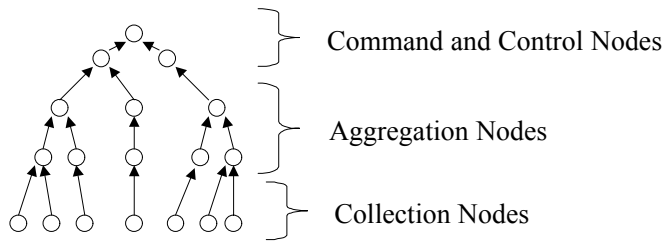
小さな円(ノード)を上向きの矢印で 1 つの根へ結んだ木構造の図で、右側の 3 つの波括弧が階層を示しています。上から、根のノードが 1 つ、その下に根へ矢印を向けるノードが 2 つあります。次の段には 3 つのノードがあり、左の 2 つは上の左のノードへ、右の 1 つは上の右のノードへ矢印を向けています。次の段の 5 つのノードは、左から 2 つが最も左の上のノードへ、1 つが中央のノードへ、2 つが右のノードへ矢印を向けています。最下段には 7 つの葉ノードがあり、左から 2・1・1・1・2 個ずつ上の段の 5 つのノードへ矢印を向けています。波括弧は、最上段とその下の段を「Command and Control Nodes」(指揮統制ノード)、中の 2 段を「Aggregation Nodes」(集約ノード)、最下段を「Collection Nodes」(収集ノード)としています。
Figure 1: Hierarchical Intrusion Detection Architecture
図 1: 階層型の侵入検知アーキテクチャ
Information gathering occurs at the leaf nodes. That information is passed to an internal node that aggregates information from multiple leaf nodes. Further aggregation, abstraction, and data reduction occurs at higher internal nodes until the root is reached. The root is a command and control system that evaluates attack situations and often issues responses. The root usually reports to human user consoles that can manually issue responses and evaluate the network.
情報の収集は末端のノードで行われます。その情報は、複数の末端のノードからの情報を集約する内部ノードに渡されます。さらなる集約、抽象化、データ削減は、最上位に達するまで、より上位の内部ノードで行われます。最上位は、攻撃の状況を評価し、しばしば対応を出す指揮統制システムです。最上位は通常、手動で対応を出し、ネットワークを評価できる、人間の利用者のコンソールに報告します。
Hierarchical structures result in efficient communications, whereby refined information filters upward in the hierarchy and control downward. The architecture is excellent for creating scalable distributed IDSs with central points of administration. These structures are, however, somewhat rigid in nature because of the precise function and lines of communication that tend to become associated with their components.
階層構造は、洗練された情報が階層を上へ、制御が下へと流れる、効率的な通信をもたらします。このアーキテクチャは、中央の管理点を持つスケーラブルな分散型 IDS を作るのに優れています。しかし、これらの構造は、そのコンポーネントに結び付けられがちな厳密な機能と通信経路のために、性質としてやや硬直的です。
Network Organization
ネットワーク型の構成
In contrast to a hierarchical architecture, a network architecture permits information flow from any node to any other node. Therefore, networked structures tend to suffer from inefficiency in communications, because of the unconstrained communication flow (i.e., everyone trying to communicate with everyone else). They do, however, compensate for communications inefficiency with flexibility in function. At least one IDS, Cooperating Security Managers [WHIT96], uses this architecture by consolidating the collection, aggregation, and command and control functions into a single component residing on every monitored system. Any significant events occurring at one system that stem from a connection originating at another are reported back to the system manager of the originating system by the security manager at the system where the event occurred. In situations where the originating system of the connection is an intermediate node in a communication chain, the system manager is obliged to report onward to the next system manager in the chain.
階層型のアーキテクチャとは対照的に、ネットワーク型のアーキテクチャでは、任意のノードから他の任意のノードへの情報の流れが許されます。したがって、ネットワーク型の構造は、通信の流れが制約されない(すなわち全員が全員と通信しようとする)ため、通信が非効率になりがちです。しかし、通信の非効率は、機能の柔軟性によって補われます。少なくとも 1 つの IDS、Cooperating Security Managers [WHIT96] は、収集、集約、指揮統制の機能を、監視対象のすべてのシステムに常駐する単一のコンポーネントにまとめることで、このアーキテクチャを使っています。あるシステムで、別のシステムから発した接続に起因する重大なイベントが発生した場合、イベントが発生したシステムのセキュリティマネージャーが、発信元のシステムのシステムマネージャーに報告を返します。接続の発信元のシステムが通信の連鎖の中間ノードである場合、システムマネージャーは、連鎖の次のシステムマネージャーへさらに報告する義務があります。
Implicitly IDS components tend toward a hierarchy, however, the tendency is not strict, since communications can occur, in general, between any type of components and not strictly on a one-to-one or master/slave basis. For example a collection unit may directly communicate a critical event to command and control unit, rather than through an aggregation node. Moreover, peer relationships among command and control nodes are appropriate where different administrations manage portions of an enterprise network or distinct and separate networks [FRIN98].
暗黙のうちに、IDS のコンポーネントは階層に向かう傾向がありますが、その傾向は厳密ではありません。通信は、一般に、どの種類のコンポーネントの間でも、厳密な 1 対 1 やマスター/スレーブの関係に限らず行われ得るからです。たとえば、収集単位は、集約ノードを通さずに、重大なイベントを指揮統制の単位に直接伝える場合があります。さらに、企業ネットワークの各部分や、別個で独立したネットワークを異なる管理部門が管理している場合には、指揮統制のノードの間のピア関係が適切です [FRIN98]。
As a way of incorporating the best characteristics of hierarchical and network architectures, a hybrid model can be used. A hybrid model follows a network architecture. It has no distinct root, yet retains an overall hierarchical structure, and allows the flexibility for components to communicate outside the strict hierarchy, where useful. Figure 2 gives an example of this architecture, which illustrates peer relationship among command and control components, direct communication between collection units and a command and control unit (e.g., an event trigger), and redundant communication between an aggregation unit and command and control unit (e.g., for fault tolerance).
階層型とネットワーク型のアーキテクチャの最良の特性を取り入れる方法として、ハイブリッドモデルを使うことができます。ハイブリッドモデルは、ネットワーク型のアーキテクチャに従います。明確な最上位を持たず、全体としては階層構造を保ちつつ、有用な場合には、コンポーネントが厳密な階層の外で通信できる柔軟性を与えます。図 2 はこのアーキテクチャの例を示しており、指揮統制のコンポーネント間のピア関係、収集単位と指揮統制の単位との間の直接の通信(たとえばイベントのトリガー)、集約単位と指揮統制の単位との間の冗長な通信(たとえばフォールトトレランスのため)を示しています。
With mobile agents, the collection nodes, aggregation nodes, and command and control nodes do not have to be continuously resident on a physical machine. That is, a mobile agent may function as an aggregation node and move to whatever physical location in the network is best for its purposes. In fact, a mobile agent architecture offers an additional refinement on this idea. - the agents may be different for different functions. For example, there may be a hierarchy of mobile agents dedicated to detecting and responding to viruses. The aggregation and command and control nodes required for virus detection might be totally different mobile agents than those required for, say, insider auditing. Thus, many hierarchies of agents may exist, each looking for different attacks and each processing data differently.
モバイルエージェントを使えば、収集ノード、集約ノード、指揮統制ノードが、物理的なマシンに継続的に常駐している必要はありません。すなわち、モバイルエージェントは集約ノードとして機能し、自らの目的に最も適したネットワーク内の物理的な場所へ移動できます。実際、モバイルエージェントのアーキテクチャは、この考え方をさらに洗練させます。エージェントは、機能ごとに異なるものにできます。たとえば、ウイルスの検知と対応に特化したモバイルエージェントの階層があるかもしれません。ウイルス検知に必要な集約ノードと指揮統制ノードは、たとえば内部者の監査に必要なものとはまったく別のモバイルエージェントになるかもしれません。このように、多くのエージェントの階層が存在し、それぞれが異なる攻撃を探し、それぞれが異なるデータ処理を行うことができます。
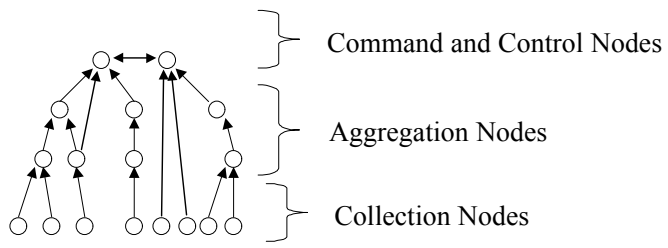
小さな円(ノード)を上向きの矢印で結んだハイブリッド型の木構造の図で、右側の 3 つの波括弧が階層を示しています。最上段の 2 つのノードは両向きの矢印で互いに結ばれています。その下の段には 3 つのノードがあり、左と中央は最上段の左のノードへ、右は最上段の右のノードへ矢印を向けています。次の段には 4 つのノードがあり、最も左は上の段の左のノードへ、2 番目は長い矢印で最上段の左のノードへ直接、3 番目は上の段の中央のノードへ、最も右は上の段の右のノードへ矢印を向けています。最下段には 8 つの葉ノードがあり、左の 2 つは上の段の最も左のノードへ、3 番目は 2 番目のノードへ、4 番目は 3 番目のノードへ、5 番目と 6 番目は長い矢印で最上段の右のノードへ直接、最後の 2 つは上の段の最も右のノードへ矢印を向けています。波括弧は、最上段を「Command and Control Nodes」(指揮統制ノード)、中の 2 段を「Aggregation Nodes」(集約ノード)、最下段を「Collection Nodes」(収集ノード)としています。
Figure 2: Hybrid Intrusion Detection Architecture
図 2: ハイブリッド型の侵入検知アーキテクチャ
Framework for Intrusion Detection
侵入検知のフレームワーク
The Common Intrusion Detection Framework [CIDF] provides a useful perspective for understanding and discussing the features and components found in any IDS. The CIDF defines the following generic types of components:
Common Intrusion Detection Framework [CIDF] は、あらゆる IDS に見られる特徴とコンポーネントを理解し論じるための、有用な視点を提供します。CIDF は、次の汎用的な種類のコンポーネントを定義しています:
•Event Generators - audit data filters, burglar alarms, or other sensors used to obtain events from the computational environment.
•イベント生成器(Event Generators) - 計算環境からイベントを取得するために使われる、監査データのフィルター、侵入警報器、その他のセンサー。
•Analyzers - components such as an event filter, an attack signature detector, a statistical event profiler, or an event correlator, used to obtain intrusion detection information (IDI) from other components, analyze them, and return new IDI. IDI includes events that occurred in the system, analysis of those events, prescriptions to be carried out, or queries about events.
•分析器(Analyzers) - 他のコンポーネントから侵入検知情報(IDI)を取得し、分析し、新しい IDI を返すために使われる、イベントフィルター、攻撃シグネチャ検知器、統計的なイベントプロファイラー、イベント相関器などのコンポーネント。IDI には、システムで発生したイベント、それらのイベントの分析、実行すべき指示、イベントに関する問い合わせが含まれます。
•Databases - components that perform no processing of or changes to the information they retain, but simply represent persistent storage of IDI.
•データベース(Databases) - 保持する情報の処理や変更は行わず、IDI の永続ストレージを表すコンポーネント。
•Response Units - components that carry out prescriptions from other components. Prescriptions are requests, such as killing processes or resetting connections, instructing response units to act on behalf of other components.
•対応ユニット(Response Units) - 他のコンポーネントからの指示を実行するコンポーネント。指示とは、プロセスの強制終了や接続のリセットなど、他のコンポーネントに代わって動作するよう対応ユニットに命じる要求です。
•Matchmaker Units – components that provides the configuration and directory services which link other components together. A matchmaker allows components to locate collaborating components either by name or by service.
•マッチメーカーユニット(Matchmaker Units) – 他のコンポーネントを相互に結びつける構成サービスとディレクトリサービスを提供するコンポーネント。マッチメーカーにより、コンポーネントは、名前またはサービスによって、協調するコンポーネントを見つけられます。
Components may be organized in either hierarchical, network, or hybrid structures. Components may also support either a push or pull style of interface. The former refers to the production of IDI spontaneously by the component, while the latter refers to IDI produced in response to a request or query. Some components may also be further decomposed. For example, an analyzer may be realized by two distinct components: an inference agent, which deduces intrusions, and a decision or planning agent, which formulates responses. Similarly, one or more components may be combined together and collocated at the same node. However, the initial types of components defined are adequate to capture the essential features of an IDS.
コンポーネントは、階層型、ネットワーク型、またはハイブリッド型の構造に編成できます。コンポーネントは、プッシュ型またはプル型のインターフェースもサポートできます。前者は、コンポーネントが自発的に IDI を生成することを指し、後者は、要求や問い合わせに応じて生成される IDI を指します。コンポーネントの中には、さらに分解できるものもあります。たとえば、分析器は、侵入を推論する推論エージェントと、対応を策定する意思決定または計画エージェントという、2 つの別個のコンポーネントで実現できます。同様に、1 つ以上のコンポーネントを組み合わせて、同じノードに同居させることもできます。ただし、最初に定義されたコンポーネントの種類は、IDS の本質的な特徴を捉えるのに十分です。
Any of the CIDF components can be represented as a mobile agent. However, some components are better suited if they remain stationary and may be designated as static agents. For example, an agent wrapper applied to a database management system could implement the CIDF database component. This pragmatic approach allows both the software agent paradigm to be maintained and the design to apply mobility where appropriate. It is also unlikely that, in practice, full mobility of all components would ever be effective. The following paragraphs describe some of the benefits and drawbacks of using mobile agents for common IDS components.
CIDF のどのコンポーネントも、モバイルエージェントとして表現できます。しかし、コンポーネントの中には、固定されたままのほうが適しているものもあり、静的エージェントとして指定してもよいです。たとえば、データベース管理システムにエージェントラッパーを適用すれば、CIDF のデータベースコンポーネントを実装できます。この実用的なアプローチにより、ソフトウェアエージェントのパラダイムを維持しつつ、適切な箇所で移動性を設計に適用できます。また、実際には、すべてのコンポーネントを完全に移動可能にすることが有効になるとは考えにくいです。以下の段落では、一般的な IDS のコンポーネントにモバイルエージェントを使う場合の利点と欠点のいくつかを説明します。
•Network Traffic Sensors: Keeping up with increasing network traffic seems to be becoming the job of the kernel or special purpose hardware. A mobile network traffic sensor, if it ever could keep up with network traffic, would lose information when it packs up and goes to another machine. The mobile agent wouldn’t be well suited to directly monitor network traffic, but only data provided by the network sensor to the data analyzers.
•ネットワークトラフィックセンサー: 増え続けるネットワークトラフィックに追従する仕事は、カーネルや専用ハードウェアの役割になりつつあるようです。モバイルなネットワークトラフィックセンサーは、仮にネットワークトラフィックに追従できたとしても、荷造りして別のマシンへ移動する際に情報を失います。モバイルエージェントはネットワークトラフィックを直接監視する用途には適していませんが、ネットワークセンサーがデータ分析器に提供するデータだけを扱う用途には適しています。
•Host Based Sensors: Mobile agents could go to hosts (e.g., workstations, firewalls, routers, etc.) to collect information that is not available on the wire. Where they go can be in response to the analysis of audit data filters or the triggering of network trip wires.
•ホストベースのセンサー: モバイルエージェントは、ホスト(たとえばワークステーション、ファイアウォール、ルーターなど)に移動して、回線上では得られない情報を収集できます。移動先は、監査データフィルターの分析結果や、ネットワークのトリップワイヤーの作動に応じて決められます。
•Analyzers: Analyzer agents process audit logs, correlate data from distributed network traffic monitors and process data gathered by network sensors. As new attacks are recognized or new patterns of suspicious activity are recognized, the analyzers must be upgraded while others removed as they are no longer useful. Analyzer agents can perform specialized data searches that aren’t supported by the host platform on which the data resides.
•分析器: 分析器エージェントは、監査ログを処理し、分散したネットワークトラフィック監視装置からのデータを相関づけ、ネットワークセンサーが収集したデータを処理します。新しい攻撃が認識されたり、不審な活動の新しいパターンが認識されたりするにつれて、分析器をアップグレードし、不要になったものは削除する必要があります。分析器エージェントは、データが存在するホストプラットフォームがサポートしていない、専門的なデータ検索を実行できます。
•Responders: Mobile agents are well-suited to serve in the capacity of responder agents. These agents can travel through the network to reconfigure the network especially useful for thin clients that do not possess the functionality required to make decisions and carry out the administrative changes.
•応答器: モバイルエージェントは、応答器エージェントとして機能するのに適しています。これらのエージェントはネットワーク内を移動してネットワークを再構成できます。これは、意思決定を行い、管理上の変更を実施するために必要な機能を備えていないシンクライアントにとって、特に有用です。
•Coordinators: Agents with the ability to decompose and solve problems in a collaborative fashion have been developed successfully by the intelligent agent community for a number of domains. Agents observe, reason, interact with other agents, and execute actions concurrently with other agents. Interactions may convey facts or beliefs via an agent communication language and may depend on ontologies to reach a common understanding.
•調整器: 問題を分解して協調的に解決する能力を持つエージェントは、知的エージェントのコミュニティによって、多くの領域でうまく開発されてきました。エージェントは、観察し、推論し、他のエージェントと相互作用し、他のエージェントと並行して動作を実行します。相互作用は、エージェント通信言語を通じて事実や信念を伝えることもあり、共通の理解に達するためにオントロジーに依存する場合もあります。
The various scenarios raise the question, how these various characteristics can be integrated under a single MAIDS framework or design? This question will need to be addressed, either implicitly or explicitly, because of the value such a perspective has in constructing any MAIDS implementation.
これらのさまざまなシナリオは、これらのさまざまな特徴を単一の MAIDS のフレームワークや設計のもとにどう統合できるのかという問いを提起します。このような視点は、あらゆる MAIDS の実装を構築するうえで価値があるため、この問いには、暗黙的にであれ明示的にであれ、対処する必要があります。
Design Tradeoffs
設計上のトレードオフ
In principle, mobile agent technology allows a node to taken on any of the various functions of an IDS. While mobility is an important focus of our project, when developing a design or performing a reification of the model for a specific network configuration, some components may be bound to a specific device as a static agent or restricted to a set of devices, when and where appropriate. Such engineering tradeoffs are common in the design of any IDS, and motivated by a number of factors including:
原則として、モバイルエージェント技術により、ノードは IDS のさまざまな機能のいずれをも担うことができます。移動性は私たちのプロジェクトの重要な焦点ですが、特定のネットワーク構成に向けて設計を作成したり、モデルの具体化を行ったりする際には、適切な場合に、一部のコンポーネントを静的エージェントとして特定のデバイスに固定したり、一連のデバイスに限定したりすることがあります。このような工学上のトレードオフは、あらゆる IDS の設計に共通しており、次のような複数の要因に動機づけられています:
•Trust relationships among platforms,
•プラットフォーム間の信頼関係、
•Platform performance considerations, and
•プラットフォームの性能に関する考慮事項、および
•Physical location of a platform
•プラットフォームの物理的な場所
For example, it might be reasonable to relegate a few platforms with dedicated communications among them, exclusively for use by the IDS. This action would ensure that critical communications and processing of IDSs is not affected by the overall workload on the system, and similarly that the IDS processing has a negligible impact on the system workload. Moreover, these platforms could implement a high standard of security and be hardened against penetrations to ensure a stable baseline for critical processes. In this example, confining critical or high consumption processes to a set of dedicated platforms is a tradeoff of mobility for performance and assurance.
たとえば、IDS 専用に、相互に専用の通信路を持つ少数のプラットフォームを割り当てることは合理的かもしれません。この措置により、IDS の重要な通信と処理がシステム全体のワークロードの影響を受けないこと、同様に、IDS の処理がシステムのワークロードに与える影響が無視できる程度であることを確保できます。さらに、これらのプラットフォームには高水準のセキュリティを実装し、侵入に対して堅牢化することで、重要なプロセスのための安定したベースラインを確保できます。この例では、重要なプロセスや消費量の大きいプロセスを一連の専用プラットフォームに限定することは、移動性と、性能および保証とのトレードオフです。
An important aspect is to ensure that the introduction of mobility maintains a comparable or improved level of assurance and performance in the design. For example, [FRIN98] points out that within classical hierarchical IDSs, trust relationships are strong in the downward directions (i.e., subordinates trust superiors), but weaker in the reverse (i.e., superiors don’t trust subordinates). This is due to the fact that critical components, high up in the hierarchy reside on hardened systems, which are resistant to attacks. The notion of making every IDS node a mobile agent platform to which any agent component could visit would obviously weaken the original trust relationships, unless all of the platforms were hardened to the highest level. However, as long as the agents move among hosts within the same security domain and each security domain places the agent under the same security policy, granting or denying the same privileges it had on its previous platform, security concerns do not adversely affect mobile agents' ability to dynamically adapt to the execution environment.
重要な点は、移動性の導入が、設計における同等以上の保証と性能のレベルを維持することを確実にすることです。たとえば、[FRIN98] は、古典的な階層型 IDS では、信頼関係は下向きの方向(すなわち部下が上司を信頼する)では強く、その逆(すなわち上司が部下を信頼する)では弱いと指摘しています。これは、階層の高い位置にある重要なコンポーネントが、攻撃に耐性のある堅牢化されたシステム上に存在するためです。すべての IDS ノードを、任意のエージェントコンポーネントが訪れられるモバイルエージェントプラットフォームにするという考え方は、すべてのプラットフォームが最高水準まで堅牢化されていない限り、当初の信頼関係を明らかに弱めるでしょう。しかし、エージェントが同じセキュリティドメイン内のホストの間を移動し、各セキュリティドメインがエージェントを同じセキュリティポリシーのもとに置き、前のプラットフォームで持っていたのと同じ権限を与えるか拒否する限り、セキュリティ上の懸念が、モバイルエージェントが実行環境に動的に適応する能力に悪影響を与えることはありません。