NIST IR 6977 日本語訳
英語タイトル : Vulnerabilities in Quantum Key Distribution Protocols日本語タイトル : 量子鍵配送プロトコルの脆弱性
公開日 : 2003-05-01
原文URL : https://csrc.nist.gov/pubs/ir/6977/final
翻訳編集 : 自動生成(有志による非公式の日本語訳), 原文取得日 : 2026-10-31, 訳文 : 58 / 58 ブロック
[要約] NIST IR 6977 は、最近提案された量子鍵配送(QKD)プロトコルが、Eve が作成するエンタングルした対を用いる古典的な中間者攻撃に対して脆弱であることを示した論文です。対象は、Li が説明した、古典通信を必要としない Greenberger-Horne-Zeilinger(GHZ)状態を用いる QKD プロトコルで、本稿はその手順に対する攻撃を示しています。この攻撃は、エンタングルした量子ビットの操作と返送によって共有鍵を作成するあらゆるプロトコルに適用できると考えられるとしています。ここで報告する結果は、いくつかの盗聴手法に対する当該プロトコルの安全性の証明を無効にするものではなく、量子暗号プロトコルも従来のプロトコルと同様に、設計者が想定しなかった攻撃手法に対して脆弱である可能性があることを示唆するとしています。
Vulnerabilities in Quantum Key Distribution Protocols
量子鍵配送プロトコルの脆弱性
D. Richard Kuhn
kuhn@nist.gov
National Institute of Standards and Technology
D. Richard Kuhn
kuhn@nist.gov
National Institute of Standards and Technology
Abstract. Recently proposed quantum key distribution protocols are shown to be vulnerable to a classic man-in-the-middle attack using entangled pairs created by Eve. It appears that the attack could be applied to any protocol that relies on manipulation and return of entangled qubits to create a shared key. The protocols that are cryptanalyzed in this paper were proven secure with respect to some eavesdropping approaches, and results reported here do not invalidate these proofs. Rather, they suggest that quantum cryptographic protocols, like conventional protocols, may be vulnerable to methods of attack that were not envisaged by their designers.
概要。 最近提案された量子鍵配送プロトコルが、Eve が作成するエンタングルした対を用いる古典的な中間者攻撃に対して脆弱であることを示します。この攻撃は、エンタングルした量子ビットの操作と返送によって共有鍵を作成するあらゆるプロトコルに適用できると考えられます。本稿で暗号解読したプロトコルは、いくつかの盗聴手法に対して安全であることが証明されていたものであり、ここで報告する結果はそれらの証明を無効にするものではありません。むしろ、量子暗号プロトコルは従来のプロトコルと同様に、設計者が想定しなかった攻撃手法に対して脆弱である可能性があることを示唆しています。
Introduction. The history of cryptography is replete with examples of protocols that were believed to be secure but shown to be vulnerable to novel attacks, often years after their design. Although sophisticated tools (and even specialized logics) have been designed to analyze and prove various properties of protocols, it is generally accepted that the best assurance of security is obtained through careful review by many experts familiar with vulnerabilities of similar protocols. An experience base of known vulnerabilities is a crucial component of this review. Because it is so new that there were no commercial products available before this year, little is known of vulnerabilities that may occur in the design and implementations of quantum cryptographic protocols. But if the history of cryptography is a reliable guide, it should be expected that even quantum cryptographic protocols designed by experts will have unanticipated vulnerabilities. The results presented in this paper suggest that this expectation is as true for quantum cryptography as it is for conventional.
はじめに。 暗号の歴史には、安全だと信じられていたプロトコルが、設計から何年も後に新たな攻撃に対して脆弱であると示された例が数多くあります。プロトコルのさまざまな性質を解析し証明するために、高度なツール(さらには専用の論理)が設計されてきましたが、安全性の最良の保証は、類似のプロトコルの脆弱性に詳しい多くの専門家による慎重なレビューによって得られると一般に認められています。既知の脆弱性に関する経験の蓄積は、このレビューの重要な構成要素です。量子暗号は非常に新しく、今年以前には市販製品がなかったため、量子暗号プロトコルの設計や実装で生じ得る脆弱性についてはほとんど知られていません。しかし、暗号の歴史が信頼できる指針であるならば、専門家が設計した量子暗号プロトコルでさえ、予期しない脆弱性を持つと予想すべきです。本稿で示す結果は、この予想が従来の暗号と同様に量子暗号にも当てはまることを示唆しています。
Protocol Vulnerabilities. Li [1] describes a QKD protocol using Greenberger-Horne-Zeilinger (GHZ) states that requires no classical communication. The protocol is described as follows, for communicating parties Alice and Bob:
プロトコルの脆弱性。 Li [1] は、古典通信を必要としない Greenberger-Horne-Zeilinger(GHZ)状態を用いた QKD プロトコルを説明しています。このプロトコルは、通信する当事者 Alice と Bob について、次のように説明されます。
1.Alice creates a three qubit system in GHZ state \(\frac{1}{\sqrt{2}}(\lvert 000\rangle + \lvert 111\rangle)\), sending the third qubit to Bob.
1.Alice は、GHZ 状態 \(\frac{1}{\sqrt{2}}(\lvert 000\rangle + \lvert 111\rangle)\) の 3 量子ビットの系を作成し、3 番目の量子ビットを Bob に送ります。
2.To encode a ‘1’, Bob uses the operator \(\sigma_x\) on the received qubit; to encode ‘0’, he does nothing to the received qubit.
2.‘1’ を符号化するには、Bob は受け取った量子ビットに演算子 \(\sigma_x\) を作用させ、‘0’ を符号化するには、受け取った量子ビットに何もしません。
3.Bob returns the qubit to Alice.
3.Bob は量子ビットを Alice に返します。
4.Steps 1 – 3 are repeated, with Alice combining each received qubit with the corresponding two qubits of the original tripartite systems she retained, until a bit stream has been received by Alice. Alice then executes a controlled-NOT operation on the first two qubits, with the second qubit as control and the first as target. She then does a Bell state measurement on the last two qubits (of the 3-qubit GHZ system). She then maps the Bell state measurements as follows:
\(\frac{1}{\sqrt{2}}(\lvert 00\rangle + \lvert 11\rangle)\) = ‘0’; \(\frac{1}{\sqrt{2}}(\lvert 01\rangle + \lvert 10\rangle)\) = ‘1’
A Bell state of \(\frac{1}{\sqrt{2}}(\lvert 00\rangle - \lvert 11\rangle)\) or \(\frac{1}{\sqrt{2}}(\lvert 01\rangle - \lvert 10\rangle)\) indicates eavesdropping by Eve.
4.手順 1〜3 を繰り返します。Alice は、受け取った各量子ビットを、自分が保持している元の 3 者系の対応する 2 つの量子ビットと組み合わせ、ビットストリームを受け取り終えるまで続けます。その後、Alice は最初の 2 つの量子ビットに対して、2 番目の量子ビットを制御、1 番目を標的とする制御 NOT 演算を実行します。次に、(3 量子ビットの GHZ 系の)最後の 2 つの量子ビットに対してベル状態測定を行います。その後、ベル状態の測定結果を次のように対応付けます。
\(\frac{1}{\sqrt{2}}(\lvert 00\rangle + \lvert 11\rangle)\) = ‘0’; \(\frac{1}{\sqrt{2}}(\lvert 01\rangle + \lvert 10\rangle)\) = ‘1’
ベル状態が \(\frac{1}{\sqrt{2}}(\lvert 00\rangle - \lvert 11\rangle)\) または \(\frac{1}{\sqrt{2}}(\lvert 01\rangle - \lvert 10\rangle)\) である場合は、Eve による盗聴を示します。
Li [1] shows that this protocol is secure with respect to an attack in which Eve measures qubits returning from Bob to Alice, with a probability that Eve escapes detection of \(2^{-n}\), for n qubits. It is also shown that the protocol is secure with respect to an attack where Eve executes a controlled-NOT operation on the qubits sent from Bob to Alice.
Li [1] は、Eve が Bob から Alice に戻る量子ビットを測定する攻撃に対して、このプロトコルが安全であることを示しています。n 個の量子ビットについて、Eve が検知を免れる確率は \(2^{-n}\) です。また、Eve が Bob から Alice に送られる量子ビットに対して制御 NOT 演算を実行する攻撃に対しても、このプロトコルが安全であることが示されています。
Unfortunately, the protocol is vulnerable to a quantum version of a classic man-in-the-middle attack, which we will refer to as an EPR man-in-the-middle attack, conducted as follows:
しかし、このプロトコルは、古典的な中間者攻撃の量子版に対して脆弱です。これを EPR 中間者攻撃と呼ぶことにします。攻撃は次のように行われます。
1.Alice creates a three-qubit system in GHZ state \(\frac{1}{\sqrt{2}}(\lvert 000\rangle + \lvert 111\rangle)\), sending the third qubit to Bob.
1.Alice は、GHZ 状態 \(\frac{1}{\sqrt{2}}(\lvert 000\rangle + \lvert 111\rangle)\) の 3 量子ビットの系を作成し、3 番目の量子ビットを Bob に送ります。
2.Eve captures the qubit, creates her own two-qubit system, then forwards to Bob one qubit of a two-qubit system in EPR state \(\frac{1}{\sqrt{2}}(\lvert 00\rangle + \lvert 11\rangle)\).
2.Eve は量子ビットを捕捉し、自分の 2 量子ビットの系を作成して、EPR 状態 \(\frac{1}{\sqrt{2}}(\lvert 00\rangle + \lvert 11\rangle)\) の 2 量子ビットの系のうち 1 つの量子ビットを Bob に転送します。
3.To encode a ‘1’, Bob uses the operator \(\sigma_x\) on the received qubit; to encode ‘0’, he does nothing to the received qubit.
3.‘1’ を符号化するには、Bob は受け取った量子ビットに演算子 \(\sigma_x\) を作用させ、‘0’ を符号化するには、受け取った量子ビットに何もしません。
4.Bob returns the qubit to Eve, thinking it is being returned to Alice.
4.Bob は、Alice に返していると思い込んで、量子ビットを Eve に返します。
5.Eve combines the received qubit with the one she retained from the EPR pair that she created, then executes a Bell state measurement on the pair. Bit values are decoded as in step 4 of the Li protocol. Eve then records the bit value for the qubit received from Bob Taking the qubit she captured previously from Alice, she either executes \(\sigma_x\) to encode a ‘1’ or does nothing to encode ‘0’, and returns the qubit to Alice. At end, Eve has a complete copy of the key shared by Alice and Bob.
5.Eve は、受け取った量子ビットを、自分が作成した EPR 対のうち保持している量子ビットと組み合わせ、その対に対してベル状態測定を実行します。ビット値は、Li のプロトコルの手順 4 と同様に復号されます。次に Eve は、Bob から受け取った量子ビットのビット値を記録します。以前に Alice から捕捉した量子ビットを取り出し、‘1’ を符号化するために \(\sigma_x\) を作用させるか、‘0’ を符号化するために何もせず、その量子ビットを Alice に返します。最終的に、Eve は Alice と Bob が共有する鍵の完全な写しを得ます。
The attack requires Eve to know or guess the basis that is used by Alice and Bob, but since no classical communication is exchanged, the basis must be the same throughout the protocol. In a realistic implementation, the basis will be either standard, or chosen from a small number of possibilities that Eve can guess and determine quickly in a high traffic network. Since any realistic implementation will have less than perfect transmission, Eve can evade detection by removing qubits at a low enough rate to remain below the normal transmission error rate. Eve can measure random qubits in a basis of her choosing, obtaining a long-term distribution of values for 0 and 1 in her basis, designated \(P_0 = a^2\) and \(P_1 = \beta^2\) for the proportion of 0 and 1 respectively. If she has guessed correctly, she will obtain \(P_0 = P_1 = .50\). If not, she simply rotates her basis enough to obtain the 50/50 distribution, an angle of \(\theta = (\cos^{-1}\sqrt{P_0}) - \pi/4\). This relationship can be seen from Figure 1.
この攻撃では、Eve が Alice と Bob の使う基底を知っているか推測できる必要がありますが、古典通信は交換されないため、基底はプロトコル全体を通して同じでなければなりません。現実的な実装では、基底は標準のものか、Eve が推測でき、トラフィックの多いネットワークで素早く判定できる少数の候補から選ばれたものになります。現実的な実装では伝送が完全ではないため、Eve は、通常の伝送誤り率を下回る十分に低い割合で量子ビットを取り除くことで、検知を回避できます。Eve は、自分が選んだ基底でランダムな量子ビットを測定し、自分の基底での 0 と 1 の値の長期的な分布を得られます。0 と 1 の割合をそれぞれ \(P_0 = a^2\) と \(P_1 = \beta^2\) とします。推測が正しければ、\(P_0 = P_1 = .50\) が得られます。そうでなければ、50/50 の分布が得られるまで基底をさらに回転させるだけでよく、その角度は \(\theta = (\cos^{-1}\sqrt{P_0}) - \pi/4\) です。この関係は図 1 から見て取れます。
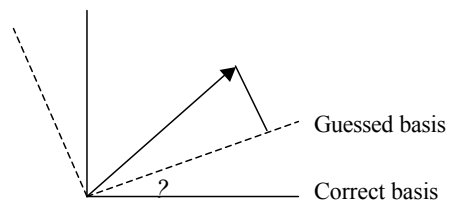
共通の原点から引いた 2 組の基底を示す幾何の図です。右へ伸びる水平の実線に「Correct basis」(正しい基底)と書かれ、原点から上へ伸びる垂直の実線がその相手の軸です。右へやや上がる破線に「Guessed basis」(推測した基底)と書かれ、左上へ傾いた破線がその相手の軸です。原点から右上へ実線の矢印(状態ベクトル)が伸び、その先端から破線「Guessed basis」へ垂直に実線が下ろされています。「Correct basis」と「Guessed basis」の間の角に「?」が記されています。
Figure 1. Determining correct basis from long-term distribution.
図 1 長期的な分布から正しい基底を判定する方法
Boström and Felbinger [2] describe a secure communication protocol based on entangled pairs of qubits. The protocol is described as follows, for communicating parties Alice and Bob:
Boström と Felbinger [2] は、エンタングルした量子ビット対に基づく安全な通信プロトコルを説明しています。このプロトコルは、通信する当事者 Alice と Bob について、次のように説明されます。
p.0) Protocol is initialized. n = 0. The message to be transmitted is a sequence \(x^N = (x_1, \ldots, x_N)\), where \(x_n \in \{0,1\}\).
p.0) プロトコルを初期化します。n = 0。送信するメッセージは、列 \(x^N = (x_1, \ldots, x_N)\) です。ここで \(x_n \in \{0,1\}\) です。
p.1) n = n + 1. Alice and Bob are in message mode. Alice prepares two qubits in the Bell state \(\frac{1}{\sqrt{2}}(\lvert 01\rangle + \lvert 10\rangle)\)
p.1) n = n + 1。Alice と Bob はメッセージモードにあります。Alice は 2 つの量子ビットをベル状態 \(\frac{1}{\sqrt{2}}(\lvert 01\rangle + \lvert 10\rangle)\) に準備します。
p.2) She stores one qubit, the home qubit, and sends the other one, the travel qubit, to Bob through the quantum channel.
p.2) Alice は一方の量子ビット(ホーム量子ビット)を保持し、もう一方の量子ビット(トラベル量子ビット)を量子チャネルを通じて Bob に送ります。
p.3) Bob receives the travel qubit. With probability c he switches to control mode and proceeds with c.1, else he proceeds with m.1.
p.3) Bob はトラベル量子ビットを受け取ります。確率 c で制御モードに切り替えて c.1 に進み、そうでなければ m.1 に進みます。
c.1) Bob measures the travel qubit in the basis Bz ={0, 1} and obtains the result \(i \in \{0,1\}\) with equal probability.
c.1) Bob は、基底 Bz ={0, 1} でトラベル量子ビットを測定し、等しい確率で結果 \(i \in \{0,1\}\) を得ます。
c.2) He sends i through the public channel to Alice.
c.2) Bob は i を公開チャネルを通じて Alice に送ります。
c.3) Alice receives i from the public channel, switches to control mode and measures the home qubit in the basis Bz resulting in the value j.
c.3) Alice は公開チャネルから i を受け取り、制御モードに切り替えて、基底 Bz でホーム量子ビットを測定し、値 j を得ます。
c.4) (i = j): Eve is detected. Abort transmission.
(i ? j): Set n = n - 1 and go to p.1.
c.4) (i = j): Eve が検知されました。送信を中止します。
(i ≠ j): n = n - 1 とし、p.1 に進みます。
m.1) To encode a ‘1’, Bob uses the operator \(\sigma_z\) on the received qubit; to encode ‘0’, he does nothing to the received qubit, then returns the qubit to Alice.
m.1) ‘1’ を符号化するには、Bob は受け取った量子ビットに演算子 \(\sigma_z\) を作用させ、‘0’ を符号化するには、受け取った量子ビットに何もせず、その後、量子ビットを Alice に返します。
m.2) Alice receives the travel qubit, combines it with the qubit she retained, and does a Bell measurement on the pair. The measurement is then decoded as:
\[\frac{1}{\sqrt{2}}(\lvert 01\rangle + \lvert 10\rangle) = 0; \quad \frac{1}{\sqrt{2}}(\lvert 01\rangle - \lvert 10\rangle) = 1.\]
m.2) Alice はトラベル量子ビットを受け取り、保持している量子ビットと組み合わせ、その対に対してベル測定を行います。測定結果は次のように復号されます。
\[\frac{1}{\sqrt{2}}(\lvert 01\rangle + \lvert 10\rangle) = 0; \quad \frac{1}{\sqrt{2}}(\lvert 01\rangle - \lvert 10\rangle) = 1.\]
m.3) (n < N): Go to p.1. (n = N): Go to p.4.
m.3) (n < N): p.1 に進みます。(n = N): p.4 に進みます。
p.4. Message \(x^N\) is transmitted from Bob to Alice. Communication successfully terminated.
p.4. メッセージ \(x^N\) が Bob から Alice に送信されます。通信は正常に終了します。
This protocol is also vulnerable to the EPR man-in-the-middle attack under the following conditions:
このプロトコルも、次の条件のもとで EPR 中間者攻撃に対して脆弱です。
•Eve can read and modify the quantum channel, including the ability to capture qubits.
•Eve は、量子チャネルを読み取り、改変できます。これには量子ビットを捕捉する能力が含まれます。
•Eve can read and modify the classical channel. In the protocol, this channel is referred to as a public classical channel, but for a realistic implementation in a network, it is very unlikely that it will be public, so without additional protocol steps as safeguards, Eve’s modification would not be observable by either Alice or Bob.
•Eve は、古典チャネルを読み取り、改変できます。プロトコルでは、このチャネルは公開古典チャネルと呼ばれていますが、ネットワークでの現実的な実装では公開されている可能性は非常に低く、そのため、安全対策としてのプロトコルの手順が追加されていなければ、Eve の改変は Alice にも Bob にも観測できません。
The attack proceeds as follows:
攻撃は次のように進みます。
•At step p.2, Eve captures the qubit, then forwards to Bob one qubit of a two-qubit system that she has created in EPR state \(\frac{1}{\sqrt{2}}(\lvert 00\rangle + \lvert 11\rangle)\).
•手順 p.2 で、Eve は量子ビットを捕捉し、EPR 状態 \(\frac{1}{\sqrt{2}}(\lvert 00\rangle + \lvert 11\rangle)\) で自分が作成した 2 量子ビットの系のうち 1 つの量子ビットを Bob に転送します。
•At step m.1, Bob encodes ‘0’ or ‘1’ using \(\sigma_z\) then returns the qubit to Eve, thinking it is being sent to Alice. Eve does a Bell state measurement to decode the received qubit: state \(\frac{1}{\sqrt{2}}(\lvert 00\rangle + \lvert 11\rangle)\) is decoded as ‘0’; state \(\frac{1}{\sqrt{2}}(\lvert 00\rangle - \lvert 11\rangle)\) is decoded as ‘1’. She executes either \(\sigma_z\) (for ‘1’) or does nothing (for ‘0’) to the captured qubit to encode the bit sent by Bob, then forwards it to Alice.
•手順 m.1 で、Bob は \(\sigma_z\) を用いて ‘0’ または ‘1’ を符号化し、Alice に送っていると思い込んで量子ビットを Eve に返します。Eve は、ベル状態測定を行って、受け取った量子ビットを復号します。状態 \(\frac{1}{\sqrt{2}}(\lvert 00\rangle + \lvert 11\rangle)\) は ‘0’ として、状態 \(\frac{1}{\sqrt{2}}(\lvert 00\rangle - \lvert 11\rangle)\) は ‘1’ として復号されます。Eve は、Bob が送ったビットを符号化するために、捕捉した量子ビットに \(\sigma_z\) を作用させる(‘1’ の場合)か何もしない(‘0’ の場合)かを行い、それを Alice に転送します。
•At step c.1, Bob measures the travel qubit, then sends this result on the classical channel. Eve intercepts the transmission, then measures her captured qubit to obtain either a ‘0’ or ‘1’ with equal probability. She then forwards this value to Alice.
•手順 c.1 で、Bob はトラベル量子ビットを測定し、その結果を古典チャネルで送ります。Eve はその送信を傍受し、捕捉した自分の量子ビットを測定して、等しい確率で ‘0’ または ‘1’ を得ます。その後、この値を Alice に転送します。
Eve must have the ability to intercept the control (eavesdropping detection) bits sent from Bob to Alice, measure the received qubit and substitute a value to be returned to Alice in real time. Compared with attacks on classical cryptographic protocols, these assumptions are fairly minimal, and not at all unrealistic. The examples presented in this section illustrate that quantum cryptographic protocols may be vulnerable to many of the same attacks as classical protocols. Furthermore, as with conventional protocols, quantum protocols may be vulnerable due to subtle design issues. A protocol that is similar to ping-pong coding, developed by Beige, Englert, Kurtsiefer, and Weinfurter [3], is not vulnerable to the EPR man-in-the-middle attack because the location of the control bits is not known until completion of qubit transmission. Therefore Eve could not determine which bits to measure and what value to substitute and return to Alice.
Eve には、Bob から Alice に送られる制御(盗聴検知)ビットを傍受し、受け取った量子ビットを測定し、Alice に返す値をリアルタイムで置き換える能力が必要です。古典暗号プロトコルへの攻撃と比べると、これらの仮定はかなり控えめで、決して非現実的ではありません。この節で示した例は、量子暗号プロトコルが、古典プロトコルと同じ多くの攻撃に対して脆弱である可能性があることを示しています。さらに、従来のプロトコルと同様に、量子プロトコルは微妙な設計上の問題によって脆弱になる可能性があります。Beige、Englert、Kurtsiefer、Weinfurter [3] が開発した、ピンポン符号化に類似したプロトコルは、制御ビットの位置が量子ビットの送信の完了まで知られないため、EPR 中間者攻撃に対して脆弱ではありません。したがって、Eve は、どのビットを測定し、どの値に置き換えて Alice に返せばよいかを判定できませんでした。
A protocol developed by Cai [4] uses the ping-pong protocol without a public channel. The Cai protocol attempts to add security by randomizing the Bell state of the receiving party, rather than using a consistent state as in Bostrom and Feilberger. To transmit a bit, Alice selects at random from one of two Bell states: \(\Psi^+ = \frac{1}{\sqrt{2}}(\lvert 01\rangle + \lvert 10\rangle)\) or \(\Phi^+ = \frac{1}{\sqrt{2}}(\lvert 00\rangle + \lvert 11\rangle)\). The protocol proceeds as follows:
Cai [4] が開発したプロトコルは、公開チャネルなしでピンポンプロトコルを使います。Cai のプロトコルは、Bostrom と Feilberger のように一貫した状態を使うのではなく、受信側のベル状態をランダム化することで、安全性を高めようとしています。ビットを送信するために、Alice は 2 つのベル状態 \(\Psi^+ = \frac{1}{\sqrt{2}}(\lvert 01\rangle + \lvert 10\rangle)\) または \(\Phi^+ = \frac{1}{\sqrt{2}}(\lvert 00\rangle + \lvert 11\rangle)\) のうち 1 つをランダムに選びます。プロトコルは次のように進みます。
1.Alice prepares two qubits in either of the two states \(\Psi^+\) or \(\Phi^+\), selected randomly.
1.Alice は、ランダムに選んだ 2 つの状態 \(\Psi^+\) または \(\Phi^+\) のいずれかで 2 つの量子ビットを準備します。
2.Alice sends one of the qubits from the EPR pair to Bob and retains the other.
2.Alice は、EPR 対の量子ビットの一方を Bob に送り、もう一方を保持します。
3.To encode a ‘1’, Bob uses the operator \(\sigma_z\) on the received qubit; to encode ‘0’, he does nothing to the received qubit.
3.‘1’ を符号化するには、Bob は受け取った量子ビットに演算子 \(\sigma_z\) を作用させ、‘0’ を符号化するには、受け取った量子ビットに何もしません。
4.Bob returns the qubit to Alice.
4.Bob は量子ビットを Alice に返します。
5.Alice receives the travel qubit, combines it with the qubit she retained, and does a Bell measurement on the pair. If the state of the EPR pair created in Step 1 was \(\Psi^+\) then the measurement is then decoded as:
\(\frac{1}{\sqrt{2}}(\lvert 01\rangle + \lvert 10\rangle) = 0\); \(\frac{1}{\sqrt{2}}(\lvert 01\rangle - \lvert 10\rangle) = 1\). If the result of the Bell measurement is \(\Phi^+\) or \(\Phi^-\), then Eve is detected.
If the EPR pair state was \(\Phi^+\), then the decoding step is
\(\frac{1}{\sqrt{2}}(\lvert 00\rangle + \lvert 11\rangle) = 0\); \(\frac{1}{\sqrt{2}}(\lvert 00\rangle - \lvert 11\rangle) = 1\). If the result of the Bell measurement is \(\Psi^+\) or \(\Psi^-\), then Eve is detected.
5.Alice はトラベル量子ビットを受け取り、保持している量子ビットと組み合わせ、その対に対してベル測定を行います。手順 1 で作成した EPR 対の状態が \(\Psi^+\) だった場合、測定結果は次のように復号されます。
\(\frac{1}{\sqrt{2}}(\lvert 01\rangle + \lvert 10\rangle) = 0\); \(\frac{1}{\sqrt{2}}(\lvert 01\rangle - \lvert 10\rangle) = 1\)。ベル測定の結果が \(\Phi^+\) または \(\Phi^-\) である場合、Eve が検知されます。
EPR 対の状態が \(\Phi^+\) だった場合、復号の手順は次のとおりです。
\(\frac{1}{\sqrt{2}}(\lvert 00\rangle + \lvert 11\rangle) = 0\); \(\frac{1}{\sqrt{2}}(\lvert 00\rangle - \lvert 11\rangle) = 1\)。ベル測定の結果が \(\Psi^+\) または \(\Psi^-\) である場合、Eve が検知されます。
Like the protocols described previously, Eve can obtain a perfect copy of the message transmitted from Bob to Alice. The attack is essentially the same:
前に説明したプロトコルと同様に、Eve は Bob から Alice に送信されたメッセージの完全な写しを得られます。攻撃は基本的に同じです。
•At step 2, Eve captures the qubit, then forwards to Bob one qubit of a two-qubit system that she has created in EPR state \(\frac{1}{\sqrt{2}}(\lvert 00\rangle + \lvert 11\rangle)\).
•手順 2 で、Eve は量子ビットを捕捉し、EPR 状態 \(\frac{1}{\sqrt{2}}(\lvert 00\rangle + \lvert 11\rangle)\) で自分が作成した 2 量子ビットの系のうち 1 つの量子ビットを Bob に転送します。
•At step 3, Bob encodes ‘0’ or ‘1’ using \(\sigma_z\) then returns the qubit to Eve, thinking it is being sent to Alice. Eve does a Bell state measurement to decode the received qubit: state \(\frac{1}{\sqrt{2}}(\lvert 00\rangle + \lvert 11\rangle)\) is decoded as ‘0’; state \(\frac{1}{\sqrt{2}}(\lvert 00\rangle - \lvert 11\rangle)\) is decoded as ‘1’. She executes either \(\sigma_z\) (for ‘1’) or does nothing (for ‘0’) to the captured qubit to encode the bit sent by Bob, then forwards it to Alice.
•手順 3 で、Bob は \(\sigma_z\) を用いて ‘0’ または ‘1’ を符号化し、Alice に送っていると思い込んで量子ビットを Eve に返します。Eve は、ベル状態測定を行って、受け取った量子ビットを復号します。状態 \(\frac{1}{\sqrt{2}}(\lvert 00\rangle + \lvert 11\rangle)\) は ‘0’ として、状態 \(\frac{1}{\sqrt{2}}(\lvert 00\rangle - \lvert 11\rangle)\) は ‘1’ として復号されます。Eve は、Bob が送ったビットを符号化するために、捕捉した量子ビットに \(\sigma_z\) を作用させる(‘1’ の場合)か何もしない(‘0’ の場合)かを行い、それを Alice に転送します。
Although the Cai protocol appears at first to be secure because the Bell state is chosen randomly in Step 1, this attack needs fewer assumptions to succeed than the attack on the ping-pong protocol. Eve needs only the ability to intercept qubits and replace them with hers, and to determine the basis used by Alice, which can be done using a relatively small number of intercepted qubits using the procedure described earlier.
Cai のプロトコルは、手順 1 でベル状態がランダムに選ばれるため、一見安全に見えますが、この攻撃は、ピンポンプロトコルへの攻撃よりも少ない仮定で成功します。Eve に必要なのは、量子ビットを傍受して自分のものと置き換える能力と、Alice が使う基底を判定する能力だけです。基底の判定は、前述の手順を用いて、比較的少数の傍受した量子ビットで行えます。
Discussion and Conclusions. The EPR man-in-the-middle attack works because Alice and Bob cannot detect that qubits received by Bob are part of an entangled pair sent by Eve. Although the two protocols use different sigma operators (X and Z respectively), Eve can duplicate the actions of Bob without detection, regardless of the operator used by Bob. In the first case, this occurred because of the lack of conventional communication, and in the second because Eve was assumed able to control the classical communication between Alice and Bob, and the protocol did not provide steps for them to authenticate messages. Adapting methods described by Vaidman et al. [5], it would always be possible for Eve to distinguish the sigma operator applied by Bob. It thus appears that any protocol similar to the ones described above would be vulnerable.
考察と結論。 EPR 中間者攻撃が成立するのは、Bob が受け取った量子ビットが Eve の送ったエンタングルした対の一部であることを、Alice と Bob が検知できないためです。2 つのプロトコルは異なるシグマ演算子(それぞれ X と Z)を使いますが、Eve は、Bob が使う演算子にかかわらず、検知されることなく Bob の動作を複製できます。1 つ目の場合は従来の通信方式がないために、2 つ目の場合は Eve が Alice と Bob の間の古典通信を制御できると仮定されており、プロトコルにメッセージを認証する手順が備わっていなかったために、これが起きました。Vaidman ら [5] が説明した方法を応用すれば、Eve が Bob の作用させたシグマ演算子を常に区別することが可能になります。したがって、上述のプロトコルに類似するプロトコルは、いずれも脆弱であると考えられます。
Acknowledgments. I am grateful to Carl Williams for suggesting significant improvements to the original draft of this paper.
謝辞。 本稿の最初の草稿に対して重要な改善を提案してくださった Carl Williams 氏に感謝します。
References
参考文献
[1] Li, X., “A quantum key distribution protocol without classical communication,” quant-ph/0209050 (September 6, 2002).
[1] Li, X., “A quantum key distribution protocol without classical communication,” quant-ph/0209050 (September 6, 2002).
[2] K. Boström and T. Felbinger, “Ping-pong Coding”, quant-ph 0209040 (September 5, 2002).
[2] K. Boström and T. Felbinger, “Ping-pong Coding”, quant-ph 0209040 (September 5, 2002).
[3] A. Beige, B.-G. Englert, C. Kurtsiefer, and H. Weinfurter, “Secure Communication with a Publicly Known Key”, Phys. Pol. A 101, 357 quant-ph 0111106, May 9, 2002.
[3] A. Beige, B.-G. Englert, C. Kurtsiefer, and H. Weinfurter, “Secure Communication with a Publicly Known Key”, Phys. Pol. A 101, 357 quant-ph 0111106, May 9, 2002.
[4] Cai, Q-Y. “Deterministic Secure Direct Communication Using Ping-pong Protocol without Public Channel”, quant-ph 0301048, January 13, 2003.
[4] Cai, Q-Y. “Deterministic Secure Direct Communication Using Ping-pong Protocol without Public Channel”, quant-ph 0301048, January 13, 2003.
[5] How to Ascertain the Values of Sigma_x, Sigma_y, and Sigma_z of a Spin-1/2 Particle L. Vaidman, Y. Aharonov and D. Albert. Phys. Rev. Lett. 58, 1385 (1987)
[5] How to Ascertain the Values of Sigma_x, Sigma_y, and Sigma_z of a Spin-1/2 Particle L. Vaidman, Y. Aharonov and D. Albert. Phys. Rev. Lett. 58, 1385 (1987)