NIST IR 7056 日本語訳
英語タイトル : Card Technology Developments and Gap Analysis Interagency Report日本語タイトル : カード技術の動向とギャップ分析に関する省庁間報告書
公開日 : 2004-03-01
原文URL : https://csrc.nist.gov/pubs/ir/7056/final
翻訳編集 : 自動生成(有志による非公式の日本語訳), 原文取得日 : 2026-10-31, 訳文 : 484 / 501 ブロック
[要約] NIST IR 7056 は、記憶装置およびプロセッサカードベース技術の動向と、標準が対象とする範囲のギャップを分析した省庁間報告書です。会計検査院(GAO)の勧告を支援するため、NIST は、これらの技術の状況と、複数の技術を単一のプラットフォームに統合するための利用者要件およびそれに伴う制約を特定する取り組みを開始しました。本書は、2003 年 7 月 8 日・9 日に NIST が主催した記憶装置およびプロセッサカードベース技術ワークショップ、政府および産業界への質問票、政府の管理者からのフィードバックから得られた調査結果をまとめています。現在の技術的な能力と限界、利用者要件、技術活用を妨げる主要な障害の情報を示し、既存の標準を特定したうえで、方針、インフラストラクチャ、標準、仕様に関する勧告を示しています。
[NIST のロゴ。公的な標章のため、この非公式サイトには掲載していません。原本 PDF を参照してください。]
Interagency Report 7056
Interagency Report 7056
CARD TECHNOLOGY DEVELOPMENTS AND GAP ANALYSIS INTERAGENCY REPORT
カード技術の動向とギャップ分析に関する省庁間報告書
MARCH 2004
2004年3月
William C. Barker
William C. Barker
Deborah Howard
Deborah Howard
Tim Grance
Tim Grance
Levent Eyuboglu
Levent Eyuboglu
Reports on Computer Systems Technology
コンピュータシステム技術に関する報告書
The Information Technology Laboratory (ITL) at the National Institute of Standards and Technology (NIST) promotes the U.S. economy and public welfare by providing technical leadership for the Nation’s measurement and standards infrastructure. ITL develops tests, test methods, reference data, proof of concept implementations, and technical analyses to advance the development and productive use of information technology. ITL’s responsibilities include the development of management, administrative, technical, and physical standards and guidelines for the cost-effective security and privacy of non-national security-related information in Federal information systems. This special publication 800-series reports on ITL’s research, guidelines, and outreach efforts in information system security, and its collaborative activities with industry, government, and academic organizations.
米国国立標準技術研究所(NIST)の情報技術研究所(ITL)は、米国の測定・標準基盤に対する技術的リーダーシップを提供することにより、米国の経済と公共の福祉を促進しています。ITL は、情報技術の発展と生産的な利用を推進するため、試験、試験方法、参照データ、概念実証の実装、技術分析を開発しています。ITL の責務には、連邦情報システムにおける国家安全保障に関係しない情報について、費用対効果の高いセキュリティとプライバシーを実現するための、管理面・運用面・技術面・物理面の標準およびガイドラインの策定が含まれます。この特別刊行物 800 シリーズは、情報システムセキュリティに関する ITL の研究、ガイドライン、アウトリーチの取り組みと、産業界、政府、学術機関との協力活動を報告するものです。
Certain commercial entities, equipment or materials may be identified in this document in order to describe an experimental procedure or concept adequately. Such identification is not intended to imply recommendation or endorsement by the National Institute of Standards and Technology, nor is it intended to imply that the entities, materials, or equipment are necessarily the best available for the purpose. Products and techniques described in this report may be covered by U.S. and foreign patents.
本書では、実験の手順や概念を適切に説明するために、特定の商業的な事業体、装置、資材を示す場合があります。こうした表示は、米国国立標準技術研究所による推奨や承認を意味するものではなく、それらの事業体、資材、装置が目的に照らして必ずしも最良のものであることを意味するものでもありません。本報告書で説明する製品や技術は、米国および外国の特許の対象となっている場合があります。
Acknowledgements
謝辞
The authors, William C. Barker and Timothy Grance of NIST, and Deborah Howard and Levent Eyuboglu of Booz Allen Hamilton, wish to express their thanks to the staff at NIST and Booz Allen Hamilton who reviewed drafts of this document and provided valuable insights that contributed substantially to the technical content of this document. We also gratefully acknowledge and appreciate the contributions made by participants in the 8 and 9 July 2003 Storage and Processor Card-Based Technologies Workshop and by the government user community personnel who contributed their time and insights to the requirements interview process. Special thanks are due the speakers for their clear and comprehensive presentations and acute insights. The authors would like to acknowledge the assistance of the NIST Conference Program Staff, Laura Gooding, and Katie MacFarland without whose tireless efforts; the workshop would not have been a success. Finally, the authors would also like specifically acknowledge Teresa Schwarzhoff, Jim Dray, and Donna Dodson of NIST, and Edward Oppenheimer, Ketan Mehta, and Gene Troy of Booz Allen Hamilton for their extensive review and comment and keen and insightful assistance throughout the development of the document.
著者である NIST の William C. Barker と Timothy Grance、および Booz Allen Hamilton の Deborah Howard と Levent Eyuboglu は、本書の草案をレビューし、本書の技術的内容に大きく貢献する貴重な洞察を提供してくださった、NIST および Booz Allen Hamilton の職員に感謝の意を表します。また、2003年7月8日・9日の記憶装置およびプロセッサカードベース技術ワークショップの参加者、ならびに要件に関する聞き取り調査の過程で時間と洞察を提供してくださった政府の利用者コミュニティの職員の貢献にも、深く感謝します。明快で包括的な発表と鋭い洞察を示してくださった講演者の皆さまに、特に感謝します。著者は、NIST 会議運営スタッフの Laura Gooding と Katie MacFarland の支援にも謝意を表します。二人の尽力がなければ、ワークショップは成功しなかったでしょう。最後に、本書の作成を通じて、広範なレビューとコメント、および鋭く洞察に富んだ支援を提供してくださった、NIST の Teresa Schwarzhoff、Jim Dray、Donna Dodson、ならびに Booz Allen Hamilton の Edward Oppenheimer、Ketan Mehta、Gene Troy に、著者は特に謝意を表します。
Table of Contents
目次
Executive Summary
エグゼクティブサマリー
Federal government use of storage and processor cards for identification and other business purposes are growing at an impressive pace. The number of cards in use is growing into the tens of millions. Accompanying the growing use of storage and processor cards is a growing need for interoperability in the hardware and software associated with those cards necessary to support efficient procurement, maintenance, training, and operations.
連邦政府による、本人確認やその他の業務目的での記憶装置カードおよびプロセッサカードの利用は、目覚ましい速さで拡大しています。使用中のカードの数は数千万枚に達しつつあります。記憶装置カードおよびプロセッサカードの利用拡大に伴い、効率的な調達、保守、訓練、運用を支えるために必要な、これらのカードに関連するハードウェアとソフトウェアの相互運用性へのニーズも高まっています。
The General Accounting Office (GAO) issued a report in January 2003 that evaluated the progress in promoting the use of smart cards across the Federal government. The “Progress in Promoting Adoption of Smart Card Technology” (GAO-03-144 report) sets forth recommendations regarding the role of the National Institute of Standards and Technology (NIST) in the United States Government Smart Card (GSC) program. As an initial response to the recommendations, NIST hosted the Storage and Processor Card-Based Technology Workshop. This workshop was organized to identify requirements for card-based storage and processor technologies, card industry capabilities and trends, interoperability requirements and issues, and requirements and capabilities for single-platform integration of multiple technologies. NIST not only developed and distributed card technology capabilities and requirements questionnaires and conducted interviews with Federal government agencies to further identify the state of current and planned technologies.
会計検査院(GAO)は2003年1月に、連邦政府全体でのスマートカードの利用促進の進捗を評価する報告書を発行しました。「Progress in Promoting Adoption of Smart Card Technology」(GAO-03-144 報告書)は、米国政府スマートカード(GSC)プログラムにおける米国国立標準技術研究所(NIST)の役割に関する勧告を示しています。この勧告への最初の対応として、NIST は記憶装置およびプロセッサカードベース技術ワークショップを主催しました。このワークショップは、カードベースの記憶装置技術とプロセッサ技術の要件、カード業界の能力と動向、相互運用性の要件と問題、および複数の技術を単一のプラットフォームに統合するための要件と能力を特定するために開催されました。NIST は、カード技術の能力および要件に関する質問票を作成・配布し、連邦政府機関への聞き取り調査を実施して、現在の技術と計画中の技術の状況をさらに明らかにしました。
Workshop presentations and interviews disclosed several issues associated with 1] security and privacy, 2] multi-technology integration, 3] standardization of implementations across organizations, and 4] interoperability. These issues have been examined for evidence of gaps in existing standards and other factors that hamper government-wide application integration. It was found that varying requirements affecting the agencies’ selection from among various card technologies appear to be based on the following factors:
ワークショップの発表と聞き取り調査では、1] セキュリティとプライバシー、2] 複数技術の統合、3] 組織間での実装の標準化、4] 相互運用性に関連するいくつかの問題が明らかになりました。これらの問題について、既存の標準におけるギャップや、政府全体でのアプリケーション統合を妨げるその他の要因の証拠がないか検討しました。各機関がさまざまなカード技術の中から選択する際に影響する要件の違いは、次の要因に基づいていると考えられることがわかりました。
•Policies and business processes unique to each agency
•各機関に固有の方針と業務プロセス
•Cost effectiveness of technologies
•技術の費用対効果
•Variation of security requirements from agency to agency
•機関ごとのセキュリティ要件の違い
•Availability and maturity of technologies and related standards
•技術および関連標準の利用可能性と成熟度
•Need for interoperability among sectors and among organizations within sectors
•セクター間およびセクター内の組織間での相互運用性の必要性
These factors, along with the capabilities and limitations of new and existing technologies, were used to identify gap areas in the existing agency policies and regulations and relevant standards. With respect to policy, agency-unique rules and regulations for identification (ID) proofing need to be addressed for interoperability.
これらの要因を、新旧の技術の能力と限界とともに用いて、既存の機関の方針・規則と関連標準におけるギャップの領域を特定しました。方針に関しては、相互運用性のために、身元確認(ID プルーフィング)に関する機関固有の規則と規制に対処する必要があります。
The following technology gaps have been identified:
次の技術ギャップが特定されました。
•Biometrics interoperability
•生体認証の相互運用性
•Standards for co-existence of multiple technologies on a card
•1枚のカードに複数の技術が共存するための標準
•Post-embedding printing standards
•埋め込み後の印刷の標準
•Implementation of different options in formal standards can lead to non-interoperable solutions between cards and card readers
•正式な標準にある異なるオプションの実装が、カードとカードリーダーの間で相互運用できないソリューションにつながりうること
•Lack of standardized tests for optical effectiveness and clarity of holograms or diffraction gratings
•ホログラムや回折格子の光学的な有効性と鮮明さに関する標準化された試験の欠如
•Need for common standards for identity methods and machine-readable travel documents (both inter-agency and international).
•識別方法および機械可読渡航文書に関する共通標準(機関間および国際)の必要性。
This report includes findings captured from the workshop, interviews, and questionnaires. Although requirements for co-location of different technologies on a common card were identified, no requirements for on-card interconnection of different technologies (e.g., optical stripe media, barcodes, magnetic stripes, and smart cards) were expressed. The overall conclusion derived from the findings is that although the building blocks (e.g., international standards and interagency specifications) are in place to support interoperable secure identification systems, business, management, and policy decisions limit the opportunities for interoperability. Specifically, policies regarding what personal information may be stored on card-based storage and processor systems need to be coordinated among agencies, and where necessary, codified in law. Just as importantly, responsibilities and infrastructures for entering and maintaining personal data onto the cards need to be established.
本報告書には、ワークショップ、聞き取り調査、質問票から得られた調査結果が含まれています。異なる技術を共通のカードに併置するための要件は特定されましたが、異なる技術(光ストライプ媒体、バーコード、磁気ストライプ、スマートカードなど)をカード上で相互接続するための要件は示されませんでした。調査結果から導かれる全体的な結論は、相互運用可能で安全な識別システムを支える基本要素(国際標準や機関間仕様など)は整っているものの、事業上、管理上、方針上の判断が相互運用性の機会を制限しているというものです。具体的には、カードベースの記憶装置システムおよびプロセッサシステムにどの個人情報を保存してよいかに関する方針について、機関間で調整し、必要な場合は法律で明文化する必要があります。同様に重要なこととして、個人データをカードに入力し維持するための責任とインフラストラクチャを確立する必要があります。
As each new card technology or application is developed, modification of the standards base will be needed to bridge the gap between existing and emerging card technologies and applications. However, to be useful, technical standards need to be consistent with policies that govern the relevant functional requirements for technology. In the case of card-based technologies, policy consensus needs to be established as a prerequisite to prioritization of technical standards activities. Gaps in card technology standards coverage necessarily result from technical innovation. However, the technologies supported by existing standards appear to be adequate to support most current user requirements. Policy and infrastructure developments can be expected to establish requirements not accounted for in existing standards. As these policy and infrastructure developments continue to occur, additional standards requirements are expected to emerge.
新しいカード技術やアプリケーションが開発されるたびに、既存のカード技術・アプリケーションと新興のカード技術・アプリケーションとの間のギャップを埋めるために、標準の基盤を修正する必要が生じます。しかし、技術標準が有用であるためには、技術の関連する機能要件を規律する方針と整合している必要があります。カードベースの技術の場合、技術標準の活動に優先順位を付けるための前提条件として、方針の合意を形成する必要があります。カード技術の標準が対象とする範囲にギャップが生じるのは、技術革新の結果として避けられません。しかし、既存の標準が支える技術は、現在の利用者要件の大半を満たすのに十分であると考えられます。方針とインフラストラクチャの整備により、既存の標準では考慮されていない要件が確立されると予想されます。こうした方針とインフラストラクチャの整備が続くにつれて、追加の標準要件が現れると見込まれます。
1. Introduction
1. はじめに
Plastic cards that include information storage and processor components are used in the public and private sectors for identification, authentication, authorization, and mobile personal information storage. Many technologies (e.g., optical stripe media, barcodes, magnetic stripes, and contactless and smart card integrated circuit chips) have been implemented on card platforms. Card platforms now include anti-counterfeiting elements to increase the security of the physical platform. Some cards now support multiple technologies. Voluntary industry consensus suggests standards for many individual card technologies are already available. However, the full set of these technology elements has not been addressed in a single document with respect to issues associated with integration of multiple technologies on a common card platform. The General Accounting Office (GAO) issued a report, “Progress in Promoting Adoption of Smart Card Technology” (GAO-03-144 report, January 2003). This report evaluates the progress in promoting the use of smart cards by the Federal government and sets forth recommendations. Specifically, the report provides a set of recommendations to reinforce the role of the National Institute of Standards and Technology (NIST) in the United States Government Smart Card (GSC) program and recommends that—
情報の記憶装置とプロセッサの構成要素を備えたプラスチックカードは、官民の両部門で、識別、認証、認可、持ち運び可能な個人情報の保存に使用されています。多くの技術(光ストライプ媒体、バーコード、磁気ストライプ、非接触式およびスマートカードの集積回路チップなど)が、カードのプラットフォーム上に実装されてきました。カードのプラットフォームには現在、物理的なプラットフォームのセキュリティを高めるための偽造防止要素が含まれています。現在では、複数の技術に対応するカードもあります。業界の自主的な合意からは、多くの個別のカード技術について標準がすでに利用可能であることがうかがえます。しかし、これらの技術要素の全体は、共通のカードプラットフォーム上に複数の技術を統合する際の問題に関して、単一の文書では扱われてきませんでした。会計検査院(GAO)は、報告書「Progress in Promoting Adoption of Smart Card Technology」(GAO-03-144 報告書、2003年1月)を発行しました。この報告書は、連邦政府によるスマートカードの利用促進の進捗を評価し、勧告を示しています。具体的には、米国政府スマートカード(GSC)プログラムにおける米国国立標準技術研究所(NIST)の役割を強化するための一連の勧告を示し、次のことを勧告しています。
…NIST, continue to improve and update the government smart card interoperability specification by addressing government-wide standards for additional technologies—such as contactless cards, biometrics, and optical stripe media—as well as integration with PKI, to ensure broad interoperability among Federal agency systems.1
…NIST は、非接触カード、生体認証、光ストライプ媒体などの追加技術に関する政府全体の標準に対処し、PKI との統合を進めることで、連邦機関のシステム間の幅広い相互運用性を確保するため、政府のスマートカード相互運用性仕様の改善と更新を続けます。1
In support of the GAO recommendation, NIST initiated an effort to identify the state of operational and developmental storage and processor card-based technologies and the nature of user requirements for and constraints associated with integrating these technologies onto single platforms. To date, the NIST effort has included a NIST-hosted Storage and Processor Card-Based Technologies Workshop, distribution of requirements and capabilities questionnaires, and interviews with Federal government agencies to identify user requirements and the state of current and planned card programs. Each activity included fact-finding regarding individual technologies, integration of technologies, and interoperability of technology applications across organizational boundaries. This document reports the findings from these efforts and suggests priorities for follow-on activities.
GAO の勧告を支援するため、NIST は、運用中および開発中の記憶装置カードベース技術とプロセッサカードベース技術の状況と、これらの技術を単一のプラットフォームに統合するための利用者要件およびそれに伴う制約の性質を特定する取り組みを開始しました。これまでの NIST の取り組みには、NIST が主催した記憶装置およびプロセッサカードベース技術ワークショップ、要件・能力に関する質問票の配布、利用者要件と現在および計画中のカードプログラムの状況を特定するための連邦政府機関への聞き取り調査が含まれています。各活動では、個々の技術、技術の統合、組織の境界を越えた技術アプリケーションの相互運用性について、事実の調査を行いました。本書は、これらの取り組みから得られた調査結果を報告し、後続の活動の優先事項を提案します。
1.1 Purpose
1.1 目的
This Card Technology Developments and Gap Analysis Interagency Report (IR) provides information regarding current technical capabilities and limitations, current user requirements for individual and integrated technologies, and major impediments to technology exploitation. The report also identifies existing standards governing card technologies (see Appendix E). This document identifies gaps in standards coverage for card-based storage and processor technologies.
このカード技術の動向とギャップ分析に関する省庁間報告書(IR)は、現在の技術的な能力と限界、個別技術および統合技術に対する現在の利用者要件、技術活用を妨げる主要な障害に関する情報を提供します。また、本報告書は、カード技術を規律する既存の標準も特定しています(付録 E を参照)。本書は、カードベースの記憶装置技術とプロセッサ技術について、標準が対象とする範囲のギャップを特定します。
1.2 Scope
1.2 範囲
This report captures findings from the Storage and Processor Card-Based Technologies Workshop, government and industry questionnaires, and feedback from government managers. It makes recommendations regarding policies, infrastructures, standards, and specifications and identifies issues associated with integrating multi-technology composition, security, and interoperability.
本報告書は、記憶装置およびプロセッサカードベース技術ワークショップ、政府および産業界への質問票、政府の管理者からのフィードバックから得られた調査結果をまとめたものです。方針、インフラストラクチャ、標準、仕様に関する勧告を示し、複数技術の構成、セキュリティ、相互運用性の統合に関連する問題を特定します。
1.3 Audience
1.3 想定読者
This document has been created for Federal government, private industry, and public sector interests responsible for developing and implementing storage and processor card technologies programs.
本書は、記憶装置およびプロセッサカード技術のプログラムの開発と実装を担当する、連邦政府、民間企業、公共部門の関係者のために作成されました。
2. Storage and Processor Card-Based Technologies Workshop
2. 記憶装置およびプロセッサカードベース技術ワークショップ
2.1 Overview
2.1 概要
NIST hosted the Storage and Processor Card-Based Technologies Workshop on July 8 and 9, 2003. The purpose of the workshop was to develop and exchange information regarding the requirements, standards, capabilities, and gaps in standards coverage for individual and integrated storage and processor cards. Guest speakers from major Federal government programs, large local government programs, industry, major associations, and card suppliers from various countries participated in the 2 days of panel sessions.
NIST は、2003年7月8日・9日に、記憶装置およびプロセッサカードベース技術ワークショップを主催しました。ワークショップの目的は、個別および統合された記憶装置カードとプロセッサカードについて、要件、標準、能力、標準が対象とする範囲のギャップに関する情報を作成し、交換することでした。主要な連邦政府プログラム、大規模な地方政府プログラム、産業界、主要な団体、さまざまな国のカード供給者からの招待講演者が、2日間のパネルセッションに参加しました。
2.2 Workshop Sessions
2.2 ワークショップのセッション
A 2-day workshop was organized into several panel sessions. Each set of presentations was followed by questions and comments. Two panel sessions were hosted on Day One of the workshop. In the first session, Federal government agency representatives discussed card technology requirements. In the second session, technology providers addressed current card technology capabilities. During Day Two, private industry representatives discussed security and privacy requirements and issues, integration and interoperability requirements and issues, and a forecast of future trends. Appendix D includes presentation viewgraphs and extracts from speaker observations and participant interactions. An overview of panel proceedings follows.
2日間のワークショップは、複数のパネルセッションで構成されました。各発表の後には、質問とコメントの時間が設けられました。初日には2つのパネルセッションが開かれました。最初のセッションでは、連邦政府機関の代表者がカード技術の要件について議論しました。2つ目のセッションでは、技術提供者が現在のカード技術の能力について述べました。2日目には、民間企業の代表者が、セキュリティとプライバシーの要件と問題、統合と相互運用性の要件と問題、今後の動向の予測について議論しました。付録 D には、発表資料と、講演者の所見および参加者のやり取りからの抜粋が含まれています。以下に、パネルの議事の概要を示します。
2.2.1 Federal Government Card Technology Requirements
2.2.1 連邦政府のカード技術要件
Five speakers from the Federal government participated in a technology requirements discussion. Each speaker presented information concerning existing card technology implementations and projected future actions that might affect his or her organization’s direction. Panelists included representatives from Department of Defense (DoD), Department of State, Department of Agriculture, and Transportation Security Administration (TSA).
連邦政府から5人の講演者が、技術要件の議論に参加しました。各講演者は、既存のカード技術の実装と、自らの組織の方向性に影響しうる将来の行動計画について情報を発表しました。パネリストには、国防総省(DoD)、国務省、農務省、運輸保安局(TSA)の代表者が含まれていました。
The primary requirement for use of card-based storage and processor technology was as an authentication tool. Representatives emphasized effective infrastructure setup and ease of use as necessary to achieving total systems solutions.
カードベースの記憶装置技術とプロセッサ技術の主な利用要件は、認証ツールとしての利用でした。代表者は、システム全体のソリューションを実現するには、効果的なインフラストラクチャの整備と使いやすさが必要であると強調しました。
2.2.1.1 Department of Defense Presentation
2.2.1.1 国防総省の発表
DoD, one of the major users of card-based technologies, uses cards as authentication mechanisms and as data storage media. Its requirements for cards as an authentication tool rather than a data storage device are based on the following:
カードベースの技術の主要な利用者の一つである DoD は、カードを認証機構およびデータ記憶媒体として使用しています。DoD がカードに求める要件は、データ記憶装置としてではなく認証ツールとしてのものであり、次の事項に基づいています。
•Synchronization of data on card and in database
•カード上のデータとデータベース上のデータの同期
•Reducing dependence on the storage limitations of cards
•カードの記憶容量の制限への依存を減らすこと
•Privacy and secrecy of information carried by and associated with combatant personnel.
•戦闘要員が携帯する、または戦闘要員に関連する情報のプライバシーと秘匿性。
DoD is in the process of resolving the difficulties associated with managing and maintaining a widely dispersed storage and processor card base. Managing the update process for information stored on cards is a particular challenge. Currently, the DoD has post-issuance portals to which cards can be returned for updating sensitive information (e.g., e-mail certificates). DoD wants to explore decentralization of the card update process. Ideally, all cardholders should be able to complete several card management tasks at their own workstations via a Web-enabled system. It is hoped that web enabling will reduce dependence on the issuance infrastructure. Several observations were made during the DoD session:
DoD は、広範囲に分散した記憶装置カードおよびプロセッサカードを管理・保守する際の困難を解決する途上にあります。カードに保存された情報の更新プロセスの管理は、特に難しい課題です。現在 DoD には、機微な情報(電子メール証明書など)を更新するためにカードを返却できる、発行後のポータルがあります。DoD は、カードの更新プロセスの分散化を検討したいと考えています。理想的には、すべてのカード所持者が、Web 対応のシステムを通じて、自分のワークステーションでいくつかのカード管理タスクを完了できるようにすべきです。Web 対応にすることで、発行インフラストラクチャへの依存が減ることが期待されています。DoD のセッションでは、いくつかの所見が述べられました。
•DoD needs a more efficient implementation to permit organizations to recognize identification credentials at each other’s facilities (for example, a faster public key infrastructure (PKI) implementation supporting physical access control). An observation was made that DoD needs PKI implementations that eliminate the necessity of multiple credentials for users who must access a number of different facilities that have unique credential requirements. DoD has determined that government agencies need to be able to accept each other’s credentials based on an agreed set of rules. The challenge here is reaching agreement on a common set of rules and on appropriate federated cross-credentialing relationships.
•DoD には、組織が互いの施設で識別資格情報を認識できるようにする、より効率的な実装が必要です(たとえば、物理アクセス制御を支える、より高速な公開鍵基盤(PKI)の実装)。DoD には、固有の資格情報要件を持つ多数の異なる施設にアクセスしなければならない利用者について、複数の資格情報の必要性をなくす PKI 実装が必要であるとの所見が述べられました。DoD は、政府機関が合意済みの規則に基づいて互いの資格情報を受け入れられる必要があると判断しています。ここでの課題は、共通の規則群と、適切なフェデレーション型の相互資格情報関係について合意に達することです。
•NIST IR 6887, Government Smart Card Interoperability Specification (GSC-IS), maximizes interoperability in DoD use of cards from different vendors. However, the need to reduce or eliminate middleware dependence suggests a need for additional interoperability specifications. Specifically, DoD perceives a need for a common implementation of Java card and/or Open Platform. The goal is to enable agencies to seamlessly integrate new cards from various vendors into their own systems. This need is acute in the contactless smart card arena.
•NIST IR 6887, Government Smart Card Interoperability Specification (GSC-IS) は、異なるベンダーのカードを DoD が使用する際の相互運用性を最大化します。しかし、ミドルウェアへの依存を減らす、またはなくす必要性から、追加の相互運用性仕様が必要であることがうかがえます。具体的には、DoD は、Java カードまたは Open Platform、あるいはその両方の共通の実装が必要であると認識しています。目標は、さまざまなベンダーの新しいカードを、各機関が自らのシステムにシームレスに統合できるようにすることです。この必要性は、非接触式スマートカードの分野で特に切実です。
•Different operating systems (e.g., Windows and Macintosh) should conform to common standards so that desktop computers will include capabilities to read any smart card.
•異なるオペレーティングシステム(Windows や Macintosh など)は、デスクトップコンピュータがあらゆるスマートカードを読み取る能力を備えるように、共通の標準に準拠すべきです。
•The requirements that drive physical access control within the DoD are increased security, reduced manpower, and convenience. An access control system should be as transparent to the user as possible within the constraints of security requirements. Less complex user interfaces may result in improved security through reducing human error. DoD has undertaken a pilot program that evaluated ease of use and security capabilities associated with implementing fingerprint biometric technology on a contactless chip. Another pilot program expanded the capabilities of the first pilot by increasing the card base and adding hand-geometry biometrics. The results of these pilot programs will support future physical access policy and standards development.
•DoD の物理アクセス制御を推進する要件は、セキュリティの向上、人員の削減、利便性です。アクセス制御システムは、セキュリティ要件の制約の範囲内で、できる限り利用者に意識されないものであるべきです。ユーザーインタフェースが複雑でないほど、人的エラーが減ってセキュリティが向上する可能性があります。DoD は、非接触式チップに指紋生体認証技術を実装する場合の使いやすさとセキュリティ能力を評価するパイロットプログラムに着手しました。別のパイロットプログラムでは、カードの数を増やし、手形生体認証を加えることで、最初のパイロットの能力を拡張しました。これらのパイロットプログラムの結果は、今後の物理アクセスの方針と標準の策定を支えることになります。
2.2.1.2 Department of State Presentation
2.2.1.2 国務省の発表
The Department of State is contemplating using card-based technology as an authentication tool or a data storage device. However, different policy, technical, and business requirements underlie the authentication issues associated with various government travel documents2 (e.g., U.S. passports, U.S. visa labels, and identification [ID] cards). Therefore, it is difficult to arrive at a standard solution that will accommodate all requirements. For data storage, the Department of State is considering Optical Card Reader B (OCR-B),3 2-D barcode, contact and contactless smart cards, magnetic stripe, and optical memory4 technologies. Different technologies are favored for different document classes, but the State Department currently favors contactless smart card technology for its applications. The agency determined that International Organization for Standardization (ISO) 14443-based contactless smart card technology could best accommodate its various document formats. Legislation, such as the Patriot Act of 2002 (Public Law 107-56, October 26, 2001), mandates the collection of biometric identification on all people entering the United States. The legislative mandate drove the Department’s decision to use facial imaging technology. The agency is now researching technologies that embed an ISO 14443 contactless chip into passports.
国務省は、カードベースの技術を、認証ツールとして、またはデータ記憶装置として使用することを検討しています。ただし、さまざまな政府の渡航文書2(米国旅券、米国査証ラベル、身分証明書[ID]カードなど)に関連する認証の問題の背景には、方針上、技術上、事業上の異なる要件があります。そのため、すべての要件に対応する標準的なソリューションに到達することは困難です。データの記憶について国務省は、光学式カードリーダー B(OCR-B)3、2次元バーコード、接触式・非接触式スマートカード、磁気ストライプ、光メモリ4の各技術を検討しています。文書の種類ごとに好まれる技術は異なりますが、国務省は現在、自らのアプリケーションでは非接触式スマートカード技術を支持しています。同省は、国際標準化機構(ISO)14443 に基づく非接触式スマートカード技術が、さまざまな文書の形式に最もよく対応できると判断しました。2002年の愛国者法(Public Law 107-56, October 26, 2001)などの法律は、米国に入国するすべての人について生体識別情報の収集を義務付けています。この法的な義務が、顔画像技術を使用するという同省の決定を後押ししました。同省は現在、ISO 14443 の非接触式チップを旅券に埋め込む技術を調査しています。
The following technology gaps were identified in the course of the Department of State session:
国務省のセッションの中で、次の技術ギャップが特定されました。
•Consensus is needed for durability tests and performance levels.
•耐久性試験と性能水準について合意が必要です。
•A lack of biometrics interoperability exists.
•生体認証の相互運用性が欠けています。
•Tests are needed to support comparison of optical effectiveness and clarity of holograms or diffraction gratings.
•光学的な有効性とホログラムや回折格子の鮮明さを比較できるようにする試験が必要です。
2.2.1.3 Department of Agriculture Presentation
2.2.1.3 農務省の発表
The Department of Agriculture has successfully implemented a magnetic stripe-based benefits program. A magnetic stripe card is used primarily as an authentication tool that enables the user to access the database on line. The Department chose to align its implementation with existing electronic funds transfer practices. It also required state programs to be interoperable so that a user from one state could shop for merchandise in any other state. Because the requirements were based on standard electronic funds transfer industry practices, the Department of Agriculture managed to achieve its objectives with minimum difficulty.
農務省は、磁気ストライプを用いた給付プログラムを成功裏に実装しました。磁気ストライプカードは、主に、利用者がオンラインでデータベースにアクセスできるようにする認証ツールとして使われます。同省は、既存の電子資金移動の慣行に合わせて実装することを選びました。また、ある州の利用者がほかのどの州でも買い物ができるように、各州のプログラムが相互運用可能であることも求めました。要件が電子資金移動業界の標準的な慣行に基づいていたため、農務省は、最小限の困難で目標を達成することができました。
2.2.1.4 Transportation Security Administration Presentation
2.2.1.4 運輸保安局の発表
The TSA is contemplating using card technology as an authentication tool and storage device. The TSA hopes to improve security, enhance commerce, and protect personal privacy by establishing a system-wide common credential among all transportation modes. Given a focus on business issues, the varying requirements of different transportation agencies have resulted in multiple physical access credential types. TSA needs to be able to establish interfaces with other Federal agency databases. If all the credentials from different agencies could be consolidated, significant cost savings would be achieved.
TSA は、カード技術を認証ツールおよび記憶装置として使用することを検討しています。TSA は、すべての輸送手段にわたるシステム全体の共通資格情報を確立することで、セキュリティの向上、商取引の促進、個人のプライバシーの保護を実現したいと考えています。事業上の問題に重点を置いたため、輸送機関ごとの要件の違いから、複数の種類の物理アクセス用資格情報が生まれました。TSA は、ほかの連邦機関のデータベースとのインタフェースを確立できる必要があります。異なる機関の資格情報をすべて統合できれば、大幅なコスト削減が実現するでしょう。
2.2.2 Current Card Technology Capabilities
2.2.2 現在のカード技術の能力
In the second panel discussion, several technology providers presented information about the capabilities of existing and emerging card technologies. The vendors represented various card technology areas (e.g., contact and contactless smart cards, barcodes, and optical cards). Vendors of special security features (e.g., digital watermark and holograms) were also represented. Speakers offered opinions about existing standards, technology conflicts, products, and future standardization needs.
2つ目のパネルディスカッションでは、複数の技術提供者が、既存および新興のカード技術の能力について情報を発表しました。ベンダーは、さまざまなカード技術分野(接触式・非接触式スマートカード、バーコード、光カードなど)を代表していました。特別なセキュリティ機能(電子透かしやホログラムなど)のベンダーも参加していました。講演者は、既存の標準、技術間の対立、製品、今後の標準化の必要性について意見を述べました。
2.2.2.1 Smart Cards
2.2.2.1 スマートカード
One presentation included an assessment of card operating systems, protocols, memory capacities, and functionality as they relate to smart cards. It was also noted that integrating Universal Serial Bus (USB) interfaces with smart cards provides faster transaction speeds than had previously been experienced. With respect to memory requirements, vendors stated that smart cards with 32 Kilobyte (KB) Electronically Erasable Programmable Read-Only Memory (EEPROM) were common, as are 64 KB cards. Smart card capabilities include encryption, digital signatures, on-card key generation, and on-card biometrics matching.
ある発表では、スマートカードに関連する、カードのオペレーティングシステム、プロトコル、記憶容量、機能の評価が行われました。また、ユニバーサルシリアルバス(USB)インタフェースをスマートカードに統合すると、これまで経験したよりも高速なトランザクション速度が得られることも指摘されました。記憶容量の要件に関して、ベンダーは、32キロバイト(KB)の電気的消去可能プログラマブル読み出し専用メモリ(EEPROM)を搭載したスマートカードが一般的であり、64 KB のカードも同様であると述べました。スマートカードの能力には、暗号化、デジタル署名、カード上での鍵生成、カード上での生体認証照合が含まれます。
Several outstanding technical challenges were observed:
いくつかの未解決の技術的課題が指摘されました。
•Implementing PKI with contactless cards
•非接触式カードでの PKI の実装
•Providing discrete memory access through a contactless interface
•非接触式インタフェースを通じた離散的なメモリアクセスの提供
•Executing complex algorithms on dual interface cards (i.e., cards that combine contact and contactless interface).
•デュアルインタフェースカード(接触式と非接触式のインタフェースを組み合わせたカード)での複雑なアルゴリズムの実行。
Other observations included a (1) necessity for developing new standards that are required to address the changing user requirements, such as added security, (2) requirement to update existing standards as required to accommodate technological advances, and (3) need to test all new technologies to validate their compliance with standards.
このほかの所見として、(1) セキュリティの追加など、変化する利用者要件に対応するために必要な新しい標準を策定する必要があること、(2) 技術の進歩に対応するため、必要に応じて既存の標準を更新する必要があること、(3) すべての新技術について、標準への準拠を検証するための試験が必要であることが挙げられました。
Issues related to managing card issuance and maintenance were also raised. Significant card management issues associated with multi-application smart cards result from the interactions between those who manage card issuance and update and those who are responsible for the processes being supported or enabled by the cards. Decisions regarding who owns the card and who has authority to update, modify, and maintain the card and applications are critical to program success. Two management alternatives were discussed: (1) in an issuer-centric model, the issuer is the only owner of the card and manages all administrative tasks, such as card update and maintenance, whereas (2) in the alternative application provider empowered model, there is no centralized card management by a single issuer. Rather, each product application is owned and managed separately by user organizations. Standardization on a common management model would facilitate interoperability.
カードの発行と保守の管理に関する問題も提起されました。複数アプリケーション対応スマートカードに関連する重要なカード管理上の問題は、カードの発行と更新を管理する側と、カードが支援または実現するプロセスを担当する側との相互作用から生じます。誰がカードを所有し、誰がカードとアプリケーションを更新、変更、保守する権限を持つかについての決定は、プログラムの成功にとって極めて重要です。2つの管理方式が議論されました。(1) 発行者中心モデルでは、発行者がカードの唯一の所有者となり、カードの更新や保守などのすべての管理業務を担います。一方 (2) 代替のアプリケーション提供者権限付与モデルでは、単一の発行者による一元的なカード管理はありません。むしろ、各製品のアプリケーションは、利用者の組織がそれぞれ所有し管理します。共通の管理モデルへの標準化は、相互運用性を促進するでしょう。
2.2.2.2 Contactless Smart Cards
2.2.2.2 非接触式スマートカード
Contactless smart cards were discussed in the Current Card Technologies session. Much of the discussion focused on transit industry implementations. The new applications, including transit applications, are demanding higher transaction speeds. Contactless smart card technology accommodates these higher transaction speeds. A major driver in the trend toward multi-technology cards is the deployment of an increased number of smart card based regional transit applications. The benefits of the contactless cards include enhanced security, transaction speed, and multi-application capability. There are three options for migrating to contactless smart cards: 1] using multi-technology cards, 2] adding smart card stickers5 to existing 125 kilohertz (kHz) proximity cards, and 3] deploying multi-technology readers that are capable of reading both technologies. The first option was described as more susceptible to failure; the second, less expensive but offering potential policy-related problems (e.g., consequences of inferior sticker reliability); and the third, the most expensive.
非接触式スマートカードは、現在のカード技術のセッションで議論されました。議論の多くは、交通業界での実装に焦点を当てていました。交通アプリケーションを含む新しいアプリケーションは、より高いトランザクション速度を求めています。非接触式スマートカード技術は、こうした高いトランザクション速度に対応します。複数技術カードへの傾向を推進する主な要因は、スマートカードを基盤とする地域交通アプリケーションの展開が増えていることです。非接触式カードの利点には、セキュリティの強化、トランザクション速度、複数アプリケーションへの対応能力があります。非接触式スマートカードへ移行する方法は3つあります。1] 複数技術カードを使用する、2] 既存の125キロヘルツ(kHz)近接カードにスマートカードのステッカー5を追加する、3] 両方の技術を読み取れる複数技術対応リーダーを導入する、です。最初の方法は故障しやすいと説明され、2番目は費用が安いものの方針上の問題(ステッカーの信頼性が劣る場合の影響など)が生じる可能性があり、3番目は最も費用がかかると説明されました。
2.2.2.3 Barcodes
2.2.2.3 バーコード
Barcodes were discussed as an alternative data storage technology. An ultra-high density barcode scheme was described during the second panel session. Ultra-high density barcodes easily print in various resolutions through a wide variety of printing technologies and can achieve up to 32,000 bytes of memory capacity. Barcodes also can be read very easily using standard scanners. This provides an additional backup capability to smart cards in case chips fail. It was observed that ultra-high density barcode is a recent technology with an unproven track record.
バーコードは、代替のデータ記憶技術として議論されました。2つ目のパネルセッションでは、超高密度バーコード方式が説明されました。超高密度バーコードは、さまざまな印刷技術によりさまざまな解像度で容易に印刷でき、最大32,000バイトの記憶容量を実現できます。バーコードは、標準的なスキャナーでも非常に容易に読み取れます。これにより、チップが故障した場合に備えた、スマートカードへの追加のバックアップ能力が得られます。超高密度バーコードは最近の技術であり、実績が証明されていないことが指摘されました。
2.2.2.4 Optical Memory Cards
2.2.2.4 光メモリカード
Optical memory cards offer high-capacity data storage capabilities for authentication and other functions. The important characteristics of the optical cards are high data capacity (4 MB); counterfeit resistance, reliability, speed of transaction, and standards compliance. It is a write-once, read-multiple-times type of technology. Once the data is written to the card, the piece of memory is irreversibly and permanently marked with visible information that identifies the cardholder that can never be changed. Combining the optical memory with a contactless chip on the same card can increase storage capacity, resulting in added security. Only a limited number of entities use the technology. Except for the Immigration and Naturalization Service’s (INS) extensive use of the cards, the infrastructure today is very limited for the optical cards. One optical memory provider recommended new standards for interoperability within the Federal government in the following areas:
光メモリカードは、認証やその他の機能のための大容量のデータ記憶機能を提供します。光カードの重要な特徴は、大きなデータ容量(4 MB)、偽造への耐性、信頼性、トランザクション速度、標準への準拠です。これは、一度書き込んだものを何度も読み取れる種類の技術です。データがカードに書き込まれると、そのメモリの部分には、カード所持者を識別する目に見える情報が不可逆的かつ恒久的に記され、その情報は決して変更できません。光メモリを同じカード上の非接触式チップと組み合わせると、記憶容量を増やすことができ、セキュリティも強化されます。この技術を使用している事業体は限られています。移民帰化局(INS)がこのカードを広範に使用している場合を除けば、現在の光カード向けのインフラストラクチャは非常に限られています。ある光メモリ提供者は、連邦政府内の相互運用性のために、次の分野で新しい標準を設けることを推奨しました。
•Identify the best practice for the combination of optical memory and contactless technology
•光メモリと非接触式技術の組み合わせについてのベストプラクティスを特定する
•Establish new standards in the transportability of original biometric images.
•元の生体画像の移送可能性についての新しい標準の確立
2.2.2.5 Digital Watermarking and Kinegrams®
2.2.2.5 電子透かしと Kinegram®
Digital watermarking technology is used to covertly encode and decode digital information that is presented in analog format (e.g., photographs and broadcast music). This technology will help detect occurrences of tampering with the original information. Security afforded by digital watermarking technology is difficult to defeat. Digital watermarking can be combined with other technologies (e.g., smart cards) to provide authenticity of information printed on the card.
電子透かし技術は、アナログ形式で提示されるデジタル情報(写真や放送音楽など)を、秘密裏に符号化・復号するために使われます。この技術は、元の情報に対する改ざんの発生を検出するのに役立ちます。電子透かし技術によって得られるセキュリティは、破るのが困難です。電子透かしは、ほかの技術(スマートカードなど)と組み合わせて、カードに印刷された情報の真正性を提供できます。
The Kinegram® is a specific visual authentication security product that is designed to prevent the copying and counterfeiting of documents (e.g., banknotes and cards). The kinechip can be used with a smart card to enhance the visual security of the card media. Using this technology, a machine-readable digital certificate is optically encoded on the surface of the card and can be compared with the one that is electronically stored on the chip to ensure protection against counterfeiting. It may be technically possible to integrate the Kinegram® technology into existing smart card readers.
Kinegram® は、文書(紙幣やカードなど)の複製や偽造を防ぐように設計された、特定の視覚的な認証セキュリティ製品です。kinechip をスマートカードとともに使用すると、カード媒体の視覚的なセキュリティを高められます。この技術を使うと、機械可読のデジタル証明書がカードの表面に光学的に符号化され、チップに電子的に保存された証明書と比較して、偽造からの保護を確実にできます。Kinegram® 技術を既存のスマートカードリーダーに統合することは、技術的に可能かもしれません。
2.2.2.6 Technology Issues and Findings
2.2.2.6 技術上の問題と調査結果
Several issues emerged in the Current Card Technologies session.
現在のカード技術のセッションでは、いくつかの問題が浮上しました。
Interoperability discussions during the session identified problems associated with requirements for cards and readers purchased from different and competing suppliers to work interchangeably. The ISO 14443 standard was observed to have interoperability deficiencies associated with security mechanisms and the absence of a standard command set that governs access to the application areas of the chip. All the fixed logic memory cards available in the market depend on proprietary encryption algorithms rather than Federally approved algorithms. This complicates the task of government evaluation of the cryptographic strengths and weaknesses of these cards. It was suggested that, in the future, secure and interoperable contactless smart card systems should be available.
セッションでの相互運用性の議論では、異なる競合する供給者から購入したカードとリーダーを互換的に動作させるという要件に関連する問題が特定されました。ISO 14443 標準には、セキュリティ機構に関連する相互運用性の欠陥と、チップのアプリケーション領域へのアクセスを規律する標準のコマンドセットがないという欠陥があることが指摘されました。市場で入手可能な固定論理メモリカードはすべて、連邦政府が承認したアルゴリズムではなく、独自の暗号アルゴリズムに依存しています。このため、これらのカードの暗号強度と弱点を政府が評価する作業が複雑になります。将来的には、安全で相互運用可能な非接触式スマートカードシステムが利用可能になるべきだとの意見が出されました。
A general need exists for open security standards. Future cards should use standard encryption algorithms that are embedded in the card and the reader operating systems. Effective key management procedures and secure tamperproof readers will also be necessary for true interoperability.
オープンなセキュリティ標準が一般に必要とされています。将来のカードは、カードとリーダーのオペレーティングシステムに組み込まれた標準の暗号アルゴリズムを使用すべきです。真の相互運用性には、効果的な鍵管理の手順と、安全な耐タンパーリーダーも必要になります。
Employing multiple technologies on one card was also discussed during the Current Card Technology session. Speakers pointed out that card printing during the card manufacturing stage offers the highest level of quality and interoperability compared to printing during issuance. Print problems are directly linked to the type and amount of data printed on the card. Therefore, limiting the amount of data printed during issuance is likely to minimize the print issues. There is no ISO standard on post-embedding printing or on dimensions, shape, and the color of the contact plates on contact-based smart cards. A graphic that may fit well on one contact smart card may cause a printing problem on another smart card because of variations in contact plate size. Furthermore, every new item printed during post-issuance is a potential point of failure. To help prevent these issues, issuers need to involve card manufacturers in the printing process.
1枚のカードで複数の技術を使用することも、現在のカード技術のセッションで議論されました。講演者は、カード製造段階での印刷は、発行時の印刷に比べて、最高の品質と相互運用性が得られると指摘しました。印刷上の問題は、カードに印刷されるデータの種類と量に直接関係しています。したがって、発行時に印刷するデータの量を制限すれば、印刷上の問題を最小限に抑えられる可能性があります。埋め込み後の印刷や、接触式スマートカードの接触板の寸法、形状、色については、ISO 標準がありません。あるスマートカードではうまく収まるグラフィックが、接触板の大きさの違いにより、別のスマートカードでは印刷上の問題を起こす場合があります。さらに、発行後に印刷する新しい項目は、すべて故障の原因になりうる箇所です。こうした問題の防止に役立てるため、発行者は、印刷工程にカード製造者を関与させる必要があります。
It was observed that higher failure rates could be expected for cards using multiple technologies because each technology has inherent reliability problems. These problems can be aggravated when the technologies co-exist on a common card. Therefore, performance monitoring is particularly important to successful multi-technology card implementation. It was stated that microprocessor cards are much more reliable than non-microprocessor cards. Most problems experienced in the field have been user or implementation related. This experience underlines the importance of user education and training. Lack of compliance with the relevant standards is another area of failure with the contactless smart cards. An important lesson learned that was shared in this session was that all personal identification number (PIN) based smart card applications need to have a means of on-card PIN unblocking without returning the card to its issuer.
複数の技術を使用するカードでは、各技術にそれぞれ固有の信頼性の問題があるため、故障率が高くなると予想されることが指摘されました。これらの問題は、複数の技術が共通のカード上に共存すると悪化する場合があります。したがって、性能の監視は、複数技術カードの実装を成功させるうえで特に重要です。マイクロプロセッサカードは、マイクロプロセッサを持たないカードよりもはるかに信頼性が高いと述べられました。現場で経験された問題のほとんどは、利用者または実装に関連するものでした。この経験は、利用者の教育とトレーニングの重要性を裏付けています。関連する標準への準拠の欠如も、非接触式スマートカードで故障が生じる別の領域です。このセッションで共有された重要な教訓は、個人識別番号(PIN)を用いるすべてのスマートカードアプリケーションには、カードを発行者へ返却せずにカード上で PIN のブロックを解除する手段が必要だということでした。
The salient finding regarding card technology integration and interoperability was that the building blocks are in place to support interoperable secure ID systems. However, business and policy considerations, such as middleware acquisition responsibilities and agreement on who is responsible for loading and maintaining the cards, currently limit interoperability. Administrative and management issues, such as issuing cards and maintaining user data, remain as difficult issues associated with multi-application cards.
カード技術の統合と相互運用性に関する顕著な調査結果は、相互運用可能で安全な ID システムを支える基本要素が整っているということでした。しかし、ミドルウェアの調達責任や、カードの書き込みと保守の責任者についての合意といった、事業上および方針上の考慮事項が、現在は相互運用性を制限しています。カードの発行や利用者データの保守といった、管理上および運営上の問題は、複数アプリケーション対応カードに伴う困難な問題として残っています。
2.2.3 Security and Privacy Issues
2.2.3 セキュリティおよびプライバシーの問題
DoD participants emphasized that privacy concerns are a major factor dictating the types and amount of information placed on the Department’s Common Access Card (CAC). When agencies accept credentials from each other, they may have to do so in an environment that requires them to avoid sharing too much privacy-sensitive cardholder data. It was noted that widely available technologies are more attractive to attackers.
DoD の参加者は、国防総省の共通アクセスカード(CAC)に載せる情報の種類と量を決める大きな要因は、プライバシーへの懸念であると強調しました。各機関が互いの資格情報を受け入れる場合、プライバシーに関わるカード所持者のデータを共有しすぎないようにすることが求められる環境で受け入れなければならない場合があります。広く利用されている技術は、攻撃者にとってより魅力的であることが指摘されました。
A Department of State participant voiced concern about the subjective nature of privacy and security and the consequent effects on interoperability. As a result of privacy concerns associated with fingerprint biometrics, the Department of State decided to use facial imaging on its travel documents. Variations in security requirements among agencies as they apply to government documents threaten the integrity of the mechanisms used by one agency that rely on the integrity of mechanisms governed by other agencies. For example, the integrity of a passport is questionable when the birth certificate that was used as the basis for issuing the passport is not subject to the same rigorous security standards that were applied in the passport issuing process.
国務省の参加者は、プライバシーとセキュリティの主観的な性質と、それに伴う相互運用性への影響について懸念を表明しました。指紋生体認証に関連するプライバシーへの懸念の結果、国務省は、渡航文書に顔画像を使用することを決めました。政府の文書に適用されるセキュリティ要件が機関ごとに異なると、ある機関が用いる機構のうち、他の機関が管理する機構の完全性に依存するものの完全性が脅かされます。たとえば、旅券の発行の基礎として使われた出生証明書に、旅券の発行プロセスで適用された厳格なセキュリティ標準と同じ基準が適用されていない場合、その旅券の完全性には疑問が生じます。
During the Security and Privacy session, it was observed that contactless card standards, such as ISO 14443, do not include security provisions. This is a significant barrier to interoperability of contactless cards with other technologies.
セキュリティおよびプライバシーのセッションでは、ISO 14443 などの非接触式カードの標準にはセキュリティに関する規定が含まれていないことが指摘されました。これは、非接触式カードとほかの技術との相互運用性にとって大きな障壁です。
2.2.4 Multi-technology Integration Requirements and Issues
2.2.4 複数技術の統合の要件と問題
Several issues were surfaced during the Multi-technology Integration session.
複数技術の統合のセッションでは、いくつかの問題が浮上しました。
According to the panelists, different technologies that co-exist on the same card may adversely affect each other in a manner that increases the number of card failures. For example, the reader used to swipe a magnetic stripe may brush the contact on the chip. Card vendors observed that numerous potential card management issues might arise in the implementation of multi-technology cards when each on-card technology is implemented by a different agency. The ownership of the card and each of its applications, as well as the access rules and security procedures associated with use of the card, need to be determined to facilitate cardholders training and alerting agency/user personnel to potential problems.
パネリストによると、同じカード上に共存する異なる技術は、カードの故障数を増やすような形で互いに悪影響を及ぼす場合があります。たとえば、磁気ストライプをスワイプするために使うリーダーが、チップの接点に触れる場合があります。カードベンダーは、カード上の各技術を異なる機関が実装する場合、複数技術カードの実装において、カード管理に関する多くの問題が生じる可能性があると指摘しました。カード所持者を訓練し、機関や利用者の担当者に潜在的な問題を知らせやすくするために、カードとその各アプリケーションの所有権、およびカードの使用に関連するアクセス規則とセキュリティ手順を決める必要があります。
During the Multi-technology Integration session, vendors mentioned printing problems associated with multi-technology cards. A lack of common standards for post-embedding printing results in issuers having to choose their own card designs and to dictate the amount of data to be printed on the card. Because the standards permit variations in the color of plastic, thickness of the card, and exact location of the contacts or antenna, considerable variation may exist in the cards manufactured by different vendors. This variation may result in problems when an agency has a pre-set process to print or embed material on certain locations on a card.
複数技術の統合のセッションでは、ベンダーが、複数技術カードに関連する印刷上の問題に言及しました。埋め込み後の印刷に関する共通の標準がないため、発行者は独自のカード設計を選び、カードに印刷するデータの量を指示しなければなりません。標準では、プラスチックの色、カードの厚さ、接点やアンテナの正確な位置にばらつきが許されているため、異なるベンダーが製造したカードの間にはかなりのばらつきがある場合があります。このばらつきは、機関が、カード上の特定の位置に素材を印刷または埋め込むための事前設定済みの工程を持っている場合に、問題を引き起こす可能性があります。
2.2.5 Interoperability Requirements and Issues
2.2.5 相互運用性の要件と問題
During the Interoperability session, Federal government participants pointed out that unique requirements of individual agencies could result in multiple physical access credentials per employee. This could potentially result in unnecessary cost to the Federal government. The use of multiple credentials also creates inefficiencies resulting from an excessive number of policy and technical processes being established by different agencies.
相互運用性のセッションでは、連邦政府の参加者が、各機関に固有の要件により、職員1人につき複数の物理アクセス用資格情報が生じうると指摘しました。これは、連邦政府にとって不必要なコストにつながる可能性があります。複数の資格情報を使用することは、異なる機関が確立する方針上および技術上のプロセスが過剰な数になることによる非効率も生みます。
It was also noted that lack of biometrics interoperability resulted in implementations that use multiple biometrics templates from different vendors. For example, one card may potentially carry two fingerprint templates: one for airport access, and one for government physical access.
また、生体認証の相互運用性が欠けているために、異なるベンダーの複数の生体テンプレートを使用する実装が生じていることも指摘されました。たとえば、1枚のカードに、空港へのアクセス用と政府の物理アクセス用という2つの指紋テンプレートが載る可能性があります。
A Department of State participant emphasized that no standardized tests existed for a comparison of optical effectiveness and clarity of holograms or diffraction gratings. This issue could potentially result in holograms from different vendors with varying reliability and quality levels.
国務省の参加者は、ホログラムや回折格子の光学的な有効性と鮮明さを比較するための標準化された試験が存在しないことを強調しました。この問題は、異なるベンダーのホログラムの信頼性と品質水準にばらつきが生じる可能性につながります。
Panelists reported difficulty in implementing PKI in the contactless environment and expressed a need for guidelines for implementing PKI in that environment.
パネリストは、非接触環境で PKI を実装することの困難を報告し、その環境で PKI を実装するためのガイドラインが必要であると述べました。
The group also suggested that test procedures for emergent technologies be established to validate their compliance with standards.
このグループは、新興技術について、標準への準拠を検証するための試験手順を確立することも提案しました。
2.2.6 Technology Gaps Identified
2.2.6 特定された技術ギャップ
The following technology gaps were identified:
次の技術ギャップが特定されました。
•No consensus on durability tests and performance levels
•耐久性試験と性能水準についての合意がない
•Lack of biometrics interoperability
•生体認証の相互運用性の欠如
•No standardized tests for comparison of optical effectiveness and clarity of holograms or diffraction gratings.
•ホログラムや回折格子の光学的な有効性と鮮明さを比較するための標準化された試験がありません。
•No comprehensive specifications or guidance regarding storage and processor card security requirements
•記憶装置カードおよびプロセッサカードのセキュリティ要件に関する包括的な仕様やガイダンスがない
•No web-based portal for card maintenance
•カードの保守のための Web ベースのポータルがない
•No consensus for physical characteristics of card-enhanced or chip-enhanced travel documents
•カード強化型またはチップ強化型の渡航文書の物理的特性についての合意がない
It is particularly noteworthy that current standards address only a subset of the security issues associated with storage and processor cards. There is currently no authoritative taxonomy of storage and processor card security issues, much less a comprehensive set of specifications and guidance regarding security requirements.
特に注目すべきは、現在の標準が、記憶装置カードおよびプロセッサカードに関連するセキュリティ問題の一部にしか対処していないことです。記憶装置カードおよびプロセッサカードのセキュリティ問題について、権威ある分類体系は現時点で存在せず、セキュリティ要件に関する包括的な仕様やガイダンスはなおさらありません。
Widely dispersed implementation of very large numbers of cards introduces serious management challenges. DoD participants observed the need for remote management of large numbers of cards in the field. They noted that centralized maintenance (changing/updating) of card data results in inconvenience to users and administrators. A need for a Web-based portal for users to be able to perform a certain level of card maintenance through their desktops was described.
非常に多数のカードを広範囲に分散して実装すると、深刻な管理上の課題が生じます。DoD の参加者は、現場にある多数のカードを遠隔で管理する必要性を指摘しました。カードデータの一元的な保守(変更・更新)は、利用者と管理者に不便をもたらすと述べました。利用者が自分のデスクトップから一定水準のカード保守を行えるようにする、Web ベースのポータルが必要であると説明されました。
A Department of State participant observed a problem associated with embedding a contactless chip on a travel document. Standardization of the location of the chip on the document is difficult in the absence of standardized document configurations.
国務省の参加者は、非接触式チップを渡航文書に埋め込むことに関連する問題を指摘しました。文書の構成が標準化されていない状態では、文書上のチップの位置を標準化することは困難です。
3. Interviews and Questionnaires
3. 聞き取り調査と質問票
As part of its response to GAO recommendations, representatives of several Federal government organizations that are implementing card technology systems (see Appendix A) were interviewed. The purpose of the interviews was to employ an additional method to capture information regarding current and future requirements, capabilities, issues, standards, and gaps in standards coverage for various storage and processor card technologies. In addition, two questionnaires were developed to capture data from various industry resources on current card technology requirements and capabilities (see Appendix B).
GAO の勧告への対応の一環として、カード技術システムを実装している複数の連邦政府組織の代表者に聞き取り調査を行いました(付録 A を参照)。聞き取り調査の目的は、さまざまな記憶装置カードおよびプロセッサカード技術について、現在および将来の要件、能力、問題、標準、標準が対象とする範囲のギャップに関する情報を捉えるための、追加の手段を用いることでした。さらに、現在のカード技術の要件と能力に関するデータをさまざまな業界の情報源から得るために、2つの質問票を作成しました(付録 B を参照)。
3.1 Government Agency Interviews
3.1 政府機関への聞き取り調査
Various Federal government representatives were interviewed regarding the scope of their current and future requirements, standards requirements, and perceptions of integration and interoperability issues associated with storage and processor card-based technologies. Many of the interviewees indicated that their agencies were currently conducting pilots to evaluate the feasibility and cost effectiveness of implementing multiple technologies on a single card platform.
連邦政府のさまざまな代表者に、現在および将来の要件の範囲、標準への要件、記憶装置カードおよびプロセッサカードベースの技術に関連する統合と相互運用性の問題についての認識を聞き取りました。聞き取りに応じた人の多くは、自らの機関が現在、複数の技術を単一のカードプラットフォームに実装することの実現可能性と費用対効果を評価するパイロットを実施していると述べました。
The interview results that were obtained suggest that the requirements driving card technology choices vary considerably from agency to agency. Most interviewees stated that their agency’s technology selections were based on agency determination regarding the best currently available solutions. Only one of the people interviewed reported a card procurement decision based on a formal agency requirement/specification. Security and privacy requirements, automation of data, and the migration of legacy systems are factors driving the selection and use of card technologies. Although one reason that agencies are piloting different technology solutions is the absence of common interagency policy and guidance, most interviewees noted that interagency policy and guidance issues must be addressed and should be considered in order to achieve government-wide interoperability.
得られた聞き取り結果から、カード技術の選択を推進する要件は機関ごとにかなり異なることがうかがえます。聞き取りに応じた人の大半は、自らの機関の技術選定は、現時点で入手可能な最善のソリューションについての機関の判断に基づいていると述べました。カードの調達の決定が、機関の正式な要件・仕様に基づいていたと報告したのは、聞き取りに応じた人のうち1人だけでした。セキュリティとプライバシーの要件、データの自動化、レガシーシステムの移行が、カード技術の選定と使用を推進する要因です。機関がさまざまな技術ソリューションをパイロットしている理由の一つは、機関間で共通の方針やガイダンスがないことですが、聞き取りに応じた人の大半は、政府全体の相互運用性を実現するには、機関間の方針とガイダンスの問題に対処しなければならず、また考慮すべきであると述べました。
Figure 1 depicts interview results. The applications, technologies, requirements, and issues listed in Figure 1 summarize the responses by government representatives to interview questions (see Appendix A). Figure 2 lists future card technology requirements and trends identified through interviews.
図 1 は、聞き取り結果を示しています。図 1 に挙げたアプリケーション、技術、要件、問題は、聞き取りの質問に対する政府の代表者の回答をまとめたものです(付録 A を参照)。図 2 は、聞き取りで特定された将来のカード技術の要件と傾向を挙げています。
Figure 1. Current Technology Environment
図 1. 現在の技術環境
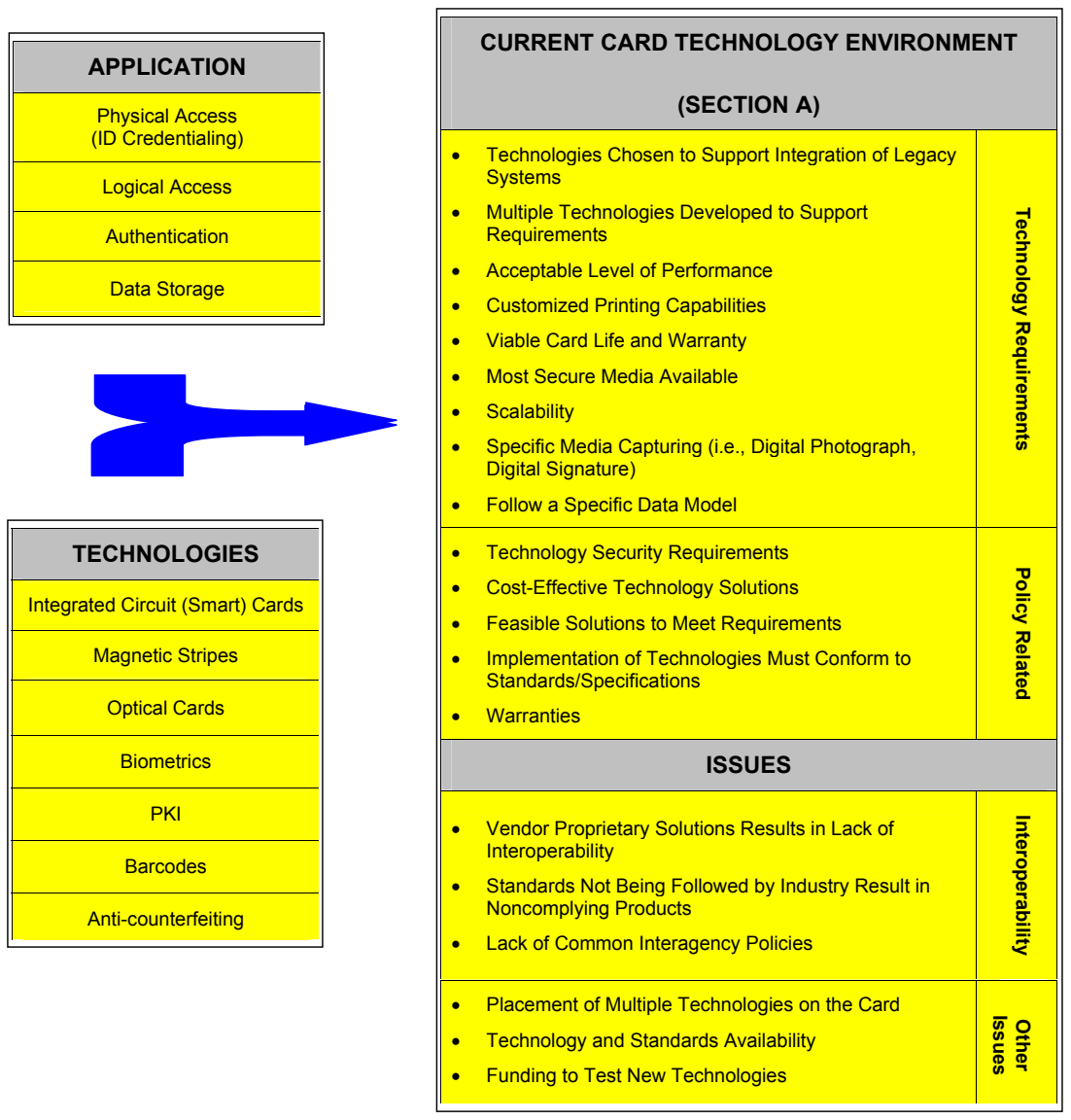
図です。左に 2 つの枠があり、「APPLICATION」(アプリケーション)には「Physical Access (ID Credentialing)」(物理アクセス(ID 資格証明))、「Logical Access」(論理アクセス)、「Authentication」(認証)、「Data Storage」(データ保存)、「TECHNOLOGIES」(技術)には「Integrated Circuit (Smart) Cards」(IC(スマート)カード)、「Magnetic Stripes」(磁気ストライプ)、「Optical Cards」(光カード)、「Biometrics」(バイオメトリクス)、「PKI」、「Barcodes」(バーコード)、「Anti-counterfeiting」(偽造防止)が並びます。2 つの枠の間から大きな青い矢印が右の「CURRENT CARD TECHNOLOGY ENVIRONMENT (SECTION A)」(現在のカード技術環境(セクション A))の枠を指しています。その項目は右端に縦書きされた区分ごとに次のとおりです。「Technology Requirements」(技術要件): Technologies Chosen to Support Integration of Legacy Systems(既存システムとの統合を支える技術の選定)、Multiple Technologies Developed to Support Requirements(要件を支えるために開発された複数の技術)、Acceptable Level of Performance(許容できる性能)、Customized Printing Capabilities(カスタマイズした印刷機能)、Viable Card Life and Warranty(実用的なカード寿命と保証)、Most Secure Media Available(入手できる最も安全な媒体)、Scalability(拡張性)、Specific Media Capturing (i.e., Digital Photograph, Digital Signature)(特定の媒体の取り込み(デジタル写真、デジタル署名など))、Follow a Specific Data Model(特定のデータモデルに従う)。「Policy Related」(方針関連): Technology Security Requirements(技術のセキュリティ要件)、Cost-Effective Technology Solutions(費用対効果の高い技術的解決策)、Feasible Solutions to Meet Requirements(要件を満たす実現可能な解決策)、Implementation of Technologies Must Conform to Standards/Specifications(技術の実装は標準・仕様に適合しなければならない)、Warranties(保証)。見出し「ISSUES」(課題)の下の「Interoperability」(相互運用性): Vendor Proprietary Solutions Results in Lack of Interoperability(ベンダー独自の解決策による相互運用性の欠如)、Standards Not Being Followed by Industry Result in Noncomplying Products(業界が標準に従わず不適合製品が生じる)、Lack of Common Interagency Policies(機関共通の方針の欠如)。「Other Issues」(その他の課題): Placement of Multiple Technologies on the Card(カード上への複数技術の配置)、Technology and Standards Availability(技術と標準の入手可能性)、Funding to Test New Technologies(新技術を試験するための資金)。
Figure 2. Future Trend Environments
図 2. 将来の傾向となる環境
| FUTURE CARD TECHNOLOGY ENVIRONMENTS (SECTION B) |
|---|
|
| 将来のカード技術環境(第 B 節) |
|---|
|
3.2 Questionnaire Responses
3.2 質問票への回答
NIST developed a capabilities and requirement questionnaire to support determination of what storage and processor card-based technologies are available by the industry or required by government agencies. The questionnaires were distributed during the 2-day workshop and posted to the NIST Web site for a 3-month period.
NIST は、業界で入手可能な、または政府機関が必要とする、ストレージカードベースおよびプロセッサカードベースの技術を特定するため、能力と要件に関する質問票を作成しました。質問票は2日間のワークショップで配布され、3か月間、NIST の Web サイトに掲載されました。
To display a clear comparison of the capabilities and requirements responses, Figure 3 represents the total population of respondents from the capabilities and requirement questionnaires (see Appendix B). Questions were combined and key words separated by a “/” to represent the consensus of Yes/No responses. The column heading “CAP” represents the collective Yes/No responses from the capabilities questionnaire, whereas the Yes/No responses from the requirement questionnaire are under the “REQ” column. A black cell represents questions not included on one of the questionnaires.
能力と要件についての回答を明確に比較して示すため、図 3 は、能力に関する質問票と要件に関する質問票の回答者の全体を表しています(付録 B を参照)。質問は統合し、「はい」「いいえ」の回答の合意を表すため、キーワードは「/」で区切りました。列見出しの「CAP」は、能力に関する質問票の「はい」「いいえ」の回答を合算したものを表し、要件に関する質問票の「はい」「いいえ」の回答は「REQ」列に示します。黒いセルは、いずれかの質問票に含まれていない質問を表します。
Respondent keys are as follows,
回答者の凡例は次のとおりです。
•● All of the responses were yes to the question
•● その質問に対する回答がすべて「はい」
•◕ Most of the responses were yes
•◕ 回答の大半が「はい」
•◑ At least half of the responses were yes
•◑ 回答の少なくとも半数が「はい」
•◔ Few of the responses were yes/most of the responses were no
•◔ 「はい」の回答はわずか/回答の大半が「いいえ」
•○ None of the responses were yes/all responses were no to the question
•○ その質問に「はい」の回答はなし/回答はすべて「いいえ」
Figure 3. Questionnaire Findings
図 3. 質問票の調査結果
CARD TECHNOLOGY CAPABILITIES AND REQUIREMENT FINDINGS
カード技術の能力と要件に関する調査結果
| COMBINED QUESTIONNAIRES | CAP | REQ |
|---|---|---|
| Do you offer/require identification cards? | ● | ● |
| Do you offer/require transaction cards? | ◑ | ◑ |
| Have you performed a Business Case Analysis for your card requirements? | ■ | ● |
| Do you have any cost limitation requirements? | ■ | ● |
| Do you offer/require any specific form factors for the card readers? | ◕ | ● |
| Do you have/offer a capability/requirement to display text on your cards? | ◕ | ● |
| If yes to the above question: | ||
| Do you have any font requirements? | ■ | ● |
| Do you have any font restrictions, such as character size limits? | ◑ | ● |
| Do you have a maximum limit on the number of characters displayed? | ◑ | ● |
| Do you have a capability/requirement for a photograph of the cardholder to appear on the card? | ● | ● |
| If yes to the above question: | ||
| Do you have any size requirements for the photograph? | ■ | ● |
| Do you have any size restrictions? | ◑ | ● |
| Do you have any color requirements? | ■ | ● |
| Do you have any color restrictions? | ◑ | ● |
| Do you have any resolution requirements? | ■ | ● |
| Do you have any resolution restrictions? | ◕ | ● |
| Do you have a capability/requirement for other biometric imagery to appear on the card? | ◕ | ◑ |
| If yes to the above question: | ||
| Do you have any size requirements? | ■ | ◑ |
| Do you have any size restrictions? | ◔ | ◑ |
| Do you have any resolution requirements? | ■ | ◑ |
| Do you have any resolution restrictions? | ◑ | ◑ |
| Do you have/offer a capability/requirement for digital biometric data on the card? | ● | ● |
| If yes to the above question: | ||
| Do you have minimum data capacity requirements? | ■ | ● |
| Do you have maximum data capacity requirements? | ■ | ● |
| Do you have any data storage format requirements? | ■ | ● |
| Do you have/offer a capability/requirement to include bar codes on identity/transaction cards? | ● | ● |
| If yes to the above question: | ||
| Do you have any quantitative requirements? | ■ | ● |
| Do you have any quantitative restrictions? | ◕ | ● |
| Do you have any format requirements? | ■ | ● |
| Do you have any format restrictions? | ◕ | ● |
| Do you have a capability/requirement to display holographic images on your cards? | ◑ | ◑ |
| If yes to the above question: | ||
| Do you have any size requirements? | ■ | ◑ |
| Do you have any size restrictions? | ◑ | ◑ |
| Do you have any format requirements? | ■ | ◑ |
| Do you have any format restrictions? | ◑ | ◑ |
| Do you have a requirement for general storage of digital data on the cards? | ● | ● |
| If yes to the above question: | ||
| Do you have minimum data capacity requirements? | ■ | ● |
| Do you have maximum data capacity requirements? | ■ | ● |
| Do you have any retrieval access time requirements? | ■ | ● |
| Do you require multiple storage formats? | ■ | ● |
| Do you have/offer an installed base or other basis for preference for magnetic storage (e.g., magnetic stripe)? | ◕ | ● |
| If yes to the above question: | ||
| Do you have minimum data capacity requirements? | ■ | ● |
| Do you have maximum data capacity requirements? | ■ | ● |
| Do you have any retrieval access time requirements? | ■ | ● |
| Do you require multiple storage formats? | ■ | ● |
| Do you have any form factor requirements for the readers? | ■ | ● |
| Do you have an installed base or other basis for preference for optical storage (e.g., laser recording)? | ◑ | ○ |
| If yes to the above question: | ||
| Do you have minimum data capacity requirements? | ■ | ○ |
| Do you have maximum data capacity requirements? | ■ | ○ |
| Do you have any retrieval access time requirements? | ■ | ○ |
| Do you require multiple storage formats? | ■ | ○ |
| Do you have any form factor requirements for the readers? | ■ | ○ |
| Do you have/offer a read/write storage capability/requirement? | ◕ | ● |
| If yes to the above question: | ||
| Do you have a requirement for the minimum number of writes that a card must be able to accommodate in its lifetime? | ■ | ● |
| Do you have a requirement for the maximum number of writes that a card must be able to accommodate in its lifetime? | ■ | ● |
| Do you require processing capabilities to be embedded in your cards? (REQ) Does your product include an embedded processor? (CAP) | ◕ | ● |
| If yes to the above question: | ||
| Do you require physical input/output interfaces? | ■ | ● |
| Do you require electronic input/output interfaces? | ■ | ● |
| Do you require logical input/output interfaces? | ■ | ● |
| Do you require more than one specific processor type? | ■ | ● |
| Do you require any minimum processor capabilities? | ■ | ● |
| Do you have cryptographic security requirements? | ■ | ● |
| If yes to the above question: | ||
| Embedded processors? | ■ | ● |
| Digital Signatures? | ■ | ● |
| Other? | ■ | ● |
| 統合した質問票 | CAP | REQ |
|---|---|---|
| 識別カードを提供していますか/必要としていますか。 | ● | ● |
| トランザクションカードを提供していますか/必要としていますか。 | ◑ | ◑ |
| カードの要件についてビジネスケース分析を実施しましたか。 | ■ | ● |
| コストに関する制限要件はありますか。 | ■ | ● |
| カードリーダーについて、特定のフォームファクターを提供していますか/必要としていますか。 | ◕ | ● |
| カードにテキストを表示する機能を備えていますか/その機能を求めていますか。 | ◕ | ● |
| 上の質問に「はい」の場合: | ||
| フォントに関する要件はありますか。 | ■ | ● |
| 文字サイズの制限など、フォントに関する制約はありますか。 | ◑ | ● |
| 表示する文字数に上限はありますか。 | ◑ | ● |
| カード所持者の写真をカードに表示する機能を備えていますか/その機能を求めていますか。 | ● | ● |
| 上の質問に「はい」の場合: | ||
| 写真のサイズに関する要件はありますか。 | ■ | ● |
| サイズに関する制約はありますか。 | ◑ | ● |
| 色に関する要件はありますか。 | ■ | ● |
| 色に関する制約はありますか。 | ◑ | ● |
| 解像度に関する要件はありますか。 | ■ | ● |
| 解像度に関する制約はありますか。 | ◕ | ● |
| カードにほかの生体画像を表示する機能を備えていますか/その機能を求めていますか。 | ◕ | ◑ |
| 上の質問に「はい」の場合: | ||
| サイズに関する要件はありますか。 | ■ | ◑ |
| サイズに関する制約はありますか。 | ◔ | ◑ |
| 解像度に関する要件はありますか。 | ■ | ◑ |
| 解像度に関する制約はありますか。 | ◑ | ◑ |
| カードにデジタル生体データを記録する機能を備えていますか/その機能を求めていますか。 | ● | ● |
| 上の質問に「はい」の場合: | ||
| 最小のデータ容量に関する要件はありますか。 | ■ | ● |
| 最大のデータ容量に関する要件はありますか。 | ■ | ● |
| データの記憶形式に関する要件はありますか。 | ■ | ● |
| 識別カード/トランザクションカードにバーコードを含める機能を備えていますか/その機能を求めていますか。 | ● | ● |
| 上の質問に「はい」の場合: | ||
| 数量に関する要件はありますか。 | ■ | ● |
| 数量に関する制約はありますか。 | ◕ | ● |
| 形式に関する要件はありますか。 | ■ | ● |
| 形式に関する制約はありますか。 | ◕ | ● |
| カードにホログラム画像を表示する機能を備えていますか/その機能を求めていますか。 | ◑ | ◑ |
| 上の質問に「はい」の場合: | ||
| サイズに関する要件はありますか。 | ■ | ◑ |
| サイズに関する制約はありますか。 | ◑ | ◑ |
| 形式に関する要件はありますか。 | ■ | ◑ |
| 形式に関する制約はありますか。 | ◑ | ◑ |
| カードにデジタルデータを一般に記憶させる要件はありますか。 | ● | ● |
| 上の質問に「はい」の場合: | ||
| 最小のデータ容量に関する要件はありますか。 | ■ | ● |
| 最大のデータ容量に関する要件はありますか。 | ■ | ● |
| 読み出しアクセス時間に関する要件はありますか。 | ■ | ● |
| 複数の記憶形式が必要ですか。 | ■ | ● |
| 磁気記憶(磁気ストライプなど)を優先する理由として、導入済みの機器基盤やその他の根拠がありますか/提供していますか。 | ◕ | ● |
| 上の質問に「はい」の場合: | ||
| 最小のデータ容量に関する要件はありますか。 | ■ | ● |
| 最大のデータ容量に関する要件はありますか。 | ■ | ● |
| 読み出しアクセス時間に関する要件はありますか。 | ■ | ● |
| 複数の記憶形式が必要ですか。 | ■ | ● |
| リーダーのフォームファクターに関する要件はありますか。 | ■ | ● |
| 光学記憶(レーザー記録など)を優先する理由として、導入済みの機器基盤やその他の根拠がありますか。 | ◑ | ○ |
| 上の質問に「はい」の場合: | ||
| 最小のデータ容量に関する要件はありますか。 | ■ | ○ |
| 最大のデータ容量に関する要件はありますか。 | ■ | ○ |
| 読み出しアクセス時間に関する要件はありますか。 | ■ | ○ |
| 複数の記憶形式が必要ですか。 | ■ | ○ |
| リーダーのフォームファクターに関する要件はありますか。 | ■ | ○ |
| 読み書き可能な記憶機能を備えていますか/その機能が必要ですか。 | ◕ | ● |
| 上の質問に「はい」の場合: | ||
| カードが寿命の間に対応できなければならない最小の書き込み回数について、要件がありますか。 | ■ | ● |
| カードが寿命の間に対応できなければならない最大の書き込み回数について、要件がありますか。 | ■ | ● |
| カードに処理能力を組み込む必要がありますか。(REQ) 製品に組み込みプロセッサが含まれていますか。(CAP) | ◕ | ● |
| 上の質問に「はい」の場合: | ||
| 物理的な入出力インタフェースが必要ですか。 | ■ | ● |
| 電子的な入出力インタフェースが必要ですか。 | ■ | ● |
| 論理的な入出力インタフェースが必要ですか。 | ■ | ● |
| 特定のプロセッサの種類を複数必要としますか。 | ■ | ● |
| プロセッサに最低限必要な能力はありますか。 | ■ | ● |
| 暗号セキュリティ要件はありますか。 | ■ | ● |
| 上の質問に「はい」の場合: | ||
| 組み込みプロセッサ | ■ | ● |
| デジタル署名 | ■ | ● |
| その他 | ■ | ● |
4. Findings
4. 調査結果
•Based on the evidence of the interview responses, many card technology user organizations either have not conducted business case analyses or have not communicated business case analysis information to personnel managing implementation. Some responses to questions regarding the technology selection process indicated that the organizations are in the technology evaluation phase of their implementation. The stakeholders are engaged in piloting more than one technology and evaluating the effectiveness of the solution for their environment. That said, there seems to be general agreement that agency-specific user requirements drive card technologies requirements. The total cost of infrastructure and per unit cost of a card make up a significant part of the user requirements, which tend to be a mixture of the following five factors:
•聞き取りへの回答から判断すると、カード技術を利用する多くの組織は、ビジネスケース分析を実施していないか、その分析結果を実装の管理担当者に伝えていません。技術の選定プロセスに関する質問への回答の一部は、組織が実装に向けた技術評価の段階にあることを示していました。関係者は複数の技術を試験導入し、自らの環境でソリューションの有効性を評価しています。そうは言っても、機関固有の利用者要件がカード技術の要件を決めるという点では、おおむね意見が一致しているようです。インフラストラクチャの総コストとカード1枚あたりのコストは利用者要件の重要な部分を占めており、利用者要件は次の5つの要因が混在したものになる傾向があります。
•COST EFFECTIVENESS OF A TECHNOLOGY. Cost is a primary factor in the choice of a suitable card technology. Most users were looking for unit card costs of no more than two to five dollars. Very significant cost differences exist among card technology implementations.
•技術の費用対効果。コストは、適切なカード技術を選ぶ際の主要な要因です。大半の利用者は、カード1枚あたりの単価を2〜5ドル以下にすることを求めていました。カード技術の実装の間には、非常に大きなコスト差があります。
•POLICIES AND BUSINESS PROCESSES UNIQUE TO EACH AGENCY. Each agency has followed different technology implementations to satisfy similar business functions mainly because of the uniqueness of its internal policies and processes. For example, ID proofing seems to be one common business function that is undertaken by many government organizations. However, the differences in policy setup, based on contrasting security and cardholder privacy requirements, cause divergence from the common goal of ID proofing. This drives each agency to different technology solutions.
•各機関に固有の方針と業務プロセス。各機関は、類似の業務機能を満たすために異なる技術実装を採用してきましたが、その主な理由は、内部の方針とプロセスが固有であることです。たとえば、身元確認(ID プルーフィング)は、多くの政府組織が行っている共通の業務機能のようです。しかし、相反するセキュリティ要件とカード所持者のプライバシー要件に基づく方針設定の違いにより、ID プルーフィングという共通の目標から乖離が生じています。これが、各機関を異なる技術ソリューションへ向かわせます。
•VARYING SECURITY REQUIREMENTS. Security requirements (e.g., support for biometric requirements, digital signature, and personal data) play an important role in selection and use of card technologies. Some card technologies offer stronger security mechanisms.
•セキュリティ要件の違い。セキュリティ要件(生体認証の要件、デジタル署名、個人データへの対応など)は、カード技術の選定と使用において重要な役割を果たします。一部のカード技術は、より強力なセキュリティ機構を提供します。
•AVAILABLE TECHNOLOGIES AND THE RELATED STANDARDS. Some ID card implementations are driven mainly by available card technology capabilities and standards applicable to user requirements. Agencies are often forced to combine multiple technologies on one card to achieve performance and security objectives.
•利用可能な技術と関連標準。ID カードの実装の一部は、主に、利用者要件に適用できるカード技術の能力と標準によって推進されています。機関は、性能とセキュリティの目標を達成するために、1枚のカードに複数の技術を組み合わせざるを得ないことがよくあります。
•NEED FOR INTEROPERABILITY. Given the growing number of interagency applications and of technologies in use, agencies require interoperability to achieve efficient operations. This requires equipment from multiple vendors to work together within a specific card technology and for different technologies to co-exist in an integrated manner.
•相互運用性の必要性。機関間のアプリケーションと使用中の技術が増えていることから、機関は効率的な運用を実現するために相互運用性を必要としています。そのためには、特定のカード技術の中で複数ベンダーの機器が連携して動作し、異なる技術が統合された形で共存することが求められます。
The combination of these factors has forced agencies to either keep their legacy card technologies (e.g., bar code and magnetics), or enhance their existing card technology with added security features (e.g., holograms or digital watermarks). In addition, advances in card technologies (e.g., smart and optical cards) led various agencies to adopt different technologies for similar applications (e.g., physical access). This broad spectrum of available card technology led to even more complex integration issues and hampered interoperability across the agencies.
これらの要因が組み合わさって、機関は、従来のカード技術(バーコードや磁気など)を維持するか、既存のカード技術にセキュリティ機能(ホログラムや電子透かしなど)を追加して強化するかの選択を迫られてきました。さらに、カード技術の進歩(スマートカードや光カードなど)により、さまざまな機関が、類似のアプリケーション(物理アクセスなど)に異なる技術を採用するようになりました。利用可能なカード技術が幅広いことは、統合の問題をさらに複雑にし、機関間の相互運用性を妨げました。
4.1 Status of Standards, Specifications, and Implementation Guidelines
4.1 標準、仕様、実装ガイドラインの状況
ISO/IEC standards alone do not guarantee full interoperability for all the components involved in a card technology. Rather, they are designed to provide common guidelines to address general compatibility requirements. Interoperability involves coordinated policies, procedures, and management and use practices as well as hardware, software, and protocol compatibility. For example, ISO 7816 for contact-based smart cards provides a mature set of formal standards. However, the financial industry introduced the more robust Europay Mastercard Visa (EMV) specification to address, not only additional functionality, but also other interoperability attributes.
ISO/IEC 標準だけでは、カード技術に関わるすべての構成要素について完全な相互運用性が保証されるわけではありません。むしろ、これらの標準は、一般的な互換性の要件に対処するための共通のガイドラインを提供するように設計されています。相互運用性には、ハードウェア、ソフトウェア、プロトコルの互換性に加えて、方針、手順、管理と使用の慣行の調整が必要です。たとえば、接触式スマートカード向けの ISO 7816 は、成熟した一連の正式な標準を提供しています。しかし金融業界は、追加の機能だけでなく、ほかの相互運用性の属性にも対処するため、より堅牢な Europay Mastercard Visa(EMV)仕様を導入しました。
Application level interoperability is different from card-to-reader interoperability. ISO/IEC 14443 does not currently address interoperable application level issues (e.g., application selection, message structure, transaction flow, and selection of available security mechanisms). Therefore, a card and a card reader from different manufacturers may not necessarily interoperate unless applications guidelines are developed for interoperation of ISO 14443-compatible devices.
アプリケーションレベルの相互運用性は、カードとリーダー間の相互運用性とは異なります。ISO/IEC 14443 は、現在のところ、相互運用可能なアプリケーションレベルの問題(アプリケーションの選択、メッセージ構造、トランザクションの流れ、利用可能なセキュリティ機構の選択など)に対処していません。したがって、ISO 14443 互換デバイスの相互運用を可能にするアプリケーションガイドラインが策定されない限り、異なる製造業者のカードとカードリーダーは必ずしも相互運用するとは限りません。
So far, most biometrics technology centers on proprietary technologies, often creating incompatibility issues among different systems. Present biometric standards are relatively new, and not without issues. BioAPI, an open system standard for a biometric API, was approved as an official American National Standards Institute (ANSI) standard in February 2002. However, because of the relatively small number of deployed compliant systems, the standard lacks broad international status and industry acceptance. Notable shortfalls/problem areas in the biometric standards area include the following:
これまでのところ、生体認証技術の大半は独自の技術を中心としており、異なるシステム間で互換性の問題が生じることがよくあります。現在の生体認証標準は比較的新しく、問題がないわけではありません。生体認証 API のためのオープンシステム標準である BioAPI は、2002年2月に米国規格協会(ANSI)の公式な標準として承認されました。しかし、準拠したシステムの導入数が比較的少ないため、この標準は、国際的な地位と業界での受け入れが広くありません。生体認証標準の分野における顕著な不足点・問題領域には、次のものがあります。
•Existing systems interoperate at the image level only.
•既存のシステムは、画像レベルでのみ相互運用できます。
•Templates have not been adequately tested as vehicles for interoperability. (Test of fingerprint minutia templates may be done by NIST starting this year.)
•テンプレートは、相互運用性の手段として十分に試験されていません。(指紋のミニューシャテンプレートの試験は、今年から NIST が実施する可能性があります。)
•No common face template is contemplated by vendors at this time.
•現時点で、ベンダーは共通の顔テンプレートを想定していません。
•All existing iris templates are proprietary.
•既存の虹彩テンプレートはすべて独自のものです。
The introduction of the JavaCard and MULTOS Virtual Machines into the smart card world represents a significant step toward a multi-application environment. Currently, Global Platform, which is built on Java Card operating system, and MULTOS are the only such environments in wide existence. As the need to expand the usage of a card to different applications becomes an industry requirement, such as in transit and retail payment, a need for a true multi-application environment will become a necessity. The lack of standards for many of the new added security features (e.g., digital watermarks, Kinechip, and high-density barcodes) could pose potential integration problems when they are combined in multi-technology cards.
JavaCard と MULTOS の仮想マシンがスマートカードの世界に導入されたことは、複数アプリケーション環境へ向けた大きな一歩です。現在、Java Card オペレーティングシステム上に構築された Global Platform と MULTOS が、広く存在する唯一のそうした環境です。交通や小売決済のように、カードの使用をさまざまなアプリケーションへ拡大する必要性が業界の要件になるにつれて、真の複数アプリケーション環境が必要不可欠になるでしょう。新たに追加されたセキュリティ機能の多く(電子透かし、Kinechip、高密度バーコードなど)に標準がないことは、それらを複数技術カードに組み合わせる際に、統合上の問題を生じさせる可能性があります。
Technology standards can address only technical issues and requirements for specific functions. However, differences in issuer (agency) specific policy and processes contribute to the outstanding issues discussed in the workshop. It was noted that the variations in policies for ID proofing, credentialing requirements, and perceived level of security required resulted in unique physical access implementations based on similar technologies. Emphasis was placed on the need to achieve standardization of policies and implementation and use procedures to achieve interoperable implementations on an interagency basis.
技術標準は、特定の機能に関する技術的な問題と要件にしか対処できません。しかし、発行者(機関)固有の方針とプロセスの違いが、ワークショップで議論された未解決の問題の一因となっています。ID プルーフィングの方針、資格情報の発行要件、求められるセキュリティの水準の認識が異なるため、類似の技術に基づきながら固有の物理アクセスの実装が生まれたことが指摘されました。機関間で相互運用可能な実装を実現するには、方針、ならびに実装と使用の手順を標準化する必要があることが強調されました。
Appendix E is a current bibliography of storage and processor card standards.
付録 E は、記憶装置カードおよびプロセッサカードの標準に関する最新の参考文献一覧です。
4.2 Integration Issues
4.2 統合の問題
A significant proportion of integration issues are caused by non-technical issues, including incompatible business processes, lack of clearly defined partnership relationships among stakeholders, and policy and procedural issues (see Section 4.1).
統合の問題の大きな割合は、互換性のない業務プロセス、関係者間のパートナー関係が明確に定義されていないこと、方針および手順の問題といった、技術以外の問題によって生じています(第 4.1 節を参照)。
In large-scale physical access implementations in which cardholders are widely dispersed, the card management process becomes very labor intensive, expensive, and time consuming. Card management functions (e.g., issuance, updating, replacing, and monitoring) need to be decentralized. Ideally, some functions (e.g., changes to credentials) should be handled at an individual user level (e.g., at the desktop). Maintaining and updating data on the card once it is issued requires complex software implementation. Maintaining the central database and robust IT infrastructure to control and monitor the remote processes will probably remain a lingering challenge.
カード所持者が広範囲に分散している大規模な物理アクセスの実装では、カード管理のプロセスは非常に労力と費用がかかり、時間も要します。カード管理機能(発行、更新、交換、監視など)は分散化する必要があります。理想的には、一部の機能(資格情報の変更など)は、個々の利用者のレベル(デスクトップなど)で処理されるべきです。カードの発行後にカード上のデータを維持し更新するには、複雑なソフトウェアの実装が必要です。中央データベースと、遠隔プロセスを制御・監視する堅牢な IT インフラストラクチャの維持は、おそらく今後も長く続く課題となるでしょう。
4.3 Multi-technology Composition Issues
4.3 複数技術の組み合わせの問題
Agency-specific requirements such as the need for added security and the use of a single card for multiple functionalities drove the convergence of multiple technologies onto a single card. One main issue introduced with these cards is the potential increase in the card failure rate in the field. The total number of failures increases by the sum of all the individual failure rates for each technology present on the card. The existing standards specifications are inadequate for the issues arising from integrating, or even just composing, different technologies on one card. Agencies dictate the graphics layout of their cards, making proprietary decisions on the physical location of security features (i.e., watermarks, Kinegrams®), barcodes, optical stripe, and demographic data on the card. For example, the location of the barcode varies from the Common Access Cards (CACs) to the government travel documents. No standard dictates the placement of added security features, such as digital watermarking and Kinegram® on the card. Conversely, the physical, mechanical, and operational characteristics of each card technology may damage one another when they co-exist on the same card. For example, the acceptable card elasticity for magnetic stripe cards can cause cracking of the chip in smart cards.
セキュリティの追加や、1枚のカードを複数の機能に使用する必要性といった機関固有の要件が、複数の技術を1枚のカードに集約する動きを推進しました。こうしたカードで生じる主な問題の一つは、現場でのカードの故障率が高くなる可能性があることです。故障の総数は、カードに存在する各技術の個別の故障率の合計だけ増加します。既存の標準の仕様は、1枚のカード上で異なる技術を統合する、あるいは単に組み合わせるだけでも生じる問題に対して、不十分です。各機関は、自らのカードのグラフィックのレイアウトを決定し、セキュリティ機能(透かし、Kinegram® など)、バーコード、光ストライプ、人口統計データをカード上のどこに配置するかについて独自に判断しています。たとえば、バーコードの位置は、共通アクセスカード(CAC)と政府の渡航文書とで異なります。電子透かしや Kinegram® などの追加のセキュリティ機能のカード上での配置を定めた標準はありません。逆に、各カード技術の物理的、機械的、運用上の特性は、同じカード上に共存すると互いを損傷するおそれがあります。たとえば、磁気ストライプカードで許容されるカードの弾性は、スマートカードのチップに亀裂を生じさせる場合があります。
Currently, multi-application cards are used with separate readers for each technology. A card with a contactless chip, a barcode, and a magnetic stripe requires a contactless reader, barcode reader, and magnetic stripe reader for each respective technology. Building readers to read all three technologies would be cost effective in the long term, easier to manage and maintain, and more convenient.
現在、複数アプリケーション対応カードは、技術ごとに別々のリーダーとともに使用されています。非接触式チップ、バーコード、磁気ストライプを備えたカードには、それぞれの技術に対応する非接触式リーダー、バーコードリーダー、磁気ストライプリーダーが必要です。3つの技術すべてを読み取れるリーダーを構築すれば、長期的には費用対効果が高く、管理と保守が容易で、利便性も高くなるでしょう。
Multi-technology cards may cause card management issues when they are shared with other government agencies. For example, if a government physical access card were also to be used in a transit application, it would be necessary to identify organizations responsible for administering, maintaining, updating, and monitoring the card.
複数技術カードを他の政府機関と共有する場合、カード管理上の問題が生じる可能性があります。たとえば、政府の物理アクセスカードを交通アプリケーションでも使用することになった場合は、カードの管理、保守、更新、監視を担当する組織を特定する必要があります。
4.4 Security Issues
4.4 セキュリティの問題
Current standards address only a subset of the security issues associated with storage and processor cards. There is currently no authoritative taxonomy of storage and processor card security issues, much less a comprehensive set of specifications and guidance regarding security requirements. There is a need to 1] develop a standard taxonomy of storage and processor card security issues and objectives, 2] establish the availability and maturity of technical, procedural, and organizational alternatives for dealing with security issues and achieving security objectives, and 3] develop standards and guidelines necessary to enable organizations to achieve applicable security objectives in an interoperable manner.
現在の標準は、記憶装置カードおよびプロセッサカードに関連するセキュリティ問題の一部にしか対処していません。記憶装置カードおよびプロセッサカードのセキュリティ問題について、権威ある分類体系は現時点で存在せず、セキュリティ要件に関する包括的な仕様やガイダンスはなおさらありません。次のことが必要です。1] 記憶装置カードおよびプロセッサカードのセキュリティ問題と目標に関する標準的な分類体系を策定すること。2] セキュリティ問題に対処し、セキュリティ目標を達成するための技術的、手続き的、組織的な代替策について、その利用可能性と成熟度を確認すること。3] 組織が該当するセキュリティ目標を相互運用可能な形で達成できるようにするために必要な標準とガイドラインを策定すること。
4.4.1 Range of Security Concerns
4.4.1 セキュリティ上の懸念の範囲
The security issues associated with storage and processor cards vary in character from technology to technology and from application to application. In some cases, the data owners and users are concerned primarily with the integrity of the information stored on and/or processed by the card. Normally, the integrity of any processing executed on the card is a significant concern. In other cases, confidentiality protection for some of the information is also required.
記憶装置カードおよびプロセッサカードに関連するセキュリティ問題の性質は、技術ごと、アプリケーションごとに異なります。データの所有者と利用者が主に懸念するのは、カードに保存された情報、またはカードが処理する情報、あるいはその両方の完全性である場合があります。通常、カード上で実行される処理の完全性は、重大な懸念事項です。また、情報の一部について機密性の保護が必要な場合もあります。
Some security issues are technical in nature (e.g., cryptographic techniques, physical security techniques). Other issues are associated with the management infrastructure in which the cards are used.
セキュリティ問題の中には、技術的な性質のもの(暗号技術、物理的セキュリティ技術など)があります。そのほかの問題は、カードが使用される管理インフラストラクチャに関連しています。
4.4.1.1 Card Management and Control Issues
4.4.1.1 カードの管理と制御の問題
Smart card management approaches often give control of some card functions to one party and control of other functions to another party. Examples of entities that may control some aspect of a card’s functionality include the 1) card’s manufacturer, 2) the card’s software programmer, 3) a card issuer, 4) the owner of the data processed and stored on a card, 5) a reader or other terminal device, and 6) the card holder. When one of these entities attacks functions controlled by another party, a “trust split” is said to occur.
スマートカードの管理方式では、カードの一部の機能の制御を一方の当事者に、ほかの機能の制御を別の当事者に与えることがよくあります。カードの機能の一部の側面を制御しうる事業体の例として、1) カードの製造者、2) カードのソフトウェアのプログラマー、3) カードの発行者、4) カードで処理・保存されるデータの所有者、5) リーダーまたはその他の端末デバイス、6) カード所持者が挙げられます。これらの事業体の一つが、別の当事者が制御する機能を攻撃する場合、「トラストスプリット」が生じたといいます。
For example, an automatic teller machine or point-of-sale terminal may illicitly capture private information (e.g., a PIN, an account number, an other identifying information) or record altered transaction amounts. Transaction monitoring and parameter checking are among potential countermeasures for this type of attack. This can involve independent monitoring/audit back-end processors.
たとえば、現金自動預け払い機や販売時点管理端末が、機微な情報(PIN、口座番号、その他の識別情報など)を不正に取得したり、改ざんされた取引金額を記録したりする場合があります。この種の攻撃に対する対策として考えられるものには、トランザクションの監視とパラメータの検査があります。これには、独立した監視・監査用のバックエンドプロセッサが関わる場合があります。
Trust splits are inherent in the systems supported by multi-application cards. Mutual suspicion among components is strongly advisable. The various controlling entities and system components need to be authenticated to each other. (E.g., the reader/terminal should be able to authenticate the card’s validity and the cardholder’s identity, and the card or cardholder should be able to authenticate the reader/terminal.) Trust splits are reduced where the data owner and the cardholder are the same. Some countermeasures, such as adding some kind of display to the card, are not yet economically feasible.
トラストスプリットは、複数アプリケーション対応カードが支えるシステムに本質的に存在します。構成要素同士が互いに疑う姿勢をとることを強く勧めます。制御する各事業体とシステムの構成要素は、互いに認証される必要があります。(たとえば、リーダー/端末は、カードの有効性とカード所持者の身元を認証できるようにすべきであり、カードまたはカード所持者は、リーダー/端末を認証できるようにすべきです。)データの所有者とカード所持者が同じ場合は、トラストスプリットが減ります。カードに何らかの表示装置を追加するなど、一部の対策は、まだ経済的に実現可能ではありません。
4.4.1.2 Technical Controls
4.4.1.2 技術的管理策
a. Photographic and Printed Content
a. 写真と印刷内容
In the case of photographic information and printed information, there is no attempt to conceal the information, but it is necessary to discourage undetected alteration of the information or forging of false credentials. Techniques such as inclusion of cryptographically protected and verifiable versions/summaries/hashes of the information on the card6, digital watermarking, or Kinegrams© can be employed as countermeasures. (See, for example, Section 2.2.2.5.)
写真情報と印刷された情報の場合、情報を隠そうとはしませんが、情報が気づかれずに改ざんされたり、偽の資格情報が偽造されたりすることを抑止する必要があります。対策として、情報の暗号で保護された検証可能なバージョン・要約・ハッシュをカードに含める6、電子透かし、Kinegram© といった技術を用いることができます。(たとえば、第 2.2.2.5 節を参照してください。)
b. Magnetic and Optical Storage Media
b. 磁気および光学記憶媒体
In the case of magnetic and optical storage media, cryptographic protection may be required to provide confidentiality protection, integrity protection, or both. The same may also be the case for encoded printed components (e.g., barcodes – see Section 2.2.2.2).
磁気および光学記憶媒体の場合、機密性の保護、完全性の保護、またはその両方を提供するために、暗号による保護が必要な場合があります。符号化された印刷要素(バーコードなど。第 2.2.2.2 節を参照)についても同様の場合があります。
In general, confidential information should not be stored on storage cards in unencrypted form.
一般に、機密情報は、暗号化されていない形で記憶装置カードに保存すべきではありません。
c. Smart Cards and Contactless Smart Cards
c. スマートカードと非接触式スマートカード
Concerns related to both the confidentiality/integrity of information and the integrity of processes are associated with smart cards. Consequently both logical protection (e.g., cryptography) and physical protection against technical surveillance and tampering are often necessary.
スマートカードには、情報の機密性・完全性と、処理の完全性の両方に関する懸念があります。そのため、論理的な保護(暗号など)と、技術的な監視や改ざんに対する物理的な保護の両方が必要になることが多くあります。
In many cases, confidential information necessarily exists on smart cards in unencrypted form (e.g., during cryptographic processing where a cryptographic process is executed by smart card circuitry). Also, communication between a smart card and some terminal device is often used to manage information stored on a card or capabilities enabled by a card. As a result, security concerns exist with respect to extraction of information from smart cards and/or tampering with card functionality.
多くの場合、機密情報は、必然的にスマートカード上に暗号化されていない形で存在します(たとえば、スマートカードの回路が暗号処理を実行する際の暗号処理中)。また、スマートカードと端末デバイスとの間の通信は、カードに保存された情報や、カードが実現する機能を管理するために使われることがよくあります。その結果、スマートカードからの情報の抽出、またはカードの機能の改ざん、あるいはその両方に関するセキュリティ上の懸念が存在します。
(1) Non-invasive attacks
(1) 非侵襲型攻撃
Electrical currents generate electromagnetic fields (electromagnetic radiation). Non-invasive attacks involve reception and analysis of electromagnetic radiation produced by normal operation of a card. Examples include, but are not limited to, analog radiation produced by current associated with communications interfaces and power supplies. Non-invasive attacks (e.g., side channel or eavesdropping attacks) are difficult to prevent.
電流は電磁場(電磁放射)を生成します。非侵襲型攻撃は、カードの通常の動作によって生じる電磁放射を受信して分析するものです。例として、通信インタフェースや電源に関連する電流によって生じるアナログ放射が挙げられますが、これらに限りません。非侵襲型攻撃(サイドチャネル攻撃や盗聴攻撃など)は、防ぐのが困難です。
In the case of contactless smart cards, the strength of the electromagnetic radiation associated with input and output is necessarily sufficient to permit remote interception of information communicated between the card and its associated reader/terminal. Cryptographic integrity and confidentiality protection is frequently necessary to protect the integrity of the processes supported by the cards. (E.g., protection against both capture of sensitive and/or private information and spoofing of security processes7).
非接触式スマートカードの場合、入出力に関連する電磁放射の強度は、必然的に、カードと関連するリーダー/端末の間で伝達される情報を遠隔から傍受できる程度に十分なものです。カードが支えるプロセスの完全性を保護するには、暗号による完全性と機密性の保護が必要になることが多くあります。(たとえば、機微な情報や秘密情報の取得と、セキュリティプロセスのなりすまし7の両方に対する保護。)
In some cases, security algorithms, cryptographic keys, and security protocols can be compromised by power analysis attacks that exploit power consumption characteristics of smart cards (e.g., simple power analysis attacks, differential power analysis attacks, and “high order” power analysis attacks. Few practical countermeasures to power analysis attacks have been developed in industry.
場合によっては、スマートカードの消費電力の特性を悪用する電力解析攻撃(単純電力解析攻撃、差分電力解析攻撃、「高次」電力解析攻撃など)によって、セキュリティアルゴリズム、暗号鍵、セキュリティプロトコルが危殆化されることがあります。電力解析攻撃に対する実用的な対策は、業界ではほとんど開発されていません。
Analysis of the times of execution of smart card operations generally requires the attacker to have access to the card and the ability to measure the times required for partial operations. These “timing analysis” attacks have been used to disclose active security keys. (Note that non-linear key updates may be employed as a countermeasure to this consequence of successful timing analysis.)
スマートカードの動作の実行時間を解析するには、一般に、攻撃者がカードにアクセスでき、部分的な動作に要する時間を測定できることが必要です。こうした「タイミング解析」攻撃は、使用中のセキュリティ鍵を開示させるために用いられてきました。(タイミング解析が成功した場合のこの結果への対策として、非線形の鍵更新を用いることができる点に注意してください。)
Software protocol attacks, fault generation attacks, and so called “glitch attacks” exploit chip abnormalities. Such attacks often require “trial and error” procedures and/or detailed analysis of chip responses to power fluctuations, different clock rates, etc. (e.g., changing the output of internal components such as flip-flop circuits). Randomized multithreading of operations can prevent prediction of instruction execution timing. (Use of a randomized clock input can serve this purpose as well.) Some chips employ other countermeasures such as sensors that disable the chip upon detection of voltages, clock speeds, or temperatures that vary too far from norms. Most such countermeasures are insufficiently robust to provide high-assurance protection.
ソフトウェアプロトコル攻撃、フォールト生成攻撃、いわゆる「グリッチ攻撃」は、チップの異常を悪用します。こうした攻撃は、「試行錯誤」の手順、または電源の変動や異なるクロックレートなどに対するチップの応答の詳細な解析(たとえば、フリップフロップ回路などの内部構成要素の出力の変更)、あるいはその両方を必要とすることがよくあります。動作をランダム化したマルチスレッド化により、命令の実行タイミングの予測を防ぐことができます。(ランダム化したクロック入力を使用しても、同じ目的を果たせます。)一部のチップは、電圧、クロック速度、温度が基準から大きく外れたことを検知した際にチップを無効にするセンサーなど、ほかの対策を採用しています。こうした対策の大半は、高い保証の保護を提供するには堅牢性が不十分です。
Researchers at the University of Cambridge in England have developed a way to attack and cause faults in cards by flooding the chip (or areas on a chip) with energy pulses (e.g., using a photographer's flash gun and a microscope).8 Simply shielding the processor e.g., by adding a top metal layer to the chip is not necessarily an adequate countermeasure because silicon becomes transparent to the light in an infrared flash and the chip can therefore be attacked from the rear. Electromagnetic pulses and X-rays could also be used in a similar manner.
英国のケンブリッジ大学の研究者は、チップ(またはチップ上の領域)にエネルギーパルスを浴びせる(写真家用のフラッシュガンと顕微鏡を使うなど)ことで、カードに攻撃を加えて障害を引き起こす手法を開発しました。8 チップの上部に金属層を追加するなどして単にプロセッサを遮蔽するだけでは、必ずしも十分な対策になりません。シリコンは赤外線フラッシュの光に対して透明になるため、チップを裏面から攻撃できるからです。電磁パルスや X 線も、同様の方法で使われる可能性があります。
Input/output interruption attacks, such as blocking or clamping off (e.g., with a diode) contacts via which vendor-originated program update signals reach chips have been employed for a number of years. Vendors have developed a range of countermeasures that are reasonably effective in preventing users from receiving unpaid for services by blocking signals that restrict capabilities (e.g. limit cable or satellite channels that a user can access or decrementing/invalidating telephone access cards).
入出力の中断攻撃は、ベンダーが送るプログラム更新信号がチップに届く接点を(ダイオードなどで)遮断またはクランプするもので、長年にわたり用いられてきました。ベンダーは、機能を制限する信号(利用者がアクセスできるケーブルや衛星のチャンネルを制限する信号や、電話アクセスカードの度数を減算・無効化する信号など)を遮断することで、利用者が料金を支払っていないサービスを受けるのを防ぐ、ある程度有効な対策を開発してきました。
(2) Invasive Attacks
(2) 侵襲型攻撃
Invasive techniques for probing and analyzing a smart card usually start with removing the processor from a card. A common technique for accessing the circuitry of the exposed chip involves subsequent scraping away any remaining plastic covering remaining behind the chip, then dissolving with acid the chip’s protective resin layer and washing the chip with acetone to reveal the silicone surface.
スマートカードを探査し解析する侵襲型の技術は、通常、カードからプロセッサを取り外すことから始まります。露出したチップの回路にアクセスする一般的な手法では、まずチップの後ろに残ったプラスチックの被覆を削り取り、次にチップの保護樹脂層を酸で溶かし、アセトンでチップを洗浄してシリコン表面を露出させます。
On-chip signals can then be read using micro probing needles or electron beam testers. The contents of an exposed chip’s memory can sometimes be read by identifying the chip’s test pads using a confocal microscope, then initiating test routines. Because some manufacturers often blow test pad fuses following running of acceptance test cycles, it may be necessary to bridge blown fuses using microprobe needles in order to re-enable test routines that dump the chip’s memory.
その後、微細探針や電子ビームテスターを使って、チップ上の信号を読み取れます。露出したチップのメモリの内容は、共焦点顕微鏡でチップのテストパッドを特定し、テストルーチンを開始することで読み取れる場合があります。製造者の中には、受け入れ試験のサイクルを実行した後にテストパッドのヒューズを飛ばすことが多いものがあるため、チップのメモリをダンプするテストルーチンを再び有効にするには、微細探針を使って飛ばされたヒューズを橋渡しすることが必要になる場合があります。
It is also possible to alter the functionality of a chip with lasers, ultrasonics, or focused ion beams. For example, the contents of an exposed chip can be read or altered using focused ion beam editing techniques. It is possible to overwrite read-only memory at the bit level using a laser cutter microscope. (One consequence of such an attack is extraction of DES keys stored in ROM or EEPROM.)
レーザー、超音波、集束イオンビームを使って、チップの機能を変更することも可能です。たとえば、露出したチップの内容は、集束イオンビームによる編集技術を使って読み取ったり変更したりできます。レーザーカッター顕微鏡を使えば、読み出し専用メモリをビット単位で上書きすることが可能です。(こうした攻撃の結果の一つは、ROM や EEPROM に保存された DES 鍵の抽出です。)
Anti-tamper measures such as capacitive sensors and optical sensors buried in opaque coatings can be used to detect tampering and subsequently disable chips. These techniques have a mixed track record with respect to reliability. Other countermeasures include visual scrambling (circuit designs that randomize chip lay-out) and de-correlation of the location of data on the chip with its logical address location (useful with dynamically updated memory such as RAM).
不透明なコーティングの中に埋め込まれた静電容量センサーや光学センサーなどの耐タンパー対策を使えば、改ざんを検知し、その後チップを無効にできます。これらの技術は、信頼性に関しては実績にばらつきがあります。そのほかの対策には、視覚的なスクランブル(チップのレイアウトをランダム化する回路設計)や、チップ上のデータの位置とその論理アドレスの位置との相関の解消(RAM などの動的に更新されるメモリで有用)があります。
4.4.2 Current Security Challenges
4.4.2 現在のセキュリティ上の課題
In addition to the need for storage and processor card security standards and guidelines, several specific security challenges were identified in the course of the 8-9 July 2003 Storage and Processor Card-Based Technologies Workshop:
記憶装置カードおよびプロセッサカードのセキュリティ標準とガイドラインが必要であることに加えて、2003年7月8〜9日の記憶装置およびプロセッサカードベース技術ワークショップでは、いくつかの具体的なセキュリティ上の課題が特定されました。
•Faster PKI authentication is needed in physical access and transit applications. This raises a number of issues such as identification of and agreement on certification authorities, certification management processes, and distribution of processing requirements among cards and readers/terminals.
•物理アクセスと交通のアプリケーションでは、より高速な PKI 認証が必要です。これは、認証局の特定とそれについての合意、証明書の管理プロセス、カードとリーダー/端末の間での処理要件の配分など、多くの問題を提起します。
•Availability of reliable and affordable biometric identification capabilities is needed. Some users perceive biometrics to be an increasingly important requirement for authentication of the cardholder with the card (e.g., border control and identity theft considerations).
•信頼性が高く手頃な価格の生体識別能力を利用できることが必要です。一部の利用者は、生体認証が、カード所持者をカードと照合して認証するための、ますます重要な要件になると認識しています(国境管理や、なりすまし被害への配慮など)。
•A common framework for data integrity, authentication, and general security mechanisms is needed. Unlike ISO 7816, the ISO/IEC 14443 does not currently address a means to achieve a common framework for data integrity, authentication, and general security mechanisms (e.g., 3DES, AES, and RSA). Most existing ISO 14443-based card technology implementations center on proprietary security schemes. These are not approved for protection of Federal government information.
•データの完全性、認証、一般的なセキュリティ機構のための共通の枠組みが必要です。ISO 7816 と異なり、ISO/IEC 14443 は、現在のところ、データの完全性、認証、一般的なセキュリティ機構(3DES、AES、RSA など)のための共通の枠組みを実現する手段に対処していません。ISO 14443 に基づく既存のカード技術の実装の大半は、独自のセキュリティ方式を中心としています。これらは、連邦政府の情報の保護には承認されていません。
4.5 Interoperability Issues
4.5 相互運用性の問題
Although ISO 7816 parts 1 through 4 provide a relatively sound framework for interoperability, the ability to choose among different available options does not guarantee interoperability. Further application-level guidelines need to be developed for interagency use of cards.
ISO 7816 のパート 1 から 4 は、相互運用性のための比較的堅実な枠組みを提供しますが、利用可能なさまざまなオプションから選択できることは、相互運用性を保証するものではありません。機関間でカードを使用するには、さらにアプリケーションレベルのガイドラインを策定する必要があります。
Biometrics authentication is being implemented by many government agencies because of its capability to uniquely identify individuals. However, existing biometrics implementations are mostly stand-alone systems that are not integrated with other identification mechanisms or processes. This is partly attributed to variations in proprietary biometric templates implemented by different vendors, but it inhibits interoperability.
生体認証は、個人を一意に識別できる能力があるため、多くの政府機関で実装されています。しかし、既存の生体認証の実装は、ほかの識別機構やプロセスと統合されていない独立のシステムがほとんどです。これは、異なるベンダーが実装する独自の生体テンプレートのばらつきによるところもありますが、相互運用性を妨げています。
Current implementations of ISO 14443 card technology create interoperability problems when cards from different vendors are introduced into an existing infrastructure. This results in requirements for middleware updates and changes that are analogous to updating the Windows® operating system every time a new application is installed.
ISO 14443 のカード技術の現在の実装では、異なるベンダーのカードを既存のインフラストラクチャに導入すると、相互運用性の問題が生じます。その結果、新しいアプリケーションをインストールするたびに Windows® オペレーティングシステムを更新するのに似た、ミドルウェアの更新と変更が必要になります。
Ultra high-density barcodes offer a viable solution to many on-card data storage needs. However, this proprietary technology lacks interoperability standards.
超高密度バーコードは、カード上のデータ記憶に関する多くのニーズに対する実用的なソリューションとなります。しかし、この独自技術には、相互運用性の標準がありません。
4.6 Summary
4.6 まとめ
Figure 4 presents a high-level summary of the user requirements identified in this section and the policy and technical related issues and standardizations gaps that are detailed in Section 5 of this document.
図 4 は、本節で特定した利用者要件と、本書の第 5 節で詳述する方針および技術に関連する問題と標準化のギャップの、概要をまとめたものです。
Figure 4. Card Technology Requirements and Standards Gaps
図 4. カード技術の要件と標準のギャップ
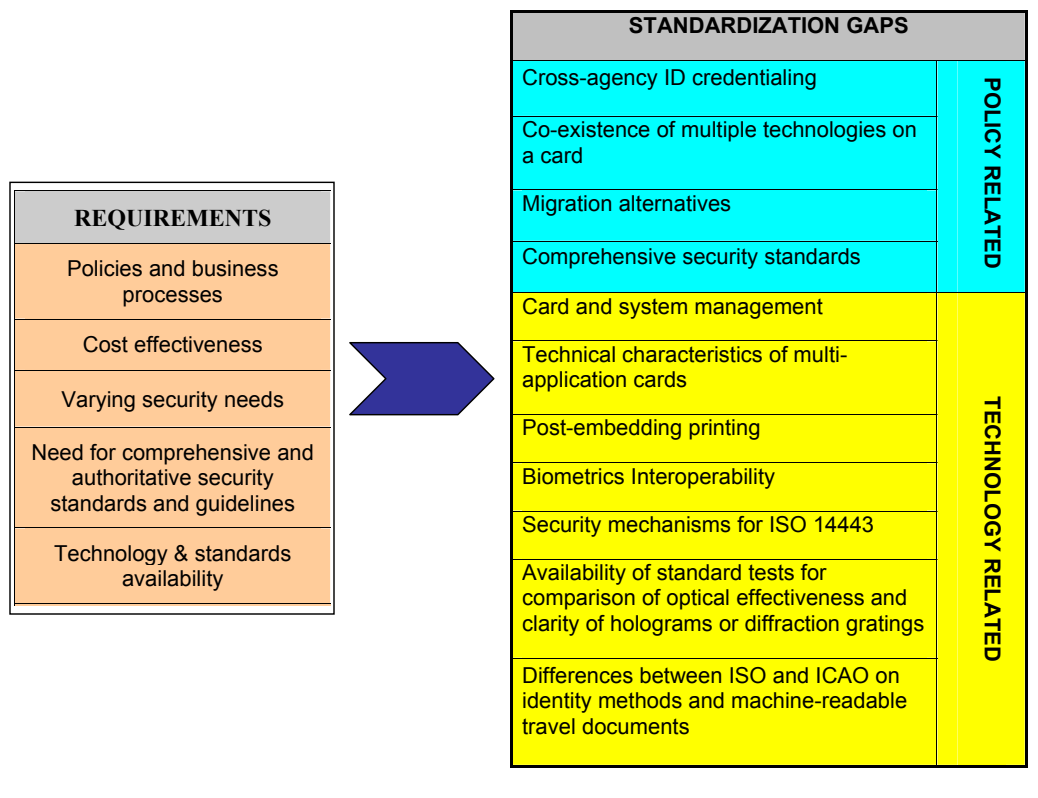
図です。左の「REQUIREMENTS」(要件)の枠には「Policies and business processes」(方針と業務プロセス)、「Cost effectiveness」(費用対効果)、「Varying security needs」(多様なセキュリティニーズ)、「Need for comprehensive and authoritative security standards and guidelines」(包括的で権威あるセキュリティ標準・ガイドラインの必要性)、「Technology & standards availability」(技術と標準の入手可能性)が並びます。大きな山形の矢印が右の「STANDARDIZATION GAPS」(標準化のギャップ)の枠を指し、その項目は右端に縦書きされた区分ごとに次のとおりです。「POLICY RELATED」(方針関連): Cross-agency ID credentialing(機関をまたぐ ID 資格証明)、Co-existence of multiple technologies on a card(1 枚のカード上での複数技術の共存)、Migration alternatives(移行の選択肢)、Comprehensive security standards(包括的なセキュリティ標準)。「TECHNOLOGY RELATED」(技術関連): Card and system management(カードとシステムの管理)、Technical characteristics of multi-application cards(多用途カードの技術特性)、Post-embedding printing(埋め込み後の印刷)、Biometrics Interoperability(バイオメトリクスの相互運用性)、Security mechanisms for ISO 14443(ISO 14443 のセキュリティ機構)、Availability of standard tests for comparison of optical effectiveness and clarity of holograms or diffraction gratings(ホログラムや回折格子の光学的効果と鮮明さを比較する標準試験の有無)、Differences between ISO and ICAO on identity methods and machine-readable travel documents(本人確認の方法と機械読取式渡航文書に関する ISO と ICAO の違い)。
5. Conclusions
5. 結論
Several issues were identified in Section 4 based on the analysis of existing storage and processor card technologies. There appears to be no consensus on requirements from the user community that participated in the conference for additional technical standards. However, most contributors to this report agree on a need to establish additional policy-related standards and regulations as a prerequisite to accomplishing true interoperability and efficient integration. The following summarizes the analysis of policy and technical issues and standardization gaps.
既存の記憶装置カードおよびプロセッサカード技術の分析に基づき、第 4 節でいくつかの問題が特定されました。会議に参加した利用者コミュニティからは、追加の技術標準の要件について合意がないようです。しかし、本報告書への寄稿者の大半は、真の相互運用性と効率的な統合を実現するための前提条件として、方針に関連する標準と規則を追加で確立する必要があることで意見が一致しています。以下は、方針と技術の問題、および標準化のギャップに関する分析をまとめたものです。
Policy Issues and Standardization Gaps
方針上の問題と標準化のギャップ
The following three issues were identified and need to be addressed:
次の3つの問題が特定され、対処する必要があります。
•There is a consensus on a need for a common policy standard for identity credentialing. Agencies have different interpretations on the definitions of the principal participants, steps involved, and commonly accepted degree of identity proof required for the identification process.
•識別資格情報の発行について、共通の方針標準が必要であるという点で合意があります。機関によって、主要な関与者の定義、関係する手順、識別プロセスで求められる、一般に認められた身元確認の程度について、解釈が異なっています。
•Administration and management of a multi-technology card shared by different agencies have not been clearly defined. Examples are the ownership scheme; card base management, including application loading and updating; system management and maintenance; and monitoring.
•異なる機関が共有する複数技術カードの運営と管理は、明確に定義されていません。例として、所有の仕組み、アプリケーションの書き込みと更新を含むカード群の管理、システムの管理と保守、監視があります。
•Some agencies with existing legacy systems want to transition into newer card technologies. Business cases need to be developed for these prospective transition programs. Currently, no common strategies are defined to guide agencies in migrating to the newer technologies. Agencies need to conduct user requirements analyses to establish a consensus on the number of card technologies that can and should co-exist on a card. A related area of concern is the ability to use existing infrastructures when migrating from one technology to another.
•既存のレガシーシステムを持つ一部の機関は、より新しいカード技術へ移行したいと考えています。こうした移行プログラムの候補については、ビジネスケースを策定する必要があります。現在、新しい技術への移行を機関に導く共通の戦略は定められていません。機関は、1枚のカードに共存できる、また共存すべきカード技術の数について合意を形成するために、利用者要件の分析を行う必要があります。関連する懸念領域として、ある技術から別の技術へ移行する際に、既存のインフラストラクチャを使用できるかどうかがあります。
Technology Issues and Standardization Gaps
技術上の問題と標準化のギャップ
Existing ISO/IEC standards have been designed primarily for the communication between the smart cards and reader/writer devices. However, these standards do not define the local information types and protocols for transfer of transaction records among smart cards, card interface devices, applications interfaces, and central processing hosts or server computers. Standards or guidelines that define and identify the communication protocols, data formats, and rules for transaction reporting are needed, although such standards or guidelines may often be agency specific. In the case of agency-specific requirements, the guidelines should be locally generated. However, future government-wide standards may need to be derived from common user requirements. At present, the requirements consensus among users that is prerequisite to government-wide standards remains incomplete.
既存の ISO/IEC 標準は、主に、スマートカードとリーダー/ライター機器との間の通信のために設計されています。しかし、これらの標準は、スマートカード、カードインタフェース機器、アプリケーションインタフェース、中央処理ホストまたはサーバーコンピュータの間でトランザクション記録を転送するための、ローカルな情報の種類とプロトコルを定義していません。通信プロトコル、データ形式、トランザクション報告の規則を定義し特定する標準またはガイドラインが必要ですが、そうした標準やガイドラインは多くの場合、機関固有です。機関固有の要件の場合、ガイドラインは現地で作成すべきです。しかし、将来の政府全体の標準は、共通の利用者要件から導く必要があるかもしれません。現時点では、政府全体の標準の前提条件である、利用者間の要件の合意は、まだ不完全です。
Current standards address only a subset of the security issues associated with storage and processor cards. There is currently no authoritative taxonomy of storage and processor card security issues, much less a comprehensive set of specifications and guidance regarding security requirements. There is a need to:
現在の標準は、記憶装置カードおよびプロセッサカードに関連するセキュリティ問題の一部にしか対処していません。記憶装置カードおよびプロセッサカードのセキュリティ問題について、権威ある分類体系は現時点で存在せず、セキュリティ要件に関する包括的な仕様やガイダンスはなおさらありません。次のことが必要です。
•Develop a standard taxonomy of storage and processor card security issues and objectives,
•記憶装置カードおよびプロセッサカードのセキュリティ問題と目標に関する標準的な分類体系を策定すること。
•Establish the availability and maturity of technical, procedural, and organizational alternatives for dealing with security issues and achieving security objectives, and
•セキュリティ問題に対処し、セキュリティ目標を達成するための技術的、手続き的、組織的な代替策について、その利用可能性と成熟度を確認すること。
•Develop standards and guidelines necessary to enable organizations to achieve applicable security objectives in an interoperable manner.
•組織が該当するセキュリティ目標を相互運用可能な形で達成できるようにするために必要な標準とガイドラインを策定すること。
Formal standardization of GSC-IS on behalf of the GSC community is needed. GSC-IS represents the first true smart card interoperability specification for logical and physical access control in Federal government applications. However, the basic GSC-IS smart card service provider model is flexible enough to support a much broader range of applications. It does not preclude use of current storage technologies, including optical technologies. GSC-IS is based on the ISO 7816 standards, and NIST is pursuing formal standardization of GSC-IS on behalf of the GSC community.
GSC コミュニティを代表して、GSC-IS を正式に標準化する必要があります。GSC-IS は、連邦政府のアプリケーションにおける論理アクセス制御と物理アクセス制御のための、初めての真のスマートカード相互運用性仕様です。しかし、基本的な GSC-IS のスマートカードサービスプロバイダーモデルは、はるかに広範なアプリケーションに対応できる柔軟性を備えています。光学技術を含む現在の記憶技術の使用を妨げるものではありません。GSC-IS は ISO 7816 標準に基づいており、NIST は GSC コミュニティを代表して GSC-IS の正式な標準化を進めています。
The following additional technology issues were identified:
次の追加の技術上の問題が特定されました。
•Existing standards do not address a true multi-application platform with multiple security domains that enable software applications from different vendors to share the same media. Although significant cost savings and ease of card and system management benefits might result from development of such a platform, the workshop and subsequent interviews revealed neither the validated requirements nor the technical capabilities necessary to the development. No consensus among the user community regarding additional requirements for interconnecting multiple technologies, either on a card or in a reader/processor device was identified in either workshop proceedings or user interviews.
•既存の標準は、異なるベンダーのソフトウェアアプリケーションが同じ媒体を共有できるようにする、複数のセキュリティドメインを備えた真の複数アプリケーションプラットフォームには対処していません。そうしたプラットフォームを開発すれば、大幅なコスト削減と、カードおよびシステム管理の容易化という利点が得られる可能性がありますが、ワークショップとその後の聞き取り調査では、その開発に必要な、検証済みの要件も技術的な能力も明らかになりませんでした。複数の技術をカード上またはリーダー/プロセッサ機器の中で相互接続するための追加要件について、利用者コミュニティの合意は、ワークショップの議事でも利用者への聞き取り調査でも特定されませんでした。
•With respect to the design of multi-technology cards, the issue of the physical location of each technology on the same card is a concern. No standard exists that defines the technologies that may co-exist on a single card. The detailed location and layout of different combinations of components have not been specified, nor have physical and mechanical specifications for some technologies or groups of technologies been specified. Such specification of the mutual effects of co-existing technologies and varying operational requirements of each technology may prove useful in the future. For example, when chip failure occurs on a contactless smart card, the magnetic stripe also present on the card may also be affected. The life expectancy of the magnetic stripe is then reduced as a result of a chip-related problem. However, consensus is needed regarding requirements for multi-technology card components, and investigation of the compatibility attributes and conditions for technology combinations must occur before useful standardization efforts can be initiated.
•複数技術カードの設計に関しては、同じカード上の各技術の物理的な位置の問題が懸念されます。1枚のカードに共存できる技術を定める標準は存在しません。構成要素のさまざまな組み合わせの詳細な位置とレイアウトは規定されておらず、一部の技術または技術群の物理的・機械的な仕様も規定されていません。共存する技術が互いに及ぼす影響と、各技術の異なる運用要件に関するこうした仕様は、将来有用になるかもしれません。たとえば、非接触式スマートカードでチップの故障が起きた場合、同じカードにある磁気ストライプにも影響が及ぶ場合があります。そうなると、チップに関連する問題の結果として、磁気ストライプの寿命が短くなります。しかし、複数技術カードの構成要素に関する要件について合意が必要であり、有用な標準化の取り組みを開始する前に、技術の組み合わせにおける互換性の属性と条件を調査する必要があります。
•A need for standardization of post-embedding printing processes has been stimulated by high production failure rates. Varying printing requirements on the exact location of the text and graphics cause problems during post-issuance printing.
•製造時の高い故障率を受けて、埋め込み後の印刷プロセスの標準化の必要性が生じています。テキストやグラフィックの正確な位置に関する印刷要件が一定でないことが、発行後の印刷時に問題を引き起こしています。
•New biometrics standards have developed rapidly in recent years. However, consensus needs to be developed regarding a common means of interpreting biometric data for different types of biometrics images, including fingerprinting, iris scan, and face scan. Such consensus is prerequisite to effective standards development. A first step might be identification and testing of several fully supported biometric technologies that are available from multiple vendors. This might establish a basis for consensus development regarding interpretation of biometric data.
•新しい生体認証の標準は、近年急速に発展してきました。しかし、指紋、虹彩スキャン、顔スキャンなど、生体画像の種類ごとに生体データを解釈する共通の手段について、合意を形成する必要があります。この合意は、効果的な標準の策定の前提条件です。最初のステップとして、複数のベンダーから入手でき、十分にサポートされている生体認証技術をいくつか特定して試験することが考えられます。これにより、生体データの解釈に関する合意形成の基盤が築かれるかもしれません。
•A study is needed that addresses security provisions and application-level interfaces to enable development of guidelines for achieving interoperability among ISO 14443-complient components.
•ISO 14443 に準拠する構成要素の間で相互運用性を実現するためのガイドラインを策定できるように、セキュリティ規定とアプリケーションレベルのインタフェースを扱う調査が必要です。
•There are no standardized tests for comparison of optical effectiveness and clarity of holograms or diffraction gratings.
•ホログラムや回折格子の光学的な有効性と鮮明さを比較するための標準化された試験がありません。
•Differences exist among standards offered by ICAO and other ISO organizations regarding identity methods and machine-readable travel documents.
•識別方法と機械可読渡航文書について、ICAO やその他の ISO の組織が提供する標準の間に違いがあります。
Summary
まとめ
This report includes findings captured from the workshop, interviews, and questionnaires. Note that although requirements for co-location of different technologies exist on a common card, no requirements for on-card interconnection of different technologies were stated. In the absence of user requirements, efforts to build, design, or research an interacting set of technologies on a common card are premature at present.
本報告書には、ワークショップ、聞き取り調査、質問票から得られた調査結果が含まれています。異なる技術を共通のカードに併置するための要件は存在するものの、異なる技術をカード上で相互接続するための要件は示されなかったことに注意してください。利用者要件がない状況では、共通のカード上で相互に作用する一連の技術を構築、設計、または調査する取り組みは、現時点では時期尚早です。
The overall conclusion derived from the findings is that although the building blocks are in place to support interoperable secure identification systems, business, management, and policy decisions limit the opportunities for interoperability. Specifically, policies regarding what personal information may be stored on card-based storage and processor systems need to be coordinated among agencies, and where necessary, codified in law. Just as importantly, responsibilities and infrastructures for entering and maintaining personal data onto the cards need to be established.
調査結果から導かれる全体的な結論は、相互運用可能で安全な識別システムを支える基本要素は整っているものの、事業上、管理上、方針上の判断が相互運用性の機会を制限しているというものです。具体的には、カードベースの記憶装置システムおよびプロセッサシステムにどの個人情報を保存してよいかに関する方針について、機関間で調整し、必要な場合は法律で明文化する必要があります。同様に重要なこととして、個人データをカードに入力し維持するための責任とインフラストラクチャを確立する必要があります。
As each new card technology or application is developed, modification of the standards base will be needed to bridge the gap between existing and emerging card technologies and applications. However, to be useful, technical standards need to be consistent with policies that govern the relevant functional requirements for technology. In the case of card-based technologies, policy consensus needs to be established as a prerequisite to prioritization of technical standards activities. Gaps in card technology standards coverage necessarily result from technical innovation. However, technologies supported by existing standards appear to be adequate to support current user requirements. Policy and infrastructure developments can be expected to establish requirements not provided for in existing standards. As these policy and infrastructure developments occur, additional standards requirements are expected to emerge. The primary need, as perceived by the user community, is a requirement for consistent and compatible policies and training to support interagency interoperability.
新しいカード技術やアプリケーションが開発されるたびに、既存のカード技術・アプリケーションと新興のカード技術・アプリケーションとの間のギャップを埋めるために、標準の基盤を修正する必要が生じます。しかし、技術標準が有用であるためには、技術の関連する機能要件を規律する方針と整合している必要があります。カードベースの技術の場合、技術標準の活動に優先順位を付けるための前提条件として、方針の合意を形成する必要があります。カード技術の標準が対象とする範囲にギャップが生じるのは、技術革新の結果として避けられません。しかし、既存の標準が支える技術は、現在の利用者要件を満たすのに十分であると考えられます。方針とインフラストラクチャの整備により、既存の標準では規定されていない要件が確立されると予想されます。こうした方針とインフラストラクチャの整備が進むにつれて、追加の標準要件が現れると見込まれます。利用者コミュニティが認識している主な必要性は、機関間の相互運用性を支える、一貫性があり互換性のある方針とトレーニングが求められていることです。
Appendix A—Interview Guide
付録 A—聞き取り調査の手引き
Multiple Storage and Processor Card-Based Technology Interview Guide
複数の記憶装置およびプロセッサカードベース技術に関する聞き取り調査の手引き
NIST hosted a workshop on 8 and 9 July to identify current and planned Federal government activities and related needs, general issues, existing voluntary industry consensus standards, gap areas in standards coverage, and industry capabilities in the field of storage and processor card technologies. The workshop supports the development of a standard roadmap, and a guideline on storage and processor card technologies to include multi-technology composition issues.
NIST は、記憶装置およびプロセッサカード技術の分野における、連邦政府の現在および計画中の活動と関連するニーズ、一般的な問題、既存の自主的な業界合意標準、標準が対象とする範囲のギャップ領域、業界の能力を特定するため、7月8日・9日にワークショップを主催しました。このワークショップは、標準のロードマップと、複数技術の組み合わせの問題を含む記憶装置およびプロセッサカード技術に関するガイドラインの策定を支えるものです。
Purpose of Interview
聞き取り調査の目的
The goal of the workshop was to develop and exchange information on the standards for and capabilities of multi-technology storage and processor cards. The purpose of this interview is to validate data captured at the workshop. Analysis and aggregate findings of the data gathered as a result of these interviews will be published and available from the NIST website at a later date.
ワークショップの目標は、複数技術の記憶装置カードおよびプロセッサカードの標準と能力に関する情報を作成し、交換することでした。この聞き取り調査の目的は、ワークショップで得られたデータを検証することです。この聞き取り調査の結果として収集したデータの分析と集計した調査結果は、後日、NIST の Web サイトで公表され、入手できるようになります。
Name:
氏名:
Title:
役職:
Organization:
組織:
Date:
日付:
A. Discuss the Current Situation with Card Technologies
A. カード技術の現状についての議論
1.What card technologies are currently being used? Why were these particular technologies chosen?
1.現在どのカード技術が使われていますか。これらの技術が選ばれたのはなぜですか。
2.Were there other technologies considered? Why weren’t they chosen?
2.ほかに検討した技術はありましたか。それらが選ばれなかったのはなぜですか。
a.Have you considered card technologies and rejected them for reasons other than they would not meet your requirements. If so, please state what the technologies are, and why they were rejected.
a.要件を満たさないという理由以外で、カード技術を検討して却下したことはありますか。ある場合は、その技術が何であり、なぜ却下したかを述べてください。
b.Did you encounter integration and/or interoperability issues?
b.統合または相互運用性に関する問題、あるいはその両方に直面しましたか。
3.Have you performed a Business Case Analysis?
3.ビジネスケース分析を実施しましたか。
a.If yes, is it open to the public and available on your web site? Please list resource.
a.実施した場合、それは一般に公開され、貴組織の Web サイトで入手できますか。情報源を挙げてください。
b.What are the main cost drivers for your card application?
b.貴組織のカードアプリケーションの主なコスト要因は何ですか。
4.What are the current Card Technology Requirements?
4.現在のカード技術の要件は何ですか。
a.Please describe the text that’s required to be displayed on your cards. Include such details as how many characters are required, font requirements, maximum lengths, character size requirements, etc.
a.カードに表示することが求められているテキストについて説明してください。必要な文字数、フォントの要件、最大の長さ、文字サイズの要件などの詳細を含めてください。
b.If you use different color backgrounds or borders for different employee/contractor designations, please list these requirements.
b.職員・契約業者の区分ごとに異なる背景色や縁取りを使っている場合は、その要件を挙げてください。
c.If a photograph is required to be displayed on your card, please discuss your minimum/maximum size, color, and resolution requirements?
c.カードに写真を表示することが求められている場合は、最小・最大のサイズ、色、解像度の要件について説明してください。
d.Are there requirements to print on the front and/or back of your cards? If so, please state the requirements.
d.カードの表面または裏面、あるいはその両方に印刷する要件はありますか。ある場合は、その要件を述べてください。
e.If there is a requirement for other biometric imagery to appear on the card, please describe the minimum/maximum size and resolution requirements.
e.ほかの生体画像をカードに表示する要件がある場合は、最小・最大のサイズと解像度の要件について説明してください。
f.For any requirements of storing digital biometric data on the card, please discuss your minimum data capacity and storage format requirements.
f.デジタルの生体データをカードに保存する要件がある場合は、最小のデータ容量と記憶形式の要件について説明してください。
g.If a barcode is included on your card for identity/transaction cards, what are your quantitative and format requirements?
g.識別カード/トランザクションカードにバーコードを含める場合、定量的な要件と形式の要件は何ですか。
h.If holographic images are displayed on your cards, what are the size and format requirements?
h.カードにホログラム画像を表示する場合、サイズと形式の要件は何ですか。
i.For requirements dealing with general storage of digital data on the cards, what are your minimum data capacity, minimum storage and retrieval access time, and data storage format requirements?
i.カードにデジタルデータを一般的に記憶する要件について、最小データ容量、最小記憶時間および読み出しアクセス時間、データ記憶形式の要件は何ですか。
j.What are your data format and form factor requirements for an installed base of or other basis for preference for magnetic storage (e.g., magnetic stripe)?
j.磁気記憶(磁気ストライプなど)について、導入済み基盤がある場合、またはそれを優先するその他の根拠がある場合、データ形式とフォームファクターの要件は何ですか。
k.For read/write storage requirements, what is the minimum number of write events that a card must be able to accommodate in its lifetime?
k.読み書き可能な記憶の要件について、カードが寿命の間に対応できなければならない最小の書き込み回数は何回ですか。
l.How long does the card remain active in your system?
l.カードは貴組織のシステムで、どれくらいの期間有効な状態にありますか。
m.For requirements dealing with processing capabilities to be embedded in your cards, identify any required specific processor type. What minimum processing capabilities are required (e.g., MIPS)? What input/output interfaces are required? Physical? Electronic? Logical? Data Format?
m.カードに組み込む処理能力に関する要件について、必要な特定のプロセッサの種類があれば示してください。必要な最小の処理能力(MIPS など)は何ですか。必要な入出力インタフェースは何ですか。物理的なものですか。電子的なものですか。論理的なものですか。データ形式は何ですか。
5.What are the security requirements for your card?
5.カードのセキュリティ要件は何ですか。
a.Please list your cryptographic security requirements (e.g., embedded processors, digital signatures)?
a.暗号によるセキュリティの要件(組み込みプロセッサ、デジタル署名など)を挙げてください。
b.What other anti-counterfeiting measures do you require (e.g. embossing, 3D images, etc.)?
b.そのほかに必要な偽造防止策(エンボス加工、3D 画像など)は何ですか。
6.Do you have other specific requirements for your card (performance, scalability, etc.)?
6.カードに関するそのほかの具体的な要件(性能、スケーラビリティなど)はありますか。
7.Do you have requirements that card manufacturers can produce but card reader manufacturers cannot resolve without extraordinary costs?
7.カード製造者は実現できますが、カードリーダー製造者は特別な費用をかけなければ解決できない要件はありますか。
8.Are there applicable standards governing your card technology, and if so, are you planning to conform to those standards. If not, why not?
8.貴組織のカード技術を規律する該当の標準はありますか。ある場合は、その標準に準拠する予定ですか。そうでない場合は、なぜですか。
a.Are the current standards adequate for your requirements?
a.現在の標準は、貴組織の要件に対して十分ですか。
b.Is there a lack of standards covering your card technologies? If so what is required?
b.貴組織のカード技術を対象とする標準が不足していますか。不足している場合は、何が必要ですか。
c.What are the specialized needs of your applications where existing standards do not apply or force you to deviate from existing standards?
c.既存の標準が適用されない、または既存の標準から逸脱せざるをえない、貴組織のアプリケーションの特殊なニーズは何ですか。
9.Is your card application unique to a Federal government office, or are there similar applications used elsewhere in government. If so, please identify as completely as possible those Federal government agencies with similar card applications.
9.貴組織のカードアプリケーションは連邦政府の特定の機関に固有のものですか。それとも、政府内のほかの場所で使われている類似のアプリケーションがありますか。ある場合は、類似のカードアプリケーションを持つ連邦政府機関を、できる限り完全に挙げてください。
B. Discuss the Future Environment with Card Technologies
B. カード技術の将来の環境についての議論
1.What future trends do you envision for the card technology industry? For your organization?
1.カード技術業界について、どのような将来の傾向を想定していますか。貴組織についてはどうですか。
a.Are there special technologies (RFID, contactless, use of track 1 or 3, special use for track 2, micro printing, etc.) other than ones stated so far that you will need or think you may need in the future?
a.これまでに述べたもの以外に、貴組織が必要とする、または将来必要になるかもしれないと考える特別な技術(RFID、非接触式、トラック 1 または 3 の使用、トラック 2 の特別な使用、マイクロ印刷など)はありますか。
b.Have you considered tokens instead of cards? If so, what were the results of your analysis?
b.カードの代わりにトークンを検討したことはありますか。ある場合は、分析の結果はどうでしたか。
2.Do you anticipate your requirements changing?
2.貴組織の要件が変わると見込んでいますか。
3.What new standards would you like to see?
3.どのような新しい標準を望みますか。
Appendix B—Requirements and Capabilities Questionnaires
付録 B—要件と能力に関する質問票
Workshop on Storage and Processor Card-based Technology Card Technology Requirements Questionnaire
記憶装置およびプロセッサカードベース技術に関するワークショップ カード技術要件の質問票
Workshop Overview
ワークショップの概要
NIST will be hosting a workshop to identify current and planned Federal government activities and related needs, general issues, existing voluntary industry consensus standards, gap areas in standards coverage, and industry capabilities in the field of storage and processor card technologies. The workshop will support development of a standard roadmap, and a guideline on storage and processor card technologies to include multi-technology composition issues.
NIST は、記憶装置およびプロセッサカード技術の分野における、連邦政府の現在および計画中の活動と関連するニーズ、一般的な問題、既存の自主的な業界合意標準、標準が対象とする範囲のギャップ領域、業界の能力を特定するため、ワークショップを主催する予定です。このワークショップは、標準のロードマップと、複数技術の組み合わせの問題を含む記憶装置およびプロセッサカード技術に関するガイドラインの策定を支えるものです。
Purpose of the Questionnaire
質問票の目的
The purpose of the questionnaire is to capture data prior to the workshop from various Federal government agencies. Analysis and aggregate findings of the data gathered as a result of this questionnaire will be presented during the workshop on July 8 and 9, 2003.
この質問票の目的は、ワークショップに先立ち、連邦政府のさまざまな機関からデータを収集することです。この質問票の結果として収集したデータの分析と集計した調査結果は、2003年7月8日・9日のワークショップで発表されます。
The goal of this questionnaire is to capture data from various resources on current card technology requirements. This information will help in identifying capabilities of multi-technology storage and processor cards.
この質問票の目標は、現在のカード技術の要件に関するデータをさまざまな情報源から収集することです。この情報は、複数技術の記憶装置カードおよびプロセッサカードの能力を特定するのに役立ちます。
Please submit the completed questionnaire to nist_workshop@bah.com with the subject line “Card Technology Requirements Questionnaire”
記入済みの質問票は、件名を「Card Technology Requirements Questionnaire」として nist_workshop@bah.com に送付してください。
Name:
氏名:
Title:
役職:
Organization:
組織:
Date:
日付:
Questionnaire on Card Technology Requirements
カード技術の要件に関する質問票
Please place an X in the appropriate column for each question.
各質問について、該当する列に X を記入してください。
| Question | Yes | No |
|---|---|---|
| Do you require identification cards? | ||
| Do you require transaction cards? | ||
| Have you performed a Business Case Analysis for your card requirements? | ||
| Do you have any cost limitation requirements? | ||
| Do you require any specific form factors for the card readers? | ||
| Do you have a requirement to display text on your cards? | ||
| If yes to the above question: | ||
| Do you have any font requirements? | ||
| Do you have any font restrictions, such as character size limits? | ||
| Do you have a maximum limit on the number of characters displayed? | ||
| Do you have a requirement for a photograph of the cardholder to appear on the card? | ||
| If yes to the above question: | ||
| Do you have any size requirements for the photograph? | ||
| Do you have any size restrictions? | ||
| Do you have any color requirements? | ||
| Do you have any color restrictions? | ||
| Do you have any resolution requirements? | ||
| Do you have any resolution restrictions? | ||
| Do you have a requirement for other biometric imagery to appear on the card? | ||
| If yes to the above question: | ||
| Do you have any size requirements? | ||
| Do you have and size restrictions? | ||
| Do you have any resolution requirements? | ||
| Do you have any resolution restrictions? | ||
| Do you have a requirement for digital biometric data on the card? | ||
| If yes to the above question: | ||
| Do you have minimum data capacity requirements? | ||
| Do you have maximum data capacity requirements? | ||
| Do you have any data storage format requirements? | ||
| Do you have a requirement to include bar codes on identity/transaction cards? | ||
| If yes to the above question: | ||
| Do you have any quantitative requirements? | ||
| Do you have any quantitative restrictions? | ||
| Do you have any format requirements? | ||
| Do you have any format restrictions? | ||
| Do you have a requirement to display holographic images on your cards? | ||
| If yes to the above question: | ||
| Do you have any size requirements? | ||
| Do you have any size restrictions? | ||
| Do you have any format requirements? | ||
| Do you have any format restrictions? | ||
| Do you have a requirement for general storage of digital data on the cards? | ||
| If yes to the above question: | ||
| Do you have minimum data capacity requirements? | ||
| Do you have maximum data capacity requirements? | ||
| Do you have any retrieval access time requirements? | ||
| Do you require multiple storage formats? | ||
| Do you have an installed base or other basis for preference for magnetic storage (e.g., magnetic stripe)? | ||
| If yes to the above question: | ||
| Do you have minimum data capacity requirements? | ||
| Do you have maximum data capacity requirements? | ||
| Do you have any retrieval access time requirements? | ||
| Do you require multiple storage formats? | ||
| Do you have any form factor requirements for the readers? | ||
| Do you have an installed base or other basis for preference for optical storage (e.g., laser recording)? | ||
| If yes to the above question: | ||
| Do you have minimum data capacity requirements? | ||
| Do you have maximum data capacity requirements? | ||
| Do you have any retrieval access time requirements? | ||
| Do you require multiple storage formats? | ||
| Do you have any form factor requirements for the readers? | ||
| Do you have a read/write storage requirement? | ||
| If yes to the above question: | ||
| Do you have a requirement for the minimum number of writes that a card must be able to accommodate in its lifetime? | ||
| Do you have a requirement for the maximum number of writes that a card must be able to accommodate in its lifetime? | ||
| Do you require processing capabilities to be embedded in your cards? | ||
| If yes to the above question: | ||
| Do you require physical input/output interfaces? | ||
| Do you require electronic input/output interfaces? | ||
| Do you require logical input/output interfaces? | ||
| Do you require more than one specific processor type? | ||
| Do you require any minimum processor capabilities? | ||
| Do you have cryptographic security requirements? | ||
| If yes to the above question: | ||
| Embedded processors? | ||
| Digital Signatures? | ||
| Other? | ||
| 質問 | はい | いいえ |
|---|---|---|
| 識別カードが必要ですか。 | ||
| トランザクションカードが必要ですか。 | ||
| カードの要件についてビジネスケース分析を実施しましたか。 | ||
| コストの制限に関する要件はありますか。 | ||
| カードリーダーについて、特定のフォームファクターが必要ですか。 | ||
| カードにテキストを表示する要件がありますか。 | ||
| 上の質問に「はい」の場合: | ||
| フォントに関する要件はありますか。 | ||
| 文字サイズの制限など、フォントに関する制約はありますか。 | ||
| 表示する文字数に上限はありますか。 | ||
| カード所持者の写真をカードに表示する要件がありますか。 | ||
| 上の質問に「はい」の場合: | ||
| 写真のサイズに関する要件はありますか。 | ||
| サイズに関する制約はありますか。 | ||
| 色に関する要件はありますか。 | ||
| 色に関する制約はありますか。 | ||
| 解像度に関する要件はありますか。 | ||
| 解像度に関する制約はありますか。 | ||
| ほかの生体画像をカードに表示する要件がありますか。 | ||
| 上の質問に「はい」の場合: | ||
| サイズに関する要件はありますか。 | ||
| サイズに関する制約はありますか。 | ||
| 解像度に関する要件はありますか。 | ||
| 解像度に関する制約はありますか。 | ||
| カード上にデジタルの生体データを持つ要件がありますか。 | ||
| 上の質問に「はい」の場合: | ||
| 最小のデータ容量に関する要件はありますか。 | ||
| 最大のデータ容量に関する要件はありますか。 | ||
| データ記憶の形式に関する要件はありますか。 | ||
| 識別カード/トランザクションカードにバーコードを含める要件がありますか。 | ||
| 上の質問に「はい」の場合: | ||
| 数量に関する要件はありますか。 | ||
| 数量に関する制約はありますか。 | ||
| 形式に関する要件はありますか。 | ||
| 形式に関する制約はありますか。 | ||
| カードにホログラム画像を表示する要件がありますか。 | ||
| 上の質問に「はい」の場合: | ||
| サイズに関する要件はありますか。 | ||
| サイズに関する制約はありますか。 | ||
| 形式に関する要件はありますか。 | ||
| 形式に関する制約はありますか。 | ||
| カード上にデジタルデータを一般的に記憶する要件がありますか。 | ||
| 上の質問に「はい」の場合: | ||
| 最小のデータ容量に関する要件はありますか。 | ||
| 最大のデータ容量に関する要件はありますか。 | ||
| 読み出しのアクセス時間に関する要件はありますか。 | ||
| 複数の記憶形式が必要ですか。 | ||
| 磁気記憶(磁気ストライプなど)を優先する根拠として、導入済みの基盤やその他の根拠がありますか。 | ||
| 上の質問に「はい」の場合: | ||
| 最小のデータ容量に関する要件はありますか。 | ||
| 最大のデータ容量に関する要件はありますか。 | ||
| 読み出しのアクセス時間に関する要件はありますか。 | ||
| 複数の記憶形式が必要ですか。 | ||
| リーダーのフォームファクターに関する要件はありますか。 | ||
| 光学記憶(レーザー記録など)を優先する根拠として、導入済みの基盤やその他の根拠がありますか。 | ||
| 上の質問に「はい」の場合: | ||
| 最小のデータ容量に関する要件はありますか。 | ||
| 最大のデータ容量に関する要件はありますか。 | ||
| 読み出しのアクセス時間に関する要件はありますか。 | ||
| 複数の記憶形式が必要ですか。 | ||
| リーダーのフォームファクターに関する要件はありますか。 | ||
| 読み書き可能な記憶の要件がありますか。 | ||
| 上の質問に「はい」の場合: | ||
| カードが寿命の間に対応できなければならない最小の書き込み回数について、要件がありますか。 | ||
| カードが寿命の間に対応できなければならない最大の書き込み回数について、要件がありますか。 | ||
| カードに処理能力を組み込む必要がありますか。 | ||
| 上の質問に「はい」の場合: | ||
| 物理的な入出力インタフェースが必要ですか。 | ||
| 電子的な入出力インタフェースが必要ですか。 | ||
| 論理的な入出力インタフェースが必要ですか。 | ||
| 特定のプロセッサの種類が複数必要ですか。 | ||
| プロセッサの最小の能力が必要ですか。 | ||
| 暗号によるセキュリティの要件はありますか。 | ||
| 上の質問に「はい」の場合: | ||
| 組み込みプロセッサ | ||
| デジタル署名 | ||
| その他 | ||
Thank you for taking the time to fill out the questionnaire.
質問票にご記入いただき、ありがとうございます。
Please submit the completed questionnaire to nist_workshop@bah.com with the subject line “Card Technology Requirements Questionnaire”
記入済みの質問票は、件名を「Card Technology Requirements Questionnaire」として nist_workshop@bah.com に送付してください。
Appendix C—APPENDIX C: FREQUENTLY ASKED QUESTIONS
付録 C—付録 C: よくある質問
| Question | Answer |
|---|---|
| What are the primary factors affecting government selections from available card technologies? |
|
| What are the most common government uses for storage and processor cards? | Identification, authentication, and access authorization are the most common government uses for storage and processor cards. Facilities access records, account activity records, and personnel/medical records are not yet widely employed uses for the cards. |
| Are there current operational government requirements for incorporation of multiple storage, processor, and photographic elements onto a single card? | Yes. A number of user responses indicated requirements incorporation of multiple storage, processor, and photographic elements onto a single card. |
| What are the technologies most commonly required for incorporation onto storage and processor cards? | User responses indicated that magnetic stripe storage, smart card processor chips, photographs of the bearer, and proximity communications components were the most commonly required components. Several very large users require bar-code components, and one very large user requires an optical storage capability. |
| Are there current operational government requirements for interconnection of storage and processor components on a single card? | The need for the interconnection of contact and contactless interface to a single microprocessor chip has been identified. However, the user responses did not indicate a requirement for interconnection of storage and processor components on a single card. |
| What are the major impediments to inter-organizational storage and processor card interoperability? | The most commonly cited impediment to inter-organizational storage and processor card interoperability is the absence of common policies. Specific policy issues identified included those regarding establishment of proof of identity and those establishing responsibilities for card maintenance (information input and update). User responses cited a need for policies regarding what personal information may be stored on government-issued cards to be coordinated among agencies and, where necessary, codified in law. |
| What technology gaps have been identified by users? |
|
| What standardization gaps have been identified by users? |
|
| Have most government card users conducted business case analyses? | No. Also, there is an absence of guidance for migrating to new technologies. |
| Have administration and management of a multi-technology card shared by different agencies been clearly defined? | No. Gaps include ownership scheme, card base management, application loading and updating, system management and maintenance, and monitoring requirements. |
| Do existing ISO/IEC standards define local information types and protocols for transferring transaction records among cards, card interface devices, and central processors? | With the exception of magnetic stripe based financial transactions, most applications use proprietary methods to store and retrieve data from the card. Existing ISO/IEC standards have been designed primarily to specify communication between cards and reader/writer devices. |
| Is there sufficient consensus among users regarding communications protocols, data formats, and rules for transaction reporting to support standardization of information types and protocols for transferring transaction records among cards, card interface devices, and central processors? | No. Existing standards and guidelines are agency-specific. |
| 質問 | 回答 |
|---|---|
| 利用可能なカード技術の中から政府が選択する際に影響する主な要因は何ですか。 |
|
| 記憶装置カードおよびプロセッサカードの、政府における最も一般的な用途は何ですか。 | 識別、認証、アクセス認可が、記憶装置カードおよびプロセッサカードの、政府における最も一般的な用途です。施設へのアクセス記録、口座の取引記録、人事・医療記録は、カードの用途としてまだ広く採用されていません。 |
| 複数の記憶装置要素、プロセッサ要素、写真要素を1枚のカードに組み込むことについて、政府の現在の運用上の要件はありますか。 | はい。複数の記憶装置要素、プロセッサ要素、写真要素を1枚のカードに組み込む要件があることを、多くの利用者の回答が示していました。 |
| 記憶装置カードおよびプロセッサカードに組み込むことが最も一般的に求められる技術は何ですか。 | 利用者の回答によると、磁気ストライプの記憶装置、スマートカードのプロセッサチップ、所持者の写真、近接通信の構成要素が、最も一般的に求められる構成要素でした。非常に大規模な利用者の数者はバーコードの構成要素を必要としており、非常に大規模な利用者の1者は光学記憶の能力を必要としています。 |
| 1枚のカード上で記憶装置の構成要素とプロセッサの構成要素を相互接続することについて、政府の現在の運用上の要件はありますか。 | 接触式と非接触式のインタフェースを1つのマイクロプロセッサチップに相互接続する必要性は特定されています。しかし、利用者の回答は、1枚のカード上で記憶装置の構成要素とプロセッサの構成要素を相互接続する要件を示していませんでした。 |
| 組織間での記憶装置カードおよびプロセッサカードの相互運用性を妨げる主な障害は何ですか。 | 組織間での記憶装置カードおよびプロセッサカードの相互運用性に対する障害として最も多く挙げられたのは、共通の方針がないことです。特定された具体的な方針上の問題には、身元証明の確立に関するものと、カードの保守(情報の入力と更新)の責任を定めるものが含まれていました。利用者の回答は、政府発行のカードにどの個人情報を保存してよいかに関する方針を機関間で調整し、必要な場合は法律で明文化する必要があると挙げていました。 |
| 利用者はどのような技術ギャップを特定しましたか。 |
|
| 利用者はどのような標準化のギャップを特定しましたか。 |
|
| 政府のカード利用者の大半は、ビジネスケース分析を実施しましたか。 | いいえ。また、新しい技術へ移行するためのガイダンスもありません。 |
| 異なる機関が共有する複数技術カードの運営と管理は、明確に定義されていますか。 | いいえ。ギャップには、所有の仕組み、カード群の管理、アプリケーションの書き込みと更新、システムの管理と保守、監視要件が含まれます。 |
| 既存の ISO/IEC 標準は、カード、カードインタフェース機器、中央プロセッサの間でトランザクション記録を転送するための、ローカルな情報の種類とプロトコルを定義していますか。 | 磁気ストライプに基づく金融取引を除き、ほとんどのアプリケーションは、カードのデータの保存と取得に独自の方法を使っています。既存の ISO/IEC 標準は、主に、カードとリーダー/ |
| カード、カードインタフェース機器、中央プロセッサの間でトランザクション記録を転送するための情報の種類とプロトコルの標準化を支えるのに十分な合意が、通信プロトコル、データ形式、トランザクション報告の規則について、利用者の間にありますか。 | いいえ。既存の標準とガイドラインは機関固有です。 |
Appendix D—Workshop Session Highlights
付録 D—ワークショップのセッションの要点
STORAGE AND PROCESSOR CARD-BASED TECHNOLOGIES WORKSHOP TRANSCRIPT HIGHLIGHTS
記憶装置およびプロセッサカードベース技術ワークショップ 議事録の要点
July 8 and 9, 2003
2003年7月8日・9日
This Appendix includes the PowerPoint presentations included in the July 8 and 9, 2003 Storage and Processor Card Workshop and some excerpts from the workshop transcripts. Because the presentation graphic files are very large, they are included in this document as links to separate files9. For each presentation, the workshop session, presentation title, and the size of the graphics file associated with the presentation is provided. Excerpts from the presentation transcript follow. The text of the transcript excerpts is as captured from workshop tapes, and has not been modified for purposes of either readability or content interpretation. In order to assist the reader to maintain some context, the transcript excerpts are flagged with respect to content type or issue addressed. The flags can be used as an aid to searching the text for specific issues or information types. The following flags are provided:
本付録には、2003年7月8日・9日の記憶装置およびプロセッサカードワークショップで使われた PowerPoint の発表資料と、ワークショップの議事録からの抜粋が含まれています。発表資料のグラフィックファイルは非常に大きいため、本書では別ファイルへのリンクとして収録しています9。各発表について、ワークショップのセッション、発表題名、発表に関連するグラフィックファイルのサイズを示します。続いて、発表の議事録からの抜粋を示します。議事録の抜粋の本文は、ワークショップの録音から起こしたままのものであり、読みやすさや内容の解釈のための修正は加えていません。読者が文脈を把握しやすいように、議事録の抜粋には、内容の種類または扱っている問題を示すフラグを付けています。このフラグは、特定の問題や情報の種類をテキストから検索する際の補助として使えます。次のフラグを用意しています。
•Best Practices
•ベストプラクティス
•Business Process
•業務プロセス
•Capability
•能力
•Comparison
•比較
•Definition
•定義
•Industry Needs
•業界のニーズ
•Information (General Information)
•情報(一般情報)
•Integration
•統合
•Interoperability
•相互運用性
•Issue
•問題
•Lessons Learned
•教訓
•Limitation
•制限事項
•Migration Strategy
•移行戦略
•Multiple Applications
•複数アプリケーション
•Multi-technology Issues
•複数技術の問題
•Recommendation
•勧告
•Requirement
•要件
•Security
•セキュリティ
•Standardization
•標準化
•Technology
•技術
•Trends
•傾向
OPENING REMARKS AND WORKSHOP OVERVIEW
開会挨拶とワークショップの概要
Tim Grance, Computer Scientist
Tim Grance, コンピュータ科学者
National Institute of Standards and Technology Conference Objective
国立標準技術研究所 会議の目的
The goal of the conference is to surface the various requirements for card technologies from the full spectrum of card technologies, identify the capabilities of these technologies, and outline the issues in using them. The analysis of requirements, capabilities, and issues will provide guidance for further standardization needs in card technology industry. The ultimate purpose for the conference is to produce a roadmap of the gap areas and the relevant standards and produce a publication of general value to the Federal government and to industry to use this as a solid reference point.
会議の目標は、あらゆる種類のカード技術に対するさまざまな要件を明らかにし、これらの技術の能力を特定し、その利用における問題を概説することです。要件、能力、問題の分析は、カード技術業界における今後の標準化の必要性についてのガイダンスを提供します。会議の最終的な目的は、ギャップ領域と関連する標準のロードマップを作成し、連邦政府と業界が確かな参照点として使える、一般的な価値を持つ刊行物を作成することです。
[NIST のロゴが写っている図。公的な標章のため、この非公式サイトには掲載していません。原本 PDF を参照してください。]
Welcome to the Workshop on Storage and Processor Card-based Technologies NIST · Gaithersburg, MD July 8-9, 2003
記憶装置およびプロセッサカードベース技術ワークショップへようこそ NIST · Gaithersburg, MD 2003年7月8〜9日
Workshop purpose is to identify:
ワークショップの目的は、記憶装置およびプロセッサカード技術の分野における次の事項を特定することです。
•Current and planned Federal government activities and related needs,
•連邦政府の現在および計画中の活動と関連するニーズ、
•General issues,
•一般的な問題、
•Existing voluntary industry consensus standards,
•既存の自主的な業界合意標準、
•Gap areas in standards coverage, and industry capabilities in the field of storage and processor card technologies.
•標準の対象範囲におけるギャップ領域、および記憶装置カード技術とプロセッサカード技術分野における業界の能力。
Tim Grance Computer Security Division Systems and Network Security Group
Tim Grance Computer Security Division Systems and Network Security Group
Workshop on Storage and Processor Card-based Technologies
記憶装置およびプロセッサカードベース技術ワークショップ
Objectives:
目標:
•Determine government requirements for card interoperability specifications,
•カードの相互運用性仕様に対する政府の要件を明らかにすること、
•Enhance interoperability among federal agency systems,
•連邦機関のシステム間の相互運用性を高めること、
•Develop and exchange information on the standards for and capabilities of multitechnology storage and processor cards,
•複数技術の記憶装置カードおよびプロセッサカードの標準と能力に関する情報を作成し、交換すること、
•Support the development of a standards roadmap, and a guideline on storage and processor card technologies to include multitechnology composition issues.
•標準のロードマップと、複数技術の組み合わせの問題を含む記憶装置およびプロセッサカード技術に関するガイドラインの策定を支援すること。
Computer Security Division Systems and Network Security Group
コンピュータセキュリティ部門 システム・ネットワークセキュリティグループ
Workshop on Storage and Processor Card-based Technologies
記憶装置およびプロセッサカードベース技術ワークショップ
Workshop topics:
ワークショップのトピック:
•Federal Government Card Technology Requirements
•連邦政府のカード技術要件
•Card Technology Business Case Analysis
•カード技術のビジネスケース分析
•Current Card Technology Capabilities
•現在のカード技術の能力
•Multitechnology Integration Requirements/Issues
•複数技術の統合の要件/問題
•Interoperability Requirements/Issues
•相互運用性の要件/問題
•Privacy and Security Issues
•プライバシーとセキュリティの問題
•Technology Roadmap and Gap Analysis
•技術ロードマップとギャップ分析
Computer Security Division Systems and Network Security Group
コンピュータセキュリティ部門 システム・ネットワークセキュリティグループ
| Agenda | July 8, 2003 |
|---|---|
| Time | Session |
| 7:30 AM - 8:30 AM | REGISTRATION |
| 8:30 AM - 8:45 AM | OPENING REMARKS & WORKSHOP OVERVIEW Timothy Grance, Computer Scientist NIST |
| 8:45 AM - 9:10 AM | CARD TECHNOLOGY OVERVIEW Edward Oppenheimer, Sr. Associate Booz Allen Hamilton |
| 9:10 AM - 9:35 AM | BUSINESS CASE ANALYSIS Willy Dommen, Principal Booz Allen Hamilton |
| 9:35 AM - 9:45 AM | QUESTIONS AND COMMENTARY |
| 9:45 AM - 10:05 AM | BREAK |
| 10:10 AM - 12:40 PM | PANEL DISCUSSION: FEDERAL GOVERNMENT CARD TECHNOLOGY REQUIREMENTS |
| 12:40 PM - 1:00 PM | QUESTIONS AND COMMENTARY |
| 1:00 PM - 2:00 PM | LUNCH |
| 2:10 PM - 5:00 PM | PANEL DISCUSSION: CURRENT CARD TECHNOLOGY CAPABILITIES [3:40 Break] |
| 5:00 PM - 5:20 PM | QUESTIONS AND COMMENTARY |
| 5:20 PM - 5:30 PM | SESSION WRAP-UP |
| 議事日程 | 2003年7月8日 |
|---|---|
| 時刻 | セッション |
| 7:30 AM - 8:30 AM | 受付 |
| 8:30 AM - 8:45 AM | 開会挨拶とワークショップの概要 Timothy Grance, Computer Scientist NIST |
| 8:45 AM - 9:10 AM | カード技術の概要 Edward Oppenheimer, Sr. Associate Booz Allen Hamilton |
| 9:10 AM - 9:35 AM | ビジネスケース分析 Willy Dommen, Principal Booz Allen Hamilton |
| 9:35 AM - 9:45 AM | 質疑とコメント |
| 9:45 AM - 10:05 AM | 休憩 |
| 10:10 AM - 12:40 PM | パネルディスカッション: 連邦政府のカード技術要件 |
| 12:40 PM - 1:00 PM | 質疑とコメント |
| 1:00 PM - 2:00 PM | 昼食 |
| 2:10 PM - 5:00 PM | パネルディスカッション: 現在のカード技術の能力[3:40 休憩] |
| 5:00 PM - 5:20 PM | 質疑とコメント |
| 5:20 PM - 5:30 PM | セッションのまとめ |
| Agenda | July 9, 2003 |
|---|---|
| Time | Session |
| 8:45 AM - 9:00 AM | RECAP DAY 1 AND WORKSHOP OVERVIEW |
| 9:00 AM - 11:00 AM | PANEL DISCUSSION: SECURITY AND PRIVACY ISSUES |
| 11:00 AM - 11:20 AM | QUESTIONS AND COMMENTARY |
| 11:20 AM - 11:40 AM | BREAK |
| 11:45 AM - 12:45 PM | PANEL DISCUSSION: MULTITECHNOLOGY INTEGRATION REQUIREMENTS/ISSUES |
| 12:45 PM - 1:00 PM | QUESTIONS AND COMMENTARY |
| 1:00 PM - 2:00 PM | LUNCH |
| 2:05 PM - 3:35 PM | PANEL DISCUSSION: INTEROPERABILITY REQUIREMENTS/ISSUES |
| 3:35 PM - 3:55 PM | QUESTIONS AND COMMENTARY |
| 3:55 PM - 4:10 PM | BREAK |
| 4:15 PM - 4:45 PM | PANEL DISCUSSION: TECHNOLOGY ROAD MAP & GAP ANALYSIS |
| 4:45 PM - 5:00 PM | QUESTIONS AND COMMENTARY |
| 5:00 PM - 5:15 PM | WORKSHOP WRAP-UP |
| 議事日程 | 2003年7月9日 |
|---|---|
| 時刻 | セッション |
| 8:45 AM - 9:00 AM | 1日目の振り返りとワークショップの概要 |
| 9:00 AM - 11:00 AM | パネルディスカッション: セキュリティとプライバシーの問題 |
| 11:00 AM - 11:20 AM | 質疑とコメント |
| 11:20 AM - 11:40 AM | 休憩 |
| 11:45 AM - 12:45 PM | パネルディスカッション: 複数技術の統合の要件/問題 |
| 12:45 PM - 1:00 PM | 質疑とコメント |
| 1:00 PM - 2:00 PM | 昼食 |
| 2:05 PM - 3:35 PM | パネルディスカッション: 相互運用性の要件/問題 |
| 3:35 PM - 3:55 PM | 質疑とコメント |
| 3:55 PM - 4:10 PM | 休憩 |
| 4:15 PM - 4:45 PM | パネルディスカッション: 技術ロードマップとギャップ分析 |
| 4:45 PM - 5:00 PM | 質疑とコメント |
| 5:00 PM - 5:15 PM | ワークショップのまとめ |
SESSION: FEDERAL GOVERNMENT CARD TECHNOLOGY REQUIREMENTS
セッション: 連邦政府のカード技術要件
Presentation: Evolution of the DoD CAC Program
発表: 国防総省共通アクセスカード(CAC)プログラムの進化
Presented By: Mary Dixon, Office of the Secretary of Defense
発表者: Mary Dixon, Office of the Secretary of Defense
File Size: 1,854 KB PDF File
ファイルサイズ: 1,854 KB の PDF ファイル
Transcript Excerpts:
議事録の抜粋:
Information: We’ve been doing Smart Card pilot program since, I think the early 1990’s, always coming up with great business cases but always the kind of dollars that you couldn’t extract out of the budget. So it doesn’t really count unless you can get to the money. There are lots of great advantages to Smart Cards, but no dollars.
情報: 私たちは、1990年代前半ごろからスマートカードのパイロットプログラムを進めてきましたが、いつも素晴らしいビジネスケースが出てくる一方で、予算からは捻出できない額の費用がかかりました。ですから、資金を確保できなければ、数のうちには入りません。スマートカードには多くの優れた利点がありますが、資金がありません。
Requirement: You are going to have to have the attribute of non-repudiation which they had determined was only going to be possible if you could do something to protect the private keys or the signing keys so that no one knew what those were, including the card holder. And you had the public key infrastructure program that was getting started, and they knew that their long-term goal was that they needed some type of hardware token again so that they could have more security for the PKI credentials.
要件: 否認防止という属性が必要になりますが、それを実現できるのは、秘密鍵、つまり署名用秘密鍵を、カード所持者を含め誰にもその内容が分からないように保護する何らかの手段を講じた場合だけだと判断されていました。そして、公開鍵基盤のプログラムが始まりつつあり、長期的な目標として、PKI の資格情報のセキュリティを高められるよう、何らかのハードウェアトークンが再び必要になることがわかっていました。
Requirement / Lessons Learned: I would say that you want to keep the number of media on your card down because every single one of those represents a single point of failure. And trying to make sure that all of those media all end up with the same approximate life expectancy, as you would like is difficult to say the least. DoD did the bar codes and the magnetic stripe primarily to support some legacy applications. They are there as migration technologies.
要件/教訓: カード上の媒体の数は抑えるべきだと思います。媒体の一つ一つが単一障害点になるからです。そして、それらすべての媒体の寿命がおおむね同じになるようにするのは、望むところですが、控えめに言っても困難です。DoD がバーコードと磁気ストライプを採用したのは、主に一部のレガシーアプリケーションを支えるためです。これらは移行のための技術として存在します。
Information: DoD is issuing CAC at a rate of 6.66 to 9.30 cards per day per workstation.
情報: DoD は、1ワークステーションあたり1日に6.66〜9.30枚の割合で CAC を発行しています。
Information: DoD chose to start with the cards issuance and at the same time is rolling out the readers and the middleware. But it does take a little time for everything to catch up. DoD is also in the process of doing some testing on 64K cards, contactless technology, using the 14443 parts one through four with FIPS approved algorithm on it.
情報: DoD は、カードの発行から始めることを選び、同時にリーダーとミドルウェアを展開しています。しかし、すべてが追いつくには少し時間がかかります。DoD はまた、14443 のパート 1 から 4 に準拠し、FIPS 承認アルゴリズムを搭載した非接触式技術の 64K カードについても試験を進めています。
Lessons Learned: So we said we will start small. We will start with the things we know we can do first. We will focus on that. We will design it so that we can evolve over time to do more and more things as time progresses.
教訓: そこで、私たちは小さく始めると決めました。まず、確実にできるとわかっていることから始めます。そこに集中します。時間の経過とともに、より多くのことができるように発展させていけるよう設計します。
Requirement: Well, we decided that when we move forward with the Common Access Card that the strategy would be that we would use this card as an authentication token and we would not use it as a data storage device. We would try to use the card to access the databases and use the data directly from the databases as opposed to storing it on a card to accomplish a number of objectives. Number one, we wanted to get rid of the problem of which data was more current, what was on the card or what was in the database. Secondly, we wanted to make sure that we weren’t constantly rushing out to get the next higher capacity card even though it looks like we are. Finally, we also needed to mitigate our war fighters’ concerns if they are captured. And if you put a lot of information on here, particularly information that would be considered privacy data or information that could be helpful to the captor, then this is not a good thing. And so we wanted to mitigate that risk by putting the smallest amount of data as we could on here that helps to mitigate that risk. As well as mitigating the cardholder’s concerns over privacy… As a result, the only thing that’s on the card is also printed on the card for the military card.
要件: 共通アクセスカードを進めることを決めた際、戦略として、このカードを認証トークンとして使い、データ記憶装置としては使わないことにしました。いくつかの目的を達成するため、データをカードに保存するのではなく、カードを使ってデータベースにアクセスし、データベースのデータを直接使うようにしようとしました。第一に、カード上のデータとデータベース上のデータのどちらが新しいのかという問題をなくしたいと考えました。第二に、実際にはそう見えるかもしれませんが、より容量の大きい次のカードを絶えず急いで入手するような事態を避けたいと考えました。最後に、戦闘員が捕らえられた場合の懸念を軽減する必要もありました。ここに多くの情報、特にプライバシーに関わるデータや捕虜を捕らえた側の役に立ちかねない情報を載せるのは、よくありません。そこで、カードに載せるデータをできるだけ少なくすることで、このリスクを軽減しようとしました。カード所持者のプライバシーに関する懸念も軽減するためです…。その結果、軍用カードでは、カードに記録されているのは、カードに印刷されているものだけです。
Requirement: Now that’s all a nice goal but we have to balance that with communications availability. So if there’s an application that would need to use this card and it needs data and they’re in a poor communication environment, then we might have to balance and agree to put certain amounts of data on that card. But that’s always a balancing act and it’s a risk mitigation and a risk management decision that gets made. But the going in position is we don’t want this to be a data storage device.
要件: これはどれも望ましい目標ですが、通信の可用性とのバランスをとらなければなりません。このカードを使う必要があるアプリケーションがあり、データが必要で、しかも通信環境が悪い場合は、バランスをとったうえで、一定量のデータをカードに載せることに合意する場合があります。しかし、それは常にバランスの問題であり、リスクの軽減とリスク管理に関する判断です。ただし、当初の立場は、カードをデータ記憶装置にしたくないということです。
Requirement: Security policy dictates the PIN be locked after three bad PIN tries. We resorted to Biometrics on the database to unlock the PIN so the user can get into their card. This function is not currently available in the field but this is the strategy DoD is working on.
要件: セキュリティ方針では、PIN の入力に3回失敗した場合に PIN をロックすることが定められています。利用者がカードを使えるようにするため、データベース上の生体認証を用いて PIN のロックを解除する方法を採用しました。この機能は現時点では現場で利用できませんが、DoD が取り組んでいる戦略です。
Requirement: The other thing we’re working on is our post-issuance portal. Need a capability to download applets to the card in the field. This is basically a web-centric approach to allow people to change their e-mail certificates using their identity certificate on their card should their e-mail address change. Ultimately, we want to get those capabilities as close to the person’s desktop as possible so that they don’t have to go back to the issuance workstations.
要件: もう一つ取り組んでいるのは、発行後のポータルです。現場にあるカードへアプレットをダウンロードする能力が必要です。これは基本的に、電子メールアドレスが変わった場合に、カード上の識別用証明書を使って電子メール証明書を変更できるようにする、Web 中心のアプローチです。最終的には、こうした機能をできるだけ利用者のデスクトップの近くまで持っていき、発行用のワークステーションに戻らなくて済むようにしたいと考えています。
Requirement: We also have a contractor verification system which is to try to help us improve our identity management system for contractors. The system is not connected to the master database of users and therefore intensive paper process is in place to issue CAC cards to the contractors. We are web-enabling that process so the contractor personnel will be in the master database for CAC issuance.
要件: 契約業者の識別情報管理システムの改善を支援するための、契約業者検証システムもあります。このシステムは利用者のマスターデータベースに接続されていないため、契約業者に CAC を発行するには、手間のかかる紙のプロセスが必要です。私たちはこのプロセスを Web 対応にしており、契約業者の人員が CAC 発行用のマスターデータベースに登録されるようになります。
Interoperability: So just because I have a card does not mean that I should automatically be granted access to any base or any building in the entire Department of Defense, because maybe I shouldn’t be. But it does mean that you should be able to accept this as proof of my identity and that I am affiliated with the Department if there was some way to check to make sure that that card was still valid. Now until we get to the point where we are really capable of doing PKI in a much more rapid process than we can today in a physical access arena, CAC will allow us to be able to authenticate the DOD ID holders that are going to a different base other than their home base. CAC will allow to eliminate multiple credentials that a visitor must have if they have to access several different government buildings. So it’s a visitor process that doesn’t require you to have a second or a third or a fourth or a fifth credential depending upon which building you’re going to.
相互運用性: カードを持っているからといって、国防総省のどの基地やどの建物にも自動的に入れてもらえることにはなりません。入るべきではない場合もあるからです。しかし、そのカードがまだ有効であることを確認する何らかの方法があれば、これを私の身元、および私が国防総省に所属していることの証明として受け入れることができます。物理アクセスの分野で、現在よりもはるかに迅速なプロセスで PKI を実行できるようになるまでは、CAC により、所属基地以外の別の基地へ行く DoD の ID 保持者を認証できます。CAC を使えば、訪問者が複数の政府の建物にアクセスしなければならない場合に必要になる複数の資格情報をなくせます。つまり、行き先の建物によって2つ目、3つ目、4つ目、5つ目の資格情報が必要になることのない、訪問者のプロセスです。
Interoperability: The other part, the cross credentialing, is to try to work with other Federal agencies as well as our contractor partners. That we can accept each other’s credentials based on the fact that we have a common set of rules about what we’ve done to identity-proof the individuals and that we understand how they have issued those cards as security of their process so that then if that’s acceptable to us, we can do a process of checking the credential without having to get a lot of privacy information about that individual.
相互運用性: もう一つの部分である資格情報の相互承認は、ほかの連邦機関や契約業者のパートナーと連携して進めようとするものです。個人の身元確認のためにどのような手続きを行ったかについての共通の規則があり、相手がカードをどのように発行したかを、その発行プロセスのセキュリティも含めて理解していれば、互いの資格情報を受け入れることができます。そうすれば、それが私たちにとって受け入れられるものである場合、その個人に関する多くのプライバシー情報を入手することなく、資格情報を確認できます。
Limitations: All of a sudden somebody said, “Oh, wait – this isn’t going to work if I take my card with me when I travel, that means I can’t leave the card and my pin here with my secretary so she can read the e-mail.” Some of our systems folks who worry about the secretary said, “Now, when you send an encrypted e-mail, is there some way to decrypt that e-mail, check it for viruses and then re-encrypt it without anybody knowing?” Well, no, that wouldn’t be possible either. So, there are a number of issues that come up as you start to introduce CAC that people have to come to grips with and they have to figure out what does this mean in terms of their existing business processes. Some of them you cannot guess ahead of time because you just don’t know about them. So these are the kinds of things that we work with.
制限事項: 突然、誰かが「ちょっと待ってください。出張にカードを持っていくと、秘書が電子メールを読めるように、カードと PIN をここに置いていくことができなくなります」と言いました。秘書のことを気にかけるシステム担当者の一部は、「暗号化された電子メールを送るときに、その電子メールを復号してウイルスを検査し、誰にも気づかれずに再び暗号化する方法はありますか」と言いました。それも不可能です。このように、CAC を導入し始めると多くの問題が出てきて、人々はそれと向き合い、既存の業務プロセスにとってそれが何を意味するのかを考えなければなりません。その中には、前もっては推測できないものもあります。単に知りようがないからです。私たちは、こうしたことに取り組んでいます。
Interoperability: So, we have a government smart card interoperability specification (GSC-IS) that allowed us to have two different vendors cards in our initial implementation of our system and we have not had any major problems. But this is not the end of what’s inoperability. This takes care of interoperability at a high level. There’s a whole lot of other interoperability issues or things that become important such as: we would like to reduce our dependence upon middleware piece because every time we change a card today or frequently, we have to then make some changes to our middleware products so that they can read the new card. This is not a good thing when you have three million computers and you have to touch every one of those machines every time you change a card. This does not give you the kind of flexibility you need.
相互運用性: 私たちには、政府スマートカード相互運用性仕様(GSC-IS)があり、システムの最初の実装で2社の異なるベンダーのカードを使うことができ、大きな問題は起きていません。しかし、これで相互運用性が終わりというわけではありません。これは高いレベルでの相互運用性に対処するものです。ほかにも、重要になる相互運用性の問題がたくさんあります。たとえば、私たちはミドルウェアへの依存を減らしたいと考えています。現在、カードを変えるたびに、あるいは頻繁に、新しいカードを読み取れるようにするためにミドルウェア製品を変更しなければならないからです。300万台のコンピュータがあって、カードを変えるたびにそのすべてに手を加えなければならないのは、よいことではありません。これでは、必要な柔軟性が得られません。
Interoperability: So what are the other places where we need to move towards interoperability? Well, it would really be helpful if some of our operating system vendors such as – I understand the latest Macintosh computer now can read the CAC with no middleware. It shouldn’t be just for the common access card, it ought to be something that they can do so that it’ll read any smart card. And so that’s something that would be of particular help to and a big savings to the Department of Defense in particular, and, I’m sure, to anybody that wants to deploy smart cards.
相互運用性: では、相互運用性に向けて進む必要があるほかの部分はどこでしょうか。たとえば、オペレーティングシステムのベンダーの一部がそうしてくれれば、本当に助かります。最新の Macintosh コンピュータは、ミドルウェアなしで CAC を読み取れると理解しています。それは共通アクセスカードだけに限らず、あらゆるスマートカードを読み取れるようにすべきです。これは、特に国防総省にとって大きな助けとなり、大きな節約になりますし、スマートカードを導入したい人にとってもそうだと確信しています。
Interoperability: The reader industry and the contact in the contactless (ph.) world, the more we can get standards out there, the contact side is pretty well taken care of. It’s hard for me to find anybody reporting a reader – a contact reader – that hasn’t worked with any of our cards; but on the contactless side, making sure that we have the right standards so that they can be read. Some of the other things so that all of these things become standard and it becomes more like buying a – I’m not saying it should be exactly like – but more like buying a floppy disc.
相互運用性: リーダー業界、そして接触式と非接触式(ph.)の分野については、標準を多く整備できるほどよいのですが、接触式側はかなりうまく対応できています。私たちのカードのいずれかで動作しなかったリーダー(接触式リーダー)を報告する人は、ほとんど見当たりません。しかし非接触式側では、読み取れるように適切な標準を確保することです。ほかにもいくつかありますが、要は、これらすべてが標準になり、フロッピーディスクを買うのに近いものになることです。まったく同じであるべきだと言っているわけではありませんが。
Requirement: A lot of people get all enraptured with all the technology, but I have to tell you, that the key piece for DoD is identity management. Then, if you don’t have a good way to identity proof that person that’s other than the paper credentials that they show you, then all that technology does very little for you. For example, the airline industry probably doesn’t care if I’m Mary Dixon, they care about two things. They care about, one, am I going to pay my bill, and, two, that I am not one of those bad people that’s going to get on that plane and blow up the airplane. The technology strengthens that binding of the confirmed identity with a credential that you can carry around with you. That’s my pitch because sometimes I think people forget about that.
要件: 多くの人がすべての技術に夢中になりますが、DoD にとって重要なのは識別情報管理であると言わざるをえません。示される紙の資格情報以外に、その人の身元確認をするよい方法がなければ、そうした技術はほとんど役に立ちません。たとえば、航空業界はおそらく、私が Mary Dixon かどうかを気にしません。気にしているのは2つのことです。1つは、私が代金を支払うかどうか、もう1つは、私がその飛行機に乗って爆破するような悪い人間ではないかどうかです。技術は、確認された身元と、持ち歩ける資格情報との結び付きを強化します。それが私の主張です。人々はそれを忘れていることがあると思うからです。
Interoperability: (continued from above requirement) The standards of the interoperability make all of this affordable. So final statement here: “We need to have a common policy on identity proofing, so that we’re all following the same rules within the Federal government, interoperability requirements and technology standards for physical and logical access.” Because we need to know can I read this credential outside of my own building campus, or do I care if I can or not. And if I do, then this becomes more important. Do I want to have multiple identity credentials or do I want to have one identity credential that can be used in multiple places? So that the physical accesses or the logical accesses still granted by other people – not by this card, but that I can use this card to confirm that I am the person that was given the access whether to the computer system or to the building and to improve security. So all those things are important and can only be done if we have some common policy within the Federal government at least on these items.
相互運用性:(上記要件から続く)相互運用性の標準によって、これらすべてを手頃なものにできます。最後に、ここでの結論を述べます。「連邦政府内の全員が同じ規則に従うように、身元確認に関する共通の方針と、物理アクセスおよび論理アクセスのための相互運用性要件と技術標準が必要です」。自分の建物やキャンパスの外でこの資格情報を読み取れるかどうかを知る必要があります。また、読み取れるかどうかを気にするかどうかも問題です。気にするのであれば、これはより重要になります。複数の身元確認資格情報を持ちたいのか、それとも複数の場所で使える身元確認資格情報を1つ持ちたいのか。物理アクセスや論理アクセスを付与するのはこのカードではなく他者ですが、コンピュータシステムであれ建物であれ、アクセスを許可された本人が自分であることを確認し、セキュリティを向上させるために、このカードを使えるようにするのです。こうしたことはすべて重要であり、少なくともこれらの項目について連邦政府内に共通の方針がなければ実現できません。
Q/A for Mary Dixon
Mary Dixon への質疑応答
Q: Have you any hard evidence as to what failure rates you think you have because you have the contact, the contact list and other technologies on the card?
Q: カードに接触式技術、非接触式技術、その他の技術が搭載されていることで、どの程度の故障率になると考えているか、確かな証拠はありますか。
A: I can tell you that the biggest failure rate I have is with the barcode technologies because we have printers that are very sensitive to all kinds of the environmental debris and oil on your hands.
A: 最も故障率が高いのはバーコード技術であると申し上げられます。印刷機が、あらゆる種類の環境中の汚れや手の油に非常に敏感だからです。
SESSION: FEDERAL GOVERNMENT CARD TECHNOLOGY REQUIREMENTS
セッション: 連邦政府のカード技術要件
Presentation: Federal Government “Card” Technology Requirements
発表: 連邦政府の「カード」技術要件
Presented By: John Mercer, US State Department
発表者: John Mercer, US State Department
File Size: 2,858 KB PDF File
ファイルサイズ: 2,858 KB の PDF ファイル
Transcript Excerpts:
議事録の抜粋:
Information: There is a disclaimer in this that I am not giving State Department policy.
情報: この発表には免責事項があり、私は国務省の方針を述べているわけではありません。
Interoperability: There is an organization called the International Civil Aviation Organization or ICAO and they write travel documents specifications. Well, I thought ISO wrote them all – well there’s an agreement. There’s a memorandum of agreement that establishes a liaison between ICAO and ISO – SC17, WG3 – which is cards and identity methods and machine readable travel documents that describe how all this takes place. This arose because ICAO wrote the first passport machine-readable specification in 1980 and by 1985, ISO had covered it with 7501 and they began not to say the same things. So when you have standards that don’t say the same thing, you’re going to have some problems.
相互運用性: 国際民間航空機関(ICAO)という組織があり、渡航文書の仕様を作成しています。私はすべて ISO が作成していると思っていましたが、両者の間には合意があります。ICAO と ISO の間の連絡関係を定める合意覚書があり、ISO の SC17、WG3(カード、識別方法、機械可読渡航文書を扱う作業グループ)が、これらすべてがどのように行われるかを記述しています。この連絡関係は、ICAO が1980年に最初の旅券の機械可読仕様を作成し、1985年までに ISO が 7501 でそれを扱うようになった結果、両者が同じことを述べなくなったことから生まれました。異なることを述べる標準があると、問題が生じます。
Requirement: There are six methods of data storage that are contemplated for travel documents: 1) OCR-B which is the familiar one, just letters, 2) 2-D barcode, 3) contactless smart card, 4) Contact, 5) Magnetic stripe and 6) Optical memory. There are three sizes, or three forms, or three types of documents. We have 1) passport books which is in ISO language – ID3, 2) visa labels which are big (US size) and smaller (European size), and 3) ID cards – there are two kinds of ID cards: ID1, which is our familiar card that everyone else is going to be talking about and ID2 which is a slightly larger European ID format. The questions is, “What data storage methods will work for the various format types?” Well, OCR-B, 2-D barcode, and contactless will work across the board. There’s a little problem with where are you going to put the contactless chip under a visa label or how are you going to embody the contactless chip into a visa label and the accountability of it. Potential solution was mentioned in the ID news article last week. Contact, magnetic stripe, and optical memory don’t fit for three of my four or four of my five document formats.
要件: 渡航文書について検討されているデータ記憶方式は6つあります。1) よく知られている文字のみの OCR-B、2) 2次元バーコード、3) 非接触式スマートカード、4) 接触式スマートカード、5) 磁気ストライプ、6) 光メモリです。文書には3つのサイズ、形式、または種類があります。1) 旅券冊子(ISO の用語では ID3)、2) 査証ラベル(大きい米国サイズと小さい欧州サイズ)、3) ID カードです。ID カードには2種類あります。ID1 はおなじみのカード形式で、ほかの人々が話題にする形式です。ID2 は少し大きい欧州の ID 形式です。問題は「さまざまな形式に対して、どのデータ記憶方式が使えるか」です。OCR-B、2次元バーコード、非接触式は、すべての形式で使えます。査証ラベルの下に非接触式チップをどこに配置するか、またはチップをどのように査証ラベルに組み込むか、そしてその管理責任について、少し問題があります。可能な解決策は、先週の ID ニュース記事で言及されました。接触式、磁気ストライプ、光メモリは、私が扱う4つの文書形式のうち3つ、または5つのうち4つには適合しません。
Interoperability (Document Storage Requirement): Now if I’m going to build a universal standard that I’m going to write to and expect other people to read and write to, contact, magnetic stripe, and optical memory are out of the question. I so realized a long time ago that ICAO was going to have to go with the contactless chip as their platform.
相互運用性(文書記憶の要件): 他の人々が読み書きすることを期待して、それに従って私が読み書きする普遍的な標準を作るのであれば、接触式、磁気ストライプ、光メモリは問題外です。私はずっと前に、ICAO はプラットフォームとして非接触式チップを採用せざるをえないと気づきました。
Requirement: Difficult to meet – Department of State has four types of services: citizenship status and where they are. So we’ve got citizens in the U.S., the State Department generally provides them passport services. Citizens who are abroad, we provide overseas citizens services. Non-citizens who are in the U.S. are dealt with by DHS. DHS provides services and enforcement. And non-citizens abroad, we take care of them and we may provide them with visas. It is difficult to issue visas to every visitor and even more complex to standardize different types of travel document and their form factors.
要件: 満たすのが難しい点として、国務省には市民権の状況と所在地に応じた4種類のサービスがあります。米国内にいる市民には、国務省は通常、旅券サービスを提供します。海外にいる市民には、海外市民向けサービスを提供します。米国内にいる非市民は DHS が扱います。DHS はサービスと執行を行います。海外にいる非市民には私たちが対応し、査証を発行する場合があります。すべての訪問者に査証を発行するのは困難であり、さまざまな種類の渡航文書とそのフォームファクターを標準化するのはさらに複雑です。
Requirement: Legislative – And the clear intent is to get a biometric ID on everybody… every alien coming into the United States in one way or the other. Section 303 of Patriot (or Border Security) Act says that the biometric on the U.S. visa is going to be selected by NIST in consultation with DHS and State and such. And biometric on the visa waiver countries be in accordance with ICAO requirements.
要件: 法律面では、あらゆる形で米国に入国するすべての外国人について、生体 ID を取得することが明確な意図です。Patriot(または Border Security)Act の第 303 条は、米国査証の生体情報は、DHS や国務省などと協議のうえ NIST が選定すると定めています。査証免除国の生体情報は、ICAO の要件に従うことになっています。
By reciprocity, we need to comply with ICAO requirements so our passports can be read by other countries machines.
相互主義により、私たちの旅券が他国の機械で読み取れるように、ICAO の要件に準拠する必要があります。
Requirement: In May of this year, ICAO chose facial imaging – facial images – as the biometric of choice for global interoperability. Why not fingerprints? Well, there are a whole lot of cultures that don’t like to give fingerprints. And actually, the question of the, you know, when are we going to start fingerprinting American citizens to give passports and the answer to that is well after I retire and I plan on being around for a while. That’s kind of a non-starter - not a culturally acceptable thing. People from Australia say, “We’re not coming. We won’t go to your country if you make us to have fingerprints.” We adopt… ICAO recommended facial image, which we figure is 10/12K anyway by way of size, a contactless chip is how it’s to be stored for travel documents.
要件: 今年5月、ICAO は世界的な相互運用性のために選ぶ生体情報として、顔画像を選びました。なぜ指紋ではないのでしょうか。指紋を提供したくない文化が数多くあるからです。実際、米国市民に旅券を発行するために指紋採取を始めるのはいつかという問いへの答えは、私が退職したずっと後です。私はまだしばらく在職するつもりです。これは実現の見込みがなく、文化的に受け入れられるものではありません。オーストラリアの人々は「指紋を求めるなら、私たちは来ません。あなたの国には行きません」と言います。私たちは採用します…。ICAO は顔画像を推奨しました。サイズはどのみち 10/12K と見ており、渡航文書では非接触式チップに保存することになります。
Requirement: Working towards adopting the newly revised government smart card interoperability standard v2.1 to which contactless has been added.
要件: 非接触式が追加された、新たに改訂された政府スマートカード相互運用性標準 v2.1 の採用に向けて取り組んでいます。
Requirement: We said we’ve got to get the digital imaging – that is printing picture on the passport instead of laminating a photograph.
要件: デジタル画像、つまり写真をラミネートするのではなく、旅券に写真を印刷することが必要だと私たちは述べました。
Technology Selection Considerations: Where are you going to put your visa labels, how are you going to update it, what kind of common operating system are you going to have? And just because it’s built to standard, doesn’t mean it’s going to interoperate. Now you have also the choice of biometrics – how fast are you going to acquire it, how fast are you going to report it, what’s your level of certainty? What’s the policy of the administration or laws that are applicable, the standards that support this type of business: what’s our risk of failure? What’s our security?
技術選定の考慮事項: 査証ラベルをどこに付けるのか、どのように更新するのか、どのような共通のオペレーティングシステムを使うのか。そして、標準に基づいて作られているからといって、相互運用できるとは限りません。さらに、生体情報の選択もあります。どれだけ速く取得するのか、どれだけ速く報告するのか、確実性はどの程度か。適用される政権の方針や法律、この種の業務を支える標準はどうか。失敗のリスクはどの程度か。セキュリティはどうか。
Interoperability: When ICAO… one of the weakest points of the ICAO section in the selection this May, was they said, “Okay, we’re going to secure it all by some sort of PKI or maybe PKI light.” Now PKI light is not a term ever defined which means that we don’t know exactly how that’s all going to play out and we’re going to need to have something that will play out and be acceptable to passport readers of all nations.
相互運用性: ICAO が…、今年5月の選定における ICAO 部門の最も弱い点の一つは、「すべて何らかの PKI、あるいは軽量版の PKI で保護する」と述べたことでした。PKI light という用語は定義されたことがなく、それは、すべてがどのように展開するか正確にはわからないことを意味します。そして私たちは、すべての国の旅券リーダーが受け入れられる形で機能するものを必要とすることになります。
Requirement: State is seeking information on how to allow a contactless chipless sufficient size to be embodied into a passport book platform so that it can function and read on standard ISO 1443 readers.
要件: 国務省は、十分な大きさの非接触チップを旅券冊子の基盤に組み込み、機能させて標準の ISO 1443 リーダーで読み取れるようにする方法について情報を求めています。
Requirement: Remote Card Production – now if you can get everybody to go onto an e-visa then you can begin to more easily accept an e-passport, but that’s way not yet going to happen.
要件: 遠隔でのカード製造。全員を電子査証へ移行させられれば、電子旅券をより容易に受け入れられるようになりますが、それはまだ実現するはずもありません。
Integration: There are number of issues in integrating multiple technologies into one card. The real questions to be answered are: integration is really for whose good? Why are we doing this? Do we have an investment in this and how much do we care about the investment as we progress through the old system. What are the different stakeholders in our process? Will they be able to utilize the technologies? You’re going to have reading among different users – how many iterations, how many times do I have to prove I’m me before the system accepts that I’m me. And then how much cost can the system afford? Take an example of airline industry, I don’t know how the airlines are keeping to fly, how much more costs can they absorb in terms of identifying people? I don’t know. And what’s the back-up? What’s your fail-safe? What’s your fail plan? What if “A” doesn’t work, what’s “B”? And how much more efficient are we going to get this new system that leads more to the maps to the future.
統合: 複数の技術を1枚のカードに統合するには、多くの問題があります。答えるべき本当の問いは、統合は誰のためになるのか、なぜこれを行うのか、これに投資しているのか、また旧システムから移行する中でその投資をどの程度重視するのか、ということです。私たちのプロセスにはどのような利害関係者がいるのでしょうか。彼らはその技術を利用できるでしょうか。さまざまな利用者が読み取ることになりますが、システムが私を私だと認めるまでに何度繰り返し、何度自分が自分であることを証明しなければならないのでしょうか。そして、システムはどれだけのコストを負担できるのでしょうか。航空業界を例にとると、航空会社がどうやって事業を続けているのか、また人を識別するためにどれだけ追加コストを吸収できるのか、私にはわかりません。そして、バックアップは何でしょうか。フェイルセーフは何でしょうか。失敗した場合の計画は何でしょうか。「A」が機能しなかったら「B」は何でしょうか。そして、将来への道筋にさらにつながるこの新しいシステムによって、どれだけ効率が上がるのでしょうか。
Interoperability: Well, we have what I’m going to call the plug compatible problem – just because I built it to the standard, doesn’t necessarily mean that it’s going to interoperate. Both privacy and security are subjective. There are levels of trust – who is writing and who is reading what’s written? How do you prevent the ones you don’t want to read it from? So there are levels of integrity and security and what’s your authentication. It’s my perception that ICAO’s work has just begun with regards to trying to get all of these proposed contactless cards to actually interoperate with each other because now they have to get down to the specifics.
相互運用性: 私が「プラグ互換の問題」と呼ぶものがあります。標準に従って作ったからといって、必ずしも相互運用できるとは限りません。プライバシーもセキュリティも主観的なものです。信頼にはレベルがあり、誰が書き込み、誰が書き込まれたものを読むのか。読ませたくない相手に読ませないようにするには、どうすればよいか。完全性とセキュリティにはレベルがあり、認証はどうなっているのか。私の認識では、提案されているこれらの非接触式カードを実際に互いに相互運用させるという点で、ICAO の作業はまだ始まったばかりです。今や、細部を詰めなければならない段階に入っているからです。
Information: No one trusts the chip. You have to learn to become accustomed to technology and accept it for what it is. Of course, that’s why we chose 14443 which is zero to ten centimeters readability, so it’s no way you can read it from space. Sometimes with this card, you have a hard time reading it from contact, but it has to work. Can card-based technologies enable privacy? Yeah, I think so, privacy from whom though? Can they enable security - yeah, but again, from whom or from what? Can biometrics be the saving grace – quite likely. If I have privacy and I have to put my fingerprint down to access a record and that record can’t be accessed unless my fingerprint or face image or whatever is shown, then that’s okay – that’s a plus for the privacy guys. They have to know that.
情報: 誰もチップを信頼していません。技術に慣れ、それがどのようなものかを受け入れることを学ばなければなりません。もちろん、だからこそ私たちは 14443 を選びました。読み取り可能距離は0〜10センチメートルなので、宇宙から読み取ることはできません。このカードは接触式で読み取るのが難しいこともありますが、機能しなければなりません。カードベースの技術でプライバシーを実現できますか。ええ、できると思います。ただし、誰からプライバシーを守るのでしょうか。セキュリティを実現できますか。できますが、これもまた、誰から、あるいは何から守るのでしょうか。生体認証は救いの手になりうるでしょうか。十分あり得ます。プライバシーがあり、記録にアクセスするには指紋を提示しなければならず、指紋や顔画像などが提示されない限りその記録にアクセスできないのであれば、それで構いません。それはプライバシー擁護側にとってプラスです。彼らはそのことを知っておく必要があります。
Requirement: All of the document components have to contribute to the security of the entire document. You can’t have a weak link in there. You know, on passports, even the glues in the paper and the threads all have to contribute to the security of the document. Birth certificate is a good example, where there are no standards. How do you trust one? What are the security indicators that says that’s a valid record or not? They’re lacking.
要件: 文書のすべての構成要素が、文書全体のセキュリティに寄与しなければなりません。そこに弱い部分があってはなりません。旅券では、紙の接着剤や糸さえも、文書のセキュリティに寄与しなければなりません。出生証明書は、標準がないことを示すよい例です。どうすればそのような証明書を信頼できるのでしょうか。有効な記録かどうかを示すセキュリティ指標は何でしょうか。そうした指標が欠けています。
Standardization: Standardize birth certificates.
標準化: 出生証明書を標準化すること。
Standardization: Durability testing is big gap. The materials testing, the B-10 guys – they need a consensus on what the tests are to say that such and such durability exists on a document. They have to be done for performance level, a company guarantees a card: yeah, it’s a ten-year card – how do you know? As in ten years happen since this is invented. What’s your testing?
標準化: 耐久性試験には大きなギャップがあります。材料試験を担当する B-10 の人々は、文書に一定の耐久性があると言えるよう、どのような試験を行うのかについて合意する必要があります。性能水準を確認するために試験を実施しなければなりません。ある会社がカードを保証し、「10年もつカードです」と言っても、どうすればそれを確認できるでしょうか。このカードが発明されてから10年が経ったわけでもありません。どのような試験を行うのでしょうか。
Standardization: Inability of biometrics to interoperate is a big gap at this point. They only interoperate at the image level. Minutia points and templates are proprietary solutions.
標準化: 生体認証が相互運用できないことは、現時点で大きなギャップです。相互運用できるのは画像レベルだけです。ミニューシャポイントとテンプレートは独自のソリューションです。
Standardization: I need tests for the comparison of the optical effectiveness and clarity of holograms or diffraction gratings. The folks in Kinegram® say, “We’ve got the best hologram.” I’m going to agree with them. They look very, very good. What objective standards do I have?
標準化: ホログラムや回折格子の光学的な有効性と鮮明さを比較するための試験が必要です。Kinegram® の人々は「私たちのホログラムが最高です」と言います。私は同意します。非常にきれいに見えます。しかし、私にはどのような客観的な標準があるのでしょうか。
SESSION: FEDERAL GOVERNMENT CARD TECHNOLOGY REQUIREMENTS
セッション: 連邦政府のカード技術要件
Presentation: Electronic Benefit Transfer: The Modern Benefit Delivery System
発表: Electronic Benefit Transfer: The Modern Benefit Delivery System
Presented By: Lizbeth Silberman, US Department of Agriculture
発表者: Lizbeth Silberman, US Department of Agriculture
File Size: 1,066 KB PDF File
ファイルサイズ: 1,066 KB の PDF ファイル
Transcript Excerpts:
議事録の抜粋:
Requirement: In terms of the technology requirements, it’s generally compatible with the debit card system. Our regulations layout minimum requirements that the state card needs to have: ISO standards apply, they all need to have a four-digit pin, and a signature panel is required because we do require manual transactions with the signature when the system is not operating. But beyond that, the enhancements vary from state to state. There are some states that have digital photos; there are two states that are operating chip cards - Ohio and Wyoming. There are other antique counterfeiting technologies that states are using. Some are using holograms, fine-line printing, I mentioned the photos already and that’s really a state decision largely based on cost.
要件: 技術要件については、おおむねデビットカードシステムと互換性があります。私たちの規則は、州のカードが備えなければならない最低限の要件を定めています。ISO 標準が適用され、すべて4桁の PIN を持たなければならず、システムが動作していないときには署名による手動のトランザクションを必須としているため、署名欄が必要です。しかし、それ以外の機能強化は州によって異なります。デジタル写真を使っている州もあり、チップカードを運用している州が2つあります。オハイオ州とワイオミング州です。州が使っているそのほかの旧来の偽造防止技術もあります。ホログラムや細線印刷を使っている州もあり、写真についてはすでに触れましたが、これはほとんどコストに基づく州の判断です。
Interoperability: We had been working on standards – X9 message format standards – which states adopted which allowed the systems to talk fairly easily to each other. There was also the issue of the retailer database that FNS&F maintains. We needed to be able to share that information with all states fairly easily and in an automated fashion - in the early days of EBT, we were using a paper system to do that. So once we had a mechanism that allowed us to share that information on a daily basis with all of the states and their processors, it made interoperability fairly easy to implement. And virtually, all states today are interoperable with the exception of the two smart card states which received a waiver from the legislation – that’s Ohio and Wyoming – and Illinois which received an exemption until they implement their new contract in the fall. So, at that point, all the magnetic stripe states will be interoperable.
相互運用性: 私たちは標準、すなわち X9 のメッセージ形式の標準に取り組んでおり、州がこれを採用したことで、システム同士がかなり容易に通信できるようになりました。FNS&F が維持する小売業者データベースの問題もありました。この情報を、かなり容易に、自動化された形で、すべての州と共有できる必要がありました。EBT の初期には、そのために紙のシステムを使っていました。そのため、この情報をすべての州とその処理事業者に毎日共有できる仕組みができた時点で、相互運用性はかなり容易に実現できるようになりました。そして今日、事実上すべての州が相互運用可能です。例外は、法律の適用免除を受けたスマートカードの2州、つまりオハイオ州とワイオミング州と、秋に新しい契約を実施するまで免除されているイリノイ州です。その時点で、磁気ストライプを使うすべての州が相互運用可能になります。
Requirement: In terms of performance, the regulations do set some standards for card performance. Generally, our expectation is that they be comparable to a commercial sector so that the recipients standing in retailer lines for EBT benefits receive the same level of service as those receiving those using debit or credit cards.
要件: 性能については、規則がカード性能に関する一定の基準を定めています。一般に、私たちは商業部門と同等の水準であることを期待しています。そうすれば、EBT 給付を受けるために小売店の列に並ぶ受給者は、デビットカードやクレジットカードを使う人々と同じ水準のサービスを受けられます。
Lessons Learned: One of the real successes for EBT and the food stamp program has been our ability to piggyback on the commercial infrastructure. To the extent possible, we’ve tried to use the equipment that’s out in the retailer location so that we don’t have to place our own state… the government equipment out there.
教訓: EBT とフードスタンププログラムの真の成功の一つは、商業インフラストラクチャを便乗利用できたことです。可能な限り、小売店にすでにある機器を使うようにし、私たち自身の州の…、政府の機器をそこに置かなくて済むようにしてきました。
SESSION: FEDERAL GOVERNMENT CARD TECHNOLOGY REQUIREMENTS
セッション: 連邦政府のカード技術要件
Presentation: Adding Physical Security Applications to the Common Access Card
発表: Adding Physical Security Applications to the Common Access Card
Presented By: Gary Bruner, Department of the Navy
発表者: Gary Bruner, Department of the Navy
File Size: 1,325 KB PDF File
ファイルサイズ: 1,325 KB の PDF ファイル
Transcript Excerpts:
議事録の抜粋:
Information: It’s my office that is responsible for implementing CAC within my service.
情報: 私の部署が、自軍における CAC の実装を担当しています。
Requirement: Today, the common access card really doesn’t lend itself too well to access control. It has a magnetic stripe that many folks use, but that’s a relatively insecure and legacy technology. So we were interested in trying to move ahead if we could.
要件: 現状、共通アクセスカードは、アクセス制御にはあまり向いていません。多くの人が使っている磁気ストライプがありますが、これは比較的安全性が低い旧来の技術です。そのため、できることなら前に進みたいと考えていました。
Standardization: I think we’re all interested in card implementation, but we have to get in sync with the functional process owners who own the stuff that the card will enable; otherwise, it’s not going to work. We do a variety of innovative pilots across the spectrum of e-business within the Department of the Navy and we have the other mission of implementing the common access card program for the Navy. I’ve got to emphasize: we do not own the physical security domain nor do we own PKI, Information Assurance, we don’t own Network Security, we don’t own special security programs, force protection. Within the Navy a physical security community proceeds with developing and promulgating their standards. We have to partner with them to make sure we’re in sync.
標準化: 私たちは皆、カードの実装に関心があると思いますが、カードが実現する事柄を所有する機能面のプロセスオーナーと足並みをそろえなければなりません。そうでなければ、うまくいきません。海軍省では、電子商取引の全域にわたってさまざまな革新的なパイロットを行っており、海軍の共通アクセスカードプログラムを実装するという別の任務もあります。強調しておかなければなりませんが、私たちは物理セキュリティの領域も、PKI も、情報保証も、ネットワークセキュリティも、特別なセキュリティプログラムも、部隊防護も所管していません。海軍内では、物理セキュリティのコミュニティが標準の策定と公布を進めています。足並みをそろえるために、彼らと連携しなければなりません。
Requirement: As we use a common access card or a similar token for physical access control, there are three high level or over-arching requirements; 1) Increased security, 2) Reduced manpower requirements, 3) Reduced inconvenience to the member. We need not only to improve our security – that’s probably the first goal with doing any of this stuff – you want to be more secure, but you’ve got to do it better, you’ve got to do it faster, you’ve got to do it cheaper as well. Reduced inconvenience is sort of an over-arching requirement. This area, I think, gets over-looked. We can come up with all these whiz-bang systems, but this area is absolutely critical because any access control system had better be pretty doggone transparent to the user or it invites work-arounds and those work-arounds compromise security.
要件: 共通アクセスカードや同様のトークンを物理アクセス制御に使う場合、大きく3つの包括的な要件があります。1) セキュリティの向上、2) 人員要件の削減、3) 隊員の不便の軽減。セキュリティを向上させる必要があるだけではありません。それはおそらく、こうしたことを行うあらゆる場合の第一の目標です。より安全にしたいのですが、より良く、より速く、より安く行わなければなりません。不便の軽減は、いわば包括的な要件です。この領域は見過ごされていると思います。素晴らしいシステムをいくらでも思いつけますが、この領域は絶対に重要です。アクセス制御システムは、利用者にとってかなり意識されないものでなければ、回避策を招き、その回避策がセキュリティを危殆化させるからです。
Lessons Learned: Learn from pilots and prototype to define standards and policies.
教訓: パイロットとプロトタイプから学び、標準と方針を定義すること。
Recommendations: If we don’t do share the lessons learned, we may as well all go home because all we’ll have done is roll out yet another stove-pipe system and that simply means it’ll be some independent, non-integrated solution. And while it may solve a local person’s immediate problem, it doesn’t do anything for a wider audience or for the entire enterprise. We don’t and can’t afford to keep re-inventing the wheel on a “onesy” and “twosy” basis.
勧告: 教訓を共有しないのであれば、私たちは皆、帰ったほうがましです。そうしなければ、私たちが行ったことは、また新たな縦割りシステムを展開することだけになり、つまり独立した統合されていないソリューションを作ることになります。地域の担当者の当面の問題を解決するかもしれませんが、より広い対象や組織全体には何の役にも立ちません。私たちは、「一件ずつ」「二件ずつ」という形で車輪を再発明し続けるわけにはいきませんし、その余裕もありません。
SESSION: FEDERAL GOVERNMENT CARD TECHNOLOGY REQUIREMENTS
セッション: 連邦政府のカード技術要件
Presentation: Transportation Worker Identification Credential – Stakeholder Brief
発表: Transportation Worker Identification Credential – Stakeholder Brief
Presented By: Paul Hunter, Transportation Security Administration
発表者: Paul Hunter, Transportation Security Administration
File Size: 1,103 KB PDF File
ファイルサイズ: 1,103 KB の PDF ファイル
Transcript Excerpts:
議事録の抜粋:
Requirement: TWIC visions is to improve security by establishing a system-wide common credential, used across all transportation modes, for all personnel requiring unescorted physical and/or logical access to secure areas of the transportation system. This is not just airports. This includes all modes of transportation. We’re talking about mass transit, pipeline, and maritime environment. From a requirement standpoint, that’s very difficult. Every mode has a different requirement and trying to collect those requirements and put them together in a single bucket is very difficult. Overall goals are 1) Improve security, 2) Enhance commerce, and 3) Protect personal privacy. Those are lofty goals but I think we can do it and interoperability will be a key in achieving those goals.
要件: TWIC のビジョンは、輸送システムの安全区域への、付き添いなしの物理アクセスまたは論理アクセス、あるいはその両方を必要とするすべての人員が、あらゆる輸送手段にわたって使用する、システム全体の共通資格情報を確立することで、セキュリティを向上させることです。これは空港だけのものではありません。あらゆる輸送手段を含みます。大量輸送、パイプライン、海運の環境を扱っています。要件の観点からは、これは非常に困難です。輸送手段ごとに要件が異なり、それらの要件を集めて1つにまとめようとするのは、非常に困難です。全体の目標は、1) セキュリティの向上、2) 商取引の促進、3) 個人のプライバシーの保護です。これらは高い目標ですが、実現できると思いますし、相互運用性が、これらの目標を達成する鍵になるでしょう。
Requirement: They will be tough to establish. For example, a background check requirement in the maritime world is totally different from what might be required in the aviation world, what currently exists in the aviation world, and totally, again, for a Federal government.
要件: それらを確立するのは難しいでしょう。たとえば、海運分野の身元調査要件は、航空分野で求められる可能性のある要件や、航空分野で現在適用されている要件とはまったく異なり、連邦政府で求められる要件ともまたまったく異なります。
Business Process: If I show up at a port or a terminal or whatever and I have a TWIC card, it’s going to be the facility owners that are going to determine if I can have access - if I have a need to access. There are obviously other contingencies: I could show up at a port – a secure area of a port – and not have a TWIC, but still gain access. Do I need a TWIK? – probably not. Do I need to go through that expense? – probably not. Again, we don’t define physical access – the local ports will define that. And then the last thing I want to mention is that our strategy is that we will not be installing readers at these ports.
業務プロセス: 私が TWIC カードを持って港やターミナルなどに現れた場合、アクセスする必要があるときにアクセスを許可するかどうかを判断するのは施設の所有者です。当然ながら、ほかの可能性もあります。TWIC を持たずに港の安全区域に現れても、アクセスできる場合があります。TWIC が必要でしょうか。おそらく不要です。その費用をかける必要があるでしょうか。おそらく不要です。繰り返しますが、物理アクセスを定義するのは私たちではなく、各地の港です。そして最後に触れておきたいのは、私たちの戦略として、これらの港にリーダーを設置しないということです。
Information: TWIC currently has many unknowns. Paul’s presentation was more about the plans and their strategy than the requirements or the need for standardization.
情報: TWIC には現在、多くの不明点があります。Paul の発表は、要件や標準化の必要性よりも、計画と戦略についてのものでした。
[Excerpt from Smart Card Technology Capabilities, © 外部の著者(原本の記載による) — not reproduced on this unofficial site]
[Smart Card Technology Capabilities からの引用。第三者(外部の著者(原本の記載による))の著作物のため、この非公式サイトには掲載していません。原本 PDF を参照してください。]
[Excerpt from Ultra-High Density Barcodes, © 外部の著者(原本の記載による) — not reproduced on this unofficial site]
[Ultra-High Density Barcodes からの引用。第三者(外部の著者(原本の記載による))の著作物のため、この非公式サイトには掲載していません。原本 PDF を参照してください。]
[Excerpt from Optical Memory Cards in Federal Government, © 外部の著者(原本の記載による) — not reproduced on this unofficial site]
[Optical Memory Cards in Federal Government からの引用。第三者(外部の著者(原本の記載による))の著作物のため、この非公式サイトには掲載していません。原本 PDF を参照してください。]
[Excerpt from Global Platform: a Secure Dynamic Multi-Application Smart Card Management, © 外部の著者(原本の記載による) — not reproduced on this unofficial site]
[Global Platform: a Secure Dynamic Multi-Application Smart Card Management からの引用。第三者(外部の著者(原本の記載による))の著作物のため、この非公式サイトには掲載していません。原本 PDF を参照してください。]
[Excerpt from Contactless Card Capabilities, © 外部の著者(原本の記載による) — not reproduced on this unofficial site]
[Contactless Card Capabilities からの引用。第三者(外部の著者(原本の記載による))の著作物のため、この非公式サイトには掲載していません。原本 PDF を参照してください。]
[Excerpt from Ensuring the Integrity and Security of ID Documents with Digital Watermarking, © 外部の著者(原本の記載による) — not reproduced on this unofficial site]
[Ensuring the Integrity and Security of ID Documents with Digital Watermarking からの引用。第三者(外部の著者(原本の記載による))の著作物のため、この非公式サイトには掲載していません。原本 PDF を参照してください。]
[Excerpt from Enhanced Physical and Logical Security, © 外部の著者(原本の記載による) — not reproduced on this unofficial site]
[Enhanced Physical and Logical Security からの引用。第三者(外部の著者(原本の記載による))の著作物のため、この非公式サイトには掲載していません。原本 PDF を参照してください。]
[Excerpt from The Identification Process Deconstructed, © 外部の著者(原本の記載による) — not reproduced on this unofficial site]
[The Identification Process Deconstructed からの引用。第三者(外部の著者(原本の記載による))の著作物のため、この非公式サイトには掲載していません。原本 PDF を参照してください。]
[Excerpt from Trusted Optical Cards, © 外部の著者(原本の記載による) — not reproduced on this unofficial site]
[Trusted Optical Cards からの引用。第三者(外部の著者(原本の記載による))の著作物のため、この非公式サイトには掲載していません。原本 PDF を参照してください。]
[Excerpt from Managing Smart Card Field Returns, © 外部の著者(原本の記載による) — not reproduced on this unofficial site]
[Managing Smart Card Field Returns からの引用。第三者(外部の著者(原本の記載による))の著作物のため、この非公式サイトには掲載していません。原本 PDF を参照してください。]
[Excerpt from Migration Strategies, © 外部の著者(原本の記載による) — not reproduced on this unofficial site]
[Migration Strategies からの引用。第三者(外部の著者(原本の記載による))の著作物のため、この非公式サイトには掲載していません。原本 PDF を参照してください。]
[Excerpt from Interoperability and Card Printing, © 外部の著者(原本の記載による) — not reproduced on this unofficial site]
[Interoperability and Card Printing からの引用。第三者(外部の著者(原本の記載による))の著作物のため、この非公式サイトには掲載していません。原本 PDF を参照してください。]
[Excerpt from Security and Interoperability in Contactless Smart Card Systems, © 外部の著者(原本の記載による) — not reproduced on this unofficial site]
[Security and Interoperability in Contactless Smart Card Systems からの引用。第三者(外部の著者(原本の記載による))の著作物のため、この非公式サイトには掲載していません。原本 PDF を参照してください。]
[Excerpt from APTA Universal Transit Farecard Standards Program, © 外部の著者(原本の記載による) — not reproduced on this unofficial site]
[APTA Universal Transit Farecard Standards Program からの引用。第三者(外部の著者(原本の記載による))の著作物のため、この非公式サイトには掲載していません。原本 PDF を参照してください。]
[Excerpt from Smart Card Technology Roadmap for Secure ID Applications, © 外部の著者(原本の記載による) — not reproduced on this unofficial site]
[Smart Card Technology Roadmap for Secure ID Applications からの引用。第三者(外部の著者(原本の記載による))の著作物のため、この非公式サイトには掲載していません。原本 PDF を参照してください。]
Appendix E—Standards Bibliography
付録 E—標準の参考文献
| STANDARDS MATRIX Version 1.0 | |||
|---|---|---|---|
| Standard or Recommendation - S = Standard; R = Recommendation Technology Types - Anti-counterfeiting, Biometric, Barcode, Magnetic Media, Smart Cards, Optical Card | |||
| Standard or Recommendation | # / Name | Description | Technology |
| Standard | FIPS 140-2 | Security Requirements for Cryptographic Modules | Anti-counterfeiting |
| Standard | FIPS 186-2 | Digital Signature Standard (DSS) | Anti-counterfeiting |
| Standard | ISO 1073-1 | Alphanumeric Character Sets for Optical Recognition Part I: Character Set OCR-A Shapes and Dimensions of the Printed Characters | Anti-counterfeiting |
| Standard | ISO 1073-2 | Alphanumeric Character Sets for Optical Recognition Part II: Character Set OCR-B Shapes and Dimensions of the Printed Characters | Anti-counterfeiting |
| Standard | ISO 1831 | Printing specifications for optical character recognition | Anti-counterfeiting |
| Standard | PKCS#1 | RSA Encryption Standard (Version 1.5) | Anti-counterfeiting |
| Standard | PKCS#11 | Cryptographic Token Interface Standard (Version 1.0) | Anti-counterfeiting |
| Standard | ANSI/AIM-BC1 | 1995 Uniform Symbol Specification - Code 39 | Barcode |
| Standard | ANSI/AIM-BC2 | 1995 Uniform Symbol Specification - Interleaved 2 of 5 | Barcode |
| Standard | ANSI/AIM-BC3 | 1995 Uniform Symbol Specification - Codabar | Barcode |
| Standard | ANSI/AIM-BC4 | 1995 Uniform Symbol Specification - Code 128 | Barcode |
| Standard | ANSI/AIM-BC5 | 1995 Uniform Symbol Specification - Code 93 | Barcode |
| Standard | ANSI/AIM-BC6 | 1995 Uniform Symbol Specification - Code 49 | Barcode |
| Standard | ANSI/AIM-BC7 | 1995 Uniform Symbol Specification - Code 16K | Barcode |
| Standard | EAN International | European Article Numbering (analogous to the UPC codes used in the US) | Barcode |
| Standard | ISO TC 204 | Transport Information & Control Systems (RF ID) | Barcode |
| Standard | ISO TC 122 | Packaging (proposed Shipping Label home) | Barcode |
| Standard | ISSN | International Standard Serial Number | Barcode |
| Recommendation | Uniform Symbol Specification | PDF417 (1994) | Barcode |
| Recommendation | Uniform Symbol Specification | Code One (1994) | Barcode |
| Recommendation | Uniform Symbol Specification | Data Matrix (1995) | Barcode |
| Recommendation | Uniform Symbol Specification | MaxiCode 16K (1995) | Barcode |
| Standard | UPC-A | Uniform Code Council: Universal Product Code - A. UPC-A is used for marking products which are sold at retail in the US. | Barcode |
| Standard | UPC-E | Uniform Code Council: Universal Product Code - E. The UPC-E code is a compressed barcode which is intended for use on small items. Compression works by squeezing extra zeroes out of the barcode and then automatically re-inserting them at the scanner. Only barcodes containing zeroes are candidates for the UPC-E symbol. | Barcode |
| Standard | ISO/IEC 7811-1 | 2002 Identification Cards – Recording Technique – Part 1: Embossing | Magnetic Storage |
| Standard | ISO/IEC 7811-2 | 2001 Identification Cards – Recording Technique – Part 2: Magnetic Stripe – Low Coercivity | Magnetic Storage |
| Standard | ISO/IEC 7811-3 | 1995 Identification Cards – Recording Technique – Part 3: Location of Embossed Characters on ID-1 Cards | Magnetic Storage |
| Standard | ISO/IEC 7811-4 | 1995 Identification Cards – Recording Technique – Part 4: Location of Read-only Magnetic Track – Track 1 and 2 | Magnetic Storage |
| Standard | ISO/IEC 7811-5 | 1995 Identification Cards – Recording Technique – Part 5: Location of Read-only Magnetic Track – Track 3 | Magnetic Storage |
| Standard | ISO/IEC 7811-6 | 2001 Identification Cards – Recording Technique – Part 6: Magnetic Stripe – High Coercivity | Magnetic Storage |
| Standard | ISO/IEC 8484 | 1987 Magnetic Stripes on Savingbooks | Magnetic Storage |
| Standard | ISO/IEC 10373-2 | Identification Cards – Test Methods – Part 2: Cards With Magnetic Stripes | Magnetic Storage |
| Standard | ISO/IEC 10373-5 | Identification Cards – Test Methods – Part 5: Optical Memory Cards | Optical Data Storage |
| Standard | ISO/IEC 11693 | 1993 ID Cards - Optical Memory Cards | Optical Data Storage |
| Standard | ISO/IEC 11694-1 | 1994 ID Cards - Optical Memory Cards Linear recording method Part 1: Physical Characteristics | Optical Data Storage |
| Standard | ISO/IEC 11694-2 | 1994 ID Cards - Optical Memory Cards Linear recording method Part 2: Dimensions and location of the accessible op | Optical Data Storage |
| Standard | ISO/IEC 11694-3 | ID Cards - Optical Memory Cards Linear recording method Part 3: Optical properties and characteristics | Optical Data Storage |
| Standard | ISO/IEC 11694-4 | ID Cards - Optical Memory Cards Linear recording method Part 4: Logical data structures | Optical Data Storage |
| Recommendation | CEPS | The Common Electronic Purse Specifications (CEPS) define requirements for all components needed by an organization to implement a globally interoperable electronic purse program, while maintaining full accountability and auditability. CEPS, which were made available in March of 1999, outline overall system security, certification and migration. | Smart Cards |
| Standard | G8 - format | Raw graphics (one byte per pixel) plane three (PicLab) | Smart Cards |
| Recommendation | GSC-IS | Government Smart Card Interoperability Specification | Smart Cards |
| Standard | ICAO 9303 | ICAO – International Civil Aviation Organization - Standard for Machine Readable Travel Documents (MRTD) | Smart Cards |
| Recommendation | ICMA | International Card Manufacturers Association | Smart Cards |
| Standard | ISO 1177 | 1995, Information processing - Character structure for start/stop and synchronous character oriented transmission. | Smart Cards |
| Standard | ISO/IEC 7501-1 | 1997 Identification Cards - Machine Readable Travel Documents – Part 1: Machine Readable Passport | Smart Cards |
| Standard | ISO/IEC 7501-2 | 1997 Identification Cards - Machine Readable Travel Documents – Part 2: Machine Readable Visa | Smart Cards |
| Standard | ISO/IEC 7501-3 | 1997 Identification Cards - Machine Readable Travel Documents – Part 3: Machine Readable Official Travel Documents | Smart Cards |
| Standard | ISO/IEC 7810 | 1995 Identification Cards – Physical Characteristics | Smart Cards |
| Standard | ISO/IEC 7812-1 | 2000 Identification Cards – Identification of Issuers – Part 1: Numbering System | Smart Cards |
| Standard | ISO/IEC 7812-2 | 2000 Identification Cards – Identification of Issuers – Part 2: Application and Registration Procedures | Smart Cards |
| Standard | ISO/IEC 7813 | 2001 Identification Cards – Financial Transaction Cards | Smart Cards |
| Standard | ISO/IEC 7816-1 | 1998 Identification Cards – Integrated Circuits With Contacts - Part 1: Physical Characteristics | Smart Cards |
| Standard | ISO/IEC 7816-2 | 1999 Identification Cards – Integrated Circuits With Contacts – Part 2: Dimensions and Locations of the Contacts | Smart Cards |
| Standard | ISO/IEC 7816-3 | 1997 Identification Cards – Integrated Circuits With Contacts – Part 3: Electronic Signals and Transmission Protocols | Smart Cards |
| Standard | ISO/IEC 7816-3 | 1997/Amendment 1:2002 Electrical Characteristics and Class Indication For Integrated Circuit(s) Cards Operating At 5 V, 3 V, and 1.8 V | Smart Cards |
| Standard | ISO/IEC 7816-4 | 1995 Identification Cards – Integrated Circuits With Contacts – Part 4: Interindustry Commands for Interchange | Smart Cards |
| Standard | ISO/IEC 7816-5 | 1994 Identification Cards – Integrated Circuits With Contacts – Part 5: Numbering System and Registration Procedure For Application Identifiers | Smart Cards |
| Standard | ISO/IEC 7816-5 | 1994/Amendment 1:1996 | Smart Cards |
| Standard | ISO/IEC 7816-6 | 1996 Identification Cards – Integrated Circuits With Contacts – Part 6: Interindustry Data Elements | Smart Cards |
| Standard | ISO/IEC 7816-6 | 1996/Correction 1:1998 | Smart Cards |
| Standard | ISO/IEC 7816-6 | 1996/ Amendment 1:2000 IC Manufacturer Registration | Smart Cards |
| Standard | ISO/IEC 7816-7 | 1999 Identification Cards – Integrated Circuits With Contacts – Part 7: Interindustry Commands For Structured Card Query Language (SCQL) | Smart Cards |
| Standard | ISO/IEC 7816-8 | 1999 Identification Cards – Integrated Circuits With Contacts – Part 8: Security Related Interindustry Commands | Smart Cards |
| Standard | ISO/IEC 7816-9 | 2000 Identification Cards – Integrated Circuits With Contacts – Part 9: Additional Interindustry Commands and Security Attributes | Smart Cards |
| Standard | ISO/IEC 7816-10 | 1999 Identification Cards – Integrated Circuits With Contacts – Part 10: Electronic Signals and Answer to Reset For Synchronous Cards | Smart Cards |
| Standard | ISO/IEC 7816-10 | 1999 Identification Cards – Integrated Circuits With Contacts – Part 11: Personal Verification Through Biometric Methods | Smart Cards |
| Standard | ISO/IEC 10202 | Architecture of the systems that utilize financial transaction cards. | Smart Cards |
| Standard | ISO/IEC 10373-1 | 1998 Identification Cards – Test Methods - Part 1: General Characteristics Tests | Smart Cards |
| Standard | ISO/IEC 10373-1 | 1998/Correction 1:2002 | Smart Cards |
| Standard | ISO/IEC 10373-3 | 2001 Identification Cards – Test Methods – Part 3: Integrated Circuit(s) Cards With Contacts and Related Interface Devices | Smart Cards |
| Standard | ISO/IEC 10373-6 | 2001 Identification Cards – Test Methods – Part 6: Proximity Cards | Smart Cards |
| Standard | ISO/IEC 10373-7 | 2001 Identification Cards – Test Methods – Part 7: Vicinity Cards | Smart Cards |
| Standard | ISO/IEC 10536-1 | 2000 Identification Cards – Contactless Integrated Circuit(s) Cards – Close-Coupled-cards – Part 1: Physical Characteristics | Smart Cards |
| Standard | ISO/IEC 10536-2 | 1995 Identification Cards – Contactless Integrated Circuit(s) Cards – Close-Coupled-cards – Part 2: Dimensions and Locations of Coupling Areas | Smart Cards |
| Standard | ISO/IEC 10536-3 | Identification Cards – Contactless Integrated Circuit(s) Cards – Close-Coupled-cards – Part 3: Electronic Signals and Reset Procedures | Smart Cards |
| Standard | ISO/IEC 14443-1 | 2000 Identification Cards – Contactless Integrated Circuit(s) Cards – Proximity Cards – Part 1: Physical Characteristics | Smart Cards |
| Standard | ISO/IEC 14443-2 | 2001 Identification Cards – Contactless Integrated Circuit(s) Cards – Proximity Cards – Part 2: Radio Frequency Power and Signal Interface | Smart Cards |
| Standard | ISO/IEC 14443-3 | 2001 Identification Cards – Contactless Integrated Circuit(s) Cards – Proximity Cards – Part 3: Initialization and Anticollision | Smart Cards |
| Standard | ISO/IEC 14443-4 | 2001 Identification Cards – Contactless Integrated Circuit(s) Cards – Proximity Cards – Part 4: Transmission Protocol | Smart Cards |
| Standard | ISO/IEC 15457-1 | 2001 Identification Cards – Thin Flexible Cards – Part 1: Physical Characteristics | Smart Cards |
| Standard | ISO/IEC 15457-2 | 2001 Identification Cards – Thin Flexible Cards – Part 2: Magnetic Recording Techniques | Smart Cards |
| Standard | ISO/IEC 15457-3 | 2001 Identification Cards – Thin Flexible Cards – Part 3: Test Methods | Smart Cards |
| Standard | ISO/IEC 15693-1 | 2000 Identification Cards – Contactless Integrated Circuit(s) Cards – Vicinity Cards – Part 1: Physical Characteristics | Smart Cards |
| Standard | ISO/IEC 15693-2 | 2000 Identification Cards – Contactless Integrated Circuit(s) Cards – Vicinity Cards – Part 2: Air Interface and Initialization | Smart Cards |
| Standard | ISO/IEC 15693-2 | 2000/Correction 1:2001 | Smart Cards |
| Standard | ISO/IEC 15693-3 | 2001 Identification Cards – Contactless Integrated Circuit(s) Cards – Vicinity Cards – Part 3: Anticollision and Transmission Protocol | Smart Cards |
| Standard | ISO/IEC 20060 | 2001 Information technology – Open Terminal Architecture (OTA) Specification – Virtual Machine Specification | Smart Cards |
| Recommendation | PC/SC | Personal Computer Smart Card (PC/SC) Specification | Smart Cards |
| Recommendation | Visa Cash | Visa's specification for "electronic purse". A microchip embedded in each plastic card stores monetary value. Each time you use Visa Cash to pay for something, your purchase amount is automatically deducted from the balance. Available in disposable and reloadable formats. | Smart Cards |
| Recommendation | Visa Cash CEPS | Electronic purse business requirements and specifications of a CEPS compliant version of Visa Cash. | Smart Cards |
| Standard | ISO/IEC 7816-4 | 1995/Amendment 1:1997 Secure Messaging on the Structures of APDU Messages | |
| STANDARDS MATRIX Version 1.0 | |||
|---|---|---|---|
| 規格または推奨 – S = 規格、R = 推奨 技術の種類 – 偽造防止、生体認証、バーコード、磁気媒体、スマートカード、光カード | |||
| 規格または推奨 | 番号/名称 | 説明 | 技術 |
| 規格 | FIPS 140-2 | Security Requirements for Cryptographic Modules | 偽造防止 |
| 規格 | FIPS 186-2 | Digital Signature Standard (DSS) | 偽造防止 |
| 規格 | ISO 1073-1 | Alphanumeric Character Sets for Optical Recognition Part I: Character Set OCR-A Shapes and Dimensions of the Printed Characters | 偽造防止 |
| 規格 | ISO 1073-2 | Alphanumeric Character Sets for Optical Recognition Part II: Character Set OCR-B Shapes and Dimensions of the Printed Characters | 偽造防止 |
| 規格 | ISO 1831 | Printing specifications for optical character recognition | 偽造防止 |
| 規格 | PKCS#1 | RSA Encryption Standard (Version 1.5) | 偽造防止 |
| 規格 | PKCS#11 | Cryptographic Token Interface Standard (Version 1.0) | 偽造防止 |
| 規格 | ANSI/AIM-BC1 | 1995 Uniform Symbol Specification - Code 39 | バーコード |
| 規格 | ANSI/AIM-BC2 | 1995 Uniform Symbol Specification - Interleaved 2 of 5 | バーコード |
| 規格 | ANSI/AIM-BC3 | 1995 Uniform Symbol Specification - Codabar | バーコード |
| 規格 | ANSI/AIM-BC4 | 1995 Uniform Symbol Specification - Code 128 | バーコード |
| 規格 | ANSI/AIM-BC5 | 1995 Uniform Symbol Specification - Code 93 | バーコード |
| 規格 | ANSI/AIM-BC6 | 1995 Uniform Symbol Specification - Code 49 | バーコード |
| 規格 | ANSI/AIM-BC7 | 1995 Uniform Symbol Specification - Code 16K | バーコード |
| 規格 | EAN International | European Article Numbering(米国で使われる UPC コードに相当) | バーコード |
| 規格 | ISO TC 204 | Transport Information & Control Systems (RF ID) | バーコード |
| 規格 | ISO TC 122 | Packaging (proposed Shipping Label home) | バーコード |
| 規格 | ISSN | International Standard Serial Number | バーコード |
| 推奨 | Uniform Symbol Specification | PDF417 (1994) | バーコード |
| 推奨 | Uniform Symbol Specification | Code One (1994) | バーコード |
| 推奨 | Uniform Symbol Specification | Data Matrix (1995) | バーコード |
| 推奨 | Uniform Symbol Specification | MaxiCode 16K (1995) | バーコード |
| 規格 | UPC-A | Uniform Code Council: Universal Product Code - A。UPC-A は、米国で小売販売される製品の表示に使われます。 | バーコード |
| 規格 | UPC-E | Uniform Code Council: Universal Product Code - E。UPC-E コードは、小さな品目での使用を意図した圧縮バーコードです。圧縮は、バーコードから余分なゼロを取り除き、スキャナーで自動的に再挿入することで行われます。ゼロを含むバーコードだけが UPC-E シンボルの対象になります。 | バーコード |
| 規格 | ISO/IEC 7811-1 | 2002 Identification Cards – Recording Technique – Part 1: Embossing | 磁気記憶 |
| 規格 | ISO/IEC 7811-2 | 2001 Identification Cards – Recording Technique – Part 2: Magnetic Stripe – Low Coercivity | 磁気記憶 |
| 規格 | ISO/IEC 7811-3 | 1995 Identification Cards – Recording Technique – Part 3: Location of Embossed Characters on ID-1 Cards | 磁気記憶 |
| 規格 | ISO/IEC 7811-4 | 1995 Identification Cards – Recording Technique – Part 4: Location of Read-only Magnetic Track – Track 1 and 2 | 磁気記憶 |
| 規格 | ISO/IEC 7811-5 | 1995 Identification Cards – Recording Technique – Part 5: Location of Read-only Magnetic Track – Track 3 | 磁気記憶 |
| 規格 | ISO/IEC 7811-6 | 2001 Identification Cards – Recording Technique – Part 6: Magnetic Stripe – High Coercivity | 磁気記憶 |
| 規格 | ISO/IEC 8484 | 1987 Magnetic Stripes on Savingbooks | 磁気記憶 |
| 規格 | ISO/IEC 10373-2 | Identification Cards – Test Methods – Part 2: Cards With Magnetic Stripes | 磁気記憶 |
| 規格 | ISO/IEC 10373-5 | Identification Cards – Test Methods – Part 5: Optical Memory Cards | 光データ記憶 |
| 規格 | ISO/IEC 11693 | 1993 ID Cards - Optical Memory Cards | 光データ記憶 |
| 規格 | ISO/IEC 11694-1 | 1994 ID Cards - Optical Memory Cards Linear recording method Part 1: Physical Characteristics | 光データ記憶 |
| 規格 | ISO/IEC 11694-2 | 1994 ID Cards - Optical Memory Cards Linear recording method Part 2: Dimensions and location of the accessible op | 光データ記憶 |
| 規格 | ISO/IEC 11694-3 | ID Cards - Optical Memory Cards Linear recording method Part 3: Optical properties and characteristics | 光データ記憶 |
| 規格 | ISO/IEC 11694-4 | ID Cards - Optical Memory Cards Linear recording method Part 4: Logical data structures | 光データ記憶 |
| 推奨 | CEPS | Common Electronic Purse Specifications(CEPS)は、完全な説明責任と監査可能性を保ちながら、世界的に相互運用可能な電子マネープログラムを実装するために組織が必要とするすべての構成要素の要件を定めています。1999 年 3 月に公開された CEPS は、システム全体のセキュリティ、認証、移行の概要を示しています。 | スマートカード |
| 規格 | G8 - format | Raw graphics (one byte per pixel) plane three (PicLab) | スマートカード |
| 推奨 | GSC-IS | Government Smart Card Interoperability Specification | スマートカード |
| 規格 | ICAO 9303 | ICAO – International Civil Aviation Organization - Standard for Machine Readable Travel Documents (MRTD) | スマートカード |
| 推奨 | ICMA | International Card Manufacturers Association | スマートカード |
| 規格 | ISO 1177 | 1995, Information processing - Character structure for start/stop and synchronous character oriented transmission. | スマートカード |
| 規格 | ISO/IEC 7501-1 | 1997 Identification Cards - Machine Readable Travel Documents – Part 1: Machine Readable Passport | スマートカード |
| 規格 | ISO/IEC 7501-2 | 1997 Identification Cards - Machine Readable Travel Documents – Part 2: Machine Readable Visa | スマートカード |
| 規格 | ISO/IEC 7501-3 | 1997 Identification Cards - Machine Readable Travel Documents – Part 3: Machine Readable Official Travel Documents | スマートカード |
| 規格 | ISO/IEC 7810 | 1995 Identification Cards – Physical Characteristics | スマートカード |
| 規格 | ISO/IEC 7812-1 | 2000 Identification Cards – Identification of Issuers – Part 1: Numbering System | スマートカード |
| 規格 | ISO/IEC 7812-2 | 2000 Identification Cards – Identification of Issuers – Part 2: Application and Registration Procedures | スマートカード |
| 規格 | ISO/IEC 7813 | 2001 Identification Cards – Financial Transaction Cards | スマートカード |
| 規格 | ISO/IEC 7816-1 | 1998 Identification Cards – Integrated Circuits With Contacts - Part 1: Physical Characteristics | スマートカード |
| 規格 | ISO/IEC 7816-2 | 1999 Identification Cards – Integrated Circuits With Contacts – Part 2: Dimensions and Locations of the Contacts | スマートカード |
| 規格 | ISO/IEC 7816-3 | 1997 Identification Cards – Integrated Circuits With Contacts – Part 3: Electronic Signals and Transmission Protocols | スマートカード |
| 規格 | ISO/IEC 7816-3 | 1997/Amendment 1:2002 Electrical Characteristics and Class Indication For Integrated Circuit(s) Cards Operating At 5 V, 3 V, and 1.8 V | スマートカード |
| 規格 | ISO/IEC 7816-4 | 1995 Identification Cards – Integrated Circuits With Contacts – Part 4: Interindustry Commands for Interchange | スマートカード |
| 規格 | ISO/IEC 7816-5 | 1994 Identification Cards – Integrated Circuits With Contacts – Part 5: Numbering System and Registration Procedure For Application Identifiers | スマートカード |
| 規格 | ISO/IEC 7816-5 | 1994/Amendment 1:1996 | スマートカード |
| 規格 | ISO/IEC 7816-6 | 1996 Identification Cards – Integrated Circuits With Contacts – Part 6: Interindustry Data Elements | スマートカード |
| 規格 | ISO/IEC 7816-6 | 1996/Correction 1:1998 | スマートカード |
| 規格 | ISO/IEC 7816-6 | 1996/ Amendment 1:2000 IC Manufacturer Registration | スマートカード |
| 規格 | ISO/IEC 7816-7 | 1999 Identification Cards – Integrated Circuits With Contacts – Part 7: Interindustry Commands For Structured Card Query Language (SCQL) | スマートカード |
| 規格 | ISO/IEC 7816-8 | 1999 Identification Cards – Integrated Circuits With Contacts – Part 8: Security Related Interindustry Commands | スマートカード |
| 規格 | ISO/IEC 7816-9 | 2000 Identification Cards – Integrated Circuits With Contacts – Part 9: Additional Interindustry Commands and Security Attributes | スマートカード |
| 規格 | ISO/IEC 7816-10 | 1999 Identification Cards – Integrated Circuits With Contacts – Part 10: Electronic Signals and Answer to Reset For Synchronous Cards | スマートカード |
| 規格 | ISO/IEC 7816-10 | 1999 Identification Cards – Integrated Circuits With Contacts – Part 11: Personal Verification Through Biometric Methods | スマートカード |
| 規格 | ISO/IEC 10202 | 金融取引カードを利用するシステムのアーキテクチャ。 | スマートカード |
| 規格 | ISO/IEC 10373-1 | 1998 Identification Cards – Test Methods - Part 1: General Characteristics Tests | スマートカード |
| 規格 | ISO/IEC 10373-1 | 1998/Correction 1:2002 | スマートカード |
| 規格 | ISO/IEC 10373-3 | 2001 Identification Cards – Test Methods – Part 3: Integrated Circuit(s) Cards With Contacts and Related Interface Devices | スマートカード |
| 規格 | ISO/IEC 10373-6 | 2001 Identification Cards – Test Methods – Part 6: Proximity Cards | スマートカード |
| 規格 | ISO/IEC 10373-7 | 2001 Identification Cards – Test Methods – Part 7: Vicinity Cards | スマートカード |
| 規格 | ISO/IEC 10536-1 | 2000 Identification Cards – Contactless Integrated Circuit(s) Cards – Close-Coupled-cards – Part 1: Physical Characteristics | スマートカード |
| 規格 | ISO/IEC 10536-2 | 1995 Identification Cards – Contactless Integrated Circuit(s) Cards – Close-Coupled-cards – Part 2: Dimensions and Locations of Coupling Areas | スマートカード |
| 規格 | ISO/IEC 10536-3 | Identification Cards – Contactless Integrated Circuit(s) Cards – Close-Coupled-cards – Part 3: Electronic Signals and Reset Procedures | スマートカード |
| 規格 | ISO/IEC 14443-1 | 2000 Identification Cards – Contactless Integrated Circuit(s) Cards – Proximity Cards – Part 1: Physical Characteristics | スマートカード |
| 規格 | ISO/IEC 14443-2 | 2001 Identification Cards – Contactless Integrated Circuit(s) Cards – Proximity Cards – Part 2: Radio Frequency Power and Signal Interface | スマートカード |
| 規格 | ISO/IEC 14443-3 | 2001 Identification Cards – Contactless Integrated Circuit(s) Cards – Proximity Cards – Part 3: Initialization and Anticollision | スマートカード |
| 規格 | ISO/IEC 14443-4 | 2001 Identification Cards – Contactless Integrated Circuit(s) Cards – Proximity Cards – Part 4: Transmission Protocol | スマートカード |
| 規格 | ISO/IEC 15457-1 | 2001 Identification Cards – Thin Flexible Cards – Part 1: Physical Characteristics | スマートカード |
| 規格 | ISO/IEC 15457-2 | 2001 Identification Cards – Thin Flexible Cards – Part 2: Magnetic Recording Techniques | スマートカード |
| 規格 | ISO/IEC 15457-3 | 2001 Identification Cards – Thin Flexible Cards – Part 3: Test Methods | スマートカード |
| 規格 | ISO/IEC 15693-1 | 2000 Identification Cards – Contactless Integrated Circuit(s) Cards – Vicinity Cards – Part 1: Physical Characteristics | スマートカード |
| 規格 | ISO/IEC 15693-2 | 2000 Identification Cards – Contactless Integrated Circuit(s) Cards – Vicinity Cards – Part 2: Air Interface and Initialization | スマートカード |
| 規格 | ISO/IEC 15693-2 | 2000/Correction 1:2001 | スマートカード |
| 規格 | ISO/IEC 15693-3 | 2001 Identification Cards – Contactless Integrated Circuit(s) Cards – Vicinity Cards – Part 3: Anticollision and Transmission Protocol | スマートカード |
| 規格 | ISO/IEC 20060 | 2001 Information technology – Open Terminal Architecture (OTA) Specification – Virtual Machine Specification | スマートカード |
| 推奨 | PC/SC | Personal Computer Smart Card (PC/SC) Specification | スマートカード |
| 推奨 | Visa Cash | Visa の「electronic purse」の仕様です。各プラスチックカードに埋め込まれたマイクロチップが金銭的価値を格納します。Visa Cash で何かを支払うたびに、購入金額が残高から自動的に差し引かれます。使い捨て形式と再チャージ可能な形式があります。 | スマートカード |
| 推奨 | Visa Cash CEPS | CEPS に準拠したバージョンの Visa Cash の電子マネーに関する業務要件と仕様です。 | スマートカード |
| 規格 | ISO/IEC 7816-4 | 1995/Amendment 1:1997 Secure Messaging on the Structures of APDU Messages | |