NIST IR 7111 日本語訳
英語タイトル : Computer Security Division 2003 Annual Report日本語タイトル : コンピュータセキュリティ部門 2003 年次報告書
公開日 : 2004-04-30
原文URL : https://csrc.nist.gov/pubs/ir/7111/final
翻訳編集 : 自動生成(有志による非公式の日本語訳), 原文取得日 : 2026-10-31, 訳文 : 362 / 374 ブロック
[要約] NIST IR 7111 は、NIST の情報技術研究所のコンピュータセキュリティ部門(CSD)の 2003 年の活動をまとめた年次報告書です。ごあいさつによれば、これは当部門初の年次報告書であり、2003 年の主な成果には、暗号標準ツールキットの開発の前進、電子認証の取り組み、管理面と技術面のセキュリティガイドライン、暗号モジュール検証プログラムの拡大があります。報告書は、部門による 2002 年連邦情報セキュリティマネジメント法(FISMA)への対応、アウトリーチ・意識向上・教育、セキュリティマネジメントとガイダンス、セキュリティ試験・メトリクス、セキュリティ研究と新興技術、暗号標準とアプリケーションの各分野の活動を紹介しています。ごあいさつは、2004 年は大幅な予算削減を受けるため、記載した 2004 年の計画業務は条件付きの部分が非常に大きくなると述べています。
[装飾の画像。本文を読むのに必要のない装飾のため、この非公式サイトには掲載していません。原本 PDF を参照してください。]
Table of Contents
目次
Welcome Letter
ごあいさつ
Cryptographic Standards and Applications
暗号標準とアプリケーション
Computer Security Division Publications – 2003
コンピュータセキュリティ部門の刊行物 – 2003年
Ways to Engage Our Division & NIST
当部門および NIST との連携方法
Welcome
ごあいさつ
For many years, the Computer Security Division has made great contributions to help secure our nation’s sensitive information and information systems. Our work has paralleled the evolution of IT, initially focused principally on mainframe computers, to now encompass today’s wide gamut of information technology devices. Our important responsibilities were re-affirmed by Congress with passage of the Federal Information Security Management Act (FISMA) of 2002 and the Cyber Security Research and Development Act of 2002.
コンピュータセキュリティ部門は長年にわたり、国の機微な情報と情報システムの保護に大きく貢献してきました。当部門の業務は IT の進化と並行して進み、当初は主にメインフレームコンピュータに重点を置いていましたが、現在では今日の幅広い情報技術デバイスを対象としています。当部門の重要な責務は、2002年連邦情報セキュリティマネジメント法(FISMA)と2002年サイバーセキュリティ研究開発法の成立により、議会によって再確認されました。
Beyond our role to serve the Federal Agencies under FISMA, our standards and guidelines are often voluntarily used by U.S. industry, global industry, and foreign governments as sources of information and direction for securing information systems. Our research also contributes to securing the nation’s critical infrastructure systems. Moreover, the Division has an active role in both national and international standards organizations in promoting the interests of security and U.S. industry.
FISMA のもとで連邦機関に奉仕するという役割にとどまらず、当部門の標準とガイドラインは、情報システムを保護するための情報と指針として、米国の産業界、世界の産業界、外国政府によって自発的に利用されることがよくあります。当部門の研究は、国の重要インフラシステムの保護にも貢献しています。さらに、当部門は、国内および国際的な標準化組織で、セキュリティと米国産業界の利益を促進するために積極的な役割を果たしています。
We are very proud of our extraordinarily talented and knowledgeable co-workers in the Division, many of whom are recognized as leading professionals in their fields. Most have come to us from the private sector and other agencies, bringing with them a diverse set of perspectives and expertise, and a solid commitment to public service. We are proud to highlight their achievements in this report and note the honors and awards that were received this year celebrating their achievements.
当部門には、並外れて才能と知識に恵まれた同僚がおり、その多くはそれぞれの分野の第一線の専門家として認められていることを、私たちは非常に誇りに思っています。ほとんどは民間部門や他の機関から当部門に加わり、多様な視点と専門性、そして公共への奉仕への強い決意を持ち込んでいます。この報告書で彼らの業績を紹介できることを誇りに思うとともに、その業績を称えて今年授与された表彰と賞を記します。
Our key 2003 accomplishments include advancing development of our cryptographic standards toolkit, our E-authentication work, our management and technical security guidelines, and expanding our Cryptographic Module Validation Program. Our research efforts include advancing development of (1) better means of access controls, (2) means to secure personal digital assistants, and (3) specifications to promote smart card interoperability and attendant security uses. The Division also added public and private security practices to our Computer Security Resource Center (CSRC) website (http://csrc.nist.gov), held an IT Security Capital Investment Planning Workshop, and updated Special Publication 800-38B specifying the RMAC algorithm to provide example vectors with the AES algorithm as the underlying block cipher. Many more projects and details are included in our report.
2003年の主な成果には、暗号標準ツールキットの開発推進、電子認証の取り組み、管理面および技術面のセキュリティガイドラインの策定推進、暗号モジュール検証プログラムの拡大が含まれます。研究活動には、(1) より優れたアクセス制御手段の開発、(2) 携帯情報端末を保護する手段の開発、(3) スマートカードの相互運用性とそれに伴うセキュリティ用途を促進する仕様の開発推進が含まれます。当部門はまた、Computer Security Resource Center(CSRC)のウェブサイト(http://csrc.nist.gov)に官民のセキュリティ実践を追加し、IT Security Capital Investment Planning Workshop を開催し、RMAC アルゴリズムを規定する特別刊行物 800-38B を更新して、基盤となるブロック暗号として AES アルゴリズムを使用する例示ベクトルを追加しました。この報告書には、さらに多くのプロジェクトと詳細が含まれています。
Along with many other NIST units, our Division is taking a significant budget cut in 2004. The work planned for 2004, as described in this report, therefore is very conditional. This budget cut will delay and curtail some of our planned work. We will, however, continue to engage federal agencies, industry, and academia to build stronger partnerships and leverage as many opportunities as possible.
NIST の他の多くの部署と同様に、当部門も2004年に大幅な予算削減を受けます。したがって、この報告書に記載した2004年に計画している業務は、条件付きの部分が非常に大きくなります。この予算削減により、計画していた業務の一部が遅れ、縮小されます。それでも、連邦機関、産業界、学術界との関わりを続け、より強固な連携を築き、できる限り多くの機会を活用します。
As you browse this report of the Computer Security Division’s activities for 2003, we hope you will want to learn more. We invite you to visit the Computer Security Resource Center (http://csrc.nist.gov) or to contact any of the Division experts noted in the report.
コンピュータセキュリティ部門の2003年の活動に関するこの報告書をご覧になり、さらに知りたいと思われることを期待しています。Computer Security Resource Center(http://csrc.nist.gov)をご覧いただくか、報告書に記載された部門の専門家にお問い合わせください。
We hope that this annual report, our first, conveys the excitement and commitment to be found in NIST’s Computer Security Division. We appreciate your interest in our Division.
当部門初となるこの年次報告書が、NIST のコンピュータセキュリティ部門にある熱意と決意を伝えることを願っています。当部門にご関心をお寄せいただき、感謝します。
Edward Roback
Division Chief
Edward Roback
部門長
Alicia A. Clay
Deputy Division Chief
Alicia A. Clay
副部門長
[装飾の画像。本文を読むのに必要のない装飾のため、この非公式サイトには掲載していません。原本 PDF を参照してください。]
THE COMPUTER SECURITY DIVISION RESPONDS TO THE FEDERAL INFORMATION SECURITY MANAGEMENT ACT OF 2002
コンピュータセキュリティ部門による2002年連邦情報セキュリティマネジメント法への対応
The E-Government Act (Public Law 107-347) passed by the 107th Congress and signed into law by the President in December 2002 recognized the importance of information security to the economic and national security interests of the United States. Title III of the E-Government Act, entitled the Federal Information Security Management Act (FISMA), included duties and responsibilities for the Computer Security Division in Section 303 “National Institute of Standards and Technology.” In 2003, we met the new requirements in the following ways:
第 107 議会で可決され、2002年12月に大統領が署名して成立した電子政府法(Public Law 107-347)は、情報セキュリティが米国の経済上および国家安全保障上の利益にとって重要であることを認めました。電子政府法の第 III 編である連邦情報セキュリティマネジメント法(FISMA)は、第 303 条「National Institute of Standards and Technology」で、コンピュータセキュリティ部門の義務と責任を定めています。2003年には、新しい要件に次のように対応しました。
•Standards to be used by Federal agencies to categorize information and information systems based on the objectives of providing appropriate levels of information security according to a range of risk levels – SP 800-37 Guidelines for the Security Certification and Accreditation of Federal Information Technology Systems, second public draft issued June 2003
•さまざまなリスクレベルに応じて適切な情報セキュリティ水準を提供することを目的として、連邦機関が情報と情報システムを分類するために用いる標準 – SP 800-37 Guidelines for the Security Certification and Accreditation of Federal Information Technology Systems、第 2 次公開ドラフトを2003年6月に発行
•Guidelines recommending the types of information and information systems to be included in each category – FIPS 199 Standards for Security Categorization of Federal Information and Information Systems, public draft issued May 2003
•各区分に含める情報と情報システムの種類を推奨するガイドライン – FIPS 199 Standards for Security Categorization of Federal Information and Information Systems、公開ドラフトを2003年5月に発行
•Minimum information security requirements (management, operational, and technical security controls) for information and information systems in each such category – 800-53 Security Controls for Federal Information Systems, public draft to be issued FY 2004 first quarter
•各区分の情報および情報システムに対する最低限の情報セキュリティ要件(管理面、運用面、技術面のセキュリティ管理策) – 800-53 Security Controls for Federal Information Systems、公開ドラフトは2004会計年度の第 1 四半期に発行予定
•Incident detection and handling guidelines – 800-61 Computer Security Incident Handling Guide, public draft issued September 2003
•インシデントの検知と対処のガイドライン – 800-61 Computer Security Incident Handling Guide、公開ドラフトを2003年9月に発行
•Assistance – Agencies and Private Sector – NIST conducts substantial reimbursable and non-reimbursable assistance support, including many outreach efforts such as FISSEA, the Forum, the Small Business Corner, and the reimbursable program CSEAT
•支援 – 機関と民間部門 – NIST は、FISSEA、Forum、Small Business Corner、有償プログラムの CSEAT など多くのアウトリーチ活動を含め、有償・無償の相当規模の支援を実施
•Developing performance indicators/ metrics -- 800-55 Security Metrics Guide for Information Technology Systems, released June 2003
•パフォーマンス指標/メトリクスの策定 -- 800-55 Security Metrics Guide for Information Technology Systems、2003年6月に公開
•Evaluating security policy and technologies for federal use – private sector and national security systems -- Practices, Checklists, & Implementation Guides, NIAP & Product Testing (CCEVS and CMVP)
•連邦での利用に向けたセキュリティポリシーと技術の評価 – 民間部門と国家安全保障システム -- 実践、チェックリスト、実装ガイド、NIAP と製品試験(CCEVS と CMVP)
•Identification of national security systems guidelines -- 800-59 Guideline for Identifying an Information System as a National Security System, released August 2003
•国家安全保障システムの特定に関するガイドライン -- 800-59 Guideline for Identifying an Information System as a National Security System、2003年8月に公開
•Solicit recommendations of the Information Security and Privacy Advisory Board on draft standards and guidelines – Recommendations of the Board are regularly solicited at the quarterly meetings. The Board is in the process of issuing comments regarding FIPS 199 to Dr. Susan Zevin, Acting Director of NIST’s Information Technology Laboratory.
•ドラフトの標準およびガイドラインに関する情報セキュリティ・プライバシー諮問委員会の勧告の募集 – 四半期ごとの会合で、同委員会の勧告を定期的に募集しています。同委員会は、FIPS 199 に関する意見を、NIST 情報技術研究所の所長代行である Dr. Susan Zevin に提出する手続きを進めています。
•Annual NIST reporting requirement – Meeting this requirement begins with this report.
•NIST の年次報告要件 – この要件への対応は、この報告書から始まります。
Outreach, Awareness and Education
アウトリーチ、意識向上、教育
GOAL To promote awareness and understanding of information technology security.
目標 情報技術セキュリティの認識と理解を促進すること。
STRATEGY The strategy to meet this goal is to focus on activities to support wider awareness of the importance and need for information technology (IT) security, promoting the understanding of IT security vulnerabilities and corrective measures, and in facilitating greater awareness of the Division’s programs and projects.
戦略 この目標を達成する戦略では、情報技術(IT)セキュリティの重要性と必要性に関する幅広い認識を支える活動、IT セキュリティの脆弱性と是正措置への理解を促進する活動、当部門のプログラムやプロジェクトについての認識を高める活動に重点を置きます。
INTENDED OUTCOME AND BACKGROUND:
意図する成果と背景
The Computer Security Division (CSD) is legislatively mandated to provide IT security standards and guidelines to federal government agencies. Providing useful and timely materials to the federal agencies, however, cannot be accomplished in a vacuum. In a world of growing inter-connectivity, it is crucial to stay abreast of IT security issues and happenings in industry and academia as well as in government. Consensus building with the IT industry, academia, and federal agencies allows us to provide quality products and services. At the same time, reaching out only to U.S. federal agencies and industry would be limiting usefulness needlessly. We, therefore, reach out to engage other governments, other levels of U.S. government, small and medium-sized businesses nationwide, and even directly to citizens.
コンピュータセキュリティ部門(CSD)は、連邦政府機関に IT セキュリティの標準およびガイドラインを提供することを法律で義務づけられています。しかし、連邦機関に有用な資料を適時に提供することは、孤立した状態では達成できません。相互接続が拡大する世界では、政府だけでなく産業界や学術界での IT セキュリティの問題と動向を把握し続けることが不可欠です。IT 産業界、学術界、連邦機関との合意形成により、質の高い製品とサービスを提供できます。同時に、米国の連邦機関と産業界だけに働きかけたのでは、有用性をいたずらに制限してしまいます。そのため、他国の政府、米国政府の他の階層、全国の中小企業、さらには市民に直接も働きかけています。
Through a range of organizations and efforts, the CSD provides materials, information, and services useful from the agency level to the home-user level. Every Federal Information Processing Standard (FIPS) and Special Publication (SP) document produced by the CSD has an open, public comment vetting process. The division houses a Web site that is a central repository for all of the materials and resources we have developed, as well as pointers to other types of IT security work and resources. The division also hosts several organizations that reach specific portions of the government and industry. These organizations are discussed in greater detail later in this report.
さまざまな組織と取り組みを通じて、CSD は、機関レベルから家庭の利用者レベルまで役立つ資料、情報、サービスを提供しています。CSD が作成するすべての連邦情報処理標準(FIPS)と特別刊行物(SP)の文書は、公開のパブリックコメントによる精査を受けます。当部門は、開発したすべての資料と資源の中央リポジトリであり、他の種類の IT セキュリティの取り組みや資源への案内も備えたウェブサイトを運営しています。また、政府と産業界の特定の部分に働きかける複数の組織も受け入れています。これらの組織については、この報告書の後半で詳しく説明します。
Our outreach efforts over the previous year have sought to go beyond previous years to find new and expanded ways we may reach out to our potential audiences. Membership in organizations has grown and been refreshed. Content on the division’s Computer Security Resource Center (CSRC) Web site has grown and been updated. New workshop ideas were implemented.
過去1年間のアウトリーチ活動では、働きかける可能性のある対象者に届く新しい方法や、従来の方法を拡大した方法を見つけるため、これまで以上の取り組みを目指しました。組織への参加が広がり、新たな参加もありました。当部門の Computer Security Resource Center(CSRC)ウェブサイトの内容は拡充され、更新されました。新しいワークショップの案が実施されました。
The next year will see another time of growth of effort and new ideas to reach those that may benefit from our work, as well as those who can greatly contribute to initiatives. These partnerships are vital to our success in improving security world-wide.
来年は、当部門の業務から恩恵を受けうる人々、そして取り組みに大きく貢献できる人々に働きかけるための、取り組みと新しいアイデアのさらなる拡大の時期となります。これらの連携は、世界規模でセキュリティを向上させるという当部門の成功に不可欠です。
ACCOMPLISHMENTS
成果
THE INFORMATION SECURITY AND PRIVACY ADVISORY BOARD
情報セキュリティ・プライバシー諮問委員会
The Information Security and Privacy Advisory Board (ISPAB) is a Federal advisory committee that brings together senior professionals from industry, government, and academia to help advise the National Institute of Standards and Technology, the Office of Management and Budget, the Secretary of Commerce, and appropriate committees of the U.S. Congress about information security and privacy issues pertaining to unclassified Federal Government information systems. The Board’s membership draws from experience at all levels of information security and privacy work. The members’ careers cover government – the Executive and Congressional branches, civil service and Senior Executive Service, and military service; industry – some of the largest corporations worldwide as well as small and medium-sized businesses; and academia – positions at some of the top universities in the Nation. The members’ experience likewise covers a broad spectrum of activities – many different engineering disciplines, computer programming, systems analysis, and mathematics; management positions; information technology auditing; legal experience (two Board members are attorneys); an extensive history of professional publications; and professional journalism. Members have worked (and in many cases, are continuing to work in their full time jobs) on the development and evolution of some of the most important pieces of information security and privacy in the Federal Government, including the Privacy Act of 1974, the Computer Security Act of 1987, the Federal Public Key Infrastructure (PKI) effort, and numerous e-Government services and initiatives.
情報セキュリティ・プライバシー諮問委員会(ISPAB)は、産業界、政府、学術界の上級専門家を集め、非機密の連邦政府情報システムに関する情報セキュリティとプライバシーの問題について、国立標準技術研究所、行政管理予算局、商務長官、米国議会の関係委員会に助言する連邦諮問委員会です。委員会の構成員は、情報セキュリティとプライバシーの業務のあらゆる階層での経験を持つ人々から選ばれます。構成員の経歴は、政府(行政府と議会、公務員と上級管理職、軍務)、産業界(世界最大級の企業や中小企業)、学術界(国内有数の大学での職)にわたります。同様に、構成員の経験は、さまざまな工学分野、コンピュータプログラミング、システム分析、数学、管理職、情報技術監査、法律の経験(委員の 2 人は弁護士です)、豊富な専門刊行物の実績、専門的なジャーナリズムなど、幅広い活動にわたります。構成員は、1974年プライバシー法、1987年コンピュータセキュリティ法、連邦公開鍵基盤(PKI)の取り組み、および数多くの電子政府サービスと取り組みなど、連邦政府における情報セキュリティとプライバシーの最も重要な枠組みのいくつかの策定と発展に携わってきました(多くの場合、現在も本業として携わっています)。
This combination of experienced, dynamic, and knowledgeable professionals in an advisory board provides NIST and the Federal Government with a rich, varied pool of people conversant with an extraordinary range of topics. They bring great depth to a field that has an exceptional rate of change.
経験豊富で、活力があり、見識のある専門家が諮問委員会に集まっていることで、NIST と連邦政府は、並外れて幅広いトピックに精通した、豊かで多様な人材を得ています。構成員は、変化の速度が並外れて速い分野に、大きな深みをもたらしています。
The ISPAB was originally created by the Computer Security Act of 1987 (Public Law 100-35) as the Computer System Security and Privacy Advisory Board. As a result of Public Law 107-347, The E-Government Act of 2002, Title III, The Federal Information Security Management Act of 2002, the Board's name was changed and its mandate was amended. The scope and objectives of the Board are to:
ISPAB は、もともと 1987年コンピュータセキュリティ法(Public Law 100-35)により、Computer System Security and Privacy Advisory Board として設けられました。Public Law 107-347、2002年電子政府法、第 III 編、2002年連邦情報セキュリティマネジメント法の結果、委員会の名称が変更され、その権限も改められました。委員会の適用範囲と目的は次のとおりです。
•identify emerging managerial, technical, administrative, and physical safeguard issues relative to information security and privacy;
•情報セキュリティとプライバシーに関連する、新たな管理面、技術面、運営面、物理面の保護措置の問題を特定すること。
•advise NIST, the Secretary of Commerce and the Director of the Office of Management and Budget (OMB) on information security and privacy issues pertaining to Federal Government information systems, including thorough review of proposed standards and guidelines developed by NIST; and
•NIST が策定する標準およびガイドライン案の徹底した審査を含め、連邦政府の情報システムに関する情報セキュリティとプライバシーの問題について、NIST、商務長官、行政管理予算局(OMB)長官に助言すること。
•annually report the Board’s findings to the Secretary of Commerce, the Director of OMB, the Director of the National Security Agency and the appropriate committees of the Congress.
•委員会の調査結果を、毎年、商務長官、OMB 長官、国家安全保障局長官、議会の関係委員会に報告すること。
The membership of the Board consists of twelve individuals and a Chairperson. The Director of NIST approves membership appointments and appoints the Chairperson. Each Board member normally serves for a four-year term. The Board meets quarterly throughout the year, and all meetings are open to the public.
委員会の構成員は、委員 12 人と委員長 1 人です。NIST 所長が構成員の任命を承認し、委員長を任命します。各委員の任期は通常 4 年です。委員会は年間を通じて四半期ごとに開かれ、すべての会合が一般に公開されます。
The Board has been very active in the past year. Early this year, the Board offered observations and recommendations to Mr. David Howe, Chief of Staff, Office of Cyberspace Security, on the September 2002 draft of the National Strategy to Secure Cyberspace. In January 2003 the Board issued a white paper entitled “Questions to Establish Potential Chilling Effects of the Digital Millennium Copyright Act (DMCA) on the Conduct of Computer Security Research." In April 2003 the Board conveyed its views on the ongoing development of the National Strategy to Secure Cyberspace to the Director of OMB. In August 2003 the Board again offered its observations and recommendations to the Director of OMB regarding the Federal Government e-Authentication initiative and the importance of establishing privacy policies and practices as mandatory components of technical models and systems being considered to support e-authentication services. The Board is currently considering additional matters on which it will seek to make appropriate recommendations during its December 2003 quarterly meeting.
委員会は昨年、非常に活発に活動しました。今年の初めに、委員会は、Office of Cyberspace Security の首席補佐官である Mr. David Howe に、2002年9月の National Strategy to Secure Cyberspace のドラフトについて所見と勧告を示しました。2003年1月には、「Questions to Establish Potential Chilling Effects of the Digital Millennium Copyright Act (DMCA) on the Conduct of Computer Security Research」と題するホワイトペーパーを公表しました。2003年4月には、National Strategy to Secure Cyberspace の継続的な策定に関する見解を、OMB 長官に伝えました。2003年8月には、連邦政府の電子認証の取り組みと、電子認証サービスを支えるために検討されている技術モデルとシステムの必須の構成要素として、プライバシーの方針と実践を確立することの重要性について、再び OMB 長官に所見と勧告を示しました。委員会は現在、2003年12月の四半期会合で適切な勧告を行うことを目指して、追加の事項を検討しています。
To support its activities, the Board has also received numerous briefings from Federal, private sector, and international representatives on a wide range of privacy and security topics. These have included the Federal Government’s e-Authentication effort, certification and accreditation standards and guidelines under development at NIST, certification of IT security professionals, the DMCA, privacy and e-government issues, and other emerging IT security issues.
活動を支えるため、委員会はまた、連邦、民間部門、国際的な代表者から、プライバシーとセキュリティの幅広いトピックについて多数のブリーフィングを受けました。これには、連邦政府の電子認証の取り組み、NIST で策定中の認証と認定の標準およびガイドライン、IT セキュリティ専門家の認証、DMCA、プライバシーと電子政府の問題、その他の新たな IT セキュリティの問題が含まれていました。
The Board will be addressing several issues in the coming year, including the privacy and security implications of customer relation management and e-Authentication in the Federal Government.
委員会は来年、連邦政府における顧客関係管理と電子認証のプライバシー上およびセキュリティ上の影響を含む、いくつかの問題に取り組みます。
http://csrc.nist.gov/ispab/
Contacts: Ms. Joan Hash
(301) 975-3357
joan.hash@nist.gov
Ms. Elaine Frye
(301) 975-2819
elaine.frye@nist.gov
http://csrc.nist.gov/ispab/
連絡先: Ms. Joan Hash
(301) 975-3357
joan.hash@nist.gov
Ms. Elaine Frye
(301) 975-2819
elaine.frye@nist.gov
FEDERAL INFORMATION SYSTEMS SECURITY EDUCATORS’ ASSOCIATION (FISSEA)
連邦情報システムセキュリティ教育者協会(FISSEA)
The Federal Information Systems Security Educators' Association (FISSEA) is an organization run by and for federal information systems security professionals. FISSEA assists federal agencies in meeting their computer security training responsibilities. FISSEA strives to elevate the general level of information systems security knowledge for the federal government and federally related workforce. FISSEA serves as a professional forum for the exchange of information and improvement of information systems security awareness, training and education programs throughout the federal government. It also seeks to provide for the professional development of its members.
連邦情報システムセキュリティ教育者協会(FISSEA)は、連邦の情報システムセキュリティの専門家が運営し、その専門家のために設けられた組織です。FISSEA は、連邦機関がコンピュータセキュリティのトレーニングに関する責任を果たすのを支援します。FISSEA は、連邦政府と連邦に関連する人材の、情報システムセキュリティに関する知識の全般的な水準を引き上げることを目指しています。FISSEA は、連邦政府全体の、情報交換と、情報システムセキュリティの意識向上、トレーニング、教育のプログラムの改善のための専門家フォーラムの役割を果たしています。また、会員の専門能力開発の機会を提供することも目指しています。
Membership is open to information systems security professionals, trainers, educators, and managers who are responsible for information systems security training programs in federal agencies. Contractors of these agencies and faculty members of accredited educational institutions are also welcome. There are no membership fees for FISSEA; all that is required is a willingness to share products, information and experiences. Each year, an award is presented to a candidate selected as Educator of the Year, honoring distinguished accomplishments in information systems security training programs. FISSEA has a quarterly newsletter, an actively maintained Web site, and a listserve as a means of communication for members. The Computer Security Division (CSD) assists FISSEA with its operations by providing it staff support for several of it’s activities, and by being FISSEA’s host agency. Members are also encouraged to participate in the annual FISSEA conference, and to serve on the FISSEA ad-hoc task groups.
会員資格は、連邦機関の情報システムセキュリティのトレーニングプログラムを担当する、情報システムセキュリティの専門家、トレーナー、教育者、管理者に開かれています。これらの機関の請負業者や、認定教育機関の教員も歓迎されます。FISSEA に会費はなく、必要なのは、製品、情報、経験を共有する意思だけです。毎年、Educator of the Year に選ばれた候補者に賞が贈られ、情報システムセキュリティのトレーニングプログラムにおける顕著な功績が称えられます。FISSEA には、季刊のニュースレター、積極的に更新されるウェブサイト、会員間の連絡手段としてのリストサーバがあります。コンピュータセキュリティ部門(CSD)は、FISSEA のいくつかの活動に職員を提供し、FISSEA の主催機関となることで、その運営を支援しています。会員には、年次の FISSEA 会議への参加と、FISSEA の臨時タスクグループへの参加も奨励されています。
FISSEA membership in 2003 spanned federal agencies, industry, military, contractors, state governments, academia, the press, and foreign organizations to reach 970 members. The 613 federal agency members represent 91 agencies from all three branches of government. The Educator of the Year Award for 2002 was presented to Patricia Black, U.S. Department of Treasury, at the FISSEA Annual Conference in March 2003. FISSEA also hosted its first free workshop, Developing Role-Based Training for System Administrators and Managers, in September 2003.
2003年の FISSEA の会員は、連邦機関、産業界、軍、請負業者、州政府、学術界、報道機関、外国の組織にわたり、970 人に達しました。連邦機関の会員 613 人は、政府の三つの部門すべてにわたる 91 機関を代表しています。2002年の Educator of the Year Award は、2003年3月の FISSEA 年次会議で、米国財務省の Patricia Black に授与されました。FISSEA は、2003年9月に、初の無料ワークショップ「Developing Role-Based Training for System Administrators and Managers」も開催しました。
The 17th Annual FISSEA Conference will be held March 9th to 11th at the Inn and Conference Center at the University of Maryland in College Park Maryland. The 2003 Educator of the Year Award will be presented at the Conference. FISSEA will also be holding another free workshop in late spring 2004, with the possibility of more workshops to be held in the future.
第 17 回(17th)FISSEA 年次会議は、3月9日(9th)から11日(11th)まで、メリーランド州カレッジパークのメリーランド大学の Inn and Conference Center で開催されます。会議では、2003年の Educator of the Year Award が授与されます。FISSEA は、2004年の晩春にも無料のワークショップを開催する予定で、今後さらに開催される可能性もあります。
http://csrc.nist.gov/fissea/
Contacts: Mr. Mark Wilson
(301) 975-3870
mark.wilson@nist.gov
Ms. Peggy Himes
(301) 975-2489
peggy.himes@nist.gov
http://csrc.nist.gov/fissea/
連絡先: Mr. Mark Wilson
(301) 975-3870
mark.wilson@nist.gov
Ms. Peggy Himes
(301) 975-2489
peggy.himes@nist.gov
COMPUTER SECURITY RESOURCE CENTER (CSRC)
COMPUTER SECURITY RESOURCE CENTER(CSRC)
The Computer Security Resource Center (CSRC) is the Computer Security Division’s Web site. The CSD uses the CSRC to encourage broad sharing of information security tools and practices, to provide “one-stop shopping” for information security standards and guidelines, and to identify and link key security web resources to support the industry. The CSRC is an integral piece to all of the work we currently conduct and produce. It is our repository for anyone, public or private sector, wanting access to our documents and information. It serves as a vital link between our division and the various groups we wish to reach.
Computer Security Resource Center(CSRC)は、コンピュータセキュリティ部門のウェブサイトです。CSD は CSRC を使って、情報セキュリティのツールと実践の幅広い共有を促し、情報セキュリティの標準およびガイドラインの「ワンストップショッピング」を提供し、産業界を支えるために主要なセキュリティ関連のウェブ資源を特定してリンクしています。CSRC は、当部門が現在行い作成するすべての業務に不可欠な要素です。公的部門か民間部門かを問わず、当部門の文書や情報へのアクセスを望むすべての人のためのリポジトリです。CSRC は、当部門と、当部門が働きかけたいさまざまなグループとの重要な接点の役割を果たしています。
In the last year the CSRC had over 19.1 million requests – an average of over 1.5 million requests per month. Each document released for public comment or published through our division has been posted to the CSRC. Updates have been made to a large number of areas of the site as work within the division has changed or been developed. And in the summer of 2003 the CSRC began an evaluation and analysis project that will allow the division to deal with issues of scale, organization, and volume as CSRC has quickly grown well beyond its originally conceived size.
昨年、CSRC には 1,910 万件を超えるリクエストがあり、これは月平均 150 万件を超える数です。パブリックコメント募集のために公開された、または当部門を通じて発行された各文書は、CSRC に掲載されています。部門内の業務が変化したり進展したりするにつれて、サイトの多くの領域が更新されました。また、2003年の夏には、CSRC が当初想定した規模をはるかに超えて急速に拡大したことから、規模、構成、分量の問題に対処できるようにするため、評価・分析プロジェクトを開始しました。
The CSRC will continue to grow and be updated in 2004. It is anticipated that the usefulness of the site will be further enhanced from the results of the evaluation and analysis project.
CSRC は、2004年も拡大と更新を続けます。評価・分析プロジェクトの結果から、サイトの有用性はさらに高まる見込みです。
http://csrc.nist.gov/
Contacts: Ms. Joan Hash
(301) 975-3357
joan.hash@nist.gov
Mr. Patrick O’Reilly
(301) 975-4751
patrick.oreilly@nist.gov
http://csrc.nist.gov/
連絡先: Ms. Joan Hash
(301) 975-3357
joan.hash@nist.gov
Mr. Patrick O’Reilly
(301) 975-4751
patrick.oreilly@nist.gov
SMALL & MEDIUM-SIZED BUSINESS OUTREACH
中小企業へのアウトリーチ
What do a business’s invoices have in common with email? If the business does both on the same computer, they may want to think more about computer security. Payroll, proprietary information, client or employee data – information is essential to a business’s success. A computer failure or other system breach could cost a business anything from its reputation to its competitive advantage. The small business owner who recognizes the threat of computer crime and who takes steps to deter inappropriate activities is less likely to become a victim.
企業の請求書と電子メールに共通するものは何でしょうか。企業が両方を同じコンピュータで処理している場合、コンピュータセキュリティについてもっと考えたほうがよいかもしれません。給与、専有情報、顧客や従業員のデータといった情報は、事業の成功に不可欠です。コンピュータの障害やその他のシステム侵害は、評判から競争優位まで、事業に何らかの損失をもたらしかねません。コンピュータ犯罪の脅威を認識し、不適切な行為を抑止する措置を講じる中小企業の事業主は、被害者になる可能性が低くなります。
The vulnerability of any one small business may not seem significant to many other than the owner and employees. However, over 95 percent of all U.S. businesses are small and medium-sized businesses (SMBs) of 500 employees or less. Therefore a vulnerability common to a large percentage of all SMBs could pose a threat to the Nation's economic base. In the special arena of information security, vulnerable SMBs also run the risk of being compromised for use in crimes against governmental or large industrial systems upon which everyone relies. SMBs cannot always justify an extensive security program, or often a single full time expert. Nonetheless, they confront serious security challenges and must address security requirements based on identified needs.
個々の中小企業の脆弱性は、その事業主と従業員以外の多くの人にとっては、重大に思えないかもしれません。しかし、米国の全企業の 95 パーセントを超える企業は、従業員 500 人以下の中小企業(SMB)です。したがって、SMB の大きな割合に共通する脆弱性は、国の経済基盤に対する脅威となりかねません。情報セキュリティという特別な分野では、脆弱な SMB は、誰もが依存している政府や大規模な産業のシステムに対する犯罪に、悪用するために侵害される危険もあります。SMB は、大規模なセキュリティプログラムや、しばしば 1 人の専任の専門家さえ、正当化できるとは限りません。それでも、深刻なセキュリティ上の課題に直面しており、特定されたニーズに基づいてセキュリティ要件に対処しなければなりません。
The difficulty for these organizations is to identify needed/cost-effective security mechanisms and obtain training that is practical and cost effective. Such organizations also need to become more educated consumers in terms of security, so that their limited security resources are well applied to meet the most obvious and serious threats.
これらの組織にとっての難しさは、必要で費用対効果の高いセキュリティ機構を見極め、実践的で費用対効果の高いトレーニングを受けることです。また、限られたセキュリティ資源を最も明白で深刻な脅威への対処に有効に振り向けられるよう、セキュリティに関してより見識のある消費者になる必要もあります。
To address this need, NIST, the Small Business Administration (SBA), and the Federal Bureau of Investigation (FBI) have entered into a Co-sponsorship Agreement for the purpose of conducting a series of regional meetings on IT security for small businesses. NIST hosts the meetings with SBA and FBI as cosponsors. The purpose of the meetings is to have individuals knowledgeable in information technology (IT) security provide an overview of information security threats, vulnerabilities, and corresponding protective tools and techniques - with a special emphasis on providing useful information that small business IT personnel can apply directly or use to task contractor personnel.
このニーズに応えるため、NIST、中小企業庁(SBA)、連邦捜査局(FBI)は、中小企業向けの IT セキュリティに関する一連の地域会合を開催することを目的に、共催協定を結びました。NIST が会合を主催し、SBA と FBI が共催者となります。会合の目的は、情報技術(IT)セキュリティに詳しい人々が、情報セキュリティの脅威、脆弱性、それに対応する保護ツールと技法の概要を示し、とりわけ、中小企業の IT 担当者が直接適用したり、請負業者の担当者に指示したりするのに役立つ情報を提供することに重点を置くことです。
In 2003 the SMB outreach effort focused on expanding opportunities to reach small businesses in new ways. For the second year, a Computer Security Division representative has attended the Annual Small Business Development Centers Conference to reach out to this public-private organization sponsored by SBA. The CSD also now contributes to SBA Solutions, a free monthly newsletter co-sponsored by SBA and Staples. This newsletter is sent to small businesses to help with a number of issues, including “cyber security” tips. This newsletter is freely available on the Web, and has a mail distribution of approximately 25,000. The Web presence of the SMB outreach project has also expanded to include a site, the Small Business Corner, dedicated to housing informational resources for small businesses.
2003年には、SMB へのアウトリーチ活動は、新しい方法で中小企業に働きかける機会の拡大に重点を置きました。2 年目として、コンピュータセキュリティ部門の代表者が、SBA が後援する官民の組織に働きかけるため、Annual Small Business Development Centers Conference に出席しました。CSD は現在、SBA と Staples が共催する無料の月刊ニュースレター SBA Solutions にも寄稿しています。このニュースレターは、「サイバーセキュリティ」のヒントなど、多くの課題を支援するため、中小企業に送られます。このニュースレターはウェブで無料で入手でき、郵送の配布数は約 25,000 部です。SMB アウトリーチプロジェクトのウェブ上の存在も拡大し、中小企業向けの情報資源を集めた専用サイト Small Business Corner が加わりました。
The next year will see several regional workshops hosted across the country, including Kansas City and Orlando. Further development of our Web site is planned. Discussions are also beginning with SBA and the FBI to determine new avenues this outreach project may take.
来年は、カンザスシティとオーランドを含め、全国でいくつかの地域ワークショップが開催されます。ウェブサイトのさらなる開発が計画されています。このアウトリーチプロジェクトが取りうる新たな方法を見極めるため、SBA および FBI との協議も始まっています。
http://csrc.nist.gov/securebiz/
http://sbc.nist.gov/
Contacts: Mr. Richard Kissel
(301) 975-5017
richard.kissel@nist.gov
Ms. Tanya Brewer-Joneas
(301) 975-4534
tbrewer@nist.gov
http://csrc.nist.gov/securebiz/
http://sbc.nist.gov/
連絡先: Mr. Richard Kissel
(301) 975-5017
richard.kissel@nist.gov
Ms. Tanya Brewer-Joneas
(301) 975-4534
tbrewer@nist.gov
FEDERAL COMPUTER SECURITY PROGRAM MANAGERS’ FORUM
連邦コンピュータセキュリティプログラム管理者フォーラム
The Federal Computer Security Program Managers' Forum (Forum) is an informal group of over five hundred members sponsored by NIST to promote the sharing of computer security information among federal agencies. The Forum strives to provide an ongoing opportunity for managers of federal computer security programs to exchange computer security materials and information of use to other programs in a timely manner, build upon the experiences of other programs, and reduce possible duplication of effort; to provide an organizational mechanism for NIST to exchange information directly with federal agency computer security program managers in fulfillment of its leadership mandate under the Federal Information Security Management Act (FISMA); to establish and maintain relationships with other individuals or organizations that are actively addressing computer security issues within the federal government; and to establish and maintain a strong proactive stance identifying and resolving strategic and tactical computer security issues involved in the development and application of new and emerging information technologies.
Federal Computer Security Program Managers’ Forum(Forum)は、連邦機関間でのコンピュータセキュリティ情報の共有を促進するために NIST が後援する、500 人を超える会員の非公式なグループです。Forum は、連邦のコンピュータセキュリティプログラムの管理者が、他のプログラムにとって有用なコンピュータセキュリティ資料と情報を適時に交換し、他のプログラムの経験を活かし、起こりうる作業の重複を減らす機会を継続的に提供すること、連邦情報セキュリティマネジメント法(FISMA)のもとでの NIST のリーダーシップの責務を果たすために、連邦機関のコンピュータセキュリティプログラム管理者と NIST が直接情報を交換するための組織的な仕組みを提供すること、連邦政府内でコンピュータセキュリティの問題に積極的に取り組んでいる他の個人や組織との関係を築き維持すること、新たな情報技術の開発と応用に関わる戦略的・戦術的なコンピュータセキュリティの問題の特定と解決に向けた、強力で先を見越した姿勢を築き維持することを目指しています。
The Forum hosts the Federal Agency Security Practices (FASP) Web site, maintains an extensive e-mail list, and holds an annual conference and bi-monthly meetings to discusses current issues and developments of interest to those responsible for protecting sensitive (unclassified) federal systems [except "Warner Amendment" systems, as defined in 44 USC 3502 (2)]. A NIST staff person serves as the Chairperson. The Forum is assisted by a Steering Committee, which helps plan meetings by identifying topics and speakers of interest to the members. NIST serves as the secretariat of the Forum, providing necessary administrative and logistical support. Participation in Forum meetings is open to federal government employees who participate in the management of their organization's computer security program. There are no membership dues.
Forum は、Federal Agency Security Practices(FASP)ウェブサイトを運営し、広範なメーリングリストを維持し、機微な(非機密の)連邦システム[44 USC 3502 (2) に定める「Warner Amendment」システムを除く]の保護を担当する人々の関心事である現在の課題と動向を議論するため、年次会議と隔月の会合を開いています。NIST の職員 1 人が議長を務めています。Forum は運営委員会に支えられており、同委員会は、会員が関心を持つトピックと講演者を特定することで、会合の計画を助けています。NIST は Forum の事務局を務め、必要な管理面と運営面の支援を提供しています。Forum の会合への参加は、自らの組織のコンピュータセキュリティプログラムの管理に携わる連邦政府職員に開かれています。会費はありません。
Topics of discussion at Forum meetings in the last year have included briefings on certification and accreditation, wireless communications, status reports from the Office of Management and Budget (OMB), the General Accounting Office (GAO), and the Department of Homeland Security (DHS), as well as half-day workshops on developing security metrics and using the new NIST developed automated security self-evaluation tool.
昨年の Forum の会合での議題には、認証と認定、無線通信、行政管理予算局(OMB)、会計検査院(GAO)、国土安全保障省(DHS)からの状況報告に関するブリーフィングのほか、セキュリティメトリクスの策定と、NIST が新たに開発した自動化されたセキュリティ自己評価ツールの使用に関する半日ワークショップがありました。
In the next year there are plans to have a half-day workshop on automated tools that are being employed by agencies, and briefings on agency implementation of their certification and accreditation program, and security training and awareness program.
来年は、機関が採用している自動化ツールに関する半日ワークショップと、機関による認証・認定プログラム、およびセキュリティトレーニング・意識向上プログラムの実施に関するブリーフィングを行う計画があります。
http://csrc.nist.gov/organizations/cspmf.html
Contact: Ms. Marianne Swanson
(301) 975-3293
marianne.swanson@nist.gov
http://csrc.nist.gov/organizations/cspmf.html
連絡先: Ms. Marianne Swanson
(301) 975-3293
marianne.swanson@nist.gov
Security Management and Guidance
セキュリティマネジメントとガイダンス
GOAL To improve information technology security management.
目標 情報技術セキュリティのマネジメントを改善すること。
STRATEGY The strategy to meet this goal is to provide federal agencies with relevant, timely, and useful computer security policy and management tools.
戦略 この目標を達成するための戦略は、連邦機関に、関連性があり、適時で、有用なコンピュータセキュリティの方針と管理ツールを提供することです。
INTENDED OUTCOME AND BACKGROUND:
意図する成果と背景
The intended outcome for our Security Management and Guidance area is to assist managers at all levels that deal with, or have ultimate responsibility for, information technology (IT) security programs in understanding the activities that must be initiated and completed to develop a sound information security program. This can include an awareness of and understanding of how to deal with new issues solely from a management view, and how to effectively apply NIST guidelines and recommendations.
セキュリティマネジメントとガイダンスの分野で意図する成果は、情報技術(IT)セキュリティプログラムを扱う、または最終的な責任を負うあらゆる階層の管理者が、健全な情報セキュリティプログラムを構築するために開始し完了しなければならない活動を理解するのを支援することです。これには、管理の視点のみから新たな課題にどう対処するかの認識と理解、NIST のガイドラインと勧告を有効に適用する方法が含まれる場合があります。
Information security is an integral element of sound management. Information and computer systems are often critical assets that support the mission of an organization. Protecting them can be as critical as protecting other organizational resources, such as money, physical assets, or employees. However, including security considerations in the management of information and computers does not completely eliminate the possibility that these assets will be harmed.
情報セキュリティは、健全な経営に欠かせない要素です。情報システムおよびコンピュータシステムは、組織の使命を支える重要な資産であることが多くあります。これらの保護は、資金、物的資産、職員といった他の組織資源の保護と同じくらい重要になりえます。しかし、情報やコンピュータの管理にセキュリティの考慮事項を取り入れても、これらの資産が被害を受ける可能性が完全になくなるわけではありません。
Ultimately, responsibility for the success of an organization lies with its senior management. They establish the organization’s computer security program and its overall program goals, objectives, and priorities in order to support the mission of the organization. They are also responsible for ensuring that required resources are applied to the program.
組織の成功に対する最終的な責任は、上級管理者にあります。上級管理者は、組織の使命を支えるために、組織のコンピュータセキュリティプログラムと、プログラム全体の目標、目的、優先順位を定めます。また、必要な資源がプログラムに確実に充てられるようにする責任も負います。
This area of work collaborates with a number of entities. Federally, we collaborate with the Office of Management and Budget (OMB), the General Accounting Office (GAO), the National Security Agency (NSA), the Chief Information Officers (CIO) Council, and all Executive Branch agencies. We also work closely with a number of information technology organizations and standards bodies, and public and private organizations.
この分野の業務は、多数の主体と協働しています。連邦レベルでは、行政管理予算局(OMB)、会計検査院(GAO)、国家安全保障局(NSA)、最高情報責任者(CIO)評議会、およびすべての行政府機関と協働しています。また、多数の情報技術組織や標準化団体、公的・民間の組織とも緊密に連携しています。
During the coming year new initiatives will be completed in support of: the Healthcare Information Portability and Accountability Act (HIPAA), integrating security into the capital planning and investment control process, certification and accreditation, the Federal Information Security Management Act (FISMA) directives for Fiscal Year 2004 (FY04), extended outreach initiatives and information security training, awareness and education. Key to success of the program is our ability to interact with a broad constituency-federal and non-federal, in order to ensure that our program is consistent with national objectives related to or impacted by information security.
来年は、Healthcare Information Portability and Accountability Act(HIPAA)、資本計画・投資管理プロセスへのセキュリティの組み込み、認証と認定、2004会計年度(FY04)の連邦情報セキュリティマネジメント法(FISMA)の指令、アウトリーチ活動の拡大と情報セキュリティのトレーニング・意識向上・教育を支える新しい取り組みが完了します。このプログラムの成功の鍵は、情報セキュリティに関連する、または情報セキュリティの影響を受ける国家的目標に当プログラムを確実に整合させるために、連邦および連邦以外の幅広い関係者と交流できる能力にあります。
ACCOMPLISHMENTS
成果
SECURITY CERTIFICATION AND ACCREDITATION (C & A) PROJECT
セキュリティの認証と認定(C & A)プロジェクト
It is essential that agency officials have the most complete and accurate information possible on the security status of their information systems in order to make credible, risk-based decisions on whether to authorize operation of those systems. Security evaluations are detailed and comprehensive assessments of the technical and non-technical aspects of information systems and networks in operational environments by security professionals. These provide senior executives with the necessary information to authorize the secure operation of those systems and networks. The management responsibilities required by law of executive agencies presume that responsible agency officials understand the risks and other factors that could adversely affect their missions. Moreover, these officials must understand the current status of their security programs and the security controls planned or in place to protect their information and information systems in order to make informed judgments and investments that appropriately mitigate risk to an acceptable level. The ultimate objective is to conduct the day-to-day operations of the agency and to accomplish the agency’s stated missions with what OMB Circular A-130 defines as adequate security, or security commensurate with risk, including the magnitude of harm resulting from the unauthorized access, use, disclosure, disruption, modification, or destruction of information.
機関の職員が、情報システムの運用を認可するかどうかについて、信頼できるリスクベースの判断を下すためには、情報システムのセキュリティ状況について、可能な限り完全で正確な情報を持つことが不可欠です。セキュリティ評価とは、セキュリティの専門家が、運用環境にある情報システムとネットワークの技術面と非技術面を詳細かつ包括的に評価するものです。これにより、上級幹部は、それらのシステムとネットワークの安全な運用を認可するために必要な情報を得られます。法律が行政機関に求める管理上の責任は、責任ある機関の職員が、自らの使命に悪影響を及ぼしうるリスクとその他の要因を理解していることを前提としています。さらに、これらの職員は、リスクを許容できる水準まで適切に緩和する、十分な情報に基づく判断と投資を行うために、セキュリティプログラムの現状と、情報および情報システムを保護するために計画または導入されているセキュリティ管理策を理解していなければなりません。最終的な目的は、OMB Circular A-130 が十分なセキュリティ(adequate security)、すなわち、情報への不正なアクセス、使用、開示、中断、改変、破壊によって生じる被害の大きさを含め、リスクに見合ったセキュリティと定義するものをもって、機関の日常業務を行い、機関が掲げる使命を達成することです。
System security accreditation is the official management decision to authorize operation of an information system. This authorization, given by a senior agency official, is applicable to a particular environment of operation, and explicitly accepts the risk to agency operations (including mission, functions, image, or reputation), agency assets, or individuals, remaining after the implementation of an agreed upon set of security controls. By accrediting an information system, the agency official is not only responsible for the security of the system but is also accountable for adverse impacts to the agency if a breach of security occurs. Security accreditation, which is required under OMB Circular A-130, provides a form of quality control and challenges managers and technical staff at all levels to implement the most effective security controls and techniques, given technical constraints, operational constraints, cost and schedule constraints, and mission requirements.
システムのセキュリティ認定(security accreditation)とは、情報システムの運用を認可する公式の管理上の決定です。この認可は、機関の上級職員が与えるもので、特定の運用環境に適用され、合意されたセキュリティ管理策のセットを実装した後に残る、機関の業務(使命、機能、イメージ、評判を含む)、機関の資産、または個人に対するリスクを、明示的に受け入れるものです。情報システムを認定することで、機関の職員は、システムのセキュリティに責任を負うだけでなく、セキュリティ侵害が起きた場合の機関への悪影響についても説明責任を負います。OMB Circular A-130 で求められるセキュリティ認定は、一種の品質管理の形を提供し、あらゆる階層の管理者と技術職員に対し、技術上の制約、運用上の制約、費用とスケジュールの制約、使命の要件を踏まえて、最も有効なセキュリティ管理策と技法を実装するよう求めます。
In addition to risk assessments and security plans, security evaluation also plays an important role in the security accreditation process. It is essential that agency officials have the most complete, accurate, and trustworthy information possible on the security status of their information systems in order to make credible, risk-based decisions on whether to authorize operation of those systems. This information and supporting evidence for system authorization is often developed during a detailed security review of the information system, typically referred to as security certification. Security certification is the comprehensive evaluation of the management, operational, and technical security controls in an information system. This evaluation, made in support of the security accreditation process, determines the effectiveness of these security controls in a particular environment of operation and the vulnerabilities in the information system after the implementation of such controls.
リスク評価とセキュリティ計画に加えて、セキュリティ評価もセキュリティ認定のプロセスで重要な役割を果たします。機関の職員が、情報システムの運用を認可するかどうかについて、信頼できるリスクベースの判断を下すためには、情報システムのセキュリティ状況について、可能な限り完全で、正確で、信頼できる情報を持つことが不可欠です。システム認可のためのこの情報と裏づけとなる証拠は、通常セキュリティ認証(security certification)と呼ばれる、情報システムの詳細なセキュリティレビューの中で作成されることが多くあります。セキュリティ認証とは、情報システムの管理面、運用面、技術面のセキュリティ管理策の包括的な評価です。セキュリティ認定のプロセスを支えるために行われるこの評価は、特定の運用環境におけるこれらのセキュリティ管理策の有効性と、管理策を実装した後に情報システムに残る脆弱性を判断します。
The results of the security certification are used to reassess the risks and update the security plan for the information system—thus, providing the factual basis for the authorizing official to render the security accreditation decision. By accrediting the information system, the agency official accepts the risk associated with it and the implications on agency operations (including mission, functions, image, or reputation), agency assets, or individuals. Formalization of the security accreditation process ensures that information systems will be operated with appropriate management review, that there is ongoing monitoring of security controls, and that reaccreditation occurs periodically and whenever there is a significant change to the system or its environment.
セキュリティ認証の結果は、リスクを再評価し、情報システムのセキュリティ計画を更新するために使われ、認可官がセキュリティ認定の判断を下すための事実上の根拠となります。情報システムを認定することで、機関の職員は、それに関連するリスクと、機関の業務(使命、機能、イメージ、評判を含む)、機関の資産、または個人への影響を受け入れます。セキュリティ認定のプロセスを正式化することで、情報システムが適切な管理上のレビューのもとで運用されること、セキュリティ管理策が継続的に監視されること、再認定が定期的に、およびシステムまたはその環境に大きな変更があるたびに行われることが確保されます。
The Computer Security Division is currently revising its 1983 Federal Information Processing Standard (FIPS) 102, Guidelines for Computer Security Certification and Accreditation. While the initial goal of the effort is to develop a methodology/approach for use by Federal, State, and Local governments, significant effort will be made to obtain input and consensus from the commercial sector to achieve an additional goal that the methodology/approach become an industry-wide standard for the assessment of a systems IT security (e.g., used by commercial sector organizations, adopted by cyber-insurance companies and used as the basis of issuing cyber-insurance policies). The guidelines/procedures incorporate International Organization of Standardization (ISO) 17799 as it applies to systems.
コンピュータセキュリティ部門は現在、1983年の連邦情報処理標準(FIPS)102、Guidelines for Computer Security Certification and Accreditation を改訂しています。この取り組みの当初の目標は、連邦、州、地方の各政府が使う方法論/取り組み方を策定することですが、この方法論/取り組み方が、システムの IT セキュリティを評価するための産業界全体の標準(たとえば、民間部門の組織が使い、サイバー保険会社が採用し、サイバー保険契約を発行する際の根拠として使われるもの)になるという追加の目標を達成するため、民間部門からの意見と合意を得る多大な努力が払われます。このガイドライン/手順は、システムに適用される限りで、国際標準化機構(ISO)17799 を取り入れています。
The security C&A guideline is being proposed in the context of a broader security framework for categorizing the criticality of an IT system; and for selecting and assessing/verifying the effectiveness of a system’s security controls on a continuing basis. Figure 1 shows how the elements of this project are designed to fit into the life cycle of a system.
セキュリティの C&A ガイドラインは、IT システムの重要度を分類し、システムのセキュリティ管理策を選択するとともに、その有効性を継続的に評価/検証するための、より広いセキュリティの枠組みの文脈で提案されています。図 1 は、このプロジェクトの要素が、システムのライフサイクルにどのように収まるよう設計されているかを示しています。
Final versions of Special Publication 800-37 Guidelines for the Security Certification and Accreditation of Federal Information Technology Systems and FIPS 199 Standards for Security Categorization of Federal Information and Information Systems are due in early FY 04. Draft versions will be issued during FY 04 of Special Publications 800-53 Security Controls for Federal Information Systems, 800-53A Guide for Assessing the Security Controls in Federal Information Systems, and 800-60 Guide for Mapping Types of Information and Information Systems to Security Categories.
特別刊行物 800-37 Guidelines for the Security Certification and Accreditation of Federal Information Technology Systems と FIPS 199 Standards for Security Categorization of Federal Information and Information Systems の最終版は、2004会計年度の初めに完成する予定です。特別刊行物 800-53 Security Controls for Federal Information Systems、800-53A Guide for Assessing the Security Controls in Federal Information Systems、800-60 Guide for Mapping Types of Information and Information Systems to Security Categories のドラフト版は、2004会計年度中に発行されます。
http://csrc.nist.gov/sec-cert/
Contact: Dr. Ron Ross
(301) 975-5390
rross@nist.gov
http://csrc.nist.gov/sec-cert/
連絡先: Dr. Ron Ross
(301) 975-5390
rross@nist.gov
SENSITIVITY STANDARDS AND GUIDELINES
機微性の標準とガイドライン
The E-Government Act of 2002 (Public Law 107-347), passed by the 107th Congress and signed into law by the President in December 2002, recognized the importance of information security to the economic and national security interests of the United States. Title III of the E-Government Act, entitled the Federal Information Security Management Act of 2002 (FISMA), tasked NIST with responsibilities for standards and guidelines, including the development of:
第 107 議会で可決され、2002年12月に大統領が署名して成立した2002年電子政府法(Public Law 107-347)は、情報セキュリティが米国の経済上および国家安全保障上の利益にとって重要であることを認めました。電子政府法の第 III 編である2002年連邦情報セキュリティマネジメント法(FISMA)は、NIST に標準とガイドラインに関する責任を課しており、次の策定が含まれます。
•Standards to be used by all Federal agencies to categorize all information and information systems collected or maintained by or on behalf of each agency based on the objectives of providing appropriate levels of information security according to a range of risk levels;
•情報セキュリティの適切な水準をさまざまなリスクレベルに応じて提供するという目的に基づいて、各機関が、または各機関のために収集または維持するすべての情報と情報システムを、すべての連邦機関が分類するために用いる標準。
•Guidelines recommending the types of information and information systems to be included in each category;
•各区分に含める情報と情報システムの種類を推奨するガイドライン。
•and; Minimum information security requirements (i.e., management, operational, and technical controls), for information and information systems in each such category.
•各区分の情報および情報システムに対する最低限の情報セキュリティ要件(すなわち、管理面、運用面、技術面の管理策)。
Security categorization standards for information and information systems provide a common framework and understanding for expressing security that, for the Federal government, promotes: (i) effective management and oversight of information security programs, including the coordination of information security efforts throughout the civilian, national security, emergency preparedness, homeland security, and law enforcement communities; and (ii) consistent reporting to the Office of Management and Budget (OMB) and Congress on the adequacy and effectiveness of information security policies, procedures, and practices. Subsequent NIST standards and guidelines will address the second and third tasks cited.
情報と情報システムのセキュリティ分類の標準は、セキュリティを表現するための共通の枠組みと理解を提供し、連邦政府にとって次のことを促進します。(i) 民間、国家安全保障、緊急事態への備え、国土安全保障、法執行の各コミュニティ全体にわたる情報セキュリティの取り組みの調整を含む、情報セキュリティプログラムの有効な管理と監督。(ii) 情報セキュリティの方針、手順、実践の妥当性と有効性についての、行政管理予算局(OMB)と議会への一貫した報告。その後の NIST の標準とガイドラインは、挙げられた 2 つ目と 3 つ目のタスクに対処します。
FIPS Publication 199 addresses the first task cited–to develop standards for categorizing information and information systems. The security categories are based on the potential impact on an organization should certain events occur which jeopardize the information and information systems needed by the organization to accomplish its assigned mission, protect its assets, fulfill its legal responsibilities, maintain its day-to-day functions, and protect individuals. Security categories are to be used in conjunction with vulnerability and threat information in assessing the risk to an organization.
FIPS Publication 199 は、挙げられた最初のタスク、すなわち情報と情報システムを分類するための標準の策定に対処しています。セキュリティ分類は、組織が割り当てられた使命を達成し、資産を保護し、法的責任を果たし、日常の機能を維持し、個人を保護するために必要な情報と情報システムを危うくする特定の事象が起きた場合の、組織への潜在的な影響に基づいています。セキュリティ分類は、組織へのリスクを評価する際に、脆弱性と脅威の情報とあわせて使われます。
FIPS Publication 199 defines three levels of potential impact – low, moderate, and high – on organizations or individuals should there be a breach of security (i.e., a loss of confidentiality, integrity, or availability). The application of these definitions must take place within the context of each organization and the overall national interest.
FIPS Publication 199 は、セキュリティ侵害(すなわち機密性、完全性、可用性の喪失)が起きた場合の、組織または個人への潜在的な影響(potential impact)の 3 つのレベル、すなわち低、中、高を定義しています。これらの定義の適用は、各組織と国家全体の利益の文脈の中で行われなければなりません。
The security category of an information type can be associated with both user information and system information and can be applicable to information in either electronic or non-electronic form. It can also be used as input in considering the appropriate security category of an information system. Establishing an appropriate security category of an information type essentially requires determining the potential impact for each security objective associated with the particular information type.
情報タイプのセキュリティ分類は、利用者情報とシステム情報の両方に関連づけることができ、電子形式か非電子形式かを問わず情報に適用できます。また、情報システムの適切なセキュリティ分類を検討する際のインプットとしても使えます。情報タイプの適切なセキュリティ分類を確立するには、基本的に、その特定の情報タイプに関連する各セキュリティ目標の潜在的な影響を判断する必要があります。
Special Publication 800-59 Guideline for Identifying an Information System as a National Security System provides guidelines developed in conjunction with the Department of Defense, including the National Security Agency, for identifying an information system as a national security system.
特別刊行物 800-59 Guideline for Identifying an Information System as a National Security System は、国家安全保障局を含む国防総省と共同で策定された、情報システムを国家安全保障システムとして特定するためのガイドラインを提供しています。
Except for national security systems as defined by FISMA, the Secretary of Commerce is responsible for prescribing standards and guidelines pertaining to Federal information systems on the basis of standards and guidelines developed by NIST. The Committee on National Security Systems (CNSS) along with Federal agencies that operate systems falling within the definition of national security systems provide security standards and guidance for national security systems. In addition to defining the term national security system FISMA amended the NIST Act, at 15 U.SC. 278g-3(b)(3), to require NIST to provide guidelines for identifying an information system as a national security system. As stated in the House Committee report, “This guidance is not to govern such systems, but rather to ensure that agencies receive consistent guidance on the identification of systems that should be governed by national security system requirements.” (Report of the Committee on Government Reform, U. S. House of Representatives, Report 107-787, November 14, 2002, p. 85.)
FISMA が定義する国家安全保障システムを除き、商務長官は、NIST が策定した標準とガイドラインに基づいて、連邦情報システムに関する標準とガイドラインを定める責任を負います。Committee on National Security Systems(CNSS)は、国家安全保障システムの定義に該当するシステムを運用する連邦機関とともに、国家安全保障システムのセキュリティ標準とガイダンスを提供します。国家安全保障システム(national security system)という用語を定義することに加えて、FISMA は NIST 法(15 U.SC. 278g-3(b)(3))を改正し、NIST に、情報システムを国家安全保障システムとして特定するためのガイドラインを提供することを求めました。下院委員会報告書にあるとおり、「このガイダンスは、そうしたシステムを規律するものではなく、国家安全保障システムの要件によって規律されるべきシステムの特定について、機関が一貫したガイダンスを受けられるようにするためのものである」(Report of the Committee on Government Reform, U. S. House of Representatives, Report 107-787, November 14, 2002, p. 85)。
Accordingly, the purpose of this document is not to establish requirements for national security systems, but rather to assist agencies in determining which, if any, of their systems are national security systems as defined by FISMA and are to be governed by applicable requirements for such systems, issued in accordance with law and as directed by the President.
したがって、この文書の目的は、国家安全保障システムの要件を定めることではなく、機関が、自らのシステムのうち、FISMA が定義する国家安全保障システムに該当し、法律に従って、また大統領の指示により発行される、そうしたシステムに適用される要件によって規律されるべきものがあるとすれば、どれかを判断するのを支援することです。
http://csrc.nist.gov/sec-cert/
Contact: Dr. Ron Ross
(301) 975-5390
rross@nist.gov
http://csrc.nist.gov/sec-cert/
連絡先: Dr. Ron Ross
(301) 975-5390
rross@nist.gov
SECURITY CONTROLS FOR FEDERAL INFORMATION SYSTEMS
連邦情報システムのセキュリティ管理策
The selection of appropriate security controls for an information system is an important task that can have major implications on the operations and assets of an organization. Security controls are the management, operational, and technical safeguards and countermeasures prescribed for an information system which, taken together, adequately protect the confidentiality, integrity, and availability of the system and its information. There are three important questions that should be answered by organization officials when addressing the security considerations for their information and information systems:
情報システムに適切なセキュリティ管理策を選択することは、組織の業務や資産に大きな影響を与えうる重要なタスクです。セキュリティ管理策とは、情報システムに規定される管理面、運用面、技術面の保護措置と対策であり、これらを合わせて、システムとその情報の機密性、完全性、可用性を適切に保護するものです。組織の職員は、情報と情報システムのセキュリティ上の考慮事項に対処する際に、次の 3 つの重要な問いに答えるべきです。
•What security controls are needed to adequately protect the information and information system that supports the operations and assets of the organization in order to accomplish its assigned mission, protect its assets, fulfill its legal responsibilities, maintain its day-to-day functions, and protect individuals?
•組織が割り当てられた使命を達成し、資産を保護し、法的責任を果たし、日常の機能を維持し、個人を保護するために、組織の業務と資産を支える情報と情報システムを適切に保護するには、どのようなセキュリティ管理策が必要か。
•Have the selected security controls been implemented or is there a realistic plan for their implementation?
•選択したセキュリティ管理策は実装されているか、または実装のための現実的な計画がありますか。
•What is the desired level of assurance, (i.e., grounds for confidence), that the selected security controls, as implemented, are effective in their application?
•実装された選択済みのセキュリティ管理策が、その適用において有効であるという保証(すなわち信頼の根拠)の望ましい水準はどのくらいか。
The answers to these questions cannot be given in isolation. They must be given in the context of an information security program for the organization that identifies, controls, and mitigates risks to its information and information systems. During the last year we have worked to create a list of security controls to be recommended for use by organizations in protecting their information systems in conjunction with and as part of a well-defined information security program.
これらの問いへの答えは、孤立した状態では出せません。答えは、組織の情報と情報システムに対するリスクを特定し、管理し、緩和する、組織の情報セキュリティプログラムの文脈の中で出さなければなりません。昨年は、明確に定義された情報セキュリティプログラムとあわせて、その一部として、組織が情報システムを保護する際に使うことを推奨するセキュリティ管理策の一覧の作成に取り組みました。
In an attempt to create the most technically sound and broadly applicable set of security controls for information systems, a variety of sources were considered during the development of this special publication. The sources included security controls from the defense, audit, financial, healthcare, and intelligence communities as well as controls defined by national and international standards organizations. The objective of NIST Special Publication 800-53 is to provide a sufficiently rich set of security controls that satisfy the breadth and depth of security requirements for information systems and that are consistent with and complementary to other established security standards.
情報システムのセキュリティ管理策について、技術的に最も健全で、最も幅広く適用できるセットを作成するため、この特別刊行物の策定中に、さまざまな情報源が検討されました。情報源には、国防、監査、金融、医療、情報機関の各コミュニティのセキュリティ管理策と、国内および国際的な標準化組織が定義した管理策が含まれていました。NIST 特別刊行物 800-53 の目的は、情報システムのセキュリティ要件の幅と深さを満たし、他の確立されたセキュリティ標準と整合し、補完する、十分に豊富なセキュリティ管理策のセットを提供することです。
The catalog of security controls provided in Special Publication 800-53 can be effectively used to demonstrate compliance with a variety of governmental, organizational, or institutional security requirements. It is the responsibility of the respective organizations to select the appropriate security controls, to implement the controls correctly, and to demonstrate the effectiveness of the controls in satisfying their stated security requirements. The security control objectives and control descriptions within the catalog facilitate the development of verification techniques and procedures that can be employed during testing and evaluation to demonstrate control effectiveness in a consistent and repeatable manner—thus, contributing to the organization’s confidence that there is ongoing compliance with security requirements.
特別刊行物 800-53 で提供されるセキュリティ管理策のカタログは、さまざまな政府、組織、機関のセキュリティ要件への準拠を示すために有効に使えます。適切なセキュリティ管理策を選択し、管理策を正しく実装し、組織が定めたセキュリティ要件を管理策が満たしていることを示すのは、各組織の責任です。カタログ内のセキュリティ管理目標と管理策の記述は、試験と評価の際に、管理策の有効性を一貫して再現可能な形で示すために使える検証技法と手順の策定を助け、それによって、セキュリティ要件への準拠が継続的に行われているという組織の信頼に貢献します。
FIGURE 1: INFORMATION SECURITY PROGRAM ACTIVITIES
図 1: 情報セキュリティプログラムの活動
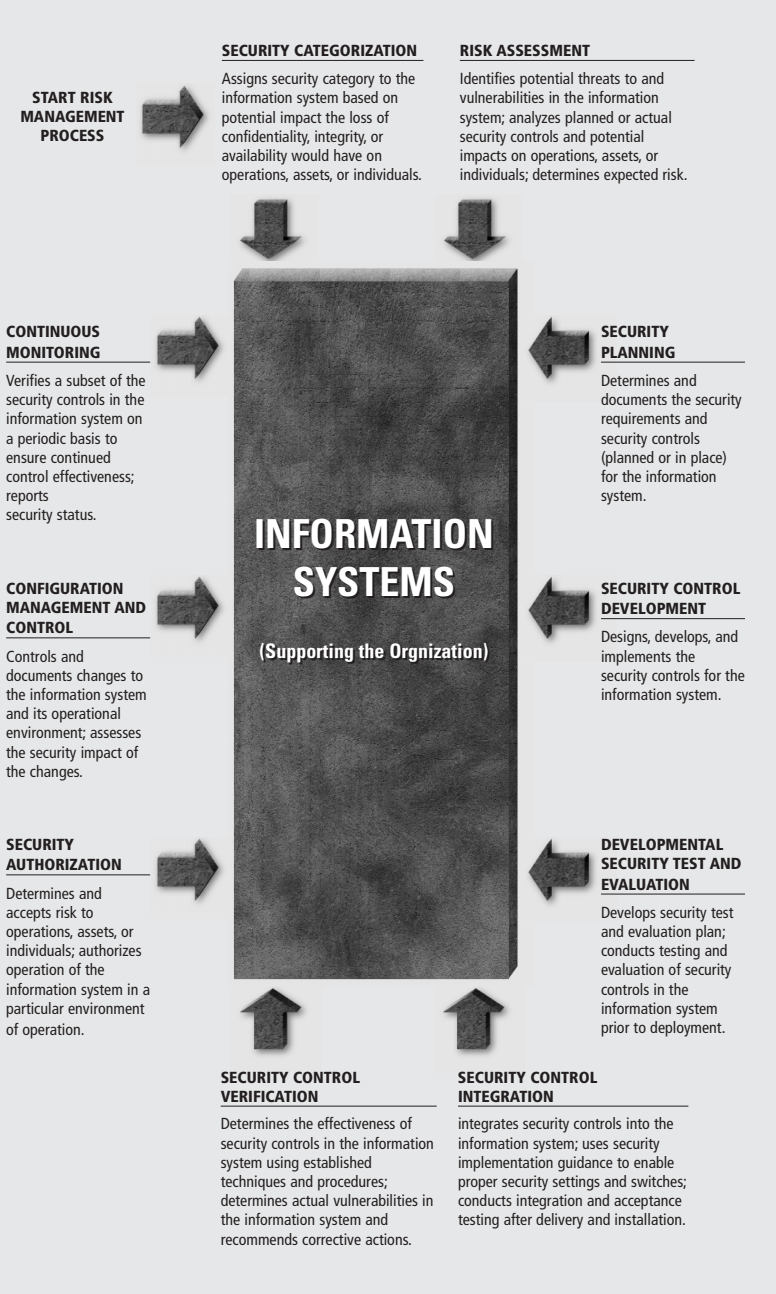
情報セキュリティプログラムの活動を表す図です。中央に「INFORMATION SYSTEMS (Supporting the Organization)」(情報システム(組織を支える))と書かれた縦長のブロックがあり、その周囲の活動からブロックへ矢印が向いています。「START RISK MANAGEMENT PROCESS」(リスク管理プロセスの開始)から最初の活動へ矢印が出ています。活動は次のとおりです。「SECURITY CATEGORIZATION」(セキュリティ分類:機密性・完全性・可用性の喪失が業務・資産・個人に与えうる影響に基づき、情報システムにセキュリティ区分を割り当てる)、「RISK ASSESSMENT」(リスクアセスメント:情報システムの潜在的な脅威と脆弱性を特定し、計画中または実施中のセキュリティ管理策と業務・資産・個人への潜在的な影響を分析し、予想されるリスクを判断する)、「SECURITY PLANNING」(セキュリティ計画:情報システムのセキュリティ要件とセキュリティ管理策(計画中または実施中)を決定し文書化する)、「SECURITY CONTROL DEVELOPMENT」(セキュリティ管理策の開発:情報システムのセキュリティ管理策を設計・開発・実装する)、「DEVELOPMENTAL SECURITY TEST AND EVALUATION」(開発時のセキュリティ試験・評価:試験・評価計画を作成し、配備前に情報システムのセキュリティ管理策を試験・評価する)、「SECURITY CONTROL INTEGRATION」(セキュリティ管理策の統合:セキュリティ管理策を情報システムに統合し、セキュリティ実装ガイダンスを用いて適切なセキュリティ設定やスイッチの実現を可能にし、納入・設置後に統合試験と受入試験を行う)、「SECURITY CONTROL VERIFICATION」(セキュリティ管理策の検証:確立した手法と手順で情報システム内のセキュリティ管理策の有効性を判断し、情報システム内の実際の脆弱性を特定して是正措置を勧告する)、「SECURITY AUTHORIZATION」(セキュリティ認可:業務・資産・個人へのリスクを判断して受け入れ、特定の運用環境での情報システムの運用を認可する)、「CONFIGURATION MANAGEMENT AND CONTROL」(構成管理と制御:情報システムとその運用環境への変更を管理・文書化し、変更によるセキュリティへの影響を評価する)、「CONTINUOUS MONITORING」(継続的監視:情報システム内のセキュリティ管理策の一部を定期的に検証して有効性が続いていることを確かめ、セキュリティの状況を報告する)。
Federal agencies will be required to use FIPS Publication 199 standards to define security categories for their information systems. The recommendations for baseline (minimum) security controls from Special Publication 800-53 can subsequently be used as a starting point for and input to the organization’s risk assessment processes and the development of security plans for those information systems. While the FIPS Publication 199 security categorization associates the operation of the information system with a “worst-case” impact on an organization’s operations and assets (providing an upper bound on risk), the incorporation of refined threat and vulnerability information during the risk assessment process facilitates the tailoring of the baseline security controls to address organizational needs and tolerance for risk. Deviations from the recommended baseline security controls should be documented (along with supporting rationale) in the security plan for the information system. The use of security controls from Special Publication 800-53 and the incorporation of baseline (minimum) controls as a starting point in the control selection process facilitate a more consistent level of security in an organizational information system. At the same time it offers the needed flexibility to fine tune and adjust the controls based on specific organizational policy and requirements documents, particular conditions and circumstances, known threat and vulnerability information, or tolerance for risk to the organization’s operations and assets.
連邦機関は、情報システムのセキュリティ分類を定義するために、FIPS Publication 199 の標準を使用することが求められます。その後、特別刊行物 800-53 のベースライン(最低限)のセキュリティ管理策の推奨事項は、それらの情報システムのリスク評価プロセスとセキュリティ計画の策定の出発点およびインプットとして使えます。FIPS Publication 199 のセキュリティ分類は、情報システムの運用を、組織の業務と資産への「最悪の場合」の影響(リスクの上限を示すもの)に関連づけますが、リスク評価プロセスで洗練された脅威と脆弱性の情報を取り入れることで、組織のニーズとリスク許容度に対応するようベースラインのセキュリティ管理策をテーラリングしやすくなります。推奨されるベースラインのセキュリティ管理策からの逸脱は、(裏づけとなる根拠とともに)情報システムのセキュリティ計画に文書化すべきです。特別刊行物 800-53 のセキュリティ管理策を使い、管理策の選択プロセスの出発点としてベースライン(最低限)の管理策を取り入れることで、組織の情報システムのセキュリティの水準がより一貫したものになります。同時に、特定の組織の方針や要件文書、特定の条件や状況、既知の脅威と脆弱性の情報、組織の業務と資産へのリスク許容度に基づいて、管理策を微調整し調整する、必要な柔軟性も得られます。
Draft versions of Special Publication 800-53 will be published in 2004.
特別刊行物 800-53 のドラフト版は、2004年に発行されます。
http://csrc.nist.gov/sec-cert/ca-controls.html
Contacts: Dr. Ron Ross
(301) 975-5390
rross@nist.gov
Mr. Gary Stoneburner
(301) 975-5394
gary.stoneburner@nist.gov
http://csrc.nist.gov/sec-cert/ca-controls.html
連絡先: Dr. Ron Ross
(301) 975-5390
rross@nist.gov
Mr. Gary Stoneburner
(301) 975-5394
gary.stoneburner@nist.gov
PRACTICES, CHECKLISTS, & IMPLEMENTATION GUIDES
実践、チェックリスト、実装ガイド
Today's federal networks and systems are highly interconnected and interdependent with non-federal systems. Protection of the Nation's critical infrastructure is dependent upon effective information security solutions and practices that minimize vulnerabilities associated with a variety of threats. The broader sharing of such practices will enhance the overall security of the nation. Information security practices from the public and private sector can be applied to enhance the overall performance of Federal information security programs. The Computer Security Division (CSD) is helping to facilitate a sharing of these practices and implementation guidelines in multiple ways.
今日の連邦のネットワークとシステムは、連邦以外のシステムと高度に相互接続され、相互依存しています。国の重要インフラの保護は、さまざまな脅威に関連する脆弱性を最小限に抑える、有効な情報セキュリティのソリューションと実践にかかっています。こうした実践をより広く共有することは、国全体のセキュリティを高めます。公的部門と民間部門の情報セキュリティの実践は、連邦の情報セキュリティプログラム全体のパフォーマンスを高めるために応用できます。コンピュータセキュリティ部門(CSD)は、これらの実践と実装ガイドラインの共有を、複数の方法で促進しています。
The Federal Agency Security Practices (FASP) effort was initiated as a result of the success of the Federal Chief Information Officers (CIO) Council’s Federal Best Security Practices (BSP) pilot effort to identify, evaluate, and disseminate best practices for critical infrastructure protection (CIP) and security. CSD was asked to undertake the transition of this pilot effort to an operational program. As a result, NIST developed the FASP Web site. The FASP site contains agency policies, procedures and practices; the CIO pilot BSPs; and, a Frequently-Asked-Questions (FAQ) section. The FASP site differs from the BSP pilot in material provided and in complexity.
Federal Agency Security Practices(FASP)の取り組みは、重要インフラ防護(CIP)とセキュリティのベストプラクティスを特定、評価、周知する、連邦最高情報責任者(CIO)評議会の Federal Best Security Practices(BSP)パイロットの取り組みが成功したことを受けて始まりました。CSD は、このパイロットの取り組みを運用プログラムへ移行する役割を求められました。その結果、NIST は FASP ウェブサイトを開発しました。FASP サイトには、機関の方針、手順、実践、CIO のパイロット BSP、よくある質問(FAQ)の節が含まれています。FASP サイトは、提供する資料と複雑さの点で BSP パイロットとは異なります。
The FASP area contains a list of categories found in many of the NIST Special Publications. Based on these categories, agencies are encouraged to submit their information technology (IT) security information and IT security practices for posting on the FASP site so they may be shared with others. Any information on, or samples of, position descriptions for security positions and statements of work for contracting security-related activities are also encouraged. In the past year, 38 practices and examples have been added to the collection bring the total to 115.
FASP の領域には、NIST 特別刊行物の多くに見られるカテゴリの一覧があります。これらのカテゴリに基づき、機関は、他の機関と共有できるよう、情報技術(IT)セキュリティ情報と IT セキュリティの実践を、FASP サイトへの掲載用に提出することが奨励されます。セキュリティ職の職務記述書や、セキュリティ関連の活動を請け負わせる際の作業範囲記述書に関する情報や見本も奨励されます。過去 1 年間に、38 件の実践と例がコレクションに追加され、合計は 115 件になりました。
One of the newer features added to the FASP Web site are IT product specific checklists for settings and configurations. These checklists are discussed more fully earlier in this report. These checklists are recommendations, not mandatory requirements, and are offered freely to IT professionals. These checklists are not to be seen as an endorsement by NIST for any products, but as potential aids in securing certain products.
FASP ウェブサイトに加えられた比較的新しい機能の一つが、設定と構成に関する IT 製品固有のチェックリストです。これらのチェックリストは、この報告書の前のほうで詳しく論じています。これらのチェックリストは、必須要件ではなく推奨事項であり、IT の専門家に無償で提供されています。これらのチェックリストは、いずれかの製品に対する NIST の是認を示すものではなく、特定の製品を保護するための潜在的な助けとなるものです。
Also in the past year, the CSD has invited public and private organization to submit their information security practices for consideration to be included in the list of practices maintained on the Division’s web site, the Computer Security Resource Center (CSRC). Nominated candidate policies and procedures may be submitted to NIST in any area of information security including, but not limited to: accreditation, audit trails, authorization of processing, budget planning and justification, certification, contingency planning, data integrity, disaster planning, documentation, hardware and system maintenance, identification and authentication, incident handling and response, life cycle, network security, personnel security, physical and environmental protection, production input/output controls, security policy, program management, review of security controls, risk management, security awareness training, and education (to include specific course and awareness materials), and security planning. Current participants include Computer Associates, the Internet Security Task Force, Microsoft, the SANS Institute, and the Carnegie Mellon University CERT Coordination Center.
また、昨年、CSD は、部門のウェブサイトである Computer Security Resource Center(CSRC)で維持している実践の一覧への掲載を検討してもらうため、公的・民間の組織に情報セキュリティの実践の提出を呼びかけました。推薦された方針と手順は、認定、監査証跡、処理の認可、予算計画と正当化、認証、緊急時対応計画、データの完全性、災害計画、文書化、ハードウェアとシステムの保守、識別と認証、インシデントの取り扱いと対応、ライフサイクル、ネットワークセキュリティ、要員セキュリティ、物理的・環境的保護、本番の入出力管理、セキュリティポリシー、プログラム管理、セキュリティ管理策のレビュー、リスクマネジメント、セキュリティ意識向上のトレーニングと教育(具体的なコースと啓発資料を含む)、セキュリティ計画を含むがこれらに限られない、情報セキュリティのあらゆる分野で NIST に提出できます。現在の参加者には、Computer Associates、Internet Security Task Force、Microsoft、SANS Institute、カーネギーメロン大学 CERT Coordination Center があります。
The coming year will see an effort to greatly expand each of the parts of this project. We are currently identifying robust sources for each of these elements, and plan to expand the number of resources available to Federal Agencies.
来年は、このプロジェクトの各部分を大幅に拡大する取り組みが行われます。現在、これらの各要素について確かな情報源を探しており、連邦機関が利用できる資源の数を増やす計画です。
http://csrc.nist.gov/pcig/
Contact: Ms. Marianne Swanson
(301) 975-3293
marianne.swanson@nist.gov
http://csrc.nist.gov/pcig/
連絡先: Ms. Marianne Swanson
(301) 975-3293
marianne.swanson@nist.gov
COMPUTER SECURITY EXPERT ASSIST TEAM
COMPUTER SECURITY EXPERT ASSIST TEAM
The Computer Security Division’s Computer Security Expert Assist Team (CSEAT) was established to improve federal critical infrastructure protection planning and implementation efforts by assisting governmental entities in improving the security of their IT assets. The CSEAT provides an independent review of the maturity of an agency's IT security program. CSEAT accomplishes this by performing a review of an agency’s computer security program. The review is based upon a combination of proven techniques and best practices and results in an action plan that provides a federal agency with a roadmap to cost-effectively enhance the protection of the information systems assets. The CSEAT has three primary purposes: to assist agencies in improving the security of federal IT systems; to help reduce disruption of critical federal systems/services; and to improve federal agency CIP planning and implementation efforts. The CSEAT helps Federal agencies understand how to protect information systems, identify and fix existing vulnerabilities, and prepare for future security threats. The CSEAT also facilitates exchange of best security practices among government agencies and between the government and private sector.
コンピュータセキュリティ部門の Computer Security Expert Assist Team(CSEAT)は、政府主体が IT 資産のセキュリティを向上させるのを支援することで、連邦の重要インフラ防護の計画と実施の取り組みを改善するために設けられました。CSEAT は、機関の IT セキュリティプログラムの成熟度について、独立したレビューを提供します。CSEAT は、機関のコンピュータセキュリティプログラムのレビューを行うことでこれを達成します。このレビューは、実績のある技法とベストプラクティスの組み合わせに基づき、その結果として、連邦機関が情報システム資産の保護を費用対効果の高い形で強化するための道筋を示す行動計画が得られます。CSEAT には 3 つの主な目的があります。機関が連邦 IT システムのセキュリティを向上させるのを支援すること、連邦の重要なシステムやサービスの混乱を減らすのに役立てること、連邦機関の CIP の計画と実施の取り組みを改善することです。CSEAT は、連邦機関が、情報システムを保護する方法を理解し、既存の脆弱性を特定して修正し、将来のセキュリティ上の脅威に備えるのを助けます。CSEAT はまた、政府機関の間、および政府と民間部門の間での、セキュリティのベストプラクティスの交換も促進します。
The CSEAT review, which is not an audit or an inspection, begins with an assessment of the maturity of the agency's IT security program. This includes the agency's IT security policies, procedures, and security controls implementation and integration across all business areas. CSEAT performs a comparable review of the agency's organizational structure, culture, and business mission. After the assessment is performed, the CSEAT documents issues identified during the assessment phase and provides corrective actions associated with each issue. These corrective actions are then provided as a prioritized action plan for the agency to use to improve their computer security program. The resulting action plan is weighted to provide the agency the greatest improvements most cost effectively. The corrective actions CSEAT identifies include the time frame for implementation and the projected resource impact. The action plan can readily be used to develop scopes of work for quick "bootstrapping" of the cyber security program.
CSEAT のレビューは、監査や検査ではなく、機関の IT セキュリティプログラムの成熟度の評価から始まります。これには、機関の IT セキュリティの方針、手順、そしてすべての業務領域にわたるセキュリティ管理策の実装と統合が含まれます。CSEAT は、機関の組織構造、文化、業務上の使命についても、同等のレビューを行います。評価が行われた後、CSEAT は、評価段階で特定された課題を文書化し、各課題に関連する是正措置を示します。その後、これらの是正措置は、機関がコンピュータセキュリティプログラムを改善するために使う、優先順位付けされた行動計画として提供されます。得られた行動計画は、機関に最大の改善を最も費用対効果の高い形でもたらすよう重みづけされています。CSEAT が特定する是正措置には、実施の時間枠と、見込まれる資源への影響が含まれます。行動計画は、サイバーセキュリティプログラムの迅速な「ブートストラップ」のための作業範囲記述書の作成に、すぐに使えます。
A CSEAT review focuses on nine primary review areas, each of which were derived from a combination of NIST 800-26 Self-Assessment Guide for Information Technology Systems as supplemented by other criteria from requirements and guidance such as NIST Special Publication 800-18 Guide for Developing Security Plans for Information Technology Systems and Office of Management and Budget (OMB) guidance on the development of the Federal Information Security Management Act (FISMA) annual summary.
CSEAT のレビューは、9 つの主なレビュー領域に重点を置いています。それぞれは、NIST 800-26 Self-Assessment Guide for Information Technology Systems に、NIST 特別刊行物 800-18 Guide for Developing Security Plans for Information Technology Systems や、連邦情報セキュリティマネジメント法(FISMA)の年次要約の作成に関する行政管理予算局(OMB)のガイダンスなどの要件とガイダンスの他の基準を補った組み合わせから導かれています。
In 2003, several CSEAT reviews were completed, the supporting CSEAT database redesigned to provide more comprehensive analytical and reporting functions and the option model for the customer was adjusted to be more streamlined. Work was also initiated to do the necessary analysis to modify the criteria based on the recent release of Special Publication 800-53.
2003年には、いくつかの CSEAT レビューが完了し、より包括的な分析・報告機能を提供するよう、CSEAT を支えるデータベースが再設計され、顧客向けのオプションモデルがより合理化されたものに調整されました。特別刊行物 800-53 が最近公開されたことを受けて、基準を修正するために必要な分析を行う作業も開始されました。
http://cseat.nist.gov
Contacts: Ms. Joan Hash
(301) 975-3357
joan.hash@nist.gov
Ms. Pauline Bowen
(301) 975-2938
pauline.bowen@nist.gov
http://cseat.nist.gov
連絡先: Ms. Joan Hash
(301) 975-3357
joan.hash@nist.gov
Ms. Pauline Bowen
(301) 975-2938
pauline.bowen@nist.gov
AUTOMATED SECURITY SELF-EVALUATION TOOL – ASSET
自動化されたセキュリティ自己評価ツール – ASSET
An important element of measuring the status of IT security within an organization is to perform routine self-assessments of an organization’s IT systems. There are many methods and tools available to help agency officials determine the current status of their security programs relative to existing policy. Ideally many of these methods and tools would be implemented on an ongoing basis to systematically identify programmatic weaknesses and, where necessary, establish targets for continuing improvement. In testimony given on November 19, 2002, before the House Committee on Government Reform, the Associate Director for Information Technology and Electronic Government, Office of Management and Budget described eight achievements that have been made toward improving the Federal government's IT security. One of the achievements was the development of the NIST Automated Security Self-Evaluation Tool (ASSET), which automates the process of completing a system self-assessment. ASSET will assist organizations in completing the self-assessment questionnaire contained in NIST Special Publication 800-26 Security Self-Assessment Guide for Information Technology Systems. ASSET is provided to federal agencies as a cost-free tool.
組織内の IT セキュリティの状況を測定するうえで重要な要素は、組織の IT システムに対して定期的な自己評価を行うことです。機関の職員が、既存の方針に照らして自らのセキュリティプログラムの現状を判断するのに役立つ方法とツールは数多くあります。理想的には、これらの方法とツールの多くを継続的に実施して、プログラム上の弱点を体系的に特定し、必要に応じて継続的な改善の目標を定めます。2002年11月19日に下院の Committee on Government Reform で行われた証言で、行政管理予算局の情報技術・電子政府担当次席長官は、連邦政府の IT セキュリティの改善に向けて達成された 8 つの成果を述べました。その成果の一つが、システムの自己評価を完了するプロセスを自動化する NIST Automated Security Self-Evaluation Tool(ASSET)の開発でした。ASSET は、組織が NIST 特別刊行物 800-26 Security Self-Assessment Guide for Information Technology Systems に含まれる自己評価質問票に記入するのを支援します。ASSET は、連邦機関に無償のツールとして提供されています。
ASSET was first developed and released in 2002. The past year has seen several developments, including a FISMA reporting template and an updated ASSET v1.4 being released in early October 2003. The CSD held several training sessions during 2003, and will continue to hold training sessions in 2004. More updates are under development that will result in a new 2.0 version being released in early 2004.
ASSET は2002年に初めて開発され、公開されました。昨年は、FISMA の報告テンプレートや、2003年10月初めに公開された更新版 ASSET v1.4 など、いくつかの進展がありました。CSD は2003年中にいくつかのトレーニングセッションを開催し、2004年も引き続き開催します。さらなる更新が策定中で、2004年初めに新しいバージョン 2.0 が公開される見込みです。
http://csrc.nist.gov/asset/
Contact: Ms. Marianne Swanson
(301) 975-3293
marianne.swanson@nist.gov
http://csrc.nist.gov/asset/
連絡先: Ms. Marianne Swanson
(301) 975-3293
marianne.swanson@nist.gov
Security Testing and Metrics
セキュリティ試験・メトリクス
GOAL To make systems and networks more secure.
目標 システムとネットワークをより安全にすること。
STRATEGY The strategy to meet this goal is to provide federal agencies, industry, and the public with a proven set of IT security services based upon sound testing methodologies and test metrics.
戦略 この目標を達成するための戦略は、連邦機関、産業界、一般の人々に、健全な試験方法論と試験メトリクスに基づく、実績のある IT セキュリティサービス一式を提供することです。
INTENDED OUTCOME AND BACKGROUND:
意図する成果と背景
The intended outcome for this area is to establish more secure systems and networks by developing, managing and promoting security assessment tools, techniques, services, and supporting programs for testing, evaluation and validation; to establish security-specific criteria for laboratory accreditation; to produce guidance on the use of evaluated and tested products; to conduct research to address assurance methods and system-wide security and assessment methodologies; to conduct security protocol validation activities; and to establish appropriate coordination with assessment-related activities of voluntary industry standards bodies and other assessment regimes. Our testing-focused activities include the validation of cryptographic modules and cryptographic algorithm implementations, Common Criteria (CC) evaluation and validation programs, international recognition arrangements, testing laboratory accreditation, automated security testing, and test suite development, industry forums, and education, training, and outreach programs.
この分野で意図する成果は、次のとおりです。試験、評価、検証のためのセキュリティ評価ツール、技法、サービス、支援プログラムを開発、管理、促進することで、より安全なシステムとネットワークを確立すること。試験所認定のためのセキュリティ固有の基準を確立すること。評価・試験済みの製品の使用に関するガイダンスを作成すること。保証の方法とシステム全体のセキュリティおよび評価の方法論に対処する研究を行うこと。セキュリティプロトコルの検証活動を行うこと。自主的な産業標準化団体やその他の評価制度の評価関連活動との適切な調整を確立すること。当部門の試験に重点を置く活動には、暗号モジュールと暗号アルゴリズム実装の検証、コモンクライテリア(CC)の評価・認証プログラム、国際相互承認の取り決め、試験所の認定、自動化されたセキュリティ試験とテストスイートの開発、産業界のフォーラム、教育、トレーニング、アウトリーチプログラムがあります。
Activities in this area have historically, and continue to, involve large amounts of collaboration and the facilitation of relationships with other entities. The Federal agencies that have collaborated recently with these activities are the Department of State, the Department of Commerce, the Department of Defense, the General Services Administration, the National Aeronautics and Space Administration, the National Security Agency, the Department of Energy, the Office of Management and Budget, the Social Security Administration, the United States Postal Service, the Department of the Treasury, the Department of Veterans Affairs, the Department of Transportation, the Department of Justice, the Federal Aviation Administration, and the National Voluntary Laboratory Accreditation Program. The list of industry entities that have worked with the Division in this area is long, and includes the American National Standards Institute (ANSI), Oracle, CISCO, Hewlett-Packard, Lucent Technologies, Microsoft, IBM, VISA, Mastercard, Amex, Computer Associates, RSA Security Inc., Sun Microsystems, Network Associates, Entrust, and Silicon Graphics. The Division also has collaborated at the global level with Canada, the United Kingdom, France, Germany, and Korea in this area.
この分野の活動は、従来から多くの協働と他の主体との関係づくりを伴っており、今後もそれが続きます。最近これらの活動に協力した連邦機関は、国務省、商務省、国防総省、一般調達局、航空宇宙局、国家安全保障局、エネルギー省、行政管理予算局、社会保障局、米国郵政公社、財務省、退役軍人省、運輸省、司法省、連邦航空局、National Voluntary Laboratory Accreditation Program です。この分野で当部門と協働した産業界の主体の一覧は長く、American National Standards Institute(ANSI)、Oracle、CISCO、Hewlett-Packard、Lucent Technologies、Microsoft、IBM、VISA、Mastercard、Amex、Computer Associates、RSA Security Inc.、Sun Microsystems、Network Associates、Entrust、Silicon Graphics が含まれます。当部門はこの分野で、カナダ、英国、フランス、ドイツ、韓国とも世界規模で協働しています。
ACCOMPLISHMENTS
成果
LABORATORY ACCREDITATION
試験所の認定
The goals of this project are to accredit fully qualified Common Criteria Testing laboratories and Cryptographic Module Testing laboratories, and to promote the technical competence of accredited and applicant laboratories. Vendors use independent, National Voluntary Accreditation Laboratory Accreditation Program (NVLAP) accredited testing laboratories. This project develops new methods of proficiency testing for accreditation and re-accreditation of these laboratories, as well as continuous training opportunities for laboratories. This leads to consistent evaluation and validations for use by Federal agencies and the private sector, and to highly qualified accredited labs.
このプロジェクトの目標は、十分な資格を持つコモンクライテリア試験所と暗号モジュール試験所を認定し、認定済みの試験所と申請中の試験所の技術的能力を高めることです。ベンダーは、National Voluntary Accreditation Laboratory Accreditation Program(NVLAP)が認定した独立した試験所を利用します。このプロジェクトは、これらの試験所の認定と再認定のための習熟度試験の新しい方法と、試験所向けの継続的なトレーニングの機会を開発します。これにより、連邦機関と民間部門が使用する評価と検証に一貫性が生まれ、認定された試験所の能力も高くなります。
In 2003, one Common Criteria testing lab and five Cryptographic Module testing labs were re-accredited. One laboratory was accredited for Cryptographic Module Testing, and two new accreditations were issued for Common Criteria Testing. Revisions were made to the NIST Handbook 150-17 NVLAP Cryptographic Module Testing. A testing artifact was also developed for Federal Information Processing Standard (FIPS) 140-2 Level 3 hardware testing.
2003年には、コモンクライテリア試験所 1 つと暗号モジュール試験所 5 つが再認定されました。1 つの試験所が暗号モジュール試験の認定を受け、コモンクライテリア試験について 2 件の新規認定が発行されました。NIST Handbook 150-17 NVLAP Cryptographic Module Testing に改訂が加えられました。連邦情報処理標準(FIPS)140-2 レベル 3 のハードウェア試験のための試験成果物も開発されました。
Currently there are seven labs accredited to perform Cryptographic Module testing: four in the United States, two in Canada, and one in the United Kingdom. Six labs are to be re-accredited in 2004, and four new labs will be accredited: two in the U.S., two internationally. Five Common Criteria testing labs are due to be re-accredited in 2004, and three new labs are in the process to be accredited.
現在、暗号モジュールの試験を実施する認定を受けた試験所は 7 つあり、米国に 4 つ、カナダに 2 つ、英国に 1 つあります。6 つの試験所が2004年に再認定される予定で、4 つの新しい試験所が認定される予定です(米国に 2 つ、国外に 2 つ)。5 つのコモンクライテリア試験所が2004年に再認定される予定で、3 つの新しい試験所が認定の手続き中です。
http://ts.nist.gov/ts/htdocs/210/214/214.htm
Contacts: Mr. Jeffrey Horlick
Standards Services Division
(301) 975-4020
jeffrey.horlick@nist.gov
Ms. Pat Toth
(301) 975-5140
patricia.toth@nist.gov
http://ts.nist.gov/ts/htdocs/210/214/214.htm
連絡先: Mr. Jeffrey Horlick
Standards Services Division
(301) 975-4020
jeffrey.horlick@nist.gov
Ms. Pat Toth
(301) 975-5140
patricia.toth@nist.gov
CRYPTOGRAPHIC MODULE VALIDATION PROGRAM (CMVP)
暗号モジュール検証プログラム(CMVP)
The goals of this project are to improve the security and technical quality of cryptographic products, to provide U.S., Canadian, and U.K. Federal agencies with a security metric to use in procuring cryptographic equipment, and to promote the use of tested and validated cryptographic algorithms, modules, and products. This program is a collaborative one that involves the Computer Security Division and the Communication Security Establishment (CSE) of the Canadian Government. All of the tests under the CMVP are handled by third-party laboratories that are accredited as Cryptographic Module Testing (CMT) laboratories by the National Voluntary Laboratory Accreditation Program (NVLAP).
このプロジェクトの目標は、暗号製品のセキュリティと技術的品質を向上させ、米国、カナダ、英国の連邦機関に、暗号機器を調達する際に使えるセキュリティのメトリクスを提供し、試験・検証済みの暗号アルゴリズム、モジュール、製品の使用を促進することです。このプログラムは、コンピュータセキュリティ部門とカナダ政府の通信保安局(CSE)が関わる協働プログラムです。CMVP の下でのすべての試験は、National Voluntary Laboratory Accreditation Program(NVLAP)により暗号モジュール試験(CMT)所として認定された第三者の試験所が扱います。
Federal agencies, industry, and the public now rely on cryptography for the protection of information and communications used in electronic commerce, critical infrastructure and other application areas. At the core of all products offering cryptographic services is the cryptographic module. Cryptographic modules are used in products and systems to provide security services such as confidentiality, integrity, and authentication. Though cryptography is used to provide security, weaknesses such as poor design or weak algorithms can render the product insecure and place highly sensitive information at risk. Adequate testing and validation of the cryptographic module and cryptographic algorithms against established standards is essential to provide security assurance.
連邦機関、産業界、一般の人々は現在、電子商取引、重要インフラ、その他の応用分野で使われる情報と通信の保護を、暗号技術に頼っています。暗号サービスを提供するすべての製品の中核は、暗号モジュールです。暗号モジュールは、機密性、完全性、認証といったセキュリティサービスを提供するために、製品やシステムで使われています。暗号技術はセキュリティを提供するために使われますが、設計の不備や弱いアルゴリズムといった弱点があると、製品が安全でなくなり、非常に機微な情報が危険にさらされかねません。暗号モジュールと暗号アルゴリズムを、確立された標準に照らして十分に試験し検証することは、セキュリティの保証を提供するうえで不可欠です。
Under this program, vendors of cryptographic modules use independent private sector, accredited testing laboratories to have their modules tested. This program provides Federal agencies – U.S., Canada, and U.K. – with confidence that a validated cryptographic product meets a claimed level of security. The program validates a wide variety of modules including secure Internet browsers, secure radios, tokens, and products supporting Public Key Infrastructure and electronic commerce. To give a sense of the quality improvement that the program achieves, consider that our statistics from the testing laboratories show that 48 percent of the modules brought in for voluntary testing had security flaws that were corrected during testing. In other words, without this program, the Federal government would have had only a 50/50 chance of buying correctly implemented cryptography.
このプログラムのもとで、暗号モジュールのベンダーは、独立した民間部門の認定試験所を利用して、モジュールを試験してもらいます。このプログラムは、検証済みの暗号製品が主張されたセキュリティ水準を満たしているという確信を、連邦機関(米国、カナダ、英国)に与えます。このプログラムは、安全なインターネットブラウザ、安全な無線機、トークン、公開鍵基盤や電子商取引を支える製品など、幅広いモジュールを検証します。このプログラムが達成している品質向上の程度を知る目安として、試験所の統計によれば、任意の試験に持ち込まれたモジュールの 48 パーセントに、試験中に修正されたセキュリティ上の欠陥があったことを考えてみてください。言い換えれば、このプログラムがなければ、連邦政府が正しく実装された暗号を購入できる可能性は五分五分にすぎなかったことになります。
To date, over 350 certificates have been issued for validated products by the CMVP, representing over 100 vendors. Over 90 of these certificates were issued during 2003. The Division initiated work this past year in the International Organization for Standardization for the international adoption of Federal Information Processing Standard (FIPS) 140-2, Security Requirements for Cryptographic Modules. The Cryptographic Algorithm Validation System (CAVS) was designed and developed. This new system is used by the CMVP testing laboratories to test and validate all cryptographic algorithm implementations contained in FIPS 140-2 validated modules. Previously the laboratories had to run each algorithm test individually, but now may run CAVS as an umbrella system. This year also saw the development of the Advanced Encryption Standard (AES) test suite and the enhancement of the Digital Encryption Standard/Triple Digital Encryption Standard (DES/TDES) validation tests to include multi-block testing.
これまでに、CMVP により、100 を超えるベンダーの検証済み製品について 350 を超える証明書が発行されました。そのうち 90 件を超える証明書は2003年中に発行されました。当部門は昨年、連邦情報処理標準(FIPS)140-2、Security Requirements for Cryptographic Modules の国際的な採用に向けて、国際標準化機構での作業を開始しました。Cryptographic Algorithm Validation System(CAVS)が設計され、開発されました。この新しいシステムは、CMVP の試験所が、FIPS 140-2 検証済みモジュールに含まれるすべての暗号アルゴリズム実装を試験し検証するために使います。以前は、試験所は各アルゴリズムの試験を個別に実行しなければなりませんでしたが、現在は CAVS を包括的なシステムとして実行できます。今年はまた、Advanced Encryption Standard(AES)のテストスイートが開発され、Data Encryption Standard/Triple Data Encryption Standard(DES/TDES)の検証試験が、複数ブロックの試験を含むよう強化されました。
One goal for the next year is to have FIPS 140-2 established as an International Organization of Standardization (ISO) standard – ISO 19790. The Third Cryptographic Module Validation Program Workshop & Conference is being planned for 2004.The development of Key Establishment and Key Transport validation test suites, as well as Validation Test Suites for new algorithms/protocols, is slated for this coming year. Research will also continue to be conducted into new areas, particularly wireless, JAVA, and FIPS 140-2 Level 5.
来年の目標の一つは、FIPS 140-2 を国際標準化機構(ISO)標準 ISO 19790 として確立することです。第 3 回 Cryptographic Module Validation Program Workshop & Conference が2004年に計画されています。鍵確立と鍵輸送の検証用テストスイート、および新しいアルゴリズムやプロトコルの検証用テストスイートの開発が、来年に予定されています。新しい分野、特に無線、JAVA、FIPS 140-2 レベル 5 についての研究も続けられます。
http://csrc.nist.gov/cryptval/
Contact: Randall Easter
(301) 975-4641
randall.easter@nist.gov
http://csrc.nist.gov/cryptval/
連絡先: Randall Easter
(301) 975-4641
randall.easter@nist.gov
Security Research and Emerging Technologies
セキュリティ研究と新興技術
GOAL To support and conduct research in order to enhance information technology security.
目標 情報技術セキュリティを高めるための研究を支援し、実施すること。
STRATEGY The strategy to meet this goal is to focus on the research necessary to understand and enhance the security utility of new technologies while also working to identify and mitigate vulnerabilities.
戦略 この目標を達成するための戦略は、新技術のセキュリティ上の有用性を理解し高めるために必要な研究に重点を置き、あわせて脆弱性の特定と緩和にも取り組むことです。
INTENDED OUTCOME AND BACKGROUND:
意図する成果と背景
The mission of our security research focus is to identify emerging technologies and conceive of new security solutions that will have a high impact on the critical information infrastructure; to perform research and development on behalf of government and industry from the earliest stages of technology development through proof-of-concept, reference, and prototype implementations and demonstrations; and to transfer new technologies to industry, produce new standards, develop tests, test methodologies, and assurance methods.
当部門のセキュリティ研究の重点の使命は、新興技術を特定し、重要な情報インフラに大きな影響を与える新しいセキュリティソリューションを考案すること、政府と産業界のために、技術開発の最も初期の段階から、概念実証、参照実装、プロトタイプ実装、デモンストレーションに至るまで、研究開発を行うこと、新しい技術を産業界に移転し、新しい標準を作成し、試験、試験方法論、保証の方法を開発することです。
Most people in the U.S. today are aware of the speed with which technology, particularly computer-related technology, has been progressing and changing over the last decade. What was once considered “fast,” “powerful,” and “flexible” in computers is now antiquated in many cases. Every day new developments, new products, new advances in technology and science, and new vulnerabilities change the face of IT security. The time between a vulnerability in software being announced to the public and an exploitation of that vulnerability is measurable in days and hours.
今日の米国のほとんどの人々は、過去 10 年間に技術、とりわけコンピュータ関連技術が進歩し、変化してきた速さを認識しています。かつてコンピュータで「高速」「高性能」「柔軟」と考えられていたものは、今では多くの場合、時代遅れです。毎日、新しい開発、新製品、技術と科学の新たな進歩、新たな脆弱性が、IT セキュリティの様相を変えています。ソフトウェアの脆弱性が公表されてから、その脆弱性が悪用されるまでの時間は、日数や時間単位で測定できます。
To keep pace with the rate of change in information technology (IT) technologies we conduct a large of amount of research into existing and emerging technologies. We develop prototypes, reference implementations, and demonstrations. Some of the many topics we research include smart card infrastructure and security, wireless and mobile device security, access control and authorization management, Internet Protocol security, intrusion detection systems, quantum information system security and quantum cryptography, and vulnerability analyses. Our research helps fulfill specific needs by the Federal Government. We collaborate extensively with government, academia, and private sector entities. These have recently included: International Business Machines (IBM) Corporation, Microsoft Corporation, Sun Microsystems, the Boeing Company, Intel Corporation, Lucent Technologies, Oracle Corporation, MITRE, the SANS Institute, the University of Maryland, Ohio State University, the University of Tulsa, George Mason University, Rutgers University, Purdue University, George Washington University, the University of West Florida, University of California – San Diego, University of Maryland – Baltimore County, the National Security Agency, the Department of Defense, the U.S. Navy Research Laboratory, the Defense Advanced Research Projects Agency, the Department of Justice, and others.
情報技術(IT)の変化の速さに追随するため、既存の技術と新興技術について多くの研究を行っています。プロトタイプ、参照実装、デモンストレーションを開発しています。研究しているさまざまなトピックには、スマートカードのインフラとセキュリティ、無線およびモバイルデバイスのセキュリティ、アクセス制御と認可管理、Internet Protocol のセキュリティ、侵入検知システム、量子情報システムのセキュリティと量子暗号、脆弱性分析があります。当部門の研究は、連邦政府の特定のニーズを満たすのに役立っています。政府、学術界、民間部門の主体と幅広く協力しており、最近の協力先には、International Business Machines(IBM)Corporation、Microsoft Corporation、Sun Microsystems、the Boeing Company、Intel Corporation、Lucent Technologies、Oracle Corporation、MITRE、the SANS Institute、the University of Maryland、Ohio State University、the University of Tulsa、George Mason University、Rutgers University、Purdue University、George Washington University、the University of West Florida、University of California – San Diego、University of Maryland – Baltimore County、National Security Agency、the Department of Defense、the U.S. Navy Research Laboratory、the Defense Advanced Research Projects Agency、the Department of Justice などが含まれました。
ACCOMPLISHMENTS
成果
WINDOWS 2000 PROFESSIONAL SYSTEMS ADMINISTRATION GUIDANCE
Windows 2000 Professional システム管理ガイダンス
It is a complicated, arduous, and time-consuming task for even experienced system administrators to determine a reasonable set of security settings for a complex operating system. The Computer Security Division (CSD) sought to make this task simpler, easier, and more secure. In partnership with major segments of the security community, we helped develop, review and test the Windows 2000 Professional (Win2K Pro) consensus baseline settings. Implementation of these settings can make a substantial improvement in the security posture of Win2K Professional systems and hence markedly reduce vulnerability exposure.
経験豊富なシステム管理者でさえ、複雑なオペレーティングシステムに妥当なセキュリティ設定のセットを決めることは、複雑で骨の折れる、時間のかかるタスクです。コンピュータセキュリティ部門(CSD)は、このタスクをより単純で、容易で、安全なものにすることを目指しました。セキュリティコミュニティの主要な部分と提携して、Windows 2000 Professional(Win2K Pro)の合意に基づくベースライン設定の開発、レビュー、試験を支援しました。これらの設定を実装することで、Win2K Professional システムのセキュリティ態勢を大幅に改善でき、したがって脆弱性へのさらされ方を著しく減らせます。
The Systems Administration Guidance for Windows 2000 Professional (NIST Special Publication 800-43) is intended to assist the users and system administrators of Windows 2000 Professional systems in configuring their hosts by providing configuration templates and security checklists. The guide provides detailed information about the security features of Win2K Pro, security configuration guidelines for popular applications, and security configuration guidelines for the Win2K Pro operating system. The guide documents the methods that the system administrators can use to implement each security setting. The principal goal of the document is to recommend and explain tested secure settings for Win2K Pro workstations with the objective of simplifying the administrative burden of improving the security of Win2K Pro systems. This document was published in November 2002.
Systems Administration Guidance for Windows 2000 Professional(NIST 特別刊行物 800-43)は、設定テンプレートとセキュリティチェックリストを提供することで、Windows 2000 Professional システムの利用者とシステム管理者が、ホストを設定するのを支援することを意図しています。このガイドは、Win2K Pro のセキュリティ機能、一般的なアプリケーションのセキュリティ設定ガイドライン、Win2K Pro オペレーティングシステムのセキュリティ設定ガイドラインに関する詳細な情報を提供します。このガイドは、システム管理者が各セキュリティ設定を実装するために使える方法を文書化しています。この文書の主な目標は、Win2K Pro システムのセキュリティ向上に伴う管理負担を簡素化することを目的に、Win2K Pro ワークステーションについて、試験済みの安全な設定を推奨し説明することです。この文書は2002年11月に発行されました。
The special publication was developed by the CSD. We started with some excellent material developed by the National Security Agency (NSA) and the broader IT security community. Development of the NIST security templates was initially based in part on the NSA's Win2K Pro guidance. We examined the NSA settings and guidance, and built on the material they developed. The CSD conducted extensive analysis and testing of the NSA settings, substantially extended and refined the NSA template settings, and developed additional template settings. Detailed explanatory material for the template settings, Win2K Pro security configuration, and application specific security configuration guidance was then developed. Subsequently, CSD led the development of a consensus baseline of Win2K security settings in collaboration with the public and private sectors, specifically NSA, the Defense Information Systems Agency (DISA), the Center for Internet Security (CIS), and the SysAdmin Network Security Institute (SANS). Microsoft also provided valuable technical commentary and advice. The General Services Administration has also reviewed and concurred with the baseline.
この特別刊行物は CSD が作成しました。国家安全保障局(NSA)とより広い IT セキュリティコミュニティが作成した優れた資料から出発しました。NIST セキュリティテンプレートの開発は、当初、一部が NSA の Win2K Pro ガイダンスに基づいていました。NSA の設定とガイダンスを調べ、NSA が作成した資料を土台にしました。CSD は、NSA の設定について広範な分析と試験を行い、NSA のテンプレート設定を大幅に拡張し洗練させ、追加のテンプレート設定も作成しました。その後、テンプレート設定、Win2K Pro のセキュリティ設定、アプリケーション固有のセキュリティ設定ガイダンスについての詳細な説明資料が作成されました。続いて、CSD は、公的部門および民間部門、具体的には NSA、国防情報システム局(DISA)、Center for Internet Security(CIS)、SysAdmin Network Security Institute(SANS)と協力して、Win2K のセキュリティ設定の合意に基づくベースラインの策定を主導しました。Microsoft も、貴重な技術的コメントと助言を提供しました。一般調達局もこのベースラインをレビューし、同意しています。
Looking ahead, in conjunction with our partners and with the support of the Department of Homeland Security, we are also undertaking the development of a Windows XP Professional System draft document and accompanying template, similar to the Windows 2000 Professional guidance previously developed by the CSD.
今後については、パートナーと協力し、国土安全保障省の支援を受けて、CSD が以前に作成した Windows 2000 Professional のガイダンスと同様の、Windows XP Professional システムのドラフト文書と付属のテンプレートの策定にも取り組んでいます。
http://csrc.nist.gov/itsec/
Contacts: Mr. Murugiah Souppaya
(301) 975-4758
murugiah.souppaya@nist.gov
http://csrc.nist.gov/itsec/
連絡先: Mr. Murugiah Souppaya
(301) 975-4758
murugiah.souppaya@nist.gov
IT SECURITY CHECKLISTS FOR COMMERCIAL IT PRODUCTS
市販 IT 製品のための IT セキュリティチェックリスト
Various Federal organizations, consortia, and some commercial vendors currently produce checklists and associated templates that describe sets of security configurations for IT products. Such checklists, when combined with well-developed guidance and leveraged with high-quality security expertise, vendor product knowledge, and operational experience and tools, can markedly reduce the vulnerability exposure of an organization. To meet this challenging requirement to produce checklists for the spectrum of IT products widely used in the government, CSD has developed a proposal to have IT vendors, consortia, industry, other government organizations, and others in the public and private sector provide additional checklists and associated guidance material to NIST. These materials can then be made available for display and downloading from the NIST Computer Security Resource Center (CSRC) Web site. This will provide a central repository of recommended security checklists, benchmarks, and configuration guides to help Federal Agencies and industry secure their commercial IT products.
さまざまな連邦組織、コンソーシアム、一部の商用ベンダーは現在、IT 製品のセキュリティ設定のセットを記述するチェックリストと関連するテンプレートを作成しています。こうしたチェックリストは、適切に策定されたガイダンスと組み合わせ、質の高いセキュリティの専門知識、ベンダーの製品知識、運用経験とツールを活用すれば、組織の脆弱性へのさらされ方を著しく減らせます。政府で広く使われている IT 製品の全体に対してチェックリストを作成するという、困難な要件を満たすため、CSD は、IT ベンダー、コンソーシアム、産業界、他の政府組織、その他の公的・民間部門の主体に、追加のチェックリストと関連するガイダンス資料を NIST に提供してもらう提案を策定しました。これらの資料は、NIST の Computer Security Resource Center(CSRC)ウェブサイトで表示、ダウンロードできるようにされます。これにより、連邦機関と産業界が市販の IT 製品を保護するのに役立つ、推奨されるセキュリティチェックリスト、ベンチマーク、設定ガイドの中央リポジトリが提供されます。
In September 2003, the CSD hosted a workshop to identify current and planned Federal government checklist activities and related needs, existing and planned voluntary efforts for building security checklists, and current industry capabilities for the development of checklists and the associated templates for IT products widely used in the United States Government (USG). This workshop was an effort to present NIST's checklist development template proposal to current and potential checklist producers.
2003年9月に、CSD は、連邦政府の現在および計画中のチェックリスト活動と関連するニーズ、セキュリティチェックリストを構築する既存および計画中の自主的な取り組み、米国政府(USG)で広く使われている IT 製品のチェックリストと関連テンプレートを開発する産業界の現在の能力を特定するワークショップを主催しました。このワークショップは、NIST のチェックリスト開発テンプレート案を、現在および潜在的なチェックリスト作成者に提示する取り組みでした。
Federal Government, consortia, and commercial IT product vendors currently developing, or planning to develop, security configuration checklists for IT products were encouraged to attend. Workshop topics addressed included: government and commercial requirements, the NIST checklist template framework, the NIST checklist development process, defining checklist target environments, a vendor session to discuss business case advantages/disadvantages for checklist development, methods and incentives to gain commercial vendor support, ideas and proven methods for producing high quality checklists, and deploying and verifying checklists.
IT 製品のセキュリティ設定チェックリストを現在作成している、または作成を計画している連邦政府、コンソーシアム、市販 IT 製品ベンダーが、出席を奨励されました。取り上げられたワークショップのトピックは、政府と商用の要件、NIST のチェックリストテンプレートの枠組み、NIST のチェックリスト開発プロセス、チェックリストの対象環境の定義、チェックリスト開発の事業上の利点・欠点を議論するベンダーセッション、商用ベンダーの支持を得る方法とインセンティブ、質の高いチェックリストを作成するための考え方と実績のある方法、チェックリストの展開と検証でした。
One of the next steps for this project is to produce a step-by-step document that would assist regular users and novice system administrators in utilizing the various checklists and guidance for commonly used IT products. We are also undertaking the development of a Windows XP Professional System draft document and accompanying template, similar to the Windows 2000 Professional guidance previously developed by the CSD. We will continue to solicit checklists from vendors, government agencies, academia, and consortia.
このプロジェクトの次のステップの一つは、一般の利用者や初級のシステム管理者が、一般的に使われる IT 製品のさまざまなチェックリストとガイダンスを活用するのを支援する、手順を追った文書を作成することです。また、CSD が以前に作成した Windows 2000 Professional のガイダンスと同様の、Windows XP Professional システムのドラフト文書と付属のテンプレートの策定にも取り組んでいます。ベンダー、政府機関、学術界、コンソーシアムからのチェックリストの募集も続けます。
http://csrc.nist.gov/pcig/cig.html
Contacts: Mr. John Wack
(301) 975-3411
john.wack@nist.gov
Mr. Murugiah Souppaya
(301) 975-4758
murugiah.souppaya@nist.gov
http://csrc.nist.gov/pcig/cig.html
連絡先: Mr. John Wack
(301) 975-3411
john.wack@nist.gov
Mr. Murugiah Souppaya
(301) 975-4758
murugiah.souppaya@nist.gov
MULTI-CARD TECHNOLOGY
マルチカード技術
Plastic cards that include information storage and processor components are employed in both the public and private sector for identification, authentication, authorization, and mobile personal information storage. Government agencies have used various storage and processor card technologies for decades. Many technologies (e.g., optical stripe media, barcodes, magnetic stripes, and contactless, as well as smart card integrated circuit chips) have been implemented on card platforms. Card platforms now include anti-counterfeiting elements to increase the security of the physical platform, and some cards now support multiple technologies. The advent of rapid technological advancements and changing user requirements prompted the need for new applications and enhancement of the existing implementations. Some applications have been designed and implemented in response to a specific need such as ID proofing, whereas others have been adopted to provide an added value to an existing legacy system such as magnetic stripe.
情報記憶部品とプロセッサ部品を含むプラスチックカードは、識別、認証、認可、携帯用の個人情報の保存のために、公的部門と民間部門の両方で使われています。政府機関は、何十年にもわたり、さまざまな記憶カードとプロセッサカードの技術を使用してきました。多くの技術(たとえば、光ストライプメディア、バーコード、磁気ストライプ、非接触技術、スマートカードの集積回路チップ)がカードのプラットフォームに実装されてきました。カードのプラットフォームには、現在では物理的プラットフォームのセキュリティを高める偽造防止要素が含まれ、複数の技術に対応するカードもあります。急速な技術進歩と利用者要件の変化により、新しいアプリケーションと既存の実装の強化が必要になりました。一部のアプリケーションは ID 確認のような特定のニーズに応えるために設計・実装され、他のアプリケーションは磁気ストライプのような既存のレガシーシステムに付加価値を提供するために採用されました。
The General Accounting Office (GAO) issued a report dated January 2003 that evaluates the progress in promoting the use of smart cards across the Federal Government. The Progress in Promoting Adoption of Smart Card Technology (GAO-03-144 report) sets forth recommendations regarding the role of NIST in the United States Government Smart Card (GSC) program.
会計検査院(GAO)は、連邦政府全体でのスマートカードの利用促進の進捗を評価する、2003年1月付の報告書を発行しました。Progress in Promoting Adoption of Smart Card Technology(GAO-03-144 報告書)は、米国政府スマートカード(GSC)プログラムにおける NIST の役割に関する勧告を示しています。
In support of the GAO recommendation, NIST initiated an effort intended to identify the state of operational and developmental storage and processor card-based technologies and the nature of user requirements for and constraints associated with integrating these technologies onto single platforms. The initial activities associated with this effort included a NIST-hosted Storage and Processor Card-Based Technologies Workshop in July 2003, distribution of requirements and capabilities questionnaires, and interviews with federal government agencies to identify user requirements and the state of current and planned card programs. Each of these activities included fact-finding regarding individual technologies, integration of technologies, and interoperability of technology applications across organizational boundaries.
GAO の勧告を支えるため、NIST は、運用中および開発中の記憶カードとプロセッサカードに基づく技術の状況と、これらの技術を単一のプラットフォームに統合することに関する利用者要件と制約の性質を特定する取り組みを開始しました。この取り組みの最初の活動には、2003年7月に NIST が主催した Storage and Processor Card-Based Technologies Workshop、要件と能力に関する質問票の配布、利用者要件と現在および計画中のカードプログラムの状況を特定するための連邦政府機関へのインタビューが含まれました。これらの各活動には、個々の技術、技術の統合、組織の境界を越えた技術アプリケーションの相互運用性に関する事実調査が含まれていました。
At the workshop, representatives of user communities, smart card suppliers, print-based technologies, and optical storage and identification technologies addressed general technology, multi technology integration issues, and both inter-jurisdictional and inter-technology interoperability issues. It was noted that the user community expressed a need for clearer policies regarding card identification content and organization rather than more capable or versatile policy enforcement mechanisms. For example, there was no call by users for higher capacity storage devices but there was significant interest in the effect of privacy policies on the permissible content of cards.
ワークショップでは、利用者コミュニティ、スマートカード供給者、印刷ベースの技術、光記憶・識別技術の代表者が、一般的な技術、複数技術の統合の問題、管轄間および技術間の相互運用性の問題の両方を取り上げました。利用者コミュニティが、より高機能で多用途なポリシー実施の仕組みよりも、カードの識別内容と構成に関するより明確な方針を求めていることが指摘されました。たとえば、利用者から、より大容量の記憶デバイスを求める声はありませんでしたが、プライバシーポリシーがカードに許される内容に及ぼす影響には、大きな関心が寄せられました。
Workshop presentations and interviews disclosed several issues associated with security and privacy, multi-technology integration, standardization of implementations across organizations, and interoperability. These issues have been examined for evidence of gaps in existing standards and other factors that hamper government-wide application integration. The findings from the initial efforts and suggested priorities for follow-on activities are being developed into NIST Interagency Report 7056, Card Technology Developments and Gap Analysis Interagency Report, which should be available in the first part of 2004.
ワークショップの発表とインタビューにより、セキュリティとプライバシー、複数技術の統合、組織間での実装の標準化、相互運用性に関連するいくつかの課題が明らかになりました。これらの課題は、既存の標準の不足と、政府全体でのアプリケーションの統合を妨げるその他の要因の証拠について検討されました。最初の取り組みの調査結果と、後続の活動の優先事項案は、NIST 省庁間報告書 7056、Card Technology Developments and Gap Analysis Interagency Report にまとめられつつあり、2004年前半に入手できるようになる見込みです。
http://csrc.nist.gov/card-technology/
Contact: Mr. Curt Barker
(301) 975-8443
wbarker@nist.gov
http://csrc.nist.gov/card-technology/
連絡先: Mr. Curt Barker
(301) 975-8443
wbarker@nist.gov
GOVERNMENT SMART CARD PROGRAM
政府スマートカードプログラム
Many Federal agencies are interested in using smart cards, because of their intrinsic portability and security. A smart card is able to store and actively process information, in particular cryptographic keys and algorithms for providing digital signatures and for use with other cryptographic functions. Approximately 30 to 40 million smart cards are due to be issued within the next few years for government purposes. However, a major impediment to the widespread use of smart cards has been the lack of interoperability: the majority of smart cards from different vendors require use of specific software and are not interchangeable within a given system.
多くの連邦機関は、スマートカードが本来備えている可搬性とセキュリティのために、その利用に関心を持っています。スマートカードは、情報を保存し、能動的に処理できます。特に、デジタル署名を提供するため、およびその他の暗号機能で使用するための暗号鍵とアルゴリズムを保存し、処理できます。今後数年のうちに、政府の用途で約 3,000 万枚から 4,000 万枚のスマートカードが発行される見込みです。しかし、スマートカードの広範な使用に対する大きな障害は、相互運用性の欠如でした。異なるベンダーのスマートカードの大半は、特定のソフトウェアの使用を必要とし、所与のシステム内で互換性がありません。
In 1999, NIST agreed to lead the development of technical specifications and standards related to the U.S. Government Smart Card (GSC) program. These technical specifications and standards provide interoperability specifications and guidelines to provide organizations with an open and standard method for using smart cards. NIST represents the GSC program in industry, government, and formal standards organizations to promote GSC technology. NIST is also charged with developing a comprehensive GSC conformance test program. The Computer Security Division has partnered with the Software Diagnostics and Conformance Testing Division (SDCT) for the work of this program.
1999年に、NIST は、米国政府スマートカード(GSC)プログラムに関連する技術仕様と標準の策定を主導することに同意しました。これらの技術仕様と標準は、組織にスマートカードを使うためのオープンで標準的な方法を提供する、相互運用性の仕様とガイドラインを示します。NIST は、GSC 技術を促進するため、産業界、政府、正式な標準化組織で GSC プログラムを代表しています。NIST はまた、包括的な GSC 適合性試験プログラムの策定も担っています。コンピュータセキュリティ部門は、このプログラムの業務のために、Software Diagnostics and Conformance Testing Division(SDCT)と提携しています。
The Government Smart Card Inter-Agency Advisory Board (GSCIAB) established the Architecture Working Group (AWG), which consists of representatives from the federal agencies and industry partners. The AWG is chaired by NIST and chartered to develop technical solutions for identified government requirements. The GSCIAB and AWG fall under the purview of the Federal Identity Credential Committee (FICC), a committee under the Chief Information Officers (CIO) Council e-Authentication activity. The AWG developed the Government Smart Card Interoperability Specification (GSC-IS), Version 1.0. This specification defines the Government Smart Card Interoperability Architecture, which satisfies the core interoperability requirements of the Common Access Smart ID Card contract and the GSC Program as a whole. In July of 2003, NIST Interagency Report 6887 Government Smart Card Interoperability Specification, version 2.1 was released. Among other improvements, this version provided mechanisms for contactless interoperability. The Smart Card Alliance has said of the GSC-IS:
Government Smart Card Inter-Agency Advisory Board(GSCIAB)は、連邦機関と産業界のパートナーの代表者で構成される Architecture Working Group(AWG)を設けました。AWG は NIST が議長を務め、特定された政府の要件に対する技術的ソリューションを策定する権限を与えられています。GSCIAB と AWG は、Chief Information Officers(CIO)Council の e-Authentication 活動のもとにある委員会、Federal Identity Credential Committee(FICC)の所管に属します。AWG は、Government Smart Card Interoperability Specification(GSC-IS)Version 1.0 を策定しました。この仕様は、Common Access Smart ID Card 契約と GSC プログラム全体の中核的な相互運用性要件を満たす Government Smart Card Interoperability Architecture を定義しています。2003年7月に、NIST Interagency Report 6887 Government Smart Card Interoperability Specification Version 2.1 が公開されました。他の改善点に加えて、このバージョンは非接触の相互運用性を実現する仕組みを提供しました。Smart Card Alliance は、GSC-IS について次のように述べています。
The release of the Government Smart Card Interoperability Specification is a significant event in the smart card world as it is the first comprehensive effort to address the interoperability requirements of the enterprise market. It will become as important as Europay/Mastercard/Visa (EMV) specification is to the Payment market and Global System Mobile (GSM) specification is to the mobile telephony market..
Government Smart Card Interoperability Specification の公開は、エンタープライズ市場の相互運用性要件に対処する初めての包括的な取り組みであるため、スマートカード界における重要な出来事です。これは、決済市場における Europay/Mastercard/Visa(EMV)仕様や、移動体通信市場における Global System Mobile(GSM)仕様と同じくらい重要なものになります。
GSC-ISv2.1 has been submitted for consideration as a formal standard. In the coming year, NIST will work with International Organization of Standardization (ISO) Sub Committee 17 and InterNational Committee for Information Technology Standards/American National Standards Institute (INCITS/ANSI) B10, the U.S. Technical Advisory Group to ISO SC17, on formal standardization efforts. Work will also continue on harmonizing GSC-ISv2.1 with the NIST biometric standard initiatives, Common Biometric Exchange File Format (CBEFF) and Bio Application Programming Interface (BioAPI). Continued collaboration with the International Aviation Civil Organization (ICAO), the UN organization responsible for travel documents, during the development of the next generation passport, which includes contactless technology, will ensure harmonization of selected protocols with GSC-IS. Finally, close collaboration with the FICC will continue to ensure synchronization of policy, standardization, and technical activities of the Federal community.
GSC-ISv2.1 は、正式な標準として検討されるよう提出されました。来年、NIST は、正式な標準化の取り組みについて、International Organization of Standardization(ISO)小委員会 17、および ISO SC17 の米国技術諮問グループである InterNational Committee for Information Technology Standards/American National Standards Institute(INCITS/ANSI)B10 と協力します。GSC-ISv2.1 を、NIST の生体認証標準の取り組みである Common Biometric Exchange File Format(CBEFF)および Bio Application Programming Interface(BioAPI)と調和させる作業も続けます。非接触技術を含む次世代パスポートの開発中に、渡航文書を担当する国連組織である International Aviation Civil Organization(ICAO)との協力を続けることで、選定されたプロトコルが GSC-IS と調和することを確実にします。最後に、連邦コミュニティの方針、標準化、技術活動の同期を確保するため、FICC との緊密な協力を続けます。
http://smartcard.nist.gov/
Contacts: Mr. James Dray, technical lead
(301) 975-3356
james.dray@nist.gov
Ms. Teresa Schwarzhoff, standards lead
(301) 975-5727
teresa.schwarzhoff@nist.gov
http://smartcard.nist.gov/
連絡先: Mr. James Dray(技術責任者)
(301) 975-3356
james.dray@nist.gov
Ms. Teresa Schwarzhoff(標準責任者)
(301) 975-5727
teresa.schwarzhoff@nist.gov
MOBILE AGENT SECURITY
モバイルエージェントのセキュリティ
Mobile agents are autonomous software entities that can halt themselves, ship themselves to other agent-enabled hosts on the network, and continue execution deciding where to go and what to do along the way. Mobile agents are goal-oriented, can communicate with other agents, and can continue to operate even after the machine that launched them has been removed from the network. The mobile agent computing paradigm raises several privacy and security concerns, which clearly are one of the main obstacles to the widespread use and adaptation of this new technology. Mobile agent security issues include: authentication, identification, secure messaging, certification, trusted third parties, non-repudiation, and resource control. Mobile agent frameworks must be able to counter new threats as agent hosts must be protected from malicious agents, agents must be protected from malicious hosts, and agents must be protected from malicious agents. This project is directed towards evaluating existing mobile agent security mechanisms and developing new countermeasures for mobile agent security threats.
モバイルエージェントは、自律的なソフトウェア主体で、自らを停止させ、ネットワーク上の他のエージェント対応ホストへ自らを送り、途中でどこへ行き何をするかを決めながら実行を続けることができます。モバイルエージェントは目標指向で、他のエージェントと通信でき、自らを起動したマシンがネットワークから外された後も動作を続けられます。モバイルエージェントのコンピューティングパラダイムは、プライバシーとセキュリティに関するいくつかの懸念を生んでおり、これらがこの新技術の広範な使用と導入に対する主な障害の一つであることは明らかです。モバイルエージェントのセキュリティ上の問題には、認証、識別、安全なメッセージング、証明書発行、信頼された第三者、否認防止、資源制御があります。モバイルエージェントのフレームワークは新たな脅威に対抗できなければなりません。エージェントホストは悪意のあるエージェントから、エージェントは悪意のあるホストから、またエージェントは悪意のあるエージェントから保護できなければならないためです。このプロジェクトは、既存のモバイルエージェントのセキュリティ機構を評価し、モバイルエージェントのセキュリティ上の脅威に対する新たな対策を策定することを目的としています。
In the past, the Computer Security Division (CSD) has looked at the possibility and usefulness of various ways to apply mobile agents to the problem of detecting and responding to intrusions. As part of this effort, we devised a privilege management scheme to protect mobile agent systems used in such activities. More recently, we have been working with the University of West Florida through a cooperative research and development agreement (CRADA) to integrate our privilege management components into an existing mobile agent framework. Work has also progressed in transferring this technology to interested parties. We are tentatively looking into solutions for secure privilege delegation within mobile agent frameworks.
過去に、コンピュータセキュリティ部門(CSD)は、侵入の検知と対応の問題に、モバイルエージェントを適用するさまざまな方法の可能性と有用性を調べました。この取り組みの一環として、そうした活動で使われるモバイルエージェントシステムを保護するための権限管理方式を考案しました。より最近は、権限管理の構成要素を既存のモバイルエージェントのフレームワークに統合するため、共同研究開発契約(CRADA)を通じてウェストフロリダ大学と協力しています。この技術を関心のある当事者に移転する作業も進みました。モバイルエージェントのフレームワーク内での安全な権限委譲のソリューションについて、暫定的に調査しています。
http://csrc.nist.gov/mobilesecurity/index.html
Contact: Mr. Wayne Jansen
(301) 975-5148
wjansen@nist.gov
http://csrc.nist.gov/mobilesecurity/index.html
連絡先: Mr. Wayne Jansen
(301) 975-5148
wjansen@nist.gov
MOBILE DEVICE SECURITY
モバイルデバイスのセキュリティ
With the trend toward a highly mobile workforce, the acquisition of handheld devices such as Personal Digital Assistants (PDAs) and PC tablets is growing at an ever-increasing rate. These devices offer productivity tools in a compact form and are quickly becoming a necessity in today's business environment. Many manufacturers make handheld devices using a broad range of hardware and software. Handheld devices are characterized by small physical size, limited storage and processing power, restricted stylus-oriented user interface, and the means for synchronizing data with a more capable notebook or desktop computer. Typically, they are equipped with the capability to communicate wirelessly over limited distances to other devices using infrared or radio signals. Many handheld devices can also send and receive electronic mail and access the Internet. While such devices have their limitations, they are nonetheless extremely useful in managing appointments and contact information, reviewing documents, corresponding via electronic mail, delivering presentations, and accessing corporate data. Moreover, because of their relatively low cost, they are becoming ubiquitous within office environments, often purchased by the employees themselves as an efficiency aid. Unfortunately, several major issues loom over the use of such devices, including: small handheld devices may be misplaced, left unattended, or stolen; user authentication may be disabled, a common default mode, divulging the contents of the device to anyone who possesses it; even if user authentication is enabled, the authentication mechanism may be weak or easily circumvented; wireless transmissions may be intercepted and, if unencrypted or encrypted under a flawed protocol, their contents made known; the ease with which handheld devices can be interconnected wirelessly, combined with weak or no authentication of the parties involved, provides new avenues for the introduction of viruses or other types of malicious code, and also other forms of attack such as a man-in-the-middle attack.
移動の多い労働力への傾向に伴い、個人情報端末(PDA)やタブレット PC などのハンドヘルドデバイスの購入は、ますます速いペースで増えています。これらのデバイスは、コンパクトな形で生産性ツールを提供し、今日のビジネス環境で急速に必需品になりつつあります。多くのメーカーが、幅広いハードウェアとソフトウェアを使ってハンドヘルドデバイスを製造しています。ハンドヘルドデバイスは、物理的な小ささ、限られた記憶容量と処理能力、スタイラス中心の制約されたユーザーインタフェース、より高性能なノート PC やデスクトップコンピュータとデータを同期する手段を特徴としています。通常、赤外線や無線信号を使って、限られた距離で他のデバイスと無線通信する機能を備えています。多くのハンドヘルドデバイスは、電子メールの送受信やインターネットへのアクセスもできます。こうしたデバイスには限界がありますが、予定や連絡先情報の管理、文書の閲覧、電子メールでのやり取り、プレゼンテーションの実施、企業データへのアクセスには非常に有用です。さらに、比較的安価なため、オフィス環境のあらゆる場所に広がりつつあり、効率化の助けとして従業員自身が購入することも多くあります。残念ながら、こうしたデバイスの使用には、いくつかの大きな問題が立ちはだかっています。小型のハンドヘルドデバイスは、置き忘れられたり、放置されたり、盗まれたりする可能性があります。利用者認証が(一般的な既定のモードで)無効にされていると、デバイスの内容が、それを所持する誰にでも漏れてしまう可能性があります。利用者認証が有効でも、認証の仕組みが弱いか、容易に回避される可能性があります。無線通信は傍受される可能性があり、暗号化されていない場合や欠陥のあるプロトコルで暗号化されている場合は、その内容が知られてしまいます。ハンドヘルドデバイスを無線で容易に相互接続できることは、当事者の認証が弱いか存在しないことと相まって、ウイルスやその他の種類の悪意のあるコードを持ち込む新たな経路や、中間者攻撃などの他の形態の攻撃の経路をもたらします。
To protect the information on these devices, several programs began development in 2002 and continued into this past year. These programs are designed first to authenticate the user of the PDA when he/she logs on. The user is authenticated under a multi-mode authentication framework that supports various types of authentication mechanisms chosen by a system administrator, including visual passcode authentication, biometric voiceprint identification, and smart card tokens. Once authenticated, policy mechanisms take over to protect the device. The system administrator can authorize or deny privileges to run applications, to access files, to initiate a wireless connection to the Internet, to connect to other devices using infrared or BlueTooth, and to sync to specific computers inside or outside of a network. A log of security-related activities is also maintained on the device, should the system administrator need that information. The development of this security solution involved many pieces, including the design and implementation of the multiple authentication framework, improvements to the accuracy and performance of various authentication mechanisms, the means to describe and enforce device policies, the capability to support multiple echelons of policy, and the development of policy management tools.
これらのデバイスの情報を保護するため、2002年にいくつかのプログラムの開発が始まり、昨年も続けられました。これらのプログラムは、まず、PDA の利用者がログオンする際に認証するよう設計されています。利用者は、視覚的なパスコード認証、生体認証による声紋識別、スマートカードトークンなど、システム管理者が選択するさまざまな種類の認証の仕組みを支える、マルチモード認証フレームワークのもとで認証されます。認証後は、ポリシーの仕組みがデバイスの保護を引き継ぎます。システム管理者は、アプリケーションの実行、ファイルへのアクセス、インターネットへの無線接続の開始、赤外線や BlueTooth を使った他のデバイスへの接続、ネットワーク内外の特定のコンピュータとの同期の権限を、許可または拒否できます。システム管理者がその情報を必要とする場合に備えて、セキュリティ関連の活動のログもデバイス上に維持されます。このセキュリティソリューションの開発には、複数認証フレームワークの設計と実装、さまざまな認証の仕組みの精度と性能の改善、デバイスのポリシーを記述し実施する手段、複数階層のポリシーに対応する能力、ポリシー管理ツールの開発など、多くの部分が含まれました。
This project will move forward in several ways. First, we will incorporate new authentication mechanisms, such as MMC-type (MultiMedia Card) smart cards and trusted proximity beacons, under the framework, while expanding the framework to support encrypted repositories. Second, we will develop an intrusion detection system (IDS) for Mobile Ad Hoc Networks (MANets), and investigate forming and applying ad hoc secure enclaves over wireless networks. Finally, we will evaluate existing forensic software tools for mobile devices as a means to improve both device security and forensic examination techniques.
このプロジェクトは、いくつかの方法で進展します。第一に、フレームワークのもとに、MMC 型(MultiMedia Card)スマートカードや信頼された近接ビーコンといった新しい認証の仕組みを取り入れるとともに、暗号化されたリポジトリに対応するようフレームワークを拡張します。第二に、モバイルアドホックネットワーク(MANet)向けの侵入検知システム(IDS)を開発し、無線ネットワーク上でアドホックな安全なエンクレーブを形成し適用することを調査します。最後に、デバイスのセキュリティとフォレンジック検査技法の両方を改善する手段として、モバイルデバイス向けの既存のフォレンジックソフトウェアツールを評価します。
http://csrc.nist.gov/mobilesecurity/index.html
Contacts: Mr. Wayne Jansen
(301) 975-5148
wjansen@nist.gov
Dr. Tom Karygiannis
(301) 975-4728
tom.karygiannis@nist.gov
http://csrc.nist.gov/mobilesecurity/index.html
連絡先: Mr. Wayne Jansen
(301) 975-5148
wjansen@nist.gov
Dr. Tom Karygiannis
(301) 975-4728
tom.karygiannis@nist.gov
WIRELESS SECURITY STANDARDS
無線セキュリティ標準
Many organizations and users have found that wireless communications and devices are convenient, flexible, and easy to use. Users of wireless local area network (WLAN) or WiFi devices have flexibility to move their laptop computers from one place to another within their offices while maintaining connectivity with the network. WiFi, short for Wireless Fidelity, is an operability certification for WLAN products based on the Institute of Electrical and Electronics Engineers (IEEE) 802.11 standard that is quickly becoming more wide-spread in use. Wireless personal networks allow users to share data and applications with network systems and other users with compatible devices, without being tied to printer cables and other peripheral device connections. Users of handheld devices such as personal digital assistants (PDAs) and cell phones can synchronize data between PDAs and personal computers and can use network services such as wireless email, web browsing, and Internet access. Further, wireless communications can help organizations cut their wiring costs.
多くの組織や利用者は、無線通信とデバイスが便利で、柔軟で、使いやすいことを実感しています。無線ローカルエリアネットワーク(WLAN)や WiFi デバイスの利用者は、ネットワークとの接続を保ったまま、オフィス内のある場所から別の場所へノート PC を移動する柔軟性を得ます。WiFi は Wireless Fidelity の略で、Institute of Electrical and Electronics Engineers(IEEE)802.11 標準に基づく WLAN 製品の運用性認証であり、急速に利用が広がりつつあります。無線パーソナルネットワークにより、利用者は、プリンターケーブルやその他の周辺機器の接続に縛られることなく、互換性のあるデバイスを持つネットワークシステムや他の利用者と、データやアプリケーションを共有できます。個人情報端末(PDA)や携帯電話などのハンドヘルドデバイスの利用者は、PDA とパーソナルコンピュータの間でデータを同期でき、無線電子メール、ウェブブラウジング、インターネットアクセスといったネットワークサービスを利用できます。さらに、無線通信は、組織が配線費用を削減するのにも役立ちます。
While wireless networks are exposed to many of the same risks as wired networks, they are vulnerable to additional risks as well. Wireless networks transmit data through radio frequencies, and are open to intruders unless protected. Intruders have exploited this openness to access systems, destroy or steal data, and launch attacks that tie up network bandwidth and deny service to authorized users.
無線ネットワークは、有線ネットワークと同じリスクの多くにさらされますが、追加のリスクに対しても脆弱です。無線ネットワークは無線周波数でデータを送信し、保護されていなければ侵入者に対して開かれています。侵入者はこの開放性を悪用して、システムにアクセスし、データを破壊または窃取し、ネットワーク帯域を占有して正当な利用者へのサービスを妨害する攻撃を仕掛けてきました。
In December 2002, NIST held a workshop on 802.11 Wireless LAN Security in Falls Church, Virginia. The workshop comprised approximately 30 individuals from the US Federal Government, the WiFi industry and the security and academic communities. Participants included individuals from NIST, the National Security Agency (NSA), the National Communication System (NCS), US Secret Service (USSS), Boeing Corporation, Cisco Systems, Microsoft Corporation, Intel Corporation, TruSecure, Agere Systems, Booz-Allen-Hamilton, Vigil Security, Virginia Tech, the University of Maryland, and the Burton Group.
2002年12月に、NIST はバージニア州フォールズチャーチで 802.11 Wireless LAN Security に関するワークショップを開催しました。ワークショップは、米国連邦政府、WiFi 業界、セキュリティコミュニティ、学術界の約 30 人で構成されました。参加者には、NIST、国家安全保障局(NSA)、National Communication System(NCS)、米国シークレットサービス(USSS)、Boeing Corporation、Cisco Systems、Microsoft Corporation、Intel Corporation、TruSecure、Agere Systems、Booz-Allen-Hamilton、Vigil Security、バージニア工科大学、メリーランド大学、Burton Group の関係者が含まれました。
The primary objectives of the workshop were: to ensure that NIST and other interested Federal Agencies understand the current direction of the 802.11 wireless LAN (or WiFi) Industry; to convey the Federal government cryptographic security requirements to the WiFi Industry; to map a strategy for the expeditious roll-out of a very robust WiFi security solution; and to identify areas in which NIST can, given adequate resources, play a productive role in the development of WiFi security standards. Specific working sessions within the workshop included an overview of NIST and an explanation of its roles and responsibilities, an informative session on FIPS-140 (Security Requirements for Cryptographic Modules), an enlightening “user perspective” on implementing 802.11 securely in a large enterprise, an overview of the WiFi Alliance industry organization, and very detailed discussions on the characteristics and rationale of the short-term (WPA—WiFi Protected Access) and long-term (RSN—Robust Security Networks) 802.11 security solutions. The 2-day workshop concluded having produced a list of “action-able” items to address the high-level strategy established during the workshop.
ワークショップの主な目的は次のとおりでした。NIST と関心を持つ他の連邦機関が、802.11 無線 LAN(WiFi)業界の現在の方向性を理解するようにすること。連邦政府の暗号セキュリティ要件を WiFi 業界に伝えること。非常に堅牢な WiFi セキュリティソリューションを迅速に展開するための戦略を描くこと。十分な資源があれば、NIST が WiFi セキュリティ標準の策定で生産的な役割を果たせる分野を特定すること。ワークショップ内の具体的な作業セッションには、NIST の概要とその役割・責任の説明、FIPS-140(Security Requirements for Cryptographic Modules)に関する情報提供セッション、大規模エンタープライズで 802.11 を安全に実装することに関する示唆に富む「利用者の視点」、業界団体である WiFi Alliance の概要、短期(WPA — WiFi Protected Access)と長期(RSN — Robust Security Networks)の 802.11 セキュリティソリューションの特徴と根拠についての非常に詳細な議論が含まれました。2 日間のワークショップは、ワークショップで確立された高レベルの戦略に対処する「実行可能な」項目の一覧を作成して終了しました。
This workshop followed the publication of NIST Special Publication 800-48 Wireless Network Security – 802.11, Bluetooth and Handheld Devices. This document addresses three aspects of wireless security: security issues associated with WLANs that are based on the IEEE 802.11 standard; security issues related to wireless personal area networks based on the Bluetooth specifications, which were developed by an industry consortium; and security of wireless handheld devices. A summary of this document was issued in the March 2003 ITL Bulletin.
このワークショップは、NIST 特別刊行物 800-48 Wireless Network Security – 802.11, Bluetooth and Handheld Devices の発行に続いて開かれました。この文書は、無線セキュリティの 3 つの側面、すなわち、IEEE 802.11 標準に基づく WLAN に関連するセキュリティ上の問題、産業コンソーシアムが策定した Bluetooth 仕様に基づく無線パーソナルエリアネットワークに関連するセキュリティ上の問題、無線ハンドヘルドデバイスのセキュリティを扱っています。この文書の要約は、2003年3月の ITL Bulletin で発行されました。
The IEEE 802.11 Task Group i was tasked earlier this year to produce a security upgrade for the 802.11 standard. We will continue our analysis of one of the main developments from this standard, RSN, to ensure that the IEEE specifications will not preclude vendor solutions from gaining FIPS 140-2 validation. We expect to issue a publication regarding RSN within the next year. We will also be holding another industry and government 802.11 Wireless Security Workshop in the coming year.
IEEE 802.11 Task Group i は、今年の初めに、802.11 標準のセキュリティ強化を作成する任務を与えられました。当部門は、この標準の主な進展の一つである RSN の分析を続け、IEEE の仕様がベンダーのソリューションによる FIPS 140-2 の検証の取得を妨げないようにします。来年中に RSN に関する刊行物を発行する見込みです。来年は、産業界と政府の 802.11 Wireless Security Workshop をもう一度開催する予定です。
http://csrc.nist.gov/wireless/
Contact: Ms. Sheila Frankel
(301) 975-3297
sheila.frankel@nist.gov
Dr. Tom Karygiannis
(301) 975-4728
tom.karygiannis@nist.gov
http://csrc.nist.gov/wireless/
連絡先: Ms. Sheila Frankel
(301) 975-3297
sheila.frankel@nist.gov
Dr. Tom Karygiannis
(301) 975-4728
tom.karygiannis@nist.gov
ICAT
ICAT
The ICAT Metabase is a NIST-maintained searchable index of computer vulnerabilities. ICAT provides users with links to a variety of publicly available vulnerability databases and patch sites, thus enabling one to find and fix the vulnerabilities existing on their systems. ICAT allows one to search at a fine granularity, a feature unavailable with most vulnerability databases, by characterizing each vulnerability by over 21 attributes, including software name and version number. ICAT indexes the information available in Computer Emergency Response Team (CERT) advisories, Internet Security Systems X-Force (ISS X-Force), Security Focus, NTBugtraq, Bugtraq, and a variety of vendor security and patch bulletins. This system complements publicly available vulnerability databases as a search engine with pointers for users to other sites. ICAT uses, and is completely based on, the industry standard Common Vulnerabilities and Exposures (CVE) naming standard.
ICAT Metabase は、NIST が維持する、コンピュータの脆弱性の検索可能な索引です。ICAT は、利用者に、一般に公開されているさまざまな脆弱性データベースやパッチサイトへのリンクを提供し、システムに存在する脆弱性を見つけて修正できるようにします。ICAT では、ソフトウェア名やバージョン番号を含む 21 を超える属性で各脆弱性を特徴づけることで、ほとんどの脆弱性データベースにはない細かい粒度での検索ができます。ICAT は、Computer Emergency Response Team(CERT)のアドバイザリ、Internet Security Systems X-Force(ISS X-Force)、Security Focus、NTBugtraq、Bugtraq、さまざまなベンダーのセキュリティおよびパッチ広報に含まれる情報を索引化しています。このシステムは、利用者を他のサイトへ導くポインタを備えた検索エンジンとして、一般に公開されている脆弱性データベースを補完します。ICAT は、産業標準である Common Vulnerabilities and Exposures(CVE)の命名標準を使用しており、これに完全に基づいています。
Many different types of people use ICAT for a variety of purposes. System administrators and computer security officers use ICAT to identify the known vulnerabilities (and patch information) associated with the software on critical systems. Law enforcement can use ICAT in forensics activities to determine the set of possible vulnerabilities that a hacker might have used to penetrate a system. Computer security researchers use ICAT to identify sets of vulnerabilities that have particular characteristics of interest. Auditors can use ICAT to check to see if particular vulnerabilities have been patched in audited systems.
さまざまな種類の人々が、さまざまな目的で ICAT を利用しています。システム管理者とコンピュータセキュリティ担当者は、重要なシステム上のソフトウェアに関連する既知の脆弱性(とパッチ情報)を特定するために、ICAT を利用します。法執行機関は、ハッカーがシステムへの侵入に使った可能性のある脆弱性の集合を判断するために、フォレンジック活動で ICAT を利用できます。コンピュータセキュリティの研究者は、特に関心のある特徴を持つ脆弱性の集合を特定するために、ICAT を利用します。監査人は、監査対象システムで特定の脆弱性にパッチが適用されているかを確認するために、ICAT を利用できます。
The last year included a substantial amount of updating and use of ICAT. Over 1,500 new vulnerabilities were added to the database. The ICAT web site was highly utilized, totaling some 1.94 million hits.
昨年は、ICAT の相当な更新と利用がありました。1,500 件を超える新しい脆弱性がデータベースに追加されました。ICAT のウェブサイトは広く利用され、アクセス数は合計約 194 万件に上りました。
Work on ICAT over the next year will focus largely on updating and improving an already successful project. We will continue analysis of feedback from users, using this feedback to improve the Web site. We plan on improving the frequency of the database updates, as well as improving the administrator interface. We will also work on communication problems previously experienced between the local and web database engines. Finally, we plan to continue updating the candidate and CVE entries into the database.
来年の ICAT の作業は、すでに成功しているプロジェクトの更新と改善が中心になります。利用者からのフィードバックの分析を続け、ウェブサイトの改善に役立てます。データベースの更新頻度の向上と、管理者インタフェースの改善を計画しています。また、ローカルとウェブのデータベースエンジンの間で以前に生じた通信の問題にも取り組みます。最後に、候補と CVE のエントリをデータベースに更新し続ける予定です。
http://icat.nist.gov/
Contacts: Dr. Vincent Hu
(301) 975-4975
vincent.hu@nist.gov
Ms. Kathy Ton-Nu
(301) 975-3361
kathy.ton-nu@nist.gov
http://icat.nist.gov/
連絡先: Dr. Vincent Hu
(301) 975-4975
vincent.hu@nist.gov
Ms. Kathy Ton-Nu
(301) 975-3361
kathy.ton-nu@nist.gov
INTERNET PROTOCOL SECURITY (IPsec)
Internet Protocol Security(IPsec)
The NIST IPsec project concerns itself with the emerging Internet protocols that provide increased security services at the Internet level. These security facilities, known as IPsec, are significant since they will be used to secure the infrastructure of the Internet (routing, Domain Name System (DNS), etc.) and they can also be used to protect application-level Internet communications. They enable a centrally controlled access policy, as well as a multi-level, layered approach to security. IPsec provides the following security services: data origin authentication, connectionless integrity, replay protection, data confidentiality, limited traffic flow confidentiality, and key negotiation and management. The Internet Engineering Task Force (IETF) has mandated the use of IPsec wherever feasible.
NIST の IPsec プロジェクトは、インターネットレベルでより高度なセキュリティサービスを提供する、新たに登場したインターネットプロトコルを扱います。IPsec として知られるこれらのセキュリティ機能は、インターネットのインフラ(ルーティング、Domain Name System(DNS)など)を保護するために使われ、アプリケーションレベルのインターネット通信を保護するのにも使えることから、重要です。IPsec により、中央で管理されるアクセスポリシーと、多段の階層的なセキュリティの取り組み方が可能になります。IPsec は、データ出所認証、コネクションレス完全性、リプレイ防御、データの機密性、限定的なトラフィックフローの機密性、鍵交渉と管理というセキュリティサービスを提供します。Internet Engineering Task Force(IETF)は、実現可能な限り IPsec を使用することを義務づけています。
To expedite the development of this crucial technology, Information Technology Laboratory (ITL) staff designed and developed Cerberus, a reference implementation of the IPsec specifications, and PlutoPlus, a reference implementation of the IKE (Internet Key Exchange) key negotiation and management specifications. Numerous organizations from all segments of the Internet industry have acquired these implementations as a platform for on-going research on advanced issues in IPsec technology.
この重要な技術の開発を早めるため、情報技術研究所(ITL)の職員は、IPsec 仕様の参照実装である Cerberus と、IKE(Internet Key Exchange)の鍵交渉・管理仕様の参照実装である PlutoPlus を設計し、開発しました。インターネット業界のあらゆる分野の数多くの組織が、IPsec 技術の高度な課題に関する継続的な研究のプラットフォームとして、これらの実装を入手しています。
To answer an industry call for more frequent and accessible interoperability testing for emerging commercial implementations of IPsec technology, ITL developed the NIST IPsec WWW-based Interoperability Tester, IPsec-WIT, which is built around the Cerberus and PlutoPlus prototype implementations. IPsec-WIT also serves as an experiment in test system architectures and technologies. The novel use of WWW technology allows IPsec-WIT to provide interoperability testing services anytime and anywhere without requiring any distribution of test system software, or relocation of the systems under test. ITL staff also collaborated with key industry representatives to co-author protocol specifications and resolve technical impasses that threatened the progress of the IPSec design and standardization process.
新たに登場する IPsec 技術の市販実装に対する、より頻繁で利用しやすい相互運用性試験を求める産業界の声に応えるため、ITL は、Cerberus と PlutoPlus のプロトタイプ実装を土台に構築された、NIST IPsec WWW-based Interoperability Tester である IPsec-WIT を開発しました。IPsec-WIT は、試験システムのアーキテクチャと技術の実験の場でもあります。WWW 技術の斬新な利用により、IPsec-WIT は、試験システムソフトウェアの配布や試験対象システムの移設を必要とせずに、いつでもどこでも相互運用性試験サービスを提供できます。ITL の職員は、IPSec の設計と標準化のプロセスの進展を妨げていた技術的な行き詰まりを解決し、プロトコル仕様を共同執筆するため、産業界の主要な代表者とも協力しました。
During the past year division personnel authored two RFCs (Requests for Comments, the IETF’s standards documents) dealing with the use of the Advanced Encryption Standard (AES) in IPsec. One RFC defines the use of AES in CBC (Cipher Block Chaining) mode for encryption and the other RFC defines the use of AES-XCBC (eXtended Cipher Block Chaining) for integrity-protection. The Division presented tutorials and invited talks on IPsec, Internet Key Exchange (IKE), and Public Key Infrastructure (PKI). A special version of PlutoPlus was begun this past year for User-to-Network Interface (UNI) and Network-to-Network Interface (NNI) with a user-friendly Graphic User Interface (GUI) for configuration. Network Associates also issued a final version of Simple Network Management Protocol (SNMP)-based IPsec policy configuration based on PlutoPlus.
昨年、部門の職員は、IPsec での Advanced Encryption Standard(AES)の使用を扱う 2 件の RFC(Requests for Comments、IETF の標準文書)を執筆しました。1 件の RFC は暗号化のための CBC(Cipher Block Chaining)モードでの AES の使用を定義し、もう 1 件の RFC は完全性保護のための AES-XCBC(eXtended Cipher Block Chaining)の使用を定義しています。当部門は、IPsec、Internet Key Exchange(IKE)、公開鍵基盤(PKI)に関するチュートリアルと招待講演を行いました。昨年は、設定用の使いやすいグラフィカルユーザーインタフェース(GUI)を備えた、User-to-Network Interface(UNI)と Network-to-Network Interface(NNI)向けの PlutoPlus の特別版の開発も始まりました。Network Associates も、PlutoPlus に基づく Simple Network Management Protocol(SNMP)ベースの IPsec ポリシー設定の最終版を公開しました。
In the coming year, the Division plans on issuing a special publication on IPsec configuration, deployment and use. The special version of PlutoPlus for UNI/NNI will be completed. Plans also include the addition of UNI/NNI tests to the IPsec-WIT tester.
来年、当部門は、IPsec の設定、展開、使用に関する特別刊行物を発行する計画です。UNI/NNI 向けの PlutoPlus の特別版は完成する予定です。IPsec-WIT 試験ツールに UNI/NNI の試験を追加することも計画されています。
http://csrc.nist.gov/ipsec/
Contact: Ms. Sheila Frankel
(301) 975-3297
sheila.frankel@nist.gov
http://csrc.nist.gov/ipsec/
連絡先: Ms. Sheila Frankel
(301) 975-3297
sheila.frankel@nist.gov
AUTHORIZATION MANAGEMENT AND ADVANCED ACCESS CONTROL MODELS
認可管理と高度なアクセス制御モデル
One of the basic tenets of IT security is controlling access to vital IT resources – answering the question, “who is allowed to do what?” A NIST research team created, and introduced in 1992, a new approach to controlling user access called Role-Based Access Control (RBAC). What is most striking about RBAC is its rapid evolution from a theoretical model to commercial implementation and deployment. An independently conducted NIST-sponsored economic impact study estimated that RBAC will soon be used by some 30 million users for access to sensitive information. Further, the study estimated that RBAC technology will save the U.S. software development industry $671 million, and that NIST is responsible for 44 percent of the savings. Most information technology vendors have incorporated RBAC into their product line, and the technology is finding applications in areas ranging from health care to defense in addition to the mainstream commerce systems for which it was designed.
IT セキュリティの基本原則の一つは、重要な IT 資源へのアクセスを制御すること、すなわち「誰が何をしてよいか」という問いに答えることです。NIST の研究チームは、1992年に、ロールベースアクセス制御(RBAC)と呼ばれる、利用者のアクセスを制御する新しい取り組み方を生み出し、導入しました。RBAC で最も目覚ましいのは、理論モデルから商用実装と展開へと急速に発展したことです。NIST が後援して独立に実施された経済効果調査では、RBAC がまもなく、機微な情報へのアクセスのために約 3,000 万人の利用者に使われるようになると推定されました。さらに、この調査は、RBAC 技術が米国のソフトウェア開発産業に 6 億 7,100 万ドルを節約させると推定し、その節約の 44 パーセントは NIST によるものだとしました。ほとんどの情報技術ベンダーは RBAC を製品ラインに取り入れており、この技術は、当初想定された主流の商取引システムに加えて、医療から国防までの分野で応用されつつあります。
The Computer Security Division (CSD) is currently considered one of the world leaders in Access Control technologies. To date, we have had 18 refereed papers in technical journals and conferences. We were invited to publish a book on RBAC, and have papers cited as the third and twelfth most referenced access control papers out of the top 200. There are 3 NIST U.S. patents for RBAC technologies, and one patent pending.
コンピュータセキュリティ部門(CSD)は現在、アクセス制御技術における世界の第一人者の一つとみなされています。これまでに、技術ジャーナルと会議で査読付き論文 18 本を発表しました。RBAC に関する書籍の出版を依頼され、上位 200 本のうち、最も多く引用されたアクセス制御論文の 3 位と 12 位に挙げられた論文もあります。RBAC 技術に関する NIST の米国特許が 3 件あり、1 件は出願中です。
In the past year we published the Universal Policy Machine (Policy Engine and Policy Specification Language) model, an Economic Impact Study on RBAC, and the RBAC book. We received the 2003 Best Paper Award at the Systems, Cybernetics, and Informatics Conference.
昨年は、Universal Policy Machine(Policy Engine と Policy Specification Language)モデル、RBAC に関する経済効果調査、RBAC の書籍を発表しました。Systems, Cybernetics, and Informatics Conference で、2003年の Best Paper Award を受賞しました。
Many different access control policies and models have been developed to suit a variety of goals; these include Role-Based Access Control, One-directional Information Flow, Chinese Wall, Clark-Wilson, N-person Control, and Discretionary Access Control (DAC), in addition to more informal ad hoc policies. While each of these policies has a particular area of strength, the notational differences between these policies are substantial. As a result it is difficult to combine them, both in making formal statements about systems that are based on differing models and in using more than one access control policy model within a given system. Thus, there is a need for a unifying formalism that is general enough to encompass a range of these policies and models. We have proposed an open security architecture called the Policy Machine (PM) that would meet this need. We have also provided examples showing how the PM specifies and enforces access control polices. PM will be the main focus of our efforts in this area over the next year.
さまざまな目標に合わせて、多くの異なるアクセス制御のポリシーとモデルが策定されてきました。これには、より非公式なアドホックなポリシーに加えて、ロールベースアクセス制御、一方向の情報フロー、Chinese Wall、Clark-Wilson、N 人制御、任意アクセス制御(DAC)が含まれます。これらのポリシーにはそれぞれ得意な分野がありますが、ポリシー間の表記の違いは大きなものです。その結果、異なるモデルに基づくシステムについて形式的な記述を行う場合も、あるシステム内で複数のアクセス制御ポリシーモデルを使う場合も、それらを組み合わせることは困難です。したがって、これらのポリシーとモデルの範囲を包含できるほど一般的な、統一的な形式化が必要です。当部門は、このニーズを満たす、Policy Machine(PM)と呼ばれるオープンなセキュリティアーキテクチャを提案しました。また、PM がアクセス制御ポリシーをどのように指定し実施するかを示す例も提供しました。来年は、この分野での当部門の取り組みの中心は PM になります。
http://csrc.nist.gov/rbac/
Contacts: Mr. David Ferraiolo
(301) 975-3046
david.ferraiolo@nist.gov
Dr. Vincent Hu
(301) 975-4975
vincent.hu@nist.gov
http://csrc.nist.gov/rbac/
連絡先: Mr. David Ferraiolo
(301) 975-3046
david.ferraiolo@nist.gov
Dr. Vincent Hu
(301) 975-4975
vincent.hu@nist.gov
VOICE OVER INTERNET PROTOCOL (VoIP) SECURITY ISSUES
Voice Over Internet Protocol(VoIP)のセキュリティ上の問題
[人物の写真。人物が写っているため、この非公式サイトには掲載していません。原本 PDF を参照してください。]
Internet telephony refers to communications services—voice, facsimile, and/or voice-messaging applications—that are transported via the Internet, rather than the public switched telephone network (PSTN). The basic steps involved in originating an Internet telephone call are conversion of the analog voice signal to digital format and compression/translation of the signal into Internet protocol (IP) packets for transmission over the Internet; the process is reversed at the receiving end. Originally regarded as a novelty, Internet telephony is attracting more and more users because it offers tremendous cost savings relative to the PSTN. Users can bypass long-distance carriers and their per-minute usage rates and run their voice traffic over the Internet for a flat monthly Internet-access fee.
インターネット電話とは、公衆交換電話網(PSTN)ではなくインターネットを通じて伝送される、音声、ファクシミリ、音声メッセージングのアプリケーションなどの通信サービスを指します。インターネット電話の発信に関わる基本的な手順は、アナログの音声信号をデジタル形式に変換し、インターネット上で送信するために、その信号をインターネットプロトコル(IP)パケットに圧縮・変換することです。受信側ではこの処理が逆に行われます。当初は目新しいものとみなされていたインターネット電話は、PSTN と比べて大幅な費用の節約をもたらすため、ますます多くの利用者を引きつけています。利用者は、長距離通信事業者とその分単位の利用料を迂回し、月額定額のインターネット接続料金で音声トラフィックをインターネット上に流せます。
Several factors will influence future developments in VoIP products and services. Currently, the most promising areas for VoIP are corporate intranets and commercial extranets. Their IP–based infrastructures enable operators to control who can—and cannot—use the network. Another influential element in the ongoing Internet-telephony evolution is the VoIP gateway. As these gateways evolve from PC–based platforms to robust embedded systems, each will be able to handle hundreds of simultaneous calls. Consequently, corporations may deploy large numbers of them in an effort to reduce the expenses associated with high-volume voice, fax, and videoconferencing traffic. The economics of placing all traffic—data, voice, and video—over an IP–based network may pull companies in this direction, simply because IP will act as a unifying agent, regardless of the underlying architecture (i.e., leased lines, frame relay, or Asynchronous Transfer Mode (ATM)) of an organization's network.
いくつかの要因が、VoIP 製品とサービスの今後の発展に影響を与えます。現在、VoIP にとって最も有望な分野は、企業のイントラネットと商用のエクストラネットです。それらの IP ベースのインフラにより、事業者は、誰がネットワークを使え、誰が使えないかを制御できます。インターネット電話の進化を左右するもう一つの要素が、VoIP ゲートウェイです。これらのゲートウェイが PC ベースのプラットフォームから堅牢な組み込みシステムへ進化するにつれて、それぞれが数百の同時通話を処理できるようになります。その結果、企業は、大量の音声、ファクス、ビデオ会議のトラフィックに関連する費用を減らすため、それらを多数展開する可能性があります。すべてのトラフィック、すなわちデータ、音声、映像を IP ベースのネットワーク上に置く経済性は、組織のネットワークの基盤となるアーキテクチャ(専用線、フレームリレー、Asynchronous Transfer Mode(ATM)など)にかかわらず、IP が統合的な役割を果たすという理由だけで、企業をこの方向に引き寄せる可能性があります。
VoIP presents challenges from several dimensions. They are: the technology of call processing, a need to interface with legacy PBX (private branch exchange) systems, making the existing security solutions fit into the VoIP environment, and security for the new applications enabled by the switchover to VoIP from legacy voice systems.
VoIP は、いくつかの面から課題をもたらします。それらは、呼処理の技術、従来の PBX(構内交換機)システムと接続する必要性、既存のセキュリティソリューションを VoIP 環境に適合させること、従来の音声システムから VoIP に切り替えることで可能になる新しいアプリケーションのセキュリティです。
NIST is looking into security issues arising from each of these dimensions and plans to develop assurance metrics and testing methodologies for several VoIP configurations. To achieve these goals, we also plan to leverage the large knowledgebase already available for various types of attacks against IP components and entities like routers, web servers, domain name servers, and so on.
NIST は、これらの各側面から生じるセキュリティ上の問題を調査しており、いくつかの VoIP 構成について、保証メトリクスと試験方法論を策定する計画です。これらの目標を達成するため、ルータ、ウェブサーバー、ドメインネームサーバーなどの IP 構成要素や主体に対するさまざまな種類の攻撃について、すでに利用できる大規模な知識ベースを活用する計画でもあります。
Contact: Dr. Ramaswamy Chandramouli
(301) 975-5013
chandramouli@nist.gov
連絡先: Dr. Ramaswamy Chandramouli
(301) 975-5013
chandramouli@nist.gov
AUTOMATED SECURITY TESTING
自動化されたセキュリティ試験
Independent security functional testing of a product is very rarely performed in many security evaluations due to cost and technical complexity, except in the case of high assurance products. Recognizing this, the CSD undertook a project in May 2000 to develop a methodology to automate or partially automate the process of security functional testing. The goals of the methodology were three fold: (a) to automate several of the steps involved in developing and generating tests for testing the various security functions of a product, (b) to improve the quality of tests generated through the use of formal methods to specify various security function behaviors, and (c) to use the text-based security function specifications provided by the product vendor in the International Organization of Standardization/International Electrotechnical Commission (ISO/IEC) 15408 Security Target document as the basis for generating tests.
製品の独立したセキュリティ機能試験は、費用と技術的な複雑さのために、高保証製品の場合を除き、多くのセキュリティ評価ではほとんど実施されません。これを認識して、CSD は2000年5月に、セキュリティ機能試験のプロセスを自動化または部分的に自動化する方法論を開発するプロジェクトに着手しました。この方法論の目標は 3 つありました。(a) 製品のさまざまなセキュリティ機能を試験するための試験の開発と生成に関わるいくつかのステップを自動化すること、(b) さまざまなセキュリティ機能の挙動を指定する形式手法を用いて、生成される試験の品質を向上させること、(c) 製品ベンダーが国際標準化機構/国際電気標準会議(ISO/IEC)15408 の Security Target 文書で提供するテキストベースのセキュリティ機能仕様を、試験生成の基礎として使うことです。
The project goals have been met by the development of the TAF-SFT (Test Automation Framework – Security Functional Testing) toolkit with a graphical user interface. The TAF-SFT has demonstrated its capability to model any security function that can be modeled using product’s published interfaces and generate tests that conform to the chosen coverage criteria. These security functions cover the areas of authorization, access control, audit generation, security management, and identification and authentication and session management. The capabilities of the toolkit have been demonstrated by generating tests for testing the security functions of a commercial DBMS (database management system) product based upon the text-based specifications in the product’s ISO/IEC 15408 Security Target document. Further peer-reviewed technical papers describing the various stages of the methodology development have been accepted at 5 conferences.
プロジェクトの目標は、グラフィカルユーザーインタフェースを備えた TAF-SFT(Test Automation Framework – Security Functional Testing)ツールキットの開発によって達成されました。TAF-SFT は、製品の公開されたインタフェースを使ってモデル化できるあらゆるセキュリティ機能をモデル化し、選択したカバレッジ基準に適合する試験を生成する能力を実証しました。これらのセキュリティ機能は、認可、アクセス制御、監査の生成、セキュリティ管理、識別と認証、セッション管理の分野を対象としています。ツールキットの能力は、市販の DBMS(データベース管理システム)製品の ISO/IEC 15408 Security Target 文書にあるテキストベースの仕様に基づいて、その製品のセキュリティ機能を試験するための試験を生成することで実証されました。方法論の開発のさまざまな段階を説明する、査読付きの技術論文が、さらに 5 つの会議で受理されました。
The methodology and toolkit are now being deployed to generate the conformance tests for testing the various functions in the Government Smart Card Interoperability specification (GSC-IS) version 2.1. The outcome of this effort will not only cut down the overall costs of the development of these smart cards but also cut down the cycle time involved in the General Services Administration’s (GSA’s) issuance of these cards for thousands of federal employees.
この方法論とツールキットは現在、Government Smart Card Interoperability specification(GSC-IS)バージョン 2.1 のさまざまな機能を試験する適合性試験の生成に展開されています。この取り組みの成果は、これらのスマートカードの開発にかかる全体の費用を減らすだけでなく、一般調達局(GSA)が数千人の連邦職員向けにこれらのカードを発行する際のサイクルタイムも短縮します。
Contact: Dr. Ramaswamy Chandramouli
(301) 975-5013
chandramouli@nist.gov
連絡先: Dr. Ramaswamy Chandramouli
(301) 975-5013
chandramouli@nist.gov
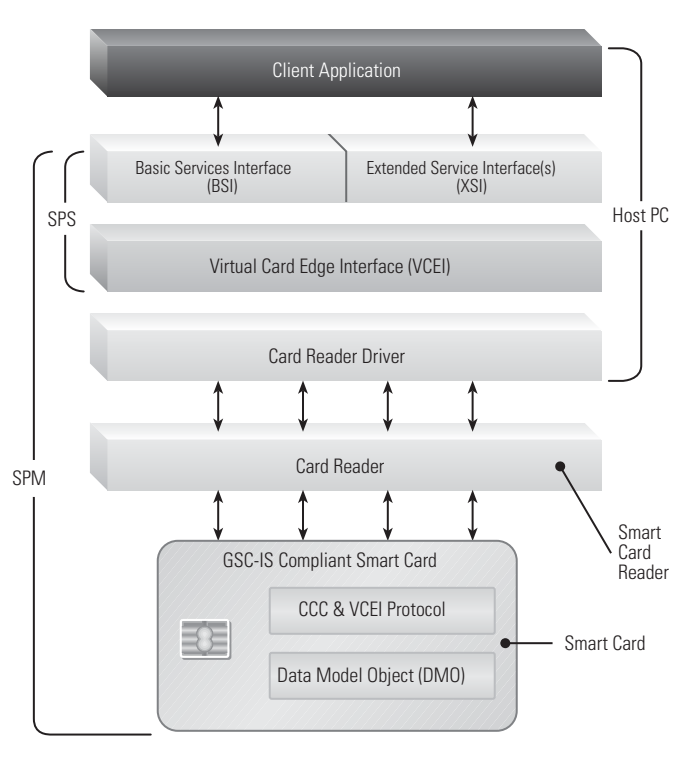
政府スマートカード相互運用性仕様(GSC-IS)の階層構成図。上から順に、「Client Application」、「Basic Services Interface (BSI)」と「Extended Service Interface(s) (XSI)」(横並び)、「Virtual Card Edge Interface (VCEI)」、「Card Reader Driver」、「Card Reader」、そして「CCC & VCEI Protocol」と「Data Model Object (DMO)」を含む「GSC-IS Compliant Smart Card」。各層は双方向矢印で接続されています。「SPS」の括弧は BSI/XSI と VCEI にまたがり、「SPM」の括弧は BSI/XSI からスマートカードまでにまたがり、「Host PC」の括弧は Client Application から Card Reader Driver までにまたがっています。吹き出しには「Smart Card Reader」と「Smart Card」のラベルがあります。
CRITICAL INFRASTRUCTURE PROTECTION GRANTS PROGRAM
重要インフラ防護助成プログラム
Critical infrastructures are those physical and cyber-based systems essential to the minimum operations of the economy and government. They include telecommunications, energy, banking and finance, transportation, water systems and emergency services. Due to advances in information technology (IT) and the necessity of improved efficiency, infrastructures have become increasingly automated and interlinked. Most modern commercial infrastructures are composed of a collection of interconnected networks that serve different purposes and have different owners. Indeed, even parts of the information resident on a single sub-network may have different purposes and different owners. Critical information is passed between these component elements to coordinate necessary functions. The complexity and interdependency of this critical information flow introduces vulnerabilities into the entire critical infrastructure. Deliberate attacks or accidental system failure may result in serious consequences to the nation.
重要インフラとは、経済と政府の最低限の運営に不可欠な、物理的およびサイバー上のシステムです。これには、電気通信、エネルギー、銀行・金融、運輸、水道システム、緊急サービスが含まれます。情報技術(IT)の進歩と効率向上の必要性により、インフラはますます自動化され、相互接続されるようになっています。現代の商業インフラの大半は、異なる目的を持ち、異なる所有者がいる相互接続ネットワークの集合で構成されています。実際、単一のサブネットワーク上に存在する情報の一部でさえ、その一部ごとに目的や所有者が異なる場合があります。必要な機能を調整するため、これらの構成要素間で重要な情報が受け渡されます。この重要な情報の流れの複雑さと相互依存性は、重要インフラ全体に脆弱性をもたらします。意図的な攻撃や偶発的なシステム障害は、国に深刻な結果をもたらす可能性があります。
In September 2001, NIST awarded $5 million to nine grant recipients under the Fiscal Year 2001 Critical Infrastructure Protection Grants Program (CIPGP) to improve the robustness, resilience, and security information in all the critical infrastructures. Under the competitive grant application process, we received 133 proposals requesting roughly $73 million from applicants in both industry and academia. Proposals were required to clearly explain what commercial or government entities would likely utilize the solution and how the project would contribute to that utilization. We selected proposals in intrusion detection, telecommunications, wireless security, electric power infrastructure, and compiler security.
2001年9月、NIST は、すべての重要インフラの堅牢性、回復力、セキュリティを向上させるため、2001会計年度重要インフラ防護助成プログラム(CIPGP)のもとで、9 件の助成先に 500 万ドルを授与しました。競争的な助成金申請プロセスでは、産業界と学術界の申請者から、約 7,300 万ドルを求める 133 件の提案を受け取りました。提案には、どの商業または政府の主体がそのソリューションを利用する可能性が高いか、またプロジェクトがその利用にどう貢献するかを明確に説明することが求められました。侵入検知、電気通信、無線セキュリティ、電力インフラ、コンパイラセキュリティの分野の提案を選びました。
Funded research addresses a variety of topics to include tools and methods for analyzing security and detecting attacks due to vulnerabilities introduced by merging of data networks (i.e., the Internet) and voice networks (i.e. the public switched telephone network). Other topics being addressed are attack detection for wireless and converged networks, the development of security controls for protecting the North American power grid, and methods for evaluating intrusion detection systems.
資金提供を受けた研究は、データネットワーク(すなわちインターネット)と音声ネットワーク(すなわち公衆交換電話網)の融合によってもたらされる脆弱性に起因する攻撃を、分析し検知するためのツールと方法を含む、さまざまなトピックを扱っています。扱われている他のトピックには、無線ネットワークと融合ネットワークの攻撃検知、北米の電力網を保護するためのセキュリティ管理策の策定、侵入検知システムを評価する方法があります。
We will continue to monitor the progress of the remaining research projects, as well as evaluate the progress of technical efforts happening within the projects. We will also monitor the status of transferring the technology to the commercial and government entities that will be using the final deliverables.
残りの研究プロジェクトの進捗を引き続き監視し、プロジェクト内で行われている技術的な取り組みの進捗も評価します。また、最終成果物を利用する商用および政府の主体への技術移転の状況も監視します。
http://csrc.nist.gov/grants/
Contact: Mr. Tim Grance
(301) 975-4242
grance@nist.gov
http://csrc.nist.gov/grants/
連絡先: Mr. Tim Grance
(301) 975-4242
grance@nist.gov
SCALABLE QUANTUM INFORMATION NETWORK
スケーラブルな量子情報ネットワーク
Quantum mechanics, the strange behavior of matter on the atomic scale, provides entirely new and uniquely powerful tools for computing and communications. This field could revolutionize many aspects of computing and secure communications, and could have enormous impacts in homeland security. Quantum computers could perform processing tasks that would take billions of years on conventional computers. They also could solve problems that conventional computers could not manage given realistic amounts of time, memory, and processing power.
量子力学、すなわち原子スケールでの物質の奇妙なふるまいは、コンピューティングと通信のまったく新しい、独自に強力な手段をもたらします。この分野は、コンピューティングと安全な通信の多くの側面に革命をもたらす可能性があり、国土安全保障に計り知れない影響を与えうるものです。量子コンピュータは、従来のコンピュータでは数十億年かかる処理タスクを実行できる可能性があります。また、現実的な時間、メモリ、処理能力では従来のコンピュータが扱えない問題を解ける可能性もあります。
Exploiting quantum properties would be particularly valuable in cryptography, making codes that would be unbreakable by the best supercomputers of tomorrow, or breaking codes in seconds that could not be cracked in millions of years by the most powerful binary computers. Quantum information also can be used for remarkably secure communications. In this particular area, we are partnering closely with the Defense Advanced Research Projects Agency (DARPA).
量子の特性の活用は、暗号の分野で特に価値があります。将来の最高のスーパーコンピュータでも解読できない暗号を作ったり、最も強力な二進コンピュータでは数百万年かけても解読できない暗号を数秒で解読したりできるからです。量子情報は、きわめて安全な通信にも使えます。この特定の分野では、国防高等研究計画局(DARPA)と緊密に提携しています。
The objective of this NIST project is to develop an extensible quantum information test-bed and the scalable component technology essential to the practical realization of a quantum communication network. The test-bed will demonstrate quantum communication and quantum cryptographic key distribution with a high data rate. This test-bed, once developed, will provide a measurement and standards infrastructure that will be open to the DARPA QuIST (Quantum Information Science and Technology) community and will enable wide-ranging experiments on both the physical- and network-layer aspects of a quantum communication system. The infrastructure will be used to provide calibration, testing, and development facilities for the QuIST community. This project is one part of the broader Quantum Information Program at NIST.
この NIST のプロジェクトの目的は、拡張可能な量子情報の試験環境と、量子通信ネットワークの実用的な実現に不可欠な、スケーラブルな構成要素技術を開発することです。この試験環境は、高いデータレートでの量子通信と量子暗号鍵配送を実証します。この試験環境は、いったん開発されれば、DARPA の QuIST(Quantum Information Science and Technology)コミュニティに開かれた測定・標準のインフラを提供し、量子通信システムの物理層とネットワーク層の両面について、幅広い実験を可能にします。このインフラは、QuIST コミュニティに校正、試験、開発の施設を提供するために使われます。このプロジェクトは、NIST のより広範な Quantum Information Program の一部です。
Within the Quantum Information Program, we are developing and evaluating quantum cryptographic protocols, and investigating means of integrating quantum and conventional network technology. Controlling access to a large network of resources is one of the most common security problems. Any pair of parties in a network should be able to communicate, but must be authorized to do so, while minimizing the number of cryptographic keys that must be distributed and maintained. This project will develop an authentication solution based on a combination of quantum cryptography and a conventional secret key system. Two significant advantages of this approach over conventional authentication protocols are 1) time-stamps and exact clock synchronization between parties are not needed; and 2) that even the trusted server cannot know the contents of the authentication ticket.
Quantum Information Program の中で、当部門は、量子暗号プロトコルの開発と評価、および量子ネットワーク技術と従来型ネットワーク技術を統合する手段の調査を行っています。多数の資源からなる大規模ネットワークへのアクセスを制御することは、最も一般的なセキュリティ上の問題の一つです。ネットワーク内の任意の 2 者は通信できるべきです。ただし、そのためには認可されている必要があり、同時に、配布し維持しなければならない暗号鍵の数を最小限に抑える必要があります。このプロジェクトは、量子暗号と従来型の共通鍵方式の組み合わせに基づく認証ソリューションを開発します。従来の認証プロトコルに対するこの取り組み方の 2 つの重要な利点は、1) 当事者間でタイムスタンプと正確な時計の同期が必要ないこと、2) 信頼されたサーバーでさえ認証チケットの内容を知ることができないことです。
In 2003, we conducted a cryptanalysis of three published quantum key distribution protocols, and the lessons learned are being submitted for journal publication. We also evaluated an authentication protocol for resistance to cryptanalysis, and the results are likewise being submitted for journal publication.
2003年には、公開されている 3 つの量子鍵配送プロトコルの暗号解析を行い、得られた教訓をジャーナルへの掲載に向けて投稿しているところです。また、暗号解析への耐性について認証プロトコルを評価し、その結果もジャーナルへの掲載に向けて投稿しているところです。
In the coming year we will test and measure the performance of enhanced protocol on the test bed. We plan to implement and validate new cryptographic protocols. We will also generalize the results on cryptanalysis, and publish theorems on a generalized attack.
来年は、試験環境で強化したプロトコルの性能を試験し測定します。新しい暗号プロトコルを実装し検証する計画です。また、暗号解析の結果を一般化し、一般化された攻撃に関する定理を発表します。
http://math.nist.gov/quantum/
Contact: Mr. D. Richard Kuhn
(301) 975-3337
kuhn@nist.gov
http://math.nist.gov/quantum/
連絡先: Mr. D. Richard Kuhn
(301) 975-3337
kuhn@nist.gov
Crytographic Standards and Applications
暗号標準とアプリケーション
GOAL To protect information resources through the use of cryptography.
目標 暗号の使用を通じて情報資源を保護すること。
STRATEGY The strategy to meet this goal is the development and improvement of cryptographic methods for protecting the integrity, confidentiality, and authenticity of information resources.
戦略 この目標を達成するための戦略は、情報資源の完全性、機密性、真正性を保護するための暗号手法の開発と改善です。
INTENDED OUTCOME AND BACKGROUND:
意図する成果と背景
The intended outcome of this area of work is to enable government and industry to be able to build secure, interoperable applications with high-assurance products that implement needed cryptographic security functionality. This includes the on-going development of cryptographic standards and testing methods, developing methods for securing e-Gov applications with cryptography, further developing key management guidelines and schemes, and the updating and creation of new modes of operation for use with the newer Advanced Encryption Standard (AES).
この分野の業務で意図する成果は、必要な暗号セキュリティ機能を実装した高保証製品を用いて、政府と産業界が安全で相互運用可能なアプリケーションを構築できるようにすることです。これには、暗号標準と試験方法の継続的な策定、暗号で電子政府アプリケーションを保護する方法の開発、鍵管理のガイドラインと方式のさらなる開発、より新しい Advanced Encryption Standard(AES)で使う動作モードの更新と新規作成が含まれます。
This area of work involves collaboration with a number of entities, both from federal agencies and industry. Some of the federal agencies include the Department of Treasury, agencies participating in the Federal PKI Steering Committee and Bridge CA Project, the Federal Deposit Insurance Corporation (FDIC), and the National Security Agency (NSA). Projects in this area have worked with the American National Standards Institute’s (ANSI’s) X9 Committee that develops standards for the financial industry, as well as with the Internet Engineering Task Force’s (IETF’s) PKIX Working Group. Industry collaborators in this area have included RSA Security Entrust Technologies, IBM, Mastercard, Visa, Verizon, VeriSign, Microsoft, and others.
この分野の業務は、連邦機関と産業界の両方の多数の主体との協力を伴います。連邦機関には、財務省、Federal PKI Steering Committee と Bridge CA Project に参加する機関、連邦預金保険公社(FDIC)、国家安全保障局(NSA)があります。この分野のプロジェクトは、金融業界の標準を策定する American National Standards Institute(ANSI)の X9 Committee、および Internet Engineering Task Force(IETF)の PKIX Working Group と協力してきました。この分野での産業界の協力先には、RSA Security、Entrust Technologies、IBM、Mastercard、Visa、Verizon、VeriSign、Microsoft などが含まれます。
ACCOMPLISHMENTS
成果
CRYPTOGRAPHIC STANDARDS TOOLKIT
暗号標準ツールキット
The aim of the Cryptographic Standards Toolkit (CToolkit) project is to enable U.S. governmental agencies, and others, to select cryptographic security components and functionality for protecting their data, communications, and operations. The Toolkit helps to ensure that there is worldwide government and industry use of strong cryptography, and that secure interoperability is achieved through standard algorithms. The Toolkit also makes guidance and education available in the use of cryptography. The Toolkit currently includes a wide variety of cryptographic algorithms and techniques for encryption, authentication, non-repudiation, key establishment, and random number generation. The Toolkit is a collection of standards and guidance, and does not include any actual software implementations of the algorithms. Many of the projects discussed in this area of work are combined to form the CToolkit.
Cryptographic Standards Toolkit(CToolkit)プロジェクトの目的は、米国の政府機関やその他の組織が、データ、通信、業務を保護するための暗号セキュリティ構成要素と機能を選択できるようにすることです。このツールキットは、世界中の政府と産業界が強力な暗号技術を使用し、標準アルゴリズムを通じて安全な相互運用性を実現できるよう支援します。また、暗号の使用に関するガイダンスと教育も利用できるようにします。現在、暗号化、認証、否認防止、鍵確立、乱数生成のための、さまざまな暗号アルゴリズムと技法が含まれています。このツールキットは標準とガイダンスの集合であり、アルゴリズムのソフトウェア実装そのものは含みません。この分野の業務で論じられているプロジェクトの多くが組み合わさって、CToolkit を構成しています。
The past year has seen a great deal of work go into the CToolkit. A draft version of the NIST Special Publications 800-56 Recommendation on Key Establishment Schemes and 800-57 Recommendation on Key Management were issued for public review in January 2003. Drafts for public review and comment have also been issued of Special Publications 800-38B Recommendation for Block Cipher Modes of Operation: The RMAC Authentication Mode (RMAC – Randomized Message Authentication Code) and 800-38C Recommendation for Block Cipher Modes of Operation: the CCM Mode for Authentication and Confidentiality (CCM – Counter with CBC MAC). Revisions of Federal Information Processing Standard (FIPS) 112 Password Usage and NIST Special Publication (SP) 800-21 Guideline for Implementing Cryptography were begun during the past year. The revision of the Digital Signature Standard (DSS) has begun, and will be posted for public review in the future, prior to adoption as FIPS 186-3. Validation tests have also been developed for the Digital Signature Algorithm (DSA), the Secure Hash Algorithm (SHA), the Keyed-Hash Message Authentication Code (HMAC), and ANSI X9.62 the Elliptic Curve Digital Signature Algorithm (ECDSA), and will be delivered to the validation laboratories early next year.
昨年は、CToolkit に関して多くの作業が行われました。NIST 特別刊行物 800-56 Recommendation on Key Establishment Schemes と 800-57 Recommendation on Key Management のドラフト版が、2003年1月に公開レビュー用に公開されました。特別刊行物 800-38B Recommendation for Block Cipher Modes of Operation: The RMAC Authentication Mode(RMAC – Randomized Message Authentication Code)と 800-38C Recommendation for Block Cipher Modes of Operation: the CCM Mode for Authentication and Confidentiality(CCM – Counter with CBC MAC)のドラフトも、公開レビューとコメント募集のために公開されました。連邦情報処理標準(FIPS)112 Password Usage と NIST 特別刊行物(SP)800-21 Guideline for Implementing Cryptography の改訂は、昨年に始まりました。Digital Signature Standard(DSS)の改訂が始まっており、FIPS 186-3 として採用される前に、今後、公開レビューのために公開される予定です。Digital Signature Algorithm(DSA)、Secure Hash Algorithm(SHA)、Keyed-Hash Message Authentication Code(HMAC)、ANSI X9.62 の Elliptic Curve Digital Signature Algorithm(ECDSA)の検証試験も開発されており、来年初めに検証試験所に提供される予定です。
Plans for 2004 include the completion of draft documents issued in 2003, as well as the completion of a draft document on password-based key establishment.
2004年の計画には、2003年に公開されたドラフト文書の完成と、パスワードベースの鍵確立に関するドラフト文書の完成があります。
http://csrc.nist.gov/CryptoToolkit/index.html
Contact: Ms. Elaine Barker
(301) 975-2911
elaine.barker@nist.gov
http://csrc.nist.gov/CryptoToolkit/index.html
連絡先: Ms. Elaine Barker
(301) 975-2911
elaine.barker@nist.gov
BIOMETRIC TECHNOLOGIES
生体認証技術
Biometric technologies consist of automated methods of identifying a person or verifying the identity of a person based upon recognition of a physiological or a behavioral characteristic. Consumers need biometric-based high performance, interoperable systems (e.g. standards-based) developed in a timely fashion. In the absence of timely standards developments, migration from proprietary systems to open-systems standard-based solutions will be more difficult and expensive. Therefore, standards are the cornerstone of our biometrics program. Deploying new information technology systems for homeland security and for preventing ID theft will require both national and international consensus standards for biometrics. NIST is responding to post-9/11 market requirements for open system standards by accelerating development of formal, national and international biometric standards.
生体認証技術は、生理的または行動的な特徴の認識に基づいて、人物を識別し、または人物の身元を検証する自動化された方法で構成されます。利用者は、生体認証に基づく高性能で相互運用可能なシステム(たとえば標準ベースのシステム)が、適時に開発されることを必要としています。適時な標準策定がなければ、独自仕様のシステムからオープンシステムの標準ベースのソリューションへの移行は、より困難で費用がかかります。したがって、標準は当部門の生体認証プログラムの礎です。国土安全保障と ID 窃取の防止のために新しい情報技術システムを展開するには、生体認証に関する国内および国際的な合意標準の両方が必要です。NIST は、正式な国内および国際的な生体認証標準の策定を加速することで、9.11 以降のオープンシステム標準に対する市場の要求に応えています。
These standards need further development in order to help deploy significantly better, open-systems security solutions that are based on standards. NIST has identified the critical tasks that will help power the development of these standards so that the deployment of such systems may be accelerated. Consequently, in the past two years NIST has worked in close partnership with other U.S. government agencies and U.S. industry to establish two formal standards bodies for accelerating the development of formal national and international biometric standards of high relevance to the U.S. Nationally, we established Technical Committee M1 under the InterNational Committee for Information Technology Standards (INCITS). Internationally we successfully petitioned the International Organization for Standardization/International Electro-technical Commission Joint Technical Committee 1 to establish Subcommittee 37-Biometrics (ISO/IEC JTC 1/SC 37-Biometrics), which NIST currently chairs. We have also participated in related consortia efforts. Our strategy in this program includes: (a) Leveraging existing consortia standards (e.g., the Bio Application Programming Infterface (BioAPI) Consortium and Common Biometric Exchange File Format (CBEFF)); (b) Managing the national (INCITS Technical Committee M1 on Biometrics) and the international (ISO/IEC JTC 1/SC 37-Biometrics) biometric standards developments; (c) Providing expert technical leaders for critical standards projects; (d) Acting as an advisor to other federal government agencies (e.g., Department of Homeland Security (DHS), the National Security Agency (NSA) and the Department of Defense (DoD) Biometric Management Office); (e) Supporting required administrative infrastructures (e.g., ISO/IEC JTC 1/SC 37 Secretariat); (f) Working through biometric standards "incubators" (e.g., Biometric Consortium); (g) Promoting fast processing of consortia specifications into national/international standards; and (h) Initiating development of technical implementations and software development for conformity assessment and interoperability tests to Application Profiles as required.
これらの標準は、標準に基づく大幅に優れたオープンシステムのセキュリティソリューションの展開を助けるため、さらなる策定が必要です。NIST は、そうしたシステムの展開を早められるよう、これらの標準の策定を後押しする重要なタスクを特定しました。その結果、過去 2 年間、NIST は他の米国政府機関および米国産業界と緊密に連携して、米国にとって特に関連性の高い、正式な国内および国際的な生体認証標準の策定を加速するための、2 つの正式な標準化団体を設立しました。国内では、InterNational Committee for Information Technology Standards(INCITS)のもとに Technical Committee M1 を設立しました。国際的には、国際標準化機構/国際電気標準会議合同技術委員会 1 に、小委員会 37(生体認証)(ISO/IEC JTC 1/SC 37-Biometrics)の設立を働きかけて成功し、現在は NIST が議長を務めています。また、関連するコンソーシアムの取り組みにも参加してきました。このプログラムの戦略には次のものが含まれます。(a) 既存のコンソーシアム標準(たとえば Bio Application Programming Interface(BioAPI)Consortium と Common Biometric Exchange File Format(CBEFF))の活用。(b) 国内(INCITS Technical Committee M1 on Biometrics)および国際(ISO/IEC JTC 1/SC 37-Biometrics)の生体認証標準の策定の管理。(c) 重要な標準化プロジェクトへの専門的な技術リーダーの提供。(d) 他の連邦政府機関(たとえば国土安全保障省(DHS)、国家安全保障局(NSA)、国防総省(DoD)Biometric Management Office)への助言。(e) 必要な管理基盤(たとえば ISO/IEC JTC 1/SC 37 Secretariat)の支援。(f) 生体認証標準の「インキュベーター」(たとえば Biometric Consortium)を通じた活動。(g) コンソーシアム仕様の国内標準・国際標準への迅速な移行の促進。(h) 必要に応じて、アプリケーションプロファイルに対する適合性評価および相互運用性試験用の技術実装とソフトウェア開発を開始すること。
The U.S. Biometric Consortium (BC), which is considered to be a biometrics incubator, serves as a U.S. government focal point for biometrics. It currently consists of over nine hundred members representing over sixty government agencies, industry and academia. NIST co-chairs the Consortium with the NSA. The BC sponsors an annual conference, technical workshops and biometrics technical developments. The NIST/BC Biometric Working Group, sponsored by NIST and the BC has been working in the last few years with government users and industry developing biometric specifications. In the last 18 months it approved and provided to formal standards bodies three specifications for further processing as national and international standards: (a) Biometric Data Protection and Usage; (b) Biometric Application Programming Interface for Java Card; and (c) an augmented version of the Common Biometric Exchange File Format (the initial version of CBEFF was published as National Institute of Standards and Technology Interagency Report (NISTIR) 6529). The 2003 annual technical conference, held September 2003, in Crystal City, VA was sponsored by NIST/Information Technology Laboratory (ITL), NSA, The National Biometric Security Project (NBSP), DoD's Biometrics Management Office (BMO), the National Institute of Justice (NIJ), West Virginia U.S.A., the General Services Administration’s Federal Technology Service (FTS) Center for Smart Card Solutions, and the National Science Foundation (NSF). Supporting organizations included the American National Standards Institute (ANSI), the BioAPI Consortium, the International Biometric Industry Association (IBIA), INCITS, and the Biometric Foundation. This conference had over 900 attendees from government organizations, industry and academia. The two and a half days conference program included presentations, technology and business seminars, a biometric research symposium sponsored by the Biometric Knowledge Center at West Virginia University and the NSF and panel discussions with the participation of over 100 internationally recognized experts in biometric technologies, system and application developers, IT business strategists, and government and commercial officers. The conference included exhibits and technology demonstrations from 76 organizations.
生体認証のインキュベーターとみなされている U.S. Biometric Consortium(BC)は、生体認証に関する米国政府の窓口の役割を果たしています。現在、60 を超える政府機関、産業界、学術界を代表する 900 を超える会員で構成されています。NIST は、NSA とともにコンソーシアムの共同議長を務めています。BC は、年次会議、技術ワークショップ、生体認証の技術開発を後援しています。NIST と BC が後援する NIST/BC Biometric Working Group は、ここ数年、政府の利用者や産業界とともに生体認証の仕様を策定してきました。過去 18 か月間に、国内および国際標準としてさらに審議するため、(a) Biometric Data Protection and Usage、(b) Biometric Application Programming Interface for Java Card、(c) Common Biometric Exchange File Format の拡張版(CBEFF の初版は、National Institute of Standards and Technology Interagency Report(NISTIR)6529 として発行されました)の 3 つの仕様を承認し、正式な標準化団体に提供しました。2003年9月にバージニア州クリスタルシティで開かれた2003年の年次技術会議は、NIST/Information Technology Laboratory(ITL)、NSA、The National Biometric Security Project(NBSP)、国防総省の Biometrics Management Office(BMO)、National Institute of Justice(NIJ)、West Virginia U.S.A.、General Services Administration の Federal Technology Service(FTS)Center for Smart Card Solutions、National Science Foundation(NSF)が後援しました。支援組織には、American National Standards Institute(ANSI)、BioAPI Consortium、International Biometric Industry Association(IBIA)、INCITS、Biometric Foundation が含まれました。この会議には、政府組織、産業界、学術界から 900 人を超える参加者がありました。2 日半の会議プログラムには、発表、技術・ビジネスセミナー、West Virginia University の Biometric Knowledge Center と NSF が後援する生体認証研究シンポジウム、および生体認証技術の国際的に著名な専門家、システム・アプリケーション開発者、IT 事業戦略担当者、政府・商業組織の職員が 100 人を超えて参加したパネルディスカッションが含まれました。会議には、76 の組織による展示と技術デモンストレーションもありました。
[装飾の画像。本文を読むのに必要のない装飾のため、この非公式サイトには掲載していません。原本 PDF を参照してください。]
NIST is also a member of the BioAPI Consortium and its Steering Committee. BioAPI Consortium’s membership consists of over 100 organizations including biometric vendors, end-users, system developers and original equipment manufacturers (OEMs). This consortium developed the BioAPI specification, which was approved as ANSI INCITS 358 -2002. The BioAPI specification is an International Organization of Standardization (ISO) standard candidate (under development in JTC1/SC 37–Biometrics). NIST has recently developed the Linux version of the BioAPI reference implementation (originally developed as a Windows-compatible implementation) and harmonized the Linux implementation with a Unix implementation developed by another BioAPI Consortium member. The Linux/Unix reference implementation was released to the public at the 2003 Biometric Conference.
NIST は、BioAPI Consortium とその運営委員会の構成員でもあります。BioAPI Consortium の会員は、生体認証ベンダー、エンドユーザー、システム開発者、相手先ブランド製造業者(OEM)を含む 100 を超える組織で構成されています。このコンソーシアムは、ANSI INCITS 358-2002 として承認された BioAPI 仕様を策定しました。BioAPI 仕様は、国際標準化機構(ISO)標準の候補です(JTC1/SC 37–Biometrics で策定中)。NIST は最近、BioAPI 参照実装の Linux 版(当初は Windows 互換の実装として開発されたもの)を開発し、BioAPI Consortium の別の会員が開発した Unix 実装と調和させました。この Linux/Unix 参照実装は、2003 Biometric Conference で一般に公開されました。
INCITS M1 is the Technical Committee in the U.S. responsible for representing the U.S., or the U.S. Technical Advisory Group (TAG), to the JTC1/SC 37. The purpose of INCITS M1 is to ensure a high priority, focused, and comprehensive approach in the U.S. for the rapid development and approval of formal national and international generic biometric standards. These standards are considered to be critical for U.S. needs, such as homeland defense, the prevention of identity theft and for other government and commercial applications based on biometric personal authentication. We provide the chairperson for these two standards bodies and manage their standards programs. The current INCITS M1 program of work includes biometric data interchange formats (finger image, finger minutiae, finger pattern-based, face and iris recognition, sign/signature recognition and hand geometry), data exchange framework formats (CBEFF), application programming interfaces (BioAPI), application profiles (transportation workers, border management and Point-of-Sale), and performance testing and reporting standards (technology, scenario and operational testing).
INCITS M1 は、JTC1/SC 37 で米国を代表する、すなわち米国技術諮問グループ(TAG)の役割を担う、米国の技術委員会です。INCITS M1 の目的は、正式な国内および国際的な汎用の生体認証標準を迅速に策定し承認するための、米国における優先度が高く重点を絞った包括的な取り組みを確実にすることです。これらの標準は、国土防衛、ID 窃取の防止、生体認証による個人認証に基づくその他の政府や商用の用途など、米国のニーズにとって重要と考えられています。当部門は、これら 2 つの標準化団体の議長を提供し、その標準化プログラムを管理しています。INCITS M1 の現在の作業計画には、生体データ交換形式(指画像、指のマニューシャ、指紋パターンベース、顔・虹彩認識、サイン/署名認識、手形状)、データ交換フレームワーク形式(CBEFF)、アプリケーションプログラミングインタフェース(BioAPI)、アプリケーションプロファイル(運輸従事者、国境管理、販売時点)、性能試験と報告の標準(技術、シナリオ、運用の試験)が含まれます。
M1 has maintained an accelerated pace of biometric standards development. Several of the draft standards developed under INCITS M1 have been sent to Initial Public Review and are anticipated to become ANSI standards in the first quarter of 2004. Another major accomplishment where NIST was instrumental is a report developed by M1’s Ad-Hoc Group on Biometric Interoperability in Support of the Government Smart Card (GSC) Framework. This group was formed by M1 to identify biometric interoperability requirements for the Government Smart Card Framework (GSCF) - NISTIR 6887-2003 Edition, Government Smart Card Interoperability Specification (GSC-IS) (v2.1). The almost 100 page report also identifies proposed extensions to the BioAPI standard to achieve a higher degree of interoperability with the GSC. It is expected that the result of this work will be taken internationally, through INCITS B10, to JTC 1 SC 17 as part of the proposed GSCF project and to JTC 1 SC 37 as extensions to the BioAPI specification.
M1 は、生体認証標準の策定を加速したペースで維持してきました。INCITS M1 のもとで策定されたドラフト標準のいくつかは、最初の公開レビューに送られており、2004年の第 1 四半期に ANSI 標準になる見込みです。NIST が重要な役割を果たしたもう一つの主要な成果は、M1 の Ad-Hoc Group on Biometric Interoperability in Support of the Government Smart Card (GSC) Framework が作成した報告書です。このグループは、Government Smart Card Framework(GSCF)、すなわち NISTIR 6887-2003 Edition、Government Smart Card Interoperability Specification(GSC-IS)(v2.1)のための、生体認証の相互運用性要件を特定するために M1 が設けました。約 100 ページのこの報告書は、GSC とのより高い水準の相互運用性を達成するための、BioAPI 標準への拡張案も特定しています。この作業の成果は、INCITS B10 を通じて、GSCF プロジェクト案の一部として JTC 1 SC 17 に、BioAPI 仕様の拡張として JTC 1 SC 37 に、国際的に持ち込まれる見込みです。
Internationally, through an aggressive planned schedule, SC 37 has made excellent progress during the last year as evidenced by the number of approved projects and the advancement of many of these projects to Committee Draft status in a very short period. In addition to chairing SC37, NIST contributes Mr. Michael D. Hogan, of the Information Technology Laboratory, to be the Convener of the Biometric Profiles Working Group (SC37 WG4) and supports SC37’s program of work by supplying biometric technical experts and editors in the areas of CBEFF, BioAPI, performance testing and reporting, biometric data formats and reporting standards development. The BioAPI specification, the CBEFF and a number of the data interchange formats, contributed to SC37 by the U.S. through M1, are targeted to final approval as international standards at the end of 2004.
国際的には、SC 37 は積極的な計画スケジュールにより、昨年、優れた進展を遂げました。承認されたプロジェクトの数と、その多くが非常に短期間で委員会ドラフトの段階に進んだことが、その証拠です。SC37 の議長を務めることに加え、NIST は、情報技術研究所の Michael D. Hogan 氏を Biometric Profiles Working Group(SC37 WG4)の招集者として任命し、CBEFF、BioAPI、性能試験と報告、生体データ形式、報告標準の策定の分野で、生体認証の技術専門家と編集者を提供することで SC37 の作業計画を支えています。米国が M1 を通じて SC37 に寄与した BioAPI 仕様、CBEFF、および複数のデータ交換形式は、2004年末に国際標準として最終承認されることを目標としています。
In 2003, this NIST program was awarded a Group Gold Medal Award for Scientific/Engineering Achievement for its impact in biometric standards development.
2003年に、この NIST のプログラムは、生体認証標準の策定に与えた影響により、Group Gold Medal Award for Scientific/Engineering Achievement を授与されました。
http://csrc.nist.gov/CryptoToolkit/tkkeymgmt.html
Contact: Mr. Fernando Podio
(301) 975-2947
fernando@nist.gov
http://csrc.nist.gov/CryptoToolkit/tkkeymgmt.html
連絡先: Mr. Fernando Podio
(301) 975-2947
fernando@nist.gov
KEY MANAGEMENT
鍵管理
The goals of this project are two-fold: to develop schemes for establishing cryptographic keying material for the protection of Federal Government sensitive, unclassified information, and to develop key management guidance for the handling of keying material from its creation through its destruction. The project will help secure e-commerce through the generation and protection afforded by secure cryptographic key establishment schemes. It will provide guidance for system and protocol developers to build more secure communication and storage products, as well as allowing commercial off-the-shelf (COTS) products to be validated that they comply with the key establishment schemes.
このプロジェクトの目標は 2 つあります。連邦政府の機微な非機密情報を保護するための暗号鍵素材を確立する方式を策定すること、および鍵素材の生成から破棄までの取り扱いに関する鍵管理ガイダンスを策定することです。このプロジェクトは、安全な暗号鍵確立方式がもたらす鍵素材の生成と保護を通じて、電子商取引の保護に貢献します。システムやプロトコルの開発者がより安全な通信・記憶製品を構築するためのガイダンスを提供するとともに、市販(COTS)製品が鍵確立方式に準拠していることを検証できるようにします。
The Key Management Guideline saw periodic revisions made and published for review this past year. Revisions were also published for review for the Key Establishment Schemes document. In the next year there are plans to complete parts one and two of the Key Management Guideline, as well as the Key Establishment Schemes Document. A draft of a Password-based Key Establishment Document will also be written and published for review.
Key Management Guideline は、昨年、定期的な改訂が行われ、レビュー用に公開されました。Key Establishment Schemes 文書も、改訂がレビュー用に公開されました。来年は、Key Management Guideline の第 1 部と第 2 部、および Key Establishment Schemes 文書を完成させる計画です。Password-based Key Establishment 文書のドラフトも作成し、レビュー用に公開する予定です。
http://csrc.nist.gov/CryptoToolkit/tkkeymgmt.html
Contact: Ms. Elaine Barker
(301) 975-2911
elaine.barker@nist.gov
http://csrc.nist.gov/CryptoToolkit/tkkeymgmt.html
連絡先: Ms. Elaine Barker
(301) 975-2911
elaine.barker@nist.gov
MODES OF OPERATION FOR BLOCK CIPHER ALGORITHMS
ブロック暗号アルゴリズムの動作モード
A mode of operation, or mode, for short, is an algorithm that features the use of a symmetric key block cipher algorithm to provide an information service, such as confidentiality or authentication. With the advent of new block ciphers, such as the Advanced Encryption Standard (AES), there is a need to update longstanding modes of operation and an opportunity to consider the development of new modes. One important motivation for updating modes is the increased block size of the AES algorithm compared to the Digital Encryption Standard (DES) algorithm (128 bits instead of 64 bits).
動作モード、略してモードとは、機密性や認証などの情報サービスを提供するために、共通鍵ブロック暗号アルゴリズムを使うことを特徴とするアルゴリズムです。Advanced Encryption Standard(AES)などの新しいブロック暗号の登場により、長年使われてきた動作モードを更新する必要があり、新しいモードの開発を検討する機会でもあります。モードを更新する重要な動機の一つは、DES(Data Encryption Standard)アルゴリズムに比べて AES アルゴリズムのブロックサイズが大きくなったこと(64 ビットではなく 128 ビット)です。
NIST is in the process of specifying modes in the 800-38 series of special publications. The first document in the series specifies five confidentiality modes; the second document will specify an authentication mode; the third document will specify a combined mode for authentication and confidentiality.
NIST は、特別刊行物の 800-38 シリーズでモードを規定する作業を進めています。シリーズの最初の文書は 5 つの機密性モードを規定し、2 番目の文書は認証モードを規定し、3 番目の文書は認証と機密性の組み合わせモードを規定します。
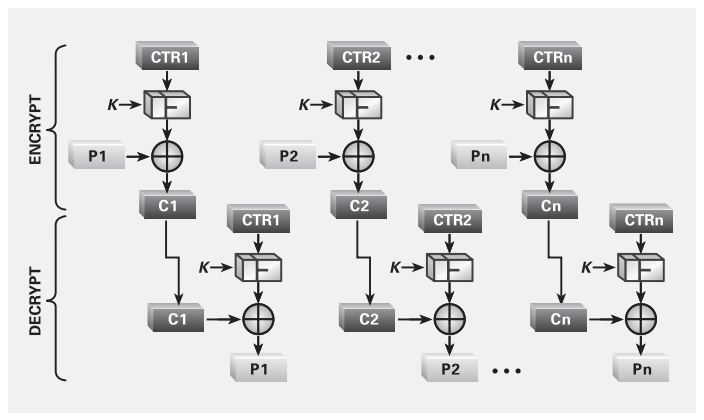
薄い灰色の背景に描かれたカウンター(CTR)モードの図で、波括弧によって2つの部分に分けて示されています。「ENCRYPT」(暗号化)では、カウンター「CTR1」「CTR2」…「CTRn」がそれぞれ鍵「K」で暗号化するブロック暗号の箱に入り、その出力と平文ブロック「P1」「P2」…「Pn」の排他的論理和(⊕)が暗号文ブロック「C1」「C2」…「Cn」になります。「DECRYPT」(復号)では、各カウンター「CTR1」「CTR2」…「CTRn」が再び鍵「K」で暗号化するブロック暗号の箱に入り、その出力と暗号文ブロック「C1」「C2」…「Cn」の排他的論理和が平文「P1」「P2」…「Pn」になります。「…」は2番目から n 番目までのブロックを示します。
A draft version of Special Publication (SP) 800-38B Recommendation for Block Cipher Modes of Operation: The RMAC Authentication Mode (RMAC – Randomized Message Authentication Code) was released in October 2002, and is currently undergoing substantial revision to respond to public comment. The upcoming version will specify the OMAC (One-key Cipher Block Chaining Message Authentication Code) variation of the extended Ciphertext Block Chaining (XCBC) authentication algorithm. After a second public comment period, the document will be finalized in 2004. The draft SP 800-38C specifies the CCM (Counter with CBC MAC) algorithm, a combined confidentiality-authentication mode that was developed for the Institute of Electrical and Electronics Engineers Inc. (IEEE) 802.11 standard for wireless local area networks (LANs). This document is undergoing minor revision in response to public comment before finalization in 2004.
特別刊行物(SP)800-38B Recommendation for Block Cipher Modes of Operation: The RMAC Authentication Mode(RMAC – Randomized Message Authentication Code)のドラフト版は、2002年10月に公開され、現在、パブリックコメントに対応するための大幅な改訂が行われています。次期版は、extended Ciphertext Block Chaining(XCBC)認証アルゴリズムの OMAC(One-key Cipher Block Chaining Message Authentication Code)という変種を規定します。第 2 次のパブリックコメント期間を経て、この文書は2004年に最終化されます。ドラフト SP 800-38C は、Institute of Electrical and Electronics Engineers Inc.(IEEE)802.11 の無線ローカルエリアネットワーク(LAN)標準のために開発された、機密性と認証を組み合わせたモードである CCM(Counter with CBC MAC)アルゴリズムを規定しています。この文書は、2004年の最終化に先立ち、パブリックコメントに対応するための軽微な改訂が行われています。
Mode development is expected be an ongoing effort. Later parts of the series may be devoted to the specification of new modes. In the next year, for example, NIST will consider whether to propose additional combined confidentiality-authentication modes, possibly including an AES key wrap.
モードの策定は、継続的な取り組みになると見込まれます。シリーズの後続の部は、新しいモードの規定に充てられる可能性があります。たとえば来年は、AES の鍵ラッピングを含む可能性のある、機密性と認証を組み合わせた追加のモードを提案するかどうかを、NIST が検討します。
http://nist.gov/modes
Contact: Dr. Morris Dworkin
(301) 975-3356
morris.dworkin@nist.gov
http://nist.gov/modes
連絡先: Dr. Morris Dworkin
(301) 975-3356
morris.dworkin@nist.gov
E-AUTHENTICATION
電子認証
The Office of Management and Budget (OMB) has identified the remote identification of users, or e-Authentication, as a crosscutting impediment to the provision of Internet-based government services. To fully realize the benefits of the electronic government, government agencies require e-Authentication policies and corresponding technical guidance tailored to the protection of government systems and data. This project establishes a policy structure for e-authentication within the U.S. government, promoting consistent implementation of e-authentication across federal agencies. This consistency will in turn help to enhance government efficiency by securing electronic processes needed to conduct more transactions through e-government applications.
行政管理予算局(OMB)は、利用者の遠隔識別、すなわち電子認証を、インターネットベースの政府サービスの提供に対する、分野横断的な障害として特定しました。電子政府の利点を十分に実現するには、政府機関に、政府のシステムとデータの保護に合わせた電子認証の方針と、それに対応する技術ガイダンスが必要です。このプロジェクトは、米国政府内の電子認証の方針構造を確立し、連邦機関全体で電子認証が一貫して実施されるよう促進します。この一貫性は、電子政府アプリケーションを通じてより多くの取引を行うために必要な電子的プロセスを保護することで、政府の効率を高めるのにも役立ちます。
[装飾の画像。本文を読むのに必要のない装飾のため、この非公式サイトには掲載していません。原本 PDF を参照してください。]
[人物の写真。人物が写っているため、この非公式サイトには掲載していません。原本 PDF を参照してください。]
NIST is assisting OMB in the development of E-Authentication Guidance for Federal Agencies, which is expected to be available in early 2004. This OMB guidance will define four levels of authentication, Levels 1 to 4, in terms of the consequences of the authentication errors and misuse of credentials. The OMB guidance will define the required level of authentication assurance in terms of the likely consequences of an authentication error. As the consequences of an authentication error become more serious, the required level of assurance will also increase. The OMB guidance will provide agencies with the criteria for determining the level of e-authentication assurance required for specific applications and transactions, based on the risks and their likelihood of occurrence of each application or transaction. For example, the level of authentication needed in order to let someone make a reservation at a National Park would be far less than the level needed to let someone view his or her social security benefits.
NIST は、OMB による E-Authentication Guidance for Federal Agencies の策定を支援しており、2004年初めに入手できるようになる見込みです。この OMB のガイダンスは、認証の誤りとクレデンシャルの不正使用がもたらす結果に基づいて、認証の4つのレベル、すなわちレベル1から4を定義します。OMB のガイダンスは、認証誤りがもたらす可能性のある結果に基づいて、必要な認証保証レベルを定義します。認証誤りの結果がより深刻になるにつれて、必要な保証レベルも高くなります。OMB のガイダンスは、各アプリケーションまたは取引それぞれのリスクと、そのリスクが発生する可能性に基づいて、特定のアプリケーションや取引に必要な電子認証保証レベルを判断する基準を機関に提供します。たとえば、国立公園の予約を許可するために必要な認証レベルは、利用者が自身の社会保障給付を閲覧できるようにするために必要なレベルよりはるかに低くなります。
In early 2004, NIST will be releasing a companion publication, Special Publication (SP) 800-63 Recommendation for Electronic Authentication. This recommendation will provide technical guidance in the implementation of electronic authentication to allow an individual person to remotely authenticate his or her identity to a Federal IT system. Special Publication 800-63 will state specific technical requirements for each of the four levels of assurance in the following areas: identity proofing and registration, tokens, remote authentication mechanisms and assertion mechanisms. After completing a risk assessment and mapping the identified risks to the required assurance level, Federal agencies will be able to select appropriate technology for the required level of assurance.
2004年初めに、NIST は関連刊行物として、特別刊行物(SP)800-63 Recommendation for Electronic Authentication を公開します。この勧告は、個人が連邦 IT システムに対して自らの身元を遠隔で認証できるようにする、電子認証の実装に関する技術ガイダンスを提供します。特別刊行物 800-63 は、身元確認と登録、トークン、遠隔認証の仕組み、アサーションの仕組みの分野について、4 つの保証レベルのそれぞれに対する具体的な技術要件を述べます。リスク評価を完了し、特定したリスクを必要な保証レベルに対応付けた後、連邦機関は、必要な保証レベルに適した技術を選択できるようになります。
Federal agencies may choose to authenticate users through credentials issued by industry, associations, or local government. NIST is supporting the development of accreditation procedures for Credential Service Providers (CSPs), based on the technical requirements in draft SP 800-63. These procedures will provide the foundation for efficient evaluation and selection of acceptable Credential Service Providers by Federal agencies without requiring specialized expertise.
連邦機関は、産業界、団体、地方政府が発行するクレデンシャルを通じて、利用者を認証することを選べます。NIST は、ドラフト SP 800-63 の技術要件に基づく、Credential Service Provider(CSP)の認定手順の策定を支援しています。これらの手順は、連邦機関が専門的な知識を必要とせずに、許容できる Credential Service Provider を効率的に評価し選定するための基礎を提供します。
In this project, NIST is collaborating with Federal agencies and industry partners. Federal agencies include the Office of Management and Budget, Government Services Administration, the Federal Identity and Credentialing Committee, and the Social Security Administration. Industry partners include Wells Fargo Bank, VeriSign, Digital Signature Trust/Identrus, ElectroSoft Systems, Phoenix Technologies, and Caradas.
このプロジェクトでは、NIST は連邦機関と産業界のパートナーと協力しています。連邦機関には、行政管理予算局、一般調達局、Federal Identity and Credentialing Committee、社会保障局があります。産業界のパートナーには、Wells Fargo Bank、VeriSign、Digital Signature Trust/Identrus、ElectroSoft Systems、Phoenix Technologies、Caradas があります。
Contacts: Mr. William Burr
(301) 975-2914
burr@nist.gov
Ms. Donna Dodson
(301) 975-3669
donna.Dodson@nist.gov
連絡先: Mr. William Burr
(301) 975-2914
burr@nist.gov
Ms. Donna Dodson
(301) 975-3669
donna.Dodson@nist.gov
E-GOV IDENTITY MANAGEMENT INFRASTRUCTURE
電子政府 ID 管理インフラ
For cost efficiency, authentication techniques cannot be implemented on an application-by-application basis. Identity management infrastructures bring scalability and cost-effectiveness, permitting many applications to authenticate identity using the same credentials. In the e-Gov Identity Management Infrastructure project, NIST is supporting the deployment and implementation of identity management infrastructures by and for government agencies. Under this project, NIST is supporting the deployment and maintenance of the Federal Public Key Infrastructure (PKI), development and deployment of a common federal credential, and development of an online e-Authentication credential validation infrastructure.
費用効率の観点から、認証の技法をアプリケーションごとに実装することはできません。ID 管理インフラは、スケーラビリティと費用対効果をもたらし、多くのアプリケーションが同じクレデンシャルを使って身元を認証できるようにします。電子政府 ID 管理インフラプロジェクトで、NIST は、政府機関による、また政府機関のための、ID 管理インフラの展開と実装を支援しています。このプロジェクトのもとで、NIST は、連邦公開鍵基盤(PKI)の展開と維持、共通の連邦クレデンシャルの策定と展開、オンライン電子認証クレデンシャル検証インフラの開発を支援しています。
NIST continues to support the development and deployment of the Federal PKI, which permits cross-agency use of PKI-based credentials for authentication and related uses. NIST provides the vice-chair of the Federal PKI Policy Authority, which manages the suite of Federal PKI Certificate Policies and the operations of the Federal Bridge Certification Authority. By establishing interoperability with other PKIs, we will expand the range of applications supported by the Federal PKI.
NIST は、認証と関連する用途に、PKI ベースのクレデンシャルを機関間で使えるようにする連邦 PKI の開発と展開を、引き続き支援しています。NIST は、連邦 PKI の証明書ポリシー群と連邦ブリッジ認証局の運用を管理する Federal PKI Policy Authority の副議長を提供しています。他の PKI との相互運用性を確立することで、連邦 PKI が支えるアプリケーションの範囲を広げます。
NIST is also supporting a project for outsourcing PKI operations associated with the management of a common federal identity credential. To support this effort, NIST is drafting the Common Policy framework. The Common Policy will support issuing credentials to government employees, contractors, and affiliates that require access to government buildings and systems. This project will be coordinated with the Government Smart Card project to maximize the utility and interoperability of the common federal identity credential.
NIST はまた、共通の連邦 ID クレデンシャルの管理に関連する PKI 運用の外部委託を行うプロジェクトも支援しています。この取り組みを支えるため、NIST は Common Policy framework を起草しています。Common Policy は、政府の建物やシステムへのアクセスを必要とする、政府職員、請負業者、関連者へのクレデンシャルの発行を支えます。このプロジェクトは、共通の連邦 ID クレデンシャルの有用性と相互運用性を最大化するため、Government Smart Card プロジェクトと調整されます。
NIST is assisting the General Services Administration (GSA) in the development of an online e-Authentication credential validation infrastructure. The GSA e-Authentication Gateway will mediate between government applications and non-government CSP, permitting applications to accept a variety of identification credentials. For example, possible CSPs might include banks. This could mean in the future the passwords you use for your online banking or shopping services could be used to access some government services. NIST has participated in a review of the GSA E-Authentication Gateway architecture; the resulting enhancements will introduce additional flexibility and increase the range of government requirements that can be met by this system.
NIST は、一般調達庁(GSA)によるオンライン電子認証クレデンシャル検証インフラの開発を支援しています。GSA の e-Authentication Gateway は、政府のアプリケーションと非政府の CSP を仲介し、アプリケーションがさまざまな識別クレデンシャルを受け入れられるようにします。たとえば、CSP の候補には銀行が含まれるかもしれません。これは将来、オンラインバンキングやショッピングサービスで使うパスワードを、一部の政府サービスへのアクセスに使える可能性があることを意味します。NIST は GSA E-Authentication Gateway のアーキテクチャのレビューに参加しており、その結果としての強化によって柔軟性が高まり、このシステムが満たせる政府要件の範囲が広がります。
As part of this project, NIST is researching web services protocols (e.g., Simple Object Access Protocol (SOAP) and Security Assertion Markup Language (SAML)), effective password use, and registration and identity proofing. NIST is collaborating with many entities, including the Federal PKI Policy Authority (FPKIPA), the Federal Identity Credentialing Committee, the General Services Administration (GSA), the General Accounting Office (GAO), the National Security Agency (NSA), the Federal Deposit Insurance Corporation (FDIC), the Office of Management and Budget (OMB), the States of Illinois and Washington, and EduCause, which includes 1,800 universities, colleges, and educational institutions.
このプロジェクトの一環として、NIST はウェブサービスのプロトコル(たとえば Simple Object Access Protocol(SOAP)と Security Assertion Markup Language(SAML))、パスワードの効果的な使用、登録と身元確認を研究しています。NIST は、Federal PKI Policy Authority(FPKIPA)、Federal Identity Credentialing Committee、一般調達庁(GSA)、会計検査院(GAO)、国家安全保障局(NSA)、連邦預金保険公社(FDIC)、行政管理予算局(OMB)、イリノイ州とワシントン州、そして1,800の大学、カレッジ、教育機関を含む EduCause など、多くの組織と協力しています。
Contacts: Mr. William Burr
(301) 975-2914
burr@nist.gov
Ms. Donna Dodson
(301) 975-3669
donna.Dodson@nist.gov
連絡先: Mr. William Burr
(301) 975-2914
burr@nist.gov
Ms. Donna Dodson
(301) 975-3669
donna.Dodson@nist.gov
SECURING E-GOV APPLICATIONS WITH CRYPTOGRAPHY
暗号による電子政府アプリケーションの保護
To reduce overhead and streamline operations, government agencies are transitioning from paper processing to electronic applications. To implement these processes, agencies may leverage commercial off the shelf (COTS) applications or build custom systems. In either case, agencies are facing new and unexpected security threats in the course of this transition. For example, information may be inadvertently disclosed or modified during transmission across networks. To safely implement these business processes, security controls must be implemented to protect against such threats. Cryptography is one of the most powerful tools available to agencies to implement such controls, but selection and installation of cryptographic controls is complex.
間接費を減らし業務を合理化するため、政府機関は紙による処理から電子アプリケーションへ移行しています。これらのプロセスを実装するために、機関は、市販(COTS)のアプリケーションを活用することも、独自のシステムを構築することもできます。いずれの場合も、機関は、この移行の過程で、新しい予期しないセキュリティ上の脅威に直面しています。たとえば、情報がネットワーク上の送信中に、意図せず開示されたり改変されたりする可能性があります。これらの業務プロセスを安全に実装するには、そうした脅威から保護するセキュリティ管理策を実装しなければなりません。暗号は、そうした管理策を実装するために機関が利用できる最も強力なツールの一つですが、暗号管理策の選択とインストールは複雑です。
In this project, NIST is developing guidance for both COTS applications and assisting agencies in the design and implementation of custom applications. NIST is developing guidance documents for the selection and configuration of COTS systems based on standard protocols. NIST has recently published guidance for the selection and configuration of secure e-mail clients based on S/MIME Version 3 standards. NIST is currently developing guidance for TLS servers and clients, to be completed in 2004.
このプロジェクトでは、NIST は、COTS アプリケーション向けのガイダンスを策定するとともに、機関が独自のアプリケーションを設計し実装するのを支援しています。NIST は、標準プロトコルに基づく COTS システムの選択と設定に関するガイダンス文書を策定しています。NIST は最近、S/MIME バージョン 3 標準に基づく安全な電子メールクライアントの選択と設定に関するガイダンスを発行しました。現在は、TLS サーバーとクライアントに関するガイダンスを策定しており、2004年に完成する予定です。
To assist agencies in the development of secure custom applications, NIST is researching cryptographic Application Programming Interfaces (APIs), cryptographic message/object formats, and techniques for PKI-enabling legacy applications. Currently, PKI-enabled applications must use proprietary, vendor-provided APIs to interface with their PKI, thus making support across multiple PKI products difficult. To facilitate the development and wide-deployment of PKI-enabled applications, NIST is working with several federal agencies to make this interface to a PKI consistent, regardless of the PKI product being used. Once fully developed, the first APIs could be used for models for use with many other systems, despite what type of information and transactions it might be handling. For instance, a model used to secure an accounting system could be also used as a model to secure a human resources system.
機関が安全な独自アプリケーションを開発するのを支援するため、NIST は、暗号のアプリケーションプログラミングインタフェース(API)、暗号メッセージ/オブジェクトの形式、従来のアプリケーションを PKI 対応にする技法を研究しています。現在、PKI 対応アプリケーションは、PKI に接続するために、ベンダーが提供する独自仕様の API を使わなければならず、複数の PKI 製品にまたがる対応が困難になっています。PKI 対応アプリケーションの開発と広範な展開を促進するため、NIST は、使用する PKI 製品にかかわらず、PKI へのインタフェースを一貫したものにするよう、複数の連邦機関と協力しています。完全に開発されれば、最初の API 群は、扱う情報や取引の種類にかかわらず、多くの他のシステムで使用するためのモデルとして使える可能性があります。たとえば、会計システムを保護するために使われるモデルは、人事システムを保護するモデルとしても使える可能性があります。
Finally, NIST is directly assisting agencies in the implementation of secure applications. NIST is currently working with the Army Corps of Engineers, Treasury Financial Management System (FNMS), and the Federal Deposit Insurance Corporation. NIST participation is focused upon appropriate application of cryptography to secure these business processes.
最後に、NIST は、機関が安全なアプリケーションを実装するのを直接支援しています。NIST は現在、Army Corps of Engineers、Treasury Financial Management System(FNMS)、連邦預金保険公社と協力しています。NIST の関与は、これらの業務プロセスを保護するための暗号の適切な適用に重点を置いています。
Contacts: Mr. William Burr
(301) 975-2914
burr@nist.gov
Ms. Donna Dodson
(301) 975-3669
donna.Dodson@nist.gov
連絡先: Mr. William Burr
(301) 975-2914
burr@nist.gov
Ms. Donna Dodson
(301) 975-3669
donna.Dodson@nist.gov
Honors and Awards
表彰と受賞
DEPARTMENT OF COMMERCE SILVER MEDAL
商務省 SILVER MEDAL
The Cryptographic Module Validation Program Team was awarded the Department of Commerce’s Silver Medal for scientific/engineering achievement in conceiving, establishing, and operating the Cryptographic Module Validation Program and developing Security Requirements for Cryptographic Modules. The team’s leadership, innovation, and vision, have enabled and strengthened the deployment of strong commercial cryptography to protect the nation’s critical national infrastructures, n both the public and private sector. The team has established both a standard and a program that has brought and continues to bring international recognition and prestige to NIST, the Department of Commerce and the U.S. Federal Government. The Team consists of Ray Snouffer, Annabelle Lee, Randall Easter, Sharon Keller, Larry Bassham, Ron Tencati, Janet Jing, Gary Stoneburner, Lisa Carnahan, and Jeffrey Horlick.
暗号モジュール検証プログラムチームは、暗号モジュール検証プログラムの構想、確立、運営と、Security Requirements for Cryptographic Modules の策定における科学・工学上の功績により、商務省の Silver Medal を授与されました。チームのリーダーシップ、革新性、先見性は、公的部門と民間部門の両方で、国の重要インフラを保護する強力な商用暗号の展開を可能にし、強化しました。チームは、NIST、商務省、米国連邦政府に国際的な評価と威信をもたらし、今ももたらし続ける標準とプログラムの両方を確立しました。チームは、Ray Snouffer、Annabelle Lee、Randall Easter、Sharon Keller、Larry Bassham、Ron Tencati、Janet Jing、Gary Stoneburner、Lisa Carnahan、および Jeffrey Horlickで構成されています。
DEPARTMENT OF COMMERCE BRONZE MEDAL
商務省 BRONZE MEDAL
[人物の写真。人物が写っているため、この非公式サイトには掲載していません。原本 PDF を参照してください。]
Tom Karygiannis was awarded the Department of Commerce’s Bronze Medal for his leadership and scholarship in advancing and improving wireless and mobile security. He established a significant research and publication track record in wireless-related technologies such as mobile agents, mobile devices, and privilege management. This enabled him to co-write the widely heralded NIST Special Publication 800-48 Wireless Network Security: 802.11, Bluetooth, and Handheld Devices. This document garnered widespread industry support and generated swift action towards the use of federally approved cryptographic standards in wireless and mobile technologies.
Tom Karygiannis は、無線とモバイルのセキュリティを前進させ改善したリーダーシップと学識により、商務省の Bronze Medal を授与されました。彼は、モバイルエージェント、モバイルデバイス、権限管理など、無線関連技術について、重要な研究・発表の実績を築きました。これにより、広く称賛された NIST 特別刊行物 800-48 Wireless Network Security: 802.11, Bluetooth, and Handheld Devices を共同執筆することができました。この文書は産業界の幅広い支持を得て、無線・モバイル技術で連邦政府が承認した暗号標準を使用することに向けた迅速な行動を生み出しました。
DEPARTMENT OF COMMERCE BRONZE MEDAL
商務省 BRONZE MEDAL
[人物の写真。人物が写っているため、この非公式サイトには掲載していません。原本 PDF を参照してください。]
Murugiah Souppaya was awarded the Department of Commerce’s Bronze Medal for his leadership in developing the Windows 2000 Professional Security Consensus Benchmark. He improved the security of hundreds of thousands of systems in the public and private sector by developing and recommending significantly improved security settings, clearly documenting and explaining those recommended parameters, publishing supporting rationale, providing an automated mechanism to apply these settings, and engaging and leading a broad and diverse community to support and adopt those settings.
Murugiah Souppaya は、Windows 2000 Professional Security Consensus Benchmark の策定におけるリーダーシップにより、商務省の Bronze Medal を授与されました。彼は、大幅に改善されたセキュリティ設定を策定して推奨し、推奨するパラメータを明確に文書化して説明し、裏づけとなる根拠を公開し、これらの設定を適用する自動化された仕組みを提供し、これらの設定を支持し採用するよう幅広く多様なコミュニティに働きかけて率いることで、公的部門と民間部門の数十万のシステムのセキュリティを向上させました。
FRANK B. ROWLETTE AWARD FINALIST
FRANK B. ROWLETTE AWARD 最終候補
Elaine Barker was a selected as a finalist for the Frank B. Rowlette Award for Individual Excellence by the National Security Agency. This prestigious award recognizes those who have made extraordinary contributions in the field of information security. A prolific writer and editor, Ms. Barker has authored, edited, co-authored, or co-edited eighteen ANSI and Federal Information Processing cryptographic standards. These encryption, signature and hashing standards are used throughout the Federal Government and around the world to protect the nation's critical infrastructures, sensitive communications, electronic commerce and financial transactions.
Elaine Barker は、国家安全保障局の Frank B. Rowlette Award for Individual Excellence の最終候補に選ばれました。この名誉ある賞は、情報セキュリティの分野で並外れた貢献をした人々を称えるものです。多作な執筆者・編集者である Ms. Barker は、ANSI および Federal Information Processing の暗号標準18件を執筆、編集、共同執筆、または共同編集しました。これらの暗号化、署名、ハッシュの標準は、国の重要インフラ、機微な通信、電子商取引、金融取引を保護するために、連邦政府全体と世界中で使われています。
BEST PAPER AWARD
BEST PAPER AWARD
Ramaswamy Chandramouli was recognized by The Organizing Committee of The 7th World Multi-conference on Systemics, Cybernetics and Informatics (SCI 2003) for his authorship of "Specification and Validation of Enterprise Access Control Data for Conformance to Model and Policy Constraints." His paper was selected as the best paper presented in the Information Systems Development session.
Ramaswamy Chandramouli は、「Specification and Validation of Enterprise Access Control Data for Conformance to Model and Policy Constraints」の執筆により、The 7th World Multi-conference on Systemics, Cybernetics and Informatics(SCI 2003)の組織委員会から表彰されました。彼の論文は、Information Systems Development セッションで発表された最優秀論文に選ばれました。
SIGMA XI COLLEGE OF DISTINGUISHED LECTURERS
SIGMA XI COLLEGE OF DISTINGUISHED LECTURERS
Alicia Clay was selected for membership in the prestigious 2004-2006 Sigma Xi College of Distinguished Lecturers. Founded in 1886 as an honor society for scientists and engineers, Sigma Xi is today an independent, non-profit research society of more than 80,000 members, with a distinguished history of service to science and society. Scientists and engineers are elected to membership based on their research potential or achievements. This is the 65th consecutive year Sigma Xi has maintained its College of Distinguished Lecturers, a program that is an opportunity for chapters to host visits from outstanding individuals who are at the leading edge of science. Dr. Clay will be lecturing on Information Security and the Small Business Owner, International Standards on Information Security Management, and NIST Guidelines on Information Security Management.
Alicia Clay は、名誉ある2004〜2006年の Sigma Xi College of Distinguished Lecturers の会員に選ばれました。1886年に科学者と技術者の名誉協会として設立された Sigma Xi は、現在、80,000 人を超える会員を擁する独立した非営利の研究協会で、科学と社会に貢献してきた輝かしい歴史があります。科学者と技術者は、その研究の潜在力または業績に基づいて会員に選ばれます。Sigma Xi が College of Distinguished Lecturers を維持するのは 65 年連続で、このプログラムは、支部が、科学の最先端にいる傑出した人物の訪問を受け入れる機会となっています。Dr. Clay は、Information Security and the Small Business Owner、International Standards on Information Security Management、NIST Guidelines on Information Security Management について講演します。
THE “FED 100” AWARD
「FED 100」AWARD
Tim Grance was selected by Federal Computer Week for 2003 "Fed 100" recognition. The Federal 100 awards recognize that people, not technology, improve the way government works, delivers services and improves not only Americans' lives, but also those of people worldwide. Tim was recognized for his work to produce technical guidelines by providing principal technical direction to the development of the technical guidelines and serving as key reviewer to ensure overall quality and consistency with legal, policy and other existing security guidelines. Tim was also recognized as having “an uncanny ability to translate what he learns into plain English, so that others can grasp it.” "When he takes pen in hand, he reduces it to language that can be understood by nontechnical managers," said Lynn McNulty, former associate director for computer security at NIST.
Tim Grance は、Federal Computer Week により、2003年の「Fed 100」の表彰対象に選ばれました。Federal 100 の賞は、政府の働き方やサービスの提供方法を改善し、米国人だけでなく世界中の人々の生活も向上させるのは、技術ではなく人であることを認めるものです。Tim は、技術ガイドラインの策定に主要な技術的方向性を示し、全体の品質と、法律、方針、その他の既存のセキュリティガイドラインとの整合性を確保する主要なレビュー担当者を務めたことで、そのガイドラインの作成への貢献が評価されました。また、Tim は「学んだことを平易な英語に置き換え、他の人が理解できるようにする、不思議な能力」を持つとも評価されました。「彼がペンを取れば、技術に詳しくない管理者にも理解できる言葉にしてくれます」と、NIST の元コンピュータセキュリティ担当次長の Lynn McNulty は述べました。
2003 MATHEMATICS AND COMPUTER SCIENCES AWARD
2003 MATHEMATICS AND COMPUTER SCIENCES AWARD
Stuart Katzke was awarded the Washington Academy of Sciences 2003 Award for Scientific Achievement designating Dr. Katzke as a Fellow of the Academy. In order to recognize scientific work of merit and distinction, the Washington Academy of Sciences gives awards annually to scientists who work in the greater Washington D.C. area. The history of the Awards program, begun in 1940, is literally a catalog of over 60 years of scientific achievement.
Stuart Katzke は、Washington Academy of Sciences の2003年 Award for Scientific Achievement を授与され、Dr. Katzke は同アカデミーのフェローに指名されました。価値と功績のある科学的業績を称えるため、Washington Academy of Sciences は、ワシントン D.C. 周辺で働く科学者に毎年賞を授与しています。1940年に始まったこの賞のプログラムの歴史は、まさに 60 年を超える科学的業績の目録です。
THE “FED 100” AWARD
「FED 100」AWARD
Edward Roback was selected by Federal Computer Week for 2003 "Fed 100" recognition. The Federal 100 awards recognize that people, not technology, improve the way government works, delivers services and improves not only Americans' lives, but also those of people worldwide. Ed was recognized for his raising awareness about ITL's security tools and expertise, and in coordinating the division's portfolio of products. As stated by FCW, “Edward Roback rose to the challenge last year when the Bush administration asked the National Institute of Standards and Technology to take on a larger role in shaping civilian agencies' security policies and practices.”
Edward Roback は、Federal Computer Week により、2003年の「Fed 100」表彰の受賞者に選ばれました。Federal 100 の賞は、政府の働き方やサービスの提供方法を改善し、米国人だけでなく世界中の人々の生活も向上させるのは、技術ではなく人であることを認めるものです。Ed は、ITL のセキュリティツールと専門性についての認識を高め、部門の製品群を調整した業務が評価されました。FCW が述べたとおり、「Edward Roback は、昨年、ブッシュ政権が国立標準技術研究所に、民間機関のセキュリティ方針と実践を形作るうえでより大きな役割を担うよう求めたとき、その課題に立ち向かった」のです。
[人物の写真。人物が写っているため、この非公式サイトには掲載していません。原本 PDF を参照してください。]
[人物の写真。人物が写っているため、この非公式サイトには掲載していません。原本 PDF を参照してください。]
Computer Security Division Publications
コンピュータセキュリティ部門の刊行物
2003
2003年
NIST SPECIAL PUBLICATIONS
NIST 特別刊行物
| SP 800-43 | System Administration Guidance for Windows 2000 Professional | November 2002 |
| SP 800-48 | Wireless Network Security: 802.11, Bluetooth, and Handheld Devices | November 2002 |
| SP 800-49 | Federal S/MIME V3 Client Profile | November 2002 |
| SP 800-55 | Security Metrics Guide for Information Technology Systems | July2003 |
| SP 800-59 | Guideline for Identifying an Information System as a National Security System | August 2003 |
| SP 800-43 | System Administration Guidance for Windows 2000 Professional | 2002年11月 |
| SP 800-48 | Wireless Network Security: 802.11, Bluetooth, and Handheld Devices | 2002年11月 |
| SP 800-49 | Federal S/MIME V3 Client Profile | 2002年11月 |
| SP 800-55 | Security Metrics Guide for Information Technology Systems | 2003年7月 |
| SP 800-59 | Guideline for Identifying an Information System as a National Security System | 2003年8月 |
DRAFT NIST SPECIAL PUBLICATIONS
NIST ドラフト特別刊行物
| SP 800-35 | Guide to Information Technology Security Services | October 2002 |
| SP 800-36 | Guide to Selecting Information Technology Security Products | October 2002 |
| SP 800-37 | Guidelines for the Security Certification and Accreditation of Federal Information Technology Systems | October 2002, June 2003 |
| SP 800-38B | Recommendation for Block Cipher Modes of Operation: The RMAC Authentication Mode | October 2002 |
| SP 800-38C | Recommendation for Block Cipher Modes of Operation: the CCM Mode for Authentication and Confidentiality | September 2003 |
| SP 800-50 | Building an Information Technology Security Awareness and Training Program | May 2002 |
| SP 800-56 | Recommendation on Key Establishment Schemes | January 2003 |
| SP 800-57 | Recommendation on Key Management | January 2003 |
| SP 800-61 | Computer Security Incident Handling Guide | September 2003 |
| SP 800-64 | Security Considerations in the Information System Development Life Cycle (originally was SP 800-4A) | October 2002 |
| SP 800-35 | Guide to Information Technology Security Services | 2002年10月 |
| SP 800-36 | Guide to Selecting Information Technology Security Products | 2002年10月 |
| SP 800-37 | Guidelines for the Security Certification and Accreditation of Federal Information Technology Systems | 2002年10月、2003年6月 |
| SP 800-38B | Recommendation for Block Cipher Modes of Operation: The RMAC Authentication Mode | 2002年10月 |
| SP 800-38C | Recommendation for Block Cipher Modes of Operation: the CCM Mode for Authentication and Confidentiality | 2003年9月 |
| SP 800-50 | Building an Information Technology Security Awareness and Training Program | 2002年5月 |
| SP 800-56 | Recommendation on Key Establishment Schemes | 2003年1月 |
| SP 800-57 | Recommendation on Key Management | 2003年1月 |
| SP 800-61 | Computer Security Incident Handling Guide | 2003年9月 |
| SP 800-64 | Security Considerations in the Information System Development Life Cycle (originally was SP 800-4A) | 2002年10月 |
DRAFT FEDERAL INFORMATION PROCESSING STANDARDS
ドラフト連邦情報処理標準
| FIPS 199 | Standards for Security Categorization of Federal Information and Information Systems | May 2003 |
| FIPS 199 | Standards for Security Categorization of Federal Information and Information Systems | 2003年5月 |
NIST INTERAGENCY REPORTS
NIST 省庁間報告書
| NIST IR 7046 | A Framework for Multi-Mode Authentication: Overview and Implementation Guide | August 2003 |
| NIST IR 7030 | Picture Password: A Visual Login Technique for Mobile Devices | July 2003 |
| NIST IR 6887 | Government Smart Card Interoperability Specification (GSC-IS), v2.1 | July 2003 |
| NIST IR 7007 | An Overview of Issues in Testing Intrusion Detection Systems | June 2003 |
| NIST IR 6981 | Policy Expression and Enforcement for Handheld Devices | May 2003 |
| NIST IR 6985 | COTS Security Protection Profile - Operating Systems (CSPP-OS) (Worked Example Applying Guidance of NISTIR-6462, CSPP) | April 2003 |
| NIST IR 7046 | A Framework for Multi-Mode Authentication: Overview and Implementation Guide | 2003年8月 |
| NIST IR 7030 | Picture Password: A Visual Login Technique for Mobile Devices | 2003年7月 |
| NIST IR 6887 | Government Smart Card Interoperability Specification (GSC-IS), v2.1 | 2003年7月 |
| NIST IR 7007 | An Overview of Issues in Testing Intrusion Detection Systems | 2003年6月 |
| NIST IR 6981 | Policy Expression and Enforcement for Handheld Devices | 2003年5月 |
| NIST IR 6985 | COTS Security Protection Profile - Operating Systems (CSPP-OS) (Worked Example Applying Guidance of NISTIR-6462, CSPP) | 2003年4月 |
INFORMATION TECHNOLOGY LABORATORY BULLETINS WRITTEN BY THE CSD
CSD が執筆した情報技術研究所(ITL)広報
| October 2002 | Security Patches And The CVE Vulnerability Naming Scheme: Tools To Address Computer System Vulnerabilities |
| November 2002 | Security For Telecommuting And Broadband Communications |
| December 2002 | Security of Public Web Servers |
| January 2003 | Security Of Electronic Mail |
| February 2003 | Secure Interconnections for Information Technology Systems |
| March 2003 | Security For Wireless Networks And Devices |
| June 2003 | ASSET: Security Assessment Tool For Federal Agencies |
| July 2003 | Testing Intrusion Detection Systems |
| August 2003 | IT Security Metrics |
| 2002年10月 | Security Patches And The CVE Vulnerability Naming Scheme: Tools To Address Computer System Vulnerabilities |
| 2002年11月 | Security For Telecommuting And Broadband Communications |
| 2002年12月 | Security of Public Web Servers |
| 2003年1月 | Security Of Electronic Mail |
| 2003年2月 | Secure Interconnections for Information Technology Systems |
| 2003年3月 | Security For Wireless Networks And Devices |
| 2003年6月 | ASSET: Security Assessment Tool For Federal Agencies |
| 2003年7月 | Testing Intrusion Detection Systems |
| 2003年8月 | IT Security Metrics |
Ways to Engage Our Division and NIST
当部門および NIST との連携方法
GUEST RESEARCH INTERNSHIPS AT NIST
NIST での客員研究インターンシップ
Opportunities are available at NIST for 6 to 24 month internships within the CSD. Qualified individuals should contact the CSD and provide a statement of qualifications and indicate the area of work that is of interest. Generally speaking, the salary costs are borne by the sponsoring institution; however, in some cases, these guest research internships carry a small monthly stipend paid by NIST. For further information, contact: Mr. Ed Roback, (301) 975-3696, edward.roback@nist.gov.
NIST では、CSD で 6 か月から 24 か月のインターンシップの機会が用意されています。資格のある個人は、CSD に連絡し、資格の説明書を提出して、関心のある作業分野を示してください。一般に、給与費用は派遣元の機関が負担しますが、場合によっては、これらの客員研究インターンシップには、NIST が支払う少額の月額手当が付きます。詳細は、Mr. Ed Roback、(301) 975-3696、edward.roback@nist.gov にお問い合わせください。
DETAILS AT NIST FOR GOVERNMENT OR MILITARY PERSONNEL
政府職員または軍人の NIST への出向
Opportunities are available at NIST for 6 to 24 month details at NIST in the CSD. Qualified individuals should contact the CSD, provide a statement of qualifications, and indicate the area of work that is of interest. Generally speaking, the salary costs are borne by the sponsoring agency; however, in some cases, agency salary costs may be reimbursed by NIST. For further information, contact Mr. Ed Roback, (301) 975-3696, edward.roback@nist.gov.
NIST では、CSD で 6 か月から 24 か月の出向の機会が用意されています。資格のある個人は、CSD に連絡し、資格の説明書を提出して、関心のある作業分野を示してください。一般に、給与費用は派遣元の機関が負担しますが、場合によっては、機関の給与費用が NIST から償還されることがあります。詳細は、Mr. Ed Roback、(301) 975-3696、edward.roback@nist.gov にお問い合わせください。
FEDERAL COMPUTER SECURITY PROGRAM MANAGERS’ FORUM
連邦コンピュータセキュリティプログラム管理者フォーラム
The FCSPM Forum is covered in detail in the Outreach section of this report. Membership is free, and open to federal employees. For further information, contact: Ms. Marianne Swanson, (301) 975-3293, marianne.swanson@nist.gov.
FCSPM Forum については、この報告書のアウトリーチの節で詳しく説明しています。会員資格は無料で、連邦職員に開かれています。詳細は、Ms. Marianne Swanson、(301) 975-3293、marianne.swanson@nist.gov にお問い合わせください。
SECURITY RESEARCH
セキュリティ研究
NIST occasionally undertakes security work, primarily in the area of research, funded by other agencies. Such sponsored work is accepted by NIST when it can cost-effectively further the goals of NIST and the sponsoring institution. For further information, contact Mr. Tim Grance, (301) 975-4242, tim.grance@nist.gov.
NIST は、主に研究の分野で、他の機関が資金を提供するセキュリティ業務を随時引き受けています。そうした委託業務は、NIST と委託機関の目標を費用対効果の高い形で推進できる場合に、NIST が受け入れます。詳細は、Mr. Tim Grance、(301) 975-4242、tim.grance@nist.gov にお問い合わせください。
FUNDING OPPORTUNITIES AT NIST
NIST の資金提供の機会
NIST funds industrial and academic research in a variety of ways. Our Advanced Technology Program co-funds high-risk, high-payoff projects with industry. The Small Business Innovation Research Program funds R&D proposals from small businesses. We also offer other grants to encourage work in specific fields: precision measurement, fire research, and materials science. Grants/awards supporting research at industry, academic, and other institutions are available on a competitive basis through several different Institute offices. For general information on NIST grants programs, contact Ms. Joyce Brigham, (301) 975-6329, joyce.brigham@nist.gov.
NIST は、さまざまな方法で産業界と学術界の研究に資金を提供しています。Advanced Technology Program は、産業界と共同で、高リスク・高リターンのプロジェクトに共同出資しています。Small Business Innovation Research Program は、中小企業からの研究開発の提案に資金を提供しています。また、精密測定、火災研究、材料科学といった特定の分野での取り組みを奨励するために、その他の助成金も提供しています。産業界、学術界、その他の機関での研究を支援する助成金・賞は、同研究所の複数の部署を通じて、競争ベースで利用できます。NIST の助成金プログラムの一般的な情報は、Ms. Joyce Brigham、(301) 975-6329、joyce.brigham@nist.gov にお問い合わせください。
SUMMER UNDERGRADUATE RESEARCH FELLOWSHIP (SURF)
Summer Undergraduate Research Fellowship(SURF)
Curious about physics, electronics, manufacturing, chemistry, materials science, or structural engineering? Intrigued by nanotechnology, fire research, information technology, or robotics? Tickled by biotechnology or biometrics? Have an intellectual fancy for superconductors or, perhaps, semiconductors?
物理学、電子工学、製造、化学、材料科学、構造工学に興味はありませんか。ナノテクノロジー、火災研究、情報技術、ロボット工学に心を引かれますか。バイオテクノロジーや生体認証にわくわくしますか。超伝導体、あるいは半導体に知的な関心はありませんか。
Here’s your chance to satisfy that curiosity. By spending part of your summer working elbow to elbow with researchers at the National Institute of Standards and Technology, one of the world’s leading research organizations and home to two Nobel Prize winners. Gain valuable hands-on experience, work with cutting-edge technology, meet peers from across the nation (from San Francisco to Puerto Rico and from New York to New Mexico), sample the Washington, D.C., area. And, no kidding, get paid while you're learning. For further information, see http://www.surf.nist.gov/, or contact NIST SURF Program, 100 Bureau Dr., Stop 8400, Gaithersburg, MD 20899-8499, (301) 975-4200, NIST_SURF_program@nist.gov.
その好奇心を満たす機会がここにあります。世界有数の研究機関で、2 人のノーベル賞受賞者を擁する国立標準技術研究所で、夏の一部を研究者と肩を並べて過ごすのです。貴重な実地経験を積み、最先端の技術に取り組み、全米(サンフランシスコからプエルトリコ、ニューヨークからニューメキシコまで)の仲間と出会い、ワシントン D.C. 地域を味わってください。そして、冗談ではなく、学びながら報酬が得られます。詳細は http://www.surf.nist.gov/ を参照するか、NIST SURF Program、100 Bureau Dr., Stop 8400, Gaithersburg, MD 20899-8499、(301) 975-4200、NIST_SURF_program@nist.gov にお問い合わせください。
[米国商務省の紋章。公的な標章のため、この非公式サイトには掲載していません。原本 PDF を参照してください。]
Tanya Brewer-Joneas, Editor
編集: Tanya Brewer-Joneas
Computer Security Division
Information Technology Laboratory
National Institute of Standards and Technology
コンピュータセキュリティ部門
情報技術研究所
米国国立標準技術研究所
U.S. DEPARTMENT OF COMMERCE
Donald L. Evans, Secretary
米国商務省
Donald L. Evans 長官
Technology Administration
Phillip J. Bond, Under Secretary for Technology
技術局
Phillip J. Bond、商務次官(技術担当)
National Institute of Standards and Technology
Arden L. Bement, Jr., Director
米国国立標準技術研究所
Arden L. Bement, Jr. 所長
NIST IR 7111
April 2004
NIST IR 7111
2004年4月
Disclaimer: Any mention of commercial products is for information only; it does not imply NIST recommendation or endorsement, nor does it imply that the products mentioned are necessarily the best available for the purpose.
免責事項: 市販製品への言及は情報提供のみを目的としており、NIST による推奨または支持を意味するものではなく、言及された製品がその目的に最適なものであることを意味するものでもありません。
[装飾の画像。本文を読むのに必要のない装飾のため、この非公式サイトには掲載していません。原本 PDF を参照してください。]