NIST IR 7275 日本語訳
英語タイトル : Specification for the Extensible Configuration Checklist Description Format (XCCDF) Version 1.1日本語タイトル : Extensible Configuration Checklist Description Format(XCCDF)の仕様 バージョン 1.1
公開日 : 2006-11-01
原文URL : https://csrc.nist.gov/pubs/ir/7275/final
翻訳編集 : 自動生成(有志による非公式の日本語訳), 原文取得日 : 2026-10-31, 訳文 : 704 / 751 ブロック
[要約] NIST IR 7275 は、Extensible Configuration Checklist Description Format(XCCDF)バージョン 1.1 の仕様を示した報告書です。2002 年サイバーセキュリティ研究開発法が NIST に課した、セキュリティリスクを最小化する設定やオプション選択を示すチェックリストの策定に関連して、効果的なセキュリティチェックリストの利用、標準化、共有を促進するため、NIST と NSA が民間産業の代表者と協力して XCCDF 仕様を策定しました。仕様は、セキュリティチェックリストや構成ガイダンスなどを、拡張可能で相互運用可能な形式で表現するためのデータモデルと XML 形式を定めています。この仕様はベンダー中立で柔軟であり、主な想定読者は、政府および産業界のセキュリティアナリストと、産業界のセキュリティ管理製品の開発者です。
NISTIR 7275
NISTIR 7275
Specification for the Extensible Configuration Checklist Description Format (XCCDF)
Extensible Configuration Checklist Description Format(XCCDF)の仕様
Version 1.1
バージョン 1.1
Neal Ziring, Author,
National Security Agency
Neal Ziring(著者)
国家安全保障局
Timothy Grance, NIST Editor
Timothy Grance(NIST 編集者)
NISTIR 7275
NISTIR 7275
Specification for the Extensible Configuration Checklist Description Format (XCCDF)
Extensible Configuration Checklist Description Format(XCCDF)の仕様
Neal Ziring, NSA Author
Information Assurance Directorate
National Security Agency
Fort Meade, MD 20755-6704
Neal Ziring(NSA 著者)
情報保証局
国家安全保障局
Fort Meade, MD 20755-6704
Timothy Grance, NIST Editor
Computer Security Division
Information Technology Laboratory
National Institute of Standards and Technology
Gaithersburg, MD 20988-8930
Timothy Grance(NIST 編集者)
コンピュータセキュリティ部門
情報技術研究所
米国国立標準技術研究所
Gaithersburg, MD 20988-8930
Version 1.1
January 2006
バージョン 1.1
2006 年 1 月
U.S. DEPARTMENT OF COMMERCE
Carlos M. Gutierrez, Secretary
TECHNOLOGY ADMINISTRATION
Michelle O’Neill, Acting Under Secretary of Commerce for Technology
NATIONAL INSTITUTE OF STANDARDS AND TECHNOLOGY
William H. Jeffrey, Director
米国商務省
Carlos M. Gutierrez 長官
技術管理局
Michelle O’Neill、商務次官代行(技術担当)
米国国立標準技術研究所
William H. Jeffrey 所長
Reports on Computer Systems Technology
コンピュータシステム技術に関する報告書
The Information Technology Laboratory (ITL) at the National Institute of Standards and Technology (NIST) promotes the U.S. economy and public welfare by providing technical leadership for the Nation’s measurement and standards infrastructure. ITL develops tests, test methods, reference data, proof of concept implementations, and technical analysis to advance the development and productive use of information technology. ITL’s responsibilities include the development of technical, physical, administrative, and management standards and guidelines for the cost-effective security and privacy of sensitive unclassified information in Federal computer systems. This Interagency Report discusses ITL’s research, guidance, and outreach efforts in computer security, and its collaborative activities with industry, government, and academic organizations.
米国国立標準技術研究所(NIST)の情報技術研究所(ITL)は、国の計測・標準インフラに技術面でのリーダーシップを発揮することにより、米国の経済と公共の福祉の向上に寄与しています。ITL は、情報技術の発展と生産的な利用を促進するため、テスト、テスト手法、参照データ、概念実証の実装、技術分析を開発しています。ITL の責務には、連邦コンピュータシステムにおける機微な非機密情報の費用対効果の高いセキュリティとプライバシーを実現するための、技術的、物理的、管理的、マネジメント上の標準およびガイドラインの策定が含まれます。この省庁間報告書は、コンピュータセキュリティに関する ITL の研究、ガイダンス、アウトリーチの取り組みと、産業界、政府、学術機関との共同活動を報告しています。
National Institute of Standards and Technology Interagency Report
114 pages (January 2006)
米国国立標準技術研究所 省庁間報告書
114 ページ(2006 年 1 月)
Certain commercial entities, equipment, or materials may be identified in this document in order to describe an experimental procedure or concept adequately. Such identification is not intended to imply recommendation or endorsement by the National Institute of Standards and Technology, nor is it intended to imply that the entities, materials, or equipment are necessarily the best available for the purpose.
本文書では、実験の手順や概念を適切に説明するために、特定の商業的な事業体、装置、資材が示されている場合があります。そのような記載は、米国国立標準技術研究所による推奨や支持を意味するものではなく、それらの事業体、資材、装置がその目的に利用できる最良のものであると意味するものでもありません。
Abstract
要旨
This document specifies the data model and XML representation for the Extensible Configuration Checklist Description Format (XCCDF). An XCCDF document is a structured collection of security configuration rules for some set of target systems. The XCCDF specification is designed to support information interchange, document generation, organizational and situational tailoring, automated compliance testing, and compliance scoring. The specification also defines a data model and format for storing results of benchmark compliance testing. The intent of XCCDF is to provide a uniform foundation for expression of security checklists, benchmarks, and other configuration guidance, and thereby foster more widespread application of good security practices.
本文書は、Extensible Configuration Checklist Description Format(XCCDF)のデータモデルと XML 表現を規定します。XCCDF 文書は、特定の対象システム群に適用するセキュリティ構成規則を構造化して集めたものです。XCCDF 仕様は、情報交換、文書の生成、組織や状況に応じたテーラリング、自動化されたコンプライアンステスト、コンプライアンスのスコアリングを支援するように設計されています。この仕様は、ベンチマークのコンプライアンステスト結果を格納するためのデータモデルと形式も定義しています。XCCDF の目的は、セキュリティチェックリスト、ベンチマーク、その他の構成ガイダンスを表現するための統一的な基盤を提供し、優れたセキュリティ慣行がより広く適用されるよう促すことです。
Purpose and Scope
目的と適用範囲
The Cyber Security Research and Development Act of 2002 tasks the National Institute of Standards and Technology (NIST) to “develop, and revise as necessary, a checklist setting forth settings and option selections that minimize the security risks associated with each computer hardware or software system that is, or is likely to become widely used within the Federal Government.” Such checklists, when combined with well-developed guidance, leveraged with high-quality security expertise, vendor product knowledge, operational experience, and accompanied with tools, can markedly reduce the vulnerability exposure of an organization.
2002 年サイバーセキュリティ研究開発法は、米国国立標準技術研究所(NIST)に対し、「連邦政府内で広く使用されている、または広く使用される可能性が高い各コンピュータハードウェアまたはソフトウェアシステムに関連するセキュリティリスクを最小化する設定およびオプション選択を示すチェックリストを策定し、必要に応じて改訂する」ことを課しています。このようなチェックリストを、十分に練られたガイダンスと組み合わせ、高品質なセキュリティ専門知識、ベンダー製品に関する知識、運用経験を活用してツールとともに用いることで、組織がさらされる脆弱性リスクを大幅に低減できます。
To promote the use, standardization, and sharing of effective security checklists, NIST and NSA have collaborated with representatives of private industry to developed the XCCDF specification. The specification is vendor-neutral, flexible, and suited for a wide variety of checklist applications.
効果的なセキュリティチェックリストの利用、標準化、共有を促進するため、NIST と NSA は民間産業の代表者と協力して XCCDF 仕様を策定しました。この仕様はベンダー中立で柔軟であり、幅広いチェックリストの用途に適しています。
Audience
想定読者
The primary audience of the XCCDF specification is government and industry security analysts, and industry security management product developers. NIST and NSA welcome feedback from these groups in improving the XCCDF specification.
XCCDF 仕様の主な想定読者は、政府および産業界のセキュリティアナリストと、産業界のセキュリティ管理製品の開発者です。NIST と NSA は、XCCDF 仕様を改善するために、これらの読者からのフィードバックを歓迎します。
Table of Contents
目次
Acknowledgements
謝辞
The editor would like to acknowledge the following individuals who contributed to the initial definition of XCCDF and its initial development: David Proulx, Mike Michinikov, Andrew Buttner, Todd Wittbold, Adam Compton, George Jones, Chris Calabrese, John Banghart, Murugiah Souppaya, John Wack, Trent Pitsenbarger, and Robert Stafford. David Waltermire of the Center for Internet Security was instrumental in supporting the development of XCCDF; he contributed many important concepts and constructs, performed a great deal of proofreading on this specification document, and provided critical input based on implementation experience. Ryan Wilson of Georgia Institute of Technology also made substantial contributions. Thanks also go to the DISA FSO VMS/Gold Disk team for extensive review and many suggestions.
編集者は、XCCDF の最初の定義と初期の開発に貢献した次の方々に謝意を表します。David Proulx、Mike Michinikov、Andrew Buttner、Todd Wittbold、Adam Compton、George Jones、Chris Calabrese、John Banghart、Murugiah Souppaya、John Wack、Trent Pitsenbarger、および Robert Stafford。Center for Internet Security の David Waltermire は、XCCDF の開発を支える上で重要な役割を果たしました。同氏は多くの重要な概念や構成要素を提供し、本仕様書の校正に多大な労力を割き、実装経験に基づく重要な意見を寄せました。Georgia Institute of Technology の Ryan Wilson も大きく貢献しました。また、DISA FSO VMS/Gold Disk チームには、広範なレビューと多くの提案をいただいたことに感謝します。
Trademark Information
商標情報
Cisco and IOS are registered trademarks of Cisco Systems, Inc. in the USA and other countries. Windows is a registered trademark of Microsoft Corporation in the USA and other countries. Solaris is a registered trademark of Sun Microsystems, Inc. OVAL is a trademark of The MITRE Corporation.
Cisco および IOS は、Cisco Systems, Inc. の米国およびその他の国における登録商標です。Windows は、Microsoft Corporation の米国およびその他の国における登録商標です。Solaris は、Sun Microsystems, Inc. の登録商標です。OVAL は、The MITRE Corporation の商標です。
Warnings
警告
SOFTWARE IS PROVIDED "AS IS" AND ANY EXPRESS OR IMPLIED WARRANTIES, INCLUDING, BUT NOT LIMITED TO, THE IMPLIED WARRANTIES OF MERCHANTABILITY AND FITNESS FOR A PARTICULAR PURPOSE ARE EXPRESSLY DISCLAIMED. IN NO EVENT SHALL THE CONTRIBUTORS BE LIABLE FOR ANY DIRECT, INDIRECT, INCIDENTAL, SPECIAL, EXEMPLARY, OR CONSEQUENTIAL DAMAGES (INCLUDING, BUT NOT LIMITED TO, PROCUREMENT OF SUBSTITUTE GOODS OR SERVICES; LOSS OF USE, DATA, OR PROFITS; OR BUSINESS INTERRUPTION) HOWEVER CAUSED AND ON ANY THEORY OF LIABILITY, WHETHER IN CONTRACT, STRICT LIABILITY, OR TORT (INCLUDING NEGLIGENCE OR OTHERWISE) ARISING IN ANY WAY OUT OF THE USE OF THIS SOFTWARE, EVEN IF ADVISED OF THE POSSIBILITY OF SUCH DAMAGE.
本ソフトウェアは"現状のまま"で提供され、商品性および特定目的への適合性の黙示の保証を含みますがこれらに限られない、明示または黙示のいかなる保証も明確に否認されます。いかなる場合も、契約責任、厳格責任、不法行為(過失その他を含む)のいずれの責任の法理に基づくかを問わず、また損害の可能性について知らされていた場合であっても、本ソフトウェアの使用に何らかの形で起因する、直接的、間接的、付随的、特別、模範的、または結果的な損害(代替の物品やサービスの調達、使用・データ・利益の損失、事業の中断を含みますがこれらに限られません)について、貢献者は責任を負いません。
1. Introduction
1. はじめに
The security of an IT system may be measured in a variety of ways, but one way that has worked well in practice is conformance of the system configuration to a security benchmark. A typical benchmark includes criteria and rules for hardening a system against the most common forms of compromise and exploitation, and for reducing the exposed ‘attack surface’ of a system. Many different companies, government agencies, and community groups create and disseminate security benchmarks. While these various organizations often cooperate on the definition of the rules embodied in these consensus benchmarks, the underlying specification, test, and report formats used for these endeavors have been specialized and unique.
IT システムのセキュリティはさまざまな方法で測定できますが、実際にうまく機能してきた方法の一つは、システム構成がセキュリティベンチマークに適合しているかどうかを調べることです。典型的なベンチマークには、最も一般的な形態の危殆化や悪用に対してシステムを堅牢化し、システムの露出した「攻撃対象領域」を減らすための基準とルールが含まれます。多くの企業、政府機関、コミュニティグループが、セキュリティベンチマークを作成し、配布しています。これらのさまざまな組織は、合意に基づくベンチマークに盛り込まれるルールの定義では協力することが多い一方で、こうした取り組みで使われる基盤となる仕様、テスト、報告書の形式は、専用で固有のものでした。
Configuring a system into conformance with a benchmark or other security specification is a highly technical task. To aid system administrators, commercial and community developers have created automated tools that can score a system’s conformance and recommend corrective measures. Many of these tools are data-driven: they accept a benchmark specification in some program-readable form, and use it to perform the checks and tests necessary to measure conformance and generate reports. However, with rare exceptions, none of these tools employ the same data formats, thus requiring duplication of effort and precluding interoperability.
システムをベンチマークやその他のセキュリティ仕様に適合するように構成することは、高度に技術的な作業です。システム管理者を支援するため、商用およびコミュニティの開発者は、システムの適合性をスコア化し、是正措置を推奨できる自動化ツールを作成してきました。これらのツールの多くはデータ駆動型であり、プログラムで読み取れる形式のベンチマーク仕様を受け取り、それを用いて、適合性の測定と報告書の生成に必要なチェックとテストを実行します。しかし、まれな例外を除き、これらのツールは同じデータ形式を採用していないため、作業の重複が生じ、相互運用性が妨げられています。
This note describes a data model and processing discipline for supporting secure configuration and assessment. The requirements and goals are explained in detail below, but may be summarized briefly as document generation, expression of policy-aware configuration rules, support for complex and compound rules, support for compliance scoring, and support for customization and tailoring. The model and its XML representation are intended to be platform-independent and portable, to foster broad adoption and sharing of rules. The processing discipline of the format requires, for some uses, a service layer that can collect and store system information and perform simple policy-neutral tests against the system information. These conditions are described in detail below. The XML representation is expressed as an XML Schema in Appendix A.
本書は、セキュアな構成とアセスメントを支援するためのデータモデルと処理規律について説明します。要件と目標は以下で詳しく説明しますが、簡潔にまとめると、文書生成、ポリシーを意識した構成ルールの表現、複雑なルールや複合ルールのサポート、コンプライアンスのスコアリングのサポート、カスタマイズとテーラリングのサポートです。このモデルとその XML 表現は、プラットフォームに依存せず移植可能であることを意図しており、ルールの幅広い採用と共有を促します。この形式の処理規律は、用途によっては、システム情報を収集して保存し、そのシステム情報に対してポリシーに中立な単純なテストを実行できるサービス層を必要とします。これらの条件については、以下で詳しく説明します。XML 表現は、付録 A の XML スキーマで表現されています。
This document has been prepared for use by Federal agencies. It may be used by nongovernmental organizations on a voluntary basis and is not subject to copyright, though attribution is desired.
本文書は、連邦機関が使用するために作成されました。非政府組織が任意で使用してもよく、著作権の対象ではありませんが、出典の明示が望まれます。
1.1. Background
1.1. 背景
Today, groups promoting good security practices and system owners wishing to adopt them face an overload in the size and complexity of their tasks. As systems get larger, automated tools become a necessity for uniform application of security rules and visibility into system status. These conditions have created a need for mechanisms that:
現在、優れたセキュリティ実践を推進するグループと、それを採用したいシステム所有者は、作業の規模と複雑さの過大さに直面しています。システムが大きくなるにつれ、セキュリティルールを均一に適用し、システムの状況を可視化するために、自動化ツールが必要になります。こうした状況により、次のような仕組みが必要とされています。
•permit faster, more cooperative, and more automated definition of security rules, procedures, guidance documents, alerts, advisories, and remediation measures,
•セキュリティルール、手順、ガイダンス文書、アラート、アドバイザリ、修復措置の定義を、より迅速に、より協力的に、より自動化して行えるようにする、
•permit fast, uniform, manageable administration of security checks and audits,
•セキュリティチェックと監査の、迅速で均一かつ管理可能な運用を可能にする、
•permit composition of security rules and tests from different community groups and vendors,
•さまざまなコミュニティグループやベンダーのセキュリティルールとテストを組み合わせて構成できるようにする、
•permit scoring, reporting, and tracking of security status and checklist conformance, both over distributed systems and over the same systems across their operational lifetimes, and
•分散したシステムにわたっても、また同じシステムの運用期間全体にわたっても、セキュリティ状況とチェックリストへの適合性のスコアリング、報告、追跡を可能にする、
•foster development of interoperable community and commercial tools for creating and employing security benchmarks.
•セキュリティベンチマークを作成し利用するための、相互運用可能なコミュニティ製および商用のツールの開発を促します。
Today, such mechanisms exist only in some isolated niche areas (e.g. MS Windows patch validation) and they support only narrow slices of security benchmark compliance functionality. This note proposes a data model and format specification for an extensible, interoperable benchmark ‘language’.
現在、このような仕組みは一部の孤立したニッチな分野(たとえば MS Windows のパッチ検証)にしか存在せず、セキュリティベンチマークのコンプライアンス機能のごく限られた部分しか支援していません。本書は、拡張可能で相互運用可能なベンチマークの「言語」のためのデータモデルと形式仕様を提案します。
1.2. Vision for Use
1.2. 利用の構想
XCCDF is designed to enable easier, more uniform creation of security benchmarks, and allow benchmarks to be used with a variety of commercial and open tools. The motivation for this is improvement of security for IT systems, including the Internet, by better application of known security practices and configuration settings.
XCCDF は、セキュリティベンチマークをより容易かつ均一に作成できるようにし、ベンチマークをさまざまな商用ツールやオープンツールで使えるようにするために設計されています。その動機は、既知のセキュリティ実践と構成設定をより適切に適用することで、インターネットを含む IT システムのセキュリティを向上させることです。
The scenarios below illustrate some uses of security benchmarks and tools that XCCDF will foster.
以下のシナリオは、XCCDF が促進するセキュリティベンチマークとツールの利用例を示しています。
•Scenario 1 – An academic group produces a benchmark for secure configuration of a particular server operating system version. A government organization issues a set of rules extending the academic benchmark to meet more stringent user authorization criteria imposed by statute. A medical enterprise downloads both the academic benchmark and the government extension, tailors the combination to fit their internal security policy, and applies an enterprise-wide audit using a commercial security audit tool. Reports output by the tool include remediative measures which the medical enterprise IT staff can use to bring their systems into full internal policy compliance.
•シナリオ 1 – 学術グループが、特定のバージョンのサーバー OS を安全に構成するためのベンチマークを作成します。政府組織が、法令で課されたより厳格なユーザー認可基準を満たすために、その学術ベンチマークを拡張するルール群を発行します。ある医療企業が、学術ベンチマークと政府の拡張の両方をダウンロードし、両者の組み合わせを自社の内部セキュリティポリシーに合わせてテーラリングし、商用のセキュリティ監査ツールを使って全社的な監査を実施します。ツールが出力する報告書には修復措置が含まれており、医療企業の IT 担当者はそれを使ってシステムを内部ポリシーに完全に準拠させることができます。
•Scenario 2 – A federally-funded lab issues a security advisory about a new Internet worm. In addition to a prose description of the worm’s attack vector, they include a set of short benchmarks in a standard format that assess vulnerability to the worm for various operating system platforms. Organizations all over the world pick up the advisory, and use installed tools that support the standard format to check their status and fix vulnerable systems.
•シナリオ 2 – 連邦政府の資金で運営される研究所が、新しいインターネットワームに関するセキュリティアドバイザリを発行します。ワームの攻撃ベクトルの文章による説明に加えて、さまざまな OS プラットフォームがそのワームに対して脆弱かどうかを評価する、標準形式の短いベンチマーク群を添付します。世界中の組織がそのアドバイザリを入手し、その標準形式に対応する導入済みのツールを使って、自らの状況を確認し、脆弱なシステムを修正します。
•Scenario 3 – An industry consortium wants to produce a security checklist for a popular commercial server. The core security settings are the same for all OS platforms on which the server runs, but a few settings are OS-specific. The consortium can craft one checklist in a standard format for the core settings, and then write several OS-specific ones that incorporate the core settings by reference. Users download the core checklist and the OS-specific checklists that apply to their installations, and run a checking tool to score their compliance with the checklist.
•シナリオ 3 – 業界コンソーシアムが、広く使われている商用サーバー向けのセキュリティチェックリストを作成しようとしています。中核となるセキュリティ設定は、そのサーバーが動作するすべての OS プラットフォームで同じですが、いくつかの設定は OS 固有です。コンソーシアムは、中核となる設定のための標準形式のチェックリストを 1 つ作成し、その中核の設定を参照によって取り込む OS 固有のチェックリストを複数作成できます。ユーザーは、中核のチェックリストと、自分の環境に該当する OS 固有のチェックリストをダウンロードし、チェックツールを実行して、チェックリストへの準拠状況をスコア化します。
1.3. Summary of Changes since Version 1.0
1.3. バージョン 1.0 以降の変更点の概要
XCCDF 1.0 received some review and critique after its release in January 2005. Most of the additions and changes in 1.1 come directly from suggestions by users and potential users. The list below gives the major changes; other differences are noted in the text.
XCCDF 1.0 は、2005 年 1 月の公開後、いくつかのレビューと批評を受けました。1.1 での追加と変更の大部分は、ユーザーおよび潜在的なユーザーからの提案に直接由来しています。以下の一覧は主な変更点を示しており、その他の相違点は本文中に記載しています。
•Persistent/standard identifiers - To foster standardization and re-use of XCCDF rules, community members suggested that Rule objects bear long-term, globally unique identifiers. Support for identifiers, along with the scheme or organizations which assigns them, is now part of the Rule object.
•永続的/標準的な識別子 - XCCDF のルールの標準化と再利用を促すため、コミュニティのメンバーから、Rule オブジェクトに長期的でグローバルに一意な識別子を持たせるよう提案がありました。識別子と、それを割り当てるスキームまたは組織のサポートは、現在 Rule オブジェクトの一部になっています。
•Versioning - To foster re-use of XCCDF rules, and to allow more precise tracking of benchmark results over time, Benchmarks, Rules, and Profiles all support a version number. The version number now supports a timestamp, too.
•バージョン管理 - XCCDF のルールの再利用を促し、ベンチマークの結果を長期にわたってより正確に追跡できるようにするため、Benchmark、Rule、Profile はいずれもバージョン番号をサポートします。バージョン番号は、タイムスタンプもサポートするようになりました。
•Severity - Rules can not support a severity level: info, low, medium, and high. Severity levels can be adjusted via Profiles.
•重大度 - Rule は、重大度レベル(info、low、medium、high)をサポートできるようになりました。重大度レベルは Profile によって調整できます。
•Signatures - Each object that can be a standalone XCCDF documents can have an XML digital signature: Benchmark, Group, Rule, Value, Profile, and TestResult.
•署名 - 単独の XCCDF 文書となり得る各オブジェクト(Benchmark、Group、Rule、Value、Profile、TestResult)は、XML デジタル署名を持つことができます。
•Rule result enhancements - Added the override property for rule-result members of the TestResult object. Clarified the use of different rule result status values in scoring, and added several new rule result status values. Added better instance details, for multiply-instantiated rules.
•ルール結果の強化 - TestResult オブジェクトの rule-result メンバーに override プロパティを追加しました。スコアリングにおけるさまざまなルール結果ステータス値の使い方を明確にし、新たなルール結果ステータス値をいくつか追加しました。複数回インスタンス化されるルールについて、インスタンスの詳細を改善しました。
•Enhancements for remediation - Added several minor enhancements to the Rule’s properties for automated and interactive remediation (fix and fixtext elements).
•修復のための強化 - 自動および対話型の修復のための Rule のプロパティ(fix 要素と fixtext 要素)に、いくつかの小さな強化を加えました。
•Interactive Value tailoring - Added the ‘interactive’ property to Value objects; it gives a benchmark checking tool a hint that it should solicit a new value prior to each application of the benchmark. Added the ‘interfaceHint’ property to allow the author to suggest a UI model to the tool.
•対話型の Value テーラリング - Value オブジェクトに 'interactive' プロパティを追加しました。このプロパティは、ベンチマークチェックツールに対して、ベンチマークを適用するたびに事前に新しい値を求めるべきであることを示すヒントです。また、作成者がツールに UI モデルを提案できるように、'interfaceHint' プロパティを追加しました。
•Scoring models - Added the notion of multiple scoring models and described two new models. Added the model and param elements, expanded the score element.
•スコアリングモデル - 複数のスコアリングモデルという考え方を追加し、2 つの新しいモデルを説明しました。model 要素と param 要素を追加し、score 要素を拡張しました。
•Re-usable plain text blocks - Added named, re-usable text blocks for benchmarks.
•再利用可能なプレーンテキストブロック - ベンチマーク向けに、名前が付いた再利用可能なテキストブロックを追加しました。
•Richer XHTML references - Defined mechanisms for using XHTML “object” and “a” tags to reference other XCCDF objects within a generated document.
•より豊富な XHTML 参照 - 生成された文書の中で他の XCCDF オブジェクトを参照するために、XHTML の「object」タグと「a」タグを使う仕組みを定義しました。
•Target facts - Added the target facts list to the TestResult object, to allow an XCCDF document to store arbitrary facts about target systems.
•ターゲットファクト - XCCDF 文書がターゲットシステムに関する任意のファクトを保存できるように、TestResult オブジェクトにターゲットファクトのリストを追加しました。
•Complex checks – Added the ability to compose boolean expressions from multiple individual checks in Rules.
•複雑なチェック – Rule の中で、複数の個別のチェックからブール式を構成する機能を追加しました。
•Extension control – added the ‘override’ attribute to most property element children that can appear more than once in a Rule, Group, Value, or Profile.
•拡張の制御 – Rule、Group、Value、Profile の中に複数回現れうるほとんどのプロパティ要素の子に、'override' 属性を追加しました。
•Added the ‘source’ property to the Value object, to allow a benchmark author to indicate (as URIs) possible ways to obtain correct or candidate values.
•Value オブジェクトに 'source' プロパティを追加し、ベンチマークの作成者が、正しい値または候補となる値を取得する可能な方法を(URI として)示せるようにしました。
•Added a descriptive note facility for relating Rules and Profiles.
•Rule と Profile を関連付けるための、説明用の注記の仕組みを追加しました。
2. Requirements
2. 要件
The general objective for XCCDF is to allow security analysts and IT experts to create effective and inter-operable benchmarks, and to support use of benchmarks with a wide variety of tools. Figure 1 shows some purposes for which a benchmark might be used.
XCCDF の一般的な目的は、セキュリティアナリストや IT の専門家が、効果的で相互運用可能なベンチマークを作成できるようにするとともに、さまざまなツールでベンチマークを利用できるようにすることです。図 1 は、ベンチマークが利用されうる目的のいくつかを示しています。
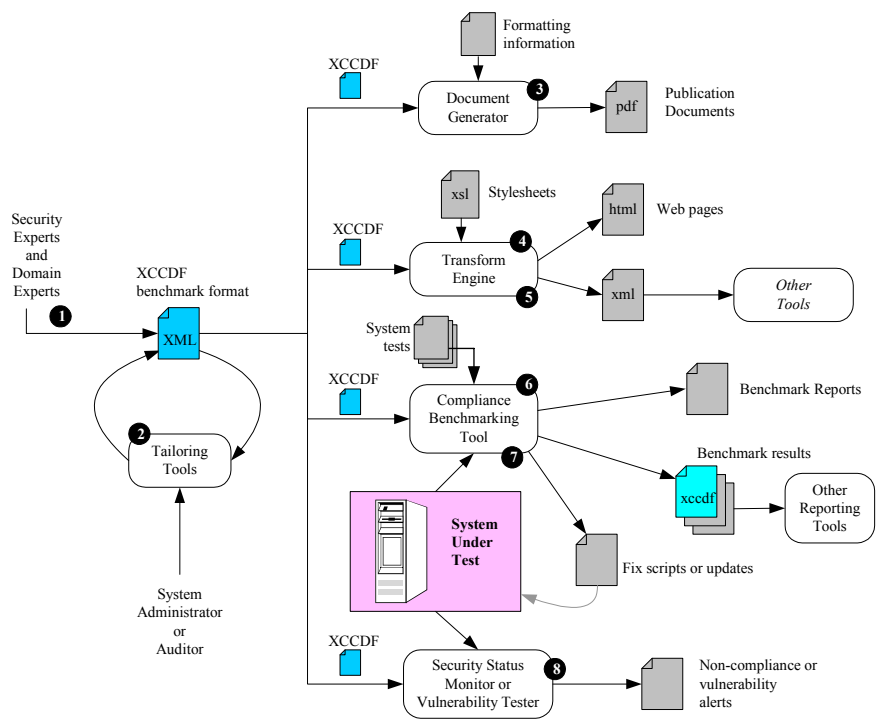
図 1。XCCDF 文書の用途を示す図。1: 「Security Experts and Domain Experts」(セキュリティの専門家と分野の専門家)が「XCCDF benchmark format」(XCCDF ベンチマーク形式)の文書(「XML」)を作成します。2: 「Tailoring Tools」(調整ツール)は「System Administrator or Auditor」(システム管理者または監査人)によって使われ、XML 文書を読み込んで変更します。文書は「XCCDF」として 4 つのツールに渡されます。3: 「Document Generator」(文書生成ツール)は「Formatting information」(書式情報)も受け取り、「pdf」の「Publication Documents」(出版文書)を作成します。4 と 5: 「Transform Engine」(変換エンジン)は「xsl」の「Stylesheets」(スタイルシート)を受け取り、「html」の「Web pages」(Web ページ)を作成し、「Other Tools」(他のツール)に渡す「xml」を作成します。6 と 7: 「Compliance Benchmarking Tool」(準拠性ベンチマークツール)は「System tests」(システムテスト)と「System Under Test」(試験対象システム)からの入力も受け取り、「Benchmark Reports」(ベンチマーク報告書)、「Other Reporting Tools」(他の報告ツール)に渡される「Benchmark results」(「xccdf」)、「System Under Test」に適用される「Fix scripts or updates」(修正スクリプトや更新)を作成します。8: 「Security Status Monitor or Vulnerability Tester」(セキュリティ状態監視ツールまたは脆弱性テスター)は「System Under Test」からの入力も受け取り、「Non-compliance or vulnerability alerts」(非準拠または脆弱性の警告)を作成します。
Figure 1 – Use Cases for XCCDF Documents
図 1 – XCCDF 文書のユースケース
The list below describes some requirements for each of the uses.
以下の一覧は、それぞれの用途に対する要件のいくつかを説明しています。
1.Security and domain experts create a benchmark, which is an organized collection of rules about a particular kind of system or platform. To support this use, XCCDF must be an open, standardized format, amenable to generation and editing with a variety of tools. It must be expressive enough to represent complex conditions and relationships about the systems to be benchmarked, and it must also be able to incorporate descriptive material and remediative measures. (XCCDF benchmarks may include specification of the hardware and/or software platforms to which they apply. The specification should be concrete and granular enough for compliance checking tools to detect whether a rule is suited for a target platform.)
1.セキュリティおよび分野の専門家は、特定の種類のシステムまたはプラットフォームに関するルールを整理して集めたベンチマークを作成します。この用途を支援するため、XCCDF はオープンで標準化された形式であり、さまざまなツールによる生成や編集に適していなければなりません。ベンチマークの対象となるシステムに関する複雑な条件や関係を表現できるだけの表現力を持たなければならず、説明資料および修復措置も取り込めなければなりません。(XCCDF ベンチマークには、適用対象となるハードウェアまたはソフトウェアのプラットフォーム、あるいはその両方の指定を含めてもよいです。この指定は、コンプライアンスチェックツールが、あるルールがターゲットプラットフォームに適しているかどうかを検出できるだけの具体性と粒度を備えているべきです。)
2.Auditors and system administrators may employ tailoring tools to customize a benchmark for their local environment or policies. An XCCDF document must include the structure and interrogative text needed to guide the user in tailoring a benchmark, and it must be able to hold or incorporate the user’s tailoring responses.
2.監査人やシステム管理者は、自らのローカル環境やポリシーに合わせてベンチマークをカスタマイズするために、テーラリングツールを使うことがあります。XCCDF 文書は、ベンチマークのテーラリングを行うユーザーを導くために必要な構造と質問文を含んでいなければならず、ユーザーのテーラリングの回答を保持または取り込めなければなりません。
3.In addition to supporting tailoring and security audits, an XCCDF document should be structured to foster generation of hardcopy benchmark guides.
3.テーラリングとセキュリティ監査の支援に加えて、XCCDF 文書は、紙のベンチマークガイドの生成を促すように構造化されているべきです。
4.The structure of a XCCDF document should support transformation into HTML, for posting the benchmark as a web page.
4.XCCDF 文書の構造は、ベンチマークをウェブページとして公開するための HTML への変換に対応しているべきです。
5.An XCCDF document should be transformable into (other) XML formats, to promote portability and interoperability.
5.XCCDF 文書は、移植性と相互運用性を高めるために、(他の)XML 形式に変換できるべきです。
6.The primary use for an XCCDF benchmark is to drive automated security benchmarking tools. Such tools should accept one or more XCCDF documents, and supporting system test definitions, and check whether their rules are satisfied by some particular target system. The XCCDF document should support generation of a compliance report, including a weighted compliance score.
6.XCCDF ベンチマークの主な用途は、自動化されたセキュリティベンチマークツールを動かすことです。そのようなツールは、1 つ以上の XCCDF 文書とそれを裏付けるシステムテスト定義を受け取り、あるターゲットシステムがそのルールを満たしているかどうかをチェックするべきです。XCCDF 文書は、加重コンプライアンススコアを含むコンプライアンス報告書の生成を支援するべきです。
7.In addition to a benchmark report, some benchmarking tools may be capable of generating scripts or procedures for helping to bring a system into compliance. XCCDF must be able to hold or encapsulate the remediation scripts or texts, including several alternatives.
7.ベンチマークの報告書に加えて、一部のベンチマークツールは、システムをコンプライアンスに適合させる助けとなるスクリプトや手順を生成できる場合があります。XCCDF は、複数の代替案を含め、修復のスクリプトやテキストを保持またはカプセル化できなければなりません。
8.XCCDF documents might also be used in vulnerability scanners, to test whether a target system is vulnerable to a particular kind of attack. For this purpose, the XCCDF document would play the role of a vulnerability alert, but with the ability to both describe the problem and drive automated verification of its presence.
8.XCCDF 文書は、ターゲットシステムが特定の種類の攻撃に対して脆弱かどうかをテストするために、脆弱性スキャナーでも使用される場合があります。この目的では、XCCDF 文書は脆弱性アラートの役割を果たしますが、問題を記述することと、その存在の自動検証を実行させることの両方ができます。
In addition to these use cases, an XCCDF document should be amenable to embedding inside other documents, and to having data expressed in other formats embedded inside of it. Also, as its name implies, XCCDF must be extensible – it must be possible for new functionality and features to be added to XCCDF-capable tools and data for those new features stored in XCCDF without breaking other tools.
これらのユースケースに加えて、XCCDF 文書は、他の文書の内部に埋め込めること、および他の形式で表現されたデータをその内部に埋め込めることに適しているべきです。また、その名称が示すとおり、XCCDF は拡張可能でなければなりません。XCCDF に対応するツールに新しい機能や特徴を追加し、それらの新機能のためのデータを、他のツールを壊すことなく XCCDF に保存できなければなりません。
2.1. Structure and Tailoring Requirements
2.1. 構造とテーラリングの要件
To support tailoring by users, and generation of documents for users, XCCDF must allow authors to impose organization on a benchmark. Benchmark authors will need to arrange rules in order, and collect them into groups.
ユーザーによるテーラリングと、ユーザー向けの文書の生成を支援するため、XCCDF は、作成者がベンチマークに構成を与えられるようにしなければなりません。ベンチマークの作成者は、ルールを順序付け、グループにまとめる必要があります。
For benchmark structure, a benchmark author must be able to designate the order in which rules or groups are to be processed. As the simplest case, processing order can be simply the order in which the rules appear in the XCCDF document.
ベンチマークの構造については、ベンチマークの作成者が、ルールやグループを処理する順序を指定できなければなりません。最も単純な場合、処理順序は、ルールまたはグループが XCCDF 文書に現れる順序そのものです。
For tailoring, values, rules and groups will need descriptive and interrogative text to help a user make tailoring decisions. Two basic kinds of tailoring will be needed:
テーラリングについては、ユーザーが判断を下す助けとなるよう、値、ルール、グループに説明文と質問文が必要になります。必要となる基本的なテーラリングは次の2種類です。
•Selectability – a tailoring action might select or deselect a rule or group of rules for inclusion or exclusion from the benchmark. For example, at a site where no FTP service is used, an auditor might choose to deselect all rules about secure configuration of the FTP server.
•選択可能性 – テーラリングの操作により、ルールまたはルールのグループを、ベンチマークに含めるものとして、あるいは除外するものとして、選択または選択解除できます。たとえば、FTP サービスを使用していないサイトでは、監査人は FTP サーバーの安全な構成に関するルールをすべて選択解除することを選ぶかもしれません。
•Substitution – a tailoring action might substitute a locally-significant value for a general value in a rule. For example, at a site where all logs are sent to a designated logging host, the address of that log server might be substituted into a rule about audit configuration.
•置換 – テーラリングの操作により、ルール内の一般的な値を、そのサイトにとって意味のある値に置き換えられます。たとえば、すべてのログが指定のログ収集ホストに送られるサイトでは、そのログサーバーのアドレスを、監査構成に関するルールに置換することができます。
Once benchmarks can be tailored, the possibility arises that some rules within the same benchmark might conflict or be mutually exclusive. In other words, the author of a benchmark must be able to identify particular tailoring choices as incompatible, so that tailoring tools can take appropriate actions.
ベンチマークをテーラリングできるようになると、同じベンチマーク内の一部のルールが競合したり、相互に排他的になったりする可能性が生じます。つまり、ベンチマークの作成者は、特定のテーラリングの選択肢が両立しないことを示せなければならず、それによってテーラリングツールが適切な処置をとれるようにする必要があります。
In addition to being able to specify rules, XCCDF must support structures that foster use and re-use of rules. To this end, XCCDF must provide a means for related rules to be grouped together, and for sets of rules and groups which should be applied in concert to be designated, named, and applied easily. Two realizations of this notion are benchmark levels, as provided in benchmarks distributed by the Center for Internet Security, and checklist baselines, as described in the NIST security checklist program [11].
ルールを指定できることに加えて、XCCDF は、ルールの利用と再利用を促す構造をサポートしなければなりません。そのため、XCCDF は、関連するルールをまとめてグループ化する手段と、併せて適用すべきルールとグループの集合を指定し、名前を付け、容易に適用できる手段を提供しなければなりません。この考え方の実現例が、Center for Internet Security が配布するベンチマークにあるベンチマークレベルと、NIST セキュリティチェックリストプログラム [11] で説明されているチェックリストベースラインです。
For benchmark processing, there are two basic processing modes: rule checking, and document generation. It must be possible for a benchmark author to designate the modes under which a rule may be processed.
ベンチマークの処理には、ルールチェックと文書生成という 2 つの基本的な処理モードがあります。ベンチマークの作成者は、ルールを処理してもよいモードを指定できなければなりません。
2.2. Inheritance and Inclusion Requirements
2.2. 継承とインクルージョンの要件
To support building up benchmarks from parts, XCCDF must support mechanisms for authors to extend (inherit from) existing rules and rule groups, in addition to expressing rules and groups in their entirety. Also, it must be possible for one benchmark to include all or part of another. There are several benchmarking use cases where inheritance and inclusion will be needed.
部品からベンチマークを組み上げることを支援するため、XCCDF は、ルールやルールグループを丸ごと表現することに加えて、作成者が既存のルールやルールグループを拡張する(それらから継承する)仕組みをサポートしなければなりません。また、あるベンチマークが別のベンチマークの全体または一部を含められなければなりません。継承とインクルージョンが必要になるベンチマークのユースケースがいくつかあります。
•An organization might choose to define a foundational benchmark for a family of platforms (e.g. Unix-like operating systems) and then extend them for specific members of the family (e.g. Solaris) or for specific roles (e.g. mail server).
•組織は、プラットフォームのファミリー(たとえば Unix 系 OS)の基盤となるベンチマークを定義し、それをファミリーの特定のメンバー(たとえば Solaris)や特定の役割(たとえばメールサーバー)向けに拡張することを選ぶ場合があります。
•An analyst might choose to make an extended version of a benchmark, by adding some new rules and adjusting some others.
•アナリストは、新しいルールを追加し、他のルールを調整することで、ベンチマークの拡張版を作成することを選ぶ場合があります。
•If the sets of rules that constitute a benchmark come from several sources, it will be useful to be able to aggregate them using an inclusion mechanism.
•ベンチマークを構成するルールの集合が複数のソースに由来する場合は、インクルージョンの仕組みを使ってそれらを集約できると便利です。
•Within a benchmark, it might be desirable to share some of the descriptive material among several rules. With extension, this can be accomplished by creating a base rule, and then extending it with several different rule checks.
•ベンチマークの中では、説明資料の一部を複数のルールで共有することが望ましい場合があります。拡張を使えば、基底となるルールを作成し、それをさまざまな異なるルールチェックで拡張することで、これを実現できます。
•For updating a benchmark, it will be convenient to be able to incorporate changes or additions using extension.
•ベンチマークを更新する際には、拡張を使って変更や追加を取り込めると便利です。
•To allow broader site-specific or enterprise-specific customization, it should be possible for a user to override or amend any portion of a benchmark rule.
•サイト固有やエンタープライズ固有の、より広範なカスタマイズを可能にするため、ユーザーはベンチマークルールのどの部分でも上書きまたは修正できるべきです。
The XCCDF specification does not include any mechanism for inclusion; instead, implementations of XCCDF tools should support the XML Inclusion (XInclude) facility standardized by the W3C [9].
XCCDF 仕様には、インクルージョンの仕組みは含まれていません。その代わり、XCCDF ツールの実装は、W3C が標準化した XML Inclusion(XInclude)機能 [9] をサポートするべきです。
2.3. Document and Report Formatting Requirements
2.3. 文書と報告書の書式に関する要件
Several of the main use cases for XCCDF benchmarks involve generation of reports or other documents for users to read. Authors will need mechanisms for formatting text, including images, and referencing other information resources. These mechanisms must be separable from the text itself, so that they can be filtered out by applications that do not support them. (XCCDF 1.1 currently satisfies these formatting requirements mainly by allowing inclusion of XHTML markup tags [3].)
XCCDF ベンチマークの主なユースケースのいくつかは、ユーザーが読む報告書やその他の文書の生成を伴います。作成者には、テキストの書式設定、画像の挿入、他の情報資源の参照のための仕組みが必要になります。これらの仕組みは、それに対応しないアプリケーションが取り除けるように、テキスト自体から切り離せなければなりません。(XCCDF 1.1 は現在、主に XHTML のマークアップタグ [3] を含めることを認めることで、これらの書式の要件を満たしています。)
For document formatting, a benchmark must be able to include arbitrary document text that does not contribute directly to the benchmarking process: introduction, rationale, warnings, and references are just some of the uses for extra text. Further, the text must be able to include intra-document and external references and links.
文書の書式設定のために、ベンチマークは、ベンチマーク処理に直接寄与しない任意の文書テキストを含められなければなりません。序文、根拠、警告、参照は、追加テキストの用途のほんの一例です。さらに、そのテキストは、文書内の参照や外部への参照とリンクを含められなければなりません。
2.4. Rule Checking Requirements
2.4. ルールチェックの要件
The primary use for XCCDF will be performing security and operational checks on systems. Therefore, XCCDF must have access to very fine-grained and expressive mechanisms for checking the state of a system against rule criteria. The community seems to have reached an informal consensus that the model for this is to treat the state or configuration of a system as a collection of facts, and to treat expression of conditions and criteria as an operation or combination of operations against the collection. The operations used have varied with different existing applications; some rule checking systems use a database query operation model, while others use a pattern-matching model. At the least, any rule checking mechanism used for XCCDF must satisfy the following criteria:
XCCDF の主な用途は、システムに対するセキュリティ上および運用上のチェックを実行することです。したがって XCCDF は、システムの状態をルールの基準に照らしてチェックするための、非常にきめ細かく表現力のある仕組みを利用できなければなりません。コミュニティでは、そのためのモデルとして、システムの状態や構成をファクトの集合として扱い、条件や基準の表現をその集合に対する操作または操作の組み合わせとして扱うことで、非公式な合意に達しているようです。使われる操作は既存のアプリケーションごとに異なり、ルールチェックシステムの中にはデータベースのクエリ操作モデルを使うものもあれば、パターンマッチングモデルを使うものもあります。少なくとも、XCCDF に使われるあらゆるルールチェックの仕組みは、次の基準を満たさなければなりません。
•It must be able to express both positive and negative criteria - A positive criterion means that if certain conditions are met, then the system satisfies the benchmark, while a negative criterion means if the conditions are met the system fails the benchmark. Experience has shown that both kinds are necessary when crafting security benchmarks.
•肯定的な基準と否定的な基準の両方を表現できなければならない - 肯定的な基準とは、ある条件が満たされればシステムがベンチマークを満たすことを意味し、否定的な基準とは、条件が満たされればシステムがベンチマークを満たさないことを意味します。セキュリティベンチマークを作成する際には、両方の種類が必要であることが経験からわかっています。
•It must be able to express boolean combinations of criteria - It is often impossible to express a high-level security property as a single quantitative or qualitative statement about a system’s state. Therefore, the ability to combine statements with ‘and’ and ‘or’ is critical.
•基準のブール結合を表現できなければならない - 高水準のセキュリティ特性を、システムの状態に関する単一の定量的または定性的な記述として表現することは、しばしば不可能です。したがって、記述を「and」と「or」で結合できることが重要です。
•It must be able to incorporate tailoring values set by the user - As described above, substitution is important for benchmark tailoring. Any XCCDF checking mechanism must support substitution of tailored values into its criteria or statements as well as tailoring of the selected set of rules.
•ユーザーが設定したテーラリング値を取り込めなければならない - 上述のとおり、置換はベンチマークのテーラリングにとって重要です。XCCDF のあらゆるチェックの仕組みは、選択されたルールの集合のテーラリングだけでなく、テーラリングされた値を基準や記述へ置換することもサポートしなければなりません。
It is not clear that a single rule specification scheme can be defined that will satisfy all uses of XCCDF. Therefore, the XCCDF definition must allow for use of different rule checking systems, and a means for identifying the checking system used in each rule. It is important that the rule checking system be defined separately from XCCDF itself, so that they can evolve separately and be used independently when necessary. This further implies the need to cleanly define the interface between XCCDF and the rule checking system, in terms of information passed from each to the other.
XCCDF のあらゆる用途を満たす単一のルール仕様の方式を定義できるかどうかは、明らかではありません。したがって XCCDF の定義は、異なるルールチェックシステムの使用と、各ルールで使われるチェックシステムを識別する手段を許容しなければなりません。ルールチェックシステムは、それぞれが独立して進化し、必要なときに単独で使えるように、XCCDF 自体とは別に定義されることが重要です。これはさらに、互いに受け渡される情報の観点から、XCCDF とルールチェックシステムとの間のインターフェースを明確に定義する必要があることを意味します。
2.5. Test Results Requirements
2.5. テスト結果の要件
A primary goal for XCCDF is to drive automated security testing and benchmark compliance checking tools. While an XCCDF benchmark document may comprise a main input to such a tool, standardized output is also important. XCCDF must provide a means for storing the results of compliance tests. Some of the information that would need to be stored is listed below.
XCCDF の主要な目標は、自動化されたセキュリティテストおよびベンチマークのコンプライアンスチェックツールを動かすことです。XCCDF ベンチマーク文書はそのようなツールの主な入力となりえますが、標準化された出力も重要です。XCCDF は、コンプライアンステストの結果を保存する手段を提供しなければなりません。保存する必要がある情報の一部を以下に挙げます。
•The benchmark used, along with any tailoring applied.
•使用したベンチマークと、適用したテーラリング。
•Information about the target system to which to test was applied, including arbitrary identification and configuration information about the target system.
•テストを適用したターゲットシステムに関する情報。ターゲットシステムに関する任意の識別情報や構成情報を含みます。
•The time interval of the test, and the time instant at which each individual rule was evaluated.
•テストの時間間隔と、個々のルールを評価した時刻。
•One or more compliance scores.
•1 つ以上のコンプライアンススコア。
•References to lower-level details possibly stored in other output files.
•他の出力ファイルに保存されている可能性のある、より低レベルの詳細への参照。
2.6. Metadata and Security Requirements
2.6. メタデータとセキュリティの要件
Security benchmarks are fairly common, and some government and volunteer organizations have disclosed plans to create repositories of benchmarks. To facilitate discovery and retrieval of benchmarks in repositories and on the open Internet, XCCDF must support inclusion of metadata about a benchmark. Some of the metadata that must be supported includes: benchmark title, name of benchmark author(s), organization providing the benchmark, version number, release date, update URL, and a description.
セキュリティベンチマークはかなり一般的であり、政府機関や有志の組織の中には、ベンチマークのリポジトリを作る計画を明らかにしているところもあります。リポジトリやオープンなインターネット上でベンチマークを見つけて取得しやすくするため、XCCDF は、ベンチマークに関するメタデータを含めることをサポートしなければなりません。サポートしなければならないメタデータには、ベンチマークのタイトル、ベンチマークの作成者名、ベンチマークを提供する組織、バージョン番号、公開日、更新 URL、説明などがあります。
A number of metadata standards already exist, it is preferable that XCCDF simply incorporate one of them rather than defining its own metadata model.
メタデータの標準はすでに数多く存在するため、XCCDF は独自のメタデータモデルを定義するのではなく、そのうちの一つをそのまま取り込むことが望ましいです。
Application of a security benchmark is a very sensitive action in the management of an IT system. Therefore, some users may need to verify the integrity and provenance of a benchmark before using it. Also, if system vendors or government agencies define Rules and Groups, they may want to ensure the integrity and authenticity of the information they provide. Digital signatures are the natural mechanism to satisfy these integrity and proof-of-origin requirements. Fortunately, mature standards for digital signatures already exist that are suitable for asserting the authorship and protecting the integrity of benchmarks. XCCDF must provide a means to hold such signatures, and a uniform method for applying and validating them.
セキュリティベンチマークの適用は、IT システムの管理において非常に慎重を要する行為です。したがって、ユーザーによっては、ベンチマークを使用する前に、その完全性と来歴を検証する必要があるかもしれません。また、システムベンダーや政府機関が Rule や Group を定義する場合には、自らが提供する情報の完全性と真正性を確保したいと考えるかもしれません。デジタル署名は、これらの完全性および出所の証明という要件を満たす自然な仕組みです。幸いなことに、ベンチマークの作成者を主張し、完全性を保護するのに適した、成熟したデジタル署名の標準がすでに存在します。XCCDF は、そのような署名を保持する手段と、署名を適用して検証するための統一的な方法を提供しなければなりません。
3. Data Model
3. データモデル
The fundamental data model for XCCDF consists of four main object data types:
XCCDF の基本的なデータモデルは、4 つの主要なオブジェクトのデータ型で構成されます。
1.Benchmark – An XCCDF document holds exactly one Benchmark object. A Benchmark holds descriptive text, and acts as a container for items and other objects.
1.Benchmark – XCCDF 文書は、Benchmark オブジェクトをちょうど 1 つ保持します。Benchmark は説明テキストを保持し、Item やその他のオブジェクトのコンテナとして機能します。
2.Item – An Item is a named constituent of a Benchmark; it has properties for descriptive text, and can be referenced by an id. There are several derived classes of Items.
2.Item – Item は Benchmark を構成する、名前の付いた要素です。説明テキストのためのプロパティを持ち、id によって参照できます。Item にはいくつかの派生クラスがあります。
•Group – This kind of Item can hold other Items. If a Group is unselected, then all of the items it contains are unselected. A Group may be selected or unselected.
•Group – この種類の Item は、他の Item を保持できます。Group が選択解除されると、それが含むすべての Item が選択解除されます。Group は、選択または選択解除のどちらにもなりえます。
•Rule – This kind of Item holds a rule checking definition, a scoring weight, and may also hold remediation text. A Rule may be selected or unselected.
•Rule – この種類の Item は、ルールチェックの定義とスコアリングの重みを保持し、修復テキストも保持できます。Rule は、選択または選択解除のどちらにもなりえます。
•Value – This kind of Item is a named data value that can be substituted into other Item’s property values. It can also have an associated data type and operator that expresses how the value should be used and how it can be tailored.
•Value – この種類の Item は、他の Item のプロパティ値に置換できる、名前の付いたデータ値です。また、その値をどのように使い、どのようにテーラリングできるかを表す、関連付けられたデータ型と演算子を持つこともできます。
3.Profile – A profile is a collection of attributed references to Rule, Group, and Value objects. It supports the requirement to allow definition of named levels or baselines in a benchmark (see Section 2.1).
3.Profile – プロファイルは、Rule、Group、Value の各オブジェクトに対する属性付きの参照の集まりです。これは、ベンチマークの中で名前付きのレベルやベースラインを定義できるようにするという要件(第 2.1 節を参照)を支援します。
4.TestResult – A test result object holds the results of performing a compliance test against a single target device or system.
4.TestResult – テスト結果オブジェクトは、単一のターゲットデバイスまたはシステムに対してコンプライアンステストを実施した結果を保持します。
Figure 2, below, shows the data model relationships as a UML diagram.
次の図 2 は、データモデルの関係を UML 図で示しています。
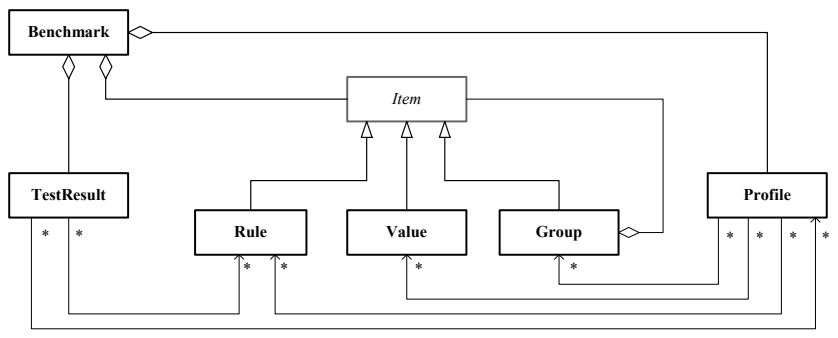
図 2 です。UML のクラス図です。「Benchmark」から「TestResult」「Item」「Profile」への集約(Benchmark 側に白抜きのひし形)があります。斜体の「Item」(抽象クラス)は「Rule」「Value」「Group」を汎化したものです(Item 側に白抜きの三角の矢印)。「Group」から「Item」への集約(Group 側に白抜きのひし形)もあります。両端の多重度が「*」の向きのある関連が、TestResult から Rule と Profile へ、Profile から Rule、Value、Group へ引かれています。
Figure 2 –XCCDF High-Level Data Model
図 2 – XCCDF の高水準データモデル
As shown in Figure 2, one Benchmark can hold many Items, but each Item belongs to exactly one Benchmark. Similarly, a Group can hold many Items, but an Item may belong to only one Group. Thus, the Items in a benchmark form a tree, where the root node is the Benchmark, interior nodes are Groups, and the leaves are Values and Rules.
図 2 に示すように、1 つの Benchmark は多くの Item を保持できますが、各 Item はちょうど 1 つの Benchmark に属します。同様に、Group は多くの Item を保持できますが、Item は 1 つの Group にのみ属することができます。したがって、ベンチマーク内の Item は木構造をなし、ルートノードが Benchmark、内部ノードが Group、葉が Value と Rule になります。
A Profile object references Rule, Value, and Group objects. A TestResult object references Rule objects, and may also reference a Profile object.
Profile オブジェクトは、Rule、Value、Group の各オブジェクトを参照します。TestResult オブジェクトは Rule オブジェクトを参照し、Profile オブジェクトも参照する場合があります。
The definition of a Value, Rule, or Group can extend another Value, Rule, or Group. The extending item inherits property values from the extended item. This extension mechanism is separate and independent of grouping.
Value、Rule、Group の定義は、別の Value、Rule、Group を拡張できます。拡張する Item は、拡張される Item からプロパティ値を継承します。この拡張の仕組みは、グループ化とは別個で独立しています。
Group and Rule items can be marked by a benchmark author as selected or unselected. A Group or Rule that is not selected does not undergo processing. The author may also stipulate, for a Group, Rule, or Value, whether the end user is permitted to tailor it.
Group と Rule の Item は、ベンチマークの作成者が選択または選択解除としてマークできます。選択されていない Group や Rule は処理されません。作成者はまた、Group、Rule、Value について、エンドユーザーがそれをテーラリングしてよいかどうかを定めることもできます。
Rule items may have a scoring weight associated with them, which can be used by a benchmark checking tool to compute a target system’s overall compliance score. Rule items may also hold remediation information.
Rule の Item には、スコアリングの重みを関連付けることができ、ベンチマークをチェックするツールは、これを使ってターゲットシステムの総合的なコンプライアンススコアを計算できます。Rule の Item は、修復情報も保持できます。
Value items include information about current, default, and permissible values for the Value. Each of these properties of a Value can have an associated selector id, which is used when customizing the Value as part of a Profile. For example, a Value might be used to hold a Benchmark’s lower limit for password length on some operating system. In a Profile for that operating system to be used in a closed lab, the default value might be 5, but in a Profile for that operating system to be used on the Internet, the default value might be 10.
Value の Item には、その Value の現在値、デフォルト値、許容値に関する情報が含まれます。Value のこれらの各プロパティには、セレクター id を関連付けることができ、これは Profile の一部として Value をカスタマイズする際に使われます。たとえば、ある OS におけるベンチマークのパスワード長の下限を保持するために、Value を使うことがあります。閉じたラボで使われるその OS 向けの Profile ではデフォルト値が 5 で、インターネット上で使われるその OS 向けの Profile ではデフォルト値が 10 になる、といったことが考えられます。
3.1. Benchmark Structure
3.1. ベンチマークの構造
Typically, a Benchmark would hold one or more Groups, and each group would hold some Rules, Values, and additional child Groups. Figure 3 illustrates this relationship, and the order in which the contents of a Benchmark must appear.
通常、Benchmark は 1 つ以上の Group を保持し、各グループは複数の Rule、Value、およびさらなる子 Group を保持します。図 3 は、この関係と、Benchmark の内容が現れなければならない順序を示しています。
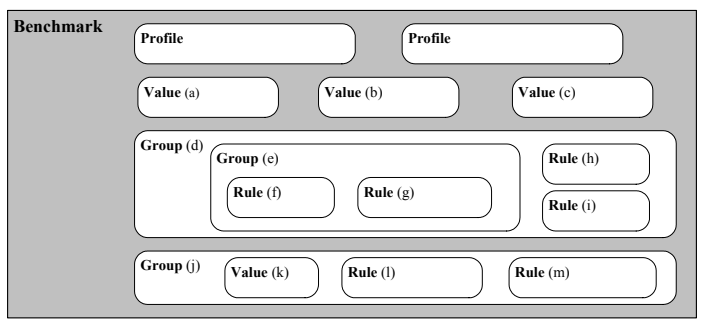
図 3 です。「Benchmark」と記された灰色の枠の中に、入れ子の箱が並んでいます。Benchmark の中には、2 つの「Profile」、「Value (a)」「Value (b)」「Value (c)」、「Group (d)」、「Group (j)」があります。「Group (d)」は「Group (e)」(「Rule (f)」と「Rule (g)」を含む)、「Rule (h)」、「Rule (i)」を含み、「Group (j)」は「Value (k)」「Rule (l)」「Rule (m)」を含みます。
Figure 3 – Typical Structure of a Benchmark
図 3 – Benchmark の典型的な構造
Groups allow a benchmark author to collect related rules and values into a common structure and provide descriptive text and references about them. Further, groups allow benchmark users to select and deselect related rules together, helping to ensure commonality among users of the same benchmark. Lastly, groups affect benchmark compliance scoring. As explained in Section 3.3, an XCCDF compliance score is calculated for each group, based on the rules and sub-groups in it. The overall XCCDF score for the benchmark is computed only from the scores on the immediate Group and Rule children of the Benchmark object. In the tiny benchmark shown in Figure 3, the benchmark score would be computed from the scores of Group (d) and Group (j). The score for Group (j) would be computed from Rule (l) and Rule (m).
グループにより、ベンチマークの作成者は、関連するルールと値を共通の構造にまとめ、それらについての説明文や参照情報を提供できます。さらに、グループにより、ベンチマークのユーザーは関連するルールをまとめて選択または選択解除でき、同じベンチマークのユーザー間での共通性を確保しやすくなります。最後に、グループはベンチマークのコンプライアンススコアリングに影響します。第 3.3 節で説明するように、XCCDF のコンプライアンススコアは、各グループについて、その中のルールとサブグループに基づいて計算されます。ベンチマーク全体の XCCDF スコアは、Benchmark オブジェクトの直下の Group と Rule の子のスコアだけから計算されます。図 3 に示す小さなベンチマークでは、ベンチマークのスコアは Group (d) と Group (j) のスコアから計算されます。Group (j) のスコアは、Rule (l) と Rule (m) から計算されます。
Inheritance
継承
The possible inheritance relations between Item object instances are constrained by the tree structure of the benchmark, but are otherwise independent of it. In other words, all extension relationships must be resolved before the benchmark can be used for compliance testing. An Item may only extend another Item of the same type that is ‘visible’ from its scope. An Item X is visible from another Item Y if and only if it meets one of the following conditions: (1) X and Y are siblings, (2) X is a sibling of some enclosing group of Y, or (3) X is visible to the scope of the direct children of any group extended by any enclosing group of Y.
Item オブジェクトのインスタンス間で成り立ちうる継承関係は、ベンチマークの木構造による制約を受けますが、それ以外ではそれとは独立しています。つまり、ベンチマークをコンプライアンステストに使用する前に、すべての拡張関係を解決しなければなりません。Item は、自らのスコープから「見える」、同じ型の別の Item だけを拡張できます。Item X が別の Item Y から見えるのは、次のいずれかの条件を満たす場合に限られます。(1) X と Y が兄弟である、(2) X が Y を囲む何らかのグループの兄弟である、(3) X が、Y を囲むいずれかのグループによって拡張されたグループの直接の子のスコープから見えます。
For example, in the tiny benchmark structure shown in Figure 3, it would be legal for Rule (g) to extend Rule (f), and legal for Rule (f) to extend Rule (h). It would not be legal for Rule (i) to extend Rule (m), because (m) is not visible from the scope of (i). It would not be legal for Rule (l) to extend Group (g), because they are not of the same type.
たとえば、図 3 に示す小さなベンチマーク構造では、Rule (g) が Rule (f) を拡張することは正当であり、Rule (f) が Rule (h) を拡張することも正当です。Rule (i) が Rule (m) を拡張することは正当ではありません。(m) が (i) のスコープから見えないためです。Rule (l) が Group (g) を拡張することも正当ではありません。両者は同じ型ではないためです。
The ability for a Rule or Benchmark to be extended by another is a convenience for benchmark authors.
Rule や Benchmark を別のものが拡張できる機能は、ベンチマークの作成者にとっての利便性のためのものです。
3.2. Object Detailed Contents
3.2. オブジェクトの詳細な内容
The tables below show the properties that make up each data type in the XCCDF data model. Note that the properties that comprise a Benchmark or Item are an ordered sequence of property values, and the order in which they appear determines the order in which they are processed.
以下の表は、XCCDF データモデルの各データ型を構成するプロパティを示しています。Benchmark や Item を構成するプロパティは、順序付けられたプロパティ値の並びであり、現れる順序が処理される順序を決定することに注意してください。
Properties with a data type of “text” are string data that can include embedded formatting directives and hypertext links. Properties of type “string” may not include formatting.
データ型が「text」のプロパティは、埋め込みの書式指示とハイパーテキストリンクを含められる文字列データです。「string」型のプロパティは、書式を含めてはなりません。
Benchmark
Benchmark
| Property | Type | Count | Description |
|---|---|---|---|
| id | identifier | 1 | benchmark identifier, mandatory |
| title | text | 0-n | title of the benchmark document |
| description | text | 0-n | text that describes the benchmark |
| version | string | 1 | version number of the benchmark |
| status | string+date | 1-n | status of the benchmark (see below) and date at which it attained that status, mandatory. |
| resolved | boolean | 0-1 | True if benchmark has already undergone the resolution process (see Section 3.3) |
| notice | text | 0-n | legal notices or copyright statements about this benchmark; each notice has a unique identifier and text value. |
| front-matter | text | 0-n | text for the front of the benchmark document |
| rear-matter | text | 0-n | text for the back of the benchmark document |
| reference | special | 0-n | A bibliographic reference for the benchmark document: metadata or a simple string, plus an optional URL. |
| platform-definitions | special | 0-1 | A list of component definitions and platform definitions, each with an id. |
| platform | id | 0-n | target platform(s) for this benchmark; this property may appear multiple times. The id refers to a platform definition. |
| plain-text | string+id | 0-n | Reusable text blocks, each with a unique id. These can be included into other text blocks in the benchmark. |
| model | URI | 0-n | Suggested scoring model or models to be used when computing a compliance score for this benchmark; optional. |
| profiles | Profile | 0-n | Profiles that reference and customize sets of items in the Benchmark; optional |
| values | Value | 0-n | Tailoring values that support rules and descriptions in the benchmark |
| groups | Group | 0-n | Groups that comprise the benchmark, each group may contain additional values, groups, and rules. |
| rules | Rule | 0-n | Rules that comprise the benchmark |
| test-results | TestResult | 0-n | Benchmark test result records (one per test); optional |
| metadata | special | 0-n | Discovery metadata for the benchmark (e.g. compliant with Dublin Core Metadata Initiative XML guidelines) |
| signature | special | 0-1 | Digital signatures asserting authorship and allowing verification of the integrity of the benchmark, optional |
| プロパティ | 型 | 個数 | 説明 |
|---|---|---|---|
| id | identifier | 1 | ベンチマークの識別子。必須 |
| title | text | 0-n | ベンチマーク文書のタイトル |
| description | text | 0-n | ベンチマークを説明するテキスト |
| version | string | 1 | ベンチマークのバージョン番号 |
| status | string+date | 1-n | ベンチマークのステータス(下記を参照)と、そのステータスに達した日付。必須。 |
| resolved | boolean | 0-1 | ベンチマークがすでに解決処理(第 3.3 節を参照)を経ている場合は True |
| notice | text | 0-n | このベンチマークに関する法的通知または著作権表示。各通知は一意の識別子とテキスト値を持ちます。 |
| front-matter | text | 0-n | ベンチマーク文書の冒頭に置くテキスト |
| rear-matter | text | 0-n | ベンチマーク文書の末尾に置くテキスト |
| reference | special | 0-n | ベンチマーク文書の文献参照。メタデータまたは単純な文字列に、任意の URL を加えたもの。 |
| platform-definitions | special | 0-1 | コンポーネント定義とプラットフォーム定義のリスト。それぞれに id を持ちます。 |
| platform | id | 0-n | このベンチマークの対象プラットフォーム。このプロパティは複数回現れてもよいです。id はプラットフォーム定義を参照します。 |
| plain-text | string+id | 0-n | 再利用可能なテキストブロック。それぞれに一意の id を持ちます。これらは、ベンチマーク内の他のテキストブロックに含めることができます。 |
| model | URI | 0-n | このベンチマークのコンプライアンススコアを計算する際に使うことが推奨されるスコアリングモデル。任意。 |
| profiles | Profile | 0-n | Benchmark 内の Item の集合を参照し、カスタマイズする Profile。任意 |
| values | Value | 0-n | ベンチマーク内のルールと説明を支えるテーラリング値 |
| groups | Group | 0-n | ベンチマークを構成する Group。各グループは、さらに値、グループ、ルールを含んでもよいです。 |
| rules | Rule | 0-n | ベンチマークを構成する Rule |
| test-results | TestResult | 0-n | ベンチマークのテスト結果記録(テストごとに 1 つ)。任意 |
| metadata | special | 0-n | ベンチマークの発見用メタデータ(たとえば Dublin Core Metadata Initiative の XML ガイドラインに準拠したもの) |
| signature | special | 0-1 | 作成者を主張し、ベンチマークの完全性を検証できるようにするデジタル署名。任意 |
Conceptually, a Benchmark contains Group, Rule, and Value objects, and it may also contain Profile and TestResult objects. For ease of reading and simplicity of scoping, all Value objects must precede all Groups and Rules, which must precede all Profiles, which must precede all TestResults. These objects may be directly embedded in the Benchmark, or incorporated via W3C standard XML Inclusion [9].
概念上、Benchmark は Group、Rule、Value の各オブジェクトを含み、Profile と TestResult の各オブジェクトも含む場合があります。読みやすさとスコープの単純さのため、すべての Value オブジェクトはすべての Group と Rule より前になければならず、Group と Rule はすべての Profile より前、Profile はすべての TestResult より前になければなりません。これらのオブジェクトは、Benchmark に直接埋め込むことも、W3C 標準の XML Inclusion [9] によって取り込むこともできます。
The platform-definitions property consists of platform descriptions, each with a unique id. Benchmark, Group, Rule, and Profile objects may have platform properties that identify the hardware and/or software products to which they apply. The Benchmark platform-definitions and platform properties are optional. Benchmark authors should use them to identify the systems or products to which their benchmarks apply. For more information about platform specification, consult [12].
platform-definitions プロパティは、それぞれが一意の id を持つプラットフォームの記述で構成されます。Benchmark、Group、Rule、Profile の各オブジェクトは、それらが適用されるハードウェアまたはソフトウェアの製品(あるいはその両方)を識別する platform プロパティを持つことができます。Benchmark の platform-definitions プロパティと platform プロパティは任意です。ベンチマークの作成者は、自らのベンチマークが適用されるシステムや製品を識別するために、これらを使うべきです。プラットフォームの指定について詳しくは [12] を参照してください。
Each status property consists of a status string and a date. Permissible string values are “accepted”, “draft”, “interim”, “incomplete”, and “deprecated”. Benchmark authors should mark their benchmarks with a status to indicate a level of maturity or consensus. A Benchmark may contain one or more status property values, for different status values.
各 status プロパティは、ステータスの文字列と日付で構成されます。許容される文字列値は「accepted」「draft」「interim」「incomplete」「deprecated」です。ベンチマークの作成者は、成熟度や合意の水準を示すために、自らのベンチマークにステータスを付けるべきです。Benchmark は、異なるステータス値について、1 つ以上の status プロパティ値を含むことができます。
Benchmark metadata allows authorship, publisher, support, and other information to be embedding a benchmark. Metadata should comply with existing commercial or government metadata specifications, to allow benchmarks to be discovered and indexed. The XCCDF data model allows multiple metadata properties for a Benchmark; each property should provide metadata compliant with a different specification. The primary metadata format, which should appear in all published benchmarks, is the simple Dublin Core Elements specification, as documented in [13].
ベンチマークのメタデータにより、作成者、発行者、サポート、その他の情報をベンチマークに埋め込めるようになります。ベンチマークを見つけて索引付けできるようにするため、メタデータは既存の商用または政府のメタデータ仕様に準拠するべきです。XCCDF のデータモデルでは、Benchmark に複数の metadata プロパティを持たせることができ、各プロパティは異なる仕様に準拠したメタデータを提供するべきです。公開されるすべてのベンチマークに現れるべき主要なメタデータ形式は、[13] に記載されている、単純な Dublin Core Elements 仕様です。
The plain-text properties, new in XCCDF 1.1, allow commonly used text to be defined once and then re-used in multiple text blocks in the benchmark. Note that each plain-text must have a unique id, and that the ids of other Items and plain-text properties must not collide. [This restriction is imposed to permit easier implementation of document generation and reporting tools.]
XCCDF 1.1 で新しく追加された plain-text プロパティにより、よく使われるテキストを一度定義し、ベンチマーク内の複数のテキストブロックで再利用できます。各 plain-text は一意の id を持たなければならず、他の Item や plain-text プロパティの id と衝突してはならないことに注意してください。[この制限は、文書生成ツールや報告書生成ツールの実装を容易にするために課されています。]
Note that a digital signature, if any, applies only to the Object in which it appears, but after inclusion processing (note: it may be impractical to use inclusion and signatures together). Any digital signature format employed for XCCDF benchmarks must be capable of identifying the signer, storing all information needed to verify the signature (usually, a certificate or certificate chain), and detecting any change to the content of the benchmark. XCCDF tools that support signatures at all must support the W3C XML-Signature standard enveloped signatures [8].
デジタル署名がある場合、それが適用されるのは、その署名が現れるオブジェクトだけであり、しかもインクルージョン処理の後であることに注意してください(注: インクルージョンと署名を併用するのは現実的でない場合があります)。XCCDF ベンチマークに採用するデジタル署名の形式は、署名者を識別でき、署名の検証に必要なすべての情報(通常は証明書または証明書チェーン)を格納でき、ベンチマークの内容に対する変更を検出できなければなりません。署名をサポートする XCCDF ツールは、W3C XML-Signature 標準の enveloped 署名 [8] をサポートしなければなりません。
Legal notice text is handled specially, as discussed in Section 3.3.
法的通知のテキストは、第 3.3 節で説明するように、特別に扱われます。
Item (abstract)
Item(抽象)
| Property | Type | Count | Description |
|---|---|---|---|
| id | identifier | 1 | unique object identifier, mandatory |
| title | text | 0-n | title of the Item (for human readers) |
| description | text | 0-n | text that describes the Item |
| warning | text | 0-n | a cautionary note or caveat about the Item |
| status | string+date | 0-n | status of the item and date at which it attained that status (optional) |
| version | string+date | 0-1 | version number of this item, and update URI (optional) |
| question | string | 0-n | interrogative text to present to the user during tailoring (optional) |
| cluster-id | identifier | 0-1 | an identifier to be used from a Profile to refer to multiple Groups and Rules, optional |
| hidden | boolean | 0-1 | whether this Item should be excluded from any generated documents (default: false) |
| prohibitChanges | boolean | 0-1 | whether tools should prohibit changes to this item during tailoring (default: false) |
| abstract | boolean | 0-1 | if true, then this Item is abstract and exists only to be extended (default: false) |
| reference | special | 0-n | a reference to a document or resource where the user can learn more about the subject of this Item: content is Dublin Core metadata or a simple string, plus an optional URL |
| signature | special | 0-1 | digital signature over this Item, optional |
| プロパティ | 型 | 個数 | 説明 |
|---|---|---|---|
| id | identifier | 1 | 一意のオブジェクト識別子。必須 |
| title | text | 0-n | Item のタイトル(人間の読み手向け) |
| description | text | 0-n | Item を説明するテキスト |
| warning | text | 0-n | Item に関する注意書きまたは但し書き |
| status | string+date | 0-n | Item のステータスと、そのステータスに達した日付(任意) |
| version | string+date | 0-1 | この Item のバージョン番号と更新 URI(任意) |
| question | string | 0-n | テーラリングの際にユーザーに提示する質問文(任意) |
| cluster-id | identifier | 0-1 | Profile から複数の Group や Rule を参照するために使う識別子。任意 |
| hidden | boolean | 0-1 | この Item を、生成されるすべての文書から除外するかどうか(デフォルト: false) |
| prohibitChanges | boolean | 0-1 | テーラリングの際に、ツールがこの Item への変更を禁止すべきかどうか(デフォルト: false) |
| abstract | boolean | 0-1 | true の場合、この Item は抽象であり、拡張されるためだけに存在する(デフォルト: false) |
| reference | special | 0-n | ユーザーがこの Item の主題についてさらに学べる文書または資源への参照。内容は Dublin Core メタデータまたは単純な文字列に、任意の URL を加えたもの |
| signature | special | 0-1 | この Item に対するデジタル署名。任意 |
There are several Item properties that give the benchmark author control over how items may be tailored and presented in documents. First, the hidden property simply prevents an Item from appearing in generated documents. For example, an author might set the hidden property on incomplete items in a draft benchmark. The prohibitChanges property advises tailoring tools that the benchmark author does not wish to allow end users to change anything about the Item. Lastly, a value of true for the abstract property denotes an item intended only for other items to extend. In many all cases, abstract items should also be hidden.
Item には、ベンチマークの作成者が、Item のテーラリングの仕方や文書での提示の仕方を制御できるようにするプロパティがいくつかあります。まず、hidden プロパティは、Item が生成される文書に現れないようにするだけのものです。たとえば作成者は、ドラフトのベンチマークで未完成の Item に hidden プロパティを設定することがあります。prohibitChanges プロパティは、ベンチマークの作成者がエンドユーザーにその Item のいかなる変更も許可したくないことを、テーラリングツールに知らせます。最後に、abstract プロパティの値が true であることは、他の Item に拡張されることだけを意図した Item を示します。多くの場合、抽象 Item は hidden にもするべきです。
The cluster-id property is optional, but it provides a means to identify related Value, Group and Rule items throughout the Benchmark. Cluster-id values do not need to be unique: all the Items with the same cluster-id value belong to the same cluster. A selector in a Profile can refer to a cluster, thus making it easier for authors to create and maintain profiles in a complex benchmark. The cluster-id property is not inherited (see page 30).
cluster-id プロパティは任意ですが、Benchmark 全体にわたって、関連する Value、Group、Rule の Item を識別する手段を提供します。Cluster-id の値は一意である必要はなく、同じ cluster-id 値を持つすべての Item は、同じクラスターに属します。Profile のセレクターはクラスターを参照できるため、作成者は複雑なベンチマークでプロファイルを容易に作成し保守できます。cluster-id プロパティは継承されません(30 ページを参照)。
Every Item may include one or more status properties. Each status property value represents a status that the Item has reached and the date at which it reached that status. Benchmark authors can use status elements to record the maturity or consensus level for Rules, Groups, and Values in the Benchmark. If an Item does not have an explicit status property value given, then its status is taken to be that of the Benchmark itself. The status property is not inherited (see page 30).
すべての Item は、1 つ以上の status プロパティを含むことができます。各 status プロパティ値は、その Item が到達したステータスと、そのステータスに到達した日付を表します。ベンチマークの作成者は、status 要素を使って、Benchmark 内の Rule、Group、Value の成熟度や合意の水準を記録できます。Item に明示的な status プロパティ値が与えられていない場合、その Item のステータスは Benchmark 自体のステータスとみなされます。status プロパティは継承されません(30 ページを参照)。
Group :: Item
Group :: Item
| Property | Type | Count | Description |
|---|---|---|---|
| requires | identifier | 0-n | the id of another Group or Rule in the benchmark that must be selected for this Group to be applied and scored properly |
| conflicts | identifier | 0-n | the id of another Group or Rule in the benchmark that must be unselected for this Group to be applied and scored properly |
| selected | boolean | 1 | whether this Group is currently selected for processing, default is true. This property may be overridden by a Profile. |
| rationale | text | 0-n | descriptive text giving rationale or motivations for abiding by this Group |
| platform | identifier | 0-n | A platform to which this Group applies, a reference to a platform-definition (see [12]) |
| cluster-id | identifier | 0-1 | an identifier to be used from benchmark profiles to refer to multiple Groups and Rules, optional |
| extends | identifier | 0-1 | id of a Group on which to base this Group, optional |
| weight | float | 0-1 | the relative scoring weight of this Group, for computing a compliance score |
| values | Value | 0-n | Values that belong to this Group, optional |
| groups | Group | 0-n | Sub-groups under this Group, optional |
| rules | Rule | 0-n | Rules that belong to this Group, optional |
| プロパティ | 型 | 個数 | 説明 |
|---|---|---|---|
| requires | identifier | 0-n | この Group を適切に適用しスコア化するために、選択されていなければならない、ベンチマーク内の別の Group または Rule の id |
| conflicts | identifier | 0-n | この Group を適切に適用しスコア化するために、選択解除されていなければならない、ベンチマーク内の別の Group または Rule の id |
| selected | boolean | 1 | この Group が現在、処理対象として選択されているかどうか。デフォルトは true。このプロパティは Profile によって上書きされる場合があります。 |
| rationale | text | 0-n | この Group を遵守する根拠や動機を示す説明テキスト |
| platform | identifier | 0-n | この Group が適用されるプラットフォーム。platform-definition への参照([12] を参照) |
| cluster-id | identifier | 0-1 | ベンチマークの Profile から複数の Group や Rule を参照するために使う識別子。任意 |
| extends | identifier | 0-1 | この Group の基にする Group の id。任意 |
| weight | float | 0-1 | コンプライアンススコアを計算するための、この Group の相対的なスコアリングの重み |
| values | Value | 0-n | この Group に属する Value。任意 |
| groups | Group | 0-n | この Group の下にあるサブグループ。任意 |
| rules | Rule | 0-n | この Group に属する Rule。任意 |
A Group can be based on (extend) another Group. This means that the extending Group includes all the Items of the extended Group, plus any defined inside the extending Group. Other properties behave differently, depending on their allowed count. For any property that is allowed to appear more than once, the extending Group gets the sequence of property values from the extended group, plus any of its own values for that property. For any property that is allowed to appear at most once, the extending Group gets its own value for the property if one appears, otherwise it gets the extended Group’s value of that property. Items that belong to an extended group are treated specially: the id property of any Item copied as part of an extended group must be replaced with a new, uniquely generated id. A Group for which the abstract property is true exists only to be extended by other Groups, it should never appear in a generated document and none of the Rules defined in it should be checked in a compliance test. Abstract Group objects are removed during resolution, for more information see Section 3.3.
Group は、別の Group に基づくことができます(拡張)。これは、拡張する Group が、拡張される Group のすべての Item に加えて、拡張する Group の内部で定義された Item も含むことを意味します。その他のプロパティは、許容される個数に応じて、異なる動作をします。複数回現れてもよいプロパティについては、拡張する Group は、拡張される Group のプロパティ値の並びに、そのプロパティについて自身が持つ値を加えたものを得ます。多くとも 1 回しか現れてはならないプロパティについては、拡張する Group は、自身の値があればそれを得て、なければ拡張される Group のそのプロパティの値を得ます。拡張される Group に属する Item は特別に扱われます。拡張される Group の一部としてコピーされた Item の id プロパティは、新たに一意に生成された id に置き換えなければなりません。abstract プロパティが true の Group は、他の Group に拡張されるためだけに存在し、生成される文書には決して現れるべきではなく、その中で定義されている Rule はコンプライアンステストでチェックされるべきではありません。抽象 Group オブジェクトは解決の際に取り除かれます。詳しくは第 3.3 節を参照してください。
To give the benchmark author more control over inheritance for extending Groups (and other XCCDF objects), all textual properties that may appear more than once can bear an override attribute. For more information about inheritance overrides and extension, see Section 3.3.
拡張する Group(およびその他の XCCDF オブジェクト)の継承について、ベンチマークの作成者がより細かく制御できるように、複数回現れてもよいすべてのテキストプロパティは、override 属性を持つことができます。継承の上書きと拡張について詳しくは、第 3.3 節を参照してください。
The platform property of a Group indicates that the Group contains platform-specific items that apply to some set of (usually related) platforms. First, if a Group does not possess any platform properties, then it applies to the same set of platforms as its enclosing Group or the Benchmark. Second, for tools that perform compliance checking on a platform, any Group whose set of platform property values do not include the platform on which the compliance check is being performed should be treated as if their selected property were set to false. Third, any platform property value that appears on a Group should be a member of the set of platform property values of the enclosing Benchmark. Last, if no platform properties appear anywhere on a Group or its enclosing Group or Benchmark, then the Group applies to all platforms.
Group の platform プロパティは、その Group が、(通常は関連する)あるプラットフォーム集合に適用されるプラットフォーム固有の Item を含むことを示します。第一に、Group が platform プロパティを持たない場合、その Group は、それを囲む Group または Benchmark と同じプラットフォーム集合に適用されます。第二に、プラットフォーム上でコンプライアンスチェックを行うツールについては、platform プロパティ値の集合に、コンプライアンスチェックを実行しているプラットフォームが含まれない Group は、selected プロパティが false に設定されているものとして扱うべきです。第三に、Group に現れる platform プロパティ値は、それを囲む Benchmark の platform プロパティ値の集合の要素であるべきです。最後に、Group にも、それを囲む Group や Benchmark にも platform プロパティが現れない場合、その Group はすべてのプラットフォームに適用されます。
The weight property denotes the importance of a Group relative to its sibling in the same Group or its siblings in the Benchmark (for a Rule that is a child of the Benchmark). Scoring is computed independently for each collection of sibling Groups and Rules, then normalized as part of the overall scoring process. For more information about scoring, see Section 3.3.
weight プロパティは、同じ Group 内の兄弟、または Benchmark 内の兄弟(Benchmark の子である Rule の場合)に対する、Group の重要度を示します。スコアリングは、兄弟関係にある Group と Rule の集まりごとに独立して計算され、その後、全体のスコアリング処理の一部として正規化されます。スコアリングについて詳しくは、第 3.3 節を参照してください。
The requires and conflicts properties provide a means for benchmark authors to express dependencies among Rules and Groups. Their exact meaning depends on what sort of processing the benchmark is undergoing, but in general the following approach should be applied: if a Rule or Group is about to be processed, and any of the Rules or Groups identified in a requires property have a selected property value of false or any of the Items identified in a conflicts property have a selected property value of true, then processing for the item should be skipped and its selected property should be set to false.
requires プロパティと conflicts プロパティは、ベンチマークの作成者が Rule と Group の間の依存関係を表現する手段を提供します。その正確な意味は、ベンチマークがどのような処理を受けているかによって決まりますが、一般には次の方法を適用するべきです。Rule または Group がこれから処理されるときに、requires プロパティで識別されたいずれかの Rule または Group の selected プロパティ値が false である場合、または conflicts プロパティで識別されたいずれかの Item の selected プロパティ値が true である場合は、その Item の処理を飛ばし、その selected プロパティを false に設定するべきです。
Rule :: Item
Rule :: Item
| Property | Type | Count | Description |
|---|---|---|---|
| selected | boolean | 1 | If true, this Rule is selected to be checked as part of the benchmark when the benchmark is applied to a target system; an unselected rule is not get checked and does not contribute to scoring. Can be overridden by a Profile. |
| extends | id | 0-1 | The id of a Rule on which to base this Rule (must match the id of another Rule) |
| multiple | boolean | 0-1 | Whether this rule should be multiple instantiated. If false, then benchmark tools should avoid multiply instantiating this Rule. |
| role | string | 0-1 | Rule’s role in scoring and reporting; one of the following: “full”, “unscored”, “unchecked”. Can be overridden by a Profile. |
| severity | string | 0-1 | Severity level code, to be used for metrics & tracking. One of the following: “unknown” (default), “info”, “low”, “medium”, “high”. Can be overridden by a Profile. |
| weight | float | 0-1 | The relative scoring weight of this Rule, for computing a compliance score. Can be overridden by a Profile. |
| rationale | text | 0-n | Some descriptive text giving rationale or motivations for complying with this Rule. |
| platform | identifier | 0-n | A platform to which this Rule applies, a reference to a platform-definition (see [12]). |
| requires | identifier | 0-n | The id of another Group or Rule in the benchmark that should be selected for this Rule to be applied and scored properly. |
| conflicts | identifier | 0-n | The id of another Group or Rule in the benchmark that should be unselected for this Rule to applied and scored properly. |
| ident | string+URI | 0-n | A long-term, globally meaningful name for this Rule. May be the name or identifier of a security configuration issue or vulnerability that the Rule remediates. Has an associated URI that denotes the organization or naming scheme which assigns the name. |
| profile-note | text + id | 0-n | Descriptive text related to a particular Profile. This property allows a benchmark author to describe special aspects of the Rule related to one or more Profiles. It has an id that can be specified as part of a Profile. |
| fixtext | text+attrs | 0-n | Prose that describes how to fix the problem of non-compliance with this rule. Each fixtext property may be associated with one or more fix property values. |
| fix | text+attrs | 0-n | A command string, script, or other system modification statement that, if executed on the target system, can bring it into full, or at least better, compliance with this Rule. |
| check | special | 0-n | The definition of, or a reference to, the target system check needed to test compliance with this Rule. A check consists of three parts: the checking system specification on which it is based, a list of Value objects to export, and the content of the check itself. If a Rule has several check properties, each must employ a different checking system. |
| complex-check | special | 0-1 | A complex check is a boolean expression of other checks. A most one complex-check may appear in a Rule. (see below) |
| プロパティ | 型 | 個数 | 説明 |
|---|---|---|---|
| selected | boolean | 1 | true の場合、ベンチマークがターゲットシステムに適用されるときに、この Rule はベンチマークの一部としてチェックされるものとして選択されています。選択解除された Rule はチェックされず、スコアリングにも寄与しません。Profile によって上書きされる場合があります。 |
| extends | id | 0-1 | この Rule の基にする Rule の id(別の Rule の id と一致しなければならない) |
| multiple | boolean | 0-1 | この Rule を複数回インスタンス化するかどうか。false の場合、ベンチマークツールはこの Rule の複数回のインスタンス化を避けるべきです。 |
| role | string | 0-1 | スコアリングと報告における Rule の役割。次のいずれか: 「full」「unscored」「unchecked」。Profile によって上書きされる場合があります。 |
| severity | string | 0-1 | 指標 & 追跡に使う、重大度レベルのコード。次のいずれか: 「unknown」(デフォルト)「info」「low」「medium」「high」。Profile によって上書きされる場合があります。 |
| weight | float | 0-1 | コンプライアンススコアを計算するための、この Rule の相対的なスコアリングの重み。Profile によって上書きされる場合があります。 |
| rationale | text | 0-n | この Rule に準拠する根拠や動機を示す説明テキスト。 |
| platform | identifier | 0-n | この Rule が適用されるプラットフォーム。platform-definition への参照([12] を参照)。 |
| requires | identifier | 0-n | この Rule を適切に適用しスコア化するために、選択されているべき、ベンチマーク内の別の Group または Rule の id。 |
| conflicts | identifier | 0-n | この Rule を適切に適用しスコア化するために、選択解除されているべき、ベンチマーク内の別の Group または Rule の id。 |
| ident | string+URI | 0-n | この Rule の、長期的でグローバルに意味を持つ名前。Rule が修復するセキュリティ構成上の問題または脆弱性の名前や識別子であってもよいです。その名前を割り当てる組織または命名スキームを示す URI が関連付けられます。 |
| profile-note | text + id | 0-n | 特定の Profile に関連する説明テキスト。このプロパティにより、ベンチマークの作成者は、1 つ以上の Profile に関連する Rule の特別な側面を説明できます。Profile の一部として指定できる id を持ちます。 |
| fixtext | text+attrs | 0-n | この Rule への非準拠の問題を修正する方法を説明する文章。各 fixtext プロパティは、1 つ以上の fix プロパティ値に関連付けてもよいです。 |
| fix | text+attrs | 0-n | ターゲットシステム上で実行すれば、そのシステムをこの Rule に完全に、少なくともより良く準拠させることができる、コマンド文字列、スクリプト、その他のシステム変更の記述。 |
| check | special | 0-n | この Rule へのコンプライアンスをテストするために必要な、ターゲットシステムのチェックの定義または参照。チェックは 3 つの部分で構成されます。その基となるチェックシステムの仕様、エクスポートする Value オブジェクトのリスト、チェック自体の内容です。Rule が複数の check プロパティを持つ場合、それぞれが異なるチェックシステムを使わなければなりません。 |
| complex-check | special | 0-1 | 複合チェックは、他のチェックのブール式です。Rule には complex-check が多くとも 1 つしか現れてはなりません。(下記を参照) |
A Rule can be based on (extend) another Rule. This means that the extending Rule inherits all the properties of the extended or base Rule, some of which it might override with new values. For any property that is allowed to appear more than once, the extending Rule gets the sequence of property values from the extended group, plus any of its own values for that property. For any property that is allowed to appear at most once, the extending Rule gets its own value for the property if one appears, otherwise it gets the extended Rule’s value of that property. A Rule for which the abstract property is true should not be included in any generated document, nor should it be checked in any compliance test. Abstract rules are removed during resolution (see Section 3.3).
Rule は、別の Rule に基づくことができます(拡張)。これは、拡張する Rule が、拡張される Rule(基底の Rule)のすべてのプロパティを継承し、その一部を新しい値で上書きする場合があることを意味します。複数回現れてもよいプロパティについては、拡張する Rule は、拡張される Rule のプロパティ値の並びに、そのプロパティについて自身が持つ値を加えたものを得ます。多くとも 1 回しか現れてはならないプロパティについては、拡張する Rule は、自身の値があればそれを得て、なければ拡張される Rule のそのプロパティの値を得ます。abstract プロパティが true の Rule は、生成される文書に含めるべきではなく、コンプライアンステストでチェックされるべきでもありません。抽象 Rule は解決の際に取り除かれます(第 3.3 節を参照)。
The weight property denotes the importance of a rule relative to its sibling in the same Group or its siblings in the Benchmark (for a Rule that is a child of the Benchmark). For more information about scoring, see Section 3.3.
weight プロパティは、同じ Group 内の兄弟、または Benchmark 内の兄弟(Benchmark の子である Rule の場合)に対する、ルールの重要度を示します。スコアリングについて詳しくは、第 3.3 節を参照してください。
Each ident property represents a binding to a globally meaningful name in some security domain; the string value of the property is the name, and a URI designates the scheme or organization that assigned the name. By giving the ident value, the benchmark author effectively declares that the Rule instantiates, implements, or remediates the issue for which the name was assigned. For example, the ident value might be a CVE identifier; the Rule would be a check that the target platform was not subject to the vulnerability named by the CVE identifier, and the URI would be that of the CVE web site.
各 ident プロパティは、あるセキュリティ分野でグローバルに意味を持つ名前への結び付けを表します。プロパティの文字列値がその名前であり、URI がその名前を割り当てたスキームまたは組織を示します。ident 値を与えることで、ベンチマークの作成者は、その名前が割り当てられた問題を Rule がインスタンス化する、実装する、または修復することを、実質的に宣言します。たとえば、ident 値が CVE 識別子であり、Rule が、ターゲットプラットフォームがその CVE 識別子で名付けられた脆弱性の影響を受けないことをチェックするものであり、URI が CVE のウェブサイトのものである、といった場合です。
The role property gives the benchmark author additional control over Rule processing during application of a benchmark. The default (“full”) means that the Rule is checked, contributes to scoring according to the scoring model, and appears in any output reports. The “unscored” role means that the Rule is checked, and appears in any output reports, but does not contribute to score computations. The “unchecked” role means that the Rule does not get checked, its rule result status is set to unknown, and it does not contribute to scoring, but it can appear in output reports.
role プロパティは、ベンチマークの適用中に、ベンチマークの作成者が Rule の処理をさらに制御できるようにします。デフォルト(「full」)は、Rule がチェックされ、スコアリングモデルに従ってスコアリングに寄与し、すべての出力報告書に現れることを意味します。「unscored」の役割は、Rule がチェックされ、出力報告書に現れますが、スコアの計算には寄与しないことを意味します。「unchecked」の役割は、Rule がチェックされず、そのルール結果ステータスが unknown に設定され、スコアリングに寄与しませんが、出力報告書には現れうることを意味します。
The multiple property provides direction about multiple instantiation to a processing tool applying the Rule. By setting multiple to true, the Rule’s author is directing that separate components of the target to which the Rule can apply should be tested separately and the results recorded separately. By setting multiple to true, the author is directing test results of such components be combined. If the processing tool cannot perform multiple instantiation, or if multiple instantiation of the Rule is not applicable for the target system, then processing tools may ignore this property.
multiple プロパティは、Rule を適用する処理ツールに、複数回のインスタンス化に関する指示を与えます。multiple を true に設定することで、Rule の作成者は、Rule が適用されうるターゲットの個々のコンポーネントを別々にテストし、結果を別々に記録するよう指示します。multiple を false に設定することで、作成者は、そのようなコンポーネントのテスト結果を結合するよう指示します。処理ツールが複数回のインスタンス化を実行できない場合、またはターゲットシステムに対して Rule の複数回のインスタンス化が該当しない場合、処理ツールはこのプロパティを無視してもよいです。
The platform properties of a Rule indicate the platforms to which the Rule applies. First, if a Rule does not possess any platform properties, then it applies to the same set of platforms as its enclosing Group or Benchmark. Second, for tools that perform compliance checking on a platform, any Rule whose set of platform property values do not include the platform on which the compliance check is being performed should be treated as if their selected property were set to false. Third, any platform property value that appears on a Rule should be a member of the set of platform property values of the enclosing Benchmark. Last, if no platform properties appear anywhere on a Rule or its enclosing Group or Benchmark, then the Rule applies to all platforms.
Rule の platform プロパティは、その Rule が適用されるプラットフォームを示します。第一に、Rule が platform プロパティを持たない場合、その Rule は、それを囲む Group または Benchmark と同じプラットフォーム集合に適用されます。第二に、プラットフォーム上でコンプライアンスチェックを行うツールについては、platform プロパティ値の集合に、コンプライアンスチェックを実行しているプラットフォームが含まれない Rule は、selected プロパティが false に設定されているものとして扱うべきです。第三に、Rule に現れる platform プロパティ値は、それを囲む Benchmark の platform プロパティ値の集合の要素であるべきです。最後に、Rule にも、それを囲む Group や Benchmark にも platform プロパティが現れない場合、その Rule はすべてのプラットフォームに適用されます。
The check property consists of the following: a selector for use with Profiles, a URI that designates the checking system or engine, a set of export declarations, and the check content. The checking system URI tells a compliance checking tool what processing engine it must use to interpret or execute the check. The nominal or expected checking system is MITRE’s OVAL system (designated by http://oval.mitre.org/), but the XCCDF data model allows for alternative or additional checking systems. XCCDF also supports conveyance of tailoring values from the XCCDF processing environment down to the checking system, which is the purpose of the export declarations. Each export declaration maps an XCCDF Value object id to an external name or id for use by the checking system. The check content is an expression or document in the language of the checking system; it may appear inside the XCCDF document (an enveloped check) or it may appear as a reference (a detached check).
check プロパティは、Profile で使うセレクター、チェックシステムまたはエンジンを示す URI、エクスポート宣言の集合、チェックの内容で構成されます。チェックシステムの URI は、コンプライアンスチェックツールに、チェックを解釈または実行するためにどの処理エンジンを使わなければならないかを伝えます。名目上の、または期待されるチェックシステムは MITRE の OVAL システム(http://oval.mitre.org/ で示される)ですが、XCCDF のデータモデルは、代替または追加のチェックシステムを許容します。XCCDF は、XCCDF の処理環境からチェックシステムへテーラリング値を伝達することもサポートしており、これがエクスポート宣言の目的です。各エクスポート宣言は、XCCDF の Value オブジェクトの id を、チェックシステムが使う外部の名前または id に対応付けます。チェックの内容は、チェックシステムの言語による式または文書です。XCCDF 文書の内部に現れる場合(エンベロープ型チェック)もあれば、参照として現れる場合(分離型チェック)もあります。
In place of a check property, XCCDF 1.1 allows a complex-check property. A complex check is a boolean expression whose individual terms are checks or complex-checks. This allows benchmark authors to re-use checks in more flexible ways, and to mix checks written with different checking systems. At most one complex check may appear in a Rule; on inheritance, the extending Rule’s complex-check replaces the extended Rule’s complex-check. If both check properties and a complex-check property appear in a Rule, then the check properties must be ignored. The following operators are allowed for combining the constituents of a complex-check:
check プロパティの代わりに、XCCDF 1.1 は complex-check プロパティを認めています。複合チェックは、個々の項がチェックまたは複合チェックであるブール式です。これにより、ベンチマークの作成者は、チェックをより柔軟な方法で再利用でき、異なるチェックシステムで書かれたチェックを混在させられます。Rule には複合チェックを多くとも 1 つしか含めてはならず、継承の際には、拡張する Rule の complex-check が、拡張される Rule の complex-check を置き換えます。Rule に check プロパティと complex-check プロパティの両方が現れる場合、check プロパティは無視しなければなりません。complex-check の構成要素を結合するために、次の演算子が認められています。
•AND – only if all terms must evaluate to Pass (true) then the complex-check evaluates to Pass.
•AND – すべての項が Pass(真)と評価される場合にのみ、complex-check は Pass と評価されます。
•OR – if any term evaluates to Pass then the complex-check evaluates to Pass.
•OR – いずれかの項が Pass と評価される場合、complex-check は Pass と評価されます。
Truth-tables for the operators appear under their detailed descriptions in the next section. Note that each complex-check may also specify that the expression should be negated (boolean not).
演算子の真理値表は、次の節でそれぞれの詳細な説明の下に示します。各 complex-check は、式を否定する(ブールの not)ことも指定できることに注意してください。
The properties fixtext and fix exist to allow a benchmark author to specify a way to remediate non-compliance with a Rule. The fixtext property provides a prose description of the fix that needs to be made; in some cases this may be all that is possible to do in the benchmark (e.g. if the fix requires manipulation of a GUI, or installation of additional software). The fix property provides a direct means of changing the system configuration to accomplish the necessary change (e.g. a sequence of command-line commands, or a set of lines in a system scripting language like Bourne shell, or in a system configuration language like Windows INF format, or as a list of update or patch ID numbers).
fixtext プロパティと fix プロパティは、ベンチマークの作成者が、Rule への非準拠を修復する方法を指定できるように存在します。fixtext プロパティは、行う必要のある修正を文章で説明します。場合によっては、ベンチマークの中でできるのはこれだけかもしれません(たとえば、修正に GUI の操作や追加ソフトウェアのインストールが必要な場合)。fix プロパティは、必要な変更を達成するために、システム構成を直接変更する手段を提供します(たとえば、コマンドラインのコマンドの並び、Bourne シェルのようなシステムのスクリプト言語の行の集まり、Windows INF 形式のようなシステム構成言語の記述、更新またはパッチの ID 番号のリストなど)。
The fix and fixtext properties are enhanced for XCCDF 1.1, to help tools support more sophisticated facilities for automated and interactive remediation of benchmark findings. The following attributes can be associated with a fix or fixtext property value:
fix プロパティと fixtext プロパティは、ベンチマークの所見を自動および対話型で修復するための、より高度な機能をツールが支援できるように、XCCDF 1.1 で強化されました。fix または fixtext のプロパティ値には、次の属性を関連付けることができます。
•strategy – a keyword that denotes the method or approach for fixing the problem. This applies to both fix and fixtext. Permitted values: unknown (default), configure, combination, disable, enable, patch, policy, restrict, update.
•strategy – 問題を修正する方法またはアプローチを表すキーワード。fix と fixtext の両方に適用されます。許容される値: unknown(デフォルト)、configure、combination、disable、enable、patch、policy、restrict、update。
•disruption – an estimate for how much disruption the application of this fix will impose on the target. This applies to fix and fixtext. Permitted values: unknown, low, medium, high.
•disruption – この修正の適用がターゲットに与える中断の大きさの見積り。fix と fixtext に適用されます。許容される値: unknown、low、medium、high。
•reboot – whether remediation will require a reboot or hard-reset of the target. This applies to fix and fixtext. Permitted values: true (1) and false (0).
•reboot – 修復にターゲットの再起動またはハードリセットが必要かどうか。fix と fixtext に適用されます。許容される値: true(1)と false(0)。
•system – a URI representing the scheme, language, engine, or process for which the fix contents are written. XCCDF 1.1 will define several general-purpose URNs for this, but it is expected that tool vendors and system providers may need to define target-specific ones. This applies to fix only.
•system – 修正の内容が書かれているスキーム、言語、エンジン、またはプロセスを表す URI。XCCDF 1.1 はこのための汎用の URN をいくつか定義しますが、ツールベンダーやシステム提供者が、ターゲット固有のものを定義する必要が生じる場合もあると想定されています。fix にのみ適用されます。
•id/fixref – these attributes will allow fixtext properties to be associated with specific fix properties (pair up explanatory text with specific fix procedures).
•id/fixref – これらの属性により、fixtext プロパティを特定の fix プロパティに関連付ける(説明テキストを特定の修正手順と対にする)ことができます。
•platform – in case different fix scripts or procedures are required for different target platform types (e.g. different patches for Windows 2000 and Windows XP) this attribute allows a platform identifier to be associated with a fix property.
•platform – ターゲットのプラットフォームの種類ごとに異なる修正スクリプトや手順が必要な場合(たとえば Windows 2000 と Windows XP で異なるパッチが必要な場合)に、この属性により、プラットフォーム識別子を fix プロパティに関連付けることができます。
For more information, consult the detailed definition of the fix and fixtext elements in Section 4.2.
詳しくは、第 4.2 節の fix 要素と fixtext 要素の詳細な定義を参照してください。
Value :: Item
Value :: Item
| Property | Type | Count | Description |
|---|---|---|---|
| value | string+id | 1-n | the current value of this Value |
| default | string+id | 0-n | default value of this Value object, optional |
| choices | list + id | 0-n | a list of legal or suggested values for this Value object, to be used during tailoring and document generation, optional |
| type | identifier | 0-1 | the data type of the value: string, number, or boolean (default: string) |
| lower-bound | number+id | 0-n | minimum legal value for this Value (applies only if type is ‘number’) |
| upper-bound | number+id | 0-n | maximum legal value for this Value (applies only if type is ‘number’) |
| operator | string | 0-1 | the operator to be used for comparing this Value to some part of the test system’s configuration (see list below). |
| match | regular expr. | 0-n | a regular expression, which the value must match to be legal, optional (for more information, see [7]) |
| interactive | boolean | 0-1 | tailoring for this Value should also be performed during Benchmark application, optional (default is false) |
| interfaceHint | identifier | 0-1 | user interface recommendation for tailoring, optional |
| source | URI | 0-n | URI indicating where the benchmarking tool may acquire a value for this Value object, optional (may be the URI of a platform Fact, see [16]) |
| extends | identifier | 0-1 | id of a Value on which to base this Value, optional |
| プロパティ | 型 | 個数 | 説明 |
|---|---|---|---|
| value | string+id | 1-n | この Value の現在値 |
| default | string+id | 0-n | この Value オブジェクトのデフォルト値。任意 |
| choices | list + id | 0-n | この Value オブジェクトに対して有効な、または推奨される値のリスト。テーラリングと文書生成の際に使います。任意 |
| type | identifier | 0-1 | 値のデータ型: string、number、boolean のいずれか(デフォルト: string) |
| lower-bound | number+id | 0-n | この Value に対して有効な最小値(type が「number」の場合にのみ適用される) |
| upper-bound | number+id | 0-n | この Value に対して有効な最大値(type が「number」の場合にのみ適用される) |
| operator | string | 0-1 | この Value を、テストシステムの構成の一部と比較するために使う演算子(下記のリストを参照)。 |
| match | regular expr. | 0-n | 値が有効であるために一致しなければならない正規表現。任意(詳しくは [7] を参照) |
| interactive | boolean | 0-1 | この Value のテーラリングも Benchmark の適用中に行うべきです。任意(デフォルトは false) |
| interfaceHint | identifier | 0-1 | テーラリング用のユーザーインターフェースの推奨。任意 |
| source | URI | 0-n | ベンチマークツールがこの Value オブジェクトの値を取得できる場所を示す URI。任意(プラットフォームのファクトの URI でもよいです。[16] を参照) |
| extends | identifier | 0-1 | この Value の基にする Value の id。任意 |
A Value is content that can be substituted into properties of other items, including the interior of structured check specifications and fix scripts. A tool may choose any convenient form to store a Value’s value property, but the data type conveys how the value should be treated during benchmark compliance testing. The data type property may also be used to give additional guidance to the user or to validate the user’s input. For example, if a Value object’s type property was ‘number’, then a tool might choose to reject user tailoring input that was not composed of digits.
Value は、構造化されたチェック仕様の内部や修正スクリプトを含め、他の Item のプロパティに置換できる内容です。ツールは、Value の value プロパティを保存するために都合のよい形式を自由に選んでよいですが、データ型は、ベンチマークのコンプライアンステストの際にその値をどのように扱うべきかを伝えます。データ型プロパティは、ユーザーに追加のガイダンスを与えたり、ユーザーの入力を検証したりするためにも使えます。たとえば、Value オブジェクトの type プロパティが「number」であれば、ツールは、数字で構成されていないユーザーのテーラリング入力を拒否することを選べます。
A Value object may extend another Value object. In such cases, the extending object receives all the properties of the extended object, and may override them where needed. A Value object with the abstract property true should never be included in any generated document, and may not be exported to any compliance checking engine.
Value オブジェクトは、別の Value オブジェクトを拡張できます。その場合、拡張するオブジェクトは、拡張されるオブジェクトのすべてのプロパティを受け取り、必要に応じてそれらを上書きできます。abstract プロパティが true の Value オブジェクトは、生成される文書に決して含めるべきではなく、コンプライアンスチェックエンジンにエクスポートしてはなりません。
If the interactive property is set, it is a hint to the benchmark checking tool to ask the user for a new value for the Value at the beginning of each application of the benchmark. The checking tool is free to ignore the property if asking the user is not feasible or not supported. Similarly, the interfaceHint property allows the benchmark author to supply a hint to a benchmarking or tailoring tool about how the user might select or adjust the Value. The following identifiers are valid for the interfaceHint property: choice, textline, text, date, datetime.
interactive プロパティが設定されている場合、それは、ベンチマークを適用するたびの開始時に、Value の新しい値をユーザーに尋ねるよう、ベンチマークチェックツールに与えるヒントです。ユーザーに尋ねることが実現可能でない場合やサポートされていない場合、チェックツールはこのプロパティを自由に無視してかまいません。同様に、interfaceHint プロパティにより、ベンチマークの作成者は、ユーザーが Value をどのように選択または調整するかについてのヒントを、ベンチマークツールやテーラリングツールに与えることができます。interfaceHint プロパティには、次の識別子が有効です。choice、textline、text、date、datetime。
When defining a Value object, the benchmark author may specify the operator to be used for checking compliance with the value. For example, one part of an OS benchmark might be checking that the configuration included a minimum password length; the Value object that holds the tailorable minimum could have type ‘number’ and operator ‘greater than’. Exactly how Values are used in rules may depend on the capabilities of the checking system. Tailoring tools and document generation tools may ignore the operator property, therefore benchmark authors should included sufficient information in the description and question properties to make the role of the Value clear. The table below describes the operators permitted for each Value type.
Value オブジェクトを定義するとき、ベンチマークの作成者は、その値に対するコンプライアンスをチェックするために使う演算子を指定してもよいです。たとえば、OS ベンチマークの一部が、構成に最小パスワード長が含まれていることのチェックである場合、テーラリング可能な最小値を保持する Value オブジェクトは、type を「number」、operator を「greater than」とすることができます。Rule の中で Value が実際にどのように使われるかは、チェックシステムの機能に依存する場合があります。テーラリングツールや文書生成ツールは operator プロパティを無視する場合があるため、ベンチマークの作成者は、Value の役割が明確になるように、description プロパティと question プロパティに十分な情報を含めるべきです。次の表は、Value の型ごとに許容される演算子を示しています。
| Type | Available Operators | Remarks |
|---|---|---|
| number | equals, not equal, less than, greater than, less than or equal, greater than or equal | Default operator: equals |
| boolean | equals, not equal | Default operator: equals |
| string | equals, not equal, pattern match (pattern match means regular expression match; should comply with [7]) | Default operator: equals |
| 型 | 使用できる演算子 | 備考 |
|---|---|---|
| number | equals, not equal, less than, greater than, less than or equal, greater than or equal | デフォルトの演算子: equals |
| boolean | equals, not equal | デフォルトの演算子: equals |
| string | equals, not equal, pattern match(pattern match は正規表現による一致を意味し、[7] に準拠すべきです) | デフォルトの演算子: equals |
If a Value’s prohibitChanges property is set to true, then it means that the Value’s value may not be changed by the user. This might be used by benchmark authors in defining values that are integral to compliance, such as a timeout value, or it might be used by enterprise security officers in constraining a benchmark to more tightly reflect organizational or site security policies. (In the latter case, a security officer could use the extension facility to make an untailorable version of a Value object, without rewriting it.) A Value object can have a ‘hidden’ property; if the hidden property is true, then the Value should not appear in a generated document, but its value may still be used.
Value の prohibitChanges プロパティが true に設定されている場合、それは、ユーザーによって Value の値が変更されないことを意味します。これは、タイムアウト値のようにコンプライアンスに不可欠な値を定義する際にベンチマークの作成者が使う場合もあれば、ベンチマークが組織やサイトのセキュリティポリシーをより厳密に反映するように制約するために、エンタープライズのセキュリティ責任者が使う場合もあります。(後者の場合、セキュリティ責任者は、拡張の仕組みを使って、Value オブジェクトを書き直すことなく、テーラリングできないバージョンを作成できます。)Value オブジェクトは「hidden」プロパティを持つことができます。hidden プロパティが true の場合、その Value は生成される文書に現れるべきではありませんが、その値は引き続き使用される場合があります。
A Value object includes several properties that constrain or limit the values that the Value may be given: value, default, match, choices, upper-bound, and lower-bound. Benchmark authors can use these Value properties to assist users in tailoring the Benchmark. These properties may appear more than once in a Value, and may be marked with a selector tag id. At most one of instance of each may omit its selector tag. For more information about selector tags, see the description of the Profile object below.
Value オブジェクトには、Value に与えられる値を制約または制限するプロパティがいくつかあります。value、default、match、choices、upper-bound、lower-bound です。ベンチマークの作成者は、これらの Value プロパティを使って、ユーザーが Benchmark をテーラリングする助けにできます。これらのプロパティは、Value の中に複数回現れてもよく、セレクタータグの id を付けることができます。各プロパティについて、セレクタータグを省略できるインスタンスは多くとも1つです。セレクタータグについて詳しくは、下記の Profile オブジェクトの説明を参照してください。
The default property holds a default value for the value property; tailoring tools may wish to present the default value to end users as a suggestion.
default プロパティは、value プロパティのデフォルト値を保持します。テーラリングツールは、デフォルト値を提案としてエンドユーザーに提示すべきです。
The match property provides a regular expression pattern that a tool may apply, during tailoring, to validate user input. The match property applies only when the Value type is ‘string’ or ‘number’. For example, if the Value type was ‘string’, but the value was meant to be a Cisco IOS router interface name, then the Value match property might be set to “[A-Za-z]+ *[0-9]+(/[0-9.]+)*”. This would allow a tailoring tool to reject an invalid user input like “f8xq+” but accept a legal one like “Ethernet1/3”.
match プロパティは、ツールがテーラリング中にユーザーの入力を検証するために適用できる正規表現パターンを提供します。match プロパティは、Value の type が「string」または「number」の場合にのみ適用されます。たとえば、Value の type が「string」であっても、値が Cisco IOS ルーターのインターフェース名であることを意図している場合、Value の match プロパティを「[A-Za-z]+ *[0-9]+(/[0-9.]+)*」に設定できます。これにより、テーラリングツールは「f8xq+」のような無効なユーザー入力を拒否し、「Ethernet1/3」のような有効な入力を受け付けることができます。
The choices property holds a list of one or more particular values for the Value object; the choices property also bears a boolean flag, mustMatch, which indicates that the enumerated choices are the only legal ones (mustMatch=true) or that they are merely suggestions (mustMatch=false). The choices property should be used when there are a moderate number of known values that are most appropriate. For example, if the Value were the authentication mode for a server, the choices might be “password” and “pki”.
choices プロパティは、Value オブジェクトに対する 1 つ以上の特定の値のリストを保持します。choices プロパティはブール型のフラグ mustMatch も持ち、列挙された選択肢だけが有効である(mustMatch=true)か、単なる提案にすぎない(mustMatch=false)かを示します。choices プロパティは、最も適切な既知の値が適度な数ある場合に使うべきです。たとえば、Value がサーバーの認証モードであれば、選択肢は「password」と「pki」になるでしょう。
The upper-bound and lower-bound properties constrain the choices for Value items with a type property of ‘number’. For any other type, they are meaningless. The bounds they indicate are always inclusive. For example, if the lower-bound property for a Value is given as “3”, then 3 is a legal value.
upper-bound プロパティと lower-bound プロパティは、type プロパティが「number」の Value の Item について、選択肢を制約します。他のいずれの型でも、意味を持ちません。これらが示す境界は、常に境界値を含みます。たとえば、Value の lower-bound プロパティが「3」であれば、3 は有効な値です。
The source property allows a benchmark author to supply a URI, possibly tool-specific, that indicates where a benchmarking tool may acquire values or value choices.
source プロパティにより、ベンチマークの作成者は、ベンチマークツールが値や値の選択肢を取得できる場所を示す、ツール固有の場合もある URI を与えることができます。
Profile
Profile
| Property | Type | Count | Description |
|---|---|---|---|
| id | identifier | 1 | unique identifier for this Profile |
| note-tag | identifier | 0-1 | tag identifier to match profile-note properties in Rules, optional |
| title | string | 1-n | title of the Item, for human readers |
| description | text | 0-n | text that describes the Profile, optional |
| extends | identifier | 0-1 | id of a Profile on which to base this Profile, optional |
| abstract | boolean | 0-1 | if true, then this Profile exists solely to be extended by other Profiles, and may not be applied to a Benchmark directly; optional (default: false) |
| status | string+date | 0-1 | status of the Profile and date at which it attained that status, optional. |
| version | string+date | 0-1 | version of the Profile, with timestamp and update URI, optional. |
| prohibitChanges | boolean | 0-1 | whether tools should prohibit changes to this Profile (default: false) |
| platform | id | 0-n | a target platform for this Profile; this may appear many times if the Profile applies to several platforms. The platform id is a reference to one listed in the Benchmark platform-definitions property. |
| reference | string+URL | 0-n | a reference to a document or resource where the user can learn more about the subject of this Profile: a string and optional URL |
| selectors | special | 0-n | references to Groups, Rules, and Values, see below (references may be the unique id of an Item, or a cluster id) |
| signature | special | 0-1 | digital signature over this Profile, optional |
| プロパティ | 型 | 個数 | 説明 |
|---|---|---|---|
| id | identifier | 1 | この Profile の一意の識別子 |
| note-tag | identifier | 0-1 | Rule の profile-note プロパティと一致させるためのタグ識別子。任意 |
| title | string | 1-n | Item のタイトル(人間の読み手向け) |
| description | text | 0-n | Profile を説明するテキスト。任意 |
| extends | identifier | 0-1 | この Profile の基にする Profile の id。任意 |
| abstract | boolean | 0-1 | true の場合、この Profile は他の Profile に拡張されるためだけに存在し、Benchmark に直接適用してはなりません。任意(デフォルト: false) |
| status | string+date | 0-1 | Profile のステータスと、そのステータスに達した日付。任意。 |
| version | string+date | 0-1 | Profile のバージョン。タイムスタンプと更新 URI を伴います。任意。 |
| prohibitChanges | boolean | 0-1 | ツールがこの Profile への変更を禁止すべきかどうか(デフォルト: false) |
| platform | id | 0-n | この Profile の対象プラットフォーム。Profile が複数のプラットフォームに適用される場合、複数回現れてもよいです。platform の id は、Benchmark の platform-definitions プロパティに列挙されたものへの参照です。 |
| reference | string+URL | 0-n | ユーザーがこの Profile の主題についてさらに学べる文書または資源への参照: 文字列と任意の URL |
| selectors | special | 0-n | Group、Rule、Value への参照。下記を参照(参照は、Item の一意の id、またはクラスター id でもよい) |
| signature | special | 0-1 | この Profile に対するデジタル署名。任意 |
A Profile object is a named tailoring of a Benchmark. While a Benchmark can be tailored in place, by setting properties of various objects, only Profiles allow one Benchmark document to hold several independent tailorings. Each Profile contains a list of selectors which express a particular customization or tailoring of the Benchmark. There are three kinds of selectors:
Profile オブジェクトは、Benchmark に名前を付けたテーラリングです。Benchmark は、さまざまなオブジェクトのプロパティを設定することでその場でテーラリングできますが、1 つの Benchmark 文書に複数の独立したテーラリングを保持できるのは Profile だけです。各 Profile は、Benchmark の特定のカスタマイズまたはテーラリングを表すセレクターのリストを含みます。セレクターには 3 種類があります。
•select - a Rule/Group selector
This selector designates a Rule, Group, or cluster of Rules and Groups. It overrides the selected property on the designated items. It provides a means for including or excluding rules from the Profile.
•select - Rule/Group セレクター
このセレクターは、Rule、Group、または Rule と Group のクラスターを指定します。指定された Item の selected プロパティを上書きします。Profile にルールを含めたり除外したりする手段を提供します。
•set-value – a Value selector
This selector overrides the value property of a Value object, without changing any of its other properties. It provides a means for directly specifying the value of a variable to be used in compliance checking or other benchmark processing. This selector may also be applied to the Value items in a cluster, in which case it overrides the value properties of all of them.
•set-value – Value セレクター
このセレクターは、Value オブジェクトの他のプロパティを変更せずに、value プロパティを上書きします。コンプライアンスチェックやその他のベンチマーク処理で使う変数の値を、直接指定する手段を提供します。このセレクターは、クラスター内の Value の Item に適用することもでき、その場合はそれらすべての value プロパティを上書きします。
•refine-rule – a Rule selector
This selector allows the Profile author to override the scoring weight, severity, and role of a Rule.
•refine-rule – Rule セレクター
このセレクターにより、Profile の作成者は、Rule のスコアリングの重み、重大度、役割を上書きできます。
•refine-value – a Value selector
This selector designates the Value constraints to be applied during tailoring, for a Value object or the Value members of a cluster. It provides a means for authors to impose different constraints on tailoring for different profiles. A Profile can extend another Profile in the same Benchmark. The set of platform, reference, and selector properties of the extended Profile are prepended to the list of properties of the extending Profile. Inheritance of title, description, and reference properties are handled in the same way as for Item objects. The note-tag property is a simple identifier. It specifies which profile-note properties on Rules should be associated with this Profile. A Profile can have a status property. Benchmark authors can use the status property to record the maturity or consensus level of a Profile. If the status property is not given explicitly in a Profile definition, then the Profile is taken to have the same status as its parent Benchmark. Note that status properties are not inherited. TestResult
•refine-value – Value セレクター
このセレクターは、Value オブジェクト、またはクラスターの Value メンバーに対して、テーラリングの際に適用する Value の制約を指定します。作成者が、プロファイルごとに異なるテーラリングの制約を課す手段を提供します。Profile は、同じ Benchmark 内の別の Profile を拡張できます。拡張される Profile の platform、reference、selector の各プロパティの集合は、拡張する Profile のプロパティのリストの先頭に付加されます。title、description、reference の各プロパティの継承は、Item オブジェクトと同じ方法で扱われます。note-tag プロパティは単純な識別子です。これは、Rule のどの profile-note プロパティをこの Profile に関連付けるべきかを指定します。Profile は status プロパティを持つことができます。ベンチマークの作成者は、status プロパティを使って、Profile の成熟度や合意の水準を記録できます。Profile の定義に status プロパティが明示的に与えられていない場合、その Profile は、親の Benchmark と同じステータスを持つものとみなされます。status プロパティは継承されないことに注意してください。TestResult
| Property | Type | Count | Description |
|---|---|---|---|
| id | identifier | 1 | identifier for this TestResults object |
| benchmark | URI | 0-1 | reference to Benchmark, mandatory if this TestResults object is in a file by itself; optional otherwise |
| version | string | 0-1 | the version number string copied from the Benchmark, optional |
| title | string | 0-n | title of the test, for human readers |
| remark | string | 0-n | remark the test, possibly by the person administering the test, optional |
| start-time | timestamp | 0-1 | Time when test began, optional |
| end-time | timestamp | 1 | Time when test was completed and the results recorded, mandatory |
| test-system | string | 0-1 | name of the test tool or program, optional |
| target | string | 1 | name of the system whose test results are recorded in this object, mandatory |
| target-address | string | 0-n | network address of the target |
| target-facts | special | 0-1 | A sequence of named facts about the target system or platform, including a type qualifier, optional |
| platform | string | 0-n | A sequence of platform identifiers, designating those platforms which the target system was found to meet, optional |
| profile | identifier | 0-1 | the identifier of the Benchmark profile used for the test, if any |
| set-value | string+id | 0-n | specific settings for Value objects used during the test, one for each Value |
| rule-results | special | 1-n | Outcomes of individual Rule tests, one per rule instance. |
| score | float+URI | 1-n | an overall score for this benchmark test; at least one must appear |
| signature | special | 0-1 | digital signature over this TestResult object, optional |
| プロパティ | 型 | 個数 | 説明 |
|---|---|---|---|
| id | identifier | 1 | この TestResults オブジェクトの識別子 |
| benchmark | URI | 0-1 | Benchmark への参照。この TestResults オブジェクトが単独のファイルにある場合は必須で、それ以外の場合は任意 |
| version | string | 0-1 | Benchmark からコピーされたバージョン番号の文字列。任意 |
| title | string | 0-n | テストのタイトル(人間の読み手向け) |
| remark | string | 0-n | テストに関する注記。テストを実施する人が記す場合もあります。任意 |
| start-time | timestamp | 0-1 | テストを開始した時刻。任意 |
| end-time | timestamp | 1 | テストが完了し、結果が記録された時刻。必須 |
| test-system | string | 0-1 | テストツールまたはプログラムの名前。任意 |
| target | string | 1 | このオブジェクトにテスト結果が記録されているシステムの名前。必須 |
| target-address | string | 0-n | ターゲットのネットワークアドレス |
| target-facts | special | 0-1 | ターゲットシステムまたはプラットフォームに関する、名前の付いたファクトの並び。型の修飾子を含みます。任意 |
| platform | string | 0-n | ターゲットシステムが満たしていると判明したプラットフォームを示す、プラットフォーム識別子の並び。任意 |
| profile | identifier | 0-1 | テストに使用した Benchmark の profile の識別子(ある場合) |
| set-value | string+id | 0-n | テスト中に使用した Value オブジェクトの具体的な設定。Value ごとに 1 つ |
| rule-results | special | 1-n | 個々の Rule のテストの結果。ルールのインスタンスごとに 1 つ。 |
| score | float+URI | 1-n | このベンチマークテストの総合スコア。少なくとも 1 つは現れなければならない |
| signature | special | 0-1 | この TestResult オブジェクトに対するデジタル署名。任意 |
A TestResult object represents the results of a single application of the Benchmark to a single target platform. The properties of a TestResult object include test time, the identity and other facts about the system undergoing the test, and Benchmark information. If the test was conducted using a specific Profile of the Benchmark, then a reference to the Profile may be included. Also, multiple set-value properties may be included, giving the identifier and value for the Values that were used in the test.
TestResult オブジェクトは、単一のターゲットプラットフォームに対する Benchmark の単一の適用の結果を表します。TestResult オブジェクトのプロパティには、テストの時刻、テストを受けたシステムの識別情報とその他のファクト、Benchmark の情報が含まれます。テストが Benchmark の特定の Profile を使って実施された場合は、その Profile への参照を含めてもよいです。また、テストで使用された Value の識別子と値を示す、複数の set-value プロパティを含めてもよいです。
The target-fact list is an optional part of the TestResult object. It contains a list of zero or more individual facts about the target system or platform. Each fact consists of the following: a name (URI), a type (“string”, “number”, or “boolean”), and the value of the fact itself.
target-fact リストは、TestResult オブジェクトの任意の部分です。ターゲットシステムまたはプラットフォームに関する、個々のファクトを 0 個以上並べたリストを含みます。各ファクトは、名前(URI)、型(「string」「number」「boolean」のいずれか)、ファクト自体の値で構成されます。
The main content of a TestResult object is a collection of rule-result records, each giving the result of a single instance of a rule application against the target. The TestResult must include one rule-result record for each Rule that was selected in the resolved Benchmark; it may also include rule-result records for Rules that were unselected in the Benchmark. A rule-result record contains the properties listed below. For more information about benchmark application and scoring, see page 32.
TestResult オブジェクトの主な内容は、rule-result レコードの集まりであり、各レコードは、ターゲットに対するルール適用の単一のインスタンスの結果を示します。TestResult は、解決済みの Benchmark で選択されていたすべての Rule について、rule-result レコードを 1 つずつ含まなければなりません。Benchmark で選択解除されていた Rule についての rule-result レコードも含めてもよいです。rule-result レコードには、以下に挙げるプロパティが含まれます。ベンチマークの適用とスコアリングについて詳しくは、32 ページを参照してください。
| Property | Type | Count | Description |
|---|---|---|---|
| rule-idref | identifier | 1 | identifier of a benchmark Rule (from the benchmark designated in the TestResult) |
| time | timestamp | 0-1 | time when application of this instance of this rule was completed, optional |
| version | string | 0-1 | the version number string copied from the version property of the Rule, optional |
| severity | string | 0-1 | the severity string code copied from the Rule; defaults to “unknown”, optional. |
| ident | string+URI | 0-n | a globally meaningful name for the issue or vulnerability associated with this Rule, and a URI designating the system which assigned the name. |
| result | string | 1 | result of this test: one of status values listed below. |
| override | special | 0-n | an XML block explaining how and why an auditor chose to override the rule’s result status, optional. |
| instance | strings | 0-n | name of the target system component to which this result applies, for multiply instantiated rules. May also include context and hierarchy information for nested contexts. Optional. |
| message | string+code | 0-1 | a diagnostic message from the checking engine, with optional severity (this would normally appear only for results of “fail” or “error” results) |
| fix | string | 0-1 | fix script for this platform, if available (should appear only for “fail” results) |
| check | special | 0-n | encapsulated or referenced results to detailed testing output from the checking engine (if any). If multiple checks were executed as part of a complex-check, then data for each may appear here. |
| プロパティ | 型 | 個数 | 説明 |
|---|---|---|---|
| rule-idref | identifier | 1 | ベンチマークの Rule の識別子(TestResult で指定されたベンチマークのもの) |
| time | timestamp | 0-1 | このルールのこのインスタンスの適用が完了した時刻。任意 |
| version | string | 0-1 | Rule の version プロパティからコピーされたバージョン番号の文字列。任意 |
| severity | string | 0-1 | Rule からコピーされた重大度の文字列コード。デフォルトは「unknown」。任意。 |
| ident | string+URI | 0-n | この Rule に関連する問題または脆弱性についてのグローバルに意味を持つ名前と、その名前を割り当てたシステムを示す URI。 |
| result | string | 1 | このテストの結果: 下記のステータス値のいずれか。 |
| override | special | 0-n | 監査人がルールの結果ステータスを上書きすることを選んだ方法と理由を説明する XML ブロック。任意。 |
| instance | strings | 0-n | この結果が適用される、ターゲットシステムのコンポーネントの名前。複数回インスタンス化されるルールの場合。入れ子のコンテキストについては、コンテキストと階層の情報も含めてよいです。任意。 |
| message | string+code | 0-1 | チェックエンジンからの診断メッセージ。任意で重大度を伴う(これは通常、「fail」または「error」の結果にのみ現れます) |
| fix | string | 0-1 | このプラットフォーム向けの修正スクリプト(ある場合)(「fail」の結果にのみ現れるべきです) |
| check | special | 0-n | チェックエンジンからの詳細なテスト出力(ある場合)への、カプセル化された、または参照された結果。複合チェックの一部として複数のチェックが実行された場合は、それぞれのデータがここに現れてもよいです。 |
The result of a single test may be one of the following:
単一のテストの結果は、次のいずれかになります。
•pass – the target system or system component satisfied all the conditions of the Rule; a pass result contributes to the weighted score and maximum possible score. [Abbreviation: P]
•pass – ターゲットシステムまたはシステムコンポーネントが、Rule のすべての条件を満たしました。pass の結果は、加重スコアと最大可能スコアに寄与します。[略称: P]
•fail – the target system or system component did not satisfy all the conditions of the Rule; a fail result contributes to the maximum possible score. [Abbreviation: F]
•fail – ターゲットシステムまたはシステムコンポーネントが、Rule のすべての条件を満たしませんでした。fail の結果は、最大可能スコアに寄与します。[略称: F]
•error – the checking engine encountered a system error and could not complete the test, therefore the status of the target’s compliance with the Rule is not certain. This could happen, for example, if a benchmark testing tool were run with insufficient privileges. [Abbreviation: E]
•error – チェックエンジンがシステムエラーに遭遇し、テストを完了できなかったため、ターゲットの Rule への準拠状況が確実ではありません。たとえば、ベンチマークテストツールを十分な権限なしで実行した場合に起こりえます。[略称: E]
•unknown – the testing tool encountered some problem and the result is unknown. (For example, a result of ‘unknown’ might be given if the benchmark testing tool were unable to interpret the output of the checking engine.) [Abbreviation: U]
•unknown – テストツールが何らかの問題に遭遇し、結果が不明です。(たとえば、ベンチマークテストツールがチェックエンジンの出力を解釈できなかった場合に、「unknown」の結果が与えられることがあります。)[略称: U]
•notapplicable – the Rule was not applicable to the target of the test. (For example, the Rule might have been specific to a different version of the target OS, or it might have been a test against a platform feature that was not installed.) Results with this status do not contribute to the benchmark score. [Abbreviation: N]
•notapplicable – Rule がテストのターゲットに適用できませんでした。(たとえば、Rule がターゲット OS の別のバージョンに固有のものであったり、インストールされていないプラットフォームの機能に対するテストであったりした場合です。)このステータスの結果は、ベンチマークのスコアに寄与しません。[略称: N]
•notchecked – the Rule was not evaluated by the checking engine. This status is designed for Rules with a role of “unchecked”, and for Rules that have no check properties. It may also correspond to a status returned by a checking engine. Results with this status do not contribute to the benchmark score. [Abbreviation: K]
•notchecked – Rule がチェックエンジンによって評価されませんでした。このステータスは、役割が「unchecked」の Rule や、check プロパティを持たない Rule のために設計されています。チェックエンジンが返すステータスに対応する場合もあります。このステータスの結果は、ベンチマークのスコアに寄与しません。[略称: K]
•notselected – the Rule was not selected in the Benchmark. Results with this status do not contribute to the benchmark score. [Abbreviation: S]
•notselected – Rule が Benchmark で選択されていませんでした。このステータスの結果は、ベンチマークのスコアに寄与しません。[略称: S]
•informational – the Rule was checked, but the output from the checking engine is simply information for auditor or administrator, it is not a compliance category. This status is the default for Rules with a role of “unscored”. This status value is designed for Rules whose main purpose is to extract information from the target rather than test compliance. Results with this status do not contribute to the benchmark score. [Abbreviation: I]
•informational – Rule はチェックされましたが、チェックエンジンの出力は監査人や管理者のための単なる情報であり、コンプライアンスの区分ではありません。このステータスは、役割が「unscored」の Rule のデフォルトです。このステータス値は、コンプライアンスのテストよりも、ターゲットから情報を抽出することが主な目的の Rule のために設計されています。このステータスの結果は、ベンチマークのスコアに寄与しません。[略称: I]
•fixed – the Rule had failed, but was then fixed (possibly by a tool that can automatically apply remediation, or possibly by the human auditor). Results with this status should be scored the same as pass. [Abbreviation: X]
•fixed – Rule は失敗していましたが、その後修正されました(自動で修復を適用できるツールによる場合も、人間の監査人による場合もあります)。このステータスの結果は、pass と同じようにスコア化されるべきです。[略称: X]
The instance property specifies the name of a target subsystem or component that passed or failed a Rule. This is important for Rules that apply to components of which a target might have several. For example, a Rule might specify a particular setting that needs to be applied on every interface of a firewall; for benchmark compliance results, a firewall target with three interfaces would have three rule-result elements with the same rule id, each with an independent value for the result property. For more discussion of multiply instantiated rules, see page 35.
instance プロパティは、Rule に合格または不合格となった、ターゲットのサブシステムまたはコンポーネントの名前を指定します。これは、ターゲットが複数持つ可能性のあるコンポーネントに適用される Rule にとって重要です。たとえば、Rule がファイアウォールのすべてのインターフェースに適用する必要のある特定の設定を指定している場合、ベンチマークのコンプライアンス結果では、インターフェースが 3 つあるファイアウォールのターゲットには、同じルール id を持つ rule-result 要素が 3 つあり、それぞれが result プロパティの独立した値を持つことになります。複数回インスタンス化されるルールについてのさらなる議論は、35 ページを参照してください。
The check property consists of the URI that designates the checking system, and detailed output data from the checking engine. The detailed output data can take the form of encapsulated XML or text data, or it can be a reference to an external URI. (Note: this is analogous to the form for referring to checking engine input defined for Rule objects.)
check プロパティは、チェックシステムを示す URI と、チェックエンジンからの詳細な出力データで構成されます。詳細な出力データは、カプセル化された XML またはテキストデータの形をとることも、外部の URI への参照とすることもできます。(注: これは、Rule オブジェクトに対して定義された、チェックエンジンの入力を参照する形式に類似しています。)
The override property provides a mechanism for an auditor to change the Rule result assigned by the benchmark checking tool. This is necessary when (a) checking a rule requires reviewing manual procedures or other non-IT conditions, and (b) when a benchmark check just gets the wrong answer. The override element contains the following properties.
override プロパティは、監査人が、ベンチマークチェックツールによって割り当てられた Rule の結果を変更するための仕組みを提供します。これは、(a) ルールのチェックに手動の手順やその他の IT 以外の条件の確認が必要な場合と、(b) ベンチマークのチェックが単に誤った答えを出した場合に必要です。override 要素には、次のプロパティが含まれます。
| Property | Type | Count | Description |
|---|---|---|---|
| time | timestamp | 1 | when the override was applied |
| authority | string | 1 | name or other identification for the human principal authorizing the override |
| old-result | string | 1 | the rule result status before this override. |
| new-result | string | 1 | the new, override rule result status. |
| remark | string | 1 | rationale or explanation text for why or how the override was applied. |
| プロパティ | 型 | 個数 | 説明 |
|---|---|---|---|
| time | timestamp | 1 | 上書きが適用された時刻 |
| authority | string | 1 | 上書きを承認した人間の主体の名前またはその他の識別情報 |
| old-result | string | 1 | この上書きの前のルール結果ステータス。 |
| new-result | string | 1 | 新しい、上書き後のルール結果ステータス。 |
| remark | string | 1 | 上書きが適用された理由または方法の根拠または説明テキスト。 |
XCCDF is not intended to be a database format for detailed results; the TestResult object offers a way to store the results of individual tests in modest detail, with the ability to reference lower level testing data.
XCCDF は、詳細な結果のデータベース形式であることを意図していません。TestResult オブジェクトは、個々のテストの結果を適度な詳細さで保存する方法を提供し、より低レベルのテストデータを参照する能力も備えています。
3.3. Processing Models
3.3. 処理モデル
The XCCDF specification is design to support automated benchmark processing by a variety of tools. There are four basic kinds of processing that a tool might apply to a XCCDF document:
XCCDF 仕様は、さまざまなツールによる自動化されたベンチマーク処理を支援するように設計されています。ツールが XCCDF 文書に適用しうる処理には、基本的に 4 種類があります。
1.Tailoring – This kind of processing involves loading an XCCDF documents, allowing a user to set the value property of Value items and the selected property of all Items, and then generation of a tailored XCCDF output document.
1.Tailoring – この種類の処理では、XCCDF 文書を読み込み、ユーザーが Value の Item の value プロパティとすべての Item の selected プロパティを設定できるようにし、その後、テーラリングされた XCCDF 出力文書を生成します。
2.Document Generation – This kind of processing involves loading an XCCDF document and generating non-XCCDF output, usually in a form suitable for printing or human perusal.
2.Document Generation – この種類の処理では、XCCDF 文書を読み込み、XCCDF 以外の出力を生成します。通常は、印刷や人間による通読に適した形式です。
3.Transformation – This is the most open-ended of the processing types: it involves transforming an XCCDF document into a document in some other representation. Typically, a transformation process will involve some kind of stylesheet or specification that directs the transformation (e.g. an XSLT stylesheet). This kind of processing can be used in a variety of contexts, including document generation.
3.Transformation – 最も自由度の高い処理の種類で、XCCDF 文書を別の表現の文書に変換します。通常、変換処理には、変換を指示するスタイルシートや仕様(たとえば XSLT スタイルシート)が伴います。この種類の処理は、文書生成を含むさまざまな場面で使用できます。
4.Compliance Checking – This is the primary form of processing for XCCDF documents. It involves loading an XCCDF document, checking target systems or data representing them, and generating one or more compliance reports in non-XCCDF format. One of the reports would usually include a compliance score, and another might be a fix script. Some tools might also generate other outputs or store compliance information in some kind of database.
4.Compliance Checking – XCCDF 文書に対する主な処理の形態です。XCCDF 文書を読み込み、ターゲットシステムまたはそれを表すデータをチェックし、XCCDF 以外の形式で 1 つ以上のコンプライアンス報告書を生成します。報告書の 1 つには通常コンプライアンススコアが含まれ、別の 1 つは修正スクリプトである場合があります。ツールによっては、他の出力を生成したり、コンプライアンス情報を何らかのデータベースに保存したりするものもあります。
5.Test Report Generation – This form of processing can be done only to an XCCDF document that includes one or more TestResult objects. It involves loading the document, traversing the list of TestResult objects, and generating non-XCCDF output about selected ones.
5.Test Report Generation – この形態の処理は、1 つ以上の TestResult オブジェクトを含む XCCDF 文書に対してのみ行えます。文書を読み込み、TestResult オブジェクトのリストをたどり、選択したものについて XCCDF 以外の出力を生成します。
Tailoring, document generation, and compliance checking all share a similar processing model consisting of two steps: loading and traversal. The processing sequence required for loading are described in the subsection below. Note that loading must be complete before traversal begins. When loading is complete, a Benchmark is said to be resolved.
Tailoring、Document Generation、Compliance Checking は、いずれも読み込みと走査という 2 つのステップからなる、似た処理モデルを共有しています。読み込みに必要な処理の順序は、下の小節で説明します。走査を始める前に、読み込みが完了していなければならないことに注意してください。読み込みが完了すると、Benchmark は解決済みであるといいます。
Loading Processing Sequence
読み込みの処理順序
Before any loading begins, a tool should initialize an empty set of legal notices and an empty dictionary of object ids.
読み込みを始める前に、ツールは、空の法的通知の集合と、空のオブジェクト id の辞書を初期化するべきです。
| Sub-Step | Description |
|---|---|
| Loading.Import | Import the XCCDF document into the program and build an initial internal representation of the Benchmark object, Groups, Rules, and other objects. If the file cannot be read or parsed, then Loading fails. (At this time, any inclusion processing specified with XInclude elements should be performed. The resulting XML information set, after inclusion, should be validated against the XCCDF schema given in Appendix A.) Go to the next step: Loading.Noticing. |
| Loading.Noticing | For each notice property of the Benchmark object, add the notice to the tool’s set of legal notices. If a notice with an identical id value is already a member of the set, then replace it. If the benchmark’s resolved property is set, then Loading succeeds, otherwise go to the next step: Loading.Resolve.Items. |
| Loading.Resolve.Items | For each Item in the Benchmark that has an extends property, resolve it by using the following steps: (1) if the Item is Group, resolve all the enclosed Items, (2) resolve the extended Item, (3) prepend the property sequence from the extended Item to the extending Item, (4) if the Item is a Group, assign values for the id properties of Items copied from the extended Group, (5) remove duplicate properties and apply property overrides, and (6) remove the extends property. If any Item’s extends property identifier does not match the identifier of a visible Item of the same type, then Loading fails. If the directed graph formed by the extends properties includes a loop, then Loading fails. Otherwise, go to Loading |
| Loading.Resolve.Profiles | For each Profile in the Benchmark that has an extends property, resolve the set of properties in the extending Profile by applying the following steps: (1) resolve the extended Profile, (2) prepend the property sequence from the extended Profile to that of the extending Profile, (3) remove duplicate properties. If any Profile’s extends property identifier does not match the identifier of another Profile in the Benchmark, then Loading fails. If the directed graph formed by the extends properties of Profiles includes a loop, then Loading fails. Otherwise, go to Loading |
| Loading.Resolve.Abstract | For each Item in the Benchmark for which the abstract property is true, remove the Item. For each Profile in the Benchmark for which the abstract property is true, remove the Profile. |
| Loading.Resolve.Finalize | Set the benchmark resolved property to true; Loading succeeds. |
| サブステップ | 説明 |
|---|---|
| Loading.Import | XCCDF 文書をプログラムに取り込み、Benchmark オブジェクト、Group、Rule、その他のオブジェクトの初期の内部表現を構築します。ファイルを読み取れない、または構文解析できない場合、Loading は失敗します。(このとき、XInclude 要素で指定されたインクルージョン処理を実行するべきです。インクルージョン後に得られる XML 情報セットは、付録 A に示す XCCDF スキーマに照らして検証するべきです。)次のステップ Loading.Noticing に進みます。 |
| Loading.Noticing | Benchmark オブジェクトの各 notice プロパティについて、その通知をツールの法的通知の集合に加えます。同一の id 値を持つ通知がすでに集合の要素である場合は、それを置き換えます。ベンチマークの resolved プロパティが設定されている場合は、Loading は成功し、そうでなければ次のステップ Loading.Resolve.Items に進みます。 |
| Loading.Resolve.Items | Benchmark 内の extends プロパティを持つ各 Item について、次の手順で解決します。(1) Item が Group の場合は、囲まれているすべての Item を解決する、(2) 拡張される Item を解決する、(3) 拡張される Item のプロパティの並びを、拡張する Item の先頭に付加する、(4) Item が Group の場合は、拡張される Group からコピーされた Item の id プロパティに値を割り当てる、(5) 重複するプロパティを取り除き、プロパティの上書きを適用する、(6) extends プロパティを取り除きます。いずれかの Item の extends プロパティの識別子が、同じ型の、見える Item の識別子と一致しない場合、Loading は失敗します。extends プロパティによって形成される有向グラフにループが含まれる場合、Loading は失敗します。そうでなければ、Loading |
| Loading.Resolve.Profiles | Benchmark 内の extends プロパティを持つ各 Profile について、次の手順を適用して、拡張する Profile のプロパティの集合を解決します。(1) 拡張される Profile を解決する、(2) 拡張される Profile のプロパティの並びを、拡張する Profile のプロパティの並びの先頭に付加する、(3) 重複するプロパティを取り除きます。いずれかの Profile の extends プロパティの識別子が、Benchmark 内の別の Profile の識別子と一致しない場合、Loading は失敗します。Profile の extends プロパティによって形成される有向グラフにループが含まれる場合、Loading は失敗します。そうでなければ、Loading |
| Loading.Resolve.Abstract | Benchmark 内の abstract プロパティが true である各 Item を取り除きます。Benchmark 内の abstract プロパティが true である各 Profile を取り除きます。 |
| Loading.Resolve.Finalize | ベンチマークの resolved プロパティを true に設定します。Loading は成功します。 |
If the Loading step succeeds for a XCCDF document, then the internal data model should be complete, and every Item should contain all of its own content. A XCCDF file for that has no extends properties is called a resolved document. Only resolved XCCDF documents should be subjected to Transformation processing.
XCCDF 文書の Loading ステップが成功すれば、内部のデータモデルは完全なものになり、すべての Item が自身の内容をすべて含んでいるはずです。extends プロパティを持たない XCCDF ファイルは、解決済み文書と呼ばれます。Transformation の処理の対象にすべきなのは、解決済みの XCCDF 文書だけです。
XML Inclusion processing must happen before any validation or processing. Typically, it will be performed by the XML parser.
XML インクルージョンの処理は、あらゆる検証や処理より前に行われなければなりません。通常は、XML パーサーによって実行されます。
During the Loading.Resolve.Items and Loading.Resolve.Profiles steps, the processor must flatten inheritance relationships. The conceptual model for XCCDF object properties is a list of name-value pairs; property values defined in an extending object are appended to the list inherited from the extending object.
Loading.Resolve.Items と Loading.Resolve.Profiles のステップの間、プロセッサは継承関係を平坦化しなければなりません。XCCDF オブジェクトのプロパティの概念モデルは、名前と値のペアのリストです。拡張するオブジェクトで定義されたプロパティ値は、拡張されるオブジェクトから継承したリストの後ろに追加されます。
There are four different inheritance processing models for Item and Profile properties.
Item と Profile のプロパティの継承処理モデルには、4 つの異なるものがあります。
•None – the property value or values are not inherited.
•None – プロパティ値は継承されません。
•Replacement – the property value is inherited, a property value explicitly defined on the extending object replaces an inherited value.
•Replacement – プロパティ値は継承され、拡張するオブジェクトで明示的に定義されたプロパティ値が、継承された値を置き換えます。
•Append – the property values are inherited from the extended object, additional values may be defined on the extending object.
•Append – プロパティ値は拡張されるオブジェクトから継承され、拡張するオブジェクトで追加の値を定義してもよいです。
•Override – the property values are inherited from the extended object, additional values may be defined on the extending object. An additional value can override (replace) an inherited value, if explicitly tagged as ‘override’.
•Override – プロパティ値は拡張されるオブジェクトから継承され、拡張するオブジェクトで追加の値を定義してもよいです。追加の値は、「override」と明示的にタグ付けされていれば、継承された値を上書き(置換)できます。
The table below shows the inheritance processing model for each of the properties supported on Group, Rule, Value, and Profile objects.
次の表は、Group、Rule、Value、Profile の各オブジェクトで対応しているプロパティごとの、継承処理モデルを示しています。
| Processing Model | Properties | Remarks |
|---|---|---|
| None | abstract, cluster-id, extends, id, signature, status | The extends property cannot be inherited. |
| Replacement | hidden, prohibitChanges, selected, version, weight, check, complex-check, role, severity, type, interactive | For the check property, checks from different systems are considered different properties. |
| Append | requires, conflicts, ident, fix, value, default, choices, operator, lower-bound, upper-bound, match | Additional rules may apply during Benchmark processing, tailoring, or report generation. |
| Override | title, description, platform, question, rationale, warning, reference, fixtext | For properties that have a locale (xml:lang specified), values with different locales are considered to be different properties. |
| 処理モデル | プロパティ | 備考 |
|---|---|---|
| None | abstract, cluster-id, extends, id, signature, status | extends プロパティは継承できません。 |
| Replacement | hidden, prohibitChanges, selected, version, weight, check, complex-check, role, severity, type, interactive | check プロパティについては、異なるシステムのチェックは、異なるプロパティとみなされます。 |
| Append | requires, conflicts, ident, fix, value, default, choices, operator, lower-bound, upper-bound, match | Benchmark の処理、テーラリング、または報告書の生成の際に、追加の規則が適用される場合があります。 |
| Override | title, description, platform, question, rationale, warning, reference, fixtext | ロケールを持つ(xml:lang が指定されている)プロパティについては、異なるロケールの値は、異なるプロパティとみなされます。 |
Every resolved document must satisfy the condition that every id attribute is unique. Therefore, it is very important that the Loading.Resolution step generate a fresh unique id for any Group, Rule, or Value object that gets created through extension of its enclosing Group. One way to do this would be to generate and assign a random unique id during sub-step (4) of Loading.Resolve.Items. Also note that it is necessary to assign an extends property to the newly created Items, based on the id or extends property of the Item that was copied (if the Item being copied has an extends property, then the new Item gets the same value for the extends property, otherwise, the new Item gets the id value of the Item being copied as its extends property).
解決済みのすべての文書は、すべての id 属性が一意であるという条件を満たさなければなりません。したがって、Loading.Resolution のステップが、それを囲む Group の拡張によって作成される Group、Rule、Value の各オブジェクトに、新しく一意の id を生成することが非常に重要です。その一つの方法は、Loading.Resolve.Items のサブステップ (4) で、ランダムで一意の id を生成して割り当てることです。また、コピーされた Item の id または extends プロパティに基づいて、新しく作成された Item に extends プロパティを割り当てる必要があることにも注意してください(コピーされる Item が extends プロパティを持つ場合は、新しい Item も extends プロパティに同じ値を持ち、そうでなければ、新しい Item は、コピーされる Item の id 値を extends プロパティとして持ちます)。
The second step of processing is Traversal. The concept behind Traversal is basically a pre-order, depth-first walk through all the Items that make up a Benchmark. However, Traversal works slightly differently for each of the three kinds of processing, as described further below.
処理の第 2 のステップは走査です。走査の背後にある考え方は、基本的に、Benchmark を構成するすべての Item を、行きがけ順で深さ優先にたどることです。ただし、走査は、以下でさらに説明するように、3 種類の処理それぞれで少しずつ異なる動作をします。
Benchmark Processing Algorithm
Benchmark の処理アルゴリズム
The id of a Profile may be specified as input for Benchmark processing.
Profile の id は、Benchmark の処理への入力として指定してもよいです。
| Sub-Step | Description |
|---|---|
| Benchmark.Front | Process the properties of the Benchmark object. |
| Benchmark.Profile | If a Profile id was specified, then apply the settings in the Profile to the Items of the Benchmark. |
| Benchmark.Content | For each Item in the Benchmark object’s items property, initiate Item.Process. |
| Benchmark.Back | Perform any additional processing of the Benchmark object properties. |
| サブステップ | 説明 |
|---|---|
| Benchmark.Front | Benchmark オブジェクトのプロパティを処理します。 |
| Benchmark.Profile | Profile の id が指定されていれば、その Profile の設定を Benchmark の Item に適用します。 |
| Benchmark.Content | Benchmark オブジェクトの items プロパティにある各 Item について、Item.Process を開始します。 |
| Benchmark.Back | Benchmark オブジェクトのプロパティについて、追加の処理があれば実行します。 |
The sub-steps Front and Back will be different for each kind of processing, and each tool may perform specialized handling of Benchmark properties. For document generation, Profiles may be processed separately as part of Benchmark.Back, to generate part of the output document.
Front と Back のサブステップは、処理の種類ごとに異なり、各ツールは Benchmark のプロパティについて専用の扱いを行ってもよいです。文書生成では、出力文書の一部を生成するために、Profile を Benchmark.Back の一部として別に処理してもよいです。
Item Processing Algorithm
Item の処理アルゴリズム
| Sub-Step | Description |
|---|---|
| Item.Process | Check the contents of the requires and conflicts properties, and if any required Items are unselected or any conflicting Items are selected, then set the selected and allowChanges properties to false. |
| Item.Select | If any of the following conditions holds, cease processing of this Item. 1. If the processing type is Tailoring, and the optional property and selected property are both false. 2. If the processing type is Document Generation, and the hidden property is true. 3. If the processing type is Compliance Checking, and the selected property is false. 4. If the processing type is Compliance Checking, and the current platform (if known by the tool) is not a member of the set of platforms for this Item. |
| Group.Front | If the Item is a Group, then process the properties of the Group. |
| Group.Content | If the Item is a Group, then for each Item in the Group’s items property, initiate Item.Process. |
| Rule.Content | If the Item is a Rule, then process the properties of the Rule. |
| Value.Content | If the Item is a Value, then process the properties of the Value. |
| サブステップ | 説明 |
|---|---|
| Item.Process | requires プロパティと conflicts プロパティの内容をチェックし、必要な Item が選択解除されている、または競合する Item が選択されている場合は、selected プロパティと allowChanges プロパティを false に設定します。 |
| Item.Select | 次のいずれかの条件が成り立つ場合は、この Item の処理を打ち切ります。 1. 処理の種類が Tailoring で、optional プロパティと selected プロパティがどちらも false の場合。 2. 処理の種類が Document Generation で、hidden プロパティが true の場合。 3. 処理の種類が Compliance Checking で、selected プロパティが false の場合。 4. 処理の種類が Compliance Checking で、現在のプラットフォーム(ツールが把握している場合)が、この Item のプラットフォームの集合の要素ではない場合。 |
| Group.Front | Item が Group の場合は、その Group のプロパティを処理します。 |
| Group.Content | Item が Group の場合は、その Group の items プロパティにある各 Item について、Item.Process を開始します。 |
| Rule.Content | Item が Rule の場合は、その Rule のプロパティを処理します。 |
| Value.Content | Item が Value の場合は、その Value のプロパティを処理します。 |
Processing the properties of an Item is the core of Benchmark processing. The list below describes some of the processing in more detail.
Item のプロパティの処理は、Benchmark 処理の中核です。以下の一覧は、処理の一部をより詳しく説明しています。
•For Tailoring, the key to processing is to query the user and incorporate their response into the data. For a Group or Rule, the user should be given a yes/no choice if the optional property is true. For a Value item, the user should be given a chance to supply a string value, possibly validated using the type property. The output of a tailoring tool will usually be another XCCDF file.
•Tailoring では、処理の要点は、ユーザーに問い合わせ、その回答をデータに取り込むことです。Group や Rule については、optional プロパティが true の場合、ユーザーに「はい/いいえ」の選択肢を与えるべきです。Value の Item については、ユーザーが文字列値を与える機会を設けるべきであり、type プロパティを使って検証してもよいです。テーラリングツールの出力は、通常は別の XCCDF ファイルになります。
•For Document Generation, the key to processing is to generate an output stream that can be formatted as a readable or printable document. The exact formatting discipline will depend on the tool and the target output format. In general, the selected and optional properties are not germane to Document Generation. The platform properties may be used during Document Generation for generation of platform-specific versions of a document.
•Document Generation では、処理の要点は、読みやすい、または印刷できる文書として整形できる出力ストリームを生成することです。具体的な書式設定の方針は、ツールと対象の出力形式によって異なります。一般に、selected プロパティと optional プロパティは Document Generation には関係しません。platform プロパティは、Document Generation において、文書のプラットフォーム固有版を生成するために使われる場合があります。
•For Compliance Checking, the key to processing is applying the Rule checks to the target system or to collected data about the target system. Tools will vary in how they do this, and in how they generate output reports. It is also possible that some Rule checks will need to be applied to multiple contexts or features of the target system, generating multiple pass or fail results for a single Rule object.
•Compliance Checking では、処理の要点は、Rule のチェックを、ターゲットシステム、またはターゲットシステムについて収集したデータに適用することです。ツールは、その方法や出力報告書の生成方法がそれぞれ異なります。また、Rule のチェックの中には、ターゲットシステムの複数のコンテキストや機能に適用する必要があり、単一の Rule オブジェクトについて複数の pass または fail の結果を生成するものがある可能性もあります。
Note that it is possible (but inadvisable) for a benchmark author to set up circular dependencies or conflicts using the requires and conflicts properties. To prevent ambiguity, tools must process the items of the benchmark in order, and must not change the selected property of any Rule or Group more than once during a processing session.
ベンチマークの作成者が、requires プロパティと conflicts プロパティを使って、循環する依存関係や競合を設定することは可能です(ただし勧められません)。曖昧さを防ぐため、ツールはベンチマークの Item を順に処理しなければならず、1 回の処理セッションの間に、いずれの Rule や Group の selected プロパティも 2 回以上変更してはなりません。
Substitution Processing
置換処理
XCCDF supports the notion of named parameters, Value objects, which can be set by a user during the tailoring process, and then substituted into content specified elsewhere in the benchmark. XCCDF 1.1 also supports the notion of plain text definitions on a Benchmark, these are re-usable chunks of text that may be substituted into other texts using the substitutions facilities described here.
XCCDF は、名前付きパラメーター、つまり Value オブジェクトという考え方をサポートしています。これは、テーラリングの過程でユーザーが設定し、その後ベンチマークの他の場所で指定された内容に置換できます。XCCDF 1.1 は、Benchmark のプレーンテキスト定義という考え方もサポートしています。これは再利用可能なテキストの断片であり、ここで説明する置換の仕組みを使って他のテキストに置換できます。
As described in the next section, a substitution is always indicated by a reference to the id of a particular Value object, plain-text definition, or other Item in the Benchmark.
次の節で説明するように、置換は常に、Benchmark 内の特定の Value オブジェクト、プレーンテキスト定義、またはその他の Item の id への参照によって示されます。
During Tailoring and Document Generation, a tool should substitute the title property of the Value object for the reference in any text shown to the user or included in the document. At the tool author’s discretion, the title may be followed by the Value object’s value property, in parentheses, if the value is not empty. For plain-text definitions, any reference to the definition should be replaced by the string content of the definition.
Tailoring と Document Generation の間、ツールは、ユーザーに表示される、または文書に含まれるテキスト内の参照を、Value オブジェクトの title プロパティで置換すべきです。ツール作成者の裁量で、値が空でなければ、title の後に括弧書きで Value オブジェクトの value プロパティを続けてもよいです。プレーンテキスト定義については、その定義への参照を定義の文字列内容で置き換えるべきです。
Any appearance of the instance element in the content of a fix element should be replaced by a locale-appropriate string to represent a target system instance name.
fix 要素の内容に instance 要素が現れる場合は、ターゲットシステムのインスタンス名を表す、ロケールに適した文字列で置き換えるべきです。
During Compliance Checking, Value objects designated for export to the checking system are passed to it. In general, the interface between the XCCDF checking tool and the underlying checking system or engine must support passing the following properties of the Value: value, type, and operator.
Compliance Checking の間、チェックシステムへのエクスポートが指定された Value オブジェクトが、チェックシステムに渡されます。一般に、XCCDF チェックツールと、その基盤となるチェックシステムまたはエンジンとの間のインターフェースは、Value の次のプロパティを渡せなければなりません。value、type、operator です。
During creation of TestResult objects on conclusion of Compliance Checking, any fix elements present in applied Rules, and matching the platform to which the compliance test was applied, should be subjected to substitution and the resulting string used as the value of the fix element for the rule-result element. Each sub element should be replaced by the value of the referenced Value object or plain-text definition actually used during the test. Each instance element should be replaced by the value of the rule-result instance element.
Compliance Checking の終了時に TestResult オブジェクトを作成する際、適用された Rule に含まれ、コンプライアンステストが適用されたプラットフォームに一致する fix 要素は、置換の対象とし、その結果の文字列を rule-result 要素の fix 要素の値として使うべきです。各 sub 要素は、テスト中に実際に使われた、参照先の Value オブジェクトまたはプレーンテキスト定義の値で置き換えるべきです。各 instance 要素は、rule-result の instance 要素の値で置き換えるべきです。
Rule Application and Compliance Scoring
ルールの適用とコンプライアンスのスコアリング
When a benchmark compliance checking tool performs a compliance run against a system, it accepts as inputs the state of the system and a Benchmark, and produces some outputs, as shown below.
ベンチマークのコンプライアンスチェックツールは、システムに対してコンプライアンスの実行を行う際、システムの状態と Benchmark を入力として受け取り、以下に示すようにいくつかの出力を生成します。
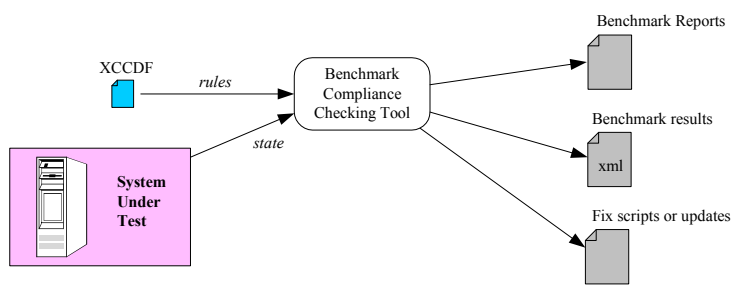
図 4。作業の流れを示す図です。「XCCDF」文書が「rules」(規則)を、「System Under Test」(試験対象のシステム。コンピューターの絵)が「state」(状態)を「Benchmark Compliance Checking Tool」(ベンチマーク準拠性検査ツール)に渡します。ツールは「Benchmark Reports」(ベンチマークの報告書)、「Benchmark results」(ベンチマークの結果、「xml」)、「Fix scripts or updates」(修正スクリプトや更新)を出力します。
Figure 4 – Workflow for Checking Benchmark Compliance
図 4 – ベンチマークのコンプライアンスをチェックするワークフロー
•Benchmark Report – a human-readable report about compliance, including the compliance score, and a listing of which rules which passed and failed in the system. If a given rule applies to multiple parts or components of the system, then multiple pass/fail entries may appear on this list; multiply-instantiated rules are discussed in more detail below. The report may also include recommended steps for improving compliance. The format of the benchmark report is not specified here; but might be some form of formatted or rich text (e.g. HTML).
•Benchmark Report – コンプライアンスに関する、人間が読める報告書。コンプライアンススコアと、システムで合格または不合格となったルールの一覧を含みます。あるルールがシステムの複数の部分やコンポーネントに適用される場合は、この一覧に複数の合格/不合格の項目が現れる場合があります。複数回インスタンス化されるルールについては、以下でより詳しく説明します。報告書には、コンプライアンスを改善するための推奨手順も含まれる場合があります。ベンチマーク報告書の形式はここでは規定しませんが、何らかの書式付きまたはリッチテキスト(たとえば HTML)になる場合があります。
•Benchmark results – a machine-readable file about compliance, meant for storage, long-term tracking, or incorporation into other reports (e.g. a site-wide compliance report). This file may be in XCCDF, using the TestResult object, or it may be in some tool-specific XML format.
•Benchmark results – コンプライアンスに関する、機械可読なファイル。保存、長期的な追跡、または他の報告書(たとえばサイト全体のコンプライアンス報告書)への取り込みを目的としています。このファイルは、TestResult オブジェクトを使った XCCDF の場合もあれば、ツール固有の XML 形式の場合もあります。
•Fix scripts – machine-readable files, usually text, the application of which will remediate some or all of the non-compliance issues found by the tool. These scripts may be included in XCCDF TestResult objects.
•Fix scripts – 機械可読なファイルで、通常はテキストです。これを適用すると、ツールが見つけたコンプライアンス上の問題の一部または全部が修復されます。これらのスクリプトは、XCCDF の TestResult オブジェクトに含めることができます。
Scoring and Results Model
スコアリングと結果のモデル
The output or result of a single benchmark compliance test consists of four parts:
単一のベンチマークコンプライアンステストの出力または結果は、4 つの部分で構成されます。
1.Rule result list – a vector V of result elements e, each element is a 6-tuple e={r, p, I, t, F,O}, where:
1.Rule result list – 結果要素 e のベクトル V。各要素は 6 つ組 e={r, p, I, t, F,O} であり、ここで次のとおりです。
•r is the Rule id
•r は Rule の id
•p is the test result, one of {pass, fail, error, unknown, notapplicable, notchecked, notselected, informational, fixed}. A test whose result p is ‘error’ or ‘unknown’ is treated as ‘fail’ for the purposes of scoring; tool developers may wish to alert the user to erroneous and unknown test results. A test whose result p is one of {notapplicable, notchecked, informational, notselected} does not contribute to scoring in any way. A test whose result p is ‘fixed’ is treated as a pass for score computation.
•p はテスト結果で、{pass, fail, error, unknown, notapplicable, notchecked, notselected, informational, fixed} のいずれかです。結果 p が「error」または「unknown」のテストは、スコアリングの目的では「fail」として扱われます。ツール開発者は、誤りのあるテスト結果や不明なテスト結果についてユーザーに警告すべきです。結果 p が {notapplicable, notchecked, informational, notselected} のいずれかであるテストは、スコアリングにいかなる形でも寄与しません。結果 p が「fixed」のテストは、スコア計算では pass として扱われます。
•I is the instance set, identifying the system components, files, interfaces, or subsystems to which the Rule was applied. Each element of I is a triple {n,c,p}, where n is the instance name, c is the optional instance context, and p is the optional parent context. The context c, when present, describes the scope or significance of the name n. The parent context p allows the members of I to express nested structure. I must be an empty set for tests that are not the result of multiply instantiated rules (see below).
•I はインスタンス集合で、Rule が適用されたシステムコンポーネント、ファイル、インターフェース、サブシステムを識別します。I の各要素は 3 つ組 {n,c,p} で、n はインスタンス名、c は任意のインスタンスコンテキスト、p は任意の親コンテキストです。コンテキスト c は、存在する場合、名前 n の適用範囲や意味を記述します。親コンテキスト p により、I の要素は入れ子構造を表現できます。複数回インスタンス化されたルールの結果ではないテスト(下記を参照)については、I は空集合でなければなりません。
•t is the instant of time at which the result of the Rule application was decided.
•t は、Rule の適用結果が決定された時刻です。
•F is the set of fixes, from the Rule’s fix properties, that should bring the target system into compliance (or at least closer to compliance) with the rule. F may be null if the Rule did not possess any applicable fix properties, and must be null when p is equal to pass. Each fix f in F consists of all the properties defined in the description of the Rule fix property: content, strategy, disruption, reboot, system, id, and platform.
•F は、Rule の fix プロパティに由来する修正の集合で、ターゲットシステムをルールに準拠させる(または少なくとも準拠に近づける)はずのものです。Rule が該当する fix プロパティを持たなかった場合、F は null でもよく、p が pass に等しい場合、F は null でなければなりません。F の各修正 f は、Rule の fix プロパティの説明で定義されているすべてのプロパティで構成されます。content、strategy、disruption、reboot、system、id、platform です。
•O is the set of overrides, each o in O consisting of the five properties listed for the rule-result override property: time, authority, old-result, new-result, and remark. Overrides do not affect score computation.
•O は上書きの集合で、O の各 o は、rule-result の override プロパティに挙げた 5 つのプロパティで構成されます。time、authority、old-result、new-result、remark です。上書きは、スコアの計算に影響しません。
2.Scores – a vector S, consisting of one or more score values s, each s a pair consisting of a real number and a scoring model identifier.
2.Scores – 1 つ以上のスコア値 s で構成されるベクトル S。各 s は、実数とスコアリングモデルの識別子のペアです。
3.Identification – a vector of strings identify the Benchmark, Profile (if any), and target system to which the benchmark was applied.
3.Identification – ベンチマークが適用された、Benchmark、Profile(ある場合)、ターゲットシステムを識別する文字列のベクトル。
4.Timestamps – two timestamps recording the beginning and the end of the interval when the benchmark was applied and the results compiled.
4.Timestamps – ベンチマークが適用され、結果が集計された期間の開始と終了を記録する 2 つのタイムスタンプ。
Each element of the pass/fail list V conveys the compliance of the system under test, or one component of it, with one rule of benchmark. Each rule has a weight, title, and other attributes as described above. Each element of V may include an instance name, which gives the name of a system component to which the pass or fail designation applies.
合格/不合格リスト V の各要素は、テスト対象のシステム、またはその 1 つのコンポーネントが、ベンチマークの 1 つのルールに準拠しているかどうかを伝えます。各ルールは、上述のとおり、重み、タイトル、その他の属性を持ちます。V の各要素には、合格または不合格の指定が適用されるシステムコンポーネントの名前を示す、インスタンス名を含めてもよいです。
XCCDF 1.1 defines a default scoring model, two optional scoring models, and permits benchmark checking tools to support additional proprietary or consensus models. The default model computes a score is based on relative weights of sibling rules, as described in the next sub-section. A Benchmark may specify the scoring model to be used. In the absence of an explicit scoring model specified in the Benchmark, compliance checking tools must compute a score based on the default XCCDF model, and may compute additional scoring values based on other models.
XCCDF 1.1 は、デフォルトのスコアリングモデル 1 つ、任意のスコアリングモデル 2 つを定義しており、ベンチマークチェックツールが追加の独自モデルや合意に基づくモデルをサポートすることも認めています。デフォルトのモデルは、次の小節で説明するように、兄弟関係にあるルールの相対的な重みに基づいてスコアを計算します。Benchmark は、使用するスコアリングモデルを指定してもよいです。Benchmark に明示的なスコアリングモデルの指定がない場合、コンプライアンスチェックツールは、デフォルトの XCCDF モデルに基づいてスコアを計算しなければならず、他のモデルに基づく追加のスコア値を計算してもよいです。
In the default model, computation of the XCCDF score proceeds independently for each collection of siblings in each Group, and then for the siblings within the Benchmark. This relative-to-siblings weighted scoring model is designed for flexibility and to foster independent authorship of collections of rules. Benchmark authors must keep the model in mind when assigning weights to Groups and Rules. For a very simple Benchmark consisting only of Rules and no Groups, weights may be omitted.
デフォルトのモデルでは、XCCDF スコアの計算は、各 Group 内の兄弟の集まりごとに独立して進み、その後 Benchmark 内の兄弟について進みます。この兄弟に対する相対的な加重スコアリングモデルは、柔軟性を持たせ、ルールの集まりの独立した作成を促すように設計されています。ベンチマークの作成者は、Group と Rule に重みを割り当てる際に、このモデルを念頭に置かなければなりません。Rule だけで構成され、Group を持たない非常に単純な Benchmark では、重みを省略してもよいです。
The fix scripts are collected from the fix properties of the rules in elements of V where p is False. A compliance checking or remediation tool may choose to concatenate, consolidate, and/or deconflict the fix scripts, mechanisms for doing so are outside the scope of this specification. In the simplest cases, tools must perform Value substitution on each rule’s fix property before making it part of the output results.
修正スクリプトは、V の要素のうち p が False であるものの、ルールの fix プロパティから集められます。コンプライアンスチェックツールまたは修復ツールは、修正スクリプトを連結、統合、または競合解消してもよく、そのための仕組みは本仕様の適用範囲外です。最も単純な場合、ツールは、各ルールの fix プロパティを出力結果の一部にする前に、Value の置換を行わなければなりません。
Score Computation Algorithms
スコア計算アルゴリズム
This sub-section describes the XCCDF default scoring model, which compliance checking tools must support, and two additional models that tools may support. Each scoring model is identified by a URI.
この小節では、コンプライアンスチェックツールがサポートしなければならない XCCDF のデフォルトのスコアリングモデルと、ツールがサポートしてもよい 2 つの追加モデルについて説明します。各スコアリングモデルは URI で識別されます。
The Default Model
デフォルトモデル
This model is identified by the URI “urn:xccdf:scoring:default”. It was the only model supported in XCCDF 1.0, and remains the default for compatibility.
このモデルは、URI「urn:xccdf:scoring:default」で識別されます。XCCDF 1.0 でサポートされていた唯一のモデルであり、互換性のためにデフォルトのままになっています。
The objects of an XCCDF benchmark form the nodes of a tree. The score computation algorithm simply computes a normalized weighted sum at each node, omitting Rules and Groups that are not selected, and Groups that have no selected Rules under them. The algorithm at each selected node is:
XCCDF ベンチマークのオブジェクトは、木のノードを形成します。スコア計算アルゴリズムは、選択されていない Rule と Group、および配下に選択された Rule を持たない Group を除いて、各ノードで正規化された加重和を計算するだけです。選択された各ノードでのアルゴリズムは次のとおりです。
| Sub-Step | Description |
|---|---|
| Score.Rule | If the node is a Rule, then assign a count of 1, and if the test result is ‘pass’ assign the node a score of 100, otherwise assign a score of 0. |
| Score.Group.Init | If the node is a Group or the Benchmark, assign a count of 0, a score s of 0.0, and an accumulator a of 0.0. |
| Score.Group.Recurse | For each selected child of this Group or Benchmark do the following (1) compute the count and weighted score for the child using this algorithm, (2) if the child’s count value is not 0, then add the child’s weighted score to this node’s score s, add 1 to this node’s count, and add the child’s weight value to the accumulator a. |
| Score.Group.Normalize | Normalized this node’s score: compute s = s / a |
| Score.Weight | Assign the node a weighted score equal to the product of its score and its weight. |
| サブステップ | 説明 |
|---|---|
| Score.Rule | ノードが Rule の場合は、カウントとして 1 を割り当て、テスト結果が「pass」であればノードにスコア 100 を、そうでなければスコア 0 を割り当てます。 |
| Score.Group.Init | ノードが Group または Benchmark の場合は、カウントとして 0、スコア s として 0.0、累積値 a として 0.0 を割り当てます。 |
| Score.Group.Recurse | この Group または Benchmark の選択された各子について、次を行います。(1) このアルゴリズムを使って、その子のカウントと加重スコアを計算する、(2) 子のカウント値が 0 でなければ、子の加重スコアをこのノードのスコア s に加え、このノードのカウントに 1 を加え、子の重みの値を累積値 a に加えます。 |
| Score.Group.Normalize | このノードのスコアを正規化します。s = s / a を計算します |
| Score.Weight | ノードに、そのスコアと重みの積に等しい加重スコアを割り当てます。 |
The final test score is the normalized score value on the root node of the tree, which is the Benchmark object.
最終的なテストスコアは、木のルートノードである Benchmark オブジェクトの正規化スコア値です。
The Flat Model
フラットモデル
This model is identified by the URI “urn:xccdf:scoring:flat”.
このモデルは、URI「urn:xccdf:scoring:flat」で識別されます。
Under this model, the set of rule results is treated as a vector V, as described above. The following algorithm is used to compute the score.
このモデルでは、上述のとおり、ルール結果の集合をベクトル V として扱います。スコアの計算には次のアルゴリズムを使います。
| Sub-Step | Description |
|---|---|
| Score.Init | Initialize the score s to 0.0. Initialize the maximum score m to 0.0. |
| Score.Rules | For each element e in V where e.p is not equal to ‘notapplicable’: - add the weight of rule e.r to m. - if the value e.p equals ‘pass’ or ‘fixed’, add the weight of the rule e.r to s. |
| サブステップ | 説明 |
|---|---|
| Score.Init | スコア s を 0.0 に初期化します。最大スコア m を 0.0 に初期化します。 |
| Score.Rules | V の各要素 e のうち e.p が「notapplicable」に等しくないものについて、次を行います。- ルール e.r の重みを m に加えます。- 値 e.p が「pass」または「fixed」に等しければ、ルール e.r の重みを s に加えます。 |
Thus, the flat model simply computes the sum of the weights for the Rules that passed as the score, and the sum of the weights of all the applicable Rules as the maximum possible score. This model is simple and easy to compute, but scores between different target systems may not be directly comparable because the maximum score can vary.
このように、フラットモデルは、合格した Rule の重みの合計をスコアとして、該当するすべての Rule の重みの合計を最大可能スコアとして、単純に計算します。このモデルは単純で計算しやすいですが、最大スコアが変わりうるため、異なるターゲットシステム間のスコアを直接比較できない場合があります。
The Flat Unweighted Model
フラット非加重モデル
This model is identified by the URI “urn:xccdf:scoring:flat-unweighted”. It is computed in exactly the same way as the flat model, above, except that all weights are taken to be 1.0.
このモデルは、URI「urn:xccdf:scoring:flat-unweighted」で識別されます。すべての重みを 1.0 とする点を除いて、上記のフラットモデルとまったく同じ方法で計算されます。
Multiply-Instantiated Rules
複数回インスタンス化されるルール
A security auditor applying a security benchmark to a system typically wants to know two things: how well does the system comply, and how can non-compliant items be reconciled (either fixed or determined not to be salient)?
セキュリティベンチマークをシステムに適用するセキュリティ監査人は、通常、次の 2 つのことを知りたいと考えます。システムはどの程度準拠しているか、そして、非準拠の項目をどのように解消できるか(修正するか、重要でないと判断するか)、です。
Many benchmarks include rules that apply to system components. For example, a host OS benchmark would probably contain rules that apply to all users, and a router benchmark will contain rules that apply to all network interfaces. When the system holds many of such components, it is not adequate for a tool to inform the administrator or auditor that the rule failed, it should report exactly which components failed the rule.
多くのベンチマークには、システムのコンポーネントに適用されるルールが含まれています。たとえば、ホスト OS のベンチマークには、すべてのユーザーに適用されるルールがおそらく含まれ、ルーターのベンチマークには、すべてのネットワークインターフェースに適用されるルールが含まれます。システムがそのようなコンポーネントを多数持つ場合、ツールが管理者や監査人にルールが不合格だったと知らせるだけでは不十分であり、どのコンポーネントがそのルールに不合格だったかを正確に報告するべきです。
A processing engine that performs a benchmark compliance test may deliver zero or more pass/fail triples, as described above. In the most common case, each compliance test rule will yield one result element. In a case where a rule was applied multiple times to multiple components of the system under test, a single rule could yield multiple result elements. If each of multiple relevant components passes the rule, the processing engine may deliver a single result element with an instance set I=null. For the purposes of scoring, a rule contributes to the positive score only if all instances of that rule have a test result of ‘pass’. (This is sometimes called “strict scoring”. If any component of the target system fails a rule, then the entire Rule is considered to have failed.)
ベンチマークのコンプライアンステストを実行する処理エンジンは、上述のとおり、合格/不合格の 3 つ組を 0 個以上返すことがあります。最も一般的な場合、コンプライアンステストの各ルールは 1 つの結果要素を生成します。ルールがテスト対象システムの複数のコンポーネントに複数回適用された場合は、1 つのルールが複数の結果要素を生成することもあります。関連する複数のコンポーネントがそれぞれルールに合格する場合は、処理エンジンは、インスタンス集合 I=null とした単一の結果要素を返してもよいです。スコアリングの目的では、ルールが正のスコアに寄与するのは、そのルールのすべてのインスタンスのテスト結果が「pass」である場合に限られます。(これは「厳格なスコアリング」と呼ばれることがあります。ターゲットシステムのいずれかのコンポーネントがルールに不合格であれば、Rule 全体が不合格とみなされます。)
4. XML Representation
4. XML 表現
This section defines a concrete representation of the XCCDF data model in XML, using both core XML syntax and XML Namespaces.
本節は、XCCDF データモデルの具体的な XML 表現を、XML の中核的な構文と XML 名前空間の両方を使って定義します。
4.1. XML Document General Considerations
4.1. XML 文書に関する一般的な考慮事項
The basic document format consists of a root “Benchmark” element, representing a Benchmark object. Its child elements are the contents of the benchmark object, as described in Section 3.2.
基本的な文書形式は、Benchmark オブジェクトを表すルートの「Benchmark」要素で構成されます。その子要素は、第 3.2 節で説明した Benchmark オブジェクトの内容です。
All the XCCDF elements in the document will belong to the XCCDF namespace, including the root element. The namespace URI corresponding to this version of the specification is “http://checklists.nist.gov/xccdf/1.1”. The namespace of the root Benchmark element serves to identify the XCCDF version for a document. Applications that process XCCDF can use the namespace URI to decide whether they can process a given document. If a namespace prefix is used, the suggested prefix string is “cdf”.
ルート要素を含め、文書内のすべての XCCDF 要素は、XCCDF 名前空間に属します。本仕様のこのバージョンに対応する名前空間 URI は「http://checklists.nist.gov/xccdf/1.1」です。ルートの Benchmark 要素の名前空間は、文書の XCCDF バージョンを識別する役割を果たします。XCCDF を処理するアプリケーションは、名前空間 URI を使って、特定の文書を処理できるかどうかを判断できます。名前空間プレフィックスを使う場合、推奨されるプレフィックス文字列は「cdf」です。
XCCDF attributes are not namespace qualified. All attributes begin with a lowercase letter, except the “Id” attribute (for compatibility with XML Digital Signatures[8]).
XCCDF の属性は、名前空間で修飾されません。(XML デジタル署名 [8] との互換性のための)「Id」属性を除き、すべての属性は小文字で始まります。
The example below illustrates the outermost structure of an XCCDF XML document.
以下の例は、XCCDF XML 文書の最も外側の構造を示しています。
Example 1 – Top-Level XCCDF XML
例 1 – 最上位の XCCDF XML
<?xml version=”1.0” ?>
<cdf:Benchmark  id=”example1”  xml:lang=”en”  Id=”toSign”
      xmlns:htm=”http://www.w3.org/1999/xhtml”
      xmlns:cdf=”http://checklists.nist.gov/xccdf/1.1”
      xmlns:cdfp=”http://www.cisecurity.org/xccdf/platform/0.2.3”/>
  <cdf:status date=”2004-10-12”>draft</cdf:status>
  <cdf:title>Example Benchmark File</cdf:title>
  <cdf:description>
     A <htm:b>Small</htm:b> Example
  </cdf:description>
  <cdf:version>0.2</cdf:version>
  <cdf:reference href=”http://www.ietf.org/rfc/”>
      Internet RFCs
  </cdf:reference>
</cdf:Benchmark>Validation is strongly suggested but not required for tools that process XCCDF documents. The XML Schema attribute “schemaLocation” may be used to refer to the XCCDF Schema (see Appendix A).
XCCDF 文書を処理するツールにとって、検証は強く推奨されますが、必須ではありません。XML Schema の属性「schemaLocation」は、XCCDF スキーマ(付録 A を参照)を参照するために使うことができます。
Properties of XCCDF objects marked as type ‘text’ in Section 3.2 may contain embedded formatting, presentation, and hyperlink structure. XHTML Basic tags must be used to express formatting, presentation, and hyperlink structure for XCCDF XML document. In particular, the core modules noted in the XHMTL Basic Recommendation are permitted in XCCDF documents, plus the Image module and the Presentation module. How an XCCDF processing tool handles embedded XHTML content in XCCDF text properties is implementation-dependent, but at the least every tool must be able to process XCCDF files even when embedded XHTML elements are present. Tools that perform document generation processing should attempt to preserve the formatting semantics implied by the Text and List modules, support the link semantics implied by the Hypertext module, and incorporate the images referenced via the Image module.
第 3.2 節で型「text」とされた XCCDF オブジェクトのプロパティには、書式、表示、ハイパーリンクの構造を埋め込むことができます。XCCDF XML 文書の書式、表示、ハイパーリンクの構造を表現するには、XHTML Basic のタグを使わなければなりません。特に、XHTML Basic 勧告に記載されているコアモジュールに加えて、Image モジュールと Presentation モジュールが XCCDF 文書で許可されます。XCCDF 処理ツールが XCCDF の text プロパティ内の埋め込み XHTML の内容をどのように扱うかは実装依存ですが、少なくとも、すべてのツールは埋め込み XHTML 要素が存在する場合でも XCCDF ファイルを処理できなければなりません。文書生成処理を行うツールは、Text モジュールと List モジュールが示唆する書式の意味を維持するよう試み、Hypertext モジュールが示唆するリンクの意味をサポートし、Image モジュールを介して参照される画像を取り込むべきです。
4.2. XML Element Dictionary
4.2. XML 要素辞書
This subsection describes each of the elements and attributes of XCCDF XML. Each description includes the parent elements feasible for that element, as well as the child elements it might normally contain. Most elements are in the XCCDF namespace, which for version 1.1 is “http://checklists.nist.gov/xccdf/1.1”. For a more precise definition, consult Appendix A.
この小節では、XCCDF XML の各要素と属性について説明します。各説明には、その要素が取りうる親要素と、通常含みうる子要素が含まれます。ほとんどの要素は XCCDF 名前空間にあり、バージョン 1.1 では「http://checklists.nist.gov/xccdf/1.1」です。より正確な定義については、付録 A を参照してください。
Many of the elements listed below are described as containing formatted text (type ‘text’ in Section 3.2). These elements may contain Value substitutions, and formatting expressed as described in Section 4.3.
以下に挙げる要素の多くは、書式付きテキスト(第 3.2 節の型「text」)を含むものとして説明されています。これらの要素には、Value の置換と、第 4.3 節で説明する形で表現された書式を含めることができます。
XML is case-sensitive. The XML syntax for XCCDF follows a common convention for representing object-oriented data models in XML: elements that correspond directly to object classes in the data model have names with initial caps. Mandatory attributes and elements are shown in bold. Child elements are listed in the order in which they must appear. Elements which are not part of the XCCDF namespace are shown in italics.
XML は大文字と小文字を区別します。XCCDF の XML 構文は、オブジェクト指向のデータモデルを XML で表現するための一般的な慣習に従っています。データモデルのオブジェクトクラスに直接対応する要素は、先頭が大文字の名前を持ちます。必須の属性と要素は太字で示します。子要素は、現れなければならない順序で列挙しています。XCCDF 名前空間に属さない要素は斜体で示します。
<Benchmark>
<Benchmark>
This is the root element of the XCCDF document, it must appear exactly once. It encloses the entire benchmark, and contains both descriptive information and benchmark structural information. The id attribute must be a unique identifier.
これは XCCDF 文書のルート要素であり、ちょうど 1 回現れなければなりません。ベンチマーク全体を囲み、説明情報とベンチマークの構造情報の両方を含みます。id 属性は、一意の識別子でなければなりません。
Content: elements
Cardinality: 1
Parent Element: none
Attributes: id, resolved, Id (note: “Id” is needed only for digital signature security)
Child Elements: status, title, description, notice, front-matter, rear-matter, reference, platform-definitions, platform, version, metadata, Profile, Value, Group, Rule, signature
内容: 要素
出現数: 1
親要素: なし
属性: id, resolved, Id(注: 「Id」は、デジタル署名のセキュリティのためにのみ必要です)
子要素: status, title, description, notice, front-matter, rear-matter, reference, platform-definitions, platform, version, metadata, Profile, Value, Group, Rule, signature
Note that the order of Group and Rule child elements may matter for the appearance of a generated document. Therefore, Group and Rule children may be freely intermingled. All the other children must appear in the order shown, and multiple instances of a child element must be adjacent.
Group と Rule の子要素の順序は、生成される文書の見え方に関わる場合があることに注意してください。そのため、Group と Rule の子は自由に混在させてよいです。それ以外の子はすべて、示した順序で現れなければならず、同じ子要素が複数ある場合は、それらが隣り合っていなければなりません。
<Group>
<Group>
A Group element contains descriptive information about a portion of a benchmark, as well as Rules, Values, and other Groups. A Group must have a unique id attribute in order to be referenced from other XCCDF documents or extended by other Groups. The id attribute must be a unique identifier. The extends attribute, if present, must have a value equal to the id attribute of another Group. The cluster-id attribute is an id, it designates membership in a ‘cluster’ of Items, which are used for controlling Items via Profiles. The hidden and allowChanges attributes are of boolean type and default to false. The weight attribute is a positive real number.
Group 要素は、ベンチマークの一部分に関する説明情報と、Rule、Value、その他の Group を含みます。Group は、他の XCCDF 文書から参照されたり、他の Group に拡張されたりするために、一意の id 属性を持たなければなりません。id 属性は、一意の識別子でなければなりません。extends 属性がある場合は、その値が、別の Group の id 属性に等しくなければなりません。cluster-id 属性は id であり、Item の「クラスター」への所属を示します。クラスターは、Profile を介して Item を制御するために使われます。hidden 属性と allowChanges 属性はブール型で、デフォルトは false です。weight 属性は、正の実数です。
Content: elements
Cardinality: 0-n
Parent Elements: Benchmark, Group
Attributes: id, cluster-id, extends, hidden, prohibitChanges, selected, weight, Id
Child Elements: status, version, title, description, warning, question, reference, rationale, platform, requires, conflicts, Value, Group, Rule
内容: 要素
出現数: 0-n
親要素: Benchmark, Group
属性: id, cluster-id, extends, hidden, prohibitChanges, selected, weight, Id
子要素: status, version, title, description, warning, question, reference, rationale, platform, requires, conflicts, Value, Group, Rule
A Group must have an id attribute. All child elements are optional, but every group should have a title. Group and Rule children may be freely intermingled. All the other children must appear in the order shown, and multiple instances of a child element must be adjacent.
Group は id 属性を持たなければなりません。すべての子要素は任意ですが、すべてのグループは title を持つべきです。Group と Rule の子は、自由に混在させてよいです。それ以外の子はすべて、示した順序で現れなければならず、同じ子要素が複数ある場合は、それらが隣り合っていなければなりません。
The extends attribute allows a benchmark author to define a group as an extension of another group. The example XML fragment below shows an example of an extended and extending Group.
extends 属性により、ベンチマークの作成者は、グループを別のグループの拡張として定義できます。以下の XML 断片の例は、拡張される Group と拡張する Group の例を示しています。
Example 2 – A Simple XCCDF Group
例 2 – 単純な XCCDF Group
<cdf:Group id=”basegrp” selected=”0” hidden=”1”>
  <cdf:title>Example Base Group</cdf:title>
  <cdf:reference>Consult the vendor documentation.</cdf:reference>
</cdf:Group>
<cdf:Group extends=”basegrp” id=”fileperm” selected=”1” hidden=0”>
  <cdf:title>File Permissions</cdf:title>
  <cdf:description>
      Rules related to file access control and
      user permissions.
  </cdf:description>
  <cdf:question>
      Include checks for file access controls?
  </cdf:question>
  <cdf:reference href=”http://www.vendor.com/docs/perms.html”>
      Administration manual, permissions settings reference
  </cdf:reference>
    . . .
</cdf:Group>An XCCDF Group may only extend a Group that is within its visible scope. The visible scope includes sibling elements, siblings of ancestor elements, and the visible scope of any Group that an ancestor Group extended.
XCCDF の Group は、自身の見えるスコープ内にある Group だけを拡張できます。見えるスコープには、兄弟要素、祖先要素の兄弟、および祖先の Group が拡張した任意の Group の見えるスコープが含まれます。
Note that circular dependencies of extension are not permitted.
拡張の循環する依存関係は認められないことに注意してください。
<Rule>
<Rule>
A Rule element defines a single item to be checked as part of benchmark, or an extendable base definition for such items. A Rule must have a unique id attribute in order to be referenced from other XCCDF documents or extended by other Rules.
Rule 要素は、ベンチマークの一部としてチェックされる単一の項目、またはそのような項目の拡張可能な基底の定義を定めます。Rule は、他の XCCDF 文書から参照されたり、他の Rule に拡張されたりするために、一意の id 属性を持たなければなりません。
The id attribute must be a unique identifier. The extends attribute, if present, must have a value equal to the id attribute of another Rule. The weight attribute must be a positive real number. The other attributes are all boolean. Rules may not be nested.
id 属性は、一意の識別子でなければなりません。extends 属性がある場合は、その値が、別の Rule の id 属性に等しくなければなりません。weight 属性は、正の実数でなければなりません。その他の属性はすべてブール型です。Rule を入れ子にしてはなりません。
Content: elements
Cardinality: 0-n
Parent Elements: Benchmark, Group
Attributes: id, cluster-id, extends, hidden, prohibitChanges, role, selected, severity, weight, Id
Child Elements: status, version, title, description, warning, question, reference, rationale, platform, requires, conflicts, ident, profile-note, fixtext, fix, complex-check, check
内容: 要素
出現数: 0-n
親要素: Benchmark, Group
属性: id, cluster-id, extends, hidden, prohibitChanges, role, selected, severity, weight, Id
子要素: status, version, title, description, warning, question, reference, rationale, platform, requires, conflicts, ident, profile-note, fixtext, fix, complex-check, check
The check child of a Rule is the vital piece that specifies how to check compliance with a security practice or guideline, see the description of the check element below for more information. Example 3 shows a very simple Rule element.
Rule の check 子要素は、セキュリティ実践やガイドラインへのコンプライアンスをどのようにチェックするかを指定する、不可欠な部分です。詳しくは、下記の check 要素の説明を参照してください。例 3 は、非常に単純な Rule 要素を示しています。
Example 3 – A Simple XCCDF Rule
例 3 – 単純な XCCDF Rule
<cdf:Rule id=”pwd-perm” selected=”1” weight=”6.5” severity=”high”>
  <cdf:title>Password File Permission</cdf:title>
  <cdf:description>Check the access control on the password
     file.  Normal users should not be able to write to it.
  </cdf:description>
  <cdf:requires idref=”passwd-exists”/>
  <cdf:fixtext>
    Set permissions on the passwd file to owner-write, world-read
  </cdf:fixtext>
  <cdf:fix strategy=”restrict” reboot=”0” disruption=”low”>
        chmod 644 /etc/passwd
  </cdf:fix>
  <cdf:check system=”http://www.mitre.org/XMLSchema/oval”>
    <cdf:check-content-ref href=”ovaldefs.xml” name=”OVAL123”/>
  </cdf:check>
</cdf:Rule>An XCCDF Rule may only extend a Rule that is within its visible scope. The visible scope includes sibling Rules, Rules that are siblings of ancestor Groups, and the visible scope of any Group that an ancestor Group extended.
XCCDF の Rule は、自身の見えるスコープ内にある Rule だけを拡張できます。見えるスコープには、兄弟の Rule、祖先の Group の兄弟である Rule、および祖先の Group が拡張した任意の Group の見えるスコープが含まれます。
Circular dependencies of extension may not be defined.
拡張の循環する依存関係を定義してはなりません。
<Value>
<Value>
A Value element represents a named parameter whose title or value may be substituted into other strings in the benchmark (depending on the form of processing to which the benchmark is being subjected), or it may represent a basis for the definition of such parameters via extension. A Value object must have a unique id attribute in order to referenced for substitution or extension or for inclusion into another benchmark.
Value 要素は、そのタイトルまたは値が(ベンチマークが受ける処理の形態に応じて)ベンチマーク内の他の文字列に置換されうる名前付きパラメーターを表します。また、拡張によってそのようなパラメーターを定義するための基底を表す場合もあります。Value オブジェクトは、置換や拡張のため、または別のベンチマークに含めるために参照されるよう、一意の id 属性を持たなければなりません。
A Value object may appear as a child of the Benchmark, or as a child of a Group. Value objects may not be nested. The value and default child elements must appear first.
Value オブジェクトは、Benchmark の子として、または Group の子として現れることができます。Value オブジェクトを入れ子にしてはなりません。value 子要素と default 子要素は、最初に現れなければなりません。
Content: elements
Cardinality: 0-n
Parent Elements: Benchmark, Group
Attributes: id, cluster-id, extends, hidden, prohibitChanges, operator, type, interactive, interfaceHint, Id
Child Elements: status, version, title, description, warning, question, reference, value, default, match, lower-bound, upper-bound, choices, source
内容: 要素
出現数: 0-n
親要素: Benchmark, Group
属性: id, cluster-id, extends, hidden, prohibitChanges, operator, type, interactive, interfaceHint, Id
子要素: status, version, title, description, warning, question, reference, value, default, match, lower-bound, upper-bound, choices, source
The type attribute is optional, but if it appears it must be one of ‘number’, ‘string’, or ‘boolean’. A tool performing tailoring processing may use this type name to perform user input validation. Example 4, below, shows a very simple Value object.
type 属性は任意ですが、現れる場合は「number」「string」「boolean」のいずれかでなければなりません。テーラリング処理を行うツールは、この型名を使ってユーザー入力の検証を行ってもよいです。以下の例 4 は、非常に単純な Value オブジェクトを示しています。
Example 4 – Example of a Simple XCCDF Value
例 4 – 単純な XCCDF Value の例
<cdf:Value id=”web-server-port” type=”number” operator=”equals”>
  <cdf:title>Web Server Port</cdf:title>
  <cdf:description>TCP port on which the server listens
  </cdf:description>
  <cdf:value>12080</cdf:value>
  <cdf:default>80</cdf:default>
  <cdf:lower-bound>0</cdf:lower-bound>
  <cdf:upper-bound>65535</cdf:upper-bound>
</cdf:Value>(Note that the match element applies only for validation during XCCDF tailoring, while the operator attribute applies only for rule checking. Do not get them confused.)
(match 要素は XCCDF のテーラリング中の検証にのみ適用され、operator 属性はルールのチェックにのみ適用されることに注意してください。両者を混同しないでください。)
<Profile>
<Profile>
A Profile element encapsulates a tailoring of the Benchmark. It consists of an id, descriptive text properties, and zero or more selectors that refer to Group, Rule, and Value objects in the Benchmark. There are three selector elements: select, set-value, and refine-value.
Profile 要素は、Benchmark のテーラリングをカプセル化します。id、説明テキストのプロパティ、および Benchmark 内の Group、Rule、Value の各オブジェクトを参照するセレクター 0 個以上で構成されます。セレクター要素は 3 つあります。select、set-value、refine-value です。
Profile elements may only appear as direct children of the Benchmark element. A Profile may be defined as extending another Profile, using the extends attribute.
Profile 要素は、Benchmark 要素の直接の子としてのみ現れることができます。Profile は、extends 属性を使って、別の Profile を拡張するものとして定義できます。
Content: elements
Cardinality: 0-n
Parent Elements: Benchmark
Attributes: abstract, id, extends, prohibitChanges, Id, note-tag
Child Elements: status, version, title, description, reference, platform, select, set-value, refine-value, refine-rule
内容: 要素
出現数: 0-n
親要素: Benchmark
属性: abstract, id, extends, prohibitChanges, Id, note-tag
子要素: status, version, title, description, reference, platform, select, set-value, refine-value, refine-rule
Profiles are designed to support encapsulation of a set of tailorings. A Profile implicitly includes all the Groups and Rules in the Benchmark, and the select element children of the Profile affect which Groups and Rules are selected for processing when the Profile is in effect. The example below shows a very simple Profile.
Profile は、テーラリングの集合をカプセル化することを支援するように設計されています。Profile は、Benchmark 内のすべての Group と Rule を暗黙のうちに含み、Profile の select 要素の子は、その Profile が有効なときに、どの Group と Rule が処理対象として選択されるかに影響します。以下の例は、非常に単純な Profile を示しています。
Example 5 – Example of a Simple XCCDF Profile
例 5 – 単純な XCCDF Profile の例
 <cdf:Profile id=”strict” prohibitChanges=”1”
              extends=”lenient” note-tag=”strict-tag”>
   <cdf:title>Strict Security Settings</cdf:title>
   <cdf:description>
     Strict lockdown rules and values, for hosts deployed to
     high-risk environments.
   </cdf:description>
   <cdf:set-value idref=”password-len”>10</cdf:set-value>
   <cdf:refine-value idref=”session-timeout” selector=”quick”/>
   <cdf:refine-rule idref=”session-auth-rule” selector=”harsh”/>
   <cdf:select idref=”password-len-rule” selected=”1”/>
   <cdf:select idref=”audit-cluster” selected=”1”/>
   <cdf:select idref=”telnet-disabled-rule” selected=”1”/>
   <cdf:select idref=”telnet-settings-cluster” selected=”0”/>
</cdf:Value><TestResult>
<TestResult>
The TestResult object encapsulates the result of applying a Benchmark to one target system. The TestResult element normally appears as the child of the Benchmark element, although it may also as the top-level element of a file.
TestResult オブジェクトは、Benchmark を 1 つのターゲットシステムに適用した結果をカプセル化します。TestResult 要素は通常 Benchmark 要素の子として現れますが、ファイルの最上位要素として現れる場合もあります。
Content: elements
Cardinality: 0-n
Parent Elements: Benchmark
Attributes: id, start-time, end-time, Id
Child Elements: title, remark, profile, target, target-address, target-facts, value, rule-result, score
内容: 要素
出現数: 0-n
親要素: Benchmark
属性: id, start-time, end-time, Id
子要素: title, remark, profile, target, target-address, target-facts, value, rule-result, score
The id attribute is a mandatory unique-id for a test result. The start-time and end-time attributes must have the format of a timestamp; the end-time attribute is mandatory, and gives the time that the application of the benchmark completed.
id 属性は、テスト結果の必須の一意な id です。start-time 属性と end-time 属性は、タイムスタンプの形式でなければなりません。end-time 属性は必須で、ベンチマークの適用が完了した時刻を示します。
The example below shows a TestResult object with a couple of rule-result children.
以下の例は、いくつかの rule-result の子を持つ TestResult オブジェクトを示しています。
Example 6 – Example of XCCDF Benchmark Test Results
例 6 – XCCDF ベンチマークのテスト結果の例
 <cdf:TestResult id="ios-test5" end-time="2004-09-25T7:45:02-04:00"
   xmlns:cdf="http://checklists.nist.gov/xccdf/1.1">
    <cdf:benchmark href="ios-sample-12.4.xccdf.xml"/>
    <cdf:title>Sample Results Block</cdf:title>
    <cdf:remark>Test run by Bob on Sept 25</cdf:remark>
    <cdf:target>lower.test.net</cdf:target>
    <cdf:target-address>192.168.248.1</cdf:target-address>
    <cdf:target-address>2001:8::1</cdf:target-address>
    <cdf:target-facts>
        <cdf:fact type=”string” name=”urn:xccdf:fact:ethernet:MAC”>
            02:50:e6:c0:14:39
        </cdf:fact>
        <cdf:fact name=”urn:xccdf:fact:OS:IOS”>1</cdf:fact>
    </cdf:target-facts>
    <cdf:set-value idref="exec-timeout-time">10</cdf:set-value>
    <cdf:rule-result idref ="ios12-no-finger-service"
                     time="2004-09-25T13:45:00-04:00">
        <cdf:result>pass</cdf:result>
    </cdf:rule-result>
    <cdf:rule-result idref ="req-exec-timeout"
                     time="2004-09-25T13:45:06-04:00">
        <cdf:result>fail</cdf:result>
        <cdf:instance>console</cdf:instance>
        <cdf:fix>
             line console
             exec-timeout 10 0
        </cdf:fix>
    </cdf:rule-result>
    <cdf:score>67.5</cdf:score>
</cdf:TestResult><benchmark>
<benchmark>
This simple element may only appear as the child of a TestResult. It indicates the Benchmark for which the TestResult records results. It has one attribute, which gives the URI of the benchmark XCCDF document. It must be an empty element.
この単純な要素は、TestResult の子としてのみ現れることができます。TestResult が結果を記録している Benchmark を示します。属性は 1 つで、ベンチマークの XCCDF 文書の URI を示します。空要素でなければなりません。
Content none
Cardinality: 0-1
Parent Elements: TestResult
Attributes: href
Child Elements: none
内容 none
出現数: 0-1
親要素: TestResult
属性: href
子要素: none
The benchmark element should be used only in a standalone TestResult file (an XCCDF document file whose root element is TestResult).
benchmark 要素は、単独の TestResult ファイル(ルート要素が TestResult である XCCDF 文書ファイル)でのみ使用すべきです。
<check>
<check>
This element holds a specification for how to check compliance with a Rule. It may only appear as a child of a Rule element. The child elements of this element specify the Values to pass to a checking engine, and the logic for the checking engine to apply. The logic may be embedded directly as inline text or XML data, or may be a reference to an element of an external file indicated by a URI. If the compliance checking system uses XML namespaces, then the system attribute for the system should be its namespace. The default or nominal content for a check element is a compliance test expressed as an OVAL definition or a reference to an OVAL definition, with the system attribute set to the OVAL namespace. The check element is also used as part of a TestResult rule-result element, in that case it holds or refers to detailed output from the checking engine.
この要素は、Rule へのコンプライアンスをどのようにチェックするかの仕様を保持します。Rule 要素の子としてのみ現れることができます。この要素の子要素は、チェックエンジンに渡す Value と、チェックエンジンが適用するロジックを指定します。ロジックは、インラインのテキストまたは XML データとして直接埋め込んでもよく、URI で示される外部ファイルの要素への参照であってもよいです。コンプライアンスチェックシステムが XML 名前空間を使う場合、その system 属性には、そのシステムの名前空間を指定すべきです。check 要素のデフォルトまたは名目上の内容は、OVAL 定義として表現されたコンプライアンステスト、または OVAL 定義への参照であり、system 属性は OVAL 名前空間に設定されます。check 要素は、TestResult の rule-result 要素の一部としても使われ、その場合はチェックエンジンからの詳細な出力を保持するか、参照します。
Content: mixed
Cardinality: 0-n
Parent Elements: Rule, rule-result
Attributes: selector, system
Child Elements: check-export, check-content, check-content-ref
内容: 混合
出現数: 0-n
親要素: Rule, rule-result
属性: selector, system
子要素: check-export, check-content, check-content-ref
A check element may have a selector attribute, which may be referenced from a benchmark Profile as a means of refining the application of the Rule. When Profiles are not used, then all check elements with non-empty selectors are ignored.
check 要素は selector 属性を持つことができ、ベンチマークの Profile から、Rule の適用を絞り込む手段として参照できます。Profile を使わない場合、空でないセレクターを持つすべての check 要素は無視されます。
Several check elements may appear as children of the same Rule element. Sibling check elements must have different values for the combination of their selector and system attributes. A tool processing the benchmark for compliance checking must pick at most one check element to process for each Rule. The check element may contain zero or more check-export elements, and must contain either one check-content or one check-content-ref element.
同じ Rule 要素の子として、複数の check 要素が現れることがあります。兄弟関係にある check 要素は、selector 属性と system 属性の組み合わせが、異なる値でなければなりません。コンプライアンスチェックのためにベンチマークを処理するツールは、各 Rule について、処理する check 要素を多くとも 1 つ選ばなければなりません。check 要素は、check-export 要素を 0 個以上含んでもよく、check-content 要素または check-content-ref 要素のいずれか 1 つを含まなければなりません。
When a check element is a child of a TestResult object, two special conditions apply: (1) check-export elements should not appear, and any present must be ignored, and (2) the selector attribute should not appear, and any selector attributes present must be ignored.
check 要素が TestResult オブジェクトの子である場合、2 つの特別な条件が適用されます。(1) check-export 要素は現れるべきではなく、存在するものは無視しなければなりません。(2) selector 属性は現れるべきではなく、存在する selector 属性は無視しなければなりません。
<check-export>
<check-export>
This specifies a mapping from an XCCDF Value object to a checking system variable. The value-id attribute must match the id attribute of a Value object in the benchmark.
これは、XCCDF の Value オブジェクトから、チェックシステムの変数への対応付けを指定します。value-id 属性は、ベンチマーク内の Value オブジェクトの id 属性と一致しなければなりません。
Content: none
Cardinality: 0-n
Parent Elements: check
Attributes: value-id, export-name
Child Elements: none
内容: なし
出現数: 0-n
親要素: check
属性: value-id, export-name
子要素: なし
<check-content>
<check-content>
This element holds the actual code of a benchmark compliance check, in the language or system specified by the check element’s system attribute. Exactly one of check-content or check-content-ref must appear in each check element. The body of this element can be any XML, but cannot contain any XCCDF elements. XCCDF tools are not required to process this element; typically it will be passed to a checking system or engine.
この要素は、check 要素の system 属性で指定された言語またはシステムによる、ベンチマークのコンプライアンスチェックの実際のコードを保持します。各 check 要素には、check-content または check-content-ref のどちらか 1 つだけが現れなければなりません。この要素の本体は任意の XML でよいですが、XCCDF の要素を含んではなりません。XCCDF ツールは、この要素を処理する必要はなく、通常はチェックシステムまたはエンジンに渡されます。
Content: any non-XCCDF
Cardinality: 0-1
Parent Elements: check
Attributes: none
Child Elements: special
内容: XCCDF 以外の任意のもの
出現数: 0-1
親要素: check
属性: なし
子要素: special
<check-content-ref>
<check-content-ref>
This element points to a benchmark compliance check, in the language or system specified by the check element’s system attribute. Exactly one of check-content or check-content-ref must appear in each check element. The href attribute identifies the document, and the optional name attribute may be used to refer to a particular part, element, or component of the document.
この要素は、check 要素の system 属性で指定された言語またはシステムによる、ベンチマークのコンプライアンスチェックを指し示します。各 check 要素には、check-content または check-content-ref のどちらか 1 つだけが現れなければなりません。href 属性は文書を識別し、任意の name 属性は、その文書の特定の部分、要素、またはコンポーネントを参照するために使えます。
Content: none
Cardinality: 0-1
Parent Elements: check
Attributes: href, name
Child Elements: none
内容: なし
出現数: 0-1
親要素: check
属性: href, name
子要素: なし
<choices>
<choices>
The choices element may be a child of a Value, and it enumerates one or more legal values for the Value. If the boolean mustMatch attribute is true, then the list represents all the legal values; if mustMatch is absent or false, then the list represents suggested values but other values might also be legal (subject to the parent Value’s upper-bound, lower-bound, or match attributes). The choices element may have a selector attribute that is used for tailoring via a Profile. The list given by this element is intended for use during tailoring and document generation, it has no role in benchmark compliance checking.
choices 要素は Value の子になることができ、その Value に有効な値を 1 つ以上列挙します。ブール型の mustMatch 属性が true の場合、リストはすべての有効な値を表します。mustMatch が存在しない、または false の場合、リストは推奨される値を表し、他の値も(親の Value の upper-bound、lower-bound、match の各属性に従って)有効である可能性があります。choices 要素は、Profile を介したテーラリングに使われる selector 属性を持つことができます。この要素が与えるリストは、テーラリングおよび文書生成に使用することを意図しており、ベンチマークのコンプライアンスチェックでは役割を持ちません。
Content: elements
Cardinality: 0-n
Parent Elements: Value
Attributes: mustMatch, selector
Child Elements: choice
内容: 要素
出現数: 0-n
親要素: Value
属性: mustMatch, selector
子要素: choice
<choice>
<choice>
This string element is used to hold a possible legal value for a Value object. It must appear as the child of a choices element, and has no attributes or child elements.
この文字列要素は、Value オブジェクトに有効な値の候補を保持するために使われます。choices 要素の子として現れなければならず、属性も子要素も持ちません。
Content: string
Cardinality: 1-n
Parent Elements: choices
Attributes: none
Child Elements: none
内容: 文字列
出現数: 1-n
親要素: choices
属性: なし
子要素: なし
<complex-check>
<complex-check>
This element may only appear as a child of a Rule. It contains a boolean expression composed of operators (and, or, not) and individual checks.
この要素は、Rule の子としてのみ現れることができます。演算子(and、or、not)と個々のチェックで構成されるブール式を含みます。
Content: elements
Cardinality: 0-1
Parent Elements: Rule
Attributes: operator, negate
Child Elements: complex-check, check
内容: 要素
出現数: 0-1
親要素: Rule
属性: operator, negate
子要素: complex-check, check
With an “AND” operator, the complex-check evaluates to Pass only if all of its enclosed terms (checks and complex-checks) evaluate to Pass. For purposes of evaluation, Pass (P) and Fixed (X) are considered equivalent. The truth table for “AND” is given below.
「AND」演算子では、complex-check は、それが囲むすべての項(check と complex-check)が Pass と評価される場合にのみ、Pass と評価されます。評価の目的では、Pass(P)と Fixed(X)は同等とみなされます。「AND」の真理値表を以下に示します。
| AND | P | F | U | E | N |
|---|---|---|---|---|---|
| P | P | F | U | E | P |
| F | F | F | F | F | F |
| U | U | F | U | U | U |
| E | E | F | U | E | E |
| N | P | F | U | E | N |
| AND | P | F | U | E | N |
|---|---|---|---|---|---|
| P | P | F | U | E | P |
| F | F | F | F | F | F |
| U | U | F | U | U | U |
| E | E | F | U | E | E |
| N | P | F | U | E | N |
The ‘OR’ operator evaluates to Pass if any of its enclosed terms evaluate to Pass. The truth table for “OR” is given below.
「OR」演算子は、それが囲む項のいずれかが Pass と評価される場合に、Pass と評価されます。「OR」の真理値表を以下に示します。
| OR | P | F | U | E | N |
|---|---|---|---|---|---|
| P | P | P | P | P | P |
| F | P | F | U | E | F |
| U | P | U | U | U | U |
| E | P | E | U | E | E |
| N | P | F | U | E | N |
| OR | P | F | U | E | N |
|---|---|---|---|---|---|
| P | P | P | P | P | P |
| F | P | F | U | E | F |
| U | P | U | U | U | U |
| E | P | E | U | E | E |
| N | P | F | U | E | N |
If the negate attribute is set to true, then the result of the complex-check must be complemented (inverted). The full truth table for negation is given below.
negate 属性が true に設定されている場合、complex-check の結果は補数をとる(反転する)必要があります。否定の完全な真理値表を以下に示します。
| P | F | U | E | N | |
|---|---|---|---|---|---|
| not | F | P | U | E | N |
| P | F | U | E | N | |
|---|---|---|---|---|---|
| not | F | P | U | E | N |
The example below show a complex-check with several components.
以下の例は、複数の構成要素を持つ complex-check を示しています。
Example 7 – Example of XCCDF Complex Check
例 7 – XCCDF 複合チェックの例
<cdf:complex-check operator=”OR”>
  <cdf:check system="http://oval.mitre.org/XMLSchema/oval">
     <cdf:check-content-ref href="xpDefs.xml" name="XP-P1"/>
  </cdf:check>
  <cdf:complex-check operator=”AND” negate=”1”>
     <cdf:check system="http://oval.mitre.org/XMLSchema/oval">
         <cdf:check-content-ref href="xpDefs.xml" name="XP-CX"/>
     </cdf:check>
     <cdf:check system=”http://www.cisecurity.org/xccdf/interactive/1.0”>
            <cdf:check-content-ref href=”xpInter.xml” name=”XP-6”/>
     </cdf:check>
   </cdf:complex-check>
</cdf:complex-check><conflicts>
<conflicts>
The conflicts element may be a child of any Group or Rule, and it specifies the id property of another Group, Rule, or Value whose selection conflicts with this one. Each conflicts element specifies a single conflicting Item using its idref attribute; if the semantics of the benchmark need multiple conflicts, then multiple conflicts elements may appear. A conflicts element must be empty.
conflicts 要素は、任意の Group または Rule の子になることができ、その選択がこの Group または Rule と競合する、別の Group、Rule、または Value の id プロパティを指定します。各 conflicts 要素は、idref 属性を使って、競合する単一の Item を指定します。ベンチマークの意味論が複数の競合を必要とする場合は、複数の conflicts 要素が現れてもよいです。conflicts 要素は、空でなければなりません。
Content: none
Cardinality: 0-n
Parent Elements: Group, Rule
Attributes: idref
Child Elements: none
内容: なし
出現数: 0-n
親要素: Group, Rule
属性: idref
子要素: なし
<default>
<default>
This string element is used to hold the default or reset value of a Value object. It must appear as the child of a Value element, and has no child elements. This element may have a selector attribute, which may be used to designate different defaults for different benchmark Profiles.
この文字列要素は、Value オブジェクトのデフォルト値またはリセット値を保持するために使われます。Value 要素の子として現れなければならず、子要素は持ちません。この要素は selector 属性を持つことができ、ベンチマークの Profile ごとに異なるデフォルト値を指定するために使えます。
Content: string
Cardinality: 0-n
Parent Elements: Value
Attributes: selector
Child Elements: none
内容: 文字列
出現数: 0-n
親要素: Value
属性: selector
子要素: なし
<description>
<description>
This element provides the descriptive text for a Benchmark, Rule, Group, or Value. It has no attributes. Multiple description elements may appear with different values for their xml:lang attribute (see also next section).
この要素は、Benchmark、Rule、Group、または Value の説明テキストを提供します。属性は持ちません。複数の description 要素が、xml:lang 属性に異なる値を持って現れてもよいです(次の節も参照)。
Content: mixed
Cardinality: 0-n
Parent Elements: Benchmark, Group, Rule, Value, Profile
Attributes: xml:lang, override
Child Elements: sub, xhtml elements
内容: 混合
出現数: 0-n
親要素: Benchmark, Group, Rule, Value, Profile
属性: xml:lang, override
子要素: sub, xhtml 要素
<fact>
<fact>
This element holds a single type-name-value fact about the target of a test. The name is a URI. Pre-defined named start with “urn:xccdf:fact”, but tool developers may define additional platform-specific and tool-specific facts.
この要素は、テストのターゲットに関する、型・名前・値からなる単一のファクトを保持します。名前は URI です。事前定義された名前は「urn:xccdf:fact」で始まりますが、ツール開発者は、プラットフォーム固有またはツール固有の追加のファクトを定義してもよいです。
Content: string
Cardinality: 0-n
Parent Elements: target-facts
Attributes: name, type
Child Elements: none
内容: 文字列
出現数: 0-n
親要素: target-facts
属性: name, type
子要素: なし
The following types are supported: “number”, “string”, and “boolean” (the default).
次の型がサポートされています。「number」「string」「boolean」(デフォルト)です。
<fix>
<fix>
This element may appear as the child of a Rule element, or a rule-result element. When it appears as a child of a Rule element, contains it string data for a command, script, or procedure that should bring the target into compliance with the Rule. It may not contain XHTML formatting. The fix element may contain XCCDF Value substitutions specified with the sub element, or instance name substitution specified with an instance element.
この要素は、Rule 要素または rule-result 要素の子として現れることができます。Rule 要素の子として現れる場合は、ターゲットを Rule に準拠させるためのコマンド、スクリプト、または手順を表す文字列データを含みます。XHTML の書式を含んではなりません。fix 要素は、sub 要素で指定される XCCDF の Value の置換、または instance 要素で指定されるインスタンス名の置換を含むことができます。
Content mixed
Cardinality: 0-n
Parent Elements: Rule, rule-result
Attributes: id, disruption, platform, reboot, strategy, system
Child Elements: instance, sub
内容: 混合
出現数: 0-n
親要素: Rule, rule-result
属性: id, disruption, platform, reboot, strategy, system
子要素: instance, sub
The fix element supports several attributes that the Rule author can use to provide additional information about the remediation that the fix element contains. The attributes and their permissible values are listed below.
fix 要素は、その fix 要素に含まれる修復についての追加情報を Rule の作成者が提供するために使える、いくつかの属性をサポートします。属性とその許容される値を以下に挙げます。
| Attribute | Values |
|---|---|
| id | A local id for the fix, which allows fixtext elements to refer to it. These need not be unique; several fix elements might have the same id but different values for the other attributes. |
| strategy | A keyword that designates the approach or method that the fix uses. Allowed values:
|
| disruption | A keyword that designates the potential for disruption or degradation of target operation. Allowed values:
|
| reboot | Boolean – whether remediation will require a reboot or hard reset of the target (‘1’ means reboot required) |
| system | A URI that identifies the scheme, language, or engine for which the fix is written. Several general URIs are defined, but platform-specific URIs may be expected. (For a list of pre-defined fix system URIs, see Section 9.) |
| platform | A platform identifier; this should appear on a fix when the content applies to only one platform out of several to which the Rule could apply. |
| 属性 | 値 |
|---|---|
| id | fix のローカルな id。fixtext 要素がこれを参照できるようにします。これらは一意である必要はなく、複数の fix 要素が、同じ id を持ちながら他の属性には異なる値を持つ場合があります。 |
| strategy | fix が用いるアプローチまたは方法を示すキーワード。許容される値:
|
| disruption | ターゲットの運用が中断または劣化する可能性を示すキーワード。許容される値:
|
| reboot | ブール型 – 修復にターゲットの再起動またはハードリセットが必要かどうか(「1」は再起動が必要であることを意味する) |
| system | fix が書かれているスキーム、言語、またはエンジンを識別する URI。いくつかの汎用の URI が定義されていますが、プラットフォーム固有の URI も想定されます。(事前定義された fix の system URI の一覧は、第 9 節を参照してください。) |
| platform | プラットフォーム識別子。内容が、Rule が適用されうる複数のプラットフォームのうち 1 つにだけ適用される場合に、fix に現れるべきです。 |
The platform attribute defines which platform the fix is intended for, if its parent Rule applied to multiple platforms. The value of the platform attribute should be one of the platform strings defined for the benchmark. If the fix’s platform attribute is not given, then the fix applies to all platforms to which its enclosing Rule applies.
platform 属性は、親の Rule が複数のプラットフォームに適用される場合に、その fix がどのプラットフォームを対象としているかを定義します。platform 属性の値は、そのベンチマークに定義されたプラットフォーム文字列のいずれかであるべきです。fix の platform 属性が与えられていない場合、その fix は、それを囲む Rule が適用されるすべてのプラットフォームに適用されます。
As a special case, fix elements may also appear as children of a rule-result element in a TestResult. In this case, the fix element should not any child elements, its content should be a simple string. When a fix element is the child of rule-result, it is assumed to have been ‘instantiated’ by the testing tool, and any substitutions or platform selection already made.
特別な場合として、fix 要素は、TestResult 内の rule-result 要素の子として現れることもあります。この場合、fix 要素は子要素を持たず、その内容は単純な文字列であるべきです。fix 要素が rule-result の子である場合は、テストツールによって「インスタンス化」されており、置換やプラットフォームの選択はすでに行われているものとみなされます。
<fixtext>
<fixtext>
This element, which may only appear as a child of a Rule element, provides text that explains how to bring a target system into compliance with the Rule. Multiple instances may appear in a Rule, with different attribute values.
この要素は、Rule 要素の子としてのみ現れることができ、ターゲットシステムを Rule に準拠させる方法を説明するテキストを提供します。Rule には、異なる属性値を持つ複数のインスタンスが現れてもよいです。
Content: mixed
Cardinality: 0-n
Parent Elements: Rule
Attributes: xml:lang, fixref, disruption, reboot, strategy, override
Child Elements: sub, xhtml elements
内容: 混合
出現数: 0-n
親要素: Rule
属性: xml:lang, fixref, disruption, reboot, strategy, override
子要素: sub, xhtml 要素
The fixtext element and its counterpart, the fix element, are fairly complex. They can accept a number of attributes that describe aspects of the remediation. The xml:lang attribute designates the locale for which the text was written; it is expected that fix elements usually will be locale-independent. The following attributes may appear on the fixtext element (for details about most of them, refer to the table under the fix element definition, p. 48).
fixtext 要素とその対となる fix 要素は、かなり複雑です。これらは、修復の側面を記述する多くの属性を受け付けます。xml:lang 属性は、テキストが書かれたロケールを示します。fix 要素は通常、ロケールに依存しないものと想定されています。fixtext 要素には、次の属性が現れることがあります(その大半の詳細については、fix 要素の定義の下にある表(48 ページ)を参照してください)。
| Attribute | Values |
|---|---|
| fixref | A reference to the id of a fix element. |
| strategy | A keyword that designates the approach or method that the fix uses. |
| disruption | A keyword that designates the potential for disruption or degradation of target operation. |
| reboot | Boolean – whether the remediation described in the fixtext will require a reboot or reset of the target. |
| 属性 | 値 |
|---|---|
| fixref | fix 要素の id への参照。 |
| strategy | fix が用いるアプローチまたは方法を示すキーワード。 |
| disruption | ターゲットの運用が中断または劣化する可能性を示すキーワード。 |
| reboot | ブール型 – fixtext に記述された修復に、ターゲットの再起動またはリセットが必要かどうか。 |
The fixtext element may contain XHTML elements, to aid in formatting.
fixtext 要素には、書式設定を助けるために XHTML 要素を含めてもよいです。
<front-matter>
<front-matter>
This element contains textual content intended for use during Document Generation processing only; it is introductory matter that should appear at or near the beginning of the generated document. Multiple instances may appear with different xml:lang values.
この要素は、Document Generation 処理の間にのみ使われることを意図したテキスト内容を含みます。生成される文書の冒頭またはその付近に現れるべき、導入部分です。xml:lang の値が異なる複数のインスタンスが現れてもよいです。
Content: mixed
Cardinality: 0-n
Parent Elements: Benchmark
Attributes: xml:lang
Child Elements: sub, xhtml elements
内容: 混合
出現数: 0-n
親要素: Benchmark
属性: xml:lang
子要素: sub, xhtml 要素
<ident >
<ident >
This element contains a string (name) which is a long-term globally meaningful identifier in some naming scheme. The content of the element is the name, and the system attribute contains a URI which designates the organization or scheme that assigned the name (see section 9 for assigned URIs).
この要素は、ある命名スキームにおいて、長期的でグローバルに意味を持つ識別子である文字列(名前)を含みます。要素の内容が名前であり、system 属性は、その名前を割り当てた組織またはスキームを示す URI を含みます(割り当てられた URI については第 9 節を参照)。
Content: string
Cardinality: 0-n
Parent Elements: Benchmark
Attributes: system
Child Elements: none
内容: 文字列
出現数: 0-n
親要素: Benchmark
属性: system
子要素: なし
<instance>
<instance>
The instance element may appear in two situations. First, it may appear as part of a TestResult, as a child of a rule-result element; in that situation it contains the name of a target component to which a Rule was applied, in the case of multiply-instantiated rules.
instance 要素は、2 つの場面で現れることがあります。第一に、TestResult の一部として、rule-result 要素の子として現れることがあります。この場面では、複数回インスタンス化されるルールの場合に、Rule が適用されたターゲットのコンポーネントの名前を含みます。
Content: string
Cardinality: 0-n
Parent Elements: rule-result
Attributes: context, parentContext
Child Elements: none
内容: 文字列
出現数: 0-n
親要素: rule-result
属性: context, parentContext
子要素: なし
If the context attribute is omitted, the value of the context defaults to “undefined”. At most one instance child of a rule-result may have a context of “undefined”.
context 属性が省略された場合、context の値はデフォルトで「undefined」になります。rule-result の instance の子のうち、context が「undefined」であってよいのは多くとも 1 つです。
Second, the instance element may appear as part of a Rule, as a child of the fix element. In that situation it represents a place in the fix text where the name of a target component should be substituted, in the case of multiply-instantiated rules.
第二に、instance 要素は、Rule の一部として、fix 要素の子として現れることがあります。この場面では、複数回インスタンス化されるルールの場合に、ターゲットのコンポーネントの名前を置換すべき、修正テキスト内の位置を表します。
Content: none
Cardinality: 0-n
Parent Elements: fix
Attributes: context
Child Elements: none
内容: なし
出現数: 0-n
親要素: fix
属性: context
子要素: なし
If the context attribute is omitted, the value of the context defaults to “undefined”.
context 属性が省略された場合、context の値はデフォルトで「undefined」になります。
<lower-bound>
<lower-bound>
This element may appear zero or more times as a child of a Value element. It is used to constrain value input during tailoring, when the Value’s type is “number”. It contains a number; values supplied by the user for tailoring the benchmark must be no less than this number. This element may have a selector tag attribute, which identifies it for Value refinement by a Profile. If more than one lower-bound element appears as the child of a Value, at most one may omit the selector attribute.
この要素は、Value 要素の子として 0 回以上現れることがあります。Value の type が「number」の場合に、テーラリングの間の値の入力を制約するために使われます。数値を含み、ベンチマークのテーラリングのためにユーザーが与える値は、この数値以上でなければなりません。この要素は、Profile による Value の絞り込みのためにこれを識別する、selector タグ属性を持つことができます。Value の子として複数の lower-bound 要素が現れる場合、selector 属性を省略してよいのは多くとも 1 つです。
Content: number
Cardinality: 0-n
Parent Elements: Value
Attributes: selector
Child Elements: none
内容: 数値
出現数: 0-n
親要素: Value
属性: selector
子要素: なし
<match>
<match>
This element may appear zero or more times as a child of a Value element. It is used to constrain value input during tailoring. It contains a regular expression that a user’s input for the value must match. This element may have a selector tag attribute, which identifies it for Value refinement by a Profile. If more than one match element appears as the child of a Value, at most one may omit the selector attribute.
この要素は、Value 要素の子として 0 回以上現れることがあります。テーラリングの間の値の入力を制約するために使われます。値についてのユーザーの入力が一致しなければならない正規表現を含みます。この要素は、Profile による Value の絞り込みのためにこれを識別する、selector タグ属性を持つことができます。Value の子として複数の match 要素が現れる場合、selector 属性を省略してよいのは多くとも 1 つです。
Content: string
Cardinality: 0-n
Parent Elements: Value
Attributes: selector
Child Elements: none
内容: 文字列
出現数: 0-n
親要素: Value
属性: selector
子要素: なし
<message>
<message>
This element may appear one or more times as a child of a rule-result element inside a TestResult object. It holds one informational or error message from the checking engine.
この要素は、TestResult オブジェクト内の rule-result 要素の子として 1 回以上現れることがあります。チェックエンジンからの、情報またはエラーのメッセージを 1 つ保持します。
Content: string
Cardinality: 0-n
Parent Elements: rule-result
Attributes: severity
Child Elements: none
内容: 文字列
出現数: 0-n
親要素: rule-result
属性: severity
子要素: なし
The severity attribute denotes the seriousness or conditions of the message. In XCCDF 1.1 there are three message severity values: “error”, “warning”, and “info”. These elements do not affect scoring; they are present merely to convey diagnostic information from the checking engine. XCCDF tools that deal with TestResult data may choose to display these messages to the user.
severity 属性は、メッセージの重大さまたは状況を示します。XCCDF 1.1 には、メッセージの重大度の値が 3 つあります。「error」「warning」「info」です。これらの要素はスコアリングに影響せず、チェックエンジンからの診断情報を伝えるためだけに存在します。TestResult のデータを扱う XCCDF ツールは、これらのメッセージをユーザーに表示することを選んでもよいです。
<metadata>
<metadata>
The metadata element may appear one or more times as a child of the Benchmark element. It contains document metadata expressed in XML. The default format for Benchmark document metadata is the Dublin Core Metadata Initiative (DCMI) Simple DC Element specification, as described in [10] and [13]. Tools, especially document generation tools, should be prepared to process Dublin Core metadata in this element.
metadata 要素は、Benchmark 要素の子として 1 回以上現れることがあります。XML で表現された文書のメタデータを含みます。Benchmark 文書のメタデータのデフォルトの形式は、[10] と [13] で説明されている、Dublin Core Metadata Initiative(DCMI)の Simple DC Element 仕様です。ツール、特に文書生成ツールは、この要素内の Dublin Core メタデータを処理できるようにしておくべきです。
Content: element
Cardinality: 0-n
Parent Elements: Benchmark
Attributes: none
Child Elements: non-XCCDF (Dublin Core elements recommended)
内容: 要素
出現数: 0-n
親要素: Benchmark
属性: なし
子要素: XCCDF 以外(Dublin Core 要素を推奨)
Another suitable metadata format for XCCDF benchmarks is the XML description format mandated by NIST for its Security Configuration Checklist Program [11].
XCCDF ベンチマークに適したもう一つのメタデータ形式は、NIST がそのセキュリティ構成チェックリストプログラム [11] のために定めている XML 記述形式です。
Example 8 – Example of Benchmark Metadata Expressed with Dublin Core Elements
例 8 – Dublin Core 要素で表現した Benchmark メタデータの例
<cdf:metadata xmlns:dc="http://purl.org/dc/elements/1.1/">
   <dc:title>Security Benchmark for Ethernet Hubs</dc:title>
   <dc:creator>James Smith</dc:creator>
   <dc:publisher>Center for Internet Security</dc:publisher>
   <dc:subject>network security for layer 2 devices</dc:subject>
</cdf:metadata><model>
<model>
A specification for a suggested scoring model. This element may only appear as a child of a Benchmark, and has one mandatory attribute: the URI of the scoring model. Some models may need additional parameters; zero or more param elements may appear as children of the model element.
推奨されるスコアリングモデルの仕様です。この要素は Benchmark の子としてのみ現れることができ、必須の属性を 1 つ持ちます。スコアリングモデルの URI です。モデルによっては追加のパラメーターが必要な場合があり、model 要素の子として param 要素が 0 個以上現れてもよいです。
Content: element
Cardinality: 0-n
Parent Elements: Benchmark
Attributes: system
Child Elements: param
内容: 要素
出現数: 0-n
親要素: Benchmark
属性: system
子要素: param
This specification defines the following three scoring model URIs; compliance checking tool developers may define additional models. For more information see Section 3.3.
本仕様は、次の 3 つのスコアリングモデルの URI を定義しています。コンプライアンスチェックツールの開発者は、追加のモデルを定義してもよいです。詳しくは第 3.3 節を参照してください。
•urn:xccdf:scoring:default – this is the default weighted aggregated model. All tools must support this model, and it is the default for Benchmarks that do not include any other model specifications.
•urn:xccdf:scoring:default – これはデフォルトの、重み付き集約モデルです。すべてのツールがこのモデルをサポートしなければならず、他のモデルの指定を含まない Benchmark ではこれがデフォルトです。
•urn:xccdf:scoring:flat – this simple model computes the sum of the weights of rules that pass. All tools should support this model.
•urn:xccdf:scoring:flat – この単純なモデルは、合格したルールの重みの合計を計算します。すべてのツールがこのモデルをサポートすべきです。
•urn:xccdf:scoring:flat-unweighted – this simplest of all models simply computes the number of rules that passed. It does not use weights. All tools should support this model.
•urn:xccdf:scoring:flat-unweighted – すべてのモデルの中で最も単純なこのモデルは、合格したルールの数を計算するだけです。重みは使いません。すべてのツールがこのモデルをサポートすべきです。
<new-result>
<new-result>
An override rule result status. This element appears in an override element, inside a rule-result element, in a TestResult object. Its content must be one of the result status values listed in Section 3.2.
上書き後のルール結果ステータスです。この要素は、TestResult オブジェクト内の rule-result 要素の内側にある override 要素に現れます。その内容は、第 3.2 節に挙げた結果ステータス値のいずれかでなければなりません。
Content: string
Cardinality: 1
Parent Elements: override
Attributes: none
Child Elements: none
内容: 文字列
出現数: 1
親要素: override
属性: なし
子要素: なし
<notice>
<notice>
This string element may only appear as the child of a Benchmark element, and supplies legal notice or copyright text about the benchmark document. It may not contain any child elements. The id attribute must be a unique identifier.
この文字列要素は、Benchmark 要素の子としてのみ現れることができ、ベンチマーク文書についての法的通知または著作権のテキストを提供します。子要素を含んではなりません。id 属性は、一意の識別子でなければなりません。
Content: mixed
Cardinality: 0-n
Parent Elements: Benchmark
Attributes: id
Child Elements: xhtml elements
内容: 混合
出現数: 0-n
親要素: Benchmark
属性: id
子要素: xhtml 要素
The notice element may contain XHTML markup to give it internal structure and formatting.
notice 要素には、内部の構造と書式を与えるために、XHTML マークアップを含めてもよいです。
<old-result>
<old-result>
This element holds an overridden rule result status. This element appears in an override element, inside a rule-result element, in a TestResult object. Its content must be one of the result status values listed in section 3.2.
この要素は、上書きされたルール結果ステータスを保持します。この要素は、TestResult オブジェクト内の rule-result 要素の内側にある override 要素に現れます。その内容は、第 3.2 節に挙げた結果ステータス値のいずれかでなければなりません。
Content: string
Cardinality: 1
Parent Elements: override
Attributes: none
Child Elements: none
内容: 文字列
出現数: 1
親要素: override
属性: なし
子要素: なし
<override>
<override>
This element may appear only as a child of a rule-result, and represents a human override of a benchmark rule check result. It consists of five parts: a timestamp, the name of the human authority for the override, the old and new result status values, and remark text.
この要素は、rule-result の子としてのみ現れることができ、ベンチマークのルールチェック結果に対する人間による上書きを表します。タイムスタンプ、上書きを行った人間の権限者の名前、古い結果ステータス値と新しい結果ステータス値、所見テキストの 5 つの部分で構成されます。
Content: elements
Cardinality: 0-n
Parent Elements: rule-result
Attributes: time, authority
Child Elements: old-result, new-result, remark
内容: 要素
出現数: 0-n
親要素: rule-result
属性: time, authority
子要素: old-result, new-result, remark
The example below shows how an override block would appear in a rule-result.
以下の例は、override ブロックが rule-result の中でどのように現れるかを示しています。
Example 9 – Example of rule-result with an override
例 9 – override を含む rule-result の例
<cdf:rule-result idref=”rule76”
          time=”2005-04-26T14:38:19Z” severity=”low”>
  <cdf:result>pass</cdf:result>
  <cdf:override time="2005-04-26T15:03:20Z" authority="Bob Smith">
       <cdf:old-result>fail</cdf:old-result>
       <cdf:new-result>pass</cdf:new-result>
         <cdf:remark>
           Manual inspection showed this rule be satisfied. The
           relevant registry key was protected per policy, but with
           a more restrictive ACL than the benchmark was designed
           to check. The rule result has been overridden to ‘pass’.
         </cdf:remark>
  </cdf:override>
  <cdf:instance context=”registry”>
        HKLM\SOFTWARE\Policies
  </cdf:instance>
  <cdf:check system=”http://www.mitre.org/XMLSchema/oval”>
       <cdf:check-content-ref href=”oval-out.xml” name=”OVAL123”/>
  </cdf:check>
</cdf:rule-result>Note: if an override is added to a rule-result, then it will break any digital signature applied to the enclosing TestResult object.
注: rule-result に override を追加すると、それを囲む TestResult オブジェクトに適用されたデジタル署名が壊れます。
<param>
<param>
This element may appear only as a child of a model element. It supplies parameter that the compliance checking tool will need when computing the score using that model. None of the scoring models defined in the XCCDF 1.1 specification require parameters, but proprietary models may.
この要素は、model 要素の子としてのみ現れることができます。コンプライアンスチェックツールが、そのモデルを使ってスコアを計算する際に必要とするパラメーターを提供します。XCCDF 1.1 仕様で定義されているスコアリングモデルはいずれもパラメーターを必要としませんが、独自のモデルでは必要とする場合があります。
Content: string
Cardinality: 0-n
Parent Elements: model
Attributes: name
Child Elements: none
内容: 文字列
出現数: 0-n
親要素: model
属性: name
子要素: なし
Param elements with equal values for the name attribute may not appear as children of the same model element.
name 属性が等しい値を持つ Param 要素を、同じ model 要素の子として現れさせてはなりません。
<plain-text>
<plain-text>
This element holds a re-usable chunk of text for a Benchmark. It may be used anywhere that XHTML content or the XCCDF sub element may be used. Each plain-text definition must have a unique id.
この要素は、Benchmark の再利用可能なテキストの断片を保持します。XHTML の内容や XCCDF の sub 要素が使える場所ならどこでも使えます。各 plain-text 定義は、一意の id を持たなければなりません。
Content: string
Cardinality: 0-n
Parent Elements: Benchmark,
Attributes: id
Child Elements: none
内容: 文字列
出現数: 0-n
親要素: Benchmark,
属性: id
子要素: なし
Note that plain-text definitions may only appear as children of Benchmark. The ids on plain-text definitions must not be equal to any of the ids on Value, Group, or Rule objects.
plain-text 定義は、Benchmark の子としてのみ現れることができることに注意してください。plain-text 定義の id は、Value、Group、Rule の各オブジェクトのいずれの id とも等しくてはなりません。
<platform>
<platform>
The platform element specifies a target platform for which the benchmark or a particular Rule applies. This element has no content; the platform identifier appears as the attribute “idref”. Multiple platform elements may appear as children of a Benchmark, Group, or Rule, if the benchmark or item is suitable for multiple kinds of target systems.
platform 要素は、ベンチマークまたは特定の Rule が適用される対象プラットフォームを指定します。この要素は内容を持たず、プラットフォーム識別子は属性「idref」として現れます。ベンチマークまたは Item が複数の種類のターゲットシステム向けである場合、複数の platform 要素が、Benchmark、Group、または Rule の子として現れてもよいです。
Content: none
Cardinality: 0-n
Parent Elements: Benchmark, Group, Rule, Value, TestResult
Attributes: idref, override
Child Elements: none
内容: なし
出現数: 0-n
親要素: Benchmark, Group, Rule, Value, TestResult
属性: idref, override
子要素: なし
The platform element is optional. It refers to a platform defined in a platform-definitions element of the Benchmark. The structure of a platform definition is specified in the XCCDF platform schema (see [12]). The override attribute may appear only when the platform element is a child of a Rule or Group.
platform 要素は任意です。Benchmark の platform-definitions 要素で定義されたプラットフォームを参照します。プラットフォーム定義の構造は、XCCDF のプラットフォームスキーマ([12] を参照)で規定されています。override 属性は、platform 要素が Rule または Group の子である場合にのみ現れることができます。
<platform-definitions>, <Platform-Specification>
<platform-definitions>, <Platform-Specification>
Each of these elements contains information about platforms to which the Benchmark may apply. At most one of the two may appear, as a child of the Benchmark element. The <platform-definitions> element contains a set of platform component and platform definitions using the CIS platform schema; it is permitted in XCCDF 1.1 for compatibility with 1.0. The <Platform-Specification> element contains a set of Fact and Platform definitions using the XCCDF-P schema (see [16]). The platform definitions listed under this element, using either schema, each have unique ids. Platform ids are used in platform and fix elements to designate the system or product to which a portion of a Benchmark applies.
これらの要素はそれぞれ、Benchmark が適用されうるプラットフォームに関する情報を含みます。2 つのうち多くとも 1 つが、Benchmark 要素の子として現れることができます。<platform-definitions> 要素は、CIS のプラットフォームスキーマを使ったプラットフォームのコンポーネントとプラットフォームの定義の集合を含み、1.0 との互換性のために XCCDF 1.1 で認められています。<Platform-Specification> 要素は、XCCDF-P スキーマ([16] を参照)を使った Fact と Platform の定義の集合を含みます。この要素の下に、いずれのスキーマを使っても列挙されるプラットフォーム定義は、それぞれ一意の id を持ちます。プラットフォーム id は、Benchmark の一部が適用されるシステムまたは製品を示すために、platform 要素と fix 要素で使われます。
Content: elements
Cardinality: 0-1
Parent Elements: Benchmark
Attributes: none
Child Elements: special
内容: 要素
出現数: 0-1
親要素: Benchmark
属性: なし
子要素: special
<profile>
<profile>
This element specifies the Benchmark Profile used in applying a benchmark; it can appear only as a child of a TestResult element.
この要素は、ベンチマークの適用に使われた Benchmark の Profile を指定します。TestResult 要素の子としてのみ現れることができます。
Content: none
Cardinality: 0-1
Parent Elements: TestResult
Attributes: idref
Child Elements: none
内容: なし
出現数: 0-1
親要素: TestResult
属性: idref
子要素: なし
<profile-note>
<profile-note>
This element holds descriptive text about how one or more Profiles affect a Rule. It can appear only as a child of the Rule element.
この要素は、1 つ以上の Profile が Rule にどのように影響するかについての説明テキストを保持します。Rule 要素の子としてのみ現れることができます。
Content: mixed
Cardinality: 0-n
Parent Elements: Rule
Attributes: tag, xml:lang
Child Elements: sub, xhtml elements
内容: 混合
出現数: 0-n
親要素: Rule
属性: tag, xml:lang
子要素: sub, xhtml 要素
The mandatory ‘tag’ attribute holds an identifier; Profiles can refer to this identifier using the ‘note-tag’ attribute.
必須の「tag」属性は識別子を保持します。Profile は、「note-tag」属性を使って、この識別子を参照できます。
<question>
<question>
This element specifies an interrogatory string with which to prompt the user during tailoring. It may also be included into a generated document. Note that this element may not contain any XCCDF child elements nor may it contain XHTML formatting elements. Multiple instances may appear with different xml:lang attributes.
この要素は、テーラリングの際にユーザーに提示するための質問文字列を指定します。生成される文書に含まれる場合もあります。この要素は、XCCDF の子要素を含んではならず、XHTML の書式要素も含んではならないことに注意してください。xml:lang 属性が異なる複数のインスタンスが現れる場合もあります。
Content: string
Cardinality: 0-n
Parent Elements: Group, Rule, Value
Attributes: xml:lang, override
Child Elements: none
内容: 文字列
出現数: 0-n
親要素: Group, Rule, Value
属性: xml:lang, override
子要素: なし
For Rule and Group objects, the question text should be simple binary (yes/no) question, because tailoring for Rules and Groups is for selection only. For Value objects, the question should reflect the designed data value needed for tailoring.
Rule オブジェクトと Group オブジェクトについては、Rule と Group のテーラリングは選択のみを対象とするため、質問文は単純な二者択一(はい/いいえ)の質問とすべきです。Value オブジェクトについては、質問文はテーラリングに必要な、設計時に定められたデータ値を反映すべきです。
<rationale>
<rationale>
This element, which may appear as a child of a Group or Rule element, provides text that explains why that Group or Rule is important to the security of a target platform.
この要素は、Group または Rule 要素の子として現れることができ、その Group または Rule がターゲットプラットフォームのセキュリティにとってなぜ重要なのかを説明するテキストを提供します。
Content: mixed
Cardinality: 0-n
Parent Elements: Group, Rule
Attributes: xml:lang, override
Child Elements: sub, xhtml elements
内容: 混合
出現数: 0-n
親要素: Group, Rule
属性: xml:lang, override
子要素: sub, xhtml 要素
<rear-matter>
<rear-matter>
This element contains textual content intended for use during Document Generation processing only; it is concluding material that should appear at or near the end of the generated document. Multiple instances may appear with different xml:lang attributes.
この要素は、Document Generation 処理の間にのみ使用することを意図したテキスト内容を含みます。生成される文書の末尾またはその付近に置くべき結びの部分です。xml:lang 属性が異なる複数のインスタンスが現れる場合もあります。
Content: mixed
Cardinality: 0-n
Parent Elements: Benchmark
Attributes: xml:lang
Child Elements: sub, xhtml elements
内容: 混合
出現数: 0-n
親要素: Benchmark
属性: xml:lang
子要素: sub, xhtml 要素
<reference>
<reference>
This element provides supplementary descriptive text for a Benchmark, Rule, Group, or Value. It may have a simple string value, or a value consisting of simple Dublin Core elements as described in [13]. It may also have an attribute, href, giving a URL for the referenced resource. Multiple reference elements may appear; a document generation processing tool may concatenate them, or put them into a reference list, and may choose to number them.
この要素は、Benchmark、Rule、Group、または Value の補足的な説明テキストを提供します。単純な文字列値、または [13] で説明されている単純な Dublin Core 要素からなる値を持つことができます。参照先の資源の URL を示す属性 href も持つことができます。複数の reference 要素が現れてもよく、文書生成処理ツールは、それらを連結しても、参照リストにまとめてもよく、番号を付けることを選んでもよいです。
Content: string or elements
Cardinality: 0-n
Parent Elements: Benchmark, Group, Rule, Value, Profile
Attributes: xml:lang, href
Child Elements: none or Dublin Core Elements
内容: 文字列または要素
出現数: 0-n
親要素: Benchmark, Group, Rule, Value, Profile
属性: xml:lang, href
子要素: なし、または Dublin Core 要素
References should be given as Dublin Core descriptions, a bare string is allowed for simplicity. If a bare string appears, then it is taken to be the string content for a Dublin Core ‘title’ element. For more information, consult [10].
参照は Dublin Core の記述として与えるべきです。簡単にするため、単なる文字列も認められます。単なる文字列が現れる場合、それは Dublin Core の「title」要素の文字列内容とみなされます。詳しくは [10] を参照してください。
<refine-rule>
<refine-rule>
This element specifies the selector tag to be applied when evaluating a Rule during use of a particular Profile. It has two mandatory attributes: the id of a Rule or item cluster, and the id of a Rule check selector tag.
この要素は、特定の Profile を使用している間に Rule を評価する際に適用するセレクタータグを指定します。2 つの必須の属性があります。Rule またはアイテムクラスターの id と、Rule のチェックのセレクタータグの id です。
Content: none
Cardinality: 0-n
Parent Elements: Profile
Attributes: idref, selector
Child Elements: none
内容: なし
出現数: 0-n
親要素: Profile
属性: idref, selector
子要素: なし
The idref attribute must match the id attribute of a Value, or the cluster-id of one or more Items in the Benchmark. The idref attribute values of sibling refine-rule element children of a Profile must be different.
idref 属性は、Value の id 属性、または Benchmark 内の 1 つ以上の Item の cluster-id と一致しなければなりません。Profile の子である兄弟の refine-rule 要素の idref 属性の値は、異なっていなければなりません。
Selector tags apply only to the check children of a Rule. If the selector tag specified in a refine-rule element in a Profile does not match any of the selectors specified on any of the check children of a Rule, then the check child element without a selector attribute must be used.
セレクタータグは、Rule の check の子にのみ適用されます。Profile の refine-rule 要素で指定されたセレクタータグが、Rule のいずれの check の子で指定されたセレクターとも一致しない場合は、selector 属性を持たない check の子要素を使わなければなりません。
<refine-rule>
<refine-rule>
This element adjusts the tailoring selector, weight, severity, and role properties of a Rule. It has four attributes: the id of a Rule (mandatory), and new values for weight, severity, and role (all optional).
この要素は、Rule のテーラリングのセレクター、weight、severity、role の各プロパティを調整します。4 つの属性があります。Rule の id(必須)と、weight、severity、role の新しい値(いずれも任意)です。
Content: none
Cardinality: 0-n
Parent Elements: Profile
Attributes: idref, weight, severity, role
Child Elements: none
内容: なし
出現数: 0-n
親要素: Profile
属性: idref, weight, severity, role
子要素: なし
The idref attribute must match the id attribute of a Rule, or a cluster-id of one or more Items in the Benchmark. The idref attribute values of sibling refine-rule element children of a Profile must be different.
idref 属性は、Rule の id 属性、または Benchmark 内の 1 つ以上の Item の cluster-id と一致しなければなりません。Profile の子である兄弟の refine-rule 要素の idref 属性の値は、異なっていなければなりません。
<refine-value>
<refine-value>
This element specifies the selector tag to be applied when tailoring a Value during use of a particular Profile. It has two mandatory attributes: the id of a Value or item cluster, and the id of a Value selector tag.
この要素は、特定の Profile を使用している間に Value をテーラリングする際に適用するセレクタータグを指定します。2 つの必須の属性があります。Value またはアイテムクラスターの id と、Value のセレクタータグの id です。
Content: none
Cardinality: 0-n
Parent Elements: Profile
Attributes: idref, selector
Child Elements: none
内容: なし
出現数: 0-n
親要素: Profile
属性: idref, selector
子要素: なし
The idref attribute must match the id attribute of a Value, or a cluster-id of one or more Items in the Benchmark. The idref attribute values of sibling refine-value element children of a Profile must be different.
idref 属性は、Value の id 属性、または Benchmark 内の 1 つ以上の Item の cluster-id と一致しなければなりません。Profile の子である兄弟の refine-value 要素の idref 属性の値は、異なっていなければなりません。
Selector tags apply to the following child elements of Value: choices, default, value, match, lower-bound, and upper-bound. If the selector tag specified in a refine-value element in a Profile does not match any of the selectors specified on any of the Value children, then the child with no selector tag is used. The example below illustrates how selector tags and the refine-value element work.
セレクタータグは、Value の次の子要素に適用されます。choices、default、value、match、lower-bound、upper-bound です。Profile の refine-value 要素で指定されたセレクタータグが、Value のいずれの子で指定されたセレクターとも一致しない場合は、セレクタータグを持たない子が使われます。以下の例は、セレクタータグと refine-value 要素の働きを示しています。
Example 10 – Example of Profile refine-value Selector Tags
例 10 – Profile の refine-value セレクタータグの例
<cdf:Value id="pw-length" type="number" operator="equals">
   <cdf:title>Minimum password length policy</cdf:title>
   <cdf:value>8</cdf:value>
   <cdf:value selector="high">14</cdf:value>
   <cdf:lower-bound>8</cdf:lower-bound>
   <cdf:lower-bound selector="high">12</cdf:lower-bound>
</cdf:Value>
<cdf:Profile id="enterprise-internet">
     <cdf:title>Enterprise internet server profile</cdf:title>
     <cdf:refine-value idref="pw-length" selector="high"/>
</cdf:Profile>
<cdf:Profile id="home">
     <cdf:title>Home host profile</cdf:title>
</cdf:Profile><remark>
<remark>
The remark element may appear as the child of a TestResult or override element; it contains a textual remark about the test.
remark 要素は、TestResult または override 要素の子として現れることがあります。テストに関するテキストの所見を含みます。
Content: string
Cardinality: 0-n (TestResult), 1 (override)
Parent Elements: TestResult, override
Attributes: xml:lang
Child Elements: none
内容: 文字列
出現数: 0-n(TestResult)、1(override)
親要素: TestResult, override
属性: xml:lang
子要素: なし
The remark content may not contain any XHTML tags or other structure, it must be a plain string.
remark の内容は、XHTML タグやその他の構造を含んではならず、単なる文字列でなければなりません。
<requires>
<requires>
The requires element may be a child of any Group or Rule, and it specifies the id property of another Group, Rule, or Value which must be selected in order for this one to be selected. In a sense, the requires element is the opposite of the conflicts element. Each requires element specifies a single required Item by its id, using the idref attribute; if the semantics of the benchmark need multiple required items, then multiple requires elements may appear. A requires element must be empty.
requires 要素は、任意の Group または Rule の子になることができ、これが選択されるために選択されていなければならない、別の Group、Rule、または Value の id プロパティを指定します。ある意味で、requires 要素は conflicts 要素の反対です。各 requires 要素は、idref 属性を使って、必要とされる単一の Item をその id で指定します。ベンチマークの意味論が複数の必要な Item を必要とする場合は、複数の requires 要素が現れてもよいです。requires 要素は、空でなければなりません。
Content: none
Cardinality: 0-n
Parent Elements: Group, Rule
Attributes: idref
Child Elements: none
内容: なし
出現数: 0-n
親要素: Group, Rule
属性: idref
子要素: なし
<result>
<result>
This simple element holds the verdict of apply a Benchmark Rule to a target or component of a target. It may have only one of four values: “pass”, “fail”, “error”, or “unknown”.
この単純な要素は、Benchmark の Rule をターゲットまたはターゲットのコンポーネントに適用する際の判定を保持します。取りうる値は、「pass」「fail」「error」「unknown」の 4 つのうち 1 つだけです。
Content: string
Cardinality: 1
Parent Elements: rule-result
Attributes: none
Child Elements: none
内容: 文字列
出現数: 1
親要素: rule-result
属性: なし
子要素: なし
<rule-result>
<rule-result>
This element holds the result of applying a Rule from the benchmark to a target system or component of a target system. It may only appear as the child of a TestResult element.
この要素は、ベンチマークの Rule をターゲットシステムまたはターゲットシステムのコンポーネントに適用した結果を保持します。TestResult 要素の子としてのみ現れることができます。
Content: elements
Cardinality: 0-n
Parent Elements: TestResult
Attributes: idref, role, time, severity, version
Child Elements: result, override, ident, message, instance, fix, check
内容: 要素
出現数: 0-n
親要素: TestResult
属性: idref, role, time, severity, version
子要素: result, override, ident, message, instance, fix, check
The idref property of a rule-result element must refer to a Rule element in the Benchmark. The result child element expresses the result (pass, fail, error, etc..) of applying the Rule to the target system. If the Rule is multiply instantiated, the instance elements indicate the particular system component. If present, the override element provides information about a human override of a computed result status value.
rule-result 要素の idref プロパティは、Benchmark 内の Rule 要素を参照しなければなりません。result 子要素は、Rule をターゲットシステムに適用した結果(pass、fail、error など)を表します。Rule が複数回インスタンス化される場合、instance 要素は特定のシステムコンポーネントを示します。override 要素がある場合は、計算された結果ステータス値に対する人間による上書きの情報を提供します。
<score>
<score>
This element contains the weighted score for a benchmark test, as a real number. Scoring models are defined in Section 3.3. This element may only appear as a child of a TestResult element.
この要素は、ベンチマークテストの加重スコアを実数として含みます。スコアリングモデルは第 3.3 節で定義されています。この要素は、TestResult 要素の子としてのみ現れることができます。
Content: string (non-negative number)
Cardinality: 1-n
Parent Elements: TestResult
Attributes: system, maximum
Child Elements: none
内容: 文字列(非負の数)
出現数: 1-n
親要素: TestResult
属性: system, maximum
子要素: なし
The system attribute, a URI, identifies the scoring model (see the description of the model element on page 52 for a list of pre-defined models). If the system attribute does not appear, then the model used was the default model. The maximum attribute, a real number, gives the maximum possible value of the score for this benchmark test. If the maximum attribute does not appear, then it is taken to have a value of 100.
system 属性(URI)は、スコアリングモデルを識別します(事前定義されたモデルの一覧は、52 ページの model 要素の説明を参照)。system 属性が現れない場合、使われたモデルはデフォルトのモデルです。maximum 属性(実数)は、このベンチマークテストのスコアの最大可能値を示します。maximum 属性が現れない場合、その値は 100 であるとみなされます。
<select>
<select>
This element is part of a Profile; it overrides the selected attribute of a Rule or Group. Two attributes must be given with this element: the id of a Rule or Group (idref), and a boolean value (selected). If the boolean value is given as true, then the Rule or Group is selected in this Profile, otherwise it is unselected for this Profile.
この要素は Profile の一部であり、Rule または Group の selected 属性を上書きします。この要素には、2 つの属性を与えなければなりません。Rule または Group の id(idref)と、ブール値(selected)です。ブール値が true として与えられている場合、その Rule または Group はこの Profile で選択され、そうでなければこの Profile では選択解除されます。
Content: none
Cardinality: 0-n
Parent Elements: Profile
Attributes: idref, selected
Child Elements: none
内容: なし
出現数: 0-n
親要素: Profile
属性: idref, selected
子要素: なし
The idref attribute must match the id attribute of a Group or Rule in the Benchmark, or the cluster id assigned to one or more Rules or Groups. The idref attribute values of sibling select element children of a Profile must be different.
idref 属性は、Benchmark 内の Group または Rule の id 属性、または 1 つ以上の Rule や Group に割り当てられたクラスター id と一致しなければなりません。Profile の子である兄弟の select 要素の idref 属性の値は、異なっていなければなりません。
<set-value>
<set-value>
This element specifies a value for a Value object. It may appear as part of a Profile, in that case it overrides the value property of a Value object. It may appear as part of a TestResult, in that case it supplies the value used in the test. This element has one mandatory attributes and no child elements.
この要素は、Value オブジェクトの値を指定します。Profile の一部として現れることがあり、その場合は Value オブジェクトの value プロパティを上書きします。TestResult の一部として現れることもあり、その場合はテストで使われた値を提供します。この要素は、必須の属性を 1 つ持ち、子要素は持ちません。
Content: string
Cardinality: 0-n
Parent Elements: Profile, TestResult
Attributes: idref
Child Elements: none
内容: 文字列
出現数: 0-n
親要素: Profile, TestResult
属性: idref
子要素: なし
In the content of a Profile, the identifier given for the idref attribute may be a cluster id, in which case it applies only to the Value item members of the cluster; in the context of a TestResult, the identifier must match the id of a Value object in the Benchmark. The idref attribute values of sibling set-value element children of a Profile must be different.
Profile の内容では、idref 属性に与えられる識別子はクラスター id である場合があり、その場合はクラスターの Value 項目メンバーにのみ適用されます。TestResult の文脈では、識別子は Benchmark 内の Value オブジェクトの id と一致しなければなりません。Profile の子である兄弟の set-value 要素の idref 属性の値は、異なっていなければなりません。
<signature>
<signature>
This element can hold an enveloped digital signature expressed according to the XML Digital Signature standard [8]. This element takes no attributes, and must contain exactly one element from the XML-Signature namespace.
この要素は、XML Digital Signature 標準 [8] に従って表現された enveloped デジタル署名を保持できます。この要素は属性を取らず、XML-Signature 名前空間の要素をちょうど 1 つ含まなければなりません。
Content: elements
Cardinality: 0-1
Parent Elements: Benchmark, Rule, Group, Value, Profile, TestResult
Attributes: none
Child Elements Signature (in XML-Signature namespace, see [8])
内容: 要素
出現数: 0-1
親要素: Benchmark, Rule, Group, Value, Profile, TestResult
属性: なし
子要素: Signature(XML-Signature 名前空間。[8] を参照)
At most one enveloped signature can appear in an XCCDF benchmark document. If multiple signatures are needed, others must be detached signatures.
XCCDF ベンチマーク文書には、enveloped 署名を多くとも 1 つしか含められません。複数の署名が必要な場合、その他は分離署名でなければなりません。
<source>
<source>
The source element contains a URI indicating where a tailoring or benchmarking tool might obtain the value, or information about the value, for a Value object. XCCDF does not attach any meaning to the URI, it may be an arbitrary community or tool-specific value, a pointer directly to a resource, or a reference to a platform Fact (see [16]).
source 要素は、テーラリングツールまたはベンチマークツールが、Value オブジェクトの値、またはその値に関する情報を取得できる場所を示す URI を含みます。XCCDF はこの URI にいかなる意味も付与しません。その URI は、コミュニティやツール固有の任意の値、資源への直接のポインター、またはプラットフォームの Fact への参照([16] を参照)であってもかまいません。
Content: none
Cardinality: 0-n
Parent Elements: Value
Attributes: uri
Child Elements: none
内容: なし
出現数: 0-n
親要素: Value
属性: uri
子要素: なし
<status>
<status>
This element provides a revision or standardization status for a benchmark, along with a date at which the benchmark attained that status. It must appear once in a Benchmark object, and may appear once in any Item. If an Item does not have its own status element, its status is that of its parent element. The permitted string values for status are “accepted”, “deprecated”, “draft”, “interim” and “incomplete”.
この要素は、ベンチマークの改訂または標準化のステータスと、ベンチマークがそのステータスに達した日付を提供します。Benchmark オブジェクトに 1 回現れなければならず、任意の Item に 1 回現れてもよいです。Item が自身の status 要素を持たない場合、その Item のステータスは親要素のステータスになります。status に許容される文字列値は、「accepted」「deprecated」「draft」「interim」「incomplete」です。
Content: string (enumerated choices)
Cardinality: 0-n
Parent Elements: Benchmark, Rule, Group, Value
Attributes: date
Child Elements: none
内容: 文字列(列挙された選択肢)
出現数: 0-n
親要素: Benchmark, Rule, Group, Value
属性: date
子要素: なし
A Benchmark must have at least one status child element.
Benchmark は、少なくとも 1 つの status 子要素を持たなければなりません。
<sub>
<sub>
This element represents a reference to a parameter value that may be set during tailoring. The element never has any content, and must have its single attribute, value. The value attribute must equal the id attribute of a Value object or plain-text definition.
この要素は、テーラリングの間に設定されうるパラメーター値への参照を表します。この要素は内容を持たず、単一の属性 value を持たなければなりません。value 属性は、Value オブジェクトまたは plain-text 定義の id 属性と等しくなければなりません。
Content: none
Cardinality: 0-n
Parent Elements: description, fix, fixtext, front-matter, rationale, rear-matter, title, warning
Attributes: idref
Child Elements: none
内容: なし
出現数: 0-n
親要素: description, fix, fixtext, front-matter, rationale, rear-matter, title, warning
属性: idref
子要素: なし
<target>
<target>
This element gives the name or description of a target system to which a Benchmark test was applied. It may only appear as a child of a TestResult element.
この要素は、Benchmark のテストが適用されたターゲットシステムの名前または説明を示します。TestResult 要素の子としてのみ現れることができます。
Content: string
Cardinality: 1
Parent Elements: TestResult
Attributes: none
Child Elements: none
内容: 文字列
出現数: 1
親要素: TestResult
属性: なし
子要素: なし
<target-address>
<target-address>
This element gives the network address of a target system to which a Benchmark test was applied. It may only appear as a child of a TestResult element.
この要素は、Benchmark のテストが適用されたターゲットシステムのネットワークアドレスを示します。TestResult 要素の子としてのみ現れることができます。
Content: string
Cardinality: 0-n
Parent Elements: TestResult
Attributes: none
Child Elements: none
内容: 文字列
出現数: 0-n
親要素: TestResult
属性: なし
子要素: なし
<target-facts>
<target-facts>
The TestResult object must be able to hold an arbitrary set of facts about the target of a test. This element holds those facts, each one of which is a fact element. It is an optional member of TestResult.
TestResult オブジェクトは、テストのターゲットに関する任意のファクトの集合を保持できなければなりません。この要素はそれらのファクトを保持し、その一つひとつが fact 要素です。TestResult の任意のメンバーです。
Content: string
Cardinality: 0-1
Parent Elements: TestResult
Attributes: none
Child Elements: fact
内容: 文字列
出現数: 0-1
親要素: TestResult
属性: なし
子要素: fact
<title>
<title>
This element provides the descriptive title for a Benchmark, Rule, Group, or Value. It has no attributes. Multiple instances may appear with different languages (different values of the xml:lang attribute).
この要素は、Benchmark、Rule、Group、または Value の説明的なタイトルを提供します。属性は持ちません。異なる言語(xml:lang 属性の異なる値)で、複数のインスタンスが現れてもよいです。
Content: string
Cardinality: 0-n
Parent Elements: Benchmark, Value, Group, Rule, Profile, TestResult
Attributes: xml:lang, override
Child Elements: none
内容: 文字列
出現数: 0-n
親要素: Benchmark, Value, Group, Rule, Profile, TestResult
属性: xml:lang, override
子要素: なし
This element may not contain XHTML markup.
この要素は、XHTML のマークアップを含んではなりません。
<upper-bound>
<upper-bound>
This element may appear zero or more times as a child of a Value element. It is used to constrain value input during tailoring, when the Value’s type is “number”. It contains a number; values supplied by the user for tailoring the benchmark must be no greater than this number. This element may have a selector tag attribute, which identifies it for Value refinement by a Profile. If more than one upper-bound element appears as the child of a Value, at most one may omit the selector attribute.
この要素は、Value 要素の子として 0 回以上現れることがあります。Value の type が「number」の場合に、テーラリング時の値の入力を制約するために使われます。この要素は数値を含み、ベンチマークのテーラリングのためにユーザーが指定する値は、この数値以下でなければなりません。この要素は、Profile による Value の絞り込みでこの要素を識別する selector 属性を持つことができます。Value の子として upper-bound 要素が複数現れる場合、selector 属性を省略できるのは最大 1 つです。
Content: number
Cardinality: 0-n
Parent Elements: Value
Attributes: selector
Child Elements: none
内容: 数値
出現数: 0-n
親要素: Value
属性: selector
子要素: なし
<value>
<value>
This string element is used to hold the value of a Value object. It must appear as the child of a Value element, and no child elements. This element may have a selector tag attribute, which identifies it for Value refinement by a Profile. This element may appear more than once, but at most one of the sibling instances of this element may omit the selector tag.
この文字列要素は、Value オブジェクトの値を保持するために使われます。Value 要素の子として現れなければならず、子要素を持ちません。この要素は、Profile による Value の絞り込みでこの要素を識別する selector タグ属性を持つことができます。この要素は複数回現れてもよいですが、この要素の兄弟インスタンスのうち selector タグ属性を省略できるのは最大 1 つです。
Content: string
Cardinality: 1-n
Parent Elements: Value
Attributes: selector
Child Elements: none
内容: 文字列
出現数: 1-n
親要素: Value
属性: selector
子要素: なし
<version>
<version>
This element gives a version number for a Benchmark, Group, Rule, Value, or Profile. The version number content may be any string. This element allows an optional time attribute, which is a timestamp of when the Object was defined. This element also allows an optional update attribute, which should be the URI specifying where updates to the Object may be obtained.
この要素は、Benchmark、Group、Rule、Value、または Profile のバージョン番号を示します。バージョン番号の内容は任意の文字列でかまいません。この要素では、オブジェクトが定義された時点のタイムスタンプを表す time 属性を省略可能にできます。また、オブジェクトの更新を入手できる場所を指定する URI を表す update 属性も省略可能にできます。
Content: string
Cardinality: 1 (Benchmark), 0-1 (all others)
Parent Elements: Benchmark, Group, Rule, Value, Profile
Attributes: time, update
Child Elements: none
内容: 文字列
出現数: 1(Benchmark)、0-1(その他すべて)
親要素: Benchmark, Group, Rule, Value, Profile
属性: time, update
子要素: なし
<warning>
<warning>
This element provides supplementary descriptive text for a Benchmark, Rule, Group, or Value. It has no attributes. Multiple warning elements may appear; processing tools should concatenate them for generating reports or documents (see also next section).
この要素は、Benchmark、Rule、Group、または Value の補足説明テキストを提供します。属性は持ちません。複数の warning 要素が現れてもよく、処理ツールは報告書や文書を生成する際に、それらを連結すべきです(次の節も参照)。
Content: mixed
Cardinality: 0-n
Parent Elements: Benchmark, Group, Rule, Value
Attributes: xml:lang, override
Child Elements: sub, xhtml elements
内容: 混合
出現数: 0-n
親要素: Benchmark, Group, Rule, Value
属性: xml:lang, override
子要素: sub, xhtml 要素
This element is intended to convey important cautionary information for the benchmark user (e.g. “Complying with this rule will cause the system to reject all IP packets”). Processing tools may present this information specially in generated documents.
この要素は、ベンチマークのユーザーに重要な注意情報(たとえば「このルールに準拠すると、システムはすべての IP パケットを拒否するようになります」)を伝えることを意図しています。処理ツールは、生成される文書で、この情報を特別な形で提示してもよいです。
4.3. Handling Text and String Content
4.3. テキストと文字列の内容の扱い
This sub-section provides additional information about how XCCDF processing tools must handle textual content in Benchmarks.
この小節では、XCCDF 処理ツールが Benchmark 内のテキスト内容をどのように扱わなければならないかについて、追加情報を提供します。
XHTML Formatting and Locale
XHTML の書式とロケール
Some text-valued XCCDF elements may contain formatting specified with elements from the XHTML Core Recommendation.
テキスト値を持つ XCCDF の要素の中には、XHTML Core 勧告の要素で指定された書式を含められるものがあります。
Many of the string and textual elements of the XCCDF are listed as appearing multiple times under the same parent element. These elements, listed below, can have an xml:lang attribute that specifies the natural language locale for which they are written (e.g. “en” for English, “fr” for French, etc.). A processing tool should employ these attributes when possible during tailoring, document generation, and producing compliance reports, to create localized output. An example of using the xml:lang attribute is shown below.
XCCDF の文字列要素やテキスト要素の多くは、同じ親要素の下に複数回現れるものとして挙げられています。以下に挙げるこれらの要素は、それが書かれた自然言語のロケール(たとえば英語なら「en」、フランス語なら「fr」など)を指定する xml:lang 属性を持つことができます。処理ツールは、ローカライズされた出力を作成するために、テーラリング、文書生成、コンプライアンス報告書の作成の際に、可能な限りこれらの属性を使うべきです。xml:lang 属性の使用例を以下に示します。
Example 11 – A Simple Value Object with Questions in Different Languages
例 11 – 異なる言語の質問を持つ単純な Value オブジェクト
 <cdf:Value id=”web-server-port” type=”number”>
   <cdf:title>Web Server Port</cdf:title>
   <cdf:question xml:lang=”en”>
      What is the web server’s TCP port?
   </cdf:question>
   <cdf:question xml:lang=”fr”>
      Quel est le port du TCP du web serveur?
   </cdf:question>
   <cdf:value>80</cdf:value>
</cdf:Value>Multiple values for the same property in a single Item are handled differently, as described below. Multiple instances with different values of their xml:lang attribute are always permitted; an item with no value for the xml:lang attribute are taken to have the same language as the benchmark itself (as given by the xml:lang attribute on the Benchmark element).
1 つの Item 内の同じプロパティに対する複数の値は、以下で説明するように、それぞれ異なる扱いを受けます。xml:lang 属性の値が異なる複数のインスタンスは、常に認められます。xml:lang 属性の値がない Item は、ベンチマーク自体と同じ言語(Benchmark 要素の xml:lang 属性で指定される言語)を持つものとみなされます。
| Elements | Inheritance Behavior |
|---|---|
| description, title, fixtext, rationale, question, front-matter, rear-matter | At most one instance per language; inherited values with the same language get replaced. |
| warning, reference, notice | Multiple instances treated as an ordered list; inherited instances prepended to the list. |
| 要素 | 継承の動作 |
|---|---|
| description, title, fixtext, rationale, question, front-matter, rear-matter | 言語ごとに多くとも 1 つのインスタンス。同じ言語の継承された値は置き換えられます。 |
| warning, reference, notice | 複数のインスタンスは順序付きリストとして扱われます。継承されたインスタンスはリストの先頭に付加されます。 |
The platform element may also appear multiple times, each with a different id, to express the notion that a Rule, Group, Benchmark, or Profile applies to several different products or systems.
platform 要素も、それぞれ異なる id を持って複数回現れることがあり、Rule、Group、Benchmark、または Profile が複数の異なる製品やシステムに適用されるという考え方を表現します。
String Substitution and Reference Processing
文字列の置換と参照の処理
There are three kinds of string substitution and one kind of reference processing that XCCDF document generation and reporting tools must support.
XCCDF の文書生成ツールと報告ツールは、3 種類の文字列置換と 1 種類の参照処理をサポートしなければなりません。
1.XCCDF sub element - The sub element supports substitution of information from a Value object, or the string content of a plain-text definition. The formatting for a sub element reference to a Value object is implementation-dependent for document generation, as described in Section 3.3. Formatting for a sub element reference to a plain-text definition is very simple: the string content of the plain-text definition replaces the sub element.
1.XCCDF の sub 要素 - sub 要素は、Value オブジェクトからの情報、または plain-text 定義の文字列内容の置換をサポートします。Value オブジェクトへの sub 要素の参照の書式は、第 3.3 節で説明したとおり、文書生成では実装依存です。plain-text 定義への sub 要素の参照の書式は非常に単純で、plain-text 定義の文字列内容が sub 要素を置き換えます。
2.XHTML object element - The object element supports substitutions of a variety of information from another Item or Profile, or the string content of a plain-text definition. To avoid possible conflicts with uses of an XHTML object that should not be processed specially, all XCCDF object references must be a relative URI beginning with “#xccdf:”. The following URI values can be used to refer to things from an "object" element, using the "data" attribute:
2.XHTML の object 要素 - object 要素は、別の Item または Profile からのさまざまな情報、または plain-text 定義の文字列内容の置換をサポートします。特別に処理すべきでない XHTML の object の使い方との競合を避けるため、XCCDF のすべての object 参照は、「#xccdf:」で始まる相対 URI でなければなりません。次の URI 値を使って、「data」属性により、「object」要素から対象を参照できます。
•#xccdf:value:id
Insert the value of the thing with id id: the value for a Value or fact, the string contents for a plain-text block. When a URI of this form is used, the value of the reference should be substituted for the entire "object" element and its content (if any). In keeping with the standard semantics of XHTML, if the id cannot be resolved, then the textual content of the "object" element should be retained.
•#xccdf:value:id
id が id である対象の値を挿入します。Value または fact の場合はその値、plain-text ブロックの場合はその文字列内容です。この形式の URI を使う場合、参照の値は、「object」要素全体とその内容(ある場合)の代わりに置換するべきです。XHTML の標準的な意味論に従い、id を解決できない場合は、「object」要素のテキスト内容を保持するべきです。
•#xccdf:title:id
Insert the string content of the "title" child of the Item with id id. Use the current language value locale setting, if any. When a URI of this form is used, the title string should be substituted for the entire "object" element and its content (if any). In keeping with the standard semantics of XHTML, if the id cannot be resolved, then the textual content of the "object" element should be retained.
•#xccdf:title:id
id が id である Item の「title」子要素の文字列内容を挿入します。現在の言語のロケール設定がある場合は、それを使います。この形式の URI を使う場合、title の文字列は、「object」要素全体とその内容(ある場合)の代わりに置換するべきです。XHTML の標準的な意味論に従い、id を解決できない場合は、「object」要素のテキスト内容を保持するべきです。
3.XHTML anchor (a) element - The anchor element can be used to create an intra-document link to another XCCDF Item or Profile. To avoid possible conflicts with uses of the XHTML anchor element that should not be processed specially, all XCCDF anchor references must be a relative URI beginning with “#xccdf:” The following URI values can be used to refer to things from an "a" element, using the "href" attribute:
3.XHTML のアンカー(a)要素 - アンカー要素は、別の XCCDF の Item または Profile への文書内リンクを作成するために使えます。特別に処理すべきでない XHTML アンカー要素の使い方との競合を避けるため、すべての XCCDF アンカー参照は「#xccdf:」で始まる相対 URI でなければなりません。次の URI 値を使って、「href」属性により、「a」要素から対象を参照できます。
•#xccdf:link:id
Create an intra-document link to the point in the document where the Item id is described. The content of the element should be the text of the link.
•#xccdf:link:id
Item の id が説明されている文書内の箇所への文書内リンクを作成します。要素の内容はリンクのテキストとすべきです。
5. Conclusions
5. 結論
The XCCDF specification defines a means for expressing security benchmarks in a way that should foster development of interoperable tools and content. It is designed to permit the same document to serve in several roles:
XCCDF 仕様は、相互運用可能なツールとコンテンツの開発を促進することを意図した方法で、セキュリティベンチマークを表現する手段を定義します。同じ文書が複数の役割を果たせるように設計されています。
•source code for generation of publication documents and hardcopy,
•刊行物の文書や紙媒体を生成するためのソースコード、
•script for eliciting local security policy settings and values from a user,
•ローカルのセキュリティポリシーの設定と値をユーザーから引き出すためのスクリプト、
•structure for containing and organizing code that drives system analysis and configuration checking engines,
•システム分析と構成チェックのエンジンを動かすコードを格納し整理するための構造、
•source code for text to appear in security policy compliance reports,
•セキュリティポリシーのコンプライアンス報告書に現れるテキストのソースコード、
•a record of a benchmark test, including the results of applying various rules,
•さまざまなルールを適用した結果を含む、ベンチマークテストの記録、
•structure for expressing compliance scoring/weighting decisions.
•コンプライアンスのスコアリングや重み付けの決定を表現するための構造。
XCCDF 1.1 was designed as a compatible extension of 1.0, based on suggestions from early adopted and potential users. Many features have been added, but every valid 1.0 document should be a valid 1.1 document, once the namespace is adjusted. The forward compatibility will help ensure that benchmark content written for XCCDF 1.0 will not be made obsolete by the 1.1 specification.
XCCDF 1.1 は、初期の採用者および潜在的なユーザーからの提案に基づいて、1.0 と互換性のある拡張として設計されました。多くの機能が追加されていますが、名前空間を調整すれば、有効な 1.0 の文書はすべて有効な 1.1 の文書となるはずです。この前方互換性により、XCCDF 1.0 向けに作成されたベンチマークの内容が、1.1 仕様によって陳腐化しないようにできます。
Adoption of a common format should permit security professionals, security tool vendors, and system auditors to exchange information more quickly and precisely, and also permit greater automation of security testing and configuration checking.
共通形式の採用により、セキュリティ専門家、セキュリティツールベンダー、システム監査人は、より迅速かつ正確に情報を交換でき、セキュリティテストや構成チェックの自動化もさらに進められるようになるべきです。
6. Appendix A – XCCDF Schema
6. 付録 A – XCCDF スキーマ
The XML Schema below describes XCCDF in a manner that should allow automatic validation of most aspects of the format. It is not possible to express all of the constraints that XCCDF imposes in a Schema, unfortunately, and a few of the constraints that it is possible to express have been omitted for simplicity.
以下の XML スキーマは、形式のほとんどの側面を自動的に検証できるように、XCCDF を記述しています。残念ながら、XCCDF が課すすべての制約をスキーマで表現することはできず、表現可能な制約のうちいくつかは、簡単にするために省略されています。
Whether to validate is an implementation decision left to tool developers, but it is strongly recommended.
検証を行うかどうかはツール開発者が決定する実装上の事項ですが、検証を行うべきであると強く推奨されます。
XCCDF Schema 1.1
XCCDF スキーマ 1.1
<?xml version="1.0" encoding="UTF-8"?>

<xsd:schema xmlns:xsd="http://www.w3.org/2001/XMLSchema"
    xmlns:cdf="http://checklists.nist.gov/xccdf/1.1"
    xmlns:dc="http://purl.org/dc/elements/1.1/"
    xmlns:cisp="http://www.cisecurity.org/xccdf/platform/0.2.3"
    xmlns:cdfp="http://checklists.nist.gov/xccdf-p/1.0"
    xmlns:xsi="http://www.w3.org/2001/XMLSchema-Instance"
    targetNamespace="http://checklists.nist.gov/xccdf/1.1"
    elementFormDefault="qualified"
    attributeFormDefault="unqualified">

    <xsd:annotation>
        <xsd:documentation xml:lang="en">
          This schema defines the eXtensible Configuration Checklist
          Description Format (XCCDF), a data format for defining
          security benchmarks and checklists, and for recording
          the results of applying such benchmarks.
          For more information, consult the specification
          document, "Specification for the Extensible Configuration
          Checklist Description Format", version 1.1.

          This schema was developed by Neal Ziring, with ideas and
          assistance from David Waltermire.  The following helpful
          individuals also contributed ideas to the definition
          of this schema: David Proulx, Andrew Buttner,
          Ryan Wilson, Matthew Kerr, Stephen Quinn.
          <version date="5 December 2005">1.1.0.18</version>
        </xsd:documentation>
    </xsd:annotation>

    <!-- Import base XML namespace -->
    <xsd:import namespace="http://www.w3.org/XML/1998/namespace"
       schemaLocation="xml.xsd">
        <xsd:annotation>
            <xsd:documentation xml:lang="en">
                Import the XML namespace because this schema uses
                the xml:lang and xml:base attributes.
            </xsd:documentation>
        </xsd:annotation>
    </xsd:import>

    <!-- Import Dublin Core metadata namespace -->
<xsd:import namespace="http://purl.org/dc/elements/1.1/" schemaLocation="simpledc20021212.xsd">
<xsd:annotation>
<xsd:documentation xml:lang="en">
Import the simple Dublin Core namespace because
this schema uses it for benchmark metadata and for
references.
</xsd:documentation>
</xsd:annotation>
</xsd:import>
<!-- Import CIS platform specification namespace -->
<!-- This will be replaced by a reference to the XCCDF-P schema -->
<xsd:import namespace="http://www.cisecurity.org/xccdf/platform/0.2.3"
schemaLocation="platform-0.2.3.xsd">
<xsd:annotation>
<xsd:documentation xml:lang="en">
Import the CIS platform schema, which we use for
describing target IT platforms in the Benchmark.
The CIS platform schema was designed by David
Waltermire.
</xsd:documentation>
</xsd:annotation>
</xsd:import>
<!-- Import XCCDF-P platform specification namespace -->
<xsd:import namespace="http://checklists.nist.gov/xccdf-p/1.0"
schemaLocation="xccdfp-1.0.xsd">
<xsd:annotation>
<xsd:documentation xml:lang="en">
Import the XCCDF-P platform schema, which we use
for describing target IT platforms in the Benchmark.
The CIS platform schema was designed by Neal Ziring
using ideas and concepts developed by DISA, CIS, and
others. For more information consult the document
"Specification for the Extensible Configuration Checklist
Description Format Platform Facts Definition (XCCDF-P)".
</xsd:documentation>
</xsd:annotation>
</xsd:import>
<!-- ************************************************************** -->
<!-- ***************** Benchmark Element ************************ -->
<!-- ************************************************************** -->
<xsd:element name="Benchmark">
<xsd:annotation>
<xsd:documentation xml:lang="en">
The benchmark tag is the top level element representing a
complete security checklist, including descriptive text
and test items.
</xsd:documentation>
</xsd:annotation>
<xsd:complexType>
<xsd:sequence>
<xsd:element ref="cdf:status" minOccurs="1" maxOccurs="1"/>
<xsd:element name="title" type="cdf:textType"
minOccurs="0" maxOccurs="unbounded"/>
<xsd:element name="description" type="cdf:htmlTextWithSubType"
minOccurs="0" maxOccurs="unbounded"/>
<xsd:element name="notice" type="cdf:noticeType" minOccurs="0" maxOccurs="unbounded"/>
<xsd:element name="front-matter" type="cdf:htmlTextWithSubType"
minOccurs="0" maxOccurs="unbounded"/>
<xsd:element name="rear-matter" type="cdf:htmlTextWithSubType"
minOccurs="0" maxOccurs="unbounded"/>
<xsd:element name="reference" type="cdf:referenceType"
minOccurs="0" maxOccurs="unbounded"/>
<xsd:element name="plain-text" type="cdf:plainTextType"
minOccurs="0" maxOccurs="unbounded"/>
<xsd:choice minOccurs="0" maxOccurs="1">
<xsd:element ref="cisp:platform-definitions"
minOccurs="0" maxOccurs="1"/>
<xsd:element ref="cdfp:Platform-Specification"
minOccurs="0" maxOccurs="1"/>
</xsd:choice>
<xsd:element name="platform" type="cdf:idrefType"
minOccurs="0" maxOccurs="unbounded"/>
<xsd:element name="version" type="cdf:versionType"
minOccurs="1" maxOccurs="1"/>
<xsd:element name="metadata" type="cdf:metadataType"
minOccurs="0" maxOccurs="unbounded"/>
<xsd:element ref="cdf:model"
minOccurs="0" maxOccurs="unbounded"/>
<xsd:element ref="cdf:Profile"
minOccurs="0" maxOccurs="unbounded"/>
<xsd:element ref="cdf:Value"
minOccurs="0" maxOccurs="unbounded"/>
<xsd:choice minOccurs="0" maxOccurs="unbounded">
<xsd:element ref="cdf:Group"/>
<xsd:element ref="cdf:Rule"/>
</xsd:choice>
<xsd:element ref="cdf:TestResult"
minOccurs="0" maxOccurs="unbounded"/>
<xsd:element name="signature" type="cdf:signatureType"
minOccurs="0" maxOccurs="1"/>
</xsd:sequence>
<xsd:attribute name="id" type="xsd:NCName" use="optional"/>
<!-- the 'Id' attribute is needed for XML-Signature -->
<xsd:attribute name="Id" type="xsd:ID" use="optional"/>
<xsd:attribute name="resolved" type="xsd:boolean"
default="false" use="optional"/>
<xsd:attribute ref="xml:lang"/>
</xsd:complexType>
<xsd:key name="noticeIdKey">
<xsd:annotation><xsd:documentation xml:lang="en">
Legal notices must have unique id values.
</xsd:documentation></xsd:annotation>
<xsd:selector xpath="cdf:notice"/>
<xsd:field xpath="@id"/>
</xsd:key>
<xsd:key name="itemIdKey">
<xsd:annotation><xsd:documentation xml:lang="en">
Items must have unique id values, and also they
must not collide
</xsd:documentation></xsd:annotation>
<xsd:selector xpath=".//cdf:Value|.//cdf:Group|.//cdf:Rule"/>
<xsd:field xpath="@id"/> </xsd:key>
<xsd:key name="modelSystemKey">
<xsd:annotation><xsd:documentation xml:lang="en">
Model system attributes must be unique.
</xsd:documentation></xsd:annotation>
<xsd:selector xpath="./cdf:model"/>
<xsd:field xpath="@system"/>
</xsd:key>
<xsd:key name="valueIdKey">
<xsd:annotation><xsd:documentation xml:lang="en">
Value item ids are special keys, need this for
the valueIdKeyRef keyref below.
</xsd:documentation></xsd:annotation>
<xsd:selector xpath=".//cdf:Value"/>
<xsd:field xpath="@id"/>
</xsd:key>
<xsd:key name="ruleIdKey">
<xsd:annotation><xsd:documentation xml:lang="en">
Rule items have a unique key, we need
this for the ruleIdKeyRef keyref below.
(Rule key refs are used by rule-results.)
</xsd:documentation></xsd:annotation>
<xsd:selector xpath=".//cdf:Rule"/>
<xsd:field xpath="@id"/>
</xsd:key>
<xsd:key name="selectableItemIdKey">
<xsd:annotation><xsd:documentation xml:lang="en">
Group and Rule item ids are special keys, we
need this for the requiresIdKeyRef keyref below.
</xsd:documentation></xsd:annotation>
<xsd:selector xpath=".//cdf:Group | .//cdf:Rule"/>
<xsd:field xpath="@id"/>
</xsd:key>
<xsd:key name="profileIdKey">
<xsd:annotation><xsd:documentation xml:lang="en">
Profile objects have a unique id, it is used
for extension, too.
</xsd:documentation></xsd:annotation>
<xsd:selector xpath="./cdf:Profile"/>
<xsd:field xpath="@id"/>
</xsd:key>
<xsd:key name="platformDefnKey">
<xsd:annotation><xsd:documentation xml:lang="en">
Platform-definitions have a unique id, it is used
from the platform element and fix element. This
definition allows use of either the CIS Platform
specification, or the newer XCCDF-P Platform
specification.
</xsd:documentation></xsd:annotation>
<xsd:selector
xpath="./cisp:platform-definitions/cisp:platform-definition |
./cdfp:Platform-Specification/cdfp:Platform"/>
<xsd:field xpath="@id"/> </xsd:key>
<xsd:keyref name="valueIdKeyRef" refer="cdf:valueIdKey">
<xsd:annotation><xsd:documentation xml:lang="en">
Check-export elements must reference existing values.
</xsd:documentation></xsd:annotation>
<xsd:selector xpath=".//cdf:check/cdf:check-export"/>
<xsd:field xpath="@value-id"/>
</xsd:keyref>
<xsd:keyref name="subValueKeyRef" refer="cdf:valueIdKey">
<xsd:annotation><xsd:documentation xml:lang="en">
Sub elements must reference existing Value ids.
</xsd:documentation></xsd:annotation>
<xsd:selector xpath=".//cdf:sub"/>
<xsd:field xpath="@value"/>
</xsd:keyref>
<xsd:keyref name="ruleIdKeyRef"
refer="cdf:ruleIdKey">
<xsd:annotation><xsd:documentation xml:lang="en">
The rule-result element idref must refer to an
existing Rule.
</xsd:documentation></xsd:annotation>
<xsd:selector xpath="./cdf:TestResult/cdf:rule-result"/>
<xsd:field xpath="@idref"/>
</xsd:keyref>
<xsd:keyref name="requiresIdKeyRef"
refer="cdf:selectableItemIdKey">
<xsd:annotation><xsd:documentation xml:lang="en">
The requires element idref must refer to an existing
Group or Rule.
</xsd:documentation></xsd:annotation>
<xsd:selector xpath=".//cdf:requires"/>
<xsd:field xpath="@idref"/>
</xsd:keyref>
<xsd:keyref name="profileIdKeyRef"
refer="cdf:profileIdKey">
<xsd:annotation><xsd:documentation xml:lang="en">
The requires a profile element in a TestResult
element to refer to an existing Profile
</xsd:documentation></xsd:annotation>
<xsd:selector xpath="./cdf:TestResult/profile"/>
<xsd:field xpath="@idref"/>
</xsd:keyref>
<xsd:keyref name="platformIdKeyRef"
refer="cdf:platformDefnKey">
<xsd:annotation><xsd:documentation xml:lang="en">
The platform element idref attribute must refer to
an existing cisp:platform-definition id or
cdpf:Platform id.
</xsd:documentation></xsd:annotation>
<xsd:selector xpath=".//cdf:platform"/>
<xsd:field xpath="@idref"/>
</xsd:keyref> <xsd:keyref name="fixPlatformIdKeyRef"
refer="cdf:platformDefnKey">
<xsd:annotation><xsd:documentation xml:lang="en">
The fix element attribute platform must refer to an
existing platform-definition.
</xsd:documentation></xsd:annotation>
<xsd:selector xpath=".//cdf:Rule/cdf:fix"/>
<xsd:field xpath="@platform"/>
</xsd:keyref>
</xsd:element>
<xsd:complexType name="noticeType" mixed="true">
<xsd:annotation>
<xsd:documentation xml:lang="en">
Data type for legal notice element that has text
content and a unique id attribute.
</xsd:documentation>
</xsd:annotation>
<xsd:sequence>
<xsd:any namespace="http://www.w3.org/1999/xhtml"
minOccurs="0" maxOccurs="unbounded"
processContents="skip"/>
</xsd:sequence>
<xsd:attribute name="id" type="xsd:NCName"/>
<xsd:attribute ref="xml:base"/>
<xsd:attribute ref="xml:lang"/>
</xsd:complexType>
<xsd:complexType name="plainTextType">
<xsd:annotation>
<xsd:documentation xml:lang="en">
Data type for a reusable text block, with an
unique id attribute.
</xsd:documentation>
</xsd:annotation>
<xsd:simpleContent>
<xsd:extension base="xsd:string">
<xsd:attribute name="id" type="xsd:NCName" use="required"/>
</xsd:extension>
</xsd:simpleContent>
</xsd:complexType>
<xsd:complexType name="referenceType" mixed="true">
<xsd:annotation>
<xsd:documentation xml:lang="en">
Data type for a reference citation, an href
URL attribute (optional), with content of text
or simple Dublin Core elements.
Elements of this type can also have an override
attribute to help manage inheritance.
</xsd:documentation>
</xsd:annotation>
<xsd:sequence>
<xsd:any namespace="http://purl.org/dc/elements/1.1/"
processContents="lax"
minOccurs="0" maxOccurs="unbounded"/>
</xsd:sequence>
<xsd:attribute name="href" type="xsd:anyURI"/> <xsd:attribute name="override" type="xsd:boolean"/>
</xsd:complexType>
<xsd:complexType name="signatureType">
<xsd:annotation>
<xsd:documentation xml:lang="en">
XML-Signature over the Benchmark; note that this
will always be an 'enveloped' signature, so the
single element child of this element should be
dsig:Signature.
</xsd:documentation>
</xsd:annotation>
<xsd:sequence>
<xsd:any namespace="http://www.w3.org/2000/09/xmldsig#"
processContents="skip"
minOccurs="1" maxOccurs="1"/>
</xsd:sequence>
</xsd:complexType>
<xsd:complexType name="metadataType">
<xsd:annotation>
<xsd:documentation xml:lang="en">
Metadata for the Benchmark, should be Dublin Core
or some other well-specified and accepted metadata
format. If Dublin Core, then it will be a sequence
of simple Dublin Core elements.
</xsd:documentation>
</xsd:annotation>
<xsd:sequence>
<xsd:choice minOccurs="1" maxOccurs="1">
<xsd:any namespace="http://purl.org/dc/elements/1.1/"
minOccurs="1" maxOccurs="unbounded"/>
<!-- the namespace URI below is from a draft version of the
schema designed to support the checklist metadata
requirements from NIST special pub 800-70. -->
<xsd:any namespace="http://checklists.nist.gov/sccf/0.1"
processContents="skip"
minOccurs="1" maxOccurs="unbounded"/>
</xsd:choice>
</xsd:sequence>
</xsd:complexType>
<!-- ************************************************************** -->
<!-- ************* Global elements and types ******************** -->
<!-- ************************************************************** -->
<xsd:element name="status">
<xsd:annotation>
<xsd:documentation xml:lang="en">
The acceptance status of an Item with an optional date attribute
that signifies the date of the status change.
</xsd:documentation>
</xsd:annotation>
<xsd:complexType>
<xsd:simpleContent>
<xsd:extension base="cdf:statusType">
<xsd:attribute name="date" type="xsd:date"
use="optional"/>
</xsd:extension>
</xsd:simpleContent> </xsd:complexType>
</xsd:element>
<xsd:element name="model">
<xsd:annotation>
<xsd:documentation xml:lang="en">
A suggested scoring model for a Benchmark, also
encapsulating any parameters needed by the model.
Every model is designated with a URI, which
appears here as the system attribute.
</xsd:documentation>
</xsd:annotation>
<xsd:complexType>
<xsd:sequence>
<xsd:element name="param" type="cdf:paramType"
minOccurs="0" maxOccurs="unbounded"/>
</xsd:sequence>
<xsd:attribute name="system" type="xsd:anyURI"
use="required"/>
</xsd:complexType>
<xsd:key name="paramNameKey">
<xsd:annotation><xsd:documentation xml:lang="en">
Parameter names must be unique.
</xsd:documentation></xsd:annotation>
<xsd:selector xpath="./cdf:param"/>
<xsd:field xpath="@name"/>
</xsd:key>
</xsd:element>
<xsd:complexType name="paramType">
<xsd:annotation>
<xsd:documentation xml:lang="en">
Type for a scoring model parameter: a name and a
string value.
</xsd:documentation>
</xsd:annotation>
<xsd:simpleContent>
<xsd:extension base="xsd:string">
<xsd:attribute name="name" type="xsd:NCName" use="required"/>
</xsd:extension>
</xsd:simpleContent>
</xsd:complexType>
<xsd:simpleType name="statusType">
<xsd:annotation>
<xsd:documentation xml:lang="en">
The possible status codes for an Benchmark or Item to be
inherited from the parent element if it is not defined.
</xsd:documentation>
</xsd:annotation>
<xsd:restriction base="xsd:string">
<xsd:enumeration value="accepted"/>
<xsd:enumeration value="deprecated"/>
<xsd:enumeration value="draft"/>
<xsd:enumeration value="incomplete"/>
<xsd:enumeration value="interim"/>
</xsd:restriction> </xsd:simpleType>
<xsd:complexType name="versionType">
<xsd:annotation>
<xsd:documentation xml:lang="en">
Type for a version number, with a timestamp attribute
for when the version was made.
</xsd:documentation>
</xsd:annotation>
<xsd:simpleContent>
<xsd:extension base="xsd:string">
<xsd:attribute name="time" type="xsd:dateTime" use="optional"/>
<xsd:attribute name="update" type="xsd:anyURI" use="optional"/>
</xsd:extension>
</xsd:simpleContent>
</xsd:complexType>
<!-- ************************************************************** -->
<!-- ******************** Text Types **************************** -->
<!-- ************************************************************** -->
<xsd:complexType name="textType">
<xsd:annotation>
<xsd:documentation xml:lang="en">
Type for a string with an xml:lang attribute.
Elements of this type can also have an override
attribute to help manage inheritance.
</xsd:documentation>
</xsd:annotation>
<xsd:simpleContent>
<xsd:extension base="xsd:string">
<xsd:attribute ref="xml:lang"/>
<xsd:attribute name="override" type="xsd:boolean"
use="optional" default="0"/>
</xsd:extension>
</xsd:simpleContent>
</xsd:complexType>
<xsd:complexType name="htmlTextType" mixed="true">
<xsd:annotation>
<xsd:documentation xml:lang="en">
Type for a string with XHTML elements and xml:lang attribute.
Elements of this type can also have an override
attribute to help manage inheritance.
</xsd:documentation>
</xsd:annotation>
<xsd:sequence>
<xsd:any namespace="http://www.w3.org/1999/xhtml"
minOccurs="0" maxOccurs="unbounded"
processContents="skip"/>
</xsd:sequence>
<xsd:attribute ref="xml:lang"/>
<xsd:attribute name="override" type="xsd:boolean"
use="optional" default="0"/>
</xsd:complexType>
<xsd:complexType name="htmlTextWithSubType" mixed="true">
<xsd:annotation>
<xsd:documentation xml:lang="en">
Type for a string with embedded Value substitutions and XHTML elements, and an xml:lang attribute.
Elements of this type can also have an override
attribute to help manage inheritance.
[Note: this definition is rather loose, it allows
anything whatsoever to occur insides XHTML tags inside
here. Further, constraints of the XHTML schema do not
get checked! It might be possible to solve this using
XML Schema redefinition features.]
</xsd:documentation>
</xsd:annotation>
<xsd:choice minOccurs="0" maxOccurs="unbounded">
<xsd:element name="sub" type="cdf:idrefType"/>
<xsd:any namespace="http://www.w3.org/1999/xhtml"
processContents="skip"/>
</xsd:choice>
<xsd:attribute ref="xml:lang"/>
<xsd:attribute name="override" type="xsd:boolean"
use="optional" default="0"/>
</xsd:complexType>
<xsd:complexType name="profileNoteType" mixed="true">
<xsd:annotation>
<xsd:documentation xml:lang="en">
Type for a string with embedded Value substitutions
and XHTML elements, an xml:lang attribute, and a
profile-note tag.
</xsd:documentation>
</xsd:annotation>
<xsd:choice minOccurs="0" maxOccurs="unbounded">
<xsd:element name="sub" type="cdf:idrefType"/>
<xsd:any namespace="http://www.w3.org/1999/xhtml"
processContents="skip"/>
</xsd:choice>
<xsd:attribute ref="xml:lang"/>
<xsd:attribute name="tag" type="xsd:NCName" use="required"/>
</xsd:complexType>
<xsd:complexType name="textWithSubType" mixed="true">
<xsd:annotation>
<xsd:documentation xml:lang="en">
Type for a string with embedded Value substitutions
and XHTML elements, and an xml:lang attribute.
Elements of this type can also have an override
attribute to help manage inheritance.
</xsd:documentation>
</xsd:annotation>
<xsd:sequence>
<xsd:element name="sub" type="cdf:idrefType"
minOccurs="0" maxOccurs="unbounded"/>
</xsd:sequence>
<xsd:attribute ref="xml:lang"/>
<xsd:attribute name="override" type="xsd:boolean"
use="optional" default="0"/>
</xsd:complexType>
<xsd:complexType name="idrefType">
<xsd:annotation>
<xsd:documentation xml:lang="en">
Data type for elements that have no content, just a mandatory id reference.
</xsd:documentation>
</xsd:annotation>
<xsd:attribute name="idref" type="xsd:NCName" use="required"/>
</xsd:complexType>
<xsd:complexType name="overrideableIdrefType">
<xsd:annotation>
<xsd:documentation xml:lang="en">
Data type for elements that have no content,
just a mandatory id reference, but also have
an override attribute for controlling inheritance.
</xsd:documentation>
</xsd:annotation>
<xsd:complexContent>
<xsd:extension base="cdf:idrefType">
<xsd:attribute name="override" type="xsd:boolean"
use="optional" default="0"/>
</xsd:extension>
</xsd:complexContent>
</xsd:complexType>
<!-- ************************************************************** -->
<!-- **************** Item Element (Base Class) ****************** -->
<!-- ************************************************************** -->
<xsd:element name="Item" type="cdf:itemType" >
<xsd:annotation>
<xsd:documentation xml:lang="en">
Type element type imposes constraints shared by all
Groups, Rules and Values. The itemType is abstract, so
the element Item can never appear in a valid XCCDF document.
</xsd:documentation>
</xsd:annotation>
</xsd:element>
<xsd:complexType name="itemType" abstract="1">
<xsd:annotation>
<xsd:documentation xml:lang="en">
This abstract item type represents the basic data shared by all
Groups, Rules and Values
</xsd:documentation>
</xsd:annotation>
<xsd:sequence>
<xsd:element ref="cdf:status" minOccurs="0" maxOccurs="1"/>
<xsd:element name="version" type="cdf:versionType"
minOccurs="0" maxOccurs="1"/>
<xsd:element name="title" type="cdf:textWithSubType"
minOccurs="0" maxOccurs="unbounded"/>
<xsd:element name="description" type="cdf:htmlTextWithSubType"
minOccurs="0" maxOccurs="unbounded"/>
<xsd:element name="warning" type="cdf:warningType"
minOccurs="0" maxOccurs="unbounded"/>
<xsd:element name="question" type="cdf:textType"
minOccurs="0" maxOccurs="unbounded"/>
<xsd:element name="reference" type="cdf:referenceType"
minOccurs="0" maxOccurs="unbounded"/>
</xsd:sequence>
<xsd:attribute name="id" type="xsd:NCName" use="required"/> <xsd:attribute name="hidden" type="xsd:boolean"
default="false" use="optional"/>
<xsd:attribute name="prohibitChanges" type="xsd:boolean"
default="false" use="optional"/>
<xsd:attribute name="abstract" type="xsd:boolean"
default="false" use="optional"/>
<xsd:attribute name="extends" type="xsd:NCName"
default="false" use="optional"/>
<xsd:attribute name="cluster-id" type="xsd:NCName"
use="optional"/>
<xsd:attribute ref="xml:lang"/>
<xsd:attribute ref="xml:base"/>
<xsd:attribute name="Id" type="xsd:ID" use="optional"/>
</xsd:complexType>
<!-- ************************************************************** -->
<!-- ************ Selectable Item Type (Base Class) ************** -->
<!-- ************************************************************** -->
<xsd:complexType name="selectableItemType" abstract="true">
<xsd:annotation>
<xsd:documentation xml:lang="en">
This abstract item type represents the basic data shared by all
Groups and Rules. It extends the itemType given above.
</xsd:documentation>
</xsd:annotation>
<xsd:complexContent>
<xsd:extension base="cdf:itemType">
<xsd:sequence>
<xsd:element name="rationale"
type="cdf:htmlTextWithSubType"
minOccurs="0" maxOccurs="unbounded"/>
<xsd:element name="platform"
type="cdf:overrideableIdrefType"
minOccurs="0" maxOccurs="unbounded"/>
<xsd:element name="requires" type="cdf:idrefType"
minOccurs="0" maxOccurs="unbounded"/>
<xsd:element name="conflicts" type="cdf:idrefType"
minOccurs="0" maxOccurs="unbounded"/>
</xsd:sequence>
<xsd:attribute name="selected" type="xsd:boolean"
default="true" use="optional"/>
<xsd:attribute name="weight" type="cdf:weightType"
default="1.0" use="optional"/>
<xsd:attribute name="severity" type="cdf:severityEnumType"
default="unknown" use="optional"/>
</xsd:extension>
</xsd:complexContent>
</xsd:complexType>
<!-- ************************************************************** -->
<!-- ********************** Group Element *********************** -->
<!-- ************************************************************** -->
<xsd:element name="Group" type="cdf:groupType"/>
<xsd:complexType name="groupType">
<xsd:annotation>
<xsd:documentation xml:lang="en">
Data type for the Group element that represents a grouping of Groups, Rules and Values.
</xsd:documentation>
</xsd:annotation>
<xsd:complexContent>
<xsd:extension base="cdf:selectableItemType">
<xsd:sequence>
<xsd:element ref="cdf:Value"
minOccurs="0" maxOccurs="unbounded"/>
<xsd:choice minOccurs="0" maxOccurs="unbounded">
<xsd:element ref="cdf:Group"/>
<xsd:element ref="cdf:Rule"/>
</xsd:choice>
<xsd:element name="signature" type="cdf:signatureType"
minOccurs="0" maxOccurs="1"/>
</xsd:sequence>
</xsd:extension>
</xsd:complexContent>
</xsd:complexType>
<!-- ************************************************************** -->
<!-- ******************** Rule Element ************************** -->
<!-- ************************************************************** -->
<xsd:element name="Rule" type="cdf:ruleType">
<xsd:unique name="ruleCheckSelectorKey">
<xsd:selector xpath="./cdf:check"/>
<xsd:field xpath="@selector"/>
<xsd:field xpath="@system"/>
</xsd:unique>
</xsd:element>
<xsd:complexType name="ruleType">
<xsd:annotation>
<xsd:documentation xml:lang="en">
Data type for the Rule element that represents a
specific benchmark test.
</xsd:documentation>
</xsd:annotation>
<xsd:complexContent>
<xsd:extension base="cdf:selectableItemType">
<xsd:sequence>
<xsd:element name="ident" type="cdf:identType"
minOccurs="0" maxOccurs="unbounded"/>
<xsd:element name="profile-note" minOccurs="0"
type="cdf:profileNoteType"
maxOccurs="unbounded"/>
<xsd:element name="fixtext" type="cdf:fixTextType"
minOccurs="0" maxOccurs="unbounded"/>
<xsd:element name="fix" type="cdf:fixType"
minOccurs="0" maxOccurs="unbounded"/>
<xsd:choice>
<xsd:element name="check" type="cdf:checkType"
minOccurs="0" maxOccurs="unbounded"/>
<xsd:element name="complex-check" minOccurs="0"
type="cdf:complexCheckType" maxOccurs="1"/>
</xsd:choice>
<xsd:element name="signature" type="cdf:signatureType"
minOccurs="0" maxOccurs="1"/>
</xsd:sequence>
<xsd:attribute name="role" type="cdf:roleEnumType" use="optional" default="full"/>
<xsd:attribute name="multiple" type="xsd:boolean"
use="optional"/>
</xsd:extension>
</xsd:complexContent>
</xsd:complexType>
<!-- ************************************************************** -->
<!-- ***************** Rule-related Types ************************ -->
<!-- ************************************************************** -->
<xsd:complexType name="identType">
<xsd:annotation>
<xsd:documentation xml:lang="en">
Type for a long-term globally meaningful identifier,
consisting of a string (ID) and a URI of the naming
scheme within which the name is meaningful.
</xsd:documentation>
</xsd:annotation>
<xsd:simpleContent>
<xsd:extension base="xsd:string">
<xsd:attribute name="system" type="xsd:anyURI" use="required"/>
</xsd:extension>
</xsd:simpleContent>
</xsd:complexType>
<xsd:complexType name="warningType" mixed="true">
<xsd:annotation>
<xsd:documentation xml:lang="en">
Data type for the warning element under the Rule
object, a rich text string with substitutions
allowed, plus an attribute for the kind of
warning.
</xsd:documentation>
</xsd:annotation>
<xsd:complexContent>
<xsd:extension base="cdf:htmlTextWithSubType">
<xsd:attribute name="category"
type="cdf:warningCategoryEnumType"
use="optional" default="general"/>
</xsd:extension>
</xsd:complexContent>
</xsd:complexType>
<xsd:simpleType name="warningCategoryEnumType">
<xsd:annotation>
<xsd:documentation xml:lang="en">
Allowed warning category keywords for the warning
element. The allowed categories are:
general=broad or general-purpose warning (default
for compatibility for XCCDF 1.0)
functionality=warning about possible impacts to
functionality or operational features
performance=warning about changes to target
system performance or throughput
hardware=warning about hardware restrictions or
possible impacts to hardware
legal=warning about legal implications
regulatory=warning about regulatory obligations or compliance implications
management=warning about impacts to the mgmt
or administration of the target system
audit=warning about impacts to audit or logging
dependency=warning about dependencies between
this Rule and other parts of the target
system, or version dependencies.
</xsd:documentation>
</xsd:annotation>
<xsd:restriction base="xsd:string">
<xsd:enumeration value="general"/>
<xsd:enumeration value="functionality"/>
<xsd:enumeration value="performance"/>
<xsd:enumeration value="hardware"/>
<xsd:enumeration value="legal"/>
<xsd:enumeration value="regulatory"/>
<xsd:enumeration value="management"/>
<xsd:enumeration value="audit"/>
<xsd:enumeration value="dependency"/>
</xsd:restriction>
</xsd:simpleType>
<xsd:complexType name="fixTextType" mixed="true">
<xsd:annotation>
<xsd:documentation xml:lang="en">
Data type for the fixText element that represents
a rich text string, with substitutions allowed, and
a series of attributes that qualify the fix.
</xsd:documentation>
</xsd:annotation>
<xsd:complexContent>
<xsd:extension base="cdf:htmlTextWithSubType">
<xsd:attribute name="fixref" type="xsd:NCName"
use="optional"/>
<xsd:attribute name="reboot" type="xsd:boolean"
use="optional" default="0"/>
<xsd:attribute name="strategy" type="cdf:fixStrategyEnumType"
use="optional" default="unknown"/>
<xsd:attribute name="disruption" type="cdf:ratingEnumType"
use="optional" default="unknown"/>
<xsd:attribute name="complexity" type="cdf:ratingEnumType"
use="optional" default="unknown"/>
</xsd:extension>
</xsd:complexContent>
</xsd:complexType>
<xsd:complexType name="fixType" mixed="true">
<xsd:annotation>
<xsd:documentation xml:lang="en">
Type for a string with embedded Value and instance
substitutions and an optional platform id ref attribute, but
no embedded XHTML markup.
The platform attribute should refer to a platform-definition
element in the platform-definitions child of the Benchmark.
</xsd:documentation>
</xsd:annotation>
<xsd:choice minOccurs="0" maxOccurs="unbounded">
<xsd:element name="sub" type="cdf:idrefType"/> <xsd:element name="instance" type="cdf:instanceFixType"/>
</xsd:choice>
<xsd:attribute name="id" type="xsd:NCName" use="optional"/>
<xsd:attribute name="reboot" type="xsd:boolean"
use="optional" default="0"/>
<xsd:attribute name="strategy" type="cdf:fixStrategyEnumType"
use="optional" default="unknown"/>
<xsd:attribute name="disruption" type="cdf:ratingEnumType"
use="optional" default="unknown"/>
<xsd:attribute name="complexity" type="cdf:ratingEnumType"
use="optional" default="unknown"/>
<xsd:attribute name="system" type="xsd:anyURI" use="optional"/>
<xsd:attribute name="platform" type="xsd:NCName" use="optional"/>
</xsd:complexType>
<xsd:simpleType name="fixStrategyEnumType">
<xsd:annotation>
<xsd:documentation xml:lang="en">
Allowed strategy keyword values for a Rule fix or
fixtext. The allowed values are:
unknown= strategy not defined (default for forward
compatibility for XCCDF 1.0)
configure=adjust target config or settings
patch=apply a patch, hotfix, or update
policy=remediation by changing policies/procedures
disable=turn off or deinstall something
enable=turn on or install something
restrict=adjust permissions or ACLs
policy=out-of-band changes to policy/procedures
update=install upgrade or update the system
combination=combo of two or more of the above
</xsd:documentation>
</xsd:annotation>
<xsd:restriction base="xsd:string">
<xsd:enumeration value="unknown"/>
<xsd:enumeration value="configure"/>
<xsd:enumeration value="combination"/>
<xsd:enumeration value="disable"/>
<xsd:enumeration value="enable"/>
<xsd:enumeration value="patch"/>
<xsd:enumeration value="policy"/>
<xsd:enumeration value="restrict"/>
<xsd:enumeration value="update"/>
</xsd:restriction>
</xsd:simpleType>
<xsd:simpleType name="ratingEnumType">
<xsd:annotation>
<xsd:documentation xml:lang="en">
Allowed rating values values for a Rule fix
or fixtext: disruption, complexity, and maybe overhead.
The possible values are:
unknown= rating unknown or
impossible to estimate (default for
forward compatibility for XCCDF 1.0)
low = little or no potential for disruption,
very modest complexity
medium= some chance of minor disruption,
substantial complexity high = likely to cause serious disruption,
extremely complex
</xsd:documentation>
</xsd:annotation>
<xsd:restriction base="xsd:string">
<xsd:enumeration value="unknown"/>
<xsd:enumeration value="low"/>
<xsd:enumeration value="medium"/>
<xsd:enumeration value="high"/>
</xsd:restriction>
</xsd:simpleType>
<xsd:complexType name="instanceFixType">
<xsd:annotation>
<xsd:documentation xml:lang="en">
Type for an instance element in a fix element.
The instance element inside a fix element
designates a spot where the name of the instance
should be substituted into the fix template to
generate the final fix data. The instance element
in this usage has one optional attribute: context.
</xsd:documentation>
</xsd:annotation>
<xsd:attribute name="context" type="xsd:string"
default="undefined" use="optional"/>
</xsd:complexType>
<xsd:complexType name="complexCheckType">
<xsd:annotation>
<xsd:documentation xml:lang="en">
The type for an element that can contains a boolean
expression based on checks. This element can have
only complex-check and check elements as children.
It has two attributes: operator and negate. The
operator attribute can have values "OR" or "AND",
and the negate attribute is boolean. See the
specification document for truth tables for the
operators and negations. Note: complex-check is
defined in this way for conceptual equivalence with OVAL.
</xsd:documentation>
</xsd:annotation>
<xsd:choice minOccurs="1" maxOccurs="unbounded">
<xsd:element name="check" type="cdf:checkType"/>
<xsd:element name="complex-check" type="cdf:complexCheckType"/>
</xsd:choice>
<xsd:attribute name="operator"
type="cdf:ccOperatorEnumType" use="required"/>
<xsd:attribute name="negate" default="0"
type="xsd:boolean" use="optional"/>
</xsd:complexType>
<xsd:simpleType name="ccOperatorEnumType">
<xsd:annotation>
<xsd:documentation xml:lang="en">
The type for the allowed operator names for the
complex-check operator attribute. For now,
we just allow boolean AND and OR as operators.
(The complex-check has a separate mechanism for
inversion.) </xsd:documentation>
</xsd:annotation>
<xsd:restriction base="xsd:string">
<xsd:enumeration value="OR"/>
<xsd:enumeration value="AND"/>
</xsd:restriction>
</xsd:simpleType>
<xsd:complexType name="checkType">
<xsd:annotation>
<xsd:documentation xml:lang="en">
Data type for the check element, a checking system
specification URI, and XML content.
</xsd:documentation>
</xsd:annotation>
<xsd:sequence>
<xsd:element name="check-export" type="cdf:checkExportType"
minOccurs="0" maxOccurs="unbounded"/>
<xsd:choice minOccurs="1" maxOccurs="1">
<xsd:element name="check-content"
type="cdf:checkContentType"/>
<xsd:element name="check-content-ref"
type="cdf:checkContentRefType"/>
</xsd:choice>
</xsd:sequence>
<xsd:attribute name="system" type="xsd:anyURI" use="required"/>
<xsd:attribute name="selector" default=""
type="xsd:string" use="optional"/>
<xsd:attribute ref="xml:base"/>
</xsd:complexType>
<xsd:complexType name="checkExportType">
<xsd:annotation>
<xsd:documentation xml:lang="en">
Data type for the check-export element, which
specifies a mapping between an XCCDF internal Value
id and a value name to be used by the checking
system or processor.
</xsd:documentation>
</xsd:annotation>
<xsd:attribute name="value-id" type="xsd:NCName" use="required"/>
<xsd:attribute name="export-name" type="xsd:string" use="required"/>
</xsd:complexType>
<xsd:complexType name="checkContentRefType">
<xsd:annotation>
<xsd:documentation xml:lang="en">
Data type for the check-content-ref element, which
points to the code for a detached check in another file.
This element has no body, just a couple of attributes:
href and name. The name is optional, if it does not appear
then this reference is to the entire other document.
</xsd:documentation>
</xsd:annotation>
<xsd:attribute name="href" type="xsd:anyURI" use="required"/>
<xsd:attribute name="name" type="xsd:string"/>
</xsd:complexType> <xsd:complexType name="checkContentType" mixed="true">
<xsd:annotation>
<xsd:documentation xml:lang="en">
Data type for the check-content element, which holds
the actual code of an enveloped check in some other
(non-XCCDF) language. This element can hold almost
anything; XCCDF tools do not process its content directly.
</xsd:documentation>
</xsd:annotation>
<xsd:choice minOccurs="0" maxOccurs="unbounded">
<xsd:any namespace="##other" processContents="skip"/>
</xsd:choice>
</xsd:complexType>
<xsd:simpleType name="weightType">
<xsd:annotation>
<xsd:documentation xml:lang="en">
Data type for a Rule's weight, a non-negative real number.
</xsd:documentation>
</xsd:annotation>
<xsd:restriction base="xsd:decimal">
<xsd:minExclusive value="0.0"/>
<xsd:totalDigits value="3"/>
</xsd:restriction>
</xsd:simpleType>
<!-- ************************************************************** -->
<!-- ******************* Value Element ************************** -->
<!-- ************************************************************** -->
<xsd:element name="Value" type="cdf:valueType">
<xsd:unique name="valueSelectorKey">
<xsd:selector xpath="./cdf:value"/>
<xsd:field xpath="@selector"/>
</xsd:unique>
<xsd:unique name="defaultSelectorKey">
<xsd:selector xpath="./cdf:default"/>
<xsd:field xpath="@selector"/>
</xsd:unique>
</xsd:element>
<xsd:complexType name="valueType">
<xsd:annotation>
<xsd:documentation xml:lang="en">
Data type for the Value element that represents
a tailorable string, numeric, or boolean value in
the Benchmark.
</xsd:documentation>
</xsd:annotation>
<xsd:complexContent>
<xsd:extension base="cdf:itemType">
<xsd:sequence>
<xsd:element name="value" type="cdf:selStringType"
minOccurs="1" maxOccurs="unbounded"/>
<xsd:element name="default" type="cdf:selStringType"
minOccurs="0" maxOccurs="unbounded"/>
<xsd:element name="match" type="cdf:selStringType"
minOccurs="0" maxOccurs="unbounded"/>
<xsd:element name="lower-bound" type="cdf:selNumType"
minOccurs="0" maxOccurs="unbounded"/> <xsd:element name="upper-bound" type="cdf:selNumType"
minOccurs="0" maxOccurs="unbounded"/>
<xsd:element name="choices" type="cdf:selChoicesType"
minOccurs="0" maxOccurs="unbounded"/>
<xsd:element name="source" type="cdf:uriRefType"
minOccurs="0" maxOccurs="unbounded"/>
<xsd:element name="signature" type="cdf:signatureType"
minOccurs="0" maxOccurs="1"/>
</xsd:sequence>
<xsd:attribute name="type" type="cdf:valueTypeType"
default="string" use="optional"/>
<xsd:attribute name="operator" type="cdf:valueOperatorType"
default="equals" use="optional"/>
<xsd:attribute name="interactive" type="xsd:boolean"
default="0" use="optional"/>
<xsd:attribute name="interfaceHint" use="optional"
type="cdf:interfaceHintType"/>
</xsd:extension>
</xsd:complexContent>
</xsd:complexType>
<!-- ************************************************************** -->
<!-- *************** Value-related Types ************************ -->
<!-- ************************************************************** -->
<xsd:complexType name="selChoicesType">
<xsd:annotation>
<xsd:documentation xml:lang="en">
The choice element specifies a list of legal or
suggested choices for a Value object. It holds
one or more choice elements, a mustMatch attribute,n
and a selector attribute.
</xsd:documentation>
</xsd:annotation>
<xsd:sequence>
<xsd:element name="choice" type="xsd:string"
minOccurs="1" maxOccurs="unbounded"/>
</xsd:sequence>
<xsd:attribute name="mustMatch" type="xsd:boolean" use="optional"/>
<xsd:attribute name="selector" default=""
type="xsd:string" use="optional"/>
</xsd:complexType>
<xsd:complexType name="selStringType">
<xsd:annotation>
<xsd:documentation xml:lang="en">
This type is for an element that has string content
and a selector attribute. It is used for some of
the child elements of Value.
</xsd:documentation>
</xsd:annotation>
<xsd:simpleContent>
<xsd:extension base="xsd:string">
<xsd:attribute name="selector" default=""
type="xsd:string" use="optional"/>
</xsd:extension>
</xsd:simpleContent>
</xsd:complexType> <xsd:complexType name="selNumType">
<xsd:annotation>
<xsd:documentation xml:lang="en">
This type is for an element that has numeric content
and a selector attribute. It is used for two of
the child elements of Value.
</xsd:documentation>
</xsd:annotation>
<xsd:simpleContent>
<xsd:extension base="xsd:decimal">
<xsd:attribute name="selector" default=""
type="xsd:string" use="optional"/>
</xsd:extension>
</xsd:simpleContent>
</xsd:complexType>
<xsd:complexType name="uriRefType">
<xsd:annotation>
<xsd:documentation xml:lang="en">
Data type for elements that have no content,
just a mandatory URI.
</xsd:documentation>
</xsd:annotation>
<xsd:attribute name="uri" type="xsd:anyURI" use="required"/>
</xsd:complexType>
<xsd:simpleType name="valueTypeType">
<xsd:annotation>
<xsd:documentation xml:lang="en">
Allowed data types for Values, just string, numeric,
and true/false.
</xsd:documentation>
</xsd:annotation>
<xsd:restriction base="xsd:string">
<xsd:enumeration value="number"/>
<xsd:enumeration value="string"/>
<xsd:enumeration value="boolean"/>
</xsd:restriction>
</xsd:simpleType>
<xsd:simpleType name="valueOperatorType">
<xsd:annotation>
<xsd:documentation xml:lang="en">
Allowed operators for Values. Note that most of
these are valid only for numeric data, but the
schema doesn't enforce that.
</xsd:documentation>
</xsd:annotation>
<xsd:restriction base="xsd:string">
<xsd:enumeration value="equals" />
<xsd:enumeration value="not equal" />
<xsd:enumeration value="greater than" />
<xsd:enumeration value="less than" />
<xsd:enumeration value="greater than or equal" />
<xsd:enumeration value="less than or equal" />
<xsd:enumeration value="pattern match" />
</xsd:restriction>
</xsd:simpleType> <xsd:simpleType name="interfaceHintType">
<xsd:annotation>
<xsd:documentation xml:lang="en">
Allowed interface hint values. When an
interfaceHint appears on the Value, it
provides a suggestion to a tailoring or
benchmarking tool about how to present
the UI for adjusting a Value.
</xsd:documentation>
</xsd:annotation>
<xsd:restriction base="xsd:string">
<xsd:enumeration value="choice"/>
<xsd:enumeration value="textline"/>
<xsd:enumeration value="text"/>
<xsd:enumeration value="date"/>
<xsd:enumeration value="datetime"/>
</xsd:restriction>
</xsd:simpleType>
<!-- ************************************************************** -->
<!-- ******************* Profile Element ************************ -->
<!-- ************************************************************** -->
<xsd:element name="Profile" type="cdf:profileType">
<!-- selector key constraints -->
<xsd:unique name="itemSelectKey">
<xsd:selector xpath="./cdf:select"/>
<xsd:field xpath="@idref"/>
</xsd:unique>
<xsd:unique name="refineRuleKey">
<xsd:selector xpath="./cdf:refine-rule"/>
<xsd:field xpath="@idref"/>
</xsd:unique>
<xsd:unique name="refineValueKey">
<xsd:selector xpath="./cdf:refine-value"/>
<xsd:field xpath="@idref"/>
</xsd:unique>
<xsd:unique name="setValueKey">
<xsd:selector xpath="./cdf:set-value"/>
<xsd:field xpath="@idref"/>
</xsd:unique>
</xsd:element>
<xsd:complexType name="profileType">
<xsd:annotation>
<xsd:documentation xml:lang="en">
Data type for the Profile element, which holds a
specific tailoring of the Benchmark.
</xsd:documentation>
</xsd:annotation>
<xsd:sequence>
<xsd:element ref="cdf:status" minOccurs="0" maxOccurs="1"/>
<xsd:element name="version" type="cdf:versionType"
minOccurs="0" maxOccurs="1"/>
<xsd:element name="title" type="cdf:textWithSubType"
minOccurs="1" maxOccurs="unbounded"/>
<xsd:element name="description" type="cdf:htmlTextWithSubType"
minOccurs="0" maxOccurs="unbounded"/>
<xsd:element name="reference" type="cdf:referenceType"
minOccurs="0" maxOccurs="unbounded"/> <xsd:element name="platform" type="cdf:idrefType"
minOccurs="0" maxOccurs="unbounded"/>
<xsd:element name="select" type="cdf:profileSelectType"
minOccurs="0" maxOccurs="unbounded"/>
<xsd:element name="set-value" type="cdf:profileSetValueType"
minOccurs="0" maxOccurs="unbounded"/>
<xsd:element name="refine-value"
type="cdf:profileRefineValueType"
minOccurs="0" maxOccurs="unbounded"/>
<xsd:element name="refine-rule"
type="cdf:profileRefineRuleType"
minOccurs="0" maxOccurs="unbounded"/>
<xsd:element name="signature" type="cdf:signatureType"
minOccurs="0" maxOccurs="1"/>
</xsd:sequence>
<xsd:attribute name="id" type="xsd:NCName" use="required"/>
<xsd:attribute name="prohibitChanges" type="xsd:boolean"
default="false" use="optional"/>
<xsd:attribute name="abstract" type="xsd:boolean"
default="false" use="optional"/>
<xsd:attribute name="note-tag" type="xsd:NCName"
use="optional"/>
<xsd:attribute name="extends" type="xsd:NCName" use="optional"/>
<xsd:attribute ref="xml:base"/>
<xsd:attribute name="Id" type="xsd:ID" use="optional"/>
</xsd:complexType>
<!-- ************************************************************** -->
<!-- *************** Profile-related Types *********************** -->
<!-- ************************************************************** -->
<xsd:complexType name="profileSelectType">
<xsd:annotation>
<xsd:documentation xml:lang="en">
Type for the select element in a Profile; all it has
are two attributes, no content. The two attributes
are 'idref' which refers to a Group or Rule, and
'selected' which is boolean.
</xsd:documentation>
</xsd:annotation>
<xsd:attribute name="idref" type="xsd:NCName" use="required"/>
<xsd:attribute name="selected" type="xsd:boolean" use="required"/>
<xsd:attribute name="role" type="cdf:roleEnumType" use="optional"/>
</xsd:complexType>
<xsd:complexType name="profileSetValueType">
<xsd:annotation>
<xsd:documentation xml:lang="en">
Type for the set-value element in a Profile; it
has one attribute and string content. The
attribute is 'idref' which refers to a Value.
</xsd:documentation>
</xsd:annotation>
<xsd:simpleContent>
<xsd:extension base="xsd:string">
<xsd:attribute name="idref" type="xsd:NCName"/>
</xsd:extension>
</xsd:simpleContent>
</xsd:complexType> <xsd:complexType name="profileRefineValueType">
<xsd:annotation>
<xsd:documentation xml:lang="en">
Type for the refine-value element in a Profile; all
it has are two attributes, no content. The two
attributes are 'idref' which refers to a Value
and 'selector' which designates certain element
children of the Value.
</xsd:documentation>
</xsd:annotation>
<xsd:attribute name="idref"
type="xsd:NCName" use="required"/>
<xsd:attribute name="selector"
type="xsd:string" use="required"/>
</xsd:complexType>
<xsd:complexType name="profileRefineRuleType">
<xsd:annotation>
<xsd:documentation xml:lang="en">
Type for the refine-rule element in a Profile; all
it has are four attributes, no content. The main
attribute is 'idref' which refers to a Rule, and
three attributes that allow the Profile author to
adjust aspects of how a Rule is processed during
a benchmark run: weight, severity, and role.
</xsd:documentation>
</xsd:annotation>
<xsd:attribute name="idref" type="xsd:NCName" use="required"/>
<xsd:attribute name="weight" type="cdf:weightType" use="optional"/>
<xsd:attribute name="severity"
type="cdf:severityEnumType" use="optional"/>
<xsd:attribute name="role"
type="cdf:roleEnumType" use="optional"/>
</xsd:complexType>
<!-- ************************************************************** -->
<!-- ******************* TestResult Element ********************* -->
<!-- ************************************************************** -->
<xsd:element name="TestResult" type="cdf:testResultType"/>
<xsd:complexType name="testResultType">
<xsd:annotation>
<xsd:documentation xml:lang="en">
Data type for the TestResult element, which holds
the results of one application of the Benchmark.
</xsd:documentation>
</xsd:annotation>
<xsd:sequence>
<xsd:element name="benchmark" minOccurs="0" maxOccurs="1">
<xsd:complexType>
<xsd:attribute name="href" type="xsd:anyURI" use="required"/>
</xsd:complexType>
</xsd:element>
<xsd:element name="title" type="cdf:textType"
minOccurs="0" maxOccurs="unbounded"/>
<xsd:element name="remark" type="cdf:textType"
minOccurs="0" maxOccurs="unbounded"/>
<xsd:element name="profile" type="cdf:idrefType"
minOccurs="0" maxOccurs="1"/> <xsd:element name="target" type="xsd:string"
minOccurs="1" maxOccurs="1"/>
<xsd:element name="target-address" type="xsd:string"
minOccurs="0" maxOccurs="unbounded"/>
<xsd:element name="target-facts" type="cdf:targetFactsType"
minOccurs="0" maxOccurs="1"/>
<xsd:element name="platform" type="cdf:idrefType"
minOccurs="0" maxOccurs="unbounded"/>
<xsd:element name="set-value" type="cdf:profileSetValueType"
minOccurs="0" maxOccurs="unbounded"/>
<xsd:element name="rule-result" type="cdf:ruleResultType"
minOccurs="0" maxOccurs="unbounded">
<!-- Each context name in an instance must be unique. -->
<xsd:key name="instanceContextKey">
<xsd:selector xpath="cdf:instance"/>
<xsd:field xpath="@context"/>
</xsd:key>
<!-- parentContext must refer to valid sibling context -->
<xsd:keyref name="parentKeyRef" refer="cdf:instanceContextKey">
<xsd:selector xpath="./cdf:instance"/>
<xsd:field xpath="@parentContext"/>
</xsd:keyref>
</xsd:element>
<xsd:element name="score" type="cdf:scoreType"
minOccurs="1" maxOccurs="unbounded"/>
<xsd:element name="signature" type="cdf:signatureType"
minOccurs="0" maxOccurs="1"/>
</xsd:sequence>
<xsd:attribute name="id" type="xsd:NCName" use="required"/>
<xsd:attribute name="start-time" type="xsd:dateTime" use="optional"/>
<xsd:attribute name="end-time" type="xsd:dateTime" use="required"/>
<xsd:attribute name="version" type="xsd:string" use="optional"/>
<xsd:attribute name="Id" type="xsd:ID" use="optional"/>
</xsd:complexType>
<xsd:complexType name="scoreType">
<xsd:annotation>
<xsd:documentation xml:lang="en">
Type for a score value in a TestResult, the content is a
real number and the element can have two optional attributes.
</xsd:documentation>
</xsd:annotation>
<xsd:simpleContent>
<xsd:extension base="xsd:decimal">
<xsd:attribute name="system" type="xsd:anyURI"
use="optional"/>
<xsd:attribute name="maximum" type="xsd:decimal"
use="optional"/>
</xsd:extension>
</xsd:simpleContent>
</xsd:complexType>
<xsd:complexType name="targetFactsType">
<xsd:annotation>
<xsd:documentation xml:lang="en">
This element holds a list of facts about the target
system or platform. Each fact is an element of
type factType. Each fact must have a name, but
duplicate names are allowed. (For example, if you had a fact about MAC addresses, and the target
system had three NICs, then you'd need three
instance of the "urn:xccdf:fact:ethernet:MAC" fact.)
</xsd:documentation>
</xsd:annotation>
<xsd:sequence>
<xsd:element name="fact" type="cdf:factType"
minOccurs="0" maxOccurs="unbounded"/>
</xsd:sequence>
</xsd:complexType>
<xsd:complexType name="factType">
<xsd:annotation>
<xsd:documentation xml:lang="en">
Element type for a fact about a target system: a
name-value pair with a type. The content of the element
is the value, the type attribute gives the type. This
is an area where XML schema is weak: we can't make the
schema validator check that the content matches the type.
</xsd:documentation>
</xsd:annotation>
<xsd:simpleContent>
<xsd:extension base="xsd:string">
<xsd:attribute name="name" type="xsd:anyURI"
use="required"/>
<xsd:attribute name="type" type="cdf:valueTypeType"
default="boolean" use="optional"/>
</xsd:extension>
</xsd:simpleContent>
</xsd:complexType>
<xsd:complexType name="ruleResultType">
<xsd:annotation>
<xsd:documentation xml:lang="en">
This element holds all the information about the
application of one rule to a target. It may only
appear as part of a TestResult object.
</xsd:documentation>
</xsd:annotation>
<xsd:sequence>
<xsd:element name="result" type="cdf:resultEnumType"
minOccurs="1" maxOccurs="1"/>
<xsd:element name="override" type="cdf:overrideType"
minOccurs="0" maxOccurs="unbounded"/>
<xsd:element name="ident" type="cdf:identType"
minOccurs="0" maxOccurs="unbounded"/>
<xsd:element name="message" type="cdf:messageType"
minOccurs="0" maxOccurs="unbounded"/>
<xsd:element name="instance" type="cdf:instanceResultType"
minOccurs="0" maxOccurs="unbounded"/>
<xsd:element name="fix" type="cdf:fixType"
minOccurs="0" maxOccurs="unbounded"/>
<!-- will we need a new restricted form for this? -->
<xsd:element name="check" type="cdf:checkType"
minOccurs="0" maxOccurs="unbounded"/>
</xsd:sequence>
<xsd:attribute name="idref" type="xsd:NCName" use="required"/>
<xsd:attribute name="role" type="cdf:roleEnumType"
use="optional"/> <xsd:attribute name="severity" type="cdf:severityEnumType"
use="optional"/>
<xsd:attribute name="time" type="xsd:dateTime" use="optional"/>
<xsd:attribute name="version" type="xsd:string" use="optional"/>
</xsd:complexType>
<xsd:complexType name="instanceResultType">
<xsd:annotation>
<xsd:documentation xml:lang="en">
Type for an instance element in a rule-result.
The content is a string, but the element may
also have two attribute: context and parentContext.
This type records the details of the target system
instance for multiply instantiated rules.
</xsd:documentation>
</xsd:annotation>
<xsd:simpleContent>
<xsd:extension base="xsd:string">
<xsd:attribute name="context" default="undefined"
type="xsd:string" use="optional"/>
<xsd:attribute name="parentContext"
type="xsd:string" use="optional"/>
</xsd:extension>
</xsd:simpleContent>
</xsd:complexType>
<xsd:complexType name="overrideType">
<xsd:annotation>
<xsd:documentation xml:lang="en">
Type for an override block in a rule-result.
It contains five mandatory parts: time, authority,
old-result, new-result, and remark.
</xsd:documentation>
</xsd:annotation>
<xsd:sequence>
<xsd:element name="old-result" type="cdf:resultEnumType"
minOccurs="1" maxOccurs="1"/>
<xsd:element name="new-result" type="cdf:resultEnumType"
minOccurs="1" maxOccurs="1"/>
<xsd:element name="remark" type="cdf:textType"
minOccurs="1" maxOccurs="1"/>
</xsd:sequence>
<xsd:attribute name="time" type="xsd:dateTime" use="required"/>
<xsd:attribute name="authority" type="xsd:string" use="required"/>
</xsd:complexType>
<xsd:complexType name="messageType">
<xsd:annotation>
<xsd:documentation xml:lang="en">
Type for a message generated by the checking
engine or XCCDF tool during benchmark testing.
Content is string plus required severity attribute.
</xsd:documentation>
</xsd:annotation>
<xsd:simpleContent>
<xsd:extension base="xsd:string">
<xsd:attribute name="severity" type="cdf:msgSevEnumType"
use="required"/>
</xsd:extension> </xsd:simpleContent>
</xsd:complexType>
<xsd:simpleType name="msgSevEnumType">
<xsd:annotation>
<xsd:documentation xml:lang="en">
Allowed values for message severity.
</xsd:documentation>
</xsd:annotation>
<xsd:restriction base="xsd:string">
<xsd:enumeration value="error"/>
<xsd:enumeration value="warning"/>
<xsd:enumeration value="info"/>
</xsd:restriction>
</xsd:simpleType>
<xsd:simpleType name="resultEnumType">
<xsd:annotation>
<xsd:documentation xml:lang="en">
Allowed result indicators for a test, several possibilities:
pass= the test passed, target complies w/ benchmark
fail= the test failed, target does not comply
error= an error occurred and test could not complete,
or the test does not apply to this plaform
unknown= could not tell what happened, results
with this status are not to be scored
notapplicable=Rule did not apply to test target
fixed=rule failed, but was later fixed (score as pass)
notchecked=Rule did not cause any evaluation by
the checking engine (role of "unchecked")
notselected=Rule was not selected in the Benchmark,
and therefore was not checked (selected="0")
informational=Rule was evaluated by the checking
engine, but isn't to be scored (role of "unscored")
</xsd:documentation>
</xsd:annotation>
<xsd:restriction base="xsd:string">
<xsd:enumeration value="pass"/>
<xsd:enumeration value="fail"/>
<xsd:enumeration value="error"/>
<xsd:enumeration value="unknown"/>
<xsd:enumeration value="notapplicable"/>
<xsd:enumeration value="notchecked"/>
<xsd:enumeration value="notselected"/>
<xsd:enumeration value="informational"/>
<xsd:enumeration value="fixed"/>
</xsd:restriction>
</xsd:simpleType>
<xsd:simpleType name="severityEnumType">
<xsd:annotation>
<xsd:documentation xml:lang="en">
Allowed severity values for a Rule.
there are several possible values:
unknown= severity not defined (default for forward
compatibility for XCCDF 1.0)
info = rule is informational only, failing the
rule does not imply failure to conform to
the security guidance of the benchmark. (usually would also have a weight of 0)
low = not a serious problem
medium= fairly serious problem
high = a grave or critical problem
</xsd:documentation>
</xsd:annotation>
<xsd:restriction base="xsd:string">
<xsd:enumeration value="unknown"/>
<xsd:enumeration value="info"/>
<xsd:enumeration value="low"/>
<xsd:enumeration value="medium"/>
<xsd:enumeration value="high"/>
</xsd:restriction>
</xsd:simpleType>
<xsd:simpleType name="roleEnumType">
<xsd:annotation>
<xsd:documentation xml:lang="en">
Allowed checking and scoring roles for a Rule.
There are several possible values:
full = if the rule is selected, then check it and let
the result contribute to the score and appear in
reports. (this is the default, for
compatibility for XCCDF 1.0)
unscored = check the rule, and include the results in
any report, but do not include the result in
score computations (in the default scoring model
the same effect can be achieved with weight=0)
unchecked = don't check the rule, just force the
result status to 'unknown'. Do include
the rule's information in any reports.
</xsd:documentation>
</xsd:annotation>
<xsd:restriction base="xsd:string">
<xsd:enumeration value="full"/>
<xsd:enumeration value="unscored"/>
<xsd:enumeration value="unchecked"/>
</xsd:restriction>
</xsd:simpleType>
</xsd:schema>Testing
テスト
The XCCDF 1.1 schema has been checked for syntax and tested with the Apache Xerces 2.6 schema-validating parser and with Altova XMLSpy 2005 release 3.
XCCDF 1.1 スキーマは、構文がチェックされ、Apache Xerces 2.6 のスキーマ検証パーサーと Altova XMLSpy 2005 release 3 でテストされています。
7. Appendix B – Sample Benchmark File
7. 付録 B – サンプルのベンチマークファイル
The sample below illustrates some of the concepts of XCCDF. It gives a few simple rules about configuration of a Cisco IOS router, based on material from the publicly available NSA Router Security Configuration Guide.
以下のサンプルは、XCCDF の概念のいくつかを示しています。一般公開されている NSA の Router Security Configuration Guide の内容に基づき、Cisco IOS ルーターの構成に関する単純なルールをいくつか示しています。
<?xml version="1.0"  encoding="UTF-8"?>
<cdf:Benchmark id="ios-test-1" resolved="0" xml:lang="en"
   xmlns:cdf="http://checklists.nist.gov/xccdf/1.1"
   xmlns:cdfp="http://checklists.nist.gov/xccdf-p/1.0"
   xmlns:dc="http://purl.org/dc/elements/1.1/"
   xmlns:xsi="http://www.w3.org/2001/XMLSchema-instance"
   xmlns:htm="http://www.w3.org/1999/xhtml"
   xmlns:dsig="http://www.w3.org/2000/09/xmldsig#"
   xsi:schemaLocation="http://checklists.nist.gov/xccdf/1.1 xccdf-
1.1_27nov05.xsd http://checklists.nist.gov/xccdf-p/1.0 xccdfp-1.0.xsd">

   <cdf:status date="2005-11-27">draft</cdf:status>
   <cdf:title>XCCDF Sample for Cisco IOS</cdf:title>
   <cdf:description>
     This document defines a small set of rules for securing Cisco
     IOS routers.  The set of rules constitute a <htm:i>benchmark</htm:i>.
     A benchmark usually represents an industry consensus of best
     practices.  It lists steps to be taken as well as rationale for
     them.  This example benchmark is merely a small subset of the
     rules that would be necessary for securing an IOS router.
   </cdf:description>

   <cdf:notice id="Sample-Terms-Of-Use" xml:lang="en">
      This document may be copied and used subject to the
      subject to the NIST terms of use
      (http://www.nist.gov/public_affairs/disclaim.htm)
      and the NSA Legal Notices
      (http://www.nsa.gov/notices/notic00004.cfm?Address=/).
   </cdf:notice>
   <cdf:front-matter>
     <htm:p>
       This benchmark assumes that you are running IOS 11.3 or later.
     </htm:p>
   </cdf:front-matter>
   <cdf:reference href="http://www.nsa.gov/ia/">
     NSA Router Security Configuration Guide, Version 1.1b
   </cdf:reference>
   <cdf:reference>
      <dc:title>Hardening Cisco Routers</dc:title>
      <dc:creator>Thomas Akin</dc:creator>
      <dc:publisher>O'Reilly and Associates</dc:publisher>
      <dc:identifier>http://www.ora.com/</dc:identifier>
   </cdf:reference>

   <cdfp:Platform-Specification>
     <cdfp:Fact name="urn:xccdf:fact:OS"/>
     <cdfp:Fact name="urn:xccdf:fact:OS:IOS">
       <cdfp:title>Cisco IOS</cdfp:title>
</cdfp:Fact> <cdfp:Fact type="number" name="urn:xccdf:fact:OS:MajorVersion"/>
<cdfp:Fact type="number" name="urn:xccdf:fact:OS:MinorVersion"/>
<cdfp:Platform id="cisco-ios-12">
<cdfp:title>Cisco IOS 12</cdfp:title>
<cdfp:logical-test operator="AND">
<cdfp:fact-ref name="urn:xccdf:fact:OS:IOS"/>
<cdfp:fact-test name="urn:xccdf:fact:OS:MajorVersion"
operator="equals">
12
</cdfp:fact-test>
</cdfp:logical-test>
</cdfp:Platform>
<cdfp:Platform id="cisco-ios-11">
<cdfp:title>Cisco IOS 12</cdfp:title>
<cdfp:logical-test operator="AND">
<cdfp:fact-ref name="urn:xccdf:fact:OS:IOS"/>
<cdfp:fact-test name="urn:xccdf:fact:OS:MajorVersion"
operator="equals">
11
</cdfp:fact-test>
</cdfp:logical-test>
</cdfp:Platform>
</cdfp:Platform-Specification>
<cdf:platform idref="cisco-ios-12"/>
<cdf:version>0.1.14</cdf:version>
<cdf:model system="urn:xccdf:scoring:default"/>
<cdf:model system="urn:xccdf:scoring:flat"/>
<cdf:model system="urn:bindview.com:scoring:relative">
<cdf:param name="floor">0.0</cdf:param>
<cdf:param name="ceiling">1000</cdf:param>
</cdf:model>
<cdf:Profile id="profile1" prohibitChanges="1" note-tag="lenient">
<cdf:title>Sample Profile No. 1</cdf:title>
<cdf:set-value idref="exec-timeout-time">30</cdf:set-value>
<cdf:refine-value idref="buffered-logging-level"
selector="lenient"/>
<cdf:select idref="mgmt-plane" selected="0"/>
<cdf:select idref="ctrl-plane" selected="1"/>
<cdf:select idref="finger" selected="1"/>
</cdf:Profile>
<cdf:Profile id="profile2" extends="profile1" note-tag="strict">
<cdf:title override="1">Sample Profile No. 2</cdf:title>
<cdf:set-value idref="exec-timeout-time">10</cdf:set-value>
<cdf:refine-value idref="buffered-logging-level" selector="strict"/>
<cdf:refine-rule idref="no-tcp-small-servers"
weight="0.8" severity="medium"/>
<cdf:select idref="mgmt-plane" selected="1"/>
<cdf:select idref="data-plane" selected="1"/>
</cdf:Profile>
<cdf:Value id="exec-timeout-time" type="number"
operator="less than or equal">
<cdf:title>IOS - line exec timeout value</cdf:title>
<cdf:description>
The length of time, in minutes, that an interactive session should be allowed to stay idle before being terminated.
</cdf:description>
<cdf:question>Session exec timeout time (in minutes)</cdf:question>
<cdf:value>10</cdf:value>
<cdf:default>15</cdf:default>
<cdf:lower-bound>1</cdf:lower-bound>
<cdf:upper-bound>60</cdf:upper-bound>
</cdf:Value>
<cdf:Group id="mgmt-plane" selected="1" prohibitChanges="1" weight="3">
<cdf:title>Management Plane Rules</cdf:title>
<cdf:description>
Services, settings, and data streams related tosetting up
and examining the static configuration of the router, and the
authentication and authorization of administrators/operators.
</cdf:description>
<cdf:requires idref="no-directed-broadcast"/>
<cdf:Rule id="no-finger-service-base" selected="0" weight="5.0"
prohibitChanges="1" hidden="1" abstract="1"
cluster-id="finger">
<cdf:title>IOS - no IP finger service</cdf:title>
<cdf:description>
Disable the finger service, it can reveal information
about logged in users to unauthorized parties.
</cdf:description>
<cdf:question>Prohibit the finger service</cdf:question>
<cdf:fixtext fixref="no-finger" xml:lang="en">
Turn off the finger service altogether, <htm:i>nobody</htm:i>
uses it anyway.
</cdf:fixtext>
<cdf:check system="http://oval.mitre.org/XMLSchema/oval">
<cdf:check-content-ref href="iosDefns.xml" name="OVAL1002"/>
</cdf:check>
</cdf:Rule>
<cdf:Rule id="ios11-no-finger-service"
selected="0" prohibitChanges="1"
hidden="0" weight="5" extends="no-finger-service-base">
<cdf:title override="1">IOS 11 - no IP finger service</cdf:title>
<cdf:platform idref="cisco-ios-11"/>
<cdf:fix id="no-finger" system="urn:xccdf:fix:system:commands"
disruption="low" strategy="disable">
no service finger
</cdf:fix>
</cdf:Rule>
<cdf:Rule id="ios12-no-finger-service"
selected="0" prohibitChanges="1"
hidden="0" weight="5" extends="no-finger-service-base">
<cdf:title override="1">IOS 12 - no IP finger service</cdf:title>
<cdf:platform idref="cisco-ios-12"/>
<cdf:fix id="no-finger" system="urn:xccdf:fix:system:commands"
disruption="low" strategy="disable">
no ip finger
</cdf:fix>
</cdf:Rule> <cdf:Rule id="req-exec-timeout" selected="1" weight="8" multiple="1">
<cdf:title>Require exec timeout on admin sessions</cdf:title>
<cdf:description>
Configure each administrative access line to terminate idle
sessions after a fixed period of time determined by local policy
</cdf:description>
<cdf:question>Require admin session idle timeout</cdf:question>
<cdf:profile-note tag="lenient">
Half an hour
</cdf:profile-note>
<cdf:profile-note tag="strict">
Ten minutes or less
</cdf:profile-note>
<cdf:fix strategy="configure" disruption="low"
system="urn:xccdf:fix:commands">
line vty 0 4
exec-timeout <cdf:sub idref="exec-timeout-time"/>
</cdf:fix>
<cdf:check system="http://oval.mitre.org/XMLSchema/oval">
<cdf:check-export value-id="exec-timeout-time"
export-name="var-2"/>
<cdf:check-content-ref href="iosDefns.xml" name="OVAL708"/>
</cdf:check>
</cdf:Rule>
</cdf:Group>
<cdf:Group id="ctrl-plane" selected="1" prohibitChanges="1" weight="3">
<cdf:title>Control Plane Rules</cdf:title>
<cdf:description>
Services, settings, and data streams that support the
operation and dynamic status of the router.
</cdf:description>
<cdf:question>Check rules related to system control</cdf:question>
<cdf:Value id="buffered-logging-level" type="string"
operator="equals" prohibitChanges="0"
interfaceHint="choice">
<cdf:title>Logging level for buffered logging</cdf:title>
<cdf:description>
Logging level for buffered logging; this setting is
a severity level. Every audit message of this
severity or more (worse) will be logged.
</cdf:description>
<cdf:question>Select a buffered logging level</cdf:question>
<cdf:value selector="strict">informational</cdf:value>
<cdf:value selector="lenient">warning</cdf:value>
<cdf:value>notification</cdf:value>
<cdf:choices mustMatch="1">
<cdf:choice>warning</cdf:choice>
<cdf:choice>notification</cdf:choice>
<cdf:choice>informational</cdf:choice>
</cdf:choices>
<cdf:source uri="urn:OS:Cisco:IOS:logging:levels"/>
</cdf:Value> <cdf:Rule id="no-tcp-small-servers" selected="1"
prohibitChanges="1" weight="7">
<cdf:title>Disable tcp-small-servers</cdf:title>
<cdf:description>
Disable unnecessary services such as echo, chargen, etc.
</cdf:description>
<cdf:question>Prohibit TCP small services</cdf:question>
<cdf:fixtext>
Disable TCP small servers in IOS global config mode.
</cdf:fixtext>
<cdf:fix>no service tcp-small-servers</cdf:fix>
<cdf:check system="http://oval.mitre.org/XMLSchema/oval">
<cdf:check-content-ref href="iosDefns.xml" name="OVAL1000"/>
</cdf:check>
</cdf:Rule>
<cdf:Rule id="no-udp-small-servers" selected="1" role="full"
prohibitChanges="1" weight="5.7">
<cdf:title>Disable udp-small-servers</cdf:title>
<cdf:description>
Disable unnecessary UDP services such as echo, chargen, etc.
</cdf:description>
<cdf:question>Forbid UDP small services</cdf:question>
<cdf:fixtext>
Disable UDP small servers in IOS global config mode.
</cdf:fixtext>
<cdf:fix>no service udp-small-servers</cdf:fix>
<cdf:check system="http://oval.mitre.org/XMLSchema/oval">
<cdf:check-content-ref href="iosDefns.xml" name="OVAL1001"/>
</cdf:check>
</cdf:Rule>
<cdf:Rule id="enabled-buffered-logging-at-level" selected="1"
prohibitChanges="0" weight="8.5">
<cdf:title xml:lang="en">
Ensure buffered logging enabled at proper level
</cdf:title>
<cdf:description>
Make sure that buffered logging is enabled, and that
the buffered logging level to one of the appropriate
levels, Warning or higher.
</cdf:description>
<cdf:question>Check buffered logging and level</cdf:question>
<cdf:fix>
logging on
logging buffered <cdf:sub idref="buffered-logging-level"/>
</cdf:fix>
<cdf:complex-check operator="AND" negate="1">
<cdf:check system="http://oval.mitre.org/XMLSchema/oval">
<cdf:check-export value-id="buffered-logging-level"
export-name="var-4"/>
<cdf:check-content-ref href="iosDefns.xml"
name="org.cisecurity.cisco.ios.logging.buf.level"/>
</cdf:check>
<cdf:check system="http://oval.mitre.org/XMLSchema/oval">
<cdf:check-content-ref href="iosDefns.xml" name="org.cisecurity.cisco.ios.logging.enabled"/>
</cdf:check>
</cdf:complex-check>
</cdf:Rule>
</cdf:Group>
<cdf:Group id="data-plane" selected="1" prohibitChanges="1" weight="2">
<cdf:title>Data Plane Level 1</cdf:title>
<cdf:description>
Services and settings related to the data passing through
the router (as opposed to directed to it). Basically, the
data plane is for everything not in control or mgmt planes.
</cdf:description>
<cdf:question>Check rules related to data flow</cdf:question>
<cdf:Group id="routing-rules" selected="1" prohibitChanges="1">
<cdf:title>Routing Rules</cdf:title>
<cdf:description>
Rules in this group affect traffic forwarded through the
router, including router actions taken on receipt of
special data traffic.
</cdf:description>
<cdf:question>Apply standard forwarding protections</cdf:question>
<cdf:Rule id="no-directed-broadcast" weight="7" multiple="1"
selected="1" prohibitChanges="1">
<cdf:title>IOS - no directed broadcasts</cdf:title>
<cdf:description>
Disable IP directed broadcast on each interface.
</cdf:description>
<cdf:question>Forbid IP directed broadcast</cdf:question>
<cdf:fixtext>
Disable IP directed broadcast on each interface
using IOS interface configuration mode.
</cdf:fixtext>
<cdf:fix>
interface <cdf:instance context="interface"/>
no ip directed-broadcast
</cdf:fix>
<cdf:check system="http://oval.mitre.org/XMLSchema/oval">
<cdf:check-content-ref href="iosDefns.xml" name="OVAL1101"/>
</cdf:check>
</cdf:Rule>
</cdf:Group>
</cdf:Group>
<cdf:TestResult id="ios-test-5"
end-time="2004-09-25T13:45:02-04:00">
<cdf:benchmark href="ios-sample-v1.1.xccdf.xml"/>
<cdf:title>Sample Results Block</cdf:title>
<cdf:remark>Test run by Bob on Sept 25</cdf:remark>
<cdf:target>lower.test.net</cdf:target>
<cdf:target-address>192.168.248.1</cdf:target-address>
<cdf:target-address>2001:8::1</cdf:target-address>
<cdf:target-facts>
<cdf:fact type="string" name="urn:xccdf:fact:ethernet:MAC"> 02:50:e6:c0:14:39
</cdf:fact>
<cdf:fact name="urn:xccdf:fact:OS:IOS">1</cdf:fact>
<cdf:fact type="number"
name="urn:xccdf:fact:OS:IOS:major-version">
12
</cdf:fact>
<cdf:fact type="number"
name="urn:xccdf:fact:OS:IOS:minor-version">
3
</cdf:fact>
<cdf:fact type="string" name="urn:xccdf:fact:OS:IOS:release">
12.3(14)T
</cdf:fact>
</cdf:target-facts>
<cdf:set-value idref="exec-timeout-time">10</cdf:set-value>
<cdf:rule-result idref ="ios12-no-finger-service"
time="2004-09-25T13:45:00-04:00">
<cdf:result>pass</cdf:result>
</cdf:rule-result>
<cdf:rule-result idref ="req-exec-timeout"
time="2004-09-25T13:45:06-04:00">
<cdf:result>pass</cdf:result>
<cdf:override time="2004-09-25T13:59:00-04:00"
authority="Neal Ziring">
<cdf:old-result>fail</cdf:old-result>
<cdf:new-result>pass</cdf:new-result>
<cdf:remark>Test override</cdf:remark>
</cdf:override>
<cdf:instance context="line">console</cdf:instance>
<cdf:fix>
line console
exec-timeout 10 0
</cdf:fix>
</cdf:rule-result>
<cdf:rule-result idref="ios12-no-finger-service">
<cdf:result>notselected</cdf:result>
</cdf:rule-result>
<cdf:score system="urn:xccdf:model:default">67.5</cdf:score>
<cdf:score system="urn:xccdf:model:flat"
maximum="214">
157.5
</cdf:score>
</cdf:TestResult>
</cdf:Benchmark>8. Appendix C: Pre-defined URIs
8. 付録 C: 事前定義された URI
The following URLs and URNs are defined for XCCDF 1.1.
XCCDF 1.1 では、次の URL と URN が定義されています。
Long-term Identification Systems
長期的な識別システム
These URIs may appear as the value of the system attribute of an ident element in a Rule.
これらの URI は、Rule 内の ident 要素の system 属性の値として現れることがあります。
http://cve.mitre.org/
MITRE’s Common Vulnerabilities and Exposures – the identifier value should be a CVE number or CVE candidate number.
http://cve.mitre.org/
MITRE’s Common Vulnerabilities and Exposures – 識別子の値は、CVE 番号または CVE 候補番号とすべきです。
http://www.cert.org/
CERT Coordination Center – the identifier value should be a CERT advisory identifier (e.g. “CA-2004-02”).
http://www.cert.org/
CERT Coordination Center – 識別子の値は、CERT アドバイザリ識別子(例:「CA-2004-02」)とすべきです。
http://www.us-cert.gov/cas/techalerts/
US-CERT technical cyber security alerts – the identifier value should be a technical cyber security alert ID (e.g. “TA05-189A”)
http://www.us-cert.gov/cas/techalerts/
US-CERT technical cyber security alerts – 識別子の値は、技術的なサイバーセキュリティアラート ID(例:「TA05-189A」)とすべきです。
http://www.kb.cert.org/
US-CERT vulnerability notes database – the identifier values should be a vulnerability note number (e.g. “709220”).
http://www.kb.cert.org/
US-CERT vulnerability notes database – 識別子の値は、脆弱性ノート番号(例:「709220」)とすべきです。
http://iase.disa.mil/IAalerts/
DISA Information Assurance Alerts (IAVA) – the identifier value should be a DOD IAVA identifier.
http://iase.disa.mil/IAalerts/
DISA Information Assurance Alerts (IAVA) – 識別子の値は、DOD IAVA 識別子とすべきです。
Check Systems
チェックシステム
These URIs may appear as the value of the system attribute of a check element (see p. 43)
これらの URI は、check 要素の system 属性の値として現れることがあります(43 ページを参照)。
http://oval.mitre.org/XMLSchema/oval
MITRE’s Open Vulnerability Assessment Language (see [15]).
http://oval.mitre.org/XMLSchema/oval
MITRE’s Open Vulnerability Assessment Language([15] を参照)。
http://www.cisecurity.org/xccdf/interactive/1.0
Center for Internet Security interactive query check system, used for asking the user questions about the target system during application of a benchmark.
http://www.cisecurity.org/xccdf/interactive/1.0
Center for Internet Security interactive query check system。ベンチマークの適用中に、ターゲットシステムについてユーザーに質問するために使用されます。
Scoring Models
スコアリングモデル
These URIs may appear as the value of the system attribute on the model element or a score element (see pp. 52 and 60).
これらの URI は、model 要素または score 要素の system 属性の値として現れることがあります(52 ページと 60 ページを参照)。
urn:xccdf:scoring:default
This specifies the default (XCCDF 1.0) scoring model.
urn:xccdf:scoring:default
これは、デフォルト(XCCDF 1.0)のスコアリングモデルを指定します。
urn:xccdf:scoring:flat
This specifies the flat, weighted scoring model.
urn:xccdf:scoring:flat
これは、フラットな加重スコアリングモデルを指定します。
urn:xccdf:scoring:flat-unweighted
This specifies the flat scoring model with weights ignored (all weights set to 1).
urn:xccdf:scoring:flat-unweighted
これは、重みを無視する(すべての重みを 1 とする)フラットなスコアリングモデルを指定します。
Remediation Systems
修復システム
The URIs represent remediation sources, mechanisms, schemes, or providers. They may appear as the system attribute on a fix element (see p. 48).
これらの URI は、修復のソース、仕組み、スキーム、または提供者を表します。fix 要素の system 属性として現れることがあります(48 ページを参照)。
urn:xccdf:fix:commands
This specifies that the content of the fix element is a list of target system commands; executed in order, the commands should bring the target system into compliance with the Rule.
urn:xccdf:fix:commands
これは、fix 要素の内容がターゲットシステムのコマンド一覧であることを指定します。これらのコマンドは、順に実行したときにターゲットシステムを Rule に準拠させるものであるべきです。
urn:xccdf:fix:urls
This specifies that the content of the fix element is a list of one or more URLs. The resources identified by the URLs should be applied in order to bring the system into compliance with the Rule.
urn:xccdf:fix:urls
これは、fix 要素の内容が 1 つ以上の URL の一覧であることを指定します。システムを Rule に準拠させるには、URL で識別されるリソースを順に適用すべきです。
urn:xccdf:fix:script:language
A URN of this form specifies that the content of the fix element is a script written in the given language. Executing the script should bring the target system into compliance with the Rule. The following languages are pre-defined:
urn:xccdf:fix:script:language
この形式の URN は、fix 要素の内容が指定された言語で書かれたスクリプトであることを指定します。スクリプトは、実行したときにターゲットシステムを Rule に準拠させるものであるべきです。次の言語が事前定義されています。
•sh – Bourne shell
•sh – Bourne shell
•csh – C Shell
•csh – C Shell
•perl – Perl
•perl – Perl
•batch – Windows batch script
•batch – Windows のバッチスクリプト
•python – Python and all Python-based scripting languages
•python – Python と、Python に基づくすべてのスクリプト言語
•vbscript – Visual Basic Script (VBS)
•vbscript – Visual Basic Script(VBS)
•javascript – Javascript (ECMAScript, JScript)
•javascript – Javascript(ECMAScript、JScript)
•tcl – Tcl and all Tcl-based scripting languages
•tcl – Tcl と、Tcl に基づくすべてのスクリプト言語
urn:xccdf:fix:patch:vendor
A URN of this form specifies that the content of the fix element is a patch identifier, in proprietary format as defined by the vendor. The vendor string should be the common short name of the vendor (e.g. “Sun”, “Microsoft”) or the vendor’s DNS name (e.g. “hp.com”, “apache.org”).
urn:xccdf:fix:patch:vendor
この形式の URN は、fix 要素の内容が、ベンダーが定義した独自の形式によるパッチ識別子であることを指定します。vendor の文字列は、ベンダーの一般的な短い名称(たとえば「Sun」「Microsoft」)またはベンダーの DNS 名(たとえば「hp.com」「apache.org」)であるべきです。
9. References
9. 参考文献
[1] Fallside, David C., XML Schema Part 0: Primer, W3C Recommendation, May 2001. (http://www.w3.org/)
[1] Fallside, David C., XML Schema Part 0: Primer, W3C Recommendation, May 2001. (http://www.w3.org/)
[2] Buttner, Andrew, “<Oval SQL=’false’>”, presentation, The MITRE Corporation, October 2003.
[2] Buttner, Andrew, “<Oval SQL=’false’>”, 発表, The MITRE Corporation, October 2003.
[3] Baker, Mark et al, XHTML Basic, W3C Recommendation, December 2000. (http://www.w3.org/)
[3] Baker, Mark et al, XHTML Basic, W3C Recommendation, December 2000. (http://www.w3.org/)
[4] Bray, Tim et al, Namespaces in XML, W3C Recommendation, January 1999. (http://www.w3.org/)
[4] Bray, Tim et al, Namespaces in XML, W3C Recommendation, January 1999. (http://www.w3.org/)
[5] Jones, George, “Introduction to RAT”, presentation, Center for Internet Security, October 2003.
[5] Jones, George, “Introduction to RAT”, 発表, Center for Internet Security, October 2003.
[6] Calabrese, Chris, “VulnTrack”, presentation at 1st XCCDF Workshop, October 2003.
[6] Calabrese, Chris, “VulnTrack”, 第1回 XCCDF Workshop における発表, October 2003.
[7] Davis, Mark “Unicode Regular Expressions”, Unicode Technical Recommendation No. 18, version 9, January 2004.
[7] Davis, Mark “Unicode Regular Expressions”, Unicode Technical Recommendation No. 18, 第9版, January 2004.
[8] Bartel et al, “XML – Signature Syntax and Processing”, W3C Recommendation, February 2002. (http://www.w3.org/)
[8] Bartel et al, “XML – Signature Syntax and Processing”, W3C Recommendation, February 2002. (http://www.w3.org/)
[9] Marsh, J. and Orchard, D. “XML Inclusions (XInclude) Version 1.0”, W3C Candidate Recommendation, April 2004. (http://www.w3.org/)
[9] Marsh, J. および Orchard, D. “XML Inclusions (XInclude) Version 1.0”, W3C Candidate Recommendation, April 2004. (http://www.w3.org/)
[10] Hillmann, Diane, “Using Dublin Core”, DCMI, August 2003.
[10] Hillmann, Diane, “Using Dublin Core”, DCMI, August 2003.
[11] “Security Configuration Checklists Program for IT Products”, NIST Special Publication 800-70, August 2004. (http://checklists.nist.gov/)
[11] “Security Configuration Checklists Program for IT Products”, NIST Special Publication 800-70, August 2004. (http://checklists.nist.gov/)
[12] Waltermire, David “XCCDF Platform Specification”, Center for Internet Security, September 2004.
[12] Waltermire, David “XCCDF Platform Specification”, Center for Internet Security, September 2004.
[13] Johnston, P. and Powell, A. “Guidelines for implementing Dublin Core in XML”, DCMI, April 2003.
[13] Johnston, P. および Powell, A. “Guidelines for implementing Dublin Core in XML”, DCMI, April 2003.
[14] Ziring, N. and Wack, J. “Specification for the Extensible Configuration Checklist Description Format (XCCDF)”, NIST IR 7188, January 2005.
[14] Ziring, N. and Wack, J. “Specification for the Extensible Configuration Checklist Description Format (XCCDF)”, NIST IR 7188, January 2005.
[15] Wojcik, M., Proulx, D., Baker, J. and Roberge, R. “Introduction to OVAL”, The MITRE Corporation, July 2005.
[15] Wojcik, M., Proulx, D., Baker, J. および Roberge, R. “Introduction to OVAL”, The MITRE Corporation, July 2005.
[16] Ziring, N. and Grance, T. “Specification for the Extensible Configuration Checklilst Description Format Platform Facts Definition (XCCDF-P) version 1.1”, work in progress, February 2006.
[16] Ziring, N. および Grance, T. “Specification for the Extensible Configuration Checklilst Description Format Platform Facts Definition (XCCDF-P) version 1.1”, 作業中, February 2006.