NIST IR 7285 日本語訳
英語タイトル : Computer Security Division 2005 Annual Report日本語タイトル : コンピュータセキュリティ部門 2005 年次報告書
公開日 : 2006-02-01
原文URL : https://csrc.nist.gov/pubs/ir/7285/final
翻訳編集 : 自動生成(有志による非公式の日本語訳), 原文取得日 : 2026-10-31, 訳文 : 563 / 572 ブロック
[要約] NIST IR 7285 は、NIST の情報技術研究所のコンピュータセキュリティ部門(CSD)の 2005 年の活動をまとめた年次報告書です。ごあいさつによれば、2005 年の特筆すべき点には、国土安全保障大統領指令 12 の課題への取り組みの進展、FISMA が課す責務の履行(SP 800-53 の発行と SP 800-53A のドラフトなど)、暗号モジュール検証プログラムの取り組みと拡大があります。報告書は、部門の組織、アウトリーチ・意識向上・教育、セキュリティマネジメントとガイダンス、セキュリティ試験・メトリクス、セキュリティ研究と新興技術、暗号標準とアプリケーションの各分野の活動を紹介しています。このほか、表彰と受賞、2004 年の刊行物、当部門および NIST との連携方法も記載しています。
Computer Security Division 2005 Annual Report
コンピュータセキュリティ部門 2005年年次報告書
TABLE OF CONTENTS
目次
Welcome Letter
ごあいさつ
Computer Security Division Publications – 2004
コンピュータセキュリティ部門の刊行物 – 2004年
Welcome
ごあいさつ
This year the Computer Security Division (CSD) continued its efforts to improve information system security. This effort was accomplished through raising awareness of information technology risks, vulnerabilities, and protection requirements—particularly for new and emerging technologies. We continued to research, study, advise Agencies of IT vulnerabilities, and devise techniques for the cost-effective security and privacy of sensitive Federal systems. We continued to develop standards, metrics, tests, and validation programs to promote, measure, and validate security in systems and services. We also developed guidance to increase secure IT planning, implementation, management, and operation. This effort was conducted to assist our ever-expanding customer base that now includes federal, state, and local governments, the health-care community, colleges and universities, small businesses, the private sector, and the international community.
今年、コンピュータセキュリティ部門(CSD)は、情報システムのセキュリティを向上させる取り組みを続けました。この取り組みは、情報技術に関するリスクや脆弱性、保護要件、とりわけ新技術や新興技術に関する認識を高めることで実現しました。当部門は、IT の脆弱性を研究・調査し、それらについて各機関に助言するとともに、機微な連邦システムのセキュリティとプライバシーを費用対効果の高い方法で確保する技法を考案し続けました。また、システムとサービスのセキュリティを促進、測定、検証するための標準、メトリクス、試験、検証プログラムの開発を続けました。さらに、安全な IT の計画、実装、管理、運用を促進するためのガイダンスも作成しました。拡大を続ける当部門の顧客層を支援するために行った取り組みであり、その顧客層には現在、連邦、州、地方の各政府、医療コミュニティ、大学、中小企業、民間部門、国際コミュニティが含まれています。
This year also brought additional security challenges along with the ever-advancing improvements in technology, improvements in citizens’ access to government systems and information, faster communications, reduced paperwork, and streamlined processes. Our work this year met those security challenges with a breadth and depth of security areas intended to allow our customers to accomplish their missions while providing for confidentiality of their information, maintaining the availability of their resources, and ensuring the integrity of their data.
この年は、技術の絶え間ない進歩、市民による政府のシステムや情報へのアクセスの改善、通信の高速化、書類事務の削減、プロセスの合理化とともに、新たなセキュリティ上の課題ももたらしました。今年の当部門の取り組みは、幅広く奥行きのあるセキュリティ分野でそれらの課題に応え、顧客が情報の機密性を確保し、資源の可用性を維持し、データの完全性を保証しながら、その使命を果たせるようにすることを目指したものです。
Among the highlights of 2005 was further work on addressing the challenges of Homeland Security Presidential Directive 12 and facilitating the success of the timelines set for the new standard for identification and verification of Federal employees and contractors. We continued our progress in fulfilling the mandates of the Federal Information Security Management Act of 2002 (FISMA), which resulted in Special Publication (SP) 800-53, Security Controls for Federal Information Systems; a draft of SP 800-53A, Guide for Assessing the Security Controls in Federal Information Systems; and a draft of Federal Information Processing Standard (FIPS) 200, Minimum Security Requirements for Federal Information and Information Systems. The work and expansion of the Cryptographic Module Validation Program continues to ensure the protection of sensitive information in computer and telecommunication systems, including voice systems, and has gained international interest. This, along with our further efforts concerning digital forensic tools and methods, Internet security protocols, creation of the National Vulnerability Database, and outreach to our customer community are just a few of the many accomplishments that mark 2005.
2005年の特筆すべき点には、国土安全保障大統領指令 12 の課題への取り組みをさらに進め、連邦職員と請負業者の識別と検証の新しい標準のために設定されたスケジュールの成功を支援したことがあります。2002年連邦情報セキュリティマネジメント法(FISMA)が課す責務の履行も引き続き進め、その成果として、特別刊行物(SP)800-53、Security Controls for Federal Information Systems、SP 800-53A、Guide for Assessing the Security Controls in Federal Information Systems のドラフト、連邦情報処理標準(FIPS)200、Minimum Security Requirements for Federal Information and Information Systems のドラフトがありました。暗号モジュール検証プログラムの取り組みと拡大は、音声システムを含むコンピュータおよび電気通信システムの機微な情報の保護を引き続き確保しており、国際的な関心も集めています。これに加え、デジタルフォレンジックのツールと手法、インターネットセキュリティプロトコル、国家脆弱性データベースの作成、顧客コミュニティへのアウトリーチに関するさらなる取り組みは、2005年を特徴づける数多くの成果のほんの一部です。
We know that the work we do is essential to building trust and confidence in products and services to the public we serve.
当部門の業務は、当部門がサービスを提供する一般の人々のために、製品とサービスへの信頼と信用を築くうえで不可欠であると認識しています。
Joan Hash
Acting Division Chief
Joan Hash
部門長代行
[人物の写真。人物が写っているため、この非公式サイトには掲載していません。原本 PDF を参照してください。]
Division Organization
部門の組織
Joan Hash
Acting Division Chief
Joan Hash
部門長代行
Security Technology Group
William Burr
Group Manager
セキュリティ技術グループ
William Burr
グループマネージャー
Systems & Network Security Group
Timothy Grance
Group Manager
システム・ネットワークセキュリティグループ
Timothy Grance
グループマネージャー
Security Testing & Metrics Group
Ray Snouffer
Group Manager
セキュリティ試験・メトリクスグループ
Ray Snouffer
グループマネージャー
Management & Assistance Group
Ray Snouffer
Acting Group Manager
マネジメント・支援グループ
Ray Snouffer
グループマネージャー代行
The Computer Security Division Responds to the Federal Information Security Management Act of 2002
コンピュータセキュリティ部門による2002年連邦情報セキュリティマネジメント法への対応
OVERVIEW
概要
The E-Government Act [Public Law 107-347] passed by the 107th Congress and signed into law by the President in December 2002 recognized the importance of information security to the economic and national security interests of the United States. Title III of the E-Government Act, entitled the Federal Information Security Management Act (FISMA), included duties and responsibilities for the Computer Security Division in Section 303 “National Institute of Standards and Technology.” In 2005, we addressed these assignments as follows:
第 107 議会で可決され、2002年12月に大統領が署名して成立した電子政府法[Public Law 107-347]は、情報セキュリティが米国の経済上および国家安全保障上の利益にとって重要であることを認めました。電子政府法の第 III 編である連邦情報セキュリティマネジメント法(FISMA)は、第 303 条「National Institute of Standards and Technology」で、コンピュータセキュリティ部門の義務と責任を定めていました。2005年には、これらの任務に次のように対応しました。
•Provide assistance in using NIST guides to comply with FISMA – Information Technology Laboratory (ITL) Computer Security Bulletin Understanding the New NIST Standards and Guidelines Required by FISMA: How Three Mandated Documents are Changing the Dynamic of Information Security for the Federal Government (issued November 2004).
•FISMA への準拠に NIST のガイドを活用するための支援の提供 – 情報技術研究所(ITL)コンピュータセキュリティ広報 Understanding the New NIST Standards and Guidelines Required by FISMA: How Three Mandated Documents are Changing the Dynamic of Information Security for the Federal Government(2004年11月発行)。
•Provide a specification for minimum security requirements for federal information and information systems using a standardized, risk-based approach – Developed FIPS 200, Minimum Security Requirements for Federal Information and Information Systems (first public draft issued July 2005).
•標準化されたリスクベースの取り組み方による、連邦の情報および情報システムの最低限のセキュリティ要件の仕様の提供 – FIPS 200、Minimum Security Requirements for Federal Information and Information Systems を策定(最初の公開ドラフトを2005年7月に発行)。
•Minimum information security requirements (management, operational, and technical security controls) for information and information systems in each such category – Developed SP 800-53, Security Controls for Federal Information Systems (final version issued February 2005).
•各区分の情報および情報システムに対する最低限の情報セキュリティ要件(管理面、運用面、技術面のセキュリティ管理策) – SP 800-53、Security Controls for Federal Information Systems を策定(最終版を2005年2月に発行)。
•Methods for assessing effectiveness of security requirements - SP 800-53A, Guide for Assessing the Security Controls in Federal Information Systems (first public draft issued July 2005).
•セキュリティ要件の有効性を評価する方法 - SP 800-53A、Guide for Assessing the Security Controls in Federal Information Systems(最初の公開ドラフトを2005年7月に発行)。
•Procedures for capturing results of security requirement assessments and results of security program assessments – SP 800-26 Revision 1, Guide for Information Security Program Assessments and System Reporting Form (first public draft issued August 2005).
•セキュリティ要件の評価結果とセキュリティプログラムの評価結果を記録する手順 – SP 800-26 改訂第 1 版、Guide for Information Security Program Assessments and System Reporting Form(最初の公開ドラフトを2005年8月に発行)。
•Bring the security planning process up to date with key standards and guidelines developed by NIST – SP 800-18 Revision 1, Guide for Developing Security Plans for Federal Information Systems (first public draft issued August 2005).
•NIST が策定した主要な標準およびガイドラインに合わせたセキュリティ計画プロセスの更新 – SP 800-18 改訂第 1 版、Guide for Developing Security Plans for Federal Information Systems(最初の公開ドラフトを2005年8月に発行)。
•Provide assistance to Agencies and private sector – Conduct ongoing, substantial reimbursable and non-reimbursable assistance support, including many outreach efforts such as the Federal Information Systems Security Educators’ Association (FISSEA), the Federal Computer Security Program Managers’ Forum (FCSM Forum), the Small Business Corner, and the Program Review for Information Security Management Assistance (PRISMA).
•機関および民間部門への支援の提供 – 連邦情報システムセキュリティ教育者協会(FISSEA)、連邦コンピュータセキュリティプログラム管理者フォーラム(FCSM Forum)、Small Business Corner、情報セキュリティマネジメント支援のためのプログラムレビュー(PRISMA)など多くのアウトリーチ活動を含め、有償・無償の相当規模の支援を継続的に実施。
•Evaluate security policies and technologies from the private sector and national security systems for potential Federal agency use – Host a growing repository of Federal agency security practices, public/private security practices, and security configuration checklists for IT products. In conjunction with the Government of Canada’s Communications Security Establishment, CSD leads the Cryptographic Module Validation Program (CMVP). The Common Criteria Evaluation and Validation Scheme (CCEVS) and CMVP facilitate security testing of IT products usable by the Federal government.
•民間部門および国家安全保障システムのセキュリティポリシーと技術を、連邦機関で利用できる可能性について評価 – 連邦機関のセキュリティ実践、官民のセキュリティ実践、IT 製品のセキュリティ設定チェックリストを収録する、拡大を続けるリポジトリを運営。カナダ政府の通信保安局(Communications Security Establishment)と共同で、CSD は暗号モジュール検証プログラム(CMVP)を主導しています。コモンクライテリア評価・認証スキーム(CCEVS)と CMVP は、連邦政府が使用できる IT 製品のセキュリティ試験を円滑にします。
•Solicit recommendations of the Information Security and Privacy Advisory Board on draft standards and guidelines – Solicit recommendations of the Board regularly at quarterly meetings.
•ドラフトの標準およびガイドラインに関する情報セキュリティ・プライバシー諮問委員会の勧告の募集 – 四半期ごとの会合で、同委員会の勧告を定期的に募集。
•Provide outreach, workshops, and briefings – Conduct ongoing awareness briefings and outreach to our customer community and beyond to ensure comprehension of guidance and awareness of planned and future activities. We also hold workshops to identify areas our customer community wishes addressed, and to scope guidance in a collaborative and open format.
•アウトリーチ、ワークショップ、ブリーフィングの提供 – 顧客コミュニティおよびその外部に対し、ガイダンスの理解と、計画中および将来の活動の認識を確実にするため、啓発ブリーフィングとアウトリーチを継続的に実施。また、顧客コミュニティが取り上げてほしい分野を特定し、ガイダンスの範囲を協調的かつオープンな形式で定めるために、ワークショップを開催。
•Annual NIST reporting requirement – Produce an annual report as a NIST Interagency Report (IR). The 2004 Annual Report was issued as NIST IR 7219, and is available via the Web or upon request.
•NIST の年次報告要件 – NIST 省庁間報告書(IR)として年次報告書を作成。2004年の年次報告書は NIST IR 7219 として発行され、ウェブから、または請求により入手できます。
OUTREACH, AWARENESS, AND EDUCATION
アウトリーチ、意識向上、教育
STRATEGIC GOAL
戦略目標
The Computer Security Division (CSD) will engage in outreach activities to Federal government agencies and, where appropriate, to industry, including small- and medium-sized businesses, in order to raise awareness of the importance and need for information technology (IT) security. These activities will increase the understanding of IT security vulnerabilities and possible corrective measures. Resulting raised awareness and knowledge will also assist appropriate persons in framing requests for necessary resources to implement better IT security measures. Finally, these outreach activities will facilitate a greater awareness of the Division’s programs, projects, and resources available to Federal agencies and the public.
コンピュータセキュリティ部門(CSD)は、情報技術(IT)セキュリティの重要性と必要性についての認識を高めるため、連邦政府機関に対して、また適切な場合には中小企業を含む産業界に対して、アウトリーチ活動を行います。これらの活動は、IT セキュリティの脆弱性と考えうる是正措置への理解を深めます。その結果として高まる認識と知識は、より優れた IT セキュリティ対策を実施するために必要な資源を求める際に、関係者がその要請を組み立てるうえでも役立ちます。最後に、これらのアウトリーチ活動は、当部門のプログラム、プロジェクト、連邦機関と一般の人々が利用できる資源についての認識を高めます。
OVERVIEW
概要
CSD provides IT security standards and guidelines to Federal government agencies in the Executive Branch of the government. One of our constant challenges is to provide useful and timely materials to these agencies. When developing and producing our products, we engage in consensus-building with the IT industry, academia, and Federal agencies in order to keep the quality of these products and services as high as possible. As part of this consensus-building process, every Federal Information Processing Standard (FIPS) and Special Publication (SP) we produce has an open, public comment vetting process. At the same time, we reach out to engage other Governments, other levels of U.S. government, small- and medium-sized businesses nationwide, and even directly to citizens.
CSD は、政府の行政府にある連邦政府機関に IT セキュリティの標準およびガイドラインを提供しています。当部門が常に抱える課題の一つは、これらの機関に有用な資料を適時に提供することです。製品の開発と作成にあたっては、これらの製品とサービスの品質を可能な限り高く保つため、IT 業界、学術界、連邦機関との合意形成を図っています。この合意形成の一環として、当部門が作成するすべての連邦情報処理標準(FIPS)と特別刊行物(SP)は、公開のパブリックコメントによる精査を受けます。同時に、他国の政府、米国政府の他の階層、全国の中小企業、さらには市民に直接も働きかけています。
One of the primary benefits of these outreach efforts to the public is the large collection of non-proprietary, non-technology-biased knowledge that is provided free of charge to the Federal agencies and the public. Through a range of organizations and efforts, we provide materials, information, and services useful from the Federal agency level to the home-user level. We house a Web site that is a central repository for all of the materials and resources we have developed, as well as pointers to other types of IT security work and resources. We also host several organizations that address specific portions of government and industry. These organizations are discussed in greater detail later in this report.
これらの一般向けアウトリーチ活動の主な利点の一つは、特定の企業や技術に偏らない知識を数多く、連邦機関と一般に無償で提供できることです。さまざまな組織と取り組みを通じて、連邦機関レベルから家庭の利用者レベルまで役立つ資料、情報、サービスを提供しています。当部門が開発したすべての資料と資源の中央リポジトリであり、他の種類の IT セキュリティの取り組みや資源への案内も備えたウェブサイトを運営しています。また、政府と産業界の特定の部分を扱う複数の組織も受け入れています。これらの組織については、この報告書の後半で詳しく説明します。
In 2005, CSD greatly expanded its outreach efforts with the private sector. We formed new coalitions to support small business outreach, made significant enhancements to the Computer Security Resource Center (CSRC), and continued utilizing the Federal Computer Security Managers’ Forum and the Federal Agency Security Practices site to provide support to information security officers throughout the Federal sector. Numerous workshops and briefings were sponsored to support implementation of newly developed guidance, and feedback from constituents was very positive.
2005年に、CSD は民間部門へのアウトリーチ活動を大幅に拡大しました。中小企業へのアウトリーチを支える新しい連携を結成し、Computer Security Resource Center(CSRC)に大幅な強化を加え、連邦部門全体の情報セキュリティ責任者を支援するために、Federal Computer Security Managers’ Forum と Federal Agency Security Practices サイトの活用を続けました。新たに策定したガイダンスの実施を支援するため、数多くのワークショップとブリーフィングが後援され、関係者からのフィードバックは非常に好意的でした。
As we look forward to fiscal year 2006, we will continue to expand outreach efforts to new communities, enhance the CSRC, support the Information Security and Privacy Advisory Board in its advisory capacity, and support the Federal Information Systems Security Educators Association. The Federal Computer Security Managers’ Forum will continue to be a valuable communication vehicle for the Federal agencies, and we will launch an aggressive campaign to explore new methods to get our message out.
2006会計年度を見据えて、当部門は、新たなコミュニティへのアウトリーチ活動の拡大、CSRC の強化、情報セキュリティ・プライバシー諮問委員会による助言活動の支援、連邦情報システムセキュリティ教育者協会の支援を続けます。Federal Computer Security Managers’ Forum は、連邦機関にとって引き続き貴重な意思疎通の手段となり、当部門のメッセージを伝える新しい方法を探る積極的なキャンペーンを開始します。
REACHING OUR GOAL
目標の達成に向けて
THE INFORMATION SECURITY AND PRIVACY ADVISORY BOARD
情報セキュリティ・プライバシー諮問委員会
The Information Security and Privacy Advisory Board (ISPAB) is a Federal advisory committee that brings together senior professionals from industry, government, and academia to help advise the National Institute of Standards and Technology, the Office of Management and Budget, the Secretary of Commerce, and appropriate committees of the U.S. Congress about information security and privacy issues pertaining to unclassified Federal government information systems.
情報セキュリティ・プライバシー諮問委員会(ISPAB)は、産業界、政府、学術界の上級専門家を集め、非機密の連邦政府情報システムに関する情報セキュリティとプライバシーの問題について、国立標準技術研究所、行政管理予算局、商務長官、米国議会の関係委員会に助言する連邦諮問委員会です。
The membership of the Board consists of twelve individuals and a Chairperson. The Director of NIST approves membership appointments and appoints the Chairperson. Each Board member normally serves for a four-year term. The Board’s membership draws from experience at all levels of information security and privacy work. The members’ careers cover government, industry, and academia. Members have worked in the Executive and Congressional branches of the Federal government, civil service, senior executive service, the military, some of the largest corporations worldwide, small and medium-sized businesses, and some of the top universities in the nation. The members' experience, likewise, covers a broad spectrum of activities including many different engineering disciplines, computer programming, systems analysis, mathematics, management positions, information technology auditing, legal experience (one Board member is an attorney), an extensive history of professional publications, and professional journalism. Members have worked (and in many cases, are continuing to work in their full-time jobs) on the development and evolution of some of the most important pieces of information security and privacy in the Federal government, including the Privacy Act of 1974, the Computer Security Act of 1987, the Federal Public Key Infrastructure (PKI) effort, and numerous e-government services and initiatives.
委員会の構成員は、委員 12 人と委員長 1 人です。NIST 所長が構成員の任命を承認し、委員長を任命します。各委員の任期は通常 4 年です。委員会の構成員は、情報セキュリティとプライバシーの業務のあらゆる階層での経験を持つ人々から選ばれます。構成員の経歴は、政府、産業界、学術界にわたります。構成員は、連邦政府の行政府と議会、公務員、上級管理職、軍、世界最大級の企業、中小企業、国内有数の大学で働いてきました。同様に、構成員の経験は、さまざまな工学分野、コンピュータプログラミング、システム分析、数学、管理職、情報技術監査、法律の経験(委員の 1 人は弁護士です)、豊富な専門刊行物の実績、専門的なジャーナリズムなど、幅広い活動にわたります。構成員は、1974年プライバシー法、1987年コンピュータセキュリティ法、連邦公開鍵基盤(PKI)の取り組み、および数多くの電子政府サービスと取り組みなど、連邦政府における情報セキュリティとプライバシーの最も重要な枠組みのいくつかの策定と発展に携わってきました(多くの場合、現在も本業として携わっています)。
ISPAB Members and Secretariat (l to r): Elaine Frye, Pauline Bowen, Lynn McNulty, Rebecca Leng, Alexander Popowycz, Joseph Guirreri, Morris Hymes, Sallie McDonald, Franklin Reeder, and Leslie Reis. Not pictured: Daniel Chenok, Susan Landau, Steven Lipner, and Howard Schmidt.
ISPAB の構成員と事務局(左から右へ): Elaine Frye、Pauline Bowen、Lynn McNulty、Rebecca Leng、Alexander Popowycz、Joseph Guirreri、Morris Hymes、Sallie McDonald、Franklin Reeder、Leslie Reis。写真に写っていない人: Daniel Chenok、Susan Landau、Steven Lipner、Howard Schmidt。
This combination of experienced, dynamic, and knowledgeable professionals on an advisory board provides NIST and the Federal government with a rich, varied pool of people conversant with an extraordinary range of topics. They bring great depth to a field that has an exceptional rate of change.
経験豊富で、活力があり、見識のある専門家が諮問委員会に集まっていることで、NIST と連邦政府は、並外れて幅広いトピックに精通した、豊かで多様な人材を得ています。構成員は、変化の速度が並外れて速い分野に、大きな深みをもたらしています。
The ISPAB was originally created by the Computer Security Act of 1987 [Public Law 100-35] as the Computer System Security and Privacy Advisory Board. As a result of Public Law 107-347, The E-Government Act of 2002, Title III, The Federal Information Security Management Act of 2002, the Board's name was changed and its mandate was amended. The scope and objectives of the Board are to—
ISPAB は、もともと 1987年コンピュータセキュリティ法[Public Law 100-35]により、Computer System Security and Privacy Advisory Board として設けられました。Public Law 107-347、2002年電子政府法、第 III 編、2002年連邦情報セキュリティマネジメント法の結果、委員会の名称が変更され、その権限も改められました。委員会の適用範囲と目的は次のとおりです。
•Identify emerging managerial, technical, administrative, and physical safeguard issues relative to information security and privacy;
•情報セキュリティとプライバシーに関する、管理面、技術面、運営面、物理面の保護策の新たな問題を特定すること。
•Advise NIST, the Secretary of Commerce, and the Director of the Office of Management and Budget (OMB) on information security and privacy issues pertaining to Federal government information systems, including thorough review of proposed standards and guidelines developed by NIST; and
•NIST が策定する標準およびガイドライン案の徹底した審査を含め、連邦政府の情報システムに関する情報セキュリティとプライバシーの問題について、NIST、商務長官、行政管理予算局(OMB)長官に助言すること。
•Annually report the Board's findings to the Secretary of Commerce, the Director of OMB, the Director of the National Security Agency, and the appropriate committees of the Congress.
•委員会の調査結果を、毎年、商務長官、OMB 長官、国家安全保障局長官、議会の関係委員会に報告すること。
The Board meets quarterly and all meetings are open to the public. We provide the Board with its Secretariat.
委員会は四半期ごとに開かれ、すべての会合が一般に公開されます。当部門は、委員会の事務局を務めています。
The Board has been very active in the past year. One of the most significant pieces of work the Board completed this previous year was a letter issued in January 2005 to Mr. Joshua Bolten, Director of OMB. The letter offers comments and advice on Section 522 of the Consolidated Appropriations Act of 2005, Division H Transportation/Treasury, that provides for the establishment of statutory Chief Privacy Officers in Federal departments and agencies. Among the Board’s four major categories of recommendations, three specific initiatives are particularly relevant to Section 522 and to its establishment of Chief Privacy Officers—
委員会は昨年、非常に活発に活動しました。委員会が昨年完了した最も重要な作業の一つは、2005年1月に OMB 長官の Mr. Joshua Bolten に宛てて出した書簡です。この書簡は、連邦の省庁や機関に法定の最高プライバシー責任者を置くことを定めた、Consolidated Appropriations Act of 2005 の第 522 条(Division H Transportation/Treasury)について、意見と助言を示しています。委員会の 4 つの主要な勧告分野のうち、第 522 条とその最高プライバシー責任者の設置に特に関連する 3 つの具体的な取り組みは次のとおりです。
•Identifying government-wide, standardized privacy requirements or requirements definitions which can reflect mandates set forth in the Privacy Act, other statutes and regulations, and assisting in determining where there are policy gaps or conflicts;
•プライバシー法やその他の法令が定める義務を反映できる、政府全体で標準化されたプライバシー要件または要件定義を特定し、政策上の不足や矛盾がどこにあるかの判断を支援すること。
•Establishing mechanisms to ensure that those government officials responsible for the protection of private information understand and can accommodate, to the extent permitted by statute and regulation, the needs for data sharing and data matching of law enforcement agencies seeking to enhance homeland security; and
•私的な情報の保護に責任を持つ政府職員が、国土安全保障を強化しようとする法執行機関のデータ共有とデータ照合のニーズを理解し、法令が認める範囲でそれに対応できるようにする仕組みを確立すること。
•Establishing a formal working relationship among privacy officials, information security officials, Agency CIO’s, and the records management community, each of which has a major role in managing government data and setting records management policies.
•プライバシー担当職員、情報セキュリティ担当職員、機関の CIO、記録管理コミュニティの間に、正式な協力関係を確立すること。これらはそれぞれ、政府のデータの管理と記録管理方針の設定で重要な役割を担っています。
The paper is publicly available in its entirety at http://csrc.nist.gov/ispab/board-recommendations.html.
この文書は、http://csrc.nist.gov/ispab/board-recommendations.html で全文が公開されています。
The Board has also received numerous briefings from Federal and private sector representatives on a wide range of privacy and security topics in the past year. Topics have included the Government Line of Business Initiative, the Department of Homeland Security’s Annual Privacy Report, HIPAA compliance and privacy issues, radio frequency identification (RFID) Efforts of SRA, role of the Chief Privacy Officer— panel discussion, the Privacy Act, the Department of Commerce’s RFID effort, a supervisory control and data acquisition (SCADA) briefing, a briefing on the National Information Assurance Partnership (NIAP) report, and personal identity verification (PIV) briefings.
委員会はまた、昨年、連邦と民間部門の代表者から、プライバシーとセキュリティの幅広いトピックについて多数のブリーフィングを受けました。トピックには、Government Line of Business Initiative、国土安全保障省の Annual Privacy Report、HIPAA への準拠とプライバシーの問題、SRA の無線周波数識別(RFID)の取り組み、最高プライバシー責任者の役割に関するパネルディスカッション、プライバシー法、商務省の RFID の取り組み、データ収集・監視制御(SCADA)に関するブリーフィング、National Information Assurance Partnership(NIAP)の報告書に関するブリーフィング、個人識別検証(PIV)に関するブリーフィングが含まれていました。
Several areas of interest that the Board will be following in the coming year include credentialing of certification and accreditation organizations, privacy management issues within government systems, OMB’s Security Line of Business Initiative, role of the Federal Chief Privacy Officer, continuity of operations efforts, Federal Enterprise Security Architecture, identity management and authentication issues such as personal identity verification (PIV), NIAP program activities, NIST outreach and partnering approaches, and cyber security leadership in the Executive Branch.
委員会が来年に注視する関心分野には、認証および認定を行う組織の認定、政府システム内のプライバシー管理の問題、OMB の Security Line of Business Initiative、連邦最高プライバシー責任者の役割、業務継続の取り組み、Federal Enterprise Security Architecture、個人識別検証(PIV)などの ID 管理と認証の問題、NIAP プログラムの活動、NIST のアウトリーチと提携の取り組み方、行政府におけるサイバーセキュリティのリーダーシップがあります。
http://csrc.nist.gov/ispab/
Contacts: Ms. Pauline Bowen
(301) 975-2938
pauline.bowen@nist.gov
http://csrc.nist.gov/ispab/
連絡先: Ms. Pauline Bowen
(301) 975-2938
pauline.bowen@nist.gov
FEDERAL INFORMATION SYSTEMS SECURITY EDUCATORS’ ASSOCIATION
連邦情報システムセキュリティ教育者協会
The Federal Information Systems Security Educators’ Association (FISSEA) is an organization run by and for Federal information systems security professionals. FISSEA assists Federal agencies in meeting their computer security training responsibilities. FISSEA strives to elevate the general level of information systems security knowledge for the federal government and the federally-related workforce. FISSEA serves as a professional forum for the exchange of information and improvement of information systems security awareness, training, and education programs. It also seeks to provide for the professional development of its members.
連邦情報システムセキュリティ教育者協会(FISSEA)は、連邦の情報システムセキュリティの専門家が運営し、その専門家のために設けられた組織です。FISSEA は、連邦機関がコンピュータセキュリティのトレーニングに関する責任を果たすのを支援します。FISSEA は、連邦政府と連邦に関連する人材の、情報システムセキュリティに関する知識の全般的な水準を引き上げることを目指しています。FISSEA は、情報交換と、情報システムセキュリティの意識向上、トレーニング、教育のプログラムの改善のための専門家フォーラムの役割を果たしています。また、会員の専門能力開発の機会を提供することも目指しています。
Membership is open to information systems security professionals, trainers, educators, and managers who are responsible for information systems security training programs in Federal agencies, as well as contractors of these agencies and faculty members of accredited educational institutions. There are no membership fees for FISSEA; all that is required is a willingness to share products, information, and experiences. Business is administered by a 12-member Executive Board that meets monthly. Board members serve two-year terms, and elections are held during the annual conference. Each year an award is presented to a candidate selected as Educator of the Year honoring distinguished accomplishments in information systems security training programs. The Educator of the Year for 2004, awarded in March 2005, was Dr. Gail-Joon Ahn. Dr. Ahn is an Assistant Professor in the Department of Software and Information Service at the University of North Carolina at Charlotte. There is also a contest for information security posters, Web sites, and awareness tools with the winning entries listed on the FISSEA Web site. FISSEA has a quarterly newsletter, an actively maintained Web site, and a listserve as a means of communication for members. Members are encouraged to participate in the annual FISSEA Conference, and to serve on the FISSEA ad hoc task groups. We assist FISSEA with its operations by providing staff support for several of its activities and by being FISSEA’s host agency.
会員資格は、連邦機関の情報システムセキュリティのトレーニングプログラムを担当する、情報システムセキュリティの専門家、トレーナー、教育者、管理者のほか、これらの機関の請負業者や、認定教育機関の教員に開かれています。FISSEA に会費はなく、必要なのは、製品、情報、経験を共有する意思だけです。業務は、毎月開かれる 12 人の執行委員会が運営します。委員の任期は 2 年で、選挙は年次会議の期間中に行われます。毎年、Educator of the Year に選ばれた候補者に賞が贈られ、情報システムセキュリティのトレーニングプログラムにおける顕著な功績が称えられます。2005年3月に授与された2004年の Educator of the Year は、Dr. Gail-Joon Ahn でした。Dr. Ahn は、ノースカロライナ大学シャーロット校ソフトウェア・情報サービス学部の助教授です。情報セキュリティのポスター、ウェブサイト、啓発ツールのコンテストもあり、入賞作品は FISSEA のウェブサイトに掲載されます。FISSEA には、季刊のニュースレター、積極的に更新されるウェブサイト、会員間の連絡手段としてのリストサーバがあります。会員には、年次の FISSEA 会議への参加と、FISSEA の臨時タスクグループへの参加が奨励されています。当部門は、FISSEA のいくつかの活動に職員を提供し、FISSEA の主催機関となることで、その運営を支援しています。
FISSEA membership in 2005 spanned Federal agencies, industry, military, contractors, State governments, academia, the press, and foreign organizations to reach 1,188 members in a total of 14 countries. The nearly 700 Federal agency members represent 89 agencies from the Executive and Congressional branches of government.
2005年の FISSEA の会員は、連邦機関、産業界、軍、請負業者、州政府、学術界、報道機関、外国の組織にわたり、14 か国で合計 1,188 人に達しました。連邦機関の会員およそ 700 人は、行政府と議会の 89 機関を代表しています。
FISSEA hosted three free workshops, How to Use NIST Special Publication 800-16, in November and December 2004 and January 2005. The workshops were presented by Mark Wilson, editor of Special Publication (SP) 800-16, Information Technology Security Training Requirements: A Role- and Performance-Based Model. FISSEA will continue to offer free workshops in 2006.
FISSEA は、2004年11月と12月、および2005年1月に、無料のワークショップ「How to Use NIST Special Publication 800-16」を 3 回開催しました。このワークショップは、特別刊行物(SP)800-16、Information Technology Security Training Requirements: A Role- and Performance-Based Model の編集者である Mark Wilson が進行しました。FISSEA は2006年も無料のワークショップを提供し続けます。
The 2006 FISSEA Conference, Training for a Cyber Secure Future, will be held March 20-21, at the Bethesda North Marriott Hotel and Conference Center in Bethesda, Maryland. Information security awareness, resources, and the Federal Information Security Management Act of 2002 (FISMA) will be discussed in the two-day, two-track conference. The FISSEA Conference provides a great networking opportunity for attendees. There will also be a one-day vendor exhibition. Further information regarding the conference is available on the FISSEA web site.
2006年の FISSEA 会議 Training for a Cyber Secure Future は、3月20〜21日に、メリーランド州ベセスダの Bethesda North Marriott Hotel and Conference Center で開催されます。2 日間 2 トラックの会議で、情報セキュリティの意識向上、資源、2002年連邦情報セキュリティマネジメント法(FISMA)が議論されます。FISSEA 会議は、参加者にとって優れた交流の機会となります。1 日間のベンダー展示も予定されています。会議の詳細は、FISSEA のウェブサイトで入手できます。
http://csrc.nist.gov/fissea/
Contacts: Mr. Mark Wilson
(301) 975-3870
mark.wilson@nist.gov
http://csrc.nist.gov/fissea/
連絡先: Mr. Mark Wilson
(301) 975-3870
mark.wilson@nist.gov
Ms. Peggy Himes
(301) 975-2489
peggy.himes@nist.gov
Ms. Peggy Himes
(301) 975-2489
peggy.himes@nist.gov
COMPUTER SECURITY RESOURCE CENTER
Computer Security Resource Center
The Computer Security Resource Center (CSRC) is the Computer Security Division’s Web site. CSRC is one of the top four most visited Web sites at NIST. We use the CSRC to encourage broad sharing of information security tools and practices, to provide “one-stop shopping” for information security standards and guidelines, and to identify and link key security Web resources to support the industry. The CSRC is an integral piece to all of the work we conduct and produce. It is our repository for everyone, public or private sector, wanting access to our documents and other IT security related information. CSRC serves as a vital link with the various groups we wish to reach.
Computer Security Resource Center(CSRC)は、コンピュータセキュリティ部門のウェブサイトです。CSRC は、NIST で最もアクセス数の多い 4 つのウェブサイトの一つです。当部門は CSRC を使って、情報セキュリティのツールと実践の幅広い共有を促し、情報セキュリティの標準およびガイドラインの「ワンストップショッピング」を提供し、産業界を支えるために主要なセキュリティ関連のウェブ資源を特定してリンクしています。CSRC は、当部門が行い作成するすべての業務に不可欠な要素です。公的部門か民間部門かを問わず、当部門の文書やその他の IT セキュリティ関連情報へのアクセスを望むすべての人のためのリポジトリです。CSRC は、当部門が働きかけたいさまざまなグループとの重要な接点の役割を果たしています。
During fiscal year 2005, CSRC had over 26.5 million requests—an average of over 2.2 million requests per month. Every document released for public comment or published through the Division has been posted to the CSRC.
2005会計年度に、CSRC には 2,650 万件を超えるリクエストがあり、これは月平均 220 万件を超える数です。パブリックコメント募集のために公開された、または当部門を通じて発行されたすべての文書は、CSRC に掲載されています。
During the past year, there has been a great deal of work to make the changes and improvements identified in the evaluation and analysis report that was drafted during 2003 and 2004. The site has been streamlined and simplified to make items easier to find, and an extensive site map has been developed. The search engine has been modified to find only results from the CSRC Web site, and not from other NIST Web servers or other non-NIST Web sites. Several years ago, a publication awareness notification e-mail list had been established to help keep those interested up-to-date with the latest publications posted to the CSRC Web site. Details on how to subscribe to this list are provided on the front page of CSRC. There are currently over 2,500 subscribers to this list.
昨年は、2003年と2004年に作成された評価・分析報告書で指摘された変更と改善を行うため、多くの作業を行いました。サイトは、項目を見つけやすくするために合理化・簡素化され、詳細なサイトマップも作成されました。検索エンジンは、他の NIST のウェブサーバーや NIST 以外のウェブサイトからではなく、CSRC のウェブサイトの結果だけを探すように修正されました。数年前に、CSRC のウェブサイトに掲載された最新の刊行物を関心のある人に知らせ続けるため、刊行物周知のメーリングリストが設けられました。このリストの購読方法の詳細は、CSRC のトップページに掲載されています。現在、このリストの購読者は 2,500 人を超えています。
CSRC will continue to grow and be updated in 2006. There was a survey to assess public opinion of the site’s recent changes and the current usefulness and ease-of-use. It is anticipated that the site will be further enhanced as results of the survey and public comments are received and taken into consideration. We are currently working on plans to improve the internal processes and policies of how to manage and update the CSRC Web site, as well as some re-design of the Web pages.
CSRC は、2006年も拡大と更新を続けます。サイトの最近の変更と、現在の有用性と使いやすさについて、一般の意見を評価する調査が行われました。調査結果と一般からのコメントを受け取り、考慮することで、サイトはさらに強化される見込みです。現在、CSRC のウェブサイトの管理・更新の内部プロセスと方針を改善する計画と、ウェブページの一部の再設計に取り組んでいます。
http://csrc.nist.gov/
Contact: Mr. Patrick O’Reilly
(301) 975-4751
patrick.oreilly@nist.gov
http://csrc.nist.gov/
連絡先: Mr. Patrick O’Reilly
(301) 975-4751
patrick.oreilly@nist.gov
SMALL AND MEDIUM-SIZED BUSINESS OUTREACH
中小企業へのアウトリーチ
What do a business’s invoices have in common with e-mail? If both are done on the same computer, the business owner may want to think more about computer security. Information—payroll records, proprietary information, client or employee data—is essential to a business’s success. A computer failure or other system breach could cost a business anything from its reputation to damages and recovery costs. The small business owner who recognizes the threat of computer crime and takes steps to deter inappropriate activities is less likely to become a victim.
企業の請求書と電子メールに共通するものは何でしょうか。両方を同じコンピュータで処理している場合、事業主はコンピュータセキュリティについてもっと考えたほうがよいかもしれません。給与記録、専有情報、顧客や従業員のデータといった情報は、事業の成功に不可欠です。コンピュータの障害やその他のシステム侵害は、事業の評判への損害から、金銭的損害や復旧費用まで、さまざまな損失をもたらしかねません。コンピュータ犯罪の脅威を認識し、不適切な行為を抑止する措置を講じる中小企業の事業主は、被害者になる可能性が低くなります。
The vulnerability of any one small business may not seem significant to many others than the owner and employees of that business. However, over 20 million U.S. businesses—over 95 percent of all U.S. businesses—are small and medium-sized businesses (SMBs) of 500 employees or less. Therefore, a vulnerability common to a large percentage of all SMBs could pose a threat to the Nation's economic base. In the special arena of information security, vulnerable SMBs also run the risk of being compromised for use in crimes against governmental or large industrial systems upon which everyone relies. SMBs frequently cannot justify an extensive security program or a full-time expert. Nonetheless, they confront serious security challenges and must address security requirements based on identified needs.
個々の中小企業の脆弱性は、その企業の事業主と従業員以外の多くの人にとっては、重大に思えないかもしれません。しかし、米国の 2,000 万を超える企業、すなわち全米企業の 95 パーセントを超える企業は、従業員 500 人以下の中小企業(SMB)です。したがって、SMB の大きな割合に共通する脆弱性は、国の経済基盤に対する脅威となりかねません。情報セキュリティという特別な分野では、脆弱な SMB は、誰もが依存している政府や大規模な産業のシステムに対する犯罪に利用される目的で侵害される危険もあります。SMB は、大規模なセキュリティプログラムや専任の専門家を正当化できないことが多くあります。それでも、深刻なセキュリティ上の課題に直面しており、特定されたニーズに基づいてセキュリティ要件に対処しなければなりません。
The difficulty for these businesses is to identify needed security mechanisms and training that are practical and cost-effective. Such businesses also need to become more educated in terms of security so that limited resources are well applied to meet the most obvious and serious threats.
これらの企業にとっての難しさは、現実的で費用対効果の高い、必要なセキュリティ機構とトレーニングを見極めることです。また、限られた資源を最も明白で深刻な脅威への対処に有効に振り向けられるよう、セキュリティに関する知識を深める必要もあります。
To address this need, NIST, the Small Business Administration (SBA), and the Federal Bureau of Investigation (FBI) entered into a Co-sponsorship Agreement for the purpose of conducting a series of training meetings on computer security for small businesses. The purpose of the meetings is to have individuals knowledgeable in computer security provide an overview of information security threats, vulnerabilities, and corresponding protective tools and techniques with a special emphasis on providing useful information that small business personnel can apply directly or use to task contractor personnel.
このニーズに応えるため、NIST、中小企業庁(SBA)、連邦捜査局(FBI)は、中小企業向けのコンピュータセキュリティに関する一連のトレーニング会合を開催することを目的に、共催協定を結びました。会合の目的は、コンピュータセキュリティに詳しい人々が、情報セキュリティの脅威、脆弱性、それに対応する保護ツールと技法の概要を示し、とりわけ、中小企業の担当者が直接適用したり、請負業者の担当者に指示したりするのに役立つ情報を提供することに重点を置くことです。
For the fourth year, a CSD representative has attended the Annual Small Business Development Centers Conference to reach out to this public-private organization sponsored by SBA. This was the second year we were invited to conduct a conference presentation detailing our program, and it was received very well with many attendees.
4 年連続で、CSD の代表者が、SBA が後援する官民の組織に働きかけるため、Annual Small Business Development Centers Conference に出席しました。当部門のプログラムを詳しく説明する会議発表を依頼されたのは 2 年目で、多くの参加者から非常に好評でした。
In October 2004, a half-day workshop was held at the Fairfax Chamber of Commerce facility in Fairfax, Virginia. The National Cyber Security Alliance (NCSA) arranged for and assisted in the promotion of the workshop.
2004年10月に、バージニア州フェアファックスの Fairfax Chamber of Commerce の施設で、半日のワークショップが開かれました。National Cyber Security Alliance(NCSA)が、ワークショップの手配と宣伝の支援を行いました。
[組織・プログラムのロゴ。ロゴのため、この非公式サイトには掲載していません。原本 PDF を参照してください。]
Mr. Richard Kissel attended planning meetings hosted by the State Department’s office on the Asia-Pacific Economic Cooperation (APEC). A focus of these meetings was an information security education outreach for small and medium businesses held during APEC’s Spring 2005 meeting in Lima, Peru. Others attending these working meetings were representatives from the Carnegie Mellon Software Engineering Institute, the Internet Security Alliance, SBA, and the Department of Justice.
Mr. Richard Kissel は、国務省のアジア太平洋経済協力(APEC)担当部署が主催した計画会合に出席しました。これらの会合の焦点は、ペルーのリマで開かれた APEC の2005年春の会合で行われる、中小企業向けの情報セキュリティ教育アウトリーチでした。これらの作業会合には、Carnegie Mellon Software Engineering Institute、Internet Security Alliance、SBA、司法省の代表者も出席しました。
In May 2005, three workshops were held in Texas. A half-day workshop and a full-day workshop were held in San Antonio, and a half-day workshop was held in Austin under the sponsorship of the Texas State Government’s Department of Information Resources.
2005年5月に、テキサス州で 3 回のワークショップが開かれました。半日と丸 1 日のワークショップがサンアントニオで、半日のワークショップがオースティンで、テキサス州政府の Department of Information Resources の後援のもと開かれました。
In 2006, the SMB outreach effort will focus on expanding opportunities to reach small businesses. Further development of our Web site is planned. Discussions are under way with SBA and the FBI to expand the original partnership, and to determine new avenues for this outreach project.
2006年には、SMB へのアウトリーチ活動は、中小企業に働きかける機会の拡大に重点を置きます。ウェブサイトのさらなる開発が計画されています。当初の連携を拡大し、このアウトリーチプロジェクトの新たな方法を見極めるため、SBA および FBI と協議が進められています。
In March 2006, six half-day workshops will be presented in southern California. San Diego, Santa Ana, and Los Angeles will be the sites of two half-day workshops each. Planning is ongoing for a series of six to eight workshops in Colorado and Wyoming in June 2006. Tentative locations are Colorado Springs, CO; Denver, CO; Cheyenne, WY; and Casper, WY. Discussions are also underway to host a separate series of workshops in North Dakota, South Dakota, and Minnesota in June 2006.
2006年3月には、南カリフォルニアで 6 回の半日ワークショップが開かれます。サンディエゴ、サンタアナ、ロサンゼルスで、それぞれ 2 回の半日ワークショップが開かれます。2006年6月には、コロラド州とワイオミング州で 6 回から 8 回のワークショップを開く計画が進行中です。候補地は、コロラド州コロラドスプリングス、コロラド州デンバー、ワイオミング州シャイアン、ワイオミング州キャスパーです。2006年6月に、ノースダコタ州、サウスダコタ州、ミネソタ州で別のワークショップのシリーズを開催することについても、協議が進められています。
Finally, we plan to send a representative to the 2006 InfraGard National Congress, where a presentation on this outreach may be given.
最後に、2006年の InfraGard National Congress に代表者を派遣する予定です。そこでは、このアウトリーチについて発表を行う可能性があります。
http://csrc.nist.gov/securebiz/
http://sbc.nist.gov/
Contacts: Mr. Richard Kissel
(301) 975-5017
richard.kissel@nist.gov
http://csrc.nist.gov/securebiz/
http://sbc.nist.gov/
連絡先: Mr. Richard Kissel
(301) 975-5017
richard.kissel@nist.gov
Ms. Tanya Brewer
(301) 975-4534
tbrewer@nist.gov
Ms. Tanya Brewer
(301) 975-4534
tbrewer@nist.gov
FEDERAL COMPUTER SECURITY PROGRAM MANAGERS’ FORUM
連邦コンピュータセキュリティプログラム管理者フォーラム
The Federal Computer Security Program Managers' Forum (Forum) is an informal group of over 500 members sponsored by NIST to promote the sharing of security related information among Federal agencies. The Forum strives to provide an ongoing opportunity for managers of Federal information security programs to exchange information security materials in a timely manner, to build upon the experiences of other programs, and to reduce possible duplication of effort. It provides an organizational mechanism for us to exchange information directly with Federal agency information security program managers in fulfillment of our leadership mandate under the Federal Information Security Management Act of 2002 (FISMA). It assists us in establishing and maintaining relationships with other individuals or organizations that are actively addressing information security issues within the Federal government. Finally, it helps us and Federal agencies in establishing and maintaining a strong, proactive stance in the identification and resolution of new strategic and tactical IT security issues as they emerge.
Federal Computer Security Program Managers’ Forum(Forum)は、連邦機関間でのセキュリティ関連情報の共有を促進するために NIST が後援する、500 人を超える会員の非公式なグループです。Forum は、連邦の情報セキュリティプログラムの管理者が、情報セキュリティ資料を適時に交換し、他のプログラムの経験を活かし、起こりうる作業の重複を減らす機会を継続的に提供することを目指しています。Forum は、2002年連邦情報セキュリティマネジメント法(FISMA)のもとでの当部門のリーダーシップの責務を果たすために、連邦機関の情報セキュリティプログラム管理者と直接情報を交換するための組織的な仕組みを提供しています。また、連邦政府内で情報セキュリティの問題に積極的に取り組んでいる他の個人や組織との関係を、当部門が築き維持するのにも役立っています。さらに、新たな戦略的・戦術的な IT セキュリティの問題が生じたときに、その特定と解決に向けた、強力で先を見越した姿勢を、当部門と連邦機関が築き維持するのにも役立っています。
The Forum hosts the Federal Agency Security Practices (FASP) Web site, maintains an extensive e-mail list, and holds an annual off-site workshop and bi-monthly meetings to discuss current issues and developments of interest to those responsible for protecting sensitive (unclassified) Federal systems [except "Warner Amendment" systems, as defined in 44 USC 3502 (2)]. Ms. Marianne Swanson serves as the Chairperson of the Forum. We also serve as the secretariat of the Forum, providing necessary administrative and logistical support. Participation in Forum meetings is open to Federal government employees who participate in the management of their organization's information security program. There are no membership dues.
Forum は、Federal Agency Security Practices(FASP)ウェブサイトを運営し、広範なメーリングリストを維持し、機微な(非機密の)連邦システム[44 USC 3502 (2) に定める「Warner Amendment」システムを除く]の保護を担当する人々の関心事である現在の課題と動向を議論するため、年 1 回の施設外ワークショップと隔月の会合を開いています。Ms. Marianne Swanson が Forum の議長を務めています。当部門は、Forum の事務局も務め、必要な管理面と運営面の支援を提供しています。Forum の会合への参加は、自らの組織の情報セキュリティプログラムの管理に携わる連邦政府職員に開かれています。会費はありません。
Topics of discussion at Forum meetings in the last year have included briefings on personal identity verification (PIV), Windows XP SP2, recommended security controls, voice over Internet protocol (IP) security considerations, certification and accreditation, and status reports on the NIST FISMA Project. This year's annual off-site meeting featured updates on the computer security activities of the Government Accountability Office, NIST, the Office of Management and Budget, and the activities of the Department of Homeland Security. Briefings were also provided on personal digital assistant (PDA) forensics, patch management and malware, radio frequency identification (RFID) technology, reporting tools, and updates on several NIST Special Publications. In the next year, there are plans to have a two-day workshop on reporting tools.
昨年の Forum の会合での議題には、個人識別検証(PIV)、Windows XP SP2、推奨されるセキュリティ管理策、Voice over Internet Protocol(IP)のセキュリティ上の考慮事項、認証と認定に関するブリーフィングと、NIST の FISMA プロジェクトの状況報告がありました。今年の年次の施設外会合では、政府説明責任局、NIST、行政管理予算局のコンピュータセキュリティ活動と、国土安全保障省の活動の最新情報が取り上げられました。個人情報端末(PDA)のフォレンジック、パッチ管理とマルウェア、無線周波数識別(RFID)技術、報告ツールに関するブリーフィングと、いくつかの NIST 特別刊行物の最新情報も提供されました。来年は、報告ツールに関する 2 日間のワークショップを開く計画があります。
http://csrc.nist.gov/organizations/cspmf.html
Contact: Ms. Marianne Swanson
(301) 975-3293
marianne.swanson@nist.gov
http://csrc.nist.gov/organizations/cspmf.html
連絡先: Ms. Marianne Swanson
(301) 975-3293
marianne.swanson@nist.gov
SECURITY MANAGEMENT AND GUIDANCE
セキュリティマネジメントとガイダンス
STRATEGIC GOAL
戦略目標
The Computer Security Division (CSD) will provide Federal agencies with relevant, timely and useful computer security policy and management tools. The CSD will assist managers at all levels that deal with, or have ultimate responsibility for, information technology (IT) security programs in understanding the activities that must be initiated and completed to develop a sound information security program. This can include an awareness of and understanding of how to deal with new issues solely from a management view and how to effectively apply NIST guidelines and recommendations.
コンピュータセキュリティ部門(CSD)は、連邦機関に、関連性があり、適時で、有用なコンピュータセキュリティの方針と管理ツールを提供します。CSD は、情報技術(IT)セキュリティプログラムを扱う、または最終的な責任を負うあらゆる階層の管理者が、健全な情報セキュリティプログラムを構築するために開始し完了しなければならない活動を理解するのを支援します。これには、管理の視点のみから新たな課題にどう対処するかの認識と理解、NIST のガイドラインと勧告を有効に適用する方法が含まれる場合があります。
OVERVIEW
概要
Information security is an integral element of sound management. Information and computer systems are critical assets that support the mission of an organization. Protecting them can be as critical as protecting other organizational resources, such as money, physical assets, or employees. However, including security considerations in the management of information and computers does not completely eliminate the possibility that these assets will be harmed.
情報セキュリティは、健全な経営に欠かせない要素です。情報システムおよびコンピュータシステムは、組織の使命を支える重要な資産です。これらの保護は、資金、物的資産、職員といった他の組織資源の保護と同じくらい重要になりえます。しかし、情報やコンピュータの管理にセキュリティの考慮事項を取り入れても、これらの資産が被害を受ける可能性が完全になくなるわけではありません。
Ultimately, responsibility for the success of an organization lies with its senior management. They establish the organization’s computer security program and its overall program goals, objectives, and priorities in order to support the mission of the organization. They are also responsible for ensuring that required resources are applied to the program.
組織の成功に対する最終的な責任は、上級管理者にあります。上級管理者は、組織の使命を支えるために、組織のコンピュータセキュリティプログラムと、プログラム全体の目標、目的、優先順位を定めます。また、必要な資源がプログラムに確実に充てられるようにする責任も負います。
Collaboration with a number of entities is critical for success. Federally, we collaborate with the Office of Management and Budget (OMB), the Government Accountability Office (GAO), the National Security Agency (NSA), the Chief Information Officers (CIO) Council and all Executive Branch agencies. We also work closely with a number of information technology organizations and standards bodies, as well as public and private organizations.
成功のためには、多数の主体との協働が不可欠です。連邦レベルでは、行政管理予算局(OMB)、政府説明責任局(GAO)、国家安全保障局(NSA)、最高情報責任者(CIO)評議会、およびすべての行政府機関と協働しています。また、多数の情報技術組織や標準化団体、公的・民間の組織とも緊密に連携しています。
Major initiatives in this area include the Federal Information Security Management Act of 2002 (FISMA) Implementation Project, guidance for implementing the Security Rule of the Healthcare Information Portability and Accountability Act (HIPAA), integrating security into the capital planning and investment control process, a guide to IT security in the system development life cycle, extended outreach initiatives and information security training, awareness, and education. Key to the success of this area is our ability to interact with a broad constituency—Federal and non-Federal—in order to ensure that our program is consistent with national objectives related to or impacted by information security.
この分野の主要な取り組みには、2002年連邦情報セキュリティマネジメント法(FISMA)Implementation Project、医療保険の携行性と説明責任に関する法律(HIPAA)のセキュリティ規則を実施するためのガイダンス、資本計画・投資管理プロセスへのセキュリティの組み込み、システム開発ライフサイクルにおける IT セキュリティのガイド、アウトリーチ活動の拡大と情報セキュリティのトレーニング・意識向上・教育があります。この分野の成功の鍵は、情報セキュリティに関連する、または情報セキュリティの影響を受ける国家的目標に当プログラムを確実に整合させるために、連邦および連邦以外の幅広い関係者と交流できる能力にあります。
REACHING OUR GOAL
目標の達成に向けて
FISMA IMPLEMENTATION PROJECT
FISMA Implementation Project
In response to the Federal Information Security Management Act of 2002 (FISMA), we continue to develop key security standards and guidelines for Federal agencies and their support contractors that will fundamentally change how the government protects its most important information systems. Phase I of the project includes the development of—
2002年連邦情報セキュリティマネジメント法(FISMA)を受けて、当部門は、政府が最も重要な情報システムを保護する方法を根本から変えることになる、連邦機関とその支援請負業者向けの主要なセキュリティ標準およびガイドラインの策定を続けています。このプロジェクトのフェーズ I には、次の策定が含まれます。
•Standards for categorizing information and information systems by mission impact or business case
•使命への影響または事業上の根拠によって、情報と情報システムを分類するための標準
•Standards for minimum security requirements for information and information systems
•情報と情報システムの最低限のセキュリティ要件に関する標準
•Guidelines for mapping types of information and information systems to security categories
•情報と情報システムの種類をセキュリティカテゴリに対応付けるためのガイドライン
•Guidelines for identifying information systems as national security systems
•情報システムを国家安全保障システムとして特定するためのガイドライン
•Guidelines for selecting appropriate security controls for information systems
•情報システムに適切なセキュリティ管理策を選択するためのガイドライン
•Guidelines for assessing security controls and determining security control effectiveness, and
•セキュリティ管理策を評価し、その有効性を判断するためのガイドライン
•Guidelines for certifying and accrediting information systems.
•情報システムを認証し認定するためのガイドライン。
At the core of the new security vision and strategy is the development and implementation of an enterprise risk management framework that addresses all aspects of information security throughout the System Development Life Cycle (SDLC). The framework provides a cost-effective, risk-based approach to protecting federal information and information systems and brings together all of the FISMA-related security standards and guidelines into an integrated package that supports the development of comprehensive, enterprise-wide information security programs. The key components of the risk framework include—
新しいセキュリティのビジョンと戦略の中核にあるのは、システム開発ライフサイクル(SDLC)全体を通じて、情報セキュリティのあらゆる側面に対処する、エンタープライズリスクマネジメントフレームワークの策定と実施です。このフレームワークは、連邦の情報と情報システムを保護するための、費用対効果の高いリスクベースの取り組み方を提供し、FISMA 関連のセキュリティ標準とガイドラインのすべてを、包括的なエンタープライズ全体の情報セキュリティプログラムの策定を支える統合パッケージにまとめます。リスクフレームワークの主要な構成要素は次のとおりです。
•Determining the importance or value of an information system to an enterprise’s mission or business case
•情報システムの、エンタープライズの使命または事業上の根拠にとっての重要性または価値を判断する
•Establishing a level of due diligence through the application of minimum (baseline) security controls
•最低限の(ベースラインの)セキュリティ管理策の適用を通じて、デューデリジェンスの水準を確立する
•Refining the security controls based on local conditions to meet specific enterprise security requirements
•エンタープライズ固有のセキュリティ要件を満たすため、現場の状況に基づいてセキュリティ管理策を洗練させる
•Documenting the security controls for the enterprise information system in a comprehensive security plan
•エンタープライズの情報システムのセキュリティ管理策を、包括的なセキュリティ計画に文書化する
•Implementing the security controls in both legacy and new/developmental information systems
•既存の情報システムと、新規・開発中の情報システムの両方に、セキュリティ管理策を実装する
•Assessing the security controls in the enterprise information system to determine if they are effective
•エンタープライズの情報システムのセキュリティ管理策を評価し、有効かどうかを判断する
•Determining, based on assessment results, the risk to the enterprise’s mission or business case by operating the information system
•評価結果に基づいて、情報システムの運用がエンタープライズの使命または事業上の根拠に及ぼすリスクを判断する
•Authorizing the information system for operation, if residual vulnerabilities are acceptable, and
•残存する脆弱性が許容できる場合に、情報システムの運用を認可する
•Monitoring the information system on a continuous basis to ensure adequate security for the enterprise.
•エンタープライズにとって十分なセキュリティを確保するため、情報システムを継続的に監視すること。
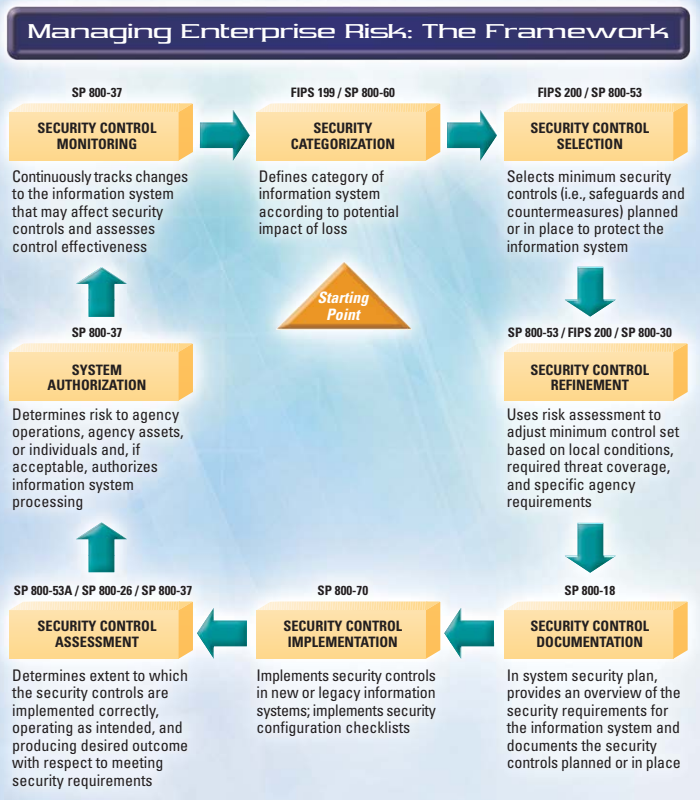
「Managing Enterprise Risk: The Framework」(企業リスクの管理: フレームワーク)と題した図です。8 つの箱が矢印で循環してつながり、中央にある橙色の三角形「Starting Point」(開始点)が最初の段階を指しています。「SECURITY CATEGORIZATION」(セキュリティ分類。FIPS 199 / SP 800-60):「Defines category of information system according to potential impact of loss」(損失の潜在的な影響に応じて情報システムの分類を定める)→「SECURITY CONTROL SELECTION」(セキュリティ管理策の選択。FIPS 200 / SP 800-53):「Selects minimum security controls (i.e., safeguards and countermeasures) planned or in place to protect the information system」(情報システムを保護するために計画済みまたは実施済みの最低限のセキュリティ管理策、すなわち安全対策と対抗策を選ぶ)→「SECURITY CONTROL REFINEMENT」(セキュリティ管理策の調整。SP 800-53 / FIPS 200 / SP 800-30):「Uses risk assessment to adjust minimum control set based on local conditions, required threat coverage, and specific agency requirements」(リスクアセスメントにより、現場の状況、必要な脅威への対応範囲、機関固有の要件に基づいて最低限の管理策の集合を調整する)→「SECURITY CONTROL DOCUMENTATION」(セキュリティ管理策の文書化。SP 800-18):「In system security plan, provides an overview of the security requirements for the information system and documents the security controls planned or in place」(システムセキュリティ計画で、情報システムのセキュリティ要件の概要を示し、計画済みまたは実施済みのセキュリティ管理策を文書化する)→「SECURITY CONTROL IMPLEMENTATION」(セキュリティ管理策の実装。SP 800-70):「Implements security controls in new or legacy information systems; implements security configuration checklists」(新規または既存の情報システムにセキュリティ管理策を実装し、セキュリティ設定チェックリストを適用する)→「SECURITY CONTROL ASSESSMENT」(セキュリティ管理策の評価。SP 800-53A / SP 800-26 / SP 800-37):「Determines extent to which the security controls are implemented correctly, operating as intended, and producing desired outcome with respect to meeting security requirements」(セキュリティ管理策が正しく実装され、意図どおりに動作し、セキュリティ要件を満たすという望む結果を出している程度を判定する)→「SYSTEM AUTHORIZATION」(システムの認可。SP 800-37):「Determines risk to agency operations, agency assets, or individuals and, if acceptable, authorizes information system processing」(機関の業務、機関の資産、個人へのリスクを判定し、受容できれば情報システムの処理を認可する)→「SECURITY CONTROL MONITORING」(セキュリティ管理策の監視。SP 800-37):「Continuously tracks changes to the information system that may affect security controls and assesses control effectiveness」(セキュリティ管理策に影響しうる情報システムの変更を継続的に追跡し、管理策の有効性を評価する)→「SECURITY CATEGORIZATION」に戻ります。
The security standards and guidelines being developed in Phase I of the FISMA Implementation Project will assist Federal agencies in completing the individual steps in the risk management framework as part of a well-defined and disciplined SDLC process. The standards and guidelines will also help Federal agencies implement the provisions of FISMA, demonstrate compliance to specific requirements contained within the legislation, and establish a level of security due diligence across the Federal government.
FISMA Implementation Project のフェーズ I で策定されているセキュリティ標準とガイドラインは、連邦機関が、明確に定義され規律ある SDLC プロセスの一環として、リスクマネジメントフレームワークの個々のステップを完了するのを支援します。この標準とガイドラインはまた、連邦機関が FISMA の規定を実施し、法令に含まれる特定の要件への準拠を示し、連邦政府全体でセキュリティに関するデューデリジェンスの水準を確立するのにも役立ちます。
http://csrc.nist.gov/sec-cert
Contacts: Ms. Joan Hash
(301) 975-5236
joan.hash@nist.gov
http://csrc.nist.gov/sec-cert
連絡先: Ms. Joan Hash
(301) 975-5236
joan.hash@nist.gov
Mr. Ray Snouffer
(301) 975-5236
ray.snouffer@nist.gov
Mr. Ray Snouffer
(301) 975-5236
ray.snouffer@nist.gov
MINIMUM SECURITY REQUIREMENTS AND SECURITY CONTROLS
最低限のセキュリティ要件とセキュリティ管理策
Akey component of the FISMA legislation is the requirement to establish minimum security requirements for federal information and information systems. An initial public draft of Federal Information Processing Standard (FIPS) 200, Minimum Security Requirements for Federal Information and Information Systems, was completed during the past year and released for public comment in July 2005. This mandatory standard, which is due for final publication in early 2006 when approved by the Secretary of Commerce, specifies minimum security requirements for federal information and information systems in 17 security-related areas. Federal agencies and their support contractors will be required to meet the minimum security requirements in FIPS 200 by selecting the appropriate security controls and assurance requirements in NIST Special Publication 800-53, Recommended Security Controls for Federal Information Systems (published in February 2005). Security controls are the management, operational, and technical safeguards and countermeasures prescribed for an information system which, taken together, adequately protect the confidentiality, integrity, and availability of the system and its information. The process of selecting appropriate security controls for organizational information systems to achieve adequate security is a multifaceted, risk-based activity involving management-level and operational-level personnel.
FISMA 法の重要な要素の一つは、連邦の情報と情報システムの最低限のセキュリティ要件を定める要件です。連邦情報処理標準(FIPS)200、Minimum Security Requirements for Federal Information and Information Systems の最初の公開ドラフトは、昨年中に完成し、2005年7月にパブリックコメント用に公開されました。この必須の標準は、商務長官の承認を得て2006年初めに最終版が発行される予定で、17 のセキュリティ関連分野について、連邦の情報と情報システムの最低限のセキュリティ要件を定めています。連邦機関とその支援請負業者は、NIST 特別刊行物 800-53、Recommended Security Controls for Federal Information Systems(2005年2月発行)の適切なセキュリティ管理策と保証要件を選択することで、FIPS 200 の最低限のセキュリティ要件を満たすことが求められます。セキュリティ管理策とは、情報システムに規定される管理面、運用面、技術面の保護措置と対策であり、これらを合わせて、システムとその情報の機密性、完全性、可用性を適切に保護するものです。十分なセキュリティを達成するために、組織の情報システムに適切なセキュリティ管理策を選択するプロセスは、管理レベルと運用レベルの職員が関わる、多面的でリスクベースの活動です。
Security categorization of federal information and information systems, as required by FIPS Pub 199, Standards for Security Categorization of Federal Information and Information Systems, is the first step in the risk management process. Subsequent to the security categorization process, agencies must implement an appropriate set of security controls for their information systems that satisfy the minimum security requirements set forth in FIPS 200. The implemented set of security controls must be one of the three, appropriately tailored security control baselines from NIST Special Publication 800-53 that are associated with the designated impact level (e.g., low, moderate, or high) of the agency’s information system as determined during the security categorization process. The application of the security control baselines defined in NIST Special Publication 800-53 represents the current state-of-the-practice safeguards and countermeasures for information systems. The catalog of security controls in NIST Special Publication 800-53 will be reviewed by us at least annually and, if necessary, revised and extended to reflect: (i) the experience gained from using the controls; (2) the changing security requirements within federal agencies; and (3) the new security technologies that may be available. The minimum security controls, selected from the catalog of security controls and defined in the low, moderate, and high security control baselines, are also expected to change over time as well, as the level of security and due diligence for mitigating risks within federal agencies increases. The proposed additions, deletions, or modifications to the catalog of security controls and the proposed changes to the security control baselines in NIST Special Publication 800-53 will go through a rigorous, public review process to obtain government and private sector feedback and to build consensus for the changes. State and local governments, as well as private sector organizations, are being encouraged to adopt the minimum security requirements and security controls on a voluntary basis to help protect the information infrastructure within the United States.
FIPS Pub 199、Standards for Security Categorization of Federal Information and Information Systems が求める、連邦の情報と情報システムのセキュリティ分類は、リスクマネジメントプロセスの最初のステップです。セキュリティ分類のプロセスの後、機関は、FIPS 200 に定められた最低限のセキュリティ要件を満たす適切なセキュリティ管理策のセットを、情報システムに実装しなければなりません。実装するセキュリティ管理策のセットは、セキュリティ分類のプロセスで判断された機関の情報システムの指定された影響度レベル(低、中、高など)に対応する、NIST 特別刊行物 800-53 の適切にテーラリングされた 3 つのセキュリティ管理策ベースラインのいずれかでなければなりません。NIST 特別刊行物 800-53 で定義されたセキュリティ管理策ベースラインの適用は、情報システムのための保護措置と対策の実践の現状を表しています。NIST 特別刊行物 800-53 のセキュリティ管理策カタログは、少なくとも年 1 回、私たちが見直し、必要であれば、(i) 管理策の利用から得られた経験、(2) 連邦機関内で変化するセキュリティ要件、(3) 利用可能になりうる新しいセキュリティ技術を反映するよう、改訂し拡張します。セキュリティ管理策カタログから選択され、低、中、高のセキュリティ管理策ベースラインに定義された最低限のセキュリティ管理策も、連邦機関内でリスクを緩和するためのセキュリティとデューデリジェンスの水準が高まるにつれて、時間とともに変わると見込まれます。NIST 特別刊行物 800-53 のセキュリティ管理策カタログへの追加、削除、修正の案と、同文書のセキュリティ管理策ベースラインへの変更案は、政府と民間部門からのフィードバックを得て変更への合意を形成するため、厳格な公開レビュープロセスを経ます。州政府と地方政府、および民間部門の組織は、米国内の情報インフラを保護するため、最低限のセキュリティ要件とセキュリティ管理策を自発的に採用するよう奨励されています。
http://csrc.nist.gov/sec-cert
Contacts: Dr. Ron Ross
(301) 975-5390
ron.ross@nist.gov
http://csrc.nist.gov/sec-cert
連絡先: Dr. Ron Ross
(301) 975-5390
ron.ross@nist.gov
Mr. Arnold Johnson
(301) 975-3247
arnold.johnson@nist.gov
Mr. Arnold Johnson
(301) 975-3247
arnold.johnson@nist.gov
METHODS AND PROCEDURES FOR ASSESSING SECURITY CONTROLS
セキュリティ管理策を評価する方法と手順
The selection and employment of appropriate security controls for an information system is an important task that can have major implications on the operations and assets of an organization. Once employed within an information system, security controls must be assessed to determine the extent to which the controls are implemented correctly, operating as intended, and producing the desired outcome with respect to meeting the security requirements for the system. Security assessments play an important role in the information security programs of organizations. These assessments can be used to support a variety of security-related activities, including but not limited to: (1) the testing and evaluation of security controls during the development of an information system; (2) the information system security certification and accreditation process; (3) the annual testing and evaluation of security controls required by FISMA; and (iv) generalized security reviews. The results of security assessments contribute to the knowledge base of organizational officials with regard to the security status of the information system and the overall risk to the operations and assets of the organization incurred by the operation of the system. To assist Federal agencies in conducting assessments of the security controls in their information systems, we are developing a comprehensive set of assessment methods and procedures for each security control in Special Publication 800-53. An initial public draft of NIST Special Publication 800-53A, Guide for Assessing the Security Controls in Federal Information Systems, was completed in July 2005 with the final publication expected in March 2006. The guideline will help achieve more secure information systems within the federal government by—
情報システムに適切なセキュリティ管理策を選択し導入することは、組織の業務や資産に大きな影響を与えうる重要なタスクです。情報システムに導入したセキュリティ管理策は、正しく実装され、意図したとおりに動作し、システムのセキュリティ要件を満たすうえで望ましい成果を生んでいる程度を判断するために、評価しなければなりません。セキュリティ評価は、組織の情報セキュリティプログラムにおいて重要な役割を果たします。これらの評価は、次のものを含むがこれらに限られない、さまざまなセキュリティ関連の活動を支えるために使用できます。(1) 情報システムの開発中のセキュリティ管理策の試験と評価、(2) 情報システムのセキュリティの認証と認定のプロセス、(3) FISMA が求める、セキュリティ管理策の年次の試験と評価、(iv) 一般的なセキュリティレビュー。セキュリティ評価の結果は、情報システムのセキュリティ状態と、システムの運用によって組織の業務および資産が負う全体的なリスクについて、組織の職員の知識基盤を豊かにします。連邦機関が情報システムのセキュリティ管理策の評価を実施するのを支援するため、当部門は、特別刊行物 800-53 の各セキュリティ管理策に対する、包括的な評価方法と手順のセットを策定しています。NIST 特別刊行物 800-53A、Guide for Assessing the Security Controls in Federal Information Systems の最初の公開ドラフトは2005年7月に完成し、最終版は2006年3月に発行される見込みです。このガイドラインは、次のことを通じて、連邦政府内のより安全な情報システムの実現に役立ちます。
•Enabling more consistent, comparable, and repeatable assessments of security controls
•セキュリティ管理策の評価を、より一貫性があり、比較可能で、再現可能なものにすること
•Facilitating more cost-effective assessments of security control effectiveness
•セキュリティ管理策の有効性の評価を、より費用対効果の高いものにすること
•Promoting a better understanding of the risks to organizational operations, organizational assets, or individuals resulting from the operation of information systems, and
•情報システムの運用に起因する、組織の業務、組織の資産、または個人に対するリスクへの理解を深めること、および
•Creating more complete, reliable, and trustworthy information for organizational officials—to support security accreditation decisions and the annual FISMA reporting requirements.
•セキュリティ認定の判断と FISMA の年次報告要件を支えるために、組織の職員向けに、より完全で、信頼でき、信用できる情報を作成すること。
http://csrc.nist.gov/sec-cert
Contacts: Dr. Ron Ross
(301) 975-5390
ron.ross@nist.gov
http://csrc.nist.gov/sec-cert
連絡先: Dr. Ron Ross
(301) 975-5390
ron.ross@nist.gov
Mr. Arnold Johnson
(301) 975-3247
arnold.johnson@nist.gov
Mr. Arnold Johnson
(301) 975-3247
arnold.johnson@nist.gov
ORGANIZATIONAL ACCREDITATION PROGRAM
組織認定プログラム
Phase II of the FISMA Implementation Project will focus on the development of a program for accrediting public and private sector organizations to provide security certification services for federal agencies. The term “accreditation” is used in two different contexts in the FISMA Implementation Project. “Security accreditation” is the official management decision to authorize operation of an information system. “Organizational accreditation” involves comprehensive proficiency testing and the demonstration of specialized skills in a particular area of interest. A security certification is a comprehensive assessment of the management, operational and technical security controls in an information system, made in support of security accreditation, to determine the extent to which the controls are implemented correctly, operating as intended and producing the desired outcome with respect to meeting the security requirements for the system. Organizations that participate in the accreditation program will be able to demonstrate competence in performing assessments of security controls implemented in an information system. Developing a network of accredited organizations with demonstrated competence in the provision of security certification services will give federal agencies greater confidence in the acquisition and use of such services and lead to increased information security for the federal government. The organizational accreditation project consists of four phases—
FISMA Implementation Project のフェーズ II は、連邦機関にセキュリティ認証サービスを提供する公的・民間組織を認定するプログラムの策定に重点を置きます。「認定(accreditation)」という用語は、FISMA Implementation Project では 2 つの異なる文脈で使われます。「セキュリティ認定」とは、情報システムの運用を認可する公式の管理上の決定です。「組織認定」とは、包括的な習熟度試験と、特定の関心分野における専門的な技能の実証を伴うものです。セキュリティ認証とは、セキュリティ認定を支えるために行われる、情報システムの管理面、運用面、技術面のセキュリティ管理策の包括的な評価であり、その管理策が正しく実装され、意図したとおりに動作し、システムのセキュリティ要件を満たすうえで望ましい成果を生んでいる程度を判断します。組織認定プログラムに参加する組織は、情報システムに実装されたセキュリティ管理策の評価を実施する能力を示せるようになります。セキュリティ認証サービスの提供能力を実証した認定組織のネットワークを築くことで、連邦機関は、そうしたサービスの調達と利用により大きな信頼を置けるようになり、連邦政府の情報セキュリティの向上につながります。組織認定プロジェクトは、4 つのフェーズで構成されます。
•Development and selection of an appropriate accreditation model for determining the competency of organizations desiring to provide security certification services in accordance with NIST Special Publication 800-37, Guide for the Security Certification and Accreditation of Federal Information Systems
•NIST 特別刊行物 800-37、Guide for the Security Certification and Accreditation of Federal Information Systems に従ってセキュリティ認証サービスの提供を望む組織の能力を判断するための、適切な認定モデルの開発と選定
•Development of detailed accreditation requirements for organizations seeking accreditation
•認定を求める組織に対する、詳細な認定要件の策定
•Development of appropriate proficiency tests to determine the competency of prospective organizations seeking accreditation in key NIST Special Publications associated with the certification and accreditation of federal information systems, and
•連邦情報システムの認証と認定に関連する主要な NIST 特別刊行物について、認定を求める候補組織の能力を判断するための、適切な習熟度試験の策定、および
•Development of a strategy for implementing the accreditation program and selection of an appropriate accreditation body to conduct the organizational accreditations.
•認定プログラムを実施するための戦略の策定と、組織の認定を行う適切な認定機関の選定。
There will be extensive public vetting of the accreditation program during each phase of development as described above. The vetting process will include public workshops to discuss various accreditation approaches and models, a public review of the proposed assessment methods and procedures contained in Special Publication 800-53A, and a public review of the implementation strategy for the accreditation program. The first public workshop for the organizational accreditation program will be in spring 2006.
上記の開発の各フェーズで、認定プログラムについて、広範な公開の精査が行われます。精査のプロセスには、さまざまな認定の取り組み方とモデルを議論する公開ワークショップ、特別刊行物 800-53A に含まれる評価方法および手順の案の公開レビュー、認定プログラムの実施戦略の公開レビューが含まれます。組織認定プログラムの最初の公開ワークショップは、2006年春に開かれます。
http://csrc.nist.gov/sec-cert
Contacts: Mr. Arnold Johnson
(301) 975-3247
arnold.johnson@nist.gov
http://csrc.nist.gov/sec-cert
連絡先: Mr. Arnold Johnson
(301) 975-3247
arnold.johnson@nist.gov
Ms. Pat Toth
(301) 975-5140
patricia.toth@nist.gov
Ms. Pat Toth
(301) 975-5140
patricia.toth@nist.gov
SECURITY PRACTICES AND POLICIES
セキュリティの実践と方針
Today's Federal networks and systems are highly interconnected and interdependent with non-Federal systems. Protection of the Nation's critical infrastructure is dependent upon effective information security solutions and practices that minimize vulnerabilities associated with a variety of threats. The broader sharing of such practices will enhance the overall security of the Nation. Information security practices from the public and private sector can sometimes be applied to enhance the overall performance of Federal information security programs. We are helping to facilitate a sharing of these practices and implementation guidelines in multiple ways.
今日の連邦のネットワークとシステムは、連邦以外のシステムと高度に相互接続され、相互依存しています。国の重要インフラの保護は、さまざまな脅威に関連する脆弱性を最小限に抑える、有効な情報セキュリティのソリューションと実践にかかっています。こうした実践をより広く共有することは、国全体のセキュリティを高めます。公的部門と民間部門の情報セキュリティの実践は、連邦の情報セキュリティプログラム全体のパフォーマンスを高めるために応用できることがあります。当部門は、これらの実践と実装ガイドラインの共有を、複数の方法で促進しています。
The Federal Agency Security Practices (FASP) effort was initiated as a result of the success of the Federal Chief Information Officers Council’s Federal Best Security Practices (BSP) pilot effort to identify, evaluate, and disseminate best practices for critical infrastructure protection and security. We were asked to undertake the transition of this pilot effort to an operational program. As a result, we developed the FASP Web site. The FASP site contains agency policies, procedures and practices, the Federal Chief Information Officers Council’s pilot BSPs, and a Frequently-Asked-Questions (FAQ) section. The FASP site differs from the BSP pilot in material provided and complexity.
Federal Agency Security Practices(FASP)の取り組みは、重要インフラの保護とセキュリティのベストプラクティスを特定、評価、周知する、連邦最高情報責任者評議会の Federal Best Security Practices(BSP)パイロットの取り組みが成功したことを受けて始まりました。当部門は、このパイロットの取り組みを運用プログラムへ移行する役割を求められました。その結果、FASP ウェブサイトを開発しました。FASP サイトには、機関の方針、手順、実践、連邦最高情報責任者評議会のパイロット BSP、よくある質問(FAQ)の節が含まれています。FASP サイトは、提供する資料と複雑さの点で BSP パイロットとは異なります。
The FASP area contains a list of categories found in many of the NIST Special Publications. Based on these categories, agencies are encouraged to submit their IT security information and IT security practices for posting on the FASP site so they may be shared with others. Any information on, or samples of, position descriptions for security positions and statements of work for contracting security-related activities are also encouraged. In the past year, 43 practices and examples were added to the collection bringing the total to 169.
FASP の領域には、NIST 特別刊行物の多くに見られるカテゴリの一覧があります。これらのカテゴリに基づき、機関は、他の機関と共有できるよう、IT セキュリティ情報と IT セキュリティの実践を、FASP サイトへの掲載用に提出することが奨励されます。セキュリティ職の職務記述書や、セキュリティ関連の活動を請け負わせる際の作業範囲記述書に関する情報や見本も奨励されます。過去 1 年間に、43 件の実践と例がコレクションに追加され、合計は 169 件になりました。
We also invite public and private organizations to submit their information security practices to be considered for inclusion on the list of practices maintained on the Web site. Policies and procedures may be submitted to us in any area of information security, including accreditation, audit trails, authorization of processing, budget planning and justification, certification, contingency planning, data integrity, disaster planning, documentation, hardware and system maintenance, identification and authentication, incident handling and response, life cycle, network security, personnel security, physical and environmental protection, production input/output controls, security policy, program management, review of security controls, risk management, security awareness training and education (to include specific course and awareness materials), and security planning.
当部門は、公的・民間の組織にも、ウェブサイトで維持している実践の一覧への掲載を検討してもらうために、情報セキュリティの実践を提出するよう呼びかけています。方針と手順は、認定、監査証跡、処理の認可、予算計画と正当化、認証、緊急時対応計画、データの完全性、災害計画、文書化、ハードウェアとシステムの保守、識別と認証、インシデントの取り扱いと対応、ライフサイクル、ネットワークセキュリティ、要員セキュリティ、物理的・環境的保護、本番の入出力管理、セキュリティポリシー、プログラム管理、セキュリティ管理策のレビュー、リスクマネジメント、セキュリティ意識向上のトレーニングと教育(具体的なコースと啓発資料を含む)、セキュリティ計画など、情報セキュリティのあらゆる分野で提出できます。
The coming year will see an effort to continue the momentum to expand the number of sample practices and policies made available to Federal agencies and the public. We are currently identifying robust sources for more samples to add to this growing repository.
来年は、連邦機関と一般に提供するサンプルの実践と方針の数を増やす取り組みを引き続き進めます。現在、この拡大を続けるリポジトリに追加するサンプルをさらに多く得るため、確かな情報源を特定しています。
http://fasp.nist.gov/
Contacts: Ms. Pauline Bowen
(301) 975-2938
pauline.bowen@nist.gov
http://fasp.nist.gov/
連絡先: Ms. Pauline Bowen
(301) 975-2938
pauline.bowen@nist.gov
Mr. Mark Wilson
(301) 975-3870
mark.wilson@nist.gov
Mr. Mark Wilson
(301) 975-3870
mark.wilson@nist.gov
AUTOMATED SECURITY SELF-EVALUATION TOOL
自動化されたセキュリティ自己評価ツール
An important element of measuring the status of information technology (IT) security within an organization is to perform routine self-assessments of an organization’s IT systems. There are many methods and tools available to help agency officials determine the current status of their security programs relative to existing policy. Ideally many of these methods and tools would be implemented on an ongoing basis to systematically identify programmatic weaknesses and, where necessary, establish targets for continuing improvement. For a self-assessment to be effective, a risk assessment should be conducted in conjunction with or prior to the self-assessment. A self-assessment does not eliminate the need for a risk assessment.
組織内の情報技術(IT)セキュリティの状況を測定するうえで重要な要素は、組織の IT システムに対して定期的な自己評価を行うことです。機関の職員が、既存の方針に照らして自らのセキュリティプログラムの現状を判断するのに役立つ方法とツールは数多くあります。理想的には、これらの方法とツールの多くを継続的に実施して、プログラム上の弱点を体系的に特定し、必要に応じて継続的な改善の目標を定めます。自己評価を有効にするには、自己評価と並行して、またはその前に、リスク評価を実施すべきです。自己評価は、リスク評価の必要性をなくすものではありません。
The Automated Security Self-Evaluation Tool (ASSET) automates the process of completing a system self-assessment. ASSET will assist organizations in completing the self-assessment questionnaire contained in NIST Special Publication (SP) 800-26, Security Self-Assessment Guide for Information Technology Systems.
Automated Security Self-Evaluation Tool(ASSET)は、システムの自己評価を完了するプロセスを自動化します。ASSET は、組織が NIST 特別刊行物(SP)800-26、Security Self-Assessment Guide for Information Technology Systems に含まれる自己評価質問票に記入するのを支援します。
ASSET may be used to gather data and generate reports related to the status of the self-assessment. The intent of this tool is to provide a centralized place for the collection of data used to assess a system. ASSET contains the specific control objectives and suggested techniques for measuring the security of a system or group of interconnected systems as described in SP 800-26. The control objectives and techniques are taken from long-standing requirements found in statute, policy and guidance on security.
ASSET は、自己評価の状況に関するデータを収集し、報告書を生成するために使えます。このツールの意図は、システムの評価に使われるデータを収集する一元的な場所を提供することです。ASSET には、SP 800-26 に記載された、システムまたは相互接続されたシステム群のセキュリティを測定するための、具体的な管理目標と推奨される技法が含まれています。管理目標と技法は、セキュリティに関する法令、方針、ガイダンスに見られる長年の要件から取られています。
The reporting features of ASSET are designed to provide users with a clear picture of the security status of their resources, as specified in SP 800-26. ASSET generates a system summary report, which provides a snapshot of assessment results. Unformatted reports can be exported to any popular spreadsheet or charting program. Formatted reports are available for export to Microsoft Excel. The results of the questionnaire can be used as input to a report evaluating an organization-wide IT security program. By sampling completed questionnaires, an agency can determine how well their policies and procedures are being followed and where resources should be expended. A Federal Information Security Management Act of 2002 (FISMA) reporting template has been developed to facilitate the extraction of data from ASSET–Manager to use in FISMA-required reports to the Office of Management and Budget.
ASSET の報告機能は、SP 800-26 に定められたとおり、利用者が資源のセキュリティ状況を明確に把握できるよう設計されています。ASSET は、評価結果のスナップショットを示すシステム概要報告書を生成します。書式なしの報告書は、一般的なスプレッドシートやグラフ作成プログラムにエクスポートできます。書式付きの報告書は、Microsoft Excel にエクスポートできます。質問票の結果は、組織全体の IT セキュリティプログラムを評価する報告書へのインプットとして使えます。記入済みの質問票をサンプル調査することで、機関は、方針と手順がどの程度守られているか、どこに資源を投じるべきかを判断できます。行政管理予算局への FISMA が求める報告書に利用するため、ASSET–Manager からのデータ抽出を容易にする FISMA(2002年連邦情報セキュリティマネジメント法)報告テンプレートが作成されました。
The fourth version of ASSET, version 2.0, and new user’s manual NIST Interagency Report (IR) 6885, Automated Security Self-Evaluation Tool User Manual 2004 Edition, were released in December 2004. The manual is intended to help users of ASSET understand each function of the tool and how the tool can be used to complete self-assessments.
ASSET の第 4 版であるバージョン 2.0 と、新しい利用者マニュアル NIST 省庁間報告書(IR)6885、Automated Security Self-Evaluation Tool User Manual 2004 Edition は、2004年12月に公開されました。このマニュアルは、ASSET の利用者がツールの各機能と、ツールを自己評価の完了にどう使えるかを理解するのを助けることを意図しています。
http://csrc.nist.gov/organizations/cspmf.html
Contact: Ms. Marianne Swanson
(301) 975-3293
marianne.swanson@nist.gov
http://csrc.nist.gov/organizations/cspmf.html
連絡先: Ms. Marianne Swanson
(301) 975-3293
marianne.swanson@nist.gov
ANTI-SPAM TECHNOLOGIES
スパム対策技術
E-mail is an extremely important and effective means of communication and is used by millions of Americans on a daily basis for personal and commercial purposes. Its convenience and efficiency, however, are increasingly threatened by the rise in the number of unsolicited commercial e-mail messages known as spam. It is generally agreed that spam currently accounts for over half of all e-mails received by Internet service providers’ (ISPs’) e-mail servers. Today, much of spam appears to contain false or misleading claims. The volume of spam also imposes significant costs on ISPs, businesses, and other organizations, since they can only handle a finite volume of e-mail without making further investments in their infrastructure. Spam also has become a security issue in that it is frequently now used to spread viruses and other malicious code.
電子メールは、きわめて重要で有効な通信手段であり、何百万人もの米国人が私的な目的と商用の目的で毎日使っています。しかし、その利便性と効率は、スパムと呼ばれる迷惑商用電子メールの増加によって、ますます脅かされています。現在、インターネットサービスプロバイダー(ISP)の電子メールサーバーが受信するすべての電子メールの半分以上をスパムが占めるというのが、一般的な見方です。今日、スパムの多くは、虚偽または誤解を招く主張を含んでいるようです。スパムの量はまた、ISP、企業、その他の組織に多大な費用を負わせます。インフラにさらなる投資をしない限り、処理できる電子メールの量には限りがあるからです。スパムは、ウイルスやその他の悪意のあるコードを広めるために頻繁に使われるようになったことで、セキュリティ上の問題にもなっています。
As awareness of these new security issues rises, many entities that rely increasingly on the Internet as an important infrastructure are reassessing their responsibilities in dealing with spam, reassessing the risks they face and making changes in how they manage their responses to these security issues. Spam, and particularly phishing, must now be included in the ever-growing list of security issues they must consider when designing and managing their information technology systems.
こうした新しいセキュリティ上の問題への認識が高まるにつれて、重要なインフラとしてインターネットへの依存を強めている多くの主体が、スパムへの対処に関する責任を見直し、直面するリスクを再評価し、こうしたセキュリティ上の問題への対応の管理方法を変えています。スパム、とりわけフィッシングは、情報技術システムを設計し管理する際に考慮しなければならない、増え続けるセキュリティ上の問題の一覧に、今や含めなければなりません。
Because of the international origins and destinations of many spam messages, spam is a global problem that requires international cooperation. As a result, multiple international fora, both public and private, are seeking to address this problem. In recognition of the negative impact of spam, the Organisation for Economic Co-Operation and Development (OECD), a 30-member international governmental organization, created a Task Force on Spam in July 2004. In the past year, Ms. Tanya Brewer has served as a member of this Task Force. The Task Force is a joint effort between the OECD Committee for Information, Computer and Communications Policy; the OECD Working Party on Information Security and Privacy; and the OECD Committee on Consumer Policy. We have also participated in joint talks between the OECD Task Force, the Asian-Pacific Economic Cooperation (APEC), and the International Telecommunication Union (ITU).
スパムメッセージの多くは発信元と宛先が国際的であるため、スパムは国際協力を必要とする世界的な問題です。その結果、公的・民間を問わず複数の国際フォーラムが、この問題への対処を目指しています。スパムの悪影響を認識して、30 か国が加盟する国際政府間組織である経済協力開発機構(OECD)は、2004年7月に Task Force on Spam を設けました。昨年、Ms. Tanya Brewer は、このタスクフォースの構成員を務めました。このタスクフォースは、OECD Committee for Information, Computer and Communications Policy、OECD Working Party on Information Security and Privacy、OECD Committee on Consumer Policy の共同の取り組みです。当部門は、OECD タスクフォース、アジア太平洋経済協力(APEC)、国際電気通信連合(ITU)の間の共同協議にも参加しました。
We will continue to participate in broader U.S. government initiatives to combat spam, including finalization of a Toolkit being developed by the OECD Task Force on Spam and a joint meeting regarding spam between the OECD, APEC, and ITU in spring 2006. We will also consider ways we can further assist agencies or conduct relevant, useful research on anti-spam technologies.
当部門は、OECD の Task Force on Spam が作成中の Toolkit の最終化や、2006年春の OECD、APEC、ITU 間のスパムに関する共同会合を含む、スパムに対抗するより広範な米国政府の取り組みに、引き続き参加します。また、機関をさらに支援したり、スパム対策技術に関する関連性があり有用な研究を実施したりできる方法も検討します。
http://csrc.nist.gov/spam/
Contacts: Ms. Tanya Brewer
(301) 975-4534
tbrewer@nist.gov
http://csrc.nist.gov/spam/
連絡先: Ms. Tanya Brewer
(301) 975-4534
tbrewer@nist.gov
Dr. David Griffith
(301) 975-3512
david.griffith@nist.gov
Dr. David Griffith
(301) 975-3512
david.griffith@nist.gov
NEW PROJECTS AND GUIDANCE
新規プロジェクトとガイダンス
The past year has seen many new initiatives in the area of security management. While these efforts have not been larger projects, they nonetheless are important to the Federal agencies that will utilize the outcomes and final products. This report is not meant to be an exhaustive catalog of our work, but these initiatives we thought significant enough to be highlighted.
昨年は、セキュリティマネジメントの分野で多くの新しい取り組みがありました。これらの取り組みは大規模なプロジェクトではありませんが、その成果や最終的な製品を利用する連邦機関にとって重要です。この報告書は当部門の業務を網羅した目録を意図したものではありませんが、これらの取り組みは強調するに値すると考えました。
Revision of the Security Managers’ Handbook
セキュリティ管理者ハンドブックの改訂
We are currently updating NIST Special Publication (SP) 800-12, An Introduction to Computer Security: The NIST Handbook, originally published in 1995. The draft Information Security Managers' Handbook provides a broad overview of information security program elements to assist managers in understanding how to establish and implement sound information security programs. It is the organization's responsibility to select and implement appropriate security controls and to demonstrate the effectiveness of satisfying their stated security requirements. A broad understanding of the necessary topics to be addressed in all aspects of information security is discussed throughout this handbook. The topics within the document were selected based on the laws and regulations relevant to information security, including the Clinger-Cohen Act of 1996, the Federal Information Security Management Act of 2002 (FISMA), and Office of Management and Budget (OMB) Circular A-130. The material in this handbook can be referenced for general information on a particular topic or can be used in the decision-making process for developing a mature information security program.
現在、1995年に最初に発行された NIST 特別刊行物(SP)800-12、An Introduction to Computer Security: The NIST Handbook を更新しています。ドラフトの Information Security Managers’ Handbook は、管理者が健全な情報セキュリティプログラムの確立と実施の方法を理解するのに役立つよう、情報セキュリティプログラムの要素を幅広く概説しています。適切なセキュリティ管理策を選択して実装し、それらの管理策によって、組織が定めたセキュリティ要件を満たせていることの有効性を実証することは、組織の責任です。このハンドブックでは、情報セキュリティのあらゆる側面で扱うべき必要なトピックについて、幅広く論じています。この文書で取り上げる項目は、1996年クリンガー・コーエン法、2002年連邦情報セキュリティマネジメント法(FISMA)、行政管理予算局(OMB)通達 A-130 など、情報セキュリティに関連する法令に基づいて選ばれています。このハンドブックの内容は、特定のトピックに関する一般的な情報の参照にも、成熟した情報セキュリティプログラムを策定する際の意思決定プロセスにも使えます。
The purpose of this publication is to inform members of the information security management team—Agency Heads, Chief Information Officers (CIOs), Chief Information Security Officers (CISOs), and security managers—about various aspects of information security that they will be expected to implement and oversee in their respective organizations. In addition, the handbook provides guidance for facilitating a more consistent approach to information security programs across the federal government.
この刊行物の目的は、情報セキュリティ管理チームの構成員である機関の長、最高情報責任者(CIO)、最高情報セキュリティ責任者(CISO)、セキュリティ管理者に、それぞれの組織で実施し監督することが期待される情報セキュリティのさまざまな側面を知らせることです。さらに、このハンドブックは、連邦政府全体で情報セキュリティプログラムに対するより一貫した取り組み方を促進するためのガイダンスを提供します。
Performance Metrics for Information Security
情報セキュリティのパフォーマンスメトリクス
In the past year, we have begun work on SP 800-80, Guide to Performance Metrics for Information Security. This publication is intended to provide to managers and decision-makers the ability to measure the effectiveness of security control families and processes to meet an organization’s security and strategic objectives. Development and implementation of the metrics contained in this document are aligned with the security control families described in NIST SP 800-53, Recommended Security Controls for Federal Information Systems. The metrics in this publication are not focused on enforcing compliance or measuring implementation of individual controls. The metrics are being discussed in the framework of the SP 800-53 control families because the framework is broad enough to encompass the most commonly named objectives of an information security program. The methodology used to develop the metrics in this guide is contained in NIST SP 800-55, Security Metrics Guide for Information Technology Systems. This methodology can be used to develop organization specific metrics that fall outside of the SP 800-53 framework or to customize those discussed herein.
昨年、SP 800-80、Guide to Performance Metrics for Information Security の作業を始めました。この刊行物は、組織のセキュリティ上および戦略上の目標を達成するうえでのセキュリティ管理策ファミリーとプロセスの有効性を、管理者や意思決定者が測定できるようにすることを意図しています。この文書に含まれるメトリクスの策定と実装は、NIST SP 800-53、Recommended Security Controls for Federal Information Systems に記載されたセキュリティ管理策ファミリーに沿っています。この刊行物のメトリクスは、準拠の強制や個々の管理策の実装の測定に重点を置いていません。メトリクスは、SP 800-53 の管理策ファミリーという枠組みで論じられています。この枠組みが、情報セキュリティプログラムで最もよく挙げられる目標を包含できるほど広いからです。このガイドでメトリクスを策定するために用いる方法論は、NIST SP 800-55、Security Metrics Guide for Information Technology Systems に含まれています。この方法論は、SP 800-53 の枠組みに入らない組織固有のメトリクスを策定する際にも、ここで論じたメトリクスをカスタマイズする際にも使えます。
The metrics contained in SP 800-55 focus on implementation of the security controls reported in the FISMA Self-Assessment Checklist. The focus in SP 800-80 is on providing IT security managers the methodology and tools needed to measure how their program complies with mandatory guidance, as well as how well their program is meeting strategic objectives supporting business operation.
SP 800-55 に含まれるメトリクスは、FISMA Self-Assessment Checklist で報告されるセキュリティ管理策の実装に重点を置いています。SP 800-80 の重点は、IT セキュリティ管理者に、プログラムが必須のガイダンスにどの程度準拠しているか、また業務運営を支える戦略目標をどの程度満たしているかを測定するために必要な方法論とツールを提供することです。
Implementing the Health Insurance Portability and Accountability Act (HIPAA) Security Rule
Health Insurance Portability and Accountability Act(HIPAA)セキュリティ規則の実施
In March 2005, we published SP 800-66, An Introductory Resource Guide for Implementing the Health Insurance Portability and Accountability Act (HIPAA) Security Rule. This SP summarizes the HIPAA security standards and explains some of the structure and organization of the HIPAA Security Rule. This publication helps to educate readers about information security terms used in the HIPAA Security Rule and to improve understanding of the meaning of the security standards set out in the Security Rule. This publication is also designed to direct readers to helpful information in other NIST publications on individual topics the HIPAA Security Rule addresses. Readers can draw upon these publications for consideration in implementing the Security Rule. This publication is intended as an aid to understanding security concepts discussed in the HIPAA Security Rule, and does not supplement, replace, or supersede the HIPAA Security Rule itself.
2005年3月に、SP 800-66、An Introductory Resource Guide for Implementing the Health Insurance Portability and Accountability Act (HIPAA) Security Rule を発行しました。この SP は、HIPAA のセキュリティ標準を要約し、HIPAA セキュリティ規則の構造と構成の一部を説明しています。この刊行物は、読者が HIPAA セキュリティ規則で使われる情報セキュリティ用語を学び、セキュリティ規則に定められたセキュリティ標準の意味への理解を深めるのに役立ちます。また、HIPAA セキュリティ規則が扱う個々のトピックについて、他の NIST 刊行物にある有用な情報へ読者を導くようにも設計されています。読者は、セキュリティ規則を実施する際の検討のために、これらの刊行物を参照できます。この刊行物は、HIPAA セキュリティ規則で論じられているセキュリティの概念を理解するための助けとなることを意図しており、HIPAA セキュリティ規則自体を補足、置換、または優先するものではありません。
[装飾の画像。本文を読むのに必要のない装飾のため、この非公式サイトには掲載していません。原本 PDF を参照してください。]
NIST SP 800-66 assists all agencies seeking further information on the security safeguards discussed in the HIPAA Security Rule, regardless of the particular structures, methodologies, and approaches used to address its requirements.
NIST SP 800-66 は、HIPAA セキュリティ規則の要件への対処に用いる構造、方法論、取り組み方にかかわらず、HIPAA セキュリティ規則で論じられているセキュリティ上の保護措置についてさらなる情報を求めるすべての機関を支援します。
Media Sanitization
メディアのサニタイゼーション
When storage media are transferred, become obsolete, or are no longer usable or required by an IT system, it is important to ensure that residual magnetic, optical, or electrical representation of data that has been deleted is not easily recoverable. Sanitization refers to the general process of removing data from storage media, such that there is reasonable assurance, in proportion to the sensitivity of the data, that the data may not be retrieved and reconstructed. Once the media are sanitized, it should be impossible or highly impractical to retrieve the data from those media.
記憶メディアを譲渡するとき、陳腐化したとき、使用できなくなったとき、または IT システムで不要になったときには、削除されたデータの磁気的、光学的、電気的な残存表現が容易に復元できないようにすることが重要です。サニタイゼーションとは、データの機微性に応じた合理的な保証のもとで、そのデータを取り出して再構成できないように、記憶メディアからデータを消去する一般的なプロセスを指します。メディアがサニタイズされた後は、そのメディアからデータを取り出すことは不可能であるか、非常に非現実的であるべきです。
The media sanitization guide—SP 800-88, Media Sanitization Guide —will assist organizations and system owners in making practical sanitization decisions based on the level of confidentiality of their information. This publication will also assist organizations in implementing a media sanitization program with proper and applicable techniques and controls for sanitization and disposal based on system categorization.
メディアのサニタイゼーションに関するガイドである SP 800-88、Media Sanitization Guide は、組織とシステム所有者が、情報の機密性の水準に基づいて、実際的なサニタイゼーションの判断を下すのを支援します。この刊行物はまた、組織が、システムの分類に基づく、サニタイゼーションと廃棄のための適切で適用可能な技法と管理策を備えた、メディアのサニタイゼーションプログラムを実施するのも支援します。
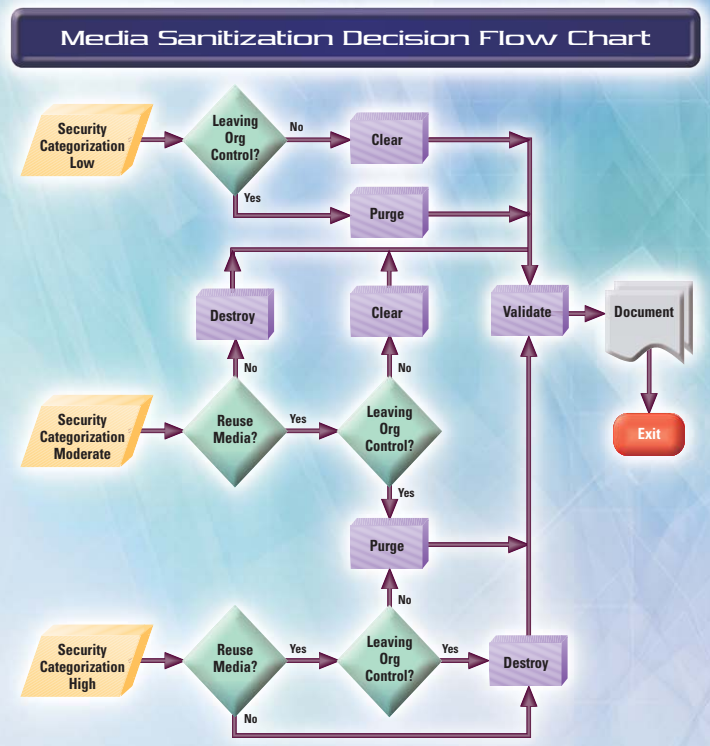
「Media Sanitization Decision Flow Chart」(媒体のサニタイズの判断の流れ図)と題した流れ図です。「Security Categorization Low」(セキュリティ分類が低)→「Leaving Org Control?」(組織の管理下を離れるか)で、「No」なら「Clear」(消去)、「Yes」なら「Purge」(除去)。「Security Categorization Moderate」(セキュリティ分類が中)→「Reuse Media?」(媒体を再利用するか)で、「No」なら「Destroy」(破壊)、「Yes」なら「Leaving Org Control?」へ進み、「No」なら「Clear」、「Yes」なら「Purge」。「Security Categorization High」(セキュリティ分類が高)→「Reuse Media?」で、「No」なら「Destroy」、「Yes」なら「Leaving Org Control?」へ進み、「No」なら「Purge」、「Yes」なら「Destroy」。「Clear」「Purge」「Destroy」の箱はすべて「Validate」(検証)→「Document」(文書化)→「Exit」(終了)へ進みます。
Return on Security Investment
セキュリティ投資収益率
One of our goals is to develop modeling tools for the Federal community to help them select cost-effective strategies to achieve a level of computer security commensurate with the degree of risk and magnitude of likely harm. We are interested in doing some more research work on the subject of Return on Investment for security, and are assembling a meeting to talk to a sample of those in government who participate in the security investment process to gather more resource information, which will be valuable as we continue our analysis.
当部門の目標の一つは、リスクの程度と起こりうる被害の大きさに見合ったコンピュータセキュリティの水準を達成するための、費用対効果の高い戦略を連邦コミュニティが選択するのに役立つモデル化ツールを開発することです。セキュリティの投資収益率の主題について、さらに研究を行うことに関心があり、分析を続ける中で貴重となる、より多くの資源情報を集めるため、セキュリティ投資のプロセスに関与する政府内の一部の人々と話し合う会合を準備しています。
Contacts:
Ms. Joan Hash (Performance Metrics, HIPAA, ROSI)
(301) 975-5236
joan.hash@nist.gov
連絡先:
Ms. Joan Hash(パフォーマンスメトリクス、HIPAA、ROSI)
(301) 975-5236
joan.hash@nist.gov
Ms. Pauline Bowen (Handbook, HIPAA)
(301) 975-2938
pauline.bowen@nist.gov
Ms. Pauline Bowen(ハンドブック、HIPAA)
(301) 975-2938
pauline.bowen@nist.gov
Ms. Elizabeth Chew (Performance Metrics, ROSI)
(301) 975-8897
elizabeth.chew@nist.gov
Ms. Elizabeth Chew(パフォーマンスメトリクス、ROSI)
(301) 975-8897
elizabeth.chew@nist.gov
Dr. Alicia Clay (Performance Metrics, ROSI)
(301) 975-3641
alicia.clay@nist.gov
Dr. Alicia Clay(パフォーマンスメトリクス、ROSI)
(301) 975-3641
alicia.clay@nist.gov
Mr. Arnold Johnson (HIPAA)
(301) 975-3247
arnold.Johnson@nist.gov
Mr. Arnold Johnson(HIPAA)
(301) 975-3247
arnold.Johnson@nist.gov
Mr. Richard Kissel (Media Sanitization)
(301) 975-5017
richard.Kissel@nist.gov
Mr. Richard Kissel(メディアのサニタイゼーション)
(301) 975-5017
richard.Kissel@nist.gov
Mr. Matthew Scholl (Media Sanitization)
(301) 975-2941
matthew.scholl@nist.gov
Mr. Matthew Scholl(メディアのサニタイゼーション)
(301) 975-2941
matthew.scholl@nist.gov
SECURITY TESTING AND METRICS
セキュリティ試験・メトリクス
STRATEGIC GOAL
戦略目標
The Computer Security Division (CSD) will provide Federal government agencies, industry and the public with a proven set of information technology (IT) security services based upon sound testing methodologies and test metrics. To this end, the CSD will engage in activities to develop, manage and promote security assessment tools, techniques and services, and will support programs for the testing, evaluation and validation of certain IT products. The CSD will also provide guidance to Federal agencies on the use of evaluated and tested products.
コンピュータセキュリティ部門(CSD)は、連邦政府機関、産業界、一般の人々に、健全な試験方法論と試験メトリクスに基づく、実績のある情報技術(IT)セキュリティサービス一式を提供します。この目的のため、CSD は、セキュリティ評価のツール、技法、サービスを開発、管理、促進する活動を行い、特定の IT 製品の試験、評価、検証のプログラムを支援します。また、CSD は、評価・試験済みの製品の使用について、連邦機関にガイダンスも提供します。
OVERVIEW
概要
Every IT product available makes a claim. When protecting sensitive data, government agencies need to have a minimum level of assurance that a product’s stated security claim is valid. There are also legislative restrictions regarding certain types of technology that require Federal agencies to use only tested and validated products.
入手可能なあらゆる IT 製品は、何らかの主張をしています。機微なデータを保護する際、政府機関には、製品が示すセキュリティの主張が有効であるという最低限の保証が必要です。特定の技術については、連邦機関に試験・検証済みの製品のみの使用を求める法的な制約もあります。
Our testing-focused activities include the validation of cryptographic modules and cryptographic algorithm implementations, accreditation of testing laboratories, development of test suites, providing technical support to industry forums, and conducting education, training, and outreach programs.
当部門の試験に重点を置く活動には、暗号モジュールと暗号アルゴリズム実装の検証、試験所の認定、テストスイートの開発、産業界のフォーラムへの技術支援の提供、教育、トレーニング、アウトリーチプログラムの実施があります。
Activities in this area have historically, and continue to, involve large amounts of collaboration and the facilitation of relationships with other entities. The Federal agencies that have collaborated recently with these activities are the Department of State, the Department of Commerce, the Department of Defense, the General Services Administration, the National Aeronautics and Space Administration, the National Security Agency, the Department of Energy, the Office of Management and Budget, the Social Security Administration, the United States Postal Service, the Department of Veterans Affairs, the Federal Aviation Administration, and the National Voluntary Laboratory Accreditation Program. The list of industry entities that have worked with us in this area is long, and includes the American National Standards Institute (ANSI), Oracle, CISCO Systems, Lucent Technologies, Microsoft Corporation, International Business Machines (IBM), VISA, Mastercard, Computer Associates, RSA Security, Research in Motion, Sun Microsystems, Network Associates, Entrust, and Fortress Technologies. The Division also has collaborated at the global level with Canada, the United Kingdom, France, Germany, India, Japan, and Korea in this area.
この分野の活動は、従来から多くの協働と他の主体との関係づくりを伴っており、今後もそれが続きます。最近これらの活動に協力した連邦機関は、国務省、商務省、国防総省、一般調達局、航空宇宙局、国家安全保障局、エネルギー省、行政管理予算局、社会保障局、米国郵政公社、退役軍人省、連邦航空局、National Voluntary Laboratory Accreditation Program です。この分野で当部門と協働した産業界の主体の一覧は長く、American National Standards Institute(ANSI)、Oracle、CISCO Systems、Lucent Technologies、Microsoft Corporation、International Business Machines(IBM)、VISA、Mastercard、Computer Associates、RSA Security、Research in Motion、Sun Microsystems、Network Associates、Entrust、Fortress Technologies が含まれます。当部門はこの分野で、カナダ、英国、フランス、ドイツ、インド、日本、韓国とも世界規模で協働しています。
REACHING OUR GOAL
目標の達成に向けて
LABORATORY ACCREDITATION
試験所の認定
The goals of this project are to accredit fully-qualified Common Criteria Testing laboratories and Cryptographic Module Testing laboratories and to promote the technical competence of accredited and applicant laboratories. Vendors use independent, National Voluntary Laboratory Accreditation Program (NVLAP) accredited testing laboratories when having their products evaluated. This project develops new methods of proficiency testing for accreditation and periodic re-accreditation of these laboratories, as well as continuous training opportunities for laboratories. Laboratories being accredited leads to consistent evaluation and validations of products for use by Federal government agencies and the private sector. Going through this process also means accredited laboratories are highly qualified.
このプロジェクトの目標は、十分な資格を持つコモンクライテリア試験所と暗号モジュール試験所を認定し、認定済みの試験所と申請中の試験所の技術的能力を高めることです。ベンダーは、製品の評価を受ける際に、National Voluntary Laboratory Accreditation Program(NVLAP)が認定した独立した試験所を利用します。このプロジェクトは、これらの試験所の認定と定期的な再認定のための習熟度試験の新しい方法と、試験所向けの継続的なトレーニングの機会を開発します。試験所が認定されることで、連邦政府機関と民間部門が使用する製品の評価と検証に一貫性が生まれます。このプロセスを経ることは、認定された試験所の能力が高いことも意味します。
Currently there are twelve laboratories accredited to perform Cryptographic Module testing, including two in the United Kingdom, two in Canada and one in Germany. Currently there are nine Common Criteria testing laboratories.
現在、暗号モジュールの試験を実施する認定を受けた試験所は 12 あり、うち 2 つは英国、2 つはカナダ、1 つはドイツにあります。現在、コモンクライテリア試験所は 9 あります。
http://ts.nist.gov/ts/htdocs/210/214/214.htm
Contacts: Mr. Jeffrey Horlick
Standards Services Division
(301) 975-4020
jeffrey.horlick@nist.gov
http://ts.nist.gov/ts/htdocs/210/214/214.htm
連絡先: Mr. Jeffrey Horlick
Standards Services Division
(301) 975-4020
jeffrey.horlick@nist.gov
Ms. Pat Toth
(301) 975-5140
patricia.toth@nist.gov
Ms. Pat Toth
(301) 975-5140
patricia.toth@nist.gov
CRYPTOGRAPHIC MODULE VALIDATION PROGRAM AND CRYPTOGRAPHIC ALGORITHM VALIDATION PROGRAM
暗号モジュール検証プログラムと暗号アルゴリズム検証プログラム
Federal agencies, industry and the public now rely on cryptography for the protection of information and communications used in electronic commerce, critical infrastructure and other application areas. At the core of all products offering cryptographic services is the cryptographic module. Cryptographic modules are used in products and systems to provide security services such as confidentiality, integrity and authentication. Though cryptography is used to provide security, weaknesses such as poor design or weak algorithms can render the product insecure and place highly sensitive information at risk. Adequate testing and validation of the cryptographic module and cryptographic algorithms against established standards is essential to provide security assurance.
連邦機関、産業界、一般の人々は現在、電子商取引、重要インフラ、その他の応用分野で使われる情報と通信の保護を、暗号技術に頼っています。暗号サービスを提供するすべての製品の中核は、暗号モジュールです。暗号モジュールは、機密性、完全性、認証といったセキュリティサービスを提供するために、製品やシステムで使われています。暗号技術はセキュリティを提供するために使われますが、設計の不備や弱いアルゴリズムといった弱点があると、製品が安全でなくなり、非常に機微な情報が危険にさらされかねません。暗号モジュールと暗号アルゴリズムを、確立された標準に照らして十分に試験し検証することは、セキュリティの保証を提供するうえで不可欠です。
Vendors of cryptographic modules and algorithms use independent, private-sector testing laboratories accredited as Cryptographic Module Testing (CMT) laboratories by the National Voluntary Laboratory Accreditation Program (NVLAP), to have their cryptographic modules tested by the Cryptographic Module Validation Program (CMVP) and their cryptographic algorithms validated by the Cryptographic Algorithm Validation Program (CAVP). The CMVP and the CAVP are collaborative programs involving NIST’s Computer Security Division (CSD) and the Communication Security Establishment (CSE) of the Government of Canada that provide Federal agencies – in the U.S., Canada and the U.K. – with confidence that a validated cryptographic module meets a claimed level of security and that a validated cryptographic algorithm has been implemented correctly. The CMVP validates modules used in a wide variety of products including secure Internet browsers, secure radios, SmartCards, space based communications, tokens and products supporting Public Key Infrastructure and electronic commerce. One module may be used in several products so that a small number of modules may account for hundreds of products. Likewise, the CAVP validates cryptographic algorithms that may be housed in a single or multiple cryptographic modules. To give a sense of the quality improvement that both the CMVP and the CAVP achieve, consider that our statistics from the testing laboratories show that out of the first 200 modules tested, 48 percent of the cryptographic modules and 27 percent of the cryptographic algorithms brought in for voluntary testing had security flaws that were corrected during testing. In other words, without this program, the Federal government would have had only a 50-50 chance of buying correctly implemented cryptography. To date, over 585 certificates have been issued, which represents almost 1,000 validated modules by the CMVP. These modules have been developed by over 125 international vendors. Approximately 110 of these certificates were issued during 2005. Likewise, approximately 1,944 certificates have been issued for validated cryptographic algorithms.
暗号モジュールとアルゴリズムのベンダーは、National Voluntary Laboratory Accreditation Program(NVLAP)により暗号モジュール試験(CMT)所として認定された、独立した民間部門の試験所を利用して、暗号モジュールを暗号モジュール検証プログラム(CMVP)に試験してもらい、暗号アルゴリズムを暗号アルゴリズム検証プログラム(CAVP)に検証してもらいます。CMVP と CAVP は、NIST のコンピュータセキュリティ部門(CSD)とカナダ政府の通信保安局(CSE)が関わる協働プログラムで、検証済みの暗号モジュールが主張されたセキュリティ水準を満たしていること、および検証済みの暗号アルゴリズムが正しく実装されていることについて、連邦機関(米国、カナダ、英国)に確信を与えます。CMVP は、安全なインターネットブラウザ、安全な無線機、スマートカード、宇宙通信、トークン、公開鍵基盤や電子商取引を支える製品など、幅広い製品で使われるモジュールを検証します。1 つのモジュールが複数の製品で使われることがあるため、少数のモジュールが数百の製品に対応する場合があります。同様に、CAVP は、単一または複数の暗号モジュールに組み込まれる暗号アルゴリズムを検証します。CMVP と CAVP の両方が達成している品質向上の程度を知る目安として、試験所の統計によれば、最初に試験された 200 のモジュールのうち、任意の試験に持ち込まれた暗号モジュールの 48 パーセント、暗号アルゴリズムの 27 パーセントに、試験中に修正されたセキュリティ上の欠陥があったことを考えてみてください。言い換えれば、このプログラムがなければ、連邦政府が正しく実装された暗号を購入できる可能性は五分五分にすぎなかったことになります。これまでに 585 を超える証明書が発行され、CMVP による検証済みモジュールはほぼ 1,000 に上ります。これらのモジュールは、125 を超える国際的なベンダーが開発したものです。これらの証明書のうち約 110 件は2005年中に発行されました。同様に、検証済みの暗号アルゴリズムについて、約 1,944 件の証明書が発行されています。
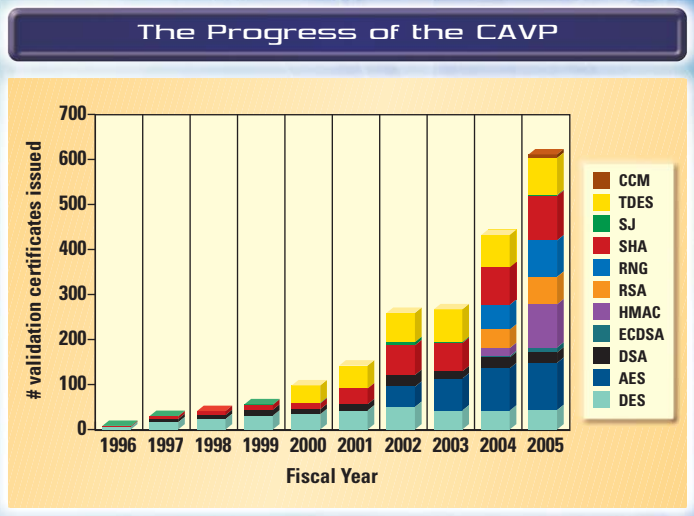
「The Progress of the CAVP」(CAVP の推移)と題した積み上げ棒グラフです。縦軸は「# validation certificates issued」(発行した検証証明書の数)で 0〜700(100 刻み)、横軸は「Fiscal Year」(会計年度)で 1996〜2005 です。凡例は上から CCM、TDES、SJ、SHA、RNG、RSA、HMAC、ECDSA、DSA、AES、DES です。各年の合計は、値が印刷されていないので目盛りからの読み取り(概数)で、1996 年は約 10、1997 年は約 30、1998 年は約 45、1999 年は約 60、2000 年は約 100、2001 年は約 140、2002 年は約 255、2003 年は約 265、2004 年は約 430、2005 年は約 615 です。初めの年の棒は主に DES、DSA、SHA、SJ からなり、2000 年から TDES、2002 年から AES が現れます。2004 年と 2005 年には HMAC、RSA、RNG が加わり、2005 年の棒には薄い ECDSA と CCM の部分もあります。
As the worldwide growth and use of cryptographic modules increases, demand to meet the testing needs for both algorithms and modules developed by vendors has also grown. NVLAP has received applications for the accreditation of CMT Laboratories, which has resulted in the accreditation of three new CMT Laboratories in 2005. One of these new laboratories is the first accredited CMT laboratory located in Germany. The other two new accredited CMT laboratories are located in the United States. This brings the current total number of accredited CMT Laboratories to twelve, spanning locations in the United States, Canada, the United Kingdom and Germany. A complete list can be found at: http://csrc.nist.gov/cryptval/1401labs.htm.
世界中で暗号モジュールの普及と利用が進むにつれ、ベンダーが開発するアルゴリズムとモジュールの両方の試験ニーズに応える需要も増大しています。NVLAP は CMT 試験所の認定に関する申請を受け取っており、その結果、2005年に 3 つの新しい CMT 試験所が認定されました。これらの新しい試験所の 1 つは、ドイツに所在する初の認定 CMT 試験所です。他の 2 つの新しい認定 CMT 試験所は米国にあります。これにより、現在の認定 CMT 試験所の総数は 12 となり、所在地は米国、カナダ、英国、ドイツにわたります。完全な一覧は http://csrc.nist.gov/cryptval/1401labs.htm で入手できます。
This fiscal year was the first year the CAVP provided validation testing for the following four algorithms: Random Number Generators (RNGs) (including three different RNGs), the RSA algorithm as specified in ANSI X9.31 (and the two signature schemes with appendix specified in the document PKCS #1 v2.1: RSA Cryptography Standard (June 14, 2002): RSASSA-PSS and RSASSA-PKCS1-v1_5), the Keyed-Hash Message Authentication Code (HMAC), and the Elliptic Curve Digital Signature Algorithm (ECDSA). As a result, there was a 41 percent increase in the number of algorithm validations issued this fiscal year as compared to last fiscal year; the CAVP issued 611 algorithm validation certificates in 2005 compared to 432 certificates issued in 2004.
今会計年度は、CAVP が次の 4 つのアルゴリズムの検証試験を初めて提供した年でした。乱数生成器(RNG)(3 種類の RNG を含む)、ANSI X9.31 に定められた RSA アルゴリズム(および文書 PKCS #1 v2.1: RSA Cryptography Standard(2002年6月14日)に定められた 2 つの付録付き署名方式 RSASSA-PSS と RSASSA-PKCS1-v1_5)、Keyed-Hash Message Authentication Code(HMAC)、Elliptic Curve Digital Signature Algorithm(ECDSA)です。その結果、今会計年度に発行されたアルゴリズム検証の件数は、前会計年度に比べて 41 パーセント増加しました。CAVP は、2004年の 432 件に対し、2005年は 611 件のアルゴリズム検証証明書を発行しました。
In addition to the above-mentioned cryptographic algorithms, the CAVP has developed a new test suite for the Secure Hash Algorithm-2 (SHA-2) and a new test suite for the CCM (Counter with CBC MAC) algorithm. SHA-2 contains the SHA-224, SHA-256, SHA-384 and SHA-512 sub-algorithms. SHA-1 could only produce a message digest (hash value) of 160 bits, providing no more than 80 bits of security against collision attacks. For the U.S. Advanced Encryption Standard (AES), which uses keys of 128, 192 or 256-bit size, the newer SHA-2 was proposed because it can produce hash sizes of 224, 256, 384 or 512-bits with collision protection levels of 112, 128, 192 and 256-bits respectively. This provides for a better balancing of the security of the hash algorithm with that of the encryption algorithm. The new mode of operation for AES – the CCM algorithm – is a combined confidentiality-authentication mode that was developed for the Institute of Electrical and Electronics Engineers (IEEE) 802.11 standard for wireless local area networks (LANs).
上記の暗号アルゴリズムに加えて、CAVP は、Secure Hash Algorithm-2(SHA-2)の新しいテストスイートと、CCM(Counter with CBC MAC)アルゴリズムの新しいテストスイートを開発しました。SHA-2 には、SHA-224、SHA-256、SHA-384、SHA-512 のサブアルゴリズムが含まれます。SHA-1 は 160 ビットのメッセージダイジェスト(ハッシュ値)しか生成できず、衝突攻撃に対して 80 ビットを超えるセキュリティを提供できませんでした。128、192、256 ビットの鍵サイズを使う米国の Advanced Encryption Standard(AES)に対して、より新しい SHA-2 は、それぞれ 112、128、192、256 ビットの衝突耐性レベルで 224、256、384、512 ビットのハッシュサイズを生成できるため、提案されました。これにより、ハッシュアルゴリズムのセキュリティと暗号化アルゴリズムのセキュリティの均衡が、よりよく取れるようになります。AES の新しい動作モードである CCM アルゴリズムは、無線ローカルエリアネットワーク(LAN)の Institute of Electrical and Electronics Engineers(IEEE)802.11 標準のために開発された、機密性と認証を組み合わせたモードです。
Work progressed during 2005 on the establishment of FIPS 140-2 as International Organization of Standardization (ISO) standard 19790. This project is registered in the work program of the International Organization for Standardization/International Electrotechnical Commission Joint Technical Committee 1 Subcommittee 27 on IT Security Techniques (ISO/IEC JTC 1/SC 27-IT Security Techniques). The FDIS (or final draft) version of the draft has been officially issued for balloting with a deadline of December 31, 2005. Also in SC 27, a proposal has been approved for the development of a methodology for cryptographic module testing and evaluation. Mr. Randall Easter will be submitted as a candidate for nomination as an editor of this new project.
2005年中に、FIPS 140-2 を国際標準化機構(ISO)標準 19790 として確立する作業が進みました。このプロジェクトは、国際標準化機構/国際電気標準会議の合同技術委員会 1 の小委員会 27(IT セキュリティ技術)(ISO/IEC JTC 1/SC 27-IT Security Techniques)の作業計画に登録されています。ドラフトの FDIS(最終ドラフト)版は、2005年12月31日を期限として、投票のために正式に発行されました。また SC 27 では、暗号モジュールの試験と評価の方法論の策定の提案が承認されました。Mr. Randall Easter は、この新しいプロジェクトの編集者の候補として推薦される予定です。
http://csrc.nist.gov/cryptval/
CMVP Contact: Mr. Randall Easter
(301) 975-4641
randall.easter@nist.gov
http://csrc.nist.gov/cryptval/
CMVP 連絡先: Mr. Randall Easter
(301) 975-4641
randall.easter@nist.gov
CAVP Contact: Ms. Sharon Keller
(301) 975-2910
sharon.keller@nist.gov
CAVP 連絡先: Ms. Sharon Keller
(301) 975-2910
sharon.keller@nist.gov
「General Flow of FIPS 140-2 Testing and Validation」(FIPS 140-2 の試験と検証の全体の流れ)と題した図です。手順 1: 「Cryptographic Module Vendor」(暗号モジュールのベンダー)から「NVLAP Accredited FIPS 140-2 CMT Lab」(NVLAP 認定の FIPS 140-2 CMT 試験所)への矢印に「Vendor selects a lab; Submits module for testing; Module IUT」(ベンダーが試験所を選び、試験のためにモジュール(試験対象の実装)を提出する)とあります。手順 1a: 試験所から「Module's Test Report」(モジュールの試験報告書)への矢印に「Test for conformance to FIPS 140-2; Writes test report」(FIPS 140-2 への適合を試験し、試験報告書を書く)とあります。手順 2: 試験報告書から「NIST/CSE」への矢印に「CMT Test Report to NIST/CSE for validation; Module Review Pending」(検証のため CMT の試験報告書を NIST/CSE へ送る。モジュールはレビュー待ち)とあります。試験所と NIST/CSE の間には 2 本の矢印があり、「Lab submits questions for guidance and clarification」(試験所が指導と明確化のための質問を提出する)、「NIST/CSE issue testing and implementation Guidance」(NIST/CSE が試験と実装の指針を発行する)とあり、その横の手順 4 は「Module Coordination」(モジュールの調整)です。NIST/CSE の横の手順 3 は「Reviewer Assigned Module Under Review」(レビュー担当者が割り当てられ、モジュールがレビュー中)です。ベンダーと NIST/CSE の間には、「Cost Recovery Fee Received Prior to Validation」(検証の前に費用回収の料金を受領)と書かれた下向きの矢印と、「FIPS 140-2 Validation Certificate」(FIPS 140-2 検証証明書)と題した証明書の絵を通る上向きの経路があり、後者は手順 5a「Issue validation certificate (via lab to the vendor)」(検証証明書を(試験所を通じてベンダーに)発行する)です。証明書の絵には米国とカナダの国旗と中央の紋章が描かれ、本文の小さな文字は判読できません。手順 5: NIST/CSE から(赤いチェックマークの付いた)「List of Validated FIPS 140-2 Modules」(検証済み FIPS 140-2 モジュールの一覧)への矢印に「Finalization; NIST adds module to validated modules list at www.nist.gov/cmvp」(最終処理。NIST が www.nist.gov/cmvp の検証済みモジュールの一覧にモジュールを加える)とあります。 [政府の標章が写っている図。公的な標章のため、この非公式サイトには掲載していません。原本 PDF を参照してください。]
AUTOMATED SECURITY TESTING AND TEST SUITE DEVELOPMENT
自動化されたセキュリティ試験とテストスイートの開発
Each approved and recommended cryptographic algorithm has an associated reference called a Federal Information Processing Standard (FIPS) or a Special Publication. The detailed instructions on how to implement the specific algorithm are found in these references. Based on these instructions, we design and develop validation test suites containing tests that verify that the detailed instructions of an algorithm are implemented correctly and completely. These tests exercise the mathematical formulas involved in the algorithm to assure that they work properly for each possible scenario. If the implementer deviates from these instructions or excludes any part of the instructions, the validation test will fail indicating that the algorithm implementation will not function properly.
承認され推奨されている暗号アルゴリズムにはそれぞれ、連邦情報処理標準(FIPS)または特別刊行物と呼ばれる参照文書があります。特定のアルゴリズムの実装方法の詳しい手順は、これらの参照文書に記載されています。当部門は、この手順に基づいて、アルゴリズムの詳細な手順が正しく完全に実装されていることを確認する試験を含む、検証用テストスイートを設計し開発します。これらの試験は、アルゴリズムに関わる数式を実行して、起こりうるあらゆる場面でそれらが正しく動作することを確認します。実装者がこの手順から外れたり、手順の一部を除外したりした場合、検証試験は不合格となり、アルゴリズムの実装が正しく機能しないことを示します。
These validation tests are designed to assist in the detection of accidental implementation errors, and are not designed to detect intentional attempts to misrepresent conformance. Thus, validation should not be interpreted as an evaluation or endorsement of overall product security.
これらの検証試験は、偶発的な実装エラーの検出を助けるよう設計されており、適合性の意図的な偽装を検出するようには設計されていません。したがって、検証を、製品全体のセキュリティの評価や推奨と解釈すべきではありません。
There are several types of validation testing for each approved cryptographic algorithm. These include, but are not limited to, Known Answer Tests, Monte Carlo Tests, and Multi-block Message Tests. The Known Answer Tests are designed to test the conformance of the implementation under test (IUT) to the various specifications in the reference. This involves testing the components of the algorithm to assure they are implemented correctly. The Monte Carlo Test is designed to exercise the entire IUT. This test is designed to detect the presence of implementation flaws that are not detected with the controlled input of the Known Answer Tests. The types of implementation flaws detected by this validation test include pointer problems, insufficient allocation of space, improper error handling, and incorrect behavior of the IUT. The Multi-block Message Test (MMT) is designed to test the ability of the implementation to process multi-block messages, which require the chaining of information from one block to the next. Other types of validation testing exist to satisfy other testing requirements of cryptographic algorithms.
承認された各暗号アルゴリズムには、数種類の検証試験があります。これには、Known Answer Test、Monte Carlo Test、Multi-block Message Test が含まれますが、これらに限られません。Known Answer Test は、試験対象の実装(IUT)が参照文書のさまざまな仕様に適合しているかを試験するよう設計されています。これは、アルゴリズムの構成要素が正しく実装されていることを確認するための試験を伴います。Monte Carlo Test は、IUT 全体を動作させるよう設計されています。この試験は、Known Answer Test の制御された入力では検出されない実装上の欠陥の存在を検出するよう設計されています。この検証試験で検出される実装上の欠陥の種類には、ポインタの問題、領域の割り当て不足、不適切なエラー処理、IUT の誤った動作があります。Multi-block Message Test(MMT)は、あるブロックから次のブロックへ情報を連鎖させる必要がある、複数ブロックのメッセージを実装が処理できるかどうかを試験するよう設計されています。暗号アルゴリズムの他の試験要件を満たすため、他の種類の検証試験もあります。
Automated security testing and test suite development are integral components of the Cryptographic Algorithm Validation Program (CAVP). The Cryptographic Algorithm Validation Program (CAVP) encompasses validation testing for FIPS approved and CSD recommended cryptographic algorithms. Cryptographic algorithm validation is a prerequisite to the Cryptographic Module Validation Program (CMVP). The CAVP was established by NIST and the Communications Security Establishment (CSE) of the Government of Canada in July 1995. All of the tests under the CAVP are handled by third-party laboratories that are accredited as Cryptographic Module Testing (CMT) laboratories by the National Voluntary Laboratory Accreditation Program (NVLAP). We develop and maintain a Cryptographic Algorithm Validation System (CAVS) tool which automates the validation testing for FIPS approved and CSD recommended cryptographic algorithms. The CAVS currently has algorithm validation testing for the following cryptographic algorithms—
自動化されたセキュリティ試験とテストスイートの開発は、暗号アルゴリズム検証プログラム(CAVP)の不可欠な構成要素です。暗号アルゴリズム検証プログラム(CAVP)は、FIPS 承認および CSD 推奨の暗号アルゴリズムの検証試験を包含します。暗号アルゴリズムの検証は、暗号モジュール検証プログラム(CMVP)の前提条件です。CAVP は、1995年7月に NIST とカナダ政府の通信保安局(CSE)によって設立されました。CAVP の下でのすべての試験は、National Voluntary Laboratory Accreditation Program(NVLAP)により暗号モジュール試験(CMT)所として認定された第三者の試験所が扱います。当部門は、FIPS 承認および CSD 推奨の暗号アルゴリズムの検証試験を自動化する Cryptographic Algorithm Validation System(CAVS)ツールを開発し、維持しています。CAVS は現在、次の暗号アルゴリズムについてアルゴリズム検証試験を備えています。
•The Triple Data Encryption Standard Algorithm (TDES)
•Triple Data Encryption Standard Algorithm(TDES)
•The Advanced Encryption Standard (AES) algorithm
•Advanced Encryption Standard(AES)アルゴリズム
•The Digital Signature Standard (DSS)
•Digital Signature Standard(DSS)
•Hashing algorithms SHA-1, SHA-224, SHA-256, SHA-384, and SHA-512
•ハッシュアルゴリズム SHA-1、SHA-224、SHA-256、SHA-384、SHA-512
•Three random number generator algorithms (RNG)
•3 つの乱数生成器アルゴリズム(RNG)
•The RSA algorithm
•RSA アルゴリズム
•The Keyed-Hash Message Authentication Code (HMAC)
•Keyed-Hash Message Authentication Code(HMAC)
•The Counter with Cipher Block Chaining-Message Authentication Code (CCM)
•Counter with Cipher Block Chaining-Message Authentication Code(CCM)
•The Elliptic Curve Digital Signature Algorithm (ECDSA).
•Elliptic Curve Digital Signature Algorithm(ECDSA)。
This fiscal year was the first year the CAVP provided validation testing for the RNG, the RSA (including RSA, RSASSA-PSS, and RSASSA-PKCS1-v1_5), HMAC, ECDSA, SHA-224, SHA-256, SHA-384, SHA-512, and CCM algorithms. As a result, there was a 41 percent increase in the number of algorithm validations issued this fiscal year as compared to last fiscal year; the CAVP issued 611 algorithm validation certificates in FY 2005 compared to 432 certificates issued in FY 2004.
今会計年度は、CAVP が RNG、RSA(RSA、RSASSA-PSS、RSASSA-PKCS1-v1_5 を含む)、HMAC、ECDSA、SHA-224、SHA-256、SHA-384、SHA-512、CCM の各アルゴリズムの検証試験を初めて提供した年でした。その結果、今会計年度に発行されたアルゴリズム検証の件数は、前会計年度に比べて 41 パーセント増加しました。CAVP は、2004会計年度の 432 件に対し、2005会計年度は 611 件のアルゴリズム検証証明書を発行しました。
In FY 2006, the CAVP will be adding validation testing for the following algorithms:
2006会計年度には、CAVP は次のアルゴリズムの検証試験を追加します。
•NIST Special Publication 800-38B, Recommendation for Block Cipher Modes of Operation: The CMAC Mode for Authentication
•NIST 特別刊行物 800-38B、Recommendation for Block Cipher Modes of Operation: The CMAC Mode for Authentication
•FIPS PUB 186-3, Digital Signature Standard (DSS) —An updated DSS to accommodate for the increased SHA sizes and key sizes
•FIPS PUB 186-3、Digital Signature Standard(DSS)— SHA のサイズと鍵サイズの拡大に対応するため更新された DSS
•Draft Special Publication 800-56, Recommendation for Pair-Wise Key Establishment Schemes Using Discrete Logarithm Cryptography
•ドラフト特別刊行物 800-56、Recommendation for Pair-Wise Key Establishment Schemes Using Discrete Logarithm Cryptography
•Transport Layer Security (TLS) protocol
•Transport Layer Security(TLS)プロトコル
•802.11i protocol.
•802.11i プロトコル。
http://csrc.nist.gov/cryptval/
Contact: Ms. Sharon Keller
(301) 975-2910
sharon.keller@nist.gov
http://csrc.nist.gov/cryptval/
連絡先: Ms. Sharon Keller
(301) 975-2910
sharon.keller@nist.gov
FIPS 140 MAINTENANCE
FIPS 140 の保守
Every five years, Federal Information Processing Standards (FIPS) are reviewed for currency and relevance. A Federal Register notice was issued in January 2005 soliciting comments regarding FIPS 140-2, Security Requirements for Cryptographic Modules, to support the development of the follow on FIPS 140-3. Many comments were received and reviewed. In the area of security and cryptographic module development, technology tends to be fast paced and highly innovative. There have been tremendous advances in technology since the issuance of FIPS 140-2 in May 2001. FIPS 140-3 will address new advances in technological developments, newly emerging security standards and lessons learned during the testing and validation of many modules against FIPS 140-2. Updating this type of document is a very lengthy process, so the work has begun in order to produce FIPS 140-3 before FIPS 140-2 loses its usefulness. The first public draft of FIPS 140-3 should be available in the second quarter of FY 2006. Additional public workshops will be scheduled for the review of the first draft.
連邦情報処理標準(FIPS)は、5 年ごとに、最新性と関連性について見直されます。FIPS 140-2、Security Requirements for Cryptographic Modules について意見を求め、後継の FIPS 140-3 の策定を支えるため、2005年1月に連邦官報の告示が出されました。多くのコメントが寄せられ、検討されました。セキュリティと暗号モジュール開発の分野では、技術は変化が速く、革新性が高い傾向があります。2001年5月の FIPS 140-2 の発行以降、技術には大きな進歩がありました。FIPS 140-3 は、技術開発の新たな進歩、新たに登場したセキュリティ標準、FIPS 140-2 に照らした多くのモジュールの試験と検証の過程で得た教訓に対処します。この種の文書の更新には非常に長い時間がかかるため、FIPS 140-2 が有用性を失う前に FIPS 140-3 を作成できるよう、作業が始まっています。FIPS 140-3 の最初の公開ドラフトは、2006会計年度の第 2 四半期に入手できるようになる見込みです。最初のドラフトのレビューのために、追加の公開ワークショップが予定されます。
In support of the development of the first draft of FIPS 140-3, the CMVP co-hosted a Physical Security Testing Workshop with the Information-Technology Promotion Agency, Japan (IPA), the Information Technology Research and Standardization Center, Japan (INSTAC), and the Japan Standards Association (JSA). Participating in the workshop were invited members of the vendor community who have developed cryptographic modules at the higher levels of physical security, the CMT Laboratories, and leaders in the many areas of physical security, incorporating both invasive and non-invasive attack techniques. Two days of presentations by speakers from the international community followed with two days of discussions on the issues and methods relative to physical security protection.
FIPS 140-3 の最初のドラフトの策定を支えるため、CMVP は、日本の情報処理推進機構(IPA)、日本の情報技術研究・標準化センター(INSTAC)、日本規格協会(JSA)と共同で、Physical Security Testing Workshop を主催しました。ワークショップには、より高い物理的セキュリティレベルの暗号モジュールを開発したベンダーコミュニティの招待された構成員、CMT 試験所、侵襲型と非侵襲型の両方の攻撃技法を含む物理的セキュリティの多くの分野のリーダーが参加しました。国際コミュニティの講演者による 2 日間の発表に続き、物理的セキュリティ保護に関する課題と方法について、2 日間の議論が行われました。
http://csrc.nist.gov/cryptval/
FIPS 140 Contact: Mr. Randall Easter
(301) 975-4641
randall.easter@nist.gov
http://csrc.nist.gov/cryptval/
FIPS 140 連絡先: Mr. Randall Easter
(301) 975-4641
randall.easter@nist.gov
RESEARCH ON TECHNICAL SECURITY METRICS
技術的セキュリティメトリクスの研究
With an ever-growing dependency on information systems, system owners and system users look to answer the question “Is this system secure enough?”
情報システムへの依存が高まり続けるなか、システム所有者とシステム利用者は、「このシステムは十分に安全か」という問いに答えようとしています。
Constantly changing technologies and threats prevent one from saying, “My system is completely secure.” Still, there is a need to answer questions such as “How much is enough?”; “Am I closer to my security objectives today than I was yesterday?”; “Is that organization's system secure enough for me to allow an interconnection?” In order to answer these types of questions, metrics that speak to the security of information systems are needed— you can't improve what you cannot measure.
技術と脅威が絶えず変化するため、「私のシステムは完全に安全です」と言うことはできません。それでも、「どこまでやれば十分か」「今日の私は昨日より、セキュリティ目標に近づいているか」「あの組織のシステムは、相互接続を認めてよいほど十分に安全か」といった問いに答える必要があります。この種の問いに答えるには、情報システムのセキュリティを語るメトリクスが必要です。測定できないものは改善できません。
In SP 800-55, Security Metrics for Information Technology Systems, we defined security metrics as “Tools designed to facilitate decision-making and improve performance and accountability through data collection, analysis and reporting of relevant performance related data.” Since the characteristics of information security are confidentiality, integrity, and availability, one can argue that security metrics may be viewed as standard measures of confidentiality, integrity, and availability. Though simplistically stated, this is a non-trivial concept that speaks to standard measures of system and organizational performance against defined specifications in the three security characteristics. Part of the challenge is gaining consensus on what “secure” means amidst a sea of systems with different functionalities and different missions. Though there is no clean break between system and organizational performance, this effort to develop technical security metrics is focused on the technology upon which the systems are based.
SP 800-55、Security Metrics for Information Technology Systems では、セキュリティメトリクスを「関連するパフォーマンスデータの収集、分析、報告を通じて、意思決定を促進し、パフォーマンスと説明責任を向上させるよう設計されたツール」と定義しました。情報セキュリティの特性は機密性、完全性、可用性であるため、セキュリティメトリクスは、機密性、完全性、可用性の標準的な測定値とみなせると言えます。単純化して述べられていますが、これは、3 つのセキュリティ特性における定義された仕様に対する、システムと組織のパフォーマンスの標準的な測定値を扱う、重要な概念です。課題の一部は、異なる機能と異なる使命を持つ膨大なシステムのなかで、「安全」とは何を意味するかについて合意を得ることです。システムと組織のパフォーマンスの間に明確な線引きはありませんが、技術的セキュリティメトリクスを策定するこの取り組みは、システムの基盤となる技術に重点を置いています。
With this in mind, we have begun an effort to better define technical security metrics. We are looking to map the current state-of-the-art, understand the needs and objectives of practitioners asking the question “How secure?”, and subsequently, design and implement a research program aimed at advancing knowledge in the field of security metrics. Next fiscal year we will host a workshop to explore these issues with leading researchers and practitioners.
これを念頭に、技術的セキュリティメトリクスをより適切に定義する取り組みを始めました。現在の最先端の状況を整理し、「どのくらい安全か」という問いを発する実務者のニーズと目標を理解し、その後、セキュリティメトリクスの分野の知識を高めることを目的とした研究プログラムを設計し実施することを目指しています。来会計年度には、主要な研究者や実務者とこれらの課題を探るワークショップを開催します。
Contact: Dr. Alicia Clay
(301) 975-3641
alicia.clay@nist.gov
連絡先: Dr. Alicia Clay
(301) 975-3641
alicia.clay@nist.gov
SECURITY RESEARCH AND EMERGING TECHNOLOGIES
セキュリティ研究と新興技術
STRATEGIC GOAL
戦略目標
The Computer Security Division (CSD) will support and conduct research activities that will enhance information technology (IT) security for Federal agencies in the Executive Branch. The CSD will work to understand and enhance the security utility of new technologies through research. The identification and mitigation of vulnerabilities in IT technologies will be a piece of the research that will be undertaken.
コンピュータセキュリティ部門(CSD)は、行政府の連邦機関の情報技術(IT)セキュリティを高める研究活動を支援し、実施します。CSD は、研究を通じて、新技術のセキュリティ上の有用性を理解し、高めるよう努めます。IT 技術の脆弱性の特定と緩和は、実施する研究の一部となります。
OVERVIEW
概要
Our security research focus is to identify emerging technologies and conceive of new security solutions that will have a high impact on the critical information infrastructure. We perform research and development on behalf of government and industry from the earliest stages of technology development through proof-of-concept, reference and prototype implementations, and demonstrations. We work to transfer new technologies to industry, to produce new standards, and to develop tests, test methodologies, and assurance methods.
当部門のセキュリティ研究の重点は、新興技術を特定し、重要な情報インフラに大きな影響を与える新しいセキュリティソリューションを考案することです。政府と産業界のために、技術開発の最も初期の段階から、概念実証、参照実装、プロトタイプ実装、デモンストレーションに至るまで、研究開発を行っています。新しい技術を産業界に移転し、新しい標準を作成し、試験、試験方法論、保証の方法を開発する取り組みを行っています。
To keep pace with the rate of change in emerging technologies, we conduct a large of amount of research in existing and emerging technology areas. Some of the many topics we research include smart card infrastructure and security, wireless and mobile device security, voice over IP security issues, digital forensics tools and methods, access control and authorization management, Internet Protocol security, intrusion detection systems, quantum information system security and quantum cryptography, and vulnerability analyses. Our research helps fulfill specific needs by the Federal government that would not be easily or reliably filled otherwise.
新興技術の変化の速さに追随するため、既存の技術分野と新興の技術分野で大量の研究を行っています。研究しているさまざまなトピックには、スマートカードのインフラとセキュリティ、無線およびモバイルデバイスのセキュリティ、Voice over IP のセキュリティ上の問題、デジタルフォレンジックのツールと手法、アクセス制御と認可管理、Internet Protocol のセキュリティ、侵入検知システム、量子情報システムのセキュリティと量子暗号、脆弱性分析があります。当部門の研究は、他の方法では容易にも確実にも満たせない、連邦政府の特定のニーズを満たすのに役立っています。
We collaborate extensively with government, academia and private sector entities. In the past year this included International Business Machines (IBM), Microsoft Corporation, Sun Microsystems, the Boeing Company, Intel Corporation, Lucent Technologies, Oracle Corporation, MITRE, the SANS Institute, the University of Maryland, Ohio State University, the University of Tulsa, George Mason University, Rutgers University, Purdue University, George Washington University, the University of West Florida, the University of California–San Diego, the University of Maryland-Baltimore County, the National Security Agency, the Department of Defense, the U.S. Naval Research Laboratory, the Defense Advanced Research Projects Agency, and the Department of Justice.
政府、学術界、民間部門の主体と幅広く協力しています。昨年の協力先には、International Business Machines(IBM)、Microsoft Corporation、Sun Microsystems、Boeing Company、Intel Corporation、Lucent Technologies、Oracle Corporation、MITRE、SANS Institute、メリーランド大学、オハイオ州立大学、タルサ大学、ジョージ・メイソン大学、ラトガース大学、パデュー大学、ジョージ・ワシントン大学、ウェストフロリダ大学、カリフォルニア大学サンディエゴ校、メリーランド大学ボルチモア郡校、国家安全保障局、国防総省、米国海軍研究所、国防高等研究計画局、司法省が含まれました。
REACHING OUR GOAL
目標の達成に向けて
SECURITY CONFIGURATION CHECKLISTS FOR COMMERCIAL IT PRODUCTS
市販 IT 製品のセキュリティ設定チェックリスト
There are many threats to users’ computers, ranging from remotely launched network service exploits to malicious code spread through e-mails, malicious Web sites and file downloads. Vulnerabilities in IT products are discovered on an almost daily basis and many ready-to-use exploits are widely available on the Internet. Because IT products are often intended for a wide variety of audiences, restrictive security controls are usually not enabled by default so many IT products are immediately vulnerable out-of-the-box. It is a complicated, arduous and time-consuming task for even experienced system administrators to identify a reasonable set of security settings for many IT products. While the solutions to IT security are complex, one basic yet effective tool is the security configuration checklist.
利用者のコンピュータには、遠隔から仕掛けられるネットワークサービスへのエクスプロイトから、電子メール、悪意のあるウェブサイト、ファイルのダウンロードを通じて広がる悪意のあるコードまで、多くの脅威があります。IT 製品の脆弱性はほぼ毎日発見されており、すぐに使えるエクスプロイトの多くがインターネット上で広く入手できます。IT 製品は幅広い利用者を想定していることが多いため、制限的なセキュリティ管理策は通常、既定では有効にされておらず、多くの IT 製品は箱から出した直後から脆弱です。経験豊富なシステム管理者でさえ、多くの IT 製品について妥当なセキュリティ設定のセットを特定することは、複雑で骨の折れる、時間のかかるタスクです。IT セキュリティのソリューションは複雑ですが、基本的でありながら有効なツールの一つが、セキュリティ設定チェックリストです。
The goals of this program are—
このプログラムの目標は次のとおりです。
•To facilitate the development and sharing of security configuration checklists by providing a framework for developers to submit checklists to us
•開発者が当部門にチェックリストを提出するための枠組みを提供することで、セキュリティ設定チェックリストの開発と共有を促進する
•To assist developers in making checklists that conform to common baseline levels of security
•開発者が、セキュリティの共通のベースラインレベルに適合するチェックリストを作成できるよう支援する
•To assist developers and users by providing guidelines for making checklists better documented and more usable
•チェックリストの文書化と使いやすさを高めるためのガイドラインを提供することで、開発者と利用者を支援する
•To provide a managed process for the review, update and maintenance of checklists
•チェックリストのレビュー、更新、維持のための管理されたプロセスを提供する
•To provide an easy-to-use repository of checklists.
•使いやすいチェックリストのリポジトリを提供すること。
[NIST のロゴが写っている図。公的な標章のため、この非公式サイトには掲載していません。原本 PDF を参照してください。]
This program also serves to assist vendors in the process of making their checklists available to users out-of-the-box. In such cases, it will still be advisable for product users to consult the checklist repository for updates to pre-installed checklists.
このプログラムはまた、ベンダーが自社のチェックリストを初期状態で利用者に提供できるよう支援する役割も果たします。そうした場合でも、製品の利用者は、プリインストールされたチェックリストの更新について、チェックリストのリポジトリを確認すべきです。
A security configuration checklist (sometimes called a lockdown, hardening guide, or benchmark) is in its simplest form a series of instructions for configuring a product to a particular security level (or baseline). Typically, checklists are created by IT vendors for their own products; however, checklists are also created by other organizations such as consortia, academia and government agencies. The use of well-written, standardized checklists can markedly reduce the vulnerability exposure of IT products. Checklists may be particularly helpful to small organizations and individuals that have limited resources for securing their systems.
セキュリティ設定チェックリスト(ロックダウン、ハードニングガイド、ベンチマークとも呼ばれます)は、最も単純な形では、製品を特定のセキュリティレベル(またはベースライン)に設定するための一連の手順です。通常、チェックリストは IT ベンダーが自社製品のために作成しますが、コンソーシアム、学術界、政府機関などの他の組織もチェックリストを作成しています。適切に書かれた標準化されたチェックリストを使うと、IT 製品の脆弱性へのさらされ方を大幅に減らせます。チェックリストは、システムを保護するための資源が限られている小規模な組織や個人に、特に役立つ場合があります。
A checklist might include any of the following:
チェックリストには、次のいずれかが含まれる場合があります。
•Configuration files that automatically set various security settings (such as executables, security templates that modify settings, scripts)
•さまざまなセキュリティ設定を自動的に設定する構成ファイル(実行ファイル、設定を変更するセキュリティテンプレート、スクリプトなど)
•Documentation (for example, a text file) that guides the checklist user to manually configure software
•チェックリストの利用者がソフトウェアを手動で設定するための手引きとなる文書(たとえばテキストファイル)
•Documents that explain the recommended methods to securely install and configure a device
•デバイスを安全にインストールし設定するための推奨方法を説明する文書
•Policy documents that set forth guidelines for such things as auditing, authentication security (for example, passwords), and perimeter security.
•監査、認証のセキュリティ(たとえばパスワード)、境界のセキュリティなどに関するガイドラインを定める、ポリシー文書。
Checklists can also include administrative practices (such as management and operational controls) for an IT product that go hand-in-hand with improvements to the product’s security.
チェックリストには、IT 製品について、製品のセキュリティの改善と表裏一体となる運用上の実践(管理面および運用面の管理策など)も含められます。
Many organizations have created various checklists. However, these checklists may vary widely in terms of quality and usability and may have become outdated as software updates and upgrades have been released. Because there is no central checklist repository, they can be difficult to find. They may not be well documented with the result being that one checklist may differ significantly from another in terms of the level of security provided. It may be difficult to determine if the checklist is current, or how the checklist should be implemented. While many existing checklists are of high quality and quite usable, the majority of checklists aren’t accessible or directly usable by most audiences.
多くの組織がさまざまなチェックリストを作成してきました。しかし、これらのチェックリストは品質と使いやすさの点で大きく異なる場合があり、ソフトウェアの更新やアップグレードが公開されるにつれて古くなっている場合もあります。集中的なチェックリストのリポジトリがないため、見つけにくいことがあります。文書化が十分でない場合もあり、その結果、あるチェックリストと別のチェックリストで、提供されるセキュリティの水準が大きく異なる場合があります。チェックリストが最新かどうか、またはチェックリストをどう実装すべきかを判断するのが難しい場合もあります。既存のチェックリストの多くは高品質で非常に使いやすいものですが、大半のチェックリストは、ほとんどの利用者がアクセスできず、直接利用することもできません。
Although the use of security configuration checklists can greatly improve overall levels of security in organizations, no checklist can make a system or a product 100 percent secure. However, use of checklists that emphasize hardening of systems against flaws or bugs inherent in software will typically result in greater levels of product security and protection from future threats.
セキュリティ設定チェックリストの使用は、組織のセキュリティの全体的な水準を大きく向上させられますが、システムや製品を 100 パーセント安全にできるチェックリストはありません。それでも、ソフトウェアに内在する欠陥やバグに対するシステムのハードニングを重視するチェックリストを使えば、通常、製品のセキュリティと将来の脅威からの保護の水準が高まります。
We released the final version of Special Publication (SP) 800-70, Security Configuration Checklists Program for IT Products – Guidance for Checklists Users and Developers in May 2005. In conjunction with this, we introduced the NIST Beta Checklists repository in May 2005, which contains checklists and descriptions. Users can browse the repository by product category, vendor, and submitting organization to locate a particular checklist. The repository includes over 50 checklists covering database systems, DHCP servers, directory services, DNS servers, firewalls, multi-functional peripherals, network routers, network switches, operating systems, vulnerability management software, Web browsers, and Web servers.
特別刊行物(SP)800-70、Security Configuration Checklists Program for IT Products – Guidance for Checklists Users and Developers の最終版は、2005年5月に公開しました。これとあわせて、2005年5月に、チェックリストとその説明を含む NIST Beta Checklists のリポジトリを導入しました。利用者は、製品カテゴリ、ベンダー、提出組織でリポジトリを閲覧して、特定のチェックリストを探せます。このリポジトリには、データベースシステム、DHCP サーバー、ディレクトリサービス、DNS サーバー、ファイアウォール、複合機、ネットワークルータ、ネットワークスイッチ、オペレーティングシステム、脆弱性管理ソフトウェア、ウェブブラウザ、ウェブサーバーを対象とした 50 を超えるチェックリストが含まれています。
A specific piece of this program has been the development of checklists for Windows operating systems. Since 2004, we have been working on guidance to help better secure Windows XP. SP 800-68, Guidance for Securing Microsoft Windows XP Systems for IT Professionals: A NIST Security Configuration Checklist, has been created to assist IT professionals, in particular Windows XP system administrators and information security personnel, in effectively securing Windows XP Professional Service Pack 2 (SP2) systems. The principal goal of the document is to recommend and explain tested, secure settings for Windows XP workstations with the objective of simplifying the administrative burden of improving the security of Windows XP systems.
このプログラムの具体的な一部が、Windows オペレーティングシステム向けのチェックリストの開発です。2004年以降、当部門は Windows XP をより適切に保護するためのガイダンスに取り組んできました。SP 800-68、Guidance for Securing Microsoft Windows XP Systems for IT Professionals: A NIST Security Configuration Checklist は、IT の専門家、とりわけ Windows XP のシステム管理者と情報セキュリティ担当者が、Windows XP Professional Service Pack 2(SP2)システムを有効に保護するのを支援するために作成されました。この文書の主な目標は、Windows XP システムのセキュリティ向上に伴う管理負担を簡素化することを目的に、Windows XP ワークステーションについて、試験済みの安全な設定を推奨し説明することです。
SP 800-68 discusses Windows XP and various application security settings in technical detail. The guide provides insight into the threats and security controls that are relevant for various operational environments, such as for a large enterprise or a home office. It describes the need to document, implement, and test security controls, as well as to monitor and maintain systems, on an ongoing basis. It presents an overview of the security components offered by Windows XP, and provides guidance on installing, backing up, and patching Windows XP systems. It discusses security policy configuration, provides an overview of the settings in the accompanying NIST security templates, and discusses how to apply additional security settings that are not included in the NIST security templates. It demonstrates securing popular office productivity applications, Web browsers, e-mail clients, personal firewalls, anti-virus software, and spyware detection and removal utilities on Windows XP systems to provide protection against viruses, worms, Trojan horses, and other types of malicious code. This list is not intended to be a complete list of applications to install on Windows XP system, nor does it imply NIST's endorsement of particular commercial off-the-shelf (COTS) products. SP 800-68 will be finalized in November 2005.
SP 800-68 は、Windows XP と各種アプリケーションのセキュリティ設定を技術的に詳しく論じています。このガイドは、大企業やホームオフィスなど、さまざまな運用環境に関連する脅威とセキュリティ管理策についての知見を示しています。セキュリティ管理策を継続的に文書化し、実装し、試験するとともに、システムを監視し維持する必要性を述べています。Windows XP が提供するセキュリティ構成要素の概要を示し、Windows XP システムのインストール、バックアップ、パッチ適用に関するガイダンスを提供します。セキュリティポリシーの設定を論じ、付属する NIST セキュリティテンプレートの設定の概要を示すとともに、NIST セキュリティテンプレートに含まれていない追加のセキュリティ設定の適用方法を論じています。ウイルス、ワーム、トロイの木馬、その他の種類の悪意のあるコードから保護するため、Windows XP システム上で一般的なオフィス生産性アプリケーション、ウェブブラウザ、電子メールクライアント、パーソナルファイアウォール、ウイルス対策ソフトウェア、スパイウェアの検出・削除ユーティリティを保護する方法を示しています。この一覧は、Windows XP システムにインストールするアプリケーションの完全な一覧を意図したものではなく、特定の市販(COTS)製品を NIST が推奨することを意味するものでもありません。SP 800-68 は2005年11月に最終化される予定です。
This CSD program is in cooperation with checklist development activities at the Defense Information Systems Agency, the National Security Agency and the Center for Internet Security, and is in the process of establishing participation agreements with vendors and other checklist-producing organizations. We gratefully acknowledge sponsorship for this checklist program from the Department of Homeland Security.
この CSD のプログラムは、国防情報システム局、国家安全保障局、Center for Internet Security でのチェックリスト開発活動と連携して行われており、ベンダーやその他のチェックリスト作成組織との参加協定を結ぶ手続きを進めています。このチェックリストプログラムに対する国土安全保障省の後援に、深く感謝します。
http://checklists.nist.gov/
http://csrc.nist.gov/itsec/guidance_WinXP.html
Contacts: Mr. Tim Grance
(301) 975-3359
grance@nist.gov
http://checklists.nist.gov/
http://csrc.nist.gov/itsec/guidance_WinXP.html
連絡先: Mr. Tim Grance
(301) 975-3359
grance@nist.gov
Mr. Murugiah Souppaya
(301) 975-4758
murugiah.souppaya@nist.gov
Mr. Murugiah Souppaya
(301) 975-4758
murugiah.souppaya@nist.gov
SECURITY TECHNICAL IMPLEMENTATION GUIDES AND CHECKLISTS
セキュリティ技術実装ガイド(STIG)とチェックリスト
Security technical implementation guides (STIGs) assist in securing IT products and systems. By using one of these guides, a product or system may be made more secure without an individual having to develop and test settings and specifications. After using a STIG, an accompanying checklist may be used to verify that the guide was correctly applied.
Security Technical Implementation Guides(STIG)は、IT 製品とシステムの保護を支援します。これらのガイドのいずれかを使うことで、個人が設定や仕様を作成し試験しなくても、製品やシステムをより安全にできます。STIG を使用した後、付属のチェックリストを使って、ガイドが正しく適用されたかどうかを確認できます。
The Defense Information Systems Agency (DISA) issues STIGs and checklists for a variety of information technologies and hosts these on its Web site. Many of these resources deal with classified system requirements, and hence, access is restricted to military and government personnel only. Some of these resources, however, are suitable for non-classified system use. CSD, through an agreement with DISA, houses a repository of the STIGs and checklists that are suitable for non-classified systems so they may be accessed by contractors that handle Federal information systems. These guides and checklists are also available for voluntary adoption by others. DISA is working on having a publicly accessible site available in the near future. We will transition many of the STIGs to our IT Products Checklist Web page and maintain a small repository of STIGs on this site that do not fit the requirements for the checklist Web page.
国防情報システム局(DISA)は、さまざまな情報技術について STIG とチェックリストを発行し、自らのウェブサイトで公開しています。これらの資源の多くは機密システムの要件を扱っているため、アクセスは軍と政府の職員に限られています。ただし、これらの資源の一部は、非機密システムでの使用に適しています。CSD は、DISA との合意に基づき、連邦情報システムを扱う請負業者がアクセスできるよう、非機密システムに適した STIG とチェックリストのリポジトリを置いています。これらのガイドとチェックリストは、他の組織が自発的に採用することもできます。DISA は、近い将来に一般にアクセスできるサイトを用意すべく作業しています。当部門は、多くの STIG を IT Products Checklist ウェブページに移行し、チェックリストのウェブページの要件に合わない STIG の小規模なリポジトリを、このサイトに維持します。
http://csrc.nist.gov/pcig/cig.html
Contact: Mr. Richard Kissel
(301) 975-5017
richard.kissel@nist.gov
http://csrc.nist.gov/pcig/cig.html
連絡先: Mr. Richard Kissel
(301) 975-5017
richard.kissel@nist.gov
GOVERNMENT SMART CARD PROGRAM: INTERNATIONAL STANDARDS PROGRAM
政府スマートカードプログラム: 国際標準プログラム
Many Federal agencies are interested in using smart cards because of their intrinsic portability and security. A smart card is able to store and actively process information, in particular, cryptographic keys and algorithms for providing digital signatures and for use with other cryptographic functions.
多くの連邦機関は、スマートカードが本来備えている可搬性とセキュリティのために、その利用に関心を持っています。スマートカードは、情報、特にデジタル署名を提供するための暗号鍵とアルゴリズム、およびその他の暗号機能で使うためのものを、保存し、能動的に処理できます。
Our scientists have worked with Federal agencies and industry partners for the past several years to establish a Government Smart Card (GSC) program to facilitate widespread deployment of interoperable smart card systems. The Information Technology Laboratory (ITL) set out to build a framework for smart card interoperability, enabling broad adoption of this critical technology by the public and private sectors. The mechanism and technical foundation for this framework is the Government Smart Card Interoperability Specification (GSC-IS).
当部門の科学者は、相互運用可能なスマートカードシステムの広範な展開を促すため、過去数年間、連邦機関や産業界のパートナーと協力して、Government Smart Card(GSC)プログラムを確立してきました。情報技術研究所(ITL)は、スマートカードの相互運用性のための枠組みの構築に着手し、官民でのこの重要な技術の広範な採用を可能にしました。この枠組みの仕組みと技術的基盤は、Government Smart Card Interoperability Specification(GSC-IS)です。
The GSC-IS established the framework for smart cards to work in an open environment. It defined an architectural model for interoperable smart card service provider modules, compatible with both file system cards and virtual machine cards, that allows smart card application developers to obtain various services (for example, encryption, authentication, and digital signatures) from GSC-compliant smart cards through a common, interoperable smart card services interface.
GSC-IS は、スマートカードがオープンな環境で動作するための枠組みを確立しました。ファイルシステムカードと仮想マシンカードの両方と互換性のある、相互運用可能なスマートカードサービスプロバイダーモジュールのアーキテクチャモデルを定義し、スマートカードのアプリケーション開発者が、共通の相互運用可能なスマートカードサービスインタフェースを通じて、GSC に準拠したスマートカードからさまざまなサービス(たとえば、暗号化、認証、デジタル署名)を得られるようにしています。
The GSC-IS framework and concepts were submitted to the International Organization for Standardarization (ISO) for consideration as an international formal standard. The international ballot was approved with overwhelming success and NIST was selected as the convener of a dedicated task force for this new body of work, International Organization for Standardization/ International Electrotechnical Commission Joint Technical Committee 1 on Information Technology, Subcommittee 17 on Cards and Personal Identification, Work Group 4 on Integrated Circuit Cards with Contacts, Task Force 9 (ISO/IEC JTC1 SC 17/WG 4/Task Force 9).
GSC-IS の枠組みと概念は、国際的な正式標準として検討されるよう、International Organization for Standardization(ISO)に提出されました。国際投票は圧倒的多数で承認され、NIST は、この新しい作業分野を担う専任タスクフォース、International Organization for Standardization/International Electrotechnical Commission Joint Technical Committee 1 on Information Technology, Subcommittee 17 on Cards and Personal Identification, Work Group 4 on Integrated Circuit Cards with Contacts, Task Force 9(ISO/IEC JTC1 SC 17/WG 4/Task Force 9)の招集者に選ばれました。
The new suite of interoperability standards, ISO/IEC 24727: Identification Cards – Integrated Circuit Card Programming Interfaces, is under development in Task Force 9. ISO/IEC 24727 is a three part standard; Part 1 describes the framework, Part 2 describes the card-programming interface, and Part 3 describes the application-programming interface. The European Union has acknowledged their intent to use ISO/IEC 24727 for the European Union Citizen Card (EU CC) currently under development. Other countries have made plans to incorporate ISO/IEC 24727 interfaces with on-going smart card based projects. Formal completion of this work is anticipated in early 2007. Part 1 is in final committee draft stage, and Parts 2 and 3 are in committee draft stage. The ISO/IEC 24727 team of project editors was awarded an American National Standards Institute National award for their dedicated efforts.
新しい相互運用性標準群である ISO/IEC 24727: Identification Cards – Integrated Circuit Card Programming Interfaces は、タスクフォース 9 で策定中です。ISO/IEC 24727 は 3 部構成の標準で、第 1 部は枠組みを、第 2 部はカードプログラミングインタフェースを、第 3 部はアプリケーションプログラミングインタフェースを記述しています。欧州連合は、現在策定中の欧州連合市民カード(EU CC)に ISO/IEC 24727 を使用する意向を表明しています。他の国々も、進行中のスマートカードベースのプロジェクトに ISO/IEC 24727 のインタフェースを取り入れる計画を立てています。この作業の正式な完了は2007年初めと見込まれています。第 1 部は最終委員会ドラフト段階にあり、第 2 部と第 3 部は委員会ドラフト段階にあります。ISO/IEC 24727 のプロジェクト編集者チームは、献身的な取り組みに対して American National Standards Institute の全米賞を受賞しました。
[装飾の画像。本文を読むのに必要のない装飾のため、この非公式サイトには掲載していません。原本 PDF を参照してください。]
We continue to champion smart card standardization work at the national and international level. NIST provides the Chair of a national task group under the direction of the InterNational Committee for Information Technology Standards/American National Standards Institute (INCITS/ANSI) B10, which is the U.S. Technical Advisory Group to ISO SC17.
当部門は、国内および国際的なレベルで、スマートカード標準化の作業を引き続き推進しています。NIST は、ISO SC17 の米国技術諮問グループである InterNational Committee for Information Technology Standards/American National Standards Institute(INCITS/ANSI)B10 の指揮下にある国内タスクグループで議長を務めています。
Continued collaboration with the International Aviation Civil Organization (ICAO), the United Nations organization responsible for travel documents, during the development of the next generation passport, which includes contactless technology, will ensure harmonization of selected protocols with U.S. mandates. Close collaboration with CSD’s Personal Identity Verification (PIV) Program is maintained to ensure synchronization of policy, standardization, and technical activities of the Federal community as well as to ensure the interoperability and security mandates of Homeland Security Presidential Directive 12 (HSPD-12) are met.
非接触技術を含む次世代パスポートの開発に際し、渡航文書を担当する国連機関である国際民間航空機関(ICAO)との協力を続けることで、選定されたプロトコルを米国の指令と調和させます。連邦コミュニティの方針、標準化、技術活動の同期を確保するとともに、国土安全保障大統領指令 12(HSPD-12)が定める相互運用性とセキュリティの要件が満たされるよう、CSD の個人識別検証(PIV)プログラムとの緊密な協力を維持しています。
http://smartcard.nist.gov/
Contact: Ms. Teresa Schwarzhoff
(301) 975-5727
teresa.schwarzhoff@nist.gov
http://smartcard.nist.gov/
連絡先: Ms. Teresa Schwarzhoff
(301) 975-5727
teresa.schwarzhoff@nist.gov
PERSONAL IDENTITY VERIFICATION
個人識別検証
Authentication of an individual’s identity is a fundamental component of physical and logical access control processes. When individuals attempt to access security-sensitive buildings, computer systems, or data, an access control decision must be made. An accurate determination of identity is an important component in making sound access control decisions.
個人の身元の認証は、物理的およびロジカルなアクセス制御プロセスの基本的な構成要素です。個人がセキュリティ上重要な建物、コンピュータシステム、データにアクセスしようとするときには、アクセス制御の判断を下さなければなりません。身元の正確な判定は、適切なアクセス制御の判断を下すための重要な構成要素です。
A wide range of mechanisms is employed to authenticate identity, leveraging many different classes of identification identity credentials. For physical access, individual identity has traditionally been authenticated by use of paper credentials, such as driver’s licenses and badges. Access to computers and data has traditionally been authenticated through user-selected passwords. More recently, cryptographic mechanisms and biometric techniques have been applied to physical and computer security, replacing or supplementing the traditional credentials. The strength of the authentication that is achieved varies, depending upon the type of credential, the process used to issue the credential, and the authentication mechanism used to validate the credential.
身元の認証には幅広い仕組みが用いられ、さまざまな種類の身元確認用クレデンシャルが活用されています。物理的なアクセスでは、個人の身元は従来、運転免許証やバッジなどの紙のクレデンシャルを用いて認証されてきました。コンピュータとデータへのアクセスは、従来、利用者が選んだパスワードによって認証されてきました。近年では、従来のクレデンシャルを置き換える、または補うものとして、暗号の仕組みと生体認証技法が物理的セキュリティとコンピュータセキュリティに適用されています。達成される認証の強度は、クレデンシャルの種類、発行に用いられるプロセス、クレデンシャルの有効性を確認する認証の仕組みによって異なります。
『PIV Card Front - Printable Areas』(PIVカード表面の印刷可能領域)と題した、PIVカード表面の配置図です。上部の注記: 『- All measurements around the figure are in millimeters and are from the top-left corner.』『- All text is to be printed using the Arial font.』『- Unless otherwise specified, the recommended font size is 5pt normal weight for data labels (also referred to as tags) and 6pt bold for actual data.』寸法の目盛りは上辺が2.5、30.25、30.5、30.75、51.5、左辺が2.5、4.5、41.5、50、57.5、右辺が20、65.5です。領域の引き出し線: 『Zone 9 – Header (Optional)』が上端の『United States Government』を指します。『Zone 1 - Photograph, Recommended dimensions: 37.0 x 27.75 (.75 aspect)』が『Color Photograph』と記された枠を指します。『Zone 2 – Name, Arial 10pt Bold』が『[Last Name,] [First Name, MI]』を指します。『Zone 8 – Employee affiliation』が『Affiliation [Affiliation 6pt Bold]』を指します。『Zone 10 – Agency, Department, or Organization』が『Agency/Department [Agency 6pt Bold] [Optional 2nd line]』を指し、その上に『Issued YYYYMMMDD』があります。『Zone 14 – Expiration date, Format YYYYMMMDD』が『Expires YYYYMMMDD』を指します。『Zone 7 – Circuit chip, ISO 7816 compliant. No printing allowed.』が黄色の『Contact Chip』の枠を指します。所属と機関の欄の背後には、鷲と盾の紋章(米国の国章)が薄く描かれています。カードの右上は赤一色、氏名の下の帯は青の斜線、カードの下部は黄の斜線です。凡例: 青の斜線: 『Area for additional optional data. Agency-specific data may be printed in this area. See other examples for required placement of additional optional data elements. Note: In this example, Zone 9,11, and 13 are optional but shall be placed as depicted and therefore are not in the blue shaded area.』。黄の斜線: 『Area likely to be needed by card manufacturer. Optional data may be printed in this area but may be subject to restrictions imposed by card and/or printer manufacturers.』。赤: 『Reserved area. No printing is permitted in this area unless verified as printable area by card and/or printer manufactuers.』。 [米国の国章が写っている図。公的な標章のため、この非公式サイトには掲載していません。原本 PDF を参照してください。]
Homeland Security Presidential Directive 12 (HSPD-12), signed by the President on August 27, 2004, established the requirements for a common standard for identification issued by Federal departments and agencies to Federal employees and contractor employees for gaining physical access to Federally-controlled facilities and logical access to Federally-controlled information systems. HSPD-12 addressed the wide variations in the quality and security of forms of identification used to gain access to secure Federal and other facilities where there is potential for terrorist attacks. Limiting these variations will enhance security, increase government efficiency, reduce identity fraud and protect personal privacy by establishing a mandatory, government-wide standard for secure and reliable forms of identification issued by the Federal government to its employees.
2004年8月27日に大統領が署名した国土安全保障大統領指令 12(HSPD-12)は、連邦政府の管理下にある施設への物理的なアクセスと、連邦政府の管理下にある情報システムへのロジカルなアクセスを得るために、連邦の省庁や機関が連邦職員と請負業者の従業員に発行する身分証明の、共通標準の要件を定めました。HSPD-12 は、テロ攻撃の可能性がある安全な連邦施設やその他の施設へのアクセスを得るために使われる身分証明の形態の、品質とセキュリティの大きなばらつきに対処しました。このばらつきを抑えることで、連邦政府がその職員に発行する安全で信頼できる形態の身分証明について、政府全体の必須の標準を定め、セキュリティを高め、政府の効率を高め、ID の不正を減らし、個人のプライバシーを守ります。
In accordance with HSPD-12, we developed Federal Information Processing Standard (FIPS) 201, Personal Identity Verification (PIV) for Federal Employees and Contractors. FIPS 201 was issued in February 2005.
HSPD-12 に従い、当部門は連邦情報処理標準(FIPS)201、Personal Identity Verification (PIV) for Federal Employees and Contractors を策定しました。FIPS 201 は2005年2月に発行されました。
This standard defines the technical requirements for an identity credential that will be—
この標準は、次のような ID クレデンシャルの技術要件を定めています。
•Issued based on sound criteria for verifying an individual employee’s identity
•個々の職員の身元を確認するための確かな基準に基づいて発行される
•Resistant to identity fraud, tampering, counterfeiting and terrorist exploitation
•ID の不正、改ざん、偽造、テロリストによる悪用に耐性がある
•Rapidly authenticated electronically
•電子的に迅速に認証できる
•Issued only by providers whose reliability has been established by an official accreditation process
•公式な認定プロセスによって信頼性が確立された発行者のみが発行する
•Applicable to all government organizations and contractors
•すべての政府組織と請負業者に適用できる
•Used to grant access to Federally-controlled facilities and information systems
•連邦政府の管理下にある施設と情報システムへのアクセスを許可するために使われる
•Flexible enough for agencies to select the appropriate security level for each application by providing graduated criteria from least secure to most secure
•最も安全性の低いものから最も高いものまでの段階的な基準を提供することで、機関が各アプリケーションに適切なセキュリティレベルを選べる柔軟性がある
•Not applicable to identification associated with national security systems
•国家安全保障システムに関連する身分証明には適用されない
•Implemented in a manner that protects citizens’ privacy.
•市民のプライバシーを保護する形で実施されること。
The FIPS 201 standard establishes requirements for the following processes and the supporting infrastructure—
FIPS 201 標準は、次のプロセスとそれを支えるインフラの要件を定めています。
•Identity Token (ID card) Application by Person—this establishes the requirements for an application for the standardized identification.
•個人による ID トークン(ID カード)の申請 – 標準化された身分証明の申請の要件を定めます。
•Identity Source Document Request by Organization—every Federal organization is different, but its security needs can be grouped into one of four assurance levels. Depending on which assurance level is needed, a given agency will require specific forms of documentation in order to verify the identity of the potential grantee of the ID Card.
•組織による身元確認書類の要求 – 連邦組織はそれぞれ異なりますが、そのセキュリティ上のニーズは 4 つの保証レベルのいずれかにまとめられます。必要な保証レベルに応じて、各機関は、ID カードの交付対象になりうる人物の身元を確認するために、特定の形式の書類を要求します。
•Identity Registration and ID Card Issuance by Issuer—after a person’s legal identity has been authenticated that person needs to be registered with the PIV system and that person’s card needs to be issued. The PIV standard provides specifications for this process.
•発行者による身元登録と ID カードの発行 – 人物の法的な身元が認証された後、その人物を PIV システムに登録し、その人物のカードを発行する必要があります。PIV 標準は、このプロセスの仕様を提供します。
•Access Control (determined by resource owner)—this refers to how users are granted access to Federal resources. The government agencies (resource owner) will determine if the person is granted access based on the security level of the card and the sensitivity level of the resource that is being accessed.
•アクセス制御(資源の所有者が決定) – 利用者に連邦の資源へのアクセスがどのように許可されるかを指します。政府機関(資源の所有者)は、カードのセキュリティレベルと、アクセスされる資源の機微性のレベルに基づいて、その人物にアクセスを許可するかどうかを決定します。
•Life Cycle Management—the information associated with a user’s identity is subject to change. The user may change employers, gain new security clearances, leave an agency, or any one of a host of possibilities. This framework will recommend guidelines for managing these changes through the life cycle of both the card and the associated cardholder.
•ライフサイクル管理 – 利用者の身元に関連する情報は変化しうるものです。利用者は、雇用主を変えたり、新たなセキュリティクリアランスを得たり、機関を離れたり、その他さまざまなことがありえます。この枠組みは、カードと関連するカード保持者の両方のライフサイクルを通じて、こうした変化を管理するためのガイドラインを推奨すべきです。
FIPS 201 was divided into two parts. Part 1 addressed the common identification, security, and privacy requirements for issuing organizations. Part 1 is to have been implemented by all Federal departments and agencies by October 27, 2005. Part 2 provided detailed technical specification of components and processes required for interoperability of PIV cards with the personal authentication, access control, and PIV card management systems across the government. The Office of Management and Budget (OMB) has directed that Part 2 be implemented by all Federal departments and agencies by October 27, 2006.
FIPS 201 は 2 つの部に分かれていました。第 1 部は、発行組織に共通する身分証明、セキュリティ、プライバシーの要件を扱いました。第 1 部は、2005年10月27日までにすべての連邦省庁と機関で実施されることになっていました。第 2 部は、政府全体の個人認証、アクセス制御、PIV カード管理システムと PIV カードとの相互運用性に必要な、構成要素とプロセスの詳細な技術仕様を示しました。行政管理予算局(OMB)は、第 2 部を2006年10月27日までにすべての連邦省庁と機関で実施するよう指示しました。
In addition to the FIPS 201 standard, we developed a reference implementation, designated an initial set of conformance test laboratories, and published several implementation guidelines. These guidelines included Special Publication (SP) 800-73, Interfaces for Personal Identity Verification; SP 800-78, Cryptographic Algorithms and Key Sizes for Personal Identity Verification; and SP 800-79, Guidelines for the Certification and Accreditation of PIV Card Issuing Organizations.
FIPS 201 標準に加えて、当部門は、参照実装を開発し、適合性試験所の最初のセットを指定し、いくつかの実装ガイドラインを公開しました。これらのガイドラインには、特別刊行物(SP)800-73、Interfaces for Personal Identity Verification、および SP 800-78、Cryptographic Algorithms and Key Sizes for Personal Identity Verification、および SP 800-79、Guidelines for the Certification and Accreditation of PIV Card Issuing Organizations が含まれます。
In the next year, we will complete a revision of FIPS 201 to accommodate policy changes mandated by OMB, provide management oversight of the conformance test program, and update reference implementations. We will also publish additional implementation guidelines— PIV Middleware and PIV Card Application Conformance Test Guidelines, Codes for the Identification of Federal and Federally-Assisted Organizations, and Biometric Data Specification for Personal Identity Verification.
来年は、OMB が義務づけた方針の変更に対応するための FIPS 201 の改訂を完了し、適合性試験プログラムの管理上の監督を行い、参照実装を更新します。また、追加の実装ガイドラインである PIV Middleware and PIV Card Application Conformance Test Guidelines、Codes for the Identification of Federal and Federally-Assisted Organizations、Biometric Data Specification for Personal Identity Verification も発行します。
Future plans include maintenance support activities such as implementation guidance, reference implementation, and conformance testing. Failure to accomplish these follow-on activities may result in a breakdown of interoperability among Federal government identity verification systems. Also, the proper authorities will be unable to validate implementations and upgrades due to the absence of conformance criteria and tests. Agencies may potentially fail to maintain security of their systems due to lack of the standard at other agencies. Some incompatibilities will also arise in Federal implementation of additional applications if the base system is not strong.
今後の計画には、実装ガイダンス、参照実装、適合性試験といった保守支援の活動があります。これらの後続の活動を達成できなければ、連邦政府の身元確認システム間の相互運用性が損なわれるおそれがあります。また、適合性の基準と試験がないために、しかるべき当局は実装とアップグレードを検証できなくなります。他の機関に標準がないことが原因で、機関が自らのシステムのセキュリティを維持できなくなる可能性があります。基盤となるシステムが強固でなければ、追加のアプリケーションを連邦政府で実装する際にも、いくつかの非互換性が生じるでしょう。
http://csrc.nist.gov/piv-program/
Contacts: Mr. Wm. Curt Barker
(301) 975-8443
william.barker@nist.gov
http://csrc.nist.gov/piv-program/
連絡先: Mr. Wm. Curt Barker
(301) 975-8443
william.barker@nist.gov
MOBILE AD HOC NETWORK AND WIRELESS SECURITY
モバイルアドホックネットワークと無線セキュリティ
The proliferation of wireless devices and the availability of new wireless applications and services raise new privacy and security concerns. Although network-layer anonymity protects the identities of the communication endpoints, the physical layer of many wireless communication protocols offers no such guarantee. The electromagnetic signal transmitted over an open communication medium can be monitored, captured, and analyzed in an effort to trace and identify users of wireless devices. In 2005, our division collaborated with the Boulder Electromagnetics Division to investigate the feasibility of identifying wireless nodes in a network by measuring distinctive electromagnetic characteristics, or “signatures,” of Wireless Local Area Network (WLAN). This research was performed in a controlled laboratory environment, and research is under way to evaluate our approach in a real-world setting.
無線デバイスの普及と、新しい無線アプリケーションやサービスの登場は、新たなプライバシーとセキュリティの懸念を生んでいます。ネットワーク層の匿名性は通信端点の身元を保護しますが、多くの無線通信プロトコルの物理層は、そのような保証を提供していません。開放された通信媒体上で送信される電磁信号は、無線デバイスの利用者を追跡し特定するために、監視、取得、分析される可能性があります。2005年に、当部門は Boulder Electromagnetics Division と協力して、無線ローカルエリアネットワーク(WLAN)の特徴的な電磁的特性、すなわち「シグネチャ」を測定することで、ネットワーク内の無線ノードを特定できるかどうかの実現可能性を調査しました。この研究は管理された実験室環境で行われ、現実の環境で当部門の手法を評価する研究が進行中です。
In 2005, our research team released an open source implementation of mLab, a Mobile Ad Hoc Network (MANET) test bed. This test bed allows researchers the opportunity to validate ad hoc networking theories and simulations in practice, to test simulation assumptions, and to discover practical problems facing ad hoc network users and developers alike. The mLab tool allows users to create arbitrary network topologies and traffic scenarios in order to perform real-time performance measurements of routing protocols. By changing the logical topology of the network, mLab users can conduct tests in an ad hoc network without having to physically move the nodes in the ad hoc network. The tool allows users to replay different mobility scenarios, captures wireless traffic for further analysis, and helps perform specification-based intrusion detection. The research team has published and presented the results at five international conferences.
2005年に、当部門の研究チームは、モバイルアドホックネットワーク(MANET)の試験環境である mLab のオープンソース実装を公開しました。この試験環境により、研究者は、アドホックネットワークの理論とシミュレーションを実際に検証し、シミュレーションの仮定を試験し、アドホックネットワークの利用者と開発者が等しく直面する実際上の問題を発見する機会を得られます。mLab ツールでは、利用者が任意のネットワークトポロジーとトラフィックシナリオを作成して、ルーティングプロトコルのリアルタイムの性能測定を行えます。ネットワークの論理トポロジーを変更することで、mLab の利用者は、アドホックネットワークのノードを物理的に移動させることなく、アドホックネットワークで試験を実施できます。このツールでは、さまざまな移動シナリオを再生し、さらなる分析のために無線トラフィックを取得し、仕様ベースの侵入検知を行うことができます。研究チームは、その結果を公表し、5 つの国際会議で発表しました。
As part of a joint research effort with the University of Connecticut, we developed an open source implementation of an electronic coin-based wireless authentication protocol. This electronic coin-based protocol protects the privacy of the wireless user’s identity and location, and is compatible with the IEEE 802.11 Extensible Authentication Protocol (EAP). The protocol enables privacy and security for the user and access control and billing for the wireless operator.
コネチカット大学との共同研究の一環として、電子コインベースの無線認証プロトコルのオープンソース実装を開発しました。この電子コインベースのプロトコルは、無線利用者の身元と位置のプライバシーを保護し、IEEE 802.11 Extensible Authentication Protocol(EAP)と互換性があります。このプロトコルは、利用者のプライバシーとセキュリティ、および無線事業者のアクセス制御と課金を可能にします。
In 2006, we will develop a Secure Service Location Protocol (SSLP) for ad hoc networks. SSLP is a framework that allows ad hoc networking applications to advertise, manage, and discover the existence, location, and configuration of networked services. SSLP will allow participants in an open ad hoc network to advertise and discover networked services such as sensor base stations, Internet gateways, certificate authorities, and service directories. Our research group has also begun developing a sensor network test bed for measuring power consumption, memory use, communication cost, and computational power used by resource-constrained sensors. The sensor test bed will be used to measure the performance impact of various security mechanisms being developed for sensor networks. In addition, we are developing open source tools to enable mobile sensor base stations to access security services in hybrid ad hoc networks.
2006年には、アドホックネットワーク向けの Secure Service Location Protocol(SSLP)を開発します。SSLP は、アドホックネットワークのアプリケーションが、ネットワークサービスの存在、場所、設定を公開し、管理し、発見できるようにする枠組みです。SSLP により、オープンなアドホックネットワークの参加者は、センサー基地局、インターネットゲートウェイ、認証局、サービスディレクトリなどのネットワークサービスを公開し、発見できるようになります。当部門の研究グループはまた、資源に制約のあるセンサーが使う消費電力、メモリ使用量、通信コスト、計算能力を測定するための、センサーネットワークの試験環境の開発にも着手しました。このセンサー試験環境は、センサーネットワーク向けに開発されているさまざまなセキュリティ機構の、性能への影響を測定するために使われます。さらに、モバイルセンサー基地局がハイブリッドアドホックネットワークでセキュリティサービスにアクセスできるようにする、オープンソースのツールも開発しています。
http://csrc.nist.gov/manet
Contacts: Dr. Tom Karygiannis
(301) 975-4728
karygiannis@nist.gov
http://csrc.nist.gov/manet
連絡先: Dr. Tom Karygiannis
(301) 975-4728
karygiannis@nist.gov
WIRELESS SECURITY STANDARDS
無線セキュリティ標準
Many organizations and users have found that wireless communications and devices are convenient, flexible and easy to use. Users of wireless local area network (WLAN) or Wi-Fi devices have the flexibility to move from one place to another while maintaining connectivity with the network. Wi-Fi, short for Wireless Fidelity, is an operability certification for WLAN products based on the Institute of Electrical and Electronics Engineers (IEEE) 802.11 standard that is quickly becoming more widespread in use. Wireless personal networks allow users to share data and applications with network systems and other users with compatible devices without being tied to printer cables and other peripheral device connections. Users of handheld devices such as PDAs and cellular phones can synchronize data between PDAs and personal computers, and can use network services such as wireless e-mail, Web browsing and Internet access. Further, wireless communications can help first responders to emergencies gain critical information, coordinate efforts and keep communications working when other methods may be overwhelmed or non-functioning.
多くの組織や利用者は、無線通信とデバイスが便利で、柔軟で、使いやすいことを実感しています。無線ローカルエリアネットワーク(WLAN)や Wi-Fi デバイスの利用者は、ネットワークとの接続を保ったまま、ある場所から別の場所へ移動する柔軟性を得ます。Wi-Fi は Wireless Fidelity の略で、Institute of Electrical and Electronics Engineers(IEEE)802.11 標準に基づく WLAN 製品の相互運用性認証であり、急速に利用が広がりつつあります。無線パーソナルネットワークにより、利用者は、プリンターケーブルやその他の周辺機器の接続に縛られることなく、互換性のあるデバイスを持つネットワークシステムや他の利用者と、データやアプリケーションを共有できます。PDA や携帯電話などのハンドヘルドデバイスの利用者は、PDA とパーソナルコンピュータの間でデータを同期でき、無線電子メール、ウェブブラウジング、インターネットアクセスといったネットワークサービスを利用できます。さらに、無線通信は、緊急時の初動対応者が重要な情報を得て、活動を調整し、他の手段が飽和していたり機能していなかったりするときにも通信を維持するのに役立ちます。
While wireless networks are exposed to many of the same risks as wired networks, they are vulnerable to additional risks as well. Wireless networks transmit data through radio frequencies and are open to intruders unless protected. Intruders have exploited this openness to access systems, destroy or steal data and launch attacks that tie up network bandwidth and deny service to authorized users.
無線ネットワークは、有線ネットワークと同じリスクの多くにさらされますが、追加のリスクに対しても脆弱です。無線ネットワークは無線周波数でデータを送信し、保護されていなければ侵入者に対して開かれています。侵入者はこの開放性を悪用して、システムにアクセスし、データを破壊または窃取し、ネットワーク帯域を占有して正当な利用者へのサービスを妨害する攻撃を仕掛けてきました。
Work began during the past year on a new Special Publication (SP) dealing with wireless security issues. This report will provide readers with a detailed explanation of next generation 802.11 wireless security. It will describe the inherently flawed Wired Equivalent Privacy (WEP) and explain 802.11i’s 2-step approach (interim and long-term) to providing effective wireless security. It will also include guidance on best practices for establishing secure wireless networks using the emerging Wi-Fi technology, as well as several sample scenarios. This SP will be published in FY 2006.
昨年、無線セキュリティの問題を扱う新しい特別刊行物(SP)の作業を始めました。この報告書は、読者に、次世代の 802.11 無線セキュリティの詳細な説明を提供します。本質的に欠陥のある Wired Equivalent Privacy(WEP)を説明し、有効な無線セキュリティを提供するための 802.11i の 2 段階の取り組み方(暫定と長期)を解説します。また、新興の Wi-Fi 技術を使って安全な無線ネットワークを確立するためのベストプラクティスに関するガイダンスと、いくつかのシナリオ例も含みます。この SP は2006会計年度に発行されます。
Contact: Ms. Sheila Frankel
(301) 975-3297
sheila.frankel@nist.gov
連絡先: Ms. Sheila Frankel
(301) 975-3297
sheila.frankel@nist.gov
NATIONAL VULNERABILITY DATABASE
国家脆弱性データベース
In July 2005, we released a new vulnerability management product called the National Vulnerability Database (NVD). NVD is sponsored by the Department of Homeland Security’s National Cyber Security Division, and is designed to complement their current suite of vulnerability management products. This publicly available resource is being accessed approximately 1.5 million times each month by the information technology security community.
2005年7月に、国家脆弱性データベース(NVD)と呼ばれる新しい脆弱性管理製品を公開しました。NVD は国土安全保障省の National Cyber Security Division が後援しており、同部門の現行の脆弱性管理製品群を補完するよう設計されています。一般に公開されているこの資源には、情報技術セキュリティコミュニティから毎月約 150 万回アクセスされています。
NVD is a comprehensive cyber security vulnerability database that is updated daily with the latest vulnerabilities. Using a single search engine, you can find all publicly available U.S. government vulnerability resources and references to industry resources. It contains over 13,000 NVD vulnerability summaries with 13 new vulnerabilities added each day.
NVD は、最新の脆弱性で毎日更新される、包括的なサイバーセキュリティ脆弱性データベースです。単一の検索エンジンを使って、一般に公開されている米国政府の脆弱性関連の資源すべてと、産業界の資源への参照を見つけることができます。13,000 件を超える NVD の脆弱性概要を含み、毎日 13 件の新しい脆弱性が追加されています。
NVD is a general-purpose tool that can be used for a variety of purposes. Recommended uses include—
NVD は、さまざまな目的に使える汎用のツールです。推奨される用途は次のとおりです。
•Viewing all publicly available U.S. government vulnerability mitigation information
•一般に公開されている米国政府の脆弱性緩和情報をすべて閲覧する
•Learning how to mitigate vulnerabilities referenced within security products (e.g., intrusion detection systems)
•セキュリティ製品(侵入検知システムなど)内で参照されている脆弱性を緩和する方法を学ぶ
•Keeping abreast of the latest vulnerabilities
•最新の脆弱性を把握し続ける
•Researching the vulnerability history of a product
•製品の脆弱性の履歴を調べる
•Researching what vulnerabilities might exist on a computer that may not be detected by vulnerability scanners (e.g., vulnerabilities in obscure products)
•脆弱性スキャナーでは検出されない可能性のある、コンピュータに存在しうる脆弱性(あまり知られていない製品の脆弱性など)を調べる
•Viewing statistics on vulnerability discovery.
•脆弱性の発見に関する統計を閲覧すること。
NVD is built completely upon the common vulnerabilities and exposures (CVE) naming standard, and provides CVE with a fine-grained search engine and database. CVE is used by 300 security products and services to uniquely identify vulnerabilities.
NVD は、common vulnerabilities and exposures(CVE)の命名標準の上に完全に構築されており、CVE にきめ細かな検索エンジンとデータベースを提供しています。CVE は、300 のセキュリティ製品とサービスで、脆弱性を一意に識別するために使われています。
NVD is based on and replaces the NIST ICAT vulnerability meta-base product.
NVD は、NIST の ICAT 脆弱性メタベース製品を基盤とし、これに置き換わるものです。
http://nvd.nist.gov
Contact: Mr. Peter Mell
(301) 975-5572
mell@nist.gov
http://nvd.nist.gov
連絡先: Mr. Peter Mell
(301) 975-5572
mell@nist.gov
AUTHORIZATION MANAGEMENT AND ADVANCED ACCESS CONTROL MODELS
認可管理と高度なアクセス制御モデル
As a major component of any host, or network operating system, access control mechanisms come in a wide variety of forms, each with their individual attributes, functions, methods for configuring policy, and a tight coupling to a class of policies. To afford generalized protection, we have initiated a project (in part under sponsorship of the Department of Homeland Security) in pursuit of a standardized access control mechanism, referred to as the Policy Machine (PM) that requires changes only in its configuration in the enforcement of arbitrary and organization specific attribute-based access control policies. Included among the PM’s enforceable policies are combinations of policy instances (e.g., Role-Based Access Control and Multi-Level Security). In our effort to devise a generic access control mechanism, we are constructing the PM in terms of what we believe to be abstractions, properties, and functions that are fundamental to policy configuration and enforcement. In its protection of objects under one or more policy instances, the PM categorizes users and resources and their attributes into policy classes, and transparently enforces these policies through a series of fixed PM functions that are invoked in response to user or subject (process) access requests.
アクセス制御の仕組みは、あらゆるホストやネットワークのオペレーティングシステムの主要な構成要素として、さまざまな形態があり、それぞれに固有の属性、機能、ポリシー設定の方法、特定の種類のポリシーとの密接な結合があります。汎用的な保護を提供するため、当部門は、(一部は国土安全保障省の後援を受けて)Policy Machine(PM)と呼ばれる標準化されたアクセス制御の仕組みを追求するプロジェクトを開始しました。この仕組みは、任意の組織固有の属性ベースのアクセス制御ポリシーを実施する際に、設定の変更だけを必要とします。PM が実施できるポリシーには、ポリシーインスタンスの組み合わせ(たとえば、ロールベースアクセス制御とマルチレベルセキュリティ)が含まれます。汎用的なアクセス制御の仕組みを考案する取り組みでは、ポリシーの設定と実施にとって基本的と考える抽象概念、特性、機能の観点から PM を構築しています。1 つ以上のポリシーインスタンスのもとでオブジェクトを保護する際、PM は、利用者とリソースとその属性をポリシークラスに分類し、利用者またはサブジェクト(プロセス)のアクセス要求に応じて呼び出される一連の固定された PM 機能を通じて、これらのポリシーを透過的に実施します。
The specification and implementation of core PM features have been under development during the past year. In the coming year we plan on building upon these core features by specifying advanced features to include enforcement of safety invariants, static separation of duty, and multi-state policies (also referred to as history-based policies).
PM の中核機能の仕様と実装は、昨年中に開発が進められました。来年は、これらの中核機能を土台として、安全性不変条件の実施、静的な職務分離、複数状態のポリシー(履歴ベースのポリシーとも呼ばれます)を含む高度な機能を仕様化する計画です。
If successful, we believe that the PM can benefit organizations in a number of ways, including—
成功すれば、PM は次のものを含め、さまざまな点で組織の役に立つと考えています。
•Increased productivity through the ability to better share greater volumes of resources among a more diversified user community
•より多様な利用者コミュニティの間で、より多くの資源をより適切に共有できることによる、生産性の向上
•Decreased insider crime through the ability to automatically enforce organization-specific and fine-grained access control policies
•組織固有できめ細かなアクセス制御ポリシーを自動的に実施できることによる、内部犯罪の減少
•Increased administrator productivity through better interfaces in configuring and visualizing access control policies
•アクセス制御ポリシーの設定と可視化のインタフェースが改善されることによる、管理者の生産性の向上
•Increased cooperation among organizations through the potential for the coordination, exchange, and interoperability of access control data.
•アクセス制御データの調整、交換、相互運用性の可能性を通じた、組織間の協力の増加。
Contact: Mr. David Ferraiolo
(301) 975-3046
david.ferraiolo@nist.gov
連絡先: Mr. David Ferraiolo
(301) 975-3046
david.ferraiolo@nist.gov
REFERENCE IMPLEMENTATIONS FOR AUTOMATED TEST GENERATION TOOLKIT
自動テスト生成ツールキットの参照実装
The automated test generation framework and the associated toolkit were originally applied to develop software code for testing security functions of a commercial database management system (DBMS). The test generation framework uses a model to generate the DBMS areas to be tested and it has been found that this approach provides adequate testing to cover the multiple ways a DBMS can be used as well as to test the functional ability of the systems. This approach could also be used to generate test cases to validate a DBMS’s ability to operate with other systems and to confirm other needed functionality of the system.
自動テスト生成フレームワークと関連ツールキットは、当初、市販のデータベース管理システム(DBMS)のセキュリティ機能を試験するためのソフトウェアコードの開発に適用されました。テスト生成フレームワークは、モデルを使って試験対象となる DBMS の領域を生成します。この取り組み方は、DBMS を使用しうる複数の方法を網羅し、システムの機能的な能力を試験するのに十分な試験を提供することがわかっています。この取り組み方は、DBMS が他のシステムと連携して動作する能力を検証するテストケースの生成や、システムのその他の必要な機能の確認にも使える可能性があります。
Based on the above findings, the automated test generation toolkit was utilized to generate conformance tests for testing the interoperability functions of Government Smart Card Interoperability Specification (GSC-IS v2.1). The motivation behind the reference implementation was to determine the feasibility of using the automated test generation toolkit for testing products with complex interfaces as well as to augment tests generated using other approaches. The actual formal verification model used between client application and Smart Card middleware resulted in over 400 requirements that were tested and testing of 390 different ways the system can be used. These tests together with the verification model and middleware access environmental information were used in a test code generator to generate usable software containing 390 tests.
上記の調査結果に基づき、自動テスト生成ツールキットは、Government Smart Card Interoperability Specification(GSC-IS v2.1)の相互運用機能を試験する適合性試験の生成に利用されました。この参照実装の動機は、複雑なインタフェースを持つ製品の試験に自動テスト生成ツールキットを使う実現可能性を判断し、他の取り組み方で生成された試験を補強することでした。クライアントアプリケーションとスマートカードミドルウェアの間で使われた実際の形式的検証モデルから、試験された 400 を超える要件と、システムを使用しうる 390 通りの方法の試験が得られました。これらの試験は、検証モデルとミドルウェアアクセス環境情報とともに、テストコード生成器で使われ、390 件の試験を含む使用可能なソフトウェアを生成しました。
We applied this methodology to generate conformance tests for testing all the interface requirements for Smart Cards to be used across the Federal government for Personal Identity Verification (PIV). We found that the methodology generated good quality tests with sufficient path coverage in a very efficient manner. These interface requirements are specified in SP 800-73, Integrated Circuit Card for Personal Identity Verification. The test conditions and test cases that pertain to the generated tests are described in SP 800-85, PIV Middleware and PIV Card Application Conformance Test Guidelines.
この方法論を適用して、連邦政府全体で個人識別検証(PIV)に使われるスマートカードのすべてのインタフェース要件を試験するための適合性試験を生成しました。この方法論が、十分なパスカバレッジを持つ高品質な試験を非常に効率的に生成することがわかりました。これらのインタフェース要件は、SP 800-73、Integrated Circuit Card for Personal Identity Verification に定められています。生成された試験に関連する試験条件とテストケースは、SP 800-85、PIV Middleware and PIV Card Application Conformance Test Guidelines に記載されています。
Contact: Dr. Ramaswamy Chandramouli
(301) 975-5013
chandramouli@nist.gov
連絡先: Dr. Ramaswamy Chandramouli
(301) 975-5013
chandramouli@nist.gov
QUANTUM CRYPTOGRAPHY AND INFORMATION SYSTEMS
量子暗号と量子情報システム
Quantum mechanics, the strange behavior of matter on the atomic scale, provides entirely new and uniquely powerful tools for computing and communications. This field could revolutionize many aspects of computing and secure communications, and could have enormous impacts on homeland security. Whereas current computers calculate linearly, quantum computers will be able to calculate enormous numbers of variables simultaneously. This capability is particularly useful in modeling complex situations with many variables (weather modeling, for example) and in solving extremely difficult equations (processing tasks that would literally take billions of years on conventional computers).
量子力学、すなわち原子スケールでの物質の奇妙なふるまいは、コンピューティングと通信のまったく新しい、独自に強力な手段をもたらします。この分野は、コンピューティングと安全な通信の多くの側面に革命をもたらす可能性があり、国土安全保障に計り知れない影響を与えうるものです。現在のコンピュータは直線的に計算しますが、量子コンピュータは膨大な数の変数を同時に計算できるようになります。この能力は、多数の変数を持つ複雑な状況のモデル化(たとえば気象のモデル化)や、極めて難しい方程式の解法(従来のコンピュータでは文字どおり数十億年かかる処理タスク)に特に有用です。
Exploiting quantum properties would be particularly valuable in cryptography, making codes that would be unbreakable by the best supercomputers of tomorrow or breaking codes in nano-seconds that could not be cracked in millions of years by the most powerful binary computers. Quantum information also can be used for remarkably secure communications. In this particular area, we are partnering closely with the Defense Advanced Research Projects Agency (DARPA).
量子の特性の活用は、暗号の分野で特に価値があります。将来の最高のスーパーコンピュータでも解読できない暗号を作ったり、最も強力な二進コンピュータでは数百万年かけても解読できない暗号をナノ秒で解読したりできるからです。量子情報は、きわめて安全な通信にも使えます。この特定の分野では、国防高等研究計画局(DARPA)と緊密に提携しています。
Quantum cryptography is a set of methods for implementing cryptographic functions using the properties of quantum mechanics. Most research in quantum cryptography is directed toward generating a shared key between two parties, a process known as quantum key distribution (QKD). The shared keys may be used directly as keys for a conventional symmetric cryptographic algorithm, or as a one-time pad. A variety of protocols have been developed for quantum key distribution. However, they share two key features: (1) the idealized version of the protocol prevents an eavesdropper from obtaining enough information to intercept messages encoded by using the shared key as a one-time pad, and (2) the communicating parties can detect the presence of an eavesdropper because measuring the particles used in key distribution will introduce a significant error rate.
量子暗号は、量子力学の特性を用いて暗号機能を実装する一連の方法です。量子暗号の研究の大半は、2 者間で共有鍵を生成すること、すなわち量子鍵配送(QKD)として知られるプロセスに向けられています。共有鍵は、従来の共通鍵暗号アルゴリズムの鍵として直接使うことも、ワンタイムパッドとして使うこともできます。量子鍵配送のために、さまざまなプロトコルが策定されています。しかし、それらには 2 つの重要な特徴があります。(1) プロトコルの理想化されたバージョンは、共有鍵をワンタイムパッドとして使って符号化されたメッセージを盗聴者が傍受するのに十分な情報を得ることを防ぎます。(2) 鍵配送に使われる粒子を測定すると大きな誤り率が生じるため、通信する当事者は盗聴者の存在を検知できます。
The most common type of quantum key distribution uses a scheme developed by Bennett and Brassard (known as BB84), in which polarized photons are sent between the communicating parties and used to develop the shared key. The BB84 protocol has been studied extensively, and has been shown to be secure if implementations preserve assumptions regarding physical properties of the system. Many varieties of the BB84 scheme have been developed, and other forms of quantum key distribution have been proposed as well.
最も一般的な種類の量子鍵配送は、Bennett と Brassard が考案した方式(BB84 として知られる)を使います。この方式では、偏光した光子が通信する当事者間で送られ、共有鍵の生成に使われます。BB84 プロトコルは広く研究されており、実装がシステムの物理的特性に関する仮定を保つ限り、安全であることが示されています。BB84 方式の多くの変種が開発されており、他の形態の量子鍵配送も提案されています。
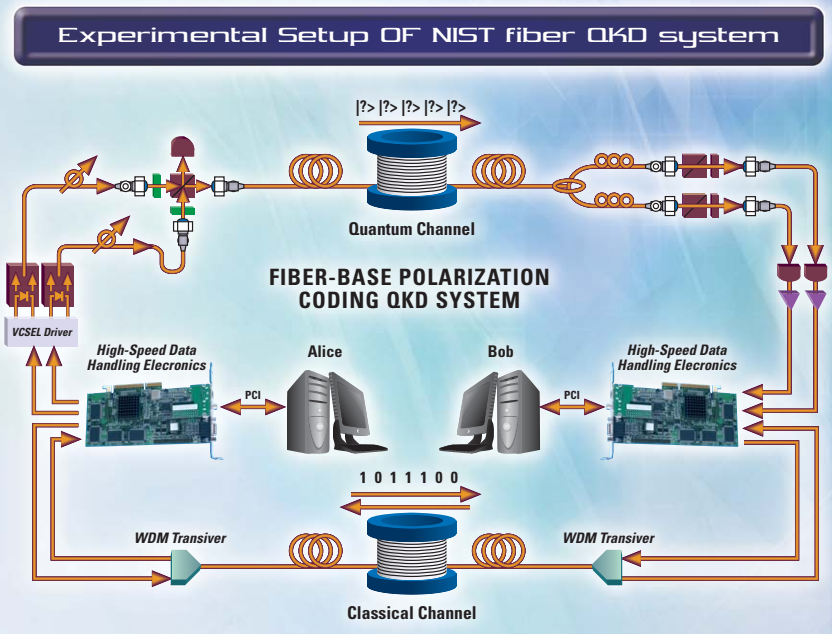
「Experimental Setup OF NIST fiber QKD system」(NIST の光ファイバー QKD システムの実験構成)と題した図で、中央に「FIBER-BASE POLARIZATION CODING QKD SYSTEM」(光ファイバーによる偏光符号化 QKD システム)とあります。左側(Alice 側)では「VCSEL Driver」(VCSEL ドライバー)がレーザー光源を駆動し、その出力は光学部品とファイバーを通って「Quantum Channel」(量子チャネル)のファイバーの巻きに達します。巻きの上の矢印は光子の状態「|?> |?> |?> |?> |?>」(原本の印字どおり)を示します。右側(Bob 側)ではファイバーが 2 つの枝に分かれ、光学部品を経て 2 つの検出器に至ります。両側に「High-Speed Data Handling Elecronics」(高速データ処理用電子回路。「Elecronics」は原本の綴り)の基板があり、双方向の「PCI」矢印で、左は「Alice」、右は「Bob」とラベル付けされたコンピューターにつながります。下部では、2 つの「WDM Transiver」(WDM 送受信器。「Transiver」は原本の綴り)の間にある「Classical Channel」(古典チャネル)のファイバーの巻きが両側の基板を結び、その上の双方向の矢印はビット列「1 0 1 1 1 0 0」を示します。
Quantum cryptography offers the potential for stronger security, but as with any information technology, QKD must be designed and implemented properly to provide benefits promised. While often described in the popular literature as “unbreakable,” quantum key distribution systems may be subject to a number of attacks depending on the implementation and the protocol. Vulnerabilities may be introduced in the physical systems, quantum protocols and the application software and operating systems used to process keys. Existing QKD systems are not able to guarantee the production and receipt of a single photon per time slice, as required by most quantum protocols. Multiple photons emitted in a single time slice may allow an attacker to obtain information on the shared key. Quantum protocols may also have weaknesses. Although BB84 is regarded as secure, researchers frequently introduce new protocols that differ radically from the BB84 scheme and a number of these protocols have been shown vulnerable to attack. A third area of concern for QKD systems is the conventional computing platforms on which they must be based. Quantum cryptographic equipment must be integrated with the organization’s network, potentially leaving the QKD system and its software open to conventional network attacks. Methods of evaluating and certifying QKD systems have not yet been incorporated into existing security evaluation methodologies.
量子暗号はより強力なセキュリティをもたらす可能性がありますが、他の情報技術と同様に、約束された利点を得るには、QKD を適切に設計し実装しなければなりません。一般向けの文献では「解読不可能」と説明されることが多いものの、量子鍵配送システムは、実装とプロトコルによっては、さまざまな攻撃を受ける可能性があります。脆弱性は、物理システム、量子プロトコル、鍵の処理に使われるアプリケーションソフトウェアやオペレーティングシステムに入り込む場合があります。既存の QKD システムは、ほとんどの量子プロトコルが求める、時間スライスごとに 1 つの光子を生成し受信することを保証できません。1 つの時間スライスで複数の光子が放出されると、攻撃者が共有鍵に関する情報を得られる場合があります。量子プロトコルにも弱点がある場合があります。BB84 は安全とみなされていますが、研究者は BB84 方式とは根本的に異なる新しいプロトコルを頻繁に導入しており、それらの多くは攻撃に対して脆弱であることが示されています。QKD システムにとっての 3 つ目の懸念分野は、その基盤となる従来型のコンピューティングプラットフォームです。量子暗号装置は組織のネットワークに統合される必要があり、QKD システムとそのソフトウェアが、従来型のネットワーク攻撃にさらされる可能性があります。QKD システムを評価し認証する方法は、既存のセキュリティ評価方法論にはまだ取り入れられていません。
Quantum cryptography is a relatively new field. Two firms, MagiQ Technologies (USA) and ID Quantique (Switzerland), have been developing and offering quantum cryptographic products since 1999. Others, including IBM, NEC, Fujitsu, Siemens and Sony, have active research efforts that may result in products. Existing products are capable of key distribution through fiber optic cable for distances of only several tens of kilometers, but progress has been rapid. In addition to key distribution, quantum cryptographic products include quantum random number generators, single photon detectors, and photon sources.
量子暗号は比較的新しい分野です。MagiQ Technologies(米国)と ID Quantique(スイス)の 2 社が、1999年から量子暗号製品を開発し提供しています。IBM、NEC、富士通、Siemens、ソニーなど他の企業も、製品化につながりうる活発な研究を行っています。既存の製品は、光ファイバーケーブルを通じた数十キロメートル程度の距離でしか鍵配送を行えませんが、進展は急速です。鍵配送に加えて、量子暗号製品には、量子乱数生成器、単一光子検出器、光子源が含まれます。
The main objective of the NIST Quantum Information Program is to develop an extensible quantum information test bed and the scalable component technology essential to the practical realization of a quantum communication network. The test bed will demonstrate quantum communication and quantum cryptographic key distribution with a high data rate. This test bed will provide a measurement and standards infrastructure that will be open to the DARPA QuIST (Quantum Information Science and Technology) community and will enable wide-ranging experiments on both the physical-and network-layer aspects of a quantum communication system. The infrastructure will be used to provide calibration, testing and development facilities for the QuIST community.
NIST Quantum Information Program の主な目的は、拡張可能な量子情報の試験環境と、量子通信ネットワークの実用的な実現に不可欠な、スケーラブルな構成要素技術を開発することです。この試験環境は、高いデータレートでの量子通信と量子暗号鍵配送を実証します。この試験環境は、DARPA の QuIST(Quantum Information Science and Technology)コミュニティに開かれた測定・標準のインフラを提供し、量子通信システムの物理層とネットワーク層の両面について、幅広い実験を可能にします。このインフラは、QuIST コミュニティに校正、試験、開発の施設を提供するために使われます。
Within the Quantum Information Program, we are also developing and evaluating quantum cryptographic protocols and investigating means of integrating quantum and conventional network technology. Controlling access to a large network of resources is one of the most common security problems. Any pair of parties in a network should be able to communicate, but must be authorized to do so, while minimizing the number of cryptographic keys that must be distributed and maintained. This project will develop an authentication solution based on a combination of quantum cryptography and a conventional secret key system. Two significant advantages of this approach over conventional authentication protocols are (1) time-stamps and exact clock synchronization between parties are not needed, and (2) that even the trusted server cannot know the contents of the authentication ticket.
Quantum Information Program の中で、当部門は、量子暗号プロトコルの開発と評価、および量子ネットワーク技術と従来型ネットワーク技術を統合する手段の調査も行っています。多数の資源からなる大規模ネットワークへのアクセスを制御することは、最も一般的なセキュリティ上の問題の一つです。ネットワーク内の任意の 2 者は通信できなければなりませんが、そのためには認可されている必要があり、同時に、配布し維持しなければならない暗号鍵の数を最小限に抑える必要があります。このプロジェクトは、量子暗号と従来型の共通鍵方式の組み合わせに基づく認証ソリューションを開発します。従来の認証プロトコルに対するこの取り組み方の 2 つの重要な利点は、(1) 当事者間でタイムスタンプと正確な時計の同期が必要ないこと、(2) 信頼されたサーバーでさえ認証チケットの内容を知ることができないことです。
In the past year, NIST Information Technology Laboratory (ITL) researchers investigated methods to implement quantum computing with very noisy devices. This work may speed the development of practical quantum computing because it means that quantum computers will be able to tolerate imperfections and higher error rates in components. ITL staff also worked with NIST physicists to construct a QKD free-space test bed that represents a major increase in the attainable rate of quantum key generation, over 100 times faster than previously reported results. This year, using much of the infrastructure developed for the free-space test bed, they implemented a fiber-based QKD test bed, which doubled their previous quantum key generation rate. Part of this work focused on methods that would allow QKD systems to operate using a standard telecommunication infrastructure. A quantum authentication and key distribution protocol that is integrated with conventional Internet security protocols was completed, and will be published in late 2005. In the coming year, ITL will continue work on fault-tolerant quantum computing, work with the NIST Physics Laboratory on a test bed for quantum components and quantum networks that can be integrated with the Internet, and investigate applications of quantum cryptography to the problem of secure routing.
昨年、NIST 情報技術研究所(ITL)の研究者は、ノイズの非常に多いデバイスで量子コンピューティングを実装する方法を調査しました。この作業は、量子コンピュータが構成要素の不完全さや高い誤り率を許容できるようになることを意味するため、実用的な量子コンピューティングの開発を早めるかもしれません。ITL の職員は、NIST の物理学者とも協力して、QKD の自由空間試験環境を構築しました。これは、達成可能な量子鍵生成速度を大きく向上させるもので、従来報告された結果の 100 倍以上の速さです。今年は、自由空間試験環境のために開発したインフラの多くを使って、光ファイバーベースの QKD 試験環境を実装し、以前の量子鍵生成速度を 2 倍にしました。この作業の一部は、QKD システムを標準的な電気通信インフラで動作させる方法に焦点を当てていました。従来のインターネットセキュリティプロトコルと統合された、量子認証と鍵配送のプロトコルが完成し、2005年後半に発表される予定です。来年、ITL は、耐障害性のある量子コンピューティングの作業を続け、NIST Physics Laboratory とともに、インターネットと統合できる量子構成要素と量子ネットワークの試験環境に取り組み、安全なルーティングの問題への量子暗号の応用を調査します。
http://math.nist.gov/quantum/
Contacts: Mr. D. Richard Kuhn
(301) 975-3337
kuhn@nist.gov
http://math.nist.gov/quantum/
連絡先: Mr. D. Richard Kuhn
(301) 975-3337
kuhn@nist.gov
Dr. Alan Mink (ANTD)
(301) 975-5681
alan.mink@nist.gov
Dr. Alan Mink(ANTD)
(301) 975-5681
alan.mink@nist.gov
PROTOCOL SECURITY
プロトコルのセキュリティ
As the Internet becomes an essential part of day-to-day business and government operations, security, stability, and availability of Internet services are critical issues to the health of our Nation's economy. Expediting the development and deployment of standardized Internet infrastructure protection technologies has been one of ITL’s major focus areas in networking, involving the Advanced Network Technologies Division (ANTD) and the Computer Security Division (CSD). We are helping develop public specifications to secure the Internet naming infrastructure through the Domain Name System Security (DNSSEC) project. Another effort is the development of standards for the protection of both content and resources in the Internet routing infrastructure, in particular, the Border Gateway Protocol (BGP). Our work on Internet Protocol Security (IPSec) has also progressed.
インターネットが日常の業務や政府の運営に不可欠な部分となるにつれて、インターネットサービスのセキュリティ、安定性、可用性は、国の経済の健全性にとって重大な問題になっています。標準化されたインターネットインフラ保護技術の開発と展開を早めることは、Advanced Network Technologies Division(ANTD)とコンピュータセキュリティ部門(CSD)が関与する、ネットワーキングにおける ITL の主要な重点分野の一つでした。当部門は、Domain Name System Security(DNSSEC)プロジェクトを通じて、インターネットの名前解決インフラを保護する公開仕様の策定を支援しています。もう一つの取り組みは、インターネットのルーティングインフラ、特に Border Gateway Protocol(BGP)において、コンテンツと資源の両方を保護するための標準の策定です。Internet Protocol Security(IPSec)に関する当部門の作業も進んでいます。
Contact: Mr. Tim Grance
(301) 975-3359
grance@nist.gov
連絡先: Mr. Tim Grance
(301) 975-3359
grance@nist.gov
DOMAIN NAME SYSTEM SECURITY EXTENSIONS
ドメインネームシステムセキュリティ拡張
The Domain Name System (DNS) is the method by which Internet addresses in mnemonic form such as http://csrc.nist.gov are converted into the equivalent numeric IP (Internet Protocol) address such as 129.6.13.39. Certain servers throughout the world maintain the databases needed, as well as perform the translations. A DNS server trying to perform a translation may communicate with other Internet DNS servers if it does not have the data needed to translate the address itself.
Domain Name System(DNS)は、http://csrc.nist.gov のような覚えやすい形式のインターネットアドレスを、129.6.13.39 のような同等の数値の IP(Internet Protocol)アドレスに変換する方法です。世界中の特定のサーバーが、必要なデータベースを維持し、変換も行います。変換を試みる DNS サーバーは、アドレスを自ら変換するために必要なデータを持っていない場合、インターネット上の他の DNS サーバーと通信することがあります。
There are several distinct classes of threats to the DNS. Most of these are DNS-related instances of more general problems, but a few of these are specific to peculiarities of the DNS protocol. DNSSEC (short for DNS Security Extensions) adds security to the Domain Name System. It is a set of extensions to DNS, which provide (1) origin authentication of DNS data, (2) data integrity, and (3) authenticated denial of existence. DNSSEC was designed to protect the Internet from certain attacks.
DNS に対する脅威には、いくつかの明確な種類があります。これらの大半は、より一般的な問題の DNS における事例ですが、一部は DNS プロトコルの特異性に固有のものです。DNSSEC(DNS Security Extensions の略)は、Domain Name System にセキュリティを加えます。これは DNS の拡張の一式で、(1) DNS データの出所認証、(2) データの完全性、(3) 認証された不在証明を提供します。DNSSEC は、特定の攻撃からインターネットを守るために設計されました。
We are developing public specifications to secure the Internet naming infrastructure through our DNSSEC project. ITL leads the Internet Engineering Task Force (IETF) DNSSEC editors’ team in the completion and progression of all core DNSSEC specifications. We also work with industry and the Department of Homeland Security to expedite the deployment of these new standards.
当部門は、DNSSEC プロジェクトを通じて、インターネットの名前解決インフラを保護する公開仕様を策定しています。ITL は、Internet Engineering Task Force(IETF)の DNSSEC 編集者チームを率い、DNSSEC のすべての中核仕様の完成と策定の進展を担っています。また、これらの新しい標準の展開を早めるため、産業界や国土安全保障省とも協力しています。
In 2005, we made further progress in the development of commercial standards and adoption of tools and best practices for securing DNS. As leader of the IETF DNSSEC editors’ team, we made the necessary efforts to promote three DNSSEC documents to RFC (Request for Comments) status. We continued our active participation in the U.S. Government DNSSEC Deployment Team. Public comments we received on the draft of Special Publication (SP) 800-81, Secure Domain Name System Deployment Guide, were incorporated into a final document. We will be posting this document soon on our Web site. Our paper, “An Integrity Verification Scheme for DNS Zone File Based on Security Impact Analysis,” has been accepted for publication in the proceedings of the 21st Annual Computer Security Applications Conference to be held in December 2005.
2005年には、DNS を保護するための産業界の標準の策定と、ツールおよびベストプラクティスの採用で、さらに前進しました。IETF DNSSEC 編集者チームのリーダーとして、3 つの DNSSEC 文書を RFC(Request for Comments)の地位に引き上げるために必要な取り組みを行いました。米国政府の DNSSEC Deployment Team への積極的な参加も続けました。特別刊行物(SP)800-81、Secure Domain Name System Deployment Guide のドラフトに寄せられたパブリックコメントは、最終文書に反映されました。この文書は、まもなく当部門のウェブサイトに掲載します。論文「An Integrity Verification Scheme for DNS Zone File Based on Security Impact Analysis」は、2005年12月に開催される第 21 回 Annual Computer Security Applications Conference の論文集への掲載が受理されました。
We have added an online monitoring capability to our Secure Zone Integrity Checker tool. We have also developed tools for DNS traffic capture and replay. Finally, we are coordinating with the General Services Administration (GSA) and associated contractors to finalize plans for securing the.gov domain when the maintenance contract is up for renewal. We will work with the contract awardee to facilitate development, procurement and deployment of tools that are required to configure and administer a secure (DNSSEC-based).gov domain.
Secure Zone Integrity Checker ツールに、オンライン監視機能を追加しました。DNS トラフィックの取得と再生のためのツールも開発しました。最後に、保守契約の更新時期が来たときに .gov ドメインを保護する計画を最終化するため、一般調達局(GSA)および関連する請負業者と調整しています。契約を獲得した業者と協力して、安全な(DNSSEC ベースの).gov ドメインの設定と管理に必要なツールの開発、調達、展開を円滑にします。
Contact: Dr. Ramaswamy Chandramouli
(301) 975-5013
chandramouli@nist.gov
連絡先: Dr. Ramaswamy Chandramouli
(301) 975-5013
chandramouli@nist.gov
BORDER GATEWAY PROTOCOL
ボーダーゲートウェイプロトコル
The Border Gateway Protocol (BGP) is an inter-autonomous system routing protocol. An autonomous system is a network or group of networks under a common administration and with common routing policies. BGP is used to exchange routing information for the Internet and is the protocol used between Internet service providers (ISP).
Border Gateway Protocol(BGP)は、自律システム間のルーティングプロトコルです。自律システムとは、共通の管理下にあり、共通のルーティングポリシーを持つ、ネットワークまたはネットワーク群です。BGP は、インターネットのルーティング情報を交換するために使われ、インターネットサービスプロバイダー(ISP)間で使われるプロトコルです。
The BGP project was kicked off in February 2004. The project aims to help industry understand the potential risks to inter-domain routing and the design and implementation trade-offs of the various BGP security mechanisms currently proposed in the Internet Engineering Task Force (IETF) community. Previously there was a lack of awareness and knowledge in the information technology (IT) sector of the potential threats, risks, mitigation techniques and their costs. The project also seeks to expedite convergence towards standardized, implemented, and deployed BGP security solutions.
BGP プロジェクトは2004年2月に始まりました。このプロジェクトは、ドメイン間ルーティングの潜在的なリスクと、Internet Engineering Task Force(IETF)コミュニティで現在提案されているさまざまな BGP セキュリティ機構の、設計上および実装上のトレードオフを、産業界が理解するのを助けることを目的としています。以前は、情報技術(IT)部門に、潜在的な脅威、リスク、緩和技法、そのコストについての認識と知識が欠けていました。このプロジェクトはまた、標準化され、実装され、展開された BGP セキュリティソリューションへの収束を早めることも目指しています。
Our project efforts were directed during the past year to focus on characterizing the problem and design space for BGP security technologies. Our subsequent work has focused primarily on two activities—large-scale simulation modeling of focused BGP attacks and analytical models of threat versus countermeasure effectiveness. We are working with industry and government network operators and security experts to—
昨年のプロジェクトの取り組みは、BGP セキュリティ技術の問題と設計空間の特徴づけに重点を置いて進められました。その後の作業は、主に 2 つの活動、すなわち、焦点を絞った BGP 攻撃の大規模シミュレーションモデリングと、脅威と対策の有効性の分析モデルに注力しています。次のことを行うため、産業界と政府のネットワーク事業者およびセキュリティ専門家と協力しています。
•Identify the threats and vulnerabilities of BGP/inter-domain routing
•BGP/ドメイン間ルーティングの脅威と脆弱性を特定する
•Document best common practices in securing the current BGP deployments
•現在の BGP 展開を保護するためのベストプラクティスを文書化する
•Provide deployment and policy guidance for emerging BGP security technologies.
•新たな BGP セキュリティ技術の展開とポリシーに関するガイダンスを提供します。
In the past year, we completed design and implementation of a general framework for modeling attacks on BGP protocols. The simulation framework was used to conduct extensive modeling of the effects of attacks on BGP. Researchers also investigated a vulnerability that arises from interactions between BGP features and a component of the protocol designed to reduce instability. By exploiting this component, attackers could introduce significant delays or disable parts of the Internet. While this vulnerability had been suggested as a possibility, no previous study had determined the magnitude and extent of its effects. The study also outlined a countermeasure, using an optional component of the BGP protocol, to reduce the risk from this vulnerability. Results of the project were presented in workshops for both researchers and industry practitioners who have day-to-day responsibility for network operations with major ISPs. A guideline of best practices for securing BGP was completed and will be released to assist industry and government.
昨年は、BGP プロトコルへの攻撃をモデル化するための汎用フレームワークの設計と実装を完了しました。このシミュレーションフレームワークは、BGP への攻撃の影響の広範なモデル化に使われました。研究者は、BGP の機能と、不安定性を減らすために設計されたプロトコルの構成要素との相互作用から生じる脆弱性も調査しました。この構成要素を悪用することで、攻撃者はインターネットの一部に大幅な遅延をもたらしたり、機能を停止させたりできる可能性があります。この脆弱性は可能性として示唆されていましたが、その影響の大きさと範囲を判断した研究はそれまでありませんでした。この研究はまた、BGP プロトコルのオプションの構成要素を使って、この脆弱性によるリスクを減らす対策の概要も示しました。プロジェクトの成果は、研究者と、大手 ISP でネットワーク運用の日常的な責任を負う産業界の実務者の両方向けのワークショップで発表されました。BGP を保護するためのベストプラクティスのガイドラインが完成し、産業界と政府を支援するために公開される予定です。
The focus of our 2006 activities will be to extend the modeling and analysis tools to incorporate significantly larger and more realistic topologies In fiscal year 2006, we will continue to make active contributions to the IETF Routing Protocols Security Working Group and other Internet standards bodies, helping to move the results of this research into practice.
2006年の活動の焦点は、モデル化と分析のツールを拡張し、大幅に大規模で、より現実的なトポロジーを取り込むことです。2006会計年度には、この研究の成果を実践に移すのを助けるため、IETF Routing Protocols Security Working Group やその他のインターネット標準化団体への積極的な貢献を続けます。
http://www.antd.nist.gov/iipp.shtml
Contact: Mr. D. Richard Kuhn
(301) 975-3337
kuhn@nist.gov
http://www.antd.nist.gov/iipp.shtml
連絡先: Mr. D. Richard Kuhn
(301) 975-3337
kuhn@nist.gov
INTERNET PROTOCOL SECURITY
インターネットプロトコルセキュリティ
Internet Protocol Security (IPsec) is a framework of open standards for ensuring private communications over IP networks, which has become the most popular network layer security control. It can provide several types of data protection: confidentiality; integrity; data origin authentication; prevention of packet replay and traffic analysis; and access control.
Internet Protocol Security(IPsec)は、IP ネットワーク上での私的な通信を確保するためのオープン標準の枠組みで、最も普及したネットワーク層のセキュリティ管理策となっています。いくつかの種類のデータ保護、すなわち、機密性、完全性、データ出所認証、パケットのリプレイとトラフィック分析の防止、アクセス制御を提供できます。
IPsec is a network-layer control with several components. IPsec has two security protocols— Authentication Header (AH) and Encapsulating Security Payload (ESP). AH can provide integrity protection for packet headers and data. ESP can provide encryption and integrity protection for packets, but cannot protect the outermost IP header, as AH can. The capability for integrity protection was added to the second version of ESP, which is used by most current IPsec implementations; accordingly, the use of AH has significantly declined. IPsec typically uses the Internet Key Exchange (IKE) protocol to negotiate IPsec connection settings, exchange keys, authenticate endpoints to each other, and establish security associations, which define the security of IPsec-protected connections. IPsec can also use the IP Payload Compression Protocol (IPComp) to compress packet payloads before encrypting them.
IPsec は、いくつかの構成要素を持つネットワーク層の管理策です。IPsec には 2 つのセキュリティプロトコル、Authentication Header(AH)と Encapsulating Security Payload(ESP)があります。AH は、パケットヘッダとデータの完全性保護を提供できます。ESP は、パケットの暗号化と完全性保護を提供できますが、AH のようには最も外側の IP ヘッダを保護できません。完全性保護の能力は、現在の IPsec 実装の大半が使っている ESP の第 2 版に追加されたため、AH の使用は大幅に減りました。IPsec は通常、IPsec 接続の設定の交渉、鍵の交換、端点同士の認証、IPsec で保護された接続のセキュリティを定義するセキュリティアソシエーションの確立に、Internet Key Exchange(IKE)プロトコルを使います。IPsec は、パケットのペイロードを暗号化する前に圧縮するために、IP Payload Compression Protocol(IPComp)を使うこともできます。
IPsec has several uses, with the most common being a virtual private network (VPN). This is a virtual network built on top of existing physical networks that can provide a secure communications mechanism for data and IP information transmitted between networks. Although VPNs can reduce the risks of networking, they cannot totally eliminate them. For example, a VPN implementation may have flaws in algorithms or software, or insecure configuration settings and values that attackers can exploit.
IPsec にはいくつかの用途があり、最も一般的なものが仮想プライベートネットワーク(VPN)です。これは、既存の物理ネットワークの上に構築される仮想ネットワークで、ネットワーク間で送信されるデータと IP 情報に、安全な通信の仕組みを提供できます。VPN はネットワーキングのリスクを減らせますが、完全になくすことはできません。たとえば、VPN の実装には、アルゴリズムやソフトウェアの欠陥、または攻撃者が悪用できる安全でない設定や値がある場合があります。
To expedite the development of this crucial technology, Information Technology Laboratory (ITL) staff designed and developed Cerberus, a reference implementation of the IPsec specifications, and PlutoPlus, a reference implementation of the IKE key negotiation and management specifications. Numerous organizations from all segments of the Internet industry have acquired these implementations as a platform for ongoing research on advanced issues in IPsec technology.
この重要な技術の開発を早めるため、情報技術研究所(ITL)の職員は、IPsec 仕様の参照実装である Cerberus と、IKE の鍵交渉・管理仕様の参照実装である PlutoPlus を設計し、開発しました。インターネット業界のあらゆる分野の数多くの組織が、IPsec 技術の高度な課題に関する継続的な研究のプラットフォームとして、これらの実装を入手しています。
To answer an industry call for more frequent and accessible interoperability testing for emerging commercial implementations of IPsec technology, ITL developed the NIST IPsec WWW-based Interoperability Tester (IPsec-WIT), which is built around the Cerberus and PlutoPlus prototype implementations. IPsec-WIT also serves as an experiment in test system architectures and technologies. The novel use of WWW technology allows IPsec-WIT to provide interoperability testing services anytime and anywhere without requiring any distribution of test system software or relocation of the systems under test. ITL staff also collaborated with key industry representatives to co-author protocol specifications and resolve technical impasses that threatened the progress of the IPsec design and standardization process.
新たに登場する IPsec 技術の市販実装に対する、より頻繁で利用しやすい相互運用性試験を求める産業界の声に応えるため、ITL は、Cerberus と PlutoPlus のプロトタイプ実装を土台に構築された、NIST IPsec WWW-based Interoperability Tester(IPsec-WIT)を開発しました。IPsec-WIT は、試験システムのアーキテクチャと技術の実験の場でもあります。WWW 技術の斬新な利用により、IPsec-WIT は、試験システムソフトウェアの配布や試験対象システムの移設を必要とせずに、いつでもどこでも相互運用性試験サービスを提供できます。ITL の職員は、IPsec の設計と標準化のプロセスの進展を妨げていた技術的な行き詰まりを解決し、プロトコル仕様を共同執筆するため、産業界の主要な代表者とも協力しました。
During the past year, we completed Special Publication (SP) 800-77, Guide to IPsec VPNs.This document describes the three primary models for VPN architectures: gateway-to-gateway, host-to-gateway and host-to-host. These models can be used, respectively, to connect two secured networks (such as a branch office and headquarters) over the Internet, to protect communications for hosts on unsecured networks (such as traveling employees), or to secure direct communications between two computers that require extra protection.
昨年は、特別刊行物(SP)800-77『Guide to IPsec VPNs』を完成させました。この文書は、VPNアーキテクチャの3つの主要なモデル、すなわちゲートウェイ間、ホストとゲートウェイ間、ホスト間を説明しています。これらのモデルは、それぞれ、インターネット経由で2つの保護されたネットワーク(支社ネットワークと本社ネットワークなど)を接続する場合、保護されていないネットワーク上のホスト(出張中の従業員など)の通信を保護する場合、または追加の保護を必要とする2台のコンピュータ間の直接通信を保護する場合に使えます。
The guide describes the components of IPsec. It also presents a phased approach to IPsec planning and implementation that can help in achieving successful IPsec deployments. The five phases of the approach are—
このガイドは、IPsec の構成要素を説明しています。また、IPsec の展開を成功させるのに役立つ、IPsec の計画と実装への段階的な取り組み方も示しています。この取り組み方の 5 つの段階は次のとおりです。
•Identify needs
•ニーズを特定する
•Design the solution
•ソリューションを設計する
•Implement and test a prototype
•プロトタイプを実装し試験する
•Deploy the solution, and
•ソリューションを展開する。
•Manage the solution.
•ソリューションを管理する。
Special considerations affecting configuration and deployment are analyzed and three test cases are presented to illustrate the process of planning and implementing IPsec VPNs. SP 800-77 will be published in FY 2006.
設定と展開に影響する特別な考慮事項が分析され、IPsec VPN の計画と実装のプロセスを例示する 3 つのテストケースが示されています。SP 800-77 は2006会計年度に発行されます。
http://csrc.nist.gov/ipsec/
Contact: Ms. Sheila Frankel
(301) 975-3297
sheila.frankel@nist.gov
http://csrc.nist.gov/ipsec/
連絡先: Ms. Sheila Frankel
(301) 975-3297
sheila.frankel@nist.gov
DIGITAL HANDHELD DEVICE FORENSICS
デジタルハンドヘルドデバイスのフォレンジック
The digital forensic community faces a constant challenge to stay on top of the latest technologies that may be used to recover evidence. One such area concerns handheld device forensics. Personal digital assistants (PDAs) and cell phones, including converged PDA/cell phone devices, are commonplace in today’s society. They are used by individuals for both personal and professional purposes. Handheld device technologies are evolving rapidly with new products and features being introduced regularly. Rather than just placing calls, cellular devices can allow users to perform additional tasks such as SMS (Short Message Service) messaging, Multi-Media Messaging Service (MMS) messaging, IM (Instant Messaging), electronic mail exchange, Web browsing, PIM (Personal Information Management) maintenance (e.g., address book, task list, and calendar schedule), and even the reading, editing, and production of digital documents. When used over time, they tend to accumulate a significant amount of information that may pertain to an incident or crime.
デジタルフォレンジックのコミュニティは、証拠の回収に使われうる最新の技術に遅れずについていくという、絶え間ない課題に直面しています。そうした分野の一つが、ハンドヘルドデバイスのフォレンジックです。個人情報端末(PDA)や、PDA と携帯電話が一体になったデバイスを含む携帯電話は、今日の社会ではごくありふれたものです。個人は、これらを私的な目的にも仕事の目的にも使っています。ハンドヘルドデバイスの技術は急速に進化しており、新しい製品や機能が定期的に登場しています。携帯デバイスは、通話をするだけでなく、SMS(ショートメッセージサービス)メッセージング、マルチメディアメッセージングサービス(MMS)メッセージング、IM(インスタントメッセージング)、電子メールのやり取り、ウェブブラウジング、PIM(個人情報管理)の維持(アドレス帳、タスクリスト、カレンダーの予定など)、さらにはデジタル文書の閲覧、編集、作成といった追加のタスクを、利用者が行えるようにします。長期間使用すると、これらのデバイスには、インシデントや犯罪に関係しうる多量の情報が蓄積される傾向があります。
When a PDA or cellular phone is encountered during an investigation, many questions arise: What should be done about maintaining power? How should the overall state of the device and prevention of incoming/outgoing signals be handled? How should valuable or potentially relevant data contained on the device be examined? The key to answering these questions is an understanding of both the hardware and software characteristics of these devices and the intrinsic ability of available forensic tools.
調査中に PDA や携帯電話に遭遇すると、多くの疑問が生じます。電力の維持にはどう対処すべきか。デバイス全体の状態と、着信・発信信号の防止はどう扱うべきか。デバイスに含まれる貴重な、または関連する可能性のあるデータはどう調べるべきか。これらの疑問に答える鍵は、これらのデバイスのハードウェアとソフトウェアの特性、および利用可能なフォレンジックツールの本来の能力の両方を理解することです。
We have worked this past year to produce Special Publication (SP) 800-72, Guidelines on PDA Forensics, intended to provide suggestions on procedures and highlight key principles associated with the handling and examination of electronic evidence contained on PDAs. NIST Interagency Report (IR) 7250, Cell Phone Forensic Tools: An Overview and Analysis, is scheduled for release in late 2005. The report gives an overview of current forensic software tools designed for the acquisition, examination, and reporting of data residing on cellular handheld devices, and reviews their capabilities and limitations. The NIST IR will be followed by a companion publication entitled Guidelines on Cell Phone Forensics.
昨年は、PDA に含まれる電子的証拠の取り扱いと検査に関連する手順について提案を示し、重要な原則を強調することを意図した、特別刊行物(SP)800-72、Guidelines on PDA Forensics の作成に取り組みました。NIST 省庁間報告書(IR)7250、Cell Phone Forensic Tools: An Overview and Analysis は、2005年後半に公開される予定です。この報告書は、携帯ハンドヘルドデバイスに存在するデータの取得、検査、報告のために設計された現行のフォレンジックソフトウェアツールの概要を示し、その能力と限界をレビューしています。この NIST IR に続いて、Guidelines on Cell Phone Forensics という関連刊行物が公開されます。
[人物の写真。人物が写っているため、この非公式サイトには掲載していません。原本 PDF を参照してください。]
The intended audience of these publications is varied and broad, ranging from response team members handling a computer security incident to organizational security officials investigating an employee-related situation to forensic examiners involved in criminal investigations.
これらの刊行物の想定読者は多様かつ幅広く、コンピュータセキュリティインシデントに対処する対応チームの構成員から、従業員に関わる状況を調査する組織のセキュリティ担当者、刑事捜査に携わるフォレンジック検査官まで及びます。
Contacts: Mr. Wayne Jansen
(301) 975-5148
wayne.jansen@nist.gov
連絡先: Mr. Wayne Jansen
(301) 975-5148
wayne.jansen@nist.gov
Mr. Richard Ayers
(301) 975-4971
richard.ayers@nist.gov
Mr. Richard Ayers
(301) 975-4971
richard.ayers@nist.gov
INTERNET PROTOCOL VERSION 6
インターネットプロトコルバージョン6
The Internet Protocol Version 6 (IPv6) is an updated version of the current Internet Protocol, IPv4. It has been, and continues to be, developed and defined by the Internet Engineering Task Force (IETF) in a series of consensus-based standard documents—Requests for Comment (RFCs), which are approved standard documents; and Internet Drafts (IDs), which are works-in-progress that may progress to become standards. These documents define the contents and behavior of network communications at every level of the networking stack, from applications down to the physical layer.
Internet Protocol Version 6(IPv6)は、現行の Internet Protocol である IPv4 の更新版です。IPv6 は、合意に基づく一連の標準文書、すなわち、承認された標準文書である Requests for Comment(RFC)と、標準になる可能性のある作業中の文書である Internet Drafts(ID)で、Internet Engineering Task Force(IETF)により策定され、定義され続けています。これらの文書は、アプリケーションから物理層まで、ネットワークスタックのあらゆるレベルでのネットワーク通信の内容と動作を定義しています。
The primary motivations for the development of IPv6 was to increase the number of unique IP addresses, and to handle the needs of new Internet applications and devices. In addition, IPv6 was designed with the following goals: increased ease of network management and configuration, expandable IP header, improved mobility and security, and quality of service controls.
IPv6 開発の主な動機は、一意の IP アドレスの数を増やすことと、新しいインターネットアプリケーションやデバイスのニーズに対応することでした。さらに、IPv6 は、ネットワーク管理と設定の容易さの向上、拡張可能な IP ヘッダ、モビリティとセキュリティの改善、サービス品質の制御という目標を掲げて設計されました。
The Office of Management and Budget (OMB) has mandated that Government agencies will incorporate IPv6 capability into their backbone (routers, gateways, etc.) by 2008.
行政管理予算局(OMB)は、政府機関に対し、2008年までにバックボーン(ルータ、ゲートウェイなど)に IPv6 の機能を組み込むことを義務づけています。
We are planning a guidance document on IPv6. This document will describe IPv6’s new and expanded protocols, services, and capabilities. It will characterize new security threats posed by the transition to IPv6. It will issue guidance on IPv6 deployment, including transition, integration, configuration, and testing. It will also include several practical IPv6 transition scenarios. We are also planning research on the challenges posed to intrusion detection systems (IDSs) and firewalls by adding IPv6 to the network.
当部門は、IPv6 に関するガイダンス文書を計画しています。この文書は、IPv6 の新しく拡張されたプロトコル、サービス、能力を説明します。IPv6 への移行によってもたらされる新たなセキュリティ上の脅威の特徴を示します。移行、統合、設定、試験を含む IPv6 の展開に関するガイダンスを示します。実用的な IPv6 移行のシナリオもいくつか含みます。また、ネットワークに IPv6 を加えることが侵入検知システム(IDS)とファイアウォールにもたらす課題についての研究も計画しています。
http://csrc.nist.gov/ipsec/
Contacts: Mr. Douglas Montgomery (ANTD)
(301) 975-3630
dougm@nist.gov
http://csrc.nist.gov/ipsec/
連絡先: Mr. Douglas Montgomery(ANTD)
(301) 975-3630
dougm@nist.gov
Ms. Sheila Frankel
(301) 975-3297
sheila.frankel@nist.gov
Ms. Sheila Frankel
(301) 975-3297
sheila.frankel@nist.gov
MOBILE DEVICE SECURITY
モバイルデバイスのセキュリティ
Handheld devices such as personal digital assistants are becoming indispensable tools for today's highly mobile workforce. Small and relatively inexpensive, these devices can be used for many functions, including sending and receiving e-mail, storing documents, delivering presentations, and remotely accessing data. Though their small size can be an advantage, it can also be a disadvantage since handheld devices can be easier to misplace or to steal than a desktop or notebook computer. If they do fall into the wrong hands, gaining access to the information they store can be relatively easy.
個人情報端末などのハンドヘルドデバイスは、移動の多い今日の労働力にとって不可欠なツールになりつつあります。小型で比較的安価なこれらのデバイスは、電子メールの送受信、文書の保存、プレゼンテーションの実施、データへのリモートアクセスなど、多くの機能に使えます。小型であることは利点になりえますが、デスクトップやノート PC に比べて置き忘れたり盗まれたりしやすいため、欠点にもなりえます。万が一不正な人物の手に渡った場合、保存されている情報へのアクセスを得ることは比較的容易な場合があります。
User authentication is the first line of defense against this threat and an important aspect of mobile device security. We recently issued two reports aimed at making it harder for unauthorized users to access information from these devices through innovations in authentication.
利用者認証は、この脅威に対する最初の防御線であり、モバイルデバイスのセキュリティの重要な側面です。当部門は最近、認証の革新を通じて、権限のない利用者がこれらのデバイスから情報にアクセスすることを難しくすることを目的とした報告書を 2 件発行しました。
Many organizations have put in place smart card infrastructures for security. However, conventional-size cards, the approximate size of a credit card, require a card reader that can be nearly as large as the handheld device. NIST Interagency Report (IT) 7206, Smart Cards and Mobile Device Authentication, describes two types of smart cards that function the same as conventional-size cards, but use standard interfaces supported by handheld devices to eliminate the use of cumbersome readers.
多くの組織が、セキュリティのためにスマートカードのインフラを整備しています。しかし、クレジットカードとほぼ同じ大きさの従来サイズのカードには、ハンドヘルドデバイスとほぼ同じ大きさになりうるカードリーダーが必要です。NIST 省庁間報告書(IT)7206、Smart Cards and Mobile Device Authentication は、従来サイズのカードと同じように機能しながら、ハンドヘルドデバイスが対応する標準インタフェースを使って、扱いにくいリーダーを不要にする、2 種類のスマートカードを説明しています。
NIST IR 7200, Proximity Beacons and Mobile Device Authentication, describes how two different kinds of location-based authentication mechanisms that use signals from wireless beacons can be used to authenticate handheld device users. If the user is in an unauthorized location or a location outside a defined boundary, access will be denied or an additional authentication mechanism must be satisfied before gaining access.
NIST IR 7200、Proximity Beacons and Mobile Device Authentication は、無線ビーコンの信号を使う 2 種類の位置ベースの認証の仕組みを、ハンドヘルドデバイスの利用者の認証にどう使えるかを説明しています。利用者が許可されていない場所、または定められた境界の外にいる場合、アクセスは拒否されるか、アクセスを得る前に追加の認証の仕組みを満たす必要があります。
Both reports describe these innovative authentication mechanisms and provide details on their design and implementation.
両方の報告書が、これらの革新的な認証の仕組みを説明し、その設計と実装の詳細を示しています。
In earlier work, we devised a general-purpose knowledge-based mechanism for authenticating a user to a mobile device using a visual login technique called Picture Password. The mechanism uses image recall as an easy and natural way for users to authenticate, in lieu of alphanumeric passwords. Features of Picture Password include style dependent image selection, password reuse, and embedded salting, which overcome a number of problems with knowledge-based authentication for handheld devices. More information can be found in NIST IR 7030, Picture Password: A Visual Login Technique for Mobile Devices. All of these reports are available in the Publications section of the CSD Web site (CSRC).
以前の作業では、Picture Password と呼ばれる視覚的なログイン技法を使って、モバイルデバイスに対して利用者を認証する、汎用の知識ベースの仕組みを考案しました。この仕組みは、英数字のパスワードの代わりに、利用者が認証するための簡単で自然な方法として、画像の想起を使います。Picture Password の特徴には、スタイルに依存した画像の選択、パスワードの再利用、組み込みのソルティングがあり、ハンドヘルドデバイス向けの知識ベース認証が抱える多くの問題を克服します。詳細は、NIST IR 7030、Picture Password: A Visual Login Technique for Mobile Devices にあります。これらの報告書はすべて、CSD のウェブサイト(CSRC)の刊行物の節で入手できます。
Contact: Mr. Wayne Jansen
(301) 975-5148
wayne.jansen@nist.gov
連絡先: Mr. Wayne Jansen
(301) 975-5148
wayne.jansen@nist.gov
INDUSTRIAL CONTROL SYSTEMS SECURITY
産業用制御システムのセキュリティ
Industrial control systems (ICS) is a general term that encompasses several types of control systems, including supervisory control and data acquisition (SCADA) systems, distributed control systems (DCS), and other smaller control system configurations often found in the industrial control sectors. Our work focuses on SCADA and DCS systems, which are used in the electric, water, oil and gas, chemical, pharmaceutical, pulp and paper, food and beverage, and discrete manufacturing (automotive, aerospace, and durable goods) industries.
産業用制御システム(ICS)は、データ収集・監視制御(SCADA)システム、分散制御システム(DCS)、産業用制御の分野でよく見られるその他の小規模な制御システム構成など、いくつかの種類の制御システムを包含する総称です。当部門の業務は、電力、水道、石油・ガス、化学、医薬品、パルプ・紙、食品・飲料、個別製造(自動車、航空宇宙、耐久消費財)の各産業で使われる SCADA システムと DCS に重点を置いています。
SCADA systems are highly distributed systems used to control geographically dispersed assets, often scattered over thousands of square kilometers, where centralized data acquisition and control are critical to system operation. They are used in the distribution operations of water supply systems, oil and gas pipelines, electrical power grids, and railway transportation systems. A SCADA control center performs centralized monitoring and control for field sites over long distance communications networks. This includes monitoring alarms and processing status data. Based on information received from remote stations, automated or operator-driven supervisory commands can be pushed to remote station control devices, which are often referred to as field devices. Field devices control local operations such as opening and closing valves and relays, collecting data from sensor systems, and monitoring the local environment for alarm conditions.
SCADA システムは、地理的に分散した資産、多くは数千平方キロメートルに散らばった資産を制御するために使われる、高度に分散したシステムで、集中的なデータ収集と制御がシステムの運用に不可欠です。給水システム、石油・ガスのパイプライン、電力網、鉄道輸送システムの配給運用に使われています。SCADA 制御センターは、長距離通信ネットワークを通じて、現場サイトの集中的な監視と制御を行います。これには、警報の監視と状態データの処理が含まれます。遠隔局から受け取った情報に基づき、自動または操作員による監視コマンドを、遠隔局の制御デバイス(しばしばフィールドデバイスと呼ばれます)に送ることができます。フィールドデバイスは、バルブやリレーの開閉、センサーシステムからのデータ収集、警報状態を検知するための局所環境の監視といった、局所的な動作を制御します。
DCS are used to control manufacturing processes such as electric power generation, oil and gas refineries, and chemical, food, and automotive production. DCS are integrated as a control architecture containing a supervisory level of control overseeing multiple, integrated sub-systems that are responsible for controlling the details of a localized manufacturing process. DCS are used extensively in process-based and discrete-based manufacturing industries.
DCS は、発電、石油・ガスの精製、化学・食品・自動車の生産などの製造プロセスの制御に使われます。DCS は、局所的な製造プロセスの詳細を制御する複数の統合サブシステムを監督する、監視レベルの制御を含む制御アーキテクチャとして構成されています。DCS は、プロセスベースおよび個別製造ベースの製造業で広く使われています。
Most ICS in use today were developed years ago, long before public and private networks, desktop computing, or the Internet were a common part of business operations. These systems were designed to meet performance, reliability, safety, and flexibility requirements and were typically physically isolated and based on proprietary hardware, software, and communication protocols. These proprietary communication protocols include basic error detection and correction capabilities, but nothing that guarantees secure communications. The need for cyber security measures within these systems was not anticipated, and, at the time, security for ICS meant physically securing access to the network and the consoles that controlled the systems.
現在使われている ICS の大半は、公的・民間のネットワーク、デスクトップコンピューティング、インターネットが業務運営の一般的な一部となるずっと前の、何年も前に開発されました。これらのシステムは、性能、信頼性、安全性、柔軟性の要件を満たすよう設計されており、通常は物理的に隔離され、独自仕様のハードウェア、ソフトウェア、通信プロトコルに基づいていました。これらの独自仕様の通信プロトコルには、基本的な誤り検出・訂正の機能が含まれていますが、安全な通信を保証するものは何もありません。これらのシステム内でのサイバーセキュリティ対策の必要性は想定されておらず、当時の ICS のセキュリティとは、ネットワークとシステムを制御するコンソールへのアクセスを物理的に保護することを意味していました。
As microprocessor, personal computer, and networking technology evolved during the 1980s and 1990s, the design of ICS changed to incorporate the latest technologies. Internet-based technologies started making their way into ICS designs in the late 1990s. These changes to ICS exposed them to new types of threats and significantly increased the likelihood that they would be attacked. While security solutions have been designed to deal with these security issues in typical IT systems, special precautions must be taken when introducing these same solutions to ICS environments. In some cases, new IT security solutions are needed.
マイクロプロセッサ、パーソナルコンピュータ、ネットワーキングの技術が1980年代から1990年代にかけて進化するにつれて、ICS の設計は最新技術を取り込むように変わりました。1990年代後半には、インターネットベースの技術が ICS の設計に入り込み始めました。こうした ICS の変化によって、ICS は新しい種類の脅威にさらされ、攻撃される可能性が大幅に高まりました。一般的な IT システムでのこうしたセキュリティ問題に対処するために、セキュリティソリューションが設計されてきましたが、同じソリューションを ICS 環境に導入する際には、特別な予防措置を講じなければなりません。場合によっては、新しい IT セキュリティソリューションが必要です。
In the past year, we have collaborated with the NIST Manufacturing Engineering Laboratory (MEL) in developing a guide to SCADA and ICS security, which will be published as NIST Special Publication (SP) 800-82. The purpose of this document is to provide guidance for establishing secure SCADA and other industrial control systems. The document provides an overview of industrial control systems and typical system topologies, identifies typical vulnerabilities and threats to these systems, and provides recommended security countermeasures to mitigate the associated risks. A public draft of SP 800-82 will be available in early 2006 with a final document complete by late 2006. This guideline is being prepared for use by Federal agencies, but it may be used by non-governmental organizations on a voluntary basis.
昨年、当部門は NIST Manufacturing Engineering Laboratory(MEL)と協力して、SCADA と ICS のセキュリティに関するガイドを策定しました。これは NIST 特別刊行物(SP)800-82 として発行される予定です。この文書の目的は、安全な SCADA とその他の産業用制御システムを確立するためのガイダンスを提供することです。この文書は、産業用制御システムと典型的なシステムトポロジーの概要を示し、これらのシステムに対する典型的な脆弱性と脅威を特定し、関連するリスクを緩和するための推奨されるセキュリティ対策を示しています。SP 800-82 の公開ドラフトは2006年初めに入手できるようになり、最終文書は2006年後半に完成する予定です。このガイドラインは連邦機関が使用するために作成されていますが、非政府組織が任意で使用することもできます。
The draft will undergo subject matter expert review by the NIST-led Process Control Security Requirements Forum (PCSRF), which was formed in the spring of 2001 by the MEL Intelligent Systems Division (ISD) in cooperation with CSD. The PCSRF is a working group of users, vendors, and integrators in the process control industry that is addressing the cyber security requirements for industrial process control systems and components, including SCADA systems, DCS, Programmable Logic Controllers (PLC), Remote Terminal Units (RTU), and Intelligent Electronic Devices (IED). Members of the PCSRF represent the critical infrastructures and related process control industries including oil and gas, water, electric power, chemicals, pharmaceuticals, metals and mining, and pulp and paper. There are currently over 700 members in the PCSRF from government, industry, and academe. ISD leads the NIST effort with additional support provided from CSD and the Electronics and Electrical Engineering Laboratory (EEEL). ISD leadership of the PCSRF was recognized with a U.S. Department of Commerce Gold Medal during 2005.
このドラフトは、CSD と協力して MEL Intelligent Systems Division(ISD)が2001年春に設立した、NIST 主導の Process Control Security Requirements Forum(PCSRF)による、専門家のレビューを受ける予定です。PCSRF は、プロセス制御業界の利用者、ベンダー、インテグレーターからなる作業部会で、SCADA システム、DCS、プログラマブルロジックコントローラ(PLC)、遠隔端末装置(RTU)、インテリジェント電子デバイス(IED)を含む、産業用プロセス制御システムと構成要素のサイバーセキュリティ要件に取り組んでいます。PCSRF の構成員は、重要インフラと、石油・ガス、水道、電力、化学、医薬品、金属・鉱業、パルプ・紙などの関連するプロセス制御産業を代表しています。現在、PCSRF には政府、産業界、学術界から 700 人を超える構成員がいます。NIST の取り組みは ISD が主導し、CSD と Electronics and Electrical Engineering Laboratory(EEEL)が追加の支援を提供しています。ISD の PCSRF での指導力は、2005年に米国商務省の Gold Medal で認められました。
http://www.isd.mel.nist.gov/projects/processcontrol/
Contacts: Mr. Keith Stouffer
Intelligent Systems Division, MEL
(301) 975-3877
keith.stouffer@nist.gov
http://www.isd.mel.nist.gov/projects/processcontrol/
連絡先: Mr. Keith Stouffer
Intelligent Systems Division, MEL
(301) 975-3877
keith.stouffer@nist.gov
Mr. Tim Grance
(301) 975-3359
grance@nist.gov
Mr. Tim Grance
(301) 975-3359
grance@nist.gov
DEDICATED SHORT-RANGE COMMUNICATIONS SECURITY
Dedicated Short-Range Communications のセキュリティ
Dedicated Short Range Communications (DSRC) is a wireless technology that offers the potential to support short to medium range, very high data rate, wireless communications between vehicles, and between vehicles and roadside signs. The goal of this project is to enhance vehicle-based crash prevention performance by using information that could be wirelessly transmitted to vehicles from the roadside and to and from other vehicles. Wireless technologies in vehicles can be used to reduce traffic accidents, resulting in lower direct and indirect financial costs, fewer injuries and fatalities, and reduced traffic congestion. Wireless technologies in vehicle-to-vehicle applications, however, raise a number of serious security concerns. We collaborated with the Department of Transportation and the Vehicular Safety Communication Consortium to define and evaluate the architecture and the security requirements for vehicle-to-vehicle and infrastructure-to-vehicle wireless communication. The Vehicle Safety Communications Consortium (VSCC) consists of seven original equipment manufacturers (OEMs): BMW, DaimlerChrysler, Ford, General Motors, Nissan, Toyota, and Volkswagen. Our efforts included a review of the security architecture, a simulation of network applications in various critical and non-critical scenarios, and the development of a reference implementation of the Vehicular Safety Communication (VSC) Security Protocol.
Dedicated Short Range Communications(DSRC)は、車両間、および車両と路側標識間で、短距離から中距離の非常に高いデータレートの無線通信を支える可能性がある技術です。このプロジェクトの目標は、路側から車両へ無線送信される情報と、他の車両との間で送受信される情報を使って、車両ベースの衝突防止性能を高めることです。車両の無線技術は、交通事故を減らすために使え、その結果、直接的・間接的な経済的費用の低減、負傷者と死者の減少、交通渋滞の緩和につながります。しかし、車両間アプリケーションの無線技術は、深刻なセキュリティ上の懸念をいくつかもたらします。当部門は、運輸省および Vehicular Safety Communication Consortium と協力して、車両間およびインフラから車両への無線通信のアーキテクチャとセキュリティ要件を定義し、評価しました。Vehicle Safety Communications Consortium(VSCC)は、BMW、DaimlerChrysler、Ford、General Motors、Nissan、Toyota、Volkswagen の 7 社の相手先ブランド供給製造業者(OEM)で構成されています。当部門の取り組みには、セキュリティアーキテクチャのレビュー、重要・非重要のさまざまなシナリオでのネットワークアプリケーションのシミュレーション、Vehicular Safety Communication(VSC)Security Protocol の参照実装の開発が含まれました。
Contact: Dr. Tom Karygiannis
(301) 975-4728
karygiannis@nist.gov
連絡先: Dr. Tom Karygiannis
(301) 975-4728
karygiannis@nist.gov
AUTOMATED SOFTWARE TESTING USING COVERING ARRAYS
カバリング配列を用いた自動ソフトウェアテスト
Software testing is inordinately expensive, typically consuming 50 percent or more of software development budgets. Except for the most critical cases, software products are inadequately tested. One of the main reasons for this is the time and expense for rigorous testing. For example, testing an avionics application with 20,000 lines of code to high assurance levels might require 7 calendar weeks simply to run tests, and much longer to produce test cases. Typical consumer software contains millions of lines of code, so testing to the same level of assurance would require many years, effectively pricing the software out of the market. A recent CSD study of failures in software for medical devices, browsers, servers, and NASA database systems showed that all failures were triggered by interactions among six or fewer input parameters. This suggests that if individual failures involve six or fewer parameters, then test suites designed to exercise from two-way up to six-way interactions will lead to very high confidence that most faults have been found. As a result, techniques and tools for developing test suites that efficiently provide from two-way to six-way coverage could dramatically improve software testing practice, providing better testing at significantly reduced cost. In August 2005, the Information Technology Laboratory (ITL) initiated a new project to incorporate these ideas into prototype testing tools.
ソフトウェアの試験は法外に費用がかかり、通常はソフトウェア開発予算の 50 パーセント以上を消費します。最も重要な場合を除き、ソフトウェア製品は十分に試験されていません。その主な理由の一つは、厳格な試験に時間と費用がかかることです。たとえば、2 万行のコードを持つアビオニクスアプリケーションを高い保証水準で試験するには、試験を実行するだけでも暦日で 7 週間、テストケースの作成にはさらに長い時間がかかる場合があります。一般的な消費者向けソフトウェアは数百万行のコードを含むため、同じ保証水準まで試験するには何年も必要で、事実上、そのソフトウェアは市場で成り立たなくなります。CSD が最近行った、医療機器、ブラウザ、サーバー、NASA のデータベースシステムのソフトウェア障害の調査では、すべての障害が 6 つ以下の入力パラメータ間の相互作用によって引き起こされていました。これは、個々の障害に関わるパラメータが 6 つ以下であるなら、2-way から 6-way までの相互作用を網羅するよう設計されたテストスイートによって、ほとんどの欠陥が発見されているという非常に高い確信を得られることを示唆しています。その結果、2-way から 6-way までの網羅性を効率的に実現するテストスイートを作成する技法とツールは、ソフトウェア試験の実践を劇的に改善し、大幅に低い費用でより優れた試験を実現できます。2005年8月に、情報技術研究所(ITL)は、これらの考え方をプロトタイプの試験ツールに取り入れる新しいプロジェクトを開始しました。
The project is using combinatorial mathematics to develop one or more algorithms to produce a test suite with anywhere from two-way to six-way coverage. Algorithms are being implemented in tools for automatic generation of test suites for real-world systems. These are uncharted territories. Some software tools claim to provide multi-way coverage, but they do not seem to work beyond small-scale problems. Generation of complete test cases is also a significant technical challenge. Although test data can be produced easily, tools that can determine the expected result to go with test data are barely out of the laboratory stage. This project is incorporating combinatorial testing algorithms into tools that use formal specifications and model checkers to generate test cases.
このプロジェクトは、組み合わせ数学を使って、2-way から 6-way までの網羅性を持つテストスイートを生成する1つ以上のアルゴリズムを開発しています。アルゴリズムは、実際のシステム向けのテストスイートを自動生成するツールに実装されています。これらは未踏の領域です。多方向の網羅性を提供すると謳うソフトウェアツールもありますが、小規模な問題を超えては機能しないようです。テストケース一式の生成も、大きな技術的課題です。テストデータは容易に生成できますが、そのテストデータに対応する期待結果を判断できるツールは、実験室段階をようやく脱しつつあるところです。このプロジェクトは、形式仕様とモデル検査器を使ってテストケースを生成するツールに、組み合わせ試験のアルゴリズムを取り込んでいます。
ITL researchers are working with faculty from George Mason University and the University of Texas at Arlington. The project team has developed some initial results on optimal test generation strategies, selected two example applications to use in evaluating the prototype, and will begin development of the prototype in fiscal year 2006. During FY 2006, the team will develop the prototype test generator and conduct an experiment on error detection rate for the generated tests using fault injection methods. Theoretical insights on optimal test generation strategies will be further developed and incorporated into tool development as appropriate.
ITL の研究者は、ジョージ・メイソン大学とテキサス大学アーリントン校の教員と協力しています。プロジェクトチームは、最適なテスト生成戦略に関する最初の成果を得ており、プロトタイプの評価に使う 2 つのアプリケーション例を選び、2006会計年度にプロトタイプの開発を始めます。2006会計年度中に、チームはプロトタイプのテスト生成器を開発し、フォールトインジェクション手法を用いて、生成された試験の誤り検出率に関する実験を行います。最適なテスト生成戦略に関する理論的な洞察は、さらに発展させ、適宜ツール開発に取り込みます。
Contacts: Mr. D. Richard Kuhn
(301) 975-3337
kuhn@nist.gov
連絡先: Mr. D. Richard Kuhn
(301) 975-3337
kuhn@nist.gov
Dr. Ramaswamy Chandramouli
(301) 975-5013
chandramouli@nist.gov
Dr. Ramaswamy Chandramouli
(301) 975-5013
chandramouli@nist.gov
Dr. Raghu Kacker (MCSD)
(301) 975-2109
raghu.kacker@nist.gov
Dr. Raghu Kacker(MCSD)
(301) 975-2109
raghu.kacker@nist.gov
Cryptographic Standards and Applications
暗号標準とアプリケーション
STRATEGIC GOAL
戦略目標
The Computer Security Division (CSD) will develop and improve cryptographic methods for protecting the integrity, confidentiality and authenticity of Federal agency information resources in the Executive Branch. We will work to enable government and industry to be able to build secure, interoperable applications with high-assurance products that implement needed cryptographic security functionality. This will include the ongoing development of cryptographic standards and testing methods, developing methods for securing government applications with cryptography, further developing key management guidelines and schemes and the updating and creation of new modes of operation for use with cryptographic algorithms.
コンピュータセキュリティ部門(CSD)は、行政府の連邦機関の情報資源の完全性、機密性、真正性を保護するための暗号手法を開発し、改善します。必要な暗号セキュリティ機能を実装した高保証製品を用いて、政府と産業界が安全で相互運用可能なアプリケーションを構築できるよう取り組みます。これには、暗号標準と試験方法の継続的な策定、暗号で政府のアプリケーションを保護する方法の開発、鍵管理のガイドラインと方式のさらなる開発、暗号アルゴリズムで使う動作モードの更新と新規作成が含まれます。
OVERVIEW
概要
Our work in cryptography is making an impact within and outside the Federal government. Strong cryptography improves the security of systems and the information they process. IT users also enjoy the enhanced availability in the marketplace of secure applications through cryptography, Public Key Infrastructure (PKI) and e-authentication. Work in this area addresses such topics as secret and public key cryptographic techniques, advanced authentication systems, cryptographic protocols and interfaces, public key certificate management, biometrics, smart tokens, cryptographic key escrowing and security architectures. In the previous year, the work called for in the Homeland Security Presidential Directive 12 (HSPD-12) has continued. A few examples of the impact this work has had included changes to Federal employee identification methods, how users authenticate their identity when needing government services online, and the technical aspects of passports issued to U.S. citizens.
暗号に関する当部門の業務は、連邦政府の内外に影響を与えています。強力な暗号は、システムと、システムが処理する情報のセキュリティを向上させます。IT の利用者も、暗号、公開鍵基盤(PKI)、電子認証を通じた安全なアプリケーションが市場で入手しやすくなったことの恩恵を受けています。この分野の業務では、共通鍵および公開鍵の暗号技法、高度な認証システム、暗号プロトコルとインタフェース、公開鍵証明書管理、生体認証、スマートトークン、暗号鍵エスクロー、セキュリティアーキテクチャといったトピックを扱います。前年には、国土安全保障大統領指令 12(HSPD-12)が求める業務が続けられました。この業務が与えた影響の例としては、連邦職員の識別方法の変更、政府サービスをオンラインで必要とするときに利用者が本人確認を行う方法の変更、米国市民に発行されるパスポートの技術的側面の変更などがありました。
This area of work involves collaboration with a number of entities, both from Federal agencies and industry. Some of the Federal agencies include the Department of Treasury, agencies participating in the Federal PKI Steering Committee and Bridge CA Project, the Federal Deposit Insurance Corporation (FDIC), and the National Security Agency (NSA). We have worked recently with the American National Standards Institute’s (ANSI’s) X9 Committee that develops standards for the financial industry, as well as with the Internet Engineering Task Force’s (IETF’s) PKIX Working Group. Industry collaborators for these projects have included RSA Security Entrust Technologies, International Business Machines (IBM), Mastercard, Visa, Verizon, VeriSign, and Microsoft Corporation.
この分野の業務は、連邦機関と産業界の両方の多数の主体との協力を伴います。連邦機関には、財務省、Federal PKI Steering Committee と Bridge CA Project に参加する機関、連邦預金保険公社(FDIC)、国家安全保障局(NSA)があります。最近は、金融業界の標準を策定する American National Standards Institute(ANSI)の X9 Committee、および Internet Engineering Task Force(IETF)の PKIX Working Group と協力してきました。これらのプロジェクトでの産業界の協力先には、RSA Security、Entrust Technologies、International Business Machines(IBM)、Mastercard、Visa、Verizon、VeriSign、Microsoft Corporation が含まれます。
REACHING OUR GOAL
目標の達成に向けて
CRYPTOGRAPHIC STANDARDS TOOLKIT
暗号標準ツールキット
The aim of the Cryptographic Standards Toolkit (CToolkit) project is to enable U.S. governmental agencies and others to select cryptographic security components and functionality for protecting their data, communications, and operations. The CToolkit helps to ensure that there is worldwide government and industry use of strong cryptography and that secure interoperability is achieved through standard algorithms. The CToolkit also provides guidance and education in the use of cryptography. It currently includes a wide variety of cryptographic algorithms and techniques for encryption, authentication, non-repudiation, key establishment and random number generation. The CToolkit is a collection of standards and guidance, and does not include any actual software implementations of the algorithms.
Cryptographic Standards Toolkit(CToolkit)プロジェクトの目的は、米国の政府機関やその他の組織が、データ、通信、業務を保護するための暗号のセキュリティ構成要素と機能を選択できるようにすることです。CToolkit は、世界中の政府と産業界が強力な暗号を使い、標準アルゴリズムを通じて安全な相互運用性が達成されるようにするのに役立ちます。CToolkit はまた、暗号の使用に関するガイダンスと教育も提供します。現在、暗号化、認証、否認防止、鍵確立、乱数生成のための、さまざまな暗号アルゴリズムと技法が含まれています。CToolkit は標準とガイダンスの集合であり、アルゴリズムの実際のソフトウェア実装は含まれません。
A great deal of work has been made on the CToolkit during FY 2005. Parts 1 and 2 of Special Publication (SP) 800-57, Recommendation on Key Management, have been completed; Part 3 will be posted for a public comment period in early 2006. SP 800-38B, Recommendation for Block Cipher Modes of Operation: The CMAC Mode for Authentication, has also been completed. NIST SP 800-56, Recommendation on Key Establishment Schemes, and a revision of SP 800-21, Guideline for Implementing Cryptography, were posted for public comment and will be completed in late 2005. The Data Encryption Standard (DES), which was initially adopted in 1977, was withdrawn as a Federal Information Processing Standard.
2005会計年度に、CToolkit に関して多くの作業が行われました。特別刊行物(SP)800-57、Recommendation on Key Management の第 1 部と第 2 部は完成しており、第 3 部は2006年初めに、パブリックコメント期間のために公開される予定です。SP 800-38B、Recommendation for Block Cipher Modes of Operation: The CMAC Mode for Authentication も完成しました。NIST SP 800-56、Recommendation on Key Establishment Schemes と、SP 800-21、Guideline for Implementing Cryptography の改訂は、パブリックコメント用に公開され、2005年後半に完成する予定です。1977年に最初に採用された Data Encryption Standard(DES)は、連邦情報処理標準から廃止されました。
In response to a recently identified vulnerability in a FIPS-approved cryptographic hash algorithm, Secure Hash Algorithm-1 (SHA-1), we are beginning a multi-year effort analyze other currently approved hash functions and develop new hash functions. To initiate the effort, a public Cryptographic Hash Workshop was conducted in the fall of 2005. A second workshop is planned for summer 2006.
FIPS 承認の暗号ハッシュアルゴリズムである Secure Hash Algorithm-1(SHA-1)に最近特定された脆弱性を受けて、現在承認されている他のハッシュ関数を分析し、新しいハッシュ関数を開発する複数年の取り組みを始めています。この取り組みを開始するため、2005年秋に、公開の Cryptographic Hash Workshop が開催されました。第 2 回のワークショップは2006年夏に予定されています。
Other plans for 2006 include the completion of a revision of the Digital Signature Standard (DSS), a recommendation for obtaining the required assurances for generating and verifying digital signatures, and a recommendation that specifies Deterministic Random Bit Generators (DRBGs). The DRBG recommendation is one part of the multi-year, multi-part development of a American National Standard for random number generation.
2006年のその他の計画には、Digital Signature Standard(DSS)の改訂の完成、デジタル署名の生成と検証に必要な保証を得るための勧告、決定論的ランダムビット生成器(DRBG)を定める勧告があります。DRBG の勧告は、乱数生成に関する American National Standard を複数年・複数部にわたって策定する取り組みの一部です。
Validation tests were begun at the validation laboratories for compliance with American National Standard Institute (ANSI) X9.31, Digital Signatures Using Reversible Public Key Cryptography for the Financial Services Industry (rDSA). Validation tests on DES were halted because of the withdrawal of the standard.
American National Standard Institute(ANSI)X9.31、Digital Signatures Using Reversible Public Key Cryptography for the Financial Services Industry(rDSA)への準拠についての検証試験が、検証試験所で始まりました。DES の検証試験は、標準が廃止されたため中止されました。
http://csrc.nist.gov/CryptoToolkit/index.html
Contact: Ms. Elaine Barker
(301) 975-2911
elaine.barker@nist.gov
http://csrc.nist.gov/CryptoToolkit/index.html
連絡先: Ms. Elaine Barker
(301) 975-2911
elaine.barker@nist.gov
BIOMETRIC STANDARDS PROGRAM AND SECURITY
生体認証標準プログラムとセキュリティ
Biometric technologies consist of automated methods of identifying a person or verifying the identity of a person based upon recognition of a physiological or a behavioral characteristic. Consumers need biometric-based high-performance, interoperable (standards-based) systems developed in a timely fashion. In the absence of timely open systems standards developments, migration from proprietary systems to open-systems standard-based solutions is usually more difficult and expensive. Therefore, standards are the cornerstone of our biometrics program. Deploying new information technology systems for homeland security and for preventing ID theft require both national and international consensus standards for biometrics. We are responding to government and market requirements for open-system standards by accelerating development of formal national and international biometric standards and associated conformity assessments.
生体認証技術は、生理的または行動的な特徴の認識に基づいて、人物を識別し、または人物の身元を検証する自動化された方法で構成されます。利用者は、標準ベースで相互運用可能な高性能の生体認証システムが、適時に開発されることを必要としています。オープンシステム標準の適時な策定がなければ、独自仕様のシステムからオープンシステム標準ベースのソリューションへの移行は、通常、より困難で費用がかかります。したがって、標準は当部門の生体認証プログラムの礎です。国土安全保障と ID 盗難防止のために新しい情報技術システムを展開するには、生体認証に関する国内および国際的な合意標準の両方が必要です。当部門は、正式な国内および国際的な生体認証標準と、それに関連する適合性評価の策定を加速することで、オープンシステム標準に対する政府と市場の要求に応えています。
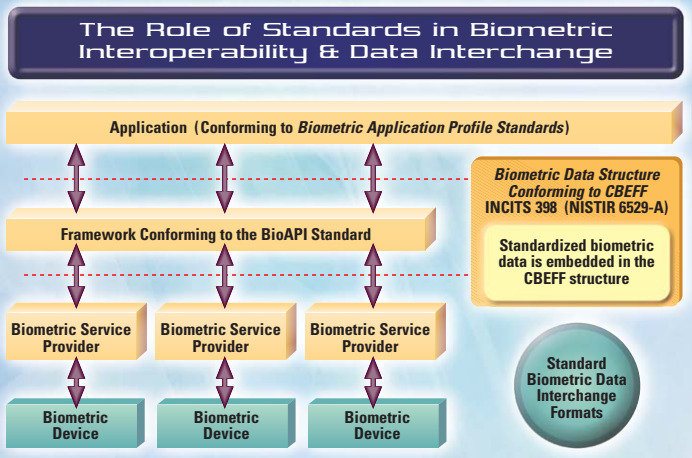
「The Role of Standards in Biometric Interoperability & Data Interchange」(バイオメトリクスの相互運用性とデータ交換における標準の役割)と題した図です。上から順に、双方向の矢印で結ばれた層として「Application (Conforming to Biometric Application Profile Standards)」(バイオメトリクスのアプリケーションプロファイル標準に適合するアプリケーション)、「Framework Conforming to the BioAPI Standard」(BioAPI 標準に適合するフレームワーク)、3 つの「Biometric Service Provider」(バイオメトリクスのサービスプロバイダー)があり、それぞれ下の「Biometric Device」(バイオメトリクス装置)につながります。層の間から赤い破線が右の箱「Biometric Data Structure Conforming to CBEFF INCITS 398 (NISTIR 6529-A)」(CBEFF(INCITS 398、NISTIR 6529-A)に適合するバイオメトリクスデータ構造)へ延び、その箱の中に「Standardized biometric data is embedded in the CBEFF structure」(標準化されたバイオメトリクスデータは CBEFF 構造に埋め込まれる)とあります。その下に「Standard Biometric Data Interchange Formats」(標準のバイオメトリクスデータ交換形式)の円があります。
These standards and associated conformity assessments need further development in order to help deploy significantly better, open-systems security solutions. We have identified the critical tasks that will help power the development of these standards so that the deployment of such systems may be accelerated. Consequently, in the past years we have worked in close partnership with other U.S. government agencies and U.S. industry to establish standards bodies for accelerating the development of formal national and international biometric standards of high relevance to the Nation. This program is a major catalyst for biometric standardization and adoption of biometric standards.
これらの標準と関連する適合性評価は、大幅により優れたオープンシステムのセキュリティソリューションの展開を助けるため、さらなる策定が必要です。そうしたシステムの展開を早められるよう、これらの標準の策定を後押しする重要なタスクを特定しました。その結果、ここ数年、当部門は他の米国政府機関および米国産業界と緊密に連携して、国にとって関連性の高い、正式な国内および国際的な生体認証標準の策定を加速するための標準化団体を設立してきました。このプログラムは、生体認証の標準化と、生体認証標準の採用の大きな促進役です。
Our strategy in this program includes—
このプログラムの戦略には次のものが含まれます。
•Leveraging existing consortia standards such as the Biometric Application Programming Interface (BioAPI), developed by the BioAPI Consortium and the Common Biometric Exchange Formats Framework (CBEFF) – initially developed under a Working Group sponsored by NIST and the Biometric Consortium
•BioAPI Consortium が策定した Biometric Application Programming Interface(BioAPI)や、当初は NIST と Biometric Consortium が後援する作業部会のもとで策定された Common Biometric Exchange Formats Framework(CBEFF)など、既存のコンソーシアム標準の活用
•Managing the national (INCITS Technical Committee M1 on Biometrics) and the international (ISO/IEC JTC 1/SC 37-Biometrics) biometric standards developments
•国内(INCITS Technical Committee M1 on Biometrics)および国際(ISO/IEC JTC 1/SC 37-Biometrics)の生体認証標準の策定の管理
•Providing expert technical leaders for critical standards projects
•重要な標準化プロジェクトへの、専門的な技術リーダーの提供
•Acting as an advisor to other Federal government agencies, including the Department of Homeland Security (DHS), the National Security Agency (NSA) and the Department of Defense (DoD) Biometric Management Office
•国土安全保障省(DHS)、国家安全保障局(NSA)、国防総省(DoD)Biometric Management Office を含む他の連邦政府機関への助言
•Supporting required administrative infrastructures (for example, the ISO/IEC JTC 1/SC 37 Secretariat)
•必要な管理基盤(たとえば ISO/IEC JTC 1/SC 37 の事務局)の支援
•Working through biometric standards "incubators" (such as the Biometric Consortium and the BioAPI Consortium)
•生体認証標準の「インキュベーター」(Biometric Consortium や BioAPI Consortium など)を通じた活動
•Promoting fast processing of consortia specifications into national/international standards
•コンソーシアム仕様の国内標準・国際標準への迅速な処理の促進
•Initiating development of technical implementations and software development for conformity assessment and interoperability tests to Application Profiles as required.
•必要に応じた、アプリケーションプロファイルに対する適合性評価と相互運用性試験のための、技術的な実装とソフトウェア開発の開始。
Nationally, NIST’s Information Technology Laboratory’s (ITL’s) biometric standards program helped to establish Technical Committee M1 under the InterNational Committee for Information Technology Standards (INCITS). The purpose of INCITS M1 is to ensure a high-priority, focused and comprehensive approach in the U.S. for the rapid development and approval of formal national and international generic biometric standards. These standards are considered to be critical for U.S. needs, such as homeland defense, the prevention of identity theft and for other government and commercial applications based on biometric personal authentication. NIST is an active technical contributor to this standards development body and has sponsored several of their standards development projects. The program experts from CSD work in close collaboration with ITL’s Information Access Division’s (IAD’s) biometric experts. During 2004 and 2005, INCITS M1 approved a number of biometric data interchange standards for different biometric modalities (face recognition, finger image, finger minutiae, finger pattern, iris recognition, hand geometry, and signature/sign). INCITS M1 is currently developing conformance testing methodology standards for a number of these biometric data interchange formats. In 2005 INCITS M1 completed the development of three parts of a multipart standard that specifies biometric performance testing and reporting. INCITS M1 also approved two biometric application profiles: Verification & Identification of Transportation Workers and Biometric-Based Personal Identification for Border Management. In addition to the development of conformance testing methodologies for biometric data interchange formats, NIST co-sponsored with other INCITS M1 members, the development of a conformance testing methodology standard for the BioAPI specification. INCITS M1 is currently addressing the development of standards to support multi-biometrics and biometric fusion data, a biometric sample quality standard, and a standard to specify biometric performance and interoperability testing of data interchange format standards. NIST experts are very active in these standards developments.
国内では、NIST 情報技術研究所(ITL)の生体認証標準プログラムが、InterNational Committee for Information Technology Standards(INCITS)のもとの Technical Committee M1 の設立を支援しました。INCITS M1 の目的は、正式な国内および国際的な汎用の生体認証標準を迅速に策定し承認するための、米国における優先度が高く重点を絞った包括的な取り組みを確実にすることです。これらの標準は、国土防衛、ID 窃取の防止、生体認証による個人認証に基づくその他の政府や商用の用途など、米国のニーズにとって重要と考えられています。NIST は、この標準策定団体に積極的に技術面で貢献しており、その標準策定プロジェクトのいくつかを後援してきました。CSD のプログラム専門家は、ITL の Information Access Division(IAD)の生体認証の専門家と緊密に協力しています。2004年と2005年に、INCITS M1 は、顔認識、指画像、指のマニューシャ、指紋パターン、虹彩認識、手形状、署名/サインなど、さまざまな生体認証モダリティ向けの生体データ交換標準を数多く承認しました。INCITS M1 は現在、これらの生体データ交換形式の複数について、適合性試験方法論の標準を策定しています。2005年に、INCITS M1 は、生体認証の性能試験と報告を定める複数部構成の標準のうち、3 つの部の策定を完了しました。INCITS M1 はまた、2 つの生体認証アプリケーションプロファイル、Verification & Identification of Transportation Workers と Biometric-Based Personal Identification for Border Management も承認しました。生体データ交換形式の適合性試験方法論の策定に加えて、NIST は、他の INCITS M1 の構成員とともに、BioAPI 仕様の適合性試験方法論標準の策定を共同で後援しました。INCITS M1 は現在、マルチ生体認証と生体認証フュージョンデータを支える標準、生体サンプルの品質標準、データ交換形式標準の生体認証性能と相互運用性の試験を定める標準の策定にも取り組んでいます。NIST の専門家は、これらの標準策定に非常に積極的に関わっています。
Internationally, we successfully supported the establishment of the International Organization for Standardization/International Electrotechnical Commission Joint Technical Committee 1 Subcommittee 37-Biometrics (ISO/IEC JTC 1/SC 37-Biometrics). INCITS M1 is the national Technical Committee responsible for representing the U.S. in JTC1/SC 37. We provide the chairperson for these two standards bodies and manage their standards programs.We provide the chair of the national standards development efforts on biometric profiles (the Convener of the JTC 1/SC 37 Working Group responsible for the international biometric profile projects is provided by ITL). A large number of the projects within JTC 1 SC 37’s program of work were initiated by the U.S. (through INCITS M1). During 2005, JTC 1/SC 37 approved four of these standards. They specify biometric data interchange standard formats for face recognition (face image), finger minutiae, finger image and iris recognition (iris image). ISO published these standards also during 2005. Six additional standards are scheduled to be approved by JTC 1/SC 37 in the first quarter of 2006. NIST experts are also very active in the development of JTC 1/SC 37’s standards portfolio. We are involved in ongoing efforts within JTC 1/SC37 in defining a taxonomy to enable the Subcommittee to determine the issues that need to be resolved to ensure that conformance, interoperability, performance, and quality for the biometric data interchange format standards can be adequately addressed.
国際的には、国際標準化機構/国際電気標準会議の合同技術委員会1の小委員会37(生体認証)(ISO/IEC JTC 1/SC 37-Biometrics)の設立を成功裏に支援しました。INCITS M1 は、JTC1/SC 37 で米国を代表する責任を担う国内技術委員会です。NIST は、これら2つの標準化団体の議長を務め、その標準化プログラムを管理しています。NIST は、生体認証プロファイルに関する国内標準策定の取り組みでも議長を務めています(国際的な生体認証プロファイルのプロジェクトを担当する JTC 1/SC 37 作業部会の招集者は ITL が務めています)。JTC 1 SC 37 の作業計画にある多数のプロジェクトは、米国が(INCITS M1 を通じて)開始しました。2005年に、JTC 1/SC 37 はこれらの標準のうち4つを承認しました。これらは、顔認識(顔画像)、指のマニューシャ、指画像、虹彩認識(虹彩画像)の生体データ交換標準形式を定めています。ISO もこれらの標準を2005年中に発行しました。さらに6つの標準が、2006年の第1四半期に JTC 1/SC 37 で承認される予定です。NIST の専門家は、JTC 1/SC 37 の標準群の策定にも非常に積極的に関わっています。生体データ交換形式標準の適合性、相互運用性、性能、品質に適切に対処するために解決すべき課題を小委員会が判断できるようにする分類体系の定義について、NIST は JTC 1/SC37 内で続けられている取り組みに関わっています。
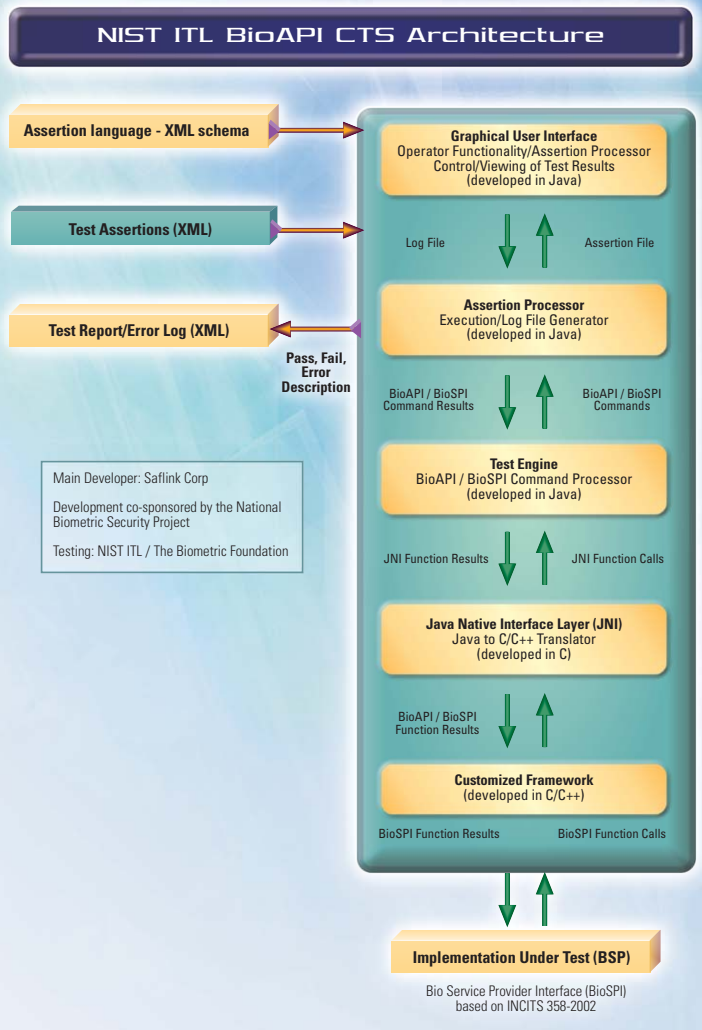
「NIST ITL BioAPI CTS Architecture」(NIST ITL の BioAPI CTS の構成)と題した図です。大きな枠の中に構成要素が縦に並び、向きの逆な 2 本の矢印で結ばれています。「Graphical User Interface – Operator Functionality/Assertion Processor Control/Viewing of Test Results (developed in Java)」(グラフィカルユーザーインターフェース。操作機能、アサーション処理器の制御、試験結果の表示。Java で開発)、矢印のラベル「Log File」(ログファイル)と「Assertion File」(アサーションファイル)、「Assertion Processor – Execution/Log File Generator (developed in Java)」(アサーション処理器。実行、ログファイルの生成。Java で開発)、矢印のラベル「BioAPI / BioSPI Command Results」(BioAPI / BioSPI のコマンドの結果)と「BioAPI / BioSPI Commands」(BioAPI / BioSPI のコマンド)、「Test Engine – BioAPI / BioSPI Command Processor (developed in Java)」(テストエンジン。BioAPI / BioSPI のコマンド処理器。Java で開発)、矢印のラベル「JNI Function Results」(JNI の関数の結果)と「JNI Function Calls」(JNI の関数呼び出し)、「Java Native Interface Layer (JNI) – Java to C/C++ Translator (developed in C)」(Java ネイティブインターフェース層。Java から C/C++ への変換。C で開発)、矢印のラベル「BioAPI / BioSPI Function Results」(BioAPI / BioSPI の関数の結果)、「Customized Framework (developed in C/C++)」(カスタマイズしたフレームワーク。C/C++ で開発)の順で、枠の下端に「BioSPI Function Results」(BioSPI の関数の結果)と「BioSPI Function Calls」(BioSPI の関数呼び出し)とあります。枠の下は 2 本の矢印で「Implementation Under Test (BSP)」(試験対象の実装(BSP))につながり、「Bio Service Provider Interface (BioSPI) based on INCITS 358-2002」(INCITS 358-2002 に基づくバイオサービスプロバイダーインターフェース(BioSPI))と注記されています。左側では「Assertion language - XML schema」(アサーション言語 – XML スキーマ)と「Test Assertions (XML)」(試験アサーション(XML))から枠へ矢印が入り、枠から「Test Report/Error Log (XML)」(試験報告書/エラーログ(XML))へ「Pass, Fail, Error Description」(合格、不合格、エラーの説明)とラベルの付いた矢印が出ています。注記の枠には「Main Developer: Saflink Corp」(主な開発者: Saflink 社)、「Development co-sponsored by the National Biometric Security Project」(開発は National Biometric Security Project が共同で後援)、「Testing: NIST ITL / The Biometric Foundation」(試験: NIST ITL / The Biometric Foundation)とあります。
Biometric standards under development in INCITS M1 and JTC 1/SC 37 support interoperability and data interchange. Biometric Service Providers conforming to one of the biometric data interchange formats (any one of the biometric modalities) can develop and interpret a data structure that conforms to one of these standards. A requirement for conformance is embedding the biometric data that conforms to one of the biometric data format interchange standards within a data structure that conforms to CBEFF (Common Biometric Exchange Formats Framework). BioAPI defines a generic way of interfacing to a broad range of biometric technologies. The data structure defined in BioAPI is an instantiation of CBEFF. BSPs are expected to conform to BioAPI. Applications are expected to conform to BioAPI, CBEFF and one of the biometric profiles under development.
INCITS M1 と JTC 1/SC 37 で策定中の生体認証標準は、相互運用性とデータ交換を支えます。いずれかの生体データ交換形式(いずれかの生体認証モダリティ)に適合する Biometric Service Provider は、これらの標準のいずれかに適合するデータ構造を作成し、解釈できます。適合のための要件は、生体データ形式交換標準のいずれかに適合する生体データを、CBEFF(Common Biometric Exchange Formats Framework)に適合するデータ構造の中に埋め込むことです。BioAPI は、幅広い生体認証技術と連携するための汎用的な方法を定義しています。BioAPI で定義されるデータ構造は、CBEFF の具体化です。BSP は BioAPI に適合すると見込まれています。アプリケーションは、BioAPI、CBEFF、策定中の生体認証プロファイルのいずれかに適合すると見込まれています。
In 2004, the International Civil Aviation Administration (ICAO) adopted a global, harmonized blueprint for the integration of biometric identification information into passports. The biometric requirements include the use of facial recognition as the globally interoperable biometric for travel documents; the use of fingerprint in its several differing technical formulations; and the use of iris as well. ICAO directly adopted the SC 37 standards for its applications. The ICAO community has also committed conformance to and adoption of CBEFF as the data structure for the utilization of biometrics for global interoperability and standardization. ICAO requires conformance to the standards developed by JTC 1/SC 37 for these biometric data interchange standard formats and CBEFF.
2004年に、International Civil Aviation Administration(ICAO)は、生体識別情報をパスポートに組み込むための、世界的に調和した青写真を採用しました。生体認証の要件には、渡航文書で世界的に相互運用可能な生体情報としての顔認識の使用、いくつかの異なる技術的定式化による指紋の使用、虹彩の使用も含まれます。ICAO は、SC 37 の標準を自らのアプリケーションに直接採用しました。ICAO のコミュニティは、世界的な相互運用性と標準化のための生体情報の利用におけるデータ構造として、CBEFF への適合と採用も約束しました。ICAO は、これらの生体データ交換標準形式と CBEFF について、JTC 1/SC 37 が策定した標準への適合を求めています。
The International Labour Office of the United Nations (ILO) has approved Convention 185, which defines a Seafarers Identity Document (SID) containing fingerprint templates in a barcode. In March 2004, the ILO governing body approved a Technical Report that specifies the use of several JTC1/SC 37 draft standards. The specific JTC 1/SC 37 data interchange standards being specified as normative by the ILO are the finger minutiae and finger image data interchange formats. This represents the first time an external agency to ISO has specifically mandated the use of JTC 1/SC 37 standards in an international treaty.
国連の International Labour Office(ILO)は、バーコードに指紋テンプレートを含む Seafarers Identity Document(SID)を定める Convention 185 を承認しました。2004年3月に、ILO の理事会は、JTC1/SC 37 のいくつかのドラフト標準の使用を定める Technical Report を承認しました。ILO が規範として指定している JTC 1/SC 37 の具体的なデータ交換標準は、指のマニューシャと指画像のデータ交換形式です。これは、ISO の外部の機関が、国際条約で JTC 1/SC 37 の標準の使用を明確に義務づけた初めての例です。
Nationally, in October 2004, DHS adopted the face recognition standard developed by INCITS M1 in order to extract portions of this standard to provide guidelines for specific DHS users including project managers, software and system developers, photographers and subjects, and to develop best practices for producing uniform photographs (posters). In addition, Phase III— Prototype Phase of DHS’s Transportation Worker Identification Credential (TWIC) Program (a system-wide common credential to be used for all personnel requiring unescorted physical and/or logical access), includes requirements to the INCITS M1 standards, as applicable, including the Biometric profile—Verification & Identification of Transportation Workers. A sub-pilot of the DHS/TSA registered Traveler Program administered by the Greater Orlando Aviation Authority (GOAA) requires two INCITS M1 interface standards, the BioAPI Specification, and the CBEFF, and some of the biometric data interchange standards developed by INCITS M1. CBEFF was originally published as NIST IR 6529-A under the leadership of CSD experts and the National Security Agency (NSA). Draft Special Publication (SP) 800-76, Biometric Data Specification for Personal Identity Verification, requires wrapping the biometric data specified in the draft SP in a CBEFF structure.
国内では、2004年10月に、DHS は、INCITS M1 が策定した顔認識標準を採用し、この標準の一部を抽出して、プロジェクト管理者、ソフトウェア・システム開発者、撮影者と被写体を含む DHS の特定の利用者向けのガイドラインを提供し、統一された写真(ポスター)を作成するためのベストプラクティスを策定しました。さらに、DHS の Transportation Worker Identification Credential(TWIC)Program(立会いなしの物理的またはロジカルなアクセスを必要とするすべての要員が使う、システム全体の共通クレデンシャル)のフェーズ III(プロトタイプフェーズ)には、生体認証プロファイル Verification & Identification of Transportation Workers を含む、該当する INCITS M1 標準への要件が含まれています。Greater Orlando Aviation Authority(GOAA)が運営する DHS/TSA の Registered Traveler Program のサブパイロットは、INCITS M1 の 2 つのインタフェース標準である BioAPI 仕様と CBEFF、および INCITS M1 が策定した生体データ交換標準の一部を求めています。CBEFF は、CSD の専門家と国家安全保障局(NSA)の主導のもと、当初 NIST IR 6529-A として発行されました。ドラフト特別刊行物(SP)800-76、Biometric Data Specification for Personal Identity Verification は、ドラフト SP で定める生体データを CBEFF 構造で包むことを求めています。
We have also participated in related consortia efforts, including the U.S. Biometrics Consortium (BC) and the BioAPI Consortium.
当部門は、U.S. Biometrics Consortium(BC)や BioAPI Consortium など、関連するコンソーシアムの取り組みにも参加してきました。
The BC, which is considered to be a biometrics incubator, serves as a U.S. government focal point for biometrics. It currently consists of over 900 members representing over 60 agencies, industry and academe. NIST co-chairs the BC with NSA. The BC sponsors an annual conference, technical workshops and biometrics technical developments. The NIST/BC Biometric Working Group, sponsored by NIST and the BC has been working in the last few years with government users and industry developing biometric specifications. In the past it approved and provided to formal standards bodies three specifications for further processing as national and international standards, including (1) Biometric Data Protection and Usage, (2) Biometric Application Programming Interface for Java Card, and (3) an augmented version of CBEFF. An international version of CBEFF is being developed within JTC 1/SC 37. CBEFF is a requirement for conformance for the national and international data interchange standards under development within INCITS M1 and JTC 1/SC 37.
生体認証のインキュベーターとみなされている BC は、生体認証に関する米国政府の窓口の役割を果たしています。現在、60 を超える機関、産業界、学術界を代表する 900 人を超える会員がいます。NIST は、NSA とともに BC の共同議長を務めています。BC は、年次会議、技術ワークショップ、生体認証の技術開発を後援しています。NIST と BC が後援する NIST/BC Biometric Working Group は、ここ数年、政府の利用者や産業界とともに生体認証の仕様を策定してきました。過去には、国内標準と国際標準としてさらに処理するため、(1) Biometric Data Protection and Usage、(2) Biometric Application Programming Interface for Java Card、(3) CBEFF の拡張版の 3 つの仕様を承認し、正式な標準化団体に提供しました。CBEFF の国際版は、JTC 1/SC 37 内で策定されています。CBEFF は、INCITS M1 と JTC 1/SC 37 内で策定中の国内および国際的なデータ交換標準にとって、適合のための要件です。
NIST is also a member of the BioAPI Consortium and its Steering Committee. BioAPI Consortium’s membership consists of over 100 organizations, including biometric vendors, end-users, system developers and original equipment manufacturers (OEMs). This consortium developed the BioAPI specification, which was approved as INCITS 358-2002. The BioAPI specification and related standards are under development in JTC 1/SC 37. BioAPI is an International Organization of Standardization (ISO) standard candidate. It is expected to be approved as an ISO standard during the 1 st Quarter of 2006.
NIST は、BioAPI Consortium とその運営委員会の構成員でもあります。BioAPI Consortium の会員は、生体認証ベンダー、エンドユーザー、システム開発者、相手先ブランド製造業者(OEM)を含む 100 を超える組織で構成されています。このコンソーシアムは、INCITS 358-2002 として承認された BioAPI 仕様を策定しました。BioAPI 仕様と関連標準は、JTC 1/SC 37 で策定中です。BioAPI は、国際標準化機構(ISO)標準の候補です。2006年の第 1 四半期に ISO 標準として承認される見込みです。
During 2005 NIST has led an effort to develop an implementation of a conformance testing suite (CTS) for the national version of the BioAPI specification as well as the development of a documentary standard under INCITS M1. This standard project was sponsored by NIST/ITL/CSD, DoD Biometrics Management Office (BMO), the National Biometric Security Project (NBSP), Saflink Corporation, and The Biometric Foundation (TBF). The initial CTS implementation was developed using concepts and principles specified in the draft conformance testing methodology standard. The initial CTS implementation was co-sponsored by NBSP and developed by Saflink Corporation. In coordination with NIST/ITL/CSD, DoD BMO has been independently developing a similar implementation of the BioAPI CTS. These test tools are being developed in support of users within Government Agencies already requiring, or interested in requiring in the near future, that Biometric Service Providers (BSPs) conform to the BioAPI standard; the possible establishment of conformity assessment programs to validate conformance to the BioAPI standard and other emerging standards; and product developers interested in developing products conforming to voluntary consensus biometric standards by using the same test tools available to users. NIST and DoD BMO are currently performing intensive testing of the initial versions of these CTSs in order to cross - validate the test results using a number of vendor BSPs claiming conformance to the BioAPI standard before anticipated release of these tools to the public. Our tests are performed in cooperation with experts from The Biometric Foundation (also co-sponsored by NBSP). We are planning to extend conformance test suite development efforts during 2006 in support of other documentary standards and specifications. CTSs to test implementation of biometric data structures conforming to CBEFF are planned.
2005年に、NIST は、BioAPI 仕様の国内版に対する適合性試験スイート(CTS)の実装と、INCITS M1 のもとでの文書規格の策定を主導しました。この規格プロジェクトは、NIST/ITL/CSD、国防総省 Biometrics Management Office(BMO)、National Biometric Security Project(NBSP)、Saflink Corporation、The Biometric Foundation(TBF)が後援しました。最初の CTS 実装は、適合性試験方法論規格のドラフトで定められた概念と原則を用いて開発されました。最初の CTS 実装は NBSP が共同で後援し、Saflink Corporation が開発しました。NIST/ITL/CSD と連携して、国防総省 BMO は BioAPI CTS の同様の実装を独自に開発してきました。これらの試験ツールは、BioAPI 標準への適合をすでに求めている、または近い将来求めることに関心を持つ政府機関内の利用者、BioAPI 標準およびその他の新たな標準への適合を検証する適合性評価プログラムの設立の可能性、ならびに利用者向けに提供されるものと同じ試験ツールを使って、任意の合意標準に適合する製品を開発することに関心を持つ製品開発者を支援するために開発されています。NIST と国防総省 BMO は現在、これらのツールが一般に公開される前に、BioAPI 標準への適合を主張する複数ベンダーの BSP を用いて試験結果を相互検証するため、これらの CTS の初期版を集中的に試験しています。試験は、The Biometric Foundation(これも NBSP が共同で後援)の専門家と協力して実施しています。2006年には、他の文書規格や仕様を支えるため、適合性試験スイート開発の取り組みを拡大する計画です。CBEFF に適合する生体データ構造の実装を試験する CTS も計画されています。
Mr. Fernando Podio leads the national and international voluntary biometric standards programs.
Mr. Fernando Podio が、国内および国際的な自発的生体認証標準プログラムを率いています。
http://www.nist.gov/biometrics
Contact: Mr. Fernando Podio
(301) 975-2947
fernando@nist.gov
http://www.nist.gov/biometrics
連絡先: Mr. Fernando Podio
(301) 975-2947
fernando@nist.gov
e-AUTHENTICATION
電子認証
The Office of Management and Budget (OMB) has identified the remote identification of users, or e-authentication, as a crosscutting impediment to the provision of Internet-based government services. To fully realize the benefits of electronic government, government agencies require e-authentication policies and corresponding technical guidance tailored to the protection of government systems and data. This project establishes a policy structure for e-authentication within the U.S. government, promoting consistent implementation of e-authentication across Federal agencies. This consistency will in turn help to enhance government efficiency by securing electronic processes needed to conduct more transactions through e-government applications.
行政管理予算局(OMB)は、利用者の遠隔識別、すなわち電子認証を、インターネットベースの政府サービスの提供に対する、分野横断的な障害として特定しました。電子政府の利点を十分に実現するには、政府機関に、政府のシステムとデータの保護に合わせた電子認証の方針と、それに対応する技術ガイダンスが必要です。このプロジェクトは、米国政府内の電子認証の方針構造を確立し、連邦機関全体で電子認証が一貫して実施されるよう促進します。この一貫性は、電子政府アプリケーションを通じてより多くの取引を行うために必要な電子的プロセスを保護することで、政府の効率を高めるのにも役立ちます。
OMB released memorandum M-04-04, E-Authentication Guidance for Federal Agencies, in December 2003. This OMB policy memorandum defined four levels of authentication – Levels 1 to 4 – in terms of the assurance that an asserted identity is valid. The OMB guidance requires agencies to perform a risk assessment to determine the appropriate authentication level for an application based on the likely consequences of an authentication error. This means a system using Level 4 authentication – a system that allows a user access to more sensitive, personal information for example – has a much higher assurance that a user's identity is what it is claimed it to be. After completing a risk assessment and mapping the identified risks to the required assurance level, OMB guidance directs agencies to identify and implement appropriate authentication mechanisms based on NIST technical guidance.
OMB は、2003年12月に、覚書 M-04-04、E-Authentication Guidance for Federal Agencies を公開しました。この OMB の方針覚書は、主張された ID が有効であるという保証の観点から、認証の 4 つのレベル、すなわちレベル 1 から 4 を定義しました。OMB のガイダンスは、認証の誤りが起こりうる結果に基づいて、アプリケーションに適した認証レベルを判断するため、機関にリスク評価を行うことを求めています。これは、たとえば利用者がより機微な個人情報にアクセスできるようなシステムなど、レベル 4 の認証を使うシステムでは、利用者の身元が主張どおりであることに対する保証がはるかに高いことを意味します。リスク評価を完了し、特定したリスクを必要な保証レベルに対応付けた後、OMB のガイダンスは、機関に対し、NIST の技術ガイダンスに基づいて適切な認証の仕組みを特定し、実装するよう指示しています。
In 2004, our e-authentication technical guidance was published as SP 800-63, Recommendation for Electronic Authentication. This recommendation provides technical guidance to agencies implementing electronic authentication on how to allow an individual person to remotely authenticate his or her identity to a Federal IT system. SP 800-63 states specific technical requirements for each of the four levels of assurance in the areas of identity proofing and registration, tokens, remote authentication mechanisms and assertion mechanisms. It only addresses authentication mechanisms that work by making the individual demonstrate possession and control of a secret, such as a cryptographic key or a password.
2004年に、当部門の電子認証の技術ガイダンスが、SP 800-63、Recommendation for Electronic Authentication として発行されました。この勧告は、電子認証を実装する機関に、個人が連邦 IT システムに対して自らの身元を遠隔で認証できるようにする方法についての技術ガイダンスを提供します。SP 800-63 は、身元確認と登録、トークン、遠隔認証の仕組み、アサーションの仕組みの分野について、4 つの保証レベルのそれぞれに対する具体的な技術要件を述べています。扱うのは、個人に暗号鍵やパスワードなどのシークレットの所持と管理を実証させることで機能する認証の仕組みのみです。
In 2005, we studied other technologies that could be used to support electronic authentication including knowledge based authentication (KBA) and biometrics. KBA refers to a class of techniques for testing the personal knowledge of an individual as a way to remotely verify the individual’s claimed identity. KBA is a particularly useful tool to remotely authenticate individuals who conduct business electronically with Federal agencies or businesses infrequently; however, since this information is private but not actually secret, confidence in the identity of an individual may be hard to achieve. To meet these challenges, we developed a white paper that defines a generic KBA model and identifies the KBA technical requirements state satisfy OMB assurances Levels 1 and 2. In 2006, we will incorporate this guidance into the SP 800-63. Biometric methods are widely used to authenticate individuals who are physically present at the authentication point, for example, for entry into buildings. Biometrics do not constitute secrets suitable for use in the conventional remote authentication protocols addressed in SP 800-63. In the local authentication case, the claimant uses a capture device controlled by the verifier, so authentication does not require that biometrics be kept secret. In 2005, we held a workshop to examine remote authentication protocols and biometrics. Based on the results of the workshop, CSD, in collaboration with industry, helped form the International Committee for Information Technology Standards (INCITS) M1 Ad Hoc group to continue studying the role of biometrics in the remote authentication of individuals across open networks. This group will provide a technical report on its findings in 2006.
2005年には、知識ベース認証(KBA)や生体認証など、電子認証を支えるために使える他の技術を調査しました。KBA は、個人が主張する身元を遠隔で検証する手段として、その個人の知識を確かめる一連の技法を指します。KBA は、連邦機関や企業との電子的な取引をまれにしか行わない個人を遠隔で認証するのに特に有用なツールですが、この情報は非公開であっても実際には秘密ではないため、個人の身元に対する信頼を得るのは難しい場合があります。こうした課題に対応するため、OMB の保証レベル1および2を満たす KBA の技術要件を示し、汎用的な KBA モデルを定義するホワイトペーパーを作成しました。2006年には、このガイダンスを SP 800-63 に取り入れます。生体認証の方法は、たとえば建物への入場のように、認証地点に物理的にいる個人を認証するために広く使われています。生体情報は、SP 800-63 が扱う従来の遠隔認証プロトコルで使うのに適した秘密ではありません。ローカル認証の場合、請求者は検証者が管理する取得装置を使うため、認証に生体情報を秘密にしておく必要はありません。2005年には、遠隔認証プロトコルと生体認証を検討するワークショップを開催しました。ワークショップの結果に基づき、CSD は産業界と協力し、オープンネットワーク上での個人の遠隔認証における生体認証の役割を引き続き調査するため、International Committee for Information Technology Standards(INCITS)M1 Ad Hoc グループの設立を支援しました。このグループは、2006年に調査結果に関する技術報告書を提供する予定です。
[人物の写真。人物が写っているため、この非公式サイトには掲載していません。原本 PDF を参照してください。]
In this project, we are collaborating with Federal agencies and industry partners. Federal agencies include the Office of Management and Budget, Government Services Administration and the Federal Identity and Credentialing Committee. Industry partners include Financial Service Technology Consortium, Electronic Authentication Partnership, Fidelity, Wells Fargo Bank, Electrosoft, VeriSign and RSA.
このプロジェクトでは、連邦機関と産業界のパートナーと協力しています。連邦機関には、行政管理予算局、Government Services Administration、Federal Identity and Credentialing Committee があります。産業界のパートナーには、Financial Service Technology Consortium、Electronic Authentication Partnership、Fidelity、Wells Fargo Bank、Electrosoft、VeriSign、RSA があります。
Contacts: Mr. William Burr
(301) 975-2934
william.burr@nist.gov
連絡先: Mr. William Burr
(301) 975-2934
william.burr@nist.gov
Ms. Donna Dodson
(301) 975-3669
donna.dodson@nist.gov
Ms. Donna Dodson
(301) 975-3669
donna.dodson@nist.gov
INFRASTRUCTURE AND APPLICATIONS
インフラとアプリケーション
Individual government agencies implementing electronic authentication techniques would incur prohibitive costs if they were to implement separate techniques for each application instead of an umbrella infrastructure that could span numerous agencies and applications. There is also a burden on the public in interacting with the government by having to maintain multiple credentials and not being able to access the services they need using those credentials. It is clear that a cross-agency interoperable infrastructure approach is a better alternative.
電子認証の技法を実装する個々の政府機関が、多数の機関とアプリケーションにまたがる包括的なインフラを使わず、アプリケーションごとに個別の技法を実装すると、法外な費用がかかります。また、国民が政府とやり取りする際に、複数のクレデンシャルを維持しなければならず、それらのクレデンシャルでは必要なサービスにアクセスできないという負担もあります。機関間で相互運用可能なインフラという取り組み方が、より優れた選択肢であることは明らかです。
Pursuant to its responsibilities under the Electronic Government Act of 2002, OMB has determined that beginning in fiscal year 2006 Federal agencies that intend to use Public Key Infrastructure (PKI) services will be buying them from qualified managed service providers – Shared Service Providers (SSPs) – operating under the Federal Common Policy Framework rather than establishing their own internal PKI. The Common Policy Framework is a suite of uniform policies developed by us in 2004.
OMB は、2002年電子政府法に基づく責任に従って、2006会計年度から、公開鍵基盤(PKI)サービスの利用を予定する連邦機関は、独自の内部 PKI を確立するのではなく、Federal Common Policy Framework のもとで運営される、適格なマネージドサービス提供者である Shared Service Provider(SSP)からそれを購入することと決定しました。Common Policy Framework は、2004年に当部門が策定した一連の統一ポリシーです。
Agencies with PKI operations that are cross-certified with the Federal Bridge Certification Authority will not be required to migrate to these new managed service providers, but as time goes on it may become desirable to migrate to these new providers. This two-step process will result in cost savings to both industry and government; first by insuring that PKI services are developed to meet a common policy, rather than having each agency developing its own idiosyncratic policy, and secondly by having a common contract against which task and delivery orders may be placed by Federal agencies (and other authorized users of the General Services Administration (GSA) Schedules).
連邦ブリッジ認証局と相互認証された PKI 運用を持つ機関は、これらの新しいマネージドサービス提供者への移行を求められませんが、時間が経つにつれて、これらの新しい提供者への移行が望ましくなる場合があります。この 2 段階のプロセスは、産業界と政府の両方に費用の節約をもたらします。第一に、各機関が独自の特殊なポリシーを策定するのではなく、共通のポリシーを満たすよう PKI サービスが開発されることを確実にし、第二に、連邦機関(および一般調達局(GSA)Schedules のその他の認可された利用者)が、タスクオーダーとデリバリーオーダーを出せる共通の契約を持つことによってです。
We continue to support the development and deployment of the Federal PKI. We provide the vice-chair of the Federal PKI Policy Authority, which manages the suite of Federal PKI Certificate Policies and the operations of the Federal Bridge Certification Authority. We also co-chair the Internet Engineering Task Force (IETF) PKI Working Group and is managing the related Path Validation Testing. These activities advance interoperable infrastructures for all Internet users.
当部門は、連邦 PKI の開発と展開を引き続き支援しています。連邦 PKI の証明書ポリシー群と連邦ブリッジ認証局の運用を管理する Federal PKI Policy Authority の副議長を提供しています。また、Internet Engineering Task Force(IETF)の PKI Working Group の共同議長を務め、関連する Path Validation Testing を管理しています。これらの活動は、すべてのインターネット利用者のための相互運用可能なインフラを前進させます。
We play a leading role on the Federal Identity Credential Committee’s SSP Subcommittee. We provide the technical knowledge and expertise that drive the FICC and the SSP Program. We also provide several members of the SSP Subcommittee and have contributed heavily to the development of the Subcommittee’s library of documents.
当部門は、Federal Identity Credential Committee の SSP Subcommittee で主導的な役割を果たしています。FICC と SSP プログラムを推進する技術的知識と専門性を提供しています。また、SSP Subcommittee の構成員を複数出しており、同小委員会の文書ライブラリの策定にも大きく貢献してきました。
Potential SSPs must meet the requirements established in the Common Policy Framework and satisfy the Federal certification and accreditation requirements. Vendors of PKI services wishing to be an SSP must meet an objective list of requirements established by the SSP Subcommittee. The SSP Subcommittee used this list of requirements to evaluate vendors’ operational procedures, review third-party audits and assess operational compliance demonstrations when establishing the initial list of three approved PKI providers.
SSP の候補は、Common Policy Framework で定められた要件を満たし、連邦の認証と認定の要件を満たさなければなりません。SSP になることを望む PKI サービスのベンダーは、SSP Subcommittee が定めた客観的な要件の一覧を満たさなければなりません。SSP Subcommittee は、承認された 3 つの PKI 提供者の最初の一覧を確立する際に、この要件の一覧を用いて、ベンダーの運用手順を評価し、第三者監査をレビューし、運用上の準拠を実証する内容を評価しました。
CSD, as part of the SSP Subcommittee, has developed the Shared Service Provider Roadmap. The Shared Service Provider Roadmap is intended to identify the background information, phases and activities related to the selection process for prospective PKI managed service providers. This document identifies the process by which a vendor qualifies for inclusion on the Qualified Bidders List. The document also describes requirements that must be met to maintain qualification, as well as contracting considerations.
CSD は、SSP Subcommittee の一員として、Shared Service Provider Roadmap を策定しました。Shared Service Provider Roadmap は、PKI マネージドサービス提供者の候補を選定するプロセスに関連する背景情報、フェーズ、活動を特定することを意図しています。この文書は、ベンダーが Qualified Bidders List への掲載資格を得るプロセスを特定しています。また、この文書は、資格を維持するために満たさなければならない要件と、契約上の考慮事項も記述しています。
We are also assisting GSA in the development of an online e-authentication credential validation infrastructure. The GSA e-Authentication Gateway mediates between government applications and non-government CSPs, permitting applications to accept a variety of identification credentials. For example, individuals may be able to leverage authentication mechanisms, such as passwords, established with their banks to access government applications. The GSA E-Authentication Gateway architecture relies on SAML, TLS, and PKI to exchange authentication information with CSPs and government applications. CSD assisted GSA by developing PKI architecture and PKI policies supporting TLS-protected transmission of authentication information between the E-Authentication Gateway, CSPs and government applications.
当部門はまた、GSA によるオンライン電子認証クレデンシャル検証インフラの開発も支援しています。GSA の e-Authentication Gateway は、政府のアプリケーションと非政府の CSP を仲介し、アプリケーションがさまざまな身分証明クレデンシャルを受け入れられるようにします。たとえば、個人は、銀行と確立したパスワードなどの認証の仕組みを、政府のアプリケーションへのアクセスに活用できる場合があります。GSA E-Authentication Gateway のアーキテクチャは、CSP や政府のアプリケーションと認証情報を交換するために、SAML、TLS、PKI に依拠しています。CSD は、E-Authentication Gateway、CSP、政府のアプリケーションの間で、TLS で保護された認証情報の送信を支える PKI アーキテクチャと PKI ポリシーを策定して、GSA を支援しました。
We are collaborating with many entities, including the Army Corps of Engineers, Federal PKI Policy Authority, GSA, the U.S. Department of Agriculture (USDA), the National Finance Center, the Department of Defense, the Office of Management and Budget, the Department of Treasury, the Department of Energy, the Department of Homeland Security, Cybertrust, Entrust, Identrus, Microsoft, Orion, VeriSign, the States of Illinois and Washington, and EduCause, which includes 1,800 universities, colleges and educational institutions.
当部門は、Army Corps of Engineers、Federal PKI Policy Authority、GSA、米国農務省(USDA)、National Finance Center、国防総省、行政管理予算局、財務省、エネルギー省、国土安全保障省、Cybertrust、Entrust、Identrus、Microsoft、Orion、VeriSign、イリノイ州とワシントン州、そして 1,800 の大学、カレッジ、教育機関を含む EduCause など、多くの主体と協力しています。
Contacts: Mr. Wm. Tim Polk
(301) 975-3348
william.polk@nist.gov
連絡先: Mr. Wm. Tim Polk
(301) 975-3348
william.polk@nist.gov
Ms. Donna Dodson
(301) 975-3669
donna.dodson@nist.gov
Ms. Donna Dodson
(301) 975-3669
donna.dodson@nist.gov
VOTING SYSTEM STANDARD DEVELOPMENT
投票システム標準の策定
In 2002, Congress passed the Help America Vote Act (HAVA) to encourage the upgrade of voting equipment across the United States. HAVA established the Election Assistance Commission (EAC) and the Technical Guidelines Development Committee (TGDC), chaired by the Director of the National Institute of Standards and Technology (NIST). HAVA calls on NIST to provide technical support to the EAC and TGDC in efforts related to human factors, security, and laboratory accreditation. To explore and research issues related to the security and transparency of voting systems, the TGDC established the Security and Transparency Subcommittee (STS). We support the activities of the EAC, TGDC, and STS related to voting equipment security.
2002年に、議会は、米国全土の投票機器のアップグレードを促すために Help America Vote Act(HAVA)を可決しました。HAVA は、Election Assistance Commission(EAC)と、国立標準技術研究所(NIST)所長が議長を務める Technical Guidelines Development Committee(TGDC)を設置しました。HAVA は、NIST に対し、ヒューマンファクター、セキュリティ、試験所認定に関する取り組みで、EAC と TGDC に技術的支援を提供するよう求めています。投票システムのセキュリティと透明性に関する問題を調査・研究するため、TGDC は Security and Transparency Subcommittee(STS)を設置しました。当部門は、投票機器のセキュリティに関する EAC、TGDC、STS の活動を支援しています。
In the past year, the Voluntary Voting System Guidelines (VVSG) were updated with new sections covering secure software distribution, setup validation, voter verified paper audit trail (VVPAT), and secure use of wireless technology. The concept of Independent Dual Verification (IDV) was introduced in the updated VVSG where the objective is the production of ballot records whose correctness can be audited to very high levels of precision.
昨年は、Voluntary Voting System Guidelines(VVSG)が更新され、安全なソフトウェアの配布、セットアップの検証、有権者が検証できる紙の監査証跡(VVPAT)、無線技術の安全な使用を扱う新しい節が加わりました。更新された VVSG では、Independent Dual Verification(IDV)の概念が導入されました。その目的は、非常に高い精度で正しさを監査できる投票記録の作成です。
Plans for 2006 include holding a threat analysis workshop for voting systems, hosting the TGDC plenary meetings, supporting STS activities, working with the EAC and TGDC to substantially revise and restructure the VVSG, engaging the voting system vendor, state election official, and academic communities to explore ways to increase voting system security and transparency.
2006年の計画には、投票システムの脅威分析ワークショップの開催、TGDC の全体会合の主催、STS の活動の支援、EAC および TGDC と協力した VVSG の大幅な改訂と再構成、投票システムのセキュリティと透明性を高める方法を探るための、投票システムのベンダー、州の選挙管理官、学術界との関わりがあります。
http://vote.nist.gov/
Contact: Dr. Nelson Hastings
(301) 975-5237
nelson.hastings@nist.gov
http://vote.nist.gov/
連絡先: Dr. Nelson Hastings
(301) 975-5237
nelson.hastings@nist.gov
HONORS AND AWARDS
表彰と受賞
NATIONAL INSTITUTE OF STANDARDS AND TECHNOLOGY BRONZE MEDAL FOR SUPERIOR FEDERAL SERVICE
優れた連邦政府勤務に対する国立標準技術研究所銅メダル
The Bronze Medal Award is the highest honorary recognition available for Institute presentation. The award, approved by the Director, recognizes work that has resulted in more effective and efficient management systems as well as the demonstration of unusual initiative or creative ability in the development and improvement of methods and procedures. It also is given for significant contribution affecting major programs, scientific accomplishment within the Institute, and superior performance of assigned tasks for at least five consecutive years.
Bronze Medal Award は、同研究所が授与できる最高の名誉ある表彰です。所長が承認するこの賞は、より有効で効率的な管理システムをもたらした業務に加え、方法と手順の開発と改善における並外れた主体性や創造力の発揮を称えるものです。また、主要プログラムに影響を与える重要な貢献、同研究所内の科学的業績、少なくとも 5 年連続での割り当てられたタスクの優れた遂行に対しても授与されます。
Mr. Timothy Grance and Ms. Joan Hash are recognized for their efforts in providing standards and guidelines in support of Federal Information Security Programs and improving the management and technical processes that are essential to successful information security program implementation. Their work has been key in advancing overall security management and implementation strategy government-wide, nationally, and internationally, resulting in increased protection of information assets and supporting information technology infrastructures needed to provide critical public service.
Mr. Timothy Grance と Ms. Joan Hash は、連邦情報セキュリティプログラムを支える標準とガイドラインを提供し、情報セキュリティプログラムの実施の成功に不可欠な管理・技術プロセスを改善した取り組みが評価されました。二人の業務は、政府全体、国内、国際的に、セキュリティ管理と実施戦略全般を前進させる鍵となり、重要な公共サービスの提供に必要な情報資産と、それを支える情報技術インフラの保護の強化をもたらしました。
[人物の写真。人物が写っているため、この非公式サイトには掲載していません。原本 PDF を参照してください。]
[人物の写真。人物が写っているため、この非公式サイトには掲載していません。原本 PDF を参照してください。]
THE INSTITUTE OF ELECTRICAL AND ELECTRONICS ENGINEERS HARADEN PRATT AWARD 2005
THE INSTITUTE OF ELECTRICAL AND ELECTRONICS ENGINEERS HARADEN PRATT AWARD 2005
The IEEE Haraden Pratt Award was established in 1971 in honor of Haraden Pratt, who was Director Emeritus of the IEEE and who had given dedicated and distinguished service to the Institute. As President, Treasurer, and then Secretary for 23 consecutive years, his service on the Board of Directors, including that of Director Emeritus, totaled 31 years. The purpose of this award is to recognize individuals who have rendered outstanding service to the Institute.
IEEE Haraden Pratt Award は、IEEE の名誉理事であり、同協会に献身的で傑出した奉仕を行った Haraden Pratt を称えて、1971年に設けられました。会長、会計担当、続いて幹事を 23 年連続で務めた彼の、名誉理事を含む理事会での奉仕は、合計 31 年に及びました。この賞の目的は、同協会に傑出した奉仕を行った個人を称えることです。
Mr. Daniel R. Benigni has made significant contributions toward shaping today's IEEE. He is a selfless volunteer and passionate supporter of the organization, demonstrated by the critical roles he has served on more than 25 committees and boards, including the IEEE Board of Directors, Executive Committee, Regional Activities Board, IEEE-USA Board, and Publication Services and Products Board. He was instrumental in transforming the U.S. Activities Board into the IEEE-USA.
Mr. Daniel R. Benigni は、今日の IEEE を形作るうえで大きな貢献をしてきました。彼は、IEEE Board of Directors、Executive Committee、Regional Activities Board、IEEE-USA Board、Publication Services and Products Board など、25 を超える委員会や理事会で果たした重要な役割が示すとおり、私心のないボランティアであり、この組織の熱心な支持者です。彼は、U.S. Activities Board を IEEE-USA に改組するうえで重要な役割を果たしました。
As general chairman of the IEEE 2002 Section Congress in Washington, D.C., he helped to influence the IEEE Foundation's financial support for the well-received core leadership educational program. He also created the operating and finance committees of the Regional Activities Board, thus establishing clear responsibilities in these areas.
ワシントン D.C. で開かれた IEEE 2002 Section Congress の総括議長として、彼は、好評を得た中核的なリーダーシップ教育プログラムに対する IEEE Foundation の財政支援に影響を与えるのを助けました。また、Regional Activities Board の運営委員会と財務委員会を設け、これらの分野での責任を明確にしました。
DEPARTMENT OF COMMERCE CHIEF INFORMATION OFFICER BRONZE MEDAL
DEPARTMENT OF COMMERCE CHIEF INFORMATION OFFICER BRONZE MEDAL
This award is the highest honorary award granted by the Chief Information Officer for superior performance characterized by outstanding or significant contributions that have increased the efficiency and effectiveness of the management of information technology within the Department. To warrant a Bronze Medal, a contribution must focus on qualitative and quantitative performance measures reflected in the Department's Strategic Plan.
この賞は、省内の情報技術の管理の効率と有効性を高めた、傑出したまたは重要な貢献を特徴とする優れた業績に対して、最高情報責任者が授与する最高の名誉ある賞です。Bronze Medal に値するには、貢献が、省の戦略計画に反映された、定性的および定量的な業績指標に重点を置いたものでなければなりません。
Representing NIST, Mr. Daniel Benigni served as a member and contributed significantly to the Department’s Capital Planning and Investment Control Leadership Group and its efforts to develop and implement processes and policies to make the Department of Commerce a leader in Government in managing information technology capital investments. The Group successfully implemented increasingly rigorous Office of Management and Budget requirements while developing and institutionalizing processes and policies directly supporting the President’s Management Agenda goals on managing information technology capital investments.
Mr. Daniel Benigni は、NIST を代表して、省の Capital Planning and Investment Control Leadership Group の一員を務め、商務省を、情報技術の資本投資の管理で政府の先頭に立たせるためのプロセスと方針の策定と実施の取り組みに大きく貢献しました。このグループは、情報技術の資本投資の管理に関する大統領の Management Agenda の目標を直接支えるプロセスと方針を策定し制度化しながら、行政管理予算局のますます厳しくなる要件を、うまく実施しました。
COMPUTER SECURITY DIVISION PUBLICATIONS - 2005
コンピュータセキュリティ部門の刊行物 - 2005年
NIST SPECIAL PUBLICATIONS
NIST 特別刊行物
| SP 800-79 | Guidelines for the Certification and Accreditation of PIV Card Issuing Organizations | July 2005 |
| SP 800-78 | Cryptographic Algorithms and Key Sizes for Personal Identity Verification | April 2005 |
| SP 800-72 | Guidelines on PDA Forensics | November 2004 |
| SP 800-70 | Security Configuration Checklists Program for IT Products | May 2005 |
| SP 800-66 | An Introductory Resource Guide for Implementing the Health Insurance Portability and Accountability Act (HIPAA) Security Rule | March 2005 |
| SP 800-65 | Integrating Security into the Capital Planning and Investment Control Process | January 2005 |
| SP 800-58 | Security Considerations for Voice Over IP Systems | January 2005 |
| SP 800-53 | Security Controls for Federal Information Systems | February 2005 |
| SP 800-52 | Guidelines on the Selection and Use of Transport Layer Security | June 2005 |
| SP 800-38B | Recommendation for Block Cipher Modes of Operation: The RMAC Authentication Mode | May 2005 |
| SP 800-79 | Guidelines for the Certification and Accreditation of PIV Card Issuing Organizations | 2005年7月 |
| SP 800-78 | Cryptographic Algorithms and Key Sizes for Personal Identity Verification | 2005年4月 |
| SP 800-72 | Guidelines on PDA Forensics | 2004年11月 |
| SP 800-70 | Security Configuration Checklists Program for IT Products | 2005年5月 |
| SP 800-66 | An Introductory Resource Guide for Implementing the Health Insurance Portability and Accountability Act (HIPAA) Security Rule | 2005年3月 |
| SP 800-65 | Integrating Security into the Capital Planning and Investment Control Process | 2005年1月 |
| SP 800-58 | Security Considerations for Voice Over IP Systems | 2005年1月 |
| SP 800-53 | Security Controls for Federal Information Systems | 2005年2月 |
| SP 800-52 | Guidelines on the Selection and Use of Transport Layer Security | 2005年6月 |
| SP 800-38B | Recommendation for Block Cipher Modes of Operation: The RMAC Authentication Mode | 2005年5月 |
NIST DRAFT SPECIAL PUBLICATIONS
NIST ドラフト特別刊行物
| SP 800-87 | Codes for the Identification of Federal and Federally-Assisted Organizations | August 2005 |
| SP 800-86 | Guide to Computer and Network Data Analysis: Applying Forensic Techniques to Incident Response | August 2005 |
| SP 800-85 | PIV Middleware and PIV Card Application Conformance Test Guidelines | August 2005 |
| SP 800-84 | Guide to Single-Organization IT Exercises | August 2005 |
| SP 800-83 | Guide to Malware Incident Prevention and Handling | August 2005 |
| SP 800-81 | Secure Domain Name System (DNS) Deployment Guide | August 2005 |
| SP 800-77 | Guide to IPsec VPNs | January 2005 |
| SP 800-76 | Biometric Data Specification for Personal Identity Verification | January 2005 |
| SP 800-73 | Integrated Circuit Card for Personal Identification Verification | November 2005 |
| SP 800-57 | Recommendation on Key Management | April 2005 |
| SP 800-56 | Recommendation on Key Establishment Schemes | July 2005 |
| SP 800-53A | Guide for Assessing the Security Controls in Federal Information Systems | July 2005 |
| SP 800-87 | Codes for the Identification of Federal and Federally-Assisted Organizations | 2005年8月 |
| SP 800-86 | Guide to Computer and Network Data Analysis: Applying Forensic Techniques to Incident Response | 2005年8月 |
| SP 800-85 | PIV Middleware and PIV Card Application Conformance Test Guidelines | 2005年8月 |
| SP 800-84 | Guide to Single-Organization IT Exercises | 2005年8月 |
| SP 800-83 | Guide to Malware Incident Prevention and Handling | 2005年8月 |
| SP 800-81 | Secure Domain Name System (DNS) Deployment Guide | 2005年8月 |
| SP 800-77 | Guide to IPsec VPNs | 2005年1月 |
| SP 800-76 | Biometric Data Specification for Personal Identity Verification | 2005年1月 |
| SP 800-73 | Integrated Circuit Card for Personal Identification Verification | 2005年11月 |
| SP 800-57 | Recommendation on Key Management | 2005年4月 |
| SP 800-56 | Recommendation on Key Establishment Schemes | 2005年7月 |
| SP 800-53A | Guide for Assessing the Security Controls in Federal Information Systems | 2005年7月 |
FEDERAL INFORMATION PROCESSING STANDARDS
連邦情報処理標準
| FIPS 201 | Personal Identity Verification for Federal Employees and Contractors | February 2005 |
| FIPS 200 | Minimum Security Requirements for Federal Information and Information Systems | Draft |
| FIPS 201 | Personal Identity Verification for Federal Employees and Contractors | 2005年2月 |
| FIPS 200 | Minimum Security Requirements for Federal Information and Information Systems | ドラフト |
NIST INTERAGENCY REPORTS
NIST 省庁間報告書
| NIST IR 7219 | Computer Security Division – 2004 Annual Report | April 2005 |
| NIST IR 7206 | Smart Cards and Mobile Device Authentication: An Overview and Implementation | July 2005 |
| NIST IR 7200 | Proximity Beacons and Mobile Handheld Devices: Overview and Implementation | June 2005 |
| NIST IR 7224 | 4th Annual PKI R&D Workshop: Multiple Paths to Trust—Proceedings | August 2005 |
| NIST IR 7219 | Computer Security Division – 2004 Annual Report | 2005年4月 |
| NIST IR 7206 | Smart Cards and Mobile Device Authentication: An Overview and Implementation | 2005年7月 |
| NIST IR 7200 | Proximity Beacons and Mobile Handheld Devices: Overview and Implementation | 2005年6月 |
| NIST IR 7224 | 4th Annual PKI R&D Workshop: Multiple Paths to Trust—Proceedings | 2005年8月 |
INFORMATION TECHNOLOGY LABORATORY BULLETINS WRITTEN BY THE CSD
CSD が執筆した情報技術研究所の速報
| September 2005 | Biometric Technologies: Helping to Protect Information and Automated Transactions in Information Technology Systems |
| August 2005 | Implementation of FIPS 201, Personal Identity Verification (PIV) of Federal Employees and Contractors |
| July 2005 | Protecting Sensitive Information that is Transmitted Across Networks: NIST Guidance for Selecting and Using Transport Layer Security Implementations |
| June 2005 | NIST’s Security Configuration Checklists Program for IT Products |
| May 2005 | Recommended Security Controls for Federal Information Systems: Guidance for Selecting Cost-Effective Controls Using a Risk-Based Process |
| April 2005 | Implementing The Health Insurance Portability and Accountability Act (HIPAA) Security Rule |
| March 2005 | Personal Identity Verification (PIV) of Federal Employees and Contractors: Federal Information Processing Standard (FIPS) 201 |
| January 2005 | Integrating IT Security into the Capital Planning and Investment Control Process |
| November 2004 | Understanding the New NIST Standards and Guidelines Required by FISMA: How Three Mandated Documents are Changing the Dynamic of Information Security for the Federal Government |
| October 2004 | Securing Voice Over Internet Protocol (IP) Networks |
| 2005年9月 | Biometric Technologies: Helping to Protect Information and Automated Transactions in Information Technology Systems |
| 2005年8月 | Implementation of FIPS 201, Personal Identity Verification (PIV) of Federal Employees and Contractors |
| 2005年7月 | Protecting Sensitive Information that is Transmitted Across Networks: NIST Guidance for Selecting and Using Transport Layer Security Implementations |
| 2005年6月 | NIST’s Security Configuration Checklists Program for IT Products |
| 2005年5月 | Recommended Security Controls for Federal Information Systems: Guidance for Selecting Cost-Effective Controls Using a Risk-Based Process |
| 2005年4月 | Implementing The Health Insurance Portability and Accountability Act (HIPAA) Security Rule |
| 2005年3月 | Personal Identity Verification (PIV) of Federal Employees and Contractors: Federal Information Processing Standard (FIPS) 201 |
| 2005年1月 | Integrating IT Security into the Capital Planning and Investment Control Process |
| 2004年11月 | Understanding the New NIST Standards and Guidelines Required by FISMA: How Three Mandated Documents are Changing the Dynamic of Information Security for the Federal Government |
| 2004年10月 | Securing Voice Over Internet Protocol (IP) Networks |
Ways to Engage Our Division and NIST
当部門および NIST との連携方法
GUEST RESEARCH INTERNSHIPS AT NIST
NIST での客員研究インターンシップ
Opportunities are available at NIST for 6- to 24-month internships within the CSD. Qualified individuals should contact the CSD, provide a statement of qualifications and indicate the area of work that is of interest. Generally speaking, the salary costs are borne by the sponsoring institution; however, in some cases, these guest research internships carry a small monthly stipend paid by NIST. For further information, contact Ms. Joan Hash, (301) 975-5236, joan.hash@nist.gov.
NIST では、CSD で 6 か月から 24 か月のインターンシップの機会が用意されています。資格のある方は CSD に連絡し、資格を示す書類を提出して、関心のある業務分野を伝えるべきです。一般に、給与費用は派遣元の機関が負担しますが、場合によっては、こうした客員研究インターンシップでは NIST が少額の月額手当を支給します。詳細は、Ms. Joan Hash、(301) 975-5236、joan.hash@nist.gov にお問い合わせください。
DETAILS AT NIST FOR GOVERNMENT OR MILITARY PERSONNEL
政府職員または軍人向けの NIST での出向
Opportunities are available at NIST for 6- to 24-month details at NIST in the CSD. Qualified individuals should contact the CSD, provide a statement of qualifications and indicate the area of work that is of interest. Generally speaking, the salary costs are borne by the sponsoring agency; however, in some cases, agency salary costs may be reimbursed by NIST. For further information, contact Ms. Joan Hash, (301) 975-5236, joan.hash@nist.gov.
NIST では、CSD で 6 か月から 24 か月の出向の機会が用意されています。資格のある方は CSD に連絡し、資格を示す書類を提出して、関心のある業務分野を伝えるべきです。一般に、給与費用は派遣元の機関が負担しますが、場合によっては、機関の給与費用が NIST から払い戻されることがあります。詳細は、Ms. Joan Hash、(301) 975-5236、joan.hash@nist.gov にお問い合わせください。
FEDERAL COMPUTER SECURITY PROGRAM MANAGERS’ FORUM
連邦コンピュータセキュリティプログラム管理者フォーラム
The FCSPM Forum is covered in detail in the Outreach section of this report. Membership is free and open to Federal employees. For further information, contact Ms. Marianne Swanson, (301) 975-3293, marianne.swanson@nist.gov.
FCSPM Forum については、この報告書のアウトリーチの節で詳しく説明しています。会員資格は無料で、連邦職員に開かれています。詳細は、Ms. Marianne Swanson、(301) 975-3293、marianne.swanson@nist.gov にお問い合わせください。
SECURITY RESEARCH
セキュリティ研究
NIST occasionally undertakes security work, primarily in the area of research, funded by other agencies. Such sponsored work is accepted by NIST when it can cost-effectively further the goals of NIST and the sponsoring institution. For further information, contact Mr. Tim Grance, (301) 975-3359, tim.grance@nist.gov.
NIST は、他の機関から資金提供を受けて、主に研究分野でセキュリティ業務を請け負うことがあります。このような委託業務は、NIST と委託元機関の目標を費用対効果の高い形で前進させられる場合に、NIST が受け入れます。詳細は、Mr. Tim Grance、(301) 975-3359、tim.grance@nist.gov にお問い合わせください。
FUNDING OPPORTUNITIES AT NIST
NIST の資金提供の機会
NIST funds industrial and academic research in a variety of ways. Our Advanced Technology Program co-funds high-risk, high-payoff projects with industry. The Small Business Innovation Research Program funds R&D proposals from small businesses. We also offer other grants to encourage work in specific fields: precision measurement, fire research and materials science. Grants/awards supporting research at industry, academic and other institutions are available on a competitive basis through several different Institute offices. For general information on NIST grants programs, contact Ms. Joyce Brigham, (301) 975-6329, joyce.brigham@nist.gov.
NIST は、さまざまな方法で産業界と学術界の研究に資金を提供しています。Advanced Technology Program は、産業界と共同で、高リスク・高リターンのプロジェクトに共同出資しています。Small Business Innovation Research Program は、中小企業からの研究開発の提案に資金を提供しています。また、精密測定、火災研究、材料科学といった特定の分野での取り組みを奨励するため、その他の助成金も提供しています。産業界、学術界、その他の機関での研究を支援する助成金・賞は、同研究所の複数の部署を通じて、競争方式で提供されています。NIST の助成金プログラムの一般情報については、Ms. Joyce Brigham、(301) 975-6329、joyce.brigham@nist.gov にお問い合わせください。
SUMMER UNDERGRADUATE RESEARCH FELLOWSHIP (SURF)
Summer Undergraduate Research Fellowship(SURF)
Curious about physics, electronics, manufacturing, chemistry, materials science, or structural engineering? Intrigued by nanotechnology, fire research, information technology, or robotics? Tickled by biotechnology or biometrics? Have an intellectual fancy for superconductors or perhaps semiconductors?
物理学、電子工学、製造、化学、材料科学、構造工学に興味がありますか。ナノテクノロジー、火災研究、情報技術、ロボット工学に惹かれますか。バイオテクノロジーや生体認証に心をくすぐられますか。超伝導体や、あるいは半導体に知的な関心がありますか。
Here’s your chance to satisfy that curiosity by spending part of your summer working elbow-to-elbow with researchers at NIST, one of the world’s leading research organizations and home to two Nobel Prize winners. Gain valuable hands-on experience, work with cutting-edge technology, meet peers from across the Nation (from San Francisco to Puerto Rico, New York to New Mexico), and sample the Washington, D.C., area. And, get paid while you're learning. For further information, see http://www.surf.nist.gov, or contact NIST SURF Program, 100 Bureau Dr., Stop 8400, Gaithersburg, MD 20899-8499, (301) 975-4200, NIST_SURF_program@nist.gov.
その好奇心を満たす機会がここにあります。世界有数の研究機関であり、2 人のノーベル賞受賞者を輩出した NIST で、夏の一部を研究者と肩を並べて働いて過ごせます。貴重な実地経験を積み、最先端の技術を使って作業し、全米各地(サンフランシスコからプエルトリコ、ニューヨークからニューメキシコまで)の同世代の仲間と出会い、ワシントン D.C. 地域を体験してください。そして、学びながら報酬も得られます。詳細は http://www.surf.nist.gov を参照するか、NIST SURF Program、100 Bureau Dr., Stop 8400, Gaithersburg, MD 20899-8499、(301) 975-4200、NIST_SURF_program@nist.gov にお問い合わせください。
Tanya Brewer, Editor
Matthew Scholl, Editor
編集者: Tanya Brewer
編集者: Matthew Scholl
Computer Security Division
Information Technology Laboratory
National Institute of Standards and Technology
コンピュータセキュリティ部門
情報技術研究所
米国国立標準技術研究所
U.S. Department of Commerce
Carlos M. Gutierrez, Secretary
米国商務省
Carlos M. Gutierrez 長官
National Institute of Standards and Technology
William Jeffrey, Director
米国国立標準技術研究所
William Jeffrey 所長
NIST IR 7285
February 2006
NIST IR 7285
2006年2月
Disclaimer: Any mention of commercial products is for information only; it does not imply NIST recommendation or endorsement, nor does it imply that the products mentioned are necessarily the best available for the purpose.
免責事項: 商用製品への言及は情報提供のみを目的としており、NIST による推奨や支持を意味するものではなく、また、言及された製品がその目的に利用可能な最良のものであることを必ずしも意味するものでもありません。
Michael James, Design/Production
The DesignPond
デザイン・制作: Michael James
The DesignPond