NIST IR 7298 Rev. 3 日本語訳
英語タイトル : Glossary of Key Information Security Terms日本語タイトル : 重要な情報セキュリティ用語集
公開日 : 2019-07-03
原文URL : https://csrc.nist.gov/pubs/ir/7298/r3/final
翻訳編集 : 自動生成(有志による非公式の日本語訳), 原文取得日 : 2026-10-31, 訳文 : 86 / 87 ブロック
[要約] NIST IR 7298 Rev. 3 は、NIST と国家安全保障システム委員会(CNSS)の刊行物で使用される用語のオンライン用語集について説明する文書です。用語集は、NIST の FIPS、SP 800 シリーズ、一部の NISTIR、および CNSSI-4009 から、用語と定義をそのまま抽出したデータベースを基盤としています。リポジトリは、オンラインのユーザーインターフェースアプリケーションと基盤となるデータベースの 2 つの主要部分からなります。用語集は、利用者が用語を理解し、複数の定義の所在を把握し、使える定義を特定するのを助けることを目的としています。
NISTIR 7298 Revision 3
NISTIR 7298 Revision 3
Glossary of Key Information Security Terms
重要な情報セキュリティ用語集
Celia Paulsen
Robert Byers
Celia Paulsen
Robert Byers
This publication is available free of charge from: https://doi.org/10.6028/NIST.IR.7298r3
本書は以下から無料で入手できます:https://doi.org/10.6028/NIST.IR.7298r3
[NIST のロゴ。公的な標章のため、この非公式サイトには掲載していません。原本 PDF を参照してください。]
NISTIR 7298 Revision 3
NISTIR 7298 Revision 3
Glossary of Key Information Security Terms
重要な情報セキュリティ用語集
Celia Paulsen
Robert Byers
Computer Security Division
Information Technology Laboratory
Celia Paulsen
Robert Byers
コンピュータセキュリティ部門
情報技術研究所
This publication is available free of charge from: https://doi.org/10.6028/NIST.IR.7298r3
本書は以下から無料で入手できます:https://doi.org/10.6028/NIST.IR.7298r3
July 2019
2019年7月
U.S. Department of Commerce Wilbur L. Ross, Jr., Secretary
米国商務省 Wilbur L. Ross, Jr. 長官
National Institute of Standards and Technology
米国国立標準技術研究所
Walter Copan, NIST Director and Under Secretary of Commerce for Standards and Technology
Walter Copan、NIST 所長兼商務次官(標準・技術担当)
National Institute of Standards and Technology Interagency or Internal Report 7298 Revision 3 11 pages (July 2019)
米国国立標準技術研究所 省庁間報告書または内部報告書 7298 改訂第3版 11ページ(2019年7月)
This publication is available free of charge from: https://doi.org/10.6028/NIST.IR.7298r3
本書は以下から無料で入手できます:https://doi.org/10.6028/NIST.IR.7298r3
Certain commercial entities, equipment, or materials may be identified in this document in order to describe an experimental procedure or concept adequately. Such identification is not intended to imply recommendation or endorsement by NIST, nor is it intended to imply that the entities, materials, or equipment are necessarily the best available for the purpose.
本書では、実験手順や概念を適切に説明するために、特定の営利団体、機器、材料に言及する場合があります。このような記載は、NIST による推奨や承認を意味するものではなく、それらの団体、材料、機器が目的に照らして必ずしも最良のものであることを意味するものでもありません。
There may be references in this publication to other publications currently under development by NIST in accordance with its assigned statutory responsibilities. The information in this publication, including concepts and methodologies, may be used by federal agencies even before the completion of such companion publications. Thus, until each publication is completed, current requirements, guidelines, and procedures, where they exist, remain operative. For planning and transition purposes, federal agencies may wish to closely follow the development of these new publications by NIST.
本刊行物では、NIST に割り当てられた法的責任に従って現在策定中の他の刊行物に言及する場合があります。概念や方法論を含む本刊行物の情報は、そうした関連刊行物の完成前であっても、連邦機関が利用してもよいです。したがって、各刊行物が完成するまでは、現行の要件、ガイドライン、手順が存在する場合には、それらが引き続き有効です。計画および移行のため、連邦機関は、NIST によるこれらの新しい刊行物の策定状況を注意深く追うことを検討してもよいです。
Organizations are encouraged to review all draft publications during public comment periods and provide feedback to NIST. Many NIST cybersecurity publications, other than the ones noted above, are available at https://csrc.nist.gov/publications.
組織には、公開意見募集期間中にすべての草案刊行物を確認し、NIST に意見を提出することが推奨されます。上記のもの以外にも、NIST の多くのサイバーセキュリティ刊行物が https://csrc.nist.gov/publications で公開されています。
Comments on this publication may be submitted to:
本刊行物に関する意見の提出先
National Institute of Standards and Technology
Attn: Computer Security Division, Information Technology Laboratory
100 Bureau Drive (Mail Stop 8930) Gaithersburg, MD 20899-8930
Email: secglossary@nist.gov
National Institute of Standards and Technology
Attn: Computer Security Division, Information Technology Laboratory
100 Bureau Drive (Mail Stop 8930) Gaithersburg, MD 20899-8930
Email: secglossary@nist.gov
All comments are subject to release under the Freedom of Information Act (FOIA).
すべての意見は、情報自由法(FOIA)に基づいて公開される場合があります。
Reports on Computer Systems Technology
コンピュータシステム技術に関する報告書
The Information Technology Laboratory (ITL) at the National Institute of Standards and Technology (NIST) promotes the U.S. economy and public welfare by providing technical leadership for the Nation’s measurement and standards infrastructure. ITL develops tests, test methods, reference data, proof of concept implementations, and technical analyses to advance the development and productive use of information technology. ITL’s responsibilities include the development of management, administrative, technical, and physical standards and guidelines for the cost-effective security and privacy of other than national security-related information in federal information systems.
米国国立標準技術研究所(NIST)の情報技術研究所(ITL)は、国の測定・標準のインフラストラクチャに対する技術的なリーダーシップを提供することで、米国経済と公共の福祉を促進しています。ITL は、情報技術の開発と生産的な利用を進めるため、テスト、テスト方法、参照データ、概念実証の実装、技術分析を開発しています。ITL の責務には、連邦情報システムにおける、国家安全保障に関するもの以外の情報のセキュリティとプライバシーを費用対効果よく確保するための、管理上、事務上、技術上、物理上の標準およびガイドラインの策定が含まれます。
Abstract
概要
This publication describes an online glossary of terms used in National Institute of Standards and Technology (NIST) and Committee on National Security Systems (CNSS) publications. This glossary utilizes a database of terms extracted from NIST Federal Information Processing Standard Publications (FIPS), the NIST Special Publication (SP) 800 series, select NIST Interagency or Internal Reports (NISTIRs), and from the Committee for National Security Systems Instruction 4009 (CNSSI-4009).
本刊行物は、米国国立標準技術研究所(NIST)と国家安全保障システム委員会(CNSS)の刊行物で使用される用語のオンライン用語集について説明します。この用語集は、NIST 連邦情報処理標準刊行物(FIPS)、NIST 特別刊行物(SP)800 シリーズ、一部の NIST 省庁間報告書または内部報告書(NISTIR)、および国家安全保障システム委員会指示 4009(CNSSI-4009)から抽出した用語のデータベースを利用しています。
Keywords
キーワード
cybersecurity; definitions; glossary; information assurance; information security; terminology.
サイバーセキュリティ、定義、用語集、情報保証、情報セキュリティ、用語。
Supplemental Content
補足コンテンツ
The online glossary described in this publication is publicly available at https://csrc.nist.gov/glossary.
本刊行物で説明するオンライン用語集は、https://csrc.nist.gov/glossary で一般に公開されています。
Table of Contents
目次
1 Introduction
1 はじめに
The National Institute of Standards and Technology (NIST) has created an easily-accessible repository of terms and definitions extracted verbatim from NIST Federal Information Processing Standard Publications (FIPS), NIST Special Publications (SPs), and select NIST Internal or Interagency Reports (IRs), as well as from the Committee on National Security Systems Instruction 4009 (CNSSI-4009).
米国国立標準技術研究所(NIST)は、NIST 連邦情報処理標準刊行物(FIPS)、NIST 特別刊行物(SP)、一部の NIST 内部報告書または省庁間報告書(IR)、および国家安全保障システム委員会指示 4009(CNSSI-4009)から、用語と定義をそのまま抽出し、容易にアクセスできるリポジトリを作成しました。
This repository (“the Glossary”) contains two main parts: an online user interface application and an underlying database. The database, used as the foundation for the online application, contains terms and definitions extracted verbatim from NIST FIPS, SPs, and IRs, as well as from CNSSI-4009. The online application was developed to allow users to search the database of terms and definitions.
このリポジトリ(「用語集」)は、オンラインのユーザーインターフェースアプリケーションと、その基盤となるデータベースの 2 つの主要部分からなります。オンラインアプリケーションの基盤として使用するデータベースには、NIST の FIPS、SP、IR、および CNSSI-4009 から抽出した用語と定義が、そのまま収められています。オンラインアプリケーションは、利用者が用語と定義のデータベースを検索できるように開発されました。
The Glossary is intended to help users understand terminology, recognize when and where multiple definitions may exist, and identify a definition that they can use. Over time, use of this Glossary will help standardize terms and definitions used, reducing confusion and the tendency to create unique definitions for different situations.
用語集は、利用者が用語を理解し、複数の定義が存在しうる場面とその所在を把握し、自分が使える定義を特定する助けとなることを目的としています。用語集を使うことで、時間とともに、使用される用語と定義が標準化され、混乱や、状況ごとに独自の定義を作ってしまう傾向が減ります。
This publication provides a broad overview of the Glossary’s design. It describes the methodology, assumptions, and constraints used in the development of the underlying database and associated online user interface application (available at https://csrc.nist.gov/glossary). Specific implementation details are out of scope of this publication.
本刊行物は、用語集の設計の概要を示します。基盤となるデータベースと、関連するオンラインのユーザーインターフェースアプリケーション(https://csrc.nist.gov/glossary で利用可能)の開発で用いた方法論、前提、制約を説明します。具体的な実装の詳細は、本刊行物の対象範囲外です。
This publication differs significantly from previous versions of NIST IR 7298. Previous versions contained a subset of basic terms that were most frequently used in NIST publications. This method was valuable, but greater demand and frequent updates to NIST’s publication suite has necessitated the adoption of a more flexible solution.
本刊行物は、NIST IR 7298 の以前の版とは大きく異なります。以前の版には、NIST の刊行物で最も頻繁に使用される基本的な用語の一部が収められていました。この方法には価値がありましたが、需要の高まりと、NIST の刊行物群の頻繁な更新により、より柔軟な解決策を採用する必要が生じました。
The audience for this publication also significantly differs from previous versions of NIST IR 7298. While the audience for previous versions included any reader interested in terms and definitions used by NIST, this publication is for a technical audience interested in the structure of the Glossary with its database and associated application, or anyone interested in learning about the purpose of the Glossary and decisions made regarding its development. Readers interested only in terms and definitions contained in the Glossary are encouraged to go to the online application at https://csrc.nist.gov/glossary.
本刊行物の想定読者も、NIST IR 7298 の以前の版とは大きく異なります。以前の版の読者には、NIST が使用する用語と定義に関心のあるあらゆる読者が含まれていましたが、本刊行物は、用語集とそのデータベースおよび関連アプリケーションの構造に関心のある技術者、または用語集の目的や、その開発に関して下された決定について知りたい方を対象としています。用語集に含まれる用語と定義だけに関心のある読者は、https://csrc.nist.gov/glossary のオンラインアプリケーションを利用することが推奨されます。
2 Methodology
2 方法論
The Glossary contains two main parts: an online user interface application and an underlying database. The database, used as the foundation for the online application, contains terms and definitions extracted verbatim from NIST FIPS, SPs, and IRs, as well as from CNSSI-4009. This database will be updated regularly to accommodate new or updated NIST publications. The database may also be expanded to include withdrawn publications and relevant terms in external or supplemental sources, such as applicable laws and regulations. Recommendations for publications to be included in the database can be sent to secglossary@nist.gov. The database does not contain definitions without a source publication. Since draft documents are not stable, the database will not include their terms or definitions.
用語集は、オンラインのユーザーインターフェースアプリケーションと、その基盤となるデータベースの 2 つの主要部分からなります。オンラインアプリケーションの基盤として使用するデータベースには、NIST の FIPS、SP、IR、および CNSSI-4009 から抽出した用語と定義が、そのまま収められています。このデータベースは、新規または更新された NIST の刊行物に対応するため、定期的に更新されます。また、廃止された刊行物や、適用される法令などの外部または補足的な資料に含まれる関連用語を含めるように拡張される場合もあります。データベースに含める刊行物の推薦は、secglossary@nist.gov に送ることができます。データベースには、出典となる刊行物のない定義は含まれません。草案文書は安定していないため、データベースには、その用語や定義は含まれません。
The online user interface application was developed to allow users to search the database of terms and definitions. It resides within the Computer Security Resource Center (CSRC) website1 and will be updated as necessary to improve functionality and usability.
オンラインのユーザーインターフェースアプリケーションは、利用者が用語と定義のデータベースを検索できるように開発されました。このアプリケーションは、コンピュータセキュリティリソースセンター(CSRC)の Web サイト1内にあり、機能と使いやすさを向上させるため、必要に応じて更新されます。
2.1 Database Structure
2.1 データベースの構造
The Glossary uses a relational database to store and organize terms, definitions, and their associated sources. A relational database is used to provide a structured, consistent, and durable schema. The database is designed to allow for the following assumptions:
用語集は、用語、定義、およびそれらに関連する出典を保存・整理するために、リレーショナルデータベースを使用します。リレーショナルデータベースを使用するのは、構造化され、一貫性があり、永続性のあるスキーマを提供するためです。データベースは、次の前提を許容するように設計されています。
(1)A term may be related to one or more other terms. Terms may be considered identical but differ due to misspellings, alternative spellings, or abbreviations. These can be combined under a single “parent term”.
(1)用語は、ほかの 1 つ以上の用語と関連する場合があります。用語は同一とみなせても、綴りの誤り、別の綴り、略語によって異なることがあります。これらは、1 つの「親用語」にまとめることができます。
(2)A term-abbreviation, -synonym, or other related pair may be associated with a source.
(2)用語と略語、用語と同義語、またはその他の関連する組は、出典と関連付けられる場合があります。
(3)A term may have one or more definitions.
(3)用語には、1 つ以上の定義がある場合があります。
(4)A definition defines one or more terms.
(4)1 つの定義が、1 つ以上の用語を定義する場合があります。
(5)A term-definition pair is associated with a source.
(5)用語と定義の組は、出典と関連付けられます。
(6)A source may adapt or copy a term-definition pair from a referenced source.
(6)出典は、参照先の出典から、用語と定義の組を採用または複写する場合があります。
Figure 1 shows a basic entity-relationship diagram of the database, excluding attributes or relationship types, with numbers corresponding to the above assumptions.
図 1 は、属性と関係の種類を除いた、データベースの基本的なエンティティ関連図を示しています。番号は、上記の前提に対応しています。
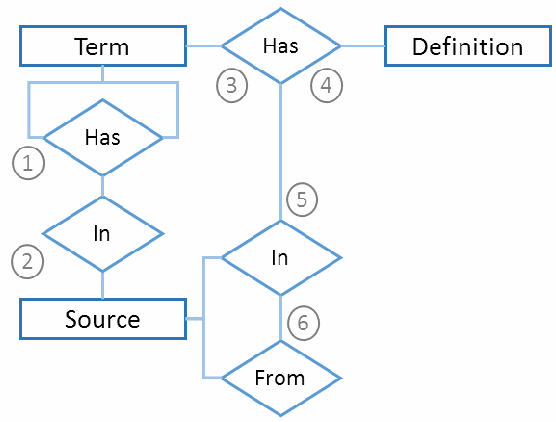
実体関連図です。実体の箱「Term」「Definition」「Source」と、関連のひし形「Has」「Has」「In」「In」「From」があり、丸数字1~6が付いています。Termは自分自身に戻る「Has」に結ばれ(1)、「In」を通じてSourceに結ばれます(2)。Termは「Has」を通じてDefinitionに結ばれます(3、4)。TermとDefinitionの「Has」の関連は「In」を通じてSourceに結ばれ(5)、Sourceは「From」を通じてその「In」の関連に結ばれます(6)。
Figure 1: A basic Entity-Relationship diagram for the glossary database
図 1:用語集データベースの基本的なエンティティ関連図
2.2 Data
2.2 データ
The glossaries, acronym lists, and equation lists of CNSSI-4009 and NIST FIPS, SPs, and IRs related to cybersecurity, information security or privacy are taken verbatim from their source and entered into the database. If a publication has no glossary, it is manually skimmed for terms explicitly defined within the text of the publication.
サイバーセキュリティ、情報セキュリティ、またはプライバシーに関連する CNSSI-4009 と NIST の FIPS、SP、IR の用語集、略語一覧、数式一覧は、出典からそのまま取り込み、データベースに入力されます。刊行物に用語集がない場合は、本文中で明示的に定義されている用語を探すため、その刊行物を手作業でざっと確認します。
Because the Glossary is meant to reflect definitions published by NIST and CNSSI 4009, the relevant information is copied into the database as-is, meaning any errors (e.g., misspellings) in the publications are carried through into the database. The only times the text is altered from the original is when the definition includes a reference (e.g., “as defined in [1]”), in which case the reference is spelled out (e.g., “as defined in NIST SP 800-53”), when possible.
用語集は、NIST と CNSSI 4009 が公表した定義を反映することを意図しているため、関連する情報はそのままデータベースにコピーされます。つまり、刊行物にある誤り(綴りの誤りなど)も、データベースにそのまま引き継がれます。原文から変更するのは、定義に参照(「[1] で定義されているとおり」など)が含まれている場合だけで、その場合は可能なかぎり、参照が具体的に書き下されます(「NIST SP 800-53 で定義されているとおり」など)。
Terms that are referenced in NIST publications using various spellings or abbreviations (e.g., “control” vs. “controls”) are identified and linked to a parent term (e.g., “control(s)”). These parent terms may or may not be used in NIST publications, however, they are used in the online application to group like terms together. Besides these parent terms, the database does not currently contain terms or definitions that do not have a source NIST or CNSS publication. On occasion, NIST receives a request to define a term: these requests are forwarded to authors responsible for publishing content related to that term. They may choose to define the term in a publication, in which case it will be included in the glossary database.
NIST の刊行物でさまざまな綴りや略語(たとえば「control」と「controls」)で参照されている用語は、特定され、親用語(たとえば「control(s)」)に関連付けられます。これらの親用語は、NIST の刊行物で使用されている場合もそうでない場合もありますが、オンラインアプリケーションでは、類似する用語をまとめるために使用されます。こうした親用語に加えて、データベースには現在、出典となる NIST または CNSS の刊行物がない用語や定義は含まれていません。NIST は、用語の定義を求める要望を受けることがあります。そうした要望は、その用語に関連する内容を公表する責任のある著者に転送されます。著者は、その用語を刊行物で定義することを選択する場合があり、その場合は用語集のデータベースに含まれます。
The database may have more than one definition for a single term. This occurs for many reasons: definitions can evolve over time, a broad definition may be tailored to a specific subject area, an existing definition may be altered to fit a unique topic, or there could be errors. In some cases, there may be definitions for a term that are very similar, yet subtly different, for example only differences in punctuation. These multiple definitions are preserved verbatum in order to precisely reflect the definitions in the publications and preserve the reliability and correctness of the Glossary.
データベースには、1 つの用語に対して複数の定義がある場合があります。これには多くの理由があります。定義は時間とともに変化することがあり、広範な定義が特定の主題分野に合わせて調整されることがあり、既存の定義が独自のトピックに合うよう変更されることがあり、また誤りがある可能性もあります。場合によっては、句読点だけが異なるなど、非常によく似ていながら微妙に異なる定義が用語に存在することがあります。これらの複数の定義は、刊行物の定義を正確に反映し、用語集の信頼性と正確性を保つために、そのまま保存されます。
Some definitions may have more “weight” or are more broadly recognized than others, definitions are prioritized by assigning each definition’s source to one of these ranked categories (the lower the number, the higher the rank of the publication)2, 3:
定義の中には、ほかよりも「重み」があるものや、より広く認められているものがあるため、各定義の出典を次の順位付きカテゴリのいずれかに割り当てることで、定義に優先順位を付けています(番号が小さいほど、その刊行物の順位が高くなります)2, 3。
(1)The definition is quoted (i.e., not adapted) from a federal law or regulation.
(1)定義が、連邦法または連邦規則から(改変されずに)引用されています。
(2)The definition is quoted from an international, federal, or widely adopted technical standard [e.g., International Organization for Standardization (ISO), FIPS, American National Standards Institute (ANSI)], a common English or mathematical dictionary, or is an authoritative original technical source (e.g., the Defense Discovery Metadata Specification for the definition of the Defense Discovery Metadata Standard).
(2)定義が、国際標準、連邦標準、または広く採用されている技術標準[たとえば、国際標準化機構(ISO)、連邦情報処理標準(FIPS)、米国規格協会(ANSI)]、一般的な英語辞典または数学辞典から引用されている場合、または権威ある技術的な原典(たとえば、Defense Discovery Metadata Standard の定義についての Defense Discovery Metadata Specification)である場合。
(3)The definition is quoted from an Office of Management and Budget (OMB) Policy or Circular, CNSS Policies and Directives, or similar documents.
(3)定義が、行政管理予算局(OMB)の方針または通達、CNSS の方針および指令、または類似の文書から引用されています。
(4)The definition is from NIST SPs, CNSS Instructions, OMB Memorandum, similar documents, or a specialized dictionary.
(4)定義が、NIST SP、CNSS 指示、OMB 覚書、類似の文書、または専門辞典のものです。
(5)The definition is from Government Accountability Office (GAO) Reports, CNSS Advisory Memoranda, Agency-specific standards, regulations, and policies.
(5)定義が、政府説明責任局(GAO)の報告書、CNSS 勧告覚書、機関固有の標準・規則・方針のものです。
(6)The definition is from NIST IRs, white papers, academic or technical papers, or other publications.
(6)定義が、NIST IR、ホワイトペーパー、学術論文または技術論文、またはその他の刊行物のものです。
(7)The definition is from draft, archived, or superseded publications.
(7)定義が、草案、アーカイブ済み、または置き換えられた刊行物のものです。
This ranking is not intended to reflect the importance of a publication or definition, but rather is intended as a means to describe the authoritative status of a definition from a general U.S. Federal Government agency point of view. The online application uses these rankings to determine the display order of definitions.
この順位付けは、刊行物や定義の重要性を反映することを意図したものではなく、米国連邦政府機関の一般的な観点から、定義の権威としての位置づけを示す手段として意図したものです。オンラインアプリケーションは、これらの順位を使用して、定義の表示順を決定します。
2.3 Web Application
2.3 Web アプリケーション
The online application was developed to allow users to search the database of terms and definitions. It is expected that users will typically use the application in order to either (1) gain a better understanding of a term, or (2) find a definition to use. It will be regularly updated to improve functionality and usability based on user feedback.
オンラインアプリケーションは、利用者が用語と定義のデータベースを検索できるように開発されました。利用者は通常、(1) 用語についてより深く理解するため、または (2) 使用する定義を見つけるために、このアプリケーションを使用することが想定されています。アプリケーションは、利用者からのフィードバックに基づいて機能と使いやすさを向上させるため、定期的に更新されます。
The application was designed to be visually similar to other web pages on the NIST Computer Security Resource Center (CSRC) website4, and attempts to provide as much relevant information as possible to the user. This means that the application may, for example, state that there are no known acronyms for a term (instead of hiding that field). Because there may be multiple definitions for a term that are very similar, there may be increased complexity and confusion. It may become necessary to add functionality to the online application to limit searches to only those that are current (i.e., not withdrawn or superceded) or from higher-ranked category sources (e.g., categories 1 and 2 only).
このアプリケーションは、NIST コンピュータセキュリティリソースセンター(CSRC)の Web サイト4にある他の Web ページと見た目が似るように設計されており、利用者に関連する情報をできるだけ多く提供しようとしています。たとえば、ある用語に既知の略語がない場合、その欄を隠さずに、既知の略語がないと表示することがあります。1 つの用語に対して、非常によく似た複数の定義が存在することがあるため、複雑さや混乱が増す可能性があります。検索を、現行のもの(すなわち、廃止または置き換えられていないもの)、または上位の順位のカテゴリの出典(たとえば、カテゴリ 1 と 2 のみ)のものだけに限定する機能を、オンラインアプリケーションに追加する必要が生じる場合があります。
The application is hosted at https://csrc.nist.gov/glossary.
このアプリケーションは、https://csrc.nist.gov/glossary で公開されています。
3 Feedback & Updates
3 フィードバックと更新
The glossary database will be regularly updated as new publications are finalized. Archived publications or publications from other sources (e.g., laws or standards) may be added. Recommendations for publications to be included in the database can be sent to secglossary@nist.gov.
用語集データベースは、新しい刊行物が確定するたびに、定期的に更新されます。アーカイブ済みの刊行物や、他の出典(法律や標準など)の刊行物が追加される場合があります。データベースに含める刊行物の推薦は、secglossary@nist.gov に送ることができます。
Existing database entries will rarely be modified. Any change to a NIST document results in a new source—identified by a separate revision number or a new publication date—which would create a new source in the database; thus the change would be treated as a new addition. The old publication and associated definitions will not be removed, but will be marked as superseded or withdrawn, as appropriate. This will enable users to track changes to terms and definitions over time. Two exceptions to this rule are:
既存のデータベース項目が変更されることはまれです。NIST の文書に変更があった場合は、別の改訂番号または新しい発行日で識別される新しい出典となり、データベースに新しい出典が作成されるため、その変更は新規の追加として扱われます。古い刊行物と、それに関連する定義は削除されず、必要に応じて、置き換えられたものまたは廃止されたものとして印が付けられます。これにより、利用者は用語と定義の経時的な変化を追跡できます。この規則には、次の 2 つの例外があります。
•when an error is identified and corrected; and
•誤りが特定され、訂正された場合。
•when previously unknown information is added.
•これまで知られていなかった情報が追加された場合。
Occasionally, it is unclear what version of a document a term originates from (i.e., a referenced source). For these situations, the entry references a source with “unknown” information. This entry may be modified if the exact referenced source later becomes known. The database does not contain definitions without a source publication. Since draft documents are not stable, the database will not include terms/definitions from them.
用語がどの版の文書に由来するのか(すなわち、参照先の出典)が不明な場合があります。そのような場合、項目は「不明」の情報を持つ出典を参照します。正確な参照先の出典が後でわかった場合、この項目は変更される場合があります。データベースには、出典となる刊行物のない定義は含まれません。草案文書は安定していないため、データベースには草案文書に由来する用語や定義は含まれません。
The application may be updated frequently depending on user feedback. Users are encouraged to provide feedback on the usability of the application and/or if they identify any bugs in the application. Users are also encouraged to notify NIST of any errors in the glossary database, especially instances where the glossary does not match the term/definition in the associated publication.
このアプリケーションは、利用者からのフィードバックに応じて、頻繁に更新される場合があります。利用者は、アプリケーションの使いやすさについて、またはアプリケーションの不具合を見つけた場合に、フィードバックを提供することが推奨されます。また、利用者は、用語集データベースの誤り、特に用語集が関連する刊行物の用語や定義と一致していない事例について、NIST に知らせることが推奨されます。
Users may provide feedback using the email address provided on the web application. Feedback on the definitions themselves will be forwarded to the author of the publication source. Requests for adding terms to define will be sent to appropriate NIST subject-matter experts for consideration in future publications.
利用者は、Web アプリケーションに記載されているメールアドレスを使用して、フィードバックを提供できます。定義そのものに対するフィードバックは、出典となる刊行物の著者に転送されます。定義する用語の追加の要望は、将来の刊行物での検討のため、NIST の適切な分野の専門家に送られます。