NIST IR 7316 日本語訳
英語タイトル : Assessment of Access Control Systems日本語タイトル : アクセス制御システムの評価
公開日 : 2006-09-29
原文URL : https://csrc.nist.gov/pubs/ir/7316/final
翻訳編集 : 自動生成(有志による非公式の日本語訳), 原文取得日 : 2026-10-31, 訳文 : 431 / 432 ブロック
[要約] NIST IR 7316 は、情報技術システムで利用できる、一般的に使われているアクセス制御サービスのいくつかを説明した報告書です。アクセス制御システムの実装を計画している組織は、アクセス制御ポリシー、モデル、機構という 3 つの抽象概念を考慮すべきとされ、アクセス制御ポリシーは高レベルの要件、モデルはポリシーと機構の間の抽象度のギャップを橋渡しするものと説明されています。分散システムでのアクセス制御、アクセス制御の状態の安全性、管理能力や性能などの品質メトリクスによる検証を取り上げています。付録では、Microsoft Windows、UNIX/Linux、SQL データベース管理システムなどの一般的なプラットフォームが対応している機構とモデルをまとめています。
[NIST のロゴ。公的な標章のため、この非公式サイトには掲載していません。原本 PDF を参照してください。]
Interagency Report 7316
Interagency Report 7316
Assessment of Access Control Systems
アクセス制御システムの評価
Vincent C. Hu David F. Ferraiolo D. Rick Kuhn
Vincent C. Hu David F. Ferraiolo D. Rick Kuhn
Interagency Report 7316
Interagency Report 7316
Assessment of Access Control Systems
アクセス制御システムの評価
Vincent C. Hu David F. Ferraiolo D. Rick Kuhn
Vincent C. Hu David F. Ferraiolo D. Rick Kuhn
COMPUTER SECURITY
コンピュータセキュリティ
Computer Security Division Information Technology Laboratory National Institute of Standards and Technology Gaithersburg, MD 20899-8930
コンピュータセキュリティ部門 情報技術研究所 米国国立標準技術研究所 メリーランド州ゲイサーズバーグ 20899-8930
September 2006
2006年9月
U.S. Department of Commerce
米国商務省
Carlos M. Gutierrez, Secretary
Carlos M. Gutierrez 長官
Technology Administration
技術管理局
Robert C. Cresanti, Under Secretary of Commerce for Technology
Robert C. Cresanti、商務次官(技術担当)
National Institute of Standards and Technology
米国国立標準技術研究所
William Jeffrey, Director
William Jeffrey 所長
Reports on Computer Systems Technology
コンピュータシステム技術に関する報告書
The Information Technology Laboratory (ITL) at the National Institute of Standards and Technology (NIST) promotes the U.S. economy and public welfare by providing technical leadership for the Nation’s measurement and standards infrastructure. ITL develops tests, test methods, reference data, proof of concept implementations, and technical analyses to advance the development and productive use of information technology. ITL’s responsibilities include the development of technical, physical, administrative, and management standards and guidelines for the cost-effective security and privacy of sensitive unclassified information in federal computer systems. This Interagency Report discusses ITL’s research, guidance, and outreach efforts in computer security, and its collaborative activities with industry, government, and academic organizations.
米国国立標準技術研究所(NIST)の情報技術研究所(ITL)は、米国の測定・標準基盤に対する技術的リーダーシップを提供することにより、米国の経済と公共の福祉を促進しています。ITL は、情報技術の発展と生産的な利用を推進するため、試験、試験方法、参照データ、概念実証の実装、技術分析を開発しています。ITL の責務には、連邦コンピュータシステムにおける機密扱いではない機微な情報について、費用対効果の高いセキュリティとプライバシーを実現するための、技術面・物理面・管理面・マネジメント面の標準およびガイドラインの策定が含まれます。この省庁間報告書は、コンピュータセキュリティに関する ITL の研究、ガイダンス、アウトリーチの取り組みと、産業界、政府、学術機関との協力活動を扱います。
National Institute of Standards and Technology Interagency Report 7316, 60 pages (September 2006)
米国国立標準技術研究所 省庁間報告書 7316、60ページ(2006年9月)
Certain commercial entities, equipment, or materials may be identified in this document in order to describe an experimental procedure or concept adequately. Such identification is not intended to imply recommendation or endorsement by the National Institute of Standards and Technology, nor is it intended to imply that the entities, materials, or equipment are necessarily the best available for the purpose.
本書では、実験の手順や概念を適切に説明するために、特定の商業的な事業体、装置、資材を示す場合があります。こうした表示は、米国国立標準技術研究所による推奨や承認を意味するものではなく、それらの事業体、資材、装置が目的に照らして必ずしも最良のものであることを意味するものでもありません。
Abstract
概要
Adequate security of information and information systems is a fundamental management responsibility. Nearly all applications that deal with financial, privacy, safety, or defense include some form of access control. Access control is concerned with determining the allowed activities of legitimate users, mediating every attempt by a user to access a resource in the system. In some systems, complete access is granted after successful authentication of the user, but most systems require more sophisticated and complex control. In addition to the authentication mechanism (such as a password), access control is concerned with how authorizations are structured. In some cases, authorization may mirror the structure of the organization, while in others it may be based on the sensitivity level of various documents and the clearance level of the user accessing those documents. This publication explains some of the commonly used access control services available in information technology systems.
情報および情報システムの適切なセキュリティは、管理上の基本的な責任です。金融、プライバシー、安全、または防衛に関わるほぼすべてのアプリケーションには、何らかの形のアクセス制御が含まれます。アクセス制御は、正当な利用者に許可される活動を決定し、利用者がシステム内のリソースにアクセスしようとするすべての試みを仲介するものです。システムによっては、利用者の認証が成功した後に完全なアクセスが与えられますが、ほとんどのシステムは、より高度で複雑な制御を必要とします。アクセス制御は、(パスワードなどの)認証機構に加えて、認可がどのように構造化されているかにも関わります。認可が組織の構造を反映する場合もあれば、さまざまな文書の機微度レベルと、それらの文書にアクセスする利用者のクリアランスレベルに基づく場合もあります。本刊行物は、情報技術システムで利用できる、一般的に使われているアクセス制御サービスのいくつかを説明します。
Organizations planning to implement an access control system should consider three abstractions: access control policies, models, and mechanisms. Access control policies are high-level requirements that specify how access is managed and who may access information under what circumstances. For instance, policies may pertain to resource usage within or across organizational units or may be based on need-to-know, competence, authority, obligation, or conflict-of-interest factors. At a high level, access control policies are enforced through a mechanism that translates a user’s access request, often in terms of a structure that a system provides. An access control list is a familiar example of an access control mechanism. Access control models bridge the gap in abstraction between policy and mechanism. Rather than attempting to evaluate and analyze access control systems exclusively at the mechanism level, security models are usually written to describe the security properties of an access control system. Security models are formal presentations of the security policy enforced by the system and are useful for proving theoretical limitations of a system. Discretionary access control, which allows the creator of a file to delegate access to others, is one of the simplest examples of a model.
アクセス制御システムの実装を計画している組織は、アクセス制御ポリシー、モデル、機構という3つの抽象概念を考慮すべきです。アクセス制御ポリシーは、アクセスがどのように管理されるか、また誰がどのような状況で情報にアクセスしてよいかを規定する、高レベルの要件です。たとえば、ポリシーは、組織単位の内部または組織単位をまたぐリソースの使用に関するものである場合もあれば、知る必要性、能力、権限、義務、利益相反の要因に基づく場合もあります。高レベルでは、アクセス制御ポリシーは、利用者のアクセス要求を、多くの場合システムが提供する構造に即して変換する機構によって実施されます。アクセス制御リストは、アクセス制御機構のよく知られた例です。アクセス制御モデルは、ポリシーと機構の間の抽象度のギャップを橋渡しします。アクセス制御システムを機構のレベルだけで評価・分析しようとするのではなく、アクセス制御システムのセキュリティ特性を記述するために、通常はセキュリティモデルが書かれます。セキュリティモデルは、システムが実施するセキュリティポリシーを形式的に示したものであり、システムの理論上の限界を証明するのに役立ちます。ファイルの作成者がほかの者にアクセスを委任できるようにする任意アクセス制御は、モデルの最も単純な例の一つです。
As systems grow in size and complexity, access control is a special concern for systems that are distributed across multiple computers. These distributed systems can be a formidable challenge for developers, because they may use a variety of access control mechanisms that must be integrated to support the organization’s policy; for example, role-based access control that can enforce administrator-specified rules is often used. Popular database management system designs, such as Structured Query Language (SQL), incorporate many aspects of role- and rule-based access. Services that are particularly useful in implementing distributed access control include the Lightweight Directory Access Protocol (LDAP), capability-based Kerberos, and the Extensible Markup Language (XML)-based Extensible Access Control Markup Language (XACML).
システムの規模と複雑さが増すにつれて、複数のコンピュータにまたがって分散するシステムでは、アクセス制御が特に懸念されます。こうした分散システムは、組織のポリシーを支えるために統合しなければならないさまざまなアクセス制御機構を使用する可能性があるため、開発者にとって手ごわい課題となりえます。たとえば、管理者が指定した規則を実施できるロールベースアクセス制御がよく使われます。Structured Query Language(SQL)などの一般的なデータベース管理システムの設計は、ロールベースおよびルールベースのアクセスの多くの側面を取り入れています。分散アクセス制御の実装で特に有用なサービスには、Lightweight Directory Access Protocol(LDAP)、ケイパビリティベースの Kerberos、Extensible Markup Language(XML)ベースの Extensible Access Control Markup Language(XACML)があります。
A state of access control is said to be safe if no permission can be leaked to an unauthorized or uninvited principal. To assure the safety of an access control system, it is essential to make certain that the access control configuration (e.g., access control model) will not result in the leakage of permissions to an unauthorized principal. Even though the general safety computation is proven undecidable [HRU76], practical mechanisms exist for achieving the safety requirement, such as safety constraints built into the mechanism.
どのパーミッションも、認可されていない、または招かれていないプリンシパルに漏えいしない場合、アクセス制御の状態は安全であるといいます。アクセス制御システムの安全性を保証するには、アクセス制御の構成(アクセス制御モデルなど)が、認可されていないプリンシパルへのパーミッションの漏えいをもたらさないことを確実にすることが不可欠です。一般的な安全性の計算は決定不能であることが証明されていますが [HRU76]、機構に組み込まれた安全性制約など、安全性の要件を達成するための実用的な機構は存在します。
Access control systems come with a wide variety of features and administrative capabilities, and the operational impact can be significant. In particular, this impact can pertain to administrative and user productivity, as well as to the organization’s ability to perform its mission. Therefore, it is reasonable to use a quality metric to verify the administrative capabilities, administrative cost, policy coverage, extensibility, and performance qualities of access control systems.
アクセス制御システムには、幅広い機能と管理能力があり、運用への影響が大きくなる場合があります。特に、この影響は、管理者と利用者の生産性、および組織が任務を遂行する能力に関わる場合があります。したがって、アクセス制御システムの管理能力、管理コスト、ポリシーの対象範囲、拡張性、性能の品質を検証するために、品質メトリクスを用いることは妥当です。
Appendix C summarizes mechanisms and models supported by popular platforms such as Microsoft Windows, UNIX/Linux, and SQL database management systems.
付録 C では、Microsoft Windows、UNIX/Linux、SQL データベース管理システムなどの一般的なプラットフォームが対応している機構とモデルをまとめています。
Acknowledgements
謝辞
The authors wish to thank their colleagues who reviewed drafts of this document, including Karen Kent, Shirley Radack, Wayne Jansen, Tim Grance, and Tom Karygiannis. The authors also gratefully acknowledge and appreciate the comments and contributions made by government agencies, private organizations, and individuals in providing direction and assistance in the development of this document.
著者は、Karen Kent、Shirley Radack、Wayne Jansen、Tim Grance、Tom Karygiannis をはじめとして、本書の草案をレビューした同僚に感謝します。また、本書の作成にあたって方向性を示し、支援してくださった政府機関、民間組織、個人によるコメントと貢献に、著者は深く感謝します。
TABLE OF CONTENTS
目次
TABLE OF CONTENTS
目次
TABLE OF FIGURES
図の目次
Figure 1 - Components of the Workflow Management System — 9
図 1 - ワークフロー管理システムの構成要素 — 9
Figure 2 - XACML Architecture — 23
図 2 - XACML アーキテクチャ — 23
Figure 3 - Mapping RBAC for Distributed Systems — 27
図 3 - 分散システム向けの RBAC のマッピング — 27
TABLE OF TABLES
表の目次
Table 1 – Simplified Example of an ACL — 13
表 1 – ACL の簡略化した例 — 13
Table 2 – Permission Bits — 14
表 2 – パーミッションビット — 14
Table 3 – Capability List — 15
表 3 – ケイパビリティリスト — 15
Table 4 – Advantages and Disadvantages of ACLs and Capability Lists — 16
表 4 – ACL とケイパビリティリストの長所と短所 — 16
1 INTRODUCTION
1 はじめに
1.1 Authority
1.1 根拠法令
The National Institute of Standards and Technology (NIST) developed this document in furtherance of its statutory responsibilities under the Federal Information Security Management Act (FISMA) of 2002, Public Law 107-347.
米国国立標準技術研究所(NIST)は、2002年連邦情報セキュリティマネジメント法(FISMA)(Public Law 107-347)のもとでの法的責任を果たすため、本書を作成しました。
NIST is responsible for developing standards and guidelines, including minimum requirements, for providing adequate information security for all agency operations and assets, but such standards and guidelines shall not apply to national security systems. This document is consistent with the requirements of the Office of Management and Budget (OMB) Circular A-130, Section 8b(3), “Securing Agency Information Systems,” as analyzed in A-130, Appendix IV: Analysis of Key Sections. Supplemental information is provided in A-130, Appendix III.
NIST は、すべての政府機関の運用と資産に対して適切な情報セキュリティを提供するための、最低限の要件を含む標準とガイドラインを策定する責任を負っていますが、これらの標準とガイドラインは国家安全保障システムには適用されません。本書は、行政管理予算局(OMB)Circular A-130 の第 8b(3) 節「Securing Agency Information Systems」の要件と整合しています。これは A-130 の Appendix IV: Analysis of Key Sections で分析されています。補足情報は、A-130 の Appendix III に示されています。
This guideline has been prepared for use by federal agencies. It may be used by nongovernmental organizations on a voluntary basis and is not subject to copyright, though attribution is desired.
このガイドラインは、連邦政府機関が使用するために作成されました。非政府組織が任意に使用してもよく、著作権の対象ではありませんが、出典の明記が望まれます。
Nothing in this document should be taken to contradict standards and guidelines made mandatory and binding on federal agencies by the Secretary of Commerce under statutory authority, nor should these guidelines be interpreted as altering or superseding the existing authorities of the Secretary of Commerce, Director of the OMB, or any other federal official.
本書のいかなる内容も、商務長官が法的権限に基づいて連邦政府機関に対して強制力と拘束力を持たせた標準およびガイドラインに矛盾するものと解釈すべきではありません。また、これらのガイドラインを、商務長官、OMB 長官、またはその他の連邦政府職員の既存の権限を変更したり、それに優先したりするものと解釈すべきではありません。
1.2 Document Scope and Purpose
1.2 本書の範囲と目的
The purpose of this document is to provide agencies with background information on access control policies, models, and mechanisms to assist them in securing their computer applications. The document discusses the capabilities, limitations, and qualities of the access control mechanisms that are embedded for each access control policy.
本書の目的は、機関がコンピュータアプリケーションを保護するのを支援するために、アクセス制御のポリシー、モデル、機構に関する背景情報を機関に提供することです。本書は、各アクセス制御ポリシーのために組み込まれたアクセス制御機構の、能力、限界、品質を論じます。
1.3 Audience and Assumptions
1.3 想定読者と前提
This document is intended to provide practical and conceptual guidance for security managers, administrators, and procurement officers whose expertise is related to access control. The authors assume that the readers have basic operating system, database, and networking expertise, as well as some security expertise, especially in the field of access control. Because of the constantly changing nature of the information technology industry, readers are strongly encouraged to take advantage of other resources (including those listed in this document) for more current and detailed information.
本書は、専門知識がアクセス制御に関連するセキュリティ管理者、管理者、調達担当者に向けて、実践的かつ概念的なガイダンスを提供することを意図しています。著者は、読者がオペレーティングシステム、データベース、ネットワークに関する基本的な専門知識と、特にアクセス制御の分野でのある程度のセキュリティの専門知識を持っていることを前提としています。情報技術業界は絶え間なく変化しているため、より新しく詳細な情報を得るには、ほかの情報源(本書に挙げたものを含む)を活用することを強く勧めます。
1.4 Document Organization
1.4 本書の構成
This document is divided into seven sections, followed by three appendixes. Section 1 states the authority, scope, purpose, audience, and assumptions of this document. Section 2 introduces the terminology that is widely used in the field of access control and basic abstractions of controls: access control policies, models, and mechanisms. Section 2 also introduces major access control policies; popular policies are provided with the discussions. The focus of this document is presented in Section 3, which introduces some popular access control mechanisms and presents their advantages and limitations, along with examples. Section 4 is devoted to the broader applications of access control mechanisms for distributed systems. Section 5 discusses the safety issues of access control systems. Section 6 lists and explains some measurements for the quality of an access control mechanism. Section 7 presents the conclusion to the document. Appendixes A - Glossary, B - Acronyms, C - Commercial Access Control Systems, and References provide information that supports the document.
本書は7つの節と、それに続く3つの付録に分かれています。第 1 節では、本書の根拠法令、範囲、目的、想定読者、前提を述べます。第 2 節では、アクセス制御の分野で広く使われる用語と、制御の基本的な抽象概念であるアクセス制御ポリシー、モデル、機構を紹介します。第 2 節ではまた、主要なアクセス制御ポリシーも紹介し、一般的なポリシーを議論とともに示します。本書の焦点は第 3 節に示されており、一般的なアクセス制御機構をいくつか紹介し、その長所と限界を例とともに示します。第 4 節では、分散システムにおけるアクセス制御機構のより広い応用を扱います。第 5 節では、アクセス制御システムの安全性の問題を論じます。第 6 節では、アクセス制御機構の品質に関するいくつかの測定を挙げ、説明します。第 7 節では、本書の結論を示します。付録 A - 用語集、B - 略語、C - 市販のアクセス制御システム、および参考文献は、本書を補足する情報を提供します。
2 OVERVIEW OF ACCESS CONTROL
2 アクセス制御の概要
This section introduces concepts, common terms, and basic (popular) policies and models of access control. The contents of this section are referenced throughout the document.
本節では、アクセス制御の概念、一般的な用語、基本的な(一般的な)ポリシーとモデルを紹介します。本節の内容は、本書全体で参照されます。
Access control is concerned with determining the allowed activities of legitimate users, mediating every attempt by a user to access a resource in the system. A given information technology (IT) infrastructure can implement access control systems in many places and at different levels. Operating systems use access control to protect files and directories. Database management systems DBMS apply access control to regulate access to tables and views. Most commercially available application systems implement access control, often independent of the operating systems and/or DBMSs on which they are installed.
アクセス制御は、正当な利用者に許可される活動を決定し、利用者がシステム内のリソースにアクセスしようとするすべての試みを仲介するものです。ある情報技術(IT)インフラストラクチャは、多くの場所で、さまざまなレベルでアクセス制御システムを実装できます。オペレーティングシステムは、ファイルとディレクトリを保護するためにアクセス制御を使います。データベース管理システム(DBMS)は、テーブルとビューへのアクセスを規制するためにアクセス制御を適用します。市販されているほとんどのアプリケーションシステムは、アクセス制御を実装していますが、それはインストールされているオペレーティングシステムや DBMS、あるいはその両方から独立していることが多くあります。
The objectives of an access control system are often described in terms of protecting system resources against inappropriate or undesired user access. From a business perspective, this objective could just as well be described in terms of the optimal sharing of information. After all, the main objective of IT is to make information available to users and applications. A greater degree of sharing may get in the way of resource protection; in reality, a well-managed and effective access control system actually facilitates sharing. A sufficiently fine-grained access control mechanism can enable selective sharing of information where in its absence, sharing may be considered too risky altogether [FKC03].
アクセス制御システムの目的は、システムのリソースを不適切な、または望ましくない利用者アクセスから保護するという観点で説明されることがよくあります。事業の観点からは、この目的を情報の最適な共有という観点で説明することもできます。結局のところ、IT の主な目的は、利用者とアプリケーションが情報を利用できるようにすることです。共有の度合いが高まると、リソースの保護が妨げられることがあります。実際には、適切に管理された効果的なアクセス制御システムは共有を促進します。十分にきめ細かいアクセス制御機構があれば、そうした機構がない場合には共有があまりにも危険と見なされるような情報も、選択的に共有できます [FKC03]。
2.1 Concepts
2.1 概念
This section introduces some of the concepts that are commonly used in the access control research community and are also used throughout this document.
本節では、アクセス制御の研究コミュニティで一般的に使われ、本書全体でも使われる概念をいくつか紹介します。
•Object: An entity that contains or receives information. Access to an object potentially implies access to the information it contains. Examples of objects are records, fields (in a database record), blocks, pages, segments, files, directories, directory trees, process, and programs, as well as processors, video displays, keyboards, clocks, printers, and network nodes. Devices such as electrical switches, disc drives, relays, and mechanical components connected to a computer system may also be included in the category of objects [NCSC88].
•オブジェクト: 情報を含む、または受け取る実体。オブジェクトへのアクセスは、そのオブジェクトが含む情報へのアクセスを暗に意味する可能性があります。オブジェクトの例には、レコード、(データベースレコードの)フィールド、ブロック、ページ、セグメント、ファイル、ディレクトリ、ディレクトリツリー、プロセス、プログラムのほか、プロセッサ、ビデオディスプレイ、キーボード、クロック、プリンター、ネットワークノードがあります。電気スイッチ、ディスクドライブ、リレー、コンピュータシステムに接続された機械部品などの装置も、オブジェクトの分類に含まれる場合があります [NCSC88]。
•Subject: An active entity, generally in the form of a person, process, or device that causes information to flow among objects (see below) or changes the system state [NCSC88].
•サブジェクト: 能動的な実体で、一般に人、プロセス、装置の形をとり、オブジェクト(下記参照)の間で情報の流れを生じさせるか、システムの状態を変化させるもの [NCSC88]。
•Operation: An active process invoked by a subject; for example, when an automatic teller machine (ATM) user enters a card and correct personal identification number (PIN), the control program operation on the user’s behalf is a process, but the subject can initiate more than one operation-deposit, withdrawal, balance inquiry, etc. [FKC03]
•操作: サブジェクトによって呼び出される能動的なプロセス。たとえば、現金自動預け払い機(ATM)の利用者がカードと正しい個人識別番号(PIN)を入力すると、利用者に代わって実行される制御プログラムの操作はプロセスですが、サブジェクトは、預け入れ、引き出し、残高照会など、複数の操作を開始できます [FKC03]。
•Permission (privilege): An authorization to perform some action on the system. In most computer security literature, the term permission refers to some combination of object and operation. A particular operation used on two different objects represents two distinct permissions, and similarly, two different operations applied to a single object represent two distinct permissions. For example, a bank teller may have permissions to execute debit and credit operations on customer records through transactions, while an accountant may execute debit and credit operations on the general ledger, which consolidates the bank’s accounting data [FKC03].
•パーミッション(権限): システム上で何らかの行為を実行するための認可。コンピュータセキュリティに関するほとんどの文献では、パーミッションという用語は、オブジェクトと操作の何らかの組み合わせを指します。2つの異なるオブジェクトに対して使用される特定の操作は、2つの異なるパーミッションを表し、同様に、1つのオブジェクトに適用される2つの異なる操作も、2つの異なるパーミッションを表します。たとえば、銀行の窓口係は、トランザクションを通じて顧客の記録に対して借方記入と貸方記入の操作を実行するパーミッションを持つ場合があり、会計担当者は、銀行の会計データを統合する総勘定元帳に対して借方記入と貸方記入の操作を実行する場合があります [FKC03]。
•Access Control List (ACL): A list associated with an object that specifies all the subjects that can access the object, along with their rights to the object. Each entry in the list is a pair (subject, set of rights). An ACL corresponds to a column of the access control matrix (described next). ACLs are frequently implemented directly or as an approximation in modern operating systems.
•アクセス制御リスト(ACL): オブジェクトに関連付けられ、そのオブジェクトにアクセスできるすべてのサブジェクトを、そのオブジェクトに対する権利とともに指定するリスト。リストの各エントリは、(サブジェクト、権利の集合)の組です。ACL は、(次に説明する)アクセス制御行列の列に対応します。ACL は、最新のオペレーティングシステムで、直接、または近似として実装されることが多くあります。
•Access Control Matrix: A table in which each row represents a subject, each column represents an object, and each entry is the set of access rights for that subject to that object. In general, the access control matrix is sparse: most subjects do not have access rights to most objects. Therefore, different representations have been proposed. The access control matrix can be represented as a list of triples, having the form <subject, rights, object>. Searching a large number of these triples is inefficient enough that this implementation is seldom used [Sum97]. Rather, the matrix is typically subdivided into columns (ACLs) or rows (capabilities).
•アクセス制御行列: 各行がサブジェクトを、各列がオブジェクトを表し、各エントリがそのサブジェクトのそのオブジェクトに対するアクセス権の集合である表。一般に、アクセス制御行列は疎であり、ほとんどのサブジェクトは、ほとんどのオブジェクトに対するアクセス権を持っていません。そのため、さまざまな表現が提案されてきました。アクセス制御行列は、<subject, rights, object> の形をした3つ組のリストとして表現できます。多数のこれらの3つ組を検索するのは非効率であるため、この実装はほとんど使われません [Sum97]。むしろ、行列は通常、列(ACL)または行(ケイパビリティ)に分割されます。
•Separation of Duty (SOD): The principle that no user should be given enough privileges to misuse the system. For example, the person authorizing a paycheck should not also be the one who can prepare it. Separation of duties can be enforced either statically by defining conflicting roles (i.e., roles which cannot be executed by the same user) or dynamically by enforcing the control at access time. An example of dynamic separation of duty is the two-person rule. The first user to execute a two-person operation can be any authorized user, whereas the second user can be any authorized user different from the first. There are various types of SOD; an important one is a history-based SOD that regulates, for example, that the same subject (role) cannot access the same object a certain number of times.
•職務分離(SOD): どの利用者にも、システムを悪用できるだけの権限を与えるべきではないという原則。たとえば、給与小切手を承認する人が、それを作成できる人であってはなりません。職務分離は、競合するロール(同じ利用者が実行できないロール)を定義することで静的に、またはアクセス時に制御を実施することで動的に、実施できます。動的な職務分離の例は、2人ルールです。2人で行う操作を最初に実行する利用者は認可された任意の利用者でかまいませんが、2人目は、最初の利用者とは異なる認可された任意の利用者でなければなりません。SOD にはさまざまな種類があり、重要なものの一つは、たとえば同じサブジェクト(ロール)が同じオブジェクトに一定の回数アクセスできないことを規定する、履歴ベースの SOD です。
•Safety: Measures that the access control configuration (e.g., access control mechanism or model) will not result in the leakage of permissions to an unauthorized principal. Thus, a configuration is said to be safe if no permission can be leaked to an unauthorized or unintended principal.
•安全性: アクセス制御の構成(アクセス制御機構やモデルなど)が、認可されていないプリンシパルへのパーミッションの漏えいをもたらさないことを示す尺度。したがって、どのパーミッションも、認可されていない、または意図されていないプリンシパルに漏えいしない場合、その構成は安全であるといいます。
•Domain and Type Enforcement: The grouping of processes into domains, and objects into types, such that access operations (such as read, write, execute, and create) are restricted from domains to types and between domains. A process belongs to one domain at any given time and transits to other domains by sending signals or executing a file in a new domain [BSS95].
•ドメインとタイプの強制: プロセスをドメインに、オブジェクトをタイプにグループ化し、アクセス操作(読み取り、書き込み、実行、作成など)を、ドメインからタイプに対して、またドメイン間で制限すること。プロセスは、ある時点で1つのドメインに属し、シグナルを送るか、新しいドメインでファイルを実行することで、ほかのドメインに遷移します [BSS95]。
2.2 Policies, Models, and Mechanisms
2.2 ポリシー、モデル、機構
When planning an access control system, three abstractions of controls should be considered: access control policies, models, and mechanisms. Access control policies are high-level requirements that specify how access is managed and who, under what circumstances, may access what information. While access control policies can be application-specific and thus taken into consideration by the application vendor, policies are just as likely to pertain to user actions within the context of an organizational unit or across organizational boundaries. For instance, policies may pertain to resource usage within or across organizational units or may be based on need-to-know, competence, authority, obligation, or conflict-of-interest factors. Such policies may span multiple computing platforms and applications.
アクセス制御システムを計画する際には、制御の3つの抽象概念、すなわちアクセス制御ポリシー、モデル、機構を考慮すべきです。アクセス制御ポリシーは、アクセスがどのように管理されるか、また誰が、どのような状況で、どの情報にアクセスしてよいかを規定する、高レベルの要件です。アクセス制御ポリシーはアプリケーション固有のものとなりえて、したがってアプリケーションのベンダーによって考慮されますが、ポリシーは、組織単位の文脈の中で、または組織の境界をまたいで行われる利用者の行為に関するものである可能性も、同じくらいあります。たとえば、ポリシーは、組織単位の内部または組織単位をまたぐリソースの使用に関するものである場合もあれば、知る必要性、能力、権限、義務、利益相反の要因に基づく場合もあります。こうしたポリシーは、複数のコンピューティングプラットフォームとアプリケーションにまたがる場合があります。
At a high level, access control policies are enforced through a mechanism that translates a user’s access request, often in terms of a structure that a system provides. There are a wide variety of structures; for example, a simple table lookup can be performed to grant or deny access. Although no well-accepted standard yet exists for determining their policy support, some access control mechanisms are direct implementations of formal access control policy concepts [FKC03].
高レベルでは、アクセス制御ポリシーは、利用者のアクセス要求を、多くの場合システムが提供する構造に即して変換する機構によって実施されます。構造には幅広い種類があります。たとえば、単純なテーブル検索を行って、アクセスを許可または拒否できます。ポリシーへの対応を判断するための広く受け入れられた標準はまだ存在しませんが、アクセス制御機構の中には、正式なアクセス制御ポリシーの概念を直接実装したものがあります [FKC03]。
Rather than attempting to evaluate and analyze access control systems exclusively at the mechanism level, security models are usually written to describe the security properties of an access control system. A model is a formal presentation of the security policy enforced by the system and is useful for proving theoretical limitations of a system. Access control models are of general interest to both users and vendors. They bridge the rather wide gap in abstraction between policy and mechanism. Access control mechanisms can be designed to adhere to the properties of the model. Users see an access control model as an unambiguous and precise expression of requirements. Vendors and system developers see access control models as design and implementation requirements. On one extreme, an access control model may be rigid in its implementation of a single policy. On the other extreme, a security model will allow for the expression and enforcement of a wide variety of policies and policy classes [FKC03, HFF01]. As stated previously, the focus of this document is on the practical side of the access control system; detailed descriptions of access control models are not included in this publication [NCSC91].
アクセス制御システムを機構のレベルだけで評価・分析しようとするのではなく、アクセス制御システムのセキュリティ特性を記述するために、通常はセキュリティモデルが書かれます。モデルは、システムが実施するセキュリティポリシーを形式的に示したものであり、システムの理論上の限界を証明するのに役立ちます。アクセス制御モデルは、利用者とベンダーの両方にとって一般的な関心の対象です。モデルは、ポリシーと機構の間にある、抽象度の相当大きなギャップを橋渡しします。アクセス制御機構は、モデルの特性に従うように設計できます。利用者は、アクセス制御モデルを、要件の曖昧さのない正確な表現と見なします。ベンダーとシステム開発者は、アクセス制御モデルを、設計と実装の要件と見なします。一方の極端では、アクセス制御モデルは、単一のポリシーの実装において厳格な場合があります。もう一方の極端では、セキュリティモデルは、幅広いポリシーとポリシークラスの表現と実施を可能にします [FKC03, HFF01]。前述のとおり、本書の焦点はアクセス制御システムの実践的な側面であり、アクセス制御モデルの詳細な説明は本刊行物には含まれていません [NCSC91]。
This section provides additional information on access control policies and gives examples of several types of policies. Section 2.2.2.2 introduces the concept of role-based access control. Finally, Section 2.2.2.3 discusses the type and use of temporal constraints in access control policies.
本節では、アクセス制御ポリシーに関する追加の情報を示し、いくつかの種類のポリシーの例を挙げます。第 2.2.2.2 節では、ロールベースアクセス制御の概念を紹介します。最後に、第 2.2.2.3 節では、アクセス制御ポリシーにおける時間的制約の種類と使用について論じます。
Generating a list of access control policies is of limited value, since business objectives, tolerance for risk, corporate culture, and the regulatory responsibilities that influence policy differ from enterprise to enterprise, and even from organizational unit to organizational unit. The access control policies within a hospital may pertain to privacy and competency (e.g., only doctors and nurse practitioners may prescribe medication), and hospital policies will differ greatly from those of a military system or a financial institution. Even within a specific business domain, policy will differ from institution to institution. Furthermore, access control policies are dynamic in nature, in that they are likely to change over time in reflection of ever-evolving business factors, government regulations, and environmental conditions. There are several well-known access control policies, which can be categorized as discretionary or non-discretionary. Typically, discretionary access control policies are associated with identity-based access control, and non-discretionary access controls are associated with rule-based controls (for example, mandatory security policy).
アクセス制御ポリシーの一覧を作成することの価値は限られています。事業目標、リスクに対する許容度、企業文化、ポリシーに影響を与える規制上の責任は、エンタープライズごとに、さらには組織単位ごとにも異なるからです。病院内のアクセス制御ポリシーは、プライバシーと能力(たとえば、医師と診療看護師だけが薬を処方できる)に関わる場合があり、病院のポリシーは、軍事システムや金融機関のポリシーとは大きく異なります。特定の事業分野の中でも、ポリシーは機関ごとに異なります。さらに、アクセス制御ポリシーは動的な性質を持っており、絶えず進化する事業要因、政府の規制、環境条件を反映して、時間とともに変化する可能性があります。よく知られたアクセス制御ポリシーがいくつかあり、任意または非任意に分類できます。通常、任意アクセス制御ポリシーは識別情報ベースのアクセス制御に関連し、非任意アクセス制御は(たとえば強制セキュリティポリシーのような)ルールベースの制御に関連します。
2.2.1 Discretionary Access Control (DAC)
2.2.1 任意アクセス制御(DAC)
DAC leaves a certain amount of access control to the discretion of the object's owner or anyone else who is authorized to control the object's access [NCSC87]. For example, it is generally used to limit a user's access to a file [NSP94]; it is the owner of the file who controls other users' accesses to the file. Only those users specified by the owner may have some combination of read, write, execute, and other permissions to the file. DAC policy tends to be very flexible and is widely used in the commercial and government sectors. However, DAC is known to be inherently weak for two reasons. First, granting read access is transitive; for example, when Ann grants Bob read access to a file, nothing stops Bob from copying the contents of Ann’s file to an object that Bob controls. Bob may now grant any other user access to the copy of Ann’s file without Ann’s knowledge. Second, DAC policy is vulnerable to Trojan horse attacks. Because programs inherit the identity of the invoking user, Bob may, for example, write a program for Ann that, on the surface, performs some useful function, while at the same time destroys the contents of Ann’s files. When investigating the problem, the audit files would indicate that Ann destroyed her own files. Thus, formally, the drawbacks of DAC are as follows:
DAC は、アクセス制御の一定の部分を、オブジェクトの所有者、またはそのオブジェクトへのアクセスを制御する権限を持つほかの者の裁量に委ねます [NCSC87]。たとえば、一般に、利用者のファイルへのアクセスを制限するために使われます [NSP94]。ほかの利用者のそのファイルへのアクセスを制御するのは、ファイルの所有者です。所有者が指定した利用者だけが、そのファイルに対する読み取り、書き込み、実行などのパーミッションの何らかの組み合わせを持つことができます。DAC ポリシーは非常に柔軟である傾向があり、商業部門と政府部門で広く使われています。しかし、DAC には本質的な弱点があることが知られており、その理由は2つあります。第一に、読み取りアクセスの付与は推移的です。たとえば、Ann が Bob にファイルへの読み取りアクセスを与えると、Bob が Ann のファイルの内容を、Bob が制御するオブジェクトにコピーすることを止めるものは何もありません。Bob は、Ann の知らないうちに、Ann のファイルのコピーへのアクセスをほかの任意の利用者に与えられるようになります。第二に、DAC ポリシーはトロイの木馬攻撃に対して脆弱です。プログラムは呼び出した利用者の識別情報を継承するため、たとえば Bob は、Ann のために、表面上は何か有用な機能を実行しながら、同時に Ann のファイルの内容を破壊するプログラムを書くことができます。問題を調査すると、監査ファイルには、Ann が自分のファイルを破壊したと記録されています。したがって、形式的には、DAC の欠点は次のとおりです。
•Information can be copied from one object to another; therefore, there is no real assurance on the flow of information in a system.
•情報をあるオブジェクトから別のオブジェクトへコピーできるため、システム内の情報の流れについて、実質的な保証がありません。
•No restrictions apply to the usage of information when the user has received it.
•利用者が情報を受け取った後の情報の使用には、制限が適用されません。
•The privileges for accessing objects are decided by the owner of the object, rather than through a system-wide policy that reflects the organization’s security requirements.
•オブジェクトにアクセスするための権限は、組織のセキュリティ要件を反映したシステム全体のポリシーではなく、オブジェクトの所有者によって決定されます。
ACLs and owner/group/other access control mechanisms are by far the most common mechanism for implementing DAC policies [FCK03]. Other mechanisms, even though not designed with DAC in mind, may have the capabilities to implement a DAC policy.
ACL と、所有者/グループ/その他のアクセス制御機構は、DAC ポリシーを実装するための機構として、群を抜いて一般的です [FCK03]。ほかの機構は、DAC を念頭に設計されていなくても、DAC ポリシーを実装する能力を持つ場合があります。
2.2.2 Non-Discretionary Access Control
2.2.2 非任意アクセス制御
In general, all access control policies other than DAC are grouped in the category of non-discretionary access control (NDAC). As the name implies, policies in this category have rules that are not established at the discretion of the user. Non-discretionary policies establish controls that cannot be changed by users, but only through administrative action.
一般に、DAC 以外のすべてのアクセス制御ポリシーは、非任意アクセス制御(NDAC)の分類にまとめられます。その名前が示すとおり、この分類のポリシーには、利用者の裁量で定められるものではない規則があります。非任意ポリシーは、利用者が変更できず、管理上の措置を通じてのみ変更できる制御を確立します。
Separation of duty (SOD) policy can be used to enforce constraints on the assignment of users to roles or tasks. An example of such a static constraint is the requirement that two roles be mutually exclusive; if one role requests expenditures and another approves them, the organization may prohibit the same user from being assigned to both roles. So, membership in one role may prevent the user from being a member of one or more other roles, depending on the SOD rules, such as Work Flow [AH96] and Role-Based Access Control (see the following sections). Another example is a history-based SOD policy that regulates, for example, whether the same subject (role) can access the same object a certain number of times [SZ97]. Three popular non-discretionary access control policies are discussed in this section.
職務分離(SOD)ポリシーは、利用者のロールやタスクへの割り当てに対する制約を実施するために使えます。そうした静的な制約の例は、2つのロールが相互に排他的であるという要件です。あるロールが支出を要求し、別のロールがそれを承認する場合、組織は、同じ利用者が両方のロールに割り当てられることを禁止する場合があります。したがって、Work Flow [AH96] やロールベースアクセス制御(以下の各節を参照)などの SOD の規則によっては、あるロールの構成員であることが、その利用者がほかの1つ以上のロールの構成員になることを妨げる場合があります。もう一つの例は、たとえば同じサブジェクト(ロール)が同じオブジェクトに一定の回数アクセスできるかどうかを規定する、履歴ベースの SOD ポリシーです [SZ97]。本節では、3つの一般的な非任意アクセス制御ポリシーを論じます。
2.2.2.1 Mandatory access control (MAC)
2.2.2.1 強制アクセス制御(MAC)
Mandatory access control (MAC) policy means that access control policy decisions are made by a central authority, not by the individual owner of an object, and the owner cannot change access rights. An example of MAC occurs in military security, where an individual data owner does not decide who has a Top Secret clearance, nor can the owner change the classification of an object from Top Secret to Secret [Pfl97]. MAC is the most mentioned NDAC policy.
強制アクセス制御(MAC)ポリシーとは、アクセス制御ポリシーの決定を、オブジェクトの個々の所有者ではなく、中央の権限が行い、所有者はアクセス権を変更できないことを意味します。MAC の例は軍事セキュリティに見られ、個々のデータ所有者は、誰が Top Secret のクリアランスを持つかを決めず、オブジェクトの分類を Top Secret から Secret に変更することもできません [Pfl97]。MAC は、NDAC ポリシーの中で最もよく言及されるものです。
The need for a MAC mechanism arises when the security policy of a system dictates that:
MAC 機構が必要になるのは、システムのセキュリティポリシーが次のことを定めている場合です。
1.Protection decisions must not be decided by the object owner.
1.保護の決定は、オブジェクトの所有者が決めてはなりません。
2.The system must enforce the protection decisions (i.e., the system enforces the security policy over the wishes or intentions of the object owner).
2.システムは、保護の決定を強制しなければなりません(すなわち、システムは、オブジェクトの所有者の望みや意図よりも優先して、セキュリティポリシーを強制します)。
Usually a labeling mechanism and a set of interfaces are used to determine access based on the MAC policy; for example, a user who is running a process at the Secret classification should not be allowed to read a file with a label of Top Secret. This is known as the “simple security rule,” or “no read up.” Conversely, a user who is running a process with a label of Secret should not be allowed to write to a file with a label of Confidential. This rule is called the “*-property” (pronounced “star property”) or “no write down.” The *-property is required to maintain system security in an automated environment. A variation on this rule called the “strict *-property” requires that information can be written at, but not above, the subject’s clearance level. Multilevel security models such as the Bell-La Padula Confidentiality and Biba Integrity models are used to formally specify this kind of MAC policy. However, information can pass through a covert channel in MAC, where information of a higher security class is deduced by inference such as assembling and intelligently combining information of a lower security class. Popular mechanisms used in implementing MAC policies are demonstrated in Section 3.
通常、MAC ポリシーに基づいてアクセスを決定するために、ラベル付け機構と一連のインタフェースが使われます。たとえば、Secret の分類でプロセスを実行している利用者に、Top Secret のラベルが付いたファイルの読み取りを許可してはなりません。これは「単純セキュリティ規則」、または「上位読み取り禁止」として知られています。逆に、Secret のラベルでプロセスを実行している利用者に、Confidential のラベルが付いたファイルへの書き込みを許可してはなりません。この規則は「*-プロパティ」(「スタープロパティ」と発音)、または「下位書き込み禁止」と呼ばれます。*-プロパティは、自動化された環境でシステムのセキュリティを維持するために必要です。この規則の変形である「厳格な *-プロパティ」は、情報を、サブジェクトのクリアランスレベルと同じレベルには書き込めますが、それより上には書き込めないことを要求します。Bell-La Padula の機密性モデルや Biba の完全性モデルなどのマルチレベルセキュリティモデルは、この種の MAC ポリシーを形式的に規定するために使われます。しかし、MAC では、情報が隠れチャネルを通って渡る可能性があり、より高いセキュリティクラスの情報が、より低いセキュリティクラスの情報を組み立てて巧みに組み合わせるといった推論によって導き出されることがあります。MAC ポリシーの実装に使われる一般的な機構は、第 3 節で示します。
2.2.2.2 Role-based access control
2.2.2.2 ロールベースアクセス制御
Although RBAC is technically a form of non-discretionary access control [Ram02, Shi02], recent computer security texts often list RBAC as one of the three primary access control policies (the others are DAC and MAC). In RBAC, access decisions are based on the roles that individual users have as part of an organization. Users take on assigned roles (such as doctor, nurse, teller, or manager). Access rights are grouped by role name, and the use of resources is restricted to individuals authorized to assume the associated role. For example, within a hospital system, the role of doctor can include operations to perform a diagnosis, prescribe medication, and order laboratory tests; the role of researcher can be limited to gathering anonymous clinical information for studies. The use of roles to control access can be an effective means for developing and enforcing enterprise-specific security policies and for streamlining the security management process.
RBAC は、技術的には非任意アクセス制御の一形態ですが [Ram02, Shi02]、最近のコンピュータセキュリティの文献では、RBAC を3つの主要なアクセス制御ポリシーの一つ(ほかは DAC と MAC)として挙げることがよくあります。RBAC では、アクセスの決定は、個々の利用者が組織の一員として持つロールに基づきます。利用者は、割り当てられたロール(医師、看護師、窓口係、管理者など)を担います。アクセス権はロール名でグループ化され、リソースの使用は、関連するロールを担うことを認可された個人に制限されます。たとえば、病院のシステムでは、医師のロールには、診断を行う、薬を処方する、臨床検査を指示するといった操作を含めることができ、研究者のロールは、研究のために匿名の臨床情報を収集することに限定できます。ロールを使ってアクセスを制御することは、エンタープライズ固有のセキュリティポリシーを策定し実施するための、またセキュリティ管理プロセスを合理化するための、効果的な手段になりえます。
Under RBAC, users are granted membership into roles based on their competencies and responsibilities in the organization. The operations that a user is permitted to perform are based on the user's role. User membership into roles can be revoked easily and new memberships established as job assignments dictate. Role associations can be established when new operations are instituted, and old operations can be deleted as organizational functions change and evolve. This simplifies the administration and management of privileges; roles can be updated without updating the privileges for every user on an individual basis.
RBAC では、利用者は、組織における能力と責任に基づいて、ロールへの所属を与えられます。利用者が実行を許可される操作は、利用者のロールに基づきます。利用者のロールへの所属は、容易に取り消すことができ、職務の割り当てに応じて新しい所属を確立できます。新しい操作が導入されるときにロールの関連付けを確立でき、組織の機能が変化し進化するにつれて、古い操作を削除できます。これにより、権限の管理運営が簡素化されます。個々の利用者ごとに権限を更新しなくても、ロールを更新できます。
When a user is associated with a role, the user can be given no more privilege than is necessary to perform the job; since many of the responsibilities overlap between job categories, maximum privilege for each job category could cause unauthorized access. This concept of least privilege requires identifying the user's job functions, determining the minimum set of privileges required to perform those functions, and restricting the user to a domain with those privileges and nothing more. In less precisely controlled systems, least privilege is often difficult or costly to achieve because it is difficult to tailor access based on various attributes or constraints. Role hierarchies can be established to provide for the natural structure of an enterprise. A role hierarchy defines roles that have unique attributes and that may contain other roles; that is, one role may implicitly include the operations that are associated with another role.
利用者をロールに関連付けるとき、その利用者には、職務の遂行に必要な以上の権限を与えるべきではありません。職務の分類間では責任の多くが重なり合うため、職務の分類ごとに最大の権限を与えると、無許可のアクセスを招くおそれがあります。この最小権限の概念では、利用者の職務機能を特定し、それらの機能の遂行に必要な最小限の権限の集合を決定し、利用者を、それらの権限だけを持つドメインに制限することが求められます。それほど精密に制御されていないシステムでは、さまざまな属性や制約に基づいてアクセスを調整するのが難しいため、最小権限を達成するのは困難であるか、費用がかかることがよくあります。エンタープライズの自然な構造に対応するために、ロール階層を確立できます。ロール階層は、固有の属性を持ち、ほかのロールを含みうるロールを定義します。すなわち、あるロールが、別のロールに関連付けられた操作を暗黙的に含む場合があります。
2.2.2.3 Temporal constraints
2.2.2.3 時間的制約
Temporal constraints are formal statements of access policies that involve time-based restrictions on access to resources; they are required in several application scenarios. In some applications, temporal constraints may be required to limit resource use. In other types of applications, they may be required for controlling time-sensitive activities. It is these time-based constraints (in addition to other constraints like workflow precedence relationships) that must be evaluated for generating dynamic authorizations during workflow execution time. Temporal constraints may also be required in non workflow environments as well. For example, in a commercial banking enterprise, an employee should be able to assume the role of a teller (to perform transactions on customer accounts) only during designated banking hours (such as 9 a.m. to 2 p.m., Monday through Friday, and 9 a.m. to 12 p.m. on Saturday). To meet this requirement, it is necessary to specify temporal constraints that limit role availability and activation capability only to those designated banking hours.
時間的制約は、リソースへのアクセスに対する時間に基づく制限を伴うアクセスポリシーを、形式的に記述したものであり、いくつかのアプリケーションのシナリオで必要になります。アプリケーションによっては、リソースの使用を制限するために時間的制約が必要になる場合があります。ほかの種類のアプリケーションでは、時間に敏感な活動を制御するために必要になる場合があります。ワークフローの実行時に動的な認可を生成するために評価しなければならないのは、(ワークフローの先行関係などのほかの制約に加えて)こうした時間に基づく制約です。時間的制約は、ワークフローではない環境でも必要になる場合があります。たとえば、商業銀行のエンタープライズでは、従業員が(顧客の口座に対するトランザクションを実行する)窓口係のロールを担えるのは、指定された営業時間(月曜日から金曜日の午前9時から午後2時、土曜日の午前9時から正午など)の間だけにすべきです。この要件を満たすには、ロールの利用可能性と有効化の能力を、指定された営業時間だけに制限する時間的制約を指定する必要があります。
Popular access control policies related to temporal constraints are the history-based access control policies, which are not supported by any standard access control mechanism but have practical application in many business operations such as task transactions and separation of conflicts-of-interests. History-based access control is defined in terms of subjects and events where the events of the system are specified as the object access operations associated with activity at a particular security level. This assures that the security policy is defined in terms of the sequence of events over time, and that the security policy decides which events of the system are permitted to ensure that information does not “flow” in an unauthorized manner. Popular history-based access control policies are Workflow and Chinese Wall, which are described below.
時間的制約に関連する一般的なアクセス制御ポリシーは、履歴ベースのアクセス制御ポリシーです。これはどの標準のアクセス制御機構にも対応していませんが、タスクのトランザクションや利益相反の分離など、多くの業務に実用的な応用があります。履歴ベースのアクセス制御は、サブジェクトとイベントの観点で定義され、システムのイベントは、特定のセキュリティレベルでの活動に関連するオブジェクトアクセス操作として指定されます。これにより、セキュリティポリシーが時間経過に沿ったイベントの順序の観点で定義されることと、情報が認可されていない形で「流れ」ないよう、システムのどのイベントを許可するかをセキュリティポリシーが決定することが保証されます。一般的な履歴ベースのアクセス制御ポリシーは Workflow と Chinese Wall であり、以下で説明します。
Workflow
Workflow
Based on the definition provided by the Workflow Management Coalition (WFMC), an international organization of workflow vendors, users, and research groups, a workflow is a representation of an organizational or business process in which “…documents, information, or tasks are passed from one participant to another in a way that is governed by rules or procedures.” A workflow separates the various activities of a given organizational process into a set of well-defined tasks. Hence, typically, a workflow (often synonymous with a process) is specified as a set of tasks and a set of dependencies among the tasks, and the sequencing of these tasks is important. The various tasks in a workflow are usually carried out by several users in accordance with organizational rules relevant to the process represented by the workflow.
ワークフローベンダー、利用者、研究グループの国際組織である Workflow Management Coalition(WFMC)による定義に基づくと、ワークフローとは、「…文書、情報、タスクが、規則または手順に従って参加者から別の参加者へ渡される」組織または業務プロセスの表現です。ワークフローは、特定の組織のプロセスのさまざまな活動を、明確に定義された一連のタスクに分離します。したがって、一般にワークフロー(プロセスと同義であることが多い)は、一連のタスクとタスク間の一連の依存関係として指定され、これらのタスクの順序付けが重要です。ワークフローのさまざまなタスクは、通常、ワークフローが表すプロセスに関連する組織の規則に従って、複数の利用者によって実行されます。
The representation of a business process using a workflow involves a number of organizational rules or policies. An important class of organization policies is the organization’s security policies. Within the realm of security policies, access control policies play a key role, and hence defining and enforcing access control requirements becomes a key function of a Workflow Management System (WFMS).
ワークフローを使った業務プロセスの表現には、多くの組織の規則またはポリシーが関わります。組織のポリシーの重要な分類の一つが、組織のセキュリティポリシーです。セキュリティポリシーの範囲の中でも、アクセス制御ポリシーが重要な役割を果たすため、アクセス制御要件を定義し実施することが、ワークフロー管理システム(WFMS)の重要な機能になります。
Figure 1 presents a schematic diagram of the overall architecture of a WFMS, which consist of two main components: design-time and run-time. The design-time component consists of a set of tools (called the process definition tools) that are used for defining and modeling the business processes and their constituent tasks. A process definition consists of a process name (e.g., purchase order process), the definition of various tasks within the process (e.g., purchase order approval task), and a set of business rules associated with the process (e.g., task sequence or data flow among tasks). The run-time component of a WFMS (also called a workflow engine) consists of a set of servers that interpret the process definition and create and maintain process instances. Task instances associated with each process instance are also created (based on process definition). The list of instantiated tasks pending to be executed is presented to the user (for his or her action) through a worklist server. The tasks themselves are executed in task servers. Data servers act as repositories of data that are needed by tasks. In addition, there are monitor servers that maintain the execution history for various process or task instances to facilitate run-time access control decisions.
図 1 は、WFMS の全体的なアーキテクチャの概略図であり、設計時とランタイムの2つの主要な構成要素から成ります。設計時の構成要素は、業務プロセスとその構成タスクを定義・モデル化するために使われる一連のツール(プロセス定義ツールと呼ばれます)で構成されます。プロセス定義は、プロセス名(購買発注プロセスなど)、プロセス内のさまざまなタスクの定義(購買発注承認タスクなど)、プロセスに関連する一連の業務規則(タスクの順序やタスク間のデータフローなど)で構成されます。WFMS のランタイムの構成要素(ワークフローエンジンとも呼ばれます)は、プロセス定義を解釈し、プロセスインスタンスを作成して維持する一連のサーバーで構成されます。各プロセスインスタンスに関連するタスクインスタンスも(プロセス定義に基づいて)作成されます。実行待ちのインスタンス化されたタスクの一覧は、ワークリストサーバーを通じて(利用者の操作のために)利用者に提示されます。タスク自体は、タスクサーバーで実行されます。データサーバーは、タスクが必要とするデータのリポジトリとして機能します。さらに、ランタイムのアクセス制御の決定を促進するために、さまざまなプロセスまたはタスクのインスタンスの実行履歴を維持する監視サーバーがあります。
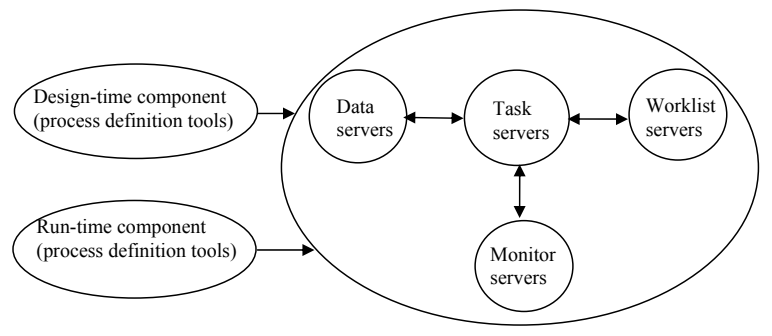
図です。左に 2 つの楕円「Design-time component (process definition tools)」(設計時の構成要素(プロセス定義ツール))と「Run-time component (process definition tools)」(実行時の構成要素(プロセス定義ツール))があり、それぞれ右の大きな楕円へ矢印が向かっています。大きな楕円の中に 4 つの円があります。「Data servers」(データサーバー)、「Task servers」(タスクサーバー)、「Worklist servers」(ワークリストサーバー)が横に並んで両向きの矢印で結ばれ(データサーバー ↔ タスクサーバー ↔ ワークリストサーバー)、タスクサーバーの下の「Monitor servers」(監視サーバー)がタスクサーバーと両向きの矢印で結ばれています。
Figure 1 - Components of the Workflow Management System
図 1 - ワークフロー管理システムの構成要素
The goal of the Workflow policy is to maintain consistency between the internal data and external (users’) expectations of that data. Note that many individual process instances may be operational during process enactment; each needs to be associated with a specific set of data relevant to that individual process instance [WFMC99].
Workflow ポリシーの目標は、内部データと、そのデータに対する外部(利用者)の期待との間の一貫性を維持することです。プロセスの実行中には、多くの個別のプロセスインスタンスが稼働している可能性があり、それぞれが、その個別のプロセスインスタンスに関連する特定のデータの集合に関連付けられる必要があることに注意してください [WFMC99]。
Chinese Wall
Chinese Wall
Brewer and Nash identified the Chinese Wall policy [BN89] to address conflict-of-interest issues related to consulting activities within banking and other financial disciplines. Like WFMS, the Chinese Wall policy is application-specific in that it applies to a narrow set of activities that are tied to specific business transactions. For example, consultants naturally are given access to proprietary information to provide a service for their clients. When a consultant gains knowledge amounting to insider information, that knowledge can be used outside the company, thus undermining the competitive advantage of one or both institutions, or used for personal profit. The stated objective of the Chinese Wall policy is to prevent illicit flows of information that can result in conflicts of interest.
Brewer と Nash は、銀行業やその他の金融分野におけるコンサルティング活動に関連する利益相反の問題に対処するため、Chinese Wall ポリシーを提唱しました [BN89]。WFMS と同様に、Chinese Wall ポリシーは、特定の業務トランザクションに結び付いた狭い範囲の活動に適用されるという点で、アプリケーション固有です。たとえば、コンサルタントは、クライアントにサービスを提供するために、当然ながら専有情報へのアクセスを与えられます。コンサルタントが、インサイダー情報に相当する知識を得ると、その知識を会社の外で使うことで、一方または両方の機関の競争上の優位性が損なわれたり、個人的な利益のために使われたりする可能性があります。Chinese Wall ポリシーの目的として述べられているのは、利益相反をもたらしうる不正な情報の流れを防止することです。
The Chinese Wall policy is a commercially inspired confidentiality policy, whereas most other commercial policies focus on integrity. The access permissions change dynamically: as a subject accesses some objects, other objects that would previously have been accessible are now denied. For example, Chinese Wall policy is used where company-sensitive information is categorized into mutually disjoint conflict-of-interest categories (COI). Each company belongs to only one COI, and each COI has two or more member companies. The membership within a COI includes like companies, whereby a consultant obtaining sensitive information regarding one company would risk a conflict of interest if he or she were to obtain sensitive information concerning another company. Several COIs may coexist. For example, COI\(_1\) may pertain to banks, while COI\(_2\) may pertain to energy companies. The Chinese Wall policy aims to prevent a consultant from reading information for more than one company in any given COI.
Chinese Wall ポリシーは、商業上の発想から生まれた機密性のポリシーであり、これに対して、ほかのほとんどの商業ポリシーは完全性に重点を置いています。アクセスのパーミッションは動的に変化します。サブジェクトがあるオブジェクトにアクセスすると、それまでアクセスできたはずのほかのオブジェクトが、拒否されるようになります。たとえば、Chinese Wall ポリシーは、企業の機微な情報が、相互に重ならない利益相反カテゴリ(COI)に分類されている場合に使われます。各企業は1つの COI にしか属さず、各 COI には2社以上の会員企業があります。COI の会員には同種の企業が含まれ、コンサルタントがある企業に関する機微な情報を得た場合に、別の企業に関する機微な情報も得ると、利益相反の危険が生じます。複数の COI が共存する場合もあります。たとえば、COI\(_1\) は銀行に関するもので、COI\(_2\) はエネルギー企業に関するものという場合があります。Chinese Wall ポリシーは、コンサルタントが、ある COI の中で複数の企業の情報を読むことを防ぐことを目的としています。
There are several observations that we can make regarding this policy with respect to read operations. First, as long as a consultant has not read information belonging to any institution, the consultant is not yet bound by the policy and is free to read any sensitive information of any institution. Note that although a consultant may be free to read sensitive information under the Chinese Wall policy, he or she may be restricted from reading sensitive information with respect to another policy, such as a MAC policy. Second, once a consultant has read sensitive information of bank A, the consultant is prohibited from reading sensitive information belonging to any other bank included in the COI of which bank A is a member. Third, all consultants are free to read all the public information of all institutions.
このポリシーについて、読み取り操作に関してはいくつかの所見を述べられます。第一に、コンサルタントがどの機関に属する情報もまだ読んでいない限り、そのコンサルタントはまだこのポリシーに拘束されず、どの機関のどの機微な情報も自由に読むことができます。コンサルタントは Chinese Wall ポリシーのもとでは機微な情報を自由に読めるとしても、MAC ポリシーなどのほかのポリシーのもとでは、機微な情報の読み取りが制限される場合があることに注意してください。第二に、コンサルタントがいったん銀行 A の機微な情報を読むと、そのコンサルタントは、銀行 A が会員になっている COI に含まれるほかのどの銀行に属する機微な情報も、読むことを禁止されます。第三に、すべてのコンサルタントは、すべての機関のすべての公開情報を自由に読むことができます。
In the history-based access control policies, previous access events are used as one of the decision factors for the next access authorization; the policies require sophisticated historical system state control for tracking and maintaining of historical events. For example, Chinese Wall policy is simple and easy to describe; however, its implementation and deployment are less straightforward.
履歴ベースのアクセス制御ポリシーでは、過去のアクセスイベントが、次のアクセス認可の決定要因の一つとして使われます。これらのポリシーでは、履歴イベントを追跡し維持するために、高度な履歴のシステム状態の制御が必要です。たとえば、Chinese Wall ポリシーは単純で説明しやすいものですが、その実装と展開はそれほど単純ではありません。
3 CAPABILITIES AND LIMITATIONS OF ACCESS CONTROL MECHANISMS
3 アクセス制御機構の能力と限界
This section describes major access control mechanisms that support most of the popular access control policies mentioned in Section 2, as well as the limitations of the mechanisms. Note that the mechanisms discussed in this section are for standalone host systems; the mechanisms for distributed systems are covered in Section 4.
本節では、第 2 節で述べた一般的なアクセス制御ポリシーのほとんどを支える主要なアクセス制御機構と、それらの機構の限界を説明します。本節で論じる機構は単独のホストシステム向けのものであり、分散システム向けの機構は第 4 節で扱うことに注意してください。
In general, access control mechanisms require that security attributes be kept for users and resources. User security attributes can consist of categories such as user identifiers, groups, and roles to which users belong, or they can include security labels reflecting the level of trust bestowed on the user. Resource attributes can take on a wide variety of forms. For example, they can consist of sensitivity labels, types, or access control lists. In determining a user’s ability to perform operations on a resource, access control mechanisms compare the user’s security attributes to those of the resource.
一般に、アクセス制御機構では、利用者とリソースについてセキュリティ属性を保持する必要があります。利用者のセキュリティ属性は、利用者識別子、利用者が属するグループやロールなどのカテゴリで構成される場合もあれば、利用者に与えられた信頼のレベルを反映するセキュリティラベルを含む場合もあります。リソースの属性には、さまざまな形式があります。たとえば、機微度ラベル、タイプ、アクセス制御リストで構成される場合があります。アクセス制御機構は、利用者がリソースに対して操作を実行できるかどうかを判断する際に、利用者のセキュリティ属性とリソースのセキュリティ属性を比較します。
Access control checks can be determined (evaluated) based on a previously determined set of rules. For example, the security label of the user must be greater than or equal to the security label of the resource for the user to read the contents of the resource. Access control checks can also be determined based on an attribute-matching algorithm. The user may perform a read operation on a resource if the user’s identity and read operation pair is included in the access control list of the resource. Other characteristics of access control mechanisms include attribute review and management capabilities. For example, can the access control system determine the permissions that are associated with a user or the users who can access a resource, or better yet, both? Who can specify permissions? Can permission specification be delegated, and if so, does delegation imply further delegation? [FKC03] Access control mechanisms are often characterized in terms of their policy support; this section presents some major access control mechanisms along with discussion of the policies they support and limitations.
アクセス制御のチェックは、あらかじめ決められた一連の規則に基づいて判断(評価)できます。たとえば、利用者がリソースの内容を読み取るには、利用者のセキュリティラベルが、リソースのセキュリティラベル以上でなければなりません。アクセス制御のチェックは、属性照合アルゴリズムに基づいて判断することもできます。利用者の識別情報と読み取り操作の組が、リソースのアクセス制御リストに含まれている場合、利用者はそのリソースに対して読み取り操作を実行できます。アクセス制御機構のそのほかの特徴には、属性の確認・管理機能があります。たとえば、アクセス制御システムは、利用者に関連付けられたパーミッション、リソースにアクセスできる利用者、あるいはさらに望ましいことにその両方を判断できるでしょうか。誰がパーミッションを指定できるのでしょうか。パーミッションの指定は委任できるのでしょうか。できる場合、委任はさらなる委任を意味するのでしょうか。[FKC03] アクセス制御機構は、ポリシーへの対応という観点で特徴づけられることがよくあります。本節では、いくつかの主要なアクセス制御機構を、それらが対応するポリシーと限界についての議論とともに示します。
Note that, to be practical, the discussions exclude the limitations for each access control mechanism and the capabilities that are beyond the intended scope of the original model—for example, the historical recording capability for ACL, or rule constraints for MAC.
実用性を考え、各アクセス制御機構の限界と、元のモデルが意図した範囲を超える能力については議論から除いています。たとえば、ACL の履歴記録能力や MAC の規則制約がこれに当たります。
3.1 Access Control List (ACL) and Limitations
3.1 アクセス制御リスト(ACL)と限界
Resource-oriented access controls, such as access control lists (ACLs) [Pfl97], are the most common access control mechanism in use [Bar97] and by far the most common mechanism for implementing DAC policies. An ACL is an example of a policy concept that is frequently implemented directly or as an approximation in modern operating systems [At el al97, Ben96]. An ACL associates the permitted operation to an object and specifies all the subjects that can access the object, along with their rights to the object. That is, each entry in the list is a pair (subject, set of rights). From another point of view, an ACL corresponds to a column of the access control matrix [Sum97]. ACLs provide a straightforward way of granting or denying access for a specified user or groups of users. Without the use of access control lists, granting access to the level of granularity of a single user can be cumbersome.
アクセス制御リスト(ACL)などのリソース指向のアクセス制御 [Pfl97] は、使用されているアクセス制御機構として最も一般的であり [Bar97]、DAC ポリシーを実装するための機構として群を抜いて一般的です。ACL は、最新のオペレーティングシステムで、直接、または近似として実装されることが多いポリシー概念の一例です [At el al97, Ben96]。ACL は、許可される操作をオブジェクトに関連付け、そのオブジェクトにアクセスできるすべてのサブジェクトを、そのオブジェクトに対する権利とともに指定します。つまり、リストの各エントリは、(サブジェクト、権利の集合)の組です。別の見方をすると、ACL は、アクセス制御行列の列に対応します [Sum97]。ACL は、指定した利用者または利用者のグループに対して、アクセスを許可または拒否する簡単な方法を提供します。アクセス制御リストを使わずに、単一の利用者の粒度でアクセスを許可するのは、面倒になる場合があります。
The composition of an ACL entry is as follows:
ACL エントリの構成は次のとおりです。
•Tag type specifies that the ACL entry is one of the following: the file owner, the owning group, a specific named user, a specific named group, or other (meaning all other users).
•タグタイプは、ACL エントリが、ファイルの所有者、所有グループ、特定の名前付き利用者、特定の名前付きグループ、その他(ほかのすべての利用者を意味する)のいずれであるかを指定します。
•Qualifier field describes the specific instance of the tag type. For specific named users and specific named groups, the qualifier field contains the userid and groupid, respectively. Qualifier fields for the owner entry and owning group entries are not relevant because this information is specified elsewhere.
•修飾子フィールドは、タグタイプの具体的なインスタンスを記述します。特定の名前付き利用者と特定の名前付きグループの場合、修飾子フィールドには、それぞれ userid と groupid が入ります。所有者エントリと所有グループのエントリの修飾子フィールドは、この情報がほかの場所で指定されるため、関係ありません。
•Set of permissions specifies the access rights such as read, write, or execute for the entry.
•パーミッションの集合は、そのエントリに対する、読み取り、書き込み、実行などのアクセス権を指定します。
For example,
たとえば、
user:rwx (r is read, w is write, and x is execute) File owner tag (with empty qualifier) specifies the owning user has read, write, and execute permission.
user:rwx(r は読み取り、w は書き込み、x は実行)ファイル所有者のタグ(修飾子は空)は、所有ユーザーが読み取り、書き込み、実行のパーミッションを持つことを指定します。
user.userid:rw- Named user tag specifies the user userid (qualifier) has read and write permission.
user.userid:rw- 名前付きユーザーのタグは、ユーザー userid(修飾子)が読み取りと書き込みのパーミッションを持つことを指定します。
group:r-x Group owner tag (with empty qualifier) specifies the owning group has read and execute permission.
group:r-x グループ所有者のタグ(修飾子は空)は、所有グループが読み取りと実行のパーミッションを持つことを指定します。
group.groupid:--x Named group tag specifies the group groupid (qualifier) has execute permission.
group.groupid:--x 名前付きグループのタグは、グループ groupid(修飾子)が実行のパーミッションを持つことを指定します。
other:r-- Other tag (with empty qualifier) specifies all other users (than the owning and named users and groups) have the read permission.
other:r-- その他のタグ(修飾子は空)は、(所有ユーザーと、名前付きのユーザーおよびグループ以外の)ほかのすべての利用者が読み取りのパーミッションを持つことを指定します。
To determine the read, write, and execute access, the access check is performed on the ACL entries in the following algorithm:
読み取り、書き込み、実行のアクセスを判断するために、ACL エントリに対して、次のアルゴリズムでアクセスチェックが行われます。
1.If the user requesting access is the object owner, and the requested permission is granted by the ACL entry, then access is granted.
1.アクセスを要求している利用者がオブジェクトの所有者であり、要求されたパーミッションが ACL エントリによって許可されている場合、アクセスが許可されます。
2.If the user requesting access is a named user in the ACL, and the requested permission is granted by the ACL entry, then access is granted.
2.アクセスを要求している利用者が ACL 内の名前付き利用者であり、要求されたパーミッションが ACL エントリによって許可されている場合、アクセスが許可されます。
3.If the user requesting access is in the owning group of the file, or is a member of any named groups, and the requested access permission is granted by the ACL entry of the owning group or the ACL entry of any of these named groups, then access is granted.
3.アクセスを要求している利用者がファイルの所有グループに属しているか、いずれかの名前付きグループの構成員であり、要求されたアクセスパーミッションが、所有グループの ACL エントリまたはそれらの名前付きグループのいずれかの ACL エントリによって許可されている場合、アクセスが許可されます。
4.If the user requesting access is a member of any of the named groups, and the requested access permission is granted by the ACL entry of any of these named groups, then access is granted.
4.アクセスを要求している利用者がいずれかの名前付きグループの構成員であり、要求されたアクセスパーミッションが、それらの名前付きグループのいずれかの ACL エントリによって許可されている場合、アクセスが許可されます。
5.If the requested access permission is granted by the “other” entry, then access is granted, otherwise access is denied.
5.要求されたアクセスパーミッションが「その他」のエントリによって許可されている場合、アクセスが許可され、そうでなければアクセスは拒否されます。
When a match on one of these is made, the ACL is no longer searched, and the granted or denied permissions are in effect. For example, if a user is specified as a named user, and all permissions in the entry are set to deny access to that user, the user is denied access. The groups to which the user may belong are not checked to see if the user may have access through the groups' permissions.
これらのいずれかで一致が見つかると、ACL はそれ以上検索されず、許可または拒否されたパーミッションが有効になります。たとえば、ある利用者が名前付き利用者として指定され、そのエントリのすべてのパーミッションがその利用者のアクセスを拒否するように設定されている場合、その利用者はアクセスを拒否されます。その利用者が属している可能性のあるグループは、そのグループのパーミッションを通じてその利用者がアクセスできるかどうかを確認するために調べられることはありません。
Table 1 is a simplified example of an ACL. In this example, a list of identifiers of the form Tag (Group, User) and Qualifier is used, where a * is a wildcard symbol matching any user or group name. When a user opens a file, the list is scanned and the allowed access corresponds to the first match. All groups can read File_a, but only group group1 can also execute it. Kathy can read, write, and execute File_b. Janet has no access (-) to File_c unless she is in the Group1 group. All other users have read access.
表 1 は、ACL の簡略化した例です。この例では、タグ(グループ、ユーザー)と修飾子の形式の識別子のリストを使っており、* は、任意の利用者名またはグループ名に一致するワイルドカード記号です。利用者がファイルを開くとき、リストが走査され、許可されるアクセスは最初の一致に対応します。すべてのグループが File_a を読み取れますが、グループ group1 だけは、それを実行することもできます。Kathy は File_b を読み取り、書き込み、実行できます。Janet は、Group1 グループに属していない限り、File_c にアクセスできません(-)。ほかのすべての利用者は、読み取りアクセスができます。
| Object | |
|---|---|
| File_a | Group.*: r; Group.group1: rx |
| File_b | User. Kathy: rwx |
| File_c | Group.group1: rx; User. Janet: - - -; *.*: r |
| オブジェクト | |
|---|---|
| File_a | Group.*: r; Group.group1: rx |
| File_b | User. Kathy: rwx |
| File_c | Group.group1: rx; User. Janet: - - -; *.*: r |
Table 1 – Simplified Example of an ACL
表 1 – ACL の簡略化した例
Commercial operating systems such as Microsoft (MS) Windows 2000, 2003, and XP employ ACLs for built-in access control. On an MS Windows system partition, users can set ACLs for a specific resource, such as a file or folder, by opening the Properties window from that resource’s context menu and clicking on the “Security” tab. UNIX (and UNIX variants such as LINUX and FreeBSD) also support the implementation of ACLs using the baseline access control mechanism of protection bits (see Section 3.3). More details for MS Windows and UNIX (LINUX, FreeBSD) ACL implementations are listed in Appendix C.
Microsoft(MS)Windows 2000、2003、XP などの商用オペレーティングシステムは、組み込みのアクセス制御に ACL を使っています。MS Windows のシステムパーティションでは、ファイルやフォルダーなどの特定のリソースについて、そのリソースのコンテキストメニューから[プロパティ]ウィンドウを開き、[セキュリティ]タブをクリックすることで、利用者が ACL を設定できます。UNIX(および LINUX や FreeBSD などの UNIX の派生)も、保護ビットという基本のアクセス制御機構を使った ACL の実装に対応しています(第 3.3 節を参照)。MS Windows と UNIX(LINUX、FreeBSD)の ACL 実装の詳細は、付録 C に示しています。
In an ACL environment it is easy to answer the question “who are the users that have access to this object”, but it is difficult to determine all privileges for a user, not just for that object. For instance, in such an environment one would have to search all of the ACLs. This would be all but impossible in many situations, especially for a large system where a flexible and constantly changing access control policy is required. In enterprise environments where there is significant user turnover, ACLs have serious difficulties; the sorted-order mechanism1 of the list makes it difficult to centrally administrate ACLs, especially with a large number of users and groups. For example, if an organization decides to change from one policy model to another, it is quite likely that the new policy model will have to be implemented above the operating system level, perhaps even as part of the application code or through an intermediary. Further, different systems have their own format of ACL, which means the ACLs are platform-dependent. This is inconvenient, subject to error, slow, and makes it difficult to identify or model the overall “policy” that is enforced by the system [Hu02].
ACL の環境では、「このオブジェクトにアクセスできる利用者は誰か」という問いには簡単に答えられますが、そのオブジェクトだけでなく、ある利用者のすべての権限を判断するのは困難です。たとえば、そのような環境では、すべての ACL を検索しなければなりません。多くの状況では、これはほとんど不可能に近く、特に、柔軟で絶えず変化するアクセス制御ポリシーが必要な大規模システムではそうです。利用者の入れ替わりが多いエンタープライズ環境では、ACL には深刻な困難があります。リストの整列順の仕組み1のため、特に利用者とグループが多数ある場合、ACL を一元的に管理するのは困難です。たとえば、組織があるポリシーモデルから別のポリシーモデルへ変更することを決めた場合、新しいポリシーモデルは、オペレーティングシステムのレベルより上で、おそらくはアプリケーションのコードの一部として、あるいは仲介層を通じて実装しなければならなくなる可能性がかなり高くなります。さらに、システムごとに ACL の形式が異なり、つまり ACL はプラットフォームに依存します。これは不便で、誤りが生じやすく、遅く、システムが実施している全体的な「ポリシー」を特定したりモデル化したりするのを難しくします [Hu02]。
3.2 Protection Bits and Limitations
3.2 保護ビットと限界
A protection bits (or owner/group/other) mechanism [FKC03] is commonly included in UNIX and UNIX-like operating systems. This mechanism is a simple and very common DAC control scheme that uses only a few bits of access control information attached to each file. These bits specify the defined permissions of read, write, and execute for different classes of users:
保護ビット(または所有者/グループ/その他)機構 [FKC03] は、UNIX および UNIX 類似のオペレーティングシステムに一般的に含まれています。この機構は、単純で非常に一般的な DAC の制御方式であり、各ファイルに付随する、ごく少数のビットのアクセス制御情報だけを使います。これらのビットは、利用者の分類ごとに、読み取り、書き込み、実行について定められたパーミッションを指定します。
1.Owner: the file owner
1.所有者: ファイルの所有者
2.Group: users belonging to the owner’s group or project specified as the “owning group”
2.グループ: 「所有グループ」として指定された、所有者のグループまたはプロジェクトに属する利用者
3.Others: the rest of the world
3.その他: それ以外のすべての人
The access control system regulates access to a file by associating read (r), write (w), or execute (x) operations with each of these categories of users (Table 2).
アクセス制御システムは、これらの利用者の分類ごとに、読み取り(r)、書き込み(w)、実行(x)の操作を関連付けることで、ファイルへのアクセスを規制します(表 2)。
| Owner | Group | Other | ||||||
|---|---|---|---|---|---|---|---|---|
| R | W | X | R | W | X | R | W | X |
| 所有者 | グループ | その他 | ||||||
|---|---|---|---|---|---|---|---|---|
| R | W | X | R | W | X | R | W | X |
Table 2 – Permission Bits
表 2 – パーミッションビット
By default, the owner of the file is the one who created the file. The owner of the file is typically the only one besides the system administrator (“superuser” or “root”) who can modify the protection bits. Also note that there is only one group that is available for each file. The system administrator controls group memberships, so that as membership within these groups changes, so will the capabilities of users to access files. For example, File_a has the following protection bits:
既定では、ファイルの所有者は、そのファイルを作成した人です。ファイルの所有者は、通常、システム管理者(「スーパーユーザー」または「root」)を除いて、保護ビットを変更できる唯一の存在です。また、各ファイルに使えるグループは1つだけであることにも注意してください。システム管理者がグループの所属を管理するため、これらのグループへの所属が変わると、利用者のファイルへのアクセス能力もそれに伴って変わります。たとえば、File_a の保護ビットが次のようになっているとします。
File_a: (rwx) (r-x) (--x)
File_a: (rwx) (r-x) (--x)
The protection bits indicate that the owner has read, write, and execute permission to file File_a; the members of the group that is associated with the owner have read and execute permission to the file; and all other system users have execute permission to the file. The “-” marking indicates that the corresponding operation is denied on File_a.
この保護ビットは、所有者がファイル File_a に対して読み取り、書き込み、実行のパーミッションを持ち、所有者に関連付けられたグループの構成員が、そのファイルに対して読み取りと実行のパーミッションを持ち、ほかのすべてのシステム利用者が、そのファイルに対して実行のパーミッションを持つことを示します。「-」の表示は、File_a に対して、対応する操作が拒否されることを示します。
In general, an access control list has three mandatory entries: an owner entry, an owner group entry, and a world entry. This allows the three entries of the permission bit mechanism (owner, group, and other) to be read, write, and execute permissions at a minimum (see Table 2). Calls made to modify these ACL entries will also modify the corresponding file protection bits. Likewise, calls made to modify the file protection bits will also modify the corresponding ACL entries. This feature is intended to support backward compatibility with the large pool of existing applications that use the interfaces to the file protection bit mechanism [NSP94].
一般に、アクセス制御リストには、所有者のエントリ、所有グループのエントリ、全体のエントリという3つの必須のエントリがあります。これにより、パーミッションビット機構の3つのエントリ(所有者、グループ、その他)に、最低限、読み取り、書き込み、実行のパーミッションを設定できます(表 2 を参照)。これらの ACL エントリを変更するために行われた呼び出しは、対応するファイルの保護ビットも変更します。同様に、ファイルの保護ビットを変更するために行われた呼び出しは、対応する ACL エントリも変更します。この機能は、ファイル保護ビット機構へのインタフェースを使う、既存の多数のアプリケーションとの後方互換性を支えることを意図したものです [NSP94]。
In some large systems where users are grouped by project or department, most access control needs are satisfied by a protection bits mechanism. However, this method can be cumbersome to use if permissions need to be specified for a named user who is not the owner (and nearly impossible to specify separate permissions for two users, neither of whom is the owner). It is also not possible to provide specific permissions for different named groups of users. For example, there is no way for Dave to specify that only Rick, and nobody else, should have access to a file, unless there is a group defined in the system to which only Dave and Rick belong [Gas88]. This drawback usually results in users giving world access to their files, even though they only want to make the files accessible to specific users. This limitation is likely to lead to significant vulnerabilities, because users are forced to make more and more information available to everyone. This situation violates the well-known principle of “least privilege,” which states that each user should have only those permissions needed to perform his or her job, and no more. The inability to specify access rights for an individual user and specific groups pointed to the need to provide a discretionary access control mechanism that can provide the granularity of specifying individual users and named groups. For this reason, many newer versions of UNIX and UNIX-like operating systems include ACL mechanisms.
利用者がプロジェクトや部署ごとにグループ化されている一部の大規模システムでは、アクセス制御のニーズの大半は、保護ビット機構で満たされます。しかし、所有者ではない名前付き利用者のためにパーミッションを指定する必要がある場合、この方法は使いにくくなる可能性があります(所有者ではない2人の利用者に対して、別々のパーミッションを指定することはほとんど不可能です)。また、名前付きの異なるグループに対して、特定のパーミッションを与えることもできません。たとえば、システム内に Dave と Rick だけが属するグループが定義されていない限り、Dave が、Rick だけにファイルへのアクセス権を持たせ、ほかの誰にも持たせないと指定する方法はありません [Gas88]。この欠点により、利用者は通常、特定の利用者だけにファイルをアクセス可能にしたいにもかかわらず、ファイルを全員にアクセス可能にしてしまいます。この制限は、利用者が、ますます多くの情報を全員が利用できるようにせざるをえないため、重大な脆弱性につながる可能性があります。この状況は、各利用者は職務の遂行に必要なパーミッションだけを持つべきで、それ以上は持つべきではないとする、よく知られた「最小権限」の原則に反します。個々の利用者と特定のグループに対してアクセス権を指定できないことから、個々の利用者と名前付きグループを指定できる粒度を提供する任意アクセス制御機構を用意する必要があることがわかりました。このため、UNIX および UNIX 類似のオペレーティングシステムの新しいバージョンの多くには、ACL 機構が含まれています。
3.3 Capability List and Limitations
3.3 ケイパビリティリストと限界
Another type of access control is the capability list or access list. A capability is a key to a specific object, along with a mode of access (read, write, or execute). In a capability system, access to an object is allowed if the subject that is requesting access possesses a capability for the object. It can thus be thought of as the inverse of an access control list: an ACL is attached to an object and specifies which subjects may access the object, while a capability list is attached to a subject and specifies which objects the subject may access. A capability is a protected identifier that both identifies the object and specifies the operations to be allowed to the user who possesses the capability. This approach corresponds to storing the access control matrix by rows. Table 3 presents an example of a capability list.
もう一つの種類のアクセス制御は、ケイパビリティリストまたはアクセスリストです。ケイパビリティは、特定のオブジェクトへの鍵であり、アクセスのモード(読み取り、書き込み、実行)とともに示されます。ケイパビリティシステムでは、アクセスを要求しているサブジェクトがそのオブジェクトに対するケイパビリティを所持している場合に、オブジェクトへのアクセスが許可されます。したがって、アクセス制御リストの逆と考えることができます。ACL はオブジェクトに付随し、どのサブジェクトがそのオブジェクトにアクセスできるかを指定しますが、ケイパビリティリストはサブジェクトに付随し、そのサブジェクトがどのオブジェクトにアクセスできるかを指定します。ケイパビリティは、保護された識別子であり、オブジェクトを識別すると同時に、そのケイパビリティを所持する利用者に許可される操作を指定します。この方法は、アクセス制御行列を行ごとに保存することに対応します。表 3 は、ケイパビリティリストの例を示します。
| Subject | Capability | |
|---|---|---|
| Object: Operations | ||
| Ann | File_A: Read, Write | File_C: Write |
| Bob | File_B: Read | Process_X: Suspend |
| Chris | File_B: Execute | File_C: Read |
| Deb | File_A: Read | |
| サブジェクト | ケイパビリティ | |
|---|---|---|
| オブジェクト: 操作 | ||
| Ann | File_A: 読み取り, 書き込み | File_C: 書き込み |
| Bob | File_B: 読み取り | Process_X: 一時停止 |
| Chris | File_B: 実行 | File_C: 読み取り |
| Deb | File_A: 読み取り | |
Table 3 – Capability List
表 3 – ケイパビリティリスト
The capability list in the table is associated with a subject and specifies the subject’s rights. Each entry in the list is a capability - a pair <object, set of operations>. A subject possessing a capability is proof of the subject having the access privileges. So, it can be useful to think of capabilities as being similar to tickets. However, unlike tickets, in some systems capabilities can be copied, and there may be the potential for the possessor of a capability to give a copy to someone else (this capacity is itself often represented as a “right”).
表中のケイパビリティリストは、サブジェクトに関連付けられ、そのサブジェクトの権利を指定します。リストの各エントリはケイパビリティであり、<object, set of operations> の組です。サブジェクトがケイパビリティを所持していることは、そのサブジェクトがアクセス権限を持っていることの証明です。したがって、ケイパビリティはチケットに似たものと考えると役に立つ場合があります。ただし、チケットとは異なり、システムによってはケイパビリティはコピーでき、ケイパビリティの所持者がそのコピーをほかの誰かに渡す可能性があります(この能力自体が「権利」として表されることも多くあります)。
A capability list corresponds to a row of the access control matrix. The principal advantage of capabilities is that it is easy to review all accesses that are authorized for a given subject. The most successful use of capabilities is at lower levels in the system, where capabilities provide the underlying protection mechanism and not the user-visible access control scheme. At the highest levels in the system, the system maintains a list of capabilities for each user. Users cannot add capabilities to this list except to cover new files that they create. Users might, however, be allowed to give access to objects by passing copies of their own capabilities to other users, and they might be able to revoke access to their own objects by taking away capabilities from others (although revocation can be difficult to implement).
ケイパビリティリストは、アクセス制御行列の行に対応します。ケイパビリティの主な利点は、あるサブジェクトに認可されているすべてのアクセスを、容易に確認できることです。ケイパビリティが最も成功している使われ方は、システムの下位レベルにおいて、利用者から見えるアクセス制御方式ではなく、基盤となる保護機構を提供する場合です。システムの最上位レベルでは、システムが利用者ごとにケイパビリティのリストを維持します。利用者は、自分が作成する新しいファイルを対象とする場合を除き、このリストにケイパビリティを追加することはできません。ただし、利用者は、自分のケイパビリティのコピーをほかの利用者に渡すことでオブジェクトへのアクセスを与えることを許される場合があり、またほかの利用者からケイパビリティを取り上げることで、自分のオブジェクトへのアクセスを取り消せる場合もあります(ただし、取り消しの実装は困難な場合があります)。
Contrary to the ACL, the capability list mechanism makes it difficult to review the subjects that can access a particular object. To do so, the system would check each and every capability list for each user that may contain hundreds or thousands of entries. It is also difficult to revoke access to an object, given the need for a similar examination. For example, when an object is deleted, the system must purge capabilities for the object from every user’s list. Answering a simple question such as “who has access to this object?” requires the system to undergo a long search through every user’s capability list. For this reason, capability lists usually require other mechanisms to maintain the tickets. This is inconvenient, subject to error, slow, and makes it difficult to identify or model the DAC policies, and therefore is not commercially popular. At a minimum, a capability list system must ensure that capabilities are not forged or improperly changed and must control how they propagate. The advantages and disadvantages of access control lists and capability lists are summarized in Table 4.
ACL とは対照的に、ケイパビリティリスト機構では、特定のオブジェクトにアクセスできるサブジェクトを確認するのが困難です。そのためには、システムは、数百あるいは数千のエントリを含みうる各利用者のケイパビリティリストを、1つ残らず調べなければなりません。同様の調査が必要になるため、オブジェクトへのアクセスを取り消すのも困難です。たとえば、オブジェクトが削除されると、システムはすべての利用者のリストから、そのオブジェクトのケイパビリティを消去しなければなりません。「このオブジェクトにアクセスできるのは誰か」といった簡単な問いに答えるには、システムがすべての利用者のケイパビリティリストを長時間検索する必要があります。このため、ケイパビリティリストでは、通常、チケットを維持するためのほかの機構が必要になります。これは不便で、誤りが生じやすく、遅く、DAC ポリシーを特定したりモデル化したりするのを難しくするため、商業的には普及していません。ケイパビリティリストシステムは、最低限、ケイパビリティが偽造されたり不適切に変更されたりしないようにし、それらがどのように伝播するかを制御しなければなりません。アクセス制御リストとケイパビリティリストの長所と短所を、表 4 にまとめます。
| Access control list | Capability list | |
|---|---|---|
| Who has access to this object? | Easy | Hard |
| What objects can this user access? | Hard | Easy |
| アクセス制御リスト | ケイパビリティリスト | |
|---|---|---|
| このオブジェクトにアクセスできるのは誰か | 容易 | 困難 |
| この利用者はどのオブジェクトにアクセスできるか | 困難 | 容易 |
Table 4 – Advantages and Disadvantages of ACLs and Capability Lists
表 4 – ACL とケイパビリティリストの長所と短所
3.4 Role-Based Access Control (RBAC) and Limitations
3.4 ロールベースアクセス制御(RBAC)と限界
Role-based access control (RBAC) [FKC03] policies regulate the access of users to information on the basis of the activities the users perform. Role-based policies require the identification of roles in the system. A role is a collection of permissions to use resources appropriate to a person's job function; it is thus defined as a set of actions and responsibilities associated with a particular working activity. Instead of specifying all the accesses each user is allowed to execute, access authorizations on objects are specified for roles. Users are given authorization to adopt roles.
ロールベースアクセス制御(RBAC)[FKC03] のポリシーは、利用者が行う活動に基づいて、利用者による情報へのアクセスを規制します。ロールベースのポリシーでは、システム内のロールを特定する必要があります。ロールとは、個人の職務機能にふさわしい、リソースを使用するためのパーミッションの集まりであり、したがって、特定の業務活動に関連する一連の行為と責任として定義されます。各利用者が実行を許可されるすべてのアクセスを指定する代わりに、オブジェクトに対するアクセス認可は、ロールについて指定されます。利用者には、ロールを担う認可が与えられます。
The RBAC model taxonomy consists of four models – core RBAC, hierarchical RBAC, static constrained RBAC, and dynamic constrained RBAC. Core RBAC covers the basic set of features that are included in all RBAC systems. It is the inclusion of this set of features that distinguishes RBAC from other forms of authorization management systems. Hierarchical RBAC adds the concept of a role hierarchy, defined as a partial ordering on roles, using an inheritance relation. Constrained RBAC includes static and dynamic SOD (Separation of Duties) properties, which are, respectively, separation of duty rules that apply at all times, or on a session-by-session basis. Statically constrained RBAC adds constraint relations imposed on role assignment relations. Dynamic constrained RBAC imposes constraints on the activation of sets of roles that may be included as an attribute of a user’s subjects. The following describe the four different types of RBAC.
RBAC モデルの分類体系は、コア RBAC、階層型 RBAC、静的制約付き RBAC、動的制約付き RBAC の4つのモデルで構成されます。コア RBAC は、すべての RBAC システムに含まれる基本的な機能群を対象とします。この機能群が含まれていることが、RBAC をほかの形態の認可管理システムと区別します。階層型 RBAC は、継承関係を使ってロールの半順序として定義されるロール階層の概念を追加します。制約付き RBAC は、静的および動的な SOD(職務分離)の特性を含み、それぞれ、常に適用される職務分離規則と、セッションごとに適用される職務分離規則です。静的制約付き RBAC は、ロール割り当て関係に課される制約関係を追加します。動的制約付き RBAC は、利用者のサブジェクトの属性として含まれうるロールの集合の有効化に対して、制約を課します。次に、4つの異なる種類の RBAC を説明します。
3.4.1 Core
3.4.1 コア
Core RBAC consist of five administrative sets: users, roles, permission, operations, and objects, where permissions are composed of operations applied to objects. The concept of role is the center of RBAC. A role is a semantic construct around which access policy is formulated. Permissions are associated with roles, and users are made members of roles, thereby acquiring the roles’ permissions. A single user can be associated with one or more roles, and a single role can have one or more user members. This arrangement provides great flexibility and granularity of assignment of permissions to roles and users to roles.
コア RBAC は、利用者、ロール、パーミッション、操作、オブジェクトという5つの管理用の集合で構成され、パーミッションは、オブジェクトに適用される操作で構成されます。ロールの概念は、RBAC の中心です。ロールは、アクセスポリシーを策定する際の軸となる意味上の構成概念です。パーミッションはロールに関連付けられ、利用者はロールの構成員となることで、そのロールのパーミッションを取得します。1人の利用者を1つ以上のロールに関連付けることができ、1つのロールは1人以上の利用者を構成員に持つことができます。この仕組みにより、ロールへのパーミッションの割り当てと、利用者へのロールの割り当てに、大きな柔軟性と粒度がもたらされます。
3.4.2 Hierarchical
3.4.2 階層
Under RBAC, roles can have overlapping responsibilities and privileges; that is, users belonging to different roles may need to perform common operations. Some general operations may be performed by all employees. In this situation, it would be inefficient and administratively cumbersome to specify repeatedly these general operations for each role that gets created. Role hierarchies can be established to provide for the natural structure of an enterprise. A role hierarchy defines roles that have unique attributes and that may contain other roles; that is, one role may implicitly include the operations that are associated with another role. For example, in the healthcare situation, a role called Specialist could contain the roles of Doctor and Intern. This means that members of the role Specialist are implicitly connected with the operations associated with their roles as Doctor and Intern without the administrator having to explicitly list the Doctor and Intern operations. Moreover, the roles Cardiologist and Rheumatologist could each contain the Specialist role. Role hierarchies are a natural way of organizing roles to reflect authority, responsibility, and competency: the role in which the user is gaining membership is not mutually exclusive with another role for which the user already possesses membership. These operations and roles can be subject to organizational policies or constraints. When operations overlap, hierarchies of roles can be established.
RBAC では、ロールの責任と権限が重なり合う場合があります。すなわち、異なるロールに属する利用者が、共通の操作を実行する必要がある場合があります。一部の一般的な操作は、すべての従業員が実行できる場合があります。この状況では、作成されるロールごとにこれらの一般的な操作を繰り返し指定するのは、非効率であり、管理上も面倒です。エンタープライズの自然な構造に対応するために、ロール階層を確立できます。ロール階層は、固有の属性を持ち、ほかのロールを含みうるロールを定義します。すなわち、あるロールが、別のロールに関連付けられた操作を暗黙的に含む場合があります。たとえば、医療の状況では、専門医というロールに、医師とインターンのロールを含めることができます。これは、専門医のロールの構成員は、管理者が医師とインターンの操作を明示的に列挙しなくても、医師およびインターンとしてのロールに関連付けられた操作に暗黙的に結び付けられることを意味します。さらに、循環器専門医とリウマチ専門医のロールは、それぞれ専門医のロールを含むことができます。ロール階層は、権限、責任、能力を反映させるようにロールを編成する自然な方法です。利用者が構成員となろうとしているロールは、その利用者がすでに構成員となっている別のロールと相互に排他的ではありません。これらの操作とロールは、組織のポリシーや制約の対象となる場合があります。操作が重なり合う場合は、ロールの階層を確立できます。
3.4.3 Statically Constrained
3.4.3 静的制約
Instead of instituting costly auditing to monitor access, organizations can put constraints on access through RBAC. For example, it may seem sufficient to allow physicians to have access to all patient data records if their access is monitored carefully. With RBAC, constraints can be placed on physician access so that only those records that are associated with a particular physician can be accessed. Organizations can establish the rules for the association of operations with roles. For example, a healthcare provider may decide that the role of clinician must be constrained to post only the results of certain tests but not to distribute them where routing and human errors could violate a patient's right to privacy. Operations can also be specified in a manner that can be used in the demonstration and enforcement of laws or regulations. For example, a pharmacist can be provided with operations to dispense, but not to prescribe, medication.
アクセスを監視するために費用のかかる監査を導入する代わりに、組織は RBAC を通じてアクセスに制約を設けることができます。たとえば、医師のアクセスを注意深く監視するのであれば、医師にすべての患者データ記録へのアクセスを許可するだけで十分に思えるかもしれません。RBAC では、医師のアクセスに制約を設けて、特定の医師に関連付けられた記録だけにアクセスできるようにすることができます。組織は、操作とロールの関連付けに関する規則を定められます。たとえば、医療提供者は、臨床医のロールを、特定の検査の結果の掲示だけに制約し、経路上の誤りや人的ミスによって患者のプライバシーの権利が侵害されるおそれがある配布は行えないようにすることを決める場合があります。操作は、法律や規制の実証と実施に使える形で指定することもできます。たとえば、薬剤師には、薬を調剤する操作は与えられても、処方する操作は与えられない場合があります。
An operation represents a unit of control that can be referenced by an individual role, subject to regulatory constraints within the RBAC framework. An operation can be used to capture complex security-relevant details or constraints that cannot be determined by a simple mode of access. For example, there are differences between the access needs of a teller and an accounting supervisor in a bank. The bank defines a teller role as being able to perform a savings deposit operation. This requires read and write access to specific fields within a savings file. An enterprise may also define an accounting supervisor role that is allowed to perform correction operations. These operations require read and write access to the same fields of a savings file as the teller. However, the accounting supervisor may not be allowed to initiate deposits or withdrawals but only to perform corrections after the fact. Likewise, the teller is not allowed to perform any corrections once the transaction has been completed. The difference between these two roles is the operations that are executed by the different roles and the values that are written to the transaction log file.
操作は、RBAC の枠組みの中で規制上の制約を受けながら、個々のロールが参照できる制御の単位を表します。操作は、単純なアクセスのモードでは判断できない、セキュリティに関連する複雑な詳細や制約を捉えるために使えます。たとえば、銀行の窓口係と会計主任とでは、アクセスのニーズに違いがあります。銀行は、窓口係のロールを、普通預金の預け入れ操作を実行できるものと定義します。これには、普通預金ファイル内の特定のフィールドへの読み取りと書き込みのアクセスが必要です。エンタープライズは、訂正操作の実行を許可された会計主任のロールも定義する場合があります。これらの操作には、窓口係と同じ普通預金ファイルのフィールドへの読み取りと書き込みのアクセスが必要です。しかし、会計主任には、預け入れや引き出しを開始することは許されず、事後の訂正を実行することだけが許される場合があります。同様に、窓口係には、トランザクションが完了した後で、いかなる訂正も実行することは許されません。これら2つのロールの違いは、異なるロールによって実行される操作と、トランザクションログファイルに書き込まれる値です。
3.4.4 Dynamically Constrained
3.4.4 動的制約
The RBAC framework provides administrators with the capability to regulate the operations that need to be performed by members of a role. Granting of user membership to roles can be limited. Some roles can be occupied only by a certain number of employees at any given period of time. The role of manager, for example, might be granted to only one employee at a time. Although an employee other than the manager may act in that role, only one person may assume the responsibilities of a manager at any given time. A user can become a new member of a role as long as the number of members allowed for the role is not exceeded.
RBAC の枠組みは、管理者に、ロールの構成員が実行する必要のある操作を規制する能力を提供します。利用者のロールへの所属の付与は、制限できます。一部のロールは、ある期間中は一定数の従業員しか担えない場合があります。たとえば、マネージャのロールは、同時に1人の従業員にしか付与されない場合があります。マネージャ以外の従業員がそのロールを代行することはあっても、ある時点でマネージャの責任を担えるのは1人だけです。利用者は、そのロールに許されている構成員数を超えない限り、そのロールの新しい構成員になることができます。
A properly administered RBAC system enables users to carry out a broad range of authorized operations, and provides great flexibility and breadth of application. System administrators can control access at a level of abstraction that is natural to the way that enterprises typically conduct business. This is achieved by statically and dynamically regulating users' actions through the establishment and definition of roles, role hierarchies, relationships, and constraints. Thus, once an RBAC framework is established for an organization, the principal administrative actions are the granting and revoking of users into and out of roles. This is in contrast to the more conventional and less intuitive process of attempting to administer lower-level access control mechanisms directly (e.g., access control lists, access control matrices) on an object-by-object basis. Further, it is possible to associate the concept of an RBAC operation with the concept of “method” in object-oriented technology. This association leads to approaches where object-oriented technology can be used in applications and operating systems to implement an RBAC operation.
適切に管理された RBAC システムは、利用者が幅広い認可された操作を実行できるようにし、大きな柔軟性と幅広い応用を提供します。システム管理者は、エンタープライズが通常業務を行う方法に自然な抽象度で、アクセスを制御できます。これは、ロール、ロール階層、関係、制約の確立と定義を通じて、利用者の行為を静的および動的に規制することによって実現されます。したがって、組織で RBAC の枠組みがいったん確立されると、主な管理上の行為は、利用者にロールへの所属を付与すること、および利用者のロールへの所属を取り消すことになります。これは、より低レベルのアクセス制御機構(アクセス制御リスト、アクセス制御行列など)を、オブジェクトごとに直接管理しようとする、より従来型で直感的でないプロセスとは対照的です。さらに、RBAC の操作の概念を、オブジェクト指向技術の「メソッド」の概念に関連付けることが可能です。この関連付けにより、アプリケーションとオペレーティングシステムでオブジェクト指向技術を使って、RBAC の操作を実装するアプローチが生まれます。
RBAC appears to fit well into the widely varying security policies of industry and government organizations. However, only a few off-the-shelf systems that implement RBAC are commercially available. Windows Server 2003 introduces a complementary authorization interface called Authorization Manager that includes role-based access control, which is based on ACLs. It explains basic concepts: roles, tasks, operations, scopes, basic application groups, and Lightweight Directory Access Protocol (LDAP) query groups. With these concepts, users can create and install authorization rules and implement the Authorization Manager application programming interface (API) [CM03]. Popular commercial database management systems such as Informix Online Dynamic Server, Oracle Enterprise Server, and Sybase Adaptive Server also provide a sound basis for implementing the basic features of RBAC, although there are significant differences among them [RS98].
RBAC は、産業界や政府機関の大きく異なるセキュリティポリシーによく適合するようです。しかし、RBAC を実装した市販の既製システムは、ごく少数しか販売されていません。Windows Server 2003 は、ACL に基づくロールベースアクセス制御を含む、Authorization Manager という補完的な認可インタフェースを導入しています。これは、ロール、タスク、操作、スコープ、基本アプリケーショングループ、Lightweight Directory Access Protocol(LDAP)クエリグループという基本概念を説明しています。これらの概念を使って、利用者は認可規則を作成してインストールし、Authorization Manager のアプリケーションプログラミングインタフェース(API)を実装できます [CM03]。Informix Online Dynamic Server、Oracle Enterprise Server、Sybase Adaptive Server などの一般的な市販のデータベース管理システムも、RBAC の基本機能を実装するための確かな基盤を提供しますが、それらの間には大きな違いがあります [RS98]。
3.4.5 Limitations of RBAC
3.4.5 RBAC の限界
RBAC assumes that all permissions needed to perform a job function can be neatly encapsulated. In fact, role engineering has turned out to be a difficult task. The challenge of RBAC is the contention between strong security and easier administration. For stronger security, it is better for each role to be more granular, thus having multiple roles per user. For easier administration, it is better to have fewer roles to manage. Organizations need to comply with privacy and other regulatory mandates and to improve enforcement of security policies while lowering overall risk and administrative costs. Meanwhile, Web-based and other types of new applications are proliferating, and the Web services application model promises to add to the complexity by weaving separate components together over the Internet to deliver application services. Moreover, the allocation of files and servers (therefore, access control) may be incompatible with organization structure (therefore, process) that requires users to focus on practical matters such as opening accounts and paying bills. RBAC products have sometimes proved challenging to implement and will, for some organizations, need to be combined with rule-based and other more time-tested access control methods to achieve the most practical value [Des03].
RBAC は、職務機能の遂行に必要なすべてのパーミッションを整然とカプセル化できると仮定しています。実際には、ロールエンジニアリングは困難な作業であることがわかっています。RBAC の課題は、強固なセキュリティと管理の容易さの間の相反です。より強固なセキュリティのためには、各ロールをより細かい粒度にして、利用者1人につき複数のロールを持たせるほうがよいです。管理を容易にするには、管理するロールの数を減らすほうがよいです。組織は、プライバシーやその他の規制上の義務を遵守し、全体的なリスクと管理コストを低減しながら、セキュリティポリシーの実施を改善する必要があります。一方で、Web ベースやその他の種類の新しいアプリケーションが急増しており、Web サービスのアプリケーションモデルは、インターネット上で別々の構成要素を織り合わせてアプリケーションサービスを提供することで、複雑さを増すことが見込まれます。さらに、ファイルとサーバーの割り当て(したがってアクセス制御)は、利用者が口座の開設や請求書の支払いなどの実務に集中することを求める、組織の構造(したがってプロセス)と両立しない場合があります。RBAC 製品は、実装が難しいと分かった場合もあり、組織によっては、最も実用的な価値を得るために、ルールベースのアクセス制御やその他の、より長い実績を持つアクセス制御方法と組み合わせる必要があるでしょう [Des03]。
Although an improvement on flexibility compared to DAC and MAC, RBAC ties users to roles and associates those roles with privileges toward objects in the authorization process; it does not leave access control to the discretion of the users or roles. Therefore, RBAC is difficult to use for supporting DAC policy. It has been shown [SM02] that it is possible, though difficult, to implement DAC using RBAC by using multiple roles associated with each system object. Several variations of DAC can be supported using this method. Unfortunately, a large number of resources are required: for each object in the system, four roles and eight permissions must be created. Thus this approach to implementing DAC in RBAC is more of theoretical than practical interest. On the other hand, for real-world implementers this RBAC limitation does not present a significant problem, since most operating systems come equipped with some form of DAC, the most basic form of access control.
RBAC は、DAC や MAC と比べて柔軟性が改善されていますが、認可のプロセスで利用者をロールに結び付け、それらのロールをオブジェクトに対する権限に関連付けるものであり、アクセス制御を利用者またはロールの裁量には委ねません。したがって、RBAC は DAC ポリシーを支えるために使うことが困難です。システムの各オブジェクトに関連付けた複数のロールを使うことで、RBAC を使って DAC を実装することは、困難ではあるものの可能であることが示されています [SM02]。この方法により、DAC のいくつかの変形に対応できます。残念ながら、多数のリソースが必要になります。システム内のオブジェクトごとに、4つのロールと8つのパーミッションを作成しなければなりません。したがって、RBAC で DAC を実装するこのアプローチは、実用上の関心よりも理論上の関心のほうが大きいものです。一方、現実の実装者にとっては、ほとんどのオペレーティングシステムが、最も基本的な形のアクセス制御である何らかの形の DAC を備えているため、この RBAC の限界は大きな問題にはなりません。
The least privilege condition is often difficult or costly to achieve because it is difficult to tailor access based on various attributes or constraints. A more serious concern in using RBAC is the implementation of separation of duty controls. Existing RBAC products have only rudimentary SOD features. Static SOD may be supported, but very few provide dynamic SOD. While these deficiencies may be remedied as more sophisticated products come on the market, there is a more subtle problem with using RBAC to implement SOD. With careful allocation of privileges to roles, SOD is easy and efficient to accomplish with RBAC. But if a single individual has access to all privileges needed to accomplish some critical function, then the system can be compromised regardless of the role structure. For example, suppose that two roles for initiating and approving expenditures are established with SOD between them. That is, the role that can initiate expenditures does not have the permission required to approve them, and the role for approval cannot initiate them. But if a third role is later assigned the permission to approve expenditures, and some user has access to both the initiating role and this third role, then separation of duty has been violated. In effect, a loophole has been created in the role structure. Thus, great care must be used in assigning permissions to roles to ensure that SOD requirements are not compromised. The lack of the mentioned features limits the number of policies RBAC can support. Further, RBAC is implemented under the specific access control policy, thus the flexibility is hard to support when the policy combination is required.
最小権限の条件は、さまざまな属性や制約に基づいてアクセスを調整するのが難しいため、達成するのが困難であるか、費用がかかることがよくあります。RBAC を使う際のより深刻な懸念は、職務分離の制御の実装です。既存の RBAC 製品には、ごく初歩的な SOD 機能しかありません。静的な SOD には対応しているかもしれませんが、動的な SOD を提供するものは非常に少数です。より高度な製品が市場に登場するにつれて、こうした欠陥は解消されるかもしれませんが、RBAC を使って SOD を実装することには、より微妙な問題があります。ロールへの権限を注意深く割り当てれば、RBAC で SOD を容易かつ効率的に実現できます。しかし、1人の個人が、ある重要な機能を実行するために必要なすべての権限にアクセスできる場合、ロールの構造にかかわらず、システムが侵害される可能性があります。たとえば、支出の開始と承認のための2つのロールが、両者の間に SOD を設けて確立されているとします。つまり、支出を開始できるロールには、それを承認するために必要なパーミッションがなく、承認のロールは、それを開始できません。しかし、後から3つ目のロールに支出を承認するパーミッションが割り当てられ、ある利用者が開始のロールとこの3つ目のロールの両方にアクセスできる場合、職務分離は侵害されたことになります。実質的に、ロールの構造に抜け穴が生じたことになります。したがって、SOD の要件が損なわれないようにするためには、ロールへのパーミッションの割り当てに細心の注意を払わなければなりません。前述の機能が不足していることは、RBAC が対応できるポリシーの数を制限します。さらに、RBAC は特定のアクセス制御ポリシーのもとで実装されるため、ポリシーの組み合わせが必要な場合に、柔軟性を支えるのは困難です。
3.5 Rule-Based Access Control (RuBAC) and Limitations
3.5 ルールベースアクセス制御(RuBAC)と限界
RuBAC (as opposed to RBAC, role-based access control) allow users to access systems and information based on pre determined and configured rules. It is important to note that there is no commonly understood definition or formally defined standard for rule-based access control as there is for DAC, MAC, and RBAC. “Rule-based access” is a generic term applied to systems that allow some form of organization-defined rules, and therefore rule-based access control encompasses a broad range of systems. RuBAC may in fact be combined with other models, particularly RBAC or DAC. A RuBAC system intercepts every access request and compares the rules with the rights of the user to make an access decision. Most of the rule-based access control relies on a security label system, which dynamically composes a set of rules defined by a security policy. Security labels are attached to all objects, including files, directories, and devices. Sometime roles to subjects (based on their attributes) are assigned as well. RuBAC meets the business needs as well as the technical needs of controlling service access. It allows business rules to be applied to access control—for example, customers who have overdue balances may be denied service access.
RuBAC(ロールベースアクセス制御である RBAC とは異なります)は、あらかじめ決定され設定された規則に基づいて、利用者がシステムや情報にアクセスできるようにします。DAC、MAC、RBAC には広く理解された定義や正式に定義された標準がありますが、ルールベースアクセス制御にはそのようなものがないことに注意することが重要です。「ルールベースのアクセス」は、組織が定義する何らかの形の規則を許容するシステムに適用される一般的な用語であり、したがって、ルールベースアクセス制御は幅広いシステムを包含します。RuBAC は、実際にはほかのモデル、特に RBAC や DAC と組み合わせることもできます。RuBAC システムは、すべてのアクセス要求を傍受し、利用者の権利を規則と比較して、アクセスの決定を下します。ルールベースアクセス制御の大半は、セキュリティポリシーで定義された一連の規則を動的に構成する、セキュリティラベルのシステムに依存しています。セキュリティラベルは、ファイル、ディレクトリ、デバイスを含むすべてのオブジェクトに付与されます。サブジェクトにも、(その属性に基づいて)ロールが割り当てられる場合があります。RuBAC は、サービスアクセスの制御に関する、技術的なニーズだけでなく業務上のニーズも満たします。業務規則をアクセス制御に適用できます。たとえば、支払期限を過ぎた残高のある顧客に対して、サービスへのアクセスを拒否することができます。
As a mechanism for MAC, rules of RuBAC cannot be changed by users. The rules can be established by any attributes of a system related to the users such as domain, host, protocol, network, or IP addresses. For example, suppose that a user wants to access an object in another network on the other side of a router. The router employs RuBAC with the rule composed by the network addresses, domain, and protocol to decide whether or not the user can be granted access. If employees change their roles within the organization, their existing authentication credentials remain in effect and do not need to be re configured. Using rules in conjunction with roles adds greater flexibility because rules can be applied to people as well as to devices.
MAC のための機構として、RuBAC の規則は利用者が変更できません。規則は、ドメイン、ホスト、プロトコル、ネットワーク、IP アドレスなど、利用者に関連するシステムのあらゆる属性によって確立できます。たとえば、利用者が、ルーターの向こう側にある別のネットワーク上のオブジェクトにアクセスしたいとします。ルーターは、ネットワークアドレス、ドメイン、プロトコルで構成された規則による RuBAC を使って、利用者にアクセスを許可できるかどうかを判断します。従業員が組織内でロールを変更しても、既存の認証用の資格情報は有効なままで、再設定する必要はありません。規則はデバイスだけでなく人にも適用できるため、規則をロールと組み合わせて使うと、より大きな柔軟性が加わります。
Rule-based access control can be combined with role-based access control, such that the role of a user is one of the attributes in rule setting. Some provisions of access control systems have rule-based policy engines in addition to a role-based policy engine and certain implemented dynamic policies [Des03]. For example, suppose that two of the primary types of software users are product engineers and quality engineers. Both groups usually have access to the same data, but they have different roles to perform in relation to the data and the application's function. In addition, individuals within each group have different job responsibilities that may be identified using several types of attributes such as developing programs and testing areas. Thus, the access decisions can be made in real time by a scripted policy that regulates the access between the groups of product engineers and quality engineers, and each individual within these groups. Rules can either replace or complement role-based access control. However, the creation of rules and security policies is also a complex process, so each organization will need to strike the appropriate balance.
ルールベースアクセス制御は、利用者のロールが規則の設定における属性の一つになるように、ロールベースアクセス制御と組み合わせることができます。アクセス制御システムの機能の中には、ロールベースのポリシーエンジンに加えて、ルールベースのポリシーエンジンと、一部の実装済みの動的ポリシーを備えたものがあります [Des03]。たとえば、ソフトウェア利用者の主な種類のうち2つが、製品エンジニアと品質エンジニアだとします。両方のグループは通常、同じデータにアクセスできますが、そのデータとアプリケーションの機能に関して果たすロールは異なります。さらに、各グループ内の個人は、プログラムの開発や試験対象領域など、複数の種類の属性を使って識別できる、異なる職務上の責任をそれぞれ担っています。したがって、製品エンジニアと品質エンジニアのグループ間、およびこれらのグループ内の各個人のアクセスを規制する、スクリプト化されたポリシーによって、アクセスの決定をリアルタイムで行えます。規則は、ロールベースアクセス制御を置き換えることも、補完することもできます。ただし、規則とセキュリティポリシーの作成も複雑なプロセスであるため、各組織は適切なバランスを見つける必要があります。
The LINUX Rule Set Based Access Control (RSBAC) system is an open source security extension to current Linux kernels which has been continuously developed for several years.2 The current stable version 1.2.6 was released on 7 March 2006. RSBAC was designed according to the Generalized Framework for Access Control (GFAC) to overcome the deficiencies of access control in standard Linux systems (lacking the flexible combination of security models as well as proper access logging). The RSBAC framework gives detailed access control information, and the user can implement almost any access control model in it as a runtime registered kernel module. Also, there is a powerful logging system, which makes unauthorized access attempts easily detectable. RSBAC comes with several fully functional access control modules, such as Bell-LaPadula (MAC) and ACLs. Users just have to choose which ones suit their needs best—often a combination is the best choice. The access modes are grouped into abstract request types. RSBAC provides the capability that whenever a subject wants to access an object, the respective request call with parameters request type, subject, object, and attribute data is issued. One system call can lead to several request calls (e.g., sys_open can lead to SEARCH, CREATE, TRUNCATE, and all OPEN request types).
LINUX の Rule Set Based Access Control(RSBAC)システムは、現行の Linux カーネルに対するオープンソースのセキュリティ拡張であり、数年にわたって継続的に開発されてきました。2 現在の安定版であるバージョン 1.2.6 は、2006年3月7日にリリースされました。RSBAC は、標準的な Linux システムのアクセス制御の欠陥(セキュリティモデルの柔軟な組み合わせと適切なアクセスログの記録が欠けていること)を克服するために、Generalized Framework for Access Control(GFAC)に従って設計されました。RSBAC の枠組みは、詳細なアクセス制御情報を提供し、利用者は、実行時に登録されるカーネルモジュールとして、ほぼあらゆるアクセス制御モデルをその中に実装できます。また、強力なログ記録システムがあり、無許可のアクセスの試みを容易に検知できます。RSBAC には、Bell-LaPadula(MAC)や ACL など、完全に機能するアクセス制御モジュールがいくつか付属しています。利用者は、自分のニーズに最も合うものを選ぶだけでよく、多くの場合、組み合わせが最良の選択です。アクセスモードは、抽象的な要求の種類にグループ化されます。RSBAC は、サブジェクトがオブジェクトにアクセスしようとするたびに、要求の種類、サブジェクト、オブジェクト、属性データをパラメータとする、対応する要求呼び出しが発行される能力を提供します。1回のシステムコールが、複数の要求呼び出しにつながることがあります(たとえば、sys_open は、SEARCH、CREATE、TRUNCATE、およびすべての OPEN 要求の種類につながることがあります)。
RuBAC provides for flexibility in administrating security policies; however, it does not provide access assignments and constraints directly related between subjects, operations, and objects as other access control mechanisms do. It is the administrator’s responsibility to ensure that the composing of the rules covers the necessary access constraints or permissions between subjects, operations, and objects as the policy required. Therefore, RuBAC is usually used in combination with other mechanisms. Also, because there is no formal model for rules, RuBAC may have the same limitations as other access control mechanisms do, depending upon which formal mechanism the rules of the RuBAC resemble.
RuBAC は、セキュリティポリシーの管理に柔軟性をもたらしますが、ほかのアクセス制御機構のようには、サブジェクト、操作、オブジェクトの間で直接関連するアクセスの割り当てや制約を提供しません。規則の構成が、ポリシーが求めるサブジェクト、操作、オブジェクトの間の必要なアクセス制約やパーミッションを網羅するようにするのは、管理者の責任です。したがって、RuBAC は通常、ほかの機構と組み合わせて使われます。また、規則には形式的なモデルがないため、RuBAC の規則がどの形式的な機構に似ているかによっては、RuBAC にほかのアクセス制御機構と同じ限界がある可能性があります。
3.6 XML-Based Access Control Languages and Limitations
3.6 XML ベースのアクセス制御言語と限界
A number of efforts have led to the development of Extensible Markup Language (XML)-based frameworks for specification of access control information. The Organization for the Advancement of Structured Information Standards’ (OASIS) Extensible Access Control Markup Language (XACML) and IBM’s XML Access Control Language (XACL) are access control policy specification frameworks that are mainly geared towards securing XML documents, but they can be applied to other system resources as well. Currently these languages do not provide direct support for representing traditional access controls such as DAC or MAC, but a recent extension to XACML incorporates RBAC support. Section 3.6.1 introduces XACML. Section 3.6.2 discusses using XML for policy implementation. Section 3.6.3 discusses the limitations of access control languages.
アクセス制御情報を規定するための Extensible Markup Language(XML)ベースの枠組みの開発につながる取り組みが、数多く行われてきました。Organization for the Advancement of Structured Information Standards(OASIS)の Extensible Access Control Markup Language(XACML)と IBM の XML Access Control Language(XACL)は、主に XML 文書の保護を目的としたアクセス制御ポリシーの規定の枠組みですが、ほかのシステムリソースにも適用できます。現在、これらの言語は、DAC や MAC などの従来のアクセス制御を表現するための直接的な対応を提供していませんが、XACML への最近の拡張は、RBAC への対応を取り入れています。第 3.6.1 節では XACML を紹介します。第 3.6.2 節では、ポリシーの実装に XML を使うことを論じます。第 3.6.3 節では、アクセス制御言語の限界を論じます。
3.6.1 The Extensible Access Control Markup Language (XACML)
3.6.1 Extensible Access Control Markup Language(XACML)
XACML is a general-purpose language for specifying access control policies [Pro04]. In XML terms, it defines a core schema with a namespace that can be used to express access control and authorization policies for XML objects. Since it is based on XML, it is, as its name suggests, easily extensible. XACML provides features that make it possible to support a broad range of policies [Oas06]; it provides the capability to request a specified action within a system using a standardized syntax, and then receive one of four replies:
XACML は、アクセス制御ポリシーを規定するための汎用言語です [Pro04]。XML の用語では、XML オブジェクトのアクセス制御ポリシーと認可ポリシーを表現するために使える、名前空間を持つコアスキーマを定義します。XML に基づいているため、その名前が示すとおり、容易に拡張できます。XACML は、幅広いポリシーに対応できる機能を提供します [Oas06]。標準化された構文を使ってシステム内の指定した操作を要求し、その後で4つの応答のいずれかを受け取る能力を提供します。
•Permit – action allowed
•Permit – 操作が許可されます
•Deny – action disallowed
•Deny – 操作が許可されません
•Indeterminate – error or incorrect/missing value prevents a decision
•Indeterminate – エラー、または不正もしくは欠落した値により、決定できません
•Not Applicable – request cannot be processed.
•Not Applicable – 要求を処理できません。
XACML’s standardized architecture (Figure 2) for this decision-making uses two primary components: the Policy Enforcement Point (PEP) and the Policy Decision Point (PDP). The PEP constructs the request based on the user’s attributes, the resource requested, the action specified, and other situation-dependent information through PIP. The PDP receives the constructed request, compares it with the applicable policy and system state through the Policy Access Point (PAP), and then returns one of the replies specified above to the PEP. The PEP then allows or denies access to the resource. The PEP and PDP components may be embedded within a single application or may be distributed across a network.
この意思決定のための XACML の標準化されたアーキテクチャ(図 2)は、ポリシー実施点(PEP)とポリシー決定点(PDP)という2つの主要な構成要素を使います。PEP は、利用者の属性、要求されたリソース、指定された操作、PIP を通じたその他の状況に依存する情報に基づいて、要求を組み立てます。PDP は、組み立てられた要求を受け取り、ポリシーアクセス点(PAP)を通じて、該当するポリシーおよびシステムの状態と比較し、前述の応答のいずれかを PEP に返します。その後、PEP はリソースへのアクセスを許可または拒否します。PEP と PDP の構成要素は、1つのアプリケーションの中に組み込まれる場合もあれば、ネットワーク上に分散される場合もあります。
To make the PEP and PDP work, XACML provides a policy set, which is a container that holds either a policy or other policy sets, plus (possibly) links to other policies. Each individual policy is stated using a set of rules. XACML also includes methods for combining these policies and policy sets, allowing some to override others. This is necessary because the policies may overlap or conflict. Possible conflicts are resolved through policy-combining algorithms. For example, a simple policy-combining algorithm is “Deny Overrides,” which causes the final decision to be Deny if any policy results in Deny. Conversely, other rules could be established to allow an action if any of a set of policies results in Allow. XACML includes standard policy-combining algorithms, and developers can create their own as well.
PEP と PDP を機能させるために、XACML は、ポリシーまたはほかのポリシーセットを保持するコンテナと、(場合によっては)ほかのポリシーへのリンクで構成される、ポリシーセットを提供します。各個別のポリシーは、一連の規則を使って記述されます。XACML は、これらのポリシーとポリシーセットを組み合わせ、一部がほかを上書きできるようにする方法も含んでいます。ポリシーが重なり合ったり競合したりする場合があるため、これが必要です。起こりうる競合は、ポリシー結合アルゴリズムによって解決されます。たとえば、単純なポリシー結合アルゴリズムは「Deny Overrides」で、いずれかのポリシーの結果が Deny になれば、最終的な決定を Deny にします。逆に、一連のポリシーのいずれかの結果が Allow になれば、その操作を許可するような、ほかの規則を設けることもできます。XACML には標準のポリシー結合アルゴリズムが含まれており、開発者は独自のものを作成することもできます。
Determining what policy or policy set to apply is accomplished using the Target component. A target is a set of rules or conditions applied to each subject, object, and operation. When a rule’s conditions are met for a subject, object, operation combination, its associated policy or policy set is applied using the process described above.
どのポリシーまたはポリシーセットを適用するかの判断は、Target 構成要素を使って行われます。ターゲットは、各サブジェクト、オブジェクト、操作に適用される一連の規則または条件です。サブジェクト、オブジェクト、操作の組み合わせについて規則の条件が満たされると、関連するポリシーまたはポリシーセットが、前述のプロセスによって適用されます。
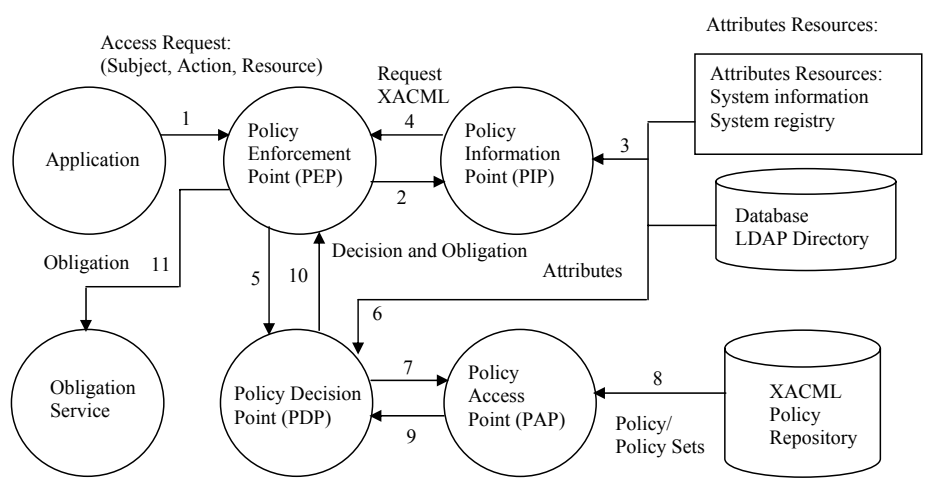
XACML アーキテクチャ図。円は"Application"、"Policy Enforcement Point (PEP)"、"Policy Information Point (PIP)"、"Obligation Service"、"Policy Decision Point (PDP)"、"Policy Access Point (PAP)"。右側には、"Attributes Resources: System information System registry"という箱(見出しは"Attributes Resources:")、"Database LDAP Directory"という円柱、"XACML Policy Repository"という円柱がある。番号付き矢印:1 は Application から PEP へ、ラベルは"Access Request: (Subject, Action, Resource)"。2 は PEP から PIP へ。3 は属性リソースとデータベースから PIP へ。4 は PIP から PEP へ、ラベルは"Request XACML"。5 は PEP から PDP へ。6 は属性ソースから PDP へ、ラベルは"Attributes"。7 は PDP から PAP へ。8 は XACML Policy Repository から PAP へ、ラベルは"Policy/ Policy Sets"。9 は PAP から PDP へ。10 は PDP から PEP へ、ラベルは"Decision and Obligation"。11 は PEP から Obligation Service へ、ラベルは"Obligation"。
Figure 2 - XACML Architecture
図 2 - XACML アーキテクチャ
Web applications can use RBAC services defined by the OASIS XACML Technical Committee.3 The XACML specification describes building blocks from which an RBAC solution is constructed. The specification then discusses how these building blocks may be used to implement the various elements of the RBAC model.
Web アプリケーションは、OASIS XACML Technical Committee が定義した RBAC サービスを使えます。3 XACML の仕様は、RBAC のソリューションを構築するための構成部品を記述しています。この仕様は続いて、これらの構成部品を使って、RBAC モデルのさまざまな要素をどのように実装できるかを論じています。
3.6.2 Using XML for Other Access Control Models
3.6.2 ほかのアクセス制御モデルでの XML の利用
As indicated by Ramaswamy Chandramouli of NIST in the book Role-Based Access Control, [FKC03] XML and XML schema specification languages gained acceptance as standards for representing, interchanging, and presenting both metadata and complex content models in a platform-independent fashion because the XML schema provides a very extensible means for specifying document structures through a comprehensive type definition language. Hence, it is the best candidate for a linguistic framework that is needed to express an access control model that embodies multiple policy requirements. The associated access control data for a given enterprise domain can then be encoded in an XML document, and the conformance of data to the enterprise access control model can be obtained by validating the XML document against the XML schema that represents the enterprise access control model through a type of software called XML parsers. These XML parsers are based on standard application programming interfaces such as Document Object Model (DOM). These parser libraries implemented in various procedural languages enable an application program written in the corresponding procedural language to create, maintain, and retrieve XML-encoded data. Hence, we have a programmable framework to extract enterprise access control data in XML documents, properly interpret them, and map them to the native data formats for access control mechanisms present in heterogeneous application systems within the enterprise.
NIST の Ramaswamy Chandramouli が書籍 Role-Based Access Control [FKC03] で指摘しているように、XML と XML スキーマ仕様言語は、XML スキーマが包括的な型定義言語を通じて文書構造を規定するための非常に拡張性の高い手段を提供することから、メタデータと複雑なコンテンツモデルの両方をプラットフォームに依存しない形で表現、交換、提示するための標準として受け入れられました。したがって、複数のポリシー要件を具体化したアクセス制御モデルを表現するために必要な言語的枠組みとして、最適な候補です。特定のエンタープライズドメインに関連するアクセス制御データは XML 文書として符号化でき、そのデータがエンタープライズのアクセス制御モデルに適合していることは、XML パーサーと呼ばれる種類のソフトウェアを通じて、エンタープライズのアクセス制御モデルを表す XML スキーマに照らして XML 文書を検証することで確認できます。これらの XML パーサーは、Document Object Model(DOM)などの標準のアプリケーションプログラミングインタフェースに基づいています。さまざまな手続き型言語で実装されたこれらのパーサーライブラリにより、対応する手続き型言語で書かれたアプリケーションプログラムは、XML で符号化されたデータを作成、維持、取得できます。したがって、XML 文書内のエンタープライズのアクセス制御データを抽出し、適切に解釈し、エンタープライズ内の異種のアプリケーションシステムに存在するアクセス制御機構のネイティブなデータ形式にマッピングする、プログラム可能な枠組みが得られます。
Besides XML, XACML, and XACL, there are other access control languages developed in research environments, though they are not available as off-the-shelf products. Most of them have properties similar to those of the access control languages discussed here and are therefore constrained by the same limitations.
XML、XACML、XACL のほかにも、研究環境で開発されたアクセス制御言語がありますが、既製品としては入手できません。それらの大半は、ここで論じたアクセス制御言語と似た特性を持っているため、同じ限界の制約を受けます。
3.6.3 Limitations of XML-Based Access Control Languages
3.6.3 XML ベースのアクセス制御言語の限界
XML-based and other access control languages provide capabilities for composing policies from scratch, allowing users to specify a policy, together with the authorizations through the programming of the language. However, as with the RuBAC, the limitation is in the expressive power of higher-order logic such as the expressions of historical-based constraints and domain constraints.
XML ベースのアクセス制御言語やその他のアクセス制御言語は、ポリシーをゼロから組み立てる能力を提供し、利用者が、言語のプログラミングを通じて、認可とともにポリシーを指定できるようにします。しかし、RuBAC と同様に、限界は、履歴ベースの制約やドメイン制約の表現といった高階論理の表現力にあります。
For example, historical-based access constraint requires the manipulation and recording of access states (such as granted privileges). Most access control languages do not provide tools for the expressions of historical constraints for historical-based access control policies, thus leaving the completeness of the constraint logics to the policy writer. Domain constraints are based on the semantic information pertaining to an enterprise context; a grammar-based language cannot deal with content-based constraints. For example, an XML schema is insufficient for a complete specification of the RBAC model for an enterprise since the latter contains content-based domain constraints. An example is not allowing more than one user to be assigned to the role of “division manager” (role cardinality constraint) and not allowing the roles “tester” and “developer” to be assigned to the same user (SOD constraint).
たとえば、履歴ベースのアクセス制約には、(付与された権限などの)アクセス状態の操作と記録が必要です。ほとんどのアクセス制御言語は、履歴ベースのアクセス制御ポリシーのための履歴制約を表現するツールを提供していないため、制約論理の完全性はポリシーの作成者に委ねられます。ドメイン制約は、エンタープライズの文脈に関する意味情報に基づいており、文法ベースの言語では、内容に基づく制約を扱えません。たとえば、エンタープライズの RBAC モデルを完全に規定するには、XML スキーマでは不十分です。RBAC モデルには、内容に基づくドメイン制約が含まれるからです。例として、「部長」のロールに複数の利用者を割り当てることを認めないこと(ロールの基数制約)や、「テスター」と「開発者」のロールを同じ利用者に割り当てることを認めないこと(SOD 制約)があります。
4 CAPABILITIES AND LIMITATIONS OF ACCESS CONTROL FOR DISTRIBUTED SYSTEMS
4 分散システムにおけるアクセス制御の能力と限界
Determining the policy implications of a given access control mechanism is formidable. This is compounded by the wide variety of access control mechanisms used by most enterprises with distributed systems. Section 4 describes major access control mechanisms that support distributed or enterprise systems, as well as the limitations that are inherited from the mechanisms.
特定のアクセス制御機構のポリシー上の意味を判断するのは、手ごわい作業です。分散システムを持つほとんどのエンタープライズが幅広い種類のアクセス制御機構を使っていることで、これはさらに複雑になります。第 4 節では、分散システムまたはエンタープライズシステムを支える主要なアクセス制御機構と、それらの機構から受け継がれる限界を説明します。
To provide greater policy support and control, a number of enterprise management and resource providers offer administrative capabilities over the native access control mechanisms of file management, database management, applications, and host and network operating systems. The result is an access control management system, on top of an access control management system, on top of potentially still another access control system. However, some principles, which are built on the basic access control mechanisms and often supported by a single sign-on system, are well suited for most of the distributed system environment. These principles are:
ポリシーへの対応と制御をより高めるため、多くのエンタープライズ管理およびリソースの提供者が、ファイル管理、データベース管理、アプリケーション、ホストおよびネットワークのオペレーティングシステムに固有のアクセス制御機構に対する、管理能力を提供しています。その結果は、アクセス制御管理システムの上にアクセス制御管理システムがあり、さらにその上に、場合によってはもう一つ別のアクセス制御システムがあるという構成になります。しかし、基本的なアクセス制御機構の上に構築され、多くの場合シングルサインオンシステムによって支えられるいくつかの原則は、分散システム環境の大半によく適しています。それらの原則は次のとおりです。
•User grouping by roles
•ロールによる利用者のグループ化
•Access rules
•アクセス規則
•Centralized control.
•一元的な制御。
Each of these principles will be demonstrated by its accompanying access control mechanisms in this section.
本節では、これらの原則のそれぞれを、付随するアクセス制御機構によって示します。
4.1 User Grouping by Roles
4.1 ロールによる利用者のグループ化
Using RBAC, an organization has central control over its resources. This is different from DAC, in which the creator of a resource determines who can access it. In most organizations, even when a resource is created by an employee, often the resource is still owned by the organization, and the organization wants some level of control over how the resource is to be shared. While the use of delegation in administration of RBAC greatly enhances flexibility and scalability, it may also reduce the control that the organization has over its resources. Because delegation of RBAC administration gives a certain degree of control to a user, that control may be only partially trusted; for some organizations, a natural security concern is whether the organization has some guarantees about who can access its resources.
RBAC を使うと、組織はリソースを一元的に制御できます。これは、リソースの作成者が誰にそのリソースへのアクセスを認めるかを決める DAC とは異なります。ほとんどの組織では、リソースが従業員によって作成された場合でも、そのリソースは組織が所有していることが多く、組織は、そのリソースをどのように共有するかについて、ある程度の制御を望みます。RBAC の管理に委任を用いると、柔軟性とスケーラビリティが大きく高まりますが、組織がリソースに対して持つ制御が弱まる場合もあります。RBAC の管理を委任すると、利用者にある程度の制御が与えられるため、その制御に対して部分的な信頼しか置けない場合があります。組織によっては、誰がそのリソースにアクセスできるかについて、組織が何らかの保証を持っているかどうかが、自然なセキュリティ上の懸念となります。
For distributed systems, RBAC administrator responsibilities can be divided among central and local protection domains; that is, central protection policies can be defined at an enterprise level while leaving protection issues that are of local concern at the organizational unit level. For example, within a distributed healthcare system, operations that are associated with healthcare providers may be centrally specified and pertain to all hospitals and clinics, but the granting and revoking of memberships into specific roles may be specified by administrators at local sites.
分散システムでは、RBAC の管理者の責任を、中央の保護ドメインとローカルの保護ドメインに分けることができます。すなわち、中央の保護ポリシーはエンタープライズレベルで定義し、ローカルに関わる保護の問題は組織単位のレベルに任せることができます。たとえば、分散した医療システムでは、医療提供者に関連する操作は中央で指定され、すべての病院と診療所に関係する場合がありますが、特定のロールへの所属の付与と取り消しは、ローカルな拠点の管理者が指定する場合があります。
RBAC has been implemented not only in self-contained resource management products such as DBMSs and OSs but also in a class of products called Enterprise Security Management Systems ESMS. ESMS products are used for centralized management of authorizations for resources resident in heterogeneous systems (called target systems) distributed throughout an enterprise. In particular, an ESMS creates and manages mappings between the enterprise level (users, roles, and role membership inheritances) and the system level (user accounts, groups, and group memberships). To perform these functions, the ESMS uses agent software running on each system to create and delete groups and user accounts, populate the groups with user accounts, and set up ACLs according to commands received at the enterprise level. Groups and user IDs are central to mapping RBAC semantics at the enterprise level to permissions at the system level.
RBAC は、DBMS や OS などの自己完結型のリソース管理製品だけでなく、エンタープライズセキュリティ管理システム(ESMS)と呼ばれる製品群にも実装されてきました。ESMS 製品は、エンタープライズ全体に分散する異種システム(ターゲットシステムと呼ばれます)に存在するリソースの認可を、一元的に管理するために使われます。特に ESMS は、エンタープライズレベル(利用者、ロール、ロール所属の継承)とシステムレベル(利用者アカウント、グループ、グループ所属)との間のマッピングを作成し、管理します。これらの機能を実行するために、ESMS は、各システム上で動作するエージェントソフトウェアを使って、エンタープライズレベルで受け取ったコマンドに従い、グループと利用者アカウントを作成・削除し、グループに利用者アカウントを登録し、ACL を設定します。グループと利用者 ID は、エンタープライズレベルの RBAC の意味付けを、システムレベルのパーミッションにマッピングするうえで中心となります。
To create a mapping of an enterprise view onto a system-level group, the ESMS populates the group with the users that are assigned to and inherited by its corresponding role. In this technique, permissions are not directly assigned to roles. Permissions are assigned to groups, and groups are mapped to roles that are organized into a role hierarchy. Groups assigned to a role are included in all the roles higher up in the hierarchy. As shown in Figure 3, a graph links circled nodes of roles, groups, and non-circled users with inherited (heavy arrows), assigned (regular arrows), and group-to-role relations (dotted arrows), such that if \(r_1\) inherits \(r_2\), any user assigned to role \(r_1\) becomes a member in all the groups mapped to role \(r_2\) and by implication a member of role \(r_2\) as well. Also, since groups are bundles of permissions as the ACL (listed in the blocked text with format of object: group (permitted operations), group (permitted operations)…) for each target system, permission inheritance from role \(r_2\) also occurs. For the ESMS to grant a user membership into a local group, the user must possess an account on the system. As a consequence, for each user that is included within any group on the local system, the ESMS first creates a local user account.
エンタープライズの見方をシステムレベルのグループにマッピングするために、ESMS は、そのグループに対応するロールに割り当てられた利用者と、そのロールによって継承された利用者をグループに登録します。この手法では、パーミッションはロールに直接割り当てられません。パーミッションはグループに割り当てられ、グループは、ロール階層に編成されたロールにマッピングされます。ロールに割り当てられたグループは、階層の上位にあるすべてのロールに含まれます。図 3 に示すように、ロールとグループの丸で囲まれたノード、および丸で囲まれていない利用者のノードを、継承(太い矢印)、割り当て(通常の矢印)、グループからロールへの関係(点線の矢印)を示すグラフでは、\(r_1\) が \(r_2\) を継承する場合、ロール \(r_1\) に割り当てられた利用者は、ロール \(r_2\) にマッピングされたすべてのグループの構成員となり、その結果、ロール \(r_2\) の構成員にもなります。また、各ターゲットシステムの ACL(枠で囲んだテキストに、オブジェクト: グループ(許可される操作)、グループ(許可される操作)… の形式で記載)に示されるように、グループはパーミッションの束であるため、ロール \(r_2\) からのパーミッションの継承も起こります。ESMS が利用者にローカルグループへの所属を付与するには、その利用者がそのシステム上でアカウントを持っていなければなりません。その結果、ESMS は、ローカルシステム上のいずれかのグループに含まれる利用者ごとに、まずローカルの利用者アカウントを作成します。
Based on the concept of a sub graph, an ESMS can initially create enterprise user, role, and membership mappings to user accounts and groups. A sub graph is defined by one or more roles that are included in the role hierarchy. The sub graph corresponding to the role(s) includes the defining roles, plus any user or role that inherits the defining roles. For example, the sub graph defined by role \(r_1\) of Figure 3 is mapped or instantiated onto Target System-1, and the sub graph defined by role \(r_2\) is instantiated on Target System-n. Note the possibility of being able to instantiate potentially many users and roles with a single administrative operation. For example, all the users and roles within a department or division can be instantiated at one time.
部分グラフの概念に基づいて、ESMS は、利用者アカウントとグループに対する、エンタープライズの利用者、ロール、所属のマッピングを最初に作成できます。部分グラフは、ロール階層に含まれる1つ以上のロールによって定義されます。そのロールに対応する部分グラフには、定義となるロールと、その定義となるロールを継承する利用者やロールが含まれます。たとえば、図 3 のロール \(r_1\) によって定義される部分グラフは、ターゲットシステム-1 にマッピング(インスタンス化)され、ロール \(r_2\) によって定義される部分グラフは、ターゲットシステム-n にインスタンス化されます。1回の管理操作で、潜在的に多数の利用者とロールをインスタンス化できる可能性があることに注意してください。たとえば、ある部署または部門内のすべての利用者とロールを、一度にインスタンス化できます。
The ESMS may perform this user-to-account and role-to-group(s) mapping over any number of target systems. As such, deleting a user’s role assignment at the enterprise level would result in the deletion of the user’s membership within multiple groups in multiple systems. But deleting a user at the enterprise level would result in the deletion of all user accounts and group memberships across all target systems where the user was instantiated. Assigning a user to a role at the enterprise level would result in the creation of user accounts and group memberships within any system for which the role assigned to the user has been previously instantiated. Using this scheme, the RBAC system can manage user IDs and groups across its scope of control through manipulating user-role assignments and role inheritance relations at the enterprise level.
ESMS は、この利用者からアカウントへのマッピングと、ロールからグループへのマッピングを、任意の数のターゲットシステムに対して実行できます。そのため、エンタープライズレベルで利用者のロールの割り当てを削除すると、複数のシステムの複数のグループにおけるその利用者の所属が削除されます。しかし、エンタープライズレベルで利用者を削除すると、その利用者がインスタンス化されたすべてのターゲットシステムにわたって、すべての利用者アカウントとグループ所属が削除されます。エンタープライズレベルで利用者にロールを割り当てると、その利用者に割り当てられたロールがあらかじめインスタンス化されていたすべてのシステムで、利用者アカウントとグループ所属が作成されます。この方式を使うと、RBAC システムは、エンタープライズレベルで、利用者とロールの割り当てとロール継承関係を操作することにより、制御範囲全体にわたって利用者 ID とグループを管理できます。
Once the ESMS has created the user IDs, groups, and group memberships at the system level, local administrators may protect local resources by using user IDs and groups in expressions of local permissions.
ESMS がシステムレベルで利用者 ID、グループ、グループ所属を作成すると、ローカルの管理者は、ローカルのパーミッションの記述で利用者 ID とグループを使うことにより、ローカルのリソースを保護できます。
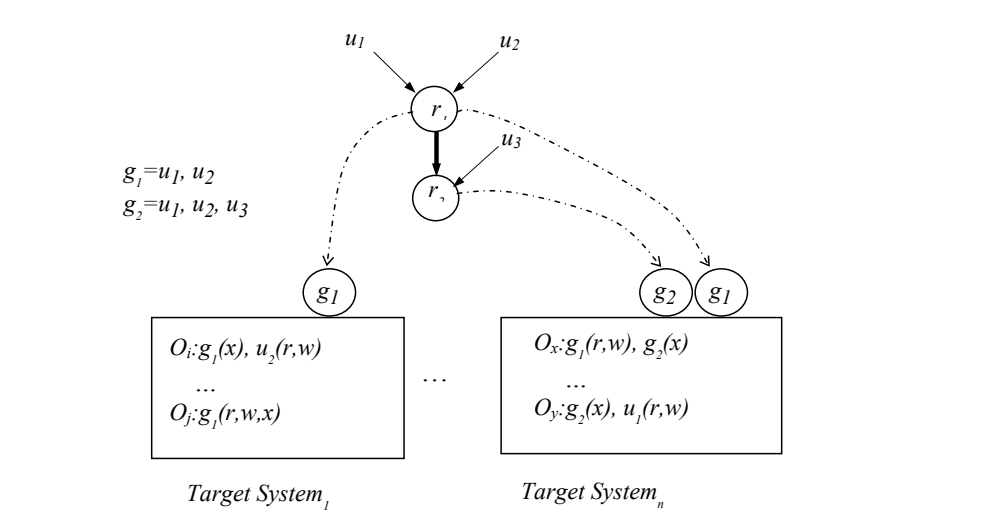
分散システムでの RBAC の対応付けの図です。上部でユーザー「u1」「u2」がロール「r1」を指し、r1 から太い矢印がロール「r2」を指しています。ユーザー「u3」も r2 を指しています。左側に「g1=u1, u2」「g2=u1, u2, u3」とあります。一点鎖線の矢印が、r1 から左の対象システムのグループ「g1」と右の対象システムのグループ「g1」へ、r2 から右の対象システムのグループ「g2」へ伸びています。左の箱「Target System1」(対象システム 1)には「Oi:g1(x), u2(r,w)」「…」「Oj:g1(r,w,x)」、右の箱「Target Systemn」(対象システム n)には「Ox:g1(r,w), g2(x)」「…」「Oy:g2(x), u1(r,w)」と書かれています。箱の間の「…」はほかの対象システムを表します。
Figure 3 - Mapping RBAC for Distributed Systems
図 3 - 分散システム向けの RBAC のマッピング
In some implementations, a user can belong only to one group. The user inherits the attributes and operations assigned to his or her group. However, in the case of conflicting settings, the settings at the user level override the settings configured at the group level. By default, users are assigned to the default group. Users who authenticate and who are not mapped to an existing group are also assigned to the default group. Alternatively, the administrator can choose not to map a user to a particular group, but rather to have the group mapped by an external authenticator. For external user databases from which the system can derive group information, it is possible to associate the group memberships defined for the users in the external user database to specific groups.
実装によっては、利用者は1つのグループにしか所属できません。利用者は、自分のグループに割り当てられた属性と操作を継承します。ただし、設定が競合する場合は、利用者レベルの設定が、グループレベルで構成された設定よりも優先されます。既定では、利用者は既定のグループに割り当てられます。認証され、既存のグループにマッピングされていない利用者も、既定のグループに割り当てられます。あるいは、管理者は、利用者を特定のグループにマッピングせず、外部の認証器にグループをマッピングさせることを選べます。システムがグループ情報を取得できる外部の利用者データベースの場合、外部の利用者データベースで利用者について定義されているグループ所属を、特定のグループに関連付けることが可能です。
4.2 Access Rules
4.2 アクセス規則
As mentioned in Section 3.5, RuBAC can be established by any attributes of a system related to the users such as domain, host, protocol, network, or IP address. For example, a user wants to access an object in another network on the other side of a router. The router employs RuBAC with the rule composed by the network addresses, domain, and protocol to decide whether or not the user can be granted access. So, if an employee changes his or her role within the organization, the existing authentication credentials remain in effect and do not need to be re configured. Using rules in conjunction with roles adds greater flexibility because rules can be applied to people as well as devices.
第 3.5 節で述べたとおり、RuBAC は、ドメイン、ホスト、プロトコル、ネットワーク、IP アドレスなど、利用者に関連するシステムのあらゆる属性によって確立できます。たとえば、利用者が、ルーターの向こう側にある別のネットワーク上のオブジェクトにアクセスしたいとします。ルーターは、ネットワークアドレス、ドメイン、プロトコルで構成された規則による RuBAC を使って、利用者にアクセスを許可できるかどうかを判断します。したがって、従業員が組織内でロールを変更しても、既存の認証用の資格情報は有効なままで、再構成する必要はありません。規則はデバイスだけでなく人にも適用できるため、規則をロールと組み合わせて使うと、より大きな柔軟性が加わります。
When applying RuBAC in a distributed system for access control, it is important to decide which attributes of the system to use for the rule constraints, so that there will not be conflicts in rule setting that lead to privileges leaking. Therefore, rule-based algorithms need to be devised. For example, suppose that two of the primary types of software users are product engineers and quality engineers. Both groups usually have access to the same data, but they have different roles to perform in relation to the data and the application's function. In addition, individuals within each group have different job responsibilities that may be identified using several types of attributes such as weapon programs and manufacturing areas. To avoid confusion, application-specific position codes and access profile rules are maintained for each user. When storing the data object, the data owner identifies attributes that describe the document's content and purpose. At the time of application execution, the user position codes and user's profiles are matched with document attributes to determine the user’s access right.
分散システムでアクセス制御に RuBAC を適用するときは、規則の制約にシステムのどの属性を使うかを決めることが重要です。これにより、権限の漏えいにつながる規則設定の競合が生じないようにします。したがって、ルールベースのアルゴリズムを考案する必要があります。たとえば、ソフトウェア利用者の主な種類のうち2つが、製品エンジニアと品質エンジニアだとします。両方のグループは通常、同じデータにアクセスできますが、そのデータとアプリケーションの機能に関して果たすロールは異なります。さらに、各グループ内の個人は、兵器プログラムや製造領域など、複数の種類の属性で特定できる異なる職務責任を持っています。混乱を避けるため、アプリケーション固有の職位コードとアクセスプロファイル規則が、利用者ごとに維持されます。データオブジェクトを保存する際、データの所有者は、文書の内容と目的を表す属性を特定します。アプリケーションの実行時に、利用者の職位コードと利用者のプロファイルが文書の属性と照合され、利用者のアクセス権が判断されます。
Other example uses of the information in the directory are to make access decisions based on a person's role, or a set of rules based on any user attributes. This allows an organization to centrally control an individual’s access rights to systems and information content depending on a person’s role, or any other factor associated with the person, such as location, department, or language. For example, a manager in location A might need to see an entirely different set of Web resources than an account executive in location B.
ディレクトリ内の情報のそのほかの利用例は、個人のロールに基づいてアクセスを決定すること、または利用者の任意の属性に基づく一連の規則でアクセスを決定することです。これにより、組織は、個人のロールや、所在地、部署、言語など、その人に関連するほかの要素に応じて、システムと情報内容に対する個人のアクセス権を一元的に制御できます。たとえば、所在地 A の管理者には、所在地 B の営業担当役員とはまったく異なる一連の Web リソースが必要になる場合があります。
4.3 Centralized Control
4.3 一元的な制御
Many organizations with distributed systems store and manage data in centralized storage. The privileges of users for the centralized data storage access are assigned by a centralized access control system. Depending on the size and the structure of the organization, some of the access controls can be delegated to a sub level access control system, or may use a dedicated server, which is a separate system from the organization’s business network. There are two commonly used techniques (systems): Centralized Object Access and Delegation of Administration Privilege, a model that was designed originally to fit into distributed network and systems. These techniques are described in Sections 4.3.1 and 4.3.2.
分散システムを持つ多くの組織は、データを集中ストレージに保存し、管理しています。集中データストレージへのアクセス権は、集中型アクセス制御システムによって利用者に割り当てられます。組織の規模と構造に応じて、一部のアクセス制御を下位レベルのアクセス制御システムに委任したり、組織の業務ネットワークとは別のシステムである専用サーバーを使用したりできます。一般に使われる手法(システム)は2つあります。集中オブジェクトアクセスと、分散ネットワークおよびシステムに適合するよう当初設計されたモデルである管理権限の委任です。これらの手法については、第 4.3.1 節と第 4.3.2 節で説明します。
4.3.1 Centralized Object Access
4.3.1 オブジェクトアクセスの一元化
Two popular examples of architectures for the Centralized Object Access technique are SQL and LDAP, discussed below.
オブジェクトアクセスの一元化の手法のアーキテクチャとして一般的な例が2つあり、SQL と LDAP です。以下で論じます。
SQL
SQL
Access controls have been built into popular database systems such as relational DBMSs that have been widely used in distributed systems for their flexibility and the availability of support services. Over the years, standards have been developed and are continuing to evolve. In recent years, products have incorporated a variety of access control systems. SQL4 is the de facto standard language for defining, storing, retrieving, and manipulating data in relational DBMSs.
アクセス制御は、リレーショナル DBMS などの一般的なデータベースシステムに組み込まれており、これらは柔軟性と支援サービスの利用可能性から、分散システムで広く使われています。長年にわたって標準が策定されており、進化を続けています。近年、製品はさまざまなアクセス制御システムを取り入れてきました。SQL4 は、リレーショナル DBMS でデータを定義、保存、取得、操作するための、事実上の標準言語です。
Although most relational DBMSs support some dialect of SQL, SQL compliance does not guarantee portability of a database from one DBMS to another. SQL requires certain levels of functionality in schema specification, retrieval and modification of data, and transaction management. However, a number of security-relevant areas are not addressed. As a result, SQL-compliant DBMSs offer varying levels of security functionality. This is true because DBMS vendors typically include enhancements not required by the SQL standard but also not prohibited by it. Most products are not completely compliant with the standard. The following introduces the capabilities and concerns when using SQL to implement the three major access control policies, namely, DAC, MAC, and RBAC.
ほとんどのリレーショナル DBMS は SQL の何らかの方言に対応していますが、SQL への準拠は、データベースをある DBMS から別の DBMS へ移植できることを保証するものではありません。SQL は、スキーマの規定、データの取得と変更、トランザクション管理について、一定のレベルの機能を求めています。しかし、セキュリティに関連する多くの領域は扱われていません。その結果、SQL に準拠した DBMS が提供するセキュリティ機能のレベルはさまざまです。これは、DBMS のベンダーが通常、SQL 標準では求められていないが禁止もされていない拡張機能を含めているために生じます。ほとんどの製品は、標準に完全には準拠していません。以下では、DAC、MAC、RBAC という3つの主要なアクセス制御ポリシーを SQL で実装する際の能力と懸念を紹介します。
- SQL-DAC
- SQL-DAC
The SQL-DAC privilege enables the creator of a relation in an SQL database to be its owner with the ability to grant other users access to that relation. The access privileges or modes recognized in SQL correspond directly to the CREATE, INSERT, SELECT, DELETE, and UPDATE SQL statements. In addition, a REFERENCES privilege controls the establishment of foreign keys to a relation. The DAC facilities are included in the current SQL standard, although the standard is incomplete and does not address several important issues. Some of these deficiencies are being addressed in the evolving standard. Different vendors have also provided more comprehensive facilities than the standard requires [NCSC96].
SQL-DAC の権限により、SQL データベースでリレーションを作成した者は、そのリレーションの所有者となり、ほかの利用者にそのリレーションへのアクセスを与える能力を持ちます。SQL で認識されるアクセス権限またはモードは、SQL 文の CREATE、INSERT、SELECT、DELETE、UPDATE に直接対応します。さらに、REFERENCES 権限は、リレーションへの外部キーの設定を制御します。DAC の機能は現行の SQL 標準に含まれていますが、この標準は不完全で、いくつかの重要な問題に対処していません。これらの欠陥の一部には、進化する標準で対処が進められています。さまざまなベンダーが、標準が求めるよりも包括的な機能も提供しています [NCSC96]。
However, as discussed in Section 2.2.1, discretionary controls have a fundamental weakness even when access to a relation is strictly controlled. A user with SELECT access can create a copy of the relation, thereby circumventing these controls. Furthermore, even if users can be trusted not to engage deliberately in such mischief, programs replaced with Trojan horses can have the same disastrous effect. For example, in the following GRANT operation:
しかし、第 2.2.1 節で論じたとおり、任意アクセス制御には、リレーションへのアクセスが厳密に制御されている場合でも、根本的な弱点があります。SELECT のアクセス権を持つ利用者は、リレーションのコピーを作成でき、それによってこれらの制御を回避できます。さらに、利用者がそのような悪意ある行為を故意に行わないと信頼できる場合でも、トロイの木馬に置き換えられたプログラムが同じ壊滅的な影響を及ぼす可能性があります。たとえば、次の GRANT 操作では、
VINCE: GRANT SELECT ON FOR-DAVE-ONLY TO DAVE
VINCE: GRANT SELECT ON FOR-DAVE-ONLY TO DAVE
Vince has not conferred the GRANT option on Dave. Vince’s intention is that Dave should not be allowed to further grant SELECT access on FOR-DAVE-ONLY to other users. However, this intent is easily subverted as follows. Dave creates a new relation, COPY-OF-FOR-DAVE-ONLY, into which he copies all the rows of FOR-DAVE-ONLY. As the creator of COPY-OF-FOR-DAVE-ONLY, Dave can grant any privileges for it to any user. Dave can therefore grant Rick access to COPY-OF-FOR-DAVE-ONLY as follows:
Vince は Dave に GRANT オプションを与えていません。Vince の意図は、Dave が FOR-DAVE-ONLY の SELECT アクセスをほかの利用者にさらに与えることを許されない、というものです。しかし、この意図は次のようにして容易に覆されます。Dave は新しいリレーション COPY-OF-FOR-DAVE-ONLY を作成し、そこに FOR-DAVE-ONLY のすべての行をコピーします。COPY-OF-FOR-DAVE-ONLY の作成者として、Dave は、それに対する任意の権限を任意の利用者に与えられます。したがって Dave は、次のようにして Rick に COPY-OF-FOR-DAVE-ONLY へのアクセスを与えることができます。
DAVE: GRANT SELECT ON COPY-OF-FOR-DAVE-ONLY TO RICK
DAVE: GRANT SELECT ON COPY-OF-FOR-DAVE-ONLY TO RICK
At this point, Rick has access to all the information in the original FOR-DAVE-ONLY relation. For all practical purposes, Rick has SELECT access to FOR-DAVE-ONLY, so long as Dave keeps COPY-OF-FOR-DAVE-ONLY reasonably up-to-date with respect to FOR-DAVE-ONLY.
この時点で、Rick は元の FOR-DAVE-ONLY リレーションのすべての情報にアクセスできます。Dave が COPY-OF-FOR-DAVE-ONLY を FOR-DAVE-ONLY に対して適度に最新の状態に保つ限り、実質的に、Rick は FOR-DAVE-ONLY への SELECT アクセスを持っています。
It might be assumed that Dave is a trusted confidant of Vince and would not deliberately subvert Vince’s intentions regarding the FOR-DAVE-ONLY relation. But if Dave were to use a text editor supplied by Rick, which Rick had programmed to create the COPY-OF-FOR-DAVE-ONLY relation and execute the preceding GRANT operation, the situation might be different. Thus, a Trojan horse executed by Dave could actually grant Rick the privilege to SELECT on FOR-DAVE-ONLY. There is no way to ensure the absence of Trojan horses or other malicious code. The solution is to impose mandatory controls that cannot be violated, even by Trojan horses [SKZ03].
Dave は Vince の信頼できる相談相手であり、FOR-DAVE-ONLY リレーションに関する Vince の意図を故意に覆すことはないと想定されるかもしれません。しかし、Dave が Rick から提供されたテキストエディタを使い、Rick がそれを、COPY-OF-FOR-DAVE-ONLY リレーションを作成し、前述の GRANT 操作を実行するようにプログラムしていた場合、状況は異なるかもしれません。したがって、Dave が実行したトロイの木馬は、実際に Rick に FOR-DAVE-ONLY への SELECT 権限を与えてしまうことがあります。トロイの木馬やその他の悪意あるコードが存在しないことを保証する方法はありません。解決策は、トロイの木馬でさえ違反できない強制アクセス制御を課すことです [SKZ03]。
- SQL-MAC
- SQL-MAC
MAC is not supported directly in SQL. However, there are several different methods for implementing a MAC model. Most of the methods allow users and data with different security labels to coexist. Multilevel systems implemented by these methods are said to be trusted because they keep data with different labels separated and ensure the enforcement of the simple security and strong star properties. For example, the newly emerging relational database products are basically integrated data architectures (also known as trust subject architectures). This approach requires considerable modification of existing relational DBMSs and can be supported by DBMS vendors. It should be noted that an SQL–based DBMS with mandatory access control can be designed without modification of the SQL syntax. However, certain modifications in SQL semantics must be made if polyinstantiation (there are now two records: one sensitive and one not) is used to control inference.
MAC は SQL では直接サポートされていません。しかし、MAC モデルを実装する方法はいくつかあります。ほとんどの方法は、異なるセキュリティラベルを持つ利用者とデータが共存することを可能にします。これらの方法で実装されたマルチレベルシステムは、異なるラベルを持つデータを分離して保ち、単純セキュリティ特性と強スター特性の実施を保証するため、信頼されていると言われます。たとえば、新たに登場しているリレーショナルデータベース製品は、基本的に統合データアーキテクチャ(信頼されたサブジェクトアーキテクチャとも呼ばれます)です。このアプローチでは、既存のリレーショナル DBMS の大幅な変更が必要となり、DBMS ベンダーがサポートできます。強制アクセス制御を備えた SQL ベースの DBMS は、SQL の構文を変更せずに設計できることに留意すべきです。ただし、推論を制御するためにポリインスタンシエーション(現在は機微なレコードとそうでないレコードの2つがある)を使う場合は、SQL の意味に一定の変更を加える必要があります。
Security labels can be assigned to data at different levels of granularity in relational databases. Assigning labels to entire relations can be useful but is generally inconvenient. For example, if some salaries are secret but others are not, these different categories of salaries must be placed in different relations. Assigning labels to an entire column of a relation is similarly inconvenient in the general case.
セキュリティラベルは、リレーショナルデータベースのさまざまな粒度のデータに割り当てられます。リレーション全体にラベルを割り当てることは有用な場合がありますが、一般には不便です。たとえば、一部の給与が秘密で、ほかは秘密でない場合、これらの異なる種類の給与を、異なるリレーションに置かなければなりません。リレーションの列全体にラベルを割り当てることも、一般には同様に不便です。
The finest granularity of labeling is at the level of individual attributes of each tuple or row or at the level of individual element-level labeling. This offers considerable flexibility. Most of the products that are emerging offer labeling at the level of a tuple. Although not so flexible as element-level labeling, this approach is definitely more convenient than using relation- or column-level labels. Products in the short term can be expected to offer tuple-level labeling.
ラベル付けの最も細かい粒度は、各タプルまたは行の個々の属性のレベル、つまり個々の要素レベルのラベル付けです。これにより、かなりの柔軟性が得られます。登場しつつある製品の大半は、タプルのレベルでのラベル付けを提供しています。要素レベルのラベル付けほど柔軟ではありませんが、この方法は、リレーションや列のレベルのラベルを使うよりも確実に便利です。短期的には、製品はタプルレベルのラベル付けを提供すると見込めます。
- SQL-RBAC
- SQL-RBAC
One of the weaknesses in early versions of SQL (ANSI SQL/89-SQL1, SQL/92-SQL2) is that they do not facilitate the management of access rights [SKZ03]. Groups of users often need similar or identical privileges, For example, all supervisors in a department might require identical privileges; similarly, all clerks might require identical privileges, different from those of the supervisors. However, with these SQL versions, each user must be explicitly granted every privilege necessary to accomplish his or her tasks. The current ANSI SQL/99 (SQL3) has included RBAC based on vendor implementations, such as in Oracle. Consensus on a standard approach to RBAC in relational databases is emerging. However, there are a number of questions that remain to be addressed before consensus on standards is achieved.
SQL の初期のバージョン(ANSI SQL/89-SQL1、SQL/92-SQL2)の弱点の一つは、アクセス権の管理を促進しないことです [SKZ03]。利用者のグループは、同様の、または同一の権限を必要とすることがよくあります。たとえば、ある部署のすべての管理者が同一の権限を必要とする場合があります。同様に、すべての事務員も、管理者のものとは異なる同一の権限を必要とする場合があります。しかし、これらの SQL バージョンでは、各利用者に、その作業の遂行に必要なすべての権限を明示的に付与しなければなりません。現行の ANSI SQL/99(SQL3)には、Oracle などのベンダー実装に基づく RBAC が含まれています。リレーショナルデータベースにおける RBAC の標準的な方法について合意が形成されつつあります。しかし、標準について合意に至る前に対処すべき問題がいくつも残っています。
There are several mainstream commercially available products that support RBAC in some form. More than any other commercial application software, RBAC DBMSs provide access control at several levels of granularity including provision for content-dependent controls. An application system developed using a DBMS can contain a large amount of data with highly differentiated access permissions for different users depending upon their function or role with the organization. Hence, database management is a prime area that needs mechanisms for management of authorizations or privileges. Not surprisingly, DBMSs have taken the lead in providing support for RBAC.
何らかの形で RBAC に対応している、主流の市販製品がいくつかあります。ほかのどの市販のアプリケーションソフトウェアよりも、RBAC に対応した DBMS は、内容に依存する制御の提供を含め、いくつかの粒度でアクセス制御を提供します。DBMS を使って開発されたアプリケーションシステムは、組織での機能やロールに応じて、利用者ごとにアクセスパーミッションを大きく差別化した大量のデータを含むことができます。したがって、データベース管理は、認可や権限の管理のための機構が必要な主要な領域です。DBMS が RBAC の対応を先導してきたのは、当然のことです。
The RBAC features that are supported have been categorized into three broad areas as follows:
対応している RBAC の機能は、次の3つの大きな領域に分類されています。
•User role assignment
•利用者へのロールの割り当て
•Support for role relationships and constraints
•ロールの関係と制約への対応
•Assignable privileges.
•割り当て可能な権限。
Based on the above criteria, SQL1 is incomplete and omits revocation of privileges and control over creation of new relations and views. SQL2 fixes some of these shortcomings. However, SQL2’s GRANT and REVOKE instructions apply only to database users. This is extended in SQL3 by considering that these instructions also apply to roles as suggested in the RBAC model. In the meantime, some vendors have implemented RBAC; other vendors have started to deliever products incorporating mandatory access controls for multilevel security. There is a recognition that SQL needs to evolve to take some of these developments into consideration. If it does, stronger and better access controls can be expected in future products.
上記の基準に基づくと、SQL1 は不完全で、権限の取り消しと、新しいリレーションやビューの作成の制御が欠けています。SQL2 は、これらの欠点の一部を修正しています。しかし、SQL2 の GRANT および REVOKE 命令はデータベース利用者にしか適用されません。RBAC モデルが示すように、これらの命令がロールにも適用されると考えることで、SQL3 ではこの範囲が拡張されています。その間に、RBAC を実装したベンダーもあり、マルチレベルセキュリティのための強制アクセス制御を取り入れた製品の提供を始めたベンダーもあります。こうした進展の一部を考慮に入れるために SQL が進化する必要があるという認識があります。進化すれば、将来の製品では、より強力で優れたアクセス制御が期待できます。
LDAP
LDAP
Access control for organizations with large numbers of users and distributed systems is highly complex. In one approach to dealing with the complexities of these systems, centralized Lightweight Directory Access Protocol (LDAP) directories become a major focal point as a tool for access control. The directories publishing user professional sector-related information (names, addresses, groups, roles, profiles, professional sector attributes, etc.) allow a modular, expandable access control and single sign-on (SSO) solution to be deployed rapidly for all the applications in the information system.
多数の利用者と分散システムを持つ組織のアクセス制御は、非常に複雑です。こうしたシステムの複雑さに対処する一つの方法では、一元的な Lightweight Directory Access Protocol(LDAP)ディレクトリが、アクセス制御のツールとして主要な焦点になります。利用者の専門分野に関連する情報(名前、住所、グループ、ロール、プロファイル、専門分野の属性など)を公開するディレクトリにより、モジュール式で拡張可能なアクセス制御とシングルサインオン(SSO)のソリューションを、情報システム内のすべてのアプリケーション向けに迅速に展開できます。
A major benefit of LDAP directories is the efficiency of merging groups of users under the same management system. For example, an organization wants to optimize the directories for professional sector procedures and resources common to the two groups. The concern is to optimize operating costs, and deployment should take place as quickly as possible, without changing either the administration procedures or the information processing procedures already in place. To achieve this using LDAP, the identities, roles, and professional sector attributes that were initially managed in each group’s directory do not have to be imported or redefined, and the authentication and authorization policies can be managed in complete consistency, irrespective of the type of application services used.
LDAP ディレクトリの大きな利点は、同じ管理システムのもとで利用者グループを統合する効率にあります。たとえば、ある組織が、2つのグループに共通する専門分野の手順とリソース向けにディレクトリを最適化したいと考えているとします。目的は運用コストを最適化することであり、展開は、すでに導入されている管理手順や情報処理手順を変更せずに、できるだけ迅速に行うべきです。LDAP を使ってこれを実現するには、各グループのディレクトリで当初管理されていたアイデンティティ、ロール、専門分野の属性をインポートしたり再定義したりする必要はなく、使用するアプリケーションサービスの種類にかかわらず、認証ポリシーと認可ポリシーを完全に一貫した形で管理できます。
Based on the LDAP directories, some commercial systems provide centralized and simplified user management across the distributed systems. The system ensures enforcement of assigned access policies by allowing network administrators to control (1) who can log in, (2) which privileges each user has, (3) what security audit or account billing information is recorded, and (4) which access and command controls are enabled for each configuration administrator.
LDAP ディレクトリに基づいて、一部の市販システムは、分散システム全体にわたる一元的で簡素化された利用者管理を提供しています。このシステムは、ネットワーク管理者が、(1) 誰がログインできるか、(2) 各利用者がどの権限を持つか、(3) どのセキュリティ監査情報またはアカウントの課金情報が記録されるか、(4) 構成管理者ごとにどのアクセスおよびコマンドの制御が有効になるか、を制御できるようにすることで、割り当てられたアクセスポリシーの実施を確実にします。
4.3.2 Delegation of Administration
4.3.2 管理の委任
Kerberos is the most popular example of an architecture for the delegation of administration; it has been implemented in UNIX, UNIX-like, and Windows 2000 [Win03] and 2003 systems at the domain level.5 Even though Kerberos is an authentication mechanism, it has been built into a system that provides network-wide security services. Kerberos can solve many of the security problems of large, distributed/heterogeneous networks, including access control and mutual authentication between clients and servers. The basic idea behind Kerberos is that a trusted third party (the Kerberos security server) provides a means by which constituents of the network (principals) can trust each other. These principals may be any hardware or software that communicates across the network.
Kerberos は、管理の委任のためのアーキテクチャとして最も一般的な例です。UNIX、UNIX 類似のシステム、Windows 2000 [Win03] および 2003 のシステムに、ドメインレベルで実装されています。5 Kerberos は認証機構ですが、ネットワーク全体のセキュリティサービスを提供するシステムの中に組み込まれています。Kerberos は、アクセス制御や、クライアントとサーバー間の相互認証を含め、大規模な分散/異種ネットワークの多くのセキュリティ問題を解決できます。Kerberos の基本的な考え方は、信頼できる第三者(Kerberos セキュリティサーバー)が、ネットワークの構成要素(プリンシパル)が互いに信頼できる手段を提供するというものです。これらのプリンシパルは、ネットワークを介して通信するあらゆるハードウェアまたはソフトウェアでありえます。
To withstand attacks in distributed environments, a Kerberos system usually requires not only the Kerberos server but also at a minimum a Ticket Granting Service, which offers both privacy and integrity for network messages. Kerberos does not directly offer access control service, although the protocol provides for the inclusion and protection of access control information in messages for use by applications and operating systems.
分散環境での攻撃に耐えるために、Kerberos システムは通常、Kerberos サーバーだけでなく、最低限、ネットワークメッセージのプライバシーと完全性の両方を提供する Ticket Granting Service も必要とします。Kerberos は、アクセス制御サービスを直接は提供しませんが、このプロトコルは、アプリケーションとオペレーティングシステムが使うための、アクセス制御情報をメッセージに含めて保護する仕組みを備えています。
When incorporated into an existing production environment, Kerberos is not transparent. Each client or application server that wants to use Kerberos services must have calls to those services included in its code. As with any other security-related coding, this “kerberization” must be based on sound application design and discipline to ensure that it is done properly.
既存の本番環境に組み込む場合、Kerberos は透過的ではありません。Kerberos のサービスを使いたい各クライアントまたはアプリケーションサーバーは、それらのサービスへの呼び出しをコードに含めなければなりません。ほかのセキュリティ関連のコーディングと同様に、この「Kerberos 化」は、適切に行われるように、確かなアプリケーション設計と規律に基づく必要があります。
4.4 Limitations for Distributed Systems
4.4 分散システムにおける限界
The same limitations of the access control mechanisms as demonstrated in Section 3 may also be applied to distributed systems, if the mechanisms are chosen for the organization. However, for different organizations and different operational environments, the impact from the limitation of the selected mechanism might not be as critical when the organization is considering the cost for the business operation.
第 3 節で示したアクセス制御機構の限界は、組織がその機構を選んだ場合、分散システムにも同じように当てはまる可能性があります。ただし、組織や運用環境が異なれば、事業運営のコストを考慮する際に、選択した機構の限界から受ける影響は、それほど深刻ではない場合もあります。
5 SAFETY LIMITATIONS
5 安全性の限界
Safety is an important feature of an access control systems, and is needed to ensure that the access control configuration (e.g., access control model) will not result in the leakage of permissions to an unauthorized principal. Thus, a configuration is said to be safe if no privilege can be escalated to an unauthorized or unintended principal. Safety is fundamental to ensuring that the most basic of access control policies can be enforced. However, it has been proven that the safety of an access control configuration cannot be decided for an arbitrary configuration of a general access control model, such as an access control matrix. This section consists of two subsections: Section 5.1 discusses the methods to achieve safety, and Section 5.2 covers the concept of Separation of Duty for safety.
安全性は、アクセス制御システムの重要な機能であり、アクセス制御の構成(アクセス制御モデルなど)が、認可されていないプリンシパルへのパーミッションの漏えいをもたらさないことを確実にするために必要です。したがって、どの権限も、認可されていない、または意図されていないプリンシパルに昇格できない場合、その構成は安全であるといいます。安全性は、最も基本的なアクセス制御ポリシーを確実に実施できるようにするための根幹です。しかし、アクセス制御行列などの一般的なアクセス制御モデルの任意の構成について、アクセス制御の構成の安全性は決定できないことが証明されています。本節は2つの小節で構成されます。第 5.1 節では安全性を達成する方法を論じ、第 5.2 節では安全性のための職務分離の概念を扱います。
5.1 Achieving Safety
5.1 安全性の達成
Safety is achieved either through the use of restricted access control models that can be proven in general for that model, or via expressions called constraints that describe the safety requirements of any configuration [JT01]. Both methods are discussed in Sections 5.1.1 and 5.1.2.
安全性は、そのモデルについて一般的に証明できる制限付きアクセス制御モデルを使うことによって、または、あらゆる構成の安全性の要件を記述する、制約と呼ばれる式を通じて達成されます [JT01]。どちらの方法も、第 5.1.1 節と第 5.1.2 節で論じます。
5.1.1 Restricted Access Control Model for Safety
5.1.1 安全性のための制限付きアクセス制御モデル
Multilevel security or separation of duty, such as MAC policy, is enforced by the safety configuration; however, a specialized model designed for a restricted or static policy is difficult to use because it is hard to ensure that the restrictions are satisfied. For example, Bell-LaPadula and Domain and Type Enforcement, which require completely trusted principals to assign subjects and objects to types (or labels), lack a simple, comprehensive approach to constraints.
マルチレベルセキュリティや、MAC ポリシーなどの職務分離は、安全性の構成によって実施されます。しかし、制限付きまたは静的なポリシー向けに設計された特殊なモデルは、制限が満たされていることを確実にするのが難しいため、使いにくくなります。たとえば、サブジェクトとオブジェクトをタイプ(またはラベル)に割り当てるために完全に信頼されたプリンシパルを必要とする Bell-LaPadula やドメインとタイプの強制には、制約に対する単純で包括的な方法が欠けています。
5.1.2 Constraints for Safety
5.1.2 安全性のための制約
Constraints can be expressed in a policy that restricts access in straightforward access rules; however, creating constraint expressions for safety is a difficult task, because the entities to which safety constraints are given are not known in advance. In general, a safety constraint is expressed by a first-order predicate logic, and a few logical constraint expression languages have been proposed, but such languages are too complex for administrators to determine if a set of constraints really expresses the desired safety requirements properly. In addition, the design of higher-level expression models must be considered because approaches may be chosen that are too limited, lack necessary extensibility, and prevent administrators from understanding the relationships between constraints.
制約は、単純なアクセス規則でアクセスを制限するポリシーの中で表現できます。しかし、安全性のための制約の式を作成するのは困難な作業です。安全性の制約が与えられる実体が、あらかじめわかっていないためです。一般に、安全性の制約は一階述語論理で表現され、いくつかの論理的な制約表現言語が提案されていますが、そうした言語は、一連の制約が望ましい安全性の要件を本当に適切に表現しているかどうかを管理者が判断するには複雑すぎます。さらに、選択される方法が限定的すぎたり、必要な拡張性を欠いたり、管理者が制約間の関係を理解するのを妨げたりする可能性があるため、より高レベルの表現モデルの設計を考慮しなければなりません。
There is a trade-off between the expressive power of an access control model and the ease of safety enforcement. In a restricted model, such as Bell-LaPadula, constraints are implicit in the model’s definition (e.g., a subject of one label cannot write to any object of a “lower” security label). Therefore, safety enforcement is trivial, but policy expression is limited. On the other hand, general policy expression models such as RBAC (Section 3.4) permit the definition of arbitrary constraints. In this case, the expression of safety requirements has proven to be difficult [HRU76].
アクセス制御モデルの表現力と、安全性の実施の容易さの間には、トレードオフがあります。Bell-LaPadula のような制限付きモデルでは、制約はモデルの定義に暗黙的に含まれています(たとえば、あるラベルのサブジェクトは、「より低い」セキュリティラベルのオブジェクトに書き込めません)。したがって、安全性の実施は容易ですが、ポリシーの表現は限定されます。一方、RBAC(第 3.4 節)のような一般的なポリシー表現モデルは、任意の制約の定義を許します。この場合、安全性の要件の表現は困難であることがわかっています [HRU76]。
5.2 Separation of Duty and Safety
5.2 職務分離と安全性
In general, by restricted model, the access control policies are expressed only once by a trusted principal and fixed for the life of the system, so that access control policies are safe by definition. Currently, almost all safety-critical systems (such as military systems) use restricted access control models, such as Bell-LaPadula [Pfl97] or Domain and Type Enforcement [BSS95], because constraint expression languages are far too complex for typical administrators to use properly. However, flexibility that may be added to these models introduces the possibility of safety problems. For example, an organization uses the Bell-LaPadula model to define the extent to which principals of one label may make changes to the assignment of objects and subjects to labels. Principals that are not fully trusted are created that can modify the model. But if complete trust is not practical, then there is a possibility of safety violation. Therefore, more flexible access control modeling is often necessary when more complex safety policies are required. For example, in commercial systems, some policies require that a principal’s or role’s right change dynamically to prevent unauthorized actions (e.g., signing a check). Thus, configuration changes are part of the application domain. In addition, the notion that an administrator may not be fully trusted is built into some access control models, such as RBAC. To enable the enforcement of safety under these conditions, some access control models include the concept of SOD [FKC93].
一般に、制限付きモデルでは、アクセス制御ポリシーは、信頼されたプリンシパルによって一度だけ表現され、システムの存続期間にわたって固定されるため、アクセス制御ポリシーは定義上、安全です。現在、ほぼすべての安全性が重要なシステム(軍事システムなど)は、Bell-LaPadula [Pfl97] やドメインとタイプの強制 [BSS95] などの制限付きアクセス制御モデルを使っています。制約表現言語は、一般的な管理者が適切に使うには複雑すぎるためです。しかし、これらのモデルに追加されうる柔軟性は、安全性の問題が生じる可能性をもたらします。たとえば、ある組織が Bell-LaPadula モデルを使って、あるラベルのプリンシパルが、オブジェクトとサブジェクトのラベルへの割り当てをどの範囲まで変更してよいかを定義します。モデルを変更できる、完全には信頼されていないプリンシパルが作られます。しかし、完全な信頼が現実的でない場合、安全性が侵害される可能性があります。したがって、より複雑な安全性のポリシーが求められる場合は、より柔軟なアクセス制御のモデル化がしばしば必要になります。たとえば、商用システムでは、一部のポリシーは、無許可の行為(小切手への署名など)を防ぐために、プリンシパルまたはロールの権利が動的に変化することを求めます。したがって、構成の変更はアプリケーションドメインの一部です。さらに、管理者が完全には信頼されていない場合があるという考え方は、RBAC などの一部のアクセス制御モデルに組み込まれています。こうした条件のもとで安全性の実施を可能にするため、一部のアクセス制御モデルには、SOD の概念が含まれています [FKC93]。
As a security principle, SOD has had wide application. The purpose of SOD is to ensure that failures of omission or commission with an organization are caused only by collusion among individuals, making such failures riskier and less likely. It also minimizes chances of collusion by assigning individuals of different skills or divergent interest to separated tasks; thus, SOD is enacted whenever conflict of interest may otherwise arise in assignment of tasks within an organization. Two major types of SOD, Static and Dynamic, are discussed in Sections 5.2.1 and 5.2.2, respectively.
SOD は、セキュリティの原則として、幅広く適用されてきました。SOD の目的は、組織内で怠慢による、または作為による失敗が生じる場合、それが個人間の共謀によってのみ起こるようにして、そうした失敗をより危険で、起こりにくいものにすることです。また、異なる技能や相反する利害を持つ個人を別々のタスクに割り当てることで、共謀の機会を最小限に抑えます。したがって、SOD は、組織内でのタスクの割り当てで利益相反が生じうる場合は常に実施されます。SOD の2つの主要な種類である静的と動的は、それぞれ第 5.2.1 節と第 5.2.2 節で論じます。
5.2.1 Static Separation of Duty (SSOD)
5.2.1 静的職務分離(SSOD)
As a security mechanism, SSOD addresses two separate but related problems. Static exclusivity is the condition for which it is considered dangerous for any user to gain authorization for conflicting sets of capabilities. The motivations for exclusivity relations include, but are not limited to, reducing the likelihood of fraud or preventing the loss of user objectivity. The other problem is more of an assurance principle, dealing with the potential for collusion where the greater the number of individuals that are involved in the execution of a sensitive business function, such as purchasing an item or executing a trade, the less likely any one user will commit fraud or that any few users will collude in committing fraud.
セキュリティ機構として、SSOD は、2つの別個の、しかし関連する問題に対処します。静的排他性は、いずれかの利用者が、競合するケイパビリティの集合に対する認可を得ることが危険と考えられる条件です。排他性の関係を設ける動機には、不正の可能性を減らすことや、利用者の客観性の喪失を防ぐことが含まれますが、これらに限りません。もう一つの問題は、どちらかといえば保証の原則であり、共謀の可能性を扱います。品目の購入や取引の実行など、機微な業務機能の実行に関わる個人の数が多いほど、いずれかの1人の利用者が不正を行ったり、少数の利用者が不正を共謀したりする可能性は低くなります。
To illustrate the value and limitations of static exclusivity constraints in enforcing separation, consider the capabilities of a cashier and a cashier supervisor, where the capability to void erroneous cashier transactions is assigned to the cashier supervisors. Clearly, a user’s ability to execute the capabilities of both cashier and cashier supervisor within a single subject would constitute a conflict of interest (i.e., a user acting as cashier would be able to void his or her own transactions). One prescribed approach to this security issue is to restrict any user from simultaneously obtaining membership to both cashier and cashier supervisor. However, such an approach could impose unacceptable operational restrictions (i.e., the users authorized for the role and capabilities of cashier supervisor would never be able to perform the functions of the cashier). Examples of SSOD policies are RBAC and RuBAC (Sections 3.4 and 3.5).
分離を実施するうえでの静的排他性制約の価値と限界を説明するために、レジ係とレジ係の管理監督者のケイパビリティを考えてみます。ここでは、誤ったレジ係のトランザクションを取り消すケイパビリティが、レジ係の管理監督者に割り当てられているものとします。単一のサブジェクトの中で、レジ係とレジ係の管理監督者の両方のケイパビリティを実行する利用者の能力が、利益相反になることは明らかです(すなわち、レジ係として行動する利用者が、自分自身のトランザクションを取り消せるようになります)。このセキュリティ問題に対する規定された方法の一つは、どの利用者も、レジ係とレジ係の管理監督者の両方に同時に所属することを制限することです。しかし、この方法は、許容できない運用上の制限を課す可能性があります(すなわち、レジ係の管理監督者のロールとケイパビリティを認可された利用者は、レジ係の機能を決して実行できなくなります)。SSOD ポリシーの例は、RBAC と RuBAC です(第 3.4 節と第 3.5 節)。
SOD constraints may require that two roles be mutually exclusive, because no user should have the privileges from both roles. This might be done, for example, to deny any user the ability to both enter and authorize an order for disbursement of funds. However, permission “escalation,” violating SOD requirements, may occur if a third role is assigned the requisite permissions without being included in SOD constraints. A user might have one of the mutually exclusive roles, yet acquire this third role and thereby gain the ability to violate the requirement that no individual can both enter and authorize funds disbursement. In an environment where there are numerous users, attributes, objects, and relations, safety needs to be carefully considered.
SOD の制約は、どの利用者も2つのロールの両方から権限を得るべきではないため、2つのロールが相互に排他的であることを要求する場合があります。たとえば、資金支払いの注文を入力することと承認することの両方を、いずれの利用者にも行えないようにするために、この制約を設ける場合があります。しかし、3つ目のロールに必要なパーミッションが割り当てられ、そのロールが SOD の制約に含まれていない場合、SOD の要件に違反するパーミッションの「昇格」が起こる可能性があります。利用者が、相互に排他的なロールの一方を持ちながら、この3つ目のロールを取得し、それによって、個人が資金支払いを入力することと承認することの両方はできないという要件に違反する能力を得てしまう場合があります。多数の利用者、属性、オブジェクト、関係がある環境では、安全性を慎重に検討すべきです。
5.2.2 Dynamic Separation of Duty (DSOD)
5.2.2 動的職務分離(DSOD)
Separation of duties can be enforced dynamically (i.e., at access time), and the decision to grant access refers to the past access history. For example, a user may be allowed to be a member of more than one user group, but to prevent conflict of interest, some policies mutually exclude user groups from being assigned to the same user. A person could be both a cashier and an accountant for a company, but only one and not both of the roles can be activated as the user performs a job-related responsibility or function.
職務分離は動的に(すなわち、アクセス時に)実施でき、アクセスを許可するかどうかの決定では、過去のアクセス履歴を参照します。たとえば、利用者が複数のユーザーグループに所属することが許される場合がありますが、利益相反を防ぐために、一部のポリシーは、ユーザーグループが同じ利用者に割り当てられることを相互に排除します。ある人が、会社のレジ係と会計担当者の両方になりうるとしても、その利用者が職務に関連する責任または機能を果たすときに有効化できるのは、一方のロールだけであり、両方ではありません。
There are various types of DSOD, such as two-person rule; the first user to execute a two-person operation can be any authorized user, whereas the second user can be any authorized user different from the first [SS94]. Another important type of DSOD is a history-based SOD that regulates, for example, that the same subject (role) cannot access the same object for variable number of times. Popular DSOD policies are the Workflow policies and Chinese Wall, as explained in Section 2.2.2.3.
DSOD にはさまざまな種類があり、たとえば2人ルールがあります。2人で行う操作を最初に実行する利用者は認可された任意の利用者でかまいませんが、2人目は、最初の利用者とは異なる認可された任意の利用者でなければなりません [SS94]。DSOD のもう一つの重要な種類は、たとえば同じサブジェクト(ロール)が同じオブジェクトに可変の回数アクセスできないことを規定する、履歴ベースの SOD です。一般的な DSOD ポリシーは、第 2.2.2.3 節で説明したとおり、Workflow ポリシーと Chinese Wall です。
6 QUALITY METRIC FOR ACCESS CONTROL SYSTEMS
6 アクセス制御システムの品質メトリクス
Access control systems come with a wide variety of features and administrative capabilities. Some capabilities are packaged as part of an overall product offering, and others are provided as add-on features for managing access configurations within or across architectural abstractions. Although the particular access control mechanism that is included within an application or operating system is rarely scrutinized by an organization in selecting an application, its operational impact can be significant, affecting administrative and user productivity and even the organization’s ability to perform its mission. Even for medium-sized enterprises, the number of users can be significant, the number of systems that need to be configured for access control can be in the hundreds, and the number of resources that need to be protected can be in the tens of millions. If a single permission is incorrectly configured, a user will either be ineffective in performing his/her duties or will be given access to unintended information and systems, which could result in undermining the security posture of the organization.
アクセス制御システムには、幅広い機能と管理能力があります。一部の機能は製品全体の一部としてパッケージ化されており、ほかの機能は、アーキテクチャの抽象概念の内部または抽象概念をまたぐアクセス構成を管理するための追加機能として提供されます。アプリケーションまたはオペレーティングシステムに含まれる特定のアクセス制御機構が、組織によってアプリケーションの選定の際に精査されることはまれですが、その運用への影響は大きくなる場合があり、管理者と利用者の生産性、さらには組織が任務を遂行する能力にまで影響します。中規模のエンタープライズであっても、利用者の数は膨大になりえ、アクセス制御のために構成が必要なシステムの数は数百に及び、保護が必要なリソースの数は数千万に達する場合があります。1つのパーミッションでも誤って構成されると、利用者は職務を効果的に遂行できなくなるか、意図しない情報やシステムへのアクセスを与えられることになり、組織のセキュリティ態勢を損なう結果になる場合があります。
The quality of administrative capabilities has an impact on administrative cost, user downtime between administrative events, and the abilities of users to perform their duties, as well as the overall security posture of the enterprise. This section presents a quality metric for access control systems based on the configurable features and limitations of the implemented mechanism. More works need to be done for applying the metric to any specific access control systems; however, the metric can be used when considering and comparing the properties for current configuration with future expansion of an access control system.
管理能力の品質は、管理コスト、管理上のイベントの間の利用者のダウンタイム、利用者が職務を遂行する能力、およびエンタープライズ全体のセキュリティ態勢に影響を与えます。本節では、実装された機構の構成可能な機能と限界に基づく、アクセス制御システムの品質メトリクスを示します。このメトリクスを特定のアクセス制御システムに適用するには、さらなる作業が必要ですが、アクセス制御システムの現在の構成と将来の拡張の特性を検討し比較する際に、このメトリクスを使うことができます。
6.1 Quality Metrics
6.1 品質メトリクス
The ability of an organization to enforce its access policies determines the degree to which its volumes of data may be protected and shared among its user community. Whether in regard to the government’s war on terror or a company’s formation of a strategic partnership, the focus on sharing and protecting information is becoming increasingly acute. Unfortunately, when it comes to access control mechanisms, one size does not fit all.
組織が自らのアクセスポリシーを実施する能力は、大量のデータを、どの程度まで保護し、利用者コミュニティの間で共有できるかを決定します。政府のテロとの戦いであれ、企業の戦略的パートナーシップの形成であれ、情報の共有と保護への注目は、ますます切実になっています。残念ながら、アクセス制御機構については、万能の解決策は存在しません。
Access control mechanisms come in a wide variety of forms, each with their individual (and often proprietary) attributes, functions, and methods for configuring policy, and with a tight coupling to a class of policies. Instead of being individually managed, permissions of practical access control mechanisms are organized in terms of, and derived from, a set of policy-specific user attributes, providing a strategy for organizing, managing, and reviewing permission data, and controlling the access requests of subjects. The attributes of users and objects are established through administrative or system assignments. Regarding their mappings to permissions, user attributes in one form or another are associated (by rules or administrative assignments) with a defined set of capabilities. Therefore, assigning a user to an attribute indirectly associates the user with the capabilities of the attribute.
アクセス制御機構にはさまざまな形態があり、それぞれに固有の(多くの場合独自の)属性、機能、ポリシーの構成方法があり、ある種類のポリシーと密接に結び付いています。実用的なアクセス制御機構のパーミッションは、個別に管理されるのではなく、ポリシー固有の一連の利用者属性に基づいて編成され、そこから導出されます。これは、パーミッションのデータを編成、管理、確認し、サブジェクトのアクセス要求を制御するための戦略となります。利用者とオブジェクトの属性は、管理上またはシステム上の割り当てによって確立されます。パーミッションへのマッピングに関しては、何らかの形の利用者属性が、(規則または管理上の割り当てによって)定義されたケイパビリティの集合に関連付けられます。したがって、利用者を属性に割り当てることは、その属性のケイパビリティに利用者を間接的に関連付けることになります。
Currently there is no well-accepted metric for measuring the effectiveness or functional quality of an access control system. In consideration of the access control impacts described above and the access control primitives described in the preceding section, the following metrics are proposed:
現在のところ、アクセス制御システムの有効性や機能的な品質を測定するための、広く受け入れられたメトリクスはありません。前述のアクセス制御への影響と、前節で説明したアクセス制御のプリミティブを考慮して、次のメトリクスを提案します。
6.1.1 The steps required for assigning and dis-assigning user capabilities into the system
6.1.1 システムへの利用者ケイパビリティの割り当てと割り当て解除に必要な手順
For example, in RBAC, individual capabilities are assigned to a role and users are made members of that role, thereby acquiring the role’s capabilities. Roles are globally created for various job functions in an organization, and users are assigned roles based on their responsibilities and qualifications. Users can be granted new capabilities as new applications and systems are incorporated, and capabilities can be easily revoked from roles (and as such revoked from users) as needed. If a user moves to a new function in the organization, the user can simply be assigned to the new role(s) corresponding to the function and removed from old roles, whereas in the absence of the role abstraction (e.g., identity-based access control), the user’s old capabilities would need to be identified locally and revoked, and new capabilities would have to be granted. Although RBAC offers administrative benefits in assigning and revoking users and capabilities, RBAC would not measure as well as other mechanisms in assigning and revoking access control entries to and from objects.
たとえば、RBAC では、個々のケイパビリティがロールに割り当てられ、利用者はそのロールの構成員となることで、ロールのケイパビリティを取得します。ロールは、組織のさまざまな職務機能に対して全体的に作成され、利用者は、責任と資格に基づいてロールを割り当てられます。新しいアプリケーションやシステムが取り入れられるにつれて、利用者に新しいケイパビリティを与えることができ、必要に応じて、ケイパビリティをロールから(したがって利用者から)容易に取り消せます。利用者が組織内で新しい職務に異動した場合、利用者は、その職務に対応する新しいロールに割り当て、古いロールから外すだけで済みます。これに対し、ロールの抽象化がない場合(識別情報ベースのアクセス制御など)は、利用者の古いケイパビリティをローカルで特定して取り消し、新しいケイパビリティを与えなければなりません。RBAC には、利用者とケイパビリティの割り当てと取り消しにおいて、管理上の利点がありますが、オブジェクトへの、またオブジェクトからのアクセス制御エントリの割り当てと取り消しについては、RBAC はほかの機構ほど良い評価にならないでしょう。
6.1.2 The steps required for assigning and dis-assigning object access control entries into the system
6.1.2 システムへのオブジェクトアクセス制御エントリの割り当てと割り当て解除に必要な手順
As with user assignments, the objects can be assigned to object groups that might be arranged by secrecy levels of the objects (as in the multilevel security policy). The object groups can also be organized according to the business function; thus, the assigning/dis-assigning operations are in line with the secrecy or business functions of the organization.
利用者の割り当てと同様に、オブジェクトは、(マルチレベルセキュリティポリシーのように)オブジェクトの秘匿レベルによって整理されるオブジェクトグループに割り当てることができます。オブジェクトグループは、業務機能に応じて編成することもできます。したがって、割り当てと割り当て解除の操作は、組織の秘匿性または業務機能に沿ったものになります。
6.1.3 The degree to which an access control system supports the concept of least privilege
6.1.3 アクセス制御システムが最小権限の概念に対応している度合い
In addition to an access control mechanism’s reference mediation function, there are two other basic functions: a function to create subjects and associate these subjects with their users, and a function to associate a subject with a subset of attributes that are assigned to its user. Regardless of its implementation and the type of attributes that are deployed, reference mediation of an access control system constrains the subject and user’s requests to the capabilities that are associated with a subject’s attributes. Although a number of access control mechanisms associate a subject with each and every user attribute, in order for an access control mechanism to support the principle of least privilege, constraints must be placed on the attributes that are associated with a subject to further reduce the permissible capabilities. The organization-specific least-privilege policy is described by specifying the rules composed by the basic access control elements: subjects, operations, and objects. The access control systems provide various specifying methods, which achieve different degrees of granularity, flexibility, and scope, and different groupings of the controlled resources for the least-privilege policies.
アクセス制御機構の参照仲介機能に加えて、ほかに2つの基本機能があります。サブジェクトを作成してそのサブジェクトを利用者に関連付ける機能と、サブジェクトを、その利用者に割り当てられた属性の部分集合に関連付ける機能です。実装や展開される属性の種類にかかわらず、アクセス制御システムの参照仲介は、サブジェクトと利用者の要求を、サブジェクトの属性に関連付けられたケイパビリティに制約します。多くのアクセス制御機構は、サブジェクトを利用者のすべての属性に関連付けますが、アクセス制御機構が最小権限の原則に対応するためには、サブジェクトに関連付けられる属性に制約を設けて、許容されるケイパビリティをさらに減らさなければなりません。組織固有の最小権限ポリシーは、基本的なアクセス制御の要素であるサブジェクト、操作、オブジェクトで構成される規則を指定することで記述されます。アクセス制御システムは、さまざまな指定方法を提供しており、それらは、最小権限ポリシーのための、粒度、柔軟性、範囲の異なる度合いと、制御対象リソースの異なるグループ化を実現します。
6.1.4 Support for separation of duty
6.1.4 職務分離への対応
One of the most basic access control policies is to prevent information from unintended accesses such that object accesses are only permitted to the subjects that are duty-related to the objects (as described in Section 5). Or, in some business environments, accesses of an organization’s resources are controlled to avoid conflict of interests. Such control requires limiting the object accesses to a limited number of subjects. SOD policies have had wide application in business, industry, and government. They include three basic policy types: Static Separation of Duty (for example, RBAC), Dynamic Separation of Duty (for example, Chinese Wall Policy), and Historical Separation of Duty (for example, Clark-Wilson). Different access control mechanisms provide different degrees of support for the requirement of SOD. In general, access control mechanisms allow the attributes assignment of subjects or objects that are more flexible and efficient in supporting SOD than those that do not have the attributes assignment functions. The SOD feature can be measured by counting the number of different types of SOD (such as static SOD, dynamic SOD, and historical SOD) a system can support, as well as the required steps to separate group A and B users from the group X and Y objects.
最も基本的なアクセス制御ポリシーの一つは、意図しないアクセスから情報を守ることです。これにより、オブジェクトへのアクセスは、そのオブジェクトに職務上関係するサブジェクトにだけ許可されます(第 5 節で説明)。あるいは、一部の業務環境では、利益相反を避けるために、組織のリソースへのアクセスが制御されます。こうした制御には、オブジェクトへのアクセスを限られた数のサブジェクトに制限することが求められます。SOD ポリシーは、業務、産業、政府で幅広く適用されてきました。これには、静的職務分離(たとえば RBAC)、動的職務分離(たとえば Chinese Wall ポリシー)、履歴的職務分離(たとえば Clark-Wilson)という3つの基本的なポリシーの種類があります。アクセス制御機構によって、SOD の要件への対応の度合いは異なります。一般に、サブジェクトまたはオブジェクトの属性割り当てを可能にするアクセス制御機構は、属性割り当て機能を持たないものよりも、SOD への対応が柔軟で効率的です。SOD 機能は、システムが対応できる SOD の異なる種類(静的 SOD、動的 SOD、履歴的 SOD など)の数と、グループ A および B の利用者を、グループ X および Y のオブジェクトから分離するために必要な手順を数えることで測定できます。
6.1.5 Number of relationships required to create an access control policy
6.1.5 アクセス制御ポリシーの作成に必要な関係の数
Access control policies consist of a number of access control rules. Each rule is a logical expression of the basic access control elements: subjects, operations, and objects. Access control rules are composed through the user interface provided by a mechanism such as access control languages or interactive graphic tools. The interfaces may be efficient in describing particular kinds of policies while clumsy in describing others when the number of relations required to create access control rules are compared for the policies. For example, some mechanisms allow inheritance of access privileges; if user x is assigned to user group A, which inherits access privileges from group B, then x automatically inherits all the privileges of B. The only required relation for this inheritance assignment is the assigned relation of x and A. Other mechanisms without the semantic of A to B inheritance may be required to specify the additional relationship of x and B.
アクセス制御ポリシーは、多数のアクセス制御規則で構成されます。各規則は、基本的なアクセス制御の要素であるサブジェクト、操作、オブジェクトの論理式です。アクセス制御規則は、アクセス制御言語や対話型のグラフィックツールなどの機構が提供するユーザーインタフェースを通じて組み立てられます。アクセス制御規則を作成するのに必要な関係の数をポリシー間で比較すると、インタフェースは、特定の種類のポリシーの記述には効率的でも、ほかのポリシーの記述には不器用な場合があります。たとえば、アクセス権限の継承を可能にする機構があり、利用者 x が、グループ B からアクセス権限を継承するユーザーグループ A に割り当てられると、x は B のすべての権限を自動的に継承します。この継承の割り当てに必要な関係は、x と A の割り当て関係だけです。A から B への継承の意味を持たないほかの機構では、x と B の追加の関係を指定する必要がある場合があります。
6.1.6 The degree to which an access control system is adaptable to the implementation and evolution of access control policies
6.1.6 アクセス制御システムが、アクセス制御ポリシーの実装と進化に適応できる度合い
Access control policies can be as diverse as the applications that rely upon them, and are heavily dependent on the needs of a particular environment. For instance, the mandatory labeling policy for the military, the commercial integrity policy for banking, and the confidentiality policy for healthcare institutions have each modeled their unique policies to meet their own internal control needs and external regulatory requirements. Although these tailored policy models are successful in the specific situations for which they were developed, notations that easily express one collection of access control policies may be awkward (or incapable) in another venue. An example of this situation would be when a company’s documents are under MAC policy control at the development stage. When the development is finished, the documents that are available for use by employees could then be required to be controlled by a role-based policy. Most existing commercial technologies used to provide security to systems are restricted to a single policy model, rather than permitting a variety of models to be used. For instance, Linux applies a DAC policy, and it is difficult to implement RBAC policy (among others) in such a system. An access control mechanism that supports the implementing and evolving of policies (combining a policy with a new one or extending the current policy model) can be evaluated by the degree or the number of different well-known policies the mechanism can implement or evolves, such as the support of most of the commonly implemented policies like DAC, MAC, and Chinese Wall [SA99].
アクセス制御ポリシーは、それに依存するアプリケーションと同様に多様であり、特定の環境のニーズに大きく左右されます。たとえば、軍の強制ラベル付けポリシー、銀行の商業的な完全性ポリシー、医療機関の機密性ポリシーは、それぞれ、自らの内部統制のニーズと外部の規制要件を満たすために、固有のポリシーをモデル化してきました。これらの個別に仕立てられたポリシーモデルは、開発された特定の状況ではうまく機能しますが、あるアクセス制御ポリシーの集まりを容易に表現できる表記法が、別の場面では扱いにくい(または表現できない)場合があります。この状況の例は、企業の文書が開発段階では MAC ポリシーの制御下にある場合です。開発が終わると、従業員が使用できる文書は、ロールベースのポリシーで制御することが求められる場合があります。システムにセキュリティを提供するために使われる既存の市販技術の大半は、さまざまなモデルを使えるようにするのではなく、単一のポリシーモデルに制限されています。たとえば、Linux は DAC ポリシーを適用しており、そうしたシステムで(とりわけ)RBAC ポリシーを実装するのは困難です。ポリシーの実装と進化(ポリシーを新しいポリシーと組み合わせる、または現在のポリシーモデルを拡張する)に対応するアクセス制御機構は、その機構が実装または進化させられる、広く知られた異なるポリシーの度合いや数で評価できます。たとえば、DAC、MAC、Chinese Wall など、一般に実装されているポリシーの大半に対応しているかどうかです [SA99]。
Another point of view for adaptability is to consider a computer system abstractly as a state machine performing state transitions, such that a system is considered flexible if the security policy can interpose atomically on any operation performed by the system, allowing the operation to proceed, denying the operation, or even injecting operations of its own. In such a system, the access request decision of the security policy relies on the knowledge of the entire current system state, which includes the history of the system. Because it is possible to interpose on all access requests, it is possible to modify the existing security policy and to revoke any previously granted access. The suggested approach for the needed flexibility is to identify the system state that is potentially security-relevant and to control operations that affect or are affected by that state. The degree of flexibility in such a system will depend upon the completeness of both the set of controlled operations and the current system state that is available to the security policy, as well as the granularity of the controlled operations. These factors affect the degree of flexibility because they impact the level of granularity at which sharing can be controlled.
適応性についてのもう一つの見方は、コンピュータシステムを、状態遷移を実行する状態機械として抽象的にとらえることです。セキュリティポリシーが、システムが実行する任意の操作にアトミックに介入し、その操作の続行を許可する、拒否する、あるいは自らの操作を注入することさえできる場合、システムは柔軟であると見なされます。そのようなシステムでは、セキュリティポリシーのアクセス要求の決定は、システムの履歴を含むシステム全体の現在の状態に関する知識に依存します。すべてのアクセス要求に介入することが可能であるため、既存のセキュリティポリシーを変更し、以前に付与されたあらゆるアクセスを取り消すことが可能です。必要な柔軟性を得るために提案される方法は、セキュリティに関連する可能性のあるシステム状態を特定し、その状態に影響を与える、またはその状態の影響を受ける操作を制御することです。そのようなシステムでの柔軟性の度合いは、制御対象の操作の集合と、セキュリティポリシーが利用できる現在のシステム状態の両方の完全性、および制御対象の操作の粒度に依存します。これらの要因は、共有を制御できる粒度のレベルに影響するため、柔軟性の度合いに影響します。
6.1.7 The horizontal scope (across platforms and applications) of control in which users and resources are regulated under an access control policy
6.1.7 アクセス制御ポリシーのもとで利用者とリソースが規制される、制御の水平方向の範囲(プラットフォームとアプリケーションをまたぐ)
Depending on the architecture design, the operational coverage of an access control mechanism may be limited to the scope of platforms, applications, or enterprise environments. Example scopes are single host (as are most of the current systems), distributed network, or virtual community such as grid system. Consideration for this feature also applies if the covered scope is under the same access control policy or multiple access control policies for each system unit that can be incorporated into single access control management.
アーキテクチャの設計によっては、アクセス制御機構の運用上の対象範囲が、プラットフォーム、アプリケーション、エンタープライズ環境のいずれかの範囲に限られる場合があります。範囲の例は、(現在のシステムの大半がそうであるように)単一のホスト、分散ネットワーク、グリッドシステムなどの仮想コミュニティです。この機能を評価する際には、対象範囲が同一のアクセス制御ポリシーのもとにあるか、または各システム単位の複数のアクセス制御ポリシーを単一のアクセス制御管理に取り込めるかどうかも考慮します。
6.1.8 The vertical scope (between application, DBMS, and OS) of control
6.1.8 制御の垂直方向の範囲(アプリケーション、DBMS、OS の間)
The regulation scope of an access control mechanism may be extended from the core OS to the higher system layers; then the extension can be configured through API to incorporate the existing access controls of applications, DBMSs, networks, etc. For example, an existing RBAC of the DBMS is integrated with the Chinese Wall policy such that a user has to be authorized under Chinese Wall policy first, then according to the user’s role to access the database. The vertical scope of control is evaluated by the number of applications, DBMSs, and networks the mechanism is able to integrate.
アクセス制御機構の規制範囲は、中核の OS からより上位のシステム層へ拡張される場合があります。その場合、拡張は、アプリケーション、DBMS、ネットワークなどの既存のアクセス制御を取り込むように、API を通じて構成できます。たとえば、DBMS の既存の RBAC を Chinese Wall ポリシーと統合し、利用者がデータベースにアクセスするには、まず Chinese Wall ポリシーのもとで認可され、次に利用者のロールに従う必要がある、というようにします。制御の垂直方向の範囲は、その機構が統合できるアプリケーション、DBMS、ネットワークの数で評価されます。
6.1.9 Support for safety
6.1.9 安全性への対応
One of the major issues of access control is safety (as described in Section 5). The capability of safety enforcement of an access control mechanism can be measured by the number of different types of safety constraints (restrict model or constraint expression such as different types of SOD) a mechanism can support, as well as how many operational steps are required to build a particular kind of safety constraint.
アクセス制御の主要な問題の一つは、安全性です(第 5 節で説明)。アクセス制御機構の安全性の実施能力は、その機構が対応できる安全性制約(制限付きモデル、または異なる種類の SOD などの制約表現)の異なる種類の数と、特定の種類の安全性制約を構築するために必要な操作の手順の数で測定できます。
6.1.10 The degree of freedoms for AC management
6.1.10 AC 管理における自由度
Some access control systems allow the access control administrators to view and manage the access control systems by specific centric points of views from one of the subjects, operations, objects, or attributes relation mappings. For example, the administrator can view which users have read access to the objects or which objects the user can read. Some mechanisms only allow some but not all of the subject/operation/object/attribute mappings. In most cases, the display feature of a system is related to the efficiency of the access control management, because the access control display scheme was built upon the data structures that are used by the management of access control.
アクセス制御システムによっては、アクセス制御の管理者が、サブジェクト、操作、オブジェクト、属性の関係のマッピングのいずれかを中心とした特定の視点から、アクセス制御システムを閲覧し管理できます。たとえば、管理者は、どの利用者がオブジェクトに対して読み取りアクセスを持っているか、または利用者がどのオブジェクトを読み取れるかを閲覧できます。サブジェクト/操作/オブジェクト/属性のマッピングの一部しか許さず、すべてを許さない機構もあります。ほとんどの場合、システムの表示機能は、アクセス制御の管理の効率に関連しています。アクセス制御の表示方式が、アクセス制御の管理で使われるデータ構造の上に構築されているためです。
6.1.11 Performance of AC enforcement
6.1.11 AC の実施の性能
The performance of access control enforcement includes the number of operations required for an access control system to grant a user’s access request and for the system to check the safety (if available) of an access request. The measurement can be achieved by the computational complexities calculation according to the system model. Note that performance measures are only critical for a system that hosts a large number of users. Administrators should evaluate the number of users in the worst case to decide if performance needs to be considered [HKF06].
アクセス制御の実施の性能には、アクセス制御システムが利用者のアクセス要求を許可するために必要な操作の数と、システムがアクセス要求の安全性を(利用可能な場合に)確認するために必要な操作の数が含まれます。この測定は、システムモデルに従った計算量の算出によって行えます。性能の測定は、多数の利用者を収容するシステムでのみ重要であることに注意してください。管理者は、最悪の場合の利用者数を評価し、性能を考慮する必要があるかどうかを判断すべきです [HKF06]。
6.1.12 Policy conflicts that the access control system can resolve or prevent
6.1.12 アクセス制御システムが解決または防止できるポリシーの競合
Policy conflict appears when the specifications of two or more access rules result in the conflict decision of granting a user’s access request by either direct or indirect access assignments. Policy conflict can also be a result of the deadlock of access rules specification. Deadlock can be defined as: a rule r has a dependency on other rule(s), which eventually depend back on r itself such that the user’s request will never reach a decision because of the cyclic referencing.
ポリシーの競合は、2つ以上のアクセス規則の規定が、直接または間接のアクセス割り当てによって、利用者のアクセス要求を許可するという競合した決定をもたらす場合に生じます。ポリシーの競合は、アクセス規則の規定のデッドロックの結果として生じることもあります。デッドロックは、次のように定義できます。規則 r が他の規則に依存し、それらが最終的に r 自身に依存し返すため、循環参照によって、利用者の要求が決定に至らない状態です。
6.1.13 Flexibilities of configuration into existing systems: microkernel, application, or client/server
6.1.13 既存システムへの構成の柔軟性: マイクロカーネル、アプリケーション、クライアント/サーバー
A microkernel is an approach to operating system design emphasizing small modules that implement the basic features of the system kernel and that are flexibly configured. The access control mechanism using a microkernel-based approach impacts the performance of a system; it has cleaner separation of mechanism and policy specified in the security architecture, enabling a richer set of security policies to be supported, but switching from one policy to another is not an easy task. Access control mechanism as an application has the advantages of flexibility and ease of installation and uninstallation; however, the access control mechanism suffers from lack of reliability caused by compromising of attacks like most of the applications. Client/server configuration of an access control system is more flexible and secure when compared with the application type of configuration; however, it requires extra hardware and thus management costs, which include the system communication overhead between clients and server.
マイクロカーネルは、システムカーネルの基本機能を実装する小さなモジュールを重視し、それらを柔軟に構成するオペレーティングシステムの設計手法です。マイクロカーネルに基づく手法を使ったアクセス制御機構は、システムの性能に影響します。セキュリティアーキテクチャで規定される機構とポリシーがより明確に分離されるため、より豊富なセキュリティポリシーに対応できますが、あるポリシーから別のポリシーへの切り替えは容易ではありません。アプリケーションとしてのアクセス制御機構は、柔軟性と、インストールおよびアンインストールの容易さという利点がありますが、ほとんどのアプリケーションと同様に、攻撃による侵害に起因する信頼性の欠如に悩まされます。アクセス制御システムのクライアント/サーバー構成は、アプリケーション型の構成と比べて柔軟で安全ですが、追加のハードウェアが必要となり、したがって、クライアントとサーバーの間のシステム通信のオーバーヘッドを含む管理コストがかかります。
6.1.14 Capabilities of policy encapsulation for policy combination, composition, and constraint
6.1.14 ポリシーの組み合わせ、合成、制約のための、ポリシーのカプセル化の能力
As described previously, access control policies may be implemented as an application, which allows the implementation by the methods of combination, composition, and constraint (Section 3.6) of different access control rules. In addition to the basic operations, an access control system might analyze the semantic or grammatical expression of access control rules and generate a new rule that encapsulates the results of the combination, composition, and constraints logics.
前述のとおり、アクセス制御ポリシーはアプリケーションとして実装でき、これにより、異なるアクセス制御規則の組み合わせ、合成、制約(第 3.6 節)の方法による実装が可能になります。アクセス制御システムは、基本的な操作に加えて、アクセス制御規則の意味または文法の表現を分析し、組み合わせ、合成、制約の論理の結果をカプセル化した新しい規則を生成できる場合があります。
6.2 Metric Element Selection
6.2 メトリクス要素の選択
As access control policies reflect the operation requirements of an organization, the quality metric should be evaluated based on the specific needs for the access control policies. For example, for policies that regulate only one host, the element of horizontal scope (Section 6.1.7) should be excluded from the metric for evaluation. Or, when only one kind of access control policy will be applied for the organization, then the adaptability to the implementation and evolution (Section 6.1.6) should not be in consideration. When multiple metric elements are selected for evaluation, one should weigh each of the elements based on the criticality for the organization’s mission.
アクセス制御ポリシーは組織の運用要件を反映するため、品質メトリクスは、アクセス制御ポリシーに対する特定のニーズに基づいて評価すべきです。たとえば、1つのホストだけを規制するポリシーの場合、水平方向の範囲の要素(第 6.1.7 節)は、評価するメトリクスから除外すべきです。あるいは、組織に適用されるアクセス制御ポリシーが1種類だけの場合は、実装と進化への適応性(第 6.1.6 節)を考慮すべきではありません。評価のために複数のメトリクス要素を選択する場合は、組織の任務にとっての重要度に基づいて、各要素に重み付けをすべきです。
7 CONCLUSION
7 結論
Although only the most commonly used access mechanisms are discussed in this document, many extensions, combinations, and different mechanisms are possible. Trade-offs and limitations are involved with all mechanisms and access control designs, so it is the user’s responsibility to determine the best-fit access control mechanisms that work for their business functions and requirements.
本書では、最も一般的に使われるアクセス機構だけを論じていますが、多くの拡張、組み合わせ、異なる機構が可能です。すべての機構とアクセス制御の設計には、トレードオフと限界が伴うため、自らの業務機能と要件に適した、最も合致するアクセス制御機構を判断するのは、利用者の責任です。
Also included in this document are the most commonly used access control policies. Since access control policies are targeted to specific access control requirements, unlike access control mechanisms, specific limitations cannot be inherently associated with them. And like access control mechanisms, it is up to the users to select the best policies for their needs.
本書には、最も一般的に使われるアクセス制御ポリシーも含まれています。アクセス制御ポリシーは、特定のアクセス制御の要件を対象としているため、アクセス制御機構とは異なり、特定の限界を本質的に結び付けることはできません。アクセス制御機構と同様に、自らのニーズに最適なポリシーを選ぶのは、利用者次第です。
The complex issues of safety and the principles to achieve it are discussed. Although safety has been theoretically proven hard (non-tractable computation time) [HRU76], there are easy (practical) means to meet the requirement by providing some invariants that are not limited by the general access control model.
安全性の複雑な問題と、それを達成するための原則を論じました。安全性は、理論的には困難である(計算時間が扱いきれない)ことが証明されていますが [HRU76]、一般的なアクセス制御モデルに制限されない不変条件を設けることで、要件を満たす簡単な(実用的な)手段があります。
In addition to the limitations and issues, a quality metric depends not only on the consideration of administration cost, but also on the flexibility of the mechanism helping the user in assessing or selecting among access control systems.
限界や問題に加えて、品質メトリクスは、管理コストの考慮だけでなく、利用者がアクセス制御システムを評価または選択する際に役立つ、機構の柔軟性にも依存します。
APPENDIX A - GLOSSARY
付録 A - 用語集
| Access Control | Procedures and controls that limit or detect access to critical information resources. This can be accomplished through software, biometrics devices, or physical access to a controlled space. |
| Access Control Matrix | A table in which each row represents a subject, each column represents an object, and each entry is the set of access rights for that subject to that object. |
| Access Control Policy | The set of rules that define the conditions under which an access may take place. |
| Assurance | The grounds for confidence that an entity meets its security objectives. |
| Audit | The independent examination of records and activities to ensure compliance with established controls, policy, and operational procedures and to recommend any indicated changes in controls, policy, or procedures. |
| Audit Trail | A chronological record of system activities that is sufficient to enable the reconstruction and examination of the sequence of events and activities surrounding or leading to an operation, procedure, or event in a security-relevant transaction from inception to results. |
| Authentication | Verifying the identity of a user, process, or device, often as a prerequisite to allowing access to resources in a system. |
| Authorization | The granting or denying of access rights to a user, program, or process. |
| Authorized | A system entity or actor that has been granted the right, permission, or capability to access a system resource. See also “Authorization”. |
| Biometrics | The science and technology of measuring and statistically analyzing biological data. In information technology, biometrics usually refers to automated technologies for authenticating and verifying human body characteristics such as fingerprints, eye retinas and irises, voice patterns, facial patterns, and hand measurements. |
| Capability List | A list attached to a subject ID specifying what accesses are allowed to the subject. |
| Ciphertext | Encrypted data. |
| Confidentiality | Assurance that information is not disclosed to unauthorized persons, processes, or devices. Confidentiality covers data in storage, during processing, and in transit. |
| Cryptography | The art and science of using mathematics to secure information and create a high degree of trust in the electronic realm. |
| Decryption | The process of changing ciphertext into plaintext. |
| Digital Signature | The result of a cryptographic transformation of data that, when properly implemented, provides the services of origin authentication, data integrity, and signer nonrepudiation. |
| Extensible Access Control Markup Language (XACML) | A general purpose language for specifying access control policies. |
| Firewall | A system designed to prevent unauthorized accesses to or from a private network. Often used to prevent Internet users from accessing private networks connected to the Internet. |
| Integrity | Preservation of the original quality and accuracy of data in written or electronic form. |
| Internet Protocol Security (IPsec) | A protocol that adds security features to the standard IP protocol to provide confidentiality and integrity services. |
| Object | A passive entity that contains or receives information. |
| Operation | An active process invoked by a subject. |
| Permission (or privilege) | Authorization to perform some action on a system. |
| Protection Bits | A mechanism commonly included in UNIX and UNIX-like systems that controls access based on bits specifying read, write, or execute permissions for a file’s (or directory’s) owner, group, or other(world). |
| Protocol | A set of rules (i.e., formats and procedures) for communications that computers use when sending signals between themselves. |
| Role | A collection of permissions in role-based access control, usually associated with a role or position within an organization. |
| Security Policy | The statement of required protection for the information objects. |
| Vulnerability | A weakness in system security procedures, hardware, design, implementation, internal controls, technical controls, physical controls, or other controls that could be accidentally triggered or intentionally exploited and result in a violation of the system's security policy. |
| Workflow Management System (WFMS) | A computerized information system that is responsible for scheduling and synchronizing the various tasks within the workflow, in accordance with specified task dependencies, and for sending each task to the respective processing entity (e.g., Web server or database server). The data resources that a task uses are called work items. |
| Access Control | 重要な情報リソースへのアクセスを制限または検知する手順と管理策。ソフトウェア、生体認証デバイス、または管理された空間への物理アクセスによって実現できます。 |
| Access Control Matrix | 各行がサブジェクトを、各列がオブジェクトを表し、各エントリがそのサブジェクトのそのオブジェクトに対するアクセス権の集合である表。 |
| Access Control Policy | アクセスが行われうる条件を定義する一連の規則。 |
| Assurance | 実体がそのセキュリティ目標を満たしているという確信の根拠。 |
| Audit | 確立された管理策、ポリシー、運用手順への準拠を確保し、管理策、ポリシー、手順に示された変更を勧告するために、記録と活動を独立して調べること。 |
| Audit Trail | セキュリティに関連するトランザクションにおいて、ある操作、手順、イベントの前後または経緯となった一連のイベントと活動を、開始から結果まで再構成し調べることを可能にするのに十分な、システム活動の時系列の記録。 |
| Authentication | 利用者、プロセス、デバイスの識別情報を検証すること。システム内のリソースへのアクセスを許可するための前提条件とされることが多くあります。 |
| Authorization | 利用者、プログラム、プロセスへのアクセス権の付与または拒否。 |
| Authorized | システムリソースにアクセスする権利、パーミッション、またはケイパビリティを与えられたシステムの実体またはアクター。「Authorization」も参照。 |
| Biometrics | 生物学的データを測定し統計的に分析する科学と技術。情報技術では、生体認証は通常、指紋、網膜、虹彩、声紋、顔の特徴、手の寸法などの人体の特徴を認証・検証する自動化された技術を指します。 |
| Capability List | サブジェクト ID に付随し、そのサブジェクトにどのアクセスが許可されるかを指定するリスト。 |
| Ciphertext | 暗号化されたデータ。 |
| Confidentiality | 情報が、認可されていない人、プロセス、デバイスに開示されないという保証。機密性は、保存中、処理中、転送中のデータを対象とします。 |
| Cryptography | 数学を用いて情報を保護し、電子の領域で高い信頼を築く技術と科学。 |
| Decryption | 暗号文を平文に変えるプロセス。 |
| Digital Signature | データの暗号による変換の結果であり、適切に実装されれば、出所認証、データの完全性、署名者の否認防止のサービスを提供するもの。 |
| Extensible Access Control Markup Language (XACML) | アクセス制御ポリシーを規定するための汎用言語。 |
| Firewall | プライベートネットワークへの、またはプライベートネットワークからの、認可されていないアクセスを防ぐよう設計されたシステム。インターネットに接続されたプライベートネットワークに、インターネット利用者がアクセスするのを防ぐために使われることが多くあります。 |
| Integrity | 書面または電子形式のデータの、元の品質と正確性を保持すること。 |
| Internet Protocol Security (IPsec) | 標準の IP プロトコルにセキュリティ機能を追加し、機密性と完全性のサービスを提供するプロトコル。 |
| Object | 情報を含む、または受け取る受動的な実体。 |
| Operation | サブジェクトによって呼び出される能動的なプロセス。 |
| Permission (or privilege) | システム上で何らかの行為を実行するための認可。 |
| Protection Bits | UNIX および UNIX 類似のシステムに一般的に含まれる機構で、ファイル(またはディレクトリ)の所有者、グループ、その他(全体)に対する読み取り、書き込み、実行のパーミッションを指定するビットに基づいてアクセスを制御するもの。 |
| Protocol | コンピュータが相互に信号を送る際に使う、通信のための一連の規則(すなわち、形式と手順)。 |
| Role | ロールベースアクセス制御におけるパーミッションの集まりで、通常は組織内の役割または職位に関連付けられます。 |
| Security Policy | 情報オブジェクトに必要な保護を記述したもの。 |
| Vulnerability | システムのセキュリティ手順、ハードウェア、設計、実装、内部統制、技術的管理策、物理的管理策、その他の管理策における弱点で、偶発的に引き起こされたり意図的に悪用されたりして、システムのセキュリティポリシーの違反につながりうるもの。 |
| Workflow Management System (WFMS) | ワークフロー内のさまざまなタスクを、指定されたタスク間の依存関係に従ってスケジュールし同期させ、各タスクをそれぞれの処理実体(Web サーバーやデータベースサーバーなど)に送る役割を担う、コンピュータ化された情報システム。タスクが使うデータリソースは、ワークアイテムと呼ばれます。 |
APPENDIX B - ACRONYMS
付録 B - 略語
| ACL | Access Control List |
| ANSI | American National Standards Institute |
| API | Application Programming Interface |
| ATM | Automated Teller Machine |
| COI | Conflict-of-Interest |
| DAC | Discretionary Access Control |
| DBMS | Database Management System |
| DOM | Document Object Model |
| DSOD | Dynamic Separation of Duty |
| ESMS | Enterprise Security Management System |
| FISMA | Federal Information Security Management Act |
| GFAC | Generalized Framework for Access Control |
| IP | Internet Protocol |
| IPsec | Internet Protocol Security |
| IT | Information Technology |
| ITL | Information Technology Laboratory |
| LDAP | Lightweight Directory Access Protocol |
| MAC | Mandatory Access Control |
| MS | Microsoft |
| NDAC | Non-Discretionary Access Control |
| NIST | National Institute of Standards and Technology |
| NISTIR | National Institute of Standards and Technology Interagency Report |
| OASIS | Organization for the Advancement of Structured Information Standards |
| OMB | Office of Management and Budget |
| PAP | Policy Access Point |
| PDP | Policy Decision Point |
| PEP | Policy Enforcement Point |
| PIN | Personal Identification Number |
| PIP | Policy Information Point |
| RBAC | Role-Based Access Control |
| RSBAC | Rule Set-Based Access Control |
| RuBAC | Rule-Based Access Control |
| SOD | Separation of Duty |
| SQL | Structured Query Language |
| SSO | Single Sign-On |
| SSOD | Static Separation of Duty |
| WFMC | Workflow Management Coalition |
| WFMS | Workflow Management System |
| XACL | XML Access Control Language |
| XACML | Extensible Access Control Markup Language |
| XML | Extensible Markup Language |
| ACL | アクセス制御リスト |
| ANSI | 米国規格協会 |
| API | アプリケーションプログラミングインタフェース |
| ATM | 現金自動預け払い機 |
| COI | 利益相反 |
| DAC | 任意アクセス制御 |
| DBMS | データベース管理システム |
| DOM | ドキュメントオブジェクトモデル |
| DSOD | 動的職務分離 |
| ESMS | エンタープライズセキュリティ管理システム |
| FISMA | 連邦情報セキュリティマネジメント法 |
| GFAC | アクセス制御の汎用フレームワーク |
| IP | インターネットプロトコル |
| IPsec | インターネットプロトコルセキュリティ |
| IT | 情報技術 |
| ITL | 情報技術研究所 |
| LDAP | 軽量ディレクトリアクセスプロトコル |
| MAC | 強制アクセス制御 |
| MS | Microsoft |
| NDAC | 非任意アクセス制御 |
| NIST | 米国国立標準技術研究所 |
| NISTIR | 米国国立標準技術研究所省庁間報告書 |
| OASIS | 構造化情報標準促進機構 |
| OMB | 行政管理予算局 |
| PAP | ポリシーアクセス点 |
| PDP | ポリシー決定点 |
| PEP | ポリシー実施点 |
| PIN | 個人識別番号 |
| PIP | ポリシー情報点 |
| RBAC | ロールベースアクセス制御 |
| RSBAC | ルールセットベースアクセス制御 |
| RuBAC | ルールベースアクセス制御 |
| SOD | 職務分離 |
| SQL | 構造化問合せ言語 |
| SSO | シングルサインオン |
| SSOD | 静的職務分離 |
| WFMC | ワークフロー管理連合 |
| WFMS | ワークフロー管理システム |
| XACL | XML アクセス制御言語 |
| XACML | 拡張可能アクセス制御マークアップ言語 |
| XML | 拡張可能マークアップ言語 |
APPENDIX C - COMMERCIAL ACCESS CONTROL SYSTEMS
付録 C - 市販のアクセス制御システム
| System/ Access Control | Policy | Mechanism | Software |
|---|---|---|---|
| Windows Server 2003 | RBAC | ACL, Active Directory, Capability List | Authorization Manager |
| Windows XP Professional | DAC security groups | ACL, Active Directory, Security Groups, Group Policy | Microsoft Management Console snap-ins |
| Windows 2000 Professional, Server | DAC, RBAC | ACL , Active Directory Group Policy Object (GPO) | Group Policy snap-in |
| Windows NT 4.0 | DAC | ACL | Server Manager |
| Windows 95, 98, 98 Second Edition (SE), Millennium Edition (ME) | None (Simple File Sharing) | ACL | N/A |
| UNIX | DAC | ACL | UNIX Kernel |
| Linux | DAC, Rule-based AC | ACL | RSBAC version 0.9 for Linux kernel 2.0, 3.0 1998 |
| SQL-compliant DBMS | RBAC, DAC, MAC | DBMS | Recent versions of Informix Online Dynamic Server Version 7.2, Oracle Enterprise Server Version 8.0 and Sybase Adaptive Server Release 11.5 |
| システム/アクセス制御 | ポリシー | メカニズム | ソフトウェア |
|---|---|---|---|
| Windows Server 2003 | RBAC | ACL, Active Directory, Capability List | Authorization Manager |
| Windows XP Professional | DAC セキュリティグループ | ACL, Active Directory, Security Groups, Group Policy | Microsoft Management Console snap-ins |
| Windows 2000 Professional, Server | DAC, RBAC | ACL , Active Directory Group Policy Object (GPO) | Group Policy snap-in |
| Windows NT 4.0 | DAC | ACL | Server Manager |
| Windows 95, 98, 98 Second Edition (SE), Millennium Edition (ME) | なし(Simple File Sharing) | ACL | N/A |
| UNIX | DAC | ACL | UNIX Kernel |
| Linux | DAC, Rule-based AC | ACL | RSBAC version 0.9 for Linux kernel 2.0, 3.0 1998 |
| SQL 準拠の DBMS | RBAC, DAC, MAC | DBMS | Informix Online Dynamic Server Version 7.2、Oracle Enterprise Server Version 8.0、Sybase Adaptive Server Release 11.5 の最近のバージョン |
REFERENCES
参考文献
[AH96] Atluri V., Huang W., “An Authorization Model for Workflows,” Proceedings of the Fifth European Symposium on Research in Computer Security in Lecture Notes in Computer Science, No 1146, 1996.
[AH96] Atluri V., Huang W., “An Authorization Model for Workflows,” Proceedings of the Fifth European Symposium on Research in Computer Security in Lecture Notes in Computer Science, No 1146, 1996.
[At et al97] Atkins D., Buis P., Hare C., Kelley R., Nachenberg C., Nelson A. B., Phillips P., Ritchey T., Sheldon T., and Snyder J., “Internet Security Professional Reference,” Second Edition, page 668, New Riders Publishing, Indianapolis, IN, 1997.
[At et al97] Atkins D., Buis P., Hare C., Kelley R., Nachenberg C., Nelson A. B., Phillips P., Ritchey T., Sheldon T., and Snyder J., “Internet Security Professional Reference,” Second Edition, page 668, New Riders Publishing, Indianapolis, IN, 1997.
[Bar97] Barkley J., “Comparing Simple Role Based Access Control Models and Access Control Lists,” Proceeding Second ACM Workshop on Role-Based Access Control, page 127-132, 1997.
[Bar97] Barkley J., “Comparing Simple Role Based Access Control Models and Access Control Lists,” Proceeding Second ACM Workshop on Role-Based Access Control, page 127-132, 1997.
[Ben96] Bentson R., “Inside LINUX: A Look at Operating System Development,” pages 99-101, Specialized Systems Consultants, Inc., PO Box 55549 Seattle, WA 98155-0549, February 1996.
[Ben96] Bentson R., “Inside LINUX: A Look at Operating System Development,” pages 99-101, Specialized Systems Consultants, Inc., PO Box 55549 Seattle, WA 98155-0549, February 1996.
[BN89] Brewer D., and Nash M., “The Chinese Wall Security Policy,” Proc IEEE Symp Security & Privacy, IEEE Comp Soc Press, pages 206-214, 1989.
[BN89] Brewer D., and Nash M., “The Chinese Wall Security Policy,” Proc IEEE Symp Security & Privacy, IEEE Comp Soc Press, pages 206-214, 1989.
[BSS95] Badger, L., Sterne, D. F., Sherman, D. L., Walker, K. M., Haghighat, S. A., “Practical Domain and Type Enforcement for UNIX,” IEEE Symposium on Security and Privacy, 1995.
[BSS95] Badger, L., Sterne, D. F., Sherman, D. L., Walker, K. M., Haghighat, S. A., “Practical Domain and Type Enforcement for UNIX,” IEEE Symposium on Security and Privacy, 1995.
[CM03] Cavale M., and McPherson D., “Role-Based Access Control Using Windows Server 2003 Authorization Manager,” “Role-Based Access Control for Multi-tier Applications Using Authorization Manager”, Microsoft Corporation. http://www.microsoft.com/technet.
[CM03] Cavale M., and McPherson D., “Role-Based Access Control Using Windows Server 2003 Authorization Manager,” “Role-Based Access Control for Multi-tier Applications Using Authorization Manager”, Microsoft Corporation. http://www.microsoft.com/technet.
[Des03] Desmond J., “Roles or Rules: The Access Control Debate,” http://www.esecurityplanet.com/views/article.php/2241671, July 29, 2003.
[Des03] Desmond J., “Roles or Rules: The Access Control Debate,” http://www.esecurityplanet.com/views/article.php/2241671, July 29, 2003.
[FKC03] Ferraiolo D., Kuhn D., and Chandramouli R., “Role-Based Access Control,” Artech House, Computer Security Series, 2003.
[FKC03] Ferraiolo D., Kuhn D., and Chandramouli R., “Role-Based Access Control,” Artech House, Computer Security Series, 2003.
[Gas88] Gasser M., “Building A Secure Computer System,” Van Nostrand Reinhold Publication, 1988.
[Gas88] Gasser M., “Building A Secure Computer System,” Van Nostrand Reinhold Publication, 1988.
[HFF01] Hu V., Frincke D., and Ferraiolo D., “The Policy Machine For Security Policy Management,” Proceedings ICCS Conference, San Francisco, May 2001.
[HFF01] Hu V., Frincke D., and Ferraiolo D., “The Policy Machine For Security Policy Management,” Proceedings ICCS Conference, San Francisco, May 2001.
[HKF06] Hu V., Kuhn D. R., and Ferraiolo D., “The Computational Complexity of Enforceability Validation for Generic Access Control Rules,” Proceedings IEEE SUTC2006 Conference, Taichung, Taiwan 2006.
[HKF06] Hu V., Kuhn D. R., and Ferraiolo D., “The Computational Complexity of Enforceability Validation for Generic Access Control Rules,” Proceedings IEEE SUTC2006 Conference, Taichung, Taiwan 2006.
[HRU76] Harrison M. A., Ruzzo W. L., and Ullman J. D., “Protection in Operating Systems,” Communications of the ACM, Volume 19, 1976.
[HRU76] Harrison M. A., Ruzzo W. L., and Ullman J. D., “Protection in Operating Systems,” Communications of the ACM, Volume 19, 1976.
[Hu02] Hu V., “The Policy Machine For Universal Access Control,” Doctoral Dissertation, University of Idaho, May 23, 2002.
[Hu02] Hu V., “The Policy Machine For Universal Access Control,” Doctoral Dissertation, University of Idaho, May 23, 2002.
[JT01] Jaeger T., and Tidswell J. E., “Practical Safety in Flexible Access Control Models,” ACM Transactions on Information and System Security, Vol. 4, No. 2, May 2001, pages 158-190.
[JT01] Jaeger T., and Tidswell J. E., “Practical Safety in Flexible Access Control Models,” ACM Transactions on Information and System Security, Vol. 4, No. 2, May 2001, pages 158-190.
[NCSC87] National Computer Security Center (NCSC), “A Guide to Understanding Discretionary Access Control in Trusted System,” Report NSCD-TG-003 Version1, 30 September 1987.
[NCSC87] National Computer Security Center (NCSC), “A Guide to Understanding Discretionary Access Control in Trusted System,” Report NSCD-TG-003 Version1, 30 September 1987.
[NCSC88] National Computer Security Center (NCSC), “Glossary of Computer Security Terms,” Report NSCD-TG-004, Fort Meade, Md.: NCSC, 1988.
[NCSC88] National Computer Security Center (NCSC), “Glossary of Computer Security Terms,” Report NSCD-TG-004, Fort Meade, Md.: NCSC, 1988.
[NCSC91] National Computer Security Center, “Integrity in Automated information System,” C Technical Report 79-91, Library No. S237, 254, September 1991.
[NCSC91] National Computer Security Center, “Integrity in Automated information System,” C Technical Report 79-91, Library No. S237, 254, September 1991.
[NCSC96] “Trusted Database Management System Interpretation of the Trusted Computer System Evaluation Criteria,” NCSC TECHNICAL REPORT – 005 Volume 5/5 Library No. S-243,039, 1996, http://www.radium.ncsc.mil/tpep/library/rainbow/NCSC-TR-005-5.pdf.
[NCSC96] “Trusted Database Management System Interpretation of the Trusted Computer System Evaluation Criteria,” NCSC TECHNICAL REPORT – 005 Volume 5/5 Library No. S-243,039, 1996, http://www.radium.ncsc.mil/tpep/library/rainbow/NCSC-TR-005-5.pdf.
[NSP94] NIST Special Publication 800-7, National Institute of Standards and Technology, October 1994.
[NSP94] NIST Special Publication 800-7, National Institute of Standards and Technology, October 1994.
[Pfl97] Pfleeger C. P., “Security In Computing,” Second Edition, Prentice-Hall PTR, 1997.
[Pfl97] Pfleeger C. P., “Security In Computing,” Second Edition, Prentice-Hall PTR, 1997.
[Oas06] OASIS, “eXtensible Access Control Markup Language (XACML) TC,” http://www.oasis-open.org/committees/tc_home.php?wg_abbrev=xacml.
[Oas06] OASIS, “eXtensible Access Control Markup Language (XACML) TC,” http://www.oasis-open.org/committees/tc_home.php?wg_abbrev=xacml.
[Pro04] Proctor S., “XACML: General-Purpose, Distributed Authorization,” http://kavi.oasis-open.org/archives/xacml/200403/pdf00001.pdf, Sun Microsystems Laboratories, 2004.
[Pro04] Proctor S., “XACML: General-Purpose, Distributed Authorization,” http://kavi.oasis-open.org/archives/xacml/200403/pdf00001.pdf, Sun Microsystems Laboratories, 2004.
[Ram02] Ramachandran J., “Designing Security Architecture Solutions,” John Wiley & Sons, 2002.
[Ram02] Ramachandran J., “Designing Security Architecture Solutions,” John Wiley & Sons, 2002.
[RS98] Ramaswamy C., and Sandhu R., “Role Based Access Control Features in Commercial Database Management Systems,” 21st National Information Systems Security Conference, Crystal City, Virginia, October 6-9, 1998.
[RS98] Ramaswamy C., and Sandhu R., “Role Based Access Control Features in Commercial Database Management Systems,” 21st National Information Systems Security Conference, Crystal City, Virginia, October 6-9, 1998.
[SA99] Sobel A. E. K., and Alves-Foss J., “A Trace-Based Model of the Chinese Wall Secirity Policy,” page 131, Proceedings, Volume 1, 22nd National Information Systems Security Conference, Arlington, Virginia, October 18-21, 1999.
[SA99] Sobel A. E. K., and Alves-Foss J., “A Trace-Based Model of the Chinese Wall Secirity Policy,” page 131, Proceedings, Volume 1, 22nd National Information Systems Security Conference, Arlington, Virginia, October 18-21, 1999.
[Shi02] Shimonski, Robert J. Security+ Study Guide and DVD Training System, Syngress, 2002.
[Shi02] Shimonski, Robert J. Security+ Study Guide and DVD Training System, Syngress, 2002.
[SKZ03] Sandhu R., Kavara J., and Zorn G., “Chapter 1-2-3 Relational Data Base Access Controls Using SQL”, The CISSP Open Study Guide Web Site. http://www.cccure.org/Documents/HISM/063-065.html.
[SKZ03] Sandhu R., Kavara J., and Zorn G., “Chapter 1-2-3 Relational Data Base Access Controls Using SQL”, The CISSP Open Study Guide Web Site. http://www.cccure.org/Documents/HISM/063-065.html.
[SM02] Sandhu. R., and Munawer Q., “Configuring Role Based Access Control to Enforce Mandatory and Discretionary Access Control Policies”, ACM Transactions on Information and System Security, Vol. 3, No. 2, May 2002.
[SM02] Sandhu. R., and Munawer Q., “Configuring Role Based Access Control to Enforce Mandatory and Discretionary Access Control Policies”, ACM Transactions on Information and System Security, Vol. 3, No. 2, May 2002.
[SS94] Sandhu R. S., and Samarati P., “Access Control: Principles and Practice”, IEEE Communications, Volume 32, Number 9, September 1994.
[SS94] Sandhu R. S., and Samarati P., “Access Control: Principles and Practice”, IEEE Communications, Volume 32, Number 9, September 1994.
[Sum97] Summers R. C., Secure Computing Threats and Safeguard, McGraw-Hill, 1997.
[Sum97] Summers R. C., Secure Computing Threats and Safeguard, McGraw-Hill, 1997.
[SZ97] Simon R.T., and Zurko M. E., “Separation of Duty in Role-Based Environments,” Proc. of the Computer Security Foundations Workshop X, Rockport, Massachusetts, June 1997.
[SZ97] Simon R.T., and Zurko M. E., “Separation of Duty in Role-Based Environments,” Proc. of the Computer Security Foundations Workshop X, Rockport, Massachusetts, June 1997.
[WFMC99] Workflow Management Coalition, “Workflow Management Coalition Terminology & Glossary”, http://www.wfmc.org/ Documentation number WFMC-TC-1011, February 1999.
[WFMC99] Workflow Management Coalition, “Workflow Management Coalition Terminology & Glossary”, http://www.wfmc.org/ Documentation number WFMC-TC-1011, February 1999.
[Win03] “Basic Overview of Kerberos User Authentication Protocol in Windows 2000”, http://support.microsoft.com/support/kb/articles/Q217/0/98.ASP.
[Win03] “Basic Overview of Kerberos User Authentication Protocol in Windows 2000”, http://support.microsoft.com/support/kb/articles/Q217/0/98.ASP.