NIST IR 7358 日本語訳
英語タイトル : Program Review for Information Security Management Assistance (PRISMA)日本語タイトル : 情報セキュリティマネジメント支援のためのプログラムレビュー(PRISMA)
公開日 : 2007-01-01
原文URL : https://csrc.nist.gov/pubs/ir/7358/final
翻訳編集 : 自動生成(有志による非公式の日本語訳), 原文取得日 : 2026-10-31, 訳文 : 486 / 486 ブロック
[要約] NIST IR 7358 は、NIST の情報セキュリティマネジメント支援のためのプログラムレビュー(PRISMA)手法の概要を示した報告書です。PRISMA は、連邦の情報セキュリティプログラムが持つ複雑な情報セキュリティ要件と態勢をレビューするために NIST が開発し実装したツールであり、標準化されたアプローチでセキュリティ態勢をレビューし、測定するための手段です。成果物の 1 つは、情報セキュリティの 9 つの主要なレビュートピック領域に焦点を当てた、成熟度に基づくスコアカードです。この報告書は、情報セキュリティ担当者、内部レビュー担当者、監査人、機関の監察総監スタッフが情報セキュリティプログラムをレビューするのを支援するための、教育目的の枠組みとして提供されています。
NISTIR 7358
NISTIR 7358
Program Review for Information Security Management Assistance (PRISMA)
情報セキュリティマネジメント支援のためのプログラムレビュー(PRISMA)
Pauline Bowen Richard Kissel
Pauline Bowen Richard Kissel
NISTIR 7358
NISTIR 7358
Program Review for Information Security Management Assistance (PRISMA)
情報セキュリティマネジメント支援のためのプログラムレビュー(PRISMA)
Pauline Bowen Richard Kissel
Pauline Bowen Richard Kissel
Computer Security Division Information Technology Laboratory National Institute of Standards and Technology Gaithersburg, MD 20899-8930
Computer Security Division Information Technology Laboratory National Institute of Standards and Technology Gaithersburg, MD 20899-8930
January 2007
2007年1月
U.S. Department of Commerce Carlos M. Gutierrez, Secretary
米国商務省 Carlos M. Gutierrez 長官
Technology Administration Robert Cresanti, Under Secretary of Commerce for Technology
技術管理局 Robert Cresanti、商務省技術担当次官
National Institute of Standards and Technology William Jeffrey, Director
国立標準技術研究所 William Jeffrey 所長
Reports on Information Systems Technology
情報システム技術に関する報告書
The Information Technology Laboratory (ITL) at the National Institute of Standards and Technology (NIST) has the broad mission of supporting U.S. industry, government, and academia by promoting U.S. innovation and industrial competitiveness through advancement of information technology measurement science, standards, and technology in ways that enhance economic security and improve our quality of life. ITL researchers have developed detailed protocols and operational standards that improve safety of their operation, and established assessment criteria and test data sets for validation of industrial products. ITL formulates metrics, tests, and tools for a wide range of subjects such as information complexity and comprehension, high confidence software, space-time coordinated mobile and wireless computing, as well as, issues of information quality, integrity, and usability. Under the Federal Information Security Management Act, ITL is directed to develop cyber security standards, guidelines, and associated methods and techniques. ITL’s responsibilities include the development of management, administrative, technical, and physical standards and guidelines for the cost-effective security and privacy of non national-security-related information in federal information systems. This Interagency Report provides an overview of the NIST Program Review for Information Security Management Assistance (PRISMA) methodology.
国立標準技術研究所(NIST)の情報技術研究所(ITL)は、情報技術の計測科学、標準、技術を進展させることを通じて、経済的安全保障を高め、生活の質を向上させるかたちで米国の技術革新と産業競争力を促進し、米国の産業界、政府、学界を支援するという幅広い使命を担っています。ITL の研究者は、運用の安全性を高める詳細なプロトコルと運用標準を開発し、産業製品を検証するための評価基準と試験データセットを確立してきました。ITL は、情報の複雑性と理解、高信頼ソフトウェア、時空間協調型のモバイル・ワイヤレスコンピューティング、さらには情報の品質、完全性、ユーザビリティの問題など、幅広い主題について、メトリクス、試験、ツールを策定しています。連邦情報セキュリティマネジメント法(Federal Information Security Management Act)のもとで、ITL はサイバーセキュリティの標準、ガイドライン、および関連する方法と技術を策定するよう指示されています。ITL の責務には、連邦情報システムにおける国家安全保障に関係しない情報のセキュリティとプライバシーを費用対効果の高い方法で確保するための、管理上、運用管理上、技術上、物理的な標準およびガイドラインの策定が含まれます。この省庁間報告書は、NIST の情報セキュリティマネジメント支援のためのプログラムレビュー(PRISMA)手法の概要を示します。
Abstract
要旨
Several sources of guidance, policies, standards and legislative acts provide many requirements for the federal agencies when protecting entrusted information. Various assessments, reviews, and evaluations are an outcome of these information security requirements to monitor federal agency compliance. The manner in which these monitoring approaches are implemented may be very different, impacting agency resource constraints. The Federal Information Security Management Act (FISMA) of 2002 charged NIST to provide technical assistance to agencies regarding compliance with the standards and guidelines developed for securing information systems, as well as information security policies, procedures, and practices. This Interagency Report provides an overview of the NIST Program Review for Information Security Management Assistance (PRISMA) methodology. PRISMA is a tool developed and implemented by NIST for reviewing the complex information security requirements and posture of a federal information security program. This report is provided as a framework for instructional purposes s to assist information security personnel, internal reviewers, auditors, and agency Inspector General (IG) staff personnel in reviewing information security programs.
複数の指針、方針、標準、立法措置が、委ねられた情報を保護する際に連邦機関に求められる多くの要件を定めています。これらの情報セキュリティ要件の結果として、連邦機関の準拠状況を監視するために、さまざまな評価、レビュー、評定が行われています。これらの監視手法の実施のしかたは大きく異なる場合があり、機関のリソース制約に影響を及ぼします。2002 年の連邦情報セキュリティマネジメント法(FISMA)は、情報システムの保護のために策定された標準およびガイドライン、ならびに情報セキュリティの方針、手順、実践への準拠に関して、機関に技術支援を提供するよう NIST に義務づけました。この省庁間報告書は、NIST の情報セキュリティマネジメント支援のためのプログラムレビュー(PRISMA)手法の概要を示します。PRISMA は、連邦の情報セキュリティプログラムが持つ複雑な情報セキュリティ要件と態勢をレビューするために NIST が開発し実装したツールです。この報告書は、情報セキュリティ担当者、内部レビュー担当者、監査人、機関の監察総監(IG)職員が情報セキュリティプログラムをレビューする際の参考となる、教育目的の枠組みとして提供されます。
Acknowledgements
謝辞
NIST would like to thank the many people who assisted with the development of this handbook. NIST management officials who supported this effort include: Joan Hash, William C. Barker, Elizabeth Chew, and Matthew Scholl.
NIST は、このハンドブックの策定を支援してくださった多くの方々に感謝します。この取り組みを支援した NIST の管理職は、Joan Hash、William C. Barker、Elizabeth Chew、Matthew Scholl です。
The authors would like to thank Matthew Scholl, and Craig Russell who assisted with reviewing this document and provided comments and suggestions for improvement.
著者らは、この文書のレビューを支援し、改善のためのコメントと提案を寄せてくださった Matthew Scholl と Craig Russell に感謝します。
In addition, special thanks are due those contractors who helped craft the PRISMA NISTIR, prepare drafts, and review materials:
さらに、PRISMA NISTIR の作成、草案の準備、資料のレビューに協力した請負業者に、特別の謝意を表します。
Jessica Gulick of Science Applications International Corporation, (SAIC) served as Project Manager for SAIC on this project. In addition, many SAIC and System 1, Inc. employees contributed to the PRISMA NISTIR, including: Jim Fahlsing, SAIC, Steve Batdorff, System 1, Inc.,Charles M. Cramer, Jr., SAIC, John Abeles, System 1, Inc.,Steve Senz, System 1, Inc.,Michael Pheil, SAIC, Anjali Mulchandani, SAIC, and Rich Sella, SAIC.
Science Applications International Corporation(SAIC)の Jessica Gulick は、このプロジェクトにおける SAIC のプロジェクトマネージャーを務めました。このほか、SAIC および System 1, Inc. の多くの従業員が PRISMA NISTIR に貢献しました。SAIC の Jim Fahlsing、System 1, Inc. の Steve Batdorff、SAIC の Charles M. Cramer, Jr.、System 1, Inc. の John Abeles、System 1, Inc. の Steve Senz、SAIC の Michael Pheil、SAIC の Anjali Mulchandani、SAIC の Rich Sella です。
Special thanks to SAIC’s Jessica Gulick, Amy Palmer, and Michael Pheil for their diligent review and editorial support of this document.
この文書の入念なレビューと編集支援について、SAIC の Jessica Gulick、Amy Palmer、Michael Pheil に特別の謝意を表します。
For all the hard work on the PRISMA database, the authors would like to thank Charles M. Cramer, Jr, Steve Batdorff, and Michael Pheil.
PRISMA データベースにおける尽力について、著者らは Charles M. Cramer, Jr、Steve Batdorff、Michael Pheil に感謝します。
In memory of Charles M. Cramer, Jr. Semper Fi
Charles M. Cramer, Jr. を偲んで。Semper Fi
The authors also gratefully acknowledge and appreciate the many contributions from individuals in the public and private sectors whose thoughtful and constructive comments improved the quality and usefulness of this publication.
著者らはまた、この刊行物の品質と有用性を高める思慮深く建設的なコメントを寄せてくださった、官民の多くの方々の貢献に、深く感謝いたします。
Certain commercial entities, equipment, or materials may be identified in this document in order to describe an experimental procedure or concept adequately. Such identification is not intended to imply recommendation or endorsement by NIST, nor is it intended to imply that the entities, materials, or equipment are necessarily the best available for the purpose.
この文書では、実験の手順や概念を適切に説明するために、特定の商業団体、機器、資材を明示している場合があります。そのような明示は、NIST による推奨や推薦を意味するものではなく、それらの団体、資材、機器がその目的に最適であるとは限らないことを意味するものでもありません。
TABLE OF CONTENTS
目次
Appendix E. Generic Agency/ Program Questions
付録 E. 機関/プログラム共通の質問
LIST OF FIGURES
図の一覧
LIST OF TABLES
表の一覧
1. Introduction
1. はじめに
1.1 Purpose
1.1 目的
This NIST Interagency Report provides an overview of the NIST Program Review for Information Security Management Assistance (PRISMA) methodology. The PRISMA methodology is a means of employing a standardized approach to review and measure the information security posture of an information security program. Therefore, PRISMA is normally employed by information security personnel, internal reviewers, independent parties, auditors, and Inspector General (IG) staff personnel. Possible objectives these groups may achieve with PRISMA are to:
この NIST 省庁間報告書は、NIST の情報セキュリティマネジメント支援のためのプログラムレビュー(PRISMA)手法の概要を示します。PRISMA 手法は、標準化されたアプローチを用いて、情報セキュリティプログラムの情報セキュリティ態勢をレビューし、測定するための手段です。そのため、PRISMA は通常、情報セキュリティ担当者、内部レビュー担当者、独立した関係者、監査人、監察総監(IG)職員が用います。これらの関係者は、PRISMA によって次のような目的を達成できる場合があります。
•Identify information security program deficiencies,
•情報セキュリティプログラムの不備を特定すること、
•Establish a security program baseline to measure future improvement following key personnel or organizational changes,
•主要担当者や組織の変更後に将来の改善を測定するための、セキュリティプログラムのベースラインを確立すること、
•Validate completion of corrective actions or the “information security posture of the program”,
•是正措置の完了、または「プログラムの情報セキュリティ態勢」を検証すること、
•Provide supporting information for the FISMA scorecard and report,
•FISMA のスコアカードと報告書の裏付け情報を提供すること、
•Prepare for or conduct an assessment, evaluation, or a review of an information security program.
•情報セキュリティプログラムの評価、評定、またはレビューの準備または実施をすること。
The points above are consolidated into PRISMA’s primary objectives, which are to:
上記の点は、PRISMA の主たる目的に集約されます。その目的は次のとおりです。
•Assist agencies in improving security/protection of federal information and Information Technology (IT) systems and their interrelated components (including contractors and state and local governments acting on behalf of federal organizations);
•機関が、連邦情報および情報技術(IT)システムとそれらの相互に関連する構成要素(連邦組織のために活動する契約業者、州政府、地方政府を含む)のセキュリティ/保護を向上させるのを支援すること。
•Help reduce disruption of critical federal operations and assets;
•連邦の重要な業務と資産の混乱を減らすのに役立てること。
•Improve Federal agency critical infrastructure protection (CIP) planning and implementation efforts;
•連邦機関の重要インフラ防護(CIP)の計画と実施の取り組みを改善すること。
•Support the implementation of more systematic, risk-based, and cost-effective information security frameworks and strategies.
•より体系的で、リスクに基づく、費用対効果の高い情報セキュリティの枠組みと戦略の実施を支援すること。
An output of PRISMA is a maturity-based scorecard focusing on nine (9) primary review Topic Areas (TAs) of information security (see, Table 1-1). This output provides executive management a clear indication of the information security posture of the agency’s information security program which can be used for executive decision-making.
PRISMA の成果物の 1 つは、情報セキュリティの 9 つの主要なレビュートピック領域(TA)に焦点を当てた、成熟度に基づくスコアカードです(表 1-1 を参照)。この成果物は、機関の情報セキュリティプログラムの情報セキュリティ態勢を、経営幹部に明確に示すものであり、経営幹部の意思決定に使用できます。
Table 1-1, Nine Topic Areas (TA) with Sample Maturity Level Review Results
表 1-1、成熟度レベルのレビュー結果の例を付した 9 つのトピック領域(TA)
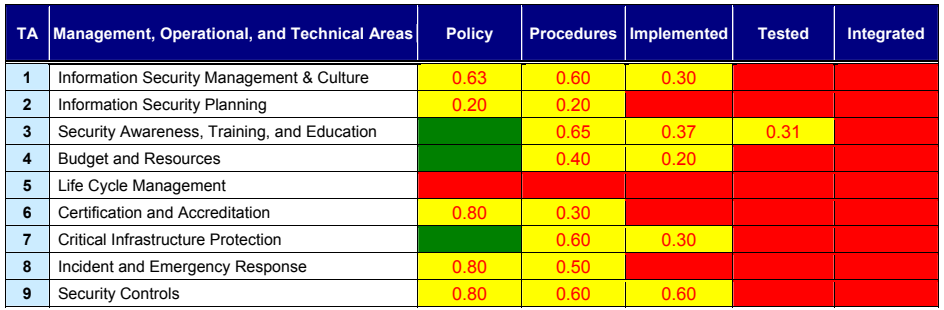
色分けしたスコアカードです。列は「TA」「Management, Operational, and Technical Areas」「Policy」「Procedures」「Implemented」「Tested」「Integrated」です。1 Information Security Management & Culture:Policy 0.63、Procedures 0.60、Implemented 0.30(黄)、Tested と Integrated は赤。2 Information Security Planning:Policy 0.20、Procedures 0.20(黄)、Implemented 以降は赤。3 Security Awareness, Training, and Education:Policy は緑、Procedures 0.65、Implemented 0.37、Tested 0.31(黄)、Integrated は赤。4 Budget and Resources:Policy は緑、Procedures 0.40、Implemented 0.20(黄)、Tested と Integrated は赤。5 Life Cycle Management:すべて赤。6 Certification and Accreditation:Policy 0.80、Procedures 0.30(黄)、残りは赤。7 Critical Infrastructure Protection:Policy は緑、Procedures 0.60、Implemented 0.30(黄)、残りは赤。8 Incident and Emergency Response:Policy 0.80、Procedures 0.50(黄)、残りは赤。9 Security Controls:Policy 0.80、Procedures 0.60、Implemented 0.60(黄)、残りは赤。緑はスコア 1.00、黄は部分的なスコア、赤はスコア 0.00 を表します。
Each TA above consists of Subtopic Areas (STAs: not shown in Table 1-1) and each STA consists of a number of criteria. The first eight (8) TAs focus on the strategic aspects of information security program management. The review identifies the level of maturity of the information security program and the agency's ability to comply with existing requirements in eight areas. The last TA reviews the technical aspects of the overall information security program. PRISMA therefore provides a framework to assist in instructional purposes as well as to assist assessments, independent evaluations, or reviews.
上記の各 TA はサブトピック領域(STA。表 1-1 には示していません)で構成され、各 STA は複数の基準で構成されます。最初の 8 つの TA は、情報セキュリティプログラム管理の戦略的側面に焦点を当てています。このレビューでは、8 つの領域において、情報セキュリティプログラムの成熟度のレベルと、既存の要件に準拠する機関の能力を特定します。最後の TA は、情報セキュリティプログラム全体の技術的側面をレビューします。したがって PRISMA は、教育目的で用いるための枠組みを提供するとともに、評価、独立した評定、レビューを支援します。
1.2 Legislative Background
1.2 法的背景
The E-Government Act (Public Law 107-347) passed by the 107th Congress, and signed into law by the President in December 2002, recognized the importance of information security to the economic and national security interests of the United States. Title III of the E-Government Act, entitled the Federal Information Security Management Act (FISMA), included duties and responsibilities for the Computer Security Division in Section 303, “National Institute of Standards and Technology.” PRISMA incorporates standards from the Federal Information Processing Standards (FIPS), such as FIPS 199, Standards for Security Categorization of Federal Information and Information Systems, and FIPS 200, Minimum Security Requirements for Federal Information and Information Systems. It also incorporates guidance from many of the NIST Special Publications (SPs) such as NIST SP 800-53, Recommended Security Controls for Federal Information Systems; existing federal directives including FISMA; and other proven techniques and recognized best practices in the area of information security.
第 107 議会(107th Congress)で可決され、2002 年 12 月に大統領が署名して成立した電子政府法(E-Government Act、公法 107-347)は、米国の経済的利益と国家安全保障上の利益にとっての情報セキュリティの重要性を認めました。電子政府法の第 III 編である連邦情報セキュリティマネジメント法(FISMA)は、第 303 条「国立標準技術研究所」において、Computer Security Division の職務と責任を定めました。PRISMA は、FIPS 199『Standards for Security Categorization of Federal Information and Information Systems』や FIPS 200『Minimum Security Requirements for Federal Information and Information Systems』など、連邦情報処理標準(FIPS)の標準を取り入れています。また、NIST SP 800-53『Recommended Security Controls for Federal Information Systems』など多くの NIST 特別刊行物(SP)の指針、FISMA を含む既存の連邦指令、および情報セキュリティの分野で実績のあるその他の技法や広く認められたベストプラクティスも取り入れています。
FISMA assigned NIST the following responsibilities:
FISMA は、NIST に次の責任を課しました。
•Developing IT standards for Federal systems, to specifically include security standards and guidelines;
•連邦システムのための、セキュリティ標準およびガイドラインを特に含む、IT 標準を策定すること。
•Conducting research to identify information security vulnerabilities and techniques to provide cost-effective information security;
•情報セキュリティの脆弱性と、費用対効果の高い情報セキュリティを提供するための技法を特定するための調査を実施すること。
•Evaluating private-sector policies, practices, and commercially available technologies to assess potential application by agencies to strengthen information security;
•民間部門の方針、実践、市販の技術を評価し、情報セキュリティを強化するために機関が適用できる可能性を見極めること。
•Evaluating security policies and practices developed for national security systems to assess potential application for non-national security systems.
•国家安全保障システム向けに策定されたセキュリティ方針と実践を評価し、国家安全保障以外のシステムへの適用の可能性を見極めること。
1.3 PRISMA
1.3 PRISMA
The PRISMA methodology was successfully employed in several independent reviews of the information security maturity of various federal agency programs over the last five years. The methodology is a proven and successful scalable process and approach to evaluating an organization’s information security program. Simply employing the methodical approaches increased the information security awareness of security staff, interviewees, and agency personnel. On the other end of the scale, PRISMA identifies concise security program corrective actions, which, if taken, can improve the overall security program.
PRISMA 手法は、過去 5 年間に、連邦機関のさまざまなプログラムの情報セキュリティの成熟度に関する複数の独立したレビューで、成功裏に用いられてきました。この手法は、組織の情報セキュリティプログラムを評価するための、実績があり成功を収めた、拡張可能なプロセスでありアプローチです。体系的なアプローチを用いるだけで、セキュリティ担当者、インタビュー対象者、機関職員の情報セキュリティ意識が高まりました。その一方で PRISMA は、簡潔なセキュリティプログラムの是正措置を特定し、それを講じればセキュリティプログラム全体を改善できます。
The structure of a PRISMA Review is based upon the Software Engineering Institute’s (SEI) former Capability Maturity Model (CMM), where an organization’s developmental advancement is measured by one of five maturity levels. This approach was incorporated into the Federal CIO Council’s Federal Information Technology Security Assessment Framework of 2000 and PRISMA, which also employ five maturity levels where the fifth maturity level represents the highest developmental level of the information security program. The levels are listed in increasing maturity as follow:
PRISMA レビューの構造は、Software Engineering Institute(SEI)のかつての能力成熟度モデル(CMM)に基づいており、組織の発展の進み具合を 5 つの成熟度レベルのいずれかで測定します。このアプローチは、2000 年の連邦 CIO 評議会の Federal Information Technology Security Assessment Framework と PRISMA に取り入れられており、これらも 5 つの成熟度レベルを用い、5 番目の成熟度レベルが情報セキュリティプログラムの最も高い発展レベルを表します。レベルは、成熟度が高くなる順に次のとおりです。
•Maturity Level 1: Policies
•成熟度レベル 1: 方針
•Maturity Level 2: Procedures,
•成熟度レベル 2: 手順、
•Maturity Level 3: Implementation,
•成熟度レベル 3: 実施、
•Maturity Level 4: Testing, and
•成熟度レベル 4: 試験、
•Maturity Level 5: Integration
•成熟度レベル 5: 統合
In PRISMA’s initial maturity level of development, the review determines the existence of current, documented information security ‘policies’ in the federal information security program. The second PRISMA maturity level reviews the existence of documented ‘procedures’ developed from the policies. The third PRISMA maturity level reviews the ‘implementation’ of the policies and procedures. PRISMA’s fourth maturity level reviews the ‘testing’ of the implementation of the information security policies and procedures. The highest PRISMA maturity level reviews the program or agency for ‘integration’ of the previous four maturity levels, i.e., information security (1) policies, (2) procedures, (3) implementation, and (4) testing. A program or agency may only attain a higher maturity level after the previous maturity level is attained. For instance, if a information security program demonstrates it satisfied the TA criteria at a maturity level three (implementation) but did not satisfy the TA criteria for maturity level one (policy), then the information security program did not attain maturity level three (nor level one nor level two in this example). ‘Policy’ is what defines the baseline against which all subsequent activity and maturity levels must show compliance and consistency.
PRISMA の最初の成熟度レベルでは、連邦の情報セキュリティプログラムに、文書化された最新の情報セキュリティの「方針」が存在するかどうかを、レビューで判断します。2 番目の PRISMA 成熟度レベルでは、その方針から作成された、文書化された「手順」が存在するかどうかをレビューします。3 番目の PRISMA 成熟度レベルでは、方針と手順の「実施」をレビューします。PRISMA の 4 番目の成熟度レベルでは、情報セキュリティの方針と手順の実施の「試験」をレビューします。PRISMA の最高の成熟度レベルでは、それまでの 4 つの成熟度レベル、すなわち情報セキュリティの (1) 方針、(2) 手順、(3) 実施、(4) 試験の「統合」について、プログラムまたは機関をレビューします。プログラムまたは機関は、1 つ前の成熟度レベルを達成した後でなければ、より高い成熟度レベルを達成できません。たとえば、情報セキュリティプログラムが成熟度レベル 3(実施)における TA の基準を満たしていることを示しても、成熟度レベル 1(方針)の TA の基準を満たしていなければ、その情報セキュリティプログラムは成熟度レベル 3 を達成していません(この例ではレベル 1 もレベル 2 も達成していません)。「方針」は、以後のすべての活動と成熟度レベルが準拠と一貫性を示さなければならない基準を定めるものです。
Table 1-2 shows a closer view of some of the criteria of only STA 3.1. STA 3.1 is used in other examples throughout this NIST Interagency Report. All PRISMA TAs, STAs, criteria, maturity questions, and interview questions are available in a companion file located on NIST’s web site -http://csrc.nist.gov/publications/nistir/index.html.
表 1-2 は、STA 3.1 のみの基準の一部を詳しく示したものです。STA 3.1 は、この NIST 省庁間報告書の他の例でも用いられています。PRISMA のすべての TA、STA、基準、成熟度に関する質問、インタビューの質問は、NIST の Web サイト http://csrc.nist.gov/publications/nistir/index.html にある付属のファイルで入手できます。
Table 1-2, Closer view of STA 3.1, some of its criteria and maturity questioning flow
表 1-2、STA 3.1、その基準の一部、および成熟度に関する質問の流れの詳細
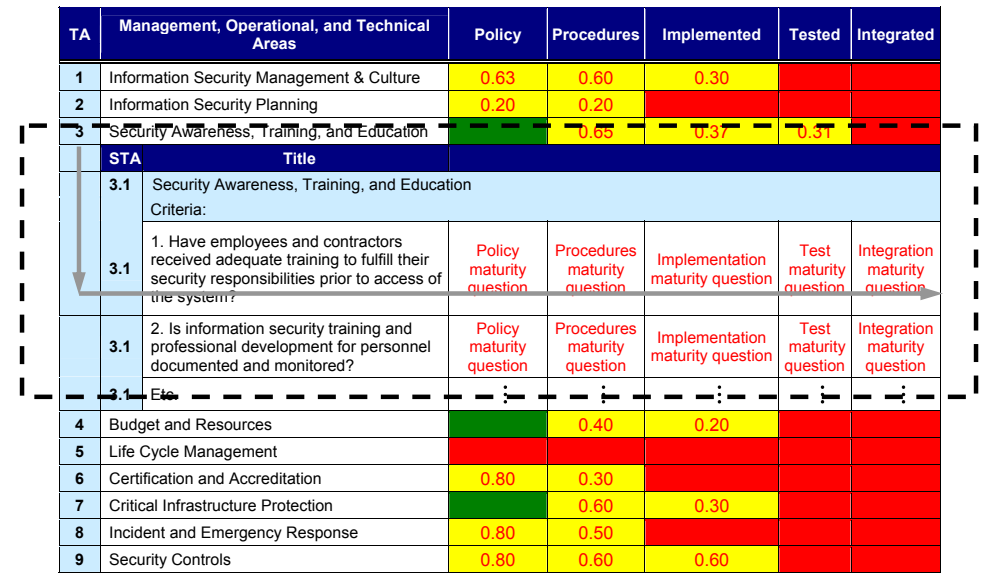
表 1-1 のスコアカードを展開した図です。スコアカードの行 1〜9(TA、管理、運用、技術領域、方針、手順、実施済み、試験済み、統合)が、表 1-1 と同じ色とスコアで示されています。3 行目の「セキュリティ意識向上、訓練、教育」が破線の枠内に展開され、「STA 3.1 セキュリティ意識向上、訓練、教育」と「基準:」、および 2 つの基準例「1. 従業員と請負業者は、システムにアクセスする前に、セキュリティ上の責任を果たすための十分な訓練を受けていますか。」「2. 職員向けの情報セキュリティ訓練と専門能力開発は、文書化され、監視されていますか。」が示されています。各基準のセルには「方針の成熟度に関する質問」「手順の成熟度に関する質問」「実施の成熟度に関する質問」「試験の成熟度に関する質問」「統合の成熟度に関する質問」と記されています。「3.1 など」の行と縦の点は、さらに基準が続くことを示しています。矢印は、基準を下方向に、成熟度レベルを横方向にたどる質問の流れを示しています。
Section 2, PRISMA Approach Overview, will provide more detail on the PRISMA maturity levels and scoring.
第 2 節「PRISMA アプローチの概要」では、PRISMA の成熟度レベルとスコアリングについて、さらに詳しく説明します。
1.4 PRISMA Assumptions and Constraints
1.4 PRISMA の前提と制約
A PRISMA review may be bound by several constraints and assumptions. For examples, a PRISMA review:
PRISMA レビューには、いくつかの制約と前提が伴う場合があります。たとえば、PRISMA レビューには次の特徴があります。
•May be employed to support the FISMA report,
•FISMA 報告書を裏付けるために用いられる場合があります。
•Uses existing agency/ program information to determine the current security program status,
•既存の機関/プログラムの情報を用いて、セキュリティプログラムの現状を判断します。
•Is a ‘snapshot in time’ and only takes into account historical data and the data available at the time that the PRISMA review takes place,
•「ある時点のスナップショット」であり、PRISMA レビューの実施時点で入手可能なデータと、それ以前のデータのみを考慮します。
•Is subjective using a defined methodology and assumes all interview data is valid and correct,
•定められた手法を用いるものの主観的であり、インタビューのデータはすべて有効かつ正しいと仮定します。
•Is a management level review of customizable detail to achieve defined objectives or directives,
•定められた目的または指令を達成するために、レビューの詳細を調整できる管理レベルのレビューです。
•Is based on ‘limited sample material’ provided to the PRISMA Review Team. As more information is received, the review becomes a better picture of the agency’s information security posture,
•PRISMA レビューチームに提供された「限られたサンプル資料」に基づきます。より多くの情報が得られるにつれて、レビューは機関の情報セキュリティ態勢をより的確に描き出すものになります。
•The review will assist in the certification and accreditation (C&A) process, but does not take the place of the C&A process since a PRISMA review is security program focused.
•このレビューは認証・認定(C&A)プロセスを支援しますが、PRISMA レビューはセキュリティプログラムに焦点を当てたものであるため、C&A プロセスに代わるものではありません。
•Is executed by individuals knowledgeable of FISMA, NIST standards and guidance, and security programs, and
•FISMA、NIST の標準とガイダンス、セキュリティプログラムに精通した人員によって実行されます。
•Is a standardized process for collecting and rating information but requires analysis by PRISMA Team member(s).
•情報を収集して格付けするための標準化されたプロセスですが、PRISMA チームのメンバーによる分析が必要です。
1.5 Audience
1.5 想定読者
The audience for this document includes:
この文書の想定読者は次のとおりです。
•Management personnel with a role in information security at the information security program level,
•情報セキュリティプログラムのレベルで情報セキュリティに役割を持つ管理職員、
•Information Security Personnel,
•情報セキュリティ担当者、
•Internal Reviewers,
•内部レビュー担当者、
•Independent Parties,
•独立した第三者、
•Auditors, (internal and external) and
•監査人(内部および外部)、
•IG Staff Personnel.
•IG スタッフ。
1.6 Document Organization
1.6 文書の構成
The remainder of this document is structured as follows:
この文書の残りの部分は、次のように構成されています。
•Section 2: PRISMA Approach Overview. Describes the mechanics of preparing for and executing a PRISMA review, assessment, or evaluation.
•第 2 節: PRISMA アプローチの概要。PRISMA によるレビュー、評価、評定の準備と実施の仕組みを説明します。
•Section 3: Application of PRISMA Final Report. Discusses areas where the PRISMA Final Report may be applied to support and improve information security.
•第 3 節: PRISMA 最終報告書の活用。PRISMA 最終報告書を、情報セキュリティの支援と改善のために活用できる領域を論じます。
•Section 4: Summary. Discusses key points of this report.
•第 4 節: まとめ。この報告書の要点を論じます。
•Appendix A: Acronyms. Lists acronyms and abbreviations used in this document.
•付録 A: 略語。この文書で使用する略語と省略形を示します。
•Appendix B: Sample Memorandum from CIO to PRISMA Interviewees.
•付録 B: CIO から PRISMA インタビュー対象者への通知文の例。
•Appendix C: Key Personnel Contact Request List. List of potential interviewees.
•付録 C: 主要担当者の連絡先依頼リスト。インタビュー対象となりうる人員のリストです。
•Appendix D: Documentation Request List. List of documents for the PRISMA review.
•付録 D: 文書提出依頼リスト。PRISMA レビューのための文書のリストです。
•Appendix E: Generic Agency/ Program Questions. Provides a basic understanding of the information security program to reduce research effort by the PRISMA Team.
•付録 E: 機関/プログラム共通の質問。PRISMA チームの調査の手間を減らすために、情報セキュリティプログラムの基本的な理解を提供します。
•Appendix F: Document Triage Template. List of requested documents matched with PRISMA Topic Areas.
•付録 F: 文書トリアージテンプレート。依頼した文書を PRISMA のトピック領域と対応づけたリストです。
•Appendix G: PRISMA Report Template. A format recommendation for the PRISMA Final Report.
•付録 G: PRISMA 報告書テンプレート。PRISMA 最終報告書の書式の推奨案です。
•Appendix H: FISMA to PRISMA Crosswalk. A mapping of the FISMA reporting requirements to the PRISMA subtopic areas.
•付録 H: FISMA と PRISMA の対応表。FISMA の報告要件を PRISMA のサブトピック領域に対応づけたものです。
•Appendix I: References.
•付録 I: 参考文献。
2. PRISMA Approach Overview
2. PRISMA アプローチの概要
A PRISMA review focuses on part or all of the strategic and technical aspects of an information security program. The review identifies the level of maturity of the information security program and the agency's ability to comply with existing requirements in the following nine (9) Topic Areas (TA):
PRISMA レビューは、情報セキュリティプログラムの戦略的側面と技術的側面の一部またはすべてに焦点を当てます。このレビューでは、次の 9 つのトピック領域(TA)において、情報セキュリティプログラムの成熟度のレベルと、既存の要件に準拠する機関の能力を特定します。
1.Information Security Management and Culture,
1.情報セキュリティマネジメントと文化、
2.Information Security Planning,
2.情報セキュリティの計画、
3.Security Awareness, Training, and Education,
3.セキュリティの意識向上、トレーニング、教育、
4.Budget and Resources,
4.予算とリソース、
5.Life Cycle Management,
5.ライフサイクル管理、
6.Certification and Accreditation,
6.認証・認定、
7.Critical Infrastructure Protection,
7.重要インフラ防護、
8.Incident and Emergency Response, and
8.インシデントおよび緊急時の対応、
9.Security Controls.
9.セキュリティ管理策。
The PRISMA review is based upon five levels of maturity: policy, procedures, implementation, test, and integration. A brief description of each level is provided in Table 2-1. The PRISMA Review Team assesses the maturity level for each of the review criteria. A higher maturity level can only be attained if the previous maturity level is attained. Therefore, if a policy is not documented for a specific criterion, none of the maturity levels are attained for that specific criterion.
PRISMA レビューは、方針、手順、実施、試験、統合という 5 つの成熟度レベルに基づきます。各レベルの簡単な説明は表 2-1 に示します。PRISMA レビューチームは、レビュー基準ごとに成熟度レベルを評価します。より高い成熟度レベルは、1 つ前の成熟度レベルを達成した場合にのみ達成できます。したがって、ある基準について方針が文書化されていなければ、その基準については、いずれの成熟度レベルも達成されません。
Table 2-1, Description of PRISMA Maturity Levels
表 2-1、PRISMA 成熟度レベルの説明
| Description of PRISMA Maturity Levels |
|---|
Maturity Level 1: Policies
|
Maturity Level 2: Procedures
|
Maturity Level 3: Implementation
|
Maturity Level 4: Test
|
Maturity Level 5: Integration
|
| PRISMA 成熟度レベルの説明 |
|---|
成熟度レベル 1: 方針
|
成熟度レベル 2: 手順
|
成熟度レベル 3: 実施
|
成熟度レベル 4: 試験
|
成熟度レベル 5: 統合
|
Figure 2-1 is an overview of a process flow for a general PRISMA review. The first four (4) steps represent preparation activities, while the remaining steps provide guidance on executing an effective review at the defined scope. The PRISMA Preparation and Execution phases are detailed in following sections.
図 2-1 は、一般的な PRISMA レビューのプロセスフローの概要です。最初の 4 つのステップは準備活動を表し、残りのステップは、定めた範囲で有効なレビューを実施するための指針を示します。PRISMA の準備フェーズと実施フェーズについては、以降の節で詳しく説明します。
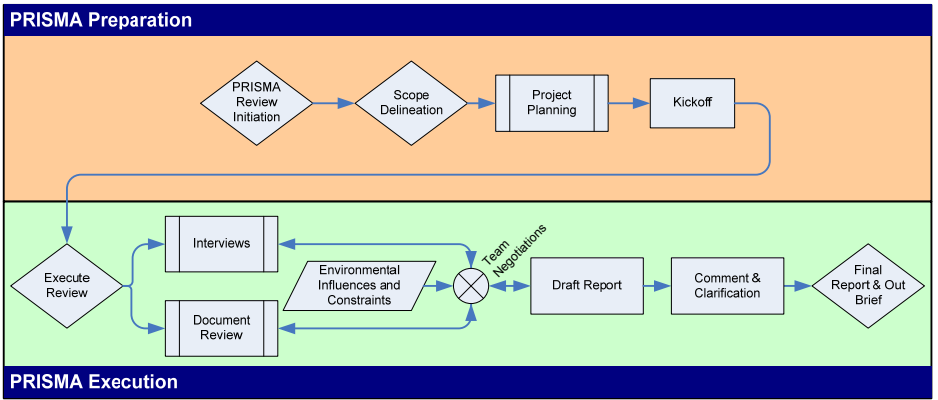
2 段の処理の流れ図です。上段「PRISMA Preparation」は左から「PRISMA Review Initiation」(ひし形)→「Scope Delineation」(ひし形)→「Project Planning」→「Kickoff」と進み、矢印で下段「PRISMA Execution」へ続きます。下段では「Execute Review」(ひし形)から「Interviews」と「Document Review」に分かれ、「Environmental Influences and Constraints」とともに「Team Negotiations」と書かれた合流点に入り、「Draft Report」→「Comment & Clarification」→「Final Report & Out Brief」(ひし形)へ進みます。合流点から「Interviews」と「Document Review」へ戻る矢印があります。
Figure 2-1, PRISMA Process Overview
図 2-1、PRISMA プロセスの概要
2.1 PRISMA Preparation
2.1 PRISMA の準備
This section provides a suggested approach and templates to plan and prepare a PRISMA review. The review, though, may be scaled as needed for the information security program. The approach as shown in Figure 2-1 is the same regardless of tailoring or scaling. Table 2-2 provides a summary of activities and outputs for the Preparation Phase.
この節では、PRISMA レビューを計画し準備するための、推奨するアプローチとテンプレートを示します。ただし、レビューは情報セキュリティプログラムに応じて必要なだけ拡大縮小してもかまいません。図 2-1 に示すアプローチは、調整や拡大縮小を行っても同じです。表 2-2 は、準備フェーズの活動と成果物の要約です。
Table 2-2, PRISMA Preparation Activities
表 2-2、PRISMA の準備活動
| PRISMA Process Steps | Actions | Outputs |
|---|---|---|
| PRISMA Review Initiation |
|
|
| Scope Delineation |
|
|
| Project Planning |
|
|
| Kickoff |
|
|
| PRISMA プロセスのステップ | アクション | 成果物 |
|---|---|---|
| PRISMA レビューの開始 |
|
|
| 範囲の明確化 |
|
|
| プロジェクトの計画 |
|
|
| キックオフ |
|
|
2.1.1 Step 1: PRISMA Review Initiation1
2.1.1 ステップ 1: PRISMA レビューの開始1
The PRISMA Review Initiation step establishes the foundation or the “need” for the review. The organizational “need” will uniquely vary with the organization and adapt to any period in time, yet may include:
PRISMA レビューの開始ステップでは、レビューの基盤、すなわち「必要性」を確立します。組織の「必要性」は組織ごとに固有であり、時期に応じて変わりますが、次のようなものが含まれる場合があります。
•Determining the information security program gaps,
•情報セキュリティプログラムのギャップを判断すること、
•Ascertaining program/ agency maturity levels,
•プログラム/機関の成熟度レベルを確認すること、
•Independent validation of program/ agency information system security program, such as an assessment, evaluation, or a review, and
•評価、評定、レビューなど、プログラム/機関の情報システムセキュリティプログラムの独立した検証、
•An audit or inspection demanded by charter, higher authority, or other mandate.
•憲章、上位の権限、その他の命令によって求められる監査または検査。
Next, an objective or group of objectives are developed based on the “need” statement and may include:
次に、「必要性」の記述に基づいて、1 つまたは複数の目的を作成します。目的には、次のようなものが含まれる場合があります。
•Identifying security program deficiencies,
•セキュリティプログラムの不備を特定すること、
•Establishing a security program baseline to measure future growth following key personnel or organizational changes,
•主要担当者や組織の変更後の将来の成長を測定するための、セキュリティプログラムのベースラインを確立すること、
•Justifying continued budget support for a particular information security program,
•特定の情報セキュリティプログラムへの継続的な予算支援を正当化すること、
•Independent validation of the “state-of-the-program”,
•「プログラムの現状」の独立した検証、
•Supporting information for FISMA scorecard, and
•FISMA スコアカードの裏付け情報、
•Preparation for or conducting an IG review.
•IG レビューの準備または実施。
The PRISMA Review’s “need” and subsequent objective statement is developed with or by the appropriate organizational management level with the authority to accomplish the review and apply the necessary resources. After capturing the “need” and codifying an objective statement for the review, the lead organization and project manager is appointed along with all supporting organizations. As a final output of this activity, appropriate management level endorsement of the PRISMA Review is crucial to the success of the review. This endorsement in the form of a memorandum or e-mail formally authorizes the PRISMA Review, captures the organizational need and objectives, and appoints the PRISMA Review leadership and team.
PRISMA レビューの「必要性」とそれに続く目的の記述は、レビューを遂行し必要なリソースを投入する権限を持つ、適切な組織の管理職レベルとともに、またはそのレベルによって作成されます。「必要性」を把握し、レビューの目的の記述を整理した後、すべての支援組織とともに、主導組織とプロジェクトマネージャーを任命します。この活動の最終的な成果物として、適切な管理職レベルによる PRISMA レビューの承認が、レビューの成功にとって極めて重要です。この承認は、通知文または電子メールの形で、PRISMA レビューを正式に認可し、組織の必要性と目的を記録し、PRISMA レビューのリーダーシップとチームを任命するものです。
2.1.2 Step 2: PRISMA Review Scope Delineation2
2.1.2 ステップ 2: PRISMA レビューの範囲の明確化2
As stated earlier, the PRISMA process evaluates the maturity and effectiveness of an information security program. The construction of the PRISMA process allows for scoping the project to support a variety of organizational needs. The PRISMA Review may be conducted for an agency or operating division security program with a focus on all nine TAs or any subset. Additionally, a review may be focused toward assessing a particular maturity level, for example, the status of the Policy maturity level.
前述のとおり、PRISMA プロセスは、情報セキュリティプログラムの成熟度と有効性を評価します。PRISMA プロセスの構成により、さまざまな組織上の必要性に応じて、プロジェクトの範囲を設定できます。PRISMA レビューは、機関または運営部門のセキュリティプログラムを対象に、9 つの TA のすべてまたはその一部に焦点を当てて実施できます。さらに、特定の成熟度レベル、たとえば方針の成熟度レベルの状況を評価することに焦点を当てたレビューも可能です。
2.1.3 Step 3: PRISMA Planning
2.1.3 ステップ 3: PRISMA の計画
This process step is primarily concerned with resource and schedule planning to execute the review and to establish the initial groundwork to prepare for the review. The initial resource question centers on whether human and capital resources exist to execute and then whether a review is conducted in-house, through contracted actions, or by an IG or review team. Another factor to consider is the appropriateness of an in-house review versus an independent agent with regards to brokering and presenting observations. If an independent, non-government agent is necessary, a primary output at this stage is a contract Statement of Work (SOW) with the appropriate PRISMA tasks and deliverables identified.
このプロセスステップは、主に、レビューを実行するためのリソースとスケジュールの計画、およびレビューの準備のための初期の土台づくりに関わります。最初のリソースに関する問いは、実行するための人的リソースと資本リソースが存在するかどうか、そのうえで、レビューを内部で行うか、契約によって行うか、IG またはレビューチームが行うかという点が中心になります。もう 1 つ考慮すべき要素は、所見の調整と提示に関して、内部のレビューと独立した主体のどちらが適切かという点です。独立した非政府の主体が必要な場合、この段階の主要な成果物は、該当する PRISMA のタスクと成果物を特定した契約の作業範囲記述書(SOW)です。
The secondary planning action is to prepare for the PRISMA Review itself by identifying primary and alternate key personnel contacts and supporting documentation based on the defined review scope. A recommended listing of key personnel interview candidates is provided in Table 2-3. A Memorandum from an organizationally appropriate Manager (such as the CIO) is recommended to notify and engage PRISMA interviewees. A sample Memorandum is provided in Appendix B.
2 番目の計画上のアクションは、定めたレビューの範囲に基づいて、主要担当者の連絡先(正担当者と代理担当者)と裏付けとなる文書を特定することにより、PRISMA レビュー自体の準備をすることです。主要担当者のインタビュー候補の推奨リストを表 2-3 に示します。PRISMA のインタビュー対象者に通知して参加を求めるために、組織上適切な管理職(CIO など)による通知文を推奨します。通知文の例を付録 B に示します。
Table 2-3, Key Personnel Contact Request List
表 2-3、主要担当者の連絡先依頼リスト
| Key Personnel Contact Request List | |
|---|---|
| Chief Information Officer (CIO) | Contract Managers |
| Chief Financial Officer (CFO) | Human Resource Managers |
| Chief Technology Officer (CTO) | Functional Area Managers |
| Senior Agency Information Security Officer (SAISO) | Program Managers |
| Inspector General (IG) Staff Personnel | Program Contracting Officers (CO) |
| Information Systems Security Managers (ISSMs)/ Officers (ISSOs) | Program Contracting Officer Technical Representative (COTR) |
| Designated Approval Authority (DAA)/ Authorizing Officials (AO) | System/ Network/ Database Administrators |
| Facilities Mgrs/ Physical Security Mgrs | IT Developers and/ or Integrators |
| Directors (IT, business areas, etc.) | End Users |
| 主要担当者の連絡先依頼リスト | |
|---|---|
| 最高情報責任者(CIO) | 契約管理者 |
| 最高財務責任者(CFO) | 人事管理者 |
| 最高技術責任者(CTO) | 機能領域の管理者 |
| 機関の上級情報セキュリティ責任者(SAISO) | プログラムマネージャー |
| 監察総監(IG)スタッフ | プログラム契約担当官(CO) |
| 情報システムセキュリティ管理者(ISSM)/責任者(ISSO) | プログラム契約担当官技術代理人(COTR) |
| 指定承認機関(DAA)/認可責任者(AO) | システム/ネットワーク/データベース管理者 |
| 施設管理者/物理セキュリティ管理者 | IT 開発者および/またはインテグレーター |
| ディレクター(IT、事業領域など) | エンドユーザー |
The PRISMA Review Team works with the information security program personnel to ensure the sampling of key personnel is sufficient to address the job responsibilities and organizational structure. Appendix D and F are provided to assist in identifying and collecting supporting PRISMA review documentation. Appendix D presents a recommended list which may be modified or shortened according to the defined scope. Appendix F provides a document triage matrix to match documents to PRISMA TAs and maturity levels. Documents supporting the review should be cataloged according to the title and official release date and/or draft circulation date.
PRISMA レビューチームは、情報セキュリティプログラムの担当者と協力して、主要担当者のサンプリングが、職務上の責任と組織構造に対応するのに十分であることを確保します。付録 D と F は、PRISMA レビューを裏付ける文書を特定し収集するのに役立ちます。付録 D は、定めた範囲に応じて修正または短縮してよい推奨リストを示します。付録 F は、文書を PRISMA の TA および成熟度レベルと対応づけるための文書トリアージマトリクスを示します。レビューを裏付ける文書は、題名と正式な発行日または草案の回覧日、あるいはその両方によって目録化すべきです。
During this activity, key information security or other agency representatives of the information security program under review should complete relevant questions from the Generic Questionnaire contained in Appendix E. Questions supporting the scope and level of the review should remain the focus; however, many of these questions are designed to provide valuable environmental and cultural support for the review.
この活動の間に、レビュー対象の情報セキュリティプログラムの主要な情報セキュリティ担当者またはその他の機関の代表者は、付録 E に含まれる共通質問票のうち、関連する質問に回答すべきです。レビューの範囲とレベルを裏付ける質問を引き続き中心とすべきですが、これらの質問の多くは、レビューのために有用な環境面・文化面の裏付けを得られるように設計されています。
2.1.4 Step 4: PRISMA Kickoff Meeting
2.1.4 ステップ 4: PRISMA キックオフミーティング
A kickoff meeting is recommended between the party implementing PRISMA (information security personnel, auditors, inspectors, etc.) and representatives of the information security program under review. At the meeting, the identified objective, scope, schedule, document criteria, and related interview approach are briefed to the participants. Secondly, the management level Memorandum may be discussed to confirm the contact information and to develop a schedule with the interviewees. The kick-off meeting may also be used to canvas the review team (which may be information security personnel, auditors or inspectors) as well as key interview participants and organizational management for validation of and solicitation of additional information. Candidate areas for discussion include responses to the generic questionnaire, the documentation list, and additional or other interview candidates.
PRISMA を実施する側(情報セキュリティ担当者、監査人、検査官など)と、レビュー対象の情報セキュリティプログラムの代表者との間で、キックオフミーティングを開催することを推奨します。会議では、特定した目的、範囲、スケジュール、文書の基準、関連するインタビューのアプローチを参加者に説明します。次に、管理職レベル向けの覚書について話し合い、連絡先情報を確認し、インタビュー対象者とのスケジュールを作成してもよいです。キックオフミーティングは、レビューチーム(情報セキュリティ担当者、監査人、検査官の場合があります)と主要なインタビュー参加者、組織の管理職に意見を求め、追加情報を検証・収集するためにも使用してもよいです。協議の候補となる領域には、共通質問票への回答、文書リスト、追加またはその他のインタビュー候補者が含まれます。
2.2 Execute PRISMA Review
2.2 PRISMA レビューの実施
The review’s execution phase ultimately results in a published report and consists of reviewing agency documentation, interviewing agency personnel, and performing a review gap analysis. The PRISMA Review Team conducts the review in a fashion that minimizes the impact of the review on necessary operations. Table 2-4 provides a summary of activities and outputs to execute a PRISMA Review.
レビューの実施フェーズは、最終的に報告書の発行につながり、機関の文書のレビュー、機関職員へのインタビュー、レビューのギャップ分析の実施で構成されます。PRISMA レビューチームは、必要な業務への影響を最小限に抑える方法でレビューを実施します。表 2-4 は、PRISMA レビューを実施するための活動と成果物の要約です。
Table 2-4, PRISMA Execution Activities
表 2-4、PRISMA の実施活動
| PRISMA Process Steps | Activities | Outputs |
|---|---|---|
| Execute Review |
|
|
| Document Review |
|
|
| Interviews |
|
|
| Environmental Influences and Constraints |
|
|
| Team Negotiations |
|
|
| Draft Report |
|
|
| Comment & Clarification |
|
|
| Final Report & Out brief |
|
|
| PRISMA プロセスのステップ | 活動 | 成果物 |
|---|---|---|
| レビューの実行 |
|
|
| 文書レビュー |
|
|
| インタビュー |
|
|
| 環境の影響と制約 |
|
|
| チームによる折衝 |
|
|
| 報告書草案 |
|
|
| コメントと明確化 |
|
|
| 最終報告書と結果報告 |
|
|
2.2.1 Step 5: Document Review
2.2.1 ステップ 5: 文書レビュー
Using the PRISMA Review Criteria, a member(s) of the PRISMA Review Team reviews all documents pertaining to each of the PRISMA topic areas within the scope of the review and the maturity objective of the document (i.e., a policy maturity level versus an implementation maturity level type document). The PRISMA Review Team member(s) determines whether the document is “compliant”, “partially complaint”, or “not compliant” when assessed against the PRISMA document criteria. The following is a list of items to remember when reviewing the documents:
PRISMA レビュー基準を用いて、PRISMA レビューチームのメンバーは、レビューの範囲内にある各 PRISMA トピック領域に関するすべての文書をレビューします。また、文書の成熟度の目標(すなわち、方針の成熟度レベルを対象とする文書か、実施の成熟度レベルを対象とする文書か)も考慮します。PRISMA レビューチームのメンバーは、PRISMA の文書基準に照らして評価したときに、その文書が「準拠」、「一部準拠」、「非準拠」のいずれであるかを判断します。文書をレビューする際に留意すべき項目は、次のとおりです。
•Policy compliance can only be found in an organizationally recognized policy document,
•方針への準拠は、組織として認められた方針文書でのみ確認できます。
•Documents, especially policy and procedures must be identified as “Final” and “Approved” to be considered for maturity compliance, and
•文書、特に方針と手順は、成熟度への準拠について検討されるためには、「最終版」かつ「承認済み」と明記されていなければなりません。
•Quantity as well as quality of documents must be considered, when necessary, in responding to certain PRISMA criteria. In other words, if the program under review has ten applicable systems and the PRISMA Review Team receives only three fully compliant security plans for three of these systems, the PRISMA Review Team member(s) will score the results as a “partial compliance” since seven security plans are missing.
•特定の PRISMA 基準に回答する際には、必要に応じて、文書の質だけでなく量も考慮しなければなりません。つまり、レビュー対象のプログラムに該当するシステムが 10 あり、PRISMA レビューチームが、そのうち 3 つのシステムについて完全に準拠したセキュリティ計画を 3 件しか受け取らなかった場合、7 件のセキュリティ計画が欠けているため、PRISMA レビューチームのメンバーは、結果を「部分的に準拠」と採点します。
Table 2-5 shows sample maturity level question responses based upon a document review.
表 2-5 は、文書レビューに基づく成熟度レベルの質問への回答の例を示します。
Table 2-5, Sample Documentation Review Results for All Maturity Levels of One Criterion
表 2-5、1 つの基準に対するすべての成熟度レベルの文書レビュー結果の例
| Maturity Level Question | Maturity Level Question Sample Response | Compliance Indicator | Explanation |
|---|---|---|---|
| Maturity Level 1: Policy. Does documented policy require controls such as separation of duties, least privilege, and individual accountability incorporated into all business operations? | Yes – Policy Document, Chapter 6 part 5.2 shall provide access to Organization’s information systems according to individual accountability, separation of duties, and the least privilege practice. | Compliant | |
| Maturity Level 2: Procedures. Are procedures documented for incorporating controls such as separation of duties, least privilege, and individual accountability incorporated into all business operations? | Yes – Chapter 2 part 1.2 The Internet Posting Process provides instruction as to where, how, when, and who incorporates controls for separation of duties, least privilege, and individual accountability for posting to the Internet. This document provides a partial compliance since other functions need such procedures. | Partially Compliant | This procedure applies only to Internet posting; other events are necessary to provide complete compliance. |
| Maturity Level 3: Implementation. Are controls such as separation of duties, least privilege, and individual accountability incorporated into all business operations? | Yes, Section 3.3.1.1 provides general assignment of information security responsibilities based on principles of separation of duties, least privilege and individual accountability. Section 3.3.6.1 states System "X" separated users into two primary categories: superusers and users. Superusers are subdivided into 4 types: AAs, EC Reviewers, SAs, and DBAs. This document provides a partial compliance since other systems require implementation. | Partially Compliant | One system has evidence of implementing these access controls. However, this is only partial compliance for the question since this document does not provide evidence of implementation for all systems. |
| Maturity Level 4: Test. Are tests periodically conducted to verify that specified roles and responsibilities are separate and that a single individual does not have the capability to perform these multiple roles and responsibilities? | No, not addressed | Noncompliant | |
| Maturity Level 5: Integration. Is separating roles and responsibilities accepted and are standard business practices not challenged or defeated in purpose? | No, not addressed | Noncompliant |
| 成熟度レベルの質問 | 成熟度レベルの質問への回答の例 | 準拠の指標 | 説明 |
|---|---|---|---|
| 成熟度レベル 1: 方針。職務の分離、最小権限、個人の説明責任などの管理策をすべての業務運営に組み込むことを、文書化された方針が要求していますか。 | はい – 方針文書の第 6 章 5.2 は、組織の情報システムへのアクセスを、個人の説明責任、職務の分離、最小権限の実践に従って提供するものとしています(shall)。 | 準拠 | |
| 成熟度レベル 2: 手順。職務の分離、最小権限、個人の説明責任などの管理策をすべての業務運営に組み込むための手順が文書化されていますか。 | はい – 第 2 章 1.2 のインターネット掲載プロセスは、インターネットへの掲載について、職務の分離、最小権限、個人の説明責任の管理策を、どこで、どのように、いつ、誰が組み込むかを指示しています。この文書は、他の機能にも手順が必要なため、部分的な準拠となります。 | 部分的に準拠 | この手順はインターネットへの掲載にのみ適用されます。完全に準拠するには、他の事象についても手順が必要です。 |
| 成熟度レベル 3: 実施。職務の分離、最小権限、個人の説明責任などの管理策が、すべての業務運営に組み込まれていますか。 | はい。第 3.3.1.1 節は、職務の分離、最小権限、個人の説明責任の原則に基づいて、情報セキュリティの責任を全般的に割り当てています。第 3.3.6.1 節は、システム「X」がユーザーをスーパーユーザーとユーザーの 2 つの主要なカテゴリーに分けたと述べています。スーパーユーザーはさらに 4 種類(AA、EC レビュー担当者、SA、DBA)に細分されています。他のシステムにも実施が必要であるため、この文書は部分的な準拠となります。 | 部分的に準拠 | 1 つのシステムに、これらのアクセス制御を実施している証拠があります。ただし、この文書はすべてのシステムについて実施の証拠を示していないため、この質問については部分的な準拠にとどまります。 |
| 成熟度レベル 4: 試験。指定された役割と責任が分離されていること、および 1 人の個人がこれらの複数の役割と責任を果たす能力を持たないことを検証するために、試験が定期的に実施されていますか。 | いいえ、対処されていない | 非準拠 | |
| 成熟度レベル 5: 統合。役割と責任の分離が受け入れられ、標準的な業務慣行が異議を唱えられたり、その目的を損なわれたりしていませんか。 | いいえ、対処されていない | 非準拠 |
The document review information does not require corroboration by interviews.
文書レビューの情報は、インタビューによる裏付けを必要としません。
2.2.2 Step 6: Interviews
2.2.2 ステップ 6: インタビュー
Interviews provide information regarding information security program personnel knowledge of information in the documentation, their attitudes, etc. For increased accuracy in measuring this information, NIST recommends that all PRISMA interviews include two review team members to ensure full documentation and understanding of all interviewee comments. A member of the PRISMA Review Team schedules the necessary interviews based upon interviewee and interviewer schedules, attempting to schedule all required interviews shortly after the kick-off meeting. In instances where an interview cannot be scheduled, an attempt should be made to schedule alternates as allowed while immediately bringing the situation to the attention of applicable management for resolution.
インタビューでは、文書に記載された情報に関する情報セキュリティプログラム担当者の知識や、その姿勢などの情報が得られます。この情報をより正確に測定するために、NIST は、インタビュー対象者のすべてのコメントを完全に記録し理解できるように、すべての PRISMA インタビューにレビューチームのメンバー 2 名を含めることを推奨します。PRISMA レビューチームのメンバーは、インタビュー対象者とインタビュー担当者の予定に基づいて必要なインタビューの日程を調整し、必要なすべてのインタビューをキックオフミーティングの直後に設定するよう努めます。インタビューの日程を調整できない場合は、許される範囲で代理の担当者の日程を調整するよう試みるとともに、解決のために、ただちに該当する管理職に状況を知らせるべきです。
The PRISMA Review Team should ensure an adequate sampling of interviews is scheduled. An interview session usually requires from 45 to 60 minutes depending upon the interviewee’s level of involvement/ expertise in the agency’s information security implementation. The interviewers should try to conduct the interview in 45 minutes to respect the interviewee’s time. The following tips are provided for the interviewers:
PRISMA レビューチームは、インタビューを十分なサンプリングで日程調整するよう確保すべきです。1 回のインタビューは、機関の情報セキュリティの実施に対するインタビュー対象者の関与や専門知識のレベルに応じて、通常 45 分から 60 分を要します。インタビュー担当者は、インタビュー対象者の時間に配慮して、45 分でインタビューを行うよう努めるべきです。インタビュー担当者に向けた次のヒントを示します。
•Make introductions (provide PRISMA interviewer names indicating organization or sponsor) and state the purpose of the interview
•自己紹介をし(組織または後援者を示して PRISMA のインタビュー担当者の名前を伝え)、インタビューの目的を述べる
•Explain the purpose of the PRISMA Review and that the purpose of the interview is to identify strengths and weaknesses of the information security program that may not be obtainable from documentation
•PRISMA レビューの目的を説明し、インタビューの目的が、文書からは得られない可能性のある情報セキュリティプログラムの強みと弱みを特定することであると説明する
•Explain non-attribution of responses contained in data stores and final report. The applicability of a non-attribution policy, though, is dependent upon the policy of the agency sponsor, auditor or inspector general.
•データストアと最終報告書に含まれる回答について、発言者を特定しないこと(非帰属)を説明します。ただし、非帰属方針を適用できるかどうかは、機関の後援者、監査人、または監察総監の方針によって決まります。
•Do not record any name or associate interview responses with the interviewee in any way. Again, the applicability of a non-attribution policy, though, is dependent upon the policy of the agency sponsor, auditor or IG.
•氏名を記録せず、インタビューの回答をいかなる形でもインタビュー対象者と関連づけないこと。繰り返しになりますが、非帰属方針を適用できるかどうかは、機関の後援者、監査人、または監察総監(IG)の方針によって決まります。
•Ask only the questions assigned to the interviewee position type
•インタビュー対象者の職位の種類に割り当てられた質問だけを行う
•Document all responses on the interview forms associated with the question
•すべての回答を、その質問に関連づけられたインタビュー用紙に記録する
•Ensure each answer is applicable to the question and that the interviewer understands the answer
•各回答が質問に該当していること、およびインタビュー担当者が回答を理解していることを確認する
•Ask if others should be interviewed or if the PRISMA Review Team should review associated matters
•ほかにインタビューすべき人がいるか、または PRISMA レビューチームが関連する事項をレビューすべきかを尋ねる
•Ask if the individual has suggestions to improve information security in the agency
•機関の情報セキュリティを改善するための提案がないかを、その個人に尋ねる
•Thank the individual for their time and assistance
•その個人の時間と協力に感謝する
After the interview, both interviewers document the results of the interview independently. The interviewers then resolve all discrepancies and produce a comprehensive interview document as soon as possible such as within two days of the interview. The answer to each interview question must be complete, including enough information to make the question obvious.
インタビューの後、2 名のインタビュー担当者は、それぞれ独立してインタビューの結果を文書化します。その後、インタビュー担当者はすべての相違点を解消し、インタビューの翌々日までなど、できるだけ早く包括的なインタビュー文書を作成します。各インタビューの質問に対する回答は完全でなければならず、質問が何であったかがわかるだけの情報を含めなければなりません。
Table 2-6 provides various examples of interview questions and example documentation.
表 2-6 は、インタビューの質問のさまざまな例と、文書化の例を示します。
Table 2-6, Sample Interview Question Responses
表 2-6、インタビューの質問への回答の例
| Interview Question | Sample Interview Response |
|---|---|
| End User: How and to what extent have the general rules and acceptable behaviors for the information system or IT resources you use been conveyed to you? Are you aware of the ethical use of IT resources? | Presently, as new employees join the organization they are required to take training detailing general security rules, rules of behavior, and ethical use of IT resources. This training requires verification through a test and is repeated annually. Additionally every time I log on, I am presented with a reminder of the security rules of behavior. |
| Facility Manager: What type of information security training (such as initial, periodic, annual, etc.) is given to facility managers to make them aware of their information security responsibilities? | As the FM, I receive the same security training as all organizational employees. No other specific training is provided. |
| ISSO: Is an individual assigned as an Information System Security Officer (ISSO) and are his/ her primary duties or additional duties documented? Is the ISSO trained to perform the duties of the job? | Yes, my appointment is formal and my duties are detailed in the agency’s Security Manual. I received ISSO training provided by XXX and attended an industry provided training forum within the last year. |
| ISSO: Are information security awareness classes and briefings available for the general education and awareness of all users of the system? | Yes, all new employees are required to attend security awareness training and all employees are required to take annual refresher training. Additionally, the training division provides security items-of-interest presentations monthly on a volunteer attendance basis. |
| General Personnel: Is information security Awareness and Training (A&T) classes provided at least every 12 months and is attendance mandatory? | Yes, annual refresher information security awareness and training is conducted and is mandatory. |
| インタビューの質問 | インタビューの回答の例 |
|---|---|
| エンドユーザー: あなたが使用している情報システムまたは IT リソースの一般的な規則と許容される行動は、どのように、またどの程度、あなたに伝えられていますか。IT リソースの倫理的な使用を認識していますか。 | 現在、新入職員が組織に加わると、一般的なセキュリティ規則、行動規則、IT リソースの倫理的な使用について定めたトレーニングの受講が求められます。このトレーニングではテストによる確認が行われ、毎年繰り返されます。さらに、ログオンするたびに、セキュリティ行動規則についての注意書きが表示されます。 |
| 施設管理者: 施設管理者が情報セキュリティの責任を認識できるように、どのような種類の情報セキュリティトレーニング(初回、定期、年次など)が行われていますか。 | 施設管理者として、私は組織のすべての職員と同じセキュリティトレーニングを受けています。ほかに特定のトレーニングは提供されていません。 |
| ISSO: 情報システムセキュリティ責任者(ISSO)として個人が任命され、その主たる職務または追加の職務は文書化されていますか。ISSO は、職務を遂行するためのトレーニングを受けていますか。 | はい、私の任命は正式なもので、職務は機関のセキュリティマニュアルに詳しく定められています。XXX が提供する ISSO トレーニングを受け、昨年のうちに業界が提供するトレーニングフォーラムにも参加しました。 |
| ISSO: システムのすべてのユーザーの一般教育と意識向上のために、情報セキュリティの意識向上クラスとブリーフィングが利用できますか。 | はい、すべての新入職員にセキュリティ意識向上トレーニングの受講が求められ、すべての職員に年次の復習トレーニングの受講が求められます。さらに、トレーニング部門が、関心を引くセキュリティの話題についてのプレゼンテーションを、任意参加の形で毎月提供しています。 |
| 一般職員: 情報セキュリティの意識向上とトレーニング(A&T)のクラスは少なくとも 12 か月ごとに提供され、出席は義務ですか。 | はい、年次の復習用の情報セキュリティ意識向上とトレーニングが実施され、義務となっています。 |
2.2.3 Step 7: Environmental Influences and Constraints
2.2.3 ステップ 7: 環境の影響と制約
Leading up to and during the PRISMA Review, the PRISMA Review Team members should identify and track positive and negative environmental influences and constraints bearing on the agency/ program information security program. Environmental influences and constraints include, but are not limited to the following:
PRISMA レビューチームのメンバーは、PRISMA レビューに先立つ期間とレビューの最中に、機関/プログラムの情報セキュリティプログラムに関わる、環境上の好ましい影響と好ましくない影響、および制約を特定し、追跡すべきです。環境の影響と制約には、次のものが含まれますが、これらに限られません。
•Budget constraints,
•予算上の制約、
•Organizational mission limitations,
•組織の使命上の制限、
•Court order and governance issues,
•裁判所命令とガバナンスの問題、
•Organizational cultural influences, and
•組織文化の影響、
•Organizational structure.
•組織構造。
2.2.4 Step 8: Team Negotiations
2.2.4 ステップ 8: チームによる折衝
Periodically throughout the review, the PRISMA Review Team members (if the team is greater than one person) should meet to discuss progress and to collaborate review results and observations. Additionally, the team members can initiate discussions regarding review observations and recommendation approaches.
レビューの期間を通じて、PRISMA レビューチームのメンバー(チームが 1 名を超える場合)は、進捗を話し合い、レビュー結果と所見について協働するため、定期的に会合すべきです。さらに、チームメンバーは、レビューでの所見や推奨事項の進め方について話し合いを始めてもよいです。
2.2.5 Step 9: PRISMA Analysis, Report Generation, and Review
2.2.5 ステップ 9: PRISMA の分析、報告書の作成、レビュー
Based on information gathered from interviews and document reviews supporting each TA, PRISMA Review Team members will subjectively determine the information security program status for each STA as well as for the overall TA. Additionally, the team members will identify information security issues and corrective actions, and recommend a corrective action plan3.
各 TA を裏付けるインタビューと文書レビューから収集した情報に基づき、PRISMA レビューチームのメンバーは、各 STA および TA 全体の情報セキュリティプログラムの状況を主観的に判断します。さらに、チームメンバーは情報セキュリティ上の問題と是正措置を特定し、是正措置計画3を提言します。
2.2.5.1 PRISMA Data Analysis
2.2.5.1 PRISMA のデータ分析
The PRISMA Review Team’s scoring process begins at the individual PRISMA criterion level where each document criterion has five maturity level questions, i.e., one question to evaluate the policy maturity level, one question for the procedure maturity level, one for the implementation level, etc. For each criterion in a document review, the team member(s) begin at the lowest maturity level (i.e., policy) to determine compliance. If the results to the policy maturity question for a specific criterion for all documents reviewed are “Noncompliant,” the overall policy maturity level score is “Noncompliant” (see, Table 2-7, Criterion 1 row). Also, all maturity levels above policy (i.e., procedures, implementation, testing, and integration) for that document criterion are considered “Noncompliant.” If the results to the policy maturity question for the specific criterion for some documents are considered “Noncompliant” but one or more document review results are “Partially Compliant,” then the overall policy maturity score for that criterion is considered “Partially Compliant” (see, Table 2-7, Criterion 3 row). If any of the document review results to the policy question for a specific criterion is “Compliant”, but other criterion is noncompliant, then the overall policy maturity score for that criterion is considered “Partially Compliant” (see, Table 2-7, Criterion 2 row). In addition, if some of the policy maturity questions of the document review results are “Partially Compliant” but when reviewed the documents cover all necessary portions of the policy maturity question, the overall result indicates “Partially Compliant” (see, Table 2-7, Criterion 4 row). Table 2-7 provides examples of how different document review responses may aggregate to four different maturity scores for four different document criteria policy questions.
PRISMA レビューチームの採点プロセスは、個々の PRISMA 基準のレベルから始まります。各文書基準には 5 つの成熟度レベルの質問があります。すなわち、方針の成熟度レベルを評価する質問、手順の成熟度レベルの質問、実施レベルの質問などが 1 つずつあります。文書レビューの各基準について、チームメンバーは最も低い成熟度レベル(すなわち方針)から準拠を判断し始めます。レビューしたすべての文書について、特定の基準の方針成熟度に関する質問の結果が「非準拠」であれば、その方針成熟度レベルの全体評点は「非準拠」です(表 2-7 の基準 1 の行を参照)。また、その文書基準について、方針より上位のすべての成熟度レベル(すなわち手順、実施、試験、統合)も「非準拠」とみなされます。一部の文書では、特定の基準の方針成熟度に関する質問の結果が「非準拠」とみなされても、1 つ以上の文書レビューの結果が「部分的に準拠」であれば、その基準の方針成熟度の全体評点は「部分的に準拠」とみなされます(表 2-7 の基準 3 の行を参照)。特定の基準の方針に関する質問への文書レビューの結果のいずれかが「準拠」であっても、ほかの文書レビュー結果が非準拠であれば、その基準の方針成熟度の全体評点は「部分的に準拠」とみなされます(表 2-7 の基準 2 の行を参照)。さらに、文書レビュー結果の一部で方針成熟度に関する質問が「部分的に準拠」であっても、文書をレビューしたときに方針成熟度の質問で必要な部分がすべて網羅されていれば、全体の結果は「部分的に準拠」となります(表 2-7 の基準 4 の行を参照)。表 2-7 は、異なる文書レビューの回答が、4 つの異なる文書基準の方針に関する質問について、4 種類の成熟度評点にどのように集約されるかの例を示します。
Table 2-7, Examples of Aggregation of Compliance
表 2-7、準拠状況の集約の例
| Subtopic Area Policy Questions | Document 1 | Document 2 | Policy Maturity Score |
|---|---|---|---|
| Criterion 1 Policy Question | Noncompliant | Noncompliant | Noncompliant |
| Criterion 2 Policy Question | Compliant | Noncompliant | Partially Compliant |
| Criterion 3 Policy Question | Noncompliant | Partially Compliant | Partially Compliant |
| Criterion 4 Policy Question | Partially Compliant [requirement part 1 of 2] | Partially Compliant [requirement part 2 of 2] | Partially Compliant |
| サブトピック領域の方針の質問 | 文書 1 | 文書 2 | 方針の成熟度の評点 |
|---|---|---|---|
| 基準 1 の方針の質問 | 非準拠 | 非準拠 | 非準拠 |
| 基準 2 の方針の質問 | 準拠 | 非準拠 | 部分的に準拠 |
| 基準 3 の方針の質問 | 非準拠 | 部分的に準拠 | 部分的に準拠 |
| 基準 4 の方針の質問 | 部分的に準拠[要件の 2 分の 1 の部分] | 部分的に準拠[要件の 2 分の 2 の部分] | 部分的に準拠 |
The PRISMA Review Team members must be careful to ensure the review material and scores “make sense.” This may require examining documents, talking to other reviewers and interviewers, etc. However, each criterion is a “hard requirement” where every portion of the criterion must be met to obtain credit.
PRISMA レビューチームのメンバーは、レビュー資料と評点が「筋が通っている」ことを確実にするよう、注意しなければなりません。そのためには、文書の確認、ほかのレビュー担当者やインタビュー担当者との協議などが必要になる場合があります。ただし、各基準は「厳格な要件」であり、点数を得るには基準のすべての部分を満たさなければなりません。
If the result to a policy question for a particular document criterion is “Noncompliant,” then all higher maturity levels (procedures, implementation, test, and integration) must be “Noncompliant.” If the response to the policy question for a particular document criterion is “Partially Compliant” or “Compliant”, then the PRISMA Review team member proceeds to the procedure question for the same document criterion. The PRISMA Review Team member uses the same aggregation process for the procedure, implementation, test, and integration maturity questions used to aggregate the policy maturity question result. As soon as the result to the maturity level question is considered “Noncompliant,” the remaining higher maturity levels must be “Noncompliant.”
特定の文書基準の方針の質問に対する結果が「非準拠」であれば、より上位のすべての成熟度レベル(手順、実施、試験、統合)は「非準拠」でなければなりません。特定の文書基準の方針の質問に対する回答が「部分的に準拠」または「準拠」であれば、PRISMA レビューチームのメンバーは、同じ文書基準の手順の質問に進みます。PRISMA レビューチームのメンバーは、手順、実施、試験、統合の成熟度の質問に対して、方針の成熟度の質問の結果を集約したときと同じ集約プロセスを用います。成熟度レベルの質問に対する結果が「非準拠」とみなされた時点で、残りのより上位の成熟度レベルは「非準拠」でなければなりません。
Once the aggregation is completed across all document results for the TA criteria, the PRISMA Review Team member(s) must aggregate the individual criteria scores into a summary for the STA and for the overall TA. To accomplish this, the team member(s) examines all of the aggregate scores for each policy question within the STA. Table 2-8 shows a sample of Subtopic Area (STA) criteria maturity questions and associated results by color coding “green” for “Compliant”, “yellow for “Partially Compliant”, and “red” for “Noncompliant”. If all of the policy question results are “Noncompliant”, the policy score for the STA is “Noncompliant” and all of the higher maturity level scores will also be “Noncompliant.” If all of the policy maturity question results are “Compliant”, the policy maturity score for the STA is “Compliant”. If a mixture of any of the results occur (such as “Compliant” for one STA criterion policy maturity question and “Partially Compliant” for a different STA criterion policy maturity question), the policy score is “Partially Compliant”. Each of the other maturity levels (procedures, implemented, tested, and integrated) is scored in the same way. As the PRISMA Review Team member(s) aggregate higher levels of maturity for an STA, the discovery of a “Noncompliant” maturity level causes a result of “Noncompliant” for all remaining maturity levels. Table 2-9 demonstrates how maturity scores are aggregated for an STA. The aggregate score for the TA is generated in the same fashion from the STA scores.
TA の基準についてすべての文書の結果の集約が完了したら、PRISMA レビューチームのメンバーは、個々の基準の評点を STA および TA 全体の要約に集約しなければなりません。そのために、チームメンバーは STA 内の方針に関する各質問の集約評点をすべて確認します。表 2-8 は、サブトピック領域(STA)の基準の成熟度に関する質問と関連する結果の例を示し、「準拠」は緑色、「部分的に準拠」は黄色、「非準拠」は赤色で示します。方針に関する質問の結果がすべて「非準拠」であれば、STA の方針評点は「非準拠」となり、上位のすべての成熟度レベルの評点も「非準拠」となります。方針成熟度に関する質問の結果がすべて「準拠」であれば、STA の方針成熟度評点は「準拠」となります。結果が混在する場合(たとえば、STA のある基準の方針成熟度に関する質問は「準拠」で、別の基準に関する質問は「部分的に準拠」の場合)、方針評点は「部分的に準拠」となります。ほかの成熟度レベル(手順、実施、試験、統合)も同じ方法で採点します。PRISMA レビューチームのメンバーが STA の上位成熟度レベルを集約する際、「非準拠」の成熟度レベルが見つかると、それ以後に残るすべての成熟度レベルの結果は「非準拠」となります。表 2-9 は、STA の成熟度評点の集約例を示します。TA の集約評点も、STA の評点から同じ方法で作成されます。
Table 2-8, Examples of Subtopic Area (STA) Aggregation of Compliance
表 2-8、サブトピック領域(STA)における準拠状況の集約の例
| STA 3.1 Criteria | Maturity Level Evaluation Questions | ||||
|---|---|---|---|---|---|
| Policy | Procedures | Implementation | Test | Integration | |
| Criterion 3.1.1 | Does documented policy require employees and contractors to receive adequate training to fulfill their security responsibilities prior to access of the system? | Are procedures documented for employees and contractors to receive adequate training to fulfill their security responsibilities prior to access of the system? | Have employees and contractors received adequate training to fulfill their security responsibilities prior to access of the system? | Are employees' and contractors' understanding of their information and information system security responsibilities periodically assessed? | Is information and information system security an integral part of the duties of employees and contractors? |
| Criterion 3.1.2 | Does documented policy require information security training and professional development for personnel recorded and monitored? | Are procedures documented on information security training and professional development for personnel? | Is information security training and professional development for personnel documented and monitored? | Is the information security knowledge of personnel periodically evaluated? | Is information security training and professional development for personnel an integral part of doing business? |
| Criteria 3.1.3 thru 3.1.4 | ⋮ | ⋮ | ⋮ | ⋮ | ⋮ |
| Aggregate Scores >>> | Compliant | Partially Compliant | Partially Compliant | Partially Compliant | Noncompliant |
| STA 3.1 の基準 | 成熟度レベルの評価の質問 | ||||
|---|---|---|---|---|---|
| 方針 | 手順 | 実施 | 試験 | 統合 | |
| 基準 3.1.1 | 文書化された方針は、従業員と契約業者に対して、システムへのアクセスに先立ち、セキュリティ上の責任を果たすための適切なトレーニングを受けることを求めていますか。 | 従業員と契約業者が、システムへのアクセスに先立ち、セキュリティ上の責任を果たすための適切なトレーニングを受けるための手順が文書化されていますか。 | 従業員と契約業者は、システムへのアクセスに先立ち、セキュリティ上の責任を果たすための適切なトレーニングを受けましたか。 | 従業員と契約業者の、情報および情報システムのセキュリティ上の責任についての理解が、定期的に評価されていますか。 | 情報および情報システムのセキュリティは、従業員と契約業者の職務の不可欠な一部になっていますか。 |
| 基準 3.1.2 | 文書化された方針は、要員の情報セキュリティトレーニングと専門能力開発を記録し、監視することを求めていますか。 | 要員の情報セキュリティトレーニングと専門能力開発に関する手順が文書化されていますか。 | 要員の情報セキュリティトレーニングと専門能力開発が文書化され、監視されていますか。 | 要員の情報セキュリティの知識が定期的に評価されていますか。 | 要員の情報セキュリティトレーニングと専門能力開発は、事業の遂行に不可欠な一部になっていますか。 |
| 基準 3.1.3 から 3.1.4 | ⋮ | ⋮ | ⋮ | ⋮ | ⋮ |
| 集約評点 >>> | 準拠 | 部分的に準拠 | 部分的に準拠 | 部分的に準拠 | 非準拠 |
Table 2-9, Scorecard Representation of Table 2-8 above
表 2-9、上記の表 2-8 のスコアカードによる表現
| STA 3.1 Criteria | Maturity Level Evaluation Questions | ||||
|---|---|---|---|---|---|
| Policy | Procedures | Implementation | Test | Integration | |
| Criterion 3.1.1 | Compliant | Compliant | Partially Compliant | Partially Compliant | Noncompliant |
| Criterion 3.1.2 | Compliant | Partially Compliant | Noncompliant | Noncompliant | Noncompliant |
| Criterion 3.1.3 | Compliant | Partially Compliant | Partially Compliant | Noncompliant | Noncompliant |
| Criterion 3.1.4 | Compliant | Partially Compliant | Partially Compliant | Noncompliant | Noncompliant |
| Aggregate Scores >>> | Compliant | Partially Compliant | Partially Compliant | Partially Compliant | Noncompliant |
| STA 3.1 の基準 | 成熟度レベルの評価の質問 | ||||
|---|---|---|---|---|---|
| 方針 | 手順 | 実施 | 試験 | 統合 | |
| 基準 3.1.1 | 準拠 | 準拠 | 部分的に準拠 | 部分的に準拠 | 非準拠 |
| 基準 3.1.2 | 準拠 | 部分的に準拠 | 非準拠 | 非準拠 | 非準拠 |
| 基準 3.1.3 | 準拠 | 部分的に準拠 | 部分的に準拠 | 非準拠 | 非準拠 |
| 基準 3.1.4 | 準拠 | 部分的に準拠 | 部分的に準拠 | 非準拠 | 非準拠 |
| 集約評点 >>> | 準拠 | 部分的に準拠 | 部分的に準拠 | 部分的に準拠 | 非準拠 |
Table 2-10 below presents the PRISMA scores of STA 3.1 aggregated in Tables 2.9 (see, †Note) as well as scores for STAs 3.2 and 3.3 (see, ††Note). Table 2-10 also presents the aggregated score for the entire TA 3 in the top line (see, †††Note). The process for this table is identical to the aggregation process outlined in the paragraphs and tables immediately above. Table 2-10 is also an example of a portion of the scorecard presentation in the PRISMA Report publication.
下の表 2-10 は、表 2.9 で集約された STA 3.1 の PRISMA 評点(†注を参照)と、STA 3.2 および 3.3 の評点(††注を参照)を示します。表 2-10 は、TA 3 全体の集約評点も最上段に示します(†††注を参照)。この表のプロセスは、直前の段落と表で概説した集約プロセスと同一です。表 2-10 は、PRISMA 報告書に掲載されるスコアカードの一部の例でもあります。
Table 2-10, Scorecard Representation of TA 3 and STA 3.1 – 3.3
表 2-10、TA 3 および STA 3.1〜3.3 のスコアカードによる表現
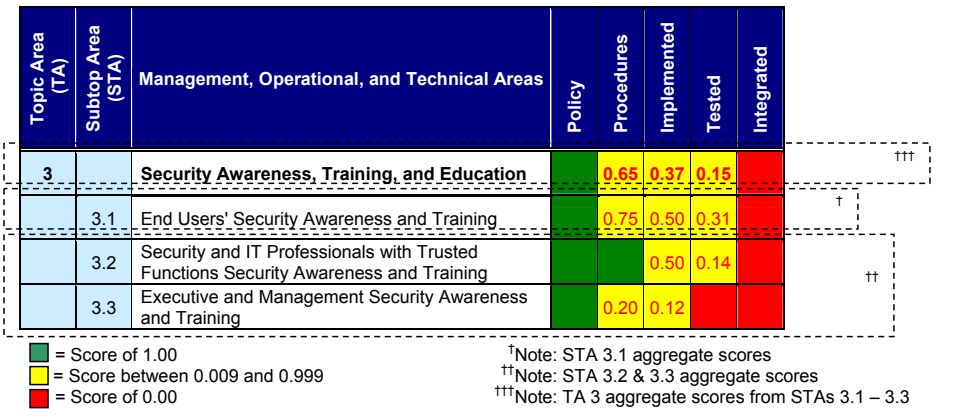
色分けしたスコアカード。列:「Topic Area (TA)」「Subtop Area (STA)」「Management, Operational, and Technical Areas」「Policy」「Procedures」「Implemented」「Tested」「Integrated」。行:TA 3「Security Awareness, Training, and Education」:Policy は緑、Procedures は 0.65、Implemented は 0.37、Tested は 0.15(黄)、Integrated は赤、†††。STA 3.1「End Users' Security Awareness and Training」:Policy は緑、Procedures は 0.75、Implemented は 0.50、Tested は 0.31(黄)、Integrated は赤、†。STA 3.2「Security and IT Professionals with Trusted Functions Security Awareness and Training」:Policy と Procedures は緑、Implemented は 0.50、Tested は 0.14(黄)、Integrated は赤。STA 3.3「Executive and Management Security Awareness and Training」:Policy は 0.20、Procedures は 0.12(黄)、Implemented、Tested、Integrated は赤。STA 3.2 と 3.3 には †† が付されています。凡例:緑=スコア 1.00、黄=0.009 以上 0.999 以下のスコア、赤=スコア 0.00。注:† STA 3.1 の集約スコア、†† STA 3.2 および 3.3 の集約スコア、††† STA 3.1~3.3 のスコアから集約した TA 3 のスコア。
Further evaluation of upper maturity levels may be completed regardless of the PRISMA scores in order to support overall program recommendations, especially if one of the PRISMA Team’s objectives is to estimate the resources needed to achieve a higher maturity level. As an example, if formal written policy and or procedures addressing a PRISMA TA do not exist (and these maturity levels are therefore non-compliant) but the TA is fully implemented, then this is a much more positive situation if the PRISMA Team objective is to achieve maturity level three (implemented). The effort to achieve two of three required maturity levels is easier, and the overall resources need to achieve maturity level three is lower. The estimated time to achieve the implemented level goal will also be less.
プログラム全体への推奨事項を裏付けるために、とりわけ PRISMA チームの目的の 1 つが、より高い成熟度レベルを達成するために必要なリソースを見積もることである場合は、PRISMA の評点にかかわらず、より上位の成熟度レベルのさらなる評価を完了してもよいです。たとえば、PRISMA の TA に対応する正式な文書化された方針や手順(またはその両方)が存在せず(したがってこれらの成熟度レベルが非準拠)、その TA が完全に実施されている場合、PRISMA チームの目的が成熟度レベル 3(実施)の達成であれば、これははるかに好ましい状況です。必要な 3 つの成熟度レベルのうち 2 つを達成する労力は小さく、成熟度レベル 3 を達成するために必要なリソース全体も少なくなります。実施レベルの目標を達成するための推定時間も短くなります。
2.2.5.2 Issue and Corrective Action Identification
2.2.5.2 問題と是正措置の特定
After the PRISMA Review Team members aggregate scores, the information security issues are identified. The team member(s) examine all of the scores from the document review, environmental influences and constraints, and interview information to identify the real issues affecting the information security program. These issues are the specific consequences that may realistically arise due to a lack of information security measures. The issue statement must pass the “so what” test. Examples of good issue statements are:
PRISMA レビューチームのメンバーが評点を集約した後、情報セキュリティ上の問題を特定します。チームメンバーは、文書レビュー、環境の影響と制約、インタビューから得た情報をすべて調べ、情報セキュリティプログラムに影響する実際の問題を特定します。これらの問題は、情報セキュリティ対策の不足により現実的に生じうる具体的な結果です。問題の記述は「それで何が問題なのか」という問いに答えられるものでなければなりません。適切な問題の記述の例を次に示します。
•“Identified system vulnerabilities may be uncorrected since no formal tracking system is in use,”
•「正式な追跡システムが使用されていないため、特定されたシステムの脆弱性が是正されないままになる可能性がある」、
•“Information systems are endangered due to a failure to manage access rights and accounts for program managers.”
•「プログラムマネージャーのアクセス権とアカウントを管理していないため、情報システムが危険にさらされています。」
Each issue statement is supported by a description of what was found that identified the issue. Along with an issue statement and description, the PRISMA Team member(s) identify recommended corrective actions the organization can employ to resolve an issue. Associated with each action is an estimate of the time and resources to implement the action.
各問題の記述は、その問題を特定した根拠となる発見事項の説明で裏付けられます。問題の記述と説明に合わせて、PRISMA チームのメンバーは、問題を解決するために組織が採用できる推奨の是正措置を特定します。各措置には、その措置を実施するための時間とリソースの見積もりが関連づけられます。
After the PRISMA Team member(s) analyze the results for each TA, the PRISMA Review Team meets to discuss the status of each TA, the issues identified within the TA, and the conclusions reached. The review team then develops corrective actions and recommendations to improve information security.
PRISMA チームのメンバーが各 TA の結果を分析した後、PRISMA レビューチームは会合を開き、各 TA の状況、TA 内で特定された問題、到達した結論について話し合います。その後、レビューチームは、情報セキュリティを改善するための是正措置と推奨事項を策定します。
Once all corrective actions are identified, the review team prioritizes these actions according to the corrective action’s cost-benefit impact on the maturity of the agency’s information security program. This prioritized list becomes the PRISMA report’s action plan. The action plan is then examined to identify how many actions the organization may reasonably perform with given resource restrictions against a logical tipping point to achieve improvement in information security maturity.
すべての是正措置を特定したら、レビューチームは、機関の情報セキュリティプログラムの成熟度に対する是正措置の費用対効果を考慮して、これらの措置に優先順位を付けます。この優先順位付きリストが、PRISMA 報告書のアクションプランになります。次に、情報セキュリティの成熟度を向上させるための合理的な転換点を見据え、与えられたリソースの制約のもとで組織が現実的に実行できる措置の数を見極めるために、このアクションプランを検討します。
2.2.5.3 Draft PRISMA Report Generation
2.2.5.3 PRISMA 報告書草案の作成
Appendix G provides a recommended template for a PRISMA Report. The template provides suggested report organization, recommended critical content and format, and proposed supporting information.
付録 G は、PRISMA 報告書の推奨テンプレートを示します。このテンプレートは、報告書の構成案、重要な内容と書式の推奨、裏付けとなる情報の案を示します。
2.2.5.4 PRISMA Report Review and Final Report
2.2.5.4 PRISMA 報告書のレビューと最終報告書
Appropriate management levels and stakeholders should be asked to review and comment on the draft report to validate facts and statements and to evaluate the proposed corrective actions and integrated action plan. The PRISMA Team should provide a list of requested changes and evidence to support the requested changes. The requested changes and the evidence are carefully reviewed and the PRISMA review project manager and the primary stakeholder make the final decision on changes to incorporate. The PRISMA Final Report is completed based upon acceptable changes.
適切な管理職レベルと利害関係者に、事実と記述を検証し、提案された是正措置と統合アクションプランを評価するため、報告書草案をレビューしてコメントするよう依頼すべきです。PRISMA チームは、要望された変更の一覧と、その変更を裏付ける証拠を提供すべきです。要望された変更と証拠を慎重に検討し、PRISMA レビューのプロジェクトマネージャーと主要な利害関係者が、取り込む変更について最終決定を行います。受け入れ可能な変更に基づいて、PRISMA 最終報告書を完成させます。
3. Application of PRISMA Final Report
3. PRISMA 最終報告書の活用
The Final Report may be applied in many ways. For instance, the results of the report can improve the information security program’s ability to identify and mitigate existing vulnerabilities, the ability to act knowledgably and wisely to protect federal IT investments, and the ability to prepare for future security threats. During Step 1 (see, section 2.1.1, PRISMA Review Initiation) objectives were developed based on the “need” for the review. The following sections will discuss possible needs and objectives where the Final Report may be applied.
最終報告書は、さまざまな形で活用できます。たとえば、報告書の結果は、情報セキュリティプログラムが既存の脆弱性を特定して緩和する能力、連邦政府の IT 投資を保護するために知識に基づいて賢明に行動する能力、将来のセキュリティ脅威に備える能力を高めることができます。ステップ 1(第 2.1.1 節「PRISMA レビューの開始」を参照)では、レビューの「必要性」に基づいて目的を策定しました。以下の節では、最終報告書を活用できる可能性のあるニーズと目的について説明します。
3.1 Practical Applications of the PRISMA Final Report
3.1 PRISMA 最終報告書の実際の活用
PRISMA, therefore, may highlight common information security issues within the information security program. Table 3-1 provides examples of issues.
したがって PRISMA は、情報セキュリティプログラム内の共通の情報セキュリティ上の問題を浮き彫りにする場合があります。表 3-1 は、問題の例を示します。
Table 3-1, Security Issues and Impacts
表 3-1、セキュリティ上の問題と影響
| Issues | Examples | Impact |
|---|---|---|
| Lack of formalization |
|
|
| Capital planning process missing information security |
|
|
| 問題 | 例 | 影響 |
|---|---|---|
| 正式化の欠如 |
|
|
| 情報セキュリティが欠けている資本計画プロセス |
|
|
The Final Report therefore provides, for example, the SAISO with:
したがって最終報告書は、たとえば SAISO に次のものを提供します。
1.Recommendations from a methodical approach,
1.体系的なアプローチに基づく推奨事項、
2.Overall scorecard (see, Table 1-1) and scorecards for each TA (see, Table 2-10) for easy executive management review, and
2.経営幹部が容易にレビューできるようにする、全体のスコアカード(表 1-1 を参照)と各 TA のスコアカード(表 2-10 を参照)、
3.An estimated time to correct deficiencies based on resource impact estimates (see, Table 3-2).
3.リソースへの影響の見積もりに基づく、不備の是正に要する推定時間(表 3-2 を参照)。
Table 3-2, Example of Final Report Estimated Time to Correct Deficiencies Based on Resource Impact Estimates
表 3-2、リソースへの影響の見積もりに基づく、不備の是正に要する推定時間を示す最終報告書の例
| Category | Description |
|---|---|
| Short Term | Less than 6 months |
| Intermediate | 6 months to 2 years |
| Long Term | More than 2 years |
| 区分 | 説明 |
|---|---|
| 短期 | 6 か月未満 |
| 中期 | 6 か月から 2 年 |
| 長期 | 2 年を超える |
The following sections provide more examples of practical applications of the PRISMA Final Report.
以下の節では、PRISMA 最終報告書の実際の活用の例をさらに示します。
3.1.1 Supporting Information for FISMA
3.1.1 FISMA の裏付け情報
A PRISMA review researches, analyzes, and provides information which directly responds to the FISMA report. To increase the usability of PRISMA, this NIST Interagency Report provides Appendix H, FISMA to PRISMA Crosswalk, which maps the correlation between FISMA report questions and the PRISMA Topic Areas. As an example, the author of the agency FISMA report may reference a current PRISMA Report for content to answer the reporting questions of FISMA. Additionally, the PRISMA Report may stand as a supporting artifact for the agency’s FISMA report. Identifying Security Program Deficiencies.
PRISMA レビューは、FISMA 報告書に直接対応する情報を調査し、分析し、提供します。PRISMA の使いやすさを高めるために、この NIST 省庁間報告書は、FISMA 報告書の質問と PRISMA のトピック領域との相関を対応づけた付録 H「FISMA と PRISMA の対応表」を提供します。たとえば、機関の FISMA 報告書の作成者は、FISMA の報告の質問に答えるための内容を、最新の PRISMA 報告書から参照できます。さらに、PRISMA 報告書は、機関の FISMA 報告書の裏付け成果物となりえます。セキュリティプログラムの不備の特定。
As shown in Appendix G, the Final Report can identify issues, provide recommendations, and provide an estimated time to completion. Management can then visually assess the deficiencies by Topic Areas and determine which deficiencies are the highest priorities to achieve a specific maturity level. Management can also assess resource needs required (or deficient) to achieve the maturity goal.
付録 G に示すように、最終報告書は、問題を特定し、推奨事項を示し、完了までの推定時間を示すことができます。そのうえで管理者は、トピック領域ごとに不備を視覚的に評価し、特定の成熟度レベルを達成するために、どの不備の優先度が最も高いかを判断できます。管理者はまた、成熟度の目標を達成するために必要な(または不足している)リソースのニーズも評価できます。
3.1.2 Budget and Resources Justification
3.1.2 予算とリソースの正当化
With the information above, the SAISO has specific material which may be incorporated into a Cost-Benefit Analysis (CBA) and tested against alternative analysis (AA). The Final Report, then, becomes supporting material for a Capital Planning and Investment Control (CPIC) investment for the agency’s Investment Review Board(s) (IRB), which is required to approve and prioritize all IT investments, including information security investments which are not integrated into other IT investments.
上記の情報により、SAISO は、費用便益分析(CBA)に組み込み、代替案分析(AA)に照らして検証できる具体的な資料を手にします。そのうえで最終報告書は、機関の投資審査委員会(IRB)に対する資本計画・投資管理(CPIC)の投資の裏付け資料となります。この委員会は、他の IT 投資に統合されていない情報セキュリティ投資を含むすべての IT 投資を承認し、優先順位を付けることが求められています。
The Final Report recommendations based on a methodical approach, visual scorecards, and resource impact estimates can result in a strong argument for the most fundamental need of all information security corrective actions…funding and resource approval.
体系的なアプローチ、視覚的なスコアカード、リソースへの影響の見積もりに基づく最終報告書の推奨事項は、あらゆる情報セキュリティ是正措置の最も根本的な必要性、すなわち資金とリソースの承認に対する強力な論拠となりえます。
3.1.3 Information Security Awareness and Training
3.1.3 情報セキュリティの意識向上とトレーニング
Information security personnel can visually see the information security program’s security posture and then learn about the criteria with partial or non-compliant scores. Correcting these deficiencies may advance the information security program to a PRISMA maturity goal or to the next maturity level. When utilized in this manner PRISMA and the report are training tools to identify shortfalls and structure actions to improve security.
情報セキュリティ担当者は、情報セキュリティプログラムのセキュリティ態勢を視覚的に確認し、そのうえで、部分的に準拠または非準拠の評点が付いた基準について学ぶことができます。これらの不備を是正することにより、情報セキュリティプログラムを PRISMA の成熟度の目標、または次の成熟度レベルへ進められる場合があります。このように活用すると、PRISMA と報告書は、不足点を特定し、セキュリティを改善するための措置を構造化するトレーニングツールになります。
3.1.4 Information Security Program Benchmark
3.1.4 情報セキュリティプログラムのベンチマーク
The PRISMA Report can be supported by a very granular, methodical assessment rich with information by employing the process described in Section 2.0. It records dozens of information security criteria. The PRISMA Report not only provides a general overview of the information security program, but it can also provide very important results to dozens of information security criteria in an easy to understand visual presentation—effectively a security program benchmark. As resources and effort are applied to the issues, management can focus on only a few or a larger portion of the deficient criteria and assess the changes and the benefits of the additional resources or efforts. This management assessment of progress can impact future decision-making.
PRISMA 報告書は、第 2.0 節で説明したプロセスを用いることによって、情報が豊富な、非常に粒度の細かい体系的な評価に裏付けられます。この評価は、数十の情報セキュリティ基準を記録します。PRISMA 報告書は、情報セキュリティプログラムの全般的な概要を提供するだけでなく、数十の情報セキュリティ基準に関する非常に重要な結果を、理解しやすい視覚的な形で提示することもでき、これは事実上、セキュリティプログラムのベンチマークとなります。問題に対してリソースと労力が投入されるにつれて、管理者は、不備のある基準のうちごく一部、またはより大きな部分に絞って取り組み、追加のリソースや労力による変化と便益を評価できます。管理者によるこの進捗の評価は、将来の意思決定に影響を与えることがあります。
3.1.5 Independent Validation of the “Information Security Program’s Security Posture”
3.1.5 「情報セキュリティプログラムのセキュリティ態勢」の独立した検証
When independent information security reviews are required, the review team may employ PRISMA as a proven and successful standardized tool set. With PRISMA’s library of criteria, an independent reviewer or evaluator may confirm the positive closure or mitigation of corrective actions. PRISMA provides a format which can easily present the security posture of the information security program in a customizable presentation which is easily understandable by a broad range of technical and management backgrounds. This standardized format also provides the opportunity to “overlay” previous PRISMA reviews showing not only the current state of information security, but also the information security program’s maturation progress.
独立した情報セキュリティレビューが求められる場合、レビューチームは、実績があり成功を収めた標準化されたツールセットとして PRISMA を用いることができます。独立したレビュー担当者または評価者は、PRISMA の基準のライブラリを用いて、是正措置が確実に完了または低減されたことを確認できます。PRISMA は、情報セキュリティプログラムのセキュリティ態勢を、幅広い技術・管理の背景を持つ人々が容易に理解できる、カスタマイズ可能な提示の形で、簡単に示せる書式を提供します。この標準化された書式は、過去の PRISMA レビューを「重ね合わせ」て、情報セキュリティの現状だけでなく、情報セキュリティプログラムの成熟の進展も示す機会も提供します。
3.1.6 Review Preparation or Execution
3.1.6 レビューの準備または実施
Similar to Section 3.1.6 regarding independent validation, PRISMA provides a methodical approach to research and analyze information to determine information security deficiencies. As members of an information security team, this information is crucial in not only being aware of the deficiencies but to develop a plan to correct or mitigate the deficiencies. PRISMA assists in developing these strategies and actions. This preparation can ready the information security program for an independent review.
独立した検証に関する第 3.1.6 節と同様に、PRISMA は、情報セキュリティ上の不備を判断するために情報を調査し、分析するための体系的なアプローチを提供します。情報セキュリティチームのメンバーにとって、この情報は、不備を認識するだけでなく、不備を是正または低減する計画を策定するうえで極めて重要です。PRISMA は、これらの戦略と措置の策定を支援します。この準備によって、情報セキュリティプログラムを独立したレビューに備えさせることができます。
For these same reasons, the IG team may also implement PRISMA to perform a customizable review of the information security program. It provides a standardized platform to conduct the research and analysis to measure the information security posture of an information security program. It also provides a format which may overlay a previous PRISMA review to evaluate the information security program’s commitment to resolve deficiencies, for example. PRISMA review reports may therefore perform as a standardized means of benchmarking and as a more consistent tool for information security programs to measure its aim at resolving or mitigating the findings of the PRISMA Review Report.
これと同じ理由から、IG チームも、情報セキュリティプログラムをカスタマイズ可能な形でレビューするために PRISMA を実施する場合があります。PRISMA は、情報セキュリティプログラムの情報セキュリティ態勢を測定するための調査と分析を実施する、標準化されたプラットフォームを提供します。また、たとえば、情報セキュリティプログラムが不備の解消に取り組む姿勢を評価するため、以前の PRISMA レビューに重ね合わせられる書式も提供します。したがって、PRISMA レビュー報告書は、標準化されたベンチマーク手段として機能するとともに、情報セキュリティプログラムが PRISMA レビュー報告書の指摘事項の解消または軽減を目指しているかを測定する、より一貫性のあるツールとして機能する場合があります。
4. Summary
4. まとめ
PRISMA is a methodical and tested approach for information security personnel, internal reviews, auditors, and inspector generals to provide:
PRISMA は、情報セキュリティ担当者、内部レビュー担当者、監査人、監察総監に、次のものを提供する、体系的で実証済みのアプローチです。
•A picture of the information security posture of the information security program for executive decision-makers and others,
•経営幹部の意思決定者などに向けた、情報セキュリティプログラムの情報セキュリティ態勢の全体像、
•Identification of high level issues,
•上位レベルの問題の特定、
•Corrective actions to resolve identified issues,
•特定された問題を解決するための是正措置、
•A training tool to learn what is required to advance to the next PRISMA maturity level, and
•次の PRISMA 成熟度レベルへ進むために何が必要かを学ぶためのトレーニングツール、
•Supporting material for funding and resource approval and priority.
•資金とリソースの承認および優先順位付けのための裏付け資料。
PRISMA results in an improved agency capability to:
PRISMA によって、機関は次の能力を高められます。
•Identify and mitigate existing vulnerabilities,
•既存の脆弱性を特定し、低減する能力、
•Act knowledgeably and wisely to protect federal information systems, and
•連邦の情報システムを保護するために、知識と英知をもって行動する能力、
•Prepare for future security threats.
•将来のセキュリティ脅威に備える能力。
Appendix A. Acronyms
付録 A. 略語
| A&T | Awareness and Training |
| AA | Alternative Analysis |
| AO | Authorizing Official |
| C&A | Certification and Accreditation |
| CBA | Cost Benefit Analysis |
| CFO | Chief Financial Officer |
| CIO | Chief Information Officer |
| CIP | Critical Infrastructure Protection |
| CMM | Capability Maturity Model |
| CO | Contracting Officer |
| COTR | Contracting Officer’s Technical Representative |
| CPIC | Capital Planning Investment Control |
| CTO | Chief Technology Officer |
| DAA | Designated Approval Authority |
| FEA | Federal Enterprise Architecture |
| FIPS | Federal Information Processing Standard(s) |
| FISMA | Federal Information Security Management Act |
| FSO | Field Security Office |
| FY | Fiscal Year |
| GAO | Government Accountability Office |
| GSS | General Support System |
| HR | Human Resources |
| HSPD | Homeland Security Presidential Directive |
| IG | Inspector General |
| IRB | Investment Review Board |
| ISSM | Information System Security Manager |
| ISSO | Information System Security Officer |
| IT | Information Technology |
| ITL | Information Technology Laboratory |
| NIST | National Institute of Standards and Technology |
| OMB | Office of Management and Budget |
| PM | Program Manager |
| POA&M | Plan of Action and Milestones |
| POC | Point of Contact |
| PRISMA | Program Review for Information Security Management Assistance |
| SAISO | Senior Agency Information Security Officer |
| SDLC | System Development Life Cycle |
| SEI | Software Engineering Institute |
| SNA | System/ Network Administrator |
| SOW | Statement of Work |
| SP | Special Publication |
| STA | Sub-Topic Area |
| ST&E | Security Test and Evaluation |
| TA | Topic Area |
| US-CERT | United States Computer Emergency Readiness Team |
| A&T | 意識向上とトレーニング |
| AA | 代替案分析 |
| AO | 認可責任者 |
| C&A | 認証・認定 |
| CBA | 費用便益分析 |
| CFO | 最高財務責任者 |
| CIO | 最高情報責任者 |
| CIP | 重要インフラ防護 |
| CMM | 能力成熟度モデル |
| CO | 契約担当官 |
| COTR | 契約担当官技術代理人 |
| CPIC | 資本計画・投資管理 |
| CTO | 最高技術責任者 |
| DAA | 指定承認機関 |
| FEA | 連邦エンタープライズアーキテクチャ |
| FIPS | 連邦情報処理標準 |
| FISMA | 連邦情報セキュリティマネジメント法 |
| FSO | 現地セキュリティ部署 |
| FY | 会計年度 |
| GAO | 政府説明責任局 |
| GSS | 汎用支援システム |
| HR | 人事 |
| HSPD | 国土安全保障大統領指令 |
| IG | 監察総監 |
| IRB | 投資審査委員会 |
| ISSM | 情報システムセキュリティ管理者 |
| ISSO | 情報システムセキュリティ責任者 |
| IT | 情報技術 |
| ITL | 情報技術研究所 |
| NIST | 国立標準技術研究所 |
| OMB | 行政管理予算局 |
| PM | プログラムマネージャー |
| POA&M | 行動計画およびマイルストーン |
| POC | 連絡窓口 |
| PRISMA | 情報セキュリティマネジメント支援のためのプログラムレビュー |
| SAISO | 機関の上級情報セキュリティ責任者 |
| SDLC | システム開発ライフサイクル |
| SEI | ソフトウェア工学研究所 |
| SNA | システム/ネットワーク管理者 |
| SOW | 作業範囲記述書 |
| SP | 特別刊行物 |
| STA | サブトピック領域 |
| ST&E | セキュリティ試験・評価 |
| TA | トピック領域 |
| US-CERT | 米国コンピュータ緊急対応チーム |
Appendix B. Sample Memorandum from CIO to PRISMA Interviewees
付録 B. CIO から PRISMA インタビュー対象者への通知文の例
To: PRISMA Interviewees of [Agency] Regarding Information Security [self-assessment/ review/ evaluation]
宛先: 情報セキュリティの[自己評価/レビュー/評定]に関する[機関名]の PRISMA インタビュー対象者
From:
差出人:
Date: August 14, 2006
日付: 2006年8月14日
The use of information technology is increasingly important for [your agency] to effectively accomplish our mission. Further, the area of information security is receiving increased scrutiny from Congress. [Your agency] is undergoing a [self-assessment/ review/ evaluation] to measure the information security posture of [the information security program].
[貴機関]が使命を効果的に達成するうえで、情報技術の利用はますます重要になっています。さらに、情報セキュリティの分野は、議会からの精査が強まっています。[貴機関]は、[情報セキュリティプログラム]の情報セキュリティ態勢を測定するために、[自己評価/レビュー/評定]を受けます。
Starting next week, [state name of PRISMA party] personnel will be at [your agency] to conduct interviews in support of that process. The first and most important reason of the [self-assessment/ review/ evaluation] is to identify shortfalls in our information security program and structure actions to improve our security. Our resulting action plan will support our efforts to plan for the future (for example, to help us justify budget and resources) and make [our agency] a safer and more secure place for all of us. With this in mind, it is of the utmost importance that we be honest and open with the [state name of PRISMA party] personnel when the interviews begin. This is the only way that [the agency] will receive a product that will be beneficial and provide the information needed to build a more secure future.
来週から、[PRISMA 実施者の名称]の担当者が、このプロセスを支援するインタビューを行うため[貴機関]を訪れます。この[自己評価/レビュー/評定]の第一の、そして最も重要な理由は、当機関の情報セキュリティプログラムの不足点を特定し、セキュリティを改善するための措置を構造化することです。その結果として得られるアクションプランは、将来を計画する取り組み(たとえば予算とリソースの正当化の助けとなること)を支え、[当機関]を私たち全員にとって、より安全で安心できる場所にします。このことを念頭に、インタビューが始まったら、[PRISMA 実施者の名称]の担当者に対して、誠実かつオープンに接することが最も重要です。これが、[当機関]が有益な成果物を受け取り、より安全な未来を築くために必要な情報を得る唯一の方法です。
I appreciate your support on this important activity.
この重要な活動への皆さんの支援に感謝します。
Regards,
敬具
Appendix C. Key Personnel Contact Request List
付録 C. 主要担当者の連絡先依頼リスト
The information security program POC should provide the following key personnel contact information to the PRISMA team by the kickoff meeting. The agency officials should indicate availability of these personnel. Electronic copies of the information are preferred.
情報セキュリティプログラムの POC は、キックオフミーティングまでに、次の主要担当者の連絡先情報を PRISMA チームに提供すべきです。機関の職員は、これらの担当者の対応可否を示すべきです。情報は電子コピーが推奨されます。
The PRISMA team requests identification of key personnel along with backup/ alternate personnel. Key personnel should be identified for each agency/ organization. Interviews last between 1 and 1½ hours.
PRISMA チームは、主要担当者と、その代理/補欠の担当者を特定するよう求めます。主要担当者は、機関/組織ごとに特定すべきです。インタビューは 1 時間から 1 時間半です。
Key personnel include:
主要担当者には、次の人員が含まれます。
•Chief Information Officers (CIO)
•最高情報責任者(CIO)
•Chief Technology Officers (CTO)
•最高技術責任者(CTO)
•Chief Financial Officers (CFO)
•最高財務責任者(CFO)
•Senior Agency Information Security Officer (SAISO)
•機関の上級情報セキュリティ責任者(SAISO)
•Inspector Generals
•監察総監
•Directors (IT, business areas, etc.)
•ディレクター(IT、事業領域など)
•Facilities Managers/ Physical Security Managers
•施設管理者/物理セキュリティ管理者
•Contract Managers
•契約管理者
•Human Resource Managers
•人事管理者
•Information Systems Security Managers (ISSMs)/ Officers (ISSOs)
•情報システムセキュリティ管理者(ISSMs)/責任者(ISSOs)
•Program Manager(s)
•プログラムマネージャー
•Program contracting officers
•プログラム契約担当官
•Program contracting officer’s technical representatives
•プログラム契約担当官技術代理人
•Other personnel designated by the SAISO or CIO
•SAISO または CIO が指名したその他の人員
•System / Network /Database Administrators
•システム/ネットワーク/データベース管理者
•IT Developers and/or Integrators
•IT 開発者および/またはインテグレーター
•End Users
•エンドユーザー
Provide the following information for each identified interviewee and backup/ alternate:
特定した各インタビュー対象者と、代理/補欠の担当者について、次の情報を提供してください。
•Name
•氏名
•Position title
•職位名
•Organization
•組織
•Responsibilities
•責任
•Phone number
•電話番号
•Fax number
•ファックス番号
•E-mail address
•電子メールアドレス
Appendix D. Documentation Request List
付録 D. 文書提出依頼リスト
The agency officials should provide the following documents, plans, procedures, and charts to the PRISMA team by the kickoff meeting. This is only a recommended list which may be modified or shortened to align with the defined scope. The agency should indicate official release date and/ or draft circulation date. Electronic copies of the documents are preferred.
機関の職員は、キックオフミーティングまでに、次の文書、計画、手順、図表を PRISMA チームに提供すべきです。これは推奨リストにすぎず、定義された範囲に合わせて修正または短縮してもよいです。機関は、正式な発行日および/または草案の回覧日を示すべきです。文書は電子コピーが推奨されます。
1.Policies and Procedures
1.方針と手順
a.For personnel security
a.人的セキュリティに関するもの
b.For information security
b.情報セキュリティに関するもの
c.Information security program policy
c.情報セキュリティプログラムの方針
d.For rules and behaviors (i.e. users, network administrators, FSO, etc.)
d.規則と行動に関するもの(すなわち、ユーザー、ネットワーク管理者、FSO など)
e.Agency specific policies and procedures
e.機関固有の方針と手順
f.Integrating into Capital Planning and Investment Control (CPIC)
f.資本計画・投資管理(CPIC)への統合
2.Plans
2.計画
a.System security plans
a.システムセキュリティ計画
b.Computer security plans
b.コンピュータセキュリティ計画
c.Enterprise-wide information security program plan
c.エンタープライズ全体の情報セキュリティプログラム計画
d.Agency strategic plan
d.機関の戦略計画
e.Disaster recovery & contingency plans
e.災害復旧計画および事業継続計画
f.Plans of action and milestones (POA&M)
f.行動計画およびマイルストーン(POA&M)
3.Documents
3.文書
a.CPIC Investment Review Board information security investment approvals for CPIC phases
a.CPIC の各フェーズに対する、CPIC 投資審査委員会による情報セキュリティ投資の承認
b.Solicitation documents containing information security requirements
b.情報セキュリティ要件を含む調達文書
c.Life cycle documents relating to the review of information security controls within the life cycle
c.ライフサイクル内の情報セキュリティ管理策のレビューに関するライフサイクル文書
d.Certification and accreditation documentation
d.認証・認定の文書
e.Risk management documentation
e.リスクマネジメントの文書
f.Penetration Testing documentation
f.ペネトレーションテストの文書
g.Organization chart with information security roles
g.情報セキュリティの役割を記載した組織図
4.Information security training and awareness
4.情報セキュリティのトレーニングと意識向上
a.Information security training program description
a.情報セキュリティトレーニングプログラムの説明
5.Assessments
5.評価
a.Documents resulting from vulnerability or other assessments performed
a.実施した脆弱性評価またはその他の評価から得られた文書
b.Risk assessment documentation
b.リスク評価の文書
c.Information security program/ agency self-assessment documentation and internal IT reviews
c.情報セキュリティプログラム/機関の自己評価の文書と、内部の IT レビュー
d.External assessments (e.g., independent, oversight, Inspector General (IG), Government Accountability Office (GAO), etc.)
d.外部の評価(たとえば、独立した評価、監督、監察総監(IG)、政府説明責任局(GAO)など)
6.Lists
6.リスト
a.List of General Support Systems (GSSs)
a.汎用支援システム(GSS)のリスト
b.List of major acquisitions/ investments
b.主要な調達/投資のリスト
7.Agency information security relevant items specifically called out in budgets for current fiscal year and the next fiscal year
7.当会計年度および次会計年度の予算で特に明記されている、機関の情報セキュリティに関連する項目
8.Information compiled or to be used as agency input to meet FISMA reporting requirements for previous or current fiscal year(s)
8.前会計年度または当会計年度の FISMA 報告要件を満たすために、機関の入力として編集した、または使用する予定の情報
9.Miscellaneous
9.その他
a.Information security performance metrics/ measures (e.g., FISMA, etc.)
a.情報セキュリティの成果指標/測定値(たとえば、FISMA など)
Appendix E. Generic Review Questions
付録 E. 共通のレビュー質問
The program officials should provide answers to the following questions to the PRISMA team within two weeks of the kickoff meeting. These questions may be modified or the list may be shortened to align with the defined scope. Electronic versions of the answers are preferred.
プログラム担当者は、キックオフ会議から2週間以内に、次の質問への回答をPRISMAチームに提供すべきです。定められた範囲に合わせて、これらの質問を修正してもよく、質問リストを短縮してもよいです。回答は電子形式が推奨されます。
Generic Questions: Answer in the context of current fiscal year appropriations
共通の質問:当会計年度の歳出予算の文脈で回答
1.How many FTE are dedicated to information security program agency-wide? How are the FTEs spread across organizations?
1.機関全体の情報セキュリティプログラムに専従する常勤職員相当(FTE)は何人いますか。FTEは組織間でどのように配分されていますか。
2.How many individuals are working on information security for the agency? How are the individuals spread across organizations?
2.機関の情報セキュリティに従事する人は何人いますか。これらの人員は組織間でどのように配分されていますか。
3.How many dollars per organization are actually spent on information security for the agency?
3.機関の情報セキュリティに、組織ごとに実際にいくら支出されていますか。
4.What future budgetary and FTE requests per organization have been made for the next fiscal year for the agency?
4.機関では、次会計年度に向けて、組織ごとにどのような予算要求およびFTE要求が出されていますか。
5.Answer in the context of an agency-wide perspective on the agency’s information security organization:
5.機関の情報セキュリティ組織について、機関全体の視点から回答すること。
a.How is the information security function implemented within your agency (e.g. centralized in a single organization, split across all organizations, centralized policy/procedure making and information security management, monitoring with decentralized implementation across the agency)?
a.貴機関では、情報セキュリティ機能はどのように実施されていますか(たとえば、単一の組織に集中、すべての組織に分割、方針/手順の策定と情報セキュリティのマネジメント・監視は集中させ、実施は機関全体に分散、など)。
b.What are the various agency roles and responsibilities of the key information security organization(s) and personnel?
b.主要な情報セキュリティ組織と担当者の、機関内のさまざまな役割と責任は何か。
Mission
使命
1.What is the agency mission?
1.機関の使命は何ですか。
Policy
方針
1.What written issue-specific policy statements have been promulgated and to whom?
1.どのような文書化された課題別の方針声明が公布され、誰に対して公布されましたか。
2.How is responsibility for implementing information security policies and procedures distributed throughout the organizations and within the agency?
2.情報セキュリティの方針と手順を実施する責任は、各組織と機関内にどのように分担されていますか。
Configuration control
構成管理
1.Does the agency have a configuration control plan?
1.機関は構成管理計画を持っていますか。
2.Does a Configuration Control Board or the equivalent direct activities in this area?
2.構成管理委員会またはそれに相当するものが、この領域の活動を指揮していますか。
Agency systems
機関のシステム
1.What interconnections exist with systems outside agency control?
1.機関の管理外のシステムとの間に、どのような相互接続がありますか。
Information systems
情報システム
1.Does your agency have dependencies on information controlled by other agencies, or organizations?
1.貴機関は、他の機関または組織が管理する情報に依存していますか。
Information security awareness, training, and education
情報セキュリティの意識向上、トレーニング、教育
1.Do the participating organizations have a formal information security training program?
1.参加している組織は、正式な情報セキュリティトレーニングプログラムを持っていますか。
2.Does the agency have specific information security training?
2.機関は、特定の情報セキュリティトレーニングを行っていますか。
3.Does written documentation exist describing the training programs?
3.トレーニングプログラムを説明する文書が存在しますか。
Assessments and reviews
評価とレビュー
1.Were the information security policies and procedures of the participating organization, or agency independently assessed?
1.参加している組織または機関の情報セキュリティの方針と手順は、独立して評価されましたか。
Internal reviews
内部レビュー
1.Were the information security policies and procedures of the participating organization, or agency reviewed internally?
1.参加している組織または機関の情報セキュリティの方針と手順は、内部でレビューされましたか。
Concerns
懸念事項
1.Do areas of management or political concern, of specific challenges or of changes in strategic direction exist?
1.経営上または政治上の懸念事項、特定の課題、または戦略的方向性の変更はありますか。
2.Please describe them.
2.それらを説明してください。
Security incidents
セキュリティインシデント
1.Describe some key previous, significant information security incidents.
1.過去に発生した、重要な情報セキュリティインシデントのうち、主なものを説明してください。
2.How has the agency responded to them?
2.機関はそれらにどのように対応しましたか。
Suggestions
提案
1.Where does the agency believe improvement is needed?
1.機関は、どこに改善が必要だと考えていますか。
2.What assistance, which the PRISMA team may provide, will be most useful to the agency?
2.PRISMA チームが提供できる支援のうち、機関にとって最も有用なものは何ですか。
Appendix F. Document Triage Template
付録 F. 文書トリアージテンプレート
The table below assists in identifying Topic Areas (TA) covered by particular documents. The shaded boxes identify the TAs most likely covered by the type of document in the left hand column.
下の表は、特定の文書が対象とするトピック領域(TA)を特定するのに役立ちます。網掛けのボックスは、左の列に示した文書の種類が対象とする可能性が最も高い TA を示します。
Note: This table is only an example to assist in screening the documents; actual documents may differ greatly from the suggestions in the appendix.
注: この表は、文書を選別するのに役立つ例にすぎません。実際の文書は、この付録の案と大きく異なる場合があります。
Table F-1, Document Triage Template
表 F-1、文書トリアージテンプレート
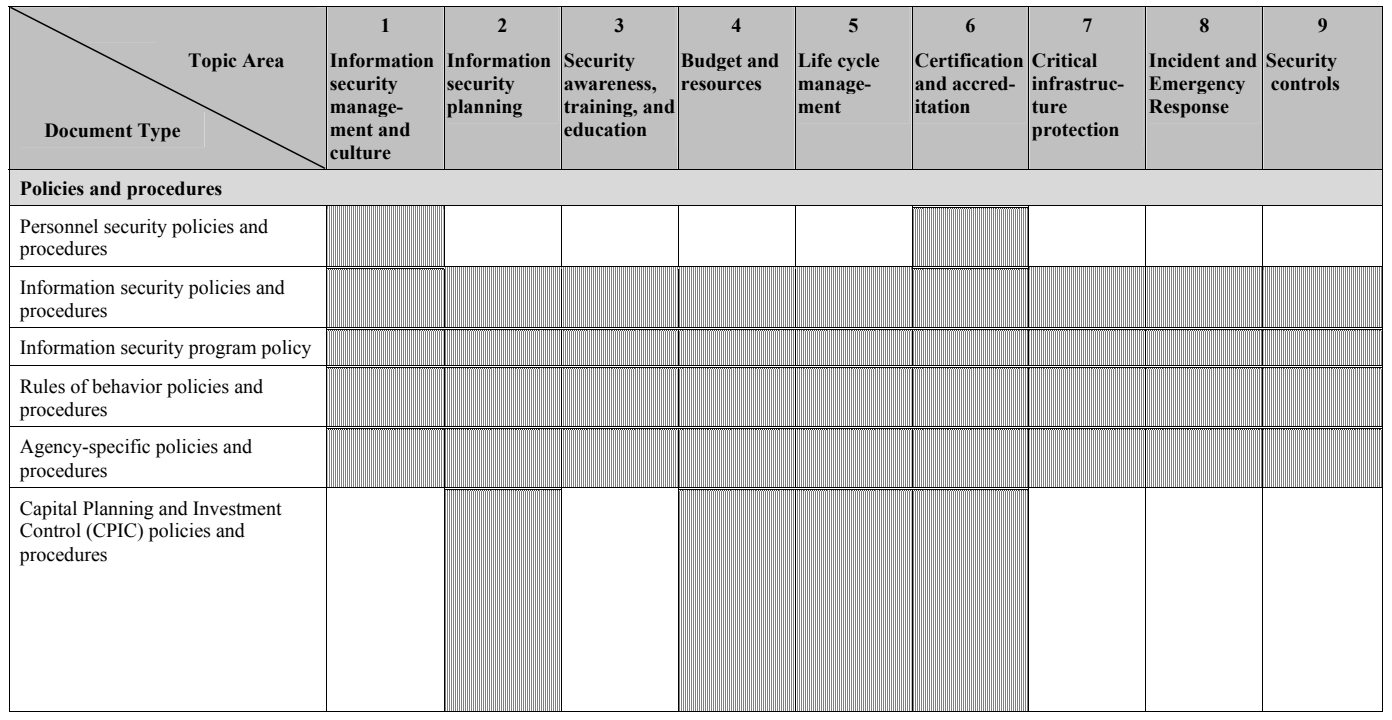
表 F-1「Document Triage Template」(文書選別のテンプレート)の 3 ページ中 1 ページ目の部分です。左上の対角線のセルに「Topic Area」(トピック領域)と「Document Type」(文書の種類)があり、トピック領域の列が 9 つある表です。列は 1「Information security management and culture」(情報セキュリティ管理と文化)、2「Information security planning」(情報セキュリティ計画)、3「Security awareness, training, and education」(セキュリティの意識向上・研修・教育)、4「Budget and resources」(予算と資源)、5「Life cycle management」(ライフサイクル管理)、6「Certification and accreditation」(認証と認定)、7「Critical infrastructure protection」(重要インフラ保護)、8「Incident and Emergency Response」(インシデント・緊急時対応)、9「Security controls」(セキュリティ管理策)です。セルの灰色の網掛けは、その種類の文書が扱っている可能性が高いトピック領域を示し、セルに文字はありません。文書の種類ごとの行と、網掛けのある列の番号は次のとおりです。区分の行「Policies and procedures」(方針と手順): 「Personnel security policies and procedures」は1・6、「Information security policies and procedures」は9 列すべて、「Information security program policy」は9 列すべて、「Rules of behavior policies and procedures」は9 列すべて、「Agency-specific policies and procedures」は9 列すべて、「Capital Planning and Investment Control (CPIC) policies and procedures」は2・4・5・6。
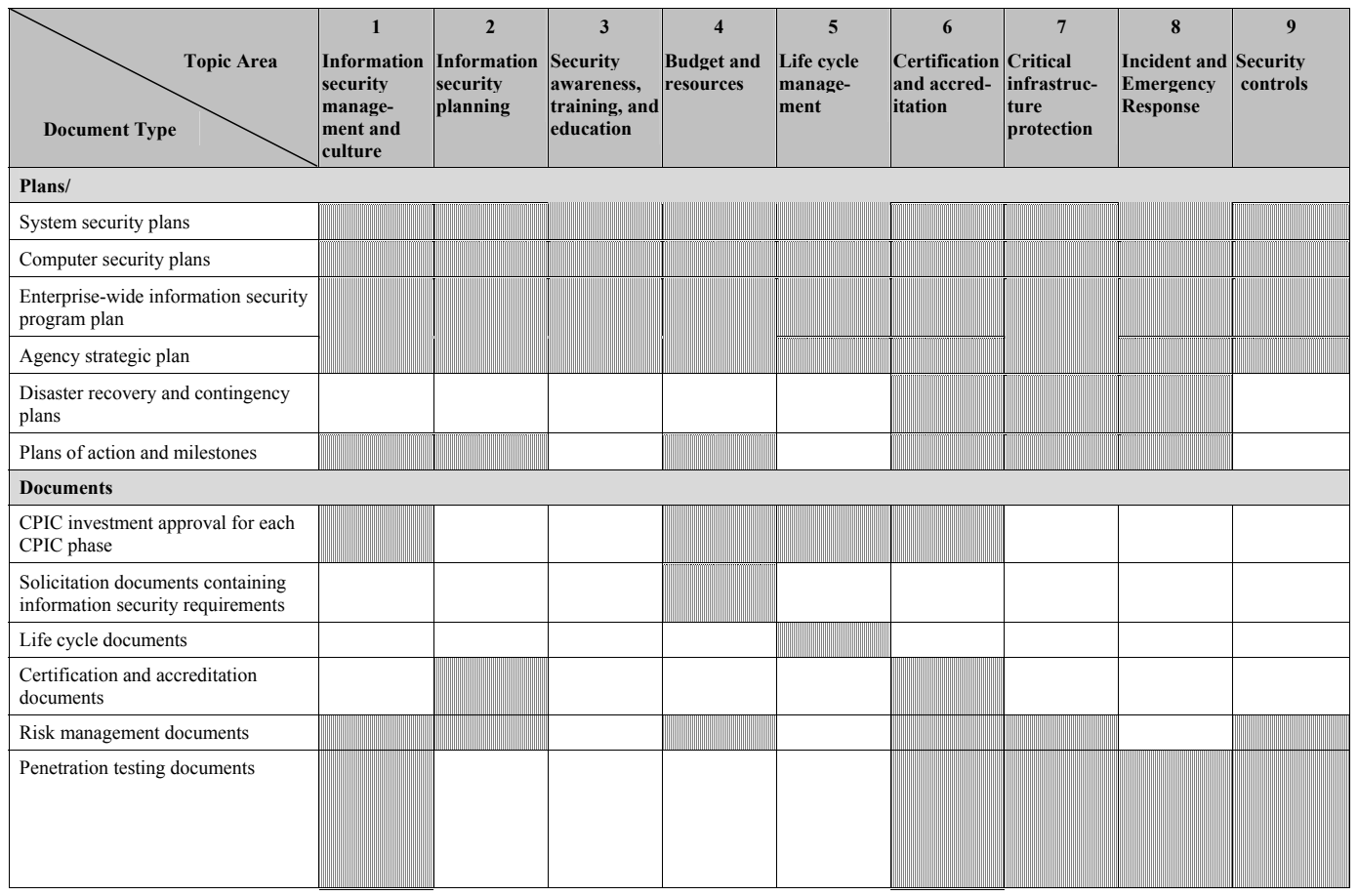
表 F-1「Document Triage Template」(文書選別のテンプレート)の 3 ページ中 2 ページ目の部分です。左上の対角線のセルに「Topic Area」(トピック領域)と「Document Type」(文書の種類)があり、トピック領域の列が 9 つある表です。列は 1「Information security management and culture」(情報セキュリティ管理と文化)、2「Information security planning」(情報セキュリティ計画)、3「Security awareness, training, and education」(セキュリティの意識向上・研修・教育)、4「Budget and resources」(予算と資源)、5「Life cycle management」(ライフサイクル管理)、6「Certification and accreditation」(認証と認定)、7「Critical infrastructure protection」(重要インフラ保護)、8「Incident and Emergency Response」(インシデント・緊急時対応)、9「Security controls」(セキュリティ管理策)です。セルの灰色の網掛けは、その種類の文書が扱っている可能性が高いトピック領域を示し、セルに文字はありません。文書の種類ごとの行と、網掛けのある列の番号は次のとおりです。区分の行「Plans/」(計画): 「System security plans」は9 列すべて、「Computer security plans」は9 列すべて、「Enterprise-wide information security program plan」は9 列すべて、「Agency strategic plan」は9 列すべて、「Disaster recovery and contingency plans」は6・7・8、「Plans of action and milestones」は1・2・4・6・7・8。区分の行「Documents」(文書): 「CPIC investment approval for each CPIC phase」は1・4・5・6、「Solicitation documents containing information security requirements」は4、「Life cycle documents」は5、「Certification and accreditation documents」は2・6、「Risk management documents」は1・2・4・6・7・9、「Penetration testing documents」は1・6・7・8・9。
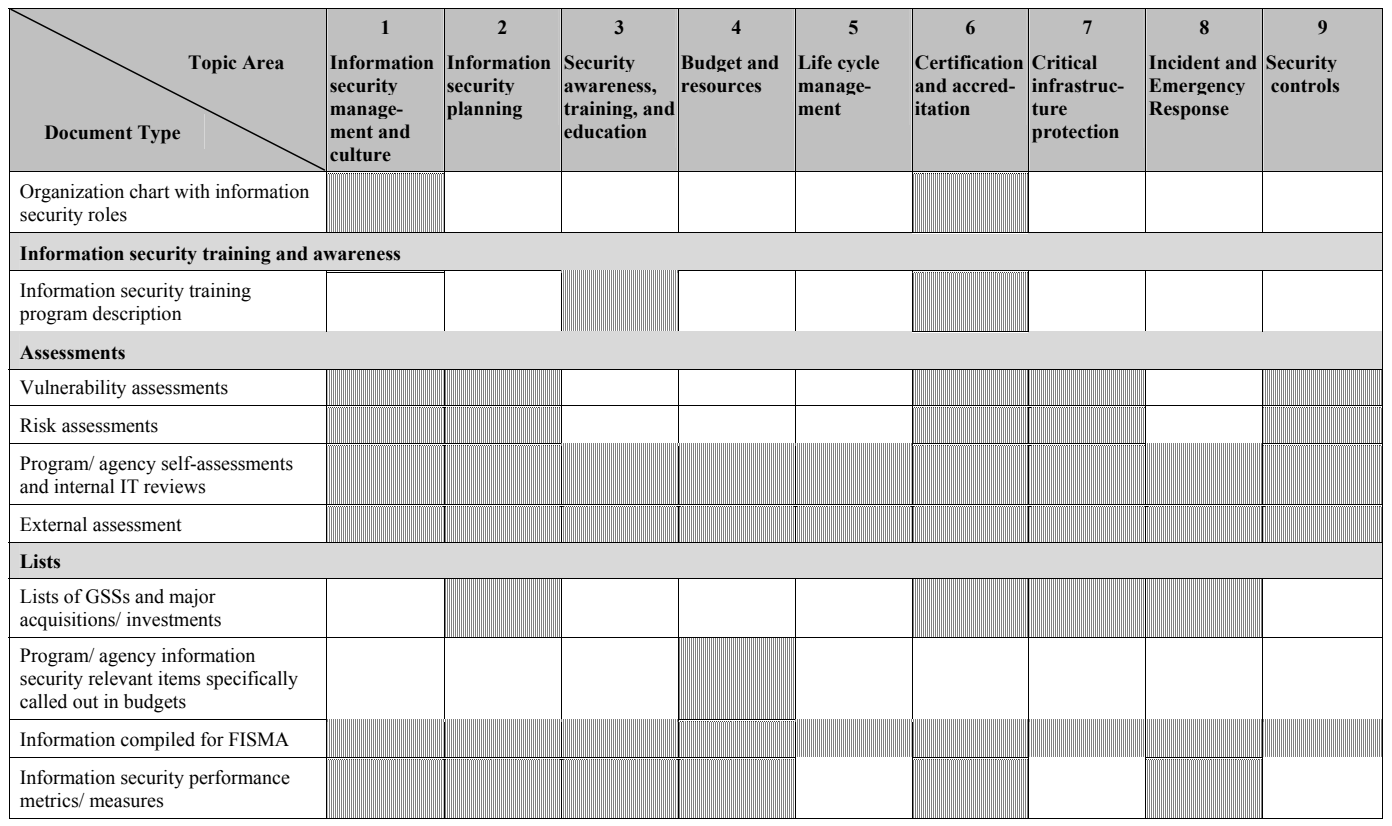
表 F-1「Document Triage Template」(文書選別のテンプレート)の 3 ページ中 3 ページ目の部分です。左上の対角線のセルに「Topic Area」(トピック領域)と「Document Type」(文書の種類)があり、トピック領域の列が 9 つある表です。列は 1「Information security management and culture」(情報セキュリティ管理と文化)、2「Information security planning」(情報セキュリティ計画)、3「Security awareness, training, and education」(セキュリティの意識向上・研修・教育)、4「Budget and resources」(予算と資源)、5「Life cycle management」(ライフサイクル管理)、6「Certification and accreditation」(認証と認定)、7「Critical infrastructure protection」(重要インフラ保護)、8「Incident and Emergency Response」(インシデント・緊急時対応)、9「Security controls」(セキュリティ管理策)です。セルの灰色の網掛けは、その種類の文書が扱っている可能性が高いトピック領域を示し、セルに文字はありません。文書の種類ごとの行と、網掛けのある列の番号は次のとおりです。前ページの「Documents」(文書)の区分の続き: 「Organization chart with information security roles」は1・6。区分の行「Information security training and awareness」(情報セキュリティの研修と意識向上): 「Information security training program description」は3・6。区分の行「Assessments」(評価): 「Vulnerability assessments」は1・2・6・7・9、「Risk assessments」は1・2・6・7・9、「Program/ agency self-assessments and internal IT reviews」は9 列すべて、「External assessment」は9 列すべて。区分の行「Lists」(一覧): 「Lists of GSSs and major acquisitions/ investments」は2・6・7・8、「Program/ agency information security relevant items specifically called out in budgets」は4、「Information compiled for FISMA」は9 列すべて、「Information security performance metrics/ measures」は1・2・3・4・6・8。
Appendix G. PRISMA Report Template
付録 G. PRISMA 報告書テンプレート
The Figure G-1 is an example of the structure of a PRISMA Final Report. The items may be modified as necessary to match the scope of the assessment, review, or evaluation. For instance, if the scope only encompasses the first three items in section 3.0 (Information Security Management and Culture; Information Security Planning; and Security Awareness, Training, and Education), all of the remaining items in section 3.0 are eliminated.
図 G-1 は、PRISMA 最終報告書の構成の例です。項目は、評価、レビュー、評定の範囲に合わせて、必要に応じて修正してもよいです。たとえば、範囲が第 3.0 節の最初の 3 項目(情報セキュリティ管理と文化、情報セキュリティ計画、セキュリティの意識向上・トレーニング・教育)のみを対象とする場合は、第 3.0 節の残りの項目はすべて除かれます。
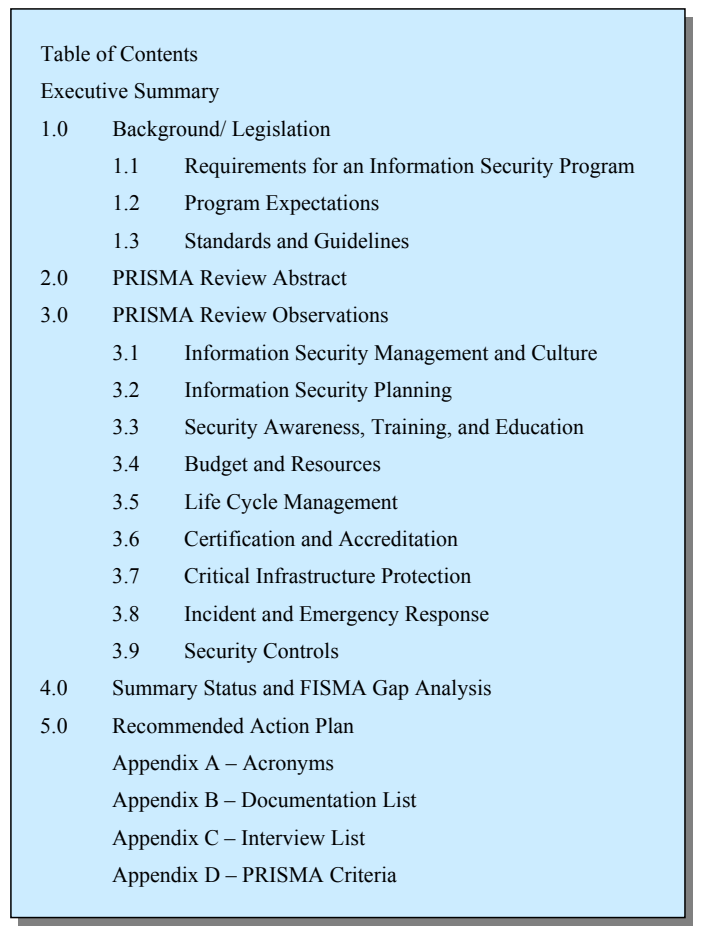
薄い青の背景に影の付いた枠で、PRISMA 報告書の構成を示しています。「Table of Contents」(目次)、「Executive Summary」(エグゼクティブサマリー)、「1.0 Background/ Legislation」(背景・法令)とその下の「1.1 Requirements for an Information Security Program」(情報セキュリティプログラムの要件)、「1.2 Program Expectations」(プログラムに期待されること)、「1.3 Standards and Guidelines」(標準とガイドライン)、「2.0 PRISMA Review Abstract」(PRISMA レビューの概要)、「3.0 PRISMA Review Observations」(PRISMA レビューの所見)とその下の「3.1 Information Security Management and Culture」(情報セキュリティ管理と文化)、「3.2 Information Security Planning」(情報セキュリティ計画)、「3.3 Security Awareness, Training, and Education」(セキュリティの意識向上・研修・教育)、「3.4 Budget and Resources」(予算と資源)、「3.5 Life Cycle Management」(ライフサイクル管理)、「3.6 Certification and Accreditation」(認証と認定)、「3.7 Critical Infrastructure Protection」(重要インフラ保護)、「3.8 Incident and Emergency Response」(インシデント・緊急時対応)、「3.9 Security Controls」(セキュリティ管理策)、「4.0 Summary Status and FISMA Gap Analysis」(状況のまとめと FISMA のギャップ分析)、「5.0 Recommended Action Plan」(推奨行動計画)、「Appendix A – Acronyms」(略語)、「Appendix B – Documentation List」(文書一覧)、「Appendix C – Interview List」(面談一覧)、「Appendix D – PRISMA Criteria」(PRISMA の基準)です。
Figure G-1, PRISMA Report Template
図 G-1、PRISMA 報告書テンプレート
G.1 Executive Summary
G.1 エグゼクティブサマリー
The executive summary is the first section read and analyzed by readers, especially key management and stakeholder personnel, and therefore a very important part of the report. The executive summary should be no more than one or two pages, summarizing all of the sections of the report. The summary should include key observations [positive and negative], as well as a brief summary of the proposed recommendations.
エグゼクティブサマリーは、読者、とりわけ主要な管理職や利害関係者が最初に読み、分析する節であり、したがって報告書の非常に重要な部分です。エグゼクティブサマリーは報告書のすべての節を要約するもので、1〜2ページ以内にすべきです。サマリーには、主要な所見[肯定的なものと否定的なもの]に加えて、提案された推奨事項の簡単な要約を含めるべきです。
G.2 Background/ Legislation
G.2 背景/法令
This section summarizes the basis, or the organizational “need” and objective(s) for the PRISMA review. Additionally, it provides a background on information security and supporting legislation. Finally, individual subsections provide valuable information regarding the basic requirements for an information security program, program expectations, and supporting standards and guidelines.
この節は、PRISMA レビューの根拠、すなわち組織の「必要性」と目的を要約します。さらに、情報セキュリティとそれを裏付ける法令に関する背景を示します。最後に、各小節は、情報セキュリティプログラムの基本要件、プログラムへの期待、裏付けとなる標準とガイドラインに関する有用な情報を示します。
G.3 PRISMA Review Activities
G.3 PRISMA レビュー活動
This section provides a brief overview of the PRISMA process, delineates the PRISMA scope for this review, and provides by reference the supporting basis for the review [documentation reviewed (see, Appendix D) and interviews conducted (see, Appendix C)]. This section provides background information for future reference regarding the review and the methodology. The PRISMA process overview may reference content from this NIST Interagency Report.
この節は、PRISMA プロセスの簡単な概要を示し、このレビューの PRISMA の範囲を明確にし、レビューの裏付けとなる根拠[レビューした文書(付録 D を参照)と実施したインタビュー(付録 C を参照)]を参照の形で示します。この節は、レビューと手法に関する、将来の参照のための背景情報を提供します。PRISMA プロセスの概要には、この NIST 省庁間報告書の内容が含まれる場合があります。
G.4 PRISMA Review Observations
G.4 PRISMA レビューの所見
This section describes the positive and negative observations within separate subsections corresponding to each PRISMA TA under the defined scope. Each subsection should provide a discussion of the salient observations discovered and analyzed from the document review and interviews. This section should capture the TA related issues and subsequent recommendation(s) in a manner which may be easily examined during post review activities. Table G-1 provides a sample method of presenting TA issues.
この節は、定めた範囲に含まれる各 PRISMA TA に対応する別々の小節で、好ましい所見と好ましくない所見を説明します。各小節は、文書レビューとインタビューから発見され分析された、主要な所見についての考察を示すべきです。この節は、TA に関連する問題とそれに続く推奨事項を、レビュー後の活動で容易に検討できるように記録すべきです。表 G-1 は、TA の問題を提示する方法の例を示します。
Table G-1, Sample Presentation of TA Issue
表 G-1、TA の問題の提示例
| Issue 3.3-1: The Agency’s information security may be compromised due to inadequate security policy training for some employees regarding their roles and functional responsibilities. In addition, the lack of general awareness training for all employees leaves them vulnerable to common exploits such as social engineering. |
Recommendation 3.3-1(a): Complete training for all employees including executive management. Recommendation 3.3-1(b): Develop a comprehensive agency-wide information security training plan for all employees including new hires, employees with key security responsibilities, system users, and executive management. |
| 問題 3.3-1: 一部の職員について、役割と機能上の責任に関するセキュリティ方針のトレーニングが不十分であるため、機関の情報セキュリティが危殆化する可能性があります。さらに、全職員に対する一般的な意識向上トレーニングが欠けているため、職員がソーシャルエンジニアリングなどの一般的な攻撃に対して脆弱になっています。 |
推奨事項 3.3-1(a): 経営幹部を含むすべての職員のトレーニングを完了します。 推奨事項 3.3-1(b): 新規採用者、重要なセキュリティ上の責任を持つ職員、システムのユーザー、経営幹部を含むすべての職員を対象とした、包括的な機関全体の情報セキュリティトレーニング計画を策定します。 |
G.5 Summary Status and FISMA Gap Analysis
G.5 状況の要約と FISMA ギャップ分析
The Summary Status provides the overall scorecard of the TAs reviewed. It also provides separate scorecards for each individual TA and its STAs. Next, the summary provides an overall scorecard of how the maturity levels should appear for each TA after key items of the action plan are implemented. Finally, a FISMA Gap Analysis is developed from the mapping of PRISMA Subtopic Areas to FISMA requirements in Appendix H.
サマリーステータスは、レビューした TA の全体的なスコアカードを示します。また、個々の TA とその STA ごとのスコアカードも示します。次に、アクションプランの主要項目を実施した後に各 TA の成熟度レベルがどのように示されるべきかについて、全体的なスコアカードを示します。最後に、付録 H の PRISMA サブトピック領域と FISMA 要件との対応づけに基づき、FISMA ギャップ分析を作成します。
G.6 Recommended Action Plan
G.6 推奨するアクションプラン
This section provides the recommended action plan for the information security program under the defined scope of the PRISMA Review. The recommendations should be presented in a prioritized fashion with a time frame schedule. The plan includes an accumulation of the issues and corrective actions as identified in Table G-3. Table G-2 provides a legend explaining the terms and content of the PRISMA Action Plan.
この節は、PRISMA レビューの定められた範囲における、情報セキュリティプログラムの推奨アクションプランを示します。推奨事項は、優先順位を付け、期間のスケジュールとともに提示すべきです。この計画には、表 G-3 で特定された問題と是正措置が集約されています。表 G-2 は、PRISMA アクションプランの用語と内容を説明する凡例を示します。
Table G-2, Action Plan Legend
表 G-2、アクションプランの凡例
| Column Header | Description |
|---|---|
| Priority | The priority number given to a particular action. |
| Section Area | The corresponding subsection area in Section 4 of the PRISMA Report, where the issue is identified. |
| Issue | The stated issue requiring correction |
| Recommended Action | The corresponding recommended action for the issue. |
| Time Frame | The initial time period estimated to complete the initial recommended action. If the task is recurring, an “R” will accompany the time frame estimate.
|
| 列見出し | 説明 |
|---|---|
| 優先度 | 特定のアクションに付けた優先度の番号。 |
| 節の領域 | 問題が特定された、PRISMA 報告書の第 4 節の該当する小節の領域。 |
| 問題 | 是正が必要な、記述された問題 |
| 推奨アクション | その問題に対応する推奨アクション。 |
| 期間 | 最初の推奨アクションを完了するために見積もられた最初の期間。タスクが繰り返し行われる場合は、期間の見積もりに「R」が付きます。
|
Table G-3, Sample Action Plan
表 G-3、アクションプランの例
| PRIORITY | REPORT SUB-TOPIC AREA | ISSUE | RECOMMENDATION | TIME FRAME | RESOURCE IMPACT |
|---|---|---|---|---|---|
| 1 | 3.3 | Issues 3.3-1: The Agency’s information security may be compromised due to inadequate security policy training for some employees regarding their roles and functional responsibilities. In addition, the lack of general awareness training for all employees leaves them vulnerable to common exploits such as social engineering. | Recommendation 3.3-1(b): Develop a comprehensive agency-wide information security training plan for all employees including new hires, employees with key security responsibilities, system users, and executive management. | Intermediate/R | Management decision |
| 2 | 3.8 | Issues 3.8-1: Agency has no formal procedures for its Incident Response capability exposing the IT infrastructure and information to possible significant damage. | Recommendation 3.8-1: Document procedures for incident response, verify effectiveness of the procedures, and communicate them agency-wide. | Short Term | Management decision |
| 3 | 3.3 | Issues 3.3-1: The Agency’s information security may be compromised due to inadequate security policy training for some employees regarding their roles and functional responsibilities. In addition, the lack of general awareness training for all employees leaves them vulnerable to common exploits such as social engineering. | Recommendation 3.3-1(a): Complete training for all employees including executive management. | Intermediate/R | Management decision |
| 4 | 3.2 | Issues 3.2-1: Most (63%) of the Agency’s systems do not have current security plans impacting the Agency’s ability to comply with FISMA requirements. | Recommendation 3.2-1: Establish procedures to create and update System Security Plans promptly. Enforce more accountability at PM/ Systems Owner level for maintaining System Security Plans. | Intermediate/R | Management decision |
| 優先度 | 報告書のサブトピック領域 | 問題 | 推奨事項 | 期間 | リソースへの影響 |
|---|---|---|---|---|---|
| 1 | 3.3 | 問題 3.3-1: 一部の職員について、役割と機能上の責任に関するセキュリティ方針のトレーニングが不十分であるため、機関の情報セキュリティが危殆化する可能性があります。さらに、全職員に対する一般的な意識向上トレーニングが欠けているため、職員がソーシャルエンジニアリングなどの一般的な攻撃に対して脆弱になっています。 | 推奨事項 3.3-1(b): 新規採用者、重要なセキュリティ上の責任を持つ職員、システムのユーザー、経営幹部を含むすべての職員を対象とした、包括的な機関全体の情報セキュリティトレーニング計画を策定します。 | 中期/R | 経営判断 |
| 2 | 3.8 | 問題 3.8-1: 機関はインシデント対応能力に関する正式な手順を定めておらず、IT インフラストラクチャと情報が重大な損害を受ける可能性にさらされています。 | 推奨事項 3.8-1: インシデント対応の手順を文書化し、その有効性を検証して、機関全体に周知します。 | 短期 | 経営判断 |
| 3 | 3.3 | 問題 3.3-1: 一部の職員について、役割と機能上の責任に関するセキュリティ方針のトレーニングが不十分であるため、機関の情報セキュリティが危殆化する可能性があります。さらに、全職員に対する一般的な意識向上トレーニングが欠けているため、職員がソーシャルエンジニアリングなどの一般的な攻撃に対して脆弱になっています。 | 推奨事項 3.3-1(a): 経営幹部を含むすべての職員のトレーニングを完了します。 | 中期/R | 経営判断 |
| 4 | 3.2 | 問題 3.2-1: 機関のシステムの大半(63%)には最新のセキュリティ計画がなく、機関が FISMA 要件に準拠する能力に影響しています。 | 推奨事項 3.2-1: システムセキュリティ計画を速やかに作成・更新する手順を確立します。システムセキュリティ計画の維持について、PM/システム所有者レベルで説明責任をより強く徹底します。 | 中期/R | 経営判断 |
Appendix H. FISMA to PRISMA Crosswalk
付録 H. FISMA と PRISMA の対応表
Table H-1 is a mapping of the FISMA reporting requirements to the PRISMA Subtopic Areas (STA). The PRISMA Report outlined above in Appendix G presents support information for the FISMA requirements intercepted at the red diamonds in this Table H-1.
表 H-1 は、FISMA の報告要件を PRISMA サブトピック領域(STA)に対応づけたものです。付録 G で上記に概説した PRISMA 報告書は、表 H-1 の赤いひし形で示された FISMA 要件に関する裏付け情報を提示します。
Table H-1, FISMA to PRISMA Crosswalk
表 H-1、FISMA と PRISMA の対応表
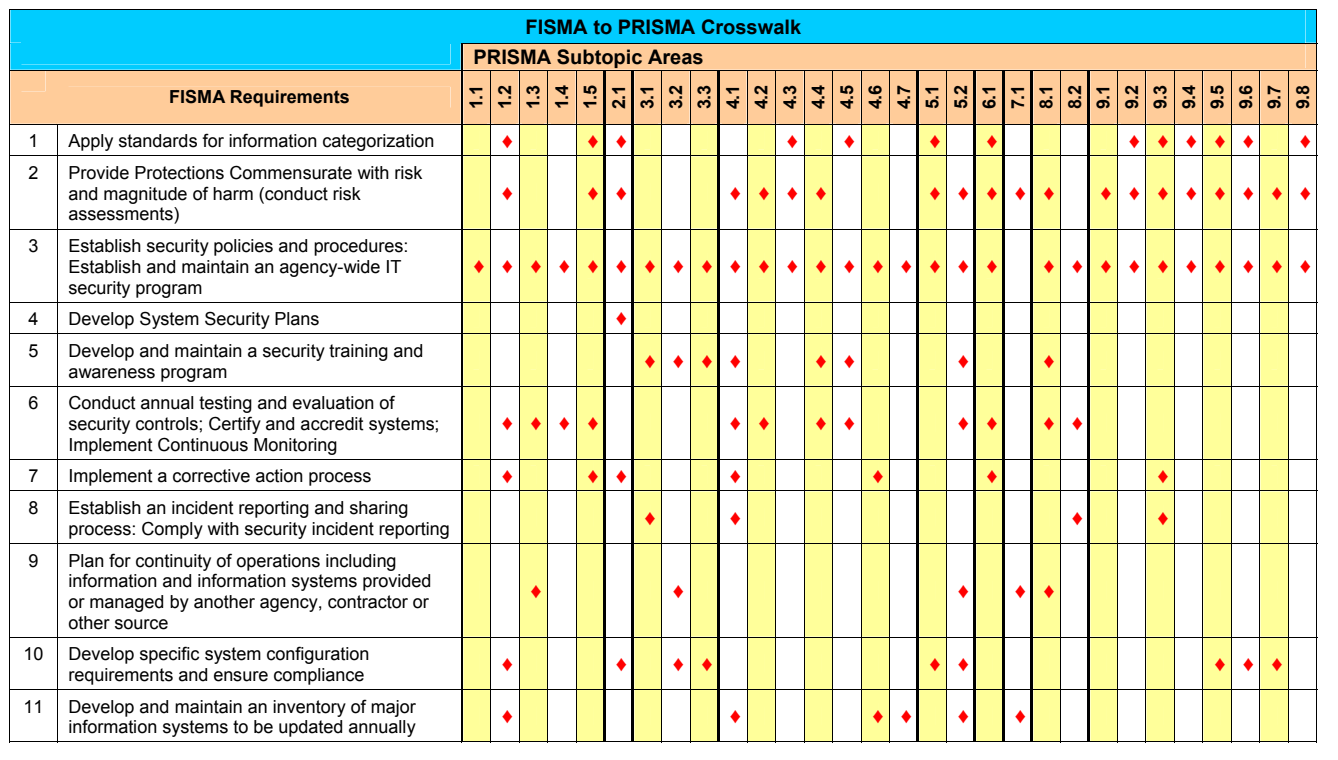
表 H-1「FISMA to PRISMA Crosswalk」の 2 ページ中 1 ページ目(要件 1〜11)の部分です。「FISMA to PRISMA Crosswalk」(FISMA と PRISMA の対照)と題した表です(青い帯)。左の「FISMA Requirements」(FISMA の要件)の列に番号付きの要件が並び、「PRISMA Subtopic Areas」(PRISMA のサブトピック領域)の下に 1.1〜1.5、2.1、3.1〜3.3、4.1〜4.7、5.1、5.2、6.1、7.1、8.1、8.2、9.1〜9.8 の 30 列があります(列は交互に薄い黄色で、トピックの区切りに太い線があります)。赤いひし形が、その要件を扱うサブトピック領域を示します。各行の要件と印のあるサブトピック領域は次のとおりです。1「Apply standards for information categorization」(情報の分類の標準を適用する): 1.2、1.5、2.1、4.3、4.5、5.1、6.1、9.2、9.3、9.4、9.5、9.6、9.8。2「Provide Protections Commensurate with risk and magnitude of harm (conduct risk assessments)」(リスクと被害の大きさに見合った保護を提供する(リスク評価を実施する)): 1.2、1.5、2.1、4.1、4.2、4.3、4.4、5.1、5.2、6.1、7.1、8.1、9.1、9.2、9.3、9.4、9.5、9.6、9.7、9.8。3「Establish security policies and procedures: Establish and maintain an agency-wide IT security program」(セキュリティの方針と手順を定める: 機関全体の IT セキュリティプログラムを確立し維持する): 7.1 以外のすべての列。4「Develop System Security Plans」(システムセキュリティ計画を作成する): 2.1。5「Develop and maintain a security training and awareness program」(セキュリティの研修と意識向上のプログラムを作成し維持する): 3.1、3.2、3.3、4.1、4.4、4.5、5.2、8.1。6「Conduct annual testing and evaluation of security controls; Certify and accredit systems; Implement Continuous Monitoring」(セキュリティ管理策の年次の試験と評価を行う、システムを認証・認定する、継続的監視を実施する): 1.2、1.3、1.4、1.5、4.1、4.2、4.4、4.5、5.2、6.1、8.1、8.2。7「Implement a corrective action process」(是正措置のプロセスを実施する): 1.2、1.5、2.1、4.1、4.6、6.1、9.3。8「Establish an incident reporting and sharing process: Comply with security incident reporting」(インシデントの報告・共有のプロセスを確立する: セキュリティインシデントの報告に従う): 3.1、4.1、8.2、9.3。9「Plan for continuity of operations including information and information systems provided or managed by another agency, contractor or other source」(他の機関・契約者・その他が提供・管理する情報と情報システムを含めて業務継続を計画する): 1.3、3.2、5.2、7.1、8.1。10「Develop specific system configuration requirements and ensure compliance」(システム固有の構成要件を定め、準拠を確保する): 1.2、2.1、3.2、3.3、5.1、5.2、9.5、9.6、9.7。11「Develop and maintain an inventory of major information systems to be updated annually」(主要な情報システムの一覧を作成・維持し、毎年更新する): 1.2、4.1、4.6、4.7、5.2、7.1。
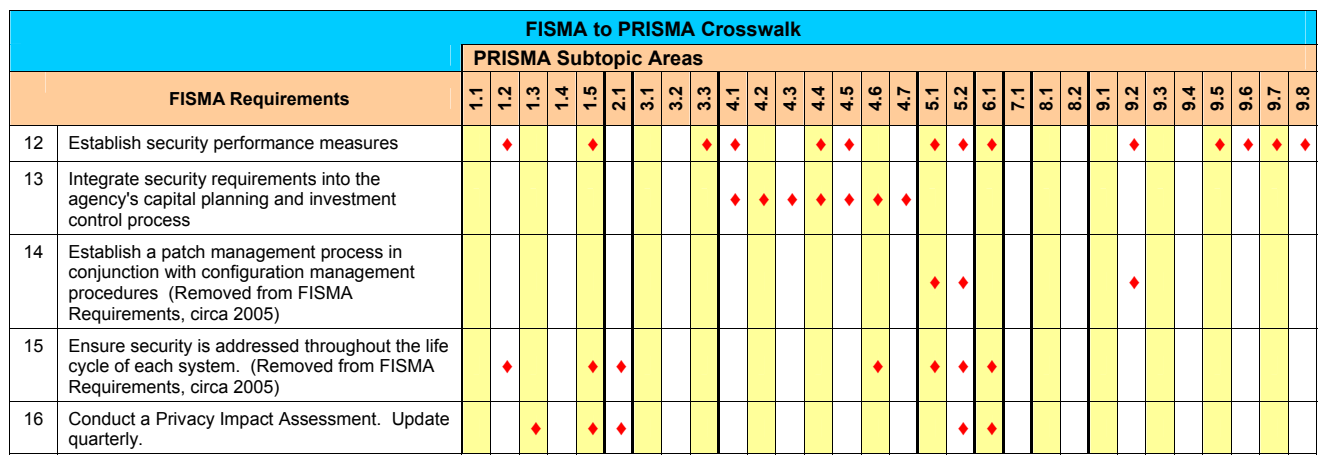
表 H-1「FISMA to PRISMA Crosswalk」の 2 ページ中 2 ページ目(要件 12〜16)の部分です。「FISMA to PRISMA Crosswalk」(FISMA と PRISMA の対照)と題した表です(青い帯)。左の「FISMA Requirements」(FISMA の要件)の列に番号付きの要件が並び、「PRISMA Subtopic Areas」(PRISMA のサブトピック領域)の下に 1.1〜1.5、2.1、3.1〜3.3、4.1〜4.7、5.1、5.2、6.1、7.1、8.1、8.2、9.1〜9.8 の 30 列があります(列は交互に薄い黄色で、トピックの区切りに太い線があります)。赤いひし形が、その要件を扱うサブトピック領域を示します。各行の要件と印のあるサブトピック領域は次のとおりです。12「Establish security performance measures」(セキュリティのパフォーマンス測定を定める): 1.2、1.5、3.3、4.1、4.4、4.5、5.1、5.2、6.1、9.2、9.5、9.6、9.7、9.8。13「Integrate security requirements into the agency's capital planning and investment control process」(機関の資本計画・投資管理プロセスにセキュリティ要件を組み込む): 4.1、4.2、4.3、4.4、4.5、4.6、4.7。14「Establish a patch management process in conjunction with configuration management procedures (Removed from FISMA Requirements, circa 2005)」(構成管理の手順と合わせてパッチ管理のプロセスを確立する(2005 年頃に FISMA の要件から削除)): 5.1、5.2、9.2。15「Ensure security is addressed throughout the life cycle of each system. (Removed from FISMA Requirements, circa 2005)」(各システムのライフサイクル全体でセキュリティが扱われるようにする(2005 年頃に FISMA の要件から削除)): 1.2、1.5、2.1、4.6、5.1、5.2、6.1。16「Conduct a Privacy Impact Assessment. Update quarterly.」(プライバシー影響評価を実施する。四半期ごとに更新する): 1.3、1.5、2.1、5.2、6.1。
Appendix I. References
付録 I. 参考文献
Federal CIO Council, Federal Information Technology Security Assessment Framework, November 2000.
Federal CIO Council, Federal Information Technology Security Assessment Framework, November 2000.
Federal Information Processing Standard 199, Standards for Security Categorization of Federal Information and Information Systems, February 2004.
Federal Information Processing Standard 199, Standards for Security Categorization of Federal Information and Information Systems, February 2004.
GAO/AIMD-12.19.6, Federal Information System Controls Audit Manual, January 1999.
GAO/AIMD-12.19.6, Federal Information System Controls Audit Manual, January 1999.
GAO-04-394-G, Information Technology Investment Management: A Framework for Assessing and Improving Process Maturity, Version 1.1, March 2004.
GAO-04-394-G, Information Technology Investment Management: A Framework for Assessing and Improving Process Maturity, Version 1.1, March 2004.
Homeland Security Presidential Directive/ HSPD-7, Critical Infrastructure Identification, Prioritization, and Protection, December 2003.
Homeland Security Presidential Directive/ HSPD-7, Critical Infrastructure Identification, Prioritization, and Protection, December 2003.
NIST Special Publication 800-12, An Introduction to Computer Security, October 1995
NIST Special Publication 800-12, An Introduction to Computer Security, October 1995
NIST Special Publication 800-14, Generally Accepted Principles and Practices for Securing Information Technology Systems, September 1996
NIST Special Publication 800-14, Generally Accepted Principles and Practices for Securing Information Technology Systems, September 1996
NIST Special Publication 800-18, Guide for Developing Security Plans for Information Technology Systems, Rev. 1, February 2006.
NIST Special Publication 800-18, Guide for Developing Security Plans for Information Technology Systems, Rev. 1, February 2006.
NIST Special Publication 800-30, Risk Management Guide for Information Technology Systems, July 2002.
NIST Special Publication 800-30, Risk Management Guide for Information Technology Systems, July 2002.
NIST Special Publication 800-35, Guide to Information Technology Security Services, October 2003.
NIST Special Publication 800-35, Guide to Information Technology Security Services, October 2003.
NIST Special Publication 800-37, Guide for the Security Certification and Accreditation of Federal Information Technology Systems, May 2004.
NIST Special Publication 800-37, Guide for the Security Certification and Accreditation of Federal Information Technology Systems, May 2004.
NIST SP 800-53, Recommended Security Controls for Federal Information Systems, September 2004.
NIST SP 800-53, Recommended Security Controls for Federal Information Systems, September 2004.
NIST Special Publication 800-55, Security Metrics Guide for Information Technology Systems, July 2003.
NIST Special Publication 800-55, Security Metrics Guide for Information Technology Systems, July 2003.
NIST Special Publication 800-59, Guideline for Identifying an Information System as a National Security System, August 2003.
NIST Special Publication 800-59, Guideline for Identifying an Information System as a National Security System, August 2003.
NIST Special Publication 800-64, Security Considerations in the Information System Development Life Cycle, October 2003.
NIST Special Publication 800-64, Security Considerations in the Information System Development Life Cycle, October 2003.
NIST Special Publication 800-65, Integrating Security into the Capital Planning and Investment Control Process, January 2005.
NIST Special Publication 800-65, Integrating Security into the Capital Planning and Investment Control Process, January 2005.
NIST Special Publication 800-100, Information Security Handbook: A Guide for Managers, November 2006.
NIST Special Publication 800-100, Information Security Handbook: A Guide for Managers, November 2006.
OMB Circular A-11, Preparation, Submission, and Execution of the Budget, 2003.
OMB Circular A-11, Preparation, Submission, and Execution of the Budget, 2003.
OMB Circular A-130, Management of Federal Information Resources, 2000.
OMB Circular A-130, Management of Federal Information Resources, 2000.
Public Law 100-503, The Computer Matching and Privacy Act of 1988.
Public Law 100-503, The Computer Matching and Privacy Act of 1988.
Public Law 100-235, Computer Security Act of 1987.
Public Law 100-235, Computer Security Act of 1987.
Public Law 104-13, Paperwork Reduction Act of 1995.
Public Law 104-13, Paperwork Reduction Act of 1995.
Public Law 104-106, Clinger-Cohen Act of 1996.
Public Law 104-106, Clinger-Cohen Act of 1996.
Public Law 107-347, Federal Information Security Management Act of 2002.
Public Law 107-347, Federal Information Security Management Act of 2002.