NIST IR 7502 日本語訳
英語タイトル : The Common Configuration Scoring System (CCSS): Metrics for Software Security Configuration Vulnerabilities日本語タイトル : 共通設定評価システム(CCSS):ソフトウェアのセキュリティ設定の脆弱性に関する指標
公開日 : 2010-12-27
原文URL : https://csrc.nist.gov/pubs/ir/7502/final
翻訳編集 : 自動生成(有志による非公式の日本語訳), 原文取得日 : 2026-10-31, 訳文 : 330 / 334 ブロック
[要約] NIST IR 7502 は、ソフトウェアのセキュリティ設定上の問題の深刻度を測る一連の尺度である共通設定評価システム(CCSS)を定義する報告書です。CCSS は、ソフトウェアの欠陥に起因する脆弱性の深刻度を測るために開発された CVSS から派生したもので、セキュリティ設定上の問題にどのように対処すべきかについて組織が判断するのを支援し、システム全体のセキュリティ態勢の定量的な評価で使用するデータを提供できるとされています。本書は、CCSS が提案する尺度と、それらを組み合わせて各設定上の問題の深刻度スコアにするための式を定義します。多様なセキュリティ設定上の問題について CCSS の尺度とスコアをどのように決定するかの例を示し、CCSS と CVSS および CMSS との比較も扱っています。
[NIST のロゴ。公的な標章のため、この非公式サイトには掲載していません。原本 PDF を参照してください。]
NIST Interagency Report 7502
NIST Interagency Report 7502
The Common Configuration Scoring System (CCSS): Metrics for Software Security Configuration Vulnerabilities
共通設定評価システム(CCSS): ソフトウェアのセキュリティ設定の脆弱性に関する指標
Karen Scarfone Peter Mell
Karen Scarfone Peter Mell
NIST Interagency Report 7502
NIST Interagency Report 7502
The Common Configuration Scoring System (CCSS): Metrics for Software Security Configuration Vulnerabilities
共通設定評価システム(CCSS): ソフトウェアのセキュリティ設定の脆弱性に関する指標
Karen Scarfone Peter Mell
Karen Scarfone Peter Mell
COMPUTER SECURITY
コンピュータセキュリティ
Computer Security Division Information Technology Laboratory National Institute of Standards and Technology Gaithersburg, MD 20899-8930
Computer Security Division Information Technology Laboratory National Institute of Standards and Technology Gaithersburg, MD 20899-8930
December 2010
2010 年 12 月
U.S. Department of Commerce
米国商務省
Gary Locke, Secretary
Gary Locke 長官
National Institute of Standards and Technology
National Institute of Standards and Technology
Patrick D. Gallagher, Director
Patrick D. Gallagher(ディレクター)
Reports on Computer Systems Technology
コンピュータシステム技術に関する報告書
The Information Technology Laboratory (ITL) at the National Institute of Standards and Technology (NIST) promotes the U.S. economy and public welfare by providing technical leadership for the nation’s measurement and standards infrastructure. ITL develops tests, test methods, reference data, proof of concept implementations, and technical analysis to advance the development and productive use of information technology. ITL’s responsibilities include the development of technical, physical, administrative, and management standards and guidelines for the cost-effective security and privacy of sensitive unclassified information in Federal computer systems. This Interagency Report discusses ITL’s research, guidance, and outreach efforts in computer security and its collaborative activities with industry, government, and academic organizations.
National Institute of Standards and Technology(NIST)の Information Technology Laboratory(ITL)は、国の測定・標準基盤に対する技術的リーダーシップを提供することにより、米国経済と公共の福祉を促進しています。ITL は、情報技術の開発と生産的な利用を進めるため、試験、試験方法、参照データ、概念実証の実装、技術分析を開発しています。ITL の責務には、連邦のコンピュータシステムにおける機微だが非機密の情報を費用対効果に優れた形で保護するための、技術的、物理的、管理的、マネジメント上の標準およびガイドラインの策定が含まれます。この Interagency Report は、コンピュータセキュリティにおける ITL の研究、ガイダンス、アウトリーチの取り組みと、産業界、政府、学術機関との共同活動について論じています。
National Institute of Standards and Technology Interagency Report 7502 42 pages (Dec. 2010)
National Institute of Standards and Technology Interagency Report 7502 42 ページ(2010 年 12 月)
Certain commercial entities, equipment, or materials may be identified in this document in order to describe an experimental procedure or concept adequately. Such identification is not intended to imply recommendation or endorsement by the National Institute of Standards and Technology, nor is it intended to imply that the entities, materials, or equipment are necessarily the best available for the purpose.
この文書では、実験の手順や概念を適切に説明するために、特定の商業的な組織、装置、資材が特定されている場合があります。このような特定は、National Institute of Standards and Technology による推奨や承認を意味するものではなく、それらの組織、資材、装置がその目的に必ずしも最善のものであることを意味するものでもありません。
Acknowledgments
謝辞
The authors, Karen Scarfone of G2 Inc. and Peter Mell of the National Institute of Standards and Technology (NIST), sincerely appreciate the contributions of the Forum of Incident Response and Security Teams (FIRST) Common Vulnerability Scoring System (CVSS) Special Interest Group members and others in reviewing drafts of this report, including Anton Chuvakin, Kurt Dillard, Robert Fritz, Tim Grance, Ron Gula, Wayne Jansen, Dave Mann, Doug Noakes, Jim Ronayne, Murugiah Souppaya, Kim Watson, and Greg Witte along with other staff at G2 Inc. Special thanks also go to Chuck Wergin and Dan Walsh, analysts for the National Vulnerability Database (NVD), for testing the proposed specification by measuring many configuration entries with it, as well as reviewing several drafts of this report. The authors are also grateful for the contributions of Elizabeth Van Ruitenbeek of the University of Illinois at Urbana-Champaign in shaping and refining our approach to vulnerability measurement and scoring.
著者である G2 Inc. の Karen Scarfone と National Institute of Standards and Technology(NIST)の Peter Mell は、Forum of Incident Response and Security Teams(FIRST)の Common Vulnerability Scoring System(CVSS)Special Interest Group のメンバーをはじめとする皆様が、この報告書のドラフトをレビューして貢献してくださったことに、心から感謝します。レビューしてくださったのは、Anton Chuvakin、Kurt Dillard、Robert Fritz、Tim Grance、Ron Gula、Wayne Jansen、Dave Mann、Doug Noakes、Jim Ronayne、Murugiah Souppaya、Kim Watson、Greg Witte の各氏と、G2 Inc. のその他のスタッフです。また、National Vulnerability Database(NVD)のアナリストである Chuck Wergin と Dan Walsh には、提案された仕様を用いて多くの設定項目を測定することで検証し、この報告書の複数のドラフトをレビューしていただいたことに、特に感謝します。さらに、脆弱性の測定とスコアリングに対する私たちのアプローチを形作り、洗練するうえで貢献してくださった、University of Illinois at Urbana-Champaign の Elizabeth Van Ruitenbeek にも感謝します。
Portions of this report are based on the official Common Vulnerability Scoring System (CVSS) standard1 from the CVSS Special Interest Group; NIST Interagency Report (IR) 7435, The Common Vulnerability Scoring System (CVSS) and Its Applicability to Federal Agency Systems; and NIST IR 7517, The Common Misuse Scoring System (CMSS): Metrics for Software Feature Misuse Vulnerabilities.2
この報告書の一部は、FIRST の CVSS Special Interest Group による公式の Common Vulnerability Scoring System(CVSS)標準1、NIST Interagency Report(IR)7435, The Common Vulnerability Scoring System (CVSS) and Its Applicability to Federal Agency Systems、NIST IR 7517, The Common Misuse Scoring System (CMSS): Metrics for Software Feature Misuse Vulnerabilities2 に基づいています。
Abstract
概要
The Common Configuration Scoring System (CCSS) is a set of measures of the severity of software security configuration issues. CCSS is derived from CVSS, which was developed to measure the severity of vulnerabilities due to software flaws. CCSS can assist organizations in making sound decisions as to how security configuration issues should be addressed and can provide data to be used in quantitative assessments of the overall security posture of a system. This report defines proposed measures for CCSS and equations to be used to combine the measures into severity scores for each configuration issue. The report also provides several examples of how CCSS measures and scores would be determined for a diverse set of security configuration issues.
共通設定評価システム(Common Configuration Scoring System: CCSS)は、ソフトウェアのセキュリティ設定上の問題の深刻度を測る一連の尺度です。CCSS は CVSS から派生したものであり、CVSS は、ソフトウェアの欠陥に起因する脆弱性の深刻度を測るために開発されました。CCSS は、セキュリティ設定上の問題にどのように対処すべきかについて、組織が適切な判断を下すのを支援でき、システム全体のセキュリティ態勢の定量的な評価で使用するデータを提供できます。この報告書は、CCSS の提案する尺度と、それらの尺度を組み合わせて各設定上の問題の深刻度スコアにするための式を定義します。また、多様なセキュリティ設定上の問題について、CCSS の尺度とスコアをどのように決定するかの例も、いくつか示します。
Audience
想定読者
This report is directed primarily at information security researchers, particularly those interested in vulnerability measurement or security automation; security product vendors; and vulnerability analysts.
この報告書の主な想定読者は、情報セキュリティの研究者(特に脆弱性の測定やセキュリティの自動化に関心のある方)、セキュリティ製品のベンダー、脆弱性アナリストです。
Table of Contents
目次
List of Tables
表の一覧
1. Overview of Vulnerability Measurement and Scoring
1. 脆弱性の測定とスコアリングの概要
This section provides an overview of vulnerability measurement and scoring. It first defines the major categories of system vulnerabilities. Next, it discusses the need to measure the characteristics of vulnerabilities and generate scores based on those measurements. Finally, it introduces recent vulnerability and measurement scoring systems.
この節では、脆弱性の測定とスコアリングの概要を説明します。まず、システムの脆弱性の主な分類を定義します。次に、脆弱性の特性を測定し、その測定に基づいてスコアを生成する必要性を論じます。最後に、最近の脆弱性の測定・スコアリングシステムを紹介します。
1.1 Categories of System Vulnerabilities
1.1 システムの脆弱性の分類
There are many ways in which the vulnerabilities of a system can be categorized. For the purposes of vulnerability scoring, this report uses three high-level vulnerability categories: software flaws, security configuration issues, and software feature misuse.3 These categories are described below.
システムの脆弱性は、さまざまな方法で分類できます。脆弱性のスコアリングを目的として、この報告書では、ソフトウェアの欠陥、セキュリティ設定上の問題、ソフトウェア機能の誤用という 3 つの上位の脆弱性分類を用います。3これらの分類を以下に説明します。
A software flaw vulnerability is caused by an unintended error in the design or coding of software. An example is an input validation error, such as user-provided input not being properly evaluated for malicious character strings and overly long values associated with known attacks. Another example is a race condition error that allows the attacker to perform a specific action with elevated privileges.
ソフトウェアの欠陥に関する脆弱性は、ソフトウェアの設計またはコーディングにおける意図しない誤りによって生じます。例として、入力検証の誤りがあります。これは、利用者が与えた入力に対し、既知の攻撃に関連する悪意のある文字列や過度に長い値が適切に評価されないといったものです。別の例として、攻撃者が昇格した権限で特定の操作を実行できてしまう、競合状態の誤りがあります。
A security configuration setting is an element of a software’s security that can be altered through the software itself. Examples of settings are an operating system offering access control lists that set the privileges that users have for files, and an application offering a setting to enable or disable the encryption of sensitive data stored by the application. A security configuration issue vulnerability involves the use of security configuration settings that negatively affect the security of the software.
セキュリティ設定とは、ソフトウェア自体を通じて変更できる、ソフトウェアのセキュリティの要素です。設定の例として、利用者がファイルに対して持つ権限を設定するアクセス制御リストを提供するオペレーティングシステムや、アプリケーションが保存する機微なデータの暗号化を有効または無効にする設定を提供するアプリケーションがあります。セキュリティ設定上の問題に関する脆弱性は、ソフトウェアのセキュリティに悪影響を及ぼすセキュリティ設定の使用に関わります。
A software feature is a functional capability provided by software. A software feature misuse vulnerability is a vulnerability in which the feature also provides an avenue to compromise the security of a system. These vulnerabilities are caused by the software designer making trust assumptions that permit the software to provide beneficial features, while also introducing the possibility of someone violating the trust assumptions to compromise security. For example, email client software may contain a feature that renders HTML content in email messages. An attacker could craft a fraudulent email message that contains hyperlinks that, when rendered in HTML, appear to the recipient to be benign, but actually take the recipient to a malicious web site when they are clicked on. One of the trust assumptions in the design of the HTML content rendering feature was that users would not receive malicious hyperlinks and click on them.
ソフトウェア機能とは、ソフトウェアが提供する機能的な能力です。ソフトウェア機能の誤用に関する脆弱性とは、その機能がシステムのセキュリティを危殆化させる経路にもなってしまう脆弱性です。これらの脆弱性は、ソフトウェアの設計者が、ソフトウェアが有益な機能を提供できるようにする信頼の前提を置く一方で、その信頼の前提を誰かが破ってセキュリティを危殆化させる可能性を持ち込んでしまうことによって生じます。たとえば、電子メールクライアントソフトウェアには、電子メールメッセージ内の HTML コンテンツを表示する機能が含まれている場合があります。攻撃者は、HTML で表示されると受信者には無害に見えるものの、クリックすると実際には受信者を悪意のある Web サイトへ誘導するハイパーリンクを含む、偽の電子メールメッセージを作成できます。HTML コンテンツの表示機能の設計における信頼の前提の 1 つは、利用者が悪意のあるハイパーリンクを受け取ってクリックすることはない、というものでした。
Software feature misuse vulnerabilities are introduced during the design of the software or a component of the software (e.g., a protocol that the software implements). Trust assumptions may have been explicit—for example, a designer being aware of a security weakness and determining that a separate security control would compensate for it. However, trust assumptions are often implicit, such as creating a feature without first evaluating the risks it would introduce. Threats may also change over the lifetime of software or a protocol used in software. For example, the Address Resolution Protocol (ARP) trusts that an ARP reply contains the correct mapping between Media Access Control (MAC) and Internet Protocol (IP) addresses. The ARP cache uses that information to provide a useful service—to enable sending data between devices within a local network. However, an attacker could generate false ARP messages to poison a system’s ARP table and thereby launch a denial-of-service or a man-in-the-middle attack. The ARP protocol was standardized over 25 years ago4, and threats have changed a great deal since then, so the trust assumptions inherent in its design then are unlikely to still be reasonable today.
ソフトウェア機能の誤用に関する脆弱性は、ソフトウェアまたはソフトウェアの構成要素(たとえば、ソフトウェアが実装するプロトコル)の設計時に入り込みます。信頼の前提は明示的であった場合もあります。たとえば、設計者がセキュリティ上の弱点を認識し、別のセキュリティ管理策がそれを補うと判断した場合です。しかし、信頼の前提は、導入されるリスクを事前に評価せずに機能を作成する場合のように、暗黙的であることが多くあります。また、ソフトウェアやソフトウェアで使用されるプロトコルの存続期間中に、脅威が変化する場合もあります。たとえば、Address Resolution Protocol(ARP)は、ARP 応答に、Media Access Control(MAC)アドレスと Internet Protocol(IP)アドレスの正しい対応が含まれていると信頼します。ARP キャッシュは、その情報を使って、ローカルネットワーク内の装置間でのデータの送信を可能にするという有用なサービスを提供します。しかし、攻撃者は偽の ARP メッセージを生成してシステムの ARP テーブルを汚染し、それによってサービス拒否攻撃や中間者攻撃を仕掛けることができます。ARP プロトコルは 25 年以上前に標準化されました4が、それ以来、脅威は大きく変化しており、当時の設計に内在していた信頼の前提が今日でも妥当である可能性は低いです。
It may be hard to differentiate software feature misuse vulnerabilities from the other two categories. For example, both software flaws and misuse vulnerabilities may be caused by deficiencies in software design processes. However, software flaws are purely negative—they provide no positive benefit to security or functionality—while software feature misuse vulnerabilities occur as a result of providing additional features.
ソフトウェア機能の誤用に関する脆弱性を、他の 2 つの分類と区別するのは難しい場合があります。たとえば、ソフトウェアの欠陥も誤用に関する脆弱性も、ソフトウェア設計プロセスの不備によって生じる場合があります。しかし、ソフトウェアの欠陥は純粋に負の要素であり、セキュリティにも機能にも何ら利点をもたらしませんが、ソフトウェア機能の誤用に関する脆弱性は、追加の機能を提供した結果として生じます。
There may also be confusion regarding misuse vulnerabilities for features that can be enabled or disabled—in a way, configured—versus security configuration issues. The key difference is that for a misuse vulnerability, the configuration setting enables or disables the entire feature, and does not specifically alter just its security; for a security configuration issue vulnerability, the configuration setting alters only the software’s security. For example, a setting that disables all use of HTML in emails has a significant impact on both security and functionality, so a vulnerability related to this setting would be a misuse vulnerability. A setting that disables the use of an antiphishing feature in an email client has a significant impact on only security, so a vulnerability with that setting would be considered a security configuration issue vulnerability.
有効または無効にできる(いわば設定できる)機能に関する誤用の脆弱性と、セキュリティ設定上の問題とのあいだでも、混同が生じる場合があります。主な違いは、誤用に関する脆弱性では、設定によって機能全体が有効または無効になり、そのセキュリティだけを特に変更するわけではないのに対し、セキュリティ設定上の問題に関する脆弱性では、設定がソフトウェアのセキュリティのみを変更することです。たとえば、電子メールでの HTML の使用をすべて無効にする設定は、セキュリティと機能の両方に大きな影響を及ぼすため、この設定に関する脆弱性は誤用に関する脆弱性となります。電子メールクライアントのフィッシング対策機能の使用を無効にする設定は、セキュリティのみに大きな影響を及ぼすため、この設定に関する脆弱性は、セキュリティ設定上の問題に関する脆弱性とみなされます。
1.2 The Need for Vulnerability Measurement and Scoring
1.2 脆弱性の測定とスコアリングの必要性
No system is 100% secure: every system has vulnerabilities. At any given time, a system may not have any known software flaws, but security configuration issues and software feature misuse vulnerabilities are always present. Misuse vulnerabilities are inherent in software features because each feature must be based on trust assumptions—and those assumptions can be broken, albeit involving significant cost and effort in some cases. Security configuration issues are also unavoidable for two reasons. First, many configuration settings increase security at the expense of reducing functionality, so using the most secure settings could make the software useless or unusable. Second, many security settings have both positive and negative consequences for security. An example is the number of consecutive failed authentication attempts to permit before locking out a user account. Setting this to 1 would be the most secure setting against password guessing attacks, but it would also cause legitimate users to be locked out after mistyping a password once, and it would also permit attackers to perform denial-of-service attacks against users more easily by generating a single failed login attempt for each user account.
100% 安全なシステムはなく、どのシステムにも脆弱性があります。ある時点で、システムに既知のソフトウェアの欠陥がない場合があっても、セキュリティ設定上の問題とソフトウェア機能の誤用に関する脆弱性は常に存在します。誤用に関する脆弱性はソフトウェア機能に内在します。各機能は信頼の前提に基づいていなければならず、その前提は、場合によっては多大なコストと労力を要するものの、破られる可能性があるためです。セキュリティ設定上の問題も、2 つの理由から避けられません。第 1 に、多くの設定は、機能を犠牲にしてセキュリティを高めるものであり、最も安全な設定を使用すると、ソフトウェアが役に立たなくなったり、使えなくなったりするおそれがあります。第 2 に、多くのセキュリティ設定は、セキュリティに対して良い結果と悪い結果の両方をもたらします。例として、利用者アカウントをロックアウトするまでに許容する連続した認証失敗の回数があります。これを 1 に設定すると、パスワード推測攻撃に対しては最も安全な設定になりますが、正規の利用者も一度パスワードを打ち間違えただけでロックアウトされてしまううえ、攻撃者が各利用者アカウントに対してログイン失敗を 1 回生成するだけで、利用者に対するサービス拒否攻撃をより容易に実行できるようになります。
Because of the number of vulnerabilities inherent in security configuration settings and software feature misuse possibilities, plus the number of software flaw vulnerabilities on a system at any given time, there may be dozens or hundreds of vulnerabilities on a single system. These vulnerabilities are likely to have a wide variety of characteristics. Some will be very easy to exploit, while others will only be exploitable under a combination of highly unlikely conditions. One vulnerability might provide root-level access to a system, while another vulnerability might only permit read access to an insignificant file. Ultimately, organizations need to know how difficult it is for someone to exploit each vulnerability and, if a vulnerability is exploited, what the possible impact would be.
セキュリティ設定に内在する脆弱性の数とソフトウェア機能の誤用の可能性に加え、ある時点でシステムに存在するソフトウェアの欠陥に関する脆弱性の数も考慮すると、1 つのシステムに数十から数百の脆弱性が存在する場合があります。これらの脆弱性は、非常に多様な特性を持つと考えられます。非常に悪用しやすいものがある一方で、可能性が極めて低い条件が重なった場合にのみ悪用できるものもあります。ある脆弱性はシステムへの root レベルのアクセスをもたらす可能性があり、別の脆弱性は重要でないファイルへの読み取りアクセスしか許さない可能性があります。結局のところ、組織は、各脆弱性を悪用することがどれほど難しいか、また、脆弱性が悪用された場合にどのような影響が考えられるかを知る必要があります。
If vulnerability characteristics related to these two concepts were measured and documented in a consistent, methodical way, the measurement data could be used by quantitative risk assessment methodologies for determining which vulnerabilities are most important for an organization to address using its limited resources. For example, when planning the security configuration settings for a new system, an organization could use vulnerability measurements as part of determining the relative importance of particular settings and identifying the settings causing the greatest increase in risk. Vulnerability measurement is also useful when evaluating the security of software features, such as identifying the vulnerabilities in those features that should have compensating controls applied to reduce their risk (for example, antivirus software to scan email attachments and awareness training to alter user behavior) and determining which features should be disabled because their risk outweighs the benefit that they provide.
これら 2 つの概念に関する脆弱性の特性が、一貫した体系的な方法で測定・文書化されていれば、その測定データを定量的リスク評価の方法論で使用して、限られた資源のなかで組織がどの脆弱性への対処を最も優先すべきかを判断できます。たとえば、新しいシステムのセキュリティ設定を計画する際、組織は、脆弱性の測定を、特定の設定の相対的な重要度の判断や、リスクを最も増大させる設定の特定の一環として使用できます。脆弱性の測定は、ソフトウェア機能のセキュリティを評価する際にも有用です。たとえば、リスクを低減するために補完的な管理策(たとえば、電子メールの添付ファイルをスキャンするウイルス対策ソフトウェアや、利用者の行動を変えるための意識向上トレーニング)を適用すべき機能の脆弱性を特定したり、リスクが提供する利益を上回るために無効にすべき機能を判断したりする場合です。
Having consistent measures for all types of system vulnerabilities has additional benefits. Organizations can compare the relative severity of different vulnerabilities from different software packages and on different systems. Software vendors can track the characteristics of a product’s vulnerabilities over time to determine if its security is improving or declining. Software vendors can also use the measures to communicate to their customers the severity of the vulnerabilities in their products. Auditors and others performing security assessments can check systems to ensure that they do not have unmitigated vulnerabilities with certain characteristics, such as high impact measures or high overall severity scores.
あらゆる種類のシステムの脆弱性に対して一貫した尺度があることには、さらなる利点があります。組織は、異なるソフトウェアパッケージや異なるシステムにある、さまざまな脆弱性の相対的な深刻度を比較できます。ソフトウェアベンダーは、製品の脆弱性の特性を長期にわたって追跡し、そのセキュリティが向上しているか低下しているかを判断できます。ソフトウェアベンダーは、これらの尺度を使って、製品の脆弱性の深刻度を顧客に伝えることもできます。監査人やセキュリティ評価を実施するその他の担当者は、影響の尺度が高い、または総合的な深刻度スコアが高いなど、特定の特性を持つ未緩和の脆弱性がシステムにないことを確認できます。
Although having a set of measures for a vulnerability provides the level of detail necessary for in-depth analysis, sometimes it is more convenient for people to have a single measure for each vulnerability. So quantitative measures can be combined into a score—a single number that provides an estimate of the overall severity of a vulnerability. Vulnerability scores are not as quantitative as the measures that they are based on, so they are most helpful for general comparisons, such as a vulnerability with a score of 10 (on a 0 to 10 scale) being considerably more severe than a vulnerability with a score of 4. Small scoring differences, such as vulnerabilities with scores of 4.8 and 5.1, do not necessarily indicate a significant difference in severity because of the margin of error in individual measures and the equations that combine those measures.
脆弱性に対する一連の尺度があれば、詳細な分析に必要な水準の詳細が得られますが、脆弱性ごとに単一の尺度があるほうが便利な場合もあります。そのため、定量的な尺度を組み合わせて、脆弱性の総合的な深刻度の推定値を示す単一の数値であるスコアにすることができます。脆弱性のスコアは、その基になる尺度ほど定量的ではないため、一般的な比較に最も役立ちます。たとえば、スコアが 10(0 から 10 の尺度で)の脆弱性は、スコアが 4 の脆弱性よりもかなり深刻である、といった比較です。スコアが 4.8 と 5.1 の脆弱性のような小さなスコアの差は、個々の尺度とそれらを組み合わせる式に誤差の幅があるため、必ずしも深刻度の大きな違いを示すものではありません。
1.3 Vulnerability Measurement and Scoring Systems
1.3 脆弱性の測定・スコアリングシステム
To provide standardized methods for vulnerability measurement and scoring, three specifications have been created, one for each of the categories of system vulnerabilities defined in Section 1.1. The first specification, the Common Vulnerability Scoring System (CVSS), addresses software flaw vulnerabilities. The first version of CVSS was introduced in 2004, and the second version became available in 2007.5 CVSS has been widely adopted by the Federal government, industry, and others. CVSS was originally intended for use in prioritizing the deployment of patches, but there has been considerable interest in applying it more broadly, such as using its measures as inputs to risk assessment methodologies.
脆弱性の測定とスコアリングの標準化された方法を提供するために、第 1.1 節で定義したシステムの脆弱性の分類ごとに 1 つずつ、3 つの仕様が作成されています。最初の仕様である共通脆弱性評価システム(Common Vulnerability Scoring System: CVSS)は、ソフトウェアの欠陥に関する脆弱性を対象としています。CVSS の最初のバージョンは 2004 年に導入され、2 番目のバージョンは 2007 年に利用可能になりました。5CVSS は、連邦政府、産業界などで広く採用されています。CVSS はもともと、パッチの展開の優先順位付けに使用することを意図していましたが、その尺度をリスク評価の方法論への入力として使用するなど、より広く適用することに大きな関心が寄せられています。
The second vulnerability measurement and scoring specification is the Common Misuse Scoring System (CMSS).6 CMSS was designed for measuring and scoring misuse vulnerabilities. CMSS uses the basic components of CVSS and adjusts them to account for the differences between software flaws and misuse vulnerabilities.
2 番目の脆弱性の測定・スコアリングの仕様は、共通誤用スコアリングシステム(Common Misuse Scoring System: CMSS)です。6CMSS は、誤用に関する脆弱性を測定してスコアリングするために設計されました。CMSS は CVSS の基本的な構成要素を使い、ソフトウェアの欠陥と誤用に関する脆弱性の違いを考慮してそれらを調整しています。
The Common Configuration Scoring System (CCSS), the third of the vulnerability measurement and scoring specifications, is defined in this report. CCSS addresses software security configuration issue vulnerabilities. CCSS is largely based on CVSS and CMSS, and it is intended to complement them.
共通設定評価システム(Common Configuration Scoring System: CCSS)は、脆弱性の測定・スコアリングの仕様の 3 番目であり、この報告書で定義されます。CCSS は、ソフトウェアのセキュリティ設定上の問題に関する脆弱性を対象としています。CCSS は主に CVSS と CMSS に基づいており、それらを補完することを意図しています。
The three vulnerability measurement and scoring systems are similar. They all use the same six core measures to capture the fundamental characteristics of vulnerabilities. They all generate vulnerability severity scores in the range of 0 (lowest severity) to 10 (highest severity). However, there are also some significant differences in the details of the three specifications. These differences are discussed in Section 5, after the CCSS specification has been defined and illustrated in Sections 2, 3, and 4.
3 つの脆弱性の測定・スコアリングシステムは類似しています。いずれも、同じ 6 つの中核的な尺度を使って、脆弱性の基本的な特性を捉えます。いずれも、0(最も低い深刻度)から 10(最も高い深刻度)の範囲で脆弱性の深刻度スコアを生成します。ただし、3 つの仕様の細部には、いくつかの重要な違いもあります。これらの違いは、第 2 節、第 3 節、第 4 節で CCSS の仕様を定義して例示した後、第 5 節で論じます。
The primary purpose of this document is to define CCSS, and not to explain in detail how organizations can use CCSS. Unlike CVSS data, which can be used by itself to aid in prioritizing vulnerability remediation efforts, as of this writing CCSS data is not yet directly useful to organizations for decision making. This document is an early step in a long-term effort to provide standardized vulnerability measurement data sources and corresponding methodologies for conducting quantitative risk assessments of system security. Additional information will be published in the future regarding CCSS and how organizations will be able to take advantage of it. Currently, the focus is on reaching consensus on the definition of CCSS and encouraging software vendors to create initial sets of CCSS measures and scores for the purposes of validating the CCSS specification and identifying any necessary adjustments to the specification.
この文書の主な目的は CCSS を定義することであり、組織が CCSS をどのように使えるかを詳しく説明することではありません。CVSS のデータは、それ単独で脆弱性の是正作業の優先順位付けに役立てることができますが、この文書の執筆時点では、CCSS のデータは、組織の意思決定にまだ直接には役立ちません。この文書は、標準化された脆弱性の測定データのソースと、システムセキュリティの定量的なリスク評価を実施するための対応する方法論を提供するという、長期的な取り組みの初期の一歩です。CCSS と、組織がそれをどのように活用できるかについての追加情報は、今後公表される予定です。現在は、CCSS の定義について合意に達することと、CCSS の仕様を検証し、仕様に必要な調整を特定する目的で、ソフトウェアベンダーに CCSS の尺度とスコアの初期セットを作成するよう促すことに重点が置かれています。
In the future, additional work will be needed before CCSS is ready for organizations to adopt. Base and temporal measures and scores need to be assigned to each security configuration issue in major software products and shared with the security community. This data could be used in conjunction with the CVSS and CMSS measures as a consistent set of measures for system vulnerabilities. In turn, this will provide opportunities for using the data in threat models, risk assessments, and other security analysis activities.
今後、CCSS を組織が採用できる状態にするには、さらなる作業が必要です。主要なソフトウェア製品の各セキュリティ設定上の問題に、基本の尺度とスコア、および現状の尺度とスコアを割り当て、セキュリティコミュニティと共有する必要があります。このデータは、CVSS や CMSS の尺度と併用して、システムの脆弱性に対する一貫した尺度のセットとして使用できます。それにより、このデータを脅威モデル、リスク評価、その他のセキュリティ分析活動で使用する機会が生まれます。
Also, a way will need to be developed to relate data on various vulnerabilities to each other—there are many dependencies among vulnerabilities that affect their exploitability and impact. For example, one vulnerability might only be exploitable if a second vulnerability is also present or if a second vulnerability can grant user-level access. These dependencies need to be captured in a standardized way to facilitate the data’s use for security modeling and analysis. Also, a mechanism has not yet been developed for measuring the security characteristics of a system using CVSS, CCSS, and CMSS together. Another important problem to resolve is how local policy, security controls, and other system and environment-specific elements that affect vulnerabilities should be taken into account.
また、さまざまな脆弱性に関するデータを相互に関連付ける方法を開発する必要があります。脆弱性のあいだには、その悪用可能性と影響に関わる依存関係が数多くあるためです。たとえば、ある脆弱性は、別の脆弱性も存在する場合、あるいは別の脆弱性が利用者レベルのアクセスを許せる場合にのみ、悪用できることがあります。これらの依存関係を標準化された方法で捉え、セキュリティのモデリングと分析にデータを使いやすくする必要があります。さらに、CVSS、CCSS、CMSS を併用してシステムのセキュリティ特性を測定するためのメカニズムも、まだ開発されていません。解決すべきもう 1 つの重要な課題は、脆弱性に影響する、ローカルのポリシー、セキュリティ管理策、その他のシステム固有・環境固有の要素を、どのように考慮に入れるべきかです。
2. CCSS Metrics
2. CCSS の指標
This section defines the metrics that comprise the CCSS specification. The CCSS metrics are organized into three groups: base, temporal, and environmental. Base metrics describe the characteristics of a configuration issue that are constant over time and across user environments. Temporal metrics describe the characteristics of configuration issues that can change over time but remain constant across user environments. Environmental metrics are used to customize the base and temporal scores based on the characteristics of a specific user environment. Figure 1 shows how the base, temporal, and environmental scores are calculated from the three groups of metrics.
この節では、CCSS の仕様を構成する指標を定義します。CCSS の指標は、基本、現状、環境の 3 つのグループに整理されています。基本指標は、時間が経過しても、また利用者の環境が異なっても変わらない、設定上の問題の特性を記述します。現状指標は、時間とともに変化し得ますが、利用者の環境が異なっても変わらない、設定上の問題の特性を記述します。環境指標は、特定の利用者の環境の特性に基づいて、基本スコアと現状スコアをカスタマイズするために使用されます。図 1 は、3 つの指標グループから、基本スコア、現状スコア、環境スコアがどのように算出されるかを示しています。
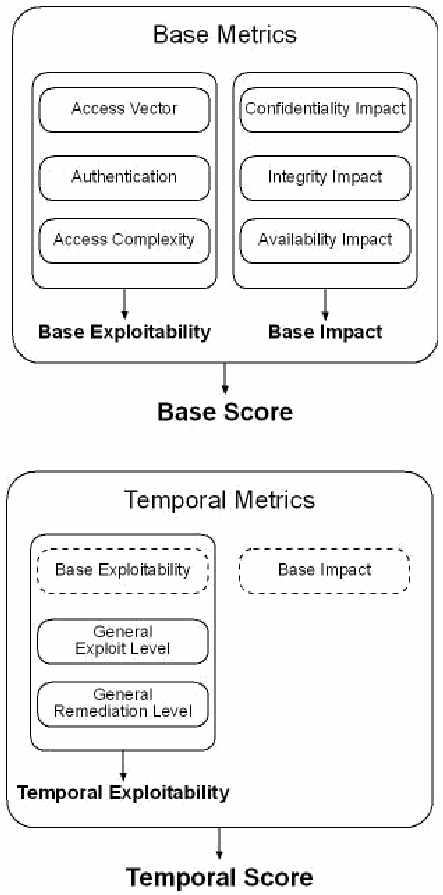
図の上半分で、角の丸い 2 つの枠からなります。「Base Metrics」の枠には 2 列があり、「Access Vector」「Authentication」「Access Complexity」は下の「Base Exploitability」へ、「Confidentiality Impact」「Integrity Impact」「Availability Impact」は「Base Impact」へ矢印で進み、枠全体から「Base Score」へ矢印が出ています。「Temporal Metrics」の枠には破線の「Base Exploitability」「Base Impact」と実線の「General Exploit Level」「General Remediation Level」があり、左の列は「Temporal Exploitability」へ進み、枠全体から「Temporal Score」へ矢印が出ています。
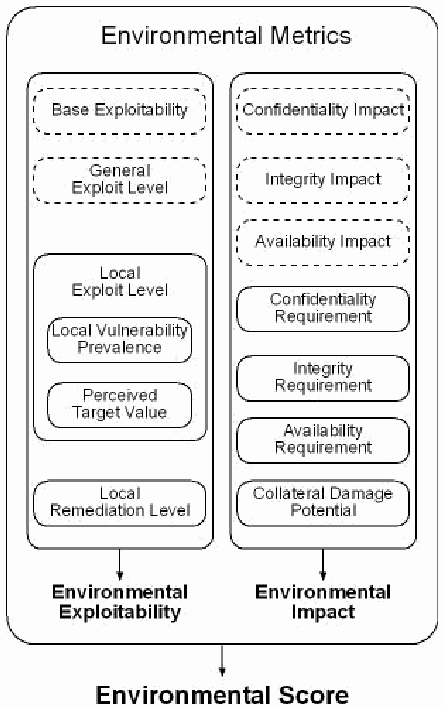
図の下半分で、角の丸い枠「Environmental Metrics」です。左の列には破線の「Base Exploitability」「General Exploit Level」、「Local Vulnerability Prevalence」と「Perceived Target Value」を含む「Local Exploit Level」、「Local Remediation Level」があり、「Environmental Exploitability」へ進みます。右の列には破線の「Confidentiality Impact」「Integrity Impact」「Availability Impact」と、実線の「Confidentiality Requirement」「Integrity Requirement」「Availability Requirement」「Collateral Damage Potential」があり、「Environmental Impact」へ進みます。枠全体から「Environmental Score」へ矢印が出ています。
Figure 1. CCSS Metric Groups
図 1. CCSS の指標グループ
2.1 Base Metrics
2.1 基本評価基準
This section describes the base metrics, which measure the characteristics of a security configuration issue that are constant with time and across user environments. The base metrics measure two aspects of vulnerability severity: Exploitability and Impact.
この節では、基本評価基準を説明します。基本評価基準は、時間が経過しても、また利用者の環境が異なっても変わらない、セキュリティ設定上の問題の特性を測定します。基本評価基準は、脆弱性の深刻度の 2 つの側面、すなわち悪用可能性と影響を測定します。
2.1.1 Exploitability
2.1.1 悪用可能性
The Exploitability of a security configuration issue can be captured using the Access Vector, Authentication, Access Complexity, and Exploitation Method metrics. These metrics are adapted from the CVSS and CMSS specifications and reinterpreted in the context of security configuration issues.
セキュリティ設定上の問題の悪用可能性は、アクセスベクトル、認証、アクセスの複雑さ、悪用方法の各指標を使って捉えることができます。これらの指標は、CVSS と CMSS の仕様から転用し、セキュリティ設定上の問題の文脈で再解釈したものです。
2.1.1.1 Exploitation Method (EM)
2.1.1.1 悪用方法(EM)
Vulnerabilities caused by security configuration issues can be taken advantage of in two ways: actively and passively.7 These are indicated in CCSS as an Exploitation Method metric of Active (A) or Passive (P). Some vulnerabilities can be actively exploited, such as an attacker gaining access to a sensitive file because the targeted system is incorrectly configured to permit any user to read the file. Other vulnerabilities passively prevent authorized actions from occurring, such as not permitting a system service or daemon to run or not generating audit log records for security events.
セキュリティ設定上の問題によって生じる脆弱性は、能動的と受動的の 2 つの方法で悪用され得ます。7これらは、CCSS では、悪用方法の指標が能動的(Active: A)または受動的(Passive: P)として示されます。能動的に悪用できる脆弱性もあります。たとえば、対象のシステムが、どの利用者でも機微なファイルを読み取れるように誤って設定されているために、攻撃者がそのファイルへのアクセスを得る場合です。受動的に、許可された操作の実行を妨げる脆弱性もあります。たとえば、システムサービスやデーモンの実行を許可しない場合や、セキュリティイベントの監査ログ記録を生成しない場合です。
The Exploitation Method metric is not used directly in generating CCSS scores, but the definitions for some of the Exploitability base metrics are dependent on the value of the Exploitation Method metric. The Exploitation Method metric is also useful for planning mitigation strategies, because most Passive configuration issues involve an error or policy violation that can be fixed quickly. Active configuration issues have a much wider range of mitigation possibilities and often require significantly more analysis and planning for mitigation than Passive configuration issues.
悪用方法の指標は、CCSS のスコアの生成には直接使用されませんが、悪用可能性の基本評価基準のいくつかの定義は、悪用方法の指標の値に依存しています。悪用方法の指標は、緩和戦略の計画にも有用です。受動的な設定上の問題の大半は、迅速に修正できる誤りやポリシー違反に関わるためです。能動的な設定上の問題は、緩和の可能性がはるかに幅広く、緩和のために、受動的な設定上の問題よりも大幅に多くの分析と計画を必要とすることが多くあります。
Some organizations may also find the Exploitation Method metric valuable because of how they define availability. For example, an organization might consider a security configuration error that prevents use of a particular system function as an operational concern, not a security concern, and prioritize and remediate it differently. Such errors would all have an Exploitation Method metric value of Passive, so organizations could use the metric to quickly differentiate the configuration issues that they consider operational from the others.
組織によっては、可用性の定義の仕方によっても、悪用方法の指標が有用だと考える場合があります。たとえば、組織は、特定のシステム機能の使用を妨げるセキュリティ設定上の誤りを、セキュリティ上の懸念ではなく運用上の懸念と考え、優先順位付けや是正を別の方法で行うことがあります。このような誤りはすべて、悪用方法の指標の値が受動的になるため、組織はこの指標を使って、運用上のものと考える設定上の問題を、その他のものと速やかに区別できます。
2.1.1.2 Access Vector (AV)
2.1.1.2 アクセスベクトル(AV)
The Access Vector metric reflects the access required to exploit the configuration issue. To produce an Access Vector score for a configuration issue, consider what access to the system the exploiter8 must possess in order to exploit the issue. The possible values for this metric are listed in Table 1. The more remote an exploiter can be, the greater the vulnerability score.
アクセスベクトルの指標は、設定上の問題を悪用するために必要なアクセスを反映します。設定上の問題のアクセスベクトルのスコアを求めるには、悪用する者8がその問題を悪用するために、システムへのどのようなアクセスを持っていなければならないかを考えます。この指標の取り得る値を表 1 に示します。悪用する者がより遠隔にいられるほど、脆弱性のスコアは高くなります。
The Access Vector metric is assigned differently depending upon whether the configuration issue can be taken advantage of actively or passively.
アクセスベクトルの指標は、設定上の問題を能動的に悪用できるか、受動的に悪用できるかに応じて、割り当て方が異なります。
For active exploitation, the metric reflects from where the exploitation can be performed. The score increases with the degree to which an exploiter may be remote from the affected system.
能動的な悪用の場合、この指標は、悪用をどこから実行できるかを反映します。悪用する者が影響を受けるシステムから遠隔にいられる度合いが大きいほど、スコアは高くなります。
For passive exploitation, this metric reflects from where users or other systems are supposed to be able to perform the action that is being prevented from occurring. The more remote the users or other systems can be, the greater the score.
受動的な悪用の場合、この指標は、妨げられている操作を、利用者や他のシステムがどこから実行できるはずであるかを反映します。利用者や他のシステムがより遠隔にいられるほど、スコアは高くなります。
Table 1. Access Vector Scoring Evaluation
表 1. アクセスベクトルのスコアリング評価
| Metric Value | Description |
|---|---|
| Local (L) | Active Exploitation: A vulnerability actively exploitable with only local access requires the exploiter to have either physical access to the vulnerable system or a local (shell) account. Examples of locally exploitable configuration issues are excess privileges assigned to locally accessible user or service accounts, directories, files, and registry keys; prohibited local services enabled; weak password policies for local accounts; lack of required password protection for screen savers; and lack of required peripheral usage restrictions, such as permissions for the use of USB flash drives or CDs. |
| Passive Exploitation: A vulnerability passively preventing actions from occurring with local access affects only local users, processes, services, etc. Examples of these configuration issues are insufficient privileges assigned to locally accessible user or service accounts, directories, files, and registry keys; necessary local services disabled; and overly restrictive peripheral configurations, such as preventing the use of USB flash drives or CDs when an organization’s policy permits such use. | |
| Adjacent Network (A) | Active Exploitation: A vulnerability actively exploitable with adjacent network access requires the exploiter to have access to either the broadcast or collision domain of the vulnerable software. Examples of local networks include local IP subnet, Bluetooth, IEEE 802.11, and local Ethernet segment. An example of an adjacent network configuration issue is configuring a wireless LAN network interface card to connect to any available wireless LAN automatically. |
| Passive Exploitation: A vulnerability passively preventing actions from occurring with adjacent network access affects users or other systems on the broadcast or collision domain of the software. An example of such a configuration issue is a system that is intended to share its Internet access with other systems on the same subnet, but is configured so that it cannot provide Internet access to them. | |
| Network (N) | Active Exploitation: A vulnerability actively exploitable with network access means that the exploiter does not require local network access or local access. The software with the vulnerability is bound to the network stack; this is also termed “remotely exploitable.” An example is a configuration setting for a network service such as FTP, HTTP, or SMTP (e.g., excess privileges, weak password policy). Another example is a prohibited network service being enabled. |
| Passive Exploitation: A vulnerability passively preventing actions from occurring with network access affects users or systems outside the broadcast or collision domain. An example is a system that is intended to provide a network service to all other systems, but the service has inadvertently been disabled. Another example is a system that interacts with remote systems, but has all of its logging and auditing capabilities disabled; the system will fail to record events involving the remote systems, so this could permit malicious activity by those remote systems to go unnoticed. |
| 指標値 | 説明 |
|---|---|
| ローカル(L) | 能動的な悪用: ローカルアクセスのみで能動的に悪用できる脆弱性では、悪用する者が、脆弱なシステムへの物理的なアクセス、またはローカルの(シェルの)アカウントを持っている必要があります。ローカルで悪用できる設定上の問題の例は、ローカルでアクセス可能な利用者アカウントやサービスアカウント、ディレクトリ、ファイル、レジストリキーに割り当てられた過剰な権限、有効化されている禁止されたローカルサービス、ローカルアカウントの脆弱なパスワードポリシー、スクリーンセーバーに必要なパスワード保護の欠如、USB フラッシュドライブや CD の使用許可など、必要な周辺機器の使用制限の欠如です。 |
| 受動的な悪用: ローカルアクセスで操作の実行を受動的に妨げる脆弱性は、ローカルの利用者、プロセス、サービスなどにのみ影響します。これらの設定上の問題の例は、ローカルでアクセス可能な利用者アカウントやサービスアカウント、ディレクトリ、ファイル、レジストリキーに割り当てられた不十分な権限、無効化されている必要なローカルサービス、組織のポリシーが USB フラッシュドライブや CD の使用を許可している場合にそれらの使用を妨げるなど、制限が厳しすぎる周辺機器の設定です。 | |
| 隣接ネットワーク(A) | 能動的な悪用: 隣接ネットワークアクセスで能動的に悪用できる脆弱性では、悪用する者が、脆弱なソフトウェアのブロードキャストドメインまたはコリジョンドメインにアクセスできる必要があります。ローカルネットワークの例には、ローカルの IP サブネット、Bluetooth、IEEE 802.11、ローカルの Ethernet セグメントがあります。隣接ネットワークの設定上の問題の例は、無線 LAN のネットワークインターフェースカードを、利用可能な任意の無線 LAN に自動的に接続するように設定することです。 |
| 受動的な悪用: 隣接ネットワークアクセスで操作の実行を受動的に妨げる脆弱性は、ソフトウェアのブロードキャストドメインまたはコリジョンドメイン上の利用者や他のシステムに影響します。このような設定上の問題の例は、同じサブネット上の他のシステムとインターネットアクセスを共有することを意図したシステムが、それらにインターネットアクセスを提供できないように設定されている場合です。 | |
| ネットワーク(N) | 能動的な悪用: ネットワークアクセスで能動的に悪用できる脆弱性とは、悪用する者がローカルネットワークアクセスやローカルアクセスを必要としないことを意味します。脆弱性を持つソフトウェアはネットワークスタックにバインドされており、これは「リモートから悪用可能」とも呼ばれます。例は、FTP、HTTP、SMTP などのネットワークサービスの設定(たとえば、過剰な権限、脆弱なパスワードポリシー)です。別の例は、禁止されたネットワークサービスが有効化されている場合です。 |
| 受動的な悪用: ネットワークアクセスで操作の実行を受動的に妨げる脆弱性は、ブロードキャストドメインまたはコリジョンドメインの外にいる利用者やシステムに影響します。例は、他のすべてのシステムにネットワークサービスを提供することを意図したシステムで、そのサービスが誤って無効化されている場合です。別の例は、リモートのシステムとやり取りするものの、ログ記録と監査の機能がすべて無効化されているシステムです。このシステムは、リモートのシステムが関わるイベントを記録できなくなるため、それらのリモートのシステムによる悪意のある活動が気付かれないままになる可能性があります。 |
2.1.1.3 Authentication (Au)
2.1.1.3 認証(Au)
The Authentication metric measures the number of times an exploiter must authenticate to a target in order to exploit a vulnerability. This metric does not gauge the strength or complexity of the authentication process, only that an exploiter is required to provide credentials before an exploit may occur. The possible values for this metric are listed in Table 2. The fewer authentication instances that are required, the higher the score.
認証の指標は、脆弱性を悪用するために、悪用する者が対象に対して認証しなければならない回数を測定します。この指標は、認証プロセスの強度や複雑さを評価するものではなく、悪用が発生する前に、悪用する者が認証情報を提供することが求められるという点のみを評価します。この指標の取り得る値を表 2 に示します。必要な認証の回数が少ないほど、スコアは高くなります。
It is important to note that the Authentication metric is different from Access Vector. Here, authentication requirements are considered once the system has already been accessed. Specifically, for locally exploitable vulnerabilities, this metric should only be set to “Single” or “Multiple” if authentication is needed beyond what is required to log into the system. An example of a locally exploitable vulnerability that requires authentication is one affecting a database engine listening on a UNIX domain socket (or some other non-network interface). If the user9 must authenticate as a valid database user in order to exploit the vulnerability, then this metric should be set to “Single.”
認証の指標がアクセスベクトルとは異なることに注意することが重要です。ここでは、システムにすでにアクセスした後の認証要件を考慮します。具体的には、ローカルで悪用できる脆弱性では、システムへのログインに必要なもの以上の認証が必要な場合にのみ、この指標を「単一」または「複数」に設定すべきです。認証を必要とする、ローカルで悪用できる脆弱性の例は、UNIX ドメインソケット(またはその他の非ネットワークインターフェース)で待ち受けているデータベースエンジンに影響するものです。利用者9が、脆弱性を悪用するために、有効なデータベース利用者として認証しなければならない場合、この指標は「単一」に設定すべきです。
There are no distinctions between active and passive exploitation in assigning values to this metric.
この指標に値を割り当てる際には、能動的な悪用と受動的な悪用の区別はありません。
Table 2. Authentication Scoring Evaluation
表 2. 認証のスコアリング評価
| Metric Value | Description |
|---|---|
| Multiple (M) | Exploiting the vulnerability requires that the exploiter authenticate two or more times, even if the same credentials are used each time. An example is an exploiter authenticating to an operating system in addition to providing credentials to access an application hosted on that system. |
| Single (S) | One instance of authentication is required to access and exploit the vulnerability. |
| None (N) | Authentication is not required to access and exploit the vulnerability. |
| 指標値 | 説明 |
|---|---|
| 複数(M) | 脆弱性を悪用するには、毎回同じ認証情報を使う場合であっても、悪用する者が 2 回以上認証しなければなりません。例は、悪用する者が、オペレーティングシステムに対して認証することに加えて、そのシステム上でホストされているアプリケーションにアクセスするための認証情報を提供する場合です。 |
| 単一(S) | 脆弱性にアクセスして悪用するには、1 回の認証が必要です。 |
| なし(N) | 脆弱性にアクセスして悪用するのに、認証は必要ありません。 |
The metric should be applied based on the authentication the exploiter requires before launching an attack. For example, suppose that a mail server is configured to permit use of an optional command that reveals server configuration information. If this command can be used by a person without first authenticating to the mail server, the metric should be set to “None” because the exploiter can launch the exploit before credentials are required. If the command can only be used after successful authentication to the mail server, then the vulnerability should be set to “Single” or “Multiple,” depending on how many instances of authentication must occur before issuing the command.
この指標は、悪用する者が攻撃を開始する前に必要とする認証に基づいて適用すべきです。たとえば、メールサーバーが、サーバーの設定情報を明らかにする任意のコマンドの使用を許可するように設定されているとします。このコマンドを、メールサーバーに対して先に認証することなく使用できる場合、悪用する者は認証情報が求められる前にエクスプロイトを開始できるため、この指標は「なし」に設定すべきです。このコマンドが、メールサーバーへの認証に成功した後にのみ使用できる場合、コマンドを発行する前に何回の認証が行われなければならないかに応じて、この指標は「単一」または「複数」に設定すべきです。
2.1.1.4 Access Complexity (AC)
2.1.1.4 アクセスの複雑さ(AC)
The Access Complexity metric reflects the complexity of the attack required to exploit the configuration issue. The Access Complexity metric is assigned differently depending upon whether the configuration issue can be taken advantage of actively or passively.
アクセスの複雑さの指標は、設定上の問題を悪用するために必要な攻撃の複雑さを反映します。アクセスの複雑さの指標は、設定上の問題を能動的に悪用できるか、受動的に悪用できるかに応じて、割り当て方が異なります。
For active exploitation, this metric measures the complexity of the actions required to exploit the vulnerability once an exploiter has gained access to the target system. For example, consider a default user account and password for a network service: once the target system is located, the exploiter can access the network service at will. Other vulnerabilities, however, may require additional steps in order to be exploited. For example, a vulnerability in an email client is only exploited after the user downloads and opens a tainted attachment. The lower the required complexity, the higher the score.
能動的な悪用の場合、この指標は、悪用する者が対象のシステムにアクセスした後に、脆弱性を悪用するために必要な操作の複雑さを測定します。たとえば、ネットワークサービスのデフォルトの利用者アカウントとパスワードを考えます。対象のシステムが特定されれば、悪用する者はそのネットワークサービスに自由にアクセスできます。一方、他の脆弱性は、悪用するために追加の手順が必要な場合があります。たとえば、電子メールクライアントの脆弱性は、利用者が汚染された添付ファイルをダウンロードして開いた後にのみ悪用されます。必要な複雑さが低いほど、スコアは高くなります。
For passive exploitation, this metric is set to the lowest complexity because the outcome of the vulnerability, such as not permitting a service to run, has already occurred or is constantly occurring—no additional actions are needed.
受動的な悪用の場合、サービスの実行を許可しないなど、脆弱性の結果がすでに生じているか、常に生じているため、追加の操作は必要なく、この指標は最も低い複雑さに設定されます。
The possible values for this metric are listed in Table 3. The lower the required complexity, the higher the vulnerability score.
この指標の取り得る値を表 3 に示します。必要な複雑さが低いほど、脆弱性のスコアは高くなります。
Table 3. Access Complexity Scoring Evaluation
表 3. アクセスの複雑さのスコアリング評価
| Metric Value | Description |
|---|---|
| High (H) | Active Exploitation: Specialized access conditions exist for active exploitation. For example:
|
| Passive Exploitation: Not applicable to this value. | |
| Medium (M) | Active Exploitation: The access conditions for active exploitation are somewhat specialized; the following are examples:
|
| Passive Exploitation: Not applicable to this value. | |
| Low (L) | Active Exploitation: Specialized access conditions for active exploitation or extenuating circumstances do not exist. The following are examples:
|
| Passive Exploitation: Vulnerabilities that passively prevent actions from occurring or otherwise do not require any actions to be performed are scored as Low. Examples are an audit service that is configured such that it fails to record security events, and an update service that is configured such that it fails to download security updates. |
| 指標値 | 説明 |
|---|---|
| 高(H) | 能動的な悪用: 能動的な悪用に特殊なアクセス条件が存在します。例:
|
| 受動的な悪用: この値には該当しません。 | |
| 中(M) | 能動的な悪用: 能動的な悪用のアクセス条件は、いくらか特殊です。例は次のとおりです。
|
| 受動的な悪用: この値には該当しません。 | |
| 低(L) | 能動的な悪用: 能動的な悪用に特殊なアクセス条件や酌量すべき状況は存在しません。例は次のとおりです。
|
| 受動的な悪用: 操作の実行を受動的に妨げる脆弱性、またはそれ以外に何の操作の実行も必要としない脆弱性は、低としてスコアリングされます。例は、セキュリティイベントを記録できないように設定された監査サービスと、セキュリティ更新をダウンロードできないように設定された更新サービスです。 |
2.1.2 Impact
2.1.2 影響
The impact of a software security configuration issue can be captured using the Confidentiality Impact, Integrity Impact, and Availability Impact metrics. These metrics are adapted from the CVSS specification and reinterpreted in the context of security configuration issues. These three Impact metrics measure how exploitation of a configuration issue could directly affect a targeted system. The Impact metrics independently reflect the degree of loss of confidentiality, integrity, and availability. For example, exploitation of a particular configuration issue could cause a partial loss of integrity and availability, but no loss of confidentiality.
ソフトウェアのセキュリティ設定上の問題の影響は、機密性への影響、完全性への影響、可用性への影響の各指標を使って捉えることができます。これらの指標は、CVSS の仕様から転用し、セキュリティ設定上の問題の文脈で再解釈したものです。これら 3 つの影響の指標は、設定上の問題の悪用が、対象のシステムに直接どのような影響を及ぼし得るかを測定します。影響の指標は、機密性、完全性、可用性の損失の度合いを、それぞれ独立に反映します。たとえば、特定の設定上の問題の悪用により、完全性と可用性の部分的な損失は生じるものの、機密性の損失は生じない場合があります。
For many configuration issues, the possible impact from exploitation is dependent on the privileges held by the user or application (including services). For example, a user account could have restricted privileges or full root-level privileges; exploiting many vulnerabilities would cause a greater impact if full privileges were available. However, the privileges available through exploitation are environment-specific. CCSS prevents environment-specific privileges from affecting the base impact metrics by assuming for those metrics that the generally accepted best practices for the privileges are being employed.10
多くの設定上の問題では、悪用による影響の可能性は、利用者またはアプリケーション(サービスを含む)が保持する権限に依存します。たとえば、利用者アカウントには、制限された権限が与えられている場合もあれば、完全な root レベルの権限が与えられている場合もあります。多くの脆弱性は、完全な権限が利用できる場合、悪用による影響がより大きくなります。ただし、悪用によって利用できる権限は、環境固有です。CCSS は、基本の影響の指標について、権限に関して一般に受け入れられているベストプラクティスが採用されていると仮定することで、環境固有の権限が基本の影響の指標に影響しないようにしています。10
CCSS allows organizations to take into account different privileges that they may provide in their environments. This is done through a combination of base and environmental metrics. The base metric, Privilege Level (PL), indicates the level of unauthorized access that an attacker could gain, such as impersonating a user or gaining full access to an application or an operating system. Possible values for Privilege Level are Root Level (R), User Level (U), Application Level (A), and Not Defined (ND). The environmental metrics that use the Privilege Level are described in Section 2.3.3.1.
CCSS では、組織が、自らの環境で提供する可能性のあるさまざまな権限を考慮に入れることができます。これは、基本評価基準と環境評価基準を組み合わせることで行われます。基本の指標である権限レベル(PL)は、利用者になりすます、アプリケーションやオペレーティングシステムへの完全なアクセスを得るなど、攻撃者が得られる無許可のアクセスのレベルを示します。権限レベルの取り得る値は、ルートレベル(R)、ユーザーレベル(U)、アプリケーションレベル(A)、未定義(ND)です。権限レベルを使用する環境評価基準は、第 2.3.3.1 節で説明します。
2.1.2.1 Confidentiality Impact (C)
2.1.2.1 機密性への影響(C)
The Confidentiality Impact metric measures the potential impact on confidentiality of a successfully exploited security configuration issue. Confidentiality refers to limiting information access and disclosure and system access to only authorized users, as well as preventing access by, or disclosure to, unauthorized parties. The possible values for this metric are listed in Table 4. The greater the potential impact, the higher the score.
機密性への影響の指標は、悪用に成功したセキュリティ設定上の問題が機密性に及ぼす潜在的な影響を測定します。機密性とは、情報へのアクセスと開示、およびシステムへのアクセスを許可された利用者のみに限定すること、ならびに許可されていない当事者によるアクセスや、許可されていない当事者への開示を防ぐことをいいます。この指標の取り得る値を表 4 に示します。潜在的な影響が大きいほど、スコアは高くなります。
Table 4. Confidentiality Impact Scoring Evaluation
表 4. 機密性への影響のスコアリング評価
| Metric Value | Description |
|---|---|
| None (N) | There is no impact to the confidentiality of the system. |
| Partial (P) | There is considerable information disclosure. Access to some system files is possible, but the exploiter does not have control over what is obtained, or the scope of the loss is constrained. An example is a vulnerability that divulges only certain tables in a database. Another form of partial confidentiality impact is the use of weak password policies, which make it easier to guess or crack passwords. |
| AND/OR | |
| There is considerable unauthorized access to the system. Examples include an authorized user gaining access to certain prohibited system functions, an unauthorized user gaining access to a network service offered by the system, and an unauthorized user gaining user or application-level privileges on the system (such as a database administration account). | |
| Complete (C) | There is total information disclosure, resulting in all system files being revealed. The exploiter is able to read all of the system's data (memory, files, etc.) An example is someone who is not authorized to act as a system administrator gaining full administrator privileges to the system. |
| 指標値 | 説明 |
|---|---|
| なし(N) | システムの機密性への影響はありません。 |
| 部分的(P) | かなりの情報開示があります。一部のシステムファイルへのアクセスは可能ですが、悪用する者は、何が得られるかを制御できないか、損失の範囲が限定されています。例は、データベースの特定のテーブルのみを漏らす脆弱性です。機密性への部分的な影響の別の形態は、パスワードの推測や解読を容易にする、脆弱なパスワードポリシーの使用です。 |
| および/または | |
| システムへのかなりの無許可アクセスがあります。例には、許可された利用者が、禁止されている特定のシステム機能にアクセスできるようになること、許可されていない利用者が、システムが提供するネットワークサービスにアクセスできるようになること、許可されていない利用者が、システム上の利用者レベルまたはアプリケーションレベルの権限(データベース管理アカウントなど)を得ることがあります。 | |
| 全面的(C) | 全面的な情報開示があり、すべてのシステムファイルが明らかになります。悪用する者は、システムのすべてのデータ(メモリ、ファイルなど)を読み取れます。例は、システム管理者として行動する権限のない者が、システムへの完全な管理者権限を得ることです。 |
2.1.2.2 Integrity Impact (I)
2.1.2.2 完全性への影響(I)
The Integrity Impact metric measures the potential impact to integrity of a successfully exploited security configuration issue. Integrity refers to the trustworthiness and guaranteed veracity of information. The possible values for this metric are listed in Table 5. The greater the potential impact, the higher the score.
完全性への影響の指標は、悪用に成功したセキュリティ設定上の問題が完全性に及ぼす潜在的な影響を測定します。完全性とは、情報の信頼性と、真正性が保証されていることをいいます。この指標の取り得る値を表 5 に示します。潜在的な影響が大きいほど、スコアは高くなります。
Table 5. Integrity Impact Scoring Evaluation
表 5. 完全性への影響のスコアリング評価
| Metric Value | Description |
|---|---|
| None (N) | There is no impact to the integrity of the system. |
| Partial (P) | Modification of some system files or information is possible, but the exploiter does not have control over what can be modified, or the scope of what the exploiter can affect is limited. For example, OS or application files may be overwritten or modified, but either the exploiter has no control over which files are affected or the exploiter can modify files within only a limited context or scope, such as for a particular user or application account. Another example is poorly configured auditing or logging, which reduces the number of events that are logged or causes the records to be retained for a shorter period of time than needed. |
| AND/OR | |
| The system’s security configuration can be altered. An example is a configuration setting that would allow an unauthorized file (such as one containing malware) to be stored on the system or allow an unauthorized program to be installed on the system. | |
| Complete (C) | There is a total compromise of system integrity. There is a complete loss of system protection, resulting in the entire system being compromised. The exploiter is able to modify any files on the target system. An example is someone who is not authorized to act as a system administrator gaining full administrator privileges to the system. |
| 指標値 | 説明 |
|---|---|
| なし(N) | システムの完全性への影響はありません。 |
| 部分的(P) | 一部のシステムファイルや情報の改変は可能ですが、悪用する者は、何を改変できるかを制御できないか、悪用する者が影響を及ぼせる範囲が限定されています。たとえば、OS やアプリケーションのファイルが上書きまたは改変される場合がありますが、悪用する者は、どのファイルが影響を受けるかを制御できないか、特定の利用者アカウントやアプリケーションアカウントなど、限られた文脈や範囲内でしかファイルを改変できません。別の例は、監査やログ記録の設定が不適切で、記録されるイベントの数が減る、または記録が必要な期間よりも短い期間しか保持されない場合です。 |
| および/または | |
| システムのセキュリティ設定を変更できます。例は、許可されていないファイル(マルウェアを含むものなど)をシステムに保存できるようにする設定や、許可されていないプログラムをシステムにインストールできるようにする設定です。 | |
| 全面的(C) | システムの完全性が全面的に危殆化します。システム保護が完全に失われ、システム全体が危殆化します。悪用する者は、対象のシステム上のあらゆるファイルを改変できます。例は、システム管理者として行動する権限のない者が、システムへの完全な管理者権限を得ることです。 |
2.1.2.3 Availability Impact (A)
2.1.2.3 可用性への影響(A)
The Availability Impact metric measures the potential impact to availability of a successfully exploited security configuration issue. Availability refers to the accessibility of information resources. Attacks that consume network bandwidth, processor cycles, or disk space all impact the availability of a system. The possible values for this metric are listed in Table 6. The greater the potential impact, the higher the score.
可用性への影響の指標は、悪用に成功したセキュリティ設定上の問題が可用性に及ぼす潜在的な影響を測定します。可用性とは、情報資源にアクセスできることをいいます。ネットワーク帯域幅、プロセッササイクル、ディスク容量を消費する攻撃は、いずれもシステムの可用性に影響します。この指標の取り得る値を表 6 に示します。潜在的な影響が大きいほど、スコアは高くなります。
Table 6. Availability Impact Scoring Evaluation
表 6. 可用性への影響のスコアリング評価
| Metric Value | Description |
|---|---|
| None (N) | There is no impact to the availability of the system. |
| Partial (P) | There is reduced performance or interruptions in resource availability. Examples are a network stack setting that is disabled, which if enabled would reduce the impact of denial of service attacks; and excess privileges that permit a user to stop services. Another example is the unavailability of a single necessary service, such as logging or auditing services. |
| Complete (C) | There is a total shutdown of the affected resource. The exploiter can render the resource completely unavailable. An example is excess privileges that permit a user to shut down a system or delete critical system files that the system cannot operate without. Another example is disabling a service that is needed to boot the system. |
| 指標値 | 説明 |
|---|---|
| なし(N) | システムの可用性への影響はありません。 |
| 部分的(P) | 性能の低下や、資源の可用性の中断があります。例は、有効にすればサービス拒否攻撃の影響を軽減できるネットワークスタックの設定が無効になっている場合と、利用者がサービスを停止できてしまう過剰な権限です。別の例は、ログ記録サービスや監査サービスなど、必要なサービスが 1 つ利用できないことです。 |
| 全面的(C) | 影響を受ける資源が全面的に停止します。悪用する者は、その資源を完全に利用不能にできます。例は、利用者がシステムをシャットダウンしたり、システムがそれなしでは動作できない重要なシステムファイルを削除したりできてしまう過剰な権限です。別の例は、システムの起動に必要なサービスを無効にすることです。 |
2.2 Temporal Metrics
2.2 時間的評価基準
The threat posed by a security configuration issue may change over time. The base metrics are limited to the characteristics of a security configuration issue that are constant over time and across user environments. To incorporate the time-variant aspect of threats, the temporal metrics produce a scaling factor that is applied to the Exploitability components of the base metric. Temporal metrics describe the characteristics of security configuration issues that can change over time but remain constant across user environments.
セキュリティ設定上の問題がもたらす脅威は、時間とともに変化する場合があります。基本評価基準は、時間が経過しても、また利用者の環境が異なっても変わらない、セキュリティ設定上の問題の特性に限定されています。脅威の時間とともに変化する側面を取り入れるため、時間的評価基準は、基本評価基準の悪用可能性の構成要素に適用される倍率を生成します。時間的評価基準は、時間とともに変化し得ますが、利用者の環境が異なっても変わらない、セキュリティ設定上の問題の特性を記述します。
The two components of CMSS temporal metrics are the General Exploit Level and the General Remediation Level. Since temporal metrics are optional, each includes a default metric value that has no effect on the score. This value is used when the scoring analyst wishes to ignore a particular metric because it does not apply or the analyst does not have sufficient data to determine the appropriate metric value.
CMSS の時間的評価基準の 2 つの構成要素は、一般的な悪用レベルと一般的な是正レベルです。時間的評価基準は任意であるため、それぞれに、スコアに影響しないデフォルトの指標値が含まれています。この値は、特定の指標が該当しない、または適切な指標値を決定するための十分なデータがないために、スコアリングを行うアナリストがその指標を無視したい場合に使用されます。
2.2.1 General Exploit Level (GEL)
2.2.1 一般的な悪用レベル(GEL)
The General Exploit Level metric measures the prevalence of attacks against a security configuration issue—how often any vulnerable system is likely to come under attack. If a security configuration issue could be exploited more widely with the use of exploit code, the prevalence of attacks may be related to the current state of exploit techniques or exploit code availability. Public availability of easy-to-use exploit code increases the number of potential attackers by including those who are unskilled, thereby increasing the severity of the vulnerability. The availability of automated exploit code also increases the number of attacks each attacker can launch. However, note that attacks may not require exploit code. For example, consider a security configuration issue that can be attacked by sending a user an email with instructions to perform actions that result in an exploit. The prevalence of this type of attack would be measured by the frequency with which the exploit email is received by users on a typical vulnerable system.
一般的な悪用レベルの指標は、セキュリティ設定上の問題に対する攻撃の蔓延度、すなわち、脆弱なシステムが攻撃を受ける可能性がどれほど高いかを測定します。セキュリティ設定上の問題が、エクスプロイトコードの使用によってより広く悪用され得る場合、攻撃の蔓延度は、エクスプロイト手法の現状や、エクスプロイトコードが入手可能かどうかと関係している可能性があります。使いやすいエクスプロイトコードが公開されると、技能のない者も含め、潜在的な攻撃者の数が増えるため、脆弱性の深刻度が高まります。自動化されたエクスプロイトコードが入手可能になると、各攻撃者が仕掛けられる攻撃の数も増えます。ただし、攻撃にエクスプロイトコードが必要とは限らないことに注意してください。たとえば、利用者に、エクスプロイトにつながる操作を行うよう指示する電子メールを送ることで攻撃できる、セキュリティ設定上の問題を考えます。この種の攻撃の蔓延度は、典型的な脆弱なシステムの利用者が、そのエクスプロイトの電子メールを受け取る頻度によって測定されます。
The possible values for this metric are listed in Table 7. The more frequently exploitation attempts occur for a vulnerability, the higher the score.
この指標の取り得る値を表 7 に示します。脆弱性に対する悪用の試みが頻繁に発生するほど、スコアは高くなります。
Table 7. General Exploit Level Scoring Evaluation
表 7. 一般的な悪用レベルのスコアリング評価
| Metric Value | Description |
|---|---|
| None (N) | Exploits have not yet been observed. |
| Low (L) | Exploits are rarely observed. Expected time-between-exploits for a vulnerable system is measured in months or years. |
| Medium (M) | Exploits are occasionally observed. Expected time-between-exploits for a vulnerable system is measured in days. |
| High (H) | Exploits are frequently observed. Expected time-between-exploits for a vulnerable system is measured in hours, minutes, or seconds. |
| Not Defined (ND) | Assigning this value to the metric will not influence the score. It is a signal to the equation to skip this metric. The default value is Medium. |
| 指標値 | 説明 |
|---|---|
| なし(N) | エクスプロイトはまだ観測されていません。 |
| 低(L) | エクスプロイトはまれにしか観測されません。脆弱なシステムに対するエクスプロイトの予想間隔は、数か月または数年で測られます。 |
| 中(M) | エクスプロイトは時折観測されます。脆弱なシステムに対するエクスプロイトの予想間隔は、数日で測られます。 |
| 高(H) | エクスプロイトは頻繁に観測されます。脆弱なシステムに対するエクスプロイトの予想間隔は、数時間、数分、または数秒で測られます。 |
| 未定義(ND) | この値を指標に割り当てても、スコアには影響しません。これは、この指標を飛ばすよう式に伝えるための合図です。デフォルト値は中です。 |
2.2.2 General Remediation Level (GRL)
2.2.2 一般的な是正レベル(GRL)
The General Remediation Level metric measures the availability of remediation measures that can mitigate the vulnerability other than changing the configuration setting or rendering it useless (e.g., disabling the affected feature, removing the software, installing a third-party security control that overrides the setting). Examples of remediation measures include running antivirus software on a system to restrict which emails a user can read and configuring a host-based firewall to block incoming network connection attempts from external hosts. Remediation measures do not have to be limited to those that are internal to the system—options such as using network-based security controls (e.g., network firewalls, network-based antivirus software) and training users on avoiding poor security practices may also be effective. The effectiveness of the available remediation measures determines the General Remediation Level score.
一般的な是正レベルの指標は、設定を変更したり、それを役に立たなくしたりする(たとえば、影響を受ける機能を無効にする、ソフトウェアを削除する、その設定を上書きする第三者のセキュリティ管理策をインストールする)以外の方法で、脆弱性を緩和できる是正措置が利用可能かどうかを測定します。是正措置の例には、システム上でウイルス対策ソフトウェアを実行して利用者が読める電子メールを制限することや、ホストベースのファイアウォールを設定して外部ホストからの着信ネットワーク接続の試みをブロックすることがあります。是正措置は、システム内部のものに限定する必要はありません。ネットワークベースのセキュリティ管理策(たとえば、ネットワークファイアウォール、ネットワークベースのウイルス対策ソフトウェア)を使用することや、不適切なセキュリティ慣行を避けるよう利用者を訓練することといった選択肢も有効な場合があります。利用可能な是正措置の有効性が、一般的な是正レベルのスコアを決めます。
The possible values for this metric are listed in Table 8. The less effective the available remediation measures, the higher the score.
この指標の取り得る値を表 8 に示します。利用可能な是正措置の有効性が低いほど、スコアは高くなります。
Table 8. General Remediation Level Scoring Evaluation
表 8. 一般的な是正レベルのスコアリング評価
| Metric Value | Description |
|---|---|
| High (H) | Remediation measures are available to mitigate the vulnerability in such a way as to collectively decrease the incidence of exploitation by between 76% and 100%. (A decrease of 100% means that the available remediation measures are able to entirely prevent exploitation.) |
| Medium (M) | Remediation measures are available to partially mitigate the vulnerability in such a way as to collectively decrease the incidence of exploitation by between 26% and 75%. |
| Low (L) | Remediation measures are available to slightly mitigate the vulnerability in such a way as to collectively decrease the incidence of exploitation by between 1% and 25%. |
| None (N) | Remediation measures are not available. |
| Not Defined (ND) | Assigning this value to the metric will not influence the score. It is a signal to the equation to skip this metric. The default value is None. |
| 指標値 | 説明 |
|---|---|
| 高(H) | 是正措置を利用して脆弱性を緩和でき、全体として悪用の発生率を 76% から 100% 低減します。(100% の低減は、利用可能な是正措置によって悪用を完全に防げることを意味します。) |
| 中(M) | 是正措置を利用して脆弱性を部分的に緩和でき、全体として悪用の発生率を 26% から 75% 低減します。 |
| 低(L) | 是正措置を利用して脆弱性をわずかに緩和でき、全体として悪用の発生率を 1% から 25% 低減します。 |
| なし(N) | 利用可能な是正措置はありません。 |
| 未定義(ND) | この値を指標に割り当てても、スコアには影響しません。これは、この指標を飛ばすよう式に伝えるための合図です。デフォルト値はなしです。 |
2.3 Environmental Metrics
2.3 環境評価基準
Differences between environments can have a large effect on the risk that a vulnerability poses to a particular organization and its stakeholders. The CCSS environmental metrics capture the characteristics of a vulnerability that are associated with a particular IT environment. Each organization computing CCSS metrics can determine an appropriate definition of IT environment, such as the entire enterprise or a logical or physical subset of the enterprise (e.g., a facility, a division, a small group of related systems). Since environmental metrics are optional, each includes a metric value that has no effect on the score. This value is used when the analyst feels the particular metric does not apply and wishes to ignore it.
環境の違いは、脆弱性が特定の組織とそのステークホルダーにもたらすリスクに大きな影響を及ぼし得ます。CCSS の環境評価基準は、特定の IT 環境に関連する脆弱性の特性を捉えます。CCSS の指標を計算する各組織は、IT 環境の適切な定義(たとえば、エンタープライズ全体、またはエンタープライズの論理的もしくは物理的な部分集合(たとえば、施設、部門、関連する少数のシステム群))を決定できます。環境評価基準は任意であるため、それぞれに、スコアに影響しない指標値が含まれています。この値は、アナリストが特定の指標が該当しないと考え、それを無視したい場合に使用されます。
The environmental metrics customize the previously computed base and temporal metrics. The environmental metrics measure three aspects of vulnerability severity: Local Exploit Level, Local Remediation Level, and Local Impact. Similar to the General Exploit Level and General Remediation Level temporal metrics, the Local Exploit Level and Local Remediation Level environmental metrics produce a scaling factor that is applied to the Exploitability components of the base metric. The Local Impact environmental metric comprises several metrics that adjust the base impact metrics to take environment-specific characteristics into account.
環境評価基準は、先に計算した基本評価基準と時間的評価基準をカスタマイズします。環境評価基準は、脆弱性の深刻度の 3 つの側面、すなわちローカルの悪用レベル、ローカルの是正レベル、ローカルの影響を測定します。時間的評価基準の一般的な悪用レベルと一般的な是正レベルと同様に、環境評価基準のローカルの悪用レベルとローカルの是正レベルは、基本評価基準の悪用可能性の構成要素に適用される倍率を生成します。環境評価基準のローカルの影響は、環境固有の特性を考慮に入れて基本の影響の指標を調整する、複数の指標で構成されます。
The environmental metrics are intended to measure deviations from the assumptions about environments that were used to compute the base and temporal metrics. Therefore, environmental metrics should be scored relative to those assumptions.
環境評価基準は、基本評価基準と現状評価基準の計算に使用した、環境に関する前提からの乖離を測定することを意図しています。したがって、環境評価基準は、それらの前提に対する相対値としてスコアリングすべきです。
2.3.1 Local Exploit Level
2.3.1 ローカルの悪用レベル
The local exploit level can be captured using two environmental metrics: Local Vulnerability Prevalence and Perceived Target Value.
ローカルの悪用レベルは、ローカルの脆弱性の蔓延度と、認識された標的の価値という 2 つの環境評価基準を使って捉えることができます。
2.3.1.1 Local Vulnerability Prevalence (LVP)
2.3.1.1 ローカルの脆弱性の蔓延度(LVP)
The Local Vulnerability Prevalence metric measures the prevalence of vulnerable systems in a specific environment. It is intended to approximate the percentage of systems that could be affected by the vulnerability. The Local Vulnerability Prevalence depends both on the prevalence of the configuration issue under scrutiny and the prevalence of its exploitation. For vulnerabilities dependent on user actions, the prevalence of exploitation depends on the probability that users in this environment will perform the actions required for vulnerability exploitation. For example, if 80% of the systems contain a particular vulnerability but only half of the users of those systems are expected to engage in the improper actions that could permit the vulnerability to be exploited, then 40% of the total environment is at risk. Thus, the Local Vulnerability Prevalence would be rated as medium. The Local Vulnerability Prevalence also takes into account, when appropriate, how frequently the vulnerability is relevant for targets, such as how often the vulnerable software is run, how many hours per day the vulnerable software is running, and how much usage exposes the software to threats (for example, how many web sites or emails a user accesses). The possible values for this metric are listed in Table 9. The greater the approximate percentage of vulnerable systems, the higher the score.
ローカルの脆弱性の蔓延度の指標は、特定の環境における脆弱なシステムの蔓延度を測定します。これは、その脆弱性の影響を受け得るシステムの割合を概算することを意図しています。ローカルの脆弱性の蔓延度は、調査対象の設定上の問題の蔓延度と、その悪用の蔓延度の両方に依存します。利用者の操作に依存する脆弱性では、悪用の蔓延度は、この環境の利用者が脆弱性の悪用に必要な操作を行う確率に依存します。たとえば、システムの 80% に特定の脆弱性が含まれていても、それらのシステムの利用者の半数しか、脆弱性が悪用される可能性のある不適切な操作を行わないと予想される場合、環境全体の 40% がリスクにさらされています。したがって、ローカルの脆弱性の蔓延度は中と評価されます。ローカルの脆弱性の蔓延度は、必要に応じて、その脆弱性が標的にとってどれほど頻繁に関係するかも考慮します。たとえば、脆弱なソフトウェアが実行される頻度、脆弱なソフトウェアが 1 日に何時間実行されているか、どれだけの使用がソフトウェアを脅威にさらすか(たとえば、利用者がアクセスする Web サイトや電子メールの数)などです。この指標の取り得る値を表 9 に示します。脆弱なシステムの概算の割合が大きいほど、スコアは高くなります。
Table 9. Local Vulnerability Prevalence Scoring Evaluation
表 9. ローカルの脆弱性の蔓延度のスコアリング評価
| Metric Value | Description |
|---|---|
| None (N) | No target systems exist, or targets are so highly specialized that they only exist in a laboratory setting. Effectively 0% of the environment is at risk. |
| Low (L) | Targets exist inside the environment, but on a small scale. Between 1% and 25% of the total environment is at risk. |
| Medium (M) | Targets exist inside the environment, but on a medium scale. Between 26% and 75% of the total environment is at risk. |
| High (H) | Targets exist inside the environment on a large scale. Between 76% and 100% of the total environment is considered at risk. |
| Not Defined (ND) | Assigning this value to the metric will not influence the score. It is a signal to the equation to skip this metric. The default value is Medium. |
| 指標値 | 説明 |
|---|---|
| なし(N) | 標的システムが存在しないか、標的が非常に特殊で、実験室の環境にしか存在しません。事実上、環境の 0% がリスクにさらされています。 |
| 低(L) | 標的は環境内に存在しますが、小規模です。環境全体の 1% から 25% がリスクにさらされています。 |
| 中(M) | 標的は環境内に存在し、中程度の規模です。環境全体の 26% から 75% がリスクにさらされています。 |
| 高(H) | 標的は環境内に大規模に存在します。環境全体の 76% から 100% がリスクにさらされているとみなされます。 |
| 未定義(ND) | この値を指標に割り当てても、スコアには影響しません。これは、この指標を飛ばすよう式に伝えるための合図です。デフォルト値は中です。 |
2.3.1.2 Perceived Target Value (PTV)
2.3.1.2 認識された標的の価値(PTV)
The Perceived Target Value metric measures the likelihood of attack using the configuration issue in an environment relative to vulnerable systems in other environments. The metric indicates the level of motivation for an attacker to attempt to exploit the vulnerability in the environment relative to other environments. The possible values for this metric are listed in Table 10. The higher the Perceived Target Value, the higher the score.
認識された標的の価値の指標は、ある環境で設定上の問題を使って攻撃される可能性を、他の環境の脆弱なシステムとの相対で測定します。この指標は、攻撃者がその環境で脆弱性の悪用を試みる動機の水準を、他の環境との相対で示します。この指標の取り得る値を表 10 に示します。認識された標的の価値が高いほど、スコアは高くなります。
Table 10. Perceived Target Value Scoring Evaluation
表 10. 認識された標的の価値のスコアリング評価
| Metric Value | Description |
|---|---|
| Low (L) | The targets in this environment are perceived as low value by attackers. Attackers have low motivation to attack the target system relative to other systems with the same vulnerability. |
| Medium (M) | The targets in this environment are perceived as medium value by attackers. Attackers are equally motivated to attack the target system and other systems with the same vulnerability. |
| High (H) | The targets in this environment are perceived as high value by attackers. Attackers are highly motivated to attack the target system relative to other systems with the same vulnerability. |
| Not Defined (ND) | Assigning this value to the metric will not influence the score. It is a signal to the equation to skip this metric. The default value is Medium. |
| 指標値 | 説明 |
|---|---|
| 低(L) | この環境の標的は、攻撃者から価値が低いと認識されています。攻撃者には、同じ脆弱性を持つ他のシステムと比べて、対象のシステムを攻撃する動機がほとんどありません。 |
| 中(M) | この環境の標的は、攻撃者から価値が中程度と認識されています。攻撃者は、対象のシステムと、同じ脆弱性を持つ他のシステムを、同程度の動機で攻撃します。 |
| 高(H) | この環境の標的は、攻撃者から価値が高いと認識されています。攻撃者には、同じ脆弱性を持つ他のシステムと比べて、対象のシステムを攻撃する強い動機があります。 |
| 未定義(ND) | この値を指標に割り当てても、スコアには影響しません。これは、この指標を飛ばすよう式に伝えるための合図です。デフォルト値は中です。 |
2.3.2 Local Remediation Level (LRL)
2.3.2 ローカルの是正レベル(LRL)
The Local Remediation Level metric measures the level of protection against a vulnerability within the local IT environment and captures both how widespread mitigation implementation is and how effective such mitigation is. To calculate the environmental score, the Local Remediation Level metric replaces the temporal General Remediation Level metric, which measures only the availability of remediation measures, not the implementation.
ローカルの是正レベルの指標は、ローカルの IT 環境内での脆弱性に対する保護の水準を測定し、緩和策の実装がどれほど広く行き渡っているかと、その緩和策がどれほど有効かの両方を捉えます。環境スコアを算出する際、ローカルの是正レベルの指標は、是正措置の実装ではなく、その利用可能性のみを測定する、時間的評価基準の一般的な是正レベルの指標に取って代わります。
The possible values for this metric are listed in Table 11. The less thorough or effective the implementation of remediation measures, the higher the score.
この指標の取り得る値を表 11 に示します。是正措置の実装が不徹底または有効でないほど、スコアは高くなります。
Table 11. Local Remediation Level Scoring Evaluation
表 11. ローカルの是正レベルのスコアリング評価
| Metric Value | Description |
|---|---|
| High (H) | Remediation measures are implemented to mitigate the vulnerability in such a way as to collectively decrease the incidence of exploitation by between 76% and 100%. (A decrease of 100% means that the implemented remediation measures entirely prevent exploitation.) |
| Medium (M) | Remediation measures are implemented to partially mitigate the vulnerability in such a way as to collectively decrease the incidence of exploitation by between 26% and 75%. |
| Low (L) | Remediation measures are implemented to slightly mitigate the vulnerability in such a way as to collectively decrease the incidence of exploitation by between 1% and 25%. |
| None (N) | Remediation measures are not implemented. |
| Not Defined (ND) | Assigning this value to the metric will not influence the score. It is a signal to the equation to skip this metric. The default value is None. |
| 指標値 | 説明 |
|---|---|
| 高(H) | 是正措置が実装されて脆弱性を緩和しており、全体として悪用の発生率を 76% から 100% 低減します。(100% の低減は、実装された是正措置によって悪用を完全に防げることを意味します。) |
| 中(M) | 是正措置が実装されて脆弱性を部分的に緩和しており、全体として悪用の発生率を 26% から 75% 低減します。 |
| 低(L) | 是正措置が実装されて脆弱性をわずかに緩和しており、全体として悪用の発生率を 1% から 25% 低減します。 |
| なし(N) | 是正措置は実装されていません。 |
| 未定義(ND) | この値を指標に割り当てても、スコアには影響しません。これは、この指標を飛ばすよう式に伝えるための合図です。デフォルト値はなしです。 |
2.3.3 Local Impact
2.3.3 ローカルの影響
The Local Impact can be captured using seven environmental metrics. The first three—Environment Confidentiality Impact, Environment Integrity Impact, and Environment Availability Impact—take the place of the corresponding base impact metrics (Confidentiality Impact, Integrity Impact, and Availability Impact). The fourth, Collateral Damage Potential, augments the three Environment Impact metrics. The remaining three environmental metrics (Confidentiality Requirement, Integrity Requirement, and Availability Requirement) are used to compute scaling factors that are applied to the three Environment Impact metrics.
ローカルの影響は、7 つの環境評価基準を使って捉えることができます。最初の 3 つ、すなわち環境の機密性への影響、環境の完全性への影響、環境の可用性への影響は、対応する基本の影響の指標(機密性への影響、完全性への影響、可用性への影響)に置き換わります。4 つ目の副次的損害の可能性は、3 つの環境の影響の指標を補強します。残りの 3 つの環境評価基準(機密性の要求、完全性の要求、可用性の要求)は、3 つの環境の影響の指標に適用される倍率を計算するために使用されます。
2.3.3.1 Environment Confidentiality, Integrity, and Availability Impact (EC, EI, EA)
2.3.3.1 環境の機密性・完全性・可用性への影響(EC、EI、EA)
The Environment Confidentiality, Integrity, and Availability Impact metrics enable the analyst to customize the environmental score if the privileges in the environment differ significantly from best practices related to the vulnerability. For example, suppose that a vulnerability permitted an attacker to gain unauthorized access to a system with the user’s privileges. In the base impact metrics, this would have been recorded as a partial impact to confidentiality, integrity, and availability, under the assumption that the user was running with limited user privileges. However, if a particular environment permitted users to run with full, root-level privileges, then this could be taken into account through the Environment Impact metrics.
環境の機密性・完全性・可用性への影響の指標により、その環境における権限が、脆弱性に関するベストプラクティスと大きく異なる場合に、アナリストは環境スコアをカスタマイズできます。たとえば、攻撃者が利用者の権限でシステムへの無許可のアクセスを得られる脆弱性があったとします。基本の影響の指標では、利用者が制限された利用者権限で動作していると仮定して、機密性、完全性、可用性への部分的な影響として記録されていたはずです。しかし、特定の環境で、利用者が完全な root レベルの権限で動作することを許可している場合は、環境の影響の指標を通じて、それを考慮に入れることができます。
The Environment Impact metrics include all the same definitions as the base impact metrics; each can be set to None, Partial, or Complete. Additionally, each Environment Impact metric also includes a Not Defined (ND) value. The definition of ND is: “Assigning this value to the metric will not influence the score. It is a signal to the equation to skip this metric. The default value is the value assigned to the corresponding base impact metric.”
環境の影響の指標には、基本の影響の指標とすべて同じ定義が含まれており、それぞれをなし、部分的、全面的のいずれかに設定できます。加えて、各環境の影響の指標には、未定義(ND)の値もあります。ND の定義は次のとおりです。「この値を指標に割り当てても、スコアには影響しません。これは、この指標を飛ばすよう式に伝えるための合図です。デフォルト値は、対応する基本の影響の指標に割り当てられた値です。」
2.3.3.2 Collateral Damage Potential (CDP)
2.3.3.2 副次的損害の可能性(CDP)
The Collateral Damage Potential metric measures the potential for loss of life or physical assets through damage or theft of property or equipment. The metric may also measure economic loss of productivity or revenue. This metric can adjust the local impact score to account for application importance. For example, a vulnerability that permits an attacker to gain user-level access to an application (e.g., DNS server, database server) can be scored differently on a system that uses the application in a trivial way versus another system that uses the application in a critical way. The possible values for this metric are listed in Table 12. The greater the damage potential, the higher the vulnerability score. Each organization must determine for itself the precise meaning of “slight,” “moderate,” “significant,” and “catastrophic” in the organization’s environment.
副次的損害の可能性の指標は、財産や装置の損傷または盗難による、人命や物理的資産の損失の可能性を測定します。この指標は、生産性や収益の経済的損失も測定する場合があります。この指標は、アプリケーションの重要度を考慮して、ローカルの影響のスコアを調整できます。たとえば、攻撃者がアプリケーション(たとえば、DNS サーバー、データベースサーバー)への利用者レベルのアクセスを得られる脆弱性は、そのアプリケーションを些細な用途で使用するシステムと、重要な用途で使用する別のシステムとで、異なるスコアになり得ます。この指標の取り得る値を表 12 に示します。損害の可能性が大きいほど、脆弱性のスコアは高くなります。各組織は、自らの環境における「わずか」、「中程度」、「重大」、「壊滅的」の正確な意味を、自ら決定しなければなりません。
Table 12. Collateral Damage Potential Scoring Evaluation
表 12. 副次的損害の可能性のスコアリング評価
| Metric Value | Description |
|---|---|
| None (N) | There is no potential for loss of life, physical assets, productivity or revenue. |
| Low (L) | Successful exploitation of this vulnerability may result in slight physical or property damage or loss. Or, there may be a slight loss of revenue or productivity. |
| Low-Medium (LM) | Successful exploitation of this vulnerability may result in moderate physical or property damage or loss. Or, there may be a moderate loss of revenue or productivity. |
| Medium-High (MH) | Successful exploitation of this vulnerability may result in significant physical or property damage or loss. Or, there may be a significant loss of revenue or productivity. |
| High (H) | Successful exploitation of this vulnerability may result in catastrophic physical or property damage or loss. Or, there may be a catastrophic loss of revenue or productivity. |
| Not Defined (ND) | Assigning this value to the metric will not influence the score. It is a signal to the equation to skip this metric. The default value is None. |
| 指標値 | 説明 |
|---|---|
| なし(N) | 人命、物理的資産、生産性、収益が失われる可能性はありません。 |
| 低(L) | この脆弱性の悪用に成功すると、わずかな物理的損害や財産の損害・損失が生じる場合があります。または、収益や生産性がわずかに失われる場合があります。 |
| 低〜中(LM) | この脆弱性の悪用に成功すると、中程度の物理的損害や財産の損害・損失が生じる場合があります。または、収益や生産性が中程度に失われる場合があります。 |
| 中〜高(MH) | この脆弱性の悪用に成功すると、重大な物理的損害や財産の損害・損失が生じる場合があります。または、収益や生産性が大幅に失われる場合があります。 |
| 高(H) | この脆弱性の悪用に成功すると、壊滅的な物理的損害や財産の損害・損失が生じる場合があります。または、収益や生産性が壊滅的に失われる場合があります。 |
| 未定義(ND) | この値を指標に割り当てても、スコアには影響しません。これは、この指標を飛ばすよう式に伝えるための合図です。デフォルト値はなしです。 |
2.3.3.3 Confidentiality, Integrity, Availability Requirements (CR, IR, AR)
2.3.3.3 機密性・完全性・可用性の要求(CR、IR、AR)
The Confidentiality Requirement, Integrity Requirement, and Availability Requirement metrics enable the analyst to customize the environmental score depending on the importance of the affected IT asset to an organization, measured in terms of confidentiality, integrity, and availability. That is, if an IT asset supports a business function for which availability is most important, the analyst can assign a greater value to availability, relative to confidentiality and integrity. Each security requirement has three possible values: “Low,” “Medium,” or “High,” with “Medium” being the default.
機密性の要求、完全性の要求、可用性の要求の指標により、アナリストは、影響を受ける IT 資産の組織にとっての重要度(機密性、完全性、可用性の観点で測定)に応じて、環境スコアをカスタマイズできます。すなわち、ある IT 資産が、可用性が最も重要な業務機能を支援している場合、アナリストは、機密性や完全性よりも可用性に大きな値を割り当てることができます。各セキュリティ要求には、「低」、「中」、「高」の 3 つの取り得る値があり、デフォルトは「中」です。
The full effect on the environmental score is determined by the corresponding Environment Impact metrics. That is, these metrics modify the environmental score by reweighting the Environment Confidentiality, Integrity, and Availability Impact metrics. For example, the Environment Confidentiality Impact metric has increased weight if the Confidentiality Requirement is “High.” Likewise, the Environment Confidentiality Impact metric has decreased weight if the Confidentiality Requirement is “Low.” The Environment Confidentiality Impact metric weighting is neutral if the Confidentiality Requirement is “Medium.” This same logic is applied to the Environment Integrity and Availability Requirements.
環境スコアへの全面的な影響は、対応する環境の影響の指標によって決まります。すなわち、これらの指標は、環境の機密性・完全性・可用性への影響の指標の重みを付け直すことで、環境スコアを修正します。たとえば、機密性の要求が「高」の場合、環境の機密性への影響の指標の重みは増加します。同様に、機密性の要求が「低」の場合、環境の機密性への影響の指標の重みは減少します。機密性の要求が「中」の場合、環境の機密性への影響の指標の重み付けは中立です。この同じ論理が、環境の完全性の要求と可用性の要求にも適用されます。
Note that the Confidentiality Requirement will not affect the environmental score if the Environment Confidentiality Impact is set to “None.” Also, increasing the Confidentiality Requirement from “Medium” to “High” will not change the environmental score when all of the Environment Impact metrics are set to “Complete” because the Impact subscore (the part of the score that calculates impact) is already at a maximum value of 10.
環境の機密性への影響が「なし」に設定されている場合、機密性の要求は環境スコアに影響しないことに注意してください。また、すべての環境の影響の指標が「全面的」に設定されている場合、影響のサブスコア(スコアのうち影響を計算する部分)はすでに最大値の 10 であるため、機密性の要求を「中」から「高」に引き上げても、環境スコアは変わりません。
The possible values for the security requirements are listed in Table 13. For brevity, the same table is used for all three metrics. The greater the security requirement, the higher the score.
セキュリティ要求の取り得る値を表 13 に示します。簡潔にするため、3 つの指標すべてに同じ表を使用しています。セキュリティ要求が大きいほど、スコアは高くなります。
In many organizations, IT resources are labeled with criticality ratings based on network location, business function, and potential for loss of revenue or life. For example, the U.S. government assigns every unclassified IT asset to a grouping of assets called a System. Every System must be assigned three
多くの組織では、IT 資源に、ネットワーク上の位置、業務機能、収益や人命が失われる可能性に基づいて、重要度の格付けが付けられています。たとえば、米国政府は、機密扱いでないすべての IT 資産を、システムと呼ばれる資産のグループに割り当てます。すべてのシステムには、3 つ
“potential impact” ratings to show the potential impact on the organization if the System is compromised according to three security objectives: confidentiality, integrity, and availability. Thus, every unclassified IT asset in the U.S. government has a potential impact rating of low, moderate, or high with respect to the security objectives of confidentiality, integrity, and availability. This rating system is described within Federal Information Processing Standards (FIPS) 199.11 CCSS follows this general model of FIPS 199, but does not require organizations to use a particular methodology for assigning the low, medium, and high impact ratings.
の「潜在的影響」の格付けを割り当てなければならず、これは、機密性、完全性、可用性という 3 つのセキュリティ目標に照らして、システムが危殆化した場合の組織への潜在的な影響を示します。したがって、米国政府の機密扱いでないすべての IT 資産には、機密性、完全性、可用性というセキュリティ目標に関して、低、中、高の潜在的影響の格付けがあります。この格付けの体系は、Federal Information Processing Standards(FIPS)199 に記載されています。11CCSS は、FIPS 199 のこの一般的なモデルに従いますが、低、中、高の影響の格付けを割り当てるための特定の方法論の使用を、組織に求めるものではありません。
Table 13. Confidentiality, Integrity, and Availability Requirements Scoring Evaluation
表 13. 機密性・完全性・可用性の要求のスコアリング評価
| Metric Value | Description |
|---|---|
| Low (L) | Loss of [confidentiality | integrity | availability] is likely to have only a limited adverse effect on the organization or individuals associated with the organization (e.g., employees, customers). |
| Medium (M) | Loss of [confidentiality | integrity | availability] is likely to have a serious adverse effect on the organization or individuals associated with the organization (e.g., employees, customers). |
| High (H) | Loss of [confidentiality | integrity | availability] is likely to have a catastrophic adverse effect on the organization or individuals associated with the organization (e.g., employees, customers). |
| Not Defined (ND) | Assigning this value to the metric will not influence the score. It is a signal to the equation to skip this metric. The default value is Medium. |
| 指標値 | 説明 |
|---|---|
| 低(L) | [機密性 | 完全性 | 可用性]の喪失は、組織または組織に関連する個人(たとえば、従業員、顧客)に、限定的な悪影響のみを及ぼす可能性があります。 |
| 中(M) | [機密性 | 完全性 | 可用性]の喪失は、組織または組織に関連する個人(たとえば、従業員、顧客)に、重大な悪影響を及ぼす可能性があります。 |
| 高(H) | [機密性 | 完全性 | 可用性]の喪失は、組織または組織に関連する個人(たとえば、従業員、顧客)に、壊滅的な悪影響を及ぼす可能性があります。 |
| 未定義(ND) | この値を指標に割り当てても、スコアには影響しません。これは、この指標を飛ばすよう式に伝えるための合図です。デフォルト値は中です。 |
2.4 Base, Temporal, and Environmental Vectors
2.4 基本・現状・環境ベクトル
The CCSS vector facilitates CCSS’s open nature. This vector contains the values assigned to each metric, and it is used to communicate exactly how the score for each configuration issue is derived. Therefore, the vector should always be presented with the score.
CCSS ベクトルは、CCSS のオープンな性質を支えます。このベクトルには、各指標に割り当てられた値が含まれており、各設定上の問題のスコアがどのように導出されたかを正確に伝えるために使用されます。したがって、ベクトルは常にスコアとともに提示すべきです。
Each metric in the vector consists of the abbreviated metric name, followed by a “:” (colon), then the abbreviated metric value. The vector lists these metrics in a predetermined order, using the “/” (slash) character to separate the metrics. If a temporal or environmental metric is not to be used, it is given a value of “ND” (not defined). The base, temporal, and environmental vectors are shown below in Table 14.
ベクトル内の各指標は、省略した指標名に、「:」(コロン)と、省略した指標値が続く形で構成されます。ベクトルは、これらの指標を所定の順序で列挙し、指標の区切りに「/」(スラッシュ)文字を使用します。現状評価基準または環境評価基準を使用しない場合は、「ND」(未定義)の値を与えます。基本・現状・環境ベクトルを、次の表 14 に示します。
Table 14. Base, Temporal, and Environmental Vectors
表 14. 基本・現状・環境ベクトル
| Metric Group | Vector |
|---|---|
| Base | AV:[L,A,N]/ |
| Temporal | GEL:[N,L,M,H,ND]/ |
| Environmental | LVP:[N,L,M,H,ND]/ |
| 指標グループ | ベクトル |
|---|---|
| 基本 | AV:[L,A,N]/ |
| 現状 | GEL:[N,L,M,H,ND]/ |
| 環境 | LVP:[N,L,M,H,ND]/ |
For example, a vulnerability with base metric values of “Access Vector: Low, Access Complexity: Medium, Authentication: None, Confidentiality Impact: None, Integrity Impact: Partial, Availability Impact: Complete, Privilege Level: Not Defined, Exploitability Method: Active” would have the following base vector: “AV:L/AC:M/Au:N/C:N/I:P/A:C/PL:ND/EM:A.” Temporal metric values of “General Exploit Level: Medium, General Remediation Level: Medium” would produce the temporal vector: “GEL:M/GRL:M.” Environmental metric values of “Local Vulnerability Prevalence: High, Perceived Target Value: Medium, Local Remediation Level: Low, Environment Confidentiality Impact: Not Defined, Environment Integrity Impact: Full, Environment Availability Impact: Not Defined, Collateral Damage Potential: Not Defined, Confidentiality Requirement: Medium, Integrity Requirement: High, Availability Requirement: Low” would produce the following environmental vector: “LVP:H/PTV:M/LRL:L/EC:ND/EI:C/EA:ND/CDP:ND/CR:M/IR:H/AR:L.”
たとえば、基本評価基準の値が「アクセスベクトル: ローカル、アクセスの複雑さ: 中、認証: なし、機密性への影響: なし、完全性への影響: 部分的、可用性への影響: 全面的、権限レベル: 未定義、悪用方法: 能動的」である脆弱性の基本ベクトルは、「AV:L/AC:M/Au:N/C:N/I:P/A:C/PL:ND/EM:A」になります。現状評価基準の値が「一般的な悪用レベル: 中、一般的な是正レベル: 中」の場合、現状ベクトルは「GEL:M/GRL:M」になります。環境評価基準の値が「ローカルの脆弱性の蔓延度: 高、認識された標的の価値: 中、ローカルの是正レベル: 低、環境の機密性への影響: 未定義、環境の完全性への影響: 全面的、環境の可用性への影響: 未定義、副次的損害の可能性: 未定義、機密性の要求: 中、完全性の要求: 高、可用性の要求: 低」の場合、環境ベクトルは「LVP:H/PTV:M/LRL:L/EC:ND/EI:C/EA:ND/CDP:ND/CR:M/IR:H/AR:L」になります。
3. Scoring
3. スコアリング
This section explains how CCSS scoring is performed. It provides guidelines on performing scoring, and it defines the equations used for base, temporal, and environmental score generation. Section 4 provides scoring examples to help illustrate the scoring process and the use of the equations.
この節では、CCSS のスコアリングの実施方法を説明します。スコアリングを実施するためのガイドラインを示し、基本スコア、現状スコア、環境スコアの生成に使用する式を定義します。第 4 節では、スコアリングのプロセスと式の使い方を説明するための、スコアリングの例を示します。
3.1 Guidelines
3.1 ガイドライン
Below are guidelines that should help analysts when scoring security configuration issues. These guidelines are intended primarily for analysts that are creating base scores, although they may be of interest to many others because of the insights they provide into the significance of the base scores and the assumptions made when performing scoring.
以下は、セキュリティ設定上の問題をスコアリングする際にアナリストの助けとなるガイドラインです。これらのガイドラインは、主に基本スコアを作成するアナリストを対象としていますが、基本スコアの意義や、スコアリングの実施時に置かれる前提についての洞察が得られるため、多くの方の関心を引くかもしれません。
There are potentially multiple vectors and base scores for a single configuration issue, if there is more than one way in which it can be configured that causes a negative security impact. For example, some Windows platforms have an Application Management service, which affects the installation and use of applications. If the service is disabled, it prevents local users from installing and using new applications; if the service is enabled, it allows users to install or remove applications. Because these two cases have different security implications, an analyst would create a vector and a score for each case. In this example, and for many others, there is not necessarily a clear “correct” value, and each organization generally determines its own configuration requirements. An example is the length of time to lock out an account after too many failed login attempts. An analyst would generate two base vectors and scores for this—one for the actual value being higher than policy and one for the actual value being lower than policy—and then the appropriate base vector and score would be selected for each situation based on the organization’s policy and actual system settings.
セキュリティに悪影響を及ぼす設定の仕方が複数ある場合、1 つの設定上の問題に対して、複数のベクトルと基本スコアが存在する可能性があります。たとえば、一部の Windows プラットフォームには、アプリケーションのインストールと使用に影響する Application Management サービスがあります。このサービスが無効になっていると、ローカルの利用者は新しいアプリケーションをインストールして使用できなくなります。サービスが有効になっていると、利用者はアプリケーションをインストールまたは削除できます。この 2 つのケースはセキュリティ上の意味合いが異なるため、アナリストはケースごとにベクトルとスコアを作成します。この例でも他の多くの例でも、明確な「正しい」値があるとは限らず、一般に各組織が独自の設定要件を決定します。例は、ログインの失敗が多すぎた場合にアカウントをロックアウトする時間の長さです。アナリストは、これについて 2 つの基本ベクトルとスコアを生成します。1 つは実際の値がポリシーより高い場合、もう 1 つは実際の値がポリシーより低い場合のものです。そのうえで、組織のポリシーと実際のシステム設定に基づいて、状況ごとに適切な基本ベクトルとスコアが選択されます。
The current versions of CCSS, CVSS, and CMSS are all based on sets of assumptions regarding system security, configuration, use, and management. An example is assuming that a software flaw affecting multiple operating systems should be scored based on the security characteristics of the most widely used of those operating systems. These assumptions are made to simplify the scoring process and ensure consistency among analysts. However, to make CCSS, CVSS, and CMSS more valuable for use in quantitative risk assessment and other complex methodologies, these assumptions should be documented in a standardized way. It is hoped that in the future, all three specifications will be updated to add a unified convention for documenting these assertions.
CCSS、CVSS、CMSS の現行バージョンはいずれも、システムのセキュリティ、構成、使用、管理に関する一連の前提に基づいています。例は、複数のオペレーティングシステムに影響するソフトウェアの欠陥を、それらのオペレーティングシステムのうち最も広く使われているもののセキュリティ特性に基づいてスコアリングすべきだと仮定することです。これらの前提は、スコアリングのプロセスを単純にし、アナリスト間の一貫性を確保するために置かれています。ただし、CCSS、CVSS、CMSS を、定量的リスク評価やその他の複雑な方法論で使用する価値をより高めるには、これらの前提を標準化された方法で文書化すべきです。将来、3 つの仕様すべてが更新され、これらの主張を文書化するための統一的な規約が追加されることが期待されます。
3.1.1 General
3.1.1 一般
SCORING TIP #1: Configuration issue scoring should not take into account any interaction with other configuration issues, software flaws, or vulnerabilities. That is, each configuration issue should be scored independently. However, if a configuration issue is necessarily dependent on another configuration setting, such as setting A is only used by a system if setting B is enabled, then analysts should assume that the other settings are configured so as to make the issue of interest relevant. For example, if Web server settings are only used by a system if the Web server service is enabled, then analysts should assume the service is enabled.
SCORING TIP #1: 設定上の問題のスコアリングでは、他の設定上の問題、ソフトウェアの欠陥、脆弱性との相互作用を一切考慮に入れるべきではありません。すなわち、各設定上の問題は、独立してスコアリングすべきです。ただし、設定上の問題が別の設定に必然的に依存している場合、たとえば、設定Aは設定Bが有効な場合にのみシステムで使用される、といった場合には、アナリストは、対象の問題が関連するものとなるように、他の設定が構成されていると仮定すべきです。たとえば、Webサーバーの設定が、Webサーバーサービスが有効な場合にのみシステムで使用されるのであれば、アナリストは、そのサービスが有効であると仮定すべきです。
SCORING TIP #2: When scoring the base metrics for a configuration issue, consider the direct impact to the target system only. For example, consider a misconfigured access control list that allows users to place files of their choice (such as malware) in a trusted network share: the impact to the systems of users that download and execute the malware could be much greater than the impact to the target system. However, this is an indirect impact, and should not be considered in base scoring.12
SCORING TIP #2: 設定上の問題の基本評価基準をスコアリングする際は、対象システムへの直接の影響のみを考慮します。たとえば、利用者が選んだファイル(マルウェアなど)を、信頼されたネットワーク共有に置けるようにする、誤設定されたアクセス制御リストを考えます。マルウェアをダウンロードして実行する利用者のシステムへの影響は、対象システムへの影響よりもはるかに大きい可能性があります。しかし、これは間接的な影響であり、基本スコアリングでは考慮すべきではありません。12
SCORING TIP #3: Because a configuration issue does not state what the desired configuration is, analysts need to consider the plausible possibilities. For an issue with a small number of possible options, such as enabled/disabled, low/medium/high, or 1 through 5, analysts should consider the security implications of each option. For example, in the simplest situation—a setting that can either be enabled or disabled—an analyst should think about the security implications of two cases: 1) the setting is enabled but should be disabled, and 2) the setting is disabled but should be enabled. Only the cases that have a security impact should be analyzed further. Analysts should also eliminate cases that are considered farfetched—exceedingly unlikely to occur. For each remaining case, analysts should create a vector and calculate a base score.
SCORING TIP #3: 設定上の問題は、望ましい設定が何であるかを述べていないため、アナリストは、考えられる可能性を検討する必要があります。有効/無効、低/中/高、1 から 5 など、選択肢の数が少ない問題では、アナリストは、各選択肢のセキュリティ上の意味合いを検討すべきです。たとえば、最も単純な状況である、有効または無効にできる設定では、アナリストは 2 つのケースのセキュリティ上の意味合いを考えるべきです。1) 設定が有効になっていますが、無効にすべき場合、2) 設定が無効になっていますが、有効にすべき場合です。セキュリティへの影響があるケースだけを、さらに分析すべきです。アナリストは、現実離れしている、すなわち発生する可能性が極めて低いと考えられるケースも除外すべきです。残りの各ケースについて、アナリストは、ベクトルを作成し、基本スコアを計算すべきです。
For an issue with a large number of possible settings, such as file privileges for users or the number of seconds for a timeout, it is not feasible to consider all the possible combinations of settings. For example, a system could be set to grant one set of excess privileges to user A, grant a different set of excess privileges to user B, and grant insufficient privileges to user C. However, we cannot score endless possibilities for an issue, so we instead consider the common cases independently. For example, if the issue involved privileges for a system binary used for system management, the case most likely to occur is that users can execute the binary but should not be able to (since it is intended for system administrators). Other broad cases with interesting security implications are users being able to modify or delete the system binary, and no users (including administrators) being able to run the binary. Another example is for a timeout; analysts should consider two cases—the timeout being set too high and too low. After analyzing the selected cases and combinations of cases, the analyst should create a vector for each and calculate a score.
設定の取り得る値が多い問題、たとえば利用者に対するファイル権限やタイムアウトの秒数では、設定のあらゆる組み合わせを検討することは現実的ではありません。たとえば、システムが、利用者 A には 1 通りの過剰な権限を付与し、利用者 B には別の 1 通りの過剰な権限を付与し、利用者 C には不十分な権限を付与するように設定されている場合があります。しかし、1 つの問題について無限の可能性をスコアリングすることはできないため、代わりに、一般的なケースを独立して検討します。たとえば、問題がシステム管理に使用されるシステムバイナリの権限に関わるものである場合、最も発生しやすいケースは、利用者がそのバイナリを実行できますが、実行できるべきではない(システム管理者向けのものであるため)、というものです。セキュリティ上の意味合いが注目に値するその他の幅広いケースは、利用者がシステムバイナリを改変または削除できる場合と、(管理者を含む)どの利用者もそのバイナリを実行できない場合です。別の例はタイムアウトです。アナリストは、タイムアウトが高すぎる場合と低すぎる場合の2つのケースを検討すべきです。選択したケースとケースの組み合わせを分析した後、アナリストは、それぞれについてベクトルを作成し、スコアを計算すべきです。
An organization that wishes to use scoring for the configuration issues within its own systems would compare the requirements specified in its own policies and security configuration checklists against the systems’ actual security settings to identify configuration discrepancies and then select the appropriate vector and score for each configuration issue.
自らのシステム内の設定上の問題にスコアリングを使用したい組織は、自らのポリシーとセキュリティ設定チェックリストに定められた要件を、システムの実際のセキュリティ設定と比較して、設定の不一致を特定し、そのうえで、各設定上の問題に適切なベクトルとスコアを選択します。
3.1.2 Base Metrics
3.1.2 基本評価基準
3.1.2.1 Access Vector
3.1.2.1 アクセスベクトル
SCORING TIP #4: When a configuration issue can be exploited both locally and from the network, the “Network” value should be chosen for the Access Vector. When a configuration issue can be exploited both locally and from adjacent networks, but not from remote networks, the “Adjacent Network” value should be chosen. When a configuration issue can be exploited from the adjacent network and remote networks, the “Network” value should be chosen.
SCORING TIP #4: 設定上の問題をローカルとネットワークの両方から悪用できる場合、アクセスベクトルには「ネットワーク」の値を選択すべきです。設定上の問題を、ローカルと隣接ネットワークから悪用できますが、リモートのネットワークからは悪用できない場合は、「隣接ネットワーク」の値を選択すべきです。設定上の問題を、隣接ネットワークとリモートのネットワークから悪用できる場合は、「ネットワーク」の値を選択すべきです。
SCORING TIP #5: Many client applications and utilities have local configuration issues that can be exploited remotely either through user-complicit actions or via automated processing. For example, decompression utilities and virus scanners automatically scan incoming email messages. If configuration issues caused these to ignore certain types of content that they should be examining, analysts should score the Access Vector of these issues as “Network”.
SCORING TIP #5: 多くのクライアントアプリケーションやユーティリティには、利用者が加担する操作や自動処理を通じて、リモートから悪用できるローカルの設定上の問題があります。たとえば、解凍ユーティリティやウイルススキャナーは、受信した電子メールメッセージを自動的にスキャンします。設定上の問題により、これらが、検査すべき特定の種類のコンテンツを無視してしまう場合、アナリストは、これらの問題のアクセスベクトルを「ネットワーク」としてスコアリングすべきです。
3.1.2.2 Authentication
3.1.2.2 認証
SCORING TIP #6: If the configuration issue exists in an authentication scheme itself (e.g., Pluggable Authentication Module [PAM], Kerberos) or an anonymous service (e.g., public FTP server), the Authentication metric should be scored as “None” because the exploiter can exploit the issue without supplying valid credentials. Presence of a default user account may be considered as “Single” or “Multiple” Authentication (as appropriate), but would have Access Complexity of “Low” if the credentials are publicized (which is usually the case).
SCORING TIP #6: 設定上の問題が、認証方式そのもの(たとえば、Pluggable Authentication Module [PAM]、Kerberos)や匿名サービス(たとえば、公開 FTP サーバー)に存在する場合、悪用する者は有効な認証情報を提供せずに問題を悪用できるため、認証の指標は「なし」としてスコアリングすべきです。デフォルトの利用者アカウントの存在は、(適宜)「単一」または「複数」の認証とみなされる場合がありますが、認証情報が公開されている場合(通常はそうです)、アクセスの複雑さは「低」になります。
3.1.2.3 Confidentiality, Integrity, Availability Impacts
3.1.2.3 機密性・完全性・可用性への影響
SCORING TIP #7: Configuration issues that give root-level access should be scored with complete loss of confidentiality, integrity, and availability, while issues that give lesser degrees of access, such as user-level, should be scored with only partial loss of confidentiality, integrity, and availability. For example, an issue that allows an attacker to modify an operating system password file as desired (which would permit the attacker to change the root password or create a new root-level account) should be scored with complete impact of confidentiality, integrity, and availability. On the other hand, an issue that enables an attacker to impersonate a valid user who has limited privileges should be scored with a partial impact of confidentiality, integrity, and availability.
スコアリングのヒント #7: root レベルのアクセスを与える設定上の問題は、機密性、完全性、可用性の全面的な喪失としてスコアリングすべきであり、利用者レベルなど、より低い度合いのアクセスを与える問題は、機密性、完全性、可用性の部分的な喪失のみとしてスコアリングすべきです。たとえば、攻撃者がオペレーティングシステムのパスワードファイルを好きなように改変できる(攻撃者が root パスワードを変更したり、新しい root レベルのアカウントを作成したりできるようになる)問題は、機密性、完全性、可用性への全面的な影響としてスコアリングすべきです。一方、攻撃者が、限られた権限を持つ有効な利用者になりすませる問題は、機密性、完全性、可用性への部分的な影響としてスコアリングすべきです。
SCORING TIP #8: Configuration issues that permit a partial or complete loss of integrity often also permit an impact to availability. For example, an attacker who is able to modify records can probably also delete them.
スコアリングのヒント #8: 完全性の部分的または全面的な喪失を許す設定上の問題は、可用性への影響も許すことが多くあります。たとえば、レコードを改変できる攻撃者は、おそらくそれらを削除することもできます。
SCORING TIP #9: Configuration issues that make it more difficult to detect security violations, such as issues that cause certain types of security activities not to be logged, should be scored at a minimum as permitting a partial loss of integrity.
スコアリングのヒント #9: 特定の種類のセキュリティ活動が記録されなくなる問題など、セキュリティ違反の検知を難しくする設定上の問題は、最低でも、完全性の部分的な喪失を許すものとしてスコアリングすべきです。
3.2 Equations
3.2 式
Scoring equations and algorithms for the CCSS base, temporal, and environmental metric groups are described below. Further information on the origin and testing of the original CVSS equations, which the CCSS equations are based on, is available at http://www.first.org/cvss/.
CCSS の基本評価基準、現状評価基準、環境評価基準の各グループのスコアリング式とアルゴリズムを、以下に説明します。CCSS の式の基になっている、元の CVSS の式の由来と検証に関する詳しい情報は、http://www.first.org/cvss/ で入手できます。
3.2.1 Base Equation
3.2.1 基本式
The base equation is the foundation of CCSS scoring. The CCSS base equation is identical to the CVSS base equation:
基本式は、CCSS スコアリングの基礎です。CCSS の基本式は、CVSS の基本式と同一です。
BaseScore = round_to_1_decimal(((0.6 * Impact) + (0.4 * Exploitability) – 1.5) * f(Impact))

Impact = 10.41 * (1 - (1 - ConfImpact) * (1 - IntegImpact) * (1 - AvailImpact))

Exploitability = 20 * AccessVector * Authentication * AccessComplexity

f(Impact) = 0 if Impact = 0, 1.176 otherwise

AccessVector = case AccessVector of
    requires local access: 0.395
    adjacent network accessible: 0.646
    network accessible: 1.0
Authentication = case Authentication of
    requires multiple instances of authentication: 0.45
    requires single instance of authentication: 0.56
    requires no authentication: 0.704
AccessComplexity = case AccessComplexity of
    high: 0.35
    medium: 0.61
    low: 0.71

ConfImpact = case ConfidentialityImpact of
    none: 0.0
    partial: 0.275
    complete: 0.660
IntegImpact = case IntegrityImpact of
    none: 0.0
    partial: 0.275
    complete: 0.660
AvailImpact = case AvailabilityImpact of
    none: 0.0
    partial: 0.275
complete: 0.660The base equation does not include two of the base metrics: Exploitability Method and Privilege Level. Exploitability Method is used in the definitions for some of the base metrics, so it is used in choosing the associated values. Privilege Level is used by analysts when calculating certain environmental metrics.
基本式には、基本評価基準のうち 2 つ、すなわち悪用方法と権限レベルは含まれていません。悪用方法は、基本評価基準のいくつかの定義で使用されるため、関連する値の選択に使用されます。権限レベルは、アナリストが特定の環境評価基準を計算する際に使用されます。
3.2.2 Temporal Equation
3.2.2 現状式
If employed, the temporal equation will combine the temporal metrics with the base metrics to produce a temporal score ranging from 0 to 10. Note that the Impact component is not changed from the base score. The temporal equation modifies the Exploitability component of the base equation:
現状式を採用する場合、現状式は現状評価基準と基本評価基準を組み合わせて、0 から 10 の範囲の現状スコアを生成します。影響の構成要素は、基本スコアから変更されないことに注意してください。現状式は、基本式の悪用可能性の構成要素を修正します。
TemporalScore = round_to_1_decimal(((0.6 * Impact) + (0.4 * TemporalExploitability) – 1.5) * f(Impact))

TemporalExploitability = min(10, Exploitability * GeneralExploitLevel * GeneralRemediationLevel)

GeneralExploitLevel = case GeneralExploitLevel of
    none: 0.6
    low: 0.8
    medium: 1.0
    high: 1.2
    not defined: 1.0

GeneralRemediationLevel = case GeneralRemediationLevel of
    none: 1.0
    low: 0.8
    medium: 0.6
    high: 0.4
not defined: 1.03.2.3 Environmental Equation
3.2.3 環境式
If employed, the environmental equation will combine the environmental metrics with the temporal and base metrics to produce an environmental score ranging from 0 to 10. The temporal GeneralExploitLevel metric is included in the environmental equation; however, the temporal GeneralRemediationLevel metric is not, because it is replaced by the environmental LocalRemediationLevel metric. The temporal remediation metric examines availability of remediation measures; the environmental remediation metric examines the implementation of remediation measures in the local environment. The environmental equation is computed using the following:
環境式を採用する場合、環境式は環境評価基準を現状評価基準および基本評価基準と組み合わせて、0 から 10 の範囲の環境スコアを生成します。現状評価基準の GeneralExploitLevel は環境式に含まれますが、現状評価基準の GeneralRemediationLevel は、環境評価基準の LocalRemediationLevel に置き換わるため、含まれません。現状評価基準の是正の指標は、是正措置が利用可能かどうかを調べ、環境評価基準の是正の指標は、ローカルの環境における是正措置の実装を調べます。環境式は、次を使用して計算されます。
EnvironmentalScore = round_to_1_decimal(((0.6 * EnvironmentalImpact) + (0.4 * EnvironmentalExploitability) –1.5) * f(Impact))

EnvironmentalImpact = min(10, 10.41*(1 - (1 - EnvConfImpact * ConfReq) * (1 - EnvIntegImpact * IntegReq) * (1 - EnvAvailImpact * AvailReq)) * CollateralDamagePotential)

EnvironmentalExploitability = min(10, Exploitability * GeneralExploitLevel * LocalExploitLevel * LocalRemediationLevel)

LocalExploitLevel = LocalVulnerabilityPrevalence * PerceivedTargetValue

EnvConfImpact = case EnvironmentConfidentialityImpact of
    none: 0.0
    partial: 0.275
    complete: 0.660
    not defined: ConfImpact
EnvIntegImpact = case EnvironmentIntegrityImpact of
    none: 0.0
    partial: 0.275
    complete: 0.660
    not defined: IntegImpact
EnvAvailImpact = case EnvironmentAvailabilityImpact of
    none: 0.0
    partial: 0.275
    complete: 0.660
    not defined: AvailImpact

ConfReq = case ConfReq of
    low: 0.5
    medium: 1.0
    high: 1.51
    not defined: 1.0
IntegReq = case IntegReq of
    low: 0.5
    medium: 1.0
    high: 1.51
    not defined: 1.0
AvailReq = case AvailReq of
    low: 0.5
    medium: 1.0
    high: 1.51
    not defined: 1.0

CollateralDamagePotential = case CollateralDamagePotential of
    none: 1.0
    low: 1.25
    low-medium: 1.5
    medium-high: 1.75
    high: 2.0
    not defined: 1.0

LocalVulnerabilityPrevalence = case LocalVulnerabilityPrevalence of
    none: 0.6
    low: 0.8
    medium: 1.0
    high: 1.2
    not defined: 1.0

PerceivedTargetValue = case PerceivedTargetValue of
    low: 0.8
    medium: 1.0
    high: 1.2
    not defined: 1.0

LocalRemediationLevel = case LocalRemediationLevel of
    none: 1.0
    low: 0.8
    medium: 0.6
    high: 0.4
not defined: 1.04. Scoring Examples
4. スコアリングの例
This section provides examples of how CCSS would be used for several types of configuration issues.13 The issues in the examples are from the Common Configuration Enumeration (CCE) version 5 specification14, which assigns unique identifiers to security configuration issues for operating systems and applications. The examples focus on base metrics, but the last one also includes temporal and environmental metrics.
この節では、いくつかの種類の設定上の問題に対して CCSS がどのように使用されるかの例を示します。13 例の問題は、オペレーティングシステムとアプリケーションのセキュリティ設定上の問題に一意の識別子を割り当てる、Common Configuration Enumeration(CCE)バージョン 5 の仕様14からのものです。例は基本評価基準に焦点を当てていますが、最後の例には、現状評価基準と環境評価基準も含まれています。
4.1 CCE-4675-5
4.1 CCE-4675-5
Consider CCE-4675-5 for Sun Solaris 10: “Kernel level auditing should be enabled or disabled as appropriate.” If auditing should be enabled but is not, a wide range of events will not be logged, including login/logout events, administrative actions, file attribute modifications, and process events.
Sun Solaris 10 の CCE-4675-5「カーネルレベルの監査は、適宜、有効または無効にすべきです」を考えます。監査を有効にすべきなのに有効になっていない場合、ログイン/ログアウトのイベント、管理操作、ファイル属性の変更、プロセスのイベントなど、幅広いイベントが記録されなくなります。
Since the events automatically fail to be logged for all users, the Exploitation Method is “Passive” and the Access Complexity is “Low.” Some of the types of events logged in kernel level auditing are remotely triggered, so the Access Vector is “Network”. No authentication is required to trigger the vulnerability, so the Authentication metric is “None”. The failure to log kernel level events is a partial compromise of system integrity. There is no impact on confidentiality or availability. The Privilege Level is “Not Defined.”
すべての利用者についてイベントが自動的に記録されなくなるため、悪用方法は「受動的」で、アクセスの複雑さは「低」です。カーネルレベルの監査で記録されるイベントの種類の一部は、リモートから引き起こされるため、アクセスベクトルは「ネットワーク」です。脆弱性を引き起こすのに認証は必要ないため、認証の指標は「なし」です。カーネルレベルのイベントを記録できないことは、システムの完全性の部分的な危殆化です。機密性や可用性への影響はありません。権限レベルは「未定義」です。
The base vector for this vulnerability is AV:N/AC:L/Au:N/C:N/I:P/A:N/PL:ND/EM:P. This vector produces an impact subscore of 2.9, an exploitability subscore of 10.0, and a base score of 5.0.
この脆弱性の基本ベクトルは AV:N/AC:L/Au:N/C:N/I:P/A:N/PL:ND/EM:P です。このベクトルから、影響のサブスコアは 2.9、悪用可能性のサブスコアは 10.0、基本スコアは 5.0 となります。
4.2 CCE-4693-8
4.2 CCE-4693-8
Consider CCE-4693-8 for Sun Solaris 10: “File permissions for the /etc/cron.d/cron.allow file should be configured correctly.” This file lists usernames that are permitted to use cron, which allows users to have commands automatically run at a certain time.
Sun Solaris 10 の CCE-4693-8「File permissions for the /etc/cron.d/cron.allow file should be configured correctly.」を考えます。このファイルには、利用者が特定の時刻にコマンドを自動的に実行できるようにする cron の使用を許可されたユーザー名が列挙されています。
Access to this file requires a local account on the computer, so the Access Vector is “Local.” The Access Complexity varies by case (see below). No additional authentication other than the initial target access is required to trigger the vulnerability, so the Authentication metric is “None.”
このファイルへのアクセスにはコンピュータ上のローカルアカウントが必要なため、アクセスベクトルは「ローカル」です。アクセスの複雑さはケースによって異なります(下記を参照)。脆弱性を引き起こすのに、対象への最初のアクセス以外の追加の認証は必要ないため、認証の指標は「なし」です。
Categorizing the impact is challenging because there are so many possibilities for the permissions for the file. We do not know who has access or should have access, or what types of access are needed or have been granted. However, the primary threat seems to be modifying the file we can assume that not giving administrators sufficient privileges to access the file is not a security concern because administrators could grant themselves access to the file as needed. So in terms of security threats, we can consider two cases: 1) a user should be able to modify cron.allow but cannot, and 2) a user should not be able to modify cron.allow but can.
ファイルの権限には非常に多くの可能性があるため、影響の分類は困難です。誰がアクセスできるか、またはアクセスできるべきか、どのような種類のアクセスが必要か、または付与されているかは、わかりません。ただし、主な脅威はファイルの改変であるように思われます。管理者は必要に応じて自分自身にファイルへのアクセスを付与できるため、管理者にファイルへのアクセスに十分な権限を与えないことはセキュリティ上の懸念ではないと仮定できます。したがって、セキュリティ上の脅威の観点では、2 つのケースを考えられます。1) 利用者は cron.allow を改変できるべきなのにできない場合、2) 利用者は cron.allow を改変できるべきではないのにできる場合です。
For case 1, the Exploitation Method is “Passive” because an authorized function is not available, and the Access Complexity is “Low.”. The impact is rated as a partial compromise of availability, because the functionality is not available, and no compromise of confidentiality or integrity. The Privilege Level is “Not Defined.” The base vector for case 1 is AV:L/AC:L/Au:N/C:N/I:N/A:P/PL:ND/EM:P. This vector produces an impact subscore of 2.9, an exploitability subscore of 3.9, and a base score of 2.1.
ケース 1 では、許可された機能が利用できないため、悪用方法は「受動的」で、アクセスの複雑さは「低」です。影響は、機能が利用できないため、可用性の部分的な危殆化と評価され、機密性や完全性の危殆化はありません。権限レベルは「未定義」です。ケース 1 の基本ベクトルは AV:L/AC:L/Au:N/C:N/I:N/A:P/PL:ND/EM:P です。このベクトルから、影響のサブスコアは 2.9、悪用可能性のサブスコアは 3.9、基本スコアは 2.1 となります。
For case 2, the Exploitation Method is “Active” because the user has to act to attempt to modify the file. The impact would be rated as a partial compromise of integrity because the user could alter the contents of cron.allow. The potential future impact of this change, such as permitting users to use cron without authorization or preventing authorized users from using cron, is not considered because it is an indirect impact; only the direct impact is analyzed for the score. The Privilege Level is “Not Defined.” The Access Complexity is “Low” because the user simply accesses the cron.allow file. The base vector for case 2 is AV:L/AC:L/Au:N/C:P/I:P/A:P/PL:ND/EM:A. This vector produces an impact subscore of 6.4, an exploitability subscore of 3.9, and a base score of 4.6.
ケース 2 では、利用者がファイルを改変しようと操作しなければならないため、悪用方法は「能動的」です。利用者が cron.allow の内容を変更できるため、影響は完全性の部分的な危殆化と評価されます。この変更による将来の潜在的な影響、たとえば、利用者が認可なしに cron を使用できるようになることや、許可された利用者が cron を使用できなくなることは、間接的な影響であるため考慮しません。スコアについては、直接の影響のみを分析します。権限レベルは「未定義」です。利用者は単に cron.allow ファイルにアクセスするだけなので、アクセスの複雑さは「低」です。ケース 2 の基本ベクトルは AV:L/AC:L/Au:N/C:P/I:P/A:P/PL:ND/EM:A です。このベクトルから、影響のサブスコアは 6.4、悪用可能性のサブスコアは 3.9、基本スコアは 4.6 となります。
4.3 CCE-2786-2
4.3 CCE-2786-2
Consider CCE-2786-2 for Windows XP: “The ‘create a pagefile’ user right should be assigned to the correct accounts.” This vulnerability gives users the ability to create pagefiles and to alter their sizes, including setting their size to 0. (We can assume that not giving authorized users the right to create a pagefile is of trivial security significance, since pagefiles need to be created so rarely, so we will not analyze that case.) We do not know to whom the access has been granted.
Windows XP の CCE-2786-2「The ‘create a pagefile’ user right should be assigned to the correct accounts.」を考えます。この脆弱性により、利用者はページファイルを作成し、そのサイズを(0 に設定することも含めて)変更できるようになります。(ページファイルを作成する必要はめったにないため、許可された利用者にページファイルを作成する権利を与えないことは、セキュリティ上の重要性が些細であると仮定できるので、そのケースは分析しません。)アクセスが誰に付与されているかは、わかりません。
Access to this file requires a local account on the computer, so the Access Vector is “Local”. The Exploitation Method is “Active” because the user has to act to create a pagefile. The Access Complexity is “Low” because users can simply use regular OS features to create the pagefile. No additional authentication other than the initial target access is required to use the vulnerability, so the Authentication metric is “None”.
このファイルへのアクセスにはコンピュータ上のローカルアカウントが必要なため、アクセスベクトルは「ローカル」です。利用者がページファイルを作成するために操作しなければならないため、悪用方法は「能動的」です。利用者は通常の OS の機能を使うだけでページファイルを作成できるため、アクセスの複雑さは「低」です。脆弱性を利用するのに、対象への最初のアクセス以外の追加の認証は必要ないため、認証の指標は「なし」です。
Although we do not know which parties have gained this access, for the purpose of rating impact it is largely irrelevant. Giving this privilege to any users is a partial compromise of system availability, because having small pagefiles or no pagefile could seriously impact system performance. There is no impact on confidentiality or integrity. The Privilege Level is “Not Defined.”
どの当事者がこのアクセスを得たかはわかりませんが、影響を評価するうえでは、ほとんど関係ありません。この権限をどの利用者に与えても、ページファイルが小さい、またはない状態はシステムの性能に深刻な影響を及ぼし得るため、システムの可用性の部分的な危殆化になります。機密性や完全性への影響はありません。権限レベルは「未定義」です。
The base vector for this vulnerability is: AV:L/AC:L/Au:N/C:N/I:N/A:P/PL:ND/EM:A. This vector produces an impact subscore of 2.9, an exploitability subscore of 3.9, and a base score of 2.1.
この脆弱性の基本ベクトルは AV:L/AC:L/Au:N/C:N/I:N/A:P/PL:ND/EM:A です。このベクトルから、影響のサブスコアは 2.9、悪用可能性のサブスコアは 3.9、基本スコアは 2.1 となります。
4.4 CCE-2363-0
4.4 CCE-2363-0
Consider CCE-2363-0 for Windows Vista: “The ‘account lockout duration’ policy should meet minimum requirements.” By having a shorter-than-recommended lockout duration time, this vulnerability could allow attackers to guess passwords more frequently. By having a longer-than-recommended lockout duration time, this vulnerability could delay users who have been locked out from regaining access to their accounts; on Windows systems, if it is set to 0, the account will remain locked until an administrator unlocks it. Since both cases have security implications and the value assigned to the policy is subjective, both will be analyzed.
Windows Vista の CCE-2363-0「The ‘account lockout duration’ policy should meet minimum requirements.」を考えます。ロックアウト時間が推奨より短いと、この脆弱性により、攻撃者がより頻繁にパスワードを推測できるようになる可能性があります。ロックアウト時間が推奨より長いと、この脆弱性により、ロックアウトされた利用者がアカウントへのアクセスを取り戻すのが遅れる可能性があります。Windows システムでは、0 に設定すると、管理者がロックを解除するまでアカウントはロックされたままになります。どちらのケースにもセキュリティ上の意味合いがあり、ポリシーに割り当てられる値は主観的なものであるため、両方を分析します。
For the first case (shorter-than-recommended lockout), the Access Vector is “Local”. Because the security concern is attackers guessing passwords, the Exploitation Method is “Active.” The Access Complexity is “High” because the vulnerability only makes it slightly easier for an attacker to guess passwords. No authentication is needed, so the Authentication metric is “None”. Because the vulnerability makes it easier for attackers to gain access to passwords, we rate the impact as a partial compromise of system confidentiality. There is no impact on integrity or availability because further impact on the system would be secondary effects that occur once the attacker is actually able to log onto it. The Privilege Level is “Not Defined.” The base vector is: AV:L/AC:H/Au:N/C:P/I:N/A:N/PL:ND/EM:A. This vector produces an impact subscore of 2.9, an exploitability subscore of 1.9, and a base score of 1.2.
最初のケース(推奨より短いロックアウト)では、アクセスベクトルは「ローカル」です。セキュリティ上の懸念は攻撃者によるパスワードの推測であるため、悪用方法は「能動的」です。この脆弱性は、攻撃者がパスワードを推測するのをわずかに容易にするだけなので、アクセスの複雑さは「高」です。認証は必要ないため、認証の指標は「なし」です。この脆弱性は、攻撃者がパスワードを入手するのを容易にするため、影響はシステムの機密性の部分的な危殆化と評価します。システムへのさらなる影響は、攻撃者が実際にログオンできるようになった後に生じる二次的な影響であるため、完全性や可用性への影響はありません。権限レベルは「未定義」です。基本ベクトルは AV:L/AC:H/Au:N/C:P/I:N/A:N/PL:ND/EM:A です。このベクトルから、影響のサブスコアは 2.9、悪用可能性のサブスコアは 1.9、基本スコアは 1.2 となります。
For the second case (longer-than-recommended lockout), the Access Vector is “Local”. Because the security concern is users not being able to access their accounts, the Exploitation Method is “Passive” and the Access Complexity is “Low.” No authentication is needed, so the Authentication metric is “None”. Because the vulnerability can cause users to be prevented from logging in, we rate the impact as a partial compromise of system availability. There is no impact on confidentiality or integrity. The Privilege Level is “Not Defined.” The base vector is: AV:L/AC:L/Au:N/C:N/I:N/A:P/PL:ND/EM:P. This vector produces an impact subscore of 2.9, an exploitability subscore of 3.9, and a base score of 2.1.
2 番目のケース(推奨より長いロックアウト)では、アクセスベクトルは「ローカル」です。セキュリティ上の懸念は、利用者が自分のアカウントにアクセスできないことであるため、悪用方法は「受動的」で、アクセスの複雑さは「低」です。認証は必要ないため、認証の指標は「なし」です。この脆弱性は、利用者がログインできなくなる原因になり得るため、影響はシステムの可用性の部分的な危殆化と評価します。機密性や完全性への影響はありません。権限レベルは「未定義」です。基本ベクトルは AV:L/AC:L/Au:N/C:N/I:N/A:P/PL:ND/EM:P です。このベクトルから、影響のサブスコアは 2.9、悪用可能性のサブスコアは 3.9、基本スコアは 2.1 となります。
4.5 CCE-2366-3
4.5 CCE-2366-3
Consider CCE-2366-3 for Windows XP: “The ‘shut down the system’ user right should be assigned to the correct accounts.” We do not know to whom the access has been granted.
Windows XP の CCE-2366-3「The ‘shut down the system’ user right should be assigned to the correct accounts.」を考えます。アクセスが誰に付与されているかは、わかりません。
The obvious case is that users have permission to shut down the system, but should not. Access to this file requires a local account on the computer, so the Access Vector is “Local”. The Exploitation Method is “Active” because the user has to act to shut down the system. The Access Complexity is “Low” because the user can simply use regular OS features to shut down the system. No additional authentication other than the initial target access is required to use the vulnerability, so the Authentication metric is “None”. Giving this privilege to any users is a full compromise of system availability (the system can be shut down by users at will). There is no impact on confidentiality or integrity. The Privilege Level is “Not Defined.” The base vector for this vulnerability is: AV:L/AC:L/Au:N/C:N/I:N/A:C/PL:ND/EM:A. This vector produces an impact subscore of 6.9, an exploitability subscore of 3.9, and a base score of 4.9.
明らかなケースは、利用者がシステムをシャットダウンする権限を持っているが、持つべきではない場合です。このファイルへのアクセスにはコンピュータ上のローカルアカウントが必要なため、アクセスベクトルは「ローカル」です。利用者がシステムをシャットダウンするために操作しなければならないため、悪用方法は「能動的」です。利用者は通常の OS の機能を使うだけでシステムをシャットダウンできるため、アクセスの複雑さは「低」です。脆弱性を利用するのに、対象への最初のアクセス以外の追加の認証は必要ないため、認証の指標は「なし」です。この権限をどの利用者に与えても、システムの可用性の全面的な危殆化になります(利用者が好きなときにシステムをシャットダウンできます)。機密性や完全性への影響はありません。権限レベルは「未定義」です。この脆弱性の基本ベクトルは AV:L/AC:L/Au:N/C:N/I:N/A:C/PL:ND/EM:A です。このベクトルから、影響のサブスコアは 6.9、悪用可能性のサブスコアは 3.9、基本スコアは 4.9 となります。
Another case with possible security implications is if no users, including administrators, had the right to shut the system down. This could delay administrators in shutting down the system when needed, so it would be a partial compromise of system availability, with no impact on confidentiality or integrity. The Privilege Level is “Not Defined.” The Exploitation Method is “Passive” and the Access Complexity is “Low” because it prevents an authorized action from occurring. As with the first case, the Access Vector is “Local” and the Authentication Metric is “None.” The base vector would be AV:L/AC:L/Au:N/C:N/I:N/A:P/PL:ND/EM:A. This vector produces an impact subscore of 2.9, an exploitability subscore of 3.9, and a base score of 2.1.
セキュリティ上の意味合いがあり得る別のケースは、管理者を含むどの利用者も、システムをシャットダウンする権利を持っていない場合です。これは、必要なときに管理者がシステムをシャットダウンするのを遅らせる可能性があるため、システムの可用性の部分的な危殆化となり、機密性や完全性への影響はありません。権限レベルは「未定義」です。許可された操作の実行を妨げるため、悪用方法は「受動的」で、アクセスの複雑さは「低」です。最初のケースと同様に、アクセスベクトルは「ローカル」で、認証の指標は「なし」です。基本ベクトルは AV:L/AC:L/Au:N/C:N/I:N/A:P/PL:ND/EM:A となります。このベクトルから、影響のサブスコアは 2.9、悪用可能性のサブスコアは 3.9、基本スコアは 2.1 となります。
4.6 CCE-4208-5
4.6 CCE-4208-5
CCE-4208-5 for Internet Explorer 7 is: “The ‘Disable Offline Page Hit Logging’ setting should be configured correctly.” The possible options for this setting are Enabled and Disabled. This setting affects whether or not a remote Web site can get data from the local system about the local system’s offline access to the remote Web site. If the setting is enabled, then the Web site cannot get the usage data; if the setting is disabled, then the Web site can get the usage data. From the perspective of the local system, the security issue would be unwanted exposure of the usage data to the remote Web site. The case where the Web site cannot get the usage data is, from the perspective of the local system, an operational issue, not a security issue.
Internet Explorer 7 の CCE-4208-5 は、「オフラインページのヒットログ記録を無効にする」設定を正しく構成すべきです。この設定で選択できるのは、有効と無効です。この設定は、リモートの Web サイトが、ローカルシステムから、その Web サイトへのローカルシステムのオフラインアクセスに関するデータを取得できるかどうかに影響します。設定が有効な場合、Web サイトは利用状況データを取得できません。設定が無効な場合、Web サイトは利用状況データを取得できます。ローカルシステムの観点では、セキュリティ上の問題は、利用状況データがリモートの Web サイトに望ましくない形で公開されることです。Web サイトが利用状況データを取得できないケースは、ローカルシステムの観点では、セキュリティ上の問題ではなく運用上の問題です。
For this case, the Access Vector is “Network” because remote Web sites can access the usage data. Because a remote web site must act to get the data, the Exploitation Method is “Active”. The Access Complexity is “High” because the vulnerability can only be used by Web sites that the user has configured to have stored offline and then actually accessed. No authentication is required, so the Authentication metric is “None”. The exposure of the user’s data is a partial compromise of confidentiality, and has no impact on integrity or availability. The Privilege Level is “Not Defined.”
このケースでは、リモートの Web サイトが利用状況データにアクセスできるため、アクセスベクトルは「ネットワーク」です。リモートの Web サイトがデータを取得するために操作しなければならないため、悪用方法は「能動的」です。この脆弱性を利用できるのは、利用者がオフラインで保存するよう設定し、実際にアクセスした Web サイトのみであるため、アクセスの複雑さは「高」です。認証は必要ないため、認証の指標は「なし」です。利用者のデータの公開は、機密性の部分的な危殆化であり、完全性や可用性への影響はありません。権限レベルは「未定義」です。
The base vector would be AV:N/AC:H/Au:N/C:P/I:N/A:N/PL:ND/EM:A. This vector produces an impact subscore of 2.9, an exploitability subscore of 4.9, and a base score of 2.6.
基本ベクトルは AV:N/AC:H/Au:N/C:P/I:N/A:N/PL:ND/EM:A となります。このベクトルから、影響のサブスコアは 2.9、悪用可能性のサブスコアは 4.9、基本スコアは 2.6 となります。
4.7 CCE-2519-7
4.7 CCE-2519-7
CCE-2519-7 for Windows Vista is: “The amount of idle time required before disconnecting a session should be set correctly.” This can be set to a number of minutes.
Windows Vista の CCE-2519-7 は、「セッションを切断するまでに必要なアイドル時間を適切に設定すべきです」です。この値は分単位で設定できます。
If the setting is too low, sessions are disconnected more quickly than desired, which would cause a slight impact to availability only. The Privilege Level is “Not Defined.” No special action is needed, so the Exploitation Method is “Passive” and the Access Complexity is “Low.” The Access Vector would be “Network” since these are remote sessions to the target. Authentication would be “None”. The base vector would be AV:N/AC:L/Au:N/C:N/I:N/A:P/PL:ND/EM:P. This vector produces an impact subscore of 2.9, an exploitability subscore of 10.0, and a base score of 5.0.
設定が低すぎると、セッションが望ましいよりも早く切断され、可用性にわずかな影響のみを及ぼします。権限レベルは「未定義」です。特別な操作は必要ないため、悪用方法は「受動的」で、アクセスの複雑さは「低」です。これらは対象へのリモートセッションであるため、アクセスベクトルは「ネットワーク」となります。認証は「なし」となります。基本ベクトルは AV:N/AC:L/Au:N/C:N/I:N/A:P/PL:ND/EM:P となります。このベクトルから、影響のサブスコアは 2.9、悪用可能性のサブスコアは 10.0、基本スコアは 5.0 となります。
If the setting is too high, sessions are disconnected more slowly than desired, which could possibly prevent another user from initiating a session if the system can only support a certain number of connections and they are all taken (not being disconnected promptly when idle). This is also a slight impact to availability, but this is inconsequential when compared to the other implications of having the setting too high. It could increase the likelihood of someone gaining unauthorized access to another user's idle session. That would give someone user-level access to the target, so the impact would be partial compromise of confidentiality, integrity, and availability, with the Privilege Level “User Level.” The Access Vector would have to be “Network” since this is a remote session to the target. The Access Complexity would be “High” and the Exploitation Method is “Active” because the attacker would first have to gain access to the remote system, and then misuse the remote session. Authentication should be “None” because no authentication to the target is needed from an established session. The base vector would be AV:N/AC:H/Au:N/C:P/I:P/A:P/PL:U/EM:A. This vector produces an impact subscore of 6.4, an exploitability subscore of 4.9, and a base score of 5.1.
設定が高すぎると、セッションは望ましい場合よりも遅く切断されます。その結果、システムがサポートできる接続数に上限があり、すべての接続が使用中(アイドル時に速やかに切断されていない)の場合、別の利用者がセッションを開始できなくなる可能性があります。これも可用性へのわずかな影響ですが、設定が高すぎることによる他の影響と比べれば、取るに足りません。攻撃者が別の利用者のアイドル状態のセッションへ無許可でアクセスする可能性が高まるおそれがあります。それにより、攻撃者は対象への利用者レベルのアクセスを得ることになるため、影響は機密性、完全性、可用性の部分的な危殆化となり、権限レベルは「ユーザーレベル」です。これは対象へのリモートセッションであるため、アクセスベクトルは「ネットワーク」でなければなりません。攻撃者はまずリモートシステムへのアクセスを得て、その後リモートセッションを悪用しなければならないため、アクセスの複雑さは「高」で、悪用方法は「能動的」です。確立済みのセッションから対象への認証は必要ないため、認証は「なし」にすべきです。基本ベクトルは AV:N/AC:H/Au:N/C:P/I:P/A:P/PL:U/EM:A となります。このベクトルから、影響のサブスコアは 6.4、悪用可能性のサブスコアは 4.9、基本スコアは 5.1 となります。
4.8 CCE-3171-6
4.8 CCE-3171-6
CCE-3171-6 for Windows XP is: “Application Layer Gateway Service.” This service can be enabled or disabled. The major security implication of this service is that if it is disabled, the built-in firewall will not start, which could permit remote systems to gain unauthorized access to network services on the target that are otherwise blocked by the firewall. This is a partial compromise of availability (because it prevents the firewall from being used) and confidentiality (because an attacker can gain unauthorized access to services); it does not impact system integrity. Having the application layer gateway service disabled also prevents the Internet Connection Sharing feature from being used, which prevents the target from providing Internet access to other local systems, causing a partial impact on availability. The Privilege Level is “Not Defined.”
Windows XP の CCE-3171-6 は「Application Layer Gateway Service」です。このサービスは、有効または無効にできます。このサービスの主なセキュリティ上の意味合いは、無効にすると、組み込みのファイアウォールが起動せず、本来ファイアウォールでブロックされるはずの、対象上のネットワークサービスへの無許可のアクセスを、リモートのシステムが得られるようになる可能性があることです。これは、可用性(ファイアウォールを使用できなくなるため)と機密性(攻撃者がサービスへの無許可のアクセスを得られるため)の部分的な危殆化であり、システムの完全性には影響しません。アプリケーションレイヤーゲートウェイサービスを無効にすると、インターネット接続共有機能も使用できなくなり、対象が他のローカルシステムにインターネットアクセスを提供できなくなるため、可用性にも部分的な影響があります。権限レベルは「未定義」です。
Because remote systems could gain unauthorized access, the Access Vector is “Network”. The Exploitation Method is “Active” and the Access Complexity would be “Low” because the attacker would have to initiate a standard connection to the target. Authentication should be “None” because we are assuming that it is likely that at least some of the exposed network services do not require authentication or reveal information before requiring authentication (e.g., version information in logon banners).
リモートのシステムが無許可のアクセスを得られるため、アクセスベクトルは「ネットワーク」です。攻撃者は対象への標準的な接続を開始しなければならないため、悪用方法は「能動的」で、アクセスの複雑さは「低」となります。公開されているネットワークサービスの少なくとも一部は、認証を必要としないか、認証を求める前に情報(たとえば、ログオンバナーのバージョン情報)を明らかにする可能性が高いと想定しているため、認証は「なし」であるべきです。
The base vector would be AV:N/AC:L/Au:N/C:P/I:N/A:P/PL:ND/EM:A. This vector produces an impact subscore of 4.9, an exploitability subscore of 10.0, and a base score of 6.4.
基本ベクトルは AV:N/AC:L/Au:N/C:P/I:N/A:P/PL:ND/EM:A となります。このベクトルから、影響のサブスコアは 4.9、悪用可能性のサブスコアは 10.0、基本スコアは 6.4 となります。
4.9 CCE-3047-8
4.9 CCE-3047-8
CCE-3047-8 for Windows XP is: “Application Management.” This service can be enabled or disabled. There are security implications to both cases. If this service is disabled but should be enabled, it prevents local users from installing and using new applications, which has a partial impact on availability. The Exploitation Method would be “Passive” because it prevents authorized actions. If this service is enabled but should be disabled, it allows a user to install or remove programs, which could alter the system’s integrity. The Exploitation method would be “Active.”
Windows XP の CCE-3047-8 は「Application Management」です。このサービスは、有効または無効にできます。どちらのケースにもセキュリティ上の意味合いがあります。このサービスが無効になっているが有効にすべき場合、ローカルの利用者は新しいアプリケーションをインストールして使用できなくなり、可用性に部分的な影響があります。許可された操作を妨げるため、悪用方法は「受動的」となります。このサービスが有効になっているが無効にすべき場合、利用者がプログラムをインストールまたは削除できるようになり、システムの完全性が変更される可能性があります。悪用方法は「能動的」となります。
Both cases have an Access Vector of “Local”, Access Complexity of “Low”, Authentication of “None”, and Privilege Level of “Not Defined.”
どちらのケースも、アクセスベクトルは「ローカル」、アクセスの複雑さは「低」、認証は「なし」、権限レベルは「未定義」です。
The base vector for the first case is AV:L/AC:L/Au:N/C:N/I:N/A:P/PL:ND/EM:A, with an impact subscore of 2.9, an exploitability subscore of 3.9, and a base score of 2.1. The base vector for the second case is AV:L/AC:L/Au:N/C:N/I:P/A:N/PL:ND/EM:P, also with an impact subscore of 2.9, an exploitability subscore of 3.9, and a base score of 2.1.
最初のケースの基本ベクトルは AV:L/AC:L/Au:N/C:N/I:N/A:P/PL:ND/EM:A で、影響のサブスコアは 2.9、悪用可能性のサブスコアは 3.9、基本スコアは 2.1 です。2 番目のケースの基本ベクトルは AV:L/AC:L/Au:N/C:N/I:P/A:N/PL:ND/EM:P で、こちらも影響のサブスコアは 2.9、悪用可能性のサブスコアは 3.9、基本スコアは 2.1 です。
4.10 CCE-4191-3
4.10 CCE-4191-3
CCE-4191-3 in Red Hat Enterprise Linux 5 is: “The dhcp client service should be enabled or disabled as appropriate for each interface.” There are security implications to both enabling and disabling the service. If the DHCP client is disabled but should be enabled, then the system may not be able to get an IP address, thus preventing use of IP services—partial impact on availability, with a Privilege Level of “Not Defined” and an Exploitation Method of “Passive” because authorized services cannot be used. If the DHCP client is enabled but should be disabled, then the system may be able to get access to IP services that it should not be able to—a partial impact on confidentiality—although arguably a system could just set its own IP address and get access to IP services with or without a DHCP client. The Privilege Level would be “Not Defined” and the Exploitation Method “Active.”
Red Hat Enterprise Linux 5 の CCE-4191-3 は、「各インターフェイスに応じて DHCP クライアントサービスを有効または無効にすべきです」です。このサービスを有効にする場合にも無効にする場合にも、セキュリティ上の意味合いがあります。DHCP クライアントが無効になっているが有効にすべき場合、システムが IP アドレスを取得できず、IP サービスを使用できなくなる可能性があります。これは可用性への部分的な影響であり、許可されたサービスを使用できないため、権限レベルは「未定義」、悪用方法は「受動的」です。DHCP クライアントが有効になっているが無効にすべき場合、システムは、本来アクセスできないはずの IP サービスにアクセスできる可能性があります。これは機密性への部分的な影響ですが、システムは DHCP クライアントの有無にかかわらず、自身の IP アドレスを設定するだけで IP サービスにアクセスできるともいえます。権限レベルは「未定義」、悪用方法は「能動的」となります。
In both cases, the Access Vector would be “Local” (the DHCP client initiates all requests). The Access Complexity is “Low” and Authentication is set to “None”.
どちらのケースも、アクセスベクトルは「ローカル」となります(DHCP クライアントがすべての要求を開始します)。アクセスの複雑さは「低」で、認証は「なし」に設定されます。
The base vector for the first case (DHCP disabled but should be enabled) is AV:L/AC:L/Au:N/C:N/I:N/A:P/PL:ND/EM:P, with an impact subscore of 2.9, an exploitability subscore of 3.9, and a base score of 2.1. The base vector for the second case (DHCP enabled but should be disabled) is AV:L/AC:L/Au:N/C:P/I:N/A:N/PL:ND/EM:A, also with an impact subscore of 2.9, an exploitability subscore of 3.9, and a base score of 2.1.
最初のケース(DHCP が無効になっているが有効にすべき場合)の基本ベクトルは AV:L/AC:L/Au:N/C:N/I:N/A:P/PL:ND/EM:P で、影響のサブスコアは 2.9、悪用可能性のサブスコアは 3.9、基本スコアは 2.1 です。2 番目のケース(DHCP が有効になっているが無効にすべき場合)の基本ベクトルは AV:L/AC:L/Au:N/C:P/I:N/A:N/PL:ND/EM:A で、こちらも影響のサブスコアは 2.9、悪用可能性のサブスコアは 3.9、基本スコアは 2.1 です。
4.11 CCE-3245-8
4.11 CCE-3245-8
CCE-3245-8 in Windows XP is: “IPSEC Services.” This service can be enabled or disabled. This service can protect the confidentiality and integrity of network traffic, and some IPsec services (such as on Windows systems) also perform packet filtering (firewall capabilities). So if the service is disabled but should be enabled, it could expose the system’s network services to unauthorized access from other systems (partial impact on confidentiality) and also permit network traffic to be transmitted without expected confidentiality or integrity protections (partial impact on confidentiality and integrity). Some network communications may require IPsec protection, so in those cases the traffic could not be sent (partial impact on availability). The Privilege Level would be “Not Defined.”
Windows XP の CCE-3245-8 は「IPSEC Services」です。このサービスは、有効または無効にできます。このサービスはネットワークトラフィックの機密性と完全性を保護でき、(Windows システムなどの)一部の IPsec サービスは、パケットフィルタリング(ファイアウォールの機能)も行います。したがって、サービスが無効になっているが有効にすべき場合、システムのネットワークサービスが他のシステムからの無許可のアクセスにさらされる可能性があり(機密性への部分的な影響)、また、期待される機密性や完全性の保護なしにネットワークトラフィックが送信される可能性もあります(機密性と完全性への部分的な影響)。ネットワーク通信によっては IPsec による保護が必要な場合があり、その場合はトラフィックを送信できなくなります(可用性への部分的な影響)。権限レベルは「未定義」となります。
The Access Vector would be “Network” because other systems could potentially access network services, other systems’ network traffic might go unprotected, and other systems might be unable to communicate with the system (e.g., if IPsec is required for communications but unavailable). The Exploitation Method is “Passive” and Access Complexity is “Low” because no specific actions need to be performed, and Authentication is “None”.
他のシステムがネットワークサービスにアクセスできる可能性があり、他のシステムのネットワークトラフィックが保護されないまま流れる可能性があり、また、他のシステムがこのシステムと通信できない可能性がある(たとえば、通信に IPsec が必要なのに利用できない場合)ため、アクセスベクトルは「ネットワーク」となります。特定の操作を行う必要がないため、悪用方法は「受動的」で、アクセスの複雑さは「低」であり、認証は「なし」です。
The base vector would be AV:N/AC:L/Au:N/C:P/I:P/A:P/PL:ND/EM:P. This vector produces an impact subscore of 6.4, an exploitability subscore of 10.0, and a base score of 7.5.
基本ベクトルは AV:N/AC:L/Au:N/C:P/I:P/A:P/PL:ND/EM:P となります。このベクトルから、影響のサブスコアは 6.4、悪用可能性のサブスコアは 10.0、基本スコアは 7.5 となります。
4.12 CCE-2776-3
4.12 CCE-2776-3
CCE-2776-3 in Windows XP is: “Automatic Logon should be properly configured.” If Automatic Logon is permitted, then anyone with physical access to the computer could boot it and be logged on with the user’s stored credentials, thus gaining unauthorized access as that user. This partially impacts confidentiality, integrity, and availability, assuming that the credentials grant user-level access. The Privilege Level would be set to “User Level.”
Windows XP の CCE-2776-3 は「Automatic Logon should be properly configured.」です。自動ログオンが許可されている場合、コンピュータに物理的にアクセスできる者は、誰でもそれを起動し、保存された利用者の認証情報でログオンして、その利用者として無許可のアクセスを得られます。認証情報が利用者レベルのアクセスを与えると仮定すると、これは機密性、完全性、可用性に部分的な影響を及ぼします。権限レベルは「ユーザーレベル」に設定されます。
The Exploitability Method would be “Active” because an attacker would have to physically access and boot the computer to gain unauthorized access as the user. The Access Vector would be “Local” because physical access to the computer is required. Access Complexity is “Low” because booting the computer is trivial if local access has already been achieved, and Authentication is “None.”
攻撃者は、利用者として無許可のアクセスを得るために、コンピュータに物理的にアクセスして起動しなければならないため、悪用方法は「能動的」となります。コンピュータへの物理的なアクセスが必要なため、アクセスベクトルは「ローカル」となります。ローカルアクセスをすでに得ている場合、コンピュータの起動は些細なことであるため、アクセスの複雑さは「低」で、認証は「なし」です。
The base vector would be AV:L/AC:L/Au:N/C:P/I:P/A:P/PL:U/EM:A. This vector produces an impact subscore of 6.4, an exploitability subscore of 3.9, and a base score of 4.6.
基本ベクトルは AV:L/AC:L/Au:N/C:P/I:P/A:P/PL:U/EM:A となります。このベクトルから、影響のサブスコアは 6.4、悪用可能性のサブスコアは 3.9、基本スコアは 4.6 となります。
The following provides an example of possible temporal and environmental metrics for this configuration issue. There are two temporal metrics: General Exploit Level and General Remediation Level. The General Exploit Level would be set to “Low” if exploits of this configuration issue are rarely observed. The General Remediation Level would take into account available remediation measures other than changing the configuration setting, such as physically securing the computer. These measures could partially mitigate the threats, so the General Remediation Level would be set to “Medium.” The temporal vector would be GEL:L/GRL:M. This produces a temporal exploitability subscore of 1.9 and a temporal score of 3.7. (There is not a temporal impact subscore because the temporal metrics do not change the base impact subscore.)
以下に、この設定上の問題における現状評価基準と環境評価基準の例を示します。現状評価基準は 2 つあり、一般的な悪用レベルと一般的な是正レベルです。この設定上の問題のエクスプロイトがまれにしか観測されない場合、一般的な悪用レベルは「低」に設定されます。一般的な是正レベルでは、コンピュータを物理的に保護するなど、設定を変更する以外に利用可能な是正措置が考慮されます。これらの措置は脅威を部分的に緩和できるため、一般的な是正レベルは「中」に設定されます。現状ベクトルは GEL:L/GRL:M となります。これにより、現状の悪用可能性のサブスコアは 1.9、現状スコアは 3.7 となります。(現状評価基準は基本の影響のサブスコアを変更しないため、現状の影響のサブスコアはありません。)
There are several environmental metrics to determine, and this example for those metrics is based on a hypothetical local environment. The Local Exploit Level is based on the Local Vulnerability Prevalence and the Perceived Target Value. In the example environment, the prevalence of the configuration is low, but the vulnerability can be exploited at any time. Still, the overall prevalence is low, so the Local Vulnerability Prevalence is set to “Low.” The Perceived Target Value is considered “Low” because attackers with physical access to the facilities and equipment are more likely to be interested in other systems.
決定すべき環境評価基準がいくつかあり、これらの指標の例は、仮想的なローカル環境に基づいています。ローカルの悪用レベルは、ローカルの脆弱性の蔓延度と認識された標的の価値に基づきます。この例の環境では、この設定の蔓延度は低いものの、脆弱性はいつでも悪用できます。それでも全体的な蔓延度は低いため、ローカルの脆弱性の蔓延度は「低」に設定されます。施設や装置に物理的にアクセスできる攻撃者は、他のシステムに関心を持つ可能性のほうが高いため、認識された標的の価値は「低」とみなされます。
The next environmental metric is the Local Remediation Level. In the example environment, there is limited physical security for the systems but no other remediation strategies deployed. So the Local Remediation Level is set to “Low.”
次の環境評価基準は、ローカルの是正レベルです。この例の環境では、システムに対する物理的なセキュリティは限られており、他の是正戦略は展開されていません。したがって、ローカルの是正レベルは「低」に設定されます。
The final group of environment metrics is the Local Impact metrics. In the example environment, most users run with root-level privileges instead of user-level privileges. Because the Privilege Level is set to “User Level”, indicating that an attacker can gain the access level of the user, this means that an attacker can gain root-level access through this configuration issue. So the Environment Confidentiality, Integrity, and Availability Impact metrics are each set to “Complete” to indicate the increased level of access. The Collateral Damage Potential is set to “Low” because exploitation would cause only slight damage and loss. In the example environment, the need for availability for the targets is low as compared to preserving their confidentiality and integrity, so the Availability Requirement is set to “Low” and the Confidentiality and Integrity Requirements are set to “Medium.”
環境評価基準の最後のグループは、ローカルの影響の指標です。この例の環境では、ほとんどの利用者が、利用者レベルの権限ではなく、root レベルの権限で動作しています。権限レベルは、攻撃者が利用者のアクセスレベルを得られることを示す「ユーザーレベル」に設定されているため、攻撃者はこの設定上の問題を通じて root レベルのアクセスを得られることになります。そのため、環境の機密性・完全性・可用性への影響の指標は、アクセスレベルの上昇を示すために、いずれも「全面的」に設定されます。悪用によって生じる損害と損失はわずかであるため、副次的損害の可能性は「低」に設定されます。この例の環境では、対象にとっての可用性の必要性は、機密性や完全性を維持することと比べて低いため、可用性の要求は「低」に、機密性の要求と完全性の要求は「中」に設定されます。
The environmental vector would be LVP:L/PTV:L/LRL:L/EC:C/EI:C/EA:C/CDP:L/CR:M/IR:M/AR:L. The environmental exploitability subscore is 1.6 and the impact subscore is 10.0, for an exploitability score of 6.1.
環境ベクトルは LVP:L/PTV:L/LRL:L/EC:C/EI:C/EA:C/CDP:L/CR:M/IR:M/AR:L となります。環境の悪用可能性のサブスコアは 1.6、影響のサブスコアは 10.0 で、悪用可能性スコアは 6.1 です。
5. Comparing CCSS to CVSS and CMSS
5. CCSS と CVSS・CMSS の比較
CCSS is based on CVSS and CMSS, so there are many similarities among the three specifications. However, there are some important differences as well. This section provides a brief discussion of the major differences between the specifications. Individuals interested in more details on the differences are encouraged to compare the specifications side-by-side. The specifications have similar structures, making such comparisons easy.15
CCSS は CVSS と CMSS に基づいているため、3 つの仕様には多くの類似点があります。ただし、いくつかの重要な相違点もあります。この節では、仕様間の主な相違点を簡潔に論じます。相違点の詳細に関心のある方は、仕様を並べて比較することが推奨されます。仕様は構造が似ているため、そのような比較は容易です。15
For the base metrics, all three specifications use the same six metrics and the same equations for calculating scores. The descriptions for each metric have been adjusted to fit the characteristics of the category of vulnerabilities that they cover. The most notable difference is that CCSS also measures the type of exploitation: active or passive. Active exploitation refers to an attacker performing actions to take advantage of a vulnerability, while passive exploitation refers to vulnerabilities that prevent authorized actions from occurring, such as a configuration setting that prevents audit log records from being generated for security events. The Exploitability base metrics in CCSS are defined differently for active and passive exploitation because of the differences in the ease of exploitation.
基本評価基準については、3 つの仕様はすべて、同じ 6 つの指標と、スコアを計算するための同じ式を使用します。各指標の説明は、対象とする脆弱性の分類の特性に合わせて調整されています。最も顕著な違いは、CCSS が悪用の種類、すなわち能動的か受動的かも測定することです。能動的な悪用とは、攻撃者が脆弱性を悪用するために操作を行うことを指し、受動的な悪用とは、セキュリティイベントの監査ログ記録の生成を妨げる設定など、許可された操作の実行を妨げる脆弱性を指します。CCSS の悪用可能性の基本評価基準は、悪用のしやすさに違いがあるため、能動的な悪用と受動的な悪用とで定義が異なります。
The temporal and environmental components of the three specifications are quite different. The temporal and environmental components of CCSS and CMSS are based on those from CVSS, but have major differences. The temporal metrics in CVSS measure the availability of exploit code, the level of available remediations for the software flaw (e.g., patches), and the confidence in the existence of the vulnerability. These are not relevant for the types of vulnerabilities addressed by CCSS and CMSS, because their vulnerabilities can be exploited without exploit code and are already known to exist. Also, CMSS vulnerabilities and many CCSS vulnerabilities do not have complete remediations. So CCSS and CMSS have similar sets of temporal metrics, quite different from those of CVSS, that address the general prevalence of attacks against the vulnerability and the general effectiveness of available remediation measures, such as using antivirus software or conducting awareness activities.
3 つの仕様の現状評価基準と環境評価基準の構成要素は、かなり異なっています。CCSS と CMSS の現状評価基準と環境評価基準の構成要素は、CVSS のものに基づいていますが、大きな違いがあります。CVSS の現状評価基準は、エクスプロイトコードが入手可能かどうか、ソフトウェアの欠陥に対して利用可能な是正のレベル(たとえば、パッチ)、脆弱性の存在に対する確信度を測定します。CCSS と CMSS が対象とする種類の脆弱性は、エクスプロイトコードなしで悪用でき、存在がすでに知られているため、これらは関連しません。また、CMSS の脆弱性と多くの CCSS の脆弱性には、完全な是正策がありません。そのため、CCSS と CMSS は、CVSS のものとはかなり異なる、似通った現状評価基準のセットを持ち、脆弱性に対する攻撃の一般的な蔓延度と、ウイルス対策ソフトウェアの使用や意識向上活動の実施など、利用可能な是正措置の一般的な有効性を扱います。
CCSS and CMSS also offer similar sets of environmental metrics, which are considerably more complex than CVSS’s metrics. CVSS has three: Collateral Damage Potential, Target Distribution, and Security Requirements. These metrics are all part of CCSS and CMSS as well, although Target Distribution has been renamed Local Vulnerability Prevalence. Two other metrics have been added to CCSS and CMSS: Perceived Target Value, which measures how attackers value the targets in a specific local environment as opposed to other environments, and Local Remediation Level, which measures the effectiveness of mitigation measures in the local environment. CCSS and CMSS also divide their environmental metrics into two groups: Exploitability and Impact. This allows Exploitability and Impact environmental subscores to be generated for CCSS and CMSS; such subscores are not available in CVSS.
CCSS と CMSS も、CVSS の指標よりもかなり複雑な、似通った環境評価基準のセットを備えています。CVSS には、副次的損害の可能性、標的の分布、セキュリティ要求の 3 つがあります。これらの指標はいずれも CCSS と CMSS にも含まれますが、標的の分布は、ローカルの脆弱性の蔓延度に名称が変更されています。CCSS と CMSS には、さらに 2 つの指標が追加されています。1 つは認識された標的の価値で、攻撃者が、特定のローカルの環境の標的を、他の環境と比べてどのように評価するかを測定します。もう 1 つはローカルの是正レベルで、ローカルの環境における緩和策の有効性を測定します。CCSS と CMSS は、環境評価基準を、悪用可能性と影響の 2 つのグループにも分けています。これにより、CCSS と CMSS では、悪用可能性と影響の環境サブスコアを生成できますが、CVSS ではそのようなサブスコアは利用できません。
6. Appendix A—Additional Resources
6. 付録 A—追加の資料
The following are resources related to CCSS.
以下は、CCSS に関連する資料です。
•More information on CCE is available at http://cce.mitre.org/.
•CCE の詳細は、http://cce.mitre.org/ で入手できます。
•CVSS calculators can be used to calculate base CCSS scores since they use the same metric values and equations. The NIST CVSS calculator can be found at http://nvd.nist.gov/cvss.cfm?calculator&adv&version=2.
•CVSS 計算ツールは、同じ指標値と式を使用するため、CCSS の基本スコアの計算に使用できます。NIST の CVSS 計算ツールは、http://nvd.nist.gov/cvss.cfm?calculator&adv&version=2 にあります。
•The CVSS version 2 specification is available at http://www.first.org/cvss/cvss-guide.html. General information on CVSS’s development is documented at http://www.first.org/cvss/.
•CVSS バージョン 2 の仕様は、http://www.first.org/cvss/cvss-guide.html で入手できます。CVSS の開発に関する一般的な情報は、http://www.first.org/cvss/ に文書化されています。
•NISTIR 7435, The Common Vulnerability Scoring System (CVSS) and Its Applicability to Federal Agency Systems, describes the CVSS version 2 specification and also provides insights as to how CVSS scores can be customized for Federal agency-specific purposes. The report is available at http://csrc.nist.gov/publications/PubsNISTIRs.html.
•NISTIR 7435, The Common Vulnerability Scoring System (CVSS) and Its Applicability to Federal Agency Systems は、CVSS バージョン 2 の仕様を説明し、CVSS のスコアを連邦機関固有の目的に合わせてカスタマイズする方法についての洞察も提供しています。この報告書は、http://csrc.nist.gov/publications/PubsNISTIRs.html で入手できます。
•The CMSS specification, NISTIR 7517, The Common Misuse Scoring System (CMSS): Metrics for Software Feature Misuse Vulnerabilities, is available at http://csrc.nist.gov/publications/PubsNISTIRs.html.
•CMSS の仕様である NISTIR 7517, The Common Misuse Scoring System (CMSS): Metrics for Software Feature Misuse Vulnerabilities は、http://csrc.nist.gov/publications/PubsNISTIRs.html で入手できます。
7. Appendix B—Acronyms and Abbreviations
7. 付録 B—頭字語と略語
This appendix contains selected acronyms and abbreviations used in the publication.
この付録には、この刊行物で使用している頭字語と略語のうち、主なものを収録しています。
| A | Active |
| A | Adjacent Network |
| A | Availability |
| AC | Access Complexity |
| AR | Availability Requirement |
| AU | Authentication |
| AV | Access Vector |
| C | Complete |
| C | Confidentiality |
| CCE | Common Configuration Enumeration |
| CCSS | Common Configuration Scoring System |
| CDP | Collateral Damage Potential |
| CMSS | Common Misuse Scoring System |
| CR | Confidentiality Requirement |
| CVSS | Common Vulnerability Scoring System |
| DHCP | Dynamic Host Configuration Protocol |
| EM | Exploitability Method |
| FIPS | Federal Information Processing Standards |
| FIRST | Forum of Incident Response and Security Teams |
| FISMA | Federal Information Security Management Act |
| FTP | File Transfer Protocol |
| GEL | General Exploit Level |
| GRL | General Remediation Level |
| H | High |
| I | Integrity |
| IP | Internet Protocol |
| IPsec | Internet Protocol Security |
| IR | Integrity Requirement |
| IR | Interagency Report |
| IT | Information Technology |
| ITL | Information Technology Laboratory |
| L | Local |
| L | Low |
| LAN | Local Area Network |
| LM | Low-Medium |
| LRL | Local Remediation Level |
| LVP | Local Vulnerability Prevalence |
| M | Medium |
| A | 能動的 |
| A | 隣接ネットワーク |
| A | 可用性 |
| AC | アクセスの複雑さ |
| AR | 可用性の要求 |
| AU | 認証 |
| AV | アクセスベクトル |
| C | 全面的 |
| C | 機密性 |
| CCE | Common Configuration Enumeration |
| CCSS | Common Configuration Scoring System |
| CDP | 副次的損害の可能性 |
| CMSS | Common Misuse Scoring System |
| CR | 機密性の要求 |
| CVSS | Common Vulnerability Scoring System |
| DHCP | Dynamic Host Configuration Protocol |
| EM | 悪用方法 |
| FIPS | Federal Information Processing Standards |
| FIRST | Forum of Incident Response and Security Teams |
| FISMA | Federal Information Security Management Act |
| FTP | File Transfer Protocol |
| GEL | 一般的な悪用レベル |
| GRL | 一般的な是正レベル |
| H | 高 |
| I | 完全性 |
| IP | Internet Protocol |
| IPsec | Internet Protocol Security |
| IR | 完全性の要求 |
| IR | 省庁間報告書 |
| IT | 情報技術 |
| ITL | Information Technology Laboratory |
| L | ローカル |
| L | 低 |
| LAN | Local Area Network |
| LM | 低〜中 |
| LRL | ローカルの是正レベル |
| LVP | ローカルの脆弱性の蔓延度 |
| M | 中 |
| M | Multiple |
| MH | Medium-High |
| N | Network |
| N | None |
| ND | Not Defined |
| NIST | National Institute of Standards and Technology |
| NISTIR | National Institute of Standards and Technology Interagency Report |
| NVD | National Vulnerability Database |
| OMB | Office of Management and Budget |
| OS | Operating System |
| P | Partial |
| P | Passive |
| PAM | Pluggable Authentication Module |
| PL | Privilege Level |
| PTV | Perceived Target Value |
| S | Single |
| SMTP | Simple Mail Transfer Protocol |
| USB | Universal Serial Bus |
| M | 複数 |
| MH | 中〜高 |
| N | ネットワーク |
| N | なし |
| ND | 未定義 |
| NIST | National Institute of Standards and Technology |
| NISTIR | National Institute of Standards and Technology Interagency Report |
| NVD | National Vulnerability Database |
| OMB | Office of Management and Budget |
| OS | オペレーティングシステム |
| P | 部分的 |
| P | 受動的 |
| PAM | Pluggable Authentication Module |
| PL | 権限レベル |
| PTV | 認識された標的の価値 |
| S | 単一 |
| SMTP | Simple Mail Transfer Protocol |
| USB | Universal Serial Bus |