NIST IR 7628 Rev. 1 日本語訳
英語タイトル : Guidelines for Smart Grid Cybersecurity日本語タイトル : スマートグリッドのサイバーセキュリティに関するガイドライン
公開日 : 2014-09-25
原文URL : https://csrc.nist.gov/pubs/ir/7628/r1/final
翻訳編集 : 自動生成(有志による非公式の日本語訳), 原文取得日 : 2026-10-31, 訳文 : 6609 / 6617 ブロック
[要約] NIST IR 7628 Rev. 1 は、組織が、スマートグリッドに関連する特性、リスク、脆弱性の自らの組み合わせに合わせた効果的なサイバーセキュリティ戦略を策定するために使用できる、3 巻構成の分析フレームワークを示す報告書です。第 1 巻「スマートグリッドのサイバーセキュリティ戦略、アーキテクチャ、および高レベル要件」は、文書策定戦略、スマートグリッドの論理アーキテクチャとインターフェース、22 の論理インターフェースカテゴリごとの高レベルセキュリティ要件、暗号技術と鍵管理を扱います。第 2 巻「プライバシーとスマートグリッド」は、スマートグリッドのプライバシー影響評価と、プライバシーリスクを緩和する手法、規制の枠組み、プライバシーのユースケースなどを示します。第 3 巻「補助的な分析と参考文献」は、脆弱性クラス、ボトムアップセキュリティ分析、研究開発のテーマ、標準レビューの概要を収めています。
This publication is available free of charge from http://dx.doi.org/10.6028/NIST.IR.7628r1
この刊行物は http://dx.doi.org/10.6028/NIST.IR.7628r1 から無料で入手できます。
NISTIR 7628 Revision 1
NISTIR 7628 改訂第 1 版
Guidelines for Smart Grid Cybersecurity
スマートグリッドのサイバーセキュリティに関するガイドライン
Volume 1 - Smart Grid Cybersecurity Strategy, Architecture, and High-Level Requirements
第 1 巻 - スマートグリッドのサイバーセキュリティ戦略、アーキテクチャ、および高レベル要件
The Smart Grid Interoperability Panel – Smart Grid Cybersecurity Committee
スマートグリッド相互運用性パネル – スマートグリッドサイバーセキュリティ委員会
http://dx.doi.org/10.6028/NIST.IR.7628r1
http://dx.doi.org/10.6028/NIST.IR.7628r1
[NIST のロゴ。公的な標章のため、この非公式サイトには掲載していません。原本 PDF を参照してください。]
NISTIR 7628 Revision 1
NISTIR 7628 改訂第 1 版
Guidelines for Smart Grid Cybersecurity
スマートグリッドのサイバーセキュリティに関するガイドライン
Volume 1 - Smart Grid Cybersecurity Strategy, Architecture, and High-Level Requirements
第 1 巻 - スマートグリッドのサイバーセキュリティ戦略、アーキテクチャ、および高レベル要件
The Smart Grid Interoperability Panel– Smart Grid Cybersecurity Committee
スマートグリッド相互運用性パネル – スマートグリッドサイバーセキュリティ委員会
This publication is available free of charge from:
http://dx.doi.org/10.6028/NIST.IR.7628r1
この刊行物は次の場所から無料で入手できます。
http://dx.doi.org/10.6028/NIST.IR.7628r1
September 2014
2014 年 9 月
[米国商務省の紋章。公的な標章のため、この非公式サイトには掲載していません。原本 PDF を参照してください。]
U.S. Department of Commerce
Penny Pritzker, Secretary
米国商務省
ペニー・プリツカー(Penny Pritzker)長官
National Institute of Standards and Technology
Willie May, Acting Under Secretary of Commerce for Standards and Technology and Acting Director
米国国立標準技術研究所
ウィリー・メイ(Willie May)、標準・技術担当商務次官代理兼所長代理
National Institute of Standards and Technology Interagency Report 7628 Rev. 1, Vol. 1
290 pages (September 2014)
米国国立標準技術研究所 省庁間報告書 7628 改訂第 1 版、第 1 巻
290 ページ(2014 年 9 月)
Certain commercial entities, equipment, or materials may be identified in this document in order to describe an experimental procedure or concept adequately. Such identification is not intended to imply recommendation or endorsement by NIST, nor is it intended to imply that the entities, materials, or equipment are necessarily the best available for the purpose.
本書では、実験手順や概念を適切に説明するために、特定の商業的主体、装置、または資料を挙げている場合があります。こうした記載は、NIST による推奨や承認を意味するものではなく、挙げられた主体、資料、または装置がその目的に必ずしも最適であることを意味するものでもありません。
There may be references in this publication to other publications currently under development by NIST in accordance with its assigned statutory responsibilities. The information in this publication, including concepts and methodologies, may be used by Federal agencies even before the completion of such companion publications. Thus, until each publication is completed, current requirements, guidelines, and procedures, where they exist, remain operative. For planning and transition purposes, Federal agencies may wish to closely follow the development of these new publications by NIST.
本刊行物では、NIST がその所管する法定責任に従って現在策定中のほかの刊行物に言及している場合があります。本刊行物の情報は、概念や方法論を含め、そうした関連刊行物の完成前であっても、連邦機関が利用してもかまいません。したがって、各刊行物が完成するまでは、現行の要件、ガイドライン、手順が存在する場合には、引き続きそれらが有効です。計画および移行のため、連邦機関は、NIST によるこれらの新しい刊行物の策定状況を注意深く追うことを検討すべきです。
Organizations are encouraged to review all draft publications during public comment periods and provide feedback to NIST. All NIST publications, other than the ones noted above, are available at http://csrc.nist.gov/publications.
組織は、パブリックコメント期間中にすべてのドラフト刊行物を確認し、NIST にフィードバックを提供することが推奨されています。上記以外のすべての NIST 刊行物は http://csrc.nist.gov/publications から入手できます。
Comments on this publication may be submitted to:
本刊行物に対するコメントは、次の宛先に提出できます。
National Institute of Standards and Technology
Attn: Computer Security Division, Information Technology Laboratory
100 Bureau Drive (Mail Stop 8930) Gaithersburg, MD 20899-8930
Email: NISTIR.7628.Rev1@nist.gov
米国国立標準技術研究所
宛先: Computer Security Division, Information Technology Laboratory
100 Bureau Drive (Mail Stop 8930) Gaithersburg, MD 20899-8930
電子メール: NISTIR.7628.Rev1@nist.gov
Reports on Computer Systems Technology
コンピュータシステム技術に関する報告書
The Information Technology Laboratory (ITL) at the National Institute of Standards and Technology (NIST) promotes the U.S. economy and public welfare by providing technical leadership for the Nation’s measurement and standards infrastructure. ITL develops tests, test methods, reference data, proof of concept implementations, and technical analyses to advance the development and productive use of information technology. ITL’s responsibilities include the development of management, administrative, technical, and physical standards and guidelines for the cost-effective security and privacy of other than national security-related information in Federal information systems.
米国国立標準技術研究所(NIST)の情報技術研究所(ITL)は、国の計測・標準インフラストラクチャに対する技術的なリーダーシップを提供することで、米国経済と公共の福祉の向上に貢献しています。ITL は、情報技術の発展と生産的な利用を促進するため、テスト、テスト手法、参照データ、概念実証の実装、および技術的な分析を開発しています。ITL の責務には、連邦情報システムにおける国家安全保障に関係しない情報について、費用対効果の高いセキュリティとプライバシーを実現するための、管理面、運用面、技術面、物理面の標準およびガイドラインの策定が含まれます。
Abstract
概要
This three-volume report, Guidelines for Smart Grid Cybersecurity, presents an analytical framework that organizations can use to develop effective cybersecurity strategies tailored to their particular combinations of smart grid-related characteristics, risks, and vulnerabilities. Organizations in the diverse community of smart grid stakeholders—from utilities to providers of energy management services to manufacturers of electric vehicles and charging stations—can use the methods and supporting information presented in this report as guidance for assessing risk and identifying and applying appropriate security requirements. This approach recognizes that the electric grid is changing from a relatively closed system to a complex, highly interconnected environment. Each organization’s cybersecurity requirements should evolve as technology advances and as threats to grid security inevitably multiply and diversify.
3 巻構成の本報告書『スマートグリッドのサイバーセキュリティに関するガイドライン』は、スマートグリッドに関連する特性、リスク、脆弱性の組み合わせがそれぞれに異なる組織が、自らに合ったサイバーセキュリティ戦略を効果的に策定するために使える分析フレームワークを示します。電力事業者からエネルギー管理サービスの提供者、電気自動車や充電ステーションの製造者に至るまで、多様なスマートグリッドの利害関係者コミュニティに属する組織は、リスクを評価し、適切なセキュリティ要件を特定して適用するための指針として、本報告書に示す手法および裏付けとなる情報を利用できます。このアプローチは、電力網が比較的閉じたシステムから、複雑で相互接続性の高い環境へと変化しつつあることを前提としています。各組織のサイバーセキュリティ要件は、技術の進歩に応じて、また、電力網のセキュリティに対する脅威が避けられず増加・多様化するのに応じて、進化していくべきです。
Keywords
キーワード
advanced metering infrastructure; architecture; cryptography; cybersecurity; electric grid; privacy; security requirements; smart grid
高度計量インフラストラクチャ、アーキテクチャ、暗号技術、サイバーセキュリティ、電力網、プライバシー、セキュリティ要件、スマートグリッド
ACKNOWLEDGMENTS
謝辞
This revision to the NISTIR was developed by members of the Smart Grid Interoperability Panel (SGIP) Smart Grid Cybersecurity Committee (SGCC) (formerly the Cyber Security Working Group (CSWG)), which is chaired by Victoria Yan Pillitteri (NIST). Dave Dalva (Stroz Friedberg), Akhlesh Kaushiva (Department of Energy), and Scott Saunders (Sacramento Municipal Utility District) are the vice chairs and Mark Enstrom (Neustar) and Amanda Stallings (Ohio PUC) have served as the secretary. Tanya Brewer of NIST is the lead editor of this report. A special note of thanks goes to the subgroup leads, Frances Cleveland (Xanthus Consulting International), Nelson Hastings (NIST), Rebecca Herold (Rebecca Herold & Associates, LLC), Elizabeth Sisley (Calm Sunrise Consulting, LLC), and Doug McGinnis (Exelon) who along with their subgroup team members contributed significantly to this revision. The dedication and commitment of all the individuals in developing the original document and now this revision is significant, especially the leadership of Marianne Swanson (NIST), who previously chaired the group. In addition, appreciation is extended to the various organizations that have committed these resources to supporting this endeavor. Past and current members of the SGCC/CSWG are listed in Appendix K of this report.
NISTIR の本改訂版は、スマートグリッド相互運用性パネル(SGIP)スマートグリッドサイバーセキュリティ委員会(SGCC)(旧サイバーセキュリティワーキンググループ(CSWG))のメンバーによって作成されました。委員長は Victoria Yan Pillitteri(NIST)が務め、副委員長は Dave Dalva(Stroz Friedberg)、Akhlesh Kaushiva(エネルギー省)、Scott Saunders(Sacramento Municipal Utility District)、書記は Mark Enstrom(Neustar)と Amanda Stallings(Ohio PUC)が務めました。NIST の Tanya Brewer が本報告書の編集責任者です。サブグループのリーダーである Frances Cleveland(Xanthus Consulting International)、Nelson Hastings(NIST)、Rebecca Herold(Rebecca Herold & Associates, LLC)、Elizabeth Sisley(Calm Sunrise Consulting, LLC)、Doug McGinnis(Exelon)には、サブグループのチームメンバーとともに本改訂に大きく貢献していただいたことに、特に感謝します。原文書の作成と今回の改訂に携わったすべての方々の献身と熱意は大きなものであり、とりわけ、以前このグループの委員長を務めた Marianne Swanson(NIST)のリーダーシップに感謝します。また、この取り組みを支えるために資源を提供してくださった各組織にも謝意を表します。SGCC/CSWG の過去および現在のメンバーは、本報告書の付録 K に記載されています。
Acknowledgement is also extended to the NIST Smart Grid Team and to Liz Lennon (NIST) for her superb technical editing of this report. Thanks is also extended to Bruce McMillin (Missouri University of Science and Technology), and to Harold Booth and Quynh Dang (NIST) for assistance in updating specific sections in the document. Finally, acknowledgment is extended to all the other individuals who have contributed their time and knowledge to ensure this report addresses the security needs of the smart grid.
NIST スマートグリッドチーム、および本報告書の優れた技術編集を担当した Liz Lennon(NIST)にも謝意を表します。文書内の特定の節の更新に協力していただいた Bruce McMillin(Missouri University of Science and Technology)、Harold Booth および Quynh Dang(NIST)にも感謝します。最後に、本報告書がスマートグリッドのセキュリティ上のニーズに対応するものとなるよう、時間と知識を提供してくださったほかのすべての方々にも謝意を表します。
TABLE OF CONTENTS
目次
LIST OF FIGURES
図の一覧
LIST OF TABLES
表の一覧
EXECUTIVE SUMMARY
エグゼクティブサマリー
The United States has embarked on a major transformation of its electric power infrastructure. This vast infrastructure upgrade—extending from homes and businesses to fossil-fuel-powered generating plants and wind farms, affecting nearly everyone and everything in between—is central to national efforts to increase energy efficiency, reliability, and security; to transition to renewable sources of energy; to reduce greenhouse gas emissions; and to build a sustainable economy that ensures future prosperity. These and other prospective benefits of “smart” electric power grids are being pursued across the globe.
米国は、電力インフラストラクチャの大規模な変革に着手しています。家庭や事業所から化石燃料発電所や風力発電所まで及び、その間のほぼすべての人とものに影響を及ぼすこの広範なインフラのアップグレードは、エネルギー効率、信頼性、セキュリティを高め、再生可能エネルギー源へ移行し、温室効果ガスの排出を削減し、将来の繁栄を確保する持続可能な経済を築くための国家的な取り組みの中心にあります。「スマート」な電力網がもたらすこれらの便益やその他の将来的な便益は、世界各地で追求されています。
Steps to transform the nation’s aging electric power grid into an advanced, digital infrastructure with two-way capabilities for communicating information, controlling equipment, and distributing energy will take place over many years. In concert with these developments and the underpinning public and private investments, key enabling activities also must be accomplished. Chief among them is devising effective strategies for protecting the privacy of smart grid-related data and for securing the computing and communication networks that will be central to the performance and availability of the envisioned electric power infrastructure. While integrating information technologies is essential to building the smart grid and realizing its benefits, the same networked technologies add complexity and also introduce new interdependencies and vulnerabilities. Approaches to secure these technologies and to protect privacy must be designed and implemented early in the transition to the smart grid.
老朽化した国の電力網を、情報の通信、機器の制御、エネルギーの配分を双方向で行える先進的なデジタルインフラストラクチャへと変革する取り組みは、何年にもわたって行われます。こうした進展とそれを支える官民の投資と並行して、主要な実現活動も達成しなければなりません。その筆頭が、スマートグリッド関連データのプライバシーを保護し、構想されている電力インフラストラクチャの性能と可用性の中核となるコンピューティングネットワークおよび通信ネットワークを保護するための、効果的な戦略を考案することです。情報技術の統合はスマートグリッドの構築とその便益の実現に不可欠ですが、同じネットワーク化された技術は複雑さを増し、新たな相互依存関係と脆弱性ももたらします。これらの技術を保護し、プライバシーを守るためのアプローチは、スマートグリッドへの移行の早い段階で設計し、実装しなければなりません。
This three-volume report, Guidelines for Smart Grid Cybersecurity, presents an analytical framework that organizations can use to develop effective cybersecurity strategies tailored to their particular combinations of smart grid-related characteristics, risks, and vulnerabilities. Organizations in the diverse community of smart grid stakeholders—from utilities to providers of energy management services to manufacturers of electric vehicles and charging stations—can use the methods and supporting information presented in this report as guidance for assessing risk and identifying and applying appropriate security requirements. This approach recognizes that the electric grid is changing from a relatively closed system to a complex, highly interconnected environment. Each organization’s cybersecurity requirements should evolve as technology advances and as threats to grid security inevitably multiply and diversify.
3 巻構成の本報告書『スマートグリッドのサイバーセキュリティに関するガイドライン』は、スマートグリッドに関連する特性、リスク、脆弱性の組み合わせがそれぞれに異なる組織が、自らに合った効果的なサイバーセキュリティ戦略を策定するために使える分析フレームワークを示します。電力事業者からエネルギー管理サービスの提供者、電気自動車や充電ステーションの製造者に至るまで、多様なスマートグリッドの利害関係者コミュニティに属する組織は、リスクを評価し、適切なセキュリティ要件を特定して適用するための指針として、本報告書に示す手法および裏付けとなる情報を利用できます。このアプローチは、電力網が比較的閉じたシステムから、複雑で相互接続性の高い環境へと変化しつつあることを前提としています。各組織のサイバーセキュリティ要件は、技術の進歩に応じて、また電力網のセキュリティに対する脅威が避けられず増加し、多様化するのに応じて、進化していくべきです。
The initial version and this revision of the Guidelines for Smart Grid Cybersecurity were developed as a consensus document by the Cyber Security Working Group (CSWG) of the Smart Grid Interoperability Panel (SGIP), a public-private partnership launched by the National Institute of Standards and Technology (NIST) in November 2009.1 The new SGIP, which has transitioned to a member-funded non-profit organization, has renamed the CSWG to the Smart Grid Cybersecurity Committee (SGCC). The SGCC has participants from the private sector (including vendors and service providers), manufacturers, various standards organizations, academia, regulatory organizations, and federal agencies. A number of these members are from outside of the U.S.
『スマートグリッドのサイバーセキュリティに関するガイドライン』の初版と本改訂版は、米国国立標準技術研究所(NIST)が 2009 年 11 月に発足させた官民パートナーシップであるスマートグリッド相互運用性パネル(SGIP)のサイバーセキュリティワーキンググループ(CSWG)による合意文書として作成されました。1会員の拠出で運営される非営利組織に移行した新しい SGIP は、CSWG をスマートグリッドサイバーセキュリティ委員会(SGCC)と改称しました。SGCC には、民間部門(ベンダーやサービスプロバイダーを含む)、製造者、各種の標準化団体、学術界、規制当局、連邦機関の参加者がいます。これらのメンバーの一部は、米国外の組織に所属しています。
This document is a companion document to the NIST Framework and Roadmap for Smart Grid Interoperability Standards, Release 2.0 (NIST Special Publication 1108),2 which NIST issued in February 2012. The Framework 2.0 document lays out a plan for transforming the nation's aging electric power system into an interoperable smart grid—a network that will integrate information and communication technologies with the power-delivery infrastructure, enabling two-way energy and communications flow. This document reflects input from a wide range of stakeholder groups, including representatives from trade associations, standards organizations, utilities, and industries associated with the power grid. The document reflects the consensus-based process the SGIP uses to coordinate and accelerate the development of smart grid standards. The Framework 2.0 version adds 22 standards, specifications, and guidelines to the 75 standards NIST recommended as being applicable to the smart grid in the 1.0 version of January 2010. The improvements and additions to the 1.0 version include:
本書は、NIST が 2012 年 2 月に発行した NIST Framework and Roadmap for Smart Grid Interoperability Standards, Release 2.0(NIST Special Publication 1108)2の関連文書です。Framework 2.0 文書は、国の老朽化した電力システムを、情報通信技術と電力供給インフラストラクチャを統合し、エネルギーと通信の双方向のフローを可能にするネットワークである、相互運用可能なスマートグリッドへと転換するための計画を示しています。本書には、業界団体、標準化団体、電力事業者、電力網に関連する産業の代表者など、幅広い利害関係者グループからの意見が反映されています。本書は、SGIP がスマートグリッド標準の策定を調整し加速するために用いているコンセンサスに基づくプロセスを反映したものです。Framework 2.0 では、2010 年 1 月の 1.0 版で NIST がスマートグリッドに適用可能として推奨した 75 の標準に、22 の標準、仕様、ガイドラインが追加されました。1.0 版からの改善点と追加点は次のとおりです。
•a new chapter on the roles of the SGIP;
•SGIP の役割に関する新しい章
•an expanded view of the architecture of the smart grid;
•スマートグリッドのアーキテクチャに関する拡充された説明
•a number of developments related to ensuring cybersecurity for the smart grid, including a Risk Management Framework for the electricity subsector to provide guidance on security practices;
•スマートグリッドのサイバーセキュリティを確保するための多くの進展。セキュリティ実践に関する指針を提供する、電力サブセクター向けのリスクマネジメントフレームワークを含む
•a new framework for testing the conformity of devices and systems to be connected to the smart grid—the Interoperability Process Reference Manual;
•スマートグリッドに接続される機器およびシステムの適合性を試験するための新しいフレームワークである Interoperability Process Reference Manual
•information on efforts to coordinate the smart grid standards effort for the United States with similar international efforts; and
•米国のスマートグリッド標準化の取り組みを、同様の国際的な取り組みと調整する活動に関する情報
•an overview of future areas of work, including electromagnetic disturbance and interference, and improvements to SGIP processes.
•電磁妨害や電磁干渉、SGIP のプロセスの改善など、今後の作業分野の概要
The SGCC will continue to provide additional guidance as the Framework document is updated and expanded, and as additional standards are identified by NIST.
SGCC は、Framework 文書が更新・拡張され、NIST によって新たな標準が特定されるのに応じて、引き続き追加の指針を提供していきます。
This document (the original NIST Interagency Report and Revision 1) is the product of a participatory public process that, starting in March 2009, included workshops as well as weekly and bi-weekly teleconferences, all of which were open to all interested parties. Drafts of the three volumes will have undergone at least one round of formal public review before final publication. The public review cycle will be announced in The Federal Register in advance.
本書(NIST 省庁間報告書の原版および改訂第 1 版)は、2009 年 3 月に始まった、ワークショップと毎週および隔週の電話会議を含む、関心のあるすべての関係者に開かれた参加型の公開プロセスの成果です。3 巻のドラフトは、最終出版前に少なくとも 1 回の正式なパブリックレビューを受けることになっています。パブリックレビューの期間は、あらかじめ Federal Register で告知されます。
The three volumes that make up this initial set of guidelines are intended primarily for individuals and organizations responsible for addressing cybersecurity for smart grid systems and the constituent subsystems of hardware and software components. Given the widespread and growing importance of the electric infrastructure in the U.S. economy, these individuals and organizations comprise a large and diverse group. It includes vendors of energy information and management services, equipment manufacturers, utilities, system operators, regulators, researchers, and network specialists. In addition, the guidelines have been drafted to incorporate the perspectives of three primary industries converging on opportunities enabled by the emerging smart grid—utilities and other business in the electric power sector, the information technology industry, and the telecommunications sector.
この最初のガイドライン集を構成する 3 巻は、主に、スマートグリッドシステムとその構成要素であるハードウェアおよびソフトウェアコンポーネントのサブシステムのサイバーセキュリティに対応する責任を負う個人および組織を対象としています。米国経済において電力インフラストラクチャが広く普及し、その重要性が高まっていることから、こうした個人および組織は大規模で多様な集団を成しています。エネルギー情報サービスや管理サービスのベンダー、機器製造者、電力事業者、システムオペレーター、規制当局、研究者、ネットワークの専門家などが含まれます。加えて、本ガイドラインは、新たに登場したスマートグリッドが可能にする機会に向けて収れんしつつある 3 つの主要産業、すなわち電力部門の電力事業者およびその他の事業者、情報技術産業、通信部門の視点を取り込むよう作成されています。
Beyond this executive summary, it is assumed that readers of this report have a functional knowledge of the electric power grid and a functional understanding of cybersecurity.
このエグゼクティブサマリー以降は、読者が電力網に関する実務的な知識とサイバーセキュリティに関する実務的な理解を持っていることを前提としています。
CONTENT OF THE REPORT
報告書の内容
•Volume 1 – Smart Grid Cybersecurity Strategy, Architecture, and High-Level Requirements
•第 1 巻 – スマートグリッドのサイバーセキュリティ戦略、アーキテクチャ、および高レベル要件
•Chapter 1 Document Development Strategy includes background information on the smart grid and the importance of cybersecurity in ensuring the reliability of the grid and the confidentiality of specific information. It also discusses the cybersecurity strategy for the smart grid and the specific tasks within this strategy.
•第 1 章 文書策定戦略では、スマートグリッドの背景情報と、電力網の信頼性および特定の情報の機密性を確保するうえでのサイバーセキュリティの重要性を説明します。また、スマートグリッドのサイバーセキュリティ戦略と、この戦略に含まれる具体的なタスクについても論じます。
•Chapter 2 Logical Architecture and Interfaces of the Smart Gridincludes a high-level diagram that depicts a composite high-level view of the actors within each of the smart grid domains and includes an overall logical reference model of the smart grid, including all the major domains. The chapter also includes individual diagrams for each of the 22 logical interface categories. This architecture focuses on a short-term view (1–3 years) of the smart grid.
•第 2 章 スマートグリッドの論理アーキテクチャとインターフェースでは、スマートグリッドの各ドメイン内のアクターをまとめて俯瞰する高レベル図を示し、主要なドメインをすべて含むスマートグリッドの全体的な論理リファレンスモデルも示します。この章には、22 の論理インターフェースカテゴリそれぞれの図も含まれます。このアーキテクチャは、スマートグリッドの短期的な見通し(1〜3 年)に焦点を当てています。
•Chapter 3 High-Level Security Requirements specifies the high-level security requirements for the smart grid for each of the 22 logical interface categories included in Chapter 2.
•第 3 章 高レベルセキュリティ要件では、第 2 章に含まれる 22 の論理インターフェースカテゴリのそれぞれについて、スマートグリッドの高レベルセキュリティ要件を規定します。
•Chapter 4 Cryptography and Key Management identifies technical cryptographic and key management issues across the scope of systems and devices found in the smart grid along with potential alternatives.
•第 4 章 暗号技術と鍵管理では、スマートグリッドに見られるシステムおよびデバイスの範囲全体にわたる、暗号技術と鍵管理の技術的な課題を、考えられる代替策とともに特定します。
•Appendix A – Crosswalk of Cybersecurity Documents
•付録 A – サイバーセキュリティ文書のクロスウォーク
•Appendix B – Example Security Technologies and Services to Meet the High-Level Security Requirements
•付録 B – 高レベルセキュリティ要件を満たすためのセキュリティ技術およびサービスの例
•Volume 2 – Privacy and the Smart Grid
•第 2 巻 – プライバシーとスマートグリッド
•Chapter 5 – Privacy and the Smart Grid includes a privacy impact assessment for the smart grid with a discussion of mitigating factors. The chapter also provides an overview of some existing privacy risk mitigation standards and frameworks. Also includes a description of some methods that can be used to mitigate privacy risks, and points to privacy use cases.
•第 5 章 – プライバシーとスマートグリッドでは、緩和要因について論じるとともに、スマートグリッドのプライバシー影響評価を示します。この章では、既存のプライバシーリスク緩和の標準およびフレームワークの一部の概要も示します。また、プライバシーリスクを緩和するために使える手法の一部を説明し、プライバシーのユースケースを示します。
•Appendix C – Changing Regulatory Frameworks
•付録 C – 変化する規制の枠組み
•Appendix D – Recommended Privacy Practices for Customer/Consumer Smart Grid Energy usage Data Obtained Directly by Third Parties
•付録 D – 第三者が直接取得する顧客・消費者のスマートグリッドエネルギー使用データに関する推奨プライバシー実践
•Appendix E – Privacy Use Cases
•付録 E – プライバシーのユースケース
•Appendix F - Summary of the Smart Grid High-Level Consumer-to-Utility Privacy Impact Assessment
•付録 F - スマートグリッドの高レベルな消費者対電力事業者のプライバシー影響評価の要約
•Appendix G – Privacy Related Definitions
•付録 G – プライバシー関連の定義
•Volume 3 – Supportive Analyses and References
•第 3 巻 – 裏付けとなる分析と参考文献
•Chapter 6 – Vulnerability Classes includes classes of potential vulnerabilities for the smart grid. Individual vulnerabilities are classified by category.
•第 6 章 – 脆弱性クラスでは、スマートグリッドで起こりうる脆弱性のクラスを示します。個々の脆弱性はカテゴリ別に分類されています。
•Chapter 7 – Bottom-Up Security Analysis of the Smart Grid identifies a number of specific security problems in the smart grid.
•第 7 章 – スマートグリッドのボトムアップセキュリティ分析では、スマートグリッドにおける多くの具体的なセキュリティ上の問題を特定します。
•Chapter 8 – Research and Development Themes for Cybersecurity in the Smart Grid includes R&D themes that identify where the state of the art falls short of meeting the envisioned functional, reliability, and scalability requirements of the smart grid.
•第 8 章 – スマートグリッドのサイバーセキュリティに関する研究開発のテーマには、最先端技術が、構想されているスマートグリッドの機能、信頼性、スケーラビリティの要件を満たすうえで不足している点を特定する、研究開発のテーマが含まれます。
•Chapter 9 – Overview of the Standards Review includes an overview of the process that is being used to assess standards against the high-level security requirements included in this report.
•第 9 章 – 標準レビューの概要では、本報告書に含まれる高レベルセキュリティ要件に照らして標準を評価するために用いられているプロセスの概要を示します。
•Chapter 10 – Key Power System Use Cases for Security Requirements identifies key use cases that are architecturally significant with respect to security requirements for the smart grid.
•第 10 章 – セキュリティ要件のための主要な電力システムのユースケースでは、スマートグリッドのセキュリティ要件に関してアーキテクチャ上重要な主要ユースケースを特定します。
•Appendix H – Analysis Matrix of Logical Interface Categories
•付録 H – 論理インターフェースカテゴリの分析マトリクス
•Appendix I – Mappings to the High-Level Security Requirements
•付録 I – 高レベルセキュリティ要件へのマッピング
•Appendix J – Glossary and Acronyms
•付録 J – 用語集および略語
•Appendix K – SGIP-CSWG and SGIP 2.0 SGCC Membership
•付録 K – SGIP-CSWG および SGIP 2.0 SGCC のメンバー
CHAPTER 1 DOCUMENT DEVELOPMENT STRATEGY
第 1 章 文書策定戦略
With the implementation of the smart grid has come an increase in the importance of the information technology (IT) and telecommunications infrastructures in ensuring the reliability and security of the electric sector. Therefore, the cybersecurity of systems and information in the IT and telecommunications infrastructures must be addressed by an evolving electric sector. Cybersecurity must be included in all phases of the system development life cycle, from design phase through implementation, maintenance, and disposition/sunset.
スマートグリッドの導入に伴い、電力部門の信頼性とセキュリティを確保するうえで、情報技術(IT)および通信インフラストラクチャの重要性が高まってきました。そのため、電力部門は、IT および通信インフラストラクチャにおけるシステムと情報のサイバーセキュリティに対処しなければなりません。サイバーセキュリティは、設計段階から、実装、保守、廃棄・運用終了に至るまで、システム開発ライフサイクルのあらゆる段階に含めなければなりません。
Cybersecurity must address not only deliberate attacks launched by disgruntled employees, agents of industrial espionage, and terrorists, but also inadvertent compromises of the information infrastructure due to user errors, equipment failures, and natural disasters. Vulnerabilities might allow an attacker to penetrate a network, gain access to control software, and alter load conditions to destabilize the grid in unpredictable ways. In Executive Order 13636 on Improving Critical Infrastructure Cybersecurity, issued in February 2013, it was recognized that the
サイバーセキュリティは、不満を持つ従業員、産業スパイの工作員、テロリストによる意図的な攻撃だけでなく、ユーザーの過誤、機器の故障、自然災害による、情報インフラストラクチャの意図しない侵害にも対処しなければなりません。脆弱性により、攻撃者がネットワークに侵入し、制御ソフトウェアへのアクセスを得て、負荷条件を変更することで、予測できない形で電力網を不安定にするおそれがあります。2013 年 2 月に出された、重要インフラのサイバーセキュリティの向上に関する大統領令 13636 では、次のことが認識されました。
Repeated cyber intrusions into critical infrastructure demonstrate the need for improved cybersecurity. The cyber threat to critical infrastructure continues to grow and represents one of the most serious national security challenges we must confront. The national and economic security of the United States depends on the reliable functioning of the Nation's critical infrastructure in the face of such threats. It is the policy of the United States to enhance the security and resilience of the Nation's critical infrastructure and to maintain a cyber environment that encourages efficiency, innovation, and economic prosperity while promoting safety, security, business confidentiality, privacy, and civil liberties. We can achieve these goals through a partnership with the owners and operators of critical infrastructure to improve cybersecurity information sharing and collaboratively develop and implement risk-based standards.3
重要インフラストラクチャへのサイバー侵入が繰り返されていることは、サイバーセキュリティを改善する必要性を示しています。重要インフラストラクチャに対するサイバー脅威は増大し続けており、我々が立ち向かわなければならない国家安全保障上の最も深刻な課題の一つです。米国の国家安全保障と経済安全保障は、こうした脅威に直面しても国の重要インフラストラクチャが確実に機能することに依存しています。米国の政策は、国の重要インフラストラクチャのセキュリティとレジリエンスを強化し、安全、セキュリティ、事業上の機密性、プライバシー、市民的自由を促進しつつ、効率、イノベーション、経済的繁栄を促すサイバー環境を維持することです。これらの目標は、サイバーセキュリティ情報の共有を改善し、リスクに基づく標準を共同で策定・実装するために、重要インフラストラクチャの所有者および運営者と連携することで達成できます。3
Additional risks to the grid include—
電力網へのそのほかのリスクには、次のものがあります。
•Increasing the complexity of the grid could introduce vulnerabilities and increase exposure to potential attackers and unintentional errors;
•電力網の複雑さが増すと、脆弱性が生じ、潜在的な攻撃者や意図しない誤りにさらされる度合いが高まるおそれがある
•Interconnected networks can introduce common vulnerabilities;
•相互接続されたネットワークは、共通の脆弱性をもたらすおそれがある
•Increasing vulnerabilities to communication disruptions and the introduction of malicious software/firmware or compromised hardware could result in denial of service (DoS) or other malicious attacks;
•通信障害に対する脆弱性の増大や、悪意のあるソフトウェア・ファームウェア、または危殆化したハードウェアの持ち込みにより、サービス拒否(DoS)やそのほかの悪意のある攻撃が発生するおそれがある
•Increased number of entry points and paths are available for potential adversaries to exploit;
•潜在的な敵対者が悪用できる侵入ポイントと経路の数が増える
•Interconnected systems can increase the amount of private information exposed and increase the risk when data is aggregated;
•相互接続されたシステムは、露出する個人情報の量を増やし、データが集約された場合のリスクを高めるおそれがある
•Increased use of new technologies can introduce new vulnerabilities; and
•新技術の利用拡大は、新たな脆弱性をもたらすおそれがある
•Expansion of the amount of data that will be collected that can lead to the potential for compromise of data confidentiality, including the breach of customer privacy.
•収集されるデータ量が拡大し、顧客のプライバシーの侵害を含め、データの機密性が危殆化するおそれがある
With the ongoing transition to the smart grid, the IT and telecommunication sectors will be more directly involved. These sectors have existing cybersecurity standards to address vulnerabilities and assessment programs to identify known vulnerabilities in their systems. These same vulnerabilities need to be assessed in the context of the smart grid infrastructure. In addition, the smart grid will have additional vulnerabilities due not only to its complexity, but also because of its large number of stakeholders and highly time-sensitive operational requirements.
スマートグリッドへの移行が進むにつれ、IT 部門と通信部門はより直接的に関与するようになります。これらの部門には、脆弱性に対処するための既存のサイバーセキュリティ標準と、自らのシステムに存在する既知の脆弱性を特定するための評価プログラムがあります。これと同じ脆弱性を、スマートグリッドインフラストラクチャの文脈でも評価する必要があります。加えて、スマートグリッドには、その複雑さだけでなく、利害関係者の数が多いことや運用上の時間的要求が非常に厳しいことにも起因する、追加の脆弱性が存在します。
In its broadest sense, cybersecurity for the power industry covers all issues involving automation and communications that affect the operation of electric power systems, the functioning of the utilities that manage them, and the business processes that support the customer base. In the power industry, the focus has been on implementing equipment that can improve power system reliability. Until recently, communications and IT equipment were typically seen as supporting power system reliability. However, increasingly these sectors are becoming more critical to the reliability of the power system. For example, in the August 14, 2003, blackout, a contributing factor was issues with communications latency in control systems. With the exception of the initial power equipment problems, the ongoing and cascading failures were primarily due to problems in providing the right information to the right individuals within the right time period. Also, the IT infrastructure failures were not due to any terrorist or Internet hacker attack; the failures were caused by inadvertent events—mistakes, lack of key alarms, and poor design. Therefore, inadvertent compromises should also be addressed, and the focus should be an all-hazards approach.
最も広い意味で、電力業界のサイバーセキュリティは、電力システムの運用、それを管理する電力事業者の機能、および顧客基盤を支える業務プロセスに影響するオートメーションと通信に関するあらゆる問題を対象とします。電力業界では、電力システムの信頼性を向上させられる機器の導入に重点が置かれてきました。最近まで、通信機器と IT 機器は、一般に電力システムの信頼性を支えるものと見なされていました。しかし、これらの部門は、電力システムの信頼性にとってますます重要になりつつあります。たとえば、2003 年 8 月 14 日の大停電では、制御システムにおける通信遅延の問題が一因となりました。最初の電力機器の問題を除けば、その後も続いた連鎖的な故障は、主として、適切な人に適切な時間内に適切な情報を提供することに関する問題に起因していました。また、IT インフラストラクチャの障害は、テロリストやインターネット上のハッカーによる攻撃によるものではなく、誤り、重要な警報の欠如、不十分な設計といった意図しない事象が原因でした。したがって、意図しない侵害にも対処すべきです。また、重点はオールハザードアプローチに置くべきです。
Development of the Guidelines for Smart Grid Cybersecurity began with the establishment of a Cyber Security Coordination Task Group (CSCTG) in March 2009 that was established and is led by the National Institute of Standards and Technology (NIST). This group was renamed under the Smart Grid Interoperability Panel (SGIP) as the Cyber Security Working Group (SGIP-CSWG) in January 2010. In January 2013, the SGIP became a privately funded organization, and the CSWG was renamed the Smart Grid Cybersecurity Committee (SGCC). The SGCC has participants from the private sector (including vendors and service providers), manufacturers, various standards organizations, academia, regulatory organizations, and federal agencies.
『スマートグリッドのサイバーセキュリティに関するガイドライン』の策定は、米国国立標準技術研究所(NIST)が設置し主導したサイバーセキュリティ調整タスクグループ(CSCTG)が 2009 年 3 月に設立されたことで始まりました。このグループは、2010 年 1 月にスマートグリッド相互運用性パネル(SGIP)の下でサイバーセキュリティワーキンググループ(SGIP-CSWG)に改称されました。2013 年 1 月に SGIP は民間資金による組織となり、CSWG はスマートグリッドサイバーセキュリティ委員会(SGCC)に改称されました。SGCC には、民間部門(ベンダーやサービスプロバイダーを含む)、製造者、各種の標準化団体、学術界、規制当局、連邦機関の参加者がいます。
This document addresses cybersecurity using a thorough process that results in a high-level set of cybersecurity requirements. These requirements were developed (or augmented, where standards/guidelines already exist) using a high-level risk assessment process that is defined in the cybersecurity strategy section of this report. Cybersecurity requirements are implicitly recognized as critical in all of the priority action plans discussed in the updated Special Publication (SP), NIST Framework and Roadmap for Smart Grid Interoperability Standards, Release 2.0 (NIST SP 1108R2), which was published in February 2012.
本書は、高レベルのサイバーセキュリティ要件の集合に至る網羅的なプロセスを用いて、サイバーセキュリティに対処します。これらの要件は、本報告書のサイバーセキュリティ戦略の節で定義された高レベルのリスク評価プロセスを用いて策定されました(標準やガイドラインが既に存在する場合は、それを補強しました)。サイバーセキュリティ要件は、2012 年 2 月に公開された更新版の特別刊行物(SP)NIST Framework and Roadmap for Smart Grid Interoperability Standards, Release 2.0(NIST SP 1108R2)で論じられているすべての優先行動計画において、暗黙のうちに重要なものと認識されています。
Just like in the NIST Framework and Roadmap for Smart Grid Interoperability Standards, Release 1.0, Release 2.0 lays out a plan for transforming the nation's aging electric power system into an interoperable smart grid—a network that will integrate information and communication technologies with the power-delivery infrastructure, enabling two-way flows of energy and communications. This document reflects input from a wide range of stakeholder groups, including representatives from trade associations, standards organizations, utilities, and industries associated with the power grid. The document reflects the consensus-based process the SGIP uses to coordinate development of smart grid standards. Just as its earlier version did, the Framework 2.0 adds 22 standards, specifications, and guidelines to the 75 standards NIST recommended as being applicable to the smart grid in the 1.0 version of January 2010. The improvements and additions to the 1.0 version include:
NIST Framework and Roadmap for Smart Grid Interoperability Standards, Release 1.0 と同様に、Release 2.0 は、国の老朽化した電力システムを、情報通信技術と電力供給インフラストラクチャを統合し、エネルギーと通信の双方向のフローを可能にするネットワークである、相互運用可能なスマートグリッドへと転換するための計画を示しています。本書には、業界団体、標準化団体、電力事業者、電力網に関連する産業の代表者など、幅広い利害関係者グループからの意見が反映されています。本書は、SGIP がスマートグリッド標準の策定を調整するために用いているコンセンサスに基づくプロセスを反映したものです。前の版と同様に、Framework 2.0 では、2010 年 1 月の 1.0 版で NIST がスマートグリッドに適用可能として推奨した 75 の標準に、22 の標準、仕様、ガイドラインが追加されました。1.0 版からの改善点と追加点は次のとおりです。
•a new chapter on the roles of the SGIP;
•SGIP の役割に関する新しい章
•an expanded view of the architecture of the smart grid;
•スマートグリッドのアーキテクチャの拡張された見方
•a number of developments related to ensuring cybersecurity for the smart grid, including a Risk Management Framework to provide guidance on security practices;
•スマートグリッドのサイバーセキュリティを確保するための多くの進展。セキュリティ実践に関する指針を提供するリスクマネジメントフレームワークを含む
•a new framework for testing the conformity of devices and systems to be connected to the smart grid—the Interoperability Process Reference Manual;
•スマートグリッドに接続される機器およびシステムの適合性を試験するための新しいフレームワークである Interoperability Process Reference Manual
•information on efforts to coordinate the smart grid standards effort for the United States with similar efforts in other parts of the world; and
•米国のスマートグリッド標準化の取り組みを、世界のほかの地域における同様の取り組みと調整する活動に関する情報
•an overview of future areas of work, including electromagnetic disturbance and interference, and improvements to SGIP processes.
•電磁妨害や電磁干渉、SGIP のプロセスの改善など、今後の作業分野の概要
This document expands upon the discussion of cybersecurity included in the Framework document. NIST Interagency Report (NISTIR) 7628 is a starting point and a foundation for smart grid cybersecurity. The SGCC will continue to provide additional guidance as the Framework document is updated and expanded, and as additional standards are identified by NIST.
本書は、Framework 文書に含まれるサイバーセキュリティの議論を拡張するものです。NIST 省庁間報告書(NISTIR)7628 は、スマートグリッドのサイバーセキュリティの出発点であり、基盤です。SGCC は、Framework 文書が更新・拡張され、NIST によって新たな標準が特定されるのに応じて、引き続き追加の指針を提供していきます。
This document is a tool for organizations that are researching, designing, developing, and implementing smart grid technologies. The cybersecurity strategy, risk assessment process, and security requirements included in this document should be applied to the entire smart grid system.4
本書は、スマートグリッド技術を調査、設計、開発、実装している組織のためのツールです。本書に含まれるサイバーセキュリティ戦略、リスク評価プロセス、およびセキュリティ要件は、スマートグリッドシステム全体に適用すべきです。4
Cybersecurity risks should be addressed as organizations implement and maintain their smart grid systems.5 Therefore, this document may be used as a guideline to evaluate the overall cyber risks to a smart grid system during the design, system implementation and maintenance phases. The smart grid risk mitigation strategy approach defined by an organization will need to address the constantly evolving cyber risk environment. The goal is to identify and mitigate cyber risk for a smart grid system using a risk methodology applied at the organization and system level, including cyber risks for specific components within the system. This methodology in conjunction with the system-level architecture will allow organizations to implement a smart grid solution that helps secure and meet the reliability requirements of the electric grid. In May 2012 the Electricity Subsector Cybersecurity Risk Management Process (RMP) Guideline6 was developed by the Department of Energy (DOE), in collaboration with NIST and the North American Electric Reliability Corporation (NERC). The RMP was written with the goal of enabling electricity subsector organizations— regardless of size or organizational or governance structure—to apply effective and efficient risk management processes and tailor them to meet their organizational requirements. This guideline may be used to implement a new cybersecurity program within an organization or to build upon an organization’s existing internal cybersecurity policies, standard guidelines, and procedures.
サイバーセキュリティリスクには、組織がスマートグリッドシステムを実装し保守する際に対処すべきです。5したがって、本書は、設計、システム実装、保守の各段階で、スマートグリッドシステム全体に対するサイバーリスクを評価するためのガイドラインとして使用してもよいです。組織が定めるスマートグリッドのリスク低減戦略のアプローチは、絶えず変化するサイバーリスク環境に対処する必要があります。目標は、システム内の特定のコンポーネントに関するサイバーリスクを含め、組織レベルおよびシステムレベルで適用するリスク手法を用いて、スマートグリッドシステムのサイバーリスクを特定し、低減することです。この手法は、システムレベルのアーキテクチャと併せて、電力網のセキュリティを確保し、信頼性要件を満たすのに役立つスマートグリッドソリューションを組織が実装することを可能にします。2012 年 5 月に、エネルギー省(DOE)が、NIST および北米電力信頼度協議会(NERC)と協力して、Electricity Subsector Cybersecurity Risk Management Process(RMP)Guideline6を作成しました。RMP は、規模や組織構造・ガバナンス構造にかかわらず、電力サブセクターの組織が有効かつ効率的なリスクマネジメントプロセスを適用し、自らの組織の要件に合わせて調整できるようにすることを目的として書かれました。このガイドラインは、組織内で新たなサイバーセキュリティプログラムを実施するため、または組織の既存の内部サイバーセキュリティポリシー、標準的なガイドライン、手順を発展させるために使用してもよいです。
1.1 CYBERSECURITY AND THE ELECTRIC SECTOR
1.1 サイバーセキュリティと電力部門
The critical role of cybersecurity in ensuring the effective operation of the smart grid is documented in legislation and in the DOE 2011 Roadmap to Achieve Energy Delivery Systems Cybersecurity. Section 1301 of the Energy Independence and Security Act of 2007 (P.L. 110-140) states:
スマートグリッドの効果的な運用を確保するうえでのサイバーセキュリティの重要な役割は、法律および DOE の 2011 年版 Roadmap to Achieve Energy Delivery Systems Cybersecurity に記されています。2007 年エネルギー自立・安全保障法(P.L. 110-140)第 1301 条は、次のように述べています。
It is the policy of the United States to support the modernization of the Nation's electricity transmission and distribution system to maintain a reliable and secure electricity infrastructure that can meet future demand growth and to achieve each of the following, which together characterize a smart grid:
米国の政策は、将来の需要の伸びに対応できる信頼性の高い安全な電力インフラストラクチャを維持するために、国の送配電システムの近代化を支援し、また、次の各項目、すなわち合わせてスマートグリッドを特徴づけるものを達成することです。
(1)Increased use of digital information and controls technology to improve reliability, security, and efficiency of the electric grid.
(1)デジタル情報および制御技術の利用を拡大して、電力網の信頼性、セキュリティ、効率を向上させること。
(2)Dynamic optimization of grid operations and resources, with full cyber-security.
(2)電力網の運用および資源を動的に最適化し、完全なサイバーセキュリティを備えること。
* * * * * * * *
* * * * * * * *
Cybersecurity for the smart grid supports both the reliability of the grid and the confidentiality (and privacy) of the information that is transmitted.
スマートグリッドのサイバーセキュリティは、電力網の信頼性と、伝送される情報の機密性(およびプライバシー)の両方を支えます。
Recognizing that the national and economic security of the United States depends on the reliable functionality of critical infrastructure, the President under Executive Order 13636, Improving Critical Infrastructure Cybersecurity,7 has directed NIST to work with stakeholders to develop a voluntary framework for reducing cyber risks to critical infrastructure. The resulting Framework for Improving Critical Infrastructure Cybersecurity (Cybersecurity Framework)8 consists of standards, guidelines, and best practices to promote the protection of critical infrastructure, including the electricity subsector and the smart grid. The prioritized, flexible, repeatable, and cost-effective approach of the Cybersecurity Framework will help owners and operators of critical infrastructure to manage cybersecurity-related risk while protecting business confidentiality, individual privacy, and civil liberties. The Cybersecurity Framework, published in February 2014, serves as a national-level framework that is flexible enough to apply across multiple sectors. The Cybersecurity Framework has been developed based on stakeholder input to help ensure that existing work within the sectors, including the electricity subsector, can be utilized within the Framework. Existing smart grid cybersecurity standards, guidelines, and practices can be leveraged to address the Cybersecurity Framework in the context of an organization’s risk management program.
米国の国家安全保障と経済安全保障が重要インフラストラクチャの確実な機能に依存していることを認識して、大統領は、大統領令 13636「重要インフラストラクチャのサイバーセキュリティの向上」7に基づき、重要インフラストラクチャに対するサイバーリスクを低減するための任意のフレームワークを、利害関係者と協力して策定するよう NIST に指示しました。その結果として策定された Framework for Improving Critical Infrastructure Cybersecurity(Cybersecurity Framework)8は、電力サブセクターやスマートグリッドを含む重要インフラストラクチャの保護を促進するための、標準、ガイドライン、ベストプラクティスで構成されています。Cybersecurity Framework の、優先順位が付けられた、柔軟で、反復可能で、費用対効果の高いアプローチは、重要インフラストラクチャの所有者および運営者が、事業上の機密性、個人のプライバシー、市民的自由を保護しながら、サイバーセキュリティ関連のリスクを管理するのに役立ちます。2014 年 2 月に公開された Cybersecurity Framework は、複数の部門にまたがって適用できる柔軟性を備えた国家レベルのフレームワークとして機能します。Cybersecurity Framework は、電力サブセクターを含む各部門内の既存の取り組みをフレームワークの中で活用できるよう、利害関係者の意見に基づいて策定されました。既存のスマートグリッドのサイバーセキュリティ標準、ガイドライン、実践は、組織のリスクマネジメントプログラムの文脈で Cybersecurity Framework に対処するために活用できます。
1.2 SCOPE AND DEFINITIONS
1.2 範囲と定義
Developed as an update to the 2006 Roadmap to Secure Control Systems in the Energy Sector, the 2011 Roadmap to Achieve Energy Delivery Systems Cybersecurity9 outlines a strategic framework over the next decade among industry, vendors, academia and government stakeholders to design, install, operate, and maintain a resilient energy delivery system capable of surviving a cyber incident while sustaining critical functions.
2006 年版 Roadmap to Secure Control Systems in the Energy Sector の更新として作成された 2011 年版 Roadmap to Achieve Energy Delivery Systems Cybersecurity9は、サイバーインシデントを乗り越えながら重要な機能を維持できる、レジリエントなエネルギー供給システムを設計、設置、運用、保守するための、産業界、ベンダー、学術界、政府の利害関係者による今後 10 年間の戦略的枠組みを概説しています。
Traditionally, cybersecurity for IT focuses on the protection required to ensure the confidentiality, integrity, and availability of the electronic information communication systems. Cybersecurity needs to be appropriately applied to the combined power system and IT communication system domains to maintain the reliability of the smart grid and privacy of consumer information. Cybersecurity in the smart grid should include a balance of both power and cyber system technologies and processes in IT and power system operations and governance. Poorly applied practices from one domain that are applied into another may degrade reliability. In addition, safety and reliability are of paramount importance in electric power systems. Any cybersecurity measures in these systems must not impede safe, reliable power system operations.
従来、IT のサイバーセキュリティは、電子的な情報通信システムの機密性、完全性、可用性を確保するために必要な保護に重点を置いてきました。サイバーセキュリティは、スマートグリッドの信頼性と消費者情報のプライバシーを維持するために、電力システムと IT 通信システムを組み合わせたドメインに適切に適用する必要があります。スマートグリッドのサイバーセキュリティには、IT と電力システムの運用およびガバナンスにおける、電力システムの技術およびプロセスとサイバーシステムの技術およびプロセスの両方のバランスを含めるべきです。一方のドメインのプラクティスをもう一方のドメインに不適切に適用すると、信頼性が低下するおそれがあります。加えて、電力システムでは安全性と信頼性が最も重要です。これらのシステムにおけるサイバーセキュリティ対策は、安全で信頼性の高い電力システムの運用を妨げてはなりません。
This document provides guidance to organizations that are addressing cybersecurity for the smart grid (e.g., utilities, regulators, equipment manufacturers and vendors, retail service providers, and electricity and financial market traders). This document is based on what is known at the current time about—
本書は、スマートグリッドのサイバーセキュリティに取り組む組織(たとえば、電力事業者、規制当局、機器製造者およびベンダー、小売サービスプロバイダー、電力・金融市場のトレーダー)に指針を提供します。本書は、次のことについて現時点で知られていることに基づいています。
•The smart grid and cybersecurity;
•スマートグリッドとサイバーセキュリティ
•Technologies and their use in power systems; and
•電力システムにおける技術とその使用
•Our understanding of the risk environment in which those technologies operate.
•それらの技術が動作するリスク環境についての理解
This document provides background information on the analysis process used to select and modify the security requirements applicable to the smart grid. The process includes both top-down and bottom-up approaches in the selection and modification of security requirements for the smart grid. The bottom-up approach focuses on identifying vulnerability classes, for example, buffer overflow and protocol errors. The top-down approach focuses on defining components/domains of the smart grid system and the logical interfaces between these components/domains. To reduce the complexity, the logical interfaces are organized into logical interface categories. The inter-component/domain security requirements are specified for these logical interface categories based on the interactions between the components and domains. For example, for the Advanced Metering Infrastructure (AMI) system, some of the security requirements are authentication of the meter to the collector, confidentiality for privacy protection, and integrity for firmware updates.
本書は、スマートグリッドに適用されるセキュリティ要件の選択と修正に用いた分析プロセスの背景情報を提供します。このプロセスには、スマートグリッドのセキュリティ要件の選択と修正におけるトップダウンのアプローチとボトムアップのアプローチの両方が含まれます。ボトムアップのアプローチは、たとえばバッファオーバーフローやプロトコルエラーといった脆弱性クラスの特定に重点を置きます。トップダウンのアプローチは、スマートグリッドシステムのコンポーネント・ドメインと、それらのコンポーネント・ドメイン間の論理インターフェースの定義に重点を置きます。複雑さを減らすため、論理インターフェースは論理インターフェースカテゴリに整理されています。コンポーネント間・ドメイン間のセキュリティ要件は、コンポーネントとドメイン間の相互作用に基づいて、これらの論理インターフェースカテゴリに対して規定されます。たとえば、高度計量インフラストラクチャ(AMI)システムでは、セキュリティ要件の一部として、メーターからコレクターへの認証、プライバシー保護のための機密性、ファームウェア更新の完全性があります。
Finally, this document focuses on smart grid operations and not on enterprise operations. However, organizations should capitalize on existing enterprise infrastructures, technologies, support and operational aspects when designing, developing and deploying smart grid information systems.
最後に、本書はスマートグリッドの運用に重点を置いており、エンタープライズの運用には重点を置いていません。ただし、組織は、スマートグリッド情報システムを設計、開発、展開する際に、既存のエンタープライズインフラストラクチャ、技術、サポート、運用面を活用すべきです。
1.3 SMART GRID CYBERSECURITY DOCUMENT DEVELOPMENT STRATEGY
1.3 スマートグリッドのサイバーセキュリティ文書の策定戦略
The overall strategy used in the development of this document examined both domain-specific and common requirements when developing a risk mitigation approach to ensure interoperability of solutions across different parts of the infrastructure. The strategy addressed prevention, detection, response, and recovery. This overall strategy is potentially applicable to other complex infrastructures.
本書の策定で用いた全体的な戦略では、インフラストラクチャの各部分にわたるソリューションの相互運用性を確保するリスク低減アプローチを策定する際に、ドメイン固有の要件と共通の要件の両方を検討しました。この戦略は、予防、検知、対応、復旧に対処していました。この全体的な戦略は、ほかの複雑なインフラストラクチャにも適用できる可能性があります。
The document development strategy required the definition and implementation of an overall cybersecurity risk assessment process for the smart grid. Risk is the potential for an unwanted outcome resulting from an incident, event, or occurrence, as determined by its likelihood and the associated impacts. This type of risk is one component of organizational risk, which can include many types of risk (e.g., investment risk, budgetary risk, program management risk, legal liability risk, safety risk, inventory risk, and the risk from information systems). The smart grid risk assessment process is based on existing risk assessment approaches developed by both the private and public sectors and includes identifying assets, vulnerabilities, and threats and specifying impacts to produce an assessment of risk to the smart grid and to its domains and subdomains, such as homes and businesses. Because the smart grid includes systems from the IT, telecommunications, and electric sectors, the risk assessment process is applied to all three sectors as they interact in the smart grid. The information included in this document is guidance for organizations. NIST does not prescribe particular solutions through the guidance contained in this document. Each organization must develop its own detailed cybersecurity approach (including a risk assessment methodology) for the smart grid.
文書策定戦略では、スマートグリッドの全体的なサイバーセキュリティリスク評価プロセスを定義し、実装する必要がありました。リスクとは、インシデント、イベント、または事象に起因する望ましくない結果が生じる可能性であり、その発生可能性と関連する影響によって決まります。この種のリスクは、多くの種類のリスク(たとえば、投資リスク、予算リスク、プログラム管理リスク、法的責任リスク、安全リスク、在庫リスク、情報システムのリスク)を含みうる組織リスクの構成要素の一つです。スマートグリッドのリスク評価プロセスは、民間部門と公共部門の双方が開発した既存のリスク評価アプローチに基づいており、資産、脆弱性、脅威を特定し、影響を規定して、スマートグリッドおよびその家庭や事業所などのドメインとサブドメインに対するリスクの評価を作成することを含みます。スマートグリッドには IT、通信、電力の各部門のシステムが含まれるため、リスク評価プロセスは、これら 3 つの部門がスマートグリッドの中で相互作用するものとして、すべてに適用されます。本書に含まれる情報は、組織向けの指針です。NIST は、本書に含まれる指針を通じて特定のソリューションを規定するものではありません。各組織は、スマートグリッドに対する独自の詳細なサイバーセキュリティアプローチ(リスク評価手法を含む)を策定しなければなりません。
Parts of the following documents were used in developing the risk assessment process for the smart grid:10
スマートグリッドのリスク評価プロセスの策定には、次の文書の一部を使用しました。10
•NIST Special Publication (SP) 800-39, Managing Information Security Risk: Organization, Mission, and Information System View, NIST, March 2011;
•NIST Special Publication (SP) 800-39, Managing Information Security Risk: Organization, Mission, and Information System View, NIST, March 2011;
•SP 800-30, Risk Management Guide for Information Technology Systems, NIST, July 2002;
•SP 800-30, Risk Management Guide for Information Technology Systems, NIST, July 2002;
•Federal Information Processing Standard (FIPS) 200, Minimum Security Requirements for Federal Information and Information Systems, NIST, March 2006;
•Federal Information Processing Standard (FIPS) 200, Minimum Security Requirements for Federal Information and Information Systems, NIST, March 2006;
•FIPS 199, Standards for Security Categorization of Federal Information and Information Systems, NIST, February 2004;
•FIPS 199, Standards for Security Categorization of Federal Information and Information Systems, NIST, February 2004;
•Security Guidelines for the Electricity Sector: Vulnerability and Risk Assessment, version 1.0, NERC, June 14, 2002;
•Security Guidelines for the Electricity Sector: Vulnerability and Risk Assessment, version 1.0, NERC, June 14, 2002;
•The National Infrastructure Protection Plan, Partnering to enhance protection and resiliency, Department of Homeland Security (DHS), 2009;
•The National Infrastructure Protection Plan, Partnering to enhance protection and resiliency, Department of Homeland Security (DHS), 2009;
•The IT, telecommunications, and energy sector-specific plans (SSPs), initially published in 2007 and updated annually;
•The IT, telecommunications, and energy sector-specific plans (SSPs), initially published in 2007 and updated annually;
•ANSI/ISA-62443-1-1 (99.01.01)-2007, Security for Industrial Automation and Control Systems Part 1: Terminology, Concepts, and Models, International Society of Automation (ISA), 200711; and
•ANSI/ISA-62443-1-1 (99.01.01)-2007, Security for Industrial Automation and Control Systems Part 1: Terminology, Concepts, and Models, International Society of Automation (ISA), 200711;
•ANSI/ISA-62443-2-1 (99.02.01)-2009, Security for Industrial Automation and Control Systems: Establishing an Industrial Automation and Control Systems Security Program, ISA, January 200912.
•ANSI/ISA-62443-2-1 (99.02.01)-2009, Security for Industrial Automation and Control Systems: Establishing an Industrial Automation and Control Systems Security Program, ISA, January 200912
The next step in the document development strategy was to select and modify (as necessary) the cybersecurity requirements. The cybersecurity requirements and the supporting analyses included in this report may be used by strategists, designers, implementers, and operators of the smart grid (e.g., utilities, equipment manufacturers, regulators) as input to their risk assessment process and other tasks in the security lifecycle of the smart grid. The information serves as guidance to the various organizations for assessing risk and selecting appropriate security requirements. NIST does not prescribe particular solutions to cybersecurity issues through the guidance contained in this document.
文書策定戦略の次のステップは、サイバーセキュリティ要件を選択し、(必要に応じて)修正することでした。本報告書に含まれるサイバーセキュリティ要件と裏付けとなる分析は、スマートグリッドの戦略立案者、設計者、実装者、運用者(たとえば、電力事業者、機器製造者、規制当局)が、リスク評価プロセスや、スマートグリッドのセキュリティライフサイクルにおけるその他のタスクへの入力として使用してもよいです。この情報は、さまざまな組織がリスクを評価し、適切なセキュリティ要件を選択するための指針となります。NIST は、本書に含まれる指針を通じて、サイバーセキュリティ上の問題に対する特定のソリューションを規定するものではありません。
The cybersecurity issues that an organization implementing smart grid functionality should address are diverse, complex, and will vary across organizations. This document includes an approach for assessing cybersecurity issues and selecting and modifying cybersecurity requirements. Such an approach recognizes that the electric grid is changing from a relatively closed system to a complex, highly interconnected environment, i.e., a system-of-systems. Each organization’s implementation of cybersecurity requirements should evolve as a result of changes in technology and systems, as well as changes in techniques used by adversaries.
スマートグリッドの機能を実装する組織が対処すべきサイバーセキュリティ上の問題は、多様で複雑であり、組織によって異なります。本書には、サイバーセキュリティ上の問題を評価し、サイバーセキュリティ要件を選択・修正するためのアプローチが含まれています。このアプローチは、電力網が比較的閉じたシステムから、複雑で相互接続性の高い環境、すなわちシステムのシステム(system-of-systems)へと変化しつつあることを前提としています。各組織によるサイバーセキュリティ要件の実装は、技術やシステムの変化、および敵対者が用いる手法の変化に応じて進化すべきです。
The tasks within this document development strategy for the smart grid were undertaken by participants in the CSWG/SGCC. The remainder of this subsection describes the tasks that have been performed in the implementation of the document development strategy. Also included are the deliverables for each task. Because of the time frame within which this report was developed, the tasks listed on the following pages have been performed in parallel, with significant interactions among the groups addressing the tasks.
スマートグリッドに向けたこの文書策定戦略に含まれるタスクは、CSWG/SGCC の参加者によって実施されました。この節の残りでは、文書策定戦略の実施において行われたタスクを説明します。各タスクの成果物も含まれています。本報告書が作成された期間の制約のため、次のページに挙げるタスクは、各タスクを担当するグループ間で多くのやり取りをしながら、並行して実施されました。
Figure 1-1 illustrates the tasks used to develop this smart grid cybersecurity document. The tasks are defined following the figure.
図 1-1 は、このスマートグリッドのサイバーセキュリティ文書の策定に用いたタスクを示しています。タスクは、図の後に定義されています。
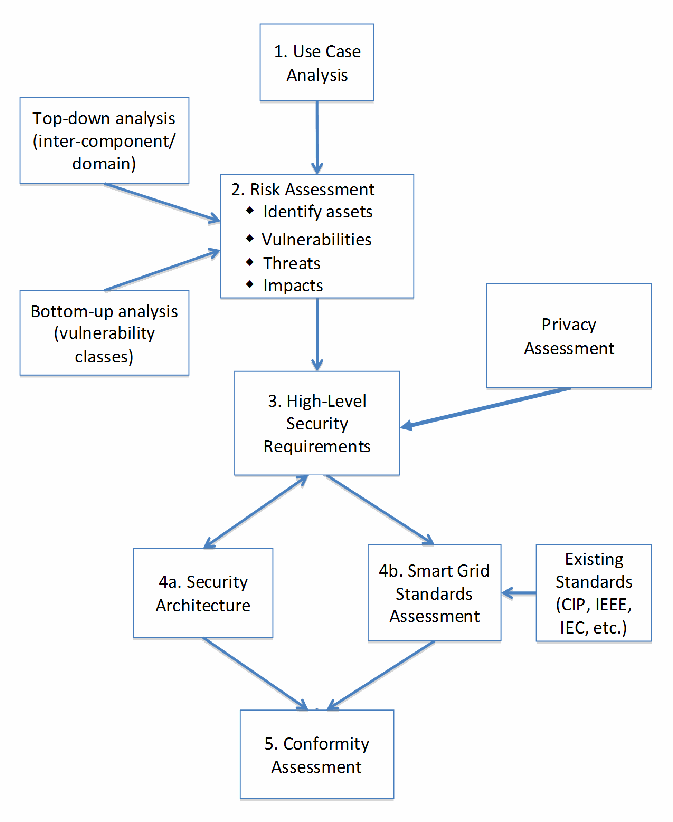
文書作成の作業の流れ図です。「1. ユースケース分析」から「2. リスク評価」(資産の特定、脆弱性、脅威、影響)へ進み、リスク評価には「トップダウン分析(コンポーネント間・ドメイン間)」と「ボトムアップ分析(脆弱性クラス)」も入力されます。リスク評価から「3. ハイレベルのセキュリティ要件」へ進み、ここに「プライバシー評価」も入力されます。要件から「4a. セキュリティアーキテクチャ」と「4b. スマートグリッド標準の評価」へ進み、4b には「既存の標準(CIP、IEEE、IEC など)」が入力されます。4a と 4b は「5. 適合性評価」へ進みます。
Figure 1-1 Tasks in the Smart Grid Cybersecurity Document Development Strategy
図 1-1 スマートグリッドのサイバーセキュリティ文書策定戦略におけるタスク
Task 1. Selection of use cases with cybersecurity considerations.13
タスク 1. サイバーセキュリティ上の考慮事項を伴うユースケースの選択。13
The use cases included in Chapter 10 of this document were selected from several existing sources, e.g., IntelliGrid, Electric Power Research Institute (EPRI) and Southern California Edison (SCE). The set of use cases provides a common framework for performing the risk assessment, developing the logical reference model, and selecting and tailoring the security requirements.
本書の第 10 章に含まれるユースケースは、IntelliGrid、Electric Power Research Institute(EPRI)、Southern California Edison(SCE)など、複数の既存の情報源から選択されました。このユースケースの集合は、リスク評価の実施、論理リファレンスモデルの策定、およびセキュリティ要件の選択と調整のための共通の枠組みを提供します。
Task 2. Performance of a risk assessment
タスク 2. リスク評価の実施
The risk assessment, including identifying assets, vulnerabilities, and threats and specifying impacts has been undertaken from a high-level, overall functional perspective. The output was the basis for the selection of security requirements and the identification of gaps in guidance and standards related to the security requirements.
資産、脆弱性、脅威の特定と影響の規定を含むリスク評価は、高レベルで全体的な機能の観点から実施されました。その出力は、セキュリティ要件の選択と、セキュリティ要件に関連する指針および標準上のギャップの特定の基礎となりました。
Vulnerability classes: The initial list of vulnerability classes14 was developed using information from several existing documents and web sites, e.g., NIST SP 800-82, Guide to Industrial Control Systems Security, Common Weakness Enumeration (CWE) vulnerabilities, and the Open Web Application Security Project (OWASP) vulnerabilities list. These vulnerability classes will ensure that the security controls address the identified vulnerabilities. The vulnerability classes may also be used by smart grid implementers, e.g., vendors and utilities, in assessing their systems. The vulnerability classes are included in Chapter 6 of this report.
脆弱性クラス: 脆弱性クラス14の最初の一覧は、NIST SP 800-82 Guide to Industrial Control Systems Security、共通脆弱性タイプ一覧(CWE)の脆弱性、Open Web Application Security Project(OWASP)の脆弱性リストなど、複数の既存の文書およびウェブサイトの情報を用いて作成されました。これらの脆弱性クラスにより、セキュリティ管理策が、特定された脆弱性に対処していることを確認できます。脆弱性クラスは、ベンダーや電力事業者など、スマートグリッドの実装者が自らのシステムを評価する際にも使用できます。脆弱性クラスは、本報告書の第 6 章に含まれています。
Overall Analysis: Both bottom-up and top-down approaches were used in implementing the risk assessment as specified earlier.
全体的な分析: 前述のとおり、リスク評価の実施では、ボトムアップとトップダウンの両方のアプローチを用いました。
Bottom-up analysis: The bottom-up approach focuses on well-understood problems that need to be addressed, such as authenticating and authorizing users to substation intelligent electronic devices (IEDs), key management for meters, and intrusion detection for power equipment. Also, interdependencies among smart grid domains/systems were considered when evaluating the impacts of a cybersecurity incident. An incident in one infrastructure can potentially cascade to failures in other domains/systems. The bottom-up analysis is included in Chapter 7 of this report.
ボトムアップ分析: ボトムアップのアプローチは、変電所のインテリジェント電子デバイス(IED)に対するユーザーの認証と認可、メーターの鍵管理、電力機器の侵入検知など、対処が必要な、よく理解されている問題に重点を置きます。また、サイバーセキュリティインシデントの影響を評価する際には、スマートグリッドのドメイン・システム間の相互依存関係も考慮しました。あるインフラストラクチャで発生したインシデントが、ほかのドメイン・システムの障害へと連鎖するおそれがあります。ボトムアップ分析は、本報告書の第 7 章に含まれています。
Top-down analysis: In the top-down approach, logical interface diagrams were developed for the six functional FERC and NIST priority areas that were the focus of the initial draft of this report—Electric Transportation, Electric Storage, Wide Area Situational Awareness, Demand Response, Advanced Metering Infrastructure, and Distribution Grid Management. This report includes a logical reference model for the overall smart grid, with logical interfaces identified for the additional grid functionality. Because there are hundreds of interfaces, each logical interface is allocated to one of 22 logical interface categories. Some examples of the logical interface categories are (1) control systems with high data accuracy and high availability, as well as media and computer constraints; (2) business-to-business (B2B) connections; (3) interfaces between sensor networks and controls systems; and (4) interface to the customer site. A set of attributes (e.g., wireless media, inter-organizational interactions, integrity requirements) was defined and the attributes allocated to the interface categories, as appropriate. This logical interface category/attributes matrix is used in assessing the impact of a security compromise on confidentiality, integrity, and availability. The level of impact is denoted as low, moderate, or high.15 This assessment was done for each logical interface category. The output from this process was used in the selection of security requirements (Task 3).
トップダウン分析: トップダウンのアプローチでは、本報告書の最初のドラフトで焦点となった、FERC と NIST の 6 つの機能的な優先分野、すなわち電気輸送、電力貯蔵、広域状況認識、デマンドレスポンス、高度計量インフラストラクチャ、配電網管理について、論理インターフェース図を作成しました。本報告書には、スマートグリッド全体の論理リファレンスモデルが含まれ、追加の電力網機能に対して論理インターフェースが特定されています。インターフェースは数百あるため、それぞれの論理インターフェースは、22 の論理インターフェースカテゴリのいずれかに割り当てられます。論理インターフェースカテゴリの例としては、(1) 高いデータ精度と高い可用性、および媒体とコンピューターの制約を伴う制御システム、(2) 企業間(B2B)接続、(3) センサーネットワークと制御システムの間のインターフェース、(4) 顧客サイトへのインターフェース、があります。一連の属性(たとえば、無線媒体、組織間の相互作用、完全性要件)が定義され、適切に各インターフェースカテゴリに割り当てられました。この論理インターフェースカテゴリと属性のマトリクスは、セキュリティ侵害が機密性、完全性、可用性に及ぼす影響を評価する際に使用されます。影響のレベルは、低、中、高で表されます。15この評価は、論理インターフェースカテゴリごとに行いました。このプロセスの出力は、セキュリティ要件の選択(タスク 3)に使用されました。
As with any assessment, a realistic analysis of the inadvertent errors, acts of nature, and malicious threats and their applicability to subsequent risk-mitigation strategies is critical to the overall outcome. The smart grid is no different. It is recommended that all organizations take a realistic view of the hazards and threats and work with national authorities as needed to glean the required information, which, it is anticipated, no single utility or other smart grid participant would be able to assess on its own. The following table summarizes the categories of adversaries to information systems. These adversaries need to be considered when performing a risk assessment of a smart grid information system.
あらゆる評価と同様に、意図しない誤り、自然現象、悪意のある脅威を現実的に分析し、それらがその後のリスク低減戦略にどう適用できるかを検討することは、全体の成果にとって極めて重要です。スマートグリッドも例外ではありません。すべての組織が、ハザードと脅威を現実的にとらえ、必要に応じて国の当局と協力して必要な情報を収集することが推奨されます。この情報は、単独の電力事業者やその他のスマートグリッド参加者が自ら評価することはできないと予想されます。次の表は、情報システムに対する攻撃者のカテゴリをまとめたものです。スマートグリッド情報システムのリスク評価を行う際には、これらの攻撃者を考慮する必要があります。
Table 1-1 Categories of Adversaries to Information Systems
表 1-1 情報システムに対する攻撃者のカテゴリ
| Adversary | Description |
|---|---|
| Nation States | State-run, well organized and financed. Use foreign service agents to gather classified or critical information from countries viewed as hostile or as having an economic, military or a political advantage. |
| Hackers | A group of individuals (e.g., hackers, phreakers, crackers, trashers, and pirates) who attack networks and systems seeking to exploit the vulnerabilities in operating systems or other flaws. |
| Terrorists/ | Individuals or groups operating domestically or internationally who represent various terrorist or extremist groups that use violence or the threat of violence to incite fear with the intention of coercing or intimidating governments or societies into succumbing to their demands. |
| Organized Crime | Coordinated criminal activities including gambling, racketeering, narcotics trafficking, and many others. An organized and well-financed criminal organization. |
| Other Criminal Elements | Another facet of the criminal community, which is normally not well organized or financed. Normally consists of few individuals, or of one individual acting alone. |
| Industrial Competitors | Foreign and domestic corporations operating in a competitive market and often engaged in the illegal gathering of information from competitors or foreign governments in the form of corporate espionage. |
| Disgruntled Employees | Angry, dissatisfied individuals with the potential to inflict harm on the smart grid network or related systems. This can represent an insider threat depending on the current state of the individual’s employment and access to the systems. |
| Careless or Poorly Trained Employees | Those users who, either through lack of training, lack of concern, or lack of attentiveness pose a threat to smart grid systems. This is another example of an insider threat or adversary. |
| 攻撃者 | 説明 |
|---|---|
| 国家 | 国家が運営し、十分に組織化され、資金も潤沢です。敵対的とみなされる国や、経済的・軍事的・政治的な優位を持つ国から、機密情報や重要情報を収集するために、外国の諜報機関の工作員を利用します。 |
| ハッカー | オペレーティングシステムの脆弱性やそのほかの欠陥を悪用しようとして、ネットワークやシステムを攻撃する個人(たとえば、ハッカー、フリーカー、クラッカー、トラッシャー、海賊)の集団。 |
| テロリスト・サイバーテロリスト | 国内または国際的に活動し、暴力または暴力の脅威を用いて恐怖をあおり、政府や社会に要求を受け入れさせるべく強要または威嚇することを意図する、さまざまなテロ組織や過激派組織を代表する個人またはグループ。 |
| 組織犯罪 | 賭博、恐喝、麻薬取引など多くの活動を含む、連携した犯罪活動。組織化され、資金も潤沢な犯罪組織。 |
| そのほかの犯罪要素 | 犯罪社会の別の一面であり、通常は組織化されておらず、資金も潤沢ではありません。通常は少数の個人、または単独で行動する一個人で構成されます。 |
| 産業上の競合者 | 競争市場で事業を営む国内外の企業で、企業スパイ活動の形で、競合他社や外国政府から違法に情報を収集することに従事していることが多い。 |
| 不満を持つ従業員 | スマートグリッドネットワークや関連システムに害を及ぼす可能性のある、怒りや不満を抱いた個人。その個人の雇用の現状やシステムへのアクセス権限によっては、内部脅威となる場合があります。 |
| 不注意または訓練が不十分な従業員 | 訓練の不足、関心の欠如、注意力の欠如により、スマートグリッドシステムに脅威をもたらすユーザー。これも内部脅威または攻撃者の一例です。 |
Task 3. Specification of high-level security requirements.
タスク 3. 高レベルセキュリティ要件の規定
For the assessment of specific security requirements and the selection of appropriate security technologies and methodologies, both cybersecurity experts and power system experts were needed. The cybersecurity experts brought a broad awareness of IT and control system security technologies, while the power system experts brought a deep understanding of traditional power system methodologies for maintaining power system reliability.
特定のセキュリティ要件を評価し、適切なセキュリティ技術と方法論を選択するには、サイバーセキュリティの専門家と電力システムの専門家の両方が必要でした。サイバーセキュリティの専門家は、IT および制御システムのセキュリティ技術に関する幅広い知見をもたらし、電力システムの専門家は、電力システムの信頼性を維持するための従来の電力システムの方法論に関する深い理解をもたらしました。
There are many requirements documents that may be applicable to the smart grid. Currently, only NERC Critical Infrastructure Protection (CIP) standards are mandatory for the bulk electric system. The CSWG used three source documents for the cybersecurity requirements in this report16—
スマートグリッドに適用できる要件文書は多数あります。現在、バルク電力システムに対して義務付けられているのは、NERC の重要インフラストラクチャ保護(CIP)標準のみです。CSWG は、本報告書のサイバーセキュリティ要件に、次の 3 つの原典文書を使用しました16。
•NIST SP 800-53, Revision 3, Recommended Security Controls for Federal Information Systems and Organizations, August 2009;17
•NIST SP 800-53, Revision 3, Recommended Security Controls for Federal Information Systems and Organizations, August 2009;17
•NERC CIP-002 through -009, version 2;18
•NERC CIP-002 through -009, version 2;18
•Catalog of Control Systems Security: Recommendations for Standards Developers, DHS, April 2011; and
•Catalog of Control Systems Security: Recommendations for Standards Developers, DHS, April 2011; および
•Advanced Security Acceleration Project for the Smart Grid (ASAP-SG) security profiles.19
•Advanced Security Acceleration Project for the Smart Grid (ASAP-SG) security profiles.19
These security requirements were then modified for the smart grid. To assist in assessing and selecting the requirements, a cross-reference matrix was developed. This matrix, Appendix A of this report, maps the smart grid security requirements in this report to the security requirements in SP 800- 53, the DHS Catalog, and the NERC CIPs. Each requirement falls into one of three categories that were developed for this document: governance, risk, and compliance (GRC); common technical; and unique technical. The GRC requirements are applicable to all smart grid information systems within an organization and are typically implemented at the organization level and augmented, as required, for specific smart grid information systems. The common technical requirements are applicable to all smart grid information systems within an organization. The unique technical requirements are allocated to one or more of the logical interface categories defined in the logical reference model included in Chapter 2. Each organization should determine the logical interface categories20 that are included in each smart grid information system. These requirements are provided as guidance and are not mandatory. Each organization will need to perform a risk assessment to determine the applicability of the requirements to their specific situations.
これらのセキュリティ要件は、その後、スマートグリッド向けに修正されました。要件の評価と選択を支援するため、相互参照マトリクスが作成されました。本報告書の付録 A にあるこのマトリクスは、本報告書のスマートグリッドセキュリティ要件と、SP 800-53、DHS Catalog、および NERC CIP のセキュリティ要件を対応付けています。各要件は、本書のために作成された次の 3 つのカテゴリのいずれかに分類されます。ガバナンス・リスク・コンプライアンス(GRC)、共通技術、固有技術です。GRC 要件は、組織内のすべてのスマートグリッド情報システムに適用され、通常は組織レベルで実装され、必要に応じて特定のスマートグリッド情報システム向けに補強されます。共通技術要件は、組織内のすべてのスマートグリッド情報システムに適用されます。固有技術要件は、第 2 章に含まれる論理リファレンスモデルで定義された 1 つ以上の論理インターフェースカテゴリに割り当てられます。各組織は、それぞれのスマートグリッド情報システムに含まれる論理インターフェースカテゴリ20を決定すべきです。これらの要件は指針として示されており、義務ではありません。各組織は、リスク評価を実施して、要件が自らの特定の状況に適用されるかどうかを判断する必要があります。
Organizations may find it necessary to identify alternative, but compensating security requirements. A compensating security requirement is implemented by an organization in lieu of a recommended security requirement to provide a comparable level of protection for the information/control system and the information processed, stored, or transmitted by that system. More than one compensating requirement may be required to provide the comparable protection for a particular security requirement. For example, an organization with significant staff limitations may compensate for the recommended separation of duty security requirement by strengthening the audit, accountability, and personnel security requirements within the information/control system. Finally, existing power system capabilities, such as safety measures, may be used to meet specific security requirements.
組織は、代替となる代償的セキュリティ要件を特定する必要がある場合があります。代償的セキュリティ要件とは、情報・制御システムと、そのシステムが処理、保存、または送信する情報に対し、同等のレベルの保護を提供するため、推奨されるセキュリティ要件の代わりに組織が実装する要件です。特定のセキュリティ要件に対して同等の保護を提供するには、複数の代償的要件が必要になる場合があります。たとえば、人員が大幅に不足している組織は、推奨される職務分離のセキュリティ要件の代わりとして、情報・制御システム内の監査、責任追跡性、人的セキュリティの要件を強化できます。最後に、安全対策など、既存の電力システムの能力を使って特定のセキュリティ要件を満たしてもよいです。
Privacy Impact Assessment: Because the evolving smart grid presents potential privacy risks, a privacy impact assessment was performed. Several general privacy principles were used to assess the smart grid, and findings and recommendations were developed. The privacy recommendations provide a set of privacy requirements that should be considered when organizations implement smart grid information systems. These privacy requirements augment the high-level security requirements specified in Chapter 3.
プライバシー影響評価: 進化するスマートグリッドにはプライバシー上のリスクが潜在するため、プライバシー影響評価を実施しました。スマートグリッドの評価にはいくつかの一般的なプライバシー原則を用い、調査結果と推奨事項を作成しました。プライバシーに関する推奨事項は、組織がスマートグリッド情報システムを実装する際に考慮すべき、プライバシー要件の集合を提供します。これらのプライバシー要件は、第 3 章に規定する高レベルセキュリティ要件を補強するものです。
Task 4a. Development of a logical reference model.
タスク 4a. 論理リファレンスモデルの策定
Using the conceptual model included in this report, the FERC and NIST priority area use case diagrams, and the additional areas of AMI and distribution grid management, the CSWG developed a more granular logical reference model for the smart grid. This logical reference model consolidates the individual diagrams into a single diagram and expands upon the conceptual model. The additional functionality of the smart grid that is not included in the six use case diagrams is included in this logical reference model. The logical reference model identifies logical communication interfaces between actors. This logical reference model is included in Chapter 2 of this report. Because this is a high-level logical reference model, there may be multiple implementations of the logical reference model.
本報告書に含まれる概念モデル、FERC と NIST の優先分野のユースケース図、ならびに AMI と配電網管理の追加分野を用いて、CSWG は、スマートグリッドのより詳細な論理リファレンスモデルを策定しました。この論理リファレンスモデルは、個々の図を 1 つの図に統合し、概念モデルを拡張したものです。6 つのユースケース図に含まれていないスマートグリッドの追加機能も、この論理リファレンスモデルに含まれています。論理リファレンスモデルは、アクター間の論理通信インターフェースを特定します。この論理リファレンスモデルは、本報告書の第 2 章に含まれています。これは高レベルの論理リファレンスモデルであるため、論理リファレンスモデルには複数の実装がありえます。
Task 4b. Assessment of Smart Grid standards.
タスク 4b. スマートグリッド標準の評価
In Task 4b, standards that have been identified as potentially relevant to the smart grid by the Priority Action Plan (PAP) teams and the SGIP are assessed to determine relevancy to smart grid security. In this process, gaps in security requirements are identified and recommendations are made for addressing these gaps. Also, conflicting standards and standards with security requirements not consistent with the security requirements included in this report are identified with recommendations.
タスク 4b では、優先行動計画(PAP)チームと SGIP によってスマートグリッドに関連する可能性があると特定された標準を評価し、スマートグリッドのセキュリティとの関連性を判断します。このプロセスでは、セキュリティ要件のギャップを特定し、そのギャップに対処するための推奨事項を示します。また、互いに矛盾する標準や、本報告書に含まれるセキュリティ要件と整合しないセキュリティ要件を持つ標準を、推奨事項を添えて特定します。
Task 5. Conformity Assessment.
タスク 5. 適合性評価
The final task is to develop a conformity assessment program for security. The SGIP Smart Grid Testing and Certification Committee (SGTCC) developed and issued an Interoperability Process Reference Manual (IPRM) Version 2.021 in January 2012 that details its recommendations on processes and best practices that enhance the introduction of interoperable and secure products in the marketplace. These recommendations build upon international standards-based processes (ISO/IEC22 17025 and ISO/IEC Guide 65) for interoperability testing and certification for testing laboratories and certification body management systems.
最後のタスクは、セキュリティに関する適合性評価プログラムを策定することです。SGIP のスマートグリッド試験・認証委員会(SGTCC)は、2012 年 1 月に Interoperability Process Reference Manual(IPRM)Version 2.021を作成して発行しました。この文書は、相互運用可能で安全な製品の市場への投入を促進するプロセスとベストプラクティスに関する推奨事項を詳述しています。これらの推奨事項は、試験所の試験および認証機関のマネジメントシステムの認証のための相互運用性試験・認証に関する国際標準に基づくプロセス(ISO/IEC22 17025 および ISO/IEC Guide 65)を土台としています。
1.4 COMBINED CYBER-PHYSICAL ATTACKS
1.4 複合的なサイバー・フィジカル攻撃
As described in the original version of this document, addressing combined cyber-physical attacks is an ongoing effort by the SGCC in coordination with the public and private sectors. Cyber-physical attacks, also called blended attacks, are executed by an adversary or result from inadvertent action that cause a greater impact and/or different consequences than a cyber or physical attack could cause individually. In order to address the enhanced impacts generated by these blended attacks, the risks and vulnerabilities for both cyber and physical attacks must be considered. The high-level security requirements presented in this chapter address the impact of cyber vulnerabilities; however, by selecting and tailoring an appropriate subset of requirements, it is possible to also address some physical vulnerabilities of the power grid. NIST SP 800-82 Rev. 1, Guide to Industrial Control Systems Security, and ISA 99, Industrial Automation and Control Systems Security, are additional resources that may be leveraged to help address cyber-physical attack.
本書の原版で述べたとおり、複合的なサイバー・フィジカル攻撃への対処は、SGCC が官民と連携して継続的に進めている取り組みです。サイバー・フィジカル攻撃は、ブレンデッド攻撃とも呼ばれ、敵対者によって実行される場合と、意図しない行為によって引き起こされる場合があり、サイバー攻撃または物理攻撃がそれぞれ単独で引き起こすよりも大きな影響や異なる結果をもたらします。こうしたブレンデッド攻撃によって増大する影響に対処するには、サイバー攻撃と物理攻撃の両方のリスクと脆弱性を考慮しなければなりません。本章で示す高レベルセキュリティ要件は、サイバー面の脆弱性の影響に対処するものですが、要件の適切な部分集合を選択して調整することで、電力網の物理面の脆弱性の一部にも対処できます。NIST SP 800-82 Rev. 1, Guide to Industrial Control Systems Security、および ISA 99, Industrial Automation and Control Systems Security は、サイバー・フィジカル攻撃への対処に役立てられる追加資料です。
Cyber-physical attacks can be classified into three broad subsets:
サイバー・フィジカル攻撃は、大きく 3 つの部分集合に分類できます。
1.Physical attacks informed by cyber – The use of information gathered by cyber means that allows an adversary to plan and execute an improved or enhanced physical attack. For instance, an adversary has decided to destroy components within a substation though they are not sure which substation or components would have the greatest impact. If they could access confidential information or aggregate unprotected information by cyber means that tells them that a particular substation is on a very congested path and which lines were at their maximum ratings, they could then physically attack that specific substation and lines. This could cause a much greater impact than the attack of a random substation.
1.サイバー手段で得た情報に基づく物理攻撃 – サイバー手段で収集した情報を利用することで、敵対者が、より効果的な、または強化された物理攻撃を計画し、実行できるようになること。たとえば、敵対者が変電所内の機器を破壊することを決めたものの、どの変電所や機器が最も大きな影響を及ぼすかわからないとします。機密情報にアクセスしたり、保護されていない情報をサイバー手段で集約したりして、ある変電所が非常に混雑した送電経路上にあり、どの送電線が最大定格に達しているかがわかれば、その特定の変電所と送電線を物理的に攻撃できます。これは、無作為に選んだ変電所を攻撃するよりもはるかに大きな影響をもたらすおそれがあります。
2.Cyber attacks enhancing physical attacks – An adversary uses cyber means to improve or enhance the impacts of a physical attack by either making the attack more successful (e.g., greater consequences) or interfering with restoration efforts (thereby increasing the duration of the attack). Although the term “adversary” is used, inadvertent actions could also cause such an attack.
One example is an adversary tampering with the integrity of protective relay settings prior to a physical attack on power lines. Although the original settings were designed to contain the effects of a failure, the tampered settings allow the failure to cascade into impacts on a wider segment of the grid.
2.物理攻撃を増強するサイバー攻撃 – 敵対者が、攻撃をより成功させる(たとえば、より大きな結果をもたらす)か、復旧作業を妨害する(それにより攻撃の継続時間を延ばす)ことで、物理攻撃の影響を向上または増強するために、サイバー的な手段を用いること。「敵対者」という語を用いていますが、意図しない行為によってもこうした攻撃が起こりえます。
一例として、敵対者が、送電線への物理攻撃の前に、保護リレーの設定の完全性を改ざんする場合があります。元の設定は障害の影響を封じ込めるよう設計されていましたが、改ざんされた設定により、障害が連鎖して電力網のより広い範囲に影響が及びます。
Another example is after a physical attack, an adversary performing DoS attacks on the availability of systems and facilities that support restoration activities. These attacks disrupt the restoration, prolonging the resulting outages.
別の例は、物理攻撃の後に、敵対者が、復旧作業を支えるシステムや設備の可用性に対して DoS 攻撃を行う場合です。こうした攻撃は復旧を妨げ、結果として生じる停電を長引かせます。
3.Use of a cyber system to cause physical harm – An adversary uses a cyber system that controls physical equipment in such a manner to cause physical harm/damage. An example of this is the burner management system for a natural gas generator. In this case, an adversary or a careless operator could attempt to turn on the natural gas inflow without an ignition source present. As the burner unit fills with natural gas, the adversary could turn on the ignition source, potentially causing an explosion.
3.サイバーシステムを利用して物理的な被害を引き起こすこと – 敵対者が、物理機器を制御するサイバーシステムを、物理的な危害・損害を引き起こすような方法で使用すること。その一例が、天然ガス発電機のバーナー管理システムです。この場合、敵対者または不注意なオペレーターが、点火源がない状態で天然ガスの流入を開始しようとすることがあります。バーナーユニットに天然ガスが充満したところで、敵対者が点火源をオンにすると、爆発が起きる可能性があります。
Cyber-physical attacks can greatly enhance the overall impact and/or consequences of an attack or increase the duration of those consequences by delaying or interfering with responses. However, good cyber, physical, and operational security planning and implementations can minimize these impacts. Defensive measures that can be used to minimize the likelihood of successful cyber attacks and physical attacks will also work to minimize the impacts of a cyber-physical attack. Security operators need to consider both types of attacks and how they may be used together in order to better develop systems that are resilient to cyber-physical attacks. The application of NISTIR 7628 and other security standards and guidelines as part of an organization-wide risk management process can help reduce the cyber vulnerabilities and limit the impacts of cyber-physical attacks.
サイバー・フィジカル攻撃は、攻撃全体の影響や結果を大幅に増大させ、また、対応を遅らせたり妨害したりすることでその結果の継続時間を延ばすおそれがあります。しかし、サイバー、物理、運用の各面で適切にセキュリティを計画し実装すれば、こうした影響を最小限に抑えられます。サイバー攻撃や物理攻撃が成功する可能性を最小限に抑えるために用いられる防御策は、サイバー・フィジカル攻撃の影響を最小限に抑えることにも役立ちます。セキュリティの運用者は、サイバー・フィジカル攻撃に対してレジリエントなシステムをより適切に開発するために、両方の種類の攻撃と、それらが組み合わされて用いられる可能性を考慮する必要があります。組織全体のリスクマネジメントプロセスの一環として NISTIR 7628 およびそのほかのセキュリティ標準・ガイドラインを適用することは、サイバー面の脆弱性を減らし、サイバー・フィジカル攻撃の影響を抑えるのに役立ちます。
CHAPTER 2 LOGICAL ARCHITECTURE AND INTERFACES OF THE SMART GRID
第 2 章 スマートグリッドの論理アーキテクチャとインターフェース
This chapter includes a logical reference model of the smart grid23, including all the major domains—service providers, customer, transmission, distribution, bulk generation, markets, and operations—that are part of the NIST conceptual model.
本章には、NIST 概念モデルの一部であるサービスプロバイダー、顧客、送電、配電、大規模発電、市場、運用というすべての主要ドメインを含む、スマートグリッドの論理リファレンスモデル23が含まれています。
Figure 2-3 presents the logical reference model and represents a composite high-level view of smart grid domains and actors, initially created prior to the formation of the SGAC. The information in this report is presented as guidance on cybersecurity, but is neither prescriptive nor does it restrict innovation. A smart grid domain is a high-level grouping of organizations, buildings, individuals, systems, devices, or other actors with similar objectives and relying on—or participating in—similar types of applications.
図 2-3 は、論理リファレンスモデルを示すもので、SGAC の発足前に最初に作成された、スマートグリッドのドメインとアクターの複合的な高レベルビューを表しています。本報告書の情報は、サイバーセキュリティに関する指針として示されており、規範的なものでも、イノベーションを制限するものでもありません。スマートグリッドのドメインとは、目的が似ており、似た種類のアプリケーションに依存する、またはそれに参加している、組織、建物、個人、システム、デバイス、またはその他のアクターを高レベルでまとめたものです。
Communications among actors in the same domain may have similar characteristics and requirements. Domains may contain subdomains. An actor is a device, computer system, software program, or the individual or organization that participates in the smart grid. Actors have the capability to make decisions and to exchange information with other actors. Organizations may have actors in more than one domain. The actors illustrated in this case are representative examples and do not encompass all the actors in the smart grid. Each of the actors may exist in several different varieties and may contain many other actors within them. Table 2-1 complements the logical reference model diagram (Figure 2-3) with a description of the actors associated with the logical reference model.
同じドメイン内のアクター間の通信は、似た特性と要件を持つ場合があります。ドメインにはサブドメインを含めてもよいです。アクターとは、スマートグリッドに参加するデバイス、コンピューターシステム、ソフトウェアプログラム、または個人もしくは組織です。アクターは、意思決定を行い、ほかのアクターと情報を交換する能力を持ちます。組織は、複数のドメインにアクターを持つ場合があります。この場合に示されているアクターは代表的な例であり、スマートグリッド内のすべてのアクターを網羅するものではありません。各アクターにはさまざまな種類が存在する場合があり、その内部に多くの別のアクターを含む場合があります。表 2-1 は、論理リファレンスモデルの図(図 2-3)を補完するもので、論理リファレンスモデルに関連するアクターの説明を示しています。
The logical reference model represents a blending of the initial set of use cases, requirements that were developed at the NIST smart grid workshops, the initial NIST Smart Grid Interoperability Roadmap, and the logical interface diagrams for the six FERC and NIST priority areas: electric transportation, electric storage, advanced metering infrastructure (AMI), wide area situational awareness (WASA), distribution grid management, and customer premises.24 These six priority areas are depicted in individual diagrams with their associated tables. These lower-level diagrams were originally produced at the NIST smart grid workshops and then revised for this report. They provide a more granular view of the smart grid functional areas. All of the logical interfaces included in the six diagrams are included in the logical reference model. The format for the reference number for each logical interface is UXX, where U stands for universal and XX is the interface number. The reference number is the same on the individual application area diagrams and the logical reference model. This logical reference model focuses on a short-term view (1–3 years) of the proposed smart grid and is only a sample representation.
論理リファレンスモデルは、最初のユースケースの集合、NIST のスマートグリッドワークショップで策定された要件、最初の NIST Smart Grid Interoperability Roadmap、および FERC と NIST の 6 つの優先分野(電気輸送、電力貯蔵、高度計量インフラストラクチャ(AMI)、広域状況認識(WASA)、配電網管理、顧客施設)の論理インターフェース図を融合したものです。24これら 6 つの優先分野は、関連する表とともに個別の図で示されています。これらの下位レベルの図は、もともと NIST のスマートグリッドワークショップで作成され、本報告書のために改訂されたものです。これらは、スマートグリッドの機能分野のより詳細なビューを提供します。6 つの図に含まれるすべての論理インターフェースは、論理リファレンスモデルに含まれています。各論理インターフェースの参照番号の形式は UXX で、U は universal(共通)を、XX はインターフェース番号を表します。参照番号は、個々のアプリケーション分野の図と論理リファレンスモデルで同じです。この論理リファレンスモデルは、提案されているスマートグリッドの短期的な見通し(1〜3 年)に焦点を当てており、サンプルとしての表現にすぎません。
The logical reference model is a work in progress and will be subject to revision and further development. Additional underlying detail as well as additional smart grid functions will be needed to enable more detailed analysis of required security functions. The graphic illustrates, at a high level, the diversity of systems as well as a first representation of associations between systems and components of the smart grid. The list of actors is a subset of the full list of actors for the smart grid and is not intended to be a comprehensive list. This logical reference model is a high-level logical architecture and does not imply any specific implementation.
論理リファレンスモデルは作業途中のものであり、改訂とさらなる開発の対象となります。必要なセキュリティ機能のより詳細な分析を可能にするには、さらなる基礎的な詳細と、追加のスマートグリッド機能が必要になります。この図は、システムの多様性と、スマートグリッドのシステムとコンポーネントの間の関連の最初の表現を、高レベルで示しています。アクターの一覧は、スマートグリッドのアクターの全一覧の部分集合であり、網羅的な一覧を意図したものではありません。この論理リファレンスモデルは高レベルの論理アーキテクチャであり、特定の実装を意味するものではありません。
2.1 THE SEVEN DOMAINS TO THE LOGICAL REFERENCE MODEL
2.1 論理リファレンスモデルの 7 つのドメイン
The NIST Framework and Roadmap document identifies seven domains within the smart grid: Transmission, Distribution, Operations, Generation, Markets, Customer, and Service Provider. A smart grid domain is a high-level grouping of organizations, buildings, individuals, systems, devices, or other actors with similar objectives and relying on—or participating in—similar types of applications. The various actors are needed to transmit, store, edit, and process the information needed within the smart grid. To enable smart grid functionality, the actors in a particular domain often interact with actors in other domains, as shown in Figure 2-1.
NIST Framework and Roadmap 文書は、スマートグリッド内の 7 つのドメイン、すなわち送電、配電、運用、発電、市場、顧客、サービスプロバイダーを特定しています。スマートグリッドのドメインとは、目的が似ており、似た種類のアプリケーションに依存する、またはそれに参加している、組織、建物、個人、システム、デバイス、またはその他のアクターを高レベルでまとめたものです。スマートグリッド内で必要な情報を伝送、保存、編集、処理するには、さまざまなアクターが必要です。スマートグリッドの機能を実現するため、図 2-1 に示すように、あるドメインのアクターは、ほかのドメインのアクターと頻繁にやり取りします。
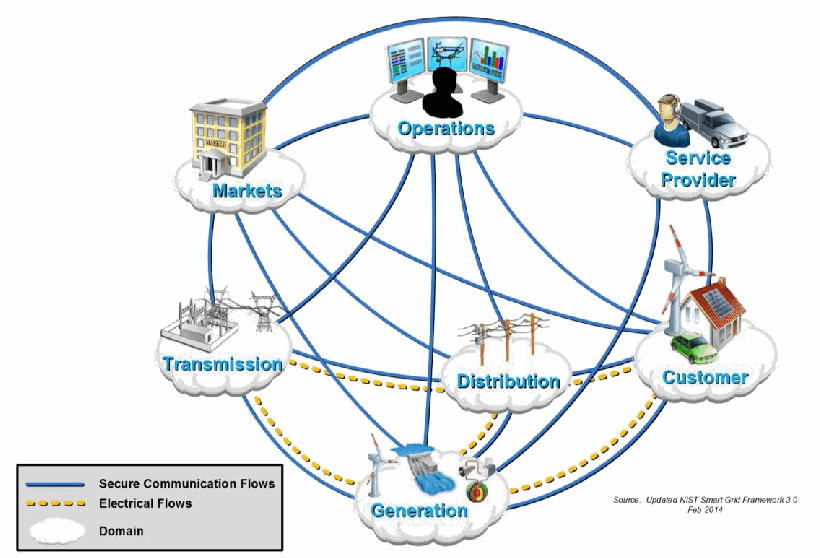
スマートグリッドの7つのドメイン(運用、市場、サービスプロバイダー、送電、配電、顧客、発電)を、アイコン付きの雲形で示した図です。青い実線(セキュアな通信フロー)が各ドメインを相互に結び、黄色の破線(電力の流れ)が発電から送電・配電を経て顧客へつながります。凡例は「セキュアな通信フロー」「電力の流れ」「ドメイン」です。出典: Updated NIST Smart Grid Framework 3.0(2014年2月)。
Figure 2-1 Interaction of Actors in Different Smart Grid Domains through Secure Communication Flows
図 2-1 安全な通信フローによるスマートグリッドの各ドメイン間のアクターの相互作用
The diagram below (Figure 2-2) expands upon this figure and depicts a composite high-level view of the actors within each of the smart grid domains. This high-level diagram is provided as a reference diagram. Actors are devices, systems, or programs that make decisions and exchange information necessary for executing applications within the smart grid. The diagrams included later in this chapter expand upon this high-level diagram and include logical interfaces between actors and domains.
次の図(図 2-2)は、この図を拡張し、各スマートグリッドドメイン内のアクターの複合的な高レベルビューを示しています。この高レベル図は参照用の図として提供されています。アクターとは、スマートグリッド内でアプリケーションを実行するために必要な、意思決定と情報交換を行うデバイス、システム、またはプログラムです。本章の後半に含まれる図は、この高レベル図を拡張し、アクターとドメインの間の論理インターフェースを含みます。
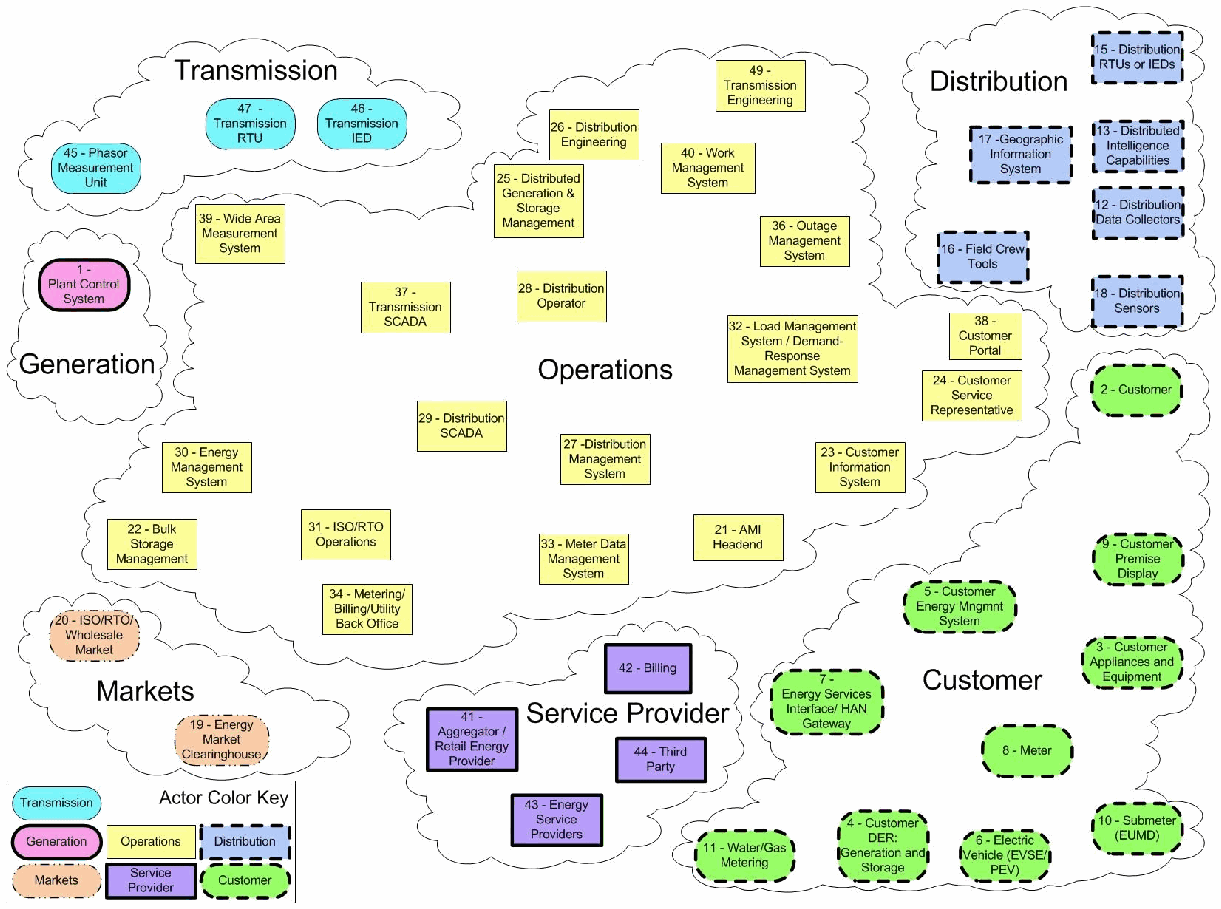
各アクターを番号付きの箱で示し、ドメインごとの雲形の中に色分けして配置した図です(アクターの色の凡例: 送電、発電、市場、運用、配電、サービスプロバイダー、顧客)。送電: 送電RTU、送電IED、フェーザー計測装置。発電: 発電所制御システム。市場: ISO/RTO卸売市場、エネルギー市場清算機関。運用: 送電エンジニアリング、配電エンジニアリング、分散型発電・蓄電管理、作業管理システム、停電管理システム、広域計測システム、送電SCADA、配電オペレーター、負荷管理システム/デマンドレスポンス管理システム、顧客ポータル、顧客サービス担当者、配電SCADA、配電管理システム、顧客情報システム、エネルギー管理システム、大規模蓄電管理、ISO/RTO運用、メーターデータ管理システム、AMIヘッドエンド、計量・請求・電力事業者バックオフィス。配電: 地理情報システム、配電RTUまたはIED、分散インテリジェンス機能、配電データコレクター、現場作業員用ツール、配電センサー。サービスプロバイダー: 請求、アグリゲーター/小売エネルギー事業者、第三者、エネルギーサービスプロバイダー。顧客: 顧客、顧客宅内ディスプレイ、顧客エネルギー管理システム、顧客の家電・機器、エネルギーサービスインターフェース(HANゲートウェイ)、メーター、顧客DER(発電・蓄電)、電気自動車(EVSE、PEV)、水道・ガス計量、サブメーター(EUMD)。
Figure 2-2 Composite High-level View of the Actors within Each of the Smart Grid Domains
図 2-2 各スマートグリッドドメイン内のアクターの複合的な高レベルビュー
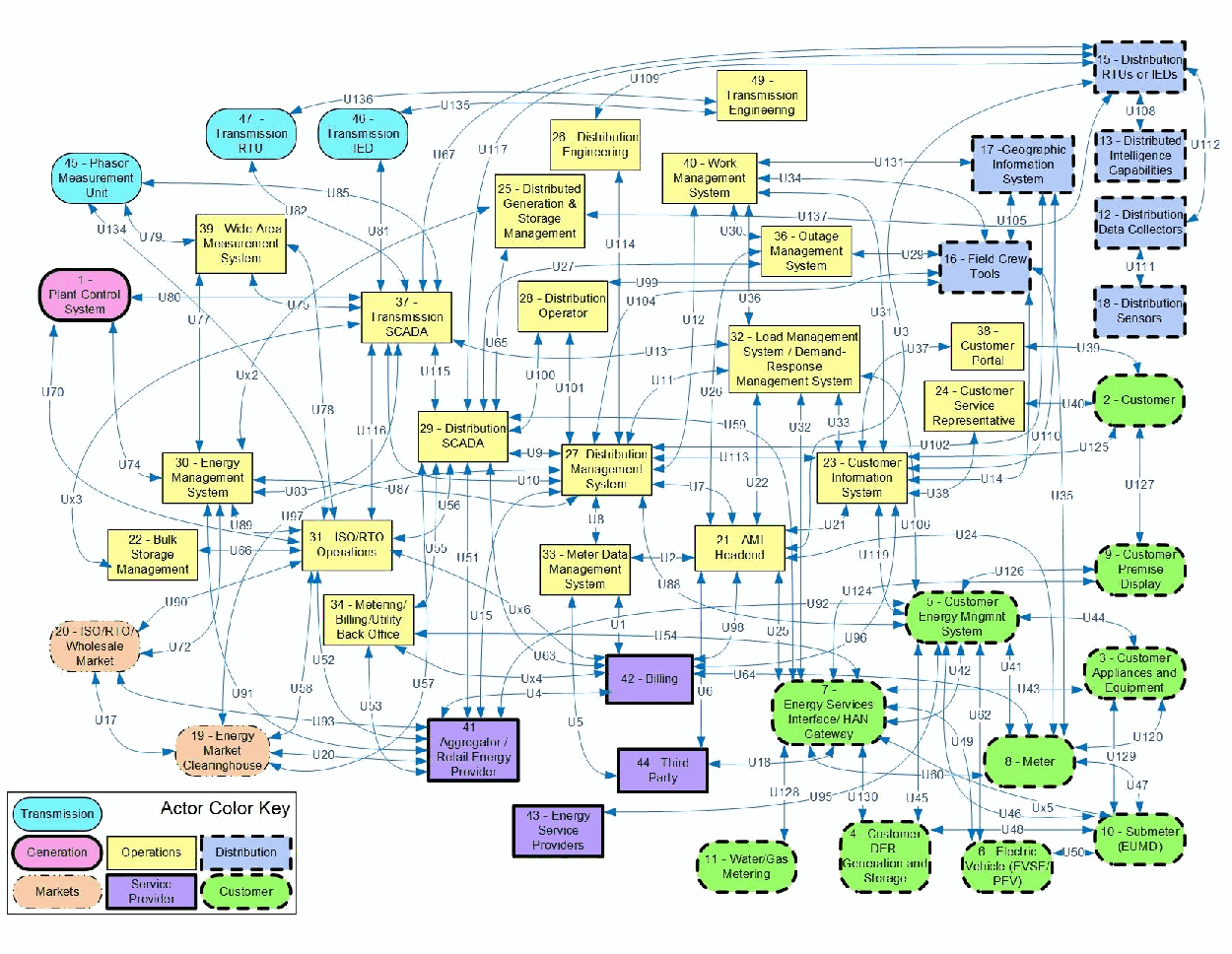
論理参照モデルの図です。図2-2と同じ番号付きのアクターの箱をドメインごとに色分けし(凡例: 送電、発電、市場、運用、配電、サービスプロバイダー、顧客)、多数の矢印で結んでいます。各矢印には UXX 形式の論理インターフェースの識別子(U1、U2、U3 など)が付いています。送電: 送電RTU、送電IED、フェーザー計測装置。発電: 発電所制御システム。市場: ISO/RTO卸売市場、エネルギー市場清算機関。運用: 送電エンジニアリング、配電エンジニアリング、分散型発電・蓄電管理、作業管理システム、停電管理システム、広域計測システム、送電SCADA、配電オペレーター、負荷管理システム/デマンドレスポンス管理システム、顧客ポータル、顧客サービス担当者、配電SCADA、配電管理システム、顧客情報システム、エネルギー管理システム、大規模蓄電管理、ISO/RTO運用、メーターデータ管理システム、AMIヘッドエンド、計量・請求・電力事業者バックオフィス。配電: 地理情報システム、配電RTUまたはIED、分散インテリジェンス機能、配電データコレクター、現場作業員用ツール、配電センサー。サービスプロバイダー: 請求、アグリゲーター/小売エネルギー事業者、第三者、エネルギーサービスプロバイダー。顧客: 顧客、顧客宅内ディスプレイ、顧客エネルギー管理システム、顧客の家電・機器、エネルギーサービスインターフェース(HANゲートウェイ)、メーター、顧客DER(発電・蓄電)、電気自動車(EVSE、PEV)、水道・ガス計量、サブメーター(EUMD)。
Figure 2-3 Logical Reference Model
図 2-3 論理リファレンスモデル
Table 2-1 Actor Descriptions for the Logical Reference Model
表 2-1 論理リファレンスモデルのアクターの説明
| Actor Number | Domain | Actor | Acronym | Description |
|---|---|---|---|---|
| 1 | Generation | Plant Control System – Distributed Control System | DCS | A local control system at a bulk generation plant. This is sometimes called a Distributed Control System (DCS). |
| 2 | Customer | Customer | An entity that pays for electrical goods or services. A customer of a utility, including customers who provide more power than they consume. | |
| 3 | Customer | Customer Appliances and Equipment | A device or instrument designed to perform a specific function, especially an electrical device, such as a toaster, for household use. An electric appliance or machinery that may have the ability to be monitored, controlled, and/or displayed. | |
| 4 | Customer | Customer Distributed Energy Resources: Generation and Storage | DER | Energy generation resources, such as solar or wind, used to generate and store energy (located on a customer site) to interface to the controller (home area network/business area network (HAN/BAN)) to perform an energy-related activity. |
| 5 | Customer | Customer Energy Management System | EMS | An application service or device that communicates with devices in the home. The application service or device may have interfaces to the meter to read usage data or to the operations domain to get pricing or other information to make automated or manual decisions to control energy consumption more efficiently. The EMS may be a utility subscription service, a third party-offered service, a consumer-specified policy, a consumer-owned device, or a manual control by the utility or consumer. |
| 6 | Customer | Plug-in Electric Vehicle/Electric Vehicle Service Element | PEV/ EVSE | A PEV is a vehicle propelled by an electric motor and powered by a rechargeable battery. It can be recharged using an external power source. When the external power source is the power grid, the EV is connected through the EVSE that provides power and communication. |
| 7 | Customer | Home Area Network Gateway | HAN Gateway | An interface between the distribution, operations, service provider, and customer domains and the devices within the customer domain. |
| 8 | Customer | Meter | Point of sale device used for the transfer of product and measuring usage from one domain/system to another. | |
| 9 | Customer | Customer Premise Display | A device that displays usage and cost data to the customer on location. | |
| 10 | Customer | Sub-Meter – Energy Usage Metering Device | EUMD | A meter connected after the main billing meter. It may or may not be a billing meter and is typically used for information-monitoring purposes. |
| 11 | Customer | Water/Gas Metering | A point of sale device used for the transfer of product (water and gas) and measuring usage from one domain/system to another. | |
| 12 | Distribution | Distribution Data Collector | A data concentrator collecting data from multiple sources and modifying/transforming it. . | |
| 13 | Distribution | Distributed Intelligence Capabilities | Advanced automated/intelligence application that operates in a normally autonomous mode from the centralized control system to increase reliability and responsiveness. | |
| 1525 | Distribution | Distribution Remote Terminal Unit/Intelligent Electronic Device | RTUs or IEDs | Receives data from sensors and power equipment, and can issue control commands, such as tripping circuit breakers, if voltage, current, or frequency anomalies are identified, RTUs and/or IEDs can raise/lower voltage levels to maintain the desired voltage range. |
| 16 | Distribution | Field Crew Tools | A field engineering and maintenance tool set that includes mobile computing and handheld devices. | |
| 17 | Distribution | Geographic Information System | GIS | A spatial asset management system that provides utilities with asset information and network connectivity for advanced applications. |
| 18 | Distribution | Distribution Sensor | A device that measures a physical quantity and converts it into a signal that can be read by an observer or by an instrument. | |
| 19 | Markets | Energy Market Clearinghouse | Wide area energy market operation system providing high-level market signals for distribution companies (ISO/RTO and Utility Operations). | |
| 20 | Markets | Independent System Operator/Regional Transmission Organization Wholesale Market | ISO/RTO | An ISO/RTO control center that participates in the market and does not operate the market. |
| 21 | Operations | Advanced Metering Infrastructure Headend | AMI | This system manages the information exchanges between third party systems or systems not considered headend, such as the Meter Data Management System (MDMS) and the AMI network. |
| 22 | Operations | Bulk Storage Management | Provides management for energy storage connected to the bulk power system. | |
| 23 | Operations | Customer Information System | CIS | Enterprise-wide software applications that allow companies to manage aspects of their relationship with a customer. |
| 24 | Operations | Customer Service Representative | CSR | Customer service provided by a person (e.g., sales and service representative) or by automated means called self-service (e.g., Interactive Voice Response [IVR]). |
| 25 | Operations | Distributed Generation and Storage Management | Distributed generation is the process of generating electricity from many small, local energy sources. Storage management enables the efficient integration of distributed generation sources into the grid. | |
| 26 | Operations | Distribution Engineering | A technical function of planning or managing the design or upgrade of the distribution system. For example: • The addition of new customers, • The build out for new load, • The configuration and/or capital investments for improving system reliability. | |
| 27 | Operations | Distribution Management Systems | DMS | A suite of application software that supports electric system operations. Example applications include topology processor, online three-phase unbalanced distribution power flow, contingency analysis, study mode analysis, switch order management, short-circuit analysis, volt/VAR management, and loss analysis. These applications provide operations staff and engineering personnel additional information and tools to help accomplish their objectives. |
| 28 | Operations | Distribution Operator | Person operating the distribution system. | |
| 29 | Operations | Distribution Supervisory Control and Data Acquisition | SCADA | A supervisory computerized system that that gathers and processes data and applies operational controls for distribution-side systems used to control dispersed assets. |
| 30 | Operations | Energy Management System | EMS | A system used by electric grid operators to monitor, control, and optimize the performance of the generation and/or transmission system. |
| 31 | Operations | ISO/RTO Operations | Wide area power system control center providing high-level load management and security analysis for the transmission grid, typically using an EMS with generation applications and network analysis applications. | |
| 32 | Operations | Load Management Systems/Demand Response Management System | LMS/DRMS | An LMS issues load management commands to appliances or equipment at customer locations in order to decrease load during peak or emergency situations. The DRMS issues pricing or other signals to appliances and equipment at customer locations in order to request customers (or their preprogrammed systems) to decrease or increase their loads in response to the signals. |
| 33 | Operations | Meter Data Management System | MDMS | System that stores meter data (e.g., energy usage, energy generation, meter logs, meter test results) and makes data available to authorized systems. This system is a component of the customer communication system. This may also be referred to as a 'billing meter.' |
| 34 | Operations | Metering/Billing/Utility Back Office | Back office utility systems for metering and billing. | |
| 3626 | Operations | Outage Management System | OMS | An OMS is a computer system used by operators of electric distribution systems to assist in outage identification and restoration of power. Major functions usually found in an OMS include: • Listing all customers who have outages. • Prediction of location of fuse or breaker that opened upon failure. • Prioritizing restoration efforts and managing resources based upon criteria such as location of emergency facilities, size of outages, and duration of outages. • Providing information on extent of outages and number of customers impacted to management, media, and regulators. • Estimation of restoration time. • Management of crews assisting in restoration. • Calculation of crews required for restoration. |
| 37 | Operations | Transmission SCADA | A supervisory computerized system that gathers and processes data (e.g., transmitting device status) and applies operational controls (e.g., manages energy consumption by controlling compliant devices) for transmission-side systems used to control dispersed assets. | |
| 38 | Operations | Customer Portal | The online interface through which a customer can interact with the energy service provider. Typical services may include: customer viewing of their energy and cost information online, enrollment in prepayment electric services, and enablement of third party monitoring and control of customer equipment. | |
| 39 | Operations | Wide Area Measurement System | WAMS | Communication system that monitors all phase measurements and substation equipment over a large geographical base that can use visual modeling and other techniques to provide system information to power system operators. |
| 40 | Operations | Work Management System | WMS | A system that provides project details and schedules for work crews to construct and maintain the power system infrastructure. |
| 41 | Service Provider | Aggregator/Retail Energy Provider | Any marketer, broker, public agency, city, county, or special district that combines the loads of multiple end-use customers in facilitating the sale and purchase of electric energy, transmission, and other services on behalf of these customers. | |
| 42 | Service Provider | Billing | An entity that performs the function of generating an invoice to obtain payment from the customer. | |
| 43 | Service Provider | Energy Service Provider | ESP | Provides retail electricity, natural gas, and clean energy options, along with energy efficiency products and services. |
| 44 | Service Provider | Third Party | A third party providing a business function outside of the utility. | |
| 45 | Transmission | Phasor Measurement Unit | PMU | A device that measures the electrical parameters of an electricity grid with respect to universal time (UTC) such as phase angle, amplitude, and frequency to determine the state of the system. |
| 46 | Transmission | Transmission Intelligent Electronic Device (IED) | A device that receives data from sensors on the power network and power equipment and can issue control commands, such as tripping circuit breakers if they sense voltage, current, or frequency anomalies, or raise/lower voltage levels in order to maintain the desired level. A device that sends data to a data concentrator for potential reformatting. | |
| 47 | Transmission | Transmission Remote Terminal Unit (RTU) | A remote terminal unit passes status and measurement information from a transmission substation or feeder equipment to a SCADA system and transmit control commands sent from the SCADA system to the field equipment. | |
| 4827 | Operations | Security/Network/System Management | An entity that monitors and configure the security, network, and system devices. | |
| 49 | Operations | Transmission Engineering | A technical function of planning or managing the design or upgrade of the transmission system (e.g., equipment designed for more than 345,000 volts between conductors). |
| アクター番号 | ドメイン | アクター | 略語 | 説明 |
|---|---|---|---|---|
| 1 | 発電 | Plant Control System – Distributed Control System(発電所制御システム – 分散制御システム) | DCS | 大規模発電所のローカル制御システムです。分散制御システム(DCS)と呼ばれることもあります。 |
| 2 | 顧客 | 顧客 | 電気製品またはサービスの対価を支払う主体です。電力事業者の顧客であり、消費する電力より多くの電力を供給する顧客も含みます。 | |
| 3 | 顧客 | 顧客の電気製品・機器 | 特定の機能を果たすように設計された装置または器具で、特に家庭用の電気機器(トースターなど)です。監視、制御、および/または表示の機能を備える場合がある電気製品または機械です。 | |
| 4 | 顧客 | 顧客の分散型エネルギー資源: 発電および貯蔵 | DER | 太陽光や風力などのエネルギー発電資源であり、エネルギー関連の活動を行うためにエネルギーを発電・貯蔵し、コントローラー(ホームエリアネットワーク/ビジネスエリアネットワーク(HAN/ |
| 5 | 顧客 | 顧客のエネルギー管理システム | EMS | 家庭内のデバイスと通信するアプリケーションサービスまたはデバイスです。このサービスまたはデバイスは、使用量データを読み取るためのメーターへのインターフェースや、価格その他の情報を運用ドメインから取得し、エネルギー消費をより効率的に制御する自動または手動の判断を行うためのインターフェースを備える場合があります。EMS は、電力事業者の契約型サービス、第三者が提供するサービス、消費者が指定したポリシー、消費者が所有するデバイス、または電力事業者もしくは消費者による手動制御の場合があります。 |
| 6 | 顧客 | Plug-in Electric Vehicle/Electric Vehicle Service Element(プラグイン電気自動車・電気自動車用給電設備) | PEV/ EVSE | PEV は、電動モーターで推進され、充電式バッテリーで駆動される車両です。外部電源を使って充電できます。外部電源が電力網である場合、EV は、電力と通信を提供する EVSE を介して接続されます。 |
| 7 | 顧客 | ホームエリアネットワークゲートウェイ | HAN ゲートウェイ | 配電、運用、サービスプロバイダー、顧客の各ドメインと、顧客ドメイン内のデバイスとの間のインターフェースです。 |
| 8 | 顧客 | メーター | 製品の移転と、あるドメイン/システムから別のドメイン/システムへの使用量の計測に用いられる販売時点の機器です。 | |
| 9 | 顧客 | 顧客施設のディスプレイ | 顧客に使用量と費用のデータを現地で表示するデバイスです。 | |
| 10 | 顧客 | サブメーター – エネルギー使用量計測デバイス | EUMD | 主たる課金用メーターの後段に接続されるメーターです。課金用メーターの場合もそうでない場合もあり、通常は情報の監視を目的として使用されます。 |
| 11 | 顧客 | 水道・ガスの計測 | 製品(水およびガス)の移転と、あるドメイン/システムから別のドメイン/システムへの使用量の計測に用いられる販売時点の機器です。 | |
| 12 | 配電 | 配電データコレクター | 複数の情報源からデータを収集し、変更/変換するデータ集約装置です。 | |
| 13 | 配電 | 分散インテリジェンス機能 | 信頼性と応答性を高めるため、通常は集中制御システムから自律したモードで動作する、高度な自動化/インテリジェンスアプリケーションです。 | |
| 1525 | 配電 | 配電リモートターミナルユニット/インテリジェント電子デバイス | RTUs or IEDs | センサーおよび電力機器からデータを受信し、電圧、電流、周波数の異常が特定された場合には遮断器の遮断などの制御コマンドを発行できます。RTU および/または IED は、望ましい電圧範囲を維持するため、電圧レベルを上げたり下げたりできます。 |
| 16 | 配電 | 現場作業員用ツール | モバイルコンピューティングやハンドヘルドデバイスを含む、現場のエンジニアリングおよび保守用ツール一式です。 | |
| 17 | 配電 | 地理情報システム | GIS | 高度なアプリケーション向けに、電力事業者へ資産情報とネットワーク接続情報を提供する空間資産管理システムです。 |
| 18 | 配電 | 配電センサー | 物理量を測定し、観察者または計器が読み取れる信号に変換するデバイスです。 | |
| 19 | 市場 | エネルギー市場クリアリングハウス | 配電会社(ISO/RTO および電力事業者の運用)に高レベルの市場シグナルを提供する広域エネルギー市場運営システムです。 | |
| 20 | 市場 | 独立系統運用者/地域送電機関の卸売市場 | ISO/RTO | 市場に参加するものの市場自体は運営しない、ISO/ |
| 21 | 運用 | 高度計量インフラストラクチャヘッドエンド | AMI | このシステムは、メーターデータ管理システム(MDMS)などの第三者システム、またはヘッドエンドとはみなされないシステムと、AMI ネットワークとの間の情報交換を管理します。 |
| 22 | 運用 | 大規模貯蔵管理 | バルク電力システムに接続されたエネルギー貯蔵を管理します。 | |
| 23 | 運用 | 顧客情報システム | CIS | 企業が顧客との関係の各側面を管理できるようにする、企業全体のソフトウェアアプリケーションです。 |
| 24 | 運用 | カスタマーサービス担当者 | CSR | 人(たとえば営業・サービス担当者)またはセルフサービスと呼ばれる自動化された手段(たとえば対話型音声応答[IVR])によって提供されるカスタマーサービスです。 |
| 25 | 運用 | 分散型発電および貯蔵の管理 | 分散型発電とは、多数の小規模な地域エネルギー源から電力を生成するプロセスです。貯蔵管理により、分散型発電源を電力網に効率的に統合できます。 | |
| 26 | 運用 | 配電エンジニアリング | 配電システムの設計または増強を計画または管理する技術的機能です。たとえば次のものがあります。 • 新規顧客の追加、 • 新たな負荷のための設備構築、 • システムの信頼性を向上させるための構成および/または資本投資。 | |
| 27 | 運用 | 配電管理システム | DMS | 電力システムの運用を支援するアプリケーションソフトウェア一式です。アプリケーションの例として、トポロジープロセッサー、オンライン三相不平衡配電潮流計算、事故時解析、スタディモード解析、開閉器操作指令管理、短絡解析、電圧・無効電力(volt/ |
| 28 | 運用 | 配電オペレーター | 配電システムを運用する人です。 | |
| 29 | 運用 | 配電の監視制御・データ収集 | SCADA | 分散資産の制御に用いる配電側システム向けに、データを収集・処理し、運用制御を適用する監視用コンピューターシステムです。 |
| 30 | 運用 | エネルギー管理システム | EMS | 電力網のオペレーターが、発電システムおよび/または送電システムの性能を監視、制御、最適化するために使用するシステムです。 |
| 31 | 運用 | ISO/RTO の運用 | 送電網の高レベルの負荷管理とセキュリティ分析を提供する広域電力システム制御センターです。通常、発電アプリケーションとネットワーク解析アプリケーションを備えた EMS を使用します。 | |
| 32 | 運用 | 負荷管理システム/デマンドレスポンス管理システム | LMS/DRMS | LMS は、ピーク時または緊急時に負荷を減らすため、顧客先の電気製品や機器に負荷管理コマンドを発行します。DRMS は、顧客(または顧客の事前設定済みシステム)にシグナルへの応答として負荷を減らすか増やすよう要請するため、顧客先の電気製品や機器に価格またはその他のシグナルを発行します。 |
| 33 | 運用 | メーターデータ管理システム | MDMS | メーターデータ(たとえばエネルギー使用量、エネルギー発電量、メーターログ、メーター試験結果)を保存し、認可されたシステムがそのデータを利用できるようにするシステムです。このシステムは顧客通信システムの構成要素です。また、「billing meter(課金用メーター)」と呼ばれることもあります。 |
| 34 | 運用 | 計量・課金・電力事業者のバックオフィス | 計量と課金を行う電力事業者のバックオフィスシステムです。 | |
| 3626 | 運用 | 停電管理システム | OMS | OMS は、停電の特定と電力の復旧を支援するため、配電システムのオペレーターが使用するコンピューターシステムです。 OMS に通常見られる主な機能は次のとおりです。 • 停電している全顧客の一覧表示。 • 故障時に開放したヒューズまたは遮断器の位置の予測。 • 緊急施設の所在地、停電の規模、停電時間などの基準に基づく復旧作業の優先順位付けとリソース管理。 • 停電の範囲と影響を受けた顧客数を管理者、メディア、規制当局に知らせること。 • 復旧時間の推定。 • 復旧を支援する作業員の管理。 • 復旧に必要な作業員数の算出。 |
| 37 | 運用 | 送電 SCADA | 分散資産の制御に用いられる送電側システム向けに、データ(たとえば送電デバイスの状態)を収集・処理し、運用制御(たとえば適合デバイスを制御してエネルギー消費を管理すること)を適用する監視用コンピューターシステムです。 | |
| 38 | 運用 | 顧客ポータル | 顧客がエネルギーサービスプロバイダーとやり取りできるオンラインインターフェースです。代表的なサービスには、顧客がエネルギーと費用の情報をオンラインで閲覧すること、プリペイド式電気サービスへの加入、顧客機器の第三者による監視・制御を可能にすることなどがあります。 | |
| 39 | 運用 | 広域計測システム | WAMS | 広い地理的範囲にわたってすべての位相測定値と変電所機器を監視し、視覚的モデリングその他の手法を用いて電力システムのオペレーターにシステム情報を提供できる通信システムです。 |
| 40 | 運用 | 作業管理システム | WMS | 作業員が電力システムのインフラストラクチャを構築・保守するための、プロジェクトの詳細とスケジュールを提供するシステムです。 |
| 41 | サービスプロバイダー | アグリゲーター/小売エネルギー事業者 | 複数の最終需要家の負荷をまとめ、これらの顧客に代わって電力、送電、その他のサービスの売買を促進する、あらゆるマーケター、ブローカー、公的機関、市、郡、特別区です。 | |
| 42 | サービスプロバイダー | 課金 | 顧客から支払いを得るために請求書を作成する機能を果たす主体です。 | |
| 43 | サービスプロバイダー | エネルギーサービスプロバイダー | ESP | 小売電力、天然ガス、クリーンエネルギーの選択肢に加え、省エネルギー製品とサービスを提供します。 |
| 44 | サービスプロバイダー | 第三者 | 電力事業者の外部で業務機能を提供する第三者です。 | |
| 45 | 送電 | フェーザ計測装置 | PMU | 系統の状態を判断するため、位相角、振幅、周波数などの電力網の電気的パラメーターを協定世界時(UTC)を基準として測定するデバイスです。 |
| 46 | 送電 | 送電インテリジェント電子デバイス(IED) | 電力ネットワークおよび電力機器上のセンサーからデータを受信し、電圧、電流、周波数の異常を検知した場合に遮断器を遮断するなどの制御コマンドを発行したり、所望のレベルを維持するために電圧レベルを上げ下げしたりできます。また、再フォーマットされる可能性のあるデータをデータ集約装置に送信します。 | |
| 47 | 送電 | 送電リモートターミナルユニット(RTU) | リモートターミナルユニットは、送電変電所またはフィーダー機器からの状態情報と測定情報を SCADA システムに渡し、SCADA システムから送信される制御コマンドを現場機器へ伝達します。 | |
| 4827 | 運用 | セキュリティ/ネットワーク/システム管理 | セキュリティ、ネットワーク、システムの各デバイスを監視し、構成する主体です。 | |
| 49 | 運用 | 送電エンジニアリング | 送電システムの設計または増強を計画または管理する技術的機能です(たとえば、導体間の電圧が345,000ボルトを超える設備向けの設計)。 |
2.2 LOGICAL SECURITY ARCHITECTURE OVERVIEW
2.2 論理セキュリティアーキテクチャの概要
Smart grid technologies will introduce millions of new components to the electric grid. Many of these components will be critical to interoperability and reliability, will communicate bi-directionally, and will be tasked with maintaining confidentiality, integrity, and availability (CIA) vital to power systems operation.
スマートグリッド技術は、電力網に何百万もの新しいコンポーネントをもたらします。これらのコンポーネントの多くは、相互運用性と信頼性にとって重要であり、双方向に通信し、電力システムの運用に不可欠な機密性、完全性、可用性(CIA)を維持する役割を担います。
The definitions of CIA are defined in federal statutes and can be summarized as follows:
CIA の定義は連邦法に定められており、次のようにまとめられます。
Confidentiality: “Preserving authorized restrictions on information access and disclosure, including means for protecting personal privacy and proprietary information….” [44 U.S.C., Sec. 3542]
機密性: 「個人のプライバシーおよび専有情報を保護する手段を含め、情報へのアクセスと開示について認可された制限を維持すること……」[44 U.S.C., Sec. 3542]
•A loss of confidentiality is the unauthorized disclosure of information.
•機密性の喪失とは、情報が不正に開示されることです。
Integrity: “Guarding against improper information modification or destruction, and includes ensuring information non-repudiation and authenticity….” [44 U.S.C., Sec. 3542]
完全性: 「情報の不適切な改変または破壊を防ぎ、情報の否認防止と真正性の確保を含む……」[44 U.S.C., Sec. 3542]
•A loss of integrity is the unauthorized modification or destruction of information.
•完全性の喪失とは、情報が不正に改変または破壊されることです。
Availability: “Ensuring timely and reliable access to and use of information….” [44 U.S.C., Sec. 3542]
可用性: 「情報への適時かつ信頼できるアクセスと使用を確保すること……」[44 U.S.C., Sec. 3542]
•A loss of availability is the disruption of access to or use of information or an information system.
•可用性の喪失とは、情報または情報システムへのアクセスまたはその使用が妨害されることです。
The high-level security requirements address the goals of the smart grid. They describe what the smart grid needs to deliver to enhance security. The logical security architecture describes where, at a high level, the smart grid needs to provide security.
高レベルセキュリティ要件は、スマートグリッドの目標に対処します。これらの要件は、セキュリティを強化するためにスマートグリッドが何を提供する必要があるかを記述します。論理セキュリティアーキテクチャは、スマートグリッドが高レベルでどこにセキュリティを提供する必要があるかを記述します。
This report has identified cybersecurity requirements for the different logical interface categories. Included in Appendix B are categories of cybersecurity technologies and services that are applicable to the common technical security requirements. This list of technologies and services is not intended to be prescriptive; rather, it is to be used as guidance.
本報告書では、さまざまな論理インターフェースカテゴリに対するサイバーセキュリティ要件を特定しました。付録 B には、共通の技術セキュリティ要件に適用できるサイバーセキュリティ技術およびサービスのカテゴリが含まれています。この技術とサービスの一覧は、規範的なものではなく、指針として使用することを意図しています。
2.2.1 Logical Security Architecture Key Concepts and Assumptions
2.2.1 論理セキュリティアーキテクチャの主要な概念と前提
A smart grid logical security architecture is constantly in flux because threats and technology evolve. The architecture subgroup specified the following key concepts and assumptions that were the foundation for the logical security architecture.
スマートグリッドの論理セキュリティアーキテクチャは、脅威と技術が進化するため、常に変化しています。アーキテクチャサブグループは、論理セキュリティアーキテクチャの基礎となった次の主要な概念と前提を規定しました。
•Defense-in-depth strategy: Security should be applied in layers, with one or more security measures implemented at each layer. The objective is to mitigate the risk of one component of the defense being compromised or circumvented. Fundamental concepts are that people, process, and technology are all necessary; any element alone can be circumvented. This is often referred to as “defense-in-depth.” For the electric sector, geographic distances (i.e., outside of the data center) and substations are additional challenges. Section 2.2.2 contains additional detail.
•多層防御戦略: セキュリティは階層的に適用すべきです。各層に 1 つ以上のセキュリティ対策を実装します。目的は、防御を構成する要素の 1 つが侵害されたり回避されたりするリスクを低減することです。基本的な考え方は、人、プロセス、技術のすべてが必要であり、どの要素も単独では回避される可能性があるということです。これは「多層防御」と呼ばれることがよくあります。電力部門では、地理的な距離(すなわち、データセンターの外部にあること)と変電所が追加の課題です。節 2.2.2 に詳細を記載しています。
•Defense-in-breath strategy: Security activities that are planned across the system, network, or subcomponent life cycle: product design and development, manufacturing, packaging, assembly, system integration, distribution, operations, maintenance, and retirement. The goal is to identify, manage, and reduce the risk of exploitable vulnerabilities across the life cycles.28
•多層防御戦略: システム、ネットワーク、またはサブコンポーネントのライフサイクル全体にわたって計画されるセキュリティ活動です。対象には、製品の設計・開発、製造、梱包、組み立て、システム統合、流通、運用、保守、廃止が含まれます。目標は、ライフサイクル全体にわたって悪用可能な脆弱性のリスクを特定し、管理し、低減することです。28
•Power system availability: The primary focus of power systems engineering and operations is supporting the safe and reliable delivery of electricity. Existing power system design and capabilities have been successful in providing this availability for protection against inadvertent actions and natural disasters. These existing power system capabilities may be used to address the cybersecurity requirements.
•電力システムの可用性: 電力システムのエンジニアリングと運用の主な焦点は、電力の安全かつ信頼できる供給を支えることです。既存の電力システムの設計と能力は、意図しない行為や自然災害に対する防護のために、この可用性を提供することに成功してきました。これらの既存の電力システムの能力は、サイバーセキュリティ要件に対処するために利用してもよいです。
•Microgrids: Implied hierarchy in availability and resilience eliminates potential peer-to-peer negotiations between microgrids. Microgrid models suggest that availability starts in a local microgrid and that resilience is gained by aggregating and interconnecting those microgrids. These interactions are not just theoretical. Microgrids are intended to operate either as islands or interconnected; islands are key where critical operations need to be maintained.
•マイクログリッド: 可用性とレジリエンスに暗黙の階層があるため、マイクログリッド間でピアツーピアの交渉が行われる可能性はありません。マイクログリッドのモデルでは、可用性はローカルのマイクログリッドから始まり、それらを集約して相互接続することでレジリエンスが得られるとされています。こうした相互作用は理論上のものにとどまりません。マイクログリッドは、島運転または相互接続運転のいずれかで動作することを意図しており、重要な運用を維持する必要がある場所では、島運転が鍵となります。
•Wide Area Situation Awareness (WASA): WASA is often shared between business entities; such information should be specified and secured in accord with principles of Service-oriented Architecture (SOA) security. Examples of such interactions might include exchange of WASA between provider and aftermarket consumer (Co-op or Aggregator), between utility and emergency management, or between adjacent bulk providers.
•広域状況認識(WASA): WASA は事業体間で共有されることが多く、そのような情報はサービス指向アーキテクチャ(SOA)のセキュリティ原則に従って規定し、保護すべきです。このようなやり取りの例には、プロバイダーと二次市場の利用者(協同組合またはアグリゲーター)の間、電力事業者と緊急事態管理機関の間、または隣接するバルクプロバイダー間での WASA の交換があります。
The logical security architecture seeks to mitigate threats and threat agents from exploiting system weaknesses and vulnerabilities that can impact the operating environment. A logical security architecture needs to provide protections for data at all interfaces within and among all smart grid domains. Thelogical security architecture baseline assumptions are as follows:
論理セキュリティアーキテクチャは、運用環境に影響を及ぼす可能性のあるシステムの弱点や脆弱性を、脅威や脅威エージェントが悪用するのを防ぐことを目指します。論理セキュリティアーキテクチャは、すべてのスマートグリッドドメイン内およびドメイン間のあらゆるインターフェースで、データを保護する必要があります。論理セキュリティアーキテクチャの基本的な前提は次のとおりです。
1.A logical security architecture promotes an iterative process for revising the architecture to address new threats, vulnerabilities, and technologies.
1.論理セキュリティアーキテクチャは、新たな脅威、脆弱性、技術に対処するために、アーキテクチャを改訂する反復的なプロセスを促進します。
2.All smart grid systems will be targets.
2.すべてのスマートグリッドシステムが標的になります。
3.There is a need to balance the impact of a security breach and the resources required to implement mitigating security measures. (Note: The assessment of cost of implementing security is outside the scope of this report. However, this is a critical task for organizations as they develop their cybersecurity strategy, perform a risk assessment, select security requirements, and assess the effectiveness of those security requirements.)
3.セキュリティ侵害の影響と、リスクを低減するセキュリティ対策の実装に必要な資源との間で、バランスを取る必要があります(注: セキュリティ実装費用の評価は本報告書の範囲外です。ただし、組織がサイバーセキュリティ戦略を策定し、リスク評価を行い、セキュリティ要件を選択し、それらの要件の有効性を評価する際には、これは重要なタスクです)。
4.The logical security architecture should be viewed as a business enabler for the smart grid to achieve its operational mission (e.g., avoid rendering mission-purposed feature sets inoperative).
4.論理セキュリティアーキテクチャは、スマートグリッドが運用上の使命を達成するためのビジネスイネーブラーとして捉えるべきです(たとえば、使命達成を目的とする機能セットが動作不能になるのを避けること)。
5.The logical security architecture is not a one-size-fits-all prescription, but rather a framework of functionality that offers multiple implementation choices for diverse application security requirements within all electric sector organizations.
5.論理セキュリティアーキテクチャは、すべてに共通して当てはまる処方箋ではなく、電力部門のあらゆる組織における多様なアプリケーションのセキュリティ要件に対し、複数の実装方法を提示する機能の枠組みです。
6.As is common practice, the existing legacy systems will need to be considered as the new architecture is designed. Security implications will need to be reviewed and updated, both to consider the legacy security mechanisms and the current state of security practice.
6.一般的な慣行として、新しいアーキテクチャを設計する際には、既存のレガシーシステムを考慮する必要があります。レガシーのセキュリティメカニズムとセキュリティ実践の現状の両方を考慮するため、セキュリティへの影響を確認し、更新する必要があります。
2.2.2 Defense-in-Depth Overview
2.2.2 多層防御の概要
A defense-in-depth approach focuses on defending the information (including customer information), assets, power systems, and communications and IT infrastructures through layered defenses (e.g., firewalls, intrusion detection systems, antivirus software, and cryptography). It is expected that multiple levels of security measures will be implemented, both because of the large variety of communication methods and performance characteristics, as well as because no single security measure can counter all types of threats.
多層防御のアプローチは、階層的な防御(たとえば、ファイアウォール、侵入検知システム、ウイルス対策ソフトウェア、暗号技術)を通じて、情報(顧客情報を含む)、資産、電力システム、通信および IT インフラストラクチャを防御することに重点を置きます。通信方式と性能特性が非常に多様であること、また、あらゆる種類の脅威に対抗できる単一のセキュリティ対策は存在しないことから、複数のレベルのセキュリティ対策が実装されると想定されます。
A defense-in-depth strategy requires a balanced approach with a focus on three critical elements: 1) people, 2) process, and 3) technology (See Figure 2-4) because each element alone can be circumvented. Training is critical, and protection points are shown in the following diagram. The goal of a proper defense-in-depth strategy is to make the attackers’ job much more difficult, to slow the attacker down, and allow the victim to be alerted to unauthorized activity in time to prevent harm to the organization.
多層防御戦略では、1) 人、2) プロセス、3) 技術という 3 つの重要な要素に重点を置いたバランスの取れたアプローチが必要です(図 2-4 参照)。どの要素も単独では回避されうるためです。トレーニングは重要であり、保護ポイントは次の図に示されています。適切な多層防御戦略の目標は、攻撃者の作業をはるかに困難にし、攻撃者の動きを遅らせ、組織に害が及ぶのを防げる時間内に、被害者が不正な活動の警告を受けられるようにすることです。
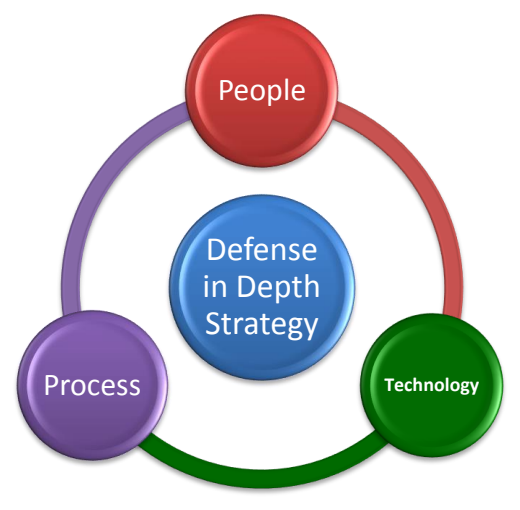
中央に「多層防御戦略」(Defense in Depth Strategy)の円があり、その周りの輪が「人」(People)、「プロセス」(Process)、「技術」(Technology)の3つの円を結ぶ図です。
Figure 2-4 An Example of Defense-In-Depth
図 2-4 多層防御の例
Due to the interconnected nature of the smart grid systems, it is essential that the appropriate cybersecurity controls get implemented to protect against less-critical systems infecting more-critical systems. Physical security controls such as locked doors, locked cabinets, and or restricted areas are used to mitigate risk. Other physical security controls, such as closed circuit TV, card readers, etc., are used to monitor and log entry into restricted areas.
スマートグリッドシステムは相互接続されているため、重要度の低いシステムが重要度の高いシステムに感染するのを防ぐ、適切なサイバーセキュリティ管理策を実装することが不可欠です。施錠されたドア、施錠されたキャビネット、制限区域などの物理的セキュリティ管理策は、リスクを低減するために使用されます。監視カメラ、カードリーダーなどのそのほかの物理的セキュリティ管理策は、制限区域への入室を監視し、記録するために使用されます。
Cybersecurity services (i.e., safeguards or countermeasures), mechanisms, and objects should be applied in layers, with one or more security methods implemented at each layer. The primary objective of these methods is to mitigate the risk of one component of the defensive strategy being compromised or circumvented. This is often referred to as “defense-in-depth.” A defense-in-depth approach focuses on the following areas:
サイバーセキュリティサービス(すなわち、保護策または対抗策)、メカニズム、オブジェクトは階層的に適用すべきであり、各層に1つ以上のセキュリティ手法を実装すべきです。これらの手法の主な目的は、防御戦略の1つの構成要素が侵害されたり回避されたりするリスクを低減することです。これは「多層防御」と呼ばれることが多いです。多層防御のアプローチは、次の領域に重点を置きます。
1.Defense in multiple places – An organization should deploy cybersecurity services, mechanisms and objects at multiple locations to resist all attack approaches.
1.複数の場所での防御 – 組織は、あらゆる攻撃手法に対抗するために、サイバーセキュリティサービス、メカニズム、オブジェクトを複数の場所に展開すべきです。
•Security Services - Functions that, when provided in a systems environment, serve to ensure the protection of resources by enforcing the defined security policies of the organization. Security services are also known as security controls, requirements, safeguards, countermeasures, and dimensions.
•セキュリティサービス - システム環境で提供されたときに、組織の定められたセキュリティポリシーを強制することで資源の保護を確実にする機能。セキュリティサービスは、セキュリティ管理策、要件、保護策、対抗策、ディメンションとも呼ばれます。
•Security Mechanisms - The technical tools used to implement the security services listed above. Each of the security mechanisms may operate individually, or in concert with others.
•セキュリティメカニズム - 上に挙げたセキュリティサービスを実装するために使用される技術的なツール。各セキュリティメカニズムは、単独で動作することも、ほかのメカニズムと連携して動作することもあります。
•Security Objects – These are items that contain security relevant information about users, groups, privileges, policies, programs, passwords, encryption keys, audit logs, etc. Managed security objects describe what is managed and how it behaves. The definition of managed security objects includes specification of their attributes and their behavior, which provides a concrete description of what is manageable.
•セキュリティオブジェクト – ユーザー、グループ、権限、ポリシー、プログラム、パスワード、暗号鍵、監査ログなどに関するセキュリティ関連の情報を含む項目です。管理対象のセキュリティオブジェクトは、何が管理され、どのように振る舞うかを記述します。管理対象のセキュリティオブジェクトの定義には、その属性と振る舞いの仕様が含まれ、何が管理可能であるかを具体的に記述します。
The “how” of management is defined by managing objects consisting of applications and data, which support the management and use of the rest of the system. This grouping, or security domain, refers to the set of entities (security objects) that are under the scope of a single organization’s set of security policies.
管理の「方法」は、システムの残りの部分の管理と使用を支えるアプリケーションおよびデータから成る管理オブジェクトを管理することによって定義されます。このまとまり、すなわちセキュリティドメインは、単一の組織の一連のセキュリティポリシーの適用範囲にあるエンティティ(セキュリティオブジェクト)の集合を指します。
2.Layered defenses – There is no such thing as 100% security. All cybersecurity approaches have inherent vulnerabilities. Creating layered defenses (firewalls, data diodes, etc.) are ways to protect against these vulnerabilities.
2.階層的な防御 – 100%のセキュリティというものは存在しません。あらゆるサイバーセキュリティのアプローチには固有の脆弱性があります。階層的な防御(ファイアウォール、データダイオードなど)を構築することは、これらの脆弱性から保護する方法の一つです。
3.Security robustness – Cybersecurity components should have specified robustness (strength and assurance) as a function of the criticality and risk of what is being protected (i.e., the SCADA system, AMI meters, etc.). Examples that increase security robustness include system hardening, antivirus software, patching, etc.
3.セキュリティのロバストネス – サイバーセキュリティのコンポーネントには、保護対象(すなわち、SCADAシステム、AMIメーターなど)の重要度とリスクに応じたロバストネス(強度と保証)を規定すべきです。セキュリティのロバストネスを高める例としては、システムのハードニング、ウイルス対策ソフトウェア、パッチ適用などがあります。
4.Trust relationships - Trust relationships between systems and organizations need to be evaluated, established, and maintained based on the risk presented to the interfacing systems, the functions they support, and the grid as a whole; accounting for potential impact as the data may subsequently be directly or indirectly passed "deeper" into more protected levels. The potential impact is the basis for deciding on the wisdom of the connection, the security services selected, and the audit of attached system security services and related management processes. Roles and responsibilities need to be defined for the trusted partners, for example who will patch updates and on what schedule, who has system privileges, or who will purchase components from which suppliers.
4.信頼関係 - システム間および組織間の信頼関係は、接続先システム、それらが支える機能、および電力網全体に対して生じるリスクに基づき、評価、確立、維持する必要があります。その際、データがその後、より保護された階層の「奥深く」へ直接または間接的に渡される可能性があることによる影響を考慮します。この潜在的な影響は、接続の妥当性、選択するセキュリティサービス、および接続されたシステムのセキュリティサービスと関連する管理プロセスを監査するかどうかを決める根拠です。信頼されるパートナーについて、たとえば、誰がどの予定で更新プログラムを適用するか、誰がシステム権限を持つか、誰がどの供給者からコンポーネントを購入するかといった役割と責任を定義する必要があります。
5.Deployment of cryptographic infrastructure – Supporting key, privilege, and certificate management that enables positive identification of entities using information and communication technologies.
5.暗号基盤の展開 – 情報通信技術を用いるエンティティを確実に識別できるようにする、鍵、権限、証明書の管理を支援します。
6.Deployment of intrusion detection/prevention systems – Provision of detection, reporting, analysis, assessment and response infrastructure enabling rapid detection and response to intrusions and other anomalous events, and providing situational awareness of the electric grid.
6.侵入検知・防止システムの展開 – 侵入やそのほかの異常なイベントを迅速に検知して対応し、電力網の状況認識を提供できるようにする、検知、報告、分析、評価、対応のインフラストラクチャを提供します。
7.Skilled staff - A comprehensive program of education, training, practical experience, and awareness, is necessary. Professionalization and certification licensing provide a validated and recognized expert cadre of system administrators.
7.熟練した人員 - 教育、トレーニング、実務経験、意識向上からなる包括的なプログラムが必要です。専門職化と資格認定により、検証され、広く認められたシステム管理者の専門家集団を確保できます。
8.Types of threats - Cyber threats include denial of service, unauthorized vulnerability probes, botnet command and control, data exfiltration, data destruction or even physical destruction via alternation of critical software/data. These threats can be initiated and maintained by a mixture of malware, social engineering, or highly sophisticated advanced persistent threats (APTs) that are targeted and continue for long periods of time. The most sophisticated cyber threats are covert, do not stand out from normal activity, and are extremely difficult to detect.
8.脅威の種類 - サイバー脅威には、サービス拒否、不正な脆弱性探索、ボットネットのコマンド・アンド・コントロール、データの持ち出し、データの破壊、さらには重要なソフトウェアやデータの改変を通じた物理的破壊が含まれます。これらの脅威は、マルウェア、ソーシャルエンジニアリング、または標的を絞って長期間続く非常に高度な持続的標的型攻撃(APT)が組み合わさって開始され、維持される場合があります。最も高度なサイバー脅威は秘匿性が高く、通常の活動の中で目立たず、検知が極めて困難です。
9.Advanced persistent threats - An adversary that possesses sophisticated levels of expertise and significant resources, allowing them to create opportunities to achieve their objectives by using multiple attack vectors (e.g., cyber, physical, and deception). These objectives typically include establishing and extending footholds within the information technology infrastructure of the targeted organizations for purposes of exfiltrating information, undermining or impeding critical aspects of a mission, program, or organization; or positioning itself to carry out these objectives in the future. The advanced persistent threat: (i) pursues its objectives repeatedly over an extended period of time; (ii) adapts to defenders’ efforts to resist it; and (iii) is determined to maintain the level of interaction needed to execute its objectives.
9.高度な持続的標的型攻撃(APT) - 高度な専門知識と相当な資源を有する敵対者であり、複数の攻撃ベクトル(たとえば、サイバー、物理、欺瞞)を使って目的達成の機会を作り出せます。これらの目的には通常、情報を持ち出すこと、ミッション、プログラム、または組織の重要な側面を損なうか妨げること、あるいは将来これらの目的を実行できるよう備えることを目的に、標的組織の情報技術インフラストラクチャ内に足場を築き、拡大することが含まれます。高度な持続的標的型攻撃は、(i) 長期間にわたって繰り返し目的を追求し、(ii) 防御側の抵抗する取り組みに適応し、(iii) 目的を実行するために必要なやり取りの水準を維持する決意を持っています。
2.3 LOGICAL INTERFACE CATEGORIES
2.3 論理インターフェースカテゴリ
Each logical interface in the logical reference model was allocated to a logical interface category (LIC). This was done because many of the individual logical interfaces are similar in their security-related characteristics and can, therefore, be categorized together as a means to simplify the identification of the appropriate security requirements. These security-related logical interface categories were defined based on attributes that could affect the security requirements.
論理リファレンスモデル内の各論理インターフェースは、論理インターフェースカテゴリ(LIC)に割り当てられました。これは、個々の論理インターフェースの多くが、セキュリティ関連の特性において似ており、したがって、適切なセキュリティ要件の特定を簡素化する手段として、まとめて分類できるためです。これらのセキュリティ関連の論理インターフェースカテゴリは、セキュリティ要件に影響しうる属性に基づいて定義されました。
These logical interface categories and the associated attributes included in Appendix H can be used as guidelines by organizations that are developing a cybersecurity strategy and implementing a risk assessment to select security requirements. This information may also be used by vendors and integrators as they design, develop, implement, and maintain the security requirements. Included below are a listing of all of the logical interfaces by category, the descriptions of each logical interface category, and the associated security architecture diagram. Examples included in the discussions below are not intended to be comprehensive. The user should assess the existing and proposed smart grid information system as part of determining which logical interface category should include a specific interface. Listed in each diagram are the unique technical requirements. These security requirements are included in the next chapter.
これらの論理インターフェースカテゴリと、付録 H に含まれる関連属性は、サイバーセキュリティ戦略を策定し、リスク評価を実施してセキュリティ要件を選択する組織が、ガイドラインとして使用できます。ベンダーやインテグレーターも、この情報をセキュリティ要件の設計、開発、実装、保守に利用できます。以下に、カテゴリ別のすべての論理インターフェースの一覧、各論理インターフェースカテゴリの説明、および関連するセキュリティアーキテクチャ図を示します。以下の説明に含まれる例は、網羅的なものではありません。利用者は、特定のインターフェースをどの論理インターフェースカテゴリに含めるべきかを判断する一環として、既存および提案中のスマートグリッド情報システムを評価すべきです。各図には固有の技術要件が記載されています。これらのセキュリティ要件は次の章に記載されています。
Table 2-2 Logical Interfaces by Category
表 2-2 カテゴリ別の論理インターフェース
| Logical Interface Category | Logical Interfaces |
|---|---|
| 1. Interface between control systems and equipment with high availability, and with compute and/or bandwidth constraints, for example: • Between transmission SCADA and substation equipment • Between distribution SCADA and high priority substation and pole-top equipment • Between SCADA and DCS within a power plant • (NOTE: LICs 1-4 are separate due to the architecturally significant differences between the availability and constraints, which impact mitigations such as encryption.) | U67, U79, U81, U82, U85, U102, U117, U137 |
| 2. Interface between control systems and equipment without high availability, but with compute and/or bandwidth constraints, for example: • Between distribution SCADA and lower priority pole-top equipment • Between pole-top IEDs and other pole-top IEDs | U67, U79, U81, U82, U85, U102, U117, U137 |
| 3. Interface between control systems and equipment with high availability, without compute nor bandwidth constraints, for example: • Between transmission SCADA and substation automation systems | U67, U79, U81, U82, U85, U102, U117, U137 |
| 4. Interface between control systems and equipment without high availability, without compute nor bandwidth constraints, for example: • Between distribution SCADA and backbone network-connected collector nodes for distribution pole-top IEDs | U67, U79, U81, U82, U85, U102, U117, U137 |
| 5. Interface between control systems within the same organization, for example: • Multiple DMS systems belonging to the same utility • Between subsystems within DCS and ancillary control systems within a power plant | U7, U9, U11, U13, U27, U65, U67, U83, U87, U115, Ux2 |
| 6. Interface between control systems in different organizations, for example: • Between an RTO/ISO EMS and a utility energy management system | U10, U56, U66, U70, U74, U80, U83, U87, U89, U90, U115, U116, Ux3 |
| 7. Interface between back office systems under common management authority, for example: • Between a Customer Information System and a Meter Data Management System | U2, U4, U21,U22, U26, U31, U53, U96, U98, U110, Ux4 |
| 8. Interface between back office systems not under common management authority, for example: • Between a third party billing system and a utility meter data management system | U1, U4, U6, U15, U52, U53, Ux4, Ux6 |
| 9. Interface with B2B connections between systems usually involving financial or market transactions, for example: • Between a Retail aggregator and an Energy Clearinghouse | U4, U9, U17, U20, U51, U52, U53, U55, U57, U58, U72, U90, U93, U97 |
| 10. Interface between control systems and non-control/corporate systems, for example: • Between a Work Management System and a Geographic Information System | U12, U30, U33, U36, U52, U59, U75, U91, U106, U113, U114, U131 |
| 11. Interface between sensors and sensor networks for measuring environmental parameters, usually simple sensor devices with possibly analog measurements, for example: • Between a temperature sensor on a transformer and its receiver | U111 |
| 12. Interface between sensor networks and control systems, for example: • Between a sensor receiver and the substation master | U108, U112 |
| 13. Interface between systems that use the AMI network, for example: • Between MDMS and meters • Between LMS/DRMS and Customer EMS | U2, U6, U7, U8, U21, U24, U25, U32, U95, U119, U130 |
| 14. Interface between systems that use the AMI network with high availability, for example: • Between MDMS and meters • Between LMS/DRMS and Customer EMS • Between DMS Applications and Customer DER • Between DMS Applications and DA Field Equipment | U2, U6, U7, U8, U21, U24, U25, U32, U95, U119, U130 |
| 15. Interface between systems that use customer (residential, commercial, and industrial) site networks which include: • Between Customer EMS and Customer Appliances • Between Customer EMS and Customer DER • Between Energy Service Interface and PEV | U42, U43, U44, U45, U49, U62, U120, U124, U126, U127 |
| 16. Interface between external systems and the customer site, for example: • Between Third Party and HAN Gateway • Between ESP and DER • Between Customer and CIS Web site | U18, U37, U38, U39, U40, U42, U88, U92, U125 |
| 17. Interface between systems and mobile field crew laptops/equipment, for example: • Between field crews and GIS • Between field crews and substation equipment | U14, U29, U34, U35, U99, U101, U104, U105 |
| 18. Interface between metering equipment, for example: • Between sub-meter to meter • Between PEV meter and Energy Service Provider | U24, U25, U41, U46, U47, U48, U50, U54, U60, U95, U128, U129, Ux5 |
| 19. Interface between operations decision support systems, for example: • Between WAMS and ISO/RTO | U77, U78 |
| 20. Interface between engineering/maintenance systems and control equipment, for example: • Between engineering and substation relaying equipment for relay settings • Between engineering and pole-top equipment for maintenance • Within power plants | U109, U114, U135, U136, U137 |
| 21. Interface between control systems and their vendors for standard maintenance and service, for example: • Between SCADA system and its vendor | U5 |
| 22. Interface between security/network/system management consoles and all networks and systems, for example: • Between a security console and network routers, firewalls, computer systems, and network nodes | U133 (includes interfaces to actors 17- Geographic Information System, 12 – Distribution Data Collector, 38 – Customer Portal, 24 – Customer Service Representative, 23 – Customer Information System, 21 – AMI Headend, 42 – Billing, 44 – Third Party, 43 – Energy Service Provider, 41 – Aggregator / Retail Energy Provider, 19 – Energy Market Clearinghouse, 34 – Metering / Billing / Utility Back Office) |
| 論理インターフェースカテゴリ | 論理インターフェース |
|---|---|
| 1. 高い可用性を持ち、計算能力または帯域幅、あるいはその両方に制約のある、制御システムと機器の間のインターフェース。たとえば次のもの。 • 送電 SCADA と変電所機器の間 • 配電 SCADA と優先度の高い変電所および柱上機器の間 • 発電所内の SCADA と DCS の間 • (注: LIC 1~4 は、可用性および制約にアーキテクチャ上重要な違いがあり、暗号化などの低減策に影響するため、別々になっています。) | U67, U79, U81, U82, U85, U102, U117, U137 |
| 2. 高い可用性は持たないが、計算能力または帯域幅、あるいはその両方に制約のある、制御システムと機器の間のインターフェース。たとえば次のもの。 • 配電 SCADA と優先度の低い柱上機器の間 • 柱上 IED 同士 | U67, U79, U81, U82, U85, U102, U117, U137 |
| 3. 高い可用性を持ち、計算能力にも帯域幅にも制約のない、制御システムと機器の間のインターフェース。たとえば次のもの。 • 送電 SCADA と変電所自動化システムの間 | U67, U79, U81, U82, U85, U102, U117, U137 |
| 4. 高い可用性を持たず、計算能力にも帯域幅にも制約のない、制御システムと機器の間のインターフェース。たとえば次のもの。 • 配電 SCADA と配電柱上 IED 用のバックボーンネットワーク接続型コレクターノードの間 | U67, U79, U81, U82, U85, U102, U117, U137 |
| 5. 同一組織内の制御システム間のインターフェース。たとえば次のもの。 • 同じ電力事業者に属する複数の DMS システム • 発電所内の DCS のサブシステムと補助制御システムの間 | U7, U9, U11, U13, U27, U65, U67, U83, U87, U115, Ux2 |
| 6. 異なる組織の制御システム間のインターフェース。たとえば次のもの。 • RTO/ISO の EMS と電力事業者のエネルギー管理システムの間 | U10, U56, U66, U70, U74, U80, U83, U87, U89, U90, U115, U116, Ux3 |
| 7. 共通の管理権限の下にあるバックオフィスシステム間のインターフェース。たとえば次のもの。 • 顧客情報システムとメーターデータ管理システムの間 | U2, U4, U21,U22, U26, U31, U53, U96, U98, U110, Ux4 |
| 8. 共通の管理権限の下にないバックオフィスシステム間のインターフェース。たとえば次のもの。 • 第三者の課金システムと電力事業者のメーターデータ管理システムの間 | U1, U4, U6, U15, U52, U53, Ux4, Ux6 |
| 9. 通常、金融取引または市場取引を伴うシステム間の B2B 接続のインターフェース。たとえば次のもの。 • 小売アグリゲーターとエネルギークリアリングハウスの間 | U4, U9, U17, U20, U51, U52, U53, U55, U57, U58, U72, U90, U93, U97 |
| 10. 制御システムと非制御系・企業システムの間のインターフェース。たとえば次のもの。 • 作業管理システムと地理情報システムの間 | U12, U30, U33, U36, U52, U59, U75, U91, U106, U113, U114, U131 |
| 11. 環境パラメーターを測定するセンサーとセンサーネットワークの間のインターフェース。通常はアナログ測定を行うこともある単純なセンサーデバイス。たとえば次のもの。 • 変圧器の温度センサーとその受信機の間 | U111 |
| 12. センサーネットワークと制御システムの間のインターフェース。たとえば次のもの。 • センサー受信機と変電所マスターの間 | U108, U112 |
| 13. AMI ネットワークを使用するシステム間のインターフェース。たとえば次のもの。 • MDMS とメーターの間 • LMS/DRMS と顧客 EMS の間 | U2, U6, U7, U8, U21, U24, U25, U32, U95, U119, U130 |
| 14. 高い可用性を持つ、AMI ネットワークを使用するシステム間のインターフェース。たとえば次のもの。 • MDMS とメーターの間 • LMS/DRMS と顧客 EMS の間 • DMS Applications と顧客 DER の間 • DMS Applications と DA Field Equipment の間 | U2, U6, U7, U8, U21, U24, U25, U32, U95, U119, U130 |
| 15. 顧客(住宅、商業、産業)サイトのネットワークを使用するシステム間のインターフェース。たとえば次のものを含みます。 • Customer EMS と Customer Appliances の間 • Customer EMS と Customer DER の間 • Energy Service Interface と PEV の間 | U42, U43, U44, U45, U49, U62, U120, U124, U126, U127 |
| 16. 外部システムと顧客サイトの間のインターフェース。たとえば次のもの。 • Third Party と HAN Gateway の間 • ESP と DER の間 • Customer と CIS Web site の間 | U18, U37, U38, U39, U40, U42, U88, U92, U125 |
| 17. システムと移動現場作業員用のノート PC・機器の間のインターフェース。たとえば次のもの。 • 現場作業員と GIS の間 • 現場作業員と変電所機器の間 | U14, U29, U34, U35, U99, U101, U104, U105 |
| 18. 計量機器間のインターフェース。たとえば次のもの。 • サブメーターとメーターの間 • PEV メーターと Energy Service Provider の間 | U24, U25, U41, U46, U47, U48, U50, U54, U60, U95, U128, U129, Ux5 |
| 19. 運用意思決定支援システム間のインターフェース。たとえば次のもの。 • WAMS と ISO/RTO の間 | U77, U78 |
| 20. エンジニアリング・保守システムと制御機器の間のインターフェース。たとえば次のもの。 • リレー設定に関するエンジニアリングシステムと変電所リレー機器の間 • 保守に関するエンジニアリングシステムと柱上機器の間 • 発電所内 | U109, U114, U135, U136, U137 |
| 21. 標準的な保守およびサービスのための、制御システムとそのベンダーの間のインターフェース。たとえば次のもの。 • SCADA システムとそのベンダーの間 | U5 |
| 22. セキュリティ・ネットワーク・システム管理コンソールとすべてのネットワークおよびシステムとの間のインターフェース。たとえば次のもの。 • セキュリティコンソールとネットワークルーター、ファイアウォール、コンピューターシステム、ネットワークノードの間 | U133(アクター17 – Geographic Information System、12 – Distribution Data Collector、38 – Customer Portal、24 – Customer Service Representative、23 – Customer Information System、21 – AMI Headend、42 – Billing、44 – Third Party、43 – Energy Service Provider、41 – Aggregator / Retail Energy Provider、19 – Energy Market Clearinghouse、34 – Metering / Billing / Utility Back Office へのインターフェースを含む) |
2.3.1 Logical Interface Categories 1—4
2.3.1 論理インターフェースカテゴリ 1〜4
Logical Interface Category 1: Interface between control systems and equipment with high availability, and with compute and/or bandwidth constraints
論理インターフェースカテゴリ 1: 高い可用性を持ち、計算能力または帯域幅、あるいはその両方に制約のある、制御システムと機器の間のインターフェース
Logical Interface Category 2: Interface between control systems and equipment without high availability, but with compute and/or bandwidth constraints
論理インターフェースカテゴリ 2: 高い可用性は持たないが、計算能力または帯域幅、あるいはその両方に制約のある、制御システムと機器の間のインターフェース
Logical Interface Category 3: Interface between control systems and equipment with high availability, without compute or bandwidth constraints
論理インターフェースカテゴリ 3: 高い可用性を持ち、計算能力にも帯域幅にも制約のない、制御システムと機器の間のインターフェース
Logical Interface Category 4: Interface between control systems and equipment without high availability, without compute or bandwidth constraints
論理インターフェースカテゴリ 4: 高い可用性を持たず、計算能力にも帯域幅にも制約のない、制御システムと機器の間のインターフェース
Logical interface categories 1 through 4 cover communications between control systems (typically centralized applications such as a SCADA master station) and equipment as well as communications between equipment. The equipment is categorized with or without high availability. The interface communication channel is categorized with or without computational and/or bandwidth constraints. (NOTE: LICs 1-4 are separate due to the architecturally significant differences between the availability and constraints, which impact mitigations such as encryption.)
論理インターフェースカテゴリ1~4は、制御システム(通常はSCADAマスターステーションなどの集中型アプリケーション)と機器との間の通信、および機器間の通信を対象とします。機器は、高い可用性を持つものと持たないものに分類されます。インターフェースの通信チャネルは、計算能力または帯域幅、あるいはその両方に制約があるものとないものに分類されます。(注: LIC 1~4 は、可用性および制約にアーキテクチャ上重要な違いがあり、暗号化などの低減策に影響するため、別々になっています。)
All activities involved with logical interface categories 1 through 4 are typically machine-to-machine actions. Furthermore, communication modes and types are similar between logical interface categories 1 through 4 and are defined as follows:
論理インターフェースカテゴリ 1〜4 に関わるすべての活動は、通常、マシン間の動作です。さらに、通信のモードと種類は論理インターフェースカテゴリ 1〜4 の間で似ており、次のように定義されます。
•Interface Data Communication Mode
•インターフェースのデータ通信モード
•Near Real-Time Frequency Monitoring Mode (ms, subcycle based on a 60 Hz system) (may or may not include control action communication)
•ニアリアルタイム周波数監視モード(ミリ秒、60 Hz のシステムに基づくサブサイクル)(制御動作の通信を含む場合と含まない場合がある)
•High Frequency Monitoring Mode (2 s ≤ 60 s scan rates)
•高頻度監視モード(2 秒 ≤ 60 秒のスキャン周期)
•Low Frequency Monitoring Mode (scan/update rates in excess of 1 min)
•低頻度監視モード(スキャン・更新周期が 1 分を超える)
•Interface Data Communication Type
•インターフェースのデータ通信の種類
•Monitoring and Control Data for real-time control system environment (typical measurement and control points)
•リアルタイム制御システム環境向けの監視・制御データ(典型的な測定・制御ポイント)
•Equipment Maintenance and Analysis (numerous measurements on field equipment that is typically used for preventive maintenance and post analysis)
•機器の保守と分析(通常、予防保守と事後分析に使用される、現場機器に対する多数の測定)
•Equipment Management Channel (remote maintenance of equipment)
•機器管理チャネル(機器の遠隔保守)
The characteristics that vary between and distinguish each logical interface category are the availability requirements for the interface and the computational/communications constraints for the interface as follows:
各論理インターフェースカテゴリ間で異なり、それらを区別する特性は、次のとおり、インターフェースの可用性要件と、インターフェースの計算・通信上の制約です。
•Availability Requirements – Availability requirements will vary between these interfaces and are driven primarily by the power system application which the interface supports and not by the interface itself. For example, a SCADA interface to a substation or pole-top RTU may have a high availability requirement in one case because it is supporting critical monitoring and switching functions or a moderate or low availability if supporting an asset-monitoring application.
•可用性要件 – 可用性要件はこれらのインターフェース間で異なり、主に、インターフェース自体ではなく、インターフェースが支える電力システムのアプリケーションによって決まります。たとえば、変電所または柱上の RTU への SCADA インターフェースは、重要な監視機能や開閉機能を支える場合には高い可用性要件を持ち、資産監視アプリケーションを支える場合には中程度または低い可用性要件を持つことがあります。
•Communications and Computational Constraints – Computational constraints are associated with cryptography requirements on the interface. Most encryption systems operate at the Application or Network layer. Physical layer encryption, however, operates directly at the physical layer interface thereby offering enhanced security. Operation at this level is, especially in the case of optical communication, very computationally intensive due to the high data throughput and cryptography requirements. Most physical layer encryption devices therefore make use of field-programmable gate arrays (FPGAs) or other custom hardware devices to meet those needs. Existing devices like RTUs, substation IEDs, meters, and others are typically not equipped with sufficient digital hardware to perform this type of cryptographic function. Communication is also constrained to point-to-point in case of optical/cable/radio networks and point-to-multipoint in care of radio networks when physical layer encryption is applied.
•通信上および計算上の制約 – 計算上の制約は、インターフェースにおける暗号技術の要件と関連します。ほとんどの暗号化システムは、アプリケーション層またはネットワーク層で動作します。しかし、物理層の暗号化は、物理層のインターフェースで直接動作するため、強化されたセキュリティを提供します。このレベルでの動作は、特に光通信の場合、高いデータスループットと暗号技術の要件により、計算負荷が非常に高くなります。そのため、ほとんどの物理層暗号化デバイスは、こうしたニーズを満たすために、フィールドプログラマブルゲートアレイ(FPGA)やそのほかのカスタムハードウェアデバイスを使用しています。RTU、変電所 IED、メーターなどの既存のデバイスは、通常、この種の暗号処理を実行するのに十分なデジタルハードウェアを備えていません。また、物理層の暗号化を適用する場合、光・ケーブルネットワークではポイントツーポイントに、無線ネットワークではポイントツーマルチポイントに通信が制約されます。
•Bandwidth constraints are associated with data volume on the interface. In this case, media is usually narrowband, limiting the volume of traffic, and impacting the types of security measures that are feasible.
•帯域幅の制約は、インターフェース上のデータ量と関連します。この場合、媒体は通常、狭帯域であり、トラフィックの量が制限され、実現可能なセキュリティ対策の種類に影響します。
With these requirements and constraints, logical interface categories 1 through 4 can be defined as follows:
これらの要件と制約により、論理インターフェースカテゴリ 1〜4 は次のように定義できます。
1.Interface between control systems and equipment with high availability and with computational and/or bandwidth constraints:
1.高い可用性を持ち、計算能力または帯域幅、あるいはその両方に制約のある、制御システムと機器の間のインターフェース:
•Between transmission SCADA in support of state estimation and substation equipment for monitoring and control data using a high frequency mode;
•状態推定を支える送電 SCADA と変電所機器の間の、高頻度モードを用いた監視・制御データ
•Between distribution SCADA in support of three phase, real-time power flow and substation equipment for monitoring data using a high and low frequency mode;
•三相のリアルタイム潮流を支える配電 SCADA と変電所機器の間の、高頻度モードと低頻度モードの両方を用いた監視データ
•Between transmission SCADA in support of automatic generation control (AGC) and DCS within a power plant for monitoring and control data using a high frequency mode;
•自動発電制御(AGC)を支える送電 SCADA と発電所内の DCS の間の、高頻度モードを用いた監視・制御データ
•Between SCADA in support of Volt/VAR control and substation equipment for monitoring and control data using a high and low frequency mode; and
•Volt/VAR 制御を支える SCADA と変電所機器の間の、高頻度および低頻度モードを用いた監視・制御データ
•Between transmission SCADA in support of contingency analysis and substation equipment for monitoring data using high frequency mode.
•常時・事故時解析を支える送電 SCADA と変電所機器の間の、高頻度モードを用いた監視データ
2.Interface between control systems and equipment without high availability and with computational and/or bandwidth constraints:
2.高い可用性は持たないが、計算能力または帯域幅、あるいはその両方に制約のある、制御システムと機器の間のインターフェース:
•Between field devices and control systems for analyzing power system faults using a low frequency mode;
•電力システムの障害を解析するための、現場デバイスと制御システムの間の、低頻度モードを用いたもの
•Between a control system historian and field devices for capturing power equipment attributes using a high or low frequency mode;
•電力機器の属性を取得するための、制御システムのヒストリアンと現場デバイスの間の、高頻度または低頻度モードを用いたもの
•Between distribution SCADA and lower priority pole-top devices for monitoring field devices using a low frequency mode; and
•現場デバイスを監視するための、配電 SCADA と優先度の低い柱上デバイスの間の、低頻度モードを用いたもの
•Between pole-top IEDs and other pole-top IEDs (not used of protection or automated switching) for monitoring and control in a high or low frequency mode.
•監視・制御のための、柱上 IED と他の柱上 IED(保護や自動開閉には使用されない)の間の、高頻度または低頻度モードを用いたもの
3.Interface between control systems and equipment with high availability without computational and/or bandwidth constraints:
3.高い可用性を持ち、計算能力および帯域幅のいずれにも制約のない、制御システムと機器の間のインターフェース:
•Between transmission SCADA and substation automation systems for monitoring and control data using a high frequency mode;
•送電 SCADA と変電所自動化システムの間の、高頻度モードを用いた監視・制御データ
•Between EMS and generation control (DCS) and RTUs for monitoring and control data using a high frequency mode;
•EMS と発電制御(DCS)および RTU の間の、高頻度モードを用いた監視・制御データ
•Between distribution SCADA and substation automation systems, substation RTUs, and pole-top devices for monitoring and control data using a high frequency mode;
•配電 SCADA と変電所自動化システム、変電所 RTU、柱上デバイスの間の、高頻度モードを用いた監視・制御データ
•Between a PMU device and a phasor data concentrator (PDC) for monitoring data using a high frequency mode; and
•PMU デバイスとフェーザデータ集約装置(PDC)の間の、高頻度モードを用いた監視データ
•Between IEDs (peer-to-peer) for power system protection, including transfer trip signals between equipment in different substations.
•電力システム保護のための IED 間(ピアツーピア)。異なる変電所の機器間の転送遮断信号を含む
4.Interface between control systems and equipment without high availability, without computational and/or bandwidth constraints:
4.高い可用性はなく、計算能力および帯域幅のいずれにも制約のない、制御システムと機器の間のインターフェース:
•Between field device and asset monitoring system for monitoring data using a low frequency mode;
•現場デバイスと資産監視システムの間の、低頻度モードを用いた監視データ
•Between field devices (relays, digital fault recorders [DFRs], power quality [PQ]) and event analysis systems for event, disturbance, and PQ data;
•現場デバイス(リレー、デジタル故障記録装置 [DFR]、電力品質 [PQ])とイベント解析システムの間の、イベント、擾乱、PQ のデータ
•Between distribution SCADA and lower-priority pole-top equipment for monitoring and control data in a high or low frequency mode;
•配電 SCADA と優先度の低い柱上機器の間の、高頻度または低頻度モードを用いた監視・制御データ
•Between pole-top IEDs and other pole-top IEDs (not used for protection or automated switching) for monitoring and control in a high or low frequency mode; and
•監視・制御のための、柱上 IED と他の柱上 IED(保護や自動開閉には使用されない)の間の、高頻度または低頻度モードを用いたもの
•Between distribution SCADA and backbone network-connected collector nodes for lower-priority distribution pole-top IEDs for monitoring and control in a high or low frequency mode.
•配電 SCADA と、優先度の低い配電の柱上 IED 用のバックボーンネットワーク接続型コレクターノードの間の、高頻度または低頻度モードを用いた監視・制御
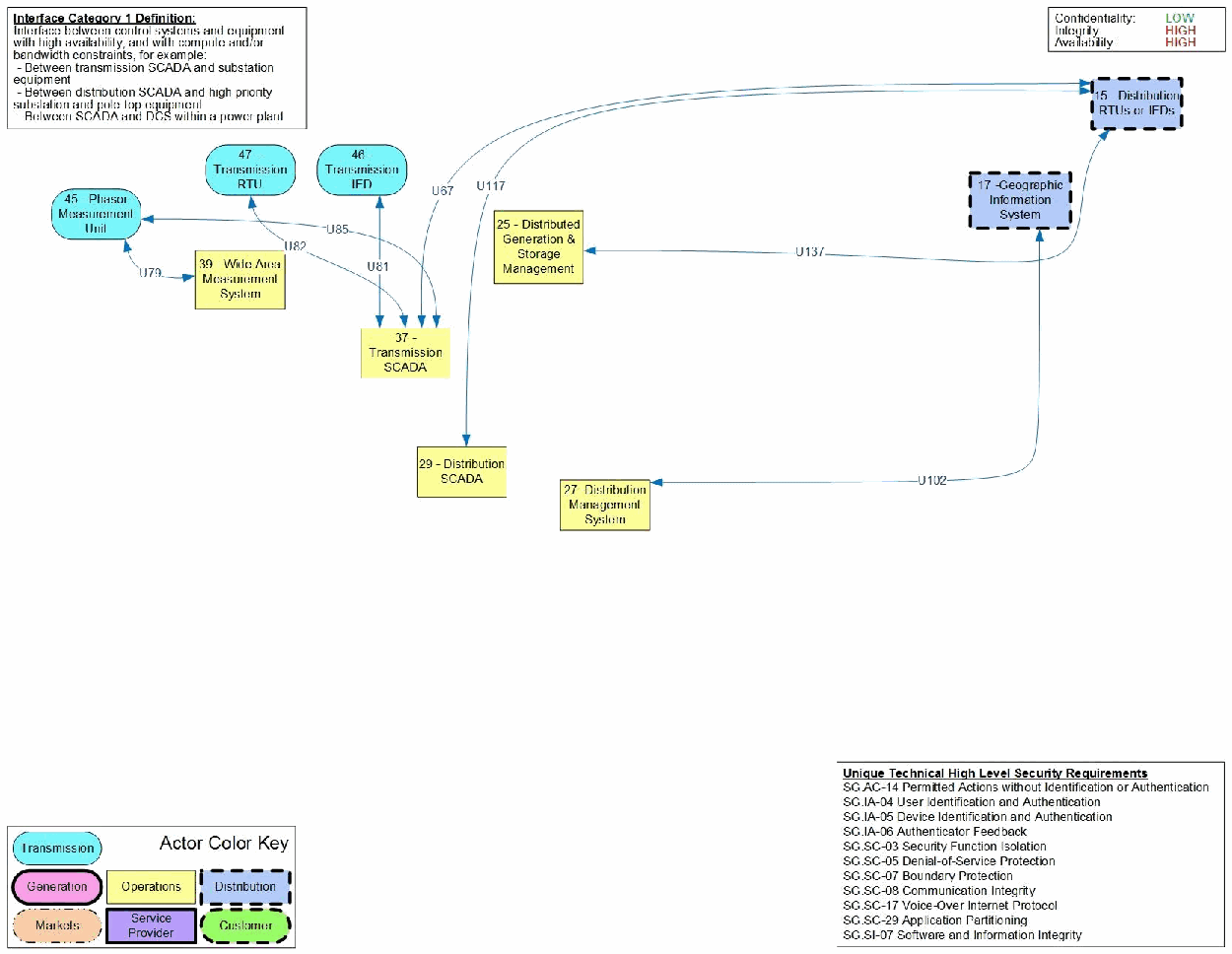
論理インターフェースカテゴリ1の図です。定義の枠: 高可用性で、計算能力または帯域幅(あるいはその両方)に制約がある制御システムと機器の間のインターフェース。例: 送電SCADAと変電所機器の間、配電SCADAと優先度の高い変電所・柱上機器の間、発電所内のSCADAとDCSの間。影響レベルの枠: 機密性 低、完全性 高、可用性 高。図中のアクター(アクターの色の凡例のドメイン別に色分け): 45 フェーザー計測装置、47 送電RTU、46 送電IED、39 広域計測システム、37 送電SCADA、25 分散型発電・蓄電管理、29 配電SCADA、27 配電管理システム、15 配電RTUまたはIED、17 地理情報システム。アクター間の矢印に付いた論理インターフェース: U79, U82, U85, U81, U67, U117, U137, U102。「固有の技術的ハイレベルセキュリティ要件」の枠: SG.AC-14(識別・認証なしで許可される操作)、SG.IA-04(利用者の識別と認証)、SG.IA-05(デバイスの識別と認証)、SG.IA-06(認証情報のフィードバック)、SG.SC-03(セキュリティ機能の分離)、SG.SC-05(サービス妨害からの保護)、SG.SC-07(境界保護)、SG.SC-08(通信の完全性)、SG.SC-17(VoIP)、SG.SC-29(アプリケーションの区分)、SG.SI-07(ソフトウェアと情報の完全性)。
Figure 2-5 Logical Interface Category 1
図 2-5 論理インターフェースカテゴリ 1
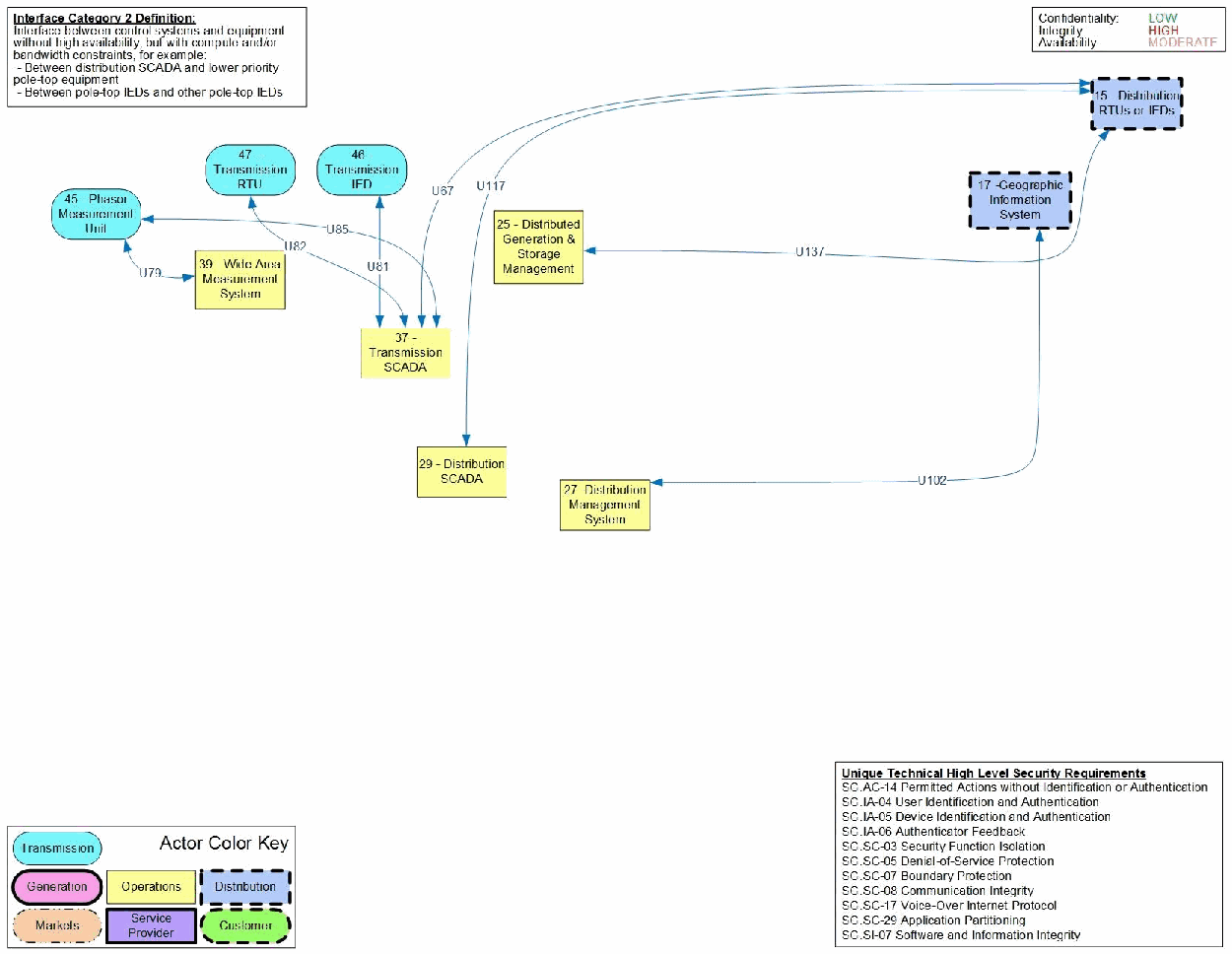
論理インターフェースカテゴリ2の図です。定義の枠: 高可用性ではないが、計算能力または帯域幅(あるいはその両方)に制約がある制御システムと機器の間のインターフェース。例: 配電SCADAと優先度の低い柱上機器の間、柱上IEDと他の柱上IEDの間。影響レベルの枠: 機密性 低、完全性 高、可用性 中。図中のアクター(アクターの色の凡例のドメイン別に色分け): 45 フェーザー計測装置、47 送電RTU、46 送電IED、39 広域計測システム、37 送電SCADA、25 分散型発電・蓄電管理、29 配電SCADA、27 配電管理システム、15 配電RTUまたはIED、17 地理情報システム。アクター間の矢印に付いた論理インターフェース: U79, U82, U85, U81, U67, U117, U137, U102。「固有の技術的ハイレベルセキュリティ要件」の枠: SG.AC-14(識別・認証なしで許可される操作)、SG.IA-04(利用者の識別と認証)、SG.IA-05(デバイスの識別と認証)、SG.IA-06(認証情報のフィードバック)、SG.SC-03(セキュリティ機能の分離)、SG.SC-05(サービス妨害からの保護)、SG.SC-07(境界保護)、SG.SC-08(通信の完全性)、SG.SC-17(VoIP)、SG.SC-29(アプリケーションの区分)、SG.SI-07(ソフトウェアと情報の完全性)。
Figure 2-6 Logical Interface Category 2
図 2-6 論理インターフェースカテゴリ 2
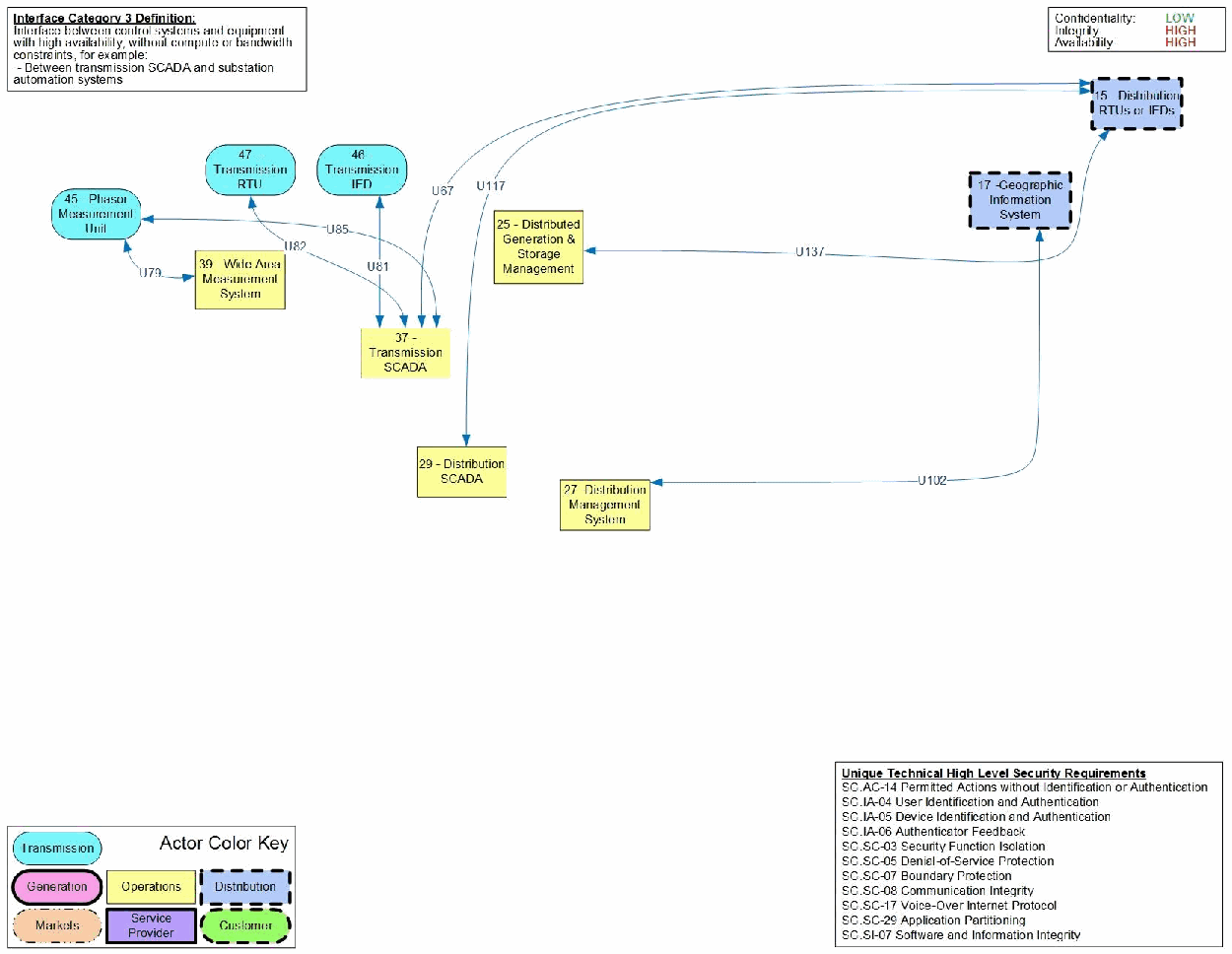
論理インターフェースカテゴリ3の図です。定義の枠: 高可用性で、計算能力や帯域幅の制約がない制御システムと機器の間のインターフェース。例: 送電SCADAと変電所自動化システムの間。影響レベルの枠: 機密性 低、完全性 高、可用性 高。図中のアクター(アクターの色の凡例に示すドメイン別に色分け: 送電、発電、市場、運用、サービスプロバイダー、配電、顧客): 45 フェーザー計測装置、47 送電RTU、46 送電IED、39 広域計測システム、37 送電SCADA、25 分散型発電・蓄電管理、29 配電SCADA、27 配電管理システム、15 配電RTUまたはIED、17 地理情報システム。アクター間に矢印で示された論理インターフェース: U79, U82, U85, U81, U67, U117, U137, U102。「固有の技術的ハイレベルセキュリティ要件」の枠: SG.AC-14(識別または認証なしで許可される操作)、SG.IA-04(利用者の識別と認証)、SG.IA-05(デバイスの識別と認証)、SG.IA-06(認証情報のフィードバック)、SG.SC-03(セキュリティ機能の分離)、SG.SC-05(サービス妨害からの保護)、SG.SC-07(境界保護)、SG.SC-08(通信の完全性)、SG.SC-17(インターネット電話プロトコル)、SG.SC-29(アプリケーションの区分)、SG.SI-07(ソフトウェアと情報の完全性)。
Figure 2-7 Logical Interface Category 3
図 2-7 論理インターフェースカテゴリ 3
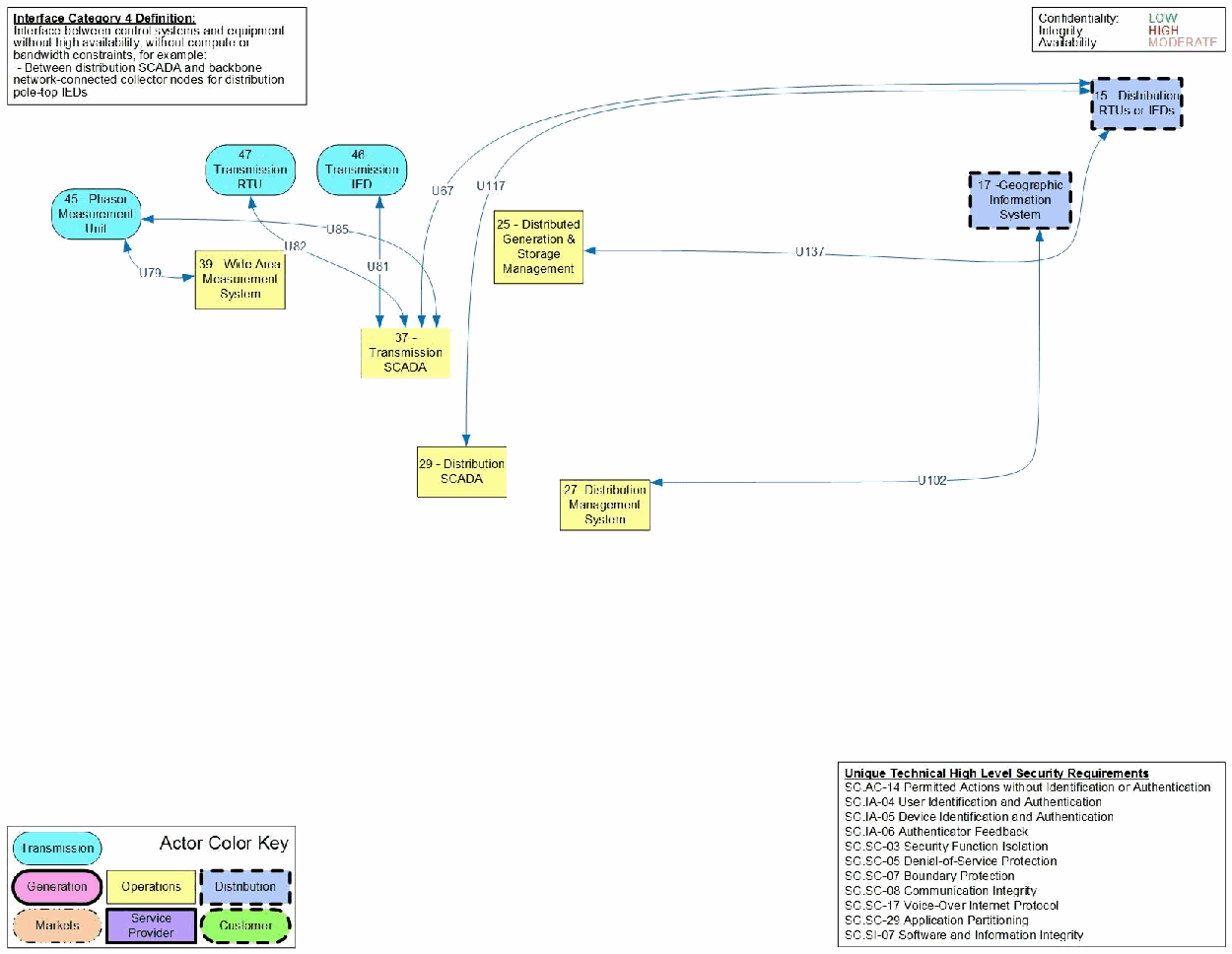
論理インターフェースカテゴリ4の図です。定義の枠: 高可用性ではなく、計算能力や帯域幅の制約がない制御システムと機器の間のインターフェース。例: 配電SCADAと、配電柱上IED用バックボーンネットワークに接続されたコレクターノードの間。影響レベルの枠: 機密性 低、完全性 高、可用性 中。図中のアクター(アクターの色の凡例に示すドメイン別に色分け: 送電、発電、市場、運用、サービスプロバイダー、配電、顧客): 45 フェーザー計測装置、47 送電RTU、46 送電IED、39 広域計測システム、37 送電SCADA、25 分散型発電・蓄電管理、29 配電SCADA、27 配電管理システム、15 配電RTUまたはIED、17 地理情報システム。アクター間に矢印で示された論理インターフェース: U79, U82, U85, U81, U67, U117, U137, U102。「固有の技術的ハイレベルセキュリティ要件」の枠: SG.AC-14(識別または認証なしで許可される操作)、SG.IA-04(利用者の識別と認証)、SG.IA-05(デバイスの識別と認証)、SG.IA-06(認証情報のフィードバック)、SG.SC-03(セキュリティ機能の分離)、SG.SC-05(サービス妨害からの保護)、SG.SC-07(境界保護)、SG.SC-08(通信の完全性)、SG.SC-17(インターネット電話プロトコル)、SG.SC-29(アプリケーションの区分)、SG.SI-07(ソフトウェアと情報の完全性)。
Figure 2-8 Logical Interface Category 4
図 2-8 論理インターフェースカテゴリ 4
2.3.2 Logical Interface Category 5: Interface between control systems within the same organization
2.3.2 論理インターフェースカテゴリ 5: 同一組織内の制御システム間のインターフェース
Logical interface category 5 covers the interfaces between control systems within the same organization, for example:
論理インターフェースカテゴリ 5 は、同一組織内の制御システム間のインターフェースを対象とします。たとえば次のものです。
•Between multiple data management systems belonging to the same utility; and
•同一の電力事業者に属する複数のデータ管理システムの間
•Between subsystems within DCS and ancillary control systems within a power plant.
•発電所内の DCS 内のサブシステムと補助制御システムの間
Control systems with interfaces between them have the following characteristics and issues:
相互にインターフェースを持つ制御システムには、次の特性と課題があります。
•Since control systems generally have high data accuracy and high availability requirements, the interfaces between them need to implement those security requirements even if they do not have the same requirements.
•制御システムは一般に高いデータ精度と高い可用性の要件を持つため、制御システム間のインターフェースは、同じ要件を持たない場合であっても、それらのセキュリティ要件を実装する必要がある
•The interfaces generally use communication channels (wide area networks [WANs] and/or local area networks [LANs]) that are designed for control systems.
•インターフェースは、一般に、制御システム向けに設計された通信チャネル(広域ネットワーク [WAN]、ローカルエリアネットワーク [LAN]、またはその両方)を使用する
•The control systems themselves are usually in secure environments, such as within a utility control center or within a power plant.
•制御システム自体は、通常、電力事業者の制御センター内や発電所内などの安全な環境にある
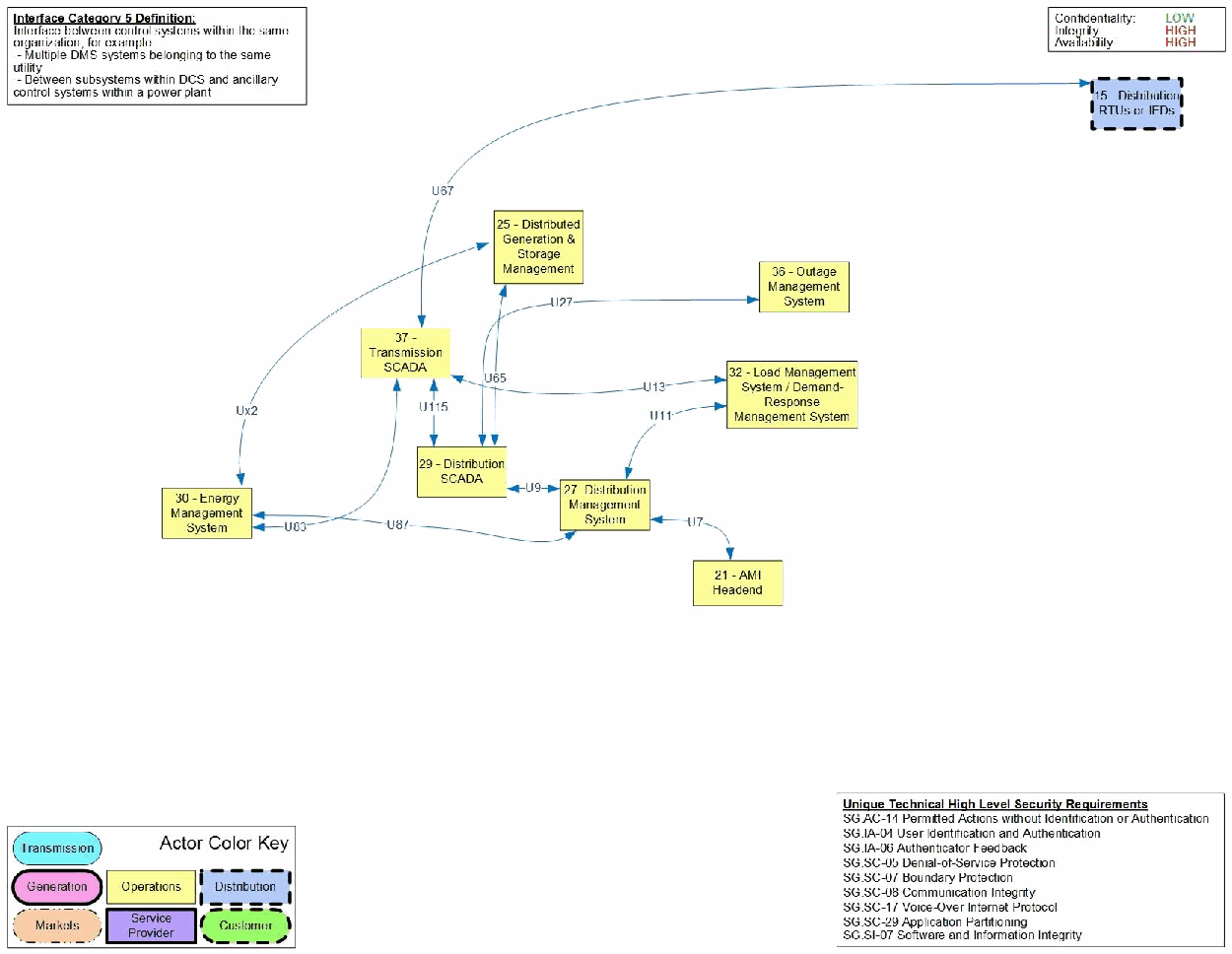
論理インターフェースカテゴリ5の図です。定義の枠: 同じ組織内の制御システム間のインターフェース。例: 同じ電力事業者に属する複数のDMSシステム、発電所内のDCSのサブシステムと補助制御システムの間。影響レベルの枠: 機密性 低、完全性 高、可用性 高。図中のアクター(アクターの色の凡例に示すドメイン別に色分け: 送電、発電、市場、運用、サービスプロバイダー、配電、顧客): 15 配電RTUまたはIED、25 分散型発電・蓄電管理、36 停電管理システム、37 送電SCADA、32 負荷管理システム/デマンドレスポンス管理システム、29 配電SCADA、27 配電管理システム、30 エネルギー管理システム、21 AMIヘッドエンド。アクター間に矢印で示された論理インターフェース: U67, Ux2, U65, U27, U13, U115, U11, U9, U83, U87, U7。「固有の技術的ハイレベルセキュリティ要件」の枠: SG.AC-14(識別または認証なしで許可される操作)、SG.IA-04(利用者の識別と認証)、SG.IA-06(認証情報のフィードバック)、SG.SC-05(サービス妨害からの保護)、SG.SC-07(境界保護)、SG.SC-08(通信の完全性)、SG.SC-17(インターネット電話プロトコル)、SG.SC-29(アプリケーションの区分)、SG.SI-07(ソフトウェアと情報の完全性)。
Figure 2-9 Logical Interface Category 5
図 2-9 論理インターフェースカテゴリ 5
2.3.3 Logical Interface Category 6: Interface between control systems in different organizations
2.3.3 論理インターフェースカテゴリ 6: 異なる組織の制御システム間のインターフェース
Logical interface category 6 covers the interfaces between control systems in different organizations, for example:
論理インターフェースカテゴリ 6 は、異なる組織の制御システム間のインターフェースを対象とします。たとえば次のものです。
•Between an RTO/ISO EMS and a utility energy management system;
•RTO/ISO の EMS と電力事業者のエネルギー管理システムの間
•Between a Generation and Transmission SCADA and a distribution CO-OP SCADA;
•発電・送電の SCADA と配電協同組合の SCADA の間
•Between a transmission EMS and a distribution DMS in different utilities; and
•異なる電力事業者の送電 EMS と配電 DMS の間
•Between an EMS/SCADA and a power plant DCS.
•EMS/SCADA と発電所の DCS の間
Control systems with interfaces between them have the following characteristics and issues:
相互にインターフェースを持つ制御システムには、次の特性と課題があります。
•Since control systems generally have high data accuracy and high availability requirements, the interfaces between them need to implement those security requirements even if they do not have the same requirements.
•制御システムは一般に高いデータ精度と高い可用性の要件を持つため、制御システム間のインターフェースは、同じ要件を持たない場合であっても、それらのセキュリティ要件を実装する必要がある
•The interfaces generally use communication channels (WANs and/or LANs) that are designed for control systems.
•インターフェースは、一般に、制御システム向けに設計された通信チャネル(WAN、LAN、またはその両方)を使用する
•The control systems are usually in secure environments, such as within a utility control center or within a power plant.
•制御システムは、通常、電力事業者の制御センター内や発電所内などの安全な環境にある
•Since the control systems are in different organizations, the establishment and maintenance of the chain of trust is more important.
•制御システムが異なる組織にあるため、信頼の連鎖の確立と維持がより重要になる
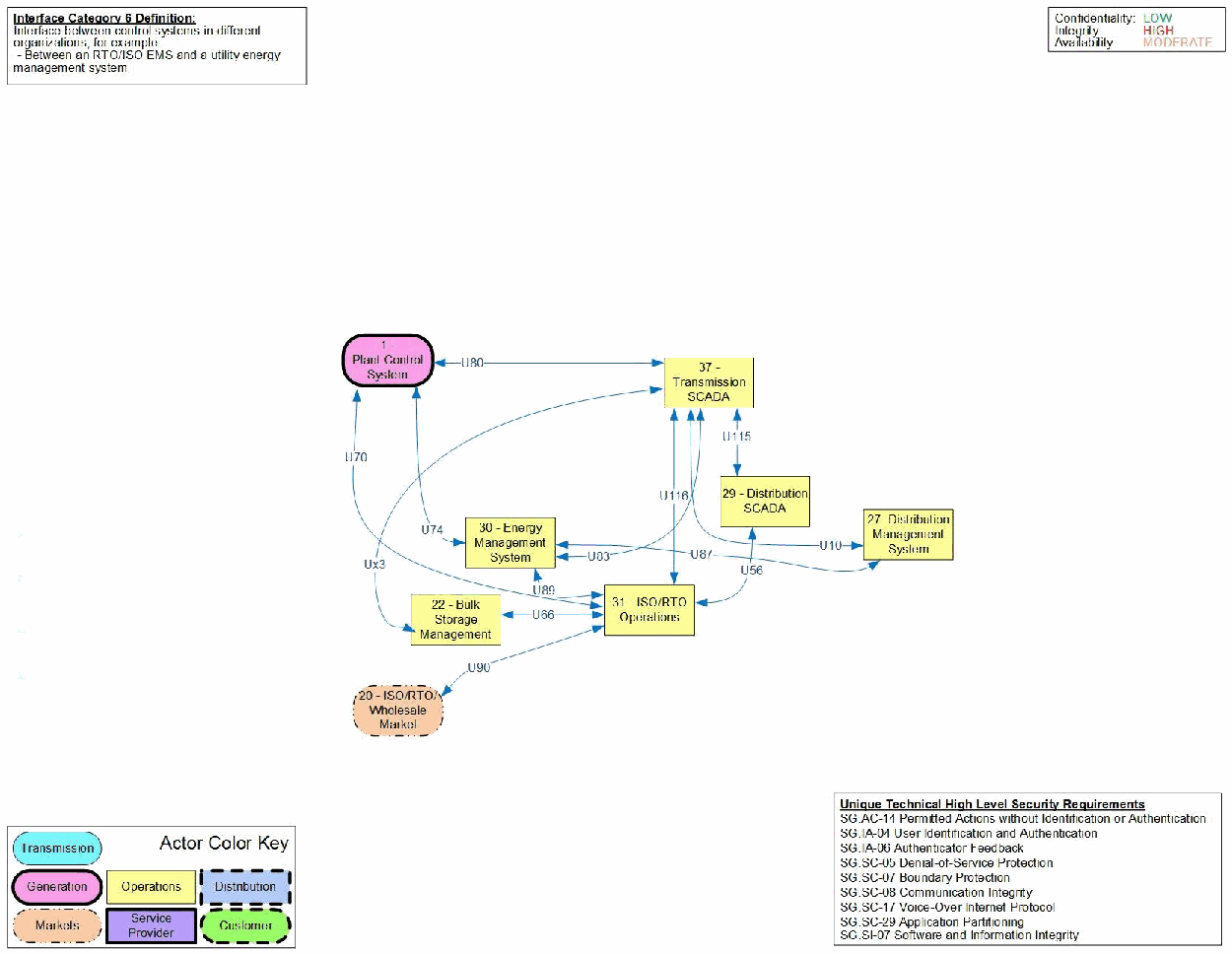
論理インターフェースカテゴリ6の図です。定義の枠: 異なる組織の制御システム間のインターフェース。例: RTO/ISOのEMSと電力事業者のエネルギー管理システムの間。影響レベルの枠: 機密性 低、完全性 高、可用性 中。図中のアクター(アクターの色の凡例に示すドメイン別に色分け: 送電、発電、市場、運用、サービスプロバイダー、配電、顧客): 1 発電所制御システム、37 送電SCADA、29 配電SCADA、27 配電管理システム、30 エネルギー管理システム、22 大規模蓄電管理、31 ISO/RTO運用、20 ISO/RTO卸売市場。アクター間に矢印で示された論理インターフェース: U80, U70, U74, Ux3, U116, U115, U10, U83, U87, U89, U56, U66, U90。「固有の技術的ハイレベルセキュリティ要件」の枠: SG.AC-14(識別または認証なしで許可される操作)、SG.IA-04(利用者の識別と認証)、SG.IA-06(認証情報のフィードバック)、SG.SC-05(サービス妨害からの保護)、SG.SC-07(境界保護)、SG.SC-08(通信の完全性)、SG.SC-17(インターネット電話プロトコル)、SG.SC-29(アプリケーションの区分)、SG.SI-07(ソフトウェアと情報の完全性)。
Figure 2-10 Logical Interface Category 6
図 2-10 論理インターフェースカテゴリ 6
2.3.4 Logical Interface Categories 7—8
2.3.4 論理インターフェースカテゴリ 7〜8
Logical Interface Category 7: Interface between back office systems under common management authority
論理インターフェースカテゴリ 7: 共通の管理権限の下にあるバックオフィスシステム間のインターフェース
Logical Interface Category 8: Interface between back office systems not under common management authority
論理インターフェースカテゴリ 8: 共通の管理権限の下にないバックオフィスシステム間のインターフェース
Logical interface category 7 covers the interfaces between back office systems that are under common management authority, e.g., between a CIS and a MDMS. Logical interface category 8 covers the interfaces between back office systems that are not under common management authority, e.g., between a third party billing system and a utility MDMS. These logical interface categories are focused on confidentiality and privacy rather than on power system reliability.
論理インターフェースカテゴリ 7 は、共通の管理権限の下にあるバックオフィスシステム間(たとえば CIS と MDMS の間)のインターフェースを対象とします。論理インターフェースカテゴリ 8 は、共通の管理権限の下にないバックオフィスシステム間(たとえば第三者の課金システムと電力事業者の MDMS の間)のインターフェースを対象とします。これらの論理インターフェースカテゴリは、電力システムの信頼性よりも、機密性とプライバシーに重点を置いています。
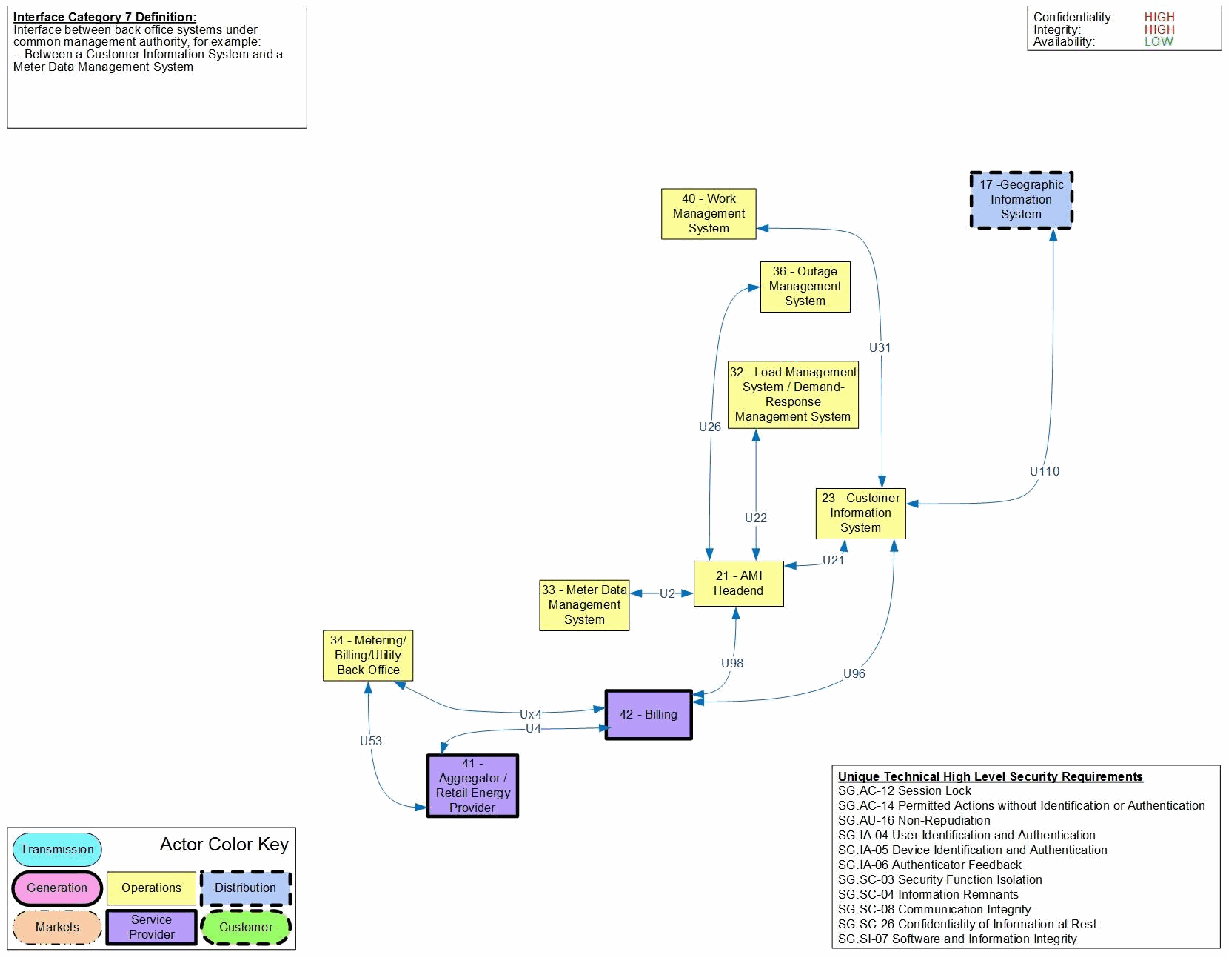
論理インターフェースカテゴリ7の図です。定義の枠: 共通の管理権限の下にあるバックオフィスシステム間のインターフェース。例: 顧客情報システムとメーターデータ管理システムの間。影響レベルの枠: 機密性 高、完全性 高、可用性 低。図中のアクター(アクターの色の凡例に示すドメイン別に色分け: 送電、発電、市場、運用、サービスプロバイダー、配電、顧客): 40 作業管理システム、17 地理情報システム、36 停電管理システム、32 負荷管理システム/デマンドレスポンス管理システム、23 顧客情報システム、21 AMIヘッドエンド、33 メーターデータ管理システム、34 計量・請求・電力事業者バックオフィス、42 請求、41 アグリゲーター/小売エネルギー事業者。アクター間に矢印で示された論理インターフェース: U31, U26, U22, U110, U21, U2, U98, U96, Ux4, U4, U53。「固有の技術的ハイレベルセキュリティ要件」の枠: SG.AC-12(セッションロック)、SG.AC-14(識別または認証なしで許可される操作)、SG.AU-16(否認防止)、SG.IA-04(利用者の識別と認証)、SG.IA-05(デバイスの識別と認証)、SG.IA-06(認証情報のフィードバック)、SG.SC-03(セキュリティ機能の分離)、SG.SC-04(残存情報)、SG.SC-08(通信の完全性)、SG.SC-26(保存情報の機密性)、SG.SI-07(ソフトウェアと情報の完全性)。
Figure 2-11 Logical Interface Category 7
図 2-11 論理インターフェースカテゴリ 7
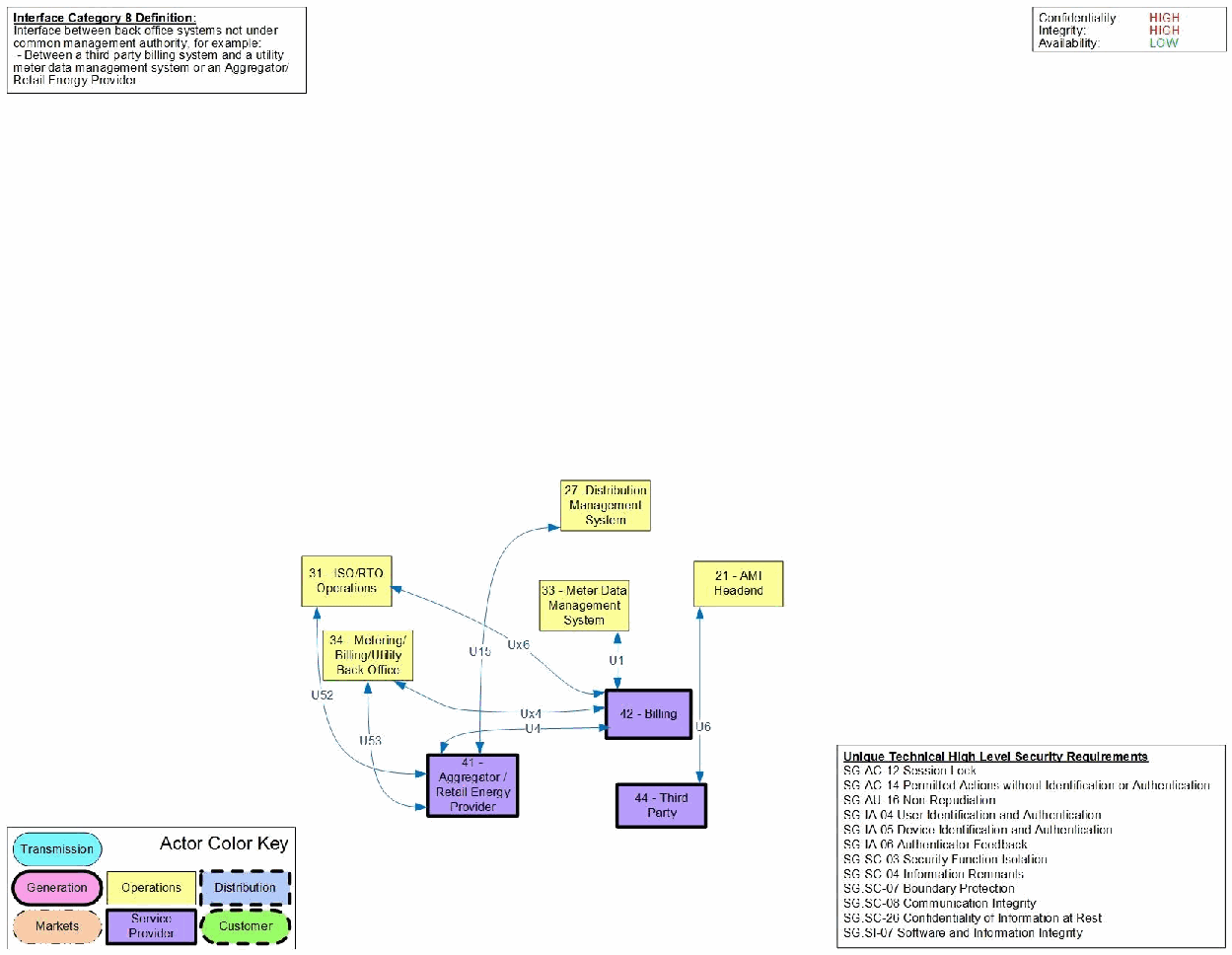
論理インターフェースカテゴリ8の図です。定義の枠: 共通の管理権限の下にないバックオフィスシステム間のインターフェース。例: 第三者の請求システムと、電力事業者のメーターデータ管理システムまたはアグリゲーター/小売エネルギー事業者の間。影響レベルの枠: 機密性 高、完全性 高、可用性 低。図中のアクター(アクターの色の凡例に示すドメイン別に色分け: 送電、発電、市場、運用、サービスプロバイダー、配電、顧客): 27 配電管理システム、31 ISO/RTO運用、33 メーターデータ管理システム、21 AMIヘッドエンド、34 計量・請求・電力事業者バックオフィス、42 請求、41 アグリゲーター/小売エネルギー事業者、44 第三者。アクター間に矢印で示された論理インターフェース: U15, Ux6, U1, U6, U52, U53, Ux4, U4。「固有の技術的ハイレベルセキュリティ要件」の枠: SG.AC-12(セッションロック)、SG.AC-14(識別または認証なしで許可される操作)、SG.AU-16(否認防止)、SG.IA-04(利用者の識別と認証)、SG.IA-05(デバイスの識別と認証)、SG.IA-06(認証情報のフィードバック)、SG.SC-03(セキュリティ機能の分離)、SG.SC-04(残存情報)、SG.SC-07(境界保護)、SG.SC-08(通信の完全性)、SG.SC-26(保存情報の機密性)、SG.SI-07(ソフトウェアと情報の完全性)。
Figure 2-12 Logical Interface Category 8
図 2-12 論理インターフェースカテゴリ 8
2.3.5 Logical Interface Category 9: Interface with business to business (B2B) connections between systems usually involving financial or market transactions
2.3.5 論理インターフェースカテゴリ 9: 通常、金融取引または市場取引を伴うシステム間の企業間(B2B)接続のインターフェース
Logical interface category 9 covers the interface with B2B connections between systems usually involving financial or market transactions, for example:
論理インターフェースカテゴリ 9 は、通常、金融取引または市場取引を伴うシステム間の B2B 接続のインターフェースを対象とします。たとえば次のものです。
•Between a retail aggregator and an energy clearinghouse.
•小売アグリゲーターとエネルギークリアリングハウスの間
These B2B interactions have the following characteristics and issues:
これらの B2B のやり取りには、次の特性と課題があります。
•Confidentiality needs to be considered since the interactions involve financial transactions with potentially large financial impacts and where confidential bids are vital to a legally operating market.
•機密性の考慮が必要です。これは、やり取りが大きな金銭的影響を及ぼしうる金融取引を伴い、機密入札が適法に運営される市場に不可欠であるためです
•Privacy, in terms of historical information on what energy and/or ancillary services were bid, is important to maintaining legal market operations and avoiding market manipulation or gaming.29
•どのエネルギーまたは補助サービスが入札されたかという過去の情報に関するプライバシーは、合法的な市場運営を維持し、市場操作や不正操作を避けるために重要です29
•Timing latency, critical time availability and integrity are also important, although in a different manner than for control systems. For financial transactions involving bidding into a market, timing can be crucial. Therefore, although average availability does not need to be high, low time latency during critical bidding times is crucial to avoid either inadvertently missed opportunities or deliberate market manipulation or gaming of the system.
•タイミングの遅延、重要な時間帯の可用性、完全性も、制御システムの場合とは異なる形ではありますが、重要です。市場への入札を伴う金融取引では、タイミングが決定的になり得ます。したがって、平均的な可用性は高い必要はありませんが、重要な入札時間帯における遅延の短さは、機会を意図せず逃すことや、意図的な市場操作またはシステムの不正操作を避けるうえで不可欠です。
•By definition, market operations are across organizational boundaries, thus posing trust issues.
•定義上、市場運営は組織の境界を越えて行われるため、信頼の問題が生じます。
•It is expected that many customers, possibly through aggregators or other energy service providers, will participate in the retail energy market, thus vastly increasing the number of participants.
•多くの顧客が、場合によってはアグリゲーターやそのほかのエネルギーサービスプロバイダーを通じて小売エネルギー市場に参加すると予想され、これにより参加者の数が大幅に増えます。
•Special communication networks are not expected to be needed for the market transactions and may include the public Internet as well as other available wide area networks.
•市場取引には特別な通信ネットワークは必要ないと予想され、公衆インターネットやそのほかの利用可能な広域ネットワークが含まれる場合がある
•Although the energy market has now been operating for over a decade at the bulk power level, the retail energy market is in its infancy. Its growth over the next few years is expected, but no one yet knows in what directions or to what extent that growth will occur.
•エネルギー市場は、バルク電力のレベルでは10年以上運営されてきましたが、小売エネルギー市場はまだ初期段階にあります。今後数年間の成長が見込まれますが、その成長がどの方向に、どの程度起こるかは、まだ誰にもわかりません。
•Systems and procedures for market interactions are very mature industry concepts. The primary requirement, therefore, is to utilize those concepts and protections in the newly emerging retail energy market.
•市場でのやり取りのためのシステムと手順は、非常に成熟した業界の概念です。したがって、主な要件は、新たに登場しつつある小売エネルギー市場で、これらの概念と保護を活用することです。
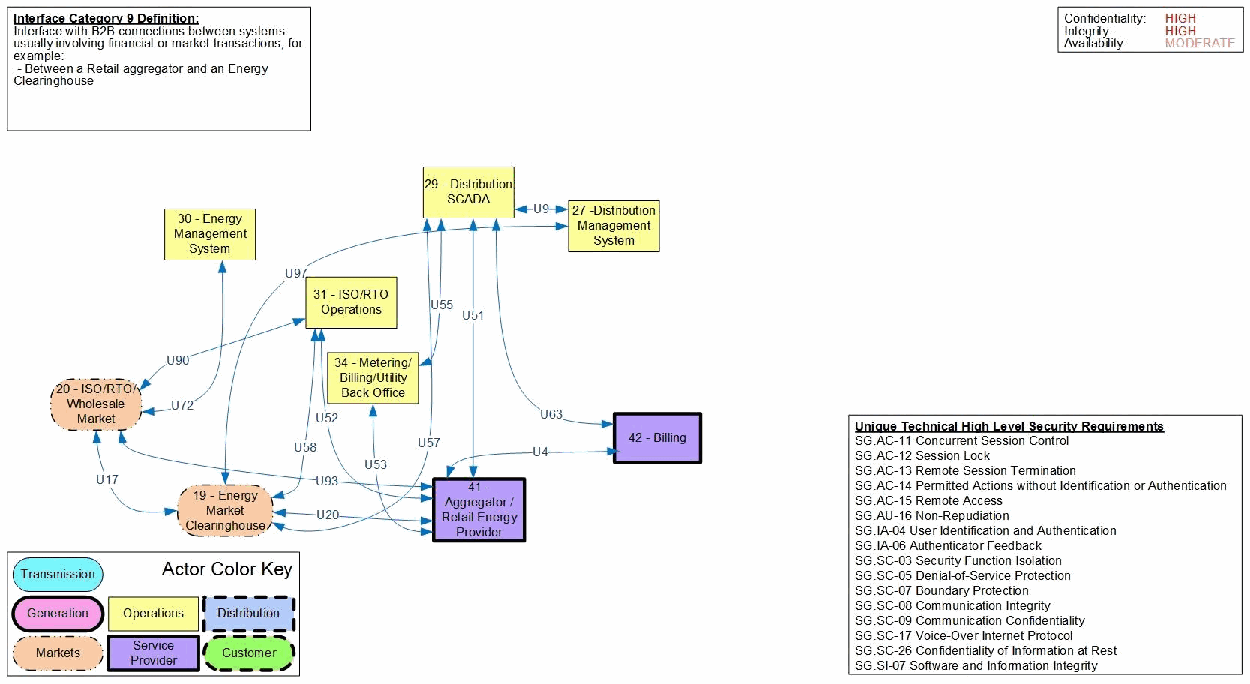
論理インターフェースカテゴリ9の図です。定義の枠: 通常は金融・市場取引を伴う、システム間のB2B接続のインターフェース。例: 小売アグリゲーターとエネルギー清算機関の間。影響レベルの枠: 機密性 高、完全性 高、可用性 中。図中のアクター(アクターの色の凡例に示されたドメイン(送電、発電、市場、運用、サービスプロバイダー、配電、顧客)別に色分け): 29 配電SCADA、27 配電管理システム、30 エネルギー管理システム、31 ISO/RTO運用、34 計量・請求・電力事業者バックオフィス、20 ISO/RTO卸売市場、19 エネルギー市場清算機関、42 請求、41 アグリゲーター/小売エネルギー事業者。アクター間の矢印に付いた論理インターフェース: U9, U97, U90, U72, U55, U51, U52, U58, U57, U63, U4, U17, U93, U53, U20。「固有の技術的ハイレベルセキュリティ要件」の枠: SG.AC-11(同時セッションの制御)、SG.AC-12(セッションロック)、SG.AC-13(リモートセッションの終了)、SG.AC-14(識別・認証なしで許可される操作)、SG.AC-15(リモートアクセス)、SG.AU-16(否認防止)、SG.IA-04(利用者の識別と認証)、SG.IA-06(認証情報のフィードバック)、SG.SC-03(セキュリティ機能の分離)、SG.SC-05(サービス妨害からの保護)、SG.SC-07(境界保護)、SG.SC-08(通信の完全性)、SG.SC-09(通信の機密性)、SG.SC-17(VoIP)、SG.SC-26(保存情報の機密性)、SG.SI-07(ソフトウェアと情報の完全性)。
Figure 2-13 Logical Interface Category 9
図 2-13 論理インターフェースカテゴリ 9
2.3.6 Logical Interface Category 10: Interface between control systems and non-control/corporate systems
2.3.6 論理インターフェースカテゴリ 10: 制御システムと、制御以外・企業システムの間のインターフェース
Logical interface category 10 covers the interfaces between control systems and non-control/corporate systems, for example:
論理インターフェースカテゴリ 10 は、制御システムと、制御以外・企業システムの間のインターフェースを対象とします。たとえば次のものです。
•Between a WMS and a GIS;
•WMS と GIS の間
•Between a DMS and a CIS;
•DMS と CIS の間
•Between an OMS and the AMI head-end system; and
•OMS と AMI ヘッドエンドシステムの間
•Between an OMS and a WMS.
•OMS と WMS の間
These interactions between control systems and non-control systems have the following characteristics and issues:
制御システムと制御以外のシステムの間のこれらのやり取りには、次の特性と課題があります。
•The primary security issue is preventing unauthorized access to sensitive control systems through non-control systems. As a result, integrity is the most critical security requirement.
•主なセキュリティ上の課題は、制御以外のシステムを通じて、機微な制御システムへの不正アクセスを防ぐことです。その結果、完全性が最も重要なセキュリティ要件となります。
•Since control systems generally require high availability, any interfaces with non-control systems should ensure that interactions with these other systems do not compromise the high availability requirement.
•制御システムは一般に高い可用性を必要とするため、制御以外のシステムとのインターフェースでは、それらのシステムとのやり取りが高い可用性要件を損なわないようにすべきです。
•The interactions between these systems usually involve loosely coupled interactions with very different types of exchanges from one system to the next and from one vendor to the next.
•これらのシステム間のやり取りは、通常、システムごと、ベンダーごとに交換の種類が大きく異なる疎結合のやり取りです。
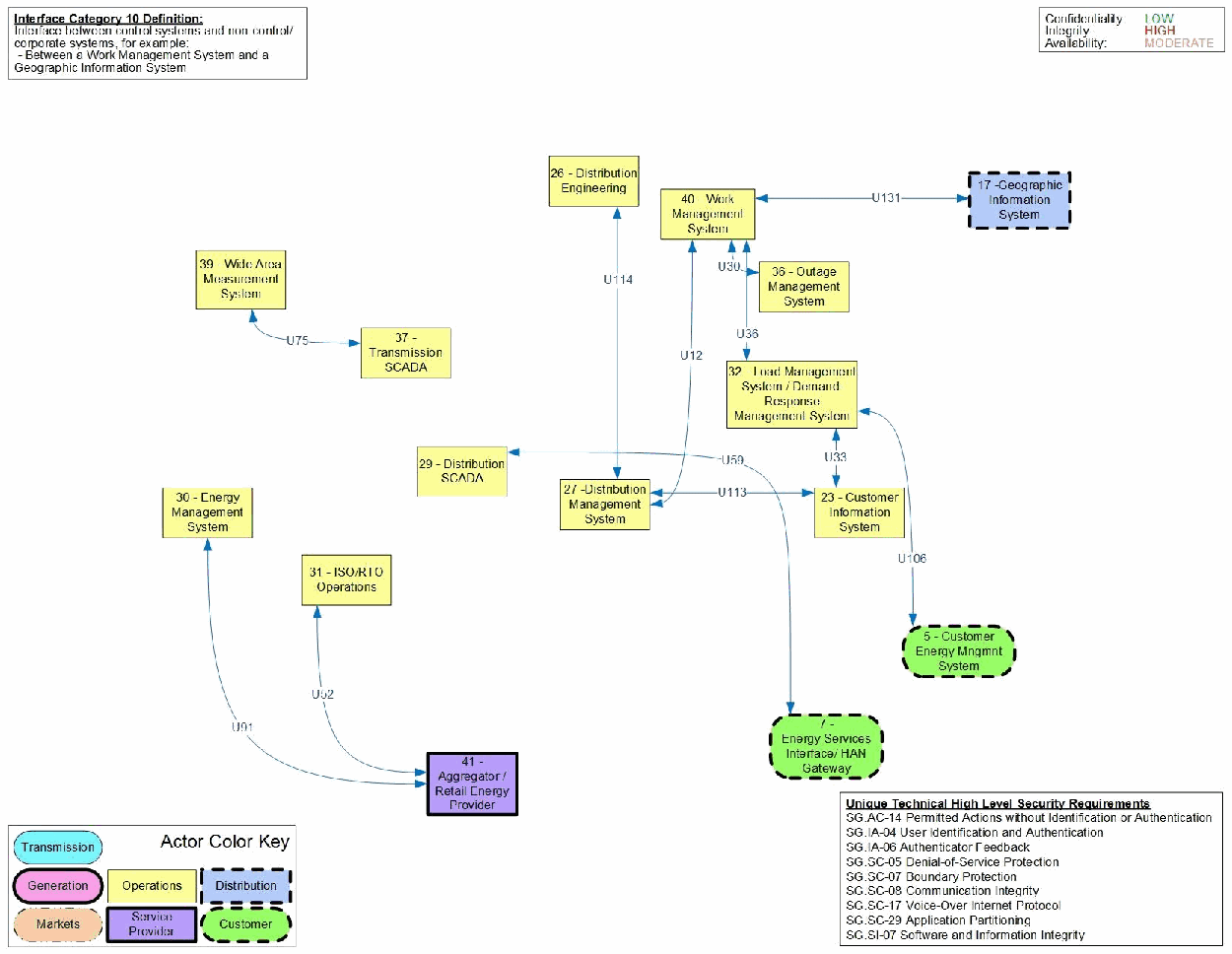
論理インターフェースカテゴリ10の図です。定義の枠: 制御システムと非制御系・企業系システムの間のインターフェース。例: 作業管理システムと地理情報システムの間。影響レベルの枠: 機密性 低、完全性 高、可用性 中。図中のアクター(アクターの色の凡例に示されたドメイン(送電、発電、市場、運用、サービスプロバイダー、配電、顧客)別に色分け): 26 配電エンジニアリング、40 作業管理システム、17 地理情報システム、39 広域計測システム、37 送電SCADA、36 停電管理システム、32 負荷管理システム/デマンドレスポンス管理システム、29 配電SCADA、27 配電管理システム、23 顧客情報システム、30 エネルギー管理システム、31 ISO/RTO運用、5 顧客エネルギー管理システム、7 エネルギーサービスインターフェース/HANゲートウェイ、41 アグリゲーター/小売エネルギー事業者。アクター間の矢印に付いた論理インターフェース: U131, U114, U30, U36, U12, U75, U59, U113, U33, U106, U91, U52。「固有の技術的ハイレベルセキュリティ要件」の枠: SG.AC-14(識別・認証なしで許可される操作)、SG.IA-04(利用者の識別と認証)、SG.IA-06(認証情報のフィードバック)、SG.SC-05(サービス妨害からの保護)、SG.SC-07(境界保護)、SG.SC-08(通信の完全性)、SG.SC-17(VoIP)、SG.SC-29(アプリケーションの区分)、SG.SI-07(ソフトウェアと情報の完全性)。
Figure 2-14 Logical Interface Category 10
図 2-14 論理インターフェースカテゴリ 10
2.3.7 Logical Interface Category 11: Interface between sensors and sensor networks for measuring environmental parameters, usually simple sensor devices with possibly analog measurements
2.3.7 論理インターフェースカテゴリ 11: 環境パラメーターを測定するセンサーとセンサーネットワークの間のインターフェース。通常はアナログ測定を行う場合もある単純なセンサーデバイス
Logical interface category 11 addresses the interfaces between sensors and sensor networks for measuring environmental parameters, usually simple sensor devices with possibly analog measurements, e.g., between a temperature sensor on a transformer and its receiver. These sensors are very limited in computational capability and often limited in communication bandwidth.
論理インターフェースカテゴリ 11 は、環境パラメーターを測定するセンサーとセンサーネットワークの間のインターフェースを扱います。通常は、アナログ測定を行う場合もある単純なセンサーデバイスで、たとえば変圧器の温度センサーとその受信機の間のインターフェースです。これらのセンサーは、計算能力が非常に限られており、通信帯域幅も限られていることが多いです。
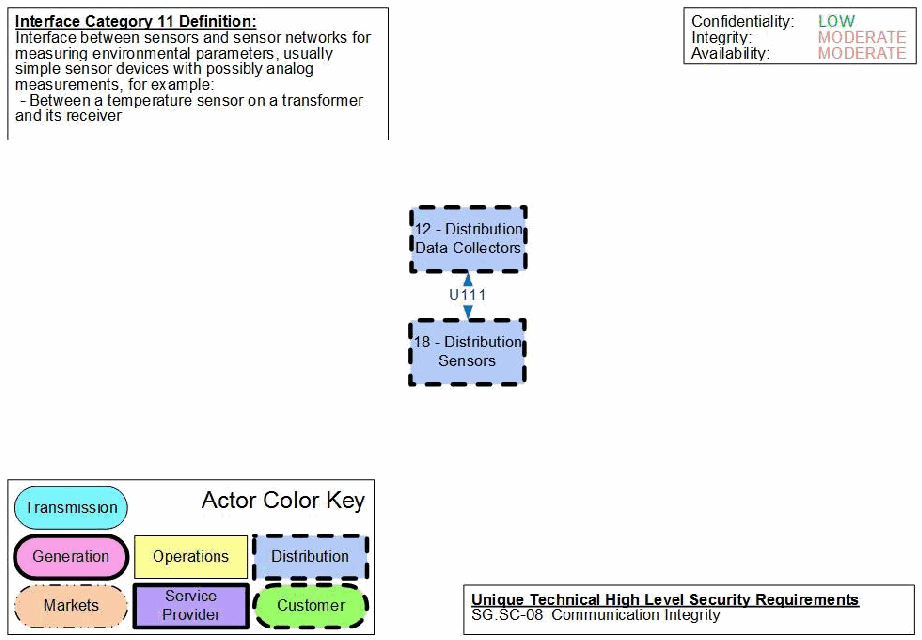
論理インターフェースカテゴリ11の図です。定義の枠: 環境パラメーターを計測するセンサーとセンサーネットワークの間のインターフェース(通常はアナログ計測を伴うこともある単純なセンサー機器)。例: 変圧器の温度センサーとその受信機の間。影響レベルの枠: 機密性 低、完全性 中、可用性 中。図中のアクター(アクターの色の凡例に示されたドメイン(送電、発電、市場、運用、サービスプロバイダー、配電、顧客)別に色分け): 12 配電データコレクター、18 配電センサー。アクター間の矢印に付いた論理インターフェース: U111。「固有の技術的ハイレベルセキュリティ要件」の枠: SG.SC-08(通信の完全性)。
Figure 2-15 Logical Interface Category 11
図 2-15 論理インターフェースカテゴリ 11
2.3.8 Logical Interface Category 12: Interface between sensor networks and control systems
2.3.8 論理インターフェースカテゴリ 12: センサーネットワークと制御システムの間のインターフェース
Logical interface category 12 addresses interfaces between sensor networks and control systems, e.g., between a sensor receiver and the substation master. These sensor receivers are usually limited in capabilities other than collecting sensor information.
論理インターフェースカテゴリ 12 は、センサーネットワークと制御システムの間のインターフェース(たとえば、センサー受信機と変電所マスターの間)を扱います。これらのセンサー受信機は、通常、センサー情報の収集以外の能力が限られています。
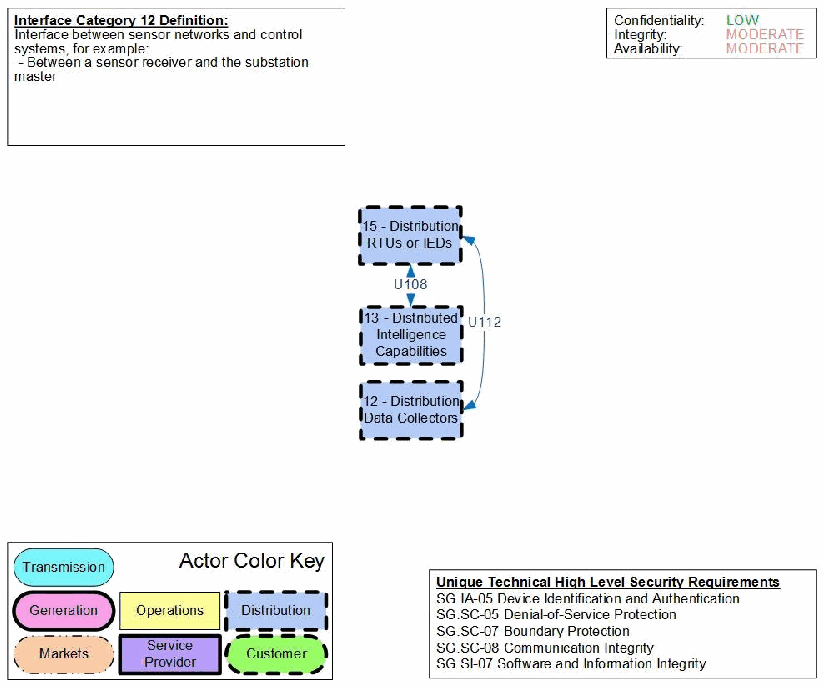
論理インターフェースカテゴリ12の図です。定義の枠: センサーネットワークと制御システムの間のインターフェース。例: センサーの受信機と変電所のマスターの間。影響レベルの枠: 機密性 低、完全性 中、可用性 中。図中のアクター(アクターの色の凡例に示されたドメイン(送電、発電、市場、運用、サービスプロバイダー、配電、顧客)別に色分け): 15 配電RTUまたはIED、13 分散インテリジェンス機能、12 配電データコレクター。アクター間の矢印に付いた論理インターフェース: U108, U112。「固有の技術的ハイレベルセキュリティ要件」の枠: SG.IA-05(デバイスの識別と認証)、SG.SC-05(サービス妨害からの保護)、SG.SC-07(境界保護)、SG.SC-08(通信の完全性)、SG.SI-07(ソフトウェアと情報の完全性)。
Figure 2-16 Logical Interface Category 12
図 2-16 論理インターフェースカテゴリ 12
2.3.9 Logical Interface Category 13: Interface between systems that use the AMI network
2.3.9 論理インターフェースカテゴリ 13: AMI ネットワークを使用するシステム間のインターフェース
Logical interface category 13 covers the interfaces between systems that use the AMI network, for example:
論理インターフェースカテゴリ 13 は、AMI ネットワークを使用するシステム間のインターフェースを対象とします。たとえば次のものです。
•Between MDMS and meters; and
•MDMS とメーターの間
•Between LMS/DRMS and Customer EMS.
•LMS/DRMS と顧客の EMS の間
The issues for this interface category include the following:
このインターフェースカテゴリの課題には、次のものがあります。
•Most information from the customer must be treated as confidential.
•顧客からの情報の大半は、機密として扱わなければなりません。
•Integrity of data is clearly important in general, but alternate means for retrieving and/or validating it can be used.
•データの完全性は一般に明らかに重要ですが、データを取得または検証するための代替手段を使用してもよいです。
•Availability is generally low across AMI networks, since they are not designed for real-time interactions or rapid request-response requirements.
•AMIネットワークは、リアルタイムのやり取りや迅速な要求・応答の要件を想定して設計されていないため、可用性は一般に低いです。
•Volume of traffic across AMI networks must be kept low to avoid DoS situations.
•DoS の状況を避けるため、AMI ネットワーク全体のトラフィック量を低く保たなければならない
•Meters are constrained in their computational capabilities, primarily to keep costs down, which may limit the types and layers of security that could be applied.
•メーターは、主にコストを抑えるために計算能力が制約されており、適用できるセキュリティの種類や層が限られる場合があります。
•Revenue-grade meters must be certified, so patches and upgrades require extensive testing and validation.
•取引用メーターは認証を受けなければならないため、パッチやアップグレードには広範な試験と検証が必要になります。
•Meshed wireless communication networks are often used, which can present challenges related to wireless availability as well as throughput and configurations.
•メッシュ型の無線通信ネットワークがよく使用され、無線の可用性のほか、スループットや構成に関する課題が生じる場合があります。
•Key management of millions of meters and other equipment will pose significant challenges that have not yet been addressed as standards.
•何百万ものメーターやその他の機器の鍵管理は、標準としてまだ対処されていない重大な課題となります。
•Remote disconnect could cause unauthorized outages.
•遠隔切断により、不正な停電が起こるおそれがあります。
•Due to the relatively new technologies used in AMI networks, communication protocols have not yet stabilized as accepted standards, nor have their capabilities been proven through rigorous testing.
•AMI ネットワークで使用される技術は比較的新しいため、通信プロトコルは、受け入れられた標準としてまだ安定しておらず、その能力も厳密な試験で実証されていません。
•AMI networks connect a utility, which has corporate security requirements, with customers, that have no or limited security capabilities or understandings.
•AMI ネットワークは、企業としてのセキュリティ要件を持つ電力事業者と、セキュリティ能力や理解がない、または限られている顧客とを接続します。
•Utility-owned meters are in unsecured locations that are not under utility control, limiting physical security.
•電力事業者所有のメーターは、電力事業者の管理下にない保護されていない場所にあるため、物理的セキュリティが制限されます。
•Many possible future interactions across the AMI network are still being designed, are just being speculated about, or have not yet been conceived.
•AMI ネットワークにおける将来のやり取りの多くは、まだ設計中であるか、推測されているにすぎないか、まだ考案されていません。
•Customer reactions to AMI systems and capabilities are as yet unknown.
•AMI システムとその機能に対する顧客の反応は、まだわかっていません。
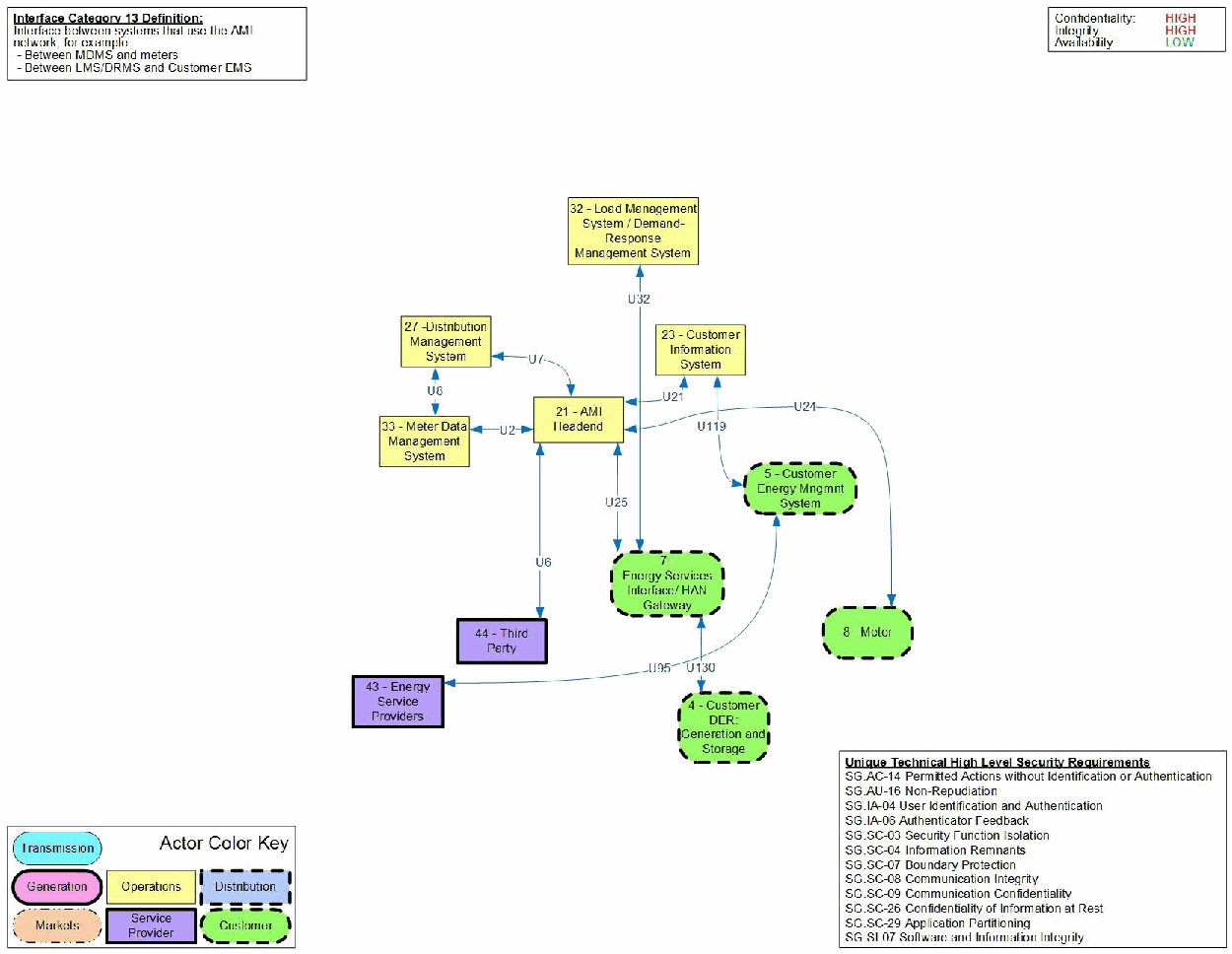
論理インターフェースカテゴリ13の図です。定義の枠: AMIネットワークを使うシステム間のインターフェース。例: MDMSとメーターの間、LMS/DRMSと顧客EMSの間。影響レベルの枠: 機密性 高、完全性 高、可用性 低。図中のアクター(アクターの色の凡例にあるドメイン〔送電、発電、市場、運用、サービスプロバイダー、配電、顧客〕別に色分け): 32 負荷管理システム/デマンドレスポンス管理システム、27 配電管理システム、23 顧客情報システム、33 メーターデータ管理システム、21 AMIヘッドエンド、5 顧客エネルギー管理システム、7 エネルギーサービスインターフェース/HANゲートウェイ、44 第三者、8 メーター、43 エネルギーサービスプロバイダー、4 顧客DER(発電・蓄電)。アクター間の矢印に付いた論理インターフェース: U32, U7, U8, U21, U2, U24, U119, U25, U6, U95, U130。「固有の技術的ハイレベルセキュリティ要件」の枠: SG.AC-14(識別・認証なしで許可される操作)、SG.AU-16(否認防止)、SG.IA-04(利用者の識別と認証)、SG.IA-06(認証情報のフィードバック)、SG.SC-03(セキュリティ機能の分離)、SG.SC-04(残存情報)、SG.SC-07(境界保護)、SG.SC-08(通信の完全性)、SG.SC-09(通信の機密性)、SG.SC-26(保存情報の機密性)、SG.SC-29(アプリケーションの区分)、SG.SI-07(ソフトウェアと情報の完全性)。
Figure 2-17 Logical Interface Category 13
図 2-17 論理インターフェースカテゴリ 13
2.3.10 Logical Interface Category 14: Interface between systems that use the AMI network for functions that require high availability
2.3.10 論理インターフェースカテゴリ 14: 高い可用性を必要とする機能のために AMI ネットワークを使用するシステム間のインターフェース
Logical interface category 14 covers the interfaces between systems that use the AMI network with high availability, for example:
論理インターフェースカテゴリ 14 は、高い可用性を持つ、AMI ネットワークを使用するシステム間のインターフェースを対象とします。たとえば次のものです。
•Between LMS/DRMS and customer DER;
•LMS/DRMS と顧客の DER の間
•Between DMS applications and customer DER; and
•DMS アプリケーションと顧客の DER の間
•Between DMS applications and distribution automation (DA) field equipment.
•DMS アプリケーションと配電自動化(DA)の現場機器の間
Although both logical interface categories 13 and 14 use the AMI network to connect to field sites, the issues for logical interface category 14 differ from those of 13, because the interactions are focused on power operations of DER and DA equipment. Therefore the issues include the following:
論理インターフェースカテゴリ 13 と 14 はいずれも、AMI ネットワークを使用して現場サイトに接続しますが、論理インターフェースカテゴリ 14 では、やり取りが DER および DA 機器の電力運用に重点を置いているため、論理インターフェースカテゴリ 13 とは課題が異なります。したがって、課題には次のものがあります。
•Although some information from the customer should be treated as confidential, most of the power system operational information does not need to be confidential.
•顧客からの情報の一部は機密として扱うべきですが、電力システムの運用情報の大半は機密にする必要がありません。
•Integrity of data is very important, since it can affect the reliability and/or efficiency of the power system.
•データの完全性は、電力システムの信頼性または効率、あるいはその両方に影響する可能性があるため、非常に重要です。
•Availability will need to be a higher requirement for those parts of the AMI networks that will be used for real-time interactions and/or rapid request-response requirements.
•AMI ネットワークのうち、リアルタイムのやり取りや迅速な要求・応答の要件に使用される部分では、より高い可用性が求められます。
•Volume of traffic across AMI networks will still need to be kept low to avoid DoS situations.
•DoS の状況を避けるため、AMI ネットワーク全体のトラフィック量は、引き続き低く保つ必要があります。
•Meshed wireless communication networks are often used, which can present challenges related to wireless availability as well as throughput and configurations.
•メッシュ型の無線通信ネットワークがよく使用され、無線の可用性のほか、スループットや構成に関する課題が生じる場合があります。
•Key management of large numbers of DER and DA equipment deployments will pose significant challenges that have not yet been addressed as standards.
•多数の DER および DA 機器の導入に伴う鍵管理は、標準としてまだ対処されていない重大な課題となります。
•Remote disconnect could cause unauthorized outages.
•遠隔切断により、不正な停電が起こるおそれがあります。
•Due to the relatively new technologies used in AMI networks, communication protocols have not yet stabilized as accepted standards, nor have their capabilities been proven through rigorous testing. This is particularly true for protocols used for DER and DA interactions.
•AMI ネットワークで使用される技術は比較的新しいため、通信プロトコルは、受け入れられた標準としてまだ確立されておらず、その能力も厳密な試験で実証されていません。これは特に、DER と DA のやり取りに使用されるプロトコルに当てはまります。
•AMI networks connect a utility, which has corporate security requirements, with customers, that have no or limited security capabilities or understandings. Therefore, maintaining the level of security needed for DER interactions will be challenging.
•AMI ネットワークは、企業としてのセキュリティ要件を持つ電力事業者と、セキュリティ能力や理解がない、または限られている顧客とを接続します。したがって、DER のやり取りに必要なセキュリティレベルを維持することは困難になります。
•DER equipment, and to some degree DA equipment, is found in unsecured locations that are not under utility control, limiting physical security.
•DER 機器、そしてある程度は DA 機器も、電力事業者の管理下にない保護されていない場所にあるため、物理的セキュリティが制限されます。
•Many possible future interactions across the AMI network are still being designed, are just being speculated about, or have not yet been conceived. These could impact the security of the interactions with DER and DA equipment.
•AMI ネットワークにおける将来のやり取りの多くは、まだ設計中であるか、推測されているにすぎないか、まだ考案されていません。これらは、DER および DA 機器とのやり取りのセキュリティに影響する可能性があります。
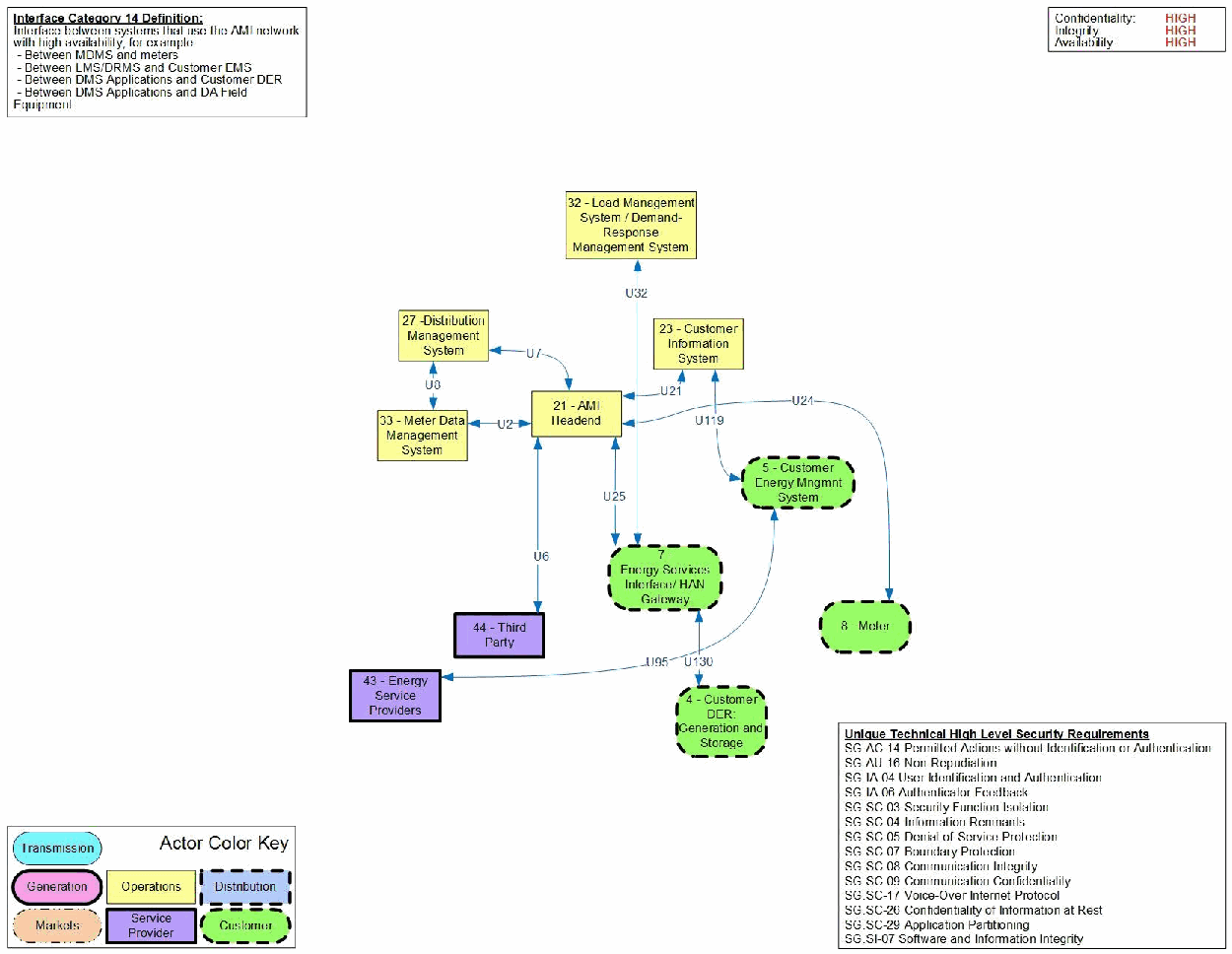
論理インターフェースカテゴリ14の図です。枠『インターフェースカテゴリ14の定義: 高可用性のAMIネットワークを使用するシステム間のインターフェース。例: MDMSとメーターの間、LMS/DRMSと顧客EMSの間、DMSアプリケーションと顧客DERの間、DMSアプリケーションとDA現場機器の間』。影響レベル: 機密性 高、完全性 高、可用性 高。図中のアクター(アクターの色の凡例にあるドメイン〔送電、発電、市場、運用、サービスプロバイダー、配電、顧客〕別に色分け): 32 負荷管理システム/デマンドレスポンス管理システム、27 配電管理システム、23 顧客情報システム、33 メーターデータ管理システム、21 AMIヘッドエンド、5 顧客エネルギー管理システム、7 エネルギーサービスインターフェース/HANゲートウェイ、44 第三者、8 メーター、43 エネルギーサービスプロバイダー、4 顧客DER(発電・蓄電)。アクター間の矢印に付いた論理インターフェース: U32, U7, U8, U21, U2, U24, U119, U25, U6, U95, U130。枠『Unique Technical High Level Security Requirements』: SG.AC-14 Permitted Actions without Identification or Authentication; SG.AU-16 Non-Repudiation; SG.IA-04 User Identification and Authentication; SG.IA-06 Authenticator Feedback; SG.SC-03 Security Function Isolation; SG.SC-04 Information Remnants; SG.SC-05 Denial-of-Service Protection; SG.SC-07 Boundary Protection; SG.SC-08 Communication Integrity; SG.SC-09 Communication Confidentiality; SG.SC-17 Voice-Over Internet Protocol; SG.SC-26 Confidentiality of Information at Rest; SG.SC-29 Application Partitioning; SG.SI-07 Software and Information Integrity。
Figure 2-18 Logical Interface Category 14
図 2-18 論理インターフェースカテゴリ 14
2.3.11 Logical Interface Category 15: Interface between systems that use customer (residential, commercial, and industrial) site networks such as HANs and BANs
2.3.11 論理インターフェースカテゴリ 15: HAN や BAN などの顧客(住宅、商業、産業)のサイトネットワークを使用するシステム間のインターフェース
Logical interface category 15 covers the interface between systems that use customer (residential, commercial, and industrial) site networks such as home area networks, building/business area networks, and neighborhood area networks (NANs), for example:
論理インターフェースカテゴリ 15 は、ホームエリアネットワーク、ビル・ビジネスエリアネットワーク、ネイバーフッドエリアネットワーク(NAN)などの顧客(住宅、商業、産業)のサイトネットワークを使用するシステム間のインターフェースを対象とします。たとえば次のものです。
•Between customer EMS and customer appliances;
•顧客の EMS と顧客の電気製品の間
•Between customer EMS and customer DER equipment; and
•顧客の EMS と顧客の DER 機器の間
•Between an energy services interface (ESI) and PEVs.
•エネルギーサービスインターフェース(ESI)と PEV の間
The security-related issues for this intra-customer site environment HAN/BAN/NAN interface category include the following:
この、顧客サイト内環境の HAN/BAN/NAN インターフェースカテゴリに関するセキュリティ上の課題には、次のものがあります。
•Some information exchanged among different appliances and systems must be treated as confidential to ensure that an unauthorized third party does not gain access to it. For instance, energy usage statistics from the customer site that are sent through the ESI/HAN gateway must be kept confidential.
•さまざまな電気製品とシステムの間で交換される情報の一部は、不正な第三者がアクセスできないよう、機密として扱わなければなりません。たとえば、ESI/HAN ゲートウェイを通じて送られる、顧客サイトからのエネルギー使用量の統計は、機密に保たなければなりません。
•Integrity of data is clearly important in general, but since so many different types of interactions are taking place, the integrity requirements will need to be specific to the particular application.
•データの完全性は一般に明らかに重要ですが、非常に多くの種類のやり取りが行われているため、完全性要件は個々のアプリケーションに固有のものとする必要があります。
•Availability is generally moderate across HANs since most interactions are not needed in real time. Even DER generation and storage devices have their own integrated controllers, which are normally expected to run independently of any direct monitoring and control and must have “default” modes of operation to avoid any power system problems.
•やり取りの大半はリアルタイムでは必要ないため、HAN 全体の可用性は一般に中程度です。DER の発電・蓄電デバイスでさえ、それぞれ統合されたコントローラーを持ち、これらは通常、直接の監視や制御から独立して動作すると想定されており、電力システムの問題を避けるために「デフォルト」の動作モードを備えていなければなりません。
•Bandwidth is not generally a concern, since most HAN media will be local wireless (e.g., Wi-Fi, ZigBee, Bluetooth) or power line (e.g., HomePlug). The latter may be somewhat bandwidth-limited but can always be replaced by cable or wireless if greater bandwidth is needed.
•HAN の媒体の大半は、ローカル無線(たとえば Wi-Fi、ZigBee、Bluetooth)または電力線(たとえば HomePlug)であるため、帯域幅は一般に問題になりません。後者はある程度帯域幅が制限される場合がありますが、より大きな帯域幅が必要であれば、いつでもケーブルまたは無線に置き換えられます。
•Some HAN devices are constrained in their compute capabilities, primarily to keep costs down, which may limit the types and layers of security that could be applied.
•HAN デバイスの一部は、主にコストを抑えるために計算能力が制約されており、適用できるセキュリティの種類や層が限られる場合がある
•Wireless communication networks are expected to be used within the HAN, which could present some challenges related to wireless configuration and security, because most HANs will not have security experts managing these systems. For instance, if available security measures are not properly set, the HAN security could be compromised by any one of the internal devices, as well as by external entities searching for these insecure HANs.
•HAN 内では無線通信ネットワークが使用されると想定されており、HAN の大半ではこれらのシステムを管理するセキュリティの専門家がいないため、無線の構成とセキュリティに関する課題が生じる場合があります。たとえば、利用可能なセキュリティ対策が適切に設定されていないと、これらの安全でない HAN を探している外部のエンティティだけでなく、内部のデバイスのいずれによっても、HAN のセキュリティが危殆化するおそれがある
•Key management of millions of devices within millions of HANs will pose significant challenges that have not yet been addressed as standards.
•何百万もの HAN 内の何百万ものデバイスの鍵管理は、標準としてはまだ対処されていない重大な課題をもたらす
•Due to the relatively new technologies used in HANs, communication protocols have not yet stabilized as accepted standards, nor have their capabilities been proven through rigorous testing.
•HAN で使用される技術は比較的新しいため、通信プロトコルは、受け入れられた標準としてまだ安定しておらず、その能力も厳密な試験で実証されていない
•HANs will be accessible by many different vendors and organizations with unknown corporate security requirements and equally variable degrees and types of security solutions. Even if one particular interaction is “secure,” in aggregate the multiplicity of interactions may not be secure.
•HAN は、企業としてのセキュリティ要件が不明で、セキュリティソリューションの程度と種類も同様にまちまちな、多くのさまざまなベンダーや組織からアクセスされます。ある特定のやり取りが「安全」であっても、全体として見ると、多数のやり取りは安全ではない場合がある
•Some HAN devices may be in unsecured locations, thus limiting physical security. Even those presumably “physically secure” within a home are vulnerable to inadvertent situations such as poor maintenance and misuse, as well as break-ins and theft.
•HAN デバイスの一部は保護されていない場所にある場合があり、そのため物理的セキュリティが制限されます。家庭内で「物理的に安全」とされているものであっても、不適切な保守や誤用といった意図しない状況や、侵入や盗難に対して脆弱である
•Many possible future interactions within the HAN environment are still being designed, are just being speculated about, or have not yet been conceived.
•HAN 環境における将来のやり取りの多くは、まだ設計中であるか、推測されているにすぎないか、まだ考案されていない
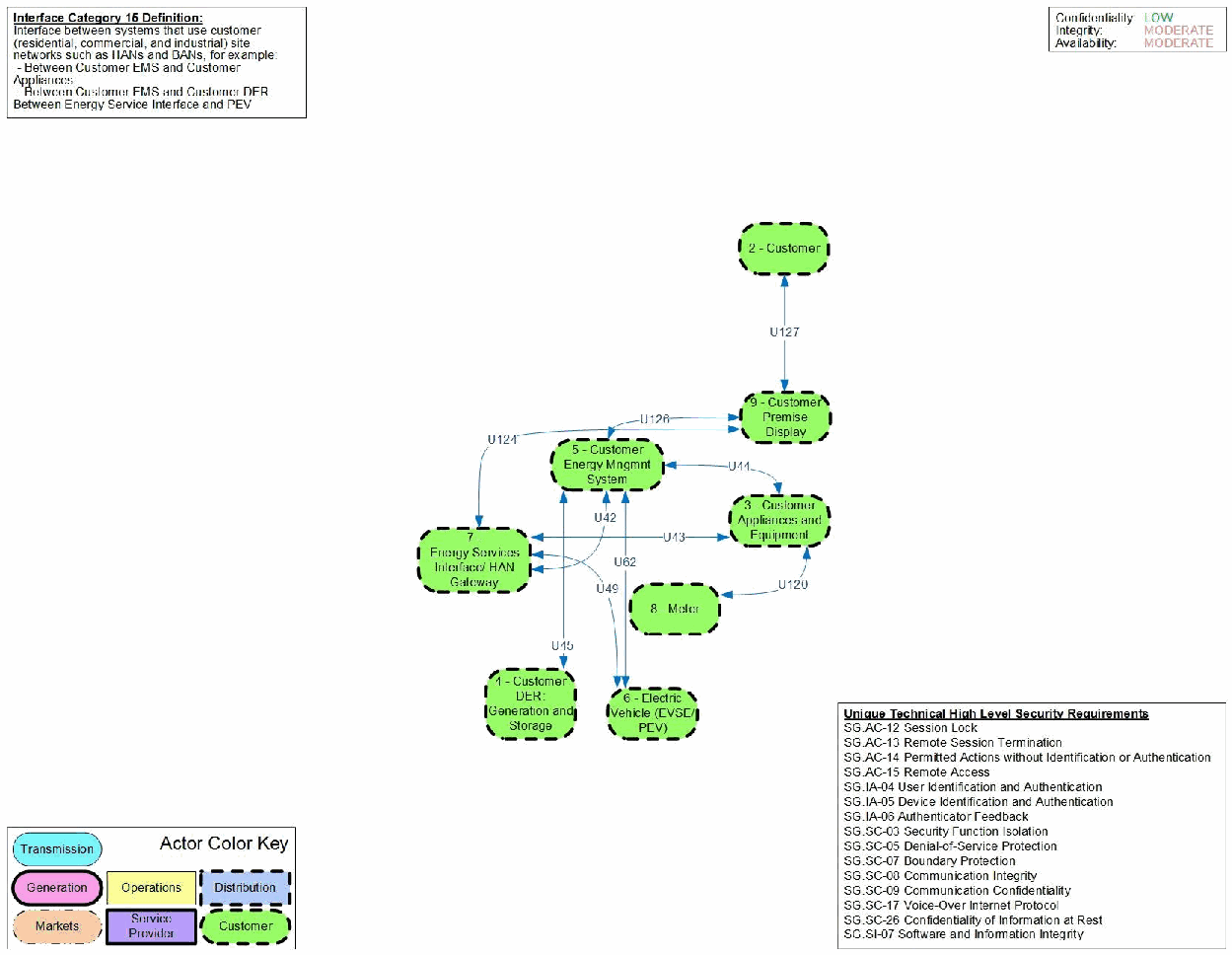
論理インターフェースカテゴリ15の図です。枠『インターフェースカテゴリ15の定義: HANやBANなど、顧客(住宅、商業、産業)のサイトネットワークを使うシステム間のインターフェース。例: 顧客EMSと顧客家電の間、顧客EMSと顧客DERの間、エネルギーサービスインターフェースとPEVの間』。影響レベル: 機密性 低、完全性 中、可用性 中。図中のアクター(アクターの色の凡例にあるドメイン〔送電、発電、市場、運用、サービスプロバイダー、配電、顧客〕別に色分け): 2 顧客、9 顧客宅内ディスプレイ、5 顧客エネルギー管理システム、3 顧客家電・機器、7 エネルギーサービスインターフェース/HANゲートウェイ、8 メーター、4 顧客DER(発電・蓄電)、6 電気自動車(EVSE/PEV)。アクター間の矢印に付いた論理インターフェース: U127, U126, U124, U44, U42, U43, U62, U49, U120, U45。枠『Unique Technical High Level Security Requirements』: SG.AC-12 Session Lock; SG.AC-13 Remote Session Termination; SG.AC-14 Permitted Actions without Identification or Authentication; SG.AC-15 Remote Access; SG.IA-04 User Identification and Authentication; SG.IA-05 Device Identification and Authentication; SG.IA-06 Authenticator Feedback; SG.SC-03 Security Function Isolation; SG.SC-05 Denial-of-Service Protection; SG.SC-07 Boundary Protection; SG.SC-08 Communication Integrity; SG.SC-09 Communication Confidentiality; SG.SC-17 Voice-Over Internet Protocol; SG.SC-26 Confidentiality of Information at Rest; SG.SI-07 Software and Information Integrity。
Figure 2-19 Logical Interface Category 15
図 2-19 論理インターフェースカテゴリ 15
2.3.12 Logical Interface Category 16: Interface between external systems and the customer site
2.3.12 論理インターフェースカテゴリ 16: 外部システムと顧客サイトの間のインターフェース
Logical interface category 16 covers the interface between external systems and the customer site, for example:
論理インターフェースカテゴリ 16 は、外部システムと顧客サイトの間のインターフェースを対象とします。たとえば次のものです。
•Between a third party and the HAN gateway;
•第三者と HAN ゲートウェイの間
•Between ESP and DER; and
•ESP と DER の間
•Between the customer and CIS web site.
•顧客と CIS のウェブサイトの間
The security-related issues for this external interface to the customer site include the following:
顧客サイトへのこの外部インターフェースに関するセキュリティ上の課題には、次のものがあります。
•Some information exchanged among different appliances and systems should be treated as confidential and private to ensure that an unauthorized third party does not gain access to it. For instance, energy usage statistics from the customer site that are sent through the ESI/HAN gateway should be kept confidential.
•さまざまな電気製品とシステムの間で交換される情報の一部は、不正な第三者がアクセスできないよう、機密かつプライベートなものとして扱うべきです。たとえば、ESI/HAN ゲートウェイを通じて送られる、顧客サイトからのエネルギー使用量の統計は、機密に保つべきである
•Integrity of data is clearly important in general, but since so many different types of interactions are taking place, the integrity requirements will need to be specific to the particular application.
•データの完全性は一般に明らかに重要だが、非常に多くの種類のやり取りが行われているため、完全性要件は個々のアプリケーションに固有のものとする必要がある
•Availability is generally not critical between external parties and the customer site since most interactions are not related to power system operations nor are they needed in real time. Even DER generation and storage devices have their own integrated controllers that are normally expected to run independently of any direct monitoring and control, and should have “default” modes of operation to avoid any power system problems.
•やり取りの大半は電力システムの運用に関係せず、リアルタイムでも必要ないため、外部の関係者と顧客サイトの間の可用性は、一般に重要ではありません。DER の発電・蓄電デバイスでさえ、それぞれ統合されたコントローラーを持ち、これらは通常、直接の監視や制御から独立して動作すると想定されており、電力システムの問題を避けるために「デフォルト」の動作モードを備えるべきです。
•Bandwidth is not generally a concern, since higher-speed media can be used if a function requires a higher volume of data traffic. Many different types of media, particularly public media, are increasingly available, including the public Internet over cable or digital subscriber line (DSL), campus or corporate intranets, cell phone general packet radio service (GPRS), and neighborhood WiMAX and Wi-Fi systems.
•機能がより大量のデータトラフィックを必要とする場合は、より高速な媒体を使用できるため、帯域幅は一般に問題になりません。ケーブルやデジタル加入者線(DSL)経由の公衆インターネット、キャンパスや企業のイントラネット、携帯電話の汎用パケット無線サービス(GPRS)、地域の WiMAX や Wi-Fi システムなど、特に公共の媒体を含む多くの種類の媒体が、ますます利用できるようになっている
•Some customer devices that contain their own “HAN gateway” firewall are constrained in their computational capabilities, primarily to keep costs down, which may limit the types and layers of security which could be applied with those devices.
•独自の「HAN ゲートウェイ」ファイアウォールを備える顧客デバイスの一部は、主にコストを抑えるために計算能力が制約されており、それらのデバイスで適用できるセキュリティの種類や層が限られる場合がある
•Other than those used over the public Internet, communication protocols between third parties and ESI/HAN gateways have not yet stabilized as accepted standards, nor have their capabilities been proven through rigorous testing.
•公衆インターネット上で使用されるものを除き、第三者と ESI/HAN ゲートウェイの間の通信プロトコルは、受け入れられた標準としてまだ安定しておらず、その能力も厳密な試験で実証されていない
•ESI/HAN gateways will be accessible by many different vendors and organizations with unknown corporate security requirements and equally variable degrees and types of security solutions. Even if one particular interaction is “secure,” in aggregate the multiplicity of interactions may not be secure.
•ESI/HAN ゲートウェイは、企業としてのセキュリティ要件が不明で、セキュリティソリューションの程度と種類も同様にまちまちな、多くのさまざまなベンダーや組織からアクセスされます。ある特定のやり取りが「安全」であっても、全体として見ると、多数のやり取りは安全ではない場合がある
•ESI/HAN gateways may be in unsecured locations, thus limiting physical security. Even those presumably “physically secure” within a home are vulnerable to inadvertent situations such as poor maintenance and misuse, as well as break-ins and theft.
•ESI/HAN ゲートウェイは保護されていない場所にある場合があり、そのため物理的セキュリティが制限されます。家庭内で「物理的に安全」とされているものであっても、不適切な保守や誤用といった意図しない状況や、侵入や盗難に対して脆弱である
•Many possible future interactions within the HAN environment are still being designed, are just being speculated about, or have not yet been conceived, leading to many possible but unknown security issues.
•HAN 環境における将来のやり取りの多くは、まだ設計中であるか、推測されているにすぎないか、まだ考案されていないため、多くの起こりうるが未知のセキュリティ上の問題につながる
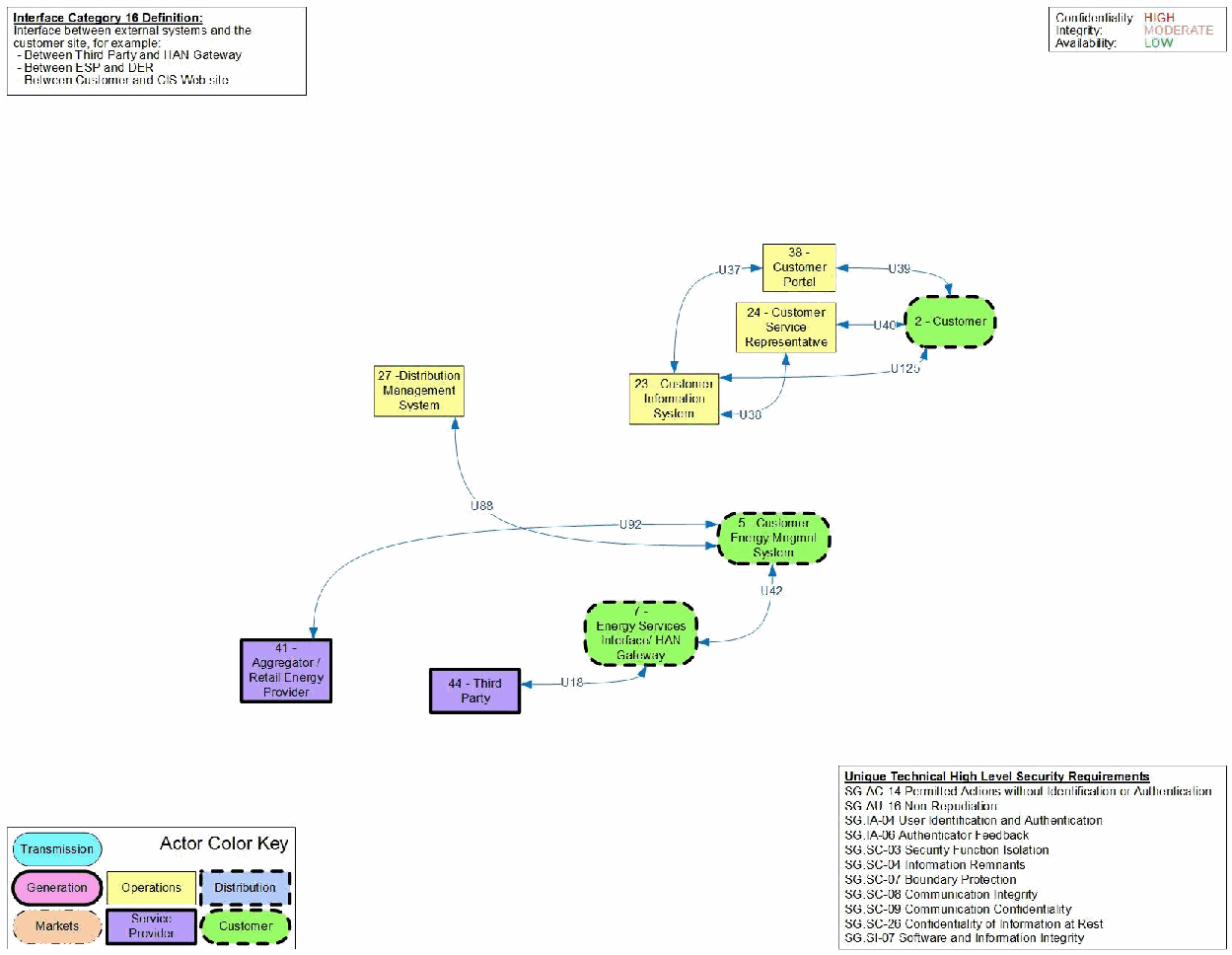
論理インターフェースカテゴリ16の図です。枠『インターフェースカテゴリ16の定義: 外部システムと顧客サイトの間のインターフェース。例: 第三者とHANゲートウェイの間、ESPとDERの間、顧客とCIS Webサイトの間』。影響レベル: 機密性 高、完全性 中、可用性 低。図中のアクター(アクターの色の凡例にあるドメイン〔送電、発電、市場、運用、サービスプロバイダー、配電、顧客〕別に色分け): 38 顧客ポータル、24 顧客サービス担当者、2 顧客、23 顧客情報システム、27 配電管理システム、5 顧客エネルギー管理システム、7 エネルギーサービスインターフェース/HANゲートウェイ、41 アグリゲーター/小売エネルギー事業者、44 第三者。アクター間の矢印に付いた論理インターフェース: U37, U39, U40, U125, U38, U88, U92, U42, U18。枠『Unique Technical High Level Security Requirements』: SG.AC-14 Permitted Actions without Identification or Authentication; SG.AU-16 Non-Repudiation; SG.IA-04 User Identification and Authentication; SG.IA-06 Authenticator Feedback; SG.SC-03 Security Function Isolation; SG.SC-04 Information Remnants; SG.SC-07 Boundary Protection; SG.SC-08 Communication Integrity; SG.SC-09 Communication Confidentiality; SG.SC-26 Confidentiality of Information at Rest; SG.SI-07 Software and Information Integrity。
Figure 2-20 Logical Interface Category 16
図 2-20 論理インターフェースカテゴリ 16
2.3.13 Logical Interface Category 17: Interface between systems and mobile field crew laptops/equipment
2.3.13 論理インターフェースカテゴリ 17: システムと、移動する現場作業員のノート PC・機器の間のインターフェース
Logical interface category 17 covers the interfaces between systems and mobile field crew laptops/equipment, for example:
論理インターフェースカテゴリ 17 は、システムと、移動する現場作業員のノート PC・機器の間のインターフェースを対象とします。たとえば次のものです。
•Between field crews and a GIS;
•現場作業員と GIS の間
•Between field crews and CIS;
•現場作業員と CIS の間
•Between field crews and substation equipment;
•現場作業員と変電所機器の間
•Between field crews and OMS;
•現場作業員と OMS の間
•Between field crews and WMS; and
•現場作業員と WMS の間
•Between field crews and corporate marketing systems.
•現場作業員と企業のマーケティングシステムの間
As with all other logical interface categories, only the interface security requirements are addressed, not the inherent vulnerabilities of the end equipment such as the laptops or other mobile devices (such as smart phones or tablets) used by the field crew.
ほかのすべての論理インターフェースカテゴリと同様に、ここで扱うのはインターフェースのセキュリティ要件のみであり、現場作業員が使用するノート PC やそのほかのモバイルデバイス(スマートフォンやタブレットなど)といった末端機器そのものに固有の脆弱性は扱いません。
The main activities performed on this interface include:
このインターフェースで行われる主な活動には、次のものがあります。
•Retrieving maps and/or equipment location information from GIS;
•GIS からの地図、機器の位置情報、またはその両方の取得
•Retrieving customer information from CIS;
•CIS からの顧客情報の取得
•Providing equipment and customer updates, such as meter, payment, and customer information updates to CIS;
•CIS への、メーター、支払い、顧客情報の更新などの、機器および顧客の更新の提供
•Obtaining and providing substation equipment information, such as location, fault, testing, and maintenance updates;
•位置、障害、試験、保守の更新などの、変電所機器情報の取得と提供
•Obtaining outage information and providing restoration information, including equipment, materials, and resource information from/to OMS;
•OMS からの停電情報の取得、および OMS への機器、資材、資源の情報を含む復旧情報の提供
•Obtaining project and equipment information and providing project, equipment, materials, resource, and location updates from/to WMS;
•WMS からのプロジェクトおよび機器情報の取得、および WMS へのプロジェクト、機器、資材、資源、位置の更新の提供
•Obtaining metering and outage/restoration verification information from AMI systems; and
•AMI システムからの計量情報および停電・復旧の確認情報の取得、および
•Dynamic discovery of markets, dynamic entry into markets, and dynamic exit from markets.
•市場の動的な探索、市場への動的な参入、市場からの動的な退出
The key characteristics of this interface category are as follows:
このインターフェースカテゴリの主な特性は次のとおりです。
•This interface is primarily for customer-side service operations. The most critical needs for this interface are
•このインターフェースは、主に顧客側のサービス運用のためのものです。このインターフェースで最も重要なニーズは
•To post restoration information back to the OMS for prediction of further outage situations; and
•以後の停電状況を予測するために、復旧情報を OMS に書き戻すこと、および
•To receive reconnection information for customers who have been disconnected.
•切断された顧客の再接続情報を受け取ること
•Information exchanged between these systems is typically corporate-owned, and security is managed within the utility between the interfacing applications. Increased use of wireless technologies and external service providers adds a layer of complexity in security requirements that is addressed in all areas where multivendor services are interfaced with utility systems.
•これらのシステム間で交換される情報は、通常、企業が所有しており、セキュリティはインターフェースするアプリケーション間で電力事業者内で管理されます。無線技術や外部サービスプロバイダーの利用が増えると、セキュリティ要件に複雑さが加わりますが、これは、マルチベンダーのサービスが電力事業者のシステムとインターフェースするすべての領域で対処されます。
•Integrity of data is clearly important in general, but since so many different types of interactions are taking place, the integrity requirements will need to be specific to the particular application. However, the integrity of revenue-grade metering data that may be collected in this manner is vital since it has a direct financial impact on all stakeholders of the loads and generation being metered.
•データの完全性は一般に明らかに重要ですが、非常に多くの種類のやり取りが行われているため、完全性要件は個々のアプリケーションに固有のものとする必要があります。ただし、この方法で収集される可能性のある取引用の計量データの完全性は、計量される負荷および発電のすべての利害関係者に直接的な金銭的影響を及ぼすため、不可欠です。
•Availability is generally not critical, as interactions are not necessary for real time. Exceptions include payment information for disconnects, restoration operations, and efficiency of resource management.
•やり取りはリアルタイムでは必要ないため、可用性は一般に重要ではありません。例外として、切断のための支払い情報、復旧作業、資源管理の効率があります。
•Bandwidth is not generally a concern, as most utilities have sized their communications infrastructure to meet the needs of the field applications, and most field applications have been designed for minimal transmission of data in wireless mode. However, more and more applications are being given to field crews to enhance customer service opportunities and for tracking and reporting of construction, maintenance, and outage restoration efforts. This will increase the amount of data and interaction between the corporate systems, third party providers, and the field crews.
•ほとんどの電力事業者は、現場アプリケーションのニーズを満たすよう通信インフラストラクチャの規模を決めており、ほとんどの現場アプリケーションは、無線モードでのデータ送信を最小限に抑えるよう設計されているため、帯域幅は一般に問題になりません。しかし、顧客サービスの機会を高め、建設、保守、停電復旧の取り組みを追跡・報告するために、現場作業員に提供されるアプリケーションはますます増えています。これにより、企業システム、第三者プロバイダー、現場作業員の間のデータ量とやり取りが増加します。
•Data held on laptops and other mobile devices is vulnerable to physical theft due to the inherent nature of mobile equipment, but those physical security issues will not be addressed in this section. In addition, most mobile field applications are designed to transmit data as it is input, and therefore data is not transmitted when the volume of data is too large to transmit over a wireless connection or when the area does not have wireless coverage. In such cases, data is maintained on the laptop/mobile device until it is reconnected to a physical network.
•ノート PC やそのほかのモバイルデバイスに保存されたデータは、モバイル機器の本来の性質により、物理的な盗難に対して脆弱ですが、そうした物理的セキュリティの問題は本節では扱いません。加えて、モバイルの現場アプリケーションの大半は、データを入力されたときに送信するよう設計されているため、データ量が無線接続で送信するには大きすぎる場合や、その地域が無線の圏外である場合には、データは送信されません。そのような場合、データは、物理ネットワークに再接続されるまで、ノート PC・モバイルデバイスに保持されます。
•Note: Data that is captured (e.g., metering data, local device passwords, security parameters) should be protected at the appropriate level.
•注: 取得されたデータ(たとえば、計量データ、ローカルデバイスのパスワード、セキュリティパラメーター)は、適切なレベルで保護すべきです。
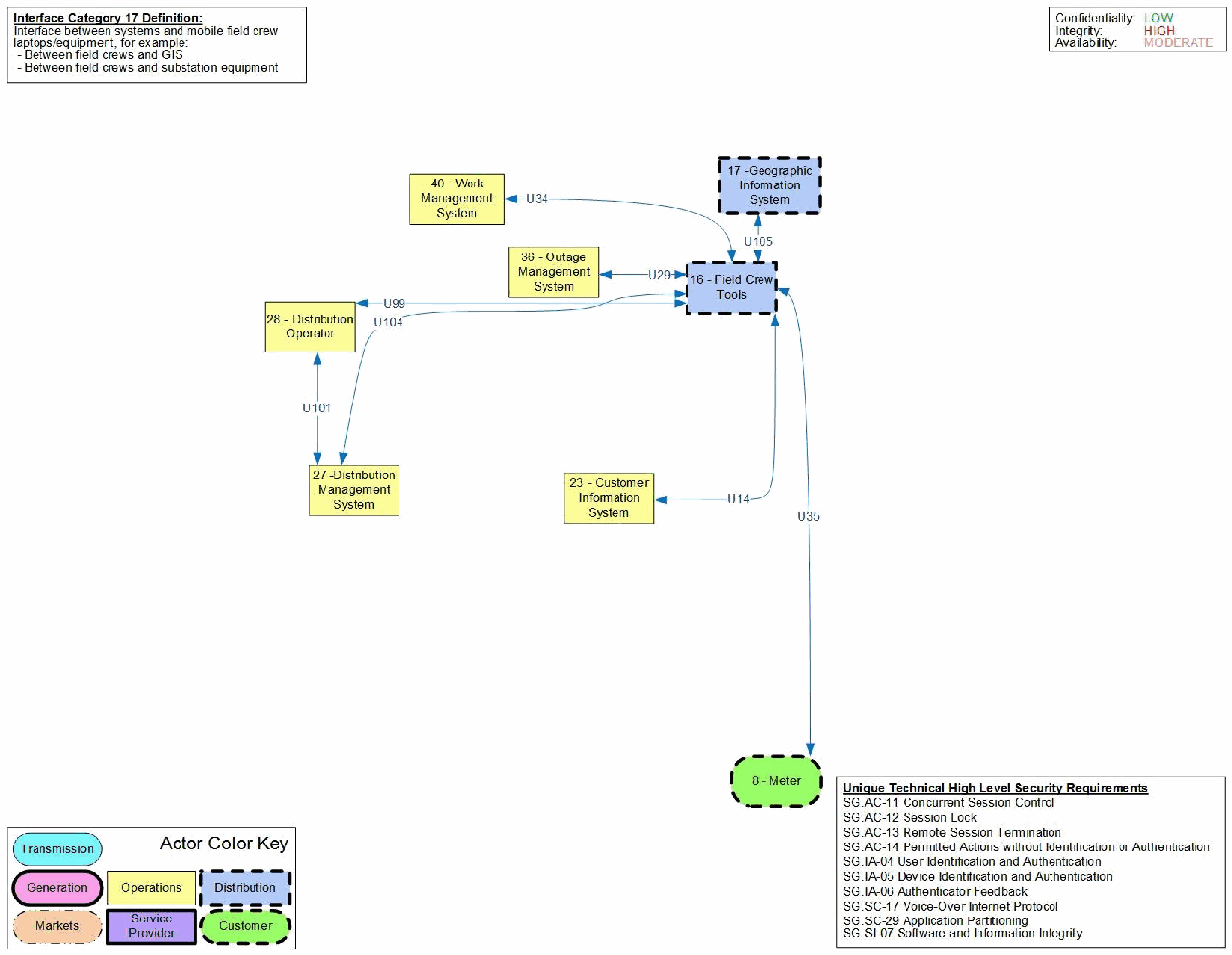
論理インターフェースカテゴリ17の図です。枠『インターフェースカテゴリ17の定義: システムと現場作業員のラップトップ/機器の間のインターフェース。例: 現場作業員とGISの間、現場作業員と変電所機器の間』。影響レベル: 機密性 低、完全性 高、可用性 中。図中のアクター(アクターの色の凡例にあるドメイン〔送電、発電、市場、運用、サービスプロバイダー、配電、顧客〕別に色分け): 40 作業管理システム、17 地理情報システム、36 停電管理システム、16 現場作業員用ツール、28 配電オペレーター、27 配電管理システム、23 顧客情報システム、8 メーター。アクター間の矢印に付いた論理インターフェース: U34, U105, U29, U99, U104, U101, U14, U35。枠『Unique Technical High Level Security Requirements』: SG.AC-11 Concurrent Session Control; SG.AC-12 Session Lock; SG.AC-13 Remote Session Termination; SG.AC-14 Permitted Actions without Identification or Authentication; SG.IA-04 User Identification and Authentication; SG.IA-05 Device Identification and Authentication; SG.IA-06 Authenticator Feedback; SG.SC-17 Voice-Over Internet Protocol; SG.SC-29 Application Partitioning; SG.SI-07 Software and Information Integrity。
Figure 2-21 Logical Interface Category 17
図 2-21 論理インターフェースカテゴリ 17
2.3.14 Logical Interface Category 18: Interface between metering equipment
2.3.14 論理インターフェースカテゴリ 18: 計量機器間のインターフェース
Logical interface category 18 covers the interface between metering equipment, for example:
論理インターフェースカテゴリ 18 は、計量機器間のインターフェースを対象とします。たとえば次のものです。
•Between submeter to meter;
•サブメーターとメーターの間
•Between PEV meter and ESP;
•PEV メーターと ESP の間
•Between MDMS and meters (via the AMI headend);
•MDMS とメーターの間(AMI ヘッドエンド経由)
•Between customer EMS and meters;
•顧客の EMS とメーターの間
•Between field crew tools and meters;
•現場作業員用ツールとメーターの間
•Between customer DER and submeters; and
•顧客の DER とサブメーターの間、および
•Between electric vehicles and submeters.
•電気自動車とサブメーターの間
The issues for this metering interface category include the following:
この計量インターフェースカテゴリの課題には、次のものがあります。
•Integrity of revenue grade metering data is vital, since it has a direct financial impact on all stakeholders of the loads and generation being metered.
•取引用の計量データの完全性は、計量される負荷および発電のすべての利害関係者に直接的な金銭的影響を及ぼすため、不可欠です。
•Availability of metering data is important but not critical, since alternate means for retrieving metering data can still be used.
•計量データの可用性は重要ですが、計量データを取得するための代替手段を引き続き使用できるため、決定的ではありません。
•Meters are constrained in their computational capabilities, primarily to keep costs down, which may limit the types and layers of security that could be applied.
•メーターは、主にコストを抑えるために計算能力が制約されており、適用できるセキュリティの種類や層が限られる場合があります。
•Revenue-grade meters must be certified, so patches and upgrades require extensive testing and validation.
•取引用メーターは認証を受けなければならないため、パッチやアップグレードには広範な試験と検証が必要になります。
•Key management of millions of meters will pose significant challenges that have not yet been addressed as standards.
•何百万ものメーターの鍵管理は、標準としてはまだ対処されていない重大な課題をもたらします。
•Due to the relatively new technologies used with smart meters, some standards have not been fully developed, nor have their capabilities been proven through rigorous testing.
•スマートメーターで使用される技術は比較的新しいため、一部の標準は十分に策定されておらず、その能力も厳密な試験で実証されていません。
•Multiple (authorized) stakeholders, including customers, utilities, and third parties, may need access to energy usage either directly from the meter or after it has been processed and validated for settlements and billing, thus adding cross-organizational security concerns.
•顧客、電力事業者、第三者を含む複数の(認可された)利害関係者が、エネルギー使用量に、メーターから直接、または精算や課金のために処理・検証された後に、アクセスする必要がある場合があり、その結果、組織をまたぐセキュリティ上の懸念が加わります。
•Utility-owned meters are in unsecured locations that are not under utility control, limiting physical security.
•電力事業者所有のメーターは、電力事業者の管理下にない保護されていない場所にあるため、物理的セキュリティが制限されます。
•Customer reactions to AMI systems and smart meters are as yet unknown.
•AMI システムとスマートメーターに対する顧客の反応は、まだわかっていません。
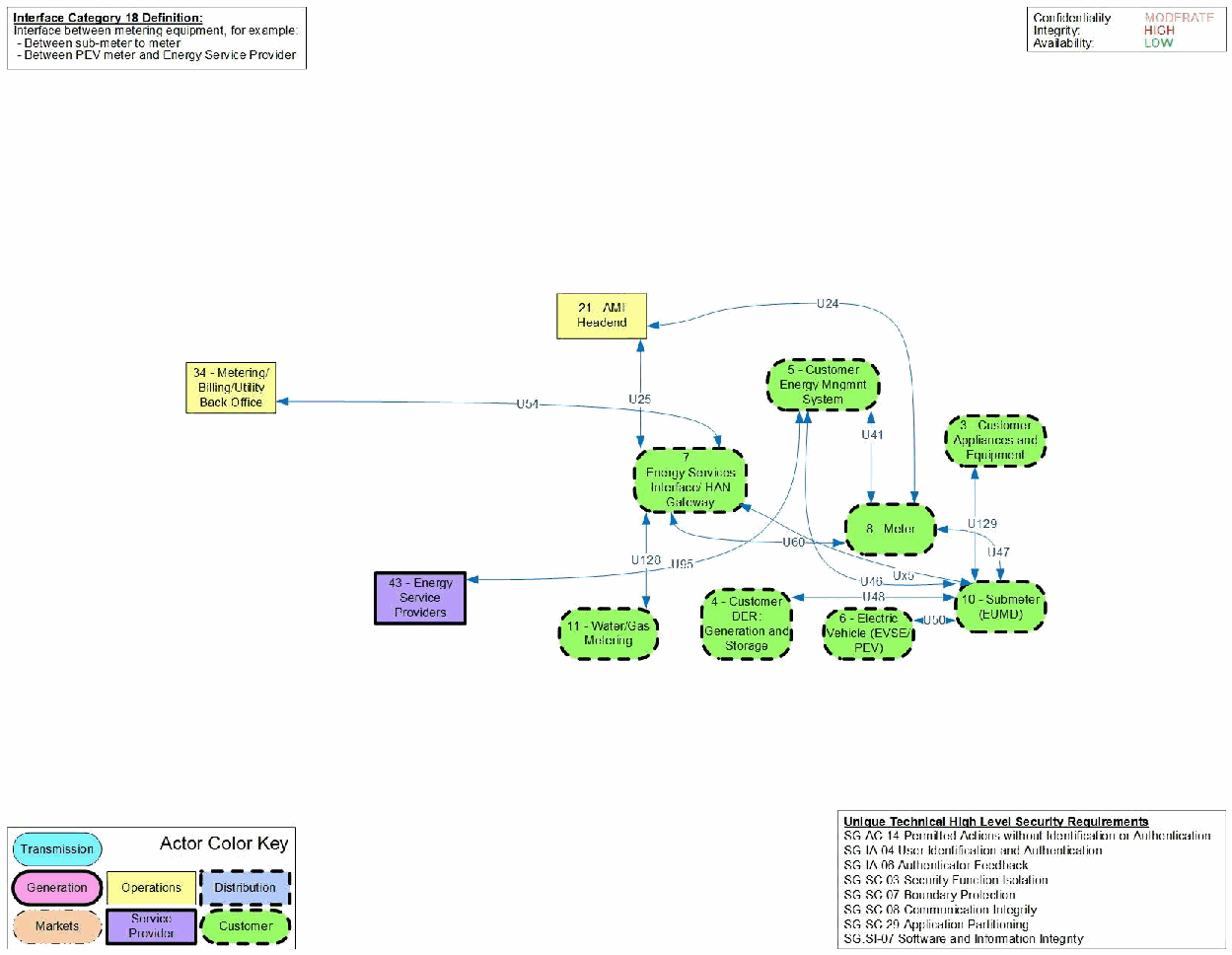
論理インターフェースカテゴリ18の図です。枠『インターフェースカテゴリ18の定義: 計量機器間のインターフェース。例: サブメーターからメーターへの間、PEVメーターとエネルギーサービスプロバイダーの間』。影響レベル: 機密性 中、完全性 高、可用性 低。図中のアクター(アクターの色の凡例にあるドメイン〔送電、発電、市場、運用、サービスプロバイダー、配電、顧客〕別に色分け): 21 AMIヘッドエンド、34 計量・請求・電力事業者バックオフィス、5 顧客エネルギー管理システム、3 顧客の家電・機器、7 エネルギーサービスインターフェース/HANゲートウェイ、8 メーター、43 エネルギーサービスプロバイダー、11 水道・ガス計量、4 顧客DER(発電・蓄電)、6 電気自動車(EVSE/PEV)、10 サブメーター(EUMD)。アクター間の矢印に付いた論理インターフェース: U24, U54, U25, U41, U129, U47, U60, U128, U95, U46, Ux5, U48, U50。枠『Unique Technical High Level Security Requirements』: SG.AC-14 Permitted Actions without Identification or Authentication; SG.IA-04 User Identification and Authentication; SG.IA-06 Authenticator Feedback; SG.SC-03 Security Function Isolation; SG.SC-07 Boundary Protection; SG.SC-08 Communication Integrity; SG.SC-29 Application Partitioning; SG.SI-07 Software and Information Integrity。
Figure 2-22 Logical Interface Category 18
図 2-22 論理インターフェースカテゴリ 18
2.3.15 Logical Interface Category 19: Interface between operations decision support systems
2.3.15 論理インターフェースカテゴリ 19: 運用の意思決定支援システム間のインターフェース
Logical interface category 19 covers the interfaces between operations decision support systems, e.g., between WAMS and ISO/RTOs. Due to the very large coverage of these interfaces, the interfaces are more sensitive to confidentiality requirements than other operational interfaces (see logical interface categories 1-4). Some interactions across interfaces should be treated as critical infrastructure information requiring confidentiality in order to avoid unauthorized persons from using the information to plan an attack. Other information is not confidential at all. If it is determined that confidentiality is needed, then appropriate requirements should be put in place.
論理インターフェースカテゴリ 19 は、運用の意思決定支援システム間(たとえば WAMS と ISO/RTO の間)のインターフェースを対象とします。これらのインターフェースは対象範囲が非常に広いため、ほかの運用インターフェース(論理インターフェースカテゴリ 1〜4 を参照)よりも機密性がより重要になります。インターフェースをまたぐやり取りの一部は、権限のない者が情報を利用して攻撃を計画することを避けるため、機密性を必要とする重要インフラストラクチャ情報として扱うべきです。そのほかの情報は、まったく機密ではありません。機密性が必要と判断された場合は、適切な要件を設けるべきです。
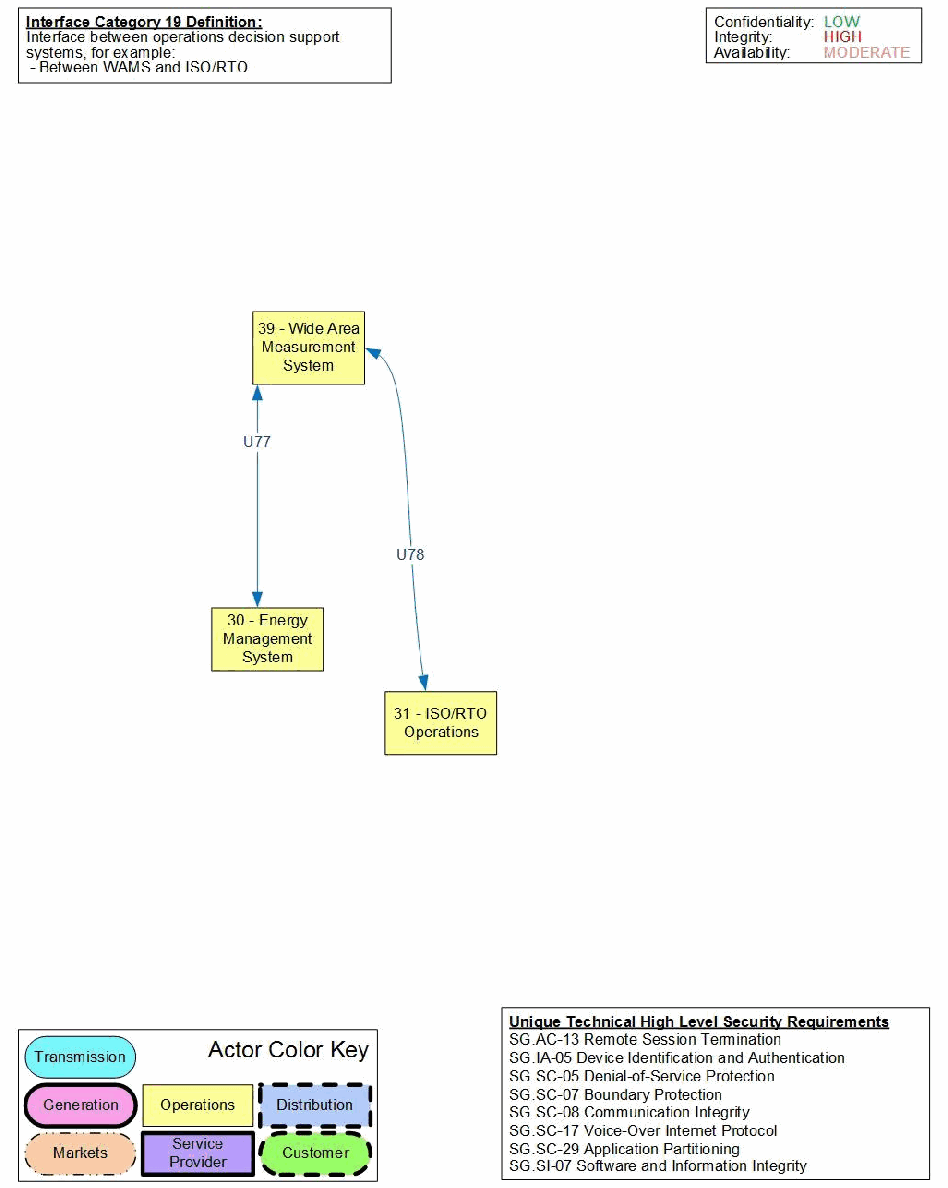
論理インターフェースカテゴリ19の図です。定義の枠: 運用の意思決定支援システム間のインターフェース。例: WAMSとISO/RTOの間。影響レベルの枠: 機密性 低、完全性 高、可用性 中。図中のアクター(アクターの色の凡例にある次のドメイン別に色分け: 送電、発電、市場、運用、サービスプロバイダー、配電、顧客): 39 広域計測システム、30 エネルギー管理システム、31 ISO/RTO運用。アクター間の矢印に付いた論理インターフェース: U77, U78。「固有の技術的ハイレベルセキュリティ要件」の枠: SG.AC-13(リモートセッションの終了)、SG.IA-05(デバイスの識別と認証)、SG.SC-05(サービス妨害からの保護)、SG.SC-07(境界保護)、SG.SC-08(通信の完全性)、SG.SC-17(VoIP)、SG.SC-29(アプリケーションの区分)、SG.SI-07(ソフトウェアと情報の完全性)。
Figure 2-23 Logical Interface Category 19
図 2-23 論理インターフェースカテゴリ 19
2.3.16 Logical Interface Category 20: Interface between engineering/ maintenance systems and control equipment
2.3.16 論理インターフェースカテゴリ 20: エンジニアリング・保守システムと制御機器の間のインターフェース
Logical interface category 20 covers the interfaces between engineering/maintenance systems and control equipment, for example:
論理インターフェースカテゴリ 20 は、エンジニアリング・保守システムと制御機器の間のインターフェースを対象とします。たとえば次のものです。
•Between engineering and substation relaying equipment for relay settings;
•リレー設定のための、エンジニアリングと変電所リレー機器の間のインターフェース
•Between engineering and pole-top equipment for maintenance; and
•保守のための、エンジニアリングと柱上機器の間のインターフェース
•Within power plants.
•発電所内
The main activities performed on this interface include:
このインターフェースで行われる主な活動には、次のものがあります。
•Installing and changing device settings, which may include operational settings (such as relay settings, thresholds for unsolicited reporting, thresholds for device mode change, and editing of setting groups), event criteria for log record generation, and criteria for oscillography recording;
•デバイス設定の適用および変更。これには、運用設定(リレー設定、自発的報告のしきい値、デバイスモード変更のしきい値、設定グループの編集など)、ログ記録を生成するためのイベント基準、およびオシログラフ記録の基準が含まれる場合があります
•Retrieving maintenance information;
•保守情報の取得
•Retrieving device event logs;
•デバイスのイベントログの取得
•Retrieving device oscillography files; and
•デバイスのオシログラフファイルの取得
•Updating software.
•ソフトウェアの更新
The key characteristics of this interface category are as follows:
このインターフェースカテゴリの主な特性は次のとおりです。
•The functions performed on this interface are not considered real-time activities.
•このインターフェースで実行される機能は、リアルタイムの活動とは見なされません
•Some communications carried on this interface may be performed interactively.
•このインターフェースで行われる通信の一部は、対話的に行われる場合があります
•The principal driver for urgency on this interface is the need for information to analyze a disturbance.
•このインターフェースで緊急性が生じる主な要因は、擾乱を解析するための情報が必要になることです
•Some device settings should be treated as critical infrastructure information requiring confidentiality in order to avoid unauthorized persons from using the settings to plan an attack. Other settings are not confidential at all. If it is determined that confidentiality is needed, then appropriate requirements should be put in place.
•一部のデバイス設定は、権限のない者が設定を利用して攻撃を計画することを避けるため、機密性を必要とする重要インフラストラクチャ情報として扱うべきです。そのほかの設定は、まったく機密ではありません。機密性が必要と判断された場合は、適切な要件を設けるべきです
•Logs and files containing forensic evidence following events should likely remain confidential for both critical infrastructure and organizational reasons, at least until analysis has been completed.
•イベント後のフォレンジック証拠を含むログやファイルは、少なくとも解析が完了するまでは、重要インフラストラクチャ上および組織上の両方の理由から、機密にしておくべきです
•These functions are presently performed by a combination of
•これらの機能は、現在、次の組み合わせによって実行されています。
•Separate remote access to devices, such as by dial-up connection;
•ダイヤルアップ接続などによる、デバイスへの別個のリモートアクセス
•Local access at the device (addressed in Logical Interface Category 17); and
•デバイスでのローカルアクセス(論理インターフェースカテゴリ 17 で扱う)
•Access via the same interface used for real-time communications.
•リアルタイム通信に使用されるものと同じインターフェースを介したアクセス
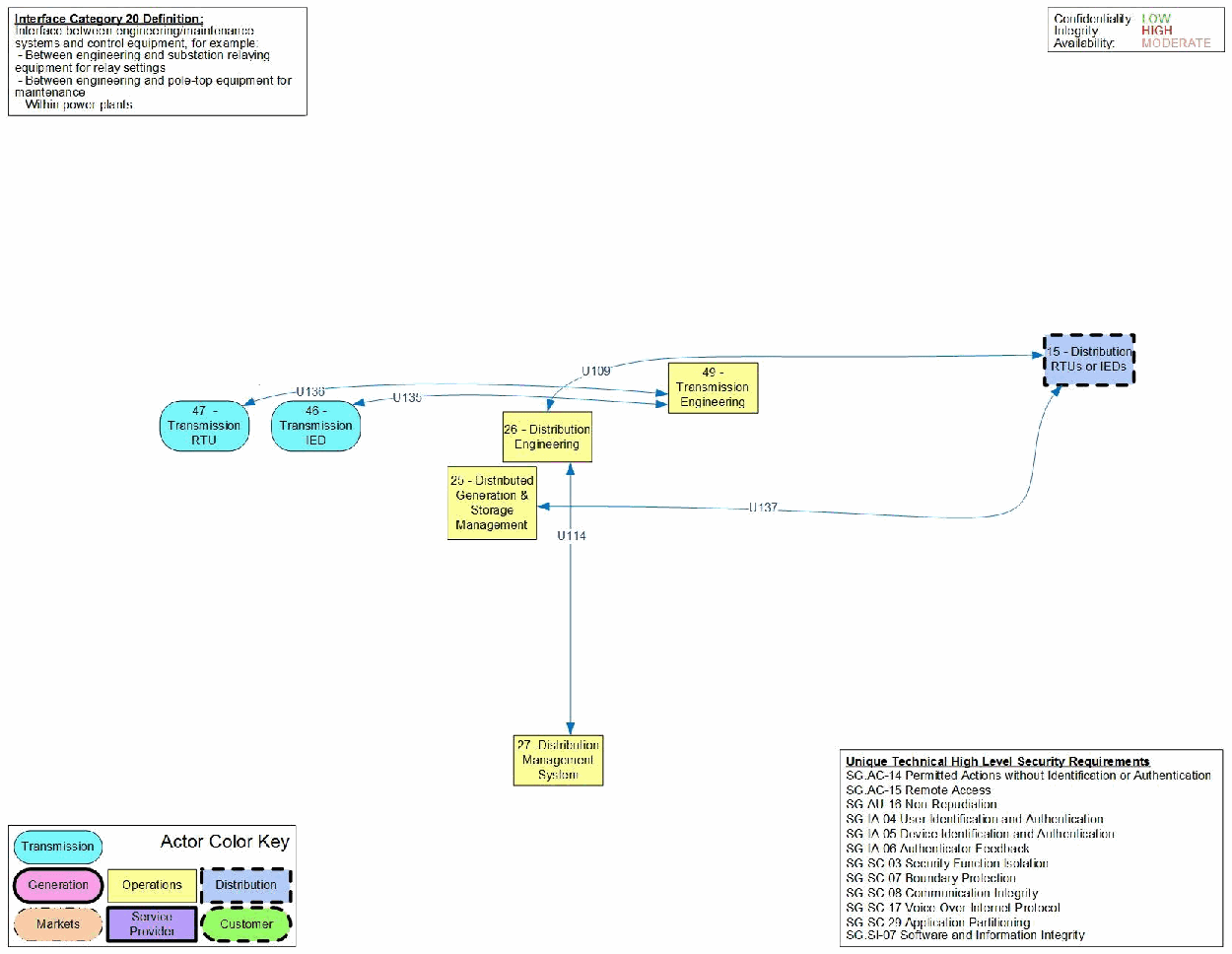
論理インターフェースカテゴリ20の図です。枠『インターフェースカテゴリ20の定義: エンジニアリング・保守システムと制御機器の間のインターフェース。例: エンジニアリングと変電所リレー機器の間(リレー設定用)、エンジニアリングと柱上機器の間(保守用)、発電所内』。影響レベル: 機密性 低、完全性 高、可用性 中。図中のアクター(アクターの色の凡例にあるドメイン〔送電、発電、市場、運用、サービスプロバイダー、配電、顧客〕別に色分け): 47 送電RTU、46 送電IED、49 送電エンジニアリング、26 配電エンジニアリング、25 分散型発電・蓄電管理、27 配電管理システム、15 配電RTUまたはIED。アクター間の矢印に付いた論理インターフェース: U136, U135, U109, U137, U114。枠『Unique Technical High Level Security Requirements』: SG.AC-14 Permitted Actions without Identification or Authentication; SG.AC-15 Remote Access; SG.AU-16 Non-Repudiation; SG.IA-04 User Identification and Authentication; SG.IA-05 Device Identification and Authentication; SG.IA-06 Authenticator Feedback; SG.SC-03 Security Function Isolation; SG.SC-07 Boundary Protection; SG.SC-08 Communication Integrity; SG.SC-17 Voice-Over Internet Protocol; SG.SC-29 Application Partitioning; SG.SI-07 Software and Information Integrity。
Figure 2-24 Logical Interface Category 20
図 2-24 論理インターフェースカテゴリ 20
2.3.17 Logical Interface Category 21: Interface between control systems and their vendors for standard maintenance and service
2.3.17 論理インターフェースカテゴリ 21: 標準的な保守およびサービスのための、制御システムとそのベンダーの間のインターフェース
Logical interface category 21 covers the interfaces between control systems and their vendors for standard maintenance and service, for example:
論理インターフェースカテゴリ 21 は、標準的な保守およびサービスのための、制御システムとそのベンダーの間のインターフェースを対象とします。たとえば次のものです。
•Between SCADA system and its vendor.
•SCADAシステムとそのベンダーの間のインターフェース
The main activities performed on this interface include:
このインターフェースで行われる主な活動には、次のものがあります。
•Updating firmware and/or software;
•ファームウェア、ソフトウェア、またはその両方の更新
•Retrieving maintenance information; and
•保守情報の取得
•Retrieving event logs.
•イベントログの取得
Key characteristics of this logical interface category are as follows:
この論理インターフェースカテゴリの主な特性は次のとおりです。
•The functions performed on this interface are not considered real-time activities.
•このインターフェースで実行される機能は、リアルタイムの活動とは見なされません
•Some communications carried on this interface may be performed interactively.
•このインターフェースで行われる通信の一部は、対話的に行われる場合があります
•The principal driver for urgency on this interface is the need for critical operational/security updates.
•このインターフェースで緊急性が生じる主な要因は、重要な運用・セキュリティ更新の必要性です
•These functions are presently performed by a combination of
•これらの機能は、現在、次の組み合わせによって実行されています。
•Separate remote access to devices, such as by dial-up connection;
•ダイヤルアップ接続などによる、デバイスへの別個のリモートアクセス
•Local access at the device/control system console; and
•デバイス・制御システムのコンソールでのローカルアクセス
•Access via the same interface used for real-time communications.
•リアルタイム通信に使用されるものと同じインターフェースを介したアクセス
Activities outside of the scope of Logical Interface Category 21 include:
論理インターフェースカテゴリ 21 の範囲外の活動には、次のものがあります。
•Vendors acting in an (outsourced) operational role to perform troubleshooting and problem resolution (see Logical Interface Categories 1-4, 5-6, or 20, depending upon the role).
•(外部委託された)運用上の役割で、トラブルシューティングと問題解決を行うベンダー(役割に応じて、論理インターフェースカテゴリ 1〜4、5〜6、または 20 を参照)
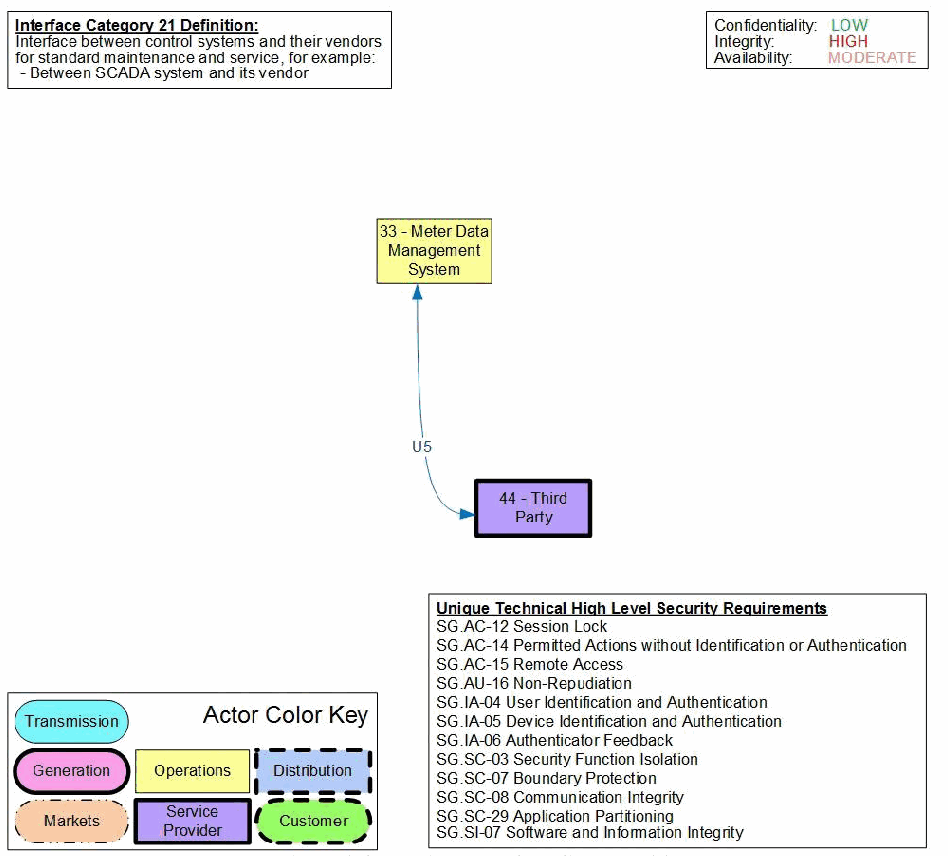
論理インターフェースカテゴリ21の図です。定義の枠: 制御システムと、通常の保守・サービスを行うそのベンダーの間のインターフェース。例: SCADAシステムとそのベンダーの間。影響レベルの枠: 機密性 低、完全性 高、可用性 中。図中のアクター(アクターの色の凡例にあるドメイン: 送電、発電、市場、運用、サービスプロバイダー、配電、顧客): 33 メーターデータ管理システム、44 第三者。アクター間の矢印に付いた論理インターフェース: U5。「固有の技術的ハイレベルセキュリティ要件」の枠: SG.AC-12(セッションロック)、SG.AC-14(識別・認証なしで許可される操作)、SG.AC-15(リモートアクセス)、SG.AU-16(否認防止)、SG.IA-04(利用者の識別と認証)、SG.IA-05(デバイスの識別と認証)、SG.IA-06(認証情報のフィードバック)、SG.SC-03(セキュリティ機能の分離)、SG.SC-07(境界保護)、SG.SC-08(通信の完全性)、SG.SC-29(アプリケーションの区分)、SG.SI-07(ソフトウェアと情報の完全性)。
Figure 2-25 Logical Interface Category 21
図 2-25 論理インターフェースカテゴリ 21
2.3.18 Logical Interface Category 22: Interface between security/network/system management consoles and all networks and systems
2.3.18 論理インターフェースカテゴリ 22: セキュリティ・ネットワーク・システム管理コンソールとすべてのネットワークおよびシステム間の接続
Logical interface category 22 covers the interfaces between security/network/system management consoles and all networks and systems:
論理インターフェースカテゴリ 22 は、セキュリティ・ネットワーク・システム管理コンソールと、すべてのネットワークおよびシステムの間のインターフェースを対象とします。
•Between a security console and network routers, firewalls, computer systems, and network nodes.
•セキュリティコンソールと、ネットワークルーター、ファイアウォール、コンピューターシステム、ネットワークノードの間
The main activities performed on this interface include:
このインターフェースで行われる主な活動には、次のものがあります。
•Communication infrastructure operations and maintenance;
•通信インフラストラクチャの運用と保守
•Security settings and audit log retrieval (if the security audit log is separate from the event logs);
•セキュリティ設定と監査ログの取得(セキュリティ監査ログがイベントログとは別である場合)
•Future real-time monitoring of the security infrastructure; and
•セキュリティインフラストラクチャのリアルタイム監視(将来的に実施)
•Security infrastructure operations and maintenance.
•セキュリティインフラストラクチャの運用と保守
Key characteristics of this logical interface category as follows:
この論理インターフェースカテゴリの主な特性は次のとおりです。
•The functions performed on this interface are not considered real-time activities.
•このインターフェースで実行される機能は、リアルタイムの活動とは見なされません。
•Some communications carried on this interface may be performed interactively.
•このインターフェースで行われる通信の一部は、対話的に行われる場合があります。
•The principal driver for urgency on this interface is the need for critical operational/security updates.
•このインターフェースで緊急性が生じる主な要因は、重要な運用・セキュリティ更新の必要性です。
•These functions are presently performed by a combination of
•これらの機能は現在、次のものを組み合わせて実行されています。
•Separate remote access to devices, such as by dial-up connection;
•ダイヤルアップ接続などによる、デバイスへの別個のリモートアクセス
•Local access at the device/control system console; and
•デバイス・制御システムのコンソールでのローカルアクセス
•Access via the same interface used for real-time communications.
•リアルタイム通信に使用されるものと同じインターフェースを介したアクセス
Activities outside of the scope of Logical interface category 22 include:
論理インターフェースカテゴリ 22 の範囲外の活動には、次のものがあります。
•Smart grid transmission and distribution (see Logical Interface Categories 1-4 and 5-6);
•スマートグリッドの送電と配電(論理インターフェースカテゴリ 1〜4 と 5〜6 を参照)
•Advanced metering (see Logical Interface Category 13); and
•高度計量(論理インターフェースカテゴリ 13 を参照)
•Control systems engineering and systems maintenance (see Logical Interface Category 20).
•制御システムのエンジニアリングとシステム保守(論理インターフェースカテゴリ 20 を参照)
(Note: This diagram is not included in the logical reference model, Figure 2-3.)
(注: この図は、論理リファレンスモデルである図 2-3 には含まれていません。)
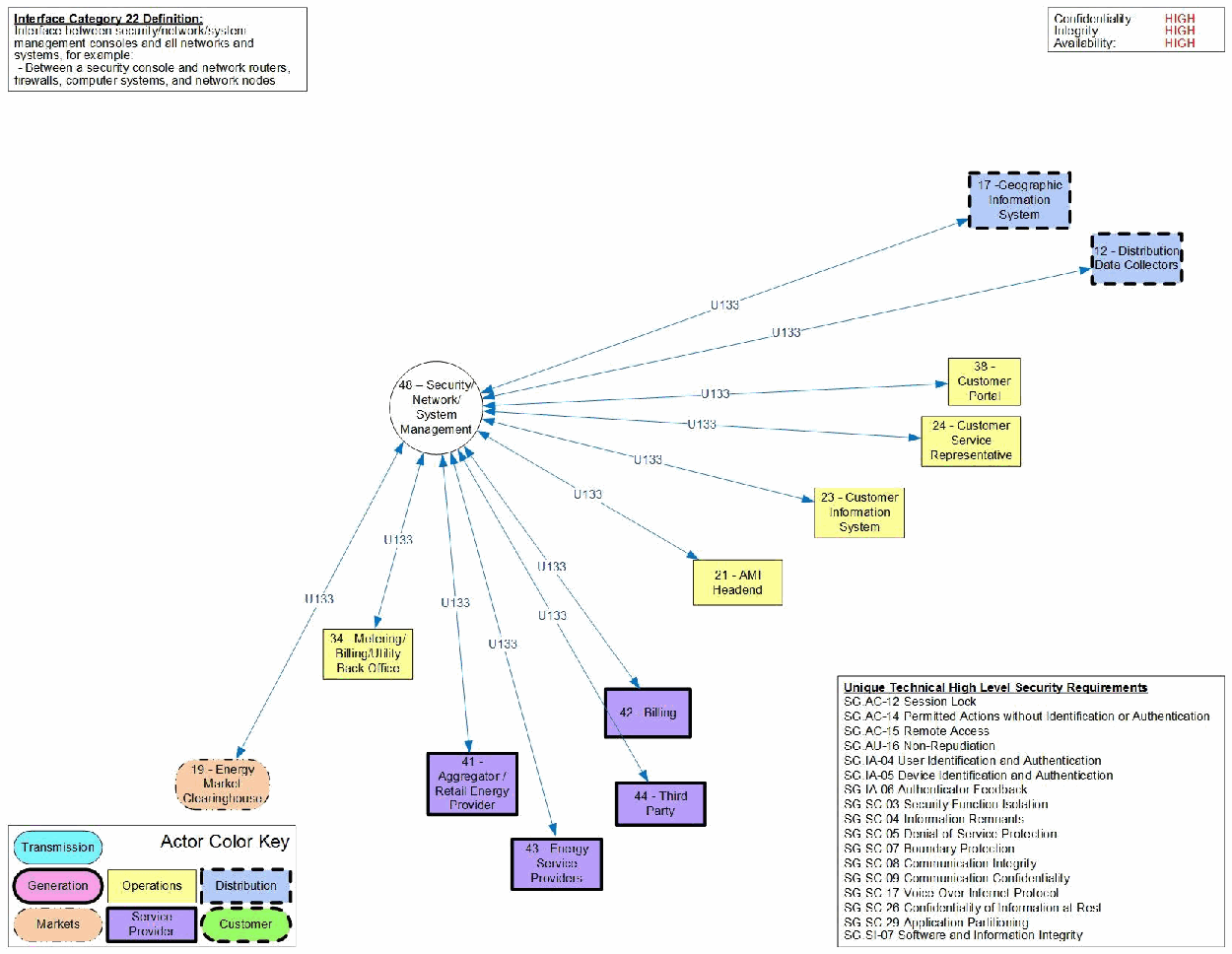
論理インターフェースカテゴリ22の図です。定義の枠: セキュリティ・ネットワーク・システム管理コンソールとすべてのネットワークおよびシステムの間のインターフェース。例: セキュリティコンソールと、ネットワークルーター、ファイアウォール、コンピューターシステム、ネットワークノードの間。影響レベルの枠: 機密性 高、完全性 高、可用性 高。図中のアクター(アクターの色の凡例にあるドメイン: 送電、発電、市場、運用、サービスプロバイダー、配電、顧客): 48 セキュリティ/ネットワーク/システム管理、17 地理情報システム、12 配電データコレクター、38 顧客ポータル、24 顧客サービス担当者、23 顧客情報システム、21 AMIヘッドエンド、42 請求、44 第三者、43 エネルギーサービスプロバイダー、41 アグリゲーター/小売エネルギー事業者、34 計量・請求・電力事業者バックオフィス、19 エネルギー市場清算機関。アクター間の矢印に付いた論理インターフェース: U133 (48から他の各アクターへ)。「固有の技術的ハイレベルセキュリティ要件」の枠: SG.AC-12(セッションロック)、SG.AC-14(識別・認証なしで許可される操作)、SG.AC-15(リモートアクセス)、SG.AU-16(否認防止)、SG.IA-04(利用者の識別と認証)、SG.IA-05(デバイスの識別と認証)、SG.IA-06(認証情報のフィードバック)、SG.SC-03(セキュリティ機能の分離)、SG.SC-04(残存情報)、SG.SC-05(サービス妨害からの保護)、SG.SC-07(境界保護)、SG.SC-08(通信の完全性)、SG.SC-09(通信の機密性)、SG.SC-17(Voice-Over Internet Protocol)、SG.SC-26(保存情報の機密性)、SG.SC-29(アプリケーションの区分)、SG.SI-07(ソフトウェアと情報の完全性)。
Figure 2-26 Logical Interface Category 22
図 2-26 論理インターフェースカテゴリ 22
CHAPTER 3 HIGH-LEVEL SECURITY REQUIREMENTS
第 3 章 高レベルセキュリティ要件
This chapter includes the detailed descriptions for each of the security requirements. The analyses used to select and modify these security requirements are included in Appendix H. This chapter includes the following:
本章には、各セキュリティ要件の詳細な説明が含まれています。これらのセキュリティ要件の選択と修正に用いた分析は、付録 H に含まれています。本章には次のものが含まれます。
1.Determination of the confidentiality, integrity, and availability (CI&A) impact levels for each of the logical interface categories. (See Table 3-2.)
1.各論理インターフェースカテゴリに対する機密性、完全性、可用性(CI&A)の影響レベルの決定(表 3-2 を参照)。
2.The common governance, risk, and compliance (GRC), common technical, and unique technical requirements are allocated to the logical interface categories. Also, the impact levels are included for each requirement. (See Table 3-3.)
2.共通のガバナンス・リスク・コンプライアンス(GRC)要件、共通の技術要件、固有の技術要件の論理インターフェースカテゴリへの割り当て。各要件の影響レベルも含まれます(表 3-3 を参照)。
3.The security requirements for the smart grid. Included are the detailed descriptions for each requirement. This information is provided as guidance to organizations that are implementing, designing, and/or operating smart grid systems as a starting point for selecting and modifying security requirements. The information is to be used as a starting point only. Each organization will need to perform a risk analysis to determine the applicability of the following material.
3.スマートグリッドのセキュリティ要件。各要件の詳細な説明が含まれています。この情報は、スマートグリッドシステムを実装、設計、運用している組織が、セキュリティ要件を選択し、修正するための出発点として、指針として提供されるものです。この情報は出発点としてのみ使用するものです。各組織は、以下の内容の適用可否を判断するために、リスク分析を実施する必要があります。
3.1 CYBERSECURITY OBJECTIVES
3.1 サイバーセキュリティの目的
For decades, power system operations have been managing the reliability of the power grid in which power availability has been the primary requirement, with information integrity as a secondary but increasingly critical requirement. Confidentiality of customer information is also important in the normal revenue billing processes and for privacy concerns. Although focused on accidental/inadvertent security problems, such as equipment failures, employee errors, and natural disasters, existing power system management technologies can be used and expanded to provide additional security measures.
何十年にもわたり、電力システムの運用では、電力の可用性を最優先の要件とし、情報の完全性を次点の、しかしますます重要になる要件として、電力網の信頼性を管理してきました。顧客情報の機密性も、通常の収益請求プロセスやプライバシー上の懸念にとって重要です。機器の故障、従業員の過誤、自然災害など、偶発的・非意図的なセキュリティ上の問題に焦点を当ててきた既存の電力システム管理技術を、追加のセキュリティ対策を提供するために利用し、拡張できます。
Availability is the most important security objective for power system reliability. The time latency associated with availability can vary—
可用性は、電力システムの信頼性にとって最も重要なセキュリティ目的です。可用性に関連する時間遅延は、次のように異なります—
•≤ 4 ms for protective relaying;
•保護リレーでは 4 ms 以下
•Subseconds for transmission wide-area situational awareness monitoring;
•送電の広域状況認識の監視ではサブ秒
•Seconds for substation and feeder SCADA data;
•変電所およびフィーダーの SCADA データでは秒
•Minutes for monitoring noncritical equipment and some market pricing information;
•重要でない機器および一部の市場価格情報の監視では分
•Hours/days for meter reading and longer-term market pricing information; and
•検針およびより長期の市場価格情報では時間・日
•Days/weeks/months for collecting long-term data such as power quality information.
•電力品質情報などの長期データの収集では日・週・月
Integrity for power system operations includes assurance that—
電力システムの運用における完全性には、次のことの保証が含まれます。
•Data has not been modified without authorization;
•データが認可なしに改変されていないこと
•Source of data is authenticated;
•データの出所が認証されていること
•Time stamp associated with the data is known and authenticated; and
•データに関連付けられたタイムスタンプが既知であり、認証されていること
•Quality of data is known and authenticated.
•データの品質が既知であり、認証されていること
Confidentiality is the least critical for power system reliability. However, confidentiality is becoming more important, particularly with the increasing availability of customer information online—
機密性は、電力システムの信頼性にとって最も重要度が低いものです。しかし、特に顧客情報のオンライン利用が増えるにつれて、機密性はより重要になりつつあります。
•Privacy of customer information;
•顧客情報のプライバシー
•Electric market information; and
•電力市場情報
•General corporate information, such as payroll, internal strategic planning, etc.
•給与、社内の戦略計画などの一般的な企業情報
3.2 CONFIDENTIALITY, INTEGRITY, AND AVAILABILITY IMPACT LEVELS
3.2 機密性、完全性、可用性の影響レベル
Following are the definitions for the security objectives of CI&A, as defined in US statute.
以下は、米国の法令で定義されている、CI&A というセキュリティ目的の定義です。
Confidentiality
機密性
“Preserving authorized restrictions on information access and disclosure, including means for protecting personal privacy and proprietary information….” [44 U.S.C., Sec. 3542]
「個人のプライバシーおよび専有情報を保護する手段を含め、情報へのアクセスと開示について認可された制限を維持すること……」[44 U.S.C., Sec. 3542]
A loss of confidentiality is the unauthorized disclosure of information.
機密性の喪失とは、情報が不正に開示されることです。
Integrity
完全性
“Guarding against improper information modification or destruction, and includes ensuring information non-repudiation and authenticity….” [44 U.S.C., Sec. 3542]
「情報の不適切な改変または破壊を防ぎ、情報の否認防止と真正性の確保を含む……」[44 U.S.C., Sec. 3542]
A loss of integrity is the unauthorized modification or destruction of information.
完全性の喪失とは、情報が不正に改変または破壊されることです。
Availability
可用性
“Ensuring timely and reliable access to and use of information….” [44 U.S.C., Sec. 3542]
「情報への適時かつ信頼できるアクセスと使用を確保すること……」[44 U.S.C., Sec. 3542]
A loss of availability is the disruption of access to or use of information or an information system.
可用性の喪失とは、情報または情報システムへのアクセスまたはその使用が妨害されることです。
Based on these definitions, impact levels for each security objective (confidentiality, integrity, and availability) are specified in Table 3-1 as low, moderate, and high as defined in FIPS 199, Standards for Security Categorization of Federal Information and Information Systems, February 2004. The impact levels are used in the selection of security requirements for each logical interface category.
これらの定義に基づき、各セキュリティ目的(機密性、完全性、可用性)の影響レベルは、FIPS 199, Standards for Security Categorization of Federal Information and Information Systems, February 2004 で定義されている低、中、高として、表 3-1 に規定されています。影響レベルは、論理インターフェースカテゴリごとのセキュリティ要件の選択に使用されます。
Table 3-1 Impact Levels Definitions
表 3-1 影響レベルの定義
| Potential Impact Levels | |||
|---|---|---|---|
| Low | Moderate | High | |
| Confidentiality Preserving authorized restrictions on information access and disclosure, including means for protecting personal privacy and proprietary information. | The unauthorized disclosure of information could be expected to have a limited adverse effect on organizational operations, organizational assets, or individuals. | The unauthorized disclosure of information could be expected to have a serious adverse effect on organizational operations, organizational assets, or individuals. | The unauthorized disclosure of information could be expected to have a severe or catastrophic adverse effect on organizational operations, organizational assets, or individuals. |
| Integrity Guarding against improper information modification or destruction, and includes ensuring information non-repudiation and authenticity. | The unauthorized modification or destruction of information could be expected to have a limited adverse effect on organizational operations, organizational assets, or individuals. | The unauthorized modification or destruction of information could be expected to have a serious adverse effect on organizational operations, organizational assets, or individuals. | The unauthorized modification or destruction of information could be expected to have a severe or catastrophic adverse effect on organizational operations, organizational assets, or individuals. |
| Availability Ensuring timely and reliable access to and use of information. | The disruption of access to or use of information or an information system could be expected to have a limited adverse effect on organizational operations, organizational assets, or individuals. | The disruption of access to or use of information or an information system could be expected to have a serious adverse effect on organizational operations, organizational assets, or individuals. | The disruption of access to or use of information or an information system could be expected to have a severe or catastrophic adverse effect on organizational operations, organizational assets, or individuals. |
| 潜在的な影響レベル | |||
|---|---|---|---|
| 低 | 中 | 高 | |
| 機密性 個人のプライバシーおよび専有情報を保護する手段を含め、情報へのアクセスと開示について認可された制限を維持すること。 | 情報の不正な開示は、組織の運営、組織の資産、または個人に対して、限定的な悪影響を及ぼすと予想される場合があります。 | 情報の不正な開示は、組織の運営、組織の資産、または個人に対して、深刻な悪影響を及ぼすと予想される場合があります。 | 情報の不正な開示は、組織の運営、組織の資産、または個人に対して、重大または壊滅的な悪影響を及ぼすと予想される場合があります。 |
| 完全性 情報の不適切な改変または破壊を防ぎ、情報の否認防止と真正性の確保を含むこと。 | 情報の不正な改変または破壊は、組織の運営、組織の資産、または個人に対して、限定的な悪影響を及ぼすと予想される場合があります。 | 情報の不正な改変または破壊は、組織の運営、組織の資産、または個人に対して、深刻な悪影響を及ぼすと予想される場合があります。 | 情報の不正な改変または破壊は、組織の運営、組織の資産、または個人に対して、重大または壊滅的な悪影響を及ぼすと予想される場合があります。 |
| 可用性 情報への適時かつ信頼できるアクセスと使用を確保すること。 | 情報または情報システムへのアクセスまたはその使用の妨害は、組織の運営、組織の資産、または個人に対して、限定的な悪影響を及ぼすと予想される場合があります。 | 情報または情報システムへのアクセスまたはその使用の妨害は、組織の運営、組織の資産、または個人に対して、深刻な悪影響を及ぼすと予想される場合があります。 | 情報または情報システムへのアクセスまたはその使用の妨害は、組織の運営、組織の資産、または個人に対して、重大または壊滅的な悪影響を及ぼすと予想される場合があります。 |
3.3 IMPACT LEVELS FOR THE CI&A CATEGORIES
3.3 CI&A カテゴリの影響レベル
Each of the three impact levels (i.e., low, moderate, high) is based upon the expected adverse effect of a security breach upon organizational operations, organizational assets, or individuals. The initial designation of impact levels focused on power grid reliability. The expected adverse effect on individuals when privacy breaches occur and adverse effects on financial markets when confidentiality is lost are included here for specific logical interface categories.
3 つの影響レベル(すなわち、低、中、高)はそれぞれ、セキュリティ侵害が組織の運営、組織の資産、または個人に及ぼすと予想される悪影響に基づいています。影響レベルの最初の指定は、電力網の信頼性に焦点を当てていました。プライバシー侵害が発生した場合の個人への予想される悪影響と、機密性が失われた場合の金融市場への悪影響は、特定の論理インターフェースカテゴリについて、ここに含まれています。
Power system reliability: Keep electricity flowing to customers, businesses, and industry. For decades, the power system industry has been developing extensive and sophisticated systems and equipment to avoid or shorten power system outages. In fact, power system operations have been termed the largest and most complex machine in the world. Although there are definitely new areas of cybersecurity concerns for power system reliability as technology opens new opportunities and challenges, nonetheless, the existing energy management systems and equipment, possibly enhanced and expanded, should remain as key cybersecurity solutions.
電力システムの信頼性: 顧客、企業、産業に電力を流し続けること。何十年にもわたり、電力システム業界は、電力システムの停電を回避または短縮するために、広範で高度なシステムと機器を開発してきました。実際、電力システムの運用は、世界最大かつ最も複雑な機械と呼ばれてきました。技術が新たな機会と課題をもたらすにつれて、電力システムの信頼性に関するサイバーセキュリティ上の懸念には間違いなく新たな領域が生じていますが、それでも、既存のエネルギー管理システムと機器は、必要に応じて強化・拡張されたうえで、サイバーセキュリティの主要なソリューションであり続けるべきです。
Confidentiality and privacy of customers: As the smart grid reaches into homes and businesses, and as customers increasingly participate in managing their energy, confidentiality and privacy of their information has increasingly become a concern. Unlike power system reliability, customer privacy is a new issue.
顧客の機密性とプライバシー: スマートグリッドが家庭や事業所にまで及び、顧客が自らのエネルギー管理にますます参加するようになるにつれて、顧客の情報の機密性とプライバシーが、ますます懸念されるようになっています。電力システムの信頼性とは異なり、顧客のプライバシーは新しい問題です。
The impact levels (low [L], moderate [M], and high [H]) presented in Table 3-2 address the impacts to the nationwide power grid, particularly with regard to grid stability and reliability. Consequentially, the confidentiality impact is low for these logical interface categories. Logical interface categories 7, 8, 13, 14, 16, and 22 have a high impact level for confidentiality because of the type of data that needs to be protected (e.g., sensitive customer energy usage data, critical security parameters, and information from a HAN to a third party.)
表 3-2 に示す影響レベル(低 [L]、中 [M]、高 [H])は、全国規模の電力網への影響、特に電力網の安定性と信頼性に関する影響を扱っています。その結果、これらの論理インターフェースカテゴリでは、機密性の影響は低くなっています。論理インターフェースカテゴリ 7、8、13、14、16、22 は、保護が必要なデータの種類(たとえば、機微な顧客のエネルギー使用量データ、重要なセキュリティパラメーター、HAN から第三者への情報)のために、機密性の影響レベルが高くなっています。
Table 3-2 Smart Grid Impact Levels
表 3-2 スマートグリッドの影響レベル
| Logical Interface Category | Confidentiality | Integrity | Availability |
|---|---|---|---|
| 1 | L | H | H |
| 2 | L | H | M |
| 3 | L | H | H |
| 4 | L | H | M |
| 5 | L | H | H |
| 6 | L | H | M |
| 7 | H | H | L |
| 8 | H | H | L |
| 9 | H | H | M |
| 10 | L | H | M |
| 11 | L | M | M |
| 12 | L | M | M |
| 13 | H | H | L |
| 14 | H | H | H |
| 15 | L | M | M |
| 16 | H | M | L |
| 17 | L | H | M |
| 18 | M | H | L |
| 19 | L | H | M |
| 20 | L | H | M |
| 21 | L | H | M |
| 22 | H | H | H |
| 論理インターフェースカテゴリ | 機密性 | 完全性 | 可用性 |
|---|---|---|---|
| 1 | L | H | H |
| 2 | L | H | M |
| 3 | L | H | H |
| 4 | L | H | M |
| 5 | L | H | H |
| 6 | L | H | M |
| 7 | H | H | L |
| 8 | H | H | L |
| 9 | H | H | M |
| 10 | L | H | M |
| 11 | L | M | M |
| 12 | L | M | M |
| 13 | H | H | L |
| 14 | H | H | H |
| 15 | L | M | M |
| 16 | H | M | L |
| 17 | L | H | M |
| 18 | M | H | L |
| 19 | L | H | M |
| 20 | L | H | M |
| 21 | L | H | M |
| 22 | H | H | H |
3.4 SELECTION OF SECURITY REQUIREMENTS
3.4 セキュリティ要件の選択
Power system operations pose many security challenges that are different from most other industries. In many cases, legacy equipment in industrial control systems that are in use in the power system operations may not be able to incorporate all requirements in this document, yet still need the protections offered by the requirements. For example, the Internet is different from the power system operations environment. In particular, there are strict performance and reliability requirements that are needed by power system operations. For instance—
電力システムの運用には、ほとんどの他産業とは異なる、多くのセキュリティ上の課題があります。多くの場合、電力システムの運用で使用されている産業用制御システムのレガシー機器は、本書のすべての要件を取り込めないかもしれませんが、それでも、それらの要件が提供する保護を必要としています。たとえば、インターネットは電力システムの運用環境とは異なります。特に、電力システムの運用には、厳格な性能と信頼性の要件が求められます。たとえば次のとおりです。
•Operation of the power system must continue 24×7 with high availability (e.g., 99.99 % for SCADA and higher for protective relaying) regardless of any compromise in security or the implementation of security measures that hinder normal or emergency power system operations.
•電力システムの運用は、セキュリティの侵害や、通常時または緊急時の電力システムの運用を妨げるセキュリティ対策の実装にかかわらず、24×7 で高い可用性(たとえば、SCADA では 99.99 %、保護リレーではそれ以上)を保って継続しなければなりません。
•Power system operations must be able to continue during any security attack or compromise (as much as possible).
•電力システムの運用は、セキュリティ攻撃や侵害の間も(可能な限り)継続できなければなりません。
•Power system operations must recover quickly after a security attack or the compromise of an information system.
•電力システムの運用は、セキュリティ攻撃や情報システムの侵害の後、速やかに復旧できなければなりません。
•Testing of security measures cannot be allowed to impact power system operations.
•セキュリティ対策の試験が、電力システムの運用に影響を及ぼしてはなりません。
•Power system management, monitoring, and control will increasingly extend away from the power entities’ traditional physical and security environments into external environments that the power entity has little or no influence and control over.
•電力システムの管理、監視、制御は、電力事業体の従来の物理的環境およびセキュリティ環境から、電力事業体がほとんど、またはまったく影響や制御を及ぼせない外部環境へと、ますます拡大していく
There is no single set of cybersecurity requirements that addresses each of the smart grid logical interface categories. This information can be used as guidelines for organizations as they develop their cybersecurity strategy, perform risk assessments, and select and modify security requirements for smart grid information system implementations.
スマートグリッドの各論理インターフェースカテゴリに対処する、単一のサイバーセキュリティ要件の集合は存在しません。この情報は、組織がサイバーセキュリティ戦略を策定し、リスク評価を実施し、スマートグリッド情報システムの実装のためにセキュリティ要件を選択・修正する際のガイドラインとして使用できます。
Additional criteria must be used in determining the cybersecurity requirements before selecting and implementing the cybersecurity measures/solutions. These additional criteria must take into account the characteristics of the interface, including the constraints and issues posed by device and network technologies, the existence of legacy components/devices, varying organizational structures, regulatory and legal policies, and cost criteria.
サイバーセキュリティ対策・ソリューションを選択し、実装する前に、サイバーセキュリティ要件を決定する際には、追加の基準を用いなければなりません。これらの追加の基準では、デバイスおよびネットワーク技術がもたらす制約と問題、レガシーコンポーネント・デバイスの存在、さまざまな組織構造、規制および法的な方針、コスト基準を含む、インターフェースの特性を考慮に入れなければなりません。
Once these interface characteristics are applied, then cybersecurity requirements can be applied that are both specific enough to be applicable to the interfaces and general enough to permit the implementation of different cybersecurity solutions that meet the security requirements or embrace new security technologies as they are developed. This cybersecurity information can then be used in subsequent steps to select security requirements for the smart grid.
これらのインターフェースの特性を適用すると、インターフェースに適用できる程度に具体的であり、かつ、セキュリティ要件を満たすさまざまなサイバーセキュリティソリューションを実装したり、新たに開発されたセキュリティ技術を取り入れたりできる程度に一般的な、サイバーセキュリティ要件を適用できます。このサイバーセキュリティ情報は、その後のステップで、スマートグリッドのセキュリティ要件を選択するために使用できます。
The security requirements listed below are an amalgam from several sources: NIST SP 800-53, the DHS Catalog, NERC CIPs, and the NRC Regulatory Guidance.30 After the security requirements were selected, they were modified as required. The goal was to develop a set of security requirements that address the needs of the electric sector and the smart grid. Each security requirement is allocated to one of three categories: governance, risk, and compliance (GRC), common technical, or unique technical. The intent of the GRC requirements is to have them addressed at the organization level. GRC requirements, while centered around policy, procedure, and compliance-based activities, may include technical implications. It may be necessary to augment these organization-level requirements for different types of organizational security structures, specific logical interface categories, and/or smart grid information systems. The common technical requirements are applicable to all of the logical interface categories. The unique technical requirements are allocated to one or more of the logical interface categories. The common and unique technical requirements should be allocated to each smart grid system and not necessarily to every component within a system, as the focus is on security at the system level. Each organization must develop a security architecture for each smart grid information system and allocate security requirements to components/devices. Some security requirements may be allocated to one or more components/devices. However, not every security requirement must be allocated to every component/device. Table 3-3 includes only the security requirements that were selected. There are additional security requirements included in the next section that were not selected that may be included by an organization if it determines that the security requirements are necessary to address specific risks and needs.
以下に挙げるセキュリティ要件は、NIST SP 800-53、DHS Catalog、NERC CIP、NRC の規制指針という複数の情報源を混合したものです。30セキュリティ要件を選択した後、必要に応じて修正しました。目標は、電力部門とスマートグリッドのニーズに対処するセキュリティ要件の集合を策定することでした。各セキュリティ要件は、ガバナンス・リスク・コンプライアンス(GRC)、共通の技術、固有の技術という 3 つのカテゴリのいずれかに割り当てられています。GRC 要件は、組織レベルで対処されることを意図しています。GRC 要件は、ポリシー、手順、コンプライアンスに基づく活動を中心としていますが、技術的な含意を持つ場合があります。これらの組織レベルの要件は、組織のセキュリティ構造の種類、特定の論理インターフェースカテゴリ、スマートグリッド情報システム(またはそのいずれか)に応じて、補強する必要がある場合があります。共通の技術要件は、すべての論理インターフェースカテゴリに適用されます。固有の技術要件は、1 つ以上の論理インターフェースカテゴリに割り当てられます。共通および固有の技術要件は、システムレベルのセキュリティに重点を置いているため、各スマートグリッドシステムに割り当てるべきであり、システム内のすべてのコンポーネントに必ずしも割り当てる必要はありません。各組織は、スマートグリッド情報システムごとにセキュリティアーキテクチャを策定し、セキュリティ要件をコンポーネント・デバイスに割り当てなければなりません。セキュリティ要件の中には、1 つ以上のコンポーネント・デバイスに割り当てられるものもあります。ただし、すべてのセキュリティ要件をすべてのコンポーネント・デバイスに割り当てなければならないわけではありません。表 3-3 には、選択されたセキュリティ要件のみが含まれています。次の節には、選択されなかった追加のセキュリティ要件が含まれており、組織が、特定のリスクとニーズに対処するためにそれらのセキュリティ要件が必要であると判断した場合には、含めてもかまいません。
For each unique technical requirement, the recommended security impact level is specified (e.g., low [L], moderate [M], or high [H]) in Table 3-3. The common technical requirements and GRC requirements apply to all logical interface categories. A recommended impact level is included with each of the common technical and GRC requirements. The requirement may be the same at all impact levels. If there are additional requirements at the moderate and high impact levels, these are listed in the table. The information included in the table is a guideline and presented as a starting point for organizations as they implement smart grid information systems. Each organization should use this guidance information as it implements the security strategy and performs the security risk assessment.
各固有の技術要件には、推奨されるセキュリティ影響レベル(たとえば、低 [L]、中 [M]、高 [H])が、表 3-3 に規定されています。共通の技術要件と GRC 要件は、すべての論理インターフェースカテゴリに適用されます。推奨される影響レベルは、共通の技術要件と GRC 要件のそれぞれに含まれています。要件は、すべての影響レベルで同じである場合があります。中および高の影響レベルに追加の要件がある場合は、表に記載されています。表に含まれる情報はガイドラインであり、組織がスマートグリッド情報システムを実装する際の出発点として示されています。各組織は、セキュリティ戦略を実施し、セキュリティリスク評価を行う際に、この指針情報を使用すべきです。
In addition, organizations may find it necessary to identify compensating security requirements. A compensating security requirement is implemented by an organization in lieu of a recommended security requirement to provide equivalent or comparable level of protection for the information/control system and the information processed, stored, or transmitted by that system. More than one compensating requirement may be required to provide the equivalent or comparable protection for a particular security requirement. For example, an organization with significant staff limitations may compensate for the recommended separation of duty security requirement by strengthening the audit, accountability, and personnel security requirements within the information/control system.
加えて、組織は、補完的セキュリティ要件を特定する必要があると考える場合があります。補完的セキュリティ要件とは、推奨されるセキュリティ要件の代わりに、情報・制御システムと、そのシステムが処理、保存、または送信する情報に対して、同等または同程度のレベルの保護を提供するために、組織が実装する要件です。特定のセキュリティ要件に対して同等または同程度の保護を提供するには、複数の補完的要件が必要になる場合があります。たとえば、人員に大きな制約がある組織は、推奨される職務分離のセキュリティ要件を、情報・制御システム内の監査、責任追跡性、人的セキュリティの要件を強化することで補完することができます。
3.5 SECURITY REQUIREMENTS EXAMPLE
3.5 セキュリティ要件の例
This example illustrates how to select security requirements using the material in this report. Included in this example are some GRC, common technical and unique technical requirements that may apply to a smart grid information system.
この例は、本報告書の内容を使ってセキュリティ要件を選択する方法を示します。この例には、スマートグリッド情報システムに適用される可能性のある、GRC、共通の技術、固有の技術の各要件の一部が含まれています。
Example: Smart grid control system “ABC” includes logical interface category 6: interface between control systems in different organizations. As specified in the previous chapter, this requires high data accuracy, high availability, and establishment of a chain of trust.
例: スマートグリッド制御システム「ABC」には、論理インターフェースカテゴリ 6、すなわち異なる組織の制御システム間のインターフェースが含まれます。前章で規定したとおり、これには、高いデータ精度、高い可用性、および信頼の連鎖の確立が必要です。
The organization will need to review all the GRC requirements to determine if any of these requirements need to be modified or augmented for the ABC control system. For example, SG.AC-1, Access Control Policy and Procedures, is applicable to all systems, including the ABC control system. This security requirement does not need to be revised for the ABC control system because it is applicable at the organization level. In contrast, for GRC requirement SG.CM-6, Configuration Settings, the organization determines that there are unique settings for the ABC control system.
組織は、すべての GRC 要件を確認し、これらの要件のいずれかを ABC 制御システム向けに修正または補強する必要があるかどうかを判断する必要があります。たとえば、SG.AC-1 アクセス制御ポリシーおよび手順は、ABC 制御システムを含むすべてのシステムに適用されます。このセキュリティ要件は、組織レベルで適用されるため、ABC 制御システム向けに改訂する必要はありません。対照的に、GRC 要件 SG.CM-6 構成設定では、組織は、ABC 制御システムに固有の設定があると判断します。
For common technical requirement SG.SI-2, Flaw Remediation, the organization determines that the procedures already specified are applicable to the ABC control system, without modification. In contrast, for common technical requirement SG.AC-7, Least Privilege, the organization determines that a unique set of access rights and privileges are necessary for the ABC control system because the system interconnects with a system in a different organization.
共通の技術要件 SG.SI-2 欠陥の修正については、組織は、既に規定された手順が、修正なしに ABC 制御システムに適用できると判断します。対照的に、共通の技術要件 SG.AC-7 最小権限については、組織は、このシステムが別の組織のシステムと相互接続されているため、ABC 制御システム向けに固有のアクセス権限と特権の集合が必要であると判断します。
Unique technical requirement SG.SI-7, Software and Information Integrity, was allocated to logical interface category 6. The organization has determined that this security requirement is important for the ABC control system, and includes it in the suite of security requirements.
固有の技術要件 SG.SI-7 ソフトウェアおよび情報の完全性は、論理インターフェースカテゴリ 6 に割り当てられました。組織は、このセキュリティ要件が ABC 制御システムにとって重要であると判断し、セキュリティ要件一式に含めます。
3.6 RECOMMENDED SECURITY REQUIREMENTS
3.6 推奨されるセキュリティ要件
Table 3-3 lists the selected security requirements for the smart grid.
表 3-3 は、スマートグリッド向けに選択されたセキュリティ要件を一覧にしたものです。
Table 3-3 Allocation of Security Requirements to Logical Interface Catgories
表 3-3 論理インターフェースカテゴリへのセキュリティ要件の割り当て
| Dark Gray = Unique Technical Requirement Light Gray = Common Technical Requirement White = Common Governance, Risk and Compliance (GRC) | ||||||||||||||||||||||
|---|---|---|---|---|---|---|---|---|---|---|---|---|---|---|---|---|---|---|---|---|---|---|
| Smart Grid Requirement Number | Logical Interface Categories | |||||||||||||||||||||
| 1 | 2 | 3 | 4 | 5 | 6 | 7 | 8 | 9 | 10 | 11 | 12 | 13 | 14 | 15 | 16 | 17 | 18 | 19 | 20 | 21 | 22 | |
| SG.AC-1 | Applies at all impact levels | |||||||||||||||||||||
| SG.AC-2 | Applies at all impact levels | |||||||||||||||||||||
| SG.AC-3 | Applies at all impact levels | |||||||||||||||||||||
| SG.AC-4 | Applies at all impact levels | |||||||||||||||||||||
| SG.AC-6 | Applies at moderate and high impact levels | |||||||||||||||||||||
| SG.AC-7 | Applies at moderate and high impact levels | |||||||||||||||||||||
| SG.AC-8 | Applies at all impact levels | |||||||||||||||||||||
| SG.AC-9 | Applies at all impact levels | |||||||||||||||||||||
| SG.AC-11 | H | H | ||||||||||||||||||||
| SG.AC-12 | H | H | M | M | M | M | H | |||||||||||||||
| SG.AC-13 | M | M | M | M | ||||||||||||||||||
| SG.AC-14 | H | H | H | H | H | H | M | M | M | H | H | H | M | M | H | H | H | H | H | |||
| SG.AC-15 | H | M | H | H | H | |||||||||||||||||
| SC.AC-16 | Applies at all impact levels | |||||||||||||||||||||
| SG.AC-17 | Applies at all impact levels with additional requirement enhancements at moderate and high impact levels | |||||||||||||||||||||
| SG.AC-18 | Applies at all impact levels with additional requirement enhancements at moderate and high impact levels | |||||||||||||||||||||
| SG.AC-19 | Applies at all impact levels | |||||||||||||||||||||
| SG.AC-20 | Applies at all impact levels | |||||||||||||||||||||
| SG.AC-21 | Applies at all impact levels | |||||||||||||||||||||
| 濃い灰色 = 固有の技術要件 薄い灰色 = 共通の技術要件 白 = 共通のガバナンス・リスク・コンプライアンス(GRC) | ||||||||||||||||||||||
|---|---|---|---|---|---|---|---|---|---|---|---|---|---|---|---|---|---|---|---|---|---|---|
| スマートグリッド要件番号 | 論理インターフェースカテゴリ | |||||||||||||||||||||
| 1 | 2 | 3 | 4 | 5 | 6 | 7 | 8 | 9 | 10 | 11 | 12 | 13 | 14 | 15 | 16 | 17 | 18 | 19 | 20 | 21 | 22 | |
| SG.AC-1 | すべての影響レベルに適用 | |||||||||||||||||||||
| SG.AC-2 | すべての影響レベルに適用 | |||||||||||||||||||||
| SG.AC-3 | すべての影響レベルに適用 | |||||||||||||||||||||
| SG.AC-4 | すべての影響レベルに適用 | |||||||||||||||||||||
| SG.AC-6 | 中および高の影響レベルに適用 | |||||||||||||||||||||
| SG.AC-7 | 中および高の影響レベルに適用 | |||||||||||||||||||||
| SG.AC-8 | すべての影響レベルに適用 | |||||||||||||||||||||
| SG.AC-9 | すべての影響レベルに適用 | |||||||||||||||||||||
| SG.AC-11 | H | H | ||||||||||||||||||||
| SG.AC-12 | H | H | M | M | M | M | H | |||||||||||||||
| SG.AC-13 | M | M | M | M | ||||||||||||||||||
| SG.AC-14 | H | H | H | H | H | H | M | M | M | H | H | H | M | M | H | H | H | H | H | |||
| SG.AC-15 | H | M | H | H | H | |||||||||||||||||
| SC.AC-16 | すべての影響レベルに適用 | |||||||||||||||||||||
| SG.AC-17 | すべての影響レベルに適用し、中および高の影響レベルでは要件の拡張を追加 | |||||||||||||||||||||
| SG.AC-18 | すべての影響レベルに適用し、中および高の影響レベルでは要件の拡張を追加 | |||||||||||||||||||||
| SG.AC-19 | すべての影響レベルに適用 | |||||||||||||||||||||
| SG.AC-20 | すべての影響レベルに適用 | |||||||||||||||||||||
| SG.AC-21 | すべての影響レベルに適用 | |||||||||||||||||||||
| Dark Gray = Unique Technical Requirement Light Gray = Common Technical Requirement White = Common Governance, Risk and Compliance (GRC) | ||||||||||||||||||||||
|---|---|---|---|---|---|---|---|---|---|---|---|---|---|---|---|---|---|---|---|---|---|---|
| Smart Grid Requirement Number | Logical Interface Categories | |||||||||||||||||||||
| 1 | 2 | 3 | 4 | 5 | 6 | 7 | 8 | 9 | 10 | 11 | 12 | 13 | 14 | 15 | 16 | 17 | 18 | 19 | 20 | 21 | 22 | |
| SG.AT-1 | Applies at all impact levels | |||||||||||||||||||||
| SG.AT-2 | Applies at all impact levels | |||||||||||||||||||||
| SG.AT-3 | Applies at all impact levels | |||||||||||||||||||||
| SG.AT-4 | Applies at all impact levels | |||||||||||||||||||||
| SG.AT-6 | Applies at all impact levels | |||||||||||||||||||||
| SG.AT-7 | Applies at all impact levels | |||||||||||||||||||||
| SG.AU-1 | Applies at all impact levels | |||||||||||||||||||||
| SG.AU-2 | Applies at all impact levels with additional requirement enhancements at high impact level | |||||||||||||||||||||
| SG.AU-3 | Applies at all impact levels | |||||||||||||||||||||
| SG.AU-4 | Applies at all impact levels | |||||||||||||||||||||
| SG.AU-5 | Applies at all impact levels with additional requirement enhancements at high impact level | |||||||||||||||||||||
| SG.AU-6 | Applies at all impact levels | |||||||||||||||||||||
| SG.AU-7 | Applies at moderate and high impact levels | |||||||||||||||||||||
| SG.AU-8 | Applies at all impact levels with additional requirement enhancements at moderate and high impact levels | |||||||||||||||||||||
| SG.AU-9 | Applies at all impact levels | |||||||||||||||||||||
| SG.AU-10 | Applies at all impact levels | |||||||||||||||||||||
| SG.AU-11 | Applies at all impact levels | |||||||||||||||||||||
| SG.AU-12 | Applies at all impact levels | |||||||||||||||||||||
| SG.AU-13 | Applies at all impact levels | |||||||||||||||||||||
| SG.AU-14 | Applies at all impact levels | |||||||||||||||||||||
| 濃い灰色 = 固有の技術要件 薄い灰色 = 共通の技術要件 白 = 共通のガバナンス・リスク・コンプライアンス(GRC) | ||||||||||||||||||||||
|---|---|---|---|---|---|---|---|---|---|---|---|---|---|---|---|---|---|---|---|---|---|---|
| スマートグリッド要件番号 | 論理インターフェースカテゴリ | |||||||||||||||||||||
| 1 | 2 | 3 | 4 | 5 | 6 | 7 | 8 | 9 | 10 | 11 | 12 | 13 | 14 | 15 | 16 | 17 | 18 | 19 | 20 | 21 | 22 | |
| SG.AT-1 | すべての影響レベルに適用 | |||||||||||||||||||||
| SG.AT-2 | すべての影響レベルに適用 | |||||||||||||||||||||
| SG.AT-3 | すべての影響レベルに適用 | |||||||||||||||||||||
| SG.AT-4 | すべての影響レベルに適用 | |||||||||||||||||||||
| SG.AT-6 | すべての影響レベルに適用 | |||||||||||||||||||||
| SG.AT-7 | すべての影響レベルに適用 | |||||||||||||||||||||
| SG.AU-1 | すべての影響レベルに適用 | |||||||||||||||||||||
| SG.AU-2 | すべての影響レベルに適用し、高の影響レベルでは要件の拡張を追加 | |||||||||||||||||||||
| SG.AU-3 | すべての影響レベルに適用 | |||||||||||||||||||||
| SG.AU-4 | すべての影響レベルに適用 | |||||||||||||||||||||
| SG.AU-5 | すべての影響レベルに適用し、高の影響レベルでは要件の拡張を追加 | |||||||||||||||||||||
| SG.AU-6 | すべての影響レベルに適用 | |||||||||||||||||||||
| SG.AU-7 | 中および高の影響レベルに適用 | |||||||||||||||||||||
| SG.AU-8 | すべての影響レベルに適用し、中および高の影響レベルでは要件の拡張を追加 | |||||||||||||||||||||
| SG.AU-9 | すべての影響レベルに適用 | |||||||||||||||||||||
| SG.AU-10 | すべての影響レベルに適用 | |||||||||||||||||||||
| SG.AU-11 | すべての影響レベルに適用 | |||||||||||||||||||||
| SG.AU-12 | すべての影響レベルに適用 | |||||||||||||||||||||
| SG.AU-13 | すべての影響レベルに適用 | |||||||||||||||||||||
| SG.AU-14 | すべての影響レベルに適用 | |||||||||||||||||||||
| Dark Gray = Unique Technical Requirement Light Gray = Common Technical Requirement White = Common Governance, Risk and Compliance (GRC) | ||||||||||||||||||||||
|---|---|---|---|---|---|---|---|---|---|---|---|---|---|---|---|---|---|---|---|---|---|---|
| Smart Grid Requirement Number | Logical Interface Categories | |||||||||||||||||||||
| 1 | 2 | 3 | 4 | 5 | 6 | 7 | 8 | 9 | 10 | 11 | 12 | 13 | 14 | 15 | 16 | 17 | 18 | 19 | 20 | 21 | 22 | |
| SG.AU-15 | Applies at all impact levels | |||||||||||||||||||||
| SG.AU-16 | H | H | H | H | H | H | H | H | H | |||||||||||||
| SG.CA-1 | Applies at all impact levels | |||||||||||||||||||||
| SG.CA-2 | Applies at all impact levels | |||||||||||||||||||||
| SG.CA-4 | Applies at all impact levels | |||||||||||||||||||||
| SG.CA-5 | Applies at all impact levels | |||||||||||||||||||||
| SG.CA-6 | Applies at all impact levels | |||||||||||||||||||||
| SG.CM-1 | Applies at all impact levels | |||||||||||||||||||||
| SG.CM-2 | Applies at all impact levels | |||||||||||||||||||||
| SG.CM-3 | Applies at moderate and high impact levels | |||||||||||||||||||||
| SG.CM-4 | Applies at all impact levels | |||||||||||||||||||||
| SG.CM-5 | Applies at moderate and high impact levels | |||||||||||||||||||||
| SG.CM-6 | Applies at all impact levels | |||||||||||||||||||||
| SG.CM-7 | Applies at all impact levels | |||||||||||||||||||||
| SG.CM-8 | Applies at all impact levels | |||||||||||||||||||||
| SG.CM-9 | Applies at all impact levels | |||||||||||||||||||||
| SG.CM-10 | Applies at all impact levels | |||||||||||||||||||||
| SG.CM-11 | Applies at all impact levels | |||||||||||||||||||||
| 濃い灰色 = 固有の技術要件 薄い灰色 = 共通の技術要件 白 = 共通のガバナンス・リスク・コンプライアンス(GRC) | ||||||||||||||||||||||
|---|---|---|---|---|---|---|---|---|---|---|---|---|---|---|---|---|---|---|---|---|---|---|
| スマートグリッド要件番号 | 論理インターフェースカテゴリ | |||||||||||||||||||||
| 1 | 2 | 3 | 4 | 5 | 6 | 7 | 8 | 9 | 10 | 11 | 12 | 13 | 14 | 15 | 16 | 17 | 18 | 19 | 20 | 21 | 22 | |
| SG.AU-15 | すべての影響レベルに適用 | |||||||||||||||||||||
| SG.AU-16 | H | H | H | H | H | H | H | H | H | |||||||||||||
| SG.CA-1 | すべての影響レベルに適用 | |||||||||||||||||||||
| SG.CA-2 | すべての影響レベルに適用 | |||||||||||||||||||||
| SG.CA-4 | すべての影響レベルに適用 | |||||||||||||||||||||
| SG.CA-5 | すべての影響レベルに適用 | |||||||||||||||||||||
| SG.CA-6 | すべての影響レベルに適用 | |||||||||||||||||||||
| SG.CM-1 | すべての影響レベルに適用 | |||||||||||||||||||||
| SG.CM-2 | すべての影響レベルに適用 | |||||||||||||||||||||
| SG.CM-3 | 中および高の影響レベルに適用 | |||||||||||||||||||||
| SG.CM-4 | すべての影響レベルに適用 | |||||||||||||||||||||
| SG.CM-5 | 中および高の影響レベルに適用 | |||||||||||||||||||||
| SG.CM-6 | すべての影響レベルに適用 | |||||||||||||||||||||
| SG.CM-7 | すべての影響レベルに適用 | |||||||||||||||||||||
| SG.CM-8 | すべての影響レベルに適用 | |||||||||||||||||||||
| SG.CM-9 | すべての影響レベルに適用 | |||||||||||||||||||||
| SG.CM-10 | すべての影響レベルに適用 | |||||||||||||||||||||
| SG.CM-11 | すべての影響レベルに適用 | |||||||||||||||||||||
| Dark Gray = Unique Technical Requirement Light Gray = Common Technical Requirement White = Common Governance, Risk and Compliance (GRC) | ||||||||||||||||||||||
|---|---|---|---|---|---|---|---|---|---|---|---|---|---|---|---|---|---|---|---|---|---|---|
| Smart Grid Requirement Number | Logical Interface Categories | |||||||||||||||||||||
| 1 | 2 | 3 | 4 | 5 | 6 | 7 | 8 | 9 | 10 | 11 | 12 | 13 | 14 | 15 | 16 | 17 | 18 | 19 | 20 | 21 | 22 | |
| SG.CP-1 | Applies at all impact levels | |||||||||||||||||||||
| SG.CP-2 | Applies at all impact levels | |||||||||||||||||||||
| SG.CP-3 | Applies at all impact levels | |||||||||||||||||||||
| SG.CP-4 | Applies at all impact levels | |||||||||||||||||||||
| SG.CP-5 | Applies at all impact levels with additional requirement enhancements at moderate and high impact levels | |||||||||||||||||||||
| SG.CP-6 | Applies at all impact levels | |||||||||||||||||||||
| SG.CP-7 | Applies at moderate and high impact levels with additional requirement enhancements at moderate and high impact levels | |||||||||||||||||||||
| SG.CP-8 | Applies at moderate and high impact levels with additional requirement enhancements at moderate and high impact levels | |||||||||||||||||||||
| SG.CP-9 | Applies at moderate and high impact levels with additional requirement enhancements at moderate and high impact levels | |||||||||||||||||||||
| SG.CP-10 | Applies at all impact levels with additional requirement enhancements at moderate and high impact levels | |||||||||||||||||||||
| SG.CP-11 | Applies at high impact level | |||||||||||||||||||||
| SG.IA-1 | Applies at all impact levels | |||||||||||||||||||||
| SG.IA-2 | Applies at all impact levels | |||||||||||||||||||||
| SG.IA-3 | Applies at all impact levels | |||||||||||||||||||||
| SG.IA-4 | H | H | H | H | H | H | M | M | M | H | H | H | M | M | H | H | H | H | H | |||
| SG.IA-5 | H | H | H | H | M | M | M | M | H | H | H | H | H | |||||||||
| SG.IA-6 | L | L | L | L | L | L | H | H | L | L | H | H | L | H | L | L | L | L | H | |||
| 濃い灰色 = 固有の技術要件 薄い灰色 = 共通の技術要件 白 = 共通のガバナンス・リスク・コンプライアンス(GRC) | ||||||||||||||||||||||
|---|---|---|---|---|---|---|---|---|---|---|---|---|---|---|---|---|---|---|---|---|---|---|
| スマートグリッド要件番号 | 論理インターフェースカテゴリ | |||||||||||||||||||||
| 1 | 2 | 3 | 4 | 5 | 6 | 7 | 8 | 9 | 10 | 11 | 12 | 13 | 14 | 15 | 16 | 17 | 18 | 19 | 20 | 21 | 22 | |
| SG.CP-1 | すべての影響レベルに適用 | |||||||||||||||||||||
| SG.CP-2 | すべての影響レベルに適用 | |||||||||||||||||||||
| SG.CP-3 | すべての影響レベルに適用 | |||||||||||||||||||||
| SG.CP-4 | すべての影響レベルに適用 | |||||||||||||||||||||
| SG.CP-5 | すべての影響レベルに適用し、中および高の影響レベルでは要件の拡張を追加 | |||||||||||||||||||||
| SG.CP-6 | すべての影響レベルに適用 | |||||||||||||||||||||
| SG.CP-7 | 中および高の影響レベルに適用し、中および高の影響レベルでは要件の拡張を追加 | |||||||||||||||||||||
| SG.CP-8 | 中および高の影響レベルに適用し、中および高の影響レベルでは要件の拡張を追加 | |||||||||||||||||||||
| SG.CP-9 | 中および高の影響レベルに適用し、中および高の影響レベルでは要件の拡張を追加 | |||||||||||||||||||||
| SG.CP-10 | すべての影響レベルに適用し、中および高の影響レベルでは要件の拡張を追加 | |||||||||||||||||||||
| SG.CP-11 | 高の影響レベルに適用 | |||||||||||||||||||||
| SG.IA-1 | すべての影響レベルに適用 | |||||||||||||||||||||
| SG.IA-2 | すべての影響レベルに適用 | |||||||||||||||||||||
| SG.IA-3 | すべての影響レベルに適用 | |||||||||||||||||||||
| SG.IA-4 | H | H | H | H | H | H | M | M | M | H | H | H | M | M | H | H | H | H | H | |||
| SG.IA-5 | H | H | H | H | M | M | M | M | H | H | H | H | H | |||||||||
| SG.IA-6 | L | L | L | L | L | L | H | H | L | L | H | H | L | H | L | L | L | L | H | |||
| Dark Gray = Unique Technical Requirement Light Gray = Common Technical Requirement White = Common Governance, Risk and Compliance (GRC) | ||||||||||||||||||||||
|---|---|---|---|---|---|---|---|---|---|---|---|---|---|---|---|---|---|---|---|---|---|---|
| Smart Grid Requirement Number | Logical Interface Categories | |||||||||||||||||||||
| 1 | 2 | 3 | 4 | 5 | 6 | 7 | 8 | 9 | 10 | 11 | 12 | 13 | 14 | 15 | 16 | 17 | 18 | 19 | 20 | 21 | 22 | |
| SG.ID-1 | Applies at all impact levels | |||||||||||||||||||||
| SG.ID-2 | Applies at all impact levels | |||||||||||||||||||||
| SG.ID-3 | Applies at all impact levels | |||||||||||||||||||||
| SG.ID-4 | Applies at all impact levels | |||||||||||||||||||||
| SG.IR-1 | Applies at all impact levels | |||||||||||||||||||||
| SG.IR-2 | Applies at all impact levels | |||||||||||||||||||||
| SG.IR-3 | Applies at all impact levels | |||||||||||||||||||||
| SG.IR-4 | Applies at all impact levels | |||||||||||||||||||||
| SG.IR-5 | Applies at all impact levels | |||||||||||||||||||||
| SG.IR-6 | Applies at all impact levels | |||||||||||||||||||||
| SG.IR-7 | Applies at all impact levels | |||||||||||||||||||||
| SG.IR-8 | Applies at all impact levels | |||||||||||||||||||||
| SG.IR-9 | Applies at all impact levels | |||||||||||||||||||||
| SG.IR-10 | Applies at all impact levels with additional requirement enhancements at moderate and high impact levels | |||||||||||||||||||||
| SG.IR-11 | Applies at all impact levels | |||||||||||||||||||||
| SG.MA-1 | Applies at all impact levels | |||||||||||||||||||||
| SG.MA-2 | Applies at all impact levels | |||||||||||||||||||||
| SG.MA-3 | Applies at all impact levels with additional requirement enhancements at high impact levels | |||||||||||||||||||||
| SG.MA-4 | Applies at all impact levels | |||||||||||||||||||||
| 濃い灰色 = 固有の技術要件 薄い灰色 = 共通の技術要件 白 = 共通のガバナンス・リスク・コンプライアンス(GRC) | ||||||||||||||||||||||
|---|---|---|---|---|---|---|---|---|---|---|---|---|---|---|---|---|---|---|---|---|---|---|
| スマートグリッド要件番号 | 論理インターフェースカテゴリ | |||||||||||||||||||||
| 1 | 2 | 3 | 4 | 5 | 6 | 7 | 8 | 9 | 10 | 11 | 12 | 13 | 14 | 15 | 16 | 17 | 18 | 19 | 20 | 21 | 22 | |
| SG.ID-1 | すべての影響レベルに適用 | |||||||||||||||||||||
| SG.ID-2 | すべての影響レベルに適用 | |||||||||||||||||||||
| SG.ID-3 | すべての影響レベルに適用 | |||||||||||||||||||||
| SG.ID-4 | すべての影響レベルに適用 | |||||||||||||||||||||
| SG.IR-1 | すべての影響レベルに適用 | |||||||||||||||||||||
| SG.IR-2 | すべての影響レベルに適用 | |||||||||||||||||||||
| SG.IR-3 | すべての影響レベルに適用 | |||||||||||||||||||||
| SG.IR-4 | すべての影響レベルに適用 | |||||||||||||||||||||
| SG.IR-5 | すべての影響レベルに適用 | |||||||||||||||||||||
| SG.IR-6 | すべての影響レベルに適用 | |||||||||||||||||||||
| SG.IR-7 | すべての影響レベルに適用 | |||||||||||||||||||||
| SG.IR-8 | すべての影響レベルに適用 | |||||||||||||||||||||
| SG.IR-9 | すべての影響レベルに適用 | |||||||||||||||||||||
| SG.IR-10 | すべての影響レベルに適用し、中および高の影響レベルでは要件の拡張を追加 | |||||||||||||||||||||
| SG.IR-11 | すべての影響レベルに適用 | |||||||||||||||||||||
| SG.MA-1 | すべての影響レベルに適用 | |||||||||||||||||||||
| SG.MA-2 | すべての影響レベルに適用 | |||||||||||||||||||||
| SG.MA-3 | すべての影響レベルに適用し、高の影響レベルでは要件の拡張を追加 | |||||||||||||||||||||
| SG.MA-4 | すべての影響レベルに適用 | |||||||||||||||||||||
| Dark Gray = Unique Technical Requirement Light Gray = Common Technical Requirement White = Common Governance, Risk and Compliance (GRC) | ||||||||||||||||||||||
|---|---|---|---|---|---|---|---|---|---|---|---|---|---|---|---|---|---|---|---|---|---|---|
| Smart Grid Requirement Number | Logical Interface Categories | |||||||||||||||||||||
| 1 | 2 | 3 | 4 | 5 | 6 | 7 | 8 | 9 | 10 | 11 | 12 | 13 | 14 | 15 | 16 | 17 | 18 | 19 | 20 | 21 | 22 | |
| SG.MA-5 | Applies at all impact levels | |||||||||||||||||||||
| SG.MA-6 | Applies at all impact levels with additional requirement enhancements at high impact levels | |||||||||||||||||||||
| SG.MA-7 | Applies at all impact levels | |||||||||||||||||||||
| SG.MP-1 | Applies at all impact levels | |||||||||||||||||||||
| SG.MP-2 | Applies at all impact levels | |||||||||||||||||||||
| SG.MP-3 | Applies at moderate and high impact levels | |||||||||||||||||||||
| SG.MP-4 | Applies at all impact levels | |||||||||||||||||||||
| SG.MP-5 | Applies at all impact levels | |||||||||||||||||||||
| SG.MP-6 | Applies at all impact levels with additional requirement enhancements at moderate and high impact levels | |||||||||||||||||||||
| SG.PE-1 | Applies at all impact levels | |||||||||||||||||||||
| SG.PE-2 | Applies at all impact levels | |||||||||||||||||||||
| SG.PE-3 | Applies at all impact levels with additional requirement enhancements at moderate and high impact levels | |||||||||||||||||||||
| SG.PE-4 | Applies at all impact levels | |||||||||||||||||||||
| SG.PE-5 | Applies at all impact levels with additional requirement enhancements at moderate and high impact levels | |||||||||||||||||||||
| SG.PE-6 | Applies at all impact levels | |||||||||||||||||||||
| SG.PE-7 | Applies at all impact levels | |||||||||||||||||||||
| SG.PE-8 | Applies at all impact levels | |||||||||||||||||||||
| SG.PE-9 | Applies at all impact levels with additional requirement enhancements at moderate and high impact levels | |||||||||||||||||||||
| SG.PE-10 | Applies at all impact levels | |||||||||||||||||||||
| SG.PE-11 | Applies at all impact levels | |||||||||||||||||||||
| 濃い灰色 = 固有の技術要件 薄い灰色 = 共通の技術要件 白 = 共通のガバナンス・リスク・コンプライアンス(GRC) | ||||||||||||||||||||||
|---|---|---|---|---|---|---|---|---|---|---|---|---|---|---|---|---|---|---|---|---|---|---|
| スマートグリッド要件番号 | 論理インターフェースカテゴリ | |||||||||||||||||||||
| 1 | 2 | 3 | 4 | 5 | 6 | 7 | 8 | 9 | 10 | 11 | 12 | 13 | 14 | 15 | 16 | 17 | 18 | 19 | 20 | 21 | 22 | |
| SG.MA-5 | すべての影響レベルに適用 | |||||||||||||||||||||
| SG.MA-6 | すべての影響レベルに適用し、高の影響レベルでは要件の拡張を追加 | |||||||||||||||||||||
| SG.MA-7 | すべての影響レベルに適用 | |||||||||||||||||||||
| SG.MP-1 | すべての影響レベルに適用 | |||||||||||||||||||||
| SG.MP-2 | すべての影響レベルに適用 | |||||||||||||||||||||
| SG.MP-3 | 中および高の影響レベルに適用 | |||||||||||||||||||||
| SG.MP-4 | すべての影響レベルに適用 | |||||||||||||||||||||
| SG.MP-5 | すべての影響レベルに適用 | |||||||||||||||||||||
| SG.MP-6 | すべての影響レベルに適用し、中および高の影響レベルでは要件の拡張を追加 | |||||||||||||||||||||
| SG.PE-1 | すべての影響レベルに適用 | |||||||||||||||||||||
| SG.PE-2 | すべての影響レベルに適用 | |||||||||||||||||||||
| SG.PE-3 | すべての影響レベルに適用し、中および高の影響レベルでは要件の拡張を追加 | |||||||||||||||||||||
| SG.PE-4 | すべての影響レベルに適用 | |||||||||||||||||||||
| SG.PE-5 | すべての影響レベルに適用し、中および高の影響レベルでは要件の拡張を追加 | |||||||||||||||||||||
| SG.PE-6 | すべての影響レベルに適用 | |||||||||||||||||||||
| SG.PE-7 | すべての影響レベルに適用 | |||||||||||||||||||||
| SG.PE-8 | すべての影響レベルに適用 | |||||||||||||||||||||
| SG.PE-9 | すべての影響レベルに適用し、中および高の影響レベルでは要件の拡張を追加 | |||||||||||||||||||||
| SG.PE-10 | すべての影響レベルに適用 | |||||||||||||||||||||
| SG.PE-11 | すべての影響レベルに適用 | |||||||||||||||||||||
| Dark Gray = Unique Technical Requirement Light Gray = Common Technical Requirement White = Common Governance, Risk and Compliance (GRC) | ||||||||||||||||||||||
|---|---|---|---|---|---|---|---|---|---|---|---|---|---|---|---|---|---|---|---|---|---|---|
| Smart Grid Requirement Number | Logical Interface Categories | |||||||||||||||||||||
| 1 | 2 | 3 | 4 | 5 | 6 | 7 | 8 | 9 | 10 | 11 | 12 | 13 | 14 | 15 | 16 | 17 | 18 | 19 | 20 | 21 | 22 | |
| SG.PE-12 | Applies at all impact levels with additional requirement enhancements at high impact level | |||||||||||||||||||||
| SG.PL-1 | Applies at all impact levels | |||||||||||||||||||||
| SG.PL-2 | Applies at all impact levels | |||||||||||||||||||||
| SG.PL-3 | Applies at all impact levels | |||||||||||||||||||||
| SG.PL-4 | Applies at all impact levels | |||||||||||||||||||||
| SG.PL-5 | Applies at moderate and high impact levels | |||||||||||||||||||||
| SG.PM-1 | Applies at all impact levels | |||||||||||||||||||||
| SG.PM-2 | Applies at all impact levels | |||||||||||||||||||||
| SG.PM-3 | Applies at all impact levels | |||||||||||||||||||||
| SG.PM-4 | Applies at all impact levels | |||||||||||||||||||||
| SG.PM-5 | Applies at all impact levels | |||||||||||||||||||||
| SG.PM-6 | Applies at all impact levels | |||||||||||||||||||||
| SG.PM-7 | Applies at all impact levels | |||||||||||||||||||||
| SG.PM-8 | Applies at all impact levels | |||||||||||||||||||||
| SG.PS-1 | Applies at all impact levels | |||||||||||||||||||||
| SG.PS-2 | Applies at all impact levels | |||||||||||||||||||||
| SG.PS-3 | Applies at all impact levels | |||||||||||||||||||||
| SG.PS-4 | Applies at all impact levels | |||||||||||||||||||||
| SG.PS-5 | Applies at all impact levels | |||||||||||||||||||||
| 濃い灰色 = 固有の技術要件 薄い灰色 = 共通の技術要件 白 = 共通のガバナンス・リスク・コンプライアンス(GRC) | ||||||||||||||||||||||
|---|---|---|---|---|---|---|---|---|---|---|---|---|---|---|---|---|---|---|---|---|---|---|
| スマートグリッド要件番号 | 論理インターフェースカテゴリ | |||||||||||||||||||||
| 1 | 2 | 3 | 4 | 5 | 6 | 7 | 8 | 9 | 10 | 11 | 12 | 13 | 14 | 15 | 16 | 17 | 18 | 19 | 20 | 21 | 22 | |
| SG.PE-12 | すべての影響レベルに適用し、高の影響レベルでは要件の拡張を追加 | |||||||||||||||||||||
| SG.PL-1 | すべての影響レベルに適用 | |||||||||||||||||||||
| SG.PL-2 | すべての影響レベルに適用 | |||||||||||||||||||||
| SG.PL-3 | すべての影響レベルに適用 | |||||||||||||||||||||
| SG.PL-4 | すべての影響レベルに適用 | |||||||||||||||||||||
| SG.PL-5 | 中および高の影響レベルに適用 | |||||||||||||||||||||
| SG.PM-1 | すべての影響レベルに適用 | |||||||||||||||||||||
| SG.PM-2 | すべての影響レベルに適用 | |||||||||||||||||||||
| SG.PM-3 | すべての影響レベルに適用 | |||||||||||||||||||||
| SG.PM-4 | すべての影響レベルに適用 | |||||||||||||||||||||
| SG.PM-5 | すべての影響レベルに適用 | |||||||||||||||||||||
| SG.PM-6 | すべての影響レベルに適用 | |||||||||||||||||||||
| SG.PM-7 | すべての影響レベルに適用 | |||||||||||||||||||||
| SG.PM-8 | すべての影響レベルに適用 | |||||||||||||||||||||
| SG.PS-1 | すべての影響レベルに適用 | |||||||||||||||||||||
| SG.PS-2 | すべての影響レベルに適用 | |||||||||||||||||||||
| SG.PS-3 | すべての影響レベルに適用 | |||||||||||||||||||||
| SG.PS-4 | すべての影響レベルに適用 | |||||||||||||||||||||
| SG.PS-5 | すべての影響レベルに適用 | |||||||||||||||||||||
| Dark Gray = Unique Technical Requirement Light Gray = Common Technical Requirement White = Common Governance, Risk and Compliance (GRC) | ||||||||||||||||||||||
|---|---|---|---|---|---|---|---|---|---|---|---|---|---|---|---|---|---|---|---|---|---|---|
| Smart Grid Requirement Number | Logical Interface Categories | |||||||||||||||||||||
| 1 | 2 | 3 | 4 | 5 | 6 | 7 | 8 | 9 | 10 | 11 | 12 | 13 | 14 | 15 | 16 | 17 | 18 | 19 | 20 | 21 | 22 | |
| SG.PS-6 | Applies at all impact levels | |||||||||||||||||||||
| SG.PS-7 | Applies at all impact levels | |||||||||||||||||||||
| SG.PS-8 | Applies at all impact levels | |||||||||||||||||||||
| SG.PS-9 | Applies at all impact levels | |||||||||||||||||||||
| SG.RA-1 | Applies at all impact levels | |||||||||||||||||||||
| SG.RA-2 | Applies at all impact levels | |||||||||||||||||||||
| SG.RA-3 | Applies at all impact levels | |||||||||||||||||||||
| SG.RA-4 | Applies at all impact levels | |||||||||||||||||||||
| SG.RA-5 | Applies at all impact levels | |||||||||||||||||||||
| SG.RA-6 | Applies at all impact levels with additional requirement enhancements at moderate and high impact levels | |||||||||||||||||||||
| SG.SA-1 | Applies at all impact levels | |||||||||||||||||||||
| SG.SA-2 | Applies at all impact levels | |||||||||||||||||||||
| SG.SA-3 | Applies at all impact levels | |||||||||||||||||||||
| SG.SA-4 | Applies at all impact levels | |||||||||||||||||||||
| SG.SA-5 | Applies at all impact levels | |||||||||||||||||||||
| SG.SA-6 | Applies at all impact levels | |||||||||||||||||||||
| SG.SA-7 | Applies at all impact levels | |||||||||||||||||||||
| SG.SA-8 | Applies at all impact levels | |||||||||||||||||||||
| SG.SA-9 | Applies at all impact levels | |||||||||||||||||||||
| SG.SA-10 | Applies at all impact levels | |||||||||||||||||||||
| 濃い灰色 = 固有の技術要件 薄い灰色 = 共通の技術要件 白 = 共通のガバナンス・リスク・コンプライアンス(GRC) | ||||||||||||||||||||||
|---|---|---|---|---|---|---|---|---|---|---|---|---|---|---|---|---|---|---|---|---|---|---|
| スマートグリッド要件番号 | 論理インターフェースカテゴリ | |||||||||||||||||||||
| 1 | 2 | 3 | 4 | 5 | 6 | 7 | 8 | 9 | 10 | 11 | 12 | 13 | 14 | 15 | 16 | 17 | 18 | 19 | 20 | 21 | 22 | |
| SG.PS-6 | すべての影響レベルに適用 | |||||||||||||||||||||
| SG.PS-7 | すべての影響レベルに適用 | |||||||||||||||||||||
| SG.PS-8 | すべての影響レベルに適用 | |||||||||||||||||||||
| SG.PS-9 | すべての影響レベルに適用 | |||||||||||||||||||||
| SG.RA-1 | すべての影響レベルに適用 | |||||||||||||||||||||
| SG.RA-2 | すべての影響レベルに適用 | |||||||||||||||||||||
| SG.RA-3 | すべての影響レベルに適用 | |||||||||||||||||||||
| SG.RA-4 | すべての影響レベルに適用 | |||||||||||||||||||||
| SG.RA-5 | すべての影響レベルに適用 | |||||||||||||||||||||
| SG.RA-6 | すべての影響レベルに適用し、中および高の影響レベルでは要件の拡張を追加 | |||||||||||||||||||||
| SG.SA-1 | すべての影響レベルに適用 | |||||||||||||||||||||
| SG.SA-2 | すべての影響レベルに適用 | |||||||||||||||||||||
| SG.SA-3 | すべての影響レベルに適用 | |||||||||||||||||||||
| SG.SA-4 | すべての影響レベルに適用 | |||||||||||||||||||||
| SG.SA-5 | すべての影響レベルに適用 | |||||||||||||||||||||
| SG.SA-6 | すべての影響レベルに適用 | |||||||||||||||||||||
| SG.SA-7 | すべての影響レベルに適用 | |||||||||||||||||||||
| SG.SA-8 | すべての影響レベルに適用 | |||||||||||||||||||||
| SG.SA-9 | すべての影響レベルに適用 | |||||||||||||||||||||
| SG.SA-10 | すべての影響レベルに適用 | |||||||||||||||||||||
| Dark Gray = Unique Technical Requirement Light Gray = Common Technical Requirement White = Common Governance, Risk and Compliance (GRC) | ||||||||||||||||||||||
|---|---|---|---|---|---|---|---|---|---|---|---|---|---|---|---|---|---|---|---|---|---|---|
| Smart Grid Requirement Number | Logical Interface Categories | |||||||||||||||||||||
| 1 | 2 | 3 | 4 | 5 | 6 | 7 | 8 | 9 | 10 | 11 | 12 | 13 | 14 | 15 | 16 | 17 | 18 | 19 | 20 | 21 | 22 | |
| SG.SA-11 | Applies at all impact levels | |||||||||||||||||||||
| SG.SC-1 | Applies at all impact levels | |||||||||||||||||||||
| SG.SC-3 | H | H | H | H | M | M | H | H | H | M | M | H | H | H | H | |||||||
| SG.SC-4 | H | H | H | H | H | H | ||||||||||||||||
| SG.SC-5 | H | M | H | M | M | M | M | M | M | H | M | M | H | |||||||||
| SG.SC-7 | H | H | H | H | H | H | M | M | H | M | H | H | M | M | H | H | H | H | H | |||
| SG.SC-8 | H | H | H | H | H | H | M | M | M | H | M | M | H | H | M | M | H | H | H | H | H | |
| SG.SC-9 | H | H | H | M | H | H | ||||||||||||||||
| SG.SC-11 | Applies at all impact levels with additional requirement enhancements at high impact levels | |||||||||||||||||||||
| SG.SC-12 | Applies at all impact levels | |||||||||||||||||||||
| SG.SC-13 | Applies at all impact levels | |||||||||||||||||||||
| SG.SC-15 | Applies at all impact levels | |||||||||||||||||||||
| SG.SC-16 | Applies at moderate and high impact levels | |||||||||||||||||||||
| SG.SC-17 | H | M | H | M | H | M | M | M | H | M | M | M | M | H | ||||||||
| SG.SC-18 | Applies at all impact levels | |||||||||||||||||||||
| SG.SC-19 | Applies at all impact levels | |||||||||||||||||||||
| SG.SC-20 | Applies at all impact levels | |||||||||||||||||||||
| SG.SC-21 | Applies at all impact levels | |||||||||||||||||||||
| SG.SC-22 | Applies at moderate and high impact levels | |||||||||||||||||||||
| SG.SC-26 | H | H | H | H | H | M | H | H | ||||||||||||||
| 濃い灰色 = 固有の技術要件 薄い灰色 = 共通の技術要件 白 = 共通のガバナンス・リスク・コンプライアンス(GRC) | ||||||||||||||||||||||
|---|---|---|---|---|---|---|---|---|---|---|---|---|---|---|---|---|---|---|---|---|---|---|
| スマートグリッド要件番号 | 論理インターフェースカテゴリ | |||||||||||||||||||||
| 1 | 2 | 3 | 4 | 5 | 6 | 7 | 8 | 9 | 10 | 11 | 12 | 13 | 14 | 15 | 16 | 17 | 18 | 19 | 20 | 21 | 22 | |
| SG.SA-11 | すべての影響レベルに適用 | |||||||||||||||||||||
| SG.SC-1 | すべての影響レベルに適用 | |||||||||||||||||||||
| SG.SC-3 | H | H | H | H | M | M | H | H | H | M | M | H | H | H | H | |||||||
| SG.SC-4 | H | H | H | H | H | H | ||||||||||||||||
| SG.SC-5 | H | M | H | M | M | M | M | M | M | H | M | M | H | |||||||||
| SG.SC-7 | H | H | H | H | H | H | M | M | H | M | H | H | M | M | H | H | H | H | H | |||
| SG.SC-8 | H | H | H | H | H | H | M | M | M | H | M | M | H | H | M | M | H | H | H | H | H | |
| SG.SC-9 | H | H | H | M | H | H | ||||||||||||||||
| SG.SC-11 | すべての影響レベルに適用し、高の影響レベルでは要件の拡張を追加 | |||||||||||||||||||||
| SG.SC-12 | すべての影響レベルに適用 | |||||||||||||||||||||
| SG.SC-13 | すべての影響レベルに適用 | |||||||||||||||||||||
| SG.SC-15 | すべての影響レベルに適用 | |||||||||||||||||||||
| SG.SC-16 | 中および高の影響レベルに適用 | |||||||||||||||||||||
| SG.SC-17 | H | M | H | M | H | M | M | M | H | M | M | M | M | H | ||||||||
| SG.SC-18 | すべての影響レベルに適用 | |||||||||||||||||||||
| SG.SC-19 | すべての影響レベルに適用 | |||||||||||||||||||||
| SG.SC-20 | すべての影響レベルに適用 | |||||||||||||||||||||
| SG.SC-21 | すべての影響レベルに適用 | |||||||||||||||||||||
| SG.SC-22 | 中および高の影響レベルに適用 | |||||||||||||||||||||
| SG.SC-26 | H | H | H | H | H | M | H | H | ||||||||||||||
| Dark Gray = Unique Technical Requirement Light Gray = Common Technical Requirement White = Common Governance, Risk and Compliance (GRC) | ||||||||||||||||||||||
|---|---|---|---|---|---|---|---|---|---|---|---|---|---|---|---|---|---|---|---|---|---|---|
| Smart Grid Requirement Number | Logical Interface Categories | |||||||||||||||||||||
| 1 | 2 | 3 | 4 | 5 | 6 | 7 | 8 | 9 | 10 | 11 | 12 | 13 | 14 | 15 | 16 | 17 | 18 | 19 | 20 | 21 | 22 | |
| SG.SC-29 | H | H | H | H | H | H | H | H | H | H | H | H | H | H | H | |||||||
| SG.SC-30 | Applies at moderate and high impact levels | |||||||||||||||||||||
| SG.SI-1 | Applies at all impact levels | |||||||||||||||||||||
| SG.SI-2 | Applies at all impact levels | |||||||||||||||||||||
| SG.SI-3 | Applies at all impact levels | |||||||||||||||||||||
| SG.SI-4 | Applies at all impact levels | |||||||||||||||||||||
| SG.SI-5 | Applies at all impact levels | |||||||||||||||||||||
| SG.SI-6 | Applies at moderate and high impact levels | |||||||||||||||||||||
| SG.SI-7 | H | H | H | H | H | H | M | M | M | H | M | H | H | M | M | H | H | H | H | H | H | |
| SG.SI-8 | Applies at moderate and high impact levels | |||||||||||||||||||||
| SG.SI-9 | Applies at all impact levels | |||||||||||||||||||||
| ?? | 2 | |||||||||||||||||||||
| 濃い灰色 = 固有の技術要件 薄い灰色 = 共通の技術要件 白 = 共通のガバナンス・リスク・コンプライアンス(GRC) | ||||||||||||||||||||||
|---|---|---|---|---|---|---|---|---|---|---|---|---|---|---|---|---|---|---|---|---|---|---|
| スマートグリッド要件番号 | 論理インターフェースカテゴリ | |||||||||||||||||||||
| 1 | 2 | 3 | 4 | 5 | 6 | 7 | 8 | 9 | 10 | 11 | 12 | 13 | 14 | 15 | 16 | 17 | 18 | 19 | 20 | 21 | 22 | |
| SG.SC-29 | H | H | H | H | H | H | H | H | H | H | H | H | H | H | H | |||||||
| SG.SC-30 | 中および高の影響レベルに適用 | |||||||||||||||||||||
| SG.SI-1 | すべての影響レベルに適用 | |||||||||||||||||||||
| SG.SI-2 | すべての影響レベルに適用 | |||||||||||||||||||||
| SG.SI-3 | すべての影響レベルに適用 | |||||||||||||||||||||
| SG.SI-4 | すべての影響レベルに適用 | |||||||||||||||||||||
| SG.SI-5 | すべての影響レベルに適用 | |||||||||||||||||||||
| SG.SI-6 | 中および高の影響レベルに適用 | |||||||||||||||||||||
| SG.SI-7 | H | H | H | H | H | H | M | M | M | H | M | H | H | M | M | H | H | H | H | H | H | |
| SG.SI-8 | 中および高の影響レベルに適用 | |||||||||||||||||||||
| SG.SI-9 | すべての影響レベルに適用 | |||||||||||||||||||||
| ?? | 2 | |||||||||||||||||||||
3.6.1 Security Requirements
3.6.1 セキュリティ要件
This section contains the recommended security requirements for the smart grid. The recommended security requirements are organized into families primarily based on NIST SP 800-53. A cross-reference of the smart grid security requirements to NIST SP 800-53, the DHS Catalog, and the NERC CIPs is included in APPENDIX A .
本節には、スマートグリッドの推奨されるセキュリティ要件が含まれています。推奨されるセキュリティ要件は、主に NIST SP 800-53 に基づいてファミリーに整理されています。スマートグリッドのセキュリティ要件と、NIST SP 800-53、DHS Catalog、NERC CIP との相互参照は、付録 A に含まれています。
The following information is included with each security requirement:
各セキュリティ要件には、次の情報が含まれています。
1.Security requirement identifier and name. Each security requirement has a unique identifier that consists of three components. The initial component is SG – for smart grid. The second component is the family name, e.g., AC for access control and CP for Continuity of Operations. The third component is a unique numeric identifier, for example, SG.AC-1 and SG.CP-3. Each requirement also has a unique name.
1.セキュリティ要件の識別子と名称。各セキュリティ要件には、3 つの構成要素からなる一意の識別子があります。最初の構成要素は、スマートグリッド(smart grid)を表す SG です。2 番目の構成要素はファミリー名で、たとえば、アクセス制御は AC、運用継続は CP です。3 番目の構成要素は一意の数値識別子で、たとえば SG.AC-1 や SG.CP-3 です。各要件には、一意の名称もあります。
2.Category. Identifies whether the security requirement is a GRC, common technical, or unique technical requirement. For each common technical security requirement, the most applicable objective (confidentiality, integrity, and availability) is listed.
2.カテゴリ。セキュリティ要件が、GRC、共通の技術、固有の技術のいずれの要件であるかを示します。各共通の技術セキュリティ要件には、最も当てはまる目的(機密性、完全性、可用性)が記載されています。
3.The Requirement describes specific security-related activities or actions to be carried out by the organization or by the smart grid information system.
3.要件は、組織またはスマートグリッド情報システムが実施する、セキュリティに関する具体的な活動または行動を記述します。
4.The Supplemental Guidance section provides additional information that may be useful in understanding the security requirement. This information is guidance and is not part of the security requirement.
4.補足ガイダンスの節は、セキュリティ要件の理解に役立つ追加情報を提供します。この情報は指針であり、セキュリティ要件の一部ではありません。
5.The Requirement Enhancements provide statements of security capability to (i) build additional functionality in a requirement, and/or (ii) increase the strength of a requirement. In both cases, the requirement enhancements are used in a smart grid information system requiring greater protection due to the potential impact of loss based on the results of a risk assessment. Requirement enhancements are numbered sequentially within each requirement.
5.要件の拡張は、(i) 要件に追加の機能を組み込むため、または (ii) 要件の強度を高めるため、あるいはその両方のための、セキュリティ能力の記述を提供します。いずれの場合も、要件の拡張は、リスク評価の結果に基づき、損失の潜在的な影響のためにより大きな保護を必要とするスマートグリッド情報システムで使用されます。要件の拡張には、各要件の中で連番が付けられます。
6.The Additional Considerations provide additional statements of security capability that may be used to enhance the associated security requirement. These are provided for organizations to consider as they implement smart grid information systems and are not intended as security requirements. Each additional consideration is number A1, A2, etc., to distinguish them from the security requirements and requirement enhancements.
6.追加の考慮事項は、関連するセキュリティ要件を強化するために使用できる、セキュリティ能力の追加の記述を提供します。これらは、組織がスマートグリッド情報システムを実装する際に検討するために提供されるものであり、セキュリティ要件として意図されたものではありません。各追加の考慮事項には、セキュリティ要件や要件の拡張と区別するために、A1、A2 などの番号が付けられます。
7.The Impact Level Allocation identifies the security requirement and requirement enhancements, as applicable, at each impact level: low, moderate, and high. The impact levels for a specific smart grid information system will be determined by the organization in the risk assessment process.
7.影響レベルの割り当ては、該当する場合に、低、中、高の各影響レベルにおけるセキュリティ要件と要件の拡張を示します。特定のスマートグリッド情報システムの影響レベルは、組織がリスク評価プロセスの中で決定します。
Organizations should leverage this volume of NISTIR as they implement their cybersecurity strategy and perform risk assessments.31
組織は、サイバーセキュリティ戦略を実施し、リスク評価を実施する際に、本 NISTIR の本巻を活用すべきです。31
After performing a risk assessment, an organization should select the appropriate set of cybersecurity requirements applicable to the selected logical interface category. These security requirements, including GRCs, common technical and unique technical, could then be tailored to meet the specific risk criteria and smart grid information system functional and performance requirements, technical characteristics, and security vulnerabilities. Not all security requirements are assigned to impact levels, as indicated by the phrase “Not Selected.” In those cases, the security requirements should be applied as appropriate.
リスク評価を実施した後、組織は、選択した論理インターフェースカテゴリに適用できるサイバーセキュリティ要件の適切な集合を選択すべきです。これらのセキュリティ要件は、GRC、共通の技術、固有の技術を含め、その後、特定のリスク基準と、スマートグリッド情報システムの機能要件、性能要件、技術的特性、セキュリティ上の脆弱性に合わせて調整できます。すべてのセキュリティ要件が影響レベルに割り当てられているわけではなく、その場合は「未選択(Not Selected)」と示されています。そのような場合、セキュリティ要件は、適宜適用すべきです。
After the selection of the initial set of security requirements, the selected requirements should be tailored to ensure they are appropriately modified and closely aligned to address the conditions for the smart grid information system. This tailoring process includes:
セキュリティ要件の初期の集合を選択した後、選択した要件は、スマートグリッド情報システムの状況に対処するために適切に修正され、緊密に整合されるよう、調整すべきです。この調整プロセスには、次のものが含まれます。
•Selecting the appropriate security requirements, including GRCs, common technical, and unique technical;
•GRC、共通の技術、固有の技術を含め、適切なセキュリティ要件を選択すること
•Identifying aspects of the selected security requirements that would need modifications or clarifications to apply to the smart grid information system;
•選択したセキュリティ要件のうち、スマートグリッド情報システムに適用するために修正または明確化が必要となる側面を特定すること
•Identifying security policy issues in the GRCs to ensure they are covered in the appropriate security policies in the organization;
•GRC の中のセキュリティポリシーに関する問題を特定し、それらが組織の適切なセキュリティポリシーで対処されるようにすること
•Identifying how the common technical and unique technical requirements are or would be address in the smart grid information system design and implementation;
•共通の技術要件および固有の技術要件が、スマートグリッド情報システムの設計と実装でどのように対処されているか、または対処されるかを特定すること
•Identifying security gaps where compensating security requirements or measures are needed; ensuring the compensating security requirements or measures meet the security goals of the organization; and
•セキュリティ上のギャップを特定し、補完的セキュリティ要件または対策が組織のセキュリティ目標を満たすようにすること、および
•Specifying, as appropriate, which security requirements should be met for different stakeholders of the smart grid information system (vendors, implementers, operations, maintenance, users, etc.).
•スマートグリッド情報システムのさまざまな利害関係者(ベンダー、実装者、運用者、保守担当者、利用者など)に対して、どのセキュリティ要件を満たすべきかを、適宜規定すること
The term information is used to include data that is received and data that is sent—including, for example, data that is interpreted as a command, a setting, or a request to send data.
情報という用語は、受信したデータと送信するデータの両方を含むものとして使用されており、たとえば、コマンド、設定、またはデータ送信の要求として解釈されるデータを含みます。
The requirements related to emergency lighting, fire protection, temperature and humidity controls, water damage, power equipment and power cabling, and lockout/tagout32 are important requirements for safety. These are outside the scope of cybersecurity and are not included in this report. However, these requirements should be addressed by each organization in accordance with local, state, federal, and organizational regulations, policies, and procedures.
非常用照明、防火、温度・湿度の制御、水害、電力機器および電力ケーブル、ロックアウト・タグアウト32に関する要件は、安全のための重要な要件です。これらはサイバーセキュリティの範囲外であり、本報告書には含まれていません。ただし、これらの要件には、各組織が、地方、州、連邦、および組織の規制、ポリシー、手順に従って対処すべきです。
The requirements related to privacy are not included in this chapter. They are included in Chapter 5 of this report. Specifically, privacy principle recommendations based on the PIA are included in §5.4.2, Summary PIA Findings and Recommendations, and in §5.13, Smart Grid Privacy Summary and Recommendations.
プライバシーに関する要件は、本章には含まれていません。これらは本報告書の第 5 章に含まれています。具体的には、PIA に基づくプライバシー原則の推奨事項は、§5.4.2 Summary PIA Findings and Recommendations および §5.13 Smart Grid Privacy Summary and Recommendations に含まれています。
3.7 ACCESS CONTROL (SG.AC)
3.7 アクセス制御(SG.AC)
The focus of access control is ensuring that resources are accessed only by the appropriate personnel, and that personnel are correctly identified. Mechanisms need to be in place to monitor access activities for inappropriate activity.
アクセス制御の焦点は、資源に適切な要員のみがアクセスするようにし、要員が正しく識別されるようにすることです。不適切な活動がないか、アクセス活動を監視するメカニズムを整備する必要があります。
SG.AC-1 Access Control Policy and Procedures
SG.AC-1 アクセス制御ポリシーおよび手順
Category: Common Governance, Risk, and Compliance (GRC) Requirements
カテゴリ: 共通のガバナンス・リスク・コンプライアンス(GRC)要件
Requirement
要件
1.The organization develops, implements, reviews, and updates on an organization-defined frequency—
1.組織は、組織が定める頻度で、次のものを策定し、実装し、見直し、更新します。
a.A documented access control security policy that addresses—
a.次の事項を扱う、文書化されたアクセス制御セキュリティポリシー
i.The objectives, roles, and responsibilities for the access control security program as it relates to protecting the organization’s personnel and assets; and
i.組織の要員と資産の保護に関するものとしての、アクセス制御セキュリティプログラムの目的、役割、および責任
ii.The scope of the access control security program as it applies to all of the organizational staff, contractors, and third parties.
ii.組織のすべての職員、請負業者、第三者に適用されるものとしての、アクセス制御セキュリティプログラムの範囲
b.Procedures to address the implementation of the access control security policy and associated access control protection requirements.
b.アクセス制御セキュリティポリシーと関連するアクセス制御の保護要件の実装に対処する手順
2.Management commitment ensures compliance with the organization’s security policy and other regulatory requirements; and
2.経営陣のコミットメントにより、組織のセキュリティポリシーとそのほかの規制要件への準拠が確保されます。
3.The organization ensures that the access control security policy and procedures comply with applicable federal, state, local, tribal, and territorial laws and regulations.
3.組織は、アクセス制御セキュリティポリシーおよび手順が、適用される連邦、州、地方、部族、準州の法律および規則に準拠していることを確保します。
Supplemental Guidance
補足ガイダンス
The access control policy can be included as part of the general information security policy for the organization. Access control procedures can be developed for the security program in general and for a particular smart grid information system when required.
アクセス制御ポリシーは、組織の一般的な情報セキュリティポリシーの一部として含めてもよいです。アクセス制御手順は、セキュリティプログラム全般について、また必要な場合には特定のスマートグリッド情報システムについて策定できます。
Requirement Enhancements
要件の拡張
None.
なし。
Additional Considerations
追加の考慮事項
None.
なし。
Impact Level Allocation
影響レベルの割り当て
| Low: SG.AC-1 | Moderate: SG.AC-1 | High: SG.AC-1 |
| 低: SG.AC-1 | 中: SG.AC-1 | 高: SG.AC-1 |
SG.AC-2 Remote Access Policy and Procedures
SG.AC-2 リモートアクセスのポリシーおよび手順
Category: Common Governance, Risk, and Compliance (GRC) Requirements
カテゴリ: 共通のガバナンス・リスク・コンプライアンス(GRC)要件
Requirement
要件
The organization—
組織は—
1.Documents allowed methods of remote access to the smart grid information system;
1.スマートグリッド情報システムに対して許可されるリモートアクセスの方法を文書化する
2.Establishes usage restrictions and implementation guidance for each allowed remote access method;
2.許可される各リモートアクセス方法について、使用上の制限と実装ガイダンスを定める
3.Authorizes remote access to the smart grid information system prior to connection; and
3.接続の前に、スマートグリッド情報システムへのリモートアクセスを認可する
4.Enforces requirements for remote connections to the smart grid information system.
4.スマートグリッド情報システムへのリモート接続に関する要件を遵守させる
Supplemental Guidance
補足ガイダンス
Remote access is any access to an organizational smart grid information system by a user (or process acting on behalf of a user) communicating through an external, non-organization-controlled network (e.g., the Internet).
リモートアクセスとは、ユーザー(またはユーザーに代わって動作するプロセス)が、組織の管理下にない外部ネットワーク(たとえば、インターネット)を介して通信する、組織のスマートグリッド情報システムへのあらゆるアクセスです。
Requirement Enhancements
要件の拡張
None.
なし。
Additional Considerations
追加の考慮事項
None.
なし。
Impact Level Allocation
影響レベルの割り当て
| Low: SG.AC-2 | Moderate: SG.AC-2 | High: SG.AC-2 |
| 低: SG.AC-2 | 中: SG.AC-2 | 高: SG.AC-2 |
SG.AC-3 Account Management
SG.AC-3 アカウント管理
Category: Common Governance, Risk, and Compliance (GRC) Requirements
カテゴリ: 共通のガバナンス・リスク・コンプライアンス(GRC)要件
Requirement
要件
The organization manages smart grid information system accounts, including:
組織は、次のものを含め、スマートグリッド情報システムのアカウントを管理します。
1.Authorizing, establishing, activating, modifying, disabling, and removing accounts;
1.アカウントの認可、作成、有効化、変更、無効化、削除
2.Specifying account types, access rights, and privileges (e.g., individual, group, system, guest, anonymous and temporary);
2.アカウントの種類、アクセス権、特権(たとえば、個人、グループ、システム、ゲスト、匿名、一時)の指定
3.Reviewing accounts on an organization-defined frequency; and
3.組織が定める頻度でのアカウントの見直し
4.Notifying account managers when smart grid information system users are terminated, transferred, or smart grid information system usage changes.
4.スマートグリッド情報システムのユーザーが退職または異動した場合、あるいはスマートグリッド情報システムの利用が変わった場合の、アカウント管理者への通知
5.Requiring management approval prior to establishing accounts.
5.アカウントを作成する前に、管理者の承認を必須とすること
Supplemental Guidance
補足ガイダンス
None.
なし。
Requirement Enhancements
要件の拡張
None.
なし。
Additional Considerations
追加の考慮事項
A1. The organization reviews currently active smart grid information system accounts on an organization-defined frequency to verify that temporary accounts and accounts of terminated or transferred users have been deactivated in accordance with organizational policy.
A1. 組織は、組織が定める頻度で、現在有効なスマートグリッド情報システムのアカウントを見直し、一時アカウントと、退職または異動したユーザーのアカウントが、組織のポリシーに従って無効化されていることを確認します。
A2. The organization authorizes and monitors the use of guest/anonymous accounts.
A2. 組織は、ゲストアカウント・匿名アカウントの使用を認可し、監視します。
A3. The organization employs automated mechanisms to support the management of smart grid information system accounts.
A3. 組織は、スマートグリッド情報システムのアカウントの管理を支援する自動化されたメカニズムを採用します。
A4. The smart grid information system automatically terminates temporary and emergency accounts after an organization-defined time period for each type of account.
A4. スマートグリッド情報システムは、アカウントの種類ごとに組織が定める期間が経過した後、一時アカウントと緊急アカウントを自動的に終了します。
A5. The smart grid information system automatically disables inactive accounts after an organization-defined time period.
A5. スマートグリッド情報システムは、組織が定める期間が経過した後、使用されていないアカウントを自動的に無効化します。
A6. The smart grid information system automatically audits account creation, modification, disabling, and termination actions and notifies, as required, appropriate individuals.
A6. スマートグリッド情報システムは、アカウントの作成、変更、無効化、終了の各操作を自動的に監査し、必要に応じて適切な担当者に通知します。
Impact Level Allocation
影響レベルの割り当て
| Low: SG.AC-3 | Moderate: SG.AC-3 | High: SG.AC-3 |
| 低: SG.AC-3 | 中: SG.AC-3 | 高: SG.AC-3 |
SG.AC-4 Access Enforcement
SG.AC-4 アクセス強制
Category: Common Governance, Risk, and Compliance (GRC) Requirements
カテゴリ: 共通のガバナンス・リスク・コンプライアンス(GRC)要件
Requirement
要件
The organization requires smart grid information systems to enforce assigned authorizations for controlling access to the smart grid information system in accordance with organization-defined policy.
組織は、組織が定めるポリシーに従って、スマートグリッド情報システムへのアクセスを制御するために割り当てられた認可を、スマートグリッド情報システムが強制することを要求します。
Supplemental Guidance
補足ガイダンス
None.
なし。
Requirement Enhancements
要件の拡張
None.
なし。
Additional Considerations
追加の考慮事項
A1. The organization considers the implementation of a controlled, audited, and manual override of automated mechanisms in the event of emergencies.
A1. 組織は、緊急時に自動化されたメカニズムを手動で上書きできる仕組みを、統制され、監査可能な形で実装することを検討します。
Impact Level Allocation
影響レベルの割り当て
| Low: SG.AC-4 | Moderate: SG.AC-4 | High: SG.AC-4 |
| 低: SG.AC-4 | 中: SG.AC-4 | 高: SG.AC-4 |
SG.AC-5 Information Flow Enforcement
SG.AC-5 情報フロー強制
Category: Unique Technical Requirements
カテゴリ: 固有の技術要件
Requirement
要件
The smart grid information system enforces assigned authorizations for controlling the flow of information within the smart grid information system and between interconnected smart grid information systems in accordance with applicable policy.
スマートグリッド情報システムは、該当するポリシーに従って、スマートグリッド情報システム内および相互接続されたスマートグリッド情報システム間での情報のフローを制御するために割り当てられた認可を強制します。
Supplemental Guidance
補足ガイダンス
Information flow control regulates where information is allowed to travel within a smart grid information system and between smart grid information systems. Specific examples of flow control enforcement can be found in boundary protection devices (e.g., proxies, gateways, guards, encrypted tunnels, firewalls, and routers) that employ rule sets or establish configuration settings that restrict smart grid information system services or provide a packet-filtering capability.
情報フロー制御は、スマートグリッド情報システム内およびスマートグリッド情報システム間で、情報がどこを移動してよいかを規制します。フロー制御の強制の具体例は、スマートグリッド情報システムのサービスを制限したり、パケットフィルタリング機能を提供したりするルールセットを使用するか構成設定を行う、境界保護デバイス(たとえば、プロキシ、ゲートウェイ、ガード、暗号化されたトンネル、ファイアウォール、ルーター)に見られます。
Requirement Enhancements
要件の拡張
None.
なし。
Additional Considerations
追加の考慮事項
A1. The smart grid information system enforces information flow control using explicit labels on information, source, and destination objects as a basis for flow control decisions.
A1. スマートグリッド情報システムは、フロー制御の判断の基礎として、情報、送信元オブジェクト、送信先オブジェクトに付された明示的なラベルを使用して、情報フロー制御を強制します。
A2. The smart grid information system enforces dynamic information flow control allowing or disallowing information flows based on changing conditions or operational considerations.
A2. スマートグリッド情報システムは、変化する状況や運用上の考慮事項に基づいて情報フローを許可または禁止する、動的な情報フロー制御を強制します。
A3. The smart grid information system enforces information flow control using organization-defined security policy filters as a basis for flow control decisions.
A3. スマートグリッド情報システムは、フロー制御の判断の基礎として、組織が定めるセキュリティポリシーフィルターを使用して、情報フロー制御を強制します。
A4. The smart grid information system enforces the use of human review for organization-defined security policy filters when the smart grid information system is not capable of making an information flow control decision.
A4. スマートグリッド情報システムは、情報フロー制御の判断を下せない場合に、組織が定めるセキュリティポリシーフィルターについて、人間によるレビューの使用を強制します。
A5. The smart grid information system provides the capability for a privileged administrator to configure, enable, and disable the organization-defined security policy filters.
A5. スマートグリッド情報システムは、特権管理者が、組織が定めるセキュリティポリシーフィルターを構成、有効化、無効化できる機能を提供します。
Impact Level Allocation
影響レベルの割り当て
| Low: Not Selected | Moderate: Not Selected | High: Not Selected |
| 低: 未選択 | 中: 未選択 | 高: 未選択 |
SG.AC-6 Separation of Duties
SG.AC-6 職務分離
Category: Common Governance, Risk, and Compliance (GRC) Requirements
カテゴリ: 共通のガバナンス・リスク・コンプライアンス(GRC)要件
Requirement
要件
The organization—
組織は、次のことを行います。
1.Establishes and documents divisions of responsibility and separates functions as needed to eliminate conflicts of interest and to ensure independence in the responsibilities and functions of individuals/roles;
1.利益相反を排除し、個人・役割の責任と職務の独立性を確保するために、責任の区分を確立して文書化し、必要に応じて職務を分離する
2.Enforces separation of smart grid information system functions through assigned access authorizations; and
2.割り当てられたアクセス認可を通じて、スマートグリッド情報システムの機能の分離を強制する
3.Restricts security functions to the least amount of users necessary to ensure the security of the smart grid information system.
3.スマートグリッド情報システムのセキュリティを確保するために必要な最小限のユーザーに、セキュリティ機能を制限する
Supplemental Guidance
補足ガイダンス
None.
なし。
Requirement Enhancements
要件の拡張
None.
なし。
Additional Considerations
追加の考慮事項
None.
なし。
Impact Level Allocation
影響レベルの割り当て
| Low: Not Selected | Moderate: SG.AC-6 | High: SG.AC-6 |
| 低: 未選択 | 中: SG.AC-6 | 高: SG.AC-6 |
SG.AC-7 Least Privilege
SG.AC-7 最小権限
Category: Common Governance, Risk, and Compliance (GRC) Requirements
カテゴリ: 共通のガバナンス・リスク・コンプライアンス(GRC)要件
Requirement
要件
The organization—
組織は、
1.Assigns the most restrictive set of rights and privileges or access needed by users for the performance of specified tasks; and
1.指定されたタスクの実行のためにユーザーが必要とする、最も制限の厳しい権利、特権、またはアクセスの集合を割り当てる
2.Configures the smart grid information system to enforce the most restrictive set of rights and privileges or access needed by users.
2.ユーザーが必要とする、最も制限の厳しい権利、特権、またはアクセスの集合を強制するよう、スマートグリッド情報システムを構成する
Supplemental Guidance
補足ガイダンス
None.
なし。
Requirement Enhancements
要件の拡張
None.
なし。
Additional Considerations
追加の考慮事項
A1. The organization authorizes network access to organization-defined privileged commands only for compelling operational needs and documents the rationale for such access in the security plan for the smart grid information system.
A1. 組織は、やむを得ない運用上の必要がある場合にのみ、組織が定める特権コマンドへのネットワークアクセスを認可し、そのアクセスの根拠を、スマートグリッド情報システムのセキュリティ計画に文書化します。
A2. The organization authorizes access to organization-defined list of security functions (deployed in hardware, software, and firmware) and security-relevant information.
A2. 組織は、(ハードウェア、ソフトウェア、ファームウェアに実装された)組織が定めるセキュリティ機能の一覧、およびセキュリティに関連する情報へのアクセスを認可します。
Impact Level Allocation
影響レベルの割り当て
| Low: Not Selected | Moderate: SG.AC-7 | High: SG.AC-7 |
| 低: 未選択 | 中: SG.AC-7 | 高: SG.AC-7 |
SG.AC-8 Unsuccessful Login Attempts
SG.AC-8 ログイン試行の失敗
Category: Common Technical Requirements
カテゴリ: 共通の技術要件
Requirement
要件
The smart grid information system enforces a limit of organization-defined number of consecutive invalid login attempts by a user during an organization-defined time period.
スマートグリッド情報システムは、組織が定める期間内に、ユーザーによる連続した無効なログイン試行について、組織が定める回数の上限を強制します。
Supplemental Guidance
補足ガイダンス
Logging both unsuccessful and successful login attempts can be of use for auditing purposes. Because of the potential for denial of service, automatic lockouts initiated by the smart grid information system are usually temporary and automatically released after a predetermined time period established by the organization. Permanent automatic lockouts initiated by a smart grid information system should be carefully considered before being used because of safety considerations and the potential for denial of service.
成功したログイン試行と失敗したログイン試行の両方をログに記録することは、監査の目的に役立つ場合があります。サービス拒否の可能性があるため、スマートグリッド情報システムによる自動ロックアウトは、通常、一時的なものであり、組織が定めた所定の期間が経過すると自動的に解除されます。スマートグリッド情報システムによる恒久的な自動ロックアウトは、安全上の考慮事項やサービス拒否の可能性があるため、使用する前に慎重に検討すべきです。
Requirement Enhancements
要件の拡張
None.
なし。
Additional Considerations
追加の考慮事項
A1. The smart grid information system automatically locks the account/node until released by an administrator when the maximum number of unsuccessful attempts is exceeded; and
A1. スマートグリッド情報システムは、失敗した試行の最大回数を超えた場合に、管理者が解除するまで、アカウント・ノードを自動的にロックします。
A2. If a smart grid information system cannot perform account/node locking or delayed logins because of significant adverse impact on performance, safety, or reliability, the system employs alternative requirements or countermeasures that include the following:
A2. 性能、安全性、または信頼性への重大な悪影響のために、スマートグリッド情報システムがアカウント・ノードのロックやログインの遅延を実行できない場合、システムは、次のものを含む代替の要件または対抗策を採用します。
a.Real-time logging and recording of unsuccessful login attempts; and
a.失敗したログイン試行のリアルタイムの記録と保存
b.Real-time alerting of a management authority for the smart grid information system when the number of defined consecutive invalid access attempts is exceeded.
b.定められた連続した無効なアクセス試行の回数を超えた場合の、スマートグリッド情報システムの管理権限者へのリアルタイムの警告
Impact Level Allocation
影響レベルの割り当て
| Low: SG.AC-8 | Moderate: SG.AC-8 | High: SG.AC-8 |
| 低: SG.AC-8 | 中: SG.AC-8 | 高: SG.AC-8 |
SG.AC-9 Smart Grid Information System Use Notification
SG.AC-9 スマートグリッド情報システムの使用通知
Category: Common Technical Requirements
カテゴリ: 共通の技術要件
Requirement
要件
The smart grid information system displays an approved system use notification message or banner before granting access to the smart grid information system that provides privacy and security notices consistent with applicable laws, directives, policies, regulations, standards, and guidance.
スマートグリッド情報システムは、スマートグリッド情報システムへのアクセスを許可する前に、適用される法律、指令、ポリシー、規制、標準、ガイダンスと整合したプライバシー通知とセキュリティ通知を提供する、承認されたシステム使用通知メッセージまたはバナーを表示します。
Supplemental Guidance
補足ガイダンス
Smart grid information system use notification messages can be implemented in the form of warning banners displayed when individuals log in. Smart grid information system use notification is intended only for smart grid information system access that includes an interactive interface with a human user and is not intended to call for such an interface when the interface does not currently exist.
スマートグリッド情報システムの使用通知メッセージは、個人がログインする際に表示される警告バナーの形で実装できます。スマートグリッド情報システムの使用通知は、人間のユーザーとの対話型インターフェースを含むスマートグリッド情報システムへのアクセスのみを対象としており、そのインターフェースが現在存在しない場合に、そのようなインターフェースを求めることを意図したものではありません。
Requirement Enhancements
要件の拡張
None.
なし。
Additional Considerations
追加の考慮事項
None.
なし。
Impact Level Allocation
影響レベルの割り当て
| Low: SG.AC-9 | Moderate: SG.AC-9 | High: SG.AC-9 |
| 低: SG.AC-9 | 中: SG.AC-9 | 高: SG.AC-9 |
SG.AC-10 Previous Logon Notification
SG.AC-10 前回ログオン通知
Category: Unique Technical Requirements
カテゴリ: 固有の技術要件
Requirement
要件
The smart grid information system notifies the user, upon successful logon, of the date and time of the last logon and the number of unsuccessful logon attempts since the last successful logon.
スマートグリッド情報システムは、ログオンの成功時に、前回のログオンの日時と、前回の成功したログオン以降のログオン試行の失敗回数を、ユーザーに通知します。
Supplemental Guidance
補足ガイダンス
None.
なし。
Requirement Enhancements
要件の拡張
None.
なし。
Additional Considerations
追加の考慮事項
None.
なし。
Impact Level Allocation
影響レベルの割り当て
| Low: Not Selected | Moderate: Not Selected | High: Not Selected |
| 低: 未選択 | 中: 未選択 | 高: 未選択 |
SG.AC-11 Concurrent Session Control
SG.AC-11 同時セッション制御
Category: Unique Technical Requirements, Availability
カテゴリ: 固有の技術要件、可用性
Requirement
要件
The organization limits the number of concurrent sessions for any user on the smart grid information system.
組織は、スマートグリッド情報システム上の任意のユーザーについて、同時セッションの数を制限します。
Supplemental Guidance
補足ガイダンス
The organization may define the maximum number of concurrent sessions for a smart grid information system account globally, by account type, by account, or a combination. This requirement addresses concurrent sessions for a given smart grid information system account and does not address concurrent sessions by a single user via multiple smart grid information system accounts. The scope of this requirement is only for users who log into systems where the login impacts performance. This does not include the login into devices, which may require additional session control.
組織は、スマートグリッド情報システムのアカウントの同時セッションの最大数を、全体として、アカウントの種類ごとに、アカウントごとに、またはそれらの組み合わせで定めてもよいです。この要件は、特定のスマートグリッド情報システムのアカウントの同時セッションを扱うものであり、複数のスマートグリッド情報システムのアカウントを介した単一ユーザーによる同時セッションは扱いません。この要件の範囲は、ログインが性能に影響するシステムにログインするユーザーに限られます。追加のセッション制御が必要な場合があるデバイスへのログインは含まれません。
Requirement Enhancements
要件の拡張
None.
なし。
Additional Considerations
追加の考慮事項
None.
なし。
Impact Level Allocation
影響レベルの割り当て
| Low: Not Selected | Moderate: Not Selected | High: SG.AC-11 |
| 低: 未選択 | 中: 未選択 | 高: SG.AC-11 |
SG.AC-12 Session Lock
SG.AC-12 セッションロック
Category: Unique Technical Requirements
カテゴリ: 固有の技術要件
Requirement
要件
The smart grid information system—
スマートグリッド情報システムは—
1.Prevents further access by initiating a session lock after an organization-defined time period of inactivity or upon receiving a request from a user; and
1.組織が定める非アクティブ期間の後、またはユーザーから要求を受けたときにセッションロックを開始し、それ以上のアクセスを防止すること。
2.Retains the session lock until the user reestablishes access using appropriate identification and authentication procedures.
2.ユーザーが適切な識別・認証手順を用いてアクセスを再確立するまで、セッションロックを維持する
Supplemental Guidance
補足ガイダンス
A session lock is not a substitute for logging out of the smart grid information system.
セッションロックは、スマートグリッド情報システムからのログアウトの代わりにはなりません。
Requirement Enhancements
要件の拡張
None.
なし。
Additional Considerations
追加の考慮事項
A1. The smart grid information system session lock mechanism, when activated on a device with a display screen, places a publicly viewable pattern onto the associated display, hiding what was previously visible on the screen.
A1. スマートグリッド情報システムのセッションロック機構は、表示画面を備えたデバイスで有効化されると、関連するディスプレイに誰でも見られるパターンを表示し、それまで画面に表示されていた内容を隠します。
Impact Level Allocation
影響レベルの割り当て
| Low: Not Selected | Moderate: SG.AC-12 | High: SG.AC-12 |
| 低: 未選択 | 中: SG.AC-12 | 高: SG.AC-12 |
SG.AC-13 Remote Session Termination
SG.AC-13 リモートセッションの終了
Category: Unique Technical Requirements
カテゴリ: 固有の技術要件
Requirement
要件
The smart grid information system terminates a remote session at the end of the session or after an organization-defined time period of inactivity.
スマートグリッド情報システムは、リモートセッションを、セッションの終了時、または組織が定める非アクティブ期間の経過後に終了します。
Supplemental Guidance
補足ガイダンス
None.
なし。
Requirement Enhancements
要件の拡張
None.
なし。
Additional Considerations
追加の考慮事項
A1. Automatic session termination applies to local and remote sessions.
A1. セッションの自動終了は、ローカルセッションとリモートセッションに適用されます。
Impact Level Allocation
影響レベルの割り当て
| Low: Not Selected | Moderate: SG.AC-13 | High: SG.AC-13 |
| 低: 未選択 | 中: SG.AC-13 | 高: SG.AC-13 |
SG.AC-14 Permitted Actions without Identification or Authentication
SG.AC-14 識別または認証なしで許可される行動
Category: Unique Technical Requirements
カテゴリ: 固有の技術要件
Requirement
要件
The organization—
組織は、次のことを行います。
1.Identifies and documents specific user actions, if any, that can be performed on the smart grid information system without identification or authentication; and
1.識別または認証なしにスマートグリッド情報システム上で実行できる特定のユーザー操作があれば、それを特定して文書化すること。
2.Identifies any actions that normally require identification or authentication but may, under certain circumstances (e.g., emergencies), allow identification or authentication mechanisms to be bypassed.
2.通常は識別または認証を必要とするが、特定の状況(たとえば、緊急時)では識別・認証のメカニズムを回避してもよい行動があれば、それを特定する
Supplemental Guidance
補足ガイダンス
The organization may allow limited user actions without identification and authentication (e.g., when individuals access public Web sites or other publicly accessible smart grid information systems.
組織は、識別および認証なしでの限定的なユーザー操作を許可してもよいです(たとえば、個人が公開ウェブサイトや、そのほかの一般にアクセス可能なスマートグリッド情報システムにアクセスする場合
Requirement Enhancements
要件の拡張
1.The organization permits actions to be performed without identification and authentication only to the extent necessary to accomplish mission objectives.
1.組織は、ミッションの目的を達成するために必要な範囲に限って、識別および認証なしで行動が実行されることを許可します。
Additional Considerations
追加の考慮事項
None.
なし。
Impact Level Allocation
影響レベルの割り当て
| Low: SG.AC-14 | Moderate: SG.AC-14 (1) | High: SG.AC-14 (1) |
| 低: SG.AC-14 | 中: SG.AC-14 (1) | 高: SG.AC-14 (1) |
SG.AC-15 Remote Access
SG.AC-15 リモートアクセス
Category: Unique Technical Requirements
カテゴリ: 固有の技術要件
Requirement
要件
The organization authorizes, monitors, and manages all methods of remote access to the smart grid information system.
組織は、スマートグリッド情報システムへのリモートアクセスのすべての方法を、認可し、監視し、管理します。
Supplemental Guidance
補足ガイダンス
Remote access is any access to a smart grid information system by a user (or a process acting on behalf of a user) communicating through an external network (e.g., the Internet).
リモートアクセスとは、ユーザー(またはユーザーに代わって動作するプロセス)が、外部ネットワーク(たとえば、インターネット)を介して通信する、スマートグリッド情報システムへのあらゆるアクセスです。
Requirement Enhancements
要件の拡張
1.The organization authenticates remote access, and uses cryptography to protect the confidentiality and integrity of remote access sessions;
1.組織は、リモートアクセスを認証し、暗号技術を用いてリモートアクセスセッションの機密性と完全性を保護します。
2.The smart grid information system routes all remote accesses through a limited number of managed access control points;
2.スマートグリッド情報システムは、すべてのリモートアクセスを、限られた数の管理されたアクセス制御ポイントを経由させます。
3.The smart grid information system protects wireless access using authentication and encryption. Note: Authentication applies to user, device, or both as necessary; and
3.スマートグリッド情報システムは、認証と暗号化を用いて無線アクセスを保護します。注: 認証は、必要に応じて、ユーザー、デバイス、またはその両方に適用されます。また、
4.The organization monitors for unauthorized remote connections to the smart grid information system, including scanning for unauthorized wireless access points on an organization-defined frequency and takes appropriate action if an unauthorized connection is discovered.
4.組織は、スマートグリッド情報システムへの不正なリモート接続を監視します。この監視には、組織が定める頻度で不正な無線アクセスポイントをスキャンすることが含まれ、不正な接続を発見した場合には適切な措置を講じます。
Additional Considerations
追加の考慮事項
A1. Remote access to smart grid information system component locations (e.g., control center, field locations) is enabled only when necessary, approved, authenticated, and for the duration necessary;
A1. スマートグリッド情報システムのコンポーネントの設置場所(たとえば、制御センター、現場)へのリモートアクセスは、必要な場合に限り、承認および認証を受けたうえで、必要な期間だけ有効化されます。
A2. The organization employs automated mechanisms to facilitate the monitoring and control of remote access methods;
A2. 組織は、リモートアクセス方法の監視と制御を容易にする自動化されたメカニズムを採用します。
A3. The organization authorizes remote access for privileged commands and security-relevant information only for compelling operational needs and documents the rationale for such access in the security plan for the smart grid information system; and
A3. 組織は、やむを得ない運用上の必要がある場合にのみ、特権コマンドおよびセキュリティに関連する情報へのリモートアクセスを認可し、そのアクセスの根拠をスマートグリッド情報システムのセキュリティ計画に文書化します。また、
A4. The organization disables, when not intended for use, wireless networking capabilities internally embedded within smart grid information system components.
A4. 組織は、使用が意図されていない場合は、スマートグリッド情報システムのコンポーネントに内蔵されている無線ネットワーク機能を無効化します。
Impact Level Allocation
影響レベルの割り当て
| Low: SG.AC-15 | Moderate: SG.AC-15 (1), (2), (3), (4) | High: SG.AC-15 (1), (2), (3), (4) |
| 低: SG.AC-15 | 中: SG.AC-15 (1), (2), (3), (4) | 高: SG.AC-15 (1), (2), (3), (4) |
SG.AC-16 Wireless Access Restrictions
SG.AC-16 無線アクセスの制限
Category: Common Governance, Risk, and Compliance (GRC) Requirements
カテゴリ: 共通のガバナンス・リスク・コンプライアンス(GRC)要件
Requirement
要件
The organization—
組織は、次のことを行います。
1.Establishes use restrictions and implementation guidance for wireless technologies; and
1.無線技術の使用上の制限と実装ガイダンスを定める
2.Authorizes, monitors, and manages wireless access to the smart grid information system.
2.スマートグリッド情報システムへの無線アクセスを認可し、監視し、管理します。
Supplemental Guidance
補足ガイダンス
None.
ありません。
Requirement Enhancements
要件の拡張
None.
ありません。
Additional Considerations
追加の考慮事項
A1. The organization uses authentication and encryption to protect wireless access to the smart grid information system; and
A1. 組織は、認証と暗号化を用いて、スマートグリッド情報システムへの無線アクセスを保護します。また、
A2. The organization scans for unauthorized wireless access points at an organization-defined frequency and takes appropriate action if such access points are discovered.
A2. 組織は、組織が定める頻度で、不正な無線アクセスポイントをスキャンし、そのようなアクセスポイントを発見した場合には適切な措置を講じます。
Impact Level Allocation
影響レベルの割り当て
| Low: SG.AC-16 | Moderate: SG.AC-16 | High: SG.AC-16 |
| 低: SG.AC-16 | 中: SG.AC-16 | 高: SG.AC-16 |
SG.AC-17 Access Control for Portable and Mobile Devices
SG.AC-17 携帯可能デバイスおよびモバイルデバイスのアクセス制御
Category: Common Governance, Risk, and Compliance (GRC) Requirements
カテゴリ: 共通のガバナンス・リスク・コンプライアンス(GRC)要件
Requirement
要件
The organization—
組織は、次のことを行います。
1.Establishes usage restrictions and implementation guidance for organization-controlled mobile devices, including the use of writeable, removable media and personally owned removable media;
1.組織が管理するモバイルデバイスの使用に関する制限と実装ガイダンスを定めます。これには、書き込み可能なリムーバブルメディアおよび個人所有のリムーバブルメディアの使用が含まれます。
2.Authorizes connection of mobile devices to smart grid information systems;
2.スマートグリッド情報システムへのモバイルデバイスの接続を認可します。
3.Monitors for unauthorized connections of mobile devices to smart grid information systems; and
3.スマートグリッド情報システムへのモバイルデバイスの不正な接続を監視する
4.Enforces requirements for the connection of mobile devices to smart grid information systems.
4.スマートグリッド情報システムへのモバイルデバイスの接続に関する要件を徹底します。
Supplemental Guidance
補足ガイダンス
Specially configured mobile devices include computers with sanitized hard drives, limited applications, and additional hardening (e.g., more stringent configuration settings). Specified measures applied to mobile devices upon return from travel to locations that the organization determines to be of significant risk, include examining the device for signs of physical tampering and purging/reimaging the hard disk drive.
特別に構成されたモバイルデバイスには、ハードドライブがサニタイズされ、アプリケーションが限定され、追加のハードニング(たとえば、より厳格な構成設定)が施されたコンピューターが含まれます。組織が重大なリスクがあると判断する場所への出張から戻った際にモバイルデバイスに適用する所定の措置には、デバイスに物理的な改ざんの兆候がないかを調べることと、ハードディスクドライブのデータを消去して再イメージ化することが含まれます。
Requirement Enhancements
要件の拡張
The organization—
組織は、次のことを行います。
1.Controls the use of writable, removable media in smart grid information systems;
1.スマートグリッド情報システムでの書き込み可能なリムーバブルメディアの使用を制御する
2.Controls the use of personally owned, removable media in smart grid information systems;
2.スマートグリッド情報システムでの個人所有のリムーバブルメディアの使用を制御します。
3.Issues specially configured mobile devices to individuals traveling to locations that the organization determines to be of significant risk in accordance with organizational policies and procedures; and
3.組織の方針および手順に従って、組織が重大なリスクがあると判断する場所へ出張する個人に、特別に構成されたモバイルデバイスを支給する
4.Applies specified measures to mobile devices returning from locations that the organization determines to be of significant risk in accordance with organizational policies and procedures.
4.組織の方針および手順に従って、組織が重大なリスクがあると判断する場所から戻るモバイルデバイスに、規定の措置を適用する
Additional Considerations
追加の考慮事項
None.
なし。
Impact Level Allocation
影響レベルの割り当て
| Low: SG.AC-17 | Moderate: SG.AC-17 (1), (2) | High: SG.AC-17 (1), (2), (3), (4) |
| 低: SG.AC-17 | 中: SG.AC-17 (1), (2) | 高: SG.AC-17 (1), (2), (3), (4) |
SG.AC-18 Use of External Information Control Systems
SG.AC-18 外部の情報制御システムの使用
Category: Common Governance, Risk, and Compliance (GRC) Requirements
カテゴリ: 共通のガバナンス・リスク・コンプライアンス(GRC)要件
Requirement
要件
The organization establishes terms and conditions for authorized individuals to—
組織は、認可された個人が次のことを行うための条件を定めます。
1.Access the smart grid information system from an external information system; and
1.外部の情報システムからスマートグリッド情報システムにアクセスすること
2.Process, store, and transmit organization-controlled information using an external information system.
2.外部の情報システムを使用して、組織が管理する情報を処理、保存、送信すること
Supplemental Guidance
補足ガイダンス
External information systems are information systems or components of information systems that are outside the authorization boundary established by the organization and for which the organization typically has no direct supervision and authority over the application of security requirements or the assessment of security requirement effectiveness.
外部の情報システムとは、組織が定める認可境界の外にある情報システムまたは情報システムのコンポーネントであり、組織が通常、セキュリティ要件の適用やセキュリティ要件の有効性の評価について、直接の監督や権限を持たないものです。
Requirement Enhancements
要件の拡張
1.The organization imposes restrictions on authorized individuals with regard to the use of organization-controlled removable media on external information systems.
1.組織は、外部の情報システム上での、組織が管理するリムーバブルメディアの使用に関して、認可された個人に制限を課します。
Additional Considerations
追加の考慮事項
A1. The organization prohibits authorized individuals from using an external information system to access the smart grid information system or to process, store, or transmit organization-controlled information except in situations where the organization (a) can verify the implementation of required security controls on the external information system as specified in the organization’s security policy and security plan, or (b) has approved smart grid information system connection or processing agreements with the organizational entity hosting the external information system.
A1. 組織は、(a)外部の情報システムに、組織のセキュリティポリシーとセキュリティ計画に規定された必要なセキュリティ管理策が実装されていることを検証できる場合、または(b)外部の情報システムをホストする組織的主体との間で、スマートグリッド情報システムの接続または処理に関する合意を承認している場合を除き、認可された個人が、外部の情報システムを使用して、スマートグリッド情報システムにアクセスしたり、組織が管理する情報を処理、保存、送信したりすることを禁止します。
Impact Level Allocation
影響レベルの割り当て
| Low: SG.AC-18 | Moderate: SG.AC-18 (1) | High: SG.AC-18 (1) |
| 低: SG.AC-18 | 中: SG.AC-18 (1) | 高: SG.AC-18 (1) |
SG.AC-19 Control System Access Restrictions
SG.AC-19 制御システムのアクセス制限
Category: Common Technical Requirements
カテゴリ: 共通の技術要件
Requirement
要件
Smart grid information systems are designed and implemented with mechanisms to restrict access between the smart grid information system and the organization's enterprise network.
スマートグリッド情報システムは、スマートグリッド情報システムと組織のエンタープライズネットワークの間のアクセスを制限するメカニズムを備えて設計され、実装されます。
Supplemental Guidance
補足ガイダンス
Access to the smart grid information system to satisfy business requirements needs to be limited to read-only access.
業務要件を満たすためのスマートグリッド情報システムへのアクセスは、読み取り専用アクセスに限定する必要があります。
Requirement Enhancements
要件の拡張
None.
なし。
Additional Considerations
追加の考慮事項
None.
なし。
Impact Level Allocation
影響レベルの割り当て
| Low: SG.AC-19 | Moderate: SG.AC-19 | High: SG.AC-19 |
| 低: SG.AC-19 | 中: SG.AC-19 | 高: SG.AC-19 |
SG.AC-20 Publicly Accessible Content
SG.AC-20 一般公開コンテンツ
Category: Common Governance, Risk, and Compliance (GRC) Requirements
カテゴリ: 共通のガバナンス・リスク・コンプライアンス(GRC)要件
Requirement
要件
The organization—
組織は、次のことを行います。
1.Designates individuals authorized to post information onto an organizational information system that is publicly accessible;
1.一般にアクセス可能な組織の情報システムに情報を掲載することを認可された個人を指名する
2.Trains authorized individuals to ensure that publicly accessible information does not contain nonpublic information;
2.一般公開される情報に非公開情報が含まれないようにするため、認可された個人をトレーニングする
3.Reviews the proposed content of publicly accessible information for nonpublic information prior to posting onto the organizational information system;
3.組織の情報システムに掲載する前に、一般公開される情報の提案された内容に非公開情報が含まれていないか確認する
4.Reviews the content on the publicly accessible organizational information system for nonpublic information on an organization-defined frequency; and
4.組織が定める頻度で、一般にアクセス可能な組織の情報システム上のコンテンツに非公開情報が含まれていないか確認する
5.Removes nonpublic information from the publicly accessible organizational information system, if discovered.
5.非公開情報を発見した場合には、一般にアクセス可能な組織の情報システムから削除する。
Supplemental Guidance
補足ガイダンス
Information protected under the Privacy Act and vendor proprietary information are examples of nonpublic information. This requirement addresses posting information on an organizational information system that is accessible to the general public, typically without identification or authentication.
プライバシー法で保護される情報や、ベンダーの専有情報は、非公開情報の例です。この要件は、通常は識別や認証なしに一般公衆がアクセスできる組織の情報システムへの情報の掲載を扱います。
Requirement Enhancements
要件の拡張
None.
なし。
Additional Considerations
追加の考慮事項
None.
なし。
Impact Level Allocation
影響レベルの割り当て
| Low: SG.AC-20 | Moderate: SG.AC-20 | High: SG.AC-20 |
| 低: SG.AC-20 | 中: SG.AC-20 | 高: SG.AC-20 |
SG.AC-21 Passwords
SG.AC-21 パスワード
Category: Common Governance, Risk, and Compliance (GRC) Requirements
カテゴリ: 共通のガバナンス・リスク・コンプライアンス(GRC)要件
Requirement
要件
The organization—
組織は、次のことを行います。
1.Develops and enforces policies and procedures for smart grid information system users concerning the generation and use of passwords;
1.パスワードの生成と使用に関する、スマートグリッド情報システムのユーザー向けのポリシーと手順を策定し、実施する
2.Stipulates rules of complexity, based on the criticality level of the smart grid information system to be accessed; and
2.アクセス対象のスマートグリッド情報システムの重要度に基づいて、複雑さの規則を定める。
3.Requires passwords to be changed regularly and be revoked after an extended period of inactivity.
3.パスワードを定期的に変更し、長期間使用されなかった場合には失効させることを要求する
Supplemental Guidance
補足ガイダンス
NIST Special Publication 800-63-2, Electronic Authentication Guideline, Appendix A, provides additional guidance on passwords.
NIST Special Publication 800-63-2, Electronic Authentication Guideline の付録 A に、パスワードに関する追加のガイダンスがあります。
Requirement Enhancements
要件の拡張
None.
なし。
Additional Considerations
追加の考慮事項
A1. Password complexity tools are used to ensure conformity with password policy.
A1. パスワード複雑性ツールを使用して、パスワードポリシーへの適合を確保します。
Impact Level Allocation
影響レベルの割り当て
| Low: SG.AC-21 | Moderate: SG.AC-21 | High: SG.AC-21 |
| 低: SG.AC-21 | 中: SG.AC-21 | 高: SG.AC-21 |
3.8 AWARENESS AND TRAINING (SG.AT)
3.8 意識向上およびトレーニング(SG.AT)
Smart grid information system security awareness is a critical part of smart grid information system incident prevention. Implementing a smart grid information system security program may change the way personnel access computer programs and applications, so organizations need to design effective training programs based on individuals’ roles and responsibilities.
スマートグリッド情報システムのセキュリティ意識向上は、スマートグリッド情報システムのインシデント防止の重要な要素です。スマートグリッド情報システムのセキュリティプログラムを実装すると、要員がコンピュータープログラムやアプリケーションにアクセスする方法が変わる場合があるため、組織は、個人の役割と責任に基づいて、効果的なトレーニングプログラムを設計する必要があります。
SG.AT-1 Awareness and Training Policy and Procedures
SG.AT-1 意識向上およびトレーニングのポリシーおよび手順
Category: Common Governance, Risk, and Compliance (GRC) Requirements
カテゴリ: 共通のガバナンス・リスク・コンプライアンス(GRC)要件
Requirement
要件
1.The organization develops, implements, reviews, and updates on an organization-defined frequency—
1.組織は、組織が定める頻度で、次のものを策定し、実装し、見直し、更新します。
a.A documented awareness and training security policy that addresses—
a.次の事項を扱う、文書化された意識向上およびトレーニングのセキュリティポリシー
i.The objectives, roles, and responsibilities for the awareness and training security program as it relates to protecting the organization’s personnel and assets, and
i.組織の要員と資産の保護に関するものとしての、意識向上およびトレーニングのセキュリティプログラムの目的、役割、責任
ii.The scope of the awareness and training security program as it applies to all of the organizational staff, contractors, and third parties.
ii.組織のすべての職員、請負業者、第三者に適用されるものとしての、意識向上およびトレーニングのセキュリティプログラムの範囲
b.Procedures to address the implementation of the awareness and training security policy and associated awareness and training protection requirements.
b.意識向上およびトレーニングのセキュリティポリシーと関連する意識向上およびトレーニングの保護要件の実装に対処する手順
2.Management commitment ensures compliance with the organization’s security policy and other regulatory requirements; and
2.経営陣のコミットメントにより、組織のセキュリティポリシーとそのほかの規制要件への準拠が確保されます。
3.The organization ensures that the awareness and training security policy and procedures comply with applicable federal, state, local, tribal, and territorial laws and regulations.
3.組織は、意識向上およびトレーニングのセキュリティポリシーおよび手順が、適用される連邦、州、地方、部族、準州の法律および規則に準拠していることを確保します。
Supplemental Guidance
補足ガイダンス
The security awareness and training policy can be included as part of the general information security policy for the organization. Security awareness and training procedures can be developed for the security program in general and for a particular smart grid information system when required.
セキュリティ意識向上およびトレーニングのポリシーは、組織の一般的な情報セキュリティポリシーの一部として含めてもよいです。セキュリティ意識向上およびトレーニングの手順は、セキュリティプログラム全般について、また必要な場合には特定のスマートグリッド情報システムについて策定できます。
Requirement Enhancements
要件の拡張
None.
なし。
Additional Considerations
追加の考慮事項
None.
なし。
Impact Level Allocation
影響レベルの割り当て
| Low: SG.AT-1 | Moderate: SG.AT-1 | High: SG.AT-1 |
| 低: SG.AT-1 | 中: SG.AT-1 | 高: SG.AT-1 |
SG.AT-2 Security Awareness
SG.AT-2 セキュリティ意識向上
Category: Common Governance, Risk, and Compliance (GRC) Requirements
カテゴリ: 共通のガバナンス・リスク・コンプライアンス(GRC)要件
Requirement
要件
The organization provides basic security awareness briefings to all smart grid information system users (including employees, contractors, and third parties) on an organization-defined frequency.
組織は、組織が定める頻度で、すべてのスマートグリッド情報システムのユーザー(従業員、請負業者、第三者を含む)に、基本的なセキュリティ意識向上のブリーフィングを提供します。
Supplemental Guidance
補足ガイダンス
The organization determines the content of security awareness briefings based on the specific requirements of the organization and the smart grid information system to which personnel have authorized access.
組織は、組織と、要員が認可されたアクセス権を持つスマートグリッド情報システムの特定の要件に基づいて、セキュリティ意識向上のブリーフィングの内容を決定します。
Requirement Enhancements
要件の拡張
None.
なし。
Additional Considerations
追加の考慮事項
A1. All smart grid information system design and procedure changes need to be reviewed by the organization for inclusion in the organization security awareness training; and
A1. スマートグリッド情報システムの設計および手順のすべての変更について、組織は、組織のセキュリティ意識向上トレーニングに含めるためのレビューを行う必要があります。
A2. The organization includes practical exercises in security awareness briefings that simulate actual cyber attacks.
A2. 組織は、実際のサイバー攻撃を模擬した実践的な演習を、セキュリティ意識向上のブリーフィングに含めます。
Impact Level Allocation
影響レベルの割り当て
| Low: SG.AT-2 | Moderate: SG.AT-2 | High: SG.AT-2 |
| 低: SG.AT-2 | 中: SG.AT-2 | 高: SG.AT-2 |
SG.AT-3 Security Training
SG.AT-3 セキュリティトレーニング
Category: Common Governance, Risk, and Compliance (GRC) Requirements
カテゴリ: 共通のガバナンス・リスク・コンプライアンス(GRC)要件
Requirement
要件
The organization provides security-related training—
組織は、次の時点でセキュリティ関連のトレーニングを提供します。
1.Before authorizing access to the smart grid information system or performing assigned duties;
1.スマートグリッド情報システムへのアクセスを認可する前、または割り当てられた職務を実行する前
2.When required by smart grid information system changes; and
2.スマートグリッド情報システムの変更により必要となった場合
3.On an organization-defined frequency thereafter.
3.その後は、組織が定める頻度で
Supplemental Guidance
補足ガイダンス
The organization determines the content of security training based on assigned roles and responsibilities and the specific requirements of the organization and the smart grid information system to which personnel have authorized access. In addition, the organization provides smart grid information system managers, smart grid information system and network administrators, and other personnel having access to smart grid information system-level software, security-related training to perform their assigned duties.
組織は、割り当てられた役割と責任、ならびに組織および要員が認可されたアクセス権を持つスマートグリッド情報システムの特定の要件に基づいて、セキュリティトレーニングの内容を決定します。加えて、組織は、スマートグリッド情報システムのマネージャー、スマートグリッド情報システムの管理者とネットワーク管理者、ならびにスマートグリッド情報システムレベルのソフトウェアにアクセスできるその他の要員に、割り当てられた職務を遂行するためのセキュリティ関連トレーニングを提供します。
Requirement Enhancements
要件の拡張
None.
なし。
Additional Considerations
追加の考慮事項
None.
なし。
Impact Level Allocation
影響レベルの割り当て
| Low: SG.AT-3 | Moderate: SG.AT-3 | High: SG.AT-3 |
| 低: SG.AT-3 | 中: SG.AT-3 | 高: SG.AT-3 |
SG.AT-4 Security Awareness and Training Records
SG.AT-4 セキュリティ意識向上およびトレーニングの記録
Category: Common Governance, Risk, and Compliance (GRC) Requirements
カテゴリ: 共通のガバナンス・リスク・コンプライアンス(GRC)要件
Requirement
要件
The organization maintains a record of awareness and training for each user in accordance with the provisions of the organization’s training and records retention policy.
組織は、組織のトレーニングおよび記録保持のポリシーの規定に従って、各ユーザーの意識向上およびトレーニングの記録を保持します。
Supplemental Guidance
補足ガイダンス
None.
なし。
Requirement Enhancements
要件の拡張
None.
なし。
Additional Considerations
追加の考慮事項
None.
なし。
Impact Level Allocation
影響レベルの割り当て
| Low: SG.AT-4 | Moderate: SG.AT-4 | High: SG.AT-4 |
| 低: SG.AT-4 | 中: SG.AT-4 | 高: SG.AT-4 |
SG.AT-5 Contact with Security Groups and Associations
SG.AT-5 セキュリティグループおよび団体との連絡
Category: Common Governance, Risk, and Compliance (GRC) Requirements
カテゴリ: 共通のガバナンス・リスク・コンプライアンス(GRC)要件
Requirement
要件
The organization establishes and maintains contact with security groups and associations to stay up to date with the latest recommended security practices, techniques, and technologies and to share current security-related information including threats, vulnerabilities, and incidents.
組織は、推奨される最新のセキュリティ実践、手法、技術を把握し続け、脅威、脆弱性、インシデントを含む最新のセキュリティ関連情報を共有するために、セキュリティグループおよび団体との連絡を確立し、維持します。
Supplemental Guidance
補足ガイダンス
Security groups and associations can include special interest groups, specialized forums, professional associations, news groups, and/or peer groups of security professionals in similar organizations. The groups and associations selected are consistent with the organization’s mission/business requirements.
セキュリティグループおよび団体には、特別利益団体、専門フォーラム、専門家団体、ニュースグループ、同様の組織のセキュリティ専門家によるピアグループ(またはそのいずれか)が含まれます。選択されるグループおよび団体は、組織のミッション・業務要件と整合したものです。
Requirement Enhancements
要件の拡張
None.
なし。
Additional Considerations
追加の考慮事項
None.
なし。
Impact Level Allocation
影響レベルの割り当て
| Low: Not Selected | Moderate: Not Selected | High: Not Selected |
| 低: 未選択 | 中: 未選択 | 高: 未選択 |
SG.AT-6 Security Responsibility Testing
SG.AT-6 セキュリティ責任のテスト
Category: Common Governance, Risk, and Compliance (GRC) Requirements
カテゴリ: 共通のガバナンス・リスク・コンプライアンス(GRC)要件
Requirement
要件
The organization—
組織は、次のことを行います。
1.Tests the knowledge of personnel on security policies and procedures based on their roles and responsibilities to ensure that they understand their responsibilities in securing the smart grid information system;
1.スマートグリッド情報システムのセキュリティ確保における責任を理解していることを確認するため、役割と責任に基づいて、セキュリティポリシーおよび手順に関する要員の知識をテストする
2.Maintains a list of security responsibilities for roles that are used to test each user in accordance with the provisions of the organization training policy; and
2.組織のトレーニングポリシーの規定に従って各ユーザーをテストするために用いる、役割ごとのセキュリティ責任一覧を維持します。
3.Ensures security responsibility is conducted on an organization-defined frequency and as warranted by technology/procedural changes.
3.セキュリティ責任のテストが、組織が定める頻度で、また技術・手順の変更に応じて必要な場合に実施されるようにする
Supplemental Guidance
補足ガイダンス
None.
なし。
Requirement Enhancements
要件の拡張
None.
なし。
Additional Considerations
追加の考慮事項
None.
なし。
Impact Level Allocation
影響レベルの割り当て
| Low: SG.AT-6 | Moderate: SG.AT-6 | High: SG.AT-6 |
| 低: SG.AT-6 | 中: SG.AT-6 | 高: SG.AT-6 |
SG.AT-7 Planning Process Training
SG.AT-7 計画プロセスのトレーニング
Category: Common Governance, Risk, and Compliance (GRC) Requirements
カテゴリ: 共通のガバナンス・リスク・コンプライアンス(GRC)要件
Requirement
要件
The organization includes training in its planning process on the implementation of the smart grid information system security plans for employees, contractors, and third parties.
組織は、従業員、請負業者、第三者向けに、スマートグリッド情報システムのセキュリティ計画の実装に関するトレーニングを、計画プロセスに含めます。
Supplemental Guidance
補足ガイダンス
None.
なし。
Requirement Enhancements
要件の拡張
None.
なし。
Additional Considerations
追加の考慮事項
None.
なし。
Impact Level Allocation
影響レベルの割り当て
| Low: SG.AT-7 | Moderate: SG. AT-7 | High: SG. AT-7 |
| 低: SG.AT-7 | 中: SG. AT-7 | 高: SG. AT-7 |
3.9 AUDIT AND ACCOUNTABILITY (SG.AU)
3.9 監査および責任追跡性(SG.AU)
Periodic audits and logging of the smart grid information system need to be implemented to validate that the security mechanisms present validation testing are still installed and operating correctly. These security audits review and examine a smart grid information system’s records and activities to determine the adequacy of smart grid information system security requirements and to ensure compliance with established security policy and procedures. Audits also are used to detect breaches in security services through examination of smart grid information system logs. Logging is necessary for anomaly detection as well as forensic analysis. With the convergence of power systems and traditional IT systems, proper analysis of event information is necessary in order to understand what occurred during the event. This analysis should acknowledge both disciplines, as organizations will benefit from joint analysis of events. For example, analysis teams need to evaluate power systems logging data and cyber event logs in order to properly ascertain the actual causes of an event.
検証テストの時点で存在したセキュリティメカニズムが引き続き導入され、正しく動作していることを確認するため、スマートグリッド情報システムの定期的な監査とログ記録を実施する必要があります。これらのセキュリティ監査では、スマートグリッド情報システムのセキュリティ要件の妥当性を判断し、定められたセキュリティポリシーおよび手順への準拠を確保するために、同システムの記録と活動をレビューし調査します。監査は、スマートグリッド情報システムのログを調べ、セキュリティサービスの侵害を検知するためにも使用されます。ログ記録は、異常検知とフォレンジック分析の両方に必要です。電力システムと従来の IT システムの融合に伴い、イベント中に何が起きたかを理解するには、イベント情報の適切な分析が必要です。この分析では両方の分野を考慮すべきです。組織はイベントの共同分析から恩恵を受けるからです。たとえば、分析チームはイベントの実際の原因を適切に突き止めるために、電力システムのログデータとサイバーイベントのログを評価する必要があります。
SG.AU-1 Audit and Accountability Policy and Procedures
SG.AU-1 監査および責任追跡性のポリシーおよび手順
Category: Common Governance, Risk, and Compliance (GRC) Requirements
カテゴリ: 共通のガバナンス・リスク・コンプライアンス(GRC)要件
Requirement
要件
1.The organization develops, implements, reviews, and updates on an organization-defined frequency—
1.組織は、組織が定める頻度で、次のものを策定し、実装し、見直し、更新します。
a.A documented audit and accountability security policy that addresses—
a.次の事項を扱う、文書化された監査および責任追跡性のセキュリティポリシー
i.The objectives, roles, and responsibilities for the audit and accountability security program as it relates to protecting the organization’s personnel and assets; and
i.組織の要員と資産の保護に関するものとしての、監査および責任追跡性のセキュリティプログラムの目的、役割、責任
ii.The scope of the audit and accountability security program as it applies to all of the organizational staff, contractors, and third parties.
ii.組織のすべての職員、請負業者、第三者に適用されるものとしての、監査および責任追跡性のセキュリティプログラムの範囲
b.Procedures to address the implementation of the audit and accountability security policy and associated audit and accountability protection requirements.
b.監査および責任追跡性のセキュリティポリシーと関連する監査および責任追跡性の保護要件の実装に対処する手順
2.Management commitment ensures compliance with the organization’s security policy and other regulatory requirements; and
2.経営陣のコミットメントにより、組織のセキュリティポリシーとそのほかの規制要件への準拠が確保されます。
3.The organization ensures that the audit and accountability security policy and procedures comply with applicable federal, state, local, tribal, and territorial laws and regulations.
3.組織は、監査および責任追跡性のセキュリティポリシーおよび手順が、適用される連邦、州、地方、部族、準州の法律および規則に準拠していることを確保します。
Supplemental Guidance
補足ガイダンス
The audit and accountability policy can be included as part of the general security policy for the organization. Procedures can be developed for the security program in general and for a particular smart grid information system when required.
監査および責任追跡性のポリシーは、組織の一般的なセキュリティポリシーの一部として含めてもよいです。手順は、セキュリティプログラム全般について、また必要な場合には特定のスマートグリッド情報システムについて策定できます。
Requirement Enhancements
要件の拡張
None.
なし。
Additional Considerations
追加の考慮事項
None.
なし。
Impact Level Allocation
影響レベルの割り当て
| Low: SG.AU-1 | Moderate: SG.AU-1 | High: SG.AU-1 |
| 低: SG.AU-1 | 中: SG.AU-1 | 高: SG.AU-1 |
SG.AU-2 Auditable Events
SG.AU-2 監査対象イベント
Category: Common Governance, Risk, and Compliance (GRC) Requirements
カテゴリ: 共通のガバナンス・リスク・コンプライアンス(GRC)要件
Requirement
要件
The organization—
組織は、次のことを行います。
1.Develops, based on a risk assessment, the smart grid information system list of auditable events on an organization-defined frequency;
1.リスク評価に基づいて、組織が定める頻度で、スマートグリッド情報システムの監査対象イベントの一覧を作成する
2.Includes execution of privileged functions in the list of events to be audited by the smart grid information system; and
2.スマートグリッド情報システムが監査するイベントの一覧に、特権機能の実行を含める
3.Revises the list of auditable events based on current threat data, assessment of risk, and post-incident analysis.
3.最新の脅威データ、リスク評価、インシデント後の分析に基づいて、監査対象イベントの一覧を改訂する
Supplemental Guidance
補足ガイダンス
The purpose of this requirement is for the organization to identify events that need to be auditable as significant and relevant to the security of the smart grid information system.
この要件の目的は、スマートグリッド情報システムのセキュリティにとって重要かつ関連性のあるイベントとして、監査可能にする必要があるイベントを、組織が特定することです。
Requirement Enhancements
要件の拡張
1.The organization should audit activities associated with configuration changes to the smart grid information system.
1.組織は、スマートグリッド情報システムの構成変更に関連する活動を監査すべきです。
Additional Considerations
追加の考慮事項
None.
なし。
Impact Level Allocation
影響レベルの割り当て
| Low: SG.AU-2 | Moderate: SG.AU-2 (1) | High: SG.AU-2 (1) |
| 低: SG.AU-2 | 中: SG.AU-2 (1) | 高: SG.AU-2 (1) |
SG.AU-3 Content of Audit Records
SG.AU-3 監査記録の内容
Category: Common Technical Requirements
カテゴリ: 共通の技術要件
Requirement
要件
The smart grid information system produces audit records for each event. The record contains the following information:
スマートグリッド情報システムは、各イベントについて監査記録を生成します。この記録には次の情報が含まれます。
•Data and time of the event,
•イベントの日時
•The component of the smart grid information system where the event occurred,
•イベントが発生したスマートグリッド情報システムのコンポーネント
•Type of event,
•イベントの種類
•User/subject identity, and
•ユーザー・サブジェクトの識別情報
•The outcome of the events.
•イベントの結果
Supplemental Guidance
補足ガイダンス
None.
なし。
Requirement Enhancements
要件の拡張
None.
なし。
Additional Considerations
追加の考慮事項
A1. The smart grid information system provides the capability to include additional, more detailed information in the audit records for audit events identified by type, location, or subject; and
A1. スマートグリッド情報システムは、種類、場所、またはサブジェクトによって特定される監査イベントについて、より詳細な追加情報を監査記録に含める機能を提供します。
A2. The smart grid information system provides the capability to centrally manage the content of audit records generated by individual components throughout the smart grid information system.
A2. スマートグリッド情報システムは、スマートグリッド情報システム全体の個々のコンポーネントが生成する監査記録の内容を、一元的に管理する機能を提供します。
Impact Level Allocation
影響レベルの割り当て
| Low: SG.AU-3 | Moderate: SG.AU-3 | High: SG.AU-3 |
| 低: SG.AU-3 | 中: SG.AU-3 | 高: SG.AU-3 |
SG.AU-4 Audit Storage Capacity
SG.AU-4 監査ストレージ容量
Category: Common Governance, Risk, and Compliance (GRC) Requirements
カテゴリ: 共通のガバナンス・リスク・コンプライアンス(GRC)要件
Requirement
要件
The organization allocates organization-defined audit record storage capacity and configures auditing to reduce the likelihood of such capacity being exceeded.
組織は、組織が定める監査記録のストレージ容量を割り当て、その容量を超える可能性を減らすように監査を構成します。
Supplemental Guidance
補足ガイダンス
The organization considers the types of auditing to be performed and the audit processing requirements when allocating audit storage capacity.
組織は、監査ストレージ容量を割り当てる際に、実施する監査の種類と監査処理の要件を考慮します。
Requirement Enhancements
要件の拡張
None.
なし。
Additional Considerations
追加の考慮事項
None.
なし。
Impact Level Allocation
影響レベルの割り当て
| Low: SG.AU-4 | Moderate: SG.AU-4 | High: SG.AU-4 |
| 低: SG.AU-4 | 中: SG.AU-4 | 高: SG.AU-4 |
SG.AU-5 Response to Audit Processing Failures
SG.AU-5 監査処理の失敗への対応
Category: Common Technical Requirements
カテゴリ: 共通の技術要件
Requirement
要件
The smart grid information system—
スマートグリッド情報システムは—
1.Alerts designated organizational officials in the event of an audit processing failure; and
1.監査処理の失敗が発生した場合に、指定された組織の職員に警告します。また、
2.Executes an organization-defined set of actions to be taken (e.g., shutdown smart grid information system, overwrite oldest audit records, and stop generating audit records).
2.組織が定める一連の措置(たとえば、スマートグリッド情報システムのシャットダウン、最も古い監査記録の上書き、監査記録の生成の停止)を実行します。
Supplemental Guidance
補足ガイダンス
Audit processing failures include software/hardware errors, failures in the audit capturing mechanisms, and audit storage capacity being reached or exceeded.
監査処理の失敗には、ソフトウェア・ハードウェアのエラー、監査の取得メカニズムの障害、監査ストレージ容量への到達または超過が含まれます。
Requirement Enhancements
要件の拡張
1.The smart grid information system provides a warning when allocated audit record storage volume reaches an organization-defined percentage of maximum audit record storage capacity; and
1.スマートグリッド情報システムは、割り当てられた監査記録のストレージ量が、監査記録のストレージ容量の最大値に対して組織が定める割合に達したときに、警告を提供する
2.The smart grid information system provides a real-time alert for organization defined audit failure events.
2.スマートグリッド情報システムは、組織が定める監査失敗イベントについて、リアルタイムの警告を提供する
Additional Considerations
追加の考慮事項
None.
なし。
Impact Level Allocation
影響レベルの割り当て
| Low: SG.AU-5 | Moderate: SG.AU-5 | High: SG.AU-5 (1), (2) |
| 低: SG.AU-5 | 中: SG.AU-5 | 高: SG.AU-5 (1), (2) |
SG.AU-6 Audit Monitoring, Analysis, and Reporting
SG.AU-6 監査の監視、分析、報告
Category: Common Governance, Risk, and Compliance (GRC) Requirements
カテゴリ: 共通のガバナンス・リスク・コンプライアンス(GRC)要件
Requirement
要件
The organization—
組織は、次のことを行います。
1.Reviews and analyzes smart grid information system audit records on an organization-defined frequency for indications of inappropriate or unusual activity and reports findings to management authority; and
1.不適切または異常な活動の兆候がないか、組織が定める頻度でスマートグリッド情報システムの監査記録をレビューして分析し、調査結果を管理権限者に報告する。
2.Adjusts the level of audit review, analysis, and reporting within the smart grid information system when a change in risk occurs to organizational operations, organizational assets, or individuals.
2.組織の運営、組織の資産、または個人に対するリスクが変化した場合に、スマートグリッド情報システム内の監査のレビュー、分析、報告のレベルを調整する
Supplemental Guidance
補足ガイダンス
Organizations increase the level of audit monitoring and analysis activity within the smart grid information system based on, for example, law enforcement information, intelligence information, or other credible sources of information.
組織は、たとえば、法執行機関の情報、インテリジェンス情報、そのほかの信頼できる情報源に基づいて、スマートグリッド情報システム内の監査の監視と分析の活動のレベルを引き上げます。
Requirement Enhancements
要件の拡張
None.
なし。
Additional Considerations
追加の考慮事項
A1. The smart grid information system employs automated mechanisms to integrate audit review, analysis, and reporting into organizational processes for investigation and response to suspicious activities;
A1. スマートグリッド情報システムは、疑わしい活動の調査と対応のための組織のプロセスに、監査のレビュー、分析、報告を統合する自動化されたメカニズムを採用する
A2. The organization analyzes and correlates audit records across different repositories to gain organization-wide situational awareness;
A2. 組織は、組織全体の状況認識を得るために、さまざまなリポジトリにわたる監査記録を分析し、相関付ける
A3. The smart grid information system employs automated mechanisms to centralize audit review and analysis of audit records from multiple components within the smart grid information system; and
A3. スマートグリッド情報システムは、スマートグリッド情報システム内の複数のコンポーネントからの監査記録の監査のレビューと分析を一元化する自動化されたメカニズムを採用する
A4. The organization integrates analysis of audit records with analysis of performance and network monitoring information to further enhance the ability to identify inappropriate or unusual activity.
A4. 組織は、不適切または異常な活動を特定する能力をさらに高めるために、監査記録の分析を、性能およびネットワーク監視の情報の分析と統合する
Impact Level Allocation
影響レベルの割り当て
| Low: SG.AU-6 | Moderate: SG.AU-6 | High: SG.AU-6 |
| 低: SG.AU-6 | 中: SG.AU-6 | 高: SG.AU-6 |
SG.AU-7 Audit Analysis Tools and Report Generation
SG.AU-7 監査分析ツールおよびレポート生成
Category: Common Technical Requirements
カテゴリ: 共通の技術要件
Requirement
要件
The smart grid information system provides audit analysis tools and report generation capability.
スマートグリッド情報システムは、監査分析ツールとレポート生成機能を提供します。
Supplemental Guidance
補足ガイダンス
Audit analysis tools allow collected audit information to be manipulated and organized into a summary format that may be meaningful to analysts. Audit analysis tools and reporting may support near real-time analysis and after-the-fact investigations of security incidents.
監査分析ツールにより、収集された監査情報を操作して、分析者にとって意味のある要約形式に整理できます。監査分析ツールとレポート作成は、ニアリアルタイムの分析と、セキュリティインシデントの事後調査を支援できます。
Requirement Enhancements
要件の拡張
None.
なし。
Additional Considerations
追加の考慮事項
A1. The smart grid information system provides the capability to automatically process audit records for events of interest based on selectable event criteria
A1. スマートグリッド情報システムは、選択可能なイベント基準に基づいて、対象のイベントの監査記録を自動的に処理する機能を提供します。
Impact Level Allocation
影響レベルの割り当て
| Low: Not Selected | Moderate: SG.AU-7 | High: SG.AU-7 |
| 低: 未選択 | 中: SG.AU-7 | 高: SG.AU-7 |
SG.AU-8 Time Stamps
SG.AU-8 タイムスタンプ
Category: Common Technical Requirements
カテゴリ: 共通の技術要件
Requirement
要件
The smart grid information system uses internal system clocks to generate time stamps for audit records.
スマートグリッド情報システムは、内部システムクロックを使用して、監査記録のタイムスタンプを生成します。
Supplemental Guidance
補足ガイダンス
Time stamps generated by the information system include both date and time, as defined by the organization.
情報システムが生成するタイムスタンプには、組織が定めるとおり、日付と時刻の両方が含まれます。
Requirement Enhancements
要件の拡張
1.The smart grid information system synchronizes internal smart grid information system clocks on an organization-defined frequency using an organization-defined, accurate time source.
1.スマートグリッド情報システムは、組織が定める正確な時刻源を使用して、組織が定める頻度で、スマートグリッド情報システムの内部クロックを同期します。
Additional Considerations
追加の考慮事項
None.
なし。
Impact Level Allocation
影響レベルの割り当て
| Low: SG.AU-8 | Moderate: SG.AU-8 (1) | High: SG.AU-8 (1) |
| 低: SG.AU-8 | 中: SG.AU-8 (1) | 高: SG.AU-8 (1) |
SG.AU-9 Protection of Audit Information
SG.AU-9 監査情報の保護
Category: Common Technical Requirements
カテゴリ: 共通の技術要件
Requirement
要件
The smart grid information system protects audit information and audit tools from unauthorized access, modification, and deletion.
スマートグリッド情報システムは、監査情報と監査ツールを、不正なアクセス、変更、削除から保護します。
Supplemental Guidance
補足ガイダンス
Audit information includes, for example, audit records, audit settings, and audit reports.
監査情報には、たとえば、監査記録、監査設定、監査レポートが含まれます。
Requirement Enhancements
要件の拡張
None.
なし。
Additional Considerations
追加の考慮事項
A1. The smart grid information system produces audit records on hardware-enforced, write-once media.
A1. スマートグリッド情報システムは、ハードウェアで強制される、1 回だけ書き込み可能な媒体に監査記録を生成します。
Impact Level Allocation
影響レベルの割り当て
| Low: SG.AU-9 | Moderate: SG.AU-9 | High: SG.AU-9 |
| 低: SG.AU-9 | 中: SG.AU-9 | 高: SG.AU-9 |
SG.AU-10 Audit Record Retention
SG.AU-10 監査記録の保持
Category: Common Governance, Risk, and Compliance (GRC) Requirements
カテゴリ: 共通のガバナンス・リスク・コンプライアンス(GRC)要件
Requirement
要件
The organization retains audit logs for an organization-defined time period to provide support for after-the-fact investigations of security incidents and to meet regulatory and organizational information retention requirements.
組織は、セキュリティインシデントの事後調査を支援し、規制上および組織の情報保持の要件を満たすために、組織が定める期間、監査ログを保持します。
Supplemental Guidance
補足ガイダンス
None.
なし。
Requirement Enhancements
要件の拡張
None.
なし。
Additional Considerations
追加の考慮事項
None.
なし。
Impact Level Allocation
影響レベルの割り当て
| Low: SG.AU-10 | Moderate: SG.AU-10 | High: SG.AU-10 |
| 低: SG.AU-10 | 中: SG.AU-10 | 高: SG.AU-10 |
SG.AU-11 Conduct and Frequency of Audits
SG.AU-11 監査の実施および頻度
Category: Common Governance, Risk, and Compliance (GRC) Requirements
カテゴリ: 共通のガバナンス・リスク・コンプライアンス(GRC)要件
Requirement
要件
The organization conducts audits on an organization-defined frequency to assess conformance to specified security requirements and applicable laws and regulations.
組織は、規定されたセキュリティ要件と該当する法令への適合性を評価するために、組織が定める頻度で監査を実施します。
Supplemental Guidance
補足ガイダンス
Audits can be either in the form of internal self-assessment (sometimes called first-party audits) or independent, third party audits.
監査は、内部の自己評価(第一者監査と呼ばれることもある)の形式でも、独立した第三者監査の形式でもかまいません。
Requirement Enhancements
要件の拡張
None.
なし。
Additional Considerations
追加の考慮事項
None.
なし。
Impact Level Allocation
影響レベルの割り当て
| Low: SG.AU-11 | Moderate: SG.AU-11 | High: SG.AU-11 |
| 低: SG.AU-11 | 中: SG.AU-11 | 高: SG.AU-11 |
SG.AU-12 Auditor Qualification
SG.AU-12 監査人の資格
Category: Common Governance, Risk, and Compliance (GRC) Requirements
カテゴリ: 共通のガバナンス・リスク・コンプライアンス(GRC)要件
Requirement
要件
The organization’s audit program specifies auditor qualifications.
組織の監査プログラムは、監査人の資格を規定します。
Supplemental Guidance
補足ガイダンス
Security auditors need to—
セキュリティ監査人は、次のことを行う必要があります。
1.Understand the smart grid information system and the associated operating practices;
1.スマートグリッド情報システムと、関連する運用実務を理解する
2.Understand the risk involved with the audit; and
2.監査に伴うリスクを理解する
3.Understand the organization cybersecurity and the smart grid information system policy and procedures.
3.組織のサイバーセキュリティと、スマートグリッド情報システムのポリシーおよび手順を理解する
Requirement Enhancements
要件の拡張
None.
なし。
Additional Considerations
追加の考慮事項
A1. The organization assigns auditor and smart grid information system administration functions to separate personnel.
A1. 組織は、監査人の機能とスマートグリッド情報システムの管理機能を、別々の要員に割り当てます。
Impact Level Allocation
影響レベルの割り当て
| Low: SG.AU-12 | Moderate: SG.AU-12 | High: SG.AU-12 |
| 低: SG.AU-12 | 中: SG.AU-12 | 高: SG.AU-12 |
SG.AU-13 Audit Tools
SG.AU-13 監査ツール
Category: Common Governance, Risk, and Compliance (GRC) Requirements
カテゴリ: 共通のガバナンス・リスク・コンプライアンス(GRC)要件
Requirement
要件
The organization specifies the rules and conditions of use of audit tools.
組織は、監査ツールの使用に関する規則と条件を規定します。
Supplemental Guidance
補足ガイダンス
Access to smart grid information systems audit tools needs to be protected to prevent any possible misuse or compromise.
不正使用や危殆化を防ぐため、スマートグリッド情報システムの監査ツールへのアクセスを保護する必要があります。
Requirement Enhancements
要件の拡張
None.
なし。
Additional Considerations
追加の考慮事項
None.
なし。
Impact Level Allocation
影響レベルの割り当て
| Low: SG.AU-13 | Moderate: SG.AU-13 | High: SG.AU-13 |
| 低: SG.AU-13 | 中: SG.AU-13 | 高: SG.AU-13 |
SG.AU-14 Security Policy Compliance
SG.AU-14 セキュリティポリシーへの準拠
Category: Common Governance, Risk, and Compliance (GRC) Requirements
カテゴリ: 共通のガバナンス・リスク・コンプライアンス(GRC)要件
Requirement
要件
The organization demonstrates compliance to the organization’s security policy through audits in accordance with the organization’s audit program.
組織は、組織の監査プログラムに従った監査を通じて、組織のセキュリティポリシーへの準拠を実証します。
Supplemental Guidance
補足ガイダンス
Periodic audits of the smart grid information system are implemented to demonstrate compliance to the organization’s security policy. These audits—
組織のセキュリティポリシーへの準拠を実証するために、スマートグリッド情報システムの定期的な監査が実施されます。これらの監査は、次のことを行います。
1.Assess whether the defined cybersecurity policies and procedures, including those to identify security incidents, are being implemented and followed;
1.セキュリティインシデントを特定するためのものを含め、定められたサイバーセキュリティポリシーおよび手順が、実施され遵守されているかを評価する
2.Document and ensure compliance to organization policies and procedures;
2.組織のポリシーおよび手順への準拠を文書化し、確保する
3.Identify security concerns, validate that the smart grid information system is free from security compromises, and provide information on the nature and extent of compromises should they occur;
3.セキュリティ上の懸念を特定し、スマートグリッド情報システムにセキュリティ侵害がないことを検証し、侵害が発生した場合にはその性質と範囲に関する情報を提供する
4.Validate change management procedures and ensure that they produce an audit trail of reviews and approvals of all changes;
4.変更管理手順を検証し、すべての変更のレビューと承認の監査証跡が残るようにする
5.Verify that security mechanisms and management practices present during smart grid information system validation are still in place and functioning;
5.スマートグリッド情報システムの検証時に存在していたセキュリティメカニズムと管理実務が、引き続き導入され機能していることを確認する
6.Ensure reliability and availability of the smart grid information system to support safe operation; and
6.安全な運用を支えるため、スマートグリッド情報システムの信頼性と可用性を確保する
7.Continuously improve performance.
7.性能を継続的に改善する
Requirement Enhancements
要件の拡張
None.
なし。
Additional Considerations
追加の考慮事項
None.
なし。
Impact Level Allocation
影響レベルの割り当て
| Low: SG.AU-14 | Moderate: SG.AU-14 | High: SG.AU-14 |
| 低: SG.AU-14 | 中: SG.AU-14 | 高: SG.AU-14 |
SG.AU-15 Audit Record Generation
SG.AU-15 監査記録の生成
Category: Common Technical Requirements
カテゴリ: 共通の技術要件
Requirement
要件
The smart grid information system—
スマートグリッド情報システムは—
1.Provides audit record generation capability and generates audit records for the selected list of auditable events; and
1.監査対象として選択されたイベントの一覧について監査記録を生成する機能を提供し、監査記録を生成します。
2.Provides audit record generation capability and allows authorized users to select auditable events at the organization-defined smart grid information system components.
2.認可されたユーザーが、組織が定めるスマートグリッド情報システムのコンポーネントで監査対象イベントを選択できるようにする機能を提供します。
Supplemental Guidance
補足ガイダンス
Audit records can be generated from various components within the smart grid information system.
監査記録は、スマートグリッド情報システム内のさまざまなコンポーネントから生成できます。
Requirement Enhancements
要件の拡張
None.
なし。
Additional Considerations
追加の考慮事項
A1. The smart grid information system provides the capability to consolidate audit records from multiple components into a system-wide audit trail that is time-correlated to within an organization-defined level of tolerance for relationship between time stamps of individual records in the audit trail.
A1. スマートグリッド情報システムは、複数のコンポーネントの監査記録を、監査証跡内の個々の記録のタイムスタンプ間の関係について組織が定める許容度の範囲内で時刻が相関付けられた、システム全体の監査証跡に統合する機能を提供します。
Impact Level Allocation
影響レベルの割り当て
| Low: SG.AU-15 | Moderate: SG.AU-15 | High: SG.AU-15 |
| 低: SG.AU-15 | 中: SG.AU-15 | 高: SG.AU-15 |
SG.AU-16 Non-Repudiation
SG.AU-16 否認防止
Category: Unique Technical Requirements
カテゴリ: 固有の技術要件
Requirement
要件
The smart grid information system protects against an individual falsely denying having performed a particular action.
スマートグリッド情報システムは、個人が特定の行為を行ったことを偽って否認することから保護します。
Supplemental Guidance
補足ガイダンス
Non-repudiation protects individuals against later claims by an author of not having authored a particular document, a sender of not having transmitted a message, a receiver of not having received a message, or a signatory of not having signed a document. Non-repudiation services are implemented using various techniques (e.g., digital signatures, digital message receipts, and logging).
否認防止は、作成者が特定の文書を作成していないと主張すること、送信者がメッセージを送信していないと主張すること、受信者がメッセージを受信していないと主張すること、署名者が文書に署名していないと主張することから、事後に個人を保護します。否認防止サービスは、さまざまな技術(たとえば、デジタル署名、デジタルのメッセージ受領証、ログ記録)を用いて実装されます。
Requirement Enhancements
要件の拡張
None.
なし。
Additional Considerations
追加の考慮事項
None.
なし。
Impact Level Allocation
影響レベルの割り当て
| Low: Not Selected | Moderate: Not Selected | High: SG.AU-16 |
| 低: 未選択 | 中: 未選択 | 高: SG.AU-16 |
3.10 SECURITY ASSESSMENT AND AUTHORIZATION (SG.CA)
3.10 セキュリティ評価および認可(SG.CA)
Security assessments include monitoring and reviewing the performance of smart grid information system. Internal checking methods, such as compliance audits and incident investigations, allow the organization to determine the effectiveness of the security program. Finally, through continuous monitoring, the organization regularly reviews compliance of the smart grid information systems. If deviations or nonconformance exist, it may be necessary to revisit the original assumptions and implement appropriate corrective actions.
セキュリティ評価には、スマートグリッド情報システムの性能の監視とレビューが含まれます。コンプライアンス監査やインシデント調査などの内部チェック手法により、組織はセキュリティプログラムの有効性を判断できます。最後に、継続的監視を通じて、組織はスマートグリッド情報システム群のコンプライアンスを定期的にレビューします。逸脱や不適合が存在する場合は、当初の前提を見直し、適切な是正措置を実施する必要がある場合があります。
SG.CA-1 Security Assessment and Authorization Policy and Procedures
SG.CA-1 セキュリティ評価および認可のポリシーおよび手順
Category: Common Governance, Risk, and Compliance (GRC) Requirements
カテゴリ: 共通のガバナンス・リスク・コンプライアンス(GRC)要件
Requirement
要件
1.The organization develops, implements, reviews, and updates on an organization-defined frequency—
1.組織は、組織が定める頻度で、次のものを策定し、実装し、見直し、更新します。
a.A documented security assessment and authorization policy that addresses—
a.次の事項を扱う、文書化されたセキュリティ評価および認可のポリシー
i.The objectives, roles, and responsibilities for the security assessment and authorization security program as it relates to protecting the organization’s personnel and assets; and
i.組織の要員と資産の保護に関する、セキュリティ評価および認可のセキュリティプログラムの目的、役割、および責任
ii.The scope of the security assessment and authorization security program as it applies to all of the organizational staff and third party contractors; and
ii.組織のすべての職員および第三者請負業者に適用される、セキュリティ評価および認可のセキュリティプログラムの範囲
b.Procedures to address the implementation of the security assessment and authorization policy and associated security assessment and authorization protection requirements;
b.セキュリティ評価および認可のポリシーと関連するセキュリティ評価および認可の保護要件の実装に対処する手順
2.Management commitment ensures compliance with the organization’s security assessment and authorization security policy and other regulatory requirements; and
2.経営陣のコミットメントにより、組織のセキュリティ評価および認可のセキュリティポリシーとそのほかの規制要件への準拠が確保されます。
3.The organization ensures that the security assessment and authorization security policy and procedures comply with applicable federal, state, local, tribal, and territorial laws and regulations.
3.組織は、セキュリティ評価および認可のセキュリティポリシーおよび手順が、適用される連邦、州、地方、部族、準州の法律および規則に準拠していることを確保します。
Supplemental Guidance
補足ガイダンス
The authorization to operate and security assessment policies can be included as part of the general information security policy for the organization. Authorization to operate and security assessment procedures can be developed for the security program in general and for a particular smart grid information system when required. The organization defines significant change to a smart grid information system for security reauthorizations.
運用認可とセキュリティ評価のポリシーは、組織の一般的な情報セキュリティポリシーの一部として含めてもよいです。運用認可とセキュリティ評価の手順は、セキュリティプログラム全般について、また必要な場合には特定のスマートグリッド情報システムについて策定できます。組織は、セキュリティの再認可の対象となる、スマートグリッド情報システムの重大な変更を定義します。
Requirement Enhancements
要件の拡張
None.
なし。
Additional Considerations
追加の考慮事項
None.
なし。
Impact Level Allocation
影響レベルの割り当て
| Low: SG.CA-1 | Moderate: SG.CA-1 | High: SG.CA-1 |
| 低: SG.CA-1 | 中: SG.CA-1 | 高: SG.CA-1 |
SG.CA-2 Security Assessments
SG.CA-2 セキュリティ評価
Category: Common Governance, Risk, and Compliance (GRC) Requirements
カテゴリ: 共通のガバナンス・リスク・コンプライアンス(GRC)要件
Requirement
要件
The organization—
組織は、
1.Develops a security assessment plan that describes the scope of the assessment including—
1.評価範囲を記述し、次を含むセキュリティ評価計画を作成する—
a.Security requirements and requirement enhancements under assessment;
a.評価の対象となるセキュリティ要件と要件の拡張
b.Assessment procedures to be used to determine security requirement effectiveness; and
b.セキュリティ要件の有効性を判断するために使用する評価手順
c.Assessment environment, assessment team, and assessment roles and responsibilities;
c.評価環境、評価チーム、評価の役割と責任
2.Assesses the security requirements in the smart grid information system on an organization-defined frequency to determine the extent the requirements are implemented correctly, operating as intended, and producing the desired outcome with respect to meeting the security requirements for the smart grid information system;
2.スマートグリッド情報システムのセキュリティ要件について、要件が正しく実装され、意図したとおりに動作し、スマートグリッド情報システムのセキュリティ要件を満たすという点で望ましい成果を生み出している程度を判断するため、組織が定める頻度で評価する
3.Produces a security assessment report that documents the results of the assessment; and
3.評価の結果を文書化したセキュリティ評価報告書を作成する
4.Provides the results of the security requirements assessment to a management authority.
4.セキュリティ要件の評価結果を管理権限者に提供する
Supplemental Guidance
補足ガイダンス
The organization assesses the security requirements in a smart grid information system as part of authorization or reauthorization to operate and continuous monitoring. Previous security assessment results may be reused to the extent that they are still valid and are supplemented with additional assessments as needed.
組織は、運用認可または再認可と継続的監視の一環として、スマートグリッド情報システムのセキュリティ要件を評価します。過去のセキュリティ評価の結果は、それがまだ有効である範囲で再利用してもよく、必要に応じて追加の評価で補完します。
Requirement Enhancements
要件の拡張
None.
なし。
Additional Considerations
追加の考慮事項
A1. The organization employs an independent assessor or assessment team to conduct an assessment of the security requirements in the smart grid information system.
A1. 組織は、独立した評価者または評価チームを採用して、スマートグリッド情報システムのセキュリティ要件の評価を実施します。
Impact Level Allocation
影響レベルの割り当て
| Low: SG.CA-2 | Moderate: SG.CA-2 | High: SG.CA-2 |
| 低: SG.CA-2 | 中: SG.CA-2 | 高: SG.CA-2 |
SG.CA-3 Continuous Improvement
SG.CA-3 継続的改善
Category: Common Governance, Risk, and Compliance (GRC) Requirements
カテゴリ: 共通のガバナンス・リスク・コンプライアンス(GRC)要件
Requirement
要件
The organization’s security program implements continuous improvement practices to ensure that industry lessons learned and best practices are incorporated into smart grid information system security policies and procedures.
組織のセキュリティプログラムは、業界の教訓とベストプラクティスがスマートグリッド情報システムのセキュリティポリシーおよび手順に取り入れられるよう、継続的改善の実践を実装します。
Supplemental Guidance
補足ガイダンス
None.
なし。
Requirement Enhancements
要件の拡張
None.
なし。
Additional Considerations
追加の考慮事項
None.
なし。
Impact Level Allocation
影響レベルの割り当て
| Low: Not Selected | Moderate: Not Selected | High: Not Selected |
| 低: 未選択 | 中: 未選択 | 高: 未選択 |
SG.CA-4 Smart Grid Information System Connections
SG.CA-4 スマートグリッド情報システムの接続
Category: Common Governance, Risk, and Compliance (GRC) Requirements
カテゴリ: 共通のガバナンス・リスク・コンプライアンス(GRC)要件
Requirement
要件
The organization—
組織は、
1.Authorizes all connections from the smart grid information system to other information systems;
1.スマートグリッド情報システムからほかの情報システムへのすべての接続を認可します
2.Documents the smart grid information system connections and associated security requirements for each connection; and
2.スマートグリッド情報システムの接続と、各接続に関連するセキュリティ要件を文書化します
3.Monitors the smart grid information system connections on an ongoing basis, verifying enforcement of documented security requirements.
3.文書化されたセキュリティ要件の実施を検証しながら、スマートグリッド情報システムの接続を継続的に監視します
Supplemental Guidance
補足ガイダンス
The organization considers the risk that may be introduced when a smart grid information system is connected to other information systems, both internal and external to the organization, with different security requirements. Risk considerations also include smart grid information systems sharing the same networks.
組織は、スマートグリッド情報システムを、組織の内部と外部の、異なるセキュリティ要件を持つほかの情報システムに接続した場合に生じうるリスクを考慮します。リスクの考慮事項には、同じネットワークを共有するスマートグリッド情報システムも含まれます。
Requirement Enhancements
要件の拡張
None.
なし。
Additional Considerations
追加の考慮事項
A1. All external smart grid information system and communication connections are identified and protected from tampering or damage.
A1. スマートグリッド情報システムと通信の外部接続はすべて特定され、改ざんや損傷から保護されます。
Impact Level Allocation
影響レベルの割り当て
| Low: SG.CA-4 | Moderate: SG.CA-4 | High: SG.CA-4 |
| 低: SG.CA-4 | 中: SG.CA-4 | 高: SG.CA-4 |
SG.CA-5 Security Authorization to Operate
SG.CA-5 運用のためのセキュリティ認可
Category: Common Governance, Risk, and Compliance (GRC) Requirements
カテゴリ: 共通のガバナンス・リスク・コンプライアンス(GRC)要件
Requirement
要件
1.The organization authorizes the smart grid information system for processing before operation and updates the authorization based on an organization-defined frequency or when a significant change occurs to the smart grid information system; and
1.組織は、運用前に、処理のためにスマートグリッド情報システムを認可し、組織が定める頻度、またはスマートグリッド情報システムに重大な変更が生じたときに、その認可を更新します
2.A management authority signs and approves the security authorization to operate. Security assessments conducted in support of security authorizations need to be reviewed on an organization-defined frequency.
2.管理権限者は、運用のためのセキュリティ認可に署名し、承認します。セキュリティ認可を支えるために実施されたセキュリティ評価は、組織が定める頻度でレビューする必要があります
Supplemental Guidance
補足ガイダンス
The organization assesses the security mechanisms implemented within the smart grid information system prior to security authorization to operate.
組織は、運用のためのセキュリティ認可の前に、スマートグリッド情報システム内に実装されたセキュリティメカニズムを評価します。
Requirement Enhancements
要件の拡張
None.
なし。
Additional Considerations
追加の考慮事項
None.
なし。
Impact Level Allocation
影響レベルの割り当て
| Low: SG.CA-5 | Moderate: SG.CA-5 | High: SG.CA-5 |
| 低: SG.CA-5 | 中: SG.CA-5 | 高: SG.CA-5 |
SG.CA-6 Continuous Monitoring
SG.CA-6 継続的監視
Category: Common Governance, Risk, and Compliance (GRC) Requirements
カテゴリ: 共通のガバナンス・リスク・コンプライアンス(GRC)要件
Requirement
要件
The organization establishes a continuous monitoring strategy and implements a continuous monitoring program that includes:
組織は、継続的監視戦略を確立し、次を含む継続的監視プログラムを実装します。
1.Ongoing security requirements assessments in accordance with the organizational continuous monitoring strategy; and
1.組織の継続的監視戦略に従った、セキュリティ要件の継続的な評価
2.Reporting the security state of the smart grid information system to management authority on an organization-defined frequency.
2.組織が定める頻度での、スマートグリッド情報システムのセキュリティ状態の管理権限者への報告
Supplemental Guidance
補足ガイダンス
A continuous monitoring program allows an organization to maintain the security authorization to operate of a smart grid information system over time in a dynamic operational environment with changing threats, vulnerabilities, technologies, and missions/business processes.
継続的監視プログラムにより、組織は、脅威、脆弱性、技術、ミッション・業務プロセスが変化する動的な運用環境において、スマートグリッド情報システムの運用のためのセキュリティ認可を長期にわたって維持できます。
The selection of an appropriate subset of security requirements for continuous monitoring is based on the impact level of the smart grid information system, the specific security requirements selected by the organization, and the level of assurance that the organization requires.
継続的監視のためのセキュリティ要件の適切な部分集合の選択は、スマートグリッド情報システムの影響レベル、組織が選択した特定のセキュリティ要件、および組織が必要とする保証のレベルに基づきます。
Requirement Enhancements
要件の拡張
None.
なし。
Additional Considerations
追加の考慮事項
A1. The organization employs an independent assessor or assessment team to monitor the security requirements in the smart grid information system on an ongoing basis;
A1. 組織は、独立した評価者または評価チームを採用して、スマートグリッド情報システムのセキュリティ要件を継続的に監視します。
A2. The organization includes as part of security requirements continuous monitoring, periodic, unannounced, in-depth monitoring, penetration testing, and red team exercises; and
A2. 組織は、セキュリティ要件の一部として、継続的監視、定期的な予告なしの詳細な監視、ペネトレーションテスト、およびレッドチーム演習を含めます。
A3. The organization uses automated support tools for continuous monitoring.
A3. 組織は、継続的監視に自動化された支援ツールを使用します。
Impact Level Allocation
影響レベルの割り当て
| Low: SG.CA-6 | Moderate: SG.CA-6 | High: SG.CA-6 |
| 低: SG.CA-6 | 中: SG.CA-6 | 高: SG.CA-6 |
3.11 CONFIGURATION MANAGEMENT (SG.CM)
3.11 構成管理(SG.CM)
The organization’s security program needs to implement policies and procedures that create a process by which the organization manages and documents all configuration changes to the smart grid information system. A comprehensive change management process needs to be implemented and used to ensure that only approved and tested changes are made to the smart grid information system configuration. Smart grid information systems need to be configured properly to maintain optimal operation. Therefore, only tested and approved changes should be allowed on a smart grid information system. Vendor updates and patches need to be thoroughly tested on a non-production smart grid information system setup before being introduced into the production environment to ensure that no adverse effects occur.
組織のセキュリティプログラムでは、スマートグリッド情報システムのすべての構成変更を組織が管理し、文書化するプロセスを定めるポリシーおよび手順を実装する必要があります。スマートグリッド情報システムの構成に、承認され試験された変更のみが加えられるよう、包括的な変更管理プロセスを実装し、使用する必要があります。スマートグリッド情報システムは、最適な運用を維持できるよう適切に構成する必要があります。したがって、スマートグリッド情報システムには、試験され承認された変更のみを加えるべきです。悪影響が生じないことを確認するため、ベンダーの更新およびパッチは、本番環境に導入する前に、本番用ではないスマートグリッド情報システム環境で十分に試験する必要があります。
SG.CM-1 Configuration Management Policy and Procedures
SG.CM-1 構成管理のポリシーおよび手順
Category: Common Governance, Risk, and Compliance (GRC) Requirements
カテゴリ: 共通のガバナンス・リスク・コンプライアンス(GRC)要件
Requirement
要件
1.The organization develops, implements, reviews, and updates on an organization-defined frequency—
1.組織は、組織が定める頻度で、次のものを策定し、実装し、見直し、更新します。
a.A documented configuration management security policy that addresses—
a.次の事項を扱う、文書化された構成管理のセキュリティポリシー
i.The objectives, roles, and responsibilities for the configuration management security program as it relates to protecting the organization’s personnel and assets; and
i.組織の要員と資産の保護に関するものとしての、構成管理のセキュリティプログラムの目的、役割、責任
ii.The scope of the configuration management security program as it applies to all of the organizational staff, contractors, and third parties; and
ii.組織のすべての職員、請負業者、第三者に適用されるものとしての、構成管理のセキュリティプログラムの範囲
b.Procedures to address the implementation of the configuration management security policy and associated configuration management protection requirements;
b.構成管理のセキュリティポリシーと関連する構成管理の保護要件の実装に対処する手順
2.Management commitment ensures compliance with the organization’s security policy and other regulatory requirements; and
2.経営陣のコミットメントにより、組織のセキュリティポリシーとそのほかの規制要件への準拠が確保されます。
3.The organization ensures that the configuration management security policy and procedures comply with applicable federal, state, local, tribal, and territorial laws and regulations.
3.組織は、構成管理のセキュリティポリシーおよび手順が、適用される連邦、州、地方、部族、準州の法律および規則に準拠していることを確保します。
Supplemental Guidance
補足ガイダンス
The configuration management policy can be included as part of the general system security policy for the organization. Configuration management procedures can be developed for the security program in general and for a particular smart grid information system when required.
構成管理のポリシーは、組織の一般的なシステムセキュリティポリシーの一部として含めてもよいです。構成管理の手順は、セキュリティプログラム全般について、また必要な場合には特定のスマートグリッド情報システムについて策定できます。
Requirement Enhancements
要件の拡張
None.
なし。
Additional Considerations
追加の考慮事項
None.
なし。
Impact Level Allocation
影響レベルの割り当て
| Low: SG.CM-1 | Moderate: SG.CM-1 | High: SG.CM-1 |
| 低: SG.CM-1 | 中: SG.CM-1 | 高: SG.CM-1 |
SG.CM-2 Baseline Configuration
SG.CM-2 ベースライン構成
Category: Common Governance, Risk, and Compliance (GRC) Requirements
カテゴリ: 共通のガバナンス・リスク・コンプライアンス(GRC)要件
Requirement
要件
The organization develops, documents, and maintains a current baseline configuration of the smart grid information system and an inventory of the smart grid information system’s constituent components. The organization reviews and updates the baseline configuration as an integral part of smart grid information system component installations.
組織は、スマートグリッド情報システムの最新のベースライン構成と、スマートグリッド情報システムを構成するコンポーネントのインベントリを作成し、文書化し、維持します。組織は、スマートグリッド情報システムのコンポーネントの設置の一環として、ベースライン構成を見直し、更新します。
Supplemental Guidance
補足ガイダンス
Maintaining the baseline configuration involves updating the baseline as the smart grid information system changes over time and keeping previous baselines for possible rollback.
ベースライン構成の維持には、スマートグリッド情報システムが時間とともに変化するのに応じてベースラインを更新することと、ロールバックの可能性に備えて以前のベースラインを保持することが含まれます。
Requirement Enhancements
要件の拡張
None.
なし。
Additional Considerations
追加の考慮事項
A1. The organization maintains a baseline configuration for development and test environments that is managed separately from the operational baseline configuration; and
A1. 組織は、開発環境およびテスト環境のベースライン構成を、運用環境のベースライン構成とは別に管理して維持します。また、
A2. The organization employs automated mechanisms to maintain an up-to-date, complete, accurate, and readily available baseline configuration of the smart grid information system.
A2. 組織は、スマートグリッド情報システムの最新で、完全で、正確で、すぐに利用できるベースライン構成を維持するために、自動化されたメカニズムを採用します。
Impact Level Allocation
影響レベルの割り当て
| Low: SG.CM-2 | Moderate: SG.CM-2 | High: SG.CM-2 |
| 低: SG.CM-2 | 中: SG.CM-2 | 高: SG.CM-2 |
SG.CM-3 Configuration Change Control
SG.CM-3 構成変更管理
Category: Common Governance, Risk, and Compliance (GRC) Requirements
カテゴリ: 共通のガバナンス・リスク・コンプライアンス(GRC)要件
Requirement
要件
The organization—
組織は、
1.Authorizes and documents changes to the smart grid information system;
1.スマートグリッド情報システムへの変更を認可し、文書化する
2.Retains and reviews records of configuration-managed changes to the smart grid information system;
2.スマートグリッド情報システムに対する、構成管理された変更の記録を保持し、レビューする
3.Audits activities associated with configuration-managed changes to the smart grid information system; and
3.スマートグリッド情報システムに対する、構成管理された変更に関連する活動を監査する
4.Tests, validates, and documents configuration changes (e.g., patches and updates) before installing them on the operational smart grid information system.
4.運用中のスマートグリッド情報システムに構成変更(たとえば、パッチや更新)をインストールする前に、それらを試験し、検証し、文書化する
Supplemental Guidance
補足ガイダンス
Configuration change control includes changes to the configuration settings for the smart grid information system and those IT products (e.g., operating systems, firewalls, routers) that are components of the smart grid information system. The organization includes emergency changes in the configuration change control process, including changes resulting from the remediation of flaws. Additionally, the organization develops procedures to preserve data during update actions to ensure continuity of operations and in case updates need to be “rolled back.”
構成変更管理には、スマートグリッド情報システムの構成設定への変更と、スマートグリッド情報システムのコンポーネントである IT 製品(たとえば、オペレーティングシステム、ファイアウォール、ルーター)への変更が含まれます。組織は、欠陥の修正による変更を含め、緊急の変更も構成変更管理プロセスに含めます。加えて、組織は、運用継続を確保し、更新を「ロールバック」する必要が生じた場合に備えて、更新作業中にデータを保全する手順を策定します。
Requirement Enhancements
要件の拡張
None.
なし。
Additional Considerations
追加の考慮事項
None.
なし。
Impact Level Allocation
影響レベルの割り当て
| Low: Not Selected | Moderate: SG.CM-3 | High: SG.CM-3 |
| 低: 未選択 | 中: SG.CM-3 | 高: SG.CM-3 |
SG.CM-4 Monitoring Configuration Changes
SG.CM-4 構成変更の監視
Category: Common Governance, Risk, and Compliance (GRC) Requirements
カテゴリ: 共通のガバナンス・リスク・コンプライアンス(GRC)要件
Requirement
要件
1.The organization implements a process to monitor changes to the smart grid information system;
1.組織は、スマートグリッド情報システムへの変更を監視するプロセスを実装する
2.Prior to change implementation and as part of the change approval process, the organization analyzes changes to the smart grid information system for potential security impacts; and
2.組織は、変更を実施する前に、変更承認プロセスの一環として、スマートグリッド情報システムへの変更について、潜在的なセキュリティ上の影響を分析する
3.After the smart grid information system is changed, the organization checks the security features to ensure that the features are still functioning properly.
3.組織は、スマートグリッド情報システムを変更した後、セキュリティ機能が引き続き適切に動作していることを確認するために、それらの機能を検査する
Supplemental Guidance
補足ガイダンス
Security impact analysis may also include an assessment of risk to understand the impact of the changes and to determine if additional safeguards and countermeasures are required. The organization considers smart grid information system safety and security interdependencies.
セキュリティ影響分析には、変更の影響を理解し、追加の保護策や対抗策が必要かどうかを判断するための、リスクの評価も含めてよいです。組織は、スマートグリッド情報システムの安全性とセキュリティの相互依存関係を考慮します。
Requirement Enhancements
要件の拡張
None.
なし。
Additional Considerations
追加の考慮事項
None.
なし。
Impact Level Allocation
影響レベルの割り当て
| Low: SG.CM-4 | Moderate: SG.CM-4 | High: SG.CM-4 |
| 低: SG.CM-4 | 中: SG.CM-4 | 高: SG.CM-4 |
SG.CM-5 Access Restrictions for Configuration Change
SG.CM-5 構成変更のアクセス制限
Category: Common Governance, Risk, and Compliance (GRC) Requirements
カテゴリ: 共通のガバナンス・リスク・コンプライアンス(GRC)要件
Requirement
要件
The organization—
組織は、
1.Defines, documents, and approves individual access privileges and enforces access restrictions associated with configuration changes to the smart grid information system;
1.スマートグリッド情報システムへの構成変更に関連する、個人のアクセス権限を定義し、文書化して承認し、アクセス制限を強制する
2.Generates, retains, and reviews records reflecting all such changes;
2.そうしたすべての変更を反映する記録を生成し、保持し、レビューする
3.Establishes terms and conditions for installing any hardware, firmware, or software on smart grid information system devices; and
3.スマートグリッド情報システムのデバイスにハードウェア、ファームウェア、ソフトウェアをインストールするための条件を定める
4.Conducts audits of smart grid information system changes at an organization-defined frequency and if/when suspected unauthorized changes have occurred.
4.組織は、組織が定める頻度で、また不正な変更が発生した疑いがある場合には、スマートグリッド情報システムの変更を監査します。
Supplemental Guidance
補足ガイダンス
Planned or unplanned changes to the hardware, software, and/or firmware components of the smart grid information system may affect the overall security of the smart grid information system. Only authorized individuals should be allowed to obtain access to smart grid information system components for purposes of initiating changes, including upgrades, and modifications. Maintaining records is important for supporting after-the-fact actions should the organization become aware of an unauthorized change to the smart grid information system.
スマートグリッド情報システムのハードウェア、ソフトウェア、ファームウェアのコンポーネント(またはそのいずれか)に対する計画された変更や計画外の変更は、スマートグリッド情報システム全体のセキュリティに影響する場合があります。アップグレードや修正を含む変更を開始する目的で、スマートグリッド情報システムのコンポーネントへのアクセスを得ることは、認可された個人にのみ許可すべきです。記録の維持は、組織がスマートグリッド情報システムへの不正な変更に気づいた場合の事後の対応を支えるために重要です。
Requirement Enhancements
要件の拡張
None.
なし。
Additional Considerations
追加の考慮事項
A1. The organization employs automated mechanisms to enforce access restrictions and support auditing of the enforcement actions.
A1. 組織は、アクセス制限を強制し、強制措置の監査を支援するために、自動化されたメカニズムを採用します。
Impact Level Allocation
影響レベルの割り当て
| Low: Not Selected | Moderate: SG.CM-5 | High: SG.CM-5 |
| 低: 未選択 | 中: SG.CM-5 | 高: SG.CM-5 |
SG.CM-6 Configuration Settings
SG.CM-6 構成設定
Category: Common Governance, Risk, and Compliance (GRC) Requirements
カテゴリ: 共通のガバナンス・リスク・コンプライアンス(GRC)要件
Requirement
要件
The organization—
組織は、次のことを行います。
1.Establishes configuration settings for components within the smart grid information system;
1.スマートグリッド情報システム内のコンポーネントの構成設定を確立する
2.Monitors and controls changes to the configuration settings in accordance with organizational policies and procedures;
2.組織のポリシーおよび手順に従って、構成設定への変更を監視し、制御する
3.Documents changed configuration settings;
3.変更された構成設定を文書化する
4.Identifies, documents, and approves exceptions from the configuration settings; and
4.構成設定からの例外を特定し、文書化し、承認する
5.Enforces the configuration settings in all components of the smart grid information system.
5.スマートグリッド情報システムのすべてのコンポーネントで、構成設定を強制する
Supplemental Guidance
補足ガイダンス
None.
なし。
Requirement Enhancements
要件の拡張
None.
なし。
Additional Considerations
追加の考慮事項
A1. The organization employs automated mechanisms to centrally manage, apply, and verify configuration settings;
A1. 組織は、構成設定を一元的に管理し、適用し、検証するために、自動化されたメカニズムを採用する
A2. The organization employs automated mechanisms to respond to unauthorized changes to configuration settings; and
A2. 組織は、構成設定への不正な変更に対応するために、自動化されたメカニズムを採用する
A3. The organization incorporates detection of unauthorized, security-relevant configuration changes into the organization’s incident response capability to ensure that such detected events are tracked, monitored, corrected, and available for historical purposes.
A3. 組織は、不正なセキュリティ関連構成変更の検知を、組織のインシデント対応能力に組み込み、検知されたそのようなイベントが追跡、監視、是正され、履歴目的で利用できるようにします。
Impact Level Allocation
影響レベルの割り当て
| Low: SG.CM-6 | Moderate: SG.CM-6 | High: SG.CM-6 |
| 低: SG.CM-6 | 中: SG.CM-6 | 高: SG.CM-6 |
SG.CM-7 Configuration for Least Functionality
SG.CM-7 最小機能のための構成
Category: Common Technical Requirements
カテゴリ: 共通の技術要件
Requirement
要件
The smart grid information system—
スマートグリッド情報システムは、次のことを行います。
1.Is configured to provide only essential capabilities and specifically prohibits and/or restricts the use of functions, ports, protocols, and/or services as defined in an organizationally generated “prohibited and/or restricted” list; and
1.必須の機能のみを提供するように構成され、組織が作成した「禁止および/または制限」リストに定められた機能、ポート、プロトコル、および/またはサービスの使用を具体的に禁止および/または制限し、かつ
2.Is reviewed on an organization-defined frequency or as deemed necessary to identify and restrict unnecessary functions, ports, protocols, and/or services.
2.不要な機能、ポート、プロトコル、サービス(またはそのいずれか)を特定して制限するために、組織が定める頻度で、または必要と判断された場合に、見直される
Supplemental Guidance
補足ガイダンス
The organization considers disabling unused or unnecessary physical and logical ports on smart grid information system components to prevent unauthorized connection of devices, and considers designing the overall system to enforce a policy of least functionality.
組織は、デバイスの不正な接続を防ぐために、スマートグリッド情報システムのコンポーネントの未使用または不要な物理ポートと論理ポートを無効化することを検討し、また、最小機能のポリシーを強制するようにシステム全体を設計することを検討します。
Requirement Enhancements
要件の拡張
None.
なし。
Additional Considerations
追加の考慮事項
None.
なし。
Impact Level Allocation
影響レベルの割り当て
| Low: SG.CM-7 | Moderate: SG.CM-7 | High: SG.CM-7 |
| 低: SG.CM-7 | 中: SG.CM-7 | 高: SG.CM-7 |
SG.CM-8 Component Inventory
SG.CM-8 コンポーネントインベントリ
Category: Common Governance, Risk, and Compliance (GRC) Requirements
カテゴリ: 共通のガバナンス・リスク・コンプライアンス(GRC)要件
Requirement
要件
The organization develops, documents, and maintains an inventory of the components of the smart grid information system that—
組織は、次の条件を満たす、スマートグリッド情報システムのコンポーネントのインベントリを作成し、文書化し、維持します。
1.Accurately reflects the current smart grid information system configuration;
1.現在のスマートグリッド情報システムの構成を正確に反映している
2.Provides the proper level of granularity deemed necessary for tracking and reporting and for effective property accountability;
2.追跡と報告、および効果的な資産の説明責任を果たすために必要と考えられる適切な粒度を提供している
3.Identifies the roles responsible for component inventory;
3.コンポーネントのインベントリに責任を持つ役割を特定している
4.Updates the inventory of system components as an integral part of component installations, system updates, and removals; and
4.コンポーネントの導入、システムの更新、および撤去の一環として、システムコンポーネントのインベントリを更新している
5.Ensures that the location (logical and physical) of each component is included within the smart grid information system boundary.
5.各コンポーネントの場所(論理的および物理的)が、スマートグリッド情報システムの境界内に含まれることを確保している
Supplemental Guidance
補足ガイダンス
The organization determines the appropriate level of granularity for any smart grid information system component included in the inventory that is subject to management control (e.g., tracking, reporting). The component inventory may also include a network diagram.
組織は、管理上の統制(たとえば、追跡、報告)の対象となる、インベントリに含まれるスマートグリッド情報システムのコンポーネントについて、適切な粒度を決定します。コンポーネントのインベントリには、ネットワーク図を含めてもよいです。
Requirement Enhancements
要件の拡張
None.
なし。
Additional Considerations
追加の考慮事項
A1. The organization updates the inventory of the information system components as an integral part of component installations and information system updates;
A1. 組織は、コンポーネントの導入と情報システムの更新に不可欠な一部として、情報システムのコンポーネントのインベントリを更新する
A2. The organization employs automated mechanisms to maintain an up-to-date, complete, accurate, and readily available inventory of information system components; and
A2. 組織は、情報システムのコンポーネントの最新で、完全で、正確で、すぐに利用できるインベントリを維持するために、自動化されたメカニズムを採用します。
A3. The organization employs automated mechanisms to detect the addition of unauthorized components or devise into the environment and disables access by components or devices or notifies designated officials.
A3. 組織は、環境への不正なコンポーネントまたはデバイスの追加を検知し、コンポーネントまたはデバイスによるアクセスを無効化するか、指定された職員に通知するために、自動化されたメカニズムを採用します。
Impact Level Allocation
影響レベルの割り当て
| Low: SG.CM-8 | Moderate: SG.CM-8 | High: SG.CM-8 |
| 低: SG.CM-8 | 中: SG.CM-8 | 高: SG.CM-8 |
SG.CM-9 Addition, Removal, and Disposal of Equipment
SG.CM-9 機器の追加、削除、廃棄
Category: Common Governance, Risk, and Compliance (GRC) Requirements
カテゴリ: 共通のガバナンス・リスク・コンプライアンス(GRC)要件
Requirement
要件
1.The organization implements policy and procedures to address the addition, removal, and disposal of all smart grid information system equipment; and
1.組織は、すべてのスマートグリッド情報システムの機器の追加、削除、および廃棄に対処するポリシーおよび手順を実装します。
2.All smart grid information system components and information are documented, identified, and tracked so that their location and function are known.
2.すべてのスマートグリッド情報システムのコンポーネントと情報は、その場所と機能がわかるように、文書化され、識別され、追跡されます。
Supplemental Guidance
補足ガイダンス
The policies and procedures should consider the sensitivity of critical security parameters such as passwords, cryptographic keys, and personally identifiable information such as name and social security numbers.
ポリシーおよび手順では、パスワード、暗号鍵などの重要なセキュリティパラメーターや、氏名や社会保障番号などの個人を特定できる情報の機微性を考慮すべきです。
Requirement Enhancements
要件の拡張
None.
なし。
Additional Considerations
追加の考慮事項
None.
なし。
Impact Level Allocation
影響レベルの割り当て
| Low: SG.CM-9 | Moderate: SG.CM-9 | High: SG.CM-9 |
| 低: SG.CM-9 | 中: SG.CM-9 | 高: SG.CM-9 |
SG.CM-10 Factory Default Settings Management
SG.CM-10 工場出荷時のデフォルト設定の管理
Category: Common Governance, Risk, and Compliance (GRC) Requirements
カテゴリ: 共通のガバナンス・リスク・コンプライアンス(GRC)要件
Requirement
要件
1.The organization policy and procedures require the management of all factory default settings (e.g., authentication credentials, user names, configuration settings, and configuration parameters) on smart grid information system components and applications; and
1.組織のポリシーおよび手順は、スマートグリッド情報システムのコンポーネントとアプリケーションにおける、すべての工場出荷時のデフォルト設定(たとえば、認証情報、ユーザー名、構成設定、構成パラメーター)の管理を要求します。
2.The factory default settings should be changed upon installation and if used during maintenance.
2.工場出荷時の設定は、インストール時と、保守中に使用された場合に変更すべきです。
Supplemental Guidance
補足ガイダンス
Many smart grid information system devices and software are shipped with factory default settings to allow for initial installation and configuration.
多くのスマートグリッド情報システムのデバイスとソフトウェアは、最初のインストールと構成を可能にするため、工場出荷時のデフォルト設定のまま出荷されます。
Requirement Enhancements
要件の拡張
None.
なし。
Additional Considerations
追加の考慮事項
A1. The organization replaces default usernames whenever possible; and
A1. 組織は、可能な限り、デフォルトのユーザー名を置き換えます。
A2. Default passwords of applications, operating systems, database management systems, or other programs should be changed within an organizational-defined time period.
A2. アプリケーション、オペレーティングシステム、データベース管理システム、またはそのほかのプログラムのデフォルトのパスワードは、組織が定める期間内に変更すべきです。
Impact Level Allocation
影響レベルの割り当て
| Low: SG.CM-10 | Moderate: SG.CM-10 | High: SG.CM-10 |
| 低: SG.CM-10 | 中: SG.CM-10 | 高: SG.CM-10 |
SG.CM-11 Configuration Management Plan
SG.CM-11 構成管理計画
Category: Common Governance, Risk, and Compliance (GRC) Requirements
カテゴリ: 共通のガバナンス・リスク・コンプライアンス(GRC)要件
Requirement
要件
The organization develops and implements a configuration management plan for the smart grid information system that—
組織は、次のことを行う、スマートグリッド情報システムの構成管理計画を策定し、実装します。
1.Addresses roles, responsibilities, and configuration management processes and procedures;
1.役割、責任、構成管理のプロセスおよび手順への対応
2.Defines the configuration items for the smart grid information system;
2.スマートグリッド情報システムの構成アイテムの定義
3.Defines when (in the system development life cycle) the configuration items are placed under configuration management;
3.(システム開発ライフサイクルにおいて)構成アイテムを構成管理の対象とする時点の定義
4.Defines the means for uniquely identifying configuration items throughout the system development life cycle; and
4.システム開発ライフサイクル全体を通じて構成アイテムを一意に識別する手段の定義
5.Defines the process for managing the configuration of the controlled items.
5.管理対象アイテムの構成を管理するプロセスの定義
Supplemental Guidance
補足ガイダンス
The configuration management plan defines processes and procedures for how configuration management is used to support system development life cycle activities.
構成管理計画は、構成管理をシステム開発ライフサイクルの活動を支援するためにどのように用いるかについての、プロセスおよび手順を定義します。
Requirement Enhancements
要件の拡張
None.
なし。
Additional Considerations
追加の考慮事項
None.
なし。
Impact Level Allocation
影響レベルの割り当て
| Low: SG.CM-11 | Moderate: SG.CM-11 | High: SG.CM-11 |
| 低: SG.CM-11 | 中: SG.CM-11 | 高: SG.CM-11 |
3.12 CONTINUITY OF OPERATIONS (SG.CP)
3.12 運用継続(SG.CP)
Continuity of operations addresses the capability to continue or resume operations of a smart grid information system in the event of disruption of normal system operation. The ability for the smart grid information system to function after an event is dependent on implementing continuity of operations policies, procedures, training, and resources. The security requirements recommended under the continuity of operations family provide policies and procedures for roles and responsibilities, training, testing, plan updates, alternate storage sites, alternate command and control methods, alternate control centers, recovery and reconstitution and fail-safe response.
運用継続は、通常のシステム運用が中断した場合に、スマートグリッド情報システムの運用を継続または再開する能力を扱います。イベントの後にスマートグリッド情報システムが機能する能力は、運用継続のポリシー、手順、トレーニング、資源を実装しているかどうかに左右されます。運用継続ファミリーで推奨されるセキュリティ要件は、役割と責任、トレーニング、テスト、計画の更新、代替保管場所、代替の指揮統制方式、代替制御センター、復旧と再構成、フェイルセーフ対応に関するポリシーおよび手順を提供します。
SG.CP-1 Continuity of Operations Policy and Procedures
SG.CP-1 運用継続のポリシーおよび手順
Category: Common Governance, Risk, and Compliance (GRC) Requirements
カテゴリ: 共通のガバナンス・リスク・コンプライアンス(GRC)要件
Requirement
要件
1.The organization develops, implements, reviews, and updates on an organization-defined frequency—
1.組織は、組織が定める頻度で、次のものを策定し、実装し、見直し、更新します。
a.A documented continuity of operations security policy that addresses—
a.次の事項を扱う、文書化された運用継続のセキュリティポリシー
i.The objectives, roles, and responsibilities for the continuity of operations security program as it relates to protecting the organization’s personnel and assets; and
i.組織の要員と資産の保護に関するものとしての、運用継続のセキュリティプログラムの目的、役割、責任
ii.The scope of the continuity of operations security program as it applies to all of the organizational staff, contractors, and third parties; and
ii.組織のすべての職員、請負業者、第三者に適用されるものとしての、運用継続のセキュリティプログラムの範囲
b.Procedures to address the implementation of the continuity of operations security policy and associated continuity of operations protection requirements;
b.運用継続のセキュリティポリシーと関連する運用継続の保護要件の実装に対処する手順
2.Management commitment ensures compliance with the organization’s security policy and other regulatory requirements; and
2.経営陣のコミットメントにより、組織のセキュリティポリシーとそのほかの規制要件への準拠が確保されます。
3.The organization ensures that the continuity of operations security policy and procedures comply with applicable federal, state, local, tribal, and territorial laws and regulations.
3.組織は、運用継続のセキュリティポリシーおよび手順が、適用される連邦、州、地方、部族、準州の法律および規則に準拠していることを確保します。
Supplemental Guidance
補足ガイダンス
The continuity of operations policy can be included as part of the general information security policy for the organization. Continuity of operations procedures can be developed for the security program in general, and for a particular smart grid information system, when required.
運用継続のポリシーは、組織の一般的な情報セキュリティポリシーの一部として含めてもよいです。運用継続の手順は、セキュリティプログラム全般について、また必要な場合には特定のスマートグリッド情報システムについて策定できます。
Requirement Enhancements
要件の拡張
None.
なし。
Additional Considerations
追加の考慮事項
None.
なし。
Impact Level Allocation
影響レベルの割り当て
| Low: SG.CP-1 | Moderate: SG.CP-1 | High: SG.CP-1 |
| 低: SG.CP-1 | 中: SG.CP-1 | 高: SG.CP-1 |
SG.CP-2 Continuity of Operations Plan
SG.CP-2 運用継続計画
Category: Common Governance, Risk, and Compliance (GRC) Requirements
カテゴリ: 共通のガバナンス・リスク・コンプライアンス(GRC)要件
Requirement
要件
1.The organization develops and implements a continuity of operations plan dealing with the overall issue of maintaining or reestablishing operations in case of an undesirable interruption for a smart grid information system;
1.組織は、スマートグリッド情報システムの望ましくない中断が生じた場合に、運用を維持または再確立するという全体的な課題に対処する運用継続計画を策定し、実装する
2.The plan addresses roles, responsibilities, assigned individuals with contact information, and activities associated with restoring smart grid information system operations after a disruption or failure; and
2.この計画では、役割、責任、連絡先情報を含む担当者、および中断や障害の後にスマートグリッド情報システムの運用を復旧するための活動を扱います
3.A management authority reviews and approves the continuity of operations plan.
3.管理権限者は、運用継続計画をレビューし、承認します。
Supplemental Guidance
補足ガイダンス
A continuity of operations plan addresses both business continuity planning and recovery of smart grid information system operations. Development of a continuity of operations plan is a process to identify procedures for safe smart grid information system operation while recovering from a smart grid information system disruption. The plan requires documentation of critical smart grid information system functions that need to be recovered.
運用継続計画は、事業継続計画とスマートグリッド情報システムの運用の復旧の両方を扱います。運用継続計画の策定は、スマートグリッド情報システムの中断から復旧する間の、安全なスマートグリッド情報システムの運用のための手順を特定するプロセスです。この計画では、復旧が必要な重要なスマートグリッド情報システムの機能を文書化する必要があります。
Requirement Enhancements
要件の拡張
None.
なし。
Additional Considerations
追加の考慮事項
A1. The organization performs a root cause analysis for the event and submits any findings from the analysis to management.
A1. 組織は、イベントの根本原因分析を実施し、分析で得られた所見を経営陣に提出します。
Impact Level Allocation
影響レベルの割り当て
| Low: SG.CP-2 | Moderate: SG.CP-2 | High: SG.CP-2 |
| 低: SG.CP-2 | 中: SG.CP-2 | 高: SG.CP-2 |
SG.CP-3 Continuity of Operations Roles and Responsibilities
SG.CP-3 運用継続の役割と責任
Category: Common Governance, Risk, and Compliance (GRC) Requirements
カテゴリ: 共通のガバナンス・リスク・コンプライアンス(GRC)要件
Requirement
要件
The continuity of operations plan—
運用継続計画は、
1.Defines the roles and responsibilities of the various employees and contractors in the event of a significant incident; and
1.重大なインシデントが発生した場合の、さまざまな従業員と請負業者の役割と責任を定義する
2.Identifies responsible personnel to lead the recovery and response effort if an incident occurs.
2.インシデントが発生した場合に、復旧と対応の取り組みを主導する責任者を特定する
Supplemental Guidance
補足ガイダンス
None.
なし。
Requirement Enhancements
要件の拡張
None.
なし。
Additional Considerations
追加の考慮事項
None.
なし。
Impact Level Allocation
影響レベルの割り当て
| Low: SG.CP-3 | Moderate: SG.CP-3 | High: SG.CP-3 |
| 低: SG.CP-3 | 中: SG.CP-3 | 高: SG.CP-3 |
SG.CP-4 Continuity of Operations Training
SG.CP-4 運用継続のトレーニング
Category: Common Governance, Risk, and Compliance (GRC) Requirements
カテゴリ: 共通のガバナンス・リスク・コンプライアンス(GRC)要件
Requirement
要件
The organization trains personnel in their continuity of operations roles and responsibilities with respect to the smart grid information system and provides refresher training on an organization-defined frequency.
組織は、スマートグリッド情報システムに関する運用継続の役割と責任について要員をトレーニングし、組織が定める頻度で復習トレーニングを提供します。
Supplemental Guidance
補足ガイダンス
None.
なし。
Requirement Enhancements
要件の拡張
None.
なし。
Additional Considerations
追加の考慮事項
None.
なし。
Impact Level Allocation
影響レベルの割り当て
| Low: SG.CP-4 | Moderate: SG.CP-4 | High: SG.CP-4 |
| 低: SG.CP-4 | 中: SG.CP-4 | 高: SG.CP-4 |
SG.CP-5 Continuity of Operations Plan Testing
SG.CP-5 運用継続計画のテスト
Category: Common Governance, Risk, and Compliance (GRC) Requirements
カテゴリ: 共通のガバナンス・リスク・コンプライアンス(GRC)要件
Requirement
要件
1.The continuity of operations plan is tested to determine its effectiveness and results are documented;
1.運用継続計画は、その有効性を判断するためにテストされ、その結果が文書化されます。
2.A management authority reviews the documented test results and initiates corrective actions, if necessary; and
2.管理権限者は、文書化されたテスト結果をレビューし、必要に応じて是正措置を開始します。
3.The organization tests the continuity of operations plan for the smart grid information system on an organization-defined frequency, using defined tests.
3.組織は、定められたテストを用いて、組織が定める頻度で、スマートグリッド情報システムの運用継続計画をテストします。
Supplemental Guidance
補足ガイダンス
None.
なし。
Requirement Enhancements
要件の拡張
1.The organization coordinates continuity of operations plan testing and exercises with all affected organizational elements.
1.組織は、運用継続計画のテストと演習を、影響を受けるすべての組織要素と調整します。
Additional Considerations
追加の考慮事項
A1. The organization employs automated mechanisms to test/exercise the continuity of operations plan; and
A1. 組織は、運用継続計画をテスト・演習するために、自動化されたメカニズムを採用します。また、
A2. The organization tests/exercises the continuity of operations plan at the alternate processing site to familiarize smart grid information system operations personnel with the facility and available resources and to evaluate the site’s capabilities to support continuity of operations.
A2. 組織は、スマートグリッド情報システムの運用要員が施設と利用可能な資源に習熟し、運用継続を支援する拠点の能力を評価できるよう、代替処理拠点で運用継続計画をテスト・演習します。
Impact Level Allocation
影響レベルの割り当て
| Low: SG.CP-5 | Moderate: SG. CP-5 (1) | High: SG. CP-5 (1) |
| 低: SG.CP-5 | 中: SG. CP-5 (1) | 高: SG. CP-5 (1) |
SG.CP-6 Continuity of Operations Plan Update
SG.CP-6 運用継続計画の更新
Category: Common Governance, Risk, and Compliance (GRC) Requirements
カテゴリ: 共通のガバナンス・リスク・コンプライアンス(GRC)要件
Requirement
要件
The organization reviews the continuity of operations plan for the smart grid information system and updates the plan to address smart grid information system, organizational, and technology changes or problems encountered during plan implementation, execution, or testing on an organization-defined frequency.
組織は、スマートグリッド情報システムの運用継続計画をレビューし、組織が定める頻度で、スマートグリッド情報システム、組織、技術の変化や、計画の実装、実行、テストの際に遭遇した問題に対処するよう、計画を更新します。
Supplemental Guidance
補足ガイダンス
Organizational changes include changes in mission, functions, or business processes supported by the smart grid information system. The organization communicates the changes to appropriate organizational elements.
組織の変化には、スマートグリッド情報システムが支えるミッション、機能、業務プロセスの変化が含まれます。組織は、その変化を適切な組織要素に伝達します。
Requirement Enhancements
要件の拡張
None.
なし。
Additional Considerations
追加の考慮事項
None.
なし。
Impact Level Allocation
影響レベルの割り当て
| Low: SG.CP-6 | Moderate: SG.CP-6 | High: SG.CP-6 |
| 低: SG.CP-6 | 中: SG.CP-6 | 高: SG.CP-6 |
SG.CP-7 Alternate Storage Sites
SG.CP-7 代替保管場所
Category: Common Governance, Risk, and Compliance (GRC) Requirements
カテゴリ: 共通のガバナンス・リスク・コンプライアンス(GRC)要件
Requirement
要件
The organization determines the requirement for an alternate storage site and initiates any necessary agreements.
組織は、代替保管場所の要件を決定し、必要な合意を開始します。
Supplemental Guidance
補足ガイダンス
The smart grid information system backups and the transfer rate of backup information to the alternate storage site are performed on an organization-defined frequency.
スマートグリッド情報システムのバックアップおよび代替保管場所へのバックアップ情報の転送率は、組織が定める頻度で実施されます。
Requirement Enhancements
要件の拡張
1.The organization identifies potential accessibility problems at the alternative storage site in the event of an area-wide disruption or disaster and outlines explicit mitigation actions;
1.組織は、地域全体にわたる中断や災害が発生した場合の、代替保管場所へのアクセス上の問題の可能性を特定し、明確な低減措置を概説します。
2.The organization identifies an alternate storage site that is geographically separated from the primary storage site so it is not susceptible to the same hazards; and
2.組織は、同じハザードの影響を受けないよう、主たる保管場所から地理的に離れた代替保管場所を特定します。
3.The organization configures the alternate storage site to facilitate timely and effective recovery operations.
3.組織は、タイムリーで効果的な復旧作業を可能にするよう、代替保管場所を構成します。
Additional Considerations
追加の考慮事項
None.
なし。
Impact Level Allocation
影響レベルの割り当て
| Low: Not Selected | Moderate: SG.CP-7 (1), (2) | High: SG.SG.CP-7 (1), (2), (3) |
| 低: 未選択 | 中: SG.CP-7 (1), (2) | 高: SG.SG.CP-7 (1), (2), (3) |
SG.CP-8 Alternate Telecommunication Services
SG.CP-8 代替の通信サービス
Category: Common Governance, Risk, and Compliance (GRC) Requirements
カテゴリ: 共通のガバナンス・リスク・コンプライアンス(GRC)要件
Requirement
要件
The organization identifies alternate telecommunication services for the smart grid information system and initiates necessary agreements to permit the resumption of operations for the safe operation of the smart grid information system within an organization-defined time period when the primary smart grid information system capabilities are unavailable.
組織は、スマートグリッド情報システムの代替通信サービスを特定し、主たるスマートグリッド情報システムの機能が利用できない場合に、組織が定める期間内にスマートグリッド情報システムの安全な運用を再開できるよう、必要な合意を開始します。
Supplemental Guidance
補足ガイダンス
Alternate telecommunication services required to resume operations within the organization-defined time period are either available at alternate organization sites or contracts with vendors need to be in place to support alternate telecommunication services for the smart grid information system.
組織が定める期間内に運用を再開するために必要な代替の通信サービスは、組織の代替拠点で利用できるか、スマートグリッド情報システムの代替の通信サービスを支援するためにベンダーとの契約を整えておく必要があります。
Requirement Enhancements
要件の拡張
1.Primary and alternate telecommunication service agreements contain priority-of-service provisions in accordance with the organization’s availability requirements;
1.主たる通信サービスと代替の通信サービスの契約には、組織の可用性要件に従った、サービスの優先順位に関する規定が含まれる
2.Alternate telecommunication services do not share a single point of failure with primary telecommunication services;
2.代替の通信サービスは、主たる通信サービスと単一障害点を共有しない
3.Alternate telecommunication service providers need to be sufficiently separated from primary service providers so they are not susceptible to the same hazards; and
3.代替の通信サービスプロバイダーは、同じハザードの影響を受けないよう、主たるサービスプロバイダーから十分に分離されている必要がある
4.Primary and alternate telecommunication service providers need to have adequate contingency plans.
4.主たる通信サービスプロバイダーと代替の通信サービスプロバイダーには、適切なコンティンジェンシー計画が必要である
Additional Considerations
追加の考慮事項
None.
なし。
Impact Level Allocation
影響レベルの割り当て
| Low: Not Selected | Moderate: SG.CP-8 (1), (4) | High: SG. CP-8 (1), (2), (3), (4) |
| 低: 未選択 | 中: SG.CP-8 (1), (4) | 高: SG. CP-8 (1), (2), (3), (4) |
SG.CP-9 Alternate Control Center
SG.CP-9 代替制御センター
Category: Common Governance, Risk, and Compliance (GRC) Requirements
カテゴリ: 共通のガバナンス・リスク・コンプライアンス(GRC)要件
Requirement
要件
The organization identifies an alternate control center, necessary telecommunications, and initiates any necessary agreements to permit the resumption of smart grid information system operations for critical functions within an organization-prescribed time period when the primary control center is unavailable.
組織は、代替制御センターと必要な通信を特定し、主たる制御センターが利用できない場合に、組織が規定する期間内に重要な機能についてスマートグリッド情報システムの運用を再開できるよう、必要な合意を開始します。
Supplemental Guidance
補足ガイダンス
Equipment, telecommunications, and supplies required to resume operations within the organization-prescribed time period need to be available at the alternative control center or by a contract in place to support delivery to the site.
組織が規定する期間内に運用を再開するために必要な機器、通信、物資は、代替制御センターで利用できるか、拠点への配送を支援する契約を整えておく必要があります。
Requirement Enhancements
要件の拡張
1.The organization identifies an alternate control center that is geographically separated from the primary control center so it is not susceptible to the same hazards;
1.組織は、同じハザードの影響を受けないよう、主たる制御センターから地理的に離れた代替制御センターを特定する
2.The organization identifies potential accessibility problems to the alternate control center in the event of an area-wide disruption or disaster and outlines explicit mitigation actions; and
2.組織は、地域全体にわたる中断や災害が発生した場合の、代替制御センターへのアクセス上の問題の可能性を特定し、明確な低減措置を概説する
3.The organization develops alternate control center agreements that contain priority-of-service provisions in accordance with the organization’s availability requirements.
3.組織は、組織の可用性要件に従った、サービスの優先順位に関する規定を含む、代替制御センターの合意を作成する
Additional Considerations
追加の考慮事項
A1. The organization fully configures the alternate control center and telecommunications so that they are ready to be used as the operational site supporting a minimum required operational capability; and
A1. 組織は、最低限必要な運用能力を支える運用拠点として使用できるよう、代替制御センターと通信を完全に構成します。また、
A2. The organization ensures that the alternate processing site provides information security measures equivalent to that of the primary site.
A2. 組織は、代替処理拠点が、主たる拠点と同等の情報セキュリティ対策を提供することを確保します。
Impact Level Allocation
影響レベルの割り当て
| Low: Not Selected | Moderate: SG.CP-9 (1), (2), (3) | High: SG.CP-9 (1), (2), (3) |
| 低: 未選択 | 中: SG.CP-9 (1), (2), (3) | 高: SG.CP-9 (1), (2), (3) |
SG.CP-10 Smart Grid Information System Recovery and Reconstitution
SG.CP-10 スマートグリッド情報システムの復旧および再構成
Category: Common Governance, Risk, and Compliance (GRC) Requirements
カテゴリ: 共通のガバナンス・リスク・コンプライアンス(GRC)要件
Requirement
要件
The organization provides the capability to recover and reconstitute the smart grid information system to a known secure state after a disruption, compromise, or failure.
組織は、中断、侵害、または障害の後に、スマートグリッド情報システムを既知の安全な状態に復旧し、再構成する機能を提供します。
Supplemental Guidance
補足ガイダンス
Smart grid information system recovery and reconstitution to a known secure state means that—
スマートグリッド情報システムを既知の安全な状態に復旧し、再構成するとは、次のことを意味します。
1.All smart grid information system parameters (either default or organization-established) are set to secure values;
1.すべてのスマートグリッド情報システムのパラメーター(デフォルトまたは組織が設定したもの)が、安全な値に設定されていること
2.Security-critical patches are reinstalled;
2.セキュリティ上重要なパッチが再インストールされていること
3.Security-related configuration settings are reestablished;
3.セキュリティ関連の構成設定が再確立されていること
4.Smart grid information system documentation and operating procedures are available;
4.スマートグリッド情報システムの文書と運用手順が利用可能であること
5.Application and smart grid information system software is reinstalled and configured with secure settings;
5.アプリケーションとスマートグリッド情報システムのソフトウェアが再インストールされ、安全な設定で構成されていること
6.Information from the most recent, known secure backups is loaded; and
6.最新の既知の安全なバックアップからの情報が読み込まれていること
7.The smart grid information system is fully tested.
7.スマートグリッド情報システムが十分に試験されていること
Requirement Enhancements
要件の拡張
1.The organization provides compensating security controls (including procedures or mechanisms) for the organization-defined circumstances that inhibit recovery to a known, secure state; and
1.組織は、既知の安全な状態への復旧を妨げる、組織が定める状況に対して、(手順またはメカニズムを含む)補完的セキュリティ管理策を提供する
2.The organization provides the capability to reimage smart grid information system components in accordance with organization-defined restoration time periods from configuration-controlled and integrity-protected media images representing a secure, operational state for the components.
2.組織は、構成管理され、完全性が保護された、コンポーネントの安全な運用状態を表す媒体イメージから、組織が定める復元期間に従って、スマートグリッド情報システムのコンポーネントを再イメージ化する機能を提供する
Additional Considerations
追加の考慮事項
None.
なし。
Impact Level Allocation
影響レベルの割り当て
| Low: SG.CP-10 | Moderate: SG.CP-10 (1) | High: SG.CP-10 (1), (2) |
| 低: SG.CP-10 | 中: SG.CP-10 (1) | 高: SG.CP-10 (1), (2) |
SG.CP-11 Fail-Safe Response
SG.CP-11 フェイルセーフ対応
Category: Common Technical Requirements
カテゴリ: 共通の技術要件
Requirement
要件
The smart grid information system has the ability to execute an appropriate fail-safe procedure upon the loss of communications with other systems or the loss of the smart grid information system itself.
スマートグリッド情報システムは、ほかのシステムとの通信の喪失、またはスマートグリッド情報システム自体の喪失が生じたときに、適切なフェイルセーフ手順を実行する能力を持ちます。
Supplemental Guidance
補足ガイダンス
In the event of a loss of communication between the smart grid information system and the operational facilities, the on-site instrumentation needs to be capable of executing a procedure that provides the maximum protection to the controlled infrastructure. For the electric sector, this may be to alert the operator of the failure and then do nothing (i.e., let the electric grid continue to operate). The organization defines what “loss of communications” means (e.g., 5 seconds or 5 minutes without communications). The organization then defines the appropriate fail-safe process for its industry.
スマートグリッド情報システムと運用施設の間の通信が失われた場合、現場の計装は、制御対象のインフラストラクチャに最大限の保護を提供する手順を実行できる必要があります。電力部門では、障害をオペレーターに警告し、その後は何もしない(すなわち、電力網の運用を継続させる)ことが、これに該当する場合があります。組織は、「通信の喪失」が何を意味するか(たとえば、通信なしで 5 秒、または 5 分)を定義します。そのうえで、組織は、自らの業界に適切なフェイルセーフのプロセスを定義します。
Requirement Enhancements
要件の拡張
None.
なし。
Additional Considerations
追加の考慮事項
A1. The smart grid information system preserves the organization-defined state information in failure.
A1. スマートグリッド情報システムは、障害発生時に組織が定める状態情報を保全します。
Impact Level Allocation
影響レベルの割り当て
| Low: Not Selected | Moderate: Not Selected | High: SG.CP-11 |
| 低: 未選択 | 中: 未選択 | 高: SG.CP-11 |
3.13 IDENTIFICATION AND AUTHENTICATION (SG.IA)
3.13 識別・認証(SG.IA)
Identification and authentication is the process of verifying the identity of a user, process, or device, as a prerequisite for granting access to resources in a smart grid information system.
識別および認証とは、スマートグリッド情報システムの資源へのアクセスを許可するための前提として、ユーザー、プロセス、またはデバイスの身元を検証するプロセスです。
SG.IA-1 Identification and Authentication Policy and Procedures
SG.IA-1 識別および認証のポリシーおよび手順
Category: Common Governance, Risk, and Compliance (GRC) Requirements
カテゴリ: 共通のガバナンス・リスク・コンプライアンス(GRC)要件
Requirement
要件
1.The organization develops, implements, reviews, and updates on an organization-defined frequency—
1.組織は、組織が定める頻度で、次のものを策定し、実装し、見直し、更新します。
a.A documented identification and authentication security policy that addresses—
a.次の事項を扱う、文書化された識別および認証のセキュリティポリシー
i.The objectives, roles, and responsibilities for the identification and authentication security program as it relates to protecting the organization’s personnel and assets; and
i.組織の要員と資産の保護に関するものとしての、識別および認証のセキュリティプログラムの目的、役割、責任
ii.The scope of the identification and authentication security program as it applies to all of the organizational staff, contractors, and third parties; and
ii.組織のすべての職員、請負業者、第三者に適用されるものとしての、識別および認証のセキュリティプログラムの範囲
b.Procedures to address the implementation of the identification and authentication security policy and associated identification and authentication protection requirements;
b.識別および認証のセキュリティポリシーと関連する識別および認証の保護要件の実装に対処する手順
2.Management commitment ensures compliance with the organization’s security policy and other regulatory requirements; and
2.経営陣のコミットメントにより、組織のセキュリティポリシーとそのほかの規制要件への準拠が確保されます。
3.The organization ensures that the identification and authentication security policy and procedures comply with applicable federal, state, local, tribal, and territorial laws and regulations.
3.組織は、識別および認証のセキュリティポリシーおよび手順が、適用される連邦、州、地方、部族、準州の法律および規則に準拠していることを確保します。
Supplemental Guidance
補足ガイダンス
The identification and authentication policy can be included as part of the general security policy for the organization. Identification and authentication procedures can be developed for the security program in general and for a particular smart grid information system when required.
識別および認証のポリシーは、組織の一般的なセキュリティポリシーの一部として含めてもよいです。識別および認証の手順は、セキュリティプログラム全般について、また必要な場合には特定のスマートグリッド情報システムについて策定できます。
Requirement Enhancements
要件の拡張
None.
なし。
Additional Considerations
追加の考慮事項
None.
なし。
Impact Level Allocation
影響レベルの割り当て
| Low: SG.IA-1 | Moderate: SG.IA-1 | High: SG.IA-1 |
| 低: SG.IA-1 | 中: SG.IA-1 | 高: SG.IA-1 |
SG.IA-2 Identifier Management
SG.IA-2 識別子の管理
Category: Common Governance, Risk, and Compliance (GRC) Requirements
カテゴリ: 共通のガバナンス・リスク・コンプライアンス(GRC)要件
Requirement
要件
The organization receives authorization from a management authority to assign a user or device identifier.
組織は、ユーザーまたはデバイスの識別子を割り当てるための認可を、管理権限者から受けます。
Supplemental Guidance
補足ガイダンス
None.
なし。
Requirement Enhancements
要件の拡張
None.
なし。
Additional Considerations
追加の考慮事項
A1. The organization archives previous user or device identifiers; and
A1. 組織は、以前のユーザーまたはデバイスの識別子をアーカイブします。
A2. The organization selects an identifier that uniquely identifies an individual or device.
A2. 組織は、個人またはデバイスを一意に識別する識別子を選択します。
Impact Level Allocation
影響レベルの割り当て
| Low: SG.IA-2 | Moderate: SG.IA-2 | High: SG.IA-2 |
| 低: SG.IA-2 | 中: SG.IA-2 | 高: SG.IA-2 |
SG.IA-3 Authenticator Management
SG.IA-3 認証器管理
Category: Common Governance, Risk, and Compliance (GRC) Requirements
カテゴリ: 共通のガバナンス・リスク・コンプライアンス(GRC)要件
Requirement
要件
The organization manages smart grid information system authentication credentials for users and devices by—
組織は、次の方法で、ユーザーおよびデバイスのスマートグリッド情報システムの認証情報を管理します。
1.Defining initial authentication credential content, such as defining password length and composition, tokens;
1.パスワードの長さと構成、トークンの定義など、初期の認証情報の内容を定義する
2.Establishing administrative procedures for initial authentication credential distribution; lost, compromised, or damaged authentication credentials; and revoking authentication credentials;
2.初期の認証情報の配布、認証情報を紛失した場合、危殆化した場合または損傷した場合の対応、および認証情報の失効に関する管理手順を確立する
3.Changing/refreshing authentication credentials on an organization-defined frequency; and
3.組織が定める頻度で、認証情報を変更・更新する
4.Specifying measures to safeguard authentication credentials.
4.認証情報を保護するための措置を規定する
Supplemental Guidance
補足ガイダンス
Measures to safeguard user authentication credentials include maintaining possession of individual authentication credentials, not loaning or sharing authentication credentials with others, and reporting lost or compromised authentication credentials immediately.
ユーザーの認証情報を保護するための措置には、個々の認証情報を自ら保持し続けること、認証情報をほかの人に貸与したり共有したりしないこと、紛失した、または危殆化した認証情報を直ちに報告することが含まれます。
Requirement Enhancements
要件の拡張
None.
なし。
Additional Considerations
追加の考慮事項
A1. The organization employs automated tools to determine if authentication credentials are sufficiently strong to resist attacks intended to discover or otherwise compromise the authentication credentials; and
A1. 組織は、認証情報を発見する、またはそのほかの方法で危殆化させることを意図した攻撃に耐えられるほど認証情報が十分に強力かどうかを判断するために、自動化されたツールを採用します。
A2. The organization requires unique authentication credentials be provided by vendors and manufacturers of smart grid information system components.
A2. 組織は、スマートグリッド情報システムのコンポーネントのベンダーおよび製造者が、一意の認証情報を提供することを要求します。
Impact Level Allocation
影響レベルの割り当て
| Low: SG.IA-3 | Moderate: SG.IA-3 | High: SG.IA-3 |
| 低: SG.IA-3 | 中: SG.IA-3 | 高: SG.IA-3 |
SG.IA-4 User Identification and Authentication
SG.IA-4 ユーザーの識別および認証
Category: Unique Technical Requirements
カテゴリ: 固有の技術要件
Requirement
要件
The smart grid information system uniquely identifies and authenticates users (or processes acting on behalf of users).
スマートグリッド情報システムは、ユーザー(またはユーザーに代わって動作するプロセス)を一意に識別し、認証します。
Supplemental Guidance
補足ガイダンス
None.
なし。
Requirement Enhancements
要件の拡張
None.
なし。
Additional Considerations
追加の考慮事項
A1. The smart grid information system uses multifactor authentication for—
A1. スマートグリッド情報システムは、次に対して多要素認証を使用します。
a.Remote access to non-privileged accounts;
a.非特権アカウントへのリモートアクセス
b.Local access to privileged accounts; and
b.特権アカウントへのローカルアクセス
c.Remote access to privileged accounts.
c.特権アカウントへのリモートアクセス
Impact Level Allocation
影響レベルの割り当て
| Low: SG.IA-4 | Moderate: SG.IA-4 | High: SG.IA-4 |
| 低: SG.IA-4 | 中: SG.IA-4 | 高: SG.IA-4 |
SG.IA-5 Device Identification and Authentication
SG.IA-5 デバイスの識別および認証
Category: Unique Technical Requirements
カテゴリ: 固有の技術要件
Requirement
要件
The smart grid information system uniquely identifies and authenticates an organization-defined list of devices before establishing a connection.
スマートグリッド情報システムは、接続を確立する前に、組織が定めるデバイスの一覧を一意に識別し、認証します。
Supplemental Guidance
補足ガイダンス
The devices requiring unique identification and authentication may be defined by type, by specific device, or by a combination of type and device as deemed appropriate by the organization.
一意の識別と認証が必要なデバイスは、組織が適切と考えるとおり、種類ごと、特定のデバイスごと、または種類とデバイスの組み合わせで定義してもよいです。
Requirement Enhancements
要件の拡張
1.The smart grid information system authenticates devices before establishing remote network connections using bidirectional authentication between devices that is cryptographically based; and
1.スマートグリッド情報システムは、リモートネットワーク接続を確立する前に、暗号技術に基づくデバイス間の双方向認証を使用して、デバイスを認証する
2.The smart grid information system authenticates devices before establishing network connections using bidirectional authentication between devices that is cryptographically based.
2.スマートグリッド情報システムは、ネットワーク接続を確立する前に、暗号技術に基づくデバイス間の双方向認証を使用して、デバイスを認証する
Additional Considerations
追加の考慮事項
None.
なし。
Impact Level Allocation
影響レベルの割り当て
| Low: Not Selected | Moderate: SG.IA-5 (1), (2) | High: SG.IA-5 (1), (2) |
| 低: 未選択 | 中: SG.IA-5 (1), (2) | 高: SG.IA-5 (1), (2) |
SG.IA-6 Authenticator Feedback
SG.IA-6 認証器のフィードバック
Category: Unique Technical Requirements
カテゴリ: 固有の技術要件
Requirement
要件
The authentication mechanisms in the smart grid information system obscure feedback of authentication information during the authentication process to protect the information from possible exploitation/use by unauthorized individuals.
スマートグリッド情報システムの認証メカニズムは、認証プロセス中に、認証情報のフィードバックを隠蔽して、その情報が不正な個人に悪用・使用される可能性から保護します。
Supplemental Guidance
補足ガイダンス
The smart grid information system obscures feedback of authentication information during the authentication process (e.g., displaying asterisks when a user types in a password). The feedback from the smart grid information system does not provide information that would allow an unauthorized user to compromise the authentication mechanism.
スマートグリッド情報システムは、認証プロセス中に、認証情報のフィードバックを隠蔽します(たとえば、ユーザーがパスワードを入力するときにアスタリスクを表示します)。スマートグリッド情報システムからのフィードバックは、不正なユーザーが認証メカニズムを危殆化できるような情報を提供しません。
Requirement Enhancements
要件の拡張
None.
なし。
Additional Considerations
追加の考慮事項
None.
なし。
Impact Level Allocation
影響レベルの割り当て
| Low: SG.IA-6 | Moderate: SG.IA-6 | High: SG.IA-6 |
| 低: SG.IA-6 | 中: SG.IA-6 | 高: SG.IA-6 |
3.14 INFORMATION AND DOCUMENT MANAGEMENT (SG.ID)
3.14 情報および文書管理(SG.ID)
Information and document management is generally a part of the organization records retention and document management system. Digital and hardcopy information associated with the development and execution of a smart grid information system is important and sensitive, and need to be managed. Smart grid information system design, operations data and procedures, risk analyses, business impact studies, risk tolerance profiles, etc., contain sensitive organization information and need to be protected. This information should be protected and verified that the appropriate versions are retained.
情報および文書管理は、一般に、組織の記録保持および文書管理システムの一部です。スマートグリッド情報システムの開発および実行に関連するデジタル情報とハードコピー情報は重要かつ機微であり、管理する必要があります。スマートグリッド情報システムの設計、運用データおよび手順、リスク分析、事業影響調査、リスク許容度プロファイルなどには、機微な組織情報が含まれており、保護する必要があります。この情報は保護し、適切な版が保持されていることを検証すべきです。
The following are the requirements for Information and Document Management that need to be supported and implemented by the organization to protect the smart grid information system.
以下は、スマートグリッド情報システムを保護するために、組織が支援し、実装する必要がある情報および文書管理の要件です。
SG.ID-1 Information and Document Management Policy and Procedures
SG.ID-1 情報および文書管理のポリシーおよび手順
Category: Common Governance, Risk, and Compliance (GRC) Requirements
カテゴリ: 共通のガバナンス・リスク・コンプライアンス(GRC)要件
Requirement
要件
1.The organization develops, implements, reviews, and updates on an organization-defined frequency—
1.組織は、組織が定める頻度で、次のものを策定し、実装し、見直し、更新します。
a.A smart grid information and document management policy that addresses—
a.次の事項を扱う、スマートグリッドの情報および文書管理ポリシー
i.The objectives, roles and responsibilities for the information and document management security program as it relates to protecting the organization’s personnel and assets;
i.組織の要員と資産の保護に関連する、情報および文書管理のセキュリティプログラムの目的、役割、責任
ii.The scope of the information and document management security program as it applies to all the organizational staff, contractors, and third parties;
ii.組織のすべての職員、請負業者、第三者に適用されるものとしての、情報および文書管理のセキュリティプログラムの範囲
iii.The retrieval of written and electronic records, equipment, and other media for the smart grid information system; and
iii.スマートグリッド情報システム用の書面および電子記録、機器、その他の媒体の取り出し
iv.The destruction of written and electronic records, equipment, and other media for the smart grid information system; and
iv.スマートグリッド情報システム用の書面および電子記録、機器、その他の媒体の破棄
b.Procedures to address the implementation of the information and document management security policy and associated smart grid information system information and document management protection requirements;
b.情報および文書管理のセキュリティポリシーと関連するスマートグリッド情報システムの情報および文書管理の保護要件の実装に対処する手順
2.Management commitment ensures compliance of the organization’s security policy and other regulatory requirements; and
2.経営陣のコミットメントにより、組織のセキュリティポリシーとそのほかの規制要件への準拠が確保されます。
3.The organization ensures that the smart grid information system information and document management policy and procedures comply with applicable federal, state, local, tribal, and territorial laws and regulations.
3.組織は、スマートグリッド情報システムの情報および文書管理のポリシーおよび手順が、適用される連邦、州、地方、部族、準州の法律および規則に準拠していることを確保します。
Supplemental Guidance
補足ガイダンス
The information and document management policy may be included as part of the general information security policy for the organization. The information and document management procedures can be developed for the security program in general and for a particular smart grid information system when required. The organization employs appropriate measures to ensure that long-term records and information can be retrieved (e.g., converting the data to a newer format, retaining older equipment that can read the data). Destruction includes the method of disposal such as shredding of paper records, erasing of disks or other electronic media, or physical destruction.
情報および文書管理のポリシーは、組織の一般的な情報セキュリティポリシーの一部として含めてもよいです。情報および文書管理の手順は、セキュリティプログラム全般について、また必要な場合には特定のスマートグリッド情報システムについて策定できます。組織は、長期にわたる記録と情報を取り出せることを確保するための適切な措置(たとえば、データをより新しい形式に変換する、そのデータを読み取れる古い機器を保持する)を採用します。破棄には、紙の記録のシュレッダー処理、ディスクやそのほかの電子媒体の消去、物理的な破壊といった廃棄の方法が含まれます。
Requirement Enhancements
要件の拡張
None.
なし。
Additional Considerations
追加の考慮事項
None.
なし。
Impact Level Allocation
影響レベルの割り当て
| Low: SG.ID-1 | Moderate: SG.ID-1 | High: SG.ID-1 |
| 低: SG.ID-1 | 中: SG.ID-1 | 高: SG.ID-1 |
SG.ID-2 Information and Document Retention
SG.ID-2 情報および文書の保持
Category: Common Governance, Risk, and Compliance (GRC) Requirements
カテゴリ: 共通のガバナンス・リスク・コンプライアンス(GRC)要件
Requirement
要件
1.The organization develops policies and procedures detailing the retention of organization information;
1.組織は、組織情報の保持について詳述したポリシーおよび手順を策定する
2.The organization performs legal reviews of the retention policies to ensure compliance with all applicable laws and regulations;
2.組織は、保持ポリシーが適用されるすべての法律および規則に準拠していることを確保するため、法的レビューを実施する
3.The organization manages smart grid information system-related data including establishing retention policies and procedures for both electronic and paper data; and
3.組織は、電子データと紙のデータの両方について保持ポリシーおよび手順を確立することを含め、スマートグリッド情報システムに関連するデータを管理する
4.The organization manages access to smart grid information system-related data based on assigned roles and responsibilities.
4.組織は、割り当てられた役割と責任に基づいて、スマートグリッド情報システムに関連するデータへのアクセスを管理します。
Supplemental Guidance
補足ガイダンス
The retention procedures address retention/destruction issues for all applicable information media.
保持手順は、該当するすべての情報媒体の保持・破棄の問題を扱います。
Requirement Enhancements
要件の拡張
None.
なし。
Additional Considerations
追加の考慮事項
None.
なし。
Impact Level Allocation
影響レベルの割り当て
| Low: SG.ID-2 | Moderate: SG.ID-2 | High: SG.ID-2 |
| 低: SG.ID-2 | 中: SG.ID-2 | 高: SG.ID-2 |
SG.ID-3 Information Handling
SG.ID-3 情報の取扱い
Category: Common Governance, Risk, and Compliance (GRC) Requirements
カテゴリ: 共通のガバナンス・リスク・コンプライアンス(GRC)要件
Requirement
要件
The organization develops and reviews the policies and procedures detailing the handling of information on an organization-defined frequency.
組織は、組織が定める頻度で、情報の取扱いを詳述するポリシーおよび手順を策定し、見直します。
Supplemental Guidance
補足ガイダンス
Written policies and procedures detail access, sharing, copying, transmittal, distribution, and disposal or destruction of smart grid information system information. These policies or procedures include the periodic review of all information to ensure that it is properly handled.
文書化されたポリシーおよび手順は、スマートグリッド情報システムの情報のアクセス、共有、複製、送付、配布、廃棄または破棄を詳述します。これらのポリシーまたは手順には、すべての情報が適切に取り扱われていることを確認するための定期的なレビューが含まれます。
Requirement Enhancements
要件の拡張
None.
なし。
Additional Considerations
追加の考慮事項
None.
なし。
Impact Level Allocation
影響レベルの割り当て
| Low: SG.ID-3 | Moderate: SG.ID-3 | High: SG.ID-3 |
| 低: SG.ID-3 | 中: SG.ID-3 | 高: SG.ID-3 |
SG.ID-4 Information Exchange
SG.ID-4 情報交換
Category: Common Governance, Risk, and Compliance (GRC) Requirements
カテゴリ: 共通のガバナンス・リスク・コンプライアンス(GRC)要件
Requirement
要件
Agreements are established for the exchange of information, firmware, and software between the organization and external parties such as third parties, vendors and contractors.
組織と、第三者、ベンダー、請負業者などの外部関係者との間で、情報、ファームウェア、ソフトウェアの交換に関する合意が確立されます。
Supplemental Guidance
補足ガイダンス
None.
なし。
Requirement Enhancements
要件の拡張
None.
なし。
Additional Considerations
追加の考慮事項
A1. If a specific device needs to communicate with another device outside the smart grid information system, communications need to be limited to only the devices that need to communicate.
A1. 特定のデバイスがスマートグリッド情報システムの外部のほかのデバイスと通信する必要がある場合、通信は、通信する必要があるデバイスのみに限定する必要があります。
Impact Level Allocation
影響レベルの割り当て
| Low: SG.ID-4 | Moderate: SG.ID-4 | High: SG.ID-4 |
| 低: SG.ID-4 | 中: SG.ID-4 | 高: SG.ID-4 |
SG.ID-5 Automated Labeling
SG.ID-5 自動ラベル付け
Category: Common Technical Requirements
カテゴリ: 共通の技術要件
Requirement
要件
The smart grid information system automatically labels information in storage, in process, and in transmission in accordance with—
スマートグリッド情報システムは、次の事項に従って、保存中、処理中、送信中の情報に自動的にラベルを付けます。具体的には、次のとおりです。
1.Access control requirements;
1.アクセス制御要件
2.Special dissemination, handling, or distribution instructions; and
2.特別な周知、取扱い、または配布の指示
3.Otherwise as required by the smart grid information system security policy.
3.そのほか、スマートグリッド情報システムのセキュリティポリシーが求めるもの
Supplemental Guidance
補足ガイダンス
Automated labeling refers to labels employed on internal data structures (e.g., records, buffers, files) within the smart grid information system. Such labels are often used to implement access control and flow control policies.
自動ラベル付けとは、スマートグリッド情報システム内の内部データ構造(たとえば、レコード、バッファ、ファイル)に付されるラベルを指します。このようなラベルは、アクセス制御ポリシーとフロー制御ポリシーを実装するために使用されることが多いです。
Requirement Enhancements
要件の拡張
None.
なし。
Additional Considerations
追加の考慮事項
A1. The smart grid information system maintains the binding of the label to the information.
A1. スマートグリッド情報システムは、ラベルと情報の紐付けを維持します。
Impact Level Allocation
影響レベルの割り当て
| Low: Not Selected | Moderate: Not Selected | High: Not Selected |
| 低: 未選択 | 中: 未選択 | 高: 未選択 |
3.15 INCIDENT RESPONSE (SG.IR)
3.15 インシデント対応(SG.IR)
Incident response addresses the capability to continue or resume operations of a smart grid information system in the event of disruption of normal smart grid information system operation. Incident response entails the preparation, testing, and maintenance of specific policies and procedures to enable the organization to recover the smart grid information system’s operational status after the occurrence of a disruption. Disruptions can come from natural disasters, such as earthquakes, tornados, floods, or from manmade events like riots, terrorism, or vandalism. The ability for the smart grid information system to function after such an event is directly dependent on implementing policies, procedures, training, and resources in place ahead of time using the organization’s planning process. The security requirements recommended under the incident response family provide policies and procedures for incident response monitoring, handling, reporting, testing, training, recovery, and reconstitution of the smart grid information systems for an organization.
インシデント対応は、通常のスマートグリッド情報システムの運用が中断した場合に、スマートグリッド情報システムの運用を継続または再開する能力を扱います。インシデント対応には、中断の発生後に、組織がスマートグリッド情報システムの運用状態を復旧できるようにするための、特定のポリシーおよび手順の準備、テスト、維持が伴います。中断は、地震、竜巻、洪水などの自然災害や、暴動、テロ、破壊行為などの人為的な事象によって生じることがあります。このようなイベントの後にスマートグリッド情報システムが機能する能力は、組織の計画プロセスを用いて、ポリシー、手順、トレーニング、資源を事前に整備しているかどうかに直接左右されます。インシデント対応ファミリーで推奨されるセキュリティ要件は、組織のスマートグリッド情報システムについての、インシデント対応の監視、処理、報告、テスト、トレーニング、復旧、再構成に関するポリシーおよび手順を提供します。
SG.IR-1 Incident Response Policy and Procedures
SG.IR-1 インシデント対応のポリシーおよび手順
Category: Common Governance, Risk, and Compliance (GRC) Requirements
カテゴリ: 共通のガバナンス・リスク・コンプライアンス(GRC)要件
Requirement
要件
1.The organization develops, implements, reviews, and updates on an organization-defined frequency—
1.組織は、組織が定める頻度で、次のものを策定し、実装し、見直し、更新します。
a.A documented incident response security policy that addresses—
a.次の事項を扱う、文書化されたインシデント対応のセキュリティポリシー
i.The objectives, roles, and responsibilities for the incident response security program as it relates to protecting the organization’s personnel and assets; and
i.組織の要員と資産の保護に関する、インシデント対応セキュリティプログラムの目的、役割、責任。
ii.The scope of the incident response security program as it applies to all of the organizational staff, contractors, and third parties; and
ii.組織のすべての職員、請負業者、第三者に適用される、インシデント対応セキュリティプログラムの範囲。
b.Procedures to address the implementation of the incident response security policy and associated incident response protection requirements;
b.インシデント対応のセキュリティポリシーと関連するインシデント対応の保護要件の実装に対処する手順
2.Management commitment ensures compliance with the organization’s security policy and other regulatory requirements;
2.経営陣のコミットメントにより、組織のセキュリティポリシーとそのほかの規制要件への準拠が確保されます。
3.The organization ensures that the incident response security policy and procedures comply with applicable federal, state, local, tribal, and territorial laws and regulations; and
3.組織は、インシデント対応のセキュリティポリシーおよび手順が、適用される連邦、州、地方、部族、準州の法律および規則に準拠していることを確保します。
4.The organization identifies potential interruptions and classifies them as to “cause,” “effects,” and “likelihood.”
4.組織は、起こりうる中断を特定し、それらを「原因」「影響」「発生可能性」に関して分類します。
Supplemental Guidance
補足ガイダンス
The incident response policy can be included as part of the general information security policy for the organization. Incident response procedures can be developed for the security program in general, and for a particular smart grid information system, when required. The various types of incidents that may result from system intrusion need to be identified and classified as to their effects and likelihood so that a proper response can be formulated for each potential incident. The organization determines the impact to each smart grid system and the consequences associated with loss of one or more of the smart grid information systems.
インシデント対応ポリシーは、組織の一般的な情報セキュリティポリシーの一部として含めてもよいです。インシデント対応手順は、必要に応じて、セキュリティプログラム全般について、また特定のスマートグリッド情報システムについて策定できます。システムへの侵入によって生じる可能性のあるさまざまな種類のインシデントを、その影響と発生可能性に関して特定し、分類することで、起こりうる各インシデントに適切な対応を策定できます。組織は、各スマートグリッドシステムへの影響と、1つ以上のスマートグリッド情報システムを失うことに伴う結果を判断します。
Requirement Enhancements
要件の拡張
None.
なし。
Additional Considerations
追加の考慮事項
None.
なし。
Impact Level Allocation
影響レベルの割り当て
| Low: SG.IR-1 | Moderate: SG.IR-1 | High: SG.IR-1 |
| 低: SG.IR-1 | 中: SG.IR-1 | 高: SG.IR-1 |
SG.IR-2 Incident Response Roles and Responsibilities
SG.IR-2 インシデント対応の役割と責任
Category: Common Governance, Risk, and Compliance (GRC) Requirements
カテゴリ: 共通のガバナンス・リスク・コンプライアンス(GRC)要件
Requirement
要件
1.The organization’s smart grid information system security plan defines the specific roles and responsibilities in relation to various types of incidents; and
1.組織のスマートグリッド情報システムのセキュリティ計画は、さまざまな種類のインシデントに関する具体的な役割と責任を定義します。
2.The plan identifies responsible personnel to lead the response effort if an incident occurs. Response teams need to be formed, including smart grid information system and other process owners, to reestablish operations.
2.計画は、インシデントが発生した場合に対応活動を主導する責任者を特定します。運用を再開するため、スマートグリッド情報システムおよびその他のプロセスのオーナーを含む対応チームを編成する必要があります。
Supplemental Guidance
補足ガイダンス
The organization’s smart grid information system security plan defines the roles and responsibilities of the various employees, contractors, and third parties in the event of an incident. The response teams have a major role in the interruption identification and planning process.
組織のスマートグリッド情報システムのセキュリティ計画は、インシデントが発生した場合の、さまざまな従業員、請負業者、第三者の役割と責任を定義します。対応チームは、中断の特定と計画のプロセスにおいて主要な役割を担います。
Requirement Enhancements
要件の拡張
None.
なし。
Additional Considerations
追加の考慮事項
None.
なし。
Impact Level Allocation
影響レベルの割り当て
| Low: SG.IR-2 | Moderate: SG.IR-2 | High: SG.IR-2 |
| 低: SG.IR-2 | 中: SG.IR-2 | 高: SG.IR-2 |
SG.IR-3 Incident Response Training
SG.IR-3 インシデント対応トレーニング
Category: Common Governance, Risk, and Compliance (GRC) Requirements
カテゴリ: 共通のガバナンス・リスク・コンプライアンス(GRC)要件
Requirement
要件
Personnel are trained in their incident response roles and responsibilities with respect to the smart grid information system and receive refresher training on an organization-defined frequency.
要員は、スマートグリッド情報システムに関するインシデント対応の役割と責任についてトレーニングを受け、組織が定める頻度で復習トレーニングを受けます。
Supplemental Guidance
補足ガイダンス
None.
なし。
Requirement Enhancements
要件の拡張
None.
なし。
Additional Considerations
追加の考慮事項
A1. The organization incorporates smart grid information system simulated events into continuity of operations training to facilitate effective response by personnel in crisis situations; and
A1. 組織は、危機的状況における要員の効果的な対応を促すために、スマートグリッド情報システムの模擬イベントを、運用継続のトレーニングに取り入れます。
A2. The organization employs automated mechanisms to provide a realistic smart grid information system training environment.
A2. 組織は、現実的なスマートグリッド情報システムのトレーニング環境を提供するために、自動化されたメカニズムを採用します。
Impact Level Allocation
影響レベルの割り当て
| Low: SG.IR-3 | Moderate: SG.IR-3 | High: SG.IR-3 |
| 低: SG.IR-3 | 中: SG.IR-3 | 高: SG.IR-3 |
SG.IR-4 Incident Response Testing and Exercises
SG.IR-4 インシデント対応のテストおよび演習
Category: Common Governance, Risk, and Compliance (GRC) Requirements
カテゴリ: 共通のガバナンス・リスク・コンプライアンス(GRC)要件
Requirement
要件
The organization tests and/or exercises the incident response capability for the information system at an organization-defined frequency using organization-defined tests and/or exercises to determine the incident response effectiveness and documents the results.
組織は、インシデント対応の有効性を判断するため、組織が定めるテスト・演習を用いて、組織が定める頻度で、情報システムのインシデント対応能力をテスト・演習し、結果を文書化します。
Supplemental Guidance
補足ガイダンス
None.
なし。
Requirement Enhancements
要件の拡張
None.
なし。
Additional Considerations
追加の考慮事項
A1. The organization employs automated mechanisms to more thoroughly and effectively test/exercise the incident response capability
A1. 組織は、インシデント対応能力をより徹底的かつ効果的にテスト・演習するために、自動化されたメカニズムを採用します。
Impact Level Allocation
影響レベルの割り当て
| Low: SG.IR-4 | Moderate: SG.IR-4 | High: SG.IR-4 |
| 低: SG.IR-4 | 中: SG.IR-4 | 高: SG.IR-4 |
SG.IR-5 Incident Handling
SG.IR-5 インシデント処理
Category: Common Governance, Risk, and Compliance (GRC) Requirements
カテゴリ: 共通のガバナンス・リスク・コンプライアンス(GRC)要件
Requirement
要件
The organization—
組織は、次のことを行います。
1.Implements an incident handling capability for security incidents that includes preparation, detection and analysis, containment, mitigation, and recovery;
1.準備、検知と分析、封じ込め、低減、復旧を含む、セキュリティインシデントのインシデント処理能力を実装する
2.Integrates incident handling procedures with continuity of operations procedures; and
2.インシデント処理の手順を、運用継続の手順と統合する
3.Incorporates lessons learned from incident handling activities into incident response procedures.
3.インシデント処理活動から得られた教訓を、インシデント対応の手順に取り入れる
Supplemental Guidance
補足ガイダンス
None.
なし。
Requirement Enhancements
要件の拡張
None.
なし。
Additional Considerations
追加の考慮事項
A1. The organization employs automated mechanisms to administer and support the incident handling process.
A1. 組織は、インシデント処理プロセスを管理し、支援するために、自動化されたメカニズムを採用します。
Impact Level Allocation
影響レベルの割り当て
| Low: SG.IR-5 | Moderate: SG.IR-5 | High: SG.IR-5 |
| 低: SG.IR-5 | 中: SG.IR-5 | 高: SG.IR-5 |
SG.IR-6 Incident Monitoring
SG.IR-6 インシデント監視
Category: Common Governance, Risk, and Compliance (GRC) Requirements
カテゴリ: 共通のガバナンス・リスク・コンプライアンス(GRC)要件
Requirement
要件
The organization tracks and documents smart grid information system and network security incidents.
組織は、スマートグリッド情報システムとネットワークのセキュリティインシデントを追跡し、文書化します。
Supplemental Guidance
補足ガイダンス
None.
なし。
Requirement Enhancements
要件の拡張
None.
なし。
Additional Considerations
追加の考慮事項
A1. The organization employs automated mechanisms to assist in the tracking of security incidents and in the collection and analysis of incident information.
A1. 組織は、セキュリティインシデントの追跡と、インシデント情報の収集および分析を支援するために、自動化されたメカニズムを採用します。
Impact Level Allocation
影響レベルの割り当て
| Low: SG.IR-6 | Moderate: SG.IR-6 | High: SG.IR-6 |
| 低: SG.IR-6 | 中: SG.IR-6 | 高: SG.IR-6 |
SG.IR-7 Incident Reporting
SG.IR-7 インシデント報告
Category: Common Governance, Risk, and Compliance (GRC) Requirements
カテゴリ: 共通のガバナンス・リスク・コンプライアンス(GRC)要件
Requirement
要件
1.The organization incident reporting procedure includes:
1.組織のインシデント報告手順には、次のものが含まれます。
a.What is a reportable incident;
a.報告対象となるインシデントとは何か
b.The granularity of the information reported;
b.報告される情報の粒度
c.Who receives the report; and
c.誰が報告を受け取るか
d.The process for transmitting the incident information.
d.インシデント情報を送信するプロセス
2.Detailed incident data is reported in a manner that complies with applicable federal, state, local, tribal, and territorial laws and regulations.
2.詳細なインシデントデータは、適用される連邦、州、地方、部族、準州の法律および規則に準拠する方法で報告されます。
Supplemental Guidance
補足ガイダンス
None.
なし。
Requirement Enhancements
要件の拡張
None.
なし。
Additional Considerations
追加の考慮事項
A1. The organization employs automated mechanisms to assist in the reporting of security incidents.
A1. 組織は、セキュリティインシデントの報告を支援するために、自動化されたメカニズムを採用します。
Impact Level Allocation
影響レベルの割り当て
| Low: SG.IR-7 | Moderate: SG.IR-7 | High: SG.IR-7 |
| 低: SG.IR-7 | 中: SG.IR-7 | 高: SG.IR-7 |
SG.IR-8 Incident Response Investigation and Analysis
SG.IR-8 インシデント対応の調査および分析
Category: Common Governance, Risk, and Compliance (GRC) Requirements
カテゴリ: 共通のガバナンス・リスク・コンプライアンス(GRC)要件
Requirement
要件
The organization—
組織は、次のことを行います。
1.Develops and implements policies and procedures include an incident response investigation and analysis program;
1.インシデント対応の調査・分析プログラムを含むポリシーおよび手順を策定し、実装する
2.Includes investigation and analysis of smart grid information system incidents in the planning process; and
2.スマートグリッド情報システムのインシデントの調査と分析を、計画プロセスに含める
3.Develops, tests, deploys, and documents an incident investigation and analysis process.
3.インシデントの調査・分析プロセスを策定し、テストし、展開し、文書化する
Supplemental Guidance
補足ガイダンス
The organization documents its policies and procedures to show that investigation and analysis of incidents are included in the planning process. The procedures ensure that the smart grid information system is capable of providing event data to the proper personnel for analysis and for developing mitigation steps.
組織は、インシデントの調査と分析が計画プロセスに含まれていることを示すために、ポリシーおよび手順を文書化します。手順により、スマートグリッド情報システムが、分析と低減措置の策定のために、イベントデータを適切な要員に提供できることを確保します。
Requirement Enhancements
要件の拡張
None.
なし。
Additional Considerations
追加の考慮事項
None.
なし。
Impact Level Allocation
影響レベルの割り当て
| Low: SG.IR-8 | Moderate: SG.IR-8 | High: SG.IR-8 |
| 低: SG.IR-8 | 中: SG.IR-8 | 高: SG.IR-8 |
SG.IR-9 Corrective Action
SG.IR-9 是正措置
Category: Common Governance, Risk, and Compliance (GRC) Requirements
カテゴリ: 共通のガバナンス・リスク・コンプライアンス(GRC)要件
Requirement
要件
The organization—
組織は、次のことを行います。
1.Reviews investigation results and determines corrective actions needed; and
1.調査結果をレビューし、必要な是正措置を決定する
2.Includes processes and mechanisms in the planning to ensure that corrective actions identified as the result of cybersecurity and smart grid information system incidents are fully implemented.
2.サイバーセキュリティおよびスマートグリッド情報システムのインシデントの結果として特定された是正措置が、完全に実施されるようにするためのプロセスとメカニズムを、計画に含める
Supplemental Guidance
補足ガイダンス
The organization encourages and promotes cross-industry incident information exchange and cooperation to learn from the experiences of others.
組織は、他者の経験から学ぶために、業界横断的なインシデント情報の交換と協力を奨励し、促進します。
Requirement Enhancements
要件の拡張
None.
なし。
Additional Considerations
追加の考慮事項
None.
なし。
Impact Level Allocation
影響レベルの割り当て
| Low: SG.IR-9 | Moderate: SG.IR-9 | High: SG.IR-9 |
| 低: SG.IR-9 | 中: SG.IR-9 | 高: SG.IR-9 |
SG.IR-10 Smart Grid Information System Backup
SG.IR-10 スマートグリッド情報システムのバックアップ
Category: Common Governance, Risk, and Compliance (GRC) Requirements
カテゴリ: 共通のガバナンス・リスク・コンプライアンス(GRC)要件
Requirement
要件
The organization—
組織は、
1.Conducts backups of user-level information contained in the smart grid information system on an organization-defined frequency;
1.組織が定める頻度で、スマートグリッド情報システムに含まれるユーザーレベルの情報のバックアップを実施する
2.Conducts backups of smart grid information system-level information (including state information) contained in the smart grid information system on an organization-defined frequency;
2.組織が定める頻度で、スマートグリッド情報システムに含まれるスマートグリッド情報システムレベルの情報(状態情報を含む)のバックアップを実施する
3.Conducts backups of information system documentation including security-related documentation on an organization-defined frequency consistent with recovery time; and
3.復旧時間に整合した、組織が定める頻度で、セキュリティ関連文書を含む情報システム文書のバックアップを実施する
4.Protects the confidentiality and integrity of backup information at the storage location.
4.保存場所で、バックアップ情報の機密性と完全性を保護する
Supplemental Guidance
補足ガイダンス
The protection of smart grid information system backup information while in transit is beyond the scope of this requirement.
輸送中のスマートグリッド情報システムのバックアップ情報の保護は、この要件の範囲外です。
Requirement Enhancements
要件の拡張
1.The organization tests backup information at an organization-defined frequency to verify media reliability and information integrity;
1.組織は、媒体の信頼性と情報の完全性を検証するために、組織が定める頻度で、バックアップ情報をテストする
2.The organization selectively uses backup information in the restoration of smart grid information system functions as part of continuity of operations testing; and
2.組織は、運用継続のテストの一環として、スマートグリッド情報システムの機能の復元にバックアップ情報を選択的に使用する
3.The organization stores backup copies of the operating system and other critical smart grid information system software in a separate facility or in a fire-rated container that is not collocated with the operational software.
3.組織は、オペレーティングシステムとそのほかの重要なスマートグリッド情報システムのソフトウェアのバックアップコピーを、運用中のソフトウェアと同じ場所に置かない、別の施設または耐火容器に保管する
Additional Considerations
追加の考慮事項
None.
なし。
Impact Level Allocation
影響レベルの割り当て
| Low: SG.IR-10 | Moderate: SG.IR-10 (1) | High: SG.IR-10 (1), (2), (3) |
| 低: SG.IR-10 | 中: SG.IR-10 (1) | 高: SG.IR-10 (1), (2), (3) |
SG.IR-11 Coordination of Emergency Response
SG.IR-11 緊急対応の調整
Category: Common Governance, Risk, and Compliance (GRC) Requirements
カテゴリ: 共通のガバナンス・リスク・コンプライアンス(GRC)要件
Requirement
要件
The organization’s security policies and procedures delineate how the organization implements its emergency response plan and coordinates efforts with law enforcement agencies, regulators, Internet service providers and other relevant organizations in the event of a security incident.
組織のセキュリティポリシーおよび手順は、セキュリティインシデントが発生した場合に、組織が緊急対応計画をどのように実装し、法執行機関、規制当局、インターネットサービスプロバイダー、そのほかの関連組織との取り組みをどのように調整するかを明確に示します。
Supplemental Guidance
補足ガイダンス
The organization expands relationships with local emergency response personnel to include information sharing and coordinated response to cybersecurity incidents.
組織は、サイバーセキュリティインシデントに関する情報共有と協調的な対応を含めるよう、地域の緊急対応要員との関係を拡大します。
Requirement Enhancements
要件の拡張
None.
なし。
Additional Considerations
追加の考慮事項
None.
なし。
Impact Level Allocation
影響レベルの割り当て
| Low: SG.IR-11 | Moderate: SG.IR-11 | High: SG.IR-11 |
| 低: SG.IR-11 | 中: SG.IR-11 | 高: SG.IR-11 |
3.16 SMART GRID INFORMATION SYSTEM DEVELOPMENT AND MAINTENANCE (SG.MA)
3.16 スマートグリッド情報システムの開発および保守(SG.MA)
Security is most effective when it is designed into the smart grid information system and sustained, through effective maintenance, throughout the life cycle of the smart grid information system. Maintenance activities encompass appropriate policies and procedures for performing routine and preventive maintenance on the components of a smart grid information system. This includes the use of both local and remote maintenance tools and management of maintenance personnel.
セキュリティは、スマートグリッド情報システムの設計に組み込まれ、効果的な保守を通じて、スマートグリッド情報システムのライフサイクル全体にわたって維持されるときに、最も効果を発揮します。保守活動には、スマートグリッド情報システムのコンポーネントに対する定期保守および予防保守を実施するための適切なポリシーおよび手順が含まれます。これには、ローカル保守ツールとリモート保守ツールの両方の使用、および保守要員の管理が含まれます。
SG.MA-1 Smart Grid Information System Maintenance Policy and Procedures
SG.MA-1 スマートグリッド情報システムの保守に関するポリシーおよび手順
Category: Common Governance, Risk, and Compliance (GRC) Requirements
カテゴリ: 共通のガバナンス・リスク・コンプライアンス(GRC)要件
Requirement
要件
1.The organization develops, implements, reviews, and updates on an organization-defined frequency—
1.組織は、組織が定める頻度で、次の事項を策定し、実施し、見直し、更新します。
a.A documented smart grid information system maintenance security policy that addresses—
a.次の事項を扱う、文書化されたスマートグリッド情報システム保守のセキュリティポリシー
i.The objectives, roles, and responsibilities for the smart grid information system maintenance security program as it relates to protecting the organization’s personnel and assets; and
i.組織の要員と資産の保護に関する、スマートグリッド情報システム保守セキュリティプログラムの目的、役割、責任。
ii.The scope of the smart grid information system maintenance security program as it applies to all of the organizational staff, contractors, and third parties; and
ii.組織のすべての職員、請負業者、第三者に適用される、スマートグリッド情報システム保守セキュリティプログラムの範囲。
b.Procedures to address the implementation of the smart grid information system maintenance security policy and associated smart grid information system maintenance protection requirements;
b.スマートグリッド情報システムの保守のセキュリティポリシーと関連するスマートグリッド情報システムの保守の保護要件の実装に対処する手順
2.Management commitment ensures compliance with the organization’s security policy and other regulatory requirements; and
2.経営陣のコミットメントにより、組織のセキュリティポリシーとそのほかの規制要件への準拠が確保されます。
3.The organization ensures that the smart grid information system maintenance security policy and procedures comply with applicable federal, state, local, tribal, and territorial laws and regulations.
3.組織は、スマートグリッド情報システムの保守のセキュリティポリシーおよび手順が、適用される連邦、州、地方、部族、準州の法律および規則に準拠していることを確保します。
Supplemental Guidance
補足ガイダンス
The smart grid information system maintenance policy can be included as part of the general information security policy for the organization. Smart grid information system maintenance procedures can be developed for the security program in general and for a particular smart grid information system when required.
スマートグリッド情報システムの保守のポリシーは、組織の一般的な情報セキュリティポリシーの一部として含めてもよいです。スマートグリッド情報システムの保守の手順は、セキュリティプログラム全般について、また必要な場合には特定のスマートグリッド情報システムについて策定できます。
Requirement Enhancements
要件の拡張
None.
なし。
Additional Considerations
追加の考慮事項
None.
なし。
Impact Level Allocation
影響レベルの割り当て
| Low: SG.MA-1 | Moderate: SG.MA-1 | High: SG.MA-1 |
| 低: SG.MA-1 | 中: SG.MA-1 | 高: SG.MA-1 |
SG.MA-2 Legacy Smart Grid Information System Upgrades
SG.MA-2 レガシースマートグリッド情報システムのアップグレード
Category: Common Governance, Risk, and Compliance (GRC) Requirements
カテゴリ: 共通のガバナンス・リスク・コンプライアンス(GRC)要件
Requirement
要件
The organization develops policies and procedures to upgrade existing legacy smart grid information systems to include security mitigating measures commensurate with the organization’s risk tolerance and the risk to the smart grid information system.
組織は、組織のリスク許容度とスマートグリッド情報システムに対するリスクに見合ったセキュリティ低減措置を含めるため、既存のレガシースマートグリッド情報システムをアップグレードするポリシーおよび手順を策定します。
Supplemental Guidance
補足ガイダンス
None.
なし。
Requirement Enhancements
要件の拡張
None.
なし。
Additional Considerations
追加の考慮事項
None.
なし。
Impact Level Allocation
影響レベルの割り当て
| Low: SG.MA-2 | Moderate: SG.MA-2 | High: SG.MA-2 |
| 低: SG.MA-2 | 中: SG.MA-2 | 高: SG.MA-2 |
SG.MA-3 Smart Grid Information System Maintenance
SG.MA-3 スマートグリッド情報システムの保守
Category: Common Governance, Risk, and Compliance (GRC) Requirements
カテゴリ: 共通のガバナンス・リスク・コンプライアンス(GRC)要件
Requirement
要件
The organization—
組織は、次のことを行います。
1.Schedules, performs, documents, and reviews records of maintenance and repairs on smart grid information system components in accordance with manufacturer or vendor specifications and/or organizational requirements;
1.製造者またはベンダーの仕様および/または組織の要件に従って、スマートグリッド情報システムのコンポーネントの保守と修理を計画し、実施し、その記録を文書化してレビューする
2.Explicitly approves the removal of the smart grid information system or smart grid information system components from organizational facilities for off-site maintenance or repairs;
2.オフサイトでの保守または修理のために、スマートグリッド情報システムまたはスマートグリッド情報システムのコンポーネントを組織の施設から搬出することを、明示的に承認する
3.Sanitizes the equipment to remove all critical/sensitive information from associated media prior to removal from organizational facilities for off-site maintenance or repairs;
3.オフサイトでの保守または修理のために組織の施設から搬出する前に、機器をサニタイズして、関連する媒体からすべての重要・機微な情報を消去する
4.Checks all potentially impacted security requirements to verify that the requirements are still functioning properly following maintenance or repair actions; and
4.保守または修理の後に、影響を受ける可能性のあるすべてのセキュリティ要件を確認して、それらの要件が引き続き適切に機能していることを検証する
5.Makes and secures backups of critical smart grid information system software, applications, and data for use if the operating system becomes corrupted or destroyed.
5.オペレーティングシステムが破損または破壊された場合に使用するために、重要なスマートグリッド情報システムのソフトウェア、アプリケーション、データのバックアップを作成し、保護する
Supplemental Guidance
補足ガイダンス
All maintenance activities to include routine, scheduled maintenance and repairs, and unplanned maintenance are controlled, whether performed on site or remotely and whether the equipment is serviced on site or removed to another location. Maintenance procedures that require the physical removal of any smart grid information system component needs to be documented, listing the date, time, reason for removal, estimated date of reinstallation, and name personnel removing components.
定期保守、予定された保守および修理、ならびに計画外の保守を含むすべての保守活動は、現地で実施されるかリモートで実施されるか、また機器が現地で保守されるか別の場所に搬出されるかを問わず、管理されます。スマートグリッド情報システムのコンポーネントを物理的に取り外す必要がある保守手順は、日付、時刻、取り外しの理由、再設置予定日、およびコンポーネントを取り外す要員の氏名を記載して、文書化する必要があります。
Requirement Enhancements
要件の拡張
1.The organization maintains maintenance records for the smart grid information system that include:
1.組織は、次を含む、スマートグリッド情報システムの保守記録を維持します。
a.The date and time of maintenance;
a.保守の日時
b.Name of the individual performing the maintenance;
b.保守を実施した個人の氏名
c.Name of escort, if necessary;
c.必要な場合は、立会人の氏名
d.A description of the maintenance performed; and
d.実施した保守の説明。
e.A list of equipment removed or replaced (including identification numbers, if applicable).
e.取り外したまたは交換した機器の一覧(該当する場合は識別番号を含む)
Additional Considerations
追加の考慮事項
A1. The organization employs automated mechanisms to schedule and document maintenance and repairs as required, producing up-to-date, accurate, complete, and available records of all maintenance and repair actions needed, in process, and completed.
A1. 組織は、必要に応じて保守と修理をスケジュールし文書化するために、また、必要とされる、進行中の、完了したすべての保守・修理作業について、最新で、正確で、完全で、利用可能な記録を作成するために、自動化されたメカニズムを採用します。
Impact Level Allocation
影響レベルの割り当て
| Low: SG.MA-3 | Moderate: SG.MA-3 | High: SG.MA-3 (1) |
| 低: SG.MA-3 | 中: SG.MA-3 | 高: SG.MA-3 (1) |
SG.MA-4 Maintenance Tools
SG.MA-4 保守ツール
Category: Common Governance, Risk, and Compliance (GRC) Requirements
カテゴリ: 共通のガバナンス・リスク・コンプライアンス(GRC)要件
Requirement
要件
The organization approves and monitors the use of smart grid information system maintenance tools.
組織は、スマートグリッド情報システムの保守ツールの使用を承認し、監視します。
Supplemental Guidance
補足ガイダンス
The requirement addresses security-related issues when the hardware, firmware, and software are brought into the smart grid information system for diagnostic and repair actions.
この要件は、診断や修理のためにハードウェア、ファームウェア、ソフトウェアがスマートグリッド情報システムに持ち込まれる場合の、セキュリティ関連の問題を扱います。
Requirement Enhancements
要件の拡張
None.
なし。
Additional Considerations
追加の考慮事項
A1. The organization requires approval from a management authority explicitly authorizing removal of equipment from the facility;
A1. 組織は、施設からの機器の搬出を明示的に認可する、管理権限者の承認を要求します。
A2. The organization inspects all maintenance tools carried into a facility by maintenance personnel for obvious improper modifications;
A2. 組織は、保守要員が施設に持ち込んだすべての保守ツールについて、明らかな不適切な改変がないか検査します。
A3. The organization checks all media containing diagnostic and test programs for malicious code before the media are used in the smart grid information system; and
A3. 組織は、診断・試験プログラムを含むすべての媒体について、スマートグリッド情報システムで使用する前に、悪意のあるコードがないか確認します。
A4. The organization employs automated mechanisms to restrict the use of maintenance tools to authorized personnel only.
A4. 組織は、保守ツールの使用を認可された要員のみに制限するために、自動化されたメカニズムを採用します。
Impact Level Allocation
影響レベルの割り当て
| Low: SG.MA-4 | Moderate: SG.MA-4 | High: SG.MA-4 |
| 低: SG.MA-4 | 中: SG.MA-4 | 高: SG.MA-4 |
SG.MA-5 Maintenance Personnel
SG.MA-5 保守要員
Category: Common Governance, Risk, and Compliance (GRC) Requirements
カテゴリ: 共通のガバナンス・リスク・コンプライアンス(GRC)要件
Requirement
要件
1.The organization documents authorization and approval policies and procedures for maintaining a list of personnel authorized to perform maintenance on the smart grid information system; and
1.組織は、スマートグリッド情報システムの保守を実施する権限を与えられた要員の一覧を維持するための認可・承認に関する方針および手順を文書化します。
2.When maintenance personnel do not have needed access authorizations, organizational personnel with appropriate access authorizations supervise maintenance personnel during the performance of maintenance activities on the smart grid information system.
2.保守要員が必要なアクセス認可を持たない場合、適切なアクセス認可を持つ組織の要員が、スマートグリッド情報システムの保守活動の実施中に保守要員を監督します。
Supplemental Guidance
補足ガイダンス
Maintenance personnel need to have appropriate access authorization to the smart grid information system when maintenance activities allow access to organizational information that could result in a future compromise of availability, integrity, or confidentiality.
保守活動によって、将来の可用性、完全性、機密性の危殆化につながりうる組織の情報へのアクセスが可能になる場合、保守要員は、スマートグリッド情報システムへの適切なアクセス認可を持つ必要があります。
Requirement Enhancements
要件の拡張
None.
なし。
Additional Considerations
追加の考慮事項
None.
なし。
Impact Level Allocation
影響レベルの割り当て
| Low: SG.MA-5 | Moderate: SG.MA-5 | High: SG.MA-5 |
| 低: SG.MA-5 | 中: SG.MA-5 | 高: SG.MA-5 |
SG.MA-6 Remote Maintenance
SG.MA-6 リモート保守
Category: Common Governance, Risk, and Compliance (GRC) Requirements
カテゴリ: 共通のガバナンス・リスク・コンプライアンス(GRC)要件
Requirement
要件
The organization policy and procedures for remote maintenance include:
組織のリモート保守のポリシーおよび手順には、次のものが含まれます。
1.Authorization and monitoring the use of remote maintenance and diagnostic activities;
1.リモート保守および診断活動の使用の認可と監視
2.Use of remote maintenance and diagnostic tools;
2.リモート保守および診断ツールの使用
3.Maintenance records for remote maintenance and diagnostic activities;
3.リモート保守および診断活動の保守記録
4.Termination of all remote maintenance sessions; and
4.すべてのリモート保守セッションの終了
5.Management of authorization credentials used during remote maintenance.
5.リモート保守中に使用される認可に用いる認証情報の管理
Supplemental Guidance
補足ガイダンス
None.
なし。
Requirement Enhancements
要件の拡張
1.The organization requires that remote maintenance or diagnostic services be performed from an information system that implements a level of security at least as high as that implemented on the smart grid information system being serviced; or
1.組織は、リモート保守または診断サービスが、保守対象のスマートグリッド情報システムに実装されているものと少なくとも同程度に高いセキュリティレベルを実装した情報システムから実施されることを要求する
2.The organization removes the component to be serviced from the smart grid information system and prior to remote maintenance or diagnostic services, sanitizes the component (with regard to organizational information) before removal from organizational facilities and after the service is performed, sanitizes the component (with regard to potentially malicious software) before returning the component to the smart grid information system.
2.組織は、保守対象のコンポーネントをスマートグリッド情報システムから取り外し、リモート保守または診断サービスの前に、組織の施設から搬出する前にコンポーネントを(組織の情報に関して)サニタイズし、サービスの実施後に、コンポーネントをスマートグリッド情報システムに戻す前に(悪意のあるソフトウェアの可能性に関して)サニタイズします。
Additional Considerations
追加の考慮事項
A1. The organization requires that remote maintenance sessions are protected through the use of a strong authentication credential; and
A1. 組織は、リモート保守セッションが強力な認証情報の使用によって保護されていることを要求します。また、
A2. The organization requires that (a) maintenance personnel notify the smart grid information system administrator when remote maintenance is planned (e.g., date/time), and (b) a management authority approves the remote maintenance.
A2. 組織は、(a) リモート保守が計画されている場合(たとえば、日時)に、保守要員がスマートグリッド情報システムの管理者に通知すること、および (b) 管理権限者がリモート保守を承認することを要求します。
Impact Level Allocation
影響レベルの割り当て
| Low: SG.MA-6 | Moderate: SG.MA-6 | High: SG.MA-6 (1) |
| 低: SG.MA-6 | 中: SG.MA-6 | 高: SG.MA-6 (1) |
SG.MA-7 Timely Maintenance
SG.MA-7 適時の保守
Category: Common Governance, Risk, and Compliance (GRC) Requirements
カテゴリ: 共通のガバナンス・リスク・コンプライアンス(GRC)要件
Requirement
要件
The organization obtains maintenance support and spare parts for an organization-defined list of security-critical smart grid information system components.
組織は、セキュリティ上重要なスマートグリッド情報システムのコンポーネントのうち、組織が定める一覧に記載されたものについて、保守サポートおよび予備部品を入手します。
Supplemental Guidance
補足ガイダンス
The organization specifies those smart grid information system components that, when not operational, result in increased risk to organizations or individuals because the security functionality intended by that component is not being provided.
組織は、運用されていない場合に、そのコンポーネントが意図するセキュリティ機能が提供されないために、組織または個人へのリスクが高まる、スマートグリッド情報システムのコンポーネントを特定します。
Requirement Enhancements
要件の拡張
None.
なし。
Additional Considerations
追加の考慮事項
None.
なし。
Impact Level Allocation
影響レベルの割り当て
| Low: SG.MA-7 | Moderate: SG.MA-7 | High: SG.MA-7 |
| 低: SG.MA-7 | 中: SG.MA-7 | 高: SG.MA-7 |
3.17 MEDIA PROTECTION (SG.MP)
3.17 媒体保護(SG.MP)
The security requirements under the media protection family provide policy and procedures for limiting access to media to authorized users. Security measures also exist for distribution and handling requirements as well as storage, transport, sanitization (removal of information from digital media), destruction, and disposal of the media. Media assets include compact discs; digital video discs; erasable, programmable read-only memory; tapes; printed reports; and documents.
媒体保護ファミリーのセキュリティ要件は、媒体へのアクセスを認可されたユーザーに制限するためのポリシーおよび手順を提供します。セキュリティ対策は、配布と取扱いの要件のほか、媒体の保管、輸送、サニタイズ(デジタル媒体からの情報の消去)、破壊、廃棄についても存在します。媒体の資産には、コンパクトディスク、デジタルビデオディスク、消去可能プログラマブル読み取り専用メモリ、テープ、印刷された報告書、文書が含まれます。
SG.MP-1 Media Protection Policy and Procedures
SG.MP-1 媒体保護のポリシーおよび手順
Category: Common Governance, Risk, and Compliance (GRC) Requirements
カテゴリ: 共通のガバナンス・リスク・コンプライアンス(GRC)要件
Requirement
要件
1.The organization develops, implements, reviews, and updates on an organization-defined frequency—
1.組織は、組織が定める頻度で、次のものを策定し、実装し、見直し、更新します。
a.A documented media protection security policy that addresses—
a.次の事項を扱う、文書化された媒体保護のセキュリティポリシー
i.The objectives, roles, and responsibilities for the media protection security program as it relates to protecting the organization’s personnel and assets; and
i.組織の要員と資産の保護に関するものとしての、媒体保護のセキュリティプログラムの目的、役割、責任
ii.The scope of the media protection security program as it applies to all of the organizational staff, contractors, and third parties; and
ii.組織のすべての職員、請負業者、第三者に適用されるものとしての、媒体保護のセキュリティプログラムの範囲
b.Procedures to address the implementation of the media protection security policy and associated media protection requirements;
b.媒体保護のセキュリティポリシーと関連する媒体保護の要件の実装に対処する手順
2.Management commitment ensures compliance with the organization’s security policy and other regulatory requirements; and
2.経営陣のコミットメントにより、組織のセキュリティポリシーとそのほかの規制要件への準拠が確保されます。
3.The organization ensures that the media protection security policy and procedures comply with applicable federal, state, local, tribal, and territorial laws and regulations.
3.組織は、媒体保護のセキュリティポリシーおよび手順が、適用される連邦、州、地方、部族、準州の法律および規則に準拠していることを確保します。
Supplemental Guidance
補足ガイダンス
The media protection policy can be included as part of the general security policy for the organization. Media protection procedures can be developed for the security program in general and for a particular smart grid information system when required.
媒体保護のポリシーは、組織の一般的なセキュリティポリシーの一部として含めてもよいです。媒体保護の手順は、セキュリティプログラム全般について、また必要な場合には特定のスマートグリッド情報システムについて策定できます。
Requirement Enhancements
要件の拡張
None.
なし。
Additional Considerations
追加の考慮事項
None.
なし。
Impact Level Allocation
影響レベルの割り当て
| Low: SG.MP-1 | Moderate: SG.MP-1 | High: SG.MP-1 |
| 低: SG.MP-1 | 中: SG.MP-1 | 高: SG.MP-1 |
SG.MP-2 Media Sensitivity Level
SG.MP-2 媒体の機微性レベル
Category: Common Governance, Risk, and Compliance (GRC) Requirements
カテゴリ: 共通のガバナンス・リスク・コンプライアンス(GRC)要件
Requirement
要件
The sensitivity level of media indicates the protection required commensurate with the impact of compromise.
媒体の機微性レベルは、危殆化の影響に見合った、必要な保護を示します。
Supplemental Guidance
補足ガイダンス
These media sensitivity levels provide guidance for access and control to include sharing, copying, transmittal, and distribution appropriate for the level of protection required.
これらの媒体の機微性レベルは、必要な保護のレベルに適した、共有、複製、送付、配布を含む、アクセスと管理の指針を提供します。
Requirement Enhancements
要件の拡張
None.
なし。
Additional Considerations
追加の考慮事項
None.
なし。
Impact Level Allocation
影響レベルの割り当て
| Low: SG.MP-2 | Moderate: SG.MP-2 | High: SG.MP-2 |
| 低: SG.MP-2 | 中: SG.MP-2 | 高: SG.MP-2 |
SG.MP-3 Media Marking
SG.MP-3 媒体のマーキング
Category: Common Governance, Risk, and Compliance (GRC) Requirements
カテゴリ: 共通のガバナンス・リスク・コンプライアンス(GRC)要件
Requirement
要件
The organization marks removable smart grid information system media and smart grid information system output in accordance with organization-defined policy and procedures.
組織は、組織が定めるポリシーおよび手順に従って、取り外し可能なスマートグリッド情報システムの媒体と、スマートグリッド情報システムの出力にマーキングを行います。
Supplemental Guidance
補足ガイダンス
Smart grid information system markings refer to the markings employed on external media (e.g., video displays, hardcopy documents output from the smart grid information system). External markings are distinguished from internal markings (i.e., the labels used on internal data structures within the smart grid information system).
スマートグリッド情報システムのマーキングとは、外部媒体(たとえば、ビデオディスプレイ、スマートグリッド情報システムから出力されるハードコピー文書)に施されるマーキングを指します。外部マーキングは、内部マーキング(すなわち、スマートグリッド情報システム内の内部データ構造に使用されるラベル)とは区別されます。
Requirement Enhancements
要件の拡張
None.
なし。
Additional Considerations
追加の考慮事項
None.
なし。
Impact Level Allocation
影響レベルの割り当て
| Low: Not Selected | Moderate: SG.MP-3 | High: SG.MP-3 |
| 低: 未選択 | 中: SG.MP-3 | 高: SG.MP-3 |
SG.MP-4 Media Storage
SG.MP-4 媒体の保管
Category: Common Governance, Risk, and Compliance (GRC) Requirements
カテゴリ: 共通のガバナンス・リスク・コンプライアンス(GRC)要件
Requirement
要件
The organization physically manages and stores smart grid information system media within protected areas. The sensitivity of the material determines how the media are stored.
組織は、スマートグリッド情報システムの媒体を、保護された区域内で物理的に管理し、保管します。媒体の保管方法は、資料の機微性によって決まります。
Supplemental Guidance
補足ガイダンス
None.
なし。
Requirement Enhancements
要件の拡張
None.
なし。
Additional Considerations
追加の考慮事項
None.
なし。
Impact Level Allocation
影響レベルの割り当て
| Low: SG.MP-4 | Moderate: SG.MP-4 | High: SG.MP-4 |
| 低: SG.MP-4 | 中: SG.MP-4 | 高: SG.MP-4 |
SG.MP-5 Media Transport
SG.MP-5 媒体の輸送
Category: Common Governance, Risk, and Compliance (GRC) Requirements
カテゴリ: 共通のガバナンス・リスク・コンプライアンス(GRC)要件
Requirement
要件
The organization—
組織は、
1.Protects organization-defined types of media during transport outside controlled areas using organization-defined security measures;
1.管理区域外への輸送中に、組織が定める種類の媒体を、組織が定めるセキュリティ対策を用いて保護する
2.Maintains accountability for smart grid information system media during transport outside controlled areas; and
2.管理区域外への輸送中に、スマートグリッド情報システムの媒体に対する追跡責任を維持する
3.Restricts the activities associated with transport of such media to authorized personnel.
3.そのような媒体の輸送に関連する活動を、認可された要員に制限する
Supplemental Guidance
補足ガイダンス
A controlled area is any space for which the organization has confidence that the physical and procedural protections provided are sufficient to meet the requirements established for protecting the information and smart grid information system.
管理区域とは、物理的および手続き的な保護が、情報とスマートグリッド情報システムを保護するために定められた要件を満たすのに十分であると組織が確信している、あらゆる空間です。
Requirement Enhancements
要件の拡張
None.
なし。
Additional Considerations
追加の考慮事項
A1. The organization employs an identified custodian throughout the transport of smart grid information system media; and
A1. 組織は、スマートグリッド情報システムの媒体の輸送の全過程で、特定された管理者を配置します。
A2. The organization documents activities associated with the transport of smart grid information system media using an organization-defined system of records.
A2. 組織は、組織が定める記録システムを用いて、スマートグリッド情報システムの媒体の輸送に関連する活動を文書化します。
Impact Level Allocation
影響レベルの割り当て
| Low: SG.MP-5 | Moderate: SG.MP-5 | High: SG.MP-5 |
| 低: SG.MP-5 | 中: SG.MP-5 | 高: SG.MP-5 |
SG.MP-6 Media Sanitization and Disposal
SG.MP-6 媒体のサニタイズおよび廃棄
Category: Common Governance, Risk, and Compliance (GRC) Requirements
カテゴリ: 共通のガバナンス・リスク・コンプライアンス(GRC)要件
Requirement
要件
The organization sanitizes smart grid information system media before disposal or release for reuse. The organization tests sanitization equipment and procedures to verify correct performance on an organization-defined frequency.
組織は、スマートグリッド情報システムの媒体を、廃棄する前、または再利用のために提供する前にサニタイズします。組織は、サニタイズ用の装置および手順が正しく機能することを検証するため、組織が定める頻度でテストします。
Supplemental Guidance
補足ガイダンス
Sanitization is the process of removing information from media such that data recovery is not possible.
サニタイズとは、データの復元が不可能になるように、媒体から情報を消去するプロセスです。
Requirement Enhancements
要件の拡張
1.The organization tracks, documents, and verifies media sanitization and disposal actions.
1.組織は、媒体のサニタイズと廃棄の作業を追跡し、文書化し、検証します。
Additional Considerations
追加の考慮事項
None.
なし。
Impact Level Allocation
影響レベルの割り当て
| Low: SG.MP-6 | Moderate: SG.MP-6 (1) | High: SG.MP-6 (1) |
| 低: SG.MP-6 | 中: SG.MP-6 (1) | 高: SG.MP-6 (1) |
3.18 PHYSICAL AND ENVIRONMENTAL SECURITY (SG.PE)
3.18 物理的および環境的セキュリティ(SG.PE)
Physical and environmental security encompasses protection of physical assets from damage, misuse, or theft. Physical access control, physical boundaries, and surveillance are examples of security practices used to ensure that only authorized personnel are allowed to access smart grid information systems and components. Physical and environmental security addresses protection from environmental threats.
物理的および環境的セキュリティは、損傷、誤用、盗難からの物理的資産の保護を包含します。物理アクセス制御、物理的境界、監視は、認可された要員のみがスマートグリッド情報システムとそのコンポーネントにアクセスできるようにするために用いられる、セキュリティ実践の例です。物理的および環境的セキュリティは、環境上の脅威からの保護を扱います。
SG.PE-1 Physical and Environmental Security Policy and Procedures
SG.PE-1 物理的および環境的セキュリティのポリシーおよび手順
Category: Common Governance, Risk, and Compliance (GRC) Requirements
カテゴリ: 共通のガバナンス・リスク・コンプライアンス(GRC)要件
Requirement
要件
1.The organization develops, implements, reviews, and updates on an organization-defined frequency—
1.組織は、組織が定める頻度で、次のものを策定し、実装し、見直し、更新します—
a.A documented physical and environmental security policy that addresses—
a.次の事項を扱う、文書化された物理的および環境的セキュリティポリシー
i.The objectives, roles, and responsibilities for the physical and environmental security program as it relates to protecting the organization’s personnel and assets; and
i.組織の要員と資産の保護に関するものとしての、物理的および環境的セキュリティプログラムの目的、役割、および責任
ii.The scope of the physical and environmental security program as it applies to all of the organizational staff, contractors, and third parties; and
ii.組織のすべての職員、請負業者、第三者に適用される物理的および環境的セキュリティプログラムの範囲です。
b.Procedures to address the implementation of the physical and environmental security policy and associated physical and environmental protection requirements;
b.物理的および環境的セキュリティポリシーと関連する物理的および環境的保護の要件の実装に対処する手順
2.Management commitment ensures compliance with the organization’s security policy and other regulatory requirements; and
2.経営陣のコミットメントにより、組織のセキュリティポリシーとそのほかの規制要件への準拠が確保されます。
3.The organization ensures that the physical and environmental security policy and procedures comply with applicable federal, state, local, tribal, and territorial laws and regulations.
3.組織は、物理的および環境的セキュリティポリシーおよび手順が、適用される連邦、州、地方、部族、準州の法律および規則に準拠していることを確保します。
Supplemental Guidance
補足ガイダンス
The organization may include the physical and environmental security policy as part of the general security policy for the organization.
組織は、物理的および環境的セキュリティポリシーを、組織の一般的なセキュリティポリシーの一部として含めてもよいです。
Requirement Enhancements
要件の拡張
None.
なし。
Additional Considerations
追加の考慮事項
None.
なし。
Impact Level Allocation
影響レベルの割り当て
| Low: SG.PE-1 | Moderate: SG.PE-1 | High: SG.PE-1 |
| 低: SG.PE-1 | 中: SG.PE-1 | 高: SG.PE-1 |
SG.PE-2 Physical Access Authorizations
SG.PE-2 物理アクセス認可
Category: Common Governance, Risk, and Compliance (GRC) Requirements
カテゴリ: 共通のガバナンス・リスク・コンプライアンス(GRC)要件
Requirement
要件
1.The organization develops and maintains lists of personnel with authorized access to facilities containing smart grid information systems and issues appropriate authorization credentials (e.g., badges, identification cards); and
1.組織は、スマートグリッド情報システムを収容する施設へのアクセスを認可された要員の一覧を作成して維持し、適切な認可の認証情報(たとえば、バッジ、身分証明書)を発行します。
2.Designated officials within the organization review and approve access lists on an organization-defined frequency, removing from the access lists personnel no longer requiring access.
2.組織内の指名された職員が、組織が定める頻度でアクセス一覧をレビューして承認し、アクセスがもはや不要な要員をアクセス一覧から削除する
Supplemental Guidance
補足ガイダンス
None.
なし。
Requirement Enhancements
要件の拡張
None.
なし。
Additional Considerations
追加の考慮事項
A1. The organization authorizes physical access to the facility where the smart grid information system resides based on position or role;
A1. 組織は、スマートグリッド情報システムが設置されている施設への物理アクセスを、職位または役割に基づいて認可します。
A2. The organization requires multiple forms of identification to gain access to the facility where the smart grid information system resides; and
A2. 組織は、スマートグリッド情報システムが設置されている施設にアクセスするために、複数の形式の身分証明を要求します。
A3. The organization requires multifactor authentication to gain access to the facility where the smart grid information system resides.
A3. 組織は、スマートグリッド情報システムが設置されている施設にアクセスするために、多要素認証を要求します。
Impact Level Allocation
影響レベルの割り当て
| Low: SG.PE-2 | Moderate: SG.PE-2 | High: SG.PE-2 |
| 低: SG.PE-2 | 中: SG.PE-2 | 高: SG.PE-2 |
SG.PE-3 Physical Access
SG.PE-3 物理アクセス
Category: Common Governance, Risk, and Compliance (GRC) Requirements
カテゴリ: 共通のガバナンス・リスク・コンプライアンス(GRC)要件
Requirement
要件
The organization—
組織は、次のことを行います。
1.Enforces physical access authorizations for all physical access points to the facility where the smart grid information system resides;
1.スマートグリッド情報システムが設置されている施設のすべての物理アクセスポイントに対して、物理アクセス認可を強制する
2.Verifies individual access authorizations before granting access to the facility;
2.施設へのアクセスを許可する前に、個人のアクセス認可を検証する
3.Controls entry to facilities containing smart grid information systems;
3.スマートグリッド情報システムを収容する施設への入場を管理する
4.Secures keys, combinations, and other physical access devices;
4.鍵、組み合わせ番号、そのほかの物理アクセスデバイスを保護する
5.Inventories physical access devices on a periodic basis; and
5.物理アクセスデバイスのインベントリを定期的に作成します。
6.Changes combinations, keys, and authorization credentials on an organization-defined frequency and when keys are lost, combinations are compromised, individual credentials are lost, or individuals are transferred or terminated.
6.組織が定める頻度で、また鍵の紛失、組み合わせ番号の危殆化、個人の認証情報の紛失、個人の異動または退職があった場合に、組み合わせ番号、鍵、認可の認証情報を変更する
Supplemental Guidance
補足ガイダンス
Physical access devices include keys, locks, combinations, and card readers. Workstations and associated peripherals connected to (and part of) an organizational smart grid information system may be located in areas designated as publicly accessible with access to such devices being safeguarded.
物理アクセスデバイスには、鍵、錠、組み合わせ番号、カードリーダーが含まれます。組織のスマートグリッド情報システムに接続された(その一部である)ワークステーションと関連する周辺機器は、一般にアクセス可能と指定された区域に置かれる場合があり、その場合、これらのデバイスへのアクセスは保護されます。
Requirement Enhancements
要件の拡張
1.The organization requires physical access mechanisms to smart grid information system assets in addition to physical access mechanisms to the facility; and
1.組織は、施設への物理アクセス機構に加えて、スマートグリッド情報システム資産への物理アクセス機構を要求します。
2.The organization employs hardware to deter unauthorized physical access to smart grid information system devices.
2.組織は、スマートグリッド情報システムのデバイスへの不正な物理アクセスを抑止するために、ハードウェアを採用します。
Additional Considerations
追加の考慮事項
A1. The organization ensures that every physical access point to the facility where the smart grid information system resides is guarded or alarmed and monitored on an organization-defined frequency.
A1. 組織は、スマートグリッド情報システムが設置されている施設のすべての物理アクセスポイントが、警備されているか警報が設けられており、組織が定める頻度で監視されていることを確保します。
Impact Level Allocation
影響レベルの割り当て
| Low: SG.PE-3 | Moderate: SG.PE-3 (2) | High: SG.PE-3 (1), (2) |
| 低: SG.PE-3 | 中: SG.PE-3 (2) | 高: SG.PE-3 (1), (2) |
SG.PE-4 Monitoring Physical Access
SG.PE-4 物理アクセスの監視
Category: Common Governance, Risk, and Compliance (GRC) Requirements
カテゴリ: 共通のガバナンス・リスク・コンプライアンス(GRC)要件
Requirement
要件
The organization—
組織は、次のことを行います。
1.Monitors physical access to the smart grid information system to detect and respond to physical security incidents;
1.物理的なセキュリティインシデントを検知し、対応するために、スマートグリッド情報システムへの物理アクセスを監視します。
2.Reviews physical access logs on an organization-defined frequency;
2.組織が定める頻度で、物理アクセスログをレビューします。
3.Coordinates results of reviews and investigations with the organization’s incident response capability; and
3.レビューと調査の結果を、組織のインシデント対応能力と連携させます。
4.Ensures that investigation of and response to detected physical security incidents, including apparent security violations or suspicious physical access activities, are part of the organization’s incident response capability.
4.明らかなセキュリティ違反や疑わしい物理アクセス活動を含め、検知された物理的なセキュリティインシデントの調査と対応が、組織のインシデント対応能力の一部となるようにします。
Supplemental Guidance
補足ガイダンス
None.
なし。
Requirement Enhancements
要件の拡張
None.
なし。
Additional Considerations
追加の考慮事項
A1. The organization installs and monitors real-time physical intrusion alarms and surveillance equipment; and
A1. 組織は、リアルタイムの物理的侵入警報と監視機器を設置し、監視します。
A2. The organization implements automated mechanisms to recognize potential intrusions and initiates designated response actions.
A2. 組織は、起こりうる侵入を認識し、指定された対応措置を開始する自動化されたメカニズムを実装します。
Impact Level Allocation
影響レベルの割り当て
| Low: SG.PE-4 | Moderate: SG.PE-4 | High: SG.PE-4 |
| 低: SG.PE-4 | 中: SG.PE-4 | 高: SG.PE-4 |
SG.PE-5 Visitor Control
SG.PE-5 訪問者の管理
Category: Common Governance, Risk, and Compliance (GRC) Requirements
カテゴリ: 共通のガバナンス・リスク・コンプライアンス(GRC)要件
Requirement
要件
The organization controls physical access to the smart grid information system by authenticating visitors before authorizing access to the facility.
組織は、施設へのアクセスを認可する前に訪問者を認証することで、スマートグリッド情報システムへの物理アクセスを管理します。
Supplemental Guidance
補足ガイダンス
Contractors and others with permanent authorization credentials are not considered visitors.
恒久的な認可の認証情報を持つ請負業者やそのほかの者は、訪問者とは見なされません。
Requirement Enhancements
要件の拡張
1.The organization escorts visitors and monitors visitor activity as required according to security policies and procedures.
1.組織は、セキュリティポリシーおよび手順に従って必要に応じて、訪問者に同行し、訪問者の活動を監視します。
Additional Considerations
追加の考慮事項
A1. The organization requires multiple forms of identification for access to the facility.
A1. 組織は、施設へのアクセスに、複数の形式の身分証明を要求します。
Impact Level Allocation
影響レベルの割り当て
| Low: SG.PE-5 | Moderate: SG.PE-5 (1) | High: SG.PE-5 (1) |
| 低: SG.PE-5 | 中: SG.PE-5 (1) | 高: SG.PE-5 (1) |
SG.PE-6 Visitor Records
SG.PE-6 訪問者の記録
Category: Common Governance, Risk, and Compliance (GRC) Requirements
カテゴリ: 共通のガバナンス・リスク・コンプライアンス(GRC)要件
Requirement
要件
The organization maintains visitor access records to the facility that include:
組織は、次を含む施設への訪問者アクセス記録を維持します。
1.Name and organization of the person visiting;
1.訪問者の氏名と所属組織
2.Signature of the visitor;
2.訪問者の署名
3.Form of identification;
3.身分証明の形式
4.Date of access;
4.アクセスの日付
5.Time of entry and departure;
5.入場と退出の時刻
6.Purpose of visit; and
6.訪問の目的
7.Name and organization of person visited.
7.訪問先の人物の氏名と所属組織
Designated officials within the organization review the access logs after closeout and periodically review access logs based on an organization-defined frequency.
組織内の指名された職員が、終了後にアクセスログをレビューし、組織が定める頻度に基づいて、アクセスログを定期的にレビューします。
Supplemental Guidance
補足ガイダンス
None.
なし。
Requirement Enhancements
要件の拡張
None.
なし。
Additional Considerations
追加の考慮事項
A1. The organization employs automated mechanisms to facilitate the maintenance and review of access records.
A1. 組織は、アクセス記録の維持とレビューを容易にするために、自動化されたメカニズムを採用します。
Impact Level Allocation
影響レベルの割り当て
| Low: SG.PE-6 | Moderate: SG.PE-6 | High: SG.PE-6 |
| 低: SG.PE-6 | 中: SG.PE-6 | 高: SG.PE-6 |
SG.PE-7 Physical Access Log Retention
SG.PE-7 物理アクセスログの保持
Category: Common Governance, Risk, and Compliance (GRC) Requirements
カテゴリ: 共通のガバナンス・リスク・コンプライアンス(GRC)要件
Requirement
要件
The organization retains all physical access logs for as long as dictated by any applicable regulations or based on an organization-defined period by approved policy.
組織は、適用される規制が定める期間、または承認されたポリシーに基づいて組織が定める期間、すべての物理アクセスログを保持します。
Supplemental Guidance
補足ガイダンス
None.
なし。
Requirement Enhancements
要件の拡張
None.
なし。
Additional Considerations
追加の考慮事項
None.
なし。
Impact Level Allocation
影響レベルの割り当て
| Low: SG.PE-7 | Moderate: SG.PE-7 | High: SG.PE-7 |
| 低: SG.PE-7 | 中: SG.PE-7 | 高: SG.PE-7 |
SG.PE-8 Emergency Shutoff Protection
SG.PE-8 緊急遮断の保護
Category: Common Technical Requirements
カテゴリ: 共通の技術要件
Requirement
要件
Emergency power-off capability is protected from accidental and intentional/unauthorized activation.
緊急電源遮断機能は、偶発的な作動と、意図的または不正な作動から保護されます。
Supplemental Guidance
補足ガイダンス
None.
なし。
Requirement Enhancements
要件の拡張
None.
なし。
Additional Considerations
追加の考慮事項
None.
なし。
Impact Level Allocation
影響レベルの割り当て
| Low: SG.PE-8 | Moderate: SG.PE-8 | High: SG.PE-8 |
| 低: SG.PE-8 | 中: SG.PE-8 | 高: SG.PE-8 |
SG.PE-9 Emergency Power
SG.PE-9 非常用電源
Category: Common Technical Requirements
カテゴリ: 共通の技術要件
Requirement
要件
An alternate power supply is available to facilitate an orderly shutdown of noncritical smart grid information system components in the event of a primary power source loss.
主電源が失われた場合に、重要でないスマートグリッド情報システムのコンポーネントを秩序正しくシャットダウンできるようにするため、代替電源が利用可能です。
Supplemental Guidance
補足ガイダンス
None.
なし。
Requirement Enhancements
要件の拡張
1.The organization provides a long-term alternate power supply for the smart grid information system that is capable of maintaining minimally required operational capability in the event of an extended loss of the primary power source.
1.組織は、主電源が長期にわたって失われた場合に、最低限必要な運用能力を維持できる、長期の代替電源をスマートグリッド情報システムに提供します。
Additional Considerations
追加の考慮事項
A1. The organization provides a long-term alternate power supply for the smart grid information system that is self-contained and not reliant on external power generation.
A1. 組織は、外部の発電に依存しない、自己完結型の長期の代替電源をスマートグリッド情報システムに提供します。
Impact Level Allocation
影響レベルの割り当て
| Low: SG.PE-9 | Moderate: SG.PE-9 (1) | High: SG.PE-9 (1) |
| 低: SG.PE-9 | 中: SG.PE-9 (1) | 高: SG.PE-9 (1) |
SG.PE-10 Delivery and Removal
SG.PE-10 搬入および搬出
Category: Common Governance, Risk, and Compliance (GRC) Requirements
カテゴリ: 共通のガバナンス・リスク・コンプライアンス(GRC)要件
Requirement
要件
The organization authorizes, monitors, and controls organization-defined types of smart grid information system components entering and exiting the facility and maintains records of those items.
組織は、組織が定める種類のスマートグリッド情報システムのコンポーネントの施設への搬入と施設からの搬出を、認可し、監視し、管理して、それらの品目の記録を維持します。
Supplemental Guidance
補足ガイダンス
The organization secures delivery areas and, if possible, isolates delivery areas from the smart grid information system to avoid unauthorized physical access.
組織は、搬入区域を保護し、可能であれば、不正な物理アクセスを避けるために、搬入区域をスマートグリッド情報システムから隔離します。
Requirement Enhancements
要件の拡張
None.
なし。
Additional Considerations
追加の考慮事項
None.
なし。
Impact Level Allocation
影響レベルの割り当て
| Low: SG.PE-10 | Moderate: SG.PE-10 | High: SG.PE-10 |
| 低: SG.PE-10 | 中: SG.PE-10 | 高: SG.PE-10 |
SG.PE-11 Alternate Work Site
SG.PE-11 代替作業場所
Category: Common Governance, Risk, and Compliance (GRC) Requirements
カテゴリ: 共通のガバナンス・リスク・コンプライアンス(GRC)要件
Requirement
要件
The organization—
組織は、次のことを行います。
1.Establishes an alternate work site (for example, private residences) with proper equipment and communication infrastructure to compensate for the loss of the primary work site; and
1.主たる作業場所の喪失を補うために、適切な機器と通信インフラストラクチャを備えた代替作業場所(たとえば、個人宅)を設け、
2.Implements appropriate management, operational, and technical security measures at alternate control centers.
2.代替制御センターに、適切な管理面、運用面、技術面のセキュリティ対策を実装する
Supplemental Guidance
補足ガイダンス
The organization may define different sets of security requirements for specific alternate work sites or types of sites.
組織は、特定の代替作業場所または場所の種類に対して、異なるセキュリティ要件の集合を定義してもよいです。
Requirement Enhancements
要件の拡張
None.
なし。
Additional Considerations
追加の考慮事項
A1. The organization provides methods for employees to communicate with smart grid information system security staff in case of security problems.
A1. 組織は、セキュリティ上の問題が発生した場合に、従業員がスマートグリッド情報システムのセキュリティ担当者と連絡できる方法を提供します。
Impact Level Allocation
影響レベルの割り当て
| Low: SG.PE-11 | Moderate: SG.PE-11 | High: SG.PE-11 |
| 低: SG.PE-11 | 中: SG.PE-11 | 高: SG.PE-11 |
SG.PE-12 Location of Smart Grid Information System Assets
SG.PE-12 スマートグリッド情報システムの資産の設置場所
Category: Common Governance, Risk, and Compliance (GRC) Requirements
カテゴリ: 共通のガバナンス・リスク・コンプライアンス(GRC)要件
Requirement
要件
The organization locates smart grid information system assets to minimize potential damage from physical and environmental hazards.
組織は、物理的および環境的ハザードによる潜在的な損害を最小限に抑えるように、スマートグリッド情報システムの資産を配置します。
Supplemental Guidance
補足ガイダンス
Physical and environmental hazards include flooding, fire, tornados, earthquakes, hurricanes, acts of terrorism, vandalism, electrical interference, and electromagnetic radiation.
物理的および環境的ハザードには、洪水、火災、竜巻、地震、ハリケーン、テロ行為、破壊行為、電気的干渉、電磁放射が含まれます。
Requirement Enhancements
要件の拡張
1.The organization considers the risk associated with physical and environmental hazards when planning new smart grid information system facilities or reviewing existing facilities.
1.組織は、新しいスマートグリッド情報システムの施設を計画するとき、または既存の施設を見直すときに、物理的および環境的ハザードに関連するリスクを考慮します。
Additional Considerations
追加の考慮事項
None.
なし。
Impact Level Allocation
影響レベルの割り当て
| Low: SG.PE-12 | Moderate: SG.PE-12 | High: SG.PE-12 (1) |
| 低: SG.PE-12 | 中: SG.PE-12 | 高: SG.PE-12 (1) |
3.19 PLANNING (SG.PL)
3.19 計画(SG.PL)
The purpose of strategic planning is to maintain optimal operations and to prevent or recover from undesirable interruptions to smart grid information system operation. Interruptions may take the form of a natural disaster (hurricane, tornado, earthquake, flood, etc.), an unintentional manmade event (accidental equipment damage, fire or explosion, operator error, etc.), an intentional manmade event (attack by bomb, firearm or vandalism, hacker or malware, etc.), or an equipment failure. The types of planning considered are security planning to prevent undesirable interruptions, continuity of operations planning to maintain smart grid information system operation during and after an interruption, and planning to identify mitigation strategies.
戦略計画の目的は、最適な運用を維持し、スマートグリッド情報システムの運用の望ましくない中断を防止し、またはそこから復旧することです。中断は、自然災害(ハリケーン、竜巻、地震、洪水など)、意図しない人為的な事象(偶発的な機器の損傷、火災や爆発、オペレーターの過誤など)、意図的な人為的な事象(爆弾、銃器、破壊行為、ハッカー、マルウェアによる攻撃など)、または機器の故障の形をとる場合があります。検討される計画の種類は、望ましくない中断を防ぐためのセキュリティ計画、中断中および中断後にスマートグリッド情報システムの運用を維持するための運用継続計画、および低減戦略を特定するための計画です。
SG.PL-1 Strategic Planning Policy and Procedures
SG.PL-1 戦略計画のポリシーおよび手順
Category: Common Governance, Risk, and Compliance (GRC) Requirements
カテゴリ: 共通のガバナンス・リスク・コンプライアンス(GRC)要件
Requirement
要件
1.The organization develops, implements, reviews, and updates on an organization-defined frequency—
1.組織は、組織が定める頻度で、次のものを策定し、実装し、見直し、更新します。
a.A documented planning policy that addresses—
a.次の事項を扱う、文書化された計画ポリシー
i.The objectives, roles, and responsibilities for the planning program as it relates to protecting the organization’s personnel and assets; and
i.組織の要員と資産の保護に関するものとしての、計画プログラムの目的、役割、責任
ii.The scope of the planning program as it applies to all of the organizational staff, contractors, and third parties; and
ii.組織のすべての職員、請負業者、第三者に適用されるものとしての、計画プログラムの範囲
b.Procedures to address the implementation of the planning policy and associated strategic planning requirements;
b.計画ポリシーと関連する戦略計画の要件の実装に対処する手順
2.Management commitment ensures compliance with the organization’s security policy and other regulatory requirements; and
2.経営陣のコミットメントにより、組織のセキュリティポリシーとそのほかの規制要件への準拠が確保されます。
3.The organization ensures that the planning policy and procedures comply with applicable federal, state, local, tribal, and territorial laws and regulations.
3.組織は、計画ポリシーおよび手順が、適用される連邦、州、地方、部族、準州の法律および規則に準拠していることを確保します。
Supplemental Guidance
補足ガイダンス
The strategic planning policy may be included as part of the general information security policy for the organization. Strategic planning procedures may be developed for the security program in general and a smart grid information system in particular, when required.
戦略計画のポリシーは、組織の一般的な情報セキュリティポリシーの一部として含めてもよいです。戦略計画の手順は、セキュリティプログラム全般について、また必要な場合には特にスマートグリッド情報システムについて策定してもよいです。
Requirement Enhancements
要件の拡張
None.
なし。
Additional Considerations
追加の考慮事項
None.
なし。
Impact Level Allocation
影響レベルの割り当て
| Low: SG.PL-1 | Moderate: SG.PL-1 | High: SG.PL-1 |
| 低: SG.PL-1 | 中: SG.PL-1 | 高: SG.PL-1 |
SG.PL-2 Smart Grid Information System Security Plan
SG.PL-2 スマートグリッド情報システムのセキュリティ計画
Category: Common Governance, Risk, and Compliance (GRC) Requirements
カテゴリ: 共通のガバナンス・リスク・コンプライアンス(GRC)要件
Requirement
要件
The organization—
組織は、次のことを行います。
1.Develops a security plan for each smart grid information system that—
1.次の条件を満たす、各スマートグリッド情報システムのセキュリティ計画を作成する
a.Aligns with the organization’s enterprise architecture;
a.組織のエンタープライズアーキテクチャと整合している
b.Explicitly defines the components of the smart grid information system;
b.スマートグリッド情報システムのコンポーネントを明示的に定義している
c.Describes relationships with and interconnections to other smart grid information systems;
c.ほかのスマートグリッド情報システムとの関係と相互接続を記述している
d.Provides an overview of the security objectives for the smart grid information system;
d.スマートグリッド情報システムのセキュリティ目標の概要を示している
e.Describes the security requirements in place or planned for meeting those requirements; and
e.実施中または計画中で、それらの要件を満たすためのセキュリティ要件を記述している
f.Is reviewed and approved by the management authority prior to plan implementation;
f.計画の実施前に、管理権限者によってレビューされ、承認されている
2.Reviews the security plan for the smart grid information system on an organization-defined frequency; and
2.組織が定める頻度で、スマートグリッド情報システムのセキュリティ計画をレビューする
3.Revises the plan to address changes to the smart grid information system/environment of operation or problems identified during plan implementation or security requirement assessments.
3.スマートグリッド情報システムまたは運用環境の変化や、計画の実施またはセキュリティ要件の評価の際に特定された問題に対処するよう、計画を改訂する
Supplemental Guidance
補足ガイダンス
None.
なし。
Requirement Enhancements
要件の拡張
None.
なし。
Additional Considerations
追加の考慮事項
None.
なし。
Impact Level Allocation
影響レベルの割り当て
| Low: SG.PL-2 | Moderate: SG.PL-2 | High: SG.PL-2 |
| 低: SG.PL-2 | 中: SG.PL-2 | 高: SG.PL-2 |
SG.PL-3 Rules of Behavior
SG.PL-3 行動規則
Category: Common Governance, Risk, and Compliance (GRC) Requirements
カテゴリ: 共通のガバナンス・リスク・コンプライアンス(GRC)要件
Requirement
要件
The organization establishes and makes readily available to all smart grid information system users, a set of rules that describes their responsibilities and expected behavior with regard to smart grid information system usage.
組織は、スマートグリッド情報システムの使用に関する責任と期待される行動を記述した一連の規則を確立し、すべてのスマートグリッド情報システムのユーザーがすぐに利用できるようにします。
Supplemental Guidance
補足ガイダンス
None.
なし。
Requirement Enhancements
要件の拡張
None.
なし。
Additional Considerations
追加の考慮事項
A1. The organization includes in the rules of behavior, explicit restrictions on the use of social networking sites, posting information on commercial Web sites, and sharing smart grid information system account information; and
A1. 組織は、ソーシャルネットワーキングサイトの使用、商用ウェブサイトへの情報の投稿、スマートグリッド情報システムのアカウント情報の共有に対する明示的な制限を、行動規則に含めます。
A2. The organization obtains signed acknowledgment from users indicating that they have read, understand, and agree to abide by the rules of behavior before authorizing access to the smart grid information system.
A2. 組織は、スマートグリッド情報システムへのアクセスを認可する前に、ユーザーが行動規則を読み、理解し、遵守することに同意したことを示す署名入りの確認書を取得します。
Impact Level Allocation
影響レベルの割り当て
| Low: SG.PL-3 | Moderate: SG.PL-3 | High: SG.PL-3 |
| 低: SG.PL-3 | 中: SG.PL-3 | 高: SG.PL-3 |
SG.PL-4 Privacy Impact Assessment
SG.PL-4 プライバシー影響評価
Category: Common Governance, Risk, and Compliance (GRC) Requirements
カテゴリ: 共通のガバナンス・リスク・コンプライアンス(GRC)要件
Requirement
要件
1.The organization conducts a privacy impact assessment on the smart grid information system; and
1.組織は、スマートグリッド情報システムについてプライバシー影響評価を実施する
2.The privacy impact assessment is reviewed and approved by a management authority.
2.プライバシー影響評価は、管理権限者によってレビューされ、承認されます。
Supplemental Guidance
補足ガイダンス
None.
なし。
Requirement Enhancements
要件の拡張
None.
なし。
Additional Considerations
追加の考慮事項
None.
なし。
Impact Level Allocation
影響レベルの割り当て
| Low: SG.PL-4 | Moderate: SG.PL-4 | High: SG.PL-4 |
| 低: SG.PL-4 | 中: SG.PL-4 | 高: SG.PL-4 |
SG.PL-5 Security-Related Activity Planning
SG.PL-5 セキュリティ関連活動の計画
Category: Common Governance, Risk, and Compliance (GRC) Requirements
カテゴリ: 共通のガバナンス・リスク・コンプライアンス(GRC)要件
Requirement
要件
1.The organization plans and coordinates security-related activities affecting the smart grid information system before conducting such activities to reduce the impact on organizational operations (i.e., mission, functions, image, and reputation), organizational assets, or individuals; and
1.組織は、組織の運営(すなわち、ミッション、機能、イメージ、評判)、組織の資産、または個人への影響を軽減するため、スマートグリッド情報システムに影響するセキュリティ関連活動を、実施する前に計画し、調整する
2.Organizational planning and coordination includes both emergency and nonemergency (e.g., routine) situations.
2.組織の計画と調整には、緊急時と非緊急時(たとえば、日常)の両方の状況が含まれます。
Supplemental Guidance
補足ガイダンス
Routine security-related activities include, but are not limited to, security assessments, audits, smart grid information system hardware, firmware, and software maintenance, and testing/exercises.
日常的なセキュリティ関連活動には、セキュリティ評価、監査、スマートグリッド情報システムのハードウェア・ファームウェア・ソフトウェアの保守、テスト・演習が含まれますが、これらに限定されません。
Requirement Enhancements
要件の拡張
None.
なし。
Additional Considerations
追加の考慮事項
None.
なし。
Impact Level Allocation
影響レベルの割り当て
| Low: Not Selected | Moderate: SG.PL-5 | High: SG.PL-5 |
| 低: 未選択 | 中: SG.PL-5 | 高: SG.PL-5 |
3.20 SECURITY PROGRAM MANAGEMENT (SG.PM)
3.20 セキュリティプログラム管理(SG.PM)
The security program lays the groundwork for securing the organization’s enterprise and smart grid information system assets. Security procedures define how an organization implements the security program.
セキュリティプログラムは、組織のエンタープライズ資産とスマートグリッド情報システム資産を保護するための基盤を築きます。セキュリティ手順は、組織がセキュリティプログラムをどのように実装するかを定義します。
SG.PM-1 Security Policy and Procedures
SG.PM-1 セキュリティポリシーおよび手順
Category: Common Governance, Risk, and Compliance (GRC) Requirements
カテゴリ: 共通のガバナンス・リスク・コンプライアンス(GRC)要件
Requirement
要件
1.The organization develops, implements, reviews, and updates on an organization-defined frequency—
1.組織は、組織が定める頻度で、次のものを策定し、実装し、見直し、更新します—
a.A documented security program security policy that addresses—
a.次の事項を扱う、文書化されたセキュリティプログラムのセキュリティポリシー
i.The objectives, roles, and responsibilities for the security program as it relates to protecting the organization’s personnel and assets; and
i.組織の要員と資産の保護に関するものとしての、セキュリティプログラムの目的、役割、責任、および
ii.The scope of the security program as it applies to all of the organizational staff, contractors, and third parties; and
ii.組織のすべての職員、請負業者、第三者に適用されるセキュリティプログラムの範囲、および
b.Procedures to address the implementation of the security program security policy and associated security program protection requirements;
b.セキュリティプログラムのセキュリティポリシーと関連するセキュリティプログラムの保護要件の実装に対処する手順
2.Management commitment ensures compliance with the organization’s security policy and other regulatory requirements; and
2.経営陣のコミットメントにより、組織のセキュリティポリシーとそのほかの規制要件への準拠が確保されます。
3.The organization ensures that the security program security policy and procedures comply with applicable federal, state, local, tribal, and territorial laws and regulations.
3.組織は、セキュリティプログラムのポリシーおよび手順が、適用される連邦、州、地方、部族、準州の法律および規則に準拠していることを確保します。
Supplemental Guidance
補足ガイダンス
The information system security policy can be included as part of the general security policy for the organization. Procedures can be developed for the security program in general and for the information system in particular, when required.
情報システムのセキュリティポリシーは、組織の一般的なセキュリティポリシーの一部として含めてもよいです。手順は、セキュリティプログラム全般について、また必要な場合には特に情報システムについて策定できます。
Requirement Enhancements
要件の拡張
None.
なし。
Additional Considerations
追加の考慮事項
None.
なし。
Impact Level Allocation
影響レベルの割り当て
| Low: SG.PM-1 | Moderate: SG.PM-1 | High: SG.PM-1 |
| 低: SG.PM-1 | 中: SG.PM-1 | 高: SG.PM-1 |
SG.PM-2 Security Program Plan
SG.PM-2 セキュリティプログラム計画
Category: Common Governance, Risk, and Compliance (GRC) Requirements
カテゴリ: 共通のガバナンス・リスク・コンプライアンス(GRC)要件
Requirement
要件
1.The organization develops and disseminates an organization-wide security program plan that—
1.組織は、次の事項を含む組織全体のセキュリティプログラム計画を策定し、周知します—
a.Provides an overview of the requirements for the security program and a description of the security program management requirements in place or planned for meeting those program requirements;
a.セキュリティプログラムの要件の概要と、それらのプログラム要件を満たすために実施中または計画中のセキュリティプログラム管理要件の説明を提供している
b.Provides sufficient information about the program management requirements to enable an implementation that is compliant with the intent of the plan and a determination of the risk to be incurred if the plan is implemented as intended;
b.計画の意図に沿った実装と、計画を意図どおりに実施した場合に生じるリスクの判断を可能にするのに十分な、プログラム管理要件に関する情報を提供している
c.Includes roles, responsibilities, management accountability, coordination among organizational entities, and compliance; and
c.役割、責任、経営陣の説明責任、組織的主体間の調整、コンプライアンスを含んでいる、および
d.Is approved by a management authority with responsibility and accountability for the risk being incurred to organizational operations (including mission, functions, image, and reputation), organizational assets, and individuals;
d.組織の運営(ミッション、機能、イメージ、評判を含む)、組織の資産、個人に対して負うリスクについて、責任と説明責任を持つ管理権限者によって承認されている
2.Reviews the organization-wide security program plan on an organization-defined frequency; and
2.組織が定める頻度で、組織全体のセキュリティプログラム計画をレビューし
3.Revises the plan to address organizational changes and problems identified during plan implementation or security requirement assessments.
3.組織の変化や、計画の実施またはセキュリティ要件の評価の際に特定された問題に対処するよう、計画を改訂します。
Supplemental Guidance
補足ガイダンス
The security program plan documents the organization-wide program management requirements. The security plans for individual information systems and the organization-wide security program plan together, provide complete coverage for all security requirements employed within the organization.
セキュリティプログラム計画は、組織全体のプログラム管理要件を文書化します。個々の情報システムのセキュリティ計画と、組織全体のセキュリティプログラム計画は、組み合わさって、組織内で用いられるすべてのセキュリティ要件を網羅します。
Requirement Enhancements
要件の拡張
None.
なし。
Additional Considerations
追加の考慮事項
None.
なし。
Impact Level Allocation
影響レベルの割り当て
| Low: SG.PM-2 | Moderate: SG.PM-2 | High: SG.PM-2 |
| 低: SG.PM-2 | 中: SG.PM-2 | 高: SG.PM-2 |
SG.PM-3 Senior Management Authority
SG.PM-3 上級管理権限者
Category: Common Governance, Risk, and Compliance (GRC) Requirements
カテゴリ: 共通のガバナンス・リスク・コンプライアンス(GRC)要件
Requirement
要件
The organization appoints a senior management authority with the responsibility for the mission and resources to coordinate, develop, implement, and maintain an organization-wide security program.
組織は、組織全体のセキュリティプログラムを調整し、策定し、実装し、維持する責任を担うとともに、そのためのミッションと資源を有する上級管理権限者を任命します。
Supplemental Guidance
補足ガイダンス
None.
なし。
Requirement Enhancements
要件の拡張
None.
なし。
Additional Considerations
追加の考慮事項
None.
なし。
Impact Level Allocation
影響レベルの割り当て
| Low: SG.PM-3 | Moderate: SG.PM-3 | High: SG.PM-3 |
| 低: SG.PM-3 | 中: SG.PM-3 | 高: SG.PM-3 |
SG.PM-4 Security Architecture
SG.PM-4 セキュリティアーキテクチャ
Category: Common Governance, Risk, and Compliance (GRC) Requirements
カテゴリ: 共通のガバナンス・リスク・コンプライアンス(GRC)要件
Requirement
要件
The organization develops a security architecture with consideration for the resulting risk to organizational operations, organizational assets, individuals, and other organizations.
組織は、組織の運営、組織の資産、個人、そのほかの組織に生じるリスクを考慮して、セキュリティアーキテクチャを策定します。
Supplemental Guidance
補足ガイダンス
The integration of security requirements into the organization’s enterprise architecture helps to ensure that security considerations are addressed by organizations early in the information system development life cycle.
セキュリティ要件を組織のエンタープライズアーキテクチャに統合することは、組織が、情報システム開発ライフサイクルの早い段階でセキュリティ上の考慮事項に対処することに役立ちます。
Requirement Enhancements
要件の拡張
None.
なし。
Additional Considerations
追加の考慮事項
None.
なし。
Impact Level Allocation
影響レベルの割り当て
| Low: SG.PM-4 | Moderate: SG.PM-4 | High: SG.PM-4 |
| 低: SG.PM-4 | 中: SG.PM-4 | 高: SG.PM-4 |
SG.PM-5 Risk Management Strategy
SG.PM-5 リスクマネジメント戦略
Category: Common Governance, Risk, and Compliance (GRC) Requirements
カテゴリ: 共通のガバナンス・リスク・コンプライアンス(GRC)要件
Requirement
要件
The organization—
組織は、次のことを行います。
1.Develops a comprehensive strategy to manage risk to organizational operations and assets, individuals, and other organizations associated with the operation and use of information systems; and
1.情報システムの運用と使用に関連する、組織の運営と資産、個人、そのほかの組織に対するリスクを管理するための包括的な戦略を策定し、
2.Implements that strategy consistently across the organization.
2.その戦略を、組織全体で一貫して実装する
Supplemental Guidance
補足ガイダンス
An organization-wide risk management strategy should include a specification of the risk tolerance of the organization, guidance on acceptable risk assessment methodologies, and a process for consistently evaluating risk across the organization.
組織全体のリスクマネジメント戦略には、組織のリスク許容度の仕様、許容できるリスク評価手法に関する指針、組織全体でリスクを一貫して評価するためのプロセスを含めるべきです。
Requirement Enhancements
要件の拡張
None.
なし。
Additional Considerations
追加の考慮事項
None.
なし。
Impact Level Allocation
影響レベルの割り当て
| Low: SG.PM-5 | Moderate: SG.PM-5 | High: SG.PM-5 |
| 低: SG.PM-5 | 中: SG.PM-5 | 高: SG.PM-5 |
SG.PM-6 Security Authorization to Operate Process
SG.PM-6 運用のためのセキュリティ認可プロセス
Category: Common Governance, Risk, and Compliance (GRC) Requirements
カテゴリ: 共通のガバナンス・リスク・コンプライアンス(GRC)要件
Requirement
要件
The organization—
組織は、次のことを行います。
1.Manages (e.g., documents, tracks, and reports) the security state of organizational information systems through security authorization processes; and
1.セキュリティ認可プロセスを通じて、組織の情報システムのセキュリティ状態を管理(たとえば、文書化、追跡、報告)する
2.Fully integrates the security authorization to operate processes into an organization-wide risk management strategy.
2.運用のためのセキュリティ認可プロセスを、組織全体のリスクマネジメント戦略に完全に統合する
Supplemental Guidance
補足ガイダンス
None.
なし。
Requirement Enhancements
要件の拡張
None.
なし。
Impact Level Allocation
影響レベルの割り当て
| Low: SG.PM-6 | Moderate: SG.PM-6 | High: SG.PM-6 |
| 低: SG.PM-6 | 中: SG.PM-6 | 高: SG.PM-6 |
SG.PM-7 Mission/Business Process Definition
SG.PM-7 ミッション・業務プロセスの定義
Category: Common Governance, Risk, and Compliance (GRC) Requirements
カテゴリ: 共通のガバナンス・リスク・コンプライアンス(GRC)要件
Requirement
要件
The organization defines mission/business processes that include consideration for security and the resulting risk to organizational operations, organizational assets, and individuals.
組織は、セキュリティおよび、それによって組織の運営、組織の資産、個人にもたらされるリスクを考慮したミッション・業務プロセスを定義します。
Supplemental Guidance
補足ガイダンス
None.
なし。
Requirement Enhancements
要件の拡張
None.
なし。
Additional Considerations
追加の考慮事項
None.
なし。
Impact Level Allocation
影響レベルの割り当て
| Low: SG.PM-7 | Moderate: SG.PM-7 | High: SG.PM-7 |
| 低: SG.PM-7 | 中: SG.PM-7 | 高: SG.PM-7 |
SG.PM-8 Management Accountability
SG.PM-8 経営陣の説明責任
Category: Common Governance, Risk, and Compliance (GRC) Requirements
カテゴリ: 共通のガバナンス・リスク・コンプライアンス(GRC)要件
Requirement
要件
The organization defines a framework of management accountability that establishes roles and responsibilities to approve cybersecurity policy, assign security roles, and coordinate the implementation of cybersecurity across the organization.
組織は、サイバーセキュリティポリシーの承認、セキュリティ上の役割の割り当て、および組織全体にわたるサイバーセキュリティ実装の調整を担う役割と責任を定めた、経営陣の説明責任に関する枠組みを定義します。
Supplemental Guidance
補足ガイダンス
None.
なし。
Requirement Enhancements
要件の拡張
None.
なし。
Additional Considerations
追加の考慮事項
None.
なし。
Impact Level Allocation
影響レベルの割り当て
| Low: SG.PM-8 | Moderate: SG.PM-8 | High: SG.PM-8 |
| 低: SG.PM-8 | 中: SG.PM-8 | 高: SG.PM-8 |
3.21 PERSONNEL SECURITY (SG.PS)
3.21 人的セキュリティ(SG.PS)
Personnel security addresses security program roles and responsibilities implemented during all phases of staff employment, including staff recruitment and termination. The organization screens applicants for critical positions in the operation and maintenance of the smart grid information system. The organization may consider implementing a confidentiality or nondisclosure agreement that employees and third party users of facilities must sign before being granted access to the smart grid information system. The organization also documents and implements a process to secure resources and revoke access privileges when personnel terminate.
人的セキュリティは、要員の採用と雇用終了を含む、職員の雇用のすべての段階で実施される、セキュリティプログラムの役割と責任を扱います。組織は、スマートグリッド情報システムの運用と保守における重要な職位の応募者を審査します。組織は、スマートグリッド情報システムへのアクセスを許可される前に、従業員と施設の第三者の利用者が署名しなければならない、守秘義務契約または秘密保持契約の実施を検討してもよいです。組織はまた、要員の雇用が終了した際に、資源を保護し、アクセス特権を失効させるプロセスを文書化し、実装します。
SG.PS-1 Personnel Security Policy and Procedures
SG.PS-1 人的セキュリティのポリシーおよび手順
Category: Common Governance, Risk, and Compliance (GRC) Requirements
カテゴリ: 共通のガバナンス・リスク・コンプライアンス(GRC)要件
Requirement
要件
1.The organization develops, implements, reviews, and updates on an organization-defined frequency—
1.組織は、組織が定める頻度で、次のものを策定し、実装し、見直し、更新します。
a.A documented personnel security policy that addresses—
a.次の事項を扱う、文書化された人的セキュリティポリシー
i.The objectives, roles, and responsibilities for the personnel security program as it relates to protecting the organization’s personnel and assets; and
i.組織の要員と資産の保護に関するものとしての、人的セキュリティプログラムの目的、役割、責任、および
ii.The scope of the personnel security program as it applies to all of the organizational staff, contractors, and third parties; and
ii.組織のすべての職員、請負業者、第三者に適用されるものとしての、人的セキュリティプログラムの範囲、および
b.Procedures to address the implementation of the personnel security policy and associated personnel protection requirements;
b.人的セキュリティポリシーと関連する要員の保護要件の実装に対処する手順
2.Management commitment ensures compliance with the organization’s security policy and other regulatory requirements; and
2.経営陣のコミットメントにより、組織のセキュリティポリシーとそのほかの規制要件への準拠が確保されます。
3.The organization ensures that the personnel security policy and procedures comply with applicable federal, state, local, tribal, and territorial laws and regulations.
3.組織は、人的セキュリティポリシーおよび手順が、適用される連邦、州、地方、部族、準州の法律および規則に準拠していることを確保します。
Supplemental Guidance
補足ガイダンス
The personnel security policy may be included as part of the general information security policy for the organization. Personnel security procedures can be developed for the security program in general and for a particular smart grid information system, when required.
人的セキュリティポリシーは、組織の一般的な情報セキュリティポリシーの一部として含めてもよいです。人的セキュリティの手順は、セキュリティプログラム全般について、また必要な場合には特定のスマートグリッド情報システムについて策定できます。
Requirement Enhancements
要件の拡張
None.
なし。
Additional Considerations
追加の考慮事項
None.
なし。
Impact Level Allocation
影響レベルの割り当て
| Low: SG.PS-1 | Moderate: SG.PS-1 | High: SG.PS-1 |
| 低: SG.PS-1 | 中: SG.PS-1 | 高: SG.PS-1 |
SG.PS-2 Position Categorization
SG.PS-2 職位の分類
Category: Common Governance, Risk, and Compliance (GRC) Requirements
カテゴリ: 共通のガバナンス・リスク・コンプライアンス(GRC)要件
Requirement
要件
The organization—
組織は、次のことを行います。
1.Assigns a risk designation to all positions and establishes screening criteria for individuals filling those positions;
1.すべての職位にリスクの指定を割り当て、それらの職位に就く個人の審査基準を確立する
2.Reviews and revises position risk designations; and
2.職位のリスクの指定をレビューし、改訂する
3.Determines the frequency of the review based on the organization’s requirements or regulatory commitments.
3.組織の要件または規制上の取り決めに基づいて、レビューの頻度を決定する
Supplemental Guidance
補足ガイダンス
None.
なし。
Requirement Enhancements
要件の拡張
None.
なし。
Additional Considerations
追加の考慮事項
None.
なし。
Impact Level Allocation
影響レベルの割り当て
| Low: SG.PS-2 | Moderate: SG.PS-2 | High: SG.PS-2 |
| 低: SG.PS-2 | 中: SG.PS-2 | 高: SG.PS-2 |
SG.PS-3 Personnel Screening
SG.PS-3 人員審査
Category: Common Governance, Risk, and Compliance (GRC) Requirements
カテゴリ: 共通のガバナンス・リスク・コンプライアンス(GRC)要件
Requirement
要件
The organization—
組織は、次のことを行います。
1.Screens individuals requiring access to the smart grid information system before access is authorized; and
1.スマートグリッド情報システムへのアクセスを必要とする個人を、アクセスを認可する前に審査する
2.Maintains consistency between the screening process and organization-defined policy, regulations, guidance, and the criteria established for the risk designation of the assigned position.
2.審査プロセスと、組織が定めるポリシー、規制、指針、および割り当てられた職位のリスクの指定に対して確立された基準との間の整合性を維持する
Supplemental Guidance
補足ガイダンス
Basic screening requirements should include:
基本的な審査要件には、次のものを含めるべきです。
1.Employment history;
1.職歴
2.Verification of the highest education degree received;
2.最終学歴の確認
3.Residency;
3.居住地
4.References; and
4.身元照会先
5.Law enforcement records.
5.法執行機関の記録
Requirement Enhancements
要件の拡張
None.
なし。
Additional Considerations
追加の考慮事項
A1. The organization rescreens individuals with access to smart grid information systems based on a defined list of conditions requiring rescreening and the frequency of such rescreening.
A1. 組織は、再審査を必要とする条件の定められた一覧と、その再審査の頻度に基づいて、スマートグリッド情報システムへのアクセス権を持つ個人を再審査します。
Impact Level Allocation
影響レベルの割り当て
| Low: SG.PS-3 | Moderate: SG.PS-3 | High: SG.PS-3 |
| 低: SG.PS-3 | 中: SG.PS-3 | 高: SG.PS-3 |
SG.PS-4 Personnel Termination
SG.PS-4 要員の雇用終了
Category: Common Governance, Risk, and Compliance (GRC) Requirements
カテゴリ: 共通のガバナンス・リスク・コンプライアンス(GRC)要件
Requirement
要件
The organization—
組織は、次のことを行います。
1.Revokes logical and physical access to facilities and systems and ensures that all organization-owned property is returned when an employee is terminated. Organization-owned documents relating to the smart grid information system that are in the employee’s possession are transferred to the new authorized owner;
1.従業員の雇用が終了したときに、施設とシステムへの論理アクセスと物理アクセスを失効させ、組織が所有するすべての資産が返却されるようにします。従業員が保持している、スマートグリッド情報システムに関連する組織所有の文書は、新たに認可された所有者に引き渡される
2.Terminates all logical and physical access on an organization-defined time frame for personnel terminated for cause; and
2.懲戒などの理由で雇用が終了した要員について、組織が定める期間内に、すべての論理アクセスと物理アクセスを終了させる
3.Conducts exit interviews to ensure that individuals understand any security constraints imposed by being a former employee and that proper accountability is achieved for all smart grid information system-related property.
3.退職面談を実施して、元従業員となることで課される、あらゆるセキュリティ上の制約を個人が理解していることと、スマートグリッド情報システムに関連するすべての資産について適切な説明責任が果たされていることを確保する
Supplemental Guidance
補足ガイダンス
Organization-owned property includes smart grid information system administration manuals, keys, identification cards, building passes, computers, cell phones, and personal data assistants. Organization-owned documents include field device configuration and operational information and smart grid information system network documentation.
組織が所有する資産には、スマートグリッド情報システムの管理マニュアル、鍵、身分証明書、入館証、コンピューター、携帯電話、携帯情報端末が含まれます。組織が所有する文書には、現場デバイスの構成および運用情報や、スマートグリッド情報システムのネットワーク文書が含まれます。
Requirement Enhancements
要件の拡張
None.
なし。
Additional Considerations
追加の考慮事項
A1. The organization implements automated processes to revoke access permissions that are initiated by the termination.
A1. 組織は、雇用の終了を契機としてアクセス権限を失効させる自動化されたプロセスを実装します。
Impact Level Allocation
影響レベルの割り当て
| Low: SG.PS-4 | Moderate: SG.PS-4 | High: SG.PS-4 |
| 低: SG.PS-4 | 中: SG.PS-4 | 高: SG.PS-4 |
SG.PS-5 Personnel Transfer
SG.PS-5 要員の異動
Category: Common Governance, Risk, and Compliance (GRC) Requirements
カテゴリ: 共通のガバナンス・リスク・コンプライアンス(GRC)要件
Requirement
要件
1.The organization reviews logical and physical access permissions to smart grid information systems and facilities when individuals are reassigned or transferred to other positions within the organization and initiates appropriate actions; and
1.組織は、個人が組織内の別の職位に再配置または異動した場合に、スマートグリッド情報システムと施設への論理アクセス権限と物理アクセス権限をレビューし、適切な措置を開始する
2.Complete execution of this requirement occurs within an organization-defined time period for employees, contractors, or third parties who no longer need to access smart grid information system resources.
2.この要件の完全な実行は、スマートグリッド情報システムの資源にアクセスする必要がなくなった従業員、請負業者、第三者について、組織が定める期間内に行われる
Supplemental Guidance
補足ガイダンス
Appropriate actions may include:
適切な措置には、次のものが含まれる場合があります。
1.Returning old and issuing new keys, identification cards, and building passes;
1.古い鍵、身分証明書、入館証を返却し、新しいものを発行する
2.Closing old accounts and establishing new accounts;
2.古いアカウントを閉鎖し、新しいアカウントを作成する
3.Changing smart grid information system access authorizations; and
3.スマートグリッド情報システムのアクセス認可を変更する
4.Providing access to official records created or managed by the employee at the former work location and in the former accounts.
4.以前の勤務場所および以前のアカウントで、その従業員が作成または管理していた公式記録へのアクセスを提供する
Requirement Enhancements
要件の拡張
None.
なし。
Additional Considerations
追加の考慮事項
None.
なし。
Impact Level Allocation
影響レベルの割り当て
| Low: SG.PS-5 | Moderate: SG.PS-5 | High: SG.PS-5 |
| 低: SG.PS-5 | 中: SG.PS-5 | 高: SG.PS-5 |
SG.PS-6 Access Agreements
SG.PS-6 アクセス合意
Category: Common Governance, Risk, and Compliance (GRC) Requirements
カテゴリ: 共通のガバナンス・リスク・コンプライアンス(GRC)要件
Requirement
要件
The organization—
組織は、次のことを行います。
1.Completes appropriate agreements for smart grid information system access before access is granted. This requirement applies to all parties, including third parties and contractors, who require access to the smart grid information system;
1.スマートグリッド情報システムへのアクセスを許可する前に、適切なアクセス合意を締結します。この要件は、スマートグリッド情報システムへのアクセスを必要とする第三者や請負業者を含むすべての関係者に適用されます。
2.Reviews and updates access agreements periodically; and
2.アクセス合意を定期的にレビューし、更新する
3.Ensures that signed access agreements include an acknowledgment that individuals have read, understand, and agree to abide by the constraints associated with the smart grid information system to which access is authorized.
3.署名済みのアクセス合意に、アクセスを認可されたスマートグリッド情報システムに関連する制約を個人が読み、理解し、それらを遵守することに同意した旨の確認が含まれるようにします。
Supplemental Guidance
補足ガイダンス
Access agreements include nondisclosure agreements, acceptable use agreements, rules of behavior, and conflict-of-interest agreements.
アクセス合意には、秘密保持契約、許容される使用に関する合意、行動規則、利益相反に関する合意が含まれます。
Requirement Enhancements
要件の拡張
None.
なし。
Additional Considerations
追加の考慮事項
None.
なし。
Impact Level Allocation
影響レベルの割り当て
| Low: SG.PS-6 | Moderate: SG.PS-6 | High: SG.PS-6 |
| 低: SG.PS-6 | 中: SG.PS-6 | 高: SG.PS-6 |
SG.PS-7 Contractor and Third Party Personnel Security
SG.PS-7 請負業者および第三者の要員のセキュリティ
Category: Common Governance, Risk, and Compliance (GRC) Requirements
カテゴリ: 共通のガバナンス・リスク・コンプライアンス(GRC)要件
Requirement
要件
The organization enforces security requirements for contractor and third party personnel and monitors service provider behavior and compliance.
組織は、請負業者および第三者の要員に対するセキュリティ要件を強制し、サービスプロバイダーの行動とコンプライアンスを監視します。
Supplemental Guidance
補足ガイダンス
Contactors and third party providers include service bureaus and other organizations providing smart grid information system operation and maintenance, development, IT services, outsourced applications, and network and security management.
請負業者および第三者プロバイダーには、サービスビューロー、およびスマートグリッド情報システムの運用・保守、開発、ITサービス、外部委託アプリケーション、ネットワークおよびセキュリティ管理を提供するその他の組織が含まれます。
Requirement Enhancements
要件の拡張
None.
なし。
Additional Considerations
追加の考慮事項
None.
なし。
Impact Level Allocation
影響レベルの割り当て
| Low: SG.PS-7 | Moderate: SG.PS-7 | High: SG.PS-7 |
| 低: SG.PS-7 | 中: SG.PS-7 | 高: SG.PS-7 |
SG.PS-8 Personnel Accountability
SG.PS-8 要員の説明責任
Category: Common Governance, Risk, and Compliance (GRC) Requirements
カテゴリ: 共通のガバナンス・リスク・コンプライアンス(GRC)要件
Requirement
要件
The organization—
組織は、次のことを行います。
1.Employs a formal accountability process for personnel failing to comply with established security policies and procedures and identifies disciplinary actions for failing to comply; and
1.定められたセキュリティポリシーおよび手順に従わない要員に対する正式な説明責任プロセスを採用し、従わない場合の懲戒措置を明確にする
2.Ensures that the accountability process complies with applicable federal, state, local, tribal, and territorial laws and regulations.
2.説明責任プロセスが、適用される連邦、州、地方、部族、準州の法律および規則に準拠していることを確保する
Supplemental Guidance
補足ガイダンス
The accountability process can be included as part of the organization’s general personnel policies and procedures.
説明責任プロセスは、組織の一般的な人事ポリシーおよび手順の一部として含めることができます。
Requirement Enhancements
要件の拡張
None.
なし。
Additional Considerations
追加の考慮事項
None.
なし。
Impact Level Allocation
影響レベルの割り当て
| Low: SG.PS-8 | Moderate: SG.PS-8 | High: SG.PS-8 |
| 低: SG.PS-8 | 中: SG.PS-8 | 高: SG.PS-8 |
SG.PS-9 Personnel Roles
SG.PS-9 要員の役割
Category: Common Governance, Risk, and Compliance (GRC) Requirements
カテゴリ: 共通のガバナンス・リスク・コンプライアンス(GRC)要件
Requirement
要件
The organization provides employees, contractors, and third parties with expectations of conduct, duties, terms and conditions of employment, legal rights, and responsibilities.
組織は、従業員、請負業者、第三者に対し、行動、職務、雇用条件、法的権利および責任に関する期待事項を伝えます。
Supplemental Guidance
補足ガイダンス
None.
なし。
Requirement Enhancements
要件の拡張
None.
なし。
Additional Considerations
追加の考慮事項
A1. Employees and contractors acknowledge understanding by signature.
A1. 従業員と請負業者は、署名によって理解したことを確認します。
Impact Level Allocation
影響レベルの割り当て
| Low: SG.PS-9 | Moderate: SG.PS-9 | High: SG.PS-9 |
| 低: SG.PS-9 | 中: SG.PS-9 | 高: SG.PS-9 |
3.22 RISK MANAGEMENT AND ASSESSMENT (SG.RA)
3.22 リスク管理および評価(SG.RA)
Risk management planning is a key aspect of ensuring that the processes and technical means of securing smart grid information systems have fully addressed the risks and vulnerabilities in the smart grid information system. An organization identifies and classifies risks to develop appropriate security measures. Risk identification and classification involves security assessments of smart grid information systems and interconnections to identify critical components and any areas weak in security. The risk identification and classification process is continually performed to monitor the smart grid information system’s compliance status.
リスク管理計画は、スマートグリッド情報システムを保護するプロセスおよび技術的手段が、同システムのリスクと脆弱性に十分対処していることを確実にするうえで重要な側面です。組織は、適切なセキュリティ対策を策定するためにリスクを特定し、分類します。リスクの特定と分類には、重要なコンポーネントおよびセキュリティが弱い領域を特定するための、スマートグリッド情報システムとその相互接続のセキュリティ評価が含まれます。リスクの特定と分類のプロセスは、スマートグリッド情報システムのコンプライアンス状況を監視するために継続的に実施されます。
SG.RA-1 Risk Assessment Policy and Procedures
SG.RA-1 リスク評価のポリシーおよび手順
Category: Common Governance, Risk, and Compliance (GRC) Requirements
カテゴリ: 共通のガバナンス・リスク・コンプライアンス(GRC)要件
Requirement
要件
1.The organization develops, implements, reviews, and updates on an organization-defined frequency—
1.組織は、組織が定める頻度で、次のものを策定し、実装し、見直し、更新します。
a.A documented risk assessment security policy that addresses—
a.次の事項を扱う、文書化されたリスク評価のセキュリティポリシー
i.The objectives, roles, and responsibilities for the risk assessment security program as it relates to protecting the organization’s personnel and assets; and
i.組織の要員と資産の保護に関する、リスク評価のセキュリティプログラムの目的、役割、責任。
ii.The scope of the risk assessment security program as it applies to all of the organizational staff, contractors, and third parties; and
ii.組織のすべての職員、請負業者、第三者に適用される、リスク評価のセキュリティプログラムの範囲。
b.Procedures to address the implementation of the risk assessment security policy and associated risk assessment protection requirements;
b.リスク評価のセキュリティポリシーと関連するリスク評価の保護要件の実装に対処する手順
2.Management commitment ensures compliance with the organization’s security policy and other regulatory requirements; and
2.経営陣のコミットメントにより、組織のセキュリティポリシーおよびその他の規制要件への準拠が確保されます;および
3.The organization ensures that the risk assessment policy and procedures comply with applicable federal, state, local, tribal, and territorial laws and regulations.
3.組織は、リスク評価のポリシーおよび手順が、適用される連邦、州、地方、部族、準州の法律および規則に準拠していることを確保します。
Supplemental Guidance
補足ガイダンス
The risk assessment policy also takes into account the organization’s risk tolerance level. The risk assessment policy can be included as part of the general security policy for the organization. Risk assessment procedures can be developed for the security program in general and for a particular smart grid information system, when required.
リスク評価ポリシーでは、組織のリスク許容度も考慮します。リスク評価ポリシーは、組織の一般的なセキュリティポリシーの一部として含めてもよいです。必要な場合には、セキュリティプログラム全般および特定のスマートグリッド情報システムについて、リスク評価手順を策定してもよいです。
Requirement Enhancements
要件の拡張
None.
なし。
Additional Considerations
追加の考慮事項
None.
なし。
Impact Level Allocation
影響レベルの割り当て
| Low: SG.RA-1 | Moderate: SG.RA-1 | High: SG.RA-1 |
| 低: SG.RA-1 | 中: SG.RA-1 | 高: SG.RA-1 |
SG.RA-2 Risk Management Plan
SG.RA-2 リスクマネジメント計画
Category: Common Governance, Risk, and Compliance (GRC) Requirements
カテゴリ: 共通のガバナンス・リスク・コンプライアンス(GRC)要件
Requirement
要件
1.The organization develops a risk management plan;
1.組織は、リスクマネジメント計画を策定する
2.A management authority reviews and approves the risk management plan; and
2.管理権限者は、リスクマネジメント計画をレビューし、承認する
3.Risk-reduction mitigation measures are planned and implemented and the results monitored to ensure effectiveness of the organization’s risk management plan.
3.リスク低減措置が計画され、実施されるとともに、組織のリスクマネジメント計画の有効性を確保するため、その結果が監視されます。
Supplemental Guidance
補足ガイダンス
Risk mitigation measures need to be implemented and the results monitored against planned metrics to ensure the effectiveness of the risk management plan.
リスクマネジメント計画の有効性を確保するため、リスク低減措置を実装し、その結果を計画された指標に照らして監視する必要があります。
Requirement Enhancements
要件の拡張
None.
なし。
Additional Considerations
追加の考慮事項
None.
なし。
Impact Level Allocation
影響レベルの割り当て
| Low: SG.RA-2 | Moderate: SG.RA-2 | High: SG.RA-2 |
| 低: SG.RA-2 | 中: SG.RA-2 | 高: SG.RA-2 |
SG.RA-3 Security Impact Level
SG.RA-3 セキュリティ影響レベル
Category: Common Governance, Risk, and Compliance (GRC) Requirements
カテゴリ: 共通のガバナンス・リスク・コンプライアンス(GRC)要件
Requirement
要件
The organization—
組織は、次のことを行います。
1.Specifies the information and the information system impact levels;
1.情報と情報システムの影響レベルを規定する
2.Documents the impact level results (including supporting rationale) in the security plan for the information system; and
2.影響レベルの結果を(裏付けとなる根拠を含めて)、情報システムのセキュリティ計画に文書化する
3.Reviews the smart grid information system and information impact levels on an organization-defined frequency.
3.組織が定める頻度で、スマートグリッド情報システムおよび情報の影響レベルをレビューします。
Supplemental Guidance
補足ガイダンス
Impact level designation is based on the need, priority, and level of protection required commensurate with sensitivity and impact of the loss of availability, integrity, or confidentiality. Impact level designation may also be based on regulatory requirements, for example, the NERC CIPs. The organization considers safety issues in determining the impact level for the smart grid information system.
影響レベルの指定は、可用性、完全性、または機密性の喪失による機微性と影響に見合った、必要性、優先度、および必要な保護レベルに基づきます。影響レベルの指定は、たとえばNERC CIPなどの規制要件に基づく場合もあります。組織は、スマートグリッド情報システムの影響レベルを決定する際に、安全上の問題を考慮します。
Requirement Enhancements
要件の拡張
None.
なし。
Additional Considerations
追加の考慮事項
None.
なし。
Impact Level Allocation
影響レベルの割り当て
| Low: SG.RA-3 | Moderate: SG.RA-3 | High: SG.RA-3 |
| 低: SG.RA-3 | 中: SG.RA-3 | 高: SG.RA-3 |
SG.RA-4 Risk Assessment
SG.RA-4 リスク評価
Category: Common Governance, Risk, and Compliance (GRC) Requirements
カテゴリ: 共通のガバナンス・リスク・コンプライアンス(GRC)要件
Requirement
要件
The organization—
組織は、次のことを行います。
1.Conducts assessments of risk from the unauthorized access, use, disclosure, disruption, modification, or destruction of information and smart grid information systems; and
1.情報およびスマートグリッド情報システムへの不正なアクセス、使用、開示、中断、変更、または破壊によるリスクの評価を実施します。
2.Updates risk assessments on an organization-defined frequency or whenever significant changes occur to the smart grid information system or environment of operation, or other conditions that may impact the security of the smart grid information system.
2.組織が定める頻度で、またはスマートグリッド情報システムや運用環境に重大な変化が生じたとき、あるいはスマートグリッド情報システムのセキュリティに影響し得るその他の状況が生じたときに、リスク評価を更新します。
Supplemental Guidance
補足ガイダンス
Risk assessments take into account vulnerabilities, threat sources, risk tolerance levels, and security mechanisms planned or in place to determine the resulting level of residual risk posed to organizational operations, organizational assets, or individuals based on the operation of the smart grid information system.
リスク評価では、スマートグリッド情報システムの運用に基づいて、組織の運営、組織の資産、または個人にもたらされる残存リスクのレベルを判断するために、脆弱性、脅威源、リスク許容度のレベル、実施中または計画中のセキュリティメカニズムを考慮に入れます。
Requirement Enhancements
要件の拡張
None.
なし。
Additional Considerations
追加の考慮事項
None.
なし。
Impact Level Allocation
影響レベルの割り当て
| Low: SG.RA-4 | Moderate: SG.RA-4 | High: SG.RA-4 |
| 低: SG.RA-4 | 中: SG.RA-4 | 高: SG.RA-4 |
SG.RA-5 Risk Assessment Update
SG.RA-5 リスク評価の更新
Category: Common Governance, Risk, and Compliance (GRC) Requirements
カテゴリ: 共通のガバナンス・リスク・コンプライアンス(GRC)要件
Requirement
要件
The organization updates the risk assessment plan on an organization-defined frequency or whenever significant changes occur to the smart grid information system, the facilities where the smart grid information system resides, or other conditions that may affect the security or authorization-to-operate status of the smart grid information system.
組織は、組織が定める頻度で、またはスマートグリッド情報システム、スマートグリッド情報システムが設置されている施設、あるいはスマートグリッド情報システムのセキュリティまたは運用認可の状態に影響しうるそのほかの状況に重大な変化が生じたときに、リスク評価計画を更新します。
Supplemental Guidance
補足ガイダンス
The organization develops and documents specific criteria for what are considered significant changes to the smart grid information system.
組織は、スマートグリッド情報システムへの重大な変更とみなされるものについて、具体的な基準を策定し、文書化します。
Requirement Enhancements
要件の拡張
None.
なし。
Additional Considerations
追加の考慮事項
None.
なし。
Impact Level Allocation
影響レベルの割り当て
| Low: SG.RA-5 | Moderate: SG.RA-5 | High: SG.RA-5 |
| 低: SG.RA-5 | 中: SG.RA-5 | 高: SG.RA-5 |
SG.RA-6 Vulnerability Assessment and Awareness
SG.RA-6 脆弱性評価および認識
Category: Common Governance, Risk, and Compliance (GRC) Requirements
カテゴリ: 共通のガバナンス・リスク・コンプライアンス(GRC)要件
Requirement
要件
The organization—
組織は、次のことを行います。
1.Monitors and evaluates the smart grid information system according to the risk management plan on an organization-defined frequency to identify vulnerabilities that might affect the security of a smart grid information system;
1.スマートグリッド情報システムのセキュリティに影響しうる脆弱性を特定するために、組織が定める頻度で、リスクマネジメント計画に従ってスマートグリッド情報システムを監視し、評価する
2.Analyzes vulnerability scan reports and remediates vulnerabilities within an organization-defined time frame based on an assessment of risk;
2.脆弱性スキャンレポートを分析し、リスクの評価に基づいて、組織が定める期間内に脆弱性を修正する
3.Shares information obtained from the vulnerability scanning process with designated personnel throughout the organization to help eliminate similar vulnerabilities in other smart grid information systems;
3.脆弱性スキャンプロセスで得られた情報を、組織全体の指定された要員と共有し、ほかのスマートグリッド情報システムで同様の脆弱性を排除するのに役立てます。
4.Updates the smart grid information system to address any identified vulnerabilities in accordance with organization’s smart grid information system maintenance policy; and
4.組織のスマートグリッド情報システムの保守ポリシーに従って、特定された脆弱性に対処するようにスマートグリッド情報システムを更新する
5.Updates the list of smart grid information system vulnerabilities on an organization-defined frequency or when new vulnerabilities are identified and reported.
5.組織が定める頻度で、または新たな脆弱性が特定され報告されたときに、スマートグリッド情報システムの脆弱性の一覧を更新する
Supplemental Guidance
補足ガイダンス
Vulnerability analysis for custom software and applications may require additional, more specialized approaches (e.g., vulnerability scanning tools to scan for Web-based vulnerabilities, source code reviews, and static analysis of source code). Vulnerability scanning includes scanning for ports, protocols, and services that should not be accessible to users and for improperly configured or incorrectly operating information flow mechanisms.
カスタムソフトウェアおよびアプリケーションの脆弱性分析には、追加の、より専門的なアプローチ(たとえば、ウェブベースの脆弱性をスキャンするための脆弱性スキャンツール、ソースコードレビュー、ソースコードの静的解析)が必要になる場合があります。脆弱性スキャンには、ユーザーがアクセスできる状態にしてはならないポート、プロトコル、サービスや、不適切に構成された、または正しく動作していない情報フローメカニズムのスキャンが含まれます。
Requirement Enhancements
要件の拡張
1.The organization employs vulnerability scanning tools that include the capability to update the list of smart grid information system vulnerabilities scanned; and
1.組織は、スキャンされるスマートグリッド情報システムの脆弱性の一覧を更新する機能を備えた、脆弱性スキャンツールを採用する
2.The organization includes privileged access authorization to organization-defined smart grid information system components for selected vulnerability scanning activities to facilitate more thorough scanning.
2.組織は、より徹底したスキャンを可能にするため、選択した脆弱性スキャン活動について、組織が定めるスマートグリッド情報システムのコンポーネントへの特権アクセス認可を含める
Additional Considerations
追加の考慮事項
A1. The organization employs automated mechanisms on an organization-defined frequency to detect the presence of unauthorized software on organizational smart grid information systems and notifies designated organizational officials;
A1. 組織は、組織が定める頻度で、組織のスマートグリッド情報システム上の不正なソフトウェアの存在を検知し、組織の指定された職員に通知するために、自動化されたメカニズムを採用します。
A2. The organization performs security testing to determine the level of difficulty in circumventing the security requirements of the smart grid information system; and
A2. 組織は、スマートグリッド情報システムのセキュリティ要件を回避する難しさのレベルを判断するために、セキュリティテストを実施します。
A3. The organization employs automated mechanisms to compare the results of vulnerability scans over time to determine trends in smart grid information system vulnerabilities.
A3. 組織は、スマートグリッド情報システムの脆弱性の傾向を判断するために、脆弱性スキャンの結果を時系列で比較する自動化されたメカニズムを採用します。
Impact Level Allocation
影響レベルの割り当て
| Low: SG.RA-6 | Moderate: SG.RA-6 (1) | High: SG.RA-6 (1), (2) |
| 低: SG.RA-6 | 中: SG.RA-6 (1) | 高: SG.RA-6 (1), (2) |
3.23 SMART GRID INFORMATION SYSTEM AND SERVICES ACQUISITION (SG.SA)
3.23 スマートグリッド情報システムおよびサービスの取得(SG.SA)
Smart grid information systems and services acquisition covers the contracting and acquiring of system components, software, firmware, and services from employees, contactors, and third parties. A policy with detailed procedures for reviewing acquisitions should reduce the introduction of additional or unknown vulnerabilities into the smart grid information system.
スマートグリッド情報システムおよびサービスの取得は、従業員、請負業者、第三者からのシステムコンポーネント、ソフトウェア、ファームウェア、サービスの契約と取得を対象とします。取得をレビューするための詳細な手順を伴うポリシーは、スマートグリッド情報システムに追加の、または未知の脆弱性が持ち込まれるのを減らすべきです。
SG.SA-1 Smart Grid Information System and Services Acquisition Policy and Procedures
SG.SA-1 スマートグリッド情報システムおよびサービスの取得のポリシーおよび手順
Category: Common Governance, Risk, and Compliance (GRC) Requirements
カテゴリ: 共通のガバナンス・リスク・コンプライアンス(GRC)要件
Requirement
要件
1.The organization develops, implements, reviews, and updates on an organization-defined frequency—
1.組織は、組織が定める頻度で、次のものを策定し、実装し、見直し、更新します。
a.A documented smart grid information system and services acquisition security policy that addresses—
a.次の事項を扱う、文書化されたスマートグリッド情報システムおよびサービスの取得のセキュリティポリシー
i.The objectives, roles, and responsibilities for the smart grid information system and services acquisition security program as it relates to protecting the organization’s personnel and assets; and
i.組織の要員と資産の保護に関する、スマートグリッド情報システムおよびサービスの取得のセキュリティプログラムの目的、役割、責任。
ii.The scope of the smart grid information system and services acquisition security program as it applies to all of the organizational staff, contractors, and third parties; and
ii.組織のすべての職員、請負業者、第三者に適用されるスマートグリッド情報システムおよびサービスの取得のセキュリティプログラムの範囲、および
b.Procedures to address the implementation of the smart grid information system and services acquisition policy and associated physical and environmental protection requirements;
b.スマートグリッド情報システムおよびサービスの取得のポリシーと関連する物理的および環境的保護の要件の実装に対処する手順
2.Management commitment ensures compliance with the organization’s security policy and other regulatory requirements; and
2.経営陣のコミットメントにより、組織のセキュリティポリシーとそのほかの規制要件への準拠が確保されます。
3.The organization ensures that the smart grid information system and services acquisition policy and procedures comply with applicable federal, state, local, tribal, and territorial laws and regulations.
3.組織は、スマートグリッド情報システムおよびサービスの取得のポリシーおよび手順が、適用される連邦、州、地方、部族、準州の法律および規則に準拠していることを確保します。
Supplemental Guidance
補足ガイダンス
The smart grid information system and services acquisition policy can be included as part of the general information security policy for the organization. Information system and services acquisition procedures can be developed for the security program in general and for a particular smart grid information system when required.
スマートグリッド情報システムおよびサービスの取得のポリシーは、組織の一般的な情報セキュリティポリシーの一部として含めてもよいです。情報システムおよびサービスの取得の手順は、セキュリティプログラム全般について、また必要な場合には特定のスマートグリッド情報システムについて策定できます。
Requirement Enhancements
要件の拡張
None.
なし。
Additional Considerations
追加の考慮事項
None.
なし。
Impact Level Allocation
影響レベルの割り当て
| Low: SG.SA-1 | Moderate: SG.SA-1 | High: SG.SA-1 |
| 低: SG.SA-1 | 中: SG.SA-1 | 高: SG.SA-1 |
SG.SA-2 Security Policies for Contractors and Third Parties
SG.SA-2 請負業者および第三者向けのセキュリティポリシー
Category: Common Governance, Risk, and Compliance (GRC) Requirements
カテゴリ: 共通のガバナンス・リスク・コンプライアンス(GRC)要件
Requirement
要件
The organization—
組織は、次のことを行います。
1.Ensures external suppliers and contractors that have an impact on the security of smart grid information systems must meet the organization’s policy and procedures; and
1.スマートグリッド情報システムのセキュリティに影響を及ぼす外部の供給者および請負業者が、組織のポリシーおよび手順を満たさなければならないことを確実にします。
2.Establishes procedures to remove external supplier and contractor access to smart grid information systems at the conclusion/termination of the contract.
2.契約の終了または解除時に、外部の供給者および請負業者によるスマートグリッド情報システムへのアクセス権を取り消す手順を確立します。
Supplemental Guidance
補足ガイダンス
The organization considers the increased security risk associated with outsourcing as part of the decision-making process to determine what to outsource and what outsourcing partner to select. Contracts with external suppliers govern physical as well as logical access. The organization considers confidentiality or nondisclosure agreements and intellectual property rights.
組織は、何を外部委託し、どの外部委託先を選択するかを決定する意思決定プロセスの一環として、外部委託に伴うセキュリティリスクの増大を考慮します。外部の供給者との契約は、論理アクセスだけでなく物理アクセスも規定します。組織は、守秘義務契約または秘密保持契約と、知的財産権を考慮します。
Requirement Enhancements
要件の拡張
None.
なし。
Additional Considerations
追加の考慮事項
None.
なし。
Impact Level Allocation
影響レベルの割り当て
| Low: SG.SA-2 | Moderate: SG.SA-2 | High: SG.SA-2 |
| 低: SG.SA-2 | 中: SG.SA-2 | 高: SG.SA-2 |
SG.SA-3 Life-Cycle Support
SG.SA-3 ライフサイクルのサポート
Category: Common Governance, Risk, and Compliance (GRC) Requirements
カテゴリ: 共通のガバナンス・リスク・コンプライアンス(GRC)要件
Requirement
要件
The organization manages the smart grid information system using a system development lifecycle methodology that includes security.
組織は、セキュリティを含むシステム開発ライフサイクルの方法論を用いて、スマートグリッド情報システムを管理します。
Supplemental Guidance
補足ガイダンス
None.
なし。
Requirement Enhancements
要件の拡張
None.
なし。
Additional Considerations
追加の考慮事項
None.
なし。
Impact Level Allocation
影響レベルの割り当て
| Low: SG.SA-3 | Moderate: SG.SA-3 | High: SG.SA-3 |
| 低: SG.SA-3 | 中: SG.SA-3 | 高: SG.SA-3 |
SG.SA-4 Acquisitions
SG.SA-4 取得
Category: Common Governance, Risk, and Compliance (GRC) Requirements
カテゴリ: 共通のガバナンス・リスク・コンプライアンス(GRC)要件
Requirement
要件
The organization includes security requirements in smart grid information system acquisition contracts in accordance with applicable laws, regulations, and organization-defined security policies.
組織は、適用される法律、規制、組織が定めるセキュリティポリシーに従って、スマートグリッド情報システムの取得契約にセキュリティ要件を含めます。
Supplemental Guidance
補足ガイダンス
None.
なし。
Requirement Enhancements
要件の拡張
None.
なし。
Additional Considerations
追加の考慮事項
None.
なし。
Impact Level Allocation
影響レベルの割り当て
| Low: SG.SA-4 | Moderate: SG.SA-4 | High: SG.SA-4 |
| 低: SG.SA-4 | 中: SG.SA-4 | 高: SG.SA-4 |
SG.SA-5 Smart Grid Information System Documentation
SG.SA-5 スマートグリッド情報システムの文書
Category: Common Governance, Risk, and Compliance (GRC) Requirement
カテゴリ: 共通のガバナンス・リスク・コンプライアンス(GRC)要件
Requirement
要件
The organization—
組織は、次のことを行います。
1.Requires the smart grid information system documentation to include how to configure, install, and use the smart grid information system and its security features; and
1.スマートグリッド情報システムの文書に、スマートグリッド情報システムとそのセキュリティ機能の構成、インストール、および使用の方法を含めることを要求します。
2.Obtains from the contractor/third party information describing the functional properties of the security controls employed within the smart grid information system.
2.スマートグリッド情報システム内で用いられているセキュリティ管理策の機能的な特性を説明する情報を、請負業者・第三者から入手する
Supplemental Guidance
補足ガイダンス
None.
なし。
Requirement Enhancements
要件の拡張
None.
なし。
Additional Considerations
追加の考慮事項
None.
なし。
Impact Level Allocation
影響レベルの割り当て
| Low: SG.SA-5 | Moderate: SG.SA-5 | High: SG.SA-5 |
| 低: SG.SA-5 | 中: SG.SA-5 | 高: SG.SA-5 |
SG.SA-6 Software License Usage Restrictions
SG.SA-6 ソフトウェアライセンスの使用制限
Category: Common Governance, Risk, and Compliance (GRC) Requirements
カテゴリ: 共通のガバナンス・リスク・コンプライアンス(GRC)要件
Requirement
要件
The organization—
組織は、次のことを行います。
1.Uses software and associated documentation in accordance with contract agreements and copyright laws; and
1.契約上の合意と著作権法に従って、ソフトウェアと関連文書を使用する
2.Controls the use of software and associated documentation protected by quantity licenses and copyrighted material.
2.数量ライセンスおよび著作物によって保護されているソフトウェアと関連文書の使用を管理します。
Supplemental Guidance
補足ガイダンス
None.
なし。
Requirement Enhancements
要件の拡張
None.
なし。
Additional Considerations
追加の考慮事項
None.
なし。
Impact Level Allocation
影響レベルの割り当て
| Low: SG.SA-6 | Moderate: SG.SA-6 | High: SG.SA-6 |
| 低: SG.SA-6 | 中: SG.SA-6 | 高: SG.SA-6 |
SG.SA-7 User-Installed Software
SG.SA-7 ユーザーがインストールするソフトウェア
Category: Common Governance, Risk, and Compliance (GRC) Requirements
カテゴリ: 共通のガバナンス・リスク・コンプライアンス(GRC)要件
Requirement
要件
The organization establishes policies and procedures to manage user installation of software.
組織は、ユーザーによるソフトウェアのインストールを管理するためのポリシーおよび手順を確立します。
Supplemental Guidance
補足ガイダンス
If provided the necessary privileges, users have the ability to install software. The organization’s security program identifies the types of software permitted to be downloaded and installed (e.g., updates and security patches to existing software) and types of software prohibited (e.g., software that is free only for personal, not corporate use, and software whose pedigree with regard to being potentially malicious is unknown or suspect).
必要な特権が与えられている場合、ユーザーはソフトウェアをインストールできます。組織のセキュリティプログラムは、ダウンロードとインストールが許可されるソフトウェアの種類(たとえば、既存のソフトウェアの更新やセキュリティパッチ)と、禁止されるソフトウェアの種類(たとえば、個人使用に限って無料であり、企業使用は無料でないソフトウェアや、悪意のある可能性があるかどうかに関して来歴が不明または疑わしいソフトウェア)を特定します。
Requirement Enhancements
要件の拡張
None.
なし。
Additional Considerations
追加の考慮事項
None.
なし。
Impact Level Allocation
影響レベルの割り当て
| Low: SG.SA-7 | Moderate: SG.SA-7 | High: SG.SA-7 |
| 低: SG.SA-7 | 中: SG.SA-7 | 高: SG.SA-7 |
SG.SA-8 Security Engineering Principles
SG.SA-8 セキュリティエンジニアリング原則
Category: Common Governance, Risk, and Compliance (GRC) Requirements
カテゴリ: 共通のガバナンス・リスク・コンプライアンス(GRC)要件
Requirement
要件
The organization applies security engineering principles in the specification, design, development, and implementation of any smart grid information system.
組織は、あらゆるスマートグリッド情報システムの仕様策定、設計、開発、実装において、セキュリティエンジニアリング原則を適用します。
Security engineering principles include:
セキュリティエンジニアリング原則には、次のものが含まれます。
1.Ongoing secure development education requirements for all developers involved in the smart grid information system;
1.スマートグリッド情報システムに関わるすべての開発者に対する、セキュア開発の継続的な教育要件
2.Specification of a minimum standard for security;
2.セキュリティの最低基準の規定
3.Specification of a minimum standard for privacy;
3.プライバシーの最低基準の規定
4.Creation of a threat model for a smart grid information system;
4.スマートグリッド情報システムの脅威モデルの作成
5.Updating of product specifications to include mitigations for threats discovered during threat modeling;
5.脅威モデリング中に発見された脅威に対する低減策を含めるための、製品仕様の更新
6.Use of secure coding practices to reduce common security errors;
6.一般的なセキュリティ上の誤りを減らすための、セキュアコーディングの実践の使用
7.Testing to validate the effectiveness of secure coding practices;
7.セキュアコーディングの実践の有効性を検証するためのテスト
8.Performance of a final security audit prior to authorization to operate to confirm adherence to security requirements;
8.セキュリティ要件への準拠を確認するための、運用認可前の最終的なセキュリティ監査の実施
9.Creation of a documented and tested security response plan in the event vulnerability is discovered;
9.脆弱性が発見された場合に備えた、文書化されテストされたセキュリティ対応計画の作成
10.Creation of a documented and tested privacy response plan in the event vulnerability is discovered; and
10.脆弱性が発見された場合に備えた、文書化されテストされたプライバシー対応計画の作成
11.Performance of a root cause analysis to understand the cause of identified vulnerabilities.
11.特定された脆弱性の原因を理解するための、根本原因分析の実施
Supplemental Guidance
補足ガイダンス
The application of security engineering principles is primarily targeted at new development smart grid information systems or those undergoing major upgrades. These principles are integrated into the smart grid information system development life cycle. For legacy smart grid information systems, the organization applies security engineering principles to upgrades and modifications, to the extent feasible, given the current state of the hardware, software, and firmware components within the smart grid information system. The organization minimizes risk to legacy systems through attack surface reduction and other mitigating controls.
セキュリティエンジニアリング原則の適用は、主に、新規開発のスマートグリッド情報システム、または大規模なアップグレードを受けるスマートグリッド情報システムを対象としています。これらの原則は、スマートグリッド情報システムの開発ライフサイクルに統合されます。レガシーのスマートグリッド情報システムについては、組織は、スマートグリッド情報システム内のハードウェア、ソフトウェア、ファームウェアのコンポーネントの現状を踏まえ、実行可能な範囲で、アップグレードと修正にセキュリティエンジニアリング原則を適用します。組織は、攻撃対象領域の縮小とそのほかの低減管理策を通じて、レガシーシステムのリスクを最小限に抑えます。
Requirement Enhancements
要件の拡張
None.
なし。
Additional Considerations
追加の考慮事項
None.
なし。
Impact Level Allocation
影響レベルの割り当て
| Low: SG.SA-8 | Moderate: SG.SA-8 | High: SG.SA-8 |
| 低: SG.SA-8 | 中: SG.SA-8 | 高: SG.SA-8 |
SG.SA-9 Developer Configuration Management
SG.SA-9 開発者による構成管理
Category: Common Governance, Risk, and Compliance (GRC) Requirements
カテゴリ: 共通のガバナンス・リスク・コンプライアンス(GRC)要件
Requirement
要件
The organization requires that smart grid information system developers/integrators document and implement a configuration management process that—
組織は、スマートグリッド情報システムの開発者・インテグレーターが、次のことを行う構成管理プロセスを文書化し、実装することを要求します。
1.Manages and controls changes to the smart grid information system during design, development, implementation, and operation;
1.設計、開発、実装、運用の各段階において、スマートグリッド情報システムへの変更を管理し、制御する
2.Tracks security flaws; and
2.セキュリティ上の欠陥を追跡する
3.Includes organizational approval of changes.
3.変更に対する組織の承認を含める
Supplemental Guidance
補足ガイダンス
None.
なし。
Requirement Enhancements
要件の拡張
None.
なし。
Additional Considerations
追加の考慮事項
A1. The organization requires that smart grid information system developers/integrators provide an integrity check of delivered software and firmware.
A1. 組織は、スマートグリッド情報システムの開発者・インテグレーターが、納品されるソフトウェアとファームウェアの完全性検査を提供することを要求します。
Impact Level Allocation
影響レベルの割り当て
| Low: SG.SA-9 | Moderate: SG.SA-9 | High: SG.SA-9 |
| 低: SG.SA-9 | 中: SG.SA-9 | 高: SG.SA-9 |
SG.SA-10 Developer Security Testing
SG.SA-10 開発者によるセキュリティテスト
Category: Common Governance, Risk, and Compliance (GRC) Requirements
カテゴリ: 共通のガバナンス・リスク・コンプライアンス(GRC)要件
Requirement
要件
The organization requires —
組織は、次のことを要求します。
1.The smart grid information system developer to create a security test and evaluation plan;
1.スマートグリッド情報システムの開発者が、セキュリティの試験・評価計画を作成すること
2.The developer to submit the plan to the organization for approval and implement the plan once written approval is obtained;
2.開発者が、計画を組織に提出して承認を求め、書面による承認を得た後に計画を実施すること
3.The developer document the results of the testing and evaluation and submit them to the organization for approval; and
3.開発者が試験・評価の結果を文書化し、その結果を承認のために組織へ提出します。
4.Developmental security tests not be performed on the production smart grid information system.
4.開発中のセキュリティテストを、運用中のスマートグリッド情報システムでは実施しないこと
Supplemental Guidance
補足ガイダンス
None.
なし。
Requirement Enhancements
要件の拡張
None.
なし。
Additional Considerations
追加の考慮事項
A1. The organization requires that smart grid information system developers employ code analysis tools to examine software for common flaws and document the results of the analysis; and
A1. 組織は、スマートグリッド情報システムの開発者が、コード分析ツールを採用して、ソフトウェアに一般的な欠陥がないか調べ、分析の結果を文書化することを要求します。
A2. The organization requires that smart grid information system developers/integrators perform a vulnerability analysis to document vulnerabilities, exploitation potential, and risk mitigations.
A2. 組織は、スマートグリッド情報システムの開発者・インテグレーターが、脆弱性、悪用の可能性、リスク低減策を文書化するために、脆弱性分析を実施することを要求します。
Impact Level Allocation
影響レベルの割り当て
| Low: SG.SA-10 | Moderate: SG.SA-10 | High: SG.SA-10 |
| 低: SG.SA-10 | 中: SG.SA-10 | 高: SG.SA-10 |
SG.SA-11 Supply Chain Protection
SG.SA-11 サプライチェーン保護
Category: Common Governance, Risk, and Compliance (GRC) Requirements
カテゴリ: 共通のガバナンス・リスク・コンプライアンス(GRC)要件
Requirement
要件
The organization protects against supply chain vulnerabilities employing requirements defined to protect the products and services from threats initiated against organizations, people, information, and resources, possibly international in scope, that provides products or services to the organization.
組織は、組織に製品またはサービスを提供する組織、人々、情報および資源を標的とする脅威(その範囲は国際的に及ぶ可能性があります)から製品およびサービスを保護するために定められた要件を用いて、サプライチェーンの脆弱性から保護します。
Supplemental Guidance
補足ガイダンス
Supply chain protection helps to protect smart grid information systems (including the technology products that compose those smart grid information systems) throughout the system development life cycle (e.g., during design and development, manufacturing, packaging, assembly, distribution, system integration, operations, maintenance, and retirement).
サプライチェーン保護は、システム開発ライフサイクル全体(たとえば、設計・開発、製造、梱包、組み立て、流通、システム統合、運用、保守、廃棄の間)を通じて、スマートグリッド情報システム(そのスマートグリッド情報システムを構成する技術製品を含む)を保護するのに役立ちます。
Requirement Enhancements
要件の拡張
None.
なし。
Additional Considerations
追加の考慮事項
A1. The organization conducts a due diligence review of suppliers prior to entering into contractual agreements to acquire smart grid information system hardware, software, firmware, or services;
A1. 組織は、スマートグリッド情報システムのハードウェア、ソフトウェア、ファームウェア、またはサービスを取得するための契約を結ぶ前に、供給者のデューデリジェンスレビューを実施します。
A2. The organization uses a diverse set of suppliers for smart grid information systems, smart grid information system components, technology products, and smart grid information system services; and
A2. 組織は、スマートグリッド情報システム、スマートグリッド情報システムのコンポーネント、技術製品、スマートグリッド情報システムのサービスについて、多様な供給者を用います。
A3. The organization employs independent analysis and penetration testing against delivered smart grid information systems, smart grid information system components, and technology products.
A3. 組織は、納品されたスマートグリッド情報システム、スマートグリッド情報システムのコンポーネント、および技術製品を対象に、独立した分析とペネトレーションテストを実施します。
Impact Level Allocation
影響レベルの割り当て
| Low: SG.SA-11 | Moderate: SG.SA-11 | High: SG.SA-11 |
| 低: SG.SA-11 | 中: SG.SA-11 | 高: SG.SA-11 |
3.24 SMART GRID INFORMATION SYSTEM AND COMMUNICATION PROTECTION (SG.SC)
3.24 スマートグリッド情報システムおよび通信の保護(SG.SC)
Smart grid information system and communication protection consists of steps taken to protect the smart grid information system and the communication links between smart grid information system components from cyber intrusions. Although smart grid information system and communication protection might include both physical and cyber protection, this section addresses only cyber protection. Physical protection is addressed in SG.PE, Physical and Environmental Security.
スマートグリッド情報システムおよび通信の保護は、スマートグリッド情報システムと、スマートグリッド情報システムのコンポーネント間の通信リンクを、サイバー侵入から保護するために講じる手順で構成されます。スマートグリッド情報システムおよび通信の保護には、物理的な保護とサイバー面の保護の両方が含まれる場合がありますが、本節で扱うのはサイバー面の保護のみです。物理的な保護は、SG.PE 物理的および環境的セキュリティで扱います。
SG.SC-1 Smart Grid Information System and Communication Protection Policy and Procedures
SG.SC-1 スマートグリッド情報システムおよび通信の保護のポリシーおよび手順
Category: Common Governance, Risk, and Compliance (GRC) Requirements
カテゴリ: 共通のガバナンス・リスク・コンプライアンス(GRC)要件
Requirement
要件
1.The organization develops, implements, reviews, and updates on an organization-defined frequency—
1.組織は、組織が定める頻度で、次のものを策定し、実装し、見直し、更新します。
a.A documented smart grid information system and communication protection security policy that addresses—
a.次の事項を扱う、文書化されたスマートグリッド情報システムおよび通信の保護のセキュリティポリシー
i.The objectives, roles, and responsibilities for the smart grid information system and communication protection security program as it relates to protecting the organization’s personnel and assets; and
i.組織の要員と資産の保護に関する、スマートグリッド情報システムおよび通信保護セキュリティプログラムの目的、役割および責任;および
ii.The scope of the smart grid information system and communication protection policy as it applies to all of the organizational staff, contractors, and third parties; and
ii.組織のすべての職員、請負業者および第三者に適用される、スマートグリッド情報システムおよび通信保護ポリシーの範囲;および
b.Procedures to address the implementation of the smart grid information system and communication protection security policy and associated smart grid information system and communication protection requirements;
b.スマートグリッド情報システムおよび通信の保護のセキュリティポリシーと関連するスマートグリッド情報システムおよび通信の保護の要件の実装に対処する手順
2.Management commitment ensures compliance with the organization’s security policy and other regulatory requirements; and
2.経営陣のコミットメントにより、組織のセキュリティポリシーとそのほかの規制要件への準拠が確保されます。
3.The organization ensures that the smart grid information system and communication protection policy and procedures comply with applicable federal, state, local, tribal, and territorial laws and regulations.
3.組織は、スマートグリッド情報システムおよび通信の保護のポリシーおよび手順が、適用される連邦、州、地方、部族、準州の法律および規則に準拠していることを確保します。
Supplemental Guidance
補足ガイダンス
The smart grid information system and communication protection policy may be included as part of the general information security policy for the organization. Smart grid information system and communication protection procedures can be developed for the security program in general and a smart grid information system in particular, when required.
スマートグリッド情報システムおよび通信の保護のポリシーは、組織の一般的な情報セキュリティポリシーの一部として含めてもよいです。スマートグリッド情報システムおよび通信の保護の手順は、セキュリティプログラム全般について、また必要な場合には特にスマートグリッド情報システムについて策定できます。
Requirement Enhancements
要件の拡張
None.
なし。
Additional Considerations
追加の考慮事項
None.
なし。
Impact Level Allocation
影響レベルの割り当て
| Low: SG.SC-1 | Moderate: SG.SC-1 | High: SG.SC-1 |
| 低: SG.SC-1 | 中: SG.SC-1 | 高: SG.SC-1 |
SG.SC-2 Communications Partitioning
SG.SC-2 通信の分割
Category: Unique Technical Requirements
カテゴリ: 固有の技術要件
Requirement
要件
The smart grid information system partitions the communications for telemetry/data acquisition services and management functionality.
スマートグリッド情報システムは、テレメトリ・データ収集サービスの通信と、管理機能の通信を分割します。
Supplemental Guidance
補足ガイダンス
The smart grid information system management communications path needs to be physically or logically separated from the telemetry/data acquisition services communications path.
スマートグリッド情報システムの管理用の通信経路は、テレメトリ・データ収集サービスの通信経路から、物理的または論理的に分離する必要があります。
Requirement Enhancements
要件の拡張
None.
なし。
Additional Considerations
追加の考慮事項
None.
なし。
Impact Level Allocation
影響レベルの割り当て
| Low: Not Selected | Moderate: Not Selected | High: Not Selected |
| 低: 未選択 | 中: 未選択 | 高: 未選択 |
SG.SC-3 Security Function Isolation
SG.SC-3 セキュリティ機能の分離
Category: Unique Technical Requirements
カテゴリ: 固有の技術要件
Requirement
要件
The smart grid information system isolates security functions from nonsecurity functions.
スマートグリッド情報システムは、セキュリティ機能を、非セキュリティ機能から分離します。
Supplemental Guidance
補足ガイダンス
Security functions are the hardware, software, and/or firmware of the information system responsible for enforcing the system security policy and supporting the isolation of code and data on which the protection is based.
セキュリティ機能とは、システムのセキュリティポリシーを強制し、保護の基礎となるコードとデータの分離を支える、情報システムのハードウェア、ソフトウェア、ファームウェア(またはそのいずれか)です。
Requirement Enhancements
要件の拡張
None.
なし。
Additional Considerations
追加の考慮事項
A1. The smart grid information system employs underlying hardware separation mechanisms to facilitate security function isolation; and
A1. スマートグリッド情報システムは、セキュリティ機能の分離を容易にするために、基盤となるハードウェアの分離メカニズムを採用します。
A2. The smart grid information system isolates security functions (e.g., functions enforcing access and information flow control) from both nonsecurity functions and from other security functions.
A2. スマートグリッド情報システムは、セキュリティ機能(たとえば、アクセス制御や情報フロー制御を強制する機能)を、非セキュリティ機能からも、ほかのセキュリティ機能からも分離します。
Impact Level Allocation
影響レベルの割り当て
| Low: SG.SC-3 | Moderate: SG.SC-3 | High: SG.SC-3 |
| 低: SG.SC-3 | 中: SG.SC-3 | 高: SG.SC-3 |
SG.SC-4 Information Remnants
SG.SC-4 情報の残存
Category: Unique Technical Requirements
カテゴリ: 固有の技術要件
Requirement
要件
The smart grid information system prevents unauthorized or unintended information transfer via shared smart grid information system resources.
スマートグリッド情報システムは、共有されるスマートグリッド情報システムの資源を介した、不正または意図しない情報の転送を防止します。
Supplemental Guidance
補足ガイダンス
Control of smart grid information system remnants, sometimes referred to as object reuse, or data remnants, prevents information from being available to any current user/role/process that obtains access to a shared smart grid information system resource after that resource has been released back to the smart grid information system. For example, the operating system reallocates storage without completely deleting the previous data.
スマートグリッド情報システムの残存物の制御は、オブジェクトの再利用またはデータ残存とも呼ばれ、共有されるスマートグリッド情報システムの資源が、スマートグリッド情報システムに解放された後に、その資源へのアクセスを得た現在のユーザー・役割・プロセスが、情報を利用できないようにします。たとえば、オペレーティングシステムが、以前のデータを完全に削除せずにストレージを再割り当てする場合があります。
Requirement Enhancements
要件の拡張
None.
なし。
Additional Considerations
追加の考慮事項
None.
なし。
Impact Level Allocation
影響レベルの割り当て
| Low: Not Selected | Moderate: SG.SC-4 | High: SG.SC-4 |
| 低: 未選択 | 中: SG.SC-4 | 高: SG.SC-4 |
SG.SC-5 Denial-of-Service Protection
SG.SC-5 サービス拒否からの保護
Category: Unique Technical Requirements
カテゴリ: 固有の技術要件
Requirement
要件
The smart grid information system mitigates or limits the effects of denial-of-service attacks based on an organization-defined list of denial-of-service attacks.
スマートグリッド情報システムは、組織が定めるサービス拒否攻撃の一覧に基づいて、サービス拒否攻撃の影響を低減または制限します。
Supplemental Guidance
補足ガイダンス
Network perimeter devices can filter certain types of packets to protect devices on an organization’s internal network from being directly affected by denial-of-service attacks.
ネットワーク境界デバイスは、特定の種類のパケットをフィルタリングして、組織の内部ネットワーク上のデバイスが、サービス拒否攻撃の直接の影響を受けないよう保護できます。
Requirement Enhancements
要件の拡張
None.
なし。
Additional Considerations
追加の考慮事項
A1. The smart grid information system restricts the ability of users to launch denial-of-service attacks against other smart grid information systems or networks; and
A1. スマートグリッド情報システムは、ユーザーがほかのスマートグリッド情報システムまたはネットワークに対してサービス拒否攻撃を仕掛ける能力を制限します。
A2. The smart grid information system manages excess capacity, bandwidth, or other redundancy to limit the effects of information flooding types of denial-of-service attacks.
A2. スマートグリッド情報システムは、情報フラッディング型のサービス拒否攻撃の影響を制限するために、余剰の容量、帯域幅、そのほかの冗長性を管理します。
Impact Level Allocation
影響レベルの割り当て
| Low: SG.SC-5 | Moderate: SG.SC-5 | High: SG.SC-5 |
| 低: SG.SC-5 | 中: SG.SC-5 | 高: SG.SC-5 |
SG.SC-6 Resource Priority
SG.SC-6 資源の優先順位付け
Category: Unique Technical Requirements
カテゴリ: 固有の技術要件
Requirement
要件
The smart grid information system prioritizes the use of resources.
スマートグリッド情報システムは、資源の使用に優先順位を付けます。
Supplemental Guidance
補足ガイダンス
Priority protection helps prevent a lower-priority process from delaying or interfering with the smart grid information system servicing any higher-priority process. This requirement does not apply to components in the smart grid information system for which only a single user/role exists.
優先順位による保護は、優先度の低いプロセスが、スマートグリッド情報システムによる優先度の高いプロセスの処理を遅らせたり妨害したりするのを防ぐのに役立ちます。この要件は、単一のユーザー・役割しか存在しないスマートグリッド情報システムのコンポーネントには適用されません。
Requirement Enhancements
要件の拡張
None.
なし。
Additional Considerations
追加の考慮事項
None.
なし。
Impact Level Allocation
影響レベルの割り当て
| Low: Not Selected | Moderate: Not Selected | High: Not Selected |
| 低: 未選択 | 中: 未選択 | 高: 未選択 |
SG.SC-7 Boundary Protection
SG.SC-7 境界保護
Category: Unique Technical Requirements
カテゴリ: 固有の技術要件
Requirement
要件
1.The organization defines the boundary of the smart grid information system;
1.組織は、スマートグリッド情報システムの境界を定義する
2.The smart grid information system monitors and controls communications at the external boundary of the system and at key internal boundaries within the system;
2.スマートグリッド情報システムは、システムの外部境界と、システム内の主要な内部境界における通信を監視し、制御する
3.The smart grid information system connects to external networks or information systems only through managed interfaces consisting of boundary protection devices;
3.スマートグリッド情報システムは、境界保護デバイスで構成される管理されたインターフェースを介してのみ、外部ネットワークまたは情報システムに接続する
4.The managed interface implements security measures appropriate for the protection of integrity and confidentiality of the transmitted information; and
4.管理されたインターフェースは、送信される情報の完全性と機密性の保護に適したセキュリティ対策を実装する
5.The organization prevents public access into the organization’s internal smart grid information system networks except as appropriately mediated.
5.組織は、適切に仲介される場合を除き、組織の内部スマートグリッド情報システムのネットワークへの一般公衆のアクセスを防止する
Supplemental Guidance
補足ガイダンス
Managed interfaces employing boundary protection devices include proxies, gateways, routers, firewalls, guards, demilitarized zones (DMZ) or encrypted tunnels.
境界保護デバイスを採用する管理されたインターフェースには、プロキシ、ゲートウェイ、ルーター、ファイアウォール、ガード、非武装地帯(DMZ)、または暗号化されたトンネルが含まれます。
Requirement Enhancements
要件の拡張
1.The smart grid information system denies network traffic by default and allows network traffic by exception (i.e., deny all, permit by exception);
1.スマートグリッド情報システムは、デフォルトでネットワークトラフィックを拒否し、例外的にネットワークトラフィックを許可する(すなわち、すべて拒否、例外のみ許可)
2.The smart grid information system checks incoming communications to ensure that the communications are coming from an authorized source and routed to an authorized destination; and
2.スマートグリッド情報システムは、着信する通信を確認して、その通信が認可された送信元から来ており、認可された送信先に経路指定されていることを確保する
3.Communications to/from smart grid information system components should be restricted to specific components in the smart grid information system. Communications should not be permitted to/from any non-smart grid system unless separated by a controlled logical/physical interface.
3.スマートグリッド情報システムのコンポーネントとの間の通信は、スマートグリッド情報システム内の特定のコンポーネントに制限すべきです。管理された論理・物理インターフェースで分離されていない限り、スマートグリッド以外のシステムとの間の通信を許可すべきではありません。
Additional Considerations
追加の考慮事項
A1. The organization prevents the unauthorized release of information outside the smart grid information system boundary or any unauthorized communication through the smart grid information system boundary when an operational failure occurs of the boundary protection mechanisms;
A1. 組織は、境界保護メカニズムの運用上の障害が発生した場合に、スマートグリッド情報システムの境界の外への情報の不正な流出や、スマートグリッド情報システムの境界を通じた不正な通信を防止する
A2. The organization prevents the unauthorized exfiltration of information across managed interfaces;
A2. 組織は、管理されたインターフェースを越えた情報の不正な持ち出しを防止する
A3. The smart grid information system routes internal communications traffic to the Internet through authenticated proxy servers within the managed interfaces of boundary protection devices;
A3. スマートグリッド情報システムは、境界保護デバイスの管理されたインターフェース内の認証済みのプロキシサーバーを経由して、内部の通信トラフィックをインターネットに経路指定する
A4. The organization limits the number of access points to the smart grid information system to allow for better monitoring of inbound and outbound network traffic;
A4. 組織は、インバウンドとアウトバウンドのネットワークトラフィックをより適切に監視できるように、スマートグリッド情報システムへのアクセスポイントの数を制限する
A5. Smart grid information system boundary protections at any designated alternate processing/control sites provide the same levels of protection as that of the primary site; and
A5. 指定された代替処理拠点・制御拠点でのスマートグリッド情報システムの境界保護は、主たる拠点と同じレベルの保護を提供する
A6. The smart grid information system fails securely in the event of an operational failure of a boundary protection device.
A6. スマートグリッド情報システムは、境界保護デバイスの運用上の障害が発生した場合に、安全性を確保した状態に移行します。
Impact Level Allocation
影響レベルの割り当て
| Low: SG.SC-7 | Moderate: SG.SC-7 (1), (2), (3) | High: SG.SC-7 (1), (2), (3) |
| 低: SG.SC-7 | 中: SG.SC-7 (1), (2), (3) | 高: SG.SC-7 (1), (2), (3) |
SG.SC-8 Communication Integrity
SG.SC-8 通信の完全性
Category: Unique Technical Requirements, Integrity
カテゴリ: 固有の技術要件、完全性
Requirement
要件
The smart grid information system protects the integrity of electronically communicated information.
スマートグリッド情報システムは、電子的に通信される情報の完全性を保護します。
Supplemental Guidance
補足ガイダンス
It is feasible to implement this requirement at one or more various locations within the communications stack; each placement location carries varying benefits and downsides.
この要件は、通信スタック内の 1 つ以上のさまざまな場所で実装でき、実装する場所ごとに、利点と欠点が異なります。
Requirement Enhancements
要件の拡張
1.The organization employs cryptographic mechanisms to ensure integrity.
1.組織は、完全性を確保するために暗号メカニズムを採用します。
Additional Considerations
追加の考慮事項
A1. The smart grid information system maintains the integrity of information during aggregation, packaging, and transformation in preparation for transmission.
A1. スマートグリッド情報システムは、送信の準備のための集約、パッケージ化、変換の際に、情報の完全性を維持します。
Impact Level Allocation
影響レベルの割り当て
| Low: Not Selected | Moderate: SG.SC-8 (1) | High: SG.SC-8 (1) |
| 低: 未選択 | 中: SG.SC-8 (1) | 高: SG.SC-8 (1) |
SG.SC-9 Communication Confidentiality
SG.SC-9 通信の機密性
Category: Unique Technical Requirements, Confidentiality
カテゴリ: 固有の技術要件、機密性
Requirement
要件
The smart grid information system protects the confidentiality of communicated information.
スマートグリッド情報システムは、通信される情報の機密性を保護します。
Supplemental Guidance
補足ガイダンス
It is feasible to implement this requirement at one or more various locations within the communications stack; each placement location carries varying benefits and downsides.
この要件は、通信スタック内の1か所以上で実装でき、実装場所ごとに利点と欠点が異なります。
Requirement Enhancements
要件の拡張
1.The organization employs cryptographic mechanisms to prevent unauthorized disclosure of information during transmission.
1.組織は、送信中の情報の不正な開示を防止するために、暗号メカニズムを採用します。
Additional Considerations
追加の考慮事項
None.
なし。
Impact Level Allocation
影響レベルの割り当て
| Low: Not Selected | Moderate: SG.SC-9 (1) | High: SG.SC-9 (1) |
| 低: 未選択 | 中: SG.SC-9 (1) | 高: SG.SC-9 (1) |
SG.SC-10 Trusted Path
SG.SC-10 信頼できるパス
Category: Unique Technical Requirements
カテゴリ: 固有の技術要件
Requirement
要件
The smart grid information system establishes a trusted communications path between the user and the smart grid information system.
スマートグリッド情報システムは、ユーザーとスマートグリッド情報システムの間に、信頼できる通信パスを確立します。
Supplemental Guidance
補足ガイダンス
A trusted path is the means by which a user and target of evaluation security functionality can communicate with the necessary confidence.
信頼できるパスとは、ユーザーと評価対象のセキュリティ機能との間で、必要な確信をもって通信できる手段です。
Requirement Enhancements
要件の拡張
None.
なし。
Additional Considerations
追加の考慮事項
None.
なし。
Impact Level Allocation
影響レベルの割り当て
| Low: Not Selected | Moderate: Not Selected | High: Not Selected |
| 低: 未選択 | 中: 未選択 | 高: 未選択 |
SG.SC-11 Cryptographic Key Establishment and Management
SG.SC-11 暗号鍵の確立および管理
Category: Common Technical Requirements
カテゴリ: 共通の技術要件
Requirement
要件
The smart grid information system employs secure methods for the establishment and management of cryptographic keys.
スマートグリッド情報システムは、暗号鍵の確立と管理に、安全な方法を採用します。
Supplemental Guidance
補足ガイダンス
Key establishment includes a key generation process in accordance with a specified algorithm and key sizes, and key sizes based on an assigned standard. Key generation must be performed using an appropriate random number generator. The policies for key management need to address such items as periodic key changes, key destruction, and key distribution.
鍵の確立には、指定されたアルゴリズムおよび鍵長に従った鍵生成プロセスと、割り当てられた標準に基づく鍵長が含まれます。鍵生成は、適切な乱数生成器を使用して実施しなければなりません。鍵管理ポリシーでは、定期的な鍵の変更、鍵の破棄、鍵の配布などの項目を扱う必要があります。
Requirement Enhancements
要件の拡張
1.The organization maintains availability of information in the event of the loss of cryptographic keys by users. See Chapter 4 for key management requirements.
1.組織は、ユーザーによる暗号鍵の喪失が生じた場合に、情報の可用性を維持します。鍵管理の要件については、第 4 章を参照してください。
Additional Considerations
追加の考慮事項
None.
なし。
Impact Level Allocation
影響レベルの割り当て
| Low: SG.SC-11 | Moderate: SG.SC-11 (1) | High: SG.SC-11 (1) |
| 低: SG.SC-11 | 中: SG.SC-11 (1) | 高: SG.SC-11 (1) |
SG.SC-12 Use of NIST Approved Cryptography
SG.SC-12 NIST 承認の暗号技術の使用
Category: Common Technical Requirements
カテゴリ: 共通の技術要件
Requirement
要件
All of the cryptography and other security functions (e.g., hashes, random number generators, etc.) that are required for use in a smart grid information system should be NIST Federal Information Processing Standard (FIPS) approved or allowed for use in FIPS modes.
スマートグリッド情報システムでの使用に必要なすべての暗号技術とその他のセキュリティ機能(例: ハッシュ、乱数生成器など)は、NIST連邦情報処理標準(FIPS)で承認されているか、FIPSモードでの使用が許可されているものであるべきです。
Supplemental Guidance
補足ガイダンス
For a list of current FIPS-approved or allowed cryptography, see Chapter 4 Cryptography and Key Management.
現在 FIPS で承認または許可されている暗号技術の一覧については、第 4 章 暗号技術と鍵管理を参照してください。
Requirement Enhancements
要件の拡張
None.
なし。
Additional Considerations
追加の考慮事項
A1. The organization ensures that vendors have validated or demonstrated conformance of their cryptographic modules and other security functions.
A1. 組織は、ベンダーが暗号モジュールとその他のセキュリティ機能の適合性を検証または実証していることを確保します。
Impact Level Allocation
影響レベルの割り当て
| Low: SG.SC-12 | Moderate: SG.SC-12 | High: SG.SC-12 |
| 低: SG.SC-12 | 中: SG.SC-12 | 高: SG.SC-12 |
SG.SC-13 Collaborative Computing
SG.SC-13 コラボレーションコンピューティング
Category: Common Governance, Risk, and Compliance (GRC) Requirements
カテゴリ: 共通のガバナンス・リスク・コンプライアンス(GRC)要件
Requirement
要件
The organization develops, disseminates, and periodically reviews and updates on an organization-defined frequency a collaborative computing policy.
組織は、コラボレーションコンピューティングポリシーを策定し、周知し、組織が定める頻度で定期的に見直し、更新します。
Supplemental Guidance
補足ガイダンス
Collaborative computing mechanisms include video and audio conferencing capabilities or instant messaging technologies. Explicit indication of use includes signals to local users when cameras and/or microphones are activated.
コラボレーションコンピューティングのメカニズムには、ビデオ会議・音声会議機能や、インスタントメッセージング技術が含まれます。使用の明示的な表示には、カメラ、マイク、またはその両方が有効になったときにローカルユーザーに知らせる信号が含まれます。
Requirement Enhancements
要件の拡張
None.
なし。
Additional Considerations
追加の考慮事項
None.
なし。
Impact Level Allocation
影響レベルの割り当て
| Low: SG.SC-13 | Moderate: SG.SC-13 | High: SG.SC-13 |
| 低: SG.SC-13 | 中: SG.SC-13 | 高: SG.SC-13 |
SG.SC-14 Transmission of Security Parameters
SG.SC-14 セキュリティパラメーターの送信
Category: Unique Technical Requirements
カテゴリ: 固有の技術要件
Requirement
要件
The smart grid information system reliably associates security parameters with information exchanged between the enterprise information systems and the smart grid information system.
スマートグリッド情報システムは、エンタープライズ情報システムとスマートグリッド情報システムの間で交換される情報に、セキュリティパラメーターを確実に関連付けます。
Supplemental Guidance
補足ガイダンス
Security parameters may be explicitly or implicitly associated with the information contained within the smart grid information system.
セキュリティパラメーターは、スマートグリッド情報システム内に含まれる情報に、明示的または暗黙的に関連付けられる場合があります。
Requirement Enhancements
要件の拡張
None.
なし。
Additional Considerations
追加の考慮事項
A1. The smart grid information system validates the integrity of security parameters exchanged between smart grid information systems.
A1. スマートグリッド情報システムは、スマートグリッド情報システム間で交換されるセキュリティパラメーターの完全性を検証します。
Impact Level Allocation
影響レベルの割り当て
| Low: Not Selected | Moderate: Not Selected | High: Not Selected |
| 低: 未選択 | 中: 未選択 | 高: 未選択 |
SG.SC-15 Public Key Infrastructure Certificates
SG.SC-15 公開鍵基盤の証明書
Category: Common Technical Requirements
カテゴリ: 共通の技術要件
Requirement
要件
For smart grid information systems that implement a public key infrastructure, the organization issues public key certificates under an appropriate certificate policy or obtains public key certificates under an appropriate certificate policy from an approved service provider.
公開鍵基盤を実装するスマートグリッド情報システムについて、組織は、適切な証明書ポリシーの下で公開鍵証明書を発行するか、承認されたサービスプロバイダーから適切な証明書ポリシーの下で公開鍵証明書を取得します。
Supplemental Guidance
補足ガイダンス
Registration to receive a public key certificate needs to include authorization by a supervisor or a responsible official and needs to be accomplished using a secure process that verifies the identity of the certificate holder and ensures that the certificate is issued to the intended party.
公開鍵証明書を受け取るための登録には、上司または責任ある職員による認可を含める必要があり、証明書保持者の身元を検証し、証明書が意図した当事者に発行されることを確保する、安全なプロセスを用いて行う必要があります。
Requirement Enhancements
要件の拡張
None.
なし。
Additional Considerations
追加の考慮事項
None.
なし。
Impact Level Allocation
影響レベルの割り当て
| Low: SG.SC-15 | Moderate: SG.SC-15 | High: SG.SC-15 |
| 低: SG.SC-15 | 中: SG.SC-15 | 高: SG.SC-15 |
SG.SC-16 Mobile Code
SG.SC-16 モバイルコード
Category: Common Technical Requirements
カテゴリ: 共通の技術要件
Requirement
要件
The organization—
組織は、次のことを行います。
1.Establishes usage restrictions and implementation guidance for mobile code technologies based on the potential to cause damage to the smart grid information system if used maliciously;
1.悪意を持って使用された場合にスマートグリッド情報システムに損害を与える可能性に基づいて、モバイルコード技術の使用上の制限と実装ガイダンスを定める
2.Documents, monitors, and manages the use of mobile code within the smart grid information system; and
2.スマートグリッド情報システム内でのモバイルコードの使用を文書化し、監視し、管理する
3.A management authority authorizes the use of mobile code.
3.管理権限者が、モバイルコードの使用を認可する
Supplemental Guidance
補足ガイダンス
Mobile code technologies include, for example, Java, JavaScript, ActiveX, PDF, Postscript, Shockwave movies, Flash animations, and VBScript. Usage restrictions and implementation guidance need to apply to both the selection and use of mobile code installed on organizational servers and mobile code downloaded and executed on individual workstations.
モバイルコード技術には、たとえば、Java、JavaScript、ActiveX、PDF、Postscript、Shockwave ムービー、Flash アニメーション、VBScript が含まれます。使用上の制限と実装ガイダンスは、組織のサーバーにインストールされるモバイルコードの選択と使用、および個々のワークステーションにダウンロードされて実行されるモバイルコードの両方に適用する必要があります。
Requirement Enhancements
要件の拡張
None.
なし。
Additional Considerations
追加の考慮事項
A1. The smart grid information system implements detection and inspection mechanisms to identify unauthorized mobile code and takes corrective actions, when necessary.
A1. スマートグリッド情報システムは、不正なモバイルコードを特定するための検知および検査のメカニズムを実装し、必要な場合には是正措置を講じます。
Impact Level Allocation
影響レベルの割り当て
| Low: Not Selected | Moderate: SG.SC-16 | High: SG.SC-16 |
| 低: 未選択 | 中: SG.SC-16 | 高: SG.SC-16 |
SG.SC-17 Voice-Over Internet Protocol
SG.SC-17 ボイスオーバーインターネットプロトコル
Category: Unique Technical Requirements
カテゴリ: 固有の技術要件
Requirement
要件
The organization—
組織は、次のことを行います。
1.Establishes usage restrictions and implementation guidance for VoIP technologies based on the potential to cause damage to the smart grid information system if used maliciously; and
1.悪意を持って使用された場合にスマートグリッド情報システムに損害を与える可能性に基づいて、VoIP 技術の使用上の制限と実装ガイダンスを定める。
2.Authorizes, monitors, and controls the use of VoIP within the smart grid information system.
2.スマートグリッド情報システム内での VoIP の使用を認可し、監視し、制御します。
Supplemental Guidance
補足ガイダンス
None.
なし。
Requirement Enhancements
要件の拡張
None.
なし。
Additional Considerations
追加の考慮事項
None.
なし。
Impact Level Allocation
影響レベルの割り当て
| Low: Not Selected | Moderate: SG.SC-17 | High: SG.SC-17 |
| 低: 未選択 | 中: SG.SC-17 | 高: SG.SC-17 |
SG.SC-18 System Connections
SG.SC-18 システム接続
Category: Common Technical Requirements
カテゴリ: 共通の技術要件
Requirement
要件
All external smart grid information system and communication connections are identified and protected from tampering or damage.
外部のスマートグリッド情報システムと通信の接続はすべて特定され、改ざんや損傷から保護されます。
Supplemental Guidance
補足ガイダンス
The intent of this requirement is to address end-to-end connection integrity. For example, external access point connections to the smart grid information system need to be secured to protect the smart grid information system. Access points include any externally connected communication end point (for example, dial-up modems). This requirement applies to dedicated connections between smart grid information systems and does not apply to transitory, user-controlled connections.
この要件の意図は、エンドツーエンドの接続の完全性を扱うことです。たとえば、スマートグリッド情報システムを保護するために、スマートグリッド情報システムへの外部アクセスポイントの接続を保護する必要があります。アクセスポイントには、外部に接続された通信のエンドポイント(たとえば、ダイヤルアップモデム)が含まれます。この要件は、スマートグリッド情報システム間の専用接続に適用され、一時的でユーザーが制御する接続には適用されません。
Requirement Enhancements
要件の拡張
None.
なし。
Additional Considerations
追加の考慮事項
A1. Logical connections are monitored for changes in configured or remote endpoints.
A1. 論理接続は、構成されたエンドポイントまたはリモートのエンドポイントの変更について監視されます。
Impact Level Allocation
影響レベルの割り当て
| Low: SG.SC-18 | Moderate: SG.SC-18 | High: SG.SC-18 |
| 低: SG.SC-18 | 中: SG.SC-18 | 高: SG.SC-18 |
SG.SC-19 Security Roles
SG.SC-19 セキュリティの役割
Category: Common Governance, Risk, and Compliance (GRC) Requirements
カテゴリ: 共通のガバナンス・リスク・コンプライアンス(GRC)要件
Requirement
要件
The organization designs and specifies the implementation of security roles and responsibilities for the users of the smart grid information systems.
組織は、スマートグリッド情報システムのユーザーに対するセキュリティの役割と責任を設計し、その実装を規定します。
Supplemental Guidance
補足ガイダンス
Security roles and responsibilities for smart grid information system users need to be specified, defined, and implemented based on the sensitivity of the information handled by the user. These roles may be defined for specific job descriptions or for individuals.
スマートグリッド情報システムのユーザーに対するセキュリティの役割と責任は、そのユーザーが扱う情報の機微性に基づいて、規定し、定義し、実装する必要があります。これらの役割は、特定の職務記述に対して、または個人に対して定義してもよいです。
Requirement Enhancements
要件の拡張
None.
なし。
Additional Considerations
追加の考慮事項
None.
なし。
Impact Level Allocation
影響レベルの割り当て
| Low: SG.SC-19 | Moderate: SG.SC-19 | High: SG.SC-19 |
| 低: SG.SC-19 | 中: SG.SC-19 | 高: SG.SC-19 |
SG.SC-20 Message Authenticity
SG.SC-20 メッセージの真正性
Category: Common Technical Requirements
カテゴリ: 共通の技術要件
Requirement
要件
The smart grid information system provides mechanisms to protect the authenticity of device-to-device communications.
スマートグリッド情報システムは、デバイス間通信の真正性を保護するメカニズムを提供します。
Supplemental Guidance
補足ガイダンス
Message authentication provides protection from malformed traffic, misconfigured devices, and malicious entities.
メッセージ認証は、不正な形式のトラフィック、誤って構成されたデバイス、悪意のある主体からの保護を提供します。
Requirement Enhancements
要件の拡張
None.
なし。
Additional Considerations
追加の考慮事項
A1. Message authentication mechanisms should be implemented at the protocol level for both serial and routable protocols.
A1. メッセージ認証のメカニズムは、シリアルプロトコルとルーティング可能なプロトコルの両方について、プロトコルレベルで実装すべきです。
Impact Level Allocation
影響レベルの割り当て
| Low: SG.SC-20 | Moderate: SG.SC-20 | High: SG.SC-20 |
| 低: SG.SC-20 | 中: SG.SC-20 | 高: SG.SC-20 |
SG.SC-21 Secure Name/Address Resolution Service
SG.SC-21 安全な名前・アドレス解決サービス
Category: Common Technical Requirements
カテゴリ: 共通の技術要件
Requirement
要件
1.Systems that provide name/address resolution services are configured to provide additional data origin and integrity artifacts along with the authoritative data returned in response to resolution queries; and
1.名前・アドレス解決サービスを提供するシステムは、解決の問い合わせに応答して返される権威あるデータとともに、データの出所と完全性に関する追加の成果物を提供するよう構成される。
2.Systems that provide name/address resolution to smart grid information systems, when operating as part of a distributed, hierarchical namespace, are configured to provide the means to indicate the security status of child subspaces and, if the child supports secure resolution services, enabled verification of a chain of trust among parent and child domains.
2.スマートグリッド情報システムに名前・アドレス解決を提供するシステムは、分散型の階層的な名前空間の一部として動作する場合に、子のサブ名前空間のセキュリティ状態を示す手段を提供し、子が安全な解決サービスをサポートしている場合には、親ドメインと子ドメインの間の信頼の連鎖の検証を有効にするよう構成される
Supplemental Guidance
補足ガイダンス
None.
なし。
Requirement Enhancements
要件の拡張
None.
なし。
Additional Considerations
追加の考慮事項
None.
なし。
Impact Level Allocation
影響レベルの割り当て
| Low: SG.SC-21 | Moderate: SG.SC-21 | High: SG.SC-21 |
| 低: SG.SC-21 | 中: SG.SC-21 | 高: SG.SC-21 |
SG.SC-22 Fail in Known State
SG.SC-22 既知の状態での障害
Category: Common Technical Requirements
カテゴリ: 共通の技術要件
Requirement
要件
The smart grid information system fails to a known state for defined failures.
スマートグリッド情報システムは、定義された障害が発生した場合に、既知の状態に移行します。
Supplemental Guidance
補足ガイダンス
Failure in a known state can be interpreted by organizations in the context of safety or security in accordance with the organization’s mission/business/operational needs. Failure in a known secure state helps prevent a loss of confidentiality, integrity, or availability in the event of a failure of the smart grid information system or a component of the smart grid information system. Failure to a known state may include digital, analog, or other modes of operation.
既知の状態での障害は、組織が、組織のミッション・業務・運用上のニーズに従って、安全性またはセキュリティの文脈で解釈できます。既知の安全な状態での障害は、スマートグリッド情報システム、またはスマートグリッド情報システムのコンポーネントに障害が発生した場合に、機密性、完全性、可用性の喪失を防ぐのに役立ちます。既知の状態での障害には、デジタル、アナログ、またはそのほかの動作モードが含まれる場合があります。
Requirement Enhancements
要件の拡張
None.
なし。
Additional Considerations
追加の考慮事項
A1. The smart grid information system preserves defined system state information in failure.
A1. スマートグリッド情報システムは、障害時に、定義されたシステムの状態情報を保全します。
Impact Level Allocation
影響レベルの割り当て
| Low: Not Selected | Moderate: SG.SC-22 | High: SG.SC-22 |
| 低: 未選択 | 中: SG.SC-22 | 高: SG.SC-22 |
SG.SC-23 Thin Nodes
SG.SC-23 シンノード
Category: Unique Technical Requirements
カテゴリ: 固有の技術要件
Requirement
要件
The smart grid information system employs processing components that have minimal functionality and data storage.
スマートグリッド情報システムは、最小限の機能とデータストレージを持つ処理コンポーネントを採用します。
Supplemental Guidance
補足ガイダンス
The deployment of smart grid information system components with minimal functionality (e.g., diskless nodes and thin client technologies) reduces the number of endpoints to be secured and may reduce the exposure of information, smart grid information systems, and services to a successful attack.
最小限の機能を持つスマートグリッド情報システムのコンポーネント(たとえば、ディスクレスノードやシンクライアント技術)の展開は、保護すべきエンドポイントの数を減らし、攻撃が成功した場合の情報、スマートグリッド情報システム、サービスの露出を減らせる可能性があります。
Requirement Enhancements
要件の拡張
None.
なし。
Additional Considerations
追加の考慮事項
None.
なし。
Impact Level Allocation
影響レベルの割り当て
| Low: Not Selected | Moderate: Not Selected | High: Not Selected |
| 低: 未選択 | 中: 未選択 | 高: 未選択 |
SG.SC-24 Honeypots
SG.SC-24 ハニーポット
Category: Unique Technical Requirements
カテゴリ: 固有の技術要件
Requirement
要件
The smart grid information system includes components specifically designed to be the target of malicious attacks for the purpose of detecting, deflecting, analyzing, and tracking such attacks.
スマートグリッド情報システムは、悪意のある攻撃を検知し、そらし、分析し、追跡する目的で、そうした攻撃の標的となるよう特別に設計されたコンポーネントを含みます。
Supplemental Guidance
補足ガイダンス
None.
なし。
Requirement Enhancements
要件の拡張
None.
なし。
Additional Considerations
追加の考慮事項
A1. The smart grid information system includes components that proactively seek to identify Web-based malicious code.
A1. スマートグリッド情報システムは、ウェブベースの悪意のあるコードを、積極的に特定しようとするコンポーネントを含みます。
Impact Level Allocation
影響レベルの割り当て
| Low: Not Selected | Moderate: Not Selected | High: Not Selected |
| 低: 未選択 | 中: 未選択 | 高: 未選択 |
SG.SC-25 Operating System-Independent Applications
SG.SC-25 オペレーティングシステム非依存のアプリケーション
Category: Unique Technical Requirements
カテゴリ: 固有の技術要件
Requirement
要件
The smart grid information system includes organization-defined applications that are independent of the operating system.
スマートグリッド情報システムは、組織が定める、オペレーティングシステムに依存しないアプリケーションを含みます。
Supplemental Guidance
補足ガイダンス
Operating system-independent applications are applications that can run on multiple operating systems. Such applications promote portability and reconstitution on different platform architectures, thus increasing the availability for critical functionality while an organization is under an attack exploiting vulnerabilities in a given operating system.
オペレーティングシステム非依存のアプリケーションとは、複数のオペレーティングシステム上で実行できるアプリケーションです。こうしたアプリケーションは、可搬性と、異なるプラットフォームアーキテクチャでの再構成を促進し、したがって、特定のオペレーティングシステムの脆弱性を悪用する攻撃を組織が受けている間も、重要な機能の可用性を高めます。
Requirement Enhancements
要件の拡張
None.
なし。
Additional Considerations
追加の考慮事項
None.
なし。
Impact Level Allocation
影響レベルの割り当て
| Low: Not Selected | Moderate: Not Selected | High: Not Selected |
| 低: 未選択 | 中: 未選択 | 高: 未選択 |
SG.SC-26 Confidentiality of Information at Rest
SG.SC-26 保存データの機密性
Category: Unique Technical Requirements
カテゴリ: 固有の技術要件
Requirement
要件
The smart grid information system employs cryptographic mechanisms for all critical security parameters (e.g., cryptographic keys, passwords, security configurations) to prevent unauthorized disclosure of information at rest.
スマートグリッド情報システムは、保存データの不正な開示を防止するために、すべての重要なセキュリティパラメーター(たとえば、暗号鍵、パスワード、セキュリティ構成)に暗号メカニズムを採用します。
Supplemental Guidance
補足ガイダンス
Refer to SG.SC-12 for additional information. Additional guidance on protecting the confidentiality of customer information is provided in NISTIR 7628, Volume 2, Chapter 5.
追加情報については、SG.SC-12 を参照してください。顧客情報の機密性の保護に関する追加の指針は、NISTIR 7628 第 2 巻の第 5 章に記載されています。
Requirement Enhancements
要件の拡張
None.
なし。
Additional Considerations
追加の考慮事項
None.
なし。
Impact Level Allocation
影響レベルの割り当て
| Low: Not Selected | Moderate: SG.SC-26 | High: SG.SC-26 |
| 低: 未選択 | 中: SG.SC-26 | 高: SG.SC-26 |
SG.SC-27 Heterogeneity
SG.SC-27 異種性
Category: Unique Technical Requirements
カテゴリ: 固有の技術要件
Requirement
要件
The smart grid information system is implemented with diverse technologies.
スマートグリッド情報システムは、多様な技術で実装されます。
Supplemental Guidance
補足ガイダンス
Increasing the diversity of technologies within the smart grid information system reduces the impact from the exploitation of a specific technology.
スマートグリッド情報システム内の技術の多様性を高めると、特定の技術が悪用された場合の影響が軽減されます。
Requirement Enhancements
要件の拡張
None.
なし。
Additional Considerations
追加の考慮事項
None.
なし。
Impact Level Allocation
影響レベルの割り当て
| Low: Not Selected | Moderate: Not Selected | High: Not Selected |
| 低: 未選択 | 中: 未選択 | 高: 未選択 |
SG.SC-28 Virtualization Techniques
SG.SC-28 仮想化技術
Category: Unique Technical Requirements
カテゴリ: 固有の技術要件
Requirement
要件
The organization employs virtualization techniques to present gateway components into smart grid information system environments as other types of components, or components with differing configurations.
組織は、仮想化技術を採用して、スマートグリッド情報システム環境において、ゲートウェイコンポーネントを別の種類のコンポーネント、または異なる構成のコンポーネントとして提示します。
Supplemental Guidance
補足ガイダンス
Virtualization techniques provide organizations with the ability to disguise gateway components into smart grid information system environments, potentially reducing the likelihood of successful attacks without the cost of having multiple platforms.
仮想化技術により、組織は、スマートグリッド情報システム環境内のゲートウェイコンポーネントを偽装でき、複数のプラットフォームを持つ費用をかけずに、攻撃が成功する可能性を低減できる場合があります。
Requirement Enhancements
要件の拡張
None.
なし。
Additional Considerations
追加の考慮事項
A1. The organization employs virtualization techniques to deploy a diversity of operating systems environments and applications;
A1. 組織は、多様なオペレーティングシステム環境とアプリケーションを展開するために、仮想化技術を採用します。
A2. The organization changes the diversity of operating systems and applications on an organization-defined frequency; and
A2. 組織は、組織が定める頻度で、オペレーティングシステムとアプリケーションの多様性を変更します。
A3. The organization employs randomness in the implementation of the virtualization.
A3. 組織は、仮想化の実装にランダム性を採用します。
Impact Level Allocation
影響レベルの割り当て
| Low: Not Selected | Moderate: Not Selected | High: Not Selected |
| 低: 未選択 | 中: 未選択 | 高: 未選択 |
SG.SC-29 Application Partitioning
SG.SC-29 アプリケーションの分割
Category: Unique Technical Requirements
カテゴリ: 固有の技術要件
Requirement
要件
The smart grid information system separates user functionality (including user interface services) from management functionality.
スマートグリッド情報システムは、ユーザー機能(ユーザーインターフェースサービスを含む)を、管理機能から分離します。
Supplemental Guidance
補足ガイダンス
Smart grid information system management functionality includes, for example, functions necessary to administer databases, network components, workstations, or servers, and typically requires privileged user access. The separation of user functionality from smart grid information system management functionality is either physical or logical.
スマートグリッド情報システムの管理機能には、たとえば、データベース、ネットワークコンポーネント、ワークステーション、またはサーバーを管理するために必要な機能が含まれ、通常は特権ユーザーアクセスが必要です。ユーザー機能とスマートグリッド情報システムの管理機能の分離は、物理的または論理的に行われます。
Requirement Enhancements
要件の拡張
None.
なし。
Additional Considerations
追加の考慮事項
A1. The smart grid information system prevents the presentation of smart grid information system management-related functionality at an interface for general (i.e., non-privileged) users.
A1. スマートグリッド情報システムは、一般(すなわち、非特権)ユーザー向けのインターフェースに、スマートグリッド情報システムの管理関連の機能が表示されないようにします。
Additional Considerations Supplemental Guidance
追加の考慮事項 補足ガイダンス
The intent of this additional consideration is to ensure that administration options are not available to general users. For example, administration options are not presented until the user has appropriately established a session with administrator privileges.
この追加の考慮事項の意図は、管理オプションが一般ユーザーに利用できないようにすることです。たとえば、管理オプションは、ユーザーが管理者権限で適切にセッションを確立するまで表示されません。
Impact Level Allocation
影響レベルの割り当て
| Low: Not Selected | Moderate: Not Selected | High: SG.SC-29 |
| 低: 未選択 | 中: 未選択 | 高: SG.SC-29 |
SG.SC-30 Smart Grid Information System Partitioning
SG.SC-30 スマートグリッド情報システムの分割
Category: Common Technical Requirements
カテゴリ: 共通の技術要件
Requirement
要件
The smart grid information system is partitioned into components in separate physical or logical domains (or environments).
スマートグリッド情報システムは、物理的または論理的に分かれたドメイン(または環境)内のコンポーネントに分割されます。
Supplemental Guidance
補足ガイダンス
An organizational assessment of risk guides the partitioning of smart grid information system components into separate domains (or environments).
スマートグリッド情報システムのコンポーネントを、分かれたドメイン(または環境)に分割する際には、組織のリスク評価が指針となります。
Requirement Enhancements
要件の拡張
None.
なし。
Additional Considerations
追加の考慮事項
None.
なし。
Impact Level Allocation
影響レベルの割り当て
| Low: Not Selected | Moderate: SG.SC-30 | High: SG.SC-30 |
| 低: 未選択 | 中: SG.SC-30 | 高: SG.SC-30 |
3.25 SMART GRID INFORMATION SYSTEM AND INFORMATION INTEGRITY (SG.SI)
3.25 スマートグリッド情報システムおよび情報の完全性(SG.SI)
Maintaining a smart grid information system, including information integrity, increases assurance that sensitive data have neither been modified nor deleted in an unauthorized or undetected manner. The security requirements described under the smart grid information system and information integrity family provide policy and procedure for identifying, reporting, and correcting smart grid information system flaws. Requirements exist for malicious code detection. Also provided are requirements for receiving security alerts and advisories and the verification of security functions on the smart grid information system. In addition, requirements within this family detect and protect against unauthorized changes to software and data; restrict data input and output; check the accuracy, completeness, and validity of data; and handle error conditions.
情報の完全性を含め、スマートグリッド情報システムを維持することで、機微なデータが不正な方法または検知されない方法で改変も削除もされていないという保証が高まります。スマートグリッド情報システムおよび情報の完全性ファミリーで説明するセキュリティ要件は、スマートグリッド情報システムの欠陥を特定し、報告し、是正するためのポリシーおよび手順を提供します。悪意のあるコードの検知に関する要件もあります。また、セキュリティ警報および勧告を受け取り、スマートグリッド情報システム上のセキュリティ機能を検証するための要件もあります。さらに、このファミリーの要件は、ソフトウェアおよびデータに対する不正な変更を検知し、それらから保護し、データの入力と出力を制限し、データの正確性、完全性、有効性を確認し、エラー状態を処理します。
SG.SI-1 Smart Grid Information System and Information Integrity Policy and Procedures
SG.SI-1 スマートグリッド情報システムおよび情報の完全性のポリシーおよび手順
Category: Common Governance, Risk, and Compliance (GRC) Requirements
カテゴリ: 共通のガバナンス・リスク・コンプライアンス(GRC)要件
Requirement
要件
1.The organization develops, implements, reviews, and updates on an organization-defined frequency—
1.組織は、組織が定める頻度で、次のものを策定し、実装し、見直し、更新します。
a.A documented smart grid information system and information integrity security policy that addresses—
a.次の事項を扱う、文書化されたスマートグリッド情報システムおよび情報の完全性のセキュリティポリシー
i.The objectives, roles, and responsibilities for the smart grid information system and information integrity security program as it relates to protecting the organization’s personnel and assets; and
i.組織の要員と資産の保護に関するものとしての、スマートグリッド情報システムおよび情報の完全性のセキュリティプログラムの目的、役割、責任
ii.The scope of the smart grid information system and information integrity security program as it applies to all of the organizational staff, contractors, and third parties; and
ii.組織のすべての職員、請負業者、第三者に適用されるものとしての、スマートグリッド情報システムおよび情報の完全性のセキュリティプログラムの範囲
b.Procedures to address the implementation of the smart grid information system and information integrity security policy and associated smart grid information system and information integrity protection requirements;
b.スマートグリッド情報システムおよび情報の完全性のセキュリティポリシーと関連するスマートグリッド情報システムおよび情報の完全性の保護要件の実装に対処する手順
2.Management commitment ensures compliance with the organization’s security policy and other regulatory requirements; and
2.経営陣のコミットメントにより、組織のセキュリティポリシーとそのほかの規制要件への準拠が確保されます。
3.The organization ensures that the smart grid information system and information integrity policy and procedures comply with applicable federal, state, local, tribal, and territorial laws and regulations.
3.組織は、スマートグリッド情報システムおよび情報の完全性のポリシーおよび手順が、適用される連邦、州、地方、部族、準州の法律および規則に準拠していることを確保します。
Supplemental Guidance
補足ガイダンス
The smart grid information system and information integrity policy can be included as part of the general control security policy for the organization. Smart grid information system and information integrity procedures can be developed for the security program in general and for a particular smart grid information system when required.
スマートグリッド情報システムおよび情報の完全性のポリシーは、組織の一般的な管理策のセキュリティポリシーの一部として含めてもよいです。スマートグリッド情報システムおよび情報の完全性の手順は、セキュリティプログラム全般について、また必要な場合には特定のスマートグリッド情報システムについて策定できます。
Requirement Enhancements
要件の拡張
None.
なし。
Additional Considerations
追加の考慮事項
None.
なし。
Impact Level Allocation
影響レベルの割り当て
| Low: SG.SI-1 | Moderate: SG.SI-1 | High: SG.SI-1 |
| 低: SG.SI-1 | 中: SG.SI-1 | 高: SG.SI-1 |
SG.SI-2 Flaw Remediation
SG.SI-2 欠陥の修正
Category: Common Technical Requirements
カテゴリ: 共通の技術要件
Requirement
要件
The organization—
組織は
1.Identifies, reports, and corrects smart grid information system flaws;
1.スマートグリッド情報システムの欠陥を特定し、報告し、是正する
2.Tests software updates related to flaw remediation for effectiveness and potential side effects on organizational smart grid information systems before installation; and
2.欠陥修正に関連するソフトウェア更新について、インストール前に、その有効性と組織のスマートグリッド情報システムに及ぼす潜在的な副作用をテストする
3.Incorporates flaw remediation into the organizational configuration management process.
3.欠陥の修正を、組織の構成管理プロセスに組み込む
Supplemental Guidance
補足ガイダンス
The organization identifies smart grid information systems containing software and firmware (including operating system software) affected by recently announced flaws (and potential vulnerabilities resulting from those flaws). Flaws discovered during security assessments, continuous monitoring, or under incident response activities also need to be addressed.
組織は、最近公表された欠陥(およびその欠陥から生じる潜在的な脆弱性)の影響を受けるソフトウェアとファームウェア(オペレーティングシステムソフトウェアを含む)を含むスマートグリッド情報システムを特定します。セキュリティ評価、継続的監視、またはインシデント対応活動の間に発見された欠陥にも対処する必要があります。
Requirement Enhancements
要件の拡張
None.
なし。
Additional Considerations
追加の考慮事項
A1. The organization centrally manages the flaw remediation process. Organizations consider the risk of employing automated flaw remediation processes on a smart grid information system;
A1. 組織は、欠陥修正プロセスを一元的に管理します。組織は、スマートグリッド情報システムで自動化された欠陥修正プロセスを採用するリスクを考慮します。
A2. The organization employs automated mechanisms on an organization-defined frequency and on demand to determine the state of smart grid information system components with regard to flaw remediation; and
A2. 組織は、欠陥修正に関するスマートグリッド情報システムのコンポーネントの状態を判断するために、組織が定める頻度で、および必要に応じて、自動化されたメカニズムを採用します。
A3. The organization employs automated patch management tools to facilitate flaw remediation to organization-defined smart grid information system components.
A3. 組織は、組織が定めるスマートグリッド情報システムのコンポーネントへの欠陥修正を容易にするために、自動化されたパッチ管理ツールを採用します。
Impact Level Allocation
影響レベルの割り当て
| Low: SG.SI-2 | Moderate: SG.SI-2 | High: SG.SI-2 |
| 低: SG.SI-2 | 中: SG.SI-2 | 高: SG.SI-2 |
SG.SI-3 Malicious Code and Spam Protection
SG.SI-3 悪意のあるコードおよびスパムからの保護
Category: Common Technical Requirements
カテゴリ: 共通の技術要件
Requirement
要件
1.The smart grid information system—
1.スマートグリッド情報システムは
a.Implements malicious code protection mechanisms; and
a.悪意のあるコードからの保護メカニズムを実装する
b.Updates malicious code protection mechanisms (including signature definitions) whenever new releases are available in accordance with organizational configuration management policy and procedures; and
b.組織の構成管理ポリシーおよび手順に従って、新しいリリースが利用可能になるたびに、(シグネチャ定義を含む)悪意のあるコードからの保護メカニズムを更新する
c.Prevents users from circumventing malicious code protection capabilities.
c.ユーザーが悪意のあるコードからの保護機能を回避できないようにする
Supplemental Guidance
補足ガイダンス
None.
なし。
Requirement Enhancements
要件の拡張
None.
なし。
Additional Considerations
追加の考慮事項
A1. The organization centrally manages malicious code protection mechanisms;
A1. 組織は、悪意のあるコードからの保護メカニズムを一元的に管理します。
A2. The smart grid information system updates malicious code protection mechanisms in accordance with organization-defined policies and procedures;
A2. スマートグリッド情報システムは、組織が定めるポリシーおよび手順に従って、悪意のあるコードからの保護メカニズムを更新します。
A3. The organization configures malicious code protection methods to perform periodic scans of the smart grid information system on an organization-defined frequency;
A3. 組織は、組織が定める頻度で、スマートグリッド情報システムの定期スキャンを実行するように、悪意のあるコードからの保護手法を構成します。
A4. The use of mechanisms to centrally manage malicious code protection must not degrade the operational performance of the smart grid information system; and
A4. 悪意のあるコードからの保護を一元的に管理するメカニズムの使用によって、スマートグリッド情報システムの運用性能を低下させてはなりません。
A5. The organization employs spam protection mechanisms at system entry points and at workstations, servers, or mobile computing devices on the network to detect and take action on unsolicited messages transported by electronic mail, electronic mail attachments, Web accesses, or other common means.
A5. 組織は、電子メール、電子メールの添付ファイル、ウェブアクセス、またはそのほかの一般的な手段で運ばれてくる迷惑メッセージを検知し、それに対処するために、システムの入口と、ネットワーク上のワークステーション、サーバー、モバイルコンピューティングデバイスで、スパム対策メカニズムを採用します。
Impact Level Allocation
影響レベルの割り当て
| Low: SG.SI-3 | Moderate: SG.SI-3 | High: SG.SI-3 |
| 低: SG.SI-3 | 中: SG.SI-3 | 高: SG.SI-3 |
SG.SI-4 Smart Grid Information System Monitoring Tools and Techniques
SG.SI-4 スマートグリッド情報システムの監視ツールおよび手法
Category: Common Technical Requirements
カテゴリ: 共通の技術要件
Requirement
要件
The smart grid information system monitors events to detect attacks, unauthorized activities or conditions, and non-malicious errors.
スマートグリッド情報システムは、攻撃、不正な活動や状態、悪意のないエラーを検知するために、イベントを監視します。
Supplemental Guidance
補足ガイダンス
Smart grid information system monitoring capability can be achieved through a variety of tools and techniques (e.g., intrusion detection systems, intrusion prevention systems, malicious code protection software, log monitoring software, network monitoring software, and network forensic analysis tools). The granularity of the information collected can be determined by the organization based on its monitoring objectives and the capability of the smart grid information system to support such activities.
スマートグリッド情報システムの監視能力は、さまざまなツールや手法(たとえば、侵入検知システム、侵入防止システム、悪意のあるコードからの保護ソフトウェア、ログ監視ソフトウェア、ネットワーク監視ソフトウェア、ネットワークフォレンジック分析ツール)を通じて実現できます。収集される情報の粒度は、組織が、その監視目的と、そうした活動を支えるスマートグリッド情報システムの能力に基づいて決定できます。
Requirement Enhancements
要件の拡張
None.
なし。
Additional Considerations
追加の考慮事項
A1. The smart grid information system notifies a defined list of incident response personnel;
A1. スマートグリッド情報システムは、定められたインシデント対応要員の一覧に記載された要員に通知します。
A2. The organization protects information obtained from intrusion monitoring tools from unauthorized access, modification, and deletion;
A2. 組織は、侵入監視ツールから得られた情報を、不正なアクセス、変更、削除から保護します。
A3. The organization tests/exercises intrusion monitoring tools on a defined time period;
A3. 組織は、定められた期間ごとに侵入監視ツールをテスト/演習します。
A4. The organization interconnects and configures individual intrusion detection tools into a smart grid system-wide intrusion detection system using common protocols;
A4. 組織は、共通のプロトコルを用いて、個々の侵入検知ツールを相互接続し、スマートグリッドシステム全体の侵入検知システムとして構成します。
A5. The smart grid information system provides a real-time alert when indications of compromise or potential compromise occur; and
A5. スマートグリッド情報システムは、侵害または侵害の可能性の兆候が生じたときに、リアルタイムの警告を提供します。
A6. The smart grid information system prevents users from circumventing host-based intrusion detection and prevention capabilities.
A6. スマートグリッド情報システムは、ユーザーがホストベースの侵入検知・防止機能を回避できないようにします。
Impact Level Allocation
影響レベルの割り当て
| Low: SG.SI-4 | Moderate: SG.SI-4 | High: SG.SI-4 |
| 低: SG.SI-4 | 中: SG.SI-4 | 高: SG.SI-4 |
SG.SI-5 Security Alerts and Advisories
SG.SI-5 セキュリティ警報および勧告
Category: Common Governance, Risk, and Compliance (GRC) Requirements
カテゴリ: 共通のガバナンス・リスク・コンプライアンス(GRC)要件
Requirement
要件
The organization—
組織は、
1.Receives smart grid information system security alerts, advisories, and directives from external organizations; and
1.外部の組織から、スマートグリッド情報システムのセキュリティ警報、勧告、指令を受け取る
2.Generates and disseminates internal security alerts, advisories, and directives as deemed necessary.
2.必要と判断された場合に、内部のセキュリティ警報、勧告、指令を生成して周知する
Supplemental Guidance
補足ガイダンス
None.
なし。
Requirement Enhancements
要件の拡張
None.
なし。
Additional Considerations
追加の考慮事項
A1. The organization employs automated mechanisms to disseminate security alert and advisory information throughout the organization.
A1. 組織は、組織全体にセキュリティ警報および勧告の情報を周知するために、自動化されたメカニズムを採用します。
Impact Level Allocation
影響レベルの割り当て
| Low: SG.SI-5 | Moderate: SG.SI-5 | High: SG.SI-5 |
| 低: SG.SI-5 | 中: SG.SI-5 | 高: SG.SI-5 |
SG.SI-6 Security Functionality Verification
SG.SI-6 セキュリティ機能の検証
Category: Common Governance, Risk, and Compliance (GRC) Requirements
カテゴリ: 共通のガバナンス・リスク・コンプライアンス(GRC)要件
Requirement
要件
1.The organization verifies the correct operation of security functions within the smart grid information system upon—
1.組織は、次の場合に、スマートグリッド情報システム内のセキュリティ機能が正しく動作することを検証します。
1.Smart grid information system startup and restart; and
1.スマートグリッド情報システムの起動時および再起動時。
2.Command by user with appropriate privilege at an organization-defined frequency; and
2.組織が定める頻度で、適切な特権を持つユーザーが指示したとき。
2.The organization management authority is notified when anomalies are discovered on smart grid information systems.
2.スマートグリッド情報システムで異常が発見された場合には、組織の管理権限者に通知します。
Supplemental Guidance
補足ガイダンス
None.
なし。
Requirement Enhancements
要件の拡張
None.
なし。
Additional Considerations
追加の考慮事項
A1. The organization employs automated mechanisms to provide notification of failed automated security tests; and
A1. 組織は、自動化されたセキュリティテストが失敗した場合に通知するため、自動化されたメカニズムを採用します。
A2. The organization employs automated mechanisms to support management of distributed security testing.
A2. 組織は、分散したセキュリティテストの管理を支援するために、自動化されたメカニズムを採用します。
Impact Level Allocation
影響レベルの割り当て
| Low: Not Selected | Moderate: SG.SI-6 | High: SG.SI-6 |
| 低: 未選択 | 中: SG.SI-6 | 高: SG.SI-6 |
SG.SI-7 Software and Information Integrity
SG.SI-7 ソフトウェアおよび情報の完全性
Category: Unique Technical Requirements
カテゴリ: 固有の技術要件
Requirement
要件
The smart grid information system monitors and detects unauthorized changes to software and information.
スマートグリッド情報システムは、ソフトウェアと情報への不正な変更を監視し、検知します。
Supplemental Guidance
補足ガイダンス
The organization employs integrity verification techniques on the smart grid information system to look for evidence of information tampering, errors, and/or omissions.
組織は、情報の改ざん、誤り、および/または脱落の証拠を調べるため、スマートグリッド情報システムに完全性検証技術を採用します。
Requirement Enhancements
要件の拡張
1.The organization reassesses the integrity of software and information by performing on an organization-defined frequency integrity scans of the smart grid information system.
1.組織は、組織が定める頻度で、スマートグリッド情報システムの完全性スキャンを実施して、ソフトウェアと情報の完全性を再評価します。
Additional Considerations
追加の考慮事項
A1. The organization employs centrally managed integrity verification tools; and
A1. 組織は、一元的に管理される完全性検証ツールを採用します。
A2. The organization employs automated tools that provide notification to designated individuals upon discovering discrepancies during integrity verification.
A2. 組織は、完全性検証中に不一致を発見した際に、指名された個人に通知を提供する自動化されたツールを採用します。
Impact Level Allocation
影響レベルの割り当て
| Low: Not Selected | Moderate: SG.SI-7 (1) | High: SG.SI-7 (1) |
| 低: 未選択 | 中: SG.SI-7 (1) | 高: SG.SI-7 (1) |
SG.SI-8 Information Input Validation
SG.SI-8 情報入力の検証
Category: Common Technical Requirements,
カテゴリ: 共通の技術要件、
Requirement
要件
The smart grid information system employs mechanisms to check information for accuracy, completeness, validity, and authenticity.
スマートグリッド情報システムは、情報の正確性、完全性、妥当性、真正性を確認するメカニズムを採用します。
Supplemental Guidance
補足ガイダンス
Rules for checking the valid syntax of smart grid information system input (e.g., character set, length, numerical range, acceptable values) are in place to ensure that inputs match specified definitions for format and content.
スマートグリッド情報システムの入力が、形式と内容について指定された定義に一致することを確保するため、入力の有効な構文(たとえば、文字セット、長さ、数値範囲、許容される値)を確認する規則が整備されています。
Requirement Enhancements
要件の拡張
None.
なし。
Additional Considerations
追加の考慮事項
None.
なし。
Impact Level Allocation
影響レベルの割り当て
| Low: Not Selected | Moderate: SG.SI-8 | High: SG.SI-8 |
| 低: 未選択 | 中: SG.SI-8 | 高: SG.SI-8 |
SG.SI-9 Error Handling
SG.SI-9 エラー処理
Category: Common Technical Requirements
カテゴリ: 共通の技術要件
Requirement
要件
The smart grid information system—
スマートグリッド情報システムは—
1.Identifies error conditions; and
1.エラー状態を特定します。
2.Generates error messages that provide information necessary for corrective actions without revealing potentially harmful information that could be exploited by adversaries.
2.敵対者に悪用されるおそれのある情報を明らかにすることなく、是正措置に必要な情報を提供するエラーメッセージを生成します。
Supplemental Guidance
補足ガイダンス
The extent to which the smart grid information system is able to identify and handle error conditions is guided by organizational policy and operational requirements.
スマートグリッド情報システムがエラー状態を特定し、処理できる程度は、組織のポリシーと運用要件によって定まります。
Requirement Enhancements
要件の拡張
None.
なし。
Additional Considerations
追加の考慮事項
None.
なし。
Impact Level Allocation
影響レベルの割り当て
| Low: SG.SI-9 | Moderate: SG.SI-9 | High: SG.SI-9 |
| 低: SG.SI-9 | 中: SG.SI-9 | 高: SG.SI-9 |
3.26 TESTING AND CERTIFICATION OF SMART GRID CYBERSECURITY
3.26 スマートグリッドのサイバーセキュリティの試験および認証
The testing and certification of the smart grid cybersecurity requirements provide assurance that systems and system components are conformant to the requirements selected by the organization. The use of consistent, standardized cybersecurity evaluation criteria and methodologies contributes to the repeatability and objectivity of test results, which provide insight into the extent to which the requirements are implemented correctly, operating as intended, and producing the desired security posture for the smart grid information system and system components. Understanding the overall effectiveness of the security requirements implemented in the smart grid information system and its operational environment is essential in determining the risk to the organization’s operations.
スマートグリッドのサイバーセキュリティ要件の試験および認証は、システムとシステムコンポーネントが、組織が選択した要件に適合しているという保証を提供します。一貫性のある標準化されたサイバーセキュリティ評価基準と方法論を用いることで、試験結果の再現性と客観性が高まります。試験結果からは、要件がどの程度正しく実装され、意図したとおりに動作し、スマートグリッド情報システムとそのシステムコンポーネントに望ましいセキュリティ態勢をもたらしているかが分かります。スマートグリッド情報システムとその運用環境に実装されたセキュリティ要件の全体的な有効性を理解することは、組織の運営に対するリスクを判断するうえで不可欠です。
The Guide for Assessing the High-Level Security Requirements in NISTIR 762833 (The Guide) provides a set of guidelines for building effective security assessment plans and a baseline set of procedures for assessing the effectiveness of security requirements employed in smart grid information systems. The Guide is written to provide a foundation to facilitate a security assessment based on the high-level security requirements identified earlier in this chapter, implemented within an effective risk management program. It includes descriptions of the basic concepts needed when assessing the high-level security requirements in smart grid information systems, the Security Assessment process (including specific activities carried out in each phase of the assessment), the assessment method definitions, the Assessment Procedures Catalog and a Sample Security Assessment Report outline. Additionally, the Assessment Procedures Catalog has been placed in a companion spreadsheet tool34 for assessors that can be used to record the findings of an assessment and used as the basis for the development of a final assessment report.
Guide for Assessing the High-Level Security Requirements in NISTIR 762833(以下「ガイド」)は、有効なセキュリティ評価計画を作成するための一連の指針と、スマートグリッド情報システムで用いられるセキュリティ要件の有効性を評価するための基本的な手順一式を示しています。このガイドは、有効なリスクマネジメントプログラムのもとで実装された、本章の前半で特定された高レベルセキュリティ要件に基づいてセキュリティ評価を実施できるよう、その基盤を提供する目的で作成されています。ガイドには、スマートグリッド情報システムの高レベルセキュリティ要件を評価する際に必要な基本概念、セキュリティ評価プロセス(評価の各フェーズで実施される具体的な活動を含む)、評価方法の定義、評価手順カタログ、およびセキュリティ評価報告書のサンプルの概要が記載されています。さらに、評価手順カタログは評価者向けの付属スプレッドシートツール34にも収録されています。このツールは、評価結果を記録し、最終評価報告書を作成するための基礎として使用できます。
The objective of security assessments is to verify that the implementers and operators of smart grid information systems are meeting their stated objectives. The security assessment process involves participation and buy-in from both the assessor and organizational stakeholders. Key organizational participants in the process include senior management, smart grid information system and industrial control system owners, and the Chief Information Security Officer. The result of the security assessment provides realistic information to senior management about the risk posture and residual risks of the smart grid information system, which will form the basis for any decision to approve or authorize the system for operation.
セキュリティ評価の目的は、スマートグリッド情報システムの実装者と運用者が、定められた目標を達成していることを検証することです。セキュリティ評価のプロセスには、評価者と組織の利害関係者の両方の参加と合意が必要です。このプロセスにおける組織側の主要な参加者には、上級管理職、スマートグリッド情報システムと産業用制御システムのオーナー、最高情報セキュリティ責任者が含まれます。セキュリティ評価の結果は、スマートグリッド情報システムのリスク態勢と残存リスクについて、上級管理職に現実的な情報を提供し、その情報が、システムを運用のために承認または認可するあらゆる判断の基礎となります。
However, cybersecurity testing does not operate in a vacuum; these efforts should be performed in coordination with interoperability testing to ensure that changes to one do not adversely impact the operation of the other. For instance, as a functionality is developed to enable interoperability, new potential vulnerabilities can be introduced. By ensuring that cybersecurity testing is coordinated with interoperability testing, design, implementation and operational flaws that could allow the violation of cybersecurity requirements, and loopholes that can cause loss of information, availability, or allow unauthorized access can be identified and mitigated.
しかし、サイバーセキュリティの試験は単独で行われるものではありません。一方への変更が他方の運用に悪影響を及ぼさないよう、これらの取り組みは相互運用性の試験と調整して実施すべきです。たとえば、相互運用性を可能にする機能を開発すると、新たな潜在的脆弱性が持ち込まれる場合があります。サイバーセキュリティの試験を相互運用性の試験と確実に調整することで、サイバーセキュリティ要件への違反を許すおそれのある設計上、実装上、運用上の欠陥や、情報の喪失または可用性の喪失を引き起こしたり、不正アクセスを許したりする可能性のある抜け穴を特定し、低減できます。
The Smart Grid Interoperability Panel (SGIP) Smart Grid Testing and Certification Committee (SGTCC) developed and issued an Interoperability Process Reference Manual (IPRM) Version 2.035 in January 2012 that details its recommendations on processes and best practices that enhance the introduction of interoperable products in the marketplace. These recommendations build upon international standards-based processes (ISO/IEC 17025 and ISO/IEC Guide 65) for interoperability testing and certification for testing laboratories and certification body management systems. Additionally, the IPRM identifies technical requirements and best practices necessary to help assure testing programs’ technical depth and sufficiency for interoperability and cybersecurity. The IPRM Version 2.0 includes sections that discuss: International Guidelines for Testing and Certification, ITCA Implementation of the IPRM, Interoperability and Conformance Test Construction, Cybersecurity Testing, and Interoperability Certification Body and Testing Laboratory Requirements.
スマートグリッド相互運用性パネル(SGIP)のスマートグリッド試験・認証委員会(SGTCC)は、2012 年 1 月に Interoperability Process Reference Manual(IPRM)Version 2.035を作成して発行しました。この文書は、相互運用可能な製品の市場への投入を促進するプロセスとベストプラクティスに関する推奨事項を詳述しています。これらの推奨事項は、試験所の相互運用性試験および認証機関のマネジメントシステムの認証に関する、国際標準に基づくプロセス(ISO/IEC 17025 および ISO/IEC Guide 65)を土台としています。加えて、IPRM は、試験プログラムの相互運用性とサイバーセキュリティに関する技術的な深さと十分性を確保するのに必要な、技術要件とベストプラクティスを特定しています。IPRM Version 2.0 には、試験および認証に関する国際ガイドライン、ITCA による IPRM の実装、相互運用性および適合性試験の構築、サイバーセキュリティの試験、相互運用性認証機関および試験所の要件を論じる節が含まれています。
The SGTCC asserts that implementation of the IPRM by Interoperability Testing and Certification Authorities (ITCAs) will increase the quality of standards-based, secure and interoperable products in the smart grid marketplace. Implementation of the IPRM will lead to reduced deployment costs of smart grid systems and devices, and enhanced product quality with respect to interoperability and conformance. This will ultimately provide increased end-user customer satisfaction and confidence to the buyer through meaningful certification programs. For instance, as electric utilities turn to Advanced Metering Infrastructures (AMIs) to promote the development and deployment of the smart grid, one aspect that can benefit from standardization is the upgradeability of Smart Meters. The National Electrical Manufacturers Association (NEMA) standard SG-AMI 1-2009, Requirements for Smart Meter Upgradeability, describes functional and security requirements for the secure upgrade—both local and remote— of smart meters. Draft NISTIR 7823, Advanced Metering Infrastructure Smart Meter Upgradeability Test Framework, describes conformance test requirements that may be used voluntarily by testers and/or test laboratories to determine whether smart meters and upgrade management systems conform to the requirements of NEMA SG-AMI 1-2009.
SGTCC は、相互運用性試験・認証機関(ITCAs)による IPRM の実装が、スマートグリッド市場における標準ベースの安全で相互運用可能な製品の品質を高めると主張しています。IPRM の実装は、スマートグリッドのシステムとデバイスの導入コストの削減と、相互運用性および適合性に関する製品品質の向上につながります。これにより、有意義な認証プログラムを通じて、最終的にエンドユーザー顧客の満足度と購入者の信頼が高まります。たとえば、電力事業者がスマートグリッドの開発と導入を促進するために高度計量インフラストラクチャ(AMI)を利用するようになる中、標準化の恩恵を受けられる側面の一つが、スマートメーターのアップグレード可能性です。National Electrical Manufacturers Association(NEMA)の規格 SG-AMI 1-2009, Requirements for Smart Meter Upgradeability は、スマートメーターの安全なアップグレード(ローカルおよびリモートの両方)に関する機能要件とセキュリティ要件を記述しています。ドラフト NISTIR 7823, Advanced Metering Infrastructure Smart Meter Upgradeability Test Framework は、スマートメーターおよびアップグレード管理システムが NEMA SG-AMI 1-2009 の要件に適合しているかを判断するために、試験実施者および/または試験所が任意で使用できる適合性試験要件を記述しています。
CHAPTER 4 CRYPTOGRAPHY AND KEY MANAGEMENT
第 4 章 暗号技術と鍵管理
This chapter identifies technical cryptographic and key management issues across the scope of systems and devices found in the smart grid along with potential alternatives. The identified alternatives may be existing standards, methods, or technologies, and their optimal adaptations for the smart grid. Where alternatives do not exist, the subgroup has identified gaps where new standards and/or technologies should be developed for the industry.
本章では、スマートグリッドに見られるシステムおよびデバイス全体にわたる暗号技術と鍵管理の技術的課題を、考えられる代替策とともに特定します。特定された代替策には、既存の標準、手法、技術、またはそれらをスマートグリッドに最適に適応させたものがあります。代替策が存在しない場合、サブグループは、業界向けに新たな標準または技術を開発すべき領域としてギャップを特定しました。
4.1 SMART GRID CRYPTOGRAPHY AND KEY MANAGEMENT ISSUES
4.1 スマートグリッドの暗号技術と鍵管理に関する課題
4.1.1 General Constraining Issues
4.1.1 一般的な制約要因
4.1.1.1 Computational Constraints
4.1.1.1 計算上の制約
Some smart grid devices, particularly residential meters and in-home devices, may be limited in their computational power and/or ability to store cryptographic materials. The advent of low-cost semiconductors, including low-cost embedded processors with built-in cryptographic capabilities will ease some such constraints when the supply chain—from manufacturing to deployment to operation—absorbs this technology and aligns it with key management systems for smart grid operations. It is expected that most future devices connected to the smart grid will have basic cryptographic capabilities, including the ability to support symmetric ciphers for authentication and/or encryption. Public-key cryptography may be supported either in hardware by means of a cryptography co-processor or in software. A trustworthy and unencumbered implementation of cryptography that is suitable (both computationally and resource-wise) for deployment in the smart grid would benefit all stakeholders in smart grid deployments.
スマートグリッドの機器の一部、特に住宅用メーターや宅内機器は、計算能力や暗号素材の保存能力に限りがある場合があります。暗号機能を内蔵した低価格の組込みプロセッサを含む低価格半導体の登場により、製造から配備、運用に至るサプライチェーンがこの技術を取り込み、スマートグリッド運用の鍵管理システムと整合させるにつれて、こうした制約の一部は緩和されるでしょう。スマートグリッドに接続される将来の機器の大半は、認証または暗号化のための共通鍵暗号をサポートする能力を含む、基本的な暗号機能を備えると予想されます。公開鍵暗号は、暗号コプロセッサを用いたハードウェアまたはソフトウェアでサポートされる場合があります。信頼でき、権利上の制約がなく、スマートグリッドへの配備に適した(計算面と資源面の両方で)暗号の実装は、スマートグリッドの配備に関わるすべての利害関係者にとって有益です。
4.1.1.2 Channel Bandwidth
4.1.1.2 チャネル帯域幅
The smart grid will involve communication over a variety of communication channels with varying bandwidths.
スマートグリッドでは、帯域幅の異なるさまざまな通信チャネルを介した通信が行われます。
Encryption alone does not generally impact channel bandwidth, since symmetric ciphers such as Advanced Encryption Standard (AES) produce roughly the same number of output bits as input bits, except for rounding up to the cipher block size. However, encryption negatively influences lower layer compression algorithms, since encrypted data is uniformly random and therefore not compressible. For compression to be effective, it must be performed before encryption—and this must be taken into account in the design of the network stack.
Advanced Encryption Standard(AES)のような共通鍵暗号は、暗号ブロックサイズへの切り上げを除けば、入力ビット数とほぼ同じ数のビットを出力するため、暗号化だけでは一般にチャネル帯域幅に影響しません。しかし、暗号化されたデータは一様ランダムであるため圧縮できず、暗号化は下位層の圧縮アルゴリズムに悪影響を及ぼします。圧縮を有効にするには暗号化の前に実施しなければならず、この点をネットワークスタックの設計で考慮しなければなりません。
Integrity protection as provided by an efficient Cipher-Based Message Authentication Code (CMAC) adds a fixed overhead to every message, typically 64 or 96 bits. On slow channels that communicate primarily short messages, this overhead can be significant. For instance, the SEL Mirrored Bits® protocol for line protection continuously exchanges 8-bit messages. Protecting these messages would markedly impact latency unless the channel bandwidth is significantly increased.
効率的な Cipher-Based Message Authentication Code(CMAC)による完全性保護は、すべてのメッセージに、通常 64 ビットまたは 96 ビットの固定のオーバーヘッドを加えます。主に短いメッセージをやり取りする低速のチャネルでは、このオーバーヘッドが大きくなる場合があります。たとえば、線路保護用の SEL Mirrored Bits® プロトコルは、8 ビットのメッセージを連続的に交換しています。チャネル帯域幅を大幅に増やさない限り、これらのメッセージを保護すると遅延に著しい影響が出ます。
Low bandwidth channels may be too slow to exchange large certificates frequently. If the initial certificate exchange is not time critical and is used to establish a shared symmetric key or keys that are used for an extended period of time, as with the Internet Key Exchange (IKE) protocol, certificate exchange can be practical over even slow channels. However, if the certificate-based key-establishment exchange is time critical, protocols like IKE that exchange multiple messages before arriving at a pre-shared key may be too costly, even if the size of the certificate is minimal.
低帯域幅のチャネルでは、大きな証明書を頻繁に交換するには遅すぎる場合があります。最初の証明書交換に時間的制約がなく、Internet Key Exchange(IKE)プロトコルのように長期間使用する、共有される 1 つまたは複数の共通鍵の確立に用いられるのであれば、低速のチャネルでも証明書交換は現実的です。しかし、証明書に基づく鍵確立の交換に時間的制約がある場合、証明書のサイズが最小であっても、事前共有鍵に至るまで複数のメッセージを交換するIKEのようなプロトコルはコストが高すぎる場合があります。
4.1.1.3 Connectivity
4.1.1.3 接続性
Standard Public Key Infrastructure (PKI) systems based on a peer-to-peer key establishment model where any peer may need to communicate with any other may not be necessary or desirable from a security standpoint for components in the smart grid. Many devices may not have connectivity to key servers, certificate authorities, Online Certificate Status Protocol (OCSP) servers, etc. Many connections between smart grid devices will have much longer durations (often permanent) than typical connections on the Internet.
任意のピアが他の任意のピアと通信する必要が生じ得る、ピアツーピアの鍵確立モデルに基づく標準的な公開鍵基盤(PKI)システムは、スマートグリッドの構成要素にとってセキュリティの観点から必要でない、または望ましくない場合があります。多くの機器は、鍵サーバー、認証局、Online Certificate Status Protocol(OCSP)サーバーなどに接続できない場合があります。スマートグリッド機器間の多くの接続は、インターネット上の一般的な接続よりもはるかに長期間(多くの場合は恒久的に)継続します。
4.1.2 General Cryptography Issues
4.1.2 暗号全般に関する問題
4.1.2.1 Entropy
4.1.2.1 エントロピー
Many devices do not have access to sufficient sources of entropy to serve as good sources of randomness for cryptographic key generation and other cryptographic operations. This is a fundamental issue and has impacts on the key management and provisioning system that must be designed and operated in this case.
多くの機器は、暗号鍵の生成やその他の暗号処理に適したランダム性の供給源となる十分なエントロピー源を利用できません。これは根本的な問題であり、この場合に設計・運用しなければならない鍵管理およびプロビジョニングシステムに影響を及ぼします。
4.1.2.2 Cipher Suite
4.1.2.2 暗号スイート
A cipher suite that is open (e.g., standards based, mature, and preferably patent free) and reasonably secure for wide application in smart grid systems would help enable interoperability. Factors to consider include a decision about which block ciphers (e.g., 3DES, AES) are appropriate and in which modes (CBC, CTR, etc.), the key sizes, to be used, and the asymmetric ciphers (e.g., ECC, RSA, etc.) that could form the basis for many authentication operations. The United States Federal Information Processing Standard (FIPS), the NIST Special Publications (SPs), and the NSA Suite B Cryptography strategy provide secure, standard methods for achieving interoperability. Device profile, data temporality/criticality/value should also play a role in cipher and key strength selection. FIPS 140-2 [§4.4-1] specifies requirements for validating cryptographic implementations for conformance to the FIPS and SPs.
オープンで(たとえば、標準に基づき、成熟しており、できれば特許がない)、スマートグリッドシステムに広く適用できる程度に十分安全な暗号スイートがあれば、相互運用性の実現に役立ちます。考慮すべき要因には、どのブロック暗号(たとえば 3DES、AES)がどの動作モード(CBC、CTR など)で適切か、使用する鍵のサイズ、および多くの認証処理の基礎となり得る非対称暗号(たとえば ECC、RSA など)に関する決定があります。米国の連邦情報処理標準(FIPS)、NIST の特別刊行物(SP)、および NSA Suite B 暗号戦略は、相互運用性を実現するための安全で標準的な方法を提供しています。機器のプロファイル、およびデータの一時性・重要度・価値も、暗号および鍵強度の選択において役割を果たすべきです。FIPS 140-2 [§4.4-1] は、暗号の実装が FIPS および SP に適合していることを検証するための要件を規定しています。
4.1.2.3 Key Management Issues
4.1.2.3 鍵管理に関する問題
All security protocols rely on the existence of a security association (SA). From RFC 2408, Internet Security Association and Key Management Protocol (ISAKMP), “SAs contain all the information required for execution of various network security services.” An SA can be authenticated or unauthenticated. The establishment of an authenticated SA requires that at least one party possess a credential that can be used to provide assurance of identity or device attributes to others. In general two types of credentials are common: secret keys that are shared between entities (e.g., devices), and (digital) public key certificates for key establishment (i.e., for transporting or computing the secret keys that are to be shared). Public key certificates are used to bind user or device names to a public key through some third party attestation model, such as a PKI.
すべてのセキュリティプロトコルは、セキュリティアソシエーション(SA)の存在に依存します。RFC 2408、Internet Security Association and Key Management Protocol(ISAKMP)には、「SA には、さまざまなネットワークセキュリティサービスの実行に必要なすべての情報が含まれる」とあります。SA は、認証されている場合も、認証されていない場合もあります。認証された SA を確立するには、少なくとも一方の当事者が、他者に対して身元または機器の属性の保証を提供するために使用できるクレデンシャルを保有していなければなりません。一般に、クレデンシャルには 2 種類が一般的です。エンティティ(たとえば機器)間で共有される共通鍵と、鍵確立(すなわち、共有される共通鍵の輸送または計算)のための(デジタル)公開鍵証明書です。公開鍵証明書は、PKI などの第三者によるアテステーションモデルを通じて、ユーザー名または機器名を公開鍵に結び付けるために使われます。
It is not uncommon for vendors to offer solutions using secure protocols by implementing IPSec with AES, leaving customers to figure out how to provision all their devices with secret keys or digital certificates. The provisioning of secret keys (i.e., symmetric keys) can be a very expensive process, with security vulnerabilities not present when using digital certificates. The main reason for this is that with symmetric keys, the keys need to be transported from the device where they were generated and then inserted into at least one other device; typically, a different key is required for each pair of communicating devices. Key provisioning should be coordinated so that each device receives the appropriate keys—a process that is prone to human error and subject to insider attacks. There are hardware solutions for secure key transport and loading, but these can require a great deal of operational overhead and are typically cost-prohibitive for all but the smallest systems. All of this overhead and risk can be multiplied several times if each device is to have several independent security associations, each requiring a different key. Alternatively, techniques like those used by Kerberos can eliminate much of the manual effort and associated cost, but Kerberos cannot provide the high-availability solution when network or power outages prevent either side of the communication link from accessing the key distribution center (KDC).
ベンダーが、AES を用いた IPSec を実装することで安全なプロトコルを用いたソリューションを提供し、すべての機器に共通鍵またはデジタル証明書をどのようにプロビジョニングするかは顧客に任せる、ということは珍しくありません。共通鍵のプロビジョニングは非常にコストのかかるプロセスになり得るうえ、デジタル証明書を使う場合には存在しないセキュリティ上の脆弱性があります。その主な理由は、共通鍵では、鍵を生成された機器から輸送し、少なくとも 1 つの他の機器に挿入する必要があること、また通常、通信する機器のペアごとに異なる鍵が必要になることです。鍵のプロビジョニングは、各機器が適切な鍵を受け取るように調整すべきですが、このプロセスは人為的ミスを起こしやすく、内部者による攻撃を受けやすいものです。安全な鍵輸送および鍵の読み込みのためのハードウェアソリューションもありますが、これらは多大な運用上のオーバーヘッドを必要とすることがあり、ごく小規模なシステムを除いて、通常はコストが高すぎます。各機器が複数の独立したセキュリティアソシエーションを持ち、それぞれに異なる鍵が必要な場合、こうしたオーバーヘッドとリスクはすべて何倍にもなり得ます。あるいは、Kerberos で使われているような技術によって、手作業とそれに伴うコストの多くを排除できますが、ネットワークや電源の停止により通信リンクのどちらかの側が鍵配布センター(KDC)にアクセスできない場合、Kerberos は高可用性のソリューションを提供できません。
The provisioning of digital certificates can be a much more cost-effective solution, because this does not require the level of coordination posed by symmetric key provisioning. With digital certificates, each device typically only needs one certificate for key establishment, and one key establishment private key that never leaves the device, once installed. Some products generate, store, and use the private key in a FIPS-140 hardware security module (HSM). In systems where the private key never leaves the HSM, higher levels of security with lower associated operational costs are provided. For example, certificate provisioning involves several steps, including the generation of a key pair with suitable entropy, the generation of a certificate signing request (CSR) that is forwarded to a Registration Authority (RA) device, appropriate vetting of the CSR by the RA, and forwarding the CSR (signed by the RA) to the Certificate Authority (CA), which issues the certificate and stores it in a repository and/or sends it back to the subject (i.e., the device authorized to use the private key). CAs need to be secured, RA operators need to be vetted, certificate revocation methods need to be maintained, certificate policies need to be defined, and so on. Operating a PKI for generating and handling certificates can also require a significant amount of overhead and is typically not appropriate for small and some midsized systems. A PKI-based solution, which can have a high cost of entry, but requires only one certificate per device (as opposed to one key per pair of communicating devices), and may be more appropriate for large systems, depending on the number of possible communicating pairs of devices. In fact, the largest users of digital certificates are the Department of Defense (DoD) and large enterprises.
デジタル証明書のプロビジョニングは、共通鍵のプロビジョニングが必要とするほどの調整を必要としないため、はるかに費用対効果の高いソリューションになり得ます。デジタル証明書を使う場合、各機器は通常、鍵確立用の証明書を 1 つと、いったんインストールされれば機器の外に出ることのない鍵確立用秘密鍵を 1 つ必要とするだけです。一部の製品は、秘密鍵を FIPS-140 のハードウェアセキュリティモジュール(HSM)内で生成、保存、使用します。秘密鍵が HSM の外に出ないシステムでは、運用コストを抑えつつ、より高いレベルのセキュリティが提供されます。たとえば、証明書のプロビジョニングには、適切なエントロピーを用いた鍵ペアの生成、登録局(RA)装置に送られる証明書署名要求(CSR)の生成、RA による CSR の適切な審査、および(RA によって署名された)CSR の認証局(CA)への転送といったいくつかのステップが含まれ、CA は証明書を発行して、リポジトリに保存するか、サブジェクト(すなわち、秘密鍵の使用を認められた機器)に返送するか、またはその両方を行います。CA は保護される必要があり、RA の運用者は審査される必要があり、証明書の失効方法は維持される必要があり、証明書ポリシーは定義される必要があり、そのほかにも多くの作業があります。証明書の生成と取り扱いのための PKI を運用することにも、かなりのオーバーヘッドが必要になる場合があり、通常は小規模なシステムや一部の中規模のシステムには適していません。PKI に基づくソリューションは、導入コストが高くなり得ますが、(通信する機器のペアごとに 1 つの鍵が必要になるのとは異なり)機器ごとに 1 つの証明書しか必要とせず、通信し得る機器のペアの数によっては、大規模なシステムにより適している場合があります。実際、デジタル証明書の最大の利用者は、国防総省(DoD)と大企業です。
4.1.2.4 Summarized Issues with PKI
4.1.2.4 PKI に関する問題のまとめ
A PKI is not without its issues. Most issues fall into two categories: First, a PKI can be complex to operate; and second, PKI policies are not globally understood. Both categories can be attributed to the fact that PKI is extremely flexible. In fact, a PKI is more of a framework than an actual solution. A PKI allows each organization to set its own policies, to define its own certificate policy (CP) Object Identifiers (OIDs), to determine how certificate requests are vetted, how private keys are protected, how CA hierarchies are constructed, and the allowable life of certificates and cached certificates’ status information. It is exactly because of this flexibility that PKI can be expensive. Organizations that wish to deploy a PKI need to address each of these and issues, and evaluate them against their own operational requirements to determine their own specific “flavor” of PKI. Then when the organization decides to interoperate with other organizations, they need to undergo a typically expensive effort to evaluate the remote organization’s PKI, compare it against the local organization’s requirements, determine if either side needs to make any changes, and create an appropriate policy mapping to be used in cross-domain certificates.
PKI には問題がないわけではありません。問題の大半は 2 つの類型に分かれます。第 1 に、PKI は運用が複雑になり得ること、第 2 に、PKI のポリシーが世界的には理解されていないことです。どちらの類型も、PKI が極めて柔軟であるという事実に起因すると考えられます。実際、PKI は実際のソリューションというより、フレームワークに近いものです。PKI では、各組織が独自のポリシーを設定し、独自の証明書ポリシー(CP)オブジェクト識別子(OID)を定義し、証明書要求をどのように審査するか、秘密鍵をどのように保護するか、CA 階層をどのように構築するか、そして証明書およびキャッシュされた証明書の状態情報の許容される有効期間を決定できます。PKI が高価になり得るのは、まさにこの柔軟性のためです。PKI を導入しようとする組織は、これらの項目それぞれに対処し、自組織の運用要件に照らして評価して、自組織固有の PKI の「流儀」を決める必要があります。その後、組織が他の組織と相互運用することを決めたときには、通常は費用のかかる作業として、相手組織の PKI を評価し、自組織の要件と比較し、どちらかの側が変更を加える必要があるかどうかを判断し、ドメイン間証明書で使用する適切なポリシーマッピングを作成する必要があります。
Another issue affecting a PKI is the need for certificate revocation and determining the validity of a certificate before accepting it from an entity (e.g., network node) that needs to be authenticated. Typically, this is accomplished by the Relying Party (RP), the node that is performing the authentication, checking the certificate revocation list (CRL) or checking with an online certificate status server. Both of these methods typically require connectivity to a backend server. This would appear to have the same availability issues as typical server-based authentication methods, such as Kerberos- or RADIUS-based methods. However, this is not necessarily true. Methods to mitigate the reliance on infrastructure components to validate certificates are discussed under “PKI High Availability Issues [§4.1.2.4.1].
PKI に影響するもう 1 つの問題は、証明書の失効の必要性と、認証が必要なエンティティ(たとえばネットワークノード)から証明書を受け入れる前にその有効性を判断する必要があることです。通常これは、認証を行うノードである依拠当事者(RP)が、証明書失効リスト(CRL)を確認するか、オンライン証明書状態サーバーに問い合わせることで実現されます。どちらの方法も、通常はバックエンドサーバーへの接続が必要です。これは、Kerberos や RADIUS に基づく方法のような一般的なサーバーベースの認証方法と同じ可用性の問題があるように見えます。しかし、必ずしもそうとは限りません。証明書の検証をインフラストラクチャ構成要素に依存することを緩和する方法は、「PKI の高可用性に関する問題 [§4.1.2.4.1]」で説明します。
There is also the issue of trust management. A PKI is often criticized for requiring one root CA to be trusted by everyone, but this is not actually the case. It is more common that each organization operates its own root and then cross-signs other roots (or other CAs) when they determine a need for inter-domain operations. For smart grid, each utility could operate or outsource individual PKIs. Those utility organizations that need to interoperate can cross-sign their appropriate CAs. Furthermore, it would be possible for the smart grid community to establish one or more bridge CAs so that utility organizations would each only have to cross-sign once with the bridge. All cross-signed certificates can and should be constrained to a specific set of applications or use cases. Trust management is not a trivial issue and is discussed in more detail under “Trust Management” [§4.1.2.4.3].
トラスト管理の問題もあります。PKI は、すべての人に信頼される 1 つのルート CA を必要とするとしてしばしば批判されますが、実際にはそうではありません。より一般的なのは、各組織が独自のルートを運用し、ドメイン間の運用が必要だと判断したときに、他のルート(または他の CA)に相互署名することです。スマートグリッドでは、各電力事業者が個別の PKI を運用するか、運用を外部委託することができます。相互運用する必要のある電力事業者の組織は、それぞれの適切な CA に相互署名できます。さらに、スマートグリッドのコミュニティが 1 つ以上のブリッジ CA を設立し、各電力事業者の組織がブリッジと 1 回だけ相互署名すればよいようにすることも可能でしょう。相互署名されたすべての証明書は、特定のアプリケーション群またはユースケースに制限することができ、また制限すべきです。トラスト管理は容易な問題ではなく、「トラスト管理」[§4.1.2.4.3] でさらに詳しく説明します。
4.1.2.4.1 PKI High-Availability Issues
4.1.2.4.1 PKI の高可用性に関する問題
The seeming drawback to PKI in needing to authenticate certificates through an online server need not be seen as a major issue. Network nodes can obtain certificate status assertions periodically (when they are connected to the network) and use them at a later time when authenticating with another node. In general, with this method, the node would present its certificate status assertion along with its certificate when performing authentication; Transport Layer Security (TLS) already supports this functionality. This is commonly referred to as Online Certificate Status Protocol (OCSP) stapling. In this way, very high availability could be achieved even when the authenticating nodes are completely isolated from the rest of the network.
証明書をオンラインサーバー経由で認証する必要があるという PKI の見かけ上の欠点は、大きな問題と見なす必要はありません。ネットワークノードは、ネットワークに接続されているときに証明書の状態に関するアサーションを定期的に取得し、後で別のノードと認証を行う際にそれを使用できます。一般にこの方法では、ノードは認証を行う際に、証明書とともに証明書状態のアサーションを提示します。Transport Layer Security(TLS)は、すでにこの機能をサポートしています。これは一般に Online Certificate Status Protocol(OCSP)ステープリングと呼ばれます。この方法により、認証を行うノードがネットワークの他の部分から完全に隔離されている場合でも、非常に高い可用性を達成できます。
Symmetric key methods of establishing SAs can be classified into two general categories: server-based credentials, and preconfigured credentials. With server-based systems, such as Kerberos or RADIUS, connectivity to the security server is required for establishing a security association. Of course, these servers can be duplicated a few times to have a high level of assurance that at least one of them would always be available, but considering the size of the grid, this is not likely to offer an affordable solution that can ensure that needed SAs can always be established in the case of various system outages. Duplication of the security server also introduces unnecessary vulnerabilities. As it is impossible to ensure that every node will always have access to a security server, this type of solution may not always be suitable for high-availability use cases.
SA を確立する共通鍵方式は、サーバーベースのクレデンシャルと、事前設定されたクレデンシャルの 2 つの大まかな類型に分類できます。Kerberos や RADIUS のようなサーバーベースのシステムでは、セキュリティアソシエーションを確立するためにセキュリティサーバーへの接続が必要です。もちろん、これらのサーバーを何台か複製して、少なくとも 1 台は常に利用できるという高い保証を得ることもできますが、グリッドの規模を考えると、さまざまなシステム停止が起きた場合でも必要な SA を常に確立できることを保証する、費用面で現実的なソリューションにはなりそうにありません。セキュリティサーバーの複製は、不要な脆弱性ももたらします。すべてのノードが常にセキュリティサーバーにアクセスできることを保証するのは不可能であるため、この種のソリューションは、高可用性のユースケースには常に適しているとは限りません。
The preconfigured SA class solution requires that each device be provisioned with the credential (usually a secret key or a hash of the secret key) of every entity with whom that the device will need to authenticate. This solution, for all but the smallest systems, is likely to be excessively costly, subject to human error, and encumbered with significant vulnerabilities due to the replication of so many credentials.
事前設定型の SA によるソリューションでは、各機器に、その機器が認証を行う必要のあるすべてのエンティティのクレデンシャル(通常は共通鍵、または共通鍵のハッシュ)をプロビジョニングする必要があります。このソリューションは、ごく小規模なシステムを除いて、コストが過大になり、人為的ミスの影響を受けやすく、多数のクレデンシャルが複製されるために重大な脆弱性を抱える可能性が高いです。
Digital certificates, on the other hand, have the distinct advantage that the first node can establish an Authenticated SA with any other node that has a trust relationship with the first node’s issuing CA. This trust relationship may be direct (i.e., it is stored as a trust anchor on the second node), or it may result from a certificate chain.
一方、デジタル証明書には、最初のノードが、その発行 CA と信頼関係にある任意の他のノードとの間で、認証された SA を確立できるという明確な利点があります。この信頼関係は、直接的なもの(すなわち、2 番目のノードにトラストアンカーとして保存されている)の場合も、証明書チェーンによって成立する場合もあります。
In the case where a chain of certificates is needed to establish trust, it is typical for devices to carry a few types of certificates. The device would need a chain of certificates beginning with its trust anchor (TA) and ending with its own certificate. The device may also carry one or more certificate chains beginning with the TA and ending with a remote domain’s TA or CA. The device can store its own recent certificate status. In a system where every node carries such data, it is possible for all “trustable” nodes to perform mutual authentication, even in the complete absence of any network infrastructure.
信頼を確立するために証明書のチェーンが必要な場合、機器は数種類の証明書を保持するのが一般的です。機器には、自身のトラストアンカー(TA)から始まり自身の証明書で終わる証明書のチェーンが必要になります。機器は、TA から始まり、リモートドメインの TA または CA で終わる証明書チェーンを 1 つ以上保持する場合もあります。機器は、自身の最近の証明書状態を保存できます。すべてのノードがこのようなデータを保持するシステムでは、ネットワークインフラストラクチャがまったくない状況でも、すべての「信頼できる」ノードが相互認証を行うことが可能です。
With using a PKI, it is important for a Relying Party (RP) to verify the status of the certificate being validated. Normally, the RP would check a CRL or verify the certificate status with an OCSP responder. Another method, proposed in RFC 4366 but not widely deployed, involves a technique called OCSP stapling. With OCSP stapling, a certificate subject obtains an OCSP response (i.e., a certificate status assertion) for its own certificate and provides it to the RP. It is typical for OCSP responses to be cached for a predetermined time, as is similarly done with CRLs. Therefore, it is possible for devices to get OCSP responses for their own certificates when in reach of network infrastructure resources and provide them to RPs at a later time. One typical strategy is for devices to attempt to obtain OCSP responses daily and cache them. Another strategy is for devices to obtain an OCSP response whenever a validation is required.
PKI を使用する場合、依拠当事者(RP)が、検証対象の証明書の状態を確認することが重要です。通常、RP は CRL を確認するか、OCSP レスポンダーで証明書の状態を確認します。RFC 4366 で提案されたものの広くは展開されていない別の方法として、OCSP ステープリングと呼ばれる技法があります。OCSP ステープリングでは、証明書のサブジェクトが自身の証明書に対する OCSP 応答(すなわち、証明書状態のアサーション)を取得し、それを RP に提供します。CRL の場合と同様に、OCSP 応答をあらかじめ定めた時間キャッシュするのが一般的です。したがって、機器は、ネットワークインフラストラクチャの資源に接続できるときに自身の証明書の OCSP 応答を取得し、後で RP に提供することが可能です。典型的な戦略の 1 つは、機器が毎日 OCSP 応答の取得を試みてキャッシュする方法です。もう 1 つの戦略は、検証が必要になるたびに機器が OCSP 応答を取得する方法です。
For a complete, high-assurance solution, the digital certificates must carry not only authentication credentials, but also authorization credentials. This can be accomplished in one of several ways. There are several certificate parameters that can be used to encode authorization information. Some options include Subject Distinguished Name, Extended Key Usage (EKU), the WLAN SSID extension, Certificate Policy extension, and other attributes defined in RFC 4334 and other RFCs. Distinguished names (DNs) offer many subfields which could be used to indicate a type of device or a type of application that this certificate subject is authorized to communicate with. The EKU field provides an indication of protocols for which the certificate is authorized (e.g., IPSec, TLS, and Secure Shell or SSH). The WLAN SSID extension can be used to limit a device to only access listed SSIDs. The most promising extension for authorization is probably the CP extension. The CP extension indicates to the RP the applicability of a certificate to a particular purpose.
完全で保証水準の高いソリューションでは、デジタル証明書に、認証クレデンシャルだけでなく、認可クレデンシャルも含める必要があります。これはいくつかの方法のいずれかで実現できます。認可情報をエンコードするために使用できる証明書パラメータがいくつかあります。選択肢には、サブジェクトの識別名(Distinguished Name)、拡張鍵使用法(EKU)、WLAN SSID 拡張、証明書ポリシー拡張、および RFC 4334 などの RFC で定義されたその他の属性があります。識別名(DN)には多くのサブフィールドがあり、この証明書のサブジェクトが通信を認められている機器の種類やアプリケーションの種類を示すために使用できます。EKU フィールドは、証明書が認可されているプロトコル(たとえば IPSec、TLS、Secure Shell すなわち SSH)を示します。WLAN SSID 拡張は、機器がアクセスできる SSID を、リストされたものだけに制限するために使用できます。認可のための拡張として最も有望なのは、おそらく CP 拡張です。CP 拡張は、証明書が特定の目的に適用できることを RP に示します。
It is also possible to encode authorization credentials into either the subject’s identity certificate (which binds the subject’s identity to the public key) or to encode the authorization credential into a separate attribute certificate. Typically, organizations need to weigh the benefits of needing to support only one set of certificates with the issues surrounding reissuing identity certificates every time a subject’s authorization credential changes. When issuing credentials to people, this is a valid issue. For devices it is rare that authorization credentials will need to change; thus, placing the authorization credentials in the identity certificates poses few disadvantages.
認可クレデンシャルは、サブジェクトの ID 証明書(サブジェクトの ID を公開鍵に結び付けるもの)にエンコードすることも、別個の属性証明書にエンコードすることもできます。組織は通常、1 組の証明書だけをサポートすればよいという利点と、サブジェクトの認可クレデンシャルが変わるたびに ID 証明書を再発行することに伴う問題とを比較検討する必要があります。人にクレデンシャルを発行する場合、これは妥当な問題です。機器の場合、認可クレデンシャルを変更する必要が生じることはまれであるため、認可クレデンシャルを ID 証明書に含めても欠点はほとんどありません。
With proper chains of certificates, recent OCSP responses, and authorization credentials, it is possible to provide very high assurance systems that allow two entities to authenticate for authorized services, even when significant portions of the network infrastructure are unavailable.
適切な証明書チェーン、最近の OCSP 応答、および認可クレデンシャルがあれば、ネットワークインフラストラクチャの大部分が利用できない場合でも、2 つのエンティティが認可されたサービスのために認証を行える、保証水準の非常に高いシステムを提供することが可能です。
4.1.2.4.2 Hardware Security Module and PKI
4.1.2.4.2 ハードウェアセキュリティモジュールと PKI
As mentioned above, it is possible to generate and store the secret or private keys used in public key-based cryptography in an HSM. It is reasonable to ask if such devices will drive up costs for price-sensitive smart grid components such as sensors. Currently, the smartcard market is driving down the price of chips that can securely store keys, as well as perform public key operations. Such chips can cost only a couple of dollars when purchased in large quantities. Not only does this provide security benefits, such chips can offload processing from the embedded device CPU during cryptographic operations. CPU processing capabilities should not then be a significant obstacle to the use of public key cryptography for new (non-legacy) devices. It is typical for public key cryptography to be required only during SA establishment. After the SA has been established, symmetric key cryptography is more favorable. However it is recognized that the supply chain (from manufacture to deployment) and asset owner operations require more smart grid-focused key management and encryption standards before the broad use of such technology across the entire infrastructure.
前述のとおり、公開鍵暗号で使用される共通鍵または秘密鍵は、HSM で生成し保存することが可能です。そのような装置が、センサーのような価格に敏感なスマートグリッド構成要素のコストを押し上げるのではないかと問うのは妥当です。現在、スマートカード市場が、鍵を安全に保存でき、公開鍵演算も実行できるチップの価格を引き下げています。このようなチップは、大量に購入すれば数ドル程度で済むことがあります。これはセキュリティ上の利点をもたらすだけでなく、そのようなチップは、暗号処理の際に組込み機器の CPU から処理の負荷を肩代わりできます。したがって、CPU の処理能力は、新しい(レガシーでない)機器で公開鍵暗号を使用するうえで大きな障害にはならないはずです。公開鍵暗号が必要になるのは SA の確立時だけであるのが一般的です。SA が確立された後は、共通鍵暗号のほうが有利です。ただし、このような技術をインフラストラクチャ全体で広く使用するには、サプライチェーン(製造から配備まで)と資産所有者の運用において、スマートグリッドに特化した鍵管理および暗号化の標準がさらに必要であることが認識されています。
4.1.2.4.3 Trust Management
4.1.2.4.3 トラスト管理
A number of high-level trust management models can be considered: strict hierarchy, full mesh, or federated trust management, for example. [4.4-24] When multiple organizations are endeavoring to provide connectivity that extends across the resources of the multiple agencies, the strict hierarchy model can quickly be eliminated, because it is typically very difficult to get everyone involved to agree on who they can all trust, and under what policies this “trusted” party should operate. A strict hierarchy relies on the absolute security of the central “root of trust,” because a breach of the central root destroys the security of the whole system. The mesh model is likely to be too expensive. The federated model brings together the best features of a hierarchy and a mesh. A PKI federation is an abstract term that is usually taken to mean a domain that controls (whether owned or outsourced) its own PKI components and policies and that decides for itself its internal structure—usually, but not always a hierarchy. The domain decides when and how to cross-sign with other domains, whether directly or through a regional bridge. For large inter-domain systems, a federated approach is the most reasonable solution for large inter-domain systems.
高水準のトラスト管理モデルとして、たとえば、厳密な階層、フルメッシュ、フェデレーション型のトラスト管理など、いくつかのモデルが考えられます。[4.4-24] 複数の組織が、複数の機関の資源にまたがる接続性を提供しようとする場合、厳密な階層モデルはすぐに除外できます。関係者全員に、誰を信頼できるか、またこの「信頼される」当事者がどのポリシーの下で運営されるべきかについて合意させることは、通常非常に困難だからです。厳密な階層は、中心となる「ルートオブトラスト」の絶対的なセキュリティに依存します。中心のルートが侵害されると、システム全体のセキュリティが損なわれるためです。メッシュモデルは、費用が高くなりすぎる可能性が高いです。フェデレーションモデルは、階層とメッシュの最良の特徴を併せ持ちます。PKI フェデレーションとは抽象的な用語で、通常は、自身の PKI 構成要素とポリシーを(所有しているか外部委託しているかを問わず)管理し、内部構造(通常は階層ですが、そうとは限りません)を自ら決定するドメインを指します。このドメインは、直接であれ地域のブリッジを通じてであれ、他のドメインといつ、どのように相互署名するかを決定します。ドメイン間にまたがる大規模なシステムでは、フェデレーション型のアプローチが最も合理的なソリューションです。
In general, any two domains should be allowed to cross-sign as they see fit. However, the activity of cross-signing with many other domains can result in significant overhead. Utility companies may wish to form regional consortiums that would provide bridging services for its member utility companies to help alleviate this concern.
一般に、任意の 2 つのドメインは、適切と考えるとおりに相互署名することが認められるべきです。しかし、他の多くのドメインと相互署名する活動は、かなりのオーバーヘッドを生じさせる可能性があります。電力事業者は、この懸念を和らげるために、会員である電力事業者にブリッジサービスを提供する地域コンソーシアムを形成することを望むかもしれません。
Small utilities could outsource their PKI. This is not necessarily the same as going to a public PKI provider, such as a large CA organization, and getting an “Internet model” certificate. With the Internet model, a certificate mainly proves that the organization is the rightful owner of the domain name listed in the certificate. For smart grid, this is probably not sufficient. Certificates should be used to prove ownership, as well as being used for authorization credentials. Smart grid certificates could be issued under smart grid–sanctioned policies and could carry authorization credentials.
小規模な電力事業者は、PKI を外部委託できます。これは、大手の CA 組織のような公共の PKI プロバイダーに依頼して「インターネットモデル」の証明書を取得することと、必ずしも同じではありません。インターネットモデルでは、証明書は主に、その組織が証明書に記載されたドメイン名の正当な所有者であることを証明します。スマートグリッドでは、これはおそらく十分ではありません。証明書は、認可クレデンシャルとして使用されるだけでなく、所有権を証明するために使用すべきです。スマートグリッドの証明書は、スマートグリッドが認めたポリシーの下で発行され、認可クレデンシャルを含むことができます。
IEEE 802.16 (WiMAX) PKI certificates, by comparison, do not prove ownership; they can only be used to prove that the entity with the corresponding private key is the entity listed in the certificate. An AAA server must then be queried to obtain the authorization credential of the device.
これに対して、IEEE 802.16(WiMAX)の PKI 証明書は所有権を証明しません。対応する秘密鍵を持つエンティティが、証明書に記載されたエンティティであることを証明するためにしか使用できません。そのため、機器の認可クレデンシャルを得るには、AAA サーバーに問い合わせなければなりません。
4.1.2.4.4 Need for a Model Policy
4.1.2.4.4 モデルポリシーの必要性
A CP is a document that describes the policies under which a particular certificate was issued. A typical CP document contains a rich set of requirements for all PKI participants, including those that are ascribed to the RP. A CP document also contains legal statements, such as liability limits that the PKI is willing to accept. RFC 3647 provides an outline and description for a template CP document. Most PKIs follow this template.
CP は、特定の証明書が発行された際のポリシーを記述した文書です。典型的な CP 文書には、RP に課されるものを含め、すべての PKI 参加者に対する豊富な要件が含まれます。CP 文書には、PKI が受け入れる責任の上限のような法的な記述も含まれます。RFC 3647 は、CP 文書のテンプレートの概要と説明を提供しています。ほとんどの PKI は、このテンプレートに従っています。
A certificate reflects the CP that it was issued under by including a CP Extension. The CP Extension contains an Object ID (OID) that is a globally unique number string (also referred to as an arc) that can be used by an RP to trace back to a CP document. The RP can then determine information about the certificate, such as the level of assurance with which it was issued, how it was vetted, how the private keys of the CA are protected, and whether the RP should obtain recent status information about the certificate.
証明書は、CP 拡張を含めることで、発行の根拠となった CP を示します。CP 拡張には、グローバルに一意な数字列(アークとも呼ばれます)であるオブジェクト ID(OID)が含まれ、RP はこれを使って CP 文書をたどることができます。RP はこれにより、証明書がどの保証水準で発行されたか、どのように審査されたか、CA の秘密鍵がどのように保護されているか、RP が証明書の最近の状態情報を取得すべきかどうかといった、証明書に関する情報を判断できます。
A CP OID also indicates the applicability of a certificate to a particular application. A PKI can use different CP OIDs for different device types to clearly distinguish between those device types, reducing the need to rely on strict naming conventions. The RP can be configured with acceptable CP OIDs, eliminating the need for the RP to actually obtain and read the CP document.
CP OID は、証明書が特定のアプリケーションに適用できることも示します。PKI は、機器の種類ごとに異なる CP OID を使用して、それらの機器の種類を明確に区別でき、厳格な命名規則に頼る必要を減らせます。RP には受け入れ可能な CP OID を設定でき、RP が実際に CP 文書を入手して読む必要はなくなります。
4.1.2.4.5 Certificate Lifetimes
4.1.2.4.5 証明書の有効期間
The use of 50-year certificates would have serious implications in the future. Revoked certificates must remain on a CRL until the certificate expires. This can create very large CRLs that are an issue for those resource-constrained devices found throughout the smart grid.
50 年間有効な証明書を使用すると、将来に深刻な影響が生じます。失効した証明書は、証明書の有効期限が切れるまで CRL に残しておかなければなりません。その結果、非常に大きな CRL になる可能性があり、これはスマートグリッド全体で見られる、資源に制約のある機器にとって問題となります。
Certificate lifetimes should be set to an amount of time commensurate with system risks and application; however as an upper bound it is recommended a maximum of 10 years not be surpassed.36 An approaching expiration date should trigger a flag in the system, urging replacement of the certificate—a scheme that would reduce the burden of storing a large number of revoked certificates in the CRL.
証明書の有効期間は、システムのリスクとアプリケーションに見合った長さに設定すべきですが、上限として、最長 10 年を超えないことが推奨されます。36 有効期限が近づいたら、システムでフラグが立つようにして証明書の更新を促すべきです。この仕組みにより、CRL に多数の失効した証明書を保存する負担を減らせます。
A more appropriate solution would be to determine reasonable lifetimes for all certificates. This is not a trivial issue, and different organizations, for a variety of reasons, will select different lifetimes for similar certificates. The following points address a few considerations for three different types of certificates:
より適切な解決策は、すべての証明書について妥当な有効期間を決めることです。これは容易な問題ではなく、さまざまな理由から、組織によって同様の証明書にも異なる有効期間が選ばれます。次の各項は、3 種類の証明書についていくつかの考慮事項を示します。
•User Certificates. One of the main reasons to select a certificate lifetime is to manage the size of the associated CRLs. Factors that can affect the total number of revoked certificates in a domain include the total number of certificates issued, the certificate lifetimes, and employee turnover. Regardless of how many certificates are currently revoked, there are several other ways to manage CRL sizes. Some of these methods include partitioning the certificates across multiple CAs, scoping CRLs to portions of the user base, and implementing multiple CRL issuers per CA. The operator’s Policy Management authority will have to take these considerations into account and derive their own policy. Two to three years are common lifetimes for user certificates. For example, the DoD certificate policy specifies maximum certificate lifetimes of three years for high and medium assurance certificates.
•ユーザー証明書。証明書の有効期間を選ぶ主な理由の 1 つは、関連する CRL のサイズを管理することです。ドメイン内の失効した証明書の総数に影響を与え得る要因には、発行された証明書の総数、証明書の有効期間、従業員の入れ替わりがあります。現在いくつの証明書が失効しているかにかかわらず、CRL のサイズを管理する方法はほかにもいくつかあります。それらの方法には、証明書を複数の CA に分割すること、CRL の対象範囲をユーザー基盤の一部に限定すること、CA ごとに複数の CRL 発行者を実装することなどがあります。運用者のポリシー管理機関は、これらの考慮事項を考慮に入れて、独自のポリシーを導き出す必要があります。ユーザー証明書の有効期間としては、2 年から 3 年が一般的です。たとえば、DoD の証明書ポリシーは、高保証および中保証の証明書の有効期間の上限を 3 年と規定しています。
•Operator-Issued Device Certificates. As mentioned above for operator (e.g., utility) issued device certificates, such limitless lifetimes would not be appropriate, due to issues with maintaining CRLs. Because device turnover is typically less frequent than user turnover, it is reasonable to issue these certificates with longer lifetimes. A reasonable range to consider would be three to six years. Going much beyond six years may introduce key lifetime issues.
•運用者発行の機器証明書。運用者(たとえば電力事業者)が発行する機器証明書について前述したとおり、CRL の維持に関する問題のため、そのような無期限の有効期間は適切ではありません。機器の入れ替わりは通常、ユーザーの入れ替わりよりも頻度が低いため、これらの証明書をより長い有効期間で発行することは妥当です。検討に値する妥当な範囲は 3 年から 6 年です。6 年を大きく超えると、鍵の有効期間に関する問題が生じる可能性があります。
•Manufacturers’ Device Management Certificates. These certificates are installed into devices by the manufacturer; they typically bind the make, model, and serial number of a device to a public key and are used to prove the nature of the device to a remote entity. These certificates typically offer no trust in themselves (other than to say what the device is) and they do not provide any authorization credentials. They can be used to determine if the device is allowed access to given resources. It is common to use this certificate to find a record in an AAA server that indicates the authorization credentials of the subject device. For such certificates, RFC 5280 (§4.1.2.5) recommends using a Generalized Time value of 99991231235959Z for the expiration date (i.e., the notAfter date). This indicates that the certificate has no valid expiration date. Additionally, in accordance with RFC 2560, no revocation check is required for manufacturers’ device management certificates. This is not a trivial topic, and future work should be done to ensure that appropriate guidelines and best practices are established for the smart grid community.
•製造者の機器管理証明書。これらの証明書は製造者によって機器にインストールされます。通常、機器のメーカー、モデル、シリアル番号を公開鍵に結び付け、リモートのエンティティに対して機器の性質を証明するために使用されます。これらの証明書は通常、それ自体では(機器が何であるかを示す以外の)信頼を提供せず、認可クレデンシャルも提供しません。機器が特定の資源へのアクセスを許可されているかどうかを判断するために使用できます。この証明書を使って、サブジェクトの機器の認可クレデンシャルを示す記録を AAA サーバーで探すことが一般的です。このような証明書については、RFC 5280(§4.1.2.5)は、有効期限(すなわち notAfter の日付)に Generalized Time の値 99991231235959Z を使用すべきであると推奨しています。これは、証明書に有効期限がないことを示します。さらに、RFC 2560 に従い、製造者の機器管理証明書には失効確認は必要ありません。これは些細な話題ではなく、スマートグリッドのコミュニティ向けに適切なガイドラインとベストプラクティスを確実に確立するため、今後の作業を行うべきです。
4.1.2.5 Elliptic Curve Cryptography
4.1.2.5 楕円曲線暗号
The National Security Agency (NSA) has initiated a Cryptographic Interoperability Strategy (CIS) for U.S. government systems. Part of this strategy has been to select a set of NIST-approved cryptographic techniques, known as NSA Suite B [§4.4-22], and foster the adoption of these techniques through inclusion into standards of widely-used protocols, such as the Internet Engineering Task Force (IETF) TLS, Secure/Multipurpose Internet Mail Extensions (S/MIME), IPSec, and SSH. NSA Suite B consists of the following NIST-approved techniques:
国家安全保障局(NSA)は、米国政府システム向けの暗号相互運用性戦略(CIS)に着手しました。この戦略の一部は、NSA Suite B [§4.4-22] として知られる NIST 承認の暗号技術群を選定し、Internet Engineering Task Force(IETF)の TLS、Secure/Multipurpose Internet Mail Extensions(S/MIME)、IPSec、SSH など広く使われているプロトコルの標準に取り込むことで、これらの技術の採用を促進することでした。NSA Suite B は、次の NIST 承認の技術で構成されます。
•Encryption. Advanced Encryption Standard – FIPS PUB 197 (with keys sizes of 128 and 256 bits) [§4.4-4]
•暗号化。Advanced Encryption Standard – FIPS PUB 197(鍵長 128 ビットおよび 256 ビット)[§4.4-4]
•Key Exchange. The Ephemeral Unified Model and the One-Pass Diffie-Hellman key agreement schemes (two of several ECDH schemes) – NIST Special Publication 800-56A Revision 2 (using the curves with 256- and 384-bit prime moduli) [§4.4-9]
•鍵交換。Ephemeral Unified Model および One-Pass Diffie-Hellman の鍵合意方式(複数ある ECDH 方式のうちの 2 つ)– NIST Special Publication 800-56A Revision 2(256 ビットおよび 384 ビットの素数を法とする曲線を使用)[§4.4-9]
•Digital Signature. Elliptic Curve Digital Signature Algorithm (ECDSA) – FIPS PUB 186-3 (using the curves with 256 and 384-bit prime moduli) [§4.4-3]
•デジタル署名。Elliptic Curve Digital Signature Algorithm(ECDSA)– FIPS PUB 186-3(256 ビットおよび 384 ビットの素数を法とする曲線を使用)[§4.4-3]
•Hashing. Secure Hash Algorithm (SHA) –- FIPS PUB 180-4 (using SHA-256 and SHA-384) [§4.4-2]
•ハッシュ化。Secure Hash Algorithm(SHA)–- FIPS PUB 180-4(SHA-256 および SHA-384 を使用)[§4.4-2]
Intellectual Property issues have been cited pertaining to the adoption of ECC. To mitigate these issues NSA has stated:
ECC の採用に関して、知的財産の問題が指摘されてきました。これらの問題を緩和するために、NSA は次のように述べています。
A key aspect of Suite B Cryptography is its use of elliptic curve technology instead of classic public key technology. In order to facilitate adoption of Suite B by industry, NSA has licensed the rights to 26 patents held by Certicom, Inc. covering a variety of elliptic curve technology. Under the license, NSA has the right to grant a sublicense to vendors building certain types of products or components that can be used for protecting national security information. [§4.4-22]37
Suite B 暗号の重要な側面は、従来の公開鍵技術ではなく楕円曲線技術を使用することです。産業界による Suite B の採用を促進するために、NSA は Certicom, Inc. が保有する、さまざまな楕円曲線技術を対象とする 26 件の特許の権利のライセンスを受けました。このライセンスの下で、NSA は、国家安全保障情報の保護に使用できる特定の種類の製品または構成要素を製造するベンダーに、サブライセンスを付与する権利を有します。[§4.4-22]37
A number of questions arise when considering this license for smart grid use:
このライセンスをスマートグリッドで使用することを検討する際には、多くの疑問が生じます。
1.How can vendors interesting in developing Suite B–enabled commercial off-the-shelf (COTS) products for use within the national security field obtain clarification on whether their products are licensable within the field of use?
1.国家安全保障分野で使用する Suite B 対応の市販品(COTS)製品の開発に関心のあるベンダーは、自社の製品がその利用分野でライセンス可能かどうかについて、どのようにして明確な回答を得られますか。
2.What specific techniques within Suite B are covered by the Certicom license?
2.Certicom のライセンスは、Suite B のどの具体的な技術を対象としていますか。
3.To what degree can the NSA license be applied to the smart grid?
3.NSA のライセンスは、どの程度までスマートグリッドに適用できますか。
4.What are the licensing terms of this technology outside the NSA sublicense?
4.NSA のサブライセンス以外では、この技術のライセンス条件はどのようなものですか。
These industry issues have produced some undesirable results:
こうした産業界の問題は、望ましくない結果を生んでいます。
1.Technology vendors are deploying ECC schemes based on divergent standardization efforts or proprietary specifications that frustrate interoperability.
1.技術ベンダーは、標準化の取り組みが分かれていたり、独自仕様だったりする ECC 方式を配備しており、これが相互運用性を妨げています。
2.Technology vendors are avoiding deployment of the standardized techniques, thwarting the adoption and availability of commercial products.
2.技術ベンダーは標準化された技術の配備を避けており、市販製品の採用と入手可能性を妨げています。
3.New standardization efforts are creating interoperability issues.
3.新たな標準化の取り組みが、相互運用性の問題を生み出しています。
It is also worth noting that ECC implementation strategies based on the fundamental algorithms of ECC, which were published prior to the filing dates of many of the patents in this area, are identified and described in the IETF RFC 6090 titled “Fundamental Elliptic Curve Cryptography Algorithms.” [4.4-23]
この分野の多くの特許の出願日より前に公表された ECC の基本アルゴリズムに基づく ECC の実装戦略が、IETF RFC 6090「Fundamental Elliptic Curve Cryptography Algorithms」に示され、記述されていることも注目に値します。[4.4-23]
Intellectual property rights (IPR) statements and frequently asked questions (FAQs) covering pricing have been made concerning some commercial use of patented ECC technology.38 However, these have not been comprehensive enough to cover the envisioned scenarios that arise in the smart grid. Interoperability efforts, where a small set of core cryptographic techniques are standardized, as in the NSA Cryptographic Interoperability Strategy, have been highly effective in building multivendor infrastructures that span numerous standards development organizations’ specifications.
特許を取得した ECC 技術の一部の商用利用については、知的財産権(IPR)に関する声明や、価格に関するよくある質問(FAQ)が公表されています。38 しかし、これらはスマートグリッドで生じると想定されるシナリオを網羅するほど包括的ではありません。NSA の暗号相互運用性戦略のように、少数の中核的な暗号技術を標準化する相互運用性の取り組みは、数多くの標準開発組織の仕様にまたがるマルチベンダーのインフラストラクチャを構築するうえで、非常に有効でした。
Federal support and action that specifies and makes available technology for the smart energy infrastructure, similar to the Suite B support for national security, would remove many of these issues for the smart grid.
国家安全保障向けの Suite B の支援と同様に、スマートエネルギーインフラストラクチャ向けの技術を規定し、利用可能にする連邦による支援と行動があれば、スマートグリッドにおけるこれらの問題の多くは解消されるでしょう。
4.1.3 Smart Grid System-Specific Encryption and Key Management Issues – Smart Meters
4.1.3 スマートグリッドのシステム固有の暗号化と鍵管理の問題 – スマートメーター
Where meters contain cryptographic keys for authentication, encryption, or other cryptographic operations, a key management scheme must provide for adequate protection of cryptographic materials, as well as sufficient key diversity. That is, a meter, collector, or other power system device should not be subject to a break-once break-everywhere scenario, due to the use of one secret key or a common credential across the entire infrastructure. Each device should have unique credentials or key material such that compromise of one device does not impact other deployed devices. The key management system (KMS) must also support an appropriate lifecycle of periodic rekeying and revocation.
メーターが認証、暗号化、その他の暗号処理のための暗号鍵を保持する場合、鍵管理方式は、暗号関連素材の十分な保護と、十分な鍵の多様性を備えなければなりません。つまり、メーター、コレクター、その他の電力システム機器は、インフラストラクチャ全体で 1 つの共通鍵または共通のクレデンシャルを使用することによって、1 台を破るとすべてが破られる事態に陥るべきではありません。各機器は固有のクレデンシャルまたは鍵素材を持ち、1 台の機器が危殆化しても、配備された他の機器に影響が及ばないようにすべきです。鍵管理システム(KMS)は、定期的な鍵の更新と失効という適切なライフサイクルもサポートしなければなりません。
There are existing cases of large deployed meter bases using the same symmetric key across all meters—and even in different states. In order to share network services, adjacent utilities may even share and deploy that key information throughout both utility Advanced Metering Infrastructure (AMI) networks. Compromising a meter in one network could compromise all meters and collectors in both networks.
配備済みの大規模なメーター群のすべてのメーターで、さらには異なる州にまたがって、同じ共通鍵が使用されている事例がすでにあります。ネットワークサービスを共有するために、隣接する電力事業者が、その鍵情報を共有し、双方の電力事業者の Advanced Metering Infrastructure(AMI)ネットワーク全体に配備していることさえあります。一方のネットワークのメーターが危殆化すると、両方のネットワークのすべてのメーターとコレクターが危殆化する可能性があります。
4.2 CRYPTOGRAPHY AND KEY MANAGEMENT SOLUTIONS AND DESIGN CONSIDERATIONS
4.2 暗号と鍵管理のソリューションおよび設計上の考慮事項
Secure key management is essential to the effective use of cryptography in deploying a smart grid infrastructure. NIST SP 800-57, Recommendation for Key Management Part 1 (Revision 3) [4.4-11], recommends best practices for developers and administrators on secure key management. These recommendations are as applicable for the smart grid as for any other infrastructure that makes use of cryptography, and they are a starting point for smart grid key management.39
安全な鍵管理は、スマートグリッドインフラストラクチャの配備において暗号を効果的に利用するために不可欠です。NIST SP 800-57、Recommendation for Key Management Part 1(Revision 3)[4.4-11] は、安全な鍵管理について、開発者と管理者のためのベストプラクティスを推奨しています。これらの推奨事項は、暗号を利用する他のあらゆるインフラストラクチャと同様にスマートグリッドにも適用でき、スマートグリッドの鍵管理の出発点となります。39
4.2.1 General Design Considerations
4.2.1 設計上の一般的な考慮事項
4.2.1.1 Selection and Use of Cryptographic Techniques
4.2.1.1 暗号技術の選択と使用
Designing cryptographic algorithms and protocols that operate correctly and are free of undiscovered flaws is difficult at best. There is general agreement in the cryptographic community that openly-published and time-tested cryptographic algorithms and protocols are less likely to contain security flaws than those developed in secrecy, because their publication enables scrutiny by the entire community. Historically, proprietary and secret protocols have frequently been found to contain flaws when their designs became public. For this reason, FIPS-approved and NIST-recommended cryptographic techniques are strongly recommended, where possible. However, the unique requirements that some parts of the smart grid place on communication protocols and computational complexity can drive a genuine need for cryptographic techniques that are not listed among the FIPS-approved and NIST-recommended techniques. Known examples are the PE Mode as used in IEEE P1711 and EAX' as used in American National Standard (ANS) C12.22.
正しく動作し、未発見の欠陥のない暗号アルゴリズムやプロトコルを設計することは、どう見ても困難です。公開され、長年にわたって検証されてきた暗号アルゴリズムやプロトコルは、その公開によってコミュニティ全体による精査が可能になるため、秘密裏に開発されたものよりセキュリティ上の欠陥を含む可能性が低いという点で、暗号分野では一般的な合意があります。歴史的に、独自仕様の秘密のプロトコルは、設計が公開されると欠陥が見つかることが頻繁にありました。このため、可能な場合は、FIPS 承認および NIST 推奨の暗号技術を強く推奨します。しかし、スマートグリッドの一部が通信プロトコルや計算量に課す固有の要件により、FIPS 承認および NIST 推奨の技術に挙げられていない暗号技術が真に必要になる場合があります。既知の例として、IEEE P1711 で使用される PE Mode や、American National Standard(ANS)C12.22 で使用される EAX' があります。
The general concerns are that these additional techniques have not received a level of scrutiny and analysis commensurate with the standards development process of FIPS and recommendation practices of NIST. At a minimum, a technique outside of this family of techniques should (1) be defined in a publicly available forum, (2) be provided to a community of cryptographers for review and comment for a reasonable duration, (3) be in, or under development in, a standard by a recognized standards-developing organization (SDO). In addition, a case should be made for its use along the lines of resource constraints, unique nature of an application, or new security capabilities not afforded by the FIPS-approved and NIST-recommended techniques.
一般的な懸念は、これらの追加の技術が、FIPS の標準策定プロセスや NIST の推奨の実務に見合う水準の精査と分析を受けていないことです。少なくとも、この技術群の外にある技術は、(1) 一般に入手可能なフォーラムで定義されていること、(2) 暗号研究者のコミュニティに、妥当な期間、レビューとコメントのために提供されていること、(3) 認知された標準開発組織(SDO)による標準に含まれているか、その標準で策定中であること、を満たすべきです。加えて、資源の制約、アプリケーションの固有の性質、または FIPS 承認および NIST 推奨の技術では得られない新たなセキュリティ能力といった観点から、その使用の根拠を示すべきです。
4.2.1.2 Entropy
4.2.1.2 エントロピー
As discussed earlier in the section there are considerations when dealing with entropy on many constrained devices and systems that can be found throughout the smart grid. There are some possible approaches that can address restricted sources of entropy on individual point devices, they include:
この節の前半で述べたとおり、スマートグリッド全体に見られる多くの制約のある機器やシステムでは、エントロピーの扱いに考慮すべき事項があります。個々のポイント機器でエントロピー源が限られている問題に対処できる方法がいくつかあり、次のものがあります。
•Seeding a Deterministic Random Bit Generator (DRBG) on a device before distribution; any additional entropy produced within the device should be used to reseed it.
•機器を配布する前に、機器上の決定論的ランダムビット生成器(DRBG)にシードを与えること。機器内で生成される追加のエントロピーがあれば、それを使って再シードすべきです。
•Alternatively, a Key Derivation Function (KDF) could derive new keys from a long-term key that the device has been pre-provisioned with.
•あるいは、鍵導出関数(KDF)によって、機器にあらかじめプロビジョニングされた長期鍵から新しい鍵を導出することもできます。
4.2.1.3 Cryptographic Module Upgradeability
4.2.1.3 暗号モジュールのアップグレード可能性
Cryptographic algorithms are implemented within cryptographic modules that need to be designed to protect the cryptographic algorithm and keys used in the system. The following needs to be considered when planning the upgradeability of these modules:
暗号アルゴリズムは暗号モジュール内に実装されますが、この暗号モジュールは、システムで使用される暗号アルゴリズムと鍵を保護するように設計される必要があります。これらのモジュールのアップグレード可能性を計画する際には、次の点を考慮する必要があります。
•Smart grid equipment is often required to have an average life of 20 years, which is much longer than for typical information technology (IT) and communications systems.
•スマートグリッドの機器には平均 20 年の寿命が求められることが多く、これは一般的な情報技術(IT)や通信システムの寿命よりもはるかに長い期間です。
•Due to reliability requirements for the electrical grid, testing cycles are often longer and more rigorous.
•電力網に求められる信頼性要件のため、試験のサイクルはより長く、より厳格になることが多いです。
•The replacement of deployed devices can take longer and be more costly than for many IT and communications systems (e.g., wholesale replacement of millions of smart meters).
•配備済みの機器の交換には、多くの IT や通信システムよりも長い時間とコストがかかる場合があります(たとえば、数百万台のスマートメーターの一括交換)。
Careful consideration in the design and planning phase of any device and system for smart grid needs to take the above into account.
スマートグリッド向けのあらゆる機器とシステムの設計・計画段階では、上記を十分に考慮する必要があります。
Over time, there have been challenges with obtaining and maintaining the required level of protection when using cryptographic algorithms, protocols, and their various compositions in working systems. For example, failures in encryption systems usually occur because of one or more of the following issues ranked, in order of decreasing likelihood:
運用中のシステムで暗号アルゴリズム、プロトコル、およびそれらのさまざまな組み合わせを使用する際に、必要な水準の保護を得て維持することは、時の経過とともに課題となってきました。たとえば、暗号システムの障害は通常、次の 1 つ以上の問題が原因で発生します。以下は、可能性の高い順に並べたものです。
•Implementation errors. Examples can include poor random number generator (RNG) seeding, poor sources of entropy, erroneous coding of a protocol/algorithm, HSM application program interface (API) errors/vulnerabilities that lead to Critical Security Parameter (CSP) leakage, etc.
•実装の誤り。例として、乱数生成器(RNG)のシード設定の不備、エントロピー源の不備、プロトコルやアルゴリズムのコーディングの誤り、重要セキュリティパラメータ(CSP)の漏えいにつながる HSM のアプリケーションプログラムインターフェース(API)の誤りや脆弱性などがあります。
•Compositional failures. Combining cryptographic algorithms without adequate analysis, which leads to less secure systems overall.
•合成の失敗。十分な分析をせずに暗号アルゴリズムを組み合わせた結果、システム全体としての安全性が低下することです。
•Insecure protocols. This occurs when items, such as authentication protocols, are found to be insecure while their underlying algorithms may be secure. It is a similar issue to compositional failure, but protocols are inherently more complex constructions, as they usually involve multiparty message flows and possible complex states.
•安全でないプロトコル。基礎となるアルゴリズムは安全であっても、認証プロトコルなどが安全でないことが判明する場合に生じます。合成の失敗と似た問題ですが、プロトコルは通常、複数の当事者間のメッセージフローや複雑な状態を伴うため、本質的により複雑な構成物です。
•Insecure algorithms. The probability that basic modern cryptographic algorithms, such as symmetric/asymmetric encryption and/or hash functions would become totally insecure is relatively low, but it always remains a possibility, as new breakthroughs occur in basic number theory, cryptanalysis, and new computing technologies. What is more likely is that subtle errors, patterns, or other mathematical results that reduce the theoretical strength of an algorithm will be discovered. There is also a long term (perhaps beyond the scope of many equipment lifetimes being deployed in smart grid) possibility of Quantum Computing (QC) being realized. The cryptographic consequences of QC vary, but current research dictates that the most relied upon asymmetric encryption systems (e.g., RSA, ECC, DH) would fail. However, doubling key sizes for symmetric ciphers (e.g., AES 128 bit to 256 bit) should be sufficient to maintain their current security levels under currently known theoretical attacks.
•安全でないアルゴリズム。共通鍵暗号や公開鍵暗号、ハッシュ関数のような基本的な現代の暗号アルゴリズムが完全に安全でなくなる確率は比較的低いものの、基礎的な数論、暗号解読、新しい計算技術で新たな突破口が生じるため、その可能性は常に残ります。より可能性が高いのは、アルゴリズムの理論的な強度を下げる微妙な誤り、パターン、その他の数学的結果が発見されることです。また、長期的には(スマートグリッドに配備される多くの機器の寿命の範囲を超えるかもしれませんが)、量子コンピューティング(QC)が実現する可能性もあります。QC が暗号に及ぼす影響はさまざまですが、現在の研究によれば、最も広く依存されている公開鍵暗号システム(たとえば RSA、ECC、DH)は破られることになります。ただし、現在知られている理論上の攻撃のもとでは、共通鍵暗号の鍵サイズを倍にすれば(たとえば AES の 128 ビットから 256 ビットへ)、現在のセキュリティ水準を維持するのに十分なはずです。
When designing and planning for smart grid systems, there are some design considerations that can address the risks under discussion:
スマートグリッドシステムを設計・計画する際には、ここで議論しているリスクに対処できるいくつかの設計上の考慮事項があります。
•The use of approved and thoroughly reviewed cryptographic algorithms is strongly advised. The NIST Computer Security Division40 has published many cryptographic mechanisms and implementation guidance.
•承認され、十分にレビューされた暗号アルゴリズムの使用が強く推奨されます。NIST Computer Security Division40 は、多くの暗号メカニズムと実装ガイダンスを公表しています。
•Well-understood, mature, and publicly vetted methods that have been extensively peer-reviewed by a community of cryptographers and an open standards process should be preferred over cryptographic compositions or protocols that are based on proprietary and closed development.
•独自仕様で非公開の開発に基づく暗号の合成やプロトコルよりも、暗号研究者のコミュニティとオープンな標準化プロセスによって広範にピアレビューされた、よく理解され、成熟し、公に審査された方法を優先すべきです。
•Independently validated cryptographic implementations, where cost and implementation feasibility allow, should be preferred over non-reviewed or unvalidated implementations.
•コストと実装の実現可能性が許す場合、レビューされていない、または検証されていない実装よりも、独立に検証された暗号の実装を優先すべきです。
•Cryptographic modules (both software and hardware) that can support algorithm and key length flexibility and maintain needed performance should be preferred over those that cannot be changed, in case an algorithm is found to be no longer secure or a bit-strength-reducing vulnerability is found in the cryptographic algorithm.
•アルゴリズムがもはや安全ではないと判明した場合や、暗号アルゴリズムにビット強度を下げる脆弱性が見つかった場合に備えて、変更できない暗号モジュールよりも、アルゴリズムや鍵長の柔軟性をサポートでき、必要な性能を維持できる暗号モジュール(ソフトウェアとハードウェアの両方)を優先すべきです。
•Providing a cryptographic design (including, but not limited to, key length) that exceeds current security requirements in order to avoid or delay the need for a later upgrade.
•将来のアップグレードの必要性を回避または遅らせるために、現在のセキュリティ要件を超える暗号設計(鍵長を含みますが、これに限りません)を提供することです。
•Cryptographic algorithms are often used within communications protocols. To enable possible future changes to the cryptographic algorithms without disrupting ongoing operation, it is good practice to design protocols that allow alternative cryptographic algorithms. Examples can include the negotiation of security parameters, such that future changes to cryptographic algorithms may be accommodated within the protocol (e.g., future modifications, with backwards compatibility), and support the simultaneous use of two or more cryptographic algorithms during a period of transition.
•暗号アルゴリズムは、通信プロトコルの中で使用されることがよくあります。進行中の運用を中断することなく、将来暗号アルゴリズムを変更できるようにするために、代替の暗号アルゴリズムを許容するようにプロトコルを設計することは、よい実践です。例として、セキュリティパラメータのネゴシエーションにより、将来の暗号アルゴリズムの変更をプロトコル内で受け入れられるようにすること(たとえば、後方互換性を持つ将来の変更)や、移行期間中に 2 つ以上の暗号アルゴリズムを同時に使用できるようにすることがあります。
•It is understood that there will be cases in which, due to cost, chip specialization to particular standards, performance requirements, or other practical considerations, a cryptographic algorithm implementation (or aspects of it, such as key length) may not be upgradeable. In such cases, it may be prudent to ensure that adequate planning is in place to treat affected devices/systems as less trusted in the infrastructure and, for example, use enhanced network segmentation, monitoring, and containment (upon possible intrusion or tampering detection).
•コスト、特定の標準に特化したチップ、性能要件、その他の実用上の考慮事項のために、暗号アルゴリズムの実装(または鍵長などのその一部)をアップグレードできない場合があることは理解されています。そのような場合は、影響を受ける機器やシステムをインフラストラクチャ内で信頼度の低いものとして扱うための十分な計画を整えておくことが賢明な場合があります。たとえば、(侵入や改ざんを検知した場合に)ネットワークのセグメンテーション、監視、封じ込めを強化して使用します。
4.2.1.4 Random Number Generation
4.2.1.4 乱数生成
Random numbers or pseudorandom numbers are frequently needed when using cryptographic algorithms, e.g., for the generation of keys and challenge/responses in protocols. The failure of an underlying random number generator can lead to the compromise of the cryptographic algorithm or protocol and, therefore, the device or system in which the weakness appears.
暗号アルゴリズムを使用する際には、たとえば鍵の生成やプロトコルのチャレンジ/レスポンスのために、乱数または擬似乱数がしばしば必要になります。基盤となる乱数生成器が機能しなくなると、暗号アルゴリズムやプロトコルが危殆化し、その結果、弱点が現れた機器やシステムが危殆化する可能性があります。
Many smart grid devices may have limited sources of entropy that can serve as good sources of true randomness. The design of a secure random number generator from limited entropy is notoriously difficult. Therefore, the use of a well-designed, securely seeded and implemented deterministic random bit generator (i.e., also known as a pseudorandom number generator) is required. In some cases, smart grid devices may need to include additional hardware to provide a good source of true random bits for seeding such generators.
多くのスマートグリッド機器は、真のランダム性の良い供給源となり得るエントロピー源が限られている場合があります。限られたエントロピーから安全な乱数生成器を設計することは、悪名高いほど困難です。したがって、よく設計され、安全にシードが与えられて実装された決定論的ランダムビット生成器(擬似乱数生成器とも呼ばれます)を使用することが必要です。場合によっては、スマートグリッド機器に、そのような生成器にシードを与えるための真のランダムビットの良い供給源を提供する追加のハードウェアを含める必要があるかもしれません。
There are several authoritative sources of information on algorithms to generate random numbers. One is NIST SP 800-90A, Recommendation for Random Number Generation Using Deterministic Random Bit Generators (Revised). [§4.4-14]
乱数を生成するアルゴリズムについては、権威ある情報源がいくつかあります。1 つは NIST SP 800-90A、Recommendation for Random Number Generation Using Deterministic Random Bit Generators(Revised)です。[§4.4-14]
NIST has also published NIST SP 800-22 Revision 1a, A Statistical Test Suite for Random and Pseudorandom Number Generators for Cryptographic Applications [§4.4-7], which provides a comprehensive description of a battery of tests for RNGs that purport to provide non-biased output. Both the report and the software may be obtained from http://csrc.nist.gov/groups/ST/toolkit/rng/documentation_software.html.
NIST は、NIST SP 800-22 Revision 1a、A Statistical Test Suite for Random and Pseudorandom Number Generators for Cryptographic Applications [§4.4-7] も公表しています。これは、偏りのない出力を提供するとされる RNG のための一連の試験を包括的に記述したものです。報告書とソフトウェアの両方を、http://csrc.nist.gov/groups/ST/toolkit/rng/documentation_software.html から入手できます。
4.2.1.5 Local Autonomy of Operation
4.2.1.5 運用の局所的な自律性
It may be important to support cryptographic operations, such as authentication and authorization, when connectivity to other systems is impaired or unavailable. For example, during an outage, utility technicians may need to authenticate to devices in substations to restore power, and must be able to do so even if connectivity to the control center is unavailable. Authentication and authorization services must be able to operate in a locally autonomous manner at the substation.
他のシステムへの接続が損なわれているか利用できない場合に、認証や認可などの暗号処理をサポートすることが重要となる場合があります。たとえば、停電時に、電力事業者の技術者が電力を復旧するために変電所の機器に対して認証を行う必要があり、制御センターへの接続が利用できない場合でも、それができなければなりません。認証および認可のサービスは、変電所で局所的に自律して動作できなければなりません。
For example, if a system is set up to allow external emergency workers to have access to the devices without authenticating to the devices, the devices should have different access modes which may be selected by only authorized personnel. An exclusive defined set of operations is allowed in each access mode. Prior to granting access to external emergency works, identity verification should be completed.
たとえば、外部の緊急対応要員が機器に対して認証することなく機器にアクセスできるようにシステムを構成する場合、機器には、認可された担当者だけが選択できる異なるアクセスモードを持たせるべきです。各アクセスモードでは、定義された特定の操作の集合だけが許可されます。外部の緊急対応要員にアクセスを許可する前に、本人確認を完了させるべきです。
4.2.1.6 Availability
4.2.1.6 可用性
Availability for some smart grid systems can be more important than security. Dropping or refusing to re-establish connections due to key or certificate expiration may interrupt critical communications.
一部のスマートグリッドシステムでは、可用性がセキュリティよりも重要になる場合があります。鍵や証明書の有効期限切れを理由に接続を切断したり、再確立を拒否したりすると、重要な通信が中断される場合があります。
If one endpoint of a secure communication is determined by a third-party to have been compromised, it may be preferable to simply find a way of informing the other endpoint. This is true whether the key management is PKI or symmetric key-based. In a multi-vendor environment, it may be most practical to use PKI-based mechanisms to permit the bypass or deauthorization of compromised devices (e.g., by revocation of the certificates of the compromised devices).
安全な通信の一方のエンドポイントが危殆化していると第三者が判断した場合は、単に他方のエンドポイントに知らせる方法を見つけることが望ましい場合があります。これは、鍵管理が PKI に基づくか共通鍵ベースかを問わず当てはまります。マルチベンダー環境では、危殆化した機器をバイパスしたり認可を取り消したりするために(たとえば、危殆化した機器の証明書を失効させることで)、PKI に基づくメカニズムを使用するのが最も現実的な場合があります。
4.2.1.7 Algorithms and Key Lengths
4.2.1.7 アルゴリズムと鍵長
NIST SP 800-57, Recommendation for Key Management: Part 1(Revision 3) [§4.4-11] recommends the cryptographic algorithms and key lengths to be used to attain given security strengths. Any KMS used in the smart grid should carefully consider these guidelines and provide rationale when deviating from these recommendations.
NIST SP 800-57、Recommendation for Key Management: Part 1(Revision 3) [§4.4-11] は、所定のセキュリティ強度を達成するために使用すべき暗号アルゴリズムと鍵長を推奨しています。スマートグリッドで使用される KMS は、これらのガイドラインを慎重に考慮し、これらの推奨事項から逸脱する場合は、その根拠を示すべきです。
4.2.1.8 Physical Security Environment
4.2.1.8 物理的セキュリティ環境
The protection of Critical Security Parameters (CSPs), such as keying material and authentication data, is necessary to maintain the security provided by cryptography. To protect against unauthorized access, modification, or substitution of this data, as well as device tampering, cryptographic modules can include features that provide physical security.
暗号によって提供されるセキュリティを維持するには、鍵素材や認証データなどの重要セキュリティパラメータ(CSP)を保護することが必要です。このデータへの不正なアクセス、変更、置換や、機器の改ざんから保護するために、暗号モジュールは、物理的セキュリティを提供する機能を備えることができます。
There are multiple embodiments of cryptographic modules that may provide physical security, including: multichip standalone, multichip embedded, and single-chip devices. Specific examples of such device types providing cryptographic services and physical security include Tamper Resistant Security Modules (TRSMs), Hardware Security Modules, Security Authentication Module cards (SAM cards), which may have been validated as FIPS 140-2 cryptographic modules.
物理的セキュリティを提供し得る暗号モジュールの具現形態には、マルチチップスタンドアロン、マルチチップ組込み、シングルチップの機器など、複数あります。暗号サービスと物理的セキュリティを提供するこうした種類の機器の具体例には、耐タンパーセキュリティモジュール(TRSM)、ハードウェアセキュリティモジュール、セキュリティ認証モジュールカード(SAM カード)があり、これらは FIPS 140-2 の暗号モジュールとして検証されている場合があります。
Physical protection is an important aspect of a module’s ability to protect itself from unauthorized access to CSPs and tampering. A cryptographic module implemented in software and running on an unprotected system, such as a general-purpose computer, commonly does not have the ability to protect itself from physical attack. When discussing cryptographic modules, the term “firmware” is commonly used to denote the fixed, small, programs that internally control a module. Such modules are commonly designed to include a range of physical security protections and levels.
物理的保護は、モジュールが CSP への不正アクセスや改ざんから自らを保護する能力の重要な側面です。汎用コンピュータのような保護されていないシステム上で動作するソフトウェアとして実装された暗号モジュールは、通常、物理的な攻撃から自らを保護する能力を持ちません。暗号モジュールについて論じる際には、「ファームウェア」という用語が、モジュールを内部で制御する固定の小さなプログラムを指して一般的に使われます。このようなモジュールは、さまざまな物理的セキュリティ保護とレベルを含むように設計されるのが一般的です。
In determining the appropriate level of physical protections required for a device, it is important to consider both the operating environment and the value and sensitivity of the data protected by the device. Therefore, the specification of cryptographic module physical protections is a management task in which both environmental hazard and data value are taken into consideration. For example, management may conclude that a module protecting low value information and deployed in an environment with physical protections and controls, such as equipment cages, locks, cameras, and security guards, etc., requires no additional physical protections and may be implemented in software executing on a general purpose computer system. However, in the same environment, cryptographic modules protecting high value or sensitive information, such as root keys, may require strong physical security.
機器に必要な物理的保護の適切なレベルを決定する際には、運用環境と、機器が保護するデータの価値および機微性の両方を考慮することが重要です。したがって、暗号モジュールの物理的保護の仕様策定は、環境上の危険とデータの価値の両方を考慮に入れる管理上の作業です。たとえば、管理者は、価値の低い情報を保護し、機器ケージ、錠、カメラ、警備員などの物理的保護と管理策のある環境に配備されるモジュールには、追加の物理的保護は必要なく、汎用コンピュータシステム上で動作するソフトウェアとして実装してもよいと判断する場合があります。しかし、同じ環境でも、ルート鍵のような価値の高い情報や機微な情報を保護する暗号モジュールには、強固な物理的セキュリティが必要になる場合があります。
In unprotected or lightly protected environments, it is common to deploy cryptographic modules with some form of physical security. Even at the consumer level, devices that process and contain valuable or sensitive personal information often include physical protection. Cable television set-top boxes, DVD players, gaming consoles, and smart cards are examples of consumer devices. Smart grid equipment, such as smart meters, deployed in similar environments will, in some cases, process information and provide functionality that can be considered sensitive or valuable. In such cases, management responsible for meter functionality and security may determine that meters must include cryptographic modules with a level of physical protection.
保護されていない、またはほとんど保護されていない環境では、何らかの形の物理的セキュリティを備えた暗号モジュールを配備するのが一般的です。消費者レベルでも、価値のある情報や機微な個人情報を処理し保持する機器には、物理的保護が含まれていることがよくあります。ケーブルテレビのセットトップボックス、DVD プレーヤー、ゲーム機、スマートカードは、消費者向け機器の例です。スマートメーターのようなスマートグリッドの機器が同様の環境に配備される場合、機微または価値があると見なせる情報を処理し、機能を提供することがあります。そのような場合、メーターの機能とセキュリティに責任を負う管理者は、メーターに一定レベルの物理的保護を備えた暗号モジュールを含めなければならないと判断する場合があります。
In summary, cryptographic modules may be implemented in a range of physical forms, as well as in software on a general purpose computer. When deploying smart grid equipment employing cryptographic modules, the environment, the value of the information, and the functionality protected by the module should be considered when assessing the level of module physical security required.
要約すると、暗号モジュールは、汎用コンピュータ上のソフトウェアとしてだけでなく、さまざまな物理的な形態で実装できます。暗号モジュールを採用したスマートグリッドの機器を配備する際は、必要なモジュールの物理的セキュリティのレベルを評価するにあたり、環境、情報の価値、およびモジュールが保護する機能を考慮すべきです。
4.2.2 Key Management Systems for Smart Grid
4.2.2 スマートグリッドの鍵管理システム
4.2.2.1 Public Key Infrastructure
4.2.2.1 公開鍵基盤
4.2.2.1.1 Background
4.2.2.1.1 背景
Certificates are issued with a validity period. The validity period is defined in the X509 certificate with two fields called “notBefore” and “notAfter.” The notAfter field is often referred to as the expiration date of the certificate. As will be shown below, it is important to consider certificates as valid only if they are being used during the validity period.
証明書は有効期間付きで発行されます。有効期間は、X509 証明書の「notBefore」と「notAfter」という 2 つのフィールドで定義されます。notAfter フィールドは、しばしば証明書の有効期限と呼ばれます。以下で示すように、証明書は、有効期間内に使用されている場合にのみ有効と見なすことが重要です。
If it is determined that a certificate has been issued to an entity that is no longer trustworthy (for example the certification was issued to a device that was lost, stolen, or sent to a repair depot), the certificate can be revoked. Certificate revocation lists are used to store the certificate serial number and revocation date for all revoked certificates. An entity that bases its actions on the information in a certificate is called a Relying Party (RP). To determine if the RP can accept the certificate, the RP needs to check the following criteria, at a minimum:
証明書が、もはや信頼できなくなったエンティティに発行されたと判断された場合(たとえば、紛失、盗難に遭った、または修理拠点に送られた機器に証明書が発行されていた場合)、その証明書は失効させることができます。証明書失効リストは、失効したすべての証明書について、証明書のシリアル番号と失効日を保存するために使用されます。証明書の情報に基づいて行動するエンティティは、依拠当事者(RP)と呼ばれます。RP が証明書を受け入れてよいかどうかを判断するために、RP は少なくとも次の基準を確認する必要があります。
1.The certificate was issued by a trusted CA. (This may require the device to provide or the RP to obtain a chain of certificates back to the RP’s trust anchor.)
1.証明書が信頼された CA によって発行されていること。(そのためには、機器が RP のトラストアンカーまでさかのぼる証明書のチェーンを提供するか、RP がそれを取得する必要がある場合があります。)
2.The certificates being validated (including any necessary chain back to the RP’s trust anchor) are being used between the notBefore and notAfter dates.
2.検証対象の証明書(RP のトラストアンカーまでさかのぼる必要なチェーンを含む)が、notBefore と notAfter の日付の間に使用されていること。
3.The certificates are not in an authoritative CRL.
3.証明書が、権威ある CRL に載っていないこと。
4.Other steps may be required, depending on the RP’s local policy, such as verifying that the distinguished name of the certificate subject or the certificate policy fields are appropriate for the given application for which the certificate is being used.
4.RP のローカルポリシーによっては、証明書のサブジェクトの識別名や証明書ポリシーのフィールドが、証明書が使用されている特定のアプリケーションにとって適切であることの確認など、その他の手順が必要になる場合があります。
This section focuses primarily on steps 2 and 3.
この節では主に、手順 2 と 3 に焦点を当てます。
4.2.2.1.2 Proper Use of Certificate Revocation, and Expiration Dates of Certificates
4.2.2.1.2 証明書失効の適切な使用と証明書の有効期限
As mentioned above, when a certificate subject (person or device) is no longer trustworthy or the private key has been compromised, the certificate is placed into a CRL. This allows RPs to check the CRL to determine a certificate’s validity status by obtaining a recent copy of the CRL and determining whether or not the certificate is listed. Over time, a CRL can become very large as more and more certificates are added to the revocation list, (e.g., devices are replaced and no longer needed, but the certificate has not expired). To prevent the CRL from growing too large, PKI administrators determine an appropriate length of time for the validity period of the certificates being issued. When a previously revoked certificate has expired, it need no longer be kept on the CRL, because an RP will see that the certificate has expired and would not need to further check the CRL.
前述のとおり、証明書のサブジェクト(人または機器)がもはや信頼できなくなった場合や、秘密鍵が危殆化した場合、その証明書は CRL に載せられます。これにより RP は、CRL の最新のコピーを取得し、証明書がそこに載っているかどうかを判断することで、CRL を確認して証明書の有効性の状態を判断できます。時間の経過とともに、失効リストに追加される証明書が増える(たとえば、機器が交換されて不要になったものの、証明書の有効期限が切れていない場合)につれて、CRL は非常に大きくなる可能性があります。CRL が大きくなりすぎるのを防ぐために、PKI の管理者は、発行する証明書の有効期間として適切な長さを決定します。以前に失効した証明書の有効期限が切れた場合、RP は証明書の有効期限が切れていることを確認し、それ以上 CRL を確認する必要がなくなるため、その証明書をもう CRL に保持しておく必要はありません。
Administrators must consider the balance between issuing certificates with short validity periods and more operational overhead, but with more manageably-sized CRLs, against issuing certificates with longer validity periods and lower operational overhead, but with potentially large and unwieldy CRLs.
管理者は、有効期間の短い証明書を発行することで運用上のオーバーヘッドは増えるものの CRL のサイズを管理しやすくなる場合と、有効期間の長い証明書を発行することで運用上のオーバーヘッドは減るものの CRL が大きく扱いにくくなる可能性がある場合との間で、バランスを考慮しなければなりません。
When certificates are issued to employees whose employment status or level of responsibility may change every few years, it would be appropriate to issue certificates with relatively short lifetimes, such as a year or two. In this case, if an employee’s status changes and it becomes necessary to revoke his/her certificate, this certificate would only need to be maintained on the CRL until the certificate expiration date; allowing the CRL to be kept to a reasonable size.
雇用状況や責任の水準が数年ごとに変わる可能性のある従業員に証明書を発行する場合は、1 年や 2 年など、比較的短い有効期間の証明書を発行するのが適切でしょう。この場合、従業員の状況が変わり、その証明書を失効させる必要が生じても、その証明書は証明書の有効期限まで CRL に保持するだけでよく、CRL を妥当なサイズに保つことができます。
When certificates are issued to devices that are expected to last for many years, and these devices are housed in a secure environment, it may not be necessary to issue a certificate with such short validity periods because the likelihood of needing to revoke a certificate is low. Therefore, the CRLs would not be expected to be very large. In case a smart grid RP receives an expired certificate from an entity (a person or device), the RP can accept the certificate and authenticate the entity, or the RP can reject the certificate, potentially resulting in a major system malfunction.
長年使用されることが想定され、安全な環境に設置される機器に証明書を発行する場合は、証明書を失効させる必要が生じる可能性が低いため、それほど短い有効期間の証明書を発行する必要はない場合があります。したがって、CRL もそれほど大きくならないと見込まれます。スマートグリッドの RP が、エンティティ(人または機器)から有効期限切れの証明書を受け取った場合、RP は証明書を受け入れてエンティティを認証すること、または証明書を拒否することができ、拒否した場合にはシステムに重大な不具合が生じる可能性があります。
Since smart grid devices will be deployed with the intent to keep them operational for 10 to 15 years, replacing these devices will not occur very often. However, there will be unplanned defects that will cause devices to be replaced from time to time. The certificates of these defective devices will need to be listed on the CRL when the devices are removed from service, unless it can be guaranteed that their keys are securely destroyed. In order to avoid the unlimited growth of CRLs, it would be prudent to issue device certificates with an appropriate lifetime. For devices expected to last 20 years, which are housed in secure facilities, and have a low mean-time-before-failure (MTBF), a 10-year certificate may be appropriate. This means that when a device having a certificate of this length is installed in the system and subsequently fails, it may need to be on a CRL for up to ten years.
スマートグリッドの機器は 10 年から 15 年にわたって稼働させることを意図して配備されるため、機器の交換はそれほど頻繁には起こりません。しかし、計画外の不具合により、機器が随時交換されることがあります。そうした不具合のある機器の証明書は、鍵が安全に破棄されたことを保証できる場合を除き、機器が運用から外されるときに CRL に載せる必要があります。CRL が際限なく大きくなるのを避けるために、機器の証明書は適切な有効期間で発行するのが賢明でしょう。20 年稼働すると想定され、安全な施設に設置され、平均故障間隔(MTBF)が低い機器の場合、10 年の証明書が適切かもしれません。これは、この長さの証明書を持つ機器がシステムに設置された後で故障した場合、最大 10 年間 CRL に載せておく必要が生じ得ることを意味します。
If a good device never gets a new certificate before its certificate expires, the device will no longer be able to communicate in the system. To avoid this, the device could be provisioned with a “renewed” certificate quite some time before its current certificate expires. For example, the device may be provisioned with a new certificate a year before its current certificate expires. If the renewal attempt failed for any reason, the device would have a year to retry to obtain a new certificate. The probability of a critical device not being able to participate in the system because of an expired certificate can be made as low as desirable by provisioning the device with a new certificate sufficiently before the expiration of the old certificate.
正常な機器が、証明書の有効期限が切れる前に新しい証明書を取得しなければ、その機器はシステム内で通信できなくなります。これを避けるために、現在の証明書の有効期限が切れるかなり前に、機器に「更新された」証明書をプロビジョニングすることができます。たとえば、現在の証明書の有効期限の 1 年前に、機器に新しい証明書をプロビジョニングしてもよいです。更新の試行が何らかの理由で失敗しても、機器には新しい証明書の取得を再試行する 1 年の猶予があります。古い証明書の有効期限が切れる十分前に機器に新しい証明書をプロビジョニングすることで、重要な機器が証明書の期限切れのためにシステムに参加できなくなる確率を、望ましい水準まで低くできます。
Due to the size and scale of the smart grid, other techniques may be needed to keep CRLs from growing excessively. These would include the partitioning of CRLs into a number of smaller CRLs by “scoping” CRLs based on specific parameters, such as the devices’ location in the network, the type of device, or the year in which the certificate was issued. Methods for supporting such partitioning are documented in RFC 5280 (updated by RFC 6818). Clearly with a system as large as the smart grid, multiple methods of limiting the size of CRLs will be required, but only with the use of reasonable expiration dates can CRLs be kept from growing without limit.
スマートグリッドの規模のため、CRL が過度に大きくなるのを防ぐには、ほかの技術が必要になる場合があります。それには、機器のネットワーク内の位置、機器の種類、証明書が発行された年などの特定のパラメータに基づいて CRL を「スコープ」することで、CRL を多数の小さな CRL に分割することが含まれます。このような分割をサポートする方法は、RFC 5280(RFC 6818 で更新)に記載されています。スマートグリッドのように大規模なシステムでは、CRL のサイズを制限する複数の方法が必要になることは明らかですが、妥当な有効期限を用いてはじめて、CRL が際限なく大きくなるのを防ぐことができます。
These methods should not be confused with techniques such as Delta CRLs, which allow CRLs to be fragmented into multiple files; or the use of OCSP [4.4-18]41, which allows an RP or certificate subject to obtain the certificate status for a single certificate from a certificate status server. These methods are useful for facilitating the efficient use of bandwidth; however they do nothing to keep the size of the CRLs reasonable.
これらの方法を、CRL を複数のファイルに分割できる Delta CRL のような技術や、RP または証明書のサブジェクトが、証明書状態サーバーから単一の証明書の状態を取得できる OCSP [4.4-18]41 の使用と混同してはなりません。これらの方法は帯域幅の効率的な使用を促進するのに有用ですが、CRL のサイズを妥当に保つことにはまったく役立ちません。
4.2.2.1.3 High Availability and Interoperability Issues of Certificates and CRLs
4.2.2.1.3 証明書と CRL の高可用性および相互運用性の問題
Certificate-based authentication offers enormous benefits regarding high availability and interoperability. With certificate-based authentication, two entities that have never been configured to recognize or trust each other can “meet” and determine if the other is authorized to access local resources or participate in the network. Through a technique called “cross-signing” or “bridging,” these two entities may even come from different organizations, such as neighboring utilities, or a utility and a public safety organization. However, if CRLs are stored in central repositories and are not reachable by RPs from time to time due to network outages, it would not always be possible for RPs to determine the certificate status of the certificates that it is validating. This problem can be mitigated in a number of ways. CRLs can be cached and used by RPs for lengthy periods of time, depending on local policy. CRLs can be scoped to small geographically-close entities, such as all devices in a substation and all entities that the substation may need to communicate with. These CRLs can then be stored in the substation to enhance their accessibility to all devices in the substation. One other alternative, which has the potential of offering very high availability, is where each certificate subject periodically obtains its own signed certificate status and carries it with itself. When authenticating with an RP, the certificate subject not only provides its certificate, but also provides its most recent certificate status. If no other status source is available to the RP, and if the provided status is recent enough, the RP may accept this status as valid. This technique, sometimes referred to as OCSP stapling, is supported by the common TLS protocol and is defined in RFC 4366. OCSP stapling offers a powerful, high-availability solution for determining a certificate’s status.
証明書に基づく認証は、高可用性と相互運用性の面で非常に大きな利点があります。証明書に基づく認証では、互いを認識または信頼するように設定されたことがない 2 つのエンティティが「出会い」、相手がローカルの資源へのアクセスやネットワークへの参加を認可されているかどうかを判断できます。「相互署名」または「ブリッジ」と呼ばれる技術を通じて、これらの 2 つのエンティティは、隣接する電力事業者同士や、電力事業者と公共安全組織といった、異なる組織に属していてもかまいません。しかし、CRL が中央のリポジトリに保存されていて、ネットワーク障害のために RP が時折アクセスできない場合、RP は検証中の証明書の状態を常に判断できるとは限りません。この問題は、いくつかの方法で緩和できます。CRL は、ローカルポリシーに応じて、RP によって長期間キャッシュして使用できます。CRL は、変電所内のすべての機器や、変電所が通信する必要のあるすべてのエンティティなど、地理的に近い小さなエンティティの集まりにスコープすることができます。これらの CRL を変電所に保存して、変電所内のすべての機器からアクセスしやすくすることができます。非常に高い可用性を提供する可能性のあるもう 1 つの代替策は、各証明書のサブジェクトが、署名された自身の証明書状態を定期的に取得し、自身で携帯する方法です。RP に対して認証を行うとき、証明書のサブジェクトは、証明書だけでなく、最新の証明書状態も提供します。RP が利用できる他の状態情報源がなく、提供された状態が十分に新しければ、RP はこの状態を有効として受け入れてもよいです。OCSP ステープリングと呼ばれることもあるこの技術は、一般的な TLS プロトコルでサポートされており、RFC 4366 で定義されています。OCSP ステープリングは、証明書の状態を判断するための強力で高可用性のソリューションを提供します。
4.2.2.1.4 Other Issues Relating to Certificate Status
4.2.2.1.4 証明書の状態に関するその他の問題
A number of additional considerations with respect to certificate status issues are as follows:
証明書の状態の問題に関して、ほかにも次のような考慮事項があります。
•Smart grid components may have certificates issued by their manufacturer. These certificates would indicate the manufacturer, model and serial number of the device. If so, smart grid operators (e.g., utility companies) should additionally issue certificates containing specific parameters indicating how the device is being used in the system. For example, certificate parameters could indicate that the subject (i.e., the device) is owned by Utility Company X, it is installed in Substation Y, and is authorized to participate in Application Z. These certificates could be new identity certificates that also contain these new attributes (possibly in the form of Certificate Policy extensions) or they may be separate attribute certificates. Both options should be considered. For certificates issued to humans, attribute certificates may offer a more flexible solution, since human roles change. For certificates issued to devices, identity certificates that include attributes may offer a lower cost solution.
•スマートグリッドの構成要素には、製造者が発行した証明書がある場合があります。これらの証明書は、機器の製造者、モデル、シリアル番号を示します。その場合、スマートグリッドの運用者(たとえば電力事業者)は、機器がシステム内でどのように使用されているかを示す特定のパラメータを含む証明書を、追加で発行すべきです。たとえば、証明書のパラメータによって、サブジェクト(すなわち機器)が X 電力事業者の所有であり、Y 変電所に設置され、アプリケーション Z への参加を認可されていることを示せます。これらの証明書は、こうした新しい属性(場合によっては証明書ポリシー拡張の形)も含む新しい ID 証明書でも、別個の属性証明書でもかまいません。両方の選択肢を検討すべきです。人に発行される証明書については、人の役割が変わるため、属性証明書のほうが柔軟なソリューションになる可能性があります。機器に発行される証明書については、属性を含む ID 証明書のほうが低コストのソリューションになる可能性があります。
•Standardized Trust Management mechanisms would include cross-signing procedures, policy constraints for cross-signed certificates, requirements for local and regional bridge providers, as well as approved methods for issuing temporary credentials to entities during incidents involving exceptional system outages. Ideally, such methods for issuing temporary credentials would not be needed, as all entities would have their proper credentials before such an incident occurred. However, it is not unusual after a large-scale incident, such as a natural disaster, that resources would be sent across the country from sources that were never anticipated. There are two general categories of solutions for such incidents. One is to make sure that all possible parties trust each other beforehand. This type of solution may require too much risk, far too much operational overhead, and unprecedented levels of trust and cooperation. The other method is to have a means of quickly issuing temporary local credentials to resources that arrive from remote sources. This method might rely on the resource’s existing credentials from a remote domain to support the issuance of new local credentials.
•標準化されたトラスト管理(Trust Management)のメカニズムには、相互署名の手順、相互署名された証明書に対するポリシー上の制約、ローカルおよび地域のブリッジプロバイダーに対する要件、さらにシステムの例外的な停止を伴うインシデントの際にエンティティに一時的なクレデンシャルを発行するための承認済み手法が含まれます。理想的には、そのような事態が起こる前にすべてのエンティティが適切なクレデンシャルを持っているため、一時的なクレデンシャルを発行するこうした方法は必要ないはずです。しかし、自然災害のような大規模なインシデントの後に、想定していなかった供給元から全国各地へ資源が派遣されることは珍しくありません。このようなインシデントに対する解決策は、大きく 2 つに分類されます。1 つは、起こり得るすべての当事者が互いを事前に信頼するようにしておくことです。この種の解決策は、リスクが大きすぎ、運用上のオーバーヘッドがはるかに大きすぎ、前例のないレベルの信頼と協力を必要とする可能性があります。もう 1 つの方法は、遠隔の供給元から到着する資源に、一時的なローカルのクレデンシャルを迅速に発行する手段を用意することです。この方法は、遠隔のドメインにおける資源の既存のクレデンシャルを、新しいローカルのクレデンシャルの発行を裏付けるために利用する場合があります。
•Standardized certificate policies for the smart grid would aid interoperability. Similar standards have been successful in other industries, such as health care (ASTM standard E2212-02a, “Standard Practice for Healthcare Certificate Policy”). At one extreme, this standard set of policies would define all possible roles for certificate subjects, all categories of devices, and specific requirements on the PKI participants for each supported assurance level. Furthermore, such standards could include accreditation criteria for smart grid PKI service providers.
•スマートグリッド向けに標準化された証明書ポリシーは、相互運用性の助けになるでしょう。同様の標準は、医療分野(ASTM 標準 E2212-02a、"Standard Practice for Healthcare Certificate Policy")など、他の産業でも成功を収めています。極端な場合、この標準ポリシーの集合は、証明書のサブジェクトのあらゆる役割、機器のあらゆるカテゴリ、サポートされる各保証水準に対する PKI 参加者への具体的な要件を定義することになります。さらに、そのような標準には、スマートグリッドの PKI サービスプロバイダーに対する認定基準を含めることもできます。
•Additional thought needs to go into determining what should be authenticated between smart grid components. One could argue that not only is the identity of a component important, but also its authorization and tamper status. The authorization status can be determined by roles, policies, or other attributes included in a certificate. However, to determine a device’s tamper status, the device will need to incorporate methods, such as high assurance boot, secure software management, and local tamper detection via FIPS 140 mechanisms. Furthermore, the device will need to use remote device attestation techniques to prove to others that it has not been tampered with.
•スマートグリッドの構成要素間で何を認証すべきかを決めるには、さらなる検討が必要です。構成要素の ID が重要であるだけでなく、その認可状況と改ざん状況も重要であると主張することもできるでしょう。認可状況は、証明書に含まれるロール、ポリシー、その他の属性によって判断できます。しかし、機器の改ざん状況を判断するには、機器が、高保証ブート、安全なソフトウェア管理、FIPS 140 のメカニズムによるローカルな改ざん検知といった方法を組み込む必要があります。さらに、機器は、改ざんされていないことを他者に証明するために、リモートの機器アテステーション技術を使用する必要があります。
•Some certificate subjects (i.e., devices or people) should have secure hardware for storing private keys and trust anchor certificates. Due to the advent of the smart card market, such mechanisms have become very affordable.
•一部の証明書のサブジェクト(すなわち、機器または人)は、秘密鍵とトラストアンカー証明書を保存するための安全なハードウェアを備えるべきです。スマートカード市場の登場により、そうしたメカニズムは非常に手頃な価格になっています。
•RPs should have access to a reasonably accurate, trustworthy time source to determine if a certificate is being used within its validity period.
•RP は、証明書が有効期間内に使用されているかどうかを判断するために、妥当な正確さを持つ信頼できる時刻源を利用できるようにすべきです。
•Further consideration should go into determining appropriate certificate lifetimes.
•適切な証明書の有効期間の決定については、さらに検討すべきです。
4.2.2.1.5 Certificate Revocation List Alternatives
4.2.2.1.5 証明書失効リストの代替手段
There are two alternatives to a CRL; they are CRL partitions and OCSP. A CRL partition is simply a subset of a CRL; implementations exist that have partition tables with the status of as few as 100 certificates listed in it. For example, if a device needs to validate certificate number 3456, it would send a partition request to the domain CA, and the CA would send back a partition that addresses certificates 3400 to 3499. The device can use it to validate if the partner (or any other certificate in that range) has been revoked. Seeing that infrastructures are typically fixed, it is probable that a device will only interact with 1 to 20 other devices over its entire lifetime. So requesting and storing 20 ≈1 kb partition files is feasible, compared to requesting and storing an “infinitely long” CRL.
CRL の代替手段は 2 つあり、CRL パーティションと OCSP です。CRL パーティションは、単に CRL の部分集合です。わずか 100 件の証明書の状態を載せたパーティションテーブルを持つ実装も存在します。たとえば、機器が証明書番号 3456 を検証する必要がある場合、機器はドメイン CA にパーティション要求を送り、CA は証明書 3400 から 3499 に対応するパーティションを返します。機器はこれを使って、通信相手(またはその範囲内の他の証明書)が失効しているかどうかを検証できます。インフラストラクチャは通常固定されているため、機器が寿命全体を通じてやり取りする他の機器は、1 台から 20 台程度である可能性が高いです。そのため、「無限に長い」CRL を要求して保存するのに比べれば、約 1 kb のパーティションファイル 20 個を要求して保存することは実現可能です。
The other alternative is the OCSP, an online, real-time service. OCSP is optimal in its space requirements, as the OCSP server only stores valid certificates; there is no issue of an infinitely long CRL; and the OCSP repository is only as long as the number of valid certificates in the domain. Also OCSP has the added benefit of a real-time, positive validation of a certificate. With OCSP, when a device needs to validate a potential partner, it simply sends a validation request to OCSP Responder, which simply returns an “OK” or “BAD” indication. This approach requires no storage on the fielded device, but it does require the communications link to be active.
もう 1 つの代替手段は、オンラインのリアルタイムサービスである OCSP です。OCSP サーバーは有効な証明書だけを保存するため、OCSP は容量要件の点で最適です。無限に長い CRL の問題はなく、OCSP のリポジトリの長さは、ドメイン内の有効な証明書の数にとどまります。また、OCSP には、証明書をリアルタイムで積極的に検証できるという付加的な利点もあります。OCSP では、機器が通信相手の候補を検証する必要があるとき、OCSP レスポンダーに検証要求を送るだけで、レスポンダーは「OK」または「BAD」を示す応答を返します。この方法では、現場に配備された機器に保存する必要はありませんが、通信リンクが稼働している必要があります。
4.2.2.1.6 Trust Roots
4.2.2.1.6 トラストルート
A typical Web browser ships with a large number of built-in certificates (e.g., some modern browsers with up to 140). It may not be appropriate for all of the CAs that issue these certificates to be trust roots for smart grid systems. On the other hand, with third party data services and load management services, it may not be appropriate for the utility company to be the sole root of trust.
典型的な Web ブラウザーには、多数の証明書が組み込まれた状態で出荷されます(たとえば、最大 140 個を持つ最新のブラウザーもあります)。これらの証明書を発行するすべての CA が、スマートグリッドシステムのトラストルートであることは適切ではない場合があります。一方、第三者のデータサービスや負荷管理サービスがある場合、電力事業者が唯一のルートオブトラストであることも適切ではない場合があります。
Additionally, there is a question about who issues certificates and how the system can assure that the claimed identity actually is the certificate subject. The common method for Internet use is that there are top-level (root) certificates that are the basis of all trust. This trust may be extended to secondary certificate-issuing organizations, but there is a question about how a root organization becomes a root organization, how they verify the identity for those requiring certificates, and even what identity actually means for a device.
さらに、誰が証明書を発行するのか、また主張された ID が実際に証明書のサブジェクトであることをシステムがどのように保証できるのか、という問題もあります。インターネットで使われる一般的な方法は、すべての信頼の基礎となる最上位の(ルート)証明書があるというものです。この信頼は二次的な証明書発行組織にまで拡張される場合がありますが、ルート組織がどのようにしてルート組織になるのか、証明書を必要とする者の ID をどのように確認するのか、さらには機器にとって ID が実際に何を意味するのかについては、疑問が残ります。
4.2.2.2 Single Sign On
4.2.2.2 シングルサインオン
Many smart grid components, such as wireless devices (e.g., AMI), are low-processing-power devices with wireless interface (e.g., Zigbee) and are often connected to the backhaul networks with low bandwidth links. These components are typically equipped with 4 kB to 12 kB of RAM and 64 kB to 256 kB of flash memory. The link characteristics can also vary, depending upon the wireless radio features, such as the sleeping or idle mode of operation. For example, the advanced metering system may periodically be awakened and synced with the network to save power, rather than remain always active. Additional device requirements include (1) the support of multi-hop networks using mesh topology (e.g., to extend the backhaul reach back), and (2) support of multiple link layer technologies.
無線機器(たとえば AMI)など、多くのスマートグリッドの構成要素は、無線インターフェース(たとえば Zigbee)を備えた処理能力の低い機器であり、低帯域幅のリンクでバックホールネットワークに接続されていることがよくあります。これらの構成要素は通常、4 kB から 12 kB の RAM と 64 kB から 256 kB のフラッシュメモリを搭載しています。リンクの特性も、スリープモードやアイドルモードでの動作など、無線の機能に応じて変わり得ます。たとえば、高度計量システムは、常に動作し続けるのではなく、電力を節約するために定期的に起動してネットワークと同期する場合があります。機器の追加要件には、(1) メッシュトポロジを用いたマルチホップネットワークのサポート(たとえば、バックホールの到達範囲を延ばすため)、(2) 複数のリンク層技術のサポート、があります。
Advanced meters can also be used for other purposes besides simple metering data. For example, ANS C12.22 [§4.4-17] allows using advanced meters peering via relay or concentrators. Other applications should be able to run simultaneously on a single meter. For security requirements, each application needs to be authenticated and needs to preserve the integrity of the data provided to the system (e.g., billing system). In such scenarios, the protocol overhead and performance must be optimized, and performance must be taken into account for these low-processing power components.
高度なメーターは、単純な計量データ以外の目的にも使用できます。たとえば、ANS C12.22 [§4.4-17] は、リレーやコンセントレーターを介して高度なメーターをピアリングさせることを認めています。他のアプリケーションも、1 台のメーターで同時に実行できるべきです。セキュリティ要件として、各アプリケーションは認証される必要があり、システム(たとえば課金システム)に提供されるデータの完全性を維持する必要があります。このようなシナリオでは、プロトコルのオーバーヘッドと性能を最適化する必要があり、処理能力の低いこれらの構成要素については、性能を考慮しなければなりません。
From a key management perspective, optimization on the amount of exchanges and the footprint to execute peer authentication, key establishment, key update, and key deletion have to be considered for each communication layer and protocol that is used by smart grid components that need to be secured. This can be achieved by introducing the notion of single sign-on (SSO) to smart grid components (e.g., smart meters) so that one execution of peer authentication between a smart grid component and an authentication server can generate keys for multiple protocols within the same communication layer or across multiple communication layers. In a typical use case scenario, a smart meter may perform network access authentication based on public-key cryptography that generates a root key from which encryption keys are derived to protect each application, as well as the link-layer connection. The advantage of this scheme is that the computationally intensive public-key operation is required only once to generate the root key.
鍵管理の観点では、安全性を確保する必要のあるスマートグリッドの構成要素が使用する各通信層とプロトコルについて、ピア認証、鍵確立、鍵更新、鍵削除を実行する際のやり取りの量とフットプリントの最適化を考慮しなければなりません。これは、スマートグリッドの構成要素(たとえばスマートメーター)にシングルサインオン(SSO)の概念を導入することで実現できます。これにより、スマートグリッドの構成要素と認証サーバーの間で 1 回ピア認証を実行するだけで、同じ通信層内または複数の通信層にまたがる複数のプロトコル向けの鍵を生成できます。典型的なユースケースのシナリオでは、スマートメーターが公開鍵暗号に基づくネットワークアクセス認証を行ってルート鍵を生成し、そこから各アプリケーションおよびリンク層の接続を保護する暗号鍵が導出されます。この方式の利点は、計算量の多い公開鍵演算が、ルート鍵を生成するために 1 回だけ必要になることです。
For example, the Extensible Authentication Protocol (EAP) [§4.4-19] supports multiple authentication methods called EAP methods, and its key management framework [§4.4-20] defines a key hierarchy for the Extended Master Session Key (EMSK), from which Usage-Specific Root Keys (USRKs) are derived to bootstrap encryption keys for multiple usages [§4.4-21]. EAP therefore can be a basis of SSO for smart meters. RFC 5295 [§4.4-21] also defines the key naming rule for USRK.
たとえば、Extensible Authentication Protocol(EAP)[§4.4-19] は、EAP メソッドと呼ばれる複数の認証方法をサポートしており、その鍵管理フレームワーク [§4.4-20] は、Extended Master Session Key(EMSK)の鍵階層を定義しています。そこから Usage-Specific Root Keys(USRK)が導出され、複数の用途の暗号鍵をブートストラップします [§4.4-21]。したがって EAP は、スマートメーターの SSO の基盤となり得ます。RFC 5295 [§4.4-21] は、USRK の鍵の命名規則も定義しています。
4.2.2.3 Symmetric Key Management
4.2.2.3 共通鍵管理
Symmetric key environments—often referred to as secret key—use a single key to both apply cryptographic protection to data (e.g., encrypt) and process cryptographically protected data (e.g., decrypt). Thus, a single key must be shared between two or more entities that need to communicate. As with any cryptographic system, there are advantages and disadvantages to this type of system. Symmetric cipher systems, relative to asymmetric ciphers, handle large amounts of data more efficiently. Symmetric keys often have a shorter lifespan than asymmetric keys, because of the amount of data that is protected using a single key; limiting the amount of data that is protected by a symmetric key helps reduce the risk of compromise of both the key and the data. This poses important challenges in the management of these keys. The primary considerations that encompass symmetric key management include key generation, key distribution, and key agility (i.e., the ability to change keys quickly when needed to protect different data).
共通鍵環境(しばしばシークレット鍵環境とも呼ばれます)では、データに暗号的保護を適用すること(たとえば暗号化)と、暗号的に保護されたデータを処理すること(たとえば復号)の両方に、単一の鍵を使用します。したがって、通信する必要のある 2 つ以上のエンティティの間で、単一の鍵を共有しなければなりません。あらゆる暗号システムと同様に、この種のシステムには長所と短所があります。共通鍵暗号システムは、公開鍵暗号と比べて、大量のデータをより効率的に扱えます。単一の鍵で保護されるデータの量のため、共通鍵は非対称鍵よりも寿命が短いことが多く、共通鍵で保護するデータの量を制限することは、鍵とデータの両方が危殆化するリスクを減らすのに役立ちます。このことは、これらの鍵の管理に重要な課題をもたらします。共通鍵管理で主に考慮すべき事項には、鍵生成、鍵配布、鍵のアジリティ(すなわち、異なるデータを保護するために、必要に応じて鍵を迅速に変更できる能力)があります。
The protection of the symmetric key is paramount in this type of system and is one of the greatest challenges in symmetric key system management. The generation of a symmetric key can essentially be accomplished in two ways: (1) locally, on the end device platform, or (2) remotely, at a single facility not physically attached to the end device platform. In the local generation scenario, a Diffie-Hellman key agreement process provides a good example for this style of generation. A simplistic description of Diffie-Hellman involves two parties that use private information known by each party and public information known by both parties to compute a symmetric key shared between the two parties. In this case, no outside influences are involved in key generation, only information known by the parties that wish to communicate is used. However, local key generation is not always possible, due to end device limitations, such as limited processor power and local memory constraints for storage of the values needed for computation.
この種のシステムでは、共通鍵の保護が最も重要であり、共通鍵システム管理における最大の課題の 1 つです。共通鍵の生成は、基本的に 2 つの方法で行えます。(1) エンドデバイスのプラットフォーム上でローカルに行う方法と、(2) エンドデバイスのプラットフォームに物理的に接続されていない単一の施設でリモートに行う方法です。ローカルで生成するシナリオでは、Diffie-Hellman 鍵合意プロセスがこの形式の生成のよい例になります。Diffie-Hellman を単純に説明すると、各当事者だけが知る秘密の情報と、両当事者が知る公開情報を使って、2 者間で共有される共通鍵を計算する 2 つの当事者が関与します。この場合、鍵生成に外部からの影響はなく、通信しようとする当事者が知る情報だけが使われます。しかし、プロセッサの能力が限られていることや、計算に必要な値を保存するためのローカルメモリに制約があることなど、エンドデバイスの制限のため、ローカルでの鍵生成が常に可能とは限りません。
In the remote generation scenario, the symmetric key is generated by one entity (e.g., a key server) and transported to one or more other entities (e.g., the end points that will use the key— the key consumer’s device). Placement of the symmetric key into the end points can be accomplished using multiple methods that include preplaced keys or electronically distributed keys. In the preplaced method, the symmetric key is manually entered (i.e., physically loaded) into the key consuming device prior to the use of the key. This can be achieved at the factory or done when the device is deployed into the field. Electronically distributed keys need to be protected as they transit across the network to their destination. This can be achieved by encrypting the symmetric key so that only the end device can decrypt the key.
リモートで生成するシナリオでは、共通鍵は 1 つのエンティティ(たとえば鍵サーバー)によって生成され、1 つ以上の他のエンティティ(たとえば、鍵を使用するエンドポイント、すなわち鍵の利用者の機器)に輸送されます。共通鍵をエンドポイントに配置するには、事前配置された鍵や電子的に配布される鍵を含む複数の方法を使えます。事前配置方式では、鍵を使用する前に、共通鍵を鍵を利用する機器に手動で入力(すなわち物理的に読み込み)します。これは工場で行うことも、機器を現場に配備するときに行うこともできます。電子的に配布される鍵は、ネットワークを通じて宛先に送られる間、保護する必要があります。これは、エンドデバイスだけが鍵を復号できるように共通鍵を暗号化することで実現できます。
The remote generation scenario has more complexity associated with it because of distribution and trust risks. However, in the remote generation and distribution model, the concept of Perfect Forward Secrecy (PFS) can be managed for a large population of devices. PFS is dependent on the use of an ephemeral key, such that no previously used key is reused. In remote or central key generation and distribution models, PFS can be ensured because the key generation node can keep track of all previously used keys.
リモートで生成するシナリオは、配布と信頼に関するリスクのため、より複雑になります。しかし、リモートでの生成と配布のモデルでは、Perfect Forward Secrecy(PFS)の概念を、多数の機器に対して管理できます。PFS は、以前に使用された鍵が再利用されないように、エフェメラル鍵の使用に依存しています。リモートまたは中央での鍵生成と配布のモデルでは、鍵を生成するノードが、以前に使用されたすべての鍵を記録しておけるため、PFS を確実にできます。
The preparation of the symmetric keys to be used needs to take into account both the organization (i.e., crypto groups) of which devices receive a given symmetric key and the set of keys for those devices that are needed to provide key agility. Thus, organizational management of symmetric key groups is critical to retaining control of the symmetric key as it is distributed.
使用する共通鍵の準備では、どの機器が特定の共通鍵を受け取るかという組織(すなわち暗号グループ)と、鍵のアジリティを提供するために必要な、それらの機器向けの鍵の集合の両方を考慮する必要があります。したがって、共通鍵グループの組織的な管理は、共通鍵が配布される際にその制御を維持するうえで極めて重要です。
Another area for consideration relative to physical key distribution is the method to establish the trust relationship between the end device and a key loader42—a topic beyond the scope of this section, but mentioned here for the sake of completeness. In actual practice, it will be necessary for the system managers to determine how this trust relationship is established. Establishing the trust relationship should be based on a number of factors that focus on risks to the physical transport of the keys to the end point.
物理的な鍵配布に関して考慮すべきもう 1 つの点は、エンドデバイスと鍵ローダー42の間の信頼関係を確立する方法です。これはこの節の範囲を超える話題ですが、完全を期すためにここで触れておきます。実際には、この信頼関係をどのように確立するかを、システム管理者が決める必要があります。信頼関係の確立は、鍵をエンドポイントまで物理的に輸送する際のリスクに着目した、複数の要因に基づくべきです。
In the electronic distribution scenario where the symmetric key is generated by a key server that is external to the key consumer (i.e., the end point), the trust problem and the protection of the symmetric key in transit are paramount considerations to the successful implementation of this scenario. To mitigate the risk of disclosure, the key should be transported to the key consumer by wrapping (i.e., encrypting) the plaintext symmetric key, used for data protection, with a key encryption key (KEK). An individual KEK can be created by using the public key issued to the key consumer device. This way the symmetric key can be wrapped by the key generation server using the end devices public key and only unwrapped by the end devices private key. By using this method only the key consumer is able to extract the symmetric key, because only the key consumer has the associated private key, which of course remains protected on the key consumer’s platform.
共通鍵が、鍵の利用者(すなわちエンドポイント)の外部にある鍵サーバーによって生成される電子的配布のシナリオでは、信頼の問題と、輸送中の共通鍵の保護が、このシナリオを成功裏に実装するうえで最も重要な考慮事項です。開示のリスクを緩和するために、鍵は、データ保護に使用する平文の共通鍵を鍵暗号化鍵(KEK)でラッピング(すなわち暗号化)して、鍵の利用者に輸送すべきです。個別の KEK は、鍵の利用者の機器に発行された公開鍵を使って作成できます。こうすれば、共通鍵は、鍵生成サーバーがエンドデバイスの公開鍵を使ってラッピングし、エンドデバイスの秘密鍵でのみラッピング解除できます。この方法を使えば、関連する秘密鍵を持つのは鍵の利用者だけであり、その秘密鍵はもちろん鍵の利用者のプラットフォーム上で保護され続けるため、鍵の利用者だけが共通鍵を取り出せます。
In symmetric key systems that distribute the operational key via an electronic method, a high level of coordination must be accomplished between the key producer and the key consumers.
運用鍵を電子的な方法で配布する共通鍵システムでは、鍵の生成者と鍵の利用者の間で、高度な調整を行わなければなりません。
This means that a large amount of coordination management is levied on the key producer. Some considerations that the key producer must take into account include knowing exactly what group of key consumers receive the same symmetric key, risks to the key distribution channel, the key schedule to ensure that the key consumer has the right key at the right time, and how to recover from a key compromise. There are distinct advantages to remote key generation, especially since many of the devices in the smart grid may have limited resources, such as the processor power needed for key generation, physical memory to hold the algorithms to locally generate the symmetric key (e.g., random number generators), and the associated communications overhead to ensure that the proper key is used between the end points.
これは、鍵の生成者に大量の調整管理の負担がかかることを意味します。鍵の生成者が考慮に入れなければならない事項には、どの鍵の利用者のグループが同じ共通鍵を受け取るかを正確に把握すること、鍵配布チャネルに対するリスク、鍵の利用者が適切な時期に適切な鍵を持っていることを確実にするための鍵スケジュール、鍵の危殆化からの復旧方法があります。リモートでの鍵生成には明確な利点があり、特に、スマートグリッドの多くの機器は、鍵生成に必要なプロセッサの能力、共通鍵をローカルで生成するためのアルゴリズム(たとえば乱数生成器)を保持する物理メモリ、エンドポイント間で適切な鍵が使われることを確実にするための通信オーバーヘッドといった、限られた資源しか持たない場合があります。
The final topic to discuss in symmetric key management is that of key agility. Key agility becomes critical when a compromise takes place and is directly related to preparation of the symmetric keys for use. In the case of a key compromise, key agility allows the key consumer to change to another key so that uninterrupted communication between end points can continue. However, key agility must be part of the overall key management function of planning and distribution. The key distribution package must also contain enough key material to provide operational keys plus have key material to support a compromise recovery. In the scenario where a compromise takes place, the compromise recovery key would be used, which would allow the key distribution point enough time to generate a new key package for distribution. Additionally, the compromise recovery key may not be part of the same numerical branch as the previously used key to prevent a follow-on compromise where the attacker was able to determine the roll over key, based on the previously compromised key.
共通鍵管理で最後に論じる話題は、鍵のアジリティです。鍵のアジリティは、危殆化が起きたときに重要になり、使用する共通鍵の準備に直接関係します。鍵が危殆化した場合、鍵のアジリティにより、鍵の利用者は別の鍵に切り替えることができ、エンドポイント間の通信を中断することなく継続できます。ただし、鍵のアジリティは、計画と配布という鍵管理機能全体の一部でなければなりません。鍵配布パッケージには、運用鍵を提供するのに十分な鍵素材に加えて、危殆化からの復旧を支えるための鍵素材も含める必要があります。危殆化が起きるシナリオでは、危殆化復旧用の鍵が使用され、鍵配布ポイントが配布用の新しい鍵パッケージを生成するのに十分な時間を確保できます。加えて、危殆化復旧用の鍵は、以前に使用した鍵と同じ数値系統の一部であってはなりません。これは、攻撃者が、以前に危殆化した鍵に基づいてロールオーバー用の鍵を割り出せた場合に、後続の危殆化が生じるのを防ぐためです。
In the normal operational scenario where the key’s lifetime comes to a natural end, the next key needs to be available to all key consumers within the same crypto group43 prior to usage in order to ensure continuous communications. It should be noted that key roll over and the roll over strategy is highly dependent on how the system uses the symmetric key and the frequency of communications using that key. Thus, in a scenario where communications is infrequent and the key distribution channel is secure, only a single key might be distributed to the consumer devices.
鍵の有効期間が自然に終わる通常の運用シナリオでは、通信を継続させるために、次の鍵を、使用前に同じ暗号グループ43内のすべての鍵の利用者が使用できるようにしておく必要があります。鍵のロールオーバーとそのロールオーバー戦略は、システムが共通鍵をどのように使用するかと、その鍵を用いた通信の頻度に大きく依存することに留意すべきです。したがって、通信が頻繁でなく、鍵配布チャネルが安全であるシナリオでは、利用者の機器には単一の鍵だけを配布すれば足りる場合もあります。
The ultimate decision on how to manage the symmetric key environment must rely on a risk assessment that considers such factors as key consumption frequency, the amount of data to be processed by the key, the security and capacity of the distribution channel, the number of symmetric keys required, and the methodology used to distribute the symmetric keys.
共通鍵の環境をどのように管理するかの最終的な決定は、鍵の使用頻度、鍵で処理されるデータの量、配布チャネルのセキュリティと容量、必要な共通鍵の数、共通鍵の配布に使用する方法論といった要因を考慮するリスクアセスメントに基づかなければなりません。
4.3 NISTIR HIGH-LEVEL REQUIREMENT MAPPINGS
4.3 NISTIR の高レベル要件のマッピング
4.3.1 Introduction
4.3.1 はじめに
There is a need to specify cryptographic requirements and key management methods to be used in security protocols and systems that can fulfill the high-level CIA (confidentiality, integrity, and availability) requirements. The source material that will be used to build these cryptographic requirements is in [§2.2] and [§3.4]. In summary, the high-level requirements (HLR) define low, moderate, and high levels for confidentiality, integrity, and availability, and each of these CIA requirements are mapped against the current 22 interface categories.
高レベルの CIA(機密性、完全性、可用性)要件を満たすことのできるセキュリティプロトコルとシステムで使用する暗号要件と鍵管理方法を規定する必要があります。これらの暗号要件を策定するために使用する原資料は、[§2.2] と [§3.4] にあります。要約すると、高レベル要件(HLR)は、機密性、完全性、可用性それぞれについて低・中・高のレベルを定義しており、これらの CIA 要件はそれぞれ、現行の 22 のインターフェースカテゴリに対応付けられています。
The interface categories are meant to capture the unique function and performance aspects of the classes of systems and devices in the smart grid. The cryptographic requirements that will be recommended, including those for key management, take into account the performance, reliability, computation, and communications attributes of systems and devices found in each interface category. In other words, best efforts were made to ensure recommendations are technically and economically feasible, and appropriate to the risk that must be addressed. The requirements mapping will be based on a framework for KMS attributes whose properties can be quantitatively and qualitatively analyzed for their application to the high-level requirements. Specifically, KMS attributes will be matched against the low, moderate, and high CIA levels. They will be the same for both Confidentiality and Integrity, since the capabilities and qualities of the KMS should default to the higher-level requirement in the case of cryptography. In terms of specific cryptographic suites of algorithms and key lengths, the cryptographic period requirements of NIST SP 800-57 [4.4-11] should be used, as these requirements are not governed by content found in the HLR, but by the intended lifetime of systems and their data or communication messages.
インターフェースカテゴリは、スマートグリッドのシステムや機器のクラスに固有の機能と性能の側面を捉えることを意図しています。鍵管理を含め、推奨される暗号要件は、各インターフェースカテゴリに含まれるシステムや機器の性能、信頼性、計算、通信の属性を考慮に入れています。言い換えれば、推奨事項が技術的にも経済的にも実現可能で、対処すべきリスクに見合ったものになるよう、最善の努力が払われました。要件のマッピングは、高レベル要件への適用について、特性を定量的および定性的に分析できる KMS 属性のフレームワークに基づきます。具体的には、KMS 属性は、CIA の低・中・高のレベルと照合されます。暗号の場合、KMS の能力と品質は上位の要件を既定とすべきであるため、機密性と完全性のどちらについても同じになります。暗号アルゴリズムの具体的なスイートと鍵長については、NIST SP 800-57 [4.4-11] の暗号期間の要件を使用すべきです。これらの要件は、HLR に記載された内容ではなく、システムとそのデータまたは通信メッセージの意図された存続期間によって決まるためです。
The framework of the mapping will consist of an identified cryptographic suite that is NIST-approved (i.e., FIPS-approved and/or NIST recommended) or allowed, as well as a KMS requirements matrix that maps to the HLR definitions of low, moderate, and high. The KMS matrix is a baseline for all the interface categories and can be adjusted for specific interface categories to take specific technical and risk based reasoning into account.
マッピングのフレームワークは、NIST が承認した(すなわち、FIPS 承認または NIST 推奨の)、あるいは許容された、特定された暗号スイートと、HLR の低・中・高の定義に対応付けられた KMS 要件マトリクスで構成されます。KMS マトリクスは、すべてのインターフェースカテゴリに共通のベースラインであり、特定の技術的根拠およびリスクに基づく根拠を考慮に入れるために、特定のインターフェースカテゴリ向けに調整できます。
4.3.2 Framework
4.3.2 フレームワーク
4.3.2.1 NIST-Approved Cipher Suite for Use in the Smart Grid
4.3.2.1 スマートグリッドで使用する NIST 承認の暗号スイート
4.3.2.1.1 Introduction
4.3.2.1.1 はじめに
Because smart grid devices can have a long operating life, the selection of cryptographic algorithms, key length, and key management methods should take into consideration the NIST transition dates specified in these two Special Publications (SPs) 800-57 [§4.4-11] and SP 800-131A, Recommendation for the Transitioning of Cryptographic Algorithms and Key Sizes [§4.4-16]. Validation and conformance testing of cryptographic modules implementing NIST-approved algorithms is specified in FIPS 140-2 [§4.4-1].
スマートグリッドの機器は運用寿命が長い場合があるため、暗号アルゴリズム、鍵長、鍵管理方法の選択では、SP 800-57 [§4.4-11] と SP 800-131A、Recommendation for the Transitioning of Cryptographic Algorithms and Key Sizes [§4.4-16] の 2 つの特別刊行物(SP)に示された NIST の移行期日を考慮すべきです。NIST 承認のアルゴリズムを実装した暗号モジュールの検証および適合性試験は、FIPS 140-2 [§4.4-1] に規定されています。
It is important to note the following points:
次の点に留意することが重要です。
•SP 800-131A was published in January 2011 and timelines for several algorithms transitions had been changed since its draft version.
•SP 800-131A は 2011 年 1 月に公表され、いくつかのアルゴリズムの移行のスケジュールは、そのドラフト版から変更されています。
•The algorithms/key lengths in this document are relevant and important for NEW Implementations and those that will last beyond the year 2015. For existing implementations (i.e., validated FIPS modules), there is an expected “transition period that is provided in SP 800-131A.
•この文書のアルゴリズムおよび鍵長は、新規の実装、および 2015 年以降も使用される実装に関連があり、重要です。既存の実装(すなわち、検証済みの FIPS モジュール)については、SP 800-131A に示された「移行期間」が見込まれます。
•Cryptographic information described in this NISTIR is mainly derived from general requirements specified in those two SPs.
•この NISTIR に記載されている暗号に関する情報は、主にこれら 2 つの SP に規定された一般要件から導かれています。
4.3.2.1.2 Background
4.3.2.1.2 背景
All of the cryptographic algorithms that are required for use in the smart grid should be NIST-approved, as they currently exist today and as referenced in this report. During the development of updated versions of this report, a liaison shall be appointed to coordinate with NIST's Cryptographic Technology Group to ensure that any new algorithms are NIST-approved or allowed, and not scheduled to be withdrawn.
スマートグリッドで使用することが求められるすべての暗号アルゴリズムは、現在存在し、この報告書で参照されているとおり、NIST 承認のものであるべきです。この報告書の更新版を策定する間は、新しいアルゴリズムが NIST 承認または許容されており、廃止予定でないことを確実にするために、NIST の Cryptographic Technology Group と調整する連絡担当者を任命しなければなりません。
4.3.2.1.3 Rationale
4.3.2.1.3 根拠
The CSWG/SGCC is chartered to coordinate cybersecurity standards for the smart grid. Since one of the primary goals is interoperability, the CSWG/SGCC needs to ensure that any standards under consideration be usable by all stakeholders of the smart grid.
CSWG/SGCC は、スマートグリッドのサイバーセキュリティ標準を調整することを任務としています。主な目標の 1 つは相互運用性であるため、CSWG/SGCC は、検討対象のあらゆる標準が、スマートグリッドのすべての利害関係者によって使用できるようにする必要があります。
In the area of cryptography, federal law44 requires that U.S. federal government entities must use NIST-approved or allowed algorithms. From FIPS-140-2:
暗号の分野では、連邦法44により、米国連邦政府の組織は NIST 承認または許容されたアルゴリズムを使用しなければなりません。FIPS-140-2 から引用します。
7. Applicability. This standard is applicable to all Federal agencies that use cryptographic-based security systems to protect sensitive information in computer and telecommunication systems (including voice systems) as defined in Section 5131 of the Information Technology Management Reform Act of 1996, Public Law 104-106. This standard shall be used in designing and implementing cryptographic modules that Federal departments and agencies operate or are operated for them under contract. Cryptographic modules that have been approved for classified use may be used in lieu of modules that have been validated against this standard. The adoption and use of this standard is available to private and commercial organizations. [§4.4-1]
7. 適用性。この標準は、Information Technology Management Reform Act of 1996(Public Law 104-106)の第 5131 条で定義されるコンピュータおよび電気通信システム(音声システムを含む)において、機微な情報を保護するために暗号ベースのセキュリティシステムを使用するすべての連邦機関に適用されます。この標準は、連邦省庁および機関が運用する、または契約に基づいてそれらのために運用される暗号モジュールの設計と実装において使用しなければなりません。機密区分情報での使用が承認された暗号モジュールは、この標準に対して検証されたモジュールの代わりに使用してもかまいません。この標準の採用と使用は、民間および商業の組織にも開かれています。[§4.4-1]
Given that many participants in the smart grid (including AMI) are U.S. federal agencies, interoperability requires that CSWG/SGCC-listed standards be usable by them. Examples are the Tennessee Valley Authority, Bonneville Power Administration, and military bases around the world.45
スマートグリッド(AMI を含む)の参加者の多くが米国連邦機関であることを考えると、相互運用性のためには、CSWG/SGCC が掲載する標準を、それらの機関が使用できることが必要です。例としては、Tennessee Valley Authority、Bonneville Power Administration、世界各地の軍事基地があります。45
Finally, a team of NIST cryptographers and the broader cryptographic community and general public, under a rigorous process, have reviewed the NIST-approved or allowed cryptographic suite. The goal of this robust process is to identify known weaknesses.
最後に、NIST の暗号研究者のチーム、より広い暗号研究者のコミュニティ、一般市民が、厳格なプロセスの下で、NIST 承認または許容された暗号スイートをレビューしました。この堅牢なプロセスの目的は、既知の弱点を特定することです。
NIST Special Publication 800-131A, Transitions: Recommendation for Transitioning the Use of Cryptographic Algorithms and Key Lengths, includes the following tables that describe the transition schedules for:
NIST Special Publication 800-131A、Transitions: Recommendation for Transitioning the Use of Cryptographic Algorithms and Key Lengths には、次の移行スケジュールを説明する表が含まれています。
•Table 1: Encryption Algorithms
•表 1: 暗号化アルゴリズム
•Table 2: Digital Signatures Security Strength
•表 2: デジタル署名のセキュリティ強度
•Table 3: Random Number Generation
•表 3: 乱数生成
•Table 4: SP 800-56A Key Agreement (Diffie-Helman and MQV)
•表 4: SP 800-56A の鍵合意(Diffie-Helman および MQV)
•Table 5: EC Parameter Sets
•表 5: EC パラメータセット
•Table 6: RSA-based Key Agreement and Key Transport Key Length Transitions
•表 6: RSA に基づく鍵合意および鍵輸送の鍵長の移行
•Table 7: Symmetric Key Wrapping Key Length Transitions
•表 7: 共通鍵ラッピング鍵の鍵長の移行
•Table 8: Key Length Transitions for a Key Derivation Function (KDF)
•表 8: 鍵導出関数(KDF)の鍵長の移行
•Table 9: Hash Function Transitions
•表 9: ハッシュ関数の移行
•Table 10: Message Authentication Code Transitions
•表 10: メッセージ認証コードの移行
NIST Special Publication 800-57, Recommendation for Key Management – Part 1: General (Revision 3), includes the following tables that describe:
NIST Special Publication 800-57、Recommendation for Key Management – Part 1: General(Revision 3)には、次の内容を説明する表が含まれています。
•Table 2: Comparable (Security) Strengths
•表 2: 同等の(セキュリティ)強度
•Table 3: Has Function That Can Be Used to Provide the Targeted Security Strengths
•表 3: 目標とするセキュリティ強度の提供に使用できる関数を持つ
4.3.3 KMS Requirements Matrix
4.3.3 KMS 要件マトリクス
4.3.3.1 Key Attribute Definitions
4.3.3.1 鍵属性の定義
•Key material and crypto operation protection: A cryptography module’s ability to protect its operational state from tampering and/or provide evidence of tampering. The module should also be able to keep its internal state private from general access. In the case of a Hardware Security Module (HSM), such protections are provided through physical hardware controls. In the case of software, such protections are limited and logical in nature, and may make use of some underlying hardware and operating system platform controls that offer memory protections, privileged execution states, tamper-detections, etc.
•鍵素材と暗号処理の保護: 暗号モジュールが、自身の動作状態を改ざんから保護する能力、または改ざんの証拠を提供する能力です。モジュールはまた、内部状態を一般のアクセスから秘匿できるべきです。ハードウェアセキュリティモジュール(HSM)の場合、このような保護は物理的なハードウェアの管理策によって提供されます。ソフトウェアの場合、このような保護は限定的で論理的な性質のものであり、メモリ保護、特権実行状態、改ざん検知などを提供する基盤となるハードウェアおよびオペレーティングシステムのプラットフォーム管理策の一部を利用する場合があります。
•Key material uniqueness: The KMS ensures that there is an adequate diversity of key material across the various devices and components participating in a system. For example, this is in order to protect against a compromise of one device such as a smart meter causing a collapse of security in an entire system if all the keys are the same.
•鍵素材の一意性: KMS は、システムに参加するさまざまな機器と構成要素の間で、鍵素材に十分な多様性があることを確実にします。たとえば、すべての鍵が同じであれば、スマートメーターのような 1 台の機器が危殆化しただけでシステム全体のセキュリティが崩壊しかねないため、それを防ぐためです。
•Key material generation: The generation of key materials is secure and in line with established and known good methods, such as those listed in FIPS-140-2.
•鍵素材の生成: 鍵素材の生成は安全であり、FIPS-140-2 に記載されているような、確立された既知の良好な方法に沿っています。
•Local autonomy: All authentication processes between devices, or between users and devices will be able to operate even if a centralized service over a network is not available at any given time. For example, this is to ensure that if a network connection in a substation becomes unavailable, but a critical operation needs to be accomplished by local personnel, they would not in any way be inhibited from doing so.
•ローカルな自律性: 機器間、またはユーザーと機器の間のすべての認証プロセスは、ネットワーク経由の集中サービスがそのときに利用できなくても動作できます。たとえば、変電所のネットワーク接続が利用できなくなっても、現地の要員が重要な操作を行う必要がある場合に、その操作が決して妨げられないようにするためです。
•Revocation management: The ability to revoke credentials in a system in an ordered manner that ensures that all affected devices and users are notified and can take appropriate actions and adjustments to their configurations. Examples can include handling revoked PKI certificates and ensuring that entities with revoked certificates cannot be authenticated to protected services and functions.
•失効管理: システム内のクレデンシャルを、影響を受けるすべての機器とユーザーに通知され、適切な措置と構成の調整を行えるように、秩序立った方法で失効させる能力です。例としては、失効した PKI 証明書の取り扱いや、失効した証明書を持つエンティティが、保護されたサービスや機能に対して認証されないようにすることがあります。
•Key material provisioning: The processes and methods used to securely enter key material initially into components and devices of a system, as well as changing key materials during their operation.
•鍵素材のプロビジョニング: システムの構成要素や機器に鍵素材を最初に安全に入力するためのプロセスと方法、およびその運用中に鍵素材を変更するためのプロセスと方法です。
•Key material destruction: The secure disposal of all key material after its intended use and lifetime, for example, the zeriozation/erasure of CSPs. Making key material unavailable is an acceptable alternative for systems where destruction is not possible.
•鍵素材の破棄: 鍵素材を、意図された用途と有効期間の後に安全に廃棄することです。たとえば、CSP のゼロ化や消去があります。破棄が不可能なシステムでは、鍵素材を使用不能にすることが許容される代替手段です。
•Credential span of control: The number of organizations, domains, systems or entities controlled or controllable through the use of the key material associated with the credential. This does not explicitly address keys used for purposes other than control nor include asymmetric keys that are indirectly used for control, such as those associated with root or intermediate certification authorities.
•クレデンシャルの管理範囲: クレデンシャルに関連付けられた鍵素材を使用することで制御される、または制御可能な、組織、ドメイン、システム、またはエンティティの数です。これは、制御以外の目的に使用される鍵を明示的に対象とするものではなく、ルート認証局や中間認証局に関連付けられた鍵のように、制御に間接的に使用される非対称鍵も含みません。
4.3.3.2 General Definitions
4.3.3.2 一般的な定義
•Hardware Security Module (HSM): A module that provides tamper evidence/proofing, as well as the protection of all critical security parameters (CSPs) and cryptographic processes from the systems they operate in such that they can never be accessed in plaintext outside of the module.
•ハードウェアセキュリティモジュール(HSM): 改ざんの証拠や耐改ざん性を提供するとともに、すべての重要セキュリティパラメータ(CSP)と暗号プロセスを、それらが動作するシステムから保護して、モジュールの外で平文のままアクセスされることが決してないようにするモジュールです。
•Root of security: A credential/secret or aggregation point of credentials such that there is a catastrophic loss of trust if compromised. Alternatively, root(s) of hierarchical trust credentials.
•セキュリティのルート: クレデンシャルや秘密情報、またはクレデンシャルの集約点であり、危殆化すると信頼が壊滅的に失われるものです。あるいは、階層的な信頼クレデンシャルのルートです。
4.3.3.3 KMS Requirements
4.3.3.3 KMS 要件
Table 4-1 KMS Requirements
表 4-1 KMS 要件
| Attribute | Low | Moderate | High | Requirements | Reference |
|---|---|---|---|---|---|
| Key material and cryptographic operations protection | X | X | Software protection of cryptographic materials used in individual devices (e.g., control system devices) | FIPS 140-2 Level 1 | |
| X | Hardware protection (such as HSM) for Critical Security Parameters (CSPs) for Roots of security. It is recommended where possible to use FIPS-140-2 Level 2 or above for Physical Security. | FIPS 140-2 Levels 2 through 4 | |||
Note:
| |||||
| Key material uniqueness, (e.g., key derivation secrets, managing secrets, pre-shared secrets) | X | X | Key diversity is appropriate for High-assurance devices (unique keys per device (asymmetric) or device pairs (symmetric). This is to ensure that a single compromise of a device cannot lead to a complete collapse in security of the entire system. | NIST SP 800-57, Section 5.2 | |
| X | X | All root key material should be unique (with the exception of derived materials). | |||
| Key material generation | X | X | X | Use Approved methods. | FIPS 140-2, Section 4.7.2 Annex C: Approved Random Number Generators for FIPS PUB 140-2 |
| X | X | X | NIST-approved RNGs need to be used. | FIPS 140-2, Section 4.7.2 Annex C: Approved Random Number Generators for FIPS PUB 140-2 | |
| Note: There is some concern that there needs to be non-NIST approved RNG to address the lack of entropy available to some SG devices. FIPS allows the use of non-deterministic RNGs to produce entropy. Pre-loading entropy is also acceptable. | |||||
| Local autonomy (Availability Exclusively) | X | X | Should always be locally autonomous. That is no authentication process should depend on a centralized service such that if it were to become unavailable local access would not be possible. | ||
| Revocation management | X | X | X | A credential revocation process should be established whereby all parties relying on a revoked key are informed of the revocation with complete identification of the keying material, and information that allows a proper response to the revocation. | NIST SP 800-57, Section 8.3.5 |
| X | Near real time/real time revocation (for example: a push based mechanism) | ||||
| Key material provisioning | X | Key distribution should be performed in accordance with SP 800-57 (ref section 8.1.5.2.2)
| NIST SP 800-57, Section 8.1.5.2.2 FIPS 140-2, Sections 4.7.3 and 4.7.4 | ||
| X | X | X | Keys entered over a network interface must be encrypted (not for trusted roots). Note: This is defined for operational provisioning of a system. That is manufacture time key material is provisioned that is a bootstrap for user/owner based provisioning. | FIPS 140-2, Section 4.7.4 | |
| X | The manual entry of plaintext keys or key components must be performed over a trusted interface. (e.g., a dedicated, physical point to point connection to an HSM) for some higher assurance modules it will also require split or encrypted key entry. | FIPS 140-2, Section 4.7.4 | |||
| Key material Destruction | X | X | All copies of the private or symmetric key shall be destroyed as soon as no longer required (e.g., for archival or reconstruction activity). | SP 800-57, Section 8.3.4 | |
| X | X | Any media on which unencrypted keying material requiring confidentiality protection is stored shall be erased in a manner that removed all traces of the keying material so that it cannot be recovered by either physical or electronic means | SP 800-57, Section 8.3.4 FIPS 140-2, Section 4.7.6 | ||
| Note: If key destruction needs to be assured, then an HSM must be used. Zeroization applies to an operational environment and does not apply to keys that may be archived. | SP 800-57, Section 8.3.4 | ||||
| Key and crypto lifecycles (supersession / revocation) | X | X | X | NIST recommended cryptoperiods shall be used (SP 800-57, table 1 provides a summary) Note: Mechanism used to replace a key must have at least the same crypto strength as the key it is replacing. | SP 800-57, Table 1 |
| Note: Cryptoperiod. The requirement will be to follow SP 800-57 Key management requirements. Supersession: process of creating the next key and moving to that key and getting rid of old key. | |||||
| Credential span of control | X | X | The span of control for asymmetric keys shall in general be limited to a domain or a set of contiguous domains under the control of a single legal entity such as a systems operator. Exceptions to this requirement MAY include: Root and Intermediate CAs servicing multi-system consortia where a common identity or credentialing system is required. Note: For symmetric keys, the requirement for a single pair of systems is due to the underlying requirement that the compromise of one entity should not give you control over other entities (that you didn't already have). For asymmetric keys, the underlying requirement is to be able to have a finite space in which the revocations need to be distributed. | ||
| X | X | A symmetric key shall not be used for control of more than a single entity. |
| 属性 | 低 | 中 | 高 | 要件 | 参照 |
|---|---|---|---|---|---|
| 鍵素材と暗号処理の保護 | X | X | 個々の機器(たとえば制御システムの機器)で使用される暗号関連素材のソフトウェアによる保護 | FIPS 140-2 Level 1 | |
| X | セキュリティのルートの重要セキュリティパラメータ(CSP)に対するハードウェアによる保護(HSM など)。可能な場合は、物理的セキュリティに FIPS-140-2 Level 2 以上を使用することが推奨されます。 | FIPS 140-2 Levels 2 through 4 | |||
注:
| |||||
| 鍵素材の一意性(たとえば、鍵導出用のシークレット、管理用のシークレット、事前共有シークレット) | X | X | 鍵の多様性は、保証水準の高い機器に適切です(機器ごと(非対称)または機器のペアごと(共通鍵)に固有の鍵)。これは、1 台の機器が危殆化しても、システム全体のセキュリティが完全に崩壊することがないようにするためです。 | NIST SP 800-57, Section 5.2 | |
| X | X | すべてのルート鍵素材は(導出された素材を除き)一意であるべきです。 | |||
| 鍵素材の生成 | X | X | X | 承認された方法を使用します。 | FIPS 140-2, Section 4.7.2 Annex C: Approved Random Number Generators for FIPS PUB 140-2 |
| X | X | X | NIST 承認の RNG を使用する必要があります。 | FIPS 140-2, Section 4.7.2 Annex C: Approved Random Number Generators for FIPS PUB 140-2 | |
| 注: 一部の SG 機器で利用できるエントロピーが不足していることに対処するために、NIST 承認でない RNG が必要であるという懸念があります。 FIPS は、エントロピーを生成するための非決定論的 RNG の使用を認めています。エントロピーの事前ロードも許容されます。 | |||||
| ローカルな自律性(可用性のみ) | X | X | 常にローカルに自律しているべきです。すなわち、どの認証プロセスも、集中サービスが利用できなくなった場合にローカルアクセスができなくなるような形で、集中サービスに依存すべきではありません。 | ||
| 失効管理 | X | X | X | 失効した鍵に依拠するすべての当事者が、鍵素材の完全な識別情報と、失効への適切な対応を可能にする情報とともに、失効の通知を受けられるように、クレデンシャルの失効プロセスを確立すべきです。 | NIST SP 800-57, Section 8.3.5 |
| X | ほぼリアルタイム/リアルタイムの失効(たとえば、プッシュ型のメカニズム) | ||||
| 鍵素材のプロビジョニング | X | 鍵の配布は SP 800-57(8.1.5.2.2 節を参照)に従って行うべきです。
| NIST SP 800-57, Section 8.1.5.2.2 FIPS 140-2, Sections 4.7.3 and 4.7.4 | ||
| X | X | X | ネットワークインターフェース経由で入力される鍵は、暗号化されなければなりません(信頼されたルートを除く)。 注: これはシステムの運用上のプロビジョニングについて定義されています。すなわち、製造時に、ユーザーまたは所有者によるプロビジョニングのブートストラップとなる鍵素材がプロビジョニングされます。 | FIPS 140-2, Section 4.7.4 | |
| X | 平文の鍵または鍵の構成要素の手動入力は、信頼されたインターフェース(たとえば、HSM との専用の物理的なポイントツーポイント接続)を介して行わなければなりません。保証水準のより高い一部のモジュールでは、分割された鍵入力または暗号化された鍵入力も必要になります。 | FIPS 140-2, Section 4.7.4 | |||
| 鍵素材の破棄 | X | X | 秘密鍵または共通鍵のすべてのコピーは、(たとえば、アーカイブや再構築の作業のために)必要でなくなり次第、破棄しなければなりません。 | SP 800-57, Section 8.3.4 | |
| X | X | 機密性の保護が必要な暗号化されていない鍵素材が保存されているすべての媒体は、物理的な手段でも電子的な手段でも復元できないように、鍵素材の痕跡をすべて除去する方法で消去しなければなりません。 | SP 800-57, Section 8.3.4 FIPS 140-2, Section 4.7.6 | ||
| 注: 鍵の破棄を保証する必要がある場合は、HSM を使用しなければなりません。ゼロ化は運用環境に適用されるものであり、アーカイブされる可能性のある鍵には適用されません。 | SP 800-57, Section 8.3.4 | ||||
| 鍵と暗号のライフサイクル(後継/失効) | X | X | X | NIST 推奨の暗号期間を使用しなければなりません(SP 800-57 の表 1 に要約があります)。 注: 鍵を置き換えるために使用するメカニズムは、置き換える鍵と少なくとも同じ暗号強度を持たなければなりません。 | SP 800-57, Table 1 |
| 注: 暗号期間。この要件は、SP 800-57 の鍵管理要件に従うことです。後継: 次の鍵を作成してその鍵に移行し、古い鍵を処分するプロセスです。 | |||||
| クレデンシャルの管理範囲 | X | X | 非対称鍵の管理範囲は一般に、システム運用者などの単一の法人の管理下にある、1 つのドメインまたは連続した一連のドメインに限定しなければなりません。この要件の例外には、共通の ID またはクレデンシャル発行システムが必要な、複数システムのコンソーシアムにサービスを提供するルート CA および中間 CA が含まれる場合があります(MAY)。 注: 共通鍵については、単一のシステムのペアに限定するという要件は、1 つのエンティティが危殆化しても、(すでに制御していなかった)他のエンティティの制御を得られるべきではないという基礎的な要件によるものです。非対称鍵については、失効を配布する必要のある空間を有限にできるようにすることが、基礎的な要件です。 | ||
| X | X | 共通鍵は、単一のエンティティを超える制御に使用してはなりません。 |
4.4 REFERENCES & SOURCES
4.4 参考文献および情報源
1.Federal Information Processing Standard (FIPS) 140-2, Security Requirements for Cryptographic Modules, National Institute of Standards and Technology, Gaithersburg, Maryland, May 25, 2001 (including change notices through December 3, 2002), 69 pp. http://csrc.nist.gov/publications/fips/fips140-2/fips1402.pdf [accessed 8/11/2014].
1.Federal Information Processing Standard (FIPS) 140-2, Security Requirements for Cryptographic Modules, National Institute of Standards and Technology, Gaithersburg, Maryland, May 25, 2001(2002 年 12 月 3 日までの変更通知を含む), 69 pp. http://csrc.nist.gov/publications/fips/fips140-2/fips1402.pdf [アクセス日 8/11/2014]。
2.FIPS 180-4, Secure Hash Standard (SHS), National Institute of Standards and Technology, Gaithersburg, Maryland, March 2012, 37 pp. http://csrc.nist.gov/publications/fips/fips180-4/fips-180-4.pdf [accessed 8/11/2014].
2.FIPS 180-4, Secure Hash Standard (SHS), National Institute of Standards and Technology, Gaithersburg, Maryland, March 2012, 37 pp. http://csrc.nist.gov/publications/fips/fips180-4/fips-180-4.pdf [アクセス日 8/11/2014]。
3.FIPS 186-4, Digital Signature Standard (DSS), National Institute of Standards and Technology, Gaithersburg, Maryland, July 2013, 130 pp. http://dx.doi.org/10.6028/NIST.FIPS.186-4 (redirects to: http://nvlpubs.nist.gov/nistpubs/FIPS/NIST.FIPS.186-4.pdf).
3.FIPS 186-4, Digital Signature Standard (DSS), National Institute of Standards and Technology, Gaithersburg, Maryland, July 2013, 130 pp. http://dx.doi.org/10.6028/NIST.FIPS.186-4(リダイレクト先: http://nvlpubs.nist.gov/nistpubs/FIPS/NIST.FIPS.186-4.pdf)。
4.FIPS 197, Advanced Encryption Standard (AES), National Institute of Standards and Technology, Gaithersburg, Maryland, November 26, 2001, 51 pp. http://csrc.nist.gov/publications/fips/fips197/fips-197.pdf [accessed 8/11/2014].
4.FIPS 197, Advanced Encryption Standard (AES), National Institute of Standards and Technology, Gaithersburg, Maryland, November 26, 2001, 51 pp. http://csrc.nist.gov/publications/fips/fips197/fips-197.pdf [アクセス日 8/11/2014]。
5.FIPS 198-1, The Keyed-Hash Message Authentication Code (HMAC), National Institute of Standards and Technology, Gaithersburg, Maryland, July 2008, 13 pp. http://csrc.nist.gov/publications/fips/fips198-1/FIPS-198-1_final.pdf [accessed 8/11/2014].
5.FIPS 198-1, The Keyed-Hash Message Authentication Code (HMAC), National Institute of Standards and Technology, Gaithersburg, Maryland, July 2008, 13 pp. http://csrc.nist.gov/publications/fips/fips198-1/FIPS-198-1_final.pdf [アクセス日 8/11/2014]。
6.E. Barker, W. Barker, and A. Lee, Guideline for Implementing Cryptography in the Federal Government, NIST Special Publication (SP) 800-21 Second Edition, National Institute of Standards and Technology, Gaithersburg, Maryland, December 2005, 97 pp. http://csrc.nist.gov/publications/nistpubs/800-21-1/sp800-21-1_Dec2005.pdf [accessed 8/11/2014].
6.E. Barker, W. Barker, and A. Lee, Guideline for Implementing Cryptography in the Federal Government, NIST Special Publication (SP) 800-21 Second Edition, National Institute of Standards and Technology, Gaithersburg, Maryland, December 2005, 97 pp. http://csrc.nist.gov/publications/nistpubs/800-21-1/sp800-21-1_Dec2005.pdf [アクセス日 8/11/2014]。
7.A. Rukhin, J. Soto, J. Nechvatal, M. Smid, E. Barker, S. Leigh, M. Levenson, M. Vangel, D. Banks, A. Heckert, J. Dray, S. Vo, and L. Bassham, A Statistical Test Suite for Random and Pseudorandom Number Generators for Cryptographic Applications, NIST SP 800-22 Revision 1a, National Institute of Standards and Technology, Gaithersburg, Maryland, April 2010, 131 pp. http://csrc.nist.gov/publications/nistpubs/800-22-rev1a/SP800-22rev1a.pdf [accessed 8/11/2014].
7.A. Rukhin, J. Soto, J. Nechvatal, M. Smid, E. Barker, S. Leigh, M. Levenson, M. Vangel, D. Banks, A. Heckert, J. Dray, S. Vo, and L. Bassham, A Statistical Test Suite for Random and Pseudorandom Number Generators for Cryptographic Applications, NIST SP 800-22 Revision 1a, National Institute of Standards and Technology, Gaithersburg, Maryland, April 2010, 131 pp. http://csrc.nist.gov/publications/nistpubs/800-22-rev1a/SP800-22rev1a.pdf [アクセス日 8/11/2014]。
8.D.R. Kuhn, V.C. Hu, W.T. Polk, and S.-J. Chang, Introduction to Public Key Technology and the Federal PKI Infrastructure, NIST SP 800-32, National Institute of Standards and Technology, Gaithersburg, Maryland, February 26, 2001. http://csrc.nist.gov/publications/nistpubs/800-32/sp800-32.pdf [accessed 8/11/2014].
8.D.R. Kuhn, V.C. Hu, W.T. Polk, and S.-J. Chang, Introduction to Public Key Technology and the Federal PKI Infrastructure, NIST SP 800-32, National Institute of Standards and Technology, Gaithersburg, Maryland, February 26, 2001. http://csrc.nist.gov/publications/nistpubs/800-32/sp800-32.pdf [アクセス日 8/11/2014]。
9.E. Barker, L. Chen, A. Roginsky, and M. Smid, Recommendation for Pair-Wise Key Establishment Schemes Using Discrete Logarithm Cryptography, NIST SP 800-56A Revision 2, National Institute of Standards and Technology, Gaithersburg, Maryland, May 2013, 138 pp. http://dx.doi.org/10.6028/NIST.SP.800-56Ar2 (redirects to: http://nvlpubs.nist.gov/nistpubs/SpecialPublications/NIST.SP.800-56Ar2.pdf).
9.E. Barker, L. Chen, A. Roginsky, and M. Smid, Recommendation for Pair-Wise Key Establishment Schemes Using Discrete Logarithm Cryptography, NIST SP 800-56A Revision 2, National Institute of Standards and Technology, Gaithersburg, Maryland, May 2013, 138 pp. http://dx.doi.org/10.6028/NIST.SP.800-56Ar2(リダイレクト先: http://nvlpubs.nist.gov/nistpubs/SpecialPublications/NIST.SP.800-56Ar2.pdf)。
10.E. Barker, L. Chen, A. Regenscheid, and M. Smid, Recommendation for Pair-Wise Key Establishment Schemes Using Integer Factorization Cryptography, NIST SP 800-56B, National Institute of Standards and Technology, Gaithersburg, Maryland, August 2009, 114 pp. http://csrc.nist.gov/publications/nistpubs/800-56B/sp800-56B.pdf [accessed 8/11/2014].
10.E. Barker, L. Chen, A. Regenscheid, and M. Smid, Recommendation for Pair-Wise Key Establishment Schemes Using Integer Factorization Cryptography, NIST SP 800-56B, National Institute of Standards and Technology, Gaithersburg, Maryland, August 2009, 114 pp. http://csrc.nist.gov/publications/nistpubs/800-56B/sp800-56B.pdf [アクセス日 8/11/2014]。
11.NIST SP 800-57, Recommendation for Key Management (Parts 1, 2 and 3):
11.NIST SP 800-57, Recommendation for Key Management (Parts 1, 2 and 3):
E. Barker, W. Barker, W. Burr, W. Polk, and M. Smid, Recommendation for Key Management—Part 1: General (Revision 3), NIST SP 800-57 Part 1 Revision 3, National Institute of Standards and Technology, Gaithersburg, Maryland, July 2012, 147 pp. http://csrc.nist.gov/publications/nistpubs/800-57/sp800-57_part1_rev3_general.pdf [accessed 8/11/2014].
E. Barker, W. Barker, W. Burr, W. Polk, and M. Smid, Recommendation for Key Management—Part 1: General (Revision 3), NIST SP 800-57 Part 1 Revision 3, National Institute of Standards and Technology, Gaithersburg, Maryland, July 2012, 147 pp. http://csrc.nist.gov/publications/nistpubs/800-57/sp800-57_part1_rev3_general.pdf [アクセス日 8/11/2014]。
E. Barker, W. Barker, W. Burr, W. Polk, and M. Smid, Recommendation for Key Management—Part 2: Practices for Key Management Organization, NIST SP 800-57 Part 2, National Institute of Standards and Technology, Gaithersburg, Maryland, August 2005, 79 pp. http://csrc.nist.gov/publications/nistpubs/800-57/SP800-57-Part2.pdf [accessed 8/11/2014].
E. Barker, W. Barker, W. Burr, W. Polk, and M. Smid, Recommendation for Key Management—Part 2: Practices for Key Management Organization, NIST SP 800-57 Part 2, National Institute of Standards and Technology, Gaithersburg, Maryland, August 2005, 79 pp. http://csrc.nist.gov/publications/nistpubs/800-57/SP800-57-Part2.pdf [アクセス日 8/11/2014]。
E. Barker, W. Burr, A. Jones, T. Polk, S. Rose, Q. Dang, and M. Smid, Recommendation for Key Management—Part 3: Application-Specific Key Management Guidance, NIST SP 800-57 Part 3, National Institute of Standards and Technology, Gaithersburg, Maryland, December 2009, 103 pp. http://csrc.nist.gov/publications/nistpubs/800-57/sp800-57_PART3_key-management_Dec2009.pdf [accessed 8/11/2014].
E. Barker, W. Burr, A. Jones, T. Polk, S. Rose, Q. Dang, and M. Smid, Recommendation for Key Management—Part 3: Application-Specific Key Management Guidance, NIST SP 800-57 Part 3, National Institute of Standards and Technology, Gaithersburg, Maryland, December 2009, 103 pp. http://csrc.nist.gov/publications/nistpubs/800-57/sp800-57_PART3_key-management_Dec2009.pdf [アクセス日 8/11/2014]。
12.R. Chandramouli and Scott Rose, Secure Domain Name System (DNS) Deployment Guide, NIST SP 800-81-2, National Institute of Standards and Technology, Gaithersburg, Maryland, September 2013, 130 pp. http://dx.doi.org/10.6028/NIST.SP.800-81-2 (redirects to: http://nvlpubs.nist.gov/nistpubs/SpecialPublications/NIST.SP.800-81-2.pdf).
12.R. Chandramouli and Scott Rose, Secure Domain Name System (DNS) Deployment Guide, NIST SP 800-81-2, National Institute of Standards and Technology, Gaithersburg, Maryland, September 2013, 130 pp. http://dx.doi.org/10.6028/NIST.SP.800-81-2(リダイレクト先: http://nvlpubs.nist.gov/nistpubs/SpecialPublications/NIST.SP.800-81-2.pdf)。
13.E. Barker, Recommendation for Obtaining Assurances for Digital Signature Applications, NIST SP 800-89, National Institute of Standards and Technology, Gaithersburg, Maryland, November 2006, 38 pp. http://csrc.nist.gov/publications/nistpubs/800-89/SP-800-89_November2006.pdf [accessed 8/11/2014].
13.E. Barker, Recommendation for Obtaining Assurances for Digital Signature Applications, NIST SP 800-89, National Institute of Standards and Technology, Gaithersburg, Maryland, November 2006, 38 pp. http://csrc.nist.gov/publications/nistpubs/800-89/SP-800-89_November2006.pdf [アクセス日 8/11/2014]。
14.NIST SP 800-90 (A, B and C):
14.NIST SP 800-90 (A, B and C):
E. Barker and J. Kelsey, Recommendation for Random Number Generation Using Deterministic Random Bit Generators, NIST SP 800-90A, National Institute of Standards and Technology, Gaithersburg, Maryland, January 2012, 136 pp. http://csrc.nist.gov/publications/nistpubs/800-90A/SP800-90A.pdf [accessed 8/11/2014].
E. Barker and J. Kelsey, Recommendation for Random Number Generation Using Deterministic Random Bit Generators, NIST SP 800-90A, National Institute of Standards and Technology, Gaithersburg, Maryland, January 2012, 136 pp. http://csrc.nist.gov/publications/nistpubs/800-90A/SP800-90A.pdf [アクセス日 8/11/2014]。
E. Barker and J. Kelsey, Recommendation for the Entropy Sources Used for Random Bit Generation, DRAFT NIST SP 800-90B, National Institute of Standards and Technology, Gaithersburg, Maryland, August 2012, 78 pp. http://csrc.nist.gov/publications/drafts/800-90/draft-sp800-90b.pdf [accessed 8/11/2014].
E. Barker and J. Kelsey, Recommendation for the Entropy Sources Used for Random Bit Generation, DRAFT NIST SP 800-90B, National Institute of Standards and Technology, Gaithersburg, Maryland, August 2012, 78 pp. http://csrc.nist.gov/publications/drafts/800-90/draft-sp800-90b.pdf [アクセス日 8/11/2014]。
E. Barker and J. Kelsey, Recommendation for Random Bit Generator (RBG) Constructions, DRAFT NIST SP 800-90C, National Institute of Standards and Technology, Gaithersburg, Maryland, August 2012, 50 pp. http://csrc.nist.gov/publications/drafts/800-90/draft-sp800-90c.pdf [accessed 8/11/2014].
E. Barker and J. Kelsey, Recommendation for Random Bit Generator (RBG) Constructions, DRAFT NIST SP 800-90C, National Institute of Standards and Technology, Gaithersburg, Maryland, August 2012, 50 pp. http://csrc.nist.gov/publications/drafts/800-90/draft-sp800-90c.pdf [アクセス日 8/11/2014]。
15.E. Barker, Recommendation for Digital Signature Timeliness, NIST SP 800-102, National Institute of Standards and Technology, Gaithersburg, Maryland, Septebmer 2009, 30 pp. http://csrc.nist.gov/publications/nistpubs/800-102/sp800-102.pdf [accessed 8/11/2014].
15.E. Barker, Recommendation for Digital Signature Timeliness, NIST SP 800-102, National Institute of Standards and Technology, Gaithersburg, Maryland, 2009年9月, 30 pp. http://csrc.nist.gov/publications/nistpubs/800-102/sp800-102.pdf [アクセス日 8/11/2014]。
16.E. Barker and A. Roginsky, Transitions: Recommendation for Transitioning the Use of Cryptographic Algorithms and Key Lengths, NIST SP 800-131A, National Institute of Standards and Technology, Gaithersburg, Maryland, January 2011, 27 pp. http://csrc.nist.gov/publications/nistpubs/800-131A/sp800-131A.pdf [accessed 8/11/2014].
16.E. Barker and A. Roginsky, Transitions: Recommendation for Transitioning the Use of Cryptographic Algorithms and Key Lengths, NIST SP 800-131A, National Institute of Standards and Technology, Gaithersburg, Maryland, January 2011, 27 pp. http://csrc.nist.gov/publications/nistpubs/800-131A/sp800-131A.pdf [アクセス日 8/11/2014]。
17.American National Standard Institute (ANSI), Protocol Specification for Interfacing to Data Communication Networks, ANSI C12.22-2008, National Electrical Manufacturers Association (NEMA), Rosslyn, Virginia, 2008.
17.American National Standard Institute (ANSI), Protocol Specification for Interfacing to Data Communication Networks, ANSI C12.22-2008, National Electrical Manufacturers Association (NEMA), Rosslyn, Virginia, 2008.
18.S. Santesson, M. Myers, R. Ankney, A. Malpani, S. Galperin, and C. Adams, X.509 Internet Public Key Infrastructure Online Certificate Status Protocol – OCSP, IETF Network Working Group RFC 6960, June 2013. http://www.ietf.org/rfc/rfc6960.txt [accessed 8/11/2014].
18.S. Santesson, M. Myers, R. Ankney, A. Malpani, S. Galperin, and C. Adams, X.509 Internet Public Key Infrastructure Online Certificate Status Protocol – OCSP, IETF Network Working Group RFC 6960, June 2013. http://www.ietf.org/rfc/rfc6960.txt [アクセス日 8/11/2014]。
19.B. Aboba, L. Blunk, J. Vollbrecht, J. Carlson, and H. Levkowetz, Extensible Authentication Protocol (EAP), Internet Engineering Task Force (IETF) Network Working Group Request for Comments (RFC) 3748, June 2004. http://www.ietf.org/rfc/rfc3748.txt [accessed 8/11/2014].
19.B. Aboba, L. Blunk, J. Vollbrecht, J. Carlson, and H. Levkowetz, Extensible Authentication Protocol (EAP), Internet Engineering Task Force (IETF) Network Working Group Request for Comments (RFC) 3748, June 2004. http://www.ietf.org/rfc/rfc3748.txt [アクセス日 8/11/2014]。
20.B. Aboba, D. Simon, and P. Eronen, Extensible Authentication Protocol (EAP) Key Management Framework, IETF Network Working Group RFC 5247, August 2008. http://www.ietf.org/rfc/rfc5247.txt [accessed 8/11/2014].
20.B. Aboba, D. Simon, and P. Eronen, Extensible Authentication Protocol (EAP) Key Management Framework, IETF Network Working Group RFC 5247, August 2008. http://www.ietf.org/rfc/rfc5247.txt [アクセス日 8/11/2014]。
21.J. Salowey, L. Dondeti, V. Narayanan, and M. Nakhjiri, Specification for the Derivation of Root Keys from an Extended Master Session Key (EMSK), IETF Network Working Group RFC 5295, August 2008. http://www.ietf.org/rfc/rfc5295.txt [accessed 8/11/2014].
21.J. Salowey, L. Dondeti, V. Narayanan, and M. Nakhjiri, Specification for the Derivation of Root Keys from an Extended Master Session Key (EMSK), IETF Network Working Group RFC 5295, August 2008. http://www.ietf.org/rfc/rfc5295.txt [アクセス日 8/11/2014]。
22.Department of Defense, National Security Agency, Suite B Cryptography [Web page], http://www.nsa.gov/ia/programs/suiteb_cryptography/index.shtml [accessed 8/11/2014].
22.Department of Defense, National Security Agency, Suite B Cryptography [Web ページ], http://www.nsa.gov/ia/programs/suiteb_cryptography/index.shtml [アクセス日 8/11/2014]。
23.D. McGrew, K. Igoe, and M. Salter, “Fundamental Elliptic Curve Cryptography Algorithms,” IETF Network Working Group RFC 6090, February 2011.
23.D. McGrew, K. Igoe, and M. Salter, “Fundamental Elliptic Curve Cryptography Algorithms,” IETF Network Working Group RFC 6090, February 2011.
24.R. Housley, and T. Polk, Planning for PKI: Best Practices Guide for Deploying Public Key Infrastructure, Wiley, NY, NY, March 2001, 352 pp.
24.R. Housley, and T. Polk, Planning for PKI: Best Practices Guide for Deploying Public Key Infrastructure, Wiley, NY, NY, March 2001, 352 pp.
APPENDIX A CROSSWALK OF CYBERSECURITY DOCUMENTS
付録 A サイバーセキュリティ文書の対応表
This Appendix includes a crosswalk of cybersecurity requirements of NISTIR 7628 with key source documents, NIST SP 800-53 Rev. 4 and the DHS Catalog46, and other standards47 relevant to the smart grid. The crosswalk is not an exhaustive mapping of all cybersecurity requirements and best practices applicable to the smart grid.
この付録には、NISTIR 7628 のサイバーセキュリティ要件と、主要な原資料である NIST SP 800-53 Rev. 4 および DHS Catalog46、ならびにスマートグリッドに関連するその他の標準47との対応表を含めています。この対応表は、スマートグリッドに適用できるすべてのサイバーセキュリティ要件とベストプラクティスを網羅したマッピングではありません。
Table A-1 Crosswalk of Cybersecurity Requirements and Documents
表 A-1 サイバーセキュリティ要件と文書の対応表
| Dark Gray = Unique Technical Requirement Light Gray = Common Technical Requirement White = Common Governance, Risk and Compliance (GRC) | ||||||
|---|---|---|---|---|---|---|
| Smart Grid Cybersecurity Requirement | NIST SP 800-53 Revision 4 | DHS Catalog of Control Systems Security: Recommendations for Standards Developers | NERC CIPS (1-9) Version 3 October 2010 | |||
| Access Control (SG.AC) | ||||||
| SG.AC-1 | Access Control Policy and Procedures | AC-1 | Access Control Policy and Procedures | 2.15.1 | Access Control Policies and Procedures | CIP 003-3 (R1, R5, R5.2, R5.3) CIP 005-3a (R1, R1.1, R1.6) CIP 006-3c (R2) |
| SG.AC-2 | Remote Access Policy and Procedures | AC-17 | Remote Access | 2.15.23 | Remote Access Policy and Procedures | CIP 005-3a (R1, R1.1, R1.2, R1.6, R2, R2.3, R2.4) CIP 007-3a (R5) |
| SG.AC-3 | Account Management | AC-2 | Account Management | 2.15.3 | Account Management | CIP 003-3 (R5, R5.1, R5.2, R5.3) CIP 004-3a (R4, R4.1, R4.2) CIP 005-3a (R2.5.1, R2.5.3) CIP 007-3a (R5, R5.1, R5.1.3, R5.2, R5.2.3) |
| SG.AC-4 | Access Enforcement | AC-3 | Access Enforcement | 2.15.7 | Access Enforcement | CIP 004-3a (R4) |
| 濃い灰色 = 固有の技術要件 薄い灰色 = 共通の技術要件 白 = 共通のガバナンス・リスク・コンプライアンス(GRC) | ||||||
|---|---|---|---|---|---|---|
| スマートグリッドのサイバーセキュリティ要件 | NIST SP 800-53 Revision 4 | DHS Catalog of Control Systems Security: Recommendations for Standards Developers | NERC CIPS (1-9) Version 3 October 2010 | |||
| アクセス制御(SG.AC) | ||||||
| SG.AC-1 | アクセス制御のポリシーおよび手順 | AC-1 | アクセス制御のポリシーおよび手順 | 2.15.1 | アクセス制御のポリシーおよび手順 | CIP 003-3 (R1, R5, R5.2, R5.3) CIP 005-3a (R1, R1.1, R1.6) CIP 006-3c (R2) |
| SG.AC-2 | リモートアクセスのポリシーおよび手順 | AC-17 | リモートアクセス | 2.15.23 | リモートアクセスのポリシーおよび手順 | CIP 005-3a (R1, R1.1, R1.2, R1.6, R2, R2.3, R2.4) CIP 007-3a (R5) |
| SG.AC-3 | アカウント管理 | AC-2 | アカウント管理 | 2.15.3 | アカウント管理 | CIP 003-3 (R5, R5.1, R5.2, R5.3) CIP 004-3a (R4, R4.1, R4.2) CIP 005-3a (R2.5.1, R2.5.3) CIP 007-3a (R5, R5.1, R5.1.3, R5.2, R5.2.3) |
| SG.AC-4 | アクセス強制 | AC-3 | アクセス強制 | 2.15.7 | アクセス強制 | CIP 004-3a (R4) |
| Dark Gray = Unique Technical Requirement Light Gray = Common Technical Requirement White = Common Governance, Risk and Compliance (GRC) | ||||||
|---|---|---|---|---|---|---|
| Smart Grid Cybersecurity Requirement | NIST SP 800-53 Revision 4 | DHS Catalog of Control Systems Security: Recommendations for Standards Developers | NERC CIPS (1-9) Version 3 October 2010 | |||
| CIP 005-3a (R1.6, R2, R2.1-R2.4) CIP 007-3a (R5) | ||||||
| SG.AC-5 | Information Flow Enforcement | AC-4 | Information Flow Enforcement | 2.15.15 | Information Flow Enforcement | None |
| SG.AC-6 | Separation of Duties | AC-5 | Separation of Duties | 2.15.8 | Separation of Duties | CIP 005-3a (R2, R2.1) CIP 007-3a (R5.1, R5.2) |
| SG.AC-7 | Least Privilege | AC-6 | Least Privilege | 2.15.9 | Least Privilege | CIP 007-3a (R5.1, R5.2) |
| SG.AC-8 | Unsuccessful Login Attempts | AC-7 | Unsuccessful Login Attempts | 2.15.20 | Unsuccessful Logon Notification | CIP 007-3a (R5) |
| SG.AC-9 | Smart Grid Information System Use Notification | AC-8 | System Use Notification | 2.15.17 | System Use Notification | CIP 005-3a (R2.6) |
| SG.AC-10 | Previous Logon Notification | AC-9 | Previous Logon (Access) Notification | 2.15.19 | Previous Logon Notification | None |
| SG.AC-11 | Concurrent Session Control | AC-10 | Concurrent Session Control | 2.15.18 | Concurrent Session Control | None |
| SG.AC-12 | Session Lock | AC-11 | Session Lock | 2.15.21 | Session Lock | None |
| SG.AC-13 | Remote Session Termination | 2.15.22 | Remote Session Termination | CIP 007-3a (R6) | ||
| SG.AC-14 | Permitted Actions without Identification or Authentication | AC-14 | Permitted Actions without Identification or Authentication | 2.15.11 | Permitted Actions without Identification and Authentication | None |
| SG.AC-15 | Remote Access | AC-17 | Remote Access | 2.15.24 | Remote Access | CIP 005-3a (R2, R2.1-R2.5, R3, R3.1, R3.2) CIP 007-3a (R2.1, R5) |
| 濃い灰色 = 固有の技術要件 薄い灰色 = 共通の技術要件 白 = 共通のガバナンス・リスク・コンプライアンス(GRC) | ||||||
|---|---|---|---|---|---|---|
| スマートグリッドのサイバーセキュリティ要件 | NIST SP 800-53 Revision 4 | DHS Catalog of Control Systems Security: Recommendations for Standards Developers | NERC CIPS (1-9) Version 3 October 2010 | |||
| CIP 005-3a (R1.6, R2, R2.1-R2.4) CIP 007-3a (R5) | ||||||
| SG.AC-5 | 情報フロー実施 | AC-4 | 情報フロー実施 | 2.15.15 | 情報フロー実施 | なし |
| SG.AC-6 | 職務の分離 | AC-5 | 職務の分離 | 2.15.8 | 職務の分離 | CIP 005-3a (R2, R2.1) CIP 007-3a (R5.1, R5.2) |
| SG.AC-7 | 最小権限 | AC-6 | 最小権限 | 2.15.9 | 最小権限 | CIP 007-3a (R5.1, R5.2) |
| SG.AC-8 | ログイン試行の失敗 | AC-7 | ログイン試行の失敗 | 2.15.20 | ログオン失敗の通知 | CIP 007-3a (R5) |
| SG.AC-9 | スマートグリッド情報システムの利用通知 | AC-8 | システム利用通知 | 2.15.17 | システム利用通知 | CIP 005-3a (R2.6) |
| SG.AC-10 | 前回ログオン通知 | AC-9 | 前回ログオン(アクセス)通知 | 2.15.19 | 前回ログオン通知 | なし |
| SG.AC-11 | 同時セッション制御 | AC-10 | 同時セッション制御 | 2.15.18 | 同時セッション制御 | なし |
| SG.AC-12 | セッションロック | AC-11 | セッションロック | 2.15.21 | セッションロック | なし |
| SG.AC-13 | リモートセッションの終了 | 2.15.22 | リモートセッションの終了 | CIP 007-3a (R6) | ||
| SG.AC-14 | 識別または認証なしで許可される操作 | AC-14 | 識別または認証なしで許可される操作 | 2.15.11 | 識別および認証なしで許可される操作 | なし |
| SG.AC-15 | リモートアクセス | AC-17 | リモートアクセス | 2.15.24 | リモートアクセス | CIP 005-3a (R2, R2.1-R2.5, R3, R3.1, R3.2) CIP 007-3a (R2.1, R5) |
| Dark Gray = Unique Technical Requirement Light Gray = Common Technical Requirement White = Common Governance, Risk and Compliance (GRC) | ||||||
|---|---|---|---|---|---|---|
| Smart Grid Cybersecurity Requirement | NIST SP 800-53 Revision 4 | DHS Catalog of Control Systems Security: Recommendations for Standards Developers | NERC CIPS (1-9) Version 3 October 2010 | |||
| SG.AC-16 | Wireless Access Restrictions | 2.15.26 | Wireless Access Restrictions | CIP 005-3a (R1.1, R2, R2.4, R3, R3.2) | ||
| SG.AC-17 | Access Control for Portable and Mobile Devices | AC-19 | Access Control for Mobile Devices | 2.15.25 | Access Control for Portable and Mobile Devices | CIP 005-3a (R2, R2.1, R2.2, R2.4, R3, R3.2) |
| SG.AC-18 | Use of External Information Control Systems | SC-7 | Boundary Protection | 2.15.29 | Use of External Information Control Systems | CIP 005-3a (R2.4) |
| SG.AC-19 | Control System Access Restrictions | 2.15.28 | External Access Protections | CIP 005-3a (R1.6) CIP 007-3a (R5) | ||
| SG.AC-20 | Publicly Accessible Content | AC-22 | Publicly Accessible Content | None | ||
| SG.AC-21 | Passwords | 2.15.16 | Passwords | CIP 007-3a (R5.3, R5.3.3) | ||
| Awareness and Training (SG.AT) | ||||||
| SG.AT-1 | Awareness and Training Policy and Procedures | AT-1 | Security Awareness and Training Policy and Procedures | 2.11.1 | Security Awareness Training Policy and Procedures | CIP 003-3 (R1, R2, R3) CIP 004-3a (R1, R2.1, R2.3) |
| SG.AT-2 | Security Awareness | AT-2 | Security Awareness | 2.11.2 | Security Awareness | CIP 004-3a (R1) |
| SG.AT-3 | Security Training | AT-3 | Security Training | 2.11.3 | Security Training | CIP 004-3a (R2, R2.1) |
| SG.AT-4 | Security Awareness and Training Records | AT-4 | Security Training Records | 2.11.4 | Security Training Records | CIP 004-3a (R2.3) |
| 濃い灰色 = 固有の技術要件 薄い灰色 = 共通の技術要件 白 = 共通のガバナンス・リスク・コンプライアンス(GRC) | ||||||
|---|---|---|---|---|---|---|
| スマートグリッドのサイバーセキュリティ要件 | NIST SP 800-53 Revision 4 | DHS Catalog of Control Systems Security: Recommendations for Standards Developers | NERC CIPS (1-9) Version 3 October 2010 | |||
| SG.AC-16 | ワイヤレスアクセスの制限 | 2.15.26 | ワイヤレスアクセスの制限 | CIP 005-3a (R1.1, R2, R2.4, R3, R3.2) | ||
| SG.AC-17 | 可搬型およびモバイル機器のアクセス制御 | AC-19 | モバイル・デバイスのアクセス制御 | 2.15.25 | 可搬型およびモバイル機器のアクセス制御 | CIP 005-3a (R2, R2.1, R2.2, R2.4, R3, R3.2) |
| SG.AC-18 | 外部情報制御システムの使用 | SC-7 | 境界保護 | 2.15.29 | 外部情報制御システムの使用 | CIP 005-3a (R2.4) |
| SG.AC-19 | 制御システムのアクセス制限 | 2.15.28 | 外部アクセスの保護 | CIP 005-3a (R1.6) CIP 007-3a (R5) | ||
| SG.AC-20 | 公開アクセス可能なコンテンツ | AC-22 | 公開アクセス可能なコンテンツ | なし | ||
| SG.AC-21 | パスワード | 2.15.16 | パスワード | CIP 007-3a (R5.3, R5.3.3) | ||
| 意識向上およびトレーニング(SG.AT) | ||||||
| SG.AT-1 | 意識向上およびトレーニングのポリシーおよび手順 | AT-1 | セキュリティ意識向上およびトレーニングのポリシーおよび手順 | 2.11.1 | セキュリティ意識向上トレーニングのポリシーおよび手順 | CIP 003-3 (R1, R2, R3) CIP 004-3a (R1, R2.1, R2.3) |
| SG.AT-2 | セキュリティ意識向上 | AT-2 | セキュリティ意識向上 | 2.11.2 | セキュリティ意識向上 | CIP 004-3a (R1) |
| SG.AT-3 | セキュリティトレーニング | AT-3 | セキュリティトレーニング | 2.11.3 | セキュリティトレーニング | CIP 004-3a (R2, R2.1) |
| SG.AT-4 | セキュリティ意識向上およびトレーニングの記録 | AT-4 | セキュリティトレーニングの記録 | 2.11.4 | セキュリティトレーニングの記録 | CIP 004-3a (R2.3) |
| Dark Gray = Unique Technical Requirement Light Gray = Common Technical Requirement White = Common Governance, Risk and Compliance (GRC) | ||||||
|---|---|---|---|---|---|---|
| Smart Grid Cybersecurity Requirement | NIST SP 800-53 Revision 4 | DHS Catalog of Control Systems Security: Recommendations for Standards Developers | NERC CIPS (1-9) Version 3 October 2010 | |||
| SG.AT-5 | Contact with Security Groups and Associations | PM-15 | Contacts with Security Groups and Associations | 2.11.5 | Contact with Security Groups and Associations | None |
| SG.AT-6 | Security Responsibility Training | PM-14 | Testing, Training, and Monitoring | 2.11.6 | Security Responsibility Training | CIP 004-3a (R2, R2.1, R2.2) |
| SG.AT-7 | Planning Process Training | PM-14 | Testing, Training, and Monitoring | 2.7.5 | Planning Process Training | CIP 004-3a (R2, R2.2) |
| Audit and Accountability (SG.AU) | ||||||
| SG.AU-1 | Audit and Accountability Policy and Procedures | AU-1 | Audit and Accountability Policy and Procedures | 2.16.1 | Audit and Accountability Process and Procedures | CIP 003-3a (R1, R2, R3, R5.3) CIP 007-3a (R5, R5.1.2, R5.2.3, R6.3-R6.5, R7.3, R9) |
| SG.AU-2 | Auditable Events | AU-2 | Audit Events | 2.16.2 | Auditable Events | CIP 005-3a (R3.2) CIP 006-3c (R7) CIP 007-3a (R5.1.2, R5.2.3, R6, R6.1, R6.3, R6.5) |
| SG.AU-3 | Content of Audit Records | AU-3 | Content of Audit Records | 2.16.3 | Content of Audit Records | CIP 007-3a (R5.1.2, R6, R6.3) |
| SG.AU-4 | Audit Storage Capacity | AU-4 | Audit Storage Capacity | 2.16.4 | Audit Storage | CIP 007-3a (R6.1) |
| SG.AU-5 | Response to Audit Processing Failures | AU-5 | Response to Audit Processing Failures | 2.16.5 | Response to Audit Processing Failures | CIP 007-3a (R6.1) |
| SG.AU-6 | Audit Monitoring, Analysis, and Reporting | AU-6 | Audit Monitoring, Analysis, and Reporting | 2.16.6 | Audit Monitoring, Process, and Reporting | CIP 004-3a (R3, R4.2, R4.2) CIP 005-3a (R3.2) CIP 007-3a (R5.1.2, R6.5) |
| SG.AU-7 | Audit Analysis Tools and Report Generation | AU-7 | Audit Reduction and Report Generation | 2.16.7 | Audit Reduction and Report Generation | CIP 007-3a (R5.1.2, R6.5) |
| 濃い灰色 = 固有の技術要件 薄い灰色 = 共通の技術要件 白 = 共通のガバナンス・リスク・コンプライアンス(GRC) | ||||||
|---|---|---|---|---|---|---|
| スマートグリッドのサイバーセキュリティ要件 | NIST SP 800-53 Revision 4 | DHS Catalog of Control Systems Security: Recommendations for Standards Developers | NERC CIPS (1-9) Version 3 October 2010 | |||
| SG.AT-5 | セキュリティグループおよび団体との連絡 | PM-15 | セキュリティグループおよび団体との連絡 | 2.11.5 | セキュリティグループおよび団体との連絡 | なし |
| SG.AT-6 | セキュリティ責任のトレーニング | PM-14 | 試験、トレーニング、監視 | 2.11.6 | セキュリティ責任のトレーニング | CIP 004-3a (R2, R2.1, R2.2) |
| SG.AT-7 | 計画プロセスのトレーニング | PM-14 | 試験、トレーニング、監視 | 2.7.5 | 計画プロセスのトレーニング | CIP 004-3a (R2, R2.2) |
| 監査および責任追跡性(SG.AU) | ||||||
| SG.AU-1 | 監査および責任追跡性のポリシーおよび手順 | AU-1 | 監査および責任追跡性のポリシーおよび手順 | 2.16.1 | 監査および責任追跡性のプロセスおよび手順 | CIP 003-3a (R1, R2, R3, R5.3) CIP 007-3a (R5, R5.1.2, R5.2.3, R6.3-R6.5, R7.3, R9) |
| SG.AU-2 | 監査可能なイベント | AU-2 | 監査イベント | 2.16.2 | 監査可能なイベント | CIP 005-3a (R3.2) CIP 006-3c (R7) CIP 007-3a (R5.1.2, R5.2.3, R6, R6.1, R6.3, R6.5) |
| SG.AU-3 | 監査記録の内容 | AU-3 | 監査記録の内容 | 2.16.3 | 監査記録の内容 | CIP 007-3a (R5.1.2, R6, R6.3) |
| SG.AU-4 | 監査用ストレージ容量 | AU-4 | 監査用ストレージ容量 | 2.16.4 | 監査ストレージ | CIP 007-3a (R6.1) |
| SG.AU-5 | 監査処理の失敗への対応 | AU-5 | 監査処理の失敗への対応 | 2.16.5 | 監査処理の失敗への対応 | CIP 007-3a (R6.1) |
| SG.AU-6 | 監査の監視、分析、報告 | AU-6 | 監査の監視、分析、報告 | 2.16.6 | 監査の監視、処理、報告 | CIP 004-3a (R3, R4.2, R4.2) CIP 005-3a (R3.2) CIP 007-3a (R5.1.2, R6.5) |
| SG.AU-7 | 監査分析ツールおよびレポート生成 | AU-7 | 監査の集約およびレポート生成 | 2.16.7 | 監査の集約およびレポート生成 | CIP 007-3a (R5.1.2, R6.5) |
| Dark Gray = Unique Technical Requirement Light Gray = Common Technical Requirement White = Common Governance, Risk and Compliance (GRC) | ||||||
|---|---|---|---|---|---|---|
| Smart Grid Cybersecurity Requirement | NIST SP 800-53 Revision 4 | DHS Catalog of Control Systems Security: Recommendations for Standards Developers | NERC CIPS (1-9) Version 3 October 2010 | |||
| SG.AU-8 | Time Stamps | AU-8 | Time Stamps | 2.16.8 | Time Stamps | CIP 007-3a (R5.1.2, R6.3) |
| SG.AU-9 | Protection of Audit Information | AU-9 | Protection of Audit Information | 2.16.9 | Protection of Audit Information | CIP 003-3 (R4, R4.1, R5) |
| SG.AU-10 | Audit Record Retention | AU-11 | Audit Record Retention | 2.16.10 | Audit Record Retention | CIP 005-3a (R5.3) CIP 007-3a (R5.1.2, R6.4) CIP 008-3 (R2) |
| SG.AU-11 | Conduct and Frequency of Audits | AU-1 | Audit and Accountability Policy and Procedures | 2.16.11 | Conduct and Frequency of Audits | CIP 002-3 (R1) CIP 003-3 (R1.3, R4.3, R5.2) CIP 005-3a (R5.1) |
| SG.AU-12 | Auditor Qualification | 2.16.12 | Auditor Qualification | None | ||
| SG.AU-13 | Audit Tools | AU-7 | Audit Reduction and Report Generation | 2.16.13 | Audit Tools | CIP 007-3a (R6) |
| SG.AU-14 | Security Policy Compliance | CA-1 | Security Assessment and Authorization Policies and Procedures | 2.16.14 | Security Policy Compliance | CIP 003-3 (R1.3, R4.3, R5.2) CIP 005-3a (R5.1) CIP 008-3 (R1.4, R1.5, R1.6) CIP 009-3 (R2, R3, R5) |
| SG.AU-15 | Audit Generation | AU-12 | Audit Generation | 2.16.15 | Audit Generation | CIP 007-3a (R6) |
| SG.AU-16 | Non-Repudiation | AU-10 | Non-Repudiation | 2.16.16 | Non-Repudiation | CIP 003-3 (R6) |
| Security Assessment and Authorization (SG.CA) | ||||||
| 濃い灰色 = 固有の技術要件 薄い灰色 = 共通の技術要件 白 = 共通のガバナンス・リスク・コンプライアンス(GRC) | ||||||
|---|---|---|---|---|---|---|
| スマートグリッドのサイバーセキュリティ要件 | NIST SP 800-53 Revision 4 | DHS Catalog of Control Systems Security: Recommendations for Standards Developers | NERC CIPS (1-9) Version 3 October 2010 | |||
| SG.AU-8 | タイムスタンプ | AU-8 | タイムスタンプ | 2.16.8 | タイムスタンプ | CIP 007-3a (R5.1.2, R6.3) |
| SG.AU-9 | 監査情報の保護 | AU-9 | 監査情報の保護 | 2.16.9 | 監査情報の保護 | CIP 003-3 (R4, R4.1, R5) |
| SG.AU-10 | 監査記録の保持 | AU-11 | 監査記録の保持 | 2.16.10 | 監査記録の保持 | CIP 005-3a (R5.3) CIP 007-3a (R5.1.2, R6.4) CIP 008-3 (R2) |
| SG.AU-11 | 監査の実施と頻度 | AU-1 | 監査および責任追跡性のポリシーおよび手順 | 2.16.11 | 監査の実施と頻度 | CIP 002-3 (R1) CIP 003-3 (R1.3, R4.3, R5.2) CIP 005-3a (R5.1) |
| SG.AU-12 | 監査人の資格 | 2.16.12 | 監査人の資格 | なし | ||
| SG.AU-13 | 監査ツール | AU-7 | 監査の集約およびレポート生成 | 2.16.13 | 監査ツール | CIP 007-3a (R6) |
| SG.AU-14 | セキュリティポリシーへの準拠 | CA-1 | セキュリティアセスメントおよび認可のポリシーおよび手順 | 2.16.14 | セキュリティポリシーへの準拠 | CIP 003-3 (R1.3, R4.3, R5.2) CIP 005-3a (R5.1) CIP 008-3 (R1.4, R1.5, R1.6) CIP 009-3 (R2, R3, R5) |
| SG.AU-15 | 監査の生成 | AU-12 | 監査の生成 | 2.16.15 | 監査の生成 | CIP 007-3a (R6) |
| SG.AU-16 | 否認防止 | AU-10 | 否認防止 | 2.16.16 | 否認防止 | CIP 003-3 (R6) |
| セキュリティアセスメントおよび認可(SG.CA) | ||||||
| Dark Gray = Unique Technical Requirement Light Gray = Common Technical Requirement White = Common Governance, Risk and Compliance (GRC) | ||||||
|---|---|---|---|---|---|---|
| Smart Grid Cybersecurity Requirement | NIST SP 800-53 Revision 4 | DHS Catalog of Control Systems Security: Recommendations for Standards Developers | NERC CIPS (1-9) Version 3 October 2010 | |||
| SG.CA-1 | Security Assessment and Authorization Policy and Procedures | CA-1 | Security Assessment and Authorization Policies and Procedures | 2.18.3 2.17.1 | Certification, Accreditation, and Security Assessment Policies and Procedures Monitoring and Reviewing Control System Security management Policy and Procedures | CIP 003-3 (R3.3, R4.3) CIP 005-3a (R4.5) CIP 006-3c (R1.7, R8) CIP 007-3a (R1, R1.1, R2, R2.3, R3.2) |
| SG.CA-2 | Security Assessments | CA-2 | Security Assessments | 2.17.3 | Monitoring of Security Policy | CIP 003-3 (R3, R4.3) CIP 005-3a (R4) CIP 007-3a (R1, R1.1) |
| SG.CA-3 | Continuous Improvement | 2.17.2 2.17.4 | Continuous Improvement Best Practices | CIP 007-3a (R3, R3.2, R4, R4.2) | ||
| SG.CA-4 | Smart Grid Information System Connections | CA-3 CA-9 | System Interconnections Internal System Connections | 2.18.5 | Control System Connections | CIP 005-3a (R1.3, R1.6, R2, R2.5, R3, R3.1, R3.2, R4.3, R5.1) CIP 006-3c (R5) CIP 007-3a (R2) |
| SG.CA-5 | Security Authorization to Operate | CA-6 PM-10 | Security Authorization Security Authorization Process | 2.17.5 | Security Accreditation | CIP 003-3 (R2, R2.2, R3.3) |
| SG.CA-6 | Continuous Monitoring | CA-7 | Continuous Monitoring | 2.18.7 | Continuous Monitoring | CIP 003-3 (R3.3, R4.3) CIP 005-3a (R4.5) CIP 006-3c (R1.7, R8) |
| 濃い灰色 = 固有の技術要件 薄い灰色 = 共通の技術要件 白 = 共通のガバナンス・リスク・コンプライアンス(GRC) | ||||||
|---|---|---|---|---|---|---|
| スマートグリッドのサイバーセキュリティ要件 | NIST SP 800-53 Revision 4 | DHS Catalog of Control Systems Security: Recommendations for Standards Developers | NERC CIPS (1-9) Version 3 October 2010 | |||
| SG.CA-1 | セキュリティアセスメントおよび認可のポリシーおよび手順 | CA-1 | セキュリティアセスメントおよび認可のポリシーおよび手順 | 2.18.3 2.17.1 | 認証、認定、およびセキュリティアセスメントのポリシーおよび手順 制御システムのセキュリティ管理ポリシーおよび手順の監視とレビュー | CIP 003-3 (R3.3, R4.3) CIP 005-3a (R4.5) CIP 006-3c (R1.7, R8) CIP 007-3a (R1, R1.1, R2, R2.3, R3.2) |
| SG.CA-2 | セキュリティアセスメント | CA-2 | セキュリティアセスメント | 2.17.3 | セキュリティポリシーの監視 | CIP 003-3 (R3, R4.3) CIP 005-3a (R4) CIP 007-3a (R1, R1.1) |
| SG.CA-3 | 継続的改善 | 2.17.2 2.17.4 | 継続的改善 ベストプラクティス | CIP 007-3a (R3, R3.2, R4, R4.2) | ||
| SG.CA-4 | スマートグリッド情報システムの接続 | CA-3 CA-9 | システム相互接続 内部システム接続 | 2.18.5 | 制御システムの接続 | CIP 005-3a (R1.3, R1.6, R2, R2.5, R3, R3.1, R3.2, R4.3, R5.1) CIP 006-3c (R5) CIP 007-3a (R2) |
| SG.CA-5 | 運用のためのセキュリティ認可 | CA-6 PM-10 | セキュリティ認可 セキュリティ認可プロセス | 2.17.5 | セキュリティ認定 | CIP 003-3 (R2, R2.2, R3.3) |
| SG.CA-6 | 継続的監視 | CA-7 | 継続的監視 | 2.18.7 | 継続的監視 | CIP 003-3 (R3.3, R4.3) CIP 005-3a (R4.5) CIP 006-3c (R1.7, R8) |
| Dark Gray = Unique Technical Requirement Light Gray = Common Technical Requirement White = Common Governance, Risk and Compliance (GRC) | ||||||
|---|---|---|---|---|---|---|
| Smart Grid Cybersecurity Requirement | NIST SP 800-53 Revision 4 | DHS Catalog of Control Systems Security: Recommendations for Standards Developers | NERC CIPS (1-9) Version 3 October 2010 | |||
| CIP 007-3a (R1, R1.1, R2, R2.3, R3.2) | ||||||
| Configuration Management (SG.CM) | ||||||
| SG.CM-1 | Configuration Management Policy and Procedures | CM-1 | Configuration Management Policy and Procedures | 2.6.1 | Configuration Management Policy and Procedures | CIP 003-3 (R1, R2, R3, R3.3, R4, R4.1, R4.2, R4.3, R6) CIP 005-3a (R2.2, R5, R5.1, R5.2) CIP 007-3a (R9) |
| SG.CM-2 | Baseline Configuration | CM-2 | Baseline Configuration | 2.6.2 | Baseline Configuration | CIP 003-3 (R4) CIP 005-3a (R5.1) CIP 006-3c (R1.2) CIP 007-3a (R2, R9) |
| SG.CM-3 | Configuration Change Control | CM-3 SA-10 | Configuration Change Control Developer Configuration Management | 2.6.3 | Configuration Change Control | CIP 003-3 (R6) CIP 005-3a (R5.1, R5.2) CIP 007-3a (R1, R1.1, R1.2, R1.3, R3, R3.1, R3.2, R4.2, R9) |
| SG.CM-4 | Monitoring Configuration Changes | CM-4 SA-10 | Security Impact Analysis Developer Configuration Management | 2.6.4 | Monitoring Configuration Changes | CIP 003-3 (R6) CIP 007-3a (R1, R1.1, R1.2, R1.3, R3, R3.1) |
| SG.CM-5 | Access Restrictions for Configuration Change | CM-5 | Access Restrictions for Change | 2.6.5 | Access Restrictions for Configuration Change | CIP 003-3 (R6) CIP 007-3a (R1, R5, R5.1, R5.1.2, R5.1.3, R5.2, R5.2.3) |
| SG.CM-6 | Configuration Settings | CM-6 | Configuration Settings | 2.6.6 | Configuration Settings | CIP 003-3 (R2.4, R3, R3.1, R3.2, R3.3, R6) |
| 濃い灰色 = 固有の技術要件 薄い灰色 = 共通の技術要件 白 = 共通のガバナンス・リスク・コンプライアンス(GRC) | ||||||
|---|---|---|---|---|---|---|
| スマートグリッドのサイバーセキュリティ要件 | NIST SP 800-53 Revision 4 | DHS Catalog of Control Systems Security: Recommendations for Standards Developers | NERC CIPS (1-9) Version 3 October 2010 | |||
| CIP 007-3a (R1, R1.1, R2, R2.3, R3.2) | ||||||
| 構成管理(SG.CM) | ||||||
| SG.CM-1 | 構成管理のポリシーおよび手順 | CM-1 | 構成管理のポリシーおよび手順 | 2.6.1 | 構成管理のポリシーおよび手順 | CIP 003-3 (R1, R2, R3, R3.3, R4, R4.1, R4.2, R4.3, R6) CIP 005-3a (R2.2, R5, R5.1, R5.2) CIP 007-3a (R9) |
| SG.CM-2 | ベースライン構成 | CM-2 | ベースライン構成 | 2.6.2 | ベースライン構成 | CIP 003-3 (R4) CIP 005-3a (R5.1) CIP 006-3c (R1.2) CIP 007-3a (R2, R9) |
| SG.CM-3 | 構成変更管理 | CM-3 SA-10 | 構成変更管理 開発者による構成管理 | 2.6.3 | 構成変更管理 | CIP 003-3 (R6) CIP 005-3a (R5.1, R5.2) CIP 007-3a (R1, R1.1, R1.2, R1.3, R3, R3.1, R3.2, R4.2, R9) |
| SG.CM-4 | 構成変更の監視 | CM-4 SA-10 | セキュリティ影響分析 開発者による構成管理 | 2.6.4 | 構成変更の監視 | CIP 003-3 (R6) CIP 007-3a (R1, R1.1, R1.2, R1.3, R3, R3.1) |
| SG.CM-5 | 構成変更のアクセス制限 | CM-5 | 変更に対するアクセス制限 | 2.6.5 | 構成変更のアクセス制限 | CIP 003-3 (R6) CIP 007-3a (R1, R5, R5.1, R5.1.2, R5.1.3, R5.2, R5.2.3) |
| SG.CM-6 | 構成設定 | CM-6 | 構成設定 | 2.6.6 | 構成設定 | CIP 003-3 (R2.4, R3, R3.1, R3.2, R3.3, R6) |
| Dark Gray = Unique Technical Requirement Light Gray = Common Technical Requirement White = Common Governance, Risk and Compliance (GRC) | ||||||
|---|---|---|---|---|---|---|
| Smart Grid Cybersecurity Requirement | NIST SP 800-53 Revision 4 | DHS Catalog of Control Systems Security: Recommendations for Standards Developers | NERC CIPS (1-9) Version 3 October 2010 | |||
| CIP 005-3a (R2.2) CIP 007-3a (R2.1 – R2.3, R3.2, R4.1, R9) | ||||||
| SG.SC | Configuration for Least Functionality | CM-7 | Least Functionality | 2.6.7 | Configuration for Least Functionality | CIP 005-3a (R2.2, R4.2) CIP 007-3a (R2, R2.1, R2.2, R8.2) |
| SG.CM-8 | Component Inventory | CM-8 PE-20 | Information System Component Inventory Asset Monitoring and Tracking | 2.6.8 | Configuration Assets | CIP 003-3 (R6) CIP 005-3a (R1, R1.2 – R1.4, R1.6, R2, R5.1, R5.2) CIP 006-3c (R1.1) CIP 007-3a (R3.2, R7.3, R9) |
| SG.CM-9 | Addition, Removal, and Disposal of Equipment | MP-6 | Media Sanitization | 2.6.9 | Addition, Removal, and Disposition of Equipment | CIP 003-3 (R6) CIP 007-3a (R7, R7.1, R7.2, R7.3) |
| SG.CM-10 | Factory Default Settings Management | 2.6.10 | Factory Default Authentication Management | CIP 005-3a (R4.4) CIP 007-3a (R5.2.1, R8.3) | ||
| SG.CM-11 | Configuration Management Plan | CM-9 | Configuration Management Plan | CIP 003-3 (R6) | ||
| Continuity of Operations (SG.CP) | ||||||
| SG.CP-1 | Continuity of Operations Policy and Procedures | CP-1 | Contingency Planning Policy and Procedures | CIP 003-3 (R1, R2, R3) CIP 009-3 (R1, R4) | ||
| 濃い灰色 = 固有の技術要件 薄い灰色 = 共通の技術要件 白 = 共通のガバナンス・リスク・コンプライアンス(GRC) | ||||||
|---|---|---|---|---|---|---|
| スマートグリッドのサイバーセキュリティ要件 | NIST SP 800-53 Revision 4 | DHS Catalog of Control Systems Security: Recommendations for Standards Developers | NERC CIPS (1-9) Version 3 October 2010 | |||
| CIP 005-3a (R2.2) CIP 007-3a (R2.1 – R2.3, R3.2, R4.1, R9) | ||||||
| SG.SC | 最小限の機能のための構成 | CM-7 | 最小機能 | 2.6.7 | 最小限の機能のための構成 | CIP 005-3a (R2.2, R4.2) CIP 007-3a (R2, R2.1, R2.2, R8.2) |
| SG.CM-8 | 構成要素の一覧 | CM-8 PE-20 | 情報システム構成要素の一覧 資産の監視および追跡 | 2.6.8 | 構成資産 | CIP 003-3 (R6) CIP 005-3a (R1, R1.2 – R1.4, R1.6, R2, R5.1, R5.2) CIP 006-3c (R1.1) CIP 007-3a (R3.2, R7.3, R9) |
| SG.CM-9 | 機器の追加、撤去、廃棄 | MP-6 | 媒体サニタイズ | 2.6.9 | 機器の追加、撤去、処分 | CIP 003-3 (R6) CIP 007-3a (R7, R7.1, R7.2, R7.3) |
| SG.CM-10 | 工場出荷時の設定の管理 | 2.6.10 | 工場出荷時の認証の管理 | CIP 005-3a (R4.4) CIP 007-3a (R5.2.1, R8.3) | ||
| SG.CM-11 | 構成管理計画 | CM-9 | 構成管理計画 | CIP 003-3 (R6) | ||
| 業務継続(SG.CP) | ||||||
| SG.CP-1 | 業務継続のポリシーおよび手順 | CP-1 | コンティンジェンシー計画のポリシーおよび手順 | CIP 003-3 (R1, R2, R3) CIP 009-3 (R1, R4) | ||
| Dark Gray = Unique Technical Requirement Light Gray = Common Technical Requirement White = Common Governance, Risk and Compliance (GRC) | ||||||
|---|---|---|---|---|---|---|
| Smart Grid Cybersecurity Requirement | NIST SP 800-53 Revision 4 | DHS Catalog of Control Systems Security: Recommendations for Standards Developers | NERC CIPS (1-9) Version 3 October 2010 | |||
| SG.CP-2 | Continuity of Operations Plan | CP-1 | Contingency Planning Policy and Procedures | 2.12.2 | Continuity of Operations Plan | CIP 008-3 (R1) CIP 009-3 (R1, R1.2, R4) |
| SG.CP-3 | Continuity of Operations Roles and Responsibilities | CP-2 | Contingency Plan | 2.12.3 | Continuity of Operations Roles and Responsibilities | CIP 009-3 (R1.1, R1.2) |
| SG.CP-4 | Continuity of Operations Training | CIP 004-3a (R2.2.4) | ||||
| SG.CP-5 | Continuity of Operations Plan Testing | CP-4 | Contingency Plan Testing and Exercises | 2.12.5 | Continuity of Operations Plan Testing | CIP 007-3a (R1.1, R1.2, R1.3, R9) CIP 008-3 (R1.6) CIP 009-3 (R2, R5) |
| SG.CP-6 | Continuity of Operations Plan Update | CP-2 | Contingency Plan | 2.12.6 | Continuity of Operations Plan Update | CIP 009-3 (R1, R3) |
| SG.CP-7 | Alternate Storage Sites | CP-6 | Alternate Storage Sites | 2.12.13 | Alternative Storage Sites | CIP 009-3 (R4) |
| SG.CP-8 | Alternate Telecommunication Services | CP-8 | Telecommunications Services | 2.12.14 | Alternate Command/Control Methods | CIP 009-3 (R4) |
| SG.CP-9 | Alternate Control Center | CP-7 CP-8 | Alternate Processing Site Telecommunications Services | 2.12.15 | Alternate Control Center | CIP 009-3 (R4) |
| SG.CP-10 | Smart Grid Information System Recovery and Reconstitution | CP-10 | Information System Recovery and Reconstitution | 2.12.17 | Control System Recovery and Reconstitution | CIP 003-3 (R4.1) CIP 005-3a (R4.4) CIP 007-3a (R8.3) CIP 009-3 (R4) |
| SG.CP-11 | Fail-Safe Response | CP-12 | Safe Mode | 2.12.18 | Fail-Safe Response | CIP 009-3 (R4) |
| 濃い灰色 = 固有の技術要件 薄い灰色 = 共通の技術要件 白 = 共通のガバナンス・リスク・コンプライアンス(GRC) | ||||||
|---|---|---|---|---|---|---|
| スマートグリッドのサイバーセキュリティ要件 | NIST SP 800-53 Revision 4 | DHS Catalog of Control Systems Security: Recommendations for Standards Developers | NERC CIPS (1-9) Version 3 October 2010 | |||
| SG.CP-2 | 業務継続計画 | CP-1 | コンティンジェンシー計画のポリシーおよび手順 | 2.12.2 | 業務継続計画 | CIP 008-3 (R1) CIP 009-3 (R1, R1.2, R4) |
| SG.CP-3 | 業務継続の役割と責任 | CP-2 | 緊急時対応計画 | 2.12.3 | 業務継続の役割と責任 | CIP 009-3 (R1.1, R1.2) |
| SG.CP-4 | 業務継続のトレーニング | CIP 004-3a (R2.2.4) | ||||
| SG.CP-5 | 業務継続計画の試験 | CP-4 | コンティンジェンシー計画の試験と演習 | 2.12.5 | 業務継続計画の試験 | CIP 007-3a (R1.1, R1.2, R1.3, R9) CIP 008-3 (R1.6) CIP 009-3 (R2, R5) |
| SG.CP-6 | 業務継続計画の更新 | CP-2 | 緊急時対応計画 | 2.12.6 | 業務継続計画の更新 | CIP 009-3 (R1, R3) |
| SG.CP-7 | 代替保管サイト | CP-6 | 代替保管サイト | 2.12.13 | 代替保管サイト | CIP 009-3 (R4) |
| SG.CP-8 | 代替の電気通信サービス | CP-8 | 電気通信サービス | 2.12.14 | 代替の指揮・制御の方法 | CIP 009-3 (R4) |
| SG.CP-9 | 代替制御センター | CP-7 CP-8 | 代替処理サイト 電気通信サービス | 2.12.15 | 代替制御センター | CIP 009-3 (R4) |
| SG.CP-10 | スマートグリッド情報システムの復旧および再構成 | CP-10 | 情報システムの復旧および再構成 | 2.12.17 | 制御システムの復旧および再構成 | CIP 003-3 (R4.1) CIP 005-3a (R4.4) CIP 007-3a (R8.3) CIP 009-3 (R4) |
| SG.CP-11 | フェイルセーフ対応 | CP-12 | セーフ・モード | 2.12.18 | フェイルセーフ対応 | CIP 009-3 (R4) |
| Dark Gray = Unique Technical Requirement Light Gray = Common Technical Requirement White = Common Governance, Risk and Compliance (GRC) | ||||||
|---|---|---|---|---|---|---|
| Smart Grid Cybersecurity Requirement | NIST SP 800-53 Revision 4 | DHS Catalog of Control Systems Security: Recommendations for Standards Developers | NERC CIPS (1-9) Version 3 October 2010 | |||
| SI-17 | Fail-Safe Procedures | |||||
| Identification and Authentication (SG.IA) | ||||||
| SG.IA-1 | Identification and Authentication Policy and Procedures | IA-1 | Identification and Authentication Policy and Procedures | 2.15.2 | Identification and Authentication Procedures and Policy | CIP 003-3 (R1, R2, R3) CIP 005-3a (R2.4, R2.5.1-R2.5.3) CIP 007-3a (R5, R9) |
| SG.IA-2 | Identifier Management | IA-4 | Identifier Management | 2.15.4 | Identifier Management | CIP 007-3a (R5.1.1) |
| SG.IA-3 | Authenticator Management | IA-5 | Authenticator Management | 2.15.5 | Authenticator Management | CIP 005-3a (R4.4) CIP 007-3a (R5, R5.1, R5.1.1, R5.3) |
| SG.IA-4 | User Identification and Authentication | IA-2 | User Identification and Authentication | 2.15.10 | User Identification and Authentication | CIP 005-3a (R2.4) CIP 007-3a (R5) |
| SG.IA-5 | Device Identification and Authentication | IA-3 | Device Identification and Authentication | 2.15.12 | Device Authentication and Identification | CIP 005-3a (R2) |
| SG.IA-6 | Authenticator Feedback | IA-6 | Authenticator Feedback | 2.15.13 | Authenticator Feedback | CIP 007-3a (R5) |
| Information and Document Management (SG.ID) | ||||||
| SG.ID-1 | Information and Document Management Policy and Procedures | 2.9.1 | Information and Document Management Policy and Procedures | CIP 003-3 (R1,R2, R3, R4.1, R4.3, R5, R5.2, R5.3) CIP 005-3a (R1.6, R4.1, R5, R5.3) CIP 007-3a (R7, R9) CIP 008-3 (R2) | ||
| SG.ID-2 | Information and Document Retention | SI-12 | Information Output Handling and Retention | 2.9.2 | Information and Document Retention | CIP 005-3a (R1.6, R2.6, R5, R5.1 – R5.3) |
| 濃い灰色 = 固有の技術要件 薄い灰色 = 共通の技術要件 白 = 共通のガバナンス・リスク・コンプライアンス(GRC) | ||||||
|---|---|---|---|---|---|---|
| スマートグリッドのサイバーセキュリティ要件 | NIST SP 800-53 Revision 4 | DHS Catalog of Control Systems Security: Recommendations for Standards Developers | NERC CIPS (1-9) Version 3 October 2010 | |||
| SI-17 | フェイルセーフ手順 | |||||
| 識別と認証(SG.IA) | ||||||
| SG.IA-1 | 識別と認証のポリシーおよび手順 | IA-1 | 識別と認証のポリシーおよび手順 | 2.15.2 | 識別と認証の手順およびポリシー | CIP 003-3 (R1, R2, R3) CIP 005-3a (R2.4, R2.5.1-R2.5.3) CIP 007-3a (R5, R9) |
| SG.IA-2 | 識別子の管理 | IA-4 | 識別子の管理 | 2.15.4 | 識別子の管理 | CIP 007-3a (R5.1.1) |
| SG.IA-3 | 認証器管理 | IA-5 | 認証器管理 | 2.15.5 | 認証器管理 | CIP 005-3a (R4.4) CIP 007-3a (R5, R5.1, R5.1.1, R5.3) |
| SG.IA-4 | ユーザーの識別と認証 | IA-2 | ユーザーの識別と認証 | 2.15.10 | ユーザーの識別と認証 | CIP 005-3a (R2.4) CIP 007-3a (R5) |
| SG.IA-5 | デバイスの識別および認証 | IA-3 | デバイスの識別および認証 | 2.15.12 | 機器の認証および識別 | CIP 005-3a (R2) |
| SG.IA-6 | 認証器のフィードバック | IA-6 | 認証器のフィードバック | 2.15.13 | 認証器のフィードバック | CIP 007-3a (R5) |
| 情報および文書の管理(SG.ID) | ||||||
| SG.ID-1 | 情報および文書の管理のポリシーおよび手順 | 2.9.1 | 情報および文書の管理のポリシーおよび手順 | CIP 003-3 (R1,R2, R3, R4.1, R4.3, R5, R5.2, R5.3) CIP 005-3a (R1.6, R4.1, R5, R5.3) CIP 007-3a (R7, R9) CIP 008-3 (R2) | ||
| SG.ID-2 | 情報および文書の保持 | SI-12 | 情報出力の取り扱いと保持 | 2.9.2 | 情報および文書の保持 | CIP 005-3a (R1.6, R2.6, R5, R5.1 – R5.3) |
| Dark Gray = Unique Technical Requirement Light Gray = Common Technical Requirement White = Common Governance, Risk and Compliance (GRC) | ||||||
|---|---|---|---|---|---|---|
| Smart Grid Cybersecurity Requirement | NIST SP 800-53 Revision 4 | DHS Catalog of Control Systems Security: Recommendations for Standards Developers | NERC CIPS (1-9) Version 3 October 2010 | |||
| CIP 006-3c (R7) CIP 007-3a (R6.3 – R6.5, R7.3) | ||||||
| SG.ID-3 | Information Handling | MP-1 | Media Protection Policy and Procedures | 2.9.3 | Information Handling | CIP 003-3 (R4.1) CIP 007-3a (R7, R7.3) |
| SG.ID-4 | Information Exchange | 2.9.5 | Information Exchange | None | ||
| SG.ID-5 | Automated Labeling | 2.9.11 | Automated Labeling | None | ||
| Incident Response (SG.IR) | ||||||
| SG.IR-1 | Incident Response Policy and Procedures | IR-1 | Incident Response Policy and Procedures | 2.12.1 | Incident Response Policy and Procedures | CIP 003-3 (R1, R2, R3) CIP 008-3 (R1, R1.1, R2) |
| SG.IR-2 | Incident Response Roles and Responsibilities | IR-1 | Incident Response Policy and Procedures | 2.7.4 | Roles and Responsibilities | CIP 003-3 (R2, R2.3) CIP 008-3 (R1.2, R1.3) CIP 009-3 (R1.2) |
| SG.IR-3 | Incident Response Training | IR-2 | Incident Response Training | 2.12.4 | Incident Response Training | CIP 004-3a (R2.2.4, R2.3) |
| SG.IR-4 | Incident Response Testing and Exercises | IR-3 | Incident Response Testing | CIP 007-3a (R1.1, R1.2, R1.3) CIP 008-3 (R1.6) CIP 009-3 (R2) | ||
| SG.IR-5 | Incident Handling | IR-4 | Incident Handling | 2.12.7 | Incident Handling | CIP 009-3 (R1.1, R3) |
| SG.IR-6 | Incident Monitoring | IR-5 | Incident Monitoring | 2.12.8 | Incident Monitoring | CIP 005-3a (R5.3) CIP 006-3c (R7) CIP 008-3 (R1.2, R2) |
| SG.IR-7 | Incident Reporting | IR-6 | Incident Reporting | 2.12.9 | Incident Reporting | CIP 008-3 (R1.1, R1.3) |
| 濃い灰色 = 固有の技術要件 薄い灰色 = 共通の技術要件 白 = 共通のガバナンス・リスク・コンプライアンス(GRC) | ||||||
|---|---|---|---|---|---|---|
| スマートグリッドのサイバーセキュリティ要件 | NIST SP 800-53 Revision 4 | DHS Catalog of Control Systems Security: Recommendations for Standards Developers | NERC CIPS (1-9) Version 3 October 2010 | |||
| CIP 006-3c (R7) CIP 007-3a (R6.3 – R6.5, R7.3) | ||||||
| SG.ID-3 | 情報の取り扱い | MP-1 | 媒体保護のポリシーおよび手順 | 2.9.3 | 情報の取り扱い | CIP 003-3 (R4.1) CIP 007-3a (R7, R7.3) |
| SG.ID-4 | 情報交換 | 2.9.5 | 情報交換 | なし | ||
| SG.ID-5 | 自動ラベル付け | 2.9.11 | 自動ラベル付け | なし | ||
| インシデント対応(SG.IR) | ||||||
| SG.IR-1 | インシデント対応のポリシーおよび手順 | IR-1 | インシデント対応のポリシーおよび手順 | 2.12.1 | インシデント対応のポリシーおよび手順 | CIP 003-3 (R1, R2, R3) CIP 008-3 (R1, R1.1, R2) |
| SG.IR-2 | インシデント対応の役割と責任 | IR-1 | インシデント対応のポリシーおよび手順 | 2.7.4 | 役割と責任 | CIP 003-3 (R2, R2.3) CIP 008-3 (R1.2, R1.3) CIP 009-3 (R1.2) |
| SG.IR-3 | インシデント対応訓練 | IR-2 | インシデント対応訓練 | 2.12.4 | インシデント対応訓練 | CIP 004-3a (R2.2.4, R2.3) |
| SG.IR-4 | インシデント対応の試験と演習 | IR-3 | インシデント対応試験 | CIP 007-3a (R1.1, R1.2, R1.3) CIP 008-3 (R1.6) CIP 009-3 (R2) | ||
| SG.IR-5 | インシデント対応 | IR-4 | インシデント対応 | 2.12.7 | インシデント対応 | CIP 009-3 (R1.1, R3) |
| SG.IR-6 | インシデント監視 | IR-5 | インシデント監視 | 2.12.8 | インシデント監視 | CIP 005-3a (R5.3) CIP 006-3c (R7) CIP 008-3 (R1.2, R2) |
| SG.IR-7 | インシデント報告 | IR-6 | インシデント報告 | 2.12.9 | インシデント報告 | CIP 008-3 (R1.1, R1.3) |
| Dark Gray = Unique Technical Requirement Light Gray = Common Technical Requirement White = Common Governance, Risk and Compliance (GRC) | ||||||
|---|---|---|---|---|---|---|
| Smart Grid Cybersecurity Requirement | NIST SP 800-53 Revision 4 | DHS Catalog of Control Systems Security: Recommendations for Standards Developers | NERC CIPS (1-9) Version 3 October 2010 | |||
| SG.IR-8 | Incident Response Investigation and Analysis | PE-6 | Monitoring Physical Access | 2.12.11 | Incident Response Investigation and Analysis | CIP 008-3 (R1.4) |
| SG.IR-9 | Corrective Action | SI-11 | Error Handling | 2.12.12 | Corrective Action | CIP 008-3 (R1.4) CIP 009-3 (R3) |
| SG.IR-10 | Smart Grid Information System Backup | CP-9 | Information System Backup | 2.12.16 | Control System Backup | CIP 009-3 (R4) |
| SG.IR-11 | Coordination of Emergency Response | IR-10 | Integrated Information Security Analysis Team | 2.2.4 | Coordination of Threat Mitigation | CIP 004-3a (R2.1, R2.2.4) CIP 008-3 (R1.3) |
| Smart Grid Information System Development and Maintenance (SG.MA) | ||||||
| SG.MA-1 | Smart Grid Information System Maintenance Policy and Procedures | MA-1 | System Maintenance Policy and Procedures | 2.10.1 | System Maintenance Policy and Procedures | CIP 003-3 (R1, R2, R3) CIP 006-3c (R8) CIP 007-3a (R9) |
| SG.MA-2 | Legacy Smart Grid Information System Upgrades | 2.10.2 | Legacy System Upgrades | CIP 003-3 (R6) CIP 007-3a (R1) | ||
| SG.MA-3 | Smart Grid Information System Maintenance | PL-6 MA-2 | Security-Related Activity Planning Controlled Maintenance | 2.10.5 2.10.6 | Unplanned System Maintenance Periodic System Maintenance | CIP 007-3a (R7, R7.2) CIP 009-3 (R4) |
| SG.MA-4 | Maintenance Tools | MA-3 | Maintenance Tools | 2.10.7 | Maintenance Tools | CIP 007-3a (R7) |
| SG.MA-5 | Maintenance Personnel | MA-5 | Maintenance Personnel | 2.10.8 | Maintenance Personnel | CIP 007-3a (R5, R5.2) |
| SG.MA-6 | Remote Maintenance | MA-4 | Nonlocal Maintenance | 2.10.9 | Remote Maintenance | CIP 003-4 (R5) |
| 濃い灰色 = 固有の技術要件 薄い灰色 = 共通の技術要件 白 = 共通のガバナンス・リスク・コンプライアンス(GRC) | ||||||
|---|---|---|---|---|---|---|
| スマートグリッドのサイバーセキュリティ要件 | NIST SP 800-53 Revision 4 | DHS Catalog of Control Systems Security: Recommendations for Standards Developers | NERC CIPS (1-9) Version 3 October 2010 | |||
| SG.IR-8 | インシデント対応の調査と分析 | PE-6 | 物理アクセスの監視 | 2.12.11 | インシデント対応の調査と分析 | CIP 008-3 (R1.4) |
| SG.IR-9 | 是正措置 | SI-11 | エラー処理 | 2.12.12 | 是正措置 | CIP 008-3 (R1.4) CIP 009-3 (R3) |
| SG.IR-10 | スマートグリッド情報システムのバックアップ | CP-9 | 情報システムのバックアップ | 2.12.16 | 制御システムのバックアップ | CIP 009-3 (R4) |
| SG.IR-11 | 緊急対応の調整 | IR-10 | 統合情報セキュリティ分析チーム | 2.2.4 | 脅威緩和の調整 | CIP 004-3a (R2.1, R2.2.4) CIP 008-3 (R1.3) |
| スマートグリッド情報システムの開発と保守(SG | ||||||
| SG.MA-1 | スマートグリッド情報システムの保守のポリシーおよび手順 | MA-1 | システム保守のポリシーおよび手順 | 2.10.1 | システム保守のポリシーおよび手順 | CIP 003-3 (R1, R2, R3) CIP 006-3c (R8) CIP 007-3a (R9) |
| SG.MA-2 | レガシーなスマートグリッド情報システムのアップグレード | 2.10.2 | レガシーシステムのアップグレード | CIP 003-3 (R6) CIP 007-3a (R1) | ||
| SG.MA-3 | スマートグリッド情報システムの保守 | PL-6 MA-2 | セキュリティ関連活動の計画 管理された保守 | 2.10.5 2.10.6 | 計画外のシステム保守 システムの定期保守 | CIP 007-3a (R7, R7.2) CIP 009-3 (R4) |
| SG.MA-4 | 保守ツール | MA-3 | 保守ツール | 2.10.7 | 保守ツール | CIP 007-3a (R7) |
| SG.MA-5 | 保守要員 | MA-5 | 保守要員 | 2.10.8 | 保守要員 | CIP 007-3a (R5, R5.2) |
| SG.MA-6 | リモート保守 | MA-4 | 非ローカル保守 | 2.10.9 | リモート保守 | CIP 003-4 (R5) |
| Dark Gray = Unique Technical Requirement Light Gray = Common Technical Requirement White = Common Governance, Risk and Compliance (GRC) | ||||||
|---|---|---|---|---|---|---|
| Smart Grid Cybersecurity Requirement | NIST SP 800-53 Revision 4 | DHS Catalog of Control Systems Security: Recommendations for Standards Developers | NERC CIPS (1-9) Version 3 October 2010 | |||
| CIP 005-3a (R2, R2.3, R2.5.4, R3.1, R3.2) | ||||||
| SG.MA-7 | Timely Maintenance | MA-6 | Timely Maintenance | 2.10.10 | Timely Maintenance | CIP 009-3 (R4) |
| Media Protection (SG.MP) | ||||||
| SG.MP-1 | Media Protection Policy and Procedures | MP-1 | Media Protection Policy and Procedures | 2.13.1 | Media Protection and Procedures | CIP 003-3 (R1, R2, R3, R4, R4.1, R4.3) CIP 004-3a (R2.2.3) CIP 007-3a (R9) |
| SG.MP-2 | Media Sensitivity Level | RA-2 | Security Categorization | 2.13.3 2.9.4 | Media Classification Information Classification | CIP 003-3 (R4, R4.2) |
| SG.MP-3 | Media Marketing | MP-3 | Media Marketing | 2.13.4 2.9.10 | Media Labeling Automated Marking | CIP 003-3 (R4, R4.1) |
| SG.MP-4 | Media Storage | MP-4 | Media Storage | 2.13.5 | Media Storage | CIP 006-3c (R1.1) |
| SG.MP-5 | Media Transport | MP-5 | Media Transport | 2.13.6 | Media Transport | CIP 003-3 (R5.1) CIP 007-3a (R7) |
| SG.MP-6 | Media Sanitization and Disposal | MP-6 | Media Sanitization | 2.13.7 | Media Sanitization and Storage | CIP 007-3a (R7, R7.1, R7.2, R7.3) |
| Physical and Environmental Security (SG.PE) | ||||||
| SG.PE-1 | Physical and Environmental Security Policy and Procedures | PE-1 | Physical and Environmental Protection Policy and Procedures | 2.4.1 | Physical and Environmental Security Policies and Procedures | CIP 003-3 (R1, R2, R3) CIP 005-3a (R1.6) CIP 006-3c (R1, R2, R7, R8) |
| 濃い灰色 = 固有の技術要件 薄い灰色 = 共通の技術要件 白 = 共通のガバナンス・リスク・コンプライアンス(GRC) | ||||||
|---|---|---|---|---|---|---|
| スマートグリッドのサイバーセキュリティ要件 | NIST SP 800-53 Revision 4 | DHS Catalog of Control Systems Security: Recommendations for Standards Developers | NERC CIPS (1-9) Version 3 October 2010 | |||
| CIP 005-3a (R2, R2.3, R2.5.4, R3.1, R3.2) | ||||||
| SG.MA-7 | 適時の保守 | MA-6 | 適時の保守 | 2.10.10 | 適時の保守 | CIP 009-3 (R4) |
| 媒体保護(SG.MP) | ||||||
| SG.MP-1 | 媒体保護のポリシーおよび手順 | MP-1 | 媒体保護のポリシーおよび手順 | 2.13.1 | 媒体保護および手順 | CIP 003-3 (R1, R2, R3, R4, R4.1, R4.3) CIP 004-3a (R2.2.3) CIP 007-3a (R9) |
| SG.MP-2 | 媒体の機微性レベル | RA-2 | セキュリティ分類 | 2.13.3 2.9.4 | 媒体の分類 情報の分類 | CIP 003-3 (R4, R4.2) |
| SG.MP-3 | 媒体のマーキング | MP-3 | 媒体のマーキング | 2.13.4 2.9.10 | 媒体のラベル付け 自動マーキング | CIP 003-3 (R4, R4.1) |
| SG.MP-4 | 媒体の保管 | MP-4 | 媒体の保管 | 2.13.5 | 媒体の保管 | CIP 006-3c (R1.1) |
| SG.MP-5 | 媒体の輸送 | MP-5 | 媒体の輸送 | 2.13.6 | 媒体の輸送 | CIP 003-3 (R5.1) CIP 007-3a (R7) |
| SG.MP-6 | 媒体のサニタイズと廃棄 | MP-6 | 媒体サニタイズ | 2.13.7 | 媒体のサニタイズと保管 | CIP 007-3a (R7, R7.1, R7.2, R7.3) |
| 物理的および環境的セキュリティ(SG.PE) | ||||||
| SG.PE-1 | 物理的および環境的セキュリティのポリシーおよび手順 | PE-1 | 物理的および環境的保護のポリシーおよび手順 | 2.4.1 | 物理的および環境的セキュリティのポリシーおよび手順 | CIP 003-3 (R1, R2, R3) CIP 005-3a (R1.6) CIP 006-3c (R1, R2, R7, R8) |
| Dark Gray = Unique Technical Requirement Light Gray = Common Technical Requirement White = Common Governance, Risk and Compliance (GRC) | ||||||
|---|---|---|---|---|---|---|
| Smart Grid Cybersecurity Requirement | NIST SP 800-53 Revision 4 | DHS Catalog of Control Systems Security: Recommendations for Standards Developers | NERC CIPS (1-9) Version 3 October 2010 | |||
| CIP 007-3a (R9) | ||||||
| SG.PE-2 | Physical Access Authorizations | PE-2 | Physical Access Authorizations | 2.4.2 | Physical Access Authorizations | CIP 003-3 (R5.1) CIP 004-3a (R3, R4, R4.1) CIP 006-3c (R1.5) |
| SG.PE-3 | Physical Access | PE-3 PE-4 PE-5 | Physical Access Control Access Control for Transmission Medium Access Control for Output Devices | 2.4.3 | Physical Access Control | CIP 004-3a (R4) CIP 006-3c (R2, R4, R3) CIP 007-3a (R5, R5.2.3) |
| SG.PE-4 | Monitoring Physical Access | PE-6 | Monitoring Physical Access | 2.4.4 | Monitoring Physical Access | CIP 006-3c (R1.3, R4, R5, R6) CIP 008-3 (R1) |
| SG.PE-5 | Visitor Control | 2.4.5 | Visitor Control | CIP 006-3c (R1.4, R1.6) | ||
| SG.PE-6 | Visitor Records | PE-8 | Visitor Access Records | 2.4.6 | Visitor Records | CIP 006-3c (R1.4, R1.6, R6) |
| SG.PE-7 | Physical Access Log Retention | PE-6 | Monitoring Physical Access | 2.4.7 | Physical Access Log Retention | CIP 006-3c (R7) |
| SG.PE-8 | Emergency Shutoff Protection | PE-10 | Emergency Shutoff | 2.4.8 | Emergency Shutoff | None |
| SG.PE-9 | Emergency Power | PE-11 | Emergency Power | 2.4.9 | Emergency Power | None |
| SG.PE-10 | Delivery and Removal | PE-16 | Delivery and Removal | 2.4.14 | Delivery and Removal | CIP 003-3 (R6) CIP 007-3a (R7, R7.3) CIP 009-3 (R4) |
| SG.PE-11 | Alternate Work Site | PE-17 | Alternate Work Site | 2.4.15 | Alternate Work Site | None |
| 濃い灰色 = 固有の技術要件 薄い灰色 = 共通の技術要件 白 = 共通のガバナンス・リスク・コンプライアンス(GRC) | ||||||
|---|---|---|---|---|---|---|
| スマートグリッドのサイバーセキュリティ要件 | NIST SP 800-53 Revision 4 | DHS Catalog of Control Systems Security: Recommendations for Standards Developers | NERC CIPS (1-9) Version 3 October 2010 | |||
| CIP 007-3a (R9) | ||||||
| SG.PE-2 | 物理アクセス認可 | PE-2 | 物理アクセス認可 | 2.4.2 | 物理アクセス認可 | CIP 003-3 (R5.1) CIP 004-3a (R3, R4, R4.1) CIP 006-3c (R1.5) |
| SG.PE-3 | 物理的アクセス | PE-3 PE-4 PE-5 | 物理アクセス制御 伝送媒体のアクセス制御 出力装置へのアクセス制御 | 2.4.3 | 物理アクセス制御 | CIP 004-3a (R4) CIP 006-3c (R2, R4, R3) CIP 007-3a (R5, R5.2.3) |
| SG.PE-4 | 物理アクセスの監視 | PE-6 | 物理アクセスの監視 | 2.4.4 | 物理アクセスの監視 | CIP 006-3c (R1.3, R4, R5, R6) CIP 008-3 (R1) |
| SG.PE-5 | 訪問者管理 | 2.4.5 | 訪問者管理 | CIP 006-3c (R1.4, R1.6) | ||
| SG.PE-6 | 訪問者の記録 | PE-8 | 訪問者アクセス記録 | 2.4.6 | 訪問者の記録 | CIP 006-3c (R1.4, R1.6, R6) |
| SG.PE-7 | 物理的アクセスログの保持 | PE-6 | 物理アクセスの監視 | 2.4.7 | 物理的アクセスログの保持 | CIP 006-3c (R7) |
| SG.PE-8 | 緊急遮断の保護 | PE-10 | 緊急遮断 | 2.4.8 | 緊急遮断 | なし |
| SG.PE-9 | 緊急電源 | PE-11 | 緊急電源 | 2.4.9 | 緊急電源 | なし |
| SG.PE-10 | 搬入および搬出 | PE-16 | 搬入および搬出 | 2.4.14 | 搬入および搬出 | CIP 003-3 (R6) CIP 007-3a (R7, R7.3) CIP 009-3 (R4) |
| SG.PE-11 | 代替作業サイト | PE-17 | 代替作業サイト | 2.4.15 | 代替作業サイト | なし |
| Dark Gray = Unique Technical Requirement Light Gray = Common Technical Requirement White = Common Governance, Risk and Compliance (GRC) | ||||||
|---|---|---|---|---|---|---|
| Smart Grid Cybersecurity Requirement | NIST SP 800-53 Revision 4 | DHS Catalog of Control Systems Security: Recommendations for Standards Developers | NERC CIPS (1-9) Version 3 October 2010 | |||
| SG.PE-12 | Location of Smart Grid Information System Assets | PE-18 | Location of Information System Components | 2.4.18 | Location of Control System Assets | CIP 006-4c (R2, R7) |
| Planning (SG.PL) | ||||||
| SG.PL-1 | Strategic Planning Policy and Procedures | PL-1 | Security Planning and Procedures | 2.7.1 | Strategic Planning Policy and Procedures | CIP 003-3 (R1, R2, R3) |
| SG.PL-2 | Smart Grid Information System Security Plan | PL-2 | System Security Plan | 2.7.2 | Control System Security Plan | CIP 003-3 (R4, R4.3) |
| SG.PL-3 | Rules of Behavior | PL-4 | Rules of Behavior | 2.7.11 | Rules of Behavior | CIP 004-3a (R1, R2) |
| SG.PL-4 | Privacy Impact Assessment | None | ||||
| SG.PL-5 | Security-Related Activity Planning | 2.7.12 | Security-Related Activity Planning | CIP 007-3 (R1, R1.1) | ||
| Security Program Management (SG.PM) | ||||||
| SG.PM-1 | Security Policy and Procedures | 2.1.1 | Security Policies and Procedures | CIP 003-3 (R1, R2, R3, R5, R5.3) | ||
| SG.PM-2 | Security Program Plan | PM-1 | Information Security Program Plan | CIP 003-3 (R2, R2.2, R4.3) | ||
| SG.PM-3 | Senior Management Authority | PM-2 | Senior Information Security Officer | CIP 003-3 (R2) | ||
| SG.PM-4 | Security Architecture | PM-7 PL-8 | Enterprise Architecture Information Security Architecture | None | ||
| 濃い灰色 = 固有の技術要件 薄い灰色 = 共通の技術要件 白 = 共通のガバナンス・リスク・コンプライアンス(GRC) | ||||||
|---|---|---|---|---|---|---|
| スマートグリッドのサイバーセキュリティ要件 | NIST SP 800-53 Revision 4 | DHS Catalog of Control Systems Security: Recommendations for Standards Developers | NERC CIPS (1-9) Version 3 October 2010 | |||
| SG.PE-12 | スマートグリッド情報システム資産の所在 | PE-18 | 情報システム構成要素の所在 | 2.4.18 | 制御システム資産の所在 | CIP 006-4c (R2, R7) |
| 計画(SG.PL) | ||||||
| SG.PL-1 | 戦略計画のポリシーおよび手順 | PL-1 | セキュリティ計画および手順 | 2.7.1 | 戦略計画のポリシーおよび手順 | CIP 003-3 (R1, R2, R3) |
| SG.PL-2 | スマートグリッド情報システムセキュリティ計画 | PL-2 | システムセキュリティ計画 | 2.7.2 | 制御システムセキュリティ計画 | CIP 003-3 (R4, R4.3) |
| SG.PL-3 | 行動規則 | PL-4 | 行動規則 | 2.7.11 | 行動規則 | CIP 004-3a (R1, R2) |
| SG.PL-4 | プライバシー影響評価 | なし | ||||
| SG.PL-5 | セキュリティ関連活動の計画 | 2.7.12 | セキュリティ関連活動の計画 | CIP 007-3 (R1, R1.1) | ||
| セキュリティプログラム管理(SG.PM) | ||||||
| SG.PM-1 | セキュリティのポリシーおよび手順 | 2.1.1 | セキュリティのポリシーおよび手順 | CIP 003-3 (R1, R2, R3, R5, R5.3) | ||
| SG.PM-2 | セキュリティプログラム計画 | PM-1 | 情報セキュリティプログラム計画 | CIP 003-3 (R2, R2.2, R4.3) | ||
| SG.PM-3 | 上級管理者の権限 | PM-2 | 上級情報セキュリティ責任者 | CIP 003-3 (R2) | ||
| SG.PM-4 | セキュリティアーキテクチャ | PM-7 PL-8 | 企業アーキテクチャ 情報セキュリティアーキテクチャ | なし | ||
| Dark Gray = Unique Technical Requirement Light Gray = Common Technical Requirement White = Common Governance, Risk and Compliance (GRC) | ||||||
|---|---|---|---|---|---|---|
| Smart Grid Cybersecurity Requirement | NIST SP 800-53 Revision 4 | DHS Catalog of Control Systems Security: Recommendations for Standards Developers | NERC CIPS (1-9) Version 3 October 2010 | |||
| SG.PM-5 | Risk Management Strategy | PM-9 | Risk Management Strategy | None | ||
| SG.PM-6 | Security Authorization to Operate Process | PM-10 | Security Authorization Process | None | ||
| SG.PM-7 | Mission/Business Process Definition | PM-11 | Mission/Business Process Definition | None | ||
| SG.PM-8 | Management Accountability | PM-1 | Information Security Program Plan | 2.2.2 | Management Accountability | CIP 003-3 (R2, R3, R5.2) |
| Personnel Security (SG.PS) | ||||||
| SG.PS-1 | Personnel Security Policy and Procedures | PS-1 | Personnel Security Policy and Procedures | 2.3.1 | Personnel Security Policies and Procedures | CIP 003-3 (R1, R2, R3) CIP 004-3a (R3) CIP 007-3a (R9) |
| SG.PS-2 | Position Categorization | PS-2 | Position Risk Designation | 2.3.2 | Position Categorization | CIP 004-3a (R3) |
| SG.PS-3 | Personnel Screening | PS-3 | Personnel Screening | 2.3.3 | Personnel Screening | CIP 004-3a (R3) |
| SG.PS-4 | Personnel Termination | PS-4 | Personnel Termination | 2.3.4 | Personnel Termination | CIP 004-3a (R4.1, R4.2) CIP 007-3a (R5, R5.2.3) |
| SG.PS-5 | Personnel Transfer | PS-5 | Personnel Transfer | 2.3.5 | Personnel Transfer | CIP 004-3a (R4.1, R4.2) CIP 006-3c (R1.5) CIP 007-3a (R5, R5.1.3, R5.2.3) |
| SG.PS-6 | Access Agreements | PS-6 | Access Agreements | 2.3.6 | Access Agreements | CIP 003-3 (R5.2) CIP 004-3a (R2.1, R4.1) CIP 005-3a (R2.5.3) CIP 006-3c (R1.5, R2, R4) |
| 濃い灰色 = 固有の技術要件 薄い灰色 = 共通の技術要件 白 = 共通のガバナンス・リスク・コンプライアンス(GRC) | ||||||
|---|---|---|---|---|---|---|
| スマートグリッドのサイバーセキュリティ要件 | NIST SP 800-53 Revision 4 | DHS Catalog of Control Systems Security: Recommendations for Standards Developers | NERC CIPS (1-9) Version 3 October 2010 | |||
| SG.PM-5 | リスクマネジメント戦略 | PM-9 | リスクマネジメント戦略 | なし | ||
| SG.PM-6 | 運用のためのセキュリティ認可プロセス | PM-10 | セキュリティ認可プロセス | なし | ||
| SG.PM-7 | ミッション/業務プロセスの定義 | PM-11 | ミッション/業務プロセスの定義 | なし | ||
| SG.PM-8 | 管理者の責任追跡性 | PM-1 | 情報セキュリティプログラム計画 | 2.2.2 | 管理者の責任追跡性 | CIP 003-3 (R2, R3, R5.2) |
| 要員セキュリティ(SG.PS) | ||||||
| SG.PS-1 | 要員セキュリティのポリシーおよび手順 | PS-1 | 要員セキュリティのポリシーおよび手順 | 2.3.1 | 要員セキュリティのポリシーおよび手順 | CIP 003-3 (R1, R2, R3) CIP 004-3a (R3) CIP 007-3a (R9) |
| SG.PS-2 | 職務の分類 | PS-2 | 職位リスクの指定 | 2.3.2 | 職務の分類 | CIP 004-3a (R3) |
| SG.PS-3 | 人員審査 | PS-3 | 人員審査 | 2.3.3 | 人員審査 | CIP 004-3a (R3) |
| SG.PS-4 | 要員の雇用終了 | PS-4 | 要員の雇用終了 | 2.3.4 | 要員の雇用終了 | CIP 004-3a (R4.1, R4.2) CIP 007-3a (R5, R5.2.3) |
| SG.PS-5 | 人員の異動 | PS-5 | 人員の異動 | 2.3.5 | 人員の異動 | CIP 004-3a (R4.1, R4.2) CIP 006-3c (R1.5) CIP 007-3a (R5, R5.1.3, R5.2.3) |
| SG.PS-6 | アクセス合意 | PS-6 | アクセス合意 | 2.3.6 | アクセス合意 | CIP 003-3 (R5.2) CIP 004-3a (R2.1, R4.1) CIP 005-3a (R2.5.3) CIP 006-3c (R1.5, R2, R4) |
| Dark Gray = Unique Technical Requirement Light Gray = Common Technical Requirement White = Common Governance, Risk and Compliance (GRC) | ||||||
|---|---|---|---|---|---|---|
| Smart Grid Cybersecurity Requirement | NIST SP 800-53 Revision 4 | DHS Catalog of Control Systems Security: Recommendations for Standards Developers | NERC CIPS (1-9) Version 3 October 2010 | |||
| SG.PS-7 | Contractor and Third Party Personnel Security | PS-7 | Third Party Personnel Security | 2.3.7 | Third Party Security Agreements | CIP 004-3a (R2.1, R3, R4.1) |
| SG.PS-8 | Personnel Accountability | PS-8 | Personnel Sanctions | 2.3.8 | Personnel Accountability | CIP 004-3a (R3, R3.2) |
| SG.PS-9 | Personnel Roles | 2.3.9 | Personnel Roles | CIP 004-3a (R2, R2.1, R2.2) | ||
| Risk Management and Assessment (SG.RA) | ||||||
| SG.RA-1 | Risk Assessment Policy and Procedures | RA-1 | Risk Assessment Policy and Procedures | 2.18.1 | Risk Assessment Policy and Procedures | CIP 003-3 (R1, R2, R3, R4.2) CIP 004-3a (R3) CIP 007-3a (R9) |
| SG.RA-2 | Risk Management Plan | PM-9 | Risk Management Strategy | 2.18.2 | Risk Management Plan | CIP 003-3 (R4, R4.1, R4.2, R4.3) CIP 005-3a (R4) CIP 007-3a (R8) |
| SG.RA-3 | Security Impact Level | RA-2 | Security Categorization | 2.18.8 | Security Categorization | CIP 003-3 (R4, R4.1, R4.2, R4.3) |
| SG.RA-4 | Risk Assessment | RA-3 | Risk Assessment | 2.18.9 | Risk Assessment | CIP 003-3 (R6) |
| SG.RA-5 | Risk Assessment Update | RA-3 | Risk Assessment | 2.18.10 | Risk Assessment Update | CIP 003-3 (R3.3) CIP 005-3a (R4.5) CIP 007-3a (R1, R1.3, R2.3, R3.2, R8.4, R9) |
| SG.RA-6 | Vulnerability Assessment and Awareness | RA-5 PM-16 | Vulnerability Scanning Threat Awareness Program | 2.18.11 | Vulnerability Assessment and Awareness | CIP 003-3 (R6) CIP 005-3a (R4) CIP 007-3a (R2.3, R3.2, R8, R9) |
| 濃い灰色 = 固有の技術要件 薄い灰色 = 共通の技術要件 白 = 共通のガバナンス・リスク・コンプライアンス(GRC) | ||||||
|---|---|---|---|---|---|---|
| スマートグリッドのサイバーセキュリティ要件 | NIST SP 800-53 Revision 4 | DHS Catalog of Control Systems Security: Recommendations for Standards Developers | NERC CIPS (1-9) Version 3 October 2010 | |||
| SG.PS-7 | 契約者および第三者の要員のセキュリティ | PS-7 | 第三者の要員のセキュリティ | 2.3.7 | 第三者とのセキュリティ合意 | CIP 004-3a (R2.1, R3, R4.1) |
| SG.PS-8 | 要員の責任追跡性 | PS-8 | 人員への制裁 | 2.3.8 | 要員の責任追跡性 | CIP 004-3a (R3, R3.2) |
| SG.PS-9 | 要員の役割 | 2.3.9 | 要員の役割 | CIP 004-3a (R2, R2.1, R2.2) | ||
| リスクマネジメントとアセスメント(SG.RA) | ||||||
| SG.RA-1 | リスクアセスメントのポリシーおよび手順 | RA-1 | リスクアセスメントのポリシーおよび手順 | 2.18.1 | リスクアセスメントのポリシーおよび手順 | CIP 003-3 (R1, R2, R3, R4.2) CIP 004-3a (R3) CIP 007-3a (R9) |
| SG.RA-2 | リスクマネジメント計画 | PM-9 | リスクマネジメント戦略 | 2.18.2 | リスクマネジメント計画 | CIP 003-3 (R4, R4.1, R4.2, R4.3) CIP 005-3a (R4) CIP 007-3a (R8) |
| SG.RA-3 | セキュリティ影響レベル | RA-2 | セキュリティ分類 | 2.18.8 | セキュリティ分類 | CIP 003-3 (R4, R4.1, R4.2, R4.3) |
| SG.RA-4 | リスクアセスメント | RA-3 | リスクアセスメント | 2.18.9 | リスクアセスメント | CIP 003-3 (R6) |
| SG.RA-5 | リスク評価の更新 | RA-3 | リスクアセスメント | 2.18.10 | リスク評価の更新 | CIP 003-3 (R3.3) CIP 005-3a (R4.5) CIP 007-3a (R1, R1.3, R2.3, R3.2, R8.4, R9) |
| SG.RA-6 | 脆弱性アセスメントと認識 | RA-5 PM-16 | 脆弱性スキャン 脅威認識プログラム | 2.18.11 | 脆弱性アセスメントと認識 | CIP 003-3 (R6) CIP 005-3a (R4) CIP 007-3a (R2.3, R3.2, R8, R9) |
| Dark Gray = Unique Technical Requirement Light Gray = Common Technical Requirement White = Common Governance, Risk and Compliance (GRC) | ||||||
|---|---|---|---|---|---|---|
| Smart Grid Cybersecurity Requirement | NIST SP 800-53 Revision 4 | DHS Catalog of Control Systems Security: Recommendations for Standards Developers | NERC CIPS (1-9) Version 3 October 2010 | |||
| Smart Grid Information System and Services Acquisition (SG.SA) | ||||||
| SG.SA-1 | Smart Grid Information System and Services Acquisition Policy and Procedures | SA-1 | System and Services Acquisition Policy and Procedures | 2.5.1 | System and Services Acquisition Policy and Procedures | CIP 003-3 (R1, R2, R3) CIP 007-3a (R9) |
| SG.SA-2 | Security Policies for Contractors and Third Parties | PS-7 | Third-Party Personnel Security | 2.2.5 2.2.6 | Security Policies for Third Parties Termination of Third Party Access | CIP 004-3a (R2.1, R3, R4.1, R4.2) CIP 007-3a (R5, R5.2.3) |
| SG.SA-3 | Life-Cycle Support | SA-3 | System Development Life Cycle | 2.5.3 | Life-Cycle Support | None |
| SG.SA-4 | Acquisitions | SA-4 | Acquisition Process | 2.5.4 | Acquisitions | None |
| SG.SA-5 | Smart Grid Information System Documentation | SA-5 | Information System Documentation | 2.5.5 | Control System Documentation | None |
| SG.SA-6 | Software License Usage Restrictions | CM-10 | Software Usage Restrictions | 2.5.6 | Software License Usage Restrictions | None |
| SG.SA-7 | User-Installed Software | CM-11 | User-Installed Software | 2.5.7 | User-installed Software | CIP 007-3a (R3, R5) |
| SG.SA-8 | Security Engineering Principles | SA-8 SA-13 | Security Engineering Principles Trustworthiness | 2.5.8 | Security Engineering Principals | CIP 007-3a (R1, R1.1, R1.2, R1.3) |
| SG.SA-9 | Developer Configuration Management | SA-10 | Developer Configuration Management | 2.5.10 | Vendor Configuration Management | CIP 003-3 (R6) |
| 濃い灰色 = 固有の技術要件 薄い灰色 = 共通の技術要件 白 = 共通のガバナンス・リスク・コンプライアンス(GRC) | ||||||
|---|---|---|---|---|---|---|
| スマートグリッドのサイバーセキュリティ要件 | NIST SP 800-53 Revision 4 | DHS Catalog of Control Systems Security: Recommendations for Standards Developers | NERC CIPS (1-9) Version 3 October 2010 | |||
| スマートグリッド情報システムおよびサービスの調達(SG | ||||||
| SG.SA-1 | スマートグリッド情報システムおよびサービスの調達のポリシーおよび手順 | SA-1 | システムおよびサービスの調達のポリシーおよび手順 | 2.5.1 | システムおよびサービスの調達のポリシーおよび手順 | CIP 003-3 (R1, R2, R3) CIP 007-3a (R9) |
| SG.SA-2 | 契約者および第三者向けのセキュリティポリシー | PS-7 | 第三者の要員のセキュリティ | 2.2.5 2.2.6 | 第三者向けのセキュリティポリシー 第三者のアクセスの終了 | CIP 004-3a (R2.1, R3, R4.1, R4.2) CIP 007-3a (R5, R5.2.3) |
| SG.SA-3 | ライフサイクルのサポート | SA-3 | システム開発ライフサイクル | 2.5.3 | ライフサイクルのサポート | なし |
| SG.SA-4 | 調達 | SA-4 | 取得プロセス | 2.5.4 | 調達 | なし |
| SG.SA-5 | スマートグリッド情報システムの文書 | SA-5 | 情報システムの文書 | 2.5.5 | 制御システムの文書 | なし |
| SG.SA-6 | ソフトウェアライセンスの使用制限 | CM-10 | ソフトウェア使用制限 | 2.5.6 | ソフトウェアライセンスの使用制限 | なし |
| SG.SA-7 | ユーザーがインストールするソフトウェア | CM-11 | ユーザーがインストールするソフトウェア | 2.5.7 | ユーザーがインストールするソフトウェア | CIP 007-3a (R3, R5) |
| SG.SA-8 | セキュリティエンジニアリングの原則 | SA-8 SA-13 | セキュリティエンジニアリングの原則 信頼性 | 2.5.8 | セキュリティエンジニアリングの原則 | CIP 007-3a (R1, R1.1, R1.2, R1.3) |
| SG.SA-9 | 開発者による構成管理 | SA-10 | 開発者による構成管理 | 2.5.10 | ベンダーの構成管理 | CIP 003-3 (R6) |
| Dark Gray = Unique Technical Requirement Light Gray = Common Technical Requirement White = Common Governance, Risk and Compliance (GRC) | ||||||
|---|---|---|---|---|---|---|
| Smart Grid Cybersecurity Requirement | NIST SP 800-53 Revision 4 | DHS Catalog of Control Systems Security: Recommendations for Standards Developers | NERC CIPS (1-9) Version 3 October 2010 | |||
| SG.SA-10 | Developer Security Testing | SA-11 | Developer Security Testing and Evaluation | 2.5.11 | Vendor Security Testing | CIP 007-3a (R1, R1.1 – R1.3) |
| SG.SA-11 | Supply Chain Protection | SA-12 | Supply Chain Protection | 2.5.12 | Vendor Life-cycle Practices | CIP 007-3a (R1, R1.3, R3, R4, R4.2) |
| Smart Grid Information System and Communication Protection (SG.SC) | ||||||
| SG.SC-1 | Smart Grid System and Communication Protection Policy and Procedures | SC-1 | System and Communication Protection Policy and Procedures | 2.8.1 | System and Communication Protection Policy and Procedures | CIP 003-3 (R1, R2, R3) CIP 005-3a (R1.1 - R1.3) CIP 007-3a (R9) |
| SG.SC-2 | Communications Partitioning | 2.8.2 | Management Port Partitioning | None | ||
| SG.SC-3 | Security Function Isolation | SC-3 | Security Function Isolation | 2.8.3 | Security Function Isolation | None |
| SG.SC-4 | Information Remnants | SC-4 | Information in Shared Resources | 2.8.4 | Information Remnants | CIP 007-3a (R7, R7.1, R7.2) |
| SG.SC-5 | Denial-of-Service Protection | SC-5 | Denial-of-Service Protection | 2.8.5 | Denial-of-Service Protection | None |
| SG.SC-6 | Resource Priority | SC-6 | Resource Availability | 2.8.6 | Resource Priority | None |
| SG.SC-7 | Boundary Protection | SC-7 | Boundary Protection | 2.8.7 | Boundary Protection | CIP 005-3a (R1, R1.2, R1.3, R1.6, R2, R2.2, R2.3, R2.4, R3, R3.1, R3.2) CIP 007-3a (R2.1) |
| SG.SC-8 | Communication Integrity | SC-8 | Transmission Confidentiality and Integrity | 2.8.8 | Communication Integrity | None |
| 濃い灰色 = 固有の技術要件 薄い灰色 = 共通の技術要件 白 = 共通のガバナンス・リスク・コンプライアンス(GRC) | ||||||
|---|---|---|---|---|---|---|
| スマートグリッドのサイバーセキュリティ要件 | NIST SP 800-53 Revision 4 | DHS Catalog of Control Systems Security: Recommendations for Standards Developers | NERC CIPS (1-9) Version 3 October 2010 | |||
| SG.SA-10 | 開発者のセキュリティ試験 | SA-11 | 開発者のセキュリティ試験および評価 | 2.5.11 | ベンダーのセキュリティ試験 | CIP 007-3a (R1, R1.1 – R1.3) |
| SG.SA-11 | サプライチェーン保護 | SA-12 | サプライチェーン保護 | 2.5.12 | ベンダーのライフサイクルの実践 | CIP 007-3a (R1, R1.3, R3, R4, R4.2) |
| スマートグリッド情報システムおよび通信の保護(SG | ||||||
| SG.SC-1 | スマートグリッドのシステムおよび通信の保護のポリシーおよび手順 | SC-1 | システムおよび通信の保護のポリシーおよび手順 | 2.8.1 | システムおよび通信の保護のポリシーおよび手順 | CIP 003-3 (R1, R2, R3) CIP 005-3a (R1.1 - R1.3) CIP 007-3a (R9) |
| SG.SC-2 | 通信の分割 | 2.8.2 | 管理ポートの分割 | なし | ||
| SG.SC-3 | セキュリティ機能の隔離 | SC-3 | セキュリティ機能の隔離 | 2.8.3 | セキュリティ機能の隔離 | なし |
| SG.SC-4 | 情報の残存物 | SC-4 | 共有資源内の情報 | 2.8.4 | 情報の残存物 | CIP 007-3a (R7, R7.1, R7.2) |
| SG.SC-5 | サービス拒否からの保護 | SC-5 | サービス拒否からの保護 | 2.8.5 | サービス拒否からの保護 | なし |
| SG.SC-6 | 資源の優先順位 | SC-6 | リソースの可用性 | 2.8.6 | 資源の優先順位 | なし |
| SG.SC-7 | 境界保護 | SC-7 | 境界保護 | 2.8.7 | 境界保護 | CIP 005-3a (R1, R1.2, R1.3, R1.6, R2, R2.2, R2.3, R2.4, R3, R3.1, R3.2) CIP 007-3a (R2.1) |
| SG.SC-8 | 通信の完全性 | SC-8 | 伝送の機密性および完全性 | 2.8.8 | 通信の完全性 | なし |
| Dark Gray = Unique Technical Requirement Light Gray = Common Technical Requirement White = Common Governance, Risk and Compliance (GRC) | ||||||
|---|---|---|---|---|---|---|
| Smart Grid Cybersecurity Requirement | NIST SP 800-53 Revision 4 | DHS Catalog of Control Systems Security: Recommendations for Standards Developers | NERC CIPS (1-9) Version 3 October 2010 | |||
| SG.SC-9 | Communication Confidentiality | SC-8 | Transmission Confidentiality and Integrity | 2.8.9 | Communication Confidentially | None |
| SG.SC-10 | Trusted Path | SC-11 | Trusted Path | 2.8.10 | Trusted Path | None |
| SG.SC-11 | Cryptographic Key Establishment and Management | SC-12 | Cryptographic Key Establishment and Management | 2.8.11 | Cryptographic Key Establishment and Management | None |
| SG.SC-12 | Use of NIST Approved Cryptography | SC-13 | Cryptographic Protection | 2.8.12 | Use of Validated Cryptography | None |
| SG.SC-13 | Collaborative Computing | SC-15 | Collaborative Computing Devices | 2.8.13 | Collaborative Computing | None |
| SG.SC-14 | Transmission of Security Parameters | SC-16 | Transmission of Security Attributes | 2.8.14 | Transmission of Security Parameters | None |
| SG.SC-15 | Public Key Infrastructure Certificates | SC-17 | Public Key Infrastructure Certificates | 2.8.15 | Public Key Infrastructure Certificates | None |
| SG.SC-16 | Mobile Code | SC-18 | Mobile Code | 2.8.16 | Mobile Code | CIP 007-3a (R4) |
| SG.SC-17 | Voice-Over Internet Protocol | SC-19 | Voice Over Internet Protocol | 2.8.17 | Voice-over-Internet Protocol | None |
| SG.SC-18 | System Connections | CA-3 | Information System Connections | 2.8.18 | System Connections | CIP 005-3a (R1, R1.3, R1.5, R2, R2.2-R2.4, R3, R3.1, R3.2) CIP 006-3c (R1) |
| SG.SC-19 | Security Roles | 2.8.19 | Security Roles | CIP 003-3 (R5.2) | ||
| SG.SC-20 | Message Authenticity | 2.8.20 | Message Authenticity | None | ||
| 濃い灰色 = 固有の技術要件 薄い灰色 = 共通の技術要件 白 = 共通のガバナンス・リスク・コンプライアンス(GRC) | ||||||
|---|---|---|---|---|---|---|
| スマートグリッドのサイバーセキュリティ要件 | NIST SP 800-53 Revision 4 | DHS Catalog of Control Systems Security: Recommendations for Standards Developers | NERC CIPS (1-9) Version 3 October 2010 | |||
| SG.SC-9 | 通信の機密性 | SC-8 | 伝送の機密性および完全性 | 2.8.9 | 通信の機密性 | なし |
| SG.SC-10 | 信頼された経路 | SC-11 | 信頼された経路 | 2.8.10 | 信頼された経路 | なし |
| SG.SC-11 | 暗号鍵の確立および管理 | SC-12 | 暗号鍵の確立および管理 | 2.8.11 | 暗号鍵の確立および管理 | なし |
| SG.SC-12 | NIST 承認の暗号の使用 | SC-13 | 暗号による保護 | 2.8.12 | 検証済みの暗号の使用 | なし |
| SG.SC-13 | コラボレーティブコンピューティング | SC-15 | コラボレーティブコンピューティング機器 | 2.8.13 | コラボレーティブコンピューティング | なし |
| SG.SC-14 | セキュリティパラメータの伝送 | SC-16 | セキュリティ属性の伝送 | 2.8.14 | セキュリティパラメータの伝送 | なし |
| SG.SC-15 | 公開鍵基盤証明書 | SC-17 | 公開鍵基盤証明書 | 2.8.15 | 公開鍵基盤証明書 | なし |
| SG.SC-16 | モバイルコード | SC-18 | モバイルコード | 2.8.16 | モバイルコード | CIP 007-3a (R4) |
| SG.SC-17 | Voice over Internet Protocol | SC-19 | インターネットプロトコル音声 | 2.8.17 | Voice over Internet Protocol | なし |
| SG.SC-18 | システムの接続 | CA-3 | 情報システムの接続 | 2.8.18 | システムの接続 | CIP 005-3a (R1, R1.3, R1.5, R2, R2.2-R2.4, R3, R3.1, R3.2) CIP 006-3c (R1) |
| SG.SC-19 | セキュリティの役割 | 2.8.19 | セキュリティの役割 | CIP 003-3 (R5.2) | ||
| SG.SC-20 | メッセージの真正性 | 2.8.20 | メッセージの真正性 | なし | ||
| Dark Gray = Unique Technical Requirement Light Gray = Common Technical Requirement White = Common Governance, Risk and Compliance (GRC) | ||||||
|---|---|---|---|---|---|---|
| Smart Grid Cybersecurity Requirement | NIST SP 800-53 Revision 4 | DHS Catalog of Control Systems Security: Recommendations for Standards Developers | NERC CIPS (1-9) Version 3 October 2010 | |||
| SG.SC-21 | Secure Name/Address Resolution Service | SC-20 | Secure Name/Address Resolution Service (Authoritative Source) | 2.8.22 | Secure Name/Address Resolution Service (Authoritative Source) | None |
| SG.SC-22 | Fail in Known State | SC-24 | Fail in Known State | 2.8.24 | Fail in Know State | None |
| SG.SC-23 | Thin Nodes | SC-25 | Thin Nodes | 2.8.25 | Thin Nodes | None |
| SG.SC-24 | Honeypots | SC-26 | Honeypots | 2.8.26 | Honeypots | None |
| SG.SC-25 | Operating System-Independent Applications | SC-27 | Operating System-Independent Applications | 2.8.27 | Operating System-Independent Applications | None |
| SG.SC-26 | Confidentiality of Information at Rest | SC-28 | Confidentiality of Information at Rest | 2.8.28 | Confidentiality of Information at Rest | None |
| SG.SC-27 | Heterogeneity | SC-29 | Heterogeneity | 2.8.29 | Heterogeneity | None |
| SG.SC-28 | Virtualization Techniques | SC-30 | Concealment and Misdriection | 2.8.30 | Virtualization Techniques | None |
| SG.SC-29 | Application Partitioning | SC-2 | Application Partitioning | 2.8.32 | Application Partitioning | CIP 007-3a (R5.2) |
| SG.SC-30 | Smart Grid Information System Partitioning | SC-32 | Information Systems Partitioning | None | ||
| Smart Grid Information System and Information Integrity (SG.SI) | ||||||
| SG.SI-1 | Smart Grid System and Information Integrity Policy and Procedures | SI-1 | System and Information Integrity Policy and Procedures | 2.14.1 | System and Information Integrity Policy and Procedures | CIP 003-3 (R1, R2, R3) |
| SG.SI-2 | Flaw Remediation | SI-2 | Flaw Remediation | 2.14.2 | Flaw Remediation | CIP 003-3 (R6) CIP 005-3a (R4) CIP 007-3a (R3, R3.1, R3.2, R8) |
| 濃い灰色 = 固有の技術要件 薄い灰色 = 共通の技術要件 白 = 共通のガバナンス・リスク・コンプライアンス(GRC) | ||||||
|---|---|---|---|---|---|---|
| スマートグリッドのサイバーセキュリティ要件 | NIST SP 800-53 Revision 4 | DHS Catalog of Control Systems Security: Recommendations for Standards Developers | NERC CIPS (1-9) Version 3 October 2010 | |||
| SG.SC-21 | 安全な名前/アドレス解決サービス | SC-20 | セキュアな名前/アドレス解決サービス(権威ソース) | 2.8.22 | セキュアな名前/アドレス解決サービス(権威ソース) | なし |
| SG.SC-22 | 既知の状態でのフェイル | SC-24 | 既知の状態でのフェイル | 2.8.24 | 既知の状態での障害 | なし |
| SG.SC-23 | シンノード | SC-25 | シンノード | 2.8.25 | シンノード | なし |
| SG.SC-24 | ハニーポット | SC-26 | ハニーポット | 2.8.26 | ハニーポット | なし |
| SG.SC-25 | オペレーティングシステムに依存しないアプリケーション | SC-27 | オペレーティングシステムに依存しないアプリケーション | 2.8.27 | オペレーティングシステムに依存しないアプリケーション | なし |
| SG.SC-26 | 保存時の情報の機密性 | SC-28 | 保存時の情報の機密性 | 2.8.28 | 保存時の情報の機密性 | なし |
| SG.SC-27 | 異種性 | SC-29 | 異種性 | 2.8.29 | 異種性 | なし |
| SG.SC-28 | 仮想化技術 | SC-30 | 隠蔽と誤誘導 | 2.8.30 | 仮想化技術 | なし |
| SG.SC-29 | アプリケーションの分割 | SC-2 | アプリケーションの分割 | 2.8.32 | アプリケーションの分割 | CIP 007-3a (R5.2) |
| SG.SC-30 | スマートグリッド情報システムの分割 | SC-32 | 情報システムの分割 | なし | ||
| スマートグリッド情報システムおよび情報の完全性(SG | ||||||
| SG.SI-1 | スマートグリッドのシステムおよび情報の完全性のポリシーおよび手順 | SI-1 | システムおよび情報の完全性のポリシーおよび手順 | 2.14.1 | システムおよび情報の完全性のポリシーおよび手順 | CIP 003-3 (R1, R2, R3) |
| SG.SI-2 | 欠陥修正 | SI-2 | 欠陥修正 | 2.14.2 | 欠陥修正 | CIP 003-3 (R6) CIP 005-3a (R4) CIP 007-3a (R3, R3.1, R3.2, R8) |
| Dark Gray = Unique Technical Requirement Light Gray = Common Technical Requirement White = Common Governance, Risk and Compliance (GRC) | ||||||
|---|---|---|---|---|---|---|
| Smart Grid Cybersecurity Requirement | NIST SP 800-53 Revision 4 | DHS Catalog of Control Systems Security: Recommendations for Standards Developers | NERC CIPS (1-9) Version 3 October 2010 | |||
| SG.SI-3 | Malicious Code and Spam Protection | SI-3 SI-8 | Malicious Code Protection Spam Protection | 2.14.3 2.14.8 | Malicious Code Protection Spam Protection | CIP 007-3a (R4, R4.1, R4.2) CIP 005-3a (R1.5, R3, R3.1, R3.2) CIP 007-3a (R4, R6, R6.1 – R6.5) |
| SG.SI-4 | Smart Grid Information System Monitoring Tools and Techniques | SI-4 | Information System Monitoring | 2.14.4 | System Monitoring Tools and Techniques | CIP 003-3 (R6) CIP 004-3a (R1) |
| SG.SI-5 | Security Alerts and Advisories | SI-5 | Security Alerts, Advisories, and Directives | 2.14.5 | Security Alerts and Advisories | CIP 003-3 (R1, R2, R3) |
| SG.SI-6 | Security Functionality Verification | SI-6 | Security Function Verification | 2.14.6 | Security Functionality Verification | CIP 003-3 (R4.3) CIP 005-3a (R3.2, R4) CIP 007-3a (R1) |
| SG.SI-7 | Software and Information Integrity | SI-7 | Software, Firmware, and Information Integrity | 2.14.7 | Software and Information Integrity | None |
| SG.SI-8 | Information Input Validation | SI-10 | Information Input Validation | 2.14.9 2.14.10 | Information Input Restrictions Information Input Accuracy, Completeness, Validity and Authenticity | CIP 003-3 (R5) |
| SG.SI-9 | Error Handling | SI-11 | Error Handling | 2.14.11 | Error Handling | None |
| 濃い灰色 = 固有の技術要件 薄い灰色 = 共通の技術要件 白 = 共通のガバナンス・リスク・コンプライアンス(GRC) | ||||||
|---|---|---|---|---|---|---|
| スマートグリッドのサイバーセキュリティ要件 | NIST SP 800-53 Revision 4 | DHS Catalog of Control Systems Security: Recommendations for Standards Developers | NERC CIPS (1-9) Version 3 October 2010 | |||
| SG.SI-3 | 悪意のあるコードおよびスパムの保護 | SI-3 SI-8 | 悪意のあるコードからの保護 スパム保護 | 2.14.3 2.14.8 | 悪意のあるコードからの保護 スパム保護 | CIP 007-3a (R4, R4.1, R4.2) CIP 005-3a (R1.5, R3, R3.1, R3.2) CIP 007-3a (R4, R6, R6.1 – R6.5) |
| SG.SI-4 | スマートグリッド情報システムの監視のツールと技術 | SI-4 | 情報システムの監視 | 2.14.4 | システム監視のツールと技術 | CIP 003-3 (R6) CIP 004-3a (R1) |
| SG.SI-5 | セキュリティアラートおよび勧告 | SI-5 | セキュリティ警報、勧告および指令 | 2.14.5 | セキュリティアラートおよび勧告 | CIP 003-3 (R1, R2, R3) |
| SG.SI-6 | セキュリティ機能の検証 | SI-6 | セキュリティ機能の検証 | 2.14.6 | セキュリティ機能の検証 | CIP 003-3 (R4.3) CIP 005-3a (R3.2, R4) CIP 007-3a (R1) |
| SG.SI-7 | ソフトウェアおよび情報の完全性 | SI-7 | ソフトウェア、ファームウェアおよび情報の完全性 | 2.14.7 | ソフトウェアおよび情報の完全性 | なし |
| SG.SI-8 | 情報入力の検証 | SI-10 | 情報入力の検証 | 2.14.9 2.14.10 | 情報入力制限 情報入力の正確性、完全性、妥当性、真正性 | CIP 003-3 (R5) |
| SG.SI-9 | エラー処理 | SI-11 | エラー処理 | 2.14.11 | エラー処理 | なし |
APPENDIX B EXAMPLE SECURITY TECHNOLOGIES AND SERVICES TO MEET THE HIGH-LEVEL SECURITY REQUIREMENTS
付録 B ハイレベルなセキュリティ要件を満たすためのセキュリティ技術およびサービスの例
Power system operations have been managing the reliability of the power grid for decades in which availability of power has been a major requirement, with the integrity of information as a secondary but increasingly critical requirement. Confidentiality of customer information has also been important in the normal revenue billing processes. Although focused on inadvertent security problems, such as equipment failures, careless employees, and natural disasters, many of the existing methods and technologies can be expanded to address deliberate cybersecurity attacks and security compromises resulting from the expanded use of IT and telecommunications in the electric sector.
電力システムの運用は、電力の可用性を主要な要件とし、情報の完全性を二次的ではあるものの重要性を増している要件としながら、数十年にわたり電力網の信頼性を管理してきました。通常の料金請求プロセスでは、顧客情報の機密性も重要でした。機器の故障、不注意な従業員、自然災害といった偶発的なセキュリティ問題に重点が置かれてきたものの、既存の方法や技術の多くは、電力部門での IT と電気通信の利用拡大に伴う意図的なサイバーセキュリティ攻撃やセキュリティ侵害にも対処できるよう、拡張できます。
One of the most important security solutions is to utilize and augment existing power system technologies to address new risks associated with the smart grid. These power system management technologies (e.g., SCADA systems, EMS, contingency analysis applications, and fault location, isolation, and restoration functions, as well as revenue protection capabilities) have been refined for years to address the increasing reliability requirements and complexity of power system operations. These technologies are designed to detect anomalous events, notify the appropriate personnel or systems, continue operating during an incident/event, take remedial actions, and log all events with accurate timestamps.
最も重要なセキュリティ対策の 1 つは、スマートグリッドに伴う新たなリスクに対処するために、既存の電力システム技術を活用し、拡張することです。これらの電力システム管理技術(たとえば、SCADA システム、EMS、コンティンジェンシー分析アプリケーション、故障の位置特定・分離・復旧機能、ならびに料金収入保護の機能)は、電力システム運用の信頼性要件と複雑さの高まりに対処するために、長年にわたり洗練されてきました。これらの技術は、異常なイベントを検知し、適切な要員やシステムに通知し、インシデントやイベントの間も運用を継続し、是正措置を講じ、すべてのイベントを正確なタイムスタンプとともに記録するように設計されています。
In the past, there has been minimal need for distribution management except for load shedding to avoid serious problems. In the future, with generation, storage, and load on the distribution grid, utilities will need to implement more sophisticated powerflow-based applications to manage the distribution grid. Also, AMI systems can be used to provide energy-related information and act as secondary sources of information. These powerflow-based applications and AMI systems could be designed to address security.
これまでは、深刻な問題を避けるための負荷遮断を除けば、配電管理の必要性はほとんどありませんでした。将来は、配電網に発電、蓄電、負荷が接続されるようになるため、電力事業者は、配電網を管理するために、より高度な潮流ベースのアプリケーションを実装する必要が生じます。また、AMI システムは、エネルギー関連情報を提供し、二次的な情報源として機能する場合があります。こうした潮流ベースのアプリケーションと AMI システムは、セキュリティに対処するように設計される場合があります。
Finally, metering has addressed concerns about confidentiality of revenue and customer information for many years. The implementation of smart meters has increased those concerns. However, many of the same concepts for revenue protection could also be used for the smart grid. To summarize, expanding existing power system management capabilities to cover specific security requirements, such as power system reliability, is an important area for future analysis.
最後に、計量は、長年にわたり料金収入と顧客情報の機密性に関する懸念に対処してきました。スマートメーターの導入によって、そうした懸念は高まりました。しかし、料金収入の保護に関する同じ概念の多くは、スマートグリッドにも使えるでしょう。要約すると、電力システムの信頼性などの特定のセキュリティ要件に対応するよう既存の電力システム管理能力を拡張することは、今後の分析にとって重要な領域です。
Following are existing power system capabilities and features that may address the cybersecurity requirements included in this report. These existing capabilities may need to be tailored or expanded to meet the security requirements.
以下は、この報告書に含まれるサイバーセキュリティ要件に対応し得る、既存の電力システムの能力と機能です。これらの既存の能力は、セキュリティ要件を満たすために、調整または拡張する必要がある場合があります。
B.1 POWER SYSTEM CONFIGURATIONS AND ENGINEERING STRATEGIES
B.1 電力システムの構成とエンジニアリング戦略
•Networked transmission grid so the loss of a single power system element will not cause a transmission outage (n-1 contingency),
•単一の電力システム要素が失われても送電が停止しないようにする、ネットワーク化された送電網(単一故障(n-1))、
•Redundant48 power system equipment (e.g., redundant transmission lines, redundant transformers),
•冗長48な電力システム機器(たとえば、冗長な送電線、冗長な変圧器)
•Redundant information sources (e.g., redundant sensors, voltage measurements from different substation equipment or from different substations),
•冗長な情報源(たとえば、冗長なセンサー、異なる変電所の機器または異なる変電所からの電圧計測値)
•Redundant communication networks (e.g., fiber optic network and power line carrier between substations, or redundant communication “headends”),
•冗長な通信ネットワーク(たとえば、変電所間の光ファイバーネットワークと電力線搬送、または冗長な通信「ヘッドエンド」)
•Redundant automation systems (e.g., redundant substation protective relays, redundant SCADA computers systems, backup systems that can be quickly switched in),
•冗長な自動化システム(たとえば、冗長な変電所の保護リレー、冗長な SCADA コンピュータシステム、迅速に切り替えられるバックアップシステム)
•Redundant or backup control centers (e.g., SCADA systems in physically different locations),
•冗長またはバックアップの制御センター(たとえば、物理的に異なる場所にある SCADA システム)
•Redundant power system configurations (e.g., networked grids, multiple feeds to customer site from different substations),
•冗長な電力システム構成(たとえば、ネットワーク化された電力網、異なる変電所から需要家の敷地への複数系統の給電)
•Redundant logs and databases with mirrored or frequent updates,
•ミラーリングまたは頻繁な更新を行う冗長なログとデータベース
•Multiple generators connected at different locations on the transmission grid,
•送電網上の異なる場所に接続された複数の発電機
•Reserve generation capacity available to handle the loss of a generator,
•発電機の喪失に対処するために利用できる予備の発電容量
•Configuration setting development procedures, including remedial relay settings, and
•是正リレーの設定を含む、構成設定の策定手順、および
•Post-event engineering forensic analysis.
•事象後のエンジニアリングによるフォレンジック分析
B.2 LOCAL EQUIPMENT MONITORING, ANALYSIS, AND CONTROL
B.2 ローカルな機器の監視、分析、制御
•Sensors on substation and feeder equipment monitor volts, VARs, current, temperature, vibrations, etc. – eyes and ears for monitoring the power system,
•変電所およびフィーダーの機器に設置されたセンサーによる、電圧、VAR、電流、温度、振動などの監視(電力システムを監視する目と耳)、
•Control capabilities for local control, either automatically (e.g., breaker trip) or manually (e.g., substation technician raises the voltage setting on a tap changer),
•自動(たとえば遮断器のトリップ)または手動(たとえば、変電所の技術者がタップ切換器の電圧設定を上げる)による、ローカル制御のための制御能力
•Voltage/VAR regulation by local equipment to ensure voltages and VARs remain within prescribed limits,
•電圧および VAR がそれぞれ規定の範囲内に収まるようにする、ローカルな機器による電圧/VAR の調整
•Protective relaying to respond to system events (e.g., power system fault) by tripping breakers,
•遮断器をトリップさせることで、システムイベント(たとえば電力システムの故障)に応答する保護リレー
•Reclosers which reconnect after a “temporary” fault by trying to close the breaker 2 to 3 times before accepting it as a “permanent” fault,
•「一時的な」故障の後に、「恒久的な」故障と判断する前に遮断器の投入を 2 回から 3 回試みて再接続する再閉路器
•Manual or automatic switching to reconfigure the power system in a timely manner by isolating the faulted section, then reconnecting the unfaulted sections,
•故障した区間を分離し、その後に故障していない区間を再接続することで、電力システムを適時に再構成する手動または自動の開閉操作
•Device event logs,
•機器のイベントログ
•Digital fault recorders,
•デジタル故障記録装置
•Power quality (PQ) harmonics recorders, and
•電力品質(PQ)の高調波記録装置、および
•Time synchronization to the appropriate accuracy and precision.
•適切な精度と確度での時刻同期
B.3 CENTRALIZED MONITORING AND CONTROL
B.3 集中的な監視と制御
•SCADA systems have approximately 99.98 % availability with 24x7 monitoring,
•SCADA システムは、24 時間 365 日の監視により、約 99.98 % の可用性を備えています。
•SCADA systems continuously monitor generators, substations, and feeder equipment (e.g., every second and/or report status and measurements “by exception”),
•SCADA システムは、発電機、変電所、フィーダーの機器を継続的に監視します(たとえば 1 秒ごとに監視する、および/または状態や計測値を「変化があった場合に」報告する方式です)。
•SCADA systems perform remote control actions on generators, substations, and feeder equipment in response to operator commands or software application commands,
•SCADA システムは、オペレーターのコマンドまたはソフトウェアアプリケーションのコマンドに応じて、発電機、変電所、フィーダーの機器に対する遠隔制御動作を実行します。
•Automatic Generation Control (AGC) issues control commands to generators to maintain frequency and other parameters within limits,
•自動発電制御(AGC)は、周波数その他のパラメータを限度内に維持するために、発電機に制御コマンドを発行します。
•Load Shedding commands can drop feeders, substations, or other large loads rapidly in case of emergencies,
•負荷遮断コマンドは、緊急時に、フィーダー、変電所、その他の大規模な負荷を迅速に切り離すことができます。
•Load Control commands can “request” or command many smaller loads to turn off or cycle off,
•負荷制御コマンドは、多数の小規模な負荷に対して、停止または断続運転を「要請」または命令できます。
•Disturbance analysis (rapid snapshots of power system during a disturbance for future analysis),
•外乱分析(将来の分析のために、外乱時の電力システムの状態を高速で記録したスナップショット)
•Alarm processing, with categorization of high priority alarms, “intelligent” alarm processing to determine the true cause of the alarm, and events, and
•高優先度アラームの分類を伴うアラーム処理、アラームの真の原因を特定する「インテリジェント」なアラーム処理、およびイベント、
•Comparisons of device settings against baseline settings.
•機器の設定とベースライン設定の比較
B.4 CENTRALIZED POWER SYSTEM ANALYSIS AND CONTROL
B.4 集中的な電力システムの分析と制御
Energy Management Systems (EMS) and Distribution Management Systems (DMS) use many software functions to analyze the real-time state and probable future state of the power system. These software functions include:
エネルギー管理システム(EMS)および配電管理システム(DMS)は、多くのソフトウェア機能を使用して、電力システムのリアルタイムの状態と起こり得る将来の状態を分析します。これらのソフトウェア機能には次のものが含まれます。
•“Power Flow” models of the transmission system, generators, and loads simulate the real-time or future (or past) power system scenarios,
•送電システム、発電機、負荷の「潮流」モデルは、リアルタイムまたは将来(または過去)の電力システムのシナリオをシミュレートします。
•“Power Flow” models of the distribution system simulate real-time or future power system scenarios,
•配電システムの「潮流」モデルは、リアルタイムまたは将来の電力システムのシナリオをシミュレートします。
•State estimation uses redundant measurements from the field to “clean up” or estimate the real measurements from sometimes noisy, missing, or inaccurate sensor data,
•状態推定は、現場からの冗長な計測値を使用して、ノイズが多い、欠落している、または不正確なセンサーデータから、実際の計測値を「クリーンアップ」または推定します。
•Power flow applications use the state estimated data to better simulate real-time conditions,
•潮流アプリケーションは、状態推定されたデータを使用して、リアルタイムの状況をより適切にシミュレートします。
•Load and renewable generation forecasts based on weather, history, day-type, and other parameters forecast the generation requirements,
•気象、履歴、日の種類、その他のパラメータに基づく負荷および再生可能エネルギー発電の予測は、発電の必要量を予測します。
•Contingency Analysis (Security Analysis) assesses the power flow model for single points of failure (n-1) as well as any linked types of failures, and flags possible problems,
•コンティンジェンシー分析(セキュリティ分析)は、単一障害点(n-1)や関連するあらゆる種類の障害について潮流モデルを評価し、起こり得る問題にフラグを立てます。
•Generation reserve capacity is available for instantaneous, short term, and longer term supply of generation in the event of the loss of generation,
•発電の予備力は、発電が失われた場合に、瞬時、短期、より長期の発電供給に利用できます。
•Ancillary services from bulk generation are available to handle both efficiency and emergency situations (e.g., generator is set to “follow load” for improved efficiency, generator is capable of a “black start” namely to start up during an outage without needing external power),
•大規模発電による補助サービスは、効率面と緊急時の両方に対処するために利用できます(たとえば、効率を高めるために発電機を「負荷追従」に設定する、発電機が「ブラックスタート」、すなわち停電中に外部電力なしで起動する能力を持つ)。
•Fault Location, Isolation, and Service Restoration (FLISR) analyze fault information in real-time to determine what feeder section to isolate and how to best restore power to unfaulted sections,
•故障位置の特定・分離・サービス復旧(FLISR)は、故障情報をリアルタイムで分析して、どのフィーダー区間を分離するか、故障していない区間に最善の方法でどのように電力を復旧するかを判断します。
•Volt/VAR/Watt Optimization determine the optimal voltage, VAR, and generation levels usually for efficiency, but also to handle contingencies and emergency situations,
•電圧/VAR/ワット最適化は、通常は効率のために、また不測の事態や緊急時に対処するために、最適な電圧、VAR、発電のレベルを決定します。
•Direct control of DER and loads (load management) for both efficiency and reliability,
•効率と信頼性の両方のための、DER と負荷の直接制御(負荷管理)
•Indirect control of DER and loads (demand response) for both efficiency and reliability, and
•効率と信頼性の両方のための、DER と負荷の間接制御(デマンドレスポンス)、および
•Ancillary services from DER for both efficiency and reliability (e.g., var support from inverters, managed charging rates for PEVs).
•効率と信頼性の両方のための、DER による補助サービス(たとえば、インバーターによる無効電力のサポート、PEV の充電レートの管理)
B.5 TESTING
B.5 試験
•Lab and field testing of all power system and automation equipment minimizes failure rates,
•すべての電力システムおよび自動化機器の研究所および現場での試験により、故障率を最小限に抑えます。
•Software system factory, field, and availability testing,
•ソフトウェアシステムの工場試験、現場試験、可用性試験
•Rollback capability for database updates,
•データベース更新のロールバック機能
•Configuration testing,
•構成の試験
•Relay coordination testing, and
•リレー協調の試験、および
•Communication network testing, including near power system faults.
•電力システムの故障の近傍を含む、通信ネットワークの試験
B.6 TRAINING
B.6 トレーニング
•Dispatcher training simulator, using snapshots of real events as well as scenarios set up by trainers,
•実際のイベントのスナップショットや、トレーナーが設定したシナリオを使用する、給電指令員のトレーニング用シミュレーター
•Operational training using case studies, etc.,
•ケーススタディなどを用いた運用トレーニング
•Training in using new technologies, and
•新しい技術の使用に関するトレーニング、および
•Security training.
•セキュリティトレーニング
B.7 EXAMPLE SECURITY TECHNOLOGY AND SERVICES
B.7 セキュリティ技術およびサービスの例
The selection and implementation of security technology and services is based on an organization’s specification of security requirements and analysis of risk. This process is outside the scope of this report. Included below are some example security technologies and services that are provided as guidance. These are listed with some of the smart grid common technical requirements. The example security technologies and services for the unique technical requirements are included in the logical architectural diagrams included in this section.
セキュリティ技術およびサービスの選定と実装は、組織によるセキュリティ要件の仕様策定とリスクの分析に基づきます。このプロセスは、この報告書の範囲外です。以下には、ガイダンスとして提供されるセキュリティ技術およびサービスの例を示しています。これらは、スマートグリッドの共通の技術要件の一部とともに挙げられています。固有の技術要件に対するセキュリティ技術およびサービスの例は、この節に含まれる論理アーキテクチャ図に記載されています。
Table B-2 Example Security Technologies and Services
表 B-2 セキュリティ技術およびサービスの例
| Smart Grid Security Requirement | Smart Grid Requirement Name | Example Security Technologies/Services |
|---|---|---|
| SG.SC-15 | Public Key Infrastructure Certificates |
|
| SG.SC-16 | Mobile Code |
|
| SG.SC-18 | System Connections |
|
| SG.SC-19 | Security Roles |
|
| SG.SC-20 | Message Authenticity |
|
| SG.SC-21 | Secure Name/Address Resolution Service |
|
| SG.SC-22 | Fail in Known State |
|
| SG.SC-30 | Smart Grid Information System Partitioning |
|
| SG.SI-8 | Information Input Validation |
|
| SG.SI-9 | Error Handling |
|
| SG.AC-6 | Separation of Duties |
|
| SG.AC-7 | Least Privilege |
|
| SG.AC-21 | Passwords |
|
| SG.AC-9 | System Use Notification |
|
| SG.AC-8 | Unsuccessful Login Attempts |
|
| SG.AC-17 | Access Control for Portable and Mobile Devices |
|
| SG.AC-16 | Wireless Access Restrictions |
|
| SG.AU-2 | Auditable Events |
|
| SG.AU-3 | Content of Audit Records |
|
| SG.AU-4 | Audit Storage Capacity |
|
| SG.AU-15 | Audit Generation |
|
| スマートグリッドのセキュリティ要件 | スマートグリッド要件の名称 | セキュリティ技術/サービスの例 |
|---|---|---|
| SG.SC-15 | 公開鍵基盤証明書 |
|
| SG.SC-16 | モバイルコード |
|
| SG.SC-18 | システムの接続 |
|
| SG.SC-19 | セキュリティの役割 |
|
| SG.SC-20 | メッセージの真正性 |
|
| SG.SC-21 | 安全な名前/アドレス解決サービス |
|
| SG.SC-22 | 既知の状態でのフェイル |
|
| SG.SC-30 | スマートグリッド情報システムの分割 |
|
| SG.SI-8 | 情報入力の検証 |
|
| SG.SI-9 | エラー処理 |
|
| SG.AC-6 | 職務の分離 |
|
| SG.AC-7 | 最小権限 |
|
| SG.AC-21 | パスワード |
|
| SG.AC-9 | システム利用通知 |
|
| SG.AC-8 | ログイン試行の失敗 |
|
| SG.AC-17 | 可搬型およびモバイル機器のアクセス制御 |
|
| SG.AC-16 | ワイヤレスアクセスの制限 |
|
| SG.AU-2 | 監査可能なイベント |
|
| SG.AU-3 | 監査記録の内容 |
|
| SG.AU-4 | 監査用ストレージ容量 |
|
| SG.AU-15 | 監査の生成 |
|
This publication is available free of charge from http://dx.doi.org/10.6028/NIST.IR.7628r1
この刊行物は、http://dx.doi.org/10.6028/NIST.IR.7628r1 から無料で入手できます。
NISTIR 7628 Revision 1
NISTIR 7628 Revision 1
Guidelines for Smart Grid Cybersecurity
スマートグリッドのサイバーセキュリティのガイドライン
Volume 2 - Privacy and the Smart Grid
第 2 巻 - プライバシーとスマートグリッド
The Smart Grid Interoperability Panel –
Smart Grid Cybersecurity Committee
スマートグリッド相互運用性パネル –
スマートグリッドサイバーセキュリティ委員会
http://dx.doi.org/10.6028/NIST.IR.7628r1
http://dx.doi.org/10.6028/NIST.IR.7628r1
[NIST のロゴ。公的な標章のため、この非公式サイトには掲載していません。原本 PDF を参照してください。]
NISTIR 7628 Revision 1
NISTIR 7628 Revision 1
Guidelines for Smart Grid Cybersecurity
スマートグリッドのサイバーセキュリティのガイドライン
Volume 2 - Privacy and the Smart Grid
第 2 巻 - プライバシーとスマートグリッド
The Smart Grid Interoperability Panel–
Smart Grid Cybersecurity Committee
スマートグリッド相互運用性パネル –
スマートグリッドサイバーセキュリティ委員会
This publication is available free of charge from: http://dx.doi.org/10.6028/NIST.IR.7628r1
この刊行物は、http://dx.doi.org/10.6028/NIST.IR.7628r1 から無料で入手できます。
September 2014
2014 年 9 月
[米国商務省の紋章。公的な標章のため、この非公式サイトには掲載していません。原本 PDF を参照してください。]
U. S. Department of Commerce
Penny Pritzker, Secretary
米国商務省
Penny Pritzker 長官
National Institute of Standards and Technology
National Institute of Standards and Technology(国立標準技術研究所)
Willie May, Acting Under Secretary of Commerce for Standards and Technology and Acting Director
Willie May、標準・技術担当商務次官代行兼所長代行
National Institute of Standards and Technology Interagency Report 7628 Rev. 1, Vol. 2
190 pages (September 2014)
National Institute of Standards and Technology Interagency Report 7628 Rev. 1, Vol. 2
190 ページ(2014 年 9 月)
Certain commercial entities, equipment, or materials may be identified in this document in order to describe an experimental procedure or concept adequately. Such identification is not intended to imply recommendation or endorsement by NIST, nor is it intended to imply that the entities, materials, or equipment are necessarily the best available for the purpose.
実験の手順や概念を適切に説明するために、この文書で特定の商業的な組織、機器、資材が特定されている場合があります。そのような特定は、NIST による推奨や是認を意味するものではなく、それらの組織、資材、機器がその目的にとって必ずしも最良であることを意味するものでもありません。
There may be references in this publication to other publications currently under development by NIST in accordance with its assigned statutory responsibilities. The information in this publication, including concepts and methodologies, may be used by Federal agencies even before the completion of such companion publications. Thus, until each publication is completed, current requirements, guidelines, and procedures, where they exist, remain operative. For planning and transition purposes, Federal agencies may wish to closely follow the development of these new publications by NIST.
この刊行物には、NIST が法令で定められた責務に従って現在策定中の他の刊行物への言及が含まれている場合があります。概念や方法論を含むこの刊行物の情報は、そうした関連刊行物の完成前であっても、連邦機関が使用する場合があります。したがって、各刊行物が完成するまでは、現行の要件、ガイドライン、手順が存在する場合は、それらが引き続き有効です。計画および移行のため、連邦機関は、NIST によるこれらの新しい刊行物の策定状況を注意深く追うことを希望する場合があります。
Organizations are encouraged to review all draft publications during public comment periods and provide feedback to NIST. All NIST publications, other than the ones noted above, are available at http://csrc.nist.gov/publications.
組織は、すべてのドラフト刊行物をパブリックコメント期間中にレビューし、NIST にフィードバックを提供することが推奨されています。上記以外のすべての NIST 刊行物は、http://csrc.nist.gov/publications で入手できます。
Comments on this publication may be submitted to:
この刊行物へのコメントの提出先:
National Institute of Standards and Technology
Attn: Computer Security Division, Information Technology Laboratory
100 Bureau Drive (Mail Stop 8930) Gaithersburg, MD 20899-8930
Email: NISTIR.7628.Rev1@nist.gov
National Institute of Standards and Technology
Attn: Computer Security Division, Information Technology Laboratory
100 Bureau Drive (Mail Stop 8930) Gaithersburg, MD 20899-8930
Email: NISTIR.7628.Rev1@nist.gov
Reports on computer systems technology
コンピュータシステム技術に関する報告書
The Information Technology Laboratory (ITL) at the National Institute of Standards and Technology (NIST) promotes the U.S. economy and public welfare by providing technical leadership for the Nation’s measurement and standards infrastructure. ITL develops tests, test methods, reference data, proof of concept implementations, and technical analyses to advance the development and productive use of information technology. ITL’s responsibilities include the development of management, administrative, technical, and physical standards and guidelines for the cost-effective security and privacy of other than national security-related information in Federal information systems.
National Institute of Standards and Technology(NIST)の Information Technology Laboratory(ITL)は、国の計測・標準のインフラストラクチャに対する技術的なリーダーシップを提供することで、米国の経済と公共の福祉を促進しています。ITL は、情報技術の開発と生産的な利用を推進するために、試験、試験方法、参照データ、概念実証の実装、技術分析を開発しています。ITL の責務には、連邦情報システムにおける国家安全保障に関するもの以外の情報について、費用対効果の高いセキュリティとプライバシーのための、管理上、運用上、技術上、物理上の標準とガイドラインの策定が含まれます。
Abstract
概要
This three-volume report, Guidelines for Smart Grid Cybersecurity, presents an analytical framework that organizations can use to develop effective cybersecurity strategies tailored to their particular combinations of smart grid-related characteristics, risks, and vulnerabilities. Organizations in the diverse community of smart grid stakeholders—from utilities to providers of energy management services to manufacturers of electric vehicles and charging stations—can use the methods and supporting information presented in this report as guidance for assessing risk and identifying and applying appropriate security requirements. This approach recognizes that the electric grid is changing from a relatively closed system to a complex, highly interconnected environment. Each organization’s cybersecurity requirements should evolve as technology advances and as threats to grid security inevitably multiply and diversify.
この 3 巻構成の報告書 Guidelines for Smart Grid Cybersecurity は、組織が、スマートグリッドに関連する各組織固有の特性、リスク、脆弱性の組み合わせに合わせた、効果的なサイバーセキュリティ戦略を策定するために使用できる分析フレームワークを示します。電力事業者からエネルギー管理サービスの提供者、電気自動車および充電スタンドの製造者に至るまで、スマートグリッドの利害関係者という多様なコミュニティに属する組織は、この報告書に示された方法と裏付けとなる情報を、リスクの評価、ならびに適切なセキュリティ要件の特定と適用のためのガイダンスとして使用できます。このアプローチは、電力網が比較的閉じたシステムから、複雑で高度に相互接続された環境へと変化しつつあることを前提としています。各組織のサイバーセキュリティ要件は、技術の進歩に伴い、また電力網のセキュリティに対する脅威が必然的に増加し多様化するのに伴い、進化していくべきです。
Keywords
キーワード
advanced metering infrastructure; architecture; cryptography; cybersecurity; electric grid; privacy; security requirements; smart grid
先進計量インフラストラクチャ; アーキテクチャ; 暗号技術; サイバーセキュリティ; 電力網; プライバシー; セキュリティ要件; スマートグリッド
ACKNOWLEDGMENTS
謝辞
This privacy volume was developed by members of the Smart Grid Interoperability Panel (SGIP) Smart Grid Cybersecurity Committee (SGCC) (formerly the Cyber Security Working Group (CSWG)) Privacy Subgroup. The members of the SGCC Privacy Subgroup come from a wide range of organizations, including some with energy expertise, some with utilities expertise, some with privacy expertise, and some with government expertise, to name just a few of the primary perspectives represented. Special thanks are extended to some of the long-time group members who made exceptional contributions their time and expertise to the group’s work products over the years.
このプライバシーに関する巻は、スマートグリッド相互運用性パネル(SGIP)のスマートグリッドサイバーセキュリティ委員会(SGCC)(旧 Cyber Security Working Group(CSWG))のプライバシーサブグループのメンバーによって作成されました。SGCC プライバシーサブグループのメンバーは、代表される主な視点のほんの一部を挙げれば、エネルギーの専門知識を持つ者、電力事業の専門知識を持つ者、プライバシーの専門知識を持つ者、政府の専門知識を持つ者など、幅広い組織の出身者です。長年にわたり、時間と専門知識を提供してグループの成果物に格別の貢献をしたメンバーの一部に、特別な謝意を表します。
•Rebecca Herold (CEO of the Privacy Professor® and Partner, Compliance Helper) has led the SGIP-CSWG Privacy Group since June, 2009. As part of the group activities Rebecca also led the first ever smart grid privacy impact assessment (PIA) in July and August, 2009. She also was an active member of the sub-teams.
•Rebecca Herold(Privacy Professor® の CEO 兼 Compliance Helper のパートナー)は、2009 年 6 月から SGIP-CSWG プライバシーグループを率いてきました。グループの活動の一環として、Rebecca は 2009 年 7 月と 8 月に、初のスマートグリッドのプライバシー影響評価(PIA)も主導しました。また、サブチームの活動的なメンバーでもありました。
•Tanya Brewer of NIST has been the NIST sponsor of the group during this entire time, in addition to being an integral and highly active member of the group, actively contributing to all the sub-teams, coordinating logistics for group meetings, providing insights for scoping issues, along with being the lead editor of this report.
•NIST の Tanya Brewer は、この全期間を通じてグループの NIST 側の支援者を務めたほか、グループに不可欠な非常に活動的なメンバーとして、すべてのサブチームに積極的に貢献し、グループ会議の運営を調整し、範囲設定の課題に洞察を提供し、この報告書の主任編集者も務めました。
•Amanda Stallings (Ohio Public Utilities Commission (PUC)), has provided extensive time participating in the group’s sub-teams, taking meeting notes, and leading a sub-team.
•Amanda Stallings(Ohio Public Utilities Commission(PUC))は、グループのサブチームへの参加、会議の議事録の作成、サブチームの主導に、多くの時間を割いてくださいました。
•Brent Struthers (NeuStar) has provided extensive time participating in the group’s sub-teams, hosting face-to-face meetings, and leading multiple sub-teams.
•Brent Struthers(NeuStar)は、グループのサブチームへの参加、対面会議の主催、複数のサブチームの主導に、多くの時間を割いてくださいました。
•Christine Hertzog (CEO of the Smart Grid Library) has provided extensive time leading the Privacy Use Cases sub-team for the last 2 ½ years of the group’s work.
•Christine Hertzog(Smart Grid Library の CEO)は、グループの活動の最後の 2 年半にわたり、プライバシーユースケースのサブチームの主導に、多くの時間を割いてくださいました。
•Sarah Cortes (President, Inman Technology) has provided extensive time leading the sub-team that created, and then updated, the privacy laws section of the report, in addition to being part of the privacy use cases team for 2 ½ years.
•Sarah Cortes(Inman Technology の社長)は、報告書のプライバシー法の節を作成し、その後更新したサブチームの主導に多くの時間を割いてくださったほか、2 年半にわたりプライバシーユースケースのチームの一員でもありました。
•Various representatives of Southern Company contributed significant time and effort during the revision phase of this document and the final development of the privacy use cases.
•Southern Company のさまざまな代表者が、この文書の改訂段階とプライバシーユースケースの最終的な策定において、多大な時間と労力を提供してくださいました。
•We also had some significant contributions from group members for specific topical discussions we’ve covered over the past three years, with particularly valuable input from Ken Wacks (GridWise Architecture Council), Timothy Schoechle (Smarthome Laboratories, Ltd.), Megan Hertzler (Xcel Energy), and Chris Villarreal (California Public Utilities Commission).
•また、過去 3 年間に取り上げた個別の話題に関する議論について、グループメンバーから多大な貢献をいただきました。特に、Ken Wacks(GridWise Architecture Council)、Timothy Schoechle(Smarthome Laboratories, Ltd.)、Megan Hertzler(Xcel Energy)、Chris Villarreal(California Public Utilities Commission)から、特に貴重な意見をいただきました。
The dedication and commitment of all these individuals over the past four years is significant. In addition, appreciation is extended to all the other group members and various organizations that have committed resources to supporting this endeavor. Members of the CSWG Privacy Subgroup are listed in Appendix K of this report (with the other members of the SGCC). Finally, appreciation and acknowledgment is extended to all the other individuals who have contributed their time and knowledge to ensure this report addresses the privacy needs of the smart grid.
過去 4 年間にわたるこれらすべての方々の献身と熱意は、重要なものです。加えて、この取り組みを支援するために資源を提供してくださった、他のすべてのグループメンバーとさまざまな組織にも謝意を表します。CSWG プライバシーサブグループのメンバーは、この報告書の付録 K に(SGCC の他のメンバーとともに)記載されています。最後に、この報告書がスマートグリッドのプライバシーに関するニーズに対応できるよう、時間と知識を提供してくださった他のすべての方々にも、謝意と感謝の意を表します。
TABLE OF CONTENTS
目次
LIST OF FIGURES
図の一覧
LIST OF TABLES
表の一覧
CHAPTER 5 PRIVACY AND THE SMART GRID
第 5 章 プライバシーとスマートグリッド
The smart grid is an evolving construct of new technologies, services, and entities integrating with legacy solutions and organizations. The Smart Grid Cybersecurity Committee (SGCC)1 Privacy Subgroup views the privacy chapter as a starting point for continuing the work to improve upon privacy practices as the smart grid continues to evolve and as new privacy threats, vulnerabilities and associated risks emerge. Conformance with technical standards does not necessarily result in adequate protections for customer privacy. Privacy is driven by business practices that are supported, but not directed, by technology.
スマートグリッドは、新しい技術、サービス、エンティティが、既存のソリューションや組織と統合されていく、進化する構築物です。スマートグリッドサイバーセキュリティ委員会(SGCC)1のプライバシーサブグループは、このプライバシーの章を、スマートグリッドが進化し続け、新たなプライバシーの脅威、脆弱性、関連するリスクが出現するなかで、プライバシーの実践を改善する取り組みを継続するための出発点と位置づけています。技術標準への適合が、必ずしも顧客のプライバシーの十分な保護につながるわけではありません。プライバシーは、技術によって支えられるものの、技術によって方向づけられるわけではない、事業上の実践によって左右されます。
The information in this chapter was developed as a consensus document by a diverse subgroup consisting of representatives from the privacy, electric energy, telecommunications and cyber industry, academia, and government organizations. The chapter does not represent legal opinions, but rather was developed to explore privacy concerns, and provide associated recommendations for addressing them. NISTIR 7628 does not prescribe public policy with respect to privacy issues. It does, however, explain how technology (such as security tools, e.g., encryption, authorization, and authentication) and internal privacy practices can either enhance or lead to compromises of customer privacy, such as a data breach. Technology choices can complement privacy policies. Privacy impacts and implications may change as the smart grid expands and matures. This chapter addresses residential users and their data. The SGCC Privacy Subgroup will continue to deliver updates to existing work to address any new privacy considerations based on the pace of smart grid evolution.
この章の情報は、プライバシー、電気エネルギー、電気通信、サイバー産業、学術界、政府機関の代表者からなる多様なサブグループによる合意文書として作成されました。この章は法的見解を示すものではなく、プライバシーに関する懸念を検討し、それらに対処するための関連する推奨事項を提供するために作成されたものです。NISTIR 7628 は、プライバシーの問題に関する公共政策を定めるものではありません。しかし、暗号化、認可、認証などのセキュリティツールといった技術や、内部のプライバシー慣行が、顧客のプライバシーを強化することも、データ侵害のように顧客のプライバシーを損なうこともあると説明しています。技術の選択はプライバシーポリシーを補完できます。スマートグリッドの拡大と成熟に伴い、プライバシーへの影響や含意は変化する場合があります。この章は、住宅利用者とそのデータを扱います。SGCC プライバシーサブグループは、スマートグリッドの進化のペースに応じて新たに生じるプライバシー上の考慮事項に対処するため、既存の成果物の更新を引き続き提供します。
CHAPTER ABSTRACT
章の概要
The smart grid brings with it many new data collection, communication, and information sharing capabilities related to energy usage that introduce concerns about privacy. Privacy relates to individuals. Four dimensions of privacy are considered: (1) personal information— any information relating to an individual, who can be identified, directly or indirectly, by that information and in particular by reference to an identification number or to one or more factors specific to his or her physical, physiological, mental, economic, cultural, locational or social identity; (2) personal privacy—the right to control the integrity of one’s own body; (3) behavioral privacy—the right of individuals to make their own choices about what they do and to keep certain personal behaviors from being shared with others; and (4) personal communications privacy—the right to communicate without undue surveillance, monitoring, or censorship.
スマートグリッドは、エネルギー使用に関するデータ収集、通信、情報共有の新たな能力を数多くもたらし、プライバシーに関する懸念を生じさせます。プライバシーは個人に関わるものです。プライバシーには次の 4 つの側面があります。(1) 個人情報 — 個人に関するあらゆる情報であって、その情報により、直接または間接に当該個人を識別できるもの。特に、識別番号、またはその個人の身体的、生理的、精神的、経済的、文化的、位置的、社会的な同一性に固有の 1 つ以上の要素を参照して識別できるもの。(2) 身体のプライバシー — 自分自身の身体の完全性を管理する権利。(3) 行動のプライバシー — 個人が自らの行動について自分で選択し、特定の個人的行動を他者と共有しない権利。(4) 個人的通信のプライバシー — 不当な監視、モニタリング、検閲を受けることなく通信する権利。
Most smart grid entities directly address the first dimension, because privacy of personal information is what most data protection laws and regulations cover. However, the other three dimensions are important privacy considerations as well and should be considered by smart grid entities.
ほとんどのスマートグリッドのエンティティは、個人情報のプライバシーが、ほとんどのデータ保護法規の対象であるため、最初の側面に直接対処しています。しかし、他の 3 つの側面も同様に重要なプライバシー上の考慮事項であり、スマートグリッドのエンティティによって考慮されるべきです。
When considering how existing laws may deal with privacy issues within the smart grid—and likewise the potential influence of other laws that explicitly apply to the smart grid—it is important to note that while smart grid privacy concerns may not be expressly addressed, existing laws and regulations may still be applicable. Nevertheless, the innovative technologies of the smart grid pose new issues for protecting consumers’ privacy that will have to be tackled by law or by other means.
既存の法律がスマートグリッド内のプライバシーの問題にどのように対処し得るか、また同様に、スマートグリッドに明示的に適用される他の法律が及ぼし得る影響を考えるにあたっては、スマートグリッドのプライバシーに関する懸念が明示的に取り上げられていなくても、既存の法律や規則が適用される可能性があることに留意することが重要です。それでも、スマートグリッドの革新的な技術は、消費者のプライバシーの保護について新たな問題を提起しており、これには法律またはその他の手段で取り組む必要があります。
The smart grid will greatly expand the amount of data that can be monitored, collected, aggregated, and analyzed. This expanded information, particularly from energy consumers and other individuals, raises added privacy concerns. For example, specific appliances and generators may potentially be identified from the signatures they exhibit in electric information at the meter when collections occur with greater frequency, unlike traditional monthly meter readings or smart meter readings that occur once an hour or less frequently.2 This more detailed information expands the possibility of intruding on consumers’ and other individuals’ privacy expectations.
スマートグリッドは、監視、収集、集約、分析できるデータの量を大幅に拡大します。この拡大した情報、特にエネルギー消費者やその他の個人に関する情報は、プライバシーに関する懸念を新たに生じさせます。たとえば、従来の月次のメーター検針や、1 時間に 1 回以下の頻度で行われるスマートメーターの検針とは異なり、より高い頻度でデータが収集される場合、メーターでの電力情報に現れる特徴的なパターンから、特定の家電機器や発電機を識別できる可能性があります。2 このようにより詳細な情報は、消費者やその他の個人のプライバシーに対する期待を侵害する可能性を高めます。
The research behind the material presented in this chapter focused on privacy within personal dwellings and electric vehicles and did not address business premises and the privacy of individuals within such premises. The researchers’ conclusions about privacy risks and issues based upon work in these primary areas are as follows:
この章で示す内容の基となった調査は、個人の住居と電気自動車におけるプライバシーに焦点を当てており、事業所や、そこにいる個人のプライバシーは扱っていません。これらの主要な領域での作業に基づく、プライバシーのリスクと問題に関する研究者の結論は、次のとおりです。
•Evolving smart grid technologies and associated new types of information related to individuals, groups of individuals, and their behavior within their premises and electric vehicles may pose privacy risks and challenges that have not been tested and may or may not be mitigated by existing laws and regulations.
•進化するスマートグリッド技術と、それに伴う、個人、個人の集団、およびそれらの住居内や電気自動車内での行動に関する新しい種類の情報は、まだ検証されておらず、既存の法律や規則によって緩和される場合もされない場合もあるプライバシーのリスクと課題をもたらす可能性があります。
•New smart grid technologies, particularly smart meters, smart appliances, and similar types of endpoints, create new privacy risks and concerns that may not be addressed adequately by the existing business policies and practices of utilities and smart grid-related Third Parties.
•新しいスマートグリッド技術、特にスマートメーター、スマート家電、および同様の種類のエンドポイントは、電力事業者やスマートグリッド関連の第三者の既存の事業方針や実践では十分に対処できない可能性のある、新たなプライバシーのリスクと懸念を生み出します。
•Utilities and third-parties providing smart grid products and services need to follow standard privacy and information security practices to effectively and consistently safeguard the privacy of personal information.
•スマートグリッドの製品やサービスを提供する電力事業者と第三者は、個人情報のプライバシーを効果的かつ一貫して保護するために、標準的なプライバシーおよび情報セキュリティの実践に従わなければなりません。
•Many consumers may not understand their privacy exposures or their options for mitigating those exposures within the smart grid.
•多くの消費者は、スマートグリッド内の自身のプライバシーエクスポージャーや、それを緩和するための選択肢を理解していない可能性があります。
•The consequences of a data breach not only affect the customers whose data may fall into the wrong hands, but may also be costly to smart grid entities. These entities may incur costs to restore the data, to provide compensation such as free credit monitoring for affected customers, to pay any court-awarded damages, and to repair a diminished reputation and loss of corporate good will.
•データ侵害の結果は、データが悪意ある者の手に渡る可能性のある顧客に影響を及ぼすだけでなく、スマートグリッドのエンティティにとっても高くつく可能性があります。これらのエンティティには、データを復元するための費用、影響を受けた顧客への無料のクレジット監視などの補償を提供するための費用、裁判所が命じた損害賠償の支払い、低下した評判や企業の信用の喪失を回復するための費用が生じる可能性があります。
•Privacy protection designed into a system is preferable to a privacy patch or "bolted on" in an attempt to remedy a limitation or omission.
•システムに設計段階から組み込まれたプライバシー保護は、制約や欠落を是正しようとするプライバシー保護のパッチや "後付け" より望ましいです。
Based on research and the details of the associated findings, a high-level summary listing of all recommendations includes the following points for entities that participate within the smart grid:
調査と関連する所見の詳細に基づく、すべての推奨事項の高水準の要約は、スマートグリッド内で活動するエンティティに向けた次の点を含みます。
•Conduct pre-installation processes and activities for using smart grid technologies with the most transparency possible.
•スマートグリッド技術を使用するための導入前のプロセスと活動を、可能な限り高い透明性をもって実施します。
•Conduct an initial privacy impact assessment to understand the current strategy and baseline of privacy risks and benefits before making the decision to invest in and/or install advanced technologies in support of the smart grid. Additional privacy impact assessments should be conducted following significant organizational, systems, applications, or legal changes—and particularly, following privacy breaches and information security incidents involving personal information, as an alternative, or in addition, to an independent audit.
•スマートグリッドを支える先進技術への投資やインストールを決定する前に、現在の戦略とプライバシーのリスクおよび便益のベースラインを把握するために、最初のプライバシー影響評価を実施します。組織、システム、アプリケーション、法律の重大な変更の後、特に個人情報に関わるプライバシー侵害や情報セキュリティインシデントの後には、独立した監査に代えて、または独立した監査に加えて、追加のプライバシー影響評価を実施すべきです。
•Develop and document privacy policies and practices that are drawn from the full set of Organisation for Economic Cooperation and Development (OECD) Privacy Principles and other authorities (see §5.4 “Consumer-to-Utility PIA Basis and Methodology”). This should include establishing responsibilities for personnel for ensuring privacy policies and protections are implemented.
•経済協力開発機構(OECD)のプライバシー原則の全体とその他の典拠(5.4 節「消費者から電力事業者への PIA の基礎と方法論」を参照)から導かれるプライバシーポリシーと実践を策定し、文書化します。これには、プライバシーポリシーと保護策が確実に実施されるようにするための、要員の責任を確立することを含めるべきです。
•Provide regular privacy training and ongoing awareness communications and activities to all workers who have access to personal information within the smart grid.
•スマートグリッド内の個人情報にアクセスできるすべての作業者に、定期的なプライバシートレーニングと、継続的な意識向上のための連絡と活動を提供します。
•Develop privacy use cases that track data flows containing personal information to address and mitigate common privacy risks that exist for business processes within the smart grid.
•スマートグリッド内の業務プロセスに存在する一般的なプライバシーリスクに対処し緩和するために、個人情報を含むデータフローを追跡するプライバシーのユースケースを策定します。
•Establish processes for de-identifying energy usage data when using aggregated data for activities beyond energy operations for individual customers.
•個々の顧客に対するエネルギー運用以外の活動で、集約されたデータを使用する場合に、エネルギー使用データの識別性を除去するためのプロセスを確立します。
•Educate, through various sources and entities, consumers and other individuals about the privacy risks within the smart grid and what they can do to mitigate them.
•さまざまな情報源やエンティティを通じて、消費者やその他の個人に、スマートグリッド内のプライバシーのリスクと、それを緩和するために自分たちにできることを教育します。
•Establish privacy protections for Third Party access to customer energy usage data, in addition to privacy protections related to the commissioning, registration, and enrollment of smart devices with Third Parties.
•第三者による顧客のエネルギー使用データへのアクセスに対するプライバシー保護を確立し、あわせて、第三者によるスマート機器の稼働開始、登録、加入手続きに関連するプライバシー保護を確立します。
•Establish information security and privacy protection for wireless transmissions.
•無線伝送のための情報セキュリティとプライバシー保護を確立します。
•Specific solutions or mitigations for potential electric vehicles/plug-in electric vehicles/plug-in hybrid electric vehicles (generalized as PEVs in this report) privacy issues will need to be explored as technology solutions are deployed going forward. System and infrastructure architects and engineers should, in the meantime, stay aware of potential issues.
•電気自動車/プラグイン電気自動車/プラグインハイブリッド電気自動車(この報告書では PEV と総称します)で生じ得るプライバシー問題に対する具体的な解決策や緩和策は、今後技術的な解決策が展開されるのに応じて探究する必要があります。システムとインフラストラクチャのアーキテクトとエンジニアは、それまでの間、起こり得る問題に注意を払い続けるべきです。
•Share information with other smart grid market participants concerning solutions to common privacy-related risks.
•プライバシー関連の一般的なリスクの解決策について、スマートグリッド市場の他の参加者と情報を共有します。
Additionally, manufacturers and vendors of smart meters, smart appliances, and other types of smart devices, should engineer these devices to collect only the data necessary for the purposes of the smart device operations. The defaults for the collected data should be established to use and share the data only as necessary to allow the device to function as advertised and for the purpose(s) agreed to by smart grid consumers.
加えて、スマートメーター、スマート家電、その他の種類のスマート機器の製造者とベンダーは、スマート機器の動作の目的に必要なデータだけを収集するように、これらの機器を設計すべきです。収集されたデータの初期設定は、機器が謳われたとおりに機能するために必要な場合、およびスマートグリッドの消費者が合意した目的のために必要な場合に限って、データを使用し共有するように定めるべきです。
5.1. INTRODUCTION
5.1. はじめに
Modernization of the current electric grid through increasing computerization and networking of intelligent components holds the promise of a smart grid infrastructure that can—
インテリジェントな構成要素のコンピュータ化とネットワーク化を進めることによる現行の電力網の近代化は、次のことができるスマートグリッドのインフラストラクチャの実現が見込まれます—
•Deliver electricity more efficiently;
•電力をより効率的に供給します。
•Provide better power quality;
•より良い電力品質を提供します。
•Link with a wide array of electricity resources in addition to energy produced by power plants (such as renewable energy sources);
•発電所で生み出されるエネルギーに加えて、(再生可能エネルギー源など)幅広い電力資源と連系します。
•Maintain better reliability in the form of faster and more efficient outage detection and restoration;
•より迅速で効率的な停電の検知と復旧という形で、より高い信頼性を維持します。
•Enable self-healing in cases of disturbance, physical and cyber attack, or natural disaster; and
•外乱、物理的・サイバー攻撃、自然災害の場合の自己修復を可能にします。また
•Provide customers, and other consumers,3 with more choices based on how, when, and how much electricity they use.
•顧客やその他の消費者3に、電力をどのように、いつ、どれだけ使用するかに基づく、より多くの選択肢を提供します。
Communications technology that enables the bidirectional flow of information throughout the infrastructure is at the core of these smart grid improvements, which rely upon energy usage data provided by smart meters, sensors, computer systems, and many other devices to derive understandable and actionable information for consumers and utilities—and it is this same technology that also brings with it an array of privacy challenges. The granularity, or depth and breadth of detail, captured in the information collected and the interconnections created by the smart grid are factors that contribute most to these new privacy concerns.
インフラストラクチャ全体にわたる双方向の情報の流れを可能にする通信技術は、こうしたスマートグリッドの改善の中核にあります。この改善は、消費者と電力事業者にとって理解しやすく実行可能な情報を導き出すために、スマートメーター、センサー、コンピュータシステム、その他多くの機器が提供するエネルギー使用データに依存しており、そして、プライバシー上のさまざまな課題をもたらすのも、同じ技術です。収集される情報に捉えられる粒度、すなわち詳細さの深さと広さ、およびスマートグリッドによって生み出される相互接続は、こうした新たなプライバシーに関する懸念の最大の要因です。
The SGCC/CSWG has worked since June 2009 to research privacy issues within the existing and planned smart grid environment. Its research to date has focused on privacy concerns related to consumers’ personal dwellings and use of electric vehicles.4 In July and August of 2009, the Privacy Subgroup performed a comprehensive privacy impact assessment (PIA) for the consumer-to-utility portion of the smart grid, and the results of this study, along with subsequent research activities, have enabled the group to make the recommendations found in this chapter for managing the identified privacy risks.
SGCC/CSWG は、2009 年 6 月から、既存および計画中のスマートグリッド環境におけるプライバシーの問題を調査してきました。これまでの調査は、消費者の個人の住居と電気自動車の使用に関連するプライバシーの懸念に焦点を当ててきました。4 2009 年 7 月と 8 月に、プライバシーサブグループは、スマートグリッドの消費者から電力事業者までの部分について包括的なプライバシー影響評価(PIA)を実施しました。この調査の結果は、その後の調査活動とともに、特定されたプライバシーリスクを管理するための、この章にある推奨事項をグループが示すことを可能にしました。
The Privacy Subgroup membership is derived from a wide range of organizations and industries, including utilities, state utility commissions, privacy advocacy groups, academia, smart grid appliance and applications vendors, information technology (IT) engineers, government agency representatives, and information security (IS) practitioners. This diversity of disciplines and areas of interest among the group’s participants helps to ensure all viewpoints are considered when looking at privacy issues, and it brought a breadth of expertise both in recognizing inherent privacy risk areas and in identifying feasible ways in which those risks might be mitigated while at the same time supporting and maintaining the value and benefits of the smart grid.
プライバシーサブグループのメンバーは、電力事業者、州の公益事業委員会、プライバシー擁護団体、学術界、スマートグリッドの家電機器とアプリケーションのベンダー、情報技術(IT)エンジニア、政府機関の代表者、情報セキュリティ(IS)の実務者など、幅広い組織と産業の出身者です。グループの参加者のこうした専門分野と関心領域の多様性は、プライバシーの問題を検討する際にあらゆる観点が考慮されることを確実にするのに役立ち、本質的にプライバシーリスクのある領域を認識することと、スマートグリッドの価値と便益を支え維持しつつ、それらのリスクを緩和できる実現可能な方法を特定することの両方に、幅広い専門知識をもたらしました。
Because this chapter will be read by individuals with a wide range of interests, professional fields, and levels of expertise with respect to smart grid privacy issues, careful consideration has been given to the chapter’s structure, which is as follows:
この章は、スマートグリッドのプライバシーの問題に関する関心、専門分野、専門知識のレベルが幅広い人々に読まれるため、章の構成には慎重な配慮を払っています。構成は次のとおりです。
1.Discussion of the concept of privacy. This establishes our common ground in understanding the notion of “privacy,” and defines the notion of privacy, where readers may hold different viewpoints on the subject.
1.プライバシーの概念の議論。これは「プライバシー」という概念の理解における共通の基盤を確立し、読者がこの主題について異なる見解を持ち得る場合に、プライバシーの概念を定義します。
2.Definitions of privacy terms. Privacy terms are defined differently among various industries, groups, countries, and even individuals. The privacy terms used in this chapter are defined in Appendix G.
2.プライバシー用語の定義。プライバシーに関する用語は、産業、団体、国、さらには個人によって異なる定義がなされています。この章で使用するプライバシー用語は、付録 G で定義されています。
3.Overview of current data protection laws and regulations with respect to privacy. Even though numerous laws exist to establish a range of privacy protections, it is important to consider how those privacy protections apply to the smart grid.
3.プライバシーに関する現行のデータ保護法規の概観。さまざまなプライバシー保護を確立する数多くの法律が存在しますが、それらのプライバシー保護がスマートグリッドにどのように適用されるかを考慮することが重要です。
4.Determination of personal activities within the smart grid. This explains the creation of new data types in the smart grid, as well as new uses for data that has formerly only been in the possession of utilities, with the exception of retail choice states.5
4.スマートグリッド内での個人の活動の判別。これは、スマートグリッドにおける新しい種類のデータの生成と、小売選択制の州を除いて、これまで電力事業者だけが保有していたデータの新しい用途を説明します。5
5.Summary of the consumer-to-utility PIA. Identifies key privacy issues identified by the privacy subgroup in performing its PIA for the consumer-to-utility portion of the smart grid and provides a guide for subsequent research.
5.消費者から電力事業者への PIA の要約。スマートグリッドの消費者から電力事業者までの部分についてプライバシーサブグループが PIA を実施する中で特定した主要なプライバシー問題を特定し、その後の調査の指針を示します。
6.In-depth look at privacy issues and concerns. Addresses follow-on research based on the PIA findings in which the privacy subgroup explored the broader privacy issues that exist within the entire expanse of the smart grid.
6.プライバシーの問題と懸念の詳細な検討。PIA の所見に基づく後続の調査を扱い、そこでプライバシーサブグループは、スマートグリッドの全領域に存在する、より広範なプライバシーの問題を探究しました。
7.Smart grid data accessed by Third Parties. Provides privacy protections that organizations who deal directly with energy consumers should implement.
7.第三者がアクセスするスマートグリッドのデータ。エネルギー消費者と直接取引する組織が実装すべきプライバシー保護を示します。
8.Plug-in electric and plug-in hybrid electric vehicles privacy concerns. Identifies potential privacy issues and risks related to plug-in electric vehicle communications and provides approaches to mitigate risks.
8.プラグイン電気自動車およびプラグインハイブリッド電気自動車のプライバシーに関する懸念。プラグイン電気自動車の通信に関連する潜在的なプライバシー問題とリスクを特定し、リスクを緩和するためのアプローチを示します。
9.Smart grid privacy awareness and training. Explains why providing privacy training and awareness communications to employees and energy consumers is important, and provides links to training slides created to provide train-the-trainer education for those who will be providing smart grid privacy training sessions and modules.
9.スマートグリッドのプライバシーに関する意識向上とトレーニング。従業員とエネルギー消費者にプライバシートレーニングと意識向上のための連絡を提供することが重要である理由を説明し、スマートグリッドのプライバシートレーニングのセッションやモジュールを提供する人々のための、トレーナー向け研修教育用に作成されたトレーニングスライドへのリンクを示します。
10.Mitigating privacy concerns with the smart grid and privacy use cases. Provides a discussion and overview of some existing privacy risk mitigation standards and frameworks. Also includes a description of some methods that can be used to mitigate privacy risks, and points to privacy use cases the group created to help smart grid architects and engineers build privacy protections into the smart grid. The privacy use cases were created by expanding the current collection of SGCC use cases to cover all smart grid value chain participants, in addition to regulated and non-regulated utilities, that will offer smart grid-related products and services. Developers of smart grid applications, systems, and operational processes can employ a more comprehensive set of privacy use cases, utilizing these cases as a model, to create architectures that build in privacy protections to mitigate identified privacy risks.
10.スマートグリッドにおけるプライバシーに関する懸念の緩和と、プライバシーのユースケース。既存のプライバシーリスク緩和の標準とフレームワークの一部について、議論と概観を示します。また、プライバシーリスクの緩和に使用できる方法のいくつかの説明を含み、スマートグリッドのアーキテクトやエンジニアが、スマートグリッドにプライバシー保護を組み込むのに役立つよう、グループが作成したプライバシーのユースケースを示します。プライバシーのユースケースは、現行の SGCC のユースケースの集合を拡張して、規制対象および規制対象外の電力事業者に加え、スマートグリッド関連の製品やサービスを提供するスマートグリッドのバリューチェーンのすべての参加者を対象とすることで作成されました。スマートグリッドのアプリケーション、システム、運用プロセスの開発者は、これらのユースケースをモデルとして、より包括的なプライバシーのユースケースの集合を用いて、特定されたプライバシーリスクを緩和するプライバシー保護を組み込んだアーキテクチャを作成できます。
11.Emerging smart grid privacy risks. Provides brief discussions of fifteen emerging smart grid privacy risks for which organizations and consumers should stay aware.
11.スマートグリッドで新たに生じるプライバシーリスク。組織と消費者が意識し続けるべき、新たに生じる 15 件のスマートグリッドのプライバシーリスクについて、簡潔に論じます。
12.Conclusions and recommendations. This section summarizes the main points and findings on the subject of privacy and collects in one place all of the recommendations found within this Privacy Chapter.
12.結論と推奨事項。この節は、プライバシーという主題に関する主要な論点と所見を要約し、このプライバシーの章にあるすべての推奨事項を 1 か所にまとめます。
13.NIST privacy-related work. Provides an overview of the National Strategy for Trustworthy Identities in Cyberspace (NSTIC) program and discusses the potential privacy impacts to the smart grid. This section also provides an overview of new NIST work in the area of privacy engineering.
13.NIST のプライバシー関連の取り組み。National Strategy for Trustworthy Identities in Cyberspace(NSTIC)プログラムを概観し、スマートグリッドに及ぼし得るプライバシーへの影響を論じます。この節は、プライバシーエンジニアリングの分野における NIST の新しい取り組みの概観も示します。
14.Appendices. References and additional material.
14.付録。参考文献と追加の資料。
5.2. WHAT IS PRIVACY?
5.2. プライバシーとは何か
There is not one universal, internationally accepted definition of “privacy;” it can mean many things to different individuals. At its most basic, privacy can be seen as the right to be left alone.6 Privacy is not a plainly delineated concept and is not simply the specifications provided within laws and regulations. Furthermore, privacy should not be confused, as it often is, with being the same as confidentiality; and personal information7 is not the same as confidential information. Confidential information8 is information for which access should be limited to only those with a business need to know and that could result in compromise to a system, data, application, or other business function if inappropriately shared.9
「プライバシー」について、国際的に受け入れられた普遍的な定義は 1 つではなく、個人によってさまざまな意味を持ち得ます。最も基本的には、プライバシーは、そっとしておいてもらう権利と見なせます。6 プライバシーは明確に線引きされた概念ではなく、単に法律や規則に示された仕様でもありません。さらに、プライバシーはしばしば機密性と混同されますが、両者は同じものではありません。また、個人情報7は機密情報と同じではありません。機密情報8とは、業務上知る必要のある者だけにアクセスを限定すべき情報であり、不適切に共有されるとシステム、データ、アプリケーション、その他の業務機能が侵害される可能性があるものです。9
Additionally, privacy can often be confused with security. Although there may be significant overlap between the two, they are also distinct concepts. There can be security without having privacy, but there cannot be privacy without security; it is one of the elements of privacy. Security involves ensuring the confidentiality, integrity, and availability of data. However, privacy goes beyond having proper authentication and similar security protections. It also addresses such needs as ensuring data is only used for the purpose for which it was collected and properly disposing of that data once it is no longer needed to fulfill that purpose.10
加えて、プライバシーはセキュリティとしばしば混同されます。両者には大きな重なりがあるかもしれませんが、別個の概念でもあります。プライバシーがなくてもセキュリティはあり得ますが、セキュリティなしにプライバシーはあり得ません。セキュリティはプライバシーの要素の 1 つです。セキュリティは、データの機密性、完全性、可用性を確保することを含みます。しかし、プライバシーは、適切な認証や同様のセキュリティ保護を備えることを超えるものです。プライバシーは、データが収集された目的のためだけに使用されることを確実にすることや、その目的を果たすために必要でなくなったデータを適切に廃棄することといったニーズにも対処します。10
It is important to understand that privacy considerations with respect to the smart grid include examining the rights, values, and interests of individuals; it involves the related characteristics, descriptive information and labels, activities, and opinions of individuals, to name just a few applicable considerations. Data privacy is impacted by the practices of customers who supply personal data and all entities that gather or handle that data.
スマートグリッドに関するプライバシーの考慮事項が、個人の権利、価値、利益を検討することを含むことを理解するのは重要です。これには、該当する考慮事項のほんの一部を挙げれば、個人の関連する特性、記述的な情報とラベル、活動、意見が関わります。データのプライバシーは、個人データを提供する顧客と、そのデータを収集または取り扱うすべてのエンティティの実践によって影響を受けます。
For example, some have described privacy as consisting of four dimensions:11
たとえば、プライバシーは 4 つの側面から構成されると説明する者もいます。11
1.Privacy of personal information. This is the most commonly thought-of dimension. Personal information is any information relating to an individual, who can be identified, directly or indirectly, by that information and in particular by reference to an identification number or to one or more factors specific to his or her physical, physiological, mental, economic, cultural, locational or social identity. Privacy of personal information involves the right to control when, where, how, to whom, and to what extent an individual shares their own personal information, as well as the right to access personal information given to others, to correct it, and to ensure it is safeguarded and disposed of appropriately.
1.個人情報のプライバシー。これは最も一般的に考えられる側面です。個人情報とは、個人に関するあらゆる情報であって、その情報により、特に識別番号や、その個人の身体的、生理的、精神的、経済的、文化的、位置的、社会的な同一性に固有の 1 つ以上の要素を参照することにより、直接または間接に、その個人を識別できるものです。個人情報のプライバシーには、個人が自身の個人情報を、いつ、どこで、どのように、誰と、どの程度共有するかを管理する権利に加え、他者に提供した個人情報にアクセスし、訂正し、適切に保護され廃棄されることを確実にする権利が含まれます。
2.Privacy of the person. This is the right to control the integrity of one’s own body. It covers such things as physical requirements, health problems, and required medical devices.
2.身体のプライバシー。これは、自己の身体の完全性を管理する権利です。身体的な要件、健康上の問題、必要な医療機器などを対象とします。
3.Privacy of personal behavior. This is the right of individuals to keep any knowledge of their activities, and their choices, from being shared with others.
3.個人の行動のプライバシー。これは、個人が、自身の活動や選択に関するあらゆる知識を、他者と共有されないようにする権利です。
4.Privacy of personal communications. This is the right to communicate without undue surveillance, monitoring, or censorship.
4.個人的通信のプライバシー。これは、不当な監視、モニタリング、検閲を受けることなく通信する権利です。
Most smart grid entities directly address the first dimension, because most data protection laws and regulations cover privacy of personal information. However, the other three dimensions are important privacy considerations as well; thus dimensions 2, 3, and 4 should also be considered in the smart grid context because new types of energy use data may be created and communicated. For instance, unique electric signatures for consumer electronics and appliances could be compared against some common appliance usage profiles to develop detailed, time-stamped activity reports within personal dwellings. Charging station information might reveal the detailed whereabouts of an electric vehicle/plug-in electric vehicle/plug-in hybrid electric vehicle (generalized as PEVs in this report). This data did not exist before the application of smart grid technologies.12
ほとんどのスマートグリッドのエンティティは、ほとんどのデータ保護法規が個人情報のプライバシーを対象としているため、最初の側面に直接対処しています。しかし、他の 3 つの側面も同様に重要なプライバシー上の考慮事項です。そのため、新しい種類のエネルギー使用データが生成され、伝達される可能性があることから、スマートグリッドの文脈では側面 2、3、4 も考慮すべきです。たとえば、民生用電子機器や家電機器に固有の電気的特徴を、一般的な家電機器の使用プロファイルと照合して、個人の住居内の詳細なタイムスタンプ付き活動レポートを作成することが考えられます。充電スタンドの情報によって、電気自動車/プラグイン電気自動車/プラグインハイブリッド電気自動車(この報告書では PEV と総称します)の詳しい所在が明らかになる可能性があります。このデータは、スマートグリッド技術が適用される前には存在しませんでした。12
The Privacy Subgroup looked at how the smart grid, and the data contained therein, could potentially be used to infringe upon or otherwise negatively impact individuals’ privacy in the four identified dimensions and then sought ways to assist smart grid organizations in identifying and protecting the associated information. While many of the types of data items accessible through the smart grid are not new, there is now the possibility that other parties, entities or individuals will have access to those data items; and there are now many new uses for and ways to analyze the collected data, which may raise substantial privacy concerns. The reputation of an energy service provider might also be impacted by lapses in customer data privacy protection.
プライバシーサブグループは、スマートグリッドとそこに含まれるデータが、特定された 4 つの側面で、個人のプライバシーを侵害し、またはそれ以外の形で悪影響を及ぼすために、どのように使用され得るかを検討し、そのうえで、スマートグリッドの組織が関連する情報を特定して保護するのを支援する方法を探りました。スマートグリッドを通じてアクセスできるデータ項目の多くの種類は新しいものではありませんが、今では他の当事者、エンティティ、個人がそれらのデータ項目にアクセスできる可能性があり、収集されたデータには今や多くの新しい用途と分析方法があるため、プライバシーに関する重大な懸念が生じる場合があります。エネルギーサービス提供者の評判も、顧客データのプライバシー保護の不備によって影響を受ける可能性があります。
New energy usage data collected outside of smart meters, such as from home energy management systems, is also created through applications of smart grid technologies. As those data items become more specific and are made available to additional individuals, the complexity of the associated privacy issues increases as well.
スマートメーター以外で収集される新しいエネルギー使用データ、たとえばホームエネルギー管理システムからのデータも、スマートグリッド技術の応用によって生み出されます。これらのデータ項目がより具体的になり、さらに多くの個人が利用できるようになるにつれて、関連するプライバシー問題の複雑さも増します。
The mission of the Privacy Subgroup is to recognize privacy concerns within the smart grid and to identify opportunities and recommendations for their mitigation. In addition, the group strives to clarify privacy expectations, practices, and rights with regard to the smart grid by—
プライバシーサブグループの使命は、スマートグリッド内のプライバシーに関する懸念を認識し、それらを緩和するための機会と推奨事項を特定することです。加えて、グループは、次のことによって、スマートグリッドに関するプライバシーへの期待、実践、権利を明確にすることに努めています。
•Identifying potential privacy problems and encouraging the use of relevant Fair Information Practice Principles;13
•潜在的なプライバシー問題を特定し、関連する公正情報実践原則13の使用を奨励すること。
•Seeking input from representatives of smart grid entities and subject matter experts, and then providing guidance to the public on options for protecting the privacy of—and avoiding misuse of—personal information used within the smart grid. This guidance is included in this chapter; and
•スマートグリッドのエンティティの代表者や分野の専門家から意見を求め、そのうえで、スマートグリッド内で使用される個人情報のプライバシーを保護し、その悪用を避けるための選択肢について、一般に向けたガイダンスを提供すること。このガイダンスはこの章に含まれています。
•Making suggestions and providing information to organizations, regulatory agencies, and smart grid entities in the process of developing privacy policies and practices that promote and protect the interests of both smart grid consumers and entities.
•スマートグリッドの消費者とエンティティの双方の利益を促進し保護するプライバシーポリシーと実践を策定する過程にある、組織、規制機関、スマートグリッドのエンティティに、提案と情報を提供すること。
To meet this mission, this chapter explores the types of data within the smart grid that may place individuals’ privacy at risk, and how the privacy risks related to the use, misuse, and abuse of energy usage data may increase as a result of this new, always-connected type of technology network.
この使命を果たすために、この章は、個人のプライバシーを危険にさらす可能性のあるスマートグリッド内のデータの種類と、この新しい常時接続型の技術ネットワークの結果として、エネルギー使用データの使用、誤用、濫用に関連するプライバシーリスクがどのように高まり得るかを探ります。
Because “privacy” and associated terms mean many different things to different audiences, definitions for the privacy terms used within this chapter are found in Appendix G, and definitions for energy terms are included in Appendix J in Volume 3.
「プライバシー」と関連する用語は、聴衆によってさまざまに異なる意味を持つため、この章で使用するプライバシー用語の定義は付録 G に、エネルギー用語の定義は第 3 巻の付録 J に含まれています。
5.3. LEGAL FRAMEWORKS AND CONSIDERATIONS
5.3. 法的枠組みと考慮事項
Since this document was first published in 2010, the legislative frameworks, concepts, and themes have remained generally the same. However, additional smart grid-specific privacy laws and regulations have been passed.14 Further, an increase15 during this period in privacy threats and public awareness of those threats adds a few considerations to the discussion of legal frameworks and privacy in the smart grid.
この文書が 2010 年に最初に公表されて以来、立法の枠組み、概念、主題は概ね同じままです。しかし、スマートグリッドに特化したプライバシー法や規則が追加で制定されています。14 さらに、この間にプライバシーの脅威とそれらの脅威に対する世間の認識が高まった15ことで、スマートグリッドにおける法的枠組みとプライバシーの議論には、いくつかの考慮事項が加わります。
Utilities often store Social Security Numbers (SSNs) and financial account numbers in their payroll or billing systems and have been obligated to follow the associated legal requirements for safeguarding this data for many years. The sharing and storage capabilities that the smart grid network brings to bear creates the need to protect not only the items specifically named within existing laws, but in addition to protect energy usage data and associated personal information in ways that existing laws may or may not address.
電力事業者は、給与システムや請求システムに、社会保障番号(SSN)や金融口座番号を保存していることが多く、長年にわたり、このデータを保護するための関連する法的要件に従う義務を負ってきました。スマートグリッドネットワークがもたらす共有と保存の能力により、既存の法律に明記されている項目を保護するだけでなく、既存の法律が対処している場合もしていない場合もある方法で、エネルギー使用データと関連する個人情報を保護する必要が生じています。
Generally, privacy concerns include considerations related to the collection and use of energy consumption data. These considerations exist, unrelated to the smart grid, but smart grid aspects fundamentally change their impact.
一般に、プライバシーに関する懸念には、エネルギー消費データの収集と使用に関連する考慮事項が含まれます。これらの考慮事項は、スマートグリッドとは無関係に存在しますが、スマートグリッドの側面が、その影響を根本的に変えます。
Department of Justice Statistics and reports to Congress on surveillance requests—http://www.justice.gov/criminal/foia/elect-read-room.html [accessed 8/11/2014].
Congressman Markey’s Letters to cellphone carriers and their responses with statistical information— http://web.archive.org/web/20130702231920/http://markey.house.gov/content/letters-mobile-carriers-reagrding-use-cell-phone-tracking-law-enforcement [7/2/2013 web snapshot from the Internet Archive Wayback Machine; accessed 8/11/2014].
Google’s disclosure of their own disclosures to law enforcement—http://www.google.com/transparencyreport/userdatarequests/ [accessed 8/11/2014].
Further primary sources of surveillance statistics—http://www.spyingstats.com/ [accessed 8/11/2014].
ACLU summary, “Cell Phone Location Tracking Public Records Request”—http://www.aclu.org/protecting-civil-liberties-digital-age/cell-phone-location-tracking-public-records-request [accessed 8/11/2014].
Department of Justice Statistics and reports to Congress on surveillance requests—http://www.justice.gov/criminal/foia/elect-read-room.html [アクセス日 8/11/2014]。
Congressman Markey’s Letters to cellphone carriers and their responses with statistical information— http://web.archive.org/web/20130702231920/http://markey.house.gov/content/letters-mobile-carriers-reagrding-use-cell-phone-tracking-law-enforcement [2013 年 7 月 2 日の Internet Archive Wayback Machine のウェブスナップショット。アクセス日 8/11/2014]。
Google’s disclosure of their own disclosures to law enforcement—http://www.google.com/transparencyreport/userdatarequests/ [アクセス日 8/11/2014]。
Further primary sources of surveillance statistics—http://www.spyingstats.com/ [アクセス日 8/11/2014]。
ACLU summary, “Cell Phone Location Tracking Public Records Request”—http://www.aclu.org/protecting-civil-liberties-digital-age/cell-phone-location-tracking-public-records-request [アクセス日 8/11/2014]。
5.3.1 General Privacy Issues Related to Smart Grid Data
5.3.1 スマートグリッドのデータに関連する一般的なプライバシー問題
The primary privacy issue related to the deployment of smart grid technologies is that the installation of advanced utility electric meters and associated devices and technology will result in the collection, transmittal and maintenance of personally identifiable data related to the nature and frequency of personal energy consumption and production in a more granular form. This concern arises when this type of data and extrapolations of this data are associated with individual consumers or locations.16 Utilities have routinely collected energy consumption and personal billing data from customers for decades. The new privacy issues associated with advanced metering infrastructure are related to the behavioral inferences that can be drawn from the energy usage data collected by the meter at more granular frequencies and collected intervals. Additionally, smart meter data also raises potential surveillance issues relating to the methods by which the data is collected and transmitted (electronic collection transmittal rather than manual meter reading and compilation).
スマートグリッド技術の導入に関連する主要なプライバシー問題は、先進的な電力事業者用電力メーターと関連する機器および技術のインストールにより、個人のエネルギー消費と生産の性質と頻度に関する個人を識別できるデータが、より粒度の細かい形で収集、送信、維持されることです。この懸念は、この種のデータやそのデータからの推定が、個々の消費者や場所と関連付けられるときに生じます。16 電力事業者は、数十年にわたり、顧客からエネルギー消費データと個人の請求データを日常的に収集してきました。先進的な計量インフラストラクチャに関連する新たなプライバシー問題は、メーターがより粒度の細かい頻度と収集間隔で収集するエネルギー使用データから導き出せる、行動の推論に関連しています。加えて、スマートメーターのデータは、データが収集され送信される方法(手動のメーター検針と集計ではなく、電子的な収集と送信)に関連する、潜在的な監視の問題も提起します。
The ability to determine specific appliances or customer patterns depends on how often the meter is collecting information and what data the meter is collecting. Collecting energy usage data at more frequent intervals (rather than monthly meter reads using traditional meters) may enable one to infer more information about the activities within a dwelling or other premises than was available in the past.17 At the time of this report, most residential smart meters in the United States are collecting either 15 minute interval or 1 hour interval consumption data.18 The data that is measured is total consumption (kWh) during a particular period of time; the availability of that total consumption data over a period of time, combined with the educated knowledge necessary to identify and analyze specific and/or unique appliance/equipment signatures contained within that more granular total consumption data, is what may enable a Third Party to identify particular appliances or usage patterns. The meter itself is only measuring consumption, and any ability to identify specific appliances or usage patterns would require the data to be compared or applied against a pre-determined set of usage patterns or portfolios; the data itself does not identify a specific appliance. The meter may be capable of collecting additional usage information, such as voltage or frequency, but the utility must enable the meter to measure it and make that data available to the utility, customer, or authorized Third Party.
特定の家電機器や顧客のパターンを判別できるかどうかは、メーターがどのくらいの頻度で情報を収集しているか、またどのようなデータを収集しているかによって決まります。(従来のメーターによる月次の検針ではなく)より頻繁な間隔でエネルギー使用データを収集すると、過去に得られたものよりも多くの、住居やその他の敷地内での活動に関する情報を推論できるようになる可能性があります。17 この報告書の時点で、米国のほとんどの住宅用スマートメーターは、15 分間隔か 1 時間間隔のいずれかで消費量データを収集しています。18 計測されるデータは特定の期間中の総消費量(kWh)であり、第三者が特定の家電機器や使用パターンを識別できるようになるのは、ある期間にわたるその総消費量データが利用できることと、より粒度の細かい総消費量データに含まれる特定の、または固有の家電機器/設備の特徴的なパターンを識別して分析するために必要な、熟練した知識を組み合わせた場合です。メーター自体は消費量を計測しているだけであり、特定の家電機器や使用パターンを識別する能力があるとすれば、データを、あらかじめ決められた使用パターンやポートフォリオの集合と比較または適用する必要があります。データそのものが特定の家電機器を識別するわけではありません。メーターは、電圧や周波数のような追加の使用情報を収集できる場合がありますが、電力事業者が、メーターにそれを計測させ、そのデータを電力事業者、顧客、または認可された第三者が利用できるようにしなければなりません。
In addition, although many smart meters come pre-equipped with a second radio in order to enable a Home Area Network (HAN), such meters are not necessarily paired with devices installed and located inside a premise by a customer or customer-authorized Third Party by default.19 When authorized by the utility, the HAN would be allowed to continuously poll the smart meter and obtain data that could continually feed an in-home display with real-time meter information. The connection of a meter to a HAN simply allows for the data to be collected at more frequent intervals, but it is still limited to polling intervals dictated by the meter's technical capability and/or what the meter is set up to provide. If a HAN device is given the polling capabilities of a meter, there could be programs developed to poll a meter for its usage or other readings in a way that may have not been technically enabled by the utility in accordance with the customer's preferences. If so requested or required, one way to minimize the exposure to such programs is to enable all meters to push specific information to a paired HAN device or gateway based on an interval set by the utility or customer. The HAN operators would coordinate with the utility for the initial setup to pair the meter with the HAN using certificates or some form of mutual authentication. Once established, the customer or authorized Third Party would be required to alter the permissions granted to the HAN in order to actively request any additional data from the meter.
加えて、多くのスマートメーターは、ホームエリアネットワーク(HAN)を実現するための 2 つ目の無線機を搭載した状態で出荷されますが、そのようなメーターは、初期状態では、顧客または顧客が認可した第三者が敷地内に設置し配置した機器と、必ずしもペアリングされているわけではありません。19 電力事業者によって認可された場合、HAN はスマートメーターを継続的にポーリングし、宅内表示器にリアルタイムのメーター情報を継続的に供給できるデータを取得できます。メーターを HAN に接続すると、データをより頻繁な間隔で収集できるようになるだけであり、それでも、メーターの技術的能力やメーターが提供するように設定されている内容によって定められたポーリング間隔に限られます。HAN 機器にメーターのポーリング機能が与えられると、電力事業者が顧客の希望に従って技術的に有効にしていない方法で、メーターの使用量やその他の読み取り値をポーリングするプログラムが開発される可能性があります。そのように要請または要求された場合、こうしたプログラムへのエクスポージャーを最小限に抑える 1 つの方法は、すべてのメーターが、電力事業者または顧客が設定した間隔に基づいて、ペアリングされた HAN 機器またはゲートウェイに特定の情報をプッシュできるようにすることです。HAN の運用者は、証明書または何らかの形の相互認証を用いてメーターを HAN とペアリングする初期設定について、電力事業者と調整します。いったん確立されると、顧客または認可された第三者は、メーターから追加のデータを能動的に要求するために、HAN に付与された権限を変更する必要があります。
With the application of a HAN, it may be possible to access additional information, such as voltage or frequency readings in one-second increments and to identify a particular appliance through data disaggregation of those readings and profiles, provided the utility has activated that ability. Nevertheless, the ability to access this HAN-enabled data is dependent on both the utility enabling this ability and the customer installing the necessary technology. Access to meter data is dependent on the utility. Access to the HAN data is not usually dependent on the utility but rather on the customer's HAN device/system.
HAN を適用すると、電力事業者がその機能を有効にしていれば、1 秒刻みの電圧や周波数の読み取り値などの追加情報にアクセスしたり、それらの読み取り値とプロファイルのデータの分離により特定の家電機器を識別したりすることが可能になる場合があります。それでも、この HAN により可能となるデータにアクセスできるかどうかは、電力事業者がこの機能を有効にしていることと、顧客が必要な技術をインストールしていることの両方に依存します。メーターのデータへのアクセスは、電力事業者に依存します。HAN のデータへのアクセスは、通常は電力事業者に依存せず、顧客の HAN 機器/システムに依存します。
Using nonintrusive appliance load monitoring (NALM) techniques, interval energy usage at different time periods can be used to infer individual appliances’ portions of energy usage by comparison to libraries of known patterns matched to individual appliances (for an example, see Figure 5-1 and Figure 5-2). NALM techniques have many beneficial uses for managing energy usage and demand, including pinpointing loads for purposes of load balancing or increasing energy efficiency. However, such detailed information about appliance use has the potential to indicate whether a building is occupied or vacant, show residency patterns over time, and potentially reflect private details of people’s lives and activities inside their homes.
非侵入型家電負荷モニタリング(NALM)の技術を使うと、異なる時間帯の間隔ごとのエネルギー使用量を、個々の家電機器に対応付けられた既知のパターンのライブラリと比較することで、個々の家電機器のエネルギー使用量の割合を推測できます(例については、図 5-1 および図 5-2 を参照)。NALM の技術には、負荷平準化やエネルギー効率の向上を目的とした負荷の特定を含め、エネルギー使用量と需要の管理のための有益な用途が数多くあります。しかし、家電機器の使用に関するそのような詳細な情報は、建物に人がいるか不在かを示したり、時間の経過に伴う居住パターンを示したり、住居内での人々の生活や活動の私的な詳細を反映したりする可能性があります。
The proliferation of smart appliances and devices from entities other than utilities throughout the smart grid means an increase in the number of devices that may generate data beyond the utility’s metering and billing systems. This data may also be outside the utility’s responsibility. The privacy issues presented by the increase in these smart appliances and devices on the consumer side of the meter are expanded if such appliances and devices transmit data outside of the HAN or energy management system (EMS) and do not have documented security requirements (e.g., a smart appliance being able to send data back to the manufacturer via telematics), thereby effectively extending the reach of the system beyond the walls of the premises. An additional consideration is that new Third Party entities may also seek to collect, access, and use energy usage data directly from customers, rather than from the utility (e.g., vendors creating energy efficiency or demand response applications and services specifically for smart appliances, smart meters, and other building-based solutions). The ability of the customer to understand these risks may require customers to be better educated and informed on the privacy consequences of decisions regarding these Third Party services. However, customer education is not the only method to address Third Party access challenges. There is also a need to develop guidance that both service providers and Third Parties can leverage to conduct privacy risk analyses and explore mitigation options, which may include establishing effective default privacy settings, clear user interfaces, improved educational outreach to ensure that customers are fully aware and consent to Third Parties’ use of their information, and establishing or pointing to existing privacy standards for Third Parties to use.
電力事業者以外の組織が提供するスマート家電や機器がスマートグリッド全体に普及すると、電力事業者の計量・請求システムの範囲外でデータを生成する可能性のある機器の数が増加します。このデータも電力事業者の責任範囲外となる場合があります。メーターの消費者側でこうしたスマート家電や機器が増えることで生じるプライバシー上の問題は、それらが HAN またはエネルギー管理システム(EMS)の外部にデータを送信し、文書化されたセキュリティ要件を備えていない場合に拡大します(たとえば、スマート家電がテレマティクスを介して製造元にデータを送り返せる場合)。その結果、システムの到達範囲は、事実上、敷地の壁を越えて広がります。もう一つ考慮すべき点は、新たな第三者組織が、電力事業者を介さず顧客から直接、エネルギー使用データを収集、取得、利用しようとする場合もあることです(たとえば、スマート家電、スマートメーター、その他の建物ベースのソリューション向けに、エネルギー効率化やデマンドレスポンスのアプリケーションおよびサービスを開発するベンダーです)。こうしたリスクを理解できるようにするには、第三者サービスに関する意思決定がプライバシーに及ぼす影響について、顧客への教育と情報提供を充実させる必要があるかもしれません。しかし、顧客教育だけが第三者アクセスの課題に対処する方法ではありません。サービス提供者と第三者の双方がプライバシーリスク分析を行い、リスク軽減策を検討する際に活用できる指針を策定する必要もあります。軽減策には、効果的なプライバシーの初期設定、明確なユーザーインターフェース、顧客が自分の情報の第三者による利用を十分に認識し、同意することを確実にするための教育活動の改善、第三者が利用できる既存のプライバシー標準の策定または提示などが含まれる場合があります。
An additional issue is that as smart grid technologies collect more detailed data about households, law enforcement requests to access that data for criminal investigations may include requests for this more detailed energy usage data, which heretofore has generally been neither of interest nor use to law enforcement. Law enforcement agencies have already used monthly electricity consumption data in criminal investigations. For example, in Kyllo v. United States, 533 U.S. 27 (2001), the government relied on monthly electrical utility records to develop its case against a suspected marijuana grower.20
もう 1 つの問題は、スマートグリッド技術が世帯に関するより詳細なデータを収集するようになると、犯罪捜査のためにそのデータへのアクセスを求める法執行機関の要請に、これまで一般に法執行機関にとって関心も有用性もなかった、より詳細なエネルギー使用データの要請が含まれるようになる可能性があることです。法執行機関は、すでに月次の電力消費データを犯罪捜査で使用しています。たとえば、Kyllo v. United States, 533 U.S. 27 (2001) では、政府は、マリファナ栽培の疑いのある者に対する訴追を組み立てるために、月次の電力事業者の記録に依拠しました。20
Unlike the traditional energy grid, the smart grid may be viewed by some as carrying private and/or confidential electronic communications between utilities and end-users, possibly between utilities and Third Parties, and between end-users and Third Parties. Current law both protects private electronic communications and permits government access to real-time and stored communications, as well as communications transactional records, using a variety of legal processes.21 Law enforcement agencies may have an interest in establishing or confirming presence at an address or location at a certain critical time, or possibly establishing certain activities within the home —information that may be readily obtained from energy usage data collected, stored, and transmitted by new, more granular smart grid technologies, such as a HAN that accesses a smart meter capable of a real-time feed. Accordingly, these types of situations regarding smart grid data warrant review and consideration in comparison to similar restrictions on law enforcement access to other personal and private information under existing constitutional and statutory privacy requirements.22
従来のエネルギー網とは異なり、スマートグリッドは、電力事業者とエンドユーザーの間、場合によっては電力事業者と第三者の間、およびエンドユーザーと第三者の間で、私的または機密の電子通信を運ぶものと見なされる場合があります。現行法は、私的な電子通信を保護すると同時に、さまざまな法的手続きを用いて、政府がリアルタイムおよび保存された通信、ならびに通信のトランザクション記録にアクセスすることを認めています。21 法執行機関は、ある重要な時点に、ある住所や場所に所在していたことを立証または確認すること、あるいは住居内で特定の活動が行われていたことを立証することに関心を持つ場合があります。こうした情報は、リアルタイムのフィードが可能なスマートメーターにアクセスする HAN など、新しく、より粒度の細かいスマートグリッド技術によって収集、保存、送信されるエネルギー使用データから容易に得られる可能性があります。したがって、スマートグリッドデータに関するこうした状況については、既存の憲法上および法令上のプライバシー要件の下で、その他の個人的かつ私的な情報への法執行機関のアクセスに課される同様の制限と比較して、検討する必要があります。22
[第三者の画像。第三者の著作物のため、この非公式サイトには掲載していません。原本 PDF を参照してください。]
Figure 5-1 Meter Data Collected at 1 Minute Intervals23
図 5-1 1 分間隔で収集されたメーターデータ23
[第三者の画像。第三者の著作物のため、この非公式サイトには掲載していません。原本 PDF を参照してください。]
Figure 5-2 Using Hidden Markov Models (HMM) to Produce an Appliance Disaggregation24
図 5-2 隠れマルコフモデル(HMM)を用いた家電機器の分離24
5.3.2 Existing Legal and Regulatory Frameworks
5.3.2 既存の法的および規制上の枠組み
When considering the possible legal issues relating to smart grid privacy, it is important to note that general privacy laws currently in effect may or may not already apply to personal information generated by the smart grid even if the laws do not explicitly reference the smart grid (including unique smart grid data and/or technology). On the other hand, existing state-level smart grid and electricity delivery regulations may or may not explicitly reference privacy protections.
スマートグリッドのプライバシーに関連して起こり得る法的問題を検討する際には、現在有効な一般的なプライバシー法が、スマートグリッドに明示的に言及していなくても(スマートグリッド固有のデータや技術を含む)、スマートグリッドによって生成される個人情報に、すでに適用される場合もされない場合もあることに留意することが重要です。他方、既存の州レベルのスマートグリッドおよび電力供給に関する規制は、プライバシー保護に明示的に言及している場合もしていない場合もあります。
While it is uncertain how general privacy laws may or may not apply to energy usage data collected, stored, and transmitted by smart grid technologies, it is clear that the smart grid brings new challenges and privacy issues, which can lead to detailed information and additional insights about device usage, including medical devices and vehicle charging data that may be generated by new services and applications provided directly by third-parties to customers.25 These new data items, and new uses of existing data may require additional study and public input to adapt to current laws or to shape new laws and regulations.
一般的なプライバシー法が、スマートグリッド技術によって収集、保存、送信されるエネルギー使用データにどのように適用される、あるいは適用されないのかは不確かですが、スマートグリッドが新たな課題とプライバシー問題をもたらすことは明らかです。それは、第三者が顧客に直接提供する新しいサービスやアプリケーションによって生成される可能性のある、医療機器や車両充電のデータを含め、機器の使用に関する詳細な情報と追加の洞察につながり得ます。25 これらの新しいデータ項目と既存のデータの新しい用途については、現行法に適合させたり、新しい法律や規則を形成したりするために、追加の調査と国民からの意見が必要になる場合があります。
To understand the types of data items that may be protected within the smart grid by existing non-smart grid-specific privacy laws and regulations it is important to first consider some of the most prominent examples of existing laws and regulations that provide for privacy protection, which will be discussed in the following sections.
スマートグリッドに特化していない既存のプライバシー法や規則によって、スマートグリッド内で保護され得るデータ項目の種類を理解するには、まず、プライバシー保護を定める既存の法律や規則のうち最も代表的な例をいくつか検討することが重要です。これらは以降の各節で論じます。
5.3.2.1 Overview of U.S. legal privacy protection approaches
5.3.2.1 米国における法的なプライバシー保護のアプローチの概観
There are generally four approaches in the U.S. to protecting privacy by law—
米国で法律によってプライバシーを保護するアプローチは、一般に 4 つあります。
•Constitutional Protections and Issues: General protections. The First (freedom of speech), Fourth (search & seizure), Fifth (self-incrimination), and Fourteenth Amendments (equal protection), cover personal communications and activities.
•憲法上の保護と問題: 一般的な保護。修正第 1 条(言論の自由)、第 4 条(捜索と押収)、第 5 条(自己負罪)、第 14 条(法の平等な保護)は、個人的な通信と活動を対象としています。
•Statutory, Regulatory and Case Law, both Federal and State
•連邦と州の双方の、制定法、規則、判例法
•Data-specific or technology-specific protections, including direct regulation of public utilities by state public utility commissions. These protect specific information items such as credit card numbers and Social Security Numbers (SSN); or specific technologies such as phones or computers used for data storage or communication; or customer-specific billing and energy usage information used by public utilities to provide utility services. Other federal or state laws or regulations may apply privacy protections to information within the context of specific industries (e.g., Gramm-Leach-Bliley, Health Insurance Portability and Accountability Act (HIPAA), etc.).
•データ固有または技術固有の保護。州の公益事業委員会による公益事業の直接的な規制を含みます。これらは、クレジットカード番号や社会保障番号(SSN)などの特定の情報項目、データの保存や通信に使用される電話やコンピュータなどの特定の技術、または公益事業者が公益事業サービスを提供するために使用する、顧客固有の請求およびエネルギー使用の情報を保護します。他の連邦法や州法・規則が、特定の産業の文脈における情報にプライバシー保護を適用する場合もあります(たとえば、Gramm-Leach-Bliley、Health Insurance Portability and Accountability Act(HIPAA)など)。
•Contractual and Agreement-related Protections and Issues: Specific protections. These are protections specifically outlined within a wide range of business contracts, such as those between consumers and businesses.
•契約および合意に関連する保護と問題: 具体的な保護。これらは、消費者と事業者の間のものなど、幅広い事業契約の中に具体的に定められた保護です。
Even though some states and public utilities commissions (PUCs) have laws and/or regulations in place to protect energy consumption data in some manner, some states, such as California and Colorado, have passed or implemented rules and regulations specifically focused on the energy consumption data produced by smart meters. Energy consumption patterns have historically not risen to the level of public concern given to financial or health data because (1) electric meters had to be physically accessed to obtain usage data directly from buildings, (2) the data showed energy usage over a longer time span such as a month and could not be analyzed to reveal usage by specific appliance, and (3) it was not possible or as easy for utilities to share this specific granular data in the ways that will now be possible with the smart grid. Public concerns for the related privacy impacts will likely change with implementation of the smart grid, because energy consumption data may reveal personal activities and the use of specific energy using or generating appliances26, and because the data can be used or shared in ways that will impact privacy.
一部の州や公益事業委員会(PUC)には、エネルギー消費データを何らかの形で保護する法律や規則が定められていますが、カリフォルニア州やコロラド州など、スマートメーターが生成するエネルギー消費データに特に焦点を当てた規則や規制を制定または実施した州もあります。エネルギー消費のパターンは、従来、金融や健康のデータに向けられるような世間の懸念の水準には達していませんでした。その理由は、(1) 電力メーターは、建物から使用量データを直接取得するために、物理的にアクセスする必要があったこと、(2) データは月次などのより長い期間のエネルギー使用量を示すもので、特定の家電機器による使用を明らかにする分析はできなかったこと、(3) 電力事業者が、この特定の粒度の細かいデータを、スマートグリッドで可能になる方法で共有することは、不可能であったか、容易ではなかったことです。関連するプライバシーへの影響に対する世間の懸念は、スマートグリッドの実装によって変化する可能性が高いです。エネルギー消費データが、個人の活動や、エネルギーを使用または生成する特定の家電機器の使用を明らかにする可能性があり26、またデータがプライバシーに影響する方法で使用または共有され得るためです。
While some states have examined the privacy implications of the smart grid, most states had little or no documentation available for review by the Privacy Subgroup. Furthermore, enforcement of state privacy-related laws is often delegated to agencies other than PUCs, who have regulatory responsibility for electric utilities. However, state PUCs may be able to assert jurisdiction over utility privacy policies and practices because of their traditional jurisdiction and authority over the utility-retail customer relationship.27
一部の州はスマートグリッドのプライバシーへの影響を検討していますが、プライバシーサブグループがレビューできる資料をほとんど、あるいはまったく提供していない州が大半でした。さらに、州のプライバシー関連法の執行は、電力事業者に対する規制責任を持つ PUC 以外の機関に委任されていることが多いです。ただし、州の PUC は、電力事業者と小売顧客の関係に対する従来の管轄権と権限を根拠に、電力事業者のプライバシーポリシーや慣行に対する管轄権を主張できる場合があります。27
5.3.2.2 Constitutional Protections and Considerations
5.3.2.2 憲法上の保護と考慮事項
Fourth Amendment Search and seizure considerations, Warrants and Subpoenas
修正第 4 条: 捜索と押収に関する考慮事項、令状と召喚状
Fourth Amendment provisions, pertaining to unreasonable search & seizure, have been applied to the ways government officials have attempted to obtain energy consumption data, although the ways in which utilities collect the data, such as through meters, is not at issue in such cases. In Kyllo, U.S. law enforcement’s warrantless use of thermal imaging technology to monitor energy consumption was found to be an unlawful “search” under the Fourth Amendment.
不合理な捜索と押収に関する修正第 4 条の規定は、政府職員がエネルギー消費データを取得しようとしてきた方法に適用されてきましたが、そうした事件では、メーターなどを通じて電力事業者がデータを収集する方法は争点になっていません。Kyllo では、米国の法執行機関が令状なしに熱画像技術を使ってエネルギー消費を監視したことが、修正第 4 条に基づく違法な「捜索」であるとされました。
How the Fourth Amendment might further apply to data collected about appliances and patterns of energy consumption, to the extent that energy usage data collected, stored, and transmitted by smart grid technologies reveals information about personal activities is yet to be determined.
スマートグリッド技術によって収集、保存、送信されるエネルギー使用データが個人の活動に関する情報を明らかにする限りにおいて、修正第 4 条が、家電機器とエネルギー消費のパターンについて収集されたデータにさらにどのように適用され得るかは、まだ決まっていません。
Not all subpoenas, although issued by the US government and approved by a court, may be lawful. Higher courts have repeatedly found subpoenas issued by lower courts to be unlawful. Partially due to legal challenges to subpoenas, it may sometimes be unclear to smart grid service providers whether to comply with subpoenas or to appeal them to higher courts. This is a subject of the Golden Valley28 decision.
すべての召喚状が、米国政府によって発行され裁判所によって承認されたものであっても、適法であるとは限りません。上級裁判所は、下級裁判所が発行した召喚状を違法と判断したことが繰り返しあります。召喚状に対する法的な異議申立ての影響もあり、スマートグリッドのサービス提供者にとって、召喚状に従うべきか、上級裁判所に不服を申し立てるべきかが、不明確な場合があります。これは Golden Valley28 の判決の主題です。
CALEA and Subpoenas (Data already collected and stored by Third Parties)
CALEA と召喚状(第三者がすでに収集し保存しているデータ)
The Communications Assistance for Law Enforcement Act (CALEA) details how the U.S. government may obtain telecommunications and location data from telecommunications service providers through subpoenas without a Fourth Amendment violation. Under CALEA, the government may not compel Third Party communications service providers to collect data they would not otherwise collect. However, if they are already collecting and storing it, CALEA allows the government to compel them to hand it over. Thus, service providers must now consider carefully whether to collect “unnecessary” data which may seem interesting, but which may later expose consumers to privacy risks. It has not yet been determined by the courts if smart meters do or do not qualify as "telecommunications devices" for the purposes of CALEA.
Communications Assistance for Law Enforcement Act(CALEA)は、米国政府が修正第 4 条に違反することなく、召喚状を通じて電気通信サービス提供者から電気通信データおよび位置データを取得する方法を定めています。CALEA の下では、政府は第三者の通信サービス提供者に対し、通常なら収集しないデータを収集するよう強制できません。しかし、第三者の通信サービス提供者がすでにそのデータを収集・保存している場合、CALEA により政府はその提供者にデータの提出を強制できます。したがって、サービス提供者は今や、興味を引くように思えても、後に消費者をプライバシーリスクにさらす可能性のある「不要な」データを収集するかどうか、慎重に検討しなければなりません。スマートメーターが CALEA の目的上の "telecommunications devices" に該当するかどうかは、裁判所によってまだ判断されていません。
Smart Grid Data Ownership
スマートグリッドのデータの所有権
The legal ownership of smart grid energy data is the subject of much discussion. Various regulators and jurisdictions have treated the issue of who owns energy data differently. Data ownership is a very complex issue that may be viewed as a question of who should have what rights to the data. (e.g., right to control, right to exclude, etc.) These rights may be divided or shared among multiple entities. Alternatively, entities that have the ability to control or manage the data may have some responsibilities regarding the data, regardless of "ownership." Data ownership is an issue touched upon in the Golden Valley case discussed below under Case Law (§5.3.2.4).
スマートグリッドのエネルギーデータの法的な所有権は、多くの議論の対象です。さまざまな規制当局や司法管轄区が、誰がエネルギーデータを所有するかという問題を異なる形で扱ってきました。データの所有権は非常に複雑な問題であり、誰がデータに対してどのような権利(たとえば、管理する権利、排除する権利など)を持つべきかという問題として捉えられる場合があります。これらの権利は、複数のエンティティの間で分割または共有される場合があります。あるいは、データを管理または運用する能力を持つエンティティは、「所有権」にかかわらず、データに関するいくつかの責任を負う場合があります。データの所有権は、以下の判例法(5.3.2.4 節)で論じる Golden Valley 事件で触れられている問題です。
National Security Letters
国家安全保障書簡
In 1994, an amendment to the Foreign Intelligence Surveillance Act of 1978 (FISA)29 introduced National Security Letters (“NSLs”), broadening the government’s scope in obtaining information relating to terrorist investigations without judicial oversight, in narrow circumstances. However, the power granted under FISA for these NSLs was significantly expanded in 2005. Since that time, constitutional challenges to NSLs have increased, again leaving “gray areas” when it comes to service providers’ compliance.
1994 年に、Foreign Intelligence Surveillance Act of 1978(FISA)29の改正により、国家安全保障書簡("NSL")が導入され、限られた状況において、司法の監督なしにテロ捜査に関する情報を取得する政府の範囲が拡大しました。しかし、FISA に基づくこれらの NSL に付与された権限は、2005 年に大幅に拡大されました。それ以降、NSL に対する憲法上の異議申立てが増加し、サービス提供者の遵守に関しては、再び「グレーゾーン」が残されています。
Evidence and reporting of NSL abuse started in 2005, when the U.S. Department of Justice (DOJ) Inspector General’s Office found widespread abuse. The Washington Post reported in 2010 that the "FBI illegally collected more than 2000 U.S. telephone call records," using methods that FBI general counsel Valerie Caproni admitted "technically violated the Electronic Communications in Privacy Act when agents invoked nonexistent emergencies to collect records."30 The FBI admitted that “about half of the 4400 toll records collected in emergency situations... were done in technical violation of the law,” and that “agents broadened their searches to gather numbers two and three degrees of separation from the original request.” By October, 2013, 39 companies, including Google, Microsoft, Apple, Facebook, and Twitter, and 51 non-governmental organizations (NGOs), including the American Civil Liberties Union and Electronic Frontier Foundation (EFF), had signed a letter to President Obama protesting the gag NSLs ordered on their own and others’ reporting, and urging immediate and specific reforms.31 “Basic information about how the government uses its various law enforcement–related investigative authorities has been published for years without any apparent disruption to criminal investigations,” the letter noted. Recently, in March 2013, EFF won a landmark decision entitled In Re National Security Letter in the Northern District of California in which Judge Susan Illston declared one of the NSL statutes unconstitutional in its entirety.32 It was noted that a judge may eliminate the gag order that an NSL carries only if they have “no reason to believe that disclosure may endanger the national security of the United States, interfere with a criminal counter-terrorism, or counterintelligence investigation, interfere with diplomatic relations, or endanger the life or physical safety of any person.”33 Most recently, several companies have been able to publish more accurate data on the number of NSLs and FISA court requests they have received in recent years, showing “a spike of affected accounts” between July and December 2012.34
NSL の濫用に関する証拠と報告は、米国司法省(DOJ)監察総監室が広範な濫用を発見した 2005 年に始まりました。Washington Post は 2010 年に、「FBI は米国内の 2000 件を超える通話記録を違法に収集した」と報じました。FBI の法律顧問 Valerie Caproni は、その方法について、「捜査官が存在しない緊急事態を持ち出して記録を収集したことは、Electronic Communications Privacy Act に技術的に違反していた」と認めました。30 FBI は、「緊急事態で収集された 4400 件の通話記録のうち約半数は、技術的に法律に違反して収集された」こと、また「捜査官が検索範囲を広げ、当初の要請から 2 次、3 次の隔たりにある番号まで収集した」ことを認めました。2013 年 10 月までに、Google、Microsoft、Apple、Facebook、Twitter を含む 39 社と、American Civil Liberties Union、Electronic Frontier Foundation(EFF)を含む 51 の非政府組織(NGO)が、各組織自身や他者による報告に対して命じられた口外禁止付き NSL に抗議し、直ちに具体的な改革を求めるオバマ大統領宛ての書簡に署名しました。31 書簡は、「政府が法執行関連のさまざまな捜査権限をどのように使用しているかについての基本情報は、犯罪捜査に明らかな支障をきたすことなく、長年にわたって公表されてきた」と指摘しました。2013 年 3 月には、EFF がカリフォルニア州北部地区連邦地方裁判所で In Re National Security Letter と題する画期的な判決を勝ち取り、Susan Illston 判事は NSL に関する法律の 1 つを全面的に違憲と宣言しました。32 NSL に付随する口外禁止命令を判事が解除できるのは、「開示によって、米国の国家安全保障が危うくなる、犯罪捜査または対テロ/防諜捜査が妨げられる、外交関係が損なわれる、または何者かの生命もしくは身体の安全が危険にさらされると信じる理由がない」場合に限られることが指摘されました。33 直近では、いくつかの企業が近年受け取った NSL と FISA 裁判所への要請の件数について、より正確なデータを公表できるようになり、2012 年 7 月から 12 月にかけて「影響を受けたアカウントの急増」があったことを示しました。34
5.3.2.3 U.S. Federal Privacy Laws and Regulations
5.3.2.3 米国連邦のプライバシー法および規則
U.S. federal privacy laws cover a wide range of industries and topics. It is currently not clear to what extent the following laws that provide privacy protections may apply, if at all, to the more revealing uses of consumer energy usage data that may be made possible by advanced smart grid technologies and identification techniques.35
米国連邦のプライバシー法は、幅広い産業と話題を対象としています。プライバシー保護を定める次の法律が、先進的なスマートグリッド技術と識別技術によって可能になる、消費者のエネルギー使用データのより踏み込んだ使用に、どの程度適用され得るのか、あるいはそもそも適用されるのかは、現在のところ明らかではありません。35
•Healthcare: Examples include the Health Insurance Portability and Accountability Act (HIPAA) and the associated Health Information Technology for Economic and Clinical Health (HITECH) Act.
•医療: 例として、Health Insurance Portability and Accountability Act(HIPAA)と、関連する Health Information Technology for Economic and Clinical Health(HITECH)Act があります。
•Financial: Examples include the Gramm-Leach-Bliley Act (GLBA), the Fair Credit Reporting Act (FCRA), the Fair and Accurate Credit Transactions Act (FACTA), and the Equal Credit Opportunity Act (ECOA).
•金融: 例として、Gramm-Leach-Bliley Act(GLBA)、Fair Credit Reporting Act(FCRA)、Fair and Accurate Credit Transactions Act(FACTA)、Equal Credit Opportunity Act(ECOA)があります。
•Education: Examples include the Family Educational Rights and Privacy Act (FERPA) and the Children’s Internet Protection Act (CIPA).
•教育: 例として、Family Educational Rights and Privacy Act(FERPA)と Children’s Internet Protection Act(CIPA)があります。
•Communications: Examples include the First Amendment to the U.S. Constitution, the Electronic Communications Privacy Act (ECPA), and the Telephone Consumer Protection Act (TCPA).
•通信: 例として、米国憲法修正第 1 条、Electronic Communications Privacy Act(ECPA)、Telephone Consumer Protection Act(TCPA)などがあります。
And see Hon. S. Illston, “In Re National Security Letter,” March 14, 2013, https://www.eff.org/sites/default/files/filenode/nsl_order_scan.pdf [accessed 8/11/2014].
および Hon. S. Illston, “In Re National Security Letter,” March 14, 2013, https://www.eff.org/sites/default/files/filenode/nsl_order_scan.pdf [アクセス日 8/11/2014]。
•Government: Examples include the Privacy Act of 1974, the Computer Security Act of 1987, and the E-Government Act of 2002.
•政府: 例として、Privacy Act of 1974、Computer Security Act of 1987、E-Government Act of 2002 があります。
•Online Activities: Examples include the Controlling the Assault of Non-Solicited Pornography and Marketing (CAN-SPAM) Act and the Uniting and Strengthening America by Providing Appropriate Tools Required to Intercept and Obstruct Terrorism Act (USA PATRIOT Act, commonly known as the "Patriot Act").
•オンライン活動: 例として、Controlling the Assault of Non-Solicited Pornography and Marketing(CAN-SPAM)Act と、Uniting and Strengthening America by Providing Appropriate Tools Required to Intercept and Obstruct Terrorism Act(USA PATRIOT Act。一般に "Patriot Act" として知られています)があります。
•Privacy in the Home: Examples are the protections provided by the Fourth, Fifth, and Fourteenth Amendments to the U.S. Constitution.
•家庭内のプライバシー: 例として、米国憲法修正第 4 条、第 5 条、第 14 条による保護があります。
•Employee and Labor Laws: Examples include the Americans with Disabilities Act (ADA) and the Equal Employment Opportunity (EEO) Act.
•従業員および労働に関する法律: 例として、Americans with Disabilities Act(ADA)と Equal Employment Opportunity(EEO)Act があります。
•General Business and Commerce: One example is Section 5 of the Federal Trade Commission Act, which prohibits unfair and deceptive practices, and has been used by the FTC to cover a wide variety of businesses.
•一般的な事業と商取引: 1 つの例は、不公正で欺瞞的な行為を禁じ、FTC によって幅広い事業者を対象に適用されてきた、Federal Trade Commission Act の第 5 条です。
5.3.2.4 State Privacy Laws and Regulations: Smart Grid-Specific
5.3.2.4 州のプライバシー法および規則: スマートグリッド固有のもの
In 2012, according to the National Conference of State Legislatures,36 “at least 13 states” (California, Illinois, Massachusetts, Maine, Michigan, New Hampshire, New Jersey, New York, Ohio, Oklahoma, Pennsylvania, Rhode Island and Vermont) took up consideration of 31 smart grid-specific bills. Several of these laws supplement pre-existing utility laws or regulations that already are intended to protected customer-specific information collected by utilities, such as billing and credit information, from unauthorized disclosure except where specifically required for purposes such as utility services, equal access by non-utility retail energy providers, or law enforcement pursuant to valid subpoenas.37 The following seven States have enacted smart grid-specific privacy protection laws:
National Conference of State Legislatures36 によれば、2012 年に「少なくとも 13 の州」(カリフォルニア、イリノイ、マサチューセッツ、メイン、ミシガン、ニューハンプシャー、ニュージャージー、ニューヨーク、オハイオ、オクラホマ、ペンシルベニア、ロードアイランド、バーモント)が、スマートグリッド固有の 31 の法案の検討に着手しました。これらの法律のいくつかは、請求や信用情報など、電力事業者が収集した顧客固有の情報を、不正な開示から保護することを目的とした既存の公益事業関連法令を補完します。ただし、電力事業者のサービス、電力事業者以外の小売エネルギー事業者による平等なアクセス、有効な召喚状に基づく法執行などの目的で特に必要とされる場合は例外です。37 次の 7 つの州が、スマートグリッド固有のプライバシー保護法を制定しています。
•California Senate Bill 1476 – customer data generated by smart meters is private and can only be shared with Third Parties upon consent of the customer, with the following exceptions: for basic utility purposes, at the direction of the California PUC, or to utility contractors implementing demand response, energy efficiency or energy management programs;
•カリフォルニア州上院法案 1476 – スマートメーターが生成する顧客データは私的なものであり、顧客の同意がある場合にのみ第三者と共有できます。例外は次のとおりです。基本的な公益事業の目的のため、カリフォルニア PUC の指示による場合、またはデマンドレスポンス、エネルギー効率、エネルギー管理のプログラムを実施する電力事業者の契約者に対する場合。
•Illinois S.B. 1652 - develop and implement an advanced smart grid metering deployment plan, which included the creation of a Smart Grid Advisory Council and H.B. 3036 Amended the smart grid infrastructure investment program and the Smart Grid Advisory Council;
•イリノイ州 S.B. 1652 – Smart Grid Advisory Council の創設を含む、先進的なスマートグリッド計量配備計画を策定し、実施します。また、H.B. 3036 はスマートグリッドインフラ投資プログラムと Smart Grid Advisory Council を改正しました。
•Maine H.B. 563 – directed the Public Utility Commission to investigate current cybersecurity and privacy issues related to smart meters;
•メイン州 H.B. 563 – 公益事業委員会に対し、スマートメーターに関連する現在のサイバーセキュリティとプライバシーの問題を調査するよう指示しました。
•New Hampshire - S.B. 266 prohibition on utility installation of smart meters without the property owners’ consent. Utilities must disclose in writing the installation of a smart meter;
•ニューハンプシャー州 - S.B. 266 は、不動産所有者の同意なしに電力事業者がスマートメーターを設置することを禁止します。電力事業者は、スマートメーターの設置を書面で開示しなければなりません。
•Ohio S.B. 315 – encourages innovation and market access for cost effective smart grid programs and H.B. 331 – creates a Cybersecurity, Education and Economic Development Council to help improve state infrastructure for cybersecurity;
•オハイオ州 S.B. 315 – 費用対効果の高いスマートグリッドプログラムのイノベーションと市場参入を奨励します。H.B. 331 – サイバーセキュリティのための州のインフラストラクチャの改善を支援する Cybersecurity, Education and Economic Development Council を創設します。
•Oklahoma Law H.B. 1079 – established the Electronic Usage Data Protection Act that directs utilities to provide customers with access to and protection of smart grid consumer data;
•オクラホマ州法 H.B. 1079 – Electronic Usage Data Protection Act を制定し、電力事業者に対し、顧客がスマートグリッドの消費者データにアクセスできるようにし、そのデータを保護するよう指示しました。
•Vermont S.B. 78 – promote statewide smart grid deployment and S.B. 214/Act 170 – directs the Public Utility Board to set terms and conditions for access to wireless smart meters. The law also requires consumers’ written consent prior to smart meter installation and requires removal of smart meters upon request/cost-free opt-out of Smart Meters.
•バーモント州 S.B. 78 – 州全体でのスマートグリッド配備を促進します。S.B. 214/Act 170 – Public Utility Board に対し、無線スマートメーターへのアクセスの条件を定めるよう指示します。この法律は、スマートメーターの設置前に消費者の書面による同意を求め、要請に応じたスマートメーターの撤去(費用負担なしのスマートメーターのオプトアウト)も要求しています。
U.S. Case Law Relevant to the Smart Grid
スマートグリッドに関連する米国の判例法
Two U.S. cases have recently been decided applying to energy consumption data and evolving technology, joining Kyllo:
エネルギー消費データと進化する技術に関する 2 件の米国事件が最近判決を受け、Kyllo に続いています:
•US v. Golden Valley- US 9th Circuit38 - 8/7/12
•US v. Golden Valley - 米国第 9 巡回区控訴裁判所38 - 2012 年 8 月 7 日
•Friedman v. Maine PUC - Supreme Court of Maine39- 7/12/12
•Friedman v. Maine PUC - メイン州最高裁判所39 - 2012 年 7 月 12 日
In Golden Valley, a non-profit rural electric cooperative lost an appeal in the 9th Circuit federal court, and was required to comply with an administrative subpoena to provide consumer records pursuant to a DEA investigation. Golden Valley opposed the petition, primarily relying on a company policy of protecting the confidentiality of its members’ records. The district court granted the petition to enforce the subpoena. Golden Valley complied but appealed the subpoena, which it felt was unlawful, on the grounds that it was:
Golden Valley では、非営利の農村電力協同組合が第 9 巡回区連邦控訴裁判所での控訴に敗れ、DEA の捜査に基づき消費者記録を提出するよう求める行政召喚状に従う義務を負いました。Golden Valley は主に、組合員の記録の機密性を保護するという組織方針を根拠に、請願に異議を唱えました。連邦地方裁判所は召喚状を執行する請願を認めました。Golden Valley は召喚状に従いましたが、違法と考えたこの召喚状について、次の理由で控訴しました。
•Irrelevant to the investigation;
•捜査に無関係であること。
•Inadequately following DEA and judicial oversight procedures; was an administrative subpoena with a lower burden of cause;
•DEA および司法の監督手続きが不十分であったこと、ならびに理由の立証責任がより低い行政召喚状であったこと。
•Overbroad; and
•範囲が広すぎること。
•Violating 4th amendment search and seizure principles.
•修正第 4 条の捜索と押収の原則に違反していること。
Golden Valley Electric Association argued that fluctuating energy consumption is “not unusual” in its area and so “not obviously relevant” to a drug crime. The Ninth Circuit rejected Golden Valley’s arguments, upholding the district court order enforcing the subpoena. The Court referenced a view that consumers do not own their own energy consumption data. This view is based on the contract which consumer signs, allowing the utility use of the data. Other opinions, however, have disagreed with this approach, arguing it significantly erodes privacy. For example, earlier this year, Supreme Court Justice Sotomayor noted in her concurring opinion40 in United States v. Jones, a case dealing with GPS data, that the elimination of privacy rights in information voluntarily turned over to Third Parties is "ill-suited for the digital age we live in today.”
Golden Valley Electric Association は、エネルギー消費の変動は同地域では「珍しくない」ため、薬物犯罪と「明らかに関連するわけではない」と主張しました。第 9 巡回区控訴裁判所は Golden Valley の主張を退け、召喚状を執行する連邦地方裁判所の命令を支持しました。裁判所は、消費者は自らのエネルギー消費データを所有していないという見解に言及しました。この見解は、消費者が署名する契約に基づいており、その契約は電力事業者によるデータの使用を認めています。しかし、他の意見はこのアプローチに反対し、プライバシーを著しく損なうと主張しています。たとえば、今年初め、連邦最高裁判所の Sotomayor 判事は、GPS データを扱った United States v. Jones での補足意見40において、第三者に自発的に引き渡した情報についてプライバシー権をなくすことは、「今日私たちが生きているデジタル時代にはそぐわない」と指摘しました。
Although it ruled against Golden Valley, the 9th Circuit indicated a possible new legal approach. Specifically, the court said that in some circumstances "a company's guarantee to its customers that it will safeguard the privacy of their records might suffice to justify resisting an administrative subpoena."41 The Court did note that the outcome might have been different if Golden Valley had entered into a contract with its customers specifically agreeing to keep such business records confidential.42
第 9 巡回区控訴裁判所は Golden Valley に不利な判断を下したものの、新たな法的アプローチの可能性を示しました。具体的には、裁判所は、状況によっては "顧客の記録のプライバシーを保護するという会社の顧客に対する保証が、行政召喚状に抵抗することを正当化するのに十分な場合がある" と述べました。41 裁判所は、Golden Valley が顧客と、そのような業務記録の機密を保持することを具体的に約する契約を結んでいたならば、結果は異なっていた可能性があることにも言及しました。42
In 2012, the first court case discussing privacy in the context of the smart grid was tried in the Maine Supreme Court. In Friedman, the Maine Supreme Court partially invalidated the Maine Public Utilities Commission’s (“Maine PUC”) dismissal of plaintiff Friedman's objections to a Smart Meter opt-out penalty. First, the court rejected the Maine PUC’s arguments that Friedman’s health and safety concerns had been “resolved” by its opt-out investigations in another proceeding, because the Commission had explicitly declined in those proceedings to make any determination on health and safety -- instead deferring to the jurisdiction of the Federal Communications Commission (FCC). The court held the Maine PUC could not explicitly decline to make determinations on health and safety in the opt-out investigations proceedings, and then attempt to treat the issues as “resolved” in this proceeding. Having never determined whether the smart-meter technology is safe, it could not conclude whether the opt-out fee was “unreasonable or unjustly discriminatory.”
2012 年に、スマートグリッドの文脈でプライバシーを論じた最初の裁判が、メイン州最高裁判所で審理されました。Friedman では、メイン州最高裁判所は、スマートメーターのオプトアウト手数料に対する原告 Friedman の異議をメイン州公益事業委員会(「Maine PUC」)が却下した判断を、一部無効としました。第 1 に、裁判所は、Friedman の健康と安全に関する懸念が、別の手続きにおけるオプトアウトの調査によって「解決された」という Maine PUC の主張を退けました。委員会は、それらの手続きにおいて、健康と安全についての判断を行うことを明示的に拒み、代わりに連邦通信委員会(FCC)の管轄に委ねていたためです。裁判所は、Maine PUC が、オプトアウトの調査手続きでは健康と安全についての判断を明示的に拒んでおきながら、この手続きではそれらの問題を「解決された」ものとして扱おうとすることはできないと判示しました。スマートメーターの技術が安全かどうかを判断したことがなかったため、オプトアウト手数料が「不合理または不当に差別的」であるかどうかを結論づけることはできませんでした。
Second, the Maine Supreme Court concluded that the Maine PUC had resolved the privacy, trespass, and Fourth Amendment claims against the utility, but did not state exactly how the Maine PUC concluded that was the case.
第 2 に、メイン州最高裁判所は、Maine PUC が電力事業者に対するプライバシー、不法侵入、修正第 4 条に関する主張を退けたと結論づけましたが、Maine PUC がなぜそのように判断したのかは、正確には述べませんでした。
Finally, the Maine Supreme Court also affirmed that the plaintiffs’ constitutional Fourth and Fifth Amendment claims brought against the Maine PUC were properly dismissed as without merit. Therefore, the Maine Supreme Court invalidated the portion of the Maine PUC’s decision regarding health and safety, remanding it back to the Maine PUC for further proceedings to resolve that issue, and otherwise affirmed the rest of its decision.
最後に、メイン州最高裁判所は、原告が Maine PUC に対して提起した憲法上の修正第 4 条および第 5 条の主張が、理由がないとして適切に却下されたことも認めました。したがって、メイン州最高裁判所は、健康と安全に関する Maine PUC の決定の部分を無効とし、その問題を解決するための更なる手続きのために Maine PUC に差し戻し、それ以外の決定部分は認めました。
5.3.2.5 Contractual Approaches and Issues Related to Consumer Agreements
5.3.2.5 契約上のアプローチと、消費者との合意に関連する問題
Opt-Out Provisions
オプトアウト条項
In response to both potential privacy and health concerns, some state legislatures and regulatory commissions have required that the customer be given the option to opt-out of smart meter implementation as part of a contract for service with a utility, or to have an installed smart meter removed.43 Additionally, some utilities have voluntarily offered this option for their customers.44 The Friedman case discussed above reviewed the procedural grounds for a Maine PUC decision regarding proposed opt-out provisions.
潜在的なプライバシーと健康の両方の懸念に対応して、一部の州議会や規制委員会は、電力事業者とのサービス契約の一部として、顧客にスマートメーターの導入をオプトアウトするか、設置済みのスマートメーターを撤去してもらう選択肢を与えることを求めています。43 加えて、一部の電力事業者は、顧客にこの選択肢を自主的に提供しています。44 上で論じた Friedman 事件は、提案されたオプトアウト条項に関する Maine PUC の決定の手続き上の根拠を審査したものです。
5.3.3 Applicability of Existing Data Protection Laws and Regulations to the Smart Grid
5.3.3 既存のデータ保護法規のスマートグリッドへの適用可能性
Personally identifiable information (PII) has no single, authoritative, legal definition. Fair Information Practice Principles (FIPPs) provide the most generally accepted, rather than legal, definition. However, as noted in above, there are a number of laws and regulations, each of which protects different specific types of information. A number of these were previously noted, such as HIPAA, which defines individually identifiable health information, arguably the widest definition by many organizations throughout the U.S. of what constitutes PII within the existing U.S. federal regulations. State attorneys general have pointed to HIPAA as providing a standard for defining personal information. In one case, the State of Texas has adopted the HIPAA requirements for protected health information to be applicable to all types of organizations, including all those based outside of Texas.45 This is an example of how a federal law regarding one industry (i.e., healthcare) has been generally adopted at the state level as a law to protect the information of citizens (in this case, health information) regardless of the industry of organizations handling that information.
個人を識別できる情報(PII)には、単一の権威ある法的な定義はありません。公正情報実践原則(FIPPs)は、法的な定義ではありませんが、最も一般に受け入れられている定義を提供します。しかし、上で述べたように、それぞれが異なる特定の種類の情報を保護する数多くの法律や規則があります。これらの多くは前述のとおりであり、たとえば HIPAA は、個人を識別可能な健康情報を定義しています。これは、米国の既存の連邦規則において何が PII を構成するかについて、米国内の多くの組織が用いる定義の中で、おそらく最も広いものです。州の司法長官は、個人情報を定義するための標準を提供するものとして HIPAA を挙げています。ある事例では、テキサス州が、保護対象の医療情報に関する HIPAA の要件を、テキサス州外に拠点を置くものを含むあらゆる種類の組織に適用されるものとして採用しています。45 これは、ある産業(すなわち医療)に関する連邦法が、その情報を取り扱う組織の産業にかかわらず、市民の情報(この場合は医療情報)を保護する法律として、州レベルで一般に採用されている例です。
Private industry’s definition of personally identifiable information predates legislation and is generally legally defined46 in a two-step manner, as x data (e.g., SSN) in conjunction with y data (e.g., name.) This is the legal concept of “personally identifiable information” or PII.
個人を識別できる情報についての民間産業の定義は、立法よりも前からあり、一般に法的には 2 段階の方法で定義されます。46 すなわち、x データ(たとえば SSN)と y データ(たとえば氏名)の組み合わせです。これが、「個人を識別できる情報」すなわち PII の法的な概念です。
For example, the Massachusetts breach notice law,47 in line with some other state breach notice laws, defines the following data items as being personal information:
たとえば、マサチューセッツ州の侵害通知法47は、他のいくつかの州の侵害通知法と同様に、次のデータ項目を個人情報として定義しています。
First name and last name or first initial and last name in combination with any one or more of the following:
名と姓、または名のイニシャルと姓を、次のデータ項目のいずれか 1 つ以上と組み合わせたもの:
•Social Security number;
•社会保障番号。
•Driver's license number or state-issued identification card number; or
•運転免許証番号、または州が発行する身分証明書番号、または
•Financial account number.
•金融口座番号。
As noted at the outset of Section 5.3 above, businesses often store SSNs and financial account numbers in their payroll or billing systems. For instance, utilities have been obligated to follow the associated legal requirements for safeguarding this data for many years. For all organizations that handle energy usage data, the sharing and storage capabilities that the smart grid network brings to bear creates the need to protect not only the items specifically named within existing laws, but in addition to protect new types of personal information that are created using smart grid data.
上記の 5.3 節の冒頭で述べたとおり、事業者は給与システムや請求システムに SSN や金融口座番号を保存していることがよくあります。たとえば、電力事業者は長年にわたり、このデータを保護するための関連する法的要件に従う義務を負ってきました。エネルギー使用データを取り扱うすべての組織にとって、スマートグリッドネットワークがもたらす情報の共有や保存の機能により、既存の法律に明記された項目だけでなく、スマートグリッドデータを用いて作り出される新しい種類の個人情報も保護する必要があります。
There is also the possibility of utilities possessing new types of data as a result of the smart grid for which they have not to date been custodians. These new types of data may be protected by regulations from other industries that utilities did not previously have to follow. As revealed by the privacy impact assessment (PIA) found in Section 5.4, there may be a lack of privacy laws or policies directly applicable to the smart grid. Privacy subgroup research indicates that, in general, many state utility commissions currently lack formal privacy policies or standards related to the smart grid.48 Comprehensive and consistent definitions of privacy-affecting information with respect to the smart grid typically do not exist at state or federal regulatory levels, or within the utility industry. However, existing privacy laws and regulations regarding consumer usage information may or may not be applicable to energy usage information related to smart grid technologies. These laws and regulations may not be applicable if a customer shares its information with organizations other than utilities.
スマートグリッドの結果として、電力事業者が、これまで管理者ではなかった新しい種類のデータを保有する可能性もあります。これらの新しい種類のデータは、電力事業者がこれまで従う必要のなかった、他の産業の規則によって保護される場合があります。5.4 節にあるプライバシー影響評価(PIA)で明らかになったとおり、スマートグリッドに直接適用できるプライバシー法やポリシーが存在しない場合があります。プライバシーサブグループの調査によれば、一般に、多くの州の公益事業委員会には、現在、スマートグリッドに関連する正式なプライバシーポリシーや標準がありません。48 スマートグリッドに関してプライバシーに影響する情報の包括的で一貫した定義は、通常、州や連邦の規制レベルにも、電力業界内にも存在しません。しかし、消費者の使用情報に関する既存のプライバシー法や規則は、スマートグリッド技術に関連するエネルギー使用情報に適用される場合もされない場合もあります。顧客が自身の情報を電力事業者以外の組織と共有する場合、これらの法律や規則は適用されない可能性があります。
5.4. CONSUMER-TO-UTILITY PRIVACY IMPACT ASSESSMENT
5.4. 消費者から電力事業者へのプライバシー影響評価
A PIA is a comprehensive process for determining the privacy, confidentiality, and security risks associated with the collection, use, and disclosure of personal information. PIAs also define the measures that may be used to mitigate and, wherever possible, eliminate the identified risks. The smart grid PIA activity provides a structured, repeatable analysis aimed at determining how collected data can reveal personal information about individuals or groups of individuals. The scope of the PIA can vary from the entire grid to a segment within the grid. Privacy risks may be addressed and mitigated by policies and practices that are instituted throughout the implementation, evolution, and ongoing management of the smart grid.
PIA は、個人情報の収集、使用、開示に関連するプライバシー、機密性、セキュリティのリスクを判断するための包括的なプロセスです。PIA は、特定されたリスクを緩和し、可能な限り排除するために使用できる措置も定義します。スマートグリッドの PIA 活動では、収集されたデータが個人または個人の集団についてどのような個人情報を明らかにし得るかを判断するための、構造化され再現可能な分析を行います。PIA の範囲は、電力網全体から電力網内の一部分までさまざまです。プライバシーリスクには、スマートグリッドの実装、進化、継続的な管理の全体を通じて定められるポリシーと実践によって対処し、緩和できます。
The Privacy Subgroup conducted a PIA for the consumer-to-utility portion of the smart grid during August and September 2009. In the months following the PIA, the group considered additional privacy impacts and risks throughout the entire smart grid structure.
プライバシーサブグループは、2009 年 8 月と 9 月に、スマートグリッドの消費者から電力事業者までの部分について PIA を実施しました。PIA に続く数か月間に、グループは、スマートグリッド全体の構造にわたる追加のプライバシーへの影響とリスクを検討しました。
The focus of the Privacy Subgroup has been on: (1) determining the types of information that may be collected or created that can then reveal information about individuals or activities within specific premises (primarily residential); (2) determining how these different types of information may be exploited; and (3) recommending business/organization information security and privacy policies and practices to mitigate the identified privacy risks. Entities of all types that provide, use, or obtain data from the smart grid can also benefit from performing PIAs to determine privacy risks and then take action to mitigate those risks.
プライバシーサブグループの焦点は、(1) 収集または作成され、特定の敷地内(主に住宅)の個人や活動に関する情報を明らかにし得る情報の種類を判断すること、(2) これらのさまざまな種類の情報がどのように悪用され得るかを判断すること、(3) 特定されたプライバシーリスクを緩和するための、事業者/組織の情報セキュリティとプライバシーのポリシーおよび実践を推奨すること、にありました。スマートグリッドからデータを提供し、使用し、または取得するあらゆる種類のエンティティも、PIA を実施してプライバシーリスクを判断し、そのリスクを緩和するための措置を講じることで、利益を得られます。
The following questions were identified and addressed in the process of performing the consumer-to-utility PIA and in the follow-on discussion of the findings:
消費者から電力事業者への PIA の実施過程と、所見についての後続の議論の中で、次の問いが特定され、取り上げられました。
1.What personal information may be generated, stored, transmitted, or maintained by components and entities that are part of the smart grid?
1.スマートグリッドを構成する構成要素やエンティティによって、どのような個人情報が生成、保存、送信、または維持される可能性がありますか。
2.How is this personal information new or unique compared with personal information in other types of systems and networks?
2.この個人情報は、他の種類のシステムやネットワークにある個人情報と比べて、どのような点で新しい、または独自のものですか。
3.How is the use of personal information within the smart grid new or different from the uses of the information in other types of systems and networks?
3.スマートグリッド内での個人情報の使用は、他の種類のシステムやネットワークでの情報の使用と比べて、どのように新しい、または異なりますか。
4.What are the new and unique types of privacy risks that may be created by smart grid components and entities?
4.スマートグリッドの構成要素やエンティティによって生み出される可能性のある、新しく独自の種類のプライバシーリスクは何ですか。
5.What is the potential that existing laws, regulations, and standards apply to the personal information collected by, created within, and flowing through the smart grid components?
5.既存の法律、規則、標準が、スマートグリッドの構成要素によって収集され、構成要素内で作成され、構成要素を流れる個人情報に適用される可能性はどの程度か。
6.What could privacy practice standards look like for all entities using the smart grid so that following them could help to protect privacy and reduce associated risks?
6.スマートグリッドを使用するすべてのエンティティにとって、従うことでプライバシーの保護と関連リスクの低減に役立つようなプライバシー実践の標準は、どのようなものになり得ますか。
5.4.1 Consumer-to-Utility PIA Basis and Methodology
5.4.1 消費者から電力事業者への PIA の基礎と方法論
In developing a basis for the consumer-to-utility PIA, the Privacy Subgroup reviewed the available documentation for use cases for the Advanced Metering Infrastructure (AMI)49 and other published smart grid plans covering the interactions between the consumers of services and the providers of those services. The group also reviewed numerous data protection requirements and considered global information security and privacy protection laws, regulations, and standards to assemble the criteria against which to evaluate the consumer-to-utility aspects of smart grid operations. Taken into account were numerous U.S. federal data protection requirements and FIPPs, also often called “Privacy Principles,” that are the framework for many modern privacy laws around the world. Several versions of the Fair Information Practice Principles have been developed through government studies, federal agencies, and international organizations.
消費者から電力事業者への PIA の基礎を策定するにあたり、プライバシーサブグループは、先進的計量インフラストラクチャ(AMI)49のユースケースについて入手可能な文書と、サービスの消費者とそのサービスの提供者の間の相互作用を扱った、公表済みのその他のスマートグリッド計画をレビューしました。グループはまた、数多くのデータ保護要件をレビューし、スマートグリッド運用における消費者から電力事業者への側面を評価する基準をまとめるために、世界各地の情報セキュリティおよびプライバシー保護に関する法律、規則、標準を検討しました。考慮されたのは、数多くの米国連邦のデータ保護要件と、しばしば「プライバシー原則」とも呼ばれる FIPPs です。これらは、世界の多くの現代のプライバシー法の枠組みとなっています。公正情報実践原則には、政府の調査、連邦機関、国際機関を通じて、いくつかの版が策定されてきました。
For the purposes of this PIA, the group used the American Institute of Certified Public Accounts (AICPA) Generally Accepted Privacy Principles (GAPPs),50 the Organisation for Economic Cooperation and Development (OECD) Privacy Principles, and information security management principles from the International Organization for Standardization (ISO) and International Electrotechnical Commission (IEC) Joint Technical Committee (JTC) International Standard ISO/IEC 2700151 as its primary evaluation criteria:52
この PIA の目的のために、グループは、American Institute of Certified Public Accountants(AICPA)の Generally Accepted Privacy Principles(GAPPs)50、経済協力開発機構(OECD)のプライバシー原則、および International Organization for Standardization(ISO)と International Electrotechnical Commission(IEC)の Joint Technical Committee(JTC)による国際規格 ISO/IEC 2700151の情報セキュリティマネジメント原則を、主要な評価基準として使用しました。52
•The ten AICPA principles are entitled Management, Notice, Choice and Consent, Collection, Use and Retention, Access, Disclosure to Third Parties, Security for Privacy, Quality, and Monitoring and Enforcement.
•AICPA の 10 の原則は、管理(Management)、通知(Notice)、選択と同意(Choice and Consent)、収集(Collection)、使用と保持(Use and Retention)、アクセス(Access)、第三者への開示(Disclosure to Third Parties)、プライバシーのためのセキュリティ(Security for Privacy)、品質(Quality)、監視と執行(Monitoring and Enforcement)という名称です。
•With respect to the OECD Guidelines on the Protection of Privacy and Transborder Flows of Personal Data,53 the group’s particular focus was on the Annex to the Recommendation of the Council of 23rd September 1980: Guidelines Governing the Protection of Privacy and Transborder Flows of Personal Data,54 wherein paragraphs 7–14 of Part Two55 outline the basic principles of national application, and on the “Explanatory Memorandum,”56 wherein those principles are amplified (by paragraph number) in subsection II.B.57 The enumerated OECD principles relate to Collection Limitation, Data Quality, Purpose Specification, Use Limitation, Openness, and Individual Participation.
•OECD Guidelines on the Protection of Privacy and Transborder Flows of Personal Data53 に関して、グループが特に注目したのは、Annex to the Recommendation of the Council of 23rd September 1980: Guidelines Governing the Protection of Privacy and Transborder Flows of Personal Data54 です。その第 2 部55の第 7 項から第 14 項が、国内適用の基本原則を概説しています。また、「Explanatory Memorandum」56 にも注目しました。そこでは、小節 II.B57 において、これらの原則が(項番号ごとに)詳しく説明されています。列挙された OECD の原則は、収集制限、データ品質、目的明確化、利用制限、公開性、個人参加に関するものです。
•International Standard ISO/IEC 27001 provides a model for establishing, implementing, operating, monitoring, reviewing, maintaining, and improving an Information Security Management System (ISMS).
•国際規格 ISO/IEC 27001 は、情報セキュリティマネジメントシステム(ISMS)を確立し、実施し、運用し、監視し、レビューし、維持し、改善するためのモデルを提供します。
The general privacy principles and ISMS described here and adopted for use in the PIA are designed to be applicable across a broad range of industries and are considered internationally to be best practices but are generally not mandatory. However, most privacy experts agree that data protection laws throughout the world have been built around the OECD privacy principles.5859
ここで説明し、PIA で使用するために採用した一般的なプライバシー原則と ISMS は、幅広い産業に適用できるように設計されており、国際的にはベストプラクティスと見なされていますが、一般に義務ではありません。しかし、プライバシーの専門家の大半は、世界のデータ保護法が OECD のプライバシー原則を中心に構築されてきたことに同意しています。5859
5.4.2 Summary PIA Findings and Recommendations
5.4.2 PIA の所見と推奨事項の要約
The consumer-to-utility PIA conducted by the Privacy Subgroup revealed valuable insights about the general consumer-to-utility data flow and privacy concerns, and indicated that significant areas of concern remain to be addressed within each localized domain of the smart grid. For example, as smart grid implementations collect more granular, detailed, and potentially personal information, this information may reveal business activities, manufacturing procedures, and personal activities in a given location. It will therefore be important for utilities to consider establishing privacy practices to protect this information.
プライバシーサブグループが実施した消費者から電力事業者への PIA は、消費者から電力事業者へのデータフローとプライバシーの懸念全般について貴重な洞察を明らかにし、スマートグリッドの各局所的なドメイン内に、対処すべき重大な懸念領域が残っていることを示しました。たとえば、スマートグリッドの実装が、より粒度が細かく詳細な、潜在的に個人に関わる情報を収集するようになるにつれて、この情報は、特定の場所での事業活動、製造手順、個人の活動を明らかにする可能性があります。したがって、電力事業者が、この情報を保護するためのプライバシー実践の確立を検討することが重要になります。
As noted in Section 5.3,60 which focuses on privacy laws and legal considerations, the PIA also revealed the lack of privacy laws or policies directly applicable to the smart grid. Accordingly, opportunities remain for developing processes and practices to identify and address smart grid privacy risks.
プライバシー法と法的な考慮事項に焦点を当てた 5.3 節60で述べたとおり、PIA はまた、スマートグリッドに直接適用できるプライバシー法やポリシーが存在しないことも明らかにしました。したがって、スマートグリッドのプライバシーリスクを特定し、それに対処するためのプロセスと実践を策定する余地が残っています。
Organizations that collect or use smart grid data can use the Privacy group’s PIA findings to guide their own use of PIAs and develop appropriate systems and processes for protecting smart grid data. Organizations can also use the six questions listed in Section 5.4 when conducting their own PIAs and then examine their findings with the ten privacy principles listed in Appendix F. The answers to these questions are essential both for efficient data management in general and for developing an approach that will address privacy impacts in alignment with all other organizational policies regarding consumer data. Where an organization has defined privacy responsibilities, policies, and procedures, that organization should consider reviewing its responsibilities and updating or potentially augmenting its policies and procedures associated with the use of smart grid data in new ways that can cause privacy concerns. Each entity within the smart grid can follow a similar methodology to perform its own PIAs to ensure privacy is appropriately addressed for its smart grid activities.
スマートグリッドのデータを収集または使用する組織は、プライバシーグループの PIA の所見を、自らの PIA の指針とし、スマートグリッドのデータを保護するための適切なシステムとプロセスを策定するために使用できます。組織は、自らの PIA を実施する際に、5.4 節に挙げた 6 つの問いを使用し、そのうえで、付録 F に挙げた 10 のプライバシー原則に照らして所見を検討することもできます。これらの問いへの答えは、データ管理全般を効率的に行うためにも、消費者データに関する組織の他のすべてのポリシーと整合した形でプライバシーへの影響に対処するアプローチを策定するためにも、不可欠です。プライバシーに関する責任、ポリシー、手順を定めている組織は、自らの責任を見直し、プライバシー上の懸念を生じさせる可能性のある新しい方法でスマートグリッドデータを使用することに関連するポリシーと手順を更新し、必要に応じて拡充することを検討すべきです。スマートグリッド内の各エンティティは、同様の方法論に従って自らの PIA を実施し、自らのスマートグリッド活動でプライバシーが適切に扱われるようにできます。
The PIA Findings and Recommendations Summary of the Smart Grid High-Level Consumer-to-Utility Privacy Impact Assessment61 used the privacy principles as the basis for the PIA. Within the summary, each privacy principle statement is followed by the related findings from the PIA and the suggested privacy practices that may serve to mitigate the privacy risks associated with each principle.
Smart Grid High-Level Consumer-to-Utility Privacy Impact Assessment の PIA 所見と推奨事項の要約61は、プライバシー原則を PIA の基礎として使用しました。この要約では、各プライバシー原則の記述の後に、PIA から得られた関連する所見と、各原則に関連するプライバシーリスクの緩和に役立ち得る、推奨されるプライバシー実践が続きます。
Privacy Practices Recommendations:
プライバシー実践の推奨事項:
•Policy challenge procedures. Organizations collecting energy data, and all other entities with access to that data, should establish procedures that allow smart grid consumers to have the opportunity and process to challenge the organization’s compliance with their published privacy policies as well as their actual privacy practices.
•ポリシーへの異議申立ての手順。エネルギーデータを収集する組織と、そのデータにアクセスできるその他すべてのエンティティは、スマートグリッドの消費者が、公表されたプライバシーポリシーの遵守状況と実際のプライバシー実践について組織に異議を申し立てる機会と手続きを得られるよう、手順を確立すべきです。
•Perform regular privacy impact assessments. Any organization collecting energy data from or about consumer locations should perform periodic PIAs with the proper time frames, to be determined by the utility and the appropriate regulator, based upon the associated risks and any recent process changes and/or security incidents. The organizations should consider sending the PIA results for review by an impartial Third Party and making a summary of the results available to the public. This will help to promote compliance with the organization’s privacy obligations and provide an accessible public record to demonstrate the organization’s privacy compliance activities. Organizations should also perform a PIA on each new system, network, or smart grid application and consider providing a copy of the results in similar fashion to that mentioned above.
•定期的なプライバシー影響評価の実施。消費者の所在地から、または消費者の所在地についてエネルギーデータを収集する組織は、関連するリスクと、最近のプロセスの変更やセキュリティインシデントに基づいて、電力事業者と適切な規制当局が決定する適切な期間で、定期的に PIA を実施すべきです。組織は、PIA の結果を中立な第三者によるレビューに送付し、結果の要約を一般に公開することを検討すべきです。これは、組織のプライバシー上の義務の遵守を促進し、組織のプライバシー遵守活動を示す、アクセス可能な公的記録を提供するのに役立ちます。組織はまた、新しいシステム、ネットワーク、スマートグリッドのアプリケーションごとに PIA を実施し、上記と同様の方法で結果の写しを提供することを検討すべきです。
•Establish breach notice practices. Any organization with smart grid data should establish or amend policies and procedures to identify breaches and misuse of the data, along with expanding or establishing procedures and plans for notifying the affected individuals in a timely manner with appropriate details about the breach. This becomes particularly important with new possible transmissions of consumer data between utilities and other entities providing services in a smart grid environment (e.g., Third Party service providers).
•侵害通知の実践の確立。スマートグリッドのデータを持つ組織は、データの侵害と誤用を特定するためのポリシーと手順を確立または改正するとともに、侵害に関する適切な詳細を添えて、影響を受ける個人に適時に通知するための手順と計画を拡充または確立すべきです。これは、スマートグリッド環境でサービスを提供する電力事業者とその他のエンティティ(たとえば、第三者のサービス提供者)の間で、消費者データが新たに送信される可能性があることから、特に重要になります。
5.5. PERSONAL INFORMATION IN THE SMART GRID
5.5. スマートグリッドにおける個人情報
As shown in the PIA, energy data and personal information can reveal something either explicitly or implicitly about specific individuals, groups of individuals, or activities of those individuals. Smart grid data such as energy usage measurements, combined with the increased frequency of usage reporting, energy generation data, and the use of appliances and devices capable of energy consumption reporting, provide new sources of personal information.
PIA で示されたとおり、エネルギーデータと個人情報は、特定の個人、個人の集団、またはそれらの個人の活動について、明示的または暗黙的に何かを明らかにする可能性があります。エネルギー使用量の計測値などのスマートグリッドデータは、使用量報告の頻度の増加、発電データ、エネルギー消費を報告できる家電機器や装置の使用と相まって、個人情報の新たな情報源となります。
The personal information traditionally collected by utility companies can be used to identify individuals through such data as house number and/or street address; homeowner or resident’s first, middle, or last name; date of birth; and last four digits of the SSN. Smart grid data elements that reflect the timing and amount of energy used, when correlated with traditional personal information data elements, can provide insights into the lifestyle of residential consumers and the business operations of commercial and industrial consumers.62
電力事業者が従来収集してきた個人情報は、住宅番号や番地、住宅所有者または居住者の名・ミドルネーム・姓、生年月日、SSN の下 4 桁といったデータにより、個人を識別するために使用できます。エネルギーが使用された時期と量を反映するスマートグリッドのデータ要素は、従来の個人情報のデータ要素と関連付けると、住宅の消費者の生活様式や、商業・産業の消費者の事業運営についての洞察をもたらす可能性があります。62
With a few exceptions (e.g., SSN and credit card numbers), rarely does a single piece of information or a single source permit the identification of an individual or group of individuals. However, it has been shown through multiple research studies63 and incidents64 that a piece of seemingly anonymous data (date of birth, gender, zip code) that on its own cannot uniquely identify an individual may reveal an individual when combined with other types of anonymous data. If different datasets that contain anonymized data have at least one type of information that is the same, the separate sets of anonymized information may have records that are easily matched and then linked to an individual. It is also possible the potential matches to an individual may be narrowed because of situational circumstances to the point that linking becomes an easy task.65 (This may particularly be seen in sparsely populated geographical areas or for premises with unique characteristics.)
いくつかの例外(たとえば SSN やクレジットカード番号)を除けば、単一の情報や単一の情報源だけで個人または個人の集団を識別できることはまれです。しかし、複数の調査研究63や事例64により、それ単独では個人を一意に識別できない一見匿名のデータ(生年月日、性別、郵便番号)も、他の種類の匿名データと組み合わせると、個人を識別し得ることが示されています。匿名化データを含む異なるデータセットに少なくとも 1 種類の共通する情報がある場合、別々の匿名化情報セットには、容易に照合して個人に結び付けられるレコードが含まれている可能性があります。また、状況的な事情によって個人との照合候補が絞り込まれ、結び付けが容易になることもあります。65(これは、人口がまばらな地域や固有の特徴を持つ敷地で特に見られる場合があります。)
Another study published in 2009 illustrates the increasing ease of disaggregating data into personally identifiable information. Carnegie Mellon researchers Alessandro Acquisti and Ralph Gross assessed the predictability of SSNs by knowing the date and geographic location of an individual subject’s birth and found that they could predict the first five digits for 44 % of those born after 1988 on the first attempt and 61 % within two attempts.66
2009 年に公表された別の研究は、データを個人を識別できる情報へと細分化することがますます容易になっていることを示しています。Carnegie Mellon の研究者 Alessandro Acquisti と Ralph Gross は、対象者の生年月日と出生地を知ることで SSN をどの程度予測できるかを評価し、1988 年以降に生まれた人の 44 % については最初の試行で、61 % については 2 回以内の試行で、最初の 5 桁を予測できることを見いだしました。66
There are potential unintended consequences of seemingly anonymous smart grid data being compiled, stored, and cross-linked. While current privacy and security anonymization practices tend to focus on the removal of specific personal information data items, the studies referenced in this section show that re-identification67 and linking to an individual may still occur. This issue of data re-identification becomes potentially more significant as the amount and granularity of the data being gathered during smart grid operations increases with the deployment of more smart grid components. It then becomes important, from a privacy standpoint, for utilities and Third Parties participating in the smart grid to determine which data items will remove the ability to link to specific addresses or individuals whenever they perform their data anonymization68 activities.
一見匿名に見えるスマートグリッドデータを集約し、保存し、相互に結び付けることには、意図しない結果が生じる可能性があります。現在のプライバシーとセキュリティの匿名化の実践は、特定の個人情報データ項目の削除に重点を置く傾向がありますが、この節で参照した研究は、再識別67や個人への結び付けが依然として起こり得ることを示しています。スマートグリッドの構成要素がさらに展開されるにつれて、運用中に収集されるデータの量と粒度が増加するため、データ再識別の問題はより重大になる可能性があります。そのため、プライバシーの観点から、スマートグリッドに参加する電力事業者と第三者は、データの匿名化68を行うたびに、どのデータ項目を取り除けば特定の住所や個人との結び付けを不可能にできるかを判断することが重要です。
Table 5-1 identifies and describes potential data elements within the smart grid that could impact privacy if not properly safeguarded. This is not an exhaustive list of all data elements about customers that could pose a privacy risk. There is additional risk outside of the smart grid around the access of certain data elements.
表 5-1 は、適切に保護されない場合にプライバシーに影響し得る、スマートグリッド内の潜在的なデータ要素を特定し、説明しています。これは、プライバシーリスクをもたらし得る顧客に関するすべてのデータ要素を網羅した一覧ではありません。スマートグリッドの外にも、特定のデータ要素へのアクセスをめぐる追加のリスクがあります。
Table 5-1 Information Potentially Available Through the Smart Grid
表 5-1 スマートグリッドを通じて入手できる可能性のある情報
| Data Element(s) | Description |
|---|---|
| Name | Party responsible for the account |
| Address | Location where service is being provided |
| Account Number | Unique identifier for the account |
| Meter reading | kWh energy consumption recorded between 15 to 60 minute intervals and once daily intervals during the current billing cycle |
| Financial information | Current or past meter reads, bills, and balances available, including history of late payments/failure to pay, if any |
| Lifestyle | When the home is occupied and unoccupied, when occupants are awake and asleep, how much various appliances are used69 |
| Distributed resources | The presence of on-site generation and/or storage devices, operational status, net supply to or consumption from the grid, usage patterns |
| Meter Unique Identifiers | The Internet Protocol (IP) address, media access control (MAC) address, or other network identifiers for the meter, if applicable |
| データ要素 | 説明 |
|---|---|
| 氏名 | アカウントの責任者 |
| 住所 | サービスが提供されている場所 |
| アカウント番号 | アカウントの固有識別子 |
| メーターの検針値 | 現在の請求サイクル中に、15 分から 60 分の間隔および 1 日 1 回の間隔で記録された kWh のエネルギー消費量 |
| 金融情報 | 現在または過去のメーターの検針値、請求書、残高。支払い遅延/不払いの履歴がある場合はそれを含む |
| 生活様式 | 住宅に人がいるときといないとき、居住者が起きているときと寝ているとき、さまざまな家電機器がどの程度使われているか69 |
| 分散型エネルギー資源 | 現地の発電機器や蓄電機器の有無、運用状態、電力網への正味の供給量または電力網からの消費量、使用パターン |
| メーターの固有識別子 | 該当する場合は、メーターのインターネットプロトコル(IP)アドレス、メディアアクセス制御(MAC)アドレス、またはその他のネットワーク識別子 |
5.6. IN-DEPTH LOOK AT SMART GRID PRIVACY CONCERNS
5.6. スマートグリッドのプライバシーに関する懸念の詳細な検討
As outlined in the results of the PIA described earlier, there is a wide range of privacy concerns to address within the smart grid. These may impact the implementation of smart grid systems or their effectiveness. For example, a lack of consumer confidence in the security and privacy of their energy consumption data may result in a lack of consumer acceptance and participation, if not outright litigation.
前述の PIA の結果に概説したとおり、スマートグリッド内には対処すべき幅広いプライバシーの懸念があります。これらは、スマートグリッドシステムの実装やその有効性に影響を及ぼす可能性があります。たとえば、消費者が自身のエネルギー消費データのセキュリティとプライバシーに信頼を持てない場合、直接の訴訟にまで至らなくても、消費者の受容と参加が得られなくなる可能性があります。
In general, privacy concerns about the smart grid fall into one of two broad categories:
一般に、スマートグリッドに関するプライバシーの懸念は、次の 2 つの大きな類型のいずれかに分類されます。
•Category 1: Personal information not previously readily obtainable; and
•類型 1: これまで容易には入手できなかった個人情報。
•Category 2: Mechanisms that did not previously exist for obtaining (or manipulating) personal information.
•類型 2: これまで存在しなかった、個人情報を取得(または操作)するためのメカニズム。
Examples of the first category include detailed information on the appliances and equipment in use at a given location, including the use of specific medical devices and other electronic devices that indicate personal patterns and timings of legal and potentially illegal operations within the location, and finely grained time series data on power consumption at metered locations and from individual appliances.
第 1 の類型の例には、特定の場所で使用されている家電機器や設備に関する詳細な情報があります。これには、特定の医療機器やその他の電子機器の使用が含まれ、それらは、その場所での合法および違法の可能性がある操作の、個人のパターンとタイミングを示します。また、計量された場所や個々の家電機器の電力消費に関する、きめ細かい時系列データも含まれます。
The second category includes instances where personal information is available from other sources, and the smart grid may present a new source for that same information. For example, an individual’s physical location can be tracked through their credit card and cell phone records today. Charging PEVs raises the possibility of tracking physical location through new energy consumption data.
第 2 の類型には、個人情報が他の情報源から入手でき、スマートグリッドが同じ情報の新たな情報源となり得る場合が含まれます。たとえば、個人の物理的な所在は、現在、クレジットカードや携帯電話の記録を通じて追跡できます。PEV の充電は、新しいエネルギー消費データを通じて物理的な所在を追跡する可能性を生じさせます。
Detailed profiles of activities within a house or building can be derived from “equipment electricity signatures”70 and their time patterns. Such signatures and patterns can provide a basis for making assumptions about occupant activities (e.g., when the premise was unoccupied).71
家屋や建物内の活動の詳細なプロファイルは、「機器の電気的特徴」70とその時間的パターンから導き出せます。そうした特徴とパターンは、居住者の活動(たとえば、敷地が無人だった時間帯)について推測するための基礎となり得ます。71
While technology to communicate directly with appliances and other energy consumption elements already exists, smart grid implementation may create broader incentives for their use. Appliances so equipped may deliver detailed energy consumption information to both their owners and operators and to outside parties.
家電機器やその他のエネルギー消費要素と直接通信する技術はすでに存在しますが、スマートグリッドの実装は、それらの使用に対するより幅広いインセンティブを生み出す可能性があります。そのように装備された家電機器は、所有者や運用者と外部の関係者の両方に、詳細なエネルギー消費情報を提供する場合があります。
Table 5-2 outlines some of the possible areas of privacy concern and provides some analysis of the nature of the concern according to the categories given above. While this is not an exhaustive list, it serves to help categorize the concerns noted.
表 5-2 は、プライバシーに関する懸念が生じ得る領域のいくつかを概説し、上記の類型に従って、懸念の性質についていくつかの分析を提供します。これは網羅的な一覧ではありませんが、挙げられた懸念を分類するのに役立ちます。
Table 5-2 Potential Privacy Concerns and Descriptions
表 5-2 プライバシーに関する潜在的な懸念とその説明
| Privacy Concern | Discussion | Categorization Category 1: Personal information not previously readily obtainable. Category 2: Mechanisms that did not previously exist for obtaining (or manipulating) personal information. |
|---|---|---|
| Personal data exposure | Unauthorized exposure of energy consumption or other personal information. | Category 2: The traditional method of reading consumer meters (either manual recording or electronically via “drive-by” remote meter reading systems) may allow less opportunity for data manipulation or exposure without collusion with the personnel handling the data. |
| Determine Personal Behavior Patterns / Appliances Used | Smart meters, combined with home automation networks or other enabling technologies, may track the use of specific appliances. Access to data-use profiles that can reveal specific times and locations of electricity use in specific areas of the home can also indicate the types of activities and/or appliances used72. Possible uses for this information include:
| Category 1: The type of data made available by smart grid implementation may be both more granular and available on a broader scale. |
| Perform Real-Time Remote Surveillance | Access to live energy use data can potentially reveal such things as if people are in a facility or residence, what they are doing, waking and sleeping patterns, where they are in the structure, and how many are in the structure. | Category 2: Many methods of real-time surveillance currently exist. The availability of computerized real-time or near-real-time energy usage data would create another way in which such surveillance could be conducted. |
| Non-Grid Commercial Uses of Data | Customer energy usage data storage may reveal lifestyle information that could be of value to many entities, including vendors of a wide range of products and services. Vendors may obtain attribute lists for targeted sales and marketing campaigns that may not be welcomed by those targets. Data may be used for insurance purposes. | Category 2: Under the existing metering and billing systems, meter data is not sufficiently granular in most cases to reveal any detail about activities. However, with smart meters, time of use and demand rates, and direct load control of equipment may create detailed data that could be sold and used for energy management analyses and peer comparisons. While this information has beneficial value to Third Parties, consumer education about protecting that data has considerable positive outcomes. |
| プライバシーの懸念 | 議論 | 分類 類型 1: これまで容易には入手できなかった個人情報。 類型 2: これまで存在しなかった、個人情報を取得(または操作)するためのメカニズム。 |
|---|---|---|
| 個人データの暴露 | エネルギー消費やその他の個人情報の不正な暴露。 | 類型 2: 消費者のメーターを検針する従来の方法(手動での記録、または「ドライブバイ」方式の遠隔検針システムによる電子的な方法)では、データを扱う要員との共謀がない限り、データの操作や暴露の機会は少ない場合があります。 |
| 個人の行動パターン/使用される家電機器の判別 | スマートメーターは、ホームオートメーションネットワークやその他の実現技術と組み合わされると、特定の家電機器の使用を追跡する場合があります。住居内の特定の区域での電力使用の具体的な時刻と場所を明らかにできるデータ使用プロファイルにアクセスすると、行われた活動の種類や使用された家電機器も示される場合があります72。この情報の考えられる用途には、次のものがあります。
| 類型 1: スマートグリッドの実装によって利用可能になるデータの種類は、より粒度が細かく、かつより広範に利用できる可能性があります。 |
| リアルタイムの遠隔監視の実施 | ライブのエネルギー使用データにアクセスすると、施設や住居に人がいるかどうか、何をしているか、起床と就寝のパターン、建物内のどこにいるか、何人いるかといったことが明らかになる可能性があります。 | 類型 2: リアルタイムの監視の方法は、現在すでに数多く存在します。コンピュータ化されたリアルタイムまたはほぼリアルタイムのエネルギー使用データが利用できるようになると、そのような監視を行う別の方法が生まれることになります。 |
| 電力網以外でのデータの商業的利用 | 顧客のエネルギー使用データの保存は、幅広い製品やサービスのベンダーを含む多くのエンティティにとって価値のある可能性がある、生活様式の情報を明らかにする場合があります。 ベンダーは、対象者に歓迎されない可能性のある、ターゲットを絞った販売やマーケティングキャンペーンのために、属性リストを入手する場合があります。 データは保険の目的に使用される場合があります。 | 類型 2: 既存の計量・請求システムでは、ほとんどの場合、メーターのデータは活動についての詳細を明らかにするほど粒度が細かくありません。しかし、スマートメーター、時間帯別料金やデマンド料金、機器の直接負荷制御によって、販売され、エネルギー管理の分析や同種の利用者との比較に使用され得る詳細なデータが生み出される可能性があります。この情報は第三者にとって有益な価値がある一方で、そのデータの保護について消費者を教育することには、かなり大きな好ましい効果があります。 |
5.6.1 Data Collection and Availability
5.6.1 データの収集と可用性
A detailed sense of activities within a house or building can be derived from equipment electricity signatures, individual appliance usage data, time patterns of usage, and other data, as illustrated earlier in this chapter (see §5.3.1). Especially when collected and analyzed over a period of time, this information can provide a basis for determining occupant activities and lifestyle. For example, a forecast may be made about occupancy, sleep schedules, work schedules, and other personal routines.73
この章の前半で示したとおり(5.3.1 節を参照)、家屋や建物内での活動の詳細な状況は、機器の電気的特徴、個々の家電機器の使用データ、使用の時間的パターン、その他のデータから導き出せます。特に、一定期間にわたって収集し分析すると、この情報は、居住者の活動と生活様式を判断するための基礎となり得ます。たとえば、在宅状況、睡眠スケジュール、勤務スケジュール、その他の個人的な日課について、予測を行うことができます。73
While technology that communicates directly with appliances and other energy consumption elements already exists, smart grid implementation may create broader incentives for its use and provide easier access by interested parties. Appliances so equipped may deliver granular energy consumption data to both their owners and operators, as well as to outside parties. The increased collection of and access to granular energy usage data will create new uses for that data: for example, residential demand-response systems,74 marketing,75 and law enforcement.76 Many of these new uses will be innovative and provide individual and consumer benefits, some will impact privacy, and many will do both.
家電機器やその他のエネルギー消費要素と直接通信する技術はすでに存在しますが、スマートグリッドの実装は、その使用に対するより幅広いインセンティブを生み出し、関心を持つ関係者による、より容易なアクセスを可能にする場合があります。そのように装備された家電機器は、所有者や運用者と外部の関係者の両方に、粒度の細かいエネルギー消費データを提供する場合があります。粒度の細かいエネルギー使用データの収集とアクセスの増加は、そのデータの新しい用途を生み出します。たとえば、住宅向けのデマンドレスポンスシステム74、マーケティング75、法執行76などです。これらの新しい用途の多くは革新的で、個人と消費者に便益をもたらしますが、一部はプライバシーに影響を及ぼし、多くはその両方に該当します。
The listing of “Potential Privacy Concerns and Descriptions” shown earlier (Table 5-2), outlines some of the privacy concerns that may arise from potential uses of smart grid data. The table also lists a variety of parties that may use smart grid data. Many of these uses are legitimate and beneficial. However, all parties that collect and use smart grid data should be aware of uses that impact privacy, and should develop appropriate plans for data stewardship, security, and data use.
前述の「プライバシーに関する潜在的な懸念とその説明」の一覧(表 5-2)は、スマートグリッドのデータの潜在的な用途から生じ得るプライバシーの懸念のいくつかを概説しています。この表には、スマートグリッドのデータを使用し得るさまざまな関係者も挙げられています。これらの用途の多くは正当で有益です。しかし、スマートグリッドのデータを収集し使用するすべての関係者は、プライバシーに影響する用途を認識し、データのスチュワードシップ、セキュリティ、データ使用について適切な計画を策定すべきです。
Any party with access to customers’ personal data could intentionally or unintentionally be the source of data that is misused or that is used in a way that has negative effects on consumer privacy. “Intentional” privacy compromises might occur through voluntary disclosure of data to Third Parties who then share the data with others or use the data in unexpected ways, while “unintentional” impacts might arise through data breaches or criminal attacks. It is important that all smart grid entities handling personal information are aware of various potential uses of the data, and that they consider these factors when developing processes for data collection, handling, and disclosure.
顧客の個人データにアクセスできるすべての関係者は、意図的であれ意図せずであれ、誤用されるデータや、消費者のプライバシーに悪影響を及ぼす方法で使用されるデータの発生源となる可能性があります。「意図的な」プライバシーの侵害は、データを第三者に自発的に開示し、その第三者が他者とデータを共有したり、予期しない方法でデータを使用したりすることで生じる場合があります。一方、「意図しない」影響は、データ侵害や犯罪による攻撃を通じて生じる場合があります。個人情報を取り扱うすべてのスマートグリッドのエンティティが、データのさまざまな潜在的な用途を認識し、データの収集、取り扱い、開示のプロセスを策定する際にこれらの要因を考慮することが重要です。
Many potential uses arise from the generation of granular energy data when it is combined with personal information. Table 5-3 broadly illustrates the various industries that may be interested in smart grid data. While this is not an exhaustive listing, it serves to help categorize the various concerns.
多くの潜在的な用途は、粒度の細かいエネルギーデータが個人情報と組み合わされることから生じます。表 5-3 は、スマートグリッドのデータに関心を持つ可能性のあるさまざまな産業を大まかに示しています。これは網羅的な一覧ではありませんが、さまざまな懸念を分類するのに役立ちます。
Table 5-3 Potential Privacy Impacts that Arise from the Collection and Use of Smart Grid Data
表 5-3 スマートグリッドのデータの収集と使用から生じる潜在的なプライバシーへの影響
| Type of Data | Privacy-Related Information Potentially Revealed by this Type of Data | Parties Potentially Collecting or Using this Type of Data | Type of Potential Use77 | Specific Potential Uses of this Type of Data |
|---|---|---|---|---|
| Detailed energy usage at a location, whether in real-time or on a delayed basis. | Personal Behavior Patterns and Activities Inside the Home78 Behavioral patterns, habits, and activities taking place inside the home by monitoring electricity usage patterns and appliance use, including activities like sleeping, eating, showering, and watching TV. Patterns over time to determine number of people in the household, work schedule, sleeping habits, vacation, health, affluence, or other lifestyle details and habits. When specific appliances are being used in a home, or when industrial equipment is in use, via granular energy data and appliance energy consumption profiles. Real-Time Surveillance Information Via real-time energy use data, determine if anyone is home, potentially what they are doing, and where they are located in the home. | Utilities | Primary | Load monitoring and forecasting; demand response; efficiency analysis and monitoring, billing. |
| Edge Services79 | Efficiency analysis and monitoring; demand-response, public or limited disclosure to promote conservation, energy awareness, etc. (e.g., posting energy usage to social media). | |||
| Insurance Companies | Secondary | Determine premiums (e.g., specific behavior patterns, like erratic sleep). | ||
| Marketers | Profile for targeted advertisements. | |||
| Law Enforcement | Identify suspicious or illegal activity; investigations; real-time surveillance to determine if residents are present and current activities inside the home. | |||
| Civil Litigation | Determine when someone was home or the number of people present. | |||
| Landlord/Lessor | Use tenants’ energy profiles to verify lease compliance. | |||
| Private Investigators | Investigations; monitoring for specific events. | |||
| The Press | Public interest in the activities of famous individuals.80 | |||
| Creditors | Determine behavior that seems to indicate creditworthiness or changes in credit risk.81 | |||
| Criminals and Other Unauthorized Users | Illicit | Identify the best times for a burglary; determine if residents are present; identify assets that might be present; commit fraud; corporate espionage—determine confidential processes or proprietary data. | ||
| Location / recharge information for PEVs or other location-aware appliances. | Determine Location Information Historical PEV data, which can be used to determine range of use since last recharge. Location of active PEV charging activities, which can be used to determine the location of driver. | Utilities/Energy Service Provider | Primary | Bill energy consumption to owner of the PEV; distributed energy resource management; emergency response. |
| Insurance Companies | Secondary | Determine premiums based on driving habits and recharge location. | ||
| Marketers | Profile and market based on driving habits and PEV condition. | |||
| Private Investigators Law Enforcement/ Agencies | Investigations; locating or creating tracking histories for persons of interest. | |||
| Civil Litigation | Determine when someone was home or at a different location. | |||
| PEV Lessor | Verify a lessee’s compliance regarding the mileage of a lease agreement. | |||
| Consumer-owned equipment and capabilities. | Identify Household Appliances Identifying information (such as a MAC address); directly reported usage information provided by “smart” appliances. Data revealed from HAN or appliance. | Utilities | Primary | Load monitoring and forecasting; efficiency analysis and monitoring; reliability; demand response; distributed energy resource management; emergency response. |
| Edge Services | Efficiency analysis and monitoring; broadcasting appliance use to social media. | |||
| Insurance Companies | Secondary | Make claim adjustments (e.g., determine if claimant actually owned appliances that were claimed to have been destroyed by house fire); determine or modify premiums based upon the presence of appliances that might indicate increased risk; identify activities that might change risk profiles. | ||
| Appliance Manufacturers | Determine usage and/or condition of appliances, potentially in order to offer repair, replacement, and/or warranty services. | |||
| Marketers | Profile for targeted advertisements based upon owned and un-owned appliances or activities indicated by appliance use. | |||
| Law Enforcement | Substantiate energy usage that may indicate illegal activity; identify activities on premises. | |||
| Civil Litigation | Identify property; identify activities on premises. | |||
| Criminals & Other Unauthorized Users | Illicit | Identify what assets may be present to target for theft; introduce a virus or other attack to collect personal information. |
| データの種類 | この種のデータから明らかになる可能性のあるプライバシー関連情報 | この種のデータを収集または使用する可能性のある関係者 | 潜在的な用途の種類77 | この種のデータの具体的な潜在的用途 |
|---|---|---|---|---|
| リアルタイムか遅延かを問わない、ある場所での詳細なエネルギー使用量。 | 家庭内での個人の行動パターンと活動78 電力使用パターンと家電機器の使用を監視することによる、家庭内で行われる行動パターン、習慣、活動(睡眠、食事、シャワー、テレビ視聴などの活動を含む)。 時間の経過に伴うパターンから、世帯の人数、勤務スケジュール、睡眠習慣、休暇、健康、裕福さ、その他の生活様式の詳細や習慣を判別。 粒度の細かいエネルギーデータと家電機器のエネルギー消費プロファイルによる、家庭内で特定の家電機器が使用されている時、または産業用機器が使用されている時の判別。 リアルタイム監視の情報 リアルタイムのエネルギー使用データにより、誰かが在宅しているかどうか、場合によっては何をしているか、家庭内のどこにいるかを判別。 | 電力事業者 | 一次的 | 負荷の監視と予測、デマンドレスポンス、効率の分析と監視、請求。 |
| エッジサービス79 | 効率の分析と監視、デマンドレスポンス、節約やエネルギー意識の促進などのための公開または限定的な開示(たとえば、エネルギー使用量のソーシャルメディアへの投稿)。 | |||
| 保険会社 | 二次的 | 保険料の決定(たとえば、不規則な睡眠など特定の行動パターン)。 | ||
| マーケティング事業者 | ターゲット広告のためのプロファイリング。 | |||
| 法執行機関 | 不審な活動や違法な活動の特定、捜査、居住者が在宅しているかどうかと家庭内の現在の活動を判断するためのリアルタイム監視。 | |||
| 民事訴訟 | 誰かが在宅していた時間、またはその場にいた人数の判別。 | |||
| 家主/賃貸人 | 賃貸契約の遵守を確認するための、借主のエネルギープロファイルの使用。 | |||
| 私立探偵 | 調査、特定のイベントの監視。 | |||
| 報道機関 | 著名人の活動に対する世間の関心。80 | |||
| 債権者 | 信用力や信用リスクの変化を示すと思われる行動の判別。81 | |||
| 犯罪者およびその他の権限のない利用者 | 違法 | 空き巣に最適な時間帯の特定、居住者が在宅しているかどうかの判断、存在する可能性のある資産の特定、詐欺の実行、企業スパイ活動(機密のプロセスや専有データの判別)。 | ||
| PEV やその他の位置認識型家電機器の位置/充電情報。 | 所在情報の判別 PEV の履歴データ。前回の充電以降の使用範囲の判別に使用できます。 PEV の充電活動中の場所。運転者の所在の判別に使用できます。 | 電力事業者/エネルギーサービス提供者 | 一次的 | PEV の所有者へのエネルギー消費量の請求、分散型エネルギー資源の管理、緊急対応。 |
| 保険会社 | 二次的 | 運転習慣と充電場所に基づく保険料の決定。 | ||
| マーケティング事業者 | 運転習慣と PEV の状態に基づくプロファイリングとマーケティング。 | |||
| 私立探偵 法執行機関/関係機関 | 捜査、関心対象者の所在の特定や追跡履歴の作成。 | |||
| 民事訴訟 | 誰かが在宅していた時間、または別の場所にいた時間の判別。 | |||
| PEV の賃貸人 | 賃貸契約の走行距離に関する、借主の遵守の確認。 | |||
| 消費者が所有する機器と機能。 | 家庭用家電機器の識別 識別情報(MAC アドレスなど)、「スマート」家電機器が提供する、直接報告される使用情報。 HAN または家電機器から明らかになるデータ。 | 電力事業者 | 一次的 | 負荷の監視と予測、効率の分析と監視、信頼性、デマンドレスポンス、分散型エネルギー資源の管理、緊急対応。 |
| エッジサービス | 効率の分析と監視、家電機器の使用状況のソーシャルメディアでの発信。 | |||
| 保険会社 | 二次的 | 保険金請求の調整(たとえば、請求者が、住宅火災で破壊されたと主張された家電機器を実際に所有していたかどうかの判断)、リスクの増加を示す可能性のある家電機器の有無に基づく保険料の決定または変更、リスクプロファイルを変え得る活動の特定。 | ||
| 家電機器の製造者 | 場合によっては修理、交換、保証のサービスを提供するための、家電機器の使用状況や状態の判別。 | |||
| マーケティング事業者 | 所有している家電機器と所有していない家電機器、または家電機器の使用から示される活動に基づく、ターゲット広告のためのプロファイリング。 | |||
| 法執行機関 | 違法行為を示している可能性のあるエネルギー使用の裏付け、敷地内での活動の識別。 | |||
| 民事訴訟 | 財産の識別、敷地内での活動の識別。 | |||
| 犯罪者およびその他の権限のない利用者 | 違法 | 窃盗の標的となり得る資産の特定、個人情報を収集するためのウイルスやその他の攻撃の持ち込み。 |
As seen in the table, such data might be used in ways that raise privacy concerns. For example, granular smart grid data may allow numerous assumptions about the health of a dwelling’s resident in which some insurance companies, employers, the press, civil litigants, and others could be interested. Most directly, specific medical devices may be uniquely identified through serial numbers or MAC addresses, or may have unique electrical signatures; if associated with data that identifies an individual resident, either could indicate that the resident suffers from a particular disease or condition that requires the device.82 More generally, inferences might be used to determine health patterns and risk. For example, the amount of time the computer or television is on could be compared to the amount of time the treadmill is used.83 Electricity usage data could also reveal how much the resident sleeps and whether he gets up in the middle of the night.84 Similarly, appliance usage data could indicate how often meals are cooked with the microwave, the stove, or not cooked at all, as well as implying the frequency of meals.85 Many of the parties listed in the “Potential Privacy Impacts” table (Table 5-3) will not be interested in the health of the resident and will wish to use the data for purposes such as efficiency monitoring, but some parties may be interested in the behavioral assumptions that could be made with such data.
表に示されているとおり、このようなデータは、プライバシーの懸念を生じさせる方法で使用される可能性があります。たとえば、粒度の細かいスマートグリッドのデータからは、住居にいる人の健康について数多くの推測ができる場合があり、一部の保険会社、雇用主、報道機関、民事訴訟の当事者などが、それに関心を持つ可能性があります。最も直接的には、特定の医療機器は、シリアル番号や MAC アドレスによって一意に識別されるか、固有の電気的特徴を持つ場合があり、個々の居住者を識別するデータと関連付けられると、これらの識別情報のいずれも、その居住者が、その機器を必要とする特定の疾患や状態を抱えていることを示す可能性があります。82 より一般的には、健康のパターンとリスクを判断するために推論が使われる場合があります。たとえば、コンピュータやテレビがついている時間を、トレッドミルが使用された時間と比較できます。83 電力使用データは、居住者がどのくらい眠っているか、夜中に起きるかどうかも明らかにする可能性があります。84 同様に、家電機器の使用データは、食事を電子レンジやコンロで調理する頻度、あるいはまったく調理しない頻度を示し、食事の頻度も示唆する可能性があります。85 「潜在的なプライバシーへの影響」の表(表 5-3)に挙げられた関係者の多くは、居住者の健康には関心がなく、効率の監視などの目的でデータを使用しようとしますが、そのようなデータから導き出せる行動上の推測に関心を持つ関係者もいるかもしれません。
5.6.2 Wireless Access to Smart Meters and Secondary Devices
5.6.2 スマートメーターと二次機器への無線アクセス
Future designs for some smart meters and many secondary devices (e.g., smart appliances and smaller devices) may incorporate wireless-enabled technology to collect and transmit energy usage information for homes or businesses.86 Should designers and manufacturers of smart meters or secondary devices decide to incorporate wireless technology for the purpose of communicating energy usage information, then that data must be securely transmitted and have privacy protection.87 There are well-known vulnerabilities related to wireless sensors and networks,88 and breaches of wireless technology that may result in breaches of privacy.89 For example, “war driving” is a popular technique used to locate, exploit, or attack insufficiently protected or improperly configured wireless systems.90 Readily available portable computing devices are used to detect signals emanating from wireless technology. If wireless technology is used to transmit energy consumption information for a unique location or dwelling, then that usage data should be protected from unauthorized use, modification, or theft, even if it is being transmitted for purposes of later aggregating to protect privacy.91
一部のスマートメーターと多くの二次機器(たとえば、スマート家電機器や小型の機器)の将来の設計には、住宅や事業所のエネルギー使用情報を収集し送信するために、無線対応の技術が組み込まれる場合があります。86 スマートメーターや二次機器の設計者と製造者が、エネルギー使用情報を通信する目的で無線技術を組み込むことを決定する場合、そのデータは安全に送信され、プライバシー保護を備えていなければなりません。87 無線センサーとネットワークに関しては、よく知られた脆弱性があり、88 無線技術の侵害によってプライバシーの侵害が生じる可能性があります。89 たとえば、「ウォードライビング」は、保護が不十分な、または適切に構成されていない無線システムを探し出し、悪用し、攻撃するために使用される、一般的な技術です。90 容易に入手できる携帯型の計算機器が、無線技術から発せられる信号を検出するために使用されます。無線技術を使用して、特定の場所や住居のエネルギー消費情報を送信する場合、プライバシーを保護するために後で集約する目的で送信される場合であっても、その使用データは、不正な使用、変更、窃取から保護すべきです。91
Since the utilities most frequently would not be receiving usage data from secondary devices, such as smart appliances, that data would not necessarily be protected in the same manner as usage data collected from a smart meter. For a discussion on recommended privacy protection practices for Third Parties not receiving the data from a utility, see §5.7.
電力事業者は、スマート家電機器などの二次機器から使用データを受け取らないことが最も多いため、そのデータは、スマートメーターから収集される使用データと同じ方法で保護されるとは限りません。電力事業者からデータを受け取らない第三者に推奨されるプライバシー保護の実践についての議論は、5.7 節を参照してください。
5.6.3 Commissioning, Registration, and Enrollment for Smart Devices92
5.6.3 スマート機器の稼働開始、登録、加入手続き92
This subsection describes a method for implementing demand response using load control through an energy management system linked to a utility or a Third Party service provider offering remote energy management. As explained in §3.7, it is possible to protect consumer privacy by implementing demand response without a direct data connection between the energy service provider and home devices.
この小節は、電力事業者、または遠隔エネルギー管理を提供する第三者のサービス提供者と連携したエネルギー管理システムを通じた、負荷制御によるデマンドレスポンスの実装方法を説明します。3.7 節で説明したように、エネルギーサービス提供者と家庭内機器の間に直接のデータ接続を設けずにデマンドレスポンスを実装することで、消費者のプライバシーを保護することが可能です。
Privacy issues that should be addressed related to the registration of these devices with Third Parties include:
これらの機器を第三者に登録することに関連して、対処すべきプライバシー問題には、次のものがあります。
•Determining the types of information that is involved with these registration situations;
•こうした登録の状況に関わる情報の種類を判断すること。
•Controlling the connections which transmit the data to the Third Party, such as wireless transmissions from home area networks;93 and
•ホームエリアネットワークからの無線伝送など、第三者にデータを送信する接続を管理すること。93
•Determining how the registration information is used, where it is stored, and with whom it is shared.
•登録情報がどのように使用され、どこに保存され、誰と共有されるかを判断すること。
To create a home area network, devices must, at a minimum, scan for networks to join, request admission, and exchange device parameters. This initial process is called “commissioning” and allows devices to exchange a limited amount of information (including, but not limited to, network keys, device type, device ID, and initial path) and to receive public broadcast information. This process is initiated by the “installer” powering-on the device and following the manufacturer’s instruction. Once a HAN device has completed the commissioning process, it may go through an additional process called “registration.”
ホームエリアネットワークを構築するために、機器は少なくとも、参加するネットワークを探索し、参加を要求し、機器のパラメータを交換しなければなりません。この最初のプロセスは「稼働開始(コミッショニング)」と呼ばれ、機器が限られた量の情報(ネットワーク鍵、機器の種類、機器 ID、初期経路を含みますが、これらに限りません)を交換し、公開のブロードキャスト情報を受信できるようにします。このプロセスは、「設置者」が機器の電源を入れ、製造者の指示に従うことで開始されます。HAN 機器が稼働開始のプロセスを完了すると、「登録」と呼ばれる追加のプロセスに進む場合があります。
The registration process is a further step involving “mutual authentication” and authorizing a commissioned HAN device to exchange secure information with other registered devices and with a smart energy industrial provider. Registration creates a trust relationship between the HAN device and the smart energy industrial provider and governs the rights granted to the HAN device. This process is more complex than commissioning and requires coordination between the installer and the service provider. In some instances, commissioning and registration are combined into one process called “provisioning.”
登録のプロセスは、「相互認証」を伴い、稼働開始済みの HAN 機器が、他の登録済み機器やスマートエネルギー事業者と安全な情報を交換することを認可する、さらなるステップです。登録によって、HAN 機器とスマートエネルギー事業者の間に信頼関係が生まれ、HAN 機器に付与される権利が定められます。このプロセスは稼働開始よりも複雑であり、設置者とサービス提供者の間の調整が必要です。場合によっては、稼働開始と登録が、「プロビジョニング」と呼ばれる 1 つのプロセスにまとめられます。
The final process is “enrollment.” This process is applicable only when the consumer wants to sign up their HAN device for a specific service provider program, such as a demand-response, PEV special rate, or a prepay program. In this process, the consumer selects a service provider program and grants the service provider certain rights to communicate with or control their HAN device. A HAN device must be commissioned and registered prior to initiating the enrollment process. This process requires coordination between the consumer and the service provider. Each of these processes is discrete but may be combined by a service provider in order to provide a seamless consumer experience.
最後のプロセスは「加入手続き」です。このプロセスは、消費者が自身の HAN 機器を、デマンドレスポンス、PEV の特別料金、プリペイドのプログラムなど、特定のサービス提供者のプログラムに登録したい場合にのみ適用されます。このプロセスでは、消費者がサービス提供者のプログラムを選択し、サービス提供者に、自身の HAN 機器と通信し、または制御するための特定の権利を付与します。HAN 機器は、加入手続きのプロセスを開始する前に、稼働開始と登録を済ませていなければなりません。このプロセスには、消費者とサービス提供者の間の調整が必要です。これらの各プロセスは別個のものですが、シームレスな消費者体験を提供するために、サービス提供者がそれらを組み合わせる場合があります。
At each step in this process, the consumer, utility, and Third Party provider must ensure that data flows have been identified and classified, and that privacy issues are addressed throughout, from initial commissioning up through service-provider-delivered service. Since each step in the process, including commissioning, registration, and enrollment, may contain personal information, sufficient privacy protections should be in place to minimize the potential for a privacy breach.
このプロセスの各ステップにおいて、消費者、電力事業者、第三者の提供者は、データフローが特定され分類されていること、また最初の稼働開始からサービス提供者が提供するサービスに至るまで、プライバシーの問題が全体を通じて対処されていることを確実にしなければなりません。稼働開始、登録、加入手続きを含むプロセスの各ステップには個人情報が含まれ得るため、プライバシー侵害の可能性を最小限に抑えるために、十分なプライバシー保護を整えておくべきです。
5.7. SMART GRID DATA ACCESS BY THIRD PARTIES
5.7. 第三者によるスマートグリッドのデータへのアクセス
In September 2010, the CSWG Privacy subgroup began looking at the issue of Third Parties gaining access to customer energy usage data (CEUD) and any resulting privacy concerns. The primary purpose was to ascertain what gaps there might be in existing guidelines or standards for the obligations of Third Parties to protect privacy, and how they get and handle CEUD. Although the membership of the Third Party Recommended Practices Team was somewhat fluid throughout the process, it was generally composed of individuals representing utilities, state public utilities commissions, vendors, privacy advocacy organizations, and NIST.
2010 年 9 月に、CSWG のプライバシーサブグループは、第三者が顧客のエネルギー使用データ(CEUD)にアクセスする問題と、それに伴うプライバシーの懸念を検討し始めました。主な目的は、第三者がプライバシーを保護する義務と、CEUD を入手して取り扱う方法について、既存のガイドラインや標準にどのような欠落があるかを把握することでした。第三者向け推奨実践チームのメンバーは、プロセスを通じてある程度流動的でしたが、一般に、電力事業者、州の公益事業委員会、ベンダー、プライバシー擁護団体、NIST を代表する個人で構成されていました。
5.7.1 Change in Group Charter
5.7.1 グループの憲章の変更
The charter of the group was to address a perceived gap in standards, regulations and best practices that might apply to how Third Parties receive and handle CEUD, and how they protect the privacy of the related customers. The focus was on consumer data, rather than commercial. Initially, the group reviewed the California Public Utilities Commission (CPUC) Rules on CEUD privacy94, the NAESB REQ.22 Standard, Third Party Access to Smart Meter-based Information Model Business Practices (MBPs)95 (2011), and the Advanced Security Acceleration Project for the Smart Grid (ASAP-SG) Third Party Access Security Profile v1.0. From these three primary documents, a fourth document was put together as an all-encompassing set of recommended practices for Third Party CEUD usage. Due largely to the work accomplished by NAESB on REQ.22, which addresses data given to Third Parties by utilities, a more narrow focus for this group was later adopted. The initial work of the group clearly had overlap with the NAESB requirements, and so as to not give utilities potentially conflicting advice, this team sought to address only data Third Parties received from non-utility sources, such as in-home devices.
グループの憲章は、第三者が CEUD をどのように受け取り取り扱うか、また関連する顧客のプライバシーをどのように保護するかに適用され得る、標準、規則、ベストプラクティスの欠落と認識された部分に対処することでした。焦点は、商用ではなく消費者のデータに置かれました。当初、グループは、California Public Utilities Commission(CPUC)の CEUD プライバシーに関する規則94、NAESB REQ.22 Standard, Third Party Access to Smart Meter-based Information Model Business Practices(MBP)95(2011)、および Advanced Security Acceleration Project for the Smart Grid(ASAP-SG)の Third Party Access Security Profile v1.0 をレビューしました。これら 3 つの主要な文書から、第三者による CEUD の使用に関する推奨される実践を包括的にまとめた第 4 の文書が作成されました。主に、電力事業者が第三者に提供するデータを扱う REQ.22 について NAESB が達成した作業のため、その後、このグループにはより絞り込まれた焦点が採用されました。グループの当初の作業は、NAESB の要件と明らかに重複しており、電力事業者に相反する可能性のある助言を与えないようにするため、このチームは、宅内機器など、電力事業者以外の情報源から第三者が受け取るデータのみを扱うこととしました。
5.7.2 Additional Scope Determinations for Recommended Privacy Practices
5.7.2 推奨されるプライバシー実践に関する追加の範囲の決定
While there may exist uncertainty over the extent to which any one government agency has regulatory oversight of Third Parties using CEUD, many agree that energy usage data (that will soon become more prevalent as the electric grid gains increased intelligence) can potentially be sensitive, privacy-impacting data in need of protection. This is particularly true when CEUD is combined with other data, such as an account number or smart meter IP address that then makes it identifiable to one premise or customer. The recommended privacy practices seek to provide suggestions as to how CEUD, and the data combined with it as just described, is best protected in order to protect personal privacy. The recommendations also may help educate consumers on what they should expect out of Third Parties with which they choose to share their data.
CEUD を使用する第三者に対して、どの政府機関がどの程度規制上の監督権を持つかについては不確実性があるかもしれませんが、エネルギー使用データ(電力網の知能化が進むにつれて、まもなく一層普及するようになります)は、保護が必要な、機微でプライバシーに影響を与え得るデータとなり得ると、多くの人が認めています。これは特に、CEUD が、アカウント番号やスマートメーターの IP アドレスなどの他のデータと組み合わされ、それによって特定の敷地または顧客を識別できるようになる場合に当てはまります。推奨されるプライバシー実践は、個人のプライバシーを保護するために、CEUD と、いま述べたようにそれと組み合わされるデータを、どのように保護するのが最善かについて、提案を提供しようとするものです。この推奨事項は、消費者が自身のデータを共有することを選んだ第三者に何を期待すべきかを、消費者に教育するのにも役立つ可能性があります。
For purposes of these recommended practices, data provided to Third Parties by electric utilities or electricity providers was excluded. The distinction is also made between companies that are under contract to a utility or Third Party (Contracted Agents) and companies that do not have a contractual relationship with a utility (Third Party). Definitions from other sources were utilized where available.
これらの推奨される実践の目的上、電力事業者や電力供給事業者が第三者に提供するデータは除外されました。また、電力事業者または第三者と契約している企業(契約代理人)と、電力事業者と契約関係にない企業(第三者)との区別もなされています。他の情報源の定義は、利用可能な場合に使用しました。
In the present document, recommendations for how to protect privacy are made utilizing Fair Information Practice Principles (FIPPs). The basis for FIPPs is material found in the Privacy Act of 1974.96 There are several versions of FIPPs commonly in use. The set used in this document includes Management and Accountability; Notice and Purpose; Choice and Consent; Collection and Scope; Use and Retention; Individual Access; Disclosure and Limiting Use; Security and Safeguards. When considering what recommendations might be made for Third Parties, the FIPPs provided the basic structure and baseline ideas for what should be done.
この文書では、公正情報実践原則(FIPPs)を用いて、プライバシーを保護する方法についての推奨事項を示します。FIPPs の基礎は、Privacy Act of 1974 にある内容です。96 一般に使用されている FIPPs には、いくつかの版があります。この文書で使用する集合には、管理と責任追跡性、通知と目的、選択と同意、収集と範囲、使用と保持、個人のアクセス、開示と利用の制限、セキュリティと保護策が含まれます。第三者向けにどのような推奨事項を示すかを検討する際、FIPPs は、何をすべきかについての基本的な構造と基準となる考え方を提供しました。
5.7.3 Recommended Privacy Practices
5.7.3 推奨されるプライバシー実践
The full set of recommendations is found in Appendix D: Recommended Privacy Practices for Customer/Consumer Smart Grid Energy Usage Data Obtained Directly by Third Parties. The following provides a basic summary of the recommendations.
推奨事項の全体は、付録 D: 第三者が直接取得する、顧客/消費者のスマートグリッドのエネルギー使用データに関する推奨されるプライバシーの実践にあります。以下は、推奨事項の基本的な要約です。
Privacy Notices
プライバシー通知
Third Parties should provide a privacy notice to customers prior to sharing CEUD with another party, or in the case of a significant change in organizational structure, such as merger, bankruptcy, or outsourcing, if it could impact the security or privacy of the data. Privacy policy notices should include information about how the Third Party will access, collect, use, store, disclose, retain, dispose of, and safeguard CEUD. The privacy notice should also detail how the customer may address complaints and/or revoke their authorization for the Third Party to have and use their CEUD.
第三者は、CEUD を別の関係者と共有する前に、または、合併、破産、外部委託など、データのセキュリティやプライバシーに影響し得る組織構造の重大な変更があった場合に、顧客にプライバシー通知を提供すべきです。プライバシーポリシーの通知には、第三者が CEUD にどのようにアクセスし、収集し、使用し、保存し、開示し、保持し、廃棄し、保護するかに関する情報を含めるべきです。プライバシー通知には、顧客が苦情にどのように対処できるか、また第三者が自身の CEUD を保有し使用することに対する認可をどのように取り消せるかも、詳しく記載すべきです。
Customer Authorization for Disclosures
顧客による開示の認可
Third parties should seek customer authorization prior to disclosing CEUD to other parties unless the service for which the data disclosure is necessary has been previously authorized by the customer. Customers should have access to their CEUD, and should be able to request corrections to the CEUD be made.
第三者は、CEUD を他の関係者に開示する前に、顧客の認可を求めるべきです。ただし、データの開示が必要となるサービスが、顧客によって事前に認可されている場合を除きます。顧客は、自身の CEUD にアクセスできるべきであり、CEUD の訂正を要求できるべきです。
Data Disclosure and Minimization
データの開示と最小化
In following with the FIPPs, a Third Party should not be collecting more than what is required to fulfill the agreed upon service, and a separate customer authorization should be obtained before CEUD is used in a materially different manner. There are, however, some exceptions that may be made. Aggregated data may be shared to provide an authorized service without disclosure to the customer. There may also be instances in which law enforcement seeks data via subpoena or court order, or perhaps situations in which there is a risk of imminent threat to life or property. In these instances, data may be disclosed without prior notice.
FIPPsに従い、第三者は、合意されたサービスを果たすために必要な量を超えてデータを収集すべきではなく、CEUDを実質的に異なる方法で使用する前に、別途顧客の認可を得るべきです。ただし、例外が認められる場合もあります。集約データは、顧客に開示することなく、認可されたサービスを提供するために共有してもよいです。また、法執行機関が召喚状や裁判所命令を通じてデータを求める場合や、生命または財産に対する差し迫った脅威のリスクがある状況もあり得ます。こうした場合、事前の通知なしにデータを開示してもよいです。
Customer Education & Awareness
顧客の教育と意識向上
Third Parties should educate customers about the Third Party’s CEUD privacy protection policies and practices, including the steps the Third Party is taking to protect privacy. Customers should also be provided with a notice that the data they collect via in-home devices (or data from the meter that has not yet been validated) may differ from what the customer may receive on their bill from the Utility.
第三者は、プライバシーを保護するために講じている措置を含め、自らのCEUDプライバシー保護ポリシーと実践について顧客に説明すべきです。また顧客には、宅内機器を通じて収集するデータ(または、まだ検証されていないメーターのデータ)が、電力事業者から顧客が請求書で受け取る情報と異なる場合があることを通知すべきです。
Data Quality
データ品質
Data should be as accurate and complete as possible, recognizing that the data will be only as accurate and complete as the information received.
データは、受け取った情報と同程度にしか正確かつ完全にならないことを認識したうえで、可能な限り正確かつ完全であるべきです。
Data Security
データセキュリティ
Third parties should have clear data security policies that should be periodically reviewed and updated. They should have specific personnel to handle these policies and to ensure that their privacy practices are transparent to customers.
第三者は、明確なデータセキュリティポリシーを備え、そのポリシーを定期的に見直して更新すべきです。また、これらのポリシーを担当し、自らのプライバシー実践が顧客に対して透明であることを確保するための特定の要員を置くべきです。
Privacy Practices Risk Assessment
プライバシー実践のリスクアセスメント
Periodic assessments of the privacy practices should be performed. Assessments should also be considered in the case of a significant change in organizational structure that may impact privacy, when new privacy-related laws or regulations become effective, or when an event occurs that may impact privacy, such as unauthorized disclosure of data. The development of privacy use cases may prove a helpful tool, not just for the Third Party, but also for those within the smart grid community that may be able learn from the experiences of others.
プライバシー実践の定期的なアセスメントを実施すべきです。プライバシーに影響し得る組織構造の重大な変更があった場合、プライバシー関連の新しい法律や規則が施行された場合、またはデータの不正な開示など、プライバシーに影響し得る事象が発生した場合にも、アセスメントを検討すべきです。プライバシーのユースケースの策定は、第三者だけでなく、他者の経験から学ぶことのできるスマートグリッドコミュニティ内の人々にとっても、有益なツールとなり得ます。
Data Retention and Disposal
データの保持と廃棄
Third parties should have clear policies and practices on how long data will be retained, as well as when and how CEUD will be disposed of. This should be detailed in the privacy notice given to the customer.
第三者は、データを保持する期間と、CEUDをいつ、どのように廃棄するかについて、明確なポリシーと実践を定めるべきです。この内容は、顧客に渡すプライバシー通知に詳しく記載すべきです。
Data Breaches
データ侵害
Third parties should be aware of and adhere to any laws or requirements with regard to data breaches. These rules may apply to Third Parties or to Contracted Agents.
第三者は、データ侵害に関するあらゆる法律や要件を把握し、遵守すべきです。これらの規則は、第三者または契約代理人に適用される場合があります。
Employee Training
従業員トレーニング
Employees of Third Parties and their Contracted Agents should be trained on the security and privacy practices necessary to protect customer CEUD.
第三者とその契約代理人の従業員は、顧客のCEUDを保護するために必要なセキュリティとプライバシーの実践について、トレーニングを受けるべきです。
Audits
監査
Finally, the recommended practices discuss the use of independent Third Party audits of security and privacy practices. These audits may be useful in helping to identify issues before they become legitimate problems.
最後に、推奨される実践では、セキュリティとプライバシーの実践に対する、独立した第三者による監査の使用を論じています。これらの監査は、問題が正当な問題となる前に特定するのに役立つ場合があります。
5.8. INTRODUCTION TO PLUG-IN ELECTRIC VEHICLES COMMUNICATION ISSUES
5.8. プラグイン電気自動車の通信上の問題の紹介
5.8.1 Background – Vehicle Data Systems
5.8.1 背景 – 車両データシステム
In recent years, embedded computers have become an integral part of automotive systems. The modern vehicle includes an interconnected network of dozens of embedded microcomputers wired together by a Control Area Network (CAN) bus defined by an array of International Organization for Standardization (ISO) and Society of Automotive Engineers (SAE) standards. These microcomputers are dedicated to specific functions such as automatic braking, ignition systems, engine functions, lighting controls, fuel delivery, on-board diagnostics (OBD), and “black box” data recorders. More recently, vehicle on-board entertainment and Global Positioning Systems (GPS) navigation systems have also become part of the vehicle’s on-board computer network. Until recently, this on-board network has not been connected to the world outside the vehicle, except for a single OBD connector for plugging into repair shop diagnostic equipment.97 Vehicle “black box”-stored data has been subject to subpoena by courts in litigation related to a variety of situations involving insurance claims, accident investigations, or other matters.98 Otherwise the data has historically remained under the control of the individual using the vehicle.
近年、組込みコンピュータは自動車システムの不可欠な一部となっています。現代の車両には、国際標準化機構(ISO)および自動車技術者協会(SAE)の一連の規格で定義される、Control Area Network(CAN)バスによって相互接続された数十個の組込みマイクロコンピュータからなるネットワークが含まれています。これらのマイクロコンピュータは、自動ブレーキ、点火システム、エンジン機能、照明制御、燃料供給、車載診断(OBD)、および「ブラックボックス」データ記録装置などの特定の機能に専用で使われています。さらに最近では、車載エンターテインメントや全地球測位システム(GPS)ナビゲーションシステムも、車両の車載コンピュータネットワークの一部となっています。最近まで、この車載ネットワークは、修理工場の診断機器を接続するための単一のOBDコネクタを除き、車両外部の世界とは接続されていませんでした。97 車両の「ブラックボックス」に保存されたデータは、保険金請求、事故調査、その他のさまざまな状況に関連する訴訟において、裁判所による召喚状の対象となってきました。98 それ以外の場合、このデータは従来、車両を使用する個人の管理下にありました。
5.8.2 New Electric Vehicle Privacy and Security Risks
5.8.2 電気自動車における新たなプライバシーとセキュリティのリスク
With the introduction of plug-in electric vehicles (PEVs), this situation is poised to change dramatically. PEVs need to plug into premises-based charging equipment, commonly referred to as Electric Vehicle Service Equipment (EVSE), and need to communicate such parameters as the vehicle’s battery state-of-charge to the premises charger in order to properly manage charging (and potentially, discharging back into the premises or into the electric grid). However, once such a data connection is established, there is currently no technical limitation on the amount or type of data that may be acquired from the vehicle’s computers or “black boxes.” In theory, depending on how the vehicle is equipped, it is possible to learn where the vehicle had traveled, how fast, where it stopped, for how long, how many were in the vehicle, what they listened to, etc.
プラグイン電気自動車(PEV)の登場により、この状況は劇的に変わろうとしています。PEV は、一般に電気自動車用給電設備(EVSE)と呼ばれる、敷地内の充電設備に接続する必要があり、充電を適切に管理する(場合によっては、敷地内や電力網へ放電する)ために、車両のバッテリーの充電状態などのパラメータを敷地内の充電器に伝える必要があります。しかし、そのようなデータ接続がいったん確立されると、車両のコンピュータや「ブラックボックス」から取得できるデータの量や種類には、現在のところ技術的な制限がありません。理論上、車両の装備によっては、車両がどこを走行したか、どのくらいの速度だったか、どこに停車したか、どのくらいの時間停車したか、車内に何人いたか、何を聴いていたかなどを知ることが可能です。
PEVs change how society fuels their vehicles. With this change comes the promise of increased use of cleaner and renewable energy resources. This promise, coupled with limited traditional energy resources and societal changes, is pushing nations toward greater use of PEVs. PEVs provide for freedom of travel without the total reliance on motor fuel to keep them going, as is the case with traditional vehicles. Rather, PEVs harness electrical power and store it in the vehicle for future use. Instead of merely “filling up,” these vehicles “plug-in” to the power of the electric grid allowing individuals to re-energize their vehicles at home, work, the mall— wherever people are able to find a charging station.
PEV は、社会が車両に燃料を補給する方法を変えます。この変化とともに、よりクリーンで再生可能なエネルギー資源の利用拡大への期待が生まれます。この期待は、従来のエネルギー資源の限界や社会の変化と相まって、各国をより一層 PEV の利用へと向かわせています。PEV は、従来の車両のように、走り続けるために自動車燃料に全面的に依存することなく、移動の自由をもたらします。PEV は、電力を取り込んで車両に蓄え、後で使用します。これらの車両は、単に「満タンにする」のではなく、電力網の電力に「プラグインして」、自宅、職場、ショッピングモールなど、充電スタンドが見つかる場所ならどこでも、個人が車両を再充電できるようにします。
PEVs are also raising privacy concerns. The internal memory of a PEV may contain information about the vehicle user’s name, address, VIN#, location, maintenance history, driving patterns, and more. Hundreds of these data items are available to be viewed by anyone with access to the PEV’s internal memory. A number of potential privacy impacts put the vehicle users at risk if these data items are not appropriately safeguarded. For example, the vehicle’s location history could pinpoint a location pattern for the vehicle, and thus may put the driver in greater danger of being tracked or harassed if, for one possible example, his or her estranged spouse has access to the vehicle’s data. Maintenance history could share relevant information about the vehicle user’s adherence to the maintenance schedule, which could be pertinent to the manufacturer’s warranty responsibilities. Because of these types of issues and the impacts they potentially have on individual privacy, it is important to understand how PEVs affect privacy, and what steps are necessary to mitigate the privacy risks associated with owning and operating a PEV.
PEVは、プライバシー上の懸念も引き起こしています。PEVの内部メモリーには、車両使用者の氏名、住所、VIN番号、所在地、整備履歴、運転パターンなどの情報が含まれている場合があります。PEVの内部メモリーにアクセスできる人なら誰でも、数百に及ぶこれらのデータ項目を閲覧できます。これらのデータ項目が適切に保護されていない場合、さまざまな潜在的なプライバシーへの影響によって車両使用者がリスクにさらされます。たとえば、車両の所在履歴から車両の所在パターンを特定できるため、たとえば疎遠になった配偶者が車両のデータにアクセスできる場合、運転者が追跡されたり嫌がらせを受けたりする危険が高まる可能性があります。整備履歴からは、車両使用者が整備スケジュールを守っているかどうかに関する情報が得られる可能性があり、これは製造者の保証責任に関係する場合があります。この種の問題と、それらが個人のプライバシーに及ぼし得る影響を踏まえると、PEVがプライバシーにどう影響するか、またPEVの所有と運用に伴うプライバシーリスクを緩和するためにどのような手順が必要かを理解することが重要です。
All PEVs will have the ability to have two-way communication with other systems. PEVs need to communicate with EVSE in order to communicate with a charging station. This communication is necessary for charging to occur safely. For instance, the charging station needs the current state of charge of the PEV in order to compute its charging schedule.
すべての PEV は、他のシステムと双方向に通信できる能力を持ちます。PEV は、充電スタンドと通信するために、EVSE と通信する必要があります。この通信は、充電を安全に行うために必要です。たとえば、充電スタンドは、充電スケジュールを計算するために、PEV の現在の充電状態を必要とします。
PEVs may also have a need to communicate with a system in order to resolve billing for a charging service. When charging at a “home” station, differential rates may be used for PEVs. When at a remote charging station, it will frequently be needed for billing. There are a number of ways this communication may occur depending on several factors. At the time of publication, there is no large PEV charging infrastructure in place, partially due to the difficulties associated with determining how billing for a charging service will be handled.
PEVは、充電サービスの請求を処理するために、システムと通信する必要がある場合もあります。「自宅」の充電スタンドで充電する場合、PEVには差別化された料金が適用されることがあります。遠隔の充電スタンドでは、請求処理のために通信が必要になることがよくあります。この通信は、いくつかの要因に応じて、複数の方法で行われます。この刊行物の発行時点では、大規模なPEV充電インフラストラクチャは整備されていません。その理由の一部は、充電サービスの請求をどのように処理するかを決める難しさにあります。
For instance, one scenario is that the local charging facility is responsible for collecting payment, and in turn, is also responsible for paying an energy distributor for the energy used. In this case, it is very likely that the PEV will only communicate with the local charging facility’s system, and the bill will be resolved much like paying for gasoline at a local station.
たとえば、現地の充電施設が代金を徴収し、さらに、使用されたエネルギーについてエネルギー供給事業者に支払う責任も負うシナリオがあります。この場合、PEVは現地の充電施設のシステムとだけ通信する可能性が非常に高く、請求は、現地のスタンドでガソリン代を支払うのとほぼ同じように処理されます。
However, another scenario being proposed within the industry is to have the bill for charging services at a remote facility be added to the PEV user’s “home” utility bill. In this case, data about the PEV, including some sort of identifying information, will need to travel through the local charging station’s system to the “home” utility’s systems. The data will cross many systems during this process. There likely will be multiple telecommunications companies involved in transmitting this data to the correct recipient. There may be some sort of intermediate clearinghouse used to help properly route the data. If not, the local facility would need to be able to handle routing the data to 1 of over 3300 utilities in the U.S. The data may cross geographical and legal boundaries that likely will have implications for how the data should be handled, and possibly stored. This model quickly becomes more complicated than merely paying for gasoline at the pump.
しかし、業界内で提案されている別のシナリオでは、遠隔施設での充電サービスの請求額を、PEV使用者の「自宅」の電力事業者の請求書に加算します。この場合、何らかの識別情報を含むPEVに関するデータは、現地の充電スタンドのシステムを経由して、「自宅」の電力事業者のシステムまで送られる必要があります。このプロセスでは、データは多くのシステムを横断します。このデータを正しい受信者に送信する際に、複数の電気通信事業者が関与する可能性が高いです。データを適切に経路制御するため、中間的な清算機関が使われる場合もあります。そうでなければ、現地の施設は、データを米国の3300を超える電力事業者のうち1つへ経路制御できなければなりません。データは地理的境界や法的境界を越える場合があり、それによってデータの取り扱い方、場合によっては保存方法にも影響が及ぶ可能性が高いです。このモデルは、単に給油時にガソリン代を支払うよりも、たちまち複雑になります。
Yet another scenario being proposed is that PEV users would have an account with an electric vehicle service provider (EVSP). As there were fewer than ten EVSPs in the U.S. at the time of publication, the routing of data from a local charging station to a billing system would be much simpler than trying to route such data to a particular utility. However, the data would still need to cross multiple systems with possible legal boundary and other issues in order to reach the EVSP’s billing system.
提案されているさらに別のシナリオは、PEV の使用者が、電気自動車サービス提供者(EVSP)とアカウントを持つというものです。この刊行物の時点で、米国の EVSP は 10 社未満であるため、現地の充電スタンドから請求システムへのデータの経路制御は、そのようなデータを特定の電力事業者に経路制御しようとするよりもはるかに単純になります。しかし、データが EVSP の請求システムに到達するまでには、法的な境界やその他の問題がある可能性のある複数のシステムを横断する必要があります。
The latter two scenarios have more potential challenges for protecting PEV consumer privacy. An identifier could be used to bill the correct person, which is a primary source of privacy concerns. Every time data travels from one system to another, the risk of that data being compromised or inappropriately accessed increases.
後者の 2 つのシナリオには、PEV の消費者のプライバシーを保護するうえで、より多くの潜在的な課題があります。正しい人に請求するために識別子が使われる可能性があり、これがプライバシーの懸念の主な原因です。データがあるシステムから別のシステムへ流れるたびに、そのデータが危殆化したり、不適切にアクセスされたりするリスクが高まります。
An alternative to charging is electric grid support through PEV “parking lots” in which vehicles are not only charged, but discharged to provide temporary grid support in times of peak demand. When used in discharge mode, credit on the home electric bill is a possibility, requiring many of the same billing considerations as remote station charging.
充電に代わる選択肢として、PEVの「駐車場」を通じて電力網を支援する方法があります。そこでは、車両は充電されるだけでなく、ピーク需要時に一時的に電力網を支援するために放電されます。放電モードで使用する場合、自宅の電気料金へのクレジット付与も考えられ、遠隔の充電スタンドでの充電と同様の請求上の考慮事項が数多く必要になります。
PEVs are also capable of sending information via telematics directly to manufacturers or other entities, bypassing utilities and the electric grid completely. However, since this communication capability does not involve smart grid entities, this is not within the scope of this document.
PEV は、テレマティクスを介して、電力事業者や電力網を完全に迂回して、製造者やその他のエンティティに直接情報を送信することもできます。しかし、この通信能力はスマートグリッドのエンティティを含まないため、この文書の範囲外です。
5.8.3 Potential Privacy Issues and Risks -- Possible Information Elements
5.8.3 潜在的なプライバシー問題とリスク -- 考えられる情報要素
When considering potential privacy risks, there are certain specific types of information that are likely to be of particular concern. These include—
潜在的なプライバシーリスクを検討する際には、特に懸念される可能性が高い特定の情報要素があります。これらには次のものが含まれます。
1.VIN# or other identifier – a type of personal information
1.VIN 番号またはその他の識別子 – 個人情報の一種
2.Charging history/state of charge – identifies whereabouts and home charging station
2.充電履歴/充電状態 – 所在地と自宅の充電スタンドを特定する
3.Location history – identifies patterns in daily activities
3.所在履歴 – 日常の活動のパターンを特定する
4.Driving behavior history – identifies patterns in driving behavior
4.運転行動履歴 – 運転行動のパターンを特定する
5.Maintenance history – identifies how often the PEV is serviced and how the vehicle user maintains the vehicle
5.整備履歴 – PEV の整備の頻度と、車両の使用者が車両をどのように整備しているかを特定する
6.Utility account(s) information – contains personal information, such as address
6.電力事業者のアカウント情報 – 住所などの個人情報を含む
7.Point-of-service payment information – identifies financial information which may include credit card or bank account information; types of personal information
7.サービス提供時点の支払い情報 – クレジットカードや銀行口座の情報を含み得る金融情報を特定する。個人情報の種類。
8.Other account information (i.e., parking garages, etc.) – identifies possible information regarding the PEV user
8.その他のアカウント情報(すなわち、駐車場など) – PEV の使用者に関する情報の可能性を特定する
9.IP or MAC address (if applicable) – can be used to spoof IP address for hacking or identity theft
9.IP アドレスまたは MAC アドレス(該当する場合) – ハッキングやなりすましのために IP アドレスを偽装するのに使用され得る
10.PEV purchase information/history – private or proprietary information, resale history
10.PEV の購入情報/履歴 – 私的または専有の情報、再販履歴
Any one of these pieces of information could pose a privacy risk by themselves. But when two or more of these elements are combined a greater potential privacy risk may exist. For example—
これらの情報のどれか 1 つだけでも、プライバシーリスクをもたらす可能性があります。しかし、これらの要素のうち 2 つ以上が組み合わされると、より大きな潜在的なプライバシーリスクが存在する可能性があります。たとえば次のとおりです。
1.VIN# and charging locations/duration – May be used to track the travel times, locations, and patterns for the PEV user.
1.VIN 番号と充電場所/充電時間 – PEV の使用者の移動時間、場所、パターンの追跡に使用され得ます。
2.Name/identifier and PEV purchase information – Can notify potential thieves of location and type of vehicle, can enable inferences about income, can enable targeted advertising (e.g. charging facilities, etc.). Can also provide unfair competitive advantage to commercial entities when purchasing fleet vehicles.
2.氏名/識別子と PEV の購入情報 – 潜在的な窃盗犯に車両の所在地と種類を知らせる可能性があり、収入についての推測を可能にし、ターゲット広告(たとえば、充電施設など)を可能にします。また、商業エンティティが社用車を購入する際に、不公正な競争上の優位性を与える可能性もあります。
3.Identifier, driving behavior history, and maintenance history – Can enable inferences for insurance and warranties, can enable targeted advertising for car-related services (e.g., mechanic services, high-risk insurance companies, etc.).
3.識別子、運転行動履歴、整備履歴 – 保険や保証についての推測を可能にし、自動車関連サービス(たとえば、整備サービス、高リスク向けの保険会社など)のターゲット広告を可能にします。
4.Utility account information and point-of-service payment information – can provide insight to personal information as well as account information, allowing the possibility of identity theft and/or credit card fraud.
4.電力事業者のアカウント情報とサービス提供時点の支払い情報 – 個人情報とアカウント情報の両方についての洞察をもたらし、なりすましやクレジットカード詐欺の可能性を生じさせる。
5.8.4 Approaches to Mitigation of Risks
5.8.4 リスクの緩和へのアプローチ
The new data privacy and security risks introduced with PEVs extends the discussion about smart meter data privacy into a larger dimension. Although the issue is potentially complex, two basic approaches can be used to help address the privacy risks, as in the case of other home appliances and networks:
PEV によってもたらされる、データのプライバシーとセキュリティに関する新たなリスクは、スマートメーターのデータのプライバシーに関する議論を、より大きな次元に拡張します。この問題は複雑になり得ますが、他の家庭用の家電機器やネットワークの場合と同様に、プライバシーリスクに対処するのに役立つ基本的なアプローチが 2 つあります。
1.Structurally contain the vehicle data within a home or premises network, and constrain access to it under the control of a premises gateway/firewall that enforces data privacy and security policies.
1.車両のデータを、住居または敷地のネットワーク内に構造的に封じ込め、データのプライバシーとセキュリティのポリシーを実施する敷地内のゲートウェイ/ファイアウォールの管理下で、そのデータへのアクセスを制限します。
2.Establish legal, regulatory, and/or industry voluntary enforcement of privacy policies.
2.プライバシーポリシーの遵守を、法的、規制上、および/または業界の自主的な仕組みによって徹底します。
The first approach was identified in NISTIR 7628 (2010) Volume 2, pp. 37-38 with regard to consumer energy management systems (EMS). It is also the approach taken by recent regulatory initiatives in Germany and The Netherlands mandating an independent standardized gateway that controls and manages all access to all metering devices and other home energy applications and appliances (including PEVs) to ensure consumer data privacy and security.99 For example, the vehicle user could have the right and ability to erase, limit, or block data from being stored or transferred beyond the vehicle or premises such as is being done in the case of some computer browsers (e.g., CCleaner removes browsing history recorded by Firefox and Explorer browsers).
最初のアプローチは、消費者向けエネルギー管理システム(EMS)に関して、NISTIR 7628(2010)の第 2 巻 37 ページから 38 ページで特定されました。これはまた、消費者データのプライバシーとセキュリティを確実にするために、すべての計量機器やその他の家庭用エネルギーのアプリケーションおよび家電機器(PEV を含む)へのすべてのアクセスを制御し管理する、独立した標準化されたゲートウェイを義務づける、ドイツとオランダの最近の規制上の取り組みで採用されたアプローチでもあります。99 たとえば、一部のコンピュータのブラウザーで行われているように(たとえば、CCleaner は Firefox や Explorer のブラウザーが記録した閲覧履歴を消去します)、車両の使用者は、データが車両または敷地の外へ保存または転送されないよう、データを消去、制限、または阻止する権利と能力を持つことができます。
Privacy and Security Working Group, Netbeheer Nederland (NN), Privacy and Security of the Advanced Metering Infrastructure. Anahem, The Netherlands: NN, 2011. It may be worth noting that different countries have different market requirements and structures, such as state commission authorities, small municipal, or co-op structures, which may significantly limit the options when considering global implementations.
Privacy and Security Working Group, Netbeheer Nederland (NN), Privacy and Security of the Advanced Metering Infrastructure. Anahem, The Netherlands: NN, 2011. 国によって市場の要件や構造(州の委員会の権限、小規模な地方自治体、協同組合の構造など)が異なるため、世界的な実装を検討する際に選択肢が大幅に制限される場合があることには、留意しておく価値があるかもしれません。
5.8.5 Looking Forward
5.8.5 今後の展望
Technical standards for premises systems and vehicle systems are currently under development that could support both privacy risk mitigation approaches. Currently regarding PEVs, there are essentially no technical safeguards to protect data stored in internal memory. Policy makers have the opportunity now to identify policies and to guide standards development in a way that could avoid future problems.
敷地内システムと車両システムの技術標準は、現在策定中であり、両方のプライバシーリスク緩和のアプローチを支えることができます。PEV に関しては、現在のところ、内部メモリーに保存されたデータを保護する技術的な保護策は、事実上ありません。政策立案者には、今のうちに、将来の問題を回避できるよう政策を特定し、標準の策定を導く機会があります。
Specific solutions or mitigations for these potential privacy issues will need to be explored as technology solutions are deployed going forward. System and infrastructure architects and engineers should, in the meantime, stay aware of these potential issues. The Privacy Subgroup will endeavor to conduct more research in this area before the next revision of this document occurs.
これらの潜在的なプライバシー問題に対する具体的な解決策や緩和策は、今後技術的な解決策が展開されるのに応じて探究する必要があります。システムとインフラストラクチャのアーキテクトとエンジニアは、それまでの間、これらの潜在的な問題を認識しておくべきです。プライバシーサブグループは、この文書の次の改訂が行われる前に、この分野でさらに調査を行うよう努めます。
5.9. AWARENESS AND TRAINING
5.9. 意識向上およびトレーニング
Providing effective information security and privacy training and awareness not only supports privacy principles but also helps to ensure that workers, throughout all entities within the smart grid, have the knowledge necessary to keep personal information and energy usage data assets appropriately secured during their daily work activities. There is also a growing number of laws and regulations that include requirements for organizations to provide some type of information security and privacy training and awareness communications to not only their personnel, but also in some instances to their customers and consumers. Just a few examples of these include the Health Insurance Portability and Accountability Act (HIPAA), the Fair Credit Reporting Act (FCRA) and the Gramm Leach Bliley Act (GLBA).
効果的な情報セキュリティとプライバシーのトレーニングおよび意識向上を提供することは、プライバシー原則を支えるだけでなく、スマートグリッド内のすべてのエンティティの作業者が、日々の業務活動の中で、個人情報とエネルギー使用データという資産を適切に安全に保つために必要な知識を持てるようにするのにも役立ちます。また、組織に対し、自身の要員だけでなく、場合によっては顧客や消費者にも、何らかの種類の情報セキュリティとプライバシーのトレーニングおよび意識向上のための連絡を提供する要件を含む法律および規制が増えています。そうした例のほんの一部として、Health Insurance Portability and Accountability Act(HIPAA)、Fair Credit Reporting Act(FCRA)、Gramm Leach Bliley Act(GLBA)があります。
In addition to employee education, consumer education on privacy supports informed decisions related to participating in the deployment of smart grid technologies and granting access to the information such technologies enables. Concerns related to privacy can result in consumers opting out of smart meter deployment or in limiting access to customer energy usage data collected using smart grid technologies. All stakeholders have an important role in educating consumers on their rights as someone that will have their data collected to promote confidence in the way that such information is used and safeguarded from unauthorized use. To promote these objectives, information on privacy protections should be incorporated conspicuously into communications with consumers.
従業員教育に加えて、プライバシーについて消費者を教育することは、スマートグリッド技術の展開への参加や、そうした技術によって利用可能になる情報へのアクセスを許可することに関して、十分な情報に基づく決定を支えます。プライバシーに関する懸念は、消費者がスマートメーターの展開をオプトアウトしたり、スマートグリッド技術を使って収集される顧客のエネルギー使用データへのアクセスを制限したりする結果につながる場合があります。すべての利害関係者は、データが収集される者としての権利について消費者を教育し、そうした情報の使用方法と、不正な使用からの保護方法に対する信頼を促進するうえで、重要な役割を担います。これらの目的を促進するために、プライバシー保護に関する情報は、消費者との連絡に目立つ形で盛り込むべきです。
Likewise, raising awareness of privacy concerns for customer and energy usage data, and showing how those concerns are being addressed, may be an important aspect of managing relationships between various stakeholders. The audience for this training could include consumer advocates, legislators, state regulatory commissions, and utility companies.
同様に、顧客データとエネルギー使用データについてのプライバシーの懸念への意識を高め、それらの懸念がどのように対処されているかを示すことは、さまざまな利害関係者間の関係を管理するうえで、重要な側面となり得ます。このトレーニングの対象には、消費者擁護団体、立法者、州の規制委員会、電力事業者が含まれ得ます。
It is important to note that while training and awareness are critical to overall understanding and acceptance of smart meter technologies, state PUCs/PSCs may not be the best avenue for seeking training. There are multiple areas where a PUC/PSC may lack in training abilities including resource and budget constraints, lack of jurisdiction, or political constraints stemming from public perceptions of their state utility commission. In general, state PUCs/PSCs where smart grid functionalities exist may make an effort to educate customers using non-direct methods such as FAQ pages on their website, but should not be expected to roll out a public outreach campaign similar to the outreach programs created by utilities and/or Third Parties. PSCs/PUCs often mandate that utilities should create and execute well-defined public outreach campaigns that focus on educating customers about smart grid technologies as a part of their cost recovery stipulation. While not directly a product of state commissions, these campaigns are generally reviewed and approved by state commissions as being acceptable for public dissemination.
トレーニングと意識向上は、スマートメーター技術の全体的な理解と受容に不可欠ですが、州の PUC/PSC は、トレーニングを求める最善の窓口ではない場合があることに留意することが重要です。PUC/PSC が、資源と予算の制約、管轄権の欠如、州の公益事業委員会に対する世間の認識に起因する政治的制約など、トレーニングの能力を欠く可能性のある領域は複数あります。一般に、スマートグリッドの機能が存在する州の PUC/PSC は、自身の Web サイトの FAQ ページなど、間接的な方法を用いて顧客を教育する努力をする場合がありますが、電力事業者および/または第三者が作成したアウトリーチプログラムに類似した一般向けアウトリーチキャンペーンを展開することは期待すべきではありません。PSC/PUC は、費用回収の条件の一部として、電力事業者が、スマートグリッド技術について顧客を教育することに重点を置いた、明確に定義された一般向けアウトリーチキャンペーンを作成し実施するよう義務づけることがよくあります。これらのキャンペーンは、州の委員会の成果物そのものではありませんが、一般向けの周知に適したものとして、一般に、州の委員会によってレビューされ承認されます。
Through the efforts of several stakeholder categories, training slide sets have been developed by the CSWG Privacy Subgroup to assist various organizations with training employees, contracted workers, government entities, the private sector, and the general public on privacy implications and protections specific to the smart grid. These slide sets100 include training materials for the following groups:
複数の利害関係者の類型による取り組みを通じて、CSWG プライバシーサブグループは、さまざまな組織が、従業員、契約作業者、政府機関、民間部門、一般市民に対して、スマートグリッド固有のプライバシーへの含意と保護についてトレーニングするのを支援するための、トレーニング用スライドセットを作成しました。これらのスライドセット100には、次のグループ向けのトレーニング資料が含まれています。
•Utilities
•電力事業者
•State PUCs/PSCs
•州の PUC/PSC
•Third Party Service Providers
•第三者のサービス提供者
•Consumer Advocacy Groups
•消費者擁護団体
These training and awareness slides may be used by organizations as a starting point for those within organizations planning information security and privacy education programs as they relate to smart grid privacy. These slides provide information as a way to help “train the trainer” --providing advice and assistance for the organizations to create their own awareness and training content. There is significant additional information within the speaker notes, along with many pointers to other information resources, that organizations may wish to use when delivering their own tailored training.
これらのトレーニングおよび意識向上のスライドは、スマートグリッドのプライバシーに関連する情報セキュリティとプライバシーの教育プログラムを計画する組織内の人々にとっての出発点として、組織が使用できます。これらのスライドは、組織が独自の意識向上およびトレーニングの内容を作成できるよう、助言と支援を提供する「研修担当者を育成する」ための情報を提供します。発表者ノートには、組織が独自に調整したトレーニングを実施する際に使用したいと思う可能性のある追加情報が豊富に含まれており、他の情報資源への案内も数多くあります。
The slide sets were created to assist organizations in developing their own training regimen and should not be considered as legal advice under any circumstances. Note that these slides are not endorsed by NIST, nor are they required to be used under any existing law or regulation.
このスライドセットは、組織が独自のトレーニング体制を策定するのを支援するために作成されたものであり、いかなる状況でも法的助言と見なすべきではありません。これらのスライドは、NIST によって是認されたものではなく、既存の法律や規則の下でその使用が義務づけられているものでもないことに留意してください。
5.10. MITIGATING PRIVACY CONCERNS WITHIN THE SMART GRID
5.10. スマートグリッド内のプライバシーに関する懸念の緩和
Many of the concerns relating to the smart grid and privacy may be addressed by limiting the information required to that which operationally necessary.
スマートグリッドとプライバシーに関する懸念の多くは、必要とされる情報を運用上必要なものに限定することで対処できる場合があります。
Where there is an operational need for information, controls should be implemented to ensure that data is collected only where such a need exists. Organizations will benefit by developing policies to determine the consumer and premises information that should be safeguarded and how that information should be retained, distributed internally, shared with Third Parties, and secured against breach. As noted in other parts of this report, training employees is critical to implementing this policy. Similarly, recipients of smart grid services should be informed as to what information the organization is collecting and how that information will be used, shared, and secured. Service recipients may also need the ability to inspect collected information for accuracy and quality, as recommended in the privacy principles described in the PIA material (see Appendix F: Summary of the Smart Grid High-Level Consumer-to-Utility Privacy Impact Assessment).
情報に運用上の必要性がある場合は、そうした必要性がある場合にのみデータが収集されることを確実にするために、管理策を実施すべきです。組織は、どの消費者情報と敷地情報を保護すべきか、またその情報をどのように保持し、内部で配布し、第三者と共有し、侵害から保護すべきかを決定するポリシーを策定することで、利益を得られます。この報告書の他の箇所で述べたとおり、従業員のトレーニングは、このポリシーを実施するうえで不可欠です。同様に、スマートグリッドサービスの受け手には、組織がどのような情報を収集しているか、またその情報がどのように使用され、共有され、保護されるかを知らせるべきです。PIA の資料(付録 F: スマートグリッドの高レベルな消費者から電力事業者へのプライバシー影響評価の要約を参照)で説明されているプライバシー原則で推奨されているとおり、サービスの受け手には、収集された情報の正確性と品質を確認する能力も必要になる場合があります。
Existing business rules, standards, laws, and regulations previously considered relevant to other sectors of the economy might, if not directly applicable, be usable as models to provide protection against certain areas of concern described in §5.6, Table 5-2.101 However, because of the current technology used for the collection of the data, some concerns may need to be addressed by other means.
経済の他の部門に関連すると以前に考えられていた既存の事業規則、標準、法律、規則は、直接適用できなくても、5.6 節の表 5-2 で説明した特定の懸念領域に対する保護を提供するためのモデルとして使用できる場合があります。101 ただし、データ収集に現在使用されている技術のために、一部の懸念は他の手段で対処する必要がある場合があります。
Many of the concerns relating to the smart grid and privacy may be addressed by limiting the information required from an operational standpoint. For example, many existing implementations of demand response use direct load control, where the utility has a communications channel to thermostats, water heaters, and other appliances at consumer premises. Although most direct load control today is one-way, if two-way communications are implemented, the pathway from the consumer may allow granular monitoring of energy consumption by appliance. Such direct monitoring may provide more accurate load management, but could also pose certain privacy risks.
スマートグリッドとプライバシーに関する懸念の多くは、運用の観点から必要とされる情報を限定することで対処できる場合があります。たとえば、デマンドレスポンスの既存の実装の多くは直接負荷制御を使用しており、電力事業者は、消費者の敷地にあるサーモスタット、給湯器、その他の家電機器への通信チャネルを持っています。現在の直接負荷制御の大半は一方向ですが、双方向通信が実装されると、消費者からの経路によって、家電機器ごとのエネルギー消費の粒度の細かい監視が可能になる場合があります。このような直接の監視は、より正確な負荷管理をもたらす可能性がありますが、一定のプライバシーリスクをもたらす可能性もあります。
There are other methods that use demand response for distributed load control where the utility or Third Party energy service provider delivers pricing and energy data to a consumer Energy Management System (EMS) through a gateway. Intelligent appliances and/or the consumer EMS use this pricing and energy information to optimize energy consumption according to consumer preferences. With the insertion of a gateway and local intelligence, any feedback to the utility could include aggregated load control results for the entire household, rather than individual appliance data. To mitigate privacy concerns, these results need to be averaged over a long enough time interval to prevent pattern recognition against known load profiles, as explained in §5.3.1. Thus, it is possible to protect consumer privacy at a macro level by choosing a system design that minimizes frequent access to granular data from outside the consumer premises.
分散型の負荷制御にデマンドレスポンスを使用する別の方法もあり、そこでは、電力事業者または第三者のエネルギーサービス提供者が、ゲートウェイを通じて、消費者のエネルギー管理システム(EMS)に価格とエネルギーのデータを配信します。インテリジェントな家電機器や消費者の EMS は、この価格とエネルギーの情報を使って、消費者の好みに応じてエネルギー消費を最適化します。ゲートウェイとローカルなインテリジェンスを挟むことで、電力事業者へのフィードバックには、個々の家電機器のデータではなく、世帯全体の集約された負荷制御の結果を含めることができます。プライバシーの懸念を緩和するには、5.3.1 節で説明したとおり、既知の負荷プロファイルに対するパターン認識を防ぐために、これらの結果を十分に長い時間間隔で平均化する必要があります。したがって、消費者の敷地の外から粒度の細かいデータに頻繁にアクセスすることを最小限に抑えるシステム設計を選択することで、マクロなレベルで消費者のプライバシーを保護することが可能です。
5.10.1 Existing Privacy Standards and Frameworks
5.10.1 既存のプライバシー標準とフレームワーク
The following represents a list of some existing standards and frameworks that can supplement the use cases documented here that applied the OECD Privacy Guidelines (see Appendix E).
以下は、OECD のプライバシーガイドラインを適用して(付録 E を参照)ここに文書化したユースケースを補完できる、既存の標準とフレームワークの一部の一覧です。
1.ISO/IEC 27002: Information technology — Security techniques — Code of practice for information security management: Section 15. The International Organization for Standardization (ISO), and the International Electrotechnical Commission (IEC) jointly issued this international standard, last updated and published in December 2005. It is part of a growing family of ISO/IEC Information Security Management Systems (ISMS) standards. It is the Security Compliance Standard. ISO/IEC 27002 provides a security framework. Section 15 covers Compliance, including legal requirements; security policies and standards and technical compliance; and Information systems audit considerations. It is part of a growing family of ISO/IEC Information Security Management Systems (ISMS) standards.
1.ISO/IEC 27002: Information technology — Security techniques — Code of practice for information security management: Section 15。International Organization for Standardization(ISO)と International Electrotechnical Commission(IEC)が共同で発行したこの国際規格は、2005 年 12 月に最後に更新され公表されました。これは、拡大を続ける ISO/IEC 情報セキュリティマネジメントシステム(ISMS)規格ファミリーの一部です。これはセキュリティ遵守の標準です。ISO/IEC 27002 は、セキュリティのフレームワークを提供します。Section 15 は、法的要件、セキュリティポリシーと標準および技術的な遵守、情報システムの監査上の考慮事項を含む、遵守(Compliance)を扱います。これは、拡大を続ける ISO/IEC 情報セキュリティマネジメントシステム(ISMS)規格ファミリーの一部です。
2.ISO/IEC 29100: Information technology — Security techniques — Privacy framework. This international standard published in December 2011 provides a privacy framework which specifies a common privacy terminology; defines the actors and their roles in processing personally identifiable information (PII); describes privacy safeguarding considerations; and provides references to known privacy principles for information technology.
2.ISO/IEC 29100: Information technology — Security techniques — Privacy framework。2011 年 12 月に公表されたこの国際規格は、共通のプライバシー用語を規定し、個人を識別できる情報(PII)の処理におけるアクターとその役割を定義し、プライバシー保護の考慮事項を説明し、情報技術に関する既知のプライバシー原則への参照を提供する、プライバシーのフレームワークを提供します。
3.ISO/IEC 15944-8: Information technology — Business Operational View —Part 8: Identification of privacy protection requirements as external constraints on business transactions. Modeling business transactions using scenarios and scenario components is done by specifying the applicable constraints on the data content using explicitly stated rules. External constraints apply to most business transactions. This part of ISO/IEC 15944 describes the business semantic descriptive techniques needed to support privacy protection requirements when modeling business transactions using the external constraints of jurisdictional domains. It was published in April 2012.
3.ISO/IEC 15944-8: Information technology — Business Operational View —Part 8: Identification of privacy protection requirements as external constraints on business transactions。シナリオとシナリオ構成要素を用いた事業トランザクションのモデリングは、明示的に述べられた規則を用いて、データの内容に適用される制約を指定することで行われます。外部制約は、ほとんどの事業トランザクションに適用されます。ISO/IEC 15944 のこの部は、司法管轄ドメインの外部制約を用いて事業トランザクションをモデリングする際に、プライバシー保護要件を支えるために必要な、業務上の意味を記述する技術を説明しています。2012 年 4 月に公表されました。
4.Fair Information Practice Principles (FIPPs). The FIPPs are a set of principles that are rooted in the tenets of the Privacy Act of 1974. Several slightly different versions are used by various U.S. Federal Agencies, including the Department of Homeland Security (DHS), the Federal Trade Commission (FTC), and the Department of Commerce (DOC). For DHS, the FIPPs are Transparency, Individual Participation, Purpose Specification, Data Minimization, Use Limitation, Data Quality and Integrity, Security, and Accountability and Auditing. For the FTC, they are Notice/Awareness, Choice/Consent, Access/Participation, Integrity/Security, and Enforcement/Redress.
4.公正情報実践原則(FIPPs)。FIPPs は、Privacy Act of 1974 の基本理念に根差した一連の原則です。Department of Homeland Security(DHS)、Federal Trade Commission(FTC)、Department of Commerce(DOC)を含む、さまざまな米国連邦機関が、わずかに異なる複数の版を使用しています。DHS の FIPPs は、透明性(Transparency)、個人参加(Individual Participation)、目的明確化(Purpose Specification)、データ最小化(Data Minimization)、利用制限(Use Limitation)、データの品質と完全性(Data Quality and Integrity)、セキュリティ(Security)、責任追跡性と監査(Accountability and Auditing)です。FTC の FIPPs は、通知/認識(Notice/Awareness)、選択/同意(Choice/Consent)、アクセス/参加(Access/Participation)、完全性/セキュリティ(Integrity/Security)、執行/救済(Enforcement/Redress)です。
5.American Institute of Certified Public Accountants (AICPA)/Canadian Institute of Chartered Accountants (CICA) Generally Accepted Privacy Principles (GAPP) (a.k.a. AICPA/CICA GAPP). These privacy tools include a universal framework for CPAs to conduct risk assessments and provide criteria to protect the privacy of personal information. The AICPA/CICA GAPP’s Security for Privacy Principles has been mapped to ISO/IEC 27002.102
5.American Institute of Certified Public Accountants(AICPA)/Canadian Institute of Chartered Accountants(CICA)の Generally Accepted Privacy Principles(GAPP)(別名 AICPA/CICA GAPP)。これらのプライバシーツールには、公認会計士がリスクアセスメントを実施するための普遍的なフレームワークと、個人情報のプライバシーを保護するための基準が含まれます。AICPA/CICA GAPP の Security for Privacy Principles は、ISO/IEC 27002 に対応付けられています。102
6.European Union (EU) privacy framework. The European Commission has proposed reforms to existing 1995 data protection rules that include a single set of rules on data protection that include a policy communication, a regulation setting out a general EU framework for data protection, and a directive to protect personal data processed for judicial activities.103
6.欧州連合(EU)のプライバシーフレームワーク。欧州委員会は、1995 年の既存のデータ保護規則の改革を提案しており、これには、政策に関する通知、EU のデータ保護の一般的な枠組みを定める規則、司法活動のために処理される個人データを保護する指令を含む、データ保護に関する単一の規則群が含まれます。103
7.APEC Privacy Framework. Published in 2005, this framework establishes and promotes an approach to protecting privacy when sharing information throughout Asia-Pacific Economic Cooperation (APEC) member countries, with a goal of removing barriers to the free flow of information.104
7.APEC プライバシーフレームワーク。2005 年に公表されたこのフレームワークは、情報の自由な流通に対する障壁を取り除くことを目標に、Asia-Pacific Economic Cooperation(APEC)加盟国間で情報を共有する際に、プライバシーを保護するためのアプローチを確立し、促進します。104
8.Privacy by Design (PbD). This is a privacy framework by Ann Cavoukian, PhD, Information & Privacy Commissioner of Ontario. PbD promotes the proactive incorporation of privacy as the default and data protections embedded throughout the entire lifecycle of systems and technologies. The 7 Foundational Principles of PbD were published in August 2009 and revised in January 2011.105
8.Privacy by Design(PbD)。これは、Ontario 州の Information & Privacy Commissioner である Ann Cavoukian 博士によるプライバシーのフレームワークです。PbD は、プライバシーをデフォルトとして積極的に組み込むことと、システムと技術のライフサイクル全体にわたってデータ保護を組み込むことを促進します。PbD の 7 つの基本原則は 2009 年 8 月に公表され、2011 年 1 月に改訂されました。105
9.FTC Privacy Framework. The Federal Trade Commission, America's chief privacy policy and enforcement agency, issued this final report setting forth best practices for businesses to protect the privacy of American consumers and give them greater control over the collection and use of their personal data. The final privacy report expands on a preliminary staff report the FTC issued in December 2010.106
9.FTC プライバシーフレームワーク。米国のプライバシー政策と執行の主要機関である Federal Trade Commission は、米国の消費者のプライバシーを保護し、個人データの収集と使用に対する消費者の管理を強化するための、事業者向けのベストプラクティスを示す最終報告書を発行しました。この最終プライバシー報告書は、FTC が 2010 年 12 月に発行した予備的なスタッフ報告書を拡張したものです。106
10.The Consumer Privacy Bill of Rights. The Obama Administration released this document in February 2012, as part of a comprehensive blueprint to improve consumers’ privacy protections and ensure that the Internet remains an engine for innovation and economic growth. The blueprint will guide efforts to give users more control over how their personal information is used on the Internet and to help businesses maintain consumer trust and grow in the rapidly changing digital environment.107
10.Consumer Privacy Bill of Rights。Obama 政権は、消費者のプライバシー保護を改善し、インターネットがイノベーションと経済成長の原動力であり続けることを確実にするための包括的な青写真の一部として、この文書を 2012 年 2 月に公表しました。この青写真は、利用者が、自身の個人情報がインターネット上でどのように使われるかをより強く管理できるようにし、事業者が、急速に変化するデジタル環境の中で消費者の信頼を維持し成長できるよう支援する取り組みを導くものです。107
11.NIST Special Publication (SP) 800-53 Revision 4, Security and Privacy Controls for Federal Information Systems and Organizations, Appendix J, Privacy Control Catalog. The purpose of this publication is to provide guidelines for selecting and specifying security controls for organizations and information systems supporting the executive agencies of the federal government to meet the requirements of FIPS Publication 200, Minimum Security Requirements for Federal Information and Information Systems.108
11.NIST Special Publication(SP)800-53 Revision 4, Security and Privacy Controls for Federal Information Systems and Organizations, Appendix J, Privacy Control Catalog。この刊行物の目的は、連邦政府の行政機関を支える組織と情報システムが、FIPS Publication 200, Minimum Security Requirements for Federal Information and Information Systems の要件を満たすために、セキュリティ管理策を選択し、指定するためのガイドラインを提供することです。108
5.10.2 Privacy Mitigation Tools and Activities
5.10.2 プライバシーリスク軽減のツールと活動
The mitigation of privacy risks is a process that seeks to minimize negative impacts to privacy. It encompasses a wide range of privacy management activities that identify threats and vulnerabilities to privacy for each business activity. Once a risk is identified, privacy mitigation processes attempt to match proportionate privacy controls for each relevant business activity that creates a risk to privacy. Described below are three widely used privacy mitigation processes: Privacy Impact Assessments, Privacy Audits, and Privacy Use Cases.
プライバシーリスクの緩和は、プライバシーへの悪影響を最小限に抑えようとするプロセスです。これには、各事業活動についてプライバシーに対する脅威と脆弱性を特定する、幅広いプライバシー管理の活動が含まれます。リスクが特定されると、プライバシー緩和のプロセスは、プライバシーへのリスクを生じさせる、関連する各事業活動に、釣り合ったプライバシー管理策を対応付けようとします。以下では、広く使用されている 3 つのプライバシー緩和プロセスとして、プライバシー影響評価、プライバシー監査、プライバシーのユースケースを説明します。
Privacy Impact Assessments.
プライバシー影響評価
A privacy impact assessment (PIA) is a structured process used to identify risks involved with—
プライバシー影響評価(PIA)は、次のことに関わるリスクを特定するために使用される、構造化されたプロセスです。
•Fulfilling legal and regulatory obligations for managing, using, and sharing personal information.
•個人情報の管理、使用、共有に関する法的および規制上の義務を果たすこと。
•Collecting and using personal information only for the intended purposes.
•個人情報を、意図された目的のためにのみ収集し使用すること。
•Ensuring the information is timely and accurate.
•情報が適時で正確であることを確実にすること。
•Ensuring the information is protected according to applicable laws and regulations while in the organization's possession.
•情報が組織の保有下にある間、適用される法律や規則に従って保護されることを確実にすること。
•Determining the impact of the information systems on individual privacy.
•情報システムが個人のプライバシーに及ぼす影響を判断すること。
•Ensuring individuals (e.g., employees, customers, etc.) are aware of the information the organization collects and how the information is used.
•個人(たとえば、従業員、顧客など)が、組織が収集する情報と、その情報がどのように使用されるかを認識していることを確実にすること。
Any organization that collects personal information, or information that can reveal information about personal activities, can identify areas where privacy protections are necessary by performing a PIA. A PIA can be performed internal to the organization, or by an objective independent entity.
個人情報、または個人の活動に関する情報を明らかにし得る情報を収集する組織は、PIA を実施することで、プライバシー保護が必要な領域を特定できます。PIA は、組織の内部で実施することも、客観的で独立したエンティティが実施することもできます。
Audits.
監査
An audit is a structured evaluation of a person, organization, system, process, enterprise, project or product. Audits can be used to determine compliance levels with legal requirements, identify areas where policies are not being followed, and so on. An audit should ideally be performed by an objective entity that is independent of the entity being audited.
監査は、人、組織、システム、プロセス、企業、プロジェクト、製品の構造化された評価です。監査は、法的要件への遵守のレベルを判断し、ポリシーが守られていない領域を特定するためなどに使用できます。監査は、理想的には、監査の対象となるエンティティから独立した、客観的なエンティティによって実施すべきです。
Privacy Use Cases.
プライバシーのユースケース
A Privacy Use Case is a method of looking at data flows that will help entities within the smart grid to rigorously track data flows and the privacy implications of collecting and using data. It is intended to help organizations address and mitigate the associated privacy risks within common technical design and business practices. Use cases can help smart grid architects and engineers build privacy protections into the smart grid. Privacy protection designed into a system is preferable to a privacy patch or "work around" in an attempt to remedy a limitation or omission.
プライバシーのユースケースは、スマートグリッド内のエンティティがデータフローを厳密に追跡し、データの収集と使用に伴うプライバシーへの影響を把握するのに役立つ、データフローを検討する方法です。これは、組織が一般的な技術設計や事業慣行の中で、関連するプライバシーリスクに対処し、軽減するのを支援することを目的としています。ユースケースは、スマートグリッドのアーキテクトとエンジニアが、スマートグリッドにプライバシー保護を組み込むのに役立ちます。制約や欠落を是正しようとして後からプライバシーのパッチを当てたり「回避策」を講じたりするよりも、システムの設計にプライバシー保護を組み込む方が望ましいです。
The Privacy Use Cases presented in Appendix E of this document are focused on data privacy in selected smart grid scenarios109, making them unique amongst the many tools, frameworks, and standards that are noted above. These Privacy Use Cases reflect the electricity value chain and the impacts that smart grid technologies, new policies, new markets, and new consumer interactions will have on the privacy of personal data. The Privacy Use Cases can serve as a valuable tool for all types of smart grid entities to better understand the implications of smart grid changes to existing processes and procedures. These smart grid entities include utilities; energy service companies (ESCOs); vendors of products and services that may include collection, storage, or communication of personal data; and policy-makers.
この文書の付録 E に示すプライバシーのユースケースは、選択されたスマートグリッドのシナリオ109におけるデータのプライバシーに焦点を当てており、上で挙げた多くのツール、フレームワーク、標準の中でも独特のものとなっています。これらのプライバシーのユースケースは、電力のバリューチェーンと、スマートグリッド技術、新しい政策、新しい市場、新しい消費者との相互作用が個人データのプライバシーに及ぼす影響を反映しています。プライバシーのユースケースは、あらゆる種類のスマートグリッドのエンティティが、既存のプロセスや手順に対するスマートグリッドの変化の含意をよりよく理解するための、価値あるツールとなり得ます。これらのスマートグリッドのエンティティには、電力事業者、エネルギーサービス企業(ESCO)、個人データの収集、保存、通信を含み得る製品やサービスのベンダー、政策立案者が含まれます。
When the general privacy concerns have been identified, the entities within each part of the smart grid can then look at their associated smart grid business processes and technical components to determine which privacy concerns exist within their scope of smart grid use and participation. Privacy use cases may be utilized to represent generalizations of specific scenarios within the smart grid that require interoperability between systems and smart grid participants in support of business processes and workflow. Through structured and repeatable analysis, business use cases can be elaborated upon as interoperability/technical privacy use cases to be implemented by the associated entities within the smart grid. The resulting details will allow those responsible for creating, implementing, and managing the controls that impact privacy to do so more effectively and consistently.
一般的なプライバシーの懸念が特定されたら、スマートグリッドの各部分のエンティティは、関連するスマートグリッドの業務プロセスと技術的構成要素を調べて、スマートグリッドの使用と参加の範囲内にどのようなプライバシーの懸念が存在するかを判断できます。プライバシーのユースケースは、業務プロセスとワークフローを支えるために、システム間やスマートグリッドの参加者間の相互運用性を必要とする、スマートグリッド内の特定のシナリオを一般化したものを表すために利用できます。構造化され再現可能な分析を通じて、ビジネスユースケースを、スマートグリッド内の関連するエンティティが実装する、相互運用性/技術的なプライバシーのユースケースとして、詳細化できます。結果として得られる詳細は、プライバシーに影響する管理策を作成し、実装し、管理する責任を負う人々が、より効果的かつ一貫してそれを行うことを可能にします。
5.10.3 Privacy Use Case Scenarios
5.10.3 プライバシーのユースケースのシナリオ
The Privacy Subgroup spent many months creating a few different methods for expanding the existing NIST collection of use cases110 to include consideration of privacy concerns. When considering which set of FIPPS to use for creating privacy use cases, it was decided to use the Organisation for Economic Co-operation and Development (OECD) Privacy Guidelines. They are—
プライバシーサブグループは、プライバシー上の懸念を考慮に含めるため、既存の NIST ユースケース集110を拡充するいくつかの方法の作成に数か月を費やしました。プライバシーのユースケースを作成する際にどの FIPPs を用いるかを検討した結果、経済協力開発機構(OECD)のプライバシーガイドラインを用いることに決まりました。これらのガイドラインは次のとおりです。
•Long-established and widely recognized;
•長年確立され、広く認知されています。
•Freely available; and
•自由に入手できます。
•Straightforward concepts that will be more easily and consistently utilized when building privacy controls into processes.
•プロセスにプライバシー管理策を組み込む際に、より容易かつ一貫して利用できる、わかりやすい概念です。
The larger set of principles used to conduct the smart grid PIA was chosen because they better served the purposes of identifying where, within an identified system or process, the most comprehensive set of privacy concerns exist. Typically, PIAs are performed by a specific individual or specialized group within an organization, and the PIAs look at a broader scope within a system or process and go less in-depth than a privacy use case.
スマートグリッドの PIA を実施するために使用した、より大きな原則の集合は、特定されたシステムやプロセスの中で、最も包括的なプライバシーの懸念がどこに存在するかを特定する目的により適していたため、選ばれました。通常、PIA は、組織内の特定の個人や専門のグループによって実施され、システムやプロセスのより広い範囲を対象とし、プライバシーのユースケースほど深くは掘り下げません。
Privacy use cases are typically utilized by a broader community and are repeatedly used to examine a specific, narrow scope. By keeping the privacy use case process limited to one set of accepted privacy principles such as the OECD Privacy Guidelines, it will be simpler and more feasible for the privacy use cases to be consistently used and applied by the broader community.
プライバシーのユースケースは、通常、より広いコミュニティによって利用され、特定の狭い範囲を調べるために繰り返し使用されます。プライバシーのユースケースのプロセスを、OECD のプライバシーガイドラインのような、受け入れられている 1 つのプライバシー原則の集合に限定することで、プライバシーのユースケースを、より広いコミュニティが一貫して使用し適用することが、より簡単で現実的になります。
Appendix E contains the full set of privacy use cases.
付録 E には、プライバシーのユースケースの完全な集合が含まれています。
5.11. EMERGING SMART GRID PRIVACY RISKS
5.11. スマートグリッドで新たに生じるプライバシーリスク
Seamless and rapid access to energy usage data can benefit consumers by helping them to manage costs and to conserve energy but may also introduce additional privacy risks. In addition to addressing the other current risks identified within this report as a whole, organizations and consumers utilizing smart grid systems, applications, and related technologies should also be aware that new threats to privacy, and vulnerabilities within new technologies and practices, will continue to emerge over time and as capabilities and technologies evolve. Interconnected networks (e.g., smart phones that utilize cloud services) expand the opportunities for privacy data breaches. While such risks are not unique to the smart grid, they may introduce new types of issues that will need to be addressed as the smart grid evolves. Some of the new and emerging technologies and activities that were not yet widely deployed or in existence within the smart grid at the time of this report, but that are being discussed and could introduce different privacy challenges, include:
エネルギー使用データへのシームレスで迅速なアクセスは、消費者がコストを管理し、エネルギーを節約するのに役立つことで、消費者に利益をもたらしますが、追加のプライバシーリスクをもたらす可能性もあります。この報告書全体で特定されたその他の現在のリスクに対処することに加えて、スマートグリッドのシステム、アプリケーション、関連技術を利用する組織と消費者は、プライバシーに対する新たな脅威や、新しい技術と実践における脆弱性が、時間の経過とともに、また能力と技術が進化するにつれて、出現し続けることも認識しておくべきです。相互接続されたネットワーク(たとえば、クラウドサービスを利用するスマートフォン)は、プライバシーデータの侵害の機会を拡大します。こうしたリスクはスマートグリッド固有のものではありませんが、スマートグリッドが進化するにつれて対処する必要が生じる、新しい種類の問題をもたらす可能性があります。この報告書の時点では、スマートグリッド内でまだ広く展開されていない、または存在していなかったものの、議論されており、異なるプライバシー上の課題をもたらし得る新しい技術と活動には、次のようなものがあります。
1.Customer energy usage data (CEUD) and personal consumer data being sent to smart phones and other mobile computing devices. Sending data from centrally controlled and secured systems to such devices as smart phones and mobile computers puts that data under the control of the associated users. While such information can be very useful to those users, if the data is not appropriately secured, the data can be breached. This type of decentralization of sensitive and personal data has led to significant privacy breaches through mobile computing devices111. Additionally, CEUD and personal consumer data stored on mobile computing devices are difficult to track and maintain.
1.顧客のエネルギー使用データ(CEUD)と個人の消費者データが、スマートフォンやその他のモバイルコンピューティング機器に送られること。集中管理され保護されたシステムから、スマートフォンやモバイルコンピュータなどの機器にデータを送ると、そのデータは関連する利用者の管理下に置かれます。そうした情報は、それらの利用者にとって非常に有用である場合がありますが、データが適切に保護されていなければ、データが侵害される可能性があります。このように機微な個人データが分散されることは、モバイルコンピューティング機器を通じた重大なプライバシー侵害につながっています。111 加えて、モバイルコンピューティング機器に保存された CEUD と個人の消費者データは、追跡し維持することが困難です。
2.CEUD and personal consumer data being sent to social media sites, or social media sites being used to control end devices.112 In recent years, data that used to be stored only on secured business servers have been put onto social media sites, resulting in unauthorized disclosure and the loss of trust in the organizations responsible for the data. Often workers with authorized access to the sensitive data have been careless, or lacked appropriate privacy and security training.113
2.CEUD と個人の消費者データが、ソーシャルメディアのサイトに送られること、またはソーシャルメディアのサイトが末端機器の制御に使用されること。112 近年、以前は保護されたビジネスサーバー上にのみ保存されていたデータが、ソーシャルメディアのサイトに置かれ、不正な開示と、そのデータに責任を負う組織への信頼の喪失につながっています。機微なデータへの認可されたアクセス権を持つ作業者が、不注意であったり、適切なプライバシーとセキュリティのトレーニングを受けていなかったりすることがよくあります。113
3.CEUD and personal consumer data being stored, managed, or otherwise accessed from cloud services. Sensitive data stored and managed by cloud services have been breached on numerous occasions. In a recent study, over half of the organizations surveyed are not currently using cloud services because of the related security concerns.114 Organizations within the smart grid should be aware of the risks related to the use of cloud services if or when they consider moving some smart grid activities to such cloud services.
3.CEUD と個人の消費者データが、クラウドサービスに保存、管理されたり、その他の方法でアクセスされたりすること。クラウドサービスに保存され管理された機微なデータは、数多くの機会に侵害されてきました。最近の調査では、調査対象の組織の半数超が、関連するセキュリティ上の懸念のために、現在クラウドサービスを使用していません。114 スマートグリッド内の組織は、スマートグリッドの活動の一部をそうしたクラウドサービスに移行することを検討する場合、クラウドサービスの使用に関連するリスクを認識しておくべきです。
4.The creation of new applications (apps) that collect CEUD and personal consumer data. According to a recent study, most workers now are spending a significant amount of time each day using apps on mobile devices and are expected to spend more time doing so than browsing the Internet on those devices.115 There is a growing number of apps, and the quality of the security built into these apps varies widely. A growing number post information to online sites without the app users’ knowledge.116
4.CEUD と個人の消費者データを収集する新しいアプリケーション(アプリ)の作成。最近の調査によれば、現在ほとんどの作業者は、毎日かなりの時間をモバイル機器上のアプリの使用に費やしており、それらの機器上でインターネットを閲覧するよりも、アプリに多くの時間を費やすことが予想されています。115 アプリの数は増え続けており、これらのアプリに組み込まれたセキュリティの質は大きくばらついています。増え続ける数のアプリが、アプリの利用者が知らないうちに、オンラインサイトに情報を投稿しています。116
5.Smart meter reading capabilities for individual premises so that a home area network (HAN) or other device may monitor in smaller intervals, as well as in real-time. As discussed in other areas of this report, the more frequently energy usage readings occur, the more detailed information can be inferred about the related personal activities. As customers consider installing advanced technology, all parties involved should consider the potential privacy impacts of using that technology or service.
5.ホームエリアネットワーク(HAN)やその他の機器が、より短い間隔で、またリアルタイムでも監視できるようにする、個々の敷地向けのスマートメーターの検針能力。この報告書の他の箇所で論じたとおり、エネルギー使用量の検針の頻度が高いほど、関連する個人の活動について、より詳細な情報を推測できます。顧客が先進技術の導入を検討する際には、関与するすべての関係者が、その技術やサービスの使用がプライバシーに及ぼす可能性のある影響を考慮すべきです。
6.Including CEUD and energy consumer data in “Big Data”117 files and their associated analysis activities. Seemingly benign data can have consequences when amassed, analyzed, cross-referenced, and correlated with other databases. Analyzing energy usage data and/or consumer personal data may reveal information about the associated individuals' activities, habits, and lifestyles. When this data is combined with other data in Big Data repositories, it may enable useful and needed energy management breakthroughs that benefit both the individual and society by using powerful Big Data analytics. However, the activities may also reveal personal information about individuals that, until the advent of Big Data and associated analytics, had not yet been able to be accomplished.118 If smart grid entities consider the use of Big Data, they should also consider the associated new ways in which Big Data analytics can reveal consumer information and energy consumption activities. In addition, regulators and other legal authorities may wish to consider Big Data analytics and possible consequences.
6.CEUD とエネルギー消費者のデータを「ビッグデータ」117のファイルとその関連する分析活動に含めること。一見無害に見えるデータも、集積され、分析され、相互参照され、他のデータベースと相関されると、影響を及ぼす可能性があります。エネルギー使用データや消費者の個人データを分析すると、関連する個人の活動、習慣、生活様式についての情報が明らかになる場合があります。このデータがビッグデータのリポジトリ内の他のデータと組み合わされると、強力なビッグデータ分析の利用により、個人と社会の両方に利益をもたらす、有用で必要とされるエネルギー管理上のブレークスルーが可能になる場合があります。しかし、その活動により、ビッグデータと関連する分析が登場するまでは実現できなかった、個人に関する個人情報の明示が可能になる場合もあります。118 スマートグリッドのエンティティが、ビッグデータの使用を検討する場合は、ビッグデータ分析が消費者情報やエネルギー消費活動を明らかにし得る、関連する新しい方法も考慮すべきです。加えて、規制当局やその他の法的な当局が、ビッグデータ分析と起こり得る結果を検討することを望む場合もあります。
7.Connecting smart appliances and HANs directly to the smart grid. Utilities are already seeing the benefits of consumers using their HANs to help self-manage their energy use, as well as improving the ability for utilities to manage service to customers.119 If smart grid entities continue along this path, they should also consider the associated privacy risks that will accompany connections of consumer HANs to smart meters or other smart grid components.
7.スマート家電機器と HAN を、スマートグリッドに直接接続すること。電力事業者は、消費者が自身の HAN を使ってエネルギー使用を自己管理するのを支援することの利益や、電力事業者が顧客へのサービスを管理する能力が向上することの利益を、すでに実感しています。119 スマートグリッドのエンティティがこの道を進み続ける場合は、消費者の HAN をスマートメーターやその他のスマートグリッドの構成要素に接続することに伴う、関連するプライバシーリスクも考慮すべきです。
8.Green Button developments that bring privacy risks. Utilities are working with software companies to enable energy customers to transfer their own energy data to authorized Third Parties using new Green Button energy application program interfaces (APIs) and data sets. The Green Button initiative is resulting in innovations, and possibly new types of technologies, to provide energy data transfer paths to authorized Third Parties.120 The vendors creating these new Green Button technology solutions should build in controls to address any new types of privacy risks that emerge with the new technology solutions.
8.プライバシーリスクをもたらす Green Button の進展。電力事業者は、ソフトウェア企業と協力して、新しい Green Button のエネルギーアプリケーションプログラムインターフェース(API)とデータセットを使って、エネルギーの顧客が自身のエネルギーデータを認可された第三者に転送できるようにしています。Green Button の取り組みは、認可された第三者へのエネルギーデータの転送経路を提供するための、イノベーションと、場合によっては新しい種類の技術をもたらしています。120 これらの新しい Green Button の技術ソリューションを作成するベンダーは、新しい技術ソリューションに伴って生じる新しい種類のプライバシーリスクに対処するための管理策を組み込むべきです。
9.Linking or tracking (e.g., GPS) consumer activities and movements with energy usage data. Law enforcement and investigators have been tracking vehicle activities through the use of GPS for several years to help with cases and solving crimes. There are now GPS devices that track fuel use as it relates to driving behavior.121 If these types of monitoring tools are expanded to tracking PEVs, and then connected to other networks that are part of the smart grid, the related privacy issues need to be addressed. Likewise, if any other types of mobile energy-using appliances or other devices are connected to a HAN or other smart grid components, the impact of combining the GPS and related locational data with the energy usage data should be assessed for new privacy risks.
9.GPS などを用いて、消費者の活動や移動をエネルギー使用データと結び付けること、または追跡すること。法執行機関や捜査官は、事件の捜査や犯罪の解決を支援するために、数年前から GPS を用いて車両の活動を追跡してきました。現在では、運転行動に関連して燃料の使用量を追跡する GPS 機器もあります。121 これらの種類の監視ツールが PEV の追跡に拡大され、さらにスマートグリッドの一部である他のネットワークに接続されるなら、関連するプライバシー問題に対処する必要があります。同様に、その他の種類の移動可能なエネルギー使用家電機器やその他の機器が HAN やその他のスマートグリッドの構成要素に接続される場合は、GPS と関連する位置データをエネルギー使用データと組み合わせることの影響を、新たなプライバシーリスクについて評価すべきです。
10.Sharing smart grid data across national borders. Energy usage data, focused at the transmission and distribution level, but not individual consumer, is currently shared from the U.S. to Canada. Energy data is also currently shared across borders throughout the European Union (EU),122 as well as other locations throughout the world. If the U.S. plans to share more types of data that would involve individual consumer data, created through any of the smart grid components with another country, then the privacy impacts of such new types of cross border data flows should be evaluated.
10.スマートグリッドのデータを国境を越えて共有すること。現在、送電・配電レベルに焦点を当てたエネルギー使用データは米国からカナダに共有されていますが、個々の消費者のデータは共有されていません。エネルギーデータは、現在、欧州連合(EU)122全域や世界のその他の地域でも、国境を越えて共有されています。米国が、スマートグリッドの構成要素を通じて作成された、個々の消費者のデータを含むより多くの種類のデータを、他の国と共有する予定である場合は、そうした新しい種類の国境を越えるデータフローがプライバシーに及ぼす影響を評価すべきです。
11.Wireless smart grid data transmissions, including near field communications (NFC) as well as wide area wireless communications. Smart meters and associated devices may collect energy usage data from inside the home, store it, and send it to the utilities through wireless Internet or other connections. If plans emerge to start transmitting energy usage and/or customer data from HANs into smart meters, or other types of existing or future smart grid components, then those wireless transmissions will bring privacy risks, and controls should be established to protect the transmissions from inappropriate use.
11.近距離無線通信(NFC)や広域無線通信を含む、スマートグリッドのデータの無線伝送。スマートメーターと関連機器は、住居内からエネルギー使用データを収集し、保存し、無線インターネットやその他の接続を通じて電力事業者に送信する場合があります。エネルギー使用および/または顧客データを、HAN からスマートメーターやその他の種類の既存または将来のスマートグリッドの構成要素へ送信し始める計画が出てきた場合は、それらの無線伝送がプライバシーリスクをもたらすことになり、不適切な使用から伝送を保護するための管理策を確立すべきです。
12.Linking biometrics with the smart grid. Biometrics are currently used to accomplish strong authentication for secured networks and systems. Biometric encryption is currently being used within Canada to secure smart meter and other smart grid transmissions.123 Biometrics provide a strong way to perform authentication and encryption. However, the biometric identifier itself provides information about an individual that needs to be strongly controlled and secured. If utilities and smart grid vendors start exploring biometric authentication and/or encryption methods for use within the smart grid, then they should determine how to acceptably secure those biometric data files.
12.生体認証とスマートグリッドの結び付け。生体認証は、現在、保護されたネットワークやシステムで強力な認証を実現するために使用されています。カナダでは現在、スマートメーターやその他のスマートグリッドの伝送を保護するために、生体暗号が使用されています。123 生体認証は、認証と暗号化を行う強力な方法を提供します。しかし、生体識別子そのものが、強力に管理し保護する必要のある個人に関する情報を提供します。電力事業者とスマートグリッドのベンダーが、スマートグリッド内で使用するための生体認証または生体暗号の方法を探り始める場合は、それらの生体データファイルを許容できる形でどのように保護するかを判断すべきです。
13.New types of malware within the smart grid. There are ever increasing types of malware throughout all systems and networks. Many types of mobile malware exist whose sole purpose is to steal data from mobile devices, with the goal of obtaining as much personal data as possible.124 Many of these privacy-stealing malware are delivered through apps, while others are delivered through online sites. It is a growing occurrence for personal data stealing malware to be represented as anti-malware tools.125 As new apps, tools, and technologies emerge for smart grid components, organizations should be vigilant for new types of malware created to steal data collected through various smart grid technologies such as smart meters and smart appliances.
13.スマートグリッド内の新しい種類のマルウェア。あらゆるシステムとネットワークで、マルウェアの種類は増え続けています。モバイル機器からデータを盗むことだけを目的とし、できるだけ多くの個人データを入手することを目標とする、モバイルマルウェアが数多く存在します。124 これらのプライバシーを盗むマルウェアの多くは、アプリを通じて配布され、オンラインサイトを通じて配布されるものもあります。個人データを盗むマルウェアが、マルウェア対策ツールを装う事例も増えています。125 スマートグリッドの構成要素に向けた新しいアプリ、ツール、技術が出現するにつれて、組織は、スマートメーターやスマート家電機器などのさまざまなスマートグリッド技術を通じて収集されるデータを盗むために作られた、新しい種類のマルウェアに警戒すべきです。
14.New risks created by adding other utilities (e.g., water, gas, etc.) into the smart grid. Many utilities also currently provide water and/or gas services. Usage data from those services may provide additional insights into personal activities, possibly creating additional privacy risks. If water and gas data are combined with electricity usage data within the smart grid, more information about lifestyles and individual activities may be revealed. Additional research should be used to identify any additional privacy risks accompanying the incorporation of water and gas usage within the smart grid.
14.他の公益事業(たとえば、水道、ガスなど)をスマートグリッドに追加することで生じる新たなリスク。多くの電力事業者は、現在、水道やガスのサービスも提供しています。これらのサービスの使用データは、個人の活動についての追加の洞察を提供し、場合によっては追加のプライバシーリスクを生じさせる可能性があります。水道とガスのデータが、スマートグリッド内で電力使用データと組み合わされると、生活様式や個人の活動についてより多くの情報が明らかになる可能性があります。スマートグリッド内に水道とガスの使用量を組み込むことに伴う追加のプライバシーリスクを特定するには、追加の調査を行うべきです。
15.Ensuring “intelligent” systems that react to smart grid activities do not invade privacy as an after-effect. Intelligent software that has the ability to control and make changes to different components within the smart grid, based upon systems settings, patterns, and other factors, can provide great benefit to managing energy usage. However, as has already been demonstrated,126 if the intelligent systems are compromised, such as through the supporting code or through access to the systems themselves, potentially immeasurable amounts of damage could occur. Some of this damage could include access to customer and/or energy usage data, and making data and energy usage alterations that impact dwelling environments and the individuals within them. As intelligent systems are created for use within the smart grid, attention should be given to how the planned systems can impact privacy.
15.スマートグリッドの活動に反応する「インテリジェント」なシステムが、副次的な影響としてプライバシーを侵害しないようにすること。システム設定、パターン、その他の要因に基づいて、スマートグリッド内のさまざまな構成要素を制御し、変更する能力を持つインテリジェントなソフトウェアは、エネルギー使用の管理に大きな利益をもたらし得ます。しかし、すでに実証されているとおり、126 インテリジェントなシステムが、それを支えるコードを通じて、あるいはシステム自体へのアクセスを通じてなど、危殆化した場合、潜在的には計り知れない規模の損害が生じる可能性があります。この損害の一部には、顧客データやエネルギー使用データへのアクセス、住居の環境とその中の個人に影響を及ぼすデータやエネルギー使用の改ざんが含まれ得ます。スマートグリッド内で使用するためにインテリジェントなシステムが作られる際には、計画されたシステムがプライバシーにどのように影響し得るかに注意を払うべきです。
All utilities and smart grid vendors that are planning to pursue any of these activities and technologies should keep privacy in mind, and address the associated privacy risks as they develop such services and solutions. Consumers considering making use of these advanced technologies and services should also be aware of the potential privacy trade-offs of using those technologies or services.
これらの活動や技術のいずれかを追求することを計画しているすべての電力事業者とスマートグリッドのベンダーは、プライバシーを念頭に置き、そうしたサービスやソリューションを開発する際に、関連するプライバシーリスクに対処すべきです。これらの先進的な技術やサービスの利用を検討している消費者も、それらの技術やサービスを使用することで生じ得るプライバシー上のトレードオフを認識しておくべきです。
5.12. SMART GRID PRIVACY SUMMARY AND RECOMMENDATIONS
5.12. スマートグリッドのプライバシーの要約と推奨事項
Based upon the work and research conducted since June 2009, and since the publication of the first version of NISTIR 7628 Volume 2 (August 2010), the Privacy Subgroup identified significant new privacy issues to address, created a number of tools for smart grid entities to use, and made a number of recommendations to mitigate privacy risks.
2009 年 6 月以降、および NISTIR 7628 第 2 巻の最初の版の公表(2010 年 8 月)以降に実施した作業と調査に基づき、プライバシーサブグループは、対処すべき重大な新しいプライバシー問題を特定し、スマートグリッドのエンティティが使用するための数多くのツールを作成し、プライバシーリスクを緩和するための数多くの推奨事項を示しました。
Creating a smart grid privacy principles program that individuals are willing to use continues to be a challenge. The goal is to have individuals participate in the smart grid, allowing the electric sector to thrive and innovation to occur. An indicator of success is the degree to which effective and transparent privacy practices are consistently implemented, followed, and enforced within the smart grid. To create this transparency and obtain the trust of smart grid participants—and based on the conclusions and the details of the associated findings—recommendations were made throughout this volume for all entities that participate within the smart grid. The following provides a summary listing of all the recommendations from within this volume that can be used for quick reference by organizations to assist with their privacy mitigation efforts. This list provides only a brief description of each recommendation. For more details refer to the associated section as indicated below—
個人が利用したいと思えるスマートグリッドのプライバシー原則プログラムを作成することは、引き続き課題です。目標は、個人がスマートグリッドに参加し、それにより電力部門が発展し、イノベーションが起こるようにすることです。成功の指標は、効果的で透明なプライバシーの実践が、スマートグリッド内で一貫して実施され、遵守され、執行される度合いです。この透明性を生み出し、スマートグリッドの参加者の信頼を得るために、結論と関連する所見の詳細に基づいて、この巻を通じてスマートグリッドに参加するすべてのエンティティに対する推奨事項が提示されました。以下に、この巻に含まれるすべての推奨事項を一覧で要約します。この一覧は、組織がプライバシーリスク軽減の取り組みを進める際に、すぐ参照できるようにするものです。各推奨事項の簡潔な説明のみを示しています。詳細は、以下に示す関連する節を参照してください—
Sections 5.1 - 5.3
5.1 節から 5.3 節
•No recommendations within these sections.
•これらの節に推奨事項はありません。
Section 5.4 and Appendix F Consumer-to-Utility Privacy Impact Assessment
5.4 節と付録 F 消費者から電力事業者へのプライバシー影響評価
1. Management and Accountability.
1. 管理と責任追跡性
•Assign privacy responsibility. Each organization collecting or using smart grid data from or about consumer locations should create (or augment) a position or person with responsibility to ensure that privacy policies and practices exist and are followed.
•プライバシーに関する責任の割り当て。消費者の所在地に関するスマートグリッドデータを収集または使用する各組織は、プライバシーポリシーと実践が整備され、遵守されるようにする責任を負う役職または担当者を設置する(または拡充する)べきです。
•Establish privacy audits. Audit functions should be modified to monitor all privacy-related energy data access.
•プライバシー監査の確立。監査機能は、プライバシーに関連するすべてのエネルギーデータへのアクセスを監視するように変更すべきです。
•Establish or amend incident response and law enforcement request policies and procedures. Organizations accessing, storing, or processing energy data should include specific documented incident response procedures for incidents involving energy data.
•インシデント対応と法執行機関の要請に関するポリシーと手順の確立または改正。エネルギーデータにアクセスし、保存し、または処理する組織は、エネルギーデータに関わるインシデントについて、具体的に文書化されたインシデント対応手順を含めるべきです。
2. Notice and Purpose.
2. 通知と目的
•Provide notification for the personal information collected. Any organization collecting energy data from or about consumers should establish a process to notify consumer account inhabitants and person(s) paying the bills (which may be different entities), when appropriate, in a clearly worded description of the data being collected, why it is necessary to collect the data, and the intended use, retention, and sharing of the data.
•収集される個人情報の通知の提供。消費者から、または消費者に関するエネルギーデータを収集する組織は、適切な場合、収集するデータ、その収集が必要な理由、およびデータの意図された使用、保持、共有について明確に記述した説明を、消費者アカウントに登録されている居住者および請求書の支払者(これらは異なる場合があります)に通知するプロセスを確立すべきです。
•Provide notification for new information use purposes and collection. Organizations should update consumer notifications whenever they want to start using existing collected data for materially different purposes other than those the consumer has previously authorized.
•新しい情報の使用目的と収集に関する通知の提供。組織は、すでに収集した既存のデータを、消費者が以前に認可した目的とは実質的に異なる目的で使用し始めたい場合は、そのつど消費者への通知を更新すべきです。
3. Choice and Consent.
3. 選択と同意
•Provide notification about choices. The consumer notification should include a clearly worded description to the recipients of services notifying them of (1) any choices available to them about information being collected and obtaining explicit consent when possible; and (2) explaining when and why data items are or may be collected and used without obtaining consent, such as when certain pieces of information are needed to restore service in a timely fashion.
•選択肢に関する通知の提供。消費者への通知には、サービスの受け手に対して、(1) 収集される情報について利用できる選択肢と、可能な場合は明示的な同意を得ること、および (2) 同意を得ずにデータ項目が収集され使用される、または使用され得る場合とその理由(たとえば、サービスを適時に復旧するために特定の情報が必要な場合)を説明することを伝える、明確な文言による説明を含めるべきです。
4. Collection and Scope.
4. 収集と範囲
•Limit the collection of data to only that necessary for smart grid operations, including planning and management, improving energy use and efficiency, account management, and billing.
•データの収集を、計画と管理、エネルギー使用と効率の改善、アカウント管理、請求を含む、スマートグリッドの運用に必要なものだけに限定します。
•Obtain the data by lawful and fair means and, where appropriate and possible, with the knowledge or consent of the customer.
•データを、合法かつ公正な手段で、適切かつ可能な場合は、顧客の認識または同意を得て取得します。
5. Use and Retention.
5. 使用と保持
•Review privacy policies and procedures. Every organization with access to smart grid data should review existing information security and privacy policies to determine how they may need to be modified.
•プライバシーポリシーと手順のレビュー。スマートグリッドのデータにアクセスできるすべての組織は、既存の情報セキュリティとプライバシーのポリシーをレビューして、それらをどのように変更する必要があるかを判断すべきです。
•Limit information retention. Data collection that exceeds the purposes for which the data were originally collected can have financial consequences. For example, the existence and contents of databases about customers may be subject to civil and criminal discovery. Service providers may be obligated to hire staff to cull these databases in order to fulfill court orders. Data, and subsequently created information that reveals personal information or activities from and about a specific consumer location, should be retained only for as long as necessary to fulfill the purposes that have been communicated to the energy consumers. After the appropriate retention period, data should be aggregated or destroyed.
•情報の保持の制限。データの保持が当初そのデータを収集した目的を超えると、金銭的な結果が生じる可能性があります。たとえば、顧客に関するデータベースの存在とその内容は、民事・刑事のディスカバリーの対象となる場合があります。サービス提供者は、裁判所の命令を履行するために、これらのデータベースを選別する職員を雇う義務を負う場合があります。データ、および特定の消費者の所在地に由来する、またはその所在地に関する個人情報や活動を明らかにする、その後作成された情報は、エネルギー消費者に伝えた目的を果たすために必要な期間だけ保持すべきです。適切な保持期間の後は、データを集約するか破棄すべきです。
6. Individual Access.
6. 個人のアクセス
•Access to energy usage data. Any organization possessing energy data about consumers should provide a process to allow consumers access to the corresponding energy data for their utilities account.
•エネルギー使用データへのアクセス。消費者に関するエネルギーデータを保有する組織は、消費者が、自身の公共料金アカウントに対応するエネルギーデータにアクセスできるようにするプロセスを提供すべきです。
•Dispute resolution. Smart grid entities should establish documented dispute resolution procedures for energy consumers to follow.
•紛争解決。スマートグリッドのエンティティは、エネルギー消費者が従うための、文書化された紛争解決手順を確立すべきです。
7. Disclosure and Limiting Use.
7. 開示と利用の制限
•Limit information use. Data on energy or other smart grid service activities should be used or disclosed only for the authorized purposes for which it was collected.
•情報の利用の制限。エネルギーまたはその他のスマートグリッドのサービス活動に関するデータは、収集された際の認可された目的のためにのみ使用または開示すべきです。
•Disclosure. Data should be divulged to or shared only with those parties authorized to receive it and with whom the organizations have told the recipients of services it would be shared.
•開示。データは、受領を認可された関係者、および組織がサービスの受け手に共有先として伝えた関係者に対してのみ、開示または共有すべきです。
8. Security and Safeguards.
8. セキュリティと保護策
•Associate energy data with individuals only when and where required. For example, only link equipment data with a location or consumer account when needed for billing, service restoration, or other operational needs.
•エネルギーデータを、必要な場合と場所でのみ個人と関連付けます。たとえば、機器のデータは、請求、サービスの復旧、その他の運用上のニーズに必要な場合にのみ、所在地や消費者のアカウントと結び付けます。
•De-identify information. Energy data and any resulting information, such as monthly charges for service, collected as a result of smart grid operations should be aggregated and anonymized by removing personal information elements wherever possible to ensure that energy data from specific consumer locations is limited appropriately. This may not be possible for some business activities, such as for billing.
•情報の識別性の除去。スマートグリッドの運用の結果として収集されるエネルギーデータと、サービスの月額料金など、そこから生じる情報は、特定の消費者の所在地からのエネルギーデータが適切に制限されるよう、可能な限り個人情報の要素を除去して集約し、匿名化すべきです。これは、請求など、一部の事業活動では不可能な場合があります。
•Safeguard personal information. All organizations collecting, processing, or handling energy data and other personal information from or about consumer locations should ensure that all information collected and subsequently created about the recipients of smart grid services is appropriately protected in all forms from loss, theft, unauthorized access, disclosure, copying, use, or modification.
•個人情報の保護。消費者の所在地から、または消費者の所在地について、エネルギーデータやその他の個人情報を収集、処理、または取り扱うすべての組織は、スマートグリッドサービスの受け手について収集され、その後に作成されたすべての情報が、あらゆる形態で、紛失、盗難、不正アクセス、開示、複製、使用、変更から適切に保護されることを確実にすべきです。
•Do not use personal information for research purposes. Any organization collecting energy data and other personal information from or about consumer locations should refrain from using actual consumer data for research until it has been anonymized and/or sufficiently aggregated to assure to a reasonable degree the inability to link detailed data to individuals.
•個人情報を研究目的に使用しません。消費者の所在地から、または消費者の所在地について、エネルギーデータやその他の個人情報を収集する組織は、詳細なデータを個人に結び付けられないことが妥当な程度に保証されるよう、匿名化または十分な集約が行われるまで、実際の消費者データの研究への使用を控えるべきです。
9. Accuracy and Quality.
9. 正確性と品質
•Keep information accurate and complete. Any organization collecting energy data from or about consumer locations should establish policies and procedures to ensure that the smart grid data collected from and subsequently created about recipients of services is accurate, complete, and relevant for the identified purposes for which they were obtained, and that it remains accurate throughout the life of the smart grid data within the control of the organization.
•情報を正確かつ完全に保ちます。消費者の所在地から、または消費者の所在地に関するエネルギーデータを収集する組織は、サービスの受け手に関して収集され、その後作成されたスマートグリッドデータが、取得の際に特定された目的に対して正確、完全、かつ関連性を備え、組織の管理下にある期間を通じて正確であり続けることを確実にするためのポリシーと手順を確立すべきです。
10. Openness, Monitoring, and Challenging Compliance.
10. 公開性、監視、遵守への異議申立て
•Policy challenge procedures. Organizations collecting energy data, and all other entities throughout the smart grid, should establish procedures that allow consumers to have the opportunity and process to challenge the organization’s compliance with their published privacy policies as well as their actual privacy practices.
•ポリシーへの異議申立ての手順。エネルギーデータを収集する組織と、スマートグリッド全体のその他すべてのエンティティは、消費者が、公表されたプライバシーポリシーと実際のプライバシー実践に対する組織の遵守に異議を申し立てる機会とプロセスを持てるようにする手順を確立すべきです。
•Perform regular privacy impact assessments. Any organization collecting energy data from or about consumer locations should perform periodic PIAs with the appropriate time frames, to be determined by the utility and the appropriate regulator, based upon the associated risks and any recent process changes and/or security incidents.
•定期的なプライバシー影響評価の実施。消費者の所在地から、または消費者の所在地についてエネルギーデータを収集する組織は、関連するリスクと、最近のプロセスの変更やセキュリティインシデントに基づいて、電力事業者と適切な規制当局が決定する適切な期間で、定期的に PIA を実施すべきです。
•Establish breach notice practices. Any organization with smart grid data should establish policies and procedures to identify breaches and misuse of smart srid data, along with expanding or establishing procedures and plans for notifying the affected individuals in a timely manner with appropriate details about the breach.
•侵害通知の実践の確立。スマートグリッドのデータを持つ組織は、スマートグリッドのデータの侵害と誤用を特定するためのポリシーと手順を確立するとともに、侵害に関する適切な詳細を添えて、影響を受ける個人に適時に通知するための手順と計画を拡充または確立すべきです。
Section 5.5 Personal Information in the Smart Grid
5.5 節 スマートグリッドにおける個人情報
All organizations participating in the smart grid should determine which data items will significantly lessen or remove the ability to link to specific addresses or individuals whenever they perform their data anonymization activities.
スマートグリッドに参加するすべての組織は、データの匿名化の活動を行うたびに、どのデータ項目を除去すれば、特定の住所や個人への結び付けができなくなる、またはその可能性が大幅に低くなるかを判断すべきです。
Section 5.6 In-depth Look at Smart Grid Privacy Concerns
5.6 節 スマートグリッドのプライバシーに関する懸念の詳細な検討
5.6.7 Wireless Access to Smart Meters and Secondary Devices
5.6.7 スマートメーターと二次機器への無線アクセス
If future wireless technology is used to transmit aggregate home or business energy consumption information for a unique location or dwelling, then that usage data should also be protected from unauthorized use, modification, or theft prior to sufficient aggregation to protect privacy.
将来の無線技術を使用して、特定の場所や住居の、住宅または事業所全体のエネルギー消費情報を送信する場合、その使用データも、プライバシーを保護するために十分に集約される前に、不正な使用、変更、窃取から保護すべきです。
5.6.8 Commissioning, Registration, and Enrollment for Smart Devices
5.6.8 スマート機器の稼働開始、登録、加入手続き
•Privacy issues that should be addressed related to the registration of these devices with Third Parties include: determining the types of information that are involved with these registration situations; controlling the connections which transmit the data to the Third Party, such as wireless transmissions from home area networks; and determining how the registration information is used, where it is stored, and with whom it is shared.
•これらの機器を第三者に登録することに関連して対処すべきプライバシー問題には、こうした登録の状況に関わる情報の種類を判断すること、ホームエリアネットワークからの無線伝送など、第三者にデータを送信する接続を管理すること、登録情報がどのように使用され、どこに保存され、誰と共有されるかを判断すること、があります。
•At each step in this process, the consumer, utility, and Third Party provider should ensure that data flows have been identified and classified, and that privacy issues are addressed throughout, from initial commissioning up through service-provider-delivered service.
•このプロセスの各ステップにおいて、消費者、電力事業者、第三者の提供者は、データフローが特定され分類されていること、また最初の稼働開始からサービス提供者が提供するサービスに至るまで、プライバシーの問題が全体を通じて対処されていることを確実にすべきです。
Section 5.7 and Appendix D Smart Grid Data Access by Third Parties
5.7 節と付録 D 第三者によるスマートグリッドのデータへのアクセス
For the full set of recommendations, see Appendix D. A concise overview of the recommendations is contained below.
推奨事項の全体は、付録 D を参照してください。推奨事項の簡潔な概要を以下に示します。
•Privacy Notices. Third Parties should provide a privacy notice to customers prior to sharing customer energy usage data (CEUD) with another party, or in the case of a significant change in organizational structure, such as a merger, bankruptcy, or outsourcing.
•プライバシー通知。第三者は、顧客のエネルギー使用データ(CEUD)を別の関係者と共有する前に、または、合併、破産、外部委託など、組織構造の重大な変更があった場合に、顧客にプライバシー通知を提供すべきです。
•Customer Authorization for Disclosures. Third Parties should seek customer authorization prior to disclosing CEUD to other parties unless the service for which the data disclosure is necessary has been previously authorized by the customer.
•顧客による開示の認可。第三者は、CEUD を他の関係者に開示する前に、顧客の認可を求めるべきです。ただし、データの開示が必要となるサービスが、顧客によって事前に認可されている場合を除きます。
•Data Disclosure. A Third Party should not be collecting more than what is required to fulfill the agreed upon service, and a separate authorization should be obtained before CEUD is used in a different manner.
•データの開示。第三者は、合意されたサービスを提供するために必要な量を超えて収集すべきではなく、CEUD を異なる方法で使用する前には、別途認可を得るべきです。
•Customer Education & Awareness. Third Parties should educate customers about the Third Party’s CEUD privacy protection policies and practices, including the steps the Third Party is taking to protect privacy.
•顧客の教育と意識向上。第三者は、第三者が講じているプライバシー保護の手順を含め、第三者の CEUD プライバシー保護のポリシーと実践について、顧客を教育すべきです。
•Data Minimization. In following with the FIPPs, Third Parties should collect only the CEUD they need to provide the service they offer and have an authorization for.
•データの最小化。FIPPs に従い、第三者は、自らが提供するサービスの提供に必要であり、かつ認可を得ている CEUD のみを収集すべきです。
•Data Quality. Data should as accurate and complete as possible.
•データ品質。データは、可能な限り正確で完全であるべきです。
•Data Security. Third Parties should have clear data security policies that should be periodically reviewed and updated.
•データセキュリティ。第三者は、定期的にレビューし更新すべき、明確なデータセキュリティポリシーを持つべきです。
•Privacy Practices Risk Assessment. Periodic assessments of the privacy practices should be performed.
•プライバシー実践のリスクアセスメント。プライバシー実践の定期的なアセスメントを実施すべきです。
•Data Retention and Disposal. Third Parties should have clear policies on how long data will be retained, as well as when and how CEUD will be disposed of.
•データの保持と廃棄。第三者は、データをどのくらいの期間保持するか、また CEUD をいつ、どのように廃棄するかについて、明確なポリシーを持つべきです。
•Data Breaches. Third Parties should be aware of any laws or requirements with regard to data breaches. These rules may apply, not just to the Third Party, but also to their Contracted Agents.
•データ侵害。第三者は、データ侵害に関するあらゆる法律や要件を認識すべきです。これらの規則は、第三者だけでなく、その契約代理人にも適用される場合があります。
•Employee Training. Employees of Third Parties and their Contracted Agents should be trained on the security and privacy practices necessary to protect customer CEUD.
•従業員トレーニング。第三者とその契約代理人の従業員は、顧客の CEUD を保護するために必要なセキュリティとプライバシーの実践についてトレーニングを受けるべきです。
•Audits. The recommended practices discuss the use of independent Third Party audits of security and privacy practices. These audits may be useful in helping to identify issues before they become legitimate problems.
•監査。推奨される実践では、セキュリティとプライバシーの実践に対する、独立した第三者による監査の使用を論じています。これらの監査は、問題が正当な問題となる前に特定するのに役立つ場合があります。
Section 5.8 Plug-in Electric Vehicles Privacy Concerns
5.8 節 プラグイン電気自動車のプライバシーに関する懸念
Specific solutions or mitigations for PEV potential privacy issues should be explored as technology solutions are deployed going forward. System and infrastructure architects and engineers should stay aware of potential issues.
PEV で生じ得るプライバシー問題に対する具体的な解決策や緩和策は、今後技術的な解決策が展開されるのに応じて探究すべきです。システムとインフラストラクチャのアーキテクトとエンジニアは、起こり得る問題に注意を払い続けるべきです。
Section 5.9 Awareness and Training
5.9 節 意識向上およびトレーニング
Organizations involved within the smart grid should provide privacy and information security training, supported by ongoing awareness communications, to their workers that have job responsibilities involving customer and energy usage data. Organizations should also consider providing information to their customers and the public to help them to better understand the privacy issues related to the smart grid, along with how the organization is working to mitigate the associated risks, and also steps the public can take to better protect their own privacy. Utilities, State PUCs/PSCs, Third Party providers, and consumer advocacy groups should consider using these as a starting point to help them effectively and efficiently plan for privacy education programs as they may relate to smart grid privacy.
スマートグリッドに関与する組織は、顧客データやエネルギー使用データに関わる職務上の責任を持つ作業者に、継続的な意識向上のための連絡に支えられた、プライバシーと情報セキュリティのトレーニングを提供すべきです。組織はまた、顧客や一般市民が、スマートグリッドに関連するプライバシー問題、組織が関連するリスクを緩和するためにどのように取り組んでいるか、そして一般市民が自身のプライバシーをより適切に保護するために講じられる手順を、よりよく理解できるよう、情報を提供することを検討すべきです。電力事業者、州の PUC/PSC、第三者の提供者、消費者擁護団体は、スマートグリッドのプライバシーに関連し得るプライバシー教育プログラムを、効果的かつ効率的に計画するのに役立つよう、これらを出発点として使用することを検討すべきです。
Section 5.10 Mitigating Privacy Concerns within the Smart Grid
5.10 節 スマートグリッド内のプライバシーに関する懸念の緩和
•Perform privacy impact assessments (PIAs). Any organization that collects personal information, or information that can reveal information about personal activities, can identify areas where privacy protections are necessary by performing a PIA. A PIA can be performed internal to the organization, or by an objective outside entity.
•プライバシー影響評価(PIA)の実施。個人情報、または個人の活動に関する情報を明らかにし得る情報を収集する組織は、PIA を実施することで、プライバシー保護が必要な領域を特定できます。PIA は、組織の内部で実施することも、客観的な外部のエンティティが実施することもできます。
•Perform Audits. An audit is a structured evaluation of a person, organization, system, process, enterprise, project or product. Audits can be used to determine compliance levels with legal requirements, to identify areas where policies are not being followed, and so on. An audit should ideally be performed by an objective entity that is not a member of the area being audited.
•監査の実施。監査は、人、組織、システム、プロセス、企業、プロジェクト、製品の構造化された評価です。監査は、法的要件への遵守のレベルを判断し、ポリシーが守られていない領域を特定するためなどに使用できます。監査は、理想的には、監査の対象となる領域の一員ではない、客観的なエンティティによって実施すべきです。
•Utilize the Privacy Use Cases. Use cases can help smart grid architects and engineers build privacy protections into the smart grid. The Privacy Use Cases in this document are focused on data privacy in selected smart grid scenarios, making them unique amongst the many tools, frameworks, and standards that are noted above.
•プライバシーのユースケースの活用。ユースケースは、スマートグリッドのアーキテクトとエンジニアが、スマートグリッドにプライバシー保護を組み込むのに役立ちます。この文書のプライバシーのユースケースは、選択されたスマートグリッドのシナリオにおけるデータのプライバシーに焦点を当てており、上で挙げた多くのツール、フレームワーク、標準の中でも独特のものとなっています。
Section 5.11 Emerging Smart Grid Privacy Risks
5.11 節 スマートグリッドで新たに生じるプライバシーリスク
•Entities should remain aware of emerging smart grid privacy risks.
•エンティティは、スマートグリッドで新たに生じるプライバシーリスクを認識し続けるべきです。
Given these realities, findings, and recommendations, the Privacy Subgroup hopes that the information contained in this volume will serve as a useful guide and reference for the wide variety of smart grid stakeholders, policymakers, and lawmakers who have, or may have in the future, responsibility for consumers’ personal information, including energy consumption data.
これらの現状、所見、推奨事項を踏まえて、プライバシーサブグループは、この巻に含まれる情報が、エネルギー消費データを含む消費者の個人情報に責任を負っている、あるいは将来負う可能性のある、スマートグリッドの多様な利害関係者、政策立案者、立法者にとって、有用な指針と参照資料となることを願っています。
5.13. NIST PRIVACY-RELATED WORK
5.13. NIST のプライバシー関連の取り組み
5.13.1 National Strategy for Trustworthy Identities in Cyberspace Concerns
5.13.1 サイバー空間における信頼できるアイデンティティの国家戦略に関する懸念
In April 2011, President Barack Obama issued the National Strategy for Trusted Identities in Cyberspace127 (NSTIC). NSTIC calls for the development of interoperable technology standards and policies — an “Identity Ecosystem” — where individuals, organizations, and underlying infrastructure can be authoritatively authenticated in cyberspace. The goals of the NSTIC include protecting against cyber crimes (i.e. identity theft, fraud), while simultaneously helping to ensure that the Internet continues to support the innovation of products and ideas.128
2011 年 4 月に、Barack Obama 大統領は、National Strategy for Trusted Identities in Cyberspace127(NSTIC)を発表しました。NSTIC は、個人、組織、基盤となるインフラストラクチャが、サイバー空間で権威をもって認証できる、相互運用可能な技術標準とポリシー、すなわち「アイデンティティエコシステム」の策定を求めています。NSTIC の目標には、サイバー犯罪(すなわち、なりすまし、詐欺)から保護すると同時に、インターネットが製品とアイデアのイノベーションを引き続き支えるようにすることが含まれます。128
The Identity Ecosystem promotes the secure validation of identities when performing sensitive transactions (such as obtaining financial, health or energy usage data) while simultaneously allowing for anonymity in other situations (such as casually surfing the Web). The Identity Ecosystem could protect individual privacy by reducing the need to share personally identifiable information (PII) at multiple web sites and by establishing policies about how organizations use and manage PII in the Identity Ecosystem.129
アイデンティティエコシステムは、機微なトランザクション(金融、健康、エネルギー使用のデータの取得など)を行う際にアイデンティティを安全に検証することを促進すると同時に、その他の状況(何気なく Web を閲覧する場合など)では匿名性を認めます。アイデンティティエコシステムは、複数の Web サイトで個人を識別できる情報(PII)を共有する必要性を減らし、アイデンティティエコシステムにおいて組織が PII をどのように使用し管理するかに関するポリシーを確立することで、個人のプライバシーを保護できます。129
Additional benefits of the Identity Ecosystem may include:
アイデンティティエコシステムの追加の利点には、次のものが含まれます。
•Speed: One user and one key credential would authorize any password-protected website the user delegates. This feature is very similar to the existing banking structure that allows a client to use their PIN for ATM transactions here and abroad.
•迅速さ: 1 人のユーザーと 1 つの鍵クレデンシャルで、ユーザーが委任するパスワードで保護されたあらゆる Web サイトを認可できます。この機能は、顧客が国内外の ATM でのトランザクションに暗証番号(PIN)を使用できる、既存の銀行の仕組みとよく似ています。
•Convenience: Individuals, business, and government agencies could perform secured and sensitive transactions online that now are conducted in person.
•利便性:個人、事業者、政府機関は、現在は対面で行われている安全で機微な取引をオンラインで実行できるでしょう。
•Privacy: Credentials would be intended to share only the amount of personal information necessary for the transaction, but allows for a choice of when to use or not to use a trusted ID.130
•プライバシー: クレデンシャルは、トランザクションに必要な量の個人情報だけを共有することを意図していますが、信頼された ID を使用するかしないかの選択も可能にします。130
While the key framework of NSTIC calls for development by the private sector, the Department of Commerce established a National Program Office (NPO) to coordinate related federal activities that will advance the project’s objectives.
NSTIC の中核となる枠組みは民間部門による開発を求めていますが、商務省は、このプロジェクトの目標を前進させる関連する連邦の活動を調整するために、National Program Office(NPO)を設置しました。
As of May 2014, the NPO has taken two major steps forward. First, it contracted with a private organization to jump-start the public-private collaboration in August 2012. The Identity Ecosystem Steering Group has since established itself as a non-profit corporation and has held eight publicly open plenary sessions. It is in the process of developing the Identity Ecosystem Framework necessary to meet the NSTIC’s goals. Second, the NPO has awarded twelve pilot projects that are intended to test or demonstrate new solutions, models or frameworks, motivated by the recognition that market forces alone have not been able to overcome various barriers to innovation. Such barriers include, but are not limited to:
2014 年 5 月の時点で、NPO は 2 つの大きな前進を果たしました。第 1 に、2012 年 8 月に、官民の協力を始動させるために、民間組織と契約しました。Identity Ecosystem Steering Group はその後、非営利法人として自らを設立し、一般に公開された全体会議を 8 回開催しました。NSTIC の目標を満たすために必要な Identity Ecosystem Framework を策定している最中です。第 2 に、NPO は、市場の力だけではイノベーションに対するさまざまな障壁を克服できなかったという認識を動機として、新しいソリューション、モデル、フレームワークを試験または実証することを意図した、12 件のパイロットプロジェクトを採択しました。そうした障壁には、次のものがありますが、これらに限られません。
•A lack of commonly accepted technical standards to ensure interoperability among different authentication solutions.
•異なる認証ソリューション間の相互運用性を確保するための、一般に受け入れられた技術標準の欠如。
•Complex economic issues, including a lack of clarity related to liability (i.e., “who is liable if something goes wrong in a transaction?” “How – if at all – should transactions be monetized?”).
•責任に関する明確性の欠如(すなわち、「トランザクションで何か問題が起きた場合、誰が責任を負うのか」「トランザクションをどのように、あるいはそもそも収益化すべきか」)を含む、複雑な経済的問題。
•No common standards for privacy protections and data re-use.
•プライバシー保護とデータの再利用に関する共通標準がないこと。
•Challenges with usability of some strong authentication technologies.131
•一部の強力な認証技術の使いやすさに関する課題。131
To help overcome some of these barriers, the Identity Ecosystem Framework promotes developing “policies for verifying identity and identity credentials; procedures for how identity credentials are used and verified through online authentication transactions; standards and technical specifications for conveying and securing identity information online, and; accountability measures to ensure all participants operate in accordance with defined rules.”132 The NSTIC NPO is currently reviewing applications for a third round of pilot projects to be awarded in the fall of 2014.
こうした障壁のいくつかを克服するのを助けるために、Identity Ecosystem Framework は、「アイデンティティとアイデンティティクレデンシャルを検証するためのポリシー、アイデンティティクレデンシャルがオンライン認証のトランザクションを通じてどのように使用され検証されるかの手順、アイデンティティ情報をオンラインで伝達し保護するための標準と技術仕様、およびすべての参加者が定められた規則に従って運用することを確実にする責任追跡性の措置」の策定を促進しています。132 NSTIC の NPO は現在、2014 年秋に採択される予定の第 3 回パイロットプロジェクトの応募を審査しています。
There are those that question the need for government action. A common criticism is that NSTIC will lead to an online national (or even worldwide) identity system that could discourage constitutionally protected speech and association, (such as anonymous speech). In addition, the Identity Ecosystem could create additional security and privacy concerns. For example, the Identity Ecosystem strategy could be compared to “creating a single skeleton key that, if cracked, could allow for a much greater security issue than a single site password breach.”133 Related thereto, even though the process is entirely voluntary for the user, the increased acceptance of and preference for credentials by commercial websites could pressure even reluctant consumers to obtain NSTIC credentials, thereby greatly expanding the risks associated with such credentials.
政府の行動の必要性に疑問を呈する人もいます。一般的な批判は、NSTIC がオンラインの国家(あるいは世界規模)のアイデンティティシステムにつながり、憲法で保護された言論や結社(たとえば匿名の言論)を妨げる可能性があるというものです。加えて、アイデンティティエコシステムは、追加のセキュリティとプライバシーの懸念を生じさせる可能性があります。たとえば、アイデンティティエコシステムの戦略は、「破られた場合に、単一のサイトのパスワード侵害よりもはるかに大きなセキュリティ問題を引き起こしかねない、1 本のマスターキーを作ること」にたとえられる場合があります。133 これに関連して、ユーザーにとってプロセスが完全に任意であるとしても、商用 Web サイトによるクレデンシャルの受容と選好が高まれば、消極的な消費者にも NSTIC クレデンシャルの取得を迫る圧力となり、そうしたクレデンシャルに関連するリスクが大幅に拡大する可能性があります。
Another chief privacy concern regarding the use of a single NSTIC credential to access multiple sites is that such credentials could be used to identify and track each unique user’s online activity. Finally, credential issuing authorities could obtain leverage over website owners and consumers through not only their power to issue, but also potentially their ability to revoke credentials as well. There also is concern that since the system is being introduced by the government “individuals may be lulled into a false sense of security, believing it has appropriate safeguards in place to prevent security and privacy issues.”134
複数のサイトにアクセスするために単一の NSTIC クレデンシャルを使用することに関するもう 1 つの主要なプライバシーの懸念は、そのようなクレデンシャルが、個々のユーザーのオンライン活動を識別し追跡するために使われ得ることです。最後に、クレデンシャルの発行機関は、クレデンシャルを発行する権限だけでなく、場合によってはクレデンシャルを失効させる能力を通じても、Web サイトの所有者や消費者に対して影響力を持つ可能性があります。また、システムが政府によって導入されるため、「個人が、セキュリティとプライバシーの問題を防ぐための適切な保護策が整っていると信じ込まされ、誤った安心感を抱くかもしれない」という懸念もあります。134
The NSTIC NPO has addressed these concerns by developing a governance structure under a “multi-stakeholder” process that engages companies, government and consumer advocacy organizations on equal levels, and that currently has active participation and leadership from a number of privacy and consumer advocates. Under the Identity Ecosystem, relying parties would be dependent on identity providers, those that issue credentials, to validate the identity of users visiting the relying party’s site. Accordingly, logic and history indicate that it may be difficult to initially recruit significant numbers of relying parties.135
NSTIC の NPO は、企業、政府、消費者擁護団体を対等な立場で関与させ、現在、多くのプライバシーおよび消費者の擁護者の積極的な参加とリーダーシップを得ている、「マルチステークホルダー」プロセスによるガバナンス構造を策定することで、これらの懸念に対処してきました。アイデンティティエコシステムでは、依拠当事者(RP)は、依拠当事者のサイトを訪れるユーザーのアイデンティティを検証するために、クレデンシャルを発行するアイデンティティプロバイダーに依存することになります。したがって、論理と歴史が示すところでは、当初は相当数の依拠当事者を募ることが難しい可能性があります。135
To the extent NSTIC is implemented, the possibilities for incorporating the Identity Ecosystem into smart grid systems could be significant. For example, the NSTIC framework has the potential to affect utilities in multiple areas. In operations, NSTIC could allow field staff trusted access to company equipment using pre-authorized credentials without the need for additional verification from the management office. From the consumer’s perspective, a user may have the ability to pay their utility bill without revealing credit card information simply by using the same credentials authorized by their financial institution, as well as have more secure access to Green Button136 information. However, there are also likely to exist both additional positive and negative utility impacts that will not be known unless the NSTIC Identity Ecosystem comes to fruition.
NSTIC が実施される範囲では、アイデンティティエコシステムをスマートグリッドシステムに組み込む可能性は大きなものになり得ます。たとえば、NSTIC のフレームワークは、複数の領域で電力事業者に影響を及ぼす可能性があります。運用面では、NSTIC により、現場要員は、管理部門による追加の確認を受けることなく、事前に認可されたクレデンシャルを使用して会社の機器に信頼されたアクセスを行える可能性があります。消費者の視点では、ユーザーは、金融機関が認可した同じクレデンシャルを使うだけで、クレジットカード情報を明かさずに公共料金を支払えるとともに、Green Button136 の情報に、より安全にアクセスできる可能性があります。しかし、NSTIC のアイデンティティエコシステムが実現しない限り分からない、電力事業者への追加の好ましい影響と好ましくない影響も存在する可能性が高いです。
In sum, the NSTIC Identity Ecosystem could change the paradigm for how energy usage information is accessed and shared, as well as if and when PII would be used or retained for identification purposes.
要するに、NSTIC のアイデンティティエコシステムは、エネルギー使用情報へのアクセスと共有の方法、また、PII が識別目的で使用または保持されるかどうか、さらにその場合の時期についてのパラダイムを変える可能性があります。
5.13.2 Privacy Engineering
5.13.2 プライバシーエンジニアリング
NIST has begun a Privacy Engineering initiative that seeks to establish an outcome-oriented design framework for enhancing privacy within information systems. Process-oriented principles such as the Fair Information Practice Principles are an important component of an overall privacy framework, but on their own they do not achieve consistent and measurable results in privacy protection. In the security field, risk management models, along with technical standards and best practices, are key components of improving security. Similarly, the safety risk management field also has well-developed models, technical standards and best practices. To date, the privacy field has lagged behind in the development of analogous components.
NIST は、情報システム内のプライバシーを強化するための、成果指向の設計フレームワークを確立しようとするプライバシーエンジニアリングの取り組みを開始しました。公正情報実践原則のようなプロセス指向の原則は、プライバシーフレームワーク全体の重要な構成要素ですが、それ単独では、プライバシー保護において一貫した測定可能な結果を達成できません。セキュリティの分野では、リスクマネジメントのモデルが、技術標準やベストプラクティスとともに、セキュリティを向上させる主要な構成要素です。同様に、安全のリスクマネジメントの分野にも、十分に発達したモデル、技術標準、ベストプラクティスがあります。現在までのところ、プライバシーの分野は、類似の構成要素の開発で後れを取っています。
NIST’s objective is to provide system owners, developers, and engineers with reusable, standards-based tools and privacy engineering practices that can be used to mitigate the risk of privacy harm in a measurable way within an organization’s overall risk management process. The Smart Grid, like many other complex efforts, requires coordination across a wide range of disciplines – from engineers and system designers to legal and policy professionals. The Privacy Engineering initiative is intended to improve the ability of interdisciplinary teams to implement effective privacy practices, in part, by providing a common language that can be used across organizations.
NIST の目的は、システムの所有者、開発者、エンジニアに、組織全体のリスクマネジメントのプロセスの中で、プライバシー被害のリスクを測定可能な形で緩和するために使用できる、再利用可能な標準ベースのツールとプライバシーエンジニアリングの実践を提供することです。スマートグリッドは、他の多くの複雑な取り組みと同様に、エンジニアやシステム設計者から法律・政策の専門家まで、幅広い分野にまたがる調整を必要とします。プライバシーエンジニアリングの取り組みは、一つには、組織をまたいで使える共通の言語を提供することで、学際的なチームが効果的なプライバシー実践を実施する能力を向上させることを意図しています。
NIST will engage a broad community of stakeholders to facilitate this work. To capture the findings from this outreach, NIST will produce a report that identifies challenges in privacy engineering, and proposes a framework for understanding privacy risk and a methodology for designing privacy-enabled systems that would support outcome-driven privacy design and engineering practices. NIST will hold workshops and formal public comment periods to maximize input from interested stakeholders. As the development of reusable tools and privacy engineering practices evolves, NIST may produce additional supporting materials.
NIST は、この作業を促進するために、幅広い利害関係者のコミュニティと関わります。この働きかけから得られた知見を取りまとめるために、NIST は、プライバシーエンジニアリングにおける課題を特定し、プライバシーリスクを理解するためのフレームワークと、成果主導のプライバシー設計とエンジニアリングの実践を支える、プライバシー対応システムを設計するための方法論を提案する報告書を作成します。NIST は、関心を持つ利害関係者からの意見を最大限に得るために、ワークショップと正式なパブリックコメント期間を設けます。再利用可能なツールとプライバシーエンジニアリングの実践の開発が進むにつれて、NIST は追加の支援資料を作成する場合があります。
APPENDIX C: CHANGING REGULATORY FRAMEWORKS
付録 C: 変化する規制の枠組み
Beginning in 2010, the public utility commissions of California and Colorado conducted rulemaking proceedings to address privacy issues for customer energy usage data. Both proceedings involved collaborative processes and broad stakeholder involvement.
2010 年から、カリフォルニア州とコロラド州の公益事業委員会は、顧客のエネルギー使用データに関するプライバシー問題に対処するための規則制定手続きを実施しました。どちらの手続きも、協働的なプロセスと幅広い利害関係者の関与を伴っていました。
On September 29, 2010, California passed SB 1476 (California Public Utilities Code Secs. 8380 and 8381), which outlined privacy protections for electricity and natural gas usage data. Cal. P.U. Code Secs. 8380 and 8381 provide privacy protections for data generated by electrical and natural gas advanced meters used by both investor-owned and publicly owned utilities. Utilities cannot share, disclose or make available to a Third Party a customer’s electricity or gas usage data generated by an advanced metering infrastructure without the consent of the customer, with limited exceptions. Those exceptions are when the data is used “for system, grid or operational needs, or [in] the implementation of demand response, energy management, or energy efficiency programs,” or “as required or permitted under state or federal law or by an order of the” California Public Utilities Commission (CPUC). (California Public Utilities Code Section 8380(e)(2) and (3).) All other purposes, deemed “secondary purposes,” require the consent of the customer. In addition, SB 1476 requires utilities to use “reasonable security procedures and practices” to protect a customer’s unencrypted electric and gas usage data from unauthorized access, use or disclosure. SB 1476 also prohibits utilities from selling a customer’s electric or gas usage data or any other personally identifiable information for any purpose.
2010 年 9 月 29 日に、カリフォルニア州は SB 1476(California Public Utilities Code Secs. 8380 and 8381)を可決しました。この法律は、電力と天然ガスの使用データに関するプライバシー保護を概説しています。Cal. P.U. Code Secs. 8380 and 8381 は、投資家所有および公営の電力事業者が使用する電力・天然ガスの高度メーターによって生成されるデータに対するプライバシー保護を定めています。電力事業者は、限られた例外を除き、顧客の同意なしに、高度計量インフラストラクチャによって生成された顧客の電力またはガスの使用データを第三者と共有、開示、または第三者が利用できるようにしてはなりません。例外は、データが「システム、電力網、または運用上のニーズのため、あるいはデマンドレスポンス、エネルギー管理、エネルギー効率のプログラムの実施において」使用される場合、または州法・連邦法で要求もしくは許可される場合、あるいは California Public Utilities Commission(CPUC)の命令による場合です(California Public Utilities Code Section 8380(e)(2) and (3))。「二次的な目的」と見なされるその他のすべての目的では、顧客の同意が必要です。加えて、SB 1476 は、電力事業者に対し、顧客の暗号化されていない電力・ガス使用データを不正なアクセス、使用、開示から保護するため、「合理的なセキュリティ手順および実践」を用いることを求めています。SB 1476 はまた、電力事業者が顧客の電力またはガスの使用データ、あるいはその他の個人を識別できる情報を、いかなる目的でも販売することを禁じています。
SB 1476 was an update of and supplement to existing privacy statutes, regulations and tariffs dating from the early 1990s and already applicable to customer data held by utilities, such as Public Utilities Code Sections 394.4 (privacy protection for customer usage data obtained by non-utility electric service providers from utilities) and 2894 (privacy protections for customer information collected by telecommunications providers), and CPUC Decision No. 90-12-121, 39 CPUC 2d 173 (1990) (restrictions on Third Party access to confidential customer information possessed by utilities unless customer consent is obtained or a valid warrant or subpoena is obtained for law enforcement access). In response to the new statute, the CPUC initiated a new phase of their smart grid Rulemaking to develop updated privacy rules to implement SB 1476. The CPUC held several workshops and invited many interested parties, including utilities, consumer advocates, Third Party vendors and privacy advocates to make recommendations on what new rules the CPUC should adopt to implement SB 1476 and protect customer privacy. In addition to these workshops, the parties also met on their own to develop a consensus set of privacy requirements based on the Fair Information Practice Principles (FIPPS), which formed the basis of the rules ultimately adopted by the CPUC.
SB 1476 は、1990 年代初頭から存在し、電力事業者が保有する顧客データにすでに適用されていた既存のプライバシー関連の制定法、規則、料金表を更新し補完するものでした。これには、Public Utilities Code Sections 394.4(電力事業者以外の電力サービス提供者が電力事業者から取得する顧客の使用データのプライバシー保護)と 2894(電気通信事業者が収集する顧客情報のプライバシー保護)、および CPUC Decision No. 90-12-121, 39 CPUC 2d 173 (1990)(顧客の同意が得られるか、法執行機関によるアクセスのための有効な令状または召喚状が取得されない限り、電力事業者が保有する機密の顧客情報への第三者のアクセスを制限するもの)が含まれます。この新しい制定法に応じて、CPUC は、SB 1476 を実施するための更新されたプライバシー規則を策定するため、スマートグリッドの規則制定手続きの新たな段階を開始しました。CPUC は複数のワークショップを開催し、SB 1476 を実施して顧客のプライバシーを保護するために、CPUC がどのような新しい規則を採択すべきかについて勧告を行うよう、電力事業者、消費者擁護者、第三者ベンダー、プライバシー擁護者を含む多くの関係者を招きました。これらのワークショップに加えて、関係者は自主的にも会合を持ち、公正情報実践原則(FIPPS)に基づくプライバシー要件の合意された集合を策定しました。この集合が、CPUC が最終的に採択した規則の基礎となりました。
On July 28, 2011, the CPUC approved Decision 11-07-056 which adopted a set of “Rules Regarding Privacy and Security Protections for Energy Usage Data.”137 These rules, based on the FIPPS, and input from parties, maintained the “primary/secondary purpose” structure adopted by SB 1476. The Privacy Rules apply to utilities, Third Party contractors of the utility, and customer authorized Third Parties who obtain data from the utility; the Privacy Rules do not apply to Third Parties who obtain customer data from the customer.138 The Privacy Rules direct utilities to provide customers with a notice of what data is collected, and for what purpose the data is used.139 The Rules direct the utilities to provide this notice yearly to all customers, be available on the utilities’ home page, and provide a link to the privacy notice on all email to customers.140 The Privacy Rules also provide the customer the ability to access their usage information, and allows customers to control access to their usage information. Consistent with the FIPPS, the Privacy Rules adopt a “Data Minimization” strategy for utilities and their contractors; specifically, Third Parties should only get the data necessary to accomplish the primary purpose and should hold on to the data for only as long as reasonably necessary. The Privacy Rules also contain requirements regarding the security of customer data, a requirement to notify customers and the CPUC upon a security or data breach affecting 1000 or more customers, and direct the utilities to implement periodic audits of their privacy and security practices and annually disclose the number of contractors and other Third Parties who obtain customer data.
2011 年 7 月 28 日に、CPUC は Decision 11-07-056 を承認し、「エネルギー使用データのプライバシーとセキュリティの保護に関する規則(Rules Regarding Privacy and Security Protections for Energy Usage Data)」を採択しました。137 FIPPs と関係者の意見に基づくこれらの規則は、SB 1476 で採択された「一次的/二次的な目的」の構造を維持しました。プライバシー規則は、電力事業者、電力事業者の第三者の契約者、および電力事業者からデータを取得する顧客が認可した第三者に適用されます。顧客からデータを取得する第三者には適用されません。138 プライバシー規則は、電力事業者に対し、どのデータが収集され、何の目的で使われるかを顧客に通知するよう指示しています。139 規則は、電力事業者に対し、この通知を毎年すべての顧客に提供し、電力事業者のホームページで閲覧できるようにし、顧客宛てのすべての電子メールにプライバシー通知へのリンクを付けるよう指示しています。140 プライバシー規則は、顧客が自身の使用情報にアクセスできるようにするとともに、その情報へのアクセスを顧客が管理できるようにしています。FIPPs に沿って、プライバシー規則は、電力事業者とその契約者に対する「データの最小化」戦略を採用しています。具体的には、第三者は、一次的な目的の達成に必要なデータだけを取得し、合理的に必要な期間だけデータを保持すべきです。プライバシー規則には、顧客データのセキュリティ要件、1000 人以上の顧客に影響するセキュリティ侵害またはデータ侵害が発生した場合に顧客と CPUC に通知する要件も含まれています。また、電力事業者に対し、プライバシーとセキュリティの実践について定期的な監査を実施し、顧客データを取得する契約者とその他の第三者の数を毎年開示するよう指示しています。
The CPUC’s Decision 11-07-056 also initiated a separate phase of the smart grid proceeding requiring investor-owned electric utilities to provide third-parties with electronic access to a customer’s usage data via the utility’s “backhaul” data storage and communications systems when authorized by the customer. The Third Party access must be consistent with the CPUC’s privacy rules and must allow the CPUC to exercise oversight over Third Parties receiving customer data. The CPUC adopted the utility data access proposals on September 19, 2013.141 This decision adopts a process for the oversight of Third Parties that obtain customer usage information from the utility via these utility processes. In order for a Third Party to obtain customer usage information, the Third Party must show 1) that the Third Party has obtained the customer’s authorization, 2) the Third Party must meet the technical requirements of the standard, 3) acknowledge receipt of the utility tariffs and applicable rules, and 4) are not otherwise prohibited by the CPUC from receiving information. The process allows for a utility to notify the CPUC of a potential violation of the CPUC’s privacy rules, whereby the CPUC will initiate an investigation of the utility’s claims. Access to customer usage information will continue unless the CPUC finds the Third Party in violation of the CPUC’s rules, whereupon access to customer usage information by that Third Party will cease. Additionally, a Third Party found in violation of the CPUC’s rules will be identified as a company ineligible for obtaining customer usage information. Finally, this decision adopted a modified customer information service request form for those parties seeking only usage information.
CPUC の Decision 11-07-056 はまた、スマートグリッド手続きの別段階を開始し、顧客が認可した場合に、投資家所有の電力事業者が、電力事業者の「バックホール」データ保存・通信システムを通じて顧客の使用データへの電子的アクセスを第三者に提供することを求めました。第三者のアクセスは CPUC のプライバシー規則に整合し、顧客データを受け取る第三者に対して CPUC が監督を行えるようにする必要があります。CPUC は、2013 年 9 月 19 日に電力事業者のデータアクセスの提案を採択しました。141 この決定は、これらの電力事業者のプロセスを通じて電力事業者から顧客の使用情報を取得する第三者を監督するプロセスを採択しています。第三者が顧客の使用情報を取得するには、1) 顧客の認可を得ていること、2) 標準の技術要件を満たすこと、3) 電力事業者の料金表および適用規則を受領したことを確認すること、4) CPUC によって情報の受領を別途禁じられていないことを示さなければなりません。このプロセスにより、電力事業者は、CPUC のプライバシー規則違反の可能性を CPUC に通知でき、CPUC は電力事業者の申立てに関する調査を開始します。顧客の使用情報へのアクセスは、CPUC が第三者を規則違反と認定するまで継続され、認定された場合、その第三者によるアクセスは停止されます。さらに、CPUC の規則違反と認定された第三者は、顧客の使用情報を取得する資格のない企業として特定されます。最後に、この決定は、使用情報のみを求める関係者のために、修正された顧客情報サービス要求書式を採択しました。
Colorado’s development of new customer privacy rules involved similar collaborative aspects. In November of 2010, the Colorado Public Utilities Commission (CoPUC) filed a notice of proposed rulemaking (NOPR) with the stated goal of establishing a substantial, thoughtful, and proactive privacy regime for the protection of customer data.142 In response to initial comments from stakeholders to its NOPR, the CoPUC staff convened nine public workshops and one public hearing where stakeholders discussed the proposed rule language, proposed edits the language, raised related issues and debated their relative merits. At the end of this process, a proposed set of rules was filed in the proceeding that reflected either consensus of the entire group, or agreement from a majority of the involved stakeholders. Individual stakeholders then filed comments on the specific rule provisions and participated in further public hearings. These comments and testimony was considered by the administrative law judge (ALJ), which proposed a recommended decision on the rules for consideration by the CoPUC. The CoPUC adopted final rules on October 26, 2011, and those rules were effective February 14, 2012.
コロラド州の新しい顧客プライバシー規則の策定にも、同様の協働的な側面がありました。2010 年 11 月に、Colorado Public Utilities Commission(CoPUC)は、顧客データを保護するための、充実した、熟慮に基づく、先を見越したプライバシー体制を確立するという明示的な目標のもと、規則制定案の告示(NOPR)を提出しました。142 NOPR に対する利害関係者からの最初のコメントを受けて、CoPUC のスタッフは、9 回の公開ワークショップと 1 回の公聴会を開催しました。そこで利害関係者は、提案された規則文言について議論し、文言の修正を提案し、関連する問題を提起し、それぞれの利点を議論しました。このプロセスの終わりに、グループ全体の合意、または関与した利害関係者の過半数の同意を反映した規則案が、手続きに提出されました。その後、個々の利害関係者は特定の規則条項についてコメントを提出し、さらなる公聴会に参加しました。これらのコメントと証言は行政法判事(ALJ)によって検討され、行政法判事は、CoPUC が検討するための規則に関する勧告決定案を提示しました。CoPUC は 2011 年 10 月 26 日に最終規則を採択し、それらの規則は 2012 年 2 月 14 日に発効しました。
The CoPUC focused on the balancing of two competing but valid interests: (1) protecting the privacy interests of customers; and (2) developing a mechanism where customer-specific energy usage data could be provided to local governments, Third Parties and commercial interests. In the recommended decision adopting the new rules the ALJ found that, “(t)he bedrock for issues arising from innovations regarding energy usage is the direct regulatory authority over the essential utility-customer relationship. These considerations drive the appropriate adoption of policies to protect customer information from unauthorized disclosure while fostering customer access to information. Should a customer of record desire to authorize access by any Third Party, they may do so through informed consent provided for in these rules.”143 Specifically, the rules:
CoPUC は、相反するがいずれも正当な 2 つの利益のバランスをとることに焦点を当てました。(1) 顧客のプライバシー上の利益の保護、(2) 顧客固有のエネルギー使用データを、地方自治体、第三者、商業上の利害関係者に提供できる仕組みの開発です。新しい規則を採択する勧告決定で、ALJ は次のように判断しました。「エネルギー使用に関するイノベーションから生じる問題の基盤は、公益事業者と顧客の間の本質的な関係に対する直接の規制権限です。これらの考慮事項は、顧客情報を不正な開示から保護しつつ、顧客による情報へのアクセスを促進するポリシーの適切な採択を促すものです。契約上の顧客として登録されている者が、いずれかの第三者によるアクセスを認可することを希望する場合は、これらの規則に定められた、十分な情報に基づく同意を通じて認可できます。」143 具体的には、規則は次のことを行います。
•Clarify that a utility is only authorized to use customer data to provide regulated utility service in the ordinary course of business (primary purpose).
•電力事業者が、通常の業務の過程で規制対象の公益事業サービスを提供するためにのみ、顧客データを使用することを認可されている(一次的な目的)ことを明確にします。
•Affirm that utilities can share customer energy usage data with Contracted Agents without first obtaining customer consent, but only where such sharing is related to the primary purpose and the utility has secured an agreement with the Contracted Agents prohibiting use of customer energy usage data for a secondary purpose. Additionally, the Contracted Agent’s data security procedures and practices must be equal to or greater those data security procedures and practices used by the utility. Affirm that a utility can release customer energy usage data if required by law or CoPUC rule.
•電力事業者が、顧客の同意を事前に得ることなく、顧客のエネルギー使用データを契約代理人と共有できることを確認します。ただし、その共有が一次的な目的に関連しており、かつ電力事業者が、顧客のエネルギー使用データを二次的な目的に使用することを禁じる合意を契約代理人と結んでいる場合に限ります。加えて、契約代理人のデータセキュリティの手順と実践は、電力事業者が使用するデータセキュリティの手順と実践と同等以上でなければなりません。電力事業者が、法律または CoPUC の規則で要求される場合に、顧客のエネルギー使用データを開示できることを確認します。
•Create an annual privacy notice requirement for the utility addressing customer energy usage data use, access and release.
•顧客のエネルギー使用データの使用、アクセス、開示について、電力事業者による年次のプライバシー通知の要件を設けます。
•Create a Commission-produced uniform customer consent form for use by customers to authorize the disclosure of customer energy usage data to Third Parties for a secondary purpose.
•顧客が、二次的な目的で顧客のエネルギー使用データを第三者に開示することを認可するために使用する、委員会が作成した統一の顧客同意書式を設けます。
•Require the utility to validate the customer consent form prior to the release of customer energy usage data to a Third Party.
•電力事業者に対し、顧客のエネルギー使用データを第三者に開示する前に、顧客の同意書式を検証することを求めます。
•Define aggregated customer energy usage data to be a minimum of fifteen customers, with no single customer representing fifteen percent or more of the total data set (15/15 rule). Notwithstanding, the 15/15 Rule, a utility would not be required to disclose aggregated data if the disclosure would compromise the individual customer’s privacy or the security of the utility’s system.
•集約された顧客のエネルギー使用データを、最低 15 の顧客で構成され、どの 1 顧客もデータセット全体の 15 パーセント以上を占めないものと定義します(15/15 ルール)。15/15 ルールにかかわらず、開示によって個々の顧客のプライバシーまたは電力事業者のシステムのセキュリティが損なわれる場合、電力事業者は集約データを開示する必要はありません。
•Require the utility to file a tariff identifying its customer energy usage data and aggregated customer energy usage data services, and related costs for non-standard data services.
•電力事業者に対し、顧客のエネルギー使用データと集約された顧客のエネルギー使用データのサービス、および標準外のデータサービスに関連する費用を示す料金表の提出を求めます。
•Provide civil enforcement and civil penalties in the event customer energy usage data is released without customer authorization.
•顧客のエネルギー使用データが顧客の認可なしに開示された場合の、民事上の執行と民事上の制裁を定めます。
The California and Colorado privacy regulations for customer energy usage data have many similarities. However, areas of distinction include:
顧客のエネルギー使用データに関するカリフォルニア州とコロラド州のプライバシー規制には、多くの類似点があります。しかし、相違点には次のものがあります。
•Scope: California’s rules apply to “covered information” which is defined as information obtained through the use of Advanced Metering Infrastructure that is identifiable to an individual. Colorado’s rules apply to any “customer information” which is defined more broadly to apply to energy usage data and program participation, regardless of the metering technology used to collect such information.
•範囲: カリフォルニア州の規則は、先進的計量インフラストラクチャの使用を通じて取得された、個人を識別できる情報と定義される「対象情報」に適用されます。コロラド州の規則は、そのような情報を収集するために使用される計量技術にかかわらず、エネルギー使用データとプログラムへの参加に適用されるように、より広く定義された「顧客情報」に適用されます。
•Jurisdiction Over Third Parties: The CPUC’s decision asserts jurisdiction over Third Parties that obtain customer usage information from the utility, but defers a decision on whether the CPUC has authority to directly regulate Third Parties which obtain customer usage information from the customer. Since utility tariffs cover the exchange of data between the utility and a Third Party, the CPUC has authority over the utility tariffs. Subsequent legislation provides for an additional level of privacy protection over those Third Parties not covered by the CPUC’s rules. In general, CoPUC did not assert jurisdiction over the data practices of Third Parties, other than to require that the utility’s Contracted Agents must have security equal to or exceeding that of the utility. The customer consent form required by the CoPUC for Third Parties to obtain customer consent does, however, provide an explicit disclaimer putting customers on notice that the utility does not have any obligation to protect the data once it leaves their control.
•第三者に対する管轄権: CPUC の決定は、電力事業者から顧客の使用情報を取得する第三者に対する管轄権を主張していますが、顧客自身から顧客の使用情報を取得する第三者を CPUC が直接規制する権限を持つかどうかの判断は保留しています。電力事業者の料金表は、電力事業者と第三者の間のデータ交換を対象としているため、CPUC は電力事業者の料金表に対する権限を持ちます。その後の立法は、CPUC の規則の対象外の第三者に対して、追加のレベルのプライバシー保護を定めています。一般に、CoPUC は、電力事業者の契約代理人が電力事業者と同等以上のセキュリティを備えなければならないと求めることを除き、第三者のデータ取り扱いに対する管轄権を主張していません。ただし、第三者が顧客の同意を得るために CoPUC が求める顧客同意書式には、データが顧客の管理を離れた後は電力事業者にそのデータを保護する義務がないことを顧客に知らせる、明示的な免責事項が含まれています。
•Restrictions on Third Parties: The CPUC’s regulations provide that all Third Parties are limited to collecting only that data necessary to implement the purpose for which data is needed. Consistent with customer privacy rules adopted in the early 1990s, non-utility contractors and other Third Parties are also required to obtain customer consent prior to accessing customer usage information. Customer consent can be currently obtained through the use of a utility’s tariffed Customer Information Service Request form, which has been in use by California utilities for twenty years for customer authorization of access to billing records. There are no direct CPUC restrictions on Third Parties that obtain data from the customer, but other California privacy laws applicable to privacy in general do apply. Colorado also places restrictions on the utility regarding the release of the customer’s data. Since the utility is the ultimate gatekeeper on information, the utility is treated as the final arbiter of whether the consent forms were incomplete or non-compliant. Thus, while CoPUC does not place restrictions directly on Third Parties, there are requirements that the utility will oversee and the utility is ultimately overseen by the CoPUC.
•第三者に対する制限: CPUC の規則は、すべての第三者について、データが必要とされる目的を実施するために必要なデータのみを収集するよう制限しています。1990 年代初頭に採択された顧客プライバシー規則と整合して、非公益事業者の契約業者およびその他の第三者も、顧客の使用量情報にアクセスする前に顧客の同意を得ることが求められています。顧客の同意は、現在、公益事業者の料金表に基づく Customer Information Service Request 様式を用いて得ることができます。この様式は、請求記録へのアクセスに対する顧客の認可のために、カリフォルニア州の公益事業者によって 20 年間使用されてきました。顧客からデータを取得する第三者に対する CPUC の直接の制限はありませんが、プライバシー全般に適用されるカリフォルニア州のその他のプライバシー法は適用されます。コロラド州も、顧客のデータの公開について公益事業者に制限を課しています。公益事業者は情報の最終的な門番であるため、同意書が不完全または不適合であったかどうかの最終的な判断者として扱われます。したがって、CoPUC は第三者に直接の制限を課していないものの、公益事業者が監督する要件があり、公益事業者は最終的に CoPUC によって監督されます。
•Demand Side Management Programs: California’s rules provide an exception to the customer consent process for Third Parties assisting utilities or the CPUC with planning, implementing or evaluating demand side management programs, such as energy efficiency or demand response programs where authorized by the CPUC. Colorado’s rules do not contain an explicit exemption for such data use, but do generally allow the utility to release customer energy usage data to comply with a CoPUC order.
•需要側管理プログラム: カリフォルニア州の規則は、CPUC が認可する場合において、エネルギー効率プログラムやデマンドレスポンスプログラムなどの需要側管理プログラムの計画、実施、評価について公益事業者または CPUC を支援する第三者に対し、顧客の同意手続きの例外を設けています。コロラド州の規則には、そのようなデータ使用に対する明示的な免除は含まれていませんが、CoPUC の命令に従うために公益事業者が顧客のエネルギー使用量データを公開することは、一般に認められています。
•Aggregated Data: California defines aggregated customer energy usage data as a data set where all personally-identifiable information has been removed, and where the release will not disclose or reveal specific customer information because of the size of the group, rate classification, or nature of the information. Colorado incorporates into its rules the presumption that information is sufficiently anonymous if aggregated consistent with a 15/15 Rule.
•集約データ: カリフォルニア州は、集約された顧客のエネルギー使用量データを、個人を特定できる情報がすべて除去され、かつ、集団の規模、料金区分、または情報の性質のために、公開しても特定の顧客情報が開示または明らかにならないデータセットと定義しています。コロラド州は、15/15 ルールに沿って集約された情報は十分に匿名であるという推定を、自州の規則に取り入れています。
•Dispute Process: California provides a dispute mechanism for customers to challenge the accuracy or completeness of customer energy usage data, and to request corrections or amendments. Colorado’s rules do not specifically address this type of dispute but a complaint can always be filed with the Commission if a customer has a specific concern.
•紛争処理手続き: カリフォルニア州は、顧客がエネルギー使用量データの正確性または完全性に異議を唱え、訂正または修正を求めるための紛争メカニズムを定めています。コロラド州の規則はこの種の紛争を特に扱っていませんが、顧客に具体的な懸念がある場合は、いつでも委員会に苦情を申し立てることができます。
•Data Breach: As a supplement to existing federal and California “red flag” data breach disclosure laws, California requires utilities to make contemporaneous reports of data breaches affecting 1000 or more customers to the CPUC, and to file an annual report of all such incidents each year. The CoPUC’s rules do not require a data breach report to the commission, but there is a state statute covering the utility’s obligation to report data breaches to impacted individuals.
•データ侵害: 連邦およびカリフォルニア州の既存の「レッドフラッグ」データ侵害開示法を補うものとして、カリフォルニア州は、公益事業者に対し、1000 人以上の顧客に影響するデータ侵害について CPUC へ発生と同時期に報告すること、およびそのような事案すべてについて毎年年次報告書を提出することを求めています。CoPUC の規則は委員会へのデータ侵害報告を求めていませんが、影響を受けた個人にデータ侵害を報告する公益事業者の義務を定めた州法があります。
APPENDIX D: RECOMMENDED PRIVACY PRACTICES FOR CUSTOMER/CONSUMER SMART GRID ENERGY USAGE DATA OBTAINED DIRECTLY BY THIRD PARTIES
付録 D: 第三者が直接取得する顧客/消費者のスマートグリッドのエネルギー使用量データに対する推奨プライバシープラクティス
D-1 Preamble
D-1 前文
The Customer/Consumer Energy Usage Data Privacy Protection team under the Privacy Subgroup has developed the following recommended privacy practices for application to energy customers and the Third Parties with whom they share Customer/Consumer Energy Usage Data (CEUD). While the work of this group began early in 2011, the bulk of the work on these recommended privacy practices occurred after the California Public Utilities Commission (CPUC) issued its smart grid data access rules, the North American Energy Standards Board (NAESB) released its guidelines (REQ 22) on this subject, and the Advanced Security Acceleration Project for the Smart Grid (ASAP-SG) group released their recommendations. Those efforts applied to utilities and Third Parties obtaining access to data from those utilities. The purpose of this group’s effort was to apply the same type of recommended protections to Third Parties that gain access to CEUD directly from customers or customer-owned devices, bypassing the utility and the smart meter. The goal of the group was to expand upon the good work already done.
プライバシーサブグループの下にある顧客/消費者エネルギー使用量データのプライバシー保護チームは、エネルギー顧客と、顧客/消費者エネルギー使用量データ(CEUD)を共有する第三者に適用するための、以下の推奨プライバシープラクティスを策定しました。このグループの作業は 2011 年初頭に始まりましたが、これらの推奨プライバシープラクティスに関する作業の大部分は、カリフォルニア州公益事業委員会(CPUC)がスマートグリッドのデータアクセス規則を発行し、北米エネルギー標準委員会(NAESB)がこの主題に関するガイドライン(REQ 22)を公表し、Advanced Security Acceleration Project for the Smart Grid(ASAP-SG)グループが推奨事項を公表した後に行われました。それらの取り組みは、公益事業者と、公益事業者からデータへのアクセスを得る第三者に適用されるものでした。このグループの取り組みの目的は、公益事業者とスマートメーターを経由せずに、顧客または顧客所有のデバイスから直接 CEUD へのアクセスを得る第三者に対しても、同種の推奨される保護を適用することでした。グループの目標は、既に行われている優れた成果をさらに拡張することでした。
These are recommended privacy practices that should be implemented in a comprehensive manner and not considered individually. If individual recommendations are taken out of context, they may not stand on their own. While there may exist uncertainty over the extent to which any one government agency has regulatory oversight of Third Parties using CEUD, many agree that energy usage data (that will soon become more prevalent as the electric grid gains increased intelligence) can potentially be sensitive, privacy-impacting, data in need of protection. This is particularly true when CEUD is combined with other data, such as an account number or AMI IP address,that then makes it identifiable to one premise or customer. These recommended privacy practices seek to provide suggestions as to how CEUD, and the data combined with it as just described, is best protected in order to protect personal privacy.
これらは、個別にではなく包括的に実施すべき推奨プライバシープラクティスです。個々の推奨事項を文脈から切り離すと、それだけでは成立しない場合があります。CEUD を使用する第三者に対して、どの政府機関がどの程度まで規制上の監督権限を有するかについては不確実性があるかもしれませんが、エネルギー使用量データ(電力網のスマート化が進むにつれて間もなくより普及するデータ)は、潜在的に機微であり、プライバシーに影響し、保護を必要とするデータであり得ると、多くの人が認めています。これは、CEUD がアカウント番号や AMI の IP アドレスなどの他のデータと組み合わされ、それによって 1 つの施設または顧客を特定できるようになる場合に、特に当てはまります。これらの推奨プライバシープラクティスは、個人のプライバシーを守るために、CEUD と、上記のようにそれと組み合わされたデータを最もよく保護する方法について、提案を示すことを目指しています。
D-2 Definitions
D-2 定義
Customer: Any entity that takes electric service for its own consumption.
顧客: 自らの消費のために電力サービスを受けるあらゆる主体。
Third Party: An entity — other than the electric utility or other electricity provider for a given premise, the applicable regulatory authority, an independent system operator (ISO) or another regional entity— that performs services or provides products using CEUD. This definition does not include Contracted Agents of an electric utility or electricity provider.
第三者: 特定の施設について、電力事業者またはその他の電力供給事業者、該当する規制当局、独立系統運用者(ISO)、またはその他の地域主体以外の主体であって、CEUD を用いてサービスを実施し、または製品を提供するものです。この定義には、電力事業者または電力供給事業者の契約代理人は含まれません。
Contracted Agent: An entity under contract with the Third Party to perform services or provide products using CEUD. In some industries, Contracted Agents are referred to as Business Partners or Business Associates.
契約代理人: CEUD を用いてサービスを実施し、または製品を提供するために、第三者と契約している主体。業界によっては、契約代理人はビジネスパートナーまたはビジネスアソシエイトと呼ばれます。
Customer/Consumer144 Energy Usage Data (CEUD): Energy usage information and data identifiable to a premise or an individual customer obtained without the involvement of the utility.
顧客/消費者144エネルギー使用量データ(CEUD): 電力事業者の関与なしに取得された、施設または個々の顧客を特定できるエネルギー使用量の情報およびデータ。
Privacy Use Case: A method of looking at data flows that will help Third Parties to rigorously track data flows and the privacy implications of collecting and using data, and will help the organization to address and mitigate the associated privacy risks within common technical design and business practices. Use cases can help smart grid architects and engineers build privacy protections into the smart grid.
プライバシーユースケース: データフローを見る方法の 1 つであり、第三者がデータフローと、データの収集および使用に伴うプライバシーへの影響を厳密に追跡するのに役立ち、また組織が、一般的な技術設計およびビジネスプラクティスの中で、関連するプライバシーリスクに対処し緩和するのに役立ちます。ユースケースは、スマートグリッドのアーキテクトやエンジニアが、スマートグリッドにプライバシー保護を組み込むのに役立ちます。
D-3 Recommended Privacy Practices
D-3 推奨プライバシープラクティス
D-3.1 Privacy Notices
D-3.1 プライバシー通知
When a Privacy Notice Is Issued
プライバシー通知を発行する時期
•Prior to sharing CEUD, Third Parties should provide clear and conspicuous145 notice to customers regarding data treatment and that CEUD will not be disclosed to other Third Parties unless authorized by the customer (with all exceptions listed).
•CEUD を共有する前に、第三者は、データの取り扱いについて、および CEUD が顧客によって認可されない限り他の第三者に開示されないこと(すべての例外を列挙して)を、顧客に対して明確かつ目立つ145形で通知すべきです。
•Notice to the customer of all intended disclosures should be re-issued at least annually.
•すべての意図された開示についての顧客への通知は、少なくとも年に 1 回、再発行すべきです。
•Re-issue should occur when significant changes are made to operational or organizational structure of the company that may impact privacy or security of the data. A few examples may include:
•データのプライバシーまたはセキュリティに影響を及ぼし得る、会社の運営体制または組織構造の重大な変更が行われたときにも、再発行すべきです。例を挙げると次のとおりです。
1.a merger or acquisition of the company
1.会社の合併または買収
2.when declaring bankruptcy146
2.破産を宣言するとき146
3.when services are outsourced, which were not previously.
3.これまで外部委託していなかった業務を外部委託するとき。
•Re-issue should also occur when major changes occur within the organization that may reasonably impact the company’s data privacy practices relating to disclosing CEUD to Third Parties or Third Party’s Contracted Agents, such as when new applicable laws and/or regulations become effective.
•CEUD の第三者または第三者の契約代理人への開示に関する会社のデータプライバシープラクティスに合理的に影響を及ぼし得る重大な変更が組織内で生じたとき(新たに適用される法律や規制が発効したときなど)にも、再発行すべきです。
•Customer notice should come from the Third Party with which the customer has a business relationship. Any entity that is not directly involved with the transaction being considered need not send a separate notice.147
•顧客への通知は、顧客と取引関係にある第三者から行うべきです。検討対象の取引に直接関与していない主体は、別個の通知を送る必要はありません。147
What Should Be Included In a Privacy Policy Notice
プライバシーポリシー通知に含めるべき内容
•Privacy policy notices should include information about how the Third Party will access, collect, use, store, disclose, retain, dispose of, and safeguard CEUD.
•プライバシーポリシー通知には、第三者が CEUD にどのようにアクセスし、収集し、使用し、保管し、開示し、保持し、廃棄し、保護するかについての情報を含めるべきです。
•Information about data access that will or may be given to a Third Party’s Contracted Agent should be provided in the initial notice to the customer. The notice may be listed by service (e.g., data formatting, billing) instead of contractor’s company name.
•第三者の契約代理人に付与される、または付与され得るデータアクセスについての情報は、顧客への最初の通知で提供すべきです。通知は、契約業者の会社名ではなく、サービス(データの書式設定、請求など)ごとに列挙してもよいです。
•Separate notice should not be necessary for the sharing of CEUD with a Third Party’s Contracted Agent, unless the purpose is materially different than has been previously authorized.
•CEUD を第三者の契約代理人と共有するために別個の通知を行う必要はありません。ただし、その目的が以前に認可されたものと実質的に異なる場合を除きます。
•Third Parties should provide customers with a process for addressing their CEUD privacy complaints. This process, which may include existing procedures established or approved by the applicable regulatory authority or other legal requirements, should be discussed in the notices to the customer.
•第三者は、顧客に対し、CEUD のプライバシーに関する苦情に対処するための手続きを提供すべきです。この手続きには、適用される規制当局が定めた、または承認した既存の手続きや、その他の法的要件が含まれてもよく、顧客への通知の中で説明すべきです。
•A customer’s right to revoke authorization should be reiterated in the periodic privacy notice sent to customers.
•認可を取り消す顧客の権利は、顧客に送付される定期的なプライバシー通知の中で改めて述べるべきです。
•Breach notification processes should be communicated to customers by the Third Party as part of the periodic privacy notice.148
•侵害通知の手続きは、第三者が定期的なプライバシー通知の一部として顧客に伝えるべきです。148
•All information privacy policies regarding disclosure to other Third Parties or the Third Party’s Contracted Agents should be clear, concise (notice should be no longer than is necessary to convey the requisite information), understandable, and easily accessible.
•他の第三者または第三者の契約代理人への開示に関するすべての情報プライバシーポリシーは、明確で、簡潔(通知は、必要な情報を伝えるのに必要な長さを超えるべきではない)で、理解しやすく、容易にアクセスできるものにすべきです。
D-3.2 Customer Authorization for Disclosures
D-3.2 開示に対する顧客の認可
•Data should not be disclosed to other Third Parties unless there is an authorization to do so by the customer. This authorization should notify the customer of the identity of the other Third Parties.
•顧客による認可がない限り、データを他の第三者に開示すべきではありません。この認可では、他の第三者が誰であるかを顧客に通知すべきです。
•When the Third Party obtains the customer’s authorization, it should identify any choices available to the customer regarding CEUD disclosure as part of the authorization process (e.g., the ability to opt-out of disclosure).
•第三者は、顧客の認可を得る際に、認可の手続きの一部として、CEUD の開示に関して顧客が選択できる事項(開示をオプトアウトできることなど)を示すべきです。
Disclosure to Contracted Agents
契約代理人への開示
•Third Parties and Third Party’s Contracted Agents do not need further customer authorization in order to provide services or products, or to fulfill other obligations to customers, that have already been authorized by the customer.149
•第三者および第三者の契約代理人は、顧客が既に認可した、顧客へのサービスや製品の提供、またはその他の義務の履行については、顧客のさらなる認可を必要としません。149
•Before releasing CEUD to a Third Party’s Contracted Agent, Third Parties should receive confirmation that the Third Party’s Contracted Agent has security and privacy safeguards in place at least equal to those implemented by the Third Party.
•CEUD を第三者の契約代理人に開示する前に、第三者は、その契約代理人が、少なくとも第三者自身が実施しているものと同等のセキュリティおよびプライバシーの保護措置を講じているという確認を受けるべきです。
Customer Access to Their Data
顧客によるデータへのアクセス
•A Third Party should develop and communicate processes for a customer to have access to their CEUD and to be able to request that the CEUD be corrected where inaccuracies exist. The process for gaining data access should be a relatively simple process for the typical customer. This process, which may include existing procedures established or approved by the applicable regulatory authority or other legal requirements, should be discussed in the notices to the customer. The data provided to the customer should be provided in a form that is reasonably understandable by the average customer.
•第三者は、顧客が自らの CEUD にアクセスでき、不正確な点がある場合にその訂正を要求できるようにする手続きを策定し、伝達すべきです。データアクセスを得る手続きは、一般的な顧客にとって比較的簡単なものであるべきです。この手続きには、適用される規制当局が定めた、または承認した既存の手続きや、その他の法的要件が含まれてもよく、顧客への通知の中で説明すべきです。顧客に提供されるデータは、平均的な顧客が合理的に理解できる形式で提供すべきです。
Customer Authorization & Data Accuracy
顧客の認可とデータの正確性
•Third Parties should provide customers with reasonable mechanisms for:
•第三者は、顧客に対し、次の事項について合理的なメカニズムを提供すべきです。
1.granting and revoking authorization for access to their CEUD;
1.CEUD へのアクセスに対する認可の付与および取り消し。
2.providing feedback regarding the disclosure of CEUD; and
2.CEUD の開示に関するフィードバックの提供。
3.requesting corrections to the CEUD.
3.CEUD の訂正の要求。
D-3.3 Data Disclosure
D-3.3 データ開示
•CEUD collected by a Third Party should be limited to only that data necessary to fulfill the purpose specified in the customer’s authorization150.
•第三者が収集する CEUD は、顧客の認可で指定された目的を果たすために必要なデータのみに限定すべきです150。
•A separate customer authorization should be obtained before CEUD is used in a materially different manner than previously authorized.
•CEUD を以前に認可されたものと実質的に異なる方法で使用する前に、別個の顧客認可を得るべきです。
Aggregated or De-identified CEUD151
集約または匿名化された CEUD151
•If the customer has already authorized a particular service or product, and a Third Party or Third Party’s Contracted Agent needs to disclose aggregated or de-identified information in order to produce that service or product, the Third Party or Third Party’s Contracted Agent should not need a new authorization to disclose the aggregated or de-identified information so long as that information cannot be tracked back to an individual or used to identify a customer.
•顧客が特定のサービスまたは製品を既に認可しており、第三者または第三者の契約代理人がそのサービスまたは製品を提供するために集約または匿名化された情報を開示する必要がある場合、その情報が個人まで追跡できず、顧客の特定に使用できない限り、第三者または第三者の契約代理人は、その集約または匿名化された情報を開示するために新たな認可を必要としないものとすべきです。
•Third Parties should specify that any other Third Party or Contracted Agent receiving CEUD that has been anonymized or de-identified should not attempt to re-identify the data or otherwise identify an individual premise or customer.
•第三者は、匿名化または非識別化された CEUD を受領する他の第三者または契約代理人が、そのデータを再識別しようとしたり、その他の方法で個々の施設または顧客を特定しようとしたりすべきではないことを、明示すべきです。
Legal Disclosure for Law Enforcement
法執行機関に対する法的開示
•Third Parties should have procedures in place to provide data access to law enforcement when presented with legal obligations to do so. These procedures should include validation that the necessary legal requirements have been met (e.g., subpoena, court order, etc.).
•第三者は、法執行機関から法的義務に基づいてデータアクセスを求められた場合に、これを提供する手続きを整備しておくべきです。この手続きには、必要な法的要件(召喚状、裁判所命令など)が満たされていることの確認を含めるべきです。
Disclosure of Information in Situations of Imminent Threat to Life or Property
生命または財産への差し迫った脅威がある状況での情報の開示
•These practices do not apply to emergency disclosures of information provided to emergency responders in situations involving an imminent threat to life or property. What constitutes an emergency disclosure should be determined by appropriate authorities.
•これらのプラクティスは、生命または財産への差し迫った脅威を伴う状況で緊急対応要員に提供される情報の緊急開示には適用されません。何が緊急開示にあたるかは、適切な当局が判断すべきです。
D-3.4 Customer Education & Awareness
D-3.4 顧客への教育と意識向上
•Third Parties should develop and implement customer education and awareness plans to inform the relevant customers about the Third Party’s CEUD privacy protection policies and practices.
•第三者は、関連する顧客に、第三者の CEUD プライバシー保護の方針とプラクティスを知らせるため、顧客教育および意識向上の計画を策定し、実施すべきです。
•The Third Party should provide its customers with educational and awareness materials that summarize the steps that the organization is taking to reduce potential risks associated with unauthorized use of CEUD, and describe the steps that customers can take to help reduce their own risk.
•第三者は、CEUD の不正使用に伴う潜在的なリスクを低減するために組織が講じている手順を要約し、顧客自身のリスクを低減するために顧客が講じられる手順を説明する教育・意識向上用の資料を、顧客に提供すべきです。
•The customer should be made aware that CEUD may unavoidably differ somewhat from different sources based on such factors as differences in technology, timing, and validation. For example, potential exists that data from a HAN device may differ from an aggregated view provided by a utility.
•顧客には、技術、タイミング、検証の違いなどの要因により、CEUD が情報源によって多少異なることが避けられない場合があることを認識させるべきです。たとえば、HAN デバイスのデータが、電力事業者が提供する集約された表示と異なる可能性があります。
D-3.5 Data Minimization
D-3.5 データ最小化
•Collection of CEUD by Third Parties should be limited to only that information necessary to fulfill the purpose (e.g., to provide a service or product, etc.) as set forth in the customer’s authorization.
•第三者による CEUD の収集は、顧客の認可に示された目的(サービスや製品の提供など)を果たすために必要な情報のみに限定すべきです。
D-3.6 Data Quality
D-3.6 データ品質
•Third Parties and Third Party’s Contracted Agents using CEUD should endeavor to ensure that the data is accurate and complete. It should be recognized that the data is only as accurate and complete as the information received if the holder is not the original collector. This should not preclude a Third Party or Third Party’s Contracted Agents from modifying or enhancing CEUD, provided that it is clear that modifications or enhancements have been made when such information is disclosed.
•CEUD を使用する第三者および第三者の契約代理人は、データが正確かつ完全であるよう努めるべきです。保有者が元の収集者でない場合、データの正確性と完全性は受領した情報の範囲にとどまることを認識すべきです。これは、第三者または第三者の契約代理人が CEUD を修正または拡張することを妨げるものではありません。ただし、そのような情報を開示する際に、修正または拡張が行われたことが明確であることを条件とします。
D-3.7 Data Security & Governance
D-3.7 データセキュリティとガバナンス
•Third Parties should protect information under their control from unauthorized access, copying, modification, inappropriate disclosure, or loss by having information privacy protections in policies, procedures, and practices relating to data security and to disclosure and accuracy of data disclosed to the Third Party’s Contracted Agents, or to other Third Parties.
•第三者は、データセキュリティに関するポリシー、手順、プラクティス、ならびに第三者の契約代理人または他の第三者に開示するデータの開示と正確性に関するポリシー、手順、プラクティスに、情報プライバシー保護を組み込むことにより、自らの管理下にある情報を、不正なアクセス、コピー、変更、不適切な開示、または紛失から保護すべきです。
•These policies or procedures should periodically be reviewed, assessed, and updated, as necessary, to ensure CEUD is properly addressed.
•これらのポリシーまたは手順は、CEUD が適切に扱われるよう、定期的にレビュー、評価し、必要に応じて更新すべきです。
•Third Parties should appoint positions and/or personnel to ensure that security and privacy policies are properly maintained, updated, and followed.
•第三者は、セキュリティおよびプライバシーのポリシーが適切に維持、更新、遵守されるよう、役職や担当者を任命すべきです。
•Privacy practices should be transparent.
•プライバシープラクティスは透明であるべきです。
D-3.8 Privacy Practices Risk Assessment
D-3.8 プライバシープラクティスのリスクアセスメント
•Third Parties should conduct and document periodic privacy impact and risk assessments and analyses associated with their processes for disclosing CEUD to Third Party’s Contracted Agents. They should use these risk analyses and privacy impact assessments to update, when appropriate, the applicable policies and practices. Such risk analyses and privacy impact assessments should be considered at least annually or when:
•第三者は、CEUD を第三者の契約代理人に開示するプロセスに関連して、定期的なプライバシー影響およびリスクのアセスメントと分析を実施し、文書化すべきです。これらのリスク分析とプライバシー影響評価を用いて、適切な場合に、適用されるポリシーとプラクティスを更新すべきです。そのようなリスク分析とプライバシー影響評価は、少なくとも年に 1 回、または次の場合に検討すべきです。
•Major changes occur within their organization that may reasonably impact the company’s data privacy practices relating to disclosing CEUD to Third Parties or Third Party’s Contracted Agents;
•CEUD の第三者または第三者の契約代理人への開示に関する会社のデータプライバシープラクティスに合理的に影響を及ぼし得る重大な変更が組織内で生じた場合。
•New applicable laws and/or regulations become effective;
•新たに適用される法律や規制が発効した場合。
•An event related to the unauthorized disclosure of CEUD occurs at the company; and
•会社で CEUD の不正開示に関連する事象が発生した場合。
•Any other circumstance occurs that the Third Party or Third Party’s Contracted Agent determines warrants such risk analysis.
•第三者または第三者の契約代理人が、そのようなリスク分析を要すると判断するその他の状況が生じた場合。
•Third Party’s Contracted Agents should conduct similar analyses and provide the results of their analyses/assessments to the Third Party in a timely manner.
•第三者の契約代理人は、同様の分析を実施し、その分析・評価の結果を適時に第三者へ提供すべきです。
•In developing and updating policies and practices, Third Parties should develop a set of Privacy Use Cases as a method to track information flows and the privacy implications of collecting and using data to help the organization to address and mitigate the associated privacy risks within common technical design practices and business practices.152
•ポリシーとプラクティスの策定および更新にあたって、第三者は、情報の流れと、データの収集および使用に伴うプライバシーへの影響を追跡する方法として、一連のプライバシーユースケースを作成し、組織が一般的な技術設計プラクティスとビジネスプラクティスの中で関連するプライバシーリスクに対処し緩和するのに役立てるべきです。152
•Third Parties should share solutions to common privacy-related problems with other smart grid market participants in some appropriate manner (e.g., trade forums, associations, public policy, public out-reach, external coordination, etc.).
•第三者は、一般的なプライバシー関連の問題の解決策を、他のスマートグリッド市場参加者と、適切な方法(業界フォーラム、協会、公共政策、一般向け啓発活動、外部との調整など)で共有すべきです。
D-3.9 Data Retention and Disposal
D-3.9 データ保持と廃棄
•Unless authorized differently, Third Parties should keep CEUD no longer than is necessary to fulfill the business purposes for which it was collected, and as reasonably interpreted to be required to comply with legal or regulatory requirements.
•別段の認可がない限り、第三者は、CEUD を、収集した業務上の目的を果たすために必要な期間、および法的または規制上の要件に従うために必要と合理的に解釈される期間を超えて保持すべきではありません。
•If CEUD is to be used for research, then policies and procedures should be established for retention and de-identification related to these activities.
•CEUD を研究に使用する場合は、これらの活動に関する保持および匿名化のポリシーと手順を定めるべきです。
•Third Parties should inform the customers of their data retention policies as part of their notice to customers.
•第三者は、顧客への通知の一部として、データ保持ポリシーを顧客に知らせるべきです。
•Third Parties’ data retention policies should include when and how data should be irreversibly disposed of, including after revocation of a customer’s authorization to collect or keep CEUD.
•第三者のデータ保持ポリシーには、CEUD の収集または保持に対する顧客の認可が取り消された後も含め、データをいつ、どのように不可逆的に廃棄するかを含めるべきです。
D-3.10 Data Breaches
D-3.10 データ侵害
•Third Parties should identify any state or federal requirements for disclosure or data breach notification that may be applicable to a Third Party or Contracted Agent.
•第三者は、第三者または契約代理人に適用され得る、開示またはデータ侵害通知に関する州または連邦の要件を特定すべきです。
•Consider including CEUD as data that may require a notice for any unauthorized breach dependent upon the granularity of the data and applicable legal breach notification requirements.
•データの粒度と適用される法的な侵害通知要件に応じて、CEUD を、不正な侵害の際に通知を要する可能性のあるデータとして含めることを検討してください。
D-3.11 Employee Training
D-3.11 従業員のトレーニング
•Third Parties and Third Party’s Contracted Agents should develop, disseminate, and periodically review and update a formally documented security and privacy awareness and training policy (which specifically includes the protection of CEUD) with documented supporting implementation procedures.
•第三者および第三者の契約代理人は、文書化された実施手順に裏付けられた、(CEUD の保護を具体的に含む)正式に文書化されたセキュリティおよびプライバシーの意識向上およびトレーニングのポリシーを策定し、周知し、定期的にレビューし、更新すべきです。
•The organization should document, maintain, and monitor each employee’s security and privacy training activities on an individual basis, including basic security and privacy awareness training in accordance with the organization’s security and privacy policies.
•組織は、組織のセキュリティおよびプライバシーのポリシーに沿った基礎的なセキュリティおよびプライバシーの意識向上トレーニングを含め、各従業員のセキュリティおよびプライバシーのトレーニング活動を、個人単位で文書化し、維持し、監視すべきです。
D-3.12 Audits
D-3.12 監査
•Each Third Party should conduct a periodic independent audit of Third Party’s data privacy and security practices.
•各第三者は、第三者のデータプライバシーおよびセキュリティのプラクティスについて、定期的な独立監査を実施すべきです。
•Each Third Party should periodically verify the privacy and security practices of Third Party’s Contracted Agents. This may occur in one or more ways. Some examples are:
•各第三者は、第三者の契約代理人のプライバシーおよびセキュリティのプラクティスを定期的に検証すべきです。これは 1 つまたは複数の方法で行われる場合があります。例を挙げると次のとおりです。
1.Conducting an audit of the Third Party’s Contracted Agents’ privacy and security practices.
1.第三者の契約代理人のプライバシーおよびセキュリティのプラクティスの監査を実施すること。
2.Requiring the Contracted Agent to provide Third Party with an independent audit of its privacy and security practices.
2.契約代理人に、そのプライバシーおよびセキュリティのプラクティスの独立監査を第三者へ提供するよう求めること。
3.Examining the results of an independent audit153 of the Third Party’s Contracted Agents’ privacy and security practices.
3.第三者の契約代理人のプライバシーおよびセキュリティのプラクティスの独立監査153の結果を調べること。
4.Examine the results of a recent SSAE-16154 audit.
4.直近の SSAE-16154 監査の結果を調べること。
5.Review any existing Information Security Management System (ISMS)155 certifications.
5.既存の情報セキュリティマネジメントシステム(ISMS)155認証をレビューすること。
6.Review any recent privacy impact assessments that have been performed.
6.実施済みの直近のプライバシー影響評価をレビューすること。
APPENDIX E: PRIVACY USE CASES
付録 E: プライバシーユースケース
| Category: AMI | Privacy Use Case #1 | |
| Scenario: Meter sends information | ||
| Category Description AMI systems consist of the hardware, software, and associated system and data management applications that create a communications network between end systems at customer premises (including meters, gateways, and other equipment) and diverse business and operational systems of utilities and Third Parties. AMI systems provide the technology to allow the exchange of information between customer end systems and those other utility and Third Party systems. In order to protect this critical infrastructure, end-to-end security must be provided across the AMI systems, encompassing the customer end systems as well as the utility and Third Party systems that are interfaced to the AMI systems. | ||
| Scenario Description A meter sends automated energy usage information to the Utility (e.g. meter read (usage data). The automated send of energy usage information is initiated by the meter and is sent to the Advanced Metering Infrastructure (AMI) Head End System (HES). The HES message flows to the Meter Reading and Control (MRC). The MRC evaluates the message. The MRC archives the automated energy usage information and forwards the information onto the meter Data Management Systems (MDMS).
| ||
Smart Grid Characteristics
| Cybersecurity Objectives/Requirements
| Potential Stakeholder Issues
|
| 1.1 | Data Privacy Recommendations Any individually negotiated purchase agreement that contains or is associated with personally identifiable customer data should be subject to the same privacy and security applications as personally identifiable data. | |
| 1.2 | Meter read data should be evaluated to determine if it should be protected data regardless of type of service or tariff or scheduled meter read frequency and the same policy notice can apply. Similarly, the same choice and consent information can be used across all scenarios noted above, with the caveat that if any Contracted Agents are involved, the individual has been notified and consented to the Contracted Agent’s access to the data identified as necessary for that activity. This notice may happen within the initial privacy notice given at account set up. | |
| 1.3 | Customer access to data in real-time or near-real-time, particularly for net metering/feed in tariff (FiT) data is important for many customers to optimize performance of assets that generate or store electricity. This access should be limited to the consumer associated with the meter, the utility for operational and billing purposes or their authorized agents, and consumer-authorized Third Parties. (The OECD principle for access indicates that individuals should have access to data associated with them.) | |
| 1.4 | Meter reading is an ongoing activity, so it is important that utilities create a monitoring and enforcement process that ensures compliance on a continuous basis. | |
| 1.5 | Utility-authorized agents and/or Third Parties may be given access to meter reading data for various customer peer performance/comparison purposes. These agents or Third Parties should also conform and comply with utility privacy policies, and customers should consent to the disclosure of their information to these agents or Third Parties. | |
| カテゴリ: AMI | プライバシーユースケース #1 | |
| シナリオ: メーターが情報を送信する | ||
| カテゴリの説明 AMI システムは、顧客施設のエンドシステム(メーター、ゲートウェイ、その他の機器を含む)と、電力事業者および第三者の多様な業務システム・運用システムとの間に通信ネットワークを構築する、ハードウェア、ソフトウェア、および関連するシステム・データ管理アプリケーションで構成されます。AMI システムは、顧客のエンドシステムと、それらの他の電力事業者および第三者のシステムとの間で情報を交換できるようにする技術を提供します。この重要なインフラストラクチャを保護するためには、AMI システムの全体にわたって、顧客のエンドシステムと、AMI システムとインターフェースをもつ電力事業者および第三者のシステムの両方を含む、エンドツーエンドのセキュリティを提供しなければなりません。 | ||
| シナリオの説明 メーターが、自動化されたエネルギー使用量情報(たとえば検針(使用量データ))を電力事業者へ送信します。エネルギー使用量情報の自動送信はメーターによって開始され、アドバンスト・メータリング・インフラストラクチャ(AMI)ヘッドエンドシステム(HES)へ送られます。HES のメッセージは、検針・制御システム(MRC)へ流れます。MRC はメッセージを評価します。MRC は自動化されたエネルギー使用量情報をアーカイブし、その情報をメーターデータ管理システム(MDMS)へ転送します。
| ||
スマートグリッドの特性
| サイバーセキュリティの目標/要件
| 想定されるステークホルダーの課題
|
| 1.1 | データプライバシーに関する推奨事項 個人を特定できる顧客データを含む、またはそれに関連する、個別に交渉された購入契約は、個人を特定できるデータと同じプライバシーおよびセキュリティの適用対象とすべきです。 | |
| 1.2 | 検針データは、サービスの種類、料金表、または予定された検針頻度にかかわらず、保護対象のデータとすべきかどうかを評価すべきであり、同じポリシー通知を適用してもよいです。同様に、上記のすべてのシナリオで同じ選択および同意の情報を使用できます。ただし、契約代理人が関与する場合は、その活動に必要と特定されたデータへの契約代理人のアクセスについて、個人に通知され、同意が得られていることを条件とします。この通知は、アカウント設定時に行われる最初のプライバシー通知の中で行ってもよいです。 | |
| 1.3 | リアルタイムまたはほぼリアルタイムでの顧客によるデータへのアクセスは、多くの顧客が電力を発電または蓄電する資産の性能を最適化するうえで重要です。特に、ネットメータリング/ | |
| 1.4 | 検針は継続的な活動であるため、電力事業者が、継続的にコンプライアンスを確保する監視および執行のプロセスを構築することが重要です。 | |
| 1.5 | 電力事業者が認可した代理人や第三者には、顧客間の性能の比較などのさまざまな目的で、検針データへのアクセスが与えられる場合があります。これらの代理人や第三者も、電力事業者のプライバシーポリシーに適合し、遵守すべきであり、顧客は、自らの情報のこれらの代理人や第三者への開示に同意すべきです。 | |
| AICPA Principle | Applies: X | Notes | |
|---|---|---|---|
| 1.6 | Management Principle | X | An individual, team or department should be assigned responsibility for ensuring policies and procedures exist that cover the situations involved within this use case scenario. |
| 1.7 | Notice Principle | X | Should be provided for all meter reading, regular consumption and net metering scenarios. |
| 1.8 | Choice and Consent Principle | X | Ensure that when customers sign up for service that this choice and consent requirement is met. |
| 1.9 | Collection Principle | X | Over time, data collection may change as new applications, technologies, or correlations of data are made available. Utility policy should indicate that collection purposes may change over time and that utilities will notify customers of any proposed changes that may impact collection in order to secure an updated choice and consent. |
| 1.10 | Use and Retention Principle | X | Retention may be impacted by time frames to record and compensate for net metering scenarios. Data retention may also be impacted by local, state, or federal laws/ |
| 1.11 | Access Principle | X | Access to the meter usage data, and any associated data that could reveal personal data, should be limited to only those who need such access to perform their job activities. |
| 1.12 | Disclosure to Third Parties Principle | X | Utility net metering payments to customers may be considered revenue or income and thus subject to tax laws, or garnishments for child support, legal claims, etc. Requests may come from law enforcement agencies or other entities that make requests for information from utilities. Some of the legal implications may not require implicit or explicit consent. |
| 1.13 | Security for Privacy Principle | X | Safeguards should be applied as appropriate to mitigate associated risks to an acceptable level.156 |
| 1.14 | Quality Principle | X | Controls should be established to ensure meter usage data is as accurate as necessary for the purposes for which it is being collected. |
| 1.15 | Monitoring and Enforcement Principle | X | This should not be just a once and done audit on a yearly basis since meter reading is an ongoing activity. Utilities should create a practice of regular compliance monitoring on a rolling basis to completely cover the customer records on a several times a year frequency. |
| AICPA 原則 | 該当: X | 備考 | |
|---|---|---|---|
| 1.6 | 管理原則 | X | このユースケースのシナリオに含まれる状況を対象とするポリシーと手順が存在することを確保する責任を、個人、チーム、または部門に割り当てるべきです。 |
| 1.7 | 通知原則 | X | すべての検針、通常の消費、ネットメータリングのシナリオについて提供すべきです。 |
| 1.8 | 選択および同意の原則 | X | 顧客がサービスに申し込む際に、この選択および同意の要件が満たされるようにします。 |
| 1.9 | 収集原則 | X | 時間の経過とともに、新しいアプリケーション、技術、またはデータの相関付けが利用可能になるのに伴い、データ収集が変化する場合があります。電力事業者のポリシーには、収集の目的が時間の経過とともに変化し得ること、および更新された選択と同意を得るために、収集に影響し得る変更案を電力事業者が顧客に通知することを示すべきです。 |
| 1.10 | 使用および保持の原則 | X | 保持期間は、ネットメータリングのシナリオを記録し、精算するために必要な期間の影響を受ける場合があります。データ保持は、電力事業者の運用上の必要性とは別に、地方、州、連邦の法律・規制・要件の影響も受ける場合があります。 |
| 1.11 | アクセス原則 | X | メーター使用量データおよび個人データを明らかにし得る関連データへのアクセスは、職務活動を行うためにそのアクセスを必要とする者のみに限定すべきです。 |
| 1.12 | 第三者への開示の原則 | X | 電力事業者から顧客へのネットメータリングの支払いは、収益または所得とみなされる場合があり、したがって税法の対象となったり、養育費や法的請求などのための差押えの対象となったりする場合があります。要求は、法執行機関や、電力事業者に情報を要求するその他の主体から来る場合があります。法的な影響の一部は、暗黙的または明示的な同意を必要としない場合があります。 |
| 1.13 | プライバシーのためのセキュリティの原則 | X | 関連するリスクを許容可能なレベルまで低減するために、適切に保護措置を適用すべきです。156 |
| 1.14 | 品質原則 | X | メーター使用量データが、収集の目的に必要な程度に正確であることを確保するために、管理策を確立すべきです。 |
| 1.15 | 監視および執行の原則 | X | 検針は継続的な活動であるため、これは年に 1 回きりの監査であるべきではありません。電力事業者は、顧客記録を年に数回の頻度で完全に網羅するよう、ローリング方式で定期的にコンプライアンスを監視する慣行を作るべきです。 |
| Category: AMI | Privacy Use Case #2 | |
| Scenario: Utility sends operational command to meter | ||
| Category Description AMI systems consist of the hardware, software, and associated system and data management applications that create a communications network between end systems at customer premises (including meters, gateways, and other equipment) and diverse business and operational systems of utilities, utility-authorized agents, and Third Parties. AMI systems provide the technology to allow the exchange of information between customer end systems and those other utility and Third Party systems. In order to protect this critical infrastructure, end-to-end security must be provided across the AMI systems, encompassing the customer end systems, as well as the utility and Third Party systems that are interfaced to the AMI systems. | ||
| Scenario Description A utility requires an operational command be sent to the meter, such as a disconnect or reconnect of an electric smart meter. The command flows to the Meter Reading and Control (MRC) that looks up the meter associated with the customer and then instructs the Advanced Metering Infrastructure (AMI) Head End System (HES) to communicate the command to the meter. The HES evaluates current conditions and, if suitable (e.g. reconnects are not executed if the system is in a rolling black out state), sends the command to the meter. When the meter receives the command and parameters, the meter evaluates the command as to whether it is permitted. If the command is permitted, the meter executes the command and sends the result to the HES. If the command is not permitted, the meter sends the result to the HES. The HES evaluates the result (whether the action was successful or not and why) and relays that to the MRC. The MRC records the command result and notifies the appropriate actors.
| ||
Smart Grid Characteristics
| Cybersecurity Objectives/Requirements
| Potential Stakeholder Issues
|
| 2.1 | Data Privacy Recommendations Utilities collect personal data that includes customer name and address/location to establish an account, and this information is associated with a meter number. This personal data should be restricted to those software applications and resources that require this information to associate meter location and billing information. The security safeguard principle has specific application here. Information about data access that will or may be given to a Contracted Agent should be provided in the initial notice to the customer. The notice may be listed by service (e.g., data formatting, billing) instead of contractor’s company name. Separate notice is not necessary for the sharing of CEUD with a Contracted Agent, unless the purpose is materially different than has been previously authorized. | |
| 2.2 | Any connect or disconnect event should be identified by the meter number and completely disassociated with any personal data (i.e., it is not John Smith’s meter that is turned on /off, rather, it is meter number 123456 that is the subject of an action). This avoids the transmission of personal data across the AMI network. | |
| 2.3 | The data quality principle applies - customers need the ability to review and update their personal data as the parties who are responsible for payments may change over time. | |
| 2.4 | Special consideration must be given to situations where collection of past due amounts is done by a Contracted Agent. Utilities should provide easy to understand statements as part of the connect/reconnect process that outlines any role of Contracted Agents such as collection agencies. Utilities should ensure that their Contracted Agents, and any Third Parties, are handling personal data with the same levels of privacy safeguards as conducted by utilities themselves. | |
| 2.5 | To a great extent, the effect of Prepaid AMI on Privacy is dependent on the details of implementation. For example;
| |
| 2.6 | The simple fact of whether a customer was on a Prepaid tariff could be seen as information that a customer would want protected. However, this may be no different in effect from the desire of commercial and industrial customers to keep their operating costs confidential. | |
| カテゴリ: AMI | プライバシーユースケース #2 | |
| シナリオ: 電力事業者がメーターに運用コマンドを送信する | ||
| カテゴリの説明 AMI システムは、顧客施設のエンドシステム(メーター、ゲートウェイ、その他の機器を含む)と、電力事業者、電力事業者が認可した代理人、および第三者の多様な業務システム・運用システムとの間に通信ネットワークを構築する、ハードウェア、ソフトウェア、および関連するシステム・データ管理アプリケーションで構成されます。AMI システムは、顧客のエンドシステムと、それらの他の電力事業者および第三者のシステムとの間で情報を交換できるようにする技術を提供します。この重要なインフラストラクチャを保護するためには、AMI システムの全体にわたって、顧客のエンドシステムと、AMI システムとインターフェースをもつ電力事業者および第三者のシステムの両方を含む、エンドツーエンドのセキュリティを提供しなければなりません。 | ||
| シナリオの説明 電力事業者が、電気スマートメーターの遮断や再接続など、運用コマンドをメーターへ送信することを求めます。コマンドは検針・制御システム(MRC)へ流れ、MRC は顧客に関連付けられたメーターを検索したうえで、アドバンスト・メータリング・インフラストラクチャ(AMI)ヘッドエンドシステム(HES)にコマンドをメーターへ伝えるよう指示します。HES は現在の状況を評価し、適切であれば(たとえば、システムが輪番停電の状態にある場合は再接続を実行しません)、コマンドをメーターへ送信します。メーターは、コマンドとパラメーターを受信すると、そのコマンドが許可されているかどうかを評価します。コマンドが許可されている場合、メーターはコマンドを実行し、その結果を HES へ送信します。コマンドが許可されていない場合も、メーターはその結果を HES へ送信します。HES は結果(処置が成功したかどうか、およびその理由)を評価し、それを MRC へ中継します。MRC はコマンドの結果を記録し、適切な関係者に通知します。
| ||
スマートグリッドの特性
| サイバーセキュリティの目標/要件
| 想定されるステークホルダーの課題
|
| 2.1 | データプライバシーに関する推奨事項 電力事業者は、アカウントを確立するために、顧客の氏名や住所/ | |
| 2.2 | 接続または遮断のイベントは、メーター番号で識別し、個人データとは完全に切り離すべきです(つまり、オン/ | |
| 2.3 | データ品質の原則が適用されます。支払いに責任を負う当事者は時間の経過とともに変わる可能性があるため、顧客は自らの個人データを確認し更新できる必要があります。 | |
| 2.4 | 延滞金額の回収が契約代理人によって行われる状況には、特別な配慮をしなければなりません。電力事業者は、接続/ | |
| 2.5 | プリペイド AMI がプライバシーに与える影響は、大部分が実装の詳細に依存します。たとえば次のような場合が考えられます。
| |
| 2.6 | 顧客がプリペイド料金表を利用していたかどうかという単純な事実は、顧客が保護を望む情報とみなされる可能性があります。ただし、これは、商業・産業の顧客が自らの運用コストを秘匿したいという希望と、効果の面で違いがないかもしれません。 | |
| AICPA Principle | Applies: X | Notes | |
|---|---|---|---|
| 2.7 | Management Principle | X | Maintain policies that oversee the implementation and compliance with the related privacy and security policies to protect the data involved with this use case. |
| 2.8 | Notice Principle | X | Information about data access that will or may be given to a Contracted Agent should be provided in the initial notice to the customer. The notice may be listed by service (e.g., data formatting, billing) instead of contractor’s company name. Separate notice is not necessary for the sharing of CEUD with a Contracted Agent, unless the purpose is materially different than has been previously authorized. |
| 2.9 | Choice and Consent Principle | X | Identify if personal data may be used for billing and collections as part of a connect/disconnect process. |
| 2.10 | Collection Principle | X | Personal data is required for billing purposes, but should be protected and maintained per management principle. |
| 2.11 | Use and Retention Principle | X | Data involved should only be retained for as long as necessary to perform the associated business activities. |
| 2.12 | Access Principle | X | Access to personal data should be limited to only those with a specific job responsibility requiring such access. |
| 2.13 | Disclosure to Third Parties Principle | X | May be shared with Contracted Agents if these are used for authorized purposes. Disclosure to Third Parties should not occur without consent consistent with the data privacy recommendations (Appendix D: Recommended Privacy Practices for Customer/Consumer Smart Grid Energy Usage Data Obtained Directly by Third Parties). |
| 2.14 | Security for Privacy Principle | X | Financial information has particular sensitivity, and utility procedures regarding protection of personal data and financial information should limit physical and electronic access on a “need to know” basis by implementing appropriate policies and technical safeguards. |
| 2.15 | Quality Principle | X | Utilities must ensure that they have correct and accurate contact information if accounts are sent to collections, and to ensure that any disconnects are targeted to the right meters. |
| 2.16 | Monitoring and Enforcement Principle | X | Access logs should be generated and regular audits of those logs should occur. |
| AICPA 原則 | 該当: X | 備考 | |
|---|---|---|---|
| 2.7 | 管理原則 | X | このユースケースに関わるデータを保護するため、関連するプライバシーおよびセキュリティのポリシーの実装と遵守を監督するポリシーを維持します。 |
| 2.8 | 通知原則 | X | 契約代理人に付与される、または付与され得るデータアクセスについての情報は、顧客への最初の通知で提供すべきです。通知は、契約業者の会社名ではなく、サービス(データの書式設定、請求など)ごとに列挙してもよいです。CEUD を契約代理人と共有するために別個の通知を行う必要はありません。ただし、その目的が以前に認可されたものと実質的に異なる場合を除きます。 |
| 2.9 | 選択および同意の原則 | X | 接続/ |
| 2.10 | 収集原則 | X | 個人データは請求の目的で必要ですが、管理原則に従って保護し、維持すべきです。 |
| 2.11 | 使用および保持の原則 | X | 関係するデータは、関連する業務活動を実施するために必要な期間のみ保持すべきです。 |
| 2.12 | アクセス原則 | X | 個人データへのアクセスは、そのアクセスを必要とする特定の職務上の責任を負う者のみに限定すべきです。 |
| 2.13 | 第三者への開示の原則 | X | 認可された目的で契約代理人が使用される場合は、契約代理人と共有してもよいです。第三者への開示は、データプライバシーに関する推奨事項(付録 D: 第三者が直接取得する 顧客/ |
| 2.14 | プライバシーのためのセキュリティの原則 | X | 財務情報は特に機微であり、個人データと財務情報の保護に関する電力事業者の手順は、適切なポリシーと技術的な保護措置を実装することにより、物理的・電子的なアクセスを「知る必要性」に基づいて制限すべきです。 |
| 2.15 | 品質原則 | X | 電力事業者は、アカウントが回収へ回される場合に備えて、正確で正しい連絡先情報を保有しなければなりません。また、遮断が適切なメーターを対象とするよう確保しなければなりません。 |
| 2.16 | 監視および執行の原則 | X | アクセスログを生成し、それらのログの定期的な監査を行うべきです。 |
| Category: AMI | Privacy Use Case #3 | |
| Scenario: Utility sends non-operational instruction to meter (peer-to-peer) | ||
| Category Description AMI systems consist of the hardware, software, and associated system and data management applications that create a communications network between end systems at customer premises (including meters, gateways, and other equipment) and diverse business and operational systems of utilities and Third Parties. AMI systems provide the technology to allow the exchange of information between customer end systems and those other utility and Third Party systems. In order to protect this critical infrastructure, end-to-end security must be provided across the AMI systems, encompassing the customer end systems, as well as the utility and Third Party systems which are interfaced to the AMI systems. | ||
| Scenario Description This use case describes the Utility sending a non-operational instruction send to meter as a peer-to-peer transaction. A Utility requires actions from a set of meters which may or may not result in a change to the power state of the grid. These include at least meter reading, and certain configuration changes. The Meter Reading and Control (MRC) determines the need to send instruction(s) to a meter. The MRC looks up the meter associated with the customer and then instructs the Advanced Metering Infrastructure (AMI) Head End System (HES) to queue up and execute the instruction(s). The AMI Head End can determine the instruction needs to be split into packets, schedules the sending of the packets and continues to send the packets to the meter until all instruction packets have been sent. The meter receives the instruction(s) and determines if the instruction is permitted. After execution, the meter sends the instruction result to the HES. The HES will then send the instruction result to the MRC. If the instruction result is energy usage information, the MRC will then forward the energy usage information onto the Meter Data Management System (MDMS). If the MDMS receives energy usage information, then the MDMS forwards the energy usage information onto other actors for other actions.
| ||
Smart Grid Characteristics
| Cybersecurity Objectives/Requirements
| Potential Stakeholder Issues
|
| 3.1 | Data Privacy Considerations The Customer Information Systems (CIS), Meter Data Management Systems (MDMS) and Outage Management Systems (OMS) may contain multiple types of personal data that may be impacted by meter reading and configuration changes or updates. Utility resources and authorized Third Parties should follow utility privacy policies to safeguard any personal data, including energy usage data. For example, a connectivity ping that is negative may trigger a request to an OMS and/or workforce management system to schedule an onsite repair visit. Personal data in the form of customer name and address would be needed to schedule that repair with utility or authorized Contracted Agents. That connectivity ping may also generate a report identifying unresponsive meters. Care should be exercised to minimize personal data that appears in these reports, and limits on the access to these reports by resources trained in privacy policies and practices. | |
| 3.2 | Care should be exercised to ensure authorized Third Parties or other service providers do not have unnecessary access to customer information that is not required for completion of their responsibilities. | |
| 3.4 | The personal data in any report should be kept to a minimum to limit privacy risk, particularly data that could unintentionally provide a potential exploit or expose a vulnerability. Data should be limited to only the minimum necessary to effectively aid the appropriate utility or Contracted Agent workers in completion of their responsibilities. | |
| 3.5 | Utility repair and maintenance teams may have name/address/location associated with meters. Utility teams may include Contracted Agents that are subcontractors to utilities or even subcontractors to utility subcontractors, so all processes should be evaluated to determine what, if any, personal data is required to complete their responsibilities. When personal data is required, all resources should be trained to safeguard the data from unauthorized exposure, display, or updates to that data. | |
| 3.6 | Associating meter data with personal data can create privacy risks. Meter number is associated with personal data in one or more systems – CIS being the most likely application. Care must be exercised by field resources who may have printouts, smart device displays, or laptop displays that contain customer personal data. Any reports on these non-operational activities should be assessed from a privacy perspective to ensure that if any personal data is included that appropriate safeguards are taken to limit exposure to authorized utility or Third Party resources. | |
| 3.7 | Data used to specify location could reveal personal data associated with the location. Determine what data is used in any reports and who has access to these reports in digital or print formats. Location-based information may be considered privacy information itself. | |
| 3.8 | Access to personal data should be limited to only that necessary to accomplish individual job responsibilities. | |
| 3.9 | Different applications keep information for differing periods of time. CIS might keep data about outages that impacted a specific customer in that specific customer's file for a long time. Some historical data can be very helpful to identifying future maintenance needs, assess equipment performance, or determine meter upgrade schedules. This data may be indefinitely held, but should be anonymized, i.e. stripped of personal data, so that personal data is associated with a meter number but not personal data or energy usage information. | |
| 3.10 | Assess how long any reports generated on non-operational activities are retained. Create policy safeguards for any reports that must contain personal data. | |
| カテゴリ: AMI | プライバシーユースケース #3 | |
| シナリオ: 電力事業者がメーターに非運用の指示を送信する(ピアツーピア) | ||
| カテゴリの説明 AMI システムは、顧客施設のエンドシステム(メーター、ゲートウェイ、その他の機器を含む)と、電力事業者および第三者の多様な業務システム・運用システムとの間に通信ネットワークを構築する、ハードウェア、ソフトウェア、および関連するシステム・データ管理アプリケーションで構成されます。AMI システムは、顧客のエンドシステムと、それらの他の電力事業者および第三者のシステムとの間で情報を交換できるようにする技術を提供します。この重要なインフラストラクチャを保護するためには、AMI システムの全体にわたって、顧客のエンドシステムと、AMI システムとインターフェースをもつ電力事業者および第三者のシステムの両方を含む、エンドツーエンドのセキュリティを提供しなければなりません。 | ||
| シナリオの説明 このユースケースは、電力事業者がピアツーピアの取引として、メーターに非運用の指示を送信することを説明します。電力事業者は、一組のメーターに処置を求めますが、それが電力網の電力状態の変化につながる場合もつながらない場合もあります。これには、少なくとも検針と、特定の構成変更が含まれます。検針・制御システム(MRC)は、メーターへ指示を送信する必要があると判断します。MRC は顧客に関連付けられたメーターを検索したうえで、アドバンスト・メータリング・インフラストラクチャ(AMI)ヘッドエンドシステム(HES)に、指示をキューに入れて実行するよう指示します。AMI ヘッドエンドは、指示をパケットに分割する必要があると判断でき、パケットの送信をスケジュールし、すべての指示パケットが送信されるまでメーターへのパケットの送信を続けます。メーターは指示を受信し、その指示が許可されているかどうかを判断します。実行後、メーターは指示の結果を HES へ送信します。次に HES は指示の結果を MRC へ送信します。指示の結果がエネルギー使用量情報である場合、MRC はそのエネルギー使用量情報をメーターデータ管理システム(MDMS)へ転送します。MDMS がエネルギー使用量情報を受信した場合、MDMS はそのエネルギー使用量情報を他のアクターへ転送し、他の処置が行われます。
| ||
スマートグリッドの特性
| サイバーセキュリティの目標/要件
| 想定されるステークホルダーの課題
|
| 3.1 | データプライバシーに関する考慮事項 顧客情報システム(CIS)、メーターデータ管理システム(MDMS)、停電管理システム(OMS)には、検針や構成の変更・更新の影響を受ける可能性のある複数の種類の個人データが含まれている場合があります。電力事業者のリソースと認可された第三者は、エネルギー使用量データを含むあらゆる個人データを保護するため、電力事業者のプライバシーポリシーに従うべきです。たとえば、接続性の ping が否定的な結果であれば、OMS や作業員管理システムへの要求がトリガーされ、現地での修理訪問がスケジュールされる場合があります。その修理を電力事業者または認可された契約代理人とスケジュールするためには、顧客の氏名や住所という形の個人データが必要になります。その接続性の ping は、応答のないメーターを特定するレポートを生成する場合もあります。これらのレポートに現れる個人データを最小限に抑え、プライバシーポリシーと実践についてトレーニングを受けたリソースにこれらのレポートへのアクセス制限を設けるよう注意すべきです。 | |
| 3.2 | 認可された第三者やその他のサービスプロバイダーが、自らの責務の遂行に必要のない顧客情報へ不必要にアクセスすることがないよう、注意すべきです。 | |
| 3.4 | プライバシーリスクを限定するため、特に、意図せず潜在的な悪用の機会を与えたり脆弱性を露出させたりしかねないデータについて、レポートに含まれる個人データは最小限に保つべきです。データは、該当する電力事業者または契約代理人の作業者が責務を効果的に遂行するのを支援するために必要な最小限のものに限定すべきです。 | |
| 3.5 | 電力事業者の修理・保守チームは、メーターに関連付けられた氏名/ | |
| 3.6 | メーターデータを個人データと関連付けると、プライバシーリスクが生じる可能性があります。メーター番号は 1 つ以上のシステム(最も可能性が高いアプリケーションは CIS)で個人データと関連付けられています。顧客の個人データを含む印刷物、スマートデバイスの画面、ノート PC の画面を扱う可能性のある現場のリソースは、注意を払わなければなりません。これらの非運用活動に関するレポートは、個人データが含まれている場合、認可された電力事業者または第三者のリソースに限定して情報が露出するよう、適切な保護措置が講じられていることを確認するため、プライバシーの観点から評価すべきです。 | |
| 3.7 | 所在地を示すために使用されるデータは、その所在地に関連付けられた個人データを明らかにする可能性があります。レポートにどのようなデータが使用されているか、およびデジタル形式や印刷形式のこれらのレポートに誰がアクセスできるかを判断します。位置情報は、それ自体がプライバシー情報とみなされる場合があります。 | |
| 3.8 | 個人データへのアクセスは、個々の職務上の責任を果たすために必要なものだけに限定すべきです。 | |
| 3.9 | アプリケーションごとに、情報を保持する期間は異なります。CIS は、特定の顧客に影響した停電に関するデータを、その特定の顧客のファイルに長期間保持する場合があります。一部の履歴データは、将来の保守の必要性の特定、機器性能の評価、メーターの更新スケジュールの決定に非常に役立つ場合があります。このデータは無期限に保持される場合がありますが、匿名化、すなわち個人データを取り除き、メーター番号とは関連付けられる一方で、個人データやエネルギー使用量情報とは関連付けられないようにすべきです。 | |
| 3.10 | 非運用活動について生成されたレポートの保持期間を評価します。個人データを含める必要があるレポートについて、ポリシー上の保護措置を作成します。 | |
| AICPA Principle | Applies: X | Notes | |
|---|---|---|---|
| 3.11 | Management Principle | X | Policies and procedures should exist for the data collected, used, shared and stored for non-operational meter reading, configuration, or other activities. A position should exist with assigned accountability for ensuring such policies and procedures exist, are effectively communicated to all personnel, and are followed, including during exception processing such as an outage. |
| 3.12 | Notice Principle | X | Customers should be given notice about the types of data involved in these meter activities if their personal data is involved, and the policies and procedures that are in place for protecting the information and using it appropriately. |
| 3.13 | Choice and Consent Principle | X | Customers should be given choices, as feasible, about how communications with them are made regarding any outreach required as part of these non-operational activities. They should also be asked during initial account setup for consent to share their data with any Contracted Agents or Third Parties, and consent to having their data retained to allow for historical statistical analysis. |
| 3.14 | Collection Principle | X | Only the data necessary to effectively and efficiently support any activity should be collected, used, or reported as part of non-operational meter functions. |
| 3.15 | Use and Retention Principle | X | The data collected for any non-operational activities should be used only for the purpose set forth in the customer’s authorization. Personal data collected or generated that is not necessary to fulfill the purpose set forth in the customer’s authorization, should be deleted as soon as possible upon completion of the meter task. |
| 3.16 | Access Principle | X | Access to personal data should be limited to only those with a specific job responsibility requiring such access. |
| 3.17 | Disclosure to Third Parties Principle | X | Data collected or created during performance of non-operational meter tasks should not be shared with any Contracted Agents or Third Parties unless there is an authorized processing need for such sharing, and if the customer has given consent for the information to be shared. During planned or unplanned meter activities, select customer data may be shared with Contracted Agents for purposes of maintenance and repair of meters. |
| 3.18 | Security for Privacy Principle | X | All personal data collected and created during these activities must be appropriately safeguarded to ensure unauthorized access to the data does not occur, to preserve integrity of the data, and to allow for appropriate availability. |
| 3.19 | Quality Principle | X | Controls and processes should be in place to ensure data is kept accurate as it is collected, and as it is updated during performance of meter activities. |
| 3.20 | Monitoring and Enforcement Principle | X | Processes should be in place to monitor compliance with the privacy policies and procedures related to collecting, storing, using, sharing and retaining data. Utilities may consider conducting a privacy audit whenever any changes to these non-operational meter activities are enacted. Procedures should exist to address privacy-related inquiries and disputes from customers involved in any non-operational activities involving meters. |
| AICPA 原則 | 該当: X | 備考 | |
|---|---|---|---|
| 3.11 | 管理原則 | X | 非運用の検針、構成、その他の活動のために収集、使用、共有、保存されるデータについて、ポリシーと手順が存在すべきです。 そのようなポリシーと手順が存在し、すべての要員に効果的に伝達され、停電などの例外処理中を含めて遵守されることを確保する説明責任を割り当てられた役職が存在すべきです。 |
| 3.12 | 通知原則 | X | これらのメーター活動に個人データが関わる場合、顧客には、関与するデータの種類、ならびにその情報を保護し適切に使用するために整備されているポリシーと手順について、通知すべきです。 |
| 3.13 | 選択および同意の原則 | X | これらの非運用活動の一環として必要となる働きかけについて、顧客への連絡をどのように行うかに関し、実行可能な範囲で顧客に選択肢を与えるべきです。また、最初のアカウント設定時に、データを契約代理人や第三者と共有することへの同意と、過去の統計分析を可能にするためにデータが保持されることへの同意を、顧客に求めるべきです。 |
| 3.14 | 収集原則 | X | 非運用のメーター機能の一環として、あらゆる活動を効果的かつ効率的に支援するために必要なデータのみを収集、使用、報告すべきです。 |
| 3.15 | 使用および保持の原則 | X | 非運用活動のために収集されたデータは、顧客の認可に示された目的のためにのみ使用すべきです。顧客の認可に示された目的を果たすために必要でない、収集または生成された個人データは、メーター作業の完了時に速やかに削除すべきです。 |
| 3.16 | アクセス原則 | X | 個人データへのアクセスは、そのアクセスを必要とする特定の職務上の責任を負う者のみに限定すべきです。 |
| 3.17 | 第三者への開示の原則 | X | 非運用のメーター作業の実施中に収集または作成されたデータは、そのような共有に認可された処理上の必要性があり、かつ顧客が情報の共有に同意している場合を除き、契約代理人や第三者と共有すべきではありません。計画的または計画外のメーター活動の間、メーターの保守と修理のために、特定の顧客データを契約代理人と共有する場合があります。 |
| 3.18 | プライバシーのためのセキュリティの原則 | X | これらの活動の間に収集および作成されたすべての個人データは、データへの不正アクセスが起こらないこと、データの完全性を維持すること、適切な可用性を確保することのために、適切に保護しなければなりません。 |
| 3.19 | 品質原則 | X | データが収集される際、およびメーター活動の実施中に更新される際に、データが正確に保たれることを確保する管理策とプロセスを整備すべきです。 |
| 3.20 | 監視および執行の原則 | X | データの収集、保存、使用、共有、保持に関するプライバシーポリシーと手順の遵守を監視するプロセスを整備すべきです。電力事業者は、これらの非運用のメーター活動に変更が行われるたびに、プライバシー監査の実施を検討してもよいです。 メーターに関わるあらゆる非運用活動に関与する顧客からの、プライバシーに関する問い合わせや紛争に対処する手順が存在すべきです。 |
| Category: AMI | Privacy Use Case #4 | |
| Scenario: Field tool sends instruction to the meter | ||
| Category Description AMI systems consist of the hardware, software, and associated system and data management applications that create a communications network between end systems at customer premises (including meters, gateways, and other equipment) and diverse business and operational systems of utilities and Third Parties. AMI systems provide the technology to allow the exchange of information between customer end systems and those other utility and Third Party systems. In order to protect this critical infrastructure, end-to-end security must be provided across the AMI systems, encompassing the customer end systems as well as the utility and Third Party systems that are interfaced to the AMI systems. | ||
| Scenario Description A field tool requires onsite maintenance of an electric smart meter. The Field Tool connects directly to an electric smart meter, then the command flows to the smart meter. When the meter receives the command and parameters, the meter evaluates the command as to whether it is permitted. If the command is permitted, the meter executes the command and sends the result back to the field tool. This use case is a closed loop, as stated in the preconditions.
| ||
Smart Grid Characteristics
| Cybersecurity Objectives/Requirements
| Potential Stakeholder Issues
|
| 4.1 | Data Privacy Recommendations Utilities collect personal data that includes customer name and address/location to establish an account, and this information is associated with a meter number. This personal data should be restricted to only authorized purposes. The security safeguard principle has specific application here. | |
| 4.2 | Utilities should review their policies regarding notifications to customers of planned and unplanned meter maintenance to ensure that any personal data is managed to minimize unnecessary exposure to utility resources, and that any resources that have access to this information have appropriate training to safeguard data privacy. What is “unnecessary exposure” will need to be determined by each utility based upon their organization, location and associated requirements. | |
| 4.3 | Any maintenance event should be identified by the meter number and completely disassociated with any personal data, so it is not John Smith’s meter that is subject to maintenance, but it is Meter number 123456 that is the subject of an action. This avoids the transmission of personal data across any utility network. | |
| カテゴリ: AMI | プライバシーユースケース #4 | |
| シナリオ: フィールドツールがメーターに指示を送信する | ||
| カテゴリの説明 AMI システムは、顧客施設のエンドシステム(メーター、ゲートウェイ、その他の機器を含む)と、電力事業者および第三者の多様な業務システム・運用システムとの間に通信ネットワークを構築する、ハードウェア、ソフトウェア、および関連するシステム・データ管理アプリケーションで構成されます。AMI システムは、顧客のエンドシステムと、それらの他の電力事業者および第三者のシステムとの間で情報を交換できるようにする技術を提供します。この重要なインフラストラクチャを保護するためには、AMI システムの全体にわたって、顧客のエンドシステムと、AMI システムとインターフェースをもつ電力事業者および第三者のシステムの両方を含む、エンドツーエンドのセキュリティを提供しなければなりません。 | ||
| シナリオの説明 フィールドツールが、電気スマートメーターの現地保守を必要とします。フィールドツールは電気スマートメーターに直接接続し、コマンドがスマートメーターへ流れます。メーターは、コマンドとパラメーターを受信すると、そのコマンドが許可されているかどうかを評価します。コマンドが許可されている場合、メーターはコマンドを実行し、その結果をフィールドツールへ返送します。このユースケースは、事前条件に述べられているとおり、閉ループです。
| ||
スマートグリッドの特性
| サイバーセキュリティの目標/要件
| 想定されるステークホルダーの課題
|
| 4.1 | データプライバシーに関する推奨事項 電力事業者は、アカウントを確立するために、顧客の氏名や住所/ | |
| 4.2 | 電力事業者は、計画的および計画外のメーター保守の顧客への通知に関するポリシーを見直し、個人データが電力事業者のリソースへ不必要に露出することを最小限にするように管理されていること、およびこの情報へのアクセスをもつリソースが、データプライバシーを保護するための適切なトレーニングを受けていることを確実にすべきです。何が「不必要な露出」にあたるかは、各電力事業者が、その組織、所在地、関連する要件に基づいて判断する必要があります。 | |
| 4.3 | 保守のイベントは、メーター番号で識別し、個人データとは完全に切り離すべきです。つまり、保守の対象となるのは John Smith のメーターではなく、処置の対象となるのはメーター番号 123456 です。これにより、電力事業者のネットワーク上での個人データの送信を避けられます。 | |
| AICPA Principle | Applies: X | Notes | |
|---|---|---|---|
| 4.4 | Management Principle | X | Maintenance policies should exist and be followed as part of the new account setup and outline how personally identifiable information is used in maintenance processes. |
| 4.5 | Notice Principle | X | Notice that a power company employee might need access to physical premises is required. |
| 4.6 | Choice and Consent Principle | X | Initial set up of a customer account should include utility statements about meter maintenance, as well as other utility assets, and should secure customer acceptance of scheduled and emergency maintenance procedures at that time. |
| 4.7 | Collection Principle | X | Establish the collection policy during the new account process, or update existing policies to indicate how personally identifiable information may be used in any meter maintenance process. |
| 4.8 | Use and Retention Principle | X | Meter maintenance may entail direct contact with customers at their homes or work locations. Maintenance resources in the field may have personally identifiable information about customers to establish their validity as authorized representatives of the utility. Utility processes should incorporate practices to minimize exposure of customer information and delete the information from field equipment and related systems as soon as the full maintenance operation is completed. |
| 4.9 | Access Principle | X | Meter maintenance should not change this general utility policy. It has particular relevance if meter maintenance is triggered by a change in customer account that requires a change in the meter itself. Customers may wish to review their information for accuracy in these situations where a meter has been changed to ensure that all personal data regarding the new meter is correct. Access to personal data should be limited to only those with a specific job responsibility requiring such access. |
| 4.10 | Disclosure to Third Parties Principle | X | Any Contracted Agents performing maintenance on behalf of the utility must comply with all utility data privacy policies. |
| 4.11 | Security for Privacy Principle | X | Meter maintenance may impact cybersecurity settings in a meter, so utilities should institute practices that fully test any proposed updates on all relevant models of meters prior to field implementation. |
| 4.12 | Quality Principle | X | This is relevant to ensure that any changes to a meter (update, upgrade, change to different meter to support net metering, etc.) reflect accurate information. |
| 4.13 | Monitoring and Enforcement Principle | X | Conduct a test or audit of privacy protections on a random statistically valid sampling of meters after a maintenance procedure such as a meter upgrade or change impacting a statistically significant number of meters. |
| AICPA 原則 | 該当: X | 備考 | |
|---|---|---|---|
| 4.4 | 管理原則 | X | 保守ポリシーが存在し、新規アカウント設定の一環として遵守され、保守プロセスで個人を特定できる情報がどのように使用されるかを概説すべきです。 |
| 4.5 | 通知原則 | X | 電力会社の従業員が物理的な施設へのアクセスを必要とする場合があることの通知が必要です。 |
| 4.6 | 選択および同意の原則 | X | 顧客アカウントの最初の設定には、メーターの保守、ならびにその他の電力事業者の資産に関する電力事業者からの説明を含め、その時点で、計画的な保守手順と緊急時の保守手順への顧客の承諾を得るべきです。 |
| 4.7 | 収集原則 | X | 新規アカウントのプロセスの間に収集ポリシーを確立するか、既存のポリシーを更新して、メーター保守のプロセスで個人を特定できる情報がどのように使用され得るかを示します。 |
| 4.8 | 使用および保持の原則 | X | メーター保守には、顧客の自宅や勤務先での顧客との直接の接触を伴う場合があります。現場の保守リソースは、電力事業者の認可された代表者としての正当性を示すために、顧客に関する個人を特定できる情報をもっている場合があります。電力事業者のプロセスには、顧客情報の露出を最小限に抑え、保守作業全体が完了したらすぐに、現場の機器と関連システムからその情報を削除するプラクティスを取り入れるべきです。 |
| 4.9 | アクセス原則 | X | メーター保守によって、この一般的な電力事業者のポリシーを変更すべきではありません。メーター保守が、メーター自体の変更を必要とする顧客アカウントの変更によって引き起こされる場合には、この原則が特に関連します。顧客は、メーターが変更されたこのような状況において、新しいメーターに関するすべての個人データが正しいことを確認するため、自らの情報の正確性を確認したいと考える場合があります。個人データへのアクセスは、そのアクセスを必要とする特定の職務上の責任を負う者のみに限定すべきです。 |
| 4.10 | 第三者への開示の原則 | X | 電力事業者に代わって保守を行う契約代理人は、電力事業者のデータプライバシーポリシーをすべて遵守しなければなりません。 |
| 4.11 | プライバシーのためのセキュリティの原則 | X | メーター保守は、メーターのサイバーセキュリティ設定に影響を与える場合があるため、電力事業者は、現場での実装に先立ち、提案された更新を、関連するすべてのモデルのメーターで十分にテストするプラクティスを確立すべきです。 |
| 4.12 | 品質原則 | X | これは、メーターへのあらゆる変更(更新、アップグレード、ネットメータリングに対応する別のメーターへの交換など)が、正確な情報を反映するようにするために関連します。 |
| 4.13 | 監視および執行の原則 | X | メーターのアップグレードや、統計的に有意な数のメーターに影響を与える変更などの保守手順の後、メーターの無作為抽出による統計的に妥当な標本について、プライバシー保護のテストまたは監査を実施します。 |
| Category: AMI | Privacy Use Case #5 | |
| Scenario: Utility sends batch instruction to meters (group multicast transaction) | ||
| Category Description The AMI category covers the fundamental functions of an advanced metering system. These functions include: meter reading, use of an integrated service switch, theft detection, and improved outage detection and restoration. The high-level technical requirements for these functions are well understood by the industry, but the specific benefit varies from utility to utility. Advanced functions that are often associated with AMI are demand response program support and communications to in-home devices. These functions are not exclusive to AMI and will be discussed in separate category areas. | ||
| Scenario Description This use case describes a batch instruction send to meters as a multicast transaction in an open loop situation. The open loop situation means that Advanced Metering Infrastructure (AMI) Head End System (HES) does not expect a response for each packet sent to a meter. A Utility requires actions from a set of meters which may or may not result in a change to the power state of the grid. These include at least meter reading, and certain configuration changes. The Meter Reading and Control (MRC) determines the need to send batch instructions to more than one meter. MRC looks up the meter associated with the customer and then instructs the Advanced Metering Infrastructure (AMI) Head End System (HES) to queue up and execute the instructions. The AMI Head End can determine the instruction needs to be split into packets, schedules the sending of the packets and continues to send the packets to the meters until all instruction packets have been sent. The meter(s) receive the instruction(s) and determines if the instruction is permitted. After execution, the meter(s) send the instruction result to the HES. The HES will then send the instruction result to the MRC. If the instruction result is energy usage information, the MRC will then forward the energy usage information onto the Meter Data Management System (MDMS). If the MDMS receives energy usage information, then the MDMS forwards the energy usage information on to other actors for other actions.
| ||
Smart Grid Characteristics
| Cybersecurity Objectives/Requirements
| Potential Stakeholder Issues
|
| 5.1 | Privacy Recommendations This scenario is similar to Use Case 3, the exception being this case involves batch communications instead of single peer-to-peer communications. The Customer Information System (CIS), Meter Data Management System (MDMS) and Outage Management System (OMS) may contain multiple types of personal data that may be impacted by meter reading and configuration changes or updates. Utility resources and authorized Contracted Agents should follow utility privacy policies to safeguard any personal and energy usage data. For example, a failed update ping may trigger a request to an OMS and/or workforce management system to schedule an onsite repair visit. Personal data in the form of customer name and address would be needed to schedule that repair with utility or authorized Contracted Agent resources. Care should be exercised to minimize personal data that appears in these reports, and limits should be put on the access to these reports by resources trained in privacy policies and practices. | |
| 5.2 | Care should be exercised to ensure authorized Contracted Agents or other service providers do not have unnecessary access to customer information that is not required for completion of their responsibilities. | |
| 5.3 | The personal data in any report should be kept to a minimum to limit privacy risk, particularly data that could unintentionally provide a potential exploit or expose a vulnerability. Data should be limited to only the minimum necessary to effectively aid the appropriate utility or Contracted Agent workers in completion of their responsibilities. | |
| 5.4 | Utility repair teams may have name/address/location associated with meters that are subject to a non-operational activity (remote or onsite). Utility repair teams may include Contracted Agents that are subcontractors to utilities or even subcontractors to utility subcontractors, so all processes should be evaluated to determine what, if any, personal data is required to complete their responsibilities. When personal data is required, all resources should be trained to safeguard the data from unauthorized exposure, display, or updates to that data. | |
| 5.5 | Associating meter data with personal data can create privacy risks. Meter number is associated with personal data in one or more systems - CIS and TCS being the most likely applications. Care must be exercised by field resources who may have printouts, smart device displays, or laptop displays that contain customer personal data. Any reports on these non-operational activities should be assessed from a privacy perspective to ensure that if any personal data is included that appropriate safeguards are taken to limit exposure to authorized utility or Contracted Agent resources. | |
| 5.6 | Data used to specify location could reveal personal data associated with the location. Determine what data is used in any reports and who has access to these reports in digital or print formats. Location-based information may be considered privacy information itself. | |
| 5.7 | Access to personal data should be limited to only that necessary to accomplish job responsibilities. | |
| 5.8 | Different applications keep information for differing periods of time. CIS might keep data about outages that impacted a specific customer in that specific customer's file for a long time. Some historical data can be very helpful to identifying future maintenance needs, assess equipment performance, or determine meter upgrade schedules. This data may be indefinitely held, but should be anonymized, i.e. stripped of personal data, so that it is associated with a meter number but not personal data or energy usage information. | |
| 5.9 | Assess how long any reports generated on non-operational activities are retained. Create policy safeguards for any reports that must contain personal data. | |
| カテゴリ: AMI | プライバシーユースケース #5 | |
| シナリオ: 電力事業者がメーターにバッチ指示を送信する(グループマルチキャスト取引) | ||
| カテゴリの説明 AMI カテゴリは、高度計量システムの基本的な機能を対象とします。これらの機能には、検針、統合型サービススイッチの使用、盗電の検知、停電の検知と復旧の改善が含まれます。これらの機能に対するハイレベルな技術要件は業界でよく理解されていますが、具体的な便益は電力事業者によって異なります。 AMI にしばしば関連付けられる高度な機能は、デマンドレスポンスプログラムの支援と、宅内デバイスへの通信です。これらの機能は AMI に限られたものではなく、別個のカテゴリ領域で議論します。 | ||
| シナリオの説明 このユースケースは、オープンループの状況で、マルチキャスト取引としてメーターへバッチ指示を送信することを説明します。オープンループの状況とは、アドバンスト・メータリング・インフラストラクチャ(AMI)ヘッドエンドシステム(HES)が、メーターへ送信した各パケットに対する応答を期待しないことを意味します。電力事業者は、一組のメーターに処置を求めますが、それが電力網の電力状態の変化につながる場合もつながらない場合もあります。これには、少なくとも検針と、特定の構成変更が含まれます。検針・制御システム(MRC)は、複数のメーターへバッチ指示を送信する必要があると判断します。MRC は顧客に関連付けられたメーターを検索したうえで、アドバンスト・メータリング・インフラストラクチャ(AMI)ヘッドエンドシステム(HES)に、指示をキューに入れて実行するよう指示します。AMI ヘッドエンドは、指示をパケットに分割する必要があると判断でき、パケットの送信をスケジュールし、すべての指示パケットが送信されるまでメーターへのパケットの送信を続けます。メーターは指示を受信し、その指示が許可されているかどうかを判断します。実行後、メーターは指示の結果を HES へ送信します。次に HES は指示の結果を MRC へ送信します。指示の結果がエネルギー使用量情報である場合、MRC はそのエネルギー使用量情報をメーターデータ管理システム(MDMS)へ転送します。MDMS がエネルギー使用量情報を受信した場合、MDMS はそのエネルギー使用量情報を他のアクターへ転送し、他の処置が行われます。
| ||
スマートグリッドの特性
| サイバーセキュリティの目標/要件
| 想定されるステークホルダーの課題
|
| 5.1 | プライバシーに関する推奨事項 このシナリオはユースケース 3 と類似していますが、こちらでは単一のピアツーピア通信ではなくバッチ通信を扱います。顧客情報システム(CIS)、メーターデータ管理システム(MDMS)、停電管理システム(OMS)には、検針や構成の変更・更新の影響を受ける可能性のある複数の種類の個人データが含まれている場合があります。電力事業者のリソースと認可された契約代理人は、あらゆる個人データとエネルギー使用量データを保護するため、電力事業者のプライバシーポリシーに従うべきです。たとえば、更新の ping が失敗すると、OMS や作業員管理システムへの要求がトリガーされ、現地での修理訪問がスケジュールされる場合があります。その修理訪問を予定するために、顧客の氏名や住所という形の個人データが、電力事業者または認可された契約代理人のリソースに必要となります。これらのレポートに現れる個人データを最小限に抑えるよう注意し、プライバシーポリシーと実践のトレーニングを受けたリソースによるこれらのレポートへのアクセスを制限すべきです。 | |
| 5.2 | 認可された契約代理人やその他のサービスプロバイダーが、自らの責務の遂行に必要のない顧客情報へ不必要にアクセスすることがないよう、注意すべきです。 | |
| 5.3 | プライバシーリスクを限定するため、特に、意図せず潜在的な悪用の機会を与えたり脆弱性を露出させたりしかねないデータについて、レポートに含まれる個人データは最小限に保つべきです。データは、該当する電力事業者または契約代理人の作業者が責務を効果的に遂行するのを支援するために必要な最小限のものに限定すべきです。 | |
| 5.4 | 電力事業者の修理チームは、非運用活動(遠隔または現地)の対象となるメーターに関連付けられた氏名/ | |
| 5.5 | メーターデータを個人データと関連付けると、プライバシーリスクが生じる可能性があります。メーター番号は 1 つ以上のシステム(最も可能性が高いアプリケーションは CIS と TCS)で個人データと関連付けられています。顧客の個人データを含む印刷物、スマートデバイスの画面、ノート PC の画面を扱う可能性のある現場のリソースは、注意を払わなければなりません。これらの非運用活動に関するレポートは、個人データが含まれている場合、認可された電力事業者または契約代理人のリソースに限定して情報が露出するよう、適切な保護措置が講じられていることを確認するため、プライバシーの観点から評価すべきです。 | |
| 5.6 | 所在地を示すために使用されるデータは、その所在地に関連付けられた個人データを明らかにする可能性があります。レポートにどのようなデータが使用されているか、およびデジタル形式や印刷形式のこれらのレポートに誰がアクセスできるかを判断します。位置情報は、それ自体がプライバシー情報とみなされる場合があります。 | |
| 5.7 | 個人データへのアクセスは、職務上の責任を果たすために必要なものだけに限定すべきです。 | |
| 5.8 | アプリケーションごとに、情報を保持する期間は異なります。CIS は、特定の顧客に影響した停電に関するデータを、その特定の顧客のファイルに長期間保持する場合があります。一部の履歴データは、将来の保守の必要性の特定、機器性能の評価、メーターの更新スケジュールの決定に非常に役立つ場合があります。このデータは無期限に保持される場合がありますが、匿名化、すなわち個人データを取り除き、メーター番号とは関連付けられる一方で、個人データやエネルギー使用量情報とは関連付けられないようにすべきです。 | |
| 5.9 | 非運用活動について生成されたレポートの保持期間を評価します。個人データを含める必要があるレポートについて、ポリシー上の保護措置を作成します。 | |
| AICPA Principle | Applies: X | Notes | |
|---|---|---|---|
| 5.10 | Management Principle | X | Policies and procedures should exist for the data collected, used, shared and stored for non-operational meter reading, configuration, or other activities. A position should exist with assigned accountability for ensuring such policies and procedures exist, are effectively communicated to all personnel, and are followed. |
| 5.11 | Notice Principle | X | Customers should be given notice about the types of data involved in these meter activities if their personal data is involved, and the policies and procedures that are in place for protecting the information and using it appropriately. Customers should be given notice that their data may be made available to utilities’ Contracted Agents in the course of providing electrical services. |
| 5.12 | Choice and Consent Principle | X | Customers should be given choices, as feasible, about how communications with them are made regarding any outreach required as part of these non-operational activities. |
| 5.13 | Collection Principle | X | Only the data necessary to effectively and efficiently support any activity should be collected, used, or reported as part of non-operational meter functions. |
| 5.14 | Use and Retention Principle | X | The data collected for any non-operational activities should be used only for the purposes authorized by the consumer. Personal data collected or generated that is not needed for statistical or analytical purposes, should be deleted as soon as possible upon completion of the meter task. |
| 5.15 | Access Principle | X | Access to personal data should be limited to only those with a specific job responsibility requiring such access. |
| 5.16 | Disclosure to Third Parties Principle | X | Data collected or created during performance of non-operational meter tasks should not be shared with any Contracted Agents or Third Parties unless there is an authorized need for such sharing, and if the customer has given consent for the information to be shared. During planned or unplanned meter activities, select customer data may be shared with Contracted Agents for purposes of maintenance and repair of meters. |
| 5.17 | Security for Privacy Principle | X | All personal data collected and created during these activities must be appropriately safeguarded to ensure unauthorized access to the data does not occur, to preserve integrity of the data, and to allow for appropriate availability. |
| 5.18 | Quality Principle | X | Controls and processes should be in place to ensure data is kept accurate as it is collected, and as it is updated during performance of meter activities. |
| 5.19 | Monitoring and Enforcement Principle | X | Processes should be in place to monitor compliance with the privacy policies and procedures related to collecting, storing, using, sharing and retaining data. Utilities may consider conducting a privacy audit whenever any changes to these activities are enacted that relate to personal or energy usage information. Procedures should exist to address privacy-related inquiries and disputes from customers involved in any non-operational activities involving meters. |
| AICPA 原則 | 該当: X | 備考 | |
|---|---|---|---|
| 5.10 | 管理原則 | X | 非運用の検針、構成、その他の活動のために収集、使用、共有、保存されるデータについて、ポリシーと手順が存在すべきです。 そのようなポリシーと手順が存在し、すべての要員に効果的に伝達され、遵守されることを確保する説明責任を割り当てられた役職が存在すべきです。 |
| 5.11 | 通知原則 | X | これらのメーター活動に個人データが関わる場合、顧客には、関与するデータの種類、ならびにその情報を保護し適切に使用するために整備されているポリシーと手順について、通知すべきです。また、電力サービスの提供の過程で、顧客のデータが電力事業者の契約代理人に利用可能にされる場合があることを、顧客に通知すべきです。 |
| 5.12 | 選択および同意の原則 | X | これらの非運用活動の一環として必要となる働きかけについて、顧客への連絡をどのように行うかに関し、実行可能な範囲で顧客に選択肢を与えるべきです。 |
| 5.13 | 収集原則 | X | 非運用のメーター機能の一環として、あらゆる活動を効果的かつ効率的に支援するために必要なデータのみを収集、使用、報告すべきです。 |
| 5.14 | 使用および保持の原則 | X | 非運用活動のために収集されたデータは、消費者が認可した目的のためにのみ使用すべきです。統計的または分析的な目的に必要でない、収集または生成された個人データは、メーター作業の完了時に速やかに削除すべきです。 |
| 5.15 | アクセス原則 | X | 個人データへのアクセスは、そのアクセスを必要とする特定の職務上の責任を負う者のみに限定すべきです。 |
| 5.16 | 第三者への開示の原則 | X | 非運用のメーター作業の実施中に収集または作成されたデータは、そのような共有に認可された必要性があり、かつ顧客が情報の共有に同意している場合を除き、契約代理人や第三者と共有すべきではありません。計画的または計画外のメーター活動の間、メーターの保守と修理のために、特定の顧客データを契約代理人と共有する場合があります。 |
| 5.17 | プライバシーのためのセキュリティの原則 | X | これらの活動の間に収集および作成されたすべての個人データは、データへの不正アクセスが起こらないこと、データの完全性を維持すること、適切な可用性を確保することのために、適切に保護しなければなりません。 |
| 5.18 | 品質原則 | X | データが収集される際、およびメーター活動の実施中に更新される際に、データが正確に保たれることを確保する管理策とプロセスを整備すべきです。 |
| 5.19 | 監視および執行の原則 | X | データの収集、保存、使用、共有、保持に関するプライバシーポリシーと手順の遵守を監視するプロセスを整備すべきです。電力事業者は、個人情報またはエネルギー使用量情報に関連するこれらの活動に変更が行われるたびに、プライバシー監査の実施を検討してもよいです。 メーターに関わるあらゆる非運用活動に関与する顧客からの、プライバシーに関する問い合わせや紛争に対処する手順が存在すべきです。 |
| Category: AMI | Privacy Use Case #6 | |
| Scenario: Meter sends alarm or unsolicited and unscheduled request to the utility | ||
| Category Description The AMI category covers the fundamental functions of an advanced metering system. These functions include: meter reading, use of an integrated service switch, theft detection, and improved outage detection and restoration. The high-level technical requirements for these functions are well understood by the industry, but the specific benefit varies from utility to utility. Advanced functions that are often associated with AMI are demand response program support and communications to in-home devices. These functions are not exclusive to AMI and will be discussed in separate category areas. | ||
| Scenario Description A meter sends an alarm or unsolicited and unscheduled request to the Utility (e.g. Physical tamper detection, Network join request, or HAN device / direct load control device enrollment request (proxy for customer). The message is initiated by the meter and sends the messages to the Advanced Metering Infrastructure (AMI) Head End System (HES). The HES message flows to the Meter Reading and Control (MRC). The MRC evaluates the message. The MRC records the command result and notifies the appropriate actors. | ||
Smart Grid Characteristics
| Cybersecurity Objectives/Requirements
| Potential Stakeholder Issues
|
| 6.1 | Data Privacy Recommendations Utilities collect personal data that includes customer name and address to establish an account, and this information is associated with a meter number. This personal data should be restricted to those software applications and resources that require this information in processes that identify and schedule meter maintenance for the purposes authorized by the customer. The security safeguard principle has specific application here. | |
| 6.2 | Utilities should develop policies regarding meter tampering/removal detection that ensure that any personally identifiable information is managed to minimize its exposure to utility resources, and that any resources that have access to this information have appropriate training to safeguard data privacy. Utilities should understand the capabilities and any security vulnerabilities of the meters that are installed to develop appropriate policies to minimize exposure of personal data at the meter itself. | |
| 6.3 | Any meter message event should be identified by the meter number and address, so it is not John Smith’s meter that is sending an unsolicited message, but it is meter number 123456 at a specific location that is the subject of an action. | |
| 6.4 | Utilities should review their account setup policies to ensure that notice is given up front that attempts to interfere with the operations of a meter may result in civil or criminal actions, and that information may be shared with law enforcement in such situations. | |
| カテゴリ: AMI | プライバシーユースケース #6 | |
| シナリオ: メーターがアラーム、または非要請かつ予定外の要求を電力事業者に送信する | ||
| カテゴリの説明 AMI カテゴリは、高度計量システムの基本的な機能を対象とします。これらの機能には、検針、統合型サービススイッチの使用、盗電の検知、停電の検知と復旧の改善が含まれます。これらの機能に対するハイレベルな技術要件は業界でよく理解されていますが、具体的な便益は電力事業者によって異なります。 AMI にしばしば関連付けられる高度な機能は、デマンドレスポンスプログラムの支援と、宅内デバイスへの通信です。これらの機能は AMI に限られたものではなく、別個のカテゴリ領域で議論します。 | ||
| シナリオの説明 メーターが、電力事業者にアラームまたは予定外の要求(たとえば、物理的な改ざんの検知、ネットワーク参加要求、HAN デバイス/ | ||
スマートグリッドの特性
| サイバーセキュリティの目標/要件
| 想定されるステークホルダーの課題
|
| 6.1 | データプライバシーに関する推奨事項 電力事業者は、アカウントを確立するために、顧客の氏名と住所を含む個人データを収集し、この情報はメーター番号に関連付けられます。この個人データの利用は、顧客が認可した目的のためにメーター保守を特定しスケジュールするプロセスにおいて、この情報を必要とするソフトウェアアプリケーションとリソースに限定すべきです。セキュリティ保護措置の原則は、ここで特に適用されます。 | |
| 6.2 | 電力事業者は、メーターの改ざん/ | |
| 6.3 | メーターのメッセージイベントは、メーター番号と住所で識別すべきです。つまり、予定外のメッセージを送信しているのは John Smith のメーターではなく、処置の対象となるのは特定の場所にあるメーター番号 123456 です。 | |
| 6.4 | 電力事業者は、アカウント設定のポリシーを見直し、メーターの運用に干渉しようとする試みが民事または刑事上の措置につながる場合があること、およびそのような状況では情報が法執行機関と共有される場合があることを、最初に通知することを確実にすべきです。 | |
| AICPA Principle | Applies: X | Notes | |
|---|---|---|---|
| 6.5 | Management Principle | X | Defining the management of issues of power theft accusation and ultimate adjudication and disposition are critical. Policies and procedures should exist for the data collected, used, shared and stored. A position should exist with assigned accountability for ensuring such policies and procedures exist, are effectively communicated to all personnel, and are followed. |
| 6.6 | Notice Principle | X | Utility should provide a statement in the notice that meter tampering could lead to access to meter data, including personal data, which could then result in investigation and legal actions that could have impacts on the future disposition of the account. |
| 6.7 | Choice and Consent Principle | X | See discussion under Recommendations, above. |
| 6.8 | Collection Principle | X | See discussion under Recommendations, above. |
| 6.9 | Use and Retention Principle | X | Use and retention of smart meter data, including data related to energy theft, should be subject to sunset and expungement requirements as set by the appropriate regulatory or legal authority. In the absence of regulatory or legal requirements, a utility may wish to consider setting requirements that are congruent with other expungement laws regarding personal data. |
| 6.10 | Access Principle | X | Data regarding energy theft might be requested by legal authorities, credit agencies and other utilities and vendors. Utility policies should include education and training for utility and contracted personnel regarding consistent treatment of these requests in compliance with applicable laws and regulations, as well as the AICPA principles. Access should be limited to only those with a specific job responsibility requiring such access. |
| 6.11 | Disclosure to Third Parties Principle | X | Organizations should have procedures in place to provide data access to law enforcement or other organizations with a legal need when presented with legal obligations to do so. These procedures should include validation that the necessary legal requirements have been met (e.g., subpoena, court order, etc.). |
| 6.12 | Security for Privacy Principle | X | Protection of data related to criminal theft records would need to be as securely guarded against unauthorized disclosure as personal data. |
| 6.13 | Quality Principle | X | The harm from inaccurate data sent by a meter - such as an incorrect tamper alarm - could be considerable. Utilities should develop policies that expunge “false positive” meter messages from customer personal data and any records that may be used for establishing financial credit or new customer deposits. |
| 6.14 | Monitoring and Enforcement Principle | X | Failure to monitor and enforce could result in harm to the perpetrator, the falsely accused, the energy provider and Third Parties who are inaccurately informed. |
| AICPA 原則 | 該当: X | 備考 | |
|---|---|---|---|
| 6.5 | 管理原則 | X | 盗電の告発と、最終的な裁定および処分の問題の管理を定義することが極めて重要です。収集、使用、共有、保存されるデータについて、ポリシーと手順が存在すべきです。 そのようなポリシーと手順が存在し、すべての要員に効果的に伝達され、遵守されることを確保する説明責任を割り当てられた役職が存在すべきです。 |
| 6.6 | 通知原則 | X | 電力事業者は、メーターの改ざんが、個人データを含むメーターデータへのアクセスにつながり、それが調査や法的措置をもたらして、アカウントの今後の処分に影響を及ぼす可能性があることを、通知の中で明記すべきです。 |
| 6.7 | 選択および同意の原則 | X | 上記の推奨事項の議論を参照してください。 |
| 6.8 | 収集原則 | X | 上記の推奨事項の議論を参照してください。 |
| 6.9 | 使用および保持の原則 | X | 盗電に関連するデータを含むスマートメーターデータの使用と保持は、適切な規制当局または法的当局が定める失効および抹消の要件の対象とすべきです。規制上または法的な要件がない場合、電力事業者は、個人データに関するその他の抹消法と整合する要件を定めることを検討してもよいです。 |
| 6.10 | アクセス原則 | X | 盗電に関するデータは、法的当局、信用調査機関、その他の電力事業者やベンダーから要求される場合があります。電力事業者のポリシーには、適用される法律・規制と AICPA の原則に従って、これらの要求に一貫して対応することについての、電力事業者および契約要員への教育とトレーニングを含めるべきです。アクセスは、そのアクセスを必要とする特定の職務上の責任を負う者のみに限定すべきです。 |
| 6.11 | 第三者への開示の原則 | X | 組織は、法執行機関または法的な必要性のあるその他の組織から法的義務に基づいてデータアクセスを求められた場合に、これを提供する手続きを整備しておくべきです。この手続きには、必要な法的要件(召喚状、裁判所命令など)が満たされていることの確認を含めるべきです。 |
| 6.12 | プライバシーのためのセキュリティの原則 | X | 犯罪としての窃盗の記録に関連するデータの保護は、個人データと同様に、不正な開示から厳重に守る必要があります。 |
| 6.13 | 品質原則 | X | メーターが送信する不正確なデータ(誤った改ざんアラームなど)による害は、相当なものになり得ます。電力事業者は、「誤検知」のメーターメッセージを、顧客の個人データ、および金融上の信用や新規顧客の預託金の設定に使用される可能性のある記録から抹消するポリシーを策定すべきです。 |
| 6.14 | 監視および執行の原則 | X | 監視と執行を怠ると、加害者、誤って告発された者、エネルギー供給事業者、および不正確な情報を知らされた第三者に害が及ぶ可能性があります。 |
| Category: Demand Response (DR) | Privacy Use Case #7 | |
| Scenario: Real-Time Pricing (RTP) for Customer Load and DER/PEV | ||
| Category Description Demand response is a general capability that could be implemented in many different ways. The primary focus is to provide the customer with pricing information for current or future time periods so they may respond by modifying their demand. This may entail just decreasing load or may involve shifting load by increasing demand during lower priced time periods so that they can decrease demand during higher priced time periods. The pricing periods may be real-time based or may be tariff based, while the prices may also be operationally based or fixed or some combination. RTP inherently requires computer-based responses, while the fixed time-of-use pricing may be manually handled once the customer is aware of the time periods and the pricing. | ||
| Scenario Description Use of RTP for electricity is common for very large customers, affording them an ability to determine when to use power and minimize the costs of energy for their business. The extension of RTP to smaller industrial and commercial customers and even residential customers is possible with smart metering and in-home displays. Aggregators or customer energy management systems must be used for these smaller consumers due to the complexity and 24×7 nature of managing power consumption. Pricing signals may be sent via an AMI system, the Internet, or other data channels. | ||
Smart Grid Characteristics
| Cybersecurity Objectives/Requirements
| Potential Stakeholder Issues
|
| 7.1 | Data Privacy Recommendations Utilities have personal consumer information such as name, phone number and address for billing. If customer has opted for an electronic payment arrangement, the utility would also have sensitive financial data in cases of payments from consumers. The security safeguard principle has specific application here. | |
| 7.2 | The use and retention principle applies - utilities should provide notification of why personal data is needed for enrollment in RTP pricing programs and how this data is managed. | |
| 7.3 | The data quality principle applies - customers need the ability to review and update this information as residences or businesses change hands and new occupants may want to revise the RTP pricing arrangement if that option is available to them. While the utility is presumed to have the direct relationship with the consumer, there may be intermediated situations where a Third Party Energy Services Provider manages the consumer relationship as a DR or EE aggregator, or manages Direct Load Control (DLC) on behalf of the consumer. The consumer may not be aware of all the entities involved in their participation in RTP pricing programs. The utility should consider clear, simple identification of all entities or some formal statement of the data management principle to help educate consumers as to the “data chain” that may be in place based on their relationships with utility, utility-authorized Third Parties, and/or ESPs that are not affiliated with a utility. | |
| カテゴリ: デマンドレスポンス(DR) | プライバシーユースケース #7 | |
| シナリオ: 顧客の負荷および DER/PEV に対するリアルタイム料金(RTP) | ||
| カテゴリの説明 デマンドレスポンスは、さまざまな方法で実装できる一般的な能力です。主な焦点は、顧客に現在または将来の時間帯の料金情報を提供し、顧客が需要を変更して応答できるようにすることです。これは、負荷を減らすだけの場合もあれば、料金の低い時間帯に需要を増やすことで、料金の高い時間帯の需要を減らせるように、負荷をシフトさせることを伴う場合もあります。料金の時間帯は、リアルタイムに基づく場合も料金表に基づく場合もあり、料金も、運用に基づく場合、固定の場合、またはそれらの組み合わせの場合があります。RTP は本質的にコンピューターによる応答を必要としますが、固定の時間帯別料金は、顧客が時間帯と料金を認識していれば、手動で対応できる場合があります。 | ||
| シナリオの説明 電力の RTP の利用は、非常に大規模な顧客では一般的であり、顧客が電力を使用する時期を決定し、事業のエネルギーコストを最小化できるようにしています。RTP を、より小規模な産業用・商業用の顧客、さらには住宅用の顧客にまで拡張することは、スマートメータリングと宅内ディスプレイによって可能です。電力消費の管理は複雑であり、24 時間 365 日の性質をもつため、これらのより小規模な消費者にはアグリゲーターまたは顧客エネルギー管理システムを使用しなければなりません。料金のシグナルは、AMI システム、インターネット、またはその他のデータチャネルを介して送信される場合があります。 | ||
スマートグリッドの特性
| サイバーセキュリティの目標/要件
| 想定されるステークホルダーの課題
|
| 7.1 | データプライバシーに関する推奨事項 電力事業者は、請求のために、氏名、電話番号、住所などの消費者の個人情報をもっています。顧客が電子決済の取り決めを選択している場合、電力事業者は、消費者からの支払いに関して、機微な財務データももつことになります。セキュリティ保護措置の原則は、ここで特に適用されます。 | |
| 7.2 | 使用および保持の原則が適用されます。電力事業者は、RTP 料金プログラムへの登録に個人データがなぜ必要なのか、およびこのデータがどのように管理されるのかについて、通知を提供すべきです。 | |
| 7.3 | データ品質の原則が適用されます。住宅や事業所の所有者が変わり、新しい居住者が、その選択肢が利用可能であれば RTP 料金の取り決めを改めたいと考える場合があるため、顧客はこの情報を確認し更新できる必要があります。 電力事業者が消費者と直接の関係をもつと推定されますが、第三者エネルギーサービスプロバイダーが、DR または EE のアグリゲーターとして消費者との関係を管理したり、消費者に代わって直接負荷制御(DLC)を管理したりする、仲介された状況もあり得ます。消費者は、RTP 料金プログラムへの参加に関わるすべての主体を認識していない場合があります。電力事業者は、電力事業者、電力事業者が認可した第三者、および電力事業者と提携していない ESP との関係に基づいて存在し得る「データチェーン」について消費者を教育する助けとして、すべての主体の明確で簡潔な識別、またはデータ管理原則に関する何らかの正式な声明を検討すべきです。 | |
| AICPA Principle | Applies: X | Notes | |
|---|---|---|---|
| 7.4 | Management Principle | X | Policies and procedures should exist for the data collected, used, shared and stored. A position should exist with assigned accountability for ensuring such policies and procedures exist, are effectively communicated to all personnel, and are followed. |
| 7.5 | Notice Principle | X | Customers should be given notice for the types of data collected, how it will be used, shared and retained. |
| 7.6 | Choice and Consent Principle | X | Consumers may be given a choice regarding this pricing option, but it is not a privacy concern if all utility consumers are enrolled in this pricing scenario. |
| 7.7 | Collection Principle | X | Consumer data is collected as part of any enrollment process in TOU pricing – whether done directly as a pricing switch or as part of a DR program. Provide adequate information about the data that is collected |
| 7.8 | Use and Retention Principle | X | Any data that is used or retained for analytics purposes should be anonymized and its treatment disclosed to consumers. |
| 7.9 | Access Principle | X | All consumers have access to their data. Access should be limited to only those with a specific job responsibility requiring such access. |
| 7.10 | Disclosure to Third Parties Principle | X | Energy Service Providers (ESPs) may have the direct relationship with consumers enrolled in TOU programs and have personal data as well. Consumers should be aware if this principle and all others are equally applicable with any ESP. |
| 7.11 | Security for Privacy Principle | X | As utilities will house their operations in their own or authorized Contracted Agent facilities, physical and logical security should be in place. If there is equipment that is not under the utility's physical control which contains personal data, physical security will be dependent on the customer or an ESP. All personal data collected and created during these activities must be appropriately safeguarded to ensure unauthorized access to the data does not occur, to preserve integrity of the data, and to allow for appropriate availability. |
| 7.12 | Quality Principle | X | As is the case for security, quality will be critical for operational purposes. |
| 7.13 | Monitoring and Enforcement Principle | X | Develop and maintain audit policies to ensure that procedures are consistently applied with regards to personal data. |
| AICPA 原則 | 該当: X | 備考 | |
|---|---|---|---|
| 7.4 | 管理原則 | X | 収集、使用、共有、保存されるデータについて、ポリシーと手順が存在すべきです。 そのようなポリシーと手順が存在し、すべての要員に効果的に伝達され、遵守されることを確保する説明責任を割り当てられた役職が存在すべきです。 |
| 7.5 | 通知原則 | X | 顧客には、収集されるデータの種類、およびそれがどのように使用、共有、保持されるかについて、通知すべきです。 |
| 7.6 | 選択および同意の原則 | X | 消費者には、この料金オプションについて選択肢が与えられる場合がありますが、電力事業者のすべての消費者がこの料金シナリオに登録されている場合は、プライバシー上の懸念はありません。 |
| 7.7 | 収集原則 | X | 消費者データは、TOU 料金への登録プロセス(料金の切り替えとして直接行われるか、DR プログラムの一環として行われるかを問いません)の一環として収集されます。収集されるデータについて、十分な情報を提供してください |
| 7.8 | 使用および保持の原則 | X | 分析の目的で使用または保持されるデータは、匿名化し、その取り扱いを消費者に開示すべきです。 |
| 7.9 | アクセス原則 | X | すべての消費者が、自らのデータにアクセスできます。アクセスは、そのアクセスを必要とする特定の職務上の責任を負う者のみに限定すべきです。 |
| 7.10 | 第三者への開示の原則 | X | エネルギーサービスプロバイダー(ESP)は、TOU プログラムに登録した消費者と直接の関係をもち、個人データももつ場合があります。 消費者は、この原則とその他すべての原則が、どの ESP にも同様に適用されるかどうかを認識すべきです。 |
| 7.11 | プライバシーのためのセキュリティの原則 | X | 電力事業者は、運用を自社または認可された契約代理人の施設に置くため、物理的およびロジカルなセキュリティを整備すべきです。個人データを含む機器が電力事業者の物理的な管理下にない場合、物理的なセキュリティは顧客または ESP に依存します。これらの活動の間に収集および作成されたすべての個人データは、データへの不正アクセスが起こらないこと、データの完全性を維持すること、適切な可用性を確保することのために、適切に保護しなければなりません。 |
| 7.12 | 品質原則 | X | セキュリティの場合と同様に、品質は運用上の目的のために極めて重要です。 |
| 7.13 | 監視および執行の原則 | X | 個人データに関して手順が一貫して適用されることを確実にするため、監査ポリシーを策定し、維持します。 |
| Category: Demand Response | Privacy Use Case #8 | |
| Scenario: Time of Use (TOU) Pricing | ||
| Category Description Demand response is a general capability that could be implemented in many different ways. The primary focus is to provide the customer with pricing information for current or future time periods so they may respond by modifying their demand. This may entail just decreasing load or may involve shifting load by increasing demand during lower priced time periods so that they can decrease demand during higher priced time periods. The pricing periods may be real-time based or may be tariff based, while the prices may also be operationally based or fixed or some combination. Real-time pricing inherently requires computer-based responses, while the fixed TOU pricing may be manually handled once the customer is aware of the time periods and the pricing. | ||
| Scenario Description TOU creates blocks of time and seasonal differences that allow smaller customers with less time to manage power consumption to gain some of the benefits of real-time pricing. This is the favored regulatory method in most of the world for dealing with global warming. Although RTP is more flexible than TOU, it is likely that TOU will still provide many customers with all of the benefits that they can profitably use or manage. | ||
Smart Grid Characteristics
| Cybersecurity Objectives/Requirements
| Potential Stakeholder Issues
|
| 8.1 | Data Privacy Recommendations Utilities have personal consumer information such as name, phone number and address for billing. If customer has opted for an electronic payment arrangement, the utility would also have sensitive financial data in cases of payments from consumers. The security safeguard principle has specific application here. | |
| 8.2 | The use and retention principle applies - utilities should provide notification of why personal data is needed for enrollment in TOU pricing programs and how this data is managed. | |
| 8.3 | The data quality principle applies - customers need the ability to review and update this information as residences or businesses change hands and new occupants may want to revise the TOU pricing arrangement if that option is available to them. | |
| 8.4 | While the utility is presumed to have the direct relationship with the consumer, there may be intermediated situations where a Third Party Energy Services Provider manages the consumer relationship as a DR or EE aggregator, or manages Direct Load Control (DLC) on behalf of the consumer. The consumer may not be aware of all the entities involved in their participation in TOU pricing programs. The utility should consider clear, simple identification of all entities or some formal statement of the data management principle to help educate consumers as to the “data chain” that may be in place based on their relationships with utility, utility-authorized Third Parties, and/or ESPs that are not affiliated with a utility. | |
| カテゴリ: デマンドレスポンス | プライバシーユースケース #8 | |
| シナリオ: 時間帯別(TOU)料金 | ||
| カテゴリの説明 デマンドレスポンスは、さまざまな方法で実装できる一般的な能力です。主な焦点は、顧客に現在または将来の時間帯の料金情報を提供し、顧客が需要を変更して応答できるようにすることです。これは、負荷を減らすだけの場合もあれば、料金の低い時間帯に需要を増やすことで、料金の高い時間帯の需要を減らせるように、負荷をシフトさせることを伴う場合もあります。料金の時間帯は、リアルタイムに基づく場合も料金表に基づく場合もあり、料金も、運用に基づく場合、固定の場合、またはそれらの組み合わせの場合があります。リアルタイム料金は本質的にコンピューターによる応答を必要としますが、固定の TOU 料金は、顧客が時間帯と料金を認識していれば、手動で対応できる場合があります。 | ||
| シナリオの説明 TOU は、時間のブロックと季節ごとの差異を設けるもので、電力消費の管理に割ける時間の少ない小規模な顧客でも、リアルタイム料金の便益の一部を得られるようにします。これは、世界の大半で、地球温暖化に対処するために規制上好まれている方法です。 RTP は TOU よりも柔軟ですが、TOU でも、多くの顧客が採算を取りながら活用または管理できるすべての便益を提供できる可能性が高いです。 | ||
スマートグリッドの特性
| サイバーセキュリティの目標/要件
| 想定されるステークホルダーの課題
|
| 8.1 | データプライバシーに関する推奨事項 電力事業者は、請求のために、氏名、電話番号、住所などの消費者の個人情報をもっています。顧客が電子決済の取り決めを選択している場合、電力事業者は、消費者からの支払いに関して、機微な財務データももつことになります。セキュリティ保護措置の原則は、ここで特に適用されます。 | |
| 8.2 | 使用および保持の原則が適用されます。電力事業者は、TOU 料金プログラムへの登録に個人データがなぜ必要なのか、およびこのデータがどのように管理されるのかについて、通知を提供すべきです。 | |
| 8.3 | データ品質の原則が適用されます。住宅や事業所の所有者が変わり、新しい居住者が、その選択肢が利用可能であれば TOU 料金の取り決めを改めたいと考える場合があるため、顧客はこの情報を確認し更新できる必要があります。 | |
| 8.4 | 電力事業者が消費者と直接の関係をもつと推定されますが、第三者エネルギーサービスプロバイダーが、DR または EE のアグリゲーターとして消費者との関係を管理したり、消費者に代わって直接負荷制御(DLC)を管理したりする、仲介された状況もあり得ます。消費者は、TOU 料金プログラムへの参加に関わるすべての主体を認識していない場合があります。電力事業者は、電力事業者、電力事業者が認可した第三者、および電力事業者と提携していない ESP との関係に基づいて存在し得る「データチェーン」について消費者を教育する助けとして、すべての主体の明確で簡潔な識別、またはデータ管理原則に関する何らかの正式な声明を検討すべきです。 | |
| AICPA Principle | Applies: X | Notes | |
|---|---|---|---|
| 8.5 | Management Principle | X | Establish and maintain policies that oversee the implementation and compliance with the related privacy and security policies to protect the data involved with this use case. |
| 8.6 | Notice Principle | X | Utilities should provide notice to customers participating in TOU pricing programs of the personal data that will be collected related to this activity, and the related purposes for the collection. Information about data access that will or may be given to a Contracted Agent should be provided in the initial notice to the customer. The notice may be listed by service (e.g., data formatting, billing) instead of contractor’s company name. Separate notice is not necessary for the sharing of personal data with a Contracted Agent, unless the purpose is materially different than has been previously authorized. |
| 8.7 | Choice and Consent Principle | X | Consumers may be given a choice regarding this pricing option, but it is not a privacy concern if all utility consumers are enrolled in this same pricing scenario. |
| 8.8 | Collection Principle | X | Consumer data is collected as part of any enrollment process in TOU pricing – whether done directly as a pricing switch or as part of a DR program. Collect only the data necessary to support the enrollment process and provide adequate information about the data that is collected within the notice. |
| 8.9 | Use and Retention Principle | X | Any data that is used or retained for TOU, analytics, or other purposes should be anonymized and its treatment disclosed to consumers. |
| 8.10 | Access Principle | X | All consumers should be provided with a process to have access to their data. Access should be limited to only those with a specific job responsibility requiring such access. |
| 8.11 | Disclosure to Third Parties Principle | X | Energy Service Providers (ESPs) may have the direct relationship with consumers enrolled in TOU programs and have personal data as well. Consumers should be aware if this principle and all others are equally applicable with any ESP. |
| 8.12 | Security for Privacy Principle | X | As Utilities will house their operations in their own or authorized Contracted Agent facilities, physical, administrative, and technical security should be in place under their existing information security program. If there is equipment that is not under the utility's physical control that contains personal data, physical, administrative and technical security will be dependent on the customer or an ESP. All personal data collected and created during these activities must be appropriately safeguarded to ensure unauthorized access to the data does not occur, to preserve integrity of the data, and to allow for appropriate availability. |
| 8.13 | Quality Principle | X | As is the case for security, quality (data accuracy) will be critical for operational purposes. |
| 8.14 | Monitoring and Enforcement Principle | X | Access logs for TOU related files should be generated and regular audits of those logs should occur. |
| AICPA 原則 | 該当: X | 備考 | |
|---|---|---|---|
| 8.5 | 管理原則 | X | このユースケースに関わるデータを保護するため、関連するプライバシーおよびセキュリティのポリシーの実装と遵守を監督するポリシーを確立し、維持します。 |
| 8.6 | 通知原則 | X | 電力事業者は、TOU 料金プログラムに参加する顧客に対し、この活動に関連して収集される個人データと、その収集の関連する目的について通知すべきです。契約代理人に付与される、または付与され得るデータアクセスについての情報は、顧客への最初の通知で提供すべきです。通知は、契約業者の会社名ではなく、サービス(データの書式設定、請求など)ごとに列挙してもよいです。個人データを契約代理人と共有するために別個の通知を行う必要はありません。ただし、その目的が以前に認可されたものと実質的に異なる場合を除きます。 |
| 8.7 | 選択および同意の原則 | X | 消費者には、この料金オプションについて選択肢が与えられる場合がありますが、電力事業者のすべての消費者が同じ料金シナリオに登録されている場合は、プライバシー上の懸念はありません。 |
| 8.8 | 収集原則 | X | 消費者データは、TOU 料金への登録プロセス(料金の切り替えとして直接行われるか、DR プログラムの一環として行われるかを問いません)の一環として収集されます。登録プロセスを支援するために必要なデータのみを収集し、収集されるデータについて、通知の中で十分な情報を提供してください。 |
| 8.9 | 使用および保持の原則 | X | TOU、分析、その他の目的で使用または保持されるデータは、匿名化し、その取り扱いを消費者に開示すべきです。 |
| 8.10 | アクセス原則 | X | すべての消費者に、自らのデータにアクセスするための手続きを提供すべきです。アクセスは、そのアクセスを必要とする特定の職務上の責任を負う者のみに限定すべきです。 |
| 8.11 | 第三者への開示の原則 | X | エネルギーサービスプロバイダー(ESP)は、TOU プログラムに登録した消費者と直接の関係をもち、個人データももつ場合があります。 消費者は、この原則とその他すべての原則が、どの ESP にも同様に適用されるかどうかを認識すべきです。 |
| 8.12 | プライバシーのためのセキュリティの原則 | X | 電力事業者は、運用を自社または認可された契約代理人の施設に置くため、既存の情報セキュリティプログラムの下で、物理的、管理的、技術的なセキュリティを整備すべきです。個人データを含む機器が電力事業者の物理的な管理下にない場合、物理的、管理的、技術的なセキュリティは顧客または ESP に依存します。これらの活動の間に収集および作成されたすべての個人データは、データへの不正アクセスが起こらないこと、データの完全性を維持すること、適切な可用性を確保することのために、適切に保護しなければなりません。 |
| 8.13 | 品質原則 | X | セキュリティの場合と同様に、品質(データの正確性)は運用上の目的のために極めて重要です。 |
| 8.14 | 監視および執行の原則 | X | TOU 関連ファイルのアクセスログを生成し、それらのログの定期的な監査を行うべきです。 |
| Category: Demand Response | Privacy Use Case #9 | |
| Scenario: Net Metering for DER and PEV | ||
| Category Description Demand response is a general capability that could be implemented in many different ways. The primary focus is to provide the customer with pricing information for current or future time periods so they may respond by modifying their demand. This may entail just decreasing load or may involve shifting load by increasing demand during lower priced time periods so that they can decrease demand during higher priced time periods. The pricing periods may be real-time based or may be tariff based, while the prices may also be operationally based or fixed or some combination. Real-time pricing inherently requires computer-based responses, while the fixed time-of-use pricing may be manually handled once the customer is aware of the time periods and the pricing. | ||
| Scenario Description When customers have the ability to generate or store power as well as consume power, net metering is installed to measure not only the flow of power in each direction, but also when the net power flows occurred. Often TOU tariffs are employed. Today larger commercial and industrial (C&I) customers and an increasing number of residential and smaller C&I customers have net metering installed for their photovoltaic systems, wind turbines, combined heat and power (CHP), and other DER devices. As PEVs become available, net metering may increasingly be implemented in homes and small businesses, even parking lots. | ||
Smart Grid Characteristics
| Cybersecurity Objectives/Requirements
| Potential Stakeholder Issues
|
| 9.1 | Data Privacy Recommendations Utilities have personal consumer information such as name, phone number and address for billing. If customer has opted for an electronic payment arrangement, the utility would also have sensitive financial data and perhaps authorized access to deposit funds in cases of payments to consumers. The security safeguard principle has specific application here. | |
| 9.2 | The use and retention principle applies - utilities should provide notification of why personal data is needed for billing and how this data is managed. | |
| 9.3 | The data quality principle applies - customers need the ability to review and update this information as residences or business change hands and new occupants may want to revise the DR or net metering arrangement. | |
| 9.4 | While the utility is presumed to have the direct relationship with the consumer, there may be intermediated situations where an Energy Services Provider manages the DR relationship as an aggregator, or manages generation on behalf of the consumer. While the utility is presumed to have the direct relationship with the consumer, there may be intermediated situations where an Energy Services Provider manages generation on behalf of the consumer. The consumer may not be aware of all the entities involved in their participation in a DR program. The utility should consider clear, simple identification of all entities or some formal statement of the data management principle to help educate consumers as to the “data chain” that may be in place based on their relationships with utility, authorized Third Parties, and/or ESPs. | |
| カテゴリ: デマンドレスポンス | プライバシーユースケース #9 | |
| シナリオ: DER および PEV のネットメータリング | ||
| カテゴリの説明 デマンドレスポンスは、さまざまな方法で実装できる一般的な能力です。主な焦点は、顧客に現在または将来の時間帯の料金情報を提供し、顧客が需要を変更して応答できるようにすることです。これは、負荷を減らすだけの場合もあれば、料金の低い時間帯に需要を増やすことで、料金の高い時間帯の需要を減らせるように、負荷をシフトさせることを伴う場合もあります。料金の時間帯は、リアルタイムに基づく場合も料金表に基づく場合もあり、料金も、運用に基づく場合、固定の場合、またはそれらの組み合わせの場合があります。リアルタイム料金は本質的にコンピューターによる応答を必要としますが、固定の時間帯別料金は、顧客が時間帯と料金を認識していれば、手動で対応できる場合があります。 | ||
| シナリオの説明 顧客が電力を消費するだけでなく、発電または蓄電する能力をもつ場合、各方向の電力の流れだけでなく、正味の電力の流れがいつ生じたかも計測するために、ネットメータリングが設置されます。TOU 料金表が用いられることも多くあります。 現在、大規模な商業・産業(C&I)顧客や、増えつつある住宅用および小規模な C&I 顧客が、太陽光発電システム、風力タービン、コージェネレーション(CHP)、その他の DER デバイスのためにネットメータリングを設置しています。PEV が利用可能になるにつれ、ネットメータリングは、住宅や小規模事業所、さらには駐車場にも、ますます実装される可能性があります。 | ||
スマートグリッドの特性
| サイバーセキュリティの目標/要件
| 想定されるステークホルダーの課題
|
| 9.1 | データプライバシーに関する推奨事項 電力事業者は、請求のために、氏名、電話番号、住所などの消費者の個人情報をもっています。顧客が電子決済の取り決めを選択している場合、電力事業者は、消費者への支払いに関して、機微な財務データと、場合によっては資金を預け入れるための認可されたアクセスももつことになります。セキュリティ保護措置の原則は、ここで特に適用されます。 | |
| 9.2 | 使用および保持の原則が適用されます。電力事業者は、請求に個人データがなぜ必要なのか、およびこのデータがどのように管理されるのかについて、通知を提供すべきです。 | |
| 9.3 | データ品質の原則が適用されます。住宅や事業所の所有者が変わり、新しい居住者が DR またはネットメータリングの取り決めを改めたいと考える場合があるため、顧客はこの情報を確認し更新できる必要があります。 | |
| 9.4 | 電力事業者が消費者と直接の関係をもつと推定されますが、エネルギーサービスプロバイダーが、アグリゲーターとして DR の関係を管理したり、消費者に代わって発電を管理したりする、仲介された状況もあり得ます。電力事業者が消費者と直接の関係をもつと推定されますが、エネルギーサービスプロバイダーが消費者に代わって発電を管理する、仲介された状況もあり得ます。消費者は、DR プログラムへの参加に関わるすべての主体を認識していない場合があります。電力事業者は、電力事業者、認可された第三者、および/ | |
| AICPA Principle | Applies: X | Notes | |
|---|---|---|---|
| 9.5 | Management Principle | X | Maintain policies and supporting procedures that govern compliance with the related privacy and security policies to protect the data involved with this use case. |
| 9.6 | Notice Principle | X | Given that net metering situations will be a result of specific customer choice to enter into the tariff / arrangement, it seems that these two principles will likely be addressed in the process of signing up for net metering. |
| 9.7 | Choice and Consent Principle | X | |
| 9.8 | Collection Principle | X | Only the information necessary to support net monitoring for DERs and PEVs should be collected. |
| 9.9 | Use and Retention Principle | X | Particular emphasis should be placed on this in situations where a Third Party is involved so that consumer data is not misused by that Third Party. |
| 9.10 | Access Principle | X | Access to the data related to DER and PEV use should be limited to only those with a need for access to support the related business purposes. |
| 9.11 | Disclosure to Third Parties Principle | X | Energy Service Providers (ESPs) may have the direct relationship with DR or net metering customers and may have personal data as well. Consumers should be aware if this principle and all others are equally applicable with any ESP. |
| 9.12 | Security for Privacy Principle | X | As utilities will house their operations in their own or authorized Contracted Agent facilities, physical and logical security should be in place. If there is equipment that is not under the utility's physical control which contains personal data, physical security will be dependent on the customer or an ESP. All personal data collected and created during these activities must be appropriately safeguarded to ensure unauthorized access to the data does not occur, to preserve integrity of the data, and to allow for appropriate availability. |
| 9.13 | Quality Principle | X | As is the case for security, quality (data accuracy and integrity) will be critical for operational purposes. |
| 9.14 | Monitoring and Enforcement Principle | X | Access logs for TOU related files should be generated and regular audits of those logs should occur. |
| AICPA 原則 | 該当: X | 備考 | |
|---|---|---|---|
| 9.5 | 管理原則 | X | このユースケースに関わるデータを保護するため、関連するプライバシーおよびセキュリティのポリシーの遵守を統制するポリシーと、それを支える手順を維持します。 |
| 9.6 | 通知原則 | X | ネットメータリングの状況は、料金表/ |
| 9.7 | 選択および同意の原則 | X | |
| 9.8 | 収集原則 | X | DER および PEV のネットモニタリングを支援するために必要な情報のみを収集すべきです。 |
| 9.9 | 使用および保持の原則 | X | 第三者が関与する状況では、その第三者によって消費者データが悪用されないよう、この点を特に重視すべきです。 |
| 9.10 | アクセス原則 | X | DER および PEV の使用に関連するデータへのアクセスは、関連する業務上の目的を支援するためにアクセスを必要とする者のみに限定すべきです。 |
| 9.11 | 第三者への開示の原則 | X | エネルギーサービスプロバイダー(ESP)は、DR またはネットメータリングの顧客と直接の関係をもち、個人データももつ場合があります。消費者は、この原則とその他すべての原則が、どの ESP にも同様に適用されるかどうかを認識すべきです。 |
| 9.12 | プライバシーのためのセキュリティの原則 | X | 電力事業者は、運用を自社または認可された契約代理人の施設に置くため、物理的およびロジカルなセキュリティを整備すべきです。個人データを含む機器が電力事業者の物理的な管理下にない場合、物理的なセキュリティは顧客または ESP に依存します。これらの活動の間に収集および作成されたすべての個人データは、データへの不正アクセスが起こらないこと、データの完全性を維持すること、適切な可用性を確保することのために、適切に保護しなければなりません。 |
| 9.13 | 品質原則 | X | セキュリティの場合と同様に、品質(データの正確性と完全性)は運用上の目的のために極めて重要です。 |
| 9.14 | 監視および執行の原則 | X | TOU 関連ファイルのアクセスログを生成し、それらのログの定期的な監査を行うべきです。 |
| Category: Demand Response | Privacy Use Case #10 | |
| Scenario: Feed-In Tariff Pricing for DER and PEV | ||
| Category Description Demand response is a general capability that could be implemented in many different ways. The primary focus is to provide the customer with pricing information for current or future time periods so they may respond by modifying their demand. This may entail just decreasing load or may involve shifting load by increasing demand during lower priced time periods so that they can decrease demand during higher priced time periods. The pricing periods may be real-time based or may be tariff based, while the prices may also be operationally based or fixed or some combination. Real-time pricing inherently requires computer-based responses, while the fixed time-of-use pricing may be manually handled once the customer is aware of the time periods and the pricing. | ||
| Scenario Description Feed-in tariff (FiT) pricing is similar to net metering except that generation from customer DER/PEV has a different tariff rate than the customer load tariff rate during specific time periods. | ||
Smart Grid Characteristics
| Cybersecurity Objectives/Requirements
| Potential Stakeholder Issues
|
| 10.1 | Data Privacy Recommendations Utilities have personal consumer information such as name, phone number and address for billing. If customer has opted for an electronic payment arrangement, the utility would also have sensitive financial data and perhaps authorized access to deposit funds in cases of payments to consumers. The security safeguard principle has specific application here. | |
| 10.2 | The use and retention principle applies - utilities should provide notification of why personal data is needed for billing and how this data is managed. | |
| 10.3 | The data quality principle applies - customers need the ability to review and update this information as residences or businesses change hands and new occupants may want to revise the DR or net metering arrangement. | |
| 10.4 | While the utility is presumed to have the direct relationship with the consumer, there may be intermediated situations where an Energy Services Provider manages generation on behalf of the consumer. The consumer may not be aware of all the entities involved in their participation in a FiT program. The utility should consider clear, simple identification of all entities or some formal statement of the data management principle to help educate consumers as to the “data chain” that may be in place based on their relationships with utility, authorized Third Parties, and/or ESPs. | |
| カテゴリ: デマンドレスポンス | プライバシーユースケース #10 | |
| シナリオ: DER および PEV の固定価格買取制度の料金 | ||
| カテゴリの説明 デマンドレスポンスは、さまざまな方法で実装できる一般的な能力です。主な焦点は、顧客に現在または将来の時間帯の料金情報を提供し、顧客が需要を変更して応答できるようにすることです。これは、負荷を減らすだけの場合もあれば、料金の低い時間帯に需要を増やすことで、料金の高い時間帯の需要を減らせるように、負荷をシフトさせることを伴う場合もあります。料金の時間帯は、リアルタイムに基づく場合も料金表に基づく場合もあり、料金も、運用に基づく場合、固定の場合、またはそれらの組み合わせの場合があります。リアルタイム料金は本質的にコンピューターによる応答を必要としますが、固定の時間帯別料金は、顧客が時間帯と料金を認識していれば、手動で対応できる場合があります。 | ||
| シナリオの説明 固定価格買取制度(FiT)の料金は、顧客の DER/PEV による発電が、特定の時間帯において顧客の負荷の料金表の料率と異なる料金表の料率をもつ点を除き、ネットメータリングに似ています。 | ||
スマートグリッドの特性
| サイバーセキュリティの目標/要件
| 想定されるステークホルダーの課題
|
| 10.1 | データプライバシーに関する推奨事項 電力事業者は、請求のために、氏名、電話番号、住所などの消費者の個人情報をもっています。顧客が電子決済の取り決めを選択している場合、電力事業者は、消費者への支払いに関して、機微な財務データと、場合によっては資金を預け入れるための認可されたアクセスももつことになります。セキュリティ保護措置の原則は、ここで特に適用されます。 | |
| 10.2 | 使用および保持の原則が適用されます。電力事業者は、請求に個人データがなぜ必要なのか、およびこのデータがどのように管理されるのかについて、通知を提供すべきです。 | |
| 10.3 | データ品質の原則が適用されます。住宅や事業所の所有者が変わり、新しい居住者が DR またはネットメータリングの取り決めを改めたいと考える場合があるため、顧客はこの情報を確認し更新できる必要があります。 | |
| 10.4 | 電力事業者が消費者と直接の関係をもつと推定されますが、エネルギーサービスプロバイダーが消費者に代わって発電を管理する、仲介された状況もあり得ます。消費者は、FiT プログラムへの参加に関わるすべての主体を認識していない場合があります。電力事業者は、電力事業者、認可された第三者、および/ | |
| AICPA Principle | Applies: X | Notes | |
|---|---|---|---|
| 10.4 | Management Principle | X | Responsibility for privacy and information security management must be assigned, and policies and supporting procedures created to apply to the data within this use case. As the only difference here is in the actual pricing of the service, the privacy principles and comments for the net metering for DER and PEV use case 11 apply here. Maintain policies and supporting procedures that govern compliance with the related privacy and security policies to protect the data involved with this use case. |
| 10.5 | Notice Principle | X | Customer should be provided with notice of the types of personal data that will be collected as part of the use case. Given that FiT situations will be a result of specific customer choice to enter into the tariff / arrangement, this principle will be best addressed in the process of signing up for an FiT. |
| 10.6 | Choice and Consent Principle | X | Given that FiT situations will be a result of specific customer choice to enter into the tariff / arrangement, this principle will be best addressed in the process of signing up for an FiT. |
| 10.7 | Collection Principle | X | Only the additional data, beyond that already in possession for energy service, necessary for FiT should be collected. |
| 10.8 | Use and Retention Principle | X | As with any type of personal data, FiT data should only be retained as long as possible to support business purposes, and as required by applicable legal requirements. Particular emphasis should be placed on this in situations where a Third Party is involved so that consumer data is not misused by that Third Party. |
| 10.9 | Access Principle | X | Access to personal data should be limited to only those with a specific job responsibility requiring such access. |
| 10.10 | Disclosure to Third Parties Principle | X | Energy Service Providers (ESPs) may have the direct relationship with FiT customers and have personal data as well. Consumers should be aware if this principle and all others are equally applicable with any ESP. |
| 10.11 | Security for Privacy Principle | X | As utilities will house their operations in their own or authorized Contracted Agent facilities, physical and logical security should be in place. If there is equipment that is not under the utility's physical control which contains personal data, physical security will be dependent on the customer or an ESP. All personal data collected and created during these activities must be appropriately safeguarded to ensure unauthorized access to the data does not occur, to preserve integrity of the data, and to allow for appropriate availability. |
| 10.12 | Quality Principle | X | The quality (accuracy) of the personal data used for FiT will be critical for operational purposes. NOTE: Accuracy of personal data is both a privacy and security issue. |
| 10.13 | Monitoring and Enforcement Principle | X | Access to FiT data should be logged, and regularly audited, to ensure it is being used appropriately. This helps to address the insider threat that so often causes privacy breaches. |
| AICPA 原則 | 該当: X | 備考 | |
|---|---|---|---|
| 10.4 | 管理原則 | X | プライバシーおよび情報セキュリティの管理に対する責任を割り当て、このユースケース内のデータに適用するポリシーと、それを支える手順を作成しなければなりません。ここでの唯一の違いはサービスの実際の料金にあるため、DER および PEV のネットメータリングのユースケース 11 に関するプライバシー原則とコメントがここにも適用されます。 このユースケースに関わるデータを保護するため、関連するプライバシーおよびセキュリティのポリシーの遵守を統制するポリシーと、それを支える手順を維持します。 |
| 10.5 | 通知原則 | X | 顧客には、このユースケースの一環として収集される個人データの種類について、通知すべきです。FiT の状況は、料金表/ |
| 10.6 | 選択および同意の原則 | X | FiT の状況は、料金表/ |
| 10.7 | 収集原則 | X | エネルギーサービスのために既に保有しているデータに加えて、FiT に必要な追加データのみを収集すべきです。 |
| 10.8 | 使用および保持の原則 | X | あらゆる種類の個人データと同様に、FiT データは、業務上の目的を支援するために必要な期間に限り、また適用される法的要件で求められる期間、保持すべきです。第三者が関与する状況では、その第三者によって消費者データが悪用されないよう、この点を特に重視すべきです。 |
| 10.9 | アクセス原則 | X | 個人データへのアクセスは、そのアクセスを必要とする特定の職務上の責任を負う者のみに限定すべきです。 |
| 10.10 | 第三者への開示の原則 | X | エネルギーサービスプロバイダー(ESP)は、FiT の顧客と直接の関係をもち、個人データももつ場合があります。消費者は、この原則とその他すべての原則が、どの ESP にも同様に適用されるかどうかを認識すべきです。 |
| 10.11 | プライバシーのためのセキュリティの原則 | X | 電力事業者は、運用を自社または認可された契約代理人の施設に置くため、物理的およびロジカルなセキュリティを整備すべきです。個人データを含む機器が電力事業者の物理的な管理下にない場合、物理的なセキュリティは顧客または ESP に依存します。これらの活動の間に収集および作成されたすべての個人データは、データへの不正アクセスが起こらないこと、データの完全性を維持すること、適切な可用性を確保することのために、適切に保護しなければなりません。 |
| 10.12 | 品質原則 | X | FiT に使用される個人データの品質(正確性)は、運用上の目的のために極めて重要です。注: 個人データの正確性は、プライバシーとセキュリティの両方の問題です。 |
| 10.13 | 監視および執行の原則 | X | FiT データへのアクセスは、適切に使用されていることを確実にするため、ログに記録し、定期的に監査すべきです。これは、プライバシー侵害をしばしば引き起こす内部脅威への対処に役立ちます。 |
| Category: Demand Response | Privacy Use Case #11 | |
| Scenario: Critical Peak Pricing | ||
| Category Description Demand response is a general capability that could be implemented in many different ways. The primary focus is to provide the customer with pricing information for current or future time periods so they may respond by modifying their demand. This may entail just decreasing load or may involve shifting load by increasing demand during lower priced time periods so that they can decrease demand during higher priced time periods. The pricing periods may be real-time based or may be tariff based, while the prices may also be operationally based or fixed or some combination. Real-time pricing inherently requires computer-based responses, while the fixed time-of-use pricing may be manually handled once the customer is aware of the time periods and the pricing. | ||
| Scenario Description Critical Peak Pricing (CPP) builds on TOU pricing by selecting a small number of days each year where the electric delivery system will be heavily stressed and increasing the peak (and sometime shoulder peak) prices by up to 10 times the normal peak price. This is intended to reduce the stress on the system during these days. | ||
Smart Grid Characteristics
| Cybersecurity Objectives/Requirements
| Potential Stakeholder Issues
|
| 11.1 | Data Privacy Recommendations Utilities may have personal consumer data such as name, phone number and address for billing. If customer has opted for an electronic payment arrangement, the utility would also have sensitive financial data and perhaps authorized access to deposit funds in cases of payments to consumers. The security safeguard principle has specific application here. | |
| 11.2 | The use and retention principle applies - utilities should provide notification of why personal data is needed for billing and how this data is managed. | |
| 11.3 | The data quality principle applies - customers need the ability to review and update this information as residences or business change hands and new occupants may want to revise the CPP arrangement. | |
| 11.4 | ESPs or other Contracted Agents who act as utility agents may have access to personal data. The consumer may not be aware of all the entities involved in their participation in a CPP program. The utility should consider clear, simple identification of all entities or some formal statement of the data management principle to help educate consumers as to the “data chain” that may be in place based on their relationships with utility, authorized Contracted Agents, and/or ESPs. | |
| カテゴリ: デマンドレスポンス | プライバシーユースケース #11 | |
| シナリオ: クリティカルピーク料金 | ||
| カテゴリの説明 デマンドレスポンスは、さまざまな方法で実装できる一般的な能力です。主な焦点は、顧客に現在または将来の時間帯の料金情報を提供し、顧客が需要を変更して応答できるようにすることです。これは、負荷を減らすだけの場合もあれば、料金の低い時間帯に需要を増やすことで、料金の高い時間帯の需要を減らせるように、負荷をシフトさせることを伴う場合もあります。料金の時間帯は、リアルタイムに基づく場合も料金表に基づく場合もあり、料金も、運用に基づく場合、固定の場合、またはそれらの組み合わせの場合があります。リアルタイム料金は本質的にコンピューターによる応答を必要としますが、固定の時間帯別料金は、顧客が時間帯と料金を認識していれば、手動で対応できる場合があります。 | ||
| シナリオの説明 クリティカルピーク料金(CPP)は、TOU 料金を土台として、送配電システムに大きな負荷がかかる日を毎年少数選び、ピーク(場合によってはショルダーピーク)の料金を通常のピーク料金の最大 10 倍まで引き上げるものです。これは、それらの日にシステムにかかる負荷を軽減することを意図しています。 | ||
スマートグリッドの特性
| サイバーセキュリティの目標/要件
| 想定されるステークホルダーの課題
|
| 11.1 | データプライバシーに関する推奨事項 電力事業者は、請求のために、氏名、電話番号、住所などの消費者の個人データをもっている場合があります。顧客が電子決済の取り決めを選択している場合、電力事業者は、消費者への支払いに関して、機微な財務データと、場合によっては資金を預け入れるための認可されたアクセスももつことになります。セキュリティ保護措置の原則は、ここで特に適用されます。 | |
| 11.2 | 使用および保持の原則が適用されます。電力事業者は、請求に個人データがなぜ必要なのか、およびこのデータがどのように管理されるのかについて、通知を提供すべきです。 | |
| 11.3 | データ品質の原則が適用されます。住宅や事業所の所有者が変わり、新しい居住者が CPP の取り決めを改めたいと考える場合があるため、顧客はこの情報を確認し更新できる必要があります。 | |
| 11.4 | 電力事業者の代理人として行動する ESP やその他の契約代理人は、個人データへのアクセスをもつ場合があります。消費者は、CPP プログラムへの参加に関わるすべての主体を認識していない場合があります。電力事業者は、電力事業者、認可された契約代理人、および/ | |
| AICPA Principle | Applies: X | Notes | |
|---|---|---|---|
| 11.5 | Management Principle | X | As the only difference here is in the actual pricing of the service, the privacy principles and comments for the net metering for DER and PEV (Privacy Use Case 12) apply here. Maintain policies and supporting procedures that govern compliance with the related privacy and security policies to protect the data involved with this use case. |
| 11.6 | Notice Principle | X | Given that CPP situations will be a result of specific customer choice to enter into the tariff / arrangement, it seems that this principle should be addressed in the process of signing up for CPP. |
| 11.7 | Choice and Consent Principle | X | Given that CPP situations will be a result of specific customer choice to enter into the tariff / arrangement, it seems that this principle will likely be addressed in the process of signing up for CPP. |
| 11.8 | Collection Principle | X | If additional data is collected to support this use case scenario, it should be limited to only that necessary to support the actions within the scenario. |
| 11.9 | Use and Retention Principle | X | Particular emphasis should be placed on this in situations where a Third Party is involved so that consumer data is not misused by that Third Party. |
| 11.10 | Access Principle | X | Access should be limited to only those with a specific job responsibility requiring such access. |
| 11.11 | Disclosure to Third Parties Principle | X | Energy Service Providers (ESPs) may have the direct relationship with CPP customers and have personal data as well. Consumers should be aware if this principle and all others are equally applicable with any ESP. |
| 11.12 | Security for Privacy Principle | X | As utilities will house their operations in their own or authorized Contracted Agent facilities, physical and logical security should be in place. If there is equipment that is not under the utility's physical control which contains personal data, physical security will be dependent on the customer or an ESP. All personal data collected and created during these activities must be appropriately safeguarded to ensure unauthorized access to the data does not occur, to preserve integrity of the data, and to allow for appropriate availability. |
| 11.13 | Quality Principle | X | Data needs to be as accurate as possible and applicable for the purposes for which it is used. |
| 11.14 | Monitoring and Enforcement Principle | X | Access to pricing data should be logged, and regularly audited, to ensure it is being used appropriately. This helps to address the insider threat (from mistakes, doing things unwittingly, and from malicious intent) that so often causes privacy breaches. |
| AICPA 原則 | 該当: X | 備考 | |
|---|---|---|---|
| 11.5 | 管理原則 | X | ここでの唯一の違いはサービスの実際の料金にあるため、DER および PEV のネットメータリング(プライバシーユースケース 12)に関するプライバシー原則とコメントがここにも適用されます。このユースケースに関わるデータを保護するため、関連するプライバシーおよびセキュリティのポリシーの遵守を統制するポリシーと、それを支える手順を維持します。 |
| 11.6 | 通知原則 | X | CPP の状況は、料金表/ |
| 11.7 | 選択および同意の原則 | X | CPP の状況は、料金表/ |
| 11.8 | 収集原則 | X | このユースケースのシナリオを支援するために追加のデータを収集する場合は、シナリオ内の処置を支援するために必要なものだけに限定すべきです。 |
| 11.9 | 使用および保持の原則 | X | 第三者が関与する状況では、その第三者によって消費者データが悪用されないよう、この点を特に重視すべきです。 |
| 11.10 | アクセス原則 | X | アクセスは、そのアクセスを必要とする特定の職務上の責任を負う者のみに限定すべきです。 |
| 11.11 | 第三者への開示の原則 | X | エネルギーサービスプロバイダー(ESP)は、CPP の顧客と直接の関係をもち、個人データももつ場合があります。消費者は、この原則とその他すべての原則が、どの ESP にも同様に適用されるかどうかを認識すべきです。 |
| 11.12 | プライバシーのためのセキュリティの原則 | X | 電力事業者は、運用を自社または認可された契約代理人の施設に置くため、物理的およびロジカルなセキュリティを整備すべきです。個人データを含む機器が電力事業者の物理的な管理下にない場合、物理的なセキュリティは顧客または ESP に依存します。これらの活動の間に収集および作成されたすべての個人データは、データへの不正アクセスが起こらないこと、データの完全性を維持すること、適切な可用性を確保することのために、適切に保護しなければなりません。 |
| 11.13 | 品質原則 | X | データは、使用される目的に対して、可能な限り正確で適用可能である必要があります。 |
| 11.14 | 監視および執行の原則 | X | 価格データへのアクセスは、適切に使用されていることを確実にするため、ログに記録し、定期的に監査すべきです。これは、プライバシー侵害をしばしば引き起こす内部脅威(過失、無自覚な行為、悪意によるもの)への対処に役立ちます。 |
| Category: Demand Response | Privacy Use Case #12 | |
| Scenario: Mobile Plug-In Electric Vehicle Functions | ||
| Category Description Demand response is a general capability that could be implemented in many different ways. The primary focus is to provide the customer with pricing information for current or future time periods so they may respond by modifying their demand. This may entail just decreasing load or may involve shifting load by increasing demand during lower priced time periods so that they can decrease demand during higher priced time periods. The pricing periods may be real-time based or may be tariff based, while the prices may also be operationally based or fixed or some combination. Real-time pricing inherently requires computer-based responses, while the fixed time-of-use pricing may be manually handled once the customer is aware of the time periods and the pricing. | ||
| Scenario Description In addition to customers with PEVs participating in their home-based Demand Response functions, they will have additional requirements for managing the charging and discharging of their mobile PEVs in other locations: Customer connects PEV at another home Customer connects PEV outside home territory Customer connects PEV at public location Customer charges the PEV | ||
Smart Grid Characteristics
| Cybersecurity Objectives/Requirements
| Potential Stakeholder Issues
|
| 12.1 | Data Privacy Recommendations This use case presumes residential (one owner/car) situations, but DR may also be used with EV fleets that are common to governmental entities and other businesses. These recommendations address residential situations only. There are three possible grid interfaces considered here: basic 120 V or 240 V plug for electricity downloads connected to a dumb or smart meter; a meter that is capable of running backwards for download and upload of electricity (net metering); and charging stations that can charge/discharge electricity to and from the grid. From the perspective of customer relationship - utilities are involved in the first two interfaces in terms of owning the meter, but the third scenario may involve Third Parties that intermediate the utility/consumer relationship with ownership of charging stations. This would be similar to the situation in which old pay telephones were owned by a number of different vendors, not just the phone company. Consumers may not always be aware of the “ownership” of the charging point and may assume that the privacy policies and practices the utility adopts apply in all scenarios. Utilities may wish to add a statement in their general privacy policies that serves to educate consumers that there are select situations where EV energy consumption data (or other data) could be handled by Third Parties that are not required to abide by utility privacy policies. | |
| 12.2 | Roaming models for AC charge billing purposes are developing around the world. DC charging appears to be settled into the familiar gas station analogy of credit/debit/cash payments, although affluent customers may opt for similar charging stations. Industry speculation is that credit cards or mobile phones will be the common payment mechanism for roaming AC charging, and may entirely bypass utility operations. However, here are some other scenarios to consider: Utilities may have personal consumer data such as name, credit card/debit card, phone number and address for billing for any roaming charge programs that they manage. In addition, customers may have opted for an electronic payment arrangement, so the utility would also have sensitive financial data and perhaps authorized access to deposit funds in cases of payments to consumers. For instance, in California the IOUs are not allowed to provide charging stations, so all charging stations will be owned by Third Party energy service providers, property owners, or businesses. However, these utilities may still have smart charging agreements in place with specific cars or charging stations and will require this information. The security safeguard principle has specific application here. For charging or discharging that occurs away from the consumer’s home address but is billed back to a utility account, utilities will need to determine what non-home address location information is necessary to collect for billing/payment purposes, and what should be displayed on paper or electronic bills. Consider the amount of identification that appears on a bank statement if a consumer uses an ATM, or the level of detail on credit card statements for gas purchases to develop policies. Consider the minimum necessary information about charge time, date, and location on electric bills. The purpose specification and accountability principles apply here. Charging Service Providers (CSPs) or other Contracted Agents who act as utility agents may have access to personal data for billing purposes. The consumer may not be aware of all the entities involved when they plug into a charging station. The utility should consider clear, simple identification of all entities or some formal statement of the data management principle to help educate consumers as to the “data chain” that may be in place based on their relationships with utility, authorized Contracted Agents, and/or CSPs. The notice principle applies here. The potential for the collection of location information creates special privacy concerns regarding PEVs. It actually creates special safety and security concerns as well. This is pertinent for charging information that occurs at the consumer’s home, not just away from home. This is because PEV charging at home can inform of habits and motoring range for any given date and time. This information is of special interest to law enforcement. Further, it allows individuals to be tracked and stalked, endangering their safety. | |
| カテゴリ: デマンドレスポンス | プライバシーユースケース #12 | |
| シナリオ: 移動するプラグイン電気自動車の機能 | ||
| カテゴリの説明 デマンドレスポンスは、さまざまな方法で実装できる一般的な能力です。主な焦点は、顧客に現在または将来の時間帯の料金情報を提供し、顧客が需要を変更して応答できるようにすることです。これは、負荷を減らすだけの場合もあれば、料金の低い時間帯に需要を増やすことで、料金の高い時間帯の需要を減らせるように、負荷をシフトさせることを伴う場合もあります。料金の時間帯は、リアルタイムに基づく場合も料金表に基づく場合もあり、料金も、運用に基づく場合、固定の場合、またはそれらの組み合わせの場合があります。リアルタイム料金は本質的にコンピューターによる応答を必要としますが、固定の時間帯別料金は、顧客が時間帯と料金を認識していれば、手動で対応できる場合があります。 | ||
| シナリオの説明 PEV をもつ顧客が自宅を拠点とするデマンドレスポンス機能に参加することに加えて、他の場所で移動する PEV の充電と放電を管理するための追加の要件が生じます。顧客が別の住宅で PEV を接続する 顧客が自宅の区域外で PEV を接続する 顧客が公共の場所で PEV を接続する 顧客が PEV を充電する | ||
スマートグリッドの特性
| サイバーセキュリティの目標/要件
| 想定されるステークホルダーの課題
|
| 12.1 | データプライバシーに関する推奨事項 このユースケースは住宅(1 人の所有者/1 台の車)の状況を想定していますが、DR は、政府機関やその他の企業に一般的な EV の車両群にも使用される場合があります。これらの推奨事項は、住宅の状況のみを扱います。ここでは、3 つの電力網とのインターフェースの可能性を考慮します。ダムメーターまたはスマートメーターに接続された、電力のダウンロード用の基本的な 120 V または 240 V のプラグ。電力のダウンロードとアップロードのために逆方向に動作できるメーター(ネットメータリング)。電力網との間で電力を充電/ | |
| 12.2 | 交流充電の請求を目的とするローミングモデルは、世界各地で発展しつつあります。直流充電は、クレジット/ 電力事業者は、自らが管理するローミング充電プログラムの請求のために、氏名、クレジットカード/ 消費者の自宅の住所から離れた場所で行われ、電力事業者のアカウントに請求される充電または放電について、電力事業者は、請求/ 電力事業者の代理人として行動する充電サービスプロバイダー(CSP)やその他の契約代理人は、請求のために個人データへのアクセスをもつ場合があります。消費者は、充電ステーションに接続する際に関わるすべての主体を認識していない場合があります。電力事業者は、電力事業者、認可された契約代理人、および/ 位置情報が収集される可能性は、PEV に関して特別なプライバシー上の懸念を生じさせます。実際には、特別な安全上およびセキュリティ上の懸念も生じさせます。これは、自宅から離れた場所だけでなく、消費者の自宅で行われる充電の情報にも関係します。これは、自宅での PEV の充電から、特定の日時の習慣や走行可能範囲がわかる可能性があるためです。この情報は、法執行機関にとって特別な関心の対象です。さらに、個人が追跡されたりつきまとわれたりして、その安全が脅かされるおそれがあります。 | |
| AICPA Principle | Applies: X | Notes | |
|---|---|---|---|
| 12.3 | Management Principle | X | This use case covers mobile or roaming charge/discharge. At home, charging/discharging information related to PEVs provides motoring range and habit information that can endanger a person’s safety and freedom. This requires special privacy protection. When using a Third Party charging station, there is a need to determine how all principles apply, and how consumers are educated is important. It may not be appropriate for a utility to address this issue, but it could still be a smart grid issue. Consumers will appreciate education from a trusted source to understand what personal data may be collected, used, and retained by various entities in mobile charging scenarios. Utilities will need to determine and assign responsibility for how EVs are incorporated into DR programs, and then develop appropriate privacy policies regarding any personal data that would accompany the reporting, billing, and management of these DR programs. |
| 12.4 | Notice Principle | X | Notice may be challenging when it is a charging station owned by a Third Party as discussed above in 12.1. Special efforts must be required of Third Parties through the contracts between the Third Parties, utility authorized Contracted Agents, and utilities. Utilities should ensure that authorized Contracted Agents adhere to the privacy policies and practices enacted by the utility to protect PII and energy consumption data. For unrelated Third Parties, utilities lack immediate and/or ongoing opportunities to inform consumers that different privacy policies may be in effect. Utilities may wish to add a statement to their general privacy policies that addresses EV charging devices that are “in their control” or “out of their control.” and the consumers must be made aware of the risk of disclosure of this information. |
| 12.5 | Choice and Consent Principle | X | There may be choices available at the charging stations/points. If not, then the charging station should clearly indicate the data being collected, how it will be used, shared and retained, and then obtain consent to use the data as a consequence of charging at that location. |
| 12.6 | Collection Principle | X | This principle applies for any entity that is delivering power or maintaining a financial transaction. Only the data necessary for the customer to obtain the electricity charge, and then for the charging company to be financially reimbursed, should be collected. |
| 12.7 | Use and Retention Principle | X | Data collected from PEV charging stations should be used only for the purposes of supporting the associated payments, and then irreversibly deleted after they are no longer needed for business purposes. If data is intended for planning, balancing, or operational purposes, the utility should adopt Privacy enhancing technologies and practice to anonymize this data and de-identify it. |
| 12.8 | Access Principle | X | Since charging stations may be owned by a number of entities, it may be difficult for individuals to know who to contact to gain access to their personal data. PEV charging stations need to ensure customers can get access to their associated PEV charging data, and access to that data within related businesses should be limited to only those with a business need to know. |
| 12.9 | Disclosure to Third Parties Principle | X | Since charging stations may be owned by a number of entities, it may be challenging to obtain implicit or explicit consent before sharing data. Even if consent is not feasible, consumers should be told the ways in which the data is used. |
| 12.10 | Security for Privacy Principle | X | Applies with special regard to any financial transactions. Applies with special regard to location-based information. All personal data collected and created during these activities must be appropriately safeguarded to ensure unauthorized access to the data does not occur, to preserve integrity of the data, and to allow for appropriate availability. |
| 12.11 | Quality Principle | X | PEV charging data must be accurate, and controls need to be incorporated to ensure this. |
| 12.12 | Monitoring and Enforcement Principle | X | Develop and maintain audit policies to ensure that procedures are consistently applied with regards to personal data. |
| AICPA 原則 | 該当: X | 備考 | |
|---|---|---|---|
| 12.3 | 管理原則 | X | このユースケースは、移動またはローミングでの充電/ 自宅では、PEV に関連する充電/ 第三者の充電ステーションを使用する場合、すべての原則がどのように適用されるかを判断する必要があり、消費者をどのように教育するかが重要です。この問題に対処するのが電力事業者にとって適切でない場合もありますが、それでもスマートグリッドの問題である可能性があります。消費者は、移動中の充電のシナリオにおいて、さまざまな主体によってどのような個人データが収集、使用、保持され得るかを理解するため、信頼できる情報源からの教育を歓迎するでしょう。 電力事業者は、EV を DR プログラムにどのように組み込むかについて責任を判断して割り当てたうえで、これらの DR プログラムの報告、請求、管理に伴う個人データに関する適切なプライバシーポリシーを策定する必要があります。 |
| 12.4 | 通知原則 | X | 上記の 12.1 で述べたように、第三者が所有する充電ステーションの場合、通知は困難となる可能性があります。 第三者、電力事業者が認可した契約代理人、および電力事業者の間の契約を通じて、第三者に特別な努力を求めなければなりません。電力事業者は、認可された契約代理人が、PII とエネルギー消費データを保護するために電力事業者が定めたプライバシーポリシーとプラクティスを遵守することを、確実にすべきです。関係のない第三者に対しては、電力事業者は、異なるプライバシーポリシーが有効である可能性を消費者に知らせるための、即時または継続的な機会をもちません。電力事業者は、EV の充電デバイスが「自らの管理下にある」場合と「自らの管理下にない」場合を扱う記述を、一般的なプライバシーポリシーに追加することを望むかもしれず、消費者には、この情報が開示されるリスクを認識させなければなりません。 |
| 12.5 | 選択および同意の原則 | X | 充電ステーション/ |
| 12.6 | 収集原則 | X | この原則は、電力を供給する、または金融取引を維持するあらゆる主体に適用されます。顧客が電力の充電を受け、その後に充電事業者が金銭的に払い戻しを受けるために必要なデータのみを収集すべきです。 |
| 12.7 | 使用および保持の原則 | X | PEV の充電ステーションから収集されたデータは、関連する支払いを支援する目的にのみ使用し、業務上の目的で不要になった後は不可逆的に削除すべきです。データを計画、需給バランス調整、または運用の目的で使用する場合、電力事業者は、このデータを匿名化し非識別化するために、プライバシー強化技術とプラクティスを採用すべきです。 |
| 12.8 | アクセス原則 | X | 充電ステーションは多数の主体によって所有される場合があるため、個人が自らの個人データへのアクセスを得るために誰に連絡すべきかを知ることは困難な場合があります。PEV の充電ステーションは、顧客が関連する PEV の充電データにアクセスできることを確実にする必要があり、関連する事業内でのそのデータへのアクセスは、業務上知る必要がある者のみに限定すべきです。 |
| 12.9 | 第三者への開示の原則 | X | 充電ステーションは多数の主体によって所有される場合があるため、データを共有する前に暗黙的または明示的な同意を得ることが困難な場合があります。同意が実現できない場合でも、消費者には、データがどのように使用されるかを知らせるべきです。 |
| 12.10 | プライバシーのためのセキュリティの原則 | X | あらゆる金融取引に特に留意して適用されます。位置情報に特に留意して適用されます。これらの活動の間に収集および作成されたすべての個人データは、データへの不正アクセスが起こらないこと、データの完全性を維持すること、適切な可用性を確保することのために、適切に保護しなければなりません。 |
| 12.11 | 品質原則 | X | PEV の充電データは正確でなければならず、それを確保するための管理策を組み込む必要があります。 |
| 12.12 | 監視および執行の原則 | X | 個人データに関して手順が一貫して適用されることを確実にするため、監査ポリシーを策定し、維持します。 |
| Category: Customer Interfaces | Privacy Use Case #13 | |
| Scenario: Customer’s In-Home Device is Provisioned to Communicate With the Utility | ||
| Category Description Customers want to understand how their energy consumption habits affect their monthly energy bills and to find ways to reduce their monthly energy costs. Customers should have the ability to receive information on their usage and the price of energy on a variety of devices (in-home displays, computers, and mobile devices). In addition to real-time and historical energy data, customers should be able to receive messages from the utility notifying them about outages. | ||
| Scenario Description This scenario describes the process to configure a customer’s in-home device to receive and send data to utility systems. The device could be an information display, communicating thermostat, load control device, or smart appliance. | ||
Smart Grid Characteristics
| Cybersecurity Objectives/Requirements
| Potential Stakeholder Issues
|
| 13.1 | Data Privacy Recommendations The information for in-home displays (IHDs) or computers may be richer than the information transmitted by a load control device or communicating thermostat. However, with the possible exception of web portals viewed on computer screens, these devices do not transmit personal data about consumers. The devices are associated with a meter and are simply seen as additional loads to be met in a building. Utility practices regarding personal data handled in billing processes needs to be assessed with regards to new energy consumption data that may be communicated in bills, on IHD devices, on mobile devices, or via computer screens. | |
| 13.2 | Security practices come into play to protect these devices from unauthorized access – specifically for the communications processes that could transmit control signals to communicating thermostat, load control device, or smart appliance appliances. | |
| 13.3 | Communications to IHDs need to be considered from a security perspective – are the signals originating from a device in the home – like a WiFi router, and is that router password-protected or not? It is most likely that communications networks for computers and mobile devices have some level of security offered by the communications service provider, but end users should be aware before configuring the device that energy consumption data may be transmitted over these networks and they should avail themselves of all the protections offered by these providers. | |
| 13.4 | Utilities that collect energy consumption data will need to develop policies for all AICPA principles, and pay particular attention to use and retention. Any use of data by Third Parties will mean that utilities must obtain consent to make that data available to Third Parties. | |
| 13.5 | Due to the evolution of energy consumption/provision measurement devices into communication devices, special care must be exercised regarding their implementation. They open up the risk of interpretation of communications information laws to apply to energy consumption, and thus increase the risk of inadvertent disclosure through data breaches. | |
| カテゴリ: 顧客インターフェース | プライバシーユースケース #13 | |
| シナリオ: 顧客の宅内デバイスが電力事業者と通信するようにプロビジョニングされる | ||
| カテゴリの説明 顧客は、自らのエネルギー消費の習慣が月々のエネルギー料金にどのように影響するかを理解し、月々のエネルギーコストを削減する方法を見つけたいと考えています。顧客は、さまざまなデバイス(宅内ディスプレイ、コンピューター、モバイルデバイス)で、自らの使用量とエネルギーの価格に関する情報を受け取れるべきです。リアルタイムおよび過去のエネルギーデータに加えて、顧客は、停電について知らせる電力事業者からのメッセージを受信できるべきです。 | ||
| シナリオの説明 このシナリオは、顧客の宅内デバイスが電力事業者のシステムとデータを送受信するように構成するプロセスを説明します。このデバイスは、情報ディスプレイ、通信機能付きサーモスタット、負荷制御デバイス、またはスマート家電である場合があります。 | ||
スマートグリッドの特性
| サイバーセキュリティの目標/要件
| 想定されるステークホルダーの課題
|
| 13.1 | データプライバシーに関する推奨事項 宅内ディスプレイ(IHD)やコンピューターの情報は、負荷制御デバイスや通信機能付きサーモスタットが送信する情報よりも豊富な場合があります。ただし、コンピューター画面で表示されるウェブポータルを除き、これらのデバイスは消費者に関する個人データを送信しません。これらのデバイスはメーターに関連付けられており、建物内で満たされるべき追加の負荷として扱われるにすぎません。請求プロセスで扱われる個人データに関する電力事業者のプラクティスは、請求書、IHD デバイス、モバイルデバイス、またはコンピューター画面を介して伝達される可能性のある、新たなエネルギー消費データに関して、評価する必要があります。 | |
| 13.2 | これらのデバイスを不正アクセスから保護するために、セキュリティのプラクティスが関わってきます。具体的には、通信機能付きサーモスタット、負荷制御デバイス、またはスマート家電に制御信号を送信し得る通信プロセスについてです。 | |
| 13.3 | IHD への通信は、セキュリティの観点から検討する必要があります。信号は、WiFi ルーターなど、宅内のデバイスから発信されているのか、そのルーターはパスワードで保護されているのかどうか、といった点です。コンピューターやモバイルデバイスの通信ネットワークには、通信サービスプロバイダーが提供する何らかのレベルのセキュリティがある可能性が高いですが、エンドユーザーは、デバイスを構成する前に、エネルギー消費データがこれらのネットワーク上で送信される場合があることを認識し、これらのプロバイダーが提供するあらゆる保護を活用すべきです。 | |
| 13.4 | エネルギー消費データを収集する電力事業者は、すべての AICPA 原則についてポリシーを策定し、特に使用と保持に注意を払う必要があります。第三者によるデータの使用は、電力事業者が、そのデータを第三者に利用可能にするための同意を得なければならないことを意味します。 | |
| 13.5 | エネルギー消費/ | |
| AICPA Principle | Applies: X | Notes | |
|---|---|---|---|
| 13.6 | Management Principle | X | Insofar as programmable communicating thermostats, in home displays, load control and smart appliances that are simply devices “beyond the meter”, their energy use is just additional kWh in a utility bill. All principles apply to utility management of personal data in billing processes. This principle is relevant for energy consumption data as a form of personal data. Policies, procedures, and oversight must be established covering these issues. Policies and procedures should exist for the data collected, used, shared and stored. A position should exist with assigned accountability for ensuring such policies and procedures exist, are effectively communicated to all personnel, and are followed. |
| 13.7 | Notice Principle | X | This principle is relevant. Customers need to be provided notice regarding the data being collected, generated, accessed, and how it is used prior to establishing the service. |
| 13.8 | Choice and Consent Principle | X | Individuals should be provided with an “opt in” or “opt out” choice for utilities to use energy consumption data for any purpose other than billing or other authorized purposes, and for specific features of the devices’ services. |
| 13.9 | Collection Principle | X | Applies to energy consumption data, and utilities should address their interests in analyses of data to deliver better quality of service and/or additional services that will be of value to individuals. Only the data necessary to achieve these services should be collected. |
| 13.10 | Use and Retention Principle | X | Specific application with regards to energy consumption data and analytics. Utilities should provide a statement that describes why analytics optimize reliability, quality or cost of electricity services. Information should indicate how long the data will be retained, and for what purposes. |
| 13.11 | Access Principle | X | Access to personal data should be limited to only those with a specific job responsibility requiring such access. Similarly, procedures should be created that will allow customers to have access to the information/data involved with this use case. Utilities may wish to advise customers that Third Parties, unlike Contracted Agents, may not have the same privacy guidelines and practices regarding personal data. |
| 13.12 | Disclosure to Third Parties Principle | X | Applies, with emphasis on the analyses of energy consumption data – whether anonymized or not. Controls need to be applied, using contractual requirements as well as data protection best practices for data sharing (see the NISTIR 7628. Volume 2). Customers should know the entities that have their data. |
| 13.13 | Security for Privacy Principle | X | Consumers will need assurances that any devices that may be authorized for limited control by utilities, such as setting AC temperatures higher on peak days, are managed via secure communications to prevent unauthorized access by entities inside utilities or external entities. Policies and procedures need to be implemented establishing the safeguards required for the data associated with this use case. All personal data collected and created during these activities must be appropriately safeguarded to ensure unauthorized access to the data does not occur, to preserve integrity of the data, and to allow for appropriate availability. |
| 13.14 | Quality Principle | X | Insofar as programmable communicating thermostats, in home displays, load control and smart appliances that are simply devices “beyond the meter”, their energy use is just additional kWh in a utility bill. All principles apply to utility management of personal data in billing processes if the provisioning of these devices or their ongoing operation incur fees that appear in utility bills or bills created by Contracted Agents. Procedures need to be followed to ensure data is as accurate as required for the purposes for which it is used. |
| 13.15 | Monitoring and Enforcement Principle | X | Given sensitivities around privacy and smart meters, strong policies and practices of monitoring and consistent enforcement must be implemented to help allay consumer concerns about energy consumption data. |
| AICPA 原則 | 該当: X | 備考 | |
|---|---|---|---|
| 13.6 | 管理原則 | X | プログラム可能な通信機能付きサーモスタット、宅内ディスプレイ、負荷制御、スマート家電は、単に「メーターの先」にあるデバイスであるかぎり、そのエネルギー使用量は電力事業者の請求書上の追加の kWh にすぎません。すべての原則は、請求プロセスにおける電力事業者の個人データの管理に適用されます。この原則は、個人データの一形態としてのエネルギー消費データに関連します。これらの問題を対象とするポリシー、手順、監督を確立しなければなりません。収集、使用、共有、保存されるデータについて、ポリシーと手順が存在すべきです。 そのようなポリシーと手順が存在し、すべての要員に効果的に伝達され、遵守されることを確保する説明責任を割り当てられた役職が存在すべきです。 |
| 13.7 | 通知原則 | X | この原則は関連します。顧客には、サービスを確立する前に、収集、生成、アクセスされるデータと、それがどのように使用されるかについて、通知する必要があります。 |
| 13.8 | 選択および同意の原則 | X | 電力事業者が請求またはその他の認可された目的以外の目的でエネルギー消費データを使用する場合、およびデバイスのサービスの特定の機能については、個人に「オプトイン」または「オプトアウト」の選択肢を提供すべきです。 |
| 13.9 | 収集原則 | X | エネルギー消費データに適用されます。電力事業者は、より質の高いサービスや、個人にとって価値のある追加サービスを提供するためのデータ分析に対する自らの関心に対処すべきです。これらのサービスを実現するために必要なデータのみを収集すべきです。 |
| 13.10 | 使用および保持の原則 | X | エネルギー消費データと分析に関して、具体的に適用されます。電力事業者は、分析が電力サービスの信頼性、品質、またはコストをなぜ最適化するのかを説明する記述を提供すべきです。情報には、データがどれだけの期間、どのような目的で保持されるかを示すべきです。 |
| 13.11 | アクセス原則 | X | 個人データへのアクセスは、そのアクセスを必要とする特定の職務上の責任を負う者のみに限定すべきです。同様に、顧客がこのユースケースに関わる情報/ |
| 13.12 | 第三者への開示の原則 | X | 匿名化されているかどうかにかかわらず、エネルギー消費データの分析に重点を置いて適用されます。契約上の要件と、データ共有のためのデータ保護のベストプラクティス(NISTIR 7628 Volume 2 を参照)を用いて、管理策を適用する必要があります。顧客は、自らのデータをもつ主体を知るべきです。 |
| 13.13 | プライバシーのためのセキュリティの原則 | X | 消費者には、ピーク日にエアコンの設定温度を上げるなど、電力事業者による限定的な制御が認可される可能性のあるデバイスが、電力事業者内部の主体や外部の主体による不正アクセスを防ぐため、安全な通信を介して管理されることの保証が必要です。このユースケースに関わるデータに必要な保護措置を確立するポリシーと手順を実装する必要があります。これらの活動の間に収集および作成されたすべての個人データは、データへの不正アクセスが起こらないこと、データの完全性を維持すること、適切な可用性を確保することのために、適切に保護しなければなりません。 |
| 13.14 | 品質原則 | X | プログラム可能な通信機能付きサーモスタット、宅内ディスプレイ、負荷制御、スマート家電は、単に「メーターの先」にあるデバイスであるかぎり、そのエネルギー使用量は電力事業者の請求書上の追加の kWh にすぎません。これらのデバイスのプロビジョニングまたは継続的な運用によって、電力事業者の請求書または契約代理人が作成する請求書に現れる料金が発生する場合、すべての原則は、請求プロセスにおける電力事業者の個人データの管理に適用されます。データが、使用される目的に必要な程度に正確であることを確保するため、手順に従う必要があります。 |
| 13.15 | 監視および執行の原則 | X | プライバシーとスマートメーターをめぐる繊細さを踏まえ、エネルギー消費データに関する消費者の懸念を和らげるために、強力な監視のポリシーとプラクティス、および一貫した執行を実装しなければなりません。 |
| Category: Customer Interfaces | Privacy Use Case #14 | |
| Scenario: Customer Views Pricing or Energy Data on Their In-Home Device | ||
| Category Description Customers want to understand how their energy consumption habits affect their monthly energy bills and to find ways to reduce their monthly energy costs. Customers should have the ability to receive information on their usage and the price of energy on a variety of devices (in-home displays, computers, and mobile devices). In addition to real-time and historical energy data, customers should be able to receive messages from the utility notifying them about outages. | ||
| Scenario Description This scenario describes the information that should be available to customers on their in-home devices. Multiple communication paths and device functions will be considered. | ||
Smart Grid Characteristics
| Cybersecurity Objectives/Requirements
| Potential Stakeholder Issues
|
| 14.1 | Data Privacy Recommendations This scenario identifies pricing information or energy data on an In-Home-Device (IHD) via a variety of communication paths. We will discuss two – communications path to a smart meter, and communications path to a Third Party that uses WiFi. We will also consider IHDs to be dedicated, single purpose devices for this scenario, and exclude web portals, tablets, and smart phones. We will also exclude any scenario where electricity is flowing back to the utility, so no net metering information would be displayed on these IHDs. | |
| 14.2 | In the case where the communications path is from an IHD to a smart meter, the utility should ensure that data that is transmitted to IHDs should not include any personal data – specifically granular energy consumption data - without exercising the choice and consent principle to educate consumers that they consent to display this data. | |
| 14.3 | In the case where the IHD is receiving information via some other source than a smart meter, it is important to establish where the utility’s custody of information such as energy consumption terminates. If an authorized Contracted Agent is reading a meter and communicating that information to an application that wirelessly updates an IHD display, the utility has control over that data because that agent is working in an official capacity with the utility. In these cases, the utility must ensure that all principles, particularly choice and consent, collection, access, notice, use and retention, and disclosure are addressed with consumers. | |
| 14.4 | IHDs may be selected by consumers independent of utility actions. In this case, utilities have no control over how any data that is extracted from a meter or added by a consumer is displayed. In this case, IHD manufacturers should inform consumers about the types of information that may be collected, retained, and/or displayed. | |
| 14.5 | Security for privacy principles should come into play to protect IHDs from unauthorized access – specifically for the communications processes that could transmit personal data. | |
| カテゴリ: 顧客インターフェース | プライバシーユースケース #14 | |
| シナリオ: 顧客が宅内デバイスで料金またはエネルギーのデータを閲覧する | ||
| カテゴリの説明 顧客は、自らのエネルギー消費の習慣が月々のエネルギー料金にどのように影響するかを理解し、月々のエネルギーコストを削減する方法を見つけたいと考えています。顧客は、さまざまなデバイス(宅内ディスプレイ、コンピューター、モバイルデバイス)で、自らの使用量とエネルギーの価格に関する情報を受け取れるべきです。リアルタイムおよび過去のエネルギーデータに加えて、顧客は、停電について知らせる電力事業者からのメッセージを受信できるべきです。 | ||
| シナリオの説明 このシナリオは、顧客が宅内デバイスで利用できるべき情報を説明します。複数の通信経路とデバイス機能を考慮します。 | ||
スマートグリッドの特性
| サイバーセキュリティの目標/要件
| 想定されるステークホルダーの課題
|
| 14.1 | データプライバシーに関する推奨事項 このシナリオでは、さまざまな通信経路を介して宅内デバイス(IHD)に料金情報またはエネルギーデータを表示する場合を取り上げます。ここでは2つの経路、すなわちスマートメーターへの通信経路と、WiFiを使用する第三者への通信経路を取り上げます。また、このシナリオでは、IHDを専用の単一目的のデバイスとみなし、ウェブポータル、タブレット、スマートフォンを除外します。さらに、電力が電力事業者へ逆流するシナリオも除外するため、これらのIHDにネットメータリング情報は表示されません。 | |
| 14.2 | 通信経路がIHDからスマートメーターへ向かう場合、電力事業者は、消費者がこのデータの表示に同意するという選択および同意の原則を実践し、消費者にその内容を理解させない限り、IHDへ送信されるデータに個人データ、特に細粒度のエネルギー消費データを含めないようにすべきです。 | |
| 14.3 | IHDがスマートメーター以外の情報源から情報を受信する場合、エネルギー消費などの情報に対する電力事業者の管理がどこで終わるかを明確にすることが重要です。認可された契約代理人がメーターを読み取り、その情報を、IHDの表示を無線で更新するアプリケーションへ伝達する場合、その代理人は電力事業者の公式な立場で業務を行っているため、電力事業者はそのデータを管理しています。この場合、電力事業者は、すべての原則、特に選択および同意、収集、アクセス、通知、使用および保持、開示について、消費者に対応しなければなりません。 | |
| 14.4 | IHDは、電力事業者の行動とは無関係に、消費者が選択する場合があります。この場合、電力事業者は、メーターから抽出された、または消費者が追加したデータがどのように表示されるかを管理できません。この場合、IHDの製造者は、収集、保持、および/ | |
| 14.5 | IHDを不正アクセスから保護するために、プライバシーのためのセキュリティの原則を適用すべきです。具体的には、個人データを送信し得る通信プロセスについてです。 | |
| AICPA Principle | Applies: X | Notes | |
|---|---|---|---|
| 14.6 | Management Principle | X | The information that a utility provides to a customer should be based on successful password-protected login to an account. Such practices must be followed and managed using established and consistently applied procedures. Policies and procedures should exist for the data collected, used, shared and stored. A position should exist with assigned accountability for ensuring such policies and procedures exist, are effectively communicated to all personnel, and are followed. |
| 14.7 | Notice Principle | X | This applies for utility and Third Party situations. Customers should be given notice for the types of data collected, how it will be used, shared and retained. |
| 14.8 | Choice and Consent Principle | X | This is important to educate consumers about what information is displayed in an IHD. Customers should be given choices with regard to the data collected and used to the extent possible for each associated purpose. |
| 14.9 | Collection Principle | X | This applies for any enrollment process that a utility uses to receive information from an IHD, as well as the actual display of information itself. Only data needed to fulfill the business purposes of this use case should be collected, and no more than necessary. |
| 14.10 | Use and Retention Principle | X | Since the information is being pushed from a utility smart meter or by a Third Party means to an IHD, the data should be used only for the purposes for which it was collected, and retained only for as long as necessary for those purposes. |
| 14.11 | Access Principle | X | The ability to view information about a customer account reinforces this principle, but many IHDs may not support this capability. Therefore, procedures need to be established to provide customers access to their associated information. Access to personal data should be limited to only those with a specific job responsibility requiring such access. |
| 14.12 | Disclosure to Third Parties Principle | X | This applies in scenarios where utilities have selected Third Parties to provision and/or manage deployment of IHDs. Controls need to be applied, using contractual requirements as well as data protection best practices for data sharing (Consider using the DoE Voluntary Code of Conduct or the NAESB REQ.22 standard.). Customers should know the entities that have their data. |
| 14.13 | Security for Privacy Principle | X | Information transmission security is important. Risk based information security policies and supporting procedures should be implemented and consistently followed. All personal data collected and created during these activities must be appropriately safeguarded to ensure unauthorized access to the data does not occur, to preserve integrity of the data, and to allow for appropriate availability. |
| 14.14 | Quality Principle | X | Procedures and technical controls should be implemented to ensure data stays as accurate as necessary to support the business purposes for which it was collected. |
| 14.15 | Monitoring and Enforcement Principle | X | Contracted Agents operate under the same privacy guidelines as the utilities that contract them, so utilities have a responsibility to have some sort of processes in place to monitor and enforce their policies on Contracted Agents. Third parties are not necessarily subject to utility privacy policies, so utilities may wish to make note of that in their privacy notice to customers. |
| AICPA 原則 | 該当: X | 備考 | |
|---|---|---|---|
| 14.6 | 管理原則 | X | 電力事業者が顧客に提供する情報は、パスワードで保護されたアカウントへのログインの成功に基づくべきです。そのようなプラクティスは、確立され一貫して適用される手順を用いて遵守され、管理されなければなりません。収集、使用、共有、保存されるデータについて、ポリシーと手順が存在すべきです。 そのようなポリシーと手順が存在し、すべての要員に効果的に伝達され、遵守されることを確保する説明責任を割り当てられた役職が存在すべきです。 |
| 14.7 | 通知原則 | X | これは、電力事業者と第三者の状況に適用されます。顧客には、収集されるデータの種類、およびそれがどのように使用、共有、保持されるかについて、通知すべきです。 |
| 14.8 | 選択および同意の原則 | X | これは、IHDにどのような情報が表示されるかについて消費者を教育するために重要です。顧客には、収集され使用されるデータについて、関連する各目的に対して可能な範囲で、選択肢を与えるべきです。 |
| 14.9 | 収集原則 | X | これは、電力事業者がIHDから情報を受信するために用いる登録プロセス、ならびに情報そのものの実際の表示に適用されます。このユースケースの業務上の目的を果たすために必要なデータのみを収集すべきであり、必要以上に収集すべきではありません。 |
| 14.10 | 使用および保持の原則 | X | 情報は、電力事業者のスマートメーターから、または第三者の手段によってIHDへプッシュされるため、データは、収集された目的のためにのみ使用し、それらの目的に必要な期間のみ保持すべきです。 |
| 14.11 | アクセス原則 | X | 顧客アカウントに関する情報を閲覧できることは、この原則を補強しますが、多くのIHDはこの機能をサポートしていない場合があります。したがって、顧客が関連する情報にアクセスできるようにする手順を確立する必要があります。個人データへのアクセスは、そのアクセスを必要とする特定の職務上の責任を負う者のみに限定すべきです。 |
| 14.12 | 第三者への開示の原則 | X | これは、電力事業者がIHDのプロビジョニングおよび/ |
| 14.13 | プライバシーのためのセキュリティの原則 | X | 情報の送信のセキュリティは重要です。リスクに基づく情報セキュリティポリシーと、それを支える手順を実装し、一貫して遵守すべきです。これらの活動の間に収集および作成されたすべての個人データは、データへの不正アクセスが起こらないこと、データの完全性を維持すること、適切な可用性を確保することのために、適切に保護しなければなりません。 |
| 14.14 | 品質原則 | X | データが、収集された業務上の目的を支援するために必要な程度に正確なまま保たれることを確保するため、手順と技術的な管理策を実装すべきです。 |
| 14.15 | 監視および執行の原則 | X | 契約代理人は、契約元の電力事業者と同じプライバシーガイドラインの下で運用されるため、電力事業者には、契約代理人に対して自らのポリシーを監視し執行するための何らかのプロセスを整備する責任があります。第三者は必ずしも電力事業者のプライバシーポリシーの対象ではないため、電力事業者は、顧客へのプライバシー通知にその旨を記載することを望む場合があります。 |
| Category: Customer Interfaces | Privacy Use Case #15 | |
| Scenario: In-Home Device Troubleshooting | ||
| Category Description Customers want to understand how their energy consumption habits affect their monthly energy bills and to find ways to reduce their monthly energy costs. Customers should have the ability to receive information on their usage and the price of energy on a variety of devices (in-home displays, computers, and mobile devices). In addition to real-time and historical energy data, customers should be able to receive messages from the utility notifying them about outages. | ||
| Scenario Description This alternate scenario describes the resolution of communication or other types of errors that could occur with in-home devices. Roles of the customer, device vendor, and utility will be discussed. | ||
Smart Grid Characteristics
| Cybersecurity Objectives/Requirements
| Potential Stakeholder Issues
|
| 15.1 | Data Privacy Recommendations Customer: A communication error on the part of a programmable communicating thermostat, in home display, load control and/or smart appliance may result in a dearth of data, not a display or sharing of personal data if it shows energy usage and/or specific times, dates, appliances, etc. A performance error on the part of a programmable communicating thermostat, in home display, load control and/or smart appliance may cause consumer frustration, but will not necessarily result in a display or sharing of personal data. A loss of power to a programmable communicating thermostat, in home display, load control and/or smart appliance may cause consumer reprogramming, but will not necessarily result in a display or sharing of personal data. | |
| 15.2 | Device vendor: A communication or performance error on the part of a programmable communicating thermostat, in home display, load control and/or smart appliance will likely result in a support call from either the consumer to the device manufacturer or vice versa. The personal details that may be shared could possibly include consumer name to initiate a support call if the consumer is the caller. If it is a distributor, personal data is unlikely to be shared. A loss of power to a programmable communicating thermostat, in home display, load control and/or smart appliance may cause consumer reprogramming, but will not necessarily result in a display or sharing of personal data. It is unlikely that a support call will be initiated for a power loss. Vendors that take support calls should examine the policies and practices for handling customer data by support operations that typically see or take control (it should be with customer permission) of computer screens to conduct troubleshooting and resolution functions. Similar practices could be enacted that conform to the AICPA principles, particularly with regard to notice, choice and consent, and use and retention. | |
| 15.3 | Utility: A communication error on the part of a programmable communicating thermostat, in home display, load control and/or smart appliance will likely result in a support call from either the consumer or the entity that sold or provided the device to the consumer or the utility. A performance error on the part of a programmable communicating thermostat, in home display, load control and/or smart appliance may cause consumer frustration, but will not necessarily result in a display or sharing of personal data. In both cases above, if the utility does not provide support for devices, then there is no need to collect any personal data. If the utility offers support or arranges support via an authorized Contracted Agent, any consumer personal data must be safeguarded as outlined by the principles below. A loss of power to a programmable communicating thermostat, in home display, load control and/or smart appliance may trigger a call from the consumer to the utility, but the trouble ticket will be for an outage, not a device malfunction. Utilities that take support calls should have policies and practices that cover handling customer data by support operations that typically see or take control, with customer permission, of computer screens to conduct troubleshooting and resolution functions. Similar practices could be enacted that conform to the AICPA principles particularly with regard to notice, choice and consent, and use and retention. [Outage notifications sent to any display outside the premise should be designed to not include address information to protect consumers from inadvertent displays or announcements of this personal data.] | |
| カテゴリ: 顧客インターフェース | プライバシーユースケース #15 | |
| シナリオ: 宅内デバイスのトラブルシューティング | ||
| カテゴリの説明 顧客は、自らのエネルギー消費の習慣が月々のエネルギー料金にどのように影響するかを理解し、月々のエネルギーコストを削減する方法を見つけたいと考えています。顧客は、さまざまなデバイス(宅内ディスプレイ、コンピューター、モバイルデバイス)で、自らの使用量とエネルギーの価格に関する情報を受け取れるべきです。リアルタイムおよび過去のエネルギーデータに加えて、顧客は、停電について知らせる電力事業者からのメッセージを受信できるべきです。 | ||
| シナリオの説明 この代替シナリオは、宅内デバイスで発生する可能性のある通信エラーやその他の種類のエラーの解決を説明します。顧客、デバイスベンダー、電力事業者の役割を議論します。 | ||
スマートグリッドの特性
| サイバーセキュリティの目標/要件
| 想定されるステークホルダーの課題
|
| 15.1 | データプライバシーに関する推奨事項 顧客: プログラム可能な通信機能付きサーモスタット、宅内ディスプレイ、負荷制御および/ プログラム可能な通信機能付きサーモスタット、宅内ディスプレイ、負荷制御、および/ プログラム可能な通信機能付きサーモスタット、宅内ディスプレイ、負荷制御、および/ | |
| 15.2 | デバイスベンダー: プログラム可能な通信機能付きサーモスタット、宅内ディスプレイ、負荷制御、および/ 共有される可能性のある個人の詳細情報には、消費者が電話をかける側である場合にサポートの電話を開始するための消費者の氏名が含まれる可能性があります。流通業者の場合、個人データが共有される可能性は低いです。 プログラム可能な通信機能付きサーモスタット、宅内ディスプレイ、負荷制御、および/ サポートの電話を受けるベンダーは、トラブルシューティングと解決の機能を実施するために、コンピューターの画面を見たり(顧客の許可を得て)操作を引き継いだりすることが通例であるサポート業務による、顧客データの取り扱いに関するポリシーとプラクティスを検討すべきです。特に通知、選択および同意、使用および保持に関して、AICPA原則に適合する同様のプラクティスを実施できます。 | |
| 15.3 | 電力事業者: プログラム可能な通信機能付きサーモスタット、宅内ディスプレイ、負荷制御、および/ プログラム可能な通信機能付きサーモスタット、宅内ディスプレイ、負荷制御、および/ 上記のどちらの場合も、電力事業者がデバイスのサポートを提供しないのであれば、個人データを収集する必要はありません。電力事業者がサポートを提供する、または認可された契約代理人を通じてサポートを手配する場合、消費者の個人データは、以下の原則に概説されているとおりに保護しなければなりません。 プログラム可能な通信機能付きサーモスタット、宅内ディスプレイ、負荷制御、および/ サポートの電話を受ける電力事業者は、トラブルシューティングと解決の機能を実施するために、顧客の許可を得て、コンピューターの画面を見たり操作を引き継いだりすることが通例であるサポート業務による、顧客データの取り扱いを対象とするポリシーとプラクティスをもつべきです。特に通知、選択および同意、使用および保持に関して、AICPA原則に適合する同様のプラクティスを実施できます。 [施設の外にあるあらゆるディスプレイへ送信される停電の通知は、この個人データが意図せず表示されたり告知されたりすることから消費者を保護するため、住所情報を含まないように設計すべきです。] | |
| AICPA Principle | Applies: X | Notes | |
|---|---|---|---|
| 15.4 | Management Principle | X | Policies and supporting procedures need to be established and consistently followed based upon the specific data items involved, as implemented by the utility. A position should exist with assigned accountability for ensuring such policies and procedures exist, are effectively communicated to all personnel, and are followed. |
| 15.5 | Notice Principle | X | Notice needs to be given depending upon whether personal data, or data that can reveal personal activities, locations, etc., are involved. Customers should be given notice for the types of data collected, how it will be used, shared and retained. |
| 15.6 | Choice and Consent Principle | X | Customers need to be given notice for the data involved, why it is necessary and then, as feasible, be given a choice for which data items to provide consent for use. |
| 15.7 | Collection Principle | X | Only the data necessary for the associated purpose should be collected. |
| 15.8 | Use and Retention Principle | X | How is data that is personal data, or that can reveal personal activities, or other associated personal data such as appliances, used? The uses should only be for the purposes for which it was collected, and then retained for only the amount of time necessary to fulfill the business reasons for the collection. |
| 15.9 | Access Principle | X | Procedures should be created to provide customers with access to the data, or to a description of the data, involved with this use case. Access to personal data should be limited to only those with a specific job responsibility requiring such access. |
| 15.10 | Disclosure to Third Parties Principle | X | This principle should be applied in scenarios where a Third Party or Contracted Agent is are involved in support or troubleshooting. Controls need to be applied, using contractual requirements, where appropriate, as well as data protection best practices for data sharing (see Appendix D: Recommended Privacy Practices for Customer/Consumer Smart Grid Energy Usage Data Obtained Directly by Third Parties). |
| 15.11 | Security for Privacy Principle | X | In a troubleshooting scenario, this principle should be taken into account. Security and safeguard controls must be applied as appropriate to mitigate risks and protect personal data and other information that reveals personal activities and characteristics. All personal data collected and created during these activities must be appropriately safeguarded to ensure unauthorized access to the data does not occur, to preserve integrity of the data, and to allow for appropriate availability. |
| 15.12 | Quality Principle | X | Procedures and technical controls should be implemented to ensure data stays as accurate as necessary to support the business purposes for which it was collected. |
| 15.13 | Monitoring and Enforcement Principle | X | Utilities should establish policies, procedures, and possibly even a dedicated position, to ensure requirements are monitored and compliance enforced. |
| AICPA 原則 | 該当: X | 備考 | |
|---|---|---|---|
| 15.4 | 管理原則 | X | ポリシーと、それを支える手順は、電力事業者が実装する、関与する特定のデータ項目に基づいて、確立し、一貫して遵守する必要があります。 そのようなポリシーと手順が存在し、すべての要員に効果的に伝達され、遵守されることを確保する説明責任を割り当てられた役職が存在すべきです。 |
| 15.5 | 通知原則 | X | 個人データ、または個人の活動や所在地などを明らかにし得るデータが関わるかどうかに応じて、通知を行う必要があります。顧客には、収集されるデータの種類、およびそれがどのように使用、共有、保持されるかについて、通知すべきです。 |
| 15.6 | 選択および同意の原則 | X | 顧客には、関与するデータとそれが必要な理由を通知し、そのうえで、実行可能な範囲で、どのデータ項目の使用に同意するかの選択肢を与える必要があります。 |
| 15.7 | 収集原則 | X | 関連する目的に必要なデータのみを収集すべきです。 |
| 15.8 | 使用および保持の原則 | X | 個人データ、個人の活動を明らかにし得るデータ、または家電などのその他の関連する個人データは、どのように使用されるのでしょうか。データの使用は、収集された目的のためだけとし、収集の業務上の理由を果たすために必要な期間のみ保持すべきです。 |
| 15.9 | アクセス原則 | X | 顧客に、このユースケースに関わるデータ、またはデータの説明へのアクセスを提供する手順を作成すべきです。個人データへのアクセスは、そのアクセスを必要とする特定の職務上の責任を負う者のみに限定すべきです。 |
| 15.10 | 第三者への開示の原則 | X | この原則は、第三者または契約代理人がサポートやトラブルシューティングに関与するシナリオに適用すべきです。必要に応じて契約上の要件を用いるとともに、データ共有のためのデータ保護のベストプラクティス(付録D: 第三者が直接取得する顧客/ |
| 15.11 | プライバシーのためのセキュリティの原則 | X | トラブルシューティングのシナリオでは、この原則を考慮に入れるべきです。リスクを低減し、個人データと、個人の活動や特性を明らかにするその他の情報を保護するために、セキュリティおよび保護措置の管理策を適切に適用しなければなりません。これらの活動の間に収集および作成されたすべての個人データは、データへの不正アクセスが起こらないこと、データの完全性を維持すること、適切な可用性を確保することのために、適切に保護しなければなりません。 |
| 15.12 | 品質原則 | X | データが、収集された業務上の目的を支援するために必要な程度に正確なまま保たれることを確保するため、手順と技術的な管理策を実装すべきです。 |
| 15.13 | 監視および執行の原則 | X | 電力事業者は、要件が監視され、遵守が執行されることを確実にするため、ポリシー、手順、場合によっては専任の役職さえも確立すべきです。 |
| Category: Customer Interfaces | Privacy Use Case #16 | |
| Scenario: Customer Views Pricing or Energy Data via the Internet | ||
| Category Description Customers want to understand how their energy consumption habits affect their monthly energy bills and to find ways to reduce their monthly energy costs. Customers should have the ability to receive information on their usage and the price of energy on a variety of devices (in-home displays, computers, and mobile devices). In addition to real-time and historical energy data, customers should be able to receive messages from the utility notifying them about outages. | ||
| Scenario Description In addition to a utility operated communications network (i.e., AMI), the Internet can be used to communicate to customers and their devices. Personal computers and mobile devices may be more suitable for displaying some types of energy data than low cost specialized in-home display devices. This scenario describes the information that should be available to the customer using the Internet and some possible uses for the data. | ||
Smart Grid Characteristics
| Cybersecurity Objectives/Requirements
| Potential Stakeholder Issues
|
| 16.1 | Data Privacy Recommendations These devices almost certainly contain personal data about consumers that was placed there by consumers. However, utility practices should be designed to not push any personal data to these devices unless a successful login with password has been completed. | |
| 16.2 | Utility outage notifications pushed to smart phones and computers should not identify personal information on the first screen, but should be designed to offer the consumer an option to receive that additional information. | |
| 16.3 | Security practices around authorized access need to be in place to ensure that each consumer is only able to access their account information via web portals for computer or smart phone displays. All privacy practices that utilities apply for standard computer-based viewing would apply to the management of the data displayed for consumers. | |
| 16.4 | Because the evolution of energy consumption/provision measurement devices into communication devices, special care must be exercised regarding their implementation. They open up the risk of interpretation of communications information laws to apply to energy consumption, and thus increase the risk of inadvertent disclosure through data breaches. | |
| カテゴリ: 顧客インターフェース | プライバシーユースケース #16 | |
| シナリオ: 顧客がインターネット経由で料金またはエネルギーのデータを閲覧する | ||
| カテゴリの説明 顧客は、自らのエネルギー消費の習慣が月々のエネルギー料金にどのように影響するかを理解し、月々のエネルギーコストを削減する方法を見つけたいと考えています。顧客は、さまざまなデバイス(宅内ディスプレイ、コンピューター、モバイルデバイス)で、自らの使用量とエネルギーの価格に関する情報を受け取れるべきです。リアルタイムおよび過去のエネルギーデータに加えて、顧客は、停電について知らせる電力事業者からのメッセージを受信できるべきです。 | ||
| シナリオの説明 電力事業者が運用する通信ネットワーク(すなわちAMI)に加えて、インターネットを使って顧客やそのデバイスと通信できます。パーソナルコンピューターやモバイルデバイスは、低コストの専用宅内ディスプレイデバイスよりも、一部の種類のエネルギーデータの表示に適している場合があります。このシナリオでは、顧客がインターネットを使用して利用できるべき情報と、データの考えられる用途を説明します。 | ||
スマートグリッドの特性
| サイバーセキュリティの目標/要件
| 想定されるステークホルダーの課題
|
| 16.1 | データプライバシーに関する推奨事項 これらのデバイスには、ほぼ確実に、消費者によってそこに置かれた消費者に関する個人データが含まれています。ただし、電力事業者のプラクティスは、パスワードによるログインが成功しない限り、個人データをこれらのデバイスへプッシュしないように設計すべきです。 | |
| 16.2 | スマートフォンやコンピューターへプッシュされる電力事業者の停電通知は、最初の画面に個人情報を表示しないようにし、消費者がその追加情報を受け取る選択肢を得られるよう設計すべきです。 | |
| 16.3 | 各消費者が、コンピューターまたはスマートフォンの画面向けのウェブポータルを介して、自らのアカウント情報にのみアクセスできることを確実にするため、認可されたアクセスに関するセキュリティのプラクティスを整備する必要があります。電力事業者が標準的なコンピューターベースの閲覧に適用するすべてのプライバシープラクティスは、消費者に表示されるデータの管理にも適用されます。 | |
| 16.4 | エネルギー消費/ | |
| AICPA Principle | Applies: X | Notes | |
|---|---|---|---|
| 16.5 | Management Principle | X | Policies and supporting procedures need to be established and consistently followed based upon the specific data items involved, as implemented by the utility. A position should exist with assigned accountability for ensuring such policies and procedures exist, are effectively communicated to all personnel, and are followed. |
| 16.6 | Notice Principle | X | Notice needs to be given depending upon whether personal data, or data that can reveal personal activities, locations, etc., are involved. |
| 16.7 | Choice and Consent Principle | X | Customers need to be given notice for the data involved, why it is necessary and then, as feasible, be given a choice for which data items to provide consent for use. |
| 16.8 | Collection Principle | X | Only the data necessary for the associated purpose should be collected. |
| 16.9 | Use and Retention Principle | X | How is data that is personal data, or that can reveal personal activities, or other associated personal data such as appliances, used? The uses should only be for the purposes for which it was collected, and then retained for only the amount of time necessary to fulfill the business reasons for the collection. |
| 16.10 | Access Principle | X | Applicability of (and compliance with) the Access principle must be established in the service offering. Procedures should be established to provide customers access to their associated data. Access to others should be given only to those with a specific job responsibility requiring such access. |
| 16.11 | Disclosure to Third Parties Principle | X | This principle should be applied in scenarios where a Third Party or Contracted Agent is involved in support or troubleshooting. Controls need to be applied, using contractual requirements, where appropriate, as well as data protection best practices for data sharing (see Appendix D: Recommended Privacy Practices for Customer/Consumer Smart Grid Energy Usage Data Obtained Directly by Third Parties). |
| 16.12 | Security for Privacy Principle | X | The price paid for electric service may be considered as information impacting personal privacy. Internet access to prices for specific consumers need to be secured appropriately. All personal data collected and created during these activities must be appropriately safeguarded to ensure unauthorized access to the data does not occur, to preserve integrity of the data, and to allow for appropriate availability. |
| 16.13 | Quality Principle | X | Procedures and technical controls should be implemented to ensure data stays as accurate as necessary to support the business purposes for which it was collected. |
| 16.14 | Monitoring and Enforcement Principle | X | Utilities should establish policies, procedures, and possibly even a dedicated position, to ensure requirements are monitored and compliance enforced. |
| AICPA 原則 | 該当: X | 備考 | |
|---|---|---|---|
| 16.5 | 管理原則 | X | ポリシーと、それを支える手順は、電力事業者が実装する、関与する特定のデータ項目に基づいて、確立し、一貫して遵守する必要があります。 そのようなポリシーと手順が存在し、すべての要員に効果的に伝達され、遵守されることを確保する説明責任を割り当てられた役職が存在すべきです。 |
| 16.6 | 通知原則 | X | 個人データ、または個人の活動や所在地などを明らかにし得るデータが関わるかどうかに応じて、通知を行う必要があります。 |
| 16.7 | 選択および同意の原則 | X | 顧客には、関与するデータとそれが必要な理由を通知し、そのうえで、実行可能な範囲で、どのデータ項目の使用に同意するかの選択肢を与える必要があります。 |
| 16.8 | 収集原則 | X | 関連する目的に必要なデータのみを収集すべきです。 |
| 16.9 | 使用および保持の原則 | X | 個人データ、個人の活動を明らかにし得るデータ、または家電などのその他の関連する個人データは、どのように使用されるのでしょうか。データの使用は、収集された目的のためだけとし、収集の業務上の理由を果たすために必要な期間のみ保持すべきです。 |
| 16.10 | アクセス原則 | X | アクセス原則の適用可能性(およびその遵守)は、サービスの提供内容の中で確立しなければなりません。顧客が関連するデータにアクセスできるようにする手順を確立すべきです。それ以外の者には、そのアクセスを必要とする特定の職務上の責任を負う者のみにアクセスを与えるべきです。 |
| 16.11 | 第三者への開示の原則 | X | この原則は、第三者または契約代理人がサポートやトラブルシューティングに関与するシナリオに適用すべきです。必要に応じて契約上の要件を用いるとともに、データ共有のためのデータ保護のベストプラクティス(付録D: 第三者が直接取得する顧客/ |
| 16.12 | プライバシーのためのセキュリティの原則 | X | 電力サービスに対して支払われる料金は、個人のプライバシーに影響を与える情報とみなされる場合があります。特定の消費者の料金へのインターネットアクセスは、適切に保護する必要があります。これらの活動の間に収集および作成されたすべての個人データは、データへの不正アクセスが起こらないこと、データの完全性を維持すること、適切な可用性を確保することのために、適切に保護しなければなりません。 |
| 16.13 | 品質原則 | X | データが、収集された業務上の目的を支援するために必要な程度に正確なまま保たれることを確保するため、手順と技術的な管理策を実装すべきです。 |
| 16.14 | 監視および執行の原則 | X | 電力事業者は、要件が監視され、遵守が執行されることを確実にするため、ポリシー、手順、場合によっては専任の役職さえも確立すべきです。 |
| Category: Customer Interfaces | Privacy Use Case #17 | |
| Scenario: Utility Notifies Customers of Outage | ||
| Category Description Customers want to understand how their energy consumption habits affect their monthly energy bills and to find ways to reduce their monthly energy costs. Customers should have the ability to receive information on their usage and the price of energy on a variety of devices (in-home displays, computers, and mobile devices). In addition to real-time and historical energy data, customers should be able to receive messages from the utility notifying them about outages. | ||
| Scenario Description When an outage occurs the utility can notify affected customers and provide estimated restoration times and report when power has been restored. Smart grid technologies can improve the utility’s accuracy for determination of affected area and restoration progress. | ||
Smart Grid Characteristics
| Cybersecurity Objectives/Requirements
| Potential Stakeholder Issues
|
| 17.1 | Data Privacy Recommendations Utilities would need personal data such as phone number or email address to provide notification, and would need to retain this information for access by outage management systems for automated or manually updated notification. The security safeguard principle has specific application here. | |
| 17.2 | The purpose specification principle applies - utilities should provide notification of why this data is needed and how this data is managed. | |
| 17.3 | The data quality principle applies - customers need the ability to review and update this contact information as channel contact preferences may change over time. | |
| 17.4 | If outage management notification is provided to a contracted Third Party, all utility policies regarding privacy of information apply. | |
| 17.5 | If outage management notification is provided to a non-contracted Third Party, utilities may wish to provide information to consumers to build awareness about risks to any personally identifiable information delivered by this notification. | |
| カテゴリ: 顧客インターフェース | プライバシーユースケース #17 | |
| シナリオ: 電力事業者が顧客に停電を通知する | ||
| カテゴリの説明 顧客は、自らのエネルギー消費の習慣が月々のエネルギー料金にどのように影響するかを理解し、月々のエネルギーコストを削減する方法を見つけたいと考えています。顧客は、さまざまなデバイス(宅内ディスプレイ、コンピューター、モバイルデバイス)で、自らの使用量とエネルギーの価格に関する情報を受け取れるべきです。リアルタイムおよび過去のエネルギーデータに加えて、顧客は、停電について知らせる電力事業者からのメッセージを受信できるべきです。 | ||
| シナリオの説明 停電が発生したとき、電力事業者は、影響を受ける顧客に通知し、復旧の見込み時刻を提供し、電力が復旧したときに報告することができます。スマートグリッド技術は、影響を受けた地域と復旧の進捗を電力事業者が判断する際の精度を向上させることができます。 | ||
スマートグリッドの特性
| サイバーセキュリティの目標/要件
| 想定されるステークホルダーの課題
|
| 17.1 | データプライバシーに関する推奨事項 電力事業者は、通知を行うために電話番号やメールアドレスなどの個人データを必要とし、自動または手動で更新される通知のために停電管理システムがアクセスできるよう、この情報を保持する必要があります。セキュリティ保護措置の原則は、ここで特に適用されます。 | |
| 17.2 | 目的の明示の原則が適用されます。電力事業者は、このデータがなぜ必要なのか、およびこのデータがどのように管理されるのかについて、通知を提供すべきです。 | |
| 17.3 | データ品質の原則が適用されます。連絡チャネルの希望は時間の経過とともに変わる可能性があるため、顧客はこの連絡先情報を確認し更新できる必要があります。 | |
| 17.4 | 停電管理の通知が契約した第三者に提供される場合、情報のプライバシーに関する電力事業者のポリシーはすべて適用されます。 | |
| 17.5 | 停電管理の通知が契約していない第三者に提供される場合、電力事業者は、この通知によって配信される個人を特定できる情報に対するリスクへの意識を高めるため、消費者に情報を提供することを望むかもしれません。 | |
| AICPA Principle | Applies: X | Notes | |
|---|---|---|---|
| 17.6 | Management Principle | X | Policies and procedures for providing customer access to update their information, answering their questions, etc. need to exist and periodically be reviewed and updated as necessary to ensure customers’ privacy is addressed. A position should exist with assigned accountability for ensuring such policies and procedures exist, are effectively communicated to all personnel, and are followed. |
| 17.7 | Notice Principle | X | Must be provided to identify outage management contact purpose. Also to communicate how the data will be used. Customers should be given notice for the types of data collected, how it will be used, shared and retained. |
| 17.8 | Choice and Consent Principle | X | Choice for how to notify. Also to provide consent for the method used to notify, if there are limits on the communication methods. |
| 17.9 | Collection Principle | X | Collect only the information necessary to allow for these communications. |
| 17.10 | Use and Retention Principle | X | Retain the communications |
| 17.11 | Access Principle | X | Customers must have ability to access and update contact data. Access to personal data should be limited to only those with a specific job responsibility requiring such access. |
| 17.12 | Disclosure to Third Parties Principle | X | May be shared with Third Parties if these are used for outage notification. Customers should be given notice in this case. |
| 17.13 | Security for Privacy Principle | X | Associated data needs to have appropriate safeguards to ensure minimum access based upon job responsibilities. All personal data collected and created during these activities must be appropriately safeguarded to ensure unauthorized access to the data does not occur, to preserve integrity of the data, and to allow for appropriate availability. |
| 17.14 | Quality Principle | X | Important to have accurate data, which should be accomplished by providing the customer with access and establishing appropriate procedures and associated technical controls. |
| 17.15 | Monitoring and Enforcement Principle | X | Important to have accurate data, which should be accomplished by providing the customer with access and establishing appropriate procedures and associated technical controls. |
| AICPA 原則 | 該当: X | 備考 | |
|---|---|---|---|
| 17.6 | 管理原則 | X | 顧客が自らの情報を更新するためのアクセスを提供し、質問に回答するなどのためのポリシーと手順が存在し、顧客のプライバシーが確実に扱われるよう、定期的にレビューし、必要に応じて更新する必要があります。 そのようなポリシーと手順が存在し、すべての要員に効果的に伝達され、遵守されることを確保する説明責任を割り当てられた役職が存在すべきです。 |
| 17.7 | 通知原則 | X | 停電管理の連絡の目的を明らかにし、データがどのように使用されるかを伝える通知を提供しなければなりません。顧客には、収集されるデータの種類、およびそれがどのように使用、共有、保持されるかについて、通知すべきです。 |
| 17.8 | 選択および同意の原則 | X | 通知方法の選択。また、通信方法に制限がある場合は、通知に用いる方法について同意を得ること。 |
| 17.9 | 収集原則 | X | これらの連絡を可能にするために必要な情報のみを収集します。 |
| 17.10 | 使用および保持の原則 | X | 通信を保持します。 |
| 17.11 | アクセス原則 | X | 顧客は、連絡先データにアクセスし、更新できなければなりません。個人データへのアクセスは、そのアクセスを必要とする特定の職務上の責任を負う者のみに限定すべきです。 |
| 17.12 | 第三者への開示の原則 | X | 停電通知に第三者を利用する場合、情報を第三者と共有してもよいです。この場合、顧客に通知すべきです。 |
| 17.13 | プライバシーのためのセキュリティの原則 | X | 関連するデータには、職務上の責任に基づく最小限のアクセスを確実にする適切な保護措置が必要です。これらの活動の間に収集および作成されたすべての個人データは、データへの不正アクセスが起こらないこと、データの完全性を維持すること、適切な可用性を確保することのために、適切に保護しなければなりません。 |
| 17.14 | 品質原則 | X | 正確なデータをもつことが重要であり、それは、顧客にアクセスを提供し、適切な手順と関連する技術的な管理策を確立することによって達成すべきです。 |
| 17.15 | 監視および執行の原則 | X | 正確なデータをもつことが重要であり、それは、顧客にアクセスを提供し、適切な手順と関連する技術的な管理策を確立することによって達成すべきです。 |
| Category: Customer Interfaces | Privacy Use Case #18 | |
| Scenario: Customer Access to Energy-Related Information | ||
| Category Description Customers with home area networks (HANs) and/or building energy management (BEM) systems will be able to interact with the electric utilities as well as Third Party energy services providers to access information on their own energy profiles, usage, pricing, etc. | ||
| Scenario Description Customers with HANs and/or BEM systems will be able to interact with the electric utilities as well as Third Party energy services providers. Some of these interactions include: Access to real-time (or near-real-time) energy and demand usage and billing information Requesting energy services such as move-in/move-out requests, prepaying for electricity, changing energy plans (if such tariffs become available), etc. Access to energy pricing information Access to their own DER generation/storage status Access to their own PEV charging/discharging status Establishing thermostat settings for demand response pricing levels Although different types of energy related information access is involved, the security requirements are similar. | ||
Smart Grid Characteristics
| Cybersecurity Objectives/Requirements
| Potential Stakeholder Issues
|
| 18.1 | Data Privacy Recommendations Provide secure access according to utility cybersecurity policies to real-time or near real-time energy, demand usage, billing information, pricing information, and utility-supplied applications that control in-home appliances for demand response (DR) purposes. | |
| 18.2 | Customers may authorize Third Party access to energy use data, and utilities will have to accommodate multiple Third Parties that may be competitors and ensure that practices similar to telecom “slamming” and “cramming” are prevented through strong authorization procedures, particularly based on choice and consent principles. | |
| 18.3 | For Third Parties, limit the access to only the data needed to accomplish their activities as authorized by utility or customer. | |
| 18.4 | Protect all pricing information and contact information through use of the principles. To the extent that pricing information is considered personal energy information, it may include payment information for electricity purchased from DER assets owned by customers. | |
| 18.5 | All recommendations for pre-paid metering (Use case 2) apply to address that energy services scenario above. | |
| 18.6 | Public EV charging stations have unique challenges in securing any personal data for purposes of payment transactions. If supplied by a utility or the utility has a Third Party contractual relationship with a charging station vendor, ensure that all personal data is handled according to the principles, particularly use and retention and security. | |
| カテゴリ: 顧客インターフェース | プライバシーユースケース #18 | |
| シナリオ: 顧客によるエネルギー関連情報へのアクセス | ||
| カテゴリの説明 ホームエリアネットワーク(HAN)および/ | ||
| シナリオの説明 HAN および/または BEM システムをもつ顧客は、電力事業者や第三者のエネルギーサービスプロバイダーとやり取りできるようになります。これらのやり取りには、次のものがあります。 リアルタイム(またはほぼリアルタイム)のエネルギー使用量・需要使用量および請求情報へのアクセス 入居/ エネルギー料金情報へのアクセス 自らの DER の発電/蓄電の状態へのアクセス 自らの PEV の充電/放電の状態へのアクセス デマンドレスポンスの料金水準に対するサーモスタット設定の確立 アクセスするエネルギー関連情報の種類は異なりますが、セキュリティ要件は類似しています。 | ||
スマートグリッドの特性
| サイバーセキュリティの目標/要件
| 想定されるステークホルダーの課題
|
| 18.1 | データプライバシーに関する推奨事項 リアルタイムまたはほぼリアルタイムのエネルギー、需要使用量、請求情報、料金情報、およびデマンドレスポンス(DR)の目的で宅内の家電を制御する、電力事業者が提供するアプリケーションに対して、電力事業者のサイバーセキュリティポリシーに従った安全なアクセスを提供します。 | |
| 18.2 | 顧客は、エネルギー使用データへの第三者のアクセスを認可する場合があり、電力事業者は、競合関係にある可能性のある複数の第三者に対応するとともに、特に選択および同意の原則に基づく強力な認可手続きによって、通信分野の「スラミング」や「クラミング」に類する行為が防止されることを確実にしなければなりません。 | |
| 18.3 | 第三者については、電力事業者または顧客が認可した活動を遂行するために必要なデータのみにアクセスを限定します。 | |
| 18.4 | 原則を用いて、すべての料金情報と連絡先情報を保護します。料金情報が個人のエネルギー情報とみなされる範囲において、それには、顧客が所有する DER 資産から購入された電力に対する支払い情報が含まれる場合があります。 | |
| 18.5 | プリペイド式メータリング(ユースケース 2)に関するすべての推奨事項は、上記のエネルギーサービスのシナリオに対処するために適用されます。 | |
| 18.6 | 公共の EV 充電ステーションには、支払い取引のために個人データを保護するうえで固有の課題があります。電力事業者によって提供される場合、または電力事業者が充電ステーションのベンダーと第三者の契約関係をもつ場合、すべての個人データが、原則、特に使用および保持とセキュリティに従って取り扱われることを確実にします。 | |
| AICPA Principle | Applies: X | Notes | |
|---|---|---|---|
| 18.7 | Management Principle | X | Policies and procedures should exist for the data collected, used, shared and stored. A position should exist with assigned accountability for ensuring such policies and procedures exist, are effectively communicated to all personnel, and are followed. |
| 18.8 | Notice Principle | X | Customers should be given notice for the types of data collected, how it will be used, shared and retained. |
| 18.9 | Choice and Consent Principle | X | Initial or HAN-related set up of a customer account should include utility statements about any personal data that may be available to utilities or their authorized agents. Account setup or modification should secure customer acceptance of this use of personal data. If Third Party providers may also handle personal data, utilities may wish to consider inclusion of a statement that defines boundaries of utility responsibilities for protecting the privacy of their customers’ personal data. |
| 18.10 | Collection Principle | X | Limit personal data collection to only what is necessary to support these activities. |
| 18.11 | Use and Retention Principle | X | Retain only as long as the customer is in the program. |
| 18.12 | Access Principle | X | Access to personal data should be limited to only those with a specific job responsibility requiring such access. |
| 18.13 | Disclosure to Third Parties Principle | X | Policies must accommodate multiple Third Parties that may be authorized to access customer data at customer’s request. |
| 18.14 | Security for Privacy Principle | X | Strong safeguards for the data need to be in place. All personal data collected and created during these activities must be appropriately safeguarded to ensure unauthorized access to the data does not occur, to preserve integrity of the data, and to allow for appropriate availability. |
| 18.15 | Quality Principle | X | Ensure that collected personal data is accurate data, which may be accomplished by providing the customer with access and establishing appropriate procedures to correct any incorrect data. |
| 18.16 | Monitoring and Enforcement Principle | X | Develop and maintain audit policies to ensure that procedures are consistently applied with regards to customer data |
| AICPA 原則 | 該当: X | 備考 | |
|---|---|---|---|
| 18.7 | 管理原則 | X | 収集、使用、共有、保存されるデータについて、ポリシーと手順が存在すべきです。 そのようなポリシーと手順が存在し、すべての要員に効果的に伝達され、遵守されることを確保する説明責任を割り当てられた役職が存在すべきです。 |
| 18.8 | 通知原則 | X | 顧客には、収集されるデータの種類、およびそれがどのように使用、共有、保持されるかについて、通知すべきです。 |
| 18.9 | 選択および同意の原則 | X | 顧客アカウントの最初の設定、または HAN に関連する設定には、電力事業者またはその認可された代理人が利用できる可能性のある個人データについての電力事業者の説明を含めるべきです。アカウントの設定または変更では、この個人データの使用に対する顧客の承諾を得るべきです。第三者のプロバイダーも個人データを扱う場合がある場合、電力事業者は、顧客の個人データのプライバシーを保護する電力事業者の責任の範囲を定める記述を含めることを検討してもよいです。 |
| 18.10 | 収集原則 | X | 個人データの収集を、これらの活動を支援するために必要なものだけに限定します。 |
| 18.11 | 使用および保持の原則 | X | 顧客がプログラムに参加している間のみ保持します。 |
| 18.12 | アクセス原則 | X | 個人データへのアクセスは、そのアクセスを必要とする特定の職務上の責任を負う者のみに限定すべきです。 |
| 18.13 | 第三者への開示の原則 | X | ポリシーは、顧客の要請に応じて顧客データへのアクセスを認可される可能性のある複数の第三者に対応しなければなりません。 |
| 18.14 | プライバシーのためのセキュリティの原則 | X | データに対する強力な保護措置を整備する必要があります。これらの活動の間に収集および作成されたすべての個人データは、データへの不正アクセスが起こらないこと、データの完全性を維持すること、適切な可用性を確保することのために、適切に保護しなければなりません。 |
| 18.15 | 品質原則 | X | 収集された個人データが正確なデータであることを確実にします。これは、顧客にアクセスを提供し、不正確なデータを訂正する適切な手順を確立することによって達成できます。 |
| 18.16 | 監視および執行の原則 | X | 顧客データに関して手順が一貫して適用されることを確実にするため、監査ポリシーを策定し、維持します |
| Category: Electricity Market | Privacy Use Case #19 | |
| Scenario: Bulk Power Electricity Market | ||
| Category Description The electricity market varies significantly from state to state, region to region, and at local levels. The market is still evolving after some initial setbacks and is expected to expand from bulk power to retail power and eventually to individual customer power as tariffs are developed to provide incentives. Demand response, previously addressed, is a part of the electricity market. | ||
| Scenario Description The bulk power market varies from region to region, and is conducted primarily through RTOs and ISOs. The market is handled independently from actual operations, although the bids into the market obviously affect which generators are used for what time periods and which functions (base load, regulation, reserve, etc.). Therefore there are no direct operational security impacts, but there are definitely financial security impacts. | ||
Smart Grid Characteristics
| Cybersecurity Objectives/Requirements
| Potential Stakeholder Issues
|
| 19.1 | Data Privacy Recommendations Certain pieces of information must become public information to meet federal regulatory requirements. However, if there is any personal information involved in a transaction that is not required to be disclosed, it should be managed appropriately to preserve privacy. | |
| カテゴリ: 電力市場 | プライバシーユースケース #19 | |
| シナリオ: 大容量電力の電力市場 | ||
| カテゴリの説明 電力市場は、州ごと、地域ごと、およびローカルなレベルで大きく異なります。市場は、いくつかの初期の挫折を経てなお発展の途上にあり、インセンティブを提供する料金表が整備されるにつれて、大容量電力から小売電力へ、そして最終的には個々の顧客の電力へと拡大すると見込まれています。既に取り上げたデマンドレスポンスは、電力市場の一部です。 | ||
| シナリオの説明 大容量電力市場は地域ごとに異なり、主に RTO および ISO を通じて行われます。市場は、実際の運用とは独立して取り扱われますが、市場への入札は、どの発電機がどの時間帯に、どの機能(ベースロード、周波数調整、予備力など)のために使用されるかに、明らかに影響します。したがって、直接的な運用上のセキュリティへの影響はありませんが、金銭面のセキュリティへの影響は確実にあります。 | ||
スマートグリッドの特性
| サイバーセキュリティの目標/要件
| 想定されるステークホルダーの課題
|
| 19.1 | データプライバシーに関する推奨事項 連邦の規制要件を満たすために、特定の情報は公開情報にならなければなりません。ただし、取引に関わる個人情報で、開示が求められていないものがある場合は、プライバシーを保護するために適切に管理すべきです。 | |
| AICPA Principle | Applies: X | Notes | |
|---|---|---|---|
| 19.2 | Management Principle | X | Entities may include ISO/RTOs or other market clearinghouse agencies. These entities should have someone with assigned responsibility for preserving the privacy of any personal information involved in the transaction that is not required to be disclosed for regulatory purposes. |
| 19.3 | Notice Principle | X | If there is any personal information involved in a transaction, the customer must be given notice about it. Customers should be given notice for the types of data collected, how it will be used, shared and retained. |
| 19.4 | Choice and Consent Principle | X | Set up of a customer account as a participant in the bulk electricity market should include utility statements about any personal data that may be available to other organizations or entities. Account setup should secure customer acceptance of this use of personal data. |
| 19.5 | Collection Principle | X | Limit personal data collection to only what is necessary to support bulk power market activities. |
| 19.6 | Use and Retention Principle | X | Data on bids may need to be retained for market review. |
| 19.7 | Access Principle | X | Access to personal data should be limited to only those with a specific job responsibility requiring such access. |
| 19.8 | Disclosure to Third Parties Principle | X | Need policies to manage multiple Third Parties that may be authorized to request information about bidders or bids. |
| 19.9 | Security for Privacy Principle | X | May have heightened importance in competitive generation scenarios. All personal data collected and created during these activities must be appropriately safeguarded to ensure unauthorized access to the data does not occur, to preserve integrity of the data, and to allow for appropriate availability. |
| 19.10 | Quality Principle | X | Accurate information may be required by regulatory agencies and tax agencies. Ensure that collected personal data is accurate data, which may be accomplished by providing the customer with access and establishing appropriate procedures to correct any incorrect data |
| 19.11 | Monitoring and Enforcement Principle | X | Develop and maintain audit policies to ensure that procedures are consistently applied with regards to personal data. |
| AICPA 原則 | 該当: X | 備考 | |
|---|---|---|---|
| 19.2 | 管理原則 | X | 主体には、ISO/RTO やその他の市場の清算機関が含まれる場合があります。これらの主体には、規制上の目的で開示が求められていない、取引に関わる個人情報のプライバシーを保護する責任を割り当てられた者を置くべきです。 |
| 19.3 | 通知原則 | X | 取引に個人情報が関わる場合、顧客にそれについて通知しなければなりません。顧客には、収集されるデータの種類、およびそれがどのように使用、共有、保持されるかについて、通知すべきです。 |
| 19.4 | 選択および同意の原則 | X | 大容量電力市場への参加者としての顧客アカウントの設定には、他の組織や主体が利用できる可能性のある個人データについての電力事業者の説明を含めるべきです。アカウントの設定では、この個人データの使用に対する顧客の承諾を得るべきです。 |
| 19.5 | 収集原則 | X | 個人データの収集を、大容量電力市場の活動を支援するために必要なものだけに限定します。 |
| 19.6 | 使用および保持の原則 | X | 入札に関するデータは、市場のレビューのために保持する必要がある場合があります。 |
| 19.7 | アクセス原則 | X | 個人データへのアクセスは、そのアクセスを必要とする特定の職務上の責任を負う者のみに限定すべきです。 |
| 19.8 | 第三者への開示の原則 | X | 入札者や入札に関する情報を要求することを認可される可能性のある複数の第三者を管理するためのポリシーが必要です。 |
| 19.9 | プライバシーのためのセキュリティの原則 | X | 競争的な発電のシナリオでは、重要性が高まる場合があります。これらの活動の間に収集および作成されたすべての個人データは、データへの不正アクセスが起こらないこと、データの完全性を維持すること、適切な可用性を確保することのために、適切に保護しなければなりません。 |
| 19.10 | 品質原則 | X | 規制機関や税務当局が、正確な情報を要求する場合があります。収集された個人データが正確なデータであることを確実にします。これは、顧客にアクセスを提供し、不正確なデータを訂正する適切な手順を確立することによって達成できます |
| 19.11 | 監視および執行の原則 | X | 個人データに関して手順が一貫して適用されることを確実にするため、監査ポリシーを策定し、維持します。 |
| Category: Electricity Market | Privacy Use Case #20 | |
| Scenario: Retail Power Electricity Market | ||
| Category Description The electricity market varies significantly from state to state, region to region, and at local levels. The market is still evolving after some initial setbacks and is expected to expand from bulk power to retail power and eventually to individual customer power as tariffs are developed to provide incentives. Demand response, previously addressed, is a part of the electricity market. | ||
| Scenario Description The retail power electricity market is still minor, but growing, compared to the bulk power market but typically involves aggregators and energy service providers bidding customer-owned generation or load control into both energy and ancillary services. Again it is handled independently from actual power system operations. Therefore there are no direct operational security impacts, but there are definitely financial security impacts. (The aggregator’s management of the customer-owned generation and load is addressed in the Demand Response scenarios.) | ||
Smart Grid Characteristics
| Cybersecurity Objectives/Requirements
| Potential Stakeholder Issues
|
| 20.1 | Data Privacy Recommendations All pricing information must be managed to remain private unless required for disclosure by some governmental or regulatory request, or as consented to or requested by the customer. If there is any personal information involved in a transaction that is not required to be disclosed, it should be managed appropriately to preserve privacy. Utilities may be required by tariffs to allow greater participation by retail customers into the retail energy market. Those tariffs may have requirements for disclosure of information about market participants that could include personal information. Utilities’ privacy notice policies should be reviewed to ensure that customers are informed that personal data may be publicly disclosed as required by state or local tariffs. | |
| カテゴリ: 電力市場 | プライバシーユースケース #20 | |
| シナリオ: 小売電力の電力市場 | ||
| カテゴリの説明 電力市場は、州ごと、地域ごと、およびローカルなレベルで大きく異なります。市場は、いくつかの初期の挫折を経てなお発展の途上にあり、インセンティブを提供する料金表が整備されるにつれて、大容量電力から小売電力へ、そして最終的には個々の顧客の電力へと拡大すると見込まれています。既に取り上げたデマンドレスポンスは、電力市場の一部です。 | ||
| シナリオの説明 小売電力の電力市場は、大容量電力市場と比べるとまだ小規模ですが成長しており、通常は、アグリゲーターやエネルギーサービスプロバイダーが、顧客が所有する発電または負荷制御を、エネルギーと補助サービスの両方に入札するものです。この場合も、実際の電力システムの運用とは独立して取り扱われます。したがって、直接的な運用上のセキュリティへの影響はありませんが、金銭面のセキュリティへの影響は確実にあります。(アグリゲーターによる、顧客が所有する発電と負荷の管理は、デマンドレスポンスのシナリオで取り上げています。) | ||
スマートグリッドの特性
| サイバーセキュリティの目標/要件
| 想定されるステークホルダーの課題
|
| 20.1 | データプライバシーに関する推奨事項 すべての料金情報は、政府または規制当局の要請により開示が求められる場合、または顧客が同意または要求した場合を除き、非公開のままとなるよう管理しなければなりません。取引に関わる個人情報で、開示が求められていないものがある場合は、プライバシーを保護するために適切に管理すべきです。電力事業者は、料金表により、小売顧客による小売エネルギー市場へのより大きな参加を認めることを求められる場合があります。それらの料金表には、個人情報を含み得る市場参加者に関する情報の開示要件が含まれる場合があります。顧客が、州またはローカルの料金表で求められるとおりに個人データが公開される場合があることを知らされるよう、電力事業者のプライバシー通知のポリシーを見直すべきです。 | |
| AICPA Principle | Applies: X | Notes | |
|---|---|---|---|
| 20.2 | Management Principle | X | Entities may include ISO/RTOs or other market clearinghouse agencies. These entities should have someone with assigned responsibility for preserving the privacy of any personal information involved in the transaction that is not required to be disclosed for regulatory purposes. |
| 20.3 | Notice Principle | X | If there is any personal information involved in a transaction, the customer must be given notice about it. Customers should be given notice for the types of data collected, how it will be used, shared and retained. |
| 20.4 | Choice and Consent Principle | X | Set up of a customer account as a participant in the bulk electricity market should include utility statements about any personal data that may be available to other organizations or entities. Account setup should secure customer acceptance of this use of personal data. |
| 20.5 | Collection Principle | X | Limit personal data collection to only what is necessary to support bulk power market activities. |
| 20.6 | Use and Retention Principle | X | Data on bids may need to be retained for market review. |
| 20.7 | Access Principle | X | Access to personal data should be limited to only those with a specific job responsibility requiring such access. |
| 20.8 | Disclosure to Third Parties Principle | X | Need policies to manage multiple Third Parties that may be authorized to request information about bidders or bids. |
| 20.9 | Security for Privacy Principle | X | May have heightened importance in competitive generation scenarios. All personal data collected and created during these activities should be appropriately safeguarded to ensure unauthorized access to or use of the data does not occur, to preserve integrity of the data, and to allow for appropriate availability. |
| 20.10 | Quality Principle | X | Accurate information may be required by regulatory agencies and tax agencies. Ensure that collected personal data is accurate data, which may be accomplished by procedural or technical methods. |
| 20.11 | Monitoring and Enforcement Principle | X | Develop and maintain audit policies to ensure that procedures are consistently applied with regards to personal data. |
| AICPA 原則 | 該当: X | 備考 | |
|---|---|---|---|
| 20.2 | 管理原則 | X | 主体には、ISO/RTO やその他の市場の清算機関が含まれる場合があります。これらの主体には、規制上の目的で開示が求められていない、取引に関わる個人情報のプライバシーを保護する責任を割り当てられた者を置くべきです。 |
| 20.3 | 通知原則 | X | 取引に個人情報が関わる場合、顧客にそれについて通知しなければなりません。顧客には、収集されるデータの種類、およびそれがどのように使用、共有、保持されるかについて、通知すべきです。 |
| 20.4 | 選択および同意の原則 | X | 大容量電力市場への参加者としての顧客アカウントの設定には、他の組織や主体が利用できる可能性のある個人データについての電力事業者の説明を含めるべきです。アカウントの設定では、この個人データの使用に対する顧客の承諾を得るべきです。 |
| 20.5 | 収集原則 | X | 個人データの収集を、大容量電力市場の活動を支援するために必要なものだけに限定します。 |
| 20.6 | 使用および保持の原則 | X | 入札に関するデータは、市場のレビューのために保持する必要がある場合があります。 |
| 20.7 | アクセス原則 | X | 個人データへのアクセスは、そのアクセスを必要とする特定の職務上の責任を負う者のみに限定すべきです。 |
| 20.8 | 第三者への開示の原則 | X | 入札者や入札に関する情報を要求することを認可される可能性のある複数の第三者を管理するためのポリシーが必要です。 |
| 20.9 | プライバシーのためのセキュリティの原則 | X | 競争的な発電のシナリオでは、重要性が高まる場合があります。これらの活動の間に収集および作成されたすべての個人データは、データへの不正アクセスや不正使用が起こらないこと、データの完全性を維持すること、適切な可用性を確保することのために、適切に保護すべきです。 |
| 20.10 | 品質原則 | X | 規制機関や税務当局が、正確な情報を要求する場合があります。収集された個人データが正確なデータであることを確実にします。これは、手順面または技術面の方法によって達成できます。 |
| 20.11 | 監視および執行の原則 | X | 個人データに関して手順が一貫して適用されることを確実にするため、監査ポリシーを策定し、維持します。 |
| Category: Electricity Market | Privacy Use Case #21 | |
| Scenario: Carbon Trading Market | ||
| Category Description The electricity market varies significantly from state to state, region to region, and at local levels. The market is still evolving after some initial setbacks and is expected to expand from bulk power to retail power and eventually to individual customer power as tariffs are developed to provide incentives. Demand response, previously addressed, is a part of the electricity market. | ||
| Scenario Description The carbon trading market does not exist yet, but the security requirements will probably be similar to the retail electricity market. | ||
Smart Grid Characteristics
| Cybersecurity Objectives/Requirements
| Potential Stakeholder Issues
|
| 21.1 | Data Privacy Recommendations The carbon trading market is extremely nascent. We considered the bulk electricity market to be a use case that has some similarities and modeled our recommendations based on that. All personal information must be managed to remain private, however, personal data may become public information to meet regulatory requirements of federal or state agencies involved in carbon markets. However, if there is any personal data involved in a transaction that is not required to be disclosed, it should be managed appropriately to preserve privacy. | |
| カテゴリ: 電力市場 | プライバシーユースケース #21 | |
| シナリオ: 炭素取引市場 | ||
| カテゴリの説明 電力市場は、州ごと、地域ごと、およびローカルなレベルで大きく異なります。市場は、いくつかの初期の挫折を経てなお発展の途上にあり、インセンティブを提供する料金表が整備されるにつれて、大容量電力から小売電力へ、そして最終的には個々の顧客の電力へと拡大すると見込まれています。既に取り上げたデマンドレスポンスは、電力市場の一部です。 | ||
| シナリオの説明 炭素取引市場はまだ存在しませんが、セキュリティ要件は、おそらく小売電力市場と同様になります。 | ||
スマートグリッドの特性
| サイバーセキュリティの目標/要件
| 想定されるステークホルダーの課題
|
| 21.1 | データプライバシーに関する推奨事項 炭素取引市場は、まだきわめて初期の段階にあります。私たちは、大容量電力市場を、いくつかの類似点をもつユースケースと考え、それに基づいて推奨事項をモデル化しました。すべての個人情報は非公開のままとなるよう管理しなければなりませんが、炭素市場に関わる連邦または州の機関の規制要件を満たすために、個人データが公開情報になる場合があります。ただし、取引に関わる個人データで、開示が求められていないものがある場合は、プライバシーを保護するために適切に管理すべきです。 | |
| AICPA Principle | Applies: X | Notes | |
|---|---|---|---|
| 21.2 | Management Principle | X | Entities may include ISO/RTOs or other market clearinghouse agencies. These entities should have someone with assigned responsibility for preserving the privacy of any personal information involved in the transaction that is not required to be disclosed for regulatory purposes. |
| 21.3 | Notice Principle | X | If there is any personal information involved in a transaction, the customer must be given notice about it. |
| 21.4 | Choice and Consent Principle | X | Set up of a customer account as a participant in the bulk electricity market should include utility statements about any personal data that may be available to other organizations or entities. Account setup should secure customer acceptance of this use of personal data. |
| 21.5 | Collection Principle | X | Limit personal data collection to only what is necessary to support bulk power market activities. |
| 21.6 | Use and Retention Principle | X | Data on bids may need to be retained for market review. |
| 21.7 | Access Principle | X | Access to personal data should be limited to only those with a specific job responsibility requiring such access. |
| 21.8 | Disclosure to Third Parties Principle | X | Need policies to manage multiple Third Parties that may be authorized to request information about bidders or bids. |
| 21.9 | Security for Privacy Principle | X | May have heightened importance in competitive generation scenarios. |
| 21.10 | Quality Principle | X | Accurate information may be required by regulatory agencies and tax agencies. |
| 21.11 | Monitoring and Enforcement Principle | X | Develop and maintain audit policies to ensure that procedures are consistently applied with regards to personal data. |
| AICPA 原則 | 該当: X | 備考 | |
|---|---|---|---|
| 21.2 | 管理原則 | X | 主体には、ISO/RTO やその他の市場の清算機関が含まれる場合があります。これらの主体には、規制上の目的で開示が求められていない、取引に関わる個人情報のプライバシーを保護する責任を割り当てられた者を置くべきです。 |
| 21.3 | 通知原則 | X | 取引に個人情報が関わる場合、顧客にそれについて通知しなければなりません。 |
| 21.4 | 選択および同意の原則 | X | 大容量電力市場への参加者としての顧客アカウントの設定には、他の組織や主体が利用できる可能性のある個人データについての電力事業者の説明を含めるべきです。アカウントの設定では、この個人データの使用に対する顧客の承諾を得るべきです。 |
| 21.5 | 収集原則 | X | 個人データの収集を、大容量電力市場の活動を支援するために必要なものだけに限定します。 |
| 21.6 | 使用および保持の原則 | X | 入札に関するデータは、市場のレビューのために保持する必要がある場合があります。 |
| 21.7 | アクセス原則 | X | 個人データへのアクセスは、そのアクセスを必要とする特定の職務上の責任を負う者のみに限定すべきです。 |
| 21.8 | 第三者への開示の原則 | X | 入札者や入札に関する情報を要求することを認可される可能性のある複数の第三者を管理するためのポリシーが必要です。 |
| 21.9 | プライバシーのためのセキュリティの原則 | X | 競争的な発電のシナリオでは、重要性が高まる場合があります。 |
| 21.10 | 品質原則 | X | 規制機関や税務当局が、正確な情報を要求する場合があります。 |
| 21.11 | 監視および執行の原則 | X | 個人データに関して手順が一貫して適用されることを確実にするため、監査ポリシーを策定し、維持します。 |
| Category: Distribution Automation (DA) | Privacy Use Case #22 | |
| Scenario: DA within Substations | ||
| Category Description A broad definition of “distribution automation” includes any automation that is used in the planning, engineering, construction, operation, and maintenance of the distribution power system, including interactions with the transmission system, interconnected distributed energy resources, and automated interfaces with end-users. No one approach is optimal for a utility or its customers. Certain DA functions, such as optimal volt/VAR control, can be more beneficial to one utility or even a few feeders in one utility, while other DA functions, such as fault detection, isolation, and service restoration, could be far more beneficial in other utilities. Increasingly, distribution automation will entail closed-loop control, where distribution algorithms, applied to real-time models of the distribution system, will increase reliability and/or efficiency of the distribution system without direct operator involvement. | ||
| Scenario Description Distribution automation within substations involves monitoring and controlling equipment in distribution substations to enhance power system reliability and efficiency. Different types of equipment are monitored and controlled: Distribution supervisory control and data acquisition (SCADA) system monitors distribution equipment in substations Supervisory control on substation distribution equipment Substation protection equipment performs system protection actions Reclosers in substations | ||
Smart Grid Characteristics
| Cybersecurity Objectives/Requirements
| Potential Stakeholder Issues
|
| Data Privacy Recommendations No personal data, or information that could point to an individual or specific account, is involved within this use case. | ||
| カテゴリ: 配電自動化(DA) | プライバシーユースケース #22 | |
| シナリオ: 変電所内の DA | ||
| カテゴリの説明 「配電自動化」の広い定義には、送電システムとのやり取り、連系された分散型エネルギー資源、エンドユーザーとの自動化されたインターフェースを含め、配電システムの計画、設計、建設、運用、保守に使用されるあらゆる自動化が含まれます。 電力事業者やその顧客にとって、最適なアプローチは 1 つではありません。最適な電圧/ 配電自動化は、ますます閉ループ制御を伴うようになります。これは、配電システムのリアルタイムモデルに適用される配電アルゴリズムが、オペレーターの直接の関与なしに、配電システムの信頼性および/ | ||
| シナリオの説明 変電所内の配電自動化は、電力システムの信頼性と効率を高めるために、配電用変電所内の機器を監視し制御することを伴います。さまざまな種類の機器が監視および制御されます。 配電の監視制御・データ収集(SCADA)システムが、変電所内の配電機器を監視する 変電所の配電機器に対する監視制御 変電所の保護機器がシステム保護の動作を実行する 変電所内のリクローザー | ||
スマートグリッドの特性
| サイバーセキュリティの目標/要件
| 想定されるステークホルダーの課題
|
| データプライバシーに関する推奨事項 このユースケースには、個人データ、または個人や特定のアカウントを指し示す可能性のある情報は関わりません。 | ||
| Category: Distribution Automation | Privacy Use Case #23 | |
| Scenario: DA Using Local Automation | ||
| Category Description A broad definition of “distribution automation” includes any automation that is used in the planning, engineering, construction, operation, and maintenance of the distribution power system, including interactions with the transmission system, interconnected distributed energy resources, and automated interfaces with end-users. No one approach is optimal for a utility or its customers. Certain distribution automation functions, such as optimal volt/VAR control, can be more beneficial to one utility or even a few feeders in one utility, while other distribution automation functions, such as fault detection, isolation, and service restoration, could be far more beneficial in other utilities. Increasingly, distribution automation will entail closed-loop control, where distribution algorithms, applied to real-time models of the distribution system, will increase reliability and/or efficiency of the distribution system without direct operator involvement. | ||
| Scenario Description Local automation of feeder equipment consists of power equipment that is managed locally by computer-based controllers that are preset with various parameters to issue control actions. These controllers may just monitor power system measurements locally, or may include some short range communications to other controllers and/or local field crews. However, in these scenarios, no communications exist between the feeder equipment and the control center. Local automated switch management Local volt/VAR control Local Field crew communications to underground network equipment | ||
Smart Grid Characteristics
| Cybersecurity Objectives/Requirements
| Potential Stakeholder Issues
|
| Data Privacy Recommendations No personal data, or information that could point to an individual or specific account, is involved within this use case. | ||
| カテゴリ: 配電自動化 | プライバシーユースケース #23 | |
| シナリオ: ローカル自動化を用いた DA | ||
| カテゴリの説明 「配電自動化」の広い定義には、送電システムとのやり取り、連系された分散型エネルギー資源、エンドユーザーとの自動化されたインターフェースを含め、配電システムの計画、設計、建設、運用、保守に使用されるあらゆる自動化が含まれます。 電力事業者やその顧客にとって、最適なアプローチは 1 つではありません。最適な電圧/ 配電自動化は、ますます閉ループ制御を伴うようになります。これは、配電システムのリアルタイムモデルに適用される配電アルゴリズムが、オペレーターの直接の関与なしに、配電システムの信頼性および/ | ||
| シナリオの説明 フィーダー機器のローカル自動化は、制御動作を発行するためのさまざまなパラメーターがあらかじめ設定されたコンピューターベースのコントローラーによって、ローカルに管理される電力機器で構成されます。これらのコントローラーは、電力システムの計測値をローカルに監視するだけの場合もあれば、他のコントローラーおよび/ ローカルな自動開閉器の管理 ローカルな電圧/無効電力制御 地下ネットワーク機器との現地作業員のローカル通信 | ||
スマートグリッドの特性
| サイバーセキュリティの目標/要件
| 想定されるステークホルダーの課題
|
| データプライバシーに関する推奨事項 このユースケースには、個人データ、または個人や特定のアカウントを指し示す可能性のある情報は関わりません。 | ||
| Category: Distribution Automation | Privacy Use Case #24 | |
| Scenario: DA Monitoring and Controlling Feeder Equipment | ||
| Category Description A broad definition of “distribution automation” includes any automation that is used in the planning, engineering, construction, operation, and maintenance of the distribution power system, including interactions with the transmission system, interconnected distributed energy resources, and automated interfaces with end-users. No one approach is optimal for a utility or its customers. Certain distribution automation functions, such as optimal volt/VAR control, can be more beneficial to one utility or even a few feeders in one utility, while other distribution automation functions, such as fault detection, isolation, and service restoration, could be far more beneficial in other utilities. Increasingly, distribution automation will entail closed-loop control, where distribution algorithms, applied to real-time models of the distribution system, will increase reliability and/or efficiency of the distribution system without direct operator involvement. | ||
| Scenario Description Operators and distribution applications can monitor the equipment on the feeders and determine whether any actions should be taken to increase reliability, improve efficiency, or respond to emergencies. For instance, they can — Remotely open or close automated switches Remotely switch capacitor banks in and out Remotely raise or lower voltage regulators Block local automated actions Send updated parameters to feeder equipment Interact with equipment in underground distribution vaults Retrieve power system information from smart meters Automate emergency response Provide dynamic rating of feeders | ||
Smart Grid Characteristics
| Cybersecurity Objectives/Requirements
| Potential Stakeholder Issues
|
| Data Privacy Recommendations No personal data, or information that could point to an individual or specific account, is involved within this use case. | ||
| カテゴリ: 配電自動化 | プライバシーユースケース #24 | |
| シナリオ: フィーダー機器を監視・制御する DA | ||
| カテゴリの説明 「配電自動化」の広い定義には、送電システムとのやり取り、連系された分散型エネルギー資源、エンドユーザーとの自動化されたインターフェースを含め、配電システムの計画、設計、建設、運用、保守に使用されるあらゆる自動化が含まれます。 電力事業者やその顧客にとって、最適なアプローチは 1 つではありません。最適な電圧/ 配電自動化は、ますます閉ループ制御を伴うようになります。これは、配電システムのリアルタイムモデルに適用される配電アルゴリズムが、オペレーターの直接の関与なしに、配電システムの信頼性および/ | ||
| シナリオの説明 オペレーターと配電アプリケーションは、フィーダー上の機器を監視し、信頼性を高める、効率を向上させる、または緊急事態に対応するために、何らかの処置を講じるべきかどうかを判断できます。たとえば、次のことができます。 自動開閉器を遠隔で開閉する コンデンサバンクを遠隔で投入・開放する 電圧調整器を遠隔で上げ下げする ローカルの自動動作をブロックする 更新したパラメーターをフィーダー機器へ送信する 地下配電ボールト内の機器とやり取りする スマートメーターから電力システム情報を取得する 緊急対応を自動化する フィーダーの動的定格を提供する | ||
スマートグリッドの特性
| サイバーセキュリティの目標/要件
| 想定されるステークホルダーの課題
|
| データプライバシーに関する推奨事項 このユースケースには、個人データ、または個人や特定のアカウントを指し示す可能性のある情報は関わりません。 | ||
| Category: Distribution Automation | Privacy Use Case #25 | |
| Scenario: Fault Detection, Isolation, and Restoration | ||
| Category Description A broad definition of “distribution automation” includes any automation that is used in the planning, engineering, construction, operation, and maintenance of the distribution power system, including interactions with the transmission system, interconnected distributed energy resources, and automated interfaces with end-users. No one approach is optimal for a utility or its customers. Certain distribution automation functions, such as optimal volt/VAR control, can be more beneficial to one utility or even a few feeders in one utility, while other distribution automation functions, such as fault detection, isolation, and service restoration, could be far more beneficial in other utilities. Increasingly, distribution automation will entail closed-loop control, where distribution algorithms, applied to real-time models of the distribution system, will increase reliability and/or efficiency of the distribution system without direct operator involvement. | ||
| Scenario Description AMI smart meters and distribution automated devices can detect power outages that affect individual customers and larger groups of customers. As customers rely more fundamentally on power (e.g., PEV) and become used to not having to call in outages, outage detection, and restoration will become increasingly critical. The automated fault location, isolation, and restoration (FLIR) function uses the combination of the power system model with the SCADA data from the field on real-time conditions to determine where a fault is probably located by undertaking the following steps: Determines the faults cleared by controllable protective devices: Determines the faulted sections based on SCADA fault indications and protection lockout signals Estimates the probable fault locations based on SCADA fault current measurements and real-time fault analysis Determines the fault-clearing non-monitored protective device Uses closed-loop or advisory methods to isolate the faulted segment Once the fault is isolated, it determines how best to restore service to unfaulted segments through feeder reconfiguration. | ||
Smart Grid Characteristics
| Cybersecurity Objectives/Requirements
| Potential Stakeholder Issues
|
| Data Privacy Recommendations No personal data, or information that could point to an individual or specific account, is involved within this use case. | ||
| カテゴリ: 配電自動化 | プライバシーユースケース #25 | |
| シナリオ: 故障の検知、分離、復旧 | ||
| カテゴリの説明 「配電自動化」の広い定義には、送電システムとのやり取り、連系された分散型エネルギー資源、エンドユーザーとの自動化されたインターフェースを含め、配電システムの計画、設計、建設、運用、保守に使用されるあらゆる自動化が含まれます。 電力事業者やその顧客にとって、最適なアプローチは1つではありません。最適な電圧/ 配電自動化では、閉ループ制御がますます用いられるようになります。閉ループ制御では、配電システムのリアルタイムモデルに適用される配電アルゴリズムが、オペレーターの直接の関与なしに、配電システムの信頼性および/ | ||
| シナリオの説明 AMIスマートメーターと配電自動化デバイスは、個々の顧客やより大きな顧客群に影響を及ぼす停電を検知できます。顧客が電力にいっそう依存するようになり(たとえばPEV)、停電を電話で知らせる必要がないことに慣れるにつれて、停電の検知と復旧はますます重要になります。 自動化された故障箇所の特定、分離、復旧(FLIR)機能は、電力システムモデルと、現場のリアルタイム状況に関するSCADAデータを組み合わせ、次の手順によって故障の可能性が高い場所を判断します。 制御可能な保護デバイスが除去した故障を特定します。 SCADAの故障表示と保護のロックアウト信号に基づいて、故障した区間を特定します。 SCADAの故障電流測定値とリアルタイムの故障解析に基づいて、故障箇所の可能性が高い場所を推定します。 監視されていない故障除去用の保護デバイスを特定します。 閉ループまたは助言型の方法を用いて、故障した区間を分離します。 故障が分離されたら、フィーダーの再構成によって故障していない区間へのサービスを復旧する最善の方法を判断します。 | ||
スマートグリッドの特性
| サイバーセキュリティの目標/要件
| 想定されるステークホルダーの課題
|
| データプライバシーに関する推奨事項 このユースケースには、個人データ、または個人や特定のアカウントを指し示す可能性のある情報は関わりません。 | ||
| Category: Distribution Automation | Privacy Use Case #26 | |
| Scenario: Load Management | ||
| Category Description A broad definition of “distribution automation” includes any automation that is used in the planning, engineering, construction, operation, and maintenance of the distribution power system, including interactions with the transmission system, interconnected distributed energy resources, and automated interfaces with end-users. No one approach is optimal for a utility or its customers. Certain distribution automation functions, such as optimal volt/VAR control, can be more beneficial to one utility or even a few feeders in one utility, while other distribution automation functions, such as fault detection, isolation, and service restoration, could be far more beneficial in other utilities. Increasingly, distribution automation will entail closed-loop control, where distribution algorithms, applied to real-time models of the distribution system, will increase reliability and/or efficiency of the distribution system without direct operator involvement. | ||
| Scenario Description Load management provides active and passive control by the utility of customer appliances (e.g. cycling of air conditioner, water heaters, and pool pumps) and certain C&I customer systems (e.g., plenum precooling, heat storage management). Direct load control and load shedding Demand side management Load shift scheduling Curtailment planning Selective load management through HANs | ||
Smart Grid Characteristics
| Cybersecurity Objectives/Requirements
| Potential Stakeholder Issues
|
| Data Privacy Recommendations No personal data, or information that could point to an individual or specific account, is involved within this use case. | ||
| カテゴリ: 配電自動化 | プライバシーユースケース #26 | |
| シナリオ: 負荷管理 | ||
| カテゴリの説明 「配電自動化」の広い定義には、送電システムとのやり取り、連系された分散型エネルギー資源、エンドユーザーとの自動化されたインターフェースを含め、配電システムの計画、設計、建設、運用、保守に使用されるあらゆる自動化が含まれます。 電力事業者やその顧客にとって、最適なアプローチは1つではありません。最適な電圧/ 配電自動化では、閉ループ制御がますます用いられるようになります。閉ループ制御では、配電システムのリアルタイムモデルに適用される配電アルゴリズムが、オペレーターの直接の関与なしに、配電システムの信頼性および/ | ||
| シナリオの説明 負荷管理は、顧客の家電(たとえば、エアコン、給湯器、プールポンプの間欠運転)と、特定のC&I顧客のシステム(たとえば、プレナムの事前冷却、蓄熱の管理)に対する、電力事業者による能動的および受動的な制御を提供します。 直接負荷制御と負荷遮断 需要側管理 負荷シフトのスケジューリング 需要抑制の計画 HANを介した選択的な負荷管理 | ||
スマートグリッドの特性
| サイバーセキュリティの目標/要件
| 想定されるステークホルダーの課題
|
| データプライバシーに関する推奨事項 このユースケースには、個人データ、または個人や特定のアカウントを指し示す可能性のある情報は関わりません。 | ||
| Category: Distribution Automation | Privacy Use Case #27 | |
| Scenario: Distribution Analysis using Distribution Power Flow Models | ||
| Category Description A broad definition of “distribution automation” includes any automation which is used in the planning, engineering, construction, operation, and maintenance of the distribution power system, including interactions with the transmission system, interconnected distributed energy resources, and automated interfaces with end-users. No one approach is optimal for a utility or its customers. Certain distribution automation functions, such as optimal volt/VAR control, can be more beneficial to one utility or even a few feeders in one utility, while other distribution automation functions, such as fault detection, isolation, and service restoration, could be far more beneficial in other utilities. Increasingly, distribution automation will entail closed-loop control, where distribution algorithms, applied to real-time models of the distribution system, will increase reliability and/or efficiency of the distribution system without direct operator involvement. | ||
| Scenario Description The brains behind the monitoring and controlling of field devices are the DA analysis software applications. These applications generally use models of the power system to validate the raw data, assess real-time and future conditions, and issue the appropriate actions. The applications may be distributed and located in the field equipment for local assessments and control, and/or may be centralized in a distribution management system (DMS) for global assessment and control. Local peer-to-peer interactions between equipment Normal distribution operations using the Distribution System Power Flow (DSPF) model Emergency distribution operations using the DSPF model Study-Mode DSPF model DSPF/DER model of distribution operations with significant DER generation/storage | ||
Smart Grid Characteristics
| Cybersecurity Objectives/Requirements
| Potential Stakeholder Issues
|
| Data Privacy Recommendations No personal data, or information that could point to an individual or specific account, is involved within this use case. | ||
| カテゴリ: 配電自動化 | プライバシーユースケース #27 | |
| シナリオ: 配電潮流モデルを用いた配電解析 | ||
| カテゴリの説明 「配電自動化」の広い定義には、送電システムとのやり取り、連系された分散型エネルギー資源、エンドユーザーとの自動化されたインターフェースを含め、配電システムの計画、設計、建設、運用、保守に使用されるあらゆる自動化が含まれます。 電力事業者やその顧客にとって、最適なアプローチは1つではありません。最適な電圧/ 配電自動化では、閉ループ制御がますます用いられるようになります。閉ループ制御では、配電システムのリアルタイムモデルに適用される配電アルゴリズムが、オペレーターの直接の関与なしに、配電システムの信頼性および/ | ||
| シナリオの説明 現場のデバイスの監視と制御の頭脳となるのは、DAの解析ソフトウェアアプリケーションです。これらのアプリケーションは、一般に、電力システムのモデルを使用して、生データを検証し、リアルタイムおよび将来の状況を評価し、適切な処置を発行します。アプリケーションは、ローカルな評価と制御のために分散して現場の機器に配置される場合があり、および/ 機器間のローカルなピアツーピアのやり取り 配電システム潮流(DSPF)モデルを用いた通常の配電運用 DSPFモデルを用いた緊急時の配電運用 スタディモードのDSPFモデル DERの発電/ | ||
スマートグリッドの特性
| サイバーセキュリティの目標/要件
| 想定されるステークホルダーの課題
|
| データプライバシーに関する推奨事項 このユースケースには、個人データ、または個人や特定のアカウントを指し示す可能性のある情報は関わりません。 | ||
| Category: Distribution Automation | Privacy Use Case #28 | |
| Scenario: Distributed Energy Resources Management | ||
| Category Description A broad definition of “distribution automation” includes any automation which is used in the planning, engineering, construction, operation, and maintenance of the distribution power system, including interactions with the transmission system, interconnected DER, and automated interfaces with end-users. No one approach is optimal for a utility or its customers. Certain distribution automation functions, such as optimal volt/VAR control, can be more beneficial to one utility or even a few feeders in one utility, while other distribution automation functions, such as fault detection, isolation, and service restoration, could be far more beneficial in other utilities. Increasingly, distribution automation will entail closed-loop control, where distribution algorithms, applied to real-time models of the distribution system, will increase reliability and/or efficiency of the distribution system without direct operator involvement. | ||
| Scenario Description In the future, more and more of generation and storage resources will be connected to the distribution network and will significantly increase the complexity and sensitivity of distribution operations. Therefore, the management of DER generation will become increasingly important in the overall management of the distribution system, including load forecasts, real-time monitoring, feeder reconfiguration, virtual and logical microgrids, and distribution planning. Direct monitoring and control of DER Shut-down or islanding verification for DER PEV management as load, storage, and generation resource Electric storage fill/draw management Renewable energy DER with variable generation Small fossil resource management, such as backup generators to be used for peak shifting | ||
Smart Grid Characteristics
| Cybersecurity Objectives/Requirements
| Potential Stakeholder Issues
|
| Data Privacy Recommendations No personal data, or information that could point to an individual or specific account, is involved within this use case. | ||
| カテゴリ: 配電自動化 | プライバシーユースケース #28 | |
| シナリオ: 分散型エネルギー資源の管理 | ||
| カテゴリの説明 「配電自動化」の広い定義には、送電システムとのやり取り、連系されたDER、エンドユーザーとの自動化されたインターフェースを含め、配電システムの計画、設計、建設、運用、保守に使用されるあらゆる自動化が含まれます。 電力事業者やその顧客にとって、最適なアプローチは1つではありません。最適な電圧/ 配電自動化では、閉ループ制御がますます用いられるようになります。閉ループ制御では、配電システムのリアルタイムモデルに適用される配電アルゴリズムが、オペレーターの直接の関与なしに、配電システムの信頼性および/ | ||
| シナリオの説明 将来、ますます多くの発電・蓄電リソースが配電ネットワークに接続され、配電運用の複雑さと感度を大幅に高めることになります。したがって、DER発電の管理は、負荷予測、リアルタイム監視、フィーダーの再構成、仮想および論理マイクログリッド、配電計画を含む、配電システム全体の管理において、ますます重要になります。 DERの直接の監視と制御 DERの停止または単独運転の検証 負荷、蓄電、発電のリソースとしてのPEVの管理 蓄電設備の充電/放電管理 発電量が変動する再生可能エネルギーDER ピークシフトに使用されるバックアップ発電機など、小規模な化石燃料リソースの管理 | ||
スマートグリッドの特性
| サイバーセキュリティの目標/要件
| 想定されるステークホルダーの課題
|
| データプライバシーに関する推奨事項 このユースケースには、個人データ、または個人や特定のアカウントを指し示す可能性のある情報は関わりません。 | ||
| Category: Distribution Automation | Privacy Use Case #29 | |
| Scenario: Distributed Energy Resource Management | ||
| Category Description A broad definition of “distribution automation” includes any automation which is used in the planning, engineering, construction, operation, and maintenance of the distribution power system, including interactions with the transmission system, interconnected distributed energy resources, and automated interfaces with end-users. No one approach is optimal for a utility or its customers. Certain distribution automation functions, such as optimal volt/VAR control, can be more beneficial to one utility or even a few feeders in one utility, while other distribution automation functions, such as fault detection, isolation, and service restoration, could be far more beneficial in other utilities. Increasingly, distribution automation will entail closed-loop control, where distribution algorithms, applied to real-time models of the distribution system, will increase reliability and/or efficiency of the distribution system without direct operator involvement. | ||
| Scenario Description Distribution planning typically uses engineering systems with access only to processed power system data that is available from the control center. It is therefore relatively self-contained. Operational planning Assessing planned outages Storm condition planning Short-term distribution planning Short term load forecast Short term DER generation and storage impact studies Long term distribution planning Long term load forecasts by area Optimal placements of switches, capacitors, regulators, and DER Distribution system upgrades and extensions Distribution financial planners | ||
Smart Grid Characteristics
| Cybersecurity Objectives/Requirements
| Potential Stakeholder Issues
|
| Data Privacy Recommendations No personal data, or information that could point to an individual or specific account, is involved within this use case. | ||
| カテゴリ: 配電自動化 | プライバシーユースケース #29 | |
| シナリオ: 分散型エネルギー資源の管理 | ||
| カテゴリの説明 「配電自動化」の広い定義には、送電システムとのやり取り、連系された分散型エネルギー資源、エンドユーザーとの自動化されたインターフェースを含め、配電システムの計画、設計、建設、運用、保守に使用されるあらゆる自動化が含まれます。 電力事業者やその顧客にとって、最適なアプローチは1つではありません。最適な電圧/ 配電自動化では、閉ループ制御がますます用いられるようになります。閉ループ制御では、配電システムのリアルタイムモデルに適用される配電アルゴリズムが、オペレーターの直接の関与なしに、配電システムの信頼性および/ | ||
| シナリオの説明 配電計画では通常、制御センターから入手できる処理済みの電力システムデータにのみアクセスできるエンジニアリングシステムを使用します。したがって、比較的自己完結しています。 運用計画 計画停電の評価 暴風時の状況の計画 短期の配電計画 短期の負荷予測 短期のDER発電と蓄電の影響の検討 長期の配電計画 地域別の長期負荷予測 開閉器、コンデンサ、調整器、DERの最適な配置 配電システムの増強と拡張 配電の財務計画担当者 | ||
スマートグリッドの特性
| サイバーセキュリティの目標/要件
| 想定されるステークホルダーの課題
|
| データプライバシーに関する推奨事項 このユースケースには、個人データ、または個人や特定のアカウントを指し示す可能性のある情報は関わりません。 | ||
| Category: Plug In Hybrid Electric Vehicles (PHEV) | Privacy Use Case #30 | |
| Scenario: Customer Connects PHEV to Energy Portal | ||
| Category Description Plug in electric vehicles will have a significant impact on the future electric system and challenge the utility and customer to manage vehicle connection and charging. As adoption rates of electric vehicles increase, the utility will have to handle the new load imposed on the electrical system. Scenarios will consider customer payment issues regarding mobility, load shifting vehicle charging, and the use of electric vehicles as a distributed resource. | ||
| Scenario Description This scenario discusses the simple case of a customer plugging in an electric vehicle at their premise to charge its battery. Variations of this scenario will be considered that add complexity: a customer charging their vehicle at another location and providing payment or charging at another location where the premise owner pays. | ||
Smart Grid Characteristics
| Cybersecurity Objectives/Requirements
| Potential Stakeholder Issues
|
| 30.1 | Data Privacy Recommendations Provide secure access to customer billing and related account information during payments at public location. | |
| 30.2 | Allow only those authorized individuals, with a business need, access to the information within customer accounts related to PHEV charging and discharging information. | |
| 30.3 | Utility policy for tracking EV charges should determine if date/ | |
| 30.4 | Fees for charging and payments for discharging are financially sensitive data and should be protected by utility policies already established for this type of information. | |
| カテゴリ: プラグインハイブリッド電気自動車(PHEV) | プライバシーユースケース #30 | |
| シナリオ: 顧客がPHEVをエネルギーポータルに接続する | ||
| カテゴリの説明 プラグイン電気自動車は、将来の電力システムに大きな影響を及ぼし、車両の接続と充電を管理するという課題を電力事業者と顧客に突きつけます。電気自動車の普及率が高まるにつれ、電力事業者は電力システムに課される新たな負荷に対処しなければなりません。シナリオでは、モビリティに関する顧客の支払いの問題、負荷をシフトする車両の充電、分散型リソースとしての電気自動車の使用を考慮します。 | ||
| シナリオの説明 このシナリオは、顧客が自らの施設で電気自動車を接続し、そのバッテリーを充電するという単純なケースを論じます。このシナリオを複雑にする変形も考慮します。顧客が別の場所で車両を充電して支払いを行う場合や、施設の所有者が支払いを行う別の場所で充電する場合です。 | ||
スマートグリッドの特性
| サイバーセキュリティの目標/要件
| 想定されるステークホルダーの課題
|
| 30.1 | データプライバシーに関する推奨事項 公共の場所での支払いの際に、顧客の請求情報と関連するアカウント情報への安全なアクセスを提供します。 | |
| 30.2 | PHEVの充電および放電の情報に関連する顧客アカウント内の情報へのアクセスは、業務上の必要性がある認可された個人のみに許可します。 | |
| 30.3 | EVの充電を追跡するための電力事業者のポリシーでは、充電の日付/ | |
| 30.4 | 充電の料金と放電の支払いは金銭面で機微なデータであり、この種の情報について既に確立されている電力事業者のポリシーによって保護すべきです。 | |
| AICPA Principle | Applies: X | Notes | |
|---|---|---|---|
| 30.5 | Management Principle | X | Policies and procedures should exist for the data collected, used, shared and stored. A position should exist with assigned accountability for ensuring such policies and procedures exist, are effectively communicated to all personnel, and are followed. |
| 30.6 | Notice Principle | X | Policies and procedures to give notice whenever a Third Party requests, or obtain access to, PHEV charging information. This may arise in the case of EV fleet vehicles, which may be assigned to employees who are responsible for charging, but the EV is actually owned by the employer. |
| 30.7 | Choice and Consent Principle | X | Policies and procedures to obtain consent from customer to give Third Parties access to PHEV data. As noted above, EV driver (customer) and EV owner may be different in select situations. Review utility policies regarding landlords (owners) and tenants (customers) to structure consistent application of practices for what is essentially a rolling, not stationary, specialized charging and discharging asset. |
| 30.8 | Collection Principle | X | Limit personal data collection to only what is necessary to support business activities. |
| 30.9 | Use and Retention Principle | X | Policies and procedures to retain customer identifiable data only while the customer is participating in the program. |
| 30.10 | Access Principle | X | Access to personal data should be limited to only those with a specific job responsibility requiring such access. |
| 30.11 | Disclosure to Third Parties Principle | X | Policies and procedures for disclosing PHEV charging information access to Third Parties. See discussion about EV drivers as customers and EV owners as Third Parties. |
| 30.12 | Security for Privacy Principle | X | All personal data collected and created during these activities must be appropriately safeguarded to ensure unauthorized access to the data does not occur, to preserve integrity of the data, and to allow for appropriate availability. |
| 30.13 | Quality Principle | X | Ensure that collected personal data is accurate data, which may be accomplished by providing the customer with access and establishing appropriate procedures to correct any incorrect data. |
| 30.14 | Monitoring and Enforcement Principle | X | Develop and maintain audit and sanction policies to ensure that procedures are consistently applied with regards to personal data. |
| AICPA 原則 | 該当: X | 備考 | |
|---|---|---|---|
| 30.5 | 管理原則 | X | 収集、使用、共有、保存されるデータについて、ポリシーと手順が存在すべきです。 そのようなポリシーと手順が存在し、すべての要員に効果的に伝達され、遵守されることを確保する説明責任を割り当てられた役職が存在すべきです。 |
| 30.6 | 通知原則 | X | 第三者がPHEVの充電情報を要求した場合、またはその情報へのアクセスを得た場合に通知するためのポリシーと手順。これは、充電の責任を負う従業員に割り当てられているものの、実際には雇用主が所有しているEVの社用車両群の場合に生じる可能性があります。 |
| 30.7 | 選択および同意の原則 | X | 第三者にPHEVデータへのアクセスを与えることについて、顧客の同意を得るためのポリシーと手順。上記のとおり、特定の状況では、EVの運転者(顧客)とEVの所有者が異なる場合があります。本質的に固定されておらず移動する特殊な充電・放電資産に対する慣行を一貫して適用できるようにするため、家主(所有者)と借家人(顧客)に関する電力事業者のポリシーを見直します。 |
| 30.8 | 収集原則 | X | 個人データの収集を、業務活動を支援するために必要なものだけに限定します。 |
| 30.9 | 使用および保持の原則 | X | 顧客を特定できるデータを、顧客がプログラムに参加している間のみ保持するためのポリシーと手順。 |
| 30.10 | アクセス原則 | X | 個人データへのアクセスは、そのアクセスを必要とする特定の職務上の責任を負う者のみに限定すべきです。 |
| 30.11 | 第三者への開示の原則 | X | PHEVの充電情報へのアクセスを第三者に開示するためのポリシーと手順。顧客としてのEVの運転者と、第三者としてのEVの所有者に関する議論を参照してください。 |
| 30.12 | プライバシーのためのセキュリティの原則 | X | これらの活動の間に収集および作成されたすべての個人データは、データへの不正アクセスが起こらないこと、データの完全性を維持すること、適切な可用性を確保することのために、適切に保護しなければなりません。 |
| 30.13 | 品質原則 | X | 収集された個人データが正確であることを確実にします。これは、顧客にアクセスを提供し、不正確なデータを訂正する適切な手順を確立することによって達成できます。 |
| 30.14 | 監視および執行の原則 | X | 個人データに関して手順が一貫して適用されることを確実にするため、監査および制裁のポリシーを策定し、維持します。 |
| Category: Plug In Hybrid Electric Vehicles | Privacy Use Case #31 | |
| Scenario: Customer Connects PHEV to Energy Portal and Participates in ”Smart” (Optimized) Charging | ||
| Category Description Plug in electric vehicles will have a significant impact on the future electric system and challenge the utility and customer to manage vehicle connection and charging. As adoption rates of electric vehicles increase, the utility will have to handle the new load imposed on the electrical system. Scenarios will consider customer payment issues regarding mobility, load shifting vehicle charging, and the use of electric vehicles as a distributed resource. | ||
| Scenario Description In addition to simply plugging in an electric vehicle for charging, in this scenario the electric vehicle charging is optimized to take advantage of lower rates or help prevent excessive load peaks on the electrical system. | ||
Smart Grid Characteristics
| Objectives/Requirements
| Potential Stakeholder Issues
|
| 31.1 | Data Privacy Recommendations Safeguard customer information related to the PHEVs, energy usage and billing rates. | |
| 31.2 | Customers should be able to authorize Third Party access to the PHEV charging program data. | |
| カテゴリ: プラグインハイブリッド電気自動車 | プライバシーユースケース #31 | |
| シナリオ: 顧客が PHEV をエネルギーポータルに接続し、「スマート」(最適化)充電に参加する | ||
| カテゴリの説明 プラグイン電気自動車は、将来の電力システムに大きな影響を及ぼし、車両の接続と充電を管理するという課題を電力事業者と顧客に突きつけます。電気自動車の普及率が高まるにつれ、電力事業者は、電力システムに課される新たな負荷に対処しなければなりません。シナリオでは、モビリティに関する顧客の支払いの問題、負荷をシフトする車両の充電、分散型リソースとしての電気自動車の使用を考慮します。 | ||
| シナリオの説明 このシナリオでは、単に電気自動車を接続して充電するだけでなく、より低い料金を活用したり、電力システムの過度な負荷ピークを防いだりするために、電気自動車の充電が最適化されます。 | ||
スマートグリッドの特性
| 目標/要件
| 想定されるステークホルダーの課題
|
| 31.1 | データプライバシーに関する推奨事項 PHEV、エネルギー使用量、請求料金に関連する顧客情報を保護します。 | |
| 31.2 | 顧客は、PHEV の充電プログラムのデータへの第三者のアクセスを認可できるべきです。 | |
| AICPA Principle | Applies: X | Notes | |
|---|---|---|---|
| 31.3 | Management Principle | X | Policies and procedures should exist for the data collected, used, shared and stored. A position should exist with assigned accountability for ensuring such policies and procedures exist, are effectively communicated to all personnel, and are followed. |
| 31.4 | Notice Principle | X | Policies and procedures to give notice to customers for how PHEV program data is used and shared. This may arise in the case of EV fleet vehicles, which may be assigned to employees who are responsible for charging, but the EV is actually owned by the employer. |
| 31.5 | Choice and Consent Principle | X | Policies and procedures to obtain consent prior to allowing access to additional Third Parties. As noted above, EV driver (customer) and EV owner may be different in select situations. Review utility policies regarding landlords (owners) and tenants (customers) to structure consistent application of practices for what is essentially a rolling, not stationary, specialized charging and discharging asset. |
| 31.6 | Collection Principle | X | Limit personal data collection to only what is necessary to support business activities. |
| 31.7 | Use and Retention Principle | X | Policies and procedures to retain customer identifiable data only while the customer is participating in the program. |
| 31.8 | Access Principle | X | Policies/procedures should be in place to allow customers access to their PHEV program account data. Access to personal data should be limited to only those with a specific job responsibility requiring such access. |
| 31.9 | Disclosure to Third Parties Principle | X | Policies must accommodate multiple Third Parties that may be authorized to access customer data at customer’s request. |
| 31.10 | Security for Privacy Principle | X | All personal data collected and created during these activities must be appropriately safeguarded to ensure unauthorized access to or use of the data does not occur, to preserve integrity of the data, and to allow for appropriate availability. |
| 31.11 | Quality Principle | X | Ensure that collected personal data is accurate data, which may be accomplished by procedural or technical methods. |
| 31.12 | Monitoring and Enforcement Principle | X | Develop and maintain audit and sanctions policies to ensure that procedures are consistently applied with regards to personal data. |
| AICPA 原則 | 該当: X | 備考 | |
|---|---|---|---|
| 31.3 | 管理原則 | X | 収集、使用、共有、保存されるデータについて、ポリシーと手順が存在すべきです。 そのようなポリシーと手順が存在し、すべての要員に効果的に伝達され、遵守されることを確保する説明責任を割り当てられた役職が存在すべきです。 |
| 31.4 | 通知原則 | X | PHEV プログラムのデータがどのように使用および共有されるかを顧客に通知するための、ポリシーと手順。これは、充電の責任を負う従業員に割り当てられているものの、実際には雇用主が所有している、EV の社用車両群の場合に生じる可能性があります。 |
| 31.5 | 選択および同意の原則 | X | 追加の第三者へのアクセスを許可する前に同意を得るためのポリシーと手順。上記のとおり、特定の状況では、EV の運転者(顧客)と EV の所有者が異なる場合があります。本質的に固定されておらず移動する、特殊な充電・放電の資産に対するプラクティスを一貫して適用できるよう構成するため、家主(所有者)と借家人(顧客)に関する電力事業者のポリシーを見直してください。 |
| 31.6 | 収集原則 | X | 個人データの収集を、業務活動を支援するために必要なものだけに限定します。 |
| 31.7 | 使用および保持の原則 | X | 顧客を特定できるデータを、顧客がプログラムに参加している間のみ保持するためのポリシーと手順。 |
| 31.8 | アクセス原則 | X | 顧客が自らの PHEV プログラムのアカウントデータにアクセスできるようにするポリシー/ |
| 31.9 | 第三者への開示の原則 | X | ポリシーは、顧客の要請に応じて顧客データへのアクセスを認可される可能性のある複数の第三者に対応しなければなりません。 |
| 31.10 | プライバシーのためのセキュリティの原則 | X | これらの活動の間に収集および作成されたすべての個人データは、データへの不正アクセスや不正使用が起こらないこと、データの完全性を維持すること、適切な可用性を確保することのために、適切に保護しなければなりません。 |
| 31.11 | 品質原則 | X | 収集された個人データが正確なデータであることを確実にします。これは、手順面または技術面の方法によって達成できます。 |
| 31.12 | 監視および執行の原則 | X | 個人データに関して手順が一貫して適用されることを確実にするため、監査および制裁のポリシーを策定し、維持します。 |
| Category: Plug In Hybrid Electric Vehicles | Privacy Use Case #32 | |
| Scenario: PHEV or Customer Receives and Responds to Discrete Demand Response Events | ||
| Category Description Plug in electric vehicles will have a significant impact on the future electric system and challenge the utility and customer to manage vehicle connection and charging. As adoption rates of electric vehicles increase, the utility will have to handle the new load imposed on the electrical system. Scenarios will consider customer payment issues regarding mobility, load shifting vehicle charging, and the use of electric vehicles as a distributed resource. | ||
| Scenario Description An advanced scenario for electric vehicles is the use of the vehicle to provide energy stored in its battery back to the electrical system. Customers could participate in demand response programs where they are provided an incentive to allow the utility to request power from the vehicle at times of high system load. | ||
Smart Grid Characteristics
| Objectives/Requirements
| Potential Stakeholder Issues
|
| 32.1 | Data Privacy Recommendations Safeguard customer information related to the PHEVs, energy usage, distributed energy provision, and billing and discharging rates. | |
| 32.2 | Customers should be able to authorize Third Party access to the PHEV charging and provisioning program data. | |
| 32.3 | Consider vehicle discharging as grid stabilization activity, which presumes a financial transaction between vehicle owner and utility or an aggregator of EVs and a utility. All customer information required for these transactions must be protected. | |
| カテゴリ: プラグインハイブリッド電気自動車 | プライバシーユースケース #32 | |
| シナリオ: PHEVまたは顧客が個別のデマンドレスポンスイベントを受信し、それに応答する | ||
| カテゴリの説明 プラグイン電気自動車は、将来の電力システムに大きな影響を及ぼし、車両の接続と充電を管理するという課題を電力事業者と顧客に突きつけます。電気自動車の普及率が高まるにつれ、電力事業者は電力システムに課される新たな負荷に対処しなければなりません。シナリオでは、モビリティに関する顧客の支払いの問題、負荷をシフトする車両の充電、分散型リソースとしての電気自動車の使用を考慮します。 | ||
| シナリオの説明 電気自動車の高度なシナリオは、車両のバッテリーに蓄えられたエネルギーを電力システムへ戻すために車両を使用することです。顧客は、システム負荷が高い時間帯に電力事業者が車両からの電力を要求することを認めるインセンティブが提供される、デマンドレスポンスプログラムに参加できます。 | ||
スマートグリッドの特性
| 目標/要件
| 想定されるステークホルダーの課題
|
| 32.1 | データプライバシーに関する推奨事項 PHEV、エネルギー使用量、分散型エネルギーの供給、請求料金と放電料金に関連する顧客情報を保護します。 | |
| 32.2 | 顧客は、PHEVの充電および電力供給プログラムのデータへの第三者のアクセスを認可できるようにすべきです。 | |
| 32.3 | 車両の放電を、車両の所有者と電力事業者の間、またはEVのアグリゲーターと電力事業者の間の金融取引を前提とする、電力網の安定化活動として検討します。これらの取引に必要なすべての顧客情報を保護しなければなりません。 | |
| AICPA Principle | Applies: X | Notes | |
|---|---|---|---|
| 32.4 | Management Principle | X | Policies and procedures should exist for the data collected, used, shared and stored. A position should exist with assigned accountability for ensuring such policies and procedures exist, are effectively communicated to all personnel, and are followed. |
| 32.5 | Notice Principle | X | Policies and procedures to give notice to customers for how PHEV program and provisioning data is used and shared. |
| 32.6 | Choice and Consent Principle | X | Policies and procedures to obtain consent prior to allowing access to additional Third Parties. |
| 32.7 | Collection Principle | X | Limit personal data collection to only what is necessary to support business activities. |
| 32.8 | Use and Retention Principle | X | Policies and procedures to retain customer identifiable data only while the customer is participating in the program. |
| 32.9 | Access Principle | X | Policies/procedures should be in place to allow customers access to their PHEV program account data. Access to personal data should be limited to only those with a specific job responsibility requiring such access. |
| 32.10 | Disclosure to Third Parties Principle | X | Policies must accommodate multiple Third Parties that may be authorized to access customer data at customer’s request. |
| 32.11 | Security for Privacy Principle | X | All personal data collected and created during these activities must be appropriately safeguarded to ensure unauthorized access to or use of the data does not occur, to preserve integrity of the data, and to allow for appropriate availability. |
| 32.12 | Quality Principle | X | Ensure that collected personal data is accurate data, which may be accomplished by procedural or technical methods. |
| 32.13 | Monitoring and Enforcement Principle | X | Develop and maintain audit and sanctions policies to ensure that procedures are consistently applied with regards to personal data. |
| AICPA 原則 | 該当: X | 備考 | |
|---|---|---|---|
| 32.4 | 管理原則 | X | 収集、使用、共有、保存されるデータについて、ポリシーと手順が存在すべきです。 そのようなポリシーと手順が存在し、すべての要員に効果的に伝達され、遵守されることを確保する説明責任を割り当てられた役職が存在すべきです。 |
| 32.5 | 通知原則 | X | PHEV プログラムとプロビジョニングのデータがどのように使用および共有されるかを顧客に通知するための、ポリシーと手順。 |
| 32.6 | 選択および同意の原則 | X | 追加の第三者へのアクセスを許可する前に同意を得るためのポリシーと手順。 |
| 32.7 | 収集原則 | X | 個人データの収集を、業務活動を支援するために必要なものだけに限定します。 |
| 32.8 | 使用および保持の原則 | X | 顧客を特定できるデータを、顧客がプログラムに参加している間のみ保持するためのポリシーと手順。 |
| 32.9 | アクセス原則 | X | 顧客が自らの PHEV プログラムのアカウントデータにアクセスできるようにするポリシー/ |
| 32.10 | 第三者への開示の原則 | X | ポリシーは、顧客の要請に応じて顧客データへのアクセスを認可される可能性のある複数の第三者に対応しなければなりません。 |
| 32.11 | プライバシーのためのセキュリティの原則 | X | これらの活動の間に収集および作成されたすべての個人データは、データへの不正アクセスや不正使用が起こらないこと、データの完全性を維持すること、適切な可用性を確保することのために、適切に保護しなければなりません。 |
| 32.12 | 品質原則 | X | 収集された個人データが正確なデータであることを確実にします。これは、手順面または技術面の方法によって達成できます。 |
| 32.13 | 監視および執行の原則 | X | 個人データに関して手順が一貫して適用されることを確実にするため、監査および制裁のポリシーを策定し、維持します。 |
| Category: Plug In Hybrid Electric Vehicles | Privacy Use Case #33 | |
| Scenario: PHEV or Customer Receives and Responds to Utility Price Signals | ||
| Category Description Plug in electric vehicles will have a significant impact on the future electric system and challenge the utility and customer to manage vehicle connection and charging. As adoption rates of electric vehicles increase, the utility will have to handle the new load imposed on the electrical system. Scenarios will consider customer payment issues regarding mobility, load shifting vehicle charging, and the use of electric vehicles as a distributed resource. | ||
| Scenario Description In this scenario, the electric vehicle is able to receive and act on electricity pricing data sent from the utility. The use of pricing data for charging is primarily covered in another scenario. The pricing data can also be used in support of a distributed resource program where the customer allows the vehicle to provide power to the electric grid based on market conditions. | ||
Smart Grid Characteristics
| Objectives/Requirements
| Potential Stakeholder Issues
|
| 33.1 | Data Privacy Recommendations Safeguard customer information related to the PHEVs, energy usage, pricing data, and billing and discharging rates. | |
| 33.2 | Customers should be able to authorize Third Party access to the PHEV pricing data. | |
| 33.3 | Consider vehicle discharging as grid stabilization activity, which presumes a financial transaction between vehicle owner and utility or an aggregator of EVs and a utility. All customer information required for these transactions must be protected. | |
| カテゴリ: プラグインハイブリッド電気自動車 | プライバシーユースケース #33 | |
| シナリオ: PHEV または顧客が電力事業者の料金シグナルを受信し、それに応答する | ||
| カテゴリの説明 プラグイン電気自動車は、将来の電力システムに大きな影響を及ぼし、車両の接続と充電を管理するという課題を電力事業者と顧客に突きつけます。電気自動車の普及率が高まるにつれ、電力事業者は、電力システムに課される新たな負荷に対処しなければなりません。シナリオでは、モビリティに関する顧客の支払いの問題、負荷をシフトする車両の充電、分散型リソースとしての電気自動車の使用を考慮します。 | ||
| シナリオの説明 このシナリオでは、電気自動車は、電力事業者から送信される電力料金データを受信し、それに基づいて行動できます。充電のための料金データの使用は、主として別のシナリオで扱っています。料金データは、顧客が市場の状況に基づいて車両から電力網へ電力を供給することを認める、分散型リソースプログラムを支援するためにも使用できます。 | ||
スマートグリッドの特性
| 目標/要件
| 想定されるステークホルダーの課題
|
| 33.1 | データプライバシーに関する推奨事項 PHEV、エネルギー使用量、料金データ、請求料金と放電料金に関連する顧客情報を保護します。 | |
| 33.2 | 顧客は、PHEV の料金データへの第三者のアクセスを認可できるべきです。 | |
| 33.3 | 車両の放電を、車両の所有者と電力事業者の間、または EV のアグリゲーターと電力事業者の間の金融取引を前提とする、電力網の安定化活動として検討してください。これらの取引に必要なすべての顧客情報を保護しなければなりません。 | |
| AICPA Principle | Applies: X | Notes | |
|---|---|---|---|
| 33.4 | Management Principle | X | Policies and procedures should exist for the data collected, used, shared and stored. A position should exist with assigned accountability for ensuring such policies and procedures exist, are effectively communicated to all personnel, and are followed. |
| 33.5 | Notice Principle | X | Policies and procedures to give notice to customers for how PHEV program and pricing data is used and shared. |
| 33.6 | Choice and Consent Principle | X | Policies and procedures to obtain consent prior to allowing access to additional Third Parties. |
| 33.7 | Collection Principle | X | Limit personal data collection to only what is necessary to support business activities. |
| 33.8 | Use and Retention Principle | X | Policies and procedures to retain customer identifiable data and related pricing data only while the customer is participating in the program. |
| 33.9 | Access Principle | X | Policies/procedures should be in place to allow customers access to their PHEV pricing program account data. Access to personal data should be limited to only those with a specific job responsibility requiring such access. |
| 33.10 | Disclosure to Third Parties Principle | X | Policies must accommodate multiple Third Parties that may be authorized to access customer data at customer’s request. |
| 33.11 | Security for Privacy Principle | X | All personal data collected and created during these activities must be appropriately safeguarded to ensure unauthorized access to or use of the data does not occur, to preserve integrity of the data, and to allow for appropriate availability. |
| 33.12 | Quality Principle | X | Ensure that collected personal data is accurate data, which may be accomplished by procedural or technical methods. |
| 33.13 | Monitoring and Enforcement Principle | X | Develop and maintain audit and sanctions policies to ensure that procedures are consistently applied with regards to personal data. |
| AICPA 原則 | 該当: X | 備考 | |
|---|---|---|---|
| 33.4 | 管理原則 | X | 収集、使用、共有、保存されるデータについて、ポリシーと手順が存在すべきです。 そのようなポリシーと手順が存在し、すべての要員に効果的に伝達され、遵守されることを確保する説明責任を割り当てられた役職が存在すべきです。 |
| 33.5 | 通知原則 | X | PHEV プログラムと料金のデータがどのように使用および共有されるかを顧客に通知するための、ポリシーと手順。 |
| 33.6 | 選択および同意の原則 | X | 追加の第三者へのアクセスを許可する前に同意を得るためのポリシーと手順。 |
| 33.7 | 収集原則 | X | 個人データの収集を、業務活動を支援するために必要なものだけに限定します。 |
| 33.8 | 使用および保持の原則 | X | 顧客を特定できるデータと関連する料金データを、顧客がプログラムに参加している間のみ保持するためのポリシーと手順。 |
| 33.9 | アクセス原則 | X | 顧客が自らの PHEV 料金プログラムのアカウントデータにアクセスできるようにするポリシー/ |
| 33.10 | 第三者への開示の原則 | X | ポリシーは、顧客の要請に応じて顧客データへのアクセスを認可される可能性のある複数の第三者に対応しなければなりません。 |
| 33.11 | プライバシーのためのセキュリティの原則 | X | これらの活動の間に収集および作成されたすべての個人データは、データへの不正アクセスや不正使用が起こらないこと、データの完全性を維持すること、適切な可用性を確保することのために、適切に保護しなければなりません。 |
| 33.12 | 品質原則 | X | 収集された個人データが正確なデータであることを確実にします。これは、手順面または技術面の方法によって達成できます。 |
| 33.13 | 監視および執行の原則 | X | 個人データに関して手順が一貫して適用されることを確実にするため、監査および制裁のポリシーを策定し、維持します。 |
| Category: Distributed Resources | Privacy Use Case #34 | |
| Scenario: Customer Provides Distributed Resource | ||
| Category Description Traditionally, distributed resources have served as a primary or emergency backup energy source for customers that place a premium on reliability and power quality. Distributed resources include generation and storage devices that can provide power back to the electric power system. Societal, policy, and technological changes are increasing the adoption rate of distributed resources, and smart grid technologies can enhance the value of these systems. | ||
| Scenario Description This scenario describes the process of connecting a distributed resource to the electric power system and the requirements of net metering. | ||
Smart Grid Characteristics
| Cybersecurity Objectives/Requirements
| Potential Stakeholder Issues
|
| 34.1 | Data Privacy Recommendations This use case is similar to Use Case 9 (Net Metering of DER and PEV) | |
| 34.2 | Utilities have personal consumer information such as name, phone number and address for billing. If customer has opted for any payment arrangement to sell electricity back to the utility, the utility would also have sensitive financial data and perhaps authorized access to deposit funds in cases of payments to consumers. The security safeguard principle has specific application here. | |
| 34.3 | The use and retention principle applies - utilities should provide notification of why personal data is needed for billing and/or payments, and how this data is managed. | |
| 34.4 | The data quality principle applies - customers need the ability to review and update this information as residences or business change hands and new occupants may want to revise a DER arrangement made on assets that are affixed to property. | |
| 34.5 | While the utility is presumed to have the direct relationship with the consumer, there may be intermediated situations where an Energy Services Provider (ESP) manages the DER asset on behalf of the consumer. The utility should consider clear, simple identification of all entities or some formal statement of the data management principle to help educate consumers as to the “data chain” that may be in place based on their relationships with utility, authorized Third Parties, and/or ESPs. | |
| カテゴリ: 分散型リソース | プライバシーユースケース #34 | |
| シナリオ: 顧客が分散型リソースを提供する | ||
| カテゴリの説明 従来、分散型リソースは、信頼性と電力品質に重きを置く顧客のための、主要なエネルギー源または緊急時のバックアップエネルギー源として機能してきました。分散型リソースには、電力システムへ電力を戻すことができる発電デバイスと蓄電デバイスが含まれます。社会、政策、技術の変化により、分散型リソースの採用率が高まりつつあり、スマートグリッド技術は、これらのシステムの価値を高めることができます。 | ||
| シナリオの説明 このシナリオは、分散型リソースを電力システムに接続するプロセスと、ネットメータリングの要件を説明します。 | ||
スマートグリッドの特性
| サイバーセキュリティの目標/要件
| 想定されるステークホルダーの課題
|
| 34.1 | データプライバシーに関する推奨事項 このユースケースは、ユースケース 9(DER および PEV のネットメータリング)に似ています | |
| 34.2 | 電力事業者は、請求のために、氏名、電話番号、住所などの消費者の個人情報をもっています。顧客が電力を電力事業者へ売り戻すための何らかの支払いの取り決めを選択している場合、電力事業者は、消費者への支払いに関して、機微な財務データと、場合によっては資金を預け入れるための認可されたアクセスももつことになります。セキュリティ保護措置の原則は、ここで特に適用されます。 | |
| 34.3 | 使用および保持の原則が適用されます。電力事業者は、請求および/ | |
| 34.4 | データ品質の原則が適用されます。住宅や事業所の所有者が変わり、新しい居住者が、不動産に固定された資産について結ばれた DER の取り決めを改めたいと考える場合があるため、顧客はこの情報を確認し更新できる必要があります。 | |
| 34.5 | 電力事業者が消費者と直接の関係をもつと推定されますが、エネルギーサービスプロバイダー(ESP)が消費者に代わって DER 資産を管理する、仲介された状況もあり得ます。電力事業者は、電力事業者、認可された第三者、および/ | |
| AICPA Principle | Applies: X | Notes | |
|---|---|---|---|
| 34.6 | Management Principle | X | Maintain policies and supporting procedures that govern compliance with the related privacy and security policies to protect the data involved with this use case. |
| 34.7 | Notice Principle | X | Account setups for DER scenarios should include information that describes any personal data that is collected and how it is used, shared and retained. |
| 34.8 | Choice and Consent Principle | X | Account setup procedures should provide customers with the ability to consent to the described uses of their personal data. |
| 34.9 | Collection Principle | X | Only the data necessary to support DER accounts should be collected. |
| 34.10 | Use and Retention Principle | X | Particular emphasis should be placed on this in situations where a Third Party is involved so that consumer data is not misused by that Third Party. |
| 34.11 | Access Principle | X | Access to the data related to DER use should be limited to only those with a need for access to support the related business purposes. |
| 34.12 | Disclosure to Third Parties Principle | X | ESPs may have the direct relationship with DER customers and have personal data as well. Consumers should be aware if this principle and all others are equally applicable with any ESP. |
| 34.13 | Security for Privacy Principle | X | If there is equipment that is not under the utility's physical control which contains personal data, physical security will be dependent on the customer or an ESP. All personal data collected and created during these activities should be appropriately safeguarded to ensure unauthorized access to or use of the data does not occur, to preserve integrity of the data, and to allow for appropriate availability. |
| 34.14 | Quality Principle | X | As is the case for security, quality will be critical for operational purposes. Ensure that collected personal data is accurate data, which may be accomplished by procedural or technical methods. |
| 34.15 | Monitoring and Enforcement Principle | X | Access to personal data should be logged, and regularly audited, to ensure it is being used appropriately. |
| AICPA 原則 | 該当: X | 備考 | |
|---|---|---|---|
| 34.6 | 管理原則 | X | このユースケースに関わるデータを保護するため、関連するプライバシーおよびセキュリティのポリシーの遵守を統制するポリシーと、それを支える手順を維持します。 |
| 34.7 | 通知原則 | X | DER シナリオのアカウント設定には、収集される個人データと、それがどのように使用、共有、保持されるかを説明する情報を含めるべきです。 |
| 34.8 | 選択および同意の原則 | X | アカウント設定の手順では、顧客が自らの個人データの説明された使用に同意できるようにすべきです。 |
| 34.9 | 収集原則 | X | DER アカウントを支援するために必要なデータのみを収集すべきです。 |
| 34.10 | 使用および保持の原則 | X | 第三者が関与する状況では、その第三者によって消費者データが悪用されないよう、この点を特に重視すべきです。 |
| 34.11 | アクセス原則 | X | DER の使用に関連するデータへのアクセスは、関連する業務上の目的を支援するためにアクセスを必要とする者のみに限定すべきです。 |
| 34.12 | 第三者への開示の原則 | X | ESP は、DER の顧客と直接の関係をもち、個人データももつ場合があります。消費者は、この原則とその他すべての原則が、どの ESP にも同様に適用されるかどうかを認識すべきです。 |
| 34.13 | プライバシーのためのセキュリティの原則 | X | 個人データを含む機器が電力事業者の物理的な管理下にない場合、物理的なセキュリティは顧客または ESP に依存します。これらの活動の間に収集および作成されたすべての個人データは、データへの不正アクセスや不正使用が起こらないこと、データの完全性を維持すること、適切な可用性を確保することのために、適切に保護すべきです。 |
| 34.14 | 品質原則 | X | セキュリティの場合と同様に、品質は運用上の目的のために極めて重要です。収集された個人データが正確なデータであることを確実にします。これは、手順面または技術面の方法によって達成できます。 |
| 34.15 | 監視および執行の原則 | X | 個人データへのアクセスは、適切に使用されていることを確実にするため、ログに記録し、定期的に監査すべきです。 |
| Category: Distributed Resources | Privacy Use Case 35 | |
| Scenario: Utility Controls Customer’s Distributed Resource | ||
| Category Description Traditionally, distributed resources have served as a primary or emergency backup energy source for customers that place a premium on reliability and power quality. Distributed resources include generation and storage devices that can provide power back to the electric power system. Societal, policy, and technological changes are increasing the adoption rate of distributed resources, and smart grid technologies can enhance the value of these systems. | ||
| Scenario Description Distributed generation and storage can be used as a demand response resource where the utility can request or control devices to provide energy back to the electrical system. Customers enroll in utility programs that allow their distributed resource to be used for load support or to assist in maintaining power quality. The utility programs can be based on direct control signals or pricing information. | ||
Smart Grid Characteristics
| Cybersecurity Objectives/Requirements
| Potential Stakeholder Issues
|
| 35.1 | Data Privacy Recommendations This use case is similar to Use Cases 9 and 34. | |
| 35.2 | Utilities have personal consumer information such as name, phone number and address for billing. If customer has opted for any payment arrangement with the utility, the utility would also have sensitive financial data and perhaps authorized access to deposit funds in cases of payments to consumers. The security safeguard principle has specific application here. | |
| 35.3 | The use and retention principle applies - utilities should provide notification of why personal data is needed for billing and/or payments, and how this data is managed. | |
| 35.4 | The data quality principle applies - customers need the ability to review and update this information as residences or businesses change hands and new occupants may want to revise the DER arrangement. | |
| 35.5 | While the utility is presumed to have the direct relationship with the consumer, there may be intermediated situations where an Energy Services Provider (ESP) manages the DER asset on behalf of the utility (or the customer). The utility should consider clear, simple identification of all entities or some formal statement of the data management principle to help educate consumers as to the “data chain” that may be in place based on their relationships with utility, authorized Third Parties, and/or ESPs. | |
| カテゴリ: 分散型リソース | プライバシーユースケース 35 | |
| シナリオ: 電力事業者が顧客の分散型リソースを制御する | ||
| カテゴリの説明 従来、分散型リソースは、信頼性と電力品質に重きを置く顧客のための、主要なエネルギー源または緊急時のバックアップエネルギー源として機能してきました。分散型リソースには、電力システムへ電力を戻すことができる発電デバイスと蓄電デバイスが含まれます。社会、政策、技術の変化により、分散型リソースの採用率が高まりつつあり、スマートグリッド技術は、これらのシステムの価値を高めることができます。 | ||
| シナリオの説明 分散型の発電と蓄電は、電力事業者がデバイスに要求または制御を行い、電力システムへエネルギーを戻させることができる、デマンドレスポンスのリソースとして使用できます。顧客は、自らの分散型リソースを負荷の支援や電力品質の維持の補助に使用することを認める、電力事業者のプログラムに登録します。電力事業者のプログラムは、直接制御シグナルまたは料金情報に基づく場合があります。 | ||
スマートグリッドの特性
| サイバーセキュリティの目標/要件
| 想定されるステークホルダーの課題
|
| 35.1 | データプライバシーに関する推奨事項 このユースケースは、ユースケース 9 および 34 に似ています。 | |
| 35.2 | 電力事業者は、請求のために、氏名、電話番号、住所などの消費者の個人情報をもっています。顧客が電力事業者との何らかの支払いの取り決めを選択している場合、電力事業者は、消費者への支払いに関して、機微な財務データと、場合によっては資金を預け入れるための認可されたアクセスももつことになります。セキュリティ保護措置の原則は、ここで特に適用されます。 | |
| 35.3 | 使用および保持の原則が適用されます。電力事業者は、請求および/ | |
| 35.4 | データ品質の原則が適用されます。住宅や事業所の所有者が変わり、新しい居住者が DER の取り決めを改めたいと考える場合があるため、顧客はこの情報を確認し更新できる必要があります。 | |
| 35.5 | 電力事業者が消費者と直接の関係をもつと推定されますが、エネルギーサービスプロバイダー(ESP)が電力事業者(または顧客)に代わって DER 資産を管理する、仲介された状況もあり得ます。電力事業者は、電力事業者、認可された第三者、および/ | |
| AICPA Principle | Applies: X | Notes | |
|---|---|---|---|
| 35.6 | Management Principle | X | Policies and procedures should exist for the data collected, used, shared and stored. A position should exist with assigned accountability for ensuring such policies and procedures exist, are effectively communicated to all personnel, and are followed. |
| 35.7 | Notice Principle | X | Customers should be given notice for the types of data collected, how it will be used, shared and retained. |
| 35.8 | Choice and Consent Principle | X | Since utilities or their agents are given control of a DER asset by the customer, choice and consent write-ups should be clearly and concisely written to identify options for opt outs and opt ins. |
| 35.9 | Collection Principle | X | Only the data necessary to support DER accounts should be collected. |
| 35.10 | Use and Retention Principle | X | Particular emphasis should be placed on this in situations where a Third Party is involved so that consumer data is not misused by that Third Party. |
| 35.11 | Access Principle | X | Access to the data related to DER use should be limited to only those with a need for access to support the related business purposes. |
| 35.12 | Disclosure to Third Parties Principle | X | Energy Service Providers (ESPs) may have the direct relationship with DER customers and have personal data as well. Consumers should be aware if this principle and all others are equally applicable with any ESP. |
| 35.13 | Security for Privacy Principle | X | As utilities will house their operations in their own or authorized Contracted Agent facilities, physical and logical security should be in place. If there is equipment that is not under the utility's physical control which contains personal data, physical security will be dependent on the customer or an ESP. All personal data collected and created during these activities should be appropriately safeguarded to ensure unauthorized access to the data does not occur, to preserve integrity of the data, and to allow for appropriate availability. |
| 35.14 | Quality Principle | X | As is the case for security, quality will be critical for operational purposes. Ensure that collected personal data is accurate data, which may be accomplished by providing the customer with access and establishing appropriate procedures to correct any incorrect data. |
| 35.15 | Monitoring and Enforcement Principle | X | Develop and maintain audit policies to ensure that procedures are consistently applied with regards to personal data. |
| AICPA 原則 | 該当: X | 備考 | |
|---|---|---|---|
| 35.6 | 管理原則 | X | 収集、使用、共有、保存されるデータについて、ポリシーと手順が存在すべきです。 そのようなポリシーと手順が存在し、すべての要員に効果的に伝達され、遵守されることを確保する説明責任を割り当てられた役職が存在すべきです。 |
| 35.7 | 通知原則 | X | 顧客には、収集されるデータの種類、およびそれがどのように使用、共有、保持されるかについて、通知すべきです。 |
| 35.8 | 選択および同意の原則 | X | 電力事業者またはその代理人が、顧客から DER 資産の制御を与えられるため、選択および同意の説明文は、オプトアウトとオプトインの選択肢を識別できるよう、明確かつ簡潔に書くべきです。 |
| 35.9 | 収集原則 | X | DER アカウントを支援するために必要なデータのみを収集すべきです。 |
| 35.10 | 使用および保持の原則 | X | 第三者が関与する状況では、その第三者によって消費者データが悪用されないよう、この点を特に重視すべきです。 |
| 35.11 | アクセス原則 | X | DER の使用に関連するデータへのアクセスは、関連する業務上の目的を支援するためにアクセスを必要とする者のみに限定すべきです。 |
| 35.12 | 第三者への開示の原則 | X | エネルギーサービスプロバイダー(ESP)は、DER の顧客と直接の関係をもち、個人データももつ場合があります。消費者は、この原則とその他すべての原則が、どの ESP にも同様に適用されるかどうかを認識すべきです。 |
| 35.13 | プライバシーのためのセキュリティの原則 | X | 電力事業者は、運用を自社または認可された契約代理人の施設に置くため、物理的およびロジカルなセキュリティを整備すべきです。個人データを含む機器が電力事業者の物理的な管理下にない場合、物理的なセキュリティは顧客または ESP に依存します。これらの活動の間に収集および作成されたすべての個人データは、データへの不正アクセスが起こらないこと、データの完全性を維持すること、適切な可用性を確保することのために、適切に保護すべきです。 |
| 35.14 | 品質原則 | X | セキュリティの場合と同様に、品質は運用上の目的のために極めて重要です。収集された個人データが正確なデータであることを確実にします。これは、顧客にアクセスを提供し、不正確なデータを訂正する適切な手順を確立することによって達成できます。 |
| 35.15 | 監視および執行の原則 | X | 個人データに関して手順が一貫して適用されることを確実にするため、監査ポリシーを策定し、維持します。 |
| Category: Transmission Operations | Privacy Use Case #36 | ||
| Scenario: Real-Time Normal Transmission Operations Using Energy Management System (EMS) Applications and SCADA Data | |||
| Category Description Transmission operations involve monitoring and controlling the transmission system using the SCADA system to monitor and control equipment in transmission substations. The EMS assesses the state of the transmission system using applications typically based on transmission power flow models. The SCADA/EMS is located in the utility’s control center, while the key equipment is located in the transmission substations. Protective relaying equipment monitors the health of the transmission system and takes corrective action within a few milliseconds, such as tripping circuit breakers if power system anomalies are detected. | |||
| Scenario Description Transmission normal real-time operations involve monitoring and controlling the transmission system using the SCADA and EMS. The types of information exchanged include— Monitored equipment states (open/close), alarms (overheat, overload, battery level, capacity), and measurements (current, voltage, frequency, energy). Operator command and control actions, such as supervisory control of switching operations, setup/options of EMS functions, and preparation for storm conditions. Closed-loop actions, such as protective relaying tripping circuit breakers upon power system anomalies. Automation system controls voltage, VAR, and power flow based on algorithms, real-time data, and network linked capacitive and reactive components. | |||
Smart Grid Characteristics
| Cybersecurity Objectives/Requirements
| Potential Stakeholder Issues
| |
| Data Privacy Recommendations No personal data, or information that could point to an individual or specific account, is involved within this use case. | |||
| カテゴリ: 送電運用 | プライバシーユースケース #36 | ||
| シナリオ: エネルギー管理システム(EMS)アプリケーションと SCADA データを用いたリアルタイムの通常の送電運用 | |||
| カテゴリの説明 送電運用は、送電用変電所の機器を監視・制御するために SCADA システムを用いて、送電システムを監視し制御することを伴います。EMS は、通常は送電潮流モデルに基づくアプリケーションを用いて、送電システムの状態を評価します。SCADA/ | |||
| シナリオの説明 送電の通常のリアルタイム運用は、SCADA と EMS を用いて送電システムを監視し制御することを伴います。交換される情報の種類には、次のものがあります。 監視対象の機器の状態(開/ 開閉操作の監視制御、EMS 機能の設定/ 電力システムの異常時に保護リレーが遮断器をトリップさせるなどの、閉ループの動作。 自動化システムが、アルゴリズム、リアルタイムデータ、ネットワークに接続された容量性およびリアクティブな構成要素に基づいて、電圧、無効電力、潮流を制御します。 | |||
スマートグリッドの特性
| サイバーセキュリティの目標/要件
| 想定されるステークホルダーの課題
| |
| データプライバシーに関する推奨事項 このユースケースには、個人データ、または個人や特定のアカウントを指し示す可能性のある情報は関わりません。 | |||
| Category: Transmission Operations | Privacy Use Case #37 | ||
| Scenario: EMS Network Analysis Based on Transmission Power Flow Models | |||
| Category Description Transmission operations involve monitoring and controlling the transmission system using the SCADA system to monitor and control equipment in transmission substations. The EMS assesses the state of the transmission system using applications typically based on transmission power flow models. The SCADA/EMS is located in the utility’s control center, while the key equipment is located in the transmission substations. Protective relaying equipment monitors the health of the transmission system and takes corrective action within a few milliseconds, such as tripping circuit breakers if power system anomalies are detected. | |||
| Scenario Description EMS assesses the state of the transmission power system using the transmission power system analysis models and the SCADA data from the transmission substations EMS performs model update, state estimation, bus load forecast EMS performs contingency analysis, recommends preventive and corrective actions EMS performs optimal power flow analysis, recommends optimization actions EMS or planners perform stability study of network Exchange power system model information with RTOs/ISOs and/or other utilities | |||
Smart Grid Characteristics
| Cybersecurity Objectives/Requirements
| Potential Stakeholder Issues
| |
| Data Privacy Recommendations No personal data, or information that could point to an individual or specific account, is involved within this use case. | |||
| カテゴリ: 送電運用 | プライバシーユースケース #37 | ||
| シナリオ: 送電潮流モデルに基づく EMS のネットワーク解析 | |||
| カテゴリの説明 送電運用は、送電用変電所の機器を監視・制御するために SCADA システムを用いて、送電システムを監視し制御することを伴います。EMS は、通常は送電潮流モデルに基づくアプリケーションを用いて、送電システムの状態を評価します。SCADA/ | |||
| シナリオの説明 EMS が、送電電力システムの解析モデルと、送電用変電所からの SCADA データを用いて、送電電力システムの状態を評価する EMS が、モデルの更新、状態推定、母線負荷予測を実行する EMS が、想定事故解析(コンティンジェンシー解析)を実行し、予防措置と是正措置を推奨する EMS が、最適潮流解析を実行し、最適化のための措置を推奨する EMS または計画担当者が、ネットワークの安定度検討を実行する RTO/ISO および/ | |||
スマートグリッドの特性
| サイバーセキュリティの目標/要件
| 想定されるステークホルダーの課題
| |
| データプライバシーに関する推奨事項 このユースケースには、個人データ、または個人や特定のアカウントを指し示す可能性のある情報は関わりません。 | |||
| Category: Transmission Operations | Privacy Use Case #38 | ||
| Scenario: Real-Time Emergency Transmission Operations | |||
| Category Description Transmission operations involve monitoring and controlling the transmission system using the SCADA system to monitor and control equipment in transmission substations. The EMS assesses the state of the transmission system using applications typically based on transmission power flow models. The SCADA/EMS is located in the utility’s control center, while the key equipment is located in the transmission substations. Protective relaying equipment monitors the health of the transmission system and takes corrective action within a few milliseconds, such as tripping circuit breakers if power system anomalies are detected. | |||
| Scenario Description During emergencies, the power system takes some automated actions and the operators can also take actions: Power System Protection: Emergency operations handles under-frequency load/generation shedding, under-voltage load shedding, load tap changer (LTC) control/blocking, shunt control, series compensation control, system separation detection, and wide area real-time instability recovery Operators manage emergency alarms SCADA system responds to emergencies by running key applications such as disturbance monitoring analysis (including fault location), dynamic limit calculations for transformers and breakers based on real-time data from equipment monitors, and pre-arming of fast acting emergency automation SCADA/EMS generates signals for emergency support by distribution utilities (according to the T&D contracts): Operators perform system restorations based on system restoration plans prepared (authorized) by operation management | |||
Smart Grid Characteristics
| Cybersecurity Objectives/Requirements
| Potential Stakeholder Issues
| |
| Data Privacy Recommendations No personal data, or information that could point to an individual or specific account, is involved within this use case. | |||
| カテゴリ: 送電運用 | プライバシーユースケース #38 | ||
| シナリオ: リアルタイムの緊急時の送電運用 | |||
| カテゴリの説明 送電運用は、送電用変電所の機器を監視・制御するために SCADA システムを用いて、送電システムを監視し制御することを伴います。EMS は、通常は送電潮流モデルに基づくアプリケーションを用いて、送電システムの状態を評価します。SCADA/ | |||
| シナリオの説明 緊急時には、電力システムがいくつかの自動化された動作を行い、オペレーターも動作を行うことができます。 電力システムの保護: 緊急時の運用は、低周波数時の負荷/ オペレーターが緊急アラームを管理する SCADA システムが、外乱監視解析(故障箇所の特定を含む)、機器モニターからのリアルタイムデータに基づく変圧器と遮断器の動的な限界の計算、高速動作の緊急時自動化のプリアームといった主要なアプリケーションを実行して、緊急事態に対応する SCADA/EMS が、(送配電契約に従って)配電事業者による緊急支援のためのシグナルを生成する: オペレーターが、運用管理者が準備(認可)した系統復旧計画に基づいて、系統の復旧を行う | |||
スマートグリッドの特性
| サイバーセキュリティの目標/要件
| 想定されるステークホルダーの課題
| |
| データプライバシーに関する推奨事項 このユースケースには、個人データ、または個人や特定のアカウントを指し示す可能性のある情報は関わりません。 | |||
| Category: Transmission Operations | Privacy Use Case #39 | ||
| Scenario: Wide Area Synchro-Phasor System | |||
| Category Description Transmission operations involve monitoring and controlling the transmission system using the SCADA system to monitor and control equipment in transmission substations. The EMS assesses the state of the transmission system using applications typically based on transmission power flow models. The SCADA/EMS is located in the utility’s control center, while the key equipment is located in the transmission substations. Protective relaying equipment monitors the health of the transmission system and takes corrective action within a few milliseconds, such as tripping circuit breakers if power system anomalies are detected. | |||
| Scenario Description The wide area synchro-phasor system provides synchronized and time-tagged voltage and current phasor measurements to any protection, control, or monitoring function that requires measurements taken from several locations, whose phase angles are measured against a common, system-wide reference. Present day implementation of many protection, control, or monitoring functions is hobbled by not having access to the phase angles between local and remote measurements. With system-wide phase angle information, they can be improved and extended. The essential concept behind this system is the system-wide synchronization of measurement sampling clocks to a common time reference. | |||
Smart Grid Characteristics
| Cybersecurity Objectives/Requirements
| Potential Stakeholder Issues
| |
| Data Privacy Recommendations No personal data, or information that could point to an individual or specific account, is involved within this use case. | |||
| カテゴリ: 送電運用 | プライバシーユースケース #39 | ||
| シナリオ: 広域シンクロフェーザシステム | |||
| カテゴリの説明 送電運用は、送電用変電所の機器を監視・制御するために SCADA システムを用いて、送電システムを監視し制御することを伴います。EMS は、通常は送電潮流モデルに基づくアプリケーションを用いて、送電システムの状態を評価します。SCADA/ | |||
| シナリオの説明 広域シンクロフェーザシステムは、複数の場所で取得される計測値を必要とするあらゆる保護、制御、監視の機能に対し、同期され、時刻タグが付けられた電圧・電流のフェーザ計測値を提供します。これらの計測値の位相角は、システム全体で共通の基準に対して測定されます。現在実装されている多くの保護、制御、監視の機能は、ローカルの計測値と遠隔の計測値の間の位相角にアクセスできないことによって、妨げられています。システム全体の位相角情報があれば、それらを改善し、拡張できます。このシステムの根底にある本質的な概念は、計測のサンプリングクロックを、システム全体で共通の時刻基準に同期させることです。 | |||
スマートグリッドの特性
| サイバーセキュリティの目標/要件
| 想定されるステークホルダーの課題
| |
| データプライバシーに関する推奨事項 このユースケースには、個人データ、または個人や特定のアカウントを指し示す可能性のある情報は関わりません。 | |||
| Category: RTO/ISO Operations | Privacy Use Case #40 | ||
| Scenario: RTO/ISO Management of Central and DER Generators and Storage | |||
| Category Description An ISO/RTO control center that participates in the market and does not operate the market. | |||
| Scenario Description RTOs and ISOs manage the scheduling and dispatch of central and distributed generation and storage. These functions include— Real-time scheduling with the RTO/ISO (for nonmarket generation/storage) Real-time commitment to RTO/ISO Real-time dispatching by RTO/ISO for energy and ancillary services Real-time plant operations in response to RTO/ISO dispatch commands Real-time contingency and emergency operations Black start (system restoration after blackout) Emissions monitoring and control | |||
Smart Grid Characteristics
| Cybersecurity Objectives/Requirements
| Potential Stakeholder Issues
| |
| 40.1 | Data Privacy Recommendations If an RTO/ISO has personal customer data associated with a DER asset, these entities would need to exercise the same security and privacy policies that utilities would follow as outlined in Use Case 28 (Distributed Energy Resources Management). However, if only aggregate and not individual data is available to RTO/ISOs, utilities or Third Parties, no privacy impacts would be applicable. | ||
| 40.2 | Analytics applications may be used to assess performance of various programs that engage customer DER assets. These programs may be managed by utilities, RTO/ISOs, or by Contracted Agents or authorized (by utility, RTO/ISO, or customer) Third Parties.
| ||
| カテゴリ: RTO/ISO の運用 | プライバシーユースケース #40 | ||
| シナリオ: RTO/ISO による集中型および DER の発電機と蓄電の管理 | |||
| カテゴリの説明 市場に参加しますが、市場を運営しない ISO/RTO の制御センター。 | |||
| シナリオの説明 RTO と ISO は、集中型および分散型の発電・蓄電のスケジューリングと給電を管理します。これらの機能には、次のものが含まれます。 RTO/ISO とのリアルタイムのスケジューリング(市場外の発電/ RTO/ISO へのリアルタイムの約定 エネルギーと補助サービスについての、RTO/ RTO/ISO の給電コマンドに応答するリアルタイムの発電所運用 リアルタイムの想定事故時および緊急時の運用 ブラックスタート(停電後の系統復旧) 排出量の監視と制御 | |||
スマートグリッドの特性
| サイバーセキュリティの目標/要件
| 想定されるステークホルダーの課題
| |
| 40.1 | データプライバシーに関する推奨事項 RTO/ISO が DER 資産に関連する顧客の個人データをもつ場合、これらの主体は、ユースケース 28(分散型エネルギー資源の管理)に概説されているとおり、電力事業者が従うのと同じセキュリティおよびプライバシーのポリシーを実践する必要があります。ただし、RTO/ | ||
| 40.2 | 顧客の DER 資産を関与させるさまざまなプログラムの性能を評価するために、分析アプリケーションを使用する場合があります。これらのプログラムは、電力事業者、RTO/
| ||
| AICPA Principle | Applies: X | Notes | |
|---|---|---|---|
| 40.3 | Management Principle | X | Policies and procedures for providing customer access to update their information, answering their questions, etc. should exist and be updated as appropriate whenever business and/or technology changes occur. Particularly for: 1) Direct monitoring and control of DER; 2) Shut-down or islanding verification for DER; and 3) Electric storage fill/draw management. |
| 40.4 | Notice Principle | X | Customers should be given notice for the types of data collected, how it will be used, shared and retained. |
| 40.5 | Choice and Consent Principle | X | Choice for how to notify. Also to provide consent for the method used to notify, if there are limits on the communication methods. |
| 40.6 | Collection Principle | X | Collect only the information necessary to allow for these communications. |
| 40.7 | Use and Retention Principle | X | Retain the data and associated communications only as long as necessary, and use the data only for the purposes for which it was collected. |
| 40.8 | Access Principle | X | Procedures should be established to allow customers to access and correct appropriate data. |
| 40.9 | Disclosure to Third Parties Principle | X | Customers should be given notice in cases where Third Parties have access to personal data, and understand the differences in how data may be handled by RTO/ISO-contracted Third Parties or by independent Third Parties. |
| 40.10 | Security for Privacy Principle | X | Associated data needs to have appropriate safeguards to ensure minimum access based upon job responsibilities, and also to protect against other types of unauthorized access. All personal data collected and created during these activities should be appropriately safeguarded to ensure unauthorized access to the data does not occur, to preserve integrity of the data, and to allow for appropriate availability. |
| 40.11 | Quality Principle | X | Ensure that collected personal data is accurate data, which may be accomplished by providing the customer with access and establishing appropriate procedures to correct any incorrect data. |
| 40.12 | Monitoring and Enforcement Principle | X | Applies for all types of entities (business or individual) that own assets that are connected as DER assets that can transact sale of electricity to RTO/ISOs. |
| AICPA 原則 | 該当: X | 備考 | |
|---|---|---|---|
| 40.3 | 管理原則 | X | 顧客が自らの情報を更新したり、質問への回答を得たりできるようにするためのポリシーと手順を整備し、業務および/ |
| 40.4 | 通知原則 | X | 顧客には、収集されるデータの種類、およびそれがどのように使用、共有、保持されるかについて、通知すべきです。 |
| 40.5 | 選択および同意の原則 | X | 通知方法の選択。また、通信方法に制限がある場合は、通知に用いる方法について同意を得ること。 |
| 40.6 | 収集原則 | X | これらの連絡を可能にするために必要な情報のみを収集します。 |
| 40.7 | 使用および保持の原則 | X | データと関連する連絡内容は必要な期間のみ保持し、データは収集された目的に限って使用します。 |
| 40.8 | アクセス原則 | X | 顧客が適切なデータにアクセスし、訂正できるようにする手順を確立すべきです。 |
| 40.9 | 第三者への開示の原則 | X | 第三者が個人データへのアクセスをもつ場合には顧客に通知し、RTO/ |
| 40.10 | プライバシーのためのセキュリティの原則 | X | 関連するデータには、職務上の責任に基づく最小限のアクセスを確実にし、またその他の種類の不正アクセスから保護するための、適切な保護措置が必要です。これらの活動の間に収集および作成されたすべての個人データは、データへの不正アクセスが起こらないようにし、データの完全性を維持し、適切な可用性を確保するために、適切に保護すべきです。 |
| 40.11 | 品質原則 | X | 収集された個人データが正確であることを確実にします。これは、顧客にアクセスを提供し、不正確なデータを訂正する適切な手順を確立することによって達成できます。 |
| 40.12 | 監視および執行の原則 | X | RTO/ISO への電力の売却取引を行える DER 資産として接続された資産を所有する、あらゆる種類の主体(事業者または個人)に適用されます。 |
| Category: Asset Management | Privacy Use Case #41 | ||
| Scenario: Utility Gathers Circuit and/or Transformer Load Profiles | |||
| Category Description At a high level, asset management seeks a balance between asset performance, cost, and risk to achieve the utility’s business objectives. A wide range of conventional functions, models, applications, devices, methodologies, and tools may be deployed to effectively plan, select, track, utilize, control, monitor, maintain, and protect utility assets. For our purposes we will establish the scope for the asset management category to be the use of specific applications and devices by utility staff, such as condition monitoring equipment, protection equipment, event recorders, computer-based maintenance management systems (CMMS), display applications, ratings databases, analysis applications, and data marts (historians). | |||
| Scenario Description Load profile data is important for the utility planning staff and is also used by the asset management team that is monitoring the utilization of the assets and by the SCADA/EMS and system operations team. This scenario involves the use of field devices that measure loading, the communications network that delivers the data, the historian database, and the load profile application and display capability that is either separate or an integrated part of the SCADA/EMS. Load profile data may also be used by automatic switching applications that use load data to ensure new system configurations do not cause overloads. | |||
Smart Grid Characteristics
| Cybersecurity Objectives/Requirements
| Potential Stakeholder Issues
| |
| 41.1 | Data Privacy Recommendations The potential exists for abuse of privacy of individual consumer data collected by field devices including event recorders, if, for example the event recorder was associated with an individual meter. This may be a situation that occurs in rural areas where one residential customer may be on a transformer or circuit; for agricultural operations; or for some C&I customers that have dedicated transformers or circuits. However, in general, this is not more or less than the same potential that exists regarding normal equipment that is used to deliver power and perform other functions such as billing. Possibly data stored locally in consumer’s on-site equipment that is not available online could pose an additional threat. However, it is not clear that this is the case. | ||
| 41.2 | Generally, the collection of aggregate load data does not seem to pose a privacy risk to individual consumers. Thus, in general, this use case pertains less to the point that field equipment may be used than to the fact that load data is aggregated. From this point of view, AICPA principles would not seem to apply. | ||
| 41.3 | From the point of view of tools and activities related to assessing and maintaining equipment assets, again the privacy threat seems no more or less than that posed by normal energy delivery and data collection activities, again, such as billing. | ||
| 41.4 | The monitoring, collection and storage of information regarding equipment, networks or any other component of the technical service delivery environment would affect consumer privacy to no greater or lesser extent than applies to other data collected. | ||
| 41.5 | However, as noted above, if a transformer or circuit is associated with a single customer, the data collected here would have privacy impacts as there is no aggregation to be had. In these cases of single customer association to a transformer or circuit, privacy policies that govern meter data collection should be followed (Use Case 1). | ||
| カテゴリ: 資産管理 | プライバシーユースケース #41 | ||
| シナリオ: 電力事業者が回路および/ | |||
| カテゴリの説明 大局的には、資産管理は、電力事業者の事業目標を達成するために、資産の性能、コスト、リスクの間のバランスを追求します。電力事業者の資産を効果的に計画、選定、追跡、利用、制御、監視、保守、保護するために、幅広い従来型の機能、モデル、アプリケーション、デバイス、方法論、ツールを展開できます。 ここでは、資産管理カテゴリの範囲を、状態監視機器、保護機器、イベントレコーダー、コンピューター化保全管理システム(CMMS)、表示アプリケーション、定格データベース、解析アプリケーション、データマート(ヒストリアン)など、電力事業者の職員による特定のアプリケーションとデバイスの使用とします。 | |||
| シナリオの説明 負荷プロファイルデータは、電力事業者の計画担当者にとって重要であり、資産の利用状況を監視する資産管理チームや、SCADA/ 負荷プロファイルデータは、新しいシステム構成が過負荷を引き起こさないことを確実にするために負荷データを使用する、自動開閉アプリケーションによっても使用される場合があります。 | |||
スマートグリッドの特性
| サイバーセキュリティの目標/要件
| 想定されるステークホルダーの課題
| |
| 41.1 | データプライバシーに関する推奨事項 たとえばイベントレコーダーが個々のメーターに関連付けられている場合、イベントレコーダーを含むフィールドデバイスが収集する個々の消費者データのプライバシーが侵害される可能性があります。これは、地方で住宅顧客が1軒のみ変圧器または回路に接続されている場合、農業事業の場合、あるいは専用の変圧器や回路をもつ一部の商業・産業(C&I)顧客の場合に起こり得ます。ただし、一般に、この可能性は、電力の供給や請求などのその他の機能に使用される通常の機器について存在する可能性と同程度です。消費者の現地機器に保存され、オンラインでは利用できないデータは、追加の脅威となる可能性があります。ただし、実際にそうであるかは明らかではありません。 | ||
| 41.2 | 一般に、集約された負荷データの収集は、個々の消費者にプライバシーリスクをもたらさないと考えられます。したがって、一般に、このユースケースで重要なのは、フィールド機器が使用される場合があることよりも、負荷データが集約されていることです。この観点からは、AICPA 原則は適用されないようです。 | ||
| 41.3 | 機器資産の評価と保守に関するツールと活動の観点からも、プライバシーの脅威は、請求などの通常のエネルギー供給とデータ収集の活動がもたらすものと同程度のようです。 | ||
| 41.4 | 機器、ネットワーク、または技術的なサービス提供環境のその他の構成要素に関する情報の監視、収集、保存が消費者のプライバシーに与える影響は、その他の収集データの場合と同程度です。 | ||
| 41.5 | ただし、上記のとおり、変圧器や回路が単一の顧客に関連付けられている場合、集約が行われないため、ここで収集されるデータはプライバシーに影響を及ぼします。変圧器や回路が単一の顧客に関連付けられている場合は、メーターデータの収集を統制するプライバシーポリシーに従うべきです(ユースケース 1)。 | ||
| AICPA Principle | Applies: X | Notes | |
|---|---|---|---|
| 41.6 | Management Principle | X | For aggregate load data, this recommendation would not apply. For monitored equipment that is associated with a single customer, follow the recommendations for Use Case 1 to ensure data privacy. |
| 41.7 | Notice Principle | X | For aggregate load data, this recommendation would not apply. For monitored equipment that is associated with a single customer, follow the recommendations for Use Case 1 to ensure data privacy. |
| 41.8 | Choice and Consent Principle | X | For monitored equipment that is associated with a single customer, follow the recommendations for Use Case 1 to ensure data privacy. |
| 41.9 | Collection Principle | X | For monitored equipment that is associated with a single customer, follow the recommendations for Use Case 1 to ensure data privacy. |
| 41.10 | Use and Retention Principle | X | For aggregate load data, this recommendation would not apply. For monitored equipment that is associated with a single customer, follow the recommendations for Use Case 1 to ensure data privacy. |
| 41.11 | Access Principle | X | For aggregate load data, this recommendation would not apply. For monitored equipment that is associated with a single customer, follow the recommendations for Use Case 1 to ensure data privacy. |
| 41.12 | Disclosure to Third Parties Principle | X | For aggregate load data, this recommendation would not apply. For monitored equipment that is associated with a single customer, follow the recommendations for Use Case 1 to ensure data privacy. |
| 41.13 | Security for Privacy Principle | X | For aggregate load data, this recommendation would not apply. For monitored equipment that is associated with a single customer, follow the recommendations for Use Case 1 to ensure data privacy. All personal data collected and created during these activities must be appropriately safeguarded to ensure unauthorized access to the data does not occur, to preserve integrity of the data, and to allow for appropriate availability. |
| 41.14 | Quality Principle | X | For aggregate load data, this recommendation would not apply. For monitored equipment that is associated with a single customer, follow the recommendations for Use Case 1 to ensure data privacy. |
| 41.15 | Monitoring and Enforcement Principle | X | For aggregate load data, this recommendation would not apply. For monitored equipment that is associated with a single customer, follow the recommendations for Use Case 1 to ensure data privacy. |
| AICPA 原則 | 該当: X | 備考 | |
|---|---|---|---|
| 41.6 | 管理原則 | X | 集約された負荷データには、この推奨事項は適用されません。単一の顧客に関連付けられた監視対象の機器については、データプライバシーを確保するため、ユースケース 1 の推奨事項に従ってください。 |
| 41.7 | 通知原則 | X | 集約された負荷データには、この推奨事項は適用されません。単一の顧客に関連付けられた監視対象の機器については、データプライバシーを確保するため、ユースケース 1 の推奨事項に従ってください。 |
| 41.8 | 選択および同意の原則 | X | 単一の顧客に関連付けられた監視対象の機器については、データプライバシーを確保するため、ユースケース 1 の推奨事項に従ってください。 |
| 41.9 | 収集原則 | X | 単一の顧客に関連付けられた監視対象の機器については、データプライバシーを確保するため、ユースケース 1 の推奨事項に従ってください。 |
| 41.10 | 使用および保持の原則 | X | 集約された負荷データには、この推奨事項は適用されません。単一の顧客に関連付けられた監視対象の機器については、データプライバシーを確保するため、ユースケース 1 の推奨事項に従ってください。 |
| 41.11 | アクセス原則 | X | 集約された負荷データには、この推奨事項は適用されません。単一の顧客に関連付けられた監視対象の機器については、データプライバシーを確保するため、ユースケース 1 の推奨事項に従ってください。 |
| 41.12 | 第三者への開示の原則 | X | 集約された負荷データには、この推奨事項は適用されません。単一の顧客に関連付けられた監視対象の機器については、データプライバシーを確保するため、ユースケース 1 の推奨事項に従ってください。 |
| 41.13 | プライバシーのためのセキュリティの原則 | X | 集約された負荷データには、この推奨事項は適用されません。単一の顧客に関連付けられた監視対象の機器については、データプライバシーを確保するため、ユースケース 1 の推奨事項に従ってください。これらの活動の間に収集および作成されたすべての個人データは、データへの不正アクセスが起こらないこと、データの完全性を維持すること、適切な可用性を確保することのために、適切に保護しなければなりません。 |
| 41.14 | 品質原則 | X | 集約された負荷データには、この推奨事項は適用されません。単一の顧客に関連付けられた監視対象の機器については、データプライバシーを確保するため、ユースケース 1 の推奨事項に従ってください。 |
| 41.15 | 監視および執行の原則 | X | 集約された負荷データには、この推奨事項は適用されません。単一の顧客に関連付けられた監視対象の機器については、データプライバシーを確保するため、ユースケース 1 の推奨事項に従ってください。 |
| Category: Asset Management | Privacy Use Case #42 | ||
| Scenario: Utility Makes Decisions on Asset Replacement Based on a Range of Inputs Including Comprehensive Offline and Online Condition Data and Analysis Applications | |||
| Category Description At a high level, asset management seeks a balance between asset performance, cost, and risk to achieve the utilities business objectives. A wide range of conventional functions, models, applications, devices, methodologies, and tools may be deployed to effectively plan, select, track, utilize, control, monitor, maintain, and protect utility assets. For our purposes we will establish the scope for the asset management category to be the use of specific applications and devices by utility staff such as condition monitoring equipment, protection equipment, event recorders, CMMS, display applications, ratings databases, analysis applications and data marts (historians). | |||
| Scenario Description When decisions on asset replacement become necessary, the system operator, asset management, apparatus engineering, and maintenance engineering staff work closely together with the objective of maximizing the life and utilization of the asset while avoiding an unplanned outage and damage to the equipment. This scenario involves the use of online condition monitoring devices for the range of assets monitored, offline test results, mobile work force technologies, the communications equipment used to collect the online data, data marts (historian databases) to store and trend data as well as condition analysis applications, CMMS applications, display applications, and SCADA/EMS. | |||
Smart Grid Characteristics
| Cybersecurity Objectives/Requirements
| Potential Stakeholder Issues
| |
| 42.1 | Data Privacy Recommendations Most scenarios would adhere to the recommendations outlined in Use Case 43. However, the same exceptions apply as noted in that use case. If an asset is associated with a single customer, the data collected here would have privacy impacts as there is no aggregation to be had. In these cases of single customer association to an asset, privacy policies that govern meter data collection should be followed (Use Case 1). Please follow the recommendations for the AICPA principles outlined in Use Case 1 when equipment is associated with a single customer. | ||
| カテゴリ: 資産管理 | プライバシーユースケース #42 | ||
| シナリオ: 電力事業者が、包括的なオフラインおよびオンラインの状態データと解析アプリケーションを含む、さまざまな入力に基づいて資産の交換を判断する | |||
| カテゴリの説明 大局的には、資産管理は、電力事業者の事業目標を達成するために、資産の性能、コスト、リスクの間のバランスを追求します。電力事業者の資産を効果的に計画、選定、追跡、利用、制御、監視、保守、保護するために、幅広い従来型の機能、モデル、アプリケーション、デバイス、方法論、ツールを展開できます。 ここでは、資産管理カテゴリの範囲を、状態監視機器、保護機器、イベントレコーダー、CMMS、表示アプリケーション、定格データベース、解析アプリケーション、データマート(ヒストリアン)など、電力事業者の職員による特定のアプリケーションとデバイスの使用とします。 | |||
| シナリオの説明 資産の交換についての判断が必要になったとき、系統運用者、資産管理担当者、機器エンジニアリング担当者、保守エンジニアリング担当者が、計画外の停電や機器の損傷を避けながら資産の寿命と利用を最大化することを目標として、緊密に連携します。 このシナリオは、監視対象のさまざまな資産に対するオンライン状態監視デバイス、オフラインの試験結果、モバイル作業員向けの技術、オンラインデータの収集に使用される通信機器、データを保存して傾向を把握するためのデータマート(ヒストリアンデータベース)、さらに状態解析アプリケーション、CMMS アプリケーション、表示アプリケーション、SCADA/ | |||
スマートグリッドの特性
| サイバーセキュリティの目標/要件
| 想定されるステークホルダーの課題
| |
| 42.1 | データプライバシーに関する推奨事項 ほとんどのシナリオは、ユースケース 43 に概説されている推奨事項に従うことになります。ただし、そのユースケースで述べられているものと同じ例外が適用されます。資産が単一の顧客に関連付けられている場合、集約が行われないため、ここで収集されるデータはプライバシーに影響を及ぼします。資産が単一の顧客に関連付けられている場合は、メーターデータの収集を統制するプライバシーポリシーに従うべきです(ユースケース 1)。機器が単一の顧客に関連付けられている場合は、ユースケース 1 に概説されている AICPA 原則に関する推奨事項に従ってください。 | ||
| Category: Asset Management | Privacy Use Case #43 | ||
| Scenario: Utility Performs Localized Load Reduction to Relieve Circuit and/or Transformer Overloads | |||
| Category Description At a high level, asset management seeks a balance between asset performance, cost, and risk to achieve the utilities business objectives. A wide range of conventional functions, models, applications, devices, methodologies, and tools may be deployed to effectively plan, select, track, utilize, control, monitor, maintain, and protect utility assets. For our purposes we will establish the scope for the asset management category to be the use of specific applications and devices by utility staff, such as condition monitoring equipment, protection equipment, event recorders, CMMS, display applications, ratings databases, analysis applications, and data marts (historians). Advanced functions that are associated with asset management include dynamic rating and end of life estimation. | |||
| Scenario Description Transmission capacity can become constrained due to a number of system-level scenarios and result in an overload situation on lines and substation equipment. Circuit and/or transformer overloads at the distribution level can occur when higher than anticipated customer loads are placed on a circuit or when operator or automatic switching actions are implemented to change the network configuration. Traditional load reduction systems are used to address generation shortfalls and other system-wide issues. Localized load reduction can be a key tool enabling the operator to temporarily curtail the load in a specific area to reduce the impact on specific equipment. This scenario describes the integrated use of the AMI system, the demand response system, other load reduction systems, and the SCADA/EMS to achieve this goal. | |||
Smart Grid Characteristics
| Cybersecurity Objectives/Requirements
| Potential Stakeholder Issues
| |
| 43.1 | Data Privacy Recommendations Overall the recommendations are similar to those for Use Case #42. However, DR programs are associated with individual customers. There could be other load reduction programs such as AC or pool pump cycling that also apply to specific customers. Therefore, personal data including energy data consumption needs protection as outlined in these recommendations for DR programs. | ||
| 43.2 | Demand Response behaviors are customer-specific and participation in these programs may be directly managed by a utility; by a Contracted Agent on behalf of the utility; or by a DR aggregator (Third Party) acting independently from a utility. | ||
| 43.3 | DR participation typically involves a financial transaction, so accuracy of meter read data is extremely important. | ||
| 43.4 | Meter read data is protected information regardless of type of DR program, or if the participant is working with a utility, a Contracted Agent of a utility, or a DR aggregator not affiliated with a utility. Similarly, choice and consent information requires that any DR participant has been notified and consented to Third Party access to the data identified as necessary for that activity. | ||
| 43.5 | Meter reading for DR is an ongoing activity, so it is important that utilities create a monitoring and enforcement process that ensures compliance with privacy protections on an ongoing basis. | ||
| 43.6 | Contracted Agents may be given access to meter reading data for DR program purposes. These agents should also conform and comply with utility privacy policies, and customers must be notified about the disclosure of their information to these Contracted Agents. Notification may occur when the customer enters into a contract with a utility. | ||
| カテゴリ: 資産管理 | プライバシーユースケース #43 | ||
| シナリオ: 電力事業者が、回路および/ | |||
| カテゴリの説明 ハイレベルには、資産管理は、電力事業者の事業目標を達成するために、資産の性能、コスト、リスクの間のバランスを追求します。電力事業者の資産を効果的に計画、選定、追跡、利用、制御、監視、保守、保護するために、幅広い従来型の機能、モデル、アプリケーション、デバイス、方法論、ツールを展開できます。 ここでは、資産管理カテゴリの範囲を、状態監視機器、保護機器、イベントレコーダー、CMMS、表示アプリケーション、定格データベース、解析アプリケーション、データマート(ヒストリアン)など、電力事業者の職員による特定のアプリケーションとデバイスの使用に設定します。資産管理に関連する高度な機能には、動的定格と寿命末期の推定が含まれます。 | |||
| シナリオの説明 送電容量は、いくつかのシステムレベルのシナリオにより制約を受け、線路や変電所の機器の過負荷の状況をもたらす場合があります。配電レベルでの回路および/ 従来の負荷削減システムは、発電の不足やその他のシステム全体の問題に対処するために使用されます。局所的な負荷削減は、特定の機器への影響を軽減するために、オペレーターが特定の地域の負荷を一時的に抑制できるようにする、重要なツールとなり得ます。このシナリオは、この目標を達成するための、AMI システム、デマンドレスポンスシステム、その他の負荷削減システム、SCADA/ | |||
スマートグリッドの特性
| サイバーセキュリティの目標/要件
| 想定されるステークホルダーの課題
| |
| 43.1 | データプライバシーに関する推奨事項 全体として、推奨事項はユースケース #42 のものと似ています。ただし、DR プログラムは個々の顧客に関連付けられています。エアコンやプールポンプの間欠運転など、特定の顧客にも適用される、その他の負荷削減プログラムが存在する可能性があります。したがって、エネルギー消費データを含む個人データは、DR プログラムについてのこれらの推奨事項に概説されているとおりに保護する必要があります。 | ||
| 43.2 | デマンドレスポンスの行動は顧客固有であり、これらのプログラムへの参加は、電力事業者が直接管理する場合、電力事業者に代わって契約代理人が管理する場合、または電力事業者から独立して行動する DR アグリゲーター(第三者)が管理する場合があります。 | ||
| 43.3 | DR への参加は通常、金融取引を伴うため、検針データの正確性は極めて重要です。 | ||
| 43.4 | 検針データは、DR プログラムの種類にかかわらず、また参加者が電力事業者、電力事業者の契約代理人、または電力事業者と提携していない DR アグリゲーターのいずれと協力しているかにかかわらず、保護対象の情報です。同様に、選択および同意の情報としては、DR の参加者が、その活動に必要と特定されたデータへの第三者のアクセスについて、通知され、同意していることが求められます。 | ||
| 43.5 | DR のための検針は継続的な活動であるため、電力事業者が、プライバシー保護の遵守を継続的に確保する監視および執行のプロセスを構築することが重要です。 | ||
| 43.6 | 契約代理人には、DR プログラムの目的で、検針データへのアクセスが与えられる場合があります。これらの代理人も、電力事業者のプライバシーポリシーに適合し、遵守すべきであり、顧客には、自らの情報のこれらの契約代理人への開示について通知しなければなりません。通知は、顧客が電力事業者と契約を結ぶ際に行ってもよいです。 | ||
| AICPA Principle | Applies: X | Notes | |
|---|---|---|---|
| 43.7 | Management Principle | X | Policies and procedures should exist for the data collected, used, shared and stored. A position should exist with assigned accountability for ensuring such policies and procedures exist, are effectively communicated to all personnel, and are followed. For aggregate load data, this recommendation would not apply. |
| 43.8 | Notice Principle | X | Would have to be provided for all meter reading in DR scenarios. Customers should be given notice for the types of data collected, how it will be used, shared and retained. For aggregate load data, this recommendation would not apply. |
| 43.9 | Choice and Consent Principle | X | Ensure that when customers sign up for DR service that this choice and consent requirement is met. |
| 43.10 | Collection Principle | X | Data collection may change as new applications, technologies, or programs are made available. Utility policy should indicate that collection purposes may change over time and that utilities will notify customers of any proposed changes that may impact collection in order to secure an updated choice and consent. |
| 43.11 | Use and Retention Principle | X | Retention may be impacted by time frames to record and compensate for DR scenarios. For aggregate load data, this recommendation would not apply. |
| 43.12 | Access Principle | X | For aggregate load data, this recommendation would not apply. |
| 43.13 | Disclosure to Third Parties Principle | X | DR payments to customers may be considered revenue or income and thus subject to tax laws, or garnishments for child support, legal claims, etc. Some of the legal implications may not require implicit or explicit consent. For aggregate load data, this recommendation would not apply. |
| 43.14 | Security for Privacy Principle | X | All personal data collected and created during these activities must be appropriately safeguarded to ensure unauthorized access to the data does not occur, to preserve integrity of the data, and to allow for appropriate availability. For aggregate load data, this recommendation would not apply. |
| 43.15 | Quality Principle | X | Data quality is important for DR program participation. Ensure that collected personal data is accurate data, which may be accomplished by providing the customer with access and establishing appropriate procedures to correct any incorrect data. For aggregate load data, this recommendation would not apply. |
| 43.16 | Monitoring and Enforcement Principle | X | DR participation may be an ongoing activity. Utilities should create a practice of regular monitoring and provide audits of Contracted Agents. Utilities should also advise that customers may have authorized DR aggregators to have access to meter data. Policy guidance should be defined for where utility responsibility for meter data ends and what rights customers have regarding their data once they have given authorization for a Third Party to access that info. For aggregate load data, this recommendation would not apply. |
| AICPA 原則 | 該当: X | 備考 | |
|---|---|---|---|
| 43.7 | 管理原則 | X | 収集、使用、共有、保存されるデータについて、ポリシーと手順を整備すべきです。 そのようなポリシーと手順が整備され、すべての要員に効果的に伝達され、遵守されることを確保する責任を割り当てられた役職を設けるべきです。 集約された負荷データには、この推奨事項は適用されません。 |
| 43.8 | 通知原則 | X | DR シナリオでのすべての検針について通知を提供する必要があります。顧客には、収集されるデータの種類、およびそれがどのように使用、共有、保持されるかについて、通知すべきです。 集約された負荷データには、この推奨事項は適用されません。 |
| 43.9 | 選択および同意の原則 | X | 顧客が DR サービスに申し込む際に、この選択および同意の要件が満たされていることを確保します。 |
| 43.10 | 収集原則 | X | 新しいアプリケーション、技術、またはプログラムが利用可能になるのに伴い、データ収集が変化する場合があります。電力事業者のポリシーでは、収集目的が時間の経過とともに変化する可能性があること、および収集に影響する可能性のある変更案について、更新された選択と同意を得るために電力事業者が顧客に通知することを定めるべきです。 |
| 43.11 | 使用および保持の原則 | X | 保持期間は、DR シナリオを記録し、補償するための期間の影響を受ける場合があります。 集約された負荷データには、この推奨事項は適用されません。 |
| 43.12 | アクセス原則 | X | 集約された負荷データには、この推奨事項は適用されません。 |
| 43.13 | 第三者への開示の原則 | X | 顧客への DR の支払いは、収益または所得とみなされる場合があり、したがって税法の対象となったり、養育費や法的請求などのための差押えの対象となったりする場合があります。法的な影響の一部は、暗黙的または明示的な同意を必要としない場合があります。 集約された負荷データには、この推奨事項は適用されません。 |
| 43.14 | プライバシーのためのセキュリティの原則 | X | これらの活動の間に収集および作成されたすべての個人データは、データへの不正アクセスが起こらないようにし、データの完全性を維持し、適切な可用性を確保するために、適切に保護しなければなりません。 集約された負荷データには、この推奨事項は適用されません。 |
| 43.15 | 品質原則 | X | データ品質は、DR プログラムへの参加にとって重要です。収集された個人データが正確であることを確保します。これは、顧客にアクセスを提供し、不正確なデータを訂正する適切な手順を確立することによって達成できます。 集約された負荷データには、この推奨事項は適用されません。 |
| 43.16 | 監視および執行の原則 | X | DR への参加は、継続的な活動である場合があります。電力事業者は、定期的な監視を実施し、契約代理人の監査を行う慣行を設けるべきです。また、電力事業者は、顧客が DR アグリゲーターにメーターデータへのアクセスを認可している場合があることを顧客に伝えるべきです。メーターデータに関する電力事業者の責任がどこまでか、および顧客が第三者にその情報へのアクセスを認可した後に自らのデータに対してどのような権利をもつかについて、ポリシー上の指針を定めるべきです。 集約された負荷データには、この推奨事項は適用されません。 |
| Category: Asset Management | Privacy Use Case #44 | ||
| Scenario: Utility System Operator Determines Level of Severity for an Impending Asset Failure and Takes Corrective Action | |||
| Category Description At a high level, asset management seeks a balance between asset performance, cost, and risk to achieve the utilities business objectives. A wide range of conventional functions, models, applications, devices, methodologies, and tools may be deployed to effectively plan, select, track, utilize, control, monitor, maintain, and protect utility assets. For our purposes we will establish the scope for the asset management category to be the use of specific applications and devices by utility staff, such as condition monitoring equipment, protection equipment, event recorders, CMMS, display applications, ratings databases, analysis applications, and data marts (historians). | |||
| Scenario Description When pending asset failure can be anticipated, the system operator, asset management, apparatus engineering, and maintenance engineering staff work closely together with the objective of avoiding an unplanned outage while avoiding further damage to the equipment. This scenario involves the use of online condition monitoring devices for the range of assets monitored, offline test results, mobile workforce technologies, the communications equipment used to collect the online data, data marts (historian databases) to store, and trend data, as well as condition analysis applications, CMMS applications, display applications, and SCADA/EMS. | |||
Smart Grid Characteristics
| Objectives/Requirements
| Potential Stakeholder Issues
| |
| 44.1 | Data Privacy Recommendations Many aspects of this use case are the same as Use case #43. If notification is given to customers about pending corrective actions, utility practices regarding protection of personal data should be exercised. | ||
| 44.2 | Utility resources will consider critical needs flags for residential, commercial, or industrial customers such as home health equipment that requires electricity, health care facilities, etc in determining corrective actions for pending asset failures. Certain customers may be the last to lose electricity as part of any corrective action, or others may be identified as first for restoration of services because of their special circumstances. Utilities already have life-safety policies in place for planned and unplanned outage recovery. These policies should be reviewed to identify any exposure of Personally Identifiable Information. Except as necessary to implement the life-safety policy to preserve the health of the customer, personal data should be removed from records. | ||
| 44.3 | Utility resources will also need to know if there are any customer assets that produce or store energy for two purposes: a) for inclusion in outage recovery plans, and b) for worker safety. Again, information should be limited to identification of asset at customer address and enabled connections to the distribution grid, but limit exposure of personal data. | ||
| カテゴリ: 資産管理 | プライバシーユースケース #44 | ||
| シナリオ: 電力事業者の系統運用者が、差し迫った資産故障の深刻度を判断し、是正措置を講じる | |||
| カテゴリの説明 大局的には、資産管理は、電力事業者の事業目標を達成するために、資産の性能、コスト、リスクの間のバランスを追求します。電力事業者の資産を効果的に計画、選定、追跡、利用、制御、監視、保守、保護するために、幅広い従来型の機能、モデル、アプリケーション、デバイス、方法論、ツールを展開できます。 ここでは、資産管理カテゴリの範囲を、状態監視機器、保護機器、イベントレコーダー、CMMS、表示アプリケーション、定格データベース、解析アプリケーション、データマート(ヒストリアン)など、電力事業者の職員による特定のアプリケーションとデバイスの使用とします。 | |||
| シナリオの説明 差し迫った資産故障を予測できる場合、系統運用者、資産管理担当者、機器エンジニアリング担当者、保守エンジニアリング担当者が、計画外の停電や機器へのさらなる損傷を避けることを目標として、緊密に連携します。 このシナリオは、監視対象のさまざまな資産に対するオンライン状態監視デバイス、オフラインの試験結果、モバイル作業員向けの技術、オンラインデータの収集に使用される通信機器、データを保存して傾向を把握するためのデータマート(ヒストリアンデータベース)、さらに状態解析アプリケーション、CMMS アプリケーション、表示アプリケーション、SCADA/ | |||
スマートグリッドの特性
| 目標/要件
| 想定されるステークホルダーの課題
| |
| 44.1 | データプライバシーに関する推奨事項 このユースケースの多くの側面は、ユースケース #43 と同じです。差し迫った是正措置について顧客に通知する場合は、個人データの保護に関する電力事業者の慣行を実践すべきです。 | ||
| 44.2 | 電力事業者の担当者は、差し迫った資産故障に対する是正措置を決定する際、電力を必要とする在宅医療機器や医療施設など、住宅用、商業用、産業用の顧客に関する重要ニーズのフラグを考慮します。特定の顧客は、是正措置の一環として最後に電力を失う場合があり、他の顧客は、特別な事情により、サービス復旧の優先対象として識別される場合があります。電力事業者は、計画停電および計画外停電からの復旧に関する生命安全ポリシーをすでに整備しています。これらのポリシーを見直し、個人を特定できる情報が露出する可能性を確認すべきです。顧客の健康を守るために生命安全ポリシーを実施するうえで必要な場合を除き、個人データは記録から削除すべきです。 | ||
| 44.3 | 電力事業者の担当者は、顧客の資産のうち、エネルギーを生産または蓄積するものがあるかどうかを、次の2つの目的で把握する必要もあります。a) 停電復旧計画に含めるため、b) 作業員の安全のためです。この場合も、情報は、顧客住所にある資産の識別と、配電網への接続が有効であることの確認に限定し、個人データの露出を制限すべきです。 | ||
| AICPA Principle | Applies: X | Notes | |
|---|---|---|---|
| 44.4 | Management Principle | X | Customer records may include information about life-safety that may be accessed by utility resources in this scenario. Utility resources will need to be trained to comply with all data privacy policies, and existing utility policies regarding policies for corrective actions must be reviewed for compliance with data privacy policies. For aggregate load data, this recommendation would not apply. |
| 44.5 | Notice Principle | X | When corrective action is about to be taken, the utility would be required to give notice. However, this does not trigger specific privacy or security issues. Utilities should provide an explanation regarding need to know about life-safety situations that require constant electricity for equipment. For aggregate load data, this recommendation would not apply. |
| 44.6 | Choice and Consent Principle | X | Utilities should indicate that customers who do not provide consent to collection of information regarding healthcare needs may not receive any special consideration in outage and restoration scheduling. |
| 44.7 | Collection Principle | X | Utilities should indicate to customers that collection of information regarding healthcare needs is necessary for planned and unplanned outage restoration plans. |
| 44.8 | Use and Retention Principle | X | For aggregate load data, this recommendation would not apply. |
| 44.9 | Access Principle | X | For aggregate load data, this recommendation would not apply. |
| 44.10 | Disclosure to Third Parties Principle | X | If Third Parties are involved in outage or restoration services, care must be taken that personal data is not disclosed. For aggregate load data, this recommendation would not apply. |
| 44.11 | Security for Privacy Principle | X | Since information about health may be involved, this principle must be emphasized in all processes. All personal data collected and created during these activities must be appropriately safeguarded to ensure unauthorized access to the data does not occur, to preserve integrity of the data, and to allow for appropriate availability. For aggregate load data, this recommendation would not apply. |
| 44.12 | Quality Principle | X | Customers move, conditions change, so any flags about health conditions must be tied to the customer, not to the meter. Ensure that collected personal data is accurate data, which may be accomplished by providing the customer with access and establishing appropriate procedures to correct any incorrect data. For aggregate load data, this recommendation would not apply. |
| 44.13 | Monitoring and Enforcement Principle | X | For aggregate load data, this recommendation would not apply. |
| AICPA 原則 | 該当: X | 備考 | |
|---|---|---|---|
| 44.4 | 管理原則 | X | 顧客の記録には、このシナリオで電力事業者のリソースがアクセスする可能性のある、生命の安全に関する情報が含まれる場合があります。電力事業者のリソースは、すべてのデータプライバシーポリシーを遵守するようトレーニングを受ける必要があり、是正措置に関する既存の電力事業者のポリシーは、データプライバシーポリシーへの準拠について見直さなければなりません。 集約された負荷データには、この推奨事項は適用されません。 |
| 44.5 | 通知原則 | X | 是正措置を講じようとするとき、電力事業者は通知を行う必要があります。ただし、これによって特定のプライバシー上またはセキュリティ上の問題が生じるわけではありません。 電力事業者は、機器に常時電力を必要とする生命の安全に関わる状況について知る必要性を説明すべきです。 集約された負荷データには、この推奨事項は適用されません。 |
| 44.6 | 選択および同意の原則 | X | 電力事業者は、医療上のニーズに関する情報の収集に同意しない顧客は、停電および復旧のスケジューリングにおいて特別な配慮を受けられない場合があることを示すべきです。 |
| 44.7 | 収集原則 | X | 電力事業者は、医療上のニーズに関する情報の収集が、計画停電および計画外停電の復旧計画に必要であることを顧客に示すべきです。 |
| 44.8 | 使用および保持の原則 | X | 集約された負荷データには、この推奨事項は適用されません。 |
| 44.9 | アクセス原則 | X | 集約された負荷データには、この推奨事項は適用されません。 |
| 44.10 | 第三者への開示の原則 | X | 第三者が停電または復旧のサービスに関与する場合は、個人データが開示されないよう注意しなければなりません。 集約された負荷データには、この推奨事項は適用されません。 |
| 44.11 | プライバシーのためのセキュリティの原則 | X | 健康に関する情報が関わる可能性があるため、この原則はすべてのプロセスで重視しなければなりません。これらの活動の間に収集および作成されたすべての個人データは、データへの不正アクセスを防ぎ、データの完全性を維持し、適切な可用性を確保するため、適切に保護しなければなりません。 集約された負荷データには、この推奨事項は適用されません。 |
| 44.12 | 品質原則 | X | 顧客は転居し、状況は変化するため、健康状態に関するフラグは、メーターではなく顧客に紐付けなければなりません。収集された個人データが正確であることを確保します。これは、顧客にアクセスを提供し、不正確なデータを訂正する適切な手順を確立することによって達成できます。 集約された負荷データには、この推奨事項は適用されません。 |
| 44.13 | 監視および執行の原則 | X | 集約された負荷データには、この推奨事項は適用されません。 |
APPENDIX F: SUMMARY OF THE SMART GRID HIGH-LEVEL CONSUMER-TO-UTILITY PRIVACY IMPACT ASSESSMENT
付録 F: スマートグリッドにおける消費者と電力事業者間の高水準プライバシー影響評価の要約
The following points summarize the PIA findings and recommendations as presented in the draft NIST Smart Grid High Level Consumer-to-Utility Privacy Impact Assessment (draft v3.0)157 in relation to the privacy principles used as the basis for the PIA. Each privacy principle statement is followed by the related findings from the PIA and the suggested privacy practices that may serve to mitigate the privacy risks associated with each principle:
以下の要点は、NIST のスマートグリッドにおけるハイレベルな消費者対電力事業者間のプライバシー影響評価(ドラフト v3.0)157に示された PIA の所見と推奨事項を、PIA の基礎として用いたプライバシー原則との関連で要約したものです。各プライバシー原則の記述に続いて、PIA からの関連する所見と、各原則に関連するプライバシーリスクの緩和に役立ち得る、推奨されるプライバシープラクティスを示します。
1.Management and Accountability: Organizations that access or provide data to the smart grid should appoint personnel to a position responsible for ensuring that documented information security and privacy policies and practices exist and are followed. Information security and personal information privacy practices should include requirements for regular training and ongoing awareness activities. Audit functions should also be present to monitor the smart grid data access activities.
1.管理と説明責任: スマートグリッドにアクセスする、またはスマートグリッドへデータを提供する組織は、文書化された情報セキュリティおよびプライバシーのポリシーとプラクティスが存在し、遵守されることを確保する責任を負う役職に、要員を任命すべきです。情報セキュリティと個人情報プライバシーのプラクティスには、定期的なトレーニングと継続的な意識向上活動の要件を含めるべきです。スマートグリッドのデータアクセス活動を監視するため、監査機能も整備すべきです。
Findings:
所見:
Some organizations that participate within the smart grid (1) do not have documented information security and privacy responsibilities and authority within the organization; (2) do not have information security and privacy training and awareness programs; and (3) do not monitor access to smart grid data.
スマートグリッドに参加する一部の組織は、(1) 組織内で情報セキュリティおよびプライバシーに関する責任と権限を文書化していない、(2) 情報セキュリティおよびプライバシーのトレーニングと意識向上プログラムを実施していない、(3) スマートグリッドデータへのアクセスを監視していません。
Privacy Practices Recommendations:
プライバシープラクティスの推奨事項:
•Assign privacy responsibility. Each organization collecting or using smart grid data from or about consumer locations should assign responsibility to a position or person to ensure that privacy policies and practices exist and are followed. Responsibilities should include documenting, ensuring the implementation of, and managing requirements for regular training and ongoing awareness activities.
•プライバシーの責任の割り当て。消費者の所在地に由来する、または所在地に関するスマートグリッドデータを収集または使用する各組織は、プライバシーポリシーとプラクティスが存在し、遵守されることを確保する責任を、役職または個人に割り当てるべきです。責任には、定期的なトレーニングと継続的な意識向上活動の要件を文書化し、その実施を確保し、管理することを含めるべきです。
•Establish privacy audits. Audit functions should be modified to monitor all energy data access.
•プライバシー監査の確立。すべてのエネルギーデータへのアクセスを監視するよう、監査機能を変更すべきです。
•Establish law enforcement request policies and procedures. Organizations accessing, storing, or processing energy data should include specific documented incident response procedures for incidents involving energy data.
•法執行機関からの要請に関するポリシーと手順の確立。エネルギーデータにアクセス、保存、または処理する組織は、エネルギーデータに関わるインシデントについて、具体的で文書化されたインシデント対応手順を含めるべきです。
2.Notice and Purpose: A clearly specified notice should exist and be shared with the customer in advance of the collection, use, retention, and sharing of energy data and personal information.
2.通知と目的: エネルギーデータと個人情報の収集、使用、保持、共有に先立って、明確に定められた通知が存在し、顧客と共有されるべきです。
Findings:
所見:
The data obtained from systems and devices that are part of the smart grid and accompanying potential and actual uses for that data create the need for organizations to be more transparent and clearly provide notice to the customer documenting the types of information items collected and the purposes for collecting the data.
スマートグリッドの一部であるシステムとデバイスから得られるデータ、およびそのデータの想定される用途と実際の用途により、組織は、より透明性を高め、収集される情報項目の種類とデータを収集する目的を文書化した通知を、顧客に明確に提供する必要が生じています。
Privacy Practices Recommendations:
プライバシープラクティスの推奨事項:
•Provide notification for the personal information collected. Any organization collecting energy data from or about consumers should establish a process to notify consumer account inhabitants and person(s) paying the bills (which may be different entities), when appropriate, of the data being collected, why it is necessary to collect the data, and the intended use, retention, and sharing of the data. This notification should include information about when and how information may or may not be shared with law enforcement officials. Individuals should be notified before the time of collection.
•収集する個人情報について通知してください。消費者から、または消費者について、エネルギーデータを収集する組織は、適切な場合には、消費者のアカウント居住者と請求書の支払者(異なる主体である場合があります)に、収集されるデータ、そのデータを収集する必要がある理由、およびデータの意図された使用、保持、共有について通知するプロセスを確立すべきです。この通知には、情報が法執行官と共有される場合と共有されない場合、およびその方法に関する情報を含めるべきです。個人には、収集の時点より前に通知すべきです。
•Provide notification for new information use purposes and collection. Organizations should update consumer notifications whenever they want to start using existing collected data for materially different purposes other than those the consumer has previously authorized. Also, organizations should notify the recipients of services whenever they want to start collecting additional data beyond that already being collected, along with providing a clear explanation for why the additional data is necessary and what it will be used for.
•情報の新たな利用目的および追加収集について通知してください。組織は、消費者が以前に認可した目的とは実質的に異なる目的で、既に収集したデータを使用し始める場合、そのたびに消費者への通知を更新すべきです。また、組織は、既に収集しているデータに加えて新たなデータを収集し始める場合、そのたびにサービスの受け手に通知し、追加データがなぜ必要で何に使用されるのかを明確に説明すべきです。
3.Choice and Consent: The organization should describe the choices available to consumers with regard to the use of their associated energy data that could be used to reveal personal information and obtain explicit consent, if possible, or implied consent when this is not feasible, with respect to the collection, use, and disclosure of this information.
3.選択と同意: 組織は、個人情報を明らかにするために使用され得る、消費者に関連付けられたエネルギーデータの使用に関して消費者が利用できる選択肢を説明し、この情報の収集、使用、開示に関して、可能であれば明示的な同意を、実行可能でない場合は黙示的な同意を得るべきです。
Findings:
所見:
Currently it is not apparent that utilities or other entities within the smart grid obtain consent to use the personal information generated and collected for purposes other than billing. As smart meters and other smart devices increase capabilities and expand sharing of the data throughout the smart grid, organizations should establish processes to give consumers a choice, where possible and feasible, about the types of data collected and how it is used.
現在、電力事業者やスマートグリッド内のその他の主体が、請求以外の目的のために生成および収集された個人情報を使用することについて同意を得ているかどうかは明らかではありません。スマートメーターやその他のスマートデバイスが能力を高め、スマートグリッド全体でのデータの共有を拡大するにつれ、組織は、収集されるデータの種類とその使用方法について、可能かつ実行可能な場合に、消費者に選択肢を与えるプロセスを確立すべきです。
Privacy Practices Recommendation:
プライバシープラクティスの推奨事項:
•Provide notification about choices. The consumer notification should include a clearly worded description to the recipients of services notifying them of (1) any choices available to them about information being collected and obtaining explicit consent when possible; and (2) explaining when and why data items are or may be collected and used without obtaining consent, such as when certain pieces of information are needed to restore service in a timely fashion.
•選択肢についての通知。消費者への通知には、サービスの受け手に対し、明確な文言で、(1) 収集される情報について利用できる選択肢、および可能な場合に明示的な同意を得ることを知らせる説明と、(2) サービスを適時に復旧するために特定の情報が必要な場合など、同意を得ずにデータ項目が収集・使用される、または収集・使用される場合がある時期と理由を説明する内容を含めるべきです。
4.Collection and Scope: Only personal information that is required to fulfill the stated purpose should be collected from consumers. This information should be obtained by lawful and fair means and, where appropriate and possible, with the knowledge or consent of the consumer.
4.収集と範囲: 明示された目的を果たすために必要な個人情報に限って、消費者から収集すべきです。この情報は、合法かつ公正な手段により、適切かつ可能な場合は消費者の認識または同意を得て、取得すべきです。
Findings:
所見:
In the current operation of the electric utilities, data taken from traditional meters consists of basic data usage readings required to create bills. In the future, smart meters may be enabled to collect other types of data.158 Home power generation services will also likely increase the amount of information created and shared. Some of this additional data may constitute personal information or may be used to determine personal activities. Because of the associated privacy risks, only the minimum amount of data necessary for services, provisioning, and billing should be collected.
電力事業者の現在の運用では、従来型のメーターから取得されるデータは、請求書の作成に必要な基本的な使用量の検針値で構成されています。将来的には、スマートメーターが他の種類のデータを収集できるようになる場合があります。158家庭での発電サービスによって、作成・共有される情報量も増える可能性が高いです。この追加データの一部は個人情報に当たる場合や、個人の活動を判断するために使用される場合があります。関連するプライバシーリスクがあるため、サービス、プロビジョニング、請求に必要な最小限のデータのみを収集すべきです。
Privacy Practices Recommendations:
プライバシープラクティスの推奨事項:
•Limit the collection of data to only that necessary for the provision of electric service to the customer and operations, including planning and management, improving energy use and efficiency, account management, and billing.
•データの収集を、顧客への電力サービスの提供と、計画と管理、エネルギーの使用と効率の改善、アカウント管理、請求を含む運用に必要なものだけに限定します。
•Obtain the data by lawful and fair means and, where appropriate and possible, with the knowledge or consent of the consumer.
•合法かつ公正な手段により、適切かつ可能な場合は消費者の認識または同意を得て、データを取得します。
5.Use and Retention: Information within the smart grid should be used or disclosed only for the purposes for which it was collected. smart grid data should be aggregated in such a way that personal information or activities cannot be determined, or anonymized wherever possible to limit the potential for computer matching of records. Personal information should be kept only as long as is necessary to fulfill the purposes for which it was collected.
5.使用と保持: スマートグリッド内の情報は、収集された目的のためにのみ使用または開示すべきです。個人情報や個人の活動を特定できないようにスマートグリッドのデータを集約するか、記録のコンピューターマッチングの可能性を抑えるため、可能な限り匿名化すべきです。個人情報は、収集された目的を果たすために必要な期間のみ保持すべきです。
Findings:
所見:
In the current operation of the electric utilities, data taken from traditional meters is used to create consumer bills and determine energy use trends. The smart grid will provide data that allows customers to take greater control of their usage or consumption by enabling them to make more informed decisions and actions..
電力事業者の現在の運用では、従来型のメーターから取得されるデータは、消費者の請求書の作成とエネルギー使用の傾向の判断に使用されています。スマートグリッドは、顧客がより多くの情報に基づく判断と行動を行えるようにすることで、自らの使用量や消費をより適切に制御できるデータを提供します。
Privacy Practices Recommendations:
プライバシープラクティスの推奨事項:
•Review privacy policies and procedures. Every organization with access to smart grid data should review existing information security and privacy policies to determine how they may need to be modified. This review should include privacy policies already in place in other industries, such as financial and healthcare, which could provide a model for the smart grid.
•プライバシーポリシーと手順の見直し。スマートグリッドのデータにアクセスできるすべての組織は、既存の情報セキュリティおよびプライバシーポリシーを見直し、どのような修正が必要かを判断すべきです。この見直しには、スマートグリッドのモデルとなり得る、金融や医療など他業界ですでに整備されているプライバシーポリシーも含めるべきです。
•Limit information retention. Data, and subsequently created information that reveals personal information or activities from and about a specific consumer location, should be retained only for as long as necessary to fulfill the purposes that have been communicated to the energy consumers. When no longer necessary, consistent with data retention and destruction requirements, the data and information, in all forms, should be irreversibly destroyed. This becomes more important as energy data becomes more granular, more refined, and has more potential for commercial uses.
•情報の保持を制限します。データ、および特定の消費者の所在地から、または所在地について、個人情報や個人の活動を明らかにする、その後に作成された情報は、エネルギー消費者に伝えた目的を果たすために必要な期間のみ保持すべきです。不要になった場合は、データ保持および破棄の要件に沿って、あらゆる形式のデータと情報を、不可逆的に破棄すべきです。これは、エネルギーデータがより細かい粒度になり、より精緻になり、商業利用の可能性が高まるにつれて、より重要になります。
6.Individual Access: Organizations should provide a process to allow for individuals to request access to see their corresponding personal information and energy data, and to request the correction of real or perceived inaccuracies. Individuals should also be informed about parties with whom their associated personal information and energy data has been shared.
6.個人によるアクセス: 組織は、個人が自らに対応する個人情報とエネルギーデータを閲覧し、実際の誤りまたは誤りと認識された点の訂正を要求できるプロセスを提供すべきです。個人には、自らに関連する個人情報とエネルギーデータが共有された相手についても知らせるべきです。
Findings:
所見:
In the current operation of the electric utilities, data may be manually read from the meters. Consumers also have the capability to read the meters through physical access to the meters. Under a smart grid implementation, smart meter data may be stored in multiple locations to which the consumer may not have ready access.
電力事業者の現在の運用では、データはメーターから手動で読み取られる場合があります。消費者も、メーターへの物理的なアクセスを通じて、メーターを読み取る能力をもっています。スマートグリッドの実装の下では、スマートメーターのデータは、消費者がすぐにはアクセスできない複数の場所に保存される場合があります。
Privacy Practices Recommendations:
プライバシープラクティスの推奨事項:
•Consumer access. Any organization possessing energy data about consumers should provide a process to allow consumers access to the corresponding energy data for their utilities account.
•消費者によるアクセス。消費者に関するエネルギーデータを保有する組織は、消費者が自らの公益事業アカウントに対応するエネルギーデータにアクセスできるようにするプロセスを提供すべきです。
•Dispute resolution. Smart grid entities should establish documented dispute resolution procedures for energy consumers to follow.
•紛争の解決。スマートグリッドの主体は、エネルギー消費者が従うための、文書化された紛争解決手順を確立すべきです。
7.Disclosure and Limiting Use: Personal information should not be disclosed to any other parties except those identified in the notice and only for the purposes originally specified or with the explicit informed consent of the service recipient.
7.開示と使用の制限: 個人情報は、通知で特定された当事者以外には開示すべきではありません。また、開示は、当初指定された目的のためにのみ行うか、サービスの受け手から明示的かつ十分な説明に基づく同意を得て行うべきです。
Findings:
所見:
As smart grid implementations collect more granular and detailed information, this information is capable of revealing activities and equipment usage in a given location. As this information may reveal business activities, manufacturing procedures, and personal activities, significant privacy concerns and risks arise when the information is disclosed without the knowledge, consent, and authority of the individuals or organizations to which the information applies.
スマートグリッドの実装がより細かい粒度で詳細な情報を収集するにつれて、この情報は、特定の場所での活動や機器の使用状況を明らかにすることができます。この情報は、事業活動、製造手順、個人の活動を明らかにする可能性があるため、情報が適用される個人または組織の認識、同意、権限なしに開示される場合には、重大なプライバシー上の懸念とリスクが生じます。
Privacy Practices Recommendation:
プライバシープラクティスの推奨事項:
•Limit information use. Data on energy or other smart grid service activities should be used or disclosed only for the authorized purposes for which it was collected.
•情報の使用を制限します。エネルギーやその他のスマートグリッドのサービス活動に関するデータは、収集された認可された目的のためにのみ使用または開示すべきです。
•Disclosure. Data should be divulged to or shared only with those parties authorized to receive it and with whom the organizations have told the recipients of services it would be shared.
•開示。データは、それを受け取ることを認可された当事者、および組織がサービスの受け手に共有すると伝えた当事者とのみ、伝達または共有すべきです。
8.Security and Safeguards: Smart grid energy data and personal information, in all forms, should be protected from loss and theft, and from unauthorized access, disclosure, copying, use, or modification.
8.セキュリティと保護措置: スマートグリッドのエネルギーデータと個人情報は、あらゆる形式で、紛失や盗難から、また不正なアクセス、開示、コピー、使用、変更から保護すべきです。
Findings:
所見:
Smart grid data may be transmitted to and stored in multiple locations throughout the smart grid. Establishing strong security safeguards is necessary to protect energy data from loss and theft, and from unauthorized access, disclosure, copying, use, or modification.
スマートグリッドのデータは、スマートグリッド全体の複数の場所へ送信され、保存される場合があります。エネルギーデータを紛失や盗難から、また不正なアクセス、開示、コピー、使用、変更から保護するためには、強力なセキュリティ保護措置を確立する必要があります。
Privacy Practices Recommendations:
プライバシープラクティスの推奨事項:
•Associate energy data with individuals only when and where required. For example only link equipment data with a location or consumer account when needed for billing, service restoration, or other operational needs. This practice is already common in the utility industry and should be maintained and applied to all entities obtaining or using this data as the smart grid is further deployed.
•エネルギーデータを、必要な場合と場所でのみ個人と関連付けます。たとえば、請求、サービスの復旧、またはその他の運用上の必要性に必要な場合にのみ、機器のデータを所在地や消費者のアカウントとリンクします。このプラクティスは、公益事業の業界で既に一般的であり、スマートグリッドの展開がさらに進むにつれて、このデータを取得または使用するすべての主体に対して維持し、適用すべきです。
•De-identify information. Energy data and any resulting information, such as monthly charges for service, collected as a result of smart grid operations should be aggregated and anonymized by removing personal information elements wherever possible to ensure that energy data from specific consumer locations is limited appropriately. This may not be possible for some business activities, such as for billing.
•情報を非識別化します。スマートグリッドの運用の結果として収集されるエネルギーデータと、サービスの月額料金などの、結果として得られる情報は、特定の消費者の所在地からのエネルギーデータが適切に制限されるよう、可能な限り個人情報の要素を取り除いて、集約し匿名化すべきです。請求など一部の業務活動では、これは不可能な場合があります。
•Safeguard personal information. All organizations collecting, processing, or handling energy data and other personal information from or about consumer locations should ensure that all information collected and subsequently created about the recipients of smart grid services is appropriately protected in all forms from loss, theft, unauthorized access, disclosure, copying, use, or modification. While this practice is commonly in effect in the utility industry, as other entities recognize commercial uses for this information, they are responsible for adopting appropriate requirements and controls. In addition, given the growing granularity of information from smart grid operations, the responsibility for these existing policies should be reviewed and updated as necessary.
•個人情報を保護します。消費者の所在地から、または所在地について、エネルギーデータやその他の個人情報を収集、処理、または取り扱うすべての組織は、スマートグリッドのサービスの受け手について収集され、その後に作成されたすべての情報が、あらゆる形式で、紛失、盗難、不正なアクセス、開示、コピー、使用、変更から適切に保護されることを確実にすべきです。このプラクティスは公益事業の業界では一般的に実施されていますが、他の主体がこの情報の商業利用を認識するにつれて、それらの主体には、適切な要件と管理策を採用する責任があります。加えて、スマートグリッドの運用から得られる情報の粒度が増していることを踏まえ、これらの既存のポリシーに対する責任を見直し、必要に応じて更新すべきです。
•Do not use personal information for research purposes. Any organization collecting energy data and other personal information from or about consumer locations should refrain from using actual consumer data for research until it has been anonymized and/or sufficiently aggregated to assure to a reasonable degree the inability to link detailed data to individuals. Current and planned research is being conducted both inside and outside the utility industry on the smart grid, its effects upon demand response, and other topics. The use of actual information that can be linked to a consumer in this research increases the risk of inadvertent exposure via traditional information sharing that occurs within the research community.
•研究目的で個人情報を使用しません。消費者の所在地から、または所在地について、エネルギーデータやその他の個人情報を収集する組織は、詳細なデータを個人にリンクできないことを合理的な程度に保証するため、匿名化および/または十分に集約されるまで、実際の消費者データを研究に使用することを控えるべきです。スマートグリッド、そのデマンドレスポンスへの影響、その他のトピックに関する現在および計画中の研究が、公益事業の業界の内外で行われています。この研究に、消費者にリンクできる実際の情報を使用すると、研究コミュニティ内で行われる従来型の情報共有を通じて、意図せず露出するリスクが高まります。
9.Accuracy and Quality: Processes should be implemented by all businesses participating within the smart grid to ensure as much as possible that energy data and personal information are accurate, complete, and relevant for the purposes identified in the notice, and that it remains accurate throughout the life of the energy data and personal information while within the control of the organization.
9.正確性と品質: スマートグリッド内で事業を行うすべての事業者は、エネルギーデータと個人情報が、通知で特定された目的に対して正確かつ完全で関連性があり、組織の管理下にあるエネルギーデータと個人情報のライフサイクルを通じて正確であり続けることを、可能な限り確実にするプロセスを実装すべきです。
Findings:
所見:
The data collected from smart meters and related equipment will potentially be stored in multiple locations throughout the smart grid. Smart grid data may be automatically collected in a variety of ways. Establishing strong security safeguards will be necessary to protect the information and the information’s accuracy. Since smart grid data may be stored in many locations, and therefore be accessed by many different individuals/entities and used for a wide variety of purposes, personal information may be inappropriately modified. Automated decisions about energy use could be detrimental for consumers (e.g., restricted power, thermostats turned to dangerous levels, etc.) if it happens that decisions about energy usage are based upon inaccurate information.
スマートメーターと関連機器から収集されるデータは、スマートグリッド全体の複数の場所に保存される可能性があります。スマートグリッドのデータは、さまざまな方法で自動的に収集される場合があります。情報とその正確性を保護するためには、強力なセキュリティ保護措置を確立する必要があります。スマートグリッドのデータは多くの場所に保存され、したがって多くの異なる個人/主体がアクセスし、幅広い目的で使用する可能性があるため、個人情報が不適切に変更される場合があります。エネルギー使用に関する判断が不正確な情報に基づいていた場合、エネルギー使用に関する自動化された判断は、消費者にとって有害となる可能性があります(たとえば、電力の制限、サーモスタットが危険なレベルに設定されるなど)。
Privacy Practices Recommendation:
プライバシープラクティスの推奨事項:
•Keep information accurate and complete. Any organization collecting energy data from or about consumer locations should establish policies and procedures to ensure that the smart grid data collected from and subsequently created about recipients of services is accurate, complete, and relevant for the identified purposes for which they were obtained, and that it remains accurate throughout the life of the smart grid data within the control of the organization.
•情報を正確かつ完全に保ちます。消費者の所在地から、または所在地について、エネルギーデータを収集する組織は、サービスの受け手から収集され、その後に作成されたスマートグリッドのデータが、それらを取得した特定の目的に対して正確かつ完全で関連性があり、組織の管理下にあるスマートグリッドのデータのライフサイクルを通じて正確であり続けることを確実にするポリシーと手順を確立すべきです。
10.Openness, Monitoring, and Challenging Compliance: Privacy policies should be made available to service recipients. These service recipients should be given the ability to review and a process by which to challenge an organization’s compliance with the applicable privacy protection legal requirements, along with the associated organizational privacy policies and the organizations’ actual privacy practices.159
10.公開性、監視、およびコンプライアンスへの異議申し立て: プライバシーポリシーは、サービスの受け手が利用できるようにすべきです。これらのサービスの受け手には、適用されるプライバシー保護の法的要件、関連する組織のプライバシーポリシー、組織の実際のプライバシープラクティスに対する、組織のコンプライアンスを確認する能力と、それに異議を申し立てるプロセスを与えるべきです。159
Findings:
所見:
Currently electric utilities follow a wide variety of methods and policies for communicating to energy consumers how energy data and personal information is used. The data collected from smart meters and related smart grid equipment will potentially be stored in multiple locations throughout the smart grid, possibly within multiple states and outside the United States. This complicates the openness of organizational privacy compliance and of a consumer being able to challenge the organization’s compliance with privacy policies, practices, and applicable legal requirements.
現在、電力事業者は、エネルギーデータと個人情報の使用方法をエネルギー消費者に伝えるため、多様な方法とポリシーを採用しています。スマートメーターや関連するスマートグリッド機器から収集されるデータは、スマートグリッド全体の複数の場所に、場合によっては複数の州や米国外にも保存される可能性があります。そのため、組織のプライバシー要件への準拠状況の透明性が損なわれ、消費者が組織のプライバシーポリシー、実務、適用される法的要件への準拠に異議を申し立てることも難しくなります。
APPENDIX G: PRIVACY RELATED DEFINITIONS
付録 G: プライバシーに関連する定義
Because “privacy” and associated terms mean many different things to different audiences, it is important to establish some definitions for the terms used within this volume to create a common base of understanding for their use. The energy-specific terms are defined within Appendix J. The following definitions of the terms related to privacy as they are used within this volume.
「プライバシー」および関連する用語は、受け手によってさまざまに異なる意味をもつため、本書で使用される用語について、その使用に関する共通の理解の基盤を作るために、いくつかの定義を確立することが重要です。エネルギー固有の用語は、付録 J で定義されています。以下は、本書で使用されるプライバシーに関連する用語の定義です。
Confidential Information
機密情報(Confidential Information)
“Confidential information” is information for which access should be limited to only those with a business need to know, and that could result in compromise to a system, data file, application, or other business function if inappropriately shared. Confidential information is a common term used by businesses as one of their data classification labels. For example, the formula for Coca-Cola is confidential. The plans for a new type of wind turbine, that have not yet been publicized, may be confidential.
「機密情報」とは、アクセスを業務上知る必要がある者のみに限定すべき情報であり、不適切に共有されると、システム、データファイル、アプリケーション、またはその他の業務機能の危殆化につながる可能性のあるものです。機密情報は、事業者がデータ分類のラベルの 1 つとして用いる一般的な用語です。たとえば、コカ・コーラの製法は機密です。まだ公表されていない新しい種類の風力タービンの計画は、機密である場合があります。
Market data that does not include customer specific details may be confidential. Many types of personal information can also fall within the “Confidential Information” data classification label. Information can be confidential at one point in the information lifecycle, and then become public at another point in the lifecycle. Information that an organization does not want shared outside of their organization, which they consider to be proprietary, is considered to be confidential information. Confidential information must have appropriate safeguards applied to ensure only those with a business need to fulfill their job responsibilities can access the information.
顧客固有の詳細情報を含まない市場データは、機密である場合があります。多くの種類の個人情報も、「機密情報」というデータ分類ラベルに該当し得ます。情報は、情報ライフサイクルのある時点では機密であり、ライフサイクルの別の時点では公開される場合があります。組織が組織外で共有されることを望まず、専有的であるとみなしている情報は、機密情報とみなされます。機密情報には、職務上の責任を果たすための業務上の必要性がある者のみがその情報にアクセスできるようにするため、適切な保護措置を適用しなければなりません。
Contracted Agent
契約代理人(Contracted Agent)
An entity under contract with the Third Party to perform services or provide products using CEUD. In some industries, Contracted Agents are referred to as Business Partners or Business Associates.
CEUD を用いてサービスを実施し、または製品を提供するために、第三者と契約している主体。業界によっては、契約代理人はビジネスパートナーまたはビジネスアソシエイトと呼ばれます。
Customer
顧客(Customer)
Any entity that takes electric service for its own consumption.
自らの消費のために電力サービスを受けるあらゆる主体。
Customer/Consumer160 Energy Usage Data (CEUD)
顧客/消費者160エネルギー使用量データ(Customer/Consumer Energy Usage Data(CEUD))
Energy usage information and data identifiable to a premise or an individual customer obtained without the involvement of the utility.
電力事業者の関与なしに取得された、施設または個々の顧客を特定できるエネルギー使用量の情報およびデータ。
Individual
個人(Individual)
Any specific person.
あらゆる特定の人。
Personal Information
個人情報(Personal Information)
“Personal information” is a broad term that includes personally identifiable information (PII) and addition to other types of information. Personal information may reveal information about, or describe, an individual, or group of individuals, such as a family, household, or residence. This information includes, but is not limited to, such information as name, Social Security number, physical description, home address, home telephone number, education, financial matters, medical or employment history, statements made by or attributed to the individual, and utility usage information, all of which could be used to impact privacy.
「個人情報」は、個人を特定できる情報(PII)を、その他の種類の情報に加えて含む、広い用語です。個人情報は、個人、または家族、世帯、住居などの個人の集団についての情報を明らかにし、または説明する場合があります。この情報には、氏名、社会保障番号、身体的特徴、自宅の住所、自宅の電話番号、学歴、金融に関する事項、病歴や職歴、その個人によって、またはその個人に帰せられる発言、公共料金の使用量情報などの情報が含まれますが、これらに限定されず、そのすべてがプライバシーに影響を与えるために使用される可能性があります。
Personal information includes not only PII, as defined below, but also information that may not be specifically covered within existing laws, regulations or industry standards, but does have recognized needs for privacy protections. For example, a social networking site may reveal information about energy usage or creation.
個人情報には、以下で定義される PII だけでなく、既存の法律、規制、業界標準では特に対象とされていないものの、プライバシー保護の必要性が認められている情報も含まれます。たとえば、ソーシャルネットワーキングサイトは、エネルギーの使用や創出に関する情報を明らかにする場合があります。
Personal information within the smart grid includes, but is not be limited to, information that reveals details, either explicitly or implicitly, about a specific individual’s or specific group’s type of premises and energy use activities. This is expanded beyond the normal “individual” component because there could be negative privacy impacts for all individuals within one dwelling or building structure. This can include items such as energy use patterns, characteristics related to energy consumption through smart appliances, and other types of activities. The energy use pattern could be considered unique to a household or premises similar to how a fingerprint or DNA is unique to an individual.
スマートグリッド内の個人情報には、特定の個人または特定の集団の施設の種類とエネルギー使用活動についての詳細を、明示的または暗黙的に明らかにする情報が含まれますが、これに限定されません。これは通常の「個人」の構成要素を超えて拡張されています。これは、1 つの住居や建物構造内のすべての個人にとって、プライバシーへの悪影響が生じ得るためです。これには、エネルギー使用のパターン、スマート家電を通じたエネルギー消費に関する特性、その他の種類の活動などの項目が含まれます。エネルギー使用のパターンは、指紋や DNA が個人に固有であるのと同様に、世帯や施設に固有であるとみなされる場合があります。
Personal information also includes energy use patterns that might identify specific appliances or devices that may indicate a medical problem of a household member or visitor; the inappropriate use of an employer issued device to an employee that is a household member or visitor; or the use of a forbidden appliance in a rented household. Smart appliances and devices will create additional information that may reveal a significant amount of additional personal information about an individual, such as what food they eat, how much they exercise, and detailed physical information. This could potentially become a privacy issue in a university, office setting, healthcare facility, and so on.
個人情報には、世帯の構成員や訪問者の健康上の問題を示す可能性のある特定の家電やデバイスを識別し得るエネルギー使用パターン、世帯の構成員または訪問者である従業員による雇用主支給デバイスの不適切な使用、または賃貸住宅での禁止された家電の使用を示すエネルギー使用パターンも含まれます。スマート家電やデバイスは、個人がどのような食べ物を食べるか、どれだけ運動するか、詳細な身体情報など、個人に関するかなりの量の追加の個人情報を明らかにし得る情報を生成します。これは、大学、オフィス環境、医療施設などでプライバシーの問題になる可能性があります。
Personally Identifiable Information (PII)
個人を特定できる情報(PII)
“PII” is information that has been defined within existing laws, regulations, and industry standards, as those specific types of information items that can be tied to a unique individual in certain situations and has some current form of legal protection as a result. For example, the U.S. Health Insurance Portability and Accountability Act (HIPAA) of 1996 requires the following types of protected health information161 to be safeguarded:
「PII」とは、既存の法律、規制、業界標準において、特定の状況で特定の個人に結び付けることができ、その結果として何らかの現行の形式の法的保護を受ける、特定の種類の情報項目として定義されている情報です。たとえば、米国の 1996 年医療保険の相互運用性と説明責任に関する法律(HIPAA)は、次の種類の保護対象保健情報161を保護することを求めています。
•Names
•氏名
•All geographic subdivisions smaller than a State, including street address, city, county, precinct, zip code, and their equivalent geo-codes
•州より小さいすべての地理的区分(番地、市、郡、選挙区、郵便番号、およびそれらに相当する地理コードを含む)
•All elements of dates (except year) for dates directly related to an individual, including birth date, admission date, discharge date, date of death;
•個人に直接関連する日付のすべての日付要素(年を除く)(生年月日、入院日、退院日、死亡日を含む)。
•Telephone numbers
•電話番号
•Fax numbers
•ファクス番号
•Electronic mail addresses
•電子メールアドレス
•Social security numbers
•社会保障番号
•Medical record numbers
•診療記録番号
•Health plan beneficiary numbers
•健康保険の受益者番号
•Account numbers (including energy bill account numbers, credit card numbers, and so on)
•アカウント番号(エネルギー料金のアカウント番号、クレジットカード番号などを含む)
•Certificate and license numbers
•証明書番号および免許番号
•Vehicle identifiers and serial numbers, including license plate numbers
•車両の識別子およびシリアル番号(ナンバープレート番号を含む)
•Device Identifiers and serial numbers
•デバイスの識別子およびシリアル番号
•Web Universal Resource Locators (URLs)
•ウェブの Universal Resource Locators(URL)
•Internet Protocol (IP) address numbers
•インターネットプロトコル(IP)アドレス番号
•Biometric identifiers, including finger and voice prints;
•生体識別子(指紋および声紋を含む)。
•Full face photographic images and any comparable images;
•顔全体の写真画像および同等の画像。
•Any genetic information that is unique to an individual;
•個人に固有の遺伝情報。
•Any other unique identifying number, characteristic, or code.
•その他の固有の識別番号、特性、またはコード。
With the exception of those terms specifically naming energy, the above are the items defined within HIPAA, which arguably has the widest definition of PII within the existing U.S. federal regulations. More identifiers may be considered to be PII as the smart grid evolves and as regulations change.
エネルギーを具体的に名指しする用語を除き、上記は HIPAA で定義されている項目であり、HIPAA は、米国の既存の連邦規制の中で、おそらく最も広い PII の定義をもっています。スマートグリッドの進化と規制の変化に伴い、より多くの識別子が PII とみなされる可能性があります。
Privacy Impact Assessment
プライバシー影響評価(Privacy Impact Assessment)
A privacy impact assessment (PIA) is a structured, repeatable, type of analysis of how information relating to or about individuals or groups of individuals is handled. A report, similar to that of an audit report, is generated to describe the types of privacy risks discovered based upon each privacy category, to document the findings, and then to provide recommendations for mitigating the privacy risk findings. Common goals of a PIA include:
プライバシー影響評価(PIA)は、個人または個人の集団に関する、またはそれらについての情報がどのように取り扱われるかを、構造化され、繰り返し可能な形で分析する種類のものです。監査報告書に似た報告書が作成され、各プライバシーカテゴリに基づいて発見されたプライバシーリスクの種類を記述し、所見を文書化し、さらにプライバシーリスクの所見を緩和するための推奨事項を示します。PIA の一般的な目標には、次のものがあります。
1.Determining if the information handling and use within the identified scope complies with legal, regulatory, and policy requirements regarding privacy;
1.特定された範囲内の情報の取り扱いと使用が、プライバシーに関する法的、規制上、およびポリシー上の要件に準拠しているかどうかを判断すること。
2.Determining the risks and effects of collecting, maintaining, and disseminating information in identifiable or clear text form in an electronic information system or groups of systems; and
2.電子情報システムまたはシステム群において、識別可能な形式または平文形式で情報を収集、維持、配布することのリスクと影響を判断すること。
3.Examining and evaluating the protections and alternative processes for handling information to mitigate the identified potential privacy risks.
3.特定された潜在的なプライバシーリスクを緩和するために、情報を取り扱うための保護策と代替のプロセスを調べ、評価すること。
Privacy Use Case
プライバシーユースケース(Privacy Use Case)
A method of looking at data flows that will help Third Parties to rigorously track data flows and the privacy implications of collecting and using data, and will help the organization to address and mitigate the associated privacy risks within common technical design and business practices. Use cases can help smart grid architects and engineers build privacy protections into the smart grid.
データフローを見る方法の 1 つであり、第三者がデータフローと、データの収集および使用に伴うプライバシーへの影響を厳密に追跡するのに役立ち、また組織が、一般的な技術設計およびビジネスプラクティスの中で、関連するプライバシーリスクに対処し緩和するのに役立ちます。ユースケースは、スマートグリッドのアーキテクトやエンジニアが、スマートグリッドにプライバシー保護を組み込むのに役立ちます。
Private Information
私的情報(Private Information)
“Private information” is information that is associated with individuals or groups of individuals, which could reveal details of their lives or other characteristics that could impact them. Private information is not necessarily information that, on its own, is linked to individuals directly. “Private information” is a term used by individuals that indicates information they have determined they do not want others to know, and is not a term used as a data classification type by business organizations.
「私的情報」とは、個人または個人の集団に関連付けられた情報であり、その人々の生活の詳細や、その人々に影響を与え得るその他の特性を明らかにし得るものです。私的情報は、それ自体が個人に直接リンクされている情報であるとは限りません。「私的情報」は、個人が他者に知られたくないと判断した情報を示すために用いる用語であり、事業組織がデータ分類の種類として用いる用語ではありません。
Private information is a broad and general term that is more ambiguously used than other privacy terms. For example, the combination to a bank safety deposit lock is private, but the combination number itself does not point to any specific individual. As another example, some individuals consider how they voted in presidential elections to be private information that they do not want any others to know. Other individuals, however, communicate how they voted on campaign buttons or t-shirts for the world to see because they have determined that, for them, it is not private information.
私的情報は、広く一般的な用語であり、他のプライバシー用語よりも曖昧に使用されます。たとえば、銀行の貸金庫の錠の組み合わせ番号は私的なものですが、組み合わせ番号そのものが特定の個人を指し示すわけではありません。別の例として、大統領選挙で誰に投票したかを、他の誰にも知られたくない私的情報と考える個人もいます。しかし、自分にとってそれは私的情報ではないと判断して、選挙運動のバッジや T シャツで、投票先を世間に知らせる個人もいます。
Individuals often consider PII to be a type of private information, and personal information could also be private information. For utilities, market data that includes information about a negotiated price for a customer is likely considered by the customer to be private information; they may not want their friends, neighbors or the general public to see this information. Smart device data from within consumer dwellings could also be a type of private information. Private information could cause harm to the associated individuals or groups if misused or accessed by those who do not have a business need.
個人は PII を私的情報の一種とみなすことが多く、個人情報も私的情報である場合があります。電力事業者にとって、顧客に対する交渉された価格に関する情報を含む市場データは、顧客によって私的情報とみなされる可能性が高く、顧客は友人、隣人、一般の人々にこの情報を見られたくないかもしれません。消費者の住居内のスマートデバイスのデータも、私的情報の一種となり得ます。私的情報は、悪用された場合や、業務上の必要性のない者にアクセスされた場合に、関連する個人や集団に害を及ぼす可能性があります。
Third Party
第三者(Third Party)
An entity — other than the electric utility or other electricity provider for a given premise, the applicable regulatory authority, an independent system operator (ISO) or another regional entity— that performs services or provides products using CEUD. This definition does not include Contracted Agents of an electric utility or electricity provider.
特定の施設について、電力事業者またはその他の電力供給事業者、適用される規制当局、独立系統運用者(ISO)、またはその他の地域主体以外で、CEUD を用いてサービスを実施し、または製品を提供する主体。電力事業者または電力供給事業者の契約代理人は、この定義に含まれません。
Smart Grid Entity
スマートグリッド主体(Smart Grid Entity)
This publication is available free of charge from http://dx.doi.org/10.6028/NIST.IR.7628r1
本刊行物は、http://dx.doi.org/10.6028/NIST.IR.7628r1 から無償で入手できます。
An entity that participates within the smart grid and that collects, stores, uses, shares, transfers across borders, or retains smart grid data.
スマートグリッドに参加し、スマートグリッドのデータを収集、保存、使用、共有、国境を越えて転送、または保持する主体。
NISTIR 7628 Revision 1
NISTIR 7628 Revision 1
Guidelines for Smart Grid Cybersecurity
スマートグリッドのサイバーセキュリティに関するガイドライン
Volume 3 - Supportive Analyses and References
第 3 巻 - 補助的な分析と参考文献
The Smart Grid Interoperability Panel – Smart Grid Cybersecurity Committee
Smart Grid Interoperability Panel – Smart Grid Cybersecurity Committee
http://dx.doi.org/10.6028/NIST.IR.7628r1
http://dx.doi.org/10.6028/NIST.IR.7628r1
[NIST のロゴ。公的な標章のため、この非公式サイトには掲載していません。原本 PDF を参照してください。]
NISTIR 7628 Revision 1
NISTIR 7628 Revision 1
Guidelines for Smart Grid Cybersecurity
スマートグリッドのサイバーセキュリティに関するガイドライン
Volume 3 - Supportive Analyses and References
第 3 巻 - 補助的な分析と参考文献
The Smart Grid Interoperability Panel –Smart Grid Cybersecurity Committee
Smart Grid Interoperability Panel – Smart Grid Cybersecurity Committee
This publication is available free of charge from: http://dx.doi.org/10.6028/NIST.IR.7628r1
本刊行物は、以下から無償で入手できます: http://dx.doi.org/10.6028/NIST.IR.7628r1
September 2014
2014年9月
[米国商務省の紋章。公的な標章のため、この非公式サイトには掲載していません。原本 PDF を参照してください。]
U. S. Department of Commerce Penny Pritzker, Secretary
米国商務省 Penny Pritzker 長官
National Institute of Standards and Technology
米国国立標準技術研究所
Willie May, Acting Under Secretary of Commerce for Standards and Technology and Acting Director
Willie May、商務次官(標準・技術担当)代行兼 NIST 所長代行
National Institute of Standards and Technology Interagency Report 7628 Rev. 1, Vol. 3 195 pages (September 2014)
米国国立標準技術研究所 省庁間報告書 7628 Rev. 1、Vol. 3 195 ページ(2014年9月)
Certain commercial entities, equipment, or materials may be identified in this document in order to describe an experimental procedure or concept adequately. Such identification is not intended to imply recommendation or endorsement by NIST, nor is it intended to imply that the entities, materials, or equipment are necessarily the best available for the purpose.
本書では、実験の手順や概念を適切に説明するために、特定の商業的な組織、機器、または資料を挙げている場合があります。こうした記載は、NIST による推奨や支持を意味するものではなく、それらの組織、資料、または機器が当該目的に利用可能なものの中で必ずしも最良であることを意味するものでもありません。
There may be references in this publication to other publications currently under development by NIST in accordance with its assigned statutory responsibilities. The information in this publication, including concepts and methodologies, may be used by Federal agencies even before the completion of such companion publications. Thus, until each publication is completed, current requirements, guidelines, and procedures, where they exist, remain operative. For planning and transition purposes, Federal agencies may wish to closely follow the development of these new publications by NIST.
本刊行物では、NIST が法令で定められた責務に従って現在策定中の他の刊行物に言及している場合があります。本刊行物の情報(概念や方法論を含む)は、そうした関連刊行物の完成前であっても、連邦機関が使用してもよいです。したがって、各刊行物が完成するまでは、既存の要件、ガイドライン、手順がある場合は、それらが引き続き有効です。計画および移行のため、連邦機関は、NIST によるこれらの新しい刊行物の策定状況を注意深く追うことを検討してもよいです。
Organizations are encouraged to review all draft publications during public comment periods and provide feedback to NIST. All NIST publications, other than the ones noted above, are available at http://csrc.nist.gov/publications.
組織には、パブリックコメントの期間中にすべてのドラフト刊行物を確認し、NIST にフィードバックを提供することが推奨されます。上記以外の NIST のすべての刊行物は、http://csrc.nist.gov/publications で公開されています。
Comments on this publication may be submitted to:
本刊行物に対するコメントの送付先:
National Institute of Standards and Technology
Attn: Computer Security Division, Information Technology Laboratory
100 Bureau Drive (Mail Stop 8930) Gaithersburg, MD 20899-8930
Email: NISTIR.7628.Rev1@nist.gov
National Institute of Standards and Technology
Attn: Computer Security Division, Information Technology Laboratory
100 Bureau Drive (Mail Stop 8930) Gaithersburg, MD 20899-8930
Email: NISTIR.7628.Rev1@nist.gov
Reports on computer systems technology
コンピューターシステム技術に関する報告書
The Information Technology Laboratory (ITL) at the National Institute of Standards and Technology (NIST) promotes the U.S. economy and public welfare by providing technical leadership for the Nation’s measurement and standards infrastructure. ITL develops tests, test methods, reference data, proof of concept implementations, and technical analyses to advance the development and productive use of information technology. ITL’s responsibilities include the development of management, administrative, technical, and physical standards and guidelines for the cost-effective security and privacy of other than national security-related information in Federal information systems.
米国国立標準技術研究所(NIST)の情報技術研究所(ITL)は、国の測定・標準のインフラに対する技術的なリーダーシップを提供することにより、米国の経済と公共の福祉を促進しています。ITL は、情報技術の開発と生産的な利用を促進するため、テスト、テスト方法、参照データ、概念実証の実装、および技術的な分析を開発しています。ITL の責務には、連邦情報システムにおける国家安全保障に関するもの以外の情報について、費用対効果の高いセキュリティとプライバシーを実現するための、管理面、運用面、技術面、物理面の標準およびガイドラインの策定が含まれます。
Abstract
概要
This three-volume report, Guidelines for Smart Grid Cybersecurity, presents an analytical framework that organizations can use to develop effective cybersecurity strategies tailored to their particular combinations of smart grid-related characteristics, risks, and vulnerabilities. Organizations in the diverse community of smart grid stakeholders—from utilities to providers of energy management services to manufacturers of electric vehicles and charging stations—can use the methods and supporting information presented in this report as guidance for assessing risk and identifying and applying appropriate security requirements. This approach recognizes that the electric grid is changing from a relatively closed system to a complex, highly interconnected environment. Each organization’s cybersecurity requirements should evolve as technology advances and as threats to grid security inevitably multiply and diversify.
この 3 巻構成の報告書『スマートグリッドのサイバーセキュリティに関するガイドライン』は、組織が、スマートグリッドに関連する特性、リスク、脆弱性の自らの組み合わせに合わせた効果的なサイバーセキュリティ戦略を策定するために使用できる、分析フレームワークを提示します。電力事業者からエネルギー管理サービスのプロバイダー、電気自動車や充電ステーションの製造者に至るまで、スマートグリッドのステークホルダーの多様なコミュニティにおける組織は、この報告書に示された方法と補足情報を、リスクを評価し、適切なセキュリティ要件を特定して適用するためのガイダンスとして使用できます。このアプローチは、電力網が、比較的閉じたシステムから、複雑で高度に相互接続された環境へと変化しつつあることを認識しています。各組織のサイバーセキュリティ要件は、技術が進歩し、電力網のセキュリティに対する脅威が必然的に増加し多様化するにつれて、進化すべきです。
Keywords
キーワード
advanced metering infrastructure; architecture; cryptography; cybersecurity; electric grid; privacy; security requirements; smart grid
アドバンスト・メータリング・インフラストラクチャ、アーキテクチャ、暗号技術、サイバーセキュリティ、電力網、プライバシー、セキュリティ要件、スマートグリッド
ACKNOWLEDGMENTS
謝辞
This revision to the NISTIR was developed by members of the Smart Grid Interoperability Panel (SGIP) Smart Grid Cybersecurity Committee (SGCC) (formerly the Cyber Security Working Group (CSWG)), which is chaired by Victoria Yan Pillitteri (NIST). Dave Dalva (Stroz Friedberg), Akhlesh Kaushiva (Department of Energy), and Scott Saunders (Sacramento Municipal Utility District) are the vice chairs and Mark Enstrom (Neustar) and Amanda Stallings (Ohio PUC) have served as the secretary. Tanya Brewer of NIST is the lead editor of this report. A special note of thanks goes to the subgroup leads, Frances Cleveland (Xanthus Consulting International), Victoria Pillitteri and Nelson Hastings (NIST), Rebecca Herold (Rebecca Herold & Associates, LLC), Elizabeth Sisley (Calm Sunrise Consulting, LLC), and Doug McGinnis (Exelon) who along with their subgroup team members contributed significantly to this revision. The dedication and commitment of all the individuals in developing the original document and now this revision is significant, especially the leadership of Marianne Swanson (NIST), who previously chaired the group. In addition, appreciation is extended to the various organizations that have committed these resources to supporting this endeavor. Past and current members of the SGCC/CSWG are listed in Appendix K of this report.
この NISTIR の改訂は、Victoria Yan Pillitteri(NIST)が議長を務める、Smart Grid Interoperability Panel(SGIP)の Smart Grid Cybersecurity Committee(SGCC)(旧 Cyber Security Working Group(CSWG))のメンバーによって作成されました。Dave Dalva(Stroz Friedberg)、Akhlesh Kaushiva(Department of Energy)、Scott Saunders(Sacramento Municipal Utility District)が副議長を務め、Mark Enstrom(Neustar)と Amanda Stallings(Ohio PUC)が書記を務めました。NIST の Tanya Brewer が、この報告書の編集責任者です。サブグループのリーダーである Frances Cleveland(Xanthus Consulting International)、Victoria Pillitteri と Nelson Hastings(NIST)、Rebecca Herold(Rebecca Herold & Associates, LLC)、Elizabeth Sisley(Calm Sunrise Consulting, LLC)、Doug McGinnis(Exelon)には、特別な謝意を表します。彼らは、サブグループのチームメンバーとともに、この改訂に大きく貢献しました。原文書の作成と今回の改訂に携わったすべての個人の献身と熱意は大きく、特に、以前にこのグループの議長を務めた Marianne Swanson(NIST)のリーダーシップは顕著です。さらに、この取り組みを支援するためにこれらのリソースを提供してくださった各組織にも、謝意を表します。SGCC/CSWG の過去および現在のメンバーは、この報告書の付録 K に記載されています。
Acknowledgement is also extended to the NIST Smart Grid Team and to Liz Lennon (NIST) for her superb technical editing of this report. Thanks is also extended to Bruce McMillin (Missouri University of Science and Technology), and to Harold Booth and Quynh Dang (NIST) for assistance in updating specific sections in the document. Finally, acknowledgment is extended to all the other individuals who have contributed their time and knowledge to ensure this report addresses the security needs of the smart grid.
NIST Smart Grid Team と、この報告書の優れた技術編集を行った Liz Lennon(NIST)にも謝意を表します。また、文書内の特定の節の更新を支援してくださった Bruce McMillin(Missouri University of Science and Technology)、Harold Booth と Quynh Dang(NIST)にも感謝します。最後に、この報告書がスマートグリッドのセキュリティニーズに確実に対応できるよう、時間と知識を提供してくださったその他のすべての個人にも謝意を表します。
TABLE OF CONTENTS
目次
LIST OF FIGURES
図の一覧
LIST OF TABLES
表の一覧
[This page intentionally left blank.]
[このページは意図的に空白としています。]
OVERVIEW AND REPORT ORGANIZATION
概要と報告書の構成
REPORT OVERVIEW
報告書の概要
This document (the original NISTIR and Revision 1) is the product of a participatory public process that, starting in March 2009, included workshops as well as weekly and bi-weekly teleconferences, all of which were open to all interested parties. Drafts of the three volumes have undergone at least one round of formal public review before final publication. The public review cycle were announced in The Federal Register in advance.
この文書(原文の NISTIR と Revision 1)は、2009 年 3 月に始まった参加型の公開プロセスの成果物であり、このプロセスには、関心のあるすべての当事者に開かれたワークショップと、毎週および隔週の電話会議が含まれていました。3 巻の草稿は、最終公表の前に少なくとも1回の正式な公開レビューを経ています。公開レビューのサイクルは、事前に Federal Register で告知されました。
AUDIENCE
対象読者
This report is intended for a variety of organizations that may have overlapping and different perspectives and objectives for the smart grid. For example—
この報告書は、スマートグリッドに対して重複する、あるいは異なる視点と目標をもつ可能性のある、さまざまな組織を対象としています。たとえば次のとおりです。
•Utilities/asset owners/service providers may use this report as guidance for a specific smart grid information system implementation;
•電力事業者/資産の所有者/サービスプロバイダーは、この報告書を、特定のスマートグリッド情報システムの実装のガイダンスとして使用できます。
•Industry/smart grid vendors may base product design and development, and implementation techniques on the guidance included in this report;
•業界/スマートグリッドのベンダーは、この報告書に含まれるガイダンスを、製品の設計・開発や実装技術の基盤として用いてもよいです。
•Academia may identify research and development topics based on gaps in technical areas related to the functional, reliability, security, and scalability requirements of the smart grid; and
•学術界は、スマートグリッドの機能、信頼性、セキュリティ、スケーラビリティの要件に関連する技術分野のギャップに基づいて、研究開発のトピックを特定できます。
•Regulators/policy makers may use this report as guidance to inform decisions and positions, ensuring that they are aligned with appropriate power system and cybersecurity needs.
•規制当局/政策立案者は、この報告書を、判断や立場を示す際のガイダンスとして使用し、それらが適切な電力システムとサイバーセキュリティのニーズに沿っていることを確実にできます。
CONTENT OF THE REPORT
報告書の内容
•Volume 1 – Smart Grid Document Development Strategy, Architecture, and High-Level Requirements
•第 1 巻 – スマートグリッドの文書策定戦略、アーキテクチャ、ハイレベルな要件
•Chapter 1 – Document Development Strategy includes background information on the smart grid and the importance of cybersecurity in ensuring the reliability of the grid and the confidentiality of specific information. It also discusses the strategy used to develop this document.
•第 1 章 – 文書策定戦略。スマートグリッドに関する背景情報と、電力網の信頼性および特定の情報の機密性を確保するうえでのサイバーセキュリティの重要性を含みます。また、この文書の策定に用いた戦略も論じます。
•Chapter 2 – Logical Architecture and Interfaces of the Smart Grid includes a high level diagram that depicts a composite high level view of the actors within each of the smart grid domains and includes an overall logical reference model of the smart grid, including all the major domains. The chapter also includes individual diagrams for each of the 22 logical interface categories. This architecture focuses on a short-term view (1–3 years) of the smart grid.
•第 2 章 – スマートグリッドの論理アーキテクチャとインターフェース。スマートグリッドの各ドメイン内のアクターの複合的なハイレベルの見方を示すハイレベルの図を含み、すべての主要なドメインを含むスマートグリッドの全体的な論理参照モデルを含みます。この章には、22 の論理インターフェースカテゴリのそれぞれについての個別の図も含まれます。このアーキテクチャは、スマートグリッドの短期的な見方(1~3 年)に焦点を当てています。
•Chapter 3 – High-Level Security Requirements specifies the high-level security requirements for the smart grid for each of the 22 logical interface categories included in Chapter 2.
•第 3 章 – ハイレベルなセキュリティ要件。第 2 章に含まれる 22 の論理インターフェースカテゴリのそれぞれについて、スマートグリッドのハイレベルなセキュリティ要件を規定します。
•Chapter 4 – Cryptography and Key Management identifies technical cryptographic and key management issues across the scope of systems and devices found in the smart grid along with potential alternatives.
•第 4 章 – 暗号技術と鍵管理。スマートグリッドに見られるシステムとデバイスの範囲にわたる、暗号技術と鍵管理の技術的な問題を、考えられる代替策とともに特定します。
•Appendix A – Crosswalk of Cybersecurity Documents
•付録 A – サイバーセキュリティ文書のクロスウォーク
•Appendix B – Example Security Technologies and Services to Meet the High-Level Security Requirements
•付録 B – ハイレベルなセキュリティ要件を満たすためのセキュリティ技術とサービスの例
•Volume 2 – Privacy and the Smart Grid
•第 2 巻 – プライバシーとスマートグリッド
•Chapter 5 – Privacy and the Smart Grid includes a privacy impact assessment for the smart grid with a discussion of mitigating factors. The chapter also identifies potential privacy issues that may occur as new capabilities are included in the smart grid.
•第 5 章 – プライバシーとスマートグリッド。緩和要因の議論を含む、スマートグリッドのプライバシー影響評価を含みます。この章は、スマートグリッドに新たな能力が組み込まれるにつれて生じ得る、潜在的なプライバシー上の問題も特定します。
•Appendix C – Changing Regulatory Frameworks
•付録 C – 変化する規制の枠組み
•Appendix D – Recommended Privacy Practices for Customer/Consumer Smart Grid Energy Usage Data Obtained Directly by Third Parties
•付録 D – 第三者が直接取得する顧客/消費者のスマートグリッドのエネルギー使用量データに対する推奨プライバシープラクティス
•Appendix E – Privacy Use Cases
•付録 E – プライバシーユースケース
•Appendix F – Summary of Smart Grid High-Level Consumer-to-Utility Privacy Impact Assessment
•付録 F – スマートグリッドにおけるハイレベルな消費者対電力事業者間のプライバシー影響評価の要約
•Appendix G - Privacy Related Definitions
•付録 G - プライバシーに関連する定義
•Volume 3 – Supportive Analyses and References
•第 3 巻 – 補助的な分析と参考文献
•Chapter 6 – Vulnerability Classes includes classes of potential vulnerabilities for the smart grid. Individual vulnerabilities are classified by category.
•第 6 章 – 脆弱性クラス。スマートグリッドの潜在的な脆弱性のクラスを含みます。個々の脆弱性は、カテゴリ別に分類されます。
•Chapter 7 – Bottom-Up Security Analysis of the Smart Grid identifies a number of specific security problems in the smart grid.
•第 7 章 – スマートグリッドのボトムアップのセキュリティ分析。スマートグリッドにおけるいくつかの具体的なセキュリティ上の問題を特定します。
•Chapter 8 – Research and Development Themes for Cybersecurity in the Smart Grid includes R&D themes that identify where the state of the art falls short of meeting the envisioned functional, reliability, and scalability requirements of the smart grid.
•第 8 章 – スマートグリッドのサイバーセキュリティに関する研究開発のテーマ。最新技術が、構想されるスマートグリッドの機能、信頼性、スケーラビリティの要件を満たすには不足している点を特定する、研究開発のテーマを含みます。
•Chapter 9 – Overview of the Standards Review includes an overview of the process that is being used to assess standards against the high-level security requirements included in this report.
•第 9 章 – 標準レビューの概要。この報告書に含まれるハイレベルなセキュリティ要件に照らして標準を評価するために用いられているプロセスの概要を含みます。
•Chapter 10 – Key Power System Use Cases for Security Requirements identifies key use cases that are architecturally significant with respect to security requirements for the smart grid.
•第 10 章 – セキュリティ要件のための主要な電力システムのユースケース。スマートグリッドのセキュリティ要件に関して、アーキテクチャ上重要な主要なユースケースを特定します。
•Appendix H – Analysis Matrix of Interface Categories
•付録 H – インターフェースカテゴリの分析マトリクス
•Appendix I – Mappings to the High-Level Security Requirements Families
•付録 I – ハイレベルなセキュリティ要件ファミリーへのマッピング
•Appendix J – Glossary and Acronyms
•付録 J – 用語集と略語
•Appendix K – SGIP-CSWG and SGIP 2.0 SGCC Membership
•付録 K – SGIP-CSWG および SGIP 2.0 SGCC のメンバー
CHAPTER 6 VULNERABILITY CLASSES
第 6 章 脆弱性クラス
6.1 INTRODUCTION
6.1 はじめに
This section is intended for use by those responsible for designing, implementing, operating or procuring any part of the electric grid. This section contains a list of four classes of potential vulnerabilities with descriptions of specific areas that can make an organization vulnerable as well as the possible impacts to an organization should the vulnerability be exploited. For the purpose of this document, a vulnerability class is a category of weakness which could adversely impact the operation of the electric grid. A vulnerability is a weakness in an information system, system security procedures, internal controls, or implementation that could be exploited or triggered by a threat source. The following list of vulnerabilities is best used as a stimulus for detailed risk analysis of real or proposed systems since it was created from many sources of vulnerability information, including NIST Special Publication (SP) 800-82 Revision 1, Guide to Industrial Control Systems Security [§6.6-3], and 800-53 Revision 4, Recommended Security Controls for Federal Information Systems and Organizations [§6.6-2], Open Web Application Security Project (OWASP) vulnerabilities [§6.6-1], Common Weakness Enumeration (CWE) vulnerabilities [§6.6-4], attack documentation from Idaho National Laboratory (INL), input provided by the NIST CSWG Bottom-Up group, and the North American Electric Reliability Corporation Critical Infrastructure Protection Standards (NERC CIP) [§6.6-6].
この節は、電力網のあらゆる部分の設計、実装、運用、または調達に責任をもつ人々が使用することを意図しています。この節には、4 つの潜在的な脆弱性のクラスの一覧が含まれ、組織を脆弱にし得る具体的な領域の説明と、その脆弱性が悪用された場合に組織に生じ得る影響が示されています。この文書の目的上、脆弱性クラスとは、電力網の運用に悪影響を及ぼし得る弱点のカテゴリです。脆弱性とは、情報システム、システムセキュリティ手順、内部統制、または実装における、脅威源によって悪用されたり誘発されたりし得る弱点です。以下の脆弱性の一覧は、NIST Special Publication(SP)800-82 Revision 1, Guide to Industrial Control Systems Security [§6.6-3]、800-53 Revision 4, Recommended Security Controls for Federal Information Systems and Organizations [§6.6-2]、Open Web Application Security Project(OWASP)の脆弱性 [§6.6-1]、Common Weakness Enumeration(CWE)の脆弱性 [§6.6-4]、Idaho National Laboratory(INL)の攻撃に関する文書、NIST CSWG のボトムアップグループが提供したインプット、North American Electric Reliability Corporation Critical Infrastructure Protection Standards(NERC CIP)[§6.6-6] を含む、多くの脆弱性情報の情報源から作成されているため、実際のシステムまたは提案されたシステムの詳細なリスク分析の刺激として使用するのが最適です。
6.2 PEOPLE, POLICY AND PROCEDURE
6.2 人、ポリシー、手順
Policies and procedures are the documented mechanisms by which an organization operates, and people are trained to follow them. Policies and procedures lay the groundwork for how the organization will operate; adequate training ensures that people understand their role/responsibility in implementing the policy and procedures. Policy, procedures and adequately trained people are not effective without each other and should not be implemented as discreet elements. This section discusses cases where a failure in, lack of, or deficiency in policies and procedures can lead to security risks for the organization. An organization’s policies and procedures are often the final protective or mitigating control against security breaches, and those policies and procedures should be examined closely to ensure that they are consistent with both the inherent business objectives and secure operations.
ポリシーと手順は、組織の運用方法を定めた文書化された仕組みであり、人々はそれらに従うための訓練を受けます。ポリシーと手順は組織の運用の基盤を築き、適切な訓練によって、人々はポリシーと手順を実施する際の自らの役割と責任を理解できます。ポリシー、手順、適切な訓練を受けた人々は、いずれも互いに不可欠であり、分離した要素として実施すべきではありません。この節では、ポリシーと手順の不履行、欠如、不備が組織にセキュリティリスクをもたらす場合について論じます。組織のポリシーと手順は、セキュリティ侵害に対する最後の保護策または緩和策となることが多いため、本来の事業目標と安全な運用の両方に整合するよう、綿密に検討すべきです。
6.2.1 Training
6.2.1 トレーニング
This category of vulnerabilities is related to personnel security awareness training associated with implementing, maintaining, and operating systems.
この脆弱性のカテゴリは、システムの実装、保守、運用に関連する、要員のセキュリティ意識向上トレーニングに関係します。
6.2.1.1 Insufficiently Trained Personnel
6.2.1.1 トレーニングが不十分な要員
Description
説明
Sufficiently trained personnel is critical to ensure that everyone in organization has a clear understanding of the importance of cybersecurity, understands their role in cybersecurity, and the importance of each role in supporting cybersecurity within the organization. Throughout the entire organization, all personnel should have a level of security awareness training based on the individual organizational and/or the critical asset responsibilities.
組織内のすべての人が、サイバーセキュリティの重要性を明確に理解し、サイバーセキュリティにおける自らの役割と、組織内でサイバーセキュリティを支えるうえで各役割が持つ重要性を理解できるようにするには、十分な訓練を受けた要員が不可欠です。組織全体で、すべての要員は、個人の組織上の責任および/または重要資産に関する責任に応じた水準のセキュリティ意識向上トレーニングを受けるべきです。
Examples
例
•Freely releasing information of someone’s status, i.e., away on vacation, not in today, etc.,
•休暇中である、今日は不在であるなど、誰かの状況に関する情報を不用意に漏らすこと、
•Opening emails and attachments from unknown sources,
•不明な送信元からのメールや添付ファイルを開くこと、
•Posting passwords for all to see,
•パスワードを誰もが見えるように掲示すること、
•Allowing people to dumpster-dive without alerting security, and
•セキュリティ担当者に知らせずに、人がゴミ箱を漁ることを許すこと、
•Failure to notice inappropriate or suspicious network cables/devices outside the building.
•建物の外にある不適切または不審なネットワークケーブル/デバイスに気づかないこと。
Potential Impact:
潜在的な影響:
Social engineering is used in acquiring as much information as possible about people, organizations and organizational operations. Insufficiently trained personnel may inadvertently provide the visibility, knowledge and opportunity to execute a successful attack.
ソーシャルエンジニアリングは、人、組織、組織の運用に関する情報をできるだけ多く入手するために用いられます。トレーニングが不十分な要員は、意図せず、攻撃を成功させるための可視性、知識、機会を与えてしまう可能性があります。
6.2.1.2 Inadequate Security Training and Awareness Program
6.2.1.2 不適切なセキュリティトレーニングおよび意識向上プログラム
Description
説明
Lack of an adequate security training and security awareness program can result in insufficiently trained personnel that do not know or understand an organization’s policy framework to guard against vulnerabilities, leading to the risk of mishandled or inappropriately used information, unauthorized access to information and systems, and potentially damage to profit and organizational reputation. Security training and security awareness programs should be an ongoing effort and also include a continuous retraining effort over an organization-defined period of time to reflect new procedures, new technologies, and reinforcement of the importance of the cybersecurity program.
適切なセキュリティトレーニングとセキュリティ意識向上プログラムが欠如していると、脆弱性から守るための組織のポリシーの枠組みを知らない、または理解していない、トレーニングが不十分な要員が生じ、情報の誤った取り扱いや不適切な使用、情報とシステムへの不正アクセス、さらには利益や組織の評判への損害のリスクにつながる可能性があります。セキュリティトレーニングとセキュリティ意識向上プログラムは、継続的な取り組みとすべきであり、新しい手順や新しい技術を反映し、サイバーセキュリティプログラムの重要性を再認識させるため、組織が定めた期間にわたる継続的な再トレーニングの取り組みも含めるべきです。
Potential Impact
潜在的な影響
An inadequately trained workforce will not be aware of the policies and procedures necessary to secure organizational information and equipment, resulting in the potential for weaknesses to be exploited, for example:
トレーニングが不十分な従業員は、組織の情報と機器を保護するために必要なポリシーと手順を認識しておらず、その結果、弱点が悪用される可能性が生じます。たとえば次のとおりです。
•Inserting malicious USB sticks found in the parking lot into machines with access to control systems providing adversaries control over the control systems.
•駐車場で見つけた悪意のある USB スティックを、敵対者に制御システムの制御を与えることになる、制御システムにアクセスできるマシンに挿入すること。
•Holding the door for potential adversaries carrying a big box entering a "secured premise," allowing them unauthorized access and physical proximity to critical/control systems.
•大きな箱を持って「セキュリティ対策が施された施設」に入ろうとする潜在的な敵対者のためにドアを押さえ、重要システム/制御システムへの不正アクセスと物理的な近接を許してしまうこと。
•Surfing porn sites, which often contain zero-day exploits that can compromise workstations with bots or worms.
•ポルノサイトを閲覧すること。そのようなサイトには、ボットやワームによってワークステーションを侵害し得るゼロデイ攻撃コードが含まれていることがよくあります。
•Failing to respond to someone capturing wireless network traffic on the front lawn or parked in the guest parking lot, and
•前庭にいる、または来客用駐車場に駐車している、無線ネットワークのトラフィックを捕捉している人物に対応しないこと、
•Lack of care with identification badges and credentials, which can be leveraged to gain partial or complete access to critical/control systems.
•身分証バッジや認証情報の取り扱いに注意を欠くこと。これらは、重要システム/制御システムへの部分的または完全なアクセスを得るために悪用される可能性があります。
6.2.2 Policy and Procedures
6.2.2 ポリシーと手順
6.2.2.1 Insufficient Identity Validation and Background Checks
6.2.2.1 不十分な本人確認と身元調査
Description
説明
Insufficient identity validation and background checks may result in additional organization risk, such as theft or corporate espionage, workplace safety, unqualified or under-qualified personnel, and damage to organizational reputation. Identity validation and background checks should be based on the individual’s area of responsibility, the physical facilities/hardware/systems, and the type of information authorized to access. The more sensitive information available to an individual, the deeper and more detailed the identity validation and background check process should be.
本人確認と身元調査が不十分だと、窃盗や企業スパイ、職場の安全上の問題、資格を持たない、または資格が不十分な要員の雇用、組織の評判への損害など、組織にさらなるリスクが生じる可能性があります。本人確認と身元調査は、個人の責任範囲、物理的な施設/ハードウェア/システム、およびアクセスを認可される情報の種類に基づくべきです。個人が利用できる情報の機微性が高いほど、本人確認と身元調査のプロセスは、より深く、より詳細にすべきです。
Potential Impact
潜在的な影響
The risk of insider threat, a current or former employee or Third Party who has or had authorized access to an organization’s network, systems, and data and intentionally misused that access, is potential impact of insuffient identiy validation and background checks.
組織のネットワーク、システム、データへのアクセスを認可されている、または過去に認可されていた現職もしくは元従業員や第三者が、そのアクセスを意図的に悪用する内部脅威のリスクは、不十分な本人確認と身元調査による潜在的な影響です。
6.2.2.2 Inadequate Security Policy
6.2.2.2 不適切なセキュリティポリシー
Description
説明
An inadequate security policy does not clearly or sufficiently define the organization’s cybersecurity purpose, scope, roles, responsibilities, and compliance. Security policies must be structured with several key elements, be well-understood, embody a practical approach, be well practiced and monitored, and be enforceable. An inadequate security policy is also not reviewed and/or updated on an organizational-defined basis to allow for continuous improvement.
不適切なセキュリティポリシーは、組織のサイバーセキュリティの目的、範囲、役割、責任、コンプライアンスを、明確または十分に定義していません。セキュリティポリシーは、いくつかの主要な要素で構成され、十分に理解され、実践的なアプローチを具体化し、十分に実践され監視され、執行可能でなければなりません。不適切なセキュリティポリシーは、継続的な改善を可能にするために、組織が定めた基準でレビューおよび/または更新されることもありません。
Potential Impact
潜在的な影響
Vulnerabilities are often introduced due to inadequate development of, implementation of, or the lack of policies. Policies should drive operating requirements and procedures, including security training.
脆弱性は、ポリシーの不十分な策定、実装、またはポリシーの欠如によって、しばしば持ち込まれます。ポリシーは、セキュリティトレーニングを含む、運用要件と手順を推進すべきです。
6.2.2.3 Inadequate Privacy Policy
6.2.2.3 不適切なプライバシーポリシー
Description
説明
An inadequate privacy policy does not clearly or sufficiently define the manners in which an organization gathers, uses, discloses, manages, and protects private/personal information to ensure that data is not exposed or shared unnecessarily, and what to do in the event of a breach.
不適切なプライバシーポリシーは、データが不必要に露出または共有されないよう、組織が個人情報を収集、使用、開示、管理、保護する方法と、侵害が発生した場合の対処を明確かつ十分に定義していません。
Potential Impact
潜在的な影響
Insufficient privacy policies can lead to unwanted exposure of employee or personal information, leading to both business risk and security risk.
不十分なプライバシーポリシーは、従業員や個人の情報の望ましくない露出につながり、事業リスクとセキュリティリスクの両方をもたらす可能性があります。
6.2.2.4 Inadequate Patch Management Process
6.2.2.4 不適切なパッチ管理プロセス
Description
説明
An inadequate patch management process does not sufficiently ensure that software and firmware are kept current to remediate against known vulnerabilities, or that proper risk analysis and mitigation process are in place when patches cannot be promptly installed.
不適切なパッチ管理プロセスでは、既知の脆弱性に対処するためソフトウェアとファームウェアを最新の状態に保つことや、パッチを速やかに適用できない場合に適切なリスク分析と緩和プロセスを整備することを、十分に確保できません。
Potential Impact
潜在的な影響
Missing patches on firmware and software have the potential to present serious risk to the affected system without additional mitigations.
ファームウェアやソフトウェアにパッチが適用されていないと、追加の緩和策がない限り、影響を受けるシステムに深刻なリスクをもたらす可能性があります。
6.2.2.5 Inadequate Change and Configuration Management
6.2.2.5 不適切な変更管理と構成管理
Description
説明
Lack of adequate change and configuration management processes can results in system configuration that are not governed appropriately, lacking control processes for initializing, changing, and monitoring the configurations of products and systems throughout the system development lifecycle).
適切な変更管理および構成管理プロセスが欠如していると、システム構成が適切に統制されなくなり、システム開発ライフサイクル全体を通じて製品とシステムの構成を初期化、変更、監視するための管理プロセスも欠如する可能性があります。
Examples
例
•Changing software configuration enables an insecure profile,
•ソフトウェア構成を変更して、安全でないプロファイルを有効にすること、
•Adding vulnerable hardware/software/firmware,
•脆弱なハードウェア/ソフトウェア/ファームウェアを追加すること、
•Changing network configuration that reduces the security profile of the system,
•システムのセキュリティプロファイルを低下させるネットワーク構成の変更を行うこと、
•Introducing tampered devices into the system,
•改ざんされたデバイスをシステムに持ち込むこと、
•Not having a sign-off approval in the configuration management process included in the security organization, and
•セキュリティ組織に含まれる構成管理プロセスに正式な承認がないこと、
•Making a change to network configuration or software and failing to document that change.
•ネットワーク構成やソフトウェアに変更を加え、その変更を文書化しないこと。
Potential Impact
潜在的な影響
Improperly configured software/systems/devices added to existing software/systems/devices can lead to insecure configurations and increased risk of vulnerability.
既存のソフトウェア/システム/デバイスに追加される、不適切に構成されたソフトウェア/システム/デバイスは、安全でない構成や脆弱性リスクの増大につながる可能性があります。
6.2.2.6 Unnecessary System Access
6.2.2.6 不要なシステムアクセス
Description
説明
Unnecessary system access allows users or processes acting on behalf of users to access systems and information that is not essential to accomplishing assigned duties and tasks as required by organizational mission/business functions. System access should be managed, monitored, and enforced based on individual or process access requirements.
不要なシステムアクセスがあると、ユーザーやユーザーに代わって動作するプロセスが、組織のミッション/業務機能に応じて割り当てられた職務やタスクを遂行するために不可欠ではないシステムや情報にもアクセスできてしまいます。システムアクセスは、個人またはプロセスごとのアクセス要件に基づいて管理、監視し、適用すべきです。
Potential Impact
潜在的な影響
System access that is not managed, including removal of access and accounts upon termination or transfer of personnel, can result in personnel obtaining, changing or deleting information they are no longer authorized to access, as well as:
要員の退職や異動の際のアクセスとアカウントの削除を含め、システムアクセスが管理されていないと、要員が、もはやアクセスを認可されていない情報を取得、変更、削除する可能性があるほか、次のことが生じる可能性があります。
•Administrators with false assumptions of what actions any one user may be capable of;
•特定のユーザーがどのような操作を行えるかについて誤った想定を持つ管理者、
•Individual users with sufficient access permissions to cause complete failure or failure of large portions of the electric grid;
•個々のユーザーが、電力網の完全な機能停止、または大部分の機能停止を引き起こせるほどの十分なアクセス権限をもつこと。
•The inability to prove responsibility for a given action or hold a party accountable;
•特定の操作に対する責任を証明できない、または当事者の責任を問えないこと。
•Accidental disruption of service by untrained individuals; and
•トレーニングを受けていない個人によるサービスの偶発的な中断。
•Raised value for credentials of seemingly insignificant personnel.
•一見重要でない要員の認証情報が高い価値を持つこと。
6.2.3 Risk Management
6.2.3 リスクマネジメント
Deficiencies in a risk management program can lead to vulnerabilities throughout the organization. A properly implemented risk management program facilitates more informed decision making throughout an organization, leading to more effective resource allocation, operational efficiencies, and the ability to mitigate and rapidly respond to cybersecurity risk. Ultimately, the goal of a risk management program is to reduce the likelihood and impact of a cyber event to an organization’s operations, assets, and individuals.
リスクマネジメントプログラムの不備は、組織全体にわたる脆弱性につながる可能性があります。適切に実装されたリスクマネジメントプログラムは、組織全体でより情報に基づく意思決定を促進し、より効果的なリソース配分、運用の効率化、サイバーセキュリティリスクを緩和し迅速に対応する能力につながります。最終的に、リスクマネジメントプログラムの目標は、組織の運用、資産、個人に対するサイバーイベントの可能性と影響を低減することです。
6.2.3.1 Inadequate Periodic Security Audits
6.2.3.1 不適切な定期セキュリティ監査
Description
説明
An independent security audit, conducted as part of the organization’s continuous monitoring program, should include review and examination of a system’s records and activities to determine the adequacy of system security requirements, ensure selected security requirements are in place and operating as intended, and ensure compliance with established security policies and procedures. Audits should also be used as one of multiple security mechanisms to detect breaches in security services and recommend changes, which may include making existing security requirements more robust and/or adding new security requirements. Audits should not rely exclusively on interviews with system administrators; rather, be holistic reviews of processes, procedures, personnel actions, physical and network based resources that can be accomplished using automated mechanisms.
組織の継続的監視プログラムの一環として実施される独立したセキュリティ監査には、システムセキュリティ要件の妥当性を判断し、選択されたセキュリティ要件が整備され意図どおりに運用されていることを確認し、確立されたセキュリティポリシーと手順への準拠を確認するため、システムの記録と活動をレビューし、検査することを含めるべきです。監査は、セキュリティサービスの侵害を検知し、変更を推奨するための複数のセキュリティメカニズムの1つとしても用いるべきです。推奨する変更には、既存のセキュリティ要件をより堅牢にすることおよび/または新しいセキュリティ要件を追加することが含まれる場合があります。監査はシステム管理者へのインタビューだけに依存すべきではなく、自動化された仕組みを用いて実施できる、プロセス、手順、要員の行動、物理的およびネットワークベースのリソースを対象とした包括的なレビューとすべきです。
Potential Impact
潜在的な影響
The audit process can be used to continuously evaluate the status of the implemented security program in terms of conformance to policy, determine whether there is a need to enhance policies and procedures, and evaluate the robustness of the implemented security technologies.
監査プロセスは、実装されたセキュリティプログラムの状況をポリシーへの適合の観点から継続的に評価し、ポリシーと手順を強化する必要があるかどうかを判断し、実装されたセキュリティ技術の堅牢性を評価するために用いることができます。
6.2.3.2 Inadequate Security Oversight by Management
6.2.3.2 経営層による不適切なセキュリティの監督
Description
説明
Inadequate oversight and commitment by management can result in a suboptimal security cyberculture throughout the organization. Optimal risk management practices begin from the top tier of the organization. Without senior management oversight and ownership, it is very difficult to maintain and fund a successful cybersecurity security program.
経営層による監督とコミットメントが不十分だと、組織全体で最適とはいえないサイバーセキュリティ文化が生じる可能性があります。最適なリスクマネジメントの実践は、組織の最上位層から始まります。上級経営層による監督と主体的な責任がなければ、サイバーセキュリティプログラムを成功裏に維持し、資金を確保することは非常に困難です。
Potential Impact
潜在的な影響
Lack of clear senior management ownership of a security program makes it almost impossible to enforce the provisions of the program in the event of a policy being compromised or abused.
セキュリティプログラムに対する上級経営層の明確なオーナーシップが欠如していると、ポリシーが危殆化または悪用された場合に、プログラムの規定を執行することが、ほぼ不可能になります。
6.2.3.3 Inadequate Continuity of Operations or Disaster Recovery Plan
6.2.3.3 不適切な業務継続計画または災害復旧計画
Description
説明
An inadequate continuity of operations/disaster recovery plan can result in lacking or no procedures in place to ensure the continuation or restoration of operations in the event of a security incident. A continuity of operations/disaster recovery plan should include roles, responsibilities, training, periodic testing and exercises, and continuity of operations/disaster recovery plan updates, as well as identification of alternative storage sites, alternative command and control centers and methods, recovery and reconstitution, as well as fail-safe responses.
不適切な業務継続/災害復旧計画は、セキュリティインシデントが発生した場合に業務の継続または復旧を確実にする手順が欠如する、あるいはまったく存在しない結果をもたらす可能性があります。業務継続/災害復旧計画には、役割、責任、トレーニング、定期的なテストと演習、計画の更新に加え、代替保管施設、代替の指揮統制センターと方法、復旧と再構成、フェイルセーフ対応を含めるべきです。
Potential Impact
潜在的な影響
An inadequate continuity of operations or disaster recovery plan could result in longer than necessary recovery from a possible plant or operational outage.
不適切な業務継続計画または災害復旧計画は、発電所または業務が停止した場合の復旧が必要以上に長引く結果をもたらす可能性があります。
6.2.3.4 Inadequate Risk Assessment Process
6.2.3.4 不適切なリスクアセスメントプロセス
Description
説明
Lack of a robust risk assessment process can result in an inaccurate risk determination. This risk determination ultimately impacts the organization’s understanding of what risks it faces and the associated policies, processes, and security mitigations that are implemented. A documented risk assessment process should include consideration of business objectives, the impact to the organization if vulnerabilities are exploited, and the determination of the acceptable risk level.
堅牢なリスクアセスメントプロセスが欠如していると、リスクの判断が不正確になる可能性があります。このリスクの判断は、最終的に、組織が直面するリスクについての理解と、実装される関連するポリシー、プロセス、セキュリティ上の緩和策に影響します。文書化されたリスクアセスメントプロセスには、事業目標の考慮、脆弱性が悪用された場合の組織への影響、許容可能なリスクレベルの決定を含めるべきです。
Potential Impact
潜在的な影響
Lack or misapplication of adequate risk assessment processes can lead to poor decisions based on inadequate understanding of actual risk.
適切なリスクアセスメントプロセスの欠如または誤った適用は、実際のリスクに対する不十分な理解に基づく、不適切な判断につながる可能性があります。
6.2.3.5 Inadequate Incident Response Process
6.2.3.5 不適切なインシデント対応プロセス
Description
説明
An inadequate incident response process will not ensure proper notification, response, and recovery of operations and systems, and is not adequately coordinated with continuity of operations and disaster recovery capabilities.
不適切なインシデント対応プロセスでは、運用およびシステムの適切な通知、対応、復旧を確実にできず、業務継続および災害復旧の能力とも適切に連携できません。
Potential Impact
潜在的な影響
Without a sufficient incident response process, critical actions may not be completed in a timely manner, leading to increased duration of risk exposure or loss of business function.
十分なインシデント対応プロセスがなければ、重要な措置が適時に完了せず、リスクエクスポージャーの期間の長期化や、業務機能の喪失につながる可能性があります。
6.3 PLATFORM SOFTWARE/FIRMWARE VULNERABILITIES
6.3 プラットフォームのソフトウェア/ファームウェアの脆弱性
Software and firmware are the programmable components of a computing environment. Errors or oversights in software and firmware design, development, and deployment may result in unintended functionality that allows adversaries or other conditions to affect, via programmatic means, the confidentiality, integrity, and/or availability of information. These errors and oversights are discovered and reported as vulnerability instances in platform software and firmware. Discovering and reporting of vulnerability instances occur continuously and the Common Vulnerability and Exposures (CVE) specification establishes a common identifier for known vulnerability instances [§6.6-5]. The Common Weakness Enumeration (CWE) [§6.6-4] and the Vulnerability Categories defined by OWASP [§6.6-1] are two taxonomies which provide descriptions of common errors or oversights that can result in vulnerability instances. Using the CWE and OWASP taxonomies as a guide this subsection describes classes and subclasses of vulnerabilities in platform software and firmware.1 The taxonomy provides a way of describing the causes of vulnerabilities, which are largely independent of the operational environment, whereas the impact of these vulnerabilities may differ in a smart grid environment compared to a traditional IT enterprise.
ソフトウェアとファームウェアは、コンピューティング環境のプログラム可能な構成要素です。ソフトウェアとファームウェアの設計、開発、展開におけるエラーや見落としは、意図しない機能をもたらし、敵対者やその他の要因がプログラム的な手段によって情報の機密性、完全性、および/または可用性に影響を与えることを可能にする場合があります。これらのエラーや見落としは、プラットフォームソフトウェアとファームウェアにおける脆弱性の事例として発見され、報告されます。脆弱性の事例の発見と報告は継続的に行われ、Common Vulnerabilities and Exposures(CVE)の仕様は、既知の脆弱性の事例に共通の識別子を定めています [§6.6-5]。Common Weakness Enumeration(CWE)[§6.6-4] と OWASP が定義する Vulnerability Categories [§6.6-1] は、脆弱性の事例につながり得る一般的なエラーや見落としを説明する2つの分類体系です。CWE と OWASP の分類体系を指針として、この小節ではプラットフォームソフトウェアとファームウェアにおける脆弱性のクラスとサブクラスを説明します。1この分類体系は、運用環境からほぼ独立した脆弱性の原因を説明する方法を提供します。一方、これらの脆弱性の影響は、従来のITエンタープライズと比べてスマートグリッド環境では異なる場合があります。
6.3.1 Software Development
6.3.1 ソフトウェア開発
Applications being developed for use in the smart grid should make use of a secure software development life cycle (SDLC). Vulnerabilities in this category can arise from a lack of oversight in this area, leading to poor code implementation and vulnerability.
スマートグリッドで使用するために開発されるアプリケーションは、セキュアなソフトウェア開発ライフサイクル(SDLC)を利用すべきです。このカテゴリの脆弱性は、この領域における監督の欠如から生じ、不適切なコードの実装と脆弱性につながる可能性があります。
6.3.1.1 Code Quality Vulnerability (CWE-398)
6.3.1.1 コード品質の脆弱性(CWE-398)
Description
説明
“Poor code quality,” states the Open Web Application Security Project (OWASP),2 “leads to unpredictable behavior. From a user’s perspective that often manifests itself as poor usability. For an attacker it provides an opportunity to stress the system in unexpected ways” [§6.6-1].
Open Web Application Security Project(OWASP)2は、「コードの品質が低いと、予測できない動作につながります。ユーザーの視点では、それはしばしば使いにくさとして現れます。攻撃者にとっては、予期しない方法でシステムに負荷をかける機会を提供します」と述べています [§6.6-1]。
Examples
例
•Double free() errors (CWE-415),
•free() の二重解放エラー(CWE-415)、
•Failure to follow guideline/specification (CWE-573),
•ガイドライン/仕様に従わないこと(CWE-573)、
•Leftover debug code (CWE-489),
•残されたデバッグコード(CWE-489)、
•Memory leak (CWE-401),
•メモリリーク(CWE-401)、
•Null dereference (CWE-476, CWE-690),
•ヌル参照(CWE-476、CWE-690)、
•Poor logging practice (CWE-778),
•不適切なログ記録のプラクティス(CWE-778)、
•Portability flaw (CWE-474, CWE-589),
•移植性の欠陥(CWE-474、CWE-589)、
•Undefined behavior (CWE-475),
•未定義の動作(CWE-475)、
•Uninitialized variable (CWE-457),
•初期化されていない変数(CWE-457)、
•Unreleased resource (CWE-404),
•解放されていないリソース(CWE-404)、
•Unsafe mobile code (CWE-490),
•安全でないモバイルコード(CWE-490)、
•Use of obsolete methods (CWE-477),
•廃止された方法の使用(CWE-477)、
•Using freed memory (CWE-416), and
•解放済みメモリの使用(CWE-416)、
•Buffer overflow (CWE-120).
•バッファオーバーフロー(CWE-120)。
6.3.1.2 Authentication Vulnerability (CWE-287)
6.3.1.2 認証の脆弱性(CWE-287)
Description
説明
Authentication is the process of proving an identity to a given system. Users, applications, and devices may all require authentication. This class of vulnerability leads to authentication bypass or other circumvention/manipulation of the authentication process.
認証とは、特定のシステムに対して身元を証明するプロセスです。ユーザー、アプリケーション、デバイスは、いずれも認証を必要とする場合があります。このクラスの脆弱性は、認証のバイパス、または認証プロセスのその他の回避や操作につながります。
Examples [§6.6-1]
例 [§6.6-1]
•CVE-2013-2820 - The Sierra Wireless AirLink Raven X EV-DO gateway 4221_4.0.11.003 and 4228_4.0.11.003 allows remote attackers to reprogram the firmware via a replay attack using UDP ports 17336 and 17388.
•CVE-2013-2820 - Sierra Wireless AirLink Raven X EV-DO ゲートウェイ 4221_4.0.11.003 および 4228_4.0.11.003 は、UDP ポート 17336 および 17388 を使用したリプレイ攻撃により、リモートの攻撃者がファームウェアを再プログラムすることを許します。
•CVE-2012-3024 - Tridium Niagara AX Framework through 3.6 uses predictable values for (1) session IDs and (2) keys, which might allow remote attackers to bypass authentication via a brute-force attack;
•CVE-2012-3024 - Tridium Niagara AX Framework の 3.6 までは、(1) セッション ID と (2) 鍵に予測可能な値を使用しており、リモートの攻撃者がブルートフォース攻撃により認証をバイパスできる可能性があります。
•CVE-2012-1799 - The web server on the Siemens Scalance S Security Module firewall S602 V2, S612 V2, and S613 V2 with firmware before 2.3.0.3 does not limit the rate of authentication attempts, which makes it easier for remote attackers to obtain access via a brute-force attack on the administrative password;
•CVE-2012-1799 - ファームウェアが 2.3.0.3 より前の Siemens Scalance S Security Module ファイアウォール S602 V2、S612 V2、S613 V2 のウェブサーバーは、認証試行の頻度を制限しないため、リモートの攻撃者が管理者パスワードに対するブルートフォース攻撃によりアクセスを得ることが容易になります。
•CVE-2012-1808 - The web server in the ECOM Ethernet module in Koyo H0-ECOM, H0-ECOM100, H2-ECOM, H2-ECOM-F, H2-ECOM100, H4-ECOM, H4-ECOM-F, and H4-ECOM100 does not require authentication, which allows remote attackers to perform unspecified functions via unknown vectors;
•CVE-2012-1808 - Koyo H0-ECOM、H0-ECOM100、H2-ECOM、H2-ECOM-F、H2-ECOM100、H4-ECOM、H4-ECOM-F、H4-ECOM100 の ECOM Ethernet モジュールのウェブサーバーは認証を必要とせず、リモートの攻撃者が不明なベクトルにより、特定されていない機能を実行できます。
•Allowing password aging (CWE-263),
•パスワードのエージングを許可すること(CWE-263)、
•Authentication bypass via assumed-immutable data (CWE-302),
•不変と想定されるデータによる認証のバイパス(CWE-302)、
•Empty string password (CWE-258),
•空文字列のパスワード(CWE-258)、
•Failure to drop privileges when reasonable (CWE-271),
•合理的な場合に権限を放棄しないこと(CWE-271)、
•Hard-coded password (CWE-259),
•ハードコードされたパスワード(CWE-259)、
•Not allowing password aging (CWE-262),
•パスワードのエージングを許可しないこと(CWE-262)、
•Often misused: authentication (CWE-247),
•しばしば誤用される: 認証(CWE-247)、
•Reflection attack in an auth protocol (CWE-301),
•認証プロトコルにおけるリフレクション攻撃(CWE-301)、
•Unsafe mobile code (CWE-490),
•安全でないモバイルコード(CWE-490)、
•Using password systems (CWE-309),
•パスワードシステムの使用(CWE-309)、
•Using referrer field for authentication or authorization (CWE-293), and
•認証または認可へのリファラーフィールドの使用(CWE-293)、
•Using single-factor authentication (CWE-308).
•単一要素認証の使用(CWE-308)。
Potential Impact
潜在的な影響
Access is granted without official permission.
正式な許可なしにアクセスが付与されます。
6.3.1.3 Authorization Vulnerability (CWE-284)
6.3.1.3 認可の脆弱性(CWE-284)
Description
説明
Authorization is the process of assigning correct system permissions to an authenticated entity. This class of vulnerability allows authenticated entities the ability to perform actions which policy does not allow.
認可とは、認証されたエンティティに、正しいシステムの権限を割り当てるプロセスです。このクラスの脆弱性は、認証されたエンティティが、ポリシーで許可されていない操作を実行できるようにします。
Examples
例
•Access control enforced by presentation layer (CWE-602, CWE-425),
•プレゼンテーション層によって強制されるアクセス制御(CWE-602、CWE-425)、
•File access race condition: time-of-check, time-of-use (TOCTOU) (CWE-367),
•ファイルアクセスの競合状態: チェック時と使用時の競合(TOCTOU)(CWE-367)、
•Least privilege violation (CWE-272),
•最小権限の違反(CWE-272)、
•Often misused: privilege management (CWE-250),
•しばしば誤用される: 権限管理(CWE-250)、
•Using referrer field for authentication or authorization (CWE-293),
•認証または認可へのリファラーフィールドの使用(CWE-293)、
•Insecure direct object references (CWE-639, CWE-22), and
•安全でない直接オブジェクト参照(CWE-639、CWE-22)、
•Failure to restrict universal resource locator (URL) access (CWE-425, CWE-288).
•URL(Uniform Resource Locator)へのアクセスを制限しないこと(CWE-425、CWE-288)。
6.3.1.4 Cryptographic Vulnerability (CWE-310)
6.3.1.4 暗号の脆弱性(CWE-310)
Description
説明
Cryptography is the use of mathematical principles and their implementations to ensure that information is hidden from unauthorized parties, the information is unchanged, and the intended party can verify the sender. The security of the key information may be reliant on the implementation of the mechanism (software-based vs. hardware-based) to protect the key. This vulnerability class includes issues that allow an attacker to view, modify, or forge encrypted data or impersonate another party through digital signature abuse.
暗号技術とは、情報が認可されていない当事者から隠されること、情報が変更されないこと、意図した当事者が送信者を検証できることを確実にするために、数学的原理とその実装を用いることです。鍵情報のセキュリティは、鍵を保護するメカニズムの実装(ソフトウェアベースかハードウェアベースか)に依存する場合があります。このクラスの脆弱性には、攻撃者が暗号化されたデータを閲覧、変更、偽造できる問題や、デジタル署名の悪用を通じて他の当事者になりすませる問題が含まれます。
Examples
例
•CVE-2012-4899 - WellinTech KingView 6.5.3 and earlier uses a weak password-hashing algorithm, which makes it easier for local users to discover credentials by reading an unspecified file;
•CVE-2012-4899 - WellinTech KingView 6.5.3 以前は、弱いパスワードハッシュアルゴリズムを使用しており、ローカルユーザーが、特定されていないファイルを読み取ることで、認証情報を発見することが容易になります。
•CVE-2012-3025 - The default configuration of Tridium Niagara AX Framework through 3.6 uses a cleartext base64 format for transmission of credentials in cookies, which allows remote attackers to obtain sensitive information by sniffing the network;
•CVE-2012-3025 - Tridium Niagara AX Framework の 3.6 までのデフォルト構成は、クッキー内の認証情報の送信に平文の base64 形式を使用しており、リモートの攻撃者がネットワークを盗聴して機微な情報を取得できます。
•Failure to encrypt data (CWE-311),
•データを暗号化しないこと(CWE-311)、
•Insecure Randomness (CWE-330),
•安全でないランダム性(CWE-330)、
•Insufficient Entropy (CWE-332),
•不十分なエントロピー(CWE-332)、
•Insufficient Session-ID Length (CWE-6),
•不十分なセッション ID の長さ(CWE-6)、
•Key exchange without entity authentication (CWE-322),
•エンティティ認証なしの鍵交換(CWE-322)、
•Non-cryptographic pseudo-random number generator (CWE-338),
•非暗号学的な擬似乱数生成器(CWE-338)、
•Not using a random initialization vector with cipher block chaining mode (CWE-329),
•暗号ブロック連鎖モードでランダムな初期化ベクトルを使用しないこと(CWE-329)、
•PRNG Seed Error (CWE-335),
•PRNG のシードエラー(CWE-335)、
•Password Management: Weak Cryptography (CWE-261),
•パスワード管理: 弱い暗号(CWE-261)、
•Reusing a nonce, key pair in encryption (CWE-323),
•暗号化におけるナンスと鍵ペアの再利用(CWE-323)、
•Testing for SSL-TLS (OWASP-CM-001) (CWE-326),
•SSL-TLS のテスト(OWASP-CM-001)(CWE-326)、
•Use of hard-coded cryptographic key (CWE-321),
•ハードコードされた暗号鍵の使用(CWE-321)、
•Using a broken or risky cryptographic algorithm (CWE-327), and
•破られた、またはリスクのある暗号アルゴリズムの使用(CWE-327)、
•Using a key past its expiration date (CWE-324).
•有効期限を過ぎた鍵の使用(CWE-324)。
6.3.1.5 Environmental Vulnerability (CWE-2)
6.3.1.5 環境の脆弱性(CWE-2)
Description
説明
“This category,” states OWASP, “includes everything that is outside of the source code but is still critical to the security of the product that is being created. Because the issues covered by this kingdom are not directly related to source code, we separated it from the rest of the kingdoms” [§6.6-1].
OWASP は次のように述べています。「このカテゴリには、ソースコードの外部にあるものの、作成中の製品のセキュリティにとって依然として重要なものがすべて含まれます。このキングダムで扱う問題はソースコードに直接関係しないため、他のキングダムから分離しました」[§6.6-1]。
Examples
例
•ASP.NET misconfigurations (CWE-10),
•ASP.NET の設定ミス(CWE-10)、
•Empty string password (CWE-258),
•空文字列のパスワード(CWE-258)、
•Failure of true random number generator (CWE-333),
•真の乱数生成器の障害(CWE-333)、
•Information leak through class cloning (CWE-498),
•クラスの複製による情報漏えい(CWE-498)、
•Information leak through serialization (CWE-499),
•シリアライズによる情報漏えい(CWE-499)、
•Insecure compiler optimization (CWE-14),
•安全でないコンパイラの最適化(CWE-14)、
•Insecure transport (CWE-319, CWE-5),
•安全でない転送(CWE-319、CWE-5)、
•Insufficient session-ID length (CWE-6),
•不十分なセッション ID の長さ(CWE-6)、
•Insufficient entropy in pseudo-random number generator (CWE-332),
•擬似乱数生成器における不十分なエントロピー(CWE-332)、
•J2EE misconfiguration: unsafe bean declaration (CWE-8),
•J2EE の設定ミス: 安全でない Bean の宣言(CWE-8)、
•Missing error handling (CWE-7),
•エラー処理の欠如(CWE-7)、
•Publicizing of private data when using inner classes (CWE-492),
•内部クラスを使用する際の非公開データの公開(CWE-492)、
•Relative path library search (CWE-428),
•相対パスによるライブラリの検索(CWE-428)、
•Reliance on data layout (CWE-188),
•データレイアウトへの依存(CWE-188)、
•Relying on package-level scope (CWE-487),
•パッケージレベルのスコープへの依存(CWE-487)、
•Resource exhaustion (CWE-400), and
•リソースの枯渇(CWE-400)、
•Trust of system event data (CWE-360).
•システムイベントデータの信頼(CWE-360)。
6.3.1.6 Error Handling Vulnerability (CWE-703)
6.3.1.6 エラー処理の脆弱性(CWE-703)
Description
説明
Error handling refers to the way an application deals with unexpected conditions - generally syntactical or logical. Vulnerabilities in this class provide means for adversaries to use error handling to access unintended information or functionality.
エラー処理とは、アプリケーションが予期しない状況(一般に構文上または論理上のもの)にどう対処するかを指します。このクラスの脆弱性は、敵対者がエラー処理を利用して、意図されていない情報や機能にアクセスする手段を提供します。
Examples
例
•ASP.NET misconfigurations (CWE-10),
•ASP.NET の設定ミス(CWE-10)、
•Catch NullPointerException (CWE-395),
•NullPointerException の捕捉(CWE-395)、
•Empty catch block (CWE-600),
•空の catch ブロック(CWE-600)、
•Improper cleanup on thrown exception (CWE-460),
•スローされた例外に対する不適切なクリーンアップ(CWE-460)、
•Improper error handling (CWE-390),
•不適切なエラー処理(CWE-390)、
•Information leakage (CWE-200),
•情報漏えい(CWE-200)、
•Missing error handling (CWE-7),
•エラー処理の欠如(CWE-7)、
•Often misused: exception handling (CWE-248),
•しばしば誤用される: 例外処理(CWE-248)、
•Overly-broad catch block (CWE-396),
•広すぎる catch ブロック(CWE-396)、
•Overly-broad throws declaration (CWE-397),
•広すぎる throws 宣言(CWE-397)、
•Return inside finally block (CWE-584),
•finally ブロック内の return(CWE-584)、
•Uncaught exception (CWE-248),
•捕捉されない例外(CWE-248)、
•Unchecked error condition (CWE-391), and
•チェックされないエラー状態(CWE-391)、
•Unrestricted File Upload (CWE-434).
•無制限のファイルアップロード(CWE-434)。
6.3.1.7 General Logic Error (CWE-691)
6.3.1.7 一般的な論理エラー(CWE-691)
Description
説明
Logic errors are programming missteps that allow an application to operate incorrectly, but usually without crashing. This vulnerability class covers those error types that have security implications.
論理エラーとは、通常はクラッシュすることなく、アプリケーションが誤って動作する原因となるプログラミング上の誤りです。この脆弱性クラスは、セキュリティ上の影響を伴うエラーの種類を対象とします。
Examples
例
•Addition of data-structure sentinel (CWE-464),
•データ構造のセンチネルの追加(CWE-464)、
•Assigning instead of comparing (CWE-481),
•比較すべきところでの代入(CWE-481)、
•Comparing instead of assigning (CWE-482),
•代入すべきところでの比較(CWE-482)、
•Deletion of data-structure sentinel (CWE-463),
•データ構造のセンチネルの削除(CWE-463)、
•Duplicate key in associative list (CWE-462),
•連想リスト内の重複キー(CWE-462)、
•Failure to check whether privileges were dropped successfully (CWE-273),
•権限が正常に放棄されたかどうかを確認しないこと(CWE-273)、
•Failure to de-allocate data (CWE-401),
•データの割り当て解除の失敗(CWE-401)、
•Failure to provide confidentiality for stored data (CWE-493),
•保存データの機密性を提供しないこと(CWE-493)、
•Guessed or visible temporary file (CWE-379),
•推測可能または可視の一時ファイル(CWE-379)、
•Improper cleanup on thrown exception (CWE-460),
•スローされた例外に対する不適切なクリーンアップ(CWE-460)、
•Improper error handling (CWE-390),
•不適切なエラー処理(CWE-390)、
•Improper temp file opening (CWE-378),
•一時ファイルの不適切なオープン(CWE-378)、
•Incorrect block delimitation (CWE-483),
•不正確なブロックの区切り(CWE-483)、
•Misinterpreted function return value (CWE-253),
•関数の戻り値の誤解釈(CWE-253)、
•Missing parameter (CWE-234),
•パラメーターの欠落(CWE-234)、
•Omitted break statement (CWE-484),
•break 文の省略(CWE-484)、
•Passing mutable objects to an untrusted method (CWE-375),
•可変オブジェクトの信頼できないメソッドへの受け渡し(CWE-375)、
•Symbolic name not mapping to correct object (CWE-386),
•シンボリック名が正しいオブジェクトにマップされないこと(CWE-386)、
•Truncation error (CWE-197),
•切り捨てエラー(CWE-197)、
•Undefined Behavior (CWE-475),
•未定義の動作(CWE-475)、
•Uninitialized Variable (CWE-457),
•初期化されていない変数(CWE-457)、
•Unintentional pointer scaling (CWE-468),
•意図しないポインタのスケーリング(CWE-468)、
•Use of sizeof() on a pointer type (CWE-467), and
•ポインタ型への sizeof() の使用(CWE-467)、
•Using the wrong operator (CWE-480).
•誤った演算子の使用(CWE-480)。
6.3.1.8 Business Logic Vulnerability
6.3.1.8 ビジネスロジックの脆弱性
Description
説明
Business logic vulnerabilities occur when the legitimate processing flow of an application is used in a way that results in an unintended consequence. Discovering and testing of this vulnerability class tends to be specific to an application under analysis and require detailed knowledge of the business process. Additional information on this vulnerability may be found at [§6.6-10].
ビジネスロジックの脆弱性は、アプリケーションの正当な処理フローが、意図しない結果をもたらす方法で使用された場合に発生します。このクラスの脆弱性の発見とテストは、分析対象のアプリケーションに固有となる傾向があり、業務プロセスに関する詳細な知識を必要とします。この脆弱性に関する追加情報は、[§6.6-10] にあります。
Examples
例
•Purchase orders are not processed before midnight,
•発注書が午前 0 時より前に処理されないこと、
•Written authorization is not on file before web access is granted, and
•ウェブアクセスが付与される前に、書面による認可が保管されていないこと、
•Transactions in excess of $2000 are not reviewed by a person.
•2000 ドルを超える取引が人によってレビューされないこと。
6.3.1.9 Input and Output Validation (CWE-20 AND CWE-116)
6.3.1.9 入力と出力の検証(CWE-20 および CWE-116)
Description
説明
Input validation is the process of ensuring that the user-supplied content contains only expected information. Input validation covers a wide assortment of potential exploitation but requires caution. Failing to properly validate external input may allow execution of unintended functionality—and often “arbitrary code execution”. Output validation is encoding or escaping data during the preparation of a structured message for communication with another component. Improper output validation can allow adversaries to change or replace the commands sent to other components.
入力の検証とは、ユーザーが提供したコンテンツに、予期された情報のみが含まれていることを確実にするプロセスです。入力の検証は、幅広い種類の潜在的な悪用を対象としますが、注意を要します。外部入力を適切に検証しないと、意図しない機能の実行、そして多くの場合「任意のコードの実行」を許す可能性があります。出力の検証とは、他のコンポーネントと通信するための構造化されたメッセージを準備する際に、データをエンコードまたはエスケープすることです。不適切な出力の検証は、敵対者が他のコンポーネントに送られるコマンドを変更または置換することを許す可能性があります。
Examples
例
•CVE-2012-3026 - rifsrvd.exe in the Remote Interface Service in GE Intelligent Platforms Proficy Real-Time Information Portal 2.6 through 3.5 SP1 allows remote attackers to cause a denial of service (memory corruption and service crash) or possibly execute arbitrary code via long input data,
•CVE-2012-3026 - GE Intelligent Platforms Proficy Real-Time Information Portal 2.6 から 3.5 SP1 の Remote Interface Service 内の rifsrvd.exe は、長い入力データにより、リモートの攻撃者がサービス拒否(メモリ破壊とサービスのクラッシュ)を引き起こしたり、任意のコードを実行したりできる可能性があります。
•CVE-2012-3021 - APIFTP Server in Optimalog Optima PLC 1.5.2 and earlier allows remote attackers to cause a denial of service (infinite loop) via a malformed packet,
•CVE-2012-3021 - Optimalog Optima PLC 1.5.2 以前の APIFTP Server は、不正な形式のパケットにより、リモートの攻撃者がサービス拒否(無限ループ)を引き起こせます。
•Buffer overflow (CWE-120),
•バッファオーバーフロー(CWE-120)、
•Format string (CWE-134),
•書式文字列(CWE-134)、
•Improper data validation (CWE-102, CWE-103, CWE-104, CWE-105, CWE-106, CWE-107, CWE-108, CWE-109, CWE-110),
•不適切なデータ検証(CWE-102、CWE-103、CWE-104、CWE-105、CWE-106、CWE-107、CWE-108、CWE-109、CWE-110)、
•Log forging (CWE-117),
•ログの偽造(CWE-117)、
•Missing XML validation (CWE-112),
•XML 検証の欠如(CWE-112)、
•Process control (CWE-114),
•プロセス制御(CWE-114)、
•String termination error (CWE-158),
•文字列終端エラー(CWE-158)、
•Unchecked return value: missing check against null (CWE-690, CWE-252),
•チェックされない戻り値: null に対するチェックの欠如(CWE-690、CWE-252)、
•Unsafe Java Native Interface (JNI) (CWE-111),
•安全でない Java Native Interface(JNI)(CWE-111)、
•Unsafe reflection (CWE-470),
•安全でないリフレクション(CWE-470)、
•Validation performed in client (CWE-602),
•クライアントで実行される検証(CWE-602)、
•Unvalidated redirects and forwards (CWE-819), and
•検証されないリダイレクトとフォワード(CWE-819)、
•Improper Neutralization of HTTP Headers for Scripting Syntax (CWE-664).
•スクリプト構文に対する HTTP ヘッダーの不適切な無害化(CWE-664)。
6.3.1.10 Logging and Auditing Vulnerability (CWE-778 and CWE-779)
6.3.1.10 ログ記録と監査の脆弱性(CWE-778 および CWE-779)
Description
説明
Logging and auditing are common system and security functions aiding in system management, event identification, and event reconstruction. This vulnerability class deals with issues that either aid in an attack or increase the likelihood of its success due to logging and auditing.
ログ記録と監査は、システム管理、イベントの識別、イベントの再構成を支援する、一般的なシステム機能およびセキュリティ機能です。このクラスの脆弱性は、ログ記録と監査によって、攻撃を助けたり、攻撃が成功する可能性を高めたりする問題を扱います。
Examples
例
•Addition of data-structure sentinel (CWE-464),
•データ構造のセンチネルの追加(CWE-464)、
•Logging of excessive data (CWE-779),
•過剰なデータのログ記録(CWE-779)、
•Information leakage (CWE-200),
•情報漏えい(CWE-200)、
•Log forging (CWE-117),
•ログの偽造(CWE-117)、
•Log injection (CWE-117),
•ログインジェクション(CWE-117)、
•Poor logging practice, and
•不適切なログ記録のプラクティス、
•Cross-site scripting via HTML log-viewers (CWE-79, CWE-117).
•HTML ログビューアーを介したクロスサイトスクリプティング(CWE-79、CWE-117)。
6.3.1.11 Password Management Vulnerability (CWE-255)
6.3.1.11 パスワード管理の脆弱性(CWE-255)
Description
説明
Passwords are the most commonly used form of authentication. This class of vulnerabilities deals with mistakes in handling passwords that may allow an attacker to obtain or guess them.
パスワードは、最も一般的に使用される認証の形式です。このクラスの脆弱性は、攻撃者がパスワードを取得したり推測したりできるようになる可能性のある、パスワードの取り扱いにおける誤りを扱います。
Examples
例
•CVE-2012-4879 - The Linux Console on the WAGO I/O System 758 model 758-870, 758-874, 758-875, and 758-876 Industrial PC (IPC) devices has a default password of wago for the (1) root and (2) admin accounts, (3) a default password of user for the user account, and (4) a default password of guest for the guest account, which makes it easier for remote attackers to obtain login access via a TELNET session,
•CVE-2012-4879 - WAGO I/O System 758 モデル 758-870、758-874、758-875、758-876 の Industrial PC(IPC)デバイスの Linux Console は、(1) root および (2) admin アカウントのデフォルトパスワードが wago、(3) user アカウントのデフォルトパスワードが user、(4) guest アカウントのデフォルトパスワードが guest であり、リモートの攻撃者が TELNET セッションを介してログインアクセスを取得することが容易になります。
•CVE-2012-3013 - WAGO I/O System 758 model 758-870, 758-874, 758-875, and 758-876 Industrial PC (IPC) devices have default passwords for unspecified Web Based Management accounts, which makes it easier for remote attackers to obtain administrative access via a TCP session,
•CVE-2012-3013 - WAGO I/O System 758 モデル 758-870、758-874、758-875、758-876 の Industrial PC(IPC)デバイスは、特定されていない Web Based Management アカウントにデフォルトパスワードがあり、リモートの攻撃者が TCP セッションを介して管理者アクセスを取得することが容易になります。
•CVE-2012-3014 - The Management Software application in GarrettCom Magnum MNS-6K before 4.4.0, and 14.x before 14.4.0, has a hardcoded password for an administrative account, which allows local users to gain privileges via unspecified vectors,
•CVE-2012-3014 - GarrettCom Magnum MNS-6K の 4.4.0 より前および 14.x の 14.4.0 より前の Management Software アプリケーションは、管理者アカウントにハードコードされたパスワードがあり、ローカルユーザーが、特定されていないベクトルにより権限を取得できます。
•Empty string password (CWE-258),
•空文字列のパスワード(CWE-258)、
•Hard-coded password (CWE-259),
•ハードコードされたパスワード(CWE-259)、
•Not allowing password aging (CWE-262),
•パスワードのエージングを許可しないこと(CWE-262)、
•Password management: hardcoded password (CWE-259),
•パスワード管理: ハードコードされたパスワード(CWE-259)、
•Password management: weak cryptography (CWE-261),
•パスワード管理: 弱い暗号(CWE-261)、
•Password plaintext storage (CWE-256),
•パスワードの平文保存(CWE-256)、
•Password in configuration file (CWE-260),
•設定ファイル内のパスワード(CWE-260)、
•Using password systems (CWE-309), and
•パスワードシステムの使用(CWE-309)、
•Use of default passwords.
•デフォルトパスワードの使用。
6.3.1.12 Path Vulnerability (CWE-21)
6.3.1.12 パスの脆弱性(CWE-21)
Description
説明
“This category [Path Vulnerability],” states OWASP, “is for tagging path issues that allow adversaries to access files that are not intended to be accessed. Generally, this is due to dynamically construction of a file path using unvalidated user input” [§6.6-1].
OWASP は、「このカテゴリ [パスの脆弱性] は、意図されていないファイルへのアクセスを攻撃者に許すパスの問題を分類するためのものです。一般に、これは、検証されていないユーザー入力を用いてファイルパスを動的に構築することが原因です」と述べています [§6.6-1]。
Examples
例
•Path traversal attack (CWE-22),
•パストラバーサル攻撃(CWE-22)、
•Relative path traversal attack (CWE-23),
•相対パストラバーサル攻撃(CWE-23)、
•Virtual files attack (CWE-66),
•仮想ファイル攻撃(CWE-66)、
•Path equivalence attack (CWE-41), and
•パス等価攻撃(CWE-41)、
•Link following attack (CWE-59).
•リンク追跡攻撃(CWE-59)。
6.3.1.13 Protocol Errors (CWE-254, CWE-573, CWE-668)
6.3.1.13 プロトコルエラー(CWE-254、CWE-573、CWE-668)
Description
説明
Protocols are rules of communication. This vulnerability class deals with the security issues introduced during protocol design.
プロトコルは、通信の規則です。このクラスの脆弱性は、プロトコルの設計の際に持ち込まれるセキュリティ上の問題を扱います。
Examples
例
•Failure to add integrity check value (CWE-353),
•完全性チェック値を追加しないこと(CWE-353)、
•Failure to check for certificate revocation (CWE-299),
•証明書の失効を確認しないこと(CWE-299)、
•Failure to check integrity check value (CWE-354),
•完全性チェック値を確認しないこと(CWE-354)、
•Failure to encrypt data (CWE-311),
•データを暗号化しないこと(CWE-311)、
•Failure to follow chain of trust in certificate validation (CWE-296),
•証明書の検証で信頼の連鎖をたどらないこと(CWE-296)、
•Failure to protect stored data from modification (CWE-766, CWE-767),
•保存データを変更から保護しないこと(CWE-766、CWE-767)、
•Failure to validate certificate expiration (CWE-298),
•証明書の有効期限を検証しないこと(CWE-298)、
•Failure to validate host-specific certificate data (CWE-297),
•ホスト固有の証明書データを検証しないこと(CWE-297)、
•Key exchange without entity authentication (CWE-322),
•エンティティ認証なしの鍵交換(CWE-322)、
•Storing passwords in a recoverable format (CWE-257),
•パスワードを復元可能な形式で保存すること(CWE-257)、
•Trusting self-reported domain name service (DNS) name (CWE-292),
•自己申告のドメインネームサービス(DNS)名の信頼(CWE-292)、
•Trusting self-reported IP address (CWE-291),
•自己申告の IP アドレスの信頼(CWE-291)、
•Use of hard-coded password (CWE-798, CWE-259),
•ハードコードされたパスワードの使用(CWE-798、CWE-259)、
•Insufficient transport layer protection (CWE-818),
•不十分なトランスポート層の保護(CWE-818)、
•Use of weak secure socked layer / transport layer security (SSL/TLS) protocols (CWE-757),
•弱い Secure Socket Layer / Transport Layer Security(SSL/TLS)プロトコルの使用(CWE-757)、
•SSL/TLS key exchange without authentication (CWE-322),
•認証なしの SSL/TLS 鍵交換(CWE-322)、
•SSL/TLS weak key exchange (CWE-326), and
•SSL/TLS の弱い鍵交換(CWE-326)、
•Low SSL/TLS cipher strength (CWE-326).
•SSL/TLS の暗号強度の低さ(CWE-326)。
Potential Impact
潜在的な影響
The compromise of security protocols such as TLS.
TLS などのセキュリティプロトコルの危殆化。
6.3.1.14 Range and Type Error Vulnerability (CWE-118, CWE-136)
6.3.1.14 範囲と型のエラーの脆弱性(CWE-118、CWE-136)
Description
説明
Range and type errors are common programming mistakes. This vulnerability class covers the various types of errors that have potential security consequences.
範囲と型のエラーは、一般的なプログラミング上の誤りです。このクラスの脆弱性は、セキュリティ上の結果をもたらす可能性のある、さまざまな種類のエラーを対象とします。
Examples
例
•Access control enforced by presentation layer (CWE-602, CWE-425),
•プレゼンテーション層によって強制されるアクセス制御(CWE-602、CWE-425)、
•Buffer overflow (CWE-120),
•バッファオーバーフロー(CWE-120)、
•Buffer underwrite (CWE-124),
•バッファアンダーライト(CWE-124)、
•Comparing classes by name (CWE-486),
•名前によるクラスの比較(CWE-486)、
•De-serialization of untrusted data (CWE-502),
•信頼できないデータのデシリアライズ(CWE-502)、
•Doubly freeing memory (CWE-415),
•メモリの二重解放(CWE-415)、
•Failure to account for default case in switch (CWE-478),
•switch 文のデフォルトケースを考慮しないこと(CWE-478)、
•Format string (CWE-134),
•書式文字列(CWE-134)、
•Heap overflow (CWE-122),
•ヒープオーバーフロー(CWE-122)、
•Illegal pointer value (CWE-466),
•不正なポインタ値(CWE-466)、
•Improper string length checking (CWE-135),
•不適切な文字列長のチェック(CWE-135)、
•Integer coercion error (CWE-192),
•整数の強制変換エラー(CWE-192)、
•Integer overflow (CWE-190, CWE-680),
•整数オーバーフロー(CWE-190、CWE-680)、
•Invoking untrusted mobile code (CWE-494),
•信頼できないモバイルコードの呼び出し(CWE-494)、
•Log forging (CWE-117),
•ログの偽造(CWE-117)、
•Log injection (CWE-117),
•ログインジェクション(CWE-117)、
•Miscalculated null termination (CWE-170),
•ヌル終端の計算誤り(CWE-170)、
•Null dereference (CWE-476, CWE-690),
•ヌル参照(CWE-476、CWE-690)、
•Often misused: string management (CWE-251),
•しばしば誤用される: 文字列管理(CWE-251)、
•Reflection injection (CWE-470),
•リフレクションインジェクション(CWE-470)、
•Sign extension error (CWE-194),
•符号拡張エラー(CWE-194)、
•Signed to unsigned conversion error (CWE-195),
•符号付きから符号なしへの変換エラー(CWE-195)、
•Stack overflow (CWE-121),
•スタックオーバーフロー(CWE-121)、
•Truncation error (CWE-197),
•切り捨てエラー(CWE-197)、
•Trust boundary violation (CWE-501),
•トラストバウンダリの違反(CWE-501)、
•Unchecked array indexing (CWE-129),
•チェックされない配列インデックス(CWE-129)、
•Unsigned to signed conversion error (CWE-196),
•符号なしから符号付きへの変換エラー(CWE-196)、
•Using freed memory (CWE-416),
•解放済みメモリの使用(CWE-416)、
•Validation performed in client (CWE-602), and
•クライアントで実行される検証(CWE-602)、および
•Wrap-around error (CWE-128).
•ラップアラウンドエラー(CWE-128)。
6.3.1.15 Sensitive Data Protection Vulnerability (CWE-199)
6.3.1.15 機微データ保護の脆弱性(CWE-199)
Description
説明
OWASP describes the sensitive data protection vulnerability as follows:
OWASP は、機微データ保護の脆弱性を次のように説明しています。
This category is for tagging vulnerabilities that lead to insecure protection of sensitive data. The protection referred here includes confidentiality and integrity of data during its whole life cycles, including storage and transmission.
このカテゴリは、機微データの安全でない保護につながる脆弱性にタグを付けるためのものです。ここで言及する保護には、保存と送信を含む、データのライフサイクル全体にわたるデータの機密性と完全性が含まれます。
Please note that this category is intended to be different from access control problems, although they both fail to protect data appropriately. Normally, the goal of access control is to grant data access to some users but not others. In this category, we are instead concerned about protection for sensitive data that are not intended to be revealed to or modified by any application users. Examples of this kind of sensitive data can be cryptographic keys, passwords, security tokens or any information that an application relies on for critical decisions. [§6.6-1]
このカテゴリは、アクセス制御の問題とは異なることを意図している点に注意してください。ただし、どちらもデータを適切に保護できていません。通常、アクセス制御の目標は、一部のユーザーにはデータへのアクセスを許可し、他のユーザーには許可しないことです。このカテゴリでは、代わりに、どのアプリケーションユーザーにも開示されたり変更されたりすることが意図されていない機微データの保護を問題とします。この種の機微データの例には、暗号鍵、パスワード、セキュリティトークン、またはアプリケーションが重要な判断のために依拠するあらゆる情報があります。[§6.6-1]
Examples
例
•Information leakage results from insufficient memory clean-up (CWE-226),
•不十分なメモリのクリーンアップによる情報漏えい(CWE-226)、
•Inappropriate protection of cryptographic keys3 (CWE-311, CWE-326, CWE-321, CWE-325, CWE-656),
•暗号鍵の不適切な保護3(CWE-311、CWE-326、CWE-321、CWE-325、CWE-656)、
•Lack of integrity protection for stored user data (CWE-693),
•保存されたユーザーデータに対する完全性保護の欠如(CWE-693)、
•Hard-coded password (CWE-259),
•ハードコードされたパスワード(CWE-259)、
•Heap inspection (CWE-244),
•ヒープの検査(CWE-244)、
•Information leakage (CWE-200),
•情報漏えい(CWE-200)、
•Password management: hardcoded password (CWE-259),
•パスワード管理: ハードコードされたパスワード(CWE-259)、
•Password plaintext storage (CWE-256), and
•パスワードの平文保存(CWE-256)、
•Privacy violation (CWE-359).
•プライバシーの侵害(CWE-359)。
6.3.1.16 Session Management Vulnerability (CWE-718)
6.3.1.16 セッション管理の脆弱性(CWE-718)
Description
説明
Session management is the way with which a client and server connect, maintain, and close a connection. Primarily an issue with Web interfaces, this class covers vulnerabilities resulting from poor session management.
セッション管理とは、クライアントとサーバーが接続を確立し、維持し、閉じる方法です。主にウェブインターフェースの問題であり、このクラスは、不適切なセッション管理に起因する脆弱性を対象とします。
Examples
例
•Applications should not use variables that include any user personal information (user name, password, home address, etc.),
•アプリケーションは、ユーザーの個人情報(ユーザー名、パスワード、自宅の住所など)を含む変数を使用すべきではありません、
•Highly protected applications should not implement mechanisms that make automated requests to prevent session timeouts,
•高度に保護されたアプリケーションは、セッションのタイムアウトを防ぐために自動化された要求を行うメカニズムを実装すべきではありません、
•Highly protected applications should not implement "remember me" functionality,
•高度に保護されたアプリケーションは、"remember me" 機能を実装すべきではありません、
•Highly protected applications should not use URL rewriting to maintain state when cookies are turned off on the client,
•高度に保護されたアプリケーションは、クライアントでクッキーが無効になっている場合に状態を維持するために、URL の書き換えを使用すべきではありません、
•Applications should not use session identifiers for encrypted HTTPS transport that have once been used over HTTP,
•アプリケーションは、暗号化された HTTPS トランスポートに、かつて HTTP 上で使用されたセッション識別子を使用すべきではありません、
•Insufficient Session-ID Length (CWE-6),
•不十分なセッション ID の長さ(CWE-6)、
•Session Fixation (CWE-384),
•セッション固定(CWE-384)、
•Cross site request forgery (CWE-352),
•クロスサイトリクエストフォージェリ(CWE-352)、
•Cookie attributes not set securely (e.g., domain, secure and HTTP only) (CWE-614), and
•クッキーの属性が安全に設定されていないこと(たとえば、ドメイン、Secure、HTTP only)(CWE-614)、
•Overly long session timeout (CWE-613).
•長すぎるセッションタイムアウト(CWE-613)。
6.3.1.17 Concurrency, Synchronization and Timing Vulnerability (CWE-361)
6.3.1.17 並行性、同期、タイミングの脆弱性(CWE-361)
Description
説明
Concurrency, synchronization and timing deals with the order of events in a complex computing environment. This vulnerability class deals with timing issues that affect security, most often dealing with multiple processes or threads which share some common resource (file, memory, etc.).
並行性、同期、タイミングは、複雑なコンピューティング環境におけるイベントの順序を扱います。このクラスの脆弱性は、セキュリティに影響するタイミングの問題を扱い、多くの場合、何らかの共通リソース(ファイル、メモリなど)を共有する複数のプロセスやスレッドに関係します。
Examples
例
•Capture-replay (CWE-294),
•キャプチャーリプレイ(CWE-294)、
•Covert timing channel (CWE-385),
•隠れたタイミングチャネル(CWE-385)、
•Failure to drop privileges when reasonable (CWE-271, CWE-653),
•合理的な場合に権限を放棄しないこと(CWE-271、CWE-653)、
•Failure to follow guideline/specification (CWE-573),
•ガイドライン/仕様に従わないこと(CWE-573)、
•File access race condition: TOCTOU (CWE-367),
•ファイルアクセスの競合状態: TOCTOU(CWE-367)、
•Member field race condition (CWE-488),
•メンバーフィールドの競合状態(CWE-488)、
•Mutable object returned (CWE-375),
•可変オブジェクトの返却(CWE-375)、
•Overflow of static internal buffer (CWE-500),
•静的な内部バッファのオーバーフロー(CWE-500)、
•Race conditions (CWE-362),
•競合状態(CWE-362)、
•Reflection attack in an auth protocol (CWE-301),
•認証プロトコルにおけるリフレクション攻撃(CWE-301)、
•State synchronization error (CWE-373), and
•状態同期エラー(CWE-373)、
•Unsafe function call from a signal handler (CWE-479).
•シグナルハンドラーからの安全でない関数呼び出し(CWE-479)。
6.3.1.18 Insufficient Safeguards for Mobile Code (CWE-490)
6.3.1.18 モバイルコードに対する不十分な保護措置(CWE-490)
Description
説明
Mobile code consists of programming instructions transferred from server to client that execute on the client machine without the user explicitly initiating that execution. Allowing mobile code generally increases attack surface. This subsection includes issues that permit the execution of unsafe mobile code.
モバイルコードは、サーバーからクライアントへ転送され、ユーザーが実行を明示的に開始することなくクライアントマシン上で実行される、プログラミングの命令で構成されます。モバイルコードを許可すると、一般に攻撃対象領域が拡大します。この小節には、安全でないモバイルコードの実行を許す問題が含まれます。
Examples
例
•VBScript, JavaScript and Java sandbox container flaws,
•VBScript、JavaScript、Java サンドボックスコンテナの欠陥、
•Insufficient scripting controls, and
•不十分なスクリプトの制御、
•Insufficient code authentication.
•不十分なコード認証。
6.3.1.19 Buffer Overflow (CWE-119, CWE-120)
6.3.1.19 バッファオーバーフロー(CWE-119、CWE-120)
Description
説明
Software used to implement an industrial control system (ICS) could be vulnerable to buffer overflows; adversaries could exploit these to perform various attacks [§6.6-3].
産業用制御システム(ICS)の実装に使用されるソフトウェアは、バッファオーバーフローに対して脆弱である可能性があり、敵対者はこれを悪用して、さまざまな攻撃を実行できます [§6.6-3]。
A buffer overflow condition exists when a program attempts to put more data in a buffer than it can hold, or when a program attempts to put data in a memory area outside of the boundaries of a buffer. The simplest type of error, and the most common cause of buffer overflows, is the "classic" case in which the program copies the buffer without checking its length at all. Other variants exist, but the existence of a classic overflow strongly suggests that the programmer is not considering even the most basic of security protections [§6.6-4].
バッファオーバーフローの状態は、プログラムがバッファに保持できる量を超えるデータをバッファに入れようとした場合、またはバッファの境界外のメモリ領域にデータを入れようとした場合に存在します。最も単純な種類のエラーであり、バッファオーバーフローの最も一般的な原因は、プログラムが長さをまったく確認せずにバッファをコピーする「古典的」なケースです。他の変種も存在しますが、古典的なオーバーフローが存在することは、プログラマーが最も基本的なセキュリティ保護さえ考慮していないことを強く示唆します [§6.6-4]。
Examples [§6.6-4]
例 [§6.6-4]
•CVE-2012-0227 - Buffer overflow in the VSFlex7.VSFlexGrid ActiveX control in ComponentOne FlexGrid 7.1, as used in Open Automation Software OPC Systems.NET, allows remote attackers to cause a denial of service and possibly execute arbitrary code via a long archive file name argument to the Archive method;
•CVE-2012-0227 - Open Automation Software OPC Systems.NET で使用されている ComponentOne FlexGrid 7.1 の VSFlex7.VSFlexGrid ActiveX コントロールのバッファオーバーフローにより、リモートの攻撃者が、Archive メソッドへの長いアーカイブファイル名の引数を介して、サービス拒否を引き起こしたり、任意のコードを実行したりできる可能性があります。
•CVE-2012-3035 = Buffer overflow in Emerson DeltaV 9.3.1 and 10.3 through 11.3.1 allows remote attackers to cause a denial of service (daemon crash) via a long string to an unspecified port;
•CVE-2012-3035 = Emerson DeltaV 9.3.1 および 10.3 から 11.3.1 のバッファオーバーフローにより、リモートの攻撃者が、特定されていないポートへの長い文字列を介して、サービス拒否(デーモンのクラッシュ)を引き起こせます。
•CVE-2012-5163 - Buffer overflow in an unspecified Third Party component in the Batch module for Schneider Electric CitectSCADA before 7.20 and Mitsubishi MX4 SCADA before 7.20 allows local users to execute arbitrary code via a long string in a login sequence.
•CVE-2012-5163 - Schneider Electric CitectSCADA 7.20 より前、および Mitsubishi MX4 SCADA 7.20 より前の Batch モジュールにおける、特定されていないサードパーティコンポーネントのバッファオーバーフローにより、ローカルユーザーが、ログインシーケンス内の長い文字列を介して任意のコードを実行できます。
6.3.1.20 Mishandling of Undefined, Poorly Defined, or “Illegal” Conditions (CWE-388, CWE-20)
6.3.1.20 未定義、定義が不十分、または「不正」な状態の誤った取り扱い(CWE-388、CWE-20)
Description
説明
Some ICS implementations are vulnerable to packets that are malformed or contain illegal or otherwise unexpected field values [§6.6-3].
一部の ICS の実装は、不正な形式のパケット、または不正な、あるいは予期しないフィールド値を含むパケットに対して脆弱です [§6.6-3]。
6.3.1.21 Use of Insecure Protocols (CWE-720)
6.3.1.21 安全でないプロトコルの使用(CWE-720)
Description
説明
Protocols are expected patterns of behavior that allow communication among computing resources. This section deals with the use of protocols for which security was not sufficiently considered during the development process.
プロトコルは、コンピューティングリソース間の通信を可能にする、期待される動作のパターンです。この節は、開発プロセスの間にセキュリティが十分に考慮されなかったプロトコルの使用を扱います。
Examples
例
•Distributed Network Protocol (DNP) 3.0, Modbus, Profibus, and other protocols are common across several industries and protocol information is freely available. These protocols often have few or no security capabilities built in [§6.6-3],
•Distributed Network Protocol(DNP)3.0、Modbus、Profibus などのプロトコルは、複数の業界で一般的であり、プロトコル情報は自由に入手できます。これらのプロトコルには、組み込まれたセキュリティ機能がほとんど、またはまったくないことが多くあります [§6.6-3]、
•Use of clear text protocols such as FTP and Telnet, and
•FTP や Telnet などの平文プロトコルの使用、
•Use of proprietary protocols lacking security features.
•セキュリティ機能を欠く独自プロトコルの使用。
6.3.1.22 Weaknesses that Affect Files and Directories CWE-632)
6.3.1.22 ファイルとディレクトリに影響する弱点(CWE-632)
Description
説明
Weaknesses in this category affect file or directory resources [§6.6-4].
このカテゴリの弱点は、ファイルまたはディレクトリのリソースに影響します [§6.6-4]。
Examples
例
•UNIX path link problems (CWE-60),
•UNIX のパスリンクの問題(CWE-60)、
•Windows path link problems (CWE-63),
•Windows のパスリンクの問題(CWE-63)、
•Windows virtual file problems (CWE-68),
•Windows の仮想ファイルの問題(CWE-68)、
•Mac virtual file problems (CWE-70),
•Mac の仮想ファイルの問題(CWE-70)、
•Failure to resolve case sensitivity (CWE-178),
•大文字と小文字の区別を適切に処理できないこと(CWE-178)、
•Path traversal (CWE-22),
•パストラバーサル(CWE-22)、
•Failure to change working directory in chroot jail (CWE-243),
•chroot jail で作業ディレクトリを変更しないこと(CWE-243)、
•Often misused: path manipulation (CWE-785),
•しばしば誤用される: パス操作(CWE-785)、
•Password in configuration file (CWE-260),
•設定ファイル内のパスワード(CWE-260)、
•Improper ownership management (CWE-282),
•不適切な所有権の管理(CWE-282)、
•Improper resolution of path equivalence (CWE-41),
•パスの等価性の不適切な解決(CWE-41)、
•Information leak through server log files (CWE-533),
•サーバーログファイルによる情報漏えい(CWE-533)、
•Files or directories accessible to external parties (CWE-552),
•外部の当事者がアクセスできるファイルまたはディレクトリ(CWE-552)、
•Improper link resolution before file access ('link following') (CWE-59),
•ファイルアクセス前の不適切なリンク解決('リンク追跡')(CWE-59)、
•Improper handling of windows device names (CWE-67), and
•Windows のデバイス名の不適切な処理(CWE-67)、
•Improper sanitization of directives in statically saved code ('static code injection') (CWE-96).
•静的に保存されたコード内のディレクティブの不適切なサニタイズ('静的コードインジェクション')(CWE-96)。
6.3.2 API Usage & Implementation
6.3.2 API の使用と実装
6.3.2.1 API Abuse (CWE-227)
6.3.2.1 API の悪用(CWE-227)
Description
説明
OWASP describes the API abuse vulnerability as follows:
OWASP は、API 悪用の脆弱性を次のように説明しています。
An API is a contract between a caller and a callee. The most common forms of API abuse are caused by the caller failing to honor its end of this contract.
API は、呼び出し側と呼び出される側の間の契約です。API 悪用の最も一般的な形態は、呼び出し側がこの契約における自らの側の義務を果たさないことによって生じます。
For example, if a program fails to call chdir() after calling chroot(), it violates the contract that specifies how to change the active root directory in a secure fashion. Another good example of library abuse is expecting the callee to return trustworthy DNS information to the caller. In this case, the caller abuses the callee API by making certain assumptions about its behavior (that the return value can be used for authentication purposes). One can also violate the caller-callee contract from the other side. For example, if a coder subclasses SecureRandom and returns a non-random value, the contract is violated. [§6.6-1]
たとえば、プログラムが chroot() を呼び出した後に chdir() を呼び出さない場合、アクティブなルートディレクトリを安全な方法で変更する方法を規定する契約に違反します。ライブラリ悪用のもう 1 つの良い例は、呼び出される側が信頼できる DNS 情報を呼び出し側に返すと期待することです。この場合、呼び出し側は、その動作について(戻り値を認証の目的に使用できるという)特定の想定を置くことで、呼び出される側の API を悪用しています。呼び出し側と呼び出される側の契約には、反対側から違反することもできます。たとえば、コーダーが SecureRandom のサブクラスを作成し、ランダムでない値を返す場合、契約に違反しています。[§6.6-1]
Examples
例
•Dangerous function (CWE-242, CWE-676),
•危険な関数(CWE-242、CWE-676)、
•Directory restriction error (CWE-243),
•ディレクトリ制限のエラー(CWE-243)、
•Failure to follow guideline/specification (CWE-573),
•ガイドライン/仕様に従わないこと(CWE-573)、
•Heap inspection (CWE-244),
•ヒープの検査(CWE-244)、
•Ignored function return value (CWE-252),
•無視された関数の戻り値(CWE-252)、
•Object model violation: just one of equals() and hashCode() defined (CWE-581),
•オブジェクトモデルの違反: equals() と hashCode() の一方のみが定義されている(CWE-581)、
•Often misused: authentication (CWE-247),
•しばしば誤用される: 認証(CWE-247)、
•Often misused: exception handling (CWE-248),
•しばしば誤用される: 例外処理(CWE-248)、
•Often misused: file system (CWE-785),
•しばしば誤用される: ファイルシステム(CWE-785)、
•Often misused: privilege management (CWE-250), and
•しばしば誤用される: 権限管理(CWE-250)、
•Often misused: string management (CWE-251).
•しばしば誤用される: 文字列管理(CWE-251)。
6.3.2.2 Use of Dangerous API (CWE-242, CWE-676)
6.3.2.2 危険な API の使用(CWE-242、CWE-676)
Description
説明
A dangerous API is one that is not guaranteed to work safely in all conditions or can be used safely but could introduce a vulnerability if used in an incorrect manner.
危険な API とは、あらゆる状況で安全に動作することが保証されていない API、または安全に使用できるものの、誤った方法で使用すると脆弱性をもたらし得る API です。
Examples
例
•Dangerous function such as the C function gets() (CWE-242),
•C 関数 gets() などの危険な関数(CWE-242)、
•Directory restriction error (CWE-243),
•ディレクトリ制限のエラー(CWE-243)、
•Failure to follow guideline/specification (CWE-573),
•ガイドライン/仕様に従わないこと(CWE-573)、
•Heap inspection (CWE-244),
•ヒープの検査(CWE-244)、
•Insecure temporary file (CWE-377),
•安全でない一時ファイル(CWE-377)、
•Object model violation: just one of equals() and hashCode() defined (CWE-581),
•オブジェクトモデルの違反: equals() と hashCode() の一方のみが定義されている(CWE-581)、
•Often misused: exception handling (CWE-248),
•しばしば誤用される: 例外処理(CWE-248)、
•Often misused: file system (CWE-785),
•しばしば誤用される: ファイルシステム(CWE-785)、
•Often misused: privilege management (CWE-250),
•しばしば誤用される: 権限管理(CWE-250)、
•Often misused: string management (CWE-251),
•しばしば誤用される: 文字列管理(CWE-251)、
•Unsafe function call from a signal handler (CWE-479), and
•シグナルハンドラーからの安全でない関数呼び出し(CWE-479)、
•Use of obsolete methods (CWE-477).
•廃止された方法の使用(CWE-477)。
6.4 PLATFORM VULNERABILITIES
6.4 プラットフォームの脆弱性
Platforms are defined as the software and hardware units, or systems of software and hardware, that are used to deliver software-based services.
プラットフォームは、ソフトウェアベースのサービスを提供するために使用される、ソフトウェアとハードウェアのユニット、またはソフトウェアとハードウェアのシステムとして定義されます。
The platform comprises the software, the operating system used to support that software, and the physical hardware. Vulnerabilities arise in this part of the smart grid network due to the complexities of architecting, configuring, and managing the platform itself. Platform areas identified as being vulnerable to risk include the security architecture and design, inadequate malware protection against malicious software attacks, software vulnerabilities due to late or nonexistent software patches from software vendors, an overabundance of file transfer services running, and insufficient alerts from log management servers and systems.
プラットフォームは、ソフトウェア、そのソフトウェアを支えるために使用されるオペレーティングシステム、物理的なハードウェアで構成されます。スマートグリッドネットワークのこの部分における脆弱性は、プラットフォーム自体の設計、構成、管理の複雑さに起因して生じます。リスクに対して脆弱であると特定されたプラットフォームの領域には、セキュリティアーキテクチャと設計、悪意のあるソフトウェアによる攻撃に対する不十分なマルウェア防御、ソフトウェアベンダーからのソフトウェアパッチの遅れまたは不在によるソフトウェアの脆弱性、稼働しているファイル転送サービスの過剰、ログ管理サーバーとシステムからの不十分なアラートが含まれます。
6.4.1 Design
6.4.1 設計
6.4.1.1 Use of Inadequate Security Architectures and Designs
6.4.1.1 不適切なセキュリティアーキテクチャと設計の使用
Description
説明
Development schedule pressures and lack of security training can lead to the use of inadequate security architectures and designs. This includes reliance on in-house security solutions, security through obscurity, and other insecure design practices.
開発スケジュールのプレッシャーとセキュリティトレーニングの不足は、不適切なセキュリティアーキテクチャと設計の使用につながる可能性があります。これには、社内製のセキュリティソリューションへの依存、隠蔽によるセキュリティ、その他の安全でない設計プラクティスが含まれます。
Examples
例
•Security design by untrained engineers,
•トレーニングを受けていないエンジニアによるセキュリティ設計、
•Reliance on nonstandard techniques and unproven algorithms, and
•非標準の技術や実績のないアルゴリズムへの依存、
•Security through obscurity.
•隠蔽によるセキュリティ。
6.4.1.2 Lack of External or Peer Review for Security Design
6.4.1.2 セキュリティ設計に対する外部またはピアレビューの欠如
Description
説明
Lack of understanding regarding the complexity of secure systems leads designers to believe that proven techniques can be easily combined into a larger system while preserving the security of the individual techniques. These kinds of errors are often discovered only through thorough external review.
セキュアなシステムの複雑さについての理解が不足していると、設計者は、実績のある技術を、個々の技術のセキュリティを維持したまま、より大きなシステムへ容易に組み合わせられると信じてしまいます。この種のエラーは、徹底した外部レビューを通じてのみ発見される場合が多くあります。
Examples:
例:
•Introduction of side-channel attacks,
•サイドチャネル攻撃の導入、
•Poorly combined algorithms,
•不適切に組み合わされたアルゴリズム、
•Lack of understanding regarding identifying weakest links, and
•最も弱い部分の特定に関する理解の不足、
•Insufficient analysis of cascaded risk, whereby compromise of one system leads to compromise of a downstream system.
•あるシステムの危殆化が下流のシステムの危殆化につながる、連鎖的なリスクの不十分な分析。
6.4.2 Implementation Best Practices and Vulnerabilities
6.4.2 実装のベストプラクティスと脆弱性
6.4.2.1 Whitelisting
6.4.2.1 ホワイトリスト
Best Practice Description
ベストプラクティスの説明
The countermeasure, an application whitelist, is a list of applications and application components (libraries, configuration files, etc.) that are known to be benign. The technologies used to apply application whitelists—to control which applications are permitted to execute on a host—are called whitelisting programs, application control programs, or application whitelisting technologies. Application whitelisting technologies are intended to stop the execution of malware, unlicensed software, and other unauthorized software. Unlike security technologies such as antivirus software, which block known bad activity and permit all other, application whitelisting technologies are designed to permit known good activity and block all other.
対策であるアプリケーションのホワイトリストは、無害であることが知られているアプリケーションとアプリケーションコンポーネント(ライブラリ、構成ファイルなど)の一覧です。アプリケーションのホワイトリストを適用して、どのアプリケーションをホスト上で実行することを許可するかを制御するために用いられる技術は、ホワイトリストプログラム、アプリケーション制御プログラム、またはアプリケーションホワイトリスト技術と呼ばれます。アプリケーションホワイトリスト技術は、マルウェア、ライセンスのないソフトウェア、その他の認可されていないソフトウェアの実行を阻止することを意図しています。既知の悪い活動をブロックし、それ以外をすべて許可するウイルス対策ソフトウェアなどのセキュリティ技術とは異なり、アプリケーションホワイトリスト技術は、既知の良い活動を許可し、それ以外をすべてブロックするように設計されています。
Examples
例
•Whitelisting to prevent unintentional use of software (unauthorized software, incorrect software version), and
•ソフトウェアの意図しない使用(認可されていないソフトウェア、誤ったバージョンのソフトウェア)を防ぐためのホワイトリスト、
•Signing of executables (i.e., firmware and device drivers are often signed).
•実行可能ファイルへの署名(すなわち、ファームウェアやデバイスドライバーには署名されていることが多くあります)。
6.4.2.2 File Integrity Monitoring
6.4.2.2 ファイル完全性監視
Best Practice Description
ベストプラクティスの説明
The countermeasure, establishing a “known and trusted” state based on a policy or standard and using a methodology or tool that finds, alerts, assesses, and acts on changes to the known state as soon as a change occurs. This ensures ongoing system integrity and automates detecting, auditing, and reconciliation of changes.
対策として、ポリシーまたは標準に基づく「既知かつ信頼できる」状態を確立し、既知の状態に対する変更が発生した時点ですぐに、その変更を見つけ、警告し、評価し、対処する方法論またはツールを用います。これにより、継続的なシステムの完全性が確保され、変更の検知、監査、突き合わせが自動化されます。
Examples
例
•File system integrity checking to ensure files are not changed, and
•ファイルが変更されていないことを確実にするための、ファイルシステムの完全性チェック、
•Configuration change setting to ensure operating system settings are not changed.
•オペレーティングシステムの設定が変更されていないことを確実にするための、構成変更の設定。
6.4.2.3 Inadequate Malware Protection
6.4.2.3 不適切なマルウェア対策
Description
説明
Malicious software can result in performance degradation, loss of system availability, and the capture, modification, or deletion of data. Malware protection software, such as antivirus software, is needed to prevent systems from being infected by malicious software [§6.6-3].
悪意のあるソフトウェアは、性能の低下、システムの可用性の喪失、データの捕捉、変更、削除をもたらす可能性があります。システムが悪意のあるソフトウェアに感染することを防ぐため、ウイルス対策ソフトウェアなどのマルウェア対策ソフトウェアが必要です [§6.6-3]。
Examples
例
•Malware protection software not installed,
•マルウェア対策ソフトウェアがインストールされていないこと、
•Malware protection software or definitions not current, and
•マルウェア対策ソフトウェアまたは定義が最新でないこと、
•Malware protection software implemented without exhaustive testing.
•マルウェア対策ソフトウェアが、網羅的なテストなしに実装されること。
6.4.2.4 Installed Security Capabilities Not Enabled by Default
6.4.2.4 インストールされたセキュリティ機能がデフォルトで有効化されていないこと
Description
説明
Security capabilities must be turned on in order to be useful. There are many examples of operating systems where protections such as firewalls are configured but not enabled out-of-the-box. If protections are not enabled, the system may be unexpectedly vulnerable to attacks. In addition, if the administrator does not realize that protections are disabled, the system may continue in an unprotected state for some time until the omission is noticed.
セキュリティ機能は、有用であるために、有効にしなければなりません。ファイアウォールなどの保護機能が構成されているものの、導入時の状態では有効化されていないオペレーティングシステムの例は数多くあります。保護機能が有効化されていなければ、システムが予期せず攻撃に対して脆弱になる場合があります。加えて、管理者が保護機能が無効になっていることに気づかない場合、システムは、その見落としに気づくまでしばらくの間、保護されていない状態のまま稼働を続ける可能性があります。
6.4.2.5 Absent or Deficient Equipment Implementation Guidelines
6.4.2.5 機器の実装ガイドラインの欠如または不備
Description
説明
Unclear implementation guidelines can lead to unexpected behavior.
不明確な実装ガイドラインは、予期しない動作につながる可能性があります。
A system needs to be configured correctly in order to provide the desired security properties. This applies to both hardware and software configuration. Different inputs and outputs, both logical and physical, will have different security properties, and an interface that is intended for internal use may be more vulnerable than an interface designed for external use. Guidelines for installers, operators, and managers should be clear about the security properties expected of the system and how the system is to be implemented and configured in order to obtain those properties.
システムは、望ましいセキュリティ特性を提供するために、正しく構成される必要があります。これは、ハードウェアとソフトウェアの両方の構成に当てはまります。論理的なものも物理的なものも含め、入力と出力が異なれば、セキュリティ特性も異なり、内部での使用を意図したインターフェースは、外部での使用のために設計されたインターフェースよりも脆弱である場合があります。設置者、運用者、管理者向けのガイドラインは、システムに期待されるセキュリティ特性と、それらの特性を得るためにシステムをどのように実装し構成すべきかを、明確に示すべきです。
6.4.3 Operational
6.4.3 運用
6.4.3.1 Lack of Prompt Security Patches from Software Vendors
6.4.3.1 ソフトウェアベンダーからの迅速なセキュリティパッチの欠如
Description
説明
Software often contains bugs and vulnerabilities. When a vulnerability is disclosed, there is often a race between adversaries and system administrators to either exploit or close the vulnerability. The security of the system using the software depends on vendors’ ability to provide patches in a timely manner, and on administrators’ ability to implement those patches. As zero-day exploits become more widespread, administrators may be faced with the choice of taking a system offline or leaving it vulnerable.
ソフトウェアには、バグや脆弱性が含まれていることがよくあります。脆弱性が開示されると、その脆弱性を悪用するか塞ぐかをめぐって、敵対者とシステム管理者との間で競争になることがよくあります。そのソフトウェアを使用するシステムのセキュリティは、ベンダーがパッチを適時に提供する能力と、管理者がそれらのパッチを適用する能力に依存します。ゼロデイ攻撃がより広がるにつれ、管理者は、システムをオフラインにするか、脆弱なまま放置するかの選択を迫られる可能性があります。
6.4.3.2 Unneeded Services Running
6.4.3.2 不要なサービスの稼働
Description
説明
Many operating systems are shipped and installed with a number of services running by default. For example, in the case of UNIX, an installation may automatically offer telnet, ftp, and http servers. Every service that runs is a security risk, because unintended use of the service may provide access to system assets, and the implementation may contain exploitable bugs. Services should run only if needed, and an unneeded service has no benefit and should be treated as a vulnerability.
多くのオペレーティングシステムは、デフォルトで多数のサービスが稼働した状態で出荷され、インストールされます。たとえば UNIX の場合、インストールによって、telnet、ftp、http のサーバーが自動的に提供される場合があります。稼働しているすべてのサービスは、セキュリティリスクです。サービスの意図しない使用によって、システム資産へのアクセスが提供される可能性があり、実装に悪用可能なバグが含まれている可能性があるためです。サービスは、必要な場合にのみ稼働させるべきであり、不要なサービスには利点がなく、脆弱性として扱うべきです。
6.4.3.3 Insufficient Log Management
6.4.3.3 不十分なログ管理
Description
説明
Events from all devices should be logged to a central log management server. Alerts should be configured according to the criticality of the event or a correlation of certain events. For instance, when the tamper-detection mechanism on a device is triggered, an alert should be raised to the appropriate personnel. When a remote power disconnect command is issued to an organization-defined number of meters within a certain time, alerts should also be sent.
すべてのデバイスからのイベントは、中央のログ管理サーバーに記録すべきです。アラートは、イベントの重大度、または特定のイベントの相関に応じて構成すべきです。たとえば、デバイスの改ざん検知メカニズムが作動した場合は、適切な要員へアラートを発すべきです。組織が定めた数のメーターに対して、一定の時間内に遠隔の電源遮断コマンドが発行された場合も、アラートを送信すべきです。
Examples
例
•Inadequate network security architecture [§6.6-3, Table 3-8];
•不適切なネットワークセキュリティアーキテクチャ [§6.6-3, Table 3-8]。
•Inadequate firewall and router logs [§6.6-3, Table 3-11];
•不適切なファイアウォールおよびルーターのログ [§6.6-3, Table 3-11]。
•No security monitoring on the network [§6.6-3, Table 3-11]; and
•ネットワーク上のセキュリティ監視がないこと [§6.6-3, Table 3-11]。
•Critical monitoring and control paths are not identified [§6.6-3, Table 3-12].
•重要な監視・制御経路が特定されていないこと [§6.6-3, Table 3-12]。
Potential Impact
潜在的な影響
•Failure to detect critical events;
•重要なイベントの検知の失敗。
•Removal of forensic evidence; and
•フォレンジック証拠の除去。
•Log wipes.
•ログの消去。
6.4.4 Poorly configured security equipment [§6.6-3, Table 3-8]
6.4.4 不適切に構成されたセキュリティ機器 [§6.6-3, Table 3-8]
6.4.4.1 Inadequate Anomaly Tracking
6.4.4.1 不適切な異常の追跡
Description
説明
Alerts and logging are two useful techniques for detecting and mitigating the risk of anomalous events, but can present security risks or become vulnerabilities if not instituted thoughtfully. The appropriate reaction to an event will vary according to the criticality of the event or a correlation of certain events. The event may also need to be logged, and a central logging facility may be necessary for correlating events. Appropriate event reactions could include automatic paging of relevant personnel in the event of persistent tamper messages or may require positive acknowledgement to indicate supervisory approval has been attained before executing a potentially disruptive command (e.g., simultaneously disconnecting many loads from the electrical grid or granting control access rights to hundreds of users).
アラートとログ記録は、異常なイベントのリスクを検知し緩和するための 2 つの有用な技術ですが、慎重に導入しないと、セキュリティリスクをもたらしたり、脆弱性になったりする可能性があります。イベントに対する適切な反応は、イベントの重大度、または特定のイベントの相関に応じて異なります。イベントはログに記録する必要がある場合もあり、イベントを相関付けるために中央のログ記録機能が必要になる場合があります。適切なイベントへの反応としては、改ざんメッセージが継続した場合に関係する要員へ自動的にページを送信することや、業務を妨げる可能性のあるコマンド(たとえば、多数の負荷を電力網から同時に遮断すること、または数百人のユーザーに制御アクセス権を付与すること)を実行する前に、監督者の承認が得られたことを示す明示的な確認応答を求めることが挙げられます。
6.5 NETWORK
6.5 ネットワーク
Networks are defined by connections between multiple locations or organizational units and are composed of many differing devices using similar protocols and procedures to facilitate a secure exchange of information. Vulnerabilities and risks occur between and within smart grid networks when policy management and procedures do not conform to required standards and compliance polices as they relate to the data exchanged.
ネットワークは、複数の場所または組織単位の間の接続によって定義され、情報の安全な交換を促進するために類似のプロトコルと手順を使用する、多種多様なデバイスで構成されています。交換されるデータに関連する標準およびコンプライアンス方針が求めるものに、ポリシー管理と手順が適合していない場合、スマートグリッドネットワーク間およびネットワーク内で脆弱性とリスクが生じます。
6.5.1 Network
6.5.1 ネットワーク
6.5.1.1 Inadequate Integrity Checking
6.5.1.1 不適切な完全性チェック
Description
説明
The integrity of message protocol and message data should be verified before routing or processing. Devices receiving data not conforming to the protocol or message standard should not act on such traffic (e.g., forwarding to another device or changing its own internal state) as though the data were correctly received.
メッセージプロトコルとメッセージデータの完全性は、ルーティングまたは処理の前に検証すべきです。プロトコルやメッセージ標準に適合しないデータを受信したデバイスは、そのデータが正しく受信されたかのように、そのようなトラフィックに基づいて動作(たとえば、別のデバイスへの転送や、自らの内部状態の変更)をしてはなりません。
Such verification should be done before any application attempts to use the data for internal processes or routing to another device. Additionally, special security devices acting as application-level firewalls should be used to perform logical bounds checking, such as preventing the shutdown of all power across an entire neighborhood area network (NAN).
そのような検証は、アプリケーションが内部プロセスに、または別のデバイスへのルーティングに、そのデータを使用しようとする前に行うべきです。加えて、アプリケーションレベルのファイアウォールとして動作する特別なセキュリティデバイスを使用して、ネイバーフッドエリアネットワーク(NAN)全体の電力がすべて遮断されることを防ぐなどの、論理的な境界チェックを行うべきです。
Examples
例
•Lack of integrity checking for communications [§6.6-3, Table 3-12],
•通信に対する完全性チェックの欠如 [§6.6-3, Table 3-12]、
•Failure to detect and block malicious traffic in valid communication channels,
•有効な通信チャネル内の悪意のあるトラフィックを検知しブロックできないこと、
•Inadequate network security architecture [§6.6-3, Table 3-8],
•不適切なネットワークセキュリティアーキテクチャ [§6.6-3, Table 3-8]、
•Poorly configured security equipment [§6.6-3, Table 3-8], and
•不適切に構成されたセキュリティ機器 [§6.6-3, Table 3-8]、
•No security monitoring on the network [§6.6-3, Table 3-11].
•ネットワーク上のセキュリティ監視がないこと [§6.6-3, Table 3-11]。
Potential Impact
潜在的な影響
•Compromise of smart device, head node, or utility management servers,
•スマートデバイス、ヘッドノード、または電力事業者の管理サーバーの危殆化、
•Buffer overflows, and
•バッファオーバーフロー、
•Man-in-the-middle (MitM).
•中間者攻撃(MitM)。
6.5.1.2 Inadequate Network Segregation
6.5.1.2 不適切なネットワーク分離
Description
説明
Network architectures often do not clearly define security zones and control traffic between security zones, providing a flat network, wherein traffic from any portion of the network is allowed to communicate with any other portion of the network. Smart grid examples of inadequate network segregation might include failure to install a firewall to control traffic between a head node and the utility company or failure to prevent traffic from one NAN to another NAN.
ネットワークアーキテクチャでは、セキュリティゾーンが明確に定義されず、セキュリティゾーン間のトラフィックも制御されていない場合が多いため、ネットワークのどの部分からのトラフィックも他のどの部分とも通信できるフラットなネットワークになっています。不適切なネットワーク分離のスマートグリッドにおける例としては、ヘッドノードと電力事業者との間のトラフィックを制御するファイアウォールを設置しないこと、あるいは、ある NAN から別の NAN へのトラフィックを防止しないことが挙げられます。
Examples
例
•Failure to define security zones,
•セキュリティゾーンを定義しないこと、
•Failure to control traffic between security zones,
•セキュリティゾーン間のトラフィックを制御しないこと、
•Inadequate firewall ruleset,
•不適切なファイアウォールのルールセット、
•Firewalls nonexistent or improperly configured [§6.6-3, Table 3-10],
•ファイアウォールが存在しない、または不適切に構成されていること [§6.6-3, Table 3-10]、
•Improperly configured VLAN,
•不適切に構成された VLAN、
•Inadequate access controls applied [§6.6-3, Table 3-8],
•不適切なアクセス制御の適用 [§6.6-3, Table 3-8]、
•Inadequate network security architecture [§6.6-3, Table 3-8],
•不適切なネットワークセキュリティアーキテクチャ [§6.6-3, Table 3-8]、
•Poorly configured security equipment [§6.6-3, Table 3-8],
•不適切に構成されたセキュリティ機器 [§6.6-3, Table 3-8]、
•Control networks used for non-control traffic [§6.6-3, Table 3-10],
•制御以外のトラフィックに使用される制御ネットワーク [§6.6-3, Table 3-10]、
•Control network services not within the control network [§6.6-3, Table 3-10], and
•制御ネットワークのサービスが制御ネットワーク内にないこと [§6.6-3, Table 3-10]、
•Critical monitoring and control paths are not identified [§6.6-3, Table 3-12].
•重要な監視・制御経路が特定されていないこと [§6.6-3, Table 3-12]。
Potential Impact
潜在的な影響
•Direct compromise of any portion of the network from any other portion of the network,
•ネットワークの他の部分からの、ネットワークのあらゆる部分の直接的な危殆化、
•Compromise of the Utility network from a NAN network,
•NAN ネットワークからの電力事業者ネットワークの危殆化、
•VLAN hopping,
•VLAN ホッピング、
•Network mapping,
•ネットワークマッピング、
•Service/Device exploit,
•サービス/デバイスの悪用、
•Covert channels,
•隠れたチャネル、
•Back doors,
•バックドア、
•Worms and other malicious software, and
•ワームやその他の悪意のあるソフトウェア、
•Unauthorized multi-homing.
•許可されていないマルチホーミング。
6.5.1.3 Inappropriate Protocol Selection
6.5.1.3 不適切なプロトコルの選択
Description
説明
It is important to note that the use of encryption is not always the appropriate choice. A full understanding of the information management capabilities that are lost through the use of encryption should be completed before encrypting unnecessarily.
暗号化の使用が常に適切な選択であるとは限らないことに注意することが重要です。不必要に暗号化する前に、暗号化の使用によって失われる情報管理の能力を、十分に理解しておくべきです。
Use of unencrypted network protocols or weakly encrypted network protocols exposes authentication keys and data payload. This may allow adversaries to obtain credentials to access other devices in the network and decrypt encrypted traffic using those same keys. The use of clear text protocols may also permit adversaries to perform session hijacking and MitM attacks allowing the attacker to manipulate the data being passed between devices.
暗号化されていないネットワークプロトコル、または弱く暗号化されたネットワークプロトコルを使用すると、認証用鍵とデータペイロードが露出します。これにより、敵対者がネットワーク内の他のデバイスにアクセスするための認証情報を取得し、それらと同じ認証用鍵を使用して暗号化されたトラフィックを復号できる場合があります。平文プロトコルを使用すると、敵対者がセッションハイジャックや MitM 攻撃を実行し、デバイス間で受け渡されるデータを攻撃者が操作できる場合もあります。
Examples
例
•Standard, well-documented communication protocols are used in plain text in a manner which creates a vulnerability [§6.6-3, Table 3-12], and
•標準的で十分に文書化された通信プロトコルが、脆弱性を生じさせる方法で平文で使用されていること [§6.6-3, Table 3-12]、
•Inadequate data protection is permitted between clients and access points [§6.6-3, Table 3-13].
•クライアントとアクセスポイント間で、不十分なデータ保護が許容されていること [§6.6-3, Table 3-13]。
Potential Impact
潜在的な影響
•Compromise of all authentication and payload data being passed,
•受け渡されるすべての認証データとペイロードデータの危殆化、
•Session Hijacking,
•セッションハイジャック、
•Authentication Sniffing,
•認証情報の盗聴、
•MitM Attacks, and
•MitM 攻撃、
•Session Injection.
•セッションインジェクション。
6.5.1.4 Weaknesses in Authentication Process or Authentication Keys
6.5.1.4 認証プロセスまたは認証鍵の弱点
Description
説明
Authentication mechanism does not sufficiently authenticate devices or exposes authentication keys to attack.
認証メカニズムが、デバイスを十分に認証していない、または認証鍵を攻撃にさらしています。
Examples
例
•Inappropriate Lifespan for Authentication Credentials/Keys;
•認証情報/鍵の不適切な有効期間。
•Inadequate Key Diversity;
•不十分な鍵の多様性。
•Authentication of users, data, or devices is substandard or nonexistent [§6.6-3, Table 3-12];
•ユーザー、データ、またはデバイスの認証が不十分、または存在しないこと [§6.6-3, Table 3-12]、
•Insecure key storage;
•安全でない鍵の保管、
•Insecure key exchange;
•安全でない鍵交換、
•Insufficient account lockout;
•不十分なアカウントロックアウト、
•Inadequate authentication between clients and access points [§6.6-3, Table 3-13]; and
•クライアントとアクセスポイント間の不適切な認証 [§6.6-3, Table 3-13]、および
•Inadequate data protection between clients and access points [§6.6-3, Table 3-13].
•クライアントとアクセスポイント間の不適切なデータ保護 [§6.6-3, Table 3-13]。
Potential Impact
想定される影響
•DoS / DDoS,
•DoS / DDoS、
•MitM,
•MitM、
•Session Hijacking,
•セッションハイジャック、
•Authentication Sniffing, and
•認証情報の盗聴、および
•Session Injection.
•セッションインジェクション。
6.5.1.5 Insufficient Redundancy
6.5.1.5 冗長性の不足
Description
説明
Architecture does not provide for sufficient redundancy, thus exposing the system to intentional or unintentional denial of service.
アーキテクチャが十分な冗長性を備えていないため、意図的または非意図的なサービス拒否にシステムがさらされます。
Examples
例
•Lack of redundancy for critical networks [§6.6-3, Table 3-9].
•重要なネットワークにおける冗長性の欠如 [§6.6-3, Table 3-9]。
Potential Impact
想定される影響
•DoS / DDoS.
•DoS / DDoS。
6.5.1.6 Physical Access to the Device
6.5.1.6 デバイスへの物理的アクセス
Description
説明
Access to physical hardware may lead to a number of hardware attacks that can lead to the compromise of all devices and networks. Physical access to smart grid devices should be limited according to the criticality or sensitivity of the device. In other circumstances, tamper resistance, tamper detection, and intrusion detection and alerting are among the many techniques that can complement physically securing devices.
物理ハードウェアへのアクセスは、すべてのデバイスとネットワークの危殆化につながるさまざまなハードウェア攻撃を招く場合があります。スマートグリッドデバイスへの物理的アクセスは、デバイスの重要度または機微度に応じて制限すべきです。それ以外の状況では、耐タンパー性、タンパー検知、侵入検知および警報通知など、デバイスの物理的な保護を補完する手法が数多くあります。
Examples
例
•Unsecured physical ports,
•保護されていない物理ポート、
•Inadequate physical protection of network equipment [§6.6-3, Table 3-9],
•ネットワーク機器に対する不適切な物理的保護 [§6.6-3, Table 3-9]、
•Loss of environmental control [§6.6-3, Table 3-9], and
•環境制御の喪失 [§6.6-3, Table 3-9]、および
•Noncritical personnel have access to equipment and network connections [§6.6-3, Table 3-9].
•重要ではない担当者が、機器およびネットワーク接続にアクセスできること [§6.6-3, Table 3-9]。
Potential Impact
想定される影響
•Malicious configurations,
•悪意のある設定、
•MitM,
•MitM、
•EEPROM dumping,
•EEPROM のダンプ、
•Micro controller dumping,
•マイクロコントローラーのダンプ、
•Bus snooping, and
•バスのスヌーピング、および
•Key extraction.
•鍵の抽出。
6.6 REFERENCES
6.6 参考文献
The following are cited in this chapter—
本章では、次の文献を引用しています。
1.Open Web Application Security Project (OWASP) [Web page], http://www.owasp.org/index.php/Category:Vulnerability [accessed 8/11/2014].
1.Open Web Application Security Project (OWASP) [Web page], http://www.owasp.org/index.php/Category:Vulnerability [参照日: 8/11/2014].
2.Joint Task Force Transformation Initiative, Security and Privacy Controls for Federal Information Systems and Organizations, NIST Special Publication (SP) 800-53 Revision 4, National Institute of Standards and Technology, Gaithersburg, Maryland, April 2013 (including updates as of January 15, 2014), 460 pp. http://dx.doi.org/10.6028/NIST.SP.800-53r4 (redirects to: http://nvlpubs.nist.gov/nistpubs/SpecialPublications/NIST.SP.800-53r4.pdf).
2.Joint Task Force Transformation Initiative, Security and Privacy Controls for Federal Information Systems and Organizations, NIST Special Publication (SP) 800-53 Revision 4, National Institute of Standards and Technology, Gaithersburg, Maryland, April 2013 (including updates as of January 15, 2014), 460 pp. http://dx.doi.org/10.6028/NIST.SP.800-53r4 (リダイレクト先: http://nvlpubs.nist.gov/nistpubs/SpecialPublications/NIST.SP.800-53r4.pdf).
3.K. Stouffer, J. Falco, and K. Scarfone, Guide to Industrial Control Systems (ICS) Security, NIST Special Publication (SP) 800-82 Revision 1, National Institute of Standards and Technology, Gaithersburg, Maryland, May 2013, 170 pp. http://dx.doi.org/10.6028/NIST.SP.800-82r1 (redirects to: http://nvlpubs.nist.gov/nistpubs/SpecialPublications/NIST.SP.800-82r1.pdf).
3.K. Stouffer, J. Falco, and K. Scarfone, Guide to Industrial Control Systems (ICS) Security, NIST Special Publication (SP) 800-82 Revision 1, National Institute of Standards and Technology, Gaithersburg, Maryland, May 2013, 170 pp. http://dx.doi.org/10.6028/NIST.SP.800-82r1 (リダイレクト先: http://nvlpubs.nist.gov/nistpubs/SpecialPublications/NIST.SP.800-82r1.pdf).
4.The MITRE Corporation, co-sponsored by the U.S. Department of Homeland Security, Common Weakness Enumeration (CWE) [Web page], http://cwe.mitre.org [accessed 8/11/2014].
4.The MITRE Corporation, co-sponsored by the U.S. Department of Homeland Security, Common Weakness Enumeration (CWE) [Web page], http://cwe.mitre.org [参照日: 8/11/2014].
5.The MITRE Corporation, co-sponsored by the U.S. Department of Homeland Security, Common Vulnerabilities and Exposures (CVE) [Web page], http://cve.mitre.org/ [accessed 8/11/2014].
5.The MITRE Corporation, co-sponsored by the U.S. Department of Homeland Security, Common Vulnerabilities and Exposures (CVE) [Web page], http://cve.mitre.org/ [参照日: 8/11/2014].
6.North American Electric Reliability Corporation (NERC), United States Mandatory Standards Subject to Enforcement: Critical Infrastructure Protection (CIP) Standards [Web page], http://www.nerc.com/pa/stand/Pages/ReliabilityStandardsUnitedStates.aspx?jurisdiction=United%20States [accessed 8/11/2014].
6.North American Electric Reliability Corporation (NERC), United States Mandatory Standards Subject to Enforcement: Critical Infrastructure Protection (CIP) Standards [Web page], http://www.nerc.com/pa/stand/Pages/ReliabilityStandardsUnitedStates.aspx?jurisdiction=United%20States [参照日: 8/11/2014].
7.G. Stoneburner, C. Hayden, and A. Feringa, Engineering Principles for Information Technology Security (A Baseline for Achieving Security) , NIST Special Publication (SP) 800-27 Revision A, National Institute of Standards and Technology, Gaithersburg, Maryland, June 2004, 35 pp. http://csrc.nist.gov/publications/nistpubs/800-27A/SP800-27-RevA.pdf [accessed 8/11/2014].
7.G. Stoneburner, C. Hayden, and A. Feringa, Engineering Principles for Information Technology Security (A Baseline for Achieving Security) , NIST Special Publication (SP) 800-27 Revision A, National Institute of Standards and Technology, Gaithersburg, Maryland, June 2004, 35 pp. http://csrc.nist.gov/publications/nistpubs/800-27A/SP800-27-RevA.pdf [参照日: 8/11/2014].
8.CMMI Product Team, CMMI for Development, Version 1.3, CMU/SEI-2010-TR-033, Carnegie Mellon University, Software Engineering Institute, Pittsburgh, Pennsylvania , November 2010, 482 pp. http://resources.sei.cmu.edu/library/asset-view.cfm?assetID=9661 [accessed 8/11/2014].
8.CMMI Product Team, CMMI for Development, Version 1.3, CMU/SEI-2010-TR-033, Carnegie Mellon University, Software Engineering Institute, Pittsburgh, Pennsylvania , November 2010, 482 pp. http://resources.sei.cmu.edu/library/asset-view.cfm?assetID=9661 [参照日: 8/11/2014].
9.International Organization for Standardization/ International Electrotechnical Commission, Information technology -- Security techniques -- Systems Security Engineering -- Capability Maturity Model® (SSE-CMM®), ISO/IEC 21827:2008. http://www.iso.org/iso/iso_catalogue/catalogue_ics/catalogue_detail_ics.htm?csnumber=44716 [accessed 8/11/2014].
9.International Organization for Standardization/ International Electrotechnical Commission, Information technology -- Security techniques -- Systems Security Engineering -- Capability Maturity Model® (SSE-CMM®), ISO/IEC 21827:2008. http://www.iso.org/iso/iso_catalogue/catalogue_ics/catalogue_detail_ics.htm?csnumber=44716 [参照日: 8/11/2014].
10.OWASP, “Testing for business logic (OWASP-BL-001),” in OWASP Testing Guide v4, updated April 1, 2014. http://www.owasp.org/index.php/Testing_for_business_logic_%28OWASP-BL-001%29 [accessed 8/11/2014].
10.OWASP, “Testing for business logic (OWASP-BL-001),” in OWASP Testing Guide v4, updated April 1, 2014. http://www.owasp.org/index.php/Testing_for_business_logic_%28OWASP-BL-001%29 [参照日: 8/11/2014].
CHAPTER 7 BOTTOM-UP SECURITY ANALYSIS OF THE SMART GRID
第 7 章 スマートグリッドのボトムアップセキュリティ分析
7.1 SCOPE
7.1 範囲
This section identifies specific protocols, interfaces, applications, and best practices that could and should be developed to solve specific smart grid cybersecurity problems. The section identifies some specific problems and issues that need to be addressed, but does not perform a comprehensive gap analysis that covers all possible cybersecurity issues.
本節では、スマートグリッド固有のサイバーセキュリティ上の問題を解決するために策定できる、また策定すべき特定のプロトコル、インターフェース、アプリケーション、ベストプラクティスを明らかにします。本節は、対処すべきいくつかの具体的な問題や課題を示しますが、考えられるすべてのサイバーセキュリティ上の問題を網羅するような包括的なギャップ分析は行いません。
Section 7.2 identifies evident and specific security problems in the smart grid that should have open and interoperable solutions, which are not solved by direct application of existing standards, de facto standards, or best practices. This illustrative list includes only cybersecurity problems that have some specific relevance to or uniqueness in the smart grid. Thus, general cybersecurity problems such as poor software engineering practices, key management, etc. are not included unless these problems have a unique challenge when considered in the context of the smart grid.
7.2 節では、既存の標準、デファクトスタンダード、またはベストプラクティスを直接適用しても解決されない、オープンで相互運用可能な解決策が必要なスマートグリッドの明白かつ具体的なセキュリティ上の問題を明らかにします。この例示的な一覧には、スマートグリッドに特有の関連性や独自性を持つサイバーセキュリティ上の問題のみを含めています。したがって、ソフトウェア工学の不適切な実践や鍵管理などの一般的なサイバーセキュリティ上の問題は、スマートグリッドの文脈で考えたときに固有の課題がある場合を除き、含めていません。
In conjunction with developing the list of specific problems, Section 7.3 identifies a list of more abstract security issues, when considered in specific contexts, can reveal specific problems.
特定の問題の一覧の作成とあわせて、7.3 節では、特定の文脈で考慮すると具体的な問題を明らかにし得る、より抽象的なセキュリティ上の課題の一覧を示します。
Finally, in Section 7.4, a third list of cybersecurity design considerations for smart grid systems discusses important cybersecurity issues that arise in the design, deployment, and use of smart grid systems and that should be considered by system designers, implementers, purchasers, integrators, and users of smart grid technologies. In discussing the relative merits of different technologies or solutions to problems, these design considerations do not recommend specific solutions or requirements. The intention is to highlight important issues that can serve as a means of identifying and formulating requirements and high-level designs for key protocols and interfaces that are missing and need to be developed.
最後に、7.4 節では、スマートグリッドシステムに関するサイバーセキュリティの設計上の考慮事項の第 3 の一覧として、スマートグリッドシステムの設計、展開、使用において生じる重要なサイバーセキュリティ上の課題を論じます。これらは、スマートグリッド技術のシステム設計者、実装者、購入者、インテグレーター、利用者が考慮すべきものです。異なる技術や問題の解決策の相対的な利点を論じるにあたり、これらの設計上の考慮事項は、特定の解決策や要件を推奨するものではありません。その意図は、不足しており策定が必要な主要なプロトコルとインターフェースについて、要件と高水準の設計を特定し、策定するための手段となりうる重要な課題を強調することにあります。
7.2 EVIDENT AND SPECIFIC CYBERSECURITY PROBLEMS
7.2 明白かつ具体的なサイバーセキュリティ上の問題
This section documents specific cybersecurity problems in the smart grid by describing field cases that explain the operational, system, and device issues. The problems listed are intentionally not ordered or categorized in any particular way.
本節では、運用、システム、デバイスに関する問題を説明する現場の事例を通じて、スマートグリッドにおける具体的なサイバーセキュリティ上の問題を記述します。挙げた問題は、意図的に、特定の順序や分類では並べていません。
7.2.1 Authenticating and Authorizing Utility Users
7.2.1 電力事業者のユーザーの認証と認可
This section identifies three examples of authenticating and authorizing users that is unique for the smart grid. The three examples include authenticating and authorizing utility users to substation intelligent electronic devices (IEDs), to outdoor field equipment, and to meters. In each of these examples, role-based, rather than unique user-based access control is commonly used and passwords are shared among organizational users with the same role. Also common across all of the examples is the volume of devices, leading to the same password often being used across all devices and seldom changed. Control of authentication and authorization can be centrally managed for substation IEDs, outdoor field equipment, and to meters across the utility, and is updated promptly to ensure that only intended users can authenticate to intended devices and perform authorized functions.
本節では、スマートグリッドに特有の、ユーザーの認証と認可の 3 つの例を示します。3 つの例とは、変電所のインテリジェント電子デバイス(IED)、屋外のフィールド機器、およびメーターに対する、電力事業者のユーザーの認証と認可です。これらの各例では、一意のユーザーに基づくアクセス制御ではなく、ロールに基づくアクセス制御が一般的に用いられており、同じロールを持つ組織内のユーザー間でパスワードが共有されています。また、すべての例に共通するのは、デバイスの数が多いために、同じパスワードがすべてのデバイスで使い回され、ほとんど変更されないことが多いという点です。認証と認可の制御は、電力事業者全体にわたって変電所の IED、屋外のフィールド機器、メーターについて一元的に管理でき、意図したユーザーだけが意図したデバイスに認証され、認可された機能を実行できるようにするため、速やかに更新されます。
In the case of substation IEDs, passwords are often stored locally on the device, with different passwords allowing different authorization levels. These role passwords are shared among all users of the device performing the role, possibly including Third Party users. A device may be accessed locally and from a front panel connection, a wired network connection, or possibly via a wireless connection. The device may also be accessed remotely from a different physical location.
変電所の IED の場合、パスワードはデバイス上にローカルに保存されていることが多く、パスワードごとに認可レベルが異なります。これらのロールのパスワードは、そのロールを担うデバイスのすべてのユーザー(第三者のユーザーを含む可能性があります)の間で共有されます。デバイスには、フロントパネルの接続、有線ネットワーク接続、または場合によっては無線接続を通じて、ローカルでアクセスされることがあります。また、異なる物理的な場所からリモートでアクセスされることもあります。
Substations generally have connectivity to the control center that may be used to distribute authentication information and collect audit logs, but this connectivity may be as slow as 1200 baud. Performing an authentication protocol such as Remote Authentication Dial-In User Service (RADIUS) or Lightweight Directory Access Protocol (LDAP) over this connection is probably not desirable. Additionally, reliance on central authentication servers does not address certain security scenarios. For instance, authentication should continue to apply for personnel accessing devices locally in the substation when control center communications are not available. For applications where central authentication servers are in place, standby policies and procedures should also be in place and implemented in the event communications are not available.
変電所は一般に制御センターとの接続性を備えており、それを認証情報の配布や監査ログの収集に利用できる場合がありますが、この接続は 1200 ボーという低速である場合があります。この接続を介して Remote Authentication Dial-In User Service(RADIUS)や Lightweight Directory Access Protocol(LDAP)のような認証プロトコルを実行することは、おそらく望ましくありません。さらに、中央の認証サーバーに依存するだけでは、特定のセキュリティシナリオには対処できません。たとえば、制御センターとの通信が利用できないときに変電所内でデバイスにローカルにアクセスする担当者にも、認証を引き続き適用すべきです。中央の認証サーバーが設置されているアプリケーションでは、通信が利用できない場合に備えて、待機時のポリシーと手順も整備し、実施すべきです。
With the infrastructure upgrades because of smart grid, some newer pole-top and other outdoor field equipment support 802.11 or Bluetooth for near-local user access for maintenance. In other cases, pole-top and other outdoor field equipment may not have connectivity to the control center and access will usually be local via wired connections, or near-local via short-range radio.
スマートグリッドに伴うインフラストラクチャのアップグレードにより、新しい柱上機器などの屋外フィールド機器の一部は、保守のための近接ローカルなユーザーアクセスに 802.11 や Bluetooth をサポートしています。それ以外の場合、柱上機器などの屋外フィールド機器は、制御センターとの接続性を持たないことがあり、アクセスは通常、有線接続によるローカルアクセス、または短距離無線による近接ローカルアクセスになります。
Strong authentication and authorization measures are preferable, and in cases where there is documented exception to this due to legacy and computing constrained devices, compensating requirements should be in place to mitigate risk to an acceptable level. For example, in many utility organizations, very strong operational control and workflow prioritization is in place, such that all access to field equipment is scheduled, logged, and supervised. In addition, switchgear and other protective equipment generally have tamper detection mechanisms on doors as well as connection logging and reporting such that any unexpected or unauthorized access can be reported immediately.
強力な認証および認可の対策が望ましく、レガシーデバイスや計算能力が制約されたデバイスを理由とする文書化された例外がある場合には、リスクを許容可能な水準まで低減する補完的な要件を整備すべきです。たとえば、多くの電力事業者の組織では、現場機器へのすべてのアクセスがスケジュールされ、記録され、監督されるよう、非常に厳格な運用管理と作業の優先順位付けが行われています。加えて、開閉装置などの保護機器には一般に、扉のタンパー検知機構や接続の記録・報告機能があり、予期しないアクセスや無許可のアクセスがあれば直ちに報告できます。
For utility users (primarily maintenance personnel) accessing a meter, access may be local through the optical port of a meter or remote through the advanced metering infrastructure (AMI). Meters generally have some sort of connectivity to an AMI head end, but this connectivity may be as slow as 1200 baud or lower (e.g., some power line carrier devices have data rates measured in millibaud) and cannot be assumed to be present in a maintenance scenario.
メーターにアクセスする電力事業者のユーザー(主に保守担当者)の場合、アクセスは、メーターの光学ポートを通じたローカルなものか、高度計量インフラストラクチャ(AMI)を通じたリモートなものになります。メーターは一般に、AMI ヘッドエンドとの何らかの接続性を備えていますが、この接続は 1200 ボー以下の低速である場合があり(たとえば、電力線搬送デバイスの中には、データレートがミリボー単位で測られるものもあります)、保守のシナリオで利用できると想定することはできません。
7.2.2 Authenticating Devices
7.2.2 デバイスの認証
Smart grid implementation will result in the interconnection of many new kinds of devices and associated challenges related to device authentication. Such scenarios include authentication between the smart meters and AMI head end, between the home area network (HAN) gateway and HAN, and the smart meters and AMI networks. In each scenario, authentication is critical to ensure that control commands are not compromised.
スマートグリッドの実装により、多くの新しい種類のデバイスが相互接続されることになり、それに伴ってデバイス認証に関する課題が生じます。そのようなシナリオには、スマートメーターと AMI ヘッドエンドの間、ホームエリアネットワーク(HAN)ゲートウェイと HAN の間、そしてスマートメーターと AMI ネットワークの間の認証があります。いずれのシナリオでも、制御コマンドが危殆化しないようにするために、認証が重要です。
Authenticating communication between smart meters and an AMI head end can help ensure that an adversary cannot falsely claim to be the AMI head end and issue control commands to the meter, update firmware. Authenticating the meter to the AMI head end can help ensure that usage information is retrieved from the correct meter.
スマートメーターと AMI ヘッドエンドの間の通信を認証することで、攻撃者が AMI ヘッドエンドを偽って、メーターに制御コマンドを発行したり、ファームウェアを更新したりすることを防ぎやすくなります。メーターを AMI ヘッドエンドに対して認証することで、使用量情報が正しいメーターから取得されることを確保しやすくなります。
As utilities merge and service territories change, a utility will eventually end up with a collection of smart meters from different vendors. Meter to/from AMI head end authentication should be interoperable to ensure that authentication and authorization information need not be updated separately on different vendor’s AMI systems.
電力事業者の合併やサービス地域の変更に伴い、電力事業者は最終的に、異なるベンダーのスマートメーターを抱えることになります。メーターと AMI ヘッドエンド間の認証は、認証および認可の情報を異なるベンダーの AMI システムごとに別々に更新する必要がないよう、相互運用可能であるべきです。
Demand response (DR) HAN devices should be securely authenticated to the HAN gateway and vice versa. It is important for a HAN device to authenticate any demand-response commands from the DR head end in order to prevent coordinated falsification of control commands across many HAN devices and/or at rapid rates could lead to grid stability problems. It is important that the DR head end authenticate the HAN device to ensure that commands are delivered to the correct device and that responses from that device are not forged.
デマンドレスポンス(DR)の HAN デバイスは、HAN ゲートウェイに対して安全に認証されるべきであり、その逆も同様です。多数の HAN デバイスにわたる制御コマンドの協調的な偽造や、高頻度での制御コマンドの偽造が系統の安定性の問題につながるおそれがあるため、HAN デバイスが DR ヘッドエンドからのデマンドレスポンスコマンドを認証することが重要です。DR ヘッドエンドが HAN デバイスを認証し、コマンドが正しいデバイスに届けられ、そのデバイスからの応答が偽造されていないことを確実にすることも重要です。
Interoperability of authentication is essential in order to ensure competition that will lead to low-cost consumer devices. This authentication process should be simple and user-friendly, since it will be utilized and installed by consumers who buy/rent HAN devices. HAN devices obtained by the consumer from the utility may be preprovisioned with authentication information, but HAN devices obtained from retail stores may require provisioning through an Internet connection or may receive their provisioning through the HAN gateway.
認証の相互運用性は、低コストの消費者向けデバイスにつながる競争を確保するために不可欠です。この認証プロセスは、HAN デバイスを購入または賃借する消費者が利用し、設定するものであるため、簡単で使いやすいものであるべきです。電力事業者から消費者が入手する HAN デバイスには、認証情報があらかじめプロビジョニングされている場合がありますが、小売店で入手する HAN デバイスには、インターネット接続を通じたプロビジョニングが必要な場合や、HAN ゲートウェイを通じてプロビジョニングを受ける場合があります。
Authentication and access control is important to meters and AMI access networks (e.g., neighborhood area networks (NANs) and HANs). Network access authentication tied with access control in the AMI access networks can ensure that only authenticated and authorized entities can gain access to the NANs or HANs. In mesh networks, this functionality should be enforced at each node. The network access authentication should provide mutual authentication between a meter and an access control enforcement point. A trust relationship between the meter and the enforcement point may be dynamically established using a trusted Third Party such as an authentication server.
メーターおよび AMI アクセスネットワーク(たとえば、近隣エリアネットワーク(NAN)や HAN)にとって、認証とアクセス制御は重要です。AMI アクセスネットワークにおいてアクセス制御と結びついたネットワークアクセス認証により、認証され認可されたエンティティだけが NAN や HAN にアクセスできるようにできます。メッシュネットワークでは、この機能を各ノードで強制すべきです。ネットワークアクセス認証は、メーターとアクセス制御の実施ポイントとの間の相互認証を提供すべきです。メーターと実施ポイントとの間の信頼関係は、認証サーバーなどの信頼できる第三者を用いて動的に確立される場合があります。
Providing network access authentication for mesh networks can be more challenging than for non-mesh networks due to the difference in trust models. One trust model for mesh networks is based on a dynamically created hop-by-hop chain of trust between adjacent mesh nodes on the path between a leaf mesh node and the gateway to the AMI network where access control is performed on each intermediate mesh node and the gateway. Another trust model for mesh networks is end-to-end trust between a leaf mesh node and the gateway where intermediate mesh nodes are considered untrusted to the leaf node and a secured tunnel may be created between each leaf node and the gateway. These two trust models can coexist in the same mesh network. However, when two or more interconnected mesh networks are operated in different trust models, end-to-end security across these mesh networks is the only way to provide data security for applications running across the mesh networks.
メッシュネットワークにおけるネットワークアクセス認証の提供は、信頼モデルが異なるため、非メッシュネットワークよりも困難になることがあります。メッシュネットワークの信頼モデルの一つは、リーフメッシュノードと AMI ネットワークへのゲートウェイとの間の経路上にある隣接メッシュノード間で動的に作成される、ホップバイホップの信頼の連鎖に基づくもので、アクセス制御は各中間メッシュノードとゲートウェイで行われます。メッシュネットワークのもう一つの信頼モデルは、リーフメッシュノードとゲートウェイの間のエンドツーエンドの信頼であり、中間メッシュノードはリーフノードにとって信頼できないものとみなされ、各リーフノードとゲートウェイの間に保護されたトンネルが作成される場合があります。これら 2 つの信頼モデルは、同じメッシュネットワーク内に共存できます。ただし、相互接続された 2 つ以上のメッシュネットワークが異なる信頼モデルで運用されている場合、それらのメッシュネットワークをまたいで動作するアプリケーションのデータセキュリティを提供する唯一の方法は、これらのメッシュネットワークをまたぐエンドツーエンドのセキュリティです。
7.2.3 Securing Serial SCADA Communications
7.2.3 シリアル SCADA 通信の保護
Many legacy substations and distribution communication systems employ serial links for various purposes, including supervisory control and data acquisition (SCADA) communications with control centers and distribution field equipment. Furthermore, many of the serial protocols currently in use do not offer mechanisms to protect the integrity or confidentiality of messages, i.e., messages are transmitted in cleartext form. Solutions that wrap serial link messages into protocols like Secure Socket Layer (SSL) or Internet Protocol Security (IPsec) over Point-to-Point Protocol (PPP) include overhead imposed by such protocols, both in message payload size and computational requirements and impact latency and bandwidth of communications on such connections.
多くのレガシーな変電所や配電通信システムは、制御センターや配電フィールド機器との監視制御およびデータ収集(SCADA)通信など、さまざまな目的でシリアルリンクを使用しています。さらに、現在使用されている多くのシリアルプロトコルには、メッセージの完全性や機密性を保護する仕組みがありません。つまり、メッセージは平文で送信されます。シリアルリンクのメッセージを、Point-to-Point Protocol(PPP)上の Secure Socket Layer(SSL)や Internet Protocol Security(IPsec)のようなプロトコルでラップする解決策では、メッセージのペイロードサイズと計算要件の両面で、そうしたプロトコルによるオーバーヘッドが生じ、これらの接続における通信のレイテンシーと帯域幅に影響します。
7.2.4 Secure End-to-End Meter to Head End Communication
7.2.4 メーターからヘッドエンドまでの安全なエンドツーエンド通信
Secure end-to-end communications protocols such as transport layer security (TLS) and IPsec ensure that confidentiality and integrity of communications is preserved regardless of intermediate hops. End-to-end security between meters and the AMI head end is desirable, and even between HAN devices and DR control services. In both cases, for secure communication between devices, mutual authentication is also desirable.
トランスポート層セキュリティ(TLS)や IPsec などの安全なエンドツーエンド通信プロトコルは、中間のホップにかかわらず、通信の機密性と完全性が維持されることを確実にします。メーターと AMI ヘッドエンドの間、さらには HAN デバイスと DR 制御サービスの間でも、エンドツーエンドのセキュリティを確保することが望ましいです。いずれの場合も、デバイス間の安全な通信のために、相互認証も行うことが望ましいです。
7.2.5 Access Logs for IEDs
7.2.5 IED のアクセスログ
Not all IEDs create access logs, and due to limited bandwidth to substations, even where access logs are kept, they are often available only locally in the substation. These logs will need to become centralized and standardized so that other security tools, such as security incident and event management (SIEM) tools, can analyze the data. A solution that can operate within the context of bandwidth limitations found in many substations as well as the massively distributed nature of the power grid infrastructure is needed.
すべての IED がアクセスログを作成するわけではなく、変電所への帯域幅が限られているため、アクセスログが保持されている場合でも、変電所内でしか利用できないことがよくあります。これらのログは、セキュリティインシデントおよびイベント管理(SIEM)ツールなどのほかのセキュリティツールがデータを分析できるよう、一元化し標準化する必要があります。多くの変電所に見られる帯域幅の制約と、電力網インフラストラクチャが大規模に分散しているという性質の両方の文脈の中で動作できる解決策が必要です。
7.2.6 Remote Attestation of Meters
7.2.6 メーターのリモートアテステーション
Remote attestation provides a means to determine whether a remote field unit has an expected and approved configuration. For meters, this means the meter is running the correct version of untampered firmware with appropriate settings and has always been running untampered firmware. Remote attestation is particularly important for meters given the easy physical accessibility of meters.
リモートアテステーションは、遠隔のフィールドユニットが、期待された承認済みの構成になっているかどうかを判定する手段を提供します。メーターの場合、これは、メーターが改ざんされていない正しいバージョンのファームウェアを適切な設定で実行しており、かつ、常に改ざんされていないファームウェアを実行してきたことを意味します。メーターは物理的に容易にアクセスできるため、リモートアテステーションはメーターにとって特に重要です。
7.2.7 Outsourced WAN Links
7.2.7 外部委託された WAN リンク
Many utilities are leveraging existing communications infrastructure from telecommunications companies to provide connectivity between generation plants and control centers, between substations and control centers (particularly SCADA), and increasingly between pole-top AMI collectors and AMI head end systems, and pole-top distribution automation equipment and distribution management systems.
多くの電力事業者は、発電所と制御センターの間、変電所と制御センターの間(特に SCADA)、そしてますます、柱上の AMI コレクターと AMI ヘッドエンドシステムの間、および柱上の配電自動化機器と配電管理システムの間の接続性を提供するために、通信事業者の既存の通信インフラストラクチャを活用しています。
Due to the highly distributed nature of AMI, it is more likely that an AMI wide area network (WAN) link will be over a relatively low bandwidth medium such as cellular band wireless (e.g., Evolution Data Optimized (EvDO), General Packet Radio Service (GPRS)), or radio networks like FlexNet. The link layer security supported by these networks varies greatly. Later versions of WiMAX can utilize Extensible Authentication Protocol (EAP) for authentication, but NIST Special Publication (SP) 800-127, Guide to Security for Worldwide Interoperability for Microwave Access (WiMAX) Technologies, provides a number of recommendations and cautions about WiMAX authentication. With cellular protocols, the AirCards used by the collector modems connect to a wireless cloud, typically shared by all local wireless users, with no point-to-point encryption and no restrictions on whom in the wireless cloud can connect to the collector modem’s interface. From the wireless, connectivity to the head end system is usually over the Internet, sometimes using a virtual private network (VPN) connection.
AMI は高度に分散しているため、AMI の広域ネットワーク(WAN)リンクは、セルラー帯の無線(たとえば Evolution Data Optimized(EvDO)、General Packet Radio Service(GPRS))や FlexNet のような無線ネットワークなど、比較的低帯域の媒体を経由する可能性が高くなります。これらのネットワークがサポートするリンク層のセキュリティは、大きく異なります。WiMAX の新しいバージョンでは、認証に Extensible Authentication Protocol(EAP)を利用できますが、NIST Special Publication(SP)800-127, Guide to Security for Worldwide Interoperability for Microwave Access (WiMAX) Technologies は、WiMAX の認証に関するいくつかの推奨事項と注意事項を示しています。セルラープロトコルでは、コレクターのモデムが使用する AirCard は、通常そのエリアのすべての無線ユーザーが共有する無線クラウドに接続され、ポイントツーポイントの暗号化はなく、無線クラウド内の誰がコレクターのモデムのインターフェースに接続できるかについての制限もありません。無線区間からヘッドエンドシステムまでの接続は、通常インターネットを経由し、仮想プライベートネットワーク(VPN)接続を使用する場合もあります。
Regardless of the strength of any link layer security implemented by the communications service provider, without end-to-end VPN security, the traffic remains accessible to insiders at the service provider. This can permit legitimate access such as lawful intercept but also can allow unscrupulous insiders at the service provider access to the traffic.
通信サービスプロバイダーが実装するリンク層のセキュリティの強度にかかわらず、エンドツーエンドの VPN によるセキュリティがなければ、トラフィックはサービスプロバイダー内部の関係者がアクセスできる状態のままです。これにより、合法的傍受のような正当なアクセスが可能になる一方で、サービスプロバイダー内部の不正な関係者がトラフィックにアクセスすることも可能になる場合があります。
Additionally, like the mesh wireless portion, cellular networks are subject to intentional and unintentional interference and congestion.
さらに、メッシュ無線の部分と同様に、セルラーネットワークは、意図的および非意図的な干渉と輻輳の影響を受けます。
7.2.8 Detecting Compromised Field Devices
7.2.8 危殆化したフィールドデバイスの検知
There should be a means to detect a penetration of a meter or group of meters in a peer-to-peer mesh environment, isolate and contain any subsequent attempts to penetrate other devices. If an adversary has the capability to reverse engineer a device, built-in protections can eventually be compromised as well. It is an open and challenging problem to perform intrusion detection in a peer-to-peer mesh environment.
ピアツーピアのメッシュ環境において、メーターまたはメーター群への侵入を検知し、ほかのデバイスへの侵入のその後の試みを隔離して封じ込める手段を備えるべきです。攻撃者にデバイスをリバースエンジニアリングする能力があれば、組み込みの保護機能もいずれは危殆化する可能性があります。ピアツーピアのメッシュ環境で侵入検知を実施することは、未解決で困難な課題です。
7.2.9 Securing and Validating Field Device Settings
7.2.9 フィールドデバイスの設定の保護と検証
Numerous field devices contain settings, for example relay settings that control the conditions such as those under which the relay will trip a breaker. In microprocessor devices, these settings can be changed remotely. One potential form of attack is to tamper with relay settings and then attack in some other way. The tampered relay settings would then exacerbate the consequences of the second attack.
多くのフィールドデバイスには設定が含まれています。たとえば、リレーがどのような条件でブレーカーを遮断するかを制御するリレー設定があります。マイクロプロセッサーを搭載したデバイスでは、これらの設定をリモートで変更できます。攻撃の一つの形態として考えられるのは、リレー設定を改ざんしたうえで、何らかのほかの方法で攻撃することです。改ざんされたリレー設定は、2 回目の攻撃の結果を悪化させます。
For example, NERC has published a Security Guideline for the Electricity Sector: Identifying Critical Cyber Assets that recognizes the need for protecting the system by which device settings are determined and loaded to field devices.4 This can include the configuration management process by which the settings are determined. It is also recommended for continuous monitoring of the settings to ensure that they remain the same as intended in the configuration management process.
たとえば、NERC は Security Guideline for the Electricity Sector: Identifying Critical Cyber Assets を公表しており、デバイスの設定を決定し、フィールドデバイスにロードする仕組みを保護する必要性を認めています。4これには、設定を決定する構成管理プロセスが含まれる場合があります。また、設定が構成管理プロセスで意図したとおりのままであることを確実にするため、設定を継続的に監視すべきです。
7.2.10 Absolute and Accurate Time Information
7.2.10 絶対的で正確な時刻情報
Absolute time is used by many types of power system devices for different functions. In some cases, time may be only informational, but increasingly more and more advanced applications will critically depend on an accurate absolute time reference. According to the NERC Control Systems Security Working Group (CSSWG) document, Security Guideline for the Electricity Sector: Time Stamping of Operational Data Logs,5 “these applications include, but are not limited to, Power Plant Automation Systems, Substation Automation Systems, Programmable Logic Controllers (PLC), Intelligent Electronic Devices (IED), sequence of event recorders, digital fault recorders, intelligent protective relay devices, Energy Management Systems (EMS), Supervisory Control and Data Acquisition (SCADA) Systems, Plant Control Systems, routers, firewalls, Intrusion Detection Systems (IDS), remote access systems, physical security access control systems, telephone and voice recording systems, video surveillance systems, and log collection and analysis systems” [§7.5-14]. Some detailed examples of the importance of absolute and accurate time follow.
絶対時刻は、多くの種類の電力システムデバイスが、さまざまな機能のために使用しています。場合によっては、時刻が参考情報にすぎないこともありますが、正確な絶対時刻の基準に決定的に依存する高度なアプリケーションがますます増えています。NERC Control Systems Security Working Group(CSSWG)の文書 Security Guideline for the Electricity Sector: Time Stamping of Operational Data Logs5 によれば、「これらのアプリケーションには、発電所自動化システム、変電所自動化システム、プログラマブルロジックコントローラー(PLC)、インテリジェント電子デバイス(IED)、事象順序記録装置、デジタル故障記録装置、インテリジェント保護リレーデバイス、エネルギー管理システム(EMS)、監視制御およびデータ収集(SCADA)システム、プラント制御システム、ルーター、ファイアウォール、侵入検知システム(IDS)、リモートアクセスシステム、物理セキュリティのアクセス制御システム、電話・音声録音システム、ビデオ監視システム、ログ収集・分析システムが含まれますが、これらに限定されません」[§7.5-14]。絶対的で正確な時刻の重要性について、詳細な例を以下にいくつか示します。
7.2.10.1 Security Protocols
7.2.10.1 セキュリティプロトコル
Time has impact on multiple security protocols, especially in regard to the integrity of authentication schemes and other operations, if it is invalid or tampered with. For example, some protocols can rely on time stamp information to ensure against replay attacks or in other cases against time-based revoked access. Appropriate cybersecurity measures should be in place to ensure that time cannot be tampered with in any system or if it is, to ensure that the breach can be detected, responded to, and contained.
時刻が無効であったり改ざんされたりした場合、時刻は複数のセキュリティプロトコルに、特に認証方式やその他の動作の完全性に関して、影響を与えます。たとえば、プロトコルによっては、リプレイ攻撃や、場合によっては時間に基づく失効済みアクセスを防ぐために、タイムスタンプ情報に依拠するものがあります。いかなるシステムでも時刻が改ざんされないように、また、改ざんされた場合にはその侵害を検知し、対応し、封じ込められるように、適切なサイバーセキュリティ対策を講じておくべきです。
7.2.10.2 Synchrophasors
7.2.10.2 シンクロフェーザ
Synchrophasor measurement units are increasingly being deployed throughout the grid. A phasor is a vector consisting of magnitude and angle. The angle is a relative quantity and can be interpreted only with respect to a time reference. A synchrophasor is a phasor that is calculated from data samples using a standard time signal as the reference for the sampling process Synchrophasor measurement units use synchrophasors to measure the current state of the power system more accurately than it can be determined through state estimation. If the time references for enough synchrophasor measurements are incorrect, the measured system state will be incorrect, and corrective actions based on this inaccurate information could lead to grid destabilization.
シンクロフェーザ測定ユニットは、系統全体でますます展開されています。フェーザは、大きさと角度からなるベクトルです。角度は相対的な量であり、時刻の基準に対してのみ解釈できます。シンクロフェーザは、サンプリング処理の基準として標準の時刻信号を用い、データサンプルから計算されるフェーザです。シンクロフェーザ測定ユニットは、状態推定によって求められるよりも正確に、電力システムの現在の状態を測定するためにシンクロフェーザを使用します。十分な数のシンクロフェーザ測定の時刻基準が誤っていると、測定されたシステム状態が誤ったものとなり、この不正確な情報に基づく是正措置は、系統の不安定化につながるおそれがあります。
Synchrophasor measurements are beginning to be used to implement wide area protection schemes. With inaccurate time references, these protection schemes may take inappropriate corrective actions that may further destabilize the system.
シンクロフェーザ測定は、広域保護方式の実装に使われ始めています。時刻基準が不正確だと、これらの保護方式が不適切な是正措置をとり、システムをさらに不安定にするおそれがあります。
7.2.10.3 Certificates: Time and Date Issues
7.2.10.3 証明書: 時刻と日付の問題
Certificates are typically used to bind an identity to a public key or keys, facilitating such operations as digital signatures and data encryption. They are widely used on the Internet, but there are some potential problems associated with their use.
証明書は通常、識別情報を 1 つまたは複数の公開鍵に結び付けるために使用され、デジタル署名やデータ暗号化などの動作を容易にします。インターネットで広く使われていますが、その使用には潜在的な問題がいくつか伴います。
Absolute time matters for interpretation of validity periods in certificates. If the system time of a device interpreting a certificate is incorrect, an expired certificate could be treated as valid or a valid certificate could be rejected as expired. This could result in incorrect authentication or rejection of users, incorrect establishment or rejection of VPN tunnels, etc. The Kerberos network authentication protocol (on which Windows domain authentication is based) also depends critically on synchronized clocks.
絶対時刻は、証明書の有効期間の解釈にとって重要です。証明書を解釈するデバイスのシステム時刻が正しくないと、期限切れの証明書が有効として扱われたり、有効な証明書が期限切れとして拒否されたりするおそれがあります。その結果、ユーザーの認証や拒否が誤って行われたり、VPN トンネルの確立や拒否が誤って行われたりするなどのことが起こりえます。Kerberos ネットワーク認証プロトコル(Windows のドメイン認証はこれに基づいています)も、同期されたクロックに決定的に依存しています。
7.2.10.4 Event Logs and Forensics
7.2.10.4 イベントログとフォレンジック
Time stamps in event logs must be based on accurate time sources so that logs from different systems and locations can be correlated to reconstruct historical sequences of events. This applies both to logs of power data and to logs of cybersecurity events. For example, correlating logs of power data from different locations can lead to enhanced understanding and analysis of disturbances and anomalies. Correlating cybersecurity events from different systems is essential to forensic analysis to determine if and how a security breach occurred and to support prosecution.
イベントログのタイムスタンプは、異なるシステムや場所のログを関連付けて、過去の一連の事象を再構成できるよう、正確な時刻源に基づいていなければなりません。これは、電力データのログにもサイバーセキュリティイベントのログにも当てはまります。たとえば、異なる場所の電力データのログを関連付けることで、擾乱や異常についての理解と分析を深められます。異なるシステムのサイバーセキュリティイベントを関連付けることは、セキュリティ侵害が発生したかどうか、どのように発生したかを判定し、訴追を支援するためのフォレンジック分析に不可欠です。
7.2.11 Security for Radio-Controlled Distribution Devices
7.2.11 無線制御の配電デバイスのセキュリティ
Remotely controlled switching devices that are deployed on pole-tops throughout distribution areas have the potential to allow for faster isolation of faults and restoration of service to unaffected areas. Some of these products transmit open and close commands to switches over radio with limited protection of the integrity of these control commands. In some cases, no cryptographic protection is used, while in others the protection is weak in that the same symmetric key is shared among all devices.
配電エリア全体の柱上に設置される遠隔制御の開閉デバイスは、故障をより迅速に切り離し、影響を受けていないエリアへのサービスを復旧できる可能性があります。これらの製品の一部は、制御コマンドの完全性を限定的にしか保護せずに、無線で開放・閉鎖コマンドを開閉器に送信します。暗号による保護がまったく用いられていない場合もあれば、すべてのデバイスで同じ共通鍵が共有されているため保護が弱い場合もあります。
7.2.12 Weak Protocol Stack Implementations
7.2.12 脆弱なプロトコルスタックの実装
Many IP stack implementations in control systems devices are not as advanced as the protocol stacks in modern general-purpose operating systems. Improperly formed or unexpected packets can cause some of these control systems devices to lock up or fault in unexpected ways.
制御システムデバイスにおける多くの IP スタックの実装は、最新の汎用オペレーティングシステムのプロトコルスタックほど高度ではありません。不正な形式のパケットや予期しないパケットにより、これらの制御システムデバイスの一部が、ロックアップしたり予期しない形で障害を起こしたりすることがあります。
7.2.13 Insecure Protocols
7.2.13 安全でないプロトコル
Communication protocols currently used in control systems are not typically implemented with adequate security measures. .
制御システムで現在使われている通信プロトコルは、通常、十分なセキュリティ対策を備えて実装されていません。
7.2.14 Unmanaged Call Home Functions
7.2.14 管理されていないコールホーム機能
Many commercial off-the-shelf (COTS) software applications and devices attempt to connect to public IP addresses in order to update software or firmware, synchronize time, provide help/support/diagnostic information, enforce licenses, or utilize Internet resources such as mapping tools, search systems, etc. In many cases, use of such call home functions is not obvious and is poorly documented, if any documentation exists. Configuration options to modify or disable call home functions are often hard to find, if available. Examples of such call home functions include:
市販品(COTS)のソフトウェアアプリケーションやデバイスの多くは、ソフトウェアやファームウェアの更新、時刻の同期、ヘルプ・サポート・診断情報の提供、ライセンスの強制、あるいは地図ツールや検索システムなどのインターネットリソースの利用のために、パブリック IP アドレスへの接続を試みます。多くの場合、こうしたコールホーム機能の使用は明らかではなく、文書化されているとしても不十分です。コールホーム機能を変更または無効化する設定オプションは、存在するとしても見つけにくいことがよくあります。このようなコールホーム機能の例には、次のものがあります。
•Operating system updaters;
•オペレーティングシステムのアップデーター、
•Application updaters, including Web browsers, rendering tools for file formats such as PDF, Flash, QuickTime, Real, etc., printing software and drivers, digital camera software, etc.;
•Web ブラウザー、PDF・Flash・QuickTime・Real などのファイル形式用のレンダリングツール、印刷ソフトウェアとドライバー、デジタルカメラのソフトウェアなどを含む、アプリケーションのアップデーター、
•Network devices that obtain time from one or more Network Time Protocol (NTP) servers;
•1 台以上の Network Time Protocol(NTP)サーバーから時刻を取得するネットワークデバイス、
•Voice-over-Internet-Protocol (VoIP) devices that register with a public call manager;
•パブリックなコールマネージャーに登録する Voice-over-Internet-Protocol(VoIP)デバイス、
•Printers that check for updates and/or check a Web database to ensure valid ink cartridges;
•更新を確認する、または有効なインクカートリッジであることを確かめるために Web データベースを確認するプリンター、
•Applications that link to Web sites for documentation; and
•ドキュメントのために Web サイトにリンクするアプリケーション、および
•Applications that display information using mapping tools or Google Earth.
•地図ツールや Google Earth を使って情報を表示するアプリケーション。
Some call home functions run only when an associated application is used; some are installed as operating system services running on a scheduled basis; and some run continuously on the device or system. Some call home updaters request confirmation from the user before installing updates, while others quietly install updates without interaction. Some call home functions use insecure channels.
コールホーム機能には、関連するアプリケーションが使用されたときにのみ実行されるもの、スケジュールに従って動作するオペレーティングシステムのサービスとしてインストールされるもの、デバイスやシステム上で継続的に実行されるものがあります。コールホーム型のアップデーターの中には、更新をインストールする前にユーザーに確認を求めるものもあれば、操作なしに黙って更新をインストールするものもあります。コールホーム機能の中には、安全でないチャネルを使用するものもあります。
Unexpected call home functions that are either unknown to or not anticipated by the smart grid system designer can have serious security consequences. These include:
スマートグリッドのシステム設計者が知らない、または想定していない予期しないコールホーム機能は、深刻なセキュリティ上の結果をもたらす可能性があります。これには次のものが含まれます。
•Network information leakage;
•ネットワーク情報の漏えい、
•Unexpected changes in system configuration through software, firmware, or settings updates;
•ソフトウェア、ファームウェア、または設定の更新によるシステム構成の予期しない変更、
•Risk of network compromise via compromise of the call home channel or external endpoint;
•コールホームチャネルまたは外部エンドポイントの侵害によるネットワーク侵害のリスク、
•Unexpected dependence on external systems, including not only the systems that the call home function calls, but also public DNS and public time sources;
•外部システムへの予期しない依存(コールホーム機能が呼び出すシステムだけでなく、パブリック DNS やパブリックな時刻源も含みます)、
•False positives on IDS systems when outbound connection attempts from call home functions are blocked by a firewall;
•コールホーム機能からの外向きの接続の試行がファイアウォールによってブロックされた場合の、IDS システムにおける誤検知、
•System resource consumption; and
•システムリソースの消費、および
•Additional resource consumption when call home functions continuously attempt to retry connections that are blocked by a firewall.
•ファイアウォールによってブロックされた接続を、コールホーム機能が継続的に再試行する場合の追加のリソース消費。
For the specific case of software or firmware updaters, best practices for patch management recommend deploying patch servers that provide patches to endpoints rather than having those endpoints reach out to the Internet. This provides better control of the patching process. However, most applications use custom updating mechanisms, which can make it difficult to deploy a comprehensive patch system for all operating systems, applications, and devices that may be used by the smart grid system. Further, not all applications and devices provide a way to change their configuration to direct them to a patch server.
ソフトウェアやファームウェアのアップデーターという特定の場合について、パッチ管理のベストプラクティスでは、エンドポイントがインターネットに接続しに行くのではなく、エンドポイントにパッチを提供するパッチサーバーを展開することを推奨しています。これにより、パッチ適用プロセスをより適切に制御できます。しかし、ほとんどのアプリケーションは独自の更新の仕組みを使用しているため、スマートグリッドシステムで使われる可能性のあるすべてのオペレーティングシステム、アプリケーション、デバイスを対象とする包括的なパッチシステムを展開することは困難になりえます。さらに、すべてのアプリケーションやデバイスが、パッチサーバーを指すように構成を変更する方法を提供しているわけではありません。
7.3 NONSPECIFIC CYBERSECURITY ISSUES
7.3 特定されないサイバーセキュリティ上の課題
This subsection lists cybersecurity issues that are too abstract to describe in terms of specific security problems but when considered in different contexts (control center, substation, meter, HAN device, etc.) are likely to lead to specific problems.
本節では、特定のセキュリティ上の問題の観点から記述するには抽象的すぎるものの、異なる文脈(制御センター、変電所、メーター、HAN デバイスなど)で考えると具体的な問題につながりやすい、サイバーセキュリティ上の課題を挙げます。
7.3.1 Patch Management
7.3.1 パッチ管理
Specific devices such as IEDs, PLCs, smart meters, etc., will be deployed in a variety of environments and critical systems, and their accessibility may necessitate undertaking complex activities to enable software upgrades or patches due to the distributed and isolated nature of the equipment. Also, many unforeseen consequences can arise from changing firmware in a device that is part of a larger engineered system. Control systems require considerable testing and qualification to maintain reliability factors. The patch, test, and deploy lifecycle for the electricity sector can take a year or more to qualify a patch or upgrade; there are unique challenges in how security upgrades to firmware need to be managed.
IED、PLC、スマートメーターなどの機器は、さまざまな環境や重要なシステムに配備されます。機器は分散し孤立しているため、アクセスに制約があり、ソフトウェアのアップグレードやパッチを実施するには複雑な作業が必要になる場合があります。また、より大きなエンジニアリングシステムの一部であるデバイスのファームウェアを変更すると、多くの予期しない結果が生じる可能性があります。制御システムの信頼性を維持するには、相当なテストと認定が必要です。電力分野では、パッチのテストと展開のライフサイクルにおいて、パッチやアップグレードの認定に1年以上かかる場合があります。ファームウェアのセキュリティアップグレードの管理には、特有の課題があります。
7.3.2 System Trust Model
7.3.2 システム信頼モデル
There should be a clear idea of what elements of the system are trusted—and to what level and why. There will always be something in the system that has to be trusted; the key is to identify the technologies, people, and processes that form the basis of that trust. For example, one could trust a private network infrastructure more than an open public network, because the former poses less risk. However, there are dependencies based on the design and management of that network that would inform the trust being vested in it.
システムのどの要素が信頼されるのか、またどの程度、なぜ信頼されるのかについて、明確な考え方を持つべきです。システムには常に信頼しなければならない何かがあります。重要なのは、その信頼の基礎を形成する技術、人、プロセスを特定することです。たとえば、前者はリスクがより小さいため、オープンなパブリックネットワークよりもプライベートネットワークのインフラストラクチャを信頼することもできます。ただし、そのネットワークの設計と管理に基づく依存関係があり、それがネットワークに寄せる信頼の判断材料となります。
7.3.3 User Trust Model
7.3.3 ユーザー信頼モデル
Many operational areas within the smart grid are managed and maintained by small groups of trusted individuals operating as close-knit teams. These individuals are characterized by multi-decade experience and history in their companies. Examples include distribution operations departments, field operations, and distribution engineering/planning. In terms of personnel security, it may be worthwhile considering “two-person integrity,” or “TPI,” a security measure to prevent single-person access to key management mechanisms. This practice comes from national security environments but may have some applicability to the smart grid where TPI security measures might be thought of as somewhat similar to the safety precaution of having at least two people working in hazardous environments. Another area of concern related to personnel issues has to do with not having a backup to someone having a critical function; in other words, a person (actor) as a single point of failure (SPOF).
スマートグリッド内の多くの運用領域は、結束の固いチームとして活動する、信頼された少人数のグループによって管理・保守されています。これらの人々は、自社で数十年にわたる経験と経歴を持つことが特徴です。例として、配電運用部門、現場運用、配電エンジニアリング/計画部門があります。要員セキュリティの観点では、「二人完全性」、すなわち「TPI」という、鍵管理の仕組みに一人でアクセスすることを防ぐセキュリティ対策を検討する価値があるかもしれません。この慣行は国家安全保障の環境に由来しますが、スマートグリッドにも適用できる場合があります。TPIのセキュリティ対策は、危険な環境で少なくとも二人が作業する安全上の予防措置に、ある程度似ていると考えられます。要員に関するもう一つの懸念は、重要な機能を担う人に後任者がいないこと、つまり、人(アクター)が単一障害点(SPOF)となることです。
7.3.4 Security Levels
7.3.4 セキュリティレベル
A security model should be built with different security levels that depend on the design of the network/system architecture, security infrastructure, and how trusted the overall system and its elements are. This model can help put the choice of technologies and architectures within a security context and guide the choice of security solutions.
セキュリティモデルは、ネットワーク/システムアーキテクチャの設計、セキュリティインフラストラクチャ、およびシステム全体とその要素がどの程度信頼されているかに応じた、異なるセキュリティレベルで構築すべきです。このモデルは、技術やアーキテクチャの選択をセキュリティの文脈の中に位置づけ、セキュリティ解決策の選択を導くのに役立ちます。
7.3.5 Distributed vs. Centralized Model of Management
7.3.5 分散型管理モデルと集中型管理モデル
There are unique issues associated with how to manage a system as distributed as the smart grid, yet maintain efficiency and reliability factors that imply centralization. Many grid systems are highly distributed, geographically isolated, and require local autonomy—as commonly found in modern substations. Yet these systems need to have a measure of centralized security management in terms of event logging/analysis, authentication, etc. There should be a series of standards in this area that can strike the right balance and provide for the “hybrid” approach necessary for the smart grid.
スマートグリッドのように分散したシステムをどのように管理しつつ、集中化を前提とする効率性と信頼性の要素を維持するかについては、特有の課題があります。多くの電力系統システムは、最新の変電所によく見られるように、高度に分散し、地理的に孤立しており、ローカルな自律性を必要とします。しかし、これらのシステムは、イベントのログ記録・分析や認証などの面で、ある程度の集中的なセキュリティ管理を必要とします。この分野には、適切なバランスをとり、スマートグリッドに必要な「ハイブリッド」なアプローチを可能にする一連の標準があるべきです。
7.3.6 Intrusion Detection for Power Equipment
7.3.6 電力機器の侵入検知
One issue specific to power systems is handling specialized protocols like Modbus, DNP3, IEC 61850, etc., and standardized IDS and security event detection and management models should be built for these protocols and systems. More specifically, these models should represent a deep contextual understanding of device operation and state to be able to detect when anomalous commands might create an unforeseen and undesirable impact.
電力システムに特有の課題の一つは、Modbus、DNP3、IEC 61850 などの専用プロトコルの取り扱いであり、これらのプロトコルとシステムのために、標準化された IDS と、セキュリティイベントの検知および管理のモデルを構築すべきです。より具体的には、これらのモデルは、異常なコマンドが予期しない望ましくない影響を及ぼしうる場合を検知できるよう、デバイスの動作と状態についての深い文脈的な理解を表現すべきです。
7.3.7 Network and System Monitoring and Management for Power Equipment
7.3.7 電力機器のネットワークおよびシステムの監視と管理
Power equipment does not necessarily use common and open monitoring protocols and management systems. Rather, those systems often represent a fusion of proprietary or legacy-based protocols. There is a need for information models and protocols that can be used over a large variety of transports and devices, bridging power equipment into traditional IT monitoring systems for their cyber aspects. The system monitoring and management interfaces will have to work within a context of massive scale, distribution, and often, bandwidth-limited connections.
電力機器は、一般的でオープンな監視プロトコルや管理システムを使用しているとは限りません。むしろ、それらのシステムは、独自のプロトコルやレガシーなプロトコルを融合したものであることがよくあります。さまざまなトランスポートやデバイスで使用でき、サイバー面について電力機器を従来の IT 監視システムにつなぐ、情報モデルとプロトコルが必要です。システムの監視・管理インターフェースは、大規模、分散、そして多くの場合は帯域幅が制限された接続という文脈の中で動作しなければなりません。
7.3.8 Security Information and Event Management
7.3.8 セキュリティ情報およびイベント管理
Building on more advanced IDS forms for smart grid, security monitoring data/information from a wide array of power and network devices/systems should become centralized and analyzed for detecting events on a correlated basis. There should be clear methods of incident response to events that are coordinated between control system and IT groups, as both of these groups should be involved in security event definition. There are additional security and privacy aspects that should be considered as security event information is shared across and within organizations.
スマートグリッド向けのより高度な形態の IDS を土台として、幅広い電力・ネットワークデバイス/システムからのセキュリティ監視データ/情報を一元化し、相関に基づいてイベントを検知するために分析すべきです。イベントへのインシデント対応について、制御システムの部門と IT 部門が調整する明確な方法を備えるべきです。これは、セキュリティイベントの定義に両部門が関与すべきだからです。組織間および組織内でセキュリティイベント情報を共有する際には、考慮すべきセキュリティおよびプライバシーに関するさらなる側面があります。
7.3.9 Trust Management
7.3.9 トラスト管理
Appropriate trust of a device should be based on the physical and logical ability to protect that device, and on protections available in the network. There are many smart grid devices that are physically accessible to adversaries by the nature of their locations, such as meters and pole-top devices, which also have limited anti-tamper protections due to cost. Systems that communicate with these devices should use multiple methods to validate messages received, should be designed to account for the possibility that exposed devices may be compromised in ways that escape detection, and should never fully trust those devices.
デバイスに対する適切な信頼は、そのデバイスを保護する物理的および論理的な能力と、ネットワークで利用できる保護に基づくべきです。スマートグリッドデバイスの多くは、設置場所の性質上、攻撃者が物理的にアクセスできるもの(メーターや柱上デバイスなど)であり、コストの制約から耐タンパー保護も限られています。これらのデバイスと通信するシステムは、受信したメッセージを検証するために複数の方法を用いるべきです。また、露出したデバイスが検知をすり抜ける形で危殆化している可能性を考慮して設計すべきであり、これらのデバイスを完全に信頼してはなりません。
For example, even when communicating with meters authenticated by public key methods and with strong tamper resistance, unexpected or unusual message types, message lengths, message content, or communication frequency or behavior could indicate that the meter’s tamper resistance has been defeated and its private keys have been compromised. Such a successful attack on a meter should not result in possible compromise of the AMI head end.
たとえば、公開鍵方式で認証され、強力な耐タンパー性を備えたメーターと通信している場合でも、予期しないメッセージタイプや異常なメッセージタイプ、メッセージ長、メッセージ内容、または通信頻度や挙動は、メーターの耐タンパー性が破られ、その秘密鍵が危殆化したことを示している可能性があります。メーターへのそのような攻撃が成功しても、AMI ヘッドエンドが危殆化する可能性につながってはなりません。
Similarly, because most pole-top devices have very little physical protection, the level of trust for those devices should be limited accordingly. An adversary could replace the firmware, or, in many systems, simply place a malicious device between the pole-top device and the network connection to the Utility network. If the head end system for the pole-top devices places too much trust in them, a successful attack on a pole-top device can be used as an intermediary to attack the head end.
同様に、ほとんどの柱上デバイスは物理的な保護がきわめて乏しいため、それらのデバイスに対する信頼の水準もそれに応じて制限すべきです。攻撃者は、ファームウェアを置き換えたり、多くのシステムでは、柱上デバイスと電力事業者ネットワークへの接続の間に悪意のあるデバイスを置いたりするだけで済みます。柱上デバイスのヘッドエンドシステムがそれらを過度に信頼していると、柱上デバイスへの攻撃が成功した場合に、それを中継点としてヘッドエンドを攻撃できます。
Trust management lays out several levels of trust based on physical and logical access control and the criticality of the system. In this type of trust management, each system in the smart grid is categorized not only for its own needs, but according to the required trust and/or limitations on trust mandated by our ability to control physical and logical access to it and the desire to do so (criticality of the system). This will lead to a more robust system where compromise of a less trusted component will not easily lead to compromise of more trusted components.
トラスト管理では、物理的および論理的なアクセス制御とシステムの重要度に基づいて、複数の信頼レベルを定めます。この種のトラスト管理では、スマートグリッドの各システムを、そのシステム自身のニーズだけでなく、物理的および論理的なアクセスを制御する能力とその制御を行う意思(システムの重要度)に応じて義務付けられる、必要な信頼レベルまたは信頼に対する制限に従って分類します。これにより、信頼度の低い構成要素が侵害されても、信頼度の高い構成要素の侵害に容易にはつながらない、より堅牢なシステムになります。
7.3.10 Tamper Evidence
7.3.10 タンパーエビデンス
In lieu of or in addition to tamper resistance, tamper evidence is desirable for many devices. Both tamper resistance and tamper evidence should be resistant to false positives in the form of both natural actions and adversarial actions. For example, tamper evidence for meters cannot require physical inspection of the meter, since this would conflict with zero-touch after installation, but physical indicators may be appropriate for devices in substations.
耐タンパー性に代えて、またはそれに加えて、多くのデバイスではタンパーエビデンスが望ましいです。耐タンパー性もタンパーエビデンスも、自然な動作と敵対的な動作の両方による誤検知に耐性を持つべきです。たとえば、メーターのタンパーエビデンスは、メーターの物理的な点検を必要とするものにはできません。それは設置後のゼロタッチと相反するためです。ただし、変電所のデバイスには物理的な表示が適切な場合があります。
7.3.11 Challenges with Securing Serial Communications
7.3.11 シリアル通信の保護における課題
Cryptographic protocols such as TLS can impose too much overhead on bandwidth-constrained serial communications channels. Bandwidth-conserving and latency-sensitive methods are required in order to secure many of the legacy devices that will continue to form the basis of many systems used in the grid.
TLS のような暗号プロトコルは、帯域幅が制約されたシリアル通信チャネルに過大なオーバーヘッドを課す可能性があります。電力系統で使われる多くのシステムの基盤であり続けるレガシーデバイスの多くを保護するには、帯域幅を節約し、遅延に配慮した手法が必要です。
7.3.12 Legacy Equipment with Limited Resources
7.3.12 リソースが限られたレガシー機器
The life cycle of equipment in the electricity sector typically extends beyond 20 years. Technology advances at a far more rapid rate, and security technologies typically match the trend. Legacy equipment is resource-limited, making it difficult and in some cases impractical to add security to the legacy device itself without consuming all available resources or significantly impacting performance to the point that the primary function and reliability of the device are hindered. In many cases, the legacy device simply does not have the resources available to upgrade security on the device through firmware changes.
電力分野の機器のライフサイクルは、通常 20 年を超えます。技術はそれよりはるかに速い速度で進歩し、セキュリティ技術も通常その傾向に追随します。レガシー機器はリソースが限られているため、利用可能なリソースをすべて消費したり、デバイスの主要な機能と信頼性が損なわれるほど性能に大きな影響を与えたりすることなく、レガシーデバイス自体にセキュリティを追加することは困難であり、場合によっては現実的ではありません。多くの場合、レガシーデバイスには、ファームウェアの変更によってデバイスのセキュリティをアップグレードするためのリソースが単純にありません。
7.3.13 Costs of Patch and Applying Firmware Updates
7.3.13 パッチおよびファームウェア更新の適用のコスト
The costs associated with applying patches and firmware updates to devices in the electricity sector are significant. The balance of cost versus benefit of the security measure in the risk mitigation and decision process can prove prohibitive for the deployment if the cost outweighs the benefits of the deployed patch. Decision makers may choose to accept the risk if the cost is too high compared to the impact.
電力分野のデバイスにパッチやファームウェア更新を適用するためのコストは大きなものです。リスク低減と意思決定のプロセスにおけるセキュリティ対策のコストと便益のバランスによっては、コストが展開するパッチの便益を上回り、その展開が現実的でなくなることがあります。コストが影響に比べて高すぎる場合、意思決定者はリスクを受容することがあります。
The length of time to qualify a patch or firmware update, and the lack of centralized and remote patch/firmware management solutions, contributes to higher costs associated with patch management and firmware updates in the electricity sector. Upgrades to devices in the electricity sector can take a year or more to qualify. Extensive regression testing is extremely important to ensure that an upgrade to a device will not negatively impact reliability, but that testing also adds cost. Once a patch or firmware update is qualified for deployment, asset owners typically need to perform the upgrade at the physical location of the device due to a lack of tools for centralized and remote patch/firmware management.
パッチやファームウェア更新の適格性確認にかかる時間の長さと、集中型かつリモートでのパッチ/ファームウェア管理ソリューションの欠如が、電力分野におけるパッチ管理およびファームウェア更新に関連するコストを押し上げています。電力分野のデバイスのアップグレードは、適格性確認に 1 年以上かかることがあります。デバイスのアップグレードが信頼性に悪影響を与えないようにするには、広範な回帰テストがきわめて重要ですが、そのテストもコストを増やします。パッチやファームウェア更新が展開の適格性を満たした後も、集中型かつリモートのパッチ/ファームウェア管理ツールがないため、資産所有者は通常、デバイスの物理的な場所でアップグレードを行う必要があります。
7.3.14 Forensics and Related Investigations
7.3.14 フォレンジックと関連する調査
With smart grid technology, additional threats that may require a greater capability for generating and capturing forensic data. For example, such as smart meters should be capable of detecting and reporting physical tampering to identify energy theft or billing fraud. Additionally HAN equipment will need to interact with the meter to support DR, necessitating the tools and data to diagnose problems resulting from either intentional manipulation or other causes. While it is rare that forensics the sole basis for a successful prosecution or civil suit, it is critical that reliable means be defined to gather evidentiary material where applicable and that the tools be provided to maintain chain of custody, reduce the risk of spoliation, and ensure that the origin of the evidence can be properly authenticated. Tools should be capable of retrieving data from meters, collectors, and head end systems, as well as other embedded systems in substations, commercial and industrial customer equipment, and sensors along the lines in a read-only manner either at the source or over the network in accordance with legal and regulatory constraints.
スマートグリッド技術では、フォレンジックデータの生成と取得により高い能力を必要とし得る、新たな脅威が生じます。たとえば、スマートメーターは、エネルギーの窃取や請求の不正を特定するために、物理的な改ざんを検知して報告できるべきです。さらに、HAN 機器は DR を支援するためにメーターと相互作用する必要があり、意図的な操作やその他の原因から生じる問題を診断するためのツールとデータが必要になります。フォレンジックが訴追や民事訴訟の成功の唯一の根拠となることはまれですが、該当する場合に証拠資料を収集するための信頼できる手段を定め、証拠保管の連鎖を維持し、証拠隠滅のリスクを低減し、証拠の出所を適切に認証できるようにするツールを提供することが重要です。ツールは、法的および規制上の制約に従い、ソースで、またはネットワーク経由で、メーター、コレクター、ヘッドエンドシステム、さらには変電所のその他の組み込みシステム、商業・産業の顧客の機器、送電線沿いのセンサーから、読み取り専用でデータを取得できるべきです。
7.3.15 Roles and Role-Based Access Control
7.3.15 ロールとロールベースアクセス制御
A role is a collection of permissions that may be granted to a user. An individual user may be given several roles or may be permitted different roles in different circumstances and may thereby exercise different sets of permissions in different circumstances.
ロールとは、ユーザーに付与できる権限の集合です。個々のユーザーに複数のロールが与えられたり、状況に応じて異なるロールが許可されたりすることがあり、それによって状況ごとに異なる権限の集合を行使できる場合があります。
Roles clearly should relate to the structure of the entity and its policies regarding appropriate access. Both the structure and access policies properly flow down from regulatory requirements and organizational governance.
ロールは、組織体の構造と、適切なアクセスに関するそのポリシーに明確に関連しているべきです。構造もアクセスポリシーも、規制要件と組織のガバナンスから適切に導かれます。
Issues in implementing role-based access control (RBAC) include the following:
ロールベースアクセス制御(RBAC)の実装における課題には、次のものがあります。
1.The extent to which roles should be predefined in standards versus providing the flexibility for individual entities to define their own. Such roles might include—
1.ロールを標準でどの程度まで事前定義するか、また個々の組織体が独自に定義できる柔軟性をどの程度提供するか。そのようなロールには、次のものが含まれます。
•Auditors: users with the ability to only read/verify the state of the devices (this may include remote attestation);
•監査者: デバイスの状態の読み取り/検証のみを行える権限を持つユーザー(リモートアテステーションを含む場合があります)。
•System dispatchers: users who perform system operational functions in control centers;
•システム運用指令員: 制御センターでシステム運用機能を実行するユーザー。
•Protection engineers: users who determine and install/update settings of protective relays and retrieve log information for analysis of disturbances;
•保護エンジニア: 保護リレーの設定を決定して設定/更新し、擾乱の分析のためにログ情報を取得するユーザー。
•Substation maintainers: users who maintain substation equipment and have access requirements to related control equipment;
•変電所保守担当者: 変電所の機器を保守し、関連する制御機器へのアクセス要件を満たす必要があるユーザー。
•Administrators: users who can add, remove, or modify the rights of other users; and
•管理者: ほかのユーザーの権限を追加、削除、または変更できるユーザー。
•Security officers: users who are able to change the security parameters of the device (e.g., authorize firmware updates).
•セキュリティ責任者: デバイスのセキュリティパラメーターを変更できる(たとえば、ファームウェア更新を認可する)ユーザー。
2.Management and usability of roles.
2.ロールの管理とユーザビリティ。
3.Policies should be expressed in a manner that is implementable and relates to an entity’s implemented roles.
3.ポリシーは、実装可能で、組織体が実装したロールに関連する形で表現すべきです。
4.Support for nonhierarchical roles. The best example is originator and checker (e.g., of device settings). Any of a group of people can originate and check, but the same person cannot do both for the same item.
4.非階層的なロールのサポート。最良の例は、(たとえばデバイス設定の)作成者と確認者です。人のグループのうち誰でも作成者にも確認者にもなれますが、同じ項目について同一人物が両方を行うことはできません。
5.Approaches to expressing roles in a usable manner.
5.ロールを使いやすい形で表現するアプローチ。
6.Support for emergency access that may need to bypass normal role assignment.
6.通常のロール割り当てを迂回する必要があるかもしれない、緊急時アクセスのサポート。
7.Identification of devices that should to support RBAC.
7.RBAC をサポートすべきデバイスの特定。
7.3.16 Limited Sharing of Vulnerability and/or Incident Information
7.3.16 脆弱性情報やインシデント情報の限定的な共有
There are significant challenges with respect to sharing information about vulnerabilities or incidents in any critical infrastructure industry. There should be a framework for securely sharing such information and quickly coming to field-level mitigations until infrastructure can be upgraded. This system should also include accountability and confidentiality when sharing sensitive vulnerability information.
どの重要インフラ産業においても、脆弱性やインシデントに関する情報を共有することには、大きな課題があります。そのような情報を安全に共有し、インフラストラクチャをアップグレードできるまでの間、現場レベルの緩和策を迅速にまとめる枠組みを備えるべきです。この仕組みには、機微な脆弱性情報を共有する際の説明責任と機密性も含めるべきです。
7.3.17 Traffic Analysis
7.3.17 トラフィック分析
Traffic analysis is the examination of patterns and other communications characteristics to glean information. Such examination is possible, even if the communication is encrypted. Examples of relevant characteristics include—
トラフィック分析とは、パターンやその他の通信の特性を調べて情報を得ることです。通信が暗号化されていても、そのような調査は可能です。関連する特性の例として、次のものがあります。
•The identity of the parties to the communication (possibly determined from address or header information sent “in the clear” even for otherwise encrypted messages);
•通信の当事者の識別情報(暗号化されたメッセージであっても「平文で」送られるアドレス情報やヘッダー情報から判明する場合があります)、
•Message length, frequency, and other patterns in the communications; and
•メッセージ長、頻度、その他の通信のパターン。
•Characteristics of the signals that may facilitate identification of specific devices, such as modems. An example of such a characteristic might be the detailed timing or shape of the waveforms that represent bits.
•モデムなど、特定のデバイスの識別を容易にしうる各信号の特性。そのような特性の例として、ビットを表す波形の詳細なタイミングや形状があります。
Traffic analysis could enable an eavesdropper to gain information prohibited by such regulations. In addition, even if operational information were encrypted, traffic analysis could provide an attacker with enough information on the operational situation to enable more sophisticated timing of physical or cyber attacks.
トラフィック分析により、盗聴者は、そうした規制によって禁止されている情報を得られる可能性があります。さらに、運用情報が暗号化されていても、トラフィック分析により、攻撃者は運用状況について十分な情報を得て、物理攻撃やサイバー攻撃のより巧妙なタイミングを選べる可能性があります。
7.3.18 Poor Software Engineering Practices
7.3.18 不適切なソフトウェア工学の実践
Poor software engineering practices, such as those identified in Chapter 6 Vulnerability Classes,” can lead to software that misoperates and may represent a security problem. Such problems are well known in software, but it should be recognized that embedded firmware may also be susceptible to such vulnerabilities [§7.5-12], and that many of the same good software engineering practices that help prevent these vulnerabilities in software may also be used for that purpose with firmware.
第6章「脆弱性クラス」で特定したような不適切なソフトウェア工学の実践は、誤動作するソフトウェアにつながり、セキュリティ上の問題となる可能性があります。このような問題はソフトウェアではよく知られていますが、組み込みファームウェアもそのような脆弱性の影響を受けうること [§7.5-12]、またソフトウェアでそれらの脆弱性の防止に役立つ優れたソフトウェア工学の実践の多くは、ファームウェアでも同じ目的で使用できることを認識すべきです。
7.3.19 Attribution of Faults to the Security System
7.3.19 セキュリティシステムへの障害の帰属
When communications or services fail in networks, there is a tendency to assume this failure is caused by the security system. This can lead to disabling the security system temporarily during problem resolution—or even permanently if re-enabling security is forgotten. Security systems for the smart grid should allow and support troubleshooting.
ネットワークで通信やサービスに障害が発生すると、その原因がセキュリティシステムにあると考えがちです。このため、問題解決の間はセキュリティシステムを一時的に無効にし、再有効化を忘れると恒久的に無効化されたままになることさえあります。スマートグリッドのセキュリティシステムは、トラブルシューティングを可能にし、支援すべきです。
7.4 DESIGN CONSIDERATIONS
7.4 設計上の考慮事項
This subsection discusses cybersecurity considerations that arise in the design, deployment, and use of smart grid systems and should be taken into account by system designers, implementers, purchasers, integrators, and users of smart grid technologies. In discussing the relative merits of different technologies or solutions to problems, these design considerations stop short of recommending specific solutions or even requirements.
本節では、スマートグリッドシステムの設計、展開、使用において生じるサイバーセキュリティ上の考慮事項を論じます。これらは、スマートグリッド技術のシステム設計者、実装者、購入者、インテグレーター、利用者が考慮に入れるべきものです。異なる技術や問題の解決策の相対的な利点を論じるにあたり、これらの設計上の考慮事項は、特定の解決策や要件を推奨するところまでは踏み込みません。
7.4.1 Break Glass Authentication
7.4.1 ブレークグラス認証
Authentication failure should not interfere with the need for personnel to perform critical tasks during an emergency situation. An alternate form of “break glass” authentication may be necessary to ensure that access can be gained to critical devices and systems by personnel when ordinary authentication fails for any reason. A “break glass” authentication mechanism should have the following properties—
認証の失敗が、緊急事態において担当者が重要な作業を実行する必要性を妨げるべきではありません。通常の認証が何らかの理由で失敗した場合に、担当者が重要なデバイスやシステムにアクセスできるようにするために、代替形態の「ブレークグラス」認証が必要になる場合があります。「ブレークグラス」認証の仕組みは、次の特性を備えるべきです。
•Locally autonomous operation—to prevent failure of the “break glass” authentication mechanism due to failure of communications lines or secondary systems;
•ローカルでの自律的な動作: 通信回線や副次的なシステムの障害によって「ブレークグラス」認証の仕組みが機能しなくなることを防ぎます。
•Logging—to ensure that historical records of use of the “break glass” mechanism, including time, date, location, name, employee number, etc., are kept;
•ログ記録: 日時、場所、氏名、従業員番号などを含む、「ブレークグラス」の仕組みの使用の履歴記録が保持されることを確実にします。
•Alarming—to report use of the “break glass” mechanism in real-time or near real-time to an appropriate management authority, e.g., to operators at a control center or security desk;
•警報通知: 「ブレークグラス」の仕組みの使用を、適切な管理権限者(たとえば、制御センターや警備デスクのオペレーター)にリアルタイムまたはそれに近い形で報告します。
•Limited authorization—to enable only necessary emergency actions and block use of the “break glass” mechanism for non-emergency tasks; disabling logging particularly should not be allowed; and
•限定的な認可: 必要な緊急対応だけを可能にし、緊急ではない作業での「ブレークグラス」の仕組みの使用を阻止します。特に、ログ記録の無効化は許可すべきではありません。
•Appropriate policies and procedures—to ensure the “break glass” authentication is used only when absolutely necessary and does not become the normal work procedure.
•適切なポリシーと手順: 「ブレークグラス」認証が、絶対に必要な場合にのみ使用され、通常の作業手順にならないことを確実にします。
Possible methods for performing “break glass” authentication include but are not limited to—
「ブレークグラス」認証を実行する方法として考えられるものには、次のものがありますが、これらに限定されません。
•Backup authentication via an alternate password that is not normally known or available but can be retrieved by phone call to the control center, by opening a sealed envelope carried in a service truck, etc.;
•通常は知られておらず利用もできないが、制御センターへの電話や、サービス車両に積まれた封印済み封筒を開封することなどによって取得できる、代替パスワードによるバックアップ認証。
•Digital certificates stored in two-factor authentication tokens; and
•2 要素認証トークンに格納されたデジタル証明書、および
•One-time passwords.
•ワンタイムパスワード。
7.4.2 Biometrics
7.4.2 生体認証
Biometrics (such as fingerprint and iris), usually used in conjunction with a token, can provide strong security authentication and access. Biometrics-based authentication is often used in high-security environments where access to the assets is required. Biometrics provides an extra level of authentication when entering a physical area or for logical access to a resource.
生体認証(指紋や虹彩など)は、通常トークンと組み合わせて使用され、強固な認証とアクセスを提供できます。生体認証に基づく認証は、資産へのアクセスが必要な高セキュリティの環境でよく使用されます。生体認証は、物理的なエリアへの入場時や、リソースへの論理アクセスの際に、追加の認証レベルを提供します。
7.4.3 Password Complexity Rules
7.4.3 パスワードの複雑性ルール
Password complexity rules are intended to ensure that passwords cannot be guessed or cracked by either online or offline password-cracking techniques. Offline password cracking is a particular risk for field equipment in unmanned substations or on pole-tops where the equipment is vulnerable to physical attack that could result in extraction of password hash databases and for unencrypted communications to field equipment where password hashes could be intercepted.
パスワードの複雑性ルールは、オンラインでもオフラインでも、パスワード解読手法によってパスワードが推測されたり解読されたりしないようにすることを目的としています。オフラインでのパスワード解読は、無人の変電所や柱上にあるフィールド機器にとって特にリスクとなります。そうした機器は、パスワードハッシュのデータベースの抽出につながる物理攻撃に対して脆弱であり、フィールド機器への暗号化されていない通信では、パスワードハッシュが傍受されるおそれがあるためです。
Incompatible password complexity requirements can make reuse of a password across two different systems impossible. This can improve security since compromise of the password from one system will not result in compromise of password of the other system. Incompatible password complexity requirements might be desirable to force users to choose different passwords for systems with different security levels, e.g., corporate desktop vs. control system. However, forcing users to use too many different passwords can cause higher rates of forgotten passwords and lead users to write passwords down, thereby reducing security. Due to the large number of systems that utility engineers may need access to, reuse of passwords across multiple systems may be necessary. Incompatible password complexity requirements can also cause interoperability problems and make centralized management of passwords for different systems impossible. NIST SP 800-63-2, Electronic Authentication Guideline [§7.5-15], contains some guidance on measuring password strength and recommendations for minimum password strengths.
パスワードの複雑性要件に互換性がないと、2 つの異なるシステム間でパスワードを使い回すことができなくなります。一方のシステムのパスワードが危殆化しても、もう一方のシステムのパスワードが危殆化することはないため、これはセキュリティを向上させる可能性があります。互換性のないパスワードの複雑性要件は、たとえば企業のデスクトップと制御システムのように、セキュリティレベルの異なるシステムで、ユーザーに異なるパスワードを選ばせるために望ましい場合があります。しかし、ユーザーに過度に多くの異なるパスワードを使わせると、パスワードを忘れる割合が高まり、ユーザーがパスワードを書き留めるようになって、セキュリティが低下する可能性があります。電力事業者のエンジニアがアクセスする必要があるシステムの数が多いため、複数のシステムにわたるパスワードの使い回しが必要になる場合があります。互換性のないパスワードの複雑性要件は、相互運用性の問題を引き起こすこともあり、異なるシステムのパスワードの一元管理を不可能にします。NIST SP 800-63-2, Electronic Authentication Guideline [§7.5-15] には、パスワード強度の測定に関する指針と、最小のパスワード強度についての推奨事項が記載されています。
Some considerations for password complexity rules—
パスワードの複雑性ルールに関する考慮事項には、次のものがあります。
1.Requirements are based on a commonly recognized standard
1.要件が、一般に認知された標準に基づいていること
2.Determination that the requirements are strong enough to measurably increase the effort required to crack passwords that meet the rules.
2.要件が、そのルールを満たすパスワードの解読に要する労力を測定可能な形で増大させるのに十分な強度であるかどうかの判断。
3.If there are hard constraints in the requirements (e.g., minimum and maximum lengths, min and max upper and lowercase, etc.) or soft constraints that simply measure password strength.
3.要件に厳格な制約(たとえば、最小・最大の長さ、大文字・小文字の最小・最大数など)があるか、パスワード強度を単に測定するだけの緩やかな制約があるか。
4.If any hard constraints include "upper bounds" that can make selecting a password that meets two or more different complexity requirement sets impossible. For example, “must start with a number” and “must start with a letter” are irreconcilable requirements, whereas “must contain a number” and “must contain a letter” do not conflict.
4.厳格な制約に、2 つ以上の異なる複雑性要件の集合を満たすパスワードを選べなくしてしまう「上限」が含まれていませんか。たとえば、「数字で始まらなければならない」と「文字で始まらなければならない」は両立しない要件ですが、「数字を含まなければならない」と「文字を含まなければならない」は衝突しません。
5.If there are alternatives to password complexity rules (such as running password-cracking programs on passwords as they are chosen) or two-factor authentication that can significantly increase security over that provided by password complexity rules while minimizing user burden.
5.パスワードの複雑性ルールに代わる方法(選ばれたパスワードに対してパスワード解読プログラムを実行するなど)や、ユーザーの負担を最小限にしつつ、パスワードの複雑性ルールによって得られるセキュリティを大幅に高められる 2 要素認証があるか。
7.4.4 Network Access Authentication and Access Control
7.4.4 ネットワークアクセス認証とアクセス制御
Several link-layer and network-layer protocols provide network access authentication using Extensible Authentication Protocol (EAP) [§7.5-1]. EAP supports a number of authentication algorithms, also referred to as EAP methods.
いくつかのリンク層およびネットワーク層のプロトコルは、Extensible Authentication Protocol(EAP)[§7.5-1] を使用してネットワークアクセス認証を提供します。EAP は、EAP メソッドとも呼ばれる複数の認証アルゴリズムをサポートしています。
Currently EAP-TLS [§7.5-2] and EAP-GPSK Generalized Pre-Shared Key) [§7.5-3] are the IETF Standard Track EAP methods generating key material and supporting mutual authentication. EAP can also be used to provide a key hierarchy to allow confidentiality and integrity protection to be applied to link-layer frames.
現在、EAP-TLS [§7.5-2] と EAP-GPSK(Generalized Pre-Shared Key)[§7.5-3] は、鍵素材を生成し相互認証をサポートする、IETF の標準化過程(Standards Track)の EAP メソッドです。EAP は、リンク層フレームに機密性および完全性の保護を適用できるようにする鍵階層を提供するためにも使用できます。
EAP IEEE 802.1X [§7.5-4] provides port access control and transports EAP over Ethernet and Wi-Fi. In WiMAX, PKMv2 (Privacy Key Management version 2) in IEEE 802.16e [§7.5-5] transports EAP. PANA (Protocol for carrying Authentication for Network Access) [§7.5-6] transports EAP over UDP/IP (User Datagram Protocol/Internet Protocol). TNC (Trusted Network Connect) [§7.5-7] is an open architecture to enable network operators to enforce policies regarding endpoint integrity using the above mentioned link-layer technologies. There are also ongoing efforts in ZigBee® Alliance [§7.5-8] to define a network access authentication mechanism for ZigBee Smart Energy Profile 2.0.
EAP IEEE 802.1X [§7.5-4] は、ポートアクセス制御を提供し、Ethernet や Wi-Fi 上で EAP を転送します。WiMAX では、IEEE 802.16e の PKMv2(Privacy Key Management version 2)[§7.5-5] が EAP を転送します。PANA(Protocol for carrying Authentication for Network Access)[§7.5-6] は、UDP/IP(User Datagram Protocol/Internet Protocol)上で EAP を転送します。TNC(Trusted Network Connect)[§7.5-7] は、ネットワーク事業者が、上記のリンク層技術を用いてエンドポイントの完全性に関するポリシーを強制できるようにするオープンアーキテクチャです。ZigBee® Alliance [§7.5-8] でも、ZigBee Smart Energy Profile 2.0 向けのネットワークアクセス認証の仕組みを定義する取り組みが進められています。
In a large-scale deployment, EAP is typically used in pass-through mode where an EAP server is separated from EAP authenticators, and an AAA (Authentication, Authorization, and Accounting) protocol such as RADIUS [§7.5-9] is used by a pass-through EAP authenticator for forwarding EAP messages back and forth between an EAP peer to the EAP server. The pass-through authenticator mode introduces a three-party key management, and a number of security considerations so called EAP key management framework [§7.5-10] have been made. If an AMI network makes use of EAP for enabling confidentiality and integrity protection at link-layer, it is expected to follow the EAP key management framework.
大規模な展開では、EAP は通常パススルーモードで使用されます。このモードでは、EAP サーバーが EAP オーセンティケーターから分離され、RADIUS [§7.5-9] のような AAA(Authentication, Authorization, and Accounting)プロトコルが、パススルー EAP オーセンティケーターによって、EAP ピアと EAP サーバーとの間で EAP メッセージを双方向に転送するために使用されます。パススルーオーセンティケーターモードでは、3 者間の鍵管理が導入されます。また、EAP 鍵管理フレームワーク [§7.5-10] と呼ばれる一連のセキュリティ上の考慮事項が定められています。AMI ネットワークがリンク層での機密性および完全性の保護を可能にするために EAP を利用する場合は、EAP 鍵管理フレームワークに従うことが想定されます。
7.4.5 Use of Shared/Dedicated and Public/Private Cyber Resources
7.4.5 共有/専用およびパブリック/プライベートのサイバーリソースの使用
The decision whether to use the public Internet or any shared resource, public or private, will have significant impact on the architecture, design, cost, security, and other aspects of any part of the smart grid. This section provides a list of attributes with which architects and designers can conduct a cost/trade analysis of these different types of resources.
パブリックなインターネットまたはあらゆる共有リソース(パブリックかプライベートかを問いません)を使用するかどうかの決定は、スマートグリッドのあらゆる部分のアーキテクチャ、設計、コスト、セキュリティなどの側面に大きな影響を与えます。本節は、アーキテクトや設計者がこれらの異なる種類のリソースについてコストとトレードオフの分析を行うための、属性の一覧を示します。
The objective of any such analysis is to understand the types of information that will be processed by the cyber resources under consideration, and to evaluate the information needs relative to security and other operational factors. These needs should be evaluated against the costs of using different types of resources. For example, use of the public Internet may be less costly than developing, deploying, and maintaining a new infrastructure, but it may carry with it performance or security considerations to meet the requirements of the smart grid information that would have to be weighed against the cost savings.
このような分析の目的は、検討中のサイバーリソースによって処理される情報の種類を理解し、セキュリティおよびその他の運用上の要素に照らして、情報に対するニーズを評価することです。これらのニーズは、異なる種類のリソースを使用するコストと照らして評価すべきです。たとえば、パブリックなインターネットの使用は、新しいインフラストラクチャを開発、展開、維持するよりもコストが低い場合がありますが、スマートグリッド情報の要件を満たすうえで考慮すべき性能面やセキュリティ面の要素を伴う可能性があり、それらをコスト削減と比較衡量する必要があります。
Each organization should conduct its own analyses—there is not one formula that is right for all cases.
各組織は、自らの分析を行うべきです。あらゆる場合に正しい単一の公式はありません。
7.4.5.1 Definitions
7.4.5.1 定義
There are two important definitions to keep in mind when performing the analysis—
分析を行う際に念頭に置くべき重要な定義が 2 つあります。
1.Cyber Equipment—anything that processes or communicates smart grid information or commands.
1.サイバー機器: スマートグリッドの情報やコマンドを処理または通信するもののすべて。
2.Internet—An element of smart grid data is said to have used the Internet if at any point while traveling from the system that generates the data-containing message to its ultimate destination it passes through a resource with an address within an RIR (Regional Internet Registry) address space.
2.インターネット: スマートグリッドデータの要素は、データを含むメッセージを生成するシステムから最終的な宛先に至るまでのどこかの時点で、RIR(Regional Internet Registry)のアドレス空間内にアドレスを持つリソースを通過する場合、インターネットを使用したと言われます。
7.4.5.2 Checklist/Attribute Groupings
7.4.5.2 チェックリスト/属性のグループ化
There following five lists contain attributes relevant to one dimension of the cost/trade analysis—
次の 5 つの一覧には、コストとトレードオフの分析の一つの側面に関連する属性が含まれています。
1.Attributes related to smart grid Information—this list could be viewed as the requirements of the information that is to be processed by the smart grid cyber resource;
1.スマートグリッド情報に関連する属性: この一覧は、スマートグリッドのサイバーリソースによって処理される情報の要件とみなすことができます。
a.Sensitivity and Security Requirements;
a.機微度およびセキュリティ要件、
•Integrity,
•完全性、
•Confidentiality,
•機密性、
•Timeliness considerations—how long is the information sensitive?
•適時性の考慮事項: 情報はどのくらいの期間、機微であるか、
•Availability, and
•可用性、および
•Strategic vs. tactical information—aggregation considerations/impacts;
•戦略的情報と戦術的情報: 集約に関する考慮事項と影響、
b.Ownership—who owns the data;
b.所有権: データの所有者は誰か、
c.Who has a vested interest in the data (e.g., customer use data);
c.データに利害関係を持つ者(たとえば、顧客の使用量データ)、
d.Performance/Capacity/Service-level requirements; and
d.性能/容量/サービスレベルの要件、および
•Latency,
•レイテンシー、
•Frequency of transmission,
•送信頻度、
•Volume of data,
•データ量、
•Redundancy/Reliability, and
•冗長性/信頼性、および
•Quality of Service; and
•サービス品質、および
e.Legal/Privacy considerations—in this context, privacy is not related to protection of the data as it moves through the smart grid. It is related to concerns stakeholders in the information would have in its being shared. For example, commercial entities might not wish to have divulged how much energy they use.
e.法的/プライバシー上の考慮事項: この文脈でのプライバシーは、データがスマートグリッドを移動する間のデータの保護には関係しません。これは、情報の利害関係者が、その情報が共有されることについて抱く懸念に関係します。たとえば、商業事業体は、自らがどれだけのエネルギーを使用しているかを開示されることを望まないかもしれません。
2.Attributes of a Smart Grid Cyber Resource—cyber resources have capabilities/attributes that must be evaluated against the requirements of the smart grid information;
2.スマートグリッドのサイバーリソースの属性: サイバーリソースには、スマートグリッド情報の要件に照らして評価しなければならない能力/属性があります。
a.Ownership
a.所有権
•Dedicated, and
•専用、および
•Shared;
•共有、
b.Controlled/managed by
b.次による管理/運用
•Internal management,
•内部管理、
•Outsourced management to another organization, and
•ほかの組織への管理の外部委託、および
•Outsourced management where the resource can be shared with others;
•リソースをほかの者と共有できる管理の外部委託、
c.Geographic considerations—jurisdictional consideration;
c.地理的な考慮事項: 管轄権に関する考慮事項、
d.Physical Protections that can be used
d.使用できる物理的保護
•Media,
•媒体、
1.Wired, and
1.有線、および
2.Wireless.
2.無線、
a.Not directed, and
a.指向性なし、および
b.Directed
b.指向性あり、
•Equipment, and
•機器、および
•Site;
•サイト、
e.Performance/Scale Characteristics
e.性能/規模の特性
•Capacity per unit time (for example, a measure of bandwidth),
•単位時間あたりの容量(たとえば、帯域幅の尺度)、
•Maximum utilization percentage,
•最大使用率の割合、
•Ability to scale— elated to this is the likelihood of a resource being scaled— including the factors (economic and technical) driving or inhibiting upgrade,
•拡張能力: これに関連して、アップグレードを推進または阻害する要因(経済的および技術的要因)を含め、リソースが拡張される可能性、
•Latency, and
•レイテンシー、および
•Migration—ability to take advantage of new technologies;
•移行: 新しい技術を活用する能力、
f.Reliability;
f.信頼性、
g.Ability to have redundant elements; and
g.冗長な要素を持つ能力、および
h.Known security vulnerabilities.
h.既知のセキュリティ脆弱性。
•Insider attacks,
•内部者による攻撃、
•DOS,
•DoS、
•DDOS, and
•DDoS、および
•Dependency on other components.
•ほかの構成要素への依存。
3.Attributes related to Security and Security Properties—given a type of information and the type of cyber resource under consideration, a variety of security characteristics could be evaluated—including different security technologies and appropriate policies given the information processed by, and attributes of, the cyber resource.
3.セキュリティおよびセキュリティ特性に関連する属性: 情報の種類と検討対象のサイバーリソースの種類に応じて、さまざまなセキュリティ特性を評価できます。これには、処理対象の情報とサイバーリソースの属性に応じた、さまざまなセキュリティ技術や適切なポリシーが含まれます。
a.Physical security and protection;
a.物理セキュリティと保護、
b.Cyber protection
b.サイバー保護
•Application level controls,
•アプリケーションレベルの制御、
•Network level controls, and
•ネットワークレベルの制御、および
•System;
•システム、
c.Security/Access policies
c.セキュリティ/アクセスポリシー
•Inter organizational, and
•組織間、および
•Intra organizational;
•組織内、
d.Cross-administrative domain boundary policies; and
d.管理ドメインの境界をまたぐポリシー、および
e.Specific technologies.
e.特定の技術。
4.Attributes related to Operations and Management—one of the most complex elements of a network is the ongoing operations and management necessary after it has been deployed. This set of attributes identifies key issues to consider when thinking about different types of smart grid cyber resources (e.g., public/private and shared/dedicated).
4.運用および管理に関連する属性: ネットワークの最も複雑な要素の一つは、展開後に必要となる継続的な運用と管理です。この属性の集合は、スマートグリッドのさまざまな種類のサイバーリソース(たとえば、パブリック/プライベート、共有/専用)について考える際に検討すべき主要な課題を明らかにします。
a.Operations
a.運用
•People,
•人員、
1.Domain Skills (e.g., knowledge of control systems), and
1.ドメインのスキル(たとえば、制御システムに関する知識)、および
2.IT Operations Skills (e.g., systems and network knowledge).
2.IT 運用のスキル(たとえば、システムとネットワークに関する知識)、
•Processes
•プロセス
1.Coordination
1.連携
a.Within a department,
a.部門内、
b.Across departments, and
b.部門間、および
c.Across organizations/enterprises.
c.組織/エンタープライズ間、
2.Access Controls
2.アクセス制御
a.Third Party, and
a.第三者、および
•Frequency,
•頻度、
•Control, and
•制御、および
•Trusted/Untrusted party (e.g., vetting process).
•信頼された/信頼されていない当事者(たとえば、審査プロセス)。
b.Employees; and
b.従業員、および
3.Auditing.
3.監査。
b.System-level and Automated Auditing;
b.システムレベルの自動化された監査、
c.Monitoring
c.監視
•Unit(s) monitored—granularity,
•監視される単位: 粒度、
•Frequency,
•頻度、
•Alarming and events,
•警報とイベント、
•Data volume,
•データ量、
•Visibility to data,
•データの可視性、
•Sensitivity, and
•機微度、および
•Archival and aggregation; and
•アーカイブと集約、および
d.Management.
d.管理。
•Frequency of change,
•変更の頻度、
•Granularity of change,
•変更の粒度、
•Synchronization changes,
•同期の変更、
•Access control,
•アクセス制御、
•Rollback and other issues, and
•ロールバックおよびその他の課題、および
•Data management of the configuration information.
•構成情報のデータ管理。
5.Attributes related to costs—the cost attributes should be investigated against the different types of cyber resources under consideration. For example, while a dedicated resource has a number of positive performance attributes, there can be greater cost associated with this resource. Part of the analysis should be to determine if the benefits justify the cost. The cost dimension will cut across many other dimensions.
5.コストに関連する属性: コストの属性は、検討中のさまざまな種類のサイバーリソースに照らして調査すべきです。たとえば、専用リソースには性能面で好ましい属性が多くありますが、このリソースにはより大きなコストがかかる場合があります。分析の一部として、便益がコストを正当化するかどうかを判断すべきです。コストの側面は、ほかの多くの側面にまたがります。
a.Costs related to the data
a.データに関連するコスト
•Cost per unit of data,
•データ単位あたりのコスト、
•Cost per unit of data over a specified time period, and
•指定した期間におけるデータ単位あたりのコスト、および
•Oversubscription or SLA costs;
•オーバーサブスクリプションまたは SLA のコスト、
b.Costs related to resources (cyber resources)
b.リソース(サイバーリソース)に関連するコスト
•Resource acquisition cost (properly apportioned),
•リソースの取得コスト(適切に按分したもの)、
•Resource installation cost,
•リソースの設置コスト、
•Resource configuration,
•リソースの構成、
•Resource operation and management cost, and
•リソースの運用および管理のコスト、および
•Monitoring cost;
•監視のコスト、
c.Costs related to operational personnel
c.運用要員に関連するコスト
•Cost of acquisition,
•採用のコスト、
•Cost of ongoing staffing, and
•継続的な人員配置のコスト、および
•Cost of Training;
•トレーニングのコスト、
d.Costs related to management software
d.管理ソフトウェアに関連するコスト
•Infrastructure costs,
•インフラストラクチャのコスト、
•Software acquisition costs,
•ソフトウェアの取得コスト、
•Software deployment and maintenance costs, and
•ソフトウェアの展開および保守のコスト、および
•Operational cost of the software—staff, etc.; and
•ソフトウェアの運用コスト: 要員など、および
e.Sharing of common costs.
e.共通コストの分担。
7.5 REFERENCES
7.5 参考文献
1.B. Aboba, L. Blunk, J. Vollbrecht, J. Carlson, and H. Levkowetz, Extensible Authentication Protocol (EAP), Internet Engineering Task Force (IETF) Network Working Group Request for Comments (RFC) 3748, June 2004. http://www.ietf.org/rfc/rfc3748.txt [accessed 8/11/2014].
1.B. Aboba, L. Blunk, J. Vollbrecht, J. Carlson, and H. Levkowetz, Extensible Authentication Protocol (EAP), Internet Engineering Task Force (IETF) Network Working Group Request for Comments (RFC) 3748, June 2004. http://www.ietf.org/rfc/rfc3748.txt [参照日: 8/11/2014].
2.D. Simon, B. Aboba and R. Hurst, The EAP-TLS Authentication Protocol, IETF Network Working Group RFC 5216, March 2008. http://www.ietf.org/rfc/rfc5216.txt [accessed 8/11/2014].
2.D. Simon, B. Aboba and R. Hurst, The EAP-TLS Authentication Protocol, IETF Network Working Group RFC 5216, March 2008. http://www.ietf.org/rfc/rfc5216.txt [参照日: 8/11/2014].
3.T. Clancy and H. Tschofenig, Extensible Authentication Protocol - Generalized Pre-Shared Key (EAP-GPSK) Method, IETF Network Working Group RFC 5433, February 2009. http://www.ietf.org/rfc/rfc5433.txt [accessed 8/11/2014].
3.T. Clancy and H. Tschofenig, Extensible Authentication Protocol - Generalized Pre-Shared Key (EAP-GPSK) Method, IETF Network Working Group RFC 5433, February 2009. http://www.ietf.org/rfc/rfc5433.txt [参照日: 8/11/2014].
4.IEEE Computer Society, IEEE Standard for Local and Metropolitan Area Networks—Port-based Network Access Control, IEEE Std 802.1X™-2004, December 13, 2004. http://ieeexplore.ieee.org/stamp/stamp.jsp?arnumber=1438730 [accessed 8/11/2014].
4.IEEE Computer Society, IEEE Standard for Local and Metropolitan Area Networks—Port-based Network Access Control, IEEE Std 802.1X™-2004, December 13, 2004. http://ieeexplore.ieee.org/stamp/stamp.jsp?arnumber=1438730 [参照日: 8/11/2014].
5.IEEE Computer Society, IEEE Standard for Local and Metropolitan Area Networks Part 16: Air Interface for Broadband Wireless Access Systems, IEEE Std 802.16™-2012, 2012. http://standards.ieee.org/findstds/standard/802.16-2012.html [accessed 8/11/2014].
5.IEEE Computer Society, IEEE Standard for Local and Metropolitan Area Networks Part 16: Air Interface for Broadband Wireless Access Systems, IEEE Std 802.16™-2012, 2012. http://standards.ieee.org/findstds/standard/802.16-2012.html [参照日: 8/11/2014].
6.D. Forsberg, Y. Ohba, B. Patil, H. Tschofenig, and A. Yegin, Protocol for Carrying Authentication for Network Access (PANA), IETF Network Working Group RFC 5191, May 2008. http://www.ietf.org/rfc/rfc5191.txt [accessed 8/11/2014].
6.D. Forsberg, Y. Ohba, B. Patil, H. Tschofenig, and A. Yegin, Protocol for Carrying Authentication for Network Access (PANA), IETF Network Working Group RFC 5191, May 2008. http://www.ietf.org/rfc/rfc5191.txt [参照日: 8/11/2014].
7.Trusted Computing Group, Trusted Network Connect (TNC) [Web page], http://www.trustedcomputinggroup.org/developers/trusted_network_connect [accessed 8/11/2014].
7.Trusted Computing Group, Trusted Network Connect (TNC) [Web page], http://www.trustedcomputinggroup.org/developers/trusted_network_connect [参照日: 8/11/2014].
8.ZigBee® Alliance [Web page], http://www.zigbee.org/ [accessed 8/11/2014].
8.ZigBee® Alliance [Web page], http://www.zigbee.org/ [参照日: 8/11/2014].
9.C. Rigney, S. Willens, A. Rubens and W. Simpson, Remote Authentication Dial In User Service (RADIUS), IETF Network Working Group RFC 2865, June 2000. http://www.ietf.org/rfc/rfc2865.txt [accessed 8/11/2014].
9.C. Rigney, S. Willens, A. Rubens and W. Simpson, Remote Authentication Dial In User Service (RADIUS), IETF Network Working Group RFC 2865, June 2000. http://www.ietf.org/rfc/rfc2865.txt [参照日: 8/11/2014].
10.B. Aboba, D. Simon, and P. Eronen, Extensible Authentication Protocol (EAP) Key Management Framework, IETF Network Working Group RFC 5247, August 2008. http://www.ietf.org/rfc/rfc5247.txt [accessed 8/11/2014].
10.B. Aboba, D. Simon, and P. Eronen, Extensible Authentication Protocol (EAP) Key Management Framework, IETF Network Working Group RFC 5247, August 2008. http://www.ietf.org/rfc/rfc5247.txt [参照日: 8/11/2014].
11.D. Liu and P. Ning, “Establishing Pairwise Keys in Distributed Sensor Networks,” in Proceedings of the 10th ACM Conference on Computer and Communications Security (CCS '03), Washington D.C., October 27-30, 2003, pp. 52-61. http://dx.doi.org/10.1145/948109.948119.
11.D. Liu and P. Ning, “Establishing Pairwise Keys in Distributed Sensor Networks,” in Proceedings of the 10th ACM Conference on Computer and Communications Security (CCS '03), Washington D.C., October 27-30, 2003, pp. 52-61. http://dx.doi.org/10.1145/948109.948119.
12.K. Fehrenbacher, “Smart Meter Worm Could Spread Like a Virus,” Gigaom, July 31, 2009. http://earth2tech.com/2009/07/31/smart-meter-worm-could-spread-like-a-virus/ [accessed 8/11/2014].
12.K. Fehrenbacher, “Smart Meter Worm Could Spread Like a Virus,” Gigaom, July 31, 2009. http://earth2tech.com/2009/07/31/smart-meter-worm-could-spread-like-a-virus/ [参照日: 8/11/2014].
13.Department of Homeland Security, National Cyber Security Division, Catalog of Control Systems Security: Recommendations for Standards Developers, version 7, April 2011. https://ics-cert.us-cert.gov/sites/default/files/documents/CatalogofRecommendationsVer7.pdf [accessed 8/11/2014].
13.Department of Homeland Security, National Cyber Security Division, Catalog of Control Systems Security: Recommendations for Standards Developers, version 7, April 2011. https://ics-cert.us-cert.gov/sites/default/files/documents/CatalogofRecommendationsVer7.pdf [参照日: 8/11/2014].
14.North American Electric Reliability Corporation (NERC), Security Guideline for the Electricity Sector: Time Stamping of Operational Data Logs, version 0.995 [2009], http://www.nerc.com/docs/cip/sgwg/Timestamping_Guideline_009-11-11_Clean.pdf [accessed 8/11/2014].
14.North American Electric Reliability Corporation (NERC), Security Guideline for the Electricity Sector: Time Stamping of Operational Data Logs, version 0.995 [2009], http://www.nerc.com/docs/cip/sgwg/Timestamping_Guideline_009-11-11_Clean.pdf [参照日: 8/11/2014].
15.W.E. Burr, D.F. Dodson, E.M. Newton, R.A. Perlner, W.T. Polk, S. Gupta, and E.A. Nabbus, Electronic Authentication Guideline, NIST Special Publication (SP) 800-63-2, National Institute of Standards and Technology, Gaithersburg, Maryland, August 2013, 123 pp. http://dx.doi.org/10.6028/NIST.SP.800-63-2 (redirects to: http://nvlpubs.nist.gov/nistpubs/SpecialPublications/NIST.SP.800-63-2.pdf).
15.W.E. Burr, D.F. Dodson, E.M. Newton, R.A. Perlner, W.T. Polk, S. Gupta, and E.A. Nabbus, Electronic Authentication Guideline, NIST Special Publication (SP) 800-63-2, National Institute of Standards and Technology, Gaithersburg, Maryland, August 2013, 123 pp. http://dx.doi.org/10.6028/NIST.SP.800-63-2 (リダイレクト先: http://nvlpubs.nist.gov/nistpubs/SpecialPublications/NIST.SP.800-63-2.pdf).
16.K. Stouffer, J. Falco, and K. Scarfone, Guide to Industrial Control Systems (ICS) Security, NIST Special Publication (SP) 800-82 Revision 1, National Institute of Standards and Technology, Gaithersburg, Maryland, May 2013, 170 pp. http://dx.doi.org/10.6028/NIST.SP.800-82r1 (redirects to: http://nvlpubs.nist.gov/nistpubs/SpecialPublications/NIST.SP.800-82r1.pdf).
16.K. Stouffer, J. Falco, and K. Scarfone, Guide to Industrial Control Systems (ICS) Security, NIST Special Publication (SP) 800-82 Revision 1, National Institute of Standards and Technology, Gaithersburg, Maryland, May 2013, 170 pp. http://dx.doi.org/10.6028/NIST.SP.800-82r1 (リダイレクト先: http://nvlpubs.nist.gov/nistpubs/SpecialPublications/NIST.SP.800-82r1.pdf).
17.K. Scarfone and M. Souppaya, Guide to Enterprise Password Management (Draft), NIST Special Publication (SP) 800-118 (Draft), National Institute of Standards and Technology, Gaithersburg, Maryland, April 2009. http://csrc.nist.gov/publications/drafts/800-118/draft-sp800-118.pdf [accessed 8/11/2014].
17.K. Scarfone and M. Souppaya, Guide to Enterprise Password Management (Draft), NIST Special Publication (SP) 800-118 (Draft), National Institute of Standards and Technology, Gaithersburg, Maryland, April 2009. http://csrc.nist.gov/publications/drafts/800-118/draft-sp800-118.pdf [参照日: 8/11/2014].
18.K. Scarfone, C. Tibbs, and M. Sexton, Guide to Securing WiMAX Wireless Communications, NIST Special Publication (SP) 800-127, National Institute of Standards and Technology, Gaithersburg, Maryland, September 2010. http://csrc.nist.gov/publications/nistpubs/800-127/sp800-127.pdf [accessed 8/11/2014].
18.K. Scarfone, C. Tibbs, and M. Sexton, Guide to Securing WiMAX Wireless Communications, NIST Special Publication (SP) 800-127, National Institute of Standards and Technology, Gaithersburg, Maryland, September 2010. http://csrc.nist.gov/publications/nistpubs/800-127/sp800-127.pdf [参照日: 8/11/2014].
CHAPTER 8 RESEARCH AND DEVELOPMENT THEMES FOR CYBERSECURITY IN THE SMART GRID
第 8 章 スマートグリッドのサイバーセキュリティに関する研究開発のテーマ
8.1 INTRODUCTION
8.1 はじめに
Cybersecurity is one of the key technical areas where the state of the art falls short of meeting the envisioned functional, reliability, and scalability requirements of the smart grid. This chapter is the deliverable originally produced by the R&D subgroup of SGIP-CSWG based on the inputs from various group members with updates made for the first revision of this document. In general, research involves discovery of the basic science that supports a product’s viability (or lays the foundation for achieving a target that is currently not achievable), development refers to turning something into a useful product or solution, and engineering refines a product or solution to a cost and scale that makes it economically viable. Another differentiation is basic research, which delves into scientific principles (usually done in universities), and applied research, which uses basic research to better human lives. Research can be theoretical or experimental. Finally, there is long-term (5–10 years) and short-term (less than 5 years) research. This chapter stops short of specifying which of the above categories each research problem falls into and does not discuss whether something is research, development, engineering, short-term, or long-term, although we might do so in future revisions. In general, this chapter distills research and development themes that are meant to present paradigm changing directions in cybersecurity that will enable higher levels of reliability and security for the smart grid as it continues to become more technologically advanced.
サイバーセキュリティは、技術水準が、スマートグリッドに構想されている機能、信頼性、スケーラビリティの要件を満たすには至っていない、主要な技術分野の一つです。本章は、SGIP-CSWG の R&D サブグループが、さまざまなグループメンバーからの意見に基づいて当初作成した成果物に、本書の第 1 版改訂に合わせた更新を加えたものです。一般に、研究とは、製品の実現可能性を支える基礎科学(または、現在は達成できない目標を達成するための基盤)を発見することを指し、開発とは、何かを有用な製品やソリューションに仕上げることを指し、エンジニアリングとは、製品やソリューションを、経済的に成り立つコストと規模に洗練させることを指します。もう一つの区別として、科学的原理を探究する基礎研究(通常は大学で行われます)と、基礎研究を人々の生活の向上に活用する応用研究があります。研究は、理論的なものにも実験的なものにもなりえます。最後に、長期(5〜10 年)の研究と短期(5 年未満)の研究があります。本章では、各研究課題が上記のどの区分に当てはまるかを 特定するところまでは踏み込まず、あるものが研究、開発、エンジニアリング、短期、長期のいずれであるかも論じませんが、将来の改訂では論じる可能性があります。一般に、本章は、スマートグリッドが技術的にさらに進歩し続ける中で、より高い水準の信頼性とセキュリティを可能にする、サイバーセキュリティにおけるパラダイムを変える方向性を示すことを意図した、研究開発のテーマを抽出したものです。
The topics are based partly on the experience of members of the SGIP-CSWG R&D group and research problems that are widely publicized. The raw topics submitted by individual group members were collected in a flat list and iterated over to disambiguate and re-factor them to a consistent set. The available sections were then edited, consolidated, and reorganized as the following five high-level theme areas:
これらのトピックは、SGIP-CSWG の R&D グループのメンバーの経験と、広く知られている研究課題に一部基づいています。個々のグループメンバーから提出された生のトピックは、フラットな一覧に集められ、繰り返し検討されて、曖昧さをなくし、一貫した集合に再構成されました。その後、既存の節が編集、統合、再編成され、次の 5 つの高水準のテーマ領域にまとめられました。
•Device level
•デバイスレベル
•Cryptography and key management
•暗号技術と鍵管理
•Systems and distributed systems level
•システムおよび分散システムレベル
•Networking issues
•ネットワークの課題
•Other security issues in the smart grid context
•スマートグリッドの文脈におけるその他のセキュリティ上の課題
These five groups collectively represent an initial cut at the thematic issues requiring immediate research and development to make the smart grid vision a viable reality. This document is written as an independent collection of research themes, and as such, the sections do not necessarily flow from introduction to summary.
これら 5 つのグループは全体として、スマートグリッドのビジョンを実現可能なものにするために早急な研究開発を必要とするテーマ上の課題を、初期的に整理したものです。本書は研究テーマを独立して集めたものであるため、各節が導入から要約へと必ずしも一貫して展開するわけではありません。
8.2 DEVICE-LEVEL TOPICS—COST-EFFECTIVE TAMPER-RESISTANT DEVICE ARCHITECTURES
8.2 デバイスレベルのトピック: 費用対効果の高い耐タンパーデバイスアーキテクチャ
8.2.1 Improve Cost-Effective High Tamper-Resistant and Survivable Device Architectures
8.2.1 費用対効果が高く、耐タンパー性が高く、サバイバビリティのあるデバイスアーキテクチャの改善
With intelligent electronic devices (IEDs) playing more critical roles in the smart grid, there is an increasing need to ensure that those IEDs are not easily attacked by firmware updates, commandeered by a spoofed remote device, or swapped out by a rogue device. At the same time, because of the unique nature and scale of these devices, protection measures should be cost-effective as to deployment and use, and the protection measures must be mass-producible. Some initial forms of these technologies are in the field, but there is a growing belief that further improvement is needed, as security researchers have already demonstrated penetrations of these devices—even with some reasonable protections in place. Further, it is important to assume devices will be penetrated, and there must be a method for containment and implementing secure recovery measures using remote means.
スマートグリッドにおいて、インテリジェント電子デバイス(IED)がより重要な役割を果たすようになるにつれ、それらの IED が、ファームウェア更新によって容易に攻撃されたり、なりすまされたリモートデバイスに乗っ取られたり、不正なデバイスにすり替えられたりしないようにする必要性が高まっています。同時に、これらのデバイスの独特な性質と規模のため、保護対策は、展開と使用の面で費用対効果が高くあるべきであり、また、保護対策は大量生産可能でなければなりません。これらの技術の初期の形態は一部実用に供されていますが、セキュリティ研究者が、ある程度妥当な保護が講じられている場合でも、これらのデバイスへの侵入をすでに実証していることから、さらなる改善が必要であるという認識が広がっています。さらに、デバイスが侵入されることを前提とすることが重要であり、リモートの手段を用いて封じ込めと安全な復旧措置を実施する方法がなければなりません。
Research is needed in devising scalable, cost-effective device architectures that can form a robust hardware and software basis for overall systems-level survivability and resiliency. Such architectures must be highly tamper-resistant and evident, and provide for secure remote recovery. Research into improved security for firmware/software upgrades is also needed.
システム全体のサバイバビリティとレジリエンスのための堅牢なハードウェアおよびソフトウェア基盤となる、スケーラブルで費用対効果の高いデバイスアーキテクチャを考案する研究が必要です。このようなアーキテクチャは、非常に高い耐タンパー性を備え、改ざんの証拠が明らかになるとともに、安全なリモート復旧を可能にするものでなければなりません。ファームウェア/ソフトウェアのアップグレードのセキュリティを改善する研究も必要です。
Potential starting points for these R&D efforts are
これらの研究開発の取り組みの出発点となりうるものは、次のとおりです。
•NIST crypto tamper-evident requirements;
•NIST の暗号のタンパーエビデンス要件、
•Mitigating and limiting the value of attacks at end-points (containment regions in the smart grid architecture); and
•エンドポイントにおける攻撃の緩和とその価値の制限(スマートグリッドアーキテクチャにおける封じ込め領域)、および
•Expiring lightweight keys.
•有効期限付きの軽量な鍵。
8.2.2 Intrusion Detection with Embedded Processors
8.2.2 組み込みプロセッサーによる侵入検知
Research is needed to find ways to deal with the special features and specific limitations of embedded processors used in the power grid. A large number of fairly powerful processors, but with tighter resources than general-purpose computers and strict timeliness requirements, embedded in various types of devices, are expected to form a distributed internetwork of embedded systems. This work should also investigate the possible applications of advanced intrusion detection systems and the types of intrusion detection that may be possible for embedded processors, such as real-time intrusion detection.
電力系統で使用される組み込みプロセッサーの特有の機能と固有の制約に対処する方法を見いだす研究が必要です。さまざまな種類のデバイスに組み込まれた、かなり強力である一方、汎用コンピューターより利用可能なリソースが限られ、厳格な適時性要件を持つ多数のプロセッサーが、組み込みシステムの分散型インターネットワークを形成すると見込まれます。この作業では、高度な侵入検知システムの応用の可能性と、リアルタイム侵入検知など、組み込みプロセッサーで可能な侵入検知の種類も調査すべきです。
8.3 CRYPTOGRAPHY AND KEY MANAGEMENT
8.3 暗号技術と鍵管理
8.3.1 Topics in Cryptographic Key Management
8.3.1 暗号鍵管理のトピック
Smart grid deployments such as AMI will entail remote control of a large number of small processors acting as remote sensors, such as meters and smart devices. Home Area Networks (HANs) provide local sensing and actuation of smart appliances. HANs and devices may communicate and negotiate in a peer-to-peer manner. Security for such systems entails both key management on a scale involving possibly tens of millions of credentials and keys, and local cryptographic processing on the sensors such as encryption and digital signatures. This calls for research on large-scale, economic key management in conjunction with cryptography that can be carried out effectively on processors with strict limits on space and computation. Existing key management systems and methods could be explored as a basis of further innovation; examples can include public key infrastructure (PKI), identity-based encryption (IBE), and hierarchical, decentralized, and delegated schemes and their hybridization.
AMI のようなスマートグリッドの展開では、メーターやスマートデバイスなど、リモートセンサーとして動作する多数の小型プロセッサーのリモート制御が必要になります。ホームエリアネットワーク(HAN)は、スマート家電のローカルなセンシングと作動を提供します。HAN とデバイスは、ピアツーピアで通信し、交渉することがあります。このようなシステムのセキュリティには、数千万に及ぶ可能性のあるクレデンシャルと鍵を扱う規模での鍵管理と、暗号化やデジタル署名など、センサー上でのローカルな暗号処理の両方が必要です。このため、容量と計算量に厳しい制限があるプロセッサー上で効果的に実行できる暗号技術とあわせて、大規模で経済的な鍵管理に関する研究が求められます。既存の鍵管理システムと方法は、さらなる革新の基盤として探究できます。例として、公開鍵基盤(PKI)、アイデンティティベース暗号(IBE)、階層型・分散型・委任型の方式、およびそれらのハイブリッド化が挙げられます。
There are also problems of ownership (e.g., utility vs. customer-owned) and trust, and how both can be optimally managed in environments where there is little physical protection and access may happen across different organizational and functional domains (e.g., a hub of multiple vendors/service providers, in-home gateway, aggregator, etc.) with their own credentials and security levels. This requires research into new forms of trust management, partitioning, tamper-proofing/detection, and federated ID management that can scale and meet reliability standards needed for the smart grid.
所有権(たとえば、電力事業者所有か顧客所有か)と信頼の問題もあり、物理的な保護がほとんどなく、独自のクレデンシャルとセキュリティレベルを持つ、異なる組織・機能のドメイン(たとえば、複数のベンダー/サービスプロバイダーのハブ、宅内ゲートウェイ、アグリゲーターなど)をまたいでアクセスが行われる可能性がある環境で、その両方をどのように最適に管理できるかという問題もあります。このためには、スマートグリッドに必要な信頼性基準を満たしつつスケールできる、新しい形態のトラスト管理、分割、耐タンパー化/検知、フェデレーテッド ID 管理に関する研究が必要です。
The various devices/systems that will be found in the areas of distributed automation, AMI, distributed generation, substations, etc., will have many resource-constraining factors that have to do with limited memory, storage, power (battery or long sleep cycles), bandwidth, and intermittent connections. All of these factors require research into more efficient, ad hoc, and flexible key management that requires less centralization and persistent connectivity and yet can retain the needed security and trust levels of the entire infrastructure as compared to conventional means.
分散自動化、AMI、分散型電源、変電所などの分野で見られるさまざまなデバイス/システムには、限られたメモリ、ストレージ、電力(バッテリーや長いスリープサイクル)、帯域幅、断続的な接続に関係する、リソースを制約する多くの要因があります。これらの要因はすべて、集中化や常時接続をあまり必要とせず、それでいて従来の手段と比べてインフラストラクチャ全体に必要なセキュリティおよび信頼のレベルを維持できる、より効率的で、アドホックで、柔軟な鍵管理に関する研究を必要とします。
Emergency (bypass) operations are a critical problem that must optimally be addressed. There are cases where security measures degrade the reliability of the system by, for example, “locking out” personnel/systems during a critical event. Similarly, restoring power may require systems to “cold boot” their trust/security with little to no access to external authentication/authorization services. This requires research into key management and cryptography schemes that can support bypass means and yet remain secure in their daily operations.
緊急時(バイパス)の運用は、最適な形で対処しなければならない重大な問題です。セキュリティ対策が、たとえば重大なイベントの間に担当者やシステムを「締め出す」ことによって、システムの信頼性を低下させる場合があります。同様に、電力の復旧には、外部の認証/認可サービスへのアクセスがほとんど、またはまったくない状態で、システムが信頼/セキュリティを「コールドブート」する必要があるかもしれません。このためには、バイパスの手段をサポートしつつ、日常の運用では安全性を保つことができる鍵管理と暗号方式に関する研究が必要です。
Encrypted communications should not hinder existing power system and information and communication systems monitoring for reliability and security requirements (possibly from multiple parties of different organizations). Depending on the system context, this problem may require research into uniquely secure and diverse escrow schemes and supporting key management and cryptography that meet the various smart grid requirements discussed in this report.
暗号化された通信は、信頼性およびセキュリティ要件に関する既存の電力システムおよび情報通信システムの監視(場合によっては、異なる組織の複数の当事者による監視)を妨げてはなりません。システムの状況によっては、この問題について、本報告書で論じるさまざまなスマートグリッド要件を満たす、独自の安全性と多様性を備えたエスクロー方式、およびそれを支える鍵管理と暗号技術の研究が必要になる場合があります。
8.3.2 Advanced Topics in Cryptography
8.3.2 暗号技術の高度なトピック
Several security and privacy requirements for the smart grid may benefit from advanced cryptographic algorithms.
スマートグリッドの複数のセキュリティおよびプライバシー要件は、高度な暗号アルゴリズムの恩恵を受けられる場合があります。
8.3.2.1 Privacy-enhancing cryptographic algorithms
8.3.2.1 プライバシー強化暗号アルゴリズム
Privacy-enhancing cryptographic algorithms can mitigate privacy concerns related to the collection of consumer data by computing functions on ciphertexts. This can be beneficial for Third Party providers who want to access encrypted databases and would like to compute statistics over the data. Similarly, while utilities need to collect individual measurements for billing, they do not require real-time individual data collection to operate their network. Therefore, they can use aggregated data representing the consumption at a data aggregator. Homomorphic encryption schemes can provide privacy-preserving meter aggregation by performing additive computations on encrypted data. Using aggregated data limits the ability of the utility or any Third Party from learning individual consumer usage profiles. Research is needed on extending the efficiency and generality of current homomorphic encryption schemes to provide universal computation.
プライバシー強化暗号アルゴリズムは、暗号文に対して関数を計算することで、消費者データの収集に関するプライバシー上の懸念を緩和できます。これは、暗号化されたデータベースにアクセスし、そのデータに対する統計を計算したい第三者のプロバイダーにとって有益です。同様に、電力事業者は請求のために個々の測定値を収集する必要がありますが、ネットワークの運用に個々のデータのリアルタイム収集は必要ありません。したがって、データアグリゲーターでの消費量を表す集約データを使用できます。準同型暗号方式は、暗号化されたデータに対して加算の計算を行うことで、プライバシーを保護したメーター集約を提供できます。集約データを使用することで、電力事業者や任意の第三者が、個々の消費者の使用状況のプロファイルを知る能力が制限されます。汎用的な計算を提供するために、現在の準同型暗号方式の効率と汎用性を拡張する研究が必要です。
8.3.2.2 Cryptographic in-network aggregation schemes
8.3.2.2 暗号を用いたネットワーク内集約方式
Cryptographic in-network aggregation schemes have the potential of improving the efficiency of many-to-one communications in the smart grid, like those generated from multiple sensors to a single or a small number of designated collection points. To achieve efficient in-network aggregation, intermediate nodes in the routing protocol need to modify data packets in transit; for this reason, standard signature and encryption schemes are not applicable, and it is a challenge to provide resilience to tampering by malicious nodes. Therefore, homomorphic encryption and signature schemes tailored for efficient in-network aggregation are needed.
暗号を用いたネットワーク内集約方式は、スマートグリッドにおける多対一の通信(複数のセンサーから単一または少数の指定された収集ポイントへの通信など)の効率を向上させる可能性があります。効率的なネットワーク内集約を実現するには、ルーティングプロトコルの中間ノードが、転送中のデータパケットを変更する必要があります。このため、標準的な署名方式や暗号化方式は適用できず、悪意のあるノードによる改ざんへの耐性を提供することが課題となります。したがって、効率的なネットワーク内集約に合わせた準同型暗号方式と署名方式が必要です。
8.3.2.3 Identity-Based Encryption
8.3.2.3 アイデンティティベース暗号
Key distribution and key revocation are some of the most fundamental problems in key distribution for systems. Identity-based encryption (IBE) is a new cryptographic primitive that eliminates the need for distributing public keys (or maintaining a certificate directory) because identities are automatically bound to their public keys. This allows, for example, a Third Party for energy services to communicate securely to their customers without requiring them to generate their keys. IBE also eliminates the need for key revocation because IBE can implement time-dependent public keys by attaching a validity period to each public key. In addition, for enterprise systems, a key escrow is an advantage for recovering from errors. IBE provides this service because the private-key generator (PKG) can obtain the secret key of participants. This property suggests that IBE schemes are suitable for applications where the PKG is unconditionally trusted. Extending this level of trust for larger federated systems is not possible; therefore, very large deployments require hybrid schemes with traditional public key cryptography and certificates for the IBE parameters of each enterprise or domain. Alternatively, we can extend pure IBE approaches with further research on certificate-based encryption.
鍵配布と鍵の失効は、システムの鍵配布における最も基本的な問題の一部です。アイデンティティベース暗号(IBE)は、アイデンティティが自動的にその公開鍵に結び付けられるため、公開鍵を配布する(または証明書ディレクトリを維持する)必要をなくす、新しい暗号プリミティブです。これにより、たとえば、エネルギーサービスの第三者が、顧客に鍵を生成してもらうことなく、顧客と安全に通信できます。また、IBE は、各公開鍵に有効期間を付与することで、時間依存の公開鍵を実装できるため、鍵の失効の必要もなくします。加えて、エンタープライズシステムでは、鍵エスクローがエラーからの復旧に役立ちます。IBE は、秘密鍵生成器(PKG)が参加者の秘密鍵を取得できるため、このサービスを提供します。この特性は、IBE 方式が、PKG が無条件に信頼される用途に適していることを示唆しています。この水準の信頼をより大規模なフェデレーションシステムに拡張することはできません。したがって、非常に大規模な展開には、従来の公開鍵暗号と、各エンタープライズまたはドメインの IBE パラメーターのための証明書を組み合わせたハイブリッド方式が必要です。あるいは、証明書ベース暗号に関するさらなる研究により、純粋な IBE のアプローチを拡張できます。
8.3.2.4 Access control without a mediated, trusted Third Party
8.3.2.4 仲介する信頼された第三者を用いないアクセス制御
The limited or intermittent connectivity of several smart grid devices requires further research into access control mechanisms without an online Third Party. Attribute-Based Encryption (ABE) is an emerging crypto-system that can be thought of as a generalization of IBE. In ABE schemes, a trusted entity distributes attribute or predicate keys to users. Data owners encrypt their data using the public parameters and attributes provided by the trusted entity or an attribute policy of their choosing. In ABE, users are able to decrypt ciphertexts only if the attributes associated with the ciphertext (or the keys of the users) satisfy the policy associated with the ciphertext (or the predicate associated with their keys); therefore, access control can be achieved without an online trusted server.
一部のスマートグリッドデバイスの接続性が限定的または断続的であるため、オンラインの第三者を用いないアクセス制御の仕組みに関するさらなる研究が必要です。属性ベース暗号(ABE)は、IBE の一般化と考えることができる、新しい暗号システムです。ABE 方式では、信頼されたエンティティが、属性鍵または述語鍵をユーザーに配布します。データ所有者は、信頼されたエンティティが提供する公開パラメーターと属性、または自ら選んだ属性ポリシーを用いて、データを暗号化します。ABE では、ユーザーは、暗号文に関連付けられた属性(またはユーザーの鍵)が、その暗号文に関連付けられたポリシー(またはユーザーの鍵に関連付けられた述語)を満たす場合にのみ、暗号文を復号できます。したがって、オンラインの信頼されたサーバーがなくてもアクセス制御を実現できます。
8.3.2.5 Interoperability with limited or no online connectivity
8.3.2.5 オンライン接続が限られている、または存在しない場合の相互運用性
The limited or intermittent connectivity of smart grid devices may require local (e.g., HAN) mechanisms for key and content management. Proxy re-encryption and proxy re-signature schemes can alleviate this problem. In these schemes, a semi-trusted proxy (e.g., a HAN interoperability device) can convert a signature or a ciphertext computed under one key (e.g., the public key of device A) to another (e.g., the public key of device B), without the proxy learning any information about the plaintext message or the secret keys of the delegating party.
スマートグリッドデバイスの接続性が限定的または断続的であるため、鍵とコンテンツの管理のために、ローカル(たとえば HAN)の仕組みが必要になる場合があります。プロキシ再暗号化方式とプロキシ再署名方式は、この問題を軽減できます。これらの方式では、半信頼のプロキシ(たとえば HAN の相互運用デバイス)が、ある鍵(たとえばデバイス A の公開鍵)の下で計算された署名または暗号文を、別の鍵(たとえばデバイス B の公開鍵)の下のものに変換でき、その際、プロキシは平文メッセージや委任元の当事者の秘密鍵に関する情報を一切知ることがありません。
8.4 SYSTEMS-LEVEL TOPICS - SECURITY AND SURVIVABILITY ARCHITECTURE OF THE SMART GRID
8.4 システムレベルのトピック: スマートグリッドのセキュリティとサバイバビリティのアーキテクチャ
The smart grid is a long-term and expensive resource that must be built future-proof. It needs to be designed and built to adapt to changing needs in terms of scale and functionality, and at the same time, to tolerate and survive malicious attacks of the future. Research is needed to develop an advanced protection architecture that is dynamic (can evolve) and focuses on resiliency (tolerating failures, perhaps of a significant subset of constituents). A number of research challenges that are particularly important in the smart grid context are described in the following subsections.
スマートグリッドは、将来にわたって通用するように構築しなければならない、長期にわたる高価なリソースです。規模と機能に関する変化するニーズに適応できるように設計・構築する必要があり、同時に、将来の悪意のある攻撃に耐え、生き残れる必要があります。動的であり(進化でき)、レジリエンス(障害、場合によっては構成要素のかなりの部分の障害に耐えること)に重点を置いた、高度な保護アーキテクチャを開発する研究が必要です。スマートグリッドの文脈で特に重要な、多くの研究課題を、以降の各項で説明します。
8.4.1 Scalability
8.4.1 スケーラビリティ
The introduction of smart appliances and home area networks (HANs) increases the number of devices that a utility must manage by orders of magnitude. A utility with 1 million customers currently monitoring 1 million meters will conservatively see the number of devices two orders of magnitude higher (perhaps 100 million devices). The ability to control and schedule these through a central SCADA system will be severely limited. As such reliance will need to be on scheduling through HANs and distributed peer-to-peer energy management, or, an “energy internet.” System vulnerabilities will be increased through the addition of potential attack points. The increased number of devices will impact system reliability and system reliability models.
スマートアプライアンスとホームエリアネットワーク(HAN)の導入により、電力事業者が管理しなければならないデバイスの数は桁違いに増えます。現在 100 万台のメーターを監視している、顧客 100 万件の電力事業者では、控えめに見てもデバイスの数が 2 桁多く(おそらく 1 億台)なるでしょう。これらを集中型の SCADA システムで制御し、スケジュールする能力は、きわめて限られたものになります。そのため、HAN によるスケジューリングや、分散型のピアツーピアのエネルギー管理、すなわち「エネルギーインターネット」に依存する必要が出てきます。攻撃対象となりうる箇所が増えることで、システムの脆弱性が増大します。デバイス数の増加は、システムの信頼性と、システムの信頼性モデルに影響を与えます。
8.4.2 Architecting for bounded recovery and reaction
8.4.2 有界な復旧と反応のためのアーキテクチャ設計
Effective recovery requires containing the impact of a failure (accidental or malicious); enough resources and data (e.g., state information) positioned to regenerate the lost capability; and real-time decision-making and signaling to actuate the reconfiguration and recovery steps. Even then, guaranteeing the recovery within a bounded time is a hard problem and can be achieved only under certain conditions. To complicate things further, different applications in the smart grid will have different elasticity and tolerance, and recovery mechanisms may themselves affect the timeliness of the steady state, not-under-attack operation.
効果的な復旧には、障害(偶発的なものか悪意のあるものか)の影響を封じ込めること、失われた能力を再生成するのに十分なリソースとデータ(たとえば状態情報)を配置すること、および再構成と復旧のステップを起動するリアルタイムの意思決定とシグナリングが必要です。それでもなお、有界な時間内の復旧を保証することは難しい問題であり、特定の条件下でのみ達成できます。さらに複雑なことに、スマートグリッドの異なるアプリケーションは、異なる弾力性と許容度を持ち、復旧の仕組み自体が、定常状態の、攻撃を受けていない運用の適時性に影響を与える可能性があります。
With the presence of renewable energy sources that can under normal operation turn on or off unpredictably (cloud cover or lack of wind) and mobile energy sinks (such as the hybrid vehicle) whose movement cannot be centrally controlled, the smart grid becomes much more dynamic in its operational behavior. Reliability will increasingly depend on the ability to react to these events within a bounded time while limiting the impact of changes within a bounded spatial region.
通常の運用でも予測不能にオンオフが切り替わる再生可能エネルギー源(雲の影響や無風)と、移動を集中制御できないモバイルなエネルギー消費源(ハイブリッド車など)の存在により、スマートグリッドは運用上の挙動がはるかに動的になります。信頼性は、これらのイベントに有界な時間内で反応し、変化の影響を有界な空間領域内に抑える能力にますます依存するようになります。
Further R&D in the area of reliability may consider the design of a wide-area distributed system (i.e., the smart grid) such that its key components and designated events have a bounded recovery and reaction time.
信頼性の分野におけるさらなる R&D では、広域分散システム(すなわちスマートグリッド)の主要な構成要素と指定されたイベントが、有界な復旧時間と反応時間を持つように設計することを検討すべきです。
8.4.3 Architecting Real-time Security
8.4.3 リアルタイムセキュリティのアーキテクチャ設計
In the context of smart grid, the power industry will increasingly rely on real-time systems for advanced controls. These systems must meet requirements for applications that have a specific window of time to correctly execute. Some “hard real-time” applications must execute within a few milliseconds. Wide area protection and control systems will require secure communications that must meet tight time constraints. Cyber-physical systems often entail temporal constraints on computations because control must track the dynamic changes in a physical process. Typically such systems have been treated as self-contained and free of cybersecurity threats. However, combined with the threat environment today, such systems should a range of security measures that take into account the real-time requirements, including the overhead resulting from these security mechanisms. In some cases, security mechanisms have the potential to violate the real-time requirements by introducing uncontrollable or unbounded delays.
スマートグリッドの文脈では、電力業界は高度な制御のために、リアルタイムシステムにますます依存するようになります。これらのシステムは、正しく実行するための特定の時間枠があるアプリケーションの要件を満たさなければなりません。一部の「ハードリアルタイム」アプリケーションは、数ミリ秒以内に実行しなければなりません。広域の保護・制御システムには、厳しい時間制約を満たさなければならない安全な通信が必要になります。サイバーフィジカルシステムでは、制御が物理プロセスの動的な変化に追従しなければならないため、計算に時間的な制約を伴うことがよくあります。通常、このようなシステムは自己完結しており、サイバーセキュリティの脅威とは無縁であるとみなされてきました。しかし、今日の脅威環境を踏まえると、このようなシステムには、これらのセキュリティの仕組みによるオーバーヘッドを含め、リアルタイム要件を考慮に入れた一連のセキュリティ対策を講じるべきです。場合によっては、セキュリティの仕組みが、制御できない遅延や上限のない遅延を生じさせることで、リアルタイム要件に違反する潜在的な可能性があります。
Research in this area should provide strategies for minimizing and making predictable the timing impacts of security protections such as encryption, authentication, and rekeying and exploiting these strategies for grid control with security.
この分野の研究では、暗号化、認証、鍵の再生成といったセキュリティ保護によるタイミングへの影響を最小限にして予測可能にする戦略を提供し、それらの戦略を、セキュリティを備えた系統制御に活用すべきです。
8.4.4 Calibrating assurance and timeliness trade-offs
8.4.4 保証と適時性のトレードオフの調整
There are various sources of delay in the path between two interacting entities in the smart grid (e.g., from the sensor that captures the measurement sample such as the phasor measurement unit (PMU) to the application that consumes it, or from the applications at the control center that invoke operations, upload firmware, or change parameter values to the affected remote smart device). Some delay sources represent security mechanisms that already exist in the system. To defend against potential attacks, additional security mechanisms are needed—which in turn, may add more delay. On the other hand, security is not absolute, and quantifying cybersecurity is already a hard problem. Given the circular dependency between security and delay, the various delay sources in the wide area system, and the timeliness requirements of the smart grid applications, there is a need and challenge to organize and understand the delay-assurance tradespace for potential solutions that are appropriate for grid applications. As the smart grid scales, the ability of humans to react to systems operating in the millisecond time scale becomes limited. As such, there will need to be more reliance on embedded monitors and distributed embedded monitors to provide diagnosis and recovery actions. Without an understanding of delay-assurance tradeoffs, at times of crisis, operators may be ill prepared, and will have to depend on individual intuition and expertise. On the other hand, if the trade-offs are well understood, it will be possible to develop and validate contingency plans that can be quickly invoked or offered to human operators.
スマートグリッドの 2 つの相互作用するエンティティ間の経路には、さまざまな遅延の発生源があります(たとえば、位相測定ユニット(PMU)のように測定サンプルを取得するセンサーから、それを消費するアプリケーションまで、あるいは、操作を呼び出し、ファームウェアをアップロードし、パラメーター値を変更する制御センターのアプリケーションから、影響を受けるリモートのスマートデバイスまで)。遅延の発生源には、システムにすでに存在するセキュリティの仕組みを表すものがあります。起こりうる攻撃に対して防御するには、追加のセキュリティの仕組みが必要であり、それがさらに遅延を加える可能性があります。一方で、セキュリティは絶対的なものではなく、サイバーセキュリティの定量化はすでに難しい問題です。セキュリティと遅延の間の循環的な依存関係、広域システムにおけるさまざまな遅延の発生源、およびスマートグリッドアプリケーションの適時性要件を踏まえると、系統のアプリケーションに適した解決策の候補について、遅延と保証のトレードスペースを整理して理解する必要があり、これは課題でもあります。スマートグリッドの規模が拡大するにつれ、ミリ秒の時間スケールで動作するシステムに人間が反応する能力は限られたものになります。そのため、診断と復旧の措置を提供するために、組み込みモニターや分散型の組み込みモニターへの依存を高める必要があります。遅延と保証のトレードオフを理解していないと、危機の際にオペレーターは十分な備えができず、個人の直感と専門知識に頼らざるをえなくなります。一方、トレードオフがよく理解されていれば、迅速に発動したり、人間のオペレーターに提示したりできる緊急時対応計画を策定し、検証することが可能になります。
8.4.5 Legacy System Integration
8.4.5 レガシーシステムの統合
Integrating with legacy systems is a hard and inescapable reality in any realistic implementation of the smart grid. This poses a number of challenges to the security architecture of the smart grid:
スマートグリッドの現実的な実装においては、レガシーシステムとの統合は困難であり、避けられない現実です。これは、スマートグリッドのセキュリティアーキテクチャに多くの課題をもたらします。
•Compatibility problems when new security solutions are installed in new devices resulting in mismatched expectations that may cause the devices to fail or malfunction; and
•新しいデバイスに新しいセキュリティ解決策を導入した際の互換性の問題。期待の不一致により、デバイスが故障したり誤動作したりする可能性があります。また、
•Backwards compatibility, which may often be a requirement and may prevent deployment of advanced features.
•下位互換性。これはしばしば要件となり、高度な機能の展開を妨げる可能性があります。
Potential avenues for future investigation include:
今後の調査の方向性として考えられるものには、次のものがあります。
•Compositionality (enhanced overlays, bump-in-the-wire6, adapters) that contain and mask legacy systems; and
•レガシーシステムを封じ込めて隠蔽する合成可能性(強化されたオーバーレイ、バンプインザワイヤ6、アダプター)。
•Ensuring that the weakest link does not negate new architectures through formal analysis and validation of the architectural design, possibly using red team7 methodology.
•アーキテクチャ設計の形式的な分析と検証(場合によってはレッドチーム7の手法を用いる)を通じて、最も弱い部分が新しいアーキテクチャを無効にしないようにすること。
8.4.6 Resiliency Management and Decision Support
8.4.6 レジリエンス管理と意思決定支援
Research into resiliency management and decision support will look at threat response escalation as a method to maintain system resiliency. While other smart grid efforts are targeted at improving the security of devices, this research focuses on the people, processes, and technology options available to detect and respond to threats that have breached those defenses in the context of the smart grid’s advanced protection architecture. Some of the responses must be autonomic—timely response is a critical requirement for grid reliability. However, for a quick response to treat the symptom locally and effectively, the scope and extent of the impact of the failure needs to be quickly determined and mitigated. New research is needed to measure and identify the scope of a cyber attack and the dynamic cyber threat response options available in a way that can serve as a decision support tool for the human operators.
レジリエンス管理と意思決定支援の研究では、システムのレジリエンスを維持する方法として、脅威への対応のエスカレーションを検討します。スマートグリッドに関するほかの取り組みがデバイスのセキュリティ向上を目標としているのに対し、この研究は、スマートグリッドの高度な保護アーキテクチャの文脈で、そうした防御を突破した脅威を検知して対応するために利用できる、人、プロセス、技術の選択肢に焦点を当てます。対応の一部は自律的でなければなりません。適時の対応は、系統の信頼性にとって重要な要件だからです。しかし、症状に局所的かつ効果的に対処する迅速な対応のためには、障害の影響の範囲と程度を迅速に判断し、緩和する必要があります。サイバー攻撃の範囲を測定・特定し、利用できる動的なサイバー脅威への対応の選択肢を、人間のオペレーターのための意思決定支援ツールとして役立つ形で示すための、新たな研究が必要です。
8.4.7 Efficient Composition of Mechanisms
8.4.7 仕組みの効率的な合成
It can sometimes be the case that even though individual components work well in their domains, compositions of them can fail to deliver the desired combination of attributes, or fail to deliver them efficiently. Research that systematizes the composition of communications and/or cryptographic mechanisms and which assists practitioners in avoiding performance, security, or efficiency pitfalls would greatly aid the creation and enhancement of the smart grid.
個々の構成要素がそれぞれの領域ではうまく機能していても、それらを組み合わせると、望ましい属性の組み合わせを実現できない、あるいは効率的に実現できないことがあります。通信および/または暗号の仕組みの合成を体系化し、実務者が性能、セキュリティ、効率の落とし穴を避けられるよう支援する研究は、スマートグリッドの構築と強化に大いに役立つでしょう。
8.4.8 Risk Assessment and Management
8.4.8 リスクアセスメントとリスク管理
A risk-based approach is a potential way to develop viable solutions to security threats and measure the effectiveness of those solutions. Applying risk-based approaches to cybersecurity in the smart grid context raises a number of research challenges. The following subsections describe four important ones.
リスクに基づくアプローチは、セキュリティ脅威に対する実行可能な解決策を開発し、それらの解決策の有効性を測定するための、有望な方法です。スマートグリッドの文脈でサイバーセキュリティにリスクに基づくアプローチを適用すると、多くの研究課題が生じます。以降の各項では、そのうち重要な 4 つを説明します。
8.4.8.1 Advanced Attack Analysis
8.4.8.1 高度な攻撃分析
While it is clear that cyber attacks or combined cyber-physical attacks pose a significant threat to the power grid, advanced tools and methodologies are needed to provide a deep analysis of cyber and cyber-physical attack vectors and consequences on the power grid.
サイバー攻撃、またはサイバーとフィジカルを組み合わせた攻撃が、電力系統に重大な脅威をもたらすことは明らかですが、電力系統に対するサイバーおよびサイバーフィジカルの攻撃ベクトルとその結果を深く分析するために、高度なツールと方法論が必要です。
8.4.8.2 Local Privacy
8.4.8.2 ローカルなプライバシー
Detailed management of devices in a HAN has the potential to divulge private information both through cyber channels and also through physical channels. Recent work in Non-Intrusive Appliance Load Monitoring (NIALM) has shown very high fidelity event reconstruction through techniques such as hidden Markov models. Significant threats to individual privacy can be envisioned (in addition to the enterprise concerns in 8.6.1.1).8 However, privacy cannot be ensured through cryptographic methods alone.
HAN 内のデバイスを詳細に管理すると、サイバーのチャネルだけでなく、物理的なチャネルを通じても、プライベートな情報が漏えいする可能性があります。非侵入型家電負荷監視(NIALM)に関する近年の研究は、隠れマルコフモデルなどの手法により、非常に忠実なイベントの再構成が可能であることを示しています。(8.6.1.1 項のエンタープライズに関する懸念に加えて)個人のプライバシーに対する重大な脅威が想定されます。8しかし、プライバシーは暗号の手法だけでは確保できません。
8.4.8.3 Measuring Risk
8.4.8.3 リスクの測定
The state of the art in the risk measurement area is limited to surveys and informal analysis of critical assets and the impact of their compromise or loss of availability. Advanced tools and techniques that provide quantitative notions of risks—that is, threats, vulnerabilities, and attack consequences for current and emerging power grid systems—will allow for better protection of power systems.
リスク測定の分野の技術水準は、重要な資産と、その危殆化や可用性の喪失の影響についての調査と非公式な分析にとどまっています。現在および新たに登場する電力系統システムに対する、リスク、すなわち脅威、脆弱性、攻撃の結果について、定量的な概念を提供する高度なツールと手法により、電力システムをより適切に保護できるようになります。
8.4.8.4 Risk-based Cyber/Physical Security Investment
8.4.8.4 リスクに基づくサイバー/物理セキュリティ投資
It is challenging to assess the extent to which risk has been mitigated and how much investment in cybersecurity is appropriate for a given entity in the electricity sector. Research into advanced tools and technologies based on quantitative risk notions that take into account not only cyber risks and physical risks, but combined cyber-physical risks in which cyber/physical vulnerabilities become interdependent. These include physical attacks informed by cyber in which uncovering cyber decisions leads to knowledge of physical system vulnerabilities such as congestion. These can also include cyber attacks enhancing physical attacks or a cyber system used to cause physical harm.
リスクがどの程度緩和されたか、また電力分野の特定の組織体にとってサイバーセキュリティへの投資がどの程度適切かを評価することは困難です。サイバーリスクと物理リスクだけでなく、サイバー/物理の脆弱性が相互依存するサイバー・物理複合リスクも考慮に入れた、定量的なリスク概念に基づく高度なツールと技術の研究。これには、サイバー上の意思決定を明らかにすることで、輻輳などの物理システムの脆弱性に関する知識を得る、サイバー情報に基づく物理攻撃が含まれます。また、物理攻撃を強化するサイバー攻撃や、物理的危害を引き起こすために使用されるサイバーシステムも含まれる場合があります。
8.5 NETWORKING TOPICS
8.5 ネットワークのトピック
8.5.1 Safe Use of Commercial Off-the-shelf/Publicly Available Systems and Networks
8.5.1 市販品/一般に入手可能なシステムおよびネットワークの安全な使用
Economic and other drivers push the use of commercial off-the-shelf (COTS) components, public networks like the Internet, or available Enterprise systems. Research is needed to investigate if such resources can be used in the smart grid reliably and safely, and how they would be implemented.
経済的な要因などにより、市販品(COTS)の構成要素、インターネットのようなパブリックネットワーク、利用可能なエンタープライズシステムの使用が促されています。そのようなリソースを、スマートグリッドで信頼性高く安全に使用できるかどうか、またどのように実装するかを調査する研究が必要です。
8.5.1.1 Internet Usage in Smart Grid
8.5.1.1 スマートグリッドにおけるインターネットの利用
A specific case is the use of the existing Internet in smart grid–related communications, including possibly as an emergency out-of-band access infrastructure. The Internet is readily available, evolving, and inherently fault tolerant. But it is also shared, containing numerous instances of malicious malware and malicious activities. Research into methods to deal with denial of service, as well as to identify other critical reliability issues for specific types of smart grid applications. In particular, this is a quality of service issue; it is important that bandwidth is guaranteed to a distributed embedded application such as a smart grid. Considerations include the effects of delays on the physical control, for example, when physical delay or computation delay cannot be easily bounded, particularly in the face of changing network topologies and state.
具体的な例は、緊急時の帯域外アクセス基盤としての利用の可能性を含め、スマートグリッド関連の通信で既存のインターネットを使用することです。インターネットはすぐに利用でき、進化しており、本質的に耐障害性があります。しかし、共有されてもおり、数多くの悪意のあるマルウェアや悪意のある活動が存在します。サービス拒否に対処する方法や、特定の種類のスマートグリッドアプリケーションに関するその他の重要な信頼性の課題を特定する方法についての研究。特に、これはサービス品質の課題です。スマートグリッドのような分散型組み込みアプリケーションに帯域幅が保証されることが重要です。考慮事項には、遅延が物理制御に与える影響が含まれます。たとえば、特にネットワークのトポロジーや状態が変化する状況では、物理的な遅延や計算上の遅延を容易に有界にできない場合です。
8.5.1.2 TCP/IP Security and Reliability Issues
8.5.1.2 TCP/IP のセキュリティと信頼性の課題
Security/reliability issues surrounding the adoption of TCP/IP for smart grid networks is a related research topic separate from the subject of Internet use. Research into the adoption of Internet protocols for smart grid networks could include understanding the current state of security designs proposed for advanced networks. Features such as quality of service (QoS), mobility, multi-homing, broadcasting/multicasting, and other enhancements necessary for smart grid applications must be adequately secured and well managed if TCP/IP is to be adopted.
スマートグリッドネットワークへの TCP/IP の採用をめぐるセキュリティ/信頼性の課題は、インターネット利用のテーマとは別の、関連する研究トピックです。スマートグリッドネットワークへのインターネットプロトコルの採用に関する研究には、高度なネットワーク向けに提案されているセキュリティ設計の現状を理解することが含まれる可能性があります。サービス品質(QoS)、モビリティ、マルチホーミング、ブロードキャスト/マルチキャスト、その他のスマートグリッドアプリケーションに必要な拡張などの機能は、TCP/IP を採用する場合、適切に保護され、十分に管理されなければなりません。
8.5.2 Advanced Networking
8.5.2 高度なネットワーキング
Advanced networking technologies independent of the Internet protocols are being explored in multiple venues under the auspices of the National Science Foundation (NSF), Defense Advanced Research Projects Agency (DARPA), and others. Advanced networking development promises simpler approaches to networking infrastructures that solve by design some of the issues now affecting the Internet protocols. The work, although not complete, should be understood in the context of providing secure networks with fewer complexities that can be more easily managed and offer more predictable behavior.
インターネットプロトコルとは独立した高度なネットワーキング技術が、全米科学財団(NSF)、国防高等研究計画局(DARPA)などの支援の下、複数の場で探究されています。高度なネットワーキングの開発は、現在インターネットプロトコルに影響を与えている問題のいくつかを、設計によって解決する、よりシンプルなネットワークインフラストラクチャへのアプローチを約束します。この取り組みは未完成ですが、複雑さが少なく、より容易に管理でき、より予測可能な挙動を示す安全なネットワークを提供するという文脈で理解すべきです。
A wide variety of communication media and protocols are currently available and being used today—leased lines, microwave links, wireless, power line communication, etc. Any advanced networking technology that aims to provide a uniform abstraction for smart grid communication must also need support these various physical, data link, and transport layers for SCADA, substation automation, and peer-to-peer communication.
専用線、マイクロ波リンク、無線、電力線通信など、多様な通信媒体とプロトコルが現在利用可能であり、使用されています。スマートグリッド通信に統一的な抽象化を提供することを目指す高度なネットワーキング技術は、SCADA、変電所自動化、ピアツーピア通信のために、これらのさまざまな物理層、データリンク層、トランスポート層もサポートする必要があります。
8.5.3 IPv6
8.5.3 IPv6
Research is needed to ensure that the IPv6-based network will be stable, reliable, and secure.
IPv6 に基づくネットワークが、安定し、信頼でき、安全であることを確実にするための研究が必要です。
In particular, these issues need more research—
特に、次の課題にはさらなる研究が必要です。
•The current and future protocols scale to millions of devices,
•現在および将来のプロトコルが、数百万台のデバイスまでスケールすること、
•Sufficiency of current modeling, simulation, and emulation technologies for future networks using IPv6,
•IPv6 を使用する将来のネットワークに対して、現在のモデリング、シミュレーション、エミュレーションの技術が十分かどうか、
•The validation of accuracy of projected performance,
•予測される性能の正確さの検証、
•How devices will interoperate in multi-vendor environments,
•マルチベンダー環境でデバイスがどのように相互運用するか、
•Identification of suitable routing protocols – either leveraging existing protocols or identifying new areas,
•適切なルーティングプロトコルの特定(既存のプロトコルを活用するか、新たな領域を特定するか)
•Other security concerns, such as how the network be will be partitioned
•ネットワークがどのように分割されるかなど、その他のセキュリティ上の懸念
•How NAT (Network Addresses Translation) should be used, and
•NAT(Network Addresses Translation)をどのように使用すべきか、および
•The need for a fundamentally new network architecture.
•根本的に新しいネットワークアーキテクチャの必要性。
8.6 OTHER SECURITY ISSUES IN THE SMART GRID CONTEXT
8.6 スマートグリッドの文脈におけるその他のセキュリティ上の課題
The smart grid is viewed as a cyber-physical system, hence, the cyber cross section of the smart grid will look like a large federated, distributed environment where information systems from various organizations with very different characteristics and purpose will need to interoperate.
スマートグリッドはサイバーフィジカルシステムとみなされており、したがって、スマートグリッドのサイバー面は、非常に異なる特性と目的を持つさまざまな組織の情報システムが相互運用する必要がある、大規模なフェデレーテッドな分散環境として捉えられます。
Among the various interacting entities are utilities, power generators, regulating authorities, researchers, and institutions; and with the advent of home-based renewable-energy and electric vehicles, residential customers may possibly be included. Effectively securing the interfaces between environments will become an increasing challenge as users seek to extend smart grid capabilities. Scalable and secure inter-organizational interaction is a key security and management issue. Privacy policies involving data at rest, in transit, and in use will have to be enforced within and across these environments. Research is needed in the areas discussed in the following subsections.
相互作用するさまざまなエンティティには、電力事業者、発電事業者、規制当局、研究者、機関が含まれます。また、家庭用の再生可能エネルギーや電気自動車の登場により、一般家庭の顧客が含まれる可能性もあります。ユーザーがスマートグリッドの能力を拡張しようとするにつれ、環境間のインターフェースを効果的に保護することは、ますます大きな課題になります。スケーラブルで安全な組織間のやり取りは、セキュリティと管理における主要な課題です。保存中、転送中、使用中のデータに関するプライバシーポリシーは、これらの環境の内部と環境間で強制しなければなりません。以降の各項で論じる分野で、研究が必要です。
8.6.1 Privacy and Access Control in Federated Systems
8.6.1 フェデレーテッドシステムにおけるプライバシーとアクセス制御
8.6.1.1 Managed Separation of Business Entities
8.6.1.1 事業体の管理された分離
Research in the area of managed separation will focus on the network and systems architecture, enabling effective communication among various business entities without inadvertent sharing/leaking of their trade secrets, business strategies, or operational data and activities. It is anticipated that fine-grained energy data and various other types of information will be collected (or will be available as a byproduct of interoperability) from businesses and residences to realize some of the advantages of smart grid technology. Research into managing the separation between business entities needs to address multiple areas:
管理された分離の分野の研究は、さまざまな事業体の間で、営業秘密、事業戦略、運用データや活動を不用意に共有したり漏えいさせたりすることなく、効果的な通信を可能にする、ネットワークとシステムのアーキテクチャに焦点を当てます。スマートグリッド技術の利点の一部を実現するために、きめ細かなエネルギーデータやその他のさまざまな種類の情報が、事業所や住宅から収集される(または相互運用性の副産物として利用可能になる)ことが予想されます。事業体間の分離の管理に関する研究は、複数の分野に対処する必要があります。
•Techniques to specify and enforce the appropriate sharing policies among entities with various cooperative, competing, and regulatory relationships are not well understood today. Work in this area would mitigate these risks and promote confidence among the participants. Architectural solutions will be important for this objective, but there are also possibilities for improvements, for example, by using privacy-enhancing technologies based on cryptography or work on anonymity protections.
•協力、競争、規制といったさまざまな関係にある主体間で、適切な共有ポリシーを指定し、強制する手法は、現在十分に理解されていません。この分野の取り組みは、これらのリスクを軽減し、参加者間の信頼を促進するでしょう。この目的には、アーキテクチャ面の解決策が重要になりますが、たとえば暗号に基づくプライバシー強化技術の利用や匿名性保護に関する取り組みによる改善の可能性もあります。
•As more information is collected, energy service providers will need to manage large amounts of privacy-sensitive data in an efficient and responsible manner. Research on privacy policy and new storage management techniques will help to diminish risk and enhance the business value of the data collected while respecting customer concerns and regulatory requirements. Such work would contribute to improved tracking of the purpose for which data was collected and enable greater consumer discretionary control.
•より多くの情報が収集されるにつれ、エネルギーサービスプロバイダーは、プライバシーに関わる大量のデータを、効率的かつ責任ある形で管理する必要が出てきます。プライバシーポリシーと新しいストレージ管理手法に関する研究は、顧客の懸念と規制要件を尊重しつつ、リスクを減らし、収集されたデータの事業価値を高めるのに役立ちます。そのような取り組みは、データが収集された目的の追跡の改善に貢献し、消費者がより大きな裁量による制御を行えるようにします。
•Verifiable enforcement of privacy policies regardless of the current state and location of data will provide implicit or explicit trust in the smart grid. Research is needed to develop better mechanisms for such enforcement.
•データの現在の状態や場所にかかわらず、プライバシーポリシーの強制を検証可能にすることは、スマートグリッドに対する暗黙的または明示的な信頼をもたらします。そのような強制のためのより優れた仕組みを開発する研究が必要です。
8.6.1.2 Authentication and Access Control in a Highly Dynamic Federated Environment
8.6.1.2 高度に動的なフェデレーテッド環境における認証とアクセス制御
Collaborating autonomous systems in a federated environment must need to invoke operations on each other, other than accessing collected data (e.g., an ISO asking for more power from a plant). Access control (authentication and authorization), especially when the confederates enter into dynamic relationships such as daily buying/selling, long-term contracts, etc., is an issue that needs added research.
フェデレーテッド環境で協働する自律システムは、収集したデータにアクセスする以外にも、互いに操作を呼び出さなければなりません(たとえば、ISO が発電所にさらなる電力を求めるなど)。アクセス制御(認証と認可)は、特に、連携する主体が日々の売買や長期契約などの動的な関係に入る場合に、さらなる研究が必要な課題です。
8.6.2 Auditing and Accountability
8.6.2 監査と説明責任
The concept of operation of the envisioned smart grid will require collecting audit data from various computer systems used in the smart grid. The existence of multiple autonomous federated entities makes auditing and accountability a complex problem and include identifying responsibility for auditing, how audit trails will be linked, and mechanisms that can be used to mine the data. Such data will be needed to assess status, including evidence of intrusions and insider threats. Research is needed on a range of purposes for which audit data will be needed and on finding the best ways to assure accountability for operator action in the system, including research on forensic techniques to support tracing and prosecuting adversaries and providing evidence to regulatory agencies without interrupting operations.
想定されるスマートグリッドの運用概念では、スマートグリッドで使用されるさまざまなコンピューターシステムから監査データを収集する必要があります。自律的でフェデレーテッドなエンティティが複数存在することで、監査と説明責任は複雑な問題となり、監査の責任の特定、監査証跡がどのように関連付けられるか、データをマイニングするために使用できる仕組みなどが含まれます。そのようなデータは、侵入や内部脅威の証拠を含め、状況を評価するために必要になります。監査データが必要となるさまざまな目的について、また、運用を中断することなく、攻撃者の追跡と訴追を支援し、規制当局に証拠を提供するフォレンジック手法の研究を含め、システム内のオペレーターの行動に対する説明責任を確保する最善の方法について、研究が必要です。
8.6.3 Infrastructure Interdependency Issues
8.6.3 インフラストラクチャの相互依存性の課題
Maintaining the resiliency and continuous availability of the power grid itself as a critical national infrastructure is an important mandate. There are also other such critical national infrastructure elements, such as telecommunications, oil and natural gas pipelines, water distribution systems, etc., with as strong a mandate for resiliency and continuous availability. However, the unique nature of the electrical grid is that it supplies key elements toward the operation of these other critical infrastructure elements. Additionally, there are reverse dependencies emerging on smart grid being dependent on the continuous well-being of the telecommunications and digital computing infrastructure, as well as on the continuing flow of the raw materials to generate the power. These interdependencies are sometimes highly visible and obvious, but many remain hidden below the surface of the detailed review for each. There is little current understanding of the cascading effect outages and service interruptions might have, especially those of a malicious and judiciously placed nature with intent to cause maximum disruption and mass chaos.
重要な国家インフラストラクチャとしての電力系統自体のレジリエンスと継続的な可用性を維持することは、重要な責務です。通信、石油・天然ガスのパイプライン、水道配水システムなど、レジリエンスと継続的な可用性について同様に強い責務を負う、ほかの重要な国家インフラストラクチャの要素もあります。しかし、電力系統の独特な性質は、これらのほかの重要インフラストラクチャの要素の運用に必要な重要な要素を供給することです。さらに、スマートグリッドが、通信およびデジタルコンピューティングのインフラストラクチャの継続的な健全性や、電力を生み出すための原材料の継続的な流れに依存するという、逆方向の依存関係も生じています。これらの相互依存性は、非常に目に見えて明白なこともありますが、多くは、それぞれの詳細な検討の表面下に隠れたままです。停止やサービスの中断が及ぼす連鎖的な影響、特に、最大限の混乱と大規模な混沌を引き起こす意図で、悪意をもって巧妙に仕掛けられたものの影響については、現在ほとんど理解されていません。
Research into interdependency issues would investigate and identify these dependencies and work on key concepts and plans toward mitigating the associated risks from the perspective of the smart grid. Such research should lead to techniques that show not only how communication failures could impact grid efficiency and reliability, how power failures could affect digital communications, and how a simultaneous combination of failures in each of the systems might impact the system as a whole, but should also apply a rigorous approach to identifying and highlighting these key interdependencies across all of these critical common infrastructure elements. The research would lead to developing and applying new system-of-systems concepts and design approaches toward mitigating the risks posed by these interdependencies on a nationwide scale.
相互依存性の課題に関する研究では、これらの依存関係を調査して特定し、スマートグリッドの観点から関連するリスクを緩和するための主要な概念と計画に取り組みます。このような研究では、通信障害が系統の効率と信頼性にどう影響しうるか、停電がデジタル通信にどう影響しうるか、それぞれのシステムで障害が同時に組み合わさった場合にシステム全体にどう影響しうるかを示す手法を開発するとともに、これらすべての重要な共通インフラストラクチャの要素にまたがる主要な相互依存性を特定して明らかにするため、厳密なアプローチを適用すべきです。この研究は、全国規模でこれらの相互依存性がもたらすリスクを緩和するための、新しいシステムオブシステムズの概念と設計アプローチの開発および適用につながります。
8.6.4 Cross-Domain (Power/Electrical to Cyber/Digital) Security Event Detection, Analysis, and Response
8.6.4 領域をまたぐ(電力/電気からサイバー/デジタルへの)セキュリティイベントの検知、分析、対応
The implication of failures or malicious activity in the cyber domain on the electrical domain, or vice versa, in the context of a large-scale and highly dynamic distributed cyber-physical system like the smart grid, is not well understood. Without further research, this is going to remain a dark area that carries a big risk for the operational reliability and resiliency of the power grid.
スマートグリッドのような大規模で高度に動的な分散型サイバーフィジカルシステムの文脈において、サイバー領域での障害や悪意のある活動が電気の領域に及ぼす影響、またはその逆の影響は、十分に理解されていません。さらなる研究がなければ、これは電力系統の運用上の信頼性とレジリエンスに大きなリスクをもたらす、暗い領域のままとなるでしょう。
As mentioned throughout various sections of this report, there is a need to better integrate the cyber and power system view. This is especially important in regard to detecting security events such as intrusions, unauthorized accesses, misconfigurations, etc., as well as anticipating cyber and power system impacts and forming a correct and systematic response on this basis. This is driven by the goal of using the modern IT and communications technologies in the smart grid to enhance the reliability of the power system while not offering a risk of degrading it. This will require research into new types of risk and security models as well as methods and technologies.
本報告書のさまざまな節で述べているとおり、サイバーの視点と電力システムの視点をより適切に統合する必要があります。これは、侵入、不正アクセス、設定ミスなどのセキュリティイベントの検知、ならびにサイバーと電力システムへの影響の予測、およびそれに基づく正しく体系的な対応の策定に関して特に重要です。これは、スマートグリッドにおいて最新の IT と通信技術を使用して、電力システムの信頼性を、低下させるリスクを伴うことなく高めるという目標によって推進されています。そのためには、新しい種類のリスクモデルとセキュリティモデル、ならびに手法と技術の研究が必要です。
There is need to further research and develop models, methods, and technologies in the following areas:
次の分野で、モデル、手法、技術のさらなる研究と開発が必要です。
•Unified risk models that have a correlated view of cyber and power system reliability impacts;
•サイバーと電力システムの信頼性への影響を相関させて捉える、統合リスクモデル
•Response and containment models/strategies that use the above unified risk models;
•上記の統合リスクモデルを使用する、対応と封じ込めのモデル/戦略
•Security and reliability event detection models that use power, IT, and communication system factors in a cross-correlated manner and can operate on an autonomous, highly scaled, and distributed basis (e.g., security event detection in mesh networks with resource-constrained devices, distributed and autonomous systems with periodic connectivity, or legacy component systems with closed protocols). New security models need to be developed to overcome the limitations of purely cryptographic solutions. These models must embrace power, IT, and communications in a unified fashion;
•電力、IT、通信システムの要因を相互に関連付けて用い、自律的かつ大規模にスケールし、分散した形で動作できるセキュリティと信頼性のイベント検知モデル(たとえば、リソースが制約されたデバイスのメッシュネットワークにおけるセキュリティイベント検知、定期的に接続される分散型自律システム、またはクローズドなプロトコルを持つレガシー構成要素システムでの検知)。純粋に暗号に基づく解決策の限界を克服するために、新しいセキュリティモデルを開発する必要があります。これらのモデルは、電力、IT、通信を統合された形で取り込まなければなりません。
•Unified intrusion detection/prevention systems that use the models/methods above and have a deep contextual understanding of the smart grid and its various power system and operations interdependencies;
•上記のモデル/手法を使用し、スマートグリッドとそのさまざまな電力システムおよび運用の相互依存性について深い文脈的な理解を持つ、統合された侵入検知/防止システム
•Very large-scale wide area security event detection and response systems for the smart grid that can interoperate and securely share event data across organizational boundaries and allow for intelligent, systematic, and coordinated responses on a real-time or near real-time basis;
•組織の境界をまたいでイベントデータを相互運用し安全に共有でき、リアルタイムまたはそれに近い形で、知的で体系的かつ協調的な対応を可能にする、スマートグリッド向けの超大規模な広域のセキュリティイベント検知・対応システム
•Development of distributed IED autonomous security agents with multi-master Security Information and Event Management (SIEM) reporting for wide area situational awareness;
•広域の状況認識のための、マルチマスターのセキュリティ情報およびイベント管理(SIEM)報告機能を備えた、分散型の IED 自律セキュリティエージェントの開発
•Development of distributed IED autonomous security agents with continuous event and state monitoring and archiving in the event of islanding, security state restoration and forensics when isolated from master SIEM systems;
•マスター SIEM システムから切り離されたときの、アイランディング、セキュリティ状態の復元、フォレンジックに備えて、イベントと状態の継続的な監視およびアーカイブを行う、分散型の IED 自律セキュリティエージェントの開発
•Advanced smart grid integrated security and reliability analytics that provide for event and impact prediction, and continual infrastructure resiliency improvement; and
•イベントと影響の予測を可能にし、インフラストラクチャのレジリエンスを継続的に改善する、高度なスマートグリッド統合セキュリティ・信頼性分析、および
•Advanced security visual analytics for multidimensional, temporal, and geo-spatial views of real-time security data capable of digesting structured and unstructured data analysis for system and security operation control center operators.
•システムおよびセキュリティ運用制御センターのオペレーター向けに、構造化データと非構造化データの分析を取り込める、リアルタイムのセキュリティデータの多次元・時系列・地理空間ビューを実現する高度なセキュリティのビジュアル分析です。
To develop and refine the modeling and systems necessary for much of the proposed research, there is also need for developing new simulation capabilities for the distribution grid that incorporate communications with devices/models for distribution control, distributed generation, storage, EV/PEV/PHEV, etc., to provide a representative environment for evaluating the impact of various events. To provide a realistic assessment of impact, the simulation capabilities should be similar in fidelity to the transmission grid simulation capabilities that currently exist. However, both the distribution and transmission grid system simulations need to be further developed to integrate cyber elements and evaluate their possible cross-impacts on each other.
提案されている研究の多くに必要なモデリングとシステムを開発し、洗練させるためには、さまざまなイベントの影響を評価するための代表的な環境を提供する、配電制御、分散型電源、蓄電、EV/PEV/PHEV などのデバイス/モデルとの通信を組み込んだ配電系統の新しいシミュレーション機能の開発も必要です。影響を現実的に評価するためには、シミュレーション機能は、現在存在する送電系統のシミュレーション機能と同程度の忠実度を持つべきです。しかし、配電系統と送電系統の両方のシステムシミュレーションを、サイバー要素を統合し、それらが互いに及ぼしうる相互の影響を評価できるように、さらに開発する必要があります。
8.6.5 Covert network channels in the Smart Grid: Creation, Characterization, Detection and Elimination
8.6.5 スマートグリッドにおける隠れたネットワークチャネル: 作成、特性評価、検知、排除
The idea of covert channels was introduced by Lampson in 1973 as an attack concept that allows for secret transfer of information over unauthorized channels.9 These channels demonstrate the notion that strong security models and encryption/authentication techniques are not sufficient for protection of information and systems. Earlier research on covert channels focused on multilevel, secure systems but more recently a greater emphasis has been placed on "covert network channels" that involve network channels and can exist in discretionary access control systems and Internet-like distributed networks. Given that many smart grid networks are being designed with Internet principles and technologies in mind, the study of covert network channels for the smart grid becomes an interesting research problem. Like the more general covert channels, covert network channels are typically classified into storage and timing channels. Storage channels involve the direct/indirect writing of object values by the sender and the direct/indirect reading of the object values by the receiver. Timing channels involve the sender signaling information by modulating the use of resources (e.g., CPU usage) over time such that the receiver can observe it and decode the information.
隠れチャネルの概念は、1973 年に Lampson によって、許可されていないチャネルを通じた情報の秘密の転送を可能にする攻撃概念として導入されました。9これらのチャネルは、強力なセキュリティモデルと暗号化/認証技術だけでは、情報とシステムの保護に十分ではないという考え方を示しています。隠れチャネルに関する初期の研究は、マルチレベルのセキュアシステムに焦点を当てていましたが、最近では、ネットワークチャネルを伴い、裁量アクセス制御システムやインターネットのような分散ネットワークに存在しうる「隠れネットワークチャネル」に、より大きな重点が置かれています。多くのスマートグリッドネットワークがインターネットの原則と技術を念頭に設計されていることから、スマートグリッドにおける隠れネットワークチャネルの研究は、興味深い研究課題となっています。より一般的な隠れチャネルと同様に、隠れネットワークチャネルは通常、ストレージチャネルとタイミングチャネルに分類されます。ストレージチャネルでは、送信者がオブジェクトの値を直接的/間接的に書き込み、受信者がそのオブジェクトの値を直接的/間接的に読み取ります。タイミングチャネルでは、送信者が、時間の経過に伴うリソースの使用(たとえば CPU 使用率)を変調することで情報を知らせ、受信者がそれを観測して情報を復号できるようにします。
The concern over covert network channels stems from the threat of adversaries using such channels for communication of sensitive information and coordination of attacks. Adversaries will first compromise computer systems in the target organization and then establish covert network channels. Typically, such channels are bandwidth-constrained as they aim to remain undetected. Sensitive information that may be sent over such channels include Critical Energy Infrastructure Information10 (CEII), involving the leakage of operational information to power marketing entities, and cryptographic keying material that protects information and systems. In addition, information exchange for coordination of attacks such as management and coordination of botnets, and spreading worms and viruses are also important concerns.
隠れネットワークチャネルに関する懸念は、攻撃者がそのようなチャネルを、機微な情報の通信と攻撃の調整に使用するという脅威に由来します。攻撃者はまず、標的の組織のコンピューターシステムを危殆化させ、その後、隠れネットワークチャネルを確立します。通常、そのようなチャネルは、検知されないままでいることを目指しているため、帯域幅が制約されています。そのようなチャネルで送信される可能性のある機微な情報には、電力マーケティング事業体への運用情報の漏えいを伴う重要エネルギーインフラストラクチャ情報10(CEII)や、情報とシステムを保護する暗号の鍵素材が含まれます。加えて、ボットネットの管理や調整、ワームやウイルスの拡散など、攻撃の調整のための情報交換も重要な懸念です。
For example, covert network channels have been created using IP communication systems by a variety of means including the use of unused header bits, modulating packet lengths, and modifying packets rates/timings. Similarly, such channels have been shown to be possible with routing protocols, wireless LAN technologies, and HTTP and DNS protocols. For the smart grid, an interesting research challenge is to identify new types of covert network channels that may be created. For example, given that the extensive cyber-physical infrastructure of smart grid, perhaps the physical infrastructure can be leveraged to design covert network channels. Additional challenges include identification of other covert network channels that can be established on smart grid networks, for example, using relevant weaknesses in protocols. For all created channels, it is important to characterize the channels. This includes estimating channel capacity and noise ratios.
たとえば、隠れネットワークチャネルは、未使用のヘッダービットの使用、パケット長の変調、パケットのレート/タイミングの変更など、さまざまな手段を用いて IP 通信システムで作成されてきました。同様に、そのようなチャネルは、ルーティングプロトコル、無線 LAN 技術、HTTP および DNS プロトコルでも可能であることが示されています。スマートグリッドにとって、興味深い研究課題は、作成されうる新しい種類の隠れネットワークチャネルを特定することです。たとえば、スマートグリッドのサイバーフィジカルなインフラストラクチャが広範であることを考えると、物理的なインフラストラクチャを活用して隠れネットワークチャネルを設計できるかもしれません。さらなる課題には、たとえばプロトコルの関連する弱点を利用して、スマートグリッドネットワーク上に確立されうるその他の隠れネットワークチャネルの特定があります。作成されたすべてのチャネルについて、チャネルの特性を評価することが重要です。これには、チャネル容量と雑音比の推定が含まれます。
Covert channels can be detected at the design/specification level and also while they are being exploited. A variety of formal methods-based techniques have been developed in the past. Research challenges include identification of covert network channels for smart grid systems both at the design level and when they may be exploited. Once identified, the next challenge lies in eliminating them, limiting their capacity, and being able to observe them for potential exploitation. Means for doing so include the use of host and network security measures, and traffic normalization at hosts and network endpoints, such as firewalls or proxies. Again, research challenges include developing means for eliminating covert network channels, and in a case where that is not feasible, the objective is to limit their capacity and be able to monitor their use. Potential avenues of research include analyzing and modifying garbage collection processes in smart grid systems, and developing signature and anomaly-based detection techniques. Covert channels are not limited to network observations.
隠れチャネルは、設計/仕様のレベルで、また悪用されている最中にも検知できます。過去に、形式手法に基づくさまざまな技術が開発されてきました。研究課題には、スマートグリッドシステムの隠れネットワークチャネルを、設計レベルと、悪用されうる場合の両方で特定することが含まれます。特定した後の次の課題は、それらを排除する、その容量を制限する、悪用の可能性に備えて観測できるようにすることにあります。そのための手段には、ホストとネットワークのセキュリティ対策や、ファイアウォールやプロキシなど、ホストとネットワークエンドポイントでのトラフィックの正規化があります。ここでも、研究課題には、隠れネットワークチャネルを排除する手段の開発が含まれ、それが実現可能でない場合には、その容量を制限し、使用を監視できるようにすることが目標となります。研究の方向性として考えられるのは、スマートグリッドシステムにおけるガベージコレクションのプロセスの分析と変更、およびシグネチャと異常に基づく検知技術の開発です。隠れチャネルは、ネットワークの観測に限られません。
8.6.6 Denial of Service Resiliency
8.6.6 サービス拒否に対するレジリエンス
8.6.6.1 Overview
8.6.6.1 概要
Smart grid communications are progressing toward utilizing IP-based transport protocols for energy utility information and operational services. As IP-based nodes propagate, more opportunities for exploitation by adversaries are evolving. If a network component can be probed and profiled as part of the smart grid or other critical infrastructures, it is most likely to be targeted for some form of intrusion by adversaries. This is especially relevant with the growing use of wireless IP communications.
スマートグリッドの通信は、電力事業者の情報および運用サービスに IP ベースのトランスポートプロトコルを利用する方向へ進んでいます。IP ベースのノードが普及するにつれ、攻撃者による悪用の機会が増えています。ネットワークコンポーネントがスマートグリッドやその他の重要インフラストラクチャの一部としてプローブされ、プロファイリングされうる場合、攻撃者から何らかの形の侵入の標的にされる可能性が最も高くなります。これは、無線 IP 通信の利用が拡大していることから、特に重要です。
8.6.6.2 DoS/DDoS Attacks
8.6.6.2 DoS/DDoS 攻撃
Denial of Service and Distributed Denial of Service (DoS/DDoS) attacks have become an effective tool to take advantage of vulnerabilities. The attack objective is to take actions that deprive authorized individuals access to a system, its resources, information stored thereon, or the network to which it is connected.
サービス拒否(DoS)攻撃および分散サービス拒否(DDoS)攻撃は、脆弱性を利用する効果的な手段となっています。攻撃の目的は、許可された個人がシステム、そのリソース、そこに保存された情報、または接続先のネットワークにアクセスできないようにする行動をとることです。
A simple DoS attack attempts to consume resources in a specific application, operating system, or specific protocols or services, or a particular vendor’s implementation of any of these targets to deny access by legitimate users. It may also be used in conjunction with other actions (attacks) to gain unauthorized access to a system, resources, information, or network.
単純な DoS 攻撃は、特定のアプリケーション、オペレーティングシステム、特定のプロトコルやサービス、あるいはそれらの対象の特定のベンダーの実装のリソースを消費して、正当なユーザーのアクセスを拒否しようとします。また、システム、リソース、情報、またはネットワークへの不正アクセスを得るためのほかの行動(攻撃)と組み合わせて使用されることもあります。
The DDoS attack seeks to deplete resource capacity, such as bandwidth or processing power, in order to deny access to authorized users and can be levied against the infrastructure layer or the application layer. This technique utilizes a network of attack agents to amass a large, simultaneous assault of messages on the target. As with the DoS attack, DDoS may be combined with other techniques for malicious purposes.
DDoS 攻撃は、許可されたユーザーのアクセスを拒否するために、帯域幅や処理能力といったリソース容量の枯渇を狙うものであり、インフラストラクチャ層にもアプリケーション層にも仕掛けられます。この手法は、攻撃エージェントのネットワークを利用して、標的に対して大量のメッセージによる同時攻撃を集中させます。DoS 攻撃と同様に、DDoS も悪意のある目的のためにほかの手法と組み合わされることがあります。
IP-based networks are vulnerable to other attacks due to deficiencies of underlying protocols and applications. A man-in-the-middle, session-based hijack, or other technique may accompany the DoS/DDoS attack to inflict further damage on the target. Wireless networks in the AMI/HAN environment can be difficult to secure and are of particular concern as the object of an attack or an entry point to the upstream network and systems.
IP ベースのネットワークは、基盤となるプロトコルやアプリケーションの欠陥のために、ほかの攻撃に対しても脆弱です。中間者攻撃、セッションベースのハイジャック、その他の手法が DoS/DDoS 攻撃に伴い、標的にさらなる損害を与える場合があります。AMI/HAN 環境の無線ネットワークは保護が困難な場合があり、攻撃の対象として、あるいは上流のネットワークやシステムへの侵入口として、特に懸念されます。
8.6.6.3 Research and Development Requirements
8.6.6.3 研究開発の要件
The SGIP CSWG R&D subgroup desires to highlight and seek further research and development support in order to improve DoS/DDoS resiliency. The following areas of work were identified as areas of interest for further pursuit by smart grid stakeholders:
SGIP CSWG の R&D サブグループは、DoS/DDoS に対するレジリエンスを向上させるため、さらなる研究開発支援の必要性を強調し、その支援を求めています。次の作業分野が、スマートグリッドの利害関係者がさらに追求すべき関心分野として特定されました。
1.Network architectures for survivability: Smart grid networks and the public Internet will have several interface points, which might be the target of DoS/DDoS attacks originating from the public Internet. A survivable smart grid network will minimize the disruption to smart grid communications, even when publicly addressable interfaces are subject to DDoS attacks;
1.サバイバビリティのためのネットワークアーキテクチャ: スマートグリッドネットワークとパブリックなインターネットには複数のインターフェースポイントがあり、それらはパブリックなインターネットから発生する DoS/DDoS 攻撃の標的になる可能性があります。サバイバビリティのあるスマートグリッドネットワークは、公開アドレスを持つインターフェースが DDoS 攻撃を受けても、スマートグリッドの通信への妨害を最小限に抑えます。
2.Policy-based routing and capabilities: Policy-based routing is a fundamental redesign of routing with the goal of allowing communications if, and only if, all participants (source, receiver, and intermediaries) approve. A particular policy of interest for defending against DDoS attacks is the use of capabilities. In this scenario, senders must obtain explicit authorization (a capability) from the receiver before they are allowed to send significant amounts of traffic (enforced by the routing infrastructure). Smart grid networks provide a good opportunity to design from the ground up a new routing infrastructure supporting capabilities;
2.ポリシーベースのルーティングとケイパビリティ: ポリシーベースのルーティングは、すべての参加者(送信元、受信者、中間者)が承認する場合に限り通信を許可することを目標とした、ルーティングの根本的な再設計です。DDoS 攻撃に対する防御の観点で関心を集めている特定のポリシーは、ケイパビリティの使用です。このシナリオでは、送信者は、(ルーティングインフラストラクチャによって強制される)大量のトラフィックを送信することが許可される前に、受信者から明示的な認可(ケイパビリティ)を得なければなりません。スマートグリッドネットワークは、ケイパビリティをサポートする新しいルーティングインフラストラクチャを、一から設計する良い機会を提供します。
3.Stateless dynamic packet filtering: Filtering and rate limiting are basic defenses against DDoS attacks. Further research in stateless packet filtering techniques may significantly reduce packet-processing overhead.
3.ステートレスな動的パケットフィルタリング: フィルタリングとレート制限は、DDoS 攻撃に対する基本的な防御です。ステートレスなパケットフィルタリング技術のさらなる研究により、パケット処理のオーバーヘッドを大幅に削減できる可能性があります。
An example of this is “Identity-Based Privacy-Protected Access Control Filter” (IPACF) which is advertised as having the “capability to resist massive denial of service attacks.” IPACF shows promise for using “stateless, anonymous and dynamic” packet filtering techniques without IP/MAC address, authentication header (AH) and cookie authentication dependencies, especially for resource-constrained devices (RCDs).
その一例が、「大規模なサービス拒否攻撃に耐える能力」を持つとされる「アイデンティティベースのプライバシー保護アクセス制御フィルター」(IPACF)です。IPACF は、特にリソースが制約されたデバイス(RCD)において、IP/MAC アドレス、認証ヘッダー(AH)、クッキー認証に依存しない、「ステートレスで、匿名の、動的な」パケットフィルタリング技術を使用できる可能性を示しています。
When compared to stateful filtering methods, IPACF may significantly reduce packet processing overhead and latencies even though it is dynamically applied to each packet. IPACF describes the ability to utilize discarded packets for real-time intrusion detection (ID) and forensics without false positives.
ステートフルなフィルタリング方式と比較すると、IPACF は、各パケットに動的に適用されるにもかかわらず、パケット処理のオーバーヘッドとレイテンシーを大幅に削減できる可能性があります。IPACF は、破棄されたパケットを、誤検知なしにリアルタイムの侵入検知(ID)とフォレンジックに利用できる能力を述べています。
Initial modeling reveals that embedded stateless packet filtering techniques may significantly mitigate DoS/DDoS and intrusion and could be evolved to defend man-in-the-middle attacks, while offering considerable device implementation options and economies of scale; and
初期のモデリングによれば、組み込みのステートレスなパケットフィルタリング技術は、DoS/DDoS や侵入を大幅に緩和できる可能性があり、中間者攻撃に対する防御にも発展させることができ、同時にデバイスの実装における多くの選択肢と規模の経済をもたらします。
4.Lightweight authentication and authorization: There is a distinct need for an embedded-level, lightweight, secure, and efficient authentication and authorization (AA) protocol to mitigate intrusion and DDoS attacks targeting resource-intense AA mechanisms.
4.軽量な認証と認可: リソースを大量に消費する認証・認可の仕組みを狙った侵入や DDoS 攻撃を緩和するために、組み込みレベルの、軽量で安全かつ効率的な認証・認可(AA)プロトコルが明らかに必要です。
8.6.7 Cloud Security
8.6.7 クラウドセキュリティ
With the advent of cloud computing in the smart grid, special attention should be given to the use of cloud computing resources and the implications of leveraging those resources. There are several organizations that are focusing on security and appropriate use of cloud computing resources, including the Cloud Security Alliance. They have produced a document that addresses security areas for cloud computing that provides valuable guidelines to security in this environment. Additionally, NIST has published multiple publications in the area of cloud computing, which are available at: http://www.nist.gov/itl/cloud/publications.cfm.
スマートグリッドでクラウドコンピューティングが登場したことで、クラウドコンピューティングのリソースの使用と、それらのリソースを活用することの影響に特別な注意を払うべきです。Cloud Security Alliance を含め、クラウドコンピューティングリソースのセキュリティと適切な使用に焦点を当てている組織がいくつかあります。同アライアンスは、クラウドコンピューティングのセキュリティ分野に取り組み、この環境でのセキュリティに関する貴重なガイドラインを提供する文書を作成しています。さらに、NIST はクラウドコンピューティング分野で複数の刊行物を公表しており、http://www.nist.gov/itl/cloud/publications.cfm で入手できます。
As with any shared resource that will host potentially sensitive information, security mechanisms must be deployed that provide the appropriate protection and auditing capabilities throughout the cloud. Cloud computing must be evaluated with consideration of the unique constraints and consequences of control systems in the context of the smart grid. Impact of cloud provider engagement must also be considered in terms of liabilities for data existing in the cloud, in what is likely to be a multi-tenancy environment.
機微な情報をホストする可能性のあるあらゆる共有リソースと同様に、クラウド全体にわたり適切な保護および監査の能力を提供するセキュリティの仕組みを展開しなければなりません。クラウドコンピューティングは、スマートグリッドの文脈における制御システムに特有の制約と結果を考慮して評価しなければなりません。マルチテナント環境となる可能性が高いクラウド内に存在するデータに対する責任の観点から、クラウドプロバイダーの関与による影響も考慮しなければなりません。
Data security issues should be addressed such as data ownership, data protection both in and out of the cloud for storage and transit, access control to the data and the cloud, and authorization considerations for trust and permissions. Trust models should be put in place to provide these guarantees in a manner that is verifiable and compliant with emerging regulations like NERC CIPs, FERC 889, user data privacy concerns, and other emerging compliance regulations. These types of regulations may have corollaries in industries like the health sector that could be considered, but differ enough that there are unique concerns.
データの所有権、クラウドの内外における保存時および転送時のデータ保護、データとクラウドへのアクセス制御、信頼と権限に関する認可の考慮事項など、データセキュリティの課題に対処すべきです。これらの保証を、検証可能な形で、NERC CIP、FERC 889、ユーザーデータのプライバシーに関する懸念、その他の新たに登場するコンプライアンス規制など、新しい規制に準拠する形で提供するために、トラストモデルを整備すべきです。これらの種類の規制には、医療分野などの業界に類似するものがある場合がありますが、特有の懸念が生じる程度には異なっています。
WAN security and optimization issues must also be addressed depending on the data access patterns and flow of information in the cloud. This could include new work in encryption, key management, data storage, and availability model views. For instance, securely moving synchrophasor data from end nodes into the cloud on a global basis could be overly resource intensive. This might make real-time use infeasible with current cloud computing technology without further research in this area. Current distributed file system approaches may not be appropriately optimized to operate in a secure WAN environment, favoring network-expensive replication in a LAN environment as a trade-off for speed.
クラウド内のデータアクセスパターンと情報の流れに応じて、WAN のセキュリティと最適化の課題にも対処しなければなりません。これには、暗号化、鍵管理、データストレージ、可用性モデルのビューに関する新たな取り組みが含まれる可能性があります。たとえば、シンクロフェーザデータを末端ノードからクラウドへ、グローバルな規模で安全に移動させることは、リソースを過度に消費する可能性があります。この分野でのさらなる研究がなければ、現在のクラウドコンピューティング技術ではリアルタイムでの使用が実現不可能になる可能性があります。現在の分散ファイルシステムのアプローチは、安全な WAN 環境で動作するよう適切に最適化されていない可能性があり、速度のトレードオフとして、LAN 環境でのネットワークコストの高いレプリケーションを優先しています。
8.6.8 Security Design and Verification Tools
8.6.8 セキュリティ設計および検証ツール
The smart grid is a collection of many complex, interconnected systems and networks that represent a fusion of IT, telecommunications, and power system domains. Each of these domains represents distinct forms of technology and operations that have unique interdependencies on each other and can indeed lead to elements of the cyber system (i.e., IT and communications) impacting the reliability of elements of the power system and vice-versa. Security design and verification should be a cross-domain effort and include expertise from the IT, telecom, and power systems domains.
スマートグリッドは、IT、通信、電力システムの領域が融合した、多数の複雑で相互接続されたシステムとネットワークの集合です。これらの各領域は、異なる形態の技術と運用を表しており、相互に固有の依存関係があり、サイバーシステム(すなわち IT と通信)の要素が、電力システムの要素の信頼性に影響を与えたり、その逆が起こったりする可能性があります。セキュリティ設計と検証は、領域をまたぐ取り組みとし、IT、通信、電力システムの各領域の専門知識を含めるべきです。
Research and development should be conducted in security design and verification tools that can—
セキュリティ設計および検証ツールについて、次のことができるように研究開発を行うべきです。
a.Formally model smart grid cyber and power systems, their interactions, and their underlying components using a formal language. Candidates for examination and further adaptation can include: SysML, Formal ontologies and knowledge representation based on semantic Web technologies such as Web Ontology Language (OWL), or other novel forms. The language should allow one to communicate certain assertions about the expected function of a device/system and its security controls and risks, as well as the relationship between components, systems, and system communication. Most importantly, the model must provide a basis to represent multiple concurrent and independently interacting complex processes with distributed system states;
a.形式言語を用いて、スマートグリッドのサイバーシステムと電力システム、それらの相互作用、およびそれらの基盤となる構成要素を形式的にモデル化すること。検討とさらなる適応の候補には、SysML、Web Ontology Language(OWL)などのセマンティック Web 技術に基づく形式オントロジーと知識表現、またはその他の新しい形式があります。この言語は、デバイス/システムの期待される機能とそのセキュリティ制御およびリスク、ならびに構成要素、システム、システム通信の間の関係について、一定のアサーションを伝達できるものであるべきです。最も重要なこととして、そのモデルは、分散システムの状態を持つ、複数の同時進行し独立して相互作用する複雑なプロセスを表現するための基盤を提供しなければなりません。
b.Provide automatic, intelligent methods of verification that discover reliability and security issues in component and system states for the smart grid, in a formal design model (as represented using the methods in (a.) using any number of machine learning or knowledge/logic inference techniques; and
b.任意の数の機械学習または知識/論理推論の技術を用いて、形式的な設計モデル((a.) の方法を用いて表現されたもの)において、スマートグリッドの構成要素とシステム状態に関する信頼性とセキュリティの問題を発見する、自動的で知的な検証手法を提供すること。
c.Simulate any number of scenarios based on the intelligent model built using (a.) and (b.), and provide predictive analytics that can optimize a security design that minimizes risks and costs, as well as maximizing security and reliability in the power and cyber domain.
c.(a.) と (b.) を用いて構築した知的なモデルに基づいて、任意の数のシナリオをシミュレーションし、リスクとコストを最小化するとともに、電力とサイバーの領域におけるセキュリティと信頼性を最大化するセキュリティ設計を最適化できる、予測的な分析を提供すること。
8.6.9 Distributed versus Centralized Security
8.6.9 分散型セキュリティと集中型セキュリティ
Several models for designing intelligent and autonomous actions have been advanced for the smart grid, particularly in automated distribution management. Some approaches offer embedded security controls, while some externalize security and some offer combinations of both approaches. In the larger context of advanced distribution automation, there is a similar debate regarding how much “intelligence” should be deployed within IEDs, distributed generation endpoints, etc., versus reliance on centralized systems.
スマートグリッド、特に自動化された配電管理に向けて、知的で自律的な動作を設計するためのいくつかのモデルが提案されてきました。組み込みのセキュリティ制御を備えるアプローチもあれば、セキュリティを外部化するもの、両方のアプローチを組み合わせて提供するものもあります。高度な配電自動化というより大きな文脈でも、IED や分散型電源のエンドポイントなどに、どれだけの「インテリジェンス」を展開すべきか、それとも集中型システムに依存すべきかについて、同様の議論があります。
Also, Wide Area Situational Awareness (WASA) systems and actors are distributed by nature, yet most security mechanisms in place today are centralized. It is important to identify the appropriate security mechanism to place in a distributed environment that will not compromise an existing security framework, yet allow Third Party WASA systems and actor’s visibility into security intelligence and appropriate functional capability to act and respond to distributed security events.
また、広域状況認識(WASA)のシステムとアクターは、本質的に分散型ですが、現在使われているセキュリティの仕組みの大半は集中型です。既存のセキュリティフレームワークを損なうことなく、第三者の WASA システムとアクターがセキュリティインテリジェンスを可視化でき、分散したセキュリティイベントに対して行動し対応するための適切な機能を持てるよう、分散環境に配置する適切なセキュリティの仕組みを特定することが重要です。
Advanced security research should be conducted to determine an underlying security model to support these various approaches to distributed versus centralized security intelligence and functionality in the grid. Some factors to consider include the following:
系統における分散型と集中型のセキュリティインテリジェンスおよび機能に対するこれらのさまざまなアプローチを支える基礎となるセキュリティモデルを決定するために、高度なセキュリティ研究を行うべきです。考慮すべき要因には、次のものがあります。
•Communication with centralized security mechanisms may be interrupted. Research should be conducted into hybrid approaches and the appropriate layering of security controls between centralized and distributed systems.
•集中型のセキュリティの仕組みとの通信が中断される場合があります。ハイブリッドなアプローチと、集中型システムと分散型システムの間でのセキュリティ制御の適切な階層化について、研究を行うべきです。
•Externalized security mechanisms, such as in some control system protocol implementations may be desirable because they can be scaled and upgraded independently in response to evolving threats and technology changes, possibly without retrofitting or upgrading devices deployed in the field. On the other hand, some mechanisms should be deployed locally, such as bootstrap trusted code verification modules for firmware, logging, etc. Research should be conducted in best practices to determine the appropriate model for deployment.
•一部の制御システムのプロトコル実装に見られるような、外部化されたセキュリティの仕組みは、現場に展開されたデバイスを改修したりアップグレードしたりすることなく、進化する脅威や技術の変化に応じて独立して拡張およびアップグレードできるため、望ましい場合があります。一方、ファームウェアのブートストラップにおける信頼されたコード検証モジュールやログ記録など、一部の仕組みはローカルに展開すべきです。展開に適したモデルを決定するために、ベストプラクティスの研究を行うべきです。
•Rapid changes of cryptographic keys and authentication credentials may be needed to contain security incidents or provide ongoing assurance, and centralized security systems may be needed.
•セキュリティインシデントを封じ込めたり、継続的な保証を提供したりするために、暗号鍵と認証用クレデンシャルの迅速な変更が必要になる場合があり、集中型のセキュリティシステムが必要になる場合があります。
•Functionality of some components (e.g., breakers, IEDs, relays, etc.) and communications functions should not fail due to failure of a security mechanism.
•一部の構成要素(たとえば、ブレーカー、IED、リレーなど)の機能や通信機能は、セキュリティの仕組みの障害によって失敗すべきではありません。
•Integration of security mechanisms between security domains is needed (for example, between logical and physical security mechanisms of remote sensors).
•セキュリティドメイン間でのセキュリティの仕組みの統合が必要です(たとえば、リモートセンサーの論理的なセキュリティの仕組みと物理的なセキュリティの仕組みの間)。
•Edge devices such as distributed generation controllers and substation gateways need to be capable of autonomous action (e.g., self-healing), but these actions should be governed by business rules and under certain circumstances data from the devices should not be trusted by decision support systems and systems that have more than local control of the grid.
•分散型電源コントローラーや変電所ゲートウェイなどのエッジデバイスは、自律的な動作(たとえば自己修復)を行える必要がありますが、これらの動作はビジネスルールによって統制すべきであり、特定の状況では、これらのデバイスからのデータを、意思決定支援システムや、系統に対してローカルを超える制御を持つシステムが信頼すべきではありません。
•A trust model is needed to govern autonomous actions, especially by systems outside the physical control of the utility.
•特に、電力事業者の物理的な制御の外にあるシステムによる自律的な動作を統制するために、トラストモデルが必要です。
While it is not clear which security functions should be centralized or decentralized for a particular implementation, research into coherent reference models and taxonomies for layering these controls following best practice should be conducted. The model should contain a standard approach by which smart grid actors can make better security architecture decisions based on risks to their environment and efficiencies of security operations.
特定の実装において、どのセキュリティ機能を集中化または分散化すべきかは明らかではありませんが、ベストプラクティスに従ってこれらの制御を階層化するための、一貫したリファレンスモデルと分類法の研究を行うべきです。このモデルには、スマートグリッドのアクターが、自らの環境に対するリスクとセキュリティ運用の効率に基づいて、より適切なセキュリティアーキテクチャの決定を行えるようにする、標準的なアプローチを含めるべきです。
8.6.10 System Segmentation and Virtualization
8.6.10 システムセグメンテーションと仮想化
The objective of this research is to develop methods to protect network end-points through Intense System Segmentation. The research should seek to create a platform that implements the characteristics of time-tested and recognized security principles, including isolation, a minimal trusted computing base, high usability and user transparency, a limited privilege capability that provides for user, process, and application class of service definitions, and a default-deny rules engine enforcing such privileges.
この研究の目的は、徹底したシステムセグメンテーションによってネットワークのエンドポイントを保護する手法を開発することです。この研究では、隔離、最小限の信頼されたコンピューティングベース、高いユーザビリティとユーザーに対する透過性、ユーザー、プロセス、アプリケーションのサービスクラスの定義を可能にする限定的な権限の能力、そのような権限を強制するデフォルト拒否のルールエンジンなど、長年にわたり実績があり認知されたセキュリティ原則の特性を実装するプラットフォームの構築を目指すべきです。
The requirement for continuous availability of utility grid operations necessitates a high degree of reliability within and across domains. Many domain end-points, such as legacy substation equipment, rely on outdated operating systems with little or no encryption capabilities, posing numerous challenges to the overall security of the smart grid. By enclosing an Intense System Segmentation framework around the existing computer architecture of these localized end-points, the legacy infrastructure should gain a layer of redundancy and security. Intense System Segmentation within a single Virtual Machine (VM) should provide granular isolation to reduce the attack surface to a single file and/or single application, and reduce the ability of threats to virally propagate. End-point protection must also be customizable to address the specific needs of subsectors within individual energy sector domains.
電力系統の運用を継続的に利用可能にするという要件は、ドメイン内およびドメイン間での高い信頼性を必要とします。レガシーな変電所機器など、多くのドメインのエンドポイントは、暗号化機能がほとんど、またはまったくない旧式のオペレーティングシステムに依存しており、スマートグリッド全体のセキュリティに多くの課題をもたらしています。これらのローカルなエンドポイントの既存のコンピューターアーキテクチャを徹底したシステムセグメンテーションのフレームワークで囲むことにより、レガシーなインフラストラクチャは、冗長性とセキュリティの層を得るべきです。単一の仮想マシン(VM)内の徹底したシステムセグメンテーションは、攻撃対象領域を単一のファイルおよび/または単一のアプリケーションにまで減らすきめ細かな隔離を提供し、脅威がウイルスのように伝播する能力を低減すべきです。エンドポイントの保護は、個々のエネルギー分野のドメイン内のサブセクターに固有のニーズに対応できるよう、カスタマイズ可能でなければなりません。
Traditional virtualization techniques that use sandboxing have known, exploitable vulnerabilities. This is largely the result of the communication that traditional VMs require in order to perform sharing functions between applications and administrative requirements. Sandboxing also relies on binary decisions for processes and communication that might compromise security. Intense System Segmentation should allow communication between isolated environments to occur while eliminating any execution of code outside of an isolated environment. An Intense System Segmentation platform may use some of the tools of virtualization, such as a sealed hypervisor to provide protection of end-point resources, and sealed VMs to perform computing in intense isolation. Hypervisors are designed to streamline communication between a wide range of applications and processes, and utilize APIs and other communication entry points. A sealed hypervisor should block these communication entry points, for both the hypervisor and an attestable kernel.
サンドボックス化を用いる従来の仮想化技術には、既知の悪用可能な脆弱性があります。これは主に、従来の VM が、アプリケーション間の共有機能や管理上の要件を実行するために必要とする通信の結果です。また、サンドボックス化は、セキュリティを危殆化させる可能性のある、プロセスと通信に関する二値的な判断にも依存しています。徹底したシステムセグメンテーションは、隔離された環境間の通信を可能にしつつ、隔離された環境の外でのコードの実行をすべて排除するべきです。徹底したシステムセグメンテーションのプラットフォームは、エンドポイントのリソースを保護するための封印されたハイパーバイザーや、徹底した隔離の中で計算を行うための封印された VM など、仮想化のツールの一部を使用する場合があります。ハイパーバイザーは、幅広いアプリケーションとプロセスの間の通信を合理化するように設計されており、API やその他の通信の入口を利用します。封印されたハイパーバイザーは、ハイパーバイザーと、アテステーション可能なカーネルの両方について、これらの通信の入口をブロックすべきです。
Maintaining the resiliency and continuous availability of the power grid should be one of the primary goals in creating a system segmentation platform. As this platform assumes that end-points will be penetrated, secure recovery, containment, and resiliency should be a focus of continued research. The inherent redundancy of hypervisor-driven segmentation can be utilized to enclose legacy systems and should allow customizable interoperability between the DHS-defined critical infrastructure sectors. An open platform that uses a secure computing architecture and leverages the tools of virtualization will enhance the resiliency of existing Energy Sector critical infrastructure. The use of virtualization has also been recognized as building block to implement resiliency through agility. This can be used to increase uncertainty and cost to adversaries.
電力系統のレジリエンスと継続的な可用性を維持することは、システムセグメンテーションのプラットフォームを構築する際の主要な目標の一つであるべきです。このプラットフォームはエンドポイントが侵入されることを前提としているため、安全な復旧、封じ込め、レジリエンスを、継続的な研究の焦点とすべきです。ハイパーバイザー主導のセグメンテーションが本来備える冗長性は、レガシーシステムを囲い込むために利用でき、DHS が定義する重要インフラストラクチャ分野の間で、カスタマイズ可能な相互運用性を実現できるはずです。セキュアなコンピューティングアーキテクチャを使用し、仮想化のツールを活用するオープンなプラットフォームは、既存のエネルギー分野の重要インフラストラクチャのレジリエンスを高めます。仮想化の使用は、アジリティを通じてレジリエンスを実現するための構成要素としても認識されています。これは、攻撃者にとっての不確実性とコストを高めるために使用できます。
8.6.11 Vulnerability Research
8.6.11 脆弱性研究
Both design and implementation vulnerabilities represent varying and potentially great risks to the power grid. While future code revisions and hardware versions may introduce new vulnerabilities, many may exist in the current systems that require significant time to identify and address. For many years, SCADA systems have been quarantined from security scans for fear of causing outages. A few significant projects have undertaken security research on some of these new smart grid systems, networks, and devices, and positive results have resulted but more research is necessary. Security research grants are important to ensuring greater scrutiny of the existing systems to find vulnerabilities that may currently exist in smart grid equipment.
設計上の脆弱性も実装上の脆弱性も、電力系統にさまざまな、場合によっては大きなリスクをもたらします。将来のコードの改訂やハードウェアのバージョンが新たな脆弱性をもたらす可能性がある一方、現在のシステムには、特定して対処するのに相当な時間を要する多くの脆弱性が存在する可能性があります。長年にわたり、SCADA システムは、停止を引き起こすことへの懸念から、セキュリティスキャンの対象外とされてきました。いくつかの重要なプロジェクトが、これらの新しいスマートグリッドのシステム、ネットワーク、デバイスの一部についてセキュリティ研究に取り組み、好ましい結果が得られていますが、さらなる研究が必要です。セキュリティ研究への助成金は、スマートグリッド機器に現在存在しうる脆弱性を見つけるために、既存のシステムをより厳密に精査することを確実にするうえで重要です。
8.6.12 Vulnerability Research Tools
8.6.12 脆弱性研究ツール
Smart grid networks represent a great deal of proprietary, obtuse systems and protocols. Before security can be reasonably well tested, tools must be created to maximize the value of security research. Several freely available tools have already been in active development but lack resources. Other tools are important but nonexistent.
スマートグリッドネットワークには、独自仕様で不明瞭なシステムとプロトコルが数多く含まれています。セキュリティを合理的に十分テストできるようにする前に、セキュリティ研究の価値を最大化するためのツールを作成しなければなりません。自由に利用できるツールがすでに複数、活発に開発されていますが、リソースが不足しています。そのほかのツールも重要ですが、存在しません。
8.6.13 Data Provenance
8.6.13 データの来歴
Methods to address data provenance while maintaining the operational integrity and state of many systems are needed for unique operational constraints of the smart grid. Some of the issues include:
スマートグリッド特有の運用上の制約に対応するため、多くのシステムの運用上の完全性と状態を維持しつつ、データの来歴に対処する手法が必要です。課題には次のものがあります。
•Measuring the quality of the data from a security perspective. This may include both subjective and objective viewpoints, and may have to deal with uncertainty about the data.
•セキュリティの観点からデータの品質を測定すること。これには、主観的な視点と客観的な視点の両方が含まれ、データに関する不確実性に対処しなければならない場合があります。
•How operational decisions are made based on data that may have questionable attributes of confidentiality, integrity, authenticity, non-repudiation, and timeliness.
•機密性、完全性、真正性、否認防止、適時性の属性に疑問のあるデータに基づいて、運用上の意思決定がどのように行われるか。
•How organizations coordinate their beliefs with other organizations, including what happens if the other organizations are suffering from a significant security breach and how one organization should react with data of uncertain trustworthiness.
•ほかの組織と自らの見解をどのように調整するか。これには、ほかの組織が重大なセキュリティ侵害を受けている場合に何が起こるか、また、ある組織が信頼性の不確かなデータにどのように対応すべきかが含まれます。
8.6.14 Security and Usability
8.6.14 セキュリティとユーザビリティ
One of the issues with the implementation of security is the usability of security, or the ease of use and impact on convenience. Some organizations weaken their security for various reasons (e.g., operational cost, profit, effort, and lack of understanding). To encourage users to deploy strong security, certain issues must be overcome. These include:
セキュリティの実装における課題の一つは、セキュリティのユーザビリティ、すなわち使いやすさと利便性への影響です。組織によっては、さまざまな理由(たとえば、運用コスト、利益、労力、理解の不足)で、セキュリティを弱めています。ユーザーに強力なセキュリティの展開を促すためには、特定の課題を克服しなければなりません。これには次のものが含まれます。
•Security must be self-configuring. That is, the systems should be able to configure themselves to maximize security without requiring expert knowledge of security.
•セキュリティは自己構成型でなければなりません。つまり、システムは、セキュリティに関する専門知識を必要とせずに、セキュリティを最大化するよう自らを構成できるべきです。
•Security options should be simple and understandable by users who lack a background in security. Concepts like certificates and keys are not well understood by end users. These details should be hidden.
•セキュリティのオプションは、シンプルで、セキュリティの素養のないユーザーにも理解できるものであるべきです。証明書や鍵のような概念は、エンドユーザーにはよく理解されていません。これらの詳細は隠すべきです。
•The relationship between a security policy, the protection the policy provides, and the security configuration should be clear. If a system is “misconfigured” in a way that reduces the protection, the risk should be clear to the user.
•セキュリティポリシー、そのポリシーが提供する保護、およびセキュリティ構成の関係は、明確であるべきです。システムが、保護を低下させる形で「誤設定」されている場合、そのリスクはユーザーに明確であるべきです。
•Security should be reconfigured. In other words, if a policy is changed (for instance, stronger security is enabled), the systems should adapt to meet the new requirements. It should not be necessary to physically visit devices to reconfigure them. However, if policy changes, some devices might be unable to change, and end up being isolated from the new configuration.
•セキュリティは再構成されるべきです。言い換えれば、ポリシーが変更された場合(たとえば、より強力なセキュリティが有効化された場合)、システムは新しい要件を満たすよう適応すべきです。デバイスを再構成するために、物理的にデバイスを訪問する必要があってはなりません。ただし、ポリシーが変更されても、変更できないデバイスがあり、新しい構成から孤立してしまう場合があります。
•Part of usability is maintainability. There needs to be ways to upgrade security without replacing equipment. Firmware upgrades are often proprietary, vendor-specific, and have uncertain security.
•ユーザビリティの一部は保守性です。機器を交換せずにセキュリティをアップグレードする方法が必要です。ファームウェアのアップグレードは、独自仕様でベンダー固有であることが多く、セキュリティも不確かです。
Usability of security technologies needs to improve to address these issues.
これらの課題に対処するためには、セキュリティ技術のユーザビリティを改善する必要があります。
8.6.15 Cybersecurity Issues for Electric Vehicles
8.6.15 電気自動車のサイバーセキュリティ上の課題
Plug-in electric, plug-in hybrid electric and electric vehicles (generalized in this report as PEVs) have a similar entry point to the electric grid as the smart meters and are associated with similar security and privacy issues. When PEVs connect to the grid to charge their batteries, it is necessary to communicate across a digital network to interface with a payment and settlement system. Assuming that proper standards are adopted, these charging solutions will have the same issues as payment and settlement systems for other products. Appropriate physical security measures and tamper-evident mechanisms must be developed to prevent or detect the insertion of cloning devices to capture customer information and electric use debit and credit information. One may expect that adversaries will develop means to clone legitimate PEV interfaces for criminal activity. Like other areas that depend on a supply chain, PEVs have similar issues. Thus, it is necessary to make sure that car repair shops will not be able to install illegal devices at time of car maintenance.
プラグイン電気自動車、プラグインハイブリッド電気自動車、電気自動車(本報告書では PEV と総称します)は、スマートメーターと同様の電力系統への接続点を持ち、同様のセキュリティおよびプライバシーの課題に関連しています。PEV がバッテリーを充電するために系統に接続する際には、決済・精算システムとのインターフェースのために、デジタルネットワークを介して通信する必要があります。適切な標準が採用されることを前提とすると、これらの充電ソリューションには、ほかの製品の決済・精算システムと同じ課題が生じます。顧客情報や、電力使用のデビットおよびクレジット情報を取得するクローニングデバイスの挿入を防止または検知するために、適切な物理セキュリティ対策とタンパーエビデンスの仕組みを開発しなければなりません。攻撃者は、犯罪行為のために正規の PEV インターフェースを模倣する手段を開発するでしょう。サプライチェーンに依存するほかの分野と同様に、PEV にも同様の課題があります。したがって、自動車修理工場が、自動車の整備時に違法なデバイスを取り付けられないようにする必要があります。
Utilities and private/public charging stations may also be subject to law enforcement search warrants and subpoenas in regards to PEV usage. A PEV may be stolen and used in the act of a crime. Law enforcement may issue an “alert” to control areas to determine if the suspected PEV is “connected” to the grid and would want to know where and when. Research may also be requested by law enforcement to enable a utility to be able to “disable” a PEV in order to preserve evidence and apprehend the criminals. Authentication and non-repudiation are critical in this process; otherwise a thief can use the same processes to steal a car (or disable cars as in the example, above).
電力事業者や、民間/公共の充電ステーションは、PEV の使用に関して、法執行機関の捜索令状や召喚状の対象となる場合もあります。PEV は盗まれ、犯罪行為に使用される可能性があります。法執行機関は、疑わしい PEV が系統に「接続」されているかどうかを判断するために、制御エリアに「警報」を出し、いつどこで接続されたかを知りたがる場合があります。また、証拠を保全し犯人を逮捕するために、電力事業者が PEV を「無効化」できるようにするための研究を、法執行機関が要請する場合もあります。このプロセスでは、認証と否認防止が重要です。そうでなければ、窃盗犯が同じプロセスを使って自動車を盗む(または上記の例のように自動車を無効化する)ことができてしまいます。
8.6.16 Detecting Anomalous Behavior Using Modeling
8.6.16 モデリングを用いた異常な挙動の検知
Various sensors in the power/electrical domain already collect a wide array of data from the grid. In the smart grid, there will also be a number of sensors in the cyber domain that will provide data about the computing elements as well as about the electrical elements. In addition to naturally occurring noise, some of the sensor data may report effects of malicious cyber activity and misinformation fed by an adversary.
電力/電気の領域のさまざまなセンサーは、すでに系統から幅広いデータを収集しています。スマートグリッドでは、サイバー領域にも、電気的な要素だけでなく、コンピューティングの要素に関するデータを提供する、多数のセンサーが存在します。自然に生じるノイズに加えて、センサーデータの一部は、悪意のあるサイバー活動や、攻撃者が与える偽情報の影響を報告する可能性があります。
Reliable operation depends on timely and accurate detection of outliers and anomalous events. Power grid operations will need sophisticated outlier detection techniques that enable the collection of high integrity data in the presence of errors in data collection.
信頼性の高い運用は、外れ値と異常なイベントを適時かつ正確に検知できるかどうかにかかっています。電力系統の運用では、データ収集に誤りがあっても完全性の高いデータを収集できるようにする、高度な外れ値検知技術が必要になります。
Research in this area will explore developing normative models of steady state operation of the grid and probabilistic models of faulty operation of sensors. Smart grid operators can be misguided by intruders who alter readings systematically, possibly with full knowledge of outlier detection strategies being used. Ways of detecting and coping with errors and faults in the power grid need to be reviewed and studied in a model that includes such systematic malicious manipulation. Research should reveal the limits of existing techniques and provide better understanding of assumptions and new strategies to complement or replace existing ones.
この分野の研究では、系統の定常状態の運用に関する規範的なモデルと、センサーの故障した動作に関する確率モデルの開発を探究します。スマートグリッドのオペレーターは、場合によっては使用されている外れ値検知の戦略を完全に把握した侵入者によって、読み取り値を組織的に改ざんされ、誤った方向に導かれる可能性があります。電力系統における誤りと障害を検知し、それに対処する方法を、このような組織的な悪意のある操作を含むモデルで見直し、研究する必要があります。研究は、既存の手法の限界を明らかにし、前提条件についてのより深い理解と、既存の手法を補完または置き換える新たな戦略を提供すべきです。
Some example areas where modeling research could lead to development of new sensors include:
モデリング研究が新しいセンサーの開発につながりうる分野の例には、次のものがあります。
•Connection/disconnection information reported by meters may identify an unauthorized disconnect, which in the context of appropriate domain knowledge can be used to determine root cause. This research would develop methods to determine when the number of unauthorized disconnects should be addressed by additional remediation actions to protect the overall AMI communications infrastructure, as well as other distribution operations (DR events, etc.).
•メーターが報告する接続/切断の情報は、不正な切断を特定でき、適切なドメイン知識の文脈において、根本原因を判断するために使用できます。この研究では、不正な切断の数が、AMI の通信インフラストラクチャ全体や、そのほかの配電運用(DR イベントなど)を保護するための追加の是正措置で対処すべき水準に達したのはいつかを判断する手法を開発します。
•Information about meters running backwards could generally be used for theft detection (for those customers not subscribed to net metering). This research would identify thresholds where too many unauthorized occurrences would initiate contingency operations to protect the distribution grid.
•メーターが逆回転していることに関する情報は、(ネットメータリングに加入していない顧客について)一般に窃取の検知に利用できます。この研究では、不正な事象が多すぎる場合に、配電系統を保護するための緊急時の運用を開始する閾値を特定します。
Related prior work includes fraud detection algorithms and models that are being used in the credit card transactions.
関連する先行研究には、クレジットカードの取引で使用されている不正検知アルゴリズムとモデルがあります。
CHAPTER 9 OVERVIEW OF THE STANDARDS REVIEW
第 9 章 標準レビューの概要
9.1 OBJECTIVE
9.1 目的
The objective of the standards review is to ensure that identified standards applicable to the smart grid adequately address the cybersecurity requirements included in this document. If the standards do not have adequate coverage, relative to their intended scope, this review will identify where changes may need to be made or where other standards may need to be applied to provide sufficient coverage in that area. This standards review is part of the process to include a standard into the SGIP Catalog of Standards.11
標準レビューの目的は、スマートグリッドに適用できると特定された標準が、本書に含まれるサイバーセキュリティ要件に適切に対処していることを確実にすることです。標準が、意図された範囲に照らして十分な網羅性を持たない場合、このレビューにより、変更が必要になりうる箇所や、その領域で十分な網羅性を得るためにほかの標準を適用する必要がある箇所を特定します。この標準レビューは、標準を SGIP Catalog of Standards に含めるためのプロセスの一部です。11
The SGCC works with the SGIP and the standards bodies to identify the standards for review and to gain appropriate access to the standards. This is an ongoing effort as there are many standards that apply and must be assessed. To undertake the process, the CSWG/SGCC established a standards subgroup to perform the assessments and developed a review process and an assessment template for performing the assessments.
SGCC は、SGIP および標準化団体と協力して、レビュー対象の標準を特定し、標準への適切なアクセスを得ています。適用される標準は多数あり、評価しなければならないため、これは継続的な取り組みです。このプロセスを実施するために、CSWG/SGCC は評価を実施する標準サブグループを設置し、評価を実施するためのレビュープロセスと評価テンプレートを策定しました。
9.2 REVIEW PROCESS
9.2 レビュープロセス
9.2.1 Overview
9.2.1 概要
NISTIR 7628 contains a catalog of cybersecurity requirements that can be used to identify what cybersecurity requirements are applicable to specific smart grid interactions and cybersecurity requirement families that should be considered in the review document (see Volume 1, Chapter 3).
NISTIR 7628 には、サイバーセキュリティ要件のカタログが含まれており、これを用いて、特定のスマートグリッドの相互作用に適用できるサイバーセキュリティ要件と、レビュー文書で考慮すべきサイバーセキュリティ要件ファミリーを特定できます(Volume 1, 第 3 章を参照)。
9.2.2 CSWG/SGCC Review Process
9.2.2 CSWG/SGCC のレビュープロセス
Before the SGCC compares the standards document against the high-level requirements in NISTIR 7628, the SGCC reviews the scope of the standard and documents additional assumptions as to whether cybersecurity should be part of the standards document. The cybersecurity content can take the form of detailed cybersecurity technologies, specific cybersecurity requirements to meet specific cybersecurity goals, general cybersecurity best practices, or high-level policy statements. This cybersecurity content can also cover reliability/availability requirements, confidentiality requirements, data integrity requirements, and privacy issues.
SGCC は、標準文書を NISTIR 7628 の高水準の要件と比較する前に、標準の範囲をレビューし、サイバーセキュリティが標準文書の一部であるべきかどうかに関する追加の前提を文書化します。サイバーセキュリティの内容は、詳細なサイバーセキュリティ技術、特定のサイバーセキュリティ目標を満たすための具体的なサイバーセキュリティ要件、一般的なサイバーセキュリティのベストプラクティス、または高水準のポリシー文の形をとりえます。このサイバーセキュリティの内容は、信頼性/可用性の要件、機密性の要件、データ完全性の要件、プライバシーの課題も対象とする場合があります。
Some of these requirements are general, such as having policies and procedures for specific types of interactions, for example “SG.CM-1: Configuration Management Policy and Procedures.”12 Some are more specific, such as “SG.SC-12: Use of Validated Cryptography.”13
これらの要件の一部は、「SG.CM-1: 構成管理のポリシーおよび手順(Configuration Management Policy and Procedures)」12 のように、特定の種類の相互作用に対するポリシーと手順を備えるといった一般的なものです。「SG.SC-12: 検証済み暗号の使用(Use of Validated Cryptography)」13 のように、より具体的なものもあります。
9.2.3 Step 1: Reviewing the Document Scope
9.2.3 ステップ 1: 文書の範囲のレビュー
When the SGCC receives a request from the SGIP to review a document, the SGCC reviews the scope and purpose of the requested review document, and notes any assumptions as to the domain and type of document. If the document should or does contain cybersecurity requirements, then the document is assessed for cybersecurity completeness and correctness. The SGCC Standards Subgroup usually requests an expert on the document to participate and answer questions.
SGCC は、SGIP から文書のレビューの依頼を受けると、依頼されたレビュー対象文書の範囲と目的をレビューし、ドメインと文書の種類に関する前提を記録します。文書にサイバーセキュリティ要件が含まれるべきである、または含まれている場合、その文書はサイバーセキュリティの完全性と正確性について評価されます。SGCC 標準サブグループは通常、その文書の専門家に参加と質問への回答を依頼します。
9.2.4 Step 2: NISTIR 7628 High-Level Cybersecurity Requirements
9.2.4 ステップ 2: NISTIR 7628 の高水準サイバーセキュリティ要件
After assessing the overall scope of the document, the SGCC starts a detailed review of the cybersecurity contents of the document, assessing them against the High-Level Security Requirements from the NISTIR 7628. During this assessment, some requirements and interactions may not have direct correlations with the NISTIR 7628 high-level cybersecurity requirements. This will lead to a potential recommendation of:
SGCC は、文書全体の範囲を評価した後、文書のサイバーセキュリティの内容の詳細なレビューを開始し、NISTIR 7628 の高水準セキュリティ要件に照らして評価します。この評価の間に、一部の要件や相互作用が、NISTIR 7628 の高水準サイバーセキュリティ要件と直接対応しないことがあります。その場合、次の推奨事項が出される可能性があります。
•NISTIR 7628 high-level cybersecurity requirements may need to be updated to include them, or the requirement may be so specific that the requirement is not needed in NISTIR 7628.
•NISTIR 7628 の高水準サイバーセキュリティ要件を、それらを含むように更新する必要がある場合があります。または、その要件が非常に具体的であるため、NISTIR 7628 には必要ない場合があります。
•If there is a relevant NISTIR 7628 cybersecurity family or requirement that is not referenced within the scope of the review document, then a gap is documented by the SGCC and a potential recommendation is documented for the review document.
•関連する NISTIR 7628 のサイバーセキュリティファミリーまたは要件が、レビュー対象文書の範囲の中で参照されていない場合、SGCC はギャップを記録し、レビュー対象文書に対する推奨事項の候補を記録します。
9.2.5 Step 3: Recommendations on Standard
9.2.5 ステップ 3: 標準に対する推奨事項
During the assessment, cybersecurity concerns or issues are noted and often discussed with the owners of the document. Recommendations for improvement on cybersecurity issues are provided so that the document owners may choose to update the document or undertake additional documents to address these recommendations.
評価の間に、サイバーセキュリティ上の懸念や問題が記録され、文書の所有者としばしば議論されます。サイバーセキュリティ上の問題に関する改善の推奨事項が提供され、文書の所有者は、これらの推奨事項に対処するために文書を更新するか、追加の文書に着手するかを選択できます。
If the standard meets all relevant requirements, the SGCC recommends inclusion in the SGIP Catalog of Standards. If some requirements are not met, the SGCC may recommend conditional approval pending the correction or mitigation of the cybersecurity concern.
標準が関連するすべての要件を満たす場合、SGCC は SGIP Catalog of Standards への掲載を推奨します。一部の要件が満たされていない場合、SGCC は、サイバーセキュリティ上の懸念の是正または緩和を待つことを条件とする、条件付きの承認を推奨する場合があります。
9.3 SGCC STANDARDS ASSESSMENT CONCEPTS
9.3 SGCC の標準評価の概念
The following provides the background and concepts used in assessing standards:
次に、標準の評価で使用される背景と概念を示します。
9.3.1 Correlation of Cybersecurity with Information Exchange Standards
9.3.1 サイバーセキュリティと情報交換標準の対応付け
Correlating cybersecurity with specific information exchange standards, including functional requirements standards, object modeling standards, and communication standards, is very complex. There is rarely a one-to-one correlation, with more often a one-to-many or many-to-one correspondence.
サイバーセキュリティを、機能要件の標準、オブジェクトモデリングの標準、通信の標準を含む特定の情報交換標準と対応付けることは、非常に複雑です。1 対 1 の対応はまれであり、1 対多または多対 1 の対応のほうが多くあります。
First, communication standards for the smart grid are designed to meet many different requirements at many different “layers” in the reference model. Two commonly used reference models are the International Organization for Standardization (ISO)/Open Systems Interconnection model (OSI) 7-layer reference model14 and the GridWise Architecture Council (GWAC) Stack15 (see Figure 9-1), where the OSI 7-layer model maps to the Technical levels of the GWAC Stack. Some standards address the lower layers of the reference models, such as wireless media, fiber optic cables, and power line carrier. Others address the “transport” layers for getting messages from one location to another. Still others cover the “application” layers, the semantic structures of the information as it is transmitted between software applications. In addition, there are communication standards that are strictly abstract models of information – the relationships of pieces of information with each other. Cybersecurity is a cross-cutting issue and should be reflected in requirements at all levels: cybersecurity policies and procedures mainly cover the GWAC Stack Organizational and Informational levels, while cybersecurity technologies generally address those requirements at the Technical level.
第 1 に、スマートグリッドの通信標準は、リファレンスモデルの多くの異なる「層」における、多くの異なる要件を満たすように設計されています。一般的に使用される 2 つのリファレンスモデルは、国際標準化機構(ISO)の開放型システム間相互接続(OSI)の 7 層リファレンスモデル14 と GridWise Architecture Council(GWAC)スタック15(図 9-1 を参照)であり、OSI の 7 層モデルは GWAC スタックの技術レベルに対応します。無線媒体、光ファイバーケーブル、電力線搬送など、リファレンスモデルの下位層に対処する標準もあります。ある場所から別の場所へメッセージを届けるための「トランスポート」層に対処する標準もあります。さらに、ソフトウェアアプリケーション間で情報が送信される際の情報の意味構造である「アプリケーション」層を扱う標準もあります。加えて、情報の厳密に抽象的なモデル、すなわち情報の断片どうしの関係である通信標準もあります。サイバーセキュリティは横断的な課題であり、すべてのレベルの要件に反映すべきです。サイバーセキュリティのポリシーと手順は主に GWAC スタックの組織レベルと情報レベルを対象とし、サイバーセキュリティ技術は一般に、技術レベルの要件に対処します。
参照モデルを横に並べた図です。左の列「OSI 7-Layer Reference Model」には Application、Presentation、Session、Transport、Network、Data Link、Physical の各層を並べています。中央の列「GWAC Stack」は相互運用性の区分(Interoperability Categories)をOrganizational(8: Economic/Regulatory Policy – 政策と規制に具体化された政治的および経済的目標、7: Business Objectives – 企業間で共有される戦略的および戦術的目標、6: Business Procedures – 業務上の運用プロセスと手順の整合)、Informational(5: Business Context – 特定の相互作用に関連する業務知識の認識、4: Semantic Understanding – メッセージデータ構造に含まれる概念の理解)、Technical(3: Syntactic Interoperability – システム間で交換されるメッセージのデータ構造の理解、2: Network Interoperability – 多様なネットワークを介して複数のシステム間でメッセージを交換する仕組み、1: Basic Connectivity – システム間に物理的および論理的な接続を確立する仕組み)にまとめています。右の列「Cross-cutting Issues」は、すべての階層にまたがる縦の帯として、Shared Meaning of Content、Resource Identification、Time Synch & Sequencing、Security & Privacy、Logging & Auditing、Transaction & State Mgt、System Preservation、Performance/Reliability/Scalability、Discovery & Configuration、System Evolution を示しています。 [第三者の画像。第三者の著作物のため、この非公式サイトには掲載していません。原本 PDF を参照してください。]
Figure 9-1 ISO/OSI 7-Layer Reference Model and GWAC Stack Reference Model
図 9-1 ISO/OSI の 7 層リファレンスモデルと GWAC スタックのリファレンスモデル
Second, regardless of what communications standards are used, cybersecurity must address all layers – end-to-end – from the source of the data to the ultimate destination of the data. In addition, cybersecurity must address those aspects outside of the communications system in the upper GWAC Stack layers that may be functional requirements or may rely on procedures rather than technologies, such as authenticating the users and software applications, and screening personnel. Cybersecurity must also address how to cope during an attack, recover from it afterwards, and create a trail of forensic information to be used in post-attack analysis.
第 2 に、どの通信標準が使用されるかにかかわらず、サイバーセキュリティは、データの発生源からデータの最終的な宛先までの、すべての層にわたって、エンドツーエンドで対処しなければなりません。加えて、サイバーセキュリティは、ユーザーやソフトウェアアプリケーションの認証、要員の審査など、機能要件であったり、技術ではなく手順に依拠していたりする、GWAC スタックの上位層における通信システムの外側の側面にも対処しなければなりません。サイバーセキュリティはまた、攻撃中にどう対処し、攻撃後にどう復旧し、攻撃後の分析で使用するフォレンジック情報の証跡をどう作成するかにも対処しなければなりません。
Third, the cybersecurity requirements must reflect the environment where a standard is implemented rather than the standard itself - how and where a standard is used must establish the levels and types of cybersecurity needed. Communications standards do not address the importance of specific data or how it might be used in systems; these standards only address how to exchange the data. Standards related to the upper layers of the GWAC Stack may address issues of data importance.
第 3 に、サイバーセキュリティ要件は、標準そのものではなく、標準が実装される環境を反映しなければなりません。標準がどのように、どこで使用されるかによって、必要なサイバーセキュリティのレベルと種類を定めなければなりません。通信標準は、特定のデータの重要性や、システムでデータがどのように使用されるかには対処せず、データをどのように交換するかにのみ対処します。GWAC スタックの上位層に関連する標準は、データの重要性の課題に対処する場合があります。
Therefore, cybersecurity must be viewed as a stack or “profile” of different security technologies and procedures, woven together to meet the security requirements of a particular implementation of policy, procedural, and communication standards designed to provide specific services. Ultimately cybersecurity, as applied to the information exchange standards, should be described as profiles of technologies and procedures which can include both “power system” methods (e.g. redundant equipment, analysis of power system data, and validation of power system states) and information technology (IT) methods (e.g., encryption, role-based access control, and intrusion detection).
したがって、サイバーセキュリティは、特定のサービスを提供するように設計されたポリシー、手順、通信の標準の特定の実装のセキュリティ要件を満たすために織り合わされた、異なるセキュリティ技術と手順のスタック、すなわち「プロファイル」としてとらえなければなりません。最終的に、情報交換標準に適用されるサイバーセキュリティは、「電力システム」の手法(たとえば、冗長な機器、電力システムのデータの分析、電力システムの状態の検証)と情報技術(IT)の手法(たとえば、暗号化、ロールベースアクセス制御、侵入検知)の両方を含みうる、技術と手順のプロファイルとして記述すべきです。
There also can be a relationship between certain communication standards and correlated cybersecurity technologies. For instance, if Transmission Control Protocol (TCP)/Internet Protocol (IP) is being used at the transport layer and if authentication, data integrity, and/or confidentiality are important, then transport layer security (TLS) should be used.
特定の通信標準と、対応するサイバーセキュリティ技術の間にも、関係がある場合があります。たとえば、トランスポート層で Transmission Control Protocol(TCP)/Internet Protocol(IP)が使用されており、認証、データ完全性、および/または機密性が重要である場合には、トランスポート層セキュリティ(TLS)を使用すべきです。
In the following discussions of information exchange standard being reviewed, these caveats should be taken into account.
レビュー対象の情報交換標準に関する以下の議論では、これらの注意点を考慮に入れるべきです。
9.3.2 Correlation of Cybersecurity Requirements with Physical Security Requirements
9.3.2 サイバーセキュリティ要件と物理セキュリティ要件の対応付け
Correlating cybersecurity requirements with specific physical security requirements is very complex since they generally address very different aspects of a system. Although both cyber and physical security requirements seek to prevent or deter deliberate or inadvertent adversaries from accessing a protected facility, resource, or information, physical security solutions and procedures are vastly different from cybersecurity solutions and procedures, and involve very different expertise. Each may be used to help protect the other, while compromises of one can definitely compromise the other.
サイバーセキュリティ要件を特定の物理セキュリティ要件と対応付けることは、それらが一般にシステムのまったく異なる側面に対処するため、非常に複雑です。サイバーセキュリティ要件も物理セキュリティ要件も、意図的または偶発的な攻撃者が、保護された施設、リソース、情報にアクセスすることを防止または抑止しようとするものですが、物理セキュリティの解決策と手順は、サイバーセキュリティの解決策と手順とは大きく異なり、まったく異なる専門知識を必要とします。それぞれが他方の保護に役立つ場合もあり、一方の危殆化は確実に他方を危殆化させうるものです。
Physical and environmental security that encompasses protection of physical assets from damage is addressed by this document only at a high level. Therefore, assessments of standards that cover these non-cyber issues must necessarily also be at a general level.
物理資産を損傷から保護することを含む物理的および環境的セキュリティについて、本書では概括的にのみ扱っています。したがって、これらのサイバー以外の課題を扱う標準の評価も、必然的に一般的な水準にならざるをえません。
9.3.3 Standardization Cycles of Information Exchange Standards
9.3.3 情報交換標準の標準化サイクル
Information exchange standards, regardless of the standards organization, are developed over a time period of many months by experts who are trying to meet a specific need. In most cases, these experts are expected to revisit standards every five years in order to determine if updates are needed. In particular, since cybersecurity requirements were often not included in standards in the past, existing communication standards often have no references to security except in generalities, using language such as “appropriate security technologies and procedures should be implemented.”
情報交換標準は、標準化団体にかかわらず、特定のニーズを満たそうとする専門家によって、数か月にわたる期間をかけて策定されます。ほとんどの場合、これらの専門家は、更新が必要かどうかを判断するために、5 年ごとに標準を見直すことが期待されています。特に、過去には標準にサイバーセキュリティ要件が含まれていないことが多かったため、既存の通信標準には、「適切なセキュリティ技術と手順を実装すべきである」といった文言を用いた一般論を除いて、セキュリティへの言及がないことがよくあります。
With the advent of the smart grid, cybersecurity has become increasingly important within the electricity sector. However, since the development cycles of communication standards and cybersecurity standards are usually independent of each other, appropriate normative references between these two types of standards are often missing. Over time, these missing normative references can be added, as appropriate.
スマートグリッドの登場により、電力分野においてサイバーセキュリティはますます重要になっています。しかし、通信標準とサイバーセキュリティ標準の策定サイクルは通常互いに独立しているため、これら 2 種類の標準の間の適切な規範的参照が欠けていることがよくあります。時間の経過とともに、これらの欠けている規範的参照を、必要に応じて追加してもよいです。
Since technologies (including cybersecurity technologies) are rapidly changing to meet increasing new and more powerful threats, some cybersecurity standards can be out-of-date by the time they are released. This means that some requirements in a security standard may be inadequate (due to new technology developments), while references to other security standards may be obsolete. This rapid improving of technologies and obsolescence of older technologies is impossible to avoid, but may be ameliorated by indicating minimum requirements and urging fuller compliance to new technologies as these are proven.
技術(サイバーセキュリティ技術を含む)は、増大する新しくより強力な脅威に対応するために急速に変化しているため、サイバーセキュリティ標準の中には、発行された時点ですでに時代遅れになっているものがあります。これは、セキュリティ標準の一部の要件が(新技術の開発により)不十分になる一方で、ほかのセキュリティ標準への参照が陳腐化する可能性があることを意味します。技術の急速な向上と古い技術の陳腐化は避けられませんが、最小限の要件を示し、新しい技術が実証されるにつれてより完全な準拠を促すことで、緩和できる場合があります。
9.3.4 References and Terminology
9.3.4 参考文献と用語
References to NISTIR 7628 security requirements refer to Volume 1, Chapter 3, High-Level Security Requirements, of this document.
NISTIR 7628 のセキュリティ要件への参照は、本書の Volume 1, 第 3 章 高水準セキュリティ要件を指します。
References to “government-approved cryptography” refer to the list of approved cryptography suites identified in Volume 1, Chapter 4, Cryptography and Key Management, of this document. Summary tables of the approved cryptography suites are provided in Volume 1, §4.3.2.1.
「政府承認の暗号」への参照は、本書の Volume 1, 第 4 章 暗号技術と鍵管理で特定されている承認済みの暗号スイートの一覧を指します。承認済みの暗号スイートの要約表は、Volume 1, §4.3.2.1 に示されています。
Some standards do not mandate their provisions using “shall” statements, but rather use statements such as “should,” “may,” or “could.” Some standards also define their provisions as being “normative” or “informative.” Normative provisions often are expressed with “shall” statements. Various standards organizations use different terms (e.g., standard, guideline) to characterize their standards according to the kinds of statements used. If standards include security provisions, they need to be understood in the context of the “shall,” “should,” “may,” and/or “could” statements, “normative,” or “informative” language with which they are expressed.
標準の中には、規定を「shall」文(しなければならない)で義務付けず、「should」(すべきである)、「may」(してもよい)、「could」(できる)などの文を用いるものもあります。また、標準の中には、規定を「規範的(normative)」または「参考(informative)」として定義するものもあります。規範的な規定は、しばしば「shall」文で表現されます。さまざまな標準化団体が、使用される文の種類に応じて、自らの標準を特徴づけるために異なる用語(たとえば、標準、ガイドライン)を使用します。標準にセキュリティの規定が含まれる場合、それらは、表現されている「shall」「should」「may」および/または「could」の文、「規範的」または「参考」という文言の文脈で理解する必要があります。
The terms “approved”, “acceptable”, and “deprecated” are defined as the following:16
「承認済み(approved)」「許容可能(acceptable)」「非推奨(deprecated)」という用語は、次のように定義されています。16
•Approved is used to mean that an algorithm is specified in a FIPS or NIST Recommendation (published as a NIST Special Publication).
•承認済みは、アルゴリズムが FIPS または NIST 勧告(NIST Special Publication として公表されたもの)で規定されていることを意味するために使用されます。
•Acceptable is used to mean that the algorithm and key length is safe to use; no security risk is currently known.
•許容可能は、アルゴリズムと鍵長が安全に使用でき、現在知られているセキュリティリスクがないことを意味するために使用されます。
•Deprecated means that the use of the algorithm and key length is allowed, but the user must accept some risk. The term is used when discussing the key lengths or algorithms that may be used to apply cryptographic protection to data (e.g., encrypting or generating a digital signature).
•非推奨は、アルゴリズムと鍵長の使用は許可されるものの、ユーザーがある程度のリスクを受け入れなければならないことを意味します。この用語は、データに暗号による保護を適用する(たとえば、暗号化する、またはデジタル署名を生成する)ために使用してもよい鍵長やアルゴリズムを論じる際に使用されます。
As noted, standards have different degrees for expressing requirements, and the security requirements must match these degrees. For these standards assessments, the following terminology is used to express these different degrees17:
前述のとおり、標準には要件を表現する異なる程度があり、セキュリティ要件はこれらの程度に合致すべきです。これらの標準の評価では、これらの異なる程度を表現するために、次の用語を使用します。17:
•Requirements are expressed by “…shall…,” which indicates mandatory requirements strictly to be followed in order to conform to the standard and from which no deviation is permitted (shall equals is required to).
•要件は「…shall…」で表現されます。これは、標準に適合するために厳密に従わなければならない必須の要件であり、逸脱が許されないことを示します(shall は is required to と同じです)。
•Recommendations are expressed by “…should…,” which indicates that among several possibilities one is recommended as particularly suitable, without mentioning or excluding others; or that a certain course of action is preferred but not necessarily required (should equals is recommended that).
•推奨事項は「…should…」で表現されます。これは、いくつかの可能性のうち一つが、ほかのものに言及したり除外したりすることなく、特に適切なものとして推奨されること、または、ある行動方針が必ずしも必須ではないものの、すべきであることを示します(should は is recommended that と同じです)。
•Permitted or allowed items are expressed by “…may…,” which is used to indicate a course of action permissible within the limits of the standard (may equals is permitted to).
•許可または許容される項目は「…may…」で表現されます。これは、標準の範囲内で許容される行動方針を示すために使用されます(may は is permitted to と同じです)。
•Ability to carry out an action is expressed by “…can …,” which is used for statements of possibility and capability, whether material, physical, or causal (can equals is able to).
•行動を実行する能力は「…can …」で表現されます。これは、物質的、物理的、因果的なものを問わず、可能性と能力についての記述に使用されます(can は is able to と同じです)。
•The use of the word must is deprecated, and should not be used in these standards to define mandatory requirements. The word must is only used to describe unavoidable situations (e.g., “All traffic in this lane must turn right at the next intersection.”)
•must という語の使用は非推奨であり、これらの標準で必須の要件を定義するために使用すべきではありません。must という語は、避けられない状況を述べる場合にのみ使用されます(たとえば、「この車線のすべての交通は、次の交差点で右折しなければなりません。」)。
9.4 SGCC STANDARDS ASSESSMENT TEMPLATE
9.4 SGCC の標準評価テンプレート
The following presents the standards assessment template, including the template structure and questions, used by the Standards Subgroup to report findings from their standards review effort.
以下は、標準サブグループが標準レビューの取り組みの所見を報告するために使用する、テンプレートの構造と質問を含む、標準評価テンプレートです。
1.Description of Document
1.文書の説明
2.Assumptions
2.前提
3.Assessment of Cybersecurity Content
3.サイバーセキュリティの内容の評価
4.Does the standard address cybersecurity? If not, should it?
4.標準はサイバーセキュリティに対処していますか。対処していない場合、対処すべきですか。
5.What aspects of cybersecurity does the standard address and how well (correctly) does it do so?
5.標準は、サイバーセキュリティのどの側面に対処しており、それをどの程度(正しく)行っていますか。
Table 9-1: Correlations between Standard being Assessed and the NISTIR Security Requirements
表 9-1: 評価対象の標準と NISTIR セキュリティ要件の対応付け
| Reference in Standard | Applicable NISTIR 7628 High Level Security Requirements | Comments including how NISTIR HLR Requirements Are or Are Not Completely Met |
|---|---|---|
| 標準内の参照箇所 | 該当する NISTIR 7628 の高水準セキュリティ要件 | NISTIR HLR 要件が完全に満たされている、または満たされていない点を含むコメント |
|---|---|---|
6.What aspects of cybersecurity does the standard not address? Which of these aspects should it address? Which should be handled by other means?
6.標準はサイバーセキュリティのどの側面に対処していませんか。これらの側面のうち、どれに対処すべきですか。どれをほかの手段で扱うべきですか。
7.What work, if any, is being done currently or is planned to address the gaps identified above? Is there a stated timeframe for completion of these planned modifications?
7.上で特定したギャップに対処するために、現在行われている、または計画されている作業は何ですか。これらの計画された変更の完了について、明示された期間はありますか。
8.Recommendations
8.推奨事項
The SGCC recommends {specific recommendations from the SGCC on the standard}
SGCC は、{標準に対する SGCC の具体的な推奨事項} を推奨します。
9.List any references to other standards and whether they are normative or informative
9.ほかの標準へのすべての参照と、それらが規範的か参考かを列挙してください。
CHAPTER 10 KEY POWER SYSTEM USE CASES FOR SECURITY REQUIREMENTS
第 10 章 セキュリティ要件のための主要な電力システムのユースケース
The focus of this chapter is to identify the key Use Cases that are “architecturally significant” with respect to security requirements for the smart grid. This identification is neither exhaustive nor complete. The Use Cases presented in this chapter will be employed in evaluating smart grid characteristics and associated cybersecurity objectives; the high-level requirements of confidentiality, integrity, and availability (CIA); and stakeholder concerns. The focus here is more on operational functions rather than “back office” or corporate functions, since it is the automation and control aspects of power system management that are relatively unique and certainly stretch the security risk assessment, security controls, and security management limits.
本章の焦点は、スマートグリッドのセキュリティ要件に関して「アーキテクチャ上重要」な主要なユースケースを特定することです。この特定は、網羅的でも完全でもありません。本章で示すユースケースは、スマートグリッドの特性と関連するサイバーセキュリティ目標、機密性・完全性・可用性(CIA)の高水準要件、および利害関係者の懸念を評価する際に使用されます。ここでは、「バックオフィス」や企業の機能よりも、運用機能に重点を置いています。電力システム管理の自動化と制御の側面は比較的独特であり、確かにセキュリティリスクアセスメント、セキュリティ制御、セキュリティ管理の限界を押し広げるものだからです。
Many interfaces and “environments”—with constraints and sensitive aspects—make up the information infrastructure that monitors and controls the power system infrastructure. This chapter does not directly capture those distinctions, but leaves it up to the implementers of security measures to take those factors into account.
制約と機微な側面を伴う多くのインターフェースと「環境」が、電力システムのインフラストラクチャを監視し制御する情報インフラストラクチャを構成しています。本章では、これらの区別を直接には扱わず、それらの要因を考慮に入れることは、セキュリティ対策の実装者に委ねています。
10.1 USE CASE SOURCE MATERIAL
10.1 ユースケースの出典資料
The Use Cases listed in this chapter were derived “as-is” from a number of sources and put into a common format for evaluation. The resulting list presented in this chapter does not constitute a catalog of recommended or mandatory Use Cases, nor are the listed Use Cases intended for architecting systems or identifying all the potential scenarios that may exist. The full set of Use Cases presented in this chapter was derived from the following sources:
本章に挙げるユースケースは、複数の出典から「そのまま」導出し、評価のために共通の形式に整理したものです。本章に示す結果の一覧は、推奨されるユースケースや必須のユースケースのカタログを構成するものではなく、挙げたユースケースが、システムのアーキテクチャ設計や、存在しうるすべての潜在的なシナリオの特定を意図したものでもありません。本章で示すユースケースの全体は、次の出典から導出されました。
•IntelliGrid Use Cases: Over 700 Use Cases are provided by this source, but only the power system operations Use Cases and Demand Response (DR) or Advanced Metering Infrastructure (AMI) cases are of particular interest for security. The Electric Power Research Institute (EPRI) IntelliGrid project developed the complete list of Use Cases. See IntelliGrid Web site, Directory of Use Cases18.
•IntelliGrid のユースケース: この出典は 700 を超えるユースケースを提供していますが、セキュリティの観点で特に関心があるのは、電力システムの運用のユースケースと、デマンドレスポンス(DR)または高度計量インフラストラクチャ(AMI)のケースだけです。Electric Power Research Institute(EPRI)の IntelliGrid プロジェクトが、ユースケースの完全な一覧を作成しました。IntelliGrid の Web サイト、Directory of Use Cases18 を参照してください。
•AMI Business Functions: Use Cases were originally extracted from Appendix B of the Advanced Metering Infrastructure Security (AMI-SEC) System Security Requirements document (published by the AMI-SEC Task Force) by the Transmission and Distribution Domain Expert Working Group (T&D DEWG), and the Smart Grid Interoperability Panel – Smart Grid Cybersecurity Committee (SGIP-SGCC) has now also posted this material on the SGIP TWiki). Before the revision of this document, the CSWG/SGCC AMI Subgroup revised the AMI use cases to better reflect actual AMI deployments.
•AMI の業務機能: ユースケースは、もともと、送配電ドメイン専門家作業部会(T&D DEWG)が、Advanced Metering Infrastructure Security(AMI-SEC)System Security Requirements 文書(AMI-SEC タスクフォース発行)の付録 B から抽出したもので、Smart Grid Interoperability Panel – Smart Grid Cybersecurity Committee(SGIP-SGCC)は現在、この資料も SGIP TWiki に掲載しています。本書の改訂に先立ち、CSWG/SGCC の AMI サブグループは、実際の AMI の展開をより適切に反映するよう、AMI のユースケースを改訂しました。
•Benefits and Challenges of Distribution Automation: Use Case Scenarios (White Paper for Distribution on T&D DEWG), extracted from a California Energy Commission (CEC) document, which has 82 Use Cases; now posted on the SGIP TWiki.
•配電自動化の便益と課題: ユースケースのシナリオ(T&D DEWG の配電に関するホワイトペーパー)。82 件のユースケースを持つ California Energy Commission(CEC)の文書から抽出されたもので、現在は SGIP TWiki に掲載されています。
•EPRI Use Case Repository: A compilation of IntelliGrid and Southern California Edison (SCE) Use Cases, plus others. See EPRI Web site, Use Case Repository19.
•EPRI のユースケースリポジトリ: IntelliGrid および Southern California Edison(SCE)のユースケースに加え、その他のものを集めたものです。EPRI の Web サイト、Use Case Repository19 を参照してください。
•SCE Use Cases: Developed by Southern California Edison with the assistance of EnerNex. See SCE.com Web site, Use Case Series Descriptions20.
•SCE のユースケース: Southern California Edison が EnerNex の支援を受けて開発したものです。SCE.com の Web サイト、Use Case Series Descriptions20 を参照してください。
A certain amount of overlap is found in these sources, particularly in the new area of AMI. However, even the combined set (numbering over 1,000 Use Cases) does not address all requirements. For example, for one operation—the connect/disconnect of meters—originally 6 utilities developed more than 20 use case variations to meet their diverse needs, often as a means to address different state regulatory requirements.
これらの出典の間には、特に AMI という新しい分野において、ある程度の重複が見られます。しかし、組み合わせた全体(1,000 を超えるユースケース)でも、すべての要件には対処していません。たとえば、メーターの接続/切断という一つの運用について、当初 6 つの電力事業者が、それぞれ多様なニーズを満たすために、20 を超えるユースケースのバリエーションを開発しており、多くの場合それは、州ごとに異なる規制要件に対処する手段でした。
The collected Use Cases listed in this chapter were not generally copied verbatim from their sources but were oftentimes edited to focus on the security issues.
本章に挙げた収集済みのユースケースは、一般に出典からそのまま複写したものではなく、セキュリティの課題に焦点を当てるために編集されたものが多くあります。
10.2 KEY SECURITY REQUIREMENTS CONSIDERATIONS
10.2 主要なセキュリティ要件の考慮事項
The Use Cases listed in subsection 10.3 can be considered to have key security requirements that may vary in vulnerabilities and impacts, depending upon the actual systems, but that nonetheless can be generally assessed as having security requirements in the three principal areas addressed in subsections 10.2.1 through 10.2.3.
10.3 節に挙げるユースケースは、実際のシステムによって脆弱性や影響が異なる可能性のある主要なセキュリティ要件を持つと考えられますが、それでも、10.2.1 項から 10.2.3 項で扱う3つの主要領域に関するセキュリティ要件を備えていると一般に評価できます。
10.2.1 CI&ASecurity Requirements
10.2.1 CI&A セキュリティ要件
The following points briefly outline security requirements related to confidentiality, integrity, and availability.
以下の各点では、機密性、完全性、可用性に関連するセキュリティ要件を簡潔に示します。
Confidentiality is generally the least critical for power system reliability. However, this is important as customer information becomes more easily available in cyber form:
機密性は、一般に、電力システムの信頼性にとって最も重要度が低いものです。ただし、顧客情報がサイバーの形でより容易に入手できるようになるにつれて、これは重要になります。
•Privacy of customer information is the most important,
•顧客情報のプライバシーが最も重要です、
•Electric market information has some confidential portions,
•電力市場の情報には、機密となる部分があります、
•General corporate information, such as human resources, internal decision-making, etc.
•人事、社内の意思決定などの一般的な企業情報。
Integrity is generally considered the second most critical security requirement for power system operations and includes assurance that—
完全性は、一般に、電力システムの運用にとって 2 番目に重要なセキュリティ要件とみなされ、次のことの保証を含みます。
•Data has not been modified without authorization,
•データが認可なく変更されていないこと、
•Source of data is authenticated,
•データの出所が認証されていること、
•Timestamp associated with the data is known and authenticated,
•データに関連付けられたタイムスタンプが既知で、認証されていること、
•Quality of data is known and authenticated.
•データの品質が既知で、認証されていること。
Availability is generally considered the most critical security requirement, although the time latency associated with availability can vary:
可用性は、一般に最も重要なセキュリティ要件とみなされますが、可用性に伴う時間遅延はさまざまです。
•4 milliseconds for protective relaying,
•保護リレーでは 4 ミリ秒、
•Subseconds for transmission wide area situational awareness monitoring,
•送電の広域状況認識の監視ではサブ秒、
•Seconds for substation and feeder supervisory control and data acquisition (SCADA) data,
•変電所およびフィーダーの監視制御およびデータ収集(SCADA)データでは秒、
•Minutes for monitoring noncritical equipment and some market pricing information,
•重要ではない機器の監視や一部の市場価格情報では分、
•Hours for meter reading and longer term market pricing information,
•メーターの検針や、より長期の市場価格情報では時間、
•Days/weeks/months for collecting long-term data such as power quality information.
•電力品質情報などの長期データの収集では日/週/月。
10.2.2 Critical Issues for the Security Requirements of Power Systems
10.2.2 電力システムのセキュリティ要件にとっての重大な課題
The automation and control systems for power system operations have many differences from most business or corporate systems. Some particularly critical issues related to security requirements include—
電力システムの運用のための自動化および制御システムは、ほとんどの業務システムや企業システムと多くの点で異なります。セキュリティ要件に関連する特に重大な課題には、次のものがあります。
•Operation of the power system must continue 24×7 with high availability (e.g., 99.99 % for SCADA and higher for protective relaying) regardless of any compromise in security or the implementation of security measures which hinder normal or emergency power system operations.
•電力システムの運用は、セキュリティの危殆化や、通常時または緊急時の電力システムの運用を妨げるセキュリティ対策の実装にかかわらず、高い可用性(たとえば、SCADA で 99.99 %、保護リレーではそれ以上)で、24 時間 365 日継続しなければなりません。
•Power system operations must be able to continue during any security attack or compromise (as much as possible).
•電力システムの運用は、(可能な限り)あらゆるセキュリティ攻撃や危殆化の最中にも継続できなければなりません。
•Power system operations must recover quickly after a security attack or compromised information system.
•電力システムの運用は、セキュリティ攻撃や危殆化した情報システムの後に、迅速に復旧できなければなりません。
•The complex and many-fold interfaces and interactions across this largest machine of the world—the power system—makes security particularly difficult since it is not easy to separate the automation and control systems into distinct “security domains,” and yet end-to-end security is critical.
•世界最大の機械である電力システム全体にわたる、複雑で多面的なインターフェースと相互作用のために、自動化および制御システムを個別の「セキュリティドメイン」に分離することが容易ではなく、それでいてエンドツーエンドのセキュリティが重要であることから、セキュリティはとりわけ困難になっています。
•There is not a one-size-fits-all set of security practices for any particular system or for any particular power system environment.
•特定のシステムや電力システム環境のいずれにも一律に適用できるセキュリティ実践はありません。
•Testing of security measures cannot be allowed to impact power system operations.
•セキュリティ対策のテストが、電力システムの運用に影響を与えることを許してはなりません。
•Balance is needed between security measures and power system operational requirements. Absolute security is never perfectly achievable, so the costs and impacts on functionality of implementing security measures must be weighed against the possible impacts from security breaches.
•セキュリティ対策と、電力システムの運用要件との間のバランスが必要です。絶対的なセキュリティは完全には達成できないため、セキュリティ対策を実装するコストと機能への影響を、セキュリティ侵害によって生じうる影響と比較衡量しなければなりません。
•Balance is also needed between risk and the cost of implementing the security measures.
•リスクと、セキュリティ対策を実装するコストとの間のバランスも必要です。
10.2.3 Security Programs and Management
10.2.3 セキュリティプログラムと管理
Development of security programs is critical to all Use Cases, including—
セキュリティプログラムの策定は、次を含むすべてのユースケースにとって重要です。
•Risk assessment to develop security requirements based on business rational (e.g., impacts from security breaches of ICIA) and system vulnerabilities.
•事業上の根拠(たとえば、ICIA のセキュリティ侵害による影響)とシステムの脆弱性に基づいてセキュリティ要件を策定するための、リスクアセスメント。
•The likelihood of particular threat agents, which are usually included in risk assessments, should only play a minor role in the overall risk assessment, since the power system is so large and interconnected that appreciating the risk of these threat agents would be very difficult.
•通常リスクアセスメントに含まれる特定の脅威エージェントの可能性は、電力システムがきわめて大規模で相互接続されており、これらの脅威エージェントのリスクを評価することが非常に困難であるため、リスクアセスメント全体の中では小さな役割にとどめるべきです。
•However, in detailed risk assessments of specific assets and systems, some appreciation of threat agent probabilities is necessary to ensure that an appropriate balance between security and operability is maintained.
•しかし、特定の資産やシステムの詳細なリスクアセスメントでは、セキュリティと運用性の適切なバランスが維持されることを確実にするために、脅威エージェントの確率についてある程度の評価が必要です。
•Security technologies that are needed to meet the security requirements:
•セキュリティ要件を満たすために必要なセキュリティ技術:
•Plan the system designs and technologies to embed the security from the start
•最初からセキュリティを組み込むよう、システム設計と技術を計画する
•Implement the security protocols
•セキュリティプロトコルを実装する
•Add physical security measures
•物理セキュリティ対策を追加する
•Implement the security monitoring and alarming tools
•セキュリティの監視および警報ツールを実装する
•Establish role-based access control (RBAC) to authorize and authenticate users, both human and cyber, for all activities, including password/access management, certificate and key management, and revocation management
•パスワード/アクセス管理、証明書および鍵の管理、失効管理を含むすべての活動について、人とサイバーの両方のユーザーを認可し認証するために、ロールベースアクセス制御(RBAC)を確立する
•Provide the security applications for managing the security measures
•セキュリティ対策を管理するためのセキュリティアプリケーションを提供する
•Security policies, training, and enforcement to focus on the human side of security, including:
•セキュリティの人的側面に焦点を当てた、セキュリティのポリシー、トレーニング、実施。これには次が含まれます。
•Normal operations
•通常時の運用
•Emergency operations when faced with a possible or actual security attack
•セキュリティ攻撃の可能性がある、または実際にある場合の緊急時の運用
•Recovery procedures after an attack
•攻撃後の復旧手順
•Documentation of all anomalies for later analysis and re-risk assessment.
•後の分析とリスクの再評価のための、すべての異常の文書化。
•Conformance testing for both humans and systems to verify they are using the security measures and tools appropriately and not bypassing them:
•人とシステムの両方が、セキュリティ対策とツールを適切に使用し、迂回していないことを検証するための適合性テスト:
•Care must be taken not to impact operations during such testing
•このようなテストの間は、運用に影響を与えないよう注意しなければなりません
•If certain security measures actually impact power system operations, the balance between that impact and the impact of a security compromise should be evaluated
•特定のセキュリティ対策が実際に電力システムの運用に影響を与える場合は、その影響と、セキュリティの危殆化による影響との間のバランスを評価すべきです
•Periodic reassessment of security risks
•セキュリティリスクの定期的な再評価
10.3 USE CASE SCENARIOS
10.3 ユースケースのシナリオ
The following subsections present the key Use Cases deemed architecturally significant with respect to security requirements for the smart grid, with the listing grouped according to 10 main categories: AMI, Demand Response, Customer Interfaces, Electricity Market, Distribution Automation, Plug-in Hybrid Electric Vehicles (PHEV), Distributed Resources, Transmission Resources, Regional Transmission Operator / Independent System Operator (RTO/ISO) Operations, and Asset Management.
以降の各項では、スマートグリッドのセキュリティ要件に関してアーキテクチャ上重要とみなされる主要なユースケースを示します。一覧は、AMI、デマンドレスポンス、顧客インターフェース、電力市場、配電自動化、プラグインハイブリッド電気自動車(PHEV)、分散型リソース、送電リソース、地域送電機関/独立系統運用者(RTO/ISO)の運用、資産管理の 10 の主要なカテゴリに分けています。
10.3.1 AMI Security Use Cases
10.3.1 AMI セキュリティのユースケース
In this chapter basic use cases are described which can be used as building blocks for more complex use cases that users of this guideline and AMI security profile may be interested in. Dozens of use cases can be constructed from these basic functions. A few short examples are provided below that demonstrate a more detailed process of combining the basic building blocks in the AMI security profile.
本章では、本ガイドラインおよび AMI セキュリティプロファイルの利用者が関心を持つ可能性のある、より複雑なユースケースの構成要素として使用できる基本的なユースケースを説明します。これらの基本機能から、数十のユースケースを構成できます。AMI セキュリティプロファイルの基本的な構成要素を組み合わせる、より詳細なプロセスを示す短い例をいくつか以下に示します。
There are other functions not specified below which can be composed from these defined functions. The absence of a function on the list of use cases should not be taken as indication those functions are less important, but as an indication those functions are combinations of basic functions with the possible addition of out-of-scope and/or business process behaviors. Some examples:
以下に規定されていない、これらの定義済みの機能から構成できるほかの機能もあります。ユースケースの一覧にある機能が存在しないことは、それらの機能がより重要でないことを示すものと受け取るべきではなく、それらの機能が、基本機能の組み合わせに、範囲外の挙動や業務プロセスの挙動が加わりうるものであることを示すものと受け取るべきです。いくつかの例を示します。
•Revenue Protection: Revenue protection with respect to AMI consists of a number of business processes combined with AMI functions. For example, theft of service can be identified by comparing meter reads (Meter Sends Information function) of power line branch meter with the sum of meter reads of each of the subscribers on that branch (a specific non-AMI business process). A discrepancy on the total can indicate theft of service.
•収益保護: AMI に関する収益保護は、AMI の機能と組み合わされた多くの業務プロセスで構成されます。たとえば、電力線の分岐メーターのメーター検針値(「メーターが情報を送信する」機能)を、その分岐上の各加入者のメーター検針値の合計(AMI 以外の特定の業務プロセス)と比較することで、サービスの窃取を特定できます。合計値の不一致は、サービスの窃取を示している場合があります。
•Meter Removal: Detection of meter removal can occur in a number of different ways including “Meter Sends Information” where the exception case indicates no contact with the meter or “Meter Sends Alarm” where the self-protection capability of the meter notes a tamper event. There is also the case that includes meter not communicating (disassociated from network), where a meter that has been associated or registered on the network is no longer performing necessary activities to maintain registration.
•メーターの取り外し: メーターの取り外しの検知は、例外ケースがメーターとの接触がないことを示す「メーターが情報を送信する」や、メーターの自己保護機能がタンパーイベントを記録する「メーターが警報を送信する」など、さまざまな方法で行われます。また、メーターが通信していない(ネットワークから関連付けが解除された)ケースもあり、ネットワークに関連付けられた、または登録されたメーターが、登録を維持するために必要な活動をもはや行わなくなっている場合です。
•Meter Bypass: Generically, detection of meter bypass is a back office business process dependent on information received from the field. One way of detecting meter bypass is historical analysis of consumption data and comparison of that data to other similar subscribers in the region.
•メーターのバイパス: 一般に、メーターのバイパスの検知は、現場から受信する情報に依存するバックオフィスの業務プロセスです。メーターのバイパスを検知する方法の一つは、消費データの履歴分析と、そのデータの、同じ地域の類似する加入者との比較です。
•Outage Detection and Restoration: This is not directly an AMI function, but information for the process can be acquired from the AMI meter field through the “Meter Sends Information” function and the “Meter Sends Alarm” function. Depending on the needs of restoration, “Utility Sends Operational Command” may also occur. The specific set of functions for detection and restoration will most likely be different with each outage event and may differ based on the Utility and its practices.
•停電の検知と復旧: これは直接的な AMI の機能ではありませんが、このプロセスのための情報は、「メーターが情報を送信する」機能と「メーターが警報を送信する」機能を通じて、AMI のメーターのフィールドから取得できます。復旧のニーズによっては、「電力事業者が運用コマンドを送信する」も発生する場合があります。検知と復旧のための具体的な機能の集合は、停電イベントごとに異なる可能性が高く、電力事業者とその慣行によって異なる場合があります。
•Pre-paid Metering: Depending on the specific mechanism for pre-paid metering (e.g., payment at the meter, payment to the utility, emergency power enable button) this can end up being the combination of any or all AMI functions. At the simplest, the setting of a consumption limit on a meter based on some business process decision by the utility would be a “Utility Sends Operational Command”. Information about consumption rates as well as warnings about credit exhaustion will flow back to the utility via “Meter Sends Information” and “Meter Sends Alarm”.
•プリペイド計量: プリペイド計量の具体的な仕組み(たとえば、メーターでの支払い、電力事業者への支払い、緊急時の電力有効化ボタン)によっては、これは AMI の機能のいずれか、またはすべての組み合わせになりうる場合があります。最も単純な場合、電力事業者の何らかの業務プロセスの判断に基づくメーターへの消費上限の設定は、「電力事業者が運用コマンドを送信する」になります。消費率に関する情報と、残高の枯渇に関する警告は、「メーターが情報を送信する」と「メーターが警報を送信する」を通じて電力事業者に返されます。
The 6 basic functions listed below were chosen because they mostly represent the same level of control plane and they involve only AMI elements. As utilities continue to develop their set of use cases, which involve (but are not necessarily limited to) AMI elements, they can use this set of functions to describe the AMI portion of the use case.
以下に挙げる 6 つの基本機能は、ほとんどが同じレベルのコントロールプレーンを表しており、AMI の要素のみを含むことから選ばれました。電力事業者が、AMI の要素を含む(ただし必ずしもそれに限定されない)ユースケースの集合を引き続き開発する際、この機能の集合を使用して、ユースケースの AMI の部分を記述できます。
| Category: AMI | Overall Use Case #1 | |
| Scenario: Meter sends information | ||
| Category Description AMI systems consist of the hardware, software, and associated system and data management applications that create a communications network between end systems at customer premises (including meters, gateways, and other equipment) and diverse business and operational systems of utilities and third parties. AMI systems provide the technology to allow the exchange of information between customer end systems and those other utility and Third Party systems. In order to protect this critical infrastructure, end-to-end security must be provided across the AMI systems, encompassing the customer end systems as well as the utility and Third Party systems that are interfaced to the AMI systems. | ||
| Scenario Description A meter sends automated energy usage information to the Utility (e.g., meter read (usage data)). The automated send of energy usage information is initiated by the meter and is sent to the Advanced metering Infrastructure (AMI) Head End System (HES). The Head End system message flows to the meter Reading and Control (MRC). The MRC evaluates the message. The MRC archives the automated energy usage information and forwards the information onto the meter Data Management Systems (MDMS).
| ||
Smart Grid Characteristics
| Cybersecurity Objectives/Requirements
| Potential Stakeholder Issues
|
| カテゴリ: AMI | 全体のユースケース #1 | |
| シナリオ: メーターが情報を送信する | ||
| カテゴリの説明 AMI システムは、需要家の構内にあるエンドシステム(メーター、ゲートウェイ、その他の機器を含む)と、電力事業者および第三者の多様な業務システムおよび運用システムとの間に通信ネットワークを構築する、ハードウェア、ソフトウェア、および関連するシステムとデータ管理のアプリケーションで構成されます。AMI システムは、需要家のエンドシステムと、そうした電力事業者および第三者のシステムとの間で、情報を交換できるようにする技術を提供します。この重要なインフラストラクチャを保護するためには、AMI システムにインターフェースされる電力事業者および第三者のシステムだけでなく、需要家のエンドシステムも含めて、AMI システム全体にわたるエンドツーエンドのセキュリティを提供しなければなりません。 | ||
| シナリオの説明 メーターが、電力事業者に、自動的にエネルギー使用量の情報(たとえば、メーター検針値(使用量データ))を送信します。エネルギー使用量情報の自動送信は、メーターが開始し、高度計量インフラストラクチャ(AMI)ヘッドエンドシステム(HES)に送信されます。ヘッドエンドシステムのメッセージは、メーター検針・制御(MRC)に流れます。MRC はメッセージを評価します。MRC は、自動送信されたエネルギー使用量情報をアーカイブし、その情報をメーターデータ管理システム(MDMS)に転送します。
| ||
スマートグリッドの特性
| サイバーセキュリティの目的/要件
| 想定される利害関係者の課題
|
| Category: AMI | Overall Use Case #2 | |
| Scenario: Utility sends operational command to meter | ||
| Category Description AMI systems consist of the hardware, software, and associated system and data management applications that create a communications network between end systems at customer premises (including meters, gateways, and other equipment) and diverse business and operational systems of utilities and third parties. AMI systems provide the technology to allow the exchange of information between customer end systems and those other utility and Third Party systems. In order to protect this critical infrastructure, end-to-end security must be provided across the AMI systems, encompassing the customer end systems as well as the utility and Third Party systems that are interfaced to the AMI systems. | ||
| Scenario Description A Utility requires an operational command be sent to the meter, such as a disconnect or reconnect of an electric smart meter. The command flows to the meter Reading and Control (MRC) that looks up the meter associated with the customer and then instructs the Advanced metering Infrastructure (AMI) Head End system (HES) to communicate the command to the meter. The HES evaluates current conditions and, if suitable (e.g., reconnects are not executed if the system is in a rolling black out state), sends the command to the meter. When the meter receives the command and parameters, the meter evaluates the command as to whether it is permitted. If the command is permitted, the meter executes the command and sends the result to the HES. If the command is not permitted, the meter sends the result to the HES. The HES evaluates the result (whether the action was successful or not and why) and relays that to the MRC. The MRC records the command result and notifies the appropriate actors.
| ||
Smart Grid Characteristics
| Cybersecurity Objectives/Requirements
| Potential Stakeholder Issues
|
| カテゴリ: AMI | 全体のユースケース #2 | |
| シナリオ: 電力事業者がメーターに運用コマンドを送信する | ||
| カテゴリの説明 AMI システムは、需要家の構内にあるエンドシステム(メーター、ゲートウェイ、その他の機器を含む)と、電力事業者および第三者の多様な業務システムおよび運用システムとの間に通信ネットワークを構築する、ハードウェア、ソフトウェア、および関連するシステムとデータ管理のアプリケーションで構成されます。AMI システムは、需要家のエンドシステムと、そうした電力事業者および第三者のシステムとの間で、情報を交換できるようにする技術を提供します。この重要なインフラストラクチャを保護するためには、AMI システムにインターフェースされる電力事業者および第三者のシステムだけでなく、需要家のエンドシステムも含めて、AMI システム全体にわたるエンドツーエンドのセキュリティを提供しなければなりません。 | ||
| シナリオの説明 電力事業者が、電気のスマートメーターの切断や再接続など、運用コマンドをメーターに送信することを必要とします。コマンドはメーター検針・制御(MRC)に流れ、MRC が顧客に関連付けられたメーターを検索したうえで、高度計量インフラストラクチャ(AMI)ヘッドエンドシステム(HES)に、そのコマンドをメーターに伝えるよう指示します。HES は現在の状況を評価し、適切であれば(たとえば、システムが輪番停電の状態にある場合、再接続は実行されません)、コマンドをメーターに送信します。メーターは、コマンドとパラメーターを受信すると、そのコマンドが許可されているかどうかを評価します。コマンドが許可されている場合、メーターはコマンドを実行し、その結果を HES に送信します。コマンドが許可されていない場合、メーターは結果を HES に送信します。HES は結果(処理が成功したかどうかとその理由)を評価し、それを MRC に中継します。MRC はコマンドの結果を記録し、適切なアクターに通知します。
| ||
スマートグリッドの特性
| サイバーセキュリティの目的/要件
| 想定される利害関係者の課題
|
| Category: AMI | Overall Use Case #3 | |
| Scenario: Field tool sends instruction to the meter | ||
| Category Description AMI systems consist of the hardware, software, and associated system and data management applications that create a communications network between end systems at customer premises (including meters, gateways, and other equipment) and diverse business and operational systems of utilities and third parties. AMI systems provide the technology to allow the exchange of information between customer end systems and those other utility and Third Party systems. In order to protect this critical infrastructure, end-to-end security must be provided across the AMI systems, encompassing the customer end systems as well as the utility and Third Party systems that are interfaced to the AMI systems. | ||
| Scenario Description A field tool requires onsite maintenance of an electric smart meter. The Field Tool connects directly to an electric smart meter, then the command flows to the smart meter. When the meter receives the command and parameters, the meter evaluates the command as to whether it is permitted. If the command is permitted, the meter executes the command and sends the result back to the field tool. This use case is a closed loop, as stated in the preconditions.
| ||
Smart Grid Characteristics
| Cybersecurity Objectives/Requirements
| Potential Stakeholder Issues
|
| カテゴリ: AMI | 全体のユースケース #3 | |
| シナリオ: フィールドツールがメーターに指示を送信する | ||
| カテゴリの説明 AMI システムは、需要家の構内にあるエンドシステム(メーター、ゲートウェイ、その他の機器を含む)と、電力事業者および第三者の多様な業務システムおよび運用システムとの間に通信ネットワークを構築する、ハードウェア、ソフトウェア、および関連するシステムとデータ管理のアプリケーションで構成されます。AMI システムは、需要家のエンドシステムと、そうした電力事業者および第三者のシステムとの間で、情報を交換できるようにする技術を提供します。この重要なインフラストラクチャを保護するためには、AMI システムにインターフェースされる電力事業者および第三者のシステムだけでなく、需要家のエンドシステムも含めて、AMI システム全体にわたるエンドツーエンドのセキュリティを提供しなければなりません。 | ||
| シナリオの説明 フィールドツールが、電気のスマートメーターの現地での保守を必要とします。フィールドツールが電気のスマートメーターに直接接続し、コマンドがスマートメーターに流れます。メーターは、コマンドとパラメーターを受信すると、そのコマンドが許可されているかどうかを評価します。コマンドが許可されている場合、メーターはコマンドを実行し、その結果をフィールドツールに返送します。このユースケースは、事前条件に記載されているとおり、閉ループです。
| ||
スマートグリッドの特性
| サイバーセキュリティの目的/要件
| 想定される利害関係者の課題
|
| Category: AMI | Overall Use Case #4 | |
| Scenario: Utility sends non-operational instruction to meter (peer-to-peer) | ||
| Category Description AMI systems consist of the hardware, software, and associated system and data management applications that create a communications network between end systems at customer premises (including meters, gateways, and other equipment) and diverse business and operational systems of utilities and third parties. AMI systems provide the technology to allow the exchange of information between customer end systems and those other utility and Third Party systems. In order to protect this critical infrastructure, end-to-end security must be provided across the AMI systems, encompassing the customer end systems as well as the utility and Third Party systems that are interfaced to the AMI systems. | ||
| Scenario Description This use case describes the Utility sending a non-operational instruction sent to meter as a peer-to-peer transaction. A Utility requires actions from a set of meters, which may or may not result in a change to the power state of the grid. These include at least meter reading, and certain configuration changes. The meter Reading and Control (MRC) determines the need to send instruction(s) to a meter. MRC looks up the meter associated with the customer and then instructs the Advanced metering Infrastructure (AMI) Head End system (HES) to queue up and execute the instruction(s). The AMI Head End can determine the instruction needs to be split into packets, schedules the sending of the packets and continues to send the packets to the meter until all instruction packets have been sent. The meter receives the instruction(s) and determines if the instruction is permitted. After execution, the meter sends the instruction result to the HES. The HES will then send the instruction result to the MRC. If the instruction result is energy usage information, the MRC will then forward the energy usage information onto the meter Data Management System (MDMS). If the MDMS receives energy usage information, then the MDMS forwards the energy usage information onto other actors for other actions.
| ||
Smart Grid Characteristics
| Cybersecurity Objectives/Requirements
| Potential Stakeholder Issues
|
| カテゴリ: AMI | 全体のユースケース #4 | |
| シナリオ: 電力事業者がメーターに非運用の指示を送信する(ピアツーピア) | ||
| カテゴリの説明 AMI システムは、需要家の構内にあるエンドシステム(メーター、ゲートウェイ、その他の機器を含む)と、電力事業者および第三者の多様な業務システムおよび運用システムとの間に通信ネットワークを構築する、ハードウェア、ソフトウェア、および関連するシステムとデータ管理のアプリケーションで構成されます。AMI システムは、需要家のエンドシステムと、そうした電力事業者および第三者のシステムとの間で、情報を交換できるようにする技術を提供します。この重要なインフラストラクチャを保護するためには、AMI システムにインターフェースされる電力事業者および第三者のシステムだけでなく、需要家のエンドシステムも含めて、AMI システム全体にわたるエンドツーエンドのセキュリティを提供しなければなりません。 | ||
| シナリオの説明 このユースケースは、電力事業者が、ピアツーピアのトランザクションとして、メーターに非運用の指示を送信することを説明します。電力事業者は、一連のメーターに対する処理を必要とし、それが系統の電力状態の変化をもたらす場合も、もたらさない場合もあります。これには、少なくともメーター検針と、特定の構成変更が含まれます。メーター検針・制御(MRC)は、メーターに指示を送信する必要があると判断します。MRC は、顧客に関連付けられたメーターを検索したうえで、高度計量インフラストラクチャ(AMI)ヘッドエンドシステム(HES)に、指示をキューに入れて実行するよう指示します。AMI ヘッドエンドは、指示をパケットに分割する必要があると判断でき、パケットの送信をスケジュールし、すべての指示のパケットが送信されるまで、メーターにパケットを送信し続けます。メーターは指示を受信し、その指示が許可されているかどうかを判断します。実行後、メーターは指示の結果を HES に送信します。その後、HES は指示の結果を MRC に送信します。指示の結果がエネルギー使用量情報の場合、MRC はそのエネルギー使用量情報をメーターデータ管理システム(MDMS)に転送します。MDMS がエネルギー使用量情報を受信した場合、MDMS はそのエネルギー使用量情報をほかのアクターに転送し、ほかの処理に回します。
| ||
スマートグリッドの特性
| サイバーセキュリティの目的/要件
| 想定される利害関係者の課題
|
| Category: AMI | Overall Use Case #5 | |
| Scenario: Utility sends batch instruction to meters (group multicast transaction) | ||
| Category Description AMI systems consist of the hardware, software, and associated system and data management applications that create a communications network between end systems at customer premises (including meters, gateways, and other equipment) and diverse business and operational systems of utilities and third parties. AMI systems provide the technology to allow the exchange of information between customer end systems and those other utility and Third Party systems. In order to protect this critical infrastructure, end-to-end security must be provided across the AMI systems, encompassing the customer end systems as well as the utility and Third Party systems that are interfaced to the AMI systems. | ||
| Scenario Description This use case describes a batch instruction send to meters as a multicast transaction in an open loop situation. The open loop situation means that Advanced metering Infrastructure (AMI) Head End System (HES) does not expect a response for each packet sent to a meter. A Utility requires actions from a set of meters, which may or may not result in a change to the power state of the grid. These include at least meter reading, and certain configuration changes. The meter Reading and Control (MRC) determines the need to send batch instructions to more than one meter. MRC looks up the meter associated with the customer and then instructs the Advanced metering Infrastructure (AMI) Head End system (HES) to queue up and execute the instructions. The AMI Head End can determine the instruction needs to be split into packets, schedules the sending of the packets and continues to send the packets to the meters until all instruction packets have been sent. The meter(s) receive the instruction(s) and determines if the instruction is permitted. After execution, the meter(s) send the instruction result to the HES. The HES will then send the instruction result to the MRC. If the instruction result is energy usage information, the MRC will then forward the energy usage information onto the meter Data Management System (MDMS). If the MDMS receives energy usage information, then the MDMS forwards the energy usage information onto other actors for other actions.
| ||
Smart Grid Characteristics
| Cybersecurity Objectives/Requirements
| Potential Stakeholder Issues
|
| カテゴリ: AMI | 全体のユースケース #5 | |
| シナリオ: 電力事業者がメーターにバッチの指示を送信する(グループのマルチキャストトランザクション) | ||
| カテゴリの説明 AMI システムは、需要家の構内にあるエンドシステム(メーター、ゲートウェイ、その他の機器を含む)と、電力事業者および第三者の多様な業務システムおよび運用システムとの間に通信ネットワークを構築する、ハードウェア、ソフトウェア、および関連するシステムとデータ管理のアプリケーションで構成されます。AMI システムは、需要家のエンドシステムと、そうした電力事業者および第三者のシステムとの間で、情報を交換できるようにする技術を提供します。この重要なインフラストラクチャを保護するためには、AMI システムにインターフェースされる電力事業者および第三者のシステムだけでなく、需要家のエンドシステムも含めて、AMI システム全体にわたるエンドツーエンドのセキュリティを提供しなければなりません。 | ||
| シナリオの説明 このユースケースは、オープンループの状況で、マルチキャストトランザクションとして、メーターにバッチの指示を送信することを説明します。オープンループの状況とは、高度計量インフラストラクチャ(AMI)ヘッドエンドシステム(HES)が、メーターに送信した各パケットに対する応答を期待しないことを意味します。電力事業者は、一連のメーターに対する処理を必要とし、それが系統の電力状態の変化をもたらす場合も、もたらさない場合もあります。これには、少なくともメーターの検針と、特定の構成変更が含まれます。メーター検針・制御(MRC)は、複数のメーターにバッチの指示を送信する必要があると判断します。MRC は、顧客に関連付けられたメーターを検索したうえで、高度計量インフラストラクチャ(AMI)ヘッドエンドシステム(HES)に、指示をキューに入れて実行するよう指示します。AMI ヘッドエンドは、指示をパケットに分割する必要があると判断でき、パケットの送信をスケジュールし、すべての指示のパケットが送信されるまで、メーターにパケットを送信し続けます。メーターは指示を受信し、その指示が許可されているかどうかを判断します。実行後、メーターは指示の結果を HES に送信します。その後、HES は指示の結果を MRC に送信します。指示の結果がエネルギー使用量情報の場合、MRC はそのエネルギー使用量情報をメーターデータ管理システム(MDMS)に転送します。MDMS がエネルギー使用量情報を受信した場合、MDMS はそのエネルギー使用量情報をほかのアクターに転送し、ほかの処理に回します。
| ||
スマートグリッドの特性
| サイバーセキュリティの目的/要件
| 想定される利害関係者の課題
|
| Category: AMI | Overall Use Case #6 | |
| Scenario: Meter sends alarm or unsolicited and unscheduled request to the utility | ||
| Category Description AMI systems consist of the hardware, software, and associated system and data management applications that create a communications network between end systems at customer premises (including meters, gateways, and other equipment) and diverse business and operational systems of utilities and third parties. AMI systems provide the technology to allow the exchange of information between customer end systems and those other utility and Third Party systems. In order to protect this critical infrastructure, end-to-end security must be provided across the AMI systems, encompassing the customer end systems as well as the utility and Third Party systems that are interfaced to the AMI systems. | ||
| Scenario Description A meter sends an alarm or unsolicited and unscheduled request to the Utility (e.g., Physical tamper detection, Network join request, or HAN device / direct load control device enrollment request (proxy for customer). The message is initiated by the meter and sends the messages to the Advanced metering Infrastructure (AMI) Head End System (HES). The HES message flows to the meter Reading and Control (MRC). The MRC evaluates the message. The MRC records the command result and notifies the appropriate actors. | ||
Smart Grid Characteristics
| Cybersecurity Objectives/Requirements
| Potential Stakeholder Issues
|
| カテゴリ: AMI | 全体のユースケース #6 | |
| シナリオ: メーターが電力事業者に警報、または要請されておらず予定されてもいない要求を送信する | ||
| カテゴリの説明 AMI システムは、需要家の構内にあるエンドシステム(メーター、ゲートウェイ、その他の機器を含む)と、電力事業者および第三者の多様な業務システムおよび運用システムとの間に通信ネットワークを構築する、ハードウェア、ソフトウェア、および関連するシステムとデータ管理のアプリケーションで構成されます。AMI システムは、需要家のエンドシステムと、そうした電力事業者および第三者のシステムとの間で、情報を交換できるようにする技術を提供します。この重要なインフラストラクチャを保護するためには、AMI システムにインターフェースされる電力事業者および第三者のシステムだけでなく、需要家のエンドシステムも含めて、AMI システム全体にわたるエンドツーエンドのセキュリティを提供しなければなりません。 | ||
| シナリオの説明 メーターが、電力事業者に警報、または要請されておらず予定されてもいない要求(たとえば、物理的なタンパー検知、ネットワーク参加要求、HAN デバイス/直接負荷制御デバイスの登録要求(顧客の代理))を送信します。メッセージはメーターが開始し、高度計量インフラストラクチャ(AMI)ヘッドエンドシステム(HES)に送信されます。HES のメッセージは、メーター検針・制御(MRC)に流れます。MRC はメッセージを評価します。MRC はコマンドの結果を記録し、適切なアクターに通知します。 | ||
スマートグリッドの特性
| サイバーセキュリティの目的/要件
| 想定される利害関係者の課題
|
10.3.2 Demand Response Security Use Cases
10.3.2 デマンドレスポンスのセキュリティのユースケース
| Category: Demand Response (DR) | Overall Use Case #7 | |
| Scenario: Real-Time Pricing (RTP) for Customer Load and DER/PEV | ||
| Category Description Demand response is a general capability that could be implemented in many different ways. The primary focus is to provide the customer with pricing information for current or future time periods so they may respond by modifying their demand. This may entail just decreasing load or may involve shifting load by increasing demand during lower priced time periods so that they can decrease demand during higher priced time periods. The pricing periods may be real-time based or may be tariff based, while the prices may also be operationally based or fixed or some combination. RTP inherently requires computer-based responses, while the fixed time-of-use pricing may be manually handled once the customer is aware of the time periods and the pricing. | ||
| Scenario Description Use of RTP for electricity is common for very large customers, affording them an ability to determine when to use power and minimize the costs of energy for their business. The extension of RTP to smaller industrial and commercial customers and even residential customers is possible with smart metering and in-home displays. Aggregators or customer energy management systems must be used for these smaller consumers due to the complexity and 24×7 nature of managing power consumption. Pricing signals may be sent via an AMI system, the Internet, or other data channels. | ||
Smart Grid Characteristics
| Cybersecurity Objectives/Requirements
| Potential Stakeholder Issues
|
| カテゴリ: デマンドレスポンス(DR) | 全体のユースケース #7 | |
| シナリオ: 顧客の負荷および DER/PEV のリアルタイム料金(RTP) | ||
| カテゴリの説明 デマンドレスポンスは、さまざまな方法で実装できる一般的な能力です。主な焦点は、顧客に現在または将来の時間帯の価格情報を提供し、顧客が需要を変更することで対応できるようにすることです。これは負荷を減らすだけの場合もあれば、価格の低い時間帯に需要を増やして価格の高い時間帯の需要を減らせるよう、負荷をシフトする場合もあります。価格の時間帯はリアルタイムに基づく場合も、料金表に基づく場合もあり、価格も運用に基づく場合、固定の場合、またはその組み合わせの場合があります。RTP は本質的にコンピューターによる応答を必要としますが、固定の時間帯別料金は、顧客が時間帯と価格を認識すれば、手動で対応できる場合があります。 | ||
| シナリオの説明 電力に対する RTP の利用は、非常に大規模な顧客では一般的であり、いつ電力を使用するかを判断して、事業にかかるエネルギーコストを最小化できます。RTP を、より小規模な産業・商業の顧客、さらには住宅の顧客にまで拡大することは、スマート計量と宅内ディスプレイによって可能です。電力消費の管理の複雑さと 24 時間 365 日という性質のため、これらのより小規模な需要家には、アグリゲーターや顧客のエネルギー管理システムを使用しなければなりません。価格信号は、AMI システム、インターネット、またはその他のデータチャネルを介して送信される場合があります。 | ||
スマートグリッドの特性
| サイバーセキュリティの目的/要件
| 想定される利害関係者の課題
|
| Category: Demand Response | Overall Use Case #8 | |
| Scenario: Time of Use (TOU) Pricing | ||
| Category Description Demand response is a general capability that could be implemented in many different ways. The primary focus is to provide the customer with pricing information for current or future time periods so they may respond by modifying their demand. This may entail just decreasing load or may involve shifting load by increasing demand during lower priced time periods so that they can decrease demand during higher priced time periods. The pricing periods may be real-time based or may be tariff based, while the prices may also be operationally based or fixed or some combination. Real-time pricing inherently requires computer-based responses, while the fixed TOU pricing may be manually handled once the customer is aware of the time periods and the pricing. | ||
| Scenario Description TOU creates blocks of time and seasonal differences that allow smaller customers with less time to manage power consumption to gain some of the benefits of real-time pricing. This is the favored regulatory method in most of the world for dealing with global warming. Although RTP is more flexible than TOU, it is likely that TOU will still provide many customers will all of the benefits that they can profitably use or manage. | ||
Smart Grid Characteristics
| Cybersecurity Objectives/Requirements
| Potential Stakeholder Issues
|
| カテゴリ: デマンドレスポンス | 全体のユースケース #8 | |
| シナリオ: 時間帯別(TOU)料金 | ||
| カテゴリの説明 デマンドレスポンスは、さまざまな方法で実装できる一般的な能力です。主な焦点は、顧客に現在または将来の時間帯の価格情報を提供し、顧客が需要を変更することで対応できるようにすることです。これは負荷を減らすだけの場合もあれば、価格の低い時間帯に需要を増やして価格の高い時間帯の需要を減らせるよう、負荷をシフトする場合もあります。価格の時間帯はリアルタイムに基づく場合も、料金表に基づく場合もあり、価格も運用に基づく場合、固定の場合、またはその組み合わせの場合があります。リアルタイム料金は本質的にコンピューターによる応答を必要としますが、固定の TOU 料金は、顧客が時間帯と価格を認識すれば、手動で対応できる場合があります。 | ||
| シナリオの説明 TOU は、時間のブロックと季節による差を設けており、電力消費を管理する時間が限られている小規模な顧客でも、リアルタイム料金の利点の一部を得られるようにします。これは、世界のほとんどの地域で、地球温暖化に対処するために好まれている規制の方法です。 RTP は TOU よりも柔軟ですが、TOU でも多くの顧客が、採算の合う形で利用または管理できる利点をすべて得られる可能性が高いです。 | ||
スマートグリッドの特性
| サイバーセキュリティの目的/要件
| 想定される利害関係者の課題
|
| Category: Demand Response | Overall Use Case #9 | |
| Scenario: Net Metering for DER and PEV | ||
| Category Description Demand response is a general capability that could be implemented in many different ways. The primary focus is to provide the customer with pricing information for current or future time periods so they may respond by modifying their demand. This may entail just decreasing load or may involve shifting load by increasing demand during lower priced time periods so that they can decrease demand during higher priced time periods. The pricing periods may be real-time based or may be tariff based, while the prices may also be operationally based or fixed or some combination. Real-time pricing inherently requires computer-based responses, while the fixed time-of-use pricing may be manually handled once the customer is aware of the time periods and the pricing. | ||
| Scenario Description When customers have the ability to generate or store power as well as consume power, net metering is installed to measure not only the flow of power in each direction, but also when the net power flows occurred. Often TOU tariffs are employed. Today larger commercial and industrial (C&I) customers and an increasing number of residential and smaller C&I customers have net metering installed for their photovoltaic systems, wind turbines, combined heat and power (CHP), and other DER devices. As PEVs become available, net metering will increasingly be implemented in homes and small businesses, even parking lots. | ||
Smart Grid Characteristics
| Cybersecurity Objectives/Requirements
| Potential Stakeholder Issues
|
| カテゴリ: デマンドレスポンス | 全体のユースケース #9 | |
| シナリオ: DER および PEV のネットメータリング | ||
| カテゴリの説明 デマンドレスポンスは、さまざまな方法で実装できる一般的な能力です。主な焦点は、顧客に現在または将来の時間帯の価格情報を提供し、顧客が需要を変更することで対応できるようにすることです。これは負荷を減らすだけの場合もあれば、価格の低い時間帯に需要を増やして価格の高い時間帯の需要を減らせるよう、負荷をシフトする場合もあります。価格の時間帯はリアルタイムに基づく場合も、料金表に基づく場合もあり、価格も運用に基づく場合、固定の場合、またはその組み合わせの場合があります。リアルタイム料金は本質的にコンピューターによる応答を必要としますが、固定の時間帯別料金は、顧客が時間帯と価格を認識すれば、手動で対応できる場合があります。 | ||
| シナリオの説明 顧客が電力を消費するだけでなく、発電または蓄電もできる場合、各方向の電力の流れだけでなく、正味の電力の流れがいつ発生したかも計測するために、ネットメータリングが設置されます。TOU 料金がよく採用されます。 現在、より大規模な商業・産業(C&I)の顧客と、増加しつつある住宅および小規模な C&I の顧客が、太陽光発電システム、風力タービン、熱電併給(CHP)、その他の DER デバイスのためにネットメータリングを設置しています。PEV が利用できるようになるにつれ、ネットメータリングは、住宅や小規模事業所、さらには駐車場にもますます実装されるようになります。 | ||
スマートグリッドの特性
| サイバーセキュリティの目的/要件
| 想定される利害関係者の課題
|
| Category: Demand Response | Overall Use Case #10 | |
| Scenario: Feed-In Tariff Pricing for DER and PEV | ||
| Category Description Demand response is a general capability that could be implemented in many different ways. The primary focus is to provide the customer with pricing information for current or future time periods so they may respond by modifying their demand. This may entail just decreasing load or may involve shifting load by increasing demand during lower priced time periods so that they can decrease demand during higher priced time periods. The pricing periods may be real-time based or may be tariff based, while the prices may also be operationally based or fixed or some combination. Real-time pricing inherently requires computer-based responses, while the fixed time-of-use pricing may be manually handled once the customer is aware of the time periods and the pricing. | ||
| Scenario Description Feed-in tariff pricing is similar to net metering except that generation from customer DER/PEV has a different tariff rate than the customer load tariff rate during specific time periods. | ||
Smart Grid Characteristics
| Cybersecurity Objectives/Requirements
| Potential Stakeholder Issues
|
| カテゴリ: デマンドレスポンス | 全体のユースケース #10 | |
| シナリオ: DER および PEV の固定価格買取制度の料金 | ||
| カテゴリの説明 デマンドレスポンスは、さまざまな方法で実装できる一般的な能力です。主な焦点は、顧客に現在または将来の時間帯の価格情報を提供し、顧客が需要を変更することで対応できるようにすることです。これは負荷を減らすだけの場合もあれば、価格の低い時間帯に需要を増やして価格の高い時間帯の需要を減らせるよう、負荷をシフトする場合もあります。価格の時間帯はリアルタイムに基づく場合も、料金表に基づく場合もあり、価格も運用に基づく場合、固定の場合、またはその組み合わせの場合があります。リアルタイム料金は本質的にコンピューターによる応答を必要としますが、固定の時間帯別料金は、顧客が時間帯と価格を認識すれば、手動で対応できる場合があります。 | ||
| シナリオの説明 固定価格買取制度の料金は、特定の時間帯において、顧客の DER/PEV による発電が、顧客の負荷の料金率とは異なる料金率を持つ点を除き、ネットメータリングと似ています。 | ||
スマートグリッドの特性
| サイバーセキュリティの目的/要件
| 想定される利害関係者の課題
|
| Category: Demand Response | Overall Use Case #11 | |
| Scenario: Critical Peak Pricing | ||
| Category Description Demand response is a general capability that could be implemented in many different ways. The primary focus is to provide the customer with pricing information for current or future time periods so they may respond by modifying their demand. This may entail just decreasing load or may involve shifting load by increasing demand during lower priced time periods so that they can decrease demand during higher priced time periods. The pricing periods may be real-time based or may be tariff based, while the prices may also be operationally based or fixed or some combination. Real-time pricing inherently requires computer-based responses, while the fixed time-of-use pricing may be manually handled once the customer is aware of the time periods and the pricing. | ||
| Scenario Description Critical Peak Pricing builds on TOU pricing by selecting a small number of days each year where the electric delivery system will be heavily stressed and increasing the peak (and sometime shoulder peak) prices by up to 10 times the normal peak price. This is intended to reduce the stress on the system during these days. | ||
Smart Grid Characteristics
| Cybersecurity Objectives/Requirements
| Potential Stakeholder Issues
|
| カテゴリ: デマンドレスポンス | 全体のユースケース #11 | |
| シナリオ: クリティカルピーク料金 | ||
| カテゴリの説明 デマンドレスポンスは、さまざまな方法で実装できる一般的な能力です。主な焦点は、顧客に現在または将来の時間帯の価格情報を提供し、顧客が需要を変更することで対応できるようにすることです。これは負荷を減らすだけの場合もあれば、価格の低い時間帯に需要を増やして価格の高い時間帯の需要を減らせるよう、負荷をシフトする場合もあります。価格の時間帯はリアルタイムに基づく場合も、料金表に基づく場合もあり、価格も運用に基づく場合、固定の場合、またはその組み合わせの場合があります。リアルタイム料金は本質的にコンピューターによる応答を必要としますが、固定の時間帯別料金は、顧客が時間帯と価格を認識すれば、手動で対応できる場合があります。 | ||
| シナリオの説明 クリティカルピーク料金は TOU 料金を土台として、毎年、送電システムに大きな負荷がかかる少数の日を選び、ピーク(場合によってはピーク前後の時間帯)の料金を、通常のピーク料金の最大 10 倍まで引き上げます。これは、これらの日にシステムにかかる負荷を軽減することを意図しています。 | ||
スマートグリッドの特性
| サイバーセキュリティの目的/要件
| 想定される利害関係者の課題
|
| Category: Demand Response | Overall Use Case #12 | |
| Scenario: Mobile Plug-In Electric Vehicle Functions | ||
| Category Description Demand response is a general capability that could be implemented in many different ways. The primary focus is to provide the customer with pricing information for current or future time periods so they may respond by modifying their demand. This may entail just decreasing load or may involve shifting load by increasing demand during lower priced time periods so that they can decrease demand during higher priced time periods. The pricing periods may be real-time based or may be tariff based, while the prices may also be operationally based or fixed or some combination. Real-time pricing inherently requires computer-based responses, while the fixed time-of-use pricing may be manually handled once the customer is aware of the time periods and the pricing. | ||
| Scenario Description In addition to customers with PEVs participating in their home-based Demand Response functions, they will have additional requirements for managing the charging and discharging of their mobile PEVs in other locations: Customer connects PEV at another home Customer connects PEV outside home territory Customer connects PEV at public location Customer charges the PEV | ||
Smart Grid Characteristics
| Cybersecurity Objectives/Requirements
| Potential Stakeholder Issues
|
| カテゴリ: デマンドレスポンス | 全体のユースケース #12 | |
| シナリオ: 移動式プラグイン電気自動車の機能 | ||
| カテゴリの説明 デマンドレスポンスは、さまざまな方法で実装できる一般的な能力です。主な焦点は、顧客に現在または将来の時間帯の価格情報を提供し、顧客が需要を変更することで対応できるようにすることです。これは負荷を減らすだけの場合もあれば、価格の低い時間帯に需要を増やして価格の高い時間帯の需要を減らせるよう、負荷をシフトする場合もあります。価格の時間帯はリアルタイムに基づく場合も、料金表に基づく場合もあり、価格も運用に基づく場合、固定の場合、またはその組み合わせの場合があります。リアルタイム料金は本質的にコンピューターによる応答を必要としますが、固定の時間帯別料金は、顧客が時間帯と価格を認識すれば、手動で対応できる場合があります。 | ||
| シナリオの説明 PEV を持つ顧客は、自宅でのデマンドレスポンス機能に参加するだけでなく、ほかの場所で移動式 PEV の充電と放電を管理するための追加の要件も持ちます。 顧客が別の家で PEV を接続する 顧客が自宅の地域の外で PEV を接続する 顧客が公共の場所で PEV を接続する 顧客が PEV を充電する | ||
スマートグリッドの特性
| サイバーセキュリティの目的/要件
| 想定される利害関係者の課題
|
10.3.3 Customer Interfaces Security Use Cases
10.3.3 顧客インターフェースのセキュリティのユースケース
| Category: Customer Interfaces | Overall Use Case #13 | |
| Scenario: Customer’s In Home Device is Provisioned to Communicate With the Utility | ||
| Category Description Customers want to understand how their energy consumption habits affect their monthly energy bills and to find ways to reduce their monthly energy costs. Customers should have the ability to receive information on their usage and the price of energy on a variety of devices (in-home displays, computers, and mobile devices). In addition to real-time and historical energy data, customers should be able to receive messages from the utility notifying them about outages. | ||
| Scenario Description This scenario describes the process to configure a customer’s device to receive and send data to utility systems. The device could be an information display, communicating thermostat, load control device, or smart appliance. | ||
Smart Grid Characteristics
| Cybersecurity Objectives/Requirements
| Potential Stakeholder Issues
|
| カテゴリ: 顧客インターフェース | 全体のユースケース #13 | |
| シナリオ: 顧客の宅内デバイスが電力事業者と通信するようにプロビジョニングされる | ||
| カテゴリの説明 顧客は、自らのエネルギー消費の習慣が月々のエネルギー料金にどう影響するかを理解し、月々のエネルギーコストを削減する方法を見つけたいと考えています。顧客は、さまざまなデバイス(宅内ディスプレイ、コンピューター、モバイルデバイス)で、自らの使用量とエネルギー価格に関する情報を受け取れるべきです。リアルタイムおよび過去のエネルギーデータに加えて、顧客は、停電について知らせる電力事業者からのメッセージを受け取れるべきです。 | ||
| シナリオの説明 このシナリオは、顧客のデバイスが電力事業者のシステムとデータを送受信するように構成するプロセスを説明します。デバイスは、情報ディスプレイ、通信機能付きサーモスタット、負荷制御デバイス、またはスマート家電の場合があります。 | ||
スマートグリッドの特性
| サイバーセキュリティの目的/要件
| 想定される利害関係者の課題
|
| Category: Customer Interfaces | Overall Use Case #14 | |
| Scenario: Customer Views Pricing or Energy Data on Their In-Home Device | ||
| Category Description Customers want to understand how their energy consumption habits affect their monthly energy bills and to find ways to reduce their monthly energy costs. Customers should have the ability to receive information on their usage and the price of energy on a variety of devices (in-home displays, computers, and mobile devices). In addition to real-time and historical energy data, customers should be able to receive messages from the utility notifying them about outages. | ||
| Scenario Description This scenario describes the information that should be available to customers on their in-home devices. Multiple communication paths and device functions will be considered. | ||
Smart Grid Characteristics
| Cybersecurity Objectives/Requirements
| Potential Stakeholder Issues
|
| カテゴリ: 顧客インターフェース | 全体のユースケース #14 | |
| シナリオ: 顧客が宅内デバイスで料金またはエネルギーのデータを閲覧する | ||
| カテゴリの説明 顧客は、自らのエネルギー消費の習慣が月々のエネルギー料金にどう影響するかを理解し、月々のエネルギーコストを削減する方法を見つけたいと考えています。顧客は、さまざまなデバイス(宅内ディスプレイ、コンピューター、モバイルデバイス)で、自らの使用量とエネルギー価格に関する情報を受け取れるべきです。リアルタイムおよび過去のエネルギーデータに加えて、顧客は、停電について知らせる電力事業者からのメッセージを受け取れるべきです。 | ||
| シナリオの説明 このシナリオは、顧客が宅内デバイスで利用できるべき情報を説明します。複数の通信経路とデバイスの機能が考慮されます。 | ||
スマートグリッドの特性
| サイバーセキュリティの目的/要件
| 想定される利害関係者の課題
|
| Category: Customer Interfaces | Overall Use Case #15 | |
| Scenario: In-Home Device Troubleshooting | ||
| Category Description Customers want to understand how their energy consumption habits affect their monthly energy bills and to find ways to reduce their monthly energy costs. Customers should have the ability to receive information on their usage and the price of energy on a variety of devices (in-home displays, computers, and mobile devices). In addition to real-time and historical energy data, customers should be able to receive messages from the utility notifying them about outages. | ||
| Scenario Description This alternate scenario describes the resolution of communication or other types of errors that could occur with in-home devices. Roles of the customer, device vendor, and utility will be discussed. | ||
Smart Grid Characteristics
| Cybersecurity Objectives/Requirements
| Potential Stakeholder Issues
|
| カテゴリ: 顧客インターフェース | 全体のユースケース #15 | |
| シナリオ: 宅内デバイスのトラブルシューティング | ||
| カテゴリの説明 顧客は、自らのエネルギー消費の習慣が月々のエネルギー料金にどう影響するかを理解し、月々のエネルギーコストを削減する方法を見つけたいと考えています。顧客は、さまざまなデバイス(宅内ディスプレイ、コンピューター、モバイルデバイス)で、自らの使用量とエネルギー価格に関する情報を受け取れるべきです。リアルタイムおよび過去のエネルギーデータに加えて、顧客は、停電について知らせる電力事業者からのメッセージを受け取れるべきです。 | ||
| シナリオの説明 この代替シナリオは、宅内デバイスで発生しうる通信エラーやその他の種類のエラーの解決を説明します。顧客、デバイスのベンダー、電力事業者の役割を論じます。 | ||
スマートグリッドの特性
| サイバーセキュリティの目的/要件
| 想定される利害関係者の課題
|
| Category: Customer Interfaces | Overall Use Case #16 | |
| Scenario: Customer Views Pricing or Energy Data via the Internet | ||
| Category Description Customers want to understand how their energy consumption habits affect their monthly energy bills and to find ways to reduce their monthly energy costs. Customers should have the ability to receive information on their usage and the price of energy on a variety of devices (in-home displays, computers, and mobile devices). In addition to real-time and historical energy data, customers should be able to receive messages from the utility notifying them about outages. | ||
| Scenario Description In addition to a utility operated communications network (i.e., AMI), the Internet can be used to communicate to customers and their devices. Personal computers and mobile devices may be more suitable for displaying some types of energy data than low cost specialized in-home display devices. This scenario describes the information that should be available to the customer using the Internet and some possible uses for the data. | ||
Smart Grid Characteristics
| Cybersecurity Objectives/Requirements
| Potential Stakeholder Issues
|
| カテゴリ: 顧客インターフェース | 全体のユースケース #16 | |
| シナリオ: 顧客がインターネット経由で料金またはエネルギーのデータを閲覧する | ||
| カテゴリの説明 顧客は、自らのエネルギー消費の習慣が月々のエネルギー料金にどう影響するかを理解し、月々のエネルギーコストを削減する方法を見つけたいと考えています。顧客は、さまざまなデバイス(宅内ディスプレイ、コンピューター、モバイルデバイス)で、自らの使用量とエネルギー価格に関する情報を受け取れるべきです。リアルタイムおよび過去のエネルギーデータに加えて、顧客は、停電について知らせる電力事業者からのメッセージを受け取れるべきです。 | ||
| シナリオの説明 電力事業者が運用する通信ネットワーク(すなわち AMI)に加えて、インターネットを使用して、顧客とそのデバイスと通信できます。パーソナルコンピューターやモバイルデバイスは、低コストの専用の宅内ディスプレイデバイスよりも、一部の種類のエネルギーデータの表示に適している場合があります。このシナリオは、インターネットを使用して顧客に提供できるべき情報と、そのデータの考えられる用途を説明します。 | ||
スマートグリッドの特性
| サイバーセキュリティの目的/要件
| 想定される利害関係者の課題
|
| Category: Customer Interfaces | Overall Use Case #17 | |
| Scenario: Utility Notifies Customers of Outage | ||
| Category Description Customers want to understand how their energy consumption habits affect their monthly energy bills and to find ways to reduce their monthly energy costs. Customers should have the ability to receive information on their usage and the price of energy on a variety of devices (in-home displays, computers, and mobile devices). In addition to real-time and historical energy data, customers should be able to receive messages from the utility notifying them about outages. | ||
| Scenario Description When an outage occurs the utility can notify affected customers and provide estimated restoration times and report when power has been restored. Smart grid technologies can improve the utility’s accuracy for determination of affected area and restoration progress. | ||
Smart Grid Characteristics
| Cybersecurity Objectives/Requirements
| Potential Stakeholder Issues
|
| カテゴリ: 顧客インターフェース | 全体のユースケース #17 | |
| シナリオ: 電力事業者が顧客に停電を通知する | ||
| カテゴリの説明 顧客は、自らのエネルギー消費の習慣が月々のエネルギー料金にどう影響するかを理解し、月々のエネルギーコストを削減する方法を見つけたいと考えています。顧客は、さまざまなデバイス(宅内ディスプレイ、コンピューター、モバイルデバイス)で、自らの使用量とエネルギー価格に関する情報を受け取れるべきです。リアルタイムおよび過去のエネルギーデータに加えて、顧客は、停電について知らせる電力事業者からのメッセージを受け取れるべきです。 | ||
| シナリオの説明 停電が発生すると、電力事業者は、影響を受ける顧客に通知し、復旧の見込み時刻を提供し、電力が復旧した時点を報告できます。スマートグリッド技術は、影響を受けた地域と復旧の進捗を判断する際の、電力事業者の精度を向上させることができます。 | ||
スマートグリッドの特性
| サイバーセキュリティの目的/要件
| 想定される利害関係者の課題
|
| Category: Customer Interfaces | Overall Use Case #18 | |
| Scenario: Customer Access to Energy-Related Information | ||
| Category Description Customers with home area networks (HANs) and/or building energy management (BEM) systems will be able to interact with the electric utilities as well as Third Party energy services providers to access information on their own energy profiles, usage, pricing, etc. | ||
| Scenario Description Customers with HANs and/or BEM systems will be able to interact with the electric utilities as well as Third Party energy services providers. Some of these interactions include: Access to real-time (or near-real-time) energy and demand usage and billing information Requesting energy services such as move-in/move-out requests, prepaying for electricity, changing energy plans (if such tariffs become available), etc. Access to energy pricing information Access to their own DER generation/storage status Access to their own PEV charging/discharging status Establishing thermostat settings for demand response pricing levels Although different types of energy related information access is involved, the security requirements are similar. | ||
Smart Grid Characteristics
| Cybersecurity Objectives/Requirements
| Potential Stakeholder Issues
|
| カテゴリ: 顧客インターフェース | 全体のユースケース #18 | |
| シナリオ: 顧客によるエネルギー関連情報へのアクセス | ||
| カテゴリの説明 ホームエリアネットワーク(HAN)および/またはビルエネルギー管理(BEM)システムを持つ顧客は、電力事業者および第三者のエネルギーサービスプロバイダーとやり取りして、自らのエネルギープロファイル、使用量、料金などの情報にアクセスできるようになります。 | ||
| シナリオの説明 HAN および/または BEM システムを持つ顧客は、電力事業者および第三者のエネルギーサービスプロバイダーとやり取りできるようになります。これらのやり取りには、次のものが含まれます。 リアルタイム(またはそれに近い)のエネルギーおよび需要の使用量と請求の情報へのアクセス 入居/退去の要求、電力のプリペイド、エネルギープランの変更(そのような料金が利用可能になった場合)などのエネルギーサービスの要求 エネルギー価格情報へのアクセス 自らの DER の発電/蓄電の状況へのアクセス 自らの PEV の充電/放電の状況へのアクセス デマンドレスポンスの価格水準に応じたサーモスタット設定の確立 アクセスするエネルギー関連情報の種類は異なりますが、セキュリティ要件は似ています。 | ||
スマートグリッドの特性
| サイバーセキュリティの目的/要件
| 想定される利害関係者の課題
|
10.3.4 Electricity Market Security Use Cases
10.3.4 電力市場のセキュリティのユースケース
| Category: Electricity Market | Overall Use Case #19 | |
| Scenario: Bulk Power Electricity Market | ||
| Category Description The electricity market varies significantly from state to state, region to region, and at local levels. The market is still evolving after some initial setbacks and is expected to expand from bulk power to retail power and eventually to individual customer power as tariffs are developed to provide incentives. Demand response, handled in subsection 10.3.2, is a part of the electricity market. | ||
| Scenario Description The bulk power market varies from region to region, and is conducted primarily through RTOs and ISOs. The market is handled independently from actual operations, although the bids into the market obviously affect which generators are used for what time periods and which functions (base load, regulation, reserve, etc.). Therefore there are no direct operational security impacts, but there are definitely financial security impacts. | ||
Smart Grid Characteristics
| Cybersecurity Objectives/Requirements
| Potential Stakeholder Issues
|
| カテゴリ: 電力市場 | 全体のユースケース #19 | |
| シナリオ: 卸電力市場 | ||
| カテゴリの説明 電力市場は、州ごと、地域ごと、そしてローカルなレベルで大きく異なります。市場は、初期のいくつかの挫折の後も進化を続けており、インセンティブを提供する料金が開発されるにつれて、卸電力から小売電力へ、そして最終的には個々の顧客の電力へと拡大すると予想されています。10 | ||
| シナリオの説明 卸電力市場は地域ごとに異なり、主に RTO と ISO を通じて運営されます。市場は実際の運用とは独立して扱われますが、市場への入札は、どの時間帯にどの発電機が使用されるか、またどの機能(ベース負荷、調整、予備力など)で使用されるかに、明らかに影響します。したがって、運用上のセキュリティへの直接の影響はありませんが、金銭面のセキュリティへの影響は確実にあります。 | ||
スマートグリッドの特性
| サイバーセキュリティの目的/要件
| 想定される利害関係者の課題
|
| Category: Electricity Market | Overall Use Case #20 | |
| Scenario: Retail Power Electricity Market | ||
| Category Description The electricity market varies significantly from state to state, region to region, and at local levels. The market is still evolving after some initial setbacks and is expected to expand from bulk power to retail power and eventually to individual customer power as tariffs are developed to provide incentives. Demand response, handled in subsection 10.3.2, is a part of the electricity market. | ||
| Scenario Description The retail power electricity market is still minor, but growing, compared to the bulk power market but typically involves aggregators and energy service providers bidding customer-owned generation or load control into both energy and ancillary services. Again it is handled independently from actual power system operations. Therefore there are no direct operational security impacts, but there are definitely financial security impacts. (The aggregator’s management of the customer-owned generation and load is addressed in the Demand Response subsection (see 10.3.2).) | ||
Smart Grid Characteristics
| Cybersecurity Objectives/Requirements
| Potential Stakeholder Issues
|
| カテゴリ: 電力市場 | 全体のユースケース #20 | |
| シナリオ: 小売電力市場 | ||
| カテゴリの説明 電力市場は、州ごと、地域ごと、そしてローカルなレベルで大きく異なります。市場は、初期のいくつかの挫折の後も進化を続けており、インセンティブを提供する料金が開発されるにつれて、卸電力から小売電力へ、そして最終的には個々の顧客の電力へと拡大すると予想されています。10 | ||
| シナリオの説明 小売電力市場は、卸電力市場と比べるとまだ小規模ですが、成長しており、通常、アグリゲーターとエネルギーサービスプロバイダーが、顧客が所有する発電や負荷制御を、エネルギーと補助サービスの両方に入札するものです。ここでも、実際の電力システムの運用とは独立して扱われます。したがって、運用上のセキュリティへの直接の影響はありませんが、金銭面のセキュリティへの影響は確実にあります。(顧客が所有する発電と負荷のアグリゲーターによる管理は、デマンドレスポンスの項(10 | ||
スマートグリッドの特性
| サイバーセキュリティの目的/要件
| 想定される利害関係者の課題
|
| Category: Electricity Market | Overall Use Case #21 | |
| Scenario: Carbon Trading Market | ||
| Category Description The electricity market varies significantly from state to state, region to region, and at local levels. The market is still evolving after some initial setbacks and is expected to expand from bulk power to retail power and eventually to individual customer power as tariffs are developed to provide incentives. Demand response, handled in subsection 10.3.2, is a part of the electricity market. | ||
| Scenario Description The carbon trading market does not exist yet, but the security requirements will probably be similar to the retail electricity market. | ||
Smart Grid Characteristics
| Cybersecurity Objectives/Requirements
| Potential Stakeholder Issues
|
| カテゴリ: 電力市場 | 全体のユースケース #21 | |
| シナリオ: 炭素取引市場 | ||
| カテゴリの説明 電力市場は、州ごと、地域ごと、そしてローカルなレベルで大きく異なります。市場は、初期のいくつかの挫折の後も進化を続けており、インセンティブを提供する料金が開発されるにつれて、卸電力から小売電力へ、そして最終的には個々の顧客の電力へと拡大すると予想されています。10 | ||
| シナリオの説明 炭素取引市場はまだ存在しませんが、セキュリティ要件はおそらく小売電力市場と似たものになります。 | ||
スマートグリッドの特性
| サイバーセキュリティの目的/要件
| 想定される利害関係者の課題
|
10.3.5 Distribution Automation Security Use Cases
10.3.5 配電自動化のセキュリティのユースケース
| Category: Distribution Automation (DA) | Overall Use Case #22 | ||
| Scenario: DA within Substations | |||
| Category Description A broad definition of “distribution automation” includes any automation that is used in the planning, engineering, construction, operation, and maintenance of the distribution power system, including interactions with the transmission system, interconnected distributed energy resources, and automated interfaces with end-users. No one approach is optimal for a utility or its customers. Certain DA functions, such as optimal volt/VAR control, can be more beneficial to one utility or even a few feeders in one utility, while other DA functions, such as fault detection, isolation, and service restoration, could be far more beneficial in other utilities. Increasingly, distribution automation will entail closed-loop control, where distribution algorithms, applied to real-time models of the distribution system, will increase reliability and/or efficiency of the distribution system without direct operator involvement. | |||
| Scenario Description Distribution automation within substations involves monitoring and controlling equipment in distribution substations to enhance power system reliability and efficiency. Different types of equipment are monitored and controlled: Distribution supervisory control and data acquisition (SCADA) system monitors distribution equipment in substations Supervisory control on substation distribution equipment Substation protection equipment performs system protection actions Reclosers in substations | |||
Smart Grid Characteristics
| Cybersecurity Objectives/Requirements
| Potential Stakeholder Issues
| |
| カテゴリ: 配電自動化(DA) | 全体のユースケース #22 | ||
| シナリオ: 変電所内の DA | |||
| カテゴリの説明 広義の「配電自動化」には、送電システムとの相互作用、相互接続された分散型エネルギー資源、需要家との自動化されたインターフェースを含め、配電システムの計画、設計、建設、運用、保守で使用されるあらゆる自動化が含まれます。 電力事業者やその顧客にとって、最適な唯一のアプローチはありません。最適な電圧/無効電力制御などの特定の DA 機能は、ある電力事業者、あるいは一つの電力事業者のいくつかのフィーダーにとってより有益であり、故障の検知、分離、供給復旧などのほかの DA 機能は、ほかの電力事業者にとってはるかに有益な場合があります。 配電自動化は、ますます閉ループ制御を伴うようになり、配電システムのリアルタイムモデルに適用された配電アルゴリズムが、オペレーターが直接関与することなく、配電システムの信頼性および/または効率を高めます。 | |||
| シナリオの説明 変電所内の配電自動化では、電力システムの信頼性と効率を高めるために、配電用変電所の機器を監視し制御します。さまざまな種類の機器が監視され、制御されます。 配電の監視制御およびデータ収集(SCADA)システムが、変電所の配電機器を監視する 変電所の配電機器の監視制御 変電所の保護機器が、系統保護の動作を実行する 変電所のリクローザー | |||
スマートグリッドの特性
| サイバーセキュリティの目的/要件
| 想定される利害関係者の課題
| |
| Category: Distribution Automation | Overall Use Case #23 | ||
| Scenario: DA Using Local Automation | |||
| Category Description A broad definition of “distribution automation” includes any automation that is used in the planning, engineering, construction, operation, and maintenance of the distribution power system, including interactions with the transmission system, interconnected distributed energy resources, and automated interfaces with end-users. No one approach is optimal for a utility or its customers. Certain distribution automation functions, such as optimal volt/VAR control, can be more beneficial to one utility or even a few feeders in one utility, while other distribution automation functions, such as fault detection, isolation, and service restoration, could be far more beneficial in other utilities. Increasingly, distribution automation will entail closed-loop control, where distribution algorithms, applied to real-time models of the distribution system, will increase reliability and/or efficiency of the distribution system without direct operator involvement. | |||
| Scenario Description Local automation of feeder equipment consists of power equipment that is managed locally by computer-based controllers that are preset with various parameters to issue control actions. These controllers may just monitor power system measurements locally, or may include some short-range communications to other controllers and/or local field crews. However, in these scenarios, no communications exist between the feeder equipment and the control center. Local automated switch management Local volt/VAR control Local Field crew communications to underground network equipment | |||
Smart Grid Characteristics
| Cybersecurity Objectives/Requirements
| Potential Stakeholder Issues
| |
| カテゴリ: 配電自動化 | 全体のユースケース #23 | ||
| シナリオ: ローカルな自動化を用いる DA | |||
| カテゴリの説明 広義の「配電自動化」には、送電システムとの相互作用、相互接続された分散型エネルギー資源、需要家との自動化されたインターフェースを含め、配電システムの計画、設計、建設、運用、保守で使用されるあらゆる自動化が含まれます。 電力事業者やその顧客にとって、最適な唯一のアプローチはありません。最適な電圧/無効電力制御などの特定の配電自動化機能は、ある電力事業者、あるいは一つの電力事業者のいくつかのフィーダーにとってより有益であり、故障の検知、分離、供給復旧などのほかの配電自動化機能は、ほかの電力事業者にとってはるかに有益な場合があります。 配電自動化は、ますます閉ループ制御を伴うようになり、配電システムのリアルタイムモデルに適用された配電アルゴリズムが、オペレーターが直接関与することなく、配電システムの信頼性および/または効率を高めます。 | |||
| シナリオの説明 フィーダー機器のローカルな自動化は、制御動作を発行するためにさまざまなパラメーターがあらかじめ設定された、コンピューターベースのコントローラーによってローカルに管理される電力機器で構成されます。これらのコントローラーは、電力システムの測定値をローカルに監視するだけの場合もあれば、ほかのコントローラーおよび/またはローカルな現場作業員との短距離通信を含む場合もあります。ただし、これらのシナリオでは、フィーダー機器と制御センターの間に通信は存在しません。 ローカルな自動化された開閉器の管理 ローカルな電圧/無効電力制御 地中ネットワーク機器へのローカルな現場作業員の通信 | |||
スマートグリッドの特性
| サイバーセキュリティの目的/要件
| 想定される利害関係者の課題
| |
| Category: Distribution Automation | Overall Use Case #24 | ||
| Scenario: DA Monitoring and Controlling Feeder Equipment | |||
| Category Description A broad definition of “distribution automation” includes any automation that is used in the planning, engineering, construction, operation, and maintenance of the distribution power system, including interactions with the transmission system, interconnected distributed energy resources, and automated interfaces with end-users. No one approach is optimal for a utility or its customers. Certain distribution automation functions, such as optimal volt/VAR control, can be more beneficial to one utility or even a few feeders in one utility, while other distribution automation functions, such as fault detection, isolation, and service restoration, could be far more beneficial in other utilities. Increasingly, distribution automation will entail closed-loop control, where distribution algorithms, applied to real-time models of the distribution system, will increase reliability and/or efficiency of the distribution system without direct operator involvement. | |||
| Scenario Description Operators and distribution applications can monitor the equipment on the feeders and determine whether any actions should be taken to increase reliability, improve efficiency, or respond to emergencies. For instance, they can— Remotely open or close automated switches Remotely switch capacitor banks in and out Remotely raise or lower voltage regulators Block local automated actions Send updated parameters to feeder equipment Interact with equipment in underground distribution vaults Retrieve power system information from smart meters Automate emergency response Provide dynamic rating of feeders | |||
Smart Grid Characteristics
| Cybersecurity Objectives/Requirements
| Potential Stakeholder Issues
| |
| カテゴリ: 配電自動化 | 全体のユースケース #24 | ||
| シナリオ: フィーダー機器を監視・制御する DA | |||
| カテゴリの説明 広義の「配電自動化」には、送電システムとの相互作用、相互接続された分散型エネルギー資源、需要家との自動化されたインターフェースを含め、配電システムの計画、設計、建設、運用、保守で使用されるあらゆる自動化が含まれます。 電力事業者やその顧客にとって、最適な唯一のアプローチはありません。最適な電圧/無効電力制御などの特定の配電自動化機能は、ある電力事業者、あるいは一つの電力事業者のいくつかのフィーダーにとってより有益であり、故障の検知、分離、供給復旧などのほかの配電自動化機能は、ほかの電力事業者にとってはるかに有益な場合があります。 配電自動化は、ますます閉ループ制御を伴うようになり、配電システムのリアルタイムモデルに適用された配電アルゴリズムが、オペレーターが直接関与することなく、配電システムの信頼性および/または効率を高めます。 | |||
| シナリオの説明 オペレーターと配電アプリケーションは、フィーダー上の機器を監視し、信頼性を高める、効率を向上させる、または緊急事態に対応するために、何らかの措置をとるべきかどうかを判断できます。たとえば、次のことができます。 自動化された開閉器をリモートで開閉する コンデンサーバンクをリモートで投入・開放する 電圧調整器をリモートで昇圧・降圧する ローカルな自動化された動作をブロックする 更新したパラメーターをフィーダー機器に送信する 地中配電ボールト内の機器とやり取りする スマートメーターから電力システムの情報を取得する 緊急対応を自動化する フィーダーの動的定格を提供する | |||
スマートグリッドの特性
| サイバーセキュリティの目的/要件
| 想定される利害関係者の課題
| |
| Category: Distribution Automation | Overall Use Case #25 | ||
| Scenario: Fault Detection, Isolation, and Restoration | |||
| Category Description A broad definition of “distribution automation” includes any automation that is used in the planning, engineering, construction, operation, and maintenance of the distribution power system, including interactions with the transmission system, interconnected distributed energy resources, and automated interfaces with end-users. No one approach is optimal for a utility or its customers. Certain distribution automation functions, such as optimal volt/VAR control, can be more beneficial to one utility or even a few feeders in one utility, while other distribution automation functions, such as fault detection, isolation, and service restoration, could be far more beneficial in other utilities. Increasingly, distribution automation will entail closed-loop control, where distribution algorithms, applied to real-time models of the distribution system, will increase reliability and/or efficiency of the distribution system without direct operator involvement. | |||
| Scenario Description AMI smart meters and distribution automation devices can detect power outages that affect individual customers and larger groups of customers. As customers rely more fundamentally on power (e.g., PEV) and become used to not having to call in outages, outage detection, and restoration will become increasingly critical. The automated fault location, isolation, and restoration (FLIR) function uses the combination of the power system model with the SCADA data from the field on real-time conditions to determine where a fault is probably located by undertaking the following steps: Determines the faults cleared by controllable protective devices: Determines the faulted sections based on SCADA fault indications and protection lockout signals Estimates the probable fault locations based on SCADA fault current measurements and real-time fault analysis Determines the fault-clearing non-monitored protective device Uses closed-loop or advisory methods to isolate the faulted segment Once the fault is isolated, it determines how best to restore service to unfaulted segments through feeder reconfiguration. | |||
Smart Grid Characteristics
| Cybersecurity Objectives/Requirements
| Potential Stakeholder Issues
| |
| カテゴリ: 配電自動化 | 全体のユースケース #25 | ||
| シナリオ: 故障の検知、分離、復旧 | |||
| カテゴリの説明 広義の「配電自動化」には、送電システムとの相互作用、相互接続された分散型エネルギー資源、需要家との自動化されたインターフェースを含め、配電システムの計画、設計、建設、運用、保守で使用されるあらゆる自動化が含まれます。 電力事業者やその顧客にとって、最適な唯一のアプローチはありません。最適な電圧/無効電力制御などの特定の配電自動化機能は、ある電力事業者、あるいは一つの電力事業者のいくつかのフィーダーにとってより有益であり、故障の検知、分離、供給復旧などのほかの配電自動化機能は、ほかの電力事業者にとってはるかに有益な場合があります。 配電自動化は、ますます閉ループ制御を伴うようになり、配電システムのリアルタイムモデルに適用された配電アルゴリズムが、オペレーターが直接関与することなく、配電システムの信頼性および/または効率を高めます。 | |||
| シナリオの説明 AMI のスマートメーターと配電自動化デバイスは、個々の顧客や、より大きな顧客グループに影響する停電を検知できます。顧客が電力により根本的に依存するようになり(たとえば PEV)、停電を電話で知らせる必要がないことに慣れるにつれて、停電の検知と復旧はますます重要になります。 自動化された故障箇所の特定、分離、復旧(FLIR)機能は、電力システムモデルと、現場からのリアルタイムの状態に関する SCADA データの組み合わせを使用して、次のステップを実行することにより、故障がおそらくどこにあるかを判断します。 制御可能な保護デバイスによって除去された故障を判断する: SCADA の故障表示と保護のロックアウト信号に基づいて、故障区間を判断する SCADA の故障電流の測定値とリアルタイムの故障分析に基づいて、故障箇所の可能性を推定する 故障を除去した、監視されていない保護デバイスを判断する 閉ループまたは助言的な方法を用いて、故障区間を分離する 故障が分離されると、フィーダーの再構成を通じて、故障していない区間への供給をどのように復旧するのが最善かを判断します。 | |||
スマートグリッドの特性
| サイバーセキュリティの目的/要件
| 想定される利害関係者の課題
| |
| Category: Distribution Automation | Overall Use Case #26 | ||
| Scenario: Load Management | |||
| Category Description A broad definition of “distribution automation” includes any automation that is used in the planning, engineering, construction, operation, and maintenance of the distribution power system, including interactions with the transmission system, interconnected distributed energy resources, and automated interfaces with end-users. No one approach is optimal for a utility or its customers. Certain distribution automation functions, such as optimal volt/VAR control, can be more beneficial to one utility or even a few feeders in one utility, while other distribution automation functions, such as fault detection, isolation, and service restoration, could be far more beneficial in other utilities. Increasingly, distribution automation will entail closed-loop control, where distribution algorithms, applied to real-time models of the distribution system, will increase reliability and/or efficiency of the distribution system without direct operator involvement. | |||
| Scenario Description Load management provides active and passive control by the utility of customer appliances (e.g., cycling of air conditioner, water heaters, and pool pumps) and certain C&I customer systems (e.g., plenum precooling, heat storage management). Direct load control and load shedding Demand side management Load shift scheduling Curtailment planning Selective load management through HANs | |||
Smart Grid Characteristics
| Cybersecurity Objectives/Requirements
| Potential Stakeholder Issues
| |
| カテゴリ: 配電自動化 | 全体のユースケース #26 | ||
| シナリオ: 負荷管理 | |||
| カテゴリの説明 広義の「配電自動化」には、送電システムとの相互作用、相互接続された分散型エネルギー資源、需要家との自動化されたインターフェースを含め、配電システムの計画、設計、建設、運用、保守で使用されるあらゆる自動化が含まれます。 電力事業者やその顧客にとって、最適な唯一のアプローチはありません。最適な電圧/無効電力制御などの特定の配電自動化機能は、ある電力事業者、あるいは一つの電力事業者のいくつかのフィーダーにとってより有益であり、故障の検知、分離、供給復旧などのほかの配電自動化機能は、ほかの電力事業者にとってはるかに有益な場合があります。 配電自動化は、ますます閉ループ制御を伴うようになり、配電システムのリアルタイムモデルに適用された配電アルゴリズムが、オペレーターが直接関与することなく、配電システムの信頼性および/または効率を高めます。 | |||
| シナリオの説明 負荷管理は、顧客の機器(たとえば、エアコン、給湯器、プールポンプのサイクル運転)と、特定の C&I 顧客のシステム(たとえば、天井裏空間のプレクーリング、蓄熱管理)に対する、電力事業者による能動的および受動的な制御を提供します。 直接負荷制御と負荷遮断 需要側管理 負荷シフトのスケジューリング 抑制計画 HAN を通じた選択的な負荷管理 | |||
スマートグリッドの特性
| サイバーセキュリティの目的/要件
| 想定される利害関係者の課題
| |
| Category: Distribution Automation | Overall Use Case #27 | ||
| Scenario: Distribution Analysis using Distribution Power Flow Models | |||
| Category Description A broad definition of “distribution automation” includes any automation which is used in the planning, engineering, construction, operation, and maintenance of the distribution power system, including interactions with the transmission system, interconnected distributed energy resources, and automated interfaces with end-users. No one approach is optimal for a utility or its customers. Certain distribution automation functions, such as optimal volt/VAR control, can be more beneficial to one utility or even a few feeders in one utility, while other distribution automation functions, such as fault detection, isolation, and service restoration, could be far more beneficial in other utilities. Increasingly, distribution automation will entail closed-loop control, where distribution algorithms, applied to real-time models of the distribution system, will increase reliability and/or efficiency of the distribution system without direct operator involvement. | |||
| Scenario Description The brains behind the monitoring and controlling of field devices are the DA analysis software applications. These applications generally use models of the power system to validate the raw data, assess real-time and future conditions, and issue the appropriate actions. The applications may be distributed and located in the field equipment for local assessments and control, and/or may be centralized in a distribution management system (DMS) for global assessment and control. Local peer-to-peer interactions between equipment Normal distribution operations using the Distribution System Power Flow (DSPF) model Emergency distribution operations using the DSPF model Study-Mode DSPF model DSPF/DER model of distribution operations with significant DER generation/storage | |||
Smart Grid Characteristics
| Cybersecurity Objectives/Requirements
| Potential Stakeholder Issues
| |
| カテゴリ: 配電自動化 | 全体のユースケース #27 | ||
| シナリオ: 配電の潮流モデルを用いた配電分析 | |||
| カテゴリの説明 広義の「配電自動化」には、送電システムとの相互作用、相互接続された分散型エネルギー資源、需要家との自動化されたインターフェースを含め、配電システムの計画、設計、建設、運用、保守で使用されるあらゆる自動化が含まれます。 電力事業者やその顧客にとって、最適な唯一のアプローチはありません。最適な電圧/無効電力制御などの特定の配電自動化機能は、ある電力事業者、あるいは一つの電力事業者のいくつかのフィーダーにとってより有益であり、故障の検知、分離、供給復旧などのほかの配電自動化機能は、ほかの電力事業者にとってはるかに有益な場合があります。 配電自動化は、ますます閉ループ制御を伴うようになり、配電システムのリアルタイムモデルに適用された配電アルゴリズムが、オペレーターが直接関与することなく、配電システムの信頼性および/または効率を高めます。 | |||
| シナリオの説明 フィールドデバイスの監視と制御の頭脳となるのが、DA の分析ソフトウェアアプリケーションです。これらのアプリケーションは一般に、電力システムのモデルを用いて、生データを検証し、リアルタイムおよび将来の状況を評価し、適切な措置を発行します。アプリケーションは、ローカルな評価と制御のために分散してフィールド機器に配置される場合と、全体的な評価と制御のために配電管理システム(DMS)に集中される場合があります。 機器間のローカルなピアツーピアのやり取り 配電系統潮流(DSPF)モデルを用いた通常時の配電運用 DSPF モデルを用いた緊急時の配電運用 スタディモードの DSPF モデル DER の発電/蓄電が大きい配電運用の DSPF/DER モデル | |||
スマートグリッドの特性
| サイバーセキュリティの目的/要件
| 想定される利害関係者の課題
| |
| Category: Distribution Automation | Overall Use Case #28 | ||
| Scenario: Distributed Energy Resources Management | |||
| Category Description A broad definition of “distribution automation” includes any automation which is used in the planning, engineering, construction, operation, and maintenance of the distribution power system, including interactions with the transmission system, interconnected DER, and automated interfaces with end-users. No one approach is optimal for a utility or its customers. Certain distribution automation functions, such as optimal volt/VAR control, can be more beneficial to one utility or even a few feeders in one utility, while other distribution automation functions, such as fault detection, isolation, and service restoration, could be far more beneficial in other utilities. Increasingly, distribution automation will entail closed-loop control, where distribution algorithms, applied to real-time models of the distribution system, will increase reliability and/or efficiency of the distribution system without direct operator involvement. | |||
| Scenario Description In the future, more and more of generation and storage resources will be connected to the distribution network and will significantly increase the complexity and sensitivity of distribution operations. Therefore, the management of DER generation will become increasingly important in the overall management of the distribution system, including load forecasts, real-time monitoring, feeder reconfiguration, virtual and logical microgrids, and distribution planning. Direct monitoring and control of DER Shut-down or islanding verification for DER PEV management as load, storage, and generation resource Electric storage fill/draw management Renewable energy DER with variable generation Small fossil resource management, such as backup generators to be used for peak shifting | |||
Smart Grid Characteristics
| Cybersecurity Objectives/Requirements
| Potential Stakeholder Issues
| |
| カテゴリ: 配電自動化 | 全体のユースケース #28 | ||
| シナリオ: 分散型エネルギー資源の管理 | |||
| カテゴリの説明 広義の「配電自動化」には、送電システムとの相互作用、相互接続された分散型エネルギー資源、需要家との自動化されたインターフェースを含め、配電システムの計画、設計、建設、運用、保守で使用されるあらゆる自動化が含まれます。 電力事業者やその顧客にとって、最適な唯一のアプローチはありません。最適な電圧/無効電力制御などの特定の配電自動化機能は、ある電力事業者、あるいは一つの電力事業者のいくつかのフィーダーにとってより有益であり、故障の検知、分離、供給復旧などのほかの配電自動化機能は、ほかの電力事業者にとってはるかに有益な場合があります。 配電自動化は、ますます閉ループ制御を伴うようになり、配電システムのリアルタイムモデルに適用された配電アルゴリズムが、オペレーターが直接関与することなく、配電システムの信頼性および/または効率を高めます。 | |||
| シナリオの説明 将来、ますます多くの発電・蓄電リソースが配電ネットワークに接続され、配電運用の複雑さと感度を大きく高めます。したがって、DER の発電の管理は、負荷予測、リアルタイムの監視、フィーダーの再構成、仮想的および論理的なマイクログリッド、配電計画を含む、配電システム全体の管理において、ますます重要になります。 DER の直接的な監視と制御 DER の停止または単独運転の検証 負荷、蓄電、発電のリソースとしての PEV の管理 電力貯蔵の充電/放電の管理 発電量が変動する再生可能エネルギーの DER ピークシフトに使用されるバックアップ発電機など、小規模な化石燃料リソースの管理 | |||
スマートグリッドの特性
| サイバーセキュリティの目的/要件
| 想定される利害関係者の課題
| |
| Category: Distribution Automation | Overall Use Case #29 | ||
| Scenario: Distributed Energy Resource Management | |||
| Category Description A broad definition of “distribution automation” includes any automation which is used in the planning, engineering, construction, operation, and maintenance of the distribution power system, including interactions with the transmission system, interconnected distributed energy resources, and automated interfaces with end-users. No one approach is optimal for a utility or its customers. Certain distribution automation functions, such as optimal volt/VAR control, can be more beneficial to one utility or even a few feeders in one utility, while other distribution automation functions, such as fault detection, isolation, and service restoration, could be far more beneficial in other utilities. Increasingly, distribution automation will entail closed-loop control, where distribution algorithms, applied to real-time models of the distribution system, will increase reliability and/or efficiency of the distribution system without direct operator involvement. | |||
| Scenario Description Distribution planning typically uses engineering systems with access only to processed power system data that is available from the control center. It is therefore relatively self-contained. Operational planning Assessing planned outages Storm condition planning Short-term distribution planning Short term load forecast Short term DER generation and storage impact studies Long term distribution planning Long term load forecasts by area Optimal placements of switches, capacitors, regulators, and DER Distribution system upgrades and extensions Distribution financial planners | |||
Smart Grid Characteristics
| Cybersecurity Objectives/Requirements
| Potential Stakeholder Issues
| |
| カテゴリ: 配電自動化 | 全体のユースケース #29 | ||
| シナリオ: 分散型エネルギー資源の管理 | |||
| カテゴリの説明 広義の「配電自動化」には、送電システムとの相互作用、相互接続された分散型エネルギー資源、需要家との自動化されたインターフェースを含め、配電システムの計画、設計、建設、運用、保守で使用されるあらゆる自動化が含まれます。 電力事業者やその顧客にとって、最適な唯一のアプローチはありません。最適な電圧/無効電力制御などの特定の配電自動化機能は、ある電力事業者、あるいは一つの電力事業者のいくつかのフィーダーにとってより有益であり、故障の検知、分離、供給復旧などのほかの配電自動化機能は、ほかの電力事業者にとってはるかに有益な場合があります。 配電自動化は、ますます閉ループ制御を伴うようになり、配電システムのリアルタイムモデルに適用された配電アルゴリズムが、オペレーターが直接関与することなく、配電システムの信頼性および/または効率を高めます。 | |||
| シナリオの説明 配電計画は通常、制御センターから入手できる、処理済みの電力システムデータにのみアクセスできるエンジニアリングシステムを使用します。そのため、比較的自己完結しています。 運用計画 計画停電の評価 暴風時の計画 短期の配電計画 短期の負荷予測 短期の DER の発電と蓄電の影響調査 長期の配電計画 地域別の長期の負荷予測 開閉器、コンデンサー、調整器、DER の最適な配置 配電システムのアップグレードと拡張 配電の財務計画担当者 | |||
スマートグリッドの特性
| サイバーセキュリティの目的/要件
| 想定される利害関係者の課題
| |
10.3.6 PHEV Security Use Cases
10.3.6 PHEV のセキュリティのユースケース
| Category: Plug-In Hybrid Electric Vehicles (PHEV) | Overall Use Case #30 | ||
| Scenario: Customer Connects PHEV to Energy Portal | |||
| Category Description Plug-in electric vehicles will have a significant impact on the future electric system and challenge the utility and customer to manage vehicle connection and charging. As adoption rates of electric vehicles increase, the utility will have to handle the new load imposed on the electrical system. Scenarios will consider customer payment issues regarding mobility, load shifting vehicle charging, and the use of electric vehicles as a distributed resource. | |||
| Scenario Description This scenario discusses the simple case of a customer plugging in an electric vehicle at their premise to charge its battery. Variations of this scenario will be considered that add complexity: a customer charging their vehicle at another location and providing payment or charging at another location where the premise owner pays. | |||
Smart Grid Characteristics
| Cybersecurity Objectives/Requirements
| Potential Stakeholder Issues
| |
| カテゴリ: プラグインハイブリッド電気自動車(PHEV) | 全体のユースケース #30 | ||
| シナリオ: 顧客が PHEV をエネルギーポータルに接続する | |||
| カテゴリの説明 プラグイン電気自動車は、将来の電力システムに大きな影響を与え、電力事業者と顧客に、車両の接続と充電の管理という課題を投げかけます。電気自動車の普及率が高まるにつれ、電力事業者は、電力システムに加わる新たな負荷に対処しなければなりません。シナリオでは、モビリティに関する顧客の支払いの課題、車両の充電による負荷のシフト、分散型リソースとしての電気自動車の使用を考慮します。 | |||
| シナリオの説明 このシナリオは、顧客が自宅の敷地で電気自動車を接続して、バッテリーを充電する単純なケースを論じます。複雑さを加える、このシナリオのバリエーションも検討します。顧客が別の場所で車両を充電して支払いを行う場合や、敷地の所有者が支払う別の場所で充電する場合です。 | |||
スマートグリッドの特性
| サイバーセキュリティの目的/要件
| 想定される利害関係者の課題
| |
| Category: Plug-In Hybrid Electric Vehicles | Overall Use Case #31 | ||
| Scenario: Customer Connects PHEV to Energy Portal and Participates in ”Smart” (Optimized) Charging | |||
| Category Description Plug-in electric vehicles will have a significant impact on the future electric system and challenge the utility and customer to manage vehicle connection and charging. As adoption rates of electric vehicles increase, the utility will have to handle the new load imposed on the electrical system. Scenarios will consider customer payment issues regarding mobility, load shifting vehicle charging, and the use of electric vehicles as a distributed resource. | |||
| Scenario Description In addition to simply plugging in an electric vehicle for charging, in this scenario the electric vehicle charging is optimized to take advantage of lower rates or help prevent excessive load peaks on the electrical system. | |||
Smart Grid Characteristics
| Cybersecurity Objectives/Requirements
| Potential Stakeholder Issues
| |
| カテゴリ: プラグインハイブリッド電気自動車 | 全体のユースケース #31 | ||
| シナリオ: 顧客が PHEV をエネルギーポータルに接続し、「スマート」(最適化)充電に参加する | |||
| カテゴリの説明 プラグイン電気自動車は、将来の電力システムに大きな影響を与え、電力事業者と顧客に、車両の接続と充電の管理という課題を投げかけます。電気自動車の普及率が高まるにつれ、電力事業者は、電力システムに加わる新たな負荷に対処しなければなりません。シナリオでは、モビリティに関する顧客の支払いの課題、車両の充電による負荷のシフト、分散型リソースとしての電気自動車の使用を考慮します。 | |||
| シナリオの説明 電気自動車を単に接続して充電するだけでなく、このシナリオでは、より低い料金を活用したり、電力システムの過度な負荷ピークを防止したりするために、電気自動車の充電が最適化されます。 | |||
スマートグリッドの特性
| サイバーセキュリティの目的/要件
| 想定される利害関係者の課題
| |
| Category: Plug-In Hybrid Electric Vehicles | Overall Use Case #32 | ||
| Scenario: PHEV or Customer Receives and Responds to Discrete Demand Response Events | |||
| Category Description Plug-in electric vehicles will have a significant impact on the future electric system and challenge the utility and customer to manage vehicle connection and charging. As adoption rates of electric vehicles increase, the utility will have to handle the new load imposed on the electrical system. Scenarios will consider customer payment issues regarding mobility, load shifting vehicle charging, and the use of electric vehicles as a distributed resource. | |||
| Scenario Description An advanced scenario for electric vehicles is the use of the vehicle to provide energy stored in its battery back to the electrical system. Customers could participate in demand response programs where they are provided an incentive to allow the utility to request power from the vehicle at times of high system load. | |||
Smart Grid Characteristics
| Cybersecurity Objectives/Requirements
| Potential Stakeholder Issues
| |
| カテゴリ: プラグインハイブリッド電気自動車 | 全体のユースケース #32 | ||
| シナリオ: PHEV または顧客が、個別のデマンドレスポンスイベントを受信し、それに応答する | |||
| カテゴリの説明 プラグイン電気自動車は、将来の電力システムに大きな影響を与え、電力事業者と顧客に、車両の接続と充電の管理という課題を投げかけます。電気自動車の普及率が高まるにつれ、電力事業者は、電力システムに加わる新たな負荷に対処しなければなりません。シナリオでは、モビリティに関する顧客の支払いの課題、車両の充電による負荷のシフト、分散型リソースとしての電気自動車の使用を考慮します。 | |||
| シナリオの説明 電気自動車の高度なシナリオは、車両を使用して、バッテリーに蓄えられたエネルギーを電力システムに戻すことです。顧客は、システムの負荷が高い時間帯に、電力事業者が車両からの電力を要求することを許可するインセンティブが提供される、デマンドレスポンスプログラムに参加できます。 | |||
スマートグリッドの特性
| サイバーセキュリティの目的/要件
| 想定される利害関係者の課題
| |
| Category: Plug-In Hybrid Electric Vehicles | Overall Use Case #33 | ||
| Scenario: PHEV or Customer Receives and Responds to Utility Price Signals | |||
| Category Description Plug-in electric vehicles will have a significant impact on the future electric system and challenge the utility and customer to manage vehicle connection and charging. As adoption rates of electric vehicles increase, the utility will have to handle the new load imposed on the electrical system. Scenarios will consider customer payment issues regarding mobility, load shifting vehicle charging, and the use of electric vehicles as a distributed resource. | |||
| Scenario Description In this scenario, the electric vehicle is able to receive and act on electricity pricing data sent from the utility. The use of pricing data for charging is primarily covered in another scenario. The pricing data can also be used in support of a distributed resource program where the customer allows the vehicle to provide power to the electric grid based on market conditions. | |||
Smart Grid Characteristics
| Cybersecurity Objectives/Requirements
| Potential Stakeholder Issues
| |
| カテゴリ: プラグインハイブリッド電気自動車 | 全体のユースケース #33 | ||
| シナリオ: PHEV または顧客が、電力事業者の価格信号を受信し、それに応答する | |||
| カテゴリの説明 プラグイン電気自動車は、将来の電力システムに大きな影響を与え、電力事業者と顧客に、車両の接続と充電の管理という課題を投げかけます。電気自動車の普及率が高まるにつれ、電力事業者は、電力システムに加わる新たな負荷に対処しなければなりません。シナリオでは、モビリティに関する顧客の支払いの課題、車両の充電による負荷のシフト、分散型リソースとしての電気自動車の使用を考慮します。 | |||
| シナリオの説明 このシナリオでは、電気自動車は、電力事業者から送信される電力価格データを受信し、それに基づいて動作できます。充電に価格データを使用することは、主に別のシナリオで扱います。価格データは、顧客が市場の状況に基づいて車両から電力系統に電力を供給することを許可する、分散型リソースのプログラムを支援するためにも使用できます。 | |||
スマートグリッドの特性
| サイバーセキュリティの目的/要件
| 想定される利害関係者の課題
| |
10.3.7 Distributed Resources Security Use Cases
10.3.7 分散型リソースのセキュリティのユースケース
| Category: Distributed Resources | Overall Use Case #34 | ||
| Scenario: Customer Provides Distributed Resource | |||
| Category Description Traditionally, distributed resources have served as a primary or emergency backup energy source for customers that place a premium on reliability and power quality. Distributed resources include generation and storage devices that can provide power back to the electric power system. Societal, policy, and technological changes are increasing the adoption rate of distributed resources, and smart grid technologies can enhance the value of these systems. | |||
| Scenario Description This scenario describes the process of connecting a distributed resource to the electric power system and the requirements of net metering. | |||
Smart Grid Characteristics
| Cybersecurity Objectives/Requirements
| Potential Stakeholder Issues
| |
| カテゴリ: 分散型リソース | 全体のユースケース #34 | ||
| シナリオ: 顧客が分散型リソースを提供する | |||
| カテゴリの説明 従来、分散型リソースは、信頼性と電力品質を重視する顧客にとっての、主要なエネルギー源または非常用のバックアップエネルギー源として機能してきました。分散型リソースには、電力システムに電力を返すことができる発電・蓄電デバイスが含まれます。社会、政策、技術の変化により、分散型リソースの普及率が高まっており、スマートグリッド技術は、これらのシステムの価値を高めることができます。 | |||
| シナリオの説明 このシナリオは、分散型リソースを電力システムに接続するプロセスと、ネットメータリングの要件を説明します。 | |||
スマートグリッドの特性
| サイバーセキュリティの目的/要件
| 想定される利害関係者の課題
| |
| Category: Distributed Resources | Overall Use Case #35 | ||
| Scenario: Utility Controls Customer’s Distributed Resource | |||
| Category Description Traditionally, distributed resources have served as a primary or emergency backup energy source for customers that place a premium on reliability and power quality. Distributed resources include generation and storage devices that can provide power back to the electric power system. Societal, policy, and technological changes are increasing the adoption rate of distributed resources, and smart grid technologies can enhance the value of these systems. | |||
| Scenario Description Distributed generation and storage can be used as a demand response resource where the utility can request or control devices to provide energy back to the electrical system. Customers enroll in utility programs that allow their distributed resource to be used for load support or to assist in maintaining power quality. The utility programs can be based on direct control signals or pricing information. | |||
Smart Grid Characteristics
| Cybersecurity Objectives/Requirements
| Potential Stakeholder Issues
| |
| カテゴリ: 分散型リソース | 全体のユースケース #35 | ||
| シナリオ: 電力事業者が顧客の分散型リソースを制御する | |||
| カテゴリの説明 従来、分散型リソースは、信頼性と電力品質を重視する顧客にとっての、主要なエネルギー源または非常用のバックアップエネルギー源として機能してきました。分散型リソースには、電力システムに電力を返すことができる発電・蓄電デバイスが含まれます。社会、政策、技術の変化により、分散型リソースの普及率が高まっており、スマートグリッド技術は、これらのシステムの価値を高めることができます。 | |||
| シナリオの説明 分散型の発電と蓄電は、電力事業者がデバイスに電力システムへのエネルギーの返送を要求または制御できる、デマンドレスポンスのリソースとして使用できます。顧客は、自らの分散型リソースを負荷の支援や電力品質の維持の補助に使用することを許可する、電力事業者のプログラムに登録します。電力事業者のプログラムは、直接制御信号または価格情報に基づく場合があります。 | |||
スマートグリッドの特性
| サイバーセキュリティの目的/要件
| 想定される利害関係者の課題
| |
10.3.8 Transmission Resources Security Use Cases
10.3.8 送電リソースのセキュリティのユースケース
| Category: Transmission Operations | Overall Use Case #36 | ||
| Scenario: Real-Time Normal Transmission Operations Using Energy Management System (EMS) Applications and SCADA Data | |||
| Category Description Transmission operations involve monitoring and controlling the transmission system using the SCADA system to monitor and control equipment in transmission substations. The EMS assesses the state of the transmission system using applications typically based on transmission power flow models. The SCADA/EMS is located in the utility’s control center, while the key equipment is located in the transmission substations. Protective relaying equipment monitors the health of the transmission system and takes corrective action within a few milliseconds, such as tripping circuit breakers if power system anomalies are detected. | |||
| Scenario Description Transmission normal real-time operations involve monitoring and controlling the transmission system using the SCADA and EMS. The types of information exchanged include— Monitored equipment states (open/close), alarms (overheat, overload, battery level, capacity), and measurements (current, voltage, frequency, energy) Operator command and control actions, such as supervisory control of switching operations, setup/options of EMS functions, and preparation for storm conditions Closed-loop actions, such as protective relaying tripping circuit breakers upon power system anomalies Automation system controls voltage, VAR, and power flow based on algorithms, real-time data, and network linked capacitive and reactive components | |||
Smart Grid Characteristics
| Cybersecurity Objectives/Requirements
| Potential Stakeholder Issues
| |
| カテゴリ: 送電運用 | 全体のユースケース #36 | ||
| シナリオ: エネルギー管理システム(EMS)アプリケーションと SCADA データを用いた、リアルタイムの通常時の送電運用 | |||
| カテゴリの説明 送電運用では、送電用変電所の機器を監視・制御する SCADA システムを使用して、送電システムを監視し制御します。EMS は、通常は送電潮流モデルに基づくアプリケーションを使用して、送電システムの状態を評価します。SCADA/ | |||
| シナリオの説明 送電の通常時のリアルタイム運用では、SCADA と EMS を使用して送電システムを監視し制御します。交換される情報の種類には、次のものがあります。 監視対象機器の状態(開/閉)、警報(過熱、過負荷、バッテリー残量、容量)、測定値(電流、電圧、周波数、電力量) 開閉操作の監視制御、EMS 機能のセットアップ/オプション、暴風への備えなど、オペレーターによるコマンドと制御の動作 電力システムの異常時に保護リレーが遮断器をトリップさせるなどの、閉ループの動作 自動化システムが、アルゴリズム、リアルタイムデータ、ネットワークに接続された容量性および誘導性の構成要素に基づいて、電圧、無効電力、潮流を制御する | |||
スマートグリッドの特性
| サイバーセキュリティの目的/要件
| 想定される利害関係者の課題
| |
| Category: Transmission Operations | Overall Use Case #37 | ||
| Scenario: EMS Network Analysis Based on Transmission Power Flow Models | |||
| Category Description Transmission operations involve monitoring and controlling the transmission system using the SCADA system to monitor and control equipment in transmission substations. The EMS assesses the state of the transmission system using applications typically based on transmission power flow models. The SCADA/EMS is located in the utility’s control center, while the key equipment is located in the transmission substations. Protective relaying equipment monitors the health of the transmission system and takes corrective action within a few milliseconds, such as tripping circuit breakers if power system anomalies are detected. | |||
| Scenario Description EMS assesses the state of the transmission power system using the transmission power system analysis models and the SCADA data from the transmission substations EMS performs model update, state estimation, bus load forecast EMS performs contingency analysis, recommends preventive and corrective actions EMS performs optimal power flow analysis, recommends optimization actions EMS or planners perform stability study of network Exchange power system model information with RTOs/ISOs and/or other utilities | |||
Smart Grid Characteristics
| Cybersecurity Objectives/Requirements
| Potential Stakeholder Issues
| |
| カテゴリ: 送電運用 | 全体のユースケース #37 | ||
| シナリオ: 送電潮流モデルに基づく EMS のネットワーク分析 | |||
| カテゴリの説明 送電運用では、送電用変電所の機器を監視・制御する SCADA システムを使用して、送電システムを監視し制御します。EMS は、通常は送電潮流モデルに基づくアプリケーションを使用して、送電システムの状態を評価します。SCADA/ | |||
| シナリオの説明 EMS が、送電電力システムの分析モデルと送電用変電所からの SCADA データを使用して、送電電力システムの状態を評価する EMS が、モデルの更新、状態推定、母線負荷予測を行う EMS が、想定事故解析を行い、予防措置と是正措置を推奨する EMS が、最適潮流解析を行い、最適化のための措置を推奨する EMS または計画担当者が、ネットワークの安定度調査を行う 電力システムのモデル情報を、RTO/ISO および/またはほかの電力事業者と交換する | |||
スマートグリッドの特性
| サイバーセキュリティの目的/要件
| 想定される利害関係者の課題
| |
| Category: Transmission Operations | Overall Use Case #38 | ||
| Scenario: Real-Time Emergency Transmission Operations | |||
| Category Description Transmission operations involve monitoring and controlling the transmission system using the SCADA system to monitor and control equipment in transmission substations. The EMS assesses the state of the transmission system using applications typically based on transmission power flow models. The SCADA/EMS is located in the utility’s control center, while the key equipment is located in the transmission substations. Protective relaying equipment monitors the health of the transmission system and takes corrective action within a few milliseconds, such as tripping circuit breakers if power system anomalies are detected. | |||
| Scenario Description During emergencies, the power system takes some automated actions and the operators can also take actions: Power System Protection: Emergency operations handles under-frequency load/generation shedding, under-voltage load shedding, load tap changer (LTC) control/blocking, shunt control, series compensation control, system separation detection, and wide area real-time instability recovery Operators manage emergency alarms SCADA system responds to emergencies by running key applications such as disturbance monitoring analysis (including fault location), dynamic limit calculations for transformers and breakers based on real-time data from equipment monitors, and pre-arming of fast acting emergency automation SCADA/EMS generates signals for emergency support by distribution utilities (according to the T&D contracts): Operators performs system restorations based on system restoration plans prepared (authorized) by operation management | |||
Smart Grid Characteristics
| Cybersecurity Objectives/Requirements
| Potential Stakeholder Issues
| |
| カテゴリ: 送電運用 | 全体のユースケース #38 | ||
| シナリオ: リアルタイムの緊急時の送電運用 | |||
| カテゴリの説明 送電運用では、送電用変電所の機器を監視・制御する SCADA システムを使用して、送電システムを監視し制御します。EMS は、通常は送電潮流モデルに基づくアプリケーションを使用して、送電システムの状態を評価します。SCADA/ | |||
| シナリオの説明 緊急時には、電力システムは一部の自動化された措置をとり、オペレーターも措置をとることができます。 電力システムの保護: 緊急時の運用では、周波数低下時の負荷/発電の遮断、電圧低下時の負荷遮断、負荷時タップ切換器(LTC)の制御/ブロック、分路制御、直列補償制御、系統分離の検知、広域のリアルタイムの不安定性からの復旧を扱います オペレーターが緊急警報を管理する SCADA システムが、擾乱監視分析(故障箇所の特定を含む)、機器モニターからのリアルタイムデータに基づく変圧器と遮断器の動的限度の計算、高速動作の緊急自動化の事前準備などの主要なアプリケーションを実行して、緊急事態に対応する SCADA/EMS が、(送配電の契約に従って)配電事業者への緊急支援のための信号を生成する: オペレーターが、運用管理部門が作成(承認)した系統復旧計画に基づいて、系統復旧を行う | |||
スマートグリッドの特性
| サイバーセキュリティの目的/要件
| 想定される利害関係者の課題
| |
| Category: Transmission Operations | Overall Use Case #39 | ||
| Scenario: Wide Area Synchrophasor System | |||
| Category Description Transmission operations involve monitoring and controlling the transmission system using the SCADA system to monitor and control equipment in transmission substations. The EMS assesses the state of the transmission system using applications typically based on transmission power flow models. The SCADA/EMS is located in the utility’s control center, while the key equipment is located in the transmission substations. Protective relaying equipment monitors the health of the transmission system and takes corrective action within a few milliseconds, such as tripping circuit breakers if power system anomalies are detected. | |||
| Scenario Description The wide area synchrophasor system provides synchronized and time-tagged voltage and current phasor measurements to any protection, control, or monitoring function that requires measurements taken from several locations, whose phase angles are measured against a common, system-wide reference. Present day implementation of many protection, control, or monitoring functions is hobbled by not having access to the phase angles between local and remote measurements. With system-wide phase angle information, they can be improved and extended. The essential concept behind this system is the system-wide synchronization of measurement sampling clocks to a common time reference. | |||
Smart Grid Characteristics
| Cybersecurity Objectives/Requirements
| Potential Stakeholder Issues
| |
| カテゴリ: 送電運用 | 全体のユースケース #39 | ||
| シナリオ: 広域シンクロフェーザシステム | |||
| カテゴリの説明 送電運用では、送電用変電所の機器を監視・制御する SCADA システムを使用して、送電システムを監視し制御します。EMS は、通常は送電潮流モデルに基づくアプリケーションを使用して、送電システムの状態を評価します。SCADA/ | |||
| シナリオの説明 広域シンクロフェーザシステムは、複数の場所から取得した測定値を必要とする保護、制御、または監視の機能に対し、同期され、タイムタグが付けられた電圧および電流のフェーザ測定値を提供します。各測定地点の位相角は、系統全体で共通の基準に対して測定されます。現在の多くの保護、制御、監視機能の実装は、ローカルとリモートの測定値の間の位相角を利用できないために制約を受けています。系統全体の位相角情報があれば、それらを改善し、拡張できます。このシステムの基本的な考え方は、測定のサンプリングクロックを、系統全体で共通の時刻基準に同期させることです。 | |||
スマートグリッドの特性
| サイバーセキュリティの目的/要件
| 想定される利害関係者の課題
| |
10.3.9 RTO/ISO Operations Security Use Cases
10.3.9 RTO/ISO 運用のセキュリティのユースケース
| Category: RTO/ISO Operations | Overall Use Case #40 | ||
| Scenario: RTO/ISO Management of Central and DER Generators and Storage | |||
| Category Description TBD | |||
| Scenario Description RTOs and ISOs manage the scheduling and dispatch of central and distributed generation and storage. These functions include— Real-time scheduling with the RTO/ISO (for nonmarket generation/storage) Real-time commitment to RTO/ISO Real-time dispatching by RTO/ISO for energy and ancillary services Real-time plant operations in response to RTO/ISO dispatch commands Real-time contingency and emergency operations Black start (system restoration after blackout) Emissions monitoring and control | |||
Smart Grid Characteristics
| Cybersecurity Objectives/Requirements
| Potential Stakeholder Issues
| |
| カテゴリ: RTO/ISO 運用 | 全体のユースケース #40 | ||
| シナリオ: 集中型および DER の発電機と蓄電の RTO/ISO による管理 | |||
| カテゴリの説明 TBD | |||
| シナリオの説明 RTO と ISO は、集中型および分散型の発電と蓄電のスケジューリングと給電を管理します。これらの機能には、次のものが含まれます。 RTO/ISO とのリアルタイムのスケジューリング(市場外の発電/蓄電について) RTO/ISO へのリアルタイムのコミットメント エネルギーと補助サービスについての RTO/ISO によるリアルタイムの給電 RTO/ISO の給電コマンドに応じたリアルタイムの発電所運用 リアルタイムの想定事故時および緊急時の運用 ブラックスタート(停電後の系統復旧) 排出量の監視と制御 | |||
スマートグリッドの特性
| サイバーセキュリティの目的/要件
| 想定される利害関係者の課題
| |
10.3.10 Asset Management Security Use Cases
10.3.10 資産管理のセキュリティのユースケース
| Category: Asset Management | Overall Use Case #41 | ||
| Scenario: Utility Gathers Circuit and/or Transformer Load Profiles | |||
| Category Description At a high level, asset management seeks a balance between asset performance, cost, and risk to achieve the utilities business objectives. A wide range of conventional functions, models, applications, devices, methodologies, and tools may be deployed to effectively plan, select, track, utilize, control, monitor, maintain, and protect utility assets. For our purposes we will establish the scope for the asset management category to be the use of specific applications and devices by utility staff, such as condition monitoring equipment, protection equipment, event recorders, computer-based maintenance management systems (CMMS), display applications, ratings databases, analysis applications, and data marts (historians). | |||
| Scenario Description Load profile data is important for the utility planning staff and is also used by the asset management team that is monitoring the utilization of the assets and by the SCADA/EMS and system operations team. This scenario involves the use of field devices that measure loading, the communications network that delivers the data, the historian database, and the load profile application and display capability that is either separate or an integrated part of the SCADA/EMS. Load profile data may also be used by automatic switching applications that use load data to ensure new system configurations do not cause overloads. | |||
Smart Grid Characteristics
| Cybersecurity Objectives/Requirements
| Potential Stakeholder Issues
| |
| カテゴリ: 資産管理 | 全体のユースケース #41 | ||
| シナリオ: 電力事業者が回線および/または変圧器の負荷プロファイルを収集する | |||
| カテゴリの説明 高い水準では、資産管理は、電力事業者の事業目標を達成するために、資産の性能、コスト、リスクの間のバランスを求めます。電力事業者の資産を効果的に計画、選定、追跡、利用、制御、監視、保守、保護するために、幅広い従来の機能、モデル、アプリケーション、デバイス、方法論、ツールが展開される場合があります。 本書の目的上、資産管理カテゴリの範囲を、状態監視機器、保護機器、イベントレコーダー、コンピューターベースの保全管理システム(CMMS)、表示アプリケーション、定格データベース、分析アプリケーション、データマート(ヒストリアン)など、電力事業者の職員による特定のアプリケーションとデバイスの使用と定めます。 | |||
| シナリオの説明 負荷プロファイルのデータは、電力事業者の計画担当者にとって重要であり、また、資産の利用状況を監視する資産管理チームや、SCADA/ 負荷プロファイルのデータは、新しいシステム構成が過負荷を引き起こさないことを確実にするために負荷データを使用する、自動開閉アプリケーションでも使用される場合があります。 | |||
スマートグリッドの特性
| サイバーセキュリティの目的/要件
| 想定される利害関係者の課題
| |
| Category: Asset Management | Overall Use Case #42 | ||
| Scenario: Utility Makes Decisions on Asset Replacement Based on a Range of Inputs Including Comprehensive Offline and Online Condition Data and Analysis Applications | |||
| Category Description At a high level, asset management seeks a balance between asset performance, cost, and risk to achieve the utilities business objectives. A wide range of conventional functions, models, applications, devices, methodologies, and tools may be deployed to effectively plan, select, track, utilize, control, monitor, maintain, and protect utility assets. For our purposes we will establish the scope for the asset management category to be the use of specific applications and devices by utility staff such as condition monitoring equipment, protection equipment, event recorders, CMMS, display applications, ratings databases, analysis applications and data marts (historians). | |||
| Scenario Description When decisions on asset replacement become necessary, the system operator, asset management, apparatus engineering, and maintenance engineering staff work closely together with the objective of maximizing the life and utilization of the asset while avoiding an unplanned outage and damage to the equipment. This scenario involves the use of online condition monitoring devices for the range of assets monitored, offline test results, mobile work force technologies, the communications equipment used to collect the online data, data marts (historian databases) to store and trend data as well as condition analysis applications, CMMS applications, display applications, and SCADA/EMS. | |||
Smart Grid Characteristics
| Cybersecurity Objectives/Requirements
| Potential Stakeholder Issues
| |
| カテゴリ: 資産管理 | 全体のユースケース #42 | ||
| シナリオ: 電力事業者が、包括的なオフラインおよびオンラインの状態データと分析アプリケーションを含む、さまざまな入力に基づいて資産の交換を判断する | |||
| カテゴリの説明 高い水準では、資産管理は、電力事業者の事業目標を達成するために、資産の性能、コスト、リスクの間のバランスを求めます。電力事業者の資産を効果的に計画、選定、追跡、利用、制御、監視、保守、保護するために、幅広い従来の機能、モデル、アプリケーション、デバイス、方法論、ツールが展開される場合があります。 本書の目的上、資産管理カテゴリの範囲を、状態監視機器、保護機器、イベントレコーダー、CMMS、表示アプリケーション、定格データベース、分析アプリケーション、データマート(ヒストリアン)など、電力事業者の職員による特定のアプリケーションとデバイスの使用と定めます。 | |||
| シナリオの説明 資産の交換について判断が必要になったとき、システムオペレーター、資産管理、機器エンジニアリング、保守エンジニアリングの職員は、計画外の停電と機器の損傷を避けつつ、資産の寿命と利用を最大化することを目標として、緊密に連携して作業します。 このシナリオには、監視対象の資産についてのオンライン状態監視デバイス、オフライン試験結果、移動作業員向け技術、オンラインデータの収集に使用される通信機器、データを保存して傾向を追跡するためのデータマート(ヒストリアンデータベース)、さらに状態分析アプリケーション、CMMS アプリケーション、表示アプリケーション、SCADA/ | |||
スマートグリッドの特性
| サイバーセキュリティの目的/要件
| 想定される利害関係者の課題
| |
| Category: Asset Management | Overall Use Case #43 | ||
| Scenario: Utility Performs Localized Load Reduction to Relieve Circuit and/or Transformer Overloads | |||
| Category Description At a high level, asset management seeks a balance between asset performance, cost, and risk to achieve the utilities business objectives. A wide range of conventional functions, models, applications, devices, methodologies, and tools may be deployed to effectively plan, select, track, utilize, control, monitor, maintain, and protect utility assets. For our purposes we will establish the scope for the asset management category to be the use of specific applications and devices by utility staff, such as condition monitoring equipment, protection equipment, event recorders, CMMS, display applications, ratings databases, analysis applications, and data marts (historians). Advanced functions that are associated with asset management include dynamic rating and end of life estimation. | |||
| Scenario Description Transmission capacity can become constrained due to a number of system-level scenarios and result in an overload situation on lines and substation equipment. Circuit and/or transformer overloads at the distribution level can occur when higher than anticipated customer loads are placed on a circuit or when operator or automatic switching actions are implemented to change the network configuration. Traditional load reduction systems are used to address generation shortfalls and other system-wide issues. Localized load reduction can be a key tool enabling the operator to temporarily curtail the load in a specific area to reduce the impact on specific equipment. This scenario describes the integrated use of the AMI system, the demand response system, other load reduction systems, and the SCADA/EMS to achieve this goal. | |||
Smart Grid Characteristics
| Cybersecurity Objectives/Requirements
| Potential Stakeholder Issues
| |
| カテゴリ: 資産管理 | 全体のユースケース #43 | ||
| シナリオ: 電力事業者が、回線および/または変圧器の過負荷を緩和するために、局所的な負荷削減を行う | |||
| カテゴリの説明 高い水準では、資産管理は、電力事業者の事業目標を達成するために、資産の性能、コスト、リスクの間のバランスを求めます。電力事業者の資産を効果的に計画、選定、追跡、利用、制御、監視、保守、保護するために、幅広い従来の機能、モデル、アプリケーション、デバイス、方法論、ツールが展開される場合があります。 本書の目的上、資産管理カテゴリの範囲を、状態監視機器、保護機器、イベントレコーダー、CMMS、表示アプリケーション、定格データベース、分析アプリケーション、データマート(ヒストリアン)など、電力事業者の職員による特定のアプリケーションとデバイスの使用と定めます。 資産管理に関連する高度な機能には、動的定格と寿命末期の推定があります。 | |||
| シナリオの説明 送電容量は、さまざまなシステムレベルの状況によって制約されることがあり、その結果、送電線や変電所機器が過負荷状態になる場合があります。配電レベルでの回線および/または変圧器の過負荷は、想定を上回る顧客負荷が回線にかかった場合や、ネットワーク構成を変更するためにオペレーターまたは自動の開閉操作が実行された場合に発生することがあります。 従来の負荷削減システムは、発電量の不足やその他の系統全体の問題に対処するために使用されます。局所的な負荷削減は、特定の機器への影響を減らすため、オペレーターが特定のエリアの負荷を一時的に抑制するうえで重要な手段になりえます。このシナリオは、この目標を達成するための、AMI システム、デマンドレスポンスシステム、その他の負荷削減システム、SCADA/ | |||
スマートグリッドの特性
| サイバーセキュリティの目的/要件
| 想定される利害関係者の課題
| |
| Category: Asset Management | Overall Use Case #44 | ||
| Scenario: Utility System Operator Determines Level of Severity for an Impending Asset Failure and Takes Corrective Action | |||
| Category Description At a high level, asset management seeks a balance between asset performance, cost, and risk to achieve the utilities business objectives. A wide range of conventional functions, models, applications, devices, methodologies, and tools may be deployed to effectively plan, select, track, utilize, control, monitor, maintain, and protect utility assets. For our purposes we will establish the scope for the asset management category to be the use of specific applications and devices by utility staff, such as condition monitoring equipment, protection equipment, event recorders, CMMS, display applications, ratings databases, analysis applications, and data marts (historians). | |||
| Scenario Description When pending asset failure can be anticipated, the system operator, asset management, apparatus engineering, and maintenance engineering staff work closely together with the objective of avoiding an unplanned outage while avoiding further damage to the equipment. This scenario involves the use of online condition monitoring devices for the range of assets monitored, offline test results, mobile workforce technologies, the communications equipment used to collect the online data, data marts (historian databases) to store, and trend data, as well as condition analysis applications, CMMS applications, display applications, and SCADA/EMS. | |||
Smart Grid Characteristics
| Cybersecurity Objectives/Requirements
| Potential Stakeholder Issues
| |
| カテゴリ: 資産管理 | 全体のユースケース #44 | ||
| シナリオ: 電力事業者のシステムオペレーターが、差し迫った資産の故障の深刻度を判断し、是正措置をとる | |||
| カテゴリの説明 高い水準では、資産管理は、電力事業者の事業目標を達成するために、資産の性能、コスト、リスクの間のバランスを求めます。電力事業者の資産を効果的に計画、選定、追跡、利用、制御、監視、保守、保護するために、幅広い従来の機能、モデル、アプリケーション、デバイス、方法論、ツールが展開される場合があります。 本書の目的上、資産管理カテゴリの範囲を、状態監視機器、保護機器、イベントレコーダー、CMMS、表示アプリケーション、定格データベース、分析アプリケーション、データマート(ヒストリアン)など、電力事業者の職員による特定のアプリケーションとデバイスの使用と定めます。 | |||
| シナリオの説明 資産の故障が差し迫っていると予測できるとき、システムオペレーター、資産管理、機器エンジニアリング、保守エンジニアリングの職員は、計画外の停電を避け、機器へのさらなる損傷も防ぐことを目標として、緊密に連携して作業します。 このシナリオには、監視対象の資産についてのオンライン状態監視デバイス、オフライン試験結果、移動作業員向け技術、オンラインデータの収集に使用される通信機器、データを保存して傾向を追跡するためのデータマート(ヒストリアンデータベース)、さらに状態分析アプリケーション、CMMS アプリケーション、表示アプリケーション、SCADA/ | |||
スマートグリッドの特性
| サイバーセキュリティの目的/要件
| 想定される利害関係者の課題
| |
APPENDIX H ANALYSIS MATRIX OF LOGICAL INTERFACE CATEGORIES
付録 H 論理インターフェースカテゴリの分析マトリクス
A set of smart grid key attributes was defined and allocated to each logical interface category. These key attributes included requirements and constraints that were used in the selection of security requirements for the logical interface category.
スマートグリッドの主要な属性の集合が定義され、各論理インターフェースカテゴリに割り当てられました。これらの主要な属性には、論理インターフェースカテゴリのセキュリティ要件の選定で使用された、要件と制約が含まれていました。
This analysis was one of the tools that was used in the determination of the CI&A impact levels for each logical interface category and in the selection of security requirements. The attribute table was used as a guide for selecting unique technical requirements and determining the impact level for confidentiality, integrity, and availability. The set of attributes allocated to each logical interface category is not intended to be a comprehensive set, or to exclude interfaces that do not include that attribute. For example, a smart grid information system may include logical interface category 1, but not ATR-11, legacy information protocols. The goal was to define typical attributes for each logical interface category.
この分析は、各論理インターフェースカテゴリの CI&A 影響度の決定と、セキュリティ要件の選定で使用されたツールの一つでした。属性の表は、固有の技術要件を選定し、機密性、完全性、可用性の影響度を決定するための指針として使用されました。各論理インターフェースカテゴリに割り当てられた属性の集合は、包括的な集合を意図したものではなく、その属性を含まないインターフェースを除外することも意図していません。たとえば、スマートグリッドの情報システムが、論理インターフェースカテゴリ 1 を含んでいても、ATR-11(レガシーな情報プロトコル)を含まない場合があります。目標は、各論理インターフェースカテゴリの典型的な属性を定義することでした。
Table H-1 provides additional descriptions of each attribute.
表 H-1 は、各属性の追加の説明を示します。
Table H-1 Interface Attributes and Descriptions
表 H-1 インターフェースの属性と説明
| Interface Attributes | Descriptions |
|---|---|
| ATR-1a: Confidentiality requirements | Strong requirement that information should not be viewed by unauthorized entities |
| ATR-1b: Privacy concerns | Strong requirement that information should not be viewed by unauthorized entities |
| ATR-2: Integrity requirements | Strong requirement that information should not be modified by unauthorized entities, and should be validated for accuracy and errors. Higher level integrity may require additional technical controls. |
| ATR-3: Availability requirements | Strong requirement that information should be available within appropriate time frames. Often this necessitates redundancy of equipment, communication paths, and or information sources. |
| ATR-4: Low bandwidth of communications channels | Severely limited bandwidth may constrain the types of security technologies that should be used across an interface while still meeting that interface’s performance requirements. |
| ATR-5: Microprocessor constraints on memory and compute capabilities | Severely-limited memory and/or compute capabilities of a microprocessor-based platform may constrain the types of security technologies, such as cryptography, that may be used while still allowing the platform to meet its performance requirements. |
| ATR-6: Wireless media | Wireless media may necessitate specific types of security technologies to address wireless vulnerabilities across the wireless path. |
| ATR-7: Immature or proprietary protocols | Immature or proprietary protocols may not be adequately tested either against inadvertent compromises or deliberate attacks. This may leave the interface with more vulnerabilities than if a more mature protocol were used. |
| ATR-8: Inter-organizational interactions | Interactions that cross-organizational domains, including the use of out-sourced services and leased networks, can limit trust and compatibility of security policies and technologies. Therefore, these vulnerabilities should be taken into account. |
| ATR-9: Real-time operational requirements with low tolerance for latency problems | Real-time interactions may entail short acceptable time latencies, and may limit the security technology choices for mitigating on-going attacks. |
| ATR-11: Legacy communication | Older communication technologies may limit the types, thoroughness, or effectiveness of different security technologies that may be employed. This sensitivity to security technologies should be taken into account. |
| ATR-10: Legacy end-devices and systems protocols | Older end-devices and protocols may constrain the types, thoroughness, or effectiveness of different security technologies that may be employed. |
| ATR-12: Insecure, untrusted locations | Devices or systems in locations, which cannot be made more secure due to their physical environment or ownership, pose additional security challenges. For instance, hardware-based cryptography may be necessary. |
| ATR-13: Key management for large numbers of devices | Key management for large numbers of devices without direct access to certificate management may limit the methods for deploying, updating, and revoking cryptographic keys. |
| ATR-14: Patch and update management constraints for devices including scalability and communications | Patch management constraints may limit the frequency and processes used for updating security patches. |
| ATR-15: Unpredictability, variability, or diversity of interactions | Unpredictable interactions may complicate the decisions on the types and severity of security threats and their potential impacts |
| ATR-16: Environmental and physical access constraints | Access constraints may limit the types of security technologies that could be deployed. For instance, if appliances are in a customer’s house, access could be very limited. |
| ATR-17 Limited power source for primary power | Devices with limited power, such as battery-run appliances which “go to sleep” between activities, may constrain the types of security technologies to those that do not require continuous power. |
| ATR-18: Autonomous control | Autonomous control of devices that may not be centrally monitored could lead to undetected security threats. |
| インターフェースの属性 | 説明 |
|---|---|
| ATR-1a: 機密性要件 | 認可されていない主体に情報を閲覧されるべきではないという強い要件 |
| ATR-1b: プライバシーの懸念 | 認可されていない主体に情報を閲覧されるべきではないという強い要件 |
| ATR-2: 完全性要件 | 認可されていない主体に情報を変更されるべきではなく、正確性とエラーについて検証すべきであるという強い要件。 より高い水準の完全性には、追加の技術的制御が必要になる場合があります。 |
| ATR-3: 可用性要件 | 情報が適切な時間枠内で利用可能であるべきだという強い要件。 多くの場合、機器、通信経路、および/または情報源の冗長化が必要になります。 |
| ATR-4: 通信チャネルの低い帯域幅 | 帯域幅が極度に制限されていると、インターフェースの性能要件を満たしながら、そのインターフェースで使用すべきセキュリティ技術の種類が制約される場合があります。 |
| ATR-5: マイクロプロセッサーのメモリおよび計算能力に関する制約 | マイクロプロセッサーベースのプラットフォームのメモリおよび/または計算能力が極度に制限されていると、プラットフォームが性能要件を満たせる範囲で使用できる暗号技術などのセキュリティ技術の種類が制約される場合があります。 |
| ATR-6: 無線媒体 | 無線媒体では、無線経路全体にわたる無線の脆弱性に対処するため、特定の種類のセキュリティ技術が必要になる場合があります。 |
| ATR-7: 未成熟または独自のプロトコル | 未成熟または独自のプロトコルは、偶発的な侵害や意図的な攻撃に対して十分にテストされていない場合があります。そのため、より成熟したプロトコルを使用した場合に比べ、インターフェースに多くの脆弱性が残る可能性があります。 |
| ATR-8: 組織間の相互作用 | 外部委託サービスやリースされたネットワークの使用を含め、組織の境界を越える相互作用は、セキュリティポリシーと技術への信頼や、それらの互換性を制限する場合があります。したがって、これらの脆弱性を考慮に入れるべきです。 |
| ATR-9: 遅延の問題に対する許容度が低い、リアルタイムの運用要件 | リアルタイムの相互作用では、許容される時間遅延が短い場合があり、継続中の攻撃を緩和するために選べるセキュリティ技術が制限される場合があります。 |
| ATR-11: レガシーな通信 | 古い通信技術によって、採用可能なさまざまなセキュリティ技術の種類、適用の徹底度、または有効性が制限される場合があります。セキュリティ技術に対するこの感度を考慮に入れるべきです。 |
| ATR-10: レガシーなエンドデバイスおよびシステムのプロトコル | 古いエンドデバイスやプロトコルによって、採用可能なさまざまなセキュリティ技術の種類、適用の徹底度、または有効性が制約される場合があります。 |
| ATR-12: 安全でない、信頼できない場所 | 物理的な環境または所有者のために、より安全にできない場所にあるデバイスやシステムは、追加のセキュリティ上の課題をもたらします。 たとえば、ハードウェアベースの暗号技術が必要になる場合があります。 |
| ATR-13: 多数のデバイスの鍵管理 | 証明書管理に直接アクセスできない多数のデバイスの鍵管理は、暗号鍵の展開、更新、失効の方法を制限する場合があります。 |
| ATR-14: スケーラビリティと通信を含む、デバイスのパッチおよび更新の管理上の制約 | パッチ管理上の制約により、セキュリティパッチの更新頻度や更新プロセスが制限される場合があります。 |
| ATR-15: 相互作用の予測不能性、変動性、多様性 | 予測不能な相互作用は、セキュリティ脅威の種類と深刻度、およびそれらの潜在的な影響についての判断を複雑にする場合があります |
| ATR-16: 環境的および物理的なアクセスの制約 | アクセスの制約により、導入可能なセキュリティ技術の種類が制限される場合があります。 たとえば、機器が顧客の家にある場合、アクセスは非常に限られる可能性があります。 |
| ATR-17 主電源の限られた電力源 | 活動の合間に「スリープ」するバッテリー駆動の機器など、電力が限られたデバイスでは、継続的な電力を必要としない種類のセキュリティ技術に制約される場合があります。 |
| ATR-18: 自律制御 | 集中監視されない可能性のあるデバイスの自律制御は、検知されないセキュリティ脅威につながる場合があります。 |
Table H-2 provides the analysis matrix of the security-related logical interface categories (rows) against the attributes (ATR) that reflect the interface categories (columns).
表 H-2 は、セキュリティ関連の論理インターフェースカテゴリ(行)と、インターフェースカテゴリを反映する属性(ATR)(列)との分析マトリクスを示します。
Table H-2 Analysis Matrix of Security-Related Logical Interface Categories, Defined by Attributes
表 H-2 属性で定義した、セキュリティ関連の論理インターフェースカテゴリの分析マトリクス
| Attributes Logical Interface Categories | ATR-1a: Confidentiality requirements | ATR-1b: Privacy concerns | ATR-2: Integrity requirements | ATR-3: Availability requirements | ATR-4: Low bandwidth of communications channels | ATR-5: Microprocessor constraints on memory and compute capabilities | ATR-6: Wireless media | ATR-7: Immature or proprietary protocols | ATR-8: Inter-organizational interactions | ATR-9: Real-time operational requirements with low tolerance for latency problems | ATR-10: Legacy end-devices and systems | ATR-11: Legacy communication protocols | ATR-12: Insecure, untrusted locations | ATR-13: Key management for large numbers of devices | ATR-14: Patch and update management constraints for devices including scalability and communications | ATR-15: Unpredictability, variability, or diversity of interactions | ATR-16: Environmental and physical access constraints | ATR-17 Limited power source for primary power | ATR-18: Autonomous control |
|---|---|---|---|---|---|---|---|---|---|---|---|---|---|---|---|---|---|---|---|
| 1. Interface between control systems and equipment with high availability, and with compute and/or bandwidth constraints | x | x | x | x | x | x | x | x | x | x | x | x | x | x | |||||
| 2. Interface between control systems and equipment without high availability, but with compute and/or bandwidth constraints | x | x | x | x | x | x | x | x | x | x | x | x | x | x | |||||
| 3. Interface between control systems and equipment with high availability, without compute nor bandwidth constraints | x | x | x | x | x | x | x | x | x | x | x | x | |||||||
| 4. Interface between control systems and equipment without high availability, without compute nor bandwidth constraints | x | x | x | x | x | x | x | x | x | x | x | x | |||||||
| 5. Interface between control systems within the same organization | x | x | x | x | x | x | |||||||||||||
| 6. Interface between control systems in different organizations | x | x | x | x | x | x | |||||||||||||
| 7. Interface between back office systems under common management authority | x | x | x | x | |||||||||||||||
| 8. Interface between back office systems not under common management authority | x | x | x | x | x | ||||||||||||||
| 9. Interface with B2B connections between systems usually involving financial or market transactions | x | x | x | x | x | x | x | ||||||||||||
| 10.Interface between control systems and non-control/corporate systems | x | x | x | x | x | x | x | x | |||||||||||
| 11.Interface between sensors and sensor networks for measuring environmental parameters, usually simple sensor devices with possibly analog measurements | x | x | x | x | x | x | x | x | x | x | |||||||||
| 12.Interface between sensor networks and control systems | x | x | x | x | x | x | x | x | x | x | x | x | x | ||||||
| 13.Interface between systems that use the AMI network | x | x | x | x | x | x | x | x | x | x | x | x | x | ||||||
| 14.Interface between systems that use the AMI network for functions that require high availability | x | x | x | x | x | x | x | x | x | x | x | x | x | x | |||||
| 15.Interface between systems that use customer (residential, commercial, and industrial) site networks such as HANs and BANs | x | x | x | x | x | x | x | x | x | x | x | x | x | x | |||||
| 16.Interface between external systems and the customer site | x | x | x | x | x | x | x | x | x | ||||||||||
| 17.Interface between systems and mobile field crew laptops/equipment | x | x | x | x | x | x | x | x | x | ||||||||||
| 18.Interface between metering equipment | x | x | x | x | x | x | x | x | x | x | x | x | x | x | |||||
| 19.Interface between operations decision support systems | x | x | x | x | |||||||||||||||
| 20.Interface between engineering/maintenance systems and control equipment | x | x | x | x | x | x | x | x | x | x | |||||||||
| 21.Interface between control systems and their vendors for standard maintenance and service | x | x | x | x | x | x | x | ||||||||||||
| 22.Interface between security/network/system management consoles and all networks and systems | x | x | x | x | x | x | x | x | x | x | x |
| 属性 論理インターフェースカテゴリ | ATR-1a: 機密性要件 | ATR-1b: プライバシーの懸念 | ATR-2: 完全性要件 | ATR-3: 可用性要件 | ATR-4: 通信チャネルの低い帯域幅 | ATR-5: マイクロプロセッサーのメモリおよび計算能力に関する制約 | ATR-6: 無線媒体 | ATR-7: 未成熟または独自のプロトコル | ATR-8: 組織間の相互作用 | ATR-9: 遅延の問題に対する許容度が低い、リアルタイムの運用要件 | ATR-10: レガシーなエンドデバイスおよびシステム | ATR-11: レガシーな通信プロトコル | ATR-12: 安全でない、信頼されていない場所 | ATR-13: 多数のデバイスの鍵管理 | ATR-14: スケーラビリティと通信を含む、デバイスのパッチおよび更新の管理上の制約 | ATR-15: 相互作用の予測不能性、変動性、多様性 | ATR-16: 環境的および物理的なアクセスの制約 | ATR-17 主電源の限られた電力源 | ATR-18: 自律制御 |
|---|---|---|---|---|---|---|---|---|---|---|---|---|---|---|---|---|---|---|---|
| 1. 高い可用性を持ち、計算能力および/または帯域幅の制約がある、制御システムと機器の間のインターフェース | x | x | x | x | x | x | x | x | x | x | x | x | x | x | |||||
| 2. 高い可用性は持たないが、計算能力および/または帯域幅の制約がある、制御システムと機器の間のインターフェース | x | x | x | x | x | x | x | x | x | x | x | x | x | x | |||||
| 3. 高い可用性を持ち、計算能力と帯域幅のいずれの制約もない、制御システムと機器の間のインターフェース | x | x | x | x | x | x | x | x | x | x | x | x | |||||||
| 4. 高い可用性を持たず、計算能力と帯域幅のいずれの制約もない、制御システムと機器の間のインターフェース | x | x | x | x | x | x | x | x | x | x | x | x | |||||||
| 5. 同一組織内の制御システム間のインターフェース | x | x | x | x | x | x | |||||||||||||
| 6. 異なる組織の制御システム間のインターフェース | x | x | x | x | x | x | |||||||||||||
| 7. 共通の管理権限の下にあるバックオフィスシステム間のインターフェース | x | x | x | x | |||||||||||||||
| 8. 共通の管理権限の下にないバックオフィスシステム間のインターフェース | x | x | x | x | x | ||||||||||||||
| 9. 通常は金融取引または市場取引を伴う、システム間の B2B 接続のインターフェース | x | x | x | x | x | x | x | ||||||||||||
| 10 | x | x | x | x | x | x | x | x | |||||||||||
| 11 | x | x | x | x | x | x | x | x | x | x | |||||||||
| 12 | x | x | x | x | x | x | x | x | x | x | x | x | x | ||||||
| 13.AMI ネットワークを使用するシステム間のインターフェース | x | x | x | x | x | x | x | x | x | x | x | x | x | ||||||
| 14.高い可用性を必要とする機能のために AMI ネットワークを使用するシステム間のインターフェース | x | x | x | x | x | x | x | x | x | x | x | x | x | x | |||||
| 15.HAN や BAN など、顧客(住宅、商業、産業)のサイトネットワークを使用するシステム間のインターフェース | x | x | x | x | x | x | x | x | x | x | x | x | x | x | |||||
| 16 | x | x | x | x | x | x | x | x | x | ||||||||||
| 17 | x | x | x | x | x | x | x | x | x | ||||||||||
| 18.計量機器間のインターフェース | x | x | x | x | x | x | x | x | x | x | x | x | x | x | |||||
| 19 | x | x | x | x | |||||||||||||||
| 20 | x | x | x | x | x | x | x | x | x | x | |||||||||
| 21 | x | x | x | x | x | x | x | ||||||||||||
| 22 | x | x | x | x | x | x | x | x | x | x | x |
APPENDIX I MAPPINGS TO THE HIGH-LEVEL SECURITY REQUIREMENTS
付録 I 高水準セキュリティ要件へのマッピング
I.1 VULNERABILITY CLASSES
I.1 脆弱性クラス
The following is a mapping of vulnerability classes [See §6] to the High-Level Security Requirements Families.
以下は、脆弱性クラス [§6 を参照] の、高水準セキュリティ要件ファミリーへのマッピングです。
Table I-1 Mapping of Vulnerability Classes to High-Level Security Requirements Families
表 I-1 脆弱性クラスの高水準セキュリティ要件ファミリーへのマッピング
| Smart Grid Security Requirements Families | |||||||||||||||||||||
|---|---|---|---|---|---|---|---|---|---|---|---|---|---|---|---|---|---|---|---|---|---|
| Access Control (SG.AC) | Awareness and Training (SG.AT) | Audit and Accountability (SG.AU) | Configuration Management (SG.CM) | Continuity of Operations (SG.CP) | Identification and Authentication (SG.IA) | Incident Response (SG.IR) | Information and Document Management (SG.ID) | Media Protection (SG.MP) | Personnel Security (SG.PS) | Physical and Environmental Security (SG.PE) | Strategic Planning (SG.PL) | Security Assessment and Authorization (SG.CA) | Security Program Management (SG.PM) | Planning (SG.PL) | Smart Grid Information System and Communication Protection (SG.SC) | Smart Grid Information System and Information Integrity (SG.SI) | Smart Grid Information System and Services Acquisition (SG.SA) | Smart Grid Information System Development and Maintenance (SG.MA) | |||
| People, Policy and Procedure | Training | Insufficient Trained Personnel | X | X | X | X | |||||||||||||||
| Inadequate Security Training and Awareness Program | X | X | X | X | |||||||||||||||||
| Policy and Procedure | Insufficient Identity Validation, and Background Checks | X | X | X | X | X | X | ||||||||||||||
| Inadequate Security Policy | X | X | X | X | X | X | X | X | X | X | X | X | X | X | X | X | X | X | |||
| Inadequate Privacy Policy | X | X | |||||||||||||||||||
| Inadequate Patch Management Process | X | X | X | X | X | X | X | X | |||||||||||||
| Inadequate Change and Configuration Management | X | X | X | ||||||||||||||||||
| Unnecessary System Access | X | X | X | X | X | X | X | ||||||||||||||
| Risk Management | Inadequate Periodic Security Audits | X | X | ||||||||||||||||||
| Inadequate Security Oversight by Management | X | X | X | X | X | X | |||||||||||||||
| Inadequate Continuity of Operations or Disaster Recovery Plan | X | X | X | X | X | ||||||||||||||||
| Inadequate Risk Assessment Process | X | ||||||||||||||||||||
| Inadequate Incident Response Process | X | X | X | X | X | X | |||||||||||||||
| Platform Software/ Firmware Vulnerabilities | Software Development | Code Quality Vulnerability | X | X | X | X | X | X | X | ||||||||||||
| Authentication Vulnerability | X | X | X | X | X | X | X | ||||||||||||||
| Authorization Vulnerability | X | X | X | X | X | X | X | ||||||||||||||
| Cryptographic Vulnerability | X | X | X | X | |||||||||||||||||
| Environmental Vulnerability | X | X | X | X | X | X | X | X | |||||||||||||
| Error Handling Vulnerability | X | X | X | X | X | ||||||||||||||||
| General Logic Error | X | X | X | X | |||||||||||||||||
| Business Logic Error | X | X | X | X | |||||||||||||||||
| Input and Output Validation | X | X | X | X | X | ||||||||||||||||
| Logging and Auditing Vulnerability | X | X | X | X | X | ||||||||||||||||
| Password Management Vulnerability | X | X | X | X | X | X | |||||||||||||||
| Path Vulnerability | X | X | X | X | |||||||||||||||||
| Protocol Errors | X | X | X | X | |||||||||||||||||
| Range and Type Error Vulnerability | X | X | X | X | |||||||||||||||||
| Sensitive Data Protection Vulnerability | X | X | X | X | X | ||||||||||||||||
| Session Management Vulnerability | X | X | X | X | |||||||||||||||||
| Concurrency, Synchronization and Timing Vulnerability | X | X | X | X | |||||||||||||||||
| Insufficient Safeguards for Mobile Code | X | X | X | X | |||||||||||||||||
| Buffer Overflow | X | X | X | X | |||||||||||||||||
| Mishandling of Undefined, Poorly Defined, or "Illegal" Conditions | X | X | X | X | |||||||||||||||||
| Use of Insecure Protocols | X | X | X | X | X | ||||||||||||||||
| Weakness that Affect Files and Directories | X | X | X | X | |||||||||||||||||
| API Usage & Implementation | API Abuse | X | X | X | X | ||||||||||||||||
| Use of Dangerous API | X | X | X | X | |||||||||||||||||
| Platform Vulnerabilities | Design | Use of Inadequate Security Architecture and Designs | X | X | X | X | X | X | X | X | X | X | X | X | X | X | |||||
| Lack of External or Peer Review for Security Design | X | X | X | X | X | X | X | X | X | X | X | X | X | X | |||||||
| Implementation Best Practices and Vulnerabilities | Whitelisting Best Practice) | X | X | X | |||||||||||||||||
| File Integrity Monitoring (Best Practice) | X | X | X | X | X | ||||||||||||||||
| Inadequate Malware Protection | X | X | X | X | X | X | X | X | X | ||||||||||||
| Installed Security Capabilities Not Enables by Default | X | X | X | X | X | X | X | X | X | X | |||||||||||
| Absent or Deficient Equipment Implementation Guidelines | X | X | X | X | X | X | X | X | X | X | |||||||||||
| Operational | Lack of Prompt Security Patches from Software Vendors | X | X | X | X | X | X | ||||||||||||||
| Unneeded Services Running | X | X | X | X | X | X | X | X | |||||||||||||
| Insufficient Log Management | X | X | X | X | X | X | X | X | X | X | X | X | X | ||||||||
| Poorly configured security equip. | Inadequate Anomaly Tracking | X | X | X | X | X | X | X | X | X | X | X | X | X | |||||||
| Network | Inadequate Integrity Checking | X | X | X | X | X | X | ||||||||||||||
| Inadequate Network Segregation | X | X | X | X | X | X | |||||||||||||||
| Inappropriate Protocol Selection | X | X | X | X | X | X | X | ||||||||||||||
| Weakness in Authentication Process or Authentication Keys | X | X | X | ||||||||||||||||||
| Insufficient Redundancy | X | X | X | X | X | X | X | X | |||||||||||||
| Physical Access to the Device | X | X | X | X | X | X | X | X | X | ||||||||||||
| スマートグリッドのセキュリティ要件ファミリー | |||||||||||||||||||||
|---|---|---|---|---|---|---|---|---|---|---|---|---|---|---|---|---|---|---|---|---|---|
| アクセス制御(SG.AC) | 意識向上およびトレーニング(SG.AT) | 監査および説明責任(SG.AU) | 構成管理(SG.CM) | 運用継続性(SG.CP) | 識別および認証(SG.IA) | インシデント対応(SG.IR) | 情報および文書管理(SG.ID) | 媒体保護(SG.MP) | 要員セキュリティ(SG.PS) | 物理的および環境的セキュリティ(SG.PE) | 戦略的計画(SG.PL) | セキュリティアセスメントおよび認可(SG.CA) | セキュリティプログラム管理(SG.PM) | 計画(SG.PL) | スマートグリッド情報システムおよび通信の保護(SG | スマートグリッド情報システムおよび情報の完全性(SG | スマートグリッド情報システムおよびサービスの取得(SG | スマートグリッド情報システムの開発および保守(SG | |||
| 人、ポリシー、手順 | トレーニング | 訓練を受けた要員の不足 | X | X | X | X | |||||||||||||||
| 不十分なセキュリティトレーニングおよび意識向上プログラム | X | X | X | X | |||||||||||||||||
| ポリシーと手順 | 不十分な本人確認と身元調査 | X | X | X | X | X | X | ||||||||||||||
| 不十分なセキュリティポリシー | X | X | X | X | X | X | X | X | X | X | X | X | X | X | X | X | X | X | |||
| 不十分なプライバシーポリシー | X | X | |||||||||||||||||||
| 不十分なパッチ管理プロセス | X | X | X | X | X | X | X | X | |||||||||||||
| 不十分な変更管理および構成管理 | X | X | X | ||||||||||||||||||
| 不要なシステムアクセス | X | X | X | X | X | X | X | ||||||||||||||
| リスク管理 | 不十分な定期的セキュリティ監査 | X | X | ||||||||||||||||||
| 経営層による不十分なセキュリティの監督 | X | X | X | X | X | X | |||||||||||||||
| 不十分な運用継続計画または災害復旧計画 | X | X | X | X | X | ||||||||||||||||
| 不十分なリスクアセスメントプロセス | X | ||||||||||||||||||||
| 不十分なインシデント対応プロセス | X | X | X | X | X | X | |||||||||||||||
| プラットフォームのソフトウェア/ファームウェアの脆弱性 | ソフトウェア開発 | コード品質の脆弱性 | X | X | X | X | X | X | X | ||||||||||||
| 認証の脆弱性 | X | X | X | X | X | X | X | ||||||||||||||
| 認可の脆弱性 | X | X | X | X | X | X | X | ||||||||||||||
| 暗号の脆弱性 | X | X | X | X | |||||||||||||||||
| 環境の脆弱性 | X | X | X | X | X | X | X | X | |||||||||||||
| エラー処理の脆弱性 | X | X | X | X | X | ||||||||||||||||
| 一般的なロジックエラー | X | X | X | X | |||||||||||||||||
| ビジネスロジックエラー | X | X | X | X | |||||||||||||||||
| 入力および出力の検証 | X | X | X | X | X | ||||||||||||||||
| ログ記録および監査の脆弱性 | X | X | X | X | X | ||||||||||||||||
| パスワード管理の脆弱性 | X | X | X | X | X | X | |||||||||||||||
| パスの脆弱性 | X | X | X | X | |||||||||||||||||
| プロトコルエラー | X | X | X | X | |||||||||||||||||
| 範囲および型エラーの脆弱性 | X | X | X | X | |||||||||||||||||
| 機微データ保護の脆弱性 | X | X | X | X | X | ||||||||||||||||
| セッション管理の脆弱性 | X | X | X | X | |||||||||||||||||
| 並行性、同期、タイミングの脆弱性 | X | X | X | X | |||||||||||||||||
| モバイルコードに対する不十分な保護措置 | X | X | X | X | |||||||||||||||||
| バッファオーバーフロー | X | X | X | X | |||||||||||||||||
| 未定義、不十分に定義された、または「不正」な条件の誤った処理 | X | X | X | X | |||||||||||||||||
| 安全でないプロトコルの使用 | X | X | X | X | X | ||||||||||||||||
| ファイルおよびディレクトリに影響する弱点 | X | X | X | X | |||||||||||||||||
| API の使用と実装 | API の悪用 | X | X | X | X | ||||||||||||||||
| 危険な API の使用 | X | X | X | X | |||||||||||||||||
| プラットフォームの脆弱性 | 設計 | 不十分なセキュリティアーキテクチャと設計の使用 | X | X | X | X | X | X | X | X | X | X | X | X | X | X | |||||
| セキュリティ設計に対する外部レビューまたはピアレビューの欠如 | X | X | X | X | X | X | X | X | X | X | X | X | X | X | |||||||
| 実装のベストプラクティスと脆弱性 | ホワイトリスト化(ベストプラクティス) | X | X | X | |||||||||||||||||
| ファイル完全性監視(ベストプラクティス) | X | X | X | X | X | ||||||||||||||||
| 不十分なマルウェア対策 | X | X | X | X | X | X | X | X | X | ||||||||||||
| 導入されたセキュリティ機能がデフォルトで有効化されていない | X | X | X | X | X | X | X | X | X | X | |||||||||||
| 機器の実装ガイドラインの欠如または不備 | X | X | X | X | X | X | X | X | X | X | |||||||||||
| 運用 | ソフトウェアベンダーからの迅速なセキュリティパッチの欠如 | X | X | X | X | X | X | ||||||||||||||
| 不要なサービスの稼働 | X | X | X | X | X | X | X | X | |||||||||||||
| 不十分なログ管理 | X | X | X | X | X | X | X | X | X | X | X | X | X | ||||||||
| 不適切に構成されたセキュリティ機器 | 不十分な異常の追跡 | X | X | X | X | X | X | X | X | X | X | X | X | X | |||||||
| ネットワーク | 不十分な完全性チェック | X | X | X | X | X | X | ||||||||||||||
| 不十分なネットワーク分離 | X | X | X | X | X | X | |||||||||||||||
| 不適切なプロトコルの選択 | X | X | X | X | X | X | X | ||||||||||||||
| 認証プロセスまたは認証用鍵の弱点 | X | X | X | ||||||||||||||||||
| 冗長性の不足 | X | X | X | X | X | X | X | X | |||||||||||||
| デバイスへの物理的アクセス | X | X | X | X | X | X | X | X | X | ||||||||||||
I.2 BOTTOM-UP TOPICS
I.2 ボトムアップのトピック
The following is a mapping of topics identified in the Bottom-up chapter [See §7] to the High-Level Security Requirements Families.
以下は、ボトムアップの章 [§7 を参照] で特定されたトピックの、高水準セキュリティ要件ファミリーへのマッピングです。
Table I-2 Mapping of Bottom-Up Topics to the High-Level Security Requirements Families
表 I-2 ボトムアップのトピックの高水準セキュリティ要件ファミリーへのマッピング
| Access Control (SG.AC) | Awareness and Training (SG.AT) | Audit and Accountability (SG.AU) | Configuration Management (SG.CM) | Continuity of Operations (SG.CP) | Identification and Authentication (SG.IA) | Incident Response (SG.IR) | Information and Document Management (SG.ID) | Media Protection (SG.MP) | Personnel Security (SG.PS) | Physical and Environmental Security (SG.PE) | Strategic Planning (SG.PL) | Security Assessment and Authorization (SG.CA) | Security Program Management (SG.PM) | Planning (SG.PL) | Smart Grid Information System and Communication Protection (SG.SC) | Smart Grid Information System and Information Integrity (SG.SI) | Smart Grid Information System and Services Acquisition (SG.SA) | Smart Grid Information System Development and Maintenance (SG.MA) | |
|---|---|---|---|---|---|---|---|---|---|---|---|---|---|---|---|---|---|---|---|
| Authenticating and Authorizing Utility Users to Substation IEDs | X | ||||||||||||||||||
| Authenticating Devices | X | ||||||||||||||||||
| Securing Serial SCADA Communications | X | ||||||||||||||||||
| Secure End-to-End Meter to Head End Communication | X | ||||||||||||||||||
| Access Logs for IEDs | X | ||||||||||||||||||
| Remote Attestation of Meters | X | X | X | ||||||||||||||||
| Outsourced WAN Links | X | ||||||||||||||||||
| Detecting Compromised Field Devices | X | X | |||||||||||||||||
| Securing and Validating Field Device Settings | X | X | X | ||||||||||||||||
| Absolute and Accurate Time Information | X | X | X | ||||||||||||||||
| Security Protocols | |||||||||||||||||||
| Synchrophasors | |||||||||||||||||||
| Certificates: Time and Date Issues | |||||||||||||||||||
| Event Logs and Forensics | |||||||||||||||||||
| Security for Radio-Controlled Distribution Devices | X | X | |||||||||||||||||
| Weak Protocol Stack Implementations | X | ||||||||||||||||||
| Insecure Protocols | |||||||||||||||||||
| Unmanaged Call Home Function | |||||||||||||||||||
| Patch Management | X | ||||||||||||||||||
| System Trust Model | X | ||||||||||||||||||
| User Trust Model | X | ||||||||||||||||||
| Security Levels | |||||||||||||||||||
| Distributed versus Centralized Model of Management | |||||||||||||||||||
| Intrusion Detection for Power Equipment | X | X | X | ||||||||||||||||
| Network and System and Management for Power Equipment | X | X | X | X | |||||||||||||||
| Security Information and Event Management | X | X | X | X | |||||||||||||||
| Trust Management | |||||||||||||||||||
| Tamper Evidence | X | X | X | ||||||||||||||||
| Challenges with Securing Serial Communications | |||||||||||||||||||
| Legacy Equipment with Limited Resources | X | X | X | ||||||||||||||||
| Costs of Patch and Applying Firmware Updates | X | X | X | X | X | X | |||||||||||||
| Forensics and Related Investigations | X | X | X | X | |||||||||||||||
| Roles and Role Based Access Control | X | X | |||||||||||||||||
| Limited Sharing of Vulnerability and/or Incident Information | X | ||||||||||||||||||
| Traffic Analysis | X | X | X | ||||||||||||||||
| Poor Software Engineering Practices | X | ||||||||||||||||||
| Attribution of Faults to the Security System | |||||||||||||||||||
| Need for Unified Requirements Model | |||||||||||||||||||
| Break Glass Authentication | |||||||||||||||||||
| Biometrics | X | X | |||||||||||||||||
| Password Complexity Rules | X | X | |||||||||||||||||
| Network Access Authentication and Access Control | X | X |
| アクセス制御(SG.AC) | 意識向上およびトレーニング(SG.AT) | 監査および説明責任(SG.AU) | 構成管理(SG.CM) | 運用継続性(SG.CP) | 識別および認証(SG.IA) | インシデント対応(SG.IR) | 情報および文書管理(SG.ID) | 媒体保護(SG.MP) | 要員セキュリティ(SG.PS) | 物理的および環境的セキュリティ(SG.PE) | 戦略的計画(SG.PL) | セキュリティアセスメントおよび認可(SG.CA) | セキュリティプログラム管理(SG.PM) | 計画(SG.PL) | スマートグリッド情報システムおよび通信の保護(SG | スマートグリッド情報システムおよび情報の完全性(SG | スマートグリッド情報システムおよびサービスの取得(SG | スマートグリッド情報システムの開発および保守(SG | |
|---|---|---|---|---|---|---|---|---|---|---|---|---|---|---|---|---|---|---|---|
| 変電所の IED に対する電力事業者のユーザーの認証と認可 | X | ||||||||||||||||||
| デバイスの認証 | X | ||||||||||||||||||
| シリアル SCADA 通信の保護 | X | ||||||||||||||||||
| メーターからヘッドエンドまでの安全なエンドツーエンド通信 | X | ||||||||||||||||||
| IED のアクセスログ | X | ||||||||||||||||||
| メーターのリモートアテステーション | X | X | X | ||||||||||||||||
| 外部委託された WAN リンク | X | ||||||||||||||||||
| 危殆化したフィールドデバイスの検知 | X | X | |||||||||||||||||
| フィールドデバイスの設定の保護と検証 | X | X | X | ||||||||||||||||
| 絶対的で正確な時刻情報 | X | X | X | ||||||||||||||||
| セキュリティプロトコル | |||||||||||||||||||
| シンクロフェーザ | |||||||||||||||||||
| 証明書: 時刻と日付の問題 | |||||||||||||||||||
| イベントログとフォレンジック | |||||||||||||||||||
| 無線制御の配電デバイスのセキュリティ | X | X | |||||||||||||||||
| 脆弱なプロトコルスタックの実装 | X | ||||||||||||||||||
| 安全でないプロトコル | |||||||||||||||||||
| 管理されていないコールホーム機能 | |||||||||||||||||||
| パッチ管理 | X | ||||||||||||||||||
| システム信頼モデル | X | ||||||||||||||||||
| ユーザー信頼モデル | X | ||||||||||||||||||
| セキュリティレベル | |||||||||||||||||||
| 分散型管理モデルと集中型管理モデル | |||||||||||||||||||
| 電力機器の侵入検知 | X | X | X | ||||||||||||||||
| 電力機器のネットワークおよびシステムの監視と管理 | X | X | X | X | |||||||||||||||
| セキュリティ情報およびイベント管理 | X | X | X | X | |||||||||||||||
| トラスト管理 | |||||||||||||||||||
| タンパーエビデンス | X | X | X | ||||||||||||||||
| シリアル通信の保護における課題 | |||||||||||||||||||
| リソースが限られたレガシー機器 | X | X | X | ||||||||||||||||
| パッチおよびファームウェア更新の適用のコスト | X | X | X | X | X | X | |||||||||||||
| フォレンジックと関連する調査 | X | X | X | X | |||||||||||||||
| ロールとロールベースアクセス制御 | X | X | |||||||||||||||||
| 脆弱性情報やインシデント情報の限定的な共有 | X | ||||||||||||||||||
| トラフィック分析 | X | X | X | ||||||||||||||||
| 不適切なソフトウェア工学の実践 | X | ||||||||||||||||||
| セキュリティシステムへの障害の帰属 | |||||||||||||||||||
| 統一された要件モデルの必要性 | |||||||||||||||||||
| ブレークグラス認証 | |||||||||||||||||||
| 生体認証 | X | X | |||||||||||||||||
| パスワードの複雑性ルール | X | X | |||||||||||||||||
| ネットワークアクセス認証とアクセス制御 | X | X |
I.3 R&D TOPICS
I.3 R&D のトピック
The following table is a mapping of research and development topics [See §8] to the High-Level Security Requirements Families.
次の表は、研究開発のトピック [§8 を参照] の、高水準セキュリティ要件ファミリーへのマッピングです。
Table I-3 Mapping of R&D Topics to the High-Level Requirements Families
表 I-3 R&D のトピックの高水準要件ファミリーへのマッピング
| Smart Grid Security Requirements Families | ||||||||||||||||||||
|---|---|---|---|---|---|---|---|---|---|---|---|---|---|---|---|---|---|---|---|---|
| Access Control (SG.AC) | Awareness and Training (SG.AT) | Audit and Accountability (SG.AU) | Configuration Management (SG.CM) | Continuity of Operations (SG.CP) | Identification and Authentication (SG.IA) | Incident Response (SG.IR) | Information and Document Management (SG.ID) | Media Protection (SG.MP) | Personnel Security (SG.PS) | Physical and Environmental Security (SG.PE) | Strategic Planning (SG.PL) | Security Assessment and Authorization (SG.CA) | Security Program Management (SG.PM) | Planning (SG.PL) | Smart Grid Information System and Communication Protection (SG.SC) | Smart Grid Information System and Information Integrity (SG.SI) | Smart Grid Information System and Services Acquisition (SG.SA) | Smart Grid Information System Development and Maintenance (SG.MA) | ||
| Device Level | Improve Cost - Effective Higher Tamper Resistant & Survivable Device Architectures | X | X | X | ||||||||||||||||
| Intrusion Detection with Embedded Processors | X | X | X | X | ||||||||||||||||
| Novel Mechanisms | Topics in Cryptographic Key Management | X | X | X | X | X | ||||||||||||||
| Advanced Topics in Cryptography | X | X | X | |||||||||||||||||
| Systems Level Topics | Scalability | X | X | X | X | |||||||||||||||
| Architecting for bounded recovery and reaction | X | X | X | X | X | |||||||||||||||
| Architecting Real-time security | X | X | X | X | X | |||||||||||||||
| Calibrating assurance and timeliness trade-offs | X | X | X | X | ||||||||||||||||
| Legacy system integration | X | X | X | X | ||||||||||||||||
| Resiliency Management and Decision Support | X | X | X | X | X | X | ||||||||||||||
| Efficient Composition of Mechanisms | X | |||||||||||||||||||
| Risk Assessment and Management | X | X | X | X | X | X | ||||||||||||||
| Networking | Safe use of COTS/Publicly Available Systems and Networks | X | ||||||||||||||||||
| Advanced Networking | X | |||||||||||||||||||
| IPv6 | X | X | X | |||||||||||||||||
| Other Security Issues in the Smart Grid Context | Privacy and Access Control in Federated Systems | X | X | X | ||||||||||||||||
| Auditing and Accountability | X | |||||||||||||||||||
| Infrastructure Interdependency Issues | X | X | X | X | ||||||||||||||||
| Cross-Domain (Power/Electrical to Cyber/Digital) Security Event Detection, Analysis, and Response | X | X | X | X | ||||||||||||||||
| Covert Network Channels in the Smart Grid: Creation, Characterization, Detection and Elimination | X | X | X | |||||||||||||||||
| DoS Resiliency | X | X | X | X | X | X | ||||||||||||||
| Cloud Security | X | X | X | X | X | |||||||||||||||
| Security Design and Verification Tools | X | X | ||||||||||||||||||
| Distributed versus Centralized security | X | X | X | X | X | X | X | X | X | |||||||||||
| System Segmentation and Virtualization | X | X | X | X | X | X | ||||||||||||||
| Vulnerability Research | X | X | X | X | X | X | X | X | X | X | X | X | ||||||||
| Vulnerability Research Tools | X | X | X | X | X | X | X | X | X | X | ||||||||||
| Data Provenance | X | X | X | X | X | X | X | |||||||||||||
| Security and Usability | X | X | X | |||||||||||||||||
| Cybersecurity Issues for Electric Vehicles | X | X | X | X | X | X | X | |||||||||||||
| Detecting Anomalous Behavior Using Modeling | X | X | X | X | X | |||||||||||||||
| スマートグリッドのセキュリティ要件ファミリー | ||||||||||||||||||||
|---|---|---|---|---|---|---|---|---|---|---|---|---|---|---|---|---|---|---|---|---|
| アクセス制御(SG.AC) | 意識向上およびトレーニング(SG.AT) | 監査および説明責任(SG.AU) | 構成管理(SG.CM) | 運用継続性(SG.CP) | 識別および認証(SG.IA) | インシデント対応(SG.IR) | 情報および文書管理(SG.ID) | 媒体保護(SG.MP) | 要員セキュリティ(SG.PS) | 物理的および環境的セキュリティ(SG.PE) | 戦略的計画(SG.PL) | セキュリティアセスメントおよび認可(SG.CA) | セキュリティプログラム管理(SG.PM) | 計画(SG.PL) | スマートグリッド情報システムおよび通信の保護(SG | スマートグリッド情報システムおよび情報の完全性(SG | スマートグリッド情報システムおよびサービスの取得(SG | スマートグリッド情報システムの開発および保守(SG | ||
| デバイスレベル | 費用対効果が高く、耐タンパー性が高く、サバイバビリティのあるデバイスアーキテクチャの改善 | X | X | X | ||||||||||||||||
| 組み込みプロセッサーによる侵入検知 | X | X | X | X | ||||||||||||||||
| 新しい仕組み | 暗号鍵管理のトピック | X | X | X | X | X | ||||||||||||||
| 暗号技術の高度なトピック | X | X | X | |||||||||||||||||
| システムレベルのトピック | スケーラビリティ | X | X | X | X | |||||||||||||||
| 有界な復旧と反応のためのアーキテクチャ設計 | X | X | X | X | X | |||||||||||||||
| リアルタイムセキュリティのアーキテクチャ設計 | X | X | X | X | X | |||||||||||||||
| 保証と適時性のトレードオフの調整 | X | X | X | X | ||||||||||||||||
| レガシーシステムの統合 | X | X | X | X | ||||||||||||||||
| レジリエンス管理と意思決定支援 | X | X | X | X | X | X | ||||||||||||||
| 仕組みの効率的な合成 | X | |||||||||||||||||||
| リスクアセスメントとリスク管理 | X | X | X | X | X | X | ||||||||||||||
| ネットワーキング | 市販品/一般に入手可能なシステムおよびネットワークの安全な使用 | X | ||||||||||||||||||
| 高度なネットワーキング | X | |||||||||||||||||||
| IPv6 | X | X | X | |||||||||||||||||
| スマートグリッドの文脈におけるその他のセキュリティ上の課題 | フェデレーテッドシステムにおけるプライバシーとアクセス制御 | X | X | X | ||||||||||||||||
| 監査と説明責任 | X | |||||||||||||||||||
| インフラストラクチャの相互依存性の課題 | X | X | X | X | ||||||||||||||||
| 領域をまたぐ(電力/電気からサイバー/デジタルへの)セキュリティイベントの検知、分析、対応 | X | X | X | X | ||||||||||||||||
| スマートグリッドにおける隠れたネットワークチャネル: 作成、特性評価、検知、排除 | X | X | X | |||||||||||||||||
| DoS に対するレジリエンス | X | X | X | X | X | X | ||||||||||||||
| クラウドセキュリティ | X | X | X | X | X | |||||||||||||||
| セキュリティ設計および検証ツール | X | X | ||||||||||||||||||
| 分散型セキュリティと集中型セキュリティ | X | X | X | X | X | X | X | X | X | |||||||||||
| システムセグメンテーションと仮想化 | X | X | X | X | X | X | ||||||||||||||
| 脆弱性研究 | X | X | X | X | X | X | X | X | X | X | X | X | ||||||||
| 脆弱性研究ツール | X | X | X | X | X | X | X | X | X | X | ||||||||||
| データの来歴 | X | X | X | X | X | X | X | |||||||||||||
| セキュリティとユーザビリティ | X | X | X | |||||||||||||||||
| 電気自動車のサイバーセキュリティ上の課題 | X | X | X | X | X | X | X | |||||||||||||
| モデリングを用いた異常な挙動の検知 | X | X | X | X | X | |||||||||||||||
APPENDIX J GLOSSARY AND ACRONYMS
付録 J 用語集と略語
| 3DES | Triple Data Encryption Standard (168 Bit) |
| AAA | Authentication, Authorization, and Accounting |
| Active Directory | A technology created by Microsoft that provides a variety of network services and is a central component of the Windows Server platform. The directory service provides the means to manage the identities and relationships that make up network environments. |
| ADA | Americans with Disabilities Act |
| AEAD | Authenticated Encryption with Associated Data |
| AES | Advanced Encryption Standard |
| AGA | American Gas Association |
| AGC | Automatic Generation Control. A standalone subsystem that regulates the power output of electric generators within a prescribed area in response to changes in system frequency, tie-line loading, and the relation of these to each other. This maintains the scheduled system frequency and established interchange with other areas within predetermined limits. |
| Aggregation | Practice of summarizing certain data and presenting it as a total without any PII identifiers |
| AICPA | American Institute of Certified Public Accountants. The national, professional organization for all Certified Public Accountants. |
| AMI | Advanced Metering Infrastructure |
| AMI-SEC | AMI Security [Task Force] |
| Anonymize |
|
| ANSI | American National Standards Institute |
| API | Application Programming Interface |
| ASAP-SG | Advanced Security Acceleration Project – Smart Grid |
| ASTM | American Society for Testing and Materials |
| Asymmetric cipher | Cryptography solution in which separate keys are used for encryption and decryption, where one key is public and the other is private. |
| ATR | Attribute |
| B2B | Business to Business |
| BAN | Building Area Network |
| BEM | Building Energy Management |
| Block cipher | A symmetric key cipher operating on fixed-length groups of bits, called blocks, with an unvarying transformation—in contrast to a stream cipher, which operates on individual digits one at a time and whose transformation varies during the encryption. A block cipher, however, can effectively act as a stream cipher when used in certain modes of operation. |
| Botnet | Robot Network. A large number of compromised computers also called a “zombie army,” that can be used to flood a network with messages as a denial of service attack. A thriving botnet business consists in selling lists of compromised computers to hackers and spammers. |
| C&I | Commercial and Industrial |
| CA | Certificate Authority |
| CALEA | Communications Assistance for Law Enforcement Act |
| CAN-SPAM | Controlling the Assault of Non-Solicited Pornography and Marketing |
| CBC | Cipher Block Chaining |
| CEC | California Energy Commission |
| CEO | Chief Executive Officer |
| CFO | Chief Financial Officer |
| CHP | Combined Heat and Power |
| CI&A | Confidentiality, Integrity, and Availability |
| CIM | Common Information Model. A structured set of definitions that allow different smart grid domain representatives to communicate important concepts and exchange information easily and effectively. |
| CIMA | Chartered Institute of Management Accountants |
| CIO | Chief Information Officer |
| CIP | Critical Infrastructure Protection |
| CIPA | Children’s Internet Protection Act |
| CIS | Cryptographic Interoperability Strategy |
| CIS | Customer Information System |
| CISO | Chief Information Security Officer |
| CMMS | Computer-based Maintenance Management Systems |
| COTS | Commercial Off-the-Shelf |
| CPU | Central Processing Unit |
| CRL | Certificate Revocation List |
| CSCTG | Cyber Security Coordination Task Group |
| CSO | Chief Security Officer |
| CSP | Critical Security Parameters |
| CSR | Certificate Signing Request |
| CSR | Customer Service Representative |
| CSSWG | Control Systems Security Working Group |
| CSWG | Cyber Security Working Group |
| CRT | Cathode Ray Tube |
| CTR mode | Counter mode. A block cipher mode of operation also known as Integer Counter Mode (ICM) and Segmented Integer Counter (SIC) mode. |
| CVE | Common Vulnerabilities and Exposures |
| CWE | Common Weakness Enumeration |
| DA | Distribution Automation |
| DARPA | Defense Advanced Research Projects Agency |
| DCS | Distributed Control System. A computer-based control system where several sections within the plants have their own processors, linked together to provide both information dissemination and manufacturing coordination. |
| DDoS | Distributed Denial of Service |
| De-identify | A form of anonymization that does not attempt to control the data once it has had PII identifiers removed, so it is at risk of re-identification. |
| DER | Distributed Energy Resources |
| DES | Data Encryption Standard |
| DEWG | Domain Expert Working Group |
| DFR | Digital Fault Recorder |
| DGM | Distribution Grid Management |
| DHS | Department of Homeland Security |
| Diffie-Hellman | A cryptographic key exchange protocol first published by Whitfield Diffie and Martin Hellman in 1976. It allows two parties that have no prior knowledge of each other to jointly establish a shared secret key over an insecure communications channel. |
| Distinguished names | String representations that uniquely identify users, systems, and organizations. |
| DMS | Distribution Management System |
| DN | Distinguished Name |
| DNP | Distributed Network Protocol |
| DNS | Domain Name Service |
| DoD | Department of Defense |
| DOE | Department of Energy |
| DoS | Denial of Service |
| DR | Demand Response |
| DRBG | Deterministic Random Bit Generators |
| DRM | Digital Rights Management. A generic term for access control technologies used by standards providers, publishers, copyright holders, manufacturers, etc. to impose limitations on the usage of digital content and devices. The term is used to describe any technology that inhibits the use of digital content in a manner not desired or intended by the content provider. |
| DRMS | Distribution Resource Management System |
| DSL | Digital Subscriber Line |
| DSPF | Distribution System Power Flow |
| DSS | Digital Signature Standard |
| EAP | Extensible Authentication Protocol |
| EAX mode |
|
| EAX’ | A modification of the EAX mode used in the ANSI C12.22 standard for transport of meter-based data over a network. |
| ECC | Elliptic Curve Cryptography (encryption) |
| ECDH | Elliptic Curve Diffie-Hellman. A key agreement protocol that allows two parties, each having an elliptic curve public-private key pair, to establish a shared secret over an insecure channel. |
| ECDSA | Elliptic Curve Digital Signature Algorithm |
| ECPA | Electronic Communications Privacy Act |
| EEO | Equal Employment Opportunity |
| EEPROM | Electrically Erasable Programmable Read-Only Memory |
| EISA | Energy Independence and Security Act |
| EKU | Extended Key Usage |
| EMS | Energy Management System |
| EMSK | Extended Master Session Key |
| Entropy | In the case of transmitted messages, a measure of the amount of information that is missing before reception. |
| Ephemeral Unified Model | An ECDH scheme where each party generates an ephemeral key pair to be used in the computation of the shared secret. |
| EPIC | Electronic Privacy Information Center |
| EPRI | Electric Power Research Institute |
| EPSA | Electric Power Supply Association |
| ES | Electric Storage |
| ESI | Energy Services Interface |
| ESP | Energy Service Provider |
| ET | Electric Transportation |
| EUMD | End Use Measurement Device |
| EV | Electric Vehicle |
| EV/PEV/PHEV | Electric Vehicle/Plug-in Electric Vehicle/Plug-in Hybrid Electric Vehicles. Cars or other vehicles that draw electricity from batteries to power an electric motor. PHEVs also contain an internal combustion engine. |
| EvDO | Evolution Data Optimized |
| EVSE | Electric Vehicle Service Element |
| FACTA | Fair and Accurate Credit Transactions Act |
| FAQ | Frequently Asked Questions |
| FERC | Federal Energy Regulatory Commission |
| FERPA | Family Educational Rights and Privacy Act |
| FIPS | Federal Information Processing Standards |
| FIPS 140-2 | Publication 140-2 is a U.S. government computer security standard used to accredit cryptographic modules. NIST issued the FIPS 140 Publication Series to coordinate the requirements and standards for cryptography modules that include both hardware and software components. |
| FLIR | Fault Location, Isolation, Restoration |
| FTP | File Transfer Protocol |
| G&T | Generations and Transmission |
| GAPP | Generally Accepted Privacy Principles. Privacy principles and criteria developed and updated by the AICPA and Canadian Institute of Chartered Accountants to assist organizations in the design and implementation of sound privacy practices and policies. |
| GIC | Group Insurance Commission |
| GIS | Geographic Information System |
| GLBA | Gramm-Leach Bliley Act |
| GPRS | General Packet Radio Service |
| GPSK | Generalized Pre-Shared Key |
| Granularity | The extent to which a system contains separate components, e.g., the fineness or coarseness with which data fields are subdivided in data collection, transmission, and storage systems. The more components in a system, the more flexible it is. In more general terms, the degree to which a volume of information is finely detailed. |
| GRC | Governance, Risk, and Compliance |
| GWAC | GridWise Architecture Council |
| Hacker | In common usage, a hacker is a person who breaks into computers and/or computer networks, usually by gaining access to administrative controls. Hackers are often unconcerned about the use of illegal means to achieve their ends. Out-and-out cyber-criminal hackers are often referred to as "crackers." |
| HAN | Home Area Network. A network of energy management devices, digital consumer electronics, signal-controlled or -enabled appliances, and applications within a home environment that is on the home side of the electric meter. |
| Hash | Any well-defined procedure or mathematical function that converts a large, possibly variable-sized amount of data into a small datum, usually a single integer that may serve as an index to an array. The values returned by a hash function are called hash values, hash codes, hash sums, checksums, or simply hashes. |
| HIPAA | Health Insurance Portability and Accountability Act |
| HITECH | Health Information Technology for Economic and Clinical Health |
| HMAC | Hash Message Authentication Code |
| HSM | Hardware Security Module |
| HTTP | Hypertext Transfer Protocol |
| HTTPS | Hypertext Transfer Protocol Secure |
| Hz | hertz |
| IBE | Identity-Based Encryption |
| ICS | Industrial Control Systems |
| ID | Identification |
| IDS | Intrusion Detection System |
| IEC | International Electrotechnical Commission |
| IED | Intelligent Electronic Device |
| IEEE | Institute of Electrical and Electronics Engineers |
| IETF | Internet Engineering Task Force |
| IFAC | International Federation of Accountants |
| IKE | Internet Key Exchange. Protocol used to set up a security association in the IPSec protocol suite. |
| INL | Idaho National Laboratory |
| IP | Internet Protocol |
| IPP | Independent Power Producer |
| IPR | Intellectual Property Rights |
| IPS | Intrusion Prevention System |
| IPSec | Internet Protocol Security |
| IS | Information Security |
| ISA | International Society of Automation |
| ISAKMP | Internet Security Association and Key Management Protocol |
| ISMS | Information Security Management System |
| ISO | International Organization for Standardization |
| ISO | Independent System Operator |
| ISO/IEC27001 | International Organization for Standardization/ |
| IT | Information Technology |
| ITGI | IT Governance Institute |
| ITL | Information Technology Laboratory |
| IVR | Interactive Voice Response |
| JNI | Java Native Interface |
| JTC | Joint Technical Committee |
| KDC | Key Distribution Center |
| KEK | Key Encryption Key |
| Kerberos | A computer network authentication protocol, developed by the Massachusetts Institute of Technology, which allows nodes communicating over a nonsecure network to prove their identity to one another in a secure manner. It is also a suite of free software published by MIT that implements this protocol. |
| LAN | Local Area Network |
| LCD | Liquid Crystal Display |
| LDAP | Lightweight Directory Access Protocol |
| LMS | Load Management System |
| LTC | Load Tap Changer |
| MAC | Message Authentication Code |
| MAC address | Media Access Control address. The unique serial number burned into Ethernet and Token Ring adapters that identifies that network card from all others. |
| MAC protection | Message Authentication Code protection. In cryptography, a short piece of information used to authenticate a message. The MAC value protects data integrity and authenticity of the tagged message by allowing verifiers (who also possess the secret key used to generate the value) to detect any changes to the message content. |
| MDMS | Meter Data Management System |
| min | minute |
| MIT | Massachusetts Institute of Technology |
| MITM | Man in the Middle |
| ms | millisecond (\(10^{-3}\) second) |
| MTBF | Mean Time Before Failure |
| MW | megawatt (\(10^{6}\) watts) |
| NAN | Neighborhood Area Network |
| NERC | North American Electric Reliability Corporation |
| NIPP | National Infrastructure Protection Plan |
| NIST | National Institute of Standards and Technology |
| NISTIR | NIST Interagency Report |
| NMAP | Networked Messaging Application Protocol |
| NRECA | National Rural Electric Cooperative Association |
| NSA | National Security Agency |
| NSA Suite B | A set of cryptographic algorithms promulgated by the National Security Agency to serve as an interoperable cryptographic base for both unclassified information and most classified information. |
| NSF | National Science Foundation |
| NVD | National Vulnerability Database |
| OCSP | Online Certificate Status Protocol |
| OE | Office of Electricity Delivery and Energy Reliability |
| OECD | Organisation for Economic Cooperation and Development. A global governmental forum of 30+ market democracies for comparison of policy experiences, good practices, and coordination of domestic and international policies. It is one of the world’s largest and most reliable sources of comparable statistical, economic and social data. |
| OID | Object Identifier |
| OMS | Outage Management System |
| One-Pass Diffie-Hellman | A key-agreement scheme in which an ephemeral key pair generated by one party is used together with the other party’s static key pair in the computation of the shared secret. |
| OWASP | Open Web Application Security Project |
| PANA | Protocol for carrying Authentication for Network Access |
| PAP | Priority Action Plan |
| PC | Personal Computer |
| PDA | Personal Digital Assistant |
| PDC | Phasor Data Concentrator |
| PE | Protocol Encryption |
| PE mode |
|
| Personal Information | Information that reveals details, either explicitly or implicitly, about a specific individual’s household dwelling or other type of premises. This is expanded beyond the normal "individual" component because there are serious privacy impacts for all individuals living in one dwelling or premise. This can include items such as energy use patterns or other types of activities. The pattern can become unique to a household or premises just as a fingerprint or DNA is unique to an individual. |
| PEV | Plug-In Electric Vehicle |
| PFS | Perfect Forward Secrecy |
| PHEV | Plug-In Hybrid Electric Vehicle |
| PIA | Privacy Impact Assessment. A process used to evaluate the possible privacy risks to personal information, in all forms, collected, transmitted, shared, stored, disposed of, and accessed in any other way, along with the mitigation of those risks at the beginning of and throughout the life cycle of the associated process, program or system. |
| PII | Personally Identifiable Information |
| PKCS | Public-Key Cryptography Standards |
| PKI | Public Key Infrastructure |
| PKMv2 | Privacy Key Management version 2 |
| PLC | Programmable Logic Controller |
| PMU | Phasor Measurement Unit |
| POTS | Plain Old Telephone Service |
| PPP | Point-to-Point Protocol |
| PQ | Power Quality |
| Public-key cryptography | A cryptographic approach that involves the use of asymmetric key algorithms instead of or in addition to symmetric key algorithms. Unlike symmetric key algorithms, it does not require a secure initial exchange of one or more secret keys to both sender and receiver. |
| PUC | Public Utilities Commission |
| QoS | Quality of Service |
| R&D | Research and Development |
| RA | Registration Authority |
| RADIUS | Remote Authentication Dial In User Service |
| RAM | Random Access Memory |
| RBAC | Role-Based Access Control |
| Retail Access | Competitive retail or market-based pricing offered by energy services companies or utilities to some or all of their customers under the approval/regulation of state public utilities departments. |
| RF | Radio Frequency |
| RFC | Request for Comments |
| RNG | Random Number Generator |
| RP | Relying Party |
| RSA | Widely used in electronic commerce protocols, this algorithm for public-key cryptography is named for Rivest, Shamir, and Adleman who were first to publicly described it. This was the first algorithm known to be suitable for signing as well as encryption and represents a great advance in public key cryptography. |
| RSA algorithm | RSA is public key cryptography algorithm named for its co-inventors: Ron Rivest, Adi Shamir, and Len Adleman. |
| RTO | Regional Transmission Operator |
| RTP | Real-Time Pricing |
| RTU | Remote Terminal Unit |
| s | second |
| S/MIME | Secure/Multipurpose Internet Mail Extensions |
| SA | Security Association |
| SAM | Security Authentication Module |
| SCADA | Supervisory Control and Data Acquisition |
| SCE | Southern California Edison |
| SDLC | Software Development Life Cycle |
| SDO | Standard Developing Organization |
| SEL | Schweitzer Engineering Laboratories |
| SEP | Smart Energy Profile |
| SGCC | Smart Grid Cybersecurity Committee |
| SGIP | Smart Grid Interoperability Panel |
| SGIP TWiki | An open collaboration site for the smart grid community to work with NIST in developing a framework that includes protocols and model standards for information management to achieve interoperability of smart grid devices and systems and is part of a robust process for continued development and implementation of standards as needs and opportunities arise and as technology advances. |
| SGIP-CSWG | SGIP – Cyber Security Working Group |
| SHA | Secure Hash Algorithm |
| SHS | Secure Hash Standard |
| SIEM | Security Information and Event Management (SIEM) |
| Single sign-on | A property of access control of multiple, related, but independent software systems. With this property a user/device logs in once and gains access to all related systems without being prompted to log in again at each of them. |
| SNMP | Simple Network Management Protocol |
| Social Engineering | The act of manipulating people into performing actions or divulging confidential information. The term typically applies to trickery or deception being used for purposes of information gathering, fraud, or computer system access. |
| SP | Special Publication |
| SPOF | Signal Point of Failure |
| SSH | Secure Shell. A protocol for secure remote login and other secure network services over an insecure network. |
| SSID | Service Set Identifier |
| SSL | Secure Socket Layer |
| SSL/TLS | Secure Socket Layer / Transport Layer Security |
| SSN | Social Security Number |
| SSO | Single Sign-On |
| SSP | Sector-specific Plans |
| Symmetric cipher | Cryptography solution in which both parties use the same key for encryption and decryption, hence the encryption key must be shared between the two parties before any messages can be decrypted. |
| T&D | Transmission and Distribution |
| T&D DEWG | T&D Domain Expert Working Group |
| TA | Trust Anchor |
| TCP | Transmission Control Protocol |
| TCP/IP | Transmission Control Protocol / Internet Protocol |
| TCPA | Telephone Consumer Protection Act |
| TCS | Trouble Call System |
| Telnet | Teletype network. A network protocol used on the Internet or local area networks to provide a bidirectional interactive communications facility. The term telnet may also refer to the software that implements the client part of the protocol. |
| TEMPEST | A codename referring to investigations and studies of conducted emissions. Compromising emanations are defined as unintentional intelligence-bearing signals, which, if intercepted and analyzed, may disclose the information, transmitted, received, handled, or otherwise processed by any information-processing equipment. |
| TLS | Transport Layer Security |
| TNC | Trusted Network Connect |
| TOCTOU | Time of Check, Time of Use |
| TPI | Two-Person Integrity |
| TRSM | Tamper Resistant Security Modules |
| Trust anchor | In public key infrastructure, an authoritative entity represented via a public key and associated data. When there is a chain of trust, usually the top entity to be trusted becomes the trust anchor. The public key (of the trust anchor) is used to verify digital signatures and the associated data. |
| TWiki | A flexible, open source collaboration and Web application platform (i.e., a structured Wiki) typically used to run a project development space, a document management system, a knowledge base, or any other groupware tool on an intranet, extranet, or the Internet to foster information flow between members of a distributed work group. |
| UCAIug | UtiliSec Working Group |
| UDP/IP | User Datagram Protocol/Internet Protocol |
| Upsell | Marketing term for the practice of suggesting higher priced products or services to a customer who is considering a purchase. |
| URL | Universal Resource Locator |
| USRK | Usage-Specific Root Key |
| Van Eck phreaking | Named after Dutch computer researcher Wim van Eck, phreaking is the process of eavesdropping on the contents of a CRT and LCD display by detecting its electromagnetic emissions. Because of its connection to eavesdropping, the term is also applied to exploiting telephone networks. |
| VAR | Volts-Amps-Reactive |
| VLAN | Virtual Local Area Network |
| VPN | Virtual Private Network |
| WAMS | Wide Area Measurement System |
| WAN | Wide Area Network |
| WASA | Wide Area Situational Awareness |
| WG | Working Group |
| Wi-Fi | Term often used as a synonym for IEEE 802.11 technology. Wi-Fi is a trademark of the Wi-Fi Alliance that may be used with certified products that belong to a class of WLAN devices based on the IEEE 802.11 standards. |
| WiMAX |
|
| WLAN | Wireless Local Area Network |
| WMS | Work Management System |
| XML | Extensible Markup Language |
| 3DES | トリプルデータ暗号化標準(168 ビット) |
| AAA | 認証、認可、アカウンティング |
| Active Directory | Microsoft が開発した、さまざまなネットワークサービスを提供し、Windows Server プラットフォームの中心的な構成要素となっている技術。ディレクトリサービスは、ネットワーク環境を構成する識別情報と関係を管理する手段を提供します。 |
| ADA | 障害を持つアメリカ人法(Americans with Disabilities Act) |
| AEAD | 関連データ付き認証付き暗号 |
| AES | 高度暗号化標準 |
| AGA | 米国ガス協会(American Gas Association) |
| AGC | 自動発電制御。系統周波数、連系線潮流、およびそれらの相互関係の変化に応じて、所定のエリア内の発電機の出力を調整する、独立したサブシステム。これにより、あらかじめ定められた範囲内で、予定された系統周波数と、ほかのエリアとの確立された電力融通が維持されます。 |
| Aggregation | 特定のデータを要約し、PII の識別子を含めずに合計として提示する慣行 |
| AICPA | 米国公認会計士協会(American Institute of Certified Public Accountants)。すべての公認会計士のための全国的な専門職団体。 |
| AMI | 高度計量インフラストラクチャ |
| AMI-SEC | AMI セキュリティ[タスクフォース] |
| Anonymize |
|
| ANSI | 米国国家規格協会(American National Standards Institute) |
| API | アプリケーションプログラミングインターフェース |
| ASAP-SG | Advanced Security Acceleration Project – Smart Grid(高度セキュリティ加速プロジェクト - スマートグリッド) |
| ASTM | 米国材料試験協会(American Society for Testing and Materials) |
| Asymmetric cipher | 暗号化と復号に別々の鍵を使用し、一方の鍵が公開鍵、もう一方が秘密鍵である暗号方式。 |
| ATR | 属性 |
| B2B | 企業間取引 |
| BAN | ビルエリアネットワーク |
| BEM | ビルエネルギー管理 |
| Block cipher | ブロックと呼ばれる固定長のビット群に対して、不変の変換で動作する共通鍵暗号。個々の桁に対して一つずつ動作し、暗号化の間に変換が変化するストリーム暗号とは対照的です。ただし、ブロック暗号は、特定の動作モードで使用すると、事実上ストリーム暗号として機能することができます。 |
| Botnet | ロボットネットワーク。「ゾンビ軍団」とも呼ばれる、危殆化した多数のコンピューターで、サービス拒否攻撃として、ネットワークにメッセージを氾濫させるために使用できます。危殆化したコンピューターのリストをハッカーやスパマーに販売するボットネットビジネスが盛んです。 |
| C&I | 商業および産業 |
| CA | 認証局 |
| CALEA | 法執行のための通信支援法(Communications Assistance for Law Enforcement Act) |
| CAN-SPAM | Controlling the Assault of Non-Solicited Pornography and Marketing(要請されていないポルノおよびマーケティングによる攻撃の規制) |
| CBC | 暗号ブロック連鎖 |
| CEC | カリフォルニアエネルギー委員会(California Energy Commission) |
| CEO | 最高経営責任者 |
| CFO | 最高財務責任者 |
| CHP | 熱電併給 |
| CI&A | 機密性、完全性、可用性 |
| CIM | 共通情報モデル。スマートグリッドの各ドメインの担当者が、重要な概念を伝え、情報を容易かつ効果的に交換できるようにする、構造化された定義の集合。 |
| CIMA | 英国勅許管理会計士協会(Chartered Institute of Management Accountants) |
| CIO | 最高情報責任者 |
| CIP | 重要インフラストラクチャ保護 |
| CIPA | 子どもインターネット保護法(Children’s Internet Protection Act) |
| CIS | 暗号相互運用性戦略 |
| CIS | 顧客情報システム |
| CISO | 最高情報セキュリティ責任者 |
| CMMS | コンピューターベースの保全管理システム |
| COTS | 市販品 |
| CPU | 中央処理装置 |
| CRL | 証明書失効リスト |
| CSCTG | サイバーセキュリティ調整タスクグループ(Cyber Security Coordination Task Group) |
| CSO | 最高セキュリティ責任者 |
| CSP | 重要セキュリティパラメーター |
| CSR | 証明書署名要求 |
| CSR | カスタマーサービス担当者 |
| CSSWG | 制御システムセキュリティ作業部会(Control Systems Security Working Group) |
| CSWG | サイバーセキュリティ作業部会(Cyber Security Working Group) |
| CRT | ブラウン管 |
| CTR mode | カウンターモード。Integer Counter Mode(ICM)や Segmented Integer Counter(SIC)モードとしても知られる、ブロック暗号の動作モード。 |
| CVE | 共通脆弱性識別子(Common Vulnerabilities and Exposures) |
| CWE | 共通脆弱性タイプ一覧(Common Weakness Enumeration) |
| DA | 配電自動化 |
| DARPA | 国防高等研究計画局(Defense Advanced Research Projects Agency) |
| DCS | 分散制御システム。プラント内の複数の区画が、それぞれ独自のプロセッサーを持ち、情報の伝達と製造の調整の両方を提供するために相互にリンクされた、コンピューターベースの制御システム。 |
| DDoS | 分散サービス拒否 |
| De-identify | PII の識別子が除去された後のデータを制御しようとしない、匿名化の一形態であり、そのため再識別のリスクがあります。 |
| DER | 分散型エネルギー資源 |
| DES | データ暗号化標準 |
| DEWG | ドメイン専門家作業部会 |
| DFR | デジタル故障記録装置 |
| DGM | 配電系統管理 |
| DHS | 国土安全保障省(Department of Homeland Security) |
| Diffie-Hellman | 1976 年に Whitfield Diffie と Martin Hellman によって最初に公表された、暗号の鍵交換プロトコル。互いに事前の知識がない 2 者が、安全でない通信チャネルを介して、共有シークレット鍵を共同で確立できるようにします。 |
| Distinguished names | ユーザー、システム、組織を一意に識別する文字列表現。 |
| DMS | 配電管理システム |
| DN | 識別名 |
| DNP | 分散ネットワークプロトコル |
| DNS | ドメインネームサービス |
| DoD | 国防総省(Department of Defense) |
| DOE | エネルギー省(Department of Energy) |
| DoS | サービス拒否 |
| DR | デマンドレスポンス |
| DRBG | 決定論的ランダムビット生成器 |
| DRM | デジタル著作権管理。標準の提供者、出版社、著作権者、製造者などが、デジタルコンテンツやデバイスの使用に制限を課すために使用する、アクセス制御技術の総称。この用語は、コンテンツ提供者が望まない、または意図しない方法でのデジタルコンテンツの使用を妨げるあらゆる技術を説明するために使用されます。 |
| DRMS | 配電リソース管理システム |
| DSL | デジタル加入者線 |
| DSPF | 配電系統潮流 |
| DSS | デジタル署名標準 |
| EAP | 拡張認証プロトコル |
| EAX mode |
|
| EAX’ | ネットワーク上でメーターベースのデータを転送するための ANSI C12.22 標準で使用される、EAX モードの修正版。 |
| ECC | 楕円曲線暗号(暗号化) |
| ECDH | 楕円曲線 Diffie-Hellman。それぞれが楕円曲線の公開鍵と秘密鍵のペアを持つ 2 者が、安全でないチャネルを介して共有シークレットを確立できるようにする、鍵合意プロトコル。 |
| ECDSA | 楕円曲線デジタル署名アルゴリズム |
| ECPA | 電子通信プライバシー法(Electronic Communications Privacy Act) |
| EEO | 雇用機会均等 |
| EEPROM | 電気的消去可能プログラマブル読み出し専用メモリ |
| EISA | エネルギー自立・安全保障法(Energy Independence and Security Act) |
| EKU | 拡張鍵使用法 |
| EMS | エネルギー管理システム |
| EMSK | 拡張マスターセッション鍵 |
| Entropy | 送信されたメッセージの場合、受信前に欠けている情報量の尺度。 |
| Ephemeral Unified Model | 各当事者が、共有シークレットの計算に使用する一時的な鍵ペアを生成する、ECDH 方式。 |
| EPIC | 電子プライバシー情報センター(Electronic Privacy Information Center) |
| EPRI | 電力研究所(Electric Power Research Institute) |
| EPSA | 電力供給協会(Electric Power Supply Association) |
| ES | 電力貯蔵 |
| ESI | エネルギーサービスインターフェース |
| ESP | エネルギーサービスプロバイダー |
| ET | 電動輸送 |
| EUMD | 最終使用測定デバイス |
| EV | 電気自動車 |
| EV/PEV/PHEV | 電気自動車/プラグイン電気自動車/プラグインハイブリッド電気自動車。バッテリーから電力を引き出して電気モーターを動かす自動車やその他の車両。PHEV には内燃機関も搭載されています。 |
| EvDO | Evolution Data Optimized |
| EVSE | 電気自動車用給電設備 |
| FACTA | 公正かつ正確な信用取引法(Fair and Accurate Credit Transactions Act) |
| FAQ | よくある質問 |
| FERC | 連邦エネルギー規制委員会(Federal Energy Regulatory Commission) |
| FERPA | 家庭教育の権利とプライバシーに関する法律(Family Educational Rights and Privacy Act) |
| FIPS | 連邦情報処理標準 |
| FIPS 140-2 | Publication 140-2 は、暗号モジュールの認定に使用される米国政府のコンピューターセキュリティ標準です。NIST は、ハードウェアとソフトウェアの両方の構成要素を含む暗号モジュールの要件と標準を調整するために、FIPS 140 刊行物シリーズを発行しました。 |
| FLIR | 故障箇所の特定、分離、復旧 |
| FTP | ファイル転送プロトコル |
| G&T | 発電と送電 |
| GAPP | 一般に認められたプライバシー原則(Generally Accepted Privacy Principles)。健全なプライバシーの実践とポリシーを設計し実装する組織を支援するために、AICPA とカナダ勅許会計士協会が策定し、更新したプライバシーの原則と基準。 |
| GIC | Group Insurance Commission |
| GIS | 地理情報システム |
| GLBA | グラム・リーチ・ブライリー法(Gramm-Leach Bliley Act) |
| GPRS | General Packet Radio Service |
| GPSK | Generalized Pre-Shared Key |
| Granularity | システムが個別の構成要素を含む程度。たとえば、データの収集、伝送、保存のシステムにおいて、データフィールドが細分化されている細かさまたは粗さ。システム内の構成要素が多いほど、より柔軟になります。より一般的には、情報の量が細かく詳細である度合い。 |
| GRC | ガバナンス、リスク、コンプライアンス |
| GWAC | GridWise Architecture Council |
| Hacker | 一般的な用法では、ハッカーとは、通常、管理者権限へのアクセスを得ることによって、コンピューターおよび/またはコンピューターネットワークに侵入する人を指します。ハッカーは、目的を達成するために違法な手段を使うことを気にしない場合が多くあります。完全なサイバー犯罪者のハッカーは、"クラッカー"と呼ばれることがよくあります。 |
| HAN | ホームエリアネットワーク。電力メーターの住宅側にある、家庭環境内の、エネルギー管理デバイス、デジタル家電、信号で制御される、または信号に対応する機器、アプリケーションのネットワーク。 |
| Hash | 大量の、場合によっては可変長のデータを、小さなデータ、通常は配列のインデックスとして機能しうる単一の整数に変換する、明確に定義された手順または数学関数。ハッシュ関数が返す値は、ハッシュ値、ハッシュコード、ハッシュサム、チェックサム、または単にハッシュと呼ばれます。 |
| HIPAA | 医療保険の携行性と責任に関する法律(Health Insurance Portability and Accountability Act) |
| HITECH | 経済的および臨床的健全性のための医療情報技術法(Health Information Technology for Economic and Clinical Health) |
| HMAC | ハッシュメッセージ認証コード |
| HSM | ハードウェアセキュリティモジュール |
| HTTP | ハイパーテキスト転送プロトコル |
| HTTPS | ハイパーテキスト転送プロトコルセキュア |
| Hz | ヘルツ |
| IBE | アイデンティティベース暗号 |
| ICS | 産業用制御システム |
| ID | 識別 |
| IDS | 侵入検知システム |
| IEC | 国際電気標準会議(International Electrotechnical Commission) |
| IED | インテリジェント電子デバイス |
| IEEE | 米国電気電子学会(Institute of Electrical and Electronics Engineers) |
| IETF | Internet Engineering Task Force |
| IFAC | 国際会計士連盟(International Federation of Accountants) |
| IKE | Internet Key Exchange。IPSec プロトコルスイートでセキュリティアソシエーションを確立するために使用されるプロトコル。 |
| INL | アイダホ国立研究所(Idaho National Laboratory) |
| IP | インターネットプロトコル |
| IPP | 独立系発電事業者 |
| IPR | 知的財産権 |
| IPS | 侵入防止システム |
| IPSec | Internet Protocol Security |
| IS | 情報セキュリティ |
| ISA | 国際自動制御学会(International Society of Automation) |
| ISAKMP | Internet Security Association and Key Management Protocol |
| ISMS | 情報セキュリティマネジメントシステム |
| ISO | 国際標準化機構(International Organization for Standardization) |
| ISO | 独立系統運用者 |
| ISO/IEC27001 | 国際標準化機構/国際電気標準会議の標準 27001。組織の事業全体のリスクの文脈において、文書化された情報セキュリティマネジメントシステムを確立、実装、運用、監視、レビュー、維持、改善するための要件を規定する、監査可能な国際標準。重要な情報の保護にプロセスアプローチを使用します。 |
| IT | 情報技術 |
| ITGI | IT ガバナンス協会(IT Governance Institute) |
| ITL | 情報技術研究所(Information Technology Laboratory) |
| IVR | 双方向音声応答 |
| JNI | Java Native Interface |
| JTC | 合同技術委員会 |
| KDC | 鍵配布センター |
| KEK | 鍵暗号化鍵 |
| Kerberos | Massachusetts Institute of Technology が開発した、安全でないネットワーク上で通信するノードが、互いの識別情報を安全な方法で証明できるようにする、コンピューターネットワークの認証プロトコル。このプロトコルを実装する、MIT が公開している無償のソフトウェア群も指します。 |
| LAN | ローカルエリアネットワーク |
| LCD | 液晶ディスプレイ |
| LDAP | Lightweight Directory Access Protocol |
| LMS | 負荷管理システム |
| LTC | 負荷時タップ切換器 |
| MAC | メッセージ認証コード |
| MAC address | メディアアクセス制御アドレス。Ethernet や Token Ring のアダプターに焼き付けられた、そのネットワークカードをほかのすべてのカードから識別する一意のシリアル番号。 |
| MAC protection | メッセージ認証コード保護。暗号技術において、メッセージを認証するために使用される短い情報。MAC 値は、検証者(値の生成に使用された共通鍵も持つ者)が、メッセージ内容の変更を検知できるようにすることで、タグ付けされたメッセージのデータ完全性と真正性を保護します。 |
| MDMS | メーターデータ管理システム |
| min | 分 |
| MIT | マサチューセッツ工科大学(Massachusetts Institute of Technology) |
| MITM | 中間者 |
| ms | ミリ秒(\(10^{-3}\) 秒) |
| MTBF | 平均故障間隔 |
| MW | メガワット(\(10^{6}\) ワット) |
| NAN | 近隣エリアネットワーク |
| NERC | 北米電力信頼度協議会(North American Electric Reliability Corporation) |
| NIPP | 国家インフラストラクチャ保護計画(National Infrastructure Protection Plan) |
| NIST | 米国国立標準技術研究所(National Institute of Standards and Technology) |
| NISTIR | NIST 機関間報告書 |
| NMAP | Networked Messaging Application Protocol |
| NRECA | 全米農村電力協同組合協会(National Rural Electric Cooperative Association) |
| NSA | 国家安全保障局(National Security Agency) |
| NSA Suite B | 機密指定されていない情報とほとんどの機密情報の両方に対する相互運用可能な暗号基盤として機能するよう、国家安全保障局が公布した、暗号アルゴリズムの集合。 |
| NSF | 全米科学財団(National Science Foundation) |
| NVD | 脆弱性データベース(National Vulnerability Database) |
| OCSP | オンライン証明書状態プロトコル |
| OE | 電力供給・エネルギー信頼性局(Office of Electricity Delivery and Energy Reliability) |
| OECD | 経済協力開発機構(Organisation for Economic Cooperation and Development)。政策の経験、優れた実践の比較と、国内および国際的な政策の調整のための、30 を超える市場民主主義国による世界的な政府間フォーラム。比較可能な統計、経済、社会のデータの、世界最大かつ最も信頼できる情報源の一つです。 |
| OID | オブジェクト識別子 |
| OMS | 停電管理システム |
| One-Pass Diffie-Hellman | 一方の当事者が生成した一時的な鍵ペアを、もう一方の当事者の静的な鍵ペアとともに、共有シークレットの計算に使用する鍵合意方式。 |
| OWASP | Open Web Application Security Project |
| PANA | Protocol for carrying Authentication for Network Access |
| PAP | 優先行動計画 |
| PC | パーソナルコンピューター |
| PDA | 携帯情報端末 |
| PDC | フェーザデータ集約装置 |
| PE | プロトコル暗号化 |
| PE mode |
|
| Personal Information | 特定の個人の住居またはその他の種類の敷地に関する詳細を、明示的または暗黙的に明らかにする情報。通常の"個人"の構成要素を超えて拡張されているのは、一つの住居または敷地に住むすべての個人にとって、重大なプライバシーへの影響があるためです。これには、エネルギー使用のパターンやその他の種類の活動などの項目が含まれる場合があります。パターンは、指紋や DNA が個人に固有であるのと同様に、世帯や敷地に固有になりえます。 |
| PEV | プラグイン電気自動車 |
| PFS | 完全前方秘匿性 |
| PHEV | プラグインハイブリッド電気自動車 |
| PIA | プライバシー影響評価。関連するプロセス、プログラム、システムのライフサイクルの開始時とその全体を通じて、あらゆる形態で収集、送信、共有、保存、廃棄、その他の方法でアクセスされる個人情報に対する、起こりうるプライバシーリスクを評価し、それらのリスクを緩和するために使用されるプロセス。 |
| PII | 個人を特定できる情報 |
| PKCS | 公開鍵暗号標準 |
| PKI | 公開鍵基盤 |
| PKMv2 | Privacy Key Management version 2 |
| PLC | プログラマブルロジックコントローラー |
| PMU | 位相測定ユニット |
| POTS | 一般電話サービス |
| PPP | Point-to-Point Protocol |
| PQ | 電力品質 |
| Public-key cryptography | 共通鍵アルゴリズムの代わりに、またはそれに加えて、非対称鍵アルゴリズムを使用する暗号手法。共通鍵アルゴリズムとは異なり、送信者と受信者の両方に対する 1 つ以上の共通鍵の安全な最初の交換を必要としません。 |
| PUC | 公益事業委員会 |
| QoS | サービス品質 |
| R&D | 研究開発 |
| RA | 登録局 |
| RADIUS | Remote Authentication Dial In User Service |
| RAM | ランダムアクセスメモリ |
| RBAC | ロールベースアクセス制御 |
| Retail Access | 州の公益事業部門の承認/規制の下で、エネルギーサービス会社または電力事業者が、顧客の一部またはすべてに提供する、競争的な、または市場に基づく小売料金。 |
| RF | 無線周波数 |
| RFC | Request for Comments |
| RNG | 乱数生成器 |
| RP | 依拠当事者 |
| RSA | 電子商取引のプロトコルで広く使用される、この公開鍵暗号のアルゴリズムは、最初にこれを公に記述した Rivest、Shamir、Adleman にちなんで名付けられました。これは、暗号化だけでなく署名にも適していることが知られた最初のアルゴリズムであり、公開鍵暗号の大きな進歩を表しています。 |
| RSA algorithm | RSA は、共同発明者である Ron Rivest、Adi Shamir、Len Adleman にちなんで名付けられた公開鍵暗号のアルゴリズムです。 |
| RTO | 地域送電機関 |
| RTP | リアルタイム料金 |
| RTU | 遠方監視制御装置 |
| s | 秒 |
| S/MIME | Secure/Multipurpose Internet Mail Extensions |
| SA | セキュリティアソシエーション |
| SAM | セキュリティ認証モジュール |
| SCADA | 監視制御およびデータ収集 |
| SCE | Southern California Edison |
| SDLC | ソフトウェア開発ライフサイクル |
| SDO | 標準開発機関 |
| SEL | Schweitzer Engineering Laboratories |
| SEP | スマートエナジープロファイル |
| SGCC | スマートグリッドサイバーセキュリティ委員会(Smart Grid Cybersecurity Committee) |
| SGIP | スマートグリッド相互運用性パネル(Smart Grid Interoperability Panel) |
| SGIP TWiki | スマートグリッドのデバイスとシステムの相互運用性を実現するための、情報管理のプロトコルとモデル標準を含むフレームワークを、NIST とともに開発するための、スマートグリッドコミュニティ向けのオープンな共同作業サイト。ニーズや機会が生じ、技術が進歩するのに応じて、標準の継続的な開発と実装を行うための、堅牢なプロセスの一部です。 |
| SGIP-CSWG | SGIP - サイバーセキュリティ作業部会 |
| SHA | セキュアハッシュアルゴリズム |
| SHS | セキュアハッシュ標準 |
| SIEM | セキュリティ情報およびイベント管理(SIEM) |
| Single sign-on | 複数の関連するが独立したソフトウェアシステムのアクセス制御の特性。この特性により、ユーザー/デバイスは一度ログインすれば、それぞれのシステムで再度ログインを求められることなく、関連するすべてのシステムにアクセスできます。 |
| SNMP | 簡易ネットワーク管理プロトコル |
| Social Engineering | 人を操って、行動を実行させたり、機密情報を漏らさせたりする行為。この用語は通常、情報収集、詐欺、またはコンピューターシステムへのアクセスを目的として、策略や欺瞞が用いられることに当てはまります。 |
| SP | Special Publication |
| SPOF | 単一障害点 |
| SSH | Secure Shell。安全でないネットワーク上で、安全なリモートログインやその他の安全なネットワークサービスを行うためのプロトコル。 |
| SSID | サービスセット識別子 |
| SSL | Secure Socket Layer |
| SSL/TLS | Secure Socket Layer / Transport Layer Security |
| SSN | 社会保障番号 |
| SSO | シングルサインオン |
| SSP | 分野別計画 |
| Symmetric cipher | 両当事者が暗号化と復号に同じ鍵を使用する暗号方式。したがって、メッセージを復号できるようになる前に、暗号化鍵を 2 者間で共有しなければなりません。 |
| T&D | 送配電 |
| T&D DEWG | 送配電ドメイン専門家作業部会 |
| TA | トラストアンカー |
| TCP | Transmission Control Protocol |
| TCP/IP | Transmission Control Protocol / Internet Protocol |
| TCPA | 電話消費者保護法(Telephone Consumer Protection Act) |
| TCS | 障害受付システム |
| Telnet | Teletype network。インターネットやローカルエリアネットワークで、双方向の対話型通信機能を提供するために使用されるネットワークプロトコル。telnet という用語は、このプロトコルのクライアント部分を実装するソフトウェアを指す場合もあります。 |
| TEMPEST | 伝導放射の調査と研究を指すコードネーム。危険な漏えい電磁波は、意図せず情報を伝える信号と定義され、傍受され分析された場合、あらゆる情報処理機器によって送信、受信、取り扱い、またはその他の方法で処理された情報を開示する可能性があります。 |
| TLS | トランスポート層セキュリティ |
| TNC | Trusted Network Connect |
| TOCTOU | チェック時から使用時までの競合(Time of Check, Time of Use) |
| TPI | 2 人制による完全性 |
| TRSM | 耐タンパーセキュリティモジュール |
| Trust anchor | 公開鍵基盤において、公開鍵と関連データで表される権威あるエンティティ。信頼の連鎖がある場合、通常、信頼される最上位のエンティティがトラストアンカーになります。(トラストアンカーの)公開鍵は、デジタル署名と関連データを検証するために使用されます。 |
| TWiki | 柔軟なオープンソースの共同作業および Web アプリケーションプラットフォーム(すなわち、構造化された Wiki)。通常、分散した作業グループのメンバー間の情報の流れを促進するために、イントラネット、エクストラネット、インターネット上で、プロジェクトの開発スペース、文書管理システム、ナレッジベース、その他のグループウェアツールを運用するために使用されます。 |
| UCAIug | UtiliSec 作業部会 |
| UDP/IP | User Datagram Protocol/Internet Protocol |
| Upsell | 購入を検討している顧客に、より高価な製品やサービスを提案する慣行を指すマーケティング用語。 |
| URL | Universal Resource Locator |
| USRK | 用途別ルート鍵 |
| Van Eck phreaking | オランダのコンピューター研究者 Wim van Eck にちなんで名付けられた、フリーキングとは、CRT や LCD ディスプレイの電磁放射を検出することで、その表示内容を盗聴するプロセスです。盗聴との関連から、この用語は電話網の悪用にも適用されます。 |
| VAR | 無効電力(Volts-Amps-Reactive) |
| VLAN | 仮想ローカルエリアネットワーク |
| VPN | 仮想プライベートネットワーク |
| WAMS | 広域計測システム |
| WAN | 広域ネットワーク |
| WASA | 広域状況認識 |
| WG | 作業部会 |
| Wi-Fi | IEEE 802.11 技術の同義語としてよく使われる用語。Wi-Fi は Wi-Fi Alliance の商標であり、IEEE 802.11 標準に基づく WLAN デバイスの一種に属する認証済みの製品に使用できます。 |
| WiMAX |
|
| WLAN | 無線ローカルエリアネットワーク |
| WMS | 作業管理システム |
| XML | 拡張マークアップ言語 |
APPENDIX K SGIP-CSWG AND SGIP 2.0-SGCC MEMBERSHIP
付録 K SGIP-CSWG および SGIP 2.0-SGCC のメンバー
This list is a combination of all participants in the Smart Grid Interoperability Panel–Cyber Security Working Group (SGIP–CSWG, including all of the subgroups) and the SGIP 2.0 Smart Grid Cybersecurity Committee. Some of the organizations listed have changed over time, but these reflect the organizational affiliation of the members during their time of membership.
この一覧は、Smart Grid Interoperability Panel–Cyber Security Working Group(SGIP–CSWG、すべてのサブグループを含む)と、SGIP 2.0 Smart Grid Cybersecurity Committee のすべての参加者を合わせたものです。掲載されている組織の一部は時間の経過とともに変わっていますが、ここにはメンバーが在籍していた期間の所属組織を示しています。
| Name | Organization |
|---|---|
| Aber, Lee | OPOWER |
| Ackerman, Eric | Edison Electric Institute |
| Ahmad, Wadji | General Electric |
| Ahmadi, Mike | GraniteKey |
| Ahsan, Naeem | DNV KEMA Energy and Sustainability |
| Aikman, Megan | FERC |
| Akyol, Bora | Pacific Northwest National Laboratory |
| Alcaraz, Cristina | NIST |
| Alexander, Michael | Underwriters Laboratories Inc. |
| Alexander, Rob | Ember Corporation |
| Alexander, Roger | Eka Systems, Inc. |
| Allitt, Ed | IPKeys |
| Al-Mukdad, Wendy | California PUC |
| Alrich, Tom | ENCARI |
| Ambady, Balu | Sensus |
| Anderson, Casey | Tendril, Inc. |
| Anderson, Dwight | Schweitzer Engineering Labs |
| Anderson, Ken | Information and Privacy Commissioner's Office of Ontario |
| Andreou, Demos | Cooper Industries |
| Andrews, Joseph | Western Electricity Coordinating Council |
| Antonacopoulos, Glenn | Northrop Grumman Corp. |
| Arensman, Will | SouthWest Research Institute |
| Arneja, Vince | Arxan Technologies, Inc. |
| Artz, Sharla | Schweitzer Engineering Laboratories |
| Arunachalam, Arun | Southern California Edison |
| Ascough, Jessica | Harris Corporation |
| Ashton, Skip | Ember Corporation |
| Bacik, Sandy | Enernex |
| 氏名 | 組織 |
|---|---|
| Aber, Lee | OPOWER |
| Ackerman, Eric | Edison Electric Institute |
| Ahmad, Wadji | General Electric |
| Ahmadi, Mike | GraniteKey |
| Ahsan, Naeem | DNV KEMA Energy and Sustainability |
| Aikman, Megan | FERC |
| Akyol, Bora | Pacific Northwest National Laboratory |
| Alcaraz, Cristina | NIST |
| Alexander, Michael | Underwriters Laboratories Inc. |
| Alexander, Rob | Ember Corporation |
| Alexander, Roger | Eka Systems, Inc. |
| Allitt, Ed | IPKeys |
| Al-Mukdad, Wendy | California PUC |
| Alrich, Tom | ENCARI |
| Ambady, Balu | Sensus |
| Anderson, Casey | Tendril, Inc. |
| Anderson, Dwight | Schweitzer Engineering Labs |
| Anderson, Ken | Information and Privacy Commissioner's Office of Ontario |
| Andreou, Demos | Cooper Industries |
| Andrews, Joseph | Western Electricity Coordinating Council |
| Antonacopoulos, Glenn | Northrop Grumman Corp. |
| Arensman, Will | SouthWest Research Institute |
| Arneja, Vince | Arxan Technologies, Inc. |
| Artz, Sharla | Schweitzer Engineering Laboratories |
| Arunachalam, Arun | Southern California Edison |
| Ascough, Jessica | Harris Corporation |
| Ashton, Skip | Ember Corporation |
| Bacik, Sandy | Enernex |
| Baiba Grazdina | Duke Energy |
| Baker, Fred | Cisco Systems, Inc. |
| Balsam, John | Georgia Tech Research Institute |
| Banerjee, Aditi | Texas Instruments |
| Barber, Mitch | Industrial Defender, Inc. |
| Barclay, Steve | ATIS |
| Barnes, Frank | University of Colorado at Boulder |
| Barnett, Bruce | GE Global Research |
| Barr, Michael | L-3 Communications Nova Engineering |
| Bartol, Nadya | Utilities Telecom Council |
| Barton, Michael | SunPower Corporation |
| Bass, Len | Software Engineering Institute Carnegie Mellon University |
| Basu, Sourjo | General Electric Energy |
| Bates, Shirley | Siemens |
| Batz, David | Edison Electric Institute |
| Beale, Steven | Future of Privacy Forum |
| Behrens, Stephen | KEMA, Inc. |
| Beinert, Rolf | OpenADR |
| Belanger, Phil | Oak Tree Consulting |
| Belgi, Subodh | MIEL e-Security Private Limited |
| Bell, Ray | Grid Net |
| Bell, Will | Grid Net |
| Bemmel, Vincent | Trilliant |
| Bender, Klaus | Utilities Telecom Council |
| Benn, Jason | Hawaiian Electric Company |
| Benoit, Jacques | Cooper Power Systems |
| Berkowitz, Don | S&C Electric Company |
| Beroset, Ed | Elster Group |
| Berrett, Dan E. | DHS Standards Awareness Team (SAT) |
| Berrey, Adam | General Catalyst Partners |
| Bertholet, Pierre-Yves | Ashlawn Energy, LLC |
| Besko, Geoff | Seccuris, Inc. |
| Beyene, Tsegereda | Cisco Systems, Inc. |
| Bezecny, Steve | CenterPoint Energy |
| Bhaskar, Mithun M. | National Institute of Technology, Warangal |
| Biggs, Doug | Infogard |
| Baiba Grazdina | Duke Energy |
| Baker, Fred | Cisco Systems, Inc. |
| Balsam, John | Georgia Tech Research Institute |
| Banerjee, Aditi | Texas Instruments |
| Barber, Mitch | Industrial Defender, Inc. |
| Barclay, Steve | ATIS |
| Barnes, Frank | University of Colorado at Boulder |
| Barnett, Bruce | GE Global Research |
| Barr, Michael | L-3 Communications Nova Engineering |
| Bartol, Nadya | Utilities Telecom Council |
| Barton, Michael | SunPower Corporation |
| Bass, Len | Software Engineering Institute Carnegie Mellon University |
| Basu, Sourjo | General Electric Energy |
| Bates, Shirley | Siemens |
| Batz, David | Edison Electric Institute |
| Beale, Steven | Future of Privacy Forum |
| Behrens, Stephen | KEMA, Inc. |
| Beinert, Rolf | OpenADR |
| Belanger, Phil | Oak Tree Consulting |
| Belgi, Subodh | MIEL e-Security Private Limited |
| Bell, Ray | Grid Net |
| Bell, Will | Grid Net |
| Bemmel, Vincent | Trilliant |
| Bender, Klaus | Utilities Telecom Council |
| Benn, Jason | Hawaiian Electric Company |
| Benoit, Jacques | Cooper Power Systems |
| Berkowitz, Don | S&C Electric Company |
| Beroset, Ed | Elster Group |
| Berrett, Dan E. | DHS Standards Awareness Team (SAT) |
| Berrey, Adam | General Catalyst Partners |
| Bertholet, Pierre-Yves | Ashlawn Energy, LLC |
| Besko, Geoff | Seccuris, Inc. |
| Beyene, Tsegereda | Cisco Systems, Inc. |
| Bezecny, Steve | CenterPoint Energy |
| Bhaskar, Mithun M. | National Institute of Technology, Warangal |
| Biggs, Doug | Infogard |
| Biggs, Les | Infogard |
| Bilow, Steve | The Bilow Group |
| Bitter, David | SMUD |
| Blomgren, Paul | SafeNet Inc. |
| Blossom, Michael | SmartSynch |
| Bobba, Rakesh | University of Illinois, Urbana-Champaign |
| Bochman, Andy | IBM |
| Bockenek, Richard | Verizon |
| Boivie, Rick | IBM T. J. Watson Research Center |
| Boulez, Kris | Ascure |
| Brackney, Dick | Microsoft |
| Bradley, Steven | Virginia State Corporation Commission |
| Braendle, Markus | ABB |
| Branco, Carlos | Northeast Utilities |
| Brennan, Jim | New Hampshire PUC |
| Brent, Richard | FriiPwrLtd |
| Brenton, Jim | Ercot |
| Brewer, Tanya | NIST |
| Brigati, David | NitroSecurity |
| Brinskele, Ed | Vir2us Inc. |
| Brooks, Thurston | 3e Technologies International, Inc. |
| Brown, Bobby | Consumers Energy / EnerNex Corporation |
| Brown, Peter | Progress Energy |
| Brozek, Mike | Westar Energy, Inc. |
| Brunnetto, Michael | |
| Bryan, Clifford | Examiner.com |
| Brydl, Jerry | Steffes Corporation |
| Bucciero, Joe | Buccerio Consulting |
| Buffo, Lydia | Dominion |
| Bump, William | Booz, Allen, Hamilton |
| Burnham, Laurie | Dartmouth College |
| Butler, Greg | |
| Butterworth, Jim | Guidance Software |
| Byrum, Drake | Cigital, Inc. |
| Camilleri, John | Green Energy Corp |
| Camm, Larry | Schweitzer Engineering Laboratories, Inc. |
| Campagna, Matt | Certicom Corp. |
| Biggs, Les | Infogard |
| Bilow, Steve | The Bilow Group |
| Bitter, David | SMUD |
| Blomgren, Paul | SafeNet Inc. |
| Blossom, Michael | SmartSynch |
| Bobba, Rakesh | University of Illinois, Urbana-Champaign |
| Bochman, Andy | IBM |
| Bockenek, Richard | Verizon |
| Boivie, Rick | IBM T. J. Watson Research Center |
| Boulez, Kris | Ascure |
| Brackney, Dick | Microsoft |
| Bradley, Steven | Virginia State Corporation Commission |
| Braendle, Markus | ABB |
| Branco, Carlos | Northeast Utilities |
| Brennan, Jim | New Hampshire PUC |
| Brent, Richard | FriiPwrLtd |
| Brenton, Jim | Ercot |
| Brewer, Tanya | NIST |
| Brigati, David | NitroSecurity |
| Brinskele, Ed | Vir2us Inc. |
| Brooks, Thurston | 3e Technologies International, Inc. |
| Brown, Bobby | Consumers Energy / EnerNex Corporation |
| Brown, Peter | Progress Energy |
| Brozek, Mike | Westar Energy, Inc. |
| Brunnetto, Michael | |
| Bryan, Clifford | Examiner.com |
| Brydl, Jerry | Steffes Corporation |
| Bucciero, Joe | Buccerio Consulting |
| Buffo, Lydia | Dominion |
| Bump, William | Booz, Allen, Hamilton |
| Burnham, Laurie | Dartmouth College |
| Butler, Greg | |
| Butterworth, Jim | Guidance Software |
| Byrum, Drake | Cigital, Inc. |
| Camilleri, John | Green Energy Corp |
| Camm, Larry | Schweitzer Engineering Laboratories, Inc. |
| Campagna, Matt | Certicom Corp. |
| Cam-Winget, Nancy | Cisco Systems, Inc. |
| Caprio, Daniel | McKenna Long & Aldridge LLP |
| Cardenas, Alvaro A. | Fujitsu |
| Carlson, Chris | Puget Sound Energy |
| Carpenter, Matthew | |
| Cavoukian, Ann | Office of the Information and Privacy Commissioner of Ontario |
| Chan, Rida | Deloitte & Touche, LLP |
| Chaney, Mike | Securicon |
| Charbonneau, Sylvain | Hydro-Quebec |
| Chasko, Stephen | Landis+Gyr |
| Chason, Glen | EPRI |
| Chaudhry, Hina | Argonne National Labs |
| Chhabra, Rahul | Burns & McDonnell Engineering |
| Chibba, Michelle | Office of the Information and Privacy Commissioner of Ontario |
| Choubey, TN | Southern California Edison |
| Chow, Edward | U of Colorado at Colorado Springs |
| Chow, Richard | PARC |
| Chris Starr | General Dynamics |
| Christopher, Jason | FERC |
| Chudgar, Raj | Sungard |
| Chung, Raymond | National Technical Systems, Inc. |
| Churchill, Alex | Duke Energy |
| Cioni, Mark V. | MV Cioni Associates, Inc. |
| Clark, Jamie | OASIS |
| Claypoole, Ted | Womble Carlyle Sandridge & Rice, PLLC |
| Clements, Abraham | Sandia National Laboratories |
| Clements, Sam | Pacific Northwest National Laboratory |
| Cleveland, Frances | Xanthus Consulting International |
| Cohen, Michael | Mitre |
| Cohen, Yossi | |
| Collier, Albert | Alterium, LLC |
| Coney, Lillie | Electronic Privacy Information Center |
| Coomer, Mark | ITT Defense and Information Solutions |
| Coop, Mike | ThinkSmartGrid |
| Cornish, Kevin | Enspiria |
| Cortes, Sarah | Inman Technology IT |
| Cam-Winget, Nancy | Cisco Systems, Inc. |
| Caprio, Daniel | McKenna Long & Aldridge LLP |
| Cardenas, Alvaro A. | Fujitsu |
| Carlson, Chris | Puget Sound Energy |
| Carpenter, Matthew | |
| Cavoukian, Ann | Office of the Information and Privacy Commissioner of Ontario |
| Chan, Rida | Deloitte & Touche, LLP |
| Chaney, Mike | Securicon |
| Charbonneau, Sylvain | Hydro-Quebec |
| Chasko, Stephen | Landis+Gyr |
| Chason, Glen | EPRI |
| Chaudhry, Hina | Argonne National Labs |
| Chhabra, Rahul | Burns & McDonnell Engineering |
| Chibba, Michelle | Office of the Information and Privacy Commissioner of Ontario |
| Choubey, TN | Southern California Edison |
| Chow, Edward | U of Colorado at Colorado Springs |
| Chow, Richard | PARC |
| Chris Starr | General Dynamics |
| Christopher, Jason | FERC |
| Chudgar, Raj | Sungard |
| Chung, Raymond | National Technical Systems, Inc. |
| Churchill, Alex | Duke Energy |
| Cioni, Mark V. | MV Cioni Associates, Inc. |
| Clark, Jamie | OASIS |
| Claypoole, Ted | Womble Carlyle Sandridge & Rice, PLLC |
| Clements, Abraham | Sandia National Laboratories |
| Clements, Sam | Pacific Northwest National Laboratory |
| Cleveland, Frances | Xanthus Consulting International |
| Cohen, Michael | Mitre |
| Cohen, Yossi | |
| Collier, Albert | Alterium, LLC |
| Coney, Lillie | Electronic Privacy Information Center |
| Coomer, Mark | ITT Defense and Information Solutions |
| Coop, Mike | ThinkSmartGrid |
| Cornish, Kevin | Enspiria |
| Cortes, Sarah | Inman Technology IT |
| Cosio, George | Florida Power and Light |
| Cox, William | Cox Software Architects |
| Cragie, Robert | Jennic LTD |
| Crane, Melissa | Tennessee Valley Authority |
| Crljenica, Igor | State of Michigan |
| Cuen, Lita | LC RISQ & Associates |
| Cui, Stephen | Microchip Technology |
| Czaplewski, John | Northrup Grumman Corp. |
| Dagle, Jeff | Pacific Northwest National Laboratory |
| Dalva, Dave | Stroz Friedberg |
| Danahy, Jack | Bochman & Danahy Research |
| Danezis, George | Microsoft |
| Dangler, Jack | |
| Das, Subir | Applied Communication Sciences |
| Davis, Scott | Sensus |
| Davison, Brian | Public Utility Commission of Texas |
| De Petrillo, Nick | Industrial Defender |
| Delenela, Ann | Ercot |
| DeLoach, Tim | IBM Global Business Services |
| DePeppe, Doug | i2IS Cyberspace Solutions |
| di Sabato, Mark | |
| Dieffenbach, Dillon | Ernst & Young |
| Dienhart, Mary | Xcel Energy |
| Dierking, Tim | Aclara Power-Line Systems, Inc. |
| Dillon, Terry | APS |
| Dinges, Sharon | Trane |
| Dion, Thomas | Dept of Homeland Security |
| Do, Tam | Southwest Research Institute |
| Dodd, David | pbnetworks |
| Dodson, Greg | Dominion Resources Services, Inc. |
| Don-Arthur, George | Alterium LLC |
| Doreswamy, Rangan | Verisign, Inc. |
| Doring, Ernest | Pacific Gas & Electric |
| Dorn, John | Accenture |
| Dougherty, Steven | IBM |
| Downum, Wesley | Telcordia |
| Dransfield, Michael | National Security Agency |
| Cosio, George | Florida Power and Light |
| Cox, William | Cox Software Architects |
| Cragie, Robert | Jennic LTD |
| Crane, Melissa | Tennessee Valley Authority |
| Crljenica, Igor | State of Michigan |
| Cuen, Lita | LC RISQ & Associates |
| Cui, Stephen | Microchip Technology |
| Czaplewski, John | Northrup Grumman Corp. |
| Dagle, Jeff | Pacific Northwest National Laboratory |
| Dalva, Dave | Stroz Friedberg |
| Danahy, Jack | Bochman & Danahy Research |
| Danezis, George | Microsoft |
| Dangler, Jack | |
| Das, Subir | Applied Communication Sciences |
| Davis, Scott | Sensus |
| Davison, Brian | Public Utility Commission of Texas |
| De Petrillo, Nick | Industrial Defender |
| Delenela, Ann | Ercot |
| DeLoach, Tim | IBM Global Business Services |
| DePeppe, Doug | i2IS Cyberspace Solutions |
| di Sabato, Mark | |
| Dieffenbach, Dillon | Ernst & Young |
| Dienhart, Mary | Xcel Energy |
| Dierking, Tim | Aclara Power-Line Systems, Inc. |
| Dillon, Terry | APS |
| Dinges, Sharon | Trane |
| Dion, Thomas | Dept of Homeland Security |
| Do, Tam | Southwest Research Institute |
| Dodd, David | pbnetworks |
| Dodson, Greg | Dominion Resources Services, Inc. |
| Don-Arthur, George | Alterium LLC |
| Doreswamy, Rangan | Verisign, Inc. |
| Doring, Ernest | Pacific Gas & Electric |
| Dorn, John | Accenture |
| Dougherty, Steven | IBM |
| Downum, Wesley | Telcordia |
| Dransfield, Michael | National Security Agency |
| Drgon, Michele | DataProbity |
| Drozinski, Timothy | Florida Power & Light Company |
| Drummond, Rik | Drummond Group |
| Dubrawsky, Ido | Itron |
| Duffy, Paul | Cisco Systems |
| Duggan, Pat | ConEd |
| Dulaney, Mike | Arxan Technologies, Inc. |
| Dunfee, Rhonda | Department of Energy |
| Dunphy, Mary | |
| Dunton, Benjamin | NYS Department of Public Service |
| Dupper, Jeff | Ball Aerospace & Technologies |
| Duren, Michael | Protected Computing |
| Dutta, Prosenjit | Utilities AMI Practice |
| Earl, Frank | Earl Consulting |
| Eastham, Bryant | Panasonic Electric Works Laboratory of America (PEWLA) |
| Edgar, Tom | Pacific Northwest National Laboratory |
| Eggers, Matthew | U.S. Chamber of Commerce |
| Eigenhuis, Scott M | |
| Ellison, Mark | DTE Energy |
| Emelko, Glenn | ESCO |
| Engels, Mark | Dominion Resources Services, Inc. |
| Ennis, Greg | Wi-Fi Alliance |
| Enstrom, Mark | NeuStar |
| Eraker, Liz | Samuelson Clinic at UC Berkeley |
| Erickson, Dave | California Public Utility Commission |
| Ersue, Mehmet | Nokia Siemens Networks |
| Estefania, Maria | ATIS |
| Eswarahally, Shrinath | Infineon Technologies NA |
| Evans, Bob | Idaho National Laboratory |
| Ewing, Chris | Schweitzer Engineering Labs |
| Fabela, Ronnie | Lockheed Martin |
| Fabian, Michael | Wurldtech Security Technologies |
| Faith, Doug | MW Consulting |
| Faith, Nathan | American Electric Power |
| Famolari, David | Telcordia Technologies |
| Faure, Jean-Philippe | Progilon Co. |
| Drgon, Michele | DataProbity |
| Drozinski, Timothy | Florida Power & Light Company |
| Drummond, Rik | Drummond Group |
| Dubrawsky, Ido | Itron |
| Duffy, Paul | Cisco Systems |
| Duggan, Pat | ConEd |
| Dulaney, Mike | Arxan Technologies, Inc. |
| Dunfee, Rhonda | Department of Energy |
| Dunphy, Mary | |
| Dunton, Benjamin | NYS Department of Public Service |
| Dupper, Jeff | Ball Aerospace & Technologies |
| Duren, Michael | Protected Computing |
| Dutta, Prosenjit | Utilities AMI Practice |
| Earl, Frank | Earl Consulting |
| Eastham, Bryant | Panasonic Electric Works Laboratory of America (PEWLA) |
| Edgar, Tom | Pacific Northwest National Laboratory |
| Eggers, Matthew | U.S. Chamber of Commerce |
| Eigenhuis, Scott M | |
| Ellison, Mark | DTE Energy |
| Emelko, Glenn | ESCO |
| Engels, Mark | Dominion Resources Services, Inc. |
| Ennis, Greg | Wi-Fi Alliance |
| Enstrom, Mark | NeuStar |
| Eraker, Liz | Samuelson Clinic at UC Berkeley |
| Erickson, Dave | California Public Utility Commission |
| Ersue, Mehmet | Nokia Siemens Networks |
| Estefania, Maria | ATIS |
| Eswarahally, Shrinath | Infineon Technologies NA |
| Evans, Bob | Idaho National Laboratory |
| Ewing, Chris | Schweitzer Engineering Labs |
| Fabela, Ronnie | Lockheed Martin |
| Fabian, Michael | Wurldtech Security Technologies |
| Faith, Doug | MW Consulting |
| Faith, Nathan | American Electric Power |
| Famolari, David | Telcordia Technologies |
| Faure, Jean-Philippe | Progilon Co. |
| Fennell, Kevin | Landis+Gyr |
| Fenner, Philip | American Electric Power, Inc. |
| Fischer, Ted | Norwich University Applied Research Institutes (NUARI) |
| Fisher, Jim | Noblis |
| Fishman, Aryah | Edison Electric Institute |
| Fitzpatrick, Gerald | NIST |
| Flickinger, Derek | ThinkSmartGrid, LLC |
| Flowers, Tom | Control Center Solutions, LLC |
| Foglesong, Anna | Pacific Gas & Electric |
| Ford, Guy | New Hampshire Electric Cooperative |
| Foster, William | Lumi Wireless Technologies |
| Francis, Daniel | AEP |
| Franklin, Troy | FriiPwrLtd |
| Franz, Matthew | SAIC |
| Fraser, Barbara | Cisco |
| Fredebeil, Karlton | Tennessee Valley Authority |
| Frederick, Jennifer | Direct Energy |
| Fredrickson, Dan | Tendril Inc. |
| Freund, Mark | Pacific Gas and Electric Company |
| Friedman, Dan | |
| Frogner, Bjorn | |
| Fulford, Ed | |
| Fuloria, Shailendra | Cambridge University |
| Fulton, Joel | |
| Futch, Matt | IBM Energy and Utilities |
| Gailey, Mike | CSC |
| Galli, Stefano | ASSIA, Inc. |
| Garrard, Ken | Aunigma Network Solutions Corp. |
| Gassko, Irene | Florida Power & Light |
| Gaulding, Win | Northrop Grumman Information Systems |
| Gerber, Josh | San Diego Gas and Electric |
| Gerbino, Nick | Dominion Resources Services, Inc. |
| Gering, Kip | Itron |
| Gerney, Arkadi | OPOWER |
| Gerra, Arun | University of Colorado, Boulder |
| Ghansah, Isaac | California State University Sacramento |
| Fennell, Kevin | Landis+Gyr |
| Fenner, Philip | American Electric Power, Inc. |
| Fischer, Ted | Norwich University Applied Research Institutes (NUARI) |
| Fisher, Jim | Noblis |
| Fishman, Aryah | Edison Electric Institute |
| Fitzpatrick, Gerald | NIST |
| Flickinger, Derek | ThinkSmartGrid, LLC |
| Flowers, Tom | Control Center Solutions, LLC |
| Foglesong, Anna | Pacific Gas & Electric |
| Ford, Guy | New Hampshire Electric Cooperative |
| Foster, William | Lumi Wireless Technologies |
| Francis, Daniel | AEP |
| Franklin, Troy | FriiPwrLtd |
| Franz, Matthew | SAIC |
| Fraser, Barbara | Cisco |
| Fredebeil, Karlton | Tennessee Valley Authority |
| Frederick, Jennifer | Direct Energy |
| Fredrickson, Dan | Tendril Inc. |
| Freund, Mark | Pacific Gas and Electric Company |
| Friedman, Dan | |
| Frogner, Bjorn | |
| Fulford, Ed | |
| Fuloria, Shailendra | Cambridge University |
| Fulton, Joel | |
| Futch, Matt | IBM Energy and Utilities |
| Gailey, Mike | CSC |
| Galli, Stefano | ASSIA, Inc. |
| Garrard, Ken | Aunigma Network Solutions Corp. |
| Gassko, Irene | Florida Power & Light |
| Gaulding, Win | Northrop Grumman Information Systems |
| Gerber, Josh | San Diego Gas and Electric |
| Gerbino, Nick | Dominion Resources Services, Inc. |
| Gering, Kip | Itron |
| Gerney, Arkadi | OPOWER |
| Gerra, Arun | University of Colorado, Boulder |
| Ghansah, Isaac | California State University Sacramento |
| Gibbs, Derek | SmartSynch |
| Gilchrist, Grant | EnerNex |
| Gill, Jeff | RuggedCom Inc. |
| Gillmore, Matt | CMS Energy |
| Givens, Beth | Privacy Rights Clearinghouse |
| Glassey, Todd | Certichron Inc. |
| Glavin, Kevin | Cigital |
| Glenn, Bill | Westar Energy, Inc. |
| Goff, Ed | Progress Energy |
| Gokul, Jay | Technology Crest Corp. |
| Golla, Ramprasad | Grid Net |
| Gomez, Aaron | Drummond Group |
| Gonzalez, Efrain | Southern California Edison |
| Gooding, Jeff | Southern California Edison |
| Goodson, Paul | ISA |
| Gorog, Christopher | Atmel Corporation |
| Grainger, Steven | General Dynamics |
| Grazdina, Baiba | Duke Energy |
| Greenberg, Alan M. | |
| Greenfield, Neil | American Electric Power, Inc. |
| Greer, David | University of Tulsa |
| Griffin, Slade | Enernex |
| Grochow, Jerrold | MIT |
| Gulick, Jessica | SAIC |
| Gunter, Carl | U. of Illinois |
| Gupta, Rajesh | UC San Diego |
| Gupta, Sarbari | Electrosoft |
| Gutierrez, Julio | Florida Power & Light |
| Habre, Alex | PJM |
| Hague, David | |
| Halasz, Dave | Aclara |
| Halbgewachs, Ronald D. | Sandia National Laboratories |
| Hall, Tim | Mocana |
| Hallman, Georgia | Guidance Software |
| Hambrick, Gene | Carnegie Mellon University |
| Hanley, James | General Electric |
| Hardjono, Thomas | MIT |
| Gibbs, Derek | SmartSynch |
| Gilchrist, Grant | EnerNex |
| Gill, Jeff | RuggedCom Inc. |
| Gillmore, Matt | CMS Energy |
| Givens, Beth | Privacy Rights Clearinghouse |
| Glassey, Todd | Certichron Inc. |
| Glavin, Kevin | Cigital |
| Glenn, Bill | Westar Energy, Inc. |
| Goff, Ed | Progress Energy |
| Gokul, Jay | Technology Crest Corp. |
| Golla, Ramprasad | Grid Net |
| Gomez, Aaron | Drummond Group |
| Gonzalez, Efrain | Southern California Edison |
| Gooding, Jeff | Southern California Edison |
| Goodson, Paul | ISA |
| Gorog, Christopher | Atmel Corporation |
| Grainger, Steven | General Dynamics |
| Grazdina, Baiba | Duke Energy |
| Greenberg, Alan M. | |
| Greenfield, Neil | American Electric Power, Inc. |
| Greer, David | University of Tulsa |
| Griffin, Slade | Enernex |
| Grochow, Jerrold | MIT |
| Gulick, Jessica | SAIC |
| Gunter, Carl | U. of Illinois |
| Gupta, Rajesh | UC San Diego |
| Gupta, Sarbari | Electrosoft |
| Gutierrez, Julio | Florida Power & Light |
| Habre, Alex | PJM |
| Hague, David | |
| Halasz, Dave | Aclara |
| Halbgewachs, Ronald D. | Sandia National Laboratories |
| Hall, Tim | Mocana |
| Hallman, Georgia | Guidance Software |
| Hambrick, Gene | Carnegie Mellon University |
| Hanley, James | General Electric |
| Hardjono, Thomas | MIT |
| Harkins, Dan | Aruba Networks |
| Harper, John | American Electric Power, Inc. |
| Harris, Greg | Harris Corporation |
| Harris, Therese | Public Utility Commission of Texas |
| Harrison, Becky | GridWise Alliance |
| Hartman, Darren | ICSA Labs |
| Hartmann, Chad | Xcel Energy |
| Hashimoto, Mikio | Toshiba |
| Hastings, Nelson | NIST |
| Hawk, Carol | Department of Energy |
| Hayden, Ernest | Verizon |
| He, Donya | BAE Systems |
| Heger, Mary | Ameren Services |
| Heiden, Rick | Pitney Bowes |
| Heidner, Dennis | |
| Helm, Donny | Oncor |
| Henderson, Lynn | Northrop Grumman Information Systems |
| Hensel, Hank | CSC |
| Herold, Rebecca | Privacy Professor Rebecca Herold & Associates, LLC |
| Heron, George L. | BlueFin Security |
| Herrell, Jonas | University of California, Berkeley |
| Hertzler, Megan | Xcel Energy |
| Hertzog, Christine | Smart Grid Library |
| Hieta, Karin | California Public Utility Commission |
| Higgins, Moira | TSRI |
| Highfill, Darren | SCE |
| Hilber, Del | Constellation Energy |
| Histed, Jonathan | Novar | Honeywell |
| Hoag, John C. | Ohio University |
| Holland, Clayton | DHS / Missing Link Security |
| Hollenbaugh, Greg | Electrosoft Inc. |
| Holstein, Dennis | OPUS Consulting Group |
| Hoofnagle, Chris | University of California, Berkeley |
| Hooper, Emmanuel | Harvard University |
| Hornung, Lynette | |
| House, Joshua | Future of Privacy |
| Harkins, Dan | Aruba Networks |
| Harper, John | American Electric Power, Inc. |
| Harris, Greg | Harris Corporation |
| Harris, Therese | Public Utility Commission of Texas |
| Harrison, Becky | GridWise Alliance |
| Hartman, Darren | ICSA Labs |
| Hartmann, Chad | Xcel Energy |
| Hashimoto, Mikio | Toshiba |
| Hastings, Nelson | NIST |
| Hawk, Carol | Department of Energy |
| Hayden, Ernest | Verizon |
| He, Donya | BAE Systems |
| Heger, Mary | Ameren Services |
| Heiden, Rick | Pitney Bowes |
| Heidner, Dennis | |
| Helm, Donny | Oncor |
| Henderson, Lynn | Northrop Grumman Information Systems |
| Hensel, Hank | CSC |
| Herold, Rebecca | Privacy Professor Rebecca Herold & Associates, LLC |
| Heron, George L. | BlueFin Security |
| Herrell, Jonas | University of California, Berkeley |
| Hertzler, Megan | Xcel Energy |
| Hertzog, Christine | Smart Grid Library |
| Hieta, Karin | California Public Utility Commission |
| Higgins, Moira | TSRI |
| Highfill, Darren | SCE |
| Hilber, Del | Constellation Energy |
| Histed, Jonathan | Novar | Honeywell |
| Hoag, John C. | Ohio University |
| Holland, Clayton | DHS / Missing Link Security |
| Hollenbaugh, Greg | Electrosoft Inc. |
| Holstein, Dennis | OPUS Consulting Group |
| Hoofnagle, Chris | University of California, Berkeley |
| Hooper, Emmanuel | Harvard University |
| Hornung, Lynette | |
| House, Joshua | Future of Privacy |
| Houseman, Doug | Capgemini Consulting |
| Howie, Sarah | NextEnergy Center |
| Huber, Robert | Critical Intelligence |
| Hudson, John | CenterPoint Energy |
| Hughes, Joe | EPRI |
| Humphrey, Robert | Duke Energy |
| Humphries, Scott | SmartSynch |
| Hunt, Chuck | |
| Hunteman, William | Department of Energy |
| Hurley, Jesse | Shift Research, LLC |
| Hussey, Laura | Schweitzer Engineering Laboratories, Inc. |
| Hutson, Jeff | Accenture |
| Huzmezan, Mihai | General Electric |
| Ibrahim, Erfan | EPRI |
| Iga, Yoichi | Renesas Electronics Corp. |
| Ilic, Jovan | |
| Ilic, Marija | Carnegie-Mellon University |
| Inaba, Atsushi | GlobalSign |
| Iorga, Michaela | NIST |
| Ivers, James | SEI |
| Jacobs, Leonard | Xcel Energy |
| Jaffray, Travis | |
| Jaokar, Ajit | Futuretext |
| Jarrett, Terry | Missouri Public Service Commission |
| Jeirath, Nakul | Southwest Research Institute |
| Jepson, Robert | Lockheed Martin Energy Solutions |
| Jin, Chunlian | Pacific Northwest National Laboratory |
| Joffe, Rodney | NeuStar |
| Johnson, Freemon | NIST |
| Johnson, Oliver | Tendril |
| Jones, Barry | Sempra |
| Jones, Derrick | Enteredge Technology, LLC |
| Jones, Derrick | Merlin International, Inc. |
| Joshi, Makarand | |
| Kahl, Steve | North Dakota |
| Kahn, Ely | FriiPwrLtd |
| Kaiser, Lisa | Department of Homeland Security |
| Houseman, Doug | Capgemini Consulting |
| Howie, Sarah | NextEnergy Center |
| Huber, Robert | Critical Intelligence |
| Hudson, John | CenterPoint Energy |
| Hughes, Joe | EPRI |
| Humphrey, Robert | Duke Energy |
| Humphries, Scott | SmartSynch |
| Hunt, Chuck | |
| Hunteman, William | Department of Energy |
| Hurley, Jesse | Shift Research, LLC |
| Hussey, Laura | Schweitzer Engineering Laboratories, Inc. |
| Hutson, Jeff | Accenture |
| Huzmezan, Mihai | General Electric |
| Ibrahim, Erfan | EPRI |
| Iga, Yoichi | Renesas Electronics Corp. |
| Ilic, Jovan | |
| Ilic, Marija | Carnegie-Mellon University |
| Inaba, Atsushi | GlobalSign |
| Iorga, Michaela | NIST |
| Ivers, James | SEI |
| Jacobs, Leonard | Xcel Energy |
| Jaffray, Travis | |
| Jaokar, Ajit | Futuretext |
| Jarrett, Terry | Missouri Public Service Commission |
| Jeirath, Nakul | Southwest Research Institute |
| Jepson, Robert | Lockheed Martin Energy Solutions |
| Jin, Chunlian | Pacific Northwest National Laboratory |
| Joffe, Rodney | NeuStar |
| Johnson, Freemon | NIST |
| Johnson, Oliver | Tendril |
| Jones, Barry | Sempra |
| Jones, Derrick | Enteredge Technology, LLC |
| Jones, Derrick | Merlin International, Inc. |
| Joshi, Makarand | |
| Kahl, Steve | North Dakota |
| Kahn, Ely | FriiPwrLtd |
| Kaiser, Lisa | Department of Homeland Security |
| Kalbfleisch, Roderick | Northeast Utilities |
| Kanda, Mitsuru | Toshiba |
| Kashatus, Jennifer | Womble Carlyle Sandridge & Rice, PLLC |
| Kassakhian, Ken | Colorado Dept. of Regulatory Authorities |
| Kastner, Ryan | University of California at San Diego |
| Katz, Martha Lessman | Gordon, Feinblatt, Rothman, Hoffberger & Hollander, LLC |
| Kaufman, David R. | Honeywell International |
| Kavanagh, Mike | Constellation Energy |
| Kellogg, Shannon | EMC |
| Kelly, Lee | |
| Kenchington, Henry | U.S. Department of Energy |
| Kenney, Charlie | IBM |
| Kerber, Jennifer | Tech America |
| Khera, Rohit | S & C Electric Company |
| Khurana, Himanshu | Honeywell |
| Kiely, Sarah | NRECA |
| Kilbourne, Brett | Utilities Telecom Council |
| Kim, Jin | Risk Management Consulting, CRA International |
| Kim, Tae-Wan | NIST |
| Kimura, Randy | General Electric |
| King, Charlie | BAE Systems |
| Kirby, Bill | Aunigma Network Solutions Corp. |
| Kiss, Gabor | Telcordia |
| Kladko, Stan | Aspect Labs |
| Klein, Stanley A. | Open Secure Energy Control Systems, LLC |
| Klerer, Mark | |
| Kobayashi, Nobuhiro | Mitsubishi Electric |
| Kobes, Jason | Northrop Grumman Corp. |
| Koliwad, Ajay | General Electric |
| Kotting, Chris | ThinkSmartGrid, LLC |
| Koyuncu, Osman | Texas Instruments, Inc. |
| Kravitz, David | |
| Krishna, Karthik | Michigan Technological University |
| Krishnamurthy, Hema | ITT Information Assurance |
| Kube, Nate | Wurldtech |
| Kulkarni, Manoj | Mocana |
| Kalbfleisch, Roderick | Northeast Utilities |
| Kanda, Mitsuru | Toshiba |
| Kashatus, Jennifer | Womble Carlyle Sandridge & Rice, PLLC |
| Kassakhian, Ken | Colorado Dept. of Regulatory Authorities |
| Kastner, Ryan | University of California at San Diego |
| Katz, Martha Lessman | Gordon, Feinblatt, Rothman, Hoffberger & Hollander, LLC |
| Kaufman, David R. | Honeywell International |
| Kavanagh, Mike | Constellation Energy |
| Kellogg, Shannon | EMC |
| Kelly, Lee | |
| Kenchington, Henry | U.S. Department of Energy |
| Kenney, Charlie | IBM |
| Kerber, Jennifer | Tech America |
| Khera, Rohit | S & C Electric Company |
| Khurana, Himanshu | Honeywell |
| Kiely, Sarah | NRECA |
| Kilbourne, Brett | Utilities Telecom Council |
| Kim, Jin | Risk Management Consulting, CRA International |
| Kim, Tae-Wan | NIST |
| Kimura, Randy | General Electric |
| King, Charlie | BAE Systems |
| Kirby, Bill | Aunigma Network Solutions Corp. |
| Kiss, Gabor | Telcordia |
| Kladko, Stan | Aspect Labs |
| Klein, Stanley A. | Open Secure Energy Control Systems, LLC |
| Klerer, Mark | |
| Kobayashi, Nobuhiro | Mitsubishi Electric |
| Kobes, Jason | Northrop Grumman Corp. |
| Koliwad, Ajay | General Electric |
| Kotting, Chris | ThinkSmartGrid, LLC |
| Koyuncu, Osman | Texas Instruments, Inc. |
| Kravitz, David | |
| Krishna, Karthik | Michigan Technological University |
| Krishnamurthy, Hema | ITT Information Assurance |
| Kube, Nate | Wurldtech |
| Kulkarni, Manoj | Mocana |
| Kursawe, Klaus | |
| Kuruganti, Phani Teja | EMC2 |
| Kyle, Martin | Sierra Systems |
| Lackey, Kevin | Electric Reliability Council of Texas (ERCOT) |
| Lakshminarayanan, Sitaraman | General Electric |
| LaMarre, Mike | Austin Energy ITT |
| Lane, Anne | American Electric Power, Inc. |
| LaPorte, TJ | Landis+Gyr |
| Larsen, Harmony | Infogard |
| Lauriat, Nicholas A. | Network and Security Technologies |
| LaVoy, Lanse | DTE Energy |
| Lawrence, Bill | Lockheed Martin Corporation |
| Lawson, Barry | NRECA |
| Lebanidze, Evgeny | Cigital |
| Leduc, Jean | Hydro-Quebec |
| Lee, Annabelle | EPRI |
| Lee, Cheolwon | Electronics and Telecommunications Research Institute |
| Lee, Gunhee | Electronics and Telecommunications Research Institute |
| Lee, JJ | LS Industrial Systems |
| Lee, Travis | SMUD |
| Lee, Virginia | eComp Consultants |
| Legary, Michael | Seccuris, Inc. |
| Leggin, Nick | West Monroe |
| Lenane, Brian | SRA International |
| Leuck, Jason | Lockheed Martin Corporation |
| Levinson, Alex | Lockheed Martin Information Systems and Global Solutions |
| Levy, Roger | Lawrence Berkeley National Laboratory |
| Lewis, David | Hydro One |
| Lewis, Rob | Trustifiers Inc. |
| Li, Tony | CLP Power Hong Kong Lmtd |
| Libous, Jim | Lockheed Martin Systems Integration – Owego |
| Light, Matthew | NERC |
| Lilley, John | Sempra |
| Lima, Claudio | Sonoma Innovation |
| Lin, Yow-Jian | Telcordia Technologies |
| Kursawe, Klaus | |
| Kuruganti, Phani Teja | EMC2 |
| Kyle, Martin | Sierra Systems |
| Lackey, Kevin | Electric Reliability Council of Texas (ERCOT) |
| Lakshminarayanan, Sitaraman | General Electric |
| LaMarre, Mike | Austin Energy ITT |
| Lane, Anne | American Electric Power, Inc. |
| LaPorte, TJ | Landis+Gyr |
| Larsen, Harmony | Infogard |
| Lauriat, Nicholas A. | Network and Security Technologies |
| LaVoy, Lanse | DTE Energy |
| Lawrence, Bill | Lockheed Martin Corporation |
| Lawson, Barry | NRECA |
| Lebanidze, Evgeny | Cigital |
| Leduc, Jean | Hydro-Quebec |
| Lee, Annabelle | EPRI |
| Lee, Cheolwon | Electronics and Telecommunications Research Institute |
| Lee, Gunhee | Electronics and Telecommunications Research Institute |
| Lee, JJ | LS Industrial Systems |
| Lee, Travis | SMUD |
| Lee, Virginia | eComp Consultants |
| Legary, Michael | Seccuris, Inc. |
| Leggin, Nick | West Monroe |
| Lenane, Brian | SRA International |
| Leuck, Jason | Lockheed Martin Corporation |
| Levinson, Alex | Lockheed Martin Information Systems and Global Solutions |
| Levy, Roger | Lawrence Berkeley National Laboratory |
| Lewis, David | Hydro One |
| Lewis, Rob | Trustifiers Inc. |
| Li, Tony | CLP Power Hong Kong Lmtd |
| Libous, Jim | Lockheed Martin Systems Integration – Owego |
| Light, Matthew | NERC |
| Lilley, John | Sempra |
| Lima, Claudio | Sonoma Innovation |
| Lin, Yow-Jian | Telcordia Technologies |
| Lintzen, Johannes | Utimaco Safeware AG |
| Lipson, Howard | CERT, Software Engineering Institute |
| Locke, David | Verizon |
| Loomis, Joe | Southwest Research Institute |
| Lowe, Justin | PA Consulting Group |
| Lynch, Jennifer | University of California, Berkeley |
| Machado, Raphael | Inmetro – Instituto Nacional de Metrologia, Brazil |
| Maciel, Greg | Uniloc USA |
| Madden, Jason | MRIGlobal |
| Magda, Wally | Industrial Defender |
| Magnuson, Gail | |
| Mahmud, Shamun | DLT Solutions, Incorporated |
| Malashenko, Liza | California PUC |
| Malina, Alfred | SG-CG Smart Grid Information Security WG |
| Manjrekar, Madhav | Siemens |
| Manucharyan, Hovanes | LinkGard Systems |
| Maria, Art | AT&T |
| Markham, Tom | Honeywell |
| Marks, Larry | |
| Martin, Gordon | Alabama Power |
| Martinez, Catherine | DTE Energy |
| Martinez, Ralph | BAE Systems |
| Marty, David | University of California, Berkeley |
| Masch, Brian | Ernest & Young |
| Mashima, Daisuke | Fujitsu Lab of America |
| McBride, Sean | Critical Intelligence |
| McCaffree, Matt | OPOWER |
| McComber, Robert | Telvent |
| McCullough, Jeff | Elster Group |
| McDonald, Jeremy | Southern California Edison |
| McGinnis, Douglas | Exelon |
| McGrew, David | Cisco |
| McGuire, John | American Electric Power, Inc. |
| McGurk, Sean | Dept of Homeland Security |
| McKay, Brian | Booz Allen Hamilton |
| McKenna, Erin | |
| McKinnon, David | Pacific Northwest National Laboratory |
| Lintzen, Johannes | Utimaco Safeware AG |
| Lipson, Howard | CERT, Software Engineering Institute |
| Locke, David | Verizon |
| Loomis, Joe | Southwest Research Institute |
| Lowe, Justin | PA Consulting Group |
| Lynch, Jennifer | University of California, Berkeley |
| Machado, Raphael | Inmetro – Instituto Nacional de Metrologia, Brazil |
| Maciel, Greg | Uniloc USA |
| Madden, Jason | MRIGlobal |
| Magda, Wally | Industrial Defender |
| Magnuson, Gail | |
| Mahmud, Shamun | DLT Solutions, Incorporated |
| Malashenko, Liza | California PUC |
| Malina, Alfred | SG-CG Smart Grid Information Security WG |
| Manjrekar, Madhav | Siemens |
| Manucharyan, Hovanes | LinkGard Systems |
| Maria, Art | AT&T |
| Markham, Tom | Honeywell |
| Marks, Larry | |
| Martin, Gordon | Alabama Power |
| Martinez, Catherine | DTE Energy |
| Martinez, Ralph | BAE Systems |
| Marty, David | University of California, Berkeley |
| Masch, Brian | Ernest & Young |
| Mashima, Daisuke | Fujitsu Lab of America |
| McBride, Sean | Critical Intelligence |
| McCaffree, Matt | OPOWER |
| McComber, Robert | Telvent |
| McCullough, Jeff | Elster Group |
| McDonald, Jeremy | Southern California Edison |
| McGinnis, Douglas | Exelon |
| McGrew, David | Cisco |
| McGuire, John | American Electric Power, Inc. |
| McGurk, Sean | Dept of Homeland Security |
| McKay, Brian | Booz Allen Hamilton |
| McKenna, Erin | |
| McKinnon, David | Pacific Northwest National Laboratory |
| McMahon, Liam | Bridge Energy Group |
| McMillin, Bruce | Missouri University of Science and Technology |
| McNay, Heather | Landis+Gyr |
| McQuade, Rae | NAESB |
| Medlar, Arthur | LocalPower |
| Melton, Ron | Pacific Northwest National Laboratory |
| Mennella, Jean-Pierre | SG-CG Smart Grid Information Security WG |
| Mertz, Michael | Southern California Edison |
| Metke, Tony | Motorola |
| Michail, David | Zuber & Taillieu LLP |
| Milbrand, Doug | Concurrent Technologies Corporation |
| Millard, David | Georgia Tech Research Institute |
| Miller, Joel | Merrion Group |
| Miller, Melvin | Nulink Wireless |
| Mirza, Wasi | Motorola |
| Mitsuru, Kanda | Toshiba |
| Mitton, David | Ambient Corp. |
| Modeste, Ken | Underwriters Laboratories, Inc. |
| Mohan, Apurva | Honeywell |
| Moise, Avy | Future DOS R&D Inc. |
| Molina, Jesus | Fujitsu Ltd. |
| Molitor, Paul | NEMA |
| Mollenkopf, Jim | CURRENT Group |
| Moniz, Paulo | |
| Monkman, Brian | ICSA Labs |
| Montgomery, Jason | American Electric Power, Inc. |
| Moody, Diane | American Public Power Association |
| Morese, Alex | State of Michigan |
| Morris, Tommy | Mississippi State University |
| Mosely, Donald | FriiPwrLtd |
| Moskowitz, Robert | ICSAlabs |
| Mulberry, Karen | Neustar |
| Munoz, Tony | Colorado Department of Regulatory Agencies |
| Nahas, John | ICF International |
| Nakamura, Masafumi | Mitsubishi Research Institute, Inc. |
| Navid, Nivad | Midwest ISO |
| Neergaard, Dude | Oak Ridge National Laboratory |
| McMahon, Liam | Bridge Energy Group |
| McMillin, Bruce | Missouri University of Science and Technology |
| McNay, Heather | Landis+Gyr |
| McQuade, Rae | NAESB |
| Medlar, Arthur | LocalPower |
| Melton, Ron | Pacific Northwest National Laboratory |
| Mennella, Jean-Pierre | SG-CG Smart Grid Information Security WG |
| Mertz, Michael | Southern California Edison |
| Metke, Tony | Motorola |
| Michail, David | Zuber & Taillieu LLP |
| Milbrand, Doug | Concurrent Technologies Corporation |
| Millard, David | Georgia Tech Research Institute |
| Miller, Joel | Merrion Group |
| Miller, Melvin | Nulink Wireless |
| Mirza, Wasi | Motorola |
| Mitsuru, Kanda | Toshiba |
| Mitton, David | Ambient Corp. |
| Modeste, Ken | Underwriters Laboratories, Inc. |
| Mohan, Apurva | Honeywell |
| Moise, Avy | Future DOS R&D Inc. |
| Molina, Jesus | Fujitsu Ltd. |
| Molitor, Paul | NEMA |
| Mollenkopf, Jim | CURRENT Group |
| Moniz, Paulo | |
| Monkman, Brian | ICSA Labs |
| Montgomery, Jason | American Electric Power, Inc. |
| Moody, Diane | American Public Power Association |
| Morese, Alex | State of Michigan |
| Morris, Tommy | Mississippi State University |
| Mosely, Donald | FriiPwrLtd |
| Moskowitz, Robert | ICSAlabs |
| Mulberry, Karen | Neustar |
| Munoz, Tony | Colorado Department of Regulatory Agencies |
| Nahas, John | ICF International |
| Nakamura, Masafumi | Mitsubishi Research Institute, Inc. |
| Navid, Nivad | Midwest ISO |
| Neergaard, Dude | Oak Ridge National Laboratory |
| Newhouse, Bill | NIST |
| Nguyen, Nhut | Samsung |
| Nidetz, Lee | TSRI |
| Nissim, Sharon Goott | Electronic Privacy Information Center |
| Noel, Paul | ASI |
| Norton, Dave | Entergy |
| Nutaro, James J. | Southern California Edison |
| O’Neill, Ivan | Southern California Edison |
| O’Sullivan, Mairtin | |
| Obregon, Eduardo | University of Texas at El Paso |
| Oduyemi, Felix | Southern California Edison |
| Ohba, Yoshihiro | Toshiba |
| Okunami, Peter M. | Hawaiian Electric Company, Inc. |
| Old, Robert | Siemens Building Technologies, Inc. |
| Oldak, Mike | Utilities Telecom Council |
| Olive, Kay | Olive Strategies |
| Ornelas, Efrain | PG&E |
| Overman, Thomas M. | Boeing |
| Owens, Andy | Plexus Research |
| Owens, Leslie | American Systems |
| Pabian, Michael | Exelon Legal Services |
| Pace, James | Silver Spring Networks |
| Pahl, Chris | Southern California Edison Company |
| Paine, Tony | Kepware Technologies |
| Pal, Partha | Raytheon BBN Technologies |
| Pales, Wayne | CLP Power Hong Kong Lmtd |
| Palmquist, Scott | Itron |
| Papa, Mauricio | University of Tulsa |
| Parthasarathy, Jagan | Business Integra |
| Patel, Chris | EMC Technology Alliances |
| Pearce, Thomas C. II | Public Utilities Commission of Ohio |
| Pederson, Perry | U.S. Nuclear Regulatory Commission |
| Peralta, Rene | NIST |
| Peters, Mike | FERC |
| Peterson, Thomas | Boeing |
| Phillips, Matthew | Electronic Privacy Information Center |
| Phillips, Michael | Centerpoint Energy |
| Newhouse, Bill | NIST |
| Nguyen, Nhut | Samsung |
| Nidetz, Lee | TSRI |
| Nissim, Sharon Goott | Electronic Privacy Information Center |
| Noel, Paul | ASI |
| Norton, Dave | Entergy |
| Nutaro, James J. | Southern California Edison |
| O’Neill, Ivan | Southern California Edison |
| O’Sullivan, Mairtin | |
| Obregon, Eduardo | University of Texas at El Paso |
| Oduyemi, Felix | Southern California Edison |
| Ohba, Yoshihiro | Toshiba |
| Okunami, Peter M. | Hawaiian Electric Company, Inc. |
| Old, Robert | Siemens Building Technologies, Inc. |
| Oldak, Mike | Utilities Telecom Council |
| Olive, Kay | Olive Strategies |
| Ornelas, Efrain | PG&E |
| Overman, Thomas M. | Boeing |
| Owens, Andy | Plexus Research |
| Owens, Leslie | American Systems |
| Pabian, Michael | Exelon Legal Services |
| Pace, James | Silver Spring Networks |
| Pahl, Chris | Southern California Edison Company |
| Paine, Tony | Kepware Technologies |
| Pal, Partha | Raytheon BBN Technologies |
| Pales, Wayne | CLP Power Hong Kong Lmtd |
| Palmquist, Scott | Itron |
| Papa, Mauricio | University of Tulsa |
| Parthasarathy, Jagan | Business Integra |
| Patel, Chris | EMC Technology Alliances |
| Pearce, Thomas C. II | Public Utilities Commission of Ohio |
| Pederson, Perry | U.S. Nuclear Regulatory Commission |
| Peralta, Rene | NIST |
| Peters, Mike | FERC |
| Peterson, Thomas | Boeing |
| Phillips, Matthew | Electronic Privacy Information Center |
| Phillips, Michael | Centerpoint Energy |
| Phinney, Tom | |
| Phiri, Lindani | Elster Group |
| Pillitteri, Victoria Yan | NIST |
| Pittman, James | Idaho Power |
| Pittman, Jason | DTE Energy |
| Planter-Pascal, Claudine | FERC |
| Polonetsky, Jules | The Future of Privacy Forum |
| Polulyakh, Diana | Advanced Data Security |
| Polulyakh, Eugene | Advanced Data Security |
| Pope, John | NeuStar |
| Porterfield, Keith | Georgia System Operations Corporation |
| Potter, Rick | Alliant Energy |
| Powell, Terry | L-3 Communications |
| Proctor, Brian | Sempra Energy Utilities |
| Prowell, Stacy | Oak Ridge National Laboratory |
| Puri, Anuj | IEEE |
| Pyle, Mike | Schneider Electric |
| Pyles, Ward | Southern Company |
| Qin, Andy | Cisco |
| Qin, Jason | Skywise Systems |
| Qiu, Bin | E:SO Global |
| Quinn, Steve | Sophos |
| Rader, Bodhi | FERC |
| Radgowski, John | Dominion Resources Services, Inc |
| Ragsdale, Gary L. | Southwest Research Institute |
| Raines, Tim | Black Hills, Corp. |
| Rakaczky, Ernest A. | Invensys Global Development |
| Rao, Josyula R | IBM |
| Ray, Indrakshi | Colorado State University |
| Reddi, Ramesh | Intell Energy |
| Reed, Rebecca | Texas PUC |
| Revill, David | Georgia Transmission Corp. |
| Rhéaume, Réjean | Hydro-Quebec |
| Richtsmeier, Dorann | Northrup Grumman Corp. |
| Rick Schantz | BBN |
| Riepenkroger, Karen | Sprint |
| Ristaino, Andre |
| Phinney, Tom | |
| Phiri, Lindani | Elster Group |
| Pillitteri, Victoria Yan | NIST |
| Pittman, James | Idaho Power |
| Pittman, Jason | DTE Energy |
| Planter-Pascal, Claudine | FERC |
| Polonetsky, Jules | The Future of Privacy Forum |
| Polulyakh, Diana | Advanced Data Security |
| Polulyakh, Eugene | Advanced Data Security |
| Pope, John | NeuStar |
| Porterfield, Keith | Georgia System Operations Corporation |
| Potter, Rick | Alliant Energy |
| Powell, Terry | L-3 Communications |
| Proctor, Brian | Sempra Energy Utilities |
| Prowell, Stacy | Oak Ridge National Laboratory |
| Puri, Anuj | IEEE |
| Pyle, Mike | Schneider Electric |
| Pyles, Ward | Southern Company |
| Qin, Andy | Cisco |
| Qin, Jason | Skywise Systems |
| Qiu, Bin | E:SO Global |
| Quinn, Steve | Sophos |
| Rader, Bodhi | FERC |
| Radgowski, John | Dominion Resources Services, Inc |
| Ragsdale, Gary L. | Southwest Research Institute |
| Raines, Tim | Black Hills, Corp. |
| Rakaczky, Ernest A. | Invensys Global Development |
| Rao, Josyula R | IBM |
| Ray, Indrakshi | Colorado State University |
| Reddi, Ramesh | Intell Energy |
| Reed, Rebecca | Texas PUC |
| Revill, David | Georgia Transmission Corp. |
| Rhéaume, Réjean | Hydro-Quebec |
| Richtsmeier, Dorann | Northrup Grumman Corp. |
| Rick Schantz | BBN |
| Riepenkroger, Karen | Sprint |
| Ristaino, Andre |
| Rivaldo, Alan | Public Utility Commission of Texas |
| Rivero, Al | Telvent |
| Roberts, Don | Southern Company Transmission |
| Roberts, Jeremy | LonMark International |
| Robinson, Brandon | Balch & Bingham LLP |
| Robinson, Charley | International Society of Automation |
| Robinson, Eric | ITRON |
| Robinson, Louis | Constellation Energy |
| Rodriguez, Gene | IBM |
| Rothke, Ben | National Grid |
| Ruano, Julio | IBM |
| Rueangvivatanakij, Birdie | Missing Link Security |
| Rumery, Brad | Sempra |
| Rush, Bill | |
| Russell, Dave | Noveda Technologies |
| Rutfield, Craig | NTRU Cryptosystems, Inc. |
| Rutkowska, Joanna | Invisible Things |
| Rutkowski, Tony | Yaana Technologies |
| Sachs, Marcus | Verizon Communications |
| Sacre, Spiro | National Technical Systems, Inc. |
| Saint, Bob | National Rural Electric Cooperative Association |
| Sakane, Hiro | NIST |
| Sakr, Osman | National Technical Systems, Inc. |
| Salons, Deborah | |
| Sambasivan, Sam | AT&T |
| Sanders, William | University of Illinois |
| Saperia, Jon | |
| Sargent, Robert | Cisco Systems, Inc. |
| Saunders, Scott | SMUD |
| Scace, Caroline | NIST |
| Schaefer, Krystina | Ohio PUC |
| Schantz, Rick | Raytheon BBN Technologies |
| Scheff, Andrew | Scheff Associates |
| Schmitt, Laurent | SG-CG Smart Grid Information Security WG |
| Schneider, Brandon | SRA International |
| Schneider, Don | Duke Energy |
| Schoechle, Timothy |
| Rivaldo, Alan | Public Utility Commission of Texas |
| Rivero, Al | Telvent |
| Roberts, Don | Southern Company Transmission |
| Roberts, Jeremy | LonMark International |
| Robinson, Brandon | Balch & Bingham LLP |
| Robinson, Charley | International Society of Automation |
| Robinson, Eric | ITRON |
| Robinson, Louis | Constellation Energy |
| Rodriguez, Gene | IBM |
| Rothke, Ben | National Grid |
| Ruano, Julio | IBM |
| Rueangvivatanakij, Birdie | Missing Link Security |
| Rumery, Brad | Sempra |
| Rush, Bill | |
| Russell, Dave | Noveda Technologies |
| Rutfield, Craig | NTRU Cryptosystems, Inc. |
| Rutkowska, Joanna | Invisible Things |
| Rutkowski, Tony | Yaana Technologies |
| Sachs, Marcus | Verizon Communications |
| Sacre, Spiro | National Technical Systems, Inc. |
| Saint, Bob | National Rural Electric Cooperative Association |
| Sakane, Hiro | NIST |
| Sakr, Osman | National Technical Systems, Inc. |
| Salons, Deborah | |
| Sambasivan, Sam | AT&T |
| Sanders, William | University of Illinois |
| Saperia, Jon | |
| Sargent, Robert | Cisco Systems, Inc. |
| Saunders, Scott | SMUD |
| Scace, Caroline | NIST |
| Schaefer, Krystina | Ohio PUC |
| Schantz, Rick | Raytheon BBN Technologies |
| Scheff, Andrew | Scheff Associates |
| Schmitt, Laurent | SG-CG Smart Grid Information Security WG |
| Schneider, Brandon | SRA International |
| Schneider, Don | Duke Energy |
| Schoechle, Timothy |
| Schomburg, Paul | Panasonic Corp. of North America |
| Schooler, Eve | Intel Labs |
| Schroeder, Joel | Inmarsat Inc. |
| Schulman, Ross | Center for Democracy and Technology |
| Schultz, Bill | Vanderbilt University |
| Schwarz, David | Department of Homeland Security |
| Sciacca, Sam | SCS Consulting, LLC |
| Sconzo, Mike | Electric Reliability Council of Texas |
| Scott, David | Accenture |
| Scott, Kat | EPIC |
| Scott, Richard | |
| Scott, Tom | Progress Energy |
| Searfoorce, Daniel | Pennsylvania Public Utility Commission |
| Searle, Justin | UtiliSec |
| Seewald, Mike | Cisco |
| Seo, Jeongtaek | Electronics and Telecommunications Research Institute |
| Sequino, David | Green Hills Software |
| Shah, Nihar | Information Law Group |
| Shakespeare, Jared | Western Electricity Coordinating Council |
| Shastri, Viji | MCAP Systems |
| Shavit, Juliet | SmartMark Communications, LLC |
| Shaw, Vishant | Enernex |
| Shein, Robert | EDS |
| Sheldon, Rick | Oakridge National Laboratory |
| Sherman, Sean | Triton |
| Shetty, Ram | General Electric |
| Shin, Mark | Infogard |
| Shipley, AJ | Wind River |
| Shorter, Scott | Electrosoft |
| Shpantzer, Gal | |
| Silverstone, Ariel | |
| Sinai, Nick | Federal Communications Commission |
| Singer, Bryan | Kenexis |
| Sisley, Elizabeth | University of Minnesota |
| Sitbon, Pascal | EDF Inc. |
| Skare, Paul | Pacific Northwest National Laboratory |
| Schomburg, Paul | Panasonic Corp. of North America |
| Schooler, Eve | Intel Labs |
| Schroeder, Joel | Inmarsat Inc. |
| Schulman, Ross | Center for Democracy and Technology |
| Schultz, Bill | Vanderbilt University |
| Schwarz, David | Department of Homeland Security |
| Sciacca, Sam | SCS Consulting, LLC |
| Sconzo, Mike | Electric Reliability Council of Texas |
| Scott, David | Accenture |
| Scott, Kat | EPIC |
| Scott, Richard | |
| Scott, Tom | Progress Energy |
| Searfoorce, Daniel | Pennsylvania Public Utility Commission |
| Searle, Justin | UtiliSec |
| Seewald, Mike | Cisco |
| Seo, Jeongtaek | Electronics and Telecommunications Research Institute |
| Sequino, David | Green Hills Software |
| Shah, Nihar | Information Law Group |
| Shakespeare, Jared | Western Electricity Coordinating Council |
| Shastri, Viji | MCAP Systems |
| Shavit, Juliet | SmartMark Communications, LLC |
| Shaw, Vishant | Enernex |
| Shein, Robert | EDS |
| Sheldon, Rick | Oakridge National Laboratory |
| Sherman, Sean | Triton |
| Shetty, Ram | General Electric |
| Shin, Mark | Infogard |
| Shipley, AJ | Wind River |
| Shorter, Scott | Electrosoft |
| Shpantzer, Gal | |
| Silverstone, Ariel | |
| Sinai, Nick | Federal Communications Commission |
| Singer, Bryan | Kenexis |
| Sisley, Elizabeth | University of Minnesota |
| Sitbon, Pascal | EDF Inc. |
| Skare, Paul | Pacific Northwest National Laboratory |
| Skidmore, Charlotte | Association of Home Appliance Manufacturers |
| Slack, Phil | Florida Power & Light Company |
| Smith, Brian | EnerNex |
| Smith, Charles | General Electric |
| Smith, Rhett | Schweitzer Engineering Laboratories, Inc. |
| Smith, Ron | ESCO Technologies Inc. |
| Smith, Zane | FriiPwrLtd |
| Sokker, Anan | Florida Power & Light Company |
| Sood, Kapil | Intel Labs |
| Sorebo, Gilbert | SAIC |
| Soriano, Erick | Garvey Schubert Barer |
| Souza, Bill | |
| Spirakis, Charles | |
| St Johns, Michael | Nth Permutation |
| Staggs, Kevin | Honeywell |
| Stallings, Amanda | Public Utility Commission of Ohio |
| Stammberger, Kurt | Mocana |
| Standifur, Thomas | KEMA Inc. |
| Starr, Christopher | General Dynamics Advanced Information Systems |
| Steiner, Michael | IBM Thomas J. Watson Research Center |
| Stepanovich, Amie | EPIC |
| Sterling, Joyce | NitroSecurity |
| Stevens, James | Software Engineering Institute |
| Stewart, Clinton | |
| Stitzel, Jon | Burns & McDonnell Engineering Company, Inc. |
| StJohns, Michael | Nth Permutation |
| Storey, Clay | Avista Corp. |
| Stouffer, Keith | NIST |
| Strickland, Tom | General Electric |
| Struik, Rene | Struik Security Consultancy |
| Struthers, Brent | NeuStar |
| Stuber, Micheal | Itron |
| Sturek, Don | Grid2Home |
| Sturm, John | Indiana State University |
| Stycos, Dave | Zocalo Data Systems, Ltd. |
| Suarez, Luis Tony | Tennessee Valley Authority |
| Suchman, Bonnie | Troutman Sanders LLP |
| Skidmore, Charlotte | Association of Home Appliance Manufacturers |
| Slack, Phil | Florida Power & Light Company |
| Smith, Brian | EnerNex |
| Smith, Charles | General Electric |
| Smith, Rhett | Schweitzer Engineering Laboratories, Inc. |
| Smith, Ron | ESCO Technologies Inc. |
| Smith, Zane | FriiPwrLtd |
| Sokker, Anan | Florida Power & Light Company |
| Sood, Kapil | Intel Labs |
| Sorebo, Gilbert | SAIC |
| Soriano, Erick | Garvey Schubert Barer |
| Souza, Bill | |
| Spirakis, Charles | |
| St Johns, Michael | Nth Permutation |
| Staggs, Kevin | Honeywell |
| Stallings, Amanda | Public Utility Commission of Ohio |
| Stammberger, Kurt | Mocana |
| Standifur, Thomas | KEMA Inc. |
| Starr, Christopher | General Dynamics Advanced Information Systems |
| Steiner, Michael | IBM Thomas J. Watson Research Center |
| Stepanovich, Amie | EPIC |
| Sterling, Joyce | NitroSecurity |
| Stevens, James | Software Engineering Institute |
| Stewart, Clinton | |
| Stitzel, Jon | Burns & McDonnell Engineering Company, Inc. |
| StJohns, Michael | Nth Permutation |
| Storey, Clay | Avista Corp. |
| Stouffer, Keith | NIST |
| Strickland, Tom | General Electric |
| Struik, Rene | Struik Security Consultancy |
| Struthers, Brent | NeuStar |
| Stuber, Micheal | Itron |
| Sturek, Don | Grid2Home |
| Sturm, John | Indiana State University |
| Stycos, Dave | Zocalo Data Systems, Ltd. |
| Suarez, Luis Tony | Tennessee Valley Authority |
| Suchman, Bonnie | Troutman Sanders LLP |
| Sullivan, Kevin | Microsoft |
| Sung, Lee | Fujitsu |
| Sushilendra, Madhava | EPRI |
| Swanson, Marianne | NIST |
| Sweet, Jeffrey | American Electric Power, Inc. |
| Tallent, Michael | Tennessee Valley Authority |
| Taylor, Dave | Siemens |
| Taylor, Malcolm | Carnegie Mellon University |
| Tengdin, John | OPUS Consulting |
| Thanos, Daniel | General Electric |
| Thaw, David | Hogan & Hartson |
| Thomas, Sarah | California Public Utility Commission |
| Thomassen, Tom | Symantec |
| Thompson, Catherine | Information and Privacy Commissioner's Office of Ontario |
| Thompson, Daryl L. | Thompson Network Consulting |
| Thompson, Mark | Aclara RF Systems, Inc. |
| Thomson, Matt | General Electric |
| Thrasher, Shelly | Office of the Information & Privacy Commissioner of Ontario |
| Tien, Lee | Electronic Freedom Foundation |
| Tiffany, Eric | Liberty Alliance |
| Tillman, Leonard | Balch & Bingham LLP |
| Tobin, Tim | Hogan Lovells US LLP |
| Toecker, Michael | Burns & McDonnell |
| Tolway, Rich | APS |
| Tom, Steve | Idaho National Laboratory |
| Tran, Lan | Tangible |
| Trapp, Bob | Booz Allen Hamilton |
| Trayer, Mark | Samsung |
| Trimble, Curtis D. | |
| Truskowski, Mike | Cisco System, Inc. |
| Tull, Laurie | Anakam, an Equifax Company |
| Tunney, Carrin | DTE Energy |
| Turgeon, Anyck | |
| Turke, Andy | Siemens Energy, Inc. |
| Turner, Patrick | Secure Works |
| Sullivan, Kevin | Microsoft |
| Sung, Lee | Fujitsu |
| Sushilendra, Madhava | EPRI |
| Swanson, Marianne | NIST |
| Sweet, Jeffrey | American Electric Power, Inc. |
| Tallent, Michael | Tennessee Valley Authority |
| Taylor, Dave | Siemens |
| Taylor, Malcolm | Carnegie Mellon University |
| Tengdin, John | OPUS Consulting |
| Thanos, Daniel | General Electric |
| Thaw, David | Hogan & Hartson |
| Thomas, Sarah | California Public Utility Commission |
| Thomassen, Tom | Symantec |
| Thompson, Catherine | Information and Privacy Commissioner's Office of Ontario |
| Thompson, Daryl L. | Thompson Network Consulting |
| Thompson, Mark | Aclara RF Systems, Inc. |
| Thomson, Matt | General Electric |
| Thrasher, Shelly | Office of the Information & Privacy Commissioner of Ontario |
| Tien, Lee | Electronic Freedom Foundation |
| Tiffany, Eric | Liberty Alliance |
| Tillman, Leonard | Balch & Bingham LLP |
| Tobin, Tim | Hogan Lovells US LLP |
| Toecker, Michael | Burns & McDonnell |
| Tolway, Rich | APS |
| Tom, Steve | Idaho National Laboratory |
| Tran, Lan | Tangible |
| Trapp, Bob | Booz Allen Hamilton |
| Trayer, Mark | Samsung |
| Trimble, Curtis D. | |
| Truskowski, Mike | Cisco System, Inc. |
| Tull, Laurie | Anakam, an Equifax Company |
| Tunney, Carrin | DTE Energy |
| Turgeon, Anyck | |
| Turke, Andy | Siemens Energy, Inc. |
| Turner, Patrick | Secure Works |
| Turner, Steve | International Broadband Electric Communications, Inc. |
| Uhrig, Rick | Electrosoft |
| Urban, Jennifer | Samuelson Clinic at UC Berkeley |
| Uzhunnan, Abdul | DTE Energy |
| Vader, Rob | DTE Energy |
| van Loon, Marcel | AuthenTec |
| Vankayala, Vidya | Cisco |
| Vayos, Daphne | Northeast Utilities |
| Veillette, Michel | Trilliant Inc. |
| Veltsos, Christophe | Minnesota State University |
| Venkatachalam, R. S. | Mansai Corporation |
| Vettoretti, Paul | SBC Global |
| Villarreal, Christopher | California Public Utilities Commission |
| Voje, Joe | Snohomish County PUD |
| Vollebregt, Paul | MobiComm Communications |
| Wacks, Kenneth P. | GridWise Architecture Council |
| Waddell, Dan | Tantus Tech |
| Waheed, Aamir | Cisco Systems, Inc. |
| Walia, Harpreet | Wave Strong Inc. |
| Wall, Perrin | CenterPoint Energy |
| Wallace, Donald | Itron |
| Walsh, Jack | ICSA Labs |
| Walters, Keith | Edison Electric Institute |
| Walters, Ryan | COO TerraWi Communications |
| Wang, Alex | Cisco Systems, Inc. |
| Wang, Longhao | Samuelson Clinic at UC Berkeley |
| Wang, Yongge | University of North Carolina-Charlotte |
| Ward, Mark | Pacific Gas & Electric Company |
| Warner, Christopher | Pacific Gas & Electric Company |
| Watson, Brett | NeuStar |
| Webb, Kyle | Deloitte & Touche LLP |
| Weber, Don | InGuardians |
| Wei, Dong | SIEMENS Corporation |
| Weimerskirch, Andre | Escrypt |
| Wepman, Joshua | SAIC Commercial Business Services |
| West, Andrew C | Invensys Process Systems |
| Turner, Steve | International Broadband Electric Communications, Inc. |
| Uhrig, Rick | Electrosoft |
| Urban, Jennifer | Samuelson Clinic at UC Berkeley |
| Uzhunnan, Abdul | DTE Energy |
| Vader, Rob | DTE Energy |
| van Loon, Marcel | AuthenTec |
| Vankayala, Vidya | Cisco |
| Vayos, Daphne | Northeast Utilities |
| Veillette, Michel | Trilliant Inc. |
| Veltsos, Christophe | Minnesota State University |
| Venkatachalam, R. S. | Mansai Corporation |
| Vettoretti, Paul | SBC Global |
| Villarreal, Christopher | California Public Utilities Commission |
| Voje, Joe | Snohomish County PUD |
| Vollebregt, Paul | MobiComm Communications |
| Wacks, Kenneth P. | GridWise Architecture Council |
| Waddell, Dan | Tantus Tech |
| Waheed, Aamir | Cisco Systems, Inc. |
| Walia, Harpreet | Wave Strong Inc. |
| Wall, Perrin | CenterPoint Energy |
| Wallace, Donald | Itron |
| Walsh, Jack | ICSA Labs |
| Walters, Keith | Edison Electric Institute |
| Walters, Ryan | COO TerraWi Communications |
| Wang, Alex | Cisco Systems, Inc. |
| Wang, Longhao | Samuelson Clinic at UC Berkeley |
| Wang, Yongge | University of North Carolina-Charlotte |
| Ward, Mark | Pacific Gas & Electric Company |
| Warner, Christopher | Pacific Gas & Electric Company |
| Watson, Brett | NeuStar |
| Webb, Kyle | Deloitte & Touche LLP |
| Weber, Don | InGuardians |
| Wei, Dong | SIEMENS Corporation |
| Weimerskirch, Andre | Escrypt |
| Wepman, Joshua | SAIC Commercial Business Services |
| West, Andrew C | Invensys Process Systems |
| West, Troy | Cleco Corpo. |
| Weyer, John A. | John A. Weyer and Associates |
| Whitaker, Kari | LockDown, Inc. |
| White, Jim | Uniloc USA, Inc. |
| Whitney, Tobias | The Structure Group |
| Whitsitt, Jack | |
| Whyte, William | Ntru Cryptosystems, Inc. |
| Wiese, Sean | National Information Solutions Cooperative |
| Williams, Jeffrey | |
| Williams, Terron | Elster Electricity |
| Wilson, Chris | TechAmerica |
| Wilson, Jason | Duke Energy |
| Wingo, Harry | |
| Witnov, Shane | University of California, Berkeley |
| Wohnig, Ernest | System 1, Inc. |
| Wolf, Dana | RSA |
| Wollman, David | NIST |
| Worden, Michael | New York State Public Service Commission |
| Worthington, Charles | Federal Communications Commission |
| Wright, Andrew | N-Dimension Solutions |
| Wright, Christine | Texas PUC |
| Wright, Josh | Inguardians |
| Wu, Lei | Clarkson University |
| Wu, Richard | Nokia Siemens Networks, USA |
| Wyatt, Michael | ITT Advanced Technologies |
| Xia, Sharon | ALSTOM Grid Inc. |
| Yakobitis, John J. | Federal Energy Regulatory Commission |
| Yao, Taketsugu | Oki Electric Industry, Co., Ltd |
| Yap, Xiang Ling | MIT |
| Yardley, Tim | University of Illinois |
| Yodaiken, Ruth | Federal Trade Commission |
| Yoo, Kevin | Wurldtech |
| Zausner, Alan | |
| Zummo, Paul | American Public Power Association |
| Zurcher, John | SRA |
| West, Troy | Cleco Corpo. |
| Weyer, John A. | John A. Weyer and Associates |
| Whitaker, Kari | LockDown, Inc. |
| White, Jim | Uniloc USA, Inc. |
| Whitney, Tobias | The Structure Group |
| Whitsitt, Jack | |
| Whyte, William | Ntru Cryptosystems, Inc. |
| Wiese, Sean | National Information Solutions Cooperative |
| Williams, Jeffrey | |
| Williams, Terron | Elster Electricity |
| Wilson, Chris | TechAmerica |
| Wilson, Jason | Duke Energy |
| Wingo, Harry | |
| Witnov, Shane | University of California, Berkeley |
| Wohnig, Ernest | System 1, Inc. |
| Wolf, Dana | RSA |
| Wollman, David | NIST |
| Worden, Michael | New York State Public Service Commission |
| Worthington, Charles | Federal Communications Commission |
| Wright, Andrew | N-Dimension Solutions |
| Wright, Christine | Texas PUC |
| Wright, Josh | Inguardians |
| Wu, Lei | Clarkson University |
| Wu, Richard | Nokia Siemens Networks, USA |
| Wyatt, Michael | ITT Advanced Technologies |
| Xia, Sharon | ALSTOM Grid Inc. |
| Yakobitis, John J. | Federal Energy Regulatory Commission |
| Yao, Taketsugu | Oki Electric Industry, Co., Ltd |
| Yap, Xiang Ling | MIT |
| Yardley, Tim | University of Illinois |
| Yodaiken, Ruth | Federal Trade Commission |
| Yoo, Kevin | Wurldtech |
| Zausner, Alan | |
| Zummo, Paul | American Public Power Association |
| Zurcher, John | SRA |