NIST IR 7693 日本語訳
英語タイトル : Specification for Asset Identification 1.1日本語タイトル : 資産識別の仕様 1.1
公開日 : 2011-06-17
原文URL : https://csrc.nist.gov/pubs/ir/7693/final
翻訳編集 : 自動生成(有志による非公式の日本語訳), 原文取得日 : 2026-10-31, 訳文 : 371 / 372 ブロック
[要約] NIST IR 7693 は、資産を表現し識別するための標準化されたモデルである、Asset Identification(資産識別)仕様バージョン 1.1 を定義する報告書です。この仕様は、既知の識別子や資産に関する既知の情報に基づいて、資産を一意に識別するために必要な構成要素を提供し、組織が資産に関するさまざまな情報の集合を素早く相関させる能力を支えます。資産識別の目的、データモデル、資産を識別する方法、使い方に関するガイダンスを記述し、資産識別について知られている多数のユースケースも示します。適用範囲は、資産識別の概要、使い方のガイドライン、データモデルの記述、および準拠するための適合性要件の文書化です。
[NIST のロゴ。公的な標章のため、この非公式サイトには掲載していません。原本 PDF を参照してください。]
NIST Interagency Report 7693
NIST Interagency Report 7693
Specification for Asset Identification 1.1
資産識別の仕様 1.1
John Wunder
Adam Halbardier
David Waltermire
John Wunder
Adam Halbardier
David Waltermire
NIST Interagency Report 7693
NIST Interagency Report 7693
Specification for Asset Identification 1.1
資産識別の仕様 1.1
John Wunder
Adam Halbardier
David Waltermire
John Wunder
Adam Halbardier
David Waltermire
COMPUTER SECURITY
COMPUTER SECURITY
Computer Security Division
Information Technology Laboratory
National Institute of Standards and Technology
Gaithersburg, MD 20899-8930
Computer Security Division
Information Technology Laboratory
National Institute of Standards and Technology
Gaithersburg, MD 20899-8930
June 2011
June 2011
U.S. Department of Commerce
Gary Locke, Secretary
米国商務省
Gary Locke 長官
National Institute of Standards and Technology
Dr. Patrick D. Gallagher, Director
National Institute of Standards and Technology
Dr. Patrick D. Gallagher、所長
Reports on Computer Systems Technology
コンピュータシステム技術に関する報告書
The Information Technology Laboratory (ITL) at the National Institute of Standards and Technology (NIST) promotes the U.S. economy and public welfare by providing technical leadership for the nation’s measurement and standards infrastructure. ITL develops tests, test methods, reference data, proof of concept implementations, and technical analysis to advance the development and productive use of information technology. ITL’s responsibilities include the development of technical, physical, administrative, and management standards and guidelines for the cost-effective security and privacy of sensitive unclassified information in Federal computer systems. This Interagency Report discusses ITL’s research, guidance, and outreach efforts in computer security and its collaborative activities with industry, government, and academic organizations.
国立標準技術研究所(NIST)の情報技術研究所(ITL)は、国の計測・標準インフラに対する技術的リーダーシップを提供することで、米国の経済と公共の福祉を促進しています。ITL は、情報技術の開発と生産的な利用を推進するため、試験、試験方法、参照データ、概念実証の実装、および技術分析を開発しています。ITL の責務には、連邦コンピュータシステムにおける機微な未分類情報のセキュリティとプライバシーを費用対効果よく確保するための、技術的、物理的、管理的、および運用管理上の標準とガイドラインの策定が含まれます。この Interagency Report は、コンピュータセキュリティにおける ITL の研究、ガイダンス、アウトリーチ活動、および産業界、政府、学術機関との協力活動について述べています。
National Institute of Standards and Technology Interagency Report 7693
36 pages (June 2011)
National Institute of Standards and Technology Interagency Report 7693
36 pages (June 2011)
Certain commercial entities, equipment, or materials may be identified in this document in order to describe an experimental procedure or concept adequately. Such identification is not intended to imply recommendation or endorsement by the National Institute of Standards and Technology, nor is it intended to imply that the entities, materials, or equipment are necessarily the best available for the purpose.
この文書では、実験の手順や概念を適切に説明するために、特定の商業組織、機器、材料に言及している場合があります。このような言及は、国立標準技術研究所による推奨や支持を意味するものではなく、また、それらの組織、材料、機器が目的に対して必ずしも最良のものであることを意味するものでもありません。
Acknowledgments
謝辞
The authors, John Wunder of The MITRE Corporation, Adam Halbardier of Booz Allen Hamilton, and David Waltermire of the National Institute of Standards and Technology (NIST) wish to thank their colleagues who reviewed drafts of this document and contributed to its technical content. The authors would like to acknowledge Paul Cichonski and Harold Booth of NIST, Karen Scarfone of Scarfone Cybersecurity, Joseph Wolfkiel of the Defense Information Systems Agency (DISA), Jim Ronayne of Varen Technologies, Gary Newman of Belarc, Gerard McGuire of The MITRE Corporation, and Mark Johnson of Booz Allen Hamilton for their keen and insightful assistance throughout the development of the document.
著者である The MITRE Corporation の John Wunder、Booz Allen Hamilton の Adam Halbardier、国立標準技術研究所(NIST)の David Waltermire は、この文書の草案をレビューし、その技術的内容に貢献してくれた同僚に感謝します。文書の作成を通じて、鋭い洞察に満ちた支援を寄せてくれた NIST の Paul Cichonski と Harold Booth、Scarfone Cybersecurity の Karen Scarfone、Defense Information Systems Agency(DISA)の Joseph Wolfkiel、Varen Technologies の Jim Ronayne、Belarc の Gary Newman、The MITRE Corporation の Gerard McGuire、Booz Allen Hamilton の Mark Johnson に、著者は謝意を表します。
Abstract
要旨
Asset identification plays an important role in an organization’s ability to quickly correlate different sets of information about assets. This specification provides the necessary constructs to uniquely identify assets based on known identifiers and/or known information about the assets. This specification describes the purpose of asset identification, a data model for identifying assets, methods for identifying assets, and guidance on how to use asset identification. It also identifies a number of known use cases for asset identification.
資産識別は、組織が資産に関するさまざまな情報の集合を素早く相関させる能力において、重要な役割を果たします。この仕様は、既知の識別子および/または資産に関する既知の情報に基づいて、資産を一意に識別するために必要な構成要素を提供します。この仕様は、資産識別の目的、資産を識別するためのデータモデル、資産を識別する方法、および資産識別の使い方に関するガイダンスを記述します。また、資産識別について知られている多数のユースケースも示します。
Trademark Information
商標情報
CPE is a trademark of The MITRE Corporation.
CPE は The MITRE Corporation の商標です。
All other registered trademarks or trademarks belong to their respective organizations.
その他のすべての登録商標または商標は、それぞれの組織に帰属します。
Table of Contents
目次
List of Figures
図一覧
List of Tables
表一覧
1. Introduction
1. はじめに
One of the primary requirements for performing asset management is the ability to identify assets based on some set of data known about them. Asset identification, the use of attributes and methods to uniquely identify an asset, allows for correlation of data across multiple sources, reporting of asset information across different organizations and databases, targeted actions against specific assets, and usage of asset data in other business processes.
資産管理を実施するための主要な要件の 1 つは、資産について知られているデータの集合に基づいて、その資産を識別できることです。資産識別とは、属性と方法を用いて資産を一意に識別することであり、これにより、複数の情報源にまたがるデータの相関、異なる組織やデータベースにまたがる資産情報の報告、特定の資産を対象とした措置、他の業務プロセスでの資産データの利用が可能になります。
Unfortunately, neither a unified method nor a published specification for performing asset identification exists at this time. Existing security automation specifications either do not consider asset identification or represent identification information differently than other specifications with which they interoperate. This means that correlation of data relies on a transformation process between each specification, which is expensive and unreliable. Creation of such a unified method and specification for performing asset identification would allow for greater interoperability, increased capabilities, and easier implementation of asset management processes.
残念ながら、現時点では、資産識別を実施するための統一された方法も、公開された仕様も存在しません。既存のセキュリティ自動化の仕様は、資産識別を考慮していないか、相互運用する他の仕様とは異なる形で識別情報を表現しています。このため、データの相関は、各仕様間の変換処理に依存することになり、これは費用がかかり、信頼性も低くなります。資産識別を実施するための、このような統一された方法と仕様を作成すれば、相互運用性が高まり、能力が向上し、資産管理プロセスの実装が容易になります。
This Asset Identification specification describes a framework for how asset management processes and other specifications may identify assets using some set of information known or generated about the asset. It describes the data model and representation of asset identification information and it provides requirements for consuming and producing identification information. Requirements for usage of asset information and requirements for how the information that identifies assets is collected or generated are out of scope for this specification.
この資産識別仕様は、資産管理プロセスやその他の仕様が、資産について既知の、または生成された情報の集合を用いて、どのように資産を識別できるかを示すフレームワークを記述します。資産識別情報のデータモデルと表現を記述し、識別情報を利用および生成するための要件を提供します。資産情報の使用に関する要件や、資産を識別する情報をどのように収集または生成するかに関する要件は、この仕様の適用範囲外です。
For the purposes of this specification, an asset is considered to be anything that has value to an organization. For example, computing devices are one form of asset that many organizations track. This specification, however, does not limit asset identification to identifying computing devices; any type of asset may be identified. The specification itself provides constructs for identifying many types of assets, and users may extend the model to include other asset types if they wish to identify asset types that are not addressed in the specification.
この仕様の目的上、資産とは、組織にとって価値のあるあらゆるものとみなされます。たとえば、コンピューティングデバイスは、多くの組織が追跡する資産の一形態です。ただし、この仕様は、資産識別をコンピューティングデバイスの識別に限定しません。あらゆる種類の資産を識別できます。この仕様自体は、多くの種類の資産を識別するための構成要素を提供しており、仕様で扱われていない種類の資産を識別したい場合には、ユーザーがモデルを拡張して他の資産タイプを含めることもできます。
It is expected that other standards, data formats, tools, processes, and organizations will reference this specification to describe how to represent asset identification information. This will ensure compatibility of asset identifications among these components and allow for improved asset management processes.
他の標準、データ形式、ツール、プロセス、組織が、資産識別情報をどのように表現するかを説明するためにこの仕様を参照することが期待されています。これにより、これらの構成要素間で資産識別の互換性が確保され、資産管理プロセスの改善が可能になります。
While this specification was developed to support the immediate needs of the security automation community, it is expected that it will be valuable in general asset management processes both inside and outside of the security automation space.
この仕様は、セキュリティ自動化コミュニティの当面のニーズを支援するために開発されましたが、セキュリティ自動化の分野の内外を問わず、一般的な資産管理プロセスにおいても有用であることが期待されています。
1.1 Purpose and Scope
1.1 目的と適用範囲
The purpose of this document is to define the Asset Identification specification, a standardized model for representing and identifying assets.
この文書の目的は、資産を表現し識別するための標準化されたモデルである、資産識別仕様を定義することです。
The scope of this document is to give an introduction to Asset Identification, give guidelines on using Asset Identification, describe the Asset Identification data model, and document conformance requirements to comply with Asset Identification. Other versions of Asset Identification and the associated component specifications, including emerging specifications and future versions, are not addressed here.
この文書の適用範囲は、資産識別の概要を示し、資産識別の使い方に関するガイドラインを示し、資産識別のデータモデルを記述し、資産識別に準拠するための適合性要件を文書化することです。資産識別の他のバージョンや、新たに登場する仕様や将来のバージョンを含む、関連するコンポーネント仕様は、ここでは扱いません。
Future versions of Asset Identification will be defined in distinct revisions of this document, each clearly labeled with a document revision number and the appropriate Asset Identification version number.
資産識別の将来のバージョンは、この文書の別個の改訂版で定義され、それぞれに文書の改訂番号と、該当する資産識別のバージョン番号が明記されます。
1.2 Audience
1.2 想定読者
This specification is intended for authors of specifications that must support asset identifications, implementers of those specifications, system integrators composing architectures from tools that implement those specifications, and end users who wish to understand how these tools work.
この仕様は、資産識別をサポートしなければならない仕様の作成者、それらの仕様の実装者、それらの仕様を実装するツールからアーキテクチャを構成するシステムインテグレーター、およびこれらのツールがどのように動作するかを理解したいエンドユーザーを対象としています。
1.3 Document Structure
1.3 文書の構成
The remainder of this document is organized into the following major sections:
この文書の残りの部分は、次の主要な節で構成されています。
•Section 2 defines the terms used within this specification and provides a list of common abbreviations.
•第 2 節では、この仕様で使用される用語を定義し、一般的な略語の一覧を示します。
•Section 3 describes how this specification fits with related standards and specifications.
•第 3 節では、この仕様が関連する標準や仕様とどのように位置づけられるかを説明します。
•Section 4 defines the conformance requirements for asset identification.
•第 4 節では、資産識別の適合性要件を定義します。
•Section 5 gives an overview of asset identification.
•第 5 節では、資産識別の概要を示します。
•Section 6 describes the asset identification data model constructs.
•第 6 節では、資産識別のデータモデルの構成要素を説明します。
•Appendix A describes possible use cases for asset identification.
•付録 A では、資産識別の想定されるユースケースを説明します。
•Appendix B explains how the specification can be extended.
•付録 B では、この仕様をどのように拡張できるかを説明します。
•Appendix C documents the normative references for this specification
•付録 C では、この仕様の規範的参考文献を記載します
1.4 Document Conventions
1.4 文書の表記規則
Throughout this specification, whenever a specific term from the data model is referenced, as defined in Section 6, the term is written in Courier New font. When referencing a specification listed in Appendix B, the name will be written between brackets, such as [XML Schema].
この仕様全体を通じて、第 6 節で定義されたデータモデルの特定の用語に言及する場合は、その用語を Courier New フォントで表記します。付録 B に挙げた仕様に言及する場合は、その名称を [XML Schema] のように角括弧で囲んで表記します。
The key words “MUST”, “MUST NOT”, “REQUIRED”, “SHALL”, “SHALL NOT”, “SHOULD”, “SHOULD NOT”, “RECOMMENDED”, “MAY”, and “OPTIONAL” in this document are to be interpreted as described in [RFC 2119].
この文書における「MUST」、「MUST NOT」、「REQUIRED」、「SHALL」、「SHALL NOT」、「SHOULD」、「SHOULD NOT」、「RECOMMENDED」、「MAY」、「OPTIONAL」というキーワードは、[RFC 2119] に記載されているとおりに解釈されます。
Both inline and indented forms use qualified names to refer to specific XML elements. A qualified name associates a named element with a namespace. The namespace identifies the specific XML schema that defines (and consequently may be used to validate) the syntax of the element instance. A qualified name declares this schema to element association using the format ‘prefix:element-name’. The association of prefix to namespace is defined in the metadata of an XML document and generally will vary from document to document. In this specification, the conventional mappings listed in Table 1-1 are used.
インライン形式とインデント形式のどちらでも、特定の XML 要素を参照するために修飾名を使用します。修飾名は、名前付きの要素を名前空間に関連づけます。名前空間は、要素インスタンスの構文を定義する(したがって、その検証に使用できる)特定の XML スキーマを識別します。修飾名は、「prefix:element-name」という形式を用いて、このスキーマと要素の関連づけを宣言します。プレフィックスと名前空間の関連づけは、XML 文書のメタデータで定義され、一般に文書ごとに異なります。この仕様では、表 1-1 に示す慣例的なマッピングを使用します。
Table 1-1: Conventional XML Mappings
表 1-1: 慣例的な XML のマッピング
| Mappings Prefix | Namespace URI | Schema |
|---|---|---|
| ai | http:/ | Asset Identification 1.1 |
| core | http:/ | SCAP Reporting Core 1.1 |
| cpe-name | http:/ | CPE 2.3 Naming Specification |
| xal | urn:oasis:names:tc:ciq:xsdschema:xAL:2 | OASIS extensible Address Language |
| xnl | urn:oasis:names:tc:ciq:xsdschema:xNL:2 | OASIS extensible Name Language |
| マッピングのプレフィックス | 名前空間 URI | スキーマ |
|---|---|---|
| ai | http:/ | Asset Identification 1.1 |
| core | http:/ | SCAP Reporting Core 1.1 |
| cpe-name | http:/ | CPE 2.3 Naming Specification |
| xal | urn:oasis:names:tc:ciq:xsdschema:xAL:2 | OASIS extensible Address Language |
| xnl | urn:oasis:names:tc:ciq:xsdschema:xNL:2 | OASIS extensible Name Language |
2. Terms and Abbreviations
2. 用語と略語
2.1 Terms
2.1 用語
This section defines a set of common terms used within the document.
この節では、この文書で使用される共通の用語の集合を定義します。
Asset: Anything that has value to an organization, including, but not limited to, another organization, person, computing device, information technology (IT) system, IT network, IT circuit, software (both an installed instance and a physical instance), virtual computing platform (common in cloud and virtualized computing), and related hardware (e.g., locks, cabinets, keyboards).
Asset: 組織にとって価値のあるあらゆるもの。他の組織、人、コンピューティングデバイス、情報技術(IT)システム、IT ネットワーク、IT 回線、ソフトウェア(インストールされたインスタンスと物理的なインスタンスの両方)、仮想コンピューティングプラットフォーム(クラウドや仮想化されたコンピューティングで一般的)、関連するハードウェア(たとえば、錠、キャビネット、キーボード)などを含みますが、これらに限定されません。
Asset Identification: The use of attributes and methods to uniquely identify an asset.
Asset Identification: 属性と方法を用いて資産を一意に識別すること。
Asset Identification Element: A complete, bound expression of an asset identification using the constructs defined in this specification.
Asset Identification Element: この仕様で定義された構成要素を用いて確定された、資産識別の完全な表現。
Circuit: A dedicated single connection between two endpoints on a network.
Circuit: ネットワーク上の 2 つのエンドポイントの間の、専用の単一の接続。
Computing Device: A machine (real or virtual) for performing calculations automatically (including, but not limited to, computer, servers, routers, switches, etc.)
Computing Device: 計算を自動的に実行する(実機または仮想の)機械(コンピュータ、サーバー、ルーター、スイッチなどを含みますが、これらに限定されません)。
Data: Any piece of information suitable for use in a computer.
Data: コンピュータでの使用に適したあらゆる情報。
Database: A repository of information or data, which may or may not be a traditional relational database system.
Database: 情報またはデータの保管場所。従来のリレーショナルデータベースシステムである場合もそうでない場合もあります。
Extension Identifier: Any piece of identifying information provided in an asset identification element that is not explicitly defined in the Asset Identification schema.
Extension Identifier: 資産識別要素で提供される、Asset Identification スキーマで明示的に定義されていない識別情報のすべて。
Identifying Information: The set of an asset’s attributes that may be useful for identifying that asset, including discoverable information about the asset and identifiers assigned to the asset.
Identifying Information: 資産を識別するのに役立つ可能性のある資産の属性の集合。資産について検出可能な情報と、資産に割り当てられた識別子を含みます。
Matching: The process of determining whether two or more asset identification expressions refer to the same asset.
Matching: 2 つ以上の資産識別の表現が同じ資産を指しているかどうかを判断する処理。
Network: An information system(s) implemented with a collection of interconnected components. Such components may include routers, hubs, cabling, telecommunications controllers, key distribution centers, and technical control devices.
Network: 相互接続されたコンポーネントの集合で実装された情報システム(単数または複数)。このようなコンポーネントには、ルーター、ハブ、ケーブル、通信コントローラー、鍵配布センター、技術的制御装置が含まれる場合があります。
Organization: An entity of any size, complexity, or positioning within an organizational structure (e.g., a federal agency, or, as appropriate, any of its operational elements).
Organization: 規模、複雑さ、組織構造内での位置づけを問わない実体(たとえば、連邦機関、または必要に応じてその運用部門のいずれか)。
Person: Any person considered as an asset by the management domain.
Person: 管理ドメインによって資産とみなされるあらゆる人。
Relationship Identifier: Identifying information where the value is a relationship to another asset.
Relationship Identifier: 値が別の資産との関係である識別情報。
Service: A set of related IT components provided in support of one or more business processes.
Service: 1 つ以上の業務プロセスを支援するために提供される、関連する IT コンポーネントの集合。
Software: Computer programs and associated data that may be dynamically written or modified during execution.
Software: 実行中に動的に書き込まれたり変更されたりする場合がある、コンピュータプログラムと関連するデータ。
System: A discrete set of information resources organized for the collection, processing, maintenance, use, sharing, dissemination, or disposition of information.
System: 情報の収集、処理、保守、使用、共有、周知、または廃棄のために組織化された、情報資源の個別の集合。
Synthetic Identifier: An identifier that is assigned to an asset in the context of some management domain.
Synthetic Identifier: ある管理ドメインの文脈で資産に割り当てられる識別子。
Website: A set of related web pages that are prepared and maintained as a collection in support of a single purpose.
Website: 単一の目的を支援するために、一括して作成され保守される、関連するウェブページの集合。
2.2 Acronyms
2.2 頭字語
| BIOS | Basic Input/Output System |
|---|---|
| CIDR | Classless Inter-Domain Routing |
| CPE | Common Platform Enumeration |
| FQDN | Fully-Qualified Domain Name |
| GUID | Globally Unique Identifier |
| HTTP | Hypertext Transfer Protocol |
| IETF | Internet Engineering Task Force |
| IP | Internet Protocol |
| IT | Information Technology |
| ITL | Information Technology Laboratory |
| MAC | Media Access Control |
| NIST | National Institute of Standards and Technology |
| OASIS | Organization for the Advancement of Structured Information Standards |
| RFC | Request for Comment |
| URI | Uniform Resource Identifier |
| URL | Uniform Resource Locator |
| W3C | World Wide Web Consortium |
| WFN | Well-Formed Name |
| xAL | extensible Address Language |
| XML | Extensible Markup Language |
| xNL | extensible Naming Language |
| XSD | XML Schema |
| BIOS | Basic Input/Output System |
|---|---|
| CIDR | Classless Inter-Domain Routing |
| CPE | Common Platform Enumeration |
| FQDN | Fully-Qualified Domain Name |
| GUID | Globally Unique Identifier |
| HTTP | Hypertext Transfer Protocol |
| IETF | Internet Engineering Task Force |
| IP | Internet Protocol |
| IT | Information Technology |
| ITL | Information Technology Laboratory |
| MAC | Media Access Control |
| NIST | National Institute of Standards and Technology |
| OASIS | Organization for the Advancement of Structured Information Standards |
| RFC | Request for Comment |
| URI | Uniform Resource Identifier |
| URL | Uniform Resource Locator |
| W3C | World Wide Web Consortium |
| WFN | Well-Formed Name |
| xAL | extensible Address Language |
| XML | Extensible Markup Language |
| xNL | extensible Naming Language |
| XSD | XML Schema |
3. Relationship to Existing Standards and Specifications
3. 既存の標準および仕様との関係
This specification defines the constructs and methods for representing asset identification information and thus can be leveraged by any other specification where identifying assets is required or beneficial.
この仕様は、資産識別情報を表現するための構成要素と方法を定義しているため、資産の識別が必要または有益な他のあらゆる仕様で活用できます。
This specification uses several industry-standard mechanisms for representing identification information and providing conformance requirements.
この仕様は、識別情報を表現し、適合性要件を示すために、業界標準のいくつかの仕組みを使用しています。
Common Platform Enumeration (CPE)™ is a structured naming scheme for information technology systems, platforms, and packages. Based upon the generic syntax for Uniform Resource Identifiers (URI), CPE includes a formal name format. CPE version 2.3 Well-Formed Names (WFN) are used as software-identifying information by this specification.
Common Platform Enumeration(CPE)™ は、情報技術のシステム、プラットフォーム、パッケージのための構造化された命名体系です。Uniform Resource Identifier(URI)の汎用構文に基づき、CPE には正式な名前の形式が含まれます。この仕様では、CPE バージョン 2.3 の整形式名(WFN)を、ソフトウェアを識別する情報として使用します。
The extensible Address Language (xAL) by the Organization for the Advancement of Structured Information Standards (OASIS) is an XML standard format for representing international address information. Asset Identification leverages xAL to represent address information for assets.
Organization for the Advancement of Structured Information Standards(OASIS)の extensible Address Language(xAL)は、国際的な住所情報を表現するための XML 標準形式です。資産識別は、資産の住所情報を表現するために xAL を活用します。
The extensible Name Language (xNL) by OASIS is an XML standard format for representing the names of people and organizations. Asset Identification leverages xNL to represent the names of people and organizations.
OASIS の extensible Name Language(xNL)は、人や組織の名前を表現するための XML 標準形式です。資産識別は、人や組織の名前を表現するために xNL を活用します。
4. Conformance
4. 適合性
A product may want to claim conformance with this specification so that users and organizations can use the product with the assurance that the product can identify assets in a consistent and standard manner. The ability for a product to identify assets in a standard manner increases the likelihood of interoperability between conforming products. This section defines the criteria for products to claim conformance with this specification.
製品は、ユーザーや組織が、その製品が一貫した標準的な方法で資産を識別できるという確証を持って製品を使用できるように、この仕様への適合を主張したい場合があります。製品が標準的な方法で資産を識別できることは、適合する製品間の相互運用性の可能性を高めます。この節では、製品がこの仕様への適合を主張するための基準を定義します。
4.1 Product Conformance
4.1 製品の適合性
Products are divided into two roles based on their use of asset identification information: consumers and producers.
製品は、資産識別情報の使い方に基づいて、コンシューマーとプロデューサーの 2 つの役割に分けられます。
•Consuming products (“consumers”) must be able to receive and understand information in compliance with this specification.
•利用する製品(「コンシューマー」)は、この仕様に準拠した情報を受け取り、理解できなければなりません。
•Producing products (“producers”) must create asset identification information in a format compliant with this specification.
•生成する製品(「プロデューサー」)は、この仕様に準拠した形式で資産識別情報を作成しなければなりません。
A product may be both a consumer and producer. The following subsections document the conformance requirements for the two types of products.
製品は、コンシューマーとプロデューサーの両方である場合があります。以下の小節では、2 種類の製品の適合性要件を文書化します。
4.1.1 Consumers
4.1.1 コンシューマー
Any consuming product claiming conformance to this specification MUST adhere to the following requirements.
この仕様への適合を主張するあらゆるコンシューマー製品は、次の要件に従わなければなりません(MUST)。
•The consumer SHALL be capable of processing the identification information represented in constructs consistent with the Asset Identification data model without error. REF: Section 6
•コンシューマーは、Asset Identification データモデルに整合する構成要素で表現された識別情報を、エラーなく処理できなければなりません(SHALL)。REF: 第 6 節
•The consumer MAY attempt to consume constructs that are invalid per the Asset Identification data model. REF: Section 6
•コンシューマーは、Asset Identification データモデルに照らして無効な構成要素を利用しようと試みてもよいです(MAY)。REF: 第 6 節
•The consumer MAY consume extension identifiers and use them as an input into a matching process. REF: Section 5.3.4
•コンシューマーは、拡張識別子を利用し、照合処理への入力として使用してもよいです(MAY)。REF: 第 5.3.4 節
•The consumer MUST NOT abnormally end, crash, or otherwise be unable to fully process asset identification elements that include extension identifiers. It MAY ignore any information in extension identifiers.
•コンシューマーは、拡張識別子を含む資産識別要素を、異常終了したり、クラッシュしたり、その他の理由で完全に処理できなくなったりしてはなりません(MUST NOT)。拡張識別子内の情報は、無視してもよいです(MAY)。
4.1.2 Producers
4.1.2 プロデューサー
Any producing product claiming conformance to this specification MUST adhere to the following requirements.
この仕様への適合を主張するあらゆるプロデューサー製品は、次の要件に従わなければなりません(MUST)。
•The producer SHALL accurately produce the asset identification element in XML consistent with the data model. REF: Section 6
•プロデューサーは、データモデルに整合する XML で、資産識別要素を正確に生成しなければなりません(SHALL)。REF: 第 6 節
•When representing identification information, the producer SHOULD provide as much information as is sufficient to allow for a match. REF: Section 5.3
•識別情報を表現する際、プロデューサーは、照合を可能にするのに十分な量の情報を提供すべきです(SHOULD)。REF: 第 5.3 節
•When representing identification information, the producer MAY provide as much or as little identifying information as allowed in the data model per other recommendations or tool capabilities. REF: Section 5.3
•識別情報を表現する際、プロデューサーは、他の推奨事項やツールの能力に従い、データモデルで許容される範囲で、多くの識別情報を提供しても少ない識別情報を提供してもよいです(MAY)。REF: 第 5.3 節
•The producer MAY provide extension identifiers for any asset identification element. REF: Section 5.3.4
•プロデューサーは、あらゆる資産識別要素について拡張識別子を提供してもよいです(MAY)。REF: 第 5.3.4 節
5. Asset Identification Overview
5. 資産識別の概要
This section gives an overview of the Asset Identification specification and its key concepts.
この節では、Asset Identification 仕様とその主要な概念の概要を示します。
5.1 Scope
5.1 適用範囲
In order to support the variety of use cases discussed in Appendix A, the scope of this specification is limited to a description of how asset management tools can represent asset identification information when communicating it to other tools. It is out of scope of this specification to recommend which identifiers to use or to require that identification information be collected in a certain way or from a certain place. Higher-level specifications, tools, and organizations that implement Asset Identification, however, are encouraged to make these recommendations or specify these requirements in order to support the particular needs of their use cases.
付録 A で論じるさまざまなユースケースを支援するため、この仕様の適用範囲は、資産管理ツールが他のツールに資産識別情報を伝達する際に、それをどのように表現できるかの記述に限定されます。どの識別子を使用すべきかを推奨すること、または識別情報を特定の方法で、あるいは特定の場所から収集することを要求することは、この仕様の適用範囲外です。ただし、Asset Identification を実装する上位レベルの仕様、ツール、組織は、それぞれのユースケースの特定のニーズを支援するために、これらの推奨事項を示したり要件を規定したりすることが推奨されます。
Additionally, the Asset Identification specification is not a mechanism for expressing information about an asset that is not related to asset identification. Only elements that are used for identification are included in the core specification. Asset Identification elements MUST NOT be used to represent information about an asset unless it is being used to identify that asset.
さらに、Asset Identification 仕様は、資産識別に関係しない資産の情報を表現するための仕組みではありません。コア仕様には、識別に使用される要素のみが含まれます。Asset Identification の要素は、資産を識別するために使われている場合を除き、その資産に関する情報を表現するために使用してはなりません(MUST NOT)。
5.2 Core Specification and Extension Points
5.2 コア仕様と拡張ポイント
The core Asset Identification specification defines eleven asset types and definitions of how those asset types may be identified using a set of literal attributes and relationships to other assets. The core specification is intended to provide definitions for commonly used asset types and identification attributes; it is not intended to be an exhaustive list of all possible asset types and attributes that may be used for identification. Anything explicitly defined in the asset identification schema and the asset identification controlled vocabulary for relationship identifiers is considered part of the core specification.
コアの Asset Identification 仕様は、11 種類の資産タイプと、リテラル属性の集合や他の資産との関係を用いてそれらの資産タイプをどのように識別できるかの定義を定めています。コア仕様は、一般的に使用される資産タイプと識別属性の定義を提供することを意図しており、識別に使用され得るすべての資産タイプと属性の網羅的なリストであることは意図していません。資産識別スキーマと、関係識別子のための資産識別統制語彙で明示的に定義されているものはすべて、コア仕様の一部とみなされます。
There are several extension points in the Asset Identification data model to allow for identification of asset types beyond what is included in the core specification and to allow attributes or relationships outside of the core specification to be used to identify asset types that are included. These extension points are:
Asset Identification データモデルには、コア仕様に含まれるものを超える資産タイプの識別を可能にし、また、コア仕様に含まれる資産タイプを識別するためにコア仕様外の属性や関係を使えるようにするための、いくつかの拡張ポイントがあります。これらの拡張ポイントは次のとおりです。
•Additional asset types may be created by inheriting from any concrete or abstract “asset” data element in the core XML schema.
•追加の資産タイプは、コア XML スキーマ内の任意の具象または抽象の「asset」データ要素を継承して作成できます。
•The core asset types may be enhanced by adding elements to the appropriate asset type as literal values in the “extended-information” element.
•コアの資産タイプは、「extended-information」要素内にリテラル値として、該当する資産タイプへ要素を追加することで拡張できます。
•Additional relationships can be defined by creating a separate vocabulary for relationship identifiers.
•追加の関係は、関係識別子のための別個の語彙を作成することで定義できます。
5.3 Data Model Overview
5.3 データモデルの概要
The Asset Identification data model consists of a set of asset types and a set of information that can be provided about each asset type. The asset types currently supported in this specification are:
Asset Identification データモデルは、資産タイプの集合と、各資産タイプについて提供できる情報の集合で構成されます。この仕様で現在サポートされている資産タイプは次のとおりです。
•Person
•Person
•Organization
•Organization
•System
•System
•Software
•Software
•Database
•Database
•Network
•Network
•Service
•Service
•Data
•Data
•Computing Device
•Computing Device
•Circuit
•回路
•Website
•ウェブサイト
For the purposes of this specification the above asset types MUST be understood as defined in Section 2.1.
この仕様では、上記の資産タイプは、第 2.1 節で定義されたとおりに理解されなければなりません(MUST)。
The specification MAY be extended by Asset Identification producers to allow for other asset types as needed; however, it is OPTIONAL for Asset Identification consumers to support asset types not present in the core specification.
この仕様は、必要に応じて他の資産タイプを許容するために、Asset Identification のプロデューサーによって拡張されてもよいです(MAY)。ただし、コア仕様に存在しない資産タイプをサポートすることは、Asset Identification のコンシューマーにとって任意(OPTIONAL)です。
For each asset type above, the specification has a core set of fields that may be provided in order to identify an asset of that type. For example, an asset of type “person” may be identified by an email address, full name, telephone number, or birth date. Any number of these fields may be populated in order to create an asset identification element. Specifications, management environments, organizations, and tool vendors implementing Asset Identification are encouraged to recommend, restrict, or require that certain fields be populated or not populated; however, the specification itself does not do so.
上記の各資産タイプについて、この仕様には、その種類の資産を識別するために提供できるフィールドのコアの集合があります。たとえば、「person」タイプの資産は、電子メールアドレス、氏名、電話番号、生年月日によって識別できます。資産識別要素を作成するために、これらのフィールドはいくつ設定してもかまいません。Asset Identification を実装する仕様、管理環境、組織、ツールベンダーには、特定のフィールドを設定する、または設定しないことを推奨、制限、あるいは要求することが奨励されますが、この仕様自体はそのようなことをしません。
There are several different types of information that may be used to identify assets: literal identifiers, relationship identifiers, synthetic identifiers, and extension identifiers. These four identifier types are differentiated only because they are represented differently in the data model. No identifier type is intrinsically more or less valuable for performing asset identification than any other identifier type.
資産を識別するために使用できる情報には、リテラル識別子、関係識別子、合成識別子、拡張識別子という、いくつかの異なる種類があります。これら 4 つの識別子タイプが区別されるのは、データモデルでの表現が異なるためだけです。資産識別を行ううえで、本質的に他の識別子タイプより価値が高い、あるいは低い識別子タイプはありません。
5.3.1 Literal Identifiers
5.3.1 リテラル識別子
Literal identifiers are the pre-defined fields containing literal values that may identify an asset. For example, Media Access Control (MAC) address is an example of a literal identifier for a computing device. Literal identifiers defined in Asset Identification MUST be properly processed without error by Asset Identification consumers.
リテラル識別子は、資産を識別できるリテラル値を含む、あらかじめ定義されたフィールドです。たとえば、Media Access Control(MAC)アドレスは、コンピューティングデバイスのリテラル識別子の一例です。Asset Identification で定義されたリテラル識別子は、Asset Identification のコンシューマーによってエラーなく適切に処理されなければなりません(MUST)。
5.3.2 Synthetic Identifiers
5.3.2 合成識別子
Synthetic identifiers are meant to be used when a database or process assigns an identifier. For example, an employee is often assigned an employee identifier which may be used to track him or her across the organization. These identifiers should be represented using the synthetic identifier construct: the namespace denotes the management domain for which the identifier is valid and the identifier contains the identifier itself. Each asset type allows for a list of zero to many synthetic identifiers. Synthetic identifiers MUST be properly processed without error by Asset Identification consumers.
合成識別子は、データベースまたはプロセスが識別子を割り当てる場合に使用することを意図しています。たとえば、従業員には、組織全体でその従業員を追跡するために使用できる従業員識別子が割り当てられることがよくあります。これらの識別子は、合成識別子の構成要素を用いて表現すべきです。名前空間は、その識別子が有効となる管理ドメインを示し、識別子には識別子そのものが含まれます。各資産タイプは、0 個から多数の合成識別子のリストを許容します。合成識別子は、Asset Identification のコンシューマーによってエラーなく適切に処理されなければなりません(MUST)。
5.3.3 Relationship Identifiers
5.3.3 関係識別子
Relationship identifiers are meant to be used when an asset may be identified based on a relationship to another asset. For example, a system may be identified based on the fact that it is named “System 1” and it is connected to network “INTERNAL”. Relationship types are represented as a controlled vocabulary. Any relationships defined in the Asset Identification controlled vocabulary are core and MUST be processed without error by Asset Identification consumers. Relationships that are defined in other controlled vocabularies are considered extension identifiers and MAY be supported by Asset Identification consumers.
関係識別子は、資産を別の資産との関係に基づいて識別できる場合に使用することを意図しています。たとえば、システムは、「System 1」という名前であり、ネットワーク「INTERNAL」に接続されているという事実に基づいて識別できます。関係タイプは、統制語彙として表現されます。Asset Identification の統制語彙で定義されている関係はすべてコアであり、Asset Identification のコンシューマーによってエラーなく処理されなければなりません(MUST)。他の統制語彙で定義された関係は、拡張識別子とみなされ、Asset Identification のコンシューマーによってサポートされてもよいです(MAY)。
5.3.4 Extension Identifiers
5.3.4 拡張識別子
Although this specification intends to support the most common types of information that are used to identify assets, certain users, organizations, or use cases may find that the core model does not support some fields that they need. Asset Identification supports a producer’s ability to provide these identifiers in any asset identification element through extension identifiers; however, it is OPTIONAL for consumers to process or understand these identifiers unless some other specification requires it. Extension identifiers may include additional literal values as well as relationship identifiers that are outside of the Asset Identification controlled vocabulary. Extension identifiers MUST be processed without error by consumers; however, consumers are encouraged to ignore identifying information that they do not understand and is not defined in the core schema, which ensures accurate correlation.
この仕様は、資産を識別するために使用される最も一般的な種類の情報をサポートすることを意図していますが、特定のユーザー、組織、またはユースケースでは、コアモデルが必要なフィールドの一部をサポートしていないことがあります。Asset Identification は、拡張識別子を通じて、プロデューサーがこれらの識別子を任意の資産識別要素で提供できるようにしています。ただし、他の仕様が要求しない限り、コンシューマーがこれらの識別子を処理または理解することは任意(OPTIONAL)です。拡張識別子には、追加のリテラル値のほか、Asset Identification の統制語彙の範囲外にある関係識別子が含まれる場合があります。拡張識別子は、コンシューマーによってエラーなく処理されなければなりません(MUST)。ただし、コンシューマーは、理解できず、コアスキーマで定義されていない識別情報を無視することが推奨されます。これにより、正確な相関が確保されます。
5.4 Providing Asset Identifications
5.4 資産識別の提供
In the absence of other guidance or requirements, Asset Identification providers SHOULD provide as much information as they have available in the core (non-extension) asset identification element. Bandwidth constraints, other specifications, and tool intelligence MAY help define how much or which information SHOULD be provided beyond this recommendation.
他のガイダンスや要件がない場合、Asset Identification のプロバイダーは、コア(拡張以外)の資産識別要素に、利用可能な限りの情報を提供すべきです(SHOULD)。帯域幅の制約、他の仕様、ツールの知能は、この推奨を超えてどの程度の量の、またはどの情報を提供すべき(SHOULD)かを定める助けとなる場合があります(MAY)。
5.5 Consuming Asset Identifications
5.5 資産識別の利用
Asset Identification consumers MUST be able to process literal identifiers, synthetic identifiers, relationship identifiers, and extension identifiers without error. In this context, “process” simply means ingest without error and optionally use as an input in performing a matching. Asset Identification consumers SHOULD process literal identifiers, synthetic identifiers, and relationship identifiers and support incorporating them into a matching process. Asset Identification consumers SHOULD NOT incorporate unknown extended identifiers into a matching process as they may be misleading or misunderstood.
Asset Identification のコンシューマーは、リテラル識別子、合成識別子、関係識別子、拡張識別子をエラーなく処理できなければなりません(MUST)。この文脈で「処理」とは、単にエラーなく取り込み、必要に応じて照合を行う際の入力として使用することを意味します。Asset Identification のコンシューマーは、リテラル識別子、合成識別子、関係識別子を処理し、それらを照合処理に組み込むことをサポートすべきです(SHOULD)。Asset Identification のコンシューマーは、未知の拡張識別子を、誤解を招いたり誤解されたりするおそれがあるため、照合処理に組み込むべきではありません(SHOULD NOT)。
Extended identifiers that are defined in another specification or policy that the consumer implements MAY be supported as appropriate and as defined by that specification or policy.
コンシューマーが実装する他の仕様やポリシーで定義された拡張識別子は、その仕様やポリシーで定義されているとおりに、適宜サポートされてもよいです(MAY)。
5.6 Matching
5.6 照合
Matching is the process of determining whether or not two or more asset identification elements are referring to the same asset. Matching is performed across an entire asset identification element, not across each individual property of an identifier.
照合は、2 つ以上の資産識別要素が同じ資産を指しているかどうかを判断する処理です。照合は、識別子の個々のプロパティごとではなく、資産識別要素全体にわたって行われます。
Although matching identifiers is an important part of the asset identification process, due to a wide variety of current tool practices, organizational architectures, and the need to allow for innovation, this specification does not provide any normative requirements in regards to matching. Tools are free to perform matching based on their own logic, and specifications implementing asset identification are encouraged to provide their own recommendations or requirements around matching.
識別子の照合は資産識別プロセスの重要な部分ですが、現在のツールの実務、組織のアーキテクチャが多様であること、およびイノベーションを許容する必要があることから、この仕様は照合に関する規範的な要件を一切定めていません。ツールは、独自のロジックに基づいて自由に照合を行ってよく、資産識別を実装する仕様は、照合に関する独自の推奨事項や要件を示すことが推奨されます。
5.7 Sample Correlation Workflow
5.7 相関ワークフローの例
The diagram in Figure 5-1 shows a sample correlation workflow, including matching discoverable information and several synthetic identifiers.
図 5-1 は、検出可能な情報といくつかの合成識別子の照合を含む、相関ワークフローの例を示しています。
In this sample architecture, which is merely one example, several tools report on information about an asset. The information is correlated by an asset database, potentially processed or aggregated, and then reported to a higher-level database.
この例のアーキテクチャは単なる一例ですが、ここでは複数のツールが資産に関する情報を報告します。その情報は資産データベースによって相関され、場合によっては処理または集約された後、上位のデータベースに報告されます。
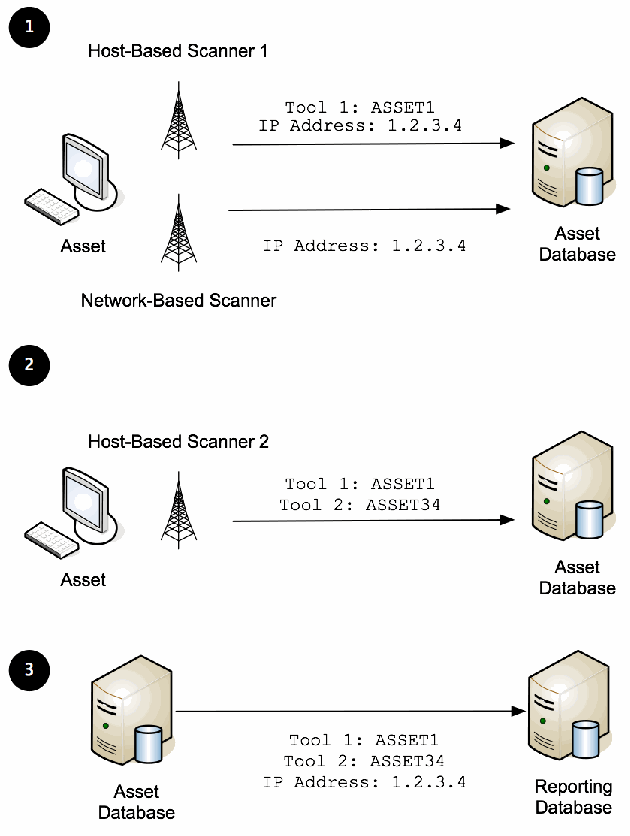
相関の作業の流れの例を3段階で示す図です。段階1では、「Host-Based Scanner 1」(ホストベースのスキャナー1)が「Asset」(資産、コンピューター)について「Tool 1: ASSET1」と「IP Address: 1.2.3.4」を「Asset Database」(資産データベース)へ報告し、「Network-Based Scanner」(ネットワークベースのスキャナー)が「IP Address: 1.2.3.4」を同じ資産データベースへ報告します。段階2では、「Host-Based Scanner 2」(ホストベースのスキャナー2)が資産について「Tool 1: ASSET1」と「Tool 2: ASSET34」を資産データベースへ報告します。段階3では、資産データベースが「Tool 1: ASSET1」「Tool 2: ASSET34」「IP Address: 1.2.3.4」を「Reporting Database」(報告用データベース)へ報告します。
Figure 5-1: Sample Correlation Workflow
図 5-1: 相関ワークフローの例
In step 1, a host-based scanner is reporting on asset information (e.g. vulnerability assessment results) using a synthetic identifier in its own namespace and an IP address as identifying information. Additionally, a network scanner is reporting on network events by IP address. This allows the asset database to correlate information coming from the network with information on the host, potentially matching vulnerabilities discovered by the host-based scanner with attacks against that vulnerability discovered by the network scanner.
ステップ 1 では、ホストベースのスキャナーが、自身の名前空間内の合成識別子と、識別情報としての IP アドレスを用いて、資産情報(たとえば脆弱性評価結果)を報告しています。さらに、ネットワークスキャナーが IP アドレスごとにネットワークイベントを報告しています。これにより、資産データベースは、ネットワークから来る情報とホスト上の情報を相関させることができ、ホストベースのスキャナーが発見した脆弱性と、ネットワークスキャナーが発見した、その脆弱性に対する攻撃とを結びつけられる可能性があります。
In step 2, another host-based scanner (e.g., an asset inventory tool) reports data using both a synthetic identifier in its own namespace and a synthetic identifier in the first host-based tool's namespace. This other identifier may have been collected on the system or may have been discovered some other way; how that collection happens is out of scope of this specification. By passing both identifiers, however, the scanner provides enough data to the asset database to correlate the additional inventory data with the vulnerability and event data. Additionally, any other data reported using either the IP address or the two synthetic identifiers will be able to be correlated as well. Note that this specification does not require or recommend that tools process identifiers in certain ways: for example, an IP address may become stale after a period of time, but it is out of scope for this specification to recommend how to deal with that.
ステップ 2 では、別のホストベースのスキャナー(たとえば、資産インベントリツール)が、自身の名前空間内の合成識別子と、最初のホストベースのツールの名前空間内の合成識別子の両方を用いてデータを報告します。この別の識別子は、システム上で収集されたものかもしれませんし、他の何らかの方法で発見されたものかもしれません。その収集がどのように行われるかは、この仕様の適用範囲外です。しかし、両方の識別子を渡すことで、スキャナーは、追加のインベントリデータを脆弱性データやイベントデータと相関させるのに十分なデータを資産データベースに提供します。さらに、IP アドレスまたは 2 つの合成識別子のいずれかを用いて報告された他のデータも、同様に相関できるようになります。この仕様は、ツールが識別子を特定の方法で処理することを要求も推奨もしないことに注意してください。たとえば、IP アドレスは一定期間後に古くなる場合がありますが、それにどう対処すべきかを推奨することは、この仕様の適用範囲外です。
In step 3, the asset database provides a report to a higher-level database. Depending on the reporting architecture, organizational hierarchy, and reporting requirements, asset databases may want to report on data with different sets of synthetic identifiers for each asset. This specification does not restrict or recommend architectures or workflows.
ステップ 3 では、資産データベースが上位のデータベースに報告を提供します。報告のアーキテクチャ、組織の階層、報告要件によっては、資産データベースは、各資産について異なる合成識別子の集合を用いてデータを報告したい場合があります。この仕様は、アーキテクチャやワークフローを制限も推奨もしません。
In the reporting architecture shown above, all known asset identifiers for each asset are being used to report information to the higher level. In this architecture, data provided by other tools to the higher-level database may be correlated with the reported data. Other options would be to only report some information to the higher-level database or even to generate a new synthetic identifier to perform reporting, depending on the reporting requirements and network architectures.
上に示した報告アーキテクチャでは、各資産について既知のすべての資産識別子が、上位に情報を報告するために使用されています。このアーキテクチャでは、他のツールが上位のデータベースに提供したデータを、報告されたデータと相関させることができます。他の選択肢としては、報告要件やネットワークアーキテクチャに応じて、一部の情報のみを上位のデータベースに報告する、あるいは報告のために新しい合成識別子を生成するということもあります。
6. Data Model
6. データモデル
This section documents the data model for Asset Identification. The XML schema that implements this data model is provided separate from this specification.
この節では、Asset Identification のデータモデルを文書化します。このデータモデルを実装する XML スキーマは、この仕様とは別に提供されています。
The Asset Identification model is a fairly flat model that defines the constructs to hold identifying information about an asset. A limited number of asset types are defined for which model constructs exist. In order to use the Asset Identification model:
Asset Identification モデルは、資産に関する識別情報を保持するための構成要素を定義する、かなりフラットなモデルです。モデルの構成要素が存在する資産タイプは、限られた数が定義されています。Asset Identification モデルを使用するには、次のようにします。
•The user SHOULD produce an XML ai:assets or ai:asset-related element consistent with the data model described in Section 6.4.1.
•ユーザーは、第 6.4.1 節に記述されたデータモデルに整合する XML の ai:assets または ai:asset-related 要素を生成すべきです(SHOULD)。
•The XML element produced MUST validate against the XML schema (XSD) for Asset Identification 1.1 at http://scap.nist.gov/specifications/ai/index.html. In situations where the XML schema does not match the documented model in this specification, the XSD takes precedence.
•生成された XML 要素は、http://scap.nist.gov/specifications/ai/index.html にある Asset Identification 1.1 の XML スキーマ(XSD)に対して検証されなければなりません(MUST)。XML スキーマが、この仕様に文書化されたモデルと一致しない場合は、XSD が優先されます。
The following tables formalize the logical data model. The data contained in the tables are requirements and MUST be interpreted as follows:
以下の表は、論理データモデルを形式化したものです。表に含まれるデータは要件であり、次のように解釈されなければなりません(MUST)。
•The “Element Name” field indicates the name for the entity being described.
•「Element Name」フィールドは、記述される実体の名前を示します。
•The “Definition” field indicates the prose description of the text. The field MAY contain requirement words as indicated in RFC 2119.
•「Definition」フィールドは、そのテキストの散文による記述を示します。このフィールドには、RFC 2119 に示されている要件語が含まれる場合があります(MAY)。
•The “Inherits” field indicates that the element takes on all of the properties of the inherited element in addition to the properties defined for the element.
•「Inherits」フィールドは、その要素が、自身に定義されたプロパティに加えて、継承元の要素のすべてのプロパティを引き継ぐことを示します。
•The “Properties” field is broken into four columns:
•「Properties」フィールドは、4 つの列に分かれています。
•The “Name” column indicates the name of a property that MAY or MUST be included in the described element in accordance with the cardinality indicated in the “Count” field.
•「Name」列は、「Count」フィールドに示された個数に従って、記述される要素に含まれてもよい(MAY)、または含まれなければならない(MUST)プロパティの名前を示します。
•The “Type” column indicates the type of data that MUST be the value for the property. There are two categories of types: literal and element. A literal type will indicate the type of literal. The element type will reference the name of another element that defines the content for that property.
•「Type」列は、そのプロパティの値でなければならない(MUST)データの種類を示します。種類には、リテラルと要素の 2 つの分類があります。リテラル型は、リテラルの種類を示します。要素型は、そのプロパティの内容を定義する別の要素の名前を参照します。
•The “Count” column indicates the cardinality of the property within the element. The property MUST be included in the element in accordance with the cardinality. If a range is given, and “n” is the upper-bound of the range, then the upper limit is unbounded.
•「Count」列は、要素内でのそのプロパティの個数(カーディナリティ)を示します。プロパティは、その個数に従って要素に含まれなければなりません(MUST)。範囲が与えられ、「n」がその範囲の上限である場合、上限は無制限です。
•The “Definition” column defines the property in the context of the element. The field MAY contain requirement words as indicated in RFC 2119.
•「Definition」列は、その要素の文脈でのプロパティを定義します。このフィールドには、RFC 2119 に示されている要件語が含まれる場合があります(MAY)。
Each literal data element MAY have a “source” attribute associated with it. The source attribute is intended to capture the source of the information for that data element. The field SHALL be a string type, but the value of the field is left to the content producer. The value MAY include, but is not restricted to, a synthetic ID of the asset that sourced the information, another ID of the source, or a description of the source. See the XSD for additional clarity on the “source” attribute.
各リテラルデータ要素には、「source」属性が関連づけられていてもよいです(MAY)。source 属性は、そのデータ要素の情報の出所を記録することを意図しています。このフィールドは文字列型でなければなりません(SHALL)が、フィールドの値はコンテンツの生成者に委ねられています。値には、情報の出所となった資産の合成 ID、出所の別の ID、出所の説明などを含めてもよいです(MAY)が、これらに限定されません。「source」属性についてのさらなる明確化は、XSD を参照してください。
Each literal data element MAY have a “timestamp” attribute associated with it. If populated, the timestamp attribute indicates when the data was last known to be correct for that element.
各リテラルデータ要素には、「timestamp」属性が関連づけられていてもよいです(MAY)。設定されている場合、timestamp 属性は、その要素のデータが最後に正しいことが知られていた時点を示します。
6.1 Abstract Elements
6.1 抽象要素
The elements described in this section are the top-level abstract elements from which all asset elements derive.
この節で説明する要素は、すべての資産要素の派生元となる最上位の抽象要素です。
Table 6-1: Element – ai:asset
表 6-1: 要素 – ai:asset
| Element Name: ai:asset | ||||
|---|---|---|---|---|
| Definition | The root element from which all other asset elements derive. This element does not represent any specific type of asset, and therefore should only be used as a base class for other, concrete, asset elements. Any element that claims to be an asset element compliant with this specification SHALL directly or indirectly inherit all of the attributes in this element. The asset element SHALL NOT be used directly in an asset identification instance because it is abstract. | |||
| Properties | Name | Type | Count | Definition |
| synthetic-id | element – synthetic-id | 0-n | Holds the synthetic ID information for the asset. | |
| locations | element - locations | 0-1 | Holds the location information where the asset resides. | |
| extended-information | element – any XML | 0-1 | Holds extension identifiers for the asset. The content can be any well-formed XML defined in a namespace other than the Asset Identification namespace. | |
| timestamp | literal – dateTime | 0-1 | The date and time when the information was last known to be correct. | |
| Element Name: ai:asset | ||||
|---|---|---|---|---|
| Definition | 他のすべての資産要素の派生元となるルート要素。この要素は特定の種類の資産を表さないため、他の具象の資産要素の基底クラスとしてのみ使用すべきです。この仕様に準拠した資産要素であると主張する要素は、この要素のすべての属性を直接または間接に継承しなければなりません(SHALL)。asset 要素は抽象要素であるため、資産識別インスタンスの中で直接使用してはなりません(SHALL NOT)。 | |||
| Properties | Name | Type | Count | Definition |
| synthetic-id | element – synthetic-id | 0-n | 資産の合成 ID 情報を保持します。 | |
| locations | element - locations | 0-1 | 資産が存在する場所の情報を保持します。 | |
| extended-information | element – any XML | 0-1 | 資産の拡張識別子を保持します。内容は、Asset Identification の名前空間以外の名前空間で定義された、任意の整形式 XML とすることができます。 | |
| timestamp | literal – dateTime | 0-1 | 情報が最後に正しいことが知られていた日時。 | |
Table 6-2: Element – ai:it-asset
表 6-2: 要素 – ai:it-asset
| Element Name: ai:it-asset | ||||
|---|---|---|---|---|
| Inherits | ai:asset | |||
| Definition | An abstract element that extends from the asset element. it-asset is a placeholder element to carry common attributes related to IT assets. For the current iteration of this specification no common attributes have been identified, but future iterations of the specification MAY contain common attributes for IT assets. All asset elements that are describing IT assets SHOULD extend from the it-asset element. | |||
| Element Name: ai:it-asset | ||||
|---|---|---|---|---|
| Inherits | ai:asset | |||
| Definition | asset 要素を拡張する抽象要素。it-asset は、IT 資産に関連する共通の属性を保持するためのプレースホルダー要素です。この仕様の現在の版では、共通の属性は特定されていませんが、この仕様の将来の版には、IT 資産の共通の属性が含まれる場合があります(MAY)。IT 資産を記述するすべての資産要素は、it-asset 要素を拡張すべきです(SHOULD)。 | |||
6.2 Concrete Asset Elements
6.2 具象の資産要素
The following elements describe the data elements for the asset types defined in this specification.
次の要素は、この仕様で定義された資産タイプのデータ要素を記述します。
Table 6-3: Element – ai:circuit
表 6-3: 要素 – ai:circuit
| Element Name: ai:circuit | ||||
|---|---|---|---|---|
| Inherits | ai:it-asset | |||
| Definition | Captures identifying information about a circuit. | |||
| Properties | Name | Type | Count | Definition |
| circuit-name | literal – token | 0-1 | The name of the circuit being identified. | |
| Element Name: ai:circuit | ||||
|---|---|---|---|---|
| Inherits | ai:it-asset | |||
| Definition | 回線に関する識別情報を捉えます。 | |||
| Properties | Name | Type | Count | Definition |
| circuit-name | literal – token | 0-1 | 識別対象の回線の名前。 | |
Table 6-4: Element – ai:computing-device
表 6-4: 要素 – ai:computing-device
| Element Name: ai:computing-device | ||||
|---|---|---|---|---|
| Inherits | ai:it-asset | |||
| Definition | Captures identifying information about a computing device. | |||
| Properties | Name | Type | Count | Definition |
| distinguished-name | literal – token | 0-1 | The X.500 distinguished name of the computing device being identified. | |
| cpe | literal – ai:cpe | 0-n | The Common Platform Enumeration name for the computing device being identified. This MUST be a hardware CPE. This MUST be a CPE 2.2 URI [CPE22] or CPE 2.3 formatted string [CPE23]. | |
| connections | element – ai:connections | 0-1 | Information about a network interface on the computing device being identified. | |
| fqdn | literal – token | 0-1 | The fully-qualified domain name for the computing device being identified. | |
| hostname | literal – token | 0-1 | The hostname of the computing device. | |
| motherboard-guid | literal - string | 0-1 | The motherboard globally unique identifier of the computing device. | |
| Element Name: ai:computing-device | ||||
|---|---|---|---|---|
| Inherits | ai:it-asset | |||
| Definition | コンピューティングデバイスに関する識別情報を捉えます。 | |||
| Properties | Name | Type | Count | Definition |
| distinguished-name | literal – token | 0-1 | 識別対象のコンピューティングデバイスの X.500 識別名。 | |
| cpe | literal – ai:cpe | 0-n | 識別対象のコンピューティングデバイスの Common Platform Enumeration 名。ハードウェアの CPE でなければなりません(MUST)。CPE 2.2 URI [CPE22] または CPE 2.3 書式化文字列 [CPE23] でなければなりません(MUST)。 | |
| connections | element – ai:connections | 0-1 | 識別対象のコンピューティングデバイス上のネットワークインタフェースに関する情報。 | |
| fqdn | literal – token | 0-1 | 識別対象のコンピューティングデバイスの完全修飾ドメイン名。 | |
| hostname | literal – token | 0-1 | コンピューティングデバイスのホスト名。 | |
| motherboard-guid | literal - string | 0-1 | コンピューティングデバイスのマザーボードのグローバル一意識別子。 | |
Table 6-5: Element – ai:data
表 6-5: 要素 – ai:data
| Element Name: ai:data | ||||
|---|---|---|---|---|
| Inherits | ai:asset | |||
| Definition | A generic element to describe any type of data. Since this element is generic it does not define any of its own properties, but instead relies solely on the properties inherited from asset. | |||
| Element Name: ai:data | ||||
|---|---|---|---|---|
| Inherits | ai:asset | |||
| Definition | あらゆる種類のデータを記述する汎用要素。この要素は汎用であるため、独自のプロパティを定義せず、asset から継承したプロパティのみに依存します。 | |||
Table 6-6: Element – ai:database
表 6-6: 要素 – ai:database
| Element Name: ai:database | ||||
|---|---|---|---|---|
| Inherits | ai:it-asset | |||
| Definition | Captures identifying information about a database. | |||
| Properties | Name | Type | Count | Definition |
| instance-name | literal – token | 0-1 | The name of the database instance. | |
| Element Name: ai:database | ||||
|---|---|---|---|---|
| Inherits | ai:it-asset | |||
| Definition | データベースに関する識別情報を捉えます。 | |||
| Properties | Name | Type | Count | Definition |
| instance-name | literal – token | 0-1 | データベースインスタンスの名前。 | |
Table 6-7: Element – ai:network
表 6-7: 要素 – ai:network
| Element Name: ai:network | ||||
|---|---|---|---|---|
| Inherits | ai:it-asset | |||
| Definition | Captures identifying information about a network. | |||
| Properties | Name | Type | Count | Definition |
| network-name | literal – normalizedString | 0-1 | The name of the network being identified. | |
| ip-net-range | element – ip-net-range | 0-1 (either but not both) | The starting and ending IP addresses for the range of IP addresses for the network being identified. | |
| cidr | literal – token | The Classless Inter-Domain Routing information for the network being identified. | ||
| Element Name: ai:network | ||||
|---|---|---|---|---|
| Inherits | ai:it-asset | |||
| Definition | ネットワークに関する識別情報を捉えます。 | |||
| Properties | Name | Type | Count | Definition |
| network-name | literal – normalizedString | 0-1 | 識別対象のネットワークの名前。 | |
| ip-net-range | element – ip-net-range | 0-1(いずれか一方、またはどちらもなし。両方は不可) | 識別対象のネットワークの IP アドレス範囲の開始 IP アドレスと終了 IP アドレス。 | |
| cidr | literal – token | 識別対象のネットワークの Classless Inter-Domain Routing 情報。 | ||
Table 6-8: Element – ai:organization
表 6-8: 要素 – ai:organization
| Element Name: ai:organization | ||||
|---|---|---|---|---|
| Inherits | ai:asset | |||
| Definition | Captures identifying information about an organization. | |||
| Properties | Name | Type | Count | Definition |
| xnl:OrganisationNameDetails | element – xnl:OrganisationNameDetails | 0-n | The name of the organization being identified. See [xNL] for details on populating this element. | |
| email-address | literal – token | 0-n | An email address associated with the organization being identified. | |
| telephone-number | literal - token | 0-n | A phone number associated with the organization being identified. For a North American number, the number MUST be valid and the format MUST be XXX-XXX-XXXX where X is a digit. For an international number, the number MUST begin with a '+' symbol, followed by 7 to 15 digits. A space MAY be used between digits, as appropriate. For example: +88 888 888 8 (this is following the ITU-T E.123 notation). Regex: (([2-9][0-8]\d-[2-9]\d{2}-[0-9]{4})|(\+([0-9] ?){6,14}[0-9])) | |
| website-url | literal - URL | 0-n | A website associated with the organization being identified. | |
| Element Name: ai:organization | ||||
|---|---|---|---|---|
| Inherits | ai:asset | |||
| Definition | 組織に関する識別情報を捉えます。 | |||
| Properties | Name | Type | Count | Definition |
| xnl:OrganisationNameDetails | element – xnl:OrganisationNameDetails | 0-n | 識別対象の組織の名前。この要素の設定方法の詳細は [xNL] を参照してください。 | |
| email-address | literal – token | 0-n | 識別対象の組織に関連づけられた電子メールアドレス。 | |
| telephone-number | literal - token | 0-n | 識別対象の組織に関連づけられた電話番号。北米の番号の場合、番号は有効でなければならず(MUST)、形式は XXX-XXX-XXXX(X は数字)でなければなりません(MUST)。国際番号の場合、番号は「+」記号で始まり、7〜15 桁の数字が続かなければなりません(MUST)。数字の間には、適宜、スペースを使ってもよいです(MAY)。例: +88 888 888 8(これは ITU-T E.123 の表記に従っています)。 Regex: (([2-9][0-8]\d-[2-9]\d{2}-[0-9]{4})|(\+([0-9] ?){6,14}[0-9])) | |
| website-url | literal - URL | 0-n | 識別対象の組織に関連づけられたウェブサイト。 | |
Table 6-9: Element – ai:person
表 6-9: 要素 – ai:person
| Element Name: ai:person | ||||
|---|---|---|---|---|
| Inherits | ai:asset | |||
| Definition | Captures identifying information about a person. | |||
| Properties | Name | Type | Count | Definition |
| xnl:PersonName | element - xnl:PersonName | 0-1 | The name of the person being identified. The element type is defined in [xNL] and SHALL be used as documented in that specification. | |
| email-address | literal – token | 0-n | An email address associated with the person being identified. | |
| telephone-number | literal - token | 0-n | A phone number associated with the person being identified. For a North American number, the number MUST be valid and the format MUST be XXX-XXX-XXXX where X is a digit. For an international number, the number MUST begin with a '+' symbol, followed by 7 to 15 digits. A space MAY be used between digits, as appropriate. For example: +88 888 888 8 (this is following the ITU-T E.123 notation). Regex: (([2-9][0-8]\d-[2-9]\d{2}-[0-9]{4})|(\+([0-9] ?){6,14}[0-9])) | |
| birthdate | literal - date | 0-1 | The birth date of the person being identified. | |
| Element Name: ai:person | ||||
|---|---|---|---|---|
| Inherits | ai:asset | |||
| Definition | 人に関する識別情報を捉えます。 | |||
| Properties | Name | Type | Count | Definition |
| xnl:PersonName | element - xnl:PersonName | 0-1 | 識別対象の人の名前。この要素の型は [xNL] で定義されており、その仕様に記載されているとおりに使用されなければなりません(SHALL)。 | |
| email-address | literal – token | 0-n | 識別対象の人に関連づけられた電子メールアドレス。 | |
| telephone-number | literal - token | 0-n | 識別対象の人に関連づけられた電話番号。北米の番号の場合、番号は有効でなければならず(MUST)、形式は XXX-XXX-XXXX(X は数字)でなければなりません(MUST)。国際番号の場合、番号は「+」記号で始まり、7〜15 桁の数字が続かなければなりません(MUST)。数字の間には、適宜、スペースを使ってもよいです(MAY)。例: +88 888 888 8(これは ITU-T E.123 の表記に従っています)。 Regex: (([2-9][0-8]\d-[2-9]\d{2}-[0-9]{4})|(\+([0-9] ?){6,14}[0-9])) | |
| birthdate | literal - date | 0-1 | 識別対象の人の生年月日。 | |
Table 6-10: Element – ai:service
表 6-10: 要素 – ai:service
| Element Name: ai:service | ||||
|---|---|---|---|---|
| Inherits | ai:it-asset | |||
| Definition | Captures identifying information about a service running on a computing-device. | |||
| Properties | Name | Type | Count | Definition |
| host | element – host | 0-1 | The IP address or fully qualified domain name of the host of the service. | |
| port | literal – integer | 0-n | The port number that the service is bound to. Restricted to 0 <= x <= 65535 | |
| port-range | element – ai:port-range | 0-n | The lower and upper bound (inclusive) of the range of ports the service is bound to. | |
| protocol | literal – string | 0-1 | The protocol used to interact with the service (e.g., HTTP, JMS, SSH, FTP). | |
| Element Name: ai:service | ||||
|---|---|---|---|---|
| Inherits | ai:it-asset | |||
| Definition | computing-device 上で動作するサービスに関する識別情報を捉えます。 | |||
| Properties | Name | Type | Count | Definition |
| host | element – host | 0-1 | サービスのホストの IP アドレスまたは完全修飾ドメイン名。 | |
| port | literal – integer | 0-n | サービスがバインドされているポート番号。0 <= x <= 65535 に制限されます。 | |
| port-range | element – ai:port-range | 0-n | サービスがバインドされているポートの範囲の下限と上限(両端を含む)。 | |
| protocol | literal – string | 0-1 | サービスとやり取りするために使用されるプロトコル(たとえば、HTTP、JMS、SSH、FTP)。 | |
Table 6-11: Element – ai:software
表 6-11: 要素 – ai:software
| Element Name: ai:software | ||||
|---|---|---|---|---|
| Inherits | ai:it-asset | |||
| Definition | Captures identifying information about a class of software or a software instance. | |||
| Properties | Name | Type | Count | Definition |
| installation-id | literal – token | 0-1 | Any identifier for a software instance (installation). Use when identifying an instance of software and not just the class of software. | |
| cpe | literal – ai:cpe | 0-1 | The Common Platform Enumeration name for the class of software being identified. This MUST be a software CPE. This MUST be a CPE 2.2 URI [CPE22] or CPE 2.3 formatted string [CPE23]. | |
| license | literal – string | 0-n | The license key associated with the software instance (installation). Use when identifying an instance of software and not just the class of software. | |
| Element Name: ai:software | ||||
|---|---|---|---|---|
| Inherits | ai:it-asset | |||
| Definition | ソフトウェアのクラスまたはソフトウェアのインスタンスに関する識別情報を捉えます。 | |||
| Properties | Name | Type | Count | Definition |
| installation-id | literal – token | 0-1 | ソフトウェアのインスタンス(インストール)の任意の識別子。ソフトウェアのクラスだけでなく、ソフトウェアのインスタンスを識別する場合に使用します。 | |
| cpe | literal – ai:cpe | 0-1 | 識別対象のソフトウェアのクラスの Common Platform Enumeration 名。ソフトウェアの CPE でなければなりません(MUST)。CPE 2.2 URI [CPE22] または CPE 2.3 書式化文字列 [CPE23] でなければなりません(MUST)。 | |
| license | literal – string | 0-n | ソフトウェアのインスタンス(インストール)に関連づけられたライセンスキー。ソフトウェアのクラスだけでなく、ソフトウェアのインスタンスを識別する場合に使用します。 | |
Table 6-12: Element – ai:system
表 6-12: 要素 – ai:system
| Element Name: ai:system | ||||
|---|---|---|---|---|
| Inherits | ai:it-asset | |||
| Definition | Captures identifying information about a system. | |||
| Properties | Name | Type | Count | Definition |
| system-name | literal – token | 0-n | The name of the system being identified. This property can be replicated as systems may have multiple, or abbreviated, names. All of the names (including acronyms) MAY be captured here. | |
| version | literal – token | 0-1 | The version of the system being identified. | |
| Element Name: ai:system | ||||
|---|---|---|---|---|
| Inherits | ai:it-asset | |||
| Definition | システムに関する識別情報を捉えます。 | |||
| Properties | Name | Type | Count | Definition |
| system-name | literal – token | 0-n | 識別対象のシステムの名前。システムは複数の名前や略称を持つ場合があるため、このプロパティは複製できます。すべての名前(頭字語を含む)をここに捉えてもよいです(MAY)。 | |
| version | literal – token | 0-1 | 識別対象のシステムのバージョン。 | |
Table 6-13: Element – ai:website
表 6-13: 要素 – ai:website
| Element Name: ai:website | ||||
|---|---|---|---|---|
| Inherits | ai:it-asset | |||
| Definition | Captures identifying information about a website. | |||
| Properties | Name | Type | Count | Definition |
| document-root | literal - token | 0-1 | The absolute path to the document root location of the website on the host. | |
| locale | literal - token | 0-1 | The locale of the website represented as an RFC 5646 language, and optionally, region code. Language and region codes SHOULD be in the Internet Assigned Numbers Authority (IANA) Language Subtag Registry [ILSR]. Regex: [a-zA-Z]{2,3}(-([a-zA-Z]{2}|[0-9]{3}))? | |
| Element Name: ai:website | ||||
|---|---|---|---|---|
| Inherits | ai:it-asset | |||
| Definition | ウェブサイトに関する識別情報を捉えます。 | |||
| Properties | Name | Type | Count | Definition |
| document-root | literal - token | 0-1 | ホスト上のウェブサイトのドキュメントルートの場所への絶対パス。 | |
| locale | literal - token | 0-1 | RFC 5646 の言語、および任意で地域コードとして表現された、ウェブサイトのロケール。言語コードと地域コードは、Internet Assigned Numbers Authority(IANA)の Language Subtag Registry [ILSR] にあるものを使用すべきです(SHOULD)。 Regex: [a-zA-Z]{2,3}(-([a-zA-Z]{2}|[0-9]{3}))? | |
6.3 Helper Elements
6.3 補助要素
Table 6-14: Element – ai:synthetic-id
表 6-14: 要素 – ai:synthetic-id
| Element Name: ai:synthetic-id | ||||
|---|---|---|---|---|
| Definition | Holds the synthetic identifier information for an asset. | |||
| Properties | Name | Type | Count | Definition |
| resource | literal - URI | 1 | A URI for the namespace in which the identifier is governed and unique. | |
| id | literal - token | 1 | The unique identifier for the asset within the resource namespace. | |
| Element Name: ai:synthetic-id | ||||
|---|---|---|---|---|
| Definition | 資産の合成識別子情報を保持します。 | |||
| Properties | Name | Type | Count | Definition |
| resource | literal - URI | 1 | 識別子が管理され、一意となる名前空間の URI。 | |
| id | literal - token | 1 | resource 名前空間内での資産の一意な識別子。 | |
Table 6-15: Element – ai:connections
表 6-15: 要素 – ai:connections
| Element Name: ai:connections | ||||
|---|---|---|---|---|
| Definition | Contains a list of ai:connection elements. | |||
| Properties | Name | Type | Count | Definition |
| connection | element – ai:connection | 1-n | Information about a network interface on the computing device being identified. | |
| Element Name: ai:connections | ||||
|---|---|---|---|---|
| Definition | ai:connection 要素のリストを含みます。 | |||
| Properties | Name | Type | Count | Definition |
| connection | element – ai:connection | 1-n | 識別対象のコンピューティングデバイス上のネットワークインタフェースに関する情報。 | |
Table 6-16: Element – ai:connection
表 6-16: 要素 – ai:connection
| Element Name: ai:connection | ||||
|---|---|---|---|---|
| Definition | Contains information relevant to a single connection to a network. If multiple IP addresses map to the same MAC address, each ai:connection SHALL represent a single MAC address-IP address pair. | |||
| Properties | Name | Type | Count | Definition |
| ip-address | literal – token | 0-1 | The IP address for the connection. IPv4 Regex: ([0-9]|[1-9][0-9]|1([0-9][0-9])|2([0-4][0-9]|5[0-5]))\.([0-9]|[1-9][0-9]|1([0-9][0-9])|2([0-4][0-9]|5[0-5]))\.([0-9]|[1-9][0-9]|1([0-9][0-9])|2([0-4][0-9]|5[0-5]))\.([0-9]|[1-9][0-9]|1([0-9][0-9])|2([0-4][0-9]|5[0-5])) IPv6 Regex: ([0-9a-fA-F]{1,4}:){7}[0-9a-fA-F]{1,4} | |
| mac-address | literal – ai:mac-address-type | 0-1 | The Media Access Control address for the network interface. Regex: ([0-9a-fA-F]{2}:){5}[0-9a-fA-F]{2} | |
| url | literal – URL | 0-n | A Universal Resource Locator address for the network interface. | |
| subnet-mask | literal – token | 0-1 | The subnet mask for the connection. IPv4 Regex: ([0-9]|[1-9][0-9]|1([0-9][0-9])|2([0-4][0-9]|5[0-5]))\.([0-9]|[1-9][0-9]|1([0-9][0-9])|2([0-4][0-9]|5[0-5]))\.([0-9]|[1-9][0-9]|1([0-9][0-9])|2([0-4][0-9]|5[0-5]))\.([0-9]|[1-9][0-9]|1([0-9][0-9])|2([0-4][0-9]|5[0-5])) IPv6 Regex: ([0-9a-fA-F]{1,4}:){7}[0-9a-fA-F]{1,4} | |
| default-route | literal – token | 0-1 | The IP address for the default gateway for the connection. IPv4 Regex: ([0-9]|[1-9][0-9]|1([0-9][0-9])|2([0-4][0-9]|5[0-5]))\.([0-9]|[1-9][0-9]|1([0-9][0-9])|2([0-4][0-9]|5[0-5]))\.([0-9]|[1-9][0-9]|1([0-9][0-9])|2([0-4][0-9]|5[0-5]))\.([0-9]|[1-9][0-9]|1([0-9][0-9])|2([0-4][0-9]|5[0-5])) IPv6 Regex: ([0-9a-fA-F]{1,4}:){7}[0-9a-fA-F]{1,4} | |
| Element Name: ai:connection | ||||
|---|---|---|---|---|
| Definition | ネットワークへの単一の接続に関する情報を含みます。複数の IP アドレスが同じ MAC アドレスに対応する場合、各 ai:connection は、MAC アドレスと IP アドレスの 1 つの組を表さなければなりません(SHALL)。 | |||
| Properties | Name | Type | Count | Definition |
| ip-address | literal – token | 0-1 | 接続の IP アドレス。 IPv4 Regex: ([0-9]|[1-9][0-9]|1([0-9][0-9])|2([0-4][0-9]|5[0-5]))\.([0-9]|[1-9][0-9]|1([0-9][0-9])|2([0-4][0-9]|5[0-5]))\.([0-9]|[1-9][0-9]|1([0-9][0-9])|2([0-4][0-9]|5[0-5]))\.([0-9]|[1-9][0-9]|1([0-9][0-9])|2([0-4][0-9]|5[0-5])) IPv6 Regex: ([0-9a-fA-F]{1,4}:){7}[0-9a-fA-F]{1,4} | |
| mac-address | literal – ai:mac-address-type | 0-1 | ネットワークインタフェースの Media Access Control アドレス。 Regex: ([0-9a-fA-F]{2}:){5}[0-9a-fA-F]{2} | |
| url | literal – URL | 0-n | ネットワークインタフェースの Universal Resource Locator アドレス。 | |
| subnet-mask | literal – token | 0-1 | 接続のサブネットマスク。 IPv4 Regex: ([0-9]|[1-9][0-9]|1([0-9][0-9])|2([0-4][0-9]|5[0-5]))\.([0-9]|[1-9][0-9]|1([0-9][0-9])|2([0-4][0-9]|5[0-5]))\.([0-9]|[1-9][0-9]|1([0-9][0-9])|2([0-4][0-9]|5[0-5]))\.([0-9]|[1-9][0-9]|1([0-9][0-9])|2([0-4][0-9]|5[0-5])) IPv6 Regex: ([0-9a-fA-F]{1,4}:){7}[0-9a-fA-F]{1,4} | |
| default-route | literal – token | 0-1 | 接続のデフォルトゲートウェイの IP アドレス。 IPv4 Regex: ([0-9]|[1-9][0-9]|1([0-9][0-9])|2([0-4][0-9]|5[0-5]))\.([0-9]|[1-9][0-9]|1([0-9][0-9])|2([0-4][0-9]|5[0-5]))\.([0-9]|[1-9][0-9]|1([0-9][0-9])|2([0-4][0-9]|5[0-5]))\.([0-9]|[1-9][0-9]|1([0-9][0-9])|2([0-4][0-9]|5[0-5])) IPv6 Regex: ([0-9a-fA-F]{1,4}:){7}[0-9a-fA-F]{1,4} | |
Table 6-17: Element – ai:locations
表 6-17: 要素 – ai:locations
| Element Name: ai:locations | ||||
|---|---|---|---|---|
| Definition | Contains a geographic coordinate system point. | |||
| Properties | Name | Type | Count | Definition |
| location | element – one of: location-point, location-region, location-address (type xal:AddressDetails) | 1-n | ai:location is an abstract element that is the root of the substitution group for the elements listed in the type field. Use one of those to describe the location of the asset. xal:AddressDetails is defined in [xAL]. | |
| Element Name: ai:locations | ||||
|---|---|---|---|---|
| Definition | 地理座標系の点を含みます。 | |||
| Properties | Name | Type | Count | Definition |
| location | element – one of: location-point, location-region, location-address (type xal:AddressDetails) | 1-n | ai:location は抽象要素であり、type フィールドに挙げられた要素の置換グループのルートです。資産の場所を記述するには、それらのいずれかを使用します。xal:AddressDetails は [xAL] で定義されています。 | |
Table 6-18: Element – ai:location-point
表 6-18: 要素 – ai:location-point
| Element Name: ai:location-point | ||||
|---|---|---|---|---|
| Definition | Contains a geographic coordinate system point. | |||
| Properties | Name | Type | Count | Definition |
| latitude | literal – number | 1 | The latitude of the point represented as a number between -90 and 90. 90 = 90°N, -90 = 90°S. Value constraint: -90 <= x <= 90 | |
| longitude | literal – number | 1 | The longitude of the point represented as a number between -180 and 180. 180 = 180°E, -180 = 180°W. Value constraint: -180 < x <= 180 | |
| elevation | literal – number | 0-1 | The elevation of the point represented in meters above sea level. A negative number would indicate below sea level. | |
| radius | literal – number | 0-1 | The radius of a horizontal circle centered on the point within which the asset resides. Value constraint: x >= 0 | |
| Element Name: ai:location-point | ||||
|---|---|---|---|---|
| Definition | 地理座標系の点を含みます。 | |||
| Properties | Name | Type | Count | Definition |
| latitude | literal – number | 1 | -90 から 90 の数値で表される点の緯度。90 = 北緯 90°、-90 = 南緯 90°。 Value constraint: -90 <= x <= 90 | |
| longitude | literal – number | 1 | -180 から 180 の数値で表される点の経度。180 = 東経 180°、-180 = 西経 180°。 Value constraint: -180 < x <= 180 | |
| elevation | literal – number | 0-1 | 海抜のメートルで表される点の標高。負の数は海面下を示します。 | |
| radius | literal – number | 0-1 | 資産が存在する、その点を中心とする水平な円の半径。 Value constraint: x >= 0 | |
Table 6-19: Element – ai:location-region
表 6-19: 要素 – ai:location-region
| Element Name: ai:location-region | ||||
|---|---|---|---|---|
| Definition | Contains region information. | |||
| Properties | Name | Type | Count | Definition |
| region-name | literal – normalizedString | 1 | The name of the region. | |
| Element Name: ai:location-region | ||||
|---|---|---|---|---|
| Definition | 地域の情報を含みます。 | |||
| Properties | Name | Type | Count | Definition |
| region-name | literal – normalizedString | 1 | 地域の名前。 | |
Table 6-20: Element – ai:ip-net-range
表 6-20: 要素 – ai:ip-net-range
| Element Name: ai:ip-net-range | ||||
|---|---|---|---|---|
| Definition | Contains a start and end IP address to create a range. | |||
| Properties | Name | Type | Count | Definition |
| ip-net-range-start | element – ai:ip-address | 1 | The start IP address of the range | |
| ip-net-range-end | element – ai:ip-address | 1 | The end IP address of the range | |
| Element Name: ai:ip-net-range | ||||
|---|---|---|---|---|
| Definition | 範囲を作成するための開始 IP アドレスと終了 IP アドレスを含みます。 | |||
| Properties | Name | Type | Count | Definition |
| ip-net-range-start | element – ai:ip-address | 1 | 範囲の開始 IP アドレス | |
| ip-net-range-end | element – ai:ip-address | 1 | 範囲の終了 IP アドレス | |
Table 6-21: Element – ai:ip-address
表 6-21: 要素 – ai:ip-address
| Element Name: ai:ip-address | ||||
|---|---|---|---|---|
| Definition | Contains an IP address. | |||
| Properties | Name | Type | Count | Definition |
| ip-v4 | literal – token | 0-1 | An IP v4 address. Regex: ([0-9]|[1-9][0-9]|1([0-9][0-9])|2([0-4][0-9]|5[0-5]))\.([0-9]|[1-9][0-9]|1([0-9][0-9])|2([0-4][0-9]|5[0-5]))\.([0-9]|[1-9][0-9]|1([0-9][0-9])|2([0-4][0-9]|5[0-5]))\.([0-9]|[1-9][0-9]|1([0-9][0-9])|2([0-4][0-9]|5[0-5])) | |
| ip-v6 | literal – token | 0-1 | An IP v6 address. Regex: ([0-9a-fA-F]{1,4}:){7}[0-9a-fA-F]{1,4} | |
| Element Name: ai:ip-address | ||||
|---|---|---|---|---|
| Definition | IP アドレスを含みます。 | |||
| Properties | Name | Type | Count | Definition |
| ip-v4 | literal – token | 0-1 | IP v4 アドレス。 Regex: ([0-9]|[1-9][0-9]|1([0-9][0-9])|2([0-4][0-9]|5[0-5]))\.([0-9]|[1-9][0-9]|1([0-9][0-9])|2([0-4][0-9]|5[0-5]))\.([0-9]|[1-9][0-9]|1([0-9][0-9])|2([0-4][0-9]|5[0-5]))\.([0-9]|[1-9][0-9]|1([0-9][0-9])|2([0-4][0-9]|5[0-5])) | |
| ip-v6 | literal – token | 0-1 | IP v6 アドレス。 Regex: ([0-9a-fA-F]{1,4}:){7}[0-9a-fA-F]{1,4} | |
Table 6-22: Element – ai:port-range
表 6-22: 要素 – ai:port-range
| Element Name: ai:port-range | ||||
|---|---|---|---|---|
| Definition | Contains a start and end port number to create a range. | |||
| Properties | Name | Type | Count | Definition |
| lower-bound | literal – token | 1 | The lower bound (inclusive) of the range of ports. Restricted to 0 <= x <= 65535 | |
| upper-bound | literal – token | 1 | The lower bound (inclusive) of the range of ports. Restricted to 0 <= x <= 65535. MUST be greater than lower-bound. | |
| Element Name: ai:port-range | ||||
|---|---|---|---|---|
| Definition | 範囲を作成するための開始ポート番号と終了ポート番号を含みます。 | |||
| Properties | Name | Type | Count | Definition |
| lower-bound | literal – token | 1 | ポートの範囲の下限(両端を含む)。 0 <= x <= 65535 に制限されます。 | |
| upper-bound | literal – token | 1 | ポートの範囲の上限(両端を含む)。 0 <= x <= 65535 に制限されます。lower-bound より大きくなければなりません(MUST)。 | |
Table 6-23: Element – ai:host
表 6-23: 要素 – ai:host
| Element Name: ai:host | ||||
|---|---|---|---|---|
| Definition | Holds a fully-qualified domain name or an IP address | |||
| Properties | Name | Type | Count | Definition |
| fqdn | literal – token | 1 (either but not both) | The fully-qualified domain name of the host. One of fqdn or ip-address must be specified | |
| ip-address | element – ai:ip-address | The IP address of the host. One of fqdn or ip-address must be specified. | ||
| Element Name: ai:host | ||||
|---|---|---|---|---|
| Definition | 完全修飾ドメイン名または IP アドレスを保持します | |||
| Properties | Name | Type | Count | Definition |
| fqdn | literal – token | 1(どちらか一方のみ) | ホストの完全修飾ドメイン名。fqdn または ip-address のいずれか一方を指定しなければなりません | |
| ip-address | element – ai:ip-address | ホストの IP アドレス。fqdn または ip-address のいずれか一方を指定しなければなりません。 | ||
Table 6-24: Element – ai:cpe
表 6-24: 要素 – ai:cpe
| Element Name: ai:cpe | ||||
|---|---|---|---|---|
| Definition | A CPE 2.2 URI [CPE22] or CPE 2.3 formatted string [CPE23]. | |||
| Element Name: ai:cpe | ||||
|---|---|---|---|---|
| Definition | CPE 2.2 URI [CPE22] または CPE 2.3 書式化文字列 [CPE23]。 | |||
6.4 Relating Assets to Other Assets
6.4 資産と他の資産との関連づけ
While the assets modeled in Section 6.2, and their related elements, capture the literal values helpful for identifying the respective assets, it is often useful or necessary to define one or more relationships between assets. Those relationships can give additional context to the identifying algorithm in the implementing tool.
第 6.2 節でモデル化された資産とその関連要素は、それぞれの資産の識別に役立つリテラル値を捉えますが、資産間の 1 つ以上の関係を定義することが有用または必要な場合がよくあります。これらの関係は、実装するツールの識別アルゴリズムに追加の文脈を与えることができます。
The Asset Identification data model allows for explicit relationships to be defined between an asset and one or more other assets. Each relationship is defined as {subject} {predicate} {object}, where {subject} is the asset from which the relationship begins, {predicate} is the relationship type being established, and {object} is one or more other assets. The predicate MUST be a qualified name that refers to a term in a controlled vocabulary. Section 6.4.1 documents the data model to represent assets along with relationships. Section 6.4.2 defines terms in a controlled vocabulary for Asset Identification.
Asset Identification データモデルでは、ある資産と 1 つ以上の他の資産との間の明示的な関係を定義できます。各関係は {subject} {predicate} {object} として定義されます。ここで、{subject} は関係の起点となる資産、{predicate} は確立される関係タイプ、{object} は 1 つ以上の他の資産です。predicate は、統制語彙内の用語を参照する修飾名でなければなりません(MUST)。第 6.4.1 節では、関係とともに資産を表現するためのデータモデルを文書化します。第 6.4.2 節では、Asset Identification の統制語彙内の用語を定義します。
6.4.1 Relationship Data Model
6.4.1 関係データモデル
Asset Identification defines two elements that can be leveraged by specifications desiring to represent Asset Identification information. The first element, ai:asset-related, SHOULD be leveraged when the implementing specification desires to identify a single asset while demonstrating relationships between that asset and other assets. The second element, ai:assets, SHOULD be leveraged when the implementing specification desires to identify multiple assets while documenting the relationships between those assets and other assets. The two elements are documented in the following tables.
Asset Identification は、Asset Identification 情報を表現したい仕様が活用できる 2 つの要素を定義しています。最初の要素である ai:asset-related は、実装する仕様が、単一の資産を識別するとともに、その資産と他の資産との間の関係を示したい場合に活用すべきです(SHOULD)。2 つ目の要素である ai:assets は、実装する仕様が、複数の資産を識別するとともに、それらの資産と他の資産との間の関係を文書化したい場合に活用すべきです(SHOULD)。2 つの要素は、次の表に文書化されています。
Table 6-25: Element – ai:asset-related
表 6-25: 要素 – ai:asset-related
| Element Name: ai:asset-related | ||||
|---|---|---|---|---|
| Definition | Identifies a single asset while capturing the relationships between that asset and other assets. | |||
| Properties | Name | Type | Count | Definition |
| asset-ref | literal – NCName | 1 | Contains the ID value of an ai:asset found on this ai:asset-related element. The asset referenced from this property is the primary asset of this element and SHALL be understood to be the asset being identified by this ai:asset-related element. | |
| relationships | element – core:relationships | 0-1 | Contains the relationships between assets identified in this element. | |
| asset | element – ai:asset | 1-n | The assets captured in this element. This includes at minimum the primary asset referenced in asset-ref, as well as any additional assets that the primary asset is related to through a relationship. | |
| Element Name: ai:asset-related | ||||
|---|---|---|---|---|
| Definition | 単一の資産を識別するとともに、その資産と他の資産との間の関係を捉えます。 | |||
| Properties | Name | Type | Count | Definition |
| asset-ref | literal – NCName | 1 | この ai:asset-related 要素に含まれる ai:asset の ID 値を保持します。このプロパティから参照される資産は、この要素の主たる資産であり、この ai:asset-related 要素によって識別される資産であると理解されなければなりません(SHALL)。 | |
| relationships | element – core:relationships | 0-1 | この要素で識別される資産間の関係を保持します。 | |
| asset | element – ai:asset | 1-n | この要素に捉えられる資産。少なくとも、asset-ref で参照される主たる資産と、主たる資産が関係を通じて関連づけられている追加の資産がすべて含まれます。 | |
Table 6-26: Element – ai:assets
表 6-26: 要素 – ai:assets
| Element Name: ai:assets | ||||
|---|---|---|---|---|
| Definition | Identifies multiple assets as well as the relationships between the assets. | |||
| Properties | Name | Type | Count | Definition |
| relationships | element – core:relationships | 0-1 | Contains the relationships between assets identified in this element. | |
| asset | element – ai:asset | 1-n | The assets captured in this element. | |
| Element Name: ai:assets | ||||
|---|---|---|---|---|
| Definition | 複数の資産と、それらの資産間の関係を識別します。 | |||
| Properties | Name | Type | Count | Definition |
| relationships | element – core:relationships | 0-1 | この要素で識別される資産間の関係を保持します。 | |
| asset | element – ai:asset | 1-n | この要素に捉えられる資産。 | |
Table 6-27: Element – core:relationships
表 6-27: 要素 – core:relationships
| Element Name: core:relationships | ||||
|---|---|---|---|---|
| Definition | Contains a collection of relationships between the report content and assets, report requests, and other reports. | |||
| Properties | Name | Type | Count | Definition |
| relationship | element – core:relationship | 1-n | Contains a relationship between the subject and object(s) assets. | |
| Element Name: core:relationships | ||||
|---|---|---|---|---|
| Definition | 報告内容と資産、報告要求、他の報告との間の関係の集まりを含みます。 | |||
| Properties | Name | Type | Count | Definition |
| relationship | element – core:relationship | 1-n | 主体(subject)の資産と客体(object)の資産との間の関係を保持します。 | |
Table 6-28: Element – core:relationship
表 6-28: 要素 – core:relationship
| Element Name: core:relationship | ||||
|---|---|---|---|---|
| Definition | Contains a relationship between the subject and object(s) assets. | |||
| Properties | Name | Type | Count | Definition |
| ref | literal - NCName | 1-n | This element MUST identify the object of this relationship by specifying the ID of the asset. Depending on the type of relationship being asserted, there may be additional restrictions on which types of objects may be referenced, but that will be documented with the vocabulary term. | |
| type | literal - QName | 1 | This element contains the type of relationship that is being specified. The QName MUST refer to a term in a controlled vocabulary. The controlled vocabulary is identified by the namespace URI of the QName, and the term in that controlled vocabulary is specified by the local name of the QName. It is helpful, though not required, that when the namespace URI and local name are concatenated, the resulting URI is dereferenceable and points to a location that defines the term. | |
| scope | literal - token | 0-1 | Determines how to interpret multiple ref elements in a relationship. If used, this element MUST contain the string “inclusive” or “exclusive”. When this element is not provided, its default value is “inclusive”. When “inclusive” is specified, this relationship should be understood to exist between the subject asset and the collection of objects identified by the ref elements on this relationship. When “exclusive” is specified, this relationship should be understood to exist between the subject asset and each object asset identified by the ref elements individually. | |
| subject | literal – NCName | 1 | The property MUST identify the subject of the relationship by specifying the ID of the asset. Depending on the type of relationship being asserted, there may be additional restrictions on which type of asset may be referenced, but that will be documented with the vocabulary term. | |
| Element Name: core:relationship | ||||
|---|---|---|---|---|
| Definition | 主体(subject)の資産と客体(object)の資産との間の関係を保持します。 | |||
| Properties | Name | Type | Count | Definition |
| ref | literal - NCName | 1-n | この要素は、資産の ID を指定することで、この関係の客体を識別しなければなりません(MUST)。表明される関係の種類によっては、参照できる客体の種類にさらなる制限がある場合がありますが、それは語彙の用語とともに文書化されます。 | |
| type | literal - QName | 1 | この要素は、指定される関係の種類を保持します。QName は、統制語彙内の用語を参照しなければなりません(MUST)。統制語彙は QName の名前空間 URI によって識別され、その統制語彙内の用語は QName のローカル名によって指定されます。名前空間 URI とローカル名を連結したときに、結果の URI が参照解決可能で、その用語を定義する場所を指していることは、必須ではありませんが、有用です。 | |
| scope | literal - token | 0-1 | 関係内の複数の ref 要素をどのように解釈するかを決定します。使用する場合、この要素には文字列「inclusive」または「exclusive」が含まれなければなりません(MUST)。この要素が提供されない場合、既定値は「inclusive」です。「inclusive」が指定された場合、この関係は、主体の資産と、この関係上の ref 要素で識別される客体の集まりとの間に存在すると理解すべきです。「exclusive」が指定された場合、この関係は、主体の資産と、この関係上の ref 要素で識別される各客体の資産のそれぞれとの間に存在すると理解すべきです。 | |
| subject | literal – NCName | 1 | このプロパティは、資産の ID を指定することで、関係の主体を識別しなければなりません(MUST)。表明される関係の種類によっては、参照できる資産の種類にさらなる制限がある場合がありますが、それは語彙の用語とともに文書化されます。 | |
6.4.2 Relationship Types
6.4.2 関係の種類
Defined below are terms in a controlled vocabulary for Asset Identification. It is OPTIONAL that content producers use the terms defined below, but all Asset Identification compliant implementations MUST understand the terms defined in this section. Content producers SHOULD use these terms when possible.
以下に、Asset Identification の統制語彙の用語を定義します。コンテンツのプロデューサーが以下に定義する用語を使用することは任意(OPTIONAL)ですが、Asset Identification に準拠するすべての実装は、この節で定義された用語を理解しなければなりません(MUST)。コンテンツのプロデューサーは、可能な場合にはこれらの用語を使用すべきです(SHOULD)。
All terms listed in Table 6-29 exist in the controlled vocabulary identified by http://scap.nist.gov/specifications/ai/vocabulary/relationships/1.0#. The definition of each term can also be found at the URL created when concatenating the URL and the term together. The table MUST be interpreted as follows:
表 6-29 に挙げたすべての用語は、http://scap.nist.gov/specifications/ai/vocabulary/relationships/1.0# で識別される統制語彙に存在します。各用語の定義は、この URL と用語を連結して作成される URL でも確認できます。この表は、次のように解釈されなければなりません(MUST)。
•The “Term” column indicates the local-name of the term being identified.
•「Term」列は、識別される用語のローカル名を示します。
•The “Domain” column indicates the exhaustive set of subject types that may be referenced by a relationship of that type. A relationship of that type MUST reference a subject of the type indicated in “Domain” for that relationship.
•「Domain」列は、その種類の関係によって参照され得る主体タイプの網羅的な集合を示します。その種類の関係は、その関係の「Domain」に示された種類の主体を参照しなければなりません(MUST)。
•The “Range” column indicates the exhaustive set of object types that may be referenced by a relationship of that type. A relationship of that type MUST reference an object of the type indicated in “Range” for that relationship.
•「Range」列は、その種類の関係によって参照され得る客体タイプの網羅的な集合を示します。その種類の関係は、その関係の「Range」に示された種類の客体を参照しなければなりません(MUST)。
•The “Description” column contains a prose description of the relationship type. This column may contain requirement words as indicated in [RFC 2119]. Those requirement words MUST be interpreted as described in [RFC 2119] for the relationship.
•「Description」列には、関係の種類の散文による説明が含まれます。この列には、[RFC 2119] に示されている要件語が含まれる場合があります。それらの要件語は、その関係について [RFC 2119] に記載されているとおりに解釈されなければなりません(MUST)。
Table 6-29: Controlled Vocabulary Defined for Asset Identification
表 6-29: 資産識別用に定義された統制語彙
| Term | Domain | Range | Description |
|---|---|---|---|
| hasTerminationDevice | ai:circuit | ai:computing-device | The circuit is terminated by the device. |
| hasServiceProvider | ai:circuit | ai:organization | The circuit is owner/operated by the organization. |
| hasNetworkTerminationPoint | ai:circuit | ai:network | The circuit ends at the network. |
| servedBy | ai:database, ai:website | ai:service | The database or website is served up by the service. |
| hasServiceProvider | ai:service | ai:software | The service is provided by the software. |
| installedOnDevice | ai:software | ai:computing-device | The software is installed on the computing device. |
| connectedToNetwork | ai:system | ai:network | The system is connected to the network. |
| isOwnerOf | ai:person, ai:organization | ai:it-asset | The person or organization owns the IT asset. |
| isAdministratorOf | ai:person | ai:computing-device, ai:system | The person is the system administrator of the computing device or system. |
| partOf | ai:person | ai:organization | The person is in some way a part of the organization. |
| connectedTo | ai:computing-device, ai:system | ai:system | The computing device or system is connected to the system. |
| Term | Domain | Range | Description |
|---|---|---|---|
| hasTerminationDevice | ai:circuit | ai:computing-device | 回線は、そのデバイスで終端されます。 |
| hasServiceProvider | ai:circuit | ai:organization | 回線は、その組織によって所有・運用されます。 |
| hasNetworkTerminationPoint | ai:circuit | ai:network | 回線は、そのネットワークで終わります。 |
| servedBy | ai:database, ai:website | ai:service | データベースまたはウェブサイトは、そのサービスによって提供されます。 |
| hasServiceProvider | ai:service | ai:software | サービスは、そのソフトウェアによって提供されます。 |
| installedOnDevice | ai:software | ai:computing-device | ソフトウェアは、そのコンピューティングデバイスにインストールされています。 |
| connectedToNetwork | ai:system | ai:network | システムは、そのネットワークに接続されています。 |
| isOwnerOf | ai:person, ai:organization | ai:it-asset | 人または組織が、その IT 資産を所有しています。 |
| isAdministratorOf | ai:person | ai:computing-device, ai:system | 人は、そのコンピューティングデバイスまたはシステムのシステム管理者です。 |
| partOf | ai:person | ai:organization | 人は、何らかの形でその組織の一部です。 |
| connectedTo | ai:computing-device, ai:system | ai:system | コンピューティングデバイスまたはシステムは、そのシステムに接続されています。 |
Content producers that choose to use terms that are not listed in Table 6-29, or to use other terms in addition to those listed in Table 6-29, MAY do so while still remaining compliant to this specification. Content producers SHALL always use terms defined in a controlled vocabulary. The controlled vocabulary SHALL be identified using a URI. Concatenating the controlled vocabulary URI with a term in the vocabulary MAY create a dereferencable URI that points to a definition for that term. This is often accomplished by using an HTTP URL for the controlled vocabulary URI, and ending that URL in “#” or “/”. For instance, http://scap.nist.gov/specifications/ai/vocabulary/relationships/1.0#installedOnDevice is a deferenceable link to the definition of “installedOnDevice”.
表 6-29 に挙げられていない用語を使用すること、または表 6-29 に挙げられた用語に加えて他の用語を使用することを選ぶコンテンツのプロデューサーは、この仕様への準拠を保ちながら、そうしてもよいです(MAY)。コンテンツのプロデューサーは、常に統制語彙で定義された用語を使用しなければなりません(SHALL)。統制語彙は、URI を使用して識別されなければなりません(SHALL)。統制語彙の URI と語彙内の用語を連結すると、その用語の定義を指す、参照解決可能な URI が作成される場合があります(MAY)。これは、統制語彙の URI に HTTP URL を使用し、その URL を「#」または「/」で終えることで実現されることが多くあります。たとえば、http://scap.nist.gov/specifications/ai/vocabulary/relationships/1.0#installedOnDevice は、「installedOnDevice」の定義への参照解決可能なリンクです。
6.5 Guidance for Incorporating Asset Identification Elements into Other Data Models
6.5 資産識別要素を他のデータモデルに組み込むためのガイダンス
The following guidance applies when incorporating the Asset Identification data model into other data models.
Asset Identification データモデルを他のデータモデルに組み込む場合には、次のガイダンスが適用されます。
•If the target data model needs to include a list of assets and the associated relationships between the assets, then the ai:assets element SHOULD be included in the target data model. This will be the case when the target data model will make explicit references to assets in the asset list.
•対象のデータモデルが、資産のリストと、資産間の関連する関係を含む必要がある場合、ai:assets 要素を対象のデータモデルに含めるべきです(SHOULD)。これは、対象のデータモデルが、資産リスト内の資産を明示的に参照する場合に当てはまります。
•If the target data model needs to include a single asset, but other assets are needed to help identify that asset, then the ai:asset-related element SHOULD be included in the target data model. The @asset-ref attribute on ai:asset-related SHALL refer to the specific asset that is being identified.
•対象のデータモデルが単一の資産を含む必要があるものの、その資産を識別するのに他の資産が必要な場合、ai:asset-related 要素を対象のデータモデルに含めるべきです(SHOULD)。ai:asset-related 上の @asset-ref 属性は、識別される特定の資産を参照しなければなりません(SHALL)。
•If the target data model needs to include only a single asset, and no relationships are needed to identify that asset, then the element defining the asset MAY be included in the target data model. While this is allowed, it is preferred that the ai:asset-related element be included instead.
•対象のデータモデルが単一の資産のみを含む必要があり、その資産を識別するのに関係が不要な場合、その資産を定義する要素を対象のデータモデルに含めてもよいです(MAY)。これは許容されますが、代わりに ai:asset-related 要素を含めるべきです。
Appendix A—Use Cases
付録 A—ユースケース
The following use cases describe some common asset management processes that rely on the ability to uniquely identify assets. The asset identification specification was developed primarily in order to support these use cases, although the specification may be useful for other processes or uses.
次のユースケースは、資産を一意に識別できることに依存する、一般的な資産管理プロセスのいくつかを記述します。資産識別仕様は、主にこれらのユースケースを支援するために開発されましたが、この仕様は他のプロセスや用途にも有用な場合があります。
A.1 Correlation of Sensed Data
A.1 センサーで取得したデータの相関
Sensor data is not limited to an automated process: user surveys, manually entered information, and other data may also be correlated using this Asset Identification specification. The data must be correlated both with other manually collected data and with data collected by automated sensors, in order to build a complete representation of all known data about an asset.
センサーデータは自動化されたプロセスに限定されません。ユーザー調査、手入力された情報、その他のデータも、この Asset Identification 仕様を用いて相関させることができます。データは、資産について知られているすべてのデータの完全な表現を構築するために、他の手作業で収集されたデータとも、自動センサーによって収集されたデータとも、相関される必要があります。
Consistent asset identification allows data to be correlated regardless of:
一貫した資産識別により、次のいずれにかかわらず、データを相関させることができます。
•Collection timeframe
•収集期間
•Data type (vulnerability scan vs. user survey)
•データの種類(脆弱性スキャンとユーザー調査の別)
•Manual or automated process
•手作業か自動化されたプロセスか
•Data format
•データ形式
In this case, the goal of asset identification is to provide as much identifying information as possible about an asset in order to ensure the greatest probability of matching asset data from several different sources. Constraining which data is provided merely reduces the possibility of a match.
この場合、資産識別の目標は、複数の異なる情報源からの資産データが一致する確率を最大にするために、資産に関するできるだけ多くの識別情報を提供することです。提供するデータを制限すると、一致の可能性が低くなるだけです。
A.2 Federation of Asset Databases
A.2 資産データベースのフェデレーション
While many smaller organizations may only have a single asset database, larger organizations with many asset databases may wish to share information about assets among them. This includes:
小規模な組織の多くは単一の資産データベースしか持たない場合がありますが、多くの資産データベースを持つ大規模な組織は、それらの間で資産に関する情報を共有したい場合があります。これには次が含まれます。
•Peer to peer relationships, where asset data is replicated and fused between several asset databases
•資産データが複数の資産データベース間で複製され統合される、ピアツーピアの関係
•Hierarchical relationships, where an asset database is aggregated from several lower-level databases into fewer higher-level databases
•資産データベースが、複数の下位のデータベースから、より少数の上位のデータベースへと集約される、階層的な関係
In both use cases, asset identification facilitates detection of duplicate asset representations, correlation of asset data across the databases, and direct queries for asset data among tools.
どちらのユースケースでも、資産識別は、重複した資産表現の検出、データベース間での資産データの相関、ツール間での資産データの直接の照会を容易にします。
In this use case, asset databases may wish to use a smaller set of data, or even a single identifier, in order to properly federate the asset data. For example, use of the motherboard GUID or single synthetic ID, such as an asset tag, may be sufficient to allow asset databases to exchange information about assets.
このユースケースでは、資産データベースは、資産データを適切にフェデレーションするために、より小さなデータの集合、あるいは単一の識別子を使用したい場合があります。たとえば、マザーボードの GUID や、資産タグのような単一の合成 ID を使用することで、資産データベースが資産に関する情報を交換するのに十分な場合があります。
A.3 Directly Targeted Remediation Actions
A.3 直接対象を絞った是正措置
While assessment and sensor data may be collected from all assets in a particular organization environment without specifically identifying a particular asset identifier, remediation actions require a more granular identification process that directly targets the asset using identification data. This ensures that unintended side effects are avoided and the intended remediation action is able to be completed successfully.
評価データとセンサーデータは、特定の資産識別子を明示的に識別することなく、特定の組織環境内のすべての資産から収集できますが、是正措置には、識別データを用いて資産を直接対象とする、より粒度の細かい識別プロセスが必要です。これにより、意図しない副作用が回避され、意図した是正措置を正常に完了できるようになります。
A single agent identifier or motherboard GUID allows those triggering remediation actions to specify exactly which assets should have the remediation applied and allows the tools to unambiguously identify those assets in the remediation control language.
単一のエージェント識別子またはマザーボードの GUID により、是正措置を起動する側は、どの資産に是正を適用すべきかを正確に指定でき、ツールは是正制御言語でそれらの資産を曖昧さなく識別できます。
A.4 Management of Asset Data
A.4 資産データの管理
Outside of the collection of sensor data and federation of asset databases, asset data may be used in a variety of management processes. This includes both further processing of asset data, such as aggregation for the purposes of metrics collection, and display to an end user. Both of these uses require asset identification be present to ensure all systems are able to accurately represent the correct assets. For purposes of aggregation, for example, asset identification may be used to request detailed data about outliers from the sensors that collected the data.
センサーデータの収集と資産データベースのフェデレーション以外にも、資産データは、さまざまな管理プロセスで使用される場合があります。これには、メトリクス収集を目的とした集約など、資産データのさらなる処理と、エンドユーザーへの表示の両方が含まれます。どちらの用途でも、すべてのシステムが正しい資産を正確に表現できるようにするため、資産識別が存在することが求められます。たとえば、集約の目的では、データを収集したセンサーに外れ値の詳細なデータを要求するために、資産識別を使用できる場合があります。
Appendix B—Extending the Asset Identification Specification
付録 B—資産識別仕様の拡張
Although the core Asset Identification specification should satisfy most users, some organizations may find that there are weaknesses or missing elements in the specification. In these cases, the organization may extend the Asset Identification specification by extending the XML schema that defines the data model. These extensions should be published as an XML schema to ensure that both schema extensions and instance documents are valid.
コアの Asset Identification 仕様はほとんどのユーザーの要件を満たすべきですが、組織によっては、この仕様に弱点や不足している要素があると感じる場合があります。そのような場合、組織は、データモデルを定義する XML スキーマを拡張することで、Asset Identification 仕様を拡張してもよいです。これらの拡張は、スキーマの拡張とインスタンス文書の両方が有効であることを確保するため、XML スキーマとして公開すべきです。
B.1 Additional Asset Types
B.1 追加の資産タイプ
Some organizations may wish to identify assets that are not contained in the valid asset list as defined in Section 5.3. To do this, additional XML elements can be defined that extend (using the XSD extension mechanism) an appropriate asset type (best practices entail using the most specific asset type that captures the necessary elements). Additional identification fields can be defined in the schema and additional relationships can be defined by creating new relationship types in a non-core controlled vocabulary.
組織によっては、第 5.3 節で定義された有効な資産リストに含まれていない資産を識別したい場合があります。そのためには、適切な資産タイプを(XSD の拡張機構を使って)拡張する追加の XML 要素を定義できます(ベストプラクティスでは、必要な要素を捉える最も具体的な資産タイプを使用します)。追加の識別フィールドはスキーマ内で定義でき、追加の関係は、コア以外の統制語彙に新しい関係タイプを作成することで定義できます。
B.2 Additional Literal Identifiers for Existing Asset Types
B.2 既存の資産タイプに対する追加のリテラル識別子
Additional literal identifiers for existing asset types may be added by creating schema elements in the extended-information element. Although there is no technical restriction of these fields to literal identifiers (i.e. information that is used to identify the asset), placing information in an asset element that does not help identify the asset is counter to the purpose of this specification.
既存の資産タイプに対する追加のリテラル識別子は、extended-information 要素内にスキーマ要素を作成することで追加できます。これらのフィールドをリテラル識別子(すなわち、資産を識別するために使用される情報)に限定する技術的な制約はありませんが、資産の識別に役立たない情報を資産要素に置くことは、この仕様の目的に反します。
B.3 Additional Relationships
B.3 追加の関係
Organizations may also wish to identify existing or new asset types using relationships that are not defined in the core specification. This may be accomplished by defining and publishing a relationship vocabulary in a separate namespace than the core Asset Identification relationship vocabulary.
組織は、コア仕様で定義されていない関係を使って、既存または新規の資産タイプを識別したい場合もあります。これは、コアの Asset Identification 関係語彙とは別の名前空間に、関係語彙を定義して公開することで実現できます。
B.4 Additional Properties on Existing Data Elements
B.4 既存のデータ要素に対する追加のプロパティ
The XML schema also provides extension points on most XML elements to allow for tracking metadata about Asset Identification information, such as classification level, sensitivity, or other organization-specific data. As long as Asset Identification elements are able to validate against the core schema and conform to the requirements of this specification, these extensions and the Asset Identification elements are valid.
XML スキーマは、機密区分、機微性、その他の組織固有のデータなど、Asset Identification 情報に関するメタデータを追跡できるようにするため、ほとんどの XML 要素に拡張ポイントも提供しています。Asset Identification 要素がコアスキーマに対して検証でき、この仕様の要件に適合している限り、これらの拡張と Asset Identification 要素は有効です。
Appendix C—Normative References
付録 C—規範的参考文献
The following documents are indispensible references for understanding the application of this specification.
次の文書は、この仕様の適用を理解するために欠かせない参考文献です。
[CPE22] The MITRE Corporation (MITRE) Common Platform Enumeration (CPE) Specification Version 2.2, March 2009. See: http://cpe.mitre.org
[CPE22] The MITRE Corporation (MITRE) Common Platform Enumeration (CPE) Specification Version 2.2, March 2009. 参照: http://cpe.mitre.org
[CPE23] NIST Interagency Report 7695, Common Platform Enumeration: Naming Specification Version 2.3, April 2011. See: http://csrc.nist.gov/publications/PubsNISTIRs.html#NIST-IR-7695
[CPE23] NIST Interagency Report 7695, Common Platform Enumeration: Naming Specification Version 2.3, April 2011. 参照: http://csrc.nist.gov/publications/PubsNISTIRs.html#NIST-IR-7695
[ILSR] IANA Language Subtag Registry. See http://www.iana.org/assignments/language-subtag-registry
[ILSR] IANA Language Subtag Registry. 参照: http://www.iana.org/assignments/language-subtag-registry
[RFC 2119] Internet Engineering Task Force (IETF) Request for Comment (RFC) 2119: Key words for use in RFCs to Indicate Requirement Levels, March 1997. See: http://www.ietf.org/rfc/rfc2119.txt
[RFC 2119] Internet Engineering Task Force (IETF) Request for Comment (RFC) 2119: Key words for use in RFCs to Indicate Requirement Levels, March 1997. 参照: http://www.ietf.org/rfc/rfc2119.txt
[RFC 2396] Internet Engineering Task Force (IETF) Request for Comment (RFC) 2396: Uniform Resource Identifiers (URI): Generic Syntax, August 1998. See: http://www.ietf.org/rfc/rfc2396.txt
[RFC 2396] Internet Engineering Task Force (IETF) Request for Comment (RFC) 2396: Uniform Resource Identifiers (URI): Generic Syntax, August 1998. 参照: http://www.ietf.org/rfc/rfc2396.txt
[RFC 5646] Internet Engineering Task Force (IETF) Request for Comment (RFC) 5646: Tags for Identifying Languages, September 2009. See: http://www.ietf.org/rfc/rfc5646.txt
[RFC 5646] Internet Engineering Task Force (IETF) Request for Comment (RFC) 5646: Tags for Identifying Languages, September 2009. 参照: http://www.ietf.org/rfc/rfc5646.txt
[xAL] Organization for the Advancement of Structured Information Standards (OASIS) Extensible Address Language (xAL) Version 2.0, 24 July 2002. See: http://www.oasis-open.org/committees/ciq/ciq.html#6
[xAL] Organization for the Advancement of Structured Information Standards (OASIS) Extensible Address Language (xAL) Version 2.0, 24 July 2002. 参照: http://www.oasis-open.org/committees/ciq/ciq.html#6
[XML] W3C Recommendation Extensible Markup Language (XML) 1.0 (Fifth Edition), 26 November 2008. See: http://www.w3.org/TR/REC-xml/
[XML] W3C Recommendation Extensible Markup Language (XML) 1.0 (Fifth Edition), 26 November 2008. 参照: http://www.w3.org/TR/REC-xml/
[XML Schema] W3C Recommendation XML Schema, 28 October 2004. See: http://www.w3.org/XML/Schema.html
[XML Schema] W3C Recommendation XML Schema, 28 October 2004. 参照: http://www.w3.org/XML/Schema.html
[xNL] Organization for the Advancement of Structured Information Standards (OASIS) Extensible Name Language (xNL) Version 2.0, 24 July 2002. See: http://www.oasis-open.org/committees/ciq/ciq.html#5
[xNL] Organization for the Advancement of Structured Information Standards (OASIS) Extensible Name Language (xNL) Version 2.0, 24 July 2002. 参照: http://www.oasis-open.org/committees/ciq/ciq.html#5