NIST IR 7770 日本語訳
英語タイトル : Security Considerations for Remote Electronic UOCAVA Voting日本語タイトル : 遠隔電子 UOCAVA 投票のセキュリティに関する考慮事項
公開日 : 2011-02-21
原文URL : https://csrc.nist.gov/pubs/ir/7770/final
翻訳編集 : 自動生成(有志による非公式の日本語訳), 原文取得日 : 2026-10-31, 訳文 : 545 / 546 ブロック
[要約] NIST IR 7770 は、軍人・海外居住市民不在者投票法(UOCAVA)の対象となる海外在住者および軍人の有権者のための、遠隔電子投票に関連する脅威とセキュリティ技術についての NIST の調査結果を示す報告書です。本書は、インターネットを介した遠隔電子投票に関連する課題を特に深く掘り下げ、遠隔電子投票システムに望ましいセキュリティ特性と、それらを侵害し得る主要な脅威を特定し、定義します。課題は機密性、完全性、可用性、識別と認証の 4 つのトピック領域に分けて議論され、脅威の一部を緩和するために使用できる現在の技術と、今後も対処が必要となり得る未解決の課題も取り上げています。結論では、現在のコンピュータセキュリティと投票技術の能力に基づくと、遠隔電子投票システムが直面する重大な課題として 3 つが残っていると述べています。
NISTIR 7770
NISTIR 7770
Security Considerations for Remote Electronic UOCAVA Voting
遠隔電子 UOCAVA 投票のセキュリティに関する考慮事項
Nelson Hastings
Rene Peralta
Stefan Popoveniuc
Andrew Regenscheid
Nelson Hastings
Rene Peralta
Stefan Popoveniuc
Andrew Regenscheid
[This page intentionally left blank.]
[このページは意図的に空白にしてあります。]
NISTIR 7770
NISTIR 7770
Security Considerations for Remote Electronic UOCAVA Voting
遠隔電子 UOCAVA 投票のセキュリティに関する考慮事項
Nelson Hastings
Rene Peralta
Stefan Popoveniuc
Andrew Regenscheid
Nelson Hastings
Rene Peralta
Stefan Popoveniuc
Andrew Regenscheid
Information Technology Laboratory
National Institute of Standards and Technology
Gaithersburg, MD 20899-8930
情報技術研究所
米国国立標準技術研究所
Gaithersburg, MD 20899-8930
February 2011
2011年2月
[米国商務省の紋章。公的な標章のため、この非公式サイトには掲載していません。原本 PDF を参照してください。]
U.S. Department of Commerce
Gary Locke, Secretary
米国商務省
Gary Locke 長官
National Institute of Standards and Technology
Patrick D. Gallagher, Director
米国国立標準技術研究所
Patrick D. Gallagher、NIST 所長
[This page intentionally left blank.]
[このページは意図的に空白にしてあります。]
This document has been prepared by the National Institute of Standards and Technology (NIST) and describes research in support military and overseas voting for the Election Assistance Commission and the Technical Guidelines Development Committee. It does not represent a consensus view or recommendation from NIST, nor does it represent any policy positions of NIST.
本書は米国国立標準技術研究所(NIST)が作成したもので、選挙支援委員会(Election Assistance Commission)と技術ガイドライン策定委員会(Technical Guidelines Development Committee)のために、軍人および海外在住者の投票を支援する研究について述べています。本書は NIST の合意された見解や推奨を表すものではなく、NIST のいかなるポリシー上の立場を表すものでもありません。
Certain commercial entities, equipment, or materials may be identified in this document in order to describe an experimental procedure or concept adequately. Such identification is not intended to imply recommendation or endorsement by NIST, nor is it intended to imply that the entities, materials, or equipment are necessarily the best available for the purpose.
本書では、実験の手順や概念を適切に説明するために、特定の商業事業者、装置、または資材を挙げている場合があります。このように挙げることは、NIST による推奨や推薦を意味するものではなく、それらの事業者、資材、または装置がその目的に利用できる最良のものであることを必ずしも意味するものでもありません。
There may be references in this publication to other publications currently under development by NIST in accordance with its assigned statutory responsibilities. The information in this publication, including concepts and methodologies, may be used by organizations even before the completion of such companion publications. Thus, until each publication is completed, current requirements, guidelines, and procedures, where they exist, remain operative. For planning and transition purposes, organizations may wish to closely follow the development of these new publications by NIST.
本刊行物には、NIST が法定の責務に従って現在策定中の他の刊行物への言及が含まれる場合があります。概念や方法論を含む本刊行物の情報は、そうした関連刊行物が完成する前であっても、組織が利用してもよいです。したがって、各刊行物が完成するまでは、現行の要件、ガイドライン、手順が存在する場合には、それらが引き続き有効です。計画および移行のため、組織は、NIST によるこれらの新しい刊行物の策定状況を注意深く追うことを検討してもよいです。
TABLE OF CONTENTS
目次
This page intentionally left blank.]
[このページは意図的に空白にしてあります。]
1 Introduction
1 はじめに
The Election Assistance Commission (EAC) requested that the National Institute of Standards and Technology (NIST) research technologies to improve uniformed and overseas United States citizens’ ability to vote, as required by the Uniformed and Overseas Citizens Absentee Voting Act (UOCAVA) [1]. Additionally, the Help America Vote Act of 2002 (HAVA) requires the Technical Guidelines Development Committee, with technical support from NIST, to study remote access voting, including voting over the Internet [2]. This report contains the results of NIST’s research into threats and security technologies related to remote electronic voting for overseas and military voters.
選挙支援委員会(EAC)は、軍人・海外居住市民不在者投票法(UOCAVA)[1] が求める、軍人および海外在住の米国市民の投票能力を向上させる技術について、米国国立標準技術研究所(NIST)に調査を要請しました。さらに、2002 年米国投票支援法(HAVA)は、技術ガイドライン策定委員会に対し、NIST の技術支援を受けて、インターネットを介した投票を含む遠隔アクセス投票を研究することを求めています [2]。本報告書には、海外在住者および軍人の有権者のための遠隔電子投票に関連する脅威とセキュリティ技術についての NIST の調査結果が含まれています。
In December 2008, NIST released NISTIR 7551, A Threat Analysis on UOCAVA Voting Systems [3], which documents the threats to UOCAVA voting systems using electronic technologies for all aspects of overseas and military voting. NISTIR 7551 considered the use of postal mail, telephone, fax, electronic mail, and web servers to facilitate transmission of voter registration materials, blank ballots, and cast ballots. It documented threats and potential high-level mitigating security controls associated with each of these methods. The report concluded that threats to the electronic transmission of voter registration materials and blank ballots can be mitigated with the use of procedures and widely deployed security technologies. However, the threats associated with electronic transmission, notably Internet-based transmission, of cast ballots are more serious and challenging to overcome and the report suggested that emerging trends and developments in that area should continue to be studied and monitored.
NIST は 2008 年 12 月に、海外在住者および軍人の投票のあらゆる側面で電子技術を使用する UOCAVA 投票システムへの脅威を文書化した NISTIR 7551『UOCAVA 投票システムに対する脅威分析』[3] を公表しました。NISTIR 7551 では、有権者登録資料、白紙の投票用紙、記入済みの投票用紙の伝送を円滑に行うための、郵便、電話、ファックス、電子メール、Web サーバーの利用を検討しました。それぞれの方法に関連する脅威と、緩和策となり得るハイレベルなセキュリティ管理策を文書化しました。同報告書は、有権者登録資料と白紙の投票用紙の電子的な伝送に対する脅威は、手順と広く展開されているセキュリティ技術を用いることで緩和できると結論づけました。しかし、記入済みの投票用紙の電子的な伝送、特にインターネットを介した伝送に関連する脅威はより深刻であり、克服することが困難であるため、同報告書は、この分野の新たな傾向や進展を引き続き調査し監視すべきだと提言しました。
While NISTIR 7551 looked at a variety of technologies for all aspects of the UOCAVA voting process, this report takes a deeper look specifically at the issues associated with remote electronic voting over the Internet. It identifies and defines desirable security properties of remote electronic voting systems and major threats faced by these systems that could violate those security properties. It also discusses the current technologies that could be used to mitigate some of those threats and open issues that may still need to be addressed.
NISTIR 7551 は UOCAVA 投票プロセスのあらゆる側面について多様な技術を検討しましたが、本報告書は、インターネットを介した遠隔電子投票に関連する課題を特に深く掘り下げます。遠隔電子投票システムに望ましいセキュリティ特性と、それらのセキュリティ特性を侵害し得る、これらのシステムが直面する主要な脅威を特定し、定義します。また、それらの脅威の一部を緩和するために使用できる現在の技術と、今後も対処が必要となり得る未解決の課題についても議論します。
In August of 2010, the EAC posted their UOCAVA Pilot Program Testing Requirements document [6]. This document defines requirements for remote electronic voting systems using a supervised-kiosk architecture that is intended for use in a UOCAVA pilot program. However, this report considers all remote electronic voting systems, with particular attention to the threats and technologies for remote voting from personally owned and operated devices. Depending on how it is used, the supervised kiosk model mitigates many of the threats identified in this document, particularly those related to software integrity, coercion, vote-selling, and voter identification and authentication.
EAC は 2010 年 8 月に、UOCAVA Pilot Program Testing Requirements 文書 [6] を公表しました。この文書は、UOCAVA パイロットプログラムでの使用を意図した、監督付きキオスクのアーキテクチャを用いる遠隔電子投票システムの要件を定義しています。一方、本報告書は、すべての遠隔電子投票システムを対象とし、特に個人が所有し操作するデバイスからの遠隔投票に対する脅威と技術に注目します。監督付きキオスクのモデルは、その使い方によっては、本書で特定されている脅威の多く、特にソフトウェアの完全性、強要、投票の売買、有権者の識別と認証に関連する脅威を緩和します。
1.1 Purpose and Scope
1.1 目的と適用範囲
On April 26, 2010, the EAC submitted their Report to Congress on EAC’s efforts to Establish Guidelines for Remote Electronic Absentee Voting Systems [7], detailing a roadmap intended to be used by the EAC, NIST, and the Federal Voting Assistance Program (FVAP) to create and implement guidelines for remote electronic absentee voting systems for overseas and military voters. The initial phase of this roadmap calls for a report describing security issues related to remote electronic absentee voting system for UOCAVA voters. This report, along with NIST’s initial report on threats to UOCAVA voting systems, NISTIR 7551, A Threat Analysis on UOCAVA Voting Systems [3], is intended to meet this need.
EAC は 2010 年 4 月 26 日に、Report to Congress on EAC’s efforts to Establish Guidelines for Remote Electronic Absentee Voting Systems [7] を議会に提出しました。これは、EAC、NIST、連邦投票支援プログラム(FVAP)が、海外在住者および軍人の有権者のための遠隔電子不在者投票システムのガイドラインを作成し実施するために使用することを意図したロードマップを詳述しています。このロードマップの最初の段階では、UOCAVA 有権者のための遠隔電子不在者投票システムに関連するセキュリティ上の課題を記述した報告書が求められています。本報告書は、UOCAVA 投票システムへの脅威に関する NIST の最初の報告書である NISTIR 7551『UOCAVA 投票システムに対する脅威分析』[3] とともに、このニーズを満たすことを意図しています。
This document is part of a series of documents that address the UOCAVA voting. In addition to NISTIR 7551, NIST has released drafts of NISTIR 7682, Information Systems Security Best Practices for UOCAVA-Supporting Systems [4] and NISTIR 7711 Security Best Practices for the Electronic Transmission of UOCAVA Election Materials [5]. In addition to NIST’s research on security issues associated with remote electronic UOCAVA voting, NIST is also researching usability and accessibility topics. A report documenting this research, Accessibility and Usability Considerations for Remote Electronic UOCAVA Voting, will be released in early 2011.
本書は、UOCAVA 投票を扱う一連の文書の 1 つです。NIST は NISTIR 7551 に加えて、NISTIR 7682, Information Systems Security Best Practices for UOCAVA-Supporting Systems [4] および NISTIR 7711 Security Best Practices for the Electronic Transmission of UOCAVA Election Materials [5] の草案を公表しています。遠隔電子 UOCAVA 投票に関連するセキュリティ上の課題についての NIST の研究に加えて、NIST はユーザビリティとアクセシビリティの話題についても研究しています。この研究を文書化した報告書、Accessibility and Usability Considerations for Remote Electronic UOCAVA Voting, は、2011 年初頭に公表される予定です。
1.2 Intended Audience
1.2 想定読者
This document is intended for election officials, technologists, advocacy groups, UOCAVA voting system vendors, and other members of the elections community that will be working with the EAC, NIST, and the FVAP on improving the UOCAVA voting process with the use of electronic technologies. While this document assumes familiarity of the UOCAVA voting process and a high-level understanding of information system security technologies, it is intended to be accessible to a wide audience.
本書は、選挙管理官、技術者、アドボカシー団体、UOCAVA 投票システムのベンダー、および、電子技術を使用した UOCAVA 投票プロセスの改善について EAC、NIST、FVAP と協力する選挙関係者のその他の構成員を対象としています。本書は、UOCAVA 投票プロセスに精通していることと、情報システムのセキュリティ技術をハイレベルで理解していることを前提としていますが、幅広い読者が理解できるようにすることを意図しています。
1.3 Organization
1.3 構成
The remainder of this report is organized as follows:
本報告書の残りの部分は、次のように構成されています。
•Section 2 provides a high-level description of the remote electronic voting system architectures that are analyzed in the remaining sections this document. The primary architecture considered is remote voting over the Internet from personally-owned devices.
•第 2 節では、本書の残りの節で分析する遠隔電子投票システムのアーキテクチャについて、ハイレベルな説明を示します。検討する主なアーキテクチャは、個人所有のデバイスからインターネットを介して行う遠隔投票です。
•Section 3 provides an overview of the structure for the sections containing the subtopics: Confidentiality, Integrity, Availability, and Identification and Authentication. Each subtopic contains a discussion of the potential benefits, properties, threats, current and emerging technical approaches and open issues.
•第 3 節では、機密性、完全性、可用性、識別と認証という副題を含む各節の構造の概要を示します。各副題には、期待される利点、特性、脅威、現在および新たな技術的アプローチ、未解決の課題についての議論が含まれます。
•Section 4 discusses issues related to confidentiality of remote electronic voting systems. Confidentiality refers to the concept of ballot secrecy, and also to protecting sensitive voter information and system data from unauthorized disclosure. This section discusses desirable properties of remote voting systems to deal with confidentiality issues, threats, and possible mitigating technologies.
•第 4 節では、遠隔電子投票システムの機密性に関連する課題を議論します。機密性とは、投票の秘密という概念を指すとともに、機微な有権者情報やシステムデータを不正な開示から保護することも指します。この節では、機密性に関する課題、脅威、緩和の可能性がある技術に対処するための、遠隔投票システムの望ましい特性について議論します。
•Section 5 discusses issues related to integrity of remote voting systems. This includes data integrity, aimed at safeguarding important election records, including cast ballots and audit logs, as well as software integrity. It describes desirable properties of systems intended to support data and software integrity and identifies threats and possible technical approaches for dealing with these issues.
•第 5 節では、遠隔投票システムの完全性に関連する課題を議論します。これには、記入済みの投票用紙や監査ログを含む重要な選挙記録を保護することを目的とするデータの完全性と、ソフトウェアの完全性が含まれます。データとソフトウェアの完全性を支えることを意図したシステムの望ましい特性を記述し、脅威を特定するとともに、これらの課題に対処するために考えられる技術的アプローチを示します。
•Section 6 describes properties, threats and technologies related to availability of voting systems. Availability refers to the ability of the system to be ready for use when needed by voters and election officials in the face of malicious and incidental threats.
•第 6 節では、投票システムの可用性に関連する特性、脅威、技術を記述します。可用性とは、悪意のある脅威や偶発的な脅威にさらされた状況でも、有権者や選挙管理官が必要とするときにシステムを使用できる状態にしておく能力を指します。
•Section 7 discusses issues related to the identification and authentication of voters, system operators, election officials, and system components. It identifies threats to the authentication process and discusses various technical methods for authenticating users and components.
•第 7 節では、有権者、システム運用者、選挙管理官、システムの構成要素の識別と認証に関連する課題を議論します。認証プロセスに対する脅威を特定し、ユーザーと構成要素を認証するためのさまざまな技術的方法について議論します。
•Section 8 summarizes the important findings report.
•第 8 節では、本報告書の重要な知見をまとめます。
2 General Architecture
2 全般的なアーキテクチャ
The following section provides an architectural view of remote voting systems in order to provide a reference from which to discuss security considerations presented in the rest of the document.
本節では、本書の残りの部分で提示するセキュリティ上の考慮事項を議論する際の参照基準を示すために、遠隔投票システムのアーキテクチャ上の見方を提示します。
2.1 System Components
2.1 システムの構成要素
The general architecture of electronic remote voting systems, as shown in Figure1, is composed of several different components. The following subsections detail the components that may be found in an electronic remote voting system.
電子遠隔投票システムの全般的なアーキテクチャは、図 1 に示すように、複数の異なる構成要素から成ります。以降の小節では、電子遠隔投票システムに含まれる可能性のある構成要素について詳しく説明します。
2.1.1 Voters’ Platforms
2.1.1 有権者のプラットフォーム
Figure 1 shows three different platforms that may be used by a voter to request, receive, and cast their ballot: personal computers, public computers, and kiosks.
図 1 には、有権者が投票用紙を請求し、受け取り、投じるために使用する可能性のある 3 種類のプラットフォーム、すなわちパーソナルコンピュータ、公共のコンピュータ、キオスクを示しています。
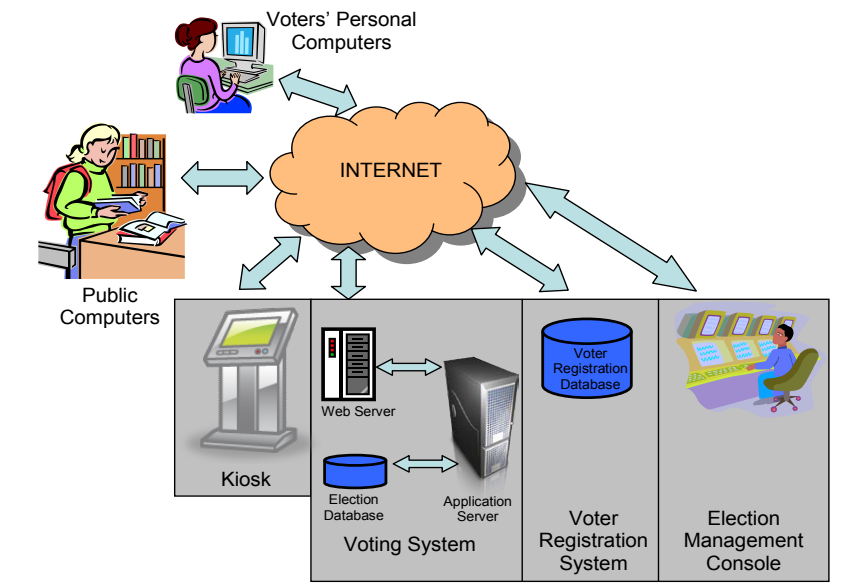
構成図。中央に"INTERNET"と記された雲がある。双方向の矢印が、その雲を"Voters’ Personal Computers"(デスクトップコンピュータに向かう人物)、"Public Computers"(図書館の机で作業する人物)、"Kiosk"、"Voting System"、"Voter Registration System"、"Election Management Console"とつないでいる。Voting Systemには"Web Server"、"Application Server"、"Election Database"があり、Web ServerとApplication Serverの間、およびElection DatabaseとApplication Serverの間に双方向の矢印がある。Voter Registration Systemには"Voter Registration Database"がある。Election Management Consoleには、コンソールに向かう担当者が描かれている。
Figure 1- General Architecture for Remote Electronic Voting
図 1 - 遠隔電子投票の全般的なアーキテクチャ
Personal computers refer to general purpose computing systems a voter may have at home for their personal use, including desktop and laptop computers, tablets, and smart phones. Voters may also use general purpose computer systems found at public locations such as libraries, schools, and Internet cafes and are referred to as public computers. Finally, voters may use dedicated devices called kiosks that may or may not be under the control and supervision of poll workers and/or election officials. In general, the voter’s platforms will have a connection to the Internet in order to complete the voting process.
パーソナルコンピュータとは、有権者が自宅で個人的な利用のために持っている汎用のコンピューティングシステムを指し、デスクトップ、ノートパソコン、タブレット、スマートフォンを含みます。有権者は、図書館、学校、インターネットカフェなどの公共の場所にある汎用のコンピュータシステムを使用することもあり、これらは公共のコンピュータと呼ばれます。最後に、有権者は、投票所職員や選挙管理官の管理・監督下にある場合も、ない場合もある、キオスクと呼ばれる専用デバイスを使用することがあります。一般に、有権者のプラットフォームは、投票プロセスを完了するためにインターネットに接続されます。
The voter’s platform is not under the control of election officials except in a supervised kiosk voting system architecture. This means that there may be no poll worker or election official to ensure the voter’s privacy has not been compromised or that voters have not been coerced into casting their ballot differently than they desired. In addition, the platforms not under the control of election officials may be poorly protected and vulnerable to malware, phishing, and denial of service attacks. These platforms may be the target of attacks to monitor and/or modify voter choices, capture personal information, or prevent a voter from accessing the voting services.
有権者のプラットフォームは、監督付きキオスク投票システムのアーキテクチャを除き、選挙管理官の管理下にはありません。これは、有権者のプライバシーが侵害されていないこと、あるいは有権者が望んだ内容とは異なる投票を行うよう強要されていないことを確認する投票所職員や選挙管理官がいない可能性があることを意味します。加えて、選挙管理官の管理下にないプラットフォームは、保護が不十分で、マルウェア、フィッシング、サービス拒否攻撃に対して脆弱である可能性があります。これらのプラットフォームは、有権者の選択を監視または改変したり、個人情報を取得したり、有権者が投票サービスにアクセスすることを妨げたりする攻撃の標的になる可能性があります。
2.1.2 Voting System
2.1.2 投票システム
Figure 1 shows the voting system consisting of three subcomponents: web, database, and application servers. This is a simplified representation of the three subcomponents since they may include other hardware and software not shown in the diagram to ensure system reliability and availability.
図 1 は、Web サーバー、データベースサーバー、アプリケーションサーバーという 3 つのサブコンポーネントから成る投票システムを示しています。これは 3 つのサブコンポーネントを簡略化した表現であり、システムの信頼性と可用性を確保するために、図に示していない他のハードウェアやソフトウェアが含まれる場合があります。
The web server provides the interface that voters use to interact with the remote electronic voting system. The web server interface may have the voter use a general purpose browser or a voting-specific client application to obtain voting services from the voting system. The web server has a connection to the Internet so voters can interact with the remote electronic voting system. In addition, the web server will interact with the application server that provides the voting services to the voter.
Web サーバーは、有権者が遠隔電子投票システムとやり取りするために使用するインターフェースを提供します。Web サーバーのインターフェースは、有権者が汎用のブラウザー、または投票専用のクライアントアプリケーションを使用して、投票システムから投票サービスを受けるようにしている場合があります。Web サーバーはインターネットに接続されており、有権者は遠隔電子投票システムとやり取りできます。加えて、Web サーバーは、有権者に投票サービスを提供するアプリケーションサーバーとやり取りします。
The application server contains the logic for the services provided by the remote electronic voting system. The services provided by the application server may include the ability for the voter to: register to vote, request a blank ballot, return completed ballots, tally the ballots, and generate election reports. The application server has an indirect connection to the Internet via its interactions with the web server. This provides the voter interface to the remote electronic voting system. In addition to interacting with the web server, the application server will interact with election database and possibly the voter registration system.
アプリケーションサーバーには、遠隔電子投票システムが提供するサービスのロジックが含まれます。アプリケーションサーバーが提供するサービスには、有権者による有権者登録、白紙の投票用紙の請求、記入済みの投票用紙の返送、投票用紙の集計、選挙報告書の生成を行う機能が含まれる場合があります。アプリケーションサーバーは、Web サーバーとのやり取りを通じて、インターネットに間接的に接続されます。これにより、遠隔電子投票システムへの有権者インターフェースが提供されます。Web サーバーとのやり取りに加えて、アプリケーションサーバーは、選挙データベース、および場合によっては有権者登録システムともやり取りします。
The election database contains the ballots for the different jurisdictions serviced by the remote electronic voting system. When a voter requests a ballot, the application server queries the election database to find the appropriate ballot for the voter based on their information. In addition, the election database server may store completed ballots when they are not stored on the application server. The election database server usually does not have a direct connection to the Internet. Access to the database takes place through the application server.
選挙データベースには、遠隔電子投票システムがサービスを提供する各管轄区域の投票用紙が含まれます。有権者が投票用紙を請求すると、アプリケーションサーバーは選挙データベースに問い合わせ、有権者の情報に基づいてその有権者に適した投票用紙を探します。加えて、選挙データベースサーバーは、記入済みの投票用紙がアプリケーションサーバーに保存されていない場合に、それらを保存することがあります。選挙データベースサーバーは、通常、インターネットに直接接続されていません。データベースへのアクセスは、アプリケーションサーバーを通じて行われます。
In general, the web server, application server, and election database are housed in one location, such as a data center managed by a jurisdiction or commercial third party. The locations that house the servers and database will need to provide the physical storage space, communication connections, and physical and logical security measures.
一般に、Web サーバー、アプリケーションサーバー、選挙データベースは、管轄区域または民間の第三者が管理するデータセンターなど、1 か所に設置されます。サーバーとデータベースを収容する場所には、物理的な保管スペース、通信接続、物理的および論理的なセキュリティ対策が必要です。
2.1.3 Voter Registration System
2.1.3 有権者登録システム
Voter registration systems are run by states and contain a repository of eligible voters who can participate in elections. The voter registration system assembles the repository of eligible voters using information from different sources such as department of motor vehicle records, judicial records, and possibly the remote electronic voting system. States provide jurisdictions with the registered voter information when elections are held. Jurisdictions can use the information to ensure that only eligible voters are allowed to cast ballots and that only one ballot is cast per voter. Figure 1 shows the voter registration system being accessed directly via an Internet connection or a more limited connection such as a state or military operated network. The jurisdictions may use their connection to the voter registration system to access the voter information in real-time during the election or to make electronic copies of the information they need at a given point during the election.
有権者登録システムは州が運用しており、選挙に参加できる有資格の有権者の記録簿を保持しています。有権者登録システムは、運転免許関連の記録、司法記録、場合によっては遠隔電子投票システムなど、さまざまな情報源の情報を用いて、有資格の有権者の記録簿を構築します。州は、選挙が行われる際に、登録有権者の情報を管轄区域に提供します。管轄区域は、その情報を用いて、有資格の有権者のみが投票でき、有権者 1 人につき 1 票のみが投じられるようにすることができます。図 1 は、有権者登録システムが、インターネット接続、または州や軍が運用するネットワークのようなより限定された接続を介して直接アクセスされる様子を示しています。管轄区域は、有権者登録システムへの接続を、選挙期間中に有権者情報にリアルタイムでアクセスするため、または選挙の特定の時点で必要な情報の電子的な複製を作成するために使用する場合があります。
2.1.4 Election Management Console
2.1.4 選挙管理コンソール
Election officials that administer elections use the election management console. The election management console provides an interface to the voting system so administrative task, such as the configuration of ballots, defining the time and date to cast ballots, setting up the tallying rules for the election contests, and the generation of election reports, can be completed. The election management console can be located in the same place as the voting system or may be at some other location (such as the office of the election officials).
選挙を運営する選挙管理官は、選挙管理コンソールを使用します。選挙管理コンソールは、投票システムへのインターフェースを提供し、投票用紙の設定、投票を行う日時の定義、選挙の争点ごとの集計規則の設定、選挙報告書の生成といった管理作業を完了できるようにします。選挙管理コンソールは、投票システムと同じ場所にある場合も、他の場所(選挙管理官の事務所など)にある場合もあります。
2.1.5 Component Connectivity
2.1.5 構成要素の接続性
In general, the components that voters interact with (e.g., voters’ personal computers, public computers, and kiosks) use the Internet as their connection to the voting system.
一般に、有権者がやり取りする構成要素(有権者のパーソナルコンピュータ、公共のコンピュータ、キオスクなど)は、投票システムとの接続にインターネットを使用します。
Remote electronic voting system servers and other backend system components may be on the same local network or connected to one another over the Internet.
遠隔電子投票システムのサーバーやその他のバックエンドのシステム構成要素は、同じローカルネットワーク上にある場合も、インターネットを介して互いに接続されている場合もあります。
2.2 Authorized Users
2.2 認可されたユーザー
Each of the components of a remote electronic voting system is under the control of one or more different people called users. The users that control the different components are authorized to perform certain, but possibly not all, actions on the component. Although the users are authorized to perform actions on the components, they have the potential to attack the remote election voting system. This section will describe the different users found in the remote electronic voting system but will leave the description of the potential threats which these users present for Section 2.3 Threat Sources.
遠隔電子投票システムの各構成要素は、ユーザーと呼ばれる 1 人または複数の異なる人物の管理下にあります。異なる構成要素を管理するユーザーは、その構成要素に対して特定の、ただしすべてとは限らない操作を行う権限を与えられています。ユーザーは構成要素に対して操作を行う権限を与えられていますが、遠隔電子投票システムを攻撃する可能性があります。本節では、遠隔電子投票システムにおけるさまざまなユーザーを説明し、これらのユーザーがもたらす可能性のある脅威についての説明は、第 2.3 節「脅威の発生源」に譲ります。
2.2.1 Voters
2.2.1 有権者
The basic voting functionality required by a voter is to: (a) submit voter registration information, (b) request and receive blank ballots, (c) complete a ballot, and (d) return a completed ballot. Voters may use their own personal computers, public computers, and/or kiosks to interface with the remote electronic voting system. In general, voters only have limited capabilities on public computers and kiosks.
有権者に必要な基本的な投票機能は、(a) 有権者登録情報を提出すること、(b) 白紙の投票用紙を請求し受け取ること、(c) 投票用紙に記入すること、(d) 記入済みの投票用紙を返送することです。有権者は、自身のパーソナルコンピュータ、公共のコンピュータ、キオスクを使用して、遠隔電子投票システムとやり取りする場合があります。一般に、有権者が公共のコンピュータやキオスクで使える機能は限られています。
Kiosks typically do not have general-purpose applications, such as word processors or email clients, so voters do not have access to these types of applications when voting from a kiosk. However, public computers may provide voters with access to applications other than voting, such as word processors, email clients, and web browsers.
キオスクには、通常、ワープロや電子メールクライアントなどの汎用アプリケーションがないため、有権者はキオスクから投票する際にこれらの種類のアプリケーションにアクセスできません。しかし、公共のコンピュータでは、ワープロ、電子メールクライアント、Web ブラウザーなど、投票以外のアプリケーションに有権者がアクセスできる場合があります。
When using their own personal computers, it is the responsibility of the voter to install, configure, and protect their personal computers and the applications that reside on the computer. The different platforms voters use to interface with the voting system have different security and function advantages and disadvantages when considering remote voting system architectures.
有権者が自身のパーソナルコンピュータを使用する場合、パーソナルコンピュータとそこに存在するアプリケーションのインストール、構成、保護は、有権者の責任です。有権者が投票システムとやり取りするために使用するさまざまなプラットフォームには、遠隔投票システムのアーキテクチャを検討する際に、セキュリティと機能の両面で異なる長所と短所があります。
2.2.2 Election Officials
2.2.2 選挙管理官
Election officials require the capability to administer an election, including adding or removing voters from the voter registration database, configuring ballot styles, defining the time and date to cast ballots, setting up the tallying rules for the election contests, and the generation of election reports. Election officials may interface with the remote electronic voting system via the election management console. As described in Section 2.1.4, the election management console may or may not be co-located with the voting system.
選挙管理官には、選挙を運営する能力が必要です。これには、有権者登録データベースへの有権者の追加や削除、投票用紙の様式の設定、投票を行う日時の定義、選挙の争点ごとの集計規則の設定、選挙報告書の生成が含まれます。選挙管理官は、選挙管理コンソールを介して遠隔電子投票システムとやり取りする場合があります。第 2.1.4 節で説明したとおり、選挙管理コンソールは、投票システムと同じ場所に設置されている場合も、そうでない場合もあります。
2.2.3 System Administrators
2.2.3 システム管理者
System administrators will require the capability to install, configure, and protect the different components of the remote electronic voting system. In addition, the system administrator will ensure the components they are responsible for can connect to other components of the remote voting system as needed. The system administrator will monitor the components they are responsible for to look for signs the components are operating improperly or are under attack. The system administrator will vary from component to component. Depending on how the architecture is implemented, third party service providers may make up the system administrator for all the components except for the voter’s personal computers. Voters are the system administrators for their personal computers. Election staff will serve as system administrators for the kiosk, voting system, voter registration system, and election management console.
システム管理者には、遠隔電子投票システムのさまざまな構成要素をインストールし、構成し、保護する能力が必要です。加えて、システム管理者は、自らが責任を負う構成要素が、必要に応じて遠隔投票システムの他の構成要素に接続できるようにします。システム管理者は、自らが責任を負う構成要素を監視し、その構成要素が不適切に動作している、または攻撃を受けている兆候がないかを確認します。システム管理者は構成要素ごとに異なります。アーキテクチャの実装方法によっては、有権者のパーソナルコンピュータを除くすべての構成要素のシステム管理者を、第三者のサービスプロバイダーが担う場合があります。有権者は、自身のパーソナルコンピュータのシステム管理者です。選挙担当職員は、キオスク、投票システム、有権者登録システム、選挙管理コンソールのシステム管理者を務めます。
2.2.4 Auditors / observers
2.2.4 監査人/オブザーバー
Auditors and observers will need access to information generated or observed during an election in order to perform their functions. In general, auditors and observers will have limited information collected through observation due to the distributed nature of remote electronic voting systems. Most of the information auditors and observers will have access to will be electronically generated by the remote electronic voting system with a possible exception when paper ballots are used or a voter verified paper audit trial is produced. The integrity and accuracy of the information used by the auditors and observers will greatly impact the effectiveness of their functions.
監査人とオブザーバーが自らの職務を行うには、選挙の際に生成または観察された情報へのアクセスが必要です。一般に、遠隔電子投票システムは分散型であるため、監査人とオブザーバーが観察を通じて収集する情報は限られます。監査人とオブザーバーがアクセスできる情報の大部分は、遠隔電子投票システムが電子的に生成するものですが、紙の投票用紙が使用される場合や、有権者が検証できる紙の監査証跡が作成される場合は例外となる可能性があります。監査人とオブザーバーが使用する情報の完全性と正確性は、彼らの職務の有効性に大きく影響します。
2.3 Threat Sources
2.3 脅威の発生源
Threat sources are groups or individuals that could feasibly attack a voting system. Some attacks on voting systems could be conducted by almost any dedicated individual, while others may require significant resources, knowledge or access to voting system equipment. Threat sources can be broken down into two classes: internal and external sources. Internal sources are individuals or groups with some level of authorized access to the voting system equipment or the supporting infrastructure (e.g. the communications network). External sources are individuals or groups that do not have any special level of authorized access to the voting system equipment or supporting infrastructure. This report considers the following examples of threat sources.
脅威の発生源とは、投票システムを攻撃し得る集団または個人です。投票システムに対する攻撃の中には、熱意のあるほぼあらゆる個人が実行できるものもあれば、相当なリソース、知識、または投票システム機器へのアクセスを必要とするものもあります。脅威の発生源は、内部の発生源と外部の発生源という 2 つの種類に分けられます。内部の発生源とは、投票システム機器または支援するインフラストラクチャ(たとえば通信ネットワーク)に対して、何らかのレベルの認可されたアクセスを持つ個人または集団です。外部の発生源とは、投票システム機器または支援するインフラストラクチャに対して、特別なレベルの認可されたアクセスを持たない個人または集団です。本報告書では、脅威の発生源として次の例を検討します。
2.3.1 Internal Threat Sources
2.3.1 内部の脅威の発生源
In general, internal threats come from individuals or organizations with privileged and authorized access to the remote electronic voting system required to support or carry out use of the system in an election. Threats from inside sources may be more dangerous and more difficult to protect against since they have some level of access to the system.
一般に、内部の脅威は、選挙でのシステムの使用を支援または実施するために必要な、遠隔電子投票システムへの特権的で認可されたアクセスを持つ個人または組織から生じます。内部の発生源からの脅威は、システムに対して何らかのレベルのアクセスを持っているため、より危険で、防御がより困難な場合があります。
Voters: Voters’ access to the remote electronic voting system is limited through the voters’ platform used: their own personal computers, public computers, and kiosks. In general, voters will not have direct access to the voting system, voter registration system, or election management console. Voters are allowed to submit voter register information, request and receive blank ballots, complete a ballot, and return a single completed ballot. However, voters may use their voting platform to try to cast multiple ballots using multiple credentials, prove how they voted to sell their vote, expand their access to damage the voting system, change the results of the election, or harm the credibility of the election results.
有権者: 有権者による遠隔電子投票システムへのアクセスは、有権者が使用するプラットフォーム、すなわち自身のパーソナルコンピュータ、公共のコンピュータ、キオスクを通じたものに限られます。一般に、有権者は、投票システム、有権者登録システム、選挙管理コンソールに直接アクセスできません。有権者は、有権者登録情報を提出し、白紙の投票用紙を請求して受け取り、投票用紙に記入し、記入済みの投票用紙を 1 通返送することが認められています。しかし、有権者は、投票プラットフォームを使用して、複数の認証情報を用いた複数回の投票を試みたり、投票の売買のために投票内容を証明したり、投票システムに損害を与えるためにアクセスを拡大したり、選挙結果を変更したり、選挙結果の信頼性を損なったりしようとする可能性があります。
In addition, the voting platforms may pose a threat to the remote electronic voting system without the voters’ knowledge or cooperation. When voting platforms contain malware, the voting platform may try to inhibit a voter from casting his or her ballot, alter a voter’s choices, monitor how a voter votes, use the voter’s credential to gain and expand access to damage the voting system, change election results, or harm the credibility of the election results. Although the voter is not actively participating in attacking the remote electronic voting system, the platform they use to interact with the voting system poses a threat that appears to be from the voter.
加えて、投票プラットフォームは、有権者の知識や協力なしに、遠隔電子投票システムへの脅威となる可能性があります。投票プラットフォームにマルウェアが含まれている場合、投票プラットフォームは、有権者が投票するのを妨げたり、有権者の選択を改変したり、有権者の投票内容を監視したり、有権者の認証情報を使用して、投票システムに損害を与えるためにアクセスを獲得して拡大したり、選挙結果を変更したり、選挙結果の信頼性を損なったりしようとする可能性があります。有権者が遠隔電子投票システムへの攻撃に積極的に関与しているわけではありませんが、有権者が投票システムとのやり取りに使用するプラットフォームが、有権者によるものと見える脅威をもたらします。
Election Officials: Election officials access the remote electronic voting system via the election management console and possibly voting system equipment as authorized users on the voting system component. Election officials are allowed to add eligible voters to the voter registration database, remove ineligible voters, configure ballot styles, define the time and date to cast ballots, set up the tallying rules for the election contests, and generate election reports. However, election officials may not need to be able to install and configure applications or have unrestricted access to the remote electronic voting system equipment. Election officials will have access to election data, such as cast ballots and system event logs, on the remote electronic voting system that most other authorized users may not. Access to the election data may allow a malicious election official to modify the results of the election, monitor how people vote, and provide incorrect ballot configurations.
選挙管理官: 選挙管理官は、選挙管理コンソールを介して、また場合によっては投票システム機器を介して、投票システム構成要素の認可されたユーザーとして遠隔電子投票システムにアクセスします。選挙管理官は、有資格の有権者を有権者登録データベースに追加し、資格のない有権者を削除し、投票用紙の様式を設定し、投票を行う日時を定義し、選挙の争点ごとの集計規則を設定し、選挙報告書を生成することが認められています。しかし、選挙管理官は、アプリケーションをインストールして構成したり、遠隔電子投票システム機器に無制限にアクセスしたりできる必要はない場合があります。選挙管理官は、遠隔電子投票システム上の、記入済みの投票用紙やシステムイベントログなどの選挙データにアクセスでき、他のほとんどの認可されたユーザーはアクセスできない場合があります。選挙データへのアクセスにより、悪意のある選挙管理官が、選挙結果を改変し、人々の投票内容を監視し、誤った投票用紙の設定を提供する可能性があります。
Similar to the voter and voters’ platform, the election official and election management console may pose a threat to the voting system without the election official’s knowledge. If the election management console contains malware, the console may try to prevent ballots from being cast, alter ballot configurations, monitor how voters vote, and use the election official’s credential to gain and expand access to damage the voting system, change election results, and harm the credibility of the election results. Although the election official is not actively participating in attacking the remote electronic voting system, the console they use to interact with the voting system poses a threat that appears to be from an election official.
有権者と有権者のプラットフォームの場合と同様に、選挙管理官と選挙管理コンソールも、選挙管理官が知らないうちに投票システムへの脅威となる可能性があります。選挙管理コンソールにマルウェアが含まれている場合、コンソールは、投票が行われるのを妨げたり、投票用紙の設定を改変したり、有権者の投票内容を監視したり、選挙管理官の認証情報を使用して、投票システムに損害を与えるためにアクセスを獲得して拡大したり、選挙結果を変更したり、選挙結果の信頼性を損なったりしようとする可能性があります。選挙管理官が遠隔電子投票システムへの攻撃に積極的に関与しているわけではありませんが、選挙管理官が投票システムとのやり取りに使用するコンソールが、選挙管理官によるものと見える脅威をもたらします。
System Administrators: System administrators access the remote electronic voting system equipment via a remote connection or a terminal directly connected to the equipment. In addition, system administrators have physical access to the equipment. System administrators are allowed to install, configure, and monitor the remote electronic voting system equipment to ensure the equipment is functioning properly. System administrators may directly administer the components of the remote electronic voting system or the supporting infrastructure used by the system. For example, network technicians at telecommunication companies or Internet Service Providers (ISPs) are system administrators of the infrastructure used by the remote electronic voting system. Election IT staff are system administrators for the election management console when it is located at the election official’s office. System administrators have a level of access to the system that no other authorized user has in order to configure and maintain the system. Given this level of access, system administrators may try to prevent ballots from being cast, alter ballot configurations, monitor how voters vote, damage the voting system, change election results, or harm the credibility of the election results.
システム管理者: システム管理者は、リモート接続、または機器に直接接続された端末を介して、遠隔電子投票システムの機器にアクセスします。加えて、システム管理者は機器に物理的にアクセスできます。システム管理者は、遠隔電子投票システムの機器が適切に機能していることを確実にするために、機器をインストールし、構成し、監視することが認められています。システム管理者は、遠隔電子投票システムの構成要素や、システムが使用する支援インフラストラクチャを直接管理する場合があります。たとえば、電気通信事業者やインターネットサービスプロバイダー(ISP)のネットワーク技術者は、遠隔電子投票システムが使用するインフラストラクチャのシステム管理者です。選挙担当の IT 職員は、選挙管理コンソールが選挙管理官の事務所にある場合、そのシステム管理者です。システム管理者は、システムを構成し維持するために、他の認可されたユーザーが持たないレベルのアクセスをシステムに対して持っています。このレベルのアクセスがあるため、システム管理者は、投票が行われるのを妨げたり、投票用紙の設定を改変したり、有権者の投票内容を監視したり、投票システムに損害を与えたり、選挙結果を変更したり、選挙結果の信頼性を損なったりしようとする可能性があります。
Other insiders: There are other internal individuals or organizations that may have access to the remote electronic voting system equipment before, during, or after an election cycle. For example, voting system manufacturers will have access to the software source code and hardware designs used to implement their remote electronic voting system. This level of access provides an opportunity for errors to be introduced, maliciously or not, into the components of the remote electronic voting system. Voting system integrators have similar access as voting system manufacturers, but without access to the software source code or the designs of hardware components. This level of access provides the opportunity for known software and hardware errors to be exploited, and for third party, non-voting specific software and hardware to be integrated into the remote electronic voting system components containing errors; malicious or not. The support staff of different organizations, including but not limited to jurisdictions, voting system manufacturers, voting system integrator, and third party service providers, may have access to the remote electronic voting system equipment and that provides an opportunity for the system to be exploited. Examples of support staff include administrative assistants, package and mail delivery personnel, and warehouse personnel.
その他の内部関係者: 選挙サイクルの前、最中、または後に、遠隔電子投票システムの機器にアクセスできる、その他の内部の個人や組織があります。たとえば、投票システムの製造者は、遠隔電子投票システムの実装に使用するソフトウェアのソースコードとハードウェアの設計にアクセスできます。このレベルのアクセスは、悪意の有無にかかわらず、遠隔電子投票システムの構成要素に誤りを混入させる機会をもたらします。投票システムのインテグレーターは、投票システムの製造者と同様のアクセスを持ちますが、ソフトウェアのソースコードやハードウェア構成要素の設計にはアクセスできません。このレベルのアクセスは、既知のソフトウェアやハードウェアの誤りを悪用する機会や、第三者の、投票専用ではないソフトウェアやハードウェアを、悪意の有無にかかわらず、誤りを含む遠隔電子投票システムの構成要素に統合する機会をもたらします。管轄区域、投票システムの製造者、投票システムのインテグレーター、第三者のサービスプロバイダーを含むがこれらに限らない、さまざまな組織の支援職員は、遠隔電子投票システムの機器にアクセスできる場合があり、それがシステムを悪用する機会をもたらします。支援職員の例には、事務補助員、荷物や郵便の配達担当者、倉庫担当者が含まれます。
2.3.2 External Threat Sources
2.3.2 外部の脅威の発生源
In general, external threat sources come from individuals or organizations not needed to support or carry out use of the system in an election.
一般に、外部の脅威の発生源は、選挙でのシステムの使用を支援または実施するために必要ではない個人または組織から生じます。
Hostile Individuals: Individuals and affiliated individuals may attempt to inhibit ballots from being cast, monitor how voters vote, damage the voting system, change election results, and harm the credibility of the election results. These individuals rely on their technical knowledge and ability to deceive legitimate users and administrators. In general, attacks from hostile individuals are limited based on resources – time, money, and people – they can accumulate or control as required for a given attack scenario.
敵対的な個人: 個人および関係のある個人が、投票が行われるのを妨げたり、有権者の投票内容を監視したり、投票システムに損害を与えたり、選挙結果を変更したり、選挙結果の信頼性を損なったりしようとする場合があります。これらの個人は、自らの技術的な知識と、正規のユーザーや管理者を欺く能力に頼ります。一般に、敵対的な個人による攻撃は、特定の攻撃シナリオに必要なだけ集めたり管理したりできるリソース(時間、金銭、人員)によって制限されます。
Hostile Organizations: Like hostile individuals, hostile organizations that may not have legitimate access to the remote electronic voting system in order to attempt to inhibit ballots from being cast, monitor how voters vote, damage the voting system, change election results, and harm the credibility of the election results. Hostile organizations can marshal more resources, particularly money and people, to conduct an attack on the remote electronic voting system than an individual. Given these added resources, a hostile organization can recruit, hire, and train individuals, as well as obtain more costly technology to conduct an attack on the system. Hostile organizations can take many forms including civilian, foreign-sponsored, or terrorist organizations.
敵対的な組織: 敵対的な個人と同様に、遠隔電子投票システムへの正当なアクセスを持たない敵対的な組織が、投票が行われるのを妨げたり、有権者の投票内容を監視したり、投票システムに損害を与えたり、選挙結果を変更したり、選挙結果の信頼性を損なったりしようとする場合があります。敵対的な組織は、個人よりも多くのリソース、特に金銭と人員を動員して、遠隔電子投票システムへの攻撃を実行できます。こうした追加のリソースがあるため、敵対的な組織は、個人を勧誘し、雇用し、訓練することができ、さらに、システムに対する攻撃を実行するために、より高価な技術を入手することもできます。敵対的な組織には、民間組織、外国の支援を受けた組織、テロ組織など、さまざまな形態があります。
3 Overview
3 概要
The remainder of this report discusses security issues that need to be considered when developing, deploying, or using remote electronic voting systems. The discussion divides the issues into four topic areas:
本報告書の残りの部分では、遠隔電子投票システムを開発し、展開し、使用する際に考慮する必要があるセキュリティ上の課題を議論します。議論では、課題を次の 4 つのトピック領域に分けます。
•Confidentiality: Confidentiality refers to the concept of ballot secrecy and also the protection of sensitive voter information and system data from unauthorized disclosure. Issues related to confidentiality are discussed in Section 4.
•機密性: 機密性とは、投票の秘密という概念を指すとともに、機微な有権者情報やシステムデータを不正な開示から保護することも指します。機密性に関連する課題は、第 4 節で議論します。
•Integrity: This includes data integrity, aimed at preventing important election records, including audit logs and cast votes, from being improperly modified, as well as software integrity. Issues related to voting system integrity are discussed in Section 5.
•完全性: これには、監査ログや投票された票を含む重要な選挙記録が不適切に改変されるのを防ぐことを目的とするデータの完全性と、ソフトウェアの完全性が含まれます。投票システムの完全性に関連する課題は、第 5 節で議論します。
•Availability: Availability refers to the ability of the system to be accessible to voters and election officials in the face of malicious and incidental threats. Issues related to voting system availability are discussed in Section 6.
•可用性: 可用性とは、悪意のある脅威や偶発的な脅威にさらされた状況でも、有権者や選挙管理官がシステムにアクセスできる状態にしておく能力を指します。投票システムの可用性に関連する課題は、第 6 節で議論します。
•Identification and Authentication: Identification and authentication includes the identification and authentication of voters, system operators, election officials, and system components. Issues related to the identification and authentication of voting system users and components are discussed in Section 7.
•識別と認証: 識別と認証には、有権者、システム運用者、選挙管理官、システムの構成要素の識別と認証が含まれます。投票システムのユーザーと構成要素の識別と認証に関連する課題は、第 7 節で議論します。
These areas were chosen to break the discussion of security issues into closely related topic areas. Issues related to any one of these topic areas are closely bound to those associated with other topics. For instance, an insufficient authentication mechanism could allow an unauthorized individual to access sensitive information (a confidentiality violation) or modify key voting system records (an integrity violation).
これらの領域は、セキュリティ上の課題の議論を、密接に関連するトピック領域に分けるために選ばれました。これらのトピック領域のいずれかに関連する課題は、他のトピックに関連する課題と密接に結びついています。たとえば、認証の仕組みが不十分であれば、認可されていない個人が機微な情報にアクセスしたり(機密性の侵害)、投票システムの重要な記録を改変したり(完全性の侵害)することを許してしまう可能性があります。
For each topic area, this report discusses the following:
トピック領域ごとに、本報告書では次の事項を議論します。
•Potential Benefits: The move from the current mail-in absentee voting process to a remote electronic voting system can provide some benefits to security, such as in the areas of automated forms of strong authentication, timeliness of delivery, and ballot secrecy. For each of the topic areas, this report will describe the advantages of remote electronic voting.
•期待される利点: 現在の郵送による不在者投票プロセスから遠隔電子投票システムへの移行は、強力な認証の自動化された形態、配達の適時性、投票の秘密といった分野で、セキュリティ上の利点をもたらす可能性があります。トピック領域ごとに、本報告書は遠隔電子投票の利点を記述します。
•Properties: In order to facilitate discussion of threats to remote electronic voting systems, this report provides lists of desirable security properties. In general, threats identified in this report are actions that can violate one or more of those properties. The security properties identified in this report are based on properties and requirements identified in other electronic remote voting system documents including the Secure Electronic Registration and Voting Experiment (SERVE) Project documentation [10], the Common Criteria Protection Profile for online voting systems [8], and the Council of Europe’s standards for online voting systems [9]. Policymakers ultimately must decide which properties must be met by voting systems to be acceptable in their jurisdictions. This report provides notes with each property that can help policymakers decide which properties are realistically achievable with current and emerging security technologies.
•特性: 遠隔電子投票システムへの脅威の議論を円滑にするために、本報告書は、望ましいセキュリティ特性の一覧を示します。一般に、本報告書で特定する脅威は、それらの特性の 1 つ以上を侵害し得る行為です。本報告書で特定するセキュリティ特性は、Secure Electronic Registration and Voting Experiment(SERVE)プロジェクトの文書 [10]、オンライン投票システム向けの Common Criteria のプロテクションプロファイル [8]、欧州評議会のオンライン投票システムの標準 [9] など、他の電子遠隔投票システムの文書で特定されている特性と要件に基づいています。どの特性を満たした投票システムであれば自らの管轄区域で受け入れられるかは、最終的には政策立案者が決定しなければなりません。本報告書は、現在および新たなセキュリティ技術を用いてどの特性を現実的に達成できるかを政策立案者が判断する助けとなる注記を、各特性に付記しています。
This report provides definitions for the identified desirable security properties. While definitions may be written in absolutes, readers should recognize there are always tradeoffs that have to be made. For example, the extent a security property can be met versus the cost and usability of implementing the property. Acceptable tradeoffs must be made when deploying systems which often necessitates compromising strict interpretations of some of the proposed properties.
本報告書は、特定した望ましいセキュリティ特性の定義を示します。定義は絶対的な形で書かれている場合がありますが、読者は常に何らかのトレードオフが必要になることを認識すべきです。たとえば、セキュリティ特性をどの程度満たせるかと、その特性を実装するコストやユーザビリティとの間のトレードオフです。システムを展開する際には、受け入れ可能なトレードオフを行わなければならず、そのため、提案された特性の一部について厳密な解釈を妥協する必要がしばしば生じます。
•Threats: This report describes some of the major threats to remote electronic voting systems. However, this document is not intended to be a thorough threat or risk assessment on remote electronic voting systems. This document describes some of the more serious threats to remote electronic voting systems. It does not attempt to enumerate all threats. Readers should consult other resources, such as NISTIR 7551, for information on additional threats.
•脅威: 本報告書は、遠隔電子投票システムへの主要な脅威のいくつかを記述します。ただし、本書は、遠隔電子投票システムの網羅的な脅威評価やリスク評価を行うことを意図したものではありません。本書は、遠隔電子投票システムへのより深刻な脅威のいくつかを記述しており、すべての脅威を列挙しようとするものではありません。読者は、その他の脅威についての情報を得るために、NISTIR 7551 などの他の資料を参照すべきです。
•Current and Emerging Technical Approaches: This report identifies and describes some existing and emerging technologies that can be used to mitigate some of threats faced by remote electronic voting systems.
•現在および新たな技術的アプローチ: 本報告書は、遠隔電子投票システムが直面する脅威の一部を緩和するために使用できる、既存の技術と新たな技術のいくつかを特定し、記述します。
•Open Issues: Some security issues associated with remote electronic voting do not have complete solutions at this time. In some instances, advances in technology are needed to address threats, while in other cases the technology is developed, but is not widely deployed.
•未解決の課題: 遠隔電子投票に関連するセキュリティ上の課題の中には、現時点では完全な解決策がないものがあります。脅威に対処するために技術の進歩が必要な場合もあれば、技術は開発されているものの、広く展開されていない場合もあります。
4 Confidentiality
4 機密性
Voting systems must protect the confidentiality of sensitive information stored on those systems. Notably, remote electronic voting systems have unique concerns about protecting ballot secrecy compared to polling place systems. While an electronic voting machine in a polling place typically does not learn the identities of voters interacting with it, remote electronic voting systems typically must identify and authenticate voters in order to verify their eligibility and provide them with the proper ballots. In some jurisdictions, local or state election procedures dictate that the identities of overseas and military voters must be able to be linked to cast ballots, a property usually forbidden in polling place systems. Despite this, remote voting systems must protect their information from being used illegitimately.
投票システムは、システムに保存された機微な情報の機密性を保護しなければなりません。特に、遠隔電子投票システムには、投票所のシステムと比べて、投票の秘密の保護に関する固有の懸念があります。投票所にある電子投票機は、通常、やり取りする有権者の身元を知ることはありませんが、遠隔電子投票システムは、通常、有権者の資格を確認して適切な投票用紙を提供するために、有権者を識別し認証しなければなりません。管轄によっては、地方または州の選挙手続により、海外在住者や軍人の有権者の身元を、記入済みの投票用紙に関連付けられるようにしなければならないと定められており、この特性は、通常、投票所のシステムでは禁じられています。それでも、遠隔投票システムは、自らの情報が不当に利用されないよう保護しなければなりません。
Remote electronic voting systems must also protect the confidentiality of other sensitive information on those voting systems. Remote electronic voting systems may include an online voter registration database containing sensitive personally identifiable information. They must also protect sensitive system information that could be used to compromise the security of the system, such as secret cryptographic keys or passwords.
遠隔電子投票システムは、これらの投票システムに存在するその他の機微な情報の機密性も保護しなければなりません。遠隔電子投票システムには、機微な個人を特定できる情報を含むオンラインの有権者登録データベースが含まれている場合があります。また、秘密の暗号鍵やパスワードなど、システムのセキュリティを危殆化させるために使用され得る機微なシステム情報も保護しなければなりません。
4.1 Potential Benefits
4.1 期待される利点
Compared to mail-in voting, remote electronic voting systems have the potential to provide much greater technical controls for maintaining ballot secrecy. With mail-in voting, ballot secrecy is protected by procedural means: identities of voters are physically separated from cast ballots prior to viewing the contents of the ballots. Small-scale ballot secrecy violations are still possible if colluding election workers handling mail-in ballots do not follow proper election procedures. Access control mechanisms and cryptographic technologies can provide strong protections against attacks on ballot secrecy. Technical measures can be taken so an arbitrarily large number of trusted officials must collude to violate ballot secrecy.
郵送による投票と比べて、遠隔電子投票システムは、投票の秘密を維持するための、はるかに強力な技術的管理策を提供できる可能性があります。郵送による投票では、投票の秘密は手続的な手段によって保護されます。すなわち、投票用紙の内容を見る前に、有権者の身元が記入済みの投票用紙から物理的に切り離されます。郵送による投票用紙を取り扱う選挙担当者が共謀して適切な選挙手続に従わない場合には、小規模な投票の秘密の侵害は依然として起こり得ます。アクセス制御メカニズムと暗号技術は、投票の秘密への攻撃に対する強力な保護を提供できます。投票の秘密を侵害するためには、任意に多数の信頼できる職員が共謀しなければならないようにする技術的措置を講じることもできます。
Furthermore, remote electronic voting systems can also provide some protection against unsophisticated attempts to coerce voters. For instance, systems may allow voters to cast multiple ballots and only count the final ballot issued by the voter. If voters feel pressure to vote a particular way in one instance, they would be able to cast a new ballot at some other time or location free from improper influence. While it is significantly more difficult to block coercion attempts from more sophisticated or determined attackers, this is still a useful benefit offered by remote electronic voting systems.
さらに、遠隔電子投票システムは、有権者に強要しようとする巧妙でない試みに対して、一定の保護を提供することもできます。たとえば、システムは、有権者が複数回投票することを認め、有権者が最後に行った投票のみを集計することができます。有権者が特定の投票を行うよう圧力を感じた場合でも、別の時や場所で、不当な影響を受けずに新たな投票を行うことができます。より巧妙な、または執拗な攻撃者による強要の試みを阻止することははるかに困難ですが、それでもこれは、遠隔電子投票システムが提供する有用な利点です。
4.2 Properties
4.2 特性
This section discusses high-level properties aimed at assuring confidentiality of the vote and of the voter. Confidentiality is necessary to protect the autonomy and privacy of the voter as well as the secrecy of the vote.
本節では、投票と有権者の機密性を保証することを目的とするハイレベルな特性を議論します。機密性は、投票の秘密だけでなく、有権者の自律性とプライバシーを保護するために必要です。
A strong form of enforced confidentiality, called receipt-freeness, is also discussed. This property makes it impossible for the voter to prove to a third party how he or she voted. This property addresses the threats of coercion and buying/selling of votes.
強制的な機密性の強力な形態であるレシートフリー性(receipt-freeness)も議論します。この特性は、有権者が自分の投票内容を第三者に証明することを不可能にします。この特性は、強要や投票の売買という脅威に対処します。
Property: Ballot Secrecy
特性: 投票の秘密
The voting system protects the secrecy of cast ballots.
投票システムは、投じられた投票用紙の秘密を保護します。
Notes:
注記:
All voting systems leak some information about voters’ choices. Such information can usually be derived from data made public during the election (e.g., partial tallies, lists of voters). The remote electronic voting system should not add to this loss of secrecy in any meaningful way. In particular, a voter should not lose plausible deniability regarding his or her vote. Protecting ballot secrecy does not necessarily mean that it must be impossible to link individuals to cast ballots; state law regarding ballot secrecy differs from jurisdiction to jurisdiction. While the general public should not be able to perform this linkage, election officials acting in accordance with state and local election law and procedures may be required to have the capability to link voters to cast ballot. For these cases, voting systems should implement protections to ensure that ballot secrecy can only be breached when proper procedures are followed. For example, the system could force multiple trusted election officials to jointly interact with the system to violate ballot secrecy, and the system could only provide mechanisms for linking single ballots, not all ballots at once.
どの投票システムも、有権者の選択についての情報を多少は漏らします。そうした情報は、通常、選挙の間に公開されるデータ(たとえば、途中経過の集計や有権者の一覧)から導き出せます。遠隔電子投票システムは、この秘密の喪失に、意味のある形で加担すべきではありません。特に、有権者は、自分の投票に関して、もっともらしい否認の余地を失うべきではありません。投票の秘密を保護することは、必ずしも、個人を投じられた投票用紙に関連付けることが不可能でなければならないことを意味しません。投票の秘密に関する州法は、管轄ごとに異なります。一般の人々がこの関連付けを行うべきではありませんが、州および地方の選挙法と手続に従って行動する選挙管理官は、有権者を投じられた投票用紙に関連付ける能力を持つことが求められる場合があります。このような場合、投票システムは、適切な手続に従った場合にのみ投票の秘密を破ることができるようにする保護を実装すべきです。たとえば、システムは、投票の秘密を破るために、複数の信頼できる選挙管理官が共同でシステムを操作することを強制し、また、すべての投票用紙を一度に関連付けるのではなく、1 通ずつの投票用紙を関連付ける仕組みのみを提供することができます。
Property: Protection of Personal Information
特性: 個人情報の保護
The voting system protects voters’ personal information from unauthorized disclosure.
投票システムは、有権者の個人情報を不正な開示から保護します。
Notes:
注記:
The voting system should not needlessly store voters’ personal information. Any personal information that is stored should be protected against unauthorized disclosure. Use of encrypted storage is recommended in order to minimize the damage caused if storage media is lost or stolen, and access control mechanisms should be used to limit access to sensitive information.
投票システムは、有権者の個人情報を不必要に保存すべきではありません。保存する個人情報は、不正な開示から保護すべきです。保存媒体が紛失または盗難に遭った場合の被害を最小限に抑えるために、暗号化された保存を使用すべきであり、機微な情報へのアクセスを制限するために、アクセス制御メカニズムを使用すべきです。
Property: Receipt-freeness
特性: レシートフリー性
Voters are not able to provide convincing evidence of their ballot selections to third parties.
有権者は、自分の投票用紙での選択について、第三者に納得のいく証拠を示すことができません。
Notes:
注記:
The threat of vote selling and coercion attacks becomes more serious if voters are able to give attackers evidence of how they voted. This information could be used to reward the voter for voting correctly in a vote-selling attack or as evidence that the voter met the demands of a coercer.
有権者が攻撃者に自分の投票内容の証拠を示すことができる場合、投票の売買や強要攻撃の脅威はより深刻になります。この情報は、投票の売買攻撃で、有権者が正しく投票したことに報酬を与えるため、または有権者が強要者の要求に応じたことの証拠として使用される可能性があります。
Notably, remote voting systems should not increase the likelihood of large-scale buying and selling of votes compared to current mail-in voting methods. They also should not increase the likelihood of large-scale coercion of voters. Coercion is different from vote buying in that the voter is not a willing participant.
特に、遠隔投票システムは、現在の郵送による投票方法と比べて、大規模な投票の売買が行われる可能性を増やすべきではありません。また、有権者への大規模な強要が行われる可能性も増やすべきではありません。強要は、有権者が自ら進んで関与していない点で、投票の買収とは異なります。
Property: Protecting sensitive system data from improper disclosure or use
特性: 機微なシステムデータの不適切な開示や使用からの保護
All sensitive system information handled by the voting system should only be readable by authorized administrators or election officials.
投票システムが扱うすべての機微なシステム情報は、認可された管理者または選挙管理官のみが読み取れるようにすべきです。
Notes:
注記:
Examples of sensitive system data are: passwords or keys used by the election officials to access, configure, and run the voting system; and timestamps recording when voters authenticated or cast ballots.
機微なシステムデータの例は、選挙管理官が投票システムにアクセスし、構成し、実行するために使用するパスワードや鍵、および、有権者が認証した、または投票した時刻を記録するタイムスタンプです。
Property: Minimal storage
特性: 最小限の保存
The voting system only stores sensitive information necessary to ensure the correct functioning of the voting system.
投票システムは、投票システムの正しい機能を確保するために必要な機微な情報のみを保存します。
Notes:
注記:
While there are many safeguards that can be put in place, online systems are at risk for unintended data breaches. Internet-accessible systems should not store sensitive information that is not needed by the system. Notably, voter registration databases may contain sensitive voter information, such as identification numbers, that may not be needed by the voting system. When the voting system operates its own voter list or database, sensitive data fields should not be copied over from the primary voter registration database unless the information will be used by the voting system.
講じることができる保護措置は数多くありますが、オンラインのシステムには、意図しないデータ侵害のリスクがあります。インターネットからアクセス可能なシステムは、システムに必要のない機微な情報を保存すべきではありません。特に、有権者登録データベースには、投票システムでは必要とされない場合がある識別番号など、機微な有権者情報が含まれている場合があります。投票システムが独自の有権者リストやデータベースを運用する場合、機微なデータフィールドは、その情報を投票システムが使用する場合を除き、主たる有権者登録データベースから複製すべきではありません。
Property: Limited communication
特性: 限定的な通信
Only necessary communications traffic is passed between entities participating in the voting process.
投票プロセスに参加するエンティティ間では、必要な通信トラフィックのみが受け渡されます。
Notes:
注記:
As a general rule, there should be limited communications between voting system components. Passing extraneous information, even information that may look benign, increases the chance that this information could be combined to violate confidentiality goals, such as ballot secrecy.
一般的な規則として、投票システムの構成要素間の通信は限定すべきです。無害に見える情報であっても、無関係な情報を受け渡すと、その情報が組み合わされて、投票の秘密などの機密性の目標を侵害するために使用される可能性が高まります。
4.3 Threats to Confidentiality
4.3 機密性に対する脅威
This section discusses some of the more significant threats to confidentiality that are either unique to remote electronic voting systems or that may be more severe in this context. This is a high-level classification that addresses generic threats for all remote voting systems. It does not address threats to individual voting system implementations.
本節では、遠隔電子投票システムに固有の、またはこの文脈でより深刻になり得る、機密性に対するより重大な脅威のいくつかを議論します。これは、すべての遠隔投票システムに共通する脅威を扱うハイレベルな分類です。個々の投票システムの実装に対する脅威は扱いません。
4.3.1 Central System Data Breaches
4.3.1 中央システムのデータ侵害
A data breach is an unintentional release of secure information to an unauthorized party. In the context of voting systems, data breaches can cause loss of vote secrecy as well as loss of private voter information. The potential damage of private information exposure may be less severe in voting systems than in some other systems, such as financial databases or health databases, since voting systems do not need to store as much sensitive private information.
データ侵害とは、保護された情報が、認可されていない当事者に意図せず公開されることです。投票システムの文脈では、データ侵害により、投票の秘密の喪失だけでなく、有権者の非公開情報の喪失が生じる可能性があります。投票システムは、金融データベースや医療データベースなど他のシステムほど多くの機微な非公開情報を保存する必要がないため、非公開情報の露出による潜在的な被害は、他のシステムよりも小さい場合があります。
Storage of unencrypted sensitive information carries increased risk and should be avoided when possible. Connection to the Internet also increases the risk of a data breach. Failure to properly secure encryption keys and passwords can result in granting unauthorized access to malicious (or simply curious) third parties. Poor key management can result in insufficiently vetted personnel (e.g., temporary workers) obtaining decryption keys that they are not supposed to have. This can lead to serious data breaches. Additionally, compromised keys can harm the integrity of stored or in-transit data.
暗号化されていない機微な情報を保存すると、リスクが高まるため、可能な限り避けるべきです。インターネットへの接続も、データ侵害のリスクを高めます。暗号鍵やパスワードを適切に保護しないと、悪意のある(あるいは単に好奇心の強い)第三者に、認可されていないアクセスを許してしまう可能性があります。鍵管理が不十分だと、十分に審査されていない職員(臨時職員など)が、持つべきではない復号鍵を入手してしまう可能性があります。これは、重大なデータ侵害につながる可能性があります。さらに、危殆化した鍵は、保存中または転送中のデータの完全性を損なう可能性があります。
A remote electronic voting system may use an external database (e.g., a vehicle registration database). In this case, the voting system could become a route for exposure of private information contained in the external database. Standard database security practices should prevent sensitive information from being exposed. However, the scenario in which two database administrators each assumes the other is responsible for preventing data breaches is a concern.
遠隔電子投票システムは、外部のデータベース(たとえば、車両登録データベース)を使用する場合があります。この場合、投票システムが、外部データベースに含まれる非公開情報が露出する経路となる可能性があります。標準的なデータベースのセキュリティ慣行により、機微な情報の露出を防ぐべきです。しかし、2 人のデータベース管理者が、それぞれ相手がデータ侵害の防止に責任を負っていると考えているシナリオは懸念事項です。
4.3.2 Coercion
4.3.2 強要
Voting systems that allow the voter to vote more than once can make it harder to effectively coerce voters (since voters could vote again at a later time). On the other hand, if the secrecy of the vote is not secured, then coercion can be a more serious problem than in non-electronic voting. The reason is that electronic coercion attacks can scale easier and impact more voters and ballots. In particular, coercion that takes the form of reprisals long after the election has ended could be a serious problem, should the secrecy of the vote be compromised on a broad scale. If the voting system has a capacity to link cast ballots to voters (say, under a court order or a voter challenge), then it may be desirable to implement a mechanism for permanent removal of this capacity. In principle, this would occur via destruction of secret keys after a prescribed amount of time has elapsed. Keys that are meant to be eventually destroyed could be split into electronic components and tamper-evident physical components to help ensure the keys are destroyed. In modern information systems, it is very difficult to fully ensure the destruction of electronic data.
有権者が複数回投票できる投票システムでは、(有権者が後で再び投票できるため)有権者への効果的な強要がより困難になる可能性があります。一方、投票の秘密が確保されていない場合、強要は、非電子的な投票よりも深刻な問題になり得ます。その理由は、電子的な強要攻撃は、より容易に規模を拡大でき、より多くの有権者と投票用紙に影響を与えられるからです。特に、選挙が終了してからずっと後に報復という形で行われる強要は、投票の秘密が広範囲に危殆化した場合には、深刻な問題になり得ます。投票システムに、投じられた投票用紙を有権者に関連付ける能力がある場合(たとえば、裁判所の命令や有権者の異議申立てに基づく場合)、この能力を恒久的に削除する仕組みを実装すべきです。原則として、これは、所定の時間が経過した後に秘密鍵を破棄することで行われます。最終的に破棄することを意図した鍵は、鍵が確実に破棄されるようにするために、電子的な構成要素と改ざん防止の物理的な構成要素に分割することができます。現代の情報システムでは、電子データの破棄を完全に確実にすることは非常に困難です。
4.3.3 Buying and Selling of Votes
4.3.3 投票の売買
A concern with remote electronic voting is the possibility of a market for voting credentials could emerge. A similar threat exists in the case of mail-in voting, in which the unfilled ballots could be bought and sold. However, the scalability and increased anonymity inherent to remote electronic voting potentially makes this a more serious concern. We do not know how to gauge the likelihood of this threat in the presence of law-enforcement deterrents. We note that, in most cases, this threat requires the willingness of both buyer and seller to commit a crime. This should serve as a significant deterrent to vote selling for most of the voting population. On the other hand, any change in voting technology implies a corresponding change in the cost/benefit equations that determine the extent of illegal practices such as vote selling.
遠隔電子投票に関する懸念は、投票用の認証情報の市場が出現する可能性があることです。同様の脅威は、記入前の投票用紙が売買され得る郵送による投票でも存在します。しかし、遠隔電子投票に固有の拡張性と匿名性の高さにより、これはより深刻な懸念事項となる可能性があります。法執行による抑止がある場合に、この脅威が生じる可能性をどのように見積もればよいかは、わかっていません。ほとんどの場合、この脅威には、買い手と売り手の双方に犯罪を犯す意思があることが必要であることに留意します。これは、大多数の有権者にとって、投票の売却に対する重要な抑止力になるはずです。一方、投票技術の変更は、投票の売却などの違法行為の程度を決定する費用便益の式にも、それに対応する変化があることを意味します。
A related concern is vote swapping (i.e., vote pairing). This occurred in the 2000 and 2004 elections in the US. It is conceivable that the deployment of Internet voting could cause a surge in this practice if there is an easy mechanism to exchange credentials to voting systems or verify how individuals voted.
関連する懸念として、投票の交換(すなわち、投票のペアリング)があります。これは、2000 年と 2004 年の米国の選挙で発生しました。投票システムの認証情報を交換する、または個人の投票内容を確認する簡単な仕組みがあれば、インターネット投票の導入によってこの慣行が急増することは考えられます。
Since long-lived voter credentials may increase the likelihood of these types of threat, it may be advantageous to have voters obtain at least part of their voting credentials in the days or weeks prior to the election.
有効期間の長い有権者の認証情報は、これらの種類の脅威が生じる可能性を高めるおそれがあるため、有権者が投票用の認証情報の少なくとも一部を、選挙の数日前または数週間前に入手するようにすることが有利な場合があります。
4.3.4 Malicious Software on Client Systems
4.3.4 クライアントシステム上の悪意のあるソフトウェア
An emerging threat to computer systems over the last few years is that of malicious software infecting computers, giving attackers control of these systems. Researchers from the Georgia Tech Information Security Center have estimated that attackers may control 15 percent of online computers in this way [12]. What “control” means here is that the machines have been infected by malware that allows some level of access to them. The level of access is typically enough to steal private information and tap communications. Compromised machines could potentially violate the secrecy of the vote. Votes could be linked to machines or, depending on the voting protocol, even to voter identities. While this is clearly illegal, it is unclear what value this information might be to criminals. Unlike credit card numbers, there is no clear financial gain from knowing how a person voted. This is particularly true if such knowledge cannot be verified by a third party (as anyone can claim to know how someone else voted). Furthermore, this type of information is typically only valuable in bulk (as a reference, a single stolen piece of credit card information sells for between $0.85 to $30 [14]). Bulk voting information has two principal uses: tying demographics to voting and large-scale voting coercion. The former is easily obtainable from statistical analysis. The latter seems to be a low-likelihood threat on two accounts: i) it necessitates verifiable information; and ii) it appears hard to do without getting caught.
ここ数年、コンピュータシステムに対する新たな脅威となっているのが、悪意のあるソフトウェアがコンピュータに感染し、攻撃者にそれらのシステムの制御を与えることです。Georgia Tech Information Security Center の研究者は、攻撃者がこの方法でオンラインコンピュータの 15% を制御している可能性があると推定しています [12]。ここでの「制御」とは、マシンが、何らかのレベルのアクセスを許すマルウェアに感染しているということです。そのアクセスのレベルは、通常、非公開情報を盗み、通信を盗聴するのに十分です。危殆化したマシンは、投票の秘密を侵害する可能性があります。投票は、マシンに、あるいは投票プロトコルによっては有権者の身元にまで、関連付けられる可能性があります。これは明らかに違法ですが、この情報が犯罪者にとってどのような価値を持つかは明らかではありません。クレジットカード番号とは異なり、ある人の投票内容を知ることから得られる明確な金銭的利益はありません。これは、そうした知識を第三者が検証できない場合(誰でも他人の投票内容を知っていると主張できるため)には特に当てはまります。さらに、この種の情報は、通常、大量に集めて初めて価値を持ちます(参考として、盗まれたクレジットカード情報 1 件は 0.85 ドルから 30 ドルで売られています [14])。大量の投票情報には、主な用途が 2 つあります。人口統計と投票の結びつけ、および大規模な投票の強要です。前者は統計分析から容易に得られます。後者は、i) 検証可能な情報が必要であること、ii) 捕まらずに行うことは困難に思われることという 2 つの理由から、可能性の低い脅威に思われます。
If compromised machines are able to steal verifiable voting information, then another threat scenario is plausible: vote buying and selling. Opinions vary regarding the severity of the vote buying and selling threat.
危殆化したマシンが検証可能な投票情報を盗むことができる場合、もう 1 つの脅威シナリオとして、投票の売買がもっともらしくなります。投票の売買という脅威の深刻さについては、意見が分かれています。
4.4 Current and Emerging Technical Approaches
4.4 現在および新たな技術的アプローチ
This section discusses the main tools at our disposal for secure implementation of remote electronic voting systems. Some of the tools are standard IT security mechanisms, whereas others are of special applicability to voting.
本節では、遠隔電子投票システムを安全に実装するために利用できる主なツールを議論します。ツールの中には標準的な IT セキュリティメカニズムもあれば、投票に特に適用できるものもあります。
4.4.1 Cryptographic Protections
4.4.1 暗号による保護
Cryptography can protect any data that is communicated from one system to another as well as stored data. For example, the data which travels through the Internet between the voting system and the voter’s computer can be efficiently protected from unauthorized access via protocols like Secure Socket Layer (SSL) or Transport Layer Security (TLS) [15]. SSL and TLS are widely-deployed encryption mechanisms that are often used to protect communications between a web server and browsers. When used with mutual authentication, these protocols provide end-to-end security.
暗号技術は、あるシステムから別のシステムに伝達されるあらゆるデータと、保存されたデータを保護できます。たとえば、投票システムと有権者のコンピュータの間でインターネットを通過するデータは、Secure Socket Layer(SSL)や Transport Layer Security(TLS)[15] などのプロトコルによって、不正なアクセスから効率的に保護できます。SSL と TLS は広く展開されている暗号化メカニズムで、Web サーバーとブラウザーの間の通信の保護によく使用されます。これらのプロトコルは、相互認証とともに使用すると、エンドツーエンドのセキュリティを提供します。
When used to protect data at-rest, cryptographic keys can be split between several people, requiring an arbitrary number of key holders to come together to decrypt data. Such mechanisms offer protection against insider attacks, as long as a small number of insiders can be trusted to not collude in an attack.
保存中のデータの保護に使用する場合、暗号鍵を複数の人に分割し、データを復号するために任意の数の鍵保持者が集まる必要があるようにすることができます。このようなメカニズムは、少数の内部関係者が攻撃で共謀しないと信頼できる限り、内部関係者による攻撃に対する保護を提供します。
Proper cryptographic key management is very important to achieving protection using cryptographic techniques. Keys must be generated, stored, used, and destroyed in specific ways to ensure there are not ways to bypass the cryptographic protections.
暗号技術による保護を実現するには、適切な暗号鍵管理が非常に重要です。暗号による保護を迂回する方法がないことを確実にするために、鍵は特定の方法で生成し、保存し、使用し、破棄しなければなりません。
4.4.2 Advanced Cryptographic Voting Techniques
4.4.2 高度な暗号投票技術
Modern cryptology provides several possible solutions for securely conducting secret-vote online elections. These solutions provide very good properties in idealized scenarios where voters make no mistakes, have complete control of their computers, and communication lines are reliable. The scenarios typically allow for fraudulent voters attempting to sabotage the election and for attackers having unimpeded read access to all communication lines. The result of these idealized protocols is that a tally of the votes of all honest voters is obtained and is publically verifiable without compromising the secrecy of the votes.
現代の暗号学は、秘密投票のオンライン選挙を安全に実施するための、いくつかの解決策の可能性を提供します。これらの解決策は、有権者が間違いを犯さず、自分のコンピュータを完全に制御でき、通信回線が信頼できるという理想化されたシナリオでは、非常に優れた特性を提供します。このシナリオでは、通常、選挙を妨害しようとする不正な有権者の存在と、すべての通信回線を妨げられずに読み取れる攻撃者の存在が想定されています。これらの理想化されたプロトコルの成果は、すべての誠実な有権者の投票の集計が得られ、投票の秘密を損なうことなく、公的に検証可能であることです。
Despite there being an abundance of voting protocols with the above properties ([16][17][18][19][20] are just a few), the problem of remote voting using the Internet is far from solved. This is because the Internet is not the idealized scenario assumed by that body of work. Voters make mistakes and their computers may be partially under the control of malware. Communication lines may not be reliable. Also, there have been no formal usability or accessibility studies of current cryptographic voting schemes yet, but researchers anticipate that such studies would identify issues that would need to be addressed. Further research may lead to dramatic improvements, but current cryptographic voting techniques do not solve many of the challenges associated with remote electronic voting.
上記の特性を持つ投票プロトコルは数多くありますが([16][17][18][19][20] はそのごく一部です)、インターネットを用いた遠隔投票の問題は解決にはほど遠い状況です。これは、インターネットが、それらの研究が想定する理想化されたシナリオではないからです。有権者は間違いを犯し、そのコンピュータは部分的にマルウェアの制御下にある可能性があります。通信回線は信頼できない場合があります。また、現在の暗号投票方式について、ユーザビリティやアクセシビリティの正式な調査はまだ行われていませんが、研究者は、そうした調査によって、対処が必要な課題が特定されるだろうと予想しています。さらなる研究により劇的な改善がもたらされる可能性はありますが、現在の暗号投票技術では、遠隔電子投票に関連する多くの課題を解決できません。
4.4.3 Access Control Mechanisms
4.4.3 アクセス制御メカニズム
Access control mechanisms can be used, in conjunction with identification and authentication mechanisms, to restrict access to data, applications or actions to particular users. Different levels of access can be granted to different users; a relatively common set of access levels include read, write, and execute permissions, and modern access control mechanisms often provide more fine grain control over permissions. Access control can be implemented in many different ways. On computer systems, access control mechanisms are most often enforced by operating systems, and, in the case of voting systems, voting applications.
アクセス制御メカニズムは、識別と認証のメカニズムと組み合わせて、データ、アプリケーション、または操作へのアクセスを特定のユーザーに制限するために使用できます。異なるユーザーには、異なるレベルのアクセスを付与できます。比較的一般的なアクセスレベルの組には、読み取り、書き込み、実行の権限があり、現代のアクセス制御メカニズムは、権限をより細かく制御できることがよくあります。アクセス制御は、さまざまな方法で実装できます。コンピュータシステムでは、アクセス制御メカニズムは、ほとんどの場合、オペレーティングシステムによって、また、投票システムの場合は投票アプリケーションによって実施されます。
For example, access control mechanisms could provide only a designated election official with the access rights to write, modify or delete ballot definition files, but give a much wider set of users access rights to only read those files.
たとえば、アクセス制御メカニズムにより、指定された選挙管理官のみに投票用紙定義ファイルを書き込み、変更し、削除するアクセス権を与え、はるかに幅広いユーザーには、それらのファイルを読み取るだけのアクセス権を与えることができます。
Access control mechanisms could also implement things such as dual-person control, whereby the system requires two or more users to authenticate to the system before providing access to a particular resource. However, such functionality is often not provided by modern operating systems or applications. When used, dual-person control is often implemented with a combination of technical and procedural means.
アクセス制御メカニズムは、特定のリソースへのアクセスを提供する前に 2 人以上のユーザーにシステムへの認証を求める、二人制御(dual-person control)のようなことも実装できます。しかし、このような機能は、現代のオペレーティングシステムやアプリケーションでは提供されていないことがよくあります。二人制御は、使用する場合、技術的手段と手続的手段の組み合わせで実装されることがよくあります。
Depending on how access control mechanisms are implemented, it may be possible to bypass those protection mechanisms. For example, if access control mechanisms are enforced by an application, users may still be able to access resources through the operating system. If the operating system enforces access control mechanisms, an individual with physical access to the system may be able to access resources by booting from a different operating system. Furthermore, in many modern operating systems, the system administrator, or root user, often has nearly unlimited control over the system. For these reasons, it is important to also use cryptographic protections to restrict access to sensitive data, rather than solely relying on common operating system or application-level access control mechanisms.
アクセス制御メカニズムの実装方法によっては、それらの保護メカニズムを迂回できる場合があります。たとえば、アクセス制御メカニズムがアプリケーションによって実施されている場合、ユーザーは、オペレーティングシステムを通じてリソースにアクセスできる可能性があります。オペレーティングシステムがアクセス制御メカニズムを実施している場合、システムに物理的にアクセスできる個人は、別のオペレーティングシステムから起動することでリソースにアクセスできる可能性があります。さらに、現代の多くのオペレーティングシステムでは、システム管理者、すなわち root ユーザーが、システムに対してほぼ無制限の制御権限を持っていることがよくあります。こうした理由から、一般的なオペレーティングシステムやアプリケーションレベルのアクセス制御メカニズムのみに頼るのではなく、機微なデータへのアクセスを制限するために、暗号による保護も併せて使用することが重要です。
4.4.4 Separation of Duties
4.4.4 職務の分離
With a combination of procedural and technical means, operators of remote voting systems can enforce separation of duties to limit the capabilities of any single user or computer system. For instance, important information or tasks could be split between several election officials or system operators, requiring them to collude to conduct an attack. One example of how this could be implemented is that one official could be given a key to a locked room with voting system equipment, while a second official is given a credential for administering the voting system equipment.
手続的手段と技術的手段を組み合わせることで、遠隔投票システムの運用者は、職務の分離を実施して、単一のユーザーやコンピュータシステムの能力を制限できます。たとえば、重要な情報や作業を複数の選挙管理官やシステム運用者に分割し、攻撃を行うには彼らが共謀しなければならないようにすることができます。これを実装する方法の一例は、1 人目の担当者に投票システム機器のある施錠された部屋の鍵を与え、2 人目の担当者に投票システム機器を管理するための認証情報を与えるというものです。
4.5 Open Issues
4.5 未解決の課題
Achieving a very strict notion of ballot secrecy remains a challenging issue in remote electronic voting systems. While polling place voting systems do not store, or even learn, the identities of voters, remote electronic voting systems need to authenticate voters before allowing them to cast ballots. Cryptographic protocols exist to protect the secrecy of ballots even from those with unrestricted access to voting system equipment, but these technologies may not be ready for immediate use with remote electronic voting systems. For technical, procedural, and legal reasons, it is likely that any deployed voting system for UOCAVA voters would still have access to, and probably store, sufficient information to violate ballot secrecy. Depending on policy decisions at state and local levels, this issue may not require a technical solution beyond what is already practical.
非常に厳密な意味での投票の秘密を達成することは、遠隔電子投票システムにおいて依然として困難な課題です。投票所の投票システムは、有権者の身元を保存することも、知ることさえもありませんが、遠隔電子投票システムは、有権者に投票を許可する前に認証する必要があります。投票システム機器に無制限にアクセスできる者に対しても投票の秘密を保護する暗号プロトコルは存在しますが、これらの技術は、遠隔電子投票システムですぐに使用できる状態にはない可能性があります。技術的、手続的、法的な理由から、UOCAVA 有権者向けに展開される投票システムは、いずれも、投票の秘密を侵害するのに十分な情報にアクセスでき、おそらく保存もすると考えられます。州や地方レベルのポリシー上の決定によっては、この課題には、すでに実用的なもの以上の技術的な解決策は必要ない場合があります。
Advanced voting-specific cryptographic protocols have highly desirable properties in idealized models, but in practice, systems based on these protocols are often difficult to use and require that cryptographic keys be distributed to voters before an election. These systems also do not protect against many types of attacks, particularly if the computer used to cast votes and the voting environment are not secured.
高度な投票専用の暗号プロトコルは、理想化されたモデルでは非常に望ましい特性を備えていますが、実際には、これらのプロトコルに基づくシステムは使用が難しいことが多く、選挙の前に暗号鍵を有権者に配布する必要があります。これらのシステムは、特に、投票に使用するコンピュータと投票環境が保護されていない場合、多くの種類の攻撃に対しても保護を提供しません。
Current techniques for remote electronic voting do not solve the problems of coercion and vote selling that are inherent to unsupervised voting. Variations on these attacks are possible with mail-in absentee voting, although in that voting method, it is difficult for a single individual to impact many voters. When moving to remote electronic voting, election officials and technologists should consider whether the move makes it easier to scale these attacks. In particular, there appear to be ways that attackers could coerce or buy votes remotely. A simple attack involves selling or transferring the credentials that voters use to log into the remote voting system. This particular issue and threat will be discussed further in the Identification and Authentication section (Section 7).
遠隔電子投票の現在の技術では、監督のない投票に固有の、強制と投票売買の問題は解決されません。こうした攻撃の変種は郵送による不在者投票でも可能ですが、その投票方法では、1 人の個人が多数の有権者に影響を及ぼすことは困難です。遠隔電子投票に移行する際には、選挙管理官と技術者は、その移行によってこうした攻撃を大規模に実行しやすくなるかどうかを検討すべきです。特に、攻撃者が遠隔から投票を強制したり、票を買収したりする方法があるように思われます。単純な攻撃として、有権者が遠隔投票システムへのログインに使用する認証情報を売却または譲渡する方法があります。この特定の課題と脅威については、識別と認証の節(第 7 節)でさらに議論します。
Despite IT professionals’ and users’ best efforts, data breaches continue to occur, releasing personally identifiable information (and other sensitive information) to attackers. This problem is not unique to voting systems. For the time being, it may be impossible to guarantee the secrecy of voter information stored on voting system equipment from determined and technically sophisticated attackers. However, there appears to be very little reason to store potentially valuable sensitive information on these systems. Depending on the type of information stored by the voting system, there may be very little motivation to attempt to illegitimately access this information.
IT 専門家とユーザーが最善の努力を尽くしても、データ侵害は引き続き発生し、個人を特定できる情報(およびその他の機微な情報)が攻撃者に流出しています。この問題は投票システムに固有のものではありません。当面の間は、執拗で技術的に高度な攻撃者に対して、投票システム機器に保存された有権者情報の秘密を保証することは不可能かもしれません。しかし、価値がある可能性のある機微な情報をこれらのシステムに保存する理由は、ほとんどないように思われます。投票システムが保存する情報の種類によっては、この情報に不正にアクセスしようとする動機は、ほとんどないでしょう。
5 Integrity
5 完全性
This section discusses security issues associated with voting system integrity. Integrity refers to the trustworthiness of the system, including both the data on the system and the functions provided by the system’s software. Maintaining integrity involves implementing safeguards to ensure data and software on a system are not modified by unauthorized parties. It is typically preferable to have these safeguards block unauthorized attempts to modify data or software, but in some cases, it is only possible to detect integrity violations.
本節では、投票システムの完全性に関連するセキュリティ上の課題を議論します。完全性とは、システムの信頼性を指し、システム上のデータと、システムのソフトウェアが提供する機能の両方を含みます。完全性の維持には、システム上のデータとソフトウェアが、認可されていない当事者によって改変されないようにするための保護措置を実装することが含まれます。通常は、これらの保護措置が、データやソフトウェアを改変しようとする不正な試みを阻止することが望ましいですが、場合によっては、完全性の侵害を検知することしかできません。
Integrity includes the concept of the origin or source from which the integrity is based upon. In other words, the origin or source of the integrity for data or software functionality can be traced back to a particular trusted authoritative entity. Tracing integrity back to a particular entity is closely related to identification and authentication, which is covered in Section 7.
完全性には、その完全性の起源または出所に関する概念が含まれます。言い換えると、データまたはソフトウェア機能の完全性の起源または出所は、特定の信頼できる権威あるエンティティまでたどることができます。完全性を特定のエンティティまでたどることは、第 7 節で扱う識別と認証と密接に関連しています。
5.1 Potential Benefits
5.1 期待される利点
5.1.1 Authenticity of Electronic Records
5.1.1 電子記録の真正性
A cryptographically signed record of each cast ballot can be issued by the voting system components and transmitted for tallying and auditing purposes. The signed record can be easily and exactly replicated to reduce the likelihood of data loss. Assuming adequate key management, the signed record cannot be forged. Authenticity can be verified using public key cryptography.
投じられた個々の投票用紙について、暗号により署名された記録を、投票システムの構成要素が発行し、集計と監査の目的で伝送できます。署名された記録は、データ損失の可能性を減らすために、容易かつ正確に複製できます。適切な鍵管理を前提とすれば、署名された記録は偽造できません。真正性は、公開鍵暗号を使用して検証できます。
5.1.2 Strong Integrity Protections In-Transit
5.1.2 転送中の強力な完全性保護
It is a common misconception that the greatest threat associated with conducting transactions over the Internet is the modification of information as it is being transmitted. While this is a potential threat that must be mitigated, in fact there are very good technical solutions for protecting information during transmission. Cryptographic protocols, such as TLS or Internet Protocol Security (IPSec), are very effective at providing integrity protection in-transit.
インターネット上でトランザクションを行う際の最大の脅威は、情報が送信されている間の改変であるという誤解がよくあります。これは緩和しなければならない潜在的な脅威ですが、実際には、送信中の情報を保護するための非常に優れた技術的解決策があります。TLS や Internet Protocol Security(IPSec)などの暗号プロトコルは、転送中の完全性保護を提供するうえで非常に有効です。
5.2 Properties
5.2 特性
There are two main categories of properties for integrity: data integrity and software integrity. Data integrity is related to the integrity of the election records, especially those records directly used to derive the final election tallies, as well as those necessary for meaningful audits. Software integrity refers to the correct, unmodified software running on the electronic components of the voting system. Faulty or malicious software may directly affect election data integrity.
完全性に関する特性には、データの完全性とソフトウェアの完全性という 2 つの主要なカテゴリがあります。データの完全性は、選挙記録、特に最終的な選挙の集計結果を導き出すために直接使用される記録や、意味のある監査に必要な記録の完全性に関連します。ソフトウェアの完全性とは、投票システムの電子的な構成要素上で、改変されていない正しいソフトウェアが実行されていることを指します。欠陥のある、または悪意のあるソフトウェアは、選挙データの完全性に直接影響を与える可能性があります。
5.2.1 Data Integrity Properties
5.2.1 データの完全性に関する特性
Property: Accuracy
特性: 正確性
The election outcome properly reflects the choices of participating voters.
選挙結果は、投票に参加した有権者の選択を適切に反映します。
Notes:
注記:
The voting system must: (a) record votes consistent with voters’ selections, (b) accurately store the collection of cast ballots, (c) protect the cast ballots from unauthorized modification, deletion or insertion, and (d) accurately count the votes.
投票システムは、(a) 有権者の選択と整合する形で投票を記録し、(b) 投じられた投票用紙の集合を正確に保存し、(c) 投じられた投票用紙を、認可されていない改変、削除、挿入から保護し、(d) 票を正確に数えなければなりません。
Property: Auditability
特性: 監査可能性
The voting system provides evidence of its behavior before, during and after an election.
投票システムは、選挙の前、最中、後のシステムの動作の証拠を提供します。
Notes:
注記:
It is not enough for a voting system to merely function correctly. The voting system must also provide evidence to auditors that the system functioned in the way it was supposed to. The evidence could include system event logs, public voting system reports, voter-verified records, and, in some cases, mathematical proofs. In addition, the voting system and its supporting election procedures must provide assurances that the evidence provided by the system is trustworthy. Auditability is a high-level security property of a voting system with more specific sub-properties listed and described in this sub-section.
投票システムが単に正しく機能するだけでは十分ではありません。投票システムは、システムが本来の方法で機能したことを示す証拠も、監査人に提供しなければなりません。この証拠には、システムイベントログ、公開される投票システムの報告書、有権者が検証した記録、場合によっては数学的証明が含まれ得ます。加えて、投票システムとそれを支える選挙手続は、システムが提供する証拠が信頼できるものであるという保証を提供しなければなりません。監査可能性は、投票システムのハイレベルなセキュリティ特性であり、より具体的な副特性を本小節に列挙して説明しています。
Property: Privileged verifiability
特性: 特権的検証可能性
The voting system provides evidence that allows the election auditors to independently check the outcome of the election.
投票システムは、選挙監査人が選挙結果を独立して確認できる証拠を提供します。
Notes:
注記:
In general, verifiability is a voting system property where an observer is able to check the election outcome produced by the voting system is correct. That is, the system should produce ample evidence allowing auditors to verify the results of an election. In the case of privileged verifiability, the evidence provided could be secret or sensitive information that could only be made available to, or authenticated by, election insiders.
一般に、検証可能性とは、観察者が投票システムによって生成された選挙結果が正しいことを確認できるという、投票システムの特性です。すなわち、システムは、監査人が選挙結果を検証できるよう十分な証拠を生成すべきです。特権的検証可能性の場合、提供される証拠は秘密または機微な情報であり、選挙の内部関係者にのみ提供されるか、内部関係者によってのみ認証される場合があります。
Property: Public verifiability
特性: 公開検証可能性
The voting system provides evidence that allows the general public to independently check the outcome of the election.
投票システムは、一般の人々が選挙結果を独立して確認できる証拠を提供します。
Notes:
注記:
Public verifiability is a property offered by emerging cryptographic voting protocols. In this case, sufficient evidence is made publically available by the voting system so any individual can verify the outcome of the election. Generally this requires some assumptions about the behavior of other entities (e.g., other voters, poll workers, administrators, etc.).
公開検証可能性は、新たな暗号投票プロトコルが提供する特性です。この場合、投票システムによって十分な証拠が一般に公開されるため、誰でも選挙結果を検証できます。一般に、これには他のエンティティ(たとえば、他の有権者、投票所職員、管理者など)の振る舞いについて、一定の仮定を置く必要があります。
Property: Traceability
特性: 追跡可能性
The voting system maintains all the necessary information so that if a problem is found in a particular election, then it is possible for the election officials to trace the problem to one or more root causes.
投票システムは、特定の選挙で問題が見つかった場合に、選挙管理官がその問題を 1 つ以上の根本原因まで追跡できるように、必要なすべての情報を保持します。
Notes:
注記:
If there are any problems during an election, it is important to be able to trace problems back to their root causes. The voting system should log or otherwise track sufficient events on the voting system to determine which activities failed or succeeded.
選挙中に問題が発生した場合は、その問題を根本原因までさかのぼって追跡できることが重要です。投票システムは、どの活動が失敗または成功したかを特定するために、投票システム上で十分なイベントを記録するか、その他の方法で追跡すべきです。
Property: Recoverability
特性: 回復可能性
The voting system maintains necessary information to allow it to recover from a loss of integrity. If the integrity of election records is lost in a way that is irrecoverable, then the extent to which the problem affects the final tally is measurable.
投票システムは、完全性の喪失から回復できるように、必要な情報を保持します。選挙記録の完全性が回復不能な形で失われた場合、その問題が最終的な集計結果に影響する程度を測定できます。
Notes:
注記:
If a voting system fails, then it should fail in a graceful manner. A minor problem should not necessarily call into question the integrity of the entire election. When possible, the voting system should be able to recover from minor problems. In some instances a voting system will not be able to recover from an error. In these instances, it should be possible to measure the extent of a failure so appropriate remediation can be carried out.
投票システムに障害が発生する場合は、適切な形で停止すべきです。軽微な問題が、必ずしも選挙全体の完全性に疑問を投げかけるものであってはなりません。可能な場合、投票システムは軽微な問題から回復できるようにすべきです。投票システムがエラーから回復できない場合もあります。そのような場合には、適切な是正措置を実施できるよう、障害の程度を測定できるようにすべきです。
Property: Prevention of data alteration
特性: データ改変の防止
The voting system prevents the unauthorized modification, deletion or insertion of election or voting system records.
投票システムは、選挙または投票システムの記録に対する、認可されていない変更、削除、挿入を防止します。
Notes:
注記:
A voting system contains a great deal of data (e.g., system files, election records, and event logs) that must be protected from unauthorized manipulation. To the extent possible, the voting system should prevent unauthorized manipulation and detect any manipulation that takes place.
投票システムには、認可されていない操作から保護しなければならない大量のデータ(たとえば、システムファイル、選挙記録、イベントログ)が含まれています。投票システムは、可能な範囲で、認可されていない操作を防止し、発生した操作を検知すべきです。
Property: Logging data alteration
特性: データ改変の記録
The voting system keeps a secure log with the information about who created/modified/deleted data which may influence the outcome of the election.
投票システムは、選挙結果に影響を与え得るデータを、誰が作成、変更、削除したかについての情報を含む、安全なログを保持します。
Notes:
注記:
Secure audit logs can help to increase accountability of system administrators and other insiders with privileged access to the machine. The log should be secure against modification by anyone, and should only be readable by authorized users.
安全な監査ログは、システム管理者や、マシンへの特権的なアクセスを持つその他の内部関係者の説明責任を高めるのに役立ちます。ログは、誰による改変に対しても安全であるべきであり、認可されたユーザーのみが読み取れるようにすべきです。
Property: Data authenticity
特性: データの真正性
Election auditors are able to verify the authenticity and provenance of election records.
選挙監査人は、選挙記録の真正性と来歴を検証できます。
Notes:
注記:
While protecting ballot secrecy, the voting system should provide sufficient evidence to allow election auditors to determine what entity (e.g., voter, system administrator, voting system component) created an election record and to verify that the record was not modified by unauthorized parties.
投票システムは、投票の秘密を保護しつつ、選挙監査人が、どのエンティティ(たとえば、有権者、システム管理者、投票システムの構成要素)が選挙記録を作成したかを判断し、その記録が認可されていない当事者によって改変されていないことを検証できるように、十分な証拠を提供すべきです。
5.2.2 Software Integrity Properties
5.2.2 ソフトウェアの完全性に関する特性
Property: Integrity of server software
特性: サーバーソフトウェアの完全性
Voting system components only load and execute authorized software.
投票システムの構成要素は、認可されたソフトウェアのみを読み込んで実行します。
Notes:
注記:
The voting system back-end components, such as servers, databases, and supporting network components, should only run authorized software. Front-end components under the control of election officials, such as kiosks, should also only run authorized software. For instance, the system should be free of malicious software. In addition, processes should be put in place to validate and authorize updates to voting system application software other third-party software used on the systems (e.g., operating systems, database software, anti-malware software).
サーバー、データベース、支援するネットワーク構成要素などの投票システムのバックエンドの構成要素は、認可されたソフトウェアのみを実行すべきです。キオスクなど、選挙管理官の管理下にあるフロントエンドの構成要素も、認可されたソフトウェアのみを実行すべきです。たとえば、システムには、悪意のあるソフトウェアがあってはなりません。加えて、投票システムのアプリケーションソフトウェアおよびシステムで使用される他の第三者ソフトウェア(たとえば、オペレーティングシステム、データベースソフトウェア、マルウェア対策ソフトウェア)の更新を検証し、認可するためのプロセスを整備すべきです。
Property: Authenticity of server software
特性: サーバーソフトウェアの真正性
Election auditors and/or system administrators are able to verify that only authorized software is present on voting system components.
選挙監査人またはシステム管理者(あるいはその両方)は、投票システムの構成要素上に、認可されたソフトウェアのみが存在することを検証できます。
Notes:
注記:
Auditors and system administrators should be able to verify that the voting system is free of malicious software and that only the authorized software is present on the voting system. In general, software validation is difficult to do rigorously and letting the voting system software verify itself is not sufficient.
監査人とシステム管理者は、投票システムに悪意のあるソフトウェアがなく、認可されたソフトウェアのみが投票システム上に存在することを検証できるべきです。一般に、ソフトウェアの検証を厳密に行うことは困難であり、投票システムのソフトウェア自身に自己検証させるだけでは十分ではありません。
Property: Proper software engineering practices
特性: 適切なソフトウェアエンジニアリングの実践
The voting system software is designed, implemented, tested and deployed with accepted software engineering best practices.
投票システムのソフトウェアは、受け入れられているソフトウェアエンジニアリングのベストプラクティスに従って、設計、実装、テスト、展開されます。
Notes:
注記:
Software engineering and testing best practices help to reduce errors in the design and implementation of voting systems.
ソフトウェアエンジニアリングとテストのベストプラクティスは、投票システムの設計と実装における誤りを減らすのに役立ちます。
5.3 Threats to Integrity
5.3 完全性に対する脅威
In general, any electronic system is prone to software bugs and malicious software attacks. Bugs and attacks related to software may result in partial loss of data integrity, and thus directly influence the election results. Moreover, Internet voting uses personally owned and operated devices which may be highly vulnerable to attacks that are capable of impacting election integrity. The election officials may have no practical way to assess the integrity of personal computers.
一般に、どの電子システムも、ソフトウェアのバグや悪意のあるソフトウェアによる攻撃を受けやすい性質があります。ソフトウェアに関連するバグや攻撃は、データの完全性の部分的な喪失をもたらし、その結果、選挙結果に直接影響を与える可能性があります。さらに、インターネット投票では、個人が所有し操作するデバイスを使用するため、選挙の完全性に影響を与え得る攻撃に対して非常に脆弱である可能性があります。選挙管理官には、パーソナルコンピュータの完全性を評価する実用的な方法がない場合があります。
5.3.1 Software Bugs
5.3.1 ソフトウェアのバグ
One of the greatest threats to the integrity and accuracy of election records, including cast ballots, comes from non-malicious software defects, called software bugs. Software bugs accidently written into voting system application software, third-party libraries, and commercial software required to run the voting system all have the potential to impact election integrity.
投じられた投票用紙を含む選挙記録の完全性と正確性に対する最大の脅威の 1 つは、ソフトウェアバグと呼ばれる、悪意のないソフトウェアの欠陥から生じます。投票システムのアプリケーションソフトウェア、第三者のライブラリ、投票システムの実行に必要な商用ソフトウェアに誤って書き込まれたソフトウェアバグはいずれも、選挙の完全性に影響を与える可能性があります。
Software bugs should be expected when dealing with software. In general, the larger a piece of software is, the more bugs are likely present. Estimates on the software industry’s rate of bugs range from about 15 to 50 errors per 1000 lines of code [11]. Modern voting system application software can be quite large containing tens of thousands of lines of code. In most cases, voting systems run on top of commercial operating systems which can have tens of millions of lines of code and use various other commercial libraries of software applications of varying complexity.
ソフトウェアを扱う際には、ソフトウェアバグが生じることを想定しておくべきです。一般に、ソフトウェアが大きいほど、より多くのバグが存在する可能性があります。ソフトウェア業界のバグ率の推定値は、コード 1000 行あたり約 15 から 50 件の誤りの範囲にあります [11]。現代の投票システムのアプリケーションソフトウェアは、数万行のコードを含む、かなり大きなものになり得ます。ほとんどの場合、投票システムは、数千万行のコードを持つことがある商用のオペレーティングシステムの上で動作し、複雑さの異なる、さまざまな他の商用のソフトウェアアプリケーションライブラリを使用しています。
Extensive testing and analysis can identify many bugs but will never uncover all of them. Software bugs occur in medical devices, military equipment, and space exploration vehicles, despite extensive and sophisticated testing in these areas. In addition, software bugs affecting cast votes have been identified in certified voting systems [12], despite testing and code review during testing.
広範なテストと分析により、多くのバグを特定できますが、そのすべてを発見することは決してできません。ソフトウェアバグは、医療機器、軍事装備、宇宙探査機でも発生しており、これらの分野では広範で高度なテストが行われています。加えて、テストと、テスト中のコードレビューが行われたにもかかわらず、認証された投票システムで、投じられた票に影響を与えるソフトウェアバグが特定されています [12]。
Even software whose source code is freely available to the public can contain major software bugs for years without discovery. The OpenSSL library included with the Debian-based linux distributions included a software bug in the cryptographic key generation function that resulted in a serious vulnerability in applications that relied on this library [13]. The bug went unnoticed for more than one year before being patched.
ソースコードが一般に自由に公開されているソフトウェアでも、重大なソフトウェアバグが何年も発見されないまま残ることがあります。Debian ベースの Linux ディストリビューションに含まれていた OpenSSL ライブラリには、暗号鍵生成関数にソフトウェアバグがあり、このライブラリに依存するアプリケーションに重大な脆弱性が生じました [13]。このバグは、修正されるまで 1 年以上気づかれませんでした。
5.3.2 Malicious Software on System Servers
5.3.2 システムサーバー上の悪意のあるソフトウェア
Specialized software could be maliciously placed on voting system equipment to modify or incorrectly store election records. The malicious code could be placed on the voting system equipment at any time in the system’s life cycle. Developers of the voting system software, or any software used by the voting system, could include malicious code. Election insiders, such as system administrators, could install malicious software that changes election data. Or, remote attackers may be able to exploit a vulnerability in the voting system to install malicious code on the system. These attacks have the potential to change a large number of votes and can be difficult to detect.
選挙記録を改変したり、誤って保存したりするための特殊なソフトウェアが、投票システムの機器に悪意をもって置かれる可能性があります。悪意のあるコードは、システムのライフサイクルのどの時点でも、投票システムの機器に置かれる可能性があります。投票システムのソフトウェア、または投票システムが使用するあらゆるソフトウェアの開発者が、悪意のあるコードを組み込む可能性があります。システム管理者などの選挙の内部関係者が、選挙データを変更する悪意のあるソフトウェアをインストールする可能性があります。あるいは、遠隔の攻撃者が、投票システムの脆弱性を悪用して、システムに悪意のあるコードをインストールできる場合があります。これらの攻撃は、多数の票を変更する可能性があり、検知が困難な場合があります。
5.3.3 Modification of Election Records and Data
5.3.3 選挙記録とデータの改変
Rather than installing malicious code on voting system servers and other back-end components, attackers may be able to modify election records directly to compromise election integrity. For example, a system administrator may be able to modify records stored on a database server. Or, vulnerabilities in the voting system may allow a remote attacker to perform an SQL injection attack to modify records in the database.
攻撃者は、投票システムのサーバーやその他のバックエンドの構成要素に悪意のあるコードをインストールするのではなく、選挙記録を直接改変して、選挙の完全性を損なうことができる場合があります。たとえば、システム管理者が、データベースサーバーに保存された記録を改変できる場合があります。あるいは、投票システムの脆弱性により、遠隔の攻撃者が SQL インジェクション攻撃を行い、データベース内の記録を改変できる場合があります。
5.3.4 Malicious Software on Client Systems
5.3.4 クライアントシステム上の悪意のあるソフトウェア
The threats described in the previous sections are largely variations on similar threats faced by polling place electronic voting systems. However, Internet voting systems are also faced with threats to voters’ personal computers which are used as voting terminals. Attacks on these systems fall into a category generally referred to as client-side attacks. In most cases, these involve an attacker infecting a victim’s computer with malicious software (e.g., a computer virus, trojan or worm) in order to gain access to information stored on that client machine or control it in various ways.
前の各節で説明した脅威は、概ね、投票所の電子投票システムが直面する同様の脅威のバリエーションです。しかし、インターネット投票システムは、投票端末として使用される有権者のパーソナルコンピュータに対する脅威にも直面します。これらのシステムへの攻撃は、一般にクライアントサイド攻撃と呼ばれるカテゴリに分類されます。ほとんどの場合、これは、攻撃者が、そのクライアントマシンに保存された情報にアクセスしたり、さまざまな方法でそれを制御したりするために、被害者のコンピュータに悪意のあるソフトウェア(たとえば、コンピュータウイルス、トロイの木馬、ワーム)を感染させるものです。
Client machines are quickly becoming a predominant attack vector in all types of information technology systems. Given the amount of sensitive information often stored on web, file, and database servers, these servers are often very tempting targets for attacks but they also tend to be the best protected, with professionally trained system administrators configuring and monitoring those systems. Client machines, used by regular employees or individuals, are often much less protected against attacks since they are operated by less technically sophisticated users. The client machine may be the intended target of an attacker, or it may be used as a stepping stone to attacking another computer system.
クライアントマシンは、あらゆる種類の情報技術システムで、急速に主要な攻撃ベクトルになりつつあります。Web サーバー、ファイルサーバー、データベースサーバーには機微な情報が大量に保存されていることが多いため、これらのサーバーは攻撃者にとって非常に魅力的な標的となることが多い一方で、専門的な訓練を受けたシステム管理者がそれらのシステムを構成し監視しているため、最もよく保護されている傾向があります。一般の従業員や個人が使用するクライアントマシンは、技術的な知識が比較的乏しいユーザーが操作しているため、攻撃に対する保護がはるかに手薄であることが多くあります。クライアントマシンは、攻撃者が意図する標的である場合もあれば、別のコンピュータシステムを攻撃するための踏み台として使用される場合もあります。
Attacks can use a variety of means to get malicious software on individuals’ personal computers. Historically, file attachments sent over electronic mail were a common method for distributing malicious software. Alternatively, an attacker could post malicious software that appears to have a desirable purpose (e.g., a game, anti-virus software, screensaver, etc.) on a web site and encourage people to download it. In these cases, the victim became infected with the malicious software by executing the file attachment or downloaded file.
攻撃者は、さまざまな手段で、個人のパーソナルコンピュータに悪意のあるソフトウェアを送り込むことができます。従来、電子メールで送信されるファイル添付は、悪意のあるソフトウェアを配布する一般的な方法でした。あるいは、攻撃者は、望ましい目的を持つように見えるソフトウェア(たとえば、ゲーム、ウイルス対策ソフトウェア、スクリーンセーバーなど)を Web サイトに掲載し、人々にダウンロードするよう促すことがあります。これらの場合、被害者は、ファイル添付やダウンロードしたファイルを実行することで、悪意のあるソフトウェアに感染しました。
More recently, vulnerabilities in commonly used software became a common attack vector for malicious software. Some malicious software is self-replicating, where infected machines seek out other machines to infect, such as the 2003 Blaster worm that exploited a vulnerability in the Windows operating system. Individuals could become infected with the Blaster worm merely by connecting their Windows computer to the Internet. New vulnerabilities in commonly used application software have led to a new attack method, commonly referred to as drive-by-downloads. Using vulnerabilities in browsers, browser plugins, and other commonly used software, users can become infected with malicious software merely by visiting infected web sites.
より最近では、広く使用されているソフトウェアの脆弱性が、悪意のあるソフトウェアの一般的な攻撃ベクトルになりました。悪意のあるソフトウェアの中には、感染したマシンが感染させる他のマシンを探し出す自己複製型のものがあり、Windows オペレーティングシステムの脆弱性を悪用した 2003 年の Blaster ワームなどがあります。Blaster ワームには、Windows コンピュータをインターネットに接続しただけで感染する場合がありました。広く使用されているアプリケーションソフトウェアの新たな脆弱性により、一般にドライブバイダウンロードと呼ばれる新たな攻撃方法が生まれました。ブラウザー、ブラウザープラグイン、その他の広く使用されているソフトウェアの脆弱性を利用して、ユーザーは、感染した Web サイトを訪れるだけで悪意のあるソフトウェアに感染することがあります。
An infected machine is largely under the control of an attacker. If a voter’s personal computer becomes infected with a malicious software targeting the election, an attacker can potentially steal the victim’s authentication credentials (e.g., a password or PIN), or even change the victim’s vote without the victim noticing.
感染したマシンは、ほぼ攻撃者の制御下にあります。有権者のパーソナルコンピュータが、選挙を標的とするマルウェアに感染すると、攻撃者は、被害者の認証資格情報(パスワードや PIN など)を盗んだり、被害者が気づかないうちに投票内容を変更したりできる可能性があります。
Malicious software is a serious problem on the Internet, with a large number of computers already infected with some type of virus or trojan. A growing problem on the Internet is botnets: groups of infected computers under the control of an attacker. The malicious software running on infected computers in a botnet is often used to steal passwords and other credentials for email and social networking sites in order to facilitate spreading the software to other computers. In many cases, the purpose of the attack is to steal financial data, such as passwords to online banking sites or credit card numbers. In some cases, malicious software on botnet-infected computers can even change the data inputted on a website for a financial transaction. For instance, it can change the bank account destination and amount for a money transfer on an online banking website.
悪意のあるソフトウェアはインターネット上の深刻な問題であり、すでに多数のコンピュータが何らかの種類のウイルスやトロイの木馬に感染しています。インターネット上で増大している問題がボットネットです。これは、攻撃者の制御下にある感染したコンピュータの集団です。ボットネット内の感染したコンピュータ上で動作する悪意のあるソフトウェアは、そのソフトウェアを他のコンピュータに拡散しやすくするために、電子メールやソーシャルネットワーキングサイトのパスワードやその他の認証情報を盗むのによく使用されます。多くの場合、攻撃の目的は、オンラインバンキングサイトのパスワードやクレジットカード番号などの金融データを盗むことです。場合によっては、ボットネットに感染したコンピュータ上の悪意のあるソフトウェアが、金融取引のために Web サイトに入力されたデータを変更することさえあります。たとえば、オンラインバンキングの Web サイトでの送金について、送金先の銀行口座と金額を変更できます。
Botnets are sometimes rented or sold by the individuals that originally conducted the attack to other parties. In addition, the malicious software behind the botnets is sold on black-market websites. For example, the malicious software behind the Zeus botnet is sold for as little as $700. Researchers at Cisco found that attackers could build a complete Zeus botnet for $2500, which includes the cost for the Zeus malware, exploit tools to infect users, and servers for conducting the attack [22]. While existing malicious software would have to be modified to attack an Internet voting system, this may not be difficult. In fact, many existing botnets include the ability to remotely update the malicious software running on already-infected computers. This means attackers would not necessarily have to re-infect computers already in botnets to attack an Internet voting system.
ボットネットは、最初に攻撃を行った個人によって、他の当事者に貸し出されたり売却されたりすることがあります。加えて、ボットネットの背後にある悪意のあるソフトウェアは、闇市場の Web サイトで販売されています。たとえば、Zeus ボットネットの背後にある悪意のあるソフトウェアは、わずか 700 ドルで販売されています。Cisco の研究者は、Zeus のマルウェア、ユーザーに感染させるためのエクスプロイトツール、攻撃を実行するためのサーバーの費用を含めて、攻撃者が 2500 ドルで完全な Zeus ボットネットを構築できることを明らかにしました [22]。既存の悪意のあるソフトウェアをインターネット投票システムへの攻撃用に改変する必要はありますが、それは難しくない可能性があります。実際、既存のボットネットの多くには、すでに感染したコンピュータ上で動作する悪意のあるソフトウェアを遠隔で更新する機能が含まれています。これは、攻撃者が、インターネット投票システムを攻撃するために、すでにボットネットにいるコンピュータに再度感染させる必要が必ずしもないことを意味します。
Because voters’ personal computers are outside the control of election officials and voting system administrators, client-side attacks are very difficult to mitigate. While each successful attack on the client can only impact one vote or voter (or potentially a small number of voters if a computer is shared), attackers have demonstrated an ability to infect a large number of clients, and thus client-side attacks have the ability to have a large-scale impact.
有権者のパーソナルコンピュータは、選挙管理官や投票システムの管理者の管理外にあるため、クライアントサイド攻撃を緩和することは非常に困難です。クライアントに対する個々の攻撃の成功が影響を与えられるのは、1 票または 1 人の有権者(コンピュータが共有されている場合は、場合によっては少数の有権者)だけですが、攻撃者は多数のクライアントに感染させる能力を実証しており、したがって、クライアントサイド攻撃には大規模な影響を与える能力があります。
5.4 Current and Emerging Technical Approaches
5.4 現在および新たな技術的アプローチ
There are a number of techniques, some more mature than others, which can be used to address some of the threats to integrity of election results in the context of remote electronic voting. A summary of these techniques is presented below.
遠隔電子投票の文脈において、選挙結果の完全性に対する脅威の一部に対処するために使用できる技術は、成熟度に差はあるものの、数多くあります。これらの技術の概要を以下に示します。
5.4.1 Cryptographic Integrity Protection
5.4.1 暗号による完全性の保護
The data which travels through the Internet between the voting system and the voter’s computer can be efficiently protected from en-route modifications via protocols like Secure Socket Layer (SSL) and Transport Layer Security (TLS). SSL and TLS are widely used to protect the integrity of communications between web servers and browsers and are frequently used in other applications as well such as email client and server communications. When used with mutual authentication, these protocols provide end-to-end security. In addition, cryptographic integrity protections, such as digital signatures and message authentication codes, can detect any changes in data as it is transmitted from one system to another. Cryptography can be very effective at protecting data in-transit and at-rest. However, cryptographic integrity protections do little to protect data as it is being processed on voting system components, such as when cast votes are constructed on client machines, or when they are tabulated on back-end equipment.
投票システムと有権者のコンピュータの間でインターネットを通過するデータは、Secure Socket Layer(SSL)や Transport Layer Security(TLS)などのプロトコルによって、経路上での改変から効率的に保護できます。SSL と TLS は、Web サーバーとブラウザーの間の通信の完全性を保護するために広く使用されており、電子メールクライアントとサーバーの通信など、他のアプリケーションでも頻繁に使用されています。これらのプロトコルは、相互認証とともに使用すると、エンドツーエンドのセキュリティを提供します。加えて、デジタル署名やメッセージ認証コードなどの暗号による完全性の保護は、あるシステムから別のシステムにデータが伝送される際のあらゆる変更を検知できます。暗号技術は、転送中のデータと保存中のデータを保護するうえで非常に有効です。しかし、暗号による完全性の保護は、クライアントマシン上で投じられた票が構成される場合や、バックエンドの機器で集計される場合など、データが投票システムの構成要素上で処理されている間は、ほとんど保護の役に立ちません。
5.4.2 Advanced Cryptographic Voting Techniques
5.4.2 高度な暗号投票技術
A specific research area in cryptography has been investigating more secure voting protocols to protect ballot secrecy, while at the same time offering unique integrity protections. These protocols, often called end-to-end cryptographic voting protocols, may be able to detect certain types of attacks where the election outcome is not the result of the aggregation of all cast votes. They can produce irrefutable proofs of tampering, even if a small number of cast ballots have been modified or deleted. Both voters and the general public can check that all cast ballots have been correctly tallied by the voting system. Additionally, end-to-end cryptographic voting protocols may allow each voter to verify that his/her vote appears in the final tally. There is a high degree of overlap between these protocols and the cryptographic protocols previously described in Section 4.4.2 to protect ballot secrecy.
暗号学の特定の研究領域では、投票の秘密を保護しつつ、独自の完全性保護も提供する、より安全な投票プロトコルが研究されてきました。これらのプロトコルは、エンドツーエンド暗号投票プロトコルと呼ばれることが多く、選挙結果が投じられたすべての票の集計結果ではない場合に発生する、特定の種類の攻撃を検知できる可能性があります。これらのプロトコルは、少数の投じられた投票用紙が改変または削除された場合でも、改ざんの反論の余地のない証明を生成できます。有権者と一般の人々はいずれも、投じられたすべての投票用紙が投票システムによって正しく集計されたことを確認できます。さらに、エンドツーエンド暗号投票プロトコルでは、各有権者が、自分の票が最終的な集計に含まれていることを検証できる場合があります。これらのプロトコルと、投票の秘密を保護するために第 4.4.2 節で前述した暗号プロトコルとの間には、大きな重複があります。
The threat model for end-to-end cryptographic voting systems often assumes attackers have compromised the back-end voting system software. Thus, these systems can provide protection against attacks when cast ballots are modified in-transit or stored on voting system back-end equipment, and attacks that modify ballots or cause them to be incorrectly tabulated.
エンドツーエンド暗号投票システムの脅威モデルでは、攻撃者がバックエンドの投票システムソフトウェアを侵害していると想定することがよくあります。したがって、これらのシステムは、投じられた投票用紙が転送中に改変された場合や投票システムのバックエンド機器に保存されている場合の攻撃、および投票用紙を改変したり誤って集計させたりする攻撃から保護できます。
However, there are many types of attacks on voting systems that are not mitigated by end-to-end cryptographic voting protocols alone. In general, end-to-end cryptographic voting protocols may do little to mitigate client-side security threats, as cast ballots can be modified as they are constructed on the client machine. While end-to-end cryptographic voting protocols allow the voter, or their proxy, to detect changes to cast ballots after they are constructed on a machine, they provide limited or difficult means to check the constructed cast ballot actually corresponds to the voter’s choices. However, systems that provide clear text receipts of voters’ choices are much easier to check, but these systems present potential problems with ballot secrecy and coercion. In addition, end-to-end cryptographic voting protocols do little to protect against attacks where voters’ authentication credentials are stolen or sold.
しかし、投票システムへの攻撃には、エンドツーエンド暗号投票プロトコルだけでは緩和されない種類が多数あります。一般に、投じられた投票用紙は、クライアントマシン上で構成される際に改変される可能性があるため、エンドツーエンド暗号投票プロトコルは、クライアントサイドのセキュリティ上の脅威を緩和する効果がほとんどない場合があります。エンドツーエンド暗号投票プロトコルでは、有権者またはその代理人が、マシン上で投じられた投票用紙が構成された後の変更を検知できますが、構成された投じられた投票用紙が実際に有権者の選択に対応しているかどうかを確認する手段は、限られているか、困難です。ただし、有権者の選択を平文で示すレシートを提供するシステムは、はるかに確認しやすいものの、投票の秘密と強要に関して潜在的な問題を生じさせます。加えて、エンドツーエンド暗号投票プロトコルは、有権者の認証用の資格情報が盗まれたり売却されたりする攻撃に対しては、ほとんど保護の役に立ちません。
At this time, there have been no formal usability or accessibility studies of current cryptographic voting schemes, but researchers anticipate that such studies would identify issues that would need to be addressed.
現時点では、現在の暗号投票方式について、ユーザビリティやアクセシビリティの正式な調査は行われていませんが、研究者は、そうした調査によって、対処が必要な課題が特定されるだろうと予想しています。
Remote electronic voting systems using end-to-end cryptographic voting protocols have been fielded in a limited number of pilots, including a university election at the Université Catholique de Louvain in March of 2009 [23]. End-to-end cryptographic voting protocols are an ongoing area of research, and researchers in academia and industry are coming up with different methods to address the shortcomings of these techniques.
エンドツーエンド暗号投票プロトコルを用いた遠隔電子投票システムは、2009 年 3 月の Université Catholique de Louvain での大学の選挙を含め、限られた数のパイロットで実運用されています [23]。エンドツーエンド暗号投票プロトコルは、現在も研究が進められている分野であり、学術界と産業界の研究者が、これらの技術の欠点に対処するさまざまな方法を考案しています。
5.4.3 Use of a Voter-Held Trusted Hardware Component
5.4.3 有権者が保持する信頼できるハードウェアコンポーネントの使用
The threat posed by client-side vulnerabilities might be significantly reduced if the voter could use a third computing device that could communicate with the client machine and which could reasonably be assumed to be secure. Smart-cards and cell phones could, in principle, play this role. But it may be too expensive to add this capability to these devices for the sole purpose of voting, but this could be implemented to also help secure electronic commerce transactions.
有権者が、クライアントマシンと通信でき、かつ安全であると合理的に想定できる 3 つ目のコンピューティングデバイスを使用できれば、クライアントサイドの脆弱性がもたらす脅威は大幅に軽減される可能性があります。スマートカードや携帯電話は、原則として、この役割を果たすことができます。しかし、投票のみを目的として、これらのデバイスにこの能力を追加するのは費用がかかりすぎる可能性がありますが、電子商取引トランザクションのセキュリティ確保にも役立つように実装することはできます。
5.4.4 Malware Detection/Prevention Software
5.4.4 マルウェアの検知・防止ソフトウェア
Many commercial and free tools protect against malware, including antivirus and anti-spyware programs. These tools typically work by scanning files downloaded or opened on a computer. The tools look for patterns in files that match those of known malware. This is called signature-based detection. Many newer forms of anti-malware software can do more sophisticated heuristic-based checking in addition to signature detection to identify new malware. However, this is generally only effective at identifying new variants of an already-known piece of malware.
ウイルス対策プログラムやスパイウェア対策プログラムなど、マルウェアから保護する商用および無償のツールが数多くあります。これらのツールは、通常、コンピュータにダウンロードされたり開かれたりしたファイルをスキャンすることで動作します。ツールは、ファイル内に、既知のマルウェアのパターンと一致するパターンがないかを探します。これはシグネチャベースの検知と呼ばれます。新しい形態のマルウェア対策ソフトウェアの多くは、新しいマルウェアを識別するために、シグネチャによる検知に加えて、より高度なヒューリスティックベースの検査を行えます。しかし、これは一般に、すでに知られているマルウェアの新しい亜種を識別する場合にのみ有効です。
Anti-malware programs do not completely mitigate the threat of malware. Because anti-malware programs are dependent on an up-to-date list of malware signatures, users must update their anti-malware programs frequently. In addition, anti-malware programs are not effective against new types of malware that have not yet been identified by vendors of anti-malware software and added to signature lists. Even known malware can be difficult to detect, as there are several techniques for writing malware to try to avoid signature-based detection. Once a computer is infected with malware, antivirus software may fail to detect or remove the virus. Some malware disables anti-malware software running on infected machines in ways that are not easy to detect.
マルウェア対策プログラムは、マルウェアの脅威を完全に緩和するわけではありません。マルウェア対策プログラムは最新のマルウェアシグネチャの一覧に依存しているため、ユーザーはマルウェア対策プログラムを頻繁に更新しなければなりません。加えて、マルウェア対策プログラムは、マルウェア対策ソフトウェアのベンダーがまだ識別しておらず、シグネチャの一覧に追加していない新しい種類のマルウェアに対しては有効ではありません。既知のマルウェアでさえ、シグネチャベースの検知を回避しようとするマルウェアの作成技術がいくつもあるため、検知が困難な場合があります。コンピュータがマルウェアに感染すると、ウイルス対策ソフトウェアがウイルスを検知または除去できない場合があります。一部のマルウェアは、感染したマシン上で動作しているマルウェア対策ソフトウェアを、検知しにくい方法で無効にします。
5.4.5 Remote Software Verification
5.4.5 リモートでのソフトウェア検証
One area of research and development is remotely verifying that a piece of software on a given computer has not been tampered with. The most common application for this technology is to limit cheating in online gaming. In some online games, hackers have discovered ways of modifying software on their system to give them an unfair advantage. These anti-cheating mechanisms check the integrity of gaming software and data files looking for known cheating software in memory. It may be possible to extend these ideas to remotely inspect a voter’s computer for malware.
研究開発の 1 つの分野は、特定のコンピュータ上のソフトウェアが改ざんされていないことを遠隔で検証することです。この技術の最も一般的な応用は、オンラインゲームでの不正行為の抑制です。一部のオンラインゲームでは、ハッカーが、不当に優位に立つために自分のシステム上のソフトウェアを改変する方法を発見しています。これらの不正行為対策のメカニズムは、ゲームソフトウェアとデータファイルの完全性を確認し、メモリ内に既知の不正行為ソフトウェアがないかを調べます。これらの考え方を拡張して、有権者のコンピュータにマルウェアがないかを遠隔で検査できる可能性があります。
Some current virtual private network software distributions include mechanisms to do end-point security scanning. When connecting to a server, the client machine downloads software from within the browser (often a Java application or ActiveX control) which performs some security scans on the client machine and relays the results to the server. Typically the purpose of scanning the system is to enforce an organization’s security policy, such as running up-to-date antivirus software and a properly patched operating system.
現在の仮想プライベートネットワークソフトウェアの配布物の中には、エンドポイントのセキュリティスキャンを行う仕組みを含むものがあります。サーバーに接続する際、クライアントマシンはブラウザー内からソフトウェア(多くの場合、Java アプリケーションや ActiveX コントロール)をダウンロードし、そのソフトウェアがクライアントマシンに対していくつかのセキュリティスキャンを実行して、結果をサーバーに中継します。通常、システムをスキャンする目的は、最新のウイルス対策ソフトウェアの実行や、適切にパッチが適用されたオペレーティングシステムなど、組織のセキュリティポリシーを実施することです。
An area of active research and development that may bring about more rigorous methods for remote software attestation is trusted computing platforms. In the future, it may be possible to use trusted computing modules (TPM) in voters’ computers to demonstrate to an Internet voting system server the computers are in a desired state free of malware capable of tampering votes. The use of TPMs in voting systems is an active research area, with researchers proposing different methods for their use in voting systems [22][24]. While much of this research is focused on using TPMs in Direct Record Electronic (DRE) systems, the ideas could be extended for use in personal computers and Internet voting system servers. However, there are significant technical challenges to finding a workable solution. Furthermore, if and when solutions are found and implemented, deployment of the necessary hardware and software would likely be slow.
リモートでのソフトウェアアテステーションについて、より厳格な方法をもたらす可能性のある活発な研究開発分野が、トラステッドコンピューティングプラットフォームです。将来、有権者のコンピュータにトラステッドコンピューティングモジュール(TPM)を使用することで、そのコンピュータが、票を改ざんできるマルウェアのない望ましい状態にあることを、インターネット投票システムのサーバーに示せるようになる可能性があります。投票システムにおける TPM の使用は活発な研究分野であり、研究者はその使用に関するさまざまな方法を提案しています [22][24]。この研究の多くは直接記録電子式(DRE)システムでの TPM の使用に焦点を当てていますが、その考え方はパーソナルコンピュータやインターネット投票システムのサーバーでの使用にも拡張できる可能性があります。しかし、実用的な解決策を見つけるには重大な技術的課題があります。さらに、解決策が見つかり実装されたとしても、必要なハードウェアとソフトウェアの展開には時間がかかる可能性が高いです。
5.4.6 Formal Verification of Software
5.4.6 ソフトウェアの形式的検証
Formal verification of software involves providing mathematical proofs of the correctness of a given piece of software. In order to do formal verification, it must be possible to very precisely describe correct behavior in an algorithm. For this reason, formal verification is very hard to do for large software systems since it is difficult to precisely capture the behavior of a complex system. However formal verification is sometimes done for smaller pieces of a larger software system, such as the software implementing a cryptographic algorithm or protocol. Formal verification of software is very expensive, and is only done in extraordinary applications. For example, the INTEGRITY-178B real-time operating system, one of only two formally-verified operating systems, is used in military and commercial avionics.
ソフトウェアの形式的検証は、特定のソフトウェアの正しさについて、数学的な証明を与えることを伴います。形式的検証を行うには、アルゴリズムにおける正しい動作を非常に厳密に記述できなければなりません。このため、複雑なシステムの動作を厳密に捉えることが難しいので、大規模なソフトウェアシステムの形式的検証は非常に困難です。しかし、形式的検証は、暗号アルゴリズムやプロトコルを実装するソフトウェアなど、より大きなソフトウェアシステムの小さな部分に対して行われることがあります。ソフトウェアの形式的検証は非常に高価で、特別な用途でのみ行われます。たとえば、形式的に検証されたわずか 2 つのオペレーティングシステムの 1 つである INTEGRITY-178B リアルタイムオペレーティングシステムは、軍用および民間のアビオニクスで使用されています。
Formal verification of system designs, while still uncommon, is required at Evaluation Assurance Levels 5, 6 and 7 of a Common Criteria security evaluation [25]. Again, these often involve verifying only a small piece of software within a larger system.
システム設計の形式的検証は、まだ一般的ではありませんが、Common Criteria のセキュリティ評価の評価保証レベル 5、6、7 で必須とされています [25]。これも、より大きなシステムの中の小さなソフトウェアの一部のみを検証することが多くあります。
Because of its considerable cost, formal verification of software or designs is likely not well-suited to mitigating risks of software defects or vulnerabilities in remote electronic voting systems.
形式的検証はコストがかなり大きいため、ソフトウェアや設計の形式的検証は、遠隔電子投票システムのソフトウェアの欠陥や脆弱性によるリスクを緩和するのには、おそらく適していません。
5.4.7 Preconfigured Bootable Environments
5.4.7 事前構成済みのブータブル環境
One method proposed for dealing with client-side security issues on voters’ personal computers is to give voters a known-secure voting environment. This could be accomplished by distributed bootable media, such as CDs, DVDs, or USB drives that have been preconfigured with security hardening, and for connecting only to the Internet voting servers.
有権者のパーソナルコンピュータ上のクライアントサイドのセキュリティ上の課題に対処する方法として提案されているものの 1 つは、安全であることが確認された投票環境を有権者に提供することです。これは、セキュリティ強化が事前に施され、インターネット投票サーバーへの接続専用に構成された CD、DVD、USB ドライブなどのブータブルメディアを配布することで実現できます。
However, this approach has several significant disadvantages. One of the arguments for remote electronic voting has been the difficulty of distributing election materials to voters. Bootable media would likely have to be distributed by mail and would pose similar delivery challenges, such as obtaining up-to-date mailing address information for each voter. In addition, it would be very difficult to guarantee the bootable media would work on the vast majority of voters’ personal computers. And, perhaps most significantly, it may be very hard for voters to identify legitimate bootable media from fraudulent media. Rather than serving to protect voters from malicious software, this could provide an avenue for attackers to distribute their own bootable media with malicious software preinstalled.
しかし、この方法には、重大な欠点がいくつかあります。遠隔電子投票が支持される論拠の 1 つは、有権者に選挙資料を配布することの難しさでした。ブータブルメディアは、郵送で配布する必要が生じる可能性が高く、各有権者の最新の郵送先住所情報を入手することなど、同様の配送上の課題を伴います。加えて、大多数の有権者のパーソナルコンピュータでブータブルメディアが動作することを保証するのは、非常に困難です。そして、おそらく最も重要なこととして、有権者が正規のブータブルメディアと偽のメディアを見分けることは非常に困難な場合があります。これは、有権者を悪意のあるソフトウェアから保護する役割を果たすどころか、攻撃者が、悪意のあるソフトウェアをあらかじめインストールした独自のブータブルメディアを配布する手段となる可能性があります。
5.4.8 Virtualization Technologies
5.4.8 仮想化技術
A possible way of bypassing some of the logistical problems of creating and distributing bootable media may be to use virtualization technology to run a clean voting environment in a virtual machine. That is, software running on a voter’s computer could simulate a computer free of malware. This could alleviate some of the problems associated with bootable media including appropriate drivers and ensuring the default configuration would be compatible with a given user’s network. Nonetheless, there are still significant logistical problems associated with attempting to securely distribute virtual machine images to voters. And, as was the case with bootable media, there remains the potential problem of voters using virtual machines pre-loaded with malicious software.
ブータブルメディアの作成と配布に伴う運用上の問題の一部を回避する可能性のある方法は、仮想化技術を使用して、仮想マシン上でクリーンな投票環境を実行することです。すなわち、有権者のコンピュータ上で動作するソフトウェアが、マルウェアのないコンピュータをシミュレートできます。これにより、適切なドライバーの用意や、デフォルトの構成が特定のユーザーのネットワークと互換性があることの確保など、ブータブルメディアに関連する問題の一部を緩和できる可能性があります。それでも、仮想マシンイメージを有権者に安全に配布しようとすることには、運用上の重大な問題が残ります。また、ブータブルメディアの場合と同様に、有権者が悪意のあるソフトウェアがあらかじめ読み込まれた仮想マシンを使用してしまうという問題が生じる可能性が残ります。
Generally, virtualization technology has been concerned with protecting the host operating system that is running the virtual machine software from any malicious or unreliable software running on the virtual machine’s operating system. However, vendors of virtualization technology are beginning to implement systems that provide some protection against unauthorized modification of virtual machines by applications running on the host operating system. This is an important feature, as the reason for using these virtual machines is to protect voters from any malicious software running on their computers.
一般に、仮想化技術は、仮想マシンのオペレーティングシステム上で動作する悪意のあるソフトウェアや信頼できないソフトウェアから、仮想マシンソフトウェアを実行しているホストのオペレーティングシステムを保護することに関心を向けてきました。しかし、仮想化技術のベンダーは、ホストのオペレーティングシステム上で動作するアプリケーションによる、仮想マシンの認可されていない改変に対して一定の保護を提供するシステムの実装を始めています。これらの仮想マシンを使用する理由は、有権者を、そのコンピュータ上で動作する悪意のあるソフトウェアから保護することにあるため、これは重要な機能です。
5.4.9 Secondary Communication Channels
5.4.9 二次的な通信チャネル
While many of the technical approaches described above attempt to deal with the problem of malicious software on voters’ computers by either detecting the malicious software or preventing its installation, another approach is to try to make voting from an infected computer reasonably safe. There are methods that attempt to do this using a secondary communication channel between the voter and the election authority that is independent from the voter’s channel to the election authority such as the Internet through his or her personal computer. This second channel could be used when voters mark ballots to prevent malicious code from modifying votes in a directed way, or it could be used to confirm voters’ selections.
上で説明した技術的アプローチの多くは、有権者のコンピュータ上の悪意のあるソフトウェアの問題に、その悪意のあるソフトウェアを検知するか、そのインストールを防止することで対処しようとするものですが、別のアプローチとして、感染したコンピュータからの投票を、合理的に安全なものにしようとする方法があります。有権者とその選挙当局との間に、パーソナルコンピュータを通じたインターネットなどの有権者から選挙当局へのチャネルとは独立した、二次的な通信チャネルを使用して、これを実現しようとする方法があります。この 2 つ目のチャネルは、有権者が投票用紙に記入する際に、悪意のあるコードが票を意図的に改変するのを防ぐために使用することも、有権者の選択を確認するために使用することもできます。
In the first case, voters could be given individualized code sheets with unique random codes assigned to each candidate or choice on the ballot. In this case, the second channel might be the postal mail. To vote for a particular candidate, the voter would have to enter the random code assigned to that candidate on the Internet voting website. Malicious code running on the voter’s computer would not know the association between the candidates and random codes, and thus would not be able to change votes to a particular candidate. However, malicious software could still prevent voters from casting ballots, or try to deceive the voter into giving it the necessary information to change votes. In addition, there are significant usability concerns about this type of approach, in addition to logistical concerns involving the distribution of these code sheets to voters.
最初の場合、有権者には、投票用紙の各候補者または選択肢に固有のランダムコードを割り当てた個別のコードシートを渡すことができます。この場合、2つ目のチャネルは郵便になる可能性があります。特定の候補者に投票するには、有権者は、その候補者に割り当てられたランダムコードをインターネット投票サイトに入力しなければなりません。有権者のコンピュータ上で動作する悪意のあるコードは、候補者とランダムコードの対応関係を知らないため、特定の候補者への票に変更することはできません。しかし、悪意のあるソフトウェアは、有権者の投票を妨げたり、票を変更するために必要な情報を有権者から引き出そうとしたりすることは依然として可能です。加えて、この種のアプローチには、コードシートを有権者に配布する際の運用上の懸念だけでなく、ユーザビリティ上の重大な懸念もあります。
Alternatively, the second communication channel could be used to confirm a voter’s selections. For example, a voter could be sent a message indicating how he or she voted. In this case, it is important that the second channel offer very fast delivery of messages, like a text message or telephone call, so the voter can confirm their selections in real-time. However, this approach creates some concerns related to vote selling by providing a channel which could be used by a vote buyer to verify how someone voted.
あるいは、2つ目の通信チャネルを有権者の選択内容の確認に使用することもできます。たとえば、有権者に、どのような選択をして投票したかを示すメッセージを送信できます。この場合、有権者がリアルタイムで選択内容を確認できるよう、テキストメッセージや電話のように、2つ目のチャネルがメッセージを非常に迅速に配信できることが重要です。しかし、この方法では、投票の買収者が誰かの投票内容を確認するために使えるチャネルを提供することになるため、投票の売却に関する懸念が生じます。
Electronic mail may be a tempting choice for a secondary communications channel, but there are significant drawbacks to using e-mail in this manner. E-mail is not an independent second channel, as the same computer and Internet connection used to construct and transmit the vote would likely be used to receive the e-mail. Malicious software running on the voter’s computer may be able to change incoming e-mails along with cast votes.
電子メールは、二次的な通信チャネルとして魅力的な選択肢に見えるかもしれませんが、この方法で電子メールを使用することには重大な欠点があります。電子メールは、独立した 2 つ目のチャネルではありません。投票の構成と送信に使用したのと同じコンピュータとインターネット接続が、電子メールの受信にも使用される可能性が高いためです。有権者のコンピュータ上で動作する悪意のあるソフトウェアは、投じられた票とともに、受信する電子メールも改変できる可能性があります。
5.4.10 Messages Computers Can’t Understand
5.4.10 コンピュータが理解できないメッセージ
An alternative to using secondary communication channels is to communicate with the voter through the standard channel but coding information in ways that a computer cannot understand such as CAPTCHAs. CAPTCHAs are little puzzles that users are asked to solve, often involving reading distorted text, to prove that a human is accessing a Web application. CAPTCHAs are often used to try to block attacks where automated computer programs access a website and attempt to submit or collect information.
二次的な通信チャネルを使用する代わりの方法は、有権者と標準のチャネルで通信しつつ、CAPTCHA のように、コンピュータが理解できない方法で情報を符号化することです。CAPTCHA は、Web アプリケーションにアクセスしているのが人間であることを証明するために、ユーザーが解くよう求められる小さなパズルで、多くの場合、歪んだ文字を読み取ることを伴います。CAPTCHA は、自動化されたコンピュータプログラムが Web サイトにアクセスして情報の送信や収集を試みる攻撃を阻止しようとして、よく使用されます。
In principle, the whole ballot could be rendered using CAPTCHAS with the voter exercising choices by clicking on the rendered image. In this case, the client-side machine is unable to associate voter choices with locations of clicks. Even without the use of CAPTCHAS, using pointers to images instead of text should make it harder for malware to decode voter choices in order to alter them in favor of a given choice, because this is not a feature offered by currently available malware kits. Further research on these ideas is needed to identify usability and other issues that may arise. Note, these techniques do not stop the client machine from preventing the vote or randomizing it, and introduce usability and accessibility challenges that may not be adequately addressed.
原則として、投票用紙の全体を CAPTCHA を使って表示し、有権者が表示された画像をクリックして選択を行うようにすることができます。この場合、クライアント側のマシンは、有権者の選択とクリックの位置を関連付けることができません。CAPTCHA を使用しない場合でも、テキストの代わりに画像へのポインターを使用すれば、マルウェアが有権者の選択を解読し、特定の選択肢に有利になるようにそれを改変することが困難になるはずです。これは、現在入手可能なマルウェアキットが提供していない機能だからです。生じ得るユーザビリティやその他の課題を特定するために、これらの考え方についてさらなる研究が必要です。これらの技術は、クライアントマシンが投票を妨げたり、投票内容をランダム化したりするのを阻止するものではなく、また、十分に対処できないおそれのあるユーザビリティとアクセシビリティの課題をもたらすことに留意してください。
5.5 Open Issues
5.5 未解決の課題
Ensuring the security of personally-owned computers remains a very serious open issue. At this time, there is relatively little jurisdictions can do to ensure that voters’ computers are free from malware capable of changing ballots cast from those machines. Attackers have demonstrated an ability to infect large numbers of machines with malicious software. Although in the case of UOCAVA voting, attackers would need to successfully target the relatively small percentage of individuals’ in the world that are eligible to vote as overseas or military voters. While remote software verification, trusted computing modules, and computer virtualization are potentially promising technologies for mitigating the threat of malware on voters’ computers, none of these technologies appear ready for immediate use with remote electronic voting systems.
個人が所有するコンピュータのセキュリティを確保することは、依然として非常に深刻な未解決の課題です。現時点では、管轄区域が、有権者のコンピュータに、そのマシンから投じられる投票用紙を変更できるマルウェアがないことを確実にするためにできることは、比較的わずかです。攻撃者は、多数のマシンを悪意のあるソフトウェアに感染させる能力を実証しています。UOCAVA投票の場合、攻撃者は、世界中で海外在住者または軍人の有権者として投票する資格のある人々のうち、比較的わずかな割合を標的にすることに成功する必要があります。リモートでのソフトウェア検証、トラステッドコンピューティングモジュール、コンピュータの仮想化は、有権者のコンピュータ上のマルウェアの脅威を緩和する有望な技術である可能性がありますが、これらの技術はいずれも、遠隔電子投票システムですぐに使用できる状態にはないようです。
There are also open issues related to the security of software on voting system servers. While extensive testing may be able to uncover many software bugs, there are no guarantees it can uncover all bugs in the software.
投票システムのサーバー上のソフトウェアのセキュリティに関連する未解決の課題もあります。広範なテストにより、多くのソフトウェアバグを発見できる可能性はありますが、ソフトウェア内のすべてのバグを発見できる保証はありません。
Advanced cryptographic voting technique, specifically end-to-end cryptographic voting protocols, can be highly effective at detecting certain types of attacks on election integrity, including modification or deletion of cast ballots. However at this time, they are most effective against mitigating attacks that take place on the voting system servers. Most of these techniques are not effective at detecting attacks taking place on the computers used to cast ballots. While extending end-to-end cryptographic voting protocols to detect client-side attacks is an active research area, methods that have been proposed are either difficult to use or impractical. In some cases, end-to-end cryptographic voting techniques only detect if an integrity violation has occurred. It may not be possible to recover from the detected error or to measure the extent to which the detected error affects the outcome of the election. Also, end-to-end cryptographic voting techniques may not be able to distinguish between a bug and an active attack. While this is an area of ongoing research and activities, end-to-end cryptographic voting techniques for Internet voting are largely still an academic effort.
高度な暗号投票技術、特にエンドツーエンド暗号投票プロトコルは、投じられた投票用紙の改変や削除など、選挙の完全性に対する特定の種類の攻撃を検知するのに非常に有効です。しかし現時点では、これらは投票システムのサーバー上で行われる攻撃の緩和に最も有効です。これらの技術の大半は、投票に使用されるコンピュータ上で行われる攻撃の検知には有効ではありません。エンドツーエンド暗号投票プロトコルを拡張してクライアント側の攻撃を検知することは活発な研究分野ですが、提案されている方法は、使用が難しいか、実用的ではありません。場合によっては、エンドツーエンド暗号投票技術は、完全性の侵害が発生したかどうかを検知するだけです。検知された誤りから回復すること、あるいは検知された誤りが選挙結果に影響する程度を測定することは、できない場合があります。また、エンドツーエンド暗号投票技術は、バグと積極的な攻撃を区別できない場合があります。これは現在も研究や活動が続けられている分野ですが、インターネット投票向けのエンドツーエンド暗号投票技術は、依然として大部分が学術的な取り組みです。
6 Availability
6 可用性
Availability is used to describe the proportion of time a system is functioning and operating, including times when the system is performing at reduced capacity. Due to resource overload, malicious attack, and system malfunction, a system may become unable to function, and thus is considered unavailable.
可用性は、システムが機能し稼働している時間の割合を表すために使用され、システムが縮退した能力で動作している時間も含みます。リソースの過負荷、悪意のある攻撃、システムの誤動作により、システムが機能できなくなる場合があり、その場合は利用不能とみなされます。
6.1 Potential Benefits
6.1 期待される利点
Electronic transmission of election materials can provide several benefits to UOCAVA voters and election officials compared to alternative voting methods for overseas and military voters. The following section describes some of the potential benefits.
選挙資料の電子的な伝送は、海外在住者や軍人の有権者にとっての他の投票方法と比べて、UOCAVA 有権者と選挙管理官にいくつかの利点をもたらすことができます。次節では、期待される利点のいくつかを説明します。
6.1.1 Timeliness of Delivery
6.1.1 配達の適時性
Internet voting systems do not suffer from the same delays associated with voting through the postal mail. Postal mail delivery to remote locations can take significantly more time than delivery times within the United States. For example, delivery through the military postal system to Middle East postal offices typically takes 7-12 days [27]. Internet transmission, however, is nearly instantaneous, as long as voting system endpoints (the server and the client) and communication lines are operational.
インターネット投票システムには、郵便による投票に伴う遅延が生じません。遠隔地への郵便の配達には、米国内への配達時間よりもはるかに長い時間がかかる場合があります。たとえば、軍の郵便システムを通じて中東の郵便局に配達するには、通常 7〜12 日かかります [27]。しかし、インターネットでの伝送は、投票システムのエンドポイント(サーバーとクライアント)と通信回線が稼働している限り、ほぼ瞬時に行われます。
6.1.2 Receipt Confirmation
6.1.2 受領確認
The United States Postal Service (USPS) is a relatively reliable delivery mechanism, with first class mail on-time performance exceeding 90% [28]. However, mail to UOCAVA voters must go through other postal services in addition to the USPS, such as the military postal system, or those of foreign nations. Delivery confirmation is an option for USPS mail to military addresses, but is often not an option for mail to and from foreign addresses. Therefore, it is nearly impossible to detect which blank or completed ballots have been lost or delayed in the mail system.
米国郵便公社(USPS)は、比較的信頼性の高い配達手段であり、第一種郵便の定時配達率は 90% を超えています [28]。しかし、UOCAVA 有権者への郵便は、USPS に加えて、軍の郵便システムや外国の郵便サービスなど、他の郵便サービスを経由しなければなりません。軍の宛先への USPS 郵便では、配達確認が選択できますが、外国の宛先との間の郵便では、選択できないことがよくあります。したがって、どの白紙の投票用紙や記入済みの投票用紙が郵便システムで紛失または遅延したのかを検知することは、ほぼ不可能です。
Remote voting over the Internet can provide immediate feedback to senders if there is a transmission problem via real-time confirmation and error messages. This information could be used to detect problems and remediate them.
インターネットを介した遠隔投票では、伝送に問題がある場合に、リアルタイムの確認メッセージやエラーメッセージによって、送信者に即座にフィードバックを提供できます。この情報は、問題を検知して是正するために使用できます。
6.1.3 Flexibility of Physical Locations
6.1.3 物理的な場所の柔軟性
Overseas voters, particularly military voters, are a highly mobile population, and are not always quick to inform their local election officials of their new addresses. Remote voting over the Internet allows voters to receive or cast ballots regardless of their physical location.
海外在住の有権者、特に軍人の有権者は、移動の多い集団であり、新しい住所を地元の選挙管理官にすぐに知らせるとは限りません。インターネットを介した遠隔投票では、有権者は、物理的な場所にかかわらず、投票用紙を受け取ったり、投票したりできます。
6.2 Properties
6.2 特性
Property: Up-time
特性: 稼働時間
Voters, election officials, and other system operators are able to use the voting system normally for a substantial percentage of the total time allowed to configure the system, cast votes, and tally votes.
有権者、選挙管理官、その他のシステム運用者は、システムの構成、投票、集計のために許可されている全時間のうち、かなりの割合の時間にわたって、投票システムを通常どおり使用できます。
Notes:
注記:
Up-time is a measure of the extent a system is available for use by system operators and users. A number of factors affect up-time, including how often failures occur (see the “Reliability” property) and time it takes system administrators to restore functionality after a failure occurs. System availability can be maliciously targeted by an attacker to disrupt voters from casting their ballots.
稼働時間は、システム運用者とユーザーがシステムを使用できる程度の尺度です。障害が発生する頻度(「信頼性」の特性を参照)や、障害の発生後にシステム管理者が機能を復旧させるのにかかる時間など、多くの要因が稼働時間に影響します。システムの可用性は、有権者が投票するのを妨害するために、攻撃者によって悪意をもって標的にされる可能性があります。
Property: Reliability
特性: 信頼性
The voting system, to a high degree of probability, will remain operational during the election under predefined normal operating conditions.
投票システムは、あらかじめ定められた通常の運用条件の下で、高い確率で、選挙期間中に稼働し続けます。
Notes:
注記:
Reliability is a measure of the likelihood a system will continue to perform as intended for a specified time under a particular set of predefined conditions. In this case, reliability is referred to as the likelihood the voting system can complete an election without a loss of functionality when it is not facing a malicious attacker.
信頼性は、システムが、あらかじめ定められた特定の条件の下で、指定された時間にわたって意図したとおりに動作し続ける可能性の尺度です。この場合、信頼性とは、悪意のある攻撃者に直面していないときに、投票システムが機能の喪失なしに選挙を完了できる可能性を指します。
Property: Recoverability
特性: 回復可能性
Voting system operators are able to restore the system to normal operation in a timely manner when failures occur.
投票システムの運用者は、障害が発生した場合に、システムを適時に通常の運用に復旧できます。
Notes:
注記:
Voting systems should be designed to limit downtime in the event of failures. In practice this implies a very low probability of catastrophic failure such as loss of stored cast ballots.
投票システムは、障害が発生した場合の停止時間を抑えるように設計すべきです。実際には、これは、保存済みの投票用紙の喪失など、壊滅的な障害が発生する確率が非常に低いことを意味します。
Property: Fault-Tolerance
特性: 耐障害性
The voting system is able to continue operation, perhaps at a reduced level of functionality, when failures or attacks occur.
投票システムは、障害や攻撃が発生した場合に、機能のレベルが低下するとしても、運用を継続できます。
Notes:
注記:
A common method for achieving some level of fault-tolerance is to use redundant system components or resources.
ある程度の耐障害性を実現する一般的な方法は、冗長なシステム構成要素やリソースを使用することです。
Property: Fail-Safe
特性: フェイルセーフ
In the event of a failure or attack, the voting system experiences minimal data loss or further damage to voting system components not directly affected by the failure or attack.
障害または攻撃が発生した場合、投票システムでは、データ損失が最小限に抑えられ、障害や攻撃の直接の影響を受けない投票システムの構成要素への被害の拡大が最小限に抑えられます。
Notes:
注記:
Fail-safe is a system property which states that voting system failures or attacks should have limited impact on the integrity and availability of system components and data. For example, hardware component failures in the voting system should not result in the loss of cast vote records or audit information. An attack on one component in a voting system should not damage a second component. For instance, an attack on the voter registration database should not harm the voting system web server, although it may inhibit voting activities until the issue with the voter registration database is resolved.
フェイルセーフは、投票システムの障害や攻撃が、システムの構成要素とデータの完全性や可用性に与える影響を限定すべきだとするシステム特性です。たとえば、投票システムのハードウェア構成要素の障害により、投票済み票の記録や監査情報が失われるべきではありません。投票システムのある構成要素への攻撃は、別の構成要素に損害を与えるべきではありません。たとえば、有権者登録データベースへの攻撃は、投票システムのWebサーバーに被害を与えるべきではありませんが、有権者登録データベースの問題が解決されるまで、投票活動を妨げることもあります。
Property: Scalability
特性: スケーラビリティ
The capacity of the voting system can be increased with additional resources (e.g., servers, network bandwidth, etc.) without redesigning the system’s architecture.
投票システムの能力は、システムのアーキテクチャを再設計することなく、追加のリソース(たとえば、サーバー、ネットワーク帯域幅など)によって増強できます。
Notes:
注記:
A scalable voting system can grow to accept greater and greater number of voters by adding additional hardware, more powerful hardware, faster network connections, other computing resources, or any combination thereof.
スケーラブルな投票システムは、追加のハードウェア、より高性能なハードウェア、より高速なネットワーク接続、その他のコンピューティングリソース、またはそれらの組み合わせを追加することで、より多くの有権者を受け入れられるように拡張できます。
6.3 Threats to Availability
6.3 可用性に対する脅威
Like any information technology system, Internet voting may be the target of denial of service attacks (see [29] for precinct voting denial of service attacks). The potential scale and impact of the attack may be much larger for Internet voting systems than for polling place voting or mail-in voting. The attacks can be targeted towards the server providing the voting service, the personal computers of the voters, or the infrastructure connecting the two. Denial of service attacks may be selective, such as disrupting service for voters deemed likely to cast a ballot in a particular way (e.g., a particular demographic group).
他の情報技術システムと同様に、インターネット投票もサービス拒否攻撃の標的になる可能性があります(投票区の投票に対するサービス拒否攻撃については [29] を参照)。攻撃の潜在的な規模と影響は、投票所での投票や郵送による投票よりも、インターネット投票システムのほうがはるかに大きくなる可能性があります。攻撃は、投票サービスを提供するサーバー、有権者のパーソナルコンピュータ、またはその両者をつなぐインフラストラクチャを標的にできます。サービス拒否攻撃は、特定の方法で投票する可能性が高いとみなされる有権者(たとえば、特定の人口統計グループ)に対するサービスを妨害するなど、選択的である場合があります。
6.3.1 Large-Scale Denial of Service
6.3.1 大規模なサービス拒否
Denial of service attacks are a type of attack where malicious individuals attempt to make a computer system unavailable to its users. Depending on the nature of the attack, and on its target, a denial of service attack can be anything from a minor nuisance to a devastating attack.
サービス拒否攻撃は、悪意のある個人が、コンピュータシステムをそのユーザーが利用できないようにしようとする種類の攻撃です。攻撃の性質と標的によって、サービス拒否攻撃は、軽微な迷惑行為から壊滅的な攻撃まで、さまざまです。
Denial of service attacks could prevent voters from being able to cast votes either by making Internet voting system servers inaccessible or disrupting systems they rely on, such as the communications infrastructure or voter registration database. Aimed at the back-end of the voting system, these attacks could prevent large numbers of people from casting ballots over the duration (anywhere from hours to days) of the attack.
サービス拒否攻撃は、インターネット投票システムのサーバーにアクセスできなくすることや、通信インフラストラクチャや有権者登録データベースなど、有権者が依存するシステムを妨害することによって、有権者が投票できないようにする可能性があります。投票システムのバックエンドを狙ったこれらの攻撃は、攻撃が続く間(数時間から数日間)、多数の人々が投票できないようにする可能性があります。
Denial of service attacks of varying severity occur frequently on the Internet. The type of target and motivation differs from attack to attack. A frequent motive of attackers is political in nature, with attacks carried out by individuals or groups disagreeing with the victim’s views. Large corporations, nation states, and the communications infrastructure are frequent targets for attack. For example, in 2007 the nation of Estonia was targeted with a large-scale denial of service attack [30], with the nation of Georgia experiencing a similar attack in 2008 [31]. Critical portions of the Domain Name System (DNS) have also been targeted with attacks, including distributed denial of service attacks against root DNS servers in 2002 [32] and 2007 [33].
さまざまな深刻度のサービス拒否攻撃が、インターネット上で頻繁に発生しています。標的の種類と動機は、攻撃ごとに異なります。攻撃者の動機として多いのは政治的なもので、被害者の見解に同意しない個人や集団が攻撃を実行します。大企業、国家、通信インフラストラクチャは、攻撃の標的として多いものです。たとえば、2007 年にはエストニアが大規模なサービス拒否攻撃の標的となり [30]、2008 年にはグルジアが同様の攻撃を受けました [31]。ドメインネームシステム(DNS)の重要な部分も攻撃の標的となっており、2002 年 [32] と 2007 年 [33] には、ルート DNS サーバーに対する分散型サービス拒否攻撃がありました。
Denial of service attacks can be conducted in a variety of ways, but most major attacks are distributed denial of service attacks. Collections of malware infected computers, known as botnets, can be purchased or rented by attackers to be used to attack a target organization.
サービス拒否攻撃はさまざまな方法で行えますが、主要な攻撃の大半は分散型サービス拒否攻撃です。ボットネットとして知られる、マルウェアに感染したコンピュータの集合は、攻撃者が購入または賃借して、標的の組織への攻撃に使用できます。
6.3.2 Selective Disruption and Suppression
6.3.2 選択的な妨害と抑圧
While denial of service attacks can cause voter disenfranchisement on a significant scale, their ability to impact the outcome of an election is somewhat limited unless the attack is focused on a particular demographic or jurisdiction. However, targeted denial of service attacks have been documented. In 2009, denial of service attacks targeted a specific Georgian blogger on Twitter, Facebook, Livejournal and Google [34]. Denial of service attacks that selectively disrupt systems at a particular jurisdiction or certain voter demographic could not only result in voter disenfranchisement, but also sway the results of an election.
サービス拒否攻撃は、相当な規模で有権者の権利の剥奪を引き起こす可能性がありますが、攻撃が特定の人口統計グループや管轄区域に集中しない限り、選挙結果に影響を与える能力はやや限られます。しかし、標的を絞ったサービス拒否攻撃は記録されています。2009 年には、Twitter、Facebook、Livejournal、Google 上の特定のグルジア人のブロガーを標的としたサービス拒否攻撃がありました [34]。特定の管轄区域や特定の有権者の人口統計グループのシステムを選択的に妨害するサービス拒否攻撃は、有権者の権利の剥奪をもたらすだけでなく、選挙結果を左右する可能性もあります。
Remote electronic voting may make it harder to prevent a voter from attempting to vote when the voting system is architected to function and operate even under vote suppression attacks. On the other hand, some cyber attacks, such as denial of service attacks, may make it easier to thwart an attempt to vote due to the resources available to an attacker in the form of computers controlled by botnets.
遠隔電子投票は、投票の抑圧攻撃の下でも機能し稼働するように投票システムが設計されている場合、有権者が投票しようとするのを妨げることをより困難にする可能性があります。一方で、サービス拒否攻撃などの一部のサイバー攻撃は、ボットネットに制御されたコンピュータという形で攻撃者が利用できるリソースがあるため、投票しようとする試みを阻止することをより容易にする可能性があります。
6.3.3 Client-Side Disruption
6.3.3 クライアントサイドの妨害
While most large-scale attacks on availability target one of the voting system’s servers or the communications infrastructure, attacks can also target the voters’ machines. Malware on voters’ computers could prevent them from accessing voting web sites.
可用性に対する大規模な攻撃の大半は、投票システムのサーバーの 1 つまたは通信インフラストラクチャを標的としますが、攻撃は有権者のマシンを標的にすることもできます。有権者のコンピュータ上のマルウェアは、有権者が投票用 Web サイトにアクセスするのを妨げる可能性があります。
6.4 Current and Emerging Technical Approaches
6.4 現在および新たな技術的アプローチ
While there is no general solution to denial of service attacks, a series of techniques can be used to prevent, detect and speed up recovery from such attacks.
サービス拒否攻撃に対する一般的な解決策はありませんが、そうした攻撃を防止、検知し、そこからの復旧を早めるために、一連の技術を使用できます。
6.4.1 Redundancy and Over-provisioning
6.4.1 冗長性とオーバープロビジョニング
The most widely used approaches for achieving high-availability systems include the use of redundant systems and over-provisioning of system resources. At a basic level, these approaches involve fielding systems with excess capacity so they are able to better handle failures on certain system components or attacks.
高可用性システムを実現するために最も広く使用されているアプローチには、冗長なシステムの使用と、システムリソースのオーバープロビジョニングがあります。基本的なレベルでは、これらのアプローチは、特定のシステム構成要素での障害や攻撃によりよく対処できるように、余剰な能力を持つシステムを配備することを伴います。
Redundancy involves the duplication of critical system components. The duplicate components are used as backups in the event of failures or to augment capacity in the event of a spike in legitimate or illegitimate traffic. For instance, a system could be designed with redundant web servers such that the backup system can take over the expected load in the event the primary system fails.
冗長性は、重要なシステム構成要素の複製を伴います。複製された構成要素は、障害が発生した場合のバックアップとして、あるいは正当または不当なトラフィックが急増した場合に能力を増強するために使用されます。たとえば、主システムが故障した場合に、予備システムが想定される負荷を引き継げるように、冗長な Web サーバーを備えるシステムを設計することができます。
A more general approach, called over-provisioning of system resources, involves fielding systems capable of handling a much greater load than would be expected under normal conditions. A useful strategy is to identify possible performance bottlenecks in the system and to augment the capacity at those bottlenecks. Possible bottlenecks include capacity and performance of the communications lines, support infrastructure (such as firewalls and routers), or database and web servers. Over-provisioning can involve any combination of duplicating resources (e.g., mirrored sites located at multiple physical locations) or making individual resources more powerful or abundant (e.g., faster network connections, more powerful servers, etc.) than would ordinarily be needed.
より一般的なアプローチであるシステムリソースのオーバープロビジョニングは、通常の状況で想定される負荷よりもはるかに大きな負荷を処理できるシステムを配備することを伴います。有用な戦略は、システム内の性能のボトルネックとなり得る箇所を特定し、そのボトルネックの能力を増強することです。ボトルネックとなり得るものには、通信回線、支援インフラストラクチャ(ファイアウォールやルーターなど)、データベースサーバーや Web サーバーの能力と性能があります。オーバープロビジョニングには、リソースの複製(たとえば、複数の物理的な場所に置かれたミラーサイト)や、個々のリソースを通常必要とされるよりも高性能または豊富にすること(たとえば、より高速なネットワーク接続、より高性能なサーバーなど)の任意の組み合わせが含まれます。
Fielding over-provisioned systems can be costly, particularly for relatively small systems such as Internet voting systems that are rarely used and have less traffic than major e-commerce web sites. Small increases in system capacity are not likely to deter or prevent attacks on availability, but large increases in capacity may be wasteful and still potentially ineffective. Over-provisioning raises the bar for attacks but does not make attacks impossible.
オーバープロビジョニングされたシステムを配備すると、特に、インターネット投票システムのように、めったに使用されず、大規模な電子商取引の Web サイトよりもトラフィックが少ない比較的小規模なシステムでは、費用がかかる可能性があります。システムの能力をわずかに増強しても、可用性に対する攻撃を抑止または防止できる可能性は低く、能力を大幅に増強すると、無駄になるうえ、それでも効果がない可能性があります。オーバープロビジョニングは、攻撃のハードルを上げますが、攻撃を不可能にするものではありません。
6.4.2 Detecting Active Attacks on Availability
6.4.2 可用性に対する能動的な攻撃の検知
Compared to other types of attacks on voting system, availability attacks are usually relatively easy to detect by system administrators. In some cases, the system crashes or becomes unavailable to all users. At this point, voters have already been affected and will continue to be affected until the attack is successfully repelled. The key to maximizing availability in the face of denial of service attacks is early detection and quick reaction.
投票システムに対する他の種類の攻撃と比べると、可用性に対する攻撃は、通常、システム管理者にとって比較的検知しやすいものです。場合によっては、システムがクラッシュしたり、すべてのユーザーが利用できなくなったりします。この時点で、有権者はすでに影響を受けており、攻撃を撃退できるまで引き続き影響を受けます。サービス拒否攻撃に直面しても可用性を最大限に保つための鍵は、早期の検知と迅速な対応です。
6.4.3 Defending Against Active Attacks
6.4.3 能動的な攻撃に対する防御
The most common approach for defending against denial of service attacks is over-provisioning, which provides protection against all kinds of incidental or malicious threats to availability. However, there are a number of other things system designers and administrators can do to defend against attacks.
サービス拒否攻撃に対する最も一般的な防御のアプローチはオーバープロビジョニングで、可用性に対するあらゆる偶発的または悪意のある脅威に対する保護を提供します。しかし、システム設計者や管理者が攻撃から防御するためにできることは、ほかにも数多くあります。
One approach is to preemptively harden systems against denial of service attacks. Hardening voting systems include identifying and fixing bottlenecks as well as vulnerabilities in host systems that make denial of service attacks easier to carry out, and carefully designing the internal network infrastructure. In some cases, there may be multiple technical options for designing a secure and usable voting system that works equally well for their intended tasks but may be more resistant to denial of service attacks.
1 つのアプローチは、サービス拒否攻撃に対してシステムを事前に堅牢化することです。投票システムの堅牢化には、ボトルネックや、サービス拒否攻撃をより実行しやすくするホストシステムの脆弱性を特定して修正することや、内部のネットワークインフラストラクチャを慎重に設計することが含まれます。場合によっては、想定されるタスクに同じようにうまく機能する、安全で使いやすい投票システムの設計に、複数の技術的選択肢があり、そのうちのいくつかはサービス拒否攻撃への耐性がより高い可能性があります。
Another approach is to filter dangerous network traffic containing known attacks carefully constructed to crash or overwhelm a particular system resource. Once an active denial of service attack is detected, an organization may be able to filter out the network traffic making up the attack. While network traffic filtering can be done on the border of an organization’s network, an attack may attempt to overwhelm the filtering mechanism or merely fill the in-bound network connection. In these cases, it is helpful to filter attack traffic closer to the source, which usually requires the help of third-party Internet service providers.
もう 1 つのアプローチは、特定のシステムリソースをクラッシュさせたり圧倒したりするように慎重に作成された既知の攻撃を含む、危険なネットワークトラフィックをフィルタリングすることです。能動的なサービス拒否攻撃が検知されたら、組織は、攻撃を構成するネットワークトラフィックをフィルタリングできる場合があります。ネットワークトラフィックのフィルタリングは、組織のネットワークの境界で行えますが、攻撃は、フィルタリングの仕組みを圧倒しようとしたり、インバウンドのネットワーク接続を単に埋め尽くそうとしたりする場合があります。そのような場合には、攻撃トラフィックを発信元により近い場所でフィルタリングすることが有用ですが、これには通常、第三者のインターネットサービスプロバイダーの協力が必要です。
Some distributed denial of service attacks work on the premise an attacking client can force a server or other device to consume far more resources than those required by the client to conduct the attack. For example, establishing a Transmission Control Protocol (TCP) connection with the server requires that the server allocate resources before the client. There are approaches that attempt to address the client server resource imbalance, such as SYN Cookies and proof-of-work techniques, by forcing clients to allocate some resources before establishing a connection with a server [35].
分散型サービス拒否攻撃の中には、攻撃するクライアントが、サーバーやその他のデバイスに、クライアントが攻撃の実行に必要とするよりもはるかに多くのリソースを消費させることができるという前提で機能するものがあります。たとえば、サーバーとの Transmission Control Protocol(TCP)接続を確立するには、クライアントより先にサーバーがリソースを割り当てる必要があります。サーバーとの接続を確立する前にクライアントにいくらかのリソースを割り当てさせることで、SYN クッキーやプルーフ・オブ・ワーク技術のように、クライアントとサーバーのリソースの不均衡に対処しようとするアプローチがあります [35]。
6.4.4 Cloud Computing
6.4.4 クラウドコンピューティング
In protecting system availability, there is strength in numbers. Having redundant systems to migrate to after a failure, or having excess capacity to raise the bar for denial of service attacks, can help systems achieve higher levels of availability. However, purchasing, deploying and maintaining this excess capacity may be cost-prohibitive. An emerging area in the computer industry is a concept known as cloud computing. Cloud computing is a model for enabling convenient, on-demand network access to a shared pool of configurable computing resources (e.g., networks, servers, storage, applications, and services) that can be rapidly provisioned and released with minimal management effort or service provider interaction [36].
システムの可用性を保護するうえでは、数が力になります。障害の発生後に移行できる冗長なシステムを持つことや、サービス拒否攻撃のハードルを上げるための余剰な能力を持つことは、システムがより高いレベルの可用性を達成する助けとなります。しかし、この余剰な能力を購入し、展開し、維持するには、費用が法外に高くなる可能性があります。コンピュータ業界で新たに登場している分野が、クラウドコンピューティングとして知られる概念です。クラウドコンピューティングとは、最小限の管理の手間やサービスプロバイダーとのやり取りで迅速に提供および解放できる、構成可能なコンピューティングリソース(たとえば、ネットワーク、サーバー、ストレージ、アプリケーション、サービス)の共有プールに、便利でオンデマンドなネットワークアクセスを可能にするためのモデルです [36]。
In the cloud computing model, a large pool of resources can be distributed between many different applications and even customers. Excess capacity in the system can be applied to any of the applications running in the cloud on an as-needed basis, and the cost associated with maintaining the excess capacity can essentially be distributed across all of the customers. In the event of a hardware failure on a particular machine in the cloud, any applications running on that machine can be almost immediately transferred to a different physical machine in the cloud. In the event of a spike in traffic for a particular application, additional physical or logical machines, network bandwidth, or other resources could be allocated to that application.
クラウドコンピューティングモデルでは、大規模なリソースのプールを、多数の異なるアプリケーションや、さらには顧客の間で分配できます。システム内の余剰な能力は、クラウドで動作するいずれのアプリケーションにも、必要に応じて適用でき、余剰な能力の維持に伴うコストは、本質的にすべての顧客に分散できます。クラウド内の特定のマシンでハードウェア障害が発生した場合、そのマシンで動作しているアプリケーションは、クラウド内の別の物理マシンにほぼ即座に移行できます。特定のアプリケーションでトラフィックが急増した場合には、追加の物理マシンまたは論理マシン、ネットワーク帯域幅、その他のリソースを、そのアプリケーションに割り当てることができます。
However, in cloud environments, multiple applications are being hosted on the same systems. So, in the case of an Internet voting system, the voting system may be running on the same equipment used to perform completely unrelated tasks. When a service provider manages the cloud, each customer may have little control of what other applications coexist on the same physical equipment. Typically, virtualization technology is used to keep different application resources logically, rather than physically, separate. However, this introduces new security issues researchers have only begun to look at in the last few years.
しかし、クラウド環境では、複数のアプリケーションが同じシステム上でホストされています。したがって、インターネット投票システムの場合、投票システムが、まったく無関係なタスクを実行するために使用されている機器と同じ機器上で動作している可能性があります。サービスプロバイダーがクラウドを管理する場合、各顧客は、同じ物理機器上に他のどのようなアプリケーションが共存しているかを、ほとんど制御できない場合があります。通常、さまざまなアプリケーションのリソースを物理的にではなく論理的に分離しておくために、仮想化技術が使用されます。しかし、これにより、研究者がここ数年でようやく調べ始めた新たなセキュリティ上の課題が生じます。
Cloud computing appears to be a very promising technology for increasing system availability in a cost-effective manner, but it is not clear if it is ready or suitable for use with remote electronic voting systems.
クラウドコンピューティングは、費用対効果の高い方法でシステムの可用性を高めるための非常に有望な技術のように見えますが、遠隔電子投票システムでの使用に向けて準備ができているか、適しているかは明らかではありません。
6.5 Open Issues
6.5 未解決の課題
Most defensive techniques against denial of service attacks can raise the bar for an attacker to successfully mount an attack but cannot guarantee protection. In fact, due to the nature of the Internet, it may not be possible to provide complete protection from certain types of availability attacks. Given the commercial availability of botnets for use in distributed denial of service attacks, attacks on availability are a very real threat to Internet voting systems.
サービス拒否攻撃に対する防御技術の大半は、攻撃者が攻撃を成功させるためのハードルを上げることはできますが、保護を保証することはできません。実際、インターネットの性質上、特定の種類の可用性に対する攻撃からの完全な保護を提供することは不可能かもしれません。分散型サービス拒否攻撃に使用するためのボットネットが商業的に入手可能であることから、可用性に対する攻撃は、インターネット投票システムにとって非常に現実的な脅威です。
However, Internet voting systems are no more vulnerable to denial of service attacks than many other types of online computer systems as, at a high-level, their architectures have many similarities. And, the threats to voting system availability should be considered relative to availability issues faced by mail-in absentee voting, including undeliverable mail due to a frequently moving overseas voting population and the time necessary to send or return election materials.
しかし、インターネット投票システムは、ハイレベルではアーキテクチャに多くの類似点があるため、他の多くの種類のオンラインコンピュータシステムと比べて、サービス拒否攻撃に対してより脆弱というわけではありません。また、投票システムの可用性に対する脅威は、頻繁に転居する海外在住の有権者による配達不能の郵便や、選挙資料の送付または返送に必要な時間など、郵送による不在者投票が直面する可用性の問題と比較して考慮すべきです。
Cloud computing appears to be a promising technology. However, it is a young field where researchers and developers in industry and academia are making advances at a rapid pace. The security issues associated with cloud computing, along with new types of potential vulnerabilities, continue to be identified.
クラウドコンピューティングは、有望な技術のように見えます。しかし、これは新しい分野であり、産業界と学術界の研究者や開発者が急速なペースで進歩を遂げています。クラウドコンピューティングに関連するセキュリティ上の課題は、新たな種類の潜在的な脆弱性とともに、引き続き特定されています。
7 Identification and Authentication
7 識別と認証
Determining if a user is authorized to use a voting system includes the distinct steps of identification and authentication. Identification is the act or process in which an entity (e.g., user or system component) provides a unique identity so a system can distinguish the entity from all others. Authentication is the process of establishing confidence in user identities.
ユーザーが投票システムの使用を認可されているかどうかを判断することには、識別と認証という別個のステップが含まれます。識別とは、システムがそのエンティティを他のすべてと区別できるように、エンティティ(たとえば、ユーザーやシステムの構成要素)が一意の ID を提示する行為またはプロセスです。認証とは、ユーザーの ID に対する確信を確立するプロセスです。
Proper voter authentication is required to ensure only eligible voters can cast ballots and a valid voter contributes a single ballot to the final tally. A remote voting system will typically verify credentials it is provided with, and assume the person providing those credentials is the legitimate owner. As credentials may come from the voter’s computer rather than from the human voter him or herself, the voter’s computer may gain direct, unrestricted access to the voting credentials. The binding between voters and identities, and between identities and credentials, is established through “voter identification.”
有資格の有権者のみが投票でき、有効な有権者が最終的な集計に 1 票のみを寄与するようにするためには、適切な有権者の認証が必要です。遠隔投票システムは、通常、提供された認証情報を検証し、その認証情報を提供した人物が正当な所有者であると想定します。認証情報は、生身の有権者本人からではなく、有権者のコンピュータから提供される場合があるため、有権者のコンピュータが、投票用の認証情報に直接、無制限にアクセスできる可能性があります。有権者と ID の間、および ID と認証情報の間の結びつきは、「有権者の識別」を通じて確立されます。
It is also important, in a remote setting, that the voting system authenticates itself to the voter. This implies that the voter is able to check that she is actually interacting with the legitimate Internet voting service.
遠隔の環境では、投票システムが有権者に対して自らを認証することも重要です。これは、有権者が、自分が実際に正当なインターネット投票サービスとやり取りしていることを確認できることを意味します。
7.1 Potential Benefits
7.1 期待される利点
Polling place voting typically authenticates voters by having polling place officials interact directly with the human voters. In some cases, voters may be asked for identification or some other authenticator. In Internet voting, strong cryptographic credentials can be used to authenticate voters. In such cases, cryptographic authentication mechanisms make it essentially impossible to trick the system into accepting forged credentials.
投票所での投票では、通常、投票所の職員が生身の有権者と直接やり取りすることで、有権者を認証します。場合によっては、有権者が身分証明書やその他の認証器の提示を求められることがあります。インターネット投票では、強力な暗号による認証情報を使用して有権者を認証できます。そのような場合、暗号による認証メカニズムにより、偽造された認証情報をシステムに受け入れさせるように欺くことは、事実上不可能になります。
7.1.1 Automated Authentication Mechanisms
7.1.1 自動化された認証メカニズム
Hand signature verification generally requires trained election workers to inspect every ballot package returned by voters, matching the signature included with the ballot to a signature specimen on file. While some absentee voting management systems can automate some of the signature comparisons, it is still a moderately resource intensive activity. However, electronic authentication methods can be entirely automated.
手書きの署名の検証には、一般に、訓練を受けた選挙担当者が、有権者から返送されたすべての投票用紙の封筒を点検し、投票用紙に含まれる署名を、保管されている署名見本と照合する必要があります。不在者投票の管理システムの中には、署名の比較の一部を自動化できるものもありますが、それでもかなりのリソースを要する作業です。しかし、電子的な認証方法は、完全に自動化できます。
7.1.2 Strong Remote Authentication
7.1.2 強力な遠隔認証
Currently, remote electronic authentication methods exist which are capable of providing high levels of assurance of a user’s claimed identity. Many of these methods are widely deployed in the public and private sectors.
現在、ユーザーが主張する ID について高いレベルの保証を提供できる、遠隔の電子的な認証方法が存在します。これらの方法の多くは、公共部門と民間部門で広く展開されています。
Although the stronger authentication mechanisms are typically used in government, military or corporate environments, they have not been widely deployed to general public. For instance, the federal government’s Personal Identity Verification program of the federal government involves distributing smart cards to government employees and contractors for authentication purposes. The Department of Defense’s Common Access Card is similar program for military personnel and contractors. However, most citizens of the United States that are not associated with the federal government or military so do not have smart cards. The situation in the United State is different from other countries that have deployed Internet voting systems, such as Estonia, which have smart cards deployed to the vast majority of the general population.
より強力な認証メカニズムは、通常、政府、軍、企業の環境で使用されていますが、一般市民には広く展開されていません。たとえば、連邦政府の個人識別検証(PIV)プログラムでは、認証の目的で、政府職員と請負業者にスマートカードを配布します。国防総省の Common Access Card は、軍人と請負業者を対象とする同様のプログラムです。しかし、連邦政府や軍に関係していない米国市民の大半は、スマートカードを持っていません。米国の状況は、一般市民の大多数にスマートカードが普及しているエストニアなど、インターネット投票システムを導入している他の国とは異なります。
7.2 Properties
7.2 特性
Property: Voter Identification
特性: 有権者の識別
Election authorities and voting systems are able to uniquely identify eligible/registered voters within a particular jurisdiction.
選挙当局と投票システムは、特定の管轄区域内の有資格の有権者または登録済みの有権者を一意に識別できます。
Notes:
注記:
Unique identification of voters is necessary to bind eligible voters to digital identities and digital identities with credentials. The credentials are used for voter authentication and enforcing access control rules and keeping records of who did what on the voting system.
有権者の一意の識別は、有資格の有権者をデジタル ID に、デジタル ID を認証情報に結びつけるために必要です。認証情報は、有権者の認証、アクセス制御規則の実施、および投票システムで誰が何を行ったかの記録の保持に使用されます。
Property: Voter Authentication
特性: 有権者の認証
The voting system verifies the credentials of potential voters before allowing them to perform any authorized actions on the system.
投票システムは、有権者になり得る者が、システムに対して認可された操作を行うことを許可する前に、その認証情報を検証します。
Notes:
注記:
The voting system should ensure that voters connecting to the system are eligible to use the system to perform the requested functions (e.g., cast a ballot, update voter registration information). In remote authentication, it is important to understand there is no difference between authentication of voters and authentication of credentials. That is, anybody with access to the voter’s credentials is able to impersonate the voter. There is a spectrum of techniques that offer different levels of assurance in remote authentication. For example, 4-digit pins offer lower remote authentication assurance than strong passwords. Higher assurance can be obtained using “two-factor authentication” methods typically involving cryptographic token and a PIN, a password and a biometric, or a time-dependent random number generated by a small hardware device issued to the user. Voting system authentication in the foreseeable future is unlikely to make use of biometrics, but deployment of some form of two-factor authentication does seem feasible for special populations such as military personnel. For instance, the Department of Defense has distributed the smart card-based Common Access Card (CAC) [43] to nearly all of its military personnel, employees and contractors.
投票システムは、システムに接続する有権者が、要求された機能(たとえば、投票、有権者登録情報の更新)を実行するためにシステムを使用する資格があることを確認すべきです。遠隔認証では、有権者の認証と認証情報の認証に違いはないことを理解することが重要です。すなわち、有権者の認証情報にアクセスできる者は誰でも、その有権者になりすますことができます。遠隔認証には、異なるレベルの保証を提供するさまざまな技術があります。たとえば、4 桁の PIN は、強力なパスワードよりも遠隔認証の保証が低くなります。より高い保証は、通常、暗号トークンと PIN、パスワードと生体情報、またはユーザーに発行された小型のハードウェアデバイスが生成する時間依存のランダムな数値を伴う「二要素認証」の方法を用いて得ることができます。予見できる将来において、投票システムの認証が生体情報を利用する可能性は低いですが、軍人などの特別な集団には、何らかの形の二要素認証を展開することは実現可能と思われます。たとえば、国防総省は、スマートカードベースの Common Access Card(CAC)[43] を、ほぼすべての軍人、職員、請負業者に配布しています。
Voter authentication should not compromise the secrecy of the vote. The authentication protocols should not attach easily retrievable or inferable voter identification information to cast ballots. If jurisdictions allow a voting system to attach voter identification information to cast ballots, then this information should be encrypted in such a way that it can only be decrypted under exceptional circumstances.
有権者の認証は、投票の秘密を危うくしてはなりません。認証プロトコルは、容易に取り出せる、または推測できる有権者の識別情報を、投じられた投票用紙に付加してはなりません。管轄区域が、投票システムが有権者の識別情報を投じられた投票用紙に付加することを認める場合には、この情報を、例外的な状況でのみ復号できるように暗号化すべきです。
Property: Administrators/Officials Identification
特性: 管理者/職員の識別
Election authorities, system administrators, or other individuals with administrative access to voting systems, are uniquely identified by the voting system.
選挙当局、システム管理者、または投票システムへの管理上のアクセス権を持つその他の個人は、投票システムによって一意に識別されます。
Notes:
注記:
Individuals with privileged access to the voting system should be uniquely identified by the voting system. That is, system administrators, election officials, and other with access to voting system should not share accounts or login credentials. This allows for greater accountability of administrative actions performed on the voting system.
投票システムへの特権的なアクセス権を持つ個人は、投票システムによって一意に識別されるべきです。すなわち、システム管理者、選挙管理官、および投票システムにアクセスできるその他の者は、アカウントやログイン認証情報を共有すべきではありません。これにより、投票システムで行われる管理上の操作の説明責任が高まります。
Property: Administrators/Officials Authentication
特性: 管理者/職員の認証
The voting system components verify the credentials of system administrators, election officials, and other election insiders before allowing them to perform any actions, as authorized, on the system components.
投票システムの構成要素は、システム管理者、選挙管理官、およびその他の選挙の内部関係者が、システムの構成要素に対して認可された操作を行うことを許可する前に、その認証情報を検証します。
Notes:
注記:
Voting system administrators and election officials do not require the same privacy protections as voters. Thus, every voting system component should verify the unique identity of the official or administrator before granting them access to the system.
投票システムの管理者と選挙管理官には、有権者と同じプライバシー保護は必要ありません。したがって、投票システムのすべての構成要素は、職員や管理者にシステムへのアクセスを許可する前に、その一意の ID を検証すべきです。
Property: System Component Identification
特性: システム構成要素の識別
Each voting system component is identified by the system.
投票システムの各構成要素は、システムによって識別されます。
Notes:
注記:
Like users, each voting system component should be identified. While some level of unique identification would be necessarily for various administrative functions for logistical reasons, groups of components that act as one might be identified as part of a collective group. For instance, individual machines in a group of web servers behind a load balancer may all share the same identity for identification and authentication purposes.
ユーザーと同様に、投票システムの各構成要素を識別すべきです。運用上の理由から、さまざまな管理機能には何らかのレベルの一意の識別が必要になりますが、1 つのものとして動作する構成要素のグループは、集合的なグループの一部として識別される場合があります。たとえば、ロードバランサーの背後にある Web サーバーのグループ内の個々のマシンは、識別と認証の目的において、すべて同じ ID を共有する場合があります。
Property: System Component Authentication
特性: システム構成要素の認証
Users and system components should verify the identities of voting system components before any other interactions with those components.
ユーザーとシステムの構成要素は、投票システムの構成要素とその他のやり取りを行う前に、その構成要素の ID を検証すべきです。
Notes:
注記:
It is important to note that this property applies both to users (e.g., voters, election officials, administrators) connecting to voting system components, as well as voting system components connecting to other components. In both cases, users and voting system components connecting to the voting system should verify they are communicating with the component they intended and not some other computer system impersonating the intended component. In particular, voters should authenticate the voting system they are interacting with, to ensure it is the legitimate voting system.
この特性は、投票システムの構成要素に接続するユーザー(たとえば、有権者、選挙管理官、管理者)にも、他の構成要素に接続する投票システムの構成要素にも適用されることに留意することが重要です。どちらの場合も、投票システムに接続するユーザーと投票システムの構成要素は、意図した構成要素になりすました他のコンピュータシステムではなく、意図した構成要素と通信していることを検証すべきです。特に、有権者は、やり取りしている投票システムが正当な投票システムであることを確実にするために、そのシステムを認証すべきです。
Property: Non-transferable Credentials
特性: 譲渡不能な認証情報
It should be difficult for voting system credential holder to pass his or her credentials to an unauthorized party without detection.
投票システムの認証情報の保持者が、検知されずに自分の認証情報を認可されていない当事者に渡すことは、困難であるべきです。
Notes:
注記:
Section 7.3 discusses several threats to identification and authentication systems where an attacker convinces a legitimate user to disclose credentials to an unauthorized party. In most cases, this would involve deceiving the legitimate credential holder but could be done with the cooperation of the credential holder (e.g., in the case of vote selling). Credential transfer attacks should be difficult to perform without detection. In this case, difficult may mean the attack does not scale well, or that the threat of punishment if caught is severe enough to deter attacks.
第 7.3 節では、攻撃者が正当なユーザーを説得して、認証情報を認可されていない当事者に開示させる、識別と認証のシステムに対する脅威をいくつか議論します。ほとんどの場合、これには正当な認証情報の保持者を欺くことが伴いますが、認証情報の保持者の協力を得て行われる場合(たとえば、投票の売却の場合)もあります。認証情報の譲渡攻撃は、検知されずに行うことが困難であるべきです。この場合、「困難」とは、攻撃の規模を容易に拡大できないこと、あるいは、捕まった場合の処罰の脅威が、攻撃を抑止するのに十分なほど厳しいことを意味することがあります。
7.3 Threats to Identification and Authentication
7.3 識別と認証に対する脅威
7.3.1 Unauthorized Issuance of Credentials
7.3.1 認証情報の不正な発行
One common threat to identification and authentication systems is that unauthorized parties may be issued credentials they are not eligible for. For instance, an individual may impersonate some other individual and register in his or her name. Alternatively, an individual who is not eligible to vote in a jurisdiction may register to vote and be issued credentials to vote. These types of threats are very similar to current forms of voter registration fraud.
識別と認証のシステムに対する一般的な脅威の 1 つは、資格のない当事者に認証情報が発行されてしまう可能性があることです。たとえば、ある個人が他の個人になりすまして、その人の名前で登録することがあります。あるいは、ある管轄区域で投票する資格のない個人が、有権者として登録し、投票用の認証情報を発行されることがあります。これらの種類の脅威は、現在の有権者登録の不正の形態と非常によく似ています。
There continues to be disagreement over the extent and severity of voter registration fraud in the United States. A study of election crimes by the Election Assistance Commission found that while experts agree fraudulent voter registration forms are filled out, most do not believe these fraudulent registrations result in fraudulent votes actually being cast [37].
米国における有権者登録の不正の程度と深刻さについては、意見の相違が続いています。選挙支援委員会による選挙犯罪の調査では、不正な有権者登録の用紙が記入されることについては専門家の意見が一致しているものの、これらの不正な登録によって不正な投票が実際に行われたと考える専門家はほとんどいないことがわかりました [37]。
It is not known how a move to remote electronic voting over the Internet will change the threat environment for these forms of voter registration fraud.
インターネットを介した遠隔電子投票への移行が、これらの形態の有権者登録の不正に対する脅威の環境をどのように変えるかは、わかっていません。
7.3.2 Phishing/Pharming
7.3.2 フィッシング/ファーミング
Phishing and pharming are two related attacks on the Internet today. While the method for conducting the attack differs between the two, the goal of the attacker is the same: to trick users into revealing their credentials on an illegitimate web site that looks like the legitimate site. In the case of phishing, an attacker sets up a fake website and lures users to the site. Attackers use a variety of means to lure users to these websites, but they typically involve registering a website domain name similar to the legitimate web site and sending mass e-mails claiming to be the legitimate website owner but including links to the fake website. Phishing is largely an attack on the user, rather than on any particular piece of equipment. Pharming is a similar attack, except rather than tricking a user into visiting the fake web site, attackers use some sort of computer or network vulnerability to redirect a user from the legitimate website to an illegitimate one without the user’s knowledge.
フィッシングとファーミングは、現在インターネット上で行われている、関連する 2 つの攻撃です。攻撃を実行する方法は両者で異なりますが、攻撃者の目標は同じで、正規のサイトに見える不正な Web サイトでユーザーを欺いて認証情報を明かさせることです。フィッシングの場合、攻撃者は偽の Web サイトを設置し、ユーザーをそのサイトに誘導します。攻撃者は、さまざまな手段でユーザーをこれらの Web サイトに誘導しますが、通常は、正規の Web サイトに似たドメイン名の Web サイトを登録し、正規の Web サイトの所有者を名乗って、偽の Web サイトへのリンクを含む大量の電子メールを送信します。フィッシングは、特定の機器に対する攻撃というより、主にユーザーに対する攻撃です。ファーミングは類似の攻撃ですが、ユーザーを欺いて偽の Web サイトを訪問させる代わりに、攻撃者は、何らかのコンピュータやネットワークの脆弱性を利用して、ユーザーが気づかないうちに、正規の Web サイトから不正な Web サイトにユーザーを誘導します。
Phishing attacks are very widespread on the Internet, with credentials to financial and social networking sites often being the target of the attacks. According to a Gartner report, five million consumers in the United States lost money to phishing attacks in fiscal year 2008 [38]. Their survey estimated the average consumer loss per successful phishing attack was $351. However, accurate information on the losses associated with phishing is very difficult to collect, and other researchers have questioned the accuracy of this information, claiming that actual losses are much lower [39]. A recent report by the Anti-Phishing Working Group found phishing attacks continue to be a significant problem, with a record number of organizations targeted by phishing attacks in the fourth quarter of 2009 [40].
フィッシング攻撃はインターネット上で非常に広く行われており、金融サイトやソーシャルネットワーキングサイトの認証情報が攻撃の標的となることが多くあります。Gartner の報告書によると、2008 会計年度に米国の 500 万人の消費者がフィッシング攻撃で金銭を失いました [38]。その調査では、フィッシング攻撃が成功した場合の消費者 1 人あたりの平均損失額は 351 ドルと推定されました。しかし、フィッシングに関連する損失の正確な情報を収集することは非常に困難であり、他の研究者は、この情報の正確性に疑問を呈し、実際の損失ははるかに少ないと主張しています [39]。Anti-Phishing Working Group による最近の報告書では、2009 年第 4 四半期にフィッシング攻撃の標的となった組織の数が過去最多となり、フィッシング攻撃が依然として重大な問題であることがわかりました [40]。
Phishing and pharming attacks on Internet voting systems could successfully steal voters’ credentials, allowing malicious parties to cast votes in place of the legitimate voters. Attackers may also conduct more targeted phishing attacks, sometimes called spear phishing, on election system administrators or election officials, possibly resulting in gaining privileged access to back-end voting system equipment. Because these attacks are just as much attacks on human users as they are on the technical system, they are very difficult to prevent. Phishing attacks in particular require very little resources and technical expertise to conduct, yet can impact a very large number of people. While Section 7.4.5 will discuss a common method for preventing phishing and pharming attacks, its benefits are somewhat limited.
インターネット投票システムに対するフィッシング攻撃やファーミング攻撃は、有権者の認証情報の窃取に成功し、悪意のある者が正当な有権者に代わって投票できるようにする可能性があります。攻撃者は、スピアフィッシングと呼ばれることもある、より標的を絞ったフィッシング攻撃を、選挙システムの管理者や選挙管理官に対して行うこともあり、その結果、バックエンドの投票システム機器への特権的なアクセスを獲得する可能性があります。これらの攻撃は、技術的なシステムへの攻撃であると同時に、人間のユーザーへの攻撃でもあるため、防止することは非常に困難です。特にフィッシング攻撃は、実行に必要なリソースや技術的な専門知識がごくわずかであるにもかかわらず、非常に多数の人々に影響を与える可能性があります。第 7.4.5 節では、フィッシングとファーミングの攻撃を防止する一般的な方法を議論しますが、その効果にはやや限界があります。
7.3.3 Credential Selling
7.3.3 認証情報の売却
Some types of credentials are very easy to transfer to another individual. For instance, PINs and passwords can be physically or electronically sent to another individual as part of a vote selling attack, as described in Section 4.3.3 or in attempts to coerce voters, as described in Section 4.3.2. As noted in those sections, it is difficult to estimate the likelihood of such attacks or how motivated potentials attackers would be to conduct these types of attacks. However, depending on the types of credentials used, these attacks could scale fairly well, potentially allowing individuals or organizations to collect large numbers of voters’ credentials and cast votes on their behalf.
認証情報の種類によっては、他の個人に非常に容易に譲渡できるものがあります。たとえば、PIN やパスワードは、第 4.3.3 節で説明した投票の売買攻撃の一環として、あるいは第 4.3.2 節で説明した有権者への強要の試みの中で、他の個人に物理的または電子的に送ることができます。それらの節で述べたとおり、そのような攻撃が行われる可能性や、攻撃者になり得る者がこれらの種類の攻撃を行う動機がどの程度あるかを見積もることは困難です。しかし、使用される認証情報の種類によっては、これらの攻撃はかなりうまく規模を拡大でき、個人や組織が多数の有権者の認証情報を集め、有権者に代わって投票できるようになる可能性があります。
There are technical measures that could be taken to greatly limit the ability of these attacks to scale, such as using credentials that cannot be easily passed from a voter to another individual. For instance, use of hardware tokens, such as smart cards or one-time password devices, could require a voter and coercer/vote-buyer to exchange a physical device. However, these mechanisms typically come at a higher cost than simple authentications based on passwords or PINs. Biometric characteristics used in conjunction with challenge-response protocols may also be used to make it impossible to transfer a person’s credentials to someone else.
これらの攻撃が規模を拡大する能力を大幅に制限するために講じることができる技術的措置があります。たとえば、有権者から他の個人に簡単には渡せない認証情報を使用することです。たとえば、スマートカードやワンタイムパスワードデバイスなどのハードウェアトークンを使用すれば、有権者と、強要者または投票の買収者が、物理的なデバイスをやり取りする必要が生じます。しかし、これらのメカニズムは、通常、パスワードや PIN に基づく単純な認証よりも費用が高くなります。チャレンジレスポンスプロトコルと組み合わせて生体情報を使用すれば、ある人の認証情報を他の人に譲渡することを不可能にすることもできます。
7.3.4 Social Engineering
7.3.4 ソーシャルエンジニアリング
Social engineering is a class of attack where malicious (or curious) individuals manipulate legitimate users of a system into divulging sensitive information, such as login credentials for a system. Phishing and pharming can be considered a type of large-scale, automated social engineering attack, but social engineering attacks could be highly targeted and interactive. For instance, an attacker conducting a social engineering attack could call an election official or system administrator claiming to be from the service provider hosting the voting system and convince the victim to divulge his or her password.
ソーシャルエンジニアリングは、悪意のある(あるいは好奇心の強い)個人が、システムの正当なユーザーを操って、システムのログイン認証情報などの機微な情報を漏らさせる種類の攻撃です。フィッシングとファーミングは、大規模で自動化された種類のソーシャルエンジニアリング攻撃とみなすことができますが、ソーシャルエンジニアリング攻撃は、標的を絞った、対話的なものになり得ます。たとえば、ソーシャルエンジニアリング攻撃を行う攻撃者が、投票システムをホストしているサービスプロバイダーの者であると偽って選挙管理官やシステム管理者に電話をかけ、被害者を説得してパスワードを漏らさせることがあります。
Social engineering is a class of attacks, and the objective of the attacker may not be solely to steal login credentials. The objectives of social engineers can be to obtain any type of sensitive information that may help them conduct an attack.
ソーシャルエンジニアリングは攻撃の分類であり、攻撃者の目的は、ログイン認証情報の窃取だけとは限りません。ソーシャルエンジニアの目的は、攻撃の実行に役立つ可能性のある、あらゆる種類の機微な情報を入手することである場合があります。
7.3.5 Cracking/Guessing
7.3.5 クラッキング/推測
Depending on the type of authentication mechanism used and the location of the attacker, a malicious individual may be able to steal authentication credentials with brute force. This is particularly true for authentication mechanisms like passwords or PINs, as well as knowledge-based authentication. For example, a randomly-generated four-digit PIN has ten thousand different possible values, so an attacker has about a 0.5% chance of guessing a PIN after 5 attempts. In the case of user-chosen passwords, people tend to choose dictionary words for passwords, making it easier for attackers to guess or crack a password.
使用される認証メカニズムの種類と攻撃者の場所によっては、悪意のある個人が、総当たり攻撃で認証情報を盗めることがあります。これは、パスワードや PIN などの認証メカニズム、および知識ベース認証では特に当てはまります。たとえば、ランダムに生成された 4 桁の PIN には 1 万通りの値があるため、攻撃者が 5 回の試行で PIN を推測できる確率は約 0.5% です。ユーザーが選んだパスワードの場合、人々はパスワードに辞書にある単語を選ぶ傾向があるため、攻撃者はパスワードを推測したり、クラックしたりしやすくなります。
There are a number of methods that system designers can use that can make it very difficult to guess or crack a particular individual’s login credentials. However, if a system has a large number of users, it is much more difficult to ensure that none of the users’ credentials are cracked or guessed. This may not be a serious concern for voters’ credentials, as these attacks do not appear to scale well.
システム設計者が使用できる方法には、特定の個人のログイン認証情報を推測またはクラックすることを非常に困難にできるものが数多くあります。しかし、システムに多数のユーザーがいる場合、どのユーザーの認証情報もクラックや推測をされないようにすることは、はるかに困難です。これらの攻撃は規模を拡大しにくいように思われるため、有権者の認証情報については深刻な懸念ではない可能性があります。
More seriously, individuals with some level of access to the system, such as physical access to voting system equipment or the ability to watch network traffic between voting system components, may be able to use more sophisticated cracking or guessing attacks. This could be the first stage of an attack if the person is some sort of election system insider (e.g., a computer technician at the service provider hosting the system), or it may be done by a remote attacker that has already gained limited access to the voting system equipment. The impact of these attacks can vary. An attacker that successfully guesses or cracks the credentials associated with a privileged account would be able to perform any actions on the system as if they were the legitimate user.
より深刻なのは、投票システム機器への物理的なアクセスや、投票システムの構成要素間のネットワークトラフィックを監視する能力など、システムに対して何らかのレベルのアクセスを持つ個人が、より高度なクラッキングや推測の攻撃を使用できる場合があることです。これは、その人物が何らかの選挙システムの内部関係者(たとえば、システムをホストしているサービスプロバイダーのコンピュータ技術者)である場合の攻撃の最初の段階である可能性があり、また、すでに投票システム機器への限定的なアクセスを獲得している遠隔の攻撃者によって行われる可能性もあります。これらの攻撃の影響はさまざまです。特権アカウントに関連する認証情報の推測またはクラックに成功した攻撃者は、正当なユーザーであるかのように、システム上のあらゆる操作を行える可能性があります。
7.3.6 Malicious Software
7.3.6 悪意のあるソフトウェア
Malicious software, or malware, on computers of users’ connecting to the voting system could steal credentials used to authenticate to the system. For instance, a common example of malware used by attackers is a keylogger. Keyloggers can record everything that users type on their keyboards. Therefore, it is capable of capturing authentication credentials like passwords and PINs very easily and can pass them to a remote attacker over an Internet connection. Keylogging functionality is common in malicious code associated with botnets, which were previously discussed in Section 5.3.4.
投票システムに接続するユーザーのコンピュータ上の悪意のあるソフトウェア(マルウェア)は、システムへの認証に使用される認証情報を盗む可能性があります。たとえば、攻撃者が使用するマルウェアの一般的な例は、キーロガーです。キーロガーは、ユーザーがキーボードで入力するすべてを記録できます。したがって、パスワードや PIN などの認証情報を非常に容易に取得でき、インターネット接続を介して遠隔の攻撃者に渡すことができます。キーロギング機能は、第 5.3.4 節で前述したボットネットに関連する悪意のあるコードによく見られます。
As was the case with credential guessing and cracking, the impact of these attacks can vary. Attackers that steal the credentials associated with a voter’s or administrator’s account would be able to perform any actions on the system as if they were the legitimate user. This means that attackers may be able to cast votes in place of a voter, or even perform administrative functions if they are able to get malicious software on a computer used for system or election administration.
認証情報の推測やクラックの場合と同様に、これらの攻撃の影響はさまざまです。有権者や管理者のアカウントに関連する認証情報を盗んだ攻撃者は、正当なユーザーであるかのように、システム上のあらゆる操作を行える可能性があります。これは、攻撃者が、有権者に代わって投票したり、システムや選挙の管理に使用されるコンピュータに悪意のあるソフトウェアを送り込めた場合には管理機能を実行したりできる可能性があることを意味します。
7.3.7 Insiders/Credential Issuers
7.3.7 内部関係者/認証情報の発行者
If voting credentials are issued by a particular entity, such as the election officials giving voters usernames and passwords, these insiders have access to all the credentials used for casting ballots. Such an individual may use these credentials to cast votes in the name of voters (for example for voters who did not cast ballots until a couple of minutes before the polls close).
選挙管理官が有権者にユーザー名とパスワードを渡すなど、投票用の認証情報が特定のエンティティによって発行される場合、これらの内部関係者は、投票に使用されるすべての認証情報にアクセスできます。そのような個人は、これらの認証情報を使用して、有権者の名義で投票することがあります(たとえば、投票終了の数分前まで投票しなかった有権者について)。
To avoid such scenarios, it may be best to have the voter choosing their own credentials, with insiders never having access to these credentials in clear text, but at the same time being able to check that the voter have knowledge/access to them. For example, if electronic signatures are produced using smartcards, the private keys have to be generated inside the smartcards and it should be impossible to read the clear text private keys, but only to use it to sign messages.
このようなシナリオを避けるには、有権者が自分で認証情報を選び、内部関係者がこれらの認証情報を平文で入手することは決してなく、同時に、有権者がそれらを知っている、またはそれらにアクセスできることを確認できるようにするのが最善である場合があります。たとえば、スマートカードを使用して電子署名を作成する場合、秘密鍵はスマートカード内部で生成しなければならず、平文の秘密鍵を読み取ることは不可能で、メッセージに署名するために使用できるだけであるようにすべきです。
7.4 Current and Emerging Technical Approaches
7.4 現在および新たな技術的アプローチ
7.4.1 Passwords and PINs
7.4.1 パスワードと PIN
Passwords and PINs remain two of the most common methods for electronic authentication, largely because they are relatively cheap and easy to deploy. Most people use passwords to log into their computers and web-based accounts, including e-mail, social networking sites, and financial sites. Passwords and PINs are typically user-generated, although in some cases organizations or systems will send users pre-generated passwords initially and ask the users to change them when they are first used.
パスワードと PIN は、比較的安価で展開しやすいことが主な理由で、電子的な認証の最も一般的な方法の 2 つであり続けています。ほとんどの人は、コンピュータや、電子メール、ソーシャルネットワーキングサイト、金融サイトなどの Web ベースのアカウントにログインするために、パスワードを使用しています。パスワードと PIN は、通常、ユーザーが生成しますが、組織やシステムが、あらかじめ生成したパスワードを最初にユーザーに送り、最初に使用する際にそれを変更するようユーザーに求める場合もあります。
However, passwords and PINs have significant security disadvantages compared to other types of authentication mechanisms. User-generated passwords can often be easily cracked if the attackers have sufficient information, and they are easily stolen by malware or phishing sites. For these reasons, many organizations are moving away from just using passwords for authentication. For instance, the federal government requires some form of two-factor authentication for remote access to government systems [41], and some financial institutions have begun using two-factor authentication for online banking.
しかし、パスワードと PIN には、他の種類の認証メカニズムと比べて、セキュリティ上の重大な欠点があります。ユーザーが生成したパスワードは、攻撃者が十分な情報を持っていれば、容易にクラックできることが多く、マルウェアやフィッシングサイトによって容易に盗まれます。こうした理由から、多くの組織は、認証にパスワードのみを使用することをやめつつあります。たとえば、連邦政府は、政府システムへのリモートアクセスに何らかの形の二要素認証を求めており [41]、一部の金融機関は、オンラインバンキングに二要素認証を使い始めています。
7.4.2 One-time Passwords
7.4.2 ワンタイムパスワード
One-time passwords are a common method for deploying two-factor authentication. A one-time password is a password that is only valid for a single transaction and usually a short period of time. In most cases, systems using one-time passwords still use user-generated, memorized passwords, with the one-time password adding an additional layer of authentication.
ワンタイムパスワードは、二要素認証を展開するための一般的な方法です。ワンタイムパスワードは、1 回のトランザクションでのみ有効で、通常は短い時間だけ有効なパスワードです。ほとんどの場合、ワンタイムパスワードを使用するシステムでも、ユーザーが生成した、記憶されたパスワードを使用し、ワンタイムパスワードが認証の追加の層となります。
The difficulty of one-time passwords is organizations need a method for securely distributing these one-time use passwords to their users. This is typically done one of two ways: distributing trusted hardware devices to users or sending them on-demand through a secondary channel such as a cell phone.
ワンタイムパスワードの難しさは、組織が、これらの使い捨てパスワードをユーザーに安全に配布する方法を必要とすることです。これは、通常、信頼できるハードウェアデバイスをユーザーに配布するか、携帯電話などの二次的なチャネルを通じてオンデマンドで送信するかの、どちらかの方法で行われます。
Many organizations in the public and private sectors use trusted hardware devices to generate one-time passwords. Organizations must keep track of which users are given what one-time password device. These devices typically continuously generate random codes at regular intervals, such as every 30 seconds. When a user attempts to log into a system, he or she typically must enter both a memorized password in addition to the random code on the one-time password device at that particular moment. The use of a hardware device increases the cost of the system, and the device must be securely distributed to users either in-person, or by some other physical means, and may be lost by users.
公共部門と民間部門の多くの組織が、ワンタイムパスワードを生成するために信頼できるハードウェアデバイスを使用しています。組織は、どのユーザーにどのワンタイムパスワードデバイスを渡したかを把握しておかなければなりません。これらのデバイスは、通常、30 秒ごとなど、一定の間隔でランダムなコードを連続的に生成します。ユーザーがシステムにログインしようとするときは、通常、記憶されたパスワードに加えて、その時点でワンタイムパスワードデバイスに表示されているランダムなコードの両方を入力しなければなりません。ハードウェアデバイスを使用すると、システムのコストが増加し、デバイスは、対面またはその他の物理的な手段でユーザーに安全に配布しなければならず、ユーザーが紛失する可能性もあります。
Alternatively, one-time passwords can be sent or generated on devices that users already have. For instance, a user may have a piece of software on his or her mobile phone that generates one-time passwords in a similar manner as the hardware device described above. Or an organization may have the mobile phone number for a user and send one-time passwords as text messages on-demand to users attempting to authenticate to the system.
あるいは、ワンタイムパスワードを、ユーザーがすでに持っているデバイスに送信したり、そのデバイス上で生成したりすることもできます。たとえば、ユーザーが、上で説明したハードウェアデバイスと同様の方法でワンタイムパスワードを生成するソフトウェアを、自分の携帯電話に入れている場合があります。あるいは、組織がユーザーの携帯電話番号を把握していて、システムへの認証を試みるユーザーに、オンデマンドでテキストメッセージとしてワンタイムパスワードを送信する場合もあります。
The use of one-time password devices can provide some protection against the threats described in Section 7.3 with some important limitations. Because these passwords are constantly-changing strings, they are very difficult to guess or crack, so malware and phishing sites cannot easily collect large numbers of passwords for later use. However, more sophisticated attacks can be conducted by malware and phishing sites. If an attacker can capture a one-time password and use it before the user sends it to the legitimate system, the attacker can successfully impersonate that user. This can be accomplished with phishing websites that immediately connect to the legitimate website when a victim enters his or her information, or with malware that passes credentials to an attack in real-time. Both of these types of attacks have been used to attack online banking sites and do not require particularly high-levels of technical expertise. Some malware packages commercially available, as were discussed in Section 5.3.4, include the ability the conduct these types of attacks [42].
ワンタイムパスワードデバイスの使用は、第 7.3 節で説明した脅威に対して一定の保護を提供できますが、いくつかの重要な制限があります。これらのパスワードは絶えず変化する文字列であるため、推測やクラックが非常に困難であり、マルウェアやフィッシングサイトが、後で使用するために多数のパスワードを容易に収集することはできません。しかし、マルウェアやフィッシングサイトは、より高度な攻撃を行うことができます。攻撃者がワンタイムパスワードを取得し、ユーザーが正規のシステムに送信する前にそれを使用できれば、攻撃者はそのユーザーになりすますことに成功できます。これは、被害者が情報を入力するとすぐに正規の Web サイトに接続するフィッシング Web サイトや、認証情報をリアルタイムで攻撃者に渡すマルウェアによって実現できます。これらの種類の攻撃はどちらも、オンラインバンキングサイトへの攻撃に使用されており、特に高度な技術的専門知識を必要としません。第 5.3.4 節で議論したように、商業的に入手可能なマルウェアパッケージの中には、これらの種類の攻撃を行う機能を含むものがあります [42]。
7.4.3 Cryptographic Authentication
7.4.3 暗号による認証
There are various forms of cryptographic authentication that can be done remotely using cryptographic tokens. These tokens are used in a cryptographic protocol whereby the user proves to the organization authenticating them that he or she has possession of the cryptographic token without having to directly present the token. Authenticating using cryptographic tokens can have very strong security properties and can be implemented such that they are very difficult to crack or steal via phishing.
暗号トークンを使用して遠隔で行える暗号による認証には、さまざまな形態があります。これらのトークンは、ユーザーが、トークンを直接提示することなく、暗号トークンを所持していることを、ユーザーを認証する組織に証明する暗号プロトコルで使用されます。暗号トークンを用いた認証は、非常に強力なセキュリティ特性を持つことができ、フィッシングによるクラックや窃取が非常に困難になるように実装できます。
Cryptographic tokens can be software or hardware based. The difference is whether the cryptographic token is stored on a trusted hardware device, such as a smart card, or whether it is merely a file or piece of software on a computer, mobile phone, tablet PC, or other general-purpose computing device. Software-based cryptographic tokens are vulnerable to theft or tampering but do not require any special hardware. Hardware-based tokens provide greater security.
暗号トークンには、ソフトウェアベースのものとハードウェアベースのものがあります。違いは、暗号トークンが、スマートカードなどの信頼できるハードウェアデバイスに保存されているか、コンピュータ、携帯電話、タブレット PC、その他の汎用のコンピューティングデバイス上の単なるファイルやソフトウェアであるかです。ソフトウェアベースの暗号トークンは、窃取や改ざんに対して脆弱ですが、特別なハードウェアを必要としません。ハードウェアベースのトークンは、より高いセキュリティを提供します。
Hardware based cryptographic tokens often take the form of a smart card. Smart cards are used by many organizations in the public and private sectors for authentication purposes. The Department of Defense has distributed the smart card-based Common Access Card (CAC) [43] to nearly all of its military personnel, employees and contractors. The United States federal government is in the process of implementing a similar program, the Personal Identity Verification card [44], for civilian employees and contractors. In lieu of issuing credentials specifically for voting, UOCAVA voting systems should consider leveraging strong credentials that are already deployed. For example, the country of Estonia, which has a smart card-based national identification card, performed voter authentication in its Internet voting system using the electronic credentials found on the national identification card [45].
ハードウェアベースの暗号トークンは、スマートカードの形態をとることがよくあります。スマートカードは、公共部門と民間部門の多くの組織で、認証の目的に使用されています。国防総省は、スマートカードベースの Common Access Card(CAC)[43] を、ほぼすべての軍人、職員、請負業者に配布しています。米国連邦政府は、民間の職員と請負業者向けに、同様のプログラムである個人識別検証(PIV)カード [44] を実装している途中です。UOCAVA 投票システムは、投票専用の認証情報を発行する代わりに、すでに展開されている強力な認証情報を活用することを検討すべきです。たとえば、スマートカードベースの国民 ID カードを持つエストニアは、国民 ID カードに含まれる電子的な認証情報を使用して、インターネット投票システムでの有権者の認証を行いました [45]。
Cryptographic authentication is also well-suited for allowing components of the voting system to authenticate to one another. There are a number of networking protocols that allow one component to authenticate to other components. Transport Layer Security (TLS), for example, is a commonly used protocol on the Internet to encrypt traffic between a website and a user’s computer and to authenticate the website to the user’s system. TLS can also be used to authenticate the client connecting to a server. While client authentication is relatively uncommon in typical e-commerce transactions, it is often used in higher security systems.
暗号による認証は、投票システムの構成要素が互いに認証することを可能にするのにも適しています。ある構成要素が他の構成要素に認証することを可能にするネットワークプロトコルは数多くあります。たとえば、Transport Layer Security(TLS)は、Web サイトとユーザーのコンピュータの間のトラフィックを暗号化し、Web サイトをユーザーのシステムに対して認証するために、インターネットで一般的に使用されているプロトコルです。TLS は、サーバーに接続するクライアントを認証するためにも使用できます。クライアント認証は、典型的な電子商取引トランザクションでは比較的まれですが、セキュリティの高いシステムではよく使用されます。
7.4.4 Biometrics
7.4.4 生体認証
Biometrics are methods for identifying and authenticating individuals based on one or more behavioral or physical traits. Commonly cited biometrics used for authentication purposes include fingerprints, iris recognition, and hand/palm geometry. Biometric authentication can offer high degrees of security depending on the quality of the biometric readers used in the system. However, biometrics are typically used for local authenticating, meaning the user authenticating to a system is in the same physical location as the system. This is because biometrics must be measured by a trusted reader, such as a fingerprint scanner.
生体認証は、1 つ以上の行動的または身体的特徴に基づいて個人を識別し認証する方法です。認証の目的で使用される生体情報として一般に挙げられるのは、指紋、虹彩認識、手や手のひらの形状です。生体認証は、システムで使用される生体情報リーダーの品質によって、高度なセキュリティを提供できます。しかし、生体認証は、通常、ローカル認証に使用されます。つまり、システムに認証するユーザーが、システムと同じ物理的な場所にいます。これは、生体情報は、指紋スキャナーなどの信頼できるリーダーで測定しなければならないためです。
Some biometrics are better suited for remote authentication, such as speaker verification. Speaker verification authenticates a user based on their speech patterns. This should not be confused with speech recognition, which recognizes the spoken words, regardless of the identity of the person speaking. Currently, speaker verification methods provide significantly higher error rates than other biometrics [48], but it is an active research area with a number of commercially-available systems. Speaker verification may be suitable as a secondary authentication method or, with improvements to technology, a primary method.
生体情報の中には、話者検証のように、遠隔認証により適したものがあります。話者検証は、ユーザーの話し方のパターンに基づいてユーザーを認証します。これは、話している人物が誰であるかにかかわらず話された言葉を認識する、音声認識と混同してはなりません。現在、話者検証の方法は、他の生体情報よりも誤り率が大幅に高いものの [48]、商業的に入手可能なシステムが数多くある、活発な研究分野です。話者検証は、二次的な認証方法として、あるいは技術の改良により、主要な方法として適している可能性があります。
7.4.5 Phishing Filters
7.4.5 フィッシングフィルター
Many modern web browsers and anti-malware software distributions include some type of protection against phishing attacks. These approaches typically involve some combination of whitelisting websites known to be safe, blacklisting websites known to be fraudulent, and, in some cases, using heuristics for all other websites in an attempt to estimate the risk of phishing (e.g., a URL using an IP address instead of a domain name). When a user visits a website that is deemed unsafe, the phishing filter displays either a passive or active warning. An example of a passive warning in a browser is a short warning message, such as “Suspicious Website,” placed next to the address bar, but does not require any user input to ignore. An active warning interrupts the user and requires some sort of input by the user to ignore the warning. For instance, before displaying the phishing website, a browser may display a warning page telling the user the website is a suspected phishing site and asking the user if he or she would like to proceed to the page anyway.
現代の多くの Web ブラウザーやマルウェア対策ソフトウェアのディストリビューションには、何らかの種類のフィッシング攻撃に対する保護が含まれています。これらのアプローチは、通常、安全であることが知られている Web サイトのホワイトリスト化、不正であることが知られている Web サイトのブラックリスト化、場合によっては、フィッシングのリスクを推定するための他のすべての Web サイトに対するヒューリスティックの使用(たとえば、ドメイン名の代わりに IP アドレスを使用する URL)の、何らかの組み合わせを伴います。ユーザーが安全でないとみなされる Web サイトを訪れると、フィッシングフィルターは、受動的または能動的な警告を表示します。ブラウザーでの受動的な警告の例は、アドレスバーの隣に置かれる「疑わしい Web サイト」などの短い警告メッセージで、無視するためにユーザーの入力は必要ありません。能動的な警告は、ユーザーの操作を中断させ、警告を無視するために、ユーザーによる何らかの入力を必要とします。たとえば、ブラウザーは、フィッシング Web サイトを表示する前に、その Web サイトがフィッシングサイトの疑いがあることをユーザーに伝え、それでもそのページに進むかどうかをユーザーに尋ねる警告ページを表示する場合があります。
However, the effectiveness of phishing filters is limited by their ability to identify fraudulent websites and how well users heed the warnings. A 2006 study by the Mozilla Project found that between 66% and 82% of fraudulent web sites were detected by the phishing filters used in two popular web browsers [46]. A limited number of usability studies have been done on phishing filters. A 2008 study found that 90% of Internet Explorer 7 users ignored passive warnings from the browser’s phishing filter, with that percentage improving to 45% when an active warning was displayed [47]. However, new designs for phishing warnings may be able to improve those rates.
しかし、フィッシングフィルターの有効性は、不正な Web サイトを識別する能力と、ユーザーが警告にどの程度注意を払うかによって制限されます。Mozilla Project による 2006 年の調査では、2 つの一般的な Web ブラウザーで使用されているフィッシングフィルターによって、不正な Web サイトの 66% から 82% が検知されたことがわかりました [46]。フィッシングフィルターについて行われたユーザビリティの調査は限られています。2008 年の調査では、Internet Explorer 7 のユーザーの 90% が、ブラウザーのフィッシングフィルターによる受動的な警告を無視し、能動的な警告が表示された場合には、その割合は 45% に改善されたことがわかりました [47]。しかし、フィッシング警告の新しい設計により、これらの割合を改善できる可能性があります。
7.4.6 Security Awareness and Training
7.4.6 セキュリティ意識向上とトレーニング
Many of the threats described in this section are attacks on users, rather than on the voting system components. In some cases, users are not aware of the security threats faced by a system, or what actions might pose a security risk. Security awareness presentations and materials can educate users about these threats in the hopes that they will be less likely to fall to a phishing or social engineering attack and more likely to use safe computing behaviors. Security training can educate users about relevant security skills and competencies that are necessary for them to conduct their jobs effectively and safely.
本節で説明した脅威の多くは、投票システムの構成要素ではなく、ユーザーに対する攻撃です。ユーザーが、システムが直面するセキュリティ上の脅威や、どのような行動がセキュリティ上のリスクをもたらし得るかを認識していない場合があります。セキュリティ意識向上のプレゼンテーションや資料は、ユーザーがフィッシングやソーシャルエンジニアリングの攻撃に引っかかりにくくなり、安全なコンピューティングの行動をとりやすくなることを期待して、これらの脅威についてユーザーを教育できます。セキュリティトレーニングは、職務を効果的かつ安全に遂行するために必要な、関連するセキュリティのスキルと能力について、ユーザーを教育できます。
Jurisdictions should develop security awareness and training programs for election staff. They may also distribute security awareness materials to voters highlighting recommended security practices and potential threats.
管轄区域は、選挙担当職員向けのセキュリティ意識向上およびトレーニングのプログラムを策定すべきです。また、推奨されるセキュリティの慣行と潜在的な脅威を強調したセキュリティ意識向上の資料を、有権者に配布することもできます。
7.5 Open issues
7.5 未解決の課題
Unlike some the other topics areas described in this document, many of the security challenges associated with identification and authentication of users and voters have commercially-available technical solutions. However, there remain logistical concerns, as well as concerns over the cost of implementing some of these solutions.
本書で説明している他のトピック領域の一部とは異なり、ユーザーや有権者の識別と認証に関連するセキュリティ上の課題の多くには、商業的に入手可能な技術的解決策があります。しかし、運用上の懸念や、これらの解決策の一部を実装するコストに対する懸念は残っています。
Deployment of strong authentication credentials for voters is an issue that would likely be difficult for jurisdictions to manage at this time and could be difficult for the foreseeable future. The authentication methods providing the highest levels of assurance of users’ identities involve specialized hardware devices that increase the cost of the system and complicate deployment. It may be advantageous for jurisdictions to rely on already deployed authentication credentials, such as the DoD’s Common Access Card and the federal government’s Personal Identity Verification card, which are already deployed to many overseas voters. However, it is not known if these credentials could be used for voter authentication, or what would be done with the hundreds of thousands, if not millions, of overseas voters that do not have one of these electronic credentials. This could change over time; as more people conduct electronic transactions in their daily lives, it may become increasingly important for all citizens to have strong electronic credentials.
有権者向けの強力な認証情報を展開することは、現時点では管轄区域にとって管理が困難である可能性が高く、予見できる将来においても困難である可能性がある課題です。ユーザーのIDについて最も高いレベルの保証を提供する認証方法には、システムのコストを増加させ、展開を複雑にする専用のハードウェアデバイスが伴います。管轄区域は、国防総省のCommon Access Cardや連邦政府の個人識別検証(PIV)カードなど、すでに多くの海外在住の有権者に展開されている認証情報に依拠することが有利な場合があります。しかし、これらの認証情報を有権者の認証に使用できるかどうか、また、これらの電子的な認証情報のいずれも持たない数百万人ではないにしても数十万人の海外在住の有権者をどうするかは、わかっていません。これは時間とともに変わる可能性があります。日常生活で電子的なトランザクションを行う人が増えるにつれて、すべての市民が強力な電子的な認証情報を持つことの重要性がますます高まる可能性があります。
The threat of phishing and social engineering attacks are logistically, and even technically, difficult to mitigate. Cryptographic tokens can provide some protection against phishing attacks, but many other authentication techniques can still fall to variations of phishing and social engineering attacks. Mitigating phishing attacks will likely require a combination of technical controls, possibly in the form of cryptographic tokens, and users better able to understand risks and identify risky behavior.
フィッシングやソーシャルエンジニアリングの攻撃の脅威は、運用上、さらには技術的にも、緩和が困難です。暗号トークンはフィッシング攻撃に対して一定の保護を提供できますが、他の多くの認証技術は、フィッシングやソーシャルエンジニアリングの攻撃のバリエーションに依然として引っかかる可能性があります。フィッシング攻撃を緩和するには、おそらく、暗号トークンという形をとる可能性のある技術的管理策と、リスクをよりよく理解し、リスクのある行動を識別できるユーザーとの組み合わせが必要になります。
8 Conclusions
8 結論
This paper identified desirable security properties of remote electronic voting systems, threats of voting over the Internet from personally-owned devices, and current and emerging technologies that may be able to mitigate some of those threats. Based on the capabilities of current computer security and voting technologies, the following three issues remain to be significant challenges faced by remote electronic voting systems.
本論文は、遠隔電子投票システムに望ましいセキュリティ特性、個人所有のデバイスからインターネットを介して投票する場合の脅威、およびそれらの脅威の一部を緩和できる現在および新たな技術を明らかにしました。現在のコンピュータセキュリティと投票技術の能力に基づくと、次の3つの問題が、遠隔電子投票システムにとって依然として重大な課題となっています。
First, remote electronic absentee voting from personally-owned devices face a variety of potential attacks on voters and voters’ personal computers. Since the voter’s personal computer is outside the control of election officials, it is extremely difficult to protect against software attacks that could violate ballot secrecy or integrity or steal a voter’s authentication credentials. These are serious threats that are already commonplace on the Internet today.
第 1 に、個人所有のデバイスからの遠隔電子不在者投票は、有権者と有権者のパーソナルコンピュータに対する、さまざまな潜在的な攻撃に直面します。有権者のパーソナルコンピュータは選挙管理官の管理外にあるため、投票の秘密や完全性を侵害したり、有権者の認証情報を盗んだりする可能性のあるソフトウェア攻撃から保護することは、極めて困難です。これらは、現在すでにインターネット上でありふれている深刻な脅威です。
Second, remote electronic voter authentication is a difficult problem. Current technology does offer solutions for highly-secure voter authentication methods, but these may be difficult or expensive to deploy. Personally-owned computers may not be able to interface with these methods, such as having the necessary smart card readers for cryptographic authentication using Common Access Cards or Personal Identity Verification cards.
第 2 に、遠隔での電子的な有権者の認証は困難な問題です。現在の技術は、非常に安全な有権者の認証方法の解決策を提供していますが、これらは展開が困難または高価である可能性があります。個人所有のコンピュータは、Common Access Card や個人識別検証(PIV)カードを使用した暗号による認証に必要なスマートカードリーダーを備えているなど、これらの方法に対応できない場合があります。
Third, it is not clear that remote electronic absentee voting systems can offer a comparable level of auditability to polling place systems. Because of the difficulty of validating and verifying software on remote electronic voting system servers and personal computers, ensuring remote electronic voting systems are auditable largely remains a challenging problem, with no current or proposed technologies offering a viable solution.
第 3 に、遠隔電子不在者投票システムが、投票所のシステムに匹敵するレベルの監査可能性を提供できるかどうかは明らかではありません。遠隔電子投票システムのサーバーとパーソナルコンピュータ上のソフトウェアを妥当性確認し検証することが困難であるため、遠隔電子投票システムを監査可能にすることは、依然として大部分が困難な問題であり、現在のまたは提案されている技術のいずれも、実行可能な解決策を提供していません。
Many of the current and emerging technologies identified in this report are areas with active research and development. Pilot projects should be encouraged, including those involving the use of voting-specific cryptographic protocols, such as the Helios voting system [23]. Emerging trends and developments in these areas should continue to be studied and monitored.
本報告書で特定した現在および新たな技術の多くは、活発に研究開発が行われている分野です。Helios 投票システム [23] など、投票専用の暗号プロトコルの使用を含むパイロットプロジェクトを奨励すべきです。これらの分野の新たな傾向や進展は、引き続き調査し監視すべきです。
References
参考文献
[1] Uniformed and Overseas Citizens Absentee Voting Act (UOCAVA), (as modified by the National Defense Authorization Act for FY 2005). http://www.fvap.gov/resources/media/uocavalaw.pdf
[1] Uniformed and Overseas Citizens Absentee Voting Act (UOCAVA), (as modified by the National Defense Authorization Act for FY 2005). http://www.fvap.gov/resources/media/uocavalaw.pdf
[2] 107th U.S. Congress (October 29, 2002). “Help America Vote Act of 2002 (Pub.L. 107-252).” U.S. Government Printing Office.
[2] 107th U.S. Congress (October 29, 2002). “Help America Vote Act of 2002 (Pub.L. 107-252).” U.S. Government Printing Office.
[3] National Institute of Standards and Technology Interagency Report: 7551, A Threat Analysis on UOCAVA Voting Systems, December 2008.
[3] National Institute of Standards and Technology Interagency Report: 7551, A Threat Analysis on UOCAVA Voting Systems, December 2008.
[4] Draft National Institute of Standards and Technology Interagency Report 7682, Information System Security Best Practices for UOCAVA Supporting Systems, April 2010.
[4] Draft National Institute of Standards and Technology Interagency Report 7682, Information System Security Best Practices for UOCAVA Supporting Systems, April 2010.
[5] Draft National Institute of Standards and Technology Interagency Report 7711, Security Best Practices for the Electronic Transmission fo Election Materials, June 2010.
[5] Draft National Institute of Standards and Technology Interagency Report 7711, Security Best Practices for the Electronic Transmission fo Election Materials, June 2010.
[6] U.S. Election Assistance Commission (2010, August 10). UOCAVA Pilot Program Testing Requirements, August 10, 2010. Accessed February 16, 2011 at http://www.eac.gov/testing_and_certification/eacs_work_with_military_and_overseas_voting.aspx
[6] U.S. Election Assistance Commission (2010, August 10). UOCAVA Pilot Program Testing Requirements, August 10, 2010. 2011年2月16日閲覧、http://www.eac.gov/testing_and_certification/eacs_work_with_military_and_overseas_voting.aspx
[7] EAC (2010, April 26). Report to Congress on EAC’s Efforts to Establish Guidelines for Remote Electronic Absentee Voting Systems. Accessed May 10, 2010 at http://www.eac.gov/program-areas/voting-systems/docs/04-26-10-move-act-report-to-congress-final-congress/
[7] EAC (2010, April 26). Report to Congress on EAC’s Efforts to Establish Guidelines for Remote Electronic Absentee Voting Systems. 2010年5月10日閲覧、http://www.eac.gov/program-areas/voting-systems/docs/04-26-10-move-act-report-to-congress-final-congress/
[8] M. Volkamer and R. Vogt. Basic set of security requirements for Online Voting Products. Common Criteria Protection Profile BSI-CC-PP-0037, Bundesamt für Sicherheit in der Informationstechnik, Bonn, April 2008.
[8] M. Volkamer and R. Vogt. Basic set of security requirements for Online Voting Products. Common Criteria Protection Profile BSI-CC-PP-0037, Bundesamt für Sicherheit in der Informationstechnik, Bonn, April 2008.
[9] Council of Europe. Legal, Operational, and Technical Standards for E-Voting. Recommendation Rec(2004)11, September 2004.
[9] Council of Europe. Legal, Operational, and Technical Standards for E-Voting. Recommendation Rec(2004)11, September 2004.
[10] Federal Voting Assistance Program. Secure Electronic Registration and Voting Experiment. Threat Risk Assessment- Phase 3. March 23, 2004.
[10] Federal Voting Assistance Program. Secure Electronic Registration and Voting Experiment. Threat Risk Assessment- Phase 3. March 23, 2004.
[11] McConnell, Steven (2004), Code Complete (Second Edition), Microsoft Press.
[11] McConnell, Steven (2004), Code Complete (Second Edition), Microsoft Press.
[12] Georgia Tech Information Security Center (2008). Emerging Cyber Threats Report for 2009. Accessed May 15, 2010 at http://www.gtisc.gatech.edu/pdf/CyberThreatsReport2009.pdf
[12] Georgia Tech Information Security Center (2008). Emerging Cyber Threats Report for 2009. 2010年5月15日閲覧、http://www.gtisc.gatech.edu/pdf/CyberThreatsReport2009.pdf
[13] US-CERT (2008, May 16). Technical Cyber Security Alert TA08-137A: Debian/Ubuntu OpenSSL Random Number Generator Vulnerability. Accessed May 15, 2010 at http://www.us-cert.gov/cas/techalerts/TA08-137A.html
[13] US-CERT (2008, May 16). Technical Cyber Security Alert TA08-137A: Debian/Ubuntu OpenSSL Random Number Generator Vulnerability. 2010年5月15日閲覧、http://www.us-cert.gov/cas/techalerts/TA08-137A.html
[14] Symantec (2010, April). Symantec Global Internet Security Threat Report: Tends for 2009. Accessed May 15, 2010 at http://eval.symantec.com/mktginfo/enterprise/white_papers/b-whitepaper_internet_security_threat_report_xv_04-2010.en-us.pdf
[14] Symantec (2010, April). Symantec Global Internet Security Threat Report: Tends for 2009. Accessed May 15, 2010 at http://eval.symantec.com/mktginfo/enterprise/white_papers/b-whitepaper_internet_security_threat_report_xv_04-2010.en-us.pdf
[15] Dierks, T. and Rescorla, E., The TLS Protocol Version 1.2, Internet Engineering Task Force, Request for Comment 5246, August 2008, http://tools.ietf.org/html/rfc5246
[15] Dierks, T. and Rescorla, E., The TLS Protocol Version 1.2, Internet Engineering Task Force, Request for Comment 5246, August 2008, http://tools.ietf.org/html/rfc5246
[16] Atsushi Fujioka, Tatsuaki Okamoto, and Kazui Ohta. A Practical Secret Voting Scheme for Large Scale Elections. In Jennifer Seberry and Yuliang Zheng, editors, Advances in Cryptology - AUSCRYPT '92, volume 718 of Lecture Notes in Computer Science, pages 244--251, Berlin, 1993. Springer-Verlag.
[16] Atsushi Fujioka, Tatsuaki Okamoto, and Kazui Ohta. A Practical Secret Voting Scheme for Large Scale Elections. In Jennifer Seberry and Yuliang Zheng, editors, Advances in Cryptology - AUSCRYPT '92, volume 718 of Lecture Notes in Computer Science, pages 244--251, Berlin, 1993. Springer-Verlag.
[17] Rene Peralta. Issues, non-issues and cryptographic tools for Internet-based voting. In Secure Electronic Voting (Boston, 2003), Dimitris A. Gritzalis, editor. Kluwer Academic Publishers, pp. 153-164.
[17] Rene Peralta. Issues, non-issues and cryptographic tools for Internet-based voting. In Secure Electronic Voting (Boston, 2003), Dimitris A. Gritzalis, editor. Kluwer Academic Publishers, pp. 153-164.
[18] Lorrie Faith Cranor and Ron K. Cytron, Sensus: A Security-Conscious Electronic Polling System for the Internet. Proceedings of the Hawai`i International Conference on System Sciences , January 7-10, 1997, Wailea, Hawaii, USA.
[18] Lorrie Faith Cranor and Ron K. Cytron, Sensus: A Security-Conscious Electronic Polling System for the Internet. Proceedings of the Hawai`i International Conference on System Sciences , January 7-10, 1997, Wailea, Hawaii, USA.
[19] J. Benaloh and D. Tuinstra. Receipt-Free Secret-Ballot Elections. Proceedings of the 26th ACM Symposium on Theory of Computing. Montreal, PQ. May 1994. (New York, USA: ACM 1994), pp. 544—553.
[19] J. Benaloh and D. Tuinstra. Receipt-Free Secret-Ballot Elections. Proceedings of the 26th ACM Symposium on Theory of Computing. Montreal, PQ. May 1994. (New York, USA: ACM 1994), pp. 544—553.
[20] Ronald Cramer, Rosario Gennaro, and Berry Schoenmakers. A secure and optimally efficient multi-authority election scheme. European Transactions on Telecommunications, 8:481-489, 1997.
[20] Ronald Cramer, Rosario Gennaro, and Berry Schoenmakers. A secure and optimally efficient multi-authority election scheme. European Transactions on Telecommunications, 8:481-489, 1997.
[21] Premiere Election Solutions (2008, August 19). Product Advisory Notice. Accessed May 15, 2010 at http://www.sos.state.oh.us/sos/upload/news/20081001c.pdf
[21] Premiere Election Solutions (2008, August 19). Product Advisory Notice. 2010年5月15日閲覧、http://www.sos.state.oh.us/sos/upload/news/20081001c.pdf
[22] Fink, R.A.; Sherman, A.T.; Carback, R.; , "TPM Meets DRE: Reducing the Trust Base for Electronic Voting Using Trusted Platform Modules," Information Forensics and Security, IEEE Transactions on , vol.4, no.4, pp.628-637, Dec. 2009.
[22] Fink, R.A.; Sherman, A.T.; Carback, R.; , "TPM Meets DRE: Reducing the Trust Base for Electronic Voting Using Trusted Platform Modules," Information Forensics and Security, IEEE Transactions on , vol.4, no.4, pp.628-637, Dec. 2009.
[23] Ben Adida, Olivier de Marneffe, Olivier Pereira, and Jean-Jacques Quisquater. Electing a University President Using Open-Audit Voting: Analysis of Real-World Use of Helios, In D. Jefferson, J.L. Hall, T. Moran, editor(s), Electronic Voting Technology Workshop/Workshop on Trustworthy Elections, Usenix, August 2009.
[23] Ben Adida, Olivier de Marneffe, Olivier Pereira, and Jean-Jacques Quisquater. Electing a University President Using Open-Audit Voting: Analysis of Real-World Use of Helios, In D. Jefferson, J.L. Hall, T. Moran, editor(s), Electronic Voting Technology Workshop/Workshop on Trustworthy Elections, Usenix, August 2009.
[24] Nathanael Paul, Andrew S. Tanenbaum, "The Design of a Trustworthy Voting System," Computer Security Applications Conference, Annual, pp. 507-517, 2009 Annual Computer Security Applications Conference, 2009.
[24] Nathanael Paul, Andrew S. Tanenbaum, "The Design of a Trustworthy Voting System," Computer Security Applications Conference, Annual, pp. 507-517, 2009 Annual Computer Security Applications Conference, 2009.
[25] Common Criteria for Information Security Evaluation. Part 3: Security assurance components. Version 3.1, Rev. 3, July 2009.
[25] Common Criteria for Information Security Evaluation. Part 3: Security assurance components. Version 3.1, Rev. 3, July 2009.
[26] Patrick Peterson, Henry Stern. "Botnets Gone Wild! Captured, Observed, Unraveled, Exterminated." Presented at RSA 2010, San Francisco, CA, March 1-5, 2010.
[26] Patrick Peterson, Henry Stern. "Botnets Gone Wild! Captured, Observed, Unraveled, Exterminated." Presented at RSA 2010, San Francisco, CA, March 1-5, 2010.
[27] Testimony of Bob Carey, Director of FVAP. (2010) EAC Public Meeting, Dec. 3 2009. Accessed April 5, 2010 at http://www.eac.gov/public_meeting_12032010/
[27] Testimony of Bob Carey, Director of FVAP. (2010) EAC Public Meeting, Dec. 3 2009. Accessed April 5, 2010 at http://www.eac.gov/public_meeting_12032010/
[28] United States Postal Service (2007). 2007 Comprehensive Statement. Accessed March 17, 2010 at http://www.usps.com/strategicplanning/cs07/chpt5_001.htm
[28] United States Postal Service (2007). 2007 Comprehensive Statement. Accessed March 17, 2010 at http://www.usps.com/strategicplanning/cs07/chpt5_001.htm
[29] Alvarez, R. Michael (2005, October 5). “Precinct Voting Denial of Service”, NIST Threats to Voting Systems Workshop. Accessed March 17, 2010 at http://vote.nist.gov/threats/papers/precinct_dos.pdf
[29] Alvarez, R. Michael (2005, October 5). “Precinct Voting Denial of Service”, NIST Threats to Voting Systems Workshop. Accessed March 17, 2010 at http://vote.nist.gov/threats/papers/precinct_dos.pdf
[30] Davis, Joshua (2007, August 21). “Hackers Take Down the Most Wired Country in Europe” Wired Magazine. Accessed March 5, 2010 at http://www.wired.com/politics/security/magazine/15-09/ff_estonia
[30] Davis, Joshua (2007, August 21). “Hackers Take Down the Most Wired Country in Europe” Wired Magazine. Accessed March 5, 2010 at http://www.wired.com/politics/security/magazine/15-09/ff_estonia
[31] Markoff, John (2008, August 13). “Before the Gunfire, Cyberattacks” The New York Times. Accessed March 5, 2010 at http://www.nytimes.com/2008/08/13/technology/13cyber.html
[31] Markoff, John (2008, August 13). “Before the Gunfire, Cyberattacks” The New York Times. Accessed March 5, 2010 at http://www.nytimes.com/2008/08/13/technology/13cyber.html
[32] Vixie, Paul, Sneeringer, Gerry, and Mark Schleifer (2002, November 24). Events of 21-Oct-2002.” Accessed March 5, 2010 at http://d.root-servers.org/october21.txt
[32] Vixie, Paul, Sneeringer, Gerry, and Mark Schleifer (2002, November 24). Events of 21-Oct-2002.” Accessed March 5, 2010 at http://d.root-servers.org/october21.txt
[33] Internet Corporation for Assigned Names and Numbers. “Factsheet-Root server attack on 6 February 2007.” Accessed March 5, 2010 at http://www.icann.org/announcements/factsheet-dns-attack-08mar07.pdf
[33] Internet Corporation for Assigned Names and Numbers. “Factsheet-Root server attack on 6 February 2007.” Accessed March 5, 2010 at http://www.icann.org/announcements/factsheet-dns-attack-08mar07.pdf
[34] Worthham, Jenna, and Andrew E. Kramer (2009, August 7) “Professor Main Target of Assault on Twitter” The New York Times. Accessed March 5, 2010 at http://www.nytimes.com/2009/08/08/technology/internet/08twitter.html
[34] Worthham, Jenna, and Andrew E. Kramer (2009, August 7) “Professor Main Target of Assault on Twitter” The New York Times. Accessed March 5, 2010 at http://www.nytimes.com/2009/08/08/technology/internet/08twitter.html
[35] D. J. Bernstein and Eric Schenk (1996). SYN Cookies. 1996. Accessed May 15, 2010 at http://cr.yp.to/syncookies.html
[35] D. J. Bernstein and Eric Schenk (1996). SYN Cookies. 1996. Accessed May 15, 2010 at http://cr.yp.to/syncookies.html
[36] Mell, Peter and Tim Grance (2009, October 7), The NIST Definition of Cloud Computing. Accessed March 2, 2010 at http://csrc.nist.gov/groups/SNS/cloud-computing/cloud-def-v15.doc
[36] Mell, Peter and Tim Grance (2009, October 7), The NIST Definition of Cloud Computing. Accessed March 2, 2010 at http://csrc.nist.gov/groups/SNS/cloud-computing/cloud-def-v15.doc
[37] U.S. Election Assistance Commission (2006, December). Election Crimes: An Initial Review and Recommendations for Future Study. Accessed June 15, 2010 at http://www.eac.gov/assets/1/workflow_staging/Page/57.PDF
[37] U.S. Election Assistance Commission (2006, December). Election Crimes: An Initial Review and Recommendations for Future Study. Accessed June 15, 2010 at http://www.eac.gov/assets/1/workflow_staging/Page/57.PDF
[38] Gartner (2009, April 14). Gartner Says Number of Phishing Attacks on U.S. Consumers Increased 40 Percent in 2008. Accessed March 5, 2010 at http://www.gartner.com/it/page.jsp?id=936913
[38] Gartner (2009, April 14). Gartner Says Number of Phishing Attacks on U.S. Consumers Increased 40 Percent in 2008. Accessed March 5, 2010 at http://www.gartner.com/it/page.jsp?id=936913
[39] Cormac Herley and Dinei Florencio, A Profitless Endeavor: Phishing as Tragedy of the Commons, in Proc. New Security Paradigms Workshop, Association for Computing Machinery, Inc., September 2008.
[39] Cormac Herley and Dinei Florencio, A Profitless Endeavor: Phishing as Tragedy of the Commons, in Proc. New Security Paradigms Workshop, Association for Computing Machinery, Inc., September 2008.
[40] Anti-Phishing Working Group (2009). Phishing Activity Trends Report, 4th Quarter 2009. Accessed March 5, 2010 at http://www.antiphishing.org/reports/apwg_report_Q4_2009.pdf
[40] Anti-Phishing Working Group (2009). Phishing Activity Trends Report, 4th Quarter 2009. Accessed March 5, 2010 at http://www.antiphishing.org/reports/apwg_report_Q4_2009.pdf
[41] Office of Management and Budget (2006, June 23). OMB Memo M06-16. Accessed March 5, 2010 at http://www.whitehouse.gov/OMB/memoranda/fy2006/m06-16.pdf
[41] Office of Management and Budget (2006, June 23). OMB Memo M06-16. Accessed March 5, 2010 at http://www.whitehouse.gov/OMB/memoranda/fy2006/m06-16.pdf
[42] McAfee Labs (2009). 2010 Threat Predictions. Accessed April 13, 2010 at http://www.mcafee.com/us/local_content/white_papers/7985rpt_labs_threat_predict_1209_v2.pdf
[42] McAfee Labs (2009). 2010 Threat Predictions. Accessed April 13, 2010 at http://www.mcafee.com/us/local_content/white_papers/7985rpt_labs_threat_predict_1209_v2.pdf
[43] Department of Defense. Common Access Card. Accessed March 5, 2010 at http://www.cac.mil/
[43] Department of Defense. Common Access Card. Accessed March 5, 2010 at http://www.cac.mil/
[44] National Institute of Standards and Technology (2009). About Personal Identity Verification (PIV) of Federal Employees and Contractors. Accessed March 5, 2010 at http://csrc.nist.gov/groups/SNS/piv/
[44] National Institute of Standards and Technology (2009). About Personal Identity Verification (PIV) of Federal Employees and Contractors. Accessed March 5, 2010 at http://csrc.nist.gov/groups/SNS/piv/
[45] Estonian National Electoral Committee. Internet voting in Estonia. Accessed March 5, 2010 at http://www.vvk.ee/public/dok/Internet_Voting_in_Estonia.pdf
[45] Estonian National Electoral Committee. Internet voting in Estonia. Accessed March 5, 2010 at http://www.vvk.ee/public/dok/Internet_Voting_in_Estonia.pdf
[46] Mozilla Foundation (2006, November 14). Firefox 2 Phishing Protection Effectiveness Testing. Accessed April 5, 2010 at http://www.mozilla.org/security/phishing-test.html
[46] Mozilla Foundation (2006, November 14). Firefox 2 Phishing Protection Effectiveness Testing. Accessed April 5, 2010 at http://www.mozilla.org/security/phishing-test.html
[47] S. Egelman, L. Cranor, and J. Hong. You've Been Warned: An Empirical Study on the Effectiveness of Web Browser Phishing Warnings. CHI '08: Proceedings of the SIGCHI conference on Human Factors in Computing Systems. April 2008.
[47] S. Egelman, L. Cranor, and J. Hong. You've Been Warned: An Empirical Study on the Effectiveness of Web Browser Phishing Warnings. CHI '08: Proceedings of the SIGCHI conference on Human Factors in Computing Systems. April 2008.
[48] National Institute of Standards and Technology (2008, August). The 2008 NIST Speaker Recognition Evaluation Results. Accessed May 5, 2010 at http://www.itl.nist.gov/iad/mig/tests/sre/2008/official_results/index.html
[48] National Institute of Standards and Technology (2008, August). The 2008 NIST Speaker Recognition Evaluation Results. Accessed May 5, 2010 at http://www.itl.nist.gov/iad/mig/tests/sre/2008/official_results/index.html