NIST IR 7864 日本語訳
英語タイトル : The Common Misuse Scoring System (CMSS): Metrics for Software Feature Misuse Vulnerabilities日本語タイトル : 共通誤用スコアリングシステム(CMSS):ソフトウェア機能の誤用に関する脆弱性の指標
公開日 : 2012-07-10
原文URL : https://csrc.nist.gov/pubs/ir/7864/final
翻訳編集 : 自動生成(有志による非公式の日本語訳), 原文取得日 : 2026-10-31, 訳文 : 294 / 298 ブロック
[要約] NIST IR 7864 は、ソフトウェア機能の誤用に関する脆弱性の深刻度を測る一連の指標である、共通誤用スコアリングシステム(CMSS)を定義する報告書です。ソフトウェア機能の誤用に関する脆弱性とは、その機能がシステムのセキュリティを危殆化させる経路にもなってしまう脆弱性であり、設計時に置かれた信頼の前提が、セキュリティを損なう形で悪用され得る場合に存在するとされています。CMSS の指標案として基本評価基準、現状評価基準、環境評価基準を示し、それらを組み合わせて各脆弱性の深刻度スコアにする式を定義します。選択したソフトウェア機能の誤用に関する脆弱性について、CMSS の指標とスコアをどのように決定するかの例も示されています。
[NIST のロゴ。公的な標章のため、この非公式サイトには掲載していません。原本 PDF を参照してください。]
NIST Interagency Report 7864
NIST Interagency Report 7864
http://dx.doi.org/10.6028/NIST.IR.7864
http://dx.doi.org/10.6028/NIST.IR.7864
The Common Misuse Scoring System (CMSS): Metrics for Software Feature Misuse Vulnerabilities
共通誤用スコアリングシステム(CMSS): ソフトウェア機能の誤用に関する脆弱性の指標
Elizabeth LeMay
Karen Scarfone
Peter Mell
Elizabeth LeMay
Karen Scarfone
Peter Mell
NIST Interagency Report 7864
NIST Interagency Report 7864
http://dx.doi.org/10.6028/NIST.IR.7864
http://dx.doi.org/10.6028/NIST.IR.7864
The Common Misuse Scoring System (CMSS): Metrics for Software Feature Misuse Vulnerabilities
共通誤用スコアリングシステム(CMSS): ソフトウェア機能の誤用に関する脆弱性の指標
Elizabeth LeMay
University of Illinois at Urbana-Champaign
Elizabeth LeMay
University of Illinois at Urbana-Champaign
Karen Scarfone
Scarfone Cybersecurity
Karen Scarfone
Scarfone Cybersecurity
Peter Mell
Computer Security Division
Information Technology Laboratory
National Institute of Standards and Technology
Gaithersburg, MD
Peter Mell
Computer Security Division
Information Technology Laboratory
National Institute of Standards and Technology
Gaithersburg, MD
C O M P U T E R S E C U R I T Y
C O M P U T E R S E C U R I T Y
Computer Security Division
Information Technology Laboratory
National Institute of Standards and Technology
Gaithersburg, MD 20899-8930
Computer Security Division
Information Technology Laboratory
National Institute of Standards and Technology
Gaithersburg, MD 20899-8930
July 2012
2012年7月
U.S. Department of Commerce
米国商務省
Rebecca M. Blank, Acting Secretary
Rebecca M. Blank 長官代行
National Institute of Standards and Technology
National Institute of Standards and Technology
Patrick D. Gallagher, Under Secretary of Commerce for Standards and Technology and Director
Patrick D. Gallagher、NIST 所長兼商務次官(標準・技術担当)
Reports on Computer Systems Technology
コンピュータシステム技術に関する報告書
The Information Technology Laboratory (ITL) at the National Institute of Standards and Technology (NIST) promotes the U.S. economy and public welfare by providing technical leadership for the Nation’s measurement and standards infrastructure. ITL develops tests, test methods, reference data, proof of concept implementations, and technical analyses to advance the development and productive use of information technology. ITL’s responsibilities include the development of management, administrative, technical, and physical standards and guidelines for the cost-effective security and privacy of other than national security-related information in Federal information systems.
国立標準技術研究所(NIST)の情報技術研究所(ITL)は、国の計測・標準インフラに対する技術的なリーダーシップを提供することで、米国経済と公共の福祉を促進しています。ITL は、情報技術の開発と生産的な利用を進めるために、試験、試験方法、参照データ、概念実証の実装、技術分析を開発しています。ITL の責務には、連邦情報システムにおける国家安全保障関連以外の情報について、そのセキュリティとプライバシーを費用対効果よく確保するための、管理上、運用上、技術上および物理的な標準とガイドラインの開発が含まれます。
Authority
権限
This publication has been developed by NIST to further its statutory responsibilities under the Federal Information Security Management Act (FISMA), Public Law (P.L.) 107-347. NIST is responsible for developing information security standards and guidelines, including minimum requirements for Federal information systems, but such standards and guidelines shall not apply to national security systems without the express approval of appropriate Federal officials exercising policy authority over such systems. This guideline is consistent with the requirements of the Office of Management and Budget (OMB) Circular A-130, Section 8b(3), Securing Agency Information Systems, as analyzed in Circular A-130, Appendix IV: Analysis of Key Sections. Supplemental information is provided in Circular A-130, Appendix III, Security of Federal Automated Information Resources.
本刊行物は、連邦情報セキュリティマネジメント法(FISMA)、公法(P.L.)107-347 に基づく NIST の法定責務を果たすために、NIST が策定したものです。NIST は、連邦情報システムの最低限の要件を含む情報セキュリティの標準とガイドラインを策定する責任を負っていますが、これらの標準とガイドラインは、当該システムに対する政策上の権限を行使する適切な連邦政府職員の明示的な承認がない限り、国家安全保障システムには適用されません。本ガイドラインは、行政管理予算局(OMB)の通達 A-130 第 8b(3) 節 Securing Agency Information Systems の要件と整合しています。この節は、通達 A-130 の付録 IV: Analysis of Key Sections で分析されています。補足情報は、通達 A-130 の付録 III Security of Federal Automated Information Resources に示されています。
Nothing in this publication should be taken to contradict the standards and guidelines made mandatory and binding on Federal agencies by the Secretary of Commerce under statutory authority. Nor should these guidelines be interpreted as altering or superseding the existing authorities of the Secretary of Commerce, Director of the OMB, or any other Federal official. This publication may be used by nongovernmental organizations on a voluntary basis and is not subject to copyright in the United States. Attribution would, however, be appreciated by NIST.
本刊行物のいかなる記述も、商務長官が法定の権限に基づいて連邦機関に対して義務的かつ拘束力のあるものとした標準およびガイドラインに反すると解釈すべきではありません。また、これらのガイドラインを、商務長官、OMB 長官、またはその他の連邦政府職員の既存の権限を変更したり、それに取って代わったりするものと解釈すべきではありません。本刊行物は、非政府組織が任意で使用してもよく、米国内では著作権の対象になりません。ただし、NIST への帰属の表示は歓迎されます。
National Institute of Standards and Technology Interagency Report 7864
39 pages (July 2012)
National Institute of Standards and Technology Interagency Report 7864
39 ページ(2012年7月)
Certain commercial entities, equipment, or materials may be identified in this document in order to describe an experimental procedure or concept adequately. Such identification is not intended to imply recommendation or endorsement by NIST, nor is it intended to imply that the entities, materials, or equipment are necessarily the best available for the purpose.
本文書では、実験の手順や概念を適切に説明するために、特定の商業的な事業体、機器、または材料を挙げている場合があります。そのような記載は、NIST による推奨や支持を意味するものではなく、また、挙げられた事業体、材料、機器がその目的に最適であると必ずしも意味するものでもありません。
There may be references in this publication to other publications currently under development by NIST in accordance with its assigned statutory responsibilities. The information in this publication, including concepts and methodologies, may be used by Federal agencies even before the completion of such companion publications. Thus, until each publication is completed, current requirements, guidelines, and procedures, where they exist, remain operative. For planning and transition purposes, Federal agencies may wish to closely follow the development of these new publications by NIST.
本刊行物には、NIST がその法定責務に従って現在策定中の他の刊行物への言及が含まれる場合があります。本刊行物の情報は、概念や方法論を含め、そのような関連刊行物の完成前であっても連邦機関が利用してもよいです。したがって、各刊行物が完成するまでは、現行の要件、ガイドライン、手順が存在する場合は、それらが引き続き有効です。計画および移行のため、連邦機関は、NIST によるこれらの新しい刊行物の策定状況を注意深く追うことを検討してもよいです。
Organizations are encouraged to review all draft publications during public comment periods and provide feedback to NIST. All NIST publications, other than the ones noted above, are available at http://csrc.nist.gov/publications.
各組織は、パブリックコメント期間中にすべてのドラフト刊行物を確認し、NIST にフィードバックを提供することが推奨されます。上記以外のすべての NIST 刊行物は http://csrc.nist.gov/publications で入手できます。
Comments on this publication may be submitted to:
本刊行物へのコメントは、次の宛先に提出できます。
National Institute of Standards and Technology
Attn: Computer Security Division, Information Technology Laboratory
100 Bureau Drive (Mail Stop 8930), Gaithersburg, MD 20899-8930
National Institute of Standards and Technology
Attn: Computer Security Division, Information Technology Laboratory
100 Bureau Drive (Mail Stop 8930), Gaithersburg, MD 20899-8930
Acknowledgments
謝辞
The authors, Dr. Elizabeth LeMay of the University of Illinois at Urbana-Champaign, Karen Scarfone of Scarfone Cybersecurity, and Peter Mell of the National Institute of Standards and Technology (NIST), wish to thank their colleagues who reviewed drafts of this report and contributed to its technical content, particularly Celia Paulsen, Harold Booth, and Tim Grance of NIST, Sasha Romanosky of Carnegie Mellon University, Steven Christey of the MITRE Corporation, Adam Shostack of Microsoft, and Anton Chuvakin.
著者である University of Illinois at Urbana-Champaign の Dr. Elizabeth LeMay、Scarfone Cybersecurity の Karen Scarfone、国立標準技術研究所(NIST)の Peter Mell は、本報告書のドラフトを査読し、技術的内容に貢献してくれた同僚、とりわけ NIST の Celia Paulsen、Harold Booth、Tim Grance、Carnegie Mellon University の Sasha Romanosky、MITRE Corporation の Steven Christey、Microsoft の Adam Shostack、そして Anton Chuvakin に感謝します。
Portions of this report are based on the official Common Vulnerability Scoring System (CVSS) standard1 from the Forum of Incident Response and Security Teams (FIRST) CVSS Special Interest Group; NIST Interagency Report (IR) 7435, The Common Vulnerability Scoring System (CVSS) and Its Applicability to Federal Agency Systems; and NIST IR 7502, The Common Configuration Scoring System (CCSS): Metrics for Software Security Configuration Vulnerabilities.2
本報告書の一部は、Forum of Incident Response and Security Teams(FIRST)の CVSS Special Interest Group による公式の Common Vulnerability Scoring System(CVSS)標準1、NIST Interagency Report(IR)7435, The Common Vulnerability Scoring System (CVSS) and Its Applicability to Federal Agency Systems; および NIST IR 7502, The Common Configuration Scoring System (CCSS): Metrics for Software Security Configuration Vulnerabilities.2に基づいています。
Abstract
概要
The Common Misuse Scoring System (CMSS) is a set of measures of the severity of software feature misuse vulnerabilities. A software feature is a functional capability provided by software. A software feature misuse vulnerability is a vulnerability in which the feature also provides an avenue to compromise the security of a system. Such vulnerabilities are present when the trust assumptions made when designing software features can be abused in ways that violate security. Misuse vulnerabilities allow attackers to use for malicious purposes the functionality that was intended to be beneficial. CMSS can provide measurement data to assist organizations in making sound decisions on addressing software feature misuse vulnerabilities and in conducting quantitative assessments of the overall security posture of a system. This report defines proposed measures for CMSS and equations to be used to combine the measures into severity scores for each vulnerability. The report also provides examples of how CMSS measures and scores would be determined for selected software feature misuse vulnerabilities.
共通誤用スコアリングシステム(CMSS)は、ソフトウェア機能の誤用に関する脆弱性の深刻度を測る一連の指標です。ソフトウェア機能とは、ソフトウェアが提供する機能的な能力です。ソフトウェア機能の誤用に関する脆弱性とは、その機能がシステムのセキュリティを危殆化させる経路にもなってしまう脆弱性です。このような脆弱性は、ソフトウェア機能の設計時に置かれた信頼の前提が、セキュリティを損なう形で悪用され得る場合に存在します。誤用に関する脆弱性により、攻撃者は、本来は有益であることを意図した機能を悪意のある目的に使用できます。CMSS は、ソフトウェア機能の誤用に関する脆弱性への対処について組織が適切な判断を下すため、また、システム全体のセキュリティ態勢を定量的に評価するために役立つ測定データを提供できます。本報告書は、CMSS の指標案と、それらの指標を組み合わせて各脆弱性の深刻度スコアにするための式を定義します。また、選択したソフトウェア機能の誤用に関する脆弱性について、CMSS の指標とスコアをどのように決定するかの例も示します。
Keywords
キーワード
Common Configuration Scoring System (CCSS); Common Misuse Scoring System (CMSS); Common Vulnerability Scoring System (CVSS); security metrics; vulnerabilities; vulnerability scoring
Common Configuration Scoring System (CCSS); Common Misuse Scoring System (CMSS); Common Vulnerability Scoring System (CVSS); security metrics; vulnerabilities; vulnerability scoring
Audience
対象読者
This report is directed primarily at information security researchers, particularly those interested in vulnerability measurement or security automation; security product vendors; and vulnerability analysts.
本報告書は、主に、情報セキュリティの研究者(とりわけ脆弱性の測定やセキュリティ自動化に関心のある方)、セキュリティ製品のベンダー、脆弱性アナリストを対象としています。
Table of Contents
目次
List of Tables
表の一覧
List of Figures
図の一覧
1. Overview of Vulnerability Measurement and Scoring
1. 脆弱性の測定とスコアリングの概要
This section provides an overview of vulnerability measurement and scoring. It first defines the major categories of system vulnerabilities. Next, it discusses the need to measure the characteristics of vulnerabilities and generate scores based on those measurements. Finally, it discusses existing vulnerability and measurement scoring systems.
この節では、脆弱性の測定とスコアリングの概要を説明します。まず、システムの脆弱性の主な分類を定義します。次に、脆弱性の特性を測定し、その測定に基づいてスコアを生成する必要性を論じます。最後に、既存の脆弱性・測定スコアリングシステムについて論じます。
1.1 Categories of System Vulnerabilities
1.1 システムの脆弱性の分類
There are many ways in which the vulnerabilities of a system can be categorized. For the purposes of vulnerability scoring, this report uses three high-level vulnerability categories: software flaws, security configuration issues, and software feature misuse.3 These categories are described below.
システムの脆弱性は、さまざまな方法で分類できます。脆弱性のスコアリングを目的として、本報告書では、ソフトウェアの欠陥、セキュリティ設定の問題、ソフトウェア機能の誤用という 3 つの上位の脆弱性分類を用います。3これらの分類を以下に説明します。
A software flaw vulnerability is caused by an unintended error in the design or coding of software. An example is an input validation error, such as user-provided input not being properly evaluated for malicious character strings and overly long values associated with known attacks. Another example is a race condition error that allows the attacker to perform a specific action with elevated privileges.
ソフトウェアの欠陥に関する脆弱性は、ソフトウェアの設計またはコーディングにおける意図しない誤りによって生じます。例として、入力検証の誤りがあります。これは、ユーザーが与えた入力に対し、既知の攻撃に関連する悪意のある文字列や過度に長い値が適切に評価されないといったものです。別の例として、攻撃者が昇格した権限で特定の操作を実行できてしまう競合状態の誤りがあります。
A security configuration setting is an element of a software’s security that can be altered through the software itself. Examples of settings are an operating system offering access control lists that set the privileges that users have for files, and an application offering a setting to enable or disable the encryption of sensitive data stored by the application. A security configuration issue vulnerability involves the use of security configuration settings that negatively affect the security of the software.
セキュリティ設定とは、ソフトウェア自体を通じて変更できる、ソフトウェアのセキュリティの要素です。設定の例として、ユーザーがファイルに対して持つ権限を設定するアクセス制御リストを提供するオペレーティングシステムや、アプリケーションが保存する機微なデータの暗号化を有効または無効にする設定を提供するアプリケーションがあります。セキュリティ設定の問題に関する脆弱性は、ソフトウェアのセキュリティに悪影響を及ぼすセキュリティ設定を使用することに関わるものです。
A software feature is a functional capability provided by software. A software feature misuse vulnerability is a vulnerability in which the feature also provides an avenue to compromise the security of a system. These vulnerabilities are caused by the software designer making trust assumptions that permit the software to provide beneficial features, while also introducing the possibility of someone violating the trust assumptions to compromise security. For example, email client software may contain a feature that renders HTML content in email messages. An attacker could craft a fraudulent email message that contains hyperlinks that, when rendered in HTML, appear to the recipient to be benign but actually take the recipient to a malicious web site when they are clicked on. One of the trust assumptions in the design of the HTML content rendering feature was that users would not receive malicious hyperlinks and click on them.
ソフトウェア機能とは、ソフトウェアが提供する機能的な能力です。ソフトウェア機能の誤用に関する脆弱性とは、その機能がシステムのセキュリティを危殆化させる経路にもなってしまう脆弱性です。これらの脆弱性は、ソフトウェアの設計者が、ソフトウェアが有益な機能を提供できるようにする信頼の前提を置いたことで生じます。その一方で、誰かがその信頼の前提を破ってセキュリティを危殆化させる可能性も生じます。たとえば、電子メールクライアントソフトウェアには、電子メールメッセージ内の HTML コンテンツを表示する機能が含まれている場合があります。攻撃者は、HTML で表示すると受信者には無害に見えるものの、実際にはクリックすると受信者を悪意のある Web サイトに誘導するハイパーリンクを含む、偽の電子メールメッセージを作成できます。HTML コンテンツの表示機能の設計における信頼の前提の 1 つは、ユーザーが悪意のあるハイパーリンクを受け取ってクリックすることはないというものでした。
Software feature misuse vulnerabilities are introduced during the design of the software or a component of the software (e.g., a protocol that the software implements). Trust assumptions may have been explicit—for example, a designer being aware of a security weakness and determining that a separate security control would compensate for it. However, trust assumptions are often implicit, such as creating a feature without first evaluating the risks it would introduce. Threats may also change over the lifetime of software or a protocol used in software. For example, the Address Resolution Protocol (ARP) trusts that an ARP reply contains the correct mapping between Media Access Control (MAC) and Internet Protocol (IP) addresses. The ARP cache uses that information to provide a useful service—to enable sending data between devices within a local network. However, an attacker could generate false ARP messages to poison a system’s ARP table and thereby launch a denial-of-service or a man-in-the-middle attack. The ARP protocol was standardized over 25 years ago4, and threats have changed a great deal since then, so the trust assumptions inherent in its design then are unlikely to still be reasonable today.
ソフトウェア機能の誤用に関する脆弱性は、ソフトウェアまたはその構成要素(たとえば、ソフトウェアが実装するプロトコル)の設計時に入り込みます。信頼の前提は明示的であった場合もあります。たとえば、設計者がセキュリティ上の弱点を認識し、別のセキュリティ対策がそれを補うと判断した場合です。しかし、信頼の前提は、機能がもたらすリスクを先に評価せずに機能を作成する場合のように、暗黙的であることが多くあります。また、ソフトウェアやソフトウェアで使用されるプロトコルの寿命の間に、脅威が変化することもあります。たとえば、Address Resolution Protocol(ARP)は、ARP 応答が Media Access Control(MAC)アドレスと Internet Protocol(IP)アドレスの正しい対応関係を含んでいると信頼します。ARP キャッシュはその情報を使って、ローカルネットワーク内の機器間でデータを送れるようにするという有用なサービスを提供します。しかし、攻撃者は偽の ARP メッセージを生成してシステムの ARP テーブルを汚染し、それによってサービス拒否攻撃や中間者攻撃を仕掛けることができます。ARP プロトコルは 25 年以上前に標準化されており4、それ以降に脅威は大きく変化したため、当時の設計に内在していた信頼の前提が現在でも妥当である可能性は低いです。
It may be hard to differentiate software feature misuse vulnerabilities from the other two categories. For example, both software flaws and misuse vulnerabilities may be caused by deficiencies in software design processes. However, software flaws are purely negative—they provide no positive benefit to security or functionality—while software feature misuse vulnerabilities occur as a result of providing additional features.
ソフトウェア機能の誤用に関する脆弱性を、ほかの 2 つの分類と区別するのは難しい場合があります。たとえば、ソフトウェアの欠陥も誤用に関する脆弱性も、ソフトウェア設計プロセスの不備によって生じる場合があります。しかし、ソフトウェアの欠陥は純粋に負の要素であり、セキュリティにも機能にも肯定的な利益をもたらしません。これに対し、ソフトウェア機能の誤用に関する脆弱性は、追加の機能を提供した結果として生じます。
There may also be confusion regarding misuse vulnerabilities for features that can be enabled or disabled—in a way, configured—versus security configuration issues. The key difference is that for a misuse vulnerability, the configuration setting enables or disables the entire feature and does not specifically alter just its security; for a security configuration issue vulnerability, the configuration setting alters only the software’s security. For example, a setting that disables all use of HTML in emails has a significant impact on both security and functionality, so a vulnerability related to this setting would be a misuse vulnerability. A setting that disables the use of an antiphishing feature in an email client has a significant impact on only security, so a vulnerability with that setting would be considered a security configuration issue vulnerability.
有効または無効にできる(いわば設定できる)機能に関する誤用の脆弱性と、セキュリティ設定の問題とのあいだでも、混同が生じる場合があります。主な違いは、誤用に関する脆弱性では、設定によって機能全体が有効または無効になり、そのセキュリティだけを特に変更するわけではないのに対し、セキュリティ設定の問題に関する脆弱性では、設定がソフトウェアのセキュリティだけを変更する点です。たとえば、電子メールでの HTML の使用をすべて無効にする設定は、セキュリティと機能の両方に大きな影響を与えるため、この設定に関する脆弱性は誤用に関する脆弱性になります。一方、電子メールクライアントのフィッシング対策機能の使用を無効にする設定は、セキュリティだけに大きな影響を与えるため、この設定に関する脆弱性は、セキュリティ設定の問題に関する脆弱性とみなされます。
1.2 The Need for Vulnerability Measurement and Scoring
1.2 脆弱性の測定とスコアリングの必要性
No system is 100% secure: every system has vulnerabilities. At any given time, a system may not have any known software flaws, but security configuration issues and software feature misuse vulnerabilities are always present. Misuse vulnerabilities are inherent in software features because each feature must be based on trust assumptions—and those assumptions can be broken, albeit involving significant cost and effort in some cases. Security configuration issues are also unavoidable for two reasons. First, many configuration settings increase security at the expense of reducing functionality, so using the most secure settings could make the software useless or unusable. Second, many security settings have both positive and negative consequences for security. An example is the number of consecutive failed authentication attempts to permit before locking out a user account. Setting this to 1 would be the most secure setting against password guessing attacks, but it would also cause legitimate users to be locked out after mistyping a password once, and it would also permit attackers to perform denial-of-service attacks against users more easily by generating a single failed login attempt for each user account.
100% 安全なシステムはなく、どのシステムにも脆弱性があります。ある時点で、システムに既知のソフトウェアの欠陥がない場合があっても、セキュリティ設定の問題とソフトウェア機能の誤用に関する脆弱性は常に存在します。誤用に関する脆弱性はソフトウェア機能に内在します。各機能は信頼の前提に基づかなければならず、その前提は、場合によっては多大な費用と労力を要するものの、破られる可能性があるためです。セキュリティ設定の問題も、2 つの理由で避けられません。第一に、多くの設定は、機能を減らす代わりにセキュリティを高めるため、最も安全な設定を使用すると、ソフトウェアが役に立たなくなったり、使用できなくなったりする可能性があります。第二に、多くのセキュリティ設定は、セキュリティに良い結果と悪い結果の両方をもたらします。例として、ユーザーアカウントをロックアウトするまでに許容する、連続した認証失敗の回数があります。これを 1 に設定すると、パスワード推測攻撃に対しては最も安全な設定になりますが、正規のユーザーがパスワードを 1 回打ち間違えただけでロックアウトされてしまううえ、攻撃者が各ユーザーアカウントに対して 1 回ログインを失敗させるだけで、ユーザーに対するサービス拒否攻撃をより容易に行えるようにもなります。
Because of the number of vulnerabilities inherent in security configuration settings and software feature misuse possibilities, plus the number of software flaw vulnerabilities on a system at any given time, there may be dozens or hundreds of vulnerabilities on a single system. These vulnerabilities are likely to have a wide variety of characteristics. Some will be very easy to exploit, while others will only be exploitable under a combination of highly unlikely conditions. One vulnerability might provide root-level access to a system, while another vulnerability might only permit read access to an insignificant file. Ultimately, organizations need to know how difficult it is for someone to exploit each vulnerability and, if a vulnerability is exploited, what the possible impact would be.
セキュリティ設定に内在する脆弱性の数とソフトウェア機能の誤用の可能性に加え、ある時点でシステムに存在するソフトウェアの欠陥に関する脆弱性の数も考慮すると、1 つのシステムに数十から数百の脆弱性が存在する場合があります。これらの脆弱性は、非常に多様な特性を持つと考えられます。非常に容易に悪用できるものもあれば、可能性が極めて低い条件が重なったときにのみ悪用可能となるものもあります。ある脆弱性はシステムへの root レベルのアクセスを提供する一方で、別の脆弱性は重要でないファイルへの読み取りアクセスしか許さない場合があります。結局のところ、組織は、各脆弱性を悪用することがどれほど困難か、そして脆弱性が悪用された場合に起こり得る影響は何かを知る必要があります。
If vulnerability characteristics related to these two concepts were measured and documented in a consistent, methodical way, the measurement data could be used by quantitative risk assessment methodologies for determining which vulnerabilities are most important for an organization to address using its limited resources. For example, when planning the security configuration settings for a new system, an organization could use vulnerability measurements as part of determining the relative importance of particular settings and identifying the settings causing the greatest increase in risk. Vulnerability measurement is also useful when evaluating the security of software features, such as identifying the vulnerabilities in those features that should have compensating controls applied to reduce their risk (for example, antivirus software to scan email attachments and awareness training to alter user behavior) and determining which features should be disabled because their risk outweighs the benefit that they provide.
これら 2 つの概念に関する脆弱性の特性が、一貫した体系的な方法で測定・文書化されていれば、その測定データを定量的リスク評価の方法論で使用して、限られた資源のなかで組織がどの脆弱性への対処を最も優先すべきかを判断できます。たとえば、新しいシステムのセキュリティ設定を計画するとき、組織は、特定の設定の相対的な重要度を判断し、リスクを最も大きく高める設定を特定する一環として、脆弱性の測定結果を使用できます。脆弱性の測定は、ソフトウェア機能のセキュリティを評価するときにも有用です。たとえば、リスクを低減するために補完的な対策を適用すべき機能の脆弱性を特定する場合(例: 電子メールの添付ファイルをスキャンするウイルス対策ソフトウェアや、ユーザーの行動を変える意識向上トレーニング)や、リスクが機能の提供する利益を上回るために無効にすべき機能を判断する場合です。
Having consistent measures for all types of system vulnerabilities has additional benefits. Organizations can compare the relative severity of different vulnerabilities from different software packages and on different systems. Software vendors can track the characteristics of a product’s vulnerabilities over time to determine if its security is improving or declining. Software vendors can also use the measures to communicate to their customers the severity of the vulnerabilities in their products. Auditors and others performing security assessments can check systems to ensure that they do not have unmitigated vulnerabilities with certain characteristics, such as high impact measures or high overall severity scores.
あらゆる種類のシステムの脆弱性に対して一貫した指標があることには、さらなる利点があります。組織は、異なるソフトウェアパッケージや異なるシステムにある、さまざまな脆弱性の相対的な深刻度を比較できます。ソフトウェアベンダーは、製品の脆弱性の特性を長期にわたって追跡し、そのセキュリティが向上しているのか低下しているのかを判断できます。また、ソフトウェアベンダーは、この指標を使って、製品の脆弱性の深刻度を顧客に伝えることもできます。監査人やセキュリティ評価を行うほかの担当者は、影響の指標が高い、または総合的な深刻度スコアが高いといった特定の特性を持つ、未緩和の脆弱性がシステムに存在しないことを確認できます。
Although having a set of measures for a vulnerability provides the level of detail necessary for in-depth analysis, sometimes it is more convenient for people to have a single measure for each vulnerability. So quantitative measures can be combined into a score—a single number that provides an estimate of the overall severity of a vulnerability. Vulnerability scores are not as quantitative as the measures that they are based on, so they are most helpful for relative comparisons, such as a vulnerability with a score of 10 (on a 0 to 10 scale) being considerably more severe than a vulnerability with a score of 4.5 Small scoring differences, such as vulnerabilities with scores of 4.8 and 5.1, do not necessarily indicate a significant difference in severity because of the margin of error in individual measures and the equations that combine those measures.6
脆弱性に対する一連の指標があれば、詳細な分析に必要な水準の詳細が得られますが、脆弱性ごとに 1 つの指標があるほうが便利な場合もあります。そのため、定量的な指標を組み合わせて、脆弱性の総合的な深刻度の推定値を示す単一の数値であるスコアにすることができます。脆弱性のスコアは、その基になる指標ほど定量的ではないため、相対的な比較に最も役立ちます。たとえば、スコアが 10(0〜10 の尺度)の脆弱性は、スコアが 4 の脆弱性よりもかなり深刻であるといった比較です。5スコアが 4.8 の脆弱性と 5.1 の脆弱性のようにスコアの差が小さい場合、個々の指標と、それらの指標を組み合わせる式に誤差の幅があるため、深刻度に大きな差があるとは限りません。6
1.3 Vulnerability Measurement and Scoring Systems
1.3 脆弱性の測定・スコアリングシステム
To provide standardized methods for vulnerability measurement and scoring, three specifications have been created, one for each of the categories of system vulnerabilities defined in Section 1.1. The first specification, the Common Vulnerability Scoring System (CVSS), addresses software flaw vulnerabilities. The first version of CVSS was introduced in 2004, and the second version became available in 2007.7 CVSS has been widely adopted by the Federal government, industry, and others. CVSS was originally intended for use in prioritizing the deployment of patches, but there has been considerable interest in applying it more broadly, such as using its measures as inputs to risk assessment methodologies.
脆弱性の測定とスコアリングの標準化された方法を提供するために、1.1 節で定義したシステムの脆弱性の分類ごとに 1 つずつ、3 つの仕様が作成されています。最初の仕様である共通脆弱性評価システム(CVSS)は、ソフトウェアの欠陥に関する脆弱性を対象としています。CVSS の最初のバージョンは 2004 年に導入され、2 番目のバージョンは 2007 年に利用可能になりました。7CVSS は、連邦政府、産業界、その他に広く採用されています。CVSS はもともとパッチ適用の優先順位付けに使うことを意図していましたが、その指標をリスク評価の方法論への入力として使うなど、より広範に適用することへの関心がかなり高まっています。
The second vulnerability measurement and scoring specification is the Common Configuration Scoring System (CCSS).8 CCSS was designed for measuring and scoring software security configuration issue vulnerabilities. CCSS uses the basic components of CVSS and adjusts them to account for the differences between software flaws and security configuration issues.
2 番目の脆弱性の測定・スコアリングの仕様は、共通設定評価システム(CCSS)です。8CCSS は、ソフトウェアのセキュリティ設定の問題に関する脆弱性を測定してスコアリングするために設計されました。CCSS は CVSS の基本的な構成要素を使い、ソフトウェアの欠陥とセキュリティ設定の問題との違いを考慮して調整しています。
The Common Misuse Scoring System (CMSS), the third of the vulnerability measurement and scoring specifications, is defined in this report. CMSS addresses software feature misuse vulnerabilities. CMSS is largely based on CVSS and CCSS, and it is intended to complement them.
共通誤用スコアリングシステム(CMSS)は、脆弱性の測定・スコアリングの仕様の 3 番目であり、本報告書で定義されます。CMSS は、ソフトウェア機能の誤用に関する脆弱性を対象としています。CMSS は主に CVSS と CCSS に基づいており、それらを補完することを意図しています。
The three vulnerability measurement and scoring systems are similar. They all use the same six core measures to capture the fundamental characteristics of vulnerabilities. They all generate vulnerability severity scores in the range of 0 (lowest severity) to 10 (highest severity). However, there are also some significant differences in the details of the three specifications. These differences are discussed in Section 5, after the CMSS specification has been defined and illustrated in Sections 2, 3, and 4.
3 つの脆弱性の測定・スコアリングシステムは類似しています。いずれも、同じ 6 つの中核的な指標を使って、脆弱性の基本的な特性を捉えます。いずれも、0(最も低い深刻度)から 10(最も高い深刻度)の範囲で脆弱性の深刻度スコアを生成します。ただし、3 つの仕様の細部には、いくつかの大きな違いもあります。これらの違いは、CMSS の仕様を 2 節、3 節、4 節で定義し、例示した後、5 節で論じます。
At a conceptual level, the CMSS specification can be more challenging to understand than the CVSS and CCSS specifications because of the open-endedness of misuse vulnerabilities. The vulnerabilities addressed by CVSS and CCSS are concrete: known software flaws and security configuration settings. They are defined in vulnerability dictionaries.9 However, as of this writing there is not yet a dictionary of software feature misuse vulnerabilities. Creating such a dictionary will require systematic identification of the types of the trust assumptions that, if violated, could permit the flow of malicious code into a system, the flow of confidential data out of the system, or other consequences such as denial of service conditions or destruction of data. Consider the analysis of instant messaging (IM) software that allows a user to send and receive text. The user may trustingly assume that when text appears to come from a friend, the text was sent by that friend and can be trusted. However, an attacker may violate that trust when, for example, he gains control of the friend’s IM client and sends the user a message containing the URL of a malicious website. This is a misuse vulnerability: that an attacker can masquerade as the user’s IM friend, exploit the user’s trust, and lead the user to compromise the security of his computer.
概念的なレベルでは、誤用に関する脆弱性の範囲が限定されないため、CMSS の仕様は CVSS や CCSS の仕様よりも理解が難しい場合があります。CVSS と CCSS が対象とする脆弱性は具体的で、既知のソフトウェアの欠陥とセキュリティ設定です。これらは脆弱性辞書で定義されています。9しかし、本書の執筆時点では、ソフトウェア機能の誤用に関する脆弱性の辞書はまだありません。そのような辞書を作成するには、違反された場合に悪意のあるコードがシステムに流入したり、機密データがシステムから流出したり、サービス拒否状態やデータの破壊などの結果を招いたりする可能性のある信頼の前提の種類を、体系的に特定する必要があります。ユーザーがテキストを送受信できるインスタントメッセージング(IM)ソフトウェアの分析を考えてみましょう。ユーザーは、テキストが友人から来たように見えるとき、そのテキストは友人が送ったものであり、信頼できると信じてしまう場合があります。しかし、たとえば攻撃者が友人の IM クライアントを乗っ取り、悪意のある Web サイトの URL を含むメッセージをユーザーに送ると、その信頼を破ることができます。これが誤用に関する脆弱性です。つまり、攻撃者がユーザーの IM の友人になりすまし、ユーザーの信頼を悪用して、ユーザーにコンピュータのセキュリティを危殆化させる可能性があります。
While some misuse vulnerability exploits begin with the attacker initiating contact, other exploits rely on the victim to seek them out. For example, a user may trust that the files downloaded from a peer-to-peer network are safe, but a misuse vulnerability exists if an attacker is able, for example, to misrepresent an infected file to users who naively download the file and infect their computers. Also, when a misuse vulnerability involves abusing the trust assumptions of people, an attack may include social engineering tactics that prey on aspects of human nature such as curiosity, greed, fear, or trust of authority. Social engineering can play an important role in exploiting misuse vulnerabilities; however, the discussion of specific social engineering techniques is beyond the scope of this report.
誤用に関する脆弱性の悪用のなかには、攻撃者が接触を開始するものもありますが、被害者自身が見つけにいくことに依存するものもあります。たとえば、ユーザーがピアツーピアネットワークからダウンロードしたファイルは安全だと信頼している場合に、攻撃者が、たとえば感染したファイルを偽装して、何も疑わずにそのファイルをダウンロードしてコンピュータに感染するユーザーに見せることができれば、誤用に関する脆弱性が存在することになります。また、誤用に関する脆弱性が人間の信頼の前提の悪用に関わる場合、攻撃には、好奇心、貪欲さ、恐怖、権威への信頼といった人間の本性の側面につけ込むソーシャルエンジニアリングの手口が含まれる場合があります。ソーシャルエンジニアリングは、誤用に関する脆弱性の悪用において重要な役割を果たし得ますが、具体的なソーシャルエンジニアリングの手法についての議論は、本報告書の範囲を超えています。
The primary purpose of this document is to define CMSS, and not to explain in detail how organizations can use CMSS. Unlike CVSS data, which can be used by itself to aid in prioritizing vulnerability remediation efforts, as of this writing CMSS data is not yet directly useful to organizations for decision making. This document is an early step in a long-term effort to provide standardized vulnerability measurement data sources and corresponding methodologies for conducting quantitative risk assessments of system security. Additional information will be published in the future regarding CMSS and how organizations will be able to take advantage of it. Currently, the focus is on reaching consensus on the definition of CMSS and creating initial sets of CMSS measures and scores for the purposes of validating the CMSS specification and identifying any necessary adjustments to the specification.
本書の主な目的は CMSS を定義することであり、組織が CMSS をどのように使えるかを詳しく説明することではありません。CVSS のデータは、それ単独で脆弱性の是正作業の優先順位付けに役立てることができますが、本書の執筆時点では、CMSS のデータは、組織の意思決定にまだ直接には役立ちません。本書は、標準化された脆弱性の測定データ源と、システムセキュリティの定量的リスク評価を行うための対応する方法論を提供する、長期的な取り組みの初期段階の一歩です。CMSS と、組織がそれをどのように活用できるようになるかについての追加情報は、今後公表されます。現在は、CMSS の定義について合意を得ることと、CMSS の仕様を検証し、仕様に必要な調整を特定する目的で、CMSS の指標とスコアの初期セットを作成することに重点が置かれています。
Additional work will be needed before CMSS is ready for organizations to adopt. The most important missing element is a dictionary of misuse vulnerabilities. Once such a dictionary has been developed, then measures and scores need to be assigned to each entry and shared with the security community. This data could be used in conjunction with the CVSS and CCSS measures as a consistent set of measures for system vulnerabilities. In turn, this will provide opportunities for using the data in threat models, risk assessments, and other security analysis activities.
CMSS を組織が採用できる状態にするには、さらなる作業が必要です。欠けている最も重要な要素は、誤用に関する脆弱性の辞書です。そのような辞書が開発されたら、各項目に指標とスコアを割り当て、セキュリティコミュニティと共有する必要があります。このデータは、CVSS や CCSS の指標と併用して、システムの脆弱性に対する一貫した指標のセットとして使用できます。それにより、このデータを脅威モデル、リスク評価、その他のセキュリティ分析活動で使用する機会が生まれます。
Also, a way will need to be developed to relate data on various vulnerabilities to each other—there are many dependencies among vulnerabilities that affect their exploitability and impact. For example, one vulnerability might only be exploitable if a second vulnerability is also present or if a second vulnerability can grant user-level access. These dependencies need to be captured in a standardized way to facilitate the data’s use for security modeling and analysis. Also, a mechanism has not yet been developed for measuring the security characteristics of a system using CVSS, CCSS, and CMSS together. Another important problem to resolve is how local policy, security controls, and other system and environment-specific elements that affect vulnerabilities should be taken into account.
また、さまざまな脆弱性に関するデータを相互に関連付ける方法を開発する必要があります。脆弱性のあいだには、その悪用可能性と影響に関わる依存関係が数多くあるためです。たとえば、ある脆弱性は、別の脆弱性も存在する場合、あるいは別の脆弱性がユーザーレベルのアクセスを許せる場合にのみ、悪用できることがあります。これらの依存関係を標準化された方法で捉え、セキュリティのモデリングと分析にデータを使いやすくする必要があります。さらに、CVSS、CCSS、CMSS を併用してシステムのセキュリティ特性を測定する仕組みは、まだ開発されていません。解決すべきもう 1 つの重要な問題は、脆弱性に影響を与えるローカルのポリシー、セキュリティ対策、その他のシステム固有・環境固有の要素を、どのように考慮に入れるべきかということです。
2. CMSS Metrics
2. CMSS の指標
This section defines the metrics comprising the CMSS specification. The CMSS metrics are organized into three groups: base, temporal, and environmental. Base metrics describe the characteristics of a misuse vulnerability that are constant over time and across user environments. Temporal metrics describe the characteristics of misuse vulnerabilities that can change over time but remain constant across user environments. Environmental metrics are used to customize the base and temporal scores based on the characteristics of a specific user environment. Figure 1 shows how the base, temporal, and environmental scores are calculated from the three groups of metrics.
この節では、CMSS の仕様を構成する指標を定義します。CMSS の指標は、基本、現状、環境の 3 つのグループに整理されています。基本評価基準は、時間が経過しても、またユーザー環境が異なっても変わらない、誤用に関する脆弱性の特性を記述します。現状評価基準は、時間とともに変化し得ますが、ユーザー環境が異なっても変わらない、誤用に関する脆弱性の特性を記述します。環境評価基準は、特定のユーザー環境の特性に基づいて、基本スコアと現状スコアをカスタマイズするために使用されます。図 1 は、3 つの指標グループから、基本スコア、現状スコア、環境スコアがどのように計算されるかを示しています。
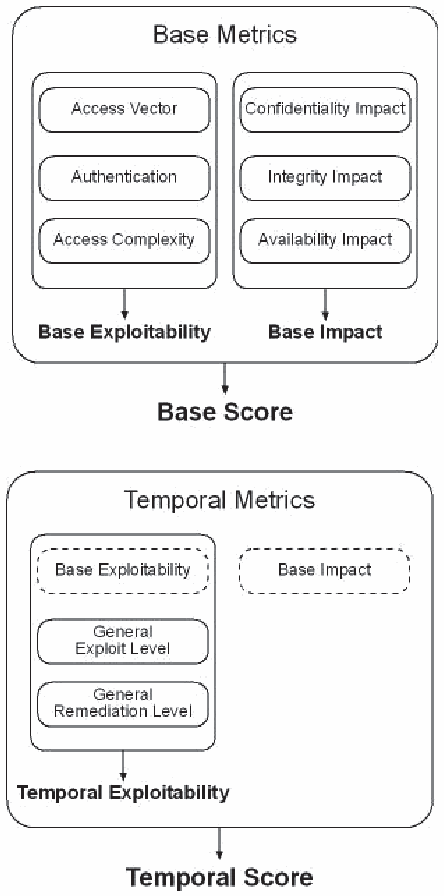
図 1 の前半の図です。「Base Metrics」の枠には Access Vector、Authentication、Access Complexity があって「Base Exploitability」を導き、Confidentiality Impact、Integrity Impact、Availability Impact があって「Base Impact」を導きます。両者から「Base Score」が得られます。「Temporal Metrics」の枠には Base Exploitability(破線)、General Exploit Level、General Remediation Level があって「Temporal Exploitability」を導き、Base Impact(破線)とともに「Temporal Score」が得られます。
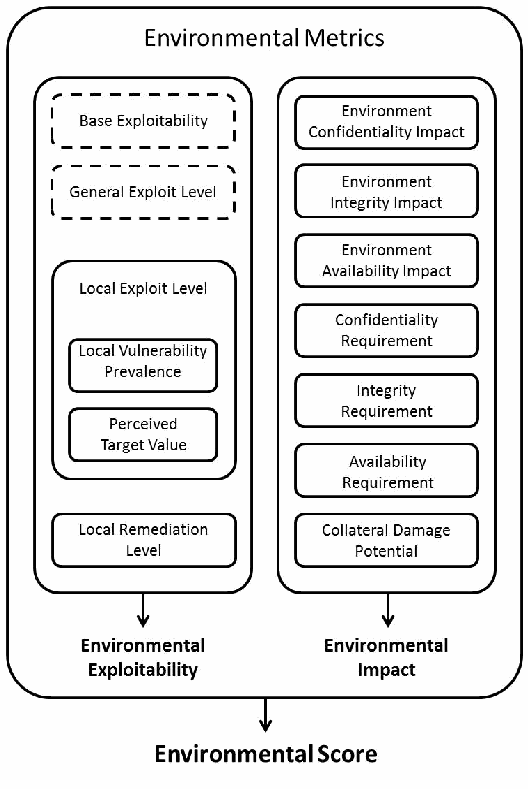
図 1 の後半の図です。「Environmental Metrics」の枠の左の列には Base Exploitability(破線)、General Exploit Level(破線)、Local Exploit Level(Local Vulnerability Prevalence と Perceived Target Value を含む)、Local Remediation Level があり、「Environmental Exploitability」を導きます。右の列には Environment Confidentiality Impact、Environment Integrity Impact、Environment Availability Impact、Confidentiality Requirement、Integrity Requirement、Availability Requirement、Collateral Damage Potential があり、「Environmental Impact」を導きます。両者から「Environmental Score」が得られます。
Figure 1. CMSS Metric Groups
図 1. CMSS の指標グループ
2.1 Base Metrics
2.1 基本評価基準
This section describes the base metrics, which measure the characteristics of a software feature misuse vulnerability that are constant with time and across user environments. The base metrics measure two aspects of vulnerability severity: Exploitability and Impact.
この節では、基本評価基準について説明します。基本評価基準は、時間が経過しても、またユーザー環境が異なっても変わらない、ソフトウェア機能の誤用に関する脆弱性の特性を測定します。基本評価基準は、脆弱性の深刻度の 2 つの側面である、悪用可能性(Exploitability)と影響(Impact)を測定します。
2.1.1 Exploitability
2.1.1 悪用可能性(Exploitability)
The Exploitability of a software feature misuse vulnerability can be captured using the Access Vector, Authentication, and Access Complexity metrics. These metrics are adapted from the CVSS and CCSS specifications and reinterpreted in the context of software feature misuse.
ソフトウェア機能の誤用に関する脆弱性の悪用可能性(Exploitability)は、アクセスベクトル(Access Vector)、認証(Authentication)、アクセスの複雑さ(Access Complexity)の各指標を使って捉えることができます。これらの指標は、CVSS と CCSS の仕様から採り入れ、ソフトウェア機能の誤用という文脈で再解釈したものです。
2.1.1.1 Access Vector (AV)
2.1.1.1 アクセスベクトル(AV)
The Access Vector metric reflects the access required to exploit the vulnerability. To produce an Access Vector score for a software feature misuse vulnerability, consider what access to the system the attacker must possess in order to exploit the feature. The possible values for this metric are listed in Table 1. The more remote an attacker can be, the greater the vulnerability score.
アクセスベクトル(Access Vector)指標は、脆弱性を悪用するために必要なアクセスを反映します。ソフトウェア機能の誤用に関する脆弱性のアクセスベクトルのスコアを求めるには、攻撃者がその機能を悪用するために、システムに対してどのようなアクセス権を持っていなければならないかを検討します。この指標の取り得る値を表 1 に示します。攻撃者が遠隔にいるほど、脆弱性のスコアは高くなります。
Table 1. Access Vector Scoring Evaluation
表 1. アクセスベクトルのスコアリング評価
| Metric Value | Description |
|---|---|
| Local (L) | A vulnerability exploitable with only local access requires the attacker to have either physical access to the vulnerable system or a local (shell) account. An example of a locally exploitable misuse vulnerability is the use of synchronization software to transfer malicious code from a docked mobile device to the system. |
| Adjacent Network (A) | A vulnerability exploitable with adjacent network access requires the attacker to have access to either the broadcast or collision domain of the vulnerable software. Examples of local networks include local IP subnet, Bluetooth, IEEE 802.11, and local Ethernet segment. An example of a misuse vulnerability exploitable using adjacent network access is a system with a Bluetooth interface that offers no security features (the interface can only be enabled or disabled). An attacker within range of the system’s enabled Bluetooth interface could connect to the system through that interface and perform actions such as maliciously accessing and modifying files. |
| Network (N) | A vulnerability exploitable with network access means that the attacker does not require local network access or local access. An example of a network attack is the distribution of an email with an infected attachment that the recipients are tempted to open (which would be a misuse of the email file attachment feature). |
| 指標の値 | 説明 |
|---|---|
| ローカル(L) | ローカルアクセスのみで悪用できる脆弱性では、攻撃者は、脆弱なシステムへの物理アクセスか、ローカル(シェル)アカウントのいずれかを持っている必要があります。ローカルで悪用できる誤用に関する脆弱性の例は、同期ソフトウェアを使って、ドックに接続されたモバイル機器からシステムに悪意のあるコードを転送することです。 |
| 隣接ネットワーク(A) | 隣接ネットワークアクセスで悪用できる脆弱性では、攻撃者は、脆弱なソフトウェアのブロードキャストドメインかコリジョンドメインのいずれかにアクセスできる必要があります。ローカルネットワークの例には、ローカルの IP サブネット、Bluetooth、IEEE 802.11、ローカルの Ethernet セグメントがあります。隣接ネットワークアクセスで悪用できる誤用に関する脆弱性の例は、セキュリティ機能を一切提供しない Bluetooth インタフェース(インタフェースを有効または無効にすることしかできない)を持つシステムです。そのシステムの有効な Bluetooth インタフェースの通信範囲内にいる攻撃者は、そのインタフェースを通じてシステムに接続し、ファイルへの悪意のあるアクセスや変更などの操作を実行できます。 |
| ネットワーク(N) | ネットワークアクセスで悪用できる脆弱性とは、攻撃者がローカルネットワークアクセスもローカルアクセスも必要としないことを意味します。ネットワーク攻撃の例は、受信者が思わず開いてしまうような感染した添付ファイル付きの電子メールの配布です(これは電子メールのファイル添付機能の誤用にあたります)。 |
2.1.1.2 Authentication (Au)
2.1.1.2 認証(Au)
The Authentication metric measures the number of times an attacker must authenticate to a target in order to exploit a vulnerability. This metric does not gauge the strength or complexity of the authentication process, only that an attacker is required to provide credentials before an exploit may occur. The possible values for this metric are listed in Table 2. The fewer authentication instances that are required, the higher the vulnerability score.
認証(Authentication)指標は、脆弱性を悪用するために、攻撃者が標的に対して認証しなければならない回数を測定します。この指標は、認証プロセスの強度や複雑さを評価するものではなく、悪用が起こる前に攻撃者が認証情報を提示する必要があるという点だけを評価します。この指標の取り得る値を表 2 に示します。必要な認証の回数が少ないほど、脆弱性のスコアは高くなります。
It is important to note that the Authentication metric is different from Access Vector. Here, authentication requirements are considered once the system has already been accessed. Specifically, for locally exploitable vulnerabilities, this metric should only be set to “Single” or “Multiple” if authentication is needed beyond what is required to log into the system. An example of a locally exploitable vulnerability that requires authentication is one affecting a database engine listening on a UNIX domain socket (or some other non-network interface). If the user10 must authenticate as a valid database user in order to exploit the vulnerability, then this metric should be set to “Single.”
認証(Authentication)指標がアクセスベクトル(Access Vector)とは異なることに注意することが重要です。ここでは、システムにすでにアクセスした後の認証要件を考慮します。具体的には、ローカルで悪用できる脆弱性の場合、この指標は、システムへのログインに必要なものを超える認証が必要な場合にのみ、「Single」または「Multiple」に設定すべきです。認証が必要な、ローカルで悪用できる脆弱性の例は、UNIX ドメインソケット(またはその他の非ネットワークインタフェース)で待ち受けているデータベースエンジンに影響する脆弱性です。この脆弱性を悪用するために、ユーザー10が有効なデータベースユーザーとして認証しなければならない場合、この指標は「Single」に設定すべきです。
Table 2. Authentication Scoring Evaluation
表 2. 認証のスコアリング評価
| Metric Value | Description |
|---|---|
| Multiple (M) | Exploiting the vulnerability requires that the attacker authenticate two or more times, even if the same credentials are used each time. An example is an attacker authenticating to an operating system in addition to providing credentials to access an application hosted on that system. |
| Single (S) | One instance of authentication is required to access and exploit the vulnerability. |
| None (N) | Authentication is not required to access and exploit the vulnerability. |
| 指標の値 | 説明 |
|---|---|
| 複数(M) | 脆弱性を悪用するには、毎回同じ認証情報を使う場合でも、攻撃者が 2 回以上認証する必要があります。例は、攻撃者が、オペレーティングシステムに認証するのに加えて、そのシステム上でホストされているアプリケーションにアクセスするための認証情報を提示する場合です。 |
| 単一(S) | 脆弱性にアクセスして悪用するために、1 回の認証が必要です。 |
| なし(N) | 脆弱性にアクセスして悪用するために、認証は必要ありません。 |
The metric should be applied based on the authentication the attacker requires before launching an attack. For example, if a network service is vulnerable to a command that can be issued before a user authenticates to the service, the metric should be scored as “None” because the attacker can launch the exploit before credentials are required. If the vulnerable command is only available after successful authentication, then the vulnerability should be scored as “Single” or “Multiple,” depending on how many instances of authentication must occur before issuing the command.
この指標は、攻撃者が攻撃を開始する前に必要とする認証に基づいて適用すべきです。たとえば、ネットワークサービスが、ユーザーがそのサービスに認証する前に発行できるコマンドに対して脆弱である場合、攻撃者は認証情報が要求される前に悪用を開始できるため、この指標は「None」とスコアリングすべきです。脆弱なコマンドが認証に成功した後にしか利用できない場合、コマンドを発行する前に何回の認証が必要かに応じて、その脆弱性は「Single」または「Multiple」とスコアリングすべきです。
2.1.1.3 Access Complexity (AC)
2.1.1.3 アクセスの複雑さ(AC)
The Access Complexity metric reflects the complexity of the attack required to exploit the software feature misuse vulnerability. When the misuse vulnerability is manifest by user action, the complexity of a software feature misuse attack depends both on the number of misuse actions the user must be persuaded to perform and the level of sophistication of the social engineering such persuasion requires. Otherwise, the complexity more generally depends on the level of sophistication required of the attacker to be able to exploit the misuse vulnerability. Access Complexity can be influenced by factors such as the ease of implementing and launching the attack and the likelihood of a user misusing the software feature in the manner desired by the attacker. Access Complexity increases when an attack depends on additional system requirements, such as using a particular type of web browser or a web browser with a particular type of active content enabled.
アクセスの複雑さ(Access Complexity)指標は、ソフトウェア機能の誤用に関する脆弱性を悪用するために必要な攻撃の複雑さを反映します。誤用に関する脆弱性がユーザーの行動によって顕在化する場合、ソフトウェア機能の誤用攻撃の複雑さは、ユーザーに実行するよう説得しなければならない誤用の行動の数と、その説得に必要なソーシャルエンジニアリングの巧妙さの水準の両方に左右されます。それ以外の場合、複雑さは、より一般的に、誤用に関する脆弱性を悪用できるようになるために攻撃者に必要な巧妙さの水準に左右されます。アクセスの複雑さは、攻撃を実装して開始することの容易さや、ユーザーが攻撃者の望む方法でソフトウェア機能を誤用する可能性といった要因に影響されます。攻撃が、特定の種類の Web ブラウザや、特定の種類のアクティブコンテンツを有効にした Web ブラウザを使用するといった、追加のシステム要件に依存する場合、アクセスの複雑さは高くなります。
For example, first consider an enticing email containing malicious scripts that execute when the user views the email. The Access Complexity is medium because attack success requires a single user action that is relatively likely to occur. Other misuse vulnerabilities may require additional steps in order to be exploited. For example, an email may include a hyperlink to a website containing malicious code for the user to download and install. This indirect infection method would require the user to follow several steps to complete the exploit. To be successful, this attack would likely require sophisticated social engineering. Thus, the Access Complexity would be rated as high.
たとえば、まず、ユーザーが電子メールを表示したときに実行される悪意のあるスクリプトを含む、誘惑的な電子メールを考えます。攻撃の成功にはユーザーによる 1 回の行動が必要で、それが起こる可能性は比較的高いため、アクセスの複雑さは中です。ほかの誤用に関する脆弱性は、悪用するために追加の手順が必要な場合があります。たとえば、電子メールに、ユーザーがダウンロードしてインストールする悪意のあるコードを含む Web サイトへのハイパーリンクが含まれている場合があります。この間接的な感染方法では、ユーザーが悪用を完了するまでに複数の手順をたどる必要があります。成功させるには、この攻撃にはおそらく巧妙なソーシャルエンジニアリングが必要です。したがって、アクセスの複雑さは高と評価されます。
In contrast to the previous two examples, some vulnerability exploits require no direct user interaction, such as when an email client automatically displays emails (including rendering any malicious code they contain) without user consent and without the option to disable the feature. The Access Complexity of this vulnerability would be rated as low because the attacker can exploit the vulnerability essentially at will. Although the exploit requires that the victim run the email client, the user will presumably run the email client at some point in time.
前の 2 つの例とは対照的に、電子メールクライアントが、ユーザーの同意なしに、かつ機能を無効にする選択肢もないまま、電子メール(含まれる悪意のあるコードの表示を含む)を自動的に表示する場合のように、ユーザーの直接の操作を必要としない脆弱性の悪用もあります。この脆弱性のアクセスの複雑さは、攻撃者が実質的に思いのままに脆弱性を悪用できるため、低と評価されます。悪用には被害者が電子メールクライアントを実行することが必要ですが、ユーザーはおそらくいずれかの時点で電子メールクライアントを実行するでしょう。
The possible values for this metric are listed in Table 3. The lower the required complexity, the higher the vulnerability score.
この指標の取り得る値を表 3 に示します。必要な複雑さが低いほど、脆弱性のスコアは高くなります。
Table 3. Access Complexity Scoring Evaluation
表 3. アクセスの複雑さのスコアリング評価
| Metric Value | Description |
|---|---|
| High (H) | Specialized access conditions exist. For example:
|
| Medium (M) | The access conditions are somewhat specialized. For example:
|
| Low (L) | Specialized access conditions or extenuating circumstances do not exist. For example:
|
| 指標の値 | 説明 |
|---|---|
| 高(H) | 特殊なアクセス条件が存在します。例:
|
| 中(M) | アクセス条件はいくぶん特殊です。例:
|
| 低(L) | 特殊なアクセス条件や、特別な事情は存在しません。例:
|
2.1.2 Impact
2.1.2 影響(Impact)
The impact of a software feature misuse vulnerability can be captured using the Confidentiality Impact, Integrity Impact, and Availability Impact metrics. These metrics are adapted from the CVSS specification and reinterpreted in the context of software feature misuse. These three Impact metrics measure how a misuse vulnerability, if exploited, could directly affect a targeted system. The Impact metrics independently reflect the degree of loss of confidentiality, integrity, and availability. For example, exploitation of a particular vulnerability could cause a partial loss of integrity and availability but no loss of confidentiality.
ソフトウェア機能の誤用に関する脆弱性の影響は、機密性への影響(Confidentiality Impact)、完全性への影響(Integrity Impact)、可用性への影響(Availability Impact)の各指標を使って捉えることができます。これらの指標は、CVSS の仕様から採り入れ、ソフトウェア機能の誤用という文脈で再解釈したものです。これら 3 つの影響指標は、誤用に関する脆弱性が悪用された場合に、標的のシステムにどのように直接影響し得るかを測定します。影響指標は、機密性、完全性、可用性の喪失の程度を、それぞれ独立に反映します。たとえば、ある脆弱性の悪用が、完全性と可用性の部分的な喪失を引き起こすものの、機密性の喪失は引き起こさない場合があります。
For many misuse vulnerabilities, the possible impact from exploitation is dependent on the privileges held by the user or application (including services). For example, a user account could have restricted privileges or full root-level privileges; exploiting many misuse vulnerabilities would cause a greater impact if full privileges were available. However, the privileges available through exploitation are environment-specific. CMSS prevents environment-specific privileges from affecting the base impact metrics by assuming for those metrics that the generally accepted best practices for the privileges are being employed.11
多くの誤用に関する脆弱性では、悪用によって起こり得る影響は、ユーザーやアプリケーション(サービスを含む)が持つ権限に依存します。たとえば、ユーザーアカウントは、制限された権限を持つ場合も、完全な root レベルの権限を持つ場合もあります。多くの誤用に関する脆弱性の悪用は、完全な権限が利用可能であれば、より大きな影響をもたらします。しかし、悪用を通じて利用できる権限は、環境に固有です。CMSS は、基本の影響指標では、権限について一般に受け入れられているベストプラクティスが採用されていると仮定することで、環境固有の権限が基本の影響指標に影響することを防いでいます。11
CMSS allows organizations to take into account different privileges that they may provide in their environments. This is done through a combination of base and environmental metrics. The base metric, Privilege Level (PL), indicates the level of unauthorized access that an attacker could gain, such as impersonating a user or gaining full access to an application or an operating system. Possible values for Privilege Level are Root Level (R), User Level (U), Application Level (A), and Not Defined (ND). The environmental metrics that use the Privilege Level are described in Section 2.3.3.1.
CMSS では、組織が自らの環境で付与し得るさまざまな権限を考慮に入れることができます。これは、基本評価基準と環境評価基準の組み合わせによって行います。基本評価基準である権限レベル(Privilege Level、PL)は、ユーザーへのなりすましや、アプリケーションまたはオペレーティングシステムへの完全なアクセスの獲得など、攻撃者が得られる不正アクセスのレベルを示します。権限レベルの取り得る値は、ルートレベル(R)、ユーザーレベル(U)、アプリケーションレベル(A)、未定義(ND)です。権限レベルを使用する環境評価基準については、2.3.3.1 節で説明します。
2.1.2.1 Confidentiality Impact (C)
2.1.2.1 機密性への影響(C)
The Confidentiality Impact metric measures the potential impact on confidentiality of a successfully exploited misuse vulnerability. Confidentiality refers to limiting information access and disclosure and system access to only authorized users, as well as preventing access by, or disclosure to, unauthorized parties. The possible values for this metric are listed in Table 4. The greater the potential impact, the higher the score.
機密性への影響(Confidentiality Impact)指標は、悪用に成功した誤用に関する脆弱性が機密性に及ぼす潜在的な影響を測定します。機密性とは、情報へのアクセスと情報の開示、およびシステムへのアクセスを許可されたユーザーだけに限定すること、ならびに、許可されていない者によるアクセスや、許可されていない者への開示を防ぐことをいいます。この指標の取り得る値を表 4 に示します。潜在的な影響が大きいほど、スコアは高くなります。
Table 4. Confidentiality Impact Scoring Evaluation
表 4. 機密性への影響のスコアリング評価
| Metric Value | Description |
|---|---|
| None (N) | There is no impact to the confidentiality of the system. |
| Partial (P) | There is considerable information disclosure. Access to some system files is possible, but the attacker does not have control over what is obtained, or the scope of the loss is constrained. An example is a vulnerability that divulges only certain tables in a database. AND/OR There is considerable unauthorized access to the system. Examples include an authorized user gaining access to certain prohibited system functions, an unauthorized user gaining access to a network service offered by the system, and an unauthorized user gaining user or application-level privileges on the system (such as a database administration account). |
| Complete (C) | There is total information disclosure, resulting in all system files being revealed. The attacker is able to read all of the system's data (memory, files, etc.) An example is someone who is not authorized to act as a system administrator gaining full administrator privileges to the system. |
| 指標の値 | 説明 |
|---|---|
| なし(N) | システムの機密性への影響はありません。 |
| 部分的(P) | 相当な情報の開示があります。一部のシステムファイルへのアクセスは可能ですが、攻撃者は何が入手されるかを制御できないか、喪失の範囲が限られています。例は、データベースの特定のテーブルだけを漏えいさせる脆弱性です。 AND/OR システムへの相当な不正アクセスがあります。例には、許可されたユーザーが、禁止されている特定のシステム機能にアクセスできるようになること、許可されていないユーザーが、システムが提供するネットワークサービスにアクセスできるようになること、許可されていないユーザーが、システム上でユーザーレベルまたはアプリケーションレベルの権限(データベース管理アカウントなど)を得ることがあります。 |
| 完全(C) | 情報が完全に開示され、すべてのシステムファイルが明らかになります。攻撃者は、システムのすべてのデータ(メモリ、ファイルなど)を読み取れます。例は、システム管理者として行動する権限のない者が、システムに対する完全な管理者権限を得ることです。 |
2.1.2.2 Integrity Impact (I)
2.1.2.2 完全性への影響(I)
The Integrity Impact metric measures the potential impact to integrity of a successfully exploited misuse vulnerability. Integrity refers to the trustworthiness and guaranteed veracity of information. The possible values for this metric are listed in Table 5. The greater the potential impact, the higher the score.
完全性への影響(Integrity Impact)指標は、悪用に成功した誤用に関する脆弱性が完全性に及ぼす潜在的な影響を測定します。完全性とは、情報の信頼性と、真正性が保証されていることをいいます。この指標の取り得る値を表 5 に示します。潜在的な影響が大きいほど、スコアは高くなります。
Table 5. Integrity Impact Scoring Evaluation
表 5. 完全性への影響のスコアリング評価
| Metric Value | Description |
|---|---|
| None (N) | There is no impact to the integrity of the system. |
| Partial (P) | Modification of some system files or information is possible, but the attacker does not have control over what can be modified, or the scope of what the attacker can affect is limited. For example, system or application files may be overwritten or modified, but either the attacker has no control over which files are affected or the attacker can modify files within only a limited context or scope, such as for a particular user or application account. AND/OR The system’s security configuration can be altered. An example is a misuse vulnerability that would allow an unauthorized file (such as one containing malware) to be stored on the system or allow an unauthorized program to be installed on the system. |
| Complete (C) | There is a total compromise of system integrity. There is a complete loss of system protection, resulting in the entire system being compromised. The attacker is able to modify any files on the target system. An example is someone who is not authorized to act as a system administrator gaining full administrator privileges to the system. |
| 指標の値 | 説明 |
|---|---|
| なし(N) | システムの完全性への影響はありません。 |
| 部分的(P) | 一部のシステムファイルまたは情報の変更は可能ですが、攻撃者は何を変更できるかを制御できないか、攻撃者が影響を及ぼせる範囲が限られています。たとえば、システムファイルやアプリケーションファイルが上書きまたは変更される場合がありますが、攻撃者がどのファイルに影響が及ぶかを制御できないか、特定のユーザーやアプリケーションのアカウントなど、限られたコンテキストまたは範囲内でしかファイルを変更できないかのいずれかです。 AND/OR システムのセキュリティ設定を変更できます。例は、許可されていないファイル(マルウェアを含むものなど)をシステムに保存できてしまう、または許可されていないプログラムをシステムにインストールできてしまう、誤用に関する脆弱性です。 |
| 完全(C) | システムの完全性が完全に危殆化されます。システムの保護が完全に失われ、システム全体が危殆化されます。攻撃者は、標的システム上の任意のファイルを変更できます。例は、システム管理者として行動する権限のない者が、システムに対する完全な管理者権限を得ることです。 |
2.1.2.3 Availability Impact (A)
2.1.2.3 可用性への影響(A)
The Availability Impact metric measures the potential impact to availability of a successfully exploited misuse vulnerability. Availability refers to the accessibility of information resources. Attacks that consume network bandwidth, processor cycles, or disk space all impact the availability of a system. The possible values for this metric are listed in Table 6. The greater the potential impact, the higher the score.
可用性への影響(Availability Impact)指標は、悪用に成功した誤用に関する脆弱性が可用性に及ぼす潜在的な影響を測定します。可用性とは、情報資源へのアクセスのしやすさをいいます。ネットワーク帯域幅、プロセッササイクル、ディスク容量を消費する攻撃は、いずれもシステムの可用性に影響を与えます。この指標の取り得る値を表 6 に示します。潜在的な影響が大きいほど、スコアは高くなります。
Table 6. Availability Impact Scoring Evaluation
表 6. 可用性への影響のスコアリング評価
| Metric Value | Description |
|---|---|
| None (N) | There is no impact to the availability of the system. |
| Partial (P) | There is reduced performance or interruptions in resource availability. An example is a network-based flood attack that permits a limited number of successful connections to an Internet service. |
| Complete (C) | There is a total shutdown of the affected resource. The attacker can render the resource completely unavailable. |
| 指標の値 | 説明 |
|---|---|
| なし(N) | システムの可用性への影響はありません。 |
| 部分的(P) | 性能が低下するか、資源の可用性に中断が生じます。例は、インターネットサービスへの接続を限られた数だけ成功させる、ネットワークベースのフラッド攻撃です。 |
| 完全(C) | 影響を受ける資源が完全に停止します。攻撃者は、その資源を完全に利用できない状態にできます。 |
2.2 Temporal Metrics
2.2 時間評価基準
The threat posed by a misuse vulnerability may change over time. The base metrics are limited to the characteristics of a software feature misuse vulnerability that are constant over time and across user environments. To incorporate the time-variant aspect of threats, the temporal metrics produce a scaling factor that is applied to the Exploitability components of the base metric. Temporal metrics describe the characteristics of misuse vulnerabilities that can change over time but remain constant across user environments.
誤用に関する脆弱性がもたらす脅威は、時間とともに変化する場合があります。基本評価基準は、時間が経過しても、またユーザー環境が異なっても変わらない、ソフトウェア機能の誤用に関する脆弱性の特性に限定されています。脅威の時間とともに変化する側面を取り込むために、時間評価基準は、基本評価基準の悪用可能性(Exploitability)の構成要素に適用される尺度係数を生成します。時間評価基準は、時間とともに変化し得ますが、ユーザー環境が異なっても変わらない、誤用に関する脆弱性の特性を記述します。
The two components of CMSS temporal metrics are the General Exploit Level and the General Remediation Level. Since temporal metrics are optional, each includes a default metric value that has no effect on the score. This value is used when the scoring analyst wishes to ignore a particular metric because it does not apply or the analyst does not have sufficient data to determine the appropriate metric value.
CMSS の時間評価基準の 2 つの構成要素は、一般的な悪用レベル(General Exploit Level)と一般的な是正レベル(General Remediation Level)です。時間評価基準は任意であるため、それぞれにスコアに影響しない既定の指標値が含まれています。この値は、スコアリングを行うアナリストが、ある指標が当てはまらない、またはその指標に適切な値を決定するための十分なデータがないために、その指標を無視したい場合に使用されます。
2.2.1 General Exploit Level (GEL)
2.2.1 一般的な悪用レベル(GEL)
The General Exploit Level metric measures the prevalence of attacks against a misuse vulnerability—how often any vulnerable system is likely to come under attack. If a misuse vulnerability could be exploited more widely with the use of exploit code, the prevalence of attacks may be related to the current state of exploit techniques or exploit code availability. Public availability of easy-to-use exploit code increases the number of potential attackers by including those who are unskilled, thereby increasing the severity of the vulnerability. The availability of automated exploit code also increases the number of attacks each attacker can launch. However, note that attacks may not require exploit code. For example, consider a misuse vulnerability that can be attacked by sending a user an email with instructions to perform actions that result in an exploit. The prevalence of this type of attack would be measured by the frequency with which the exploit email is received by users on a typical vulnerable system.
一般的な悪用レベル(General Exploit Level)指標は、誤用に関する脆弱性に対する攻撃の蔓延度、すなわち、脆弱なシステムがどのくらいの頻度で攻撃を受けそうかを測定します。誤用に関する脆弱性が、悪用コードを使うことでより広く悪用され得る場合、攻撃の蔓延度は、悪用手法の現状や、悪用コードの入手可能性に関係する場合があります。使いやすい悪用コードが公に入手可能になると、技術のない者を含めることで潜在的な攻撃者の数が増え、それによって脆弱性の深刻度が高まります。自動化された悪用コードが入手可能になると、各攻撃者が仕掛けられる攻撃の数も増えます。ただし、攻撃には悪用コードが不要な場合もあることに注意してください。たとえば、ユーザーに、悪用につながる操作を実行するよう指示した電子メールを送ることで攻撃できる誤用に関する脆弱性を考えます。この種の攻撃の蔓延度は、典型的な脆弱なシステム上のユーザーが、その悪用の電子メールを受け取る頻度によって測定されます。
The possible values for this metric are listed in Table 7. The more frequently exploitation attempts occur for a vulnerability, the higher the score.
この指標の取り得る値を表 7 に示します。脆弱性に対して悪用の試みが頻繁に行われるほど、スコアは高くなります。
Table 7. General Exploit Level Scoring Evaluation
表 7. 一般的な悪用レベルのスコアリング評価
| Metric Value | Description |
|---|---|
| None (N) | Exploits have not yet been observed. |
| Low (L) | Exploits are rarely observed. Expected time-between-exploits for a vulnerable system is measured in months or years. |
| Medium (M) | Exploits are occasionally observed. Expected time-between-exploits for a vulnerable system is measured in days. |
| High (H) | Exploits are frequently observed. Expected time-between-exploits for a vulnerable system is measured in hours, minutes, or seconds. |
| Not Defined (ND) | Assigning this value to the metric will not influence the score. It is a signal to the equation to skip this metric. The default value is Medium. |
| 指標の値 | 説明 |
|---|---|
| なし(N) | 悪用はまだ観測されていません。 |
| 低(L) | 悪用はまれにしか観測されません。脆弱なシステムにおける悪用の間隔の想定値は、月単位または年単位で測られます。 |
| 中(M) | 悪用はときどき観測されます。脆弱なシステムにおける悪用の間隔の想定値は、日単位で測られます。 |
| 高(H) | 悪用は頻繁に観測されます。脆弱なシステムにおける悪用の間隔の想定値は、時間、分、または秒単位で測られます。 |
| 未定義(ND) | この値を指標に割り当てても、スコアには影響しません。これは、式がこの指標を飛ばすことを示す信号です。既定値は中です。 |
2.2.2 General Remediation Level (GRL)
2.2.2 一般的な是正レベル(GRL)
The General Remediation Level metric measures the availability of remediation measures that can mitigate the vulnerability other than rendering the misused software feature useless (e.g., disabling the affected feature, removing the software). Remediation measures may restrict the usage of the feature to minimize or prevent misuse. One example of a remediation measure available against users opening infected email attachments is the antivirus check in an email client that restricts which attachments a user is able to open. Similarly, an antispam or antiphishing filter in an email client can mitigate the effects of a phishing email by restricting which incoming email messages are placed in the inbox for the user to view and by alerting the user about suspected phishing sites. Also, users can be made aware of phishing threats and how they should handle emails that could be phishing attacks. These measures restrict the usage of the email client in an attempt to prevent misuse of the capabilities to view emails and open attachments. The effectiveness of the available remediation measures determines the General Remediation Level.
一般的な是正レベル(General Remediation Level)指標は、誤用されるソフトウェア機能を使えなくしてしまう(例: 影響を受ける機能の無効化、ソフトウェアの削除)以外の方法で、脆弱性を緩和できる是正措置が利用可能かどうかを測定します。是正措置は、誤用を最小限にする、または防ぐために、機能の使用を制限する場合があります。感染した電子メールの添付ファイルをユーザーが開くことに対して利用可能な是正措置の 1 つの例は、ユーザーが開くことのできる添付ファイルを制限する、電子メールクライアントのウイルスチェックです。同様に、電子メールクライアントのスパム対策フィルターやフィッシング対策フィルターは、ユーザーが閲覧できる受信トレイに入る受信メールメッセージを制限し、疑わしいフィッシングサイトについてユーザーに警告することで、フィッシングメールの影響を緩和できます。また、ユーザーに、フィッシングの脅威と、フィッシング攻撃である可能性のある電子メールをどのように扱うべきかを周知することもできます。これらの措置は、電子メールを閲覧して添付ファイルを開く機能の誤用を防ごうとして、電子メールクライアントの使用を制限します。利用可能な是正措置の有効性が、一般的な是正レベルを決定します。
The possible values for this metric are listed in Table 8. The less effective the available remediation measures, the higher the score.
この指標の取り得る値を表 8 に示します。利用可能な是正措置の有効性が低いほど、スコアは高くなります。
Table 8. General Remediation Level Scoring Evaluation
表 8. 一般的な是正レベルのスコアリング評価
| Metric Value | Description |
|---|---|
| High (H) | Remediation measures are available to significantly restrict feature use in such a way as to collectively decrease the incidence of misuse by between 76% and 100%. (A decrease of 100% means that the available remediation measures are able to entirely prevent misuse.) |
| Medium (M) | Remediation measures are available to partially restrict feature use in such a way as to collectively decrease the incidence of misuse by between 26% and 75%. |
| Low (L) | Remediation measures are available to slightly restrict feature use in such a way as to collectively decrease the incidence of misuse by between 1% and 25%. |
| None (N) | Remediation measures are not available. |
| Not Defined (ND) | Assigning this value to the metric will not influence the score. It is a signal to the equation to skip this metric. The default value is None. |
| 指標の値 | 説明 |
|---|---|
| 高(H) | 機能の使用を大幅に制限し、全体として誤用の発生を 76% から 100% 減少させるような是正措置が利用可能です。(100% の減少とは、利用可能な是正措置によって誤用を完全に防げることを意味します。) |
| 中(M) | 機能の使用を部分的に制限し、全体として誤用の発生を 26% から 75% 減少させるような是正措置が利用可能です。 |
| 低(L) | 機能の使用をわずかに制限し、全体として誤用の発生を 1% から 25% 減少させるような是正措置が利用可能です。 |
| なし(N) | 是正措置は利用できません。 |
| 未定義(ND) | この値を指標に割り当てても、スコアには影響しません。これは、式がこの指標を飛ばすことを示す信号です。既定値はなしです。 |
2.3 Environmental Metrics
2.3 環境評価基準
Differences between environments can have a large effect on the risk that a vulnerability poses to a particular organization and its stakeholders. The CMSS environmental metrics capture the characteristics of a vulnerability that are associated with a particular IT environment. Each organization computing CMSS metrics can determine an appropriate definition of IT environment, such as the entire enterprise or a logical or physical subset of the enterprise (e.g., a facility, a division, a small group of related systems). Since environmental metrics are optional, each includes a metric value that has no effect on the score. This value is used when the analyst feels the particular metric does not apply and wishes to ignore it.
環境の違いは、脆弱性が特定の組織とそのステークホルダーにもたらすリスクに大きな影響を与え得ます。CMSS の環境評価基準は、特定の IT 環境に関連する脆弱性の特性を捉えます。CMSS の指標を算出する各組織は、エンタープライズ全体や、エンタープライズの論理的または物理的な部分集合(例: 施設、部門、関連するシステムの小グループ)など、IT 環境の適切な定義を決定できます。環境評価基準は任意であるため、それぞれにスコアに影響しない指標値が含まれています。この値は、アナリストが特定の指標が当てはまらないと考え、それを無視したい場合に使用されます。
The environmental metrics customize the previously computed base and temporal metrics. The environmental metrics measure three aspects of vulnerability severity: Local Exploit Level, Local Remediation Level, and Local Impact. Similar to the General Exploit Level and General Remediation Level temporal metrics, the Local Exploit Level and Local Remediation Level environmental metrics produce a scaling factor that is applied to the Exploitability components of the base metric. The Local Impact environmental metric comprises several metrics that adjust the base impact metrics to take environment-specific characteristics into account.
環境評価基準は、先に算出した基本評価基準と時間評価基準をカスタマイズします。環境評価基準は、脆弱性の深刻度の 3 つの側面である、ローカルの悪用レベル(Local Exploit Level)、ローカルの是正レベル(Local Remediation Level)、ローカルの影響(Local Impact)を測定します。時間評価基準の一般的な悪用レベルおよび一般的な是正レベルと同様に、環境評価基準のローカルの悪用レベルとローカルの是正レベルは、基本評価基準の悪用可能性(Exploitability)の構成要素に適用される尺度係数を生成します。環境評価基準のローカルの影響は、環境固有の特性を考慮に入れるために基本の影響指標を調整する、複数の指標で構成されます。
The environmental metrics are intended to measure deviations from the assumptions about environments that were used to compute the base and temporal metrics. Therefore, environmental metrics should be scored relative to those assumptions.
環境評価基準は、基本評価基準と現状評価基準を算出するために使用した環境についての前提からの乖離を測定することを意図しています。したがって、環境評価基準は、それらの前提と比較してスコアリングすべきです。
2.3.1 Local Exploit Level
2.3.1 ローカルの悪用レベル
The local exploit level can be captured using two environmental metrics: Local Vulnerability Prevalence and Perceived Target Value.
ローカルの悪用レベルは、ローカルの脆弱性の蔓延度(Local Vulnerability Prevalence)と認識された標的の価値(Perceived Target Value)という 2 つの環境評価基準を使って捉えることができます。
2.3.1.1 Local Vulnerability Prevalence (LVP)
2.3.1.1 ローカルの脆弱性の蔓延度(LVP)
The Local Vulnerability Prevalence metric measures the prevalence of vulnerable systems in a specific environment. It is intended to approximate the percentage of systems that could be affected by the vulnerability. The Local Vulnerability Prevalence depends both on the prevalence of the misused feature under scrutiny and the prevalence of its misuse. For misuse vulnerabilities dependent on user actions, the prevalence of misuse depends on the probability that users in this environment will perform the actions required for vulnerability exploitation. For example, if 80% of the systems contain a particular potentially misused feature but only half of the users of those systems are expected to engage in misuse behavior, then 40% of the total environment is at risk. Thus, the Local Vulnerability Prevalence would be rated as medium. The Local Vulnerability Prevalence also takes into account, when appropriate, how frequently the vulnerability is relevant for targets, such as how often the vulnerable software is run, how many hours per day the vulnerable software is running, and how much usage exposes the software to threats (for example, how many web sites or emails a user accesses). The possible values for this metric are listed in Table 9. The greater the approximate percentage of vulnerable systems, the higher the score.
ローカルの脆弱性の蔓延度(Local Vulnerability Prevalence)指標は、特定の環境における脆弱なシステムの蔓延度を測定します。これは、脆弱性の影響を受け得るシステムの割合を概算することを意図しています。ローカルの脆弱性の蔓延度は、検討対象の誤用される機能の蔓延度と、その誤用の蔓延度の両方に依存します。ユーザーの行動に依存する誤用に関する脆弱性では、誤用の蔓延度は、この環境のユーザーが脆弱性の悪用に必要な行動を実行する確率に依存します。たとえば、システムの 80% に、誤用される可能性のある特定の機能が含まれていても、それらのシステムのユーザーの半分しか誤用の行動をとらないと見込まれる場合、環境全体の 40% がリスクにさらされています。したがって、ローカルの脆弱性の蔓延度は中と評価されます。ローカルの脆弱性の蔓延度は、必要に応じて、脆弱性が標的にとってどのくらいの頻度で関係するかも考慮に入れます。たとえば、脆弱なソフトウェアがどのくらいの頻度で実行されるか、脆弱なソフトウェアが 1 日に何時間実行されているか、どのくらいの使用でソフトウェアが脅威にさらされるか(たとえば、ユーザーがアクセスする Web サイトや電子メールの数)といったことです。この指標の取り得る値を表 9 に示します。脆弱なシステムの概算の割合が大きいほど、スコアは高くなります。
Table 9. Local Vulnerability Prevalence Scoring Evaluation
表 9. ローカルの脆弱性の蔓延度のスコアリング評価
| Metric Value | Description |
|---|---|
| None (N) | No target systems exist, or targets are so highly specialized that they only exist in a laboratory setting. Effectively 0% of the environment is at risk. |
| Low (L) | Targets exist inside the environment, but on a small scale. Between 1% and 25% of the total environment is at risk. |
| Medium (M) | Targets exist inside the environment, but on a medium scale. Between 26% and 75% of the total environment is at risk. |
| High (H) | Targets exist inside the environment on a large scale. Between 76% and 100% of the total environment is considered at risk. |
| Not Defined (ND) | Assigning this value to the metric will not influence the score. It is a signal to the equation to skip this metric. The default value is Medium. |
| 指標の値 | 説明 |
|---|---|
| なし(N) | 標的のシステムが存在しないか、標的が非常に特殊で、実験室の環境にしか存在しません。実質的に環境の 0% がリスクにさらされています。 |
| 低(L) | 標的は環境内に存在しますが、小規模です。環境全体の 1% から 25% がリスクにさらされています。 |
| 中(M) | 標的は環境内に存在し、中程度の規模です。環境全体の 26% から 75% がリスクにさらされています。 |
| 高(H) | 標的は環境内に大規模に存在します。環境全体の 76% から 100% がリスクにさらされているとみなされます。 |
| 未定義(ND) | この値を指標に割り当てても、スコアには影響しません。これは、式がこの指標を飛ばすことを示す信号です。既定値は中です。 |
2.3.1.2 Perceived Target Value (PTV)
2.3.1.2 認識された標的の価値(PTV)
The Perceived Target Value metric measures the likelihood of attack using the misuse vulnerability in an environment relative to vulnerable systems in other environments. The metric indicates the level of motivation for an attacker to attempt to exploit the misuse vulnerability in the environment relative to other environments. The possible values for this metric are listed in Table 10. The higher the Perceived Target Value, the higher the score.
認識された標的の価値(Perceived Target Value)指標は、ある環境で誤用に関する脆弱性を使った攻撃が行われる可能性を、他の環境の脆弱なシステムと比較して測定します。この指標は、他の環境と比べて、その環境で誤用に関する脆弱性を悪用しようとする攻撃者の動機の強さを示します。この指標の取り得る値を表 10 に示します。認識された標的の価値が高いほど、スコアは高くなります。
Table 10. Perceived Target Value Scoring Evaluation
表 10. 認識された標的の価値のスコアリング評価
| Metric Value | Description |
|---|---|
| Low (L) | The targets in this environment are perceived as low value by attackers. Attackers have low motivation to attack the target system relative to other systems with the same vulnerability. |
| Medium (M) | The targets in this environment are perceived as medium value by attackers. Attackers are equally motivated to attack the target system and other systems with the same vulnerability. |
| High (H) | The targets in this environment are perceived as high value by attackers. Attackers are highly motivated to attack the target system relative to other systems with the same vulnerability. |
| Not Defined (ND) | Assigning this value to the metric will not influence the score. It is a signal to the equation to skip this metric. The default value is Medium. |
| 指標の値 | 説明 |
|---|---|
| 低(L) | この環境の標的は、攻撃者から価値が低いと認識されています。同じ脆弱性を持つ他のシステムと比べて、攻撃者には標的システムを攻撃する動機があまりありません。 |
| 中(M) | この環境の標的は、攻撃者から価値が中程度だと認識されています。攻撃者は、標的システムと、同じ脆弱性を持つ他のシステムを、同程度の動機で攻撃します。 |
| 高(H) | この環境の標的は、攻撃者から価値が高いと認識されています。同じ脆弱性を持つ他のシステムと比べて、攻撃者には標的システムを攻撃する強い動機があります。 |
| 未定義(ND) | この値を指標に割り当てても、スコアには影響しません。これは、式がこの指標を飛ばすことを示す信号です。既定値は中です。 |
2.3.2 Local Remediation Level (LRL)
2.3.2 ローカルの是正レベル(LRL)
The Local Remediation Level metric measures the level of protection against a misuse vulnerability within the local IT environment and captures both how widespread mitigation implementation is and how effective such mitigation is. To calculate the environmental score, the Local Remediation Level metric replaces the temporal General Remediation Level metric, which measures only the availability of remediation measures, not the implementation.
ローカルの是正レベル(Local Remediation Level)指標は、ローカルの IT 環境内での誤用に関する脆弱性に対する保護のレベルを測定し、緩和策の実装がどれだけ広く行われているかと、その緩和策がどれだけ有効かの両方を捉えます。環境スコアを算出する際は、ローカルの是正レベル指標が、現状評価基準の一般的な是正レベル指標の代わりに使われます。一般的な是正レベル指標は、是正措置の実装ではなく、その利用可能性だけを測定します。
The possible values for this metric are listed in Table 11. The less thorough or effective the implementation of remediation measures, the higher the score.
この指標の取り得る値を表 11 に示します。是正措置の実装が不十分である、または有効でないほど、スコアは高くなります。
Table 11. Local Remediation Level Scoring Evaluation
表 11. ローカルの是正レベルのスコアリング評価
| Metric Value | Description |
|---|---|
| High (H) | Remediation measures are implemented to restrict feature use in such a way as to collectively decrease the incidence of misuse by between 76% and 100%. (A decrease of 100% means that the implemented remediation measures entirely prevent misuse.) |
| Medium (M) | Remediation measures are implemented to partially restrict feature use in such a way as to collectively decrease the incidence of misuse by between 26% and 75%. |
| Low (L) | Remediation measures are implemented to slightly restrict feature use in such a way as to collectively decrease the incidence of misuse by between 1% and 25%. |
| None (N) | Remediation measures are not implemented. |
| Not Defined (ND) | Assigning this value to the metric will not influence the score. It is a signal to the equation to skip this metric. The default value is None. |
| 指標の値 | 説明 |
|---|---|
| 高(H) | 機能の使用を制限し、全体として誤用の発生を 76% から 100% 減少させるような是正措置が実装されています。(100% の減少とは、実装された是正措置によって誤用を完全に防げることを意味します。) |
| 中(M) | 機能の使用を部分的に制限し、全体として誤用の発生を 26% から 75% 減少させるような是正措置が実装されています。 |
| 低(L) | 機能の使用をわずかに制限し、全体として誤用の発生を 1% から 25% 減少させるような是正措置が実装されています。 |
| なし(N) | 是正措置は実装されていません。 |
| 未定義(ND) | この値を指標に割り当てても、スコアには影響しません。これは、式がこの指標を飛ばすことを示す信号です。既定値はなしです。 |
2.3.3 Local Impact
2.3.3 ローカルの影響
The Local Impact can be captured using seven environmental metrics. The first three—Environment Confidentiality Impact, Environment Integrity Impact, and Environment Availability Impact—take the place of the corresponding base impact metrics (Confidentiality Impact, Integrity Impact, and Availability Impact). The fourth, Collateral Damage Potential, augments the three Environment Impact metrics. The remaining three environmental metrics (Confidentiality Requirement, Integrity Requirement, and Availability Requirement) are used to compute scaling factors that are applied to the three Environment Impact metrics.
ローカルの影響は、7 つの環境評価基準を使って捉えることができます。最初の 3 つである、環境の機密性への影響(Environment Confidentiality Impact)、環境の完全性への影響(Environment Integrity Impact)、環境の可用性への影響(Environment Availability Impact)は、対応する基本の影響指標(機密性への影響、完全性への影響、可用性への影響)に代わるものです。4 つ目の副次的損害の可能性(Collateral Damage Potential)は、3 つの環境の影響指標を補強します。残りの 3 つの環境評価基準(機密性の要求(Confidentiality Requirement)、完全性の要求(Integrity Requirement)、可用性の要求(Availability Requirement))は、3 つの環境の影響指標に適用される尺度係数を算出するために使用されます。
2.3.3.1 Environment Confidentiality, Integrity, and Availability Impact (EC, EI, EA)
2.3.3.1 環境の機密性・完全性・可用性への影響(EC、EI、EA)
The Environment Confidentiality, Integrity, and Availability Impact metrics enable the analyst to customize the environmental score if the privileges in the environment differ significantly from best practices related to the misuse vulnerability. For example, suppose that a vulnerability permitted an attacker to gain unauthorized access to a system with the user’s privileges. In the base impact metrics, this would have been recorded as a partial impact to confidentiality, integrity, and availability, under the assumption that the user was running with limited user privileges. However, if a particular environment permitted users to run with full, root-level privileges, then this could be taken into account through the Environment Impact metrics.
環境の機密性・完全性・可用性への影響(Environment Confidentiality, Integrity, and Availability Impact)指標により、アナリストは、環境における権限が、誤用に関する脆弱性に関連するベストプラクティスと大きく異なる場合に、環境スコアをカスタマイズできます。たとえば、ある脆弱性により、攻撃者がユーザーの権限でシステムに不正アクセスできるとします。基本の影響指標では、ユーザーが制限されたユーザー権限で動作しているという想定のもと、これは機密性、完全性、可用性への部分的な影響として記録されていたはずです。しかし、特定の環境でユーザーが完全な root レベルの権限で動作することを許していた場合、このことは環境の影響指標を通じて考慮に入れることができます。
The Environment Impact metrics include all the same definitions as the base impact metrics; each can be set to None, Partial, or Complete. Additionally, each Environment Impact metric also includes a Not Defined (ND) value. The definition of ND is: “Assigning this value to the metric will not influence the score. It is a signal to the equation to skip this metric. The default value is the value assigned to the corresponding base impact metric.”
環境の影響指標には、基本の影響指標とまったく同じ定義がすべて含まれており、それぞれ「なし」、「部分的」、「完全」に設定できます。加えて、各環境の影響指標には、未定義(ND)の値もあります。ND の定義は、「この値を指標に割り当てても、スコアには影響しません。これは、式がこの指標を飛ばすことを示す信号です。既定値は、対応する基本の影響指標に割り当てられた値です。」です。
2.3.3.2 Collateral Damage Potential (CDP)
2.3.3.2 副次的損害の可能性(CDP)
The Collateral Damage Potential metric measures the potential for loss of life or physical assets through damage or theft of property or equipment. The metric may also measure economic loss of productivity or revenue. This metric can adjust the local impact score to account for application importance. For example, a vulnerability that permits an attacker to gain user-level access to an application (e.g., DNS server, database server) can be scored differently on a system that uses the application in a trivial way versus another system that uses the application in a critical way. The possible values for this metric are listed in Table 12. The greater the damage potential, the higher the vulnerability score. Each organization must determine for itself the precise meaning of “slight,” “moderate,” “significant,” and “catastrophic” in the organization’s environment.
副次的損害の可能性(Collateral Damage Potential)指標は、財産や機器の損傷または盗難による、人命や物理的資産の損失の可能性を測定します。この指標は、生産性や収益の経済的損失も測定する場合があります。この指標は、アプリケーションの重要度を考慮して、ローカルの影響スコアを調整できます。たとえば、攻撃者がアプリケーション(例: DNS サーバー、データベースサーバー)へのユーザーレベルのアクセスを得られる脆弱性は、そのアプリケーションを取るに足らない形で使用しているシステムと、重要な形で使用している別のシステムとで、異なるスコアになり得ます。この指標の取り得る値を表 12 に示します。損害の可能性が大きいほど、脆弱性のスコアは高くなります。各組織は、自らの環境における「わずか」、「中程度」、「重大」、「壊滅的」の正確な意味を、自ら決定しなければなりません。
Table 12. Collateral Damage Potential Scoring Evaluation
表 12. 副次的損害の可能性のスコアリング評価
| Metric Value | Description |
|---|---|
| None (N) | There is no potential for loss of life, physical assets, productivity or revenue. |
| Low (L) | Successful exploitation of this vulnerability may result in slight physical or property damage or loss. Or, there may be a slight loss of revenue or productivity. |
| Low-Medium (LM) | Successful exploitation of this vulnerability may result in moderate physical or property damage or loss. Or, there may be a moderate loss of revenue or productivity. |
| Medium-High (MH) | Successful exploitation of this vulnerability may result in significant physical or property damage or loss. Or, there may be a significant loss of revenue or productivity. |
| High (H) | Successful exploitation of this vulnerability may result in catastrophic physical or property damage or loss. Or, there may be a catastrophic loss of revenue or productivity. |
| Not Defined (ND) | Assigning this value to the metric will not influence the score. It is a signal to the equation to skip this metric. The default value is None. |
| 指標の値 | 説明 |
|---|---|
| なし(N) | 人命、物理的資産、生産性、収益が失われる可能性はありません。 |
| 低(L) | この脆弱性の悪用に成功すると、物理的損害や財産の損害または損失がわずかに生じる場合があります。または、収益や生産性がわずかに失われる場合があります。 |
| 低〜中(LM) | この脆弱性の悪用に成功すると、物理的損害や財産の損害または損失が中程度に生じる場合があります。または、収益や生産性が中程度に失われる場合があります。 |
| 中〜高(MH) | この脆弱性の悪用に成功すると、物理的損害や財産の損害または損失が重大に生じる場合があります。または、収益や生産性が重大に失われる場合があります。 |
| 高(H) | この脆弱性の悪用に成功すると、物理的損害や財産の損害または損失が壊滅的に生じる場合があります。または、収益や生産性が壊滅的に失われる場合があります。 |
| 未定義(ND) | この値を指標に割り当てても、スコアには影響しません。これは、式がこの指標を飛ばすことを示す信号です。既定値はなしです。 |
2.3.3.3 Confidentiality, Integrity, Availability Requirements (CR, IR, AR)
2.3.3.3 機密性・完全性・可用性の要求(CR、IR、AR)
The Confidentiality Requirement, Integrity Requirement, and Availability Requirement metrics enable the analyst to customize the environmental score depending on the importance of the affected IT asset to an organization, measured in terms of confidentiality, integrity, and availability. That is, if an IT asset supports a business function for which availability is most important, the analyst can assign a greater value to availability, relative to confidentiality and integrity. Each security requirement has three possible values: “Low,” “Medium,” or “High,” with “Medium” being the default.
機密性の要求(Confidentiality Requirement)、完全性の要求(Integrity Requirement)、可用性の要求(Availability Requirement)の各指標により、アナリストは、影響を受ける IT 資産の組織にとっての重要度を、機密性、完全性、可用性の観点で測定したものに応じて、環境スコアをカスタマイズできます。つまり、ある IT 資産が、可用性が最も重要な業務機能を支えている場合、アナリストは、機密性や完全性に比べて可用性により大きな値を割り当てることができます。各セキュリティ要求には、「Low」、「Medium」、「High」の 3 つの取り得る値があり、「Medium」が既定値です。
The full effect on the environmental score is determined by the corresponding Environment Impact metrics. That is, these metrics modify the environmental score by reweighting the Environment Confidentiality, Integrity, and Availability Impact metrics. For example, the Environment Confidentiality Impact (C) metric has increased weight if the Confidentiality Requirement (CR) is “High.” Likewise, the Environment Confidentiality Impact metric has decreased weight if the Confidentiality Requirement is “Low.” The Environment Confidentiality Impact metric weighting is neutral if the Confidentiality Requirement is “Medium.” This same logic is applied to the Environment Integrity and Availability Requirements.
環境スコアへの完全な効果は、対応する環境の影響指標によって決まります。つまり、これらの指標は、環境の機密性・完全性・可用性への影響指標の重みを付け直すことで、環境スコアを変更します。たとえば、機密性の要求(CR)が「High」の場合、環境の機密性への影響(C)指標の重みは増加します。同様に、機密性の要求が「Low」の場合、環境の機密性への影響指標の重みは減少します。機密性の要求が「Medium」の場合、環境の機密性への影響指標の重み付けは中立です。この同じ考え方が、環境の完全性の要求と可用性の要求にも適用されます。
Note that the Confidentiality Requirement will not affect the environmental score if the Environment Confidentiality Impact is set to “None.” Also, increasing the Confidentiality Requirement from “Medium” to “High” will not change the environmental score when all of the Environment Impact metrics are set to “Complete” because the Impact subscore (the part of the score that calculates impact) is already at a maximum value of 10.
環境の機密性への影響が「None」に設定されている場合、機密性の要求は環境スコアに影響しないことに注意してください。また、すべての環境の影響指標が「Complete」に設定されている場合、影響サブスコア(スコアのうち影響を算出する部分)はすでに最大値の 10 であるため、機密性の要求を「Medium」から「High」に上げても、環境スコアは変わりません。
The possible values for the security requirements are listed in Table 13. For brevity, the same table is used for all three metrics. The greater the security requirement, the higher the score.
セキュリティ要求の取り得る値を表 13 に示します。簡潔にするため、3 つの指標すべてに同じ表を使用します。セキュリティ要求が大きいほど、スコアは高くなります。
In many organizations, IT resources are labeled with criticality ratings based on network location, business function, and potential for loss of revenue or life. For example, the U.S. government assigns every unclassified IT asset to a grouping of assets called a System. Every System must be assigned three “potential impact” ratings to show the potential impact on the organization if the System is compromised according to three security objectives: confidentiality, integrity, and availability. Thus, every unclassified IT asset in the U.S. government has a potential impact rating of low, moderate, or high with respect to the security objectives of confidentiality, integrity, and availability. This rating system is described within Federal Information Processing Standards (FIPS) 199.12 CMSS follows this general model of FIPS 199, but does not require organizations to use a particular methodology for assigning the low, medium, and high impact ratings.
多くの組織では、IT 資源に、ネットワーク上の位置、業務機能、収益や人命の損失の可能性に基づく重要度の評価が付けられています。たとえば、米国政府は、機密扱いでないすべての IT 資産を、システム(System)と呼ばれる資産のグループに割り当てます。すべてのシステムには、機密性、完全性、可用性という 3 つのセキュリティ目標について、システムが危殆化された場合の組織への潜在的な影響を示す 3 つの「潜在的影響度」の評価を割り当てなければなりません。したがって、米国政府の機密扱いでないすべての IT 資産には、機密性、完全性、可用性のセキュリティ目標について、低、中、高のいずれかの潜在的影響度の評価があります。この評価体系は、連邦情報処理標準(FIPS)199 に記載されています。12CMSS は、FIPS 199 のこの一般的なモデルに従っていますが、低、中、高の影響度の評価を割り当てるための特定の方法論を組織が使用することは求めていません。
Table 13. Confidentiality, Integrity, and Availability Requirements Scoring Evaluation
表 13. 機密性・完全性・可用性の要求のスコアリング評価
| Metric Value | Description |
|---|---|
| Low (L) | Loss of [confidentiality | integrity | availability] is likely to have only a limited adverse effect on the organization or individuals associated with the organization (e.g., employees, customers). |
| Medium (M) | Loss of [confidentiality | integrity | availability] is likely to have a serious adverse effect on the organization or individuals associated with the organization (e.g., employees, customers). |
| High (H) | Loss of [confidentiality | integrity | availability] is likely to have a catastrophic adverse effect on the organization or individuals associated with the organization (e.g., employees, customers). |
| Not Defined (ND) | Assigning this value to the metric will not influence the score. It is a signal to the equation to skip this metric. The default value is Medium. |
| 指標の値 | 説明 |
|---|---|
| 低(L) | [機密性 | 完全性 | 可用性]の喪失は、組織、または組織に関係する個人(例: 従業員、顧客)に、限定的な悪影響しか及ぼさない可能性が高いです。 |
| 中(M) | [機密性 | 完全性 | 可用性]の喪失は、組織、または組織に関係する個人(例: 従業員、顧客)に、深刻な悪影響を及ぼす可能性が高いです。 |
| 高(H) | [機密性 | 完全性 | 可用性]の喪失は、組織、または組織に関係する個人(例: 従業員、顧客)に、壊滅的な悪影響を及ぼす可能性が高いです。 |
| 未定義(ND) | この値を指標に割り当てても、スコアには影響しません。これは、式がこの指標を飛ばすことを示す信号です。既定値は中です。 |
2.4 Base, Temporal, and Environmental Vectors
2.4 基本・現状・環境ベクトル
The CMSS vector facilitates CMSS’s open nature. This vector contains the values assigned to each metric, and it is used to communicate exactly how the score for each vulnerability is derived. Therefore, the vector should always be presented with the score.
CMSS ベクトルは、CMSS の開放的な性質を支えます。このベクトルには、各指標に割り当てられた値が含まれ、各脆弱性のスコアがどのように導き出されたかを正確に伝えるために使用されます。したがって、ベクトルは常にスコアとともに提示すべきです。
Each metric in the vector consists of the abbreviated metric name, followed by a “:” (colon), then the abbreviated metric value. The vector lists these metrics in a predetermined order, using the “/” (slash) character to separate the metrics. If a temporal or environmental metric is not to be used, it is given a value of “ND” (not defined). The base, temporal, and environmental vectors are shown below in Table 14.
ベクトルの各指標は、指標名の略称に、「:」(コロン)、指標値の略称が続く形で構成されます。ベクトルは、これらの指標を所定の順序で並べ、指標の区切りには「/」(スラッシュ)の文字を使います。現状評価基準や環境評価基準を使用しない場合は、「ND」(未定義)の値を与えます。基本ベクトル、現状ベクトル、環境ベクトルを、以下の表 14 に示します。
Table 14. Base, Temporal, and Environmental Vectors
表 14. 基本・現状・環境ベクトル
| Metric Group | Vector |
|---|---|
| Base | AV:[L,A,N]/ |
| Temporal | GEL:[N,L,M,H,ND]/ |
| Environmental | LVP:[N,L,M,H,ND]/ |
| 指標グループ | ベクトル |
|---|---|
| 基本 | AV:[L,A,N]/ |
| 現状 | GEL:[N,L,M,H,ND]/ |
| 環境 | LVP:[N,L,M,H,ND]/ |
For example, a vulnerability with base metric values of “Access Vector: Low, Access Complexity: Medium, Authentication: None, Confidentiality Impact: None, Integrity Impact: Partial, Availability Impact: Complete, Privilege Level: Not Defined” would have the following base vector: “AV:L/AC:M/Au:N/C:N/I:P/A:C/PL:ND.” Temporal metric values of “General Exploit Level: Medium, General Remediation Level: Medium” would produce the temporal vector: “GEL:M/GRL:M.” Environmental metric values of “Local Vulnerability Prevalence: High, Perceived Target Value: Medium, Local Remediation Level: Low, Environment Confidentiality Impact: Not Defined, Environment Integrity Impact: Full, Environment Availability Impact: Not Defined, Collateral Damage Potential: Not Defined, Confidentiality Requirement: Medium, Integrity Requirement: High, Availability Requirement: Low” would produce the following environmental vector: “LVP:H/PTV:M/LRL:L/EC:ND/EI:C/EA:ND/CDP:ND/CR:M/IR:H/AR:L.”
たとえば、基本評価基準の値が「Access Vector: Low、Access Complexity: Medium、Authentication: None、Confidentiality Impact: None、Integrity Impact: Partial、Availability Impact: Complete、Privilege Level: Not Defined」の脆弱性の基本ベクトルは、「AV:L/AC:M/Au:N/C:N/I:P/A:C/PL:ND」になります。現状評価基準の値が「General Exploit Level: Medium、General Remediation Level: Medium」の場合、現状ベクトルは「GEL:M/GRL:M」になります。環境評価基準の値が「Local Vulnerability Prevalence: High、Perceived Target Value: Medium、Local Remediation Level: Low、Environment Confidentiality Impact: Not Defined、Environment Integrity Impact: Full、Environment Availability Impact: Not Defined、Collateral Damage Potential: Not Defined、Confidentiality Requirement: Medium、Integrity Requirement: High、Availability Requirement: Low」の場合、環境ベクトルは次のようになります。「LVP:H/PTV:M/LRL:L/EC:ND/EI:C/EA:ND/CDP:ND/CR:M/IR:H/AR:L」
3. Scoring
3. スコアリング
This section explains how CMSS scoring is performed. It first provides guidelines on performing scoring. Next, it defines the equations used for base, temporal, and environmental score generation. Section 4 provides scoring examples to help illustrate the scoring process and the use of the equations.
この節では、CMSS のスコアリングをどのように行うかを説明します。まず、スコアリングを行うためのガイドラインを示します。次に、基本スコア、現状スコア、環境スコアの生成に使用する式を定義します。4 節では、スコアリングの過程と式の使用を例示するために、スコアリングの例を示します。
3.1 Guidelines
3.1 ガイドライン
Below are guidelines that should help analysts when scoring misuse vulnerabilities. These guidelines are intended primarily for analysts who are creating base scores, although they may be of interest to many others because of the insights they provide into the significance of the base scores and the assumptions made when performing scoring.
以下は、誤用に関する脆弱性をスコアリングするアナリストの助けになるガイドラインです。これらのガイドラインは、主に基本スコアを作成するアナリストを対象としていますが、基本スコアの意義や、スコアリングを行う際に置かれる前提についての洞察を与えるため、他の多くの人にとっても関心が持てるものかもしれません。
The current versions of CMSS, CCSS, and CVSS are all based on sets of assumptions regarding system security, configuration, use, and management. An example is assuming that a software flaw affecting multiple operating systems should be scored based on the security characteristics of the most widely used of those operating systems. These assumptions are made to simplify the scoring process and ensure consistency among analysts. However, to make CMSS, CCSS, and CVSS more valuable for use in quantitative risk assessment and other complex methodologies, these assumptions should be documented in a standardized way. It is hoped that, in the future, all three specifications will be updated to add a unified convention for documenting these assertions.
CMSS、CCSS、CVSS の現行バージョンは、いずれも、システムのセキュリティ、構成、使用、管理に関する一連の前提に基づいています。例として、複数のオペレーティングシステムに影響するソフトウェアの欠陥は、それらのオペレーティングシステムのうち最も広く使われているもののセキュリティ特性に基づいてスコアリングすべきであるという前提があります。これらの前提は、スコアリングのプロセスを単純にし、アナリスト間の一貫性を確保するために置かれています。しかし、CMSS、CCSS、CVSS を、定量的リスク評価やその他の複雑な方法論で使用する際により価値あるものにするには、これらの前提を標準化された方法で文書化すべきです。将来、3 つの仕様すべてが更新され、これらの表明を文書化するための統一的な規約が加えられることが期待されます。
3.1.1 General
3.1.1 一般
SCORING TIP #1: Misuse vulnerability scoring should not take into account any interaction with other vulnerabilities. That is, each vulnerability should be scored independently.
スコアリングのヒント 1: 誤用に関する脆弱性のスコアリングでは、他の脆弱性との相互作用を一切考慮すべきではありません。つまり、各脆弱性は独立にスコアリングすべきです。
SCORING TIP #2: When scoring the base metrics for a vulnerability, consider the direct impact to the target system only.
スコアリングのヒント 2: 脆弱性の基本評価基準をスコアリングする際は、標的システムへの直接的な影響だけを考慮してください。
SCORING TIP #3: When scoring the impact of a vulnerability that has multiple exploitation methods, the analyst should create a vector and calculate a score for each method. The organization using the data would select the appropriate base vector and score for each situation based on the organization’s policy and actual system settings.
スコアリングのヒント 3: 複数の悪用方法を持つ脆弱性の影響をスコアリングする際は、アナリストは、方法ごとにベクトルを作成し、スコアを計算すべきです。そのデータを使用する組織は、組織のポリシーと実際のシステム設定に基づいて、状況ごとに適切な基本ベクトルとスコアを選択します。
3.1.2 Base Metrics
3.1.2 基本評価基準
3.1.2.1 Access Vector
3.1.2.1 アクセスベクトル
SCORING TIP #4: When a misuse vulnerability can be exploited both locally and from the network, the “Network” value should be chosen. When a vulnerability can be exploited both locally and from adjacent networks, but not from remote networks, the “Adjacent Network” value should be chosen. When a vulnerability can be exploited from the adjacent network and remote networks, the “Network” value should be chosen.
スコアリングのヒント 4: 誤用に関する脆弱性をローカルからもネットワークからも悪用できる場合は、「Network」の値を選択すべきです。脆弱性をローカルからも隣接ネットワークからも悪用できますが、遠隔のネットワークからは悪用できない場合は、「Adjacent Network」の値を選択すべきです。脆弱性を隣接ネットワークからも遠隔のネットワークからも悪用できる場合は、「Network」の値を選択すべきです。
SCORING TIP #5: Many client applications and utilities have local vulnerabilities that can be exploited remotely either through user-complicit actions or via automated processing. For example, decompression utilities and virus scanners automatically scan incoming email messages. If misuse caused these to ignore certain types of content that they should be examining, analysts should score the Access Vector of these vulnerabilities as “Network”.
スコアリングのヒント 5: 多くのクライアントアプリケーションやユーティリティには、ユーザーが加担する行動や自動処理を通じて、遠隔から悪用できるローカルの脆弱性があります。たとえば、展開ユーティリティやウイルススキャナーは、受信した電子メールメッセージを自動的にスキャンします。誤用によって、これらが本来調べるべき特定の種類のコンテンツを無視するようになった場合、アナリストは、これらの脆弱性のアクセスベクトルを「Network」とスコアリングすべきです。
3.1.2.2 Authentication
3.1.2.2 認証
SCORING TIP #6: If the vulnerability exists in an authentication scheme itself (e.g., Pluggable Authentication Module [PAM], Kerberos) or an anonymous service (e.g., public FTP server), the Authentication metric should be scored as “None” because the attacker can exploit the vulnerability without supplying valid credentials. Presence of a default user account may be considered as “Single” or “Multiple” Authentication (as appropriate), but would have Access Complexity of “Low” if the credentials are publicized (which is usually the case).
スコアリングのヒント 6: 脆弱性が認証方式そのもの(例: Pluggable Authentication Module [PAM]、Kerberos)や匿名サービス(例: 公開 FTP サーバー)に存在する場合、攻撃者は有効な認証情報を提示せずに脆弱性を悪用できるため、認証指標は「None」とスコアリングすべきです。デフォルトのユーザーアカウントが存在する場合は、(状況に応じて適切に)「Single」または「Multiple」の認証とみなせますが、認証情報が公表されていれば(通常はそうです)、アクセスの複雑さは「Low」になります。
3.1.2.3 Confidentiality, Integrity, Availability Impacts
3.1.2.3 機密性・完全性・可用性への影響
SCORING TIP #7: Vulnerabilities that give root-level access should be scored with complete loss of confidentiality, integrity, and availability, while vulnerabilities that give lesser degrees of access, such as user-level, should be scored with only partial loss of confidentiality, integrity, and availability. For example, a vulnerability that allows an attacker to modify an operating system password file as desired (which would permit the attacker to change the root password or create a new root-level account) should be scored with complete impact of confidentiality, integrity, and availability. On the other hand, an issue that enables an attacker to impersonate a valid user who has limited privileges should be scored with a partial impact of confidentiality, integrity, and availability.
スコアリングのヒント 7: root レベルのアクセスを与える脆弱性は、機密性、完全性、可用性の完全な喪失とスコアリングすべきです。一方、ユーザーレベルなど、より低い程度のアクセスを与える脆弱性は、機密性、完全性、可用性の部分的な喪失だけとスコアリングすべきです。たとえば、攻撃者がオペレーティングシステムのパスワードファイルを意のままに変更できる脆弱性(攻撃者が root パスワードを変更したり、新しい root レベルのアカウントを作成したりできるようになる)は、機密性、完全性、可用性への完全な影響とスコアリングすべきです。他方、攻撃者が、限られた権限を持つ有効なユーザーになりすませる問題は、機密性、完全性、可用性への部分的な影響とスコアリングすべきです。
SCORING TIP #8: Vulnerabilities that permit a partial or complete loss of integrity often also permit an impact to availability. For example, an attacker who is able to modify records can probably also delete them.
スコアリングのヒント 8: 完全性の部分的または完全な喪失を許す脆弱性は、可用性への影響も許すことが多くあります。たとえば、記録を変更できる攻撃者は、おそらくそれらを削除することもできます。
3.2 Equations
3.2 式
Scoring equations and algorithms for the CMSS base, temporal, and environmental metric groups are described below. Further information on the origin and testing of the original CVSS equations, which the CMSS equations are based on is available at http://www.first.org/cvss/.
CMSS の基本、現状、環境の各指標グループのスコアリング式とアルゴリズムを以下に説明します。CMSS の式の基になっている、元の CVSS の式の由来とテストに関する詳細は、http://www.first.org/cvss/ で入手できます。
3.2.1 Base Equation
3.2.1 基本式
The base equation is the foundation of CMSS scoring. The CMSS base equation is identical to the CVSS base equation:
基本式は、CMSS スコアリングの土台です。CMSS の基本式は、CVSS の基本式と同一です。
The base equation does not include one of the base metrics, Privilege Level. Privilege Level is used by analysts when calculating certain environmental metrics.
基本式には、基本評価基準の 1 つである権限レベル(Privilege Level)は含まれていません。権限レベルは、アナリストが特定の環境評価基準を算出する際に使用します。
3.2.2 Temporal Equation
3.2.2 現状式
If employed, the temporal equation will combine the temporal metrics with the base metrics to produce a temporal score ranging from 0 to 10. Note that the Impact component is not changed from the base score. The temporal equation modifies the Exploitability component of the base equation:
現状式を使用する場合、現状式は現状評価基準と基本評価基準を組み合わせて、0 から 10 までの現状スコアを生成します。影響の構成要素は基本スコアから変わらないことに注意してください。現状式は、基本式の悪用可能性の構成要素を修正します。
3.2.3 Environmental Equation
3.2.3 環境式
If employed, the environmental equation will combine the environmental metrics with the temporal and base metrics to produce an environmental score ranging from 0 to 10. The temporal GeneralExploitLevel metric is included in the environmental equation; however, the temporal GeneralRemediationLevel metric is not, because it is replaced by the environmental LocalRemediationLevel metric. The temporal remediation metric examines availability of remediation measures; the environmental remediation metric examines the implementation of remediation measures in the local environment. The environmental equation is computed using the following:
環境式を使用する場合、環境式は環境評価基準を現状評価基準および基本評価基準と組み合わせて、0 から 10 までの環境スコアを生成します。現状の GeneralExploitLevel 指標は環境式に含まれますが、現状の GeneralRemediationLevel 指標は、環境評価基準の LocalRemediationLevel 指標に置き換えられるため含まれません。現状の是正指標は、是正措置の利用可能性を調べます。環境の是正指標は、ローカルの環境における是正措置の実装を調べます。環境式は、次を使って計算されます。
4. Examples
4. 例
The examples below show how CMSS would be used to score software feature misuse vulnerabilities.
以下の例は、ソフトウェア機能の誤用に関する脆弱性のスコアリングに CMSS をどのように使用するかを示しています。
4.1 Example One: ARP Cache Poisoning
4.1 例 1: ARP キャッシュポイズニング
The Address Resolution Protocol (ARP) trusts that each ARP reply contains the correct mapping between Media Access Control (MAC) and Internet Protocol (IP) addresses. The ARP cache uses that information to provide a useful service—to enable sending data between devices within a local network. However, a misuse vulnerability exists when an attacker can poison the ARP table with incorrect address mappings and thereby launch a denial-of-service or a man-in-the-middle attack.
Address Resolution Protocol(ARP)は、各 ARP 応答が Media Access Control(MAC)アドレスと Internet Protocol(IP)アドレスの正しい対応関係を含んでいると信頼します。ARP キャッシュはその情報を使って、ローカルネットワーク内の機器間でデータを送れるようにするという有用なサービスを提供します。しかし、攻撃者が ARP テーブルを誤ったアドレス対応で汚染し、それによってサービス拒否攻撃や中間者攻撃を仕掛けることができる場合、誤用に関する脆弱性が存在します。
Since the attacker must have access to the local subnetwork to send malicious ARP replies, the Access Vector is “Adjacent Network.” No authentication is required to broadcast ARP replies, so the Authentication is scored as “None.” The Access Complexity is “Low” because exploitation of the vulnerability requires little skill on the part of the attacker. The attacker must craft a message in valid ARP reply format; the ARP reply message may contain arbitrary IP and MAC addresses.
攻撃者は、悪意のある ARP 応答を送るためにローカルのサブネットワークにアクセスできなければならないため、アクセスベクトルは「Adjacent Network」です。ARP 応答のブロードキャストに認証は必要ないため、認証は「None」とスコアリングされます。この脆弱性の悪用には攻撃者の技術がほとんど必要ないため、アクセスの複雑さは「Low」です。攻撃者は、有効な ARP 応答の形式でメッセージを作成しなければなりません。ARP 応答メッセージには、任意の IP アドレスと MAC アドレスを含めることができます。
The impact metrics measure only the direct impact of exploitation of the vulnerability. The Confidentiality Impact of this misuse vulnerability is “None” because there is no direct impact on the confidentiality of the system. The Integrity Impact is “Partial” because the attacker can override valid ARP cache entries and can add false entries. The attacker can only modify data in this limited context. The Availability Impact is “Partial” because ARP cache poisoning can create a denial of service that impacts the availability of network functions, yet non-network functions remain available. The Privilege Level is “Not Defined.”
影響指標が測定するのは、脆弱性の悪用による直接の影響だけです。この誤用に関する脆弱性の機密性への影響は、システムの機密性への直接の影響がないため、「None」です。完全性への影響は、攻撃者が有効な ARP キャッシュエントリを上書きでき、偽のエントリを追加できるため、「Partial」です。攻撃者は、この限られたコンテキストでしかデータを変更できません。可用性への影響は、ARP キャッシュポイズニングがネットワーク機能の可用性に影響するサービス拒否を引き起こし得る一方で、ネットワーク以外の機能は利用可能なままであるため、「Partial」です。権限レベルは「Not Defined」です。
The base vector is AV:A/AC:L/Au:N/C:N/I:P/A:P/PL:ND. This vector produces an impact subscore of 4.9, an exploitability subscore of 6.5, and a base score of 4.8.
基本ベクトルは AV:A/AC:L/Au:N/C:N/I:P/A:P/PL:ND です。このベクトルから、影響サブスコア 4.9、悪用可能性サブスコア 6.5、基本スコア 4.8 が得られます。
Temporal metrics describe the general prevalence of attacks against this vulnerability and the general availability of remediation measures. The General Remediation Level for the ARP cache poisoning vulnerability would be considered “Low” because there are limited mitigation techniques available. For very small networks, administrators can configure static IP addresses and static ARP tables, but this approach quickly becomes unmanageable as the network grows in size. For larger networks, switches can be configured to allow only one MAC address for each physical port. ARP cache poisoning attacks occur against typical systems rarely, so the General Exploit Level is scored as “Low”. The temporal vector is GEL:L/GRL:L. The temporal exploitability subscore is 4.1, as opposed to the base exploitability subscore of 6.5, and the temporal score is 3.7, compared to the base score of 4.8. In general, the temporal score can be lower than the base score when the General Exploit Level is lower than “Medium” or the General Remediation Level is higher than “None.”
現状評価基準は、この脆弱性に対する攻撃の一般的な蔓延度と、是正措置の一般的な利用可能性を記述します。ARP キャッシュポイズニングの脆弱性の一般的な是正レベルは、利用可能な緩和手法が限られているため、「Low」と考えられます。ごく小規模なネットワークでは、管理者は静的な IP アドレスと静的な ARP テーブルを設定できますが、この方法はネットワークの規模が大きくなると、すぐに管理できなくなります。より大規模なネットワークでは、スイッチを、物理ポートごとに 1 つの MAC アドレスだけを許可するように設定できます。ARP キャッシュポイズニング攻撃は、典型的なシステムに対してまれにしか起こらないため、一般的な悪用レベルは「Low」とスコアリングされます。現状ベクトルは GEL:L/GRL:L です。基本の悪用可能性サブスコアが 6.5 であるのに対し、現状の悪用可能性サブスコアは 4.1 であり、基本スコアが 4.8 であるのに対し、現状スコアは 3.7 です。一般に、現状スコアは、一般的な悪用レベルが「Medium」より低い場合、または一般的な是正レベルが「None」より高い場合に、基本スコアより低くなり得ます。
Environmental metrics describe the vulnerability severity with respect to a particular organization. Consider an organization in which the Local Vulnerability Prevalence is “High,” the Perceived Target Value is “Medium”, and the Local Remediation Level is rated “None.” Because the Local Vulnerability Prevalence is higher than the default value and the Local Remediation Level is lower than the General Remediation Level, the environmental exploitability subscore, 6.2, is higher than the temporal exploitability subscore, 4.1.
環境評価基準は、特定の組織に関する脆弱性の深刻度を記述します。ローカルの脆弱性の蔓延度が「High」、認識された標的の価値が「Medium」、ローカルの是正レベルが「None」と評価される組織を考えます。ローカルの脆弱性の蔓延度が既定値より高く、ローカルの是正レベルが一般的な是正レベルより低いため、環境の悪用可能性サブスコアの 6.2 は、現状の悪用可能性サブスコアの 4.1 より高くなります。
Now consider the impact subscore of the environmental score. Suppose that the Collateral Damage Potential in this case is “None”; this metric would not then modify the impact subscore in the environmental score calculation. The organization follows recommended practices, so it sets the three Environmental Impact metrics to “Not Defined”, which causes no change to the impact subscore. Scores of “Medium” assigned to the Confidentiality Requirement and Availability Requirement also do not modify the impact subscore. However, if the organization gives a score of “High” for the Integrity Requirement because of the importance of integrity in the environment, then the impact subscore will increase because this vulnerability happens to impact integrity. The environmental impact subscore, 6.2, is slightly higher than the base impact subscore of 4.9.
次に、環境スコアの影響サブスコアを考えます。この場合の副次的損害の可能性が「None」であるとします。この指標は、環境スコアの計算において、影響サブスコアを修正しません。この組織は推奨される実践に従っているため、3 つの環境の影響指標を「Not Defined」に設定し、影響サブスコアは変化しません。機密性の要求と可用性の要求に「Medium」のスコアを割り当てた場合も、影響サブスコアは修正されません。しかし、この組織が、環境における完全性の重要性のために完全性の要求に「High」のスコアを付けた場合、この脆弱性がたまたま完全性に影響するため、影響サブスコアは増加します。環境の影響サブスコアの 6.2 は、基本の影響サブスコアの 4.9 よりわずかに高くなります。
The final environmental score is 5.4. The environmental vector is LVP:H/PTV:M/LRL:N/EC:ND/EI:ND/EA:ND/CDP:N/CR:M/IR:H/AR:M.
最終的な環境スコアは 5.4 です。環境ベクトルは LVP:H/PTV:M/LRL:N/EC:ND/EI:ND/EA:ND/CDP:N/CR:M/IR:H/AR:M です。
4.2 Example Two: Malicious File Transfer Via Instant Messaging Software
4.2 例 2: インスタントメッセージングソフトウェアを介した悪意のあるファイル転送
Instant messaging (IM) software allows a user to send and receive files. The user may trustingly assume that when a file appears to come from a friend, the file was sent by that friend and can be trusted. However, an attacker may violate that trust by sending a malicious file that appears to come from the friend. (This could be accomplished in several ways, such as the attacker gaining control of the friend’s IM client, the attacker spoofing the friend’s IM user identity, or the attacker using social engineering to trick the friend into sending the file. The method used to accomplish this is irrelevant in terms of the user’s vulnerability.) This is a misuse vulnerability: an attacker can exploit the user’s trust and lead the user to compromise the security of his computer.
インスタントメッセージング(IM)ソフトウェアでは、ユーザーがファイルを送受信できます。ユーザーは、ファイルが友人から来たように見えるとき、その友人が送ったものであり、信頼できると安心して思い込む場合があります。しかし、攻撃者は、友人から来たように見える悪意のあるファイルを送ることで、その信頼を裏切る場合があります。(これは、攻撃者が友人の IM クライアントを乗っ取る、友人の IM ユーザー ID を偽装する、またはソーシャルエンジニアリングを使って友人をだましてファイルを送らせるなど、いくつかの方法で実現できます。これを実現するために使われる方法は、ユーザーの脆弱性という観点では無関係です。)これは誤用に関する脆弱性です。すなわち、攻撃者はユーザーの信頼を悪用し、ユーザーを誘導して自分のコンピュータのセキュリティを危殆化させることができます。
Since an attacker can exploit this vulnerability remotely, the Access Vector is "Network." The Authentication is scored as "None" because the attacker does not need to authenticate to the target computer. To enable the exploitation of this vulnerability, the user must perform an easy, ordinary action (accepting and downloading a file appearing to come from a friend). The success of this attack depends on social engineering that could occasionally fool cautious users. Thus, the Access Complexity is rated "Medium."
攻撃者はこの脆弱性を遠隔から悪用できるため、アクセスベクトルは "Network" です。攻撃者は標的のコンピュータに認証する必要がないため、認証は "None" とスコアリングされます。この脆弱性の悪用を可能にするには、ユーザーが容易でありふれた行動(友人から来たように見えるファイルを受け入れてダウンロードすること)を実行しなければなりません。この攻撃の成否は、用心深いユーザーでもときどき騙されてしまう可能性のあるソーシャルエンジニアリングに依存します。したがって、アクセスの複雑さは "Medium" と評価されます。
The direct impact of this vulnerability affects the integrity of the target computer. By exploiting this vulnerability, the attacker can place a malicious file on the user's computer. Placing untrusted code on the target computer results in a “Partial” impact on the computer’s integrity. There is no impact on confidentiality because the attacker is not accessing any information or resources from the computer. There is also no impact on availability because the transfer of untrusted code onto a machine does not directly impact availability13. The Privilege Level is “Not Defined.”
この脆弱性の直接の影響は、標的のコンピュータの完全性に及びます。この脆弱性を悪用することで、攻撃者は悪意のあるファイルをユーザーのコンピュータに置くことができます。信頼できないコードを標的のコンピュータに置くことは、コンピュータの完全性への「Partial」の影響をもたらします。攻撃者がコンピュータから情報や資源にアクセスしているわけではないため、機密性への影響はありません。また、信頼できないコードをマシンに転送することは、可用性に直接影響しないため、可用性への影響もありません13。権限レベルは「Not Defined」です。
The base vector is AV:N/AC:M/Au:N/C:N/I:P/A:N/PL:ND. This vector produces an impact subscore of 2.9, an exploitability subscore of 8.6, and a base score of 4.3.
基本ベクトルは AV:N/AC:M/Au:N/C:N/I:P/A:N/PL:ND です。このベクトルから、影響サブスコア 2.9、悪用可能性サブスコア 8.6、基本スコア 4.3 が得られます。
Temporal metrics describe the prevalence of attacks against a misuse vulnerability and the availability of remediation measures. Since attacks against this IM file transfer vulnerability are relatively infrequent, the General Exploit Level would be rated as “Low.” The General Remediation Level would be “None” because there are no remediation measures available besides uninstalling the vulnerable IM software. The temporal vector is GEL:L/GRL:N. The temporal environmental subscore is 6.9, and the overall temporal score is 3.5.
現状評価基準は、誤用に関する脆弱性に対する攻撃の蔓延度と、是正措置の利用可能性を記述します。この IM のファイル転送の脆弱性に対する攻撃は比較的まれであるため、一般的な悪用レベルは「Low」と評価されます。脆弱な IM ソフトウェアをアンインストールする以外に利用可能な是正措置はないため、一般的な是正レベルは「None」です。現状ベクトルは GEL:L/GRL:N です。現状の悪用可能性サブスコアは 6.9、全体の現状スコアは 3.5 です。
Environmental metrics describe the vulnerability severity with respect to a particular organization. Consider an organization in which the Local Vulnerability Prevalence is “Medium,” the Perceived Target Value is “Low”, and the Local Remediation Level is rated “None.” Because the Perceived Target Value is less than the default value of “Medium” (and the other score components are at the default values), the environmental exploitability subscore, 5.5, is lower than the temporal exploitability subscore, 6.9.
環境評価基準は、特定の組織に関する脆弱性の深刻度を記述します。ローカルの脆弱性の蔓延度が「Medium」、認識された標的の価値が「Low」、ローカルの是正レベルが「None」と評価される組織を考えます。認識された標的の価値が既定値の「Medium」より低いため(また、スコアのほかの構成要素は既定値であるため)、環境の悪用可能性サブスコアの 5.5 は、現状の悪用可能性サブスコアの 6.9 より低くなります。
The environmental score also includes an impact subscore. Suppose that the organization scored the Confidentiality Requirement and Integrity Requirement as “Medium,” which do not modify the impact subscore, and the Availability Requirement is rated “Low”. The Low value has no effect on the impact subscore because the IM file transfer vulnerability has no impact on availability (recall that the base Availability Impact is “None”). The organization follows recommended practices and sets the three Environmental Impact metrics to “Not Defined”. Collateral Damage Potential is set to “None” and does not modify the base impact subscore. Since none of these metrics have affected the score, the environmental impact score is 2.9, the same as the base impact subscore.
環境スコアには、影響サブスコアも含まれます。この組織が、機密性の要求と完全性の要求を「Medium」とスコアリングし(これらは影響サブスコアを修正しません)、可用性の要求を「Low」と評価したとします。IM のファイル転送の脆弱性は可用性に影響しないため(基本の可用性への影響が「None」であることを思い出してください)、Low の値は影響サブスコアに影響しません。この組織は推奨される実践に従っているため、3 つの環境の影響指標を「Not Defined」に設定します。副次的損害の可能性は「None」に設定され、基本の影響サブスコアを修正しません。これらの指標のいずれもスコアに影響を与えなかったため、環境の影響スコアは 2.9 であり、基本の影響サブスコアと同じです。
The final environmental score is 2.8. The environmental vector is LVP:M/PTV:L/LRL:N/EC:ND/EI:ND/EA:ND/CDP:N/CR:M/IR:M/AR:L.
最終的な環境スコアは 2.8 です。環境ベクトルは LVP:M/PTV:L/LRL:N/EC:ND/EI:ND/EA:ND/CDP:N/CR:M/IR:M/AR:L です。
4.3 Example Three: User Follows Link to Spoofed Web Site
4.3 例 3: ユーザーが偽装された Web サイトへのリンクをたどる場合
Emails, instant messages, and other forms of electronic communication frequently contain hyperlinks to Web sites. An attacker may distribute a malicious hyperlink that surreptitiously leads a user to a spoofed Web site. When the user clicks on the malicious link, the Web browser displays a look-alike imitation of a legitimate site (often a banking or e-commerce site). The vulnerability is that a hyperlink purporting to lead to a legitimate site instead takes the user to a malicious site. The hyperlink capability is misused.
電子メール、インスタントメッセージ、その他の形態の電子通信には、Web サイトへのハイパーリンクが含まれることがよくあります。攻撃者は、ユーザーをひそかに偽装された Web サイトに誘導する悪意のあるハイパーリンクを配布する場合があります。ユーザーが悪意のあるリンクをクリックすると、Web ブラウザは、正規のサイト(多くは銀行や電子商取引のサイト)にそっくりな偽物を表示します。脆弱性とは、正規のサイトへ誘導すると称するハイパーリンクが、代わりにユーザーを悪意のあるサイトに連れていくことです。ハイパーリンクの機能が誤用されています。
The Access Vector for this misuse vulnerability is “Network” because the attacker providing the link and operating the phishing site does not require local network access or local access to the user’s computer. The Authentication is “None” because the attacker is not required to authenticate to exploit this vulnerability. To enable the exploitation of this vulnerability, the user must perform an easy, ordinary step (clicking on a hyperlink). The attack depends on social engineering that could occasionally fool cautious users (when the link and the site look okay to the casual observer). Therefore, the Access Complexity is “Medium.”
この誤用に関する脆弱性のアクセスベクトルは「Network」です。リンクを提供し、フィッシングサイトを運営する攻撃者は、ローカルネットワークアクセスもユーザーのコンピュータへのローカルアクセスも必要としないためです。攻撃者はこの脆弱性を悪用するために認証する必要がないため、認証は「None」です。この脆弱性の悪用を可能にするには、ユーザーが容易でありふれた手順(ハイパーリンクをクリックすること)を実行しなければなりません。この攻撃は、用心深いユーザーでもときどき騙されてしまう可能性のある(リンクとサイトが、ざっと見た人には問題なさそうに見える場合の)ソーシャルエンジニアリングに依存します。したがって、アクセスの複雑さは「Medium」です。
The impact subscore for this misuse vulnerability considers only the direct impact of a hyperlink exploit. The direct Confidentiality Impact is “None.” Even though users may subsequently choose to enter personal information at a phishing site, this loss of confidentiality is only an indirect impact from clicking on a hyperlink to a spoofed site. The Integrity Impact is “Partial” because the link to the spoofed website is not trustworthy. From the viewpoint of the user, the integrity of the hyperlink is compromised because the link does not lead to the Web site to which it appears to lead. The Availability Impact is “None” because the existence of a malicious hyperlink to a spoofed site does not prevent access to the legitimate site using the correct URL. The Privilege Level is “Not Defined.”
この誤用に関する脆弱性の影響サブスコアは、ハイパーリンクの悪用による直接の影響だけを考慮します。直接の機密性への影響は「None」です。ユーザーがその後、フィッシングサイトで個人情報を入力することを選ぶ場合があっても、この機密性の喪失は、偽装されたサイトへのハイパーリンクをクリックしたことによる間接的な影響にすぎません。偽装された Web サイトへのリンクは信頼できないため、完全性への影響は「Partial」です。ユーザーの視点では、リンクが、そこへ誘導すると見せかけている Web サイトに誘導しないため、ハイパーリンクの完全性が損なわれています。偽装されたサイトへの悪意のあるハイパーリンクが存在しても、正しい URL を使った正規のサイトへのアクセスは妨げられないため、可用性への影響は「None」です。権限レベルは「Not Defined」です。
The base vector is AV:N/AC:M/Au:N/C:N/I:P/A:N/PL:ND. This vector produces an impact subscore of 2.9, an exploitability subscore of 8.6, and a base score of 4.3.
基本ベクトルは AV:N/AC:M/Au:N/C:N/I:P/A:N/PL:ND です。このベクトルから、影響サブスコア 2.9、悪用可能性サブスコア 8.6、基本スコア 4.3 が得られます。
Temporal metrics describe the prevalence of attacks against a misuse vulnerability and the availability of remediation measures. The General Exploit Level would be “Medium” because exploits of this nature are frequently observed. The General Remediation Level would be “Medium” because several technical measures exist that can alert users about suspected spoofed Web sites or block emails containing links to known phishing sites. Some Web browsers include antiphishing toolbars or maintain blacklists of known phishing sites. The temporal vector is GEL:M/GRL:M. The temporal exploitability subscore is 5.2, and the overall temporal score is 2.7.
現状評価基準は、誤用に関する脆弱性に対する攻撃の蔓延度と、是正措置の利用可能性を記述します。この性質の悪用は頻繁に観測されるため、一般的な悪用レベルは「Medium」です。疑わしい偽装された Web サイトについてユーザーに警告したり、既知のフィッシングサイトへのリンクを含む電子メールをブロックしたりできる技術的措置がいくつか存在するため、一般的な是正レベルは「Medium」です。Web ブラウザのなかには、フィッシング対策ツールバーを備えたり、既知のフィッシングサイトのブラックリストを保持したりするものがあります。現状ベクトルは GEL:M/GRL:M です。現状の悪用可能性サブスコアは 5.2、全体の現状スコアは 2.7 です。
Environmental metrics describe the vulnerability severity with respect to a particular organization. Consider an organization in which the Local Vulnerability Prevalence is “High,” the Perceived Target Value is “High”, and the Local Remediation Level is rated “Medium.” Because the Local Vulnerability Prevalence and the Perceived Target Value are higher than the default value of “Medium” (and the Local Remediation Level is the same as the General Remediation Level), the environmental exploitability subscore, 7.4, is higher than the temporal exploitability subscore, 5.2.
環境評価基準は、特定の組織に関する脆弱性の深刻度を記述します。ローカルの脆弱性の蔓延度が「High」、認識された標的の価値が「High」、ローカルの是正レベルが「Medium」と評価される組織を考えます。ローカルの脆弱性の蔓延度と認識された標的の価値が既定値の「Medium」より高いため(また、ローカルの是正レベルは一般的な是正レベルと同じであるため)、環境の悪用可能性サブスコアの 7.4 は、現状の悪用可能性サブスコアの 5.2 より高くなります。
The environmental score also includes an impact subscore. Consider an organization that sets the Collateral Damage Potential to “Low” (higher than the default value “None”), the Confidentiality Requirement and Integrity Requirement to “High”, and the Availability Requirement to “Medium.” Since this misuse vulnerability has a “Partial” score for Integrity Impact, the “High” Integrity Requirement will boost the severity rating of the vulnerability in the portion of the score related to integrity impact. For this vulnerability, the Collateral Damage Potential component will also increase the severity rating in the impact subscore. The organization follows recommended practices and sets the three Environmental Impact metrics to “Not Defined”. The environmental impact subscore is 5.4.
環境スコアには、影響サブスコアも含まれます。副次的損害の可能性を「Low」(既定値の「None」より高い)、機密性の要求と完全性の要求を「High」、可用性の要求を「Medium」に設定する組織を考えます。この誤用に関する脆弱性は、完全性への影響が「Partial」のスコアであるため、「High」の完全性の要求は、スコアのうち完全性への影響に関する部分で、脆弱性の深刻度の評価を押し上げます。この脆弱性では、副次的損害の可能性の構成要素も、影響サブスコアの深刻度の評価を引き上げます。この組織は推奨される実践に従っているため、3 つの環境の影響指標を「Not Defined」に設定します。環境の影響サブスコアは 5.4 です。
The final environmental score is 5.5. The environmental vector is LVP:H/PTV:H/LRL:M/EC:ND/EI:ND/EA:ND/CDP:L/CR:H/IR:H/AR:M.
最終的な環境スコアは 5.5 です。環境ベクトルは LVP:H/PTV:H/LRL:M/EC:ND/EI:ND/EA:ND/CDP:L/CR:H/IR:H/AR:M です。
Note that the misuse vulnerabilities in examples two and three receive the same base score; however, differences in the temporal metric components and environmental metric components produce different temporal and environmental scores for the two vulnerabilities.
例 2 と例 3 の誤用に関する脆弱性は同じ基本スコアになりますが、現状評価基準の構成要素と環境評価基準の構成要素の違いにより、2 つの脆弱性の現状スコアと環境スコアは異なることに注意してください。
5. Comparing CMSS to CVSS and CCSS
5. CMSS と CVSS・CCSS の比較
CMSS is based on CVSS and CCSS, so there are many similarities among the three specifications. However, there are some important differences as well. This section provides a brief discussion of the major differences between the specifications. Individuals interested in more details on the differences are encouraged to compare the specifications side-by-side. The specifications have similar structures, making such comparisons easy.14
CMSS は CVSS と CCSS に基づいているため、3 つの仕様には多くの類似点があります。しかし、重要な相違点もいくつかあります。この節では、仕様間の主な相違点を簡潔に説明します。相違点の詳細に関心のある方には、各仕様を並べて比較することをお勧めします。これらの仕様は構造が似ているため、そのような比較は容易です。14
For the base metrics, all three specifications use the same six metrics and the same equations for calculating scores. The descriptions for each metric have been adjusted to fit the characteristics of the category of vulnerabilities that they cover. The most notable difference is that CCSS also measures the type of exploitation: active or passive. Active exploitation refers to an attacker performing actions to take advantage of a weakness, while passive exploitation refers to vulnerabilities that prevent authorized actions from occurring, such as a configuration setting that prevents audit log records from being generated for security events. The Exploitability base metrics in CCSS are defined differently for active and passive exploitation because of the differences in the ease of exploitation.
基本評価基準については、3 つの仕様はいずれも、同じ 6 つの指標と、スコアを算出するための同じ式を使用します。各指標の説明は、それぞれが対象とする脆弱性の分類の特性に合わせて調整されています。最も顕著な違いは、CCSS が悪用の種類、すなわち能動的か受動的かも測定することです。能動的な悪用とは、攻撃者が弱点を利用する行動をとることを指し、受動的な悪用とは、セキュリティイベントの監査ログ記録が生成されないようにする設定のように、許可された行動が行われるのを妨げる脆弱性を指します。CCSS の悪用可能性の基本評価基準は、悪用の容易さが異なるため、能動的な悪用と受動的な悪用とで別々に定義されています。
The temporal and environmental components of the three specifications are quite different. The temporal and environmental components of CMSS and CCSS are based on those from CVSS, but have major differences. The temporal metrics in CVSS measure the availability of exploit code, the level of available remediations for the software flaw (e.g., patches), and the confidence in the existence of the vulnerability. These are not relevant for the types of vulnerabilities addressed by CMSS and CCSS, because their vulnerabilities can be used without exploit code and are already known to exist. Also, CMSS vulnerabilities and many CCSS vulnerabilities do not have complete remediations. So CMSS and CCSS have similar sets of temporal metrics, quite different from those of CVSS, that address the general prevalence of attacks against the vulnerability and the general effectiveness of available remediation measures, such as using antivirus software or conducting awareness activities.
3 つの仕様の現状の構成要素と環境の構成要素は、かなり異なります。CMSS と CCSS の現状の構成要素と環境の構成要素は、CVSS のものに基づいていますが、大きな違いがあります。CVSS の現状評価基準は、悪用コードの利用可能性、ソフトウェアの欠陥に対して利用可能な是正のレベル(例: パッチ)、脆弱性が存在することの確度を測定します。これらは、CMSS と CCSS が対象とする種類の脆弱性には関係がありません。これらの脆弱性は、悪用コードなしで利用でき、存在することがすでにわかっているためです。また、CMSS の脆弱性と多くの CCSS の脆弱性には、完全な是正策がありません。そのため、CMSS と CCSS は、CVSS のものとはかなり異なる、よく似た現状評価基準のセットを持ち、その脆弱性に対する攻撃の一般的な蔓延度と、ウイルス対策ソフトウェアの使用や意識向上活動の実施など、利用可能な是正措置の一般的な有効性を扱います。
CMSS and CCSS also offer similar sets of environmental metrics, which are considerably more complex than CVSS’s metrics. CVSS has three: Collateral Damage Potential, Target Distribution, and Security Requirements. These metrics are all part of CMSS and CCSS as well, although Target Distribution has been renamed Local Vulnerability Prevalence. Two other metrics have been added to CMSS and CCSS: Perceived Target Value, which measures how attackers value the targets in the environment as opposed to other environments, and Local Remediation Level, which measures the effectiveness of mitigation measures in the local environment. CMSS and CCSS also divide their environmental metrics into two groups: Exploitability and Impact. This allows Exploitability and Impact environmental subscores to be generated for CMSS and CCSS; such subscores are not available in CVSS.
CMSS と CCSS も、よく似た環境評価基準のセットを提供しており、これらは CVSS の指標よりもかなり複雑です。CVSS には、副次的損害の可能性(Collateral Damage Potential)、標的の分布(Target Distribution)、セキュリティ要求(Security Requirements)の 3 つがあります。これらの指標はいずれも CMSS と CCSS にも含まれますが、Target Distribution はローカルの脆弱性の蔓延度(Local Vulnerability Prevalence)に名称が変更されています。CMSS と CCSS には、ほかに 2 つの指標が加えられています。1 つは、他の環境と比べて、攻撃者が環境内の標的をどう評価するかを測定する、認識された標的の価値(Perceived Target Value)で、もう 1 つは、ローカルの環境における緩和策の有効性を測定する、ローカルの是正レベル(Local Remediation Level)です。CMSS と CCSS は、環境評価基準を悪用可能性と影響の 2 つのグループにも分けています。これにより、CMSS と CCSS では、悪用可能性と影響の環境サブスコアを生成できますが、このようなサブスコアは CVSS にはありません。
6. Appendix A—Additional Resources
6. 付録 A—追加の資料
The following are resources related to CMSS.
以下は、CMSS に関連する資料です。
•CVSS calculators can be used to calculate base CMSS scores since they use the same metric values and equations. The NIST CVSS calculator can be found at http://nvd.nist.gov/cvss.cfm?calculator&adv&version=2.
•CVSS の計算ツールは、同じ指標値と式を使用するため、CMSS の基本スコアの計算に使用できます。NIST の CVSS 計算ツールは http://nvd.nist.gov/cvss.cfm?calculator&adv&version=2 にあります。
•The CVSS version 2 specification is available at http://www.first.org/cvss/cvss-guide.html. General information on CVSS’s development is documented at http://www.first.org/cvss/.
•CVSS バージョン 2 の仕様は http://www.first.org/cvss/cvss-guide.html で入手できます。CVSS の開発に関する一般的な情報は http://www.first.org/cvss/ に文書化されています。
•NISTIR 7435, The Common Vulnerability Scoring System (CVSS) and Its Applicability to Federal Agency Systems, describes the CVSS version 2 specification and also provides insights as to how CVSS scores can be customized for Federal agency-specific purposes. The report is available at http://csrc.nist.gov/publications/PubsNISTIRs.html.
•NISTIR 7435, The Common Vulnerability Scoring System (CVSS) and Its Applicability to Federal Agency Systems は、CVSS バージョン 2 の仕様を説明するとともに、連邦機関に固有の目的に合わせて CVSS スコアをカスタマイズする方法についての知見も提供しています。この報告書は http://csrc.nist.gov/publications/PubsNISTIRs.html で入手できます。
•NISTIR 7502, The Common Configuration Scoring System (CCSS): Metrics for Software Security Configuration Vulnerabilities, describes the CCSS specification. The report is available at http://csrc.nist.gov/publications/PubsNISTIRs.html.
•NISTIR 7502, The Common Configuration Scoring System (CCSS): Metrics for Software Security Configuration Vulnerabilities は、CCSS の仕様を説明しています。この報告書は http://csrc.nist.gov/publications/PubsNISTIRs.html で入手できます。
7. Appendix B—Acronyms and Abbreviations
7. 付録 B—頭字語と略語
This appendix contains selected acronyms and abbreviations used in the publication.
この付録には、本刊行物で使用されている頭字語と略語のうち、一部を掲載しています。
| A | Adjacent Network |
|---|---|
| A | Application Level |
| A | Availability Impact |
| AC | Access Complexity |
| AR | Availability Requirement |
| ARP | Address Resolution Protocol |
| Au | Authentication |
| AV | Access Vector |
| C | Complete |
| C | Confidentiality Impact |
| CCE | Common Configuration Enumeration |
| CCSS | Common Configuration Scoring System |
| CDP | Collateral Damage Potential |
| CMSS | Common Misuse Scoring System |
| CR | Confidentiality Requirement |
| CVE | Common Vulnerabilities and Exposures |
| CVSS | Common Vulnerability Scoring System |
| DNS | Domain Name System |
| EA | Environment Availability Impact |
| EC | Environment Confidentiality Impact |
| EI | Environment Integrity Impact |
| FIPS | Federal Information Processing Standards |
| FIRST | Forum of Incident Response and Security Teams |
| FISMA | Federal Information Security Management Act |
| FTP | File Transfer Protocol |
| GEL | General Exploit Level |
| GRL | General Remediation Level |
| H | High |
| HTML | Hypertext Markup Language |
| I | Integrity Impact |
| IM | Instant Messaging |
| IP | Internet Protocol |
| IR | Integrity Requirement |
| IR | Interagency Report |
| IT | Information Technology |
| ITL | Information Technology Laboratory |
| L | Local |
| L | Low |
| LM | Low-Medium |
| LRL | Local Remediation Level |
| LVP | Local Vulnerability Prevalence |
| M | Medium |
| M | Multiple |
| MAC | Media Access Control |
| MH | Medium-High |
| N | Network |
| N | None |
| ND | Not Defined |
| NIST | National Institute of Standards and Technology |
| NISTIR | National Institute of Standards and Technology Interagency Report |
| P | Partial |
| PAM | Pluggable Authentication Module |
| PL | Privilege Level |
| PTV | Perceived Target Value |
| R | Root Level |
| RFC | Request for Comments |
| S | Single |
| U | User Level |
| URL | Uniform Resource Locator |
| A | 隣接ネットワーク |
|---|---|
| A | アプリケーションレベル |
| A | 可用性への影響 |
| AC | アクセスの複雑さ |
| AR | 可用性要件 |
| ARP | アドレス解決プロトコル |
| Au | 認証 |
| AV | アクセスベクター |
| C | 完全 |
| C | 機密性への影響 |
| CCE | 共通設定列挙 |
| CCSS | 共通設定スコアリングシステム |
| CDP | 付随的損害の可能性 |
| CMSS | 共通誤用スコアリングシステム |
| CR | 機密性要件 |
| CVE | 共通脆弱性識別子 |
| CVSS | 共通脆弱性評価システム |
| DNS | ドメインネームシステム |
| EA | 環境の可用性への影響 |
| EC | 環境の機密性への影響 |
| EI | 環境の完全性への影響 |
| FIPS | 連邦情報処理標準 |
| FIRST | インシデント対応およびセキュリティチームのフォーラム |
| FISMA | 連邦情報セキュリティマネジメント法 |
| FTP | ファイル転送プロトコル |
| GEL | 一般的な悪用レベル |
| GRL | 一般的な是正レベル |
| H | 高 |
| HTML | ハイパーテキストマークアップ言語 |
| I | 完全性への影響 |
| IM | インスタントメッセージング |
| IP | インターネットプロトコル |
| IR | 完全性要件 |
| IR | 省庁間報告書 |
| IT | 情報技術 |
| ITL | 情報技術研究所 |
| L | ローカル |
| L | 低 |
| LM | 低・中 |
| LRL | ローカルの是正レベル |
| LVP | ローカルの脆弱性の普及度 |
| M | 中 |
| M | 複数 |
| MAC | 媒体アクセス制御 |
| MH | 中・高 |
| N | ネットワーク |
| N | なし |
| ND | 未定義 |
| NIST | 米国国立標準技術研究所 |
| NISTIR | 米国国立標準技術研究所省庁間報告書 |
| P | 部分的 |
| PAM | プラグ可能認証モジュール |
| PL | 権限レベル |
| PTV | 認識された標的価値 |
| R | root レベル |
| RFC | コメント要求 |
| S | 単一 |
| U | ユーザーレベル |
| URL | 統一資源位置指定子 |