NIST IR 7874 日本語訳
英語タイトル : Guidelines for Access Control System Evaluation Metrics日本語タイトル : アクセス制御システム評価指標のガイドライン
公開日 : 2012-09-14
原文URL : https://csrc.nist.gov/pubs/ir/7874/final
翻訳編集 : 自動生成(有志による非公式の日本語訳), 原文取得日 : 2026-10-31, 訳文 : 332 / 332 ブロック
[要約] NIST IR 7874 は、アクセス制御(AC)システムに組み込まれた AC 機構の管理、施行、性能、サポートの各特性について論じ、それらを評価する指標を示す報告書です。AC システムには非常に多様な機能と管理能力があり、運用上の影響が管理者とユーザの生産性、および組織が任務を遂行する能力に及ぶ場合があるため、品質指標を用いて AC システムの機構としての特性を検証することは妥当だとしています。AC プリミティブと AC の概念(AC の実装、XACML アーキテクチャ、AC ポリシーオントロジー、責任プリンシパル)を説明したうえで、管理特性として監査、特権付与の容易さ、ポリシー管理などの指標を挙げます。これらの指標は厳格な性質を持ち、収集に知識が必要であるため、最高水準のセキュリティを備えた AC システムを評価する AC の専門家が使用することを意図しています。
NISTIR 7874
NISTIR 7874
Guidelines for Access Control System Evaluation Metrics
アクセス制御システム評価指標のガイドライン
Vincent C. Hu
Karen Scarfone
Vincent C. Hu
Karen Scarfone
http://dx.doi.org/10.6028/NIST.IR.7874
http://dx.doi.org/10.6028/NIST.IR.7874
NISTIR 7874
NISTIR 7874
Guidelines for Access Control System Evaluation Metrics
アクセス制御システム評価指標のガイドライン
Vincent C. Hu
Computer Security Division
Information Technology Laboratory
National Institute of Standards and Technology
Gaithersburg
Vincent C. Hu
コンピュータセキュリティ部門
情報技術研究所
国立標準技術研究所
Gaithersburg
Karen Scarfone
Scarfone Cybersecurity
Karen Scarfone
Scarfone Cybersecurity
http://dx.doi.org/10.6028/NIST.IR.7874
http://dx.doi.org/10.6028/NIST.IR.7874
September 2012
2012 年 9 月
U.S. Department of Commerce
Rebecca Blank, Acting Secretary
米国商務省
Rebecca Blank 長官代行
National Institute of Standards and Technology
Patrick D. Gallagher, Under Secretary of Commerce for Standards and Technology and Director
国立標準技術研究所
Patrick D. Gallagher、標準・技術担当商務次官兼所長
Reports on Computer Systems Technology
コンピュータシステム技術に関する報告書
The Information Technology Laboratory (ITL) at the National Institute of Standards and Technology (NIST) promotes the U.S. economy and public welfare by providing technical leadership for the Nation’s measurement and standards infrastructure. ITL develops tests, test methods, reference data, proof of concept implementations, and technical analyses to advance the development and productive use of information technology. ITL’s responsibilities include the development of management, administrative, technical, and physical standards and guidelines for the cost-effective security and privacy of other than national security-related information in Federal information systems.
国立標準技術研究所(NIST)の情報技術研究所(ITL)は、国の測定・標準基盤に関する技術的リーダーシップを提供することにより、米国の経済と公共の福祉を促進します。ITL は、情報技術の開発と生産的な利用を進めるため、試験、試験方法、参照データ、概念実証の実装、技術分析を開発します。ITL の責務には、連邦情報システムにおける国家安全保障関連以外の情報について、費用対効果の高いセキュリティとプライバシーを実現するための、管理面・運営面・技術面・物理面の標準とガイドラインの策定が含まれます。
Authority
権限
This publication has been developed by NIST to further its statutory responsibilities under the Federal Information Security Management Act (FISMA), Public Law (P.L.) 107-347. NIST is responsible for developing information security standards and guidelines, including minimum requirements for Federal information systems, but such standards and guidelines shall not apply to national security systems without the express approval of appropriate Federal officials exercising policy authority over such systems. This guideline is consistent with the requirements of the Office of Management and Budget (OMB) Circular A-130, Section 8b(3), Securing Agency Information Systems, as analyzed in Circular A-130, Appendix IV: Analysis of Key Sections. Supplemental information is provided in Circular A-130, Appendix III, Security of Federal Automated Information Resources.
本刊行物は、連邦情報セキュリティマネジメント法(FISMA)、公法(P.L.)107-347 に基づく NIST の法定責務を進めるために、NIST が策定しました。NIST は、連邦情報システムの最低限の要件を含む情報セキュリティの標準とガイドラインを策定する責任を負いますが、これらの標準とガイドラインは、国家安全保障システムに対する政策上の権限を行使する適切な連邦当局者の明示的な承認がない限り、国家安全保障システムには適用されません。本ガイドラインは、行政管理予算局(OMB)通達 A-130 の第 8b(3) 節 Securing Agency Information Systems の要件と整合しており、これは通達 A-130 の付録 IV: Analysis of Key Sections で分析されています。補足情報は、通達 A-130 の付録 III Security of Federal Automated Information Resources に示されています。
Nothing in this publication should be taken to contradict the standards and guidelines made mandatory and binding on Federal agencies by the Secretary of Commerce under statutory authority. Nor should these guidelines be interpreted as altering or superseding the existing authorities of the Secretary of Commerce, Director of the OMB, or any other Federal official. This publication may be used by nongovernmental organizations on a voluntary basis and is not subject to copyright in the United States. Attribution would, however, be appreciated by NIST.
本刊行物のいかなる内容も、商務長官が法定権限に基づいて連邦機関に義務付け、拘束力を持たせた標準およびガイドラインに反するものと解釈すべきではありません。また、これらのガイドラインは、商務長官、OMB 局長、またはその他の連邦当局者が有する既存の権限を変更したり、それに取って代わったりするものと解釈すべきではありません。本刊行物は、非政府組織が任意で使用してもよく、米国内では著作権の対象ではありません。ただし、NIST は出典を明記していただければ幸いです。
National Institute of Standards and Technology Interagency Report 7874
48 pages (Sep. 2012)
国立標準技術研究所 機関間報告書 7874
48 ページ(2012 年 9 月)
Certain commercial entities, equipment, or materials may be identified in this document in order to describe an experimental procedure or concept adequately. Such identification is not intended to imply recommendation or endorsement by NIST, nor is it intended to imply that the entities, materials, or equipment are necessarily the best available for the purpose.
本文書では、実験的な手順や概念を適切に説明するために、特定の商業的な組織、装置、資材を挙げている場合があります。こうした記載は、NIST による推奨や支持を意味するものではなく、また、挙げられた組織、資材、装置がその目的に利用できる最良のものであることを意味するものでもありません。
There may be references in this publication to other publications currently under development by NIST in accordance with its assigned statutory responsibilities. The information in this publication, including concepts and methodologies, may be used by Federal agencies even before the completion of such companion publications. Thus, until each publication is completed, current requirements, guidelines, and procedures, where they exist, remain operative. For planning and transition purposes, Federal agencies may wish to closely follow the development of these new publications by NIST.
本刊行物には、NIST が割り当てられた法定責務に従って現在策定中の他の刊行物への言及が含まれる場合があります。概念や方法論を含む本刊行物の情報は、そうした関連刊行物の完成前であっても、連邦機関が利用してもよいです。したがって、各刊行物が完成するまでは、現行の要件、ガイドライン、手順が存在する場合には、それらが引き続き有効です。計画および移行のため、連邦機関は、NIST によるこれらの新しい刊行物の策定状況を注意深く追うことを検討してもよいです。
Organizations are encouraged to review all draft publications during public comment periods and provide feedback to NIST. All NIST publications, other than the ones noted above, are available at http://csrc.nist.gov/publications.
組織は、パブリックコメント期間中にすべての草案刊行物をレビューし、NIST にフィードバックを提供すべきです。上記以外のすべての NIST 刊行物は、http://csrc.nist.gov/publications で入手できます。
Comments on this publication may be submitted to:
本刊行物に対するコメントは、次の宛先に提出できます。
National Institute of Standards and Technology
Attn: Computer Security Division, Information Technology Laboratory
100 Bureau Drive (Mail Stop 8930), Gaithersburg, MD 20899-8930
National Institute of Standards and Technology
Attn: Computer Security Division, Information Technology Laboratory
100 Bureau Drive (Mail Stop 8930), Gaithersburg, MD 20899-8930
Acknowledgments
謝辞
The authors, Vincent C. Hu of the National Institute of Standards and Technology (NIST) and Karen Scarfone of Scarfone Cybersecurity, wish to thank their colleagues who reviewed drafts of this document, including David F. Ferraiolo, D. Rick Kuhn and Shirley Radack of NIST. The authors also gratefully acknowledge and appreciate the comments and contributions made by government agencies, private organizations, and individuals in providing direction and assistance in the development of this document.
著者である国立標準技術研究所(NIST)の Vincent C. Hu と Scarfone Cybersecurity の Karen Scarfone は、本文書の草案をレビューした同僚、特に NIST の David F. Ferraiolo、D. Rick Kuhn、Shirley Radack に感謝します。著者らはまた、本文書の作成にあたり方向性と支援を示してくれた政府機関、民間組織、個人から寄せられたコメントと貢献に、深く感謝します。
Abstract
概要
Nearly all applications include some form of access control (AC). AC is concerned with determining the allowed activities of legitimate users, mediating every attempt by a user to access a resource in the system. AC systems come with a wide variety of features and administrative capabilities, and their operational impact can be significant. In particular, this impact can pertain to administrative and user productivity, as well as to the organization’s ability to perform its mission. Therefore, it is reasonable to use quality metrics to verify the mechanical properties of AC systems. This document discusses the administration, enforcement, performance, and support properties of AC mechanisms that are embedded in each AC system. Because of the rigorous nature of the metrics and the knowledge needed to gather them, these metrics are intended to be used by AC experts who are evaluating the highest security AC systems.
ほぼすべてのアプリケーションには、何らかの形のアクセス制御(AC)が含まれています。AC は、正当なユーザに許可される活動を判断し、ユーザがシステム内のリソースにアクセスしようとするあらゆる試みを仲介することに関わります。AC システムには、非常に多様な機能と管理能力があり、運用上の影響が大きくなる場合があります。特に、この影響は、管理者とユーザの生産性、および組織が任務を遂行する能力に及ぶ場合があります。したがって、品質指標を用いて AC システムの機械的特性を検証することは妥当です。本文書は、各 AC システムに組み込まれた AC 機構の管理、施行、性能、サポートの各特性について論じます。これらの指標は厳格な性質を持ち、収集に知識が必要であるため、最高水準のセキュリティを備えた AC システムを評価する AC の専門家が使用することを意図しています。
Keywords
キーワード
access control; access control system evaluation; information security; security metrics
アクセス制御、アクセス制御システムの評価、情報セキュリティ、セキュリティ指標
Trademark Information
商標情報
All registered trademarks or trademarks belong to their respective organizations.
登録商標または商標は、いずれもそれぞれの組織に帰属します。
Table of Contents
目次
List of Appendices
付録の一覧
List of Figures
図の一覧
List of Tables
表の一覧
Executive Summary
エグゼクティブサマリー
Adequate security of information and information systems is a fundamental management responsibility. Nearly all applications include some form of access control (AC). AC is concerned with determining the allowed activities of legitimate users, mediating every attempt by a user to access a resource in the system. AC is concerned with how authorizations are structured; in some systems, complete access is granted after successful authentication of the user, but most systems require more sophisticated and complex control.
情報および情報システムの適切なセキュリティは、経営管理上の基本的な責任です。ほぼすべてのアプリケーションには、何らかの形のアクセス制御(AC)が含まれています。AC は、正当なユーザに許可される活動を判断し、ユーザがシステム内のリソースにアクセスしようとするあらゆる試みを仲介することに関わります。AC は認可がどのように構造化されるかに関わります。一部のシステムでは、ユーザの認証に成功した後に完全なアクセスが付与されますが、ほとんどのシステムは、より高度で複雑な制御を必要とします。
There are three primary abstractions used in AC system planning: AC policies, models, and mechanisms. AC policies are high-level requirements that specify how access is managed and who may access information under what circumstances. At a high level, AC policies are enforced through a mechanism that translates a user’s access request, often in terms of a structure that a system provides. AC models bridge the gap in abstraction between policy and mechanism. Rather than attempting to evaluate and analyze AC systems exclusively at the mechanism level, AC models are usually written to describe the security properties of an AC system.
AC システムの計画で使用される主要な抽象化は、AC ポリシー、モデル、機構の 3 つです。AC ポリシーは、アクセスがどのように管理され、誰がどのような状況で情報にアクセスしてよいかを定める上位レベルの要件です。上位レベルでは、AC ポリシーは、多くの場合システムが提供する構造に即して、ユーザのアクセス要求を変換する機構を通じて施行されます。AC モデルは、ポリシーと機構の間の抽象度の隔たりを埋めます。AC システムを機構レベルだけで評価・分析しようとするのではなく、AC システムのセキュリティ特性を記述するために AC モデルが書かれるのが通常です。
AC systems come with a wide variety of features and administrative capabilities, and their operational impact can be significant. In particular, this impact can pertain to administrative and user productivity, as well as to the organization’s ability to perform its mission. Therefore, it is reasonable to use quality metrics to verify the mechanical properties of AC systems. Since 1) administration is the main consideration of cost, 2) enforcement capabilities are the requirements for AC applications, 3) performance is a major factor for AC usability, and 4) support functions allow an AC system to utilize and connect to related technologies so as to enable more efficient integration with network and host service functions, this publication provides metrics for the evaluation of AC systems based on the features of administration, enforcement, performance, and support of AC properties. Because of the rigorous nature of the metrics and the knowledge needed to gather them, these metrics are intended to be used by AC experts who are evaluating the highest security AC systems.
AC システムには、非常に多様な機能と管理能力があり、運用上の影響が大きくなる場合があります。特に、この影響は、管理者とユーザの生産性、および組織が任務を遂行する能力に及ぶ場合があります。したがって、品質指標を用いて AC システムの機構としての特性を検証することは妥当です。1) 管理がコストの主要な考慮事項であり、2) 施行能力が AC アプリケーションの要件であり、3) 性能が AC の使いやすさの主要な要因であり、4) サポート機能により AC システムが関連技術を利用・接続でき、ネットワークおよびホストのサービス機能との統合をより効率的に行えることから、本刊行物は、AC 特性の管理、施行、性能、サポートの各機能に基づいて、AC システムを評価するための指標を示します。これらの指標は厳格な性質を持ち、収集に知識が必要であるため、最高水準のセキュリティを備えた AC システムを評価する AC の専門家が使用することを意図しています。
1. Introduction
1. はじめに
1.1 Purpose and Scope
1.1 目的と適用範囲
The purpose of this document is to provide Federal agencies with background information on access control (AC) properties, and to help access control experts improve their evaluation of the highest security AC systems. This document discusses the administration, enforcement, performance, and support properties of AC mechanisms that are embedded in each AC system. (Even though this document covers most of the essential AC properties, the listed properties are not necessarily complete.)
本文書の目的は、連邦機関にアクセス制御(AC)の特性に関する背景情報を提供し、アクセス制御の専門家が最高水準のセキュリティを備えた AC システムの評価を改善する助けとなることです。本文書は、各 AC システムに組み込まれた AC 機構の管理、施行、性能、サポートの各特性について論じます。(本文書は AC の本質的な特性の大半を扱っていますが、列挙した特性が網羅的であるとは限りません。)
This document extends the information in NIST IR 7316, Assessment of Access Control Systems [NISTIR 7316], which demonstrates the fundamental concepts of policy, models, and mechanisms of AC systems. Readers of this document should first read [NISTIR 7316].
本文書は、AC システムのポリシー、モデル、機構の基本概念を示す NIST IR 7316 Assessment of Access Control Systems [NISTIR 7316] の情報を拡張するものです。本文書の読者は、まず [NISTIR 7316] を読むべきです。
1.2 Audience
1.2 想定読者
This document assumes that readers are AC experts who also have basic operating system, database, networking, and security expertise. Because of the constantly changing nature of the information technology (IT) industry, readers are strongly encouraged to take advantage of other resources (including those listed in this document) for more current and detailed information.
本文書は、読者がオペレーティングシステム、データベース、ネットワーク、セキュリティの基本的な専門知識も備えた AC の専門家であることを前提としています。情報技術(IT)業界は絶えず変化しているため、より新しく詳細な情報については、(本文書に挙げたものを含む)他の資料も活用することを強く推奨します。
1.3 Document Structure
1.3 文書の構成
This document is divided into the following sections and appendixes:
本文書は、次の節と付録に分かれています。
•Section 2 gives a brief overview of AC and explores the common AC primitives, which are widely used AC conventions used as definitions throughout this document.
•第 2 節は、AC の概要を簡潔に示し、本文書全体で定義として用いる、広く使われている共通の AC プリミティブ(AC の慣例)を検討します。
•Section 3 introduces the basic abstractions of AC: policies, models, and mechanisms from the perspectives of concept components, XACML [XACML] architecture, policy ontology, and responsible principals.
•第 3 節は、AC の基本的な抽象化であるポリシー、モデル、機構を、概念の構成要素、XACML [XACML] アーキテクチャ、ポリシーオントロジー、責任プリンシパルの観点から紹介します。
•The focus of this document is presented in Section 4, which discusses the properties of AC systems, as well as their related components introduced in Section 3 for the AC system evaluation metrics.
•本文書の焦点は第 4 節に示されており、AC システムの評価指標のために、AC システムの特性と、第 3 節で紹介した関連する構成要素について論じます。
•Section 5 is devoted to metric element selection examples.
•第 5 節は、指標要素の選択例に充てられています。
•Section 6 is the conclusion of the document.
•第 6 節は、本文書の結論です。
•Appendix A provides additional information on currently available AC languages.
•付録 A は、現在利用可能な AC 言語に関する追加情報を示します。
•Appendix B defines the acronyms used in this document.
•付録 B は、本文書で使用する頭字語を定義します。
•Appendix C lists the references for the document.
•付録 C は、本文書の参考文献を挙げます。
2. Access Control Primitives
2. アクセス制御プリミティブ
Access control (AC) systems come with a wide variety of features and administrative capabilities, each with their individual (and often proprietary) attributes, functions, and methods for configuring a class of AC policies. Instead of being individually managed, permissions of practical AC mechanisms are organized in terms of and derived from a set of policy specific user attributes, providing a strategy for organizing, managing, and reviewing permission data, and controlling the access requests of subjects. AC primitives are the common operands for AC attributes and functions of AC mechanisms. Abstractly, AC mechanisms apply a set of rules to system states for the purpose of allowing or denying a specified combination of primitives. The rule set is composed according to the AC policy, such that the final process of any AC is the decision making for an access request that matches a set of AC primitives.
アクセス制御(AC)システムには、多様な機能と管理能力があり、それぞれに固有の(しばしば独自仕様の)属性、機能、AC ポリシーのクラスを構成する方法があります。実用的な AC 機構の許可は個別に管理されるのではなく、一連のポリシー固有のユーザ属性の観点から編成され、そこから導出されます。これにより、許可データを編成、管理、レビューし、サブジェクトのアクセス要求を制御するための戦略が得られます。AC プリミティブは、AC 機構の属性と機能に共通するオペランドです。抽象的には、AC 機構は、プリミティブの特定の組み合わせを許可または拒否するために、システム状態に一連のルールを適用します。ルールセットは AC ポリシーに従って構成されます。そのため、あらゆる AC の最終的な処理は、一連の AC プリミティブに合致するアクセス要求に対する意思決定です。
AC primitives include subject, object, action, capability, and privileges, which are established through administrative or system assignments. These AC primitives are defined as follows:
AC プリミティブには、サブジェクト、オブジェクト、アクション、ケイパビリティ、特権があり、これらは管理上またはシステム上の割り当てによって確立されます。これらの AC プリミティブは、次のように定義されます。
Subject: An active entity, generally in the form of a person, process, or device that causes information to flow among objects (see below) or changes the system state. Technically, it is a process/domain pair [NCSC88].
サブジェクト(Subject): 一般に人、プロセス、デバイスの形をとり、オブジェクト(後述)間で情報が流れるようにする、またはシステムの状態を変化させる能動的なエンティティ。技術的には、プロセスとドメインの組です [NCSC88]。
Object: A passive entity that contains or receives information. Access to an object potentially implies access to the information it contains. Examples of objects are records, blocks, pages, segments, files, directories, directory trees, process, and programs, as well as bits, bytes, words, fields, processors, video displays, keyboards, clocks, printers, and network nodes [NCSC88].
オブジェクト(Object): 情報を含む、または受け取る受動的なエンティティ。オブジェクトへのアクセスは、そのオブジェクトが含む情報へのアクセスを暗に意味する場合があります。オブジェクトの例には、レコード、ブロック、ページ、セグメント、ファイル、ディレクトリ、ディレクトリツリー、プロセス、プログラムのほか、ビット、バイト、ワード、フィールド、プロセッサ、ビデオディスプレイ、キーボード、クロック、プリンタ、ネットワークノードがあります [NCSC88]。
Action: An active process invoked by a subject. The subject is permitted to perform the action on the object. An action refers to a specific operation applied to an object, such as read and write, and the object requires protection.
アクション(Action): サブジェクトが起動する能動的なプロセス。サブジェクトは、オブジェクトに対してそのアクションを実行することを許可されます。アクションとは、読み取りや書き込みなど、オブジェクトに適用される特定の操作を指し、そのオブジェクトは保護を必要とします。
Capability: A capability is associated with a subject and specifies the subject’s actions. A capability list corresponds to a row of the access control matrix. Each entry in the list is a capability—a pair < set of actions, object>. In most capability-based AC implementations, presenting the appropriate capability guarantees access, so it can be useful to think of capabilities as being similar to tickets. However, unlike tickets, in some systems capabilities can be copied, and there may be the potential for the possessor of a capability to give a copy to someone else (this capacity is itself often represented as a “right”). Clearly, the protection system must ensure that capabilities are not forged or improperly changed and must control how they propagate. Capability-based systems often use special capability architectures [SUMM97].
ケイパビリティ(Capability): ケイパビリティはサブジェクトに関連付けられ、そのサブジェクトのアクションを指定します。ケイパビリティリストは、アクセス制御行列の 1 つの行に対応します。リストの各エントリはケイパビリティであり、< アクションの集合、オブジェクト> の組です。ケイパビリティに基づく AC 実装の多くでは、適切なケイパビリティを提示することでアクセスが保証されるため、ケイパビリティはチケットに似たものと考えると有用です。ただし、チケットとは異なり、システムによってはケイパビリティをコピーでき、ケイパビリティの所持者がそのコピーを他者に渡す可能性もあります(この権能自体が、しばしば「権利」として表現されます)。当然ながら、保護システムは、ケイパビリティが偽造されたり不適切に変更されたりしないことを保証し、その伝播のしかたを制御しなければなりません。ケイパビリティに基づくシステムは、特別なケイパビリティアーキテクチャを使用することがよくあります [SUMM97]。
Privileges: Privileges reduce the access space from a space where any authenticated subject can access all information to a space where specific users can only perform specific actions on specific objects. An individual privilege can be thought of as a primitive tuple of the form (s, a, o) where s is a subject belonging to the set of system subjects (S), a is an action belonging to the set of actions (A), and o is an object belonging to the set of system objects (O). With respect to a privilege (s, a, o), (a, o) is said to be a capability of s, and (s, a) is said to be an access entry to o. While the concept of privilege transcends products and models, representations of privileges (e.g., rules, relations, matrices, access control lists and capability lists) vary considerably. The definition of privilege can be used to compare and normalize different (non-discretionary) AC schemes.
特権(Privileges): 特権は、認証されたどのサブジェクトでもすべての情報にアクセスできる空間から、特定のユーザが特定のオブジェクトに対して特定のアクションだけを実行できる空間へと、アクセス空間を狭めます。個々の特権は、(s, a, o) の形のプリミティブなタプルと考えることができ、s はシステムのサブジェクトの集合(S)に属するサブジェクト、a はアクションの集合(A)に属するアクション、o はシステムのオブジェクトの集合(O)に属するオブジェクトです。特権 (s, a, o) に関して、(a, o) は s のケイパビリティ、(s, a) は o へのアクセスエントリであるといいます。特権の概念は製品やモデルを超えて通用しますが、特権の表現(例: ルール、関係、行列、アクセス制御リスト、ケイパビリティリスト)は大きく異なります。特権の定義は、さまざまな(非任意の)AC 方式を比較し正規化するために使用できます。
In summary, AC primitives are the fundamental elements of AC policy, thus they are the building blocks of AC rules, which are then enforced by an AC mechanism. To avoid overloading of terms and definitions, the relations between the AC primitives, rules, and mechanism are illustrated in Section 3.
要約すると、AC プリミティブは AC ポリシーの基本要素であり、AC ルールの構成要素です。その AC ルールは AC 機構によって施行されます。用語と定義の混同を避けるため、AC プリミティブ、ルール、機構の関係を第 3 節で図示します。
3. Access Control Concepts
3. アクセス制御の概念
The concept of AC can be derived from the processes of constructing AC systems; elements for the construction include high level abstraction (policy, model, and mechanism) and AC primitives. The Extensible Access Control Markup Language (XACML) [XACML], provides the architecture and language scheme for standardizing the construction of rule-based AC policies (RuBAC). In addition, AC policy ontology is used to describe the relations between the high-level abstraction and primitives as described in this section. The AC policy ontology not only illustrates the concept but also unifies the definitions and terms used throughout this document. Note that to focus on the essential ideas, the policy ontology presented is for an AC system serving a single host system; this can be extended by adding application layers and linking to other similar AC policy ontologies to cover a larger scope of operation environment, such as a privilege management system, which encompasses networking, federating, and authentication functions.
AC の概念は、AC システムを構築する過程から導き出すことができます。構築のための要素には、上位レベルの抽象化(ポリシー、モデル、機構)と AC プリミティブがあります。拡張可能なアクセス制御マークアップ言語(XACML)[XACML] は、ルールベースの AC ポリシー(RuBAC)の構築を標準化するためのアーキテクチャと言語スキームを提供します。さらに、この節で説明するように、上位レベルの抽象化とプリミティブの間の関係を記述するために、AC ポリシーオントロジーを使用します。AC ポリシーオントロジーは、概念を図示するだけでなく、本文書全体で使用する定義と用語も統一します。本質的な考え方に焦点を当てるため、ここで示すポリシーオントロジーは単一のホストシステムにサービスを提供する AC システムを対象としていることに注意してください。これは、アプリケーション層を追加し、他の同様の AC ポリシーオントロジーとリンクすることで拡張でき、ネットワーク、フェデレーション、認証の機能を含む特権管理システムなど、より広い運用環境を対象にできます。
Section 3.1 explains the general implementations for AC systems, Section 3.2 introduces the XACML architecture for AC, and Section 3.3 illustrates the AC policy ontology. Finally, Section 3.4 explains the concept of responsible principals.
第 3.1 節は AC システムの一般的な実装を説明し、第 3.2 節は AC のための XACML アーキテクチャを紹介し、第 3.3 節は AC ポリシーオントロジーを図示します。最後に、第 3.4 節は責任プリンシパルの概念を説明します。
3.1 AC Implementations
3.1 AC の実装
AC policies are high-level requirements that specify how access is managed and who, under what circumstances, may access what information. While AC policies can be application-specific and thus taken into consideration by the application vendor, policies are just as likely to pertain to subject actions within the context of an organizational unit or across organizational boundaries. For instance, policies may pertain to object usage within or across organizational units or may be based on need-to-know, competence, authority, obligation, or conflict-of-interest factors. Such policies may span multiple computing platforms and applications. To enforce policies, organizations are required to codify their internal privacy and security policies into machine-enforceable algorithms or AC policy languages to govern the exchange of data within their organizations.
AC ポリシーは、アクセスがどのように管理され、誰がどのような状況でどの情報にアクセスしてよいかを定める上位レベルの要件です。AC ポリシーはアプリケーション固有であり、したがってアプリケーションベンダーが考慮する場合もありますが、組織単位の文脈内、または組織の境界をまたいだサブジェクトのアクションに関係するポリシーも同様に多くあります。たとえば、ポリシーは、組織単位内または組織単位間でのオブジェクトの使用に関係する場合や、知る必要性、能力、権限、義務、利益相反の各要因に基づく場合があります。このようなポリシーは、複数のコンピューティングプラットフォームやアプリケーションにまたがることがあります。ポリシーを施行するため、組織は、組織内のデータ交換を統制するために、内部のプライバシーポリシーとセキュリティポリシーを、機械で施行可能なアルゴリズムや AC ポリシー言語に体系化することが求められます。
AC models are formal presentations of the security policies enforced by AC systems, and are useful for proving theoretical limitations of systems. AC models bridge the rather wide gap in abstraction between policy and mechanism. Access control mechanisms can be designed to adhere to the properties of the model. On the other extreme, a security model will allow for the expression and enforcement of a wide variety of policies and policy classes [FKC03, HFF01]. In general, an AC model can be defined as:
AC モデルは、AC システムが施行するセキュリティポリシーの形式的な表現であり、システムの理論上の限界を証明するのに役立ちます。AC モデルは、ポリシーと機構の間にある、抽象度のかなり大きな隔たりを埋めます。アクセス制御機構は、モデルの特性に従うように設計できます。もう一方の極端な例として、セキュリティモデルは、多種多様なポリシーとポリシークラスの表現と施行を可能にします [FKC03, HFF01]。一般に、AC モデルは次のように定義できます。
•A formalized computing algorithm or math representation
•形式化された計算アルゴリズムまたは数学的表現
•A well-recognized formal concept, e.g., levels in Multi-Level Security (MLS), Conflicts of Interests (COI) classes in Chinese Wall [SA99], or roles in Role-Based Access Control (RBAC) [FKC03]
•広く認知された形式的な概念。たとえば、多重レベルセキュリティ(MLS)のレベル、Chinese Wall [SA99] の利益相反(COI)クラス、ロールベースアクセス制御(RBAC)[FKC03] のロール
•Formally-defined properties, e.g., confidentiality protection in MLS, or Separation of Duties (SoD) in RBAC
•形式的に定義された特性。たとえば、MLS における機密性の保護、RBAC における職務分掌(SoD)
Benefits of using AC models to represent AC policies include embedding properties through formalization, communicating more effectively when describing the behavior of an AC system, and reducing AC rule specification effort.
AC モデルを用いて AC ポリシーを表現する利点には、形式化による特性の組み込み、AC システムの挙動を記述する際のより効果的な意思疎通、AC ルールの指定にかかる労力の削減があります。
At a high level, AC policies are enforced through a mechanism that translates a user’s access request, often in terms of a structure that a system provides. There is a wide variety of structures; for example, a simple table lookup can be performed to grant or deny access. Although no well-accepted standard yet exists for determining their policy support, some AC mechanisms are direct implementations of formal AC policy concepts [NISTIR7316]. Access control mechanisms can be designed to adhere to the properties of the model by machine implementation using protocols, architecture, or formal languages such as program code.
上位レベルでは、AC ポリシーは、多くの場合システムが提供する構造に即して、ユーザのアクセス要求を変換する機構を通じて施行されます。構造にはさまざまなものがあり、たとえば、単純なテーブル検索を行ってアクセスを許可または拒否できます。ポリシーのサポートを判断するための広く受け入れられた標準はまだ存在しませんが、一部の AC 機構は、形式的な AC ポリシーの概念を直接実装したものです [NISTIR7316]。アクセス制御機構は、プロトコル、アーキテクチャ、またはプログラムコードなどの形式言語を用いた機械による実装によって、モデルの特性に従うように設計できます。
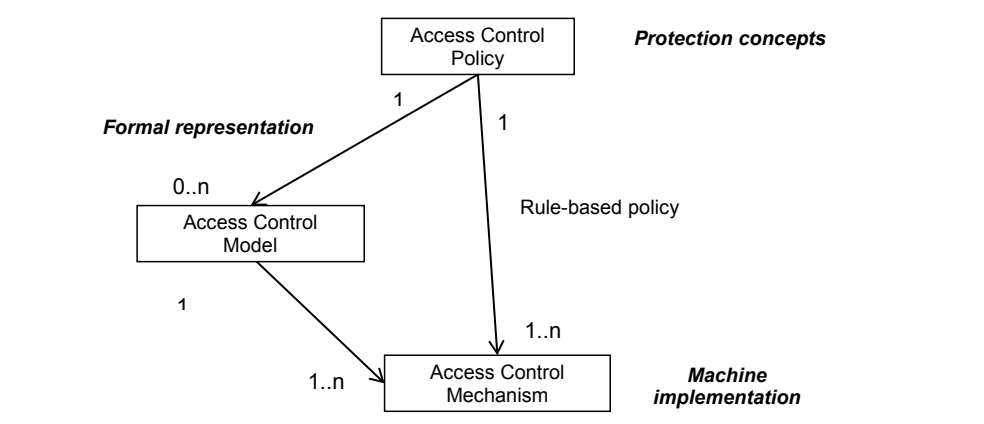
In many documents and presentations, the concepts of AC policy, model, and mechanism are often overloaded or interchangeably used, which causes confusion in interpreting their roles in AC systems. As they are applied to other computing systems, it is necessary to formally define these implementations in such a way that each implementation represents a different perspective of an AC system. Figure 1 shows the relations and mappings of AC policy, model, and mechanism; an AC system should be initiated by an AC policy, and then formalized with a formal model if there is one that can be applied. AC policy is then physically implemented by hardware or software mechanisms based on the policy directly or the model indirectly. The mapping relations from a policy to either models or mechanisms are one-to-many, as well as from a model to mechanisms, because there are multiple ways to implement or interpret the mapped ones from the application’s point of view.
多くの文書や発表資料では、AC のポリシー、モデル、機構の概念が多重に使われたり、同じ意味で使われたりすることが多く、AC システムにおけるそれらの役割の解釈に混乱を生じさせています。これらを他のコンピューティングシステムに適用する際には、それぞれの実装が AC システムの異なる視点を表すように、これらの実装を形式的に定義する必要があります。図 1 は、AC のポリシー、モデル、機構の関係と対応づけを示します。AC システムは AC ポリシーによって開始し、適用可能な形式モデルがある場合は、その形式モデルで形式化すべきです。その後、AC ポリシーは、ポリシーに直接、またはモデルを介して間接的に基づき、ハードウェアまたはソフトウェアの機構によって物理的に実装されます。ポリシーからモデルまたは機構への対応づけ、およびモデルから機構への対応づけは、アプリケーションの観点から、対応づけられたものを実装または解釈する方法が複数あるため、一対多になります。
3つの箱の図です。上の「Access Control Policy」(アクセス制御ポリシー、「Protection concepts」(保護の概念)と注記)から、左の「Access Control Model」(アクセス制御モデル、「Formal representation」(形式的な表現)と注記)へ矢印が出ており、ポリシー側に「1」、モデル側に「0..n」とあります。ポリシーからは下の「Access Control Mechanism」(アクセス制御メカニズム、「Machine implementation」(機械による実装)と注記)へも「Rule-based policy」(規則に基づくポリシー)と書かれた矢印が出ており、ポリシー側に「1」、メカニズム側に「1..n」とあります。モデルからメカニズムへも矢印が出ており、モデル側に「1」、メカニズム側に「1..n」とあります。
Figure 1 – Mapping of AC policy, model, and mechanism of AC systems
図 1 – AC システムの AC ポリシー、モデル、機構の対応づけ
3.2 XACML Architecture
3.2 XACML アーキテクチャ
The Organization for the Advancement of Structured Information Standards (OASIS) standard XACML [XACML] is an important authorization-related standard. XACML is an XML-based [XML] general-purpose language used to describe policies, requests, and responses for AC policies. XACML provides a flexible and system-independent representation of access rules that vary in granularities, allowing the combination of policies for different authoritative domains into one policy set for making AC decisions in a widely distributed system environment. The five basic elements of XACML policies are PolicySet, Policy, Rule, Target, and Condition [XACML]. A policy set is simply a container that holds other policies or policy sets. A policy is expressed through a set of rules.
構造化情報標準促進協会(OASIS)の標準である XACML [XACML] は、認可に関する重要な標準です。XACML は、XML [XML] に基づく汎用言語であり、AC ポリシーのポリシー、要求、応答を記述するために使用されます。XACML は、粒度の異なるアクセスルールを柔軟かつシステムに依存しない形で表現でき、広く分散したシステム環境での AC の判断のために、異なる権威ドメインのポリシーを 1 つのポリシーセットに結合できます。XACML ポリシーの 5 つの基本要素は、PolicySet、Policy、Rule、Target、Condition です [XACML]。ポリシーセットは、他のポリシーやポリシーセットを保持する単なるコンテナです。ポリシーは、一連のルールによって表現されます。
With multiple policy sets, policies, and rules, XACML must have a way to reconcile conflicting rules. A collection of combining algorithms serves this function. Each algorithm defines a different way to combine multiple decisions into a single decision. Both policy combining algorithms and rule combining algorithms are provided. Seven standard combining algorithms are provided but user-defined combining algorithms are also allowed [SUN].
複数のポリシーセット、ポリシー、ルールがある場合、XACML は、競合するルールを調整する方法を持たなければなりません。この機能は、結合アルゴリズムの集合が担います。各アルゴリズムは、複数の判断を 1 つの判断に結合する異なる方法を定義します。ポリシー結合アルゴリズムとルール結合アルゴリズムの両方が提供されています。7 つの標準的な結合アルゴリズムが提供されていますが、ユーザ定義の結合アルゴリズムも許容されます [SUN]。
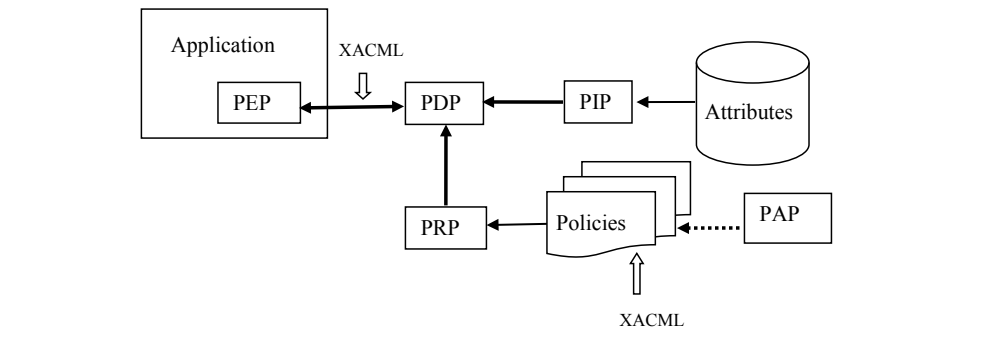
Despite the language scheme, XACML proposes five basic processing entities in its system schema; each entity handles a different stage in processing a user’s access request. As shown in Figure 2, the basic entities are as follows:
XACML は、言語スキームとは別に、そのシステムスキーマにおいて 5 つの基本的な処理エンティティを提案しており、各エンティティはユーザのアクセス要求を処理する異なる段階を扱います。図 2 に示すように、基本的なエンティティは次のとおりです。
•Policy Decision Point (PDP): Makes the access decisions by evaluating the applicable policy. PDP implements the decision procedures according to the XACML specification.
•ポリシー決定点(Policy Decision Point、PDP): 該当するポリシーを評価してアクセスの判断を行います。PDP は、XACML 仕様に従って判断の手順を実装します。
•Policy Administration Point (PAP): Provides a user interface for creating, testing, and debugging XACML policies, and storing these policies in the appropriate repository.
•ポリシー管理点(Policy Administration Point、PAP): XACML ポリシーの作成、テスト、デバッグと、これらのポリシーを適切なリポジトリに保存するためのユーザインタフェースを提供します。
•Policy Enforcement Point (PEP): Performs AC by making decision requests made by the PDP and enforcing authorization decisions.
•ポリシー施行点(Policy Enforcement Point、PEP): PDP に対して判断要求を行い、認可の判断を施行することで、AC を実行します。
•Policy Information Point (PIP): Serves as the source of attribute values, or the data required for policy evaluation to provide the information needed by the PDP to make the decisions.
•ポリシー情報点(Policy Information Point、PIP): 属性値、すなわち PDP が判断を行うために必要な情報を提供するためにポリシー評価に必要なデータの供給源として機能します。
•Policy Retrieval Point (PRP): Where the policies are stored and fetched by the PDP.
•ポリシー取得点(Policy Retrieval Point、PRP): ポリシーが保存され、PDP によって取得される場所です。
XACML のアーキテクチャーの図です。大きな箱「Application」(アプリケーション)の中に箱「PEP」があり、「PDP」と双方向の矢印で結ばれています。この接続部には「XACML」と書かれた白抜きの矢印が上から向いています。「PIP」から「PDP」へ矢印があり、円柱「Attributes」(属性)から「PIP」へ矢印があります。「PRP」から上の「PDP」へ矢印があります。重なった文書「Policies」(ポリシー)から「PRP」へ矢印があり、「PAP」から「Policies」へ点線の矢印があります。また「XACML」と書かれた白抜きの矢印が下から「Policies」に向いています。
Figure 2 – XACML Architecture
図 2 – XACML アーキテクチャ
The flexibility and expressiveness of XACML make it complex to work directly with some AC mechanisms. For example, specifying attribute relations in XACML calls for completely specified relations for each and every directly or indirectly related attribute, thus producing a highly verbose document even if the actual policy rules are trivial. (In general, AC policies expressed in an abstract language are difficult for AC policy administrators to create and maintain [UXACML].)
XACML の柔軟性と表現力のために、一部の AC 機構を XACML で直接扱うことは複雑になります。たとえば、XACML で属性の関係を指定するには、直接または間接に関連するすべての属性について完全に指定された関係が必要となり、実際のポリシールールが単純であっても、非常に冗長な文書になります。(一般に、抽象的な言語で表現された AC ポリシーは、AC ポリシー管理者が作成・維持することが困難です [UXACML]。)
3.3 AC Policy Ontology
3.3 AC ポリシーオントロジー
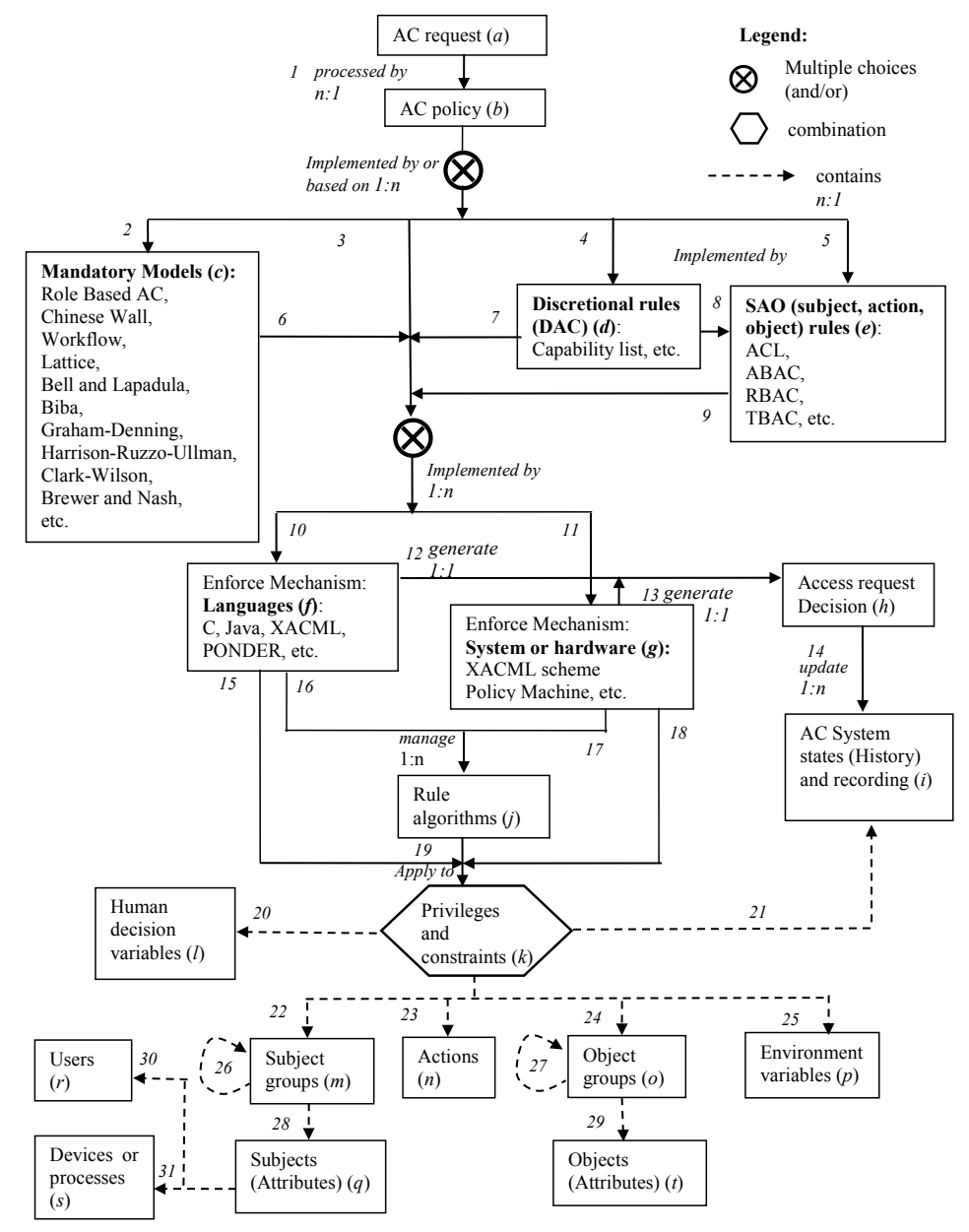
In most of the current presentations or documents, AC terms (as in Section 2 and 3.1) for describing AC primitives and implementations are used ambiguously; some documents even treat them as interchangeable concepts. For example, instead of discretionary access control (DAC) “rules”, DAC “model” or “policy” is used. In some cases, authors tend to use the word “based” to describe either policy, model, or rule sets without clearly specifying which term they meant, such as Role-Based AC or Policy-Based AC. The policy ontology shown in Figure 3 is an attempt to mediate the terms, primitives, and their relations; thereafter, unambiguous definitions will be used in the rest of this document.
現在の発表資料や文書の大半では、AC プリミティブと実装を記述するための AC 用語(第 2 節および第 3.1 節にあるもの)が曖昧に使われており、一部の文書はそれらを同じ意味の概念として扱ってさえいます。たとえば、任意アクセス制御(DAC)の「ルール」の代わりに、DAC の「モデル」や「ポリシー」が使われます。場合によっては、著者がロールベース AC やポリシーベース AC のように、どの用語を意図しているかを明確にせず、「ベース」という語でポリシー、モデル、ルールセットのいずれかを記述する傾向があります。図 3 に示すポリシーオントロジーは、用語、プリミティブ、およびそれらの関係を調整しようとする試みです。以降、本文書の残りの部分では、曖昧さのない定義を使用します。
アクセス制御ポリシーのオントロジーを、番号付きのつながりで示した図です。凡例では、丸の中の×印は「Multiple choices (and/or)」(複数の選択肢(かつ・または))、六角形は「combination」(組み合わせ)、破線の矢印は「contains n:1」(含む、n:1)を表します。「AC request (a)」(アクセス制御の要求)はつながり 1「processed by n:1」(により処理される、n:1)で「AC policy (b)」(アクセス制御ポリシー)に結ばれます。(b) から「Implemented by or based on 1:n」(により実装される、または基づく、1:n)と書かれた丸の中の×印を経て、つながり 2〜5 が「Mandatory Models (c): Role Based AC, Chinese Wall, Workflow, Lattice, Bell and Lapadula, Biba, Graham-Denning, Harrison-Ruzzo-Ullman, Clark-Wilson, Brewer and Nash, etc.」(強制モデル)(2)、中央の線(3)、「Discretional rules (DAC) (d): Capability list, etc.」(任意アクセス制御(DAC)規則)(4)、「Implemented by」と書かれた「SAO (subject, action, object) rules (e): ACL, ABAC, RBAC, TBAC, etc.」(主体・操作・客体の規則)(5)へ向かいます。つながり 8 は (d) から (e) へ向かいます。(c)、(d)、(e) からはつながり 6、7、9 が中央の線へ向かい、中央の線は「Implemented by 1:n」と書かれた2つ目の丸の中の×印へ向かいます。そこからつながり 10 が「Enforce Mechanism: Languages (f): C, Java, XACML, PONDER, etc.」(実施の仕組み:言語)へ、つながり 11 が「Enforce Mechanism: System or hardware (g): XACML scheme Policy Machine, etc.」(実施の仕組み:システムまたはハードウェア)へ向かいます。(f) からのつながり 12「generate 1:1」(生成する)と (g) からのつながり 13「generate 1:1」は「Access request Decision (h)」(アクセス要求の判定)へ向かい、(h) からつながり 14「update 1:n」(更新する)が「AC System states (History) and recording (i)」(アクセス制御システムの状態(履歴)と記録)へ向かいます。(f) と (g) からのつながり 16、17 は「manage 1:n」(管理する)と書かれて「Rule algorithms (j)」(規則のアルゴリズム)へ向かいます。(f)、(g)、(j) からのつながり 15、18、19 は「Apply to」(適用される)と書かれて六角形の「Privileges and constraints (k)」(特権と制約)へ向かいます。(k) からは破線のつながりが「Human decision variables (l)」(人による判断の変数)(20)、(i)(21)、「Subject groups (m)」(主体のグループ)(22)、「Actions (n)」(操作)(23)、「Object groups (o)」(客体のグループ)(24)、「Environment variables (p)」(環境変数)(25)へ向かいます。(m) と (o) にはそれぞれ自分自身へ戻る破線のループ(26、27)があります。(m) から「Subjects (Attributes) (q)」(主体(属性))へ(28)、(o) から「Objects (Attributes) (t)」(客体(属性))へ(29)破線のつながりがあり、(q) から「Users (r)」(利用者)(30)と「Devices or processes (s)」(機器またはプロセス)(31)へ破線のつながりがあります。
Figure 3 – AC policy ontology
図 3 – AC ポリシーオントロジー
Figure 3 demonstrates the sequence of events within an AC policy ontology.
図 3 は、AC ポリシーオントロジー内の事象の流れを示します。
First, an AC request (a) is processed (1) by an AC policy (b), which can be implemented by (or based on) (2, 4, 5) mandatory models (c), discretional rules (d), or SAO (subject, action, object) rules (e). These will be either implemented (6, 7, 8, 9, 10, 11) by language, or system (f) and/or hardware mechanism (g). AC policy can also be directly implemented (3) by languages or system/hardware mechanism without explicit rules or embedded models. Access request decisions (h) are the outputs (12, 13) from both mechanisms. Note that DAC rules can be implemented by (8) SAO (subject, action, object) rules (e). At the same time, an access decision updates (14) the AC system states/log (or history for historical or dynamic types of AC models/rules) (i).
まず、AC 要求(a)は AC ポリシー(b)によって処理されます(1)。このポリシーは、義務的モデル(c)、任意アクセス制御規則(d)、または SAO(サブジェクト、アクション、オブジェクト)規則(e)によって実装される、またはそれらに基づくことができます(2, 4, 5)。これらは、言語、またはシステム(f)および/またはハードウェア機構(g)によって実装されます(6, 7, 8, 9, 10, 11)。AC ポリシーは、明示的な規則や組み込みモデルを用いずに、言語またはシステム/ハードウェア機構によって直接実装することもできます(3)。アクセス要求の判断(h)は、両方の機構からの出力です(12, 13)。DAC 規則は SAO(サブジェクト、アクション、オブジェクト)規則(e)によって実装できる(8)ことに注意してください。同時に、アクセスの判断は、AC システムの状態/ログ(履歴型または動的型の AC モデル/規則の場合は履歴)(i)を更新します(14)。
Language and system/hardware AC mechanisms manage (15, 18) privileges and constraints (k) directly or through rule algorithms (j) indirectly (16, 17, 18). Privileges and constraints primitives are the combination of (20, 21, 22, 23, 24, 25) AC system states (history), human decision variables (l), subject groups (m), actions (n), object groups (o), and environment variables (p). Subject groups contain (26, 28) other subject groups or subjects (q), which contain (30, 31) users (r), devices or processes (s). Object groups contain (27, 29) other object groups or objects (t).
言語およびシステム・ハードウェアの AC 機構は、特権と制約(k)を直接管理する(15、18)か、ルールアルゴリズム(j)を通じて間接的に管理します(16、17、18)。特権と制約のプリミティブは、AC システムの状態(履歴)、人間の判断変数(l)、サブジェクトグループ(m)、アクション(n)、オブジェクトグループ(o)、環境変数(p)の組み合わせです(20、21、22、23、24、25)。サブジェクトグループは、他のサブジェクトグループまたはサブジェクト(q)を含み(26、28)、サブジェクトはユーザ(r)、デバイスまたはプロセス(s)を含みます(30、31)。オブジェクトグループは、他のオブジェクトグループまたはオブジェクト(t)を含みます(27、29)。
The primitives and relations in the policy ontology show how one primitive element can be broken down into multiple next level elements in cascaded orders. However, the ontology does not comprehensively include all the detailed and special primitive elements that are facilitated for special applications that stem from basic AC functions.
ポリシーオントロジーにおけるプリミティブと関係は、1 つのプリミティブ要素が、段階的に複数の次のレベルの要素にどのように分解できるかを示しています。ただし、このオントロジーは、基本的な AC 機能から派生する特殊なアプリケーション向けに用意された、詳細で特殊なプリミティブ要素のすべてを網羅的に含んでいるわけではありません。
3.4 Responsible Principals
3.4 責任プリンシパル
Responsible principals—principals who are responsible for or have impacts on the AC properties of an organization’s information system—are identified below:
責任プリンシパル、すなわち組織の情報システムの AC 特性に責任を持つ、または影響を与えるプリンシパルを、以下に示します。
•Organization CIO (Chief Information Officer) (OC): oversee the establishment of information systems from the cost, service, and security perspectives of the organization’s policy
•組織の CIO(最高情報責任者)(OC): 組織のポリシーのコスト、サービス、セキュリティの観点から、情報システムの確立を監督する
•AC policy authors (PA): define or design security policies for the organization’s information system according to business practices and security requirements
•AC ポリシー作成者(PA): 業務慣行とセキュリティ要件に従って、組織の情報システムのセキュリティポリシーを定義または設計する
•AC system implementers (SI): install, configure and/or implement the AC system in accordance with the PA’s design
•AC システム実装者(SI): PA の設計に従って、AC システムをインストール、構成、または実装する
•AC system administrators, (operators, or maintainers) (SA): facilitate building, networking, deploying, administrating, and maintaining the AC system
•AC システム管理者(運用者または保守者)(SA): AC システムの構築、ネットワーク接続、展開、管理、保守を円滑にする
•Authentication system managers (ASM): responsible for connecting authentication or other service functions for the AC system
•認証システム管理者(ASM): AC システムのための認証またはその他のサービス機能の接続を担当する
•AC system users (SU): access information through the AC system
•AC システムユーザ(SU): AC システムを通じて情報にアクセスする
4. Evaluation Metrics for Access Control Systems
4. アクセス制御システムの評価指標
The ability of an organization to enforce its access policies determines the degree to which its data may be protected and shared among its user community. The focus on sharing and protecting information is becoming increasingly acute for many organizations. Unfortunately, when it comes to AC systems, one size does not fit all. Some AC capabilities are packaged as part of an overall product offering, and others are provided as an add-on feature for managing access configurations within or across architectural abstractions. Although the particular AC mechanism that is included within an application or operating system is rarely scrutinized by an organization in selecting an application, its operational impact can be significant, affecting administrative and user productivity and even the organization’s ability to perform its mission. Even for medium-sized enterprises, the number of subjects can be significant; the number of systems that need to be configured for AC can be in the hundreds, and the number of objects that need to be protected can be in the tens of millions. If a single permission is incorrectly configured, a user will either be ineffective in performing his/her duties or will be given unintended access to information and systems, which could result in undermining the security posture of the organization. Further, the quality of administrative capabilities has an impact on administrative cost, user downtime between administrative events, and the abilities of users to perform their duties, as well as the overall security posture of the enterprise. Currently no well-accepted metrics exist for measuring the quality of an AC system.
組織がアクセスポリシーを施行する能力は、そのデータがどの程度保護され、ユーザコミュニティ内で共有されうるかを左右します。情報の共有と保護への注目は、多くの組織でますます高まっています。残念ながら、AC システムに関しては、万能の解決策はありません。一部の AC 機能は製品全体の一部として提供され、その他は、アーキテクチャ上の抽象化の内部または間でアクセス構成を管理するための追加機能として提供されます。アプリケーションやオペレーティングシステムに含まれる特定の AC 機構は、組織がアプリケーションを選ぶ際にほとんど吟味されることはありませんが、その運用上の影響は大きくなる場合があり、管理者とユーザの生産性、さらには組織が任務を遂行する能力にも影響します。中規模のエンタープライズであっても、サブジェクトの数は多くなる場合があり、AC のために構成が必要なシステムの数は数百に達し、保護が必要なオブジェクトの数は数千万に達する場合があります。1 つの許可が誤って構成されると、ユーザは職務の遂行に支障をきたすか、意図しない情報やシステムへのアクセスを付与され、組織のセキュリティ態勢を損なうことになりかねません。さらに、管理能力の品質は、管理コスト、管理作業の間のユーザの停止時間、ユーザが職務を遂行する能力、およびエンタープライズ全体のセキュリティ態勢に影響を与えます。現在のところ、AC システムの品質を測定するための広く受け入れられた指標は存在しません。
This section presents properties for quality metrics of AC systems based on the configurable features and limitations of the implemented mechanism using concepts and primitives described in the previous sections. The metrics, which build on those originally defined in [NISTIR7316], can be used when considering and comparing the properties for current configuration or future expansion of an AC system. The properties to be evaluated are divided into four categories according to an organization’s operational needs:
この節は、前節までに説明した概念とプリミティブを用いて、実装された機構の構成可能な機能と制限に基づく AC システムの品質指標の特性を示します。この指標は、[NISTIR7316] で最初に定義されたものを基にしており、AC システムの現在の構成や将来の拡張に関する特性を検討・比較する際に使用できます。評価対象の特性は、組織の運用上のニーズに応じて、次の 4 つのカテゴリに分けられます。
•Administration: properties that in general impact the cost, efficiency, and performance of an AC system’s administration. See Section 4.1.
•管理(Administration): 一般に、AC システムの管理のコスト、効率、性能に影響する特性。第 4.1 節を参照してください。
•Enforcement: properties of the mechanisms or algorithms that the AC system uses to enforce the embedded AC models and rules. These properties affect the efficiency of rendering AC decisions. See Section 4.2.
•施行(Enforcement): AC システムが、組み込まれた AC モデルとルールを施行するために使用する機構またはアルゴリズムの特性。これらの特性は、AC の判断を下す効率に影響します。第 4.2 節を参照してください。
•Performance: properties that impact performance in addition to the enforcement of the AC system’s processes. See Section 4.3.
•性能(Performance): AC システムの処理の施行に加えて、性能に影響する特性。第 4.3 節を参照してください。
•Support: properties that are not essential but that can increase the usability and portability of an AC system. See Section 4.4.
•サポート(Support): 必須ではありませんが、AC システムの使いやすさと可搬性を高められる特性。第 4.4 節を参照してください。
The information provided for each function in these four categories follows the same format. For each function, the subsection first lists the responsible principals (see Section 3.4), who are the people who should be responsible or who have the best knowledge of the specific property; the required policy ontology elements (see Section 3.3), which list the concept components that support the property; and the related XACML architecture entities (see Section 3.2). The rest of each subsection lists metric items to evaluate, along with supporting descriptions.
これら 4 つのカテゴリの各機能について示す情報は、同じ形式に従っています。各機能について、小節はまず、特定の特性に責任を持つべき、または最も詳しい知識を持つ人である責任プリンシパル(第 3.4 節を参照)、その特性を支える概念の構成要素を挙げた、必要なポリシーオントロジーの要素(第 3.3 節を参照)、および関連する XACML アーキテクチャのエンティティ(第 3.2 節を参照)を挙げます。各小節の残りは、評価する指標項目と、それを補足する説明を挙げます。
4.1 Administration Properties
4.1 管理特性
This section lists the following functions to be considered for administration properties:
この節は、管理特性として考慮すべき次の機能を挙げます。
•Auditing
•監査
•Privileges/capabilities discovery
•特権・ケイパビリティの探索
•Ease of privilege assignments
•特権付与の容易さ
•Syntactic and semantic support for specifying AC rules
•AC ルールを指定するための構文的・意味的サポート
•Policy management
•ポリシー管理
•Delegation of administrative capabilities
•管理機能の委任
•Flexibilities of configuration into existing systems
•既存システムへの構成の柔軟性
•The horizontal scope (across platforms and applications) of control
•制御の水平方向の範囲(プラットフォームおよびアプリケーションをまたぐ範囲)
•The vertical scope (between application, DBMS, and OS) of control
•制御の垂直方向の範囲(アプリケーション、DBMS、OS の間の範囲)
4.1.1 Auditing
4.1.1 監査
| Responsible principals: OC PA SI SA ASM SU | |
| Required policy ontology elements: a b c d e f g h i j k l m n o p q r s t 1 2 3 4 5 6 7 8 9 10 11 12 13 14 15 16 17 18 19 20 21 22 23 24 25 26 27 28 29 30 31 N/A | |
| Applicable XACML architecture components: Application PEP PDP PRP PIP PAP N/A | |
| Metric Items to Evaluate | Description |
|---|---|
| ☐ Does the AC system log system failure? | Log for source of errors records when the AC system fails to make grant decisions. |
| ☐ Does the AC system log denied access requests? | Log for attempted policy violations records the denied user request with respect to the AC policies involved. |
| ☐ Does the AC system log granted access requests? | Log for access tracking records the granted capabilities of a subject. Because objects can be renamed, copied, and given away, tracking the dissemination and retention of access is difficult or impossible to achieve through privilege expressions alone. |
| ☐ Does the AC system provide additional log functions required by the organization? | Customize the audit information-providing capabilities for managing log data (e.g., set the maximum size of audit logs). |
| 責任プリンシパル: OC PA SI SA ASM SU | |
| 必要なポリシーオントロジーの要素: a b c d e f g h i j k l m n o p q r s t 1 2 3 4 5 6 7 8 9 10 11 12 13 14 15 16 17 18 19 20 21 22 23 24 25 26 27 28 29 30 31 N/A | |
| 該当する XACML アーキテクチャのコンポーネント: アプリケーション PEP PDP PRP PIP PAP N/A | |
| 評価する指標項目 | 説明 |
|---|---|
| ☐ AC システムは、システム障害をログに記録しますか。 | AC システムが許可の判断を行えない場合に、エラーの原因を記録するログ。 |
| ☐ AC システムは、拒否されたアクセス要求をログに記録しますか。 | ポリシー違反の試行のログは、関係する AC ポリシーに照らして、拒否されたユーザの要求を記録します。 |
| ☐ AC システムは、許可されたアクセス要求をログに記録しますか。 | アクセス追跡のログは、サブジェクトに許可されたケイパビリティを記録します。オブジェクトは名前の変更、コピー、譲渡が可能なため、アクセスの拡散と保持の追跡は、特権の表現だけでは困難または不可能です。 |
| ☐ AC システムは、組織が必要とする追加のログ機能を提供しますか。 | ログデータを管理するための監査情報提供機能をカスタマイズします(例: 監査ログの最大サイズを設定します)。 |
4.1.2 Privileges/capabilities discovery
4.1.2 特権・ケイパビリティの探索
| Responsible principals: OC PA SI SA ASM SU | |
| Required policy ontology elements: a b c d e f g h i j k l m n o p q r s t 1 2 3 4 5 6 7 8 9 10 11 12 13 14 15 16 17 18 19 20 21 22 23 24 25 26 27 28 29 30 31 N/A | |
| Applicable XACML architecture components: Application PEP PDP PRP PIP PAP N/A | |
| Metric Items to Evaluate | Description |
|---|---|
| Does the system provide query/display for ☐ capabilities discovery? ☐ privileges discovery? ☐ constrained capabilities discovery? ☐ constrained privileges discovery? | • Discover (by query, for example) the capabilities for a given subject/subject groups from assigned privileges or constraints. • Discover the subjects/subject groups for a given capability from assigned privileges or constraints. • Discover the objects/object groups with capabilities for a given subject/subject groups from assigned privileges or constraints. |
| Does the system provide query/display for human decision variables discovery for ☐ capabilities? ☐ privileges? ☐ constrained capabilities? ☐ constrained privileges? | • Discover the human decision variables for a given subject/subject group from assigned privileges or constraints. • Discover the human decision variables for a given capability from assigned privileges or constraints. • Discover the human decision variables for a given object/object group from assigned privileges or constraints. |
| Does the system provide query/display for AC system states discovery for ☐ capabilities? ☐ privileges? ☐ constrained capabilities? ☐ constrained privileges? | • Discover the system states for a given subject/subject group from assigned privileges or constraints. • Discover the system states for a given capability from assigned privileges or constraints. • Discover the system states for a given object/object group from assigned privileges or constraints. |
| Does the system provide query/display for environment variables discovery for ☐ capabilities? ☐ privileges? ☐ constrained capabilities? ☐ constrained privileges? | • Discover the environment variables for a given subject/subject group from assigned privileges or constraints. • Discover the environment variables for a given capability from assigned privileges or constraints. • Discover the environment variables for a given object/object group from assigned privileges or constraints. |
| ☐ Does the system provide graphic display? | • The above discovery features are available by What You See Is What You Get (WYSIWYG) display capability. |
| 責任プリンシパル: OC PA SI SA ASM SU | |
| 必要なポリシーオントロジーの要素: a b c d e f g h i j k l m n o p q r s t 1 2 3 4 5 6 7 8 9 10 11 12 13 14 15 16 17 18 19 20 21 22 23 24 25 26 27 28 29 30 31 N/A | |
| 該当する XACML アーキテクチャのコンポーネント: アプリケーション PEP PDP PRP PIP PAP N/A | |
| 評価する指標項目 | 説明 |
|---|---|
| システムは、次のものについて照会・表示を提供しますか。 ☐ ケイパビリティの探索 ☐ 特権の探索 ☐ 制約付きケイパビリティの探索 ☐ 制約付き特権の探索 | • 割り当てられた特権または制約から、特定のサブジェクト・サブジェクトグループが持つケイパビリティを(たとえば照会によって)探索します。 • 割り当てられた特権または制約から、特定のケイパビリティを持つサブジェクト・サブジェクトグループを探索します。 • 割り当てられた特権または制約から、特定のサブジェクト・サブジェクトグループがケイパビリティを持つオブジェクト・オブジェクトグループを探索します。 |
| システムは、次のものについて人間の判断変数の探索のための照会・表示を提供しますか。 ☐ ケイパビリティ ☐ 特権 ☐ 制約付きケイパビリティ ☐ 制約付き特権 | • 割り当てられた特権または制約から、特定のサブジェクト・サブジェクトグループの人間の判断変数を探索します。 • 割り当てられた特権または制約から、特定のケイパビリティに関する人間の判断変数を探索します。 • 割り当てられた特権または制約から、特定のオブジェクト・オブジェクトグループの人間の判断変数を探索します。 |
| システムは、次のものについて AC システムの状態の探索のための照会・表示を提供しますか。 ☐ ケイパビリティ ☐ 特権 ☐ 制約付きケイパビリティ ☐ 制約付き特権 | • 割り当てられた特権または制約から、特定のサブジェクト・サブジェクトグループのシステム状態を探索します。 • 割り当てられた特権または制約から、特定のケイパビリティに関するシステム状態を探索します。 • 割り当てられた特権または制約から、特定のオブジェクト・オブジェクトグループのシステム状態を探索します。 |
| システムは、次のものについて環境変数の探索のための照会・表示を提供しますか。 ☐ ケイパビリティ ☐ 特権 ☐ 制約付きケイパビリティ ☐ 制約付き特権 | • 割り当てられた特権または制約から、特定のサブジェクト・サブジェクトグループの環境変数を探索します。 • 割り当てられた特権または制約から、特定のケイパビリティに関する環境変数を探索します。 • 割り当てられた特権または制約から、特定のオブジェクト・オブジェクトグループの環境変数を探索します。 |
| ☐ システムは、グラフィック表示を提供しますか。 | • 上記の探索機能は、見たままが得られる(What You See Is What You Get、WYSIWYG)表示機能によって利用できます。 |
4.1.3 Ease of privilege assignments
4.1.3 特権付与の容易さ
| Responsible principals: OC PA SI SA ASM SU | |
| Required policy ontology elements: a b c d e f g h i j k l m n o p q r s t 1 2 3 4 5 6 7 8 9 10 11 12 13 14 15 16 17 18 19 20 21 22 23 24 25 26 27 28 29 30 31 N/A | |
| Applicable XACML architecture components: Application PEP PDP PRP PIP PAP N/A | |
| Metric Items to Evaluate | Description |
|---|---|
| How many steps are required for ☐ assigning a privilege? ☐ changing a privilege? ☐ removing a privilege? ☐ assigning a capability to a subject/subject group? ☐ changing a capability for a subject/subject group? ☐ removing a capability for a subject/subject group? | The steps required for assigning, changing, and removing subjects, privileges, or capabilities within the system are crucial to the usability of an AC system. The more steps that are required to perform these updates, the more mistakes that can be made due to either human or system errors. Fewer steps requires less turnaround time for man-machine interaction. For example, in RBAC, individual capabilities are assigned to roles (subject groups) and subjects are made members of roles, thereby acquiring the roles’ capabilities. Roles are globally created for various job functions in an organization, and subjects are assigned roles based on their responsibilities and qualifications. Subjects can be granted new capabilities as new applications and systems are incorporated, and capabilities can be easily revoked from roles (and as such revoked from subjects) as needed. If a subject moves to a new function in the organization, the subject can simply be assigned to the new role(s) corresponding to the function and removed from old roles, whereas in the absence of the role abstraction (e.g., identity-based AC), the subject’s old capabilities would need to be identified locally and revoked, and new capabilities would have to be granted. Although RBAC offers administrative benefits in assigning/revoking subjects and capabilities, RBAC would not measure as well as other mechanisms in assigning/revoking AC entries to/from objects. |
| How many steps are required for ☐ assigning subject groups and group relations? ☐ assigning object groups and group relations? | The steps required for assigning subject group relations: A critical capability of an AC system is to allow an AC administrator to specify relations between AC attributes of the subjects. With this capability, an AC system is able to maintain hierarchical orders of the attributes of the subjects related to the privileges. The expression of privilege inheritance relations is essential for many popular AC models such as Bell-La Padula and Biba of MLS and Hierarchical Role Based Access Control (HRBAC) [HRBAC] as well as constraint policies such as SoD. The steps required for assigning, changing, and removing objects’ AC entries into the system: As with the subject group assignments, the objects can be assigned to object groups that might be arranged by secrecy levels of the objects (as in the multilevel security policy). The object groups can also be organized according to the business function; thus, the assigning, changing, and removing operations are in line with the secrecy or business functions of the organization. |
| How many steps are required for ☐ assigning privilege inheritance? | The steps required for creating, changing, and removing AC privileges: AC policies consist of a number of AC privileges made up by AC rules. AC rules are composed through the user interface provided by a mechanism such as AC languages or interactive graphic tools. The interfaces may be efficient in describing particular kinds of rule algorithms while clumsy in describing others when the number of relations required to create AC rules is compared for the policies. For example, some mechanisms allow inheritance of access privileges; if subject x is assigned to subject group A, which inherits access privileges from group B, then x automatically inherits all the privileges of B. The only required relation for this inheritance assignment is the assigned relation of x and A. Other mechanisms without the semantic of A to B inheritance may be required to specify the additional relationship of x and B. |
| 責任プリンシパル: OC PA SI SA ASM SU | |
| 必要なポリシーオントロジーの要素: a b c d e f g h i j k l m n o p q r s t 1 2 3 4 5 6 7 8 9 10 11 12 13 14 15 16 17 18 19 20 21 22 23 24 25 26 27 28 29 30 31 N/A | |
| 該当する XACML アーキテクチャのコンポーネント: アプリケーション PEP PDP PRP PIP PAP N/A | |
| 評価する指標項目 | 説明 |
|---|---|
| 次の操作に必要な手順の数はいくつですか。 ☐ 特権の割り当て ☐ 特権の変更 ☐ 特権の削除 ☐ サブジェクト・サブジェクトグループへのケイパビリティの割り当て ☐ サブジェクト・サブジェクトグループのケイパビリティの変更 ☐ サブジェクト・サブジェクトグループのケイパビリティの削除 | システム内でサブジェクト、特権、ケイパビリティを割り当て、変更、削除するために必要な手順は、AC システムの使いやすさにとって極めて重要です。これらの更新を行うために必要な手順が多いほど、人為的またはシステム上のエラーによって生じうる誤りも多くなります。手順が少ないほど、人間と機械のやり取りにかかる所要時間は短くなります。たとえば RBAC では、個々のケイパビリティがロール(サブジェクトグループ)に割り当てられ、サブジェクトがロールのメンバーとなることで、そのロールのケイパビリティを獲得します。ロールは組織内のさまざまな職務に対してグローバルに作成され、サブジェクトは責任と資格に基づいてロールを割り当てられます。サブジェクトには、新しいアプリケーションやシステムが組み込まれるたびに新しいケイパビリティを付与でき、ケイパビリティは必要に応じてロールから(したがってサブジェクトからも)容易に失効させることができます。サブジェクトが組織内で新しい職務に異動する場合は、その職務に対応する新しいロールにそのサブジェクトを割り当て、古いロールから外すだけでよいのに対し、ロールの抽象化がない場合(たとえば ID ベースの AC)には、そのサブジェクトの古いケイパビリティを個別に特定して失効させ、新しいケイパビリティを付与しなければなりません。RBAC は、サブジェクトとケイパビリティの割り当て・失効に管理上の利点をもたらしますが、オブジェクトに対する AC エントリの割り当て・失効では、RBAC は他の機構ほど良好な評価にはなりません。 |
| 次の操作に必要な手順の数はいくつですか。 ☐ サブジェクトグループとグループ関係の割り当て ☐ オブジェクトグループとグループ関係の割り当て | サブジェクトグループの関係の割り当てに必要な手順: AC システムの重要な機能は、AC 管理者がサブジェクトの AC 属性間の関係を指定できるようにすることです。この機能により、AC システムは、特権に関連するサブジェクトの属性の階層的な順序を維持できます。特権の継承関係の表現は、MLS の Bell-La Padula や Biba、階層型ロールベースアクセス制御(HRBAC)[HRBAC] など、多くの一般的な AC モデルや、SoD などの制約ポリシーにとって不可欠です。 オブジェクトの AC エントリをシステムに割り当て、変更、削除するために必要な手順: サブジェクトグループの割り当てと同様に、オブジェクトは、(多重レベルセキュリティポリシーのように)オブジェクトの機密レベルによって編成されたオブジェクトグループに割り当てることができます。オブジェクトグループは業務機能に従って編成することもでき、その場合、割り当て、変更、削除の操作は、組織の機密性または業務機能に沿ったものになります。 |
| 次の操作に必要な手順の数はいくつですか。 ☐ 特権の継承の割り当て | AC 特権を作成、変更、削除するために必要な手順: AC ポリシーは、AC ルールで構成された多数の AC 特権から成ります。AC ルールは、AC 言語や対話型のグラフィックツールなどの機構が提供するユーザインタフェースを通じて作成されます。AC ルールを作成するために必要な関係の数をポリシー間で比較すると、インタフェースには、特定の種類のルールアルゴリズムの記述に効率的である一方、他の種類の記述には不便なものがあります。たとえば、一部の機構はアクセス特権の継承を許可しており、サブジェクト x がサブジェクトグループ A に割り当てられ、A がグループ B からアクセス特権を継承する場合、x は B のすべての特権を自動的に継承します。この継承の割り当てに必要な関係は、x と A の割り当て関係だけです。A から B への継承の意味を持たない他の機構では、x と B の追加の関係を指定することが必要になる場合があります。 |
4.1.4 Syntactic and semantic support for specifying AC rules
4.1.4 AC ルールを指定するための構文的・意味的サポート
| Responsible principals: OC PA SI SA ASM SU | |
| Required policy ontology elements: a b c d e f g h i j k l m n o p q r s t 1 2 3 4 5 6 7 8 9 10 11 12 13 14 15 16 17 18 19 20 21 22 23 24 25 26 27 28 29 30 31 N/A | |
| Applicable XACML architecture components: Application PEP PDP PRP PIP PAP N/A | |
| Metric Items to Evaluate | Description |
|---|---|
| ☐ Is the AC system capable of logical expression for rule specification? ☐ Is the AC system capable of programming logic for rule specification? | Privileges and constraints can be specified in complex expressions with Boolean logic relations such as AND, OR, <, =, >, and * (wildcards) between AC primitives. Logic operators provide AC policy authors with efficient ways to specify complex semantics for the intended policy rules. Beyond logic operators, AC policies can be specified by the support of a specific programming language, which supports syntactic as well as semantic grammar required for specifying AC policies. However, current AC languages are designed with a specific application or architecture in mind, so they are not universally applicable for all AC models or mechanisms. Appendix A lists a summary of some AC languages. |
| 責任プリンシパル: OC PA SI SA ASM SU | |
| 必要なポリシーオントロジーの要素: a b c d e f g h i j k l m n o p q r s t 1 2 3 4 5 6 7 8 9 10 11 12 13 14 15 16 17 18 19 20 21 22 23 24 25 26 27 28 29 30 31 N/A | |
| 該当する XACML アーキテクチャのコンポーネント: アプリケーション PEP PDP PRP PIP PAP N/A | |
| 評価する指標項目 | 説明 |
|---|---|
| ☐ AC システムは、ルールを指定するための論理式を使用できますか。 ☐ AC システムは、ルールを指定するためのプログラミングロジックを使用できますか。 | 特権と制約は、AND、OR、<、=、>、* (ワイルドカード)などのブール論理の関係を AC プリミティブ間で用いた、複雑な式で指定できます。論理演算子は、AC ポリシー作成者に、意図したポリシールールの複雑な意味を指定するための効率的な方法を提供します。 論理演算子に加えて、AC ポリシーは、AC ポリシーの指定に必要な構文的および意味的な文法をサポートする特定のプログラミング言語のサポートによって指定できます。ただし、現在の AC 言語は特定のアプリケーションやアーキテクチャを想定して設計されているため、すべての AC モデルや機構に普遍的に適用できるわけではありません。付録 A は、一部の AC 言語の概要を挙げています。 |
4.1.5 Policy management
4.1.5 ポリシー管理
| Responsible principals: OC PA SI SA ASM SU | |
| Required policy ontology elements: a b c d e f g h i j k l m n o p q r s t 1 2 3 4 5 6 7 8 9 10 11 12 13 14 15 16 17 18 19 20 21 22 23 24 25 26 27 28 29 30 31 N/A | |
| Applicable XACML architecture components: Application PEP PDP PRP PIP PAP N/A | |
| Metric Items to Evaluate | Description |
|---|---|
| ☐ Does the AC system provide policy identification for multiple policies? | Query and modify meta-policy information to a policy repository; for example, query a policy identifier for current enforced policies and their relations (e.g., combination effect) with other policies (if the policy is a combination of more than one policy) |
| ☐ Does the AC system allow policy expiration assignment? | Lifecycle management, such as expiration date of a policy |
| ☐ Does the AC system allow policy target assignment? | Policy targets, such as specific divisions of an organization |
| ☐ Does the AC system allow policy target event assignment? | Policy activation, deactivation, and trigger events |
| ☐ Does the AC system provide policy combination logic? | Aggregate or deconflict algorithms for combinations for policies |
| ☐ Does the AC system require policy distribution approval? | Policy distribution approval |
| ☐ Does the AC system provide policy source authorization? | Management of policy authoritative sources |
| ☐ Does the AC system provide policy deployment or activation verification? | Ability to verify policy deployment and activation compliance |
| ☐ Does the AC system provide policy impact analysis? | For even more robust management, some organizations may want to predict the consequence of activation policies, or analyze the impact when an AC policy is modified or when other policies are combined with the current policy. |
| ☐ Does the AC system allow runtime policy rule change? | Some AC systems provide the capability to change access rules during operation. Such a capability allows the extent of policy changes/evolution through equipment/software upgrades, for example, when equipment /software is an object of the AC system. |
| 責任プリンシパル: OC PA SI SA ASM SU | |
| 必要なポリシーオントロジーの要素: a b c d e f g h i j k l m n o p q r s t 1 2 3 4 5 6 7 8 9 10 11 12 13 14 15 16 17 18 19 20 21 22 23 24 25 26 27 28 29 30 31 N/A | |
| 該当する XACML アーキテクチャのコンポーネント: アプリケーション PEP PDP PRP PIP PAP N/A | |
| 評価する指標項目 | 説明 |
|---|---|
| ☐ AC システムは、複数のポリシーに対するポリシー識別を提供しますか。 | ポリシーリポジトリ内のメタポリシー情報を照会・変更します。たとえば、現在施行されているポリシーの識別子や、(そのポリシーが複数のポリシーの組み合わせである場合は)他のポリシーとの関係(例: 組み合わせの効果)を照会・変更します。 |
| ☐ AC システムは、ポリシーの有効期限の割り当てを許可しますか。 | ポリシーの有効期限など、ライフサイクルの管理 |
| ☐ AC システムは、ポリシーの対象の割り当てを許可しますか。 | 組織の特定の部門など、ポリシーの対象 |
| ☐ AC システムは、ポリシーの対象イベントの割り当てを許可しますか。 | ポリシーの有効化、無効化、トリガーとなるイベント |
| ☐ AC システムは、ポリシー結合のロジックを提供しますか。 | ポリシーの結合における集約または競合解消のアルゴリズム |
| ☐ AC システムは、ポリシー配布の承認を必要としますか。 | ポリシー配布の承認 |
| ☐ AC システムは、ポリシーソースの認可を提供しますか。 | ポリシーの権威あるソースの管理 |
| ☐ AC システムは、ポリシーの展開または有効化の検証を提供しますか。 | ポリシーの展開と有効化のコンプライアンスを検証する能力 |
| ☐ AC システムは、ポリシーの影響分析を提供しますか。 | 管理をさらに強固にするため、組織によっては、ポリシーを有効化した場合の結果を予測したり、AC ポリシーを変更した場合や他のポリシーを現在のポリシーと結合した場合の影響を分析したりすることを望む場合があります。 |
| ☐ AC システムは、実行時のポリシールールの変更を許可しますか。 | AC システムによっては、運用中にアクセスルールを変更する能力を提供します。この能力により、たとえば機器・ソフトウェアが AC システムのオブジェクトである場合に、機器・ソフトウェアのアップグレードを通じてポリシーを変更・進化させられる範囲が広がります。 |
4.1.6 Delegation of administrative capabilities
4.1.6 管理能力の委任
| Responsible principals: OC PA SI SA ASM SU | |
| Required policy ontology elements: a b c d e f g h i j k l m n o p q r s t 1 2 3 4 5 6 7 8 9 10 11 12 13 14 15 16 17 18 19 20 21 22 23 24 25 26 27 28 29 30 31 N/A | |
| Applicable XACML architecture components: Application PEP PDP PRP PIP PAP N/A | |
| Metric Items to Evaluate | Description |
|---|---|
| ☐ Does the AC system allow policy administration delegation? | It may be necessary or convenient for AC system administrators to delegate their privileges to other administrators. Thus, there is a need to consider how easy and secure it is for the AC system to allow policy administration delegation. |
| 責任プリンシパル: OC PA SI SA ASM SU | |
| 必要なポリシーオントロジーの要素: a b c d e f g h i j k l m n o p q r s t 1 2 3 4 5 6 7 8 9 10 11 12 13 14 15 16 17 18 19 20 21 22 23 24 25 26 27 28 29 30 31 N/A | |
| 該当する XACML アーキテクチャのコンポーネント: アプリケーション PEP PDP PRP PIP PAP N/A | |
| 評価する指標項目 | 説明 |
|---|---|
| ☐ AC システムは、ポリシー管理の委任を許可しますか。 | AC システムの管理者が、自身の特権を他の管理者に委任することが必要または便利な場合があります。そのため、AC システムがポリシー管理の委任を許可することが、どの程度容易で安全かを検討する必要があります。 |
4.1.7 Flexibilities of configuration into existing systems
4.1.7 既存システムへの構成の柔軟性
| Responsible principals: OC PA SI SA ASM SU | |
| Required policy ontology elements: a b c d e f g h i j k l m n o p q r s t 1 2 3 4 5 6 7 8 9 10 11 12 13 14 15 16 17 18 19 20 21 22 23 24 25 26 27 28 29 30 31 N/A | |
| Applicable XACML architecture components: Application PEP PDP PRP PIP PAP N/A | |
| Metric Items to Evaluate | Description |
|---|---|
| ☐ Is the AC mechanism enforced by the operating system? ☐ Is the AC mechanism enforced by a microkernel? | Some AC systems are integrated within the operating system, while others can be an add-on as a microkernel of an operating system. A microkernel is an approach to operating system design emphasizing small modules that implement the basic features of the system kernel and that is flexibly configured. An AC mechanism using a microkernel-based approach impacts the performance of a system; it has cleaner separation of mechanism and policy specified in the security architecture, enabling a richer set of security policies to be supported, but switching from one policy to another is not an easy task. |
| ☐ Is the AC enforced by applications? | An AC mechanism as an application has the advantages of flexibility and ease of installation and uninstallation; however, the AC mechanism suffers from lack of reliability because it can be compromised by attacks. |
| ☐ Is the AC enforced by a client/server communication protocol? | Client/server configuration of an AC system is more flexible and secure when compared with the application type of configuration; however, it requires extra hardware, and thus management costs, which include the system communication overhead between clients and server. |
| 責任プリンシパル: OC PA SI SA ASM SU | |
| 必要なポリシーオントロジーの要素: a b c d e f g h i j k l m n o p q r s t 1 2 3 4 5 6 7 8 9 10 11 12 13 14 15 16 17 18 19 20 21 22 23 24 25 26 27 28 29 30 31 N/A | |
| 該当する XACML アーキテクチャのコンポーネント: アプリケーション PEP PDP PRP PIP PAP N/A | |
| 評価する指標項目 | 説明 |
|---|---|
| ☐ AC 機構は、オペレーティングシステムによって施行されますか。 ☐ AC 機構は、マイクロカーネルによって施行されますか。 | AC システムには、オペレーティングシステムに統合されているものと、オペレーティングシステムのマイクロカーネルとして追加できるものがあります。マイクロカーネルとは、システムカーネルの基本機能を実装する小さなモジュールを重視し、柔軟に構成できるオペレーティングシステム設計の手法です。マイクロカーネルに基づく手法を用いる AC 機構は、システムの性能に影響します。セキュリティアーキテクチャで指定されたポリシーと機構をより明確に分離でき、より豊富なセキュリティポリシーをサポートできますが、あるポリシーから別のポリシーへの切り替えは容易ではありません。 |
| ☐ AC は、アプリケーションによって施行されますか。 | アプリケーションとしての AC 機構には、柔軟性とインストール・アンインストールの容易さという利点がありますが、攻撃によって危殆化される可能性があるため、信頼性に欠けるという問題があります。 |
| ☐ AC は、クライアント/ | AC システムのクライアント/ |
4.1.8 The horizontal scope (across platforms and applications) of control
4.1.8 制御の水平方向の範囲(プラットフォームおよびアプリケーションをまたぐ範囲)
| Responsible principals: OC PA SI SA ASM SU | |
| Required policy ontology elements: a b c d e f g h i j k l m n o p q r s t 1 2 3 4 5 6 7 8 9 10 11 12 13 14 15 16 17 18 19 20 21 22 23 24 25 26 27 28 29 30 31 N/A | |
| Applicable XACML architecture components: Application PEP PDP PRP PIP PAP N/A | |
| Metric Items to Evaluate | Description |
|---|---|
| ☐ Does the AC system support only a single host? ☐ Does the AC system support multiple hosts via network? ☐ Does the AC system support virtual communities? | Depending on the architecture design, the operational coverage of an AC mechanism may be limited to the scope of platforms, applications, or enterprise environments. Example scopes are single host (as most of the current systems are), distributed network, or virtual community such as cloud or grid systems. Consideration for this feature also applies if the covered scope is under the same AC policy or multiple AC policies for each system unit that can be incorporated into single AC management. |
| 責任プリンシパル: OC PA SI SA ASM SU | |
| 必要なポリシーオントロジーの要素: a b c d e f g h i j k l m n o p q r s t 1 2 3 4 5 6 7 8 9 10 11 12 13 14 15 16 17 18 19 20 21 22 23 24 25 26 27 28 29 30 31 N/A | |
| 該当する XACML アーキテクチャのコンポーネント: アプリケーション PEP PDP PRP PIP PAP N/A | |
| 評価する指標項目 | 説明 |
|---|---|
| ☐ AC システムは、単一のホストのみをサポートしますか。 ☐ AC システムは、ネットワーク経由で複数のホストをサポートしますか。 ☐ AC システムは、仮想コミュニティをサポートしますか。 | アーキテクチャ設計によっては、AC 機構の運用上の適用範囲が、プラットフォーム、アプリケーション、またはエンタープライズ環境の範囲に限定される場合があります。範囲の例は、(現在のシステムの大半がそうであるように)単一のホスト、分散ネットワーク、またはクラウドやグリッドシステムなどの仮想コミュニティです。この機能の検討は、対象範囲が同一の AC ポリシーの下にある場合、または単一の AC 管理に組み込める各システム単位に複数の AC ポリシーがある場合にも当てはまります。 |
4.1.9 The vertical scope (between application, DBMS, and OS) of control
4.1.9 制御の垂直方向の範囲(アプリケーション、DBMS、OS の間の範囲)
| Responsible principals: OC PA SI SA ASM SU | |
| Required policy ontology elements: a b c d e f g h i j k l m n o p q r s t 1 2 3 4 5 6 7 8 9 10 11 12 13 14 15 16 17 18 19 20 21 22 23 24 25 26 27 28 29 30 31 N/A | |
| Applicable XACML architecture components: Application PEP PDP PRP PIP PAP N/A | |
| Metric Items to Evaluate | Description |
|---|---|
| ☐ Does the scope of data control cover applications? ☐ Does the scope of data control cover files? ☐ Does the scope of data control cover database records? ☐ Does the scope of data control cover the fields of database records? ☐ Does the scope of data control cover network devices? | The regulation scope of an AC mechanism may be extended from the core OS to the higher system layers; then the extension can be configured through an Application Programming Interface (API) to incorporate the existing ACs of applications, database management systems (DBMS), networks, etc. The vertical scope of the AC system allows different levels of granularity for AC policy and administration. |
| 責任プリンシパル: OC PA SI SA ASM SU | |
| 必要なポリシーオントロジーの要素: a b c d e f g h i j k l m n o p q r s t 1 2 3 4 5 6 7 8 9 10 11 12 13 14 15 16 17 18 19 20 21 22 23 24 25 26 27 28 29 30 31 N/A | |
| 該当する XACML アーキテクチャのコンポーネント: アプリケーション PEP PDP PRP PIP PAP N/A | |
| 評価する指標項目 | 説明 |
|---|---|
| ☐ データ制御の範囲は、アプリケーションに及びますか。 ☐ データ制御の範囲は、ファイルに及びますか。 ☐ データ制御の範囲は、データベースのレコードに及びますか。 ☐ データ制御の範囲は、データベースのレコードのフィールドに及びますか。 ☐ データ制御の範囲は、ネットワークデバイスに及びますか。 | AC 機構の規制範囲は、中核となる OS から上位のシステム層に拡張できる場合があります。その場合、アプリケーションプログラミングインタフェース(API)を通じて拡張を構成し、アプリケーション、データベース管理システム(DBMS)、ネットワークなどの既存の AC を組み込むことができます。AC システムの垂直方向の範囲により、AC ポリシーと管理の粒度に異なるレベルを持たせることができます。 |
4.2 Enforcement Properties
4.2 施行特性
This section lists the following functions to be considered for the enforcement properties:
この節は、施行特性として考慮すべき次の機能を挙げます。
•Policy combination, composition, and constraint
•ポリシーの結合、合成、制約
•Bypass
•バイパス
•Separation of Duty (SoD)
•職務分掌(SoD)
•Safety (confinements and constraints)
•安全性(閉じ込めと制約)
•Conflict resolution or prevention
•競合の解決または防止
•Operational/situational awareness
•運用上・状況上の認識
•Granularity of control
•制御の粒度
•Expression (policy/model) properties
•表現(ポリシー・モデル)の特性
•Adaptable to the implementation and evolution of AC policies
•AC ポリシーの実装と進化への適応性
4.2.1 Policy combination, composition, and constraint
4.2.1 ポリシーの結合、合成、制約
| Responsible principals: OC PA SI SA ASM SU | |
| Required policy ontology elements: a b c d e f g h i j k l m n o p q r s t 1 2 3 4 5 6 7 8 9 10 11 12 13 14 15 16 17 18 19 20 21 22 23 24 25 26 27 28 29 30 31 N/A | |
| Applicable XACML architecture components: Application PEP PDP PRP PIP PAP N/A | |
| Metric Items to Evaluate | Description |
|---|---|
| ☐ Is the AC system capable of combining policy rules of different policies? ☐ Is the AC system capable of combining different policy models? ☐ Is the AC system capable of combining AC models with rules? | AC policies may be implemented as an application, which allows the implementation by the methods of combination, composition, and constraint of different AC model/rules. In addition to the basic operations, an AC system might analyze the semantic or grammatical expression of AC model/rules and generate a new rule or policy that encapsulates the results of the combination, composition, and constraints logics. For example, it may be convenient or necessary to be able to combine rules for Separation of Duty and Workflow policies. |
| 責任プリンシパル: OC PA SI SA ASM SU | |
| 必要なポリシーオントロジーの要素: a b c d e f g h i j k l m n o p q r s t 1 2 3 4 5 6 7 8 9 10 11 12 13 14 15 16 17 18 19 20 21 22 23 24 25 26 27 28 29 30 31 N/A | |
| 該当する XACML アーキテクチャのコンポーネント: アプリケーション PEP PDP PRP PIP PAP N/A | |
| 評価する指標項目 | 説明 |
|---|---|
| ☐ AC システムは、異なるポリシーのポリシールールを結合できますか。 ☐ AC システムは、異なるポリシーモデルを結合できますか。 ☐ AC システムは、AC モデルとルールを結合できますか。 | AC ポリシーは、異なる AC モデル・ルールの結合、合成、制約の方法による実装を可能にするアプリケーションとして実装される場合があります。基本的な操作に加えて、AC システムは、AC モデル・ルールの意味的または文法的な表現を分析し、結合、合成、制約のロジックの結果を包含する新しいルールまたはポリシーを生成する場合があります。たとえば、職務分掌ポリシーとワークフローポリシーのルールを結合できると、便利または必要な場合があります。 |
4.2.2 Bypass
4.2.2 バイパス
| Responsible principals: OC PA SI SA ASM SU | |
| Required policy ontology elements: a b c d e f g h i j k l m n o p q r s t 1 2 3 4 5 6 7 8 9 10 11 12 13 14 15 16 17 18 19 20 21 22 23 24 25 26 27 28 29 30 31 N/A | |
| Applicable XACML architecture components: Application PEP PDP PRP PIP PAP N/A | |
| Metric Items to Evaluate | Description |
|---|---|
| ☐ Is the AC system capable of bypassing policy rules for critical AC decisions? ☐ Is the risk for bypassing policy rules tolerable if the AC system is able to bypass policy rules? | If some or all of the AC decision and enforcement will be done at the application level, is the risk of bypassing the mechanism1 commensurate with the risk tolerance of the enterprise? From the XACML scheme’s view, does the AC system allow the application to make access decisions by ignoring the PEP or PDP? |
| 責任プリンシパル: OC PA SI SA ASM SU | |
| 必要なポリシーオントロジーの要素: a b c d e f g h i j k l m n o p q r s t 1 2 3 4 5 6 7 8 9 10 11 12 13 14 15 16 17 18 19 20 21 22 23 24 25 26 27 28 29 30 31 N/A | |
| 該当する XACML アーキテクチャのコンポーネント: アプリケーション PEP PDP PRP PIP PAP N/A | |
| 評価する指標項目 | 説明 |
|---|---|
| ☐ AC システムは、重要な AC の判断について、ポリシールールをバイパスできますか。 ☐ AC システムがポリシールールをバイパスできる場合、ポリシールールをバイパスするリスクは許容できますか。 | AC の判断と施行の一部またはすべてをアプリケーションレベルで行う場合、機構をバイパスするリスク1は、エンタープライズのリスク許容度に見合っていますか。XACML スキームの観点から、AC システムは、アプリケーションが PEP または PDP を無視してアクセスの判断を行うことを許可していますか。 |
4.2.3 Least privilege principle support
4.2.3 最小権限の原則のサポート
| Responsible principals: OC PA SI SA ASM SU | |
| Required policy ontology elements: a b c d e f g h i j k l m n o p q r s t 1 2 3 4 5 6 7 8 9 10 11 12 13 14 15 16 17 18 19 20 21 22 23 24 25 26 27 28 29 30 31 N/A | |
| Applicable XACML architecture components: Application PEP PDP PRP PIP PAP N/A | |
| Metric Items to Evaluate | Description |
|---|---|
| ☐ Is the AC system capable of enforcing the least privilege principle? ☐ Does the AC system allow specifying least privilege via constraints? ☐ Does the AC system allow specifying least privilege via other specifications? | Every subject and process should have the least set of privileges needed to perform the task at hand. The implementation of this principle has the effect of limiting damage that can result from system error or malicious events. In addition to an AC mechanism’s reference mediation function, there are two other basic functions: a function to create subjects and associate these subjects with their users, and a function to associate a subject with a subset of attributes. Regardless of its implementation, and the type of attributes that are deployed, reference mediation of an AC system constrains the subject’s requests to the capabilities that are associated with a subject’s attributes. Although a number of AC mechanisms associate a subject with each and every attribute, in order for an AC mechanism to support the principle of least privilege, constraints must be placed on the attributes that are associated with a subject to further reduce the permissible capabilities. The organization- specific least privilege policy is described by specifying the AC rules, and the AC systems provide various specifying methods, which achieve different degrees of granularity, flexibility, and scope, and different groupings of the controlled objects for the least privilege policies. |
| 責任プリンシパル: OC PA SI SA ASM SU | |
| 必要なポリシーオントロジーの要素: a b c d e f g h i j k l m n o p q r s t 1 2 3 4 5 6 7 8 9 10 11 12 13 14 15 16 17 18 19 20 21 22 23 24 25 26 27 28 29 30 31 N/A | |
| 該当する XACML アーキテクチャのコンポーネント: アプリケーション PEP PDP PRP PIP PAP N/A | |
| 評価する指標項目 | 説明 |
|---|---|
| ☐ AC システムは、最小権限の原則を施行できますか。 ☐ AC システムは、制約を介して最小権限を指定できますか。 ☐ AC システムは、その他の指定を介して最小権限を指定できますか。 | すべてのサブジェクトとプロセスは、目の前のタスクを実行するために必要な最小限の特権の集合を持つべきです。この原則の実装には、システムエラーや悪意のある事象によって生じうる被害を限定する効果があります。AC 機構の参照仲介機能に加えて、基本的な機能が 2 つあります。サブジェクトを作成して、そのサブジェクトをユーザに関連付ける機能と、サブジェクトを属性の部分集合に関連付ける機能です。実装や展開される属性の種類にかかわらず、AC システムの参照仲介は、サブジェクトの要求を、そのサブジェクトの属性に関連付けられたケイパビリティに制約します。多くの AC 機構は、サブジェクトにすべての属性を関連付けますが、AC 機構が最小権限の原則をサポートするためには、許容されるケイパビリティをさらに減らすように、サブジェクトに関連付けられる属性に制約を課さなければなりません。組織固有の最小権限ポリシーは、AC ルールを指定することで記述され、AC システムはさまざまな指定方法を提供しており、それらは最小権限ポリシーのために、粒度、柔軟性、範囲の程度が異なり、制御対象オブジェクトのグループ化も異なります。 |
4.2.4 Separation of Duty (SoD)
4.2.4 職務分掌(SoD)
| Responsible principals: OC PA SI SA ASM SU | |
| Required policy ontology elements: a b c d e f g h i j k l m n o p q r s t 1 2 3 4 5 6 7 8 9 10 11 12 13 14 15 16 17 18 19 20 21 22 23 24 25 26 27 28 29 30 31 N/A | |
| Applicable XACML architecture components: Application PEP PDP PRP PIP PAP N/A | |
| Metric Items to Evaluate | Description |
|---|---|
| ☐ Is the AC system capable of specifying Static SoD rules? ☐ Is the AC system capable of specifying Dynamic SoD rules? ☐ Is the AC system capable of specifying Historical SoD rules? | One of the most basic AC policies is to prevent information from unintended access such that object accesses are only permitted to the subjects that are duty-related to the objects. Or, in some business environment, accesses of an organization’s objects are controlled to avoid conflict of interests, and therefore restricted to a limited number of subjects. SoD policies have had wide application in business, industry and government and include three basic policy types: Static SoD (SSoD, for example, RBAC), Dynamic SoD (DSoD, for example, Chinese Wall Policy), and Historical SoD (for example, Clark-Wilson) policy. Different AC mechanisms provide different degrees of support for SoD requirements. In general, AC mechanisms allow the attribute assignment of subjects or objects that are more flexible and efficient in supporting SoD than those that do not have the attribute assignment functions. The SoD feature can be measured by counting the number of different types of SoD (such as SSoD, DSoD, and historical SoD) a system can support, as well as the required steps to separate group A and B subjects to the group X and Y objects (see Section 4.1.3). |
| 責任プリンシパル: OC PA SI SA ASM SU | |
| 必要なポリシーオントロジーの要素: a b c d e f g h i j k l m n o p q r s t 1 2 3 4 5 6 7 8 9 10 11 12 13 14 15 16 17 18 19 20 21 22 23 24 25 26 27 28 29 30 31 N/A | |
| 該当する XACML アーキテクチャのコンポーネント: アプリケーション PEP PDP PRP PIP PAP N/A | |
| 評価する指標項目 | 説明 |
|---|---|
| ☐ AC システムは、静的 SoD ルールを指定できますか。 ☐ AC システムは、動的 SoD ルールを指定できますか。 ☐ AC システムは、履歴型 SoD ルールを指定できますか。 | 最も基本的な AC ポリシーの 1 つは、オブジェクトへのアクセスを、そのオブジェクトに職務上関係のあるサブジェクトにのみ許可するように、意図しないアクセスから情報を守ることです。あるいは、業務環境によっては、組織のオブジェクトへのアクセスが、利益相反を避けるために制御され、したがって限られた数のサブジェクトに制限されます。SoD ポリシーは、業務、産業、政府で広く適用されており、静的 SoD(SSoD。たとえば RBAC)、動的 SoD(DSoD。たとえば Chinese Wall ポリシー)、履歴型 SoD(たとえば Clark-Wilson)ポリシーという 3 つの基本的なポリシータイプを含みます。AC 機構によって、SoD 要件に対するサポートの程度は異なります。一般に、サブジェクトまたはオブジェクトの属性の割り当てを許可する AC 機構は、属性の割り当て機能を持たない機構よりも、SoD のサポートにおいて柔軟かつ効率的です。SoD 機能は、システムがサポートできる SoD の種類(SSoD、DSoD、履歴型 SoD など)の数と、グループ A と B のサブジェクトをグループ X と Y のオブジェクトから分離するために必要な手順(第 4.1.3 節を参照)によって測定できます。 |
4.2.5 Safety (confinements and constraints)
4.2.5 安全性(閉じ込めと制約)
| Responsible principals: OC PA SI SA ASM SU | |
| Required policy ontology elements: a b c d e f g h i j k l m n o p q r s t 1 2 3 4 5 6 7 8 9 10 11 12 13 14 15 16 17 18 19 20 21 22 23 24 25 26 27 28 29 30 31 N/A | |
| Applicable XACML architecture components: Application PEP PDP PRP PIP PAP N/A | |
| Metric Items to Evaluate | Description |
|---|---|
| ☐ Does the AC system provide safety check capabilities to prevent leaking of permissions? | Safety is an important feature of an AC system, and is needed to ensure that the AC configuration (e.g., AC model) will not result in the leakage of permissions to an unauthorized principal. Thus, a configuration is said to be safe if no privilege can be escalated to an unauthorized or unintended principal. Safety is fundamental to ensuring that the most basic of AC policies can be enforced. Safety is achieved either through the use of restricted AC models that can be proven in general for that model, or via expressions called constraints that describe the safety requirements of any configuration [JT01]. To enforce safety, the AC implementation should include a mechanism for preventing leakage of privileges through either constraints or confinement.2 The capability of safety enforcement of an AC mechanism can be measured by the number of different types of safety constraints (restrict model or constraint expression such as different types of SoDs) a mechanism can support, as well as how many operational steps are required to build a particular kind of safety constraint. Even though the general safety computation is proven undecidable [HRU76], practical mechanisms exist for achieving the safety requirement, such as safety confinement (constraints) built into the mechanism. |
| 責任プリンシパル: OC PA SI SA ASM SU | |
| 必要なポリシーオントロジーの要素: a b c d e f g h i j k l m n o p q r s t 1 2 3 4 5 6 7 8 9 10 11 12 13 14 15 16 17 18 19 20 21 22 23 24 25 26 27 28 29 30 31 N/A | |
| 該当する XACML アーキテクチャのコンポーネント: アプリケーション PEP PDP PRP PIP PAP N/A | |
| 評価する指標項目 | 説明 |
|---|---|
| ☐ AC システムは、許可の漏えいを防ぐための安全性チェック機能を提供しますか。 | 安全性は AC システムの重要な機能であり、AC の構成(たとえば AC モデル)が、許可されていないプリンシパルへの許可の漏えいを招かないことを保証するために必要です。したがって、どの特権も、許可されていない、または意図しないプリンシパルに昇格させられない場合、その構成は安全であるといいます。安全性は、最も基本的な AC ポリシーを確実に施行できるようにするための基礎です。安全性は、そのモデルについて一般に証明できる制限付きの AC モデルを使用するか、あらゆる構成の安全性要件を記述する、制約と呼ばれる式を用いることで達成されます [JT01]。 安全性を施行するため、AC の実装には、制約または閉じ込め2のいずれかによって特権の漏えいを防ぐ機構を含めるべきです。AC 機構の安全性施行能力は、機構がサポートできる安全性制約の種類(制限付きモデル、または各種の SoD などの制約式)の数と、特定の種類の安全性制約を構築するために必要な操作手順の数によって測定できます。一般的な安全性の計算は決定不能であることが証明されていますが [HRU76]、機構に組み込まれた安全性の閉じ込め(制約)など、安全性要件を達成するための実用的な機構は存在します。 |
4.2.6 Conflict resolution or prevention
4.2.6 競合の解決または防止
| Responsible principals: OC PA SI SA ASM SU | |
| Required policy ontology elements: a b c d e f g h i j k l m n o p q r s t 1 2 3 4 5 6 7 8 9 10 11 12 13 14 15 16 17 18 19 20 21 22 23 24 25 26 27 28 29 30 31 N/A | |
| Applicable XACML architecture components: Application PEP PDP PRP PIP PAP N/A | |
| Metric Items to Evaluate | Description |
|---|---|
| ☐ Is the AC system capable of preventing policy rule conflicts? ☐ Is the AC system capable of resolving conflict policy rules? ☐ Is the AC system capable of preventing policy conflicts (if multiple policies enforcement is available)? ☐ Is the AC system capable of resolving policy conflicts (if multiple policies enforcement is available)? | Policy rule conflicts appear when the specifications of two or more access rules result in the conflict decision of granting a subject’s access request by either direct or indirect access assignments. Policy rule conflicts can also be a result of the deadlock of access rules specification. Deadlock can be defined as: a rule r has a dependency on other rule(s), which eventually depend back on r itself such that the subject’s request will never reach a decision because of the cyclic referencing. In addition to policy rules, when multiple policies are evoked for granting permission, conflicts of policy may occur between policy X and policy Y. To support conflict resolution, an AC system may provide automatic conflict identification with suggested corrections. |
| 責任プリンシパル: OC PA SI SA ASM SU | |
| 必要なポリシーオントロジーの要素: a b c d e f g h i j k l m n o p q r s t 1 2 3 4 5 6 7 8 9 10 11 12 13 14 15 16 17 18 19 20 21 22 23 24 25 26 27 28 29 30 31 N/A | |
| 該当する XACML アーキテクチャのコンポーネント: アプリケーション PEP PDP PRP PIP PAP N/A | |
| 評価する指標項目 | 説明 |
|---|---|
| ☐ AC システムは、ポリシールールの競合を防止できますか。 ☐ AC システムは、競合するポリシールールを解決できますか。 ☐ AC システムは、(複数ポリシーの施行が可能な場合)ポリシーの競合を防止できますか。 ☐ AC システムは、(複数ポリシーの施行が可能な場合)ポリシーの競合を解決できますか。 | ポリシールールの競合は、2 つ以上のアクセスルールの指定が、直接または間接のアクセスの割り当てによって、サブジェクトのアクセス要求を許可するという矛盾した判断をもたらす場合に生じます。ポリシールールの競合は、アクセスルールの指定のデッドロックの結果として生じることもあります。デッドロックは、次のように定義できます。ルール r が他のルールに依存し、それらが最終的に r 自体に依存し返すことで、循環参照のためにサブジェクトの要求が判断に到達しない状態です。ポリシールールに加えて、許可を与えるために複数のポリシーが呼び出される場合、ポリシー X とポリシー Y の間でポリシーの競合が生じる場合があります。競合の解決をサポートするため、AC システムは、修正案を伴う自動的な競合の特定を提供する場合があります。 |
4.2.7 Operational/situational awareness
4.2.7 運用上・状況上の認識
| Responsible principals: OC PA SI SA ASM SU | |
| Required policy ontology elements: a b c d e f g h i j k l m n o p q r s t 1 2 3 4 5 6 7 8 9 10 11 12 13 14 15 16 17 18 19 20 21 22 23 24 25 26 27 28 29 30 31 N/A | |
| Applicable XACML architecture components: Application PEP PDP PRP PIP PAP N/A | |
| Metric Items to Evaluate | Description |
|---|---|
| ☐ Is the AC system capable of specifying and enforcing operational/situational awareness control? | Some AC systems allow the PDP to take into account operational/situational factors in making AC decisions. This sort of capability needs to be supported not only by the PDP but by the privilege management application as well. For example, an operational/situational awareness decision is based on a policy such as reaching a threshold value of some environment variable. |
| 責任プリンシパル: OC PA SI SA ASM SU | |
| 必要なポリシーオントロジーの要素: a b c d e f g h i j k l m n o p q r s t 1 2 3 4 5 6 7 8 9 10 11 12 13 14 15 16 17 18 19 20 21 22 23 24 25 26 27 28 29 30 31 N/A | |
| 該当する XACML アーキテクチャのコンポーネント: アプリケーション PEP PDP PRP PIP PAP N/A | |
| 評価する指標項目 | 説明 |
|---|---|
| ☐ AC システムは、運用上・状況上の認識に基づく制御を指定し、施行できますか。 | AC システムによっては、PDP が AC の判断を行う際に、運用上・状況上の要因を考慮することを許可しています。この種の機能は、PDP だけでなく、特権管理アプリケーションでもサポートされる必要があります。たとえば、運用上・状況上の認識に基づく判断は、ある環境変数がしきい値に達したときなどのポリシーに基づきます。 |
4.2.8 Granularity of control
4.2.8 制御の粒度
| Responsible principals: OC PA SI SA ASM SU | |
| Required policy ontology elements: a b c d e f g h i j k l m n o p q r s t 1 2 3 4 5 6 7 8 9 10 11 12 13 14 15 16 17 18 19 20 21 22 23 24 25 26 27 28 29 30 31 N/A | |
| Applicable XACML architecture components: Application PEP PDP PRP PIP PAP N/A | |
| Metric Items to Evaluate | Description |
|---|---|
| ☐ Does the AC system allow configuring the granularity of controlled objects (based on the organization’s requirements and system architecture)? | This involves the granularity of objects (e.g., data field) an AC system can control. For example, this feature enables the privacy control for the same information with different classification of the data fields in the record. In addition to data record fields, some AC systems are required to control or manage endpoint system components such as servers, workstations, routers, switches, guards, mobile devices, firewalls, email, antivirus, databases, web applications, STU-III (Secure Telephone Unit), STE (Secure Telephone Equipment), or cross domain AC systems. |
| 責任プリンシパル: OC PA SI SA ASM SU | |
| 必要なポリシーオントロジーの要素: a b c d e f g h i j k l m n o p q r s t 1 2 3 4 5 6 7 8 9 10 11 12 13 14 15 16 17 18 19 20 21 22 23 24 25 26 27 28 29 30 31 N/A | |
| 該当する XACML アーキテクチャのコンポーネント: アプリケーション PEP PDP PRP PIP PAP N/A | |
| 評価する指標項目 | 説明 |
|---|---|
| ☐ AC システムは、(組織の要件とシステムアーキテクチャに基づいて)制御対象オブジェクトの粒度を構成できますか。 | これは、AC システムが制御できるオブジェクト(たとえばデータフィールド)の粒度に関わります。たとえば、この機能により、レコード内のデータフィールドの分類が異なる同一の情報に対して、プライバシーの制御が可能になります。データレコードのフィールドに加えて、AC システムによっては、サーバ、ワークステーション、ルータ、スイッチ、ガード、モバイルデバイス、ファイアウォール、電子メール、ウイルス対策、データベース、Web アプリケーション、STU-III(Secure Telephone Unit)、STE(Secure Telephone Equipment)、クロスドメイン AC システムなどのエンドポイントのシステム構成要素を制御または管理することが求められます。 |
4.2.9 Expression (policy/model) properties
4.2.9 表現(ポリシー・モデル)の特性
| Responsible principals: OC PA SI SA ASM SU | |
| Required policy ontology elements: a b c d e f g h i j k l m n o p q r s t 1 2 3 4 5 6 7 8 9 10 11 12 13 14 15 16 17 18 19 20 21 22 23 24 25 26 27 28 29 30 31 N/A | |
| Applicable XACML architecture components: Application PEP PDP PRP PIP PAP N/A | |
| Metric Items to Evaluate | Description |
|---|---|
| ☐ Does the AC system support existing AC standards such as those listed in Appendix A? | Existing AC standards such as XACML can provide useful guidance in terms of usage and implementation. |
| ☐ Does the AC system support AC rule specification languages (such as those listed in Appendix A)? | Supporting AC languages provides specification syntaxes and schemes to express AC rules. |
| ☐ Does the AC system support rule composing using templates of standard AC formal models/mechanisms? | The chosen AC model/mechanism should support the enterprise’s AC policy or policies that must be followed, such as MAC, DAC, RBAC, Workflow, Chinese Wall, etc. including the interface to express the model/mechanism. |
| ☐ Does the AC system support policy or rule combinations? | Support of policy composition, constraint, and combination; for example, in RBAC and Organizational Units, the Teller role can only access certain resources in his/her Branch, but may be able to access other resources in a different operational unit. |
| 責任プリンシパル: OC PA SI SA ASM SU | |
| 必要なポリシーオントロジーの要素: a b c d e f g h i j k l m n o p q r s t 1 2 3 4 5 6 7 8 9 10 11 12 13 14 15 16 17 18 19 20 21 22 23 24 25 26 27 28 29 30 31 N/A | |
| 該当する XACML アーキテクチャのコンポーネント: アプリケーション PEP PDP PRP PIP PAP N/A | |
| 評価する指標項目 | 説明 |
|---|---|
| ☐ AC システムは、付録 A に挙げたものなど、既存の AC 標準をサポートしますか。 | XACML などの既存の AC 標準は、使用法と実装の面で有用なガイダンスを提供できます。 |
| ☐ AC システムは、(付録 A に挙げたものなど)AC ルール指定言語をサポートしますか。 | AC 言語をサポートすることで、AC ルールを表現するための指定の構文とスキームが提供されます。 |
| ☐ AC システムは、標準的な AC 形式モデル・機構のテンプレートを用いたルールの作成をサポートしますか。 | 選択した AC モデル・機構は、MAC、DAC、RBAC、ワークフロー、Chinese Wall など、遵守しなければならないエンタープライズの AC ポリシーを、そのモデル・機構を表現するためのインタフェースを含めてサポートすべきです。 |
| ☐ AC システムは、ポリシーまたはルールの結合をサポートしますか。 | ポリシーの合成、制約、結合のサポート。たとえば、RBAC と組織単位において、窓口係のロールは、自身の支店内の特定のリソースにしかアクセスできませんが、別の運用単位にある他のリソースにはアクセスできる場合があります。 |
4.2.10 Adaptable to the implementation and evolution of AC policies
4.2.10 AC ポリシーの実装と進化への適応性
| Responsible principals: OC PA SI SA ASM SU | |
| Required policy ontology elements: a b c d e f g h i j k l m n o p q r s t 1 2 3 4 5 6 7 8 9 10 11 12 13 14 15 16 17 18 19 20 21 22 23 24 25 26 27 28 29 30 31 N/A | |
| Applicable XACML architecture components: Application PEP PDP PRP PIP PAP N/A | |
| Metric Items to Evaluate | Description |
|---|---|
| ☐ Is the AC system capable of handling the evolution of the organization’s future AC policy changes? ☐ Is the AC system capable of dynamically interposing AC rules based on the system states? | AC policies can be as diverse as the applications that rely upon them, and are heavily dependent on the needs of a particular environment. For instance, the mandatory labeling policy for the military, the commercial integrity policy for banking, and the confidentiality policy for healthcare institutions have each modeled their unique policies to meet their own internal control needs and external regulatory requirements. Although these tailored policy models are successful in the specific situations for which they were developed, notations that easily express one collection of AC policies may be awkward (or incapable) in another venue. An example of this situation would be when a company’s documents are under MAC policy control at the development stage. When the development is finished, the documents that are available for use by employees could then be required to be controlled by a role-based policy. Most existing commercial technologies used to provide security to systems are restricted to a single policy model, rather than permitting a variety of models to be used. For instance, Linux applies a DAC policy, and it is difficult to implement RBAC policy (among others) in such a system. An AC mechanism that supports the implementing and evolving (combining a policy with new ones, or extending the current policy model) policies can be evaluated by the degree or the number of different well-known policies the mechanism can implement or evolve, such as the support of most of the commonly implemented policies like DAC, MAC and Chinese Wall. Another point of view for adaptability is to consider a computer system abstractly as a state machine performing state transitions, such that a system is considered flexible if the security policy can interpose atomically on any operation performed by the system, allowing the operation to proceed, denying the operation, or even injecting operations of its own. In such a system, the access request decision of the security policy relies on the knowledge of the entire current system state, which includes the history of the system. Because it is possible to interpose on all access requests, it is possible to modify the existing security policy and to revoke any previously granted access. The suggested approach for the needed flexibility is to identify the system state that is potentially security relevant and to control operations that affect or are affected by that state. The degree of flexibility in such a system will depend upon the completeness of both the set of controlled operations and the current system state that is available to the security policy, as well as the granularity of the controlled operations. |
| 責任プリンシパル: OC PA SI SA ASM SU | |
| 必要なポリシーオントロジーの要素: a b c d e f g h i j k l m n o p q r s t 1 2 3 4 5 6 7 8 9 10 11 12 13 14 15 16 17 18 19 20 21 22 23 24 25 26 27 28 29 30 31 N/A | |
| 該当する XACML アーキテクチャのコンポーネント: アプリケーション PEP PDP PRP PIP PAP N/A | |
| 評価する指標項目 | 説明 |
|---|---|
| ☐ AC システムは、組織の将来の AC ポリシーの変更に伴う進化に対応できますか。 ☐ AC システムは、システムの状態に基づいて AC ルールを動的に介在させることができますか。 | AC ポリシーは、それに依存するアプリケーションと同じくらい多様であり、特定の環境のニーズに大きく左右されます。たとえば、軍事向けの強制ラベル付けポリシー、銀行向けの商業的完全性ポリシー、医療機関向けの機密性ポリシーは、それぞれ独自の内部統制のニーズと外部の規制要件を満たすために、固有のポリシーをモデル化しています。これらの特化したポリシーモデルは、開発された特定の状況では成功していますが、ある AC ポリシーの集まりを容易に表現できる表記法が、別の場面では扱いにくい(または表現できない)場合があります。この状況の一例は、会社の文書が開発段階では MAC ポリシーの制御下にある場合です。開発が完了すると、従業員が利用できる文書は、ロールベースのポリシーによる制御が求められる場合があります。システムにセキュリティを提供するために使用される既存の商用技術の大半は、さまざまなモデルの使用を許容するのではなく、単一のポリシーモデルに限定されています。たとえば、Linux は DAC ポリシーを適用しており、そのようなシステムに(ほかのポリシーのうち)RBAC ポリシーを実装することは困難です。ポリシーの実装と進化(ポリシーを新しいものと結合する、または現在のポリシーモデルを拡張する)をサポートする AC 機構は、DAC、MAC、Chinese Wall など、一般に実装されているポリシーの大半をサポートするなど、機構が実装または進化させられる、よく知られた異なるポリシーの程度または数によって評価できます。 適応性についてもう 1 つの視点は、コンピュータシステムを状態遷移を行う状態機械として抽象的に捉えることです。セキュリティポリシーが、システムが実行するあらゆる操作に不可分に介在して、その操作の続行を許可する、拒否する、あるいは独自の操作を挿入することさえできるなら、そのシステムは柔軟であるとみなされます。このようなシステムでは、セキュリティポリシーのアクセス要求の判断は、システムの履歴を含む、現在のシステム状態全体の知識に依存します。すべてのアクセス要求に介在できるため、既存のセキュリティポリシーを変更し、以前に付与されたアクセスを失効させることができます。必要な柔軟性を得るために推奨される方法は、セキュリティに関連する可能性のあるシステム状態を特定し、その状態に影響を与える、またはその状態の影響を受ける操作を制御することです。このようなシステムにおける柔軟性の程度は、制御される操作の集合と、セキュリティポリシーが利用できる現在のシステム状態の両方の完全性に加え、制御される操作の粒度に左右されます。 |
4.3 Performance Properties
4.3 性能特性
This section lists the following functions to be considered for the Performance properties:
この節は、性能特性として考慮すべき次の機能を挙げます。
•Response time
•応答時間
•Policy repository and retrieval
•ポリシーのリポジトリと取得
•Policy distribution
•ポリシーの配布
•Integrated with authentication function
•認証機能との統合
4.3.1 Response time
4.3.1 応答時間
| Responsible principals: OC PA SI SA ASM SU | |
| Required policy ontology elements: a b c d e f g h i j k l m n o p q r s t 1 2 3 4 5 6 7 8 9 10 11 12 13 14 15 16 17 18 19 20 21 22 23 24 25 26 27 28 29 30 31 N/A | |
| Applicable XACML architecture components: Application PEP PDP PRP PIP PAP N/A | |
| Metric Items to Evaluate | Description |
|---|---|
| ☐ Does the response time of granting an access request meet the organization’s requirement? ☐ Does the response time for the maximum number of access requests in an expected timeframe meet the organization’s requirement? ☐ Does the response time for activating and revoking AC rules meet the organization’s requirement? | Will the AC system be able to process subject requests for access within a time that is consistent with the operational needs of the enterprise? This can be evaluated in part by the complexity of the decision-making algorithm, by modeling, by prototyping, by hardware, and by network. The performance of AC enforcement includes the number of operations required for an AC system to grant a subject’s access request, and for the system to check the safety (if available) of an access request. The measurement can be achieved by the computational complexities calculation according to the system model. Note that performance measures are only critical for a system that hosts a large number of subjects. Administrators should evaluate the number of subjects in the worst case to decide if performance needs to be considered. |
| 責任プリンシパル: OC PA SI SA ASM SU | |
| 必要なポリシーオントロジーの要素: a b c d e f g h i j k l m n o p q r s t 1 2 3 4 5 6 7 8 9 10 11 12 13 14 15 16 17 18 19 20 21 22 23 24 25 26 27 28 29 30 31 N/A | |
| 該当する XACML アーキテクチャのコンポーネント: アプリケーション PEP PDP PRP PIP PAP N/A | |
| 評価する指標項目 | 説明 |
|---|---|
| ☐ アクセス要求を許可する応答時間は、組織の要件を満たしていますか。 ☐ 想定される期間内の最大数のアクセス要求に対する応答時間は、組織の要件を満たしていますか。 ☐ AC ルールの有効化と失効にかかる応答時間は、組織の要件を満たしていますか。 | AC システムは、エンタープライズの運用上のニーズに見合った時間内に、サブジェクトのアクセス要求を処理できますか。これは、判断アルゴリズムの複雑さ、モデル化、プロトタイピング、ハードウェア、ネットワークによって部分的に評価できます。AC 施行の性能には、AC システムがサブジェクトのアクセス要求を許可するために必要な操作の数と、システムがアクセス要求の安全性(可能な場合)を確認するために必要な操作の数が含まれます。この測定は、システムモデルに従って計算量を算出することで行えます。性能の測定が重要になるのは、多数のサブジェクトをホストするシステムの場合のみであることに注意してください。管理者は、最悪の場合のサブジェクト数を評価して、性能を考慮する必要があるかどうかを判断すべきです。 |
4.3.2 Policy repository and retrieval
4.3.2 ポリシーのリポジトリと取得
| Responsible principals: OC PA SI SA ASM SU | |
| Required policy ontology elements: a b c d e f g h i j k l m n o p q r s t 1 2 3 4 5 6 7 8 9 10 11 12 13 14 15 16 17 18 19 20 21 22 23 24 25 26 27 28 29 30 31 N/A | |
| Applicable XACML architecture components: Application PEP PDP PRP PIP PAP N/A | |
| Metric Items to Evaluate | Description |
|---|---|
| ☐ Does the AC policy retrieval and deposit meet the organization’s safety, operation and cost requirements? | An AC system may store and retrieve AC policies in different forms of repositories. Policies can be stored and retrieved in local, global, federated, or subscribed (e.g., grid and cloud environment) repositories. Also, some AC policies might require connecting to multiple repositories simultaneously. It is important to balance the cost of hardware and software with efficiency based on the organization’s requirements. |
| 責任プリンシパル: OC PA SI SA ASM SU | |
| 必要なポリシーオントロジーの要素: a b c d e f g h i j k l m n o p q r s t 1 2 3 4 5 6 7 8 9 10 11 12 13 14 15 16 17 18 19 20 21 22 23 24 25 26 27 28 29 30 31 N/A | |
| 該当する XACML アーキテクチャのコンポーネント: アプリケーション PEP PDP PRP PIP PAP N/A | |
| 評価する指標項目 | 説明 |
|---|---|
| ☐ AC ポリシーの取得と格納は、組織の安全性、運用、コストの要件を満たしていますか。 | AC システムは、AC ポリシーをさまざまな形式のリポジトリに保存し、取得できます。ポリシーは、ローカル、グローバル、フェデレーション、またはサブスクライブ型(たとえばグリッドやクラウド環境)のリポジトリに保存し、取得できます。また、AC ポリシーによっては、複数のリポジトリに同時に接続する必要がある場合もあります。組織の要件に基づいて、ハードウェアとソフトウェアのコストと効率のバランスをとることが重要です。 |
4.3.3 Policy distribution
4.3.3 ポリシーの配布
| Responsible principals: OC PA SI SA ASM SU | |
| Required policy ontology elements: a b c d e f g h i j k l m n o p q r s t 1 2 3 4 5 6 7 8 9 10 11 12 13 14 15 16 17 18 19 20 21 22 23 24 25 26 27 28 29 30 31 N/A | |
| Applicable XACML architecture components: Application PEP PDP PRP PIP PAP N/A | |
| Metric Items to Evaluate | Description |
|---|---|
| ☐ Does the AC system provide an AC policy distribution mechanism? | A finished policy can be distributed to designated hosting domains including a local policy repository, a global policy repository, or across federations. An AC system may support distribution by manually or automatically pushing to the endpoints. Another consideration is what mechanism(s) for endpoint policy distribution and retrieval the AC system supports: for example, Security Content Automation Protocol (SCAP), Active Directory, LDAP, or proprietary. |
| 責任プリンシパル: OC PA SI SA ASM SU | |
| 必要なポリシーオントロジーの要素: a b c d e f g h i j k l m n o p q r s t 1 2 3 4 5 6 7 8 9 10 11 12 13 14 15 16 17 18 19 20 21 22 23 24 25 26 27 28 29 30 31 N/A | |
| 該当する XACML アーキテクチャのコンポーネント: アプリケーション PEP PDP PRP PIP PAP N/A | |
| 評価する指標項目 | 説明 |
|---|---|
| ☐ AC システムは、AC ポリシーの配布機構を提供しますか。 | 完成したポリシーは、ローカルのポリシーリポジトリ、グローバルのポリシーリポジトリ、フェデレーション全体など、指定されたホスティングドメインに配布できます。AC システムは、エンドポイントへ手動または自動でプッシュすることによる配布をサポートする場合があります。もう 1 つの考慮事項は、AC システムが、エンドポイントへのポリシーの配布と取得について、どのような機構をサポートしているかです。たとえば、セキュリティコンテンツ自動化プロトコル(SCAP)、Active Directory、LDAP、または独自仕様があります。 |
4.3.4 Integrated with authentication function
4.3.4 認証機能との統合
| Responsible principals: OC PA SI SA ASM SU | |
| Required policy ontology elements: a b c d e f g h i j k l m n o p q r s t 1 2 3 4 5 6 7 8 9 10 11 12 13 14 15 16 17 18 19 20 21 22 23 24 25 26 27 28 29 30 31 N/A | |
| Applicable XACML architecture components: Application PEP PDP PRP PIP PAP N/A | |
| Metric Items to Evaluate | Description |
|---|---|
| ☐ Can the AC system be integrated with or support identification authentication systems (or functions)? | As attributes of subjects and objects can be associated to the identification of users and objects (for example, to achieve SSO), and such attributes are specified in privileges and constraints, for some AC systems it is efficient or required to trust the subject and object attributes provided by the identification system through a secure connection. |
| 責任プリンシパル: OC PA SI SA ASM SU | |
| 必要なポリシーオントロジーの要素: a b c d e f g h i j k l m n o p q r s t 1 2 3 4 5 6 7 8 9 10 11 12 13 14 15 16 17 18 19 20 21 22 23 24 25 26 27 28 29 30 31 N/A | |
| 該当する XACML アーキテクチャのコンポーネント: アプリケーション PEP PDP PRP PIP PAP N/A | |
| 評価する指標項目 | 説明 |
|---|---|
| ☐ AC システムは、識別・認証システム(または機能)と統合できる、またはそれらをサポートできますか。 | サブジェクトとオブジェクトの属性は、(たとえば SSO を実現するために)ユーザやオブジェクトの識別に関連付けることができ、そのような属性は特権と制約の中で指定されるため、AC システムによっては、安全な接続を通じて識別システムが提供するサブジェクトとオブジェクトの属性を信頼することが効率的であるか、必要です。 |
4.4 Support Properties
4.4 サポート特性
This section lists the following functions to be considered for support properties:
この節は、サポート特性として考慮すべき次の機能を挙げます。
•Policy import and export
•ポリシーのインポートとエクスポート
•OS compatibility
•OS との互換性
•Policy source management
•ポリシーソースの管理
•User interfaces and API
•ユーザインタフェースと API
•Verification and compliance function support
•検証・コンプライアンス機能のサポート
4.4.1 Policy import and export
4.4.1 ポリシーのインポートとエクスポート
| Responsible principals: OC PA SI SA ASM SU | |
| Required policy ontology elements: a b c d e f g h i j k l m n o p q r s t 1 2 3 4 5 6 7 8 9 10 11 12 13 14 15 16 17 18 19 20 21 22 23 24 25 26 27 28 29 30 31 N/A | |
| Applicable XACML architecture components: Application PEP PDP PRP PIP PAP N/A | |
| Metric Items to Evaluate | Description |
|---|---|
| ☐ Does the AC system provide functions to convert, import, or export external AC policies? | Some AC systems are capable of translating one scheme of AC rule specification to another through import and export file processes. For example, translate from system command to AC rules (e.g., a Simple Network Management Protocol (SNMP) command to a XACML rule), or if the AC mechanism is supported by an AC language, translate a policy from one structured language into another structured language (e.g., from OWL to XACML). Further, the AC system may provide the selection of different forms for exporting as well as provide a reference from a translated policy back to the original source from which it was derived (e.g., an XACML rule back to the original English language rule from which it was translated). |
| 責任プリンシパル: OC PA SI SA ASM SU | |
| 必要なポリシーオントロジーの要素: a b c d e f g h i j k l m n o p q r s t 1 2 3 4 5 6 7 8 9 10 11 12 13 14 15 16 17 18 19 20 21 22 23 24 25 26 27 28 29 30 31 N/A | |
| 該当する XACML アーキテクチャのコンポーネント: アプリケーション PEP PDP PRP PIP PAP N/A | |
| 評価する指標項目 | 説明 |
|---|---|
| ☐ AC システムは、外部の AC ポリシーを変換、インポート、またはエクスポートする機能を提供しますか。 | AC システムによっては、インポートとエクスポートのファイル処理を通じて、ある AC ルール指定のスキームを別のスキームに変換できます。たとえば、システムコマンドから AC ルールへの変換(たとえば、簡易ネットワーク管理プロトコル(SNMP)のコマンドから XACML ルールへ)、あるいは AC 機構が AC 言語でサポートされている場合は、ポリシーをある構造化言語から別の構造化言語へ変換する(たとえば、OWL から XACML へ)ことがあります。さらに、AC システムは、エクスポート用にさまざまな形式を選択できるほか、変換されたポリシーから、その変換元となった元のソースへの参照を提供する場合があります(たとえば、XACML ルールから、変換元となった元の英語のルールへ)。 |
4.4.2 OS compatibility
4.4.2 OS との互換性
| Responsible principals: OC PA SI SA ASM SU | |
| Required policy ontology elements: a b c d e f g h i j k l m n o p q r s t 1 2 3 4 5 6 7 8 9 10 11 12 13 14 15 16 17 18 19 20 21 22 23 24 25 26 27 28 29 30 31 N/A | |
| Applicable XACML architecture components: Application PEP PDP PRP PIP PAP N/A | |
| Metric Items to Evaluate | Description |
|---|---|
| ☐ Is the AC system capable of supporting a different OS beside the one used by the intended host(s)? | It is important to check what operating system an AC system is compatible with before using. Some organizations may require an AC system to be portable or flexible to support different platforms hosted by the organization’s network environment. |
| 責任プリンシパル: OC PA SI SA ASM SU | |
| 必要なポリシーオントロジーの要素: a b c d e f g h i j k l m n o p q r s t 1 2 3 4 5 6 7 8 9 10 11 12 13 14 15 16 17 18 19 20 21 22 23 24 25 26 27 28 29 30 31 N/A | |
| 該当する XACML アーキテクチャのコンポーネント: アプリケーション PEP PDP PRP PIP PAP N/A | |
| 評価する指標項目 | 説明 |
|---|---|
| ☐ AC システムは、想定するホストが使用する OS 以外の OS もサポートできますか。 | 使用する前に、AC システムがどのオペレーティングシステムと互換性があるかを確認することが重要です。組織によっては、組織のネットワーク環境でホストされるさまざまなプラットフォームをサポートできるよう、AC システムに可搬性や柔軟性を求める場合があります。 |
4.4.3 Policy source management
4.4.3 ポリシーソースの管理
| Responsible principals: OC PA SI SA ASM SU | |
| Required policy ontology elements: a b c d e f g h i j k l m n o p q r s t 1 2 3 4 5 6 7 8 9 10 11 12 13 14 15 16 17 18 19 20 21 22 23 24 25 26 27 28 29 30 31 N/A | |
| Applicable XACML architecture components: Application PEP PDP PRP PIP PAP N/A | |
| Metric Items to Evaluate | Description |
|---|---|
| ☐ Does the AC system provide a function to maintain or manage the source and destination of AC policies? | For the integrity of the resource, some AC systems, especially those that handle multiple AC policies, are required to manage the authoritative policy source(s). Management functions include identifying authoritative sources of record (creator), identifying authoritative sources of reference (distributor), establishing authoritative source authority, delegating authoritative source authority, updating existing authoritative source authority, terminating authoritative source authority, and maintaining an enterprise authoritative source authority. It is also required to use secure communication channel functions if information exchange among these management functions is necessary. |
| 責任プリンシパル: OC PA SI SA ASM SU | |
| 必要なポリシーオントロジーの要素: a b c d e f g h i j k l m n o p q r s t 1 2 3 4 5 6 7 8 9 10 11 12 13 14 15 16 17 18 19 20 21 22 23 24 25 26 27 28 29 30 31 N/A | |
| 該当する XACML アーキテクチャのコンポーネント: アプリケーション PEP PDP PRP PIP PAP N/A | |
| 評価する指標項目 | 説明 |
|---|---|
| ☐ AC システムは、AC ポリシーのソースと宛先を維持または管理する機能を提供しますか。 | リソースの完全性のため、AC システムによっては、特に複数の AC ポリシーを扱うものは、権威あるポリシーソースを管理することが求められます。管理機能には、権威ある記録ソース(作成者)の特定、権威ある参照ソース(配布者)の特定、権威あるソースの権限の確立、権威あるソースの権限の委任、既存の権威あるソースの権限の更新、権威あるソースの権限の終了、エンタープライズの権威あるソースの権限の維持が含まれます。これらの管理機能の間で情報交換が必要な場合は、安全な通信チャネルの機能を使用することも求められます。 |
4.4.4 User interfaces and API
4.4.4 ユーザインタフェースと API
| Responsible principals: OC PA SI SA ASM SU | |
| Required policy ontology elements: a b c d e f g h i j k l m n o p q r s t 1 2 3 4 5 6 7 8 9 10 11 12 13 14 15 16 17 18 19 20 21 22 23 24 25 26 27 28 29 30 31 N/A | |
| Applicable XACML architecture components: Application PEP PDP PRP PIP PAP N/A | |
| Metric Items to Evaluate | Description |
|---|---|
| ☐ Does the AC system provide a GUI or an API for AC policy management and authoring? | For the efficiency of administrating and composing AC policies, it is desirable for an AC system to include a GUI (Graphic User Interface) or an API (Application Interface). Advanced GUI features allow management of AC policies through graphically represented assignment and relations between privileges and constraints. An API provides an interface for AC system developers to add or modify privileges and constraints through more efficient functions. |
| 責任プリンシパル: OC PA SI SA ASM SU | |
| 必要なポリシーオントロジーの要素: a b c d e f g h i j k l m n o p q r s t 1 2 3 4 5 6 7 8 9 10 11 12 13 14 15 16 17 18 19 20 21 22 23 24 25 26 27 28 29 30 31 N/A | |
| 該当する XACML アーキテクチャのコンポーネント: アプリケーション PEP PDP PRP PIP PAP N/A | |
| 評価する指標項目 | 説明 |
|---|---|
| ☐ AC システムは、AC ポリシーの管理と作成のための GUI または API を提供しますか。 | AC ポリシーの管理と作成の効率のため、AC システムには GUI(グラフィカルユーザインタフェース)または API(アプリケーションインタフェース)を含めることが望まれます。高度な GUI 機能により、特権と制約の間の割り当てと関係をグラフィカルに表現して、AC ポリシーを管理できます。API は、AC システムの開発者が、より効率的な機能を通じて特権と制約を追加または変更するためのインタフェースを提供します。 |
4.4.5 Verification and compliance function support
4.4.5 検証・コンプライアンス機能のサポート
| Responsible principals: OC PA SI SA ASM SU | |
| Required policy ontology elements: a b c d e f g h i j k l m n o p q r s t 1 2 3 4 5 6 7 8 9 10 11 12 13 14 15 16 17 18 19 20 21 22 23 24 25 26 27 28 29 30 31 N/A | |
| Applicable XACML architecture components: Application PEP PDP PRP PIP PAP N/A | |
| Metric Items to Evaluate | Description |
|---|---|
| ☐ Does the AC system provide a function to verify or test the AC rules against the intended AC properties from the AC policy authors? | As with any software application, AC rules can be too complex for policy authors to verify if the final rules comply with the intention of the AC policy author. It is also important to ensure there are no leaked privileges due to the syntactic and semantic errors when AC rules were composed or combined. Verification and testing techniques based on the model verification and software testing are usually applied for checking the conformance of AC rules against AC policies [VHU et al, ACPT]. In addition to static verification and testing, dynamic compliance functions such as monitoring the current system states, reporting specific access, alerting privilege conflicts, and remediation of conflict rules are examples of support functions. |
| 責任プリンシパル: OC PA SI SA ASM SU | |
| 必要なポリシーオントロジーの要素: a b c d e f g h i j k l m n o p q r s t 1 2 3 4 5 6 7 8 9 10 11 12 13 14 15 16 17 18 19 20 21 22 23 24 25 26 27 28 29 30 31 N/A | |
| 該当する XACML アーキテクチャのコンポーネント: アプリケーション PEP PDP PRP PIP PAP N/A | |
| 評価する指標項目 | 説明 |
|---|---|
| ☐ AC システムは、AC ポリシー作成者が意図した AC 特性に対して、AC ルールを検証またはテストする機能を提供しますか。 | あらゆるソフトウェアアプリケーションと同様に、AC ルールは複雑になりすぎて、ポリシー作成者が最終的なルールが AC ポリシー作成者の意図に沿っているかを検証できない場合があります。また、AC ルールを作成または結合した際の構文的・意味的な誤りによって、特権が漏えいしないことを確実にすることも重要です。AC ルールが AC ポリシーに適合しているかの確認には、通常、モデル検証とソフトウェアテストに基づく検証およびテストの技法が適用されます [VHU et al, ACPT]。静的な検証とテストに加えて、現在のシステム状態の監視、特定のアクセスの報告、特権の競合の警告、競合するルールの是正などの動的なコンプライアンス機能が、サポート機能の例です。 |
5. Metric Element Selection Examples
5. 指標要素の選択例
This section presents examples of using properties items from Section 4 to form evaluation metrics based on the configurable features and limitations of the implemented mechanisms of AC systems. As AC policies reflect the operational requirements of an organization, the quality metric should be evaluated based on the specific needs for the AC policy. For example, some policies regulate only one single host; for these, the element of horizontal scope (Section 4.1.8) should be excluded from the metric for evaluation. Or, when only one kind of AC policy will be applied for the organization, then the adaptability to the implementation and evolution (Section 4.2.10) should not be under consideration. When multiple metric elements are selected for evaluation, one should weigh each of the elements based on the criticality for the organization’s mission.
この節では、AC システムの実装機構における設定可能な機能と制限に基づき、第4節の特性項目を用いて評価指標を構成する例を示します。AC ポリシーは組織の運用要件を反映するため、品質指標はそのAC ポリシー固有のニーズに基づいて評価すべきです。たとえば、ポリシーによっては単一のホストのみを規制します。その場合、水平方向の範囲(第4.1.8節)の要素は、評価指標から除外すべきです。また、組織に適用されるAC ポリシーが1種類のみの場合は、実装と進化への適応性(第4.2.10節)を検討対象にすべきではありません。評価のために複数の指標要素を選択する場合は、組織の任務にとっての重要度に基づき、各要素に重み付けをすべきです。
Questions or statements from the metric items should match the organization’s requirements for the AC system. Selected AC metric items are categorized as Critical if they are necessary for the system, Optional if they are desirable but not essential (e.g., improve performance), and Supplemental if they will not affect the normal AC operation, but might be required for extension or future services. The sample scenarios below may vary based on the decisions of IT policy makers and technical staff from the different perspectives of the company’s resources. Thus some metric items may be placed in different categories than the sample cases. In all, the purpose of the demonstrations is to provide examples of how to use the evaluation metrics in Section 4 for composing AC system requirements from various application environments.
指標項目の質問や記述は、AC システムに対する組織の要件に合致すべきです。選択した AC 指標項目は、システムに必要な場合は重要(Critical)、望ましいが必須ではない場合(たとえば性能の向上)は任意(Optional)、通常の AC 運用には影響しないものの、拡張や将来のサービスに必要となる場合があるときは補足(Supplemental)に分類されます。以下のサンプルシナリオは、会社のリソースに関するさまざまな観点からのITポリシー策定者や技術担当者の判断によって異なる場合があります。したがって、一部の指標項目は、サンプル事例とは異なるカテゴリに分類される場合があります。総じて、これらの実例の目的は、さまざまなアプリケーション環境におけるACシステム要件を構成するために、第4節の評価指標をどう使用するかを示すことです。
5.1 Example A
5.1 例 A
Company A decides to set up a publicly accessible web service. The main purpose of the web service is for paid customers to access instructional documents based on their membership status: VIP, Premier, General, and Trial. In addition to the membership status (roles), access to the documents is limited by additional rules; for example, if a customer is also a company employee or has a company-issued coupon, then the customer is allowed access to documents that are one level above the regular access level. Further, the architecture of the AC system for company A’s server will be operated in a single host system. The AC policy for the service can be modeled by RBAC model and RuBAC rules. AC metric items from Section 4 that meet the requirements are:
A 社は、一般公開された Web サービスを立ち上げることを決定しました。この Web サービスの主な目的は、有料の顧客が、VIP、プレミア、一般、トライアルという会員ステータスに基づいて、教育用の文書にアクセスすることです。会員ステータス(ロール)に加えて、文書へのアクセスは追加のルールによって制限されます。たとえば、顧客が同時に会社の従業員である場合や、会社が発行したクーポンを持っている場合は、通常のアクセスレベルより 1 つ上のレベルの文書へのアクセスが許可されます。さらに、A 社のサーバの AC システムのアーキテクチャは、単一のホストシステムで運用されます。このサービスの AC ポリシーは、RBAC モデルと RuBAC ルールでモデル化できます。要件を満たす第 4 節の AC 指標項目は次のとおりです。
| Subsection | Metric Items to Evaluate |
|---|---|
| Critical Metric Items | |
| 4.2.1 (Policy combination, composition, and constraint) | ☐ Is the AC system capable of combining policy rules of different policies? ☐ Is the AC system capable of combining different policy models? |
| 4.2.9 (Expression (policy/model) properties) | ☐ Does the AC system support rule composing using templates of standard AC formal models/mechanisms? ☐ Does the AC system support policy or rule combinations? |
| 4.3.1 (Response time) | ☐ Does the response time of granting an access request meet the organization’s requirement? ☐ Does the response time for the maximum number of access requests in an expected timeframe meet the organization’s requirement? ☐ Does the response time for activating and revoking AC rules meet the organization’s requirement? |
| Optional Metric Items | |
| 4.1.1 (Auditing) | ☐ Does the AC system log system failure? ☐ Does the AC system log denied access requests? ☐ Does the AC system log granted access requests? ☐ Does the AC system provide additional log functions required by the organization? |
| 4.1.2 (Privileges/capabilities discovery) | Does the system provide query/display for ☐ capabilities discovery? ☐ privileges discovery? ☐ constrained capabilities discovery? ☐ constrained privileges discovery? |
| 4.1.5 (Policy management) | ☐ Does the AC system allow policy expiration assignment? ☐ Does the AC system provide policy combination logic? ☐ Does the AC system allow runtime policy rule change? |
| 4.2.5 (Safety (confinements and constraints)) | ☐ Does the AC system provide safety check capabilities to prevent leaking of permissions? |
| 4.3.4 (Integrated with authentication function) | ☐ Can the AC system be integrated with or support identification authentication systems (or functions)? |
| Supplemental Metric Items | |
| 4.3.2 (Policy repository and retrieval) | ☐ Does the AC policy retrieval and deposit meet the organization’s safety, operation and cost requirements? |
| 4.4.5 (Verification and compliance function support) | ☐ Does the AC system provide a function to verify or test the AC rules against the intended AC properties from the AC policy authors? |
| 小節 | 評価する指標項目 |
|---|---|
| 重要な指標項目 | |
| 4.2.1(ポリシーの結合、合成、制約) | ☐ AC システムは、異なるポリシーのポリシールールを結合できますか。 ☐ AC システムは、異なるポリシーモデルを結合できますか。 |
| 4.2.9(表現(ポリシー・モデル)の特性) | ☐ AC システムは、標準的な AC 形式モデル・機構のテンプレートを用いたルール作成をサポートしますか。 ☐ AC システムは、ポリシーまたはルールの結合をサポートしますか。 |
| 4.3.1(応答時間) | ☐ アクセス要求を許可する応答時間は、組織の要件を満たしていますか。 ☐ 想定される期間内の最大数のアクセス要求に対する応答時間は、組織の要件を満たしていますか。 ☐ AC ルールの有効化と失効にかかる応答時間は、組織の要件を満たしていますか。 |
| 任意の指標項目 | |
| 4.1.1(監査) | ☐ AC システムは、システム障害をログに記録しますか。 ☐ AC システムは、拒否されたアクセス要求をログに記録しますか。 ☐ AC システムは、許可されたアクセス要求をログに記録しますか。 ☐ AC システムは、組織が必要とする追加のログ機能を提供しますか。 |
| 4.1.2(特権・ケイパビリティの探索) | システムは、次の項目について照会・表示を提供しますか。 ☐ ケイパビリティの探索 ☐ 特権の探索 ☐ 制約付きケイパビリティの探索 ☐ 制約付き特権の探索 |
| 4.1.5(ポリシー管理) | ☐ AC システムは、ポリシーの有効期限の割り当てを許可しますか。 ☐ AC システムは、ポリシー結合のロジックを提供しますか。 ☐ AC システムは、実行時のポリシールールの変更を許可しますか。 |
| 4.2.5(安全性(閉じ込めと制約)) | ☐ AC システムは、許可の漏えいを防ぐための安全性チェック機能を提供しますか。 |
| 4.3.4(認証機能との統合) | ☐ AC システムは、識別・認証システム(または機能)と統合できる、またはそれらをサポートできますか。 |
| 補足の指標項目 | |
| 4.3.2(ポリシーのリポジトリと取得) | ☐ AC ポリシーの取得と格納は、組織の安全性、運用、コストの要件を満たしていますか。 |
| 4 | ☐ AC システムは、AC ポリシー作成者が意図した AC 特性に対して、AC ルールを検証またはテストする機能を提供しますか。 |
According to the above properties, the AC system of Company A’s web service needs to consider the metric items as in Table 1.
上記の特性に従うと、A 社の Web サービスの AC システムは、表 1 のような指標項目を考慮する必要があります。
Table 1 – Metric items required for AC system of Company A’s web service
表 1 – A 社の Web サービスの AC システムに必要な指標項目
| Critical metric items | Optional metric items | Supplemental metric items | |
|---|---|---|---|
| Responsible principals | OC, PA, SA, SI | ASM | |
| Required policy ontology elements | c, d, e, f, g, j, 6, 7, 8, 9, 10, 11, 12 | b, h, i, m, n, o, p, q, r, s, t, 2, 3, 4, 5, 13, 14, 15, 16, 17, 18, 19, 20, 21,22, 23, 24, 25, 26, 27, 28, 29, 30 | N/A |
| Applicable XACML architecture components | PRP, PAP | Application, PEP, PDP, PIP | Application, PIP |
| 重要な指標項目 | 任意の指標項目 | 補足の指標項目 | |
|---|---|---|---|
| 責任プリンシパル | OC, PA, SA, SI | ASM | |
| 必要なポリシーオントロジーの要素 | c, d, e, f, g, j, 6, 7, 8, 9, 10, 11, 12 | b, h, i, m, n, o, p, q, r, s, t, 2, 3, 4, 5, 13, 14, 15, 16, 17, 18, 19, 20, 21, 22, 23, 24, 25, 26, 27, 28, 29, 30 | N/A |
| 該当する XACML アーキテクチャのコンポーネント | PRP, PAP | アプリケーション, PEP, PDP, PIP | アプリケーション, PIP |
From Table 1, establishing the AC system for the web service system, the company’s budget and technical planners are able to identify and distinguish the summary and differences (between critical, optional, and supplemental properties) of the required resources, thus they decided the appropriate design of the system from the technical and cost effective points of view.
表1に基づき、WebサービスシステムのACシステムを確立するにあたり、会社の予算担当者と技術計画担当者は、必要なリソースの概要と相違点(重要、任意、補足の各特性間)を特定して区別し、その結果、技術面およびコスト効率の観点から適切なシステム設計を決定しました。
5.2 Example B
5.2 例 B
Company B is considering building an AC system for its Internal Business Server (IBS) system. The IBS is physically networked by multiple host systems that belong to different departments of the company. Each host system is running under different operating systems and applications serving business functions for the department. In addition, each department has different AC policies for managing the required information accesses for its users. Table 2 lists the OS and AC policy used for each individual host (i.e., department) of the IBS system.
B 社は、社内業務サーバ(Internal Business Server、IBS)システムのために AC システムを構築することを検討しています。IBS は、会社の異なる部署に属する複数のホストシステムによって物理的にネットワーク接続されています。各ホストシステムは、それぞれ異なるオペレーティングシステムの下で動作し、その部署の業務機能にサービスを提供するアプリケーションを実行しています。さらに、各部署は、そのユーザに必要な情報アクセスを管理するために、異なる AC ポリシーを持っています。表 2 は、IBS システムの個々のホスト(すなわち部署)が使用する OS と AC ポリシーを一覧にしたものです。
Table 2 – IBS hosts
表 2 – IBS ホスト
| HOST | OS | Local AC model/rule sets | IBS shareable resources |
|---|---|---|---|
| Accounting Department | MS Windows | RBAC | Selected files in the system |
| Human Resources Department | MS Windows | RuBAC | Selected records in the database |
| Contracting Department | Mac OS X | Chinese Wall | Selected files in the system |
| Technical Support Department | Linux | RuBAC | Whole system |
| ホスト | OS | ローカルの AC モデル・ルールセット | IBS の共有可能なリソース |
|---|---|---|---|
| 経理部門 | MS Windows | RBAC | システム内の選択したファイル |
| 人事部門 | MS Windows | RuBAC | データベース内の選択したレコード |
| 契約部門 | Mac OS X | Chinese Wall | システム内の選択したファイル |
| 技術サポート部門 | Linux | RuBAC | システム全体 |
To keep the cost and management resources under budget, the company’s CIO is planning to purchase an AC system, which is capable of managing cross department access requests, and which is able to be integrated with the company’s current authentication system (to achieve SSO). To meet the AC requirements that accommodate each individual host system and its policy, Section 4 provides properties that can be placed into three categories: Critical, Optional, and Supplemental.
コストと管理リソースを予算内に収めるため、会社の CIO は、部署をまたぐアクセス要求を管理でき、会社の現在の認証システムと(SSO を実現するために)統合できる AC システムの購入を計画しています。個々のホストシステムとそのポリシーに対応する AC 要件を満たすため、第 4 節は、重要、任意、補足の 3 つのカテゴリに分類できる特性を示しています。
| Subsection | Metric Items to Evaluate |
|---|---|
| Critical Metric Items | |
| 4.1.5 (Policy management) | ☐ Does the AC system provide policy identification for multiple policies? ☐ Does the AC system allow policy expiration assignment? ☐ Does the AC system allow policy target assignment? ☐ Does the AC system provide policy combination logic? ☐ Does the AC system require policy distribution approval? |
| 4.1.7 (Flexibilities of configuration into existing systems) | ☐ Is the AC mechanism enforced by the operating system? ☐ Is the AC enforced by applications? ☐ Is the AC enforced by a client/server communication protocol? |
| 4.1.8 (The horizontal scope (across platforms and applications) of control) | ☐ Does the AC system support only a single host? ☐ Does the AC system support multiple hosts via network? ☐ Does the AC system support virtual communities? |
| 4.1.9 (The vertical scope (between application, DBMS, and OS) of control) | ☐ Does the scope of data control cover applications? ☐ Does the scope of data control cover files? ☐ Does the scope of data control cover database records? ☐ Does the scope of data control cover the fields of database records? ☐ Does the scope of data control cover network devices? |
| 4.2.1 (Policy combination, composition, and constraint) | ☐ Is the AC system capable of combining policy rules of different policies? ☐ Is the AC system capable of combining different policy models? |
| 4.2.6 (Conflict resolution or prevention) | ☐ Is the AC system capable of preventing policy rule conflicts? ☐ Is the AC system capable of resolving conflict policy rules? ☐ Is the AC system capable of preventing policy conflicts (if multiple policies enforcement is available)? ☐ Is the AC system capable of resolving policy conflicts (if multiple policies enforcement is available)? |
| 4.2.9 (Expression (policy/model) properties) | ☐ Does the AC system support existing AC standards such as those listed in Appendix A? ☐ Does the AC system support AC rule specification languages (such as those listed in Appendix A)? ☐ Does the AC system support rule composing using templates of standard AC formal models/mechanisms? ☐ Does the AC system support policy or rule combinations? |
| 4.3.2 (Policy repository and retrieval) | ☐ Does the AC policy retrieval and deposit meet the organization’s safety, operation and cost requirements? |
| 4.3.4 (Integrated with authentication function) | ☐ Can the AC system be integrated with or support identification authentication systems (or functions)? |
| 4.4.2 (OS compatibility) | ☐ Is the AC system capable of supporting a different OS beside the one used by the intended host(s)? |
| Optional Metric Items | |
| 4.1.1 (Auditing) | ☐ Does the AC system log system failure? ☐ Does the AC system log denied access requests? ☐ Does the AC system log granted access requests? ☐ Does the AC system provide additional log functions required by the organization? |
| 4.1.2 (Privileges/capabilities discovery) | Does the system provide query/display for ☐ capabilities discovery? ☐ privileges discovery? ☐ constrained capabilities discovery? ☐ constrained privileges discovery? Does the system provide query/display for human decision variables discovery for ☐ capabilities? ☐ privileges? ☐ constrained capabilities? ☐ constrained privileges? Does the system provide query/display for AC system states discovery for ☐ capabilities? ☐ privileges? ☐ constrained capabilities? ☐ constrained privileges? Does the system provide query/display for environment variables discovery for ☐ capabilities? ☐ privileges? ☐ constrained capabilities? ☐ constrained privileges? Does the system provide graphic display? |
| 4.1.3 (Ease of privilege assignments) | How many steps are required for ☐ assigning a privilege? ☐ changing a privilege? ☐ removing a privilege? ☐ assigning a capability to a subject/subject group? ☐ changing a capability for a subject/subject group? ☐ removing a capability for a subject/subject group? ☐ assigning subject groups and group relations? ☐ assigning object groups and group relations? ☐ assigning privilege inheritance? |
| 4.1.5 (Policy management) | ☐ Does the AC system allow policy target assignment? ☐ Does the AC system provide policy source authorization? ☐ Does the AC system provide policy deployment or activation verification? ☐ Does the AC system provide policy impact analysis? ☐ Does the AC system allow runtime policy rule change? |
| 4.2.10 (Adaptable to the implementation and evolution of AC policies) | ☐ Is the AC system capable of handling the evolution of the organization’s future AC policy changes? |
| 4.3.1 (Response time) | ☐ Does the response time of granting an access request meet the organization’s requirement? ☐ Does the response time for the maximum number of access requests in an expected timeframe meet the organization’s requirement? ☐ Does the response time for activating and revoking AC rules meet the organization’s requirement? |
| 4.4.3 (Policy source management) | ☐ Does the AC system provide a function to maintain or manage the source and destination of AC policies? |
| 4.4.4 (User interfaces and API) | ☐ Does the AC system provide a GUI or an API for AC policy management and authoring? |
| 4.4.5 (Verification and compliance function support) | ☐ Does the AC system provide a function to verify or test the AC rules against the intended AC properties from the AC policy authors? |
| Supplemental Metric Items | |
| 4.1.4 (Syntactic and semantic support for specifying AC rules) | ☐ Is the AC system capable of logical expression for rule specification? ☐ Is the AC system capable of programming logic for rule specification? |
| 4.2.2 (Bypass) | ☐ Is the AC system capable of bypassing policy rules for critical AC decisions? ☐ Is the risk for bypassing policy rules tolerable if the AC system is able to bypass policy rules? |
| 4.2.3 (Least privilege principle support) | ☐ Is the AC system capable of enforcing the least privilege principle? ☐ Does the AC system allow specifying least privilege via constraints? ☐ Does the AC system allow specifying least privilege via other specifications? |
| 4.2.4 (Separation of Duty (SoD)) | ☐ Is the AC system capable of specifying Static SoD rules? ☐ Is the AC system capable of specifying Dynamic SoD rules? ☐ Is the AC system capable of specifying Historical SoD rules? |
| 4.2.5 (Safety (confinements and constraints)) | ☐ Does the AC system provide safety check capabilities to prevent leaking of permissions? |
| 4.2.7 (Operational/situational awareness) | ☐ Is the AC system capable of specifying and enforcing operational/situational awareness control? |
| 4.2.8 (Granularity of control) | ☐ Does the AC system allow configuring the granularity of controlled objects (based on the organization’s requirements and system architecture)? |
| 小節 | 評価する指標項目 |
|---|---|
| 重要な指標項目 | |
| 4.1.5(ポリシー管理) | ☐ AC システムは、複数のポリシーに対するポリシー識別を提供しますか。 ☐ AC システムは、ポリシーの有効期限の割り当てを許可しますか。 ☐ AC システムは、ポリシーの対象の割り当てを許可しますか。 ☐ AC システムは、ポリシー結合のロジックを提供しますか。 ☐ AC システムは、ポリシー配布の承認を必要としますか。 |
| 4.1.7(既存システムへの構成の柔軟性) | ☐ AC 機構は、オペレーティングシステムによって施行されますか。 ☐ AC は、アプリケーションによって施行されますか。 ☐ AC は、クライアント/ |
| 4 | ☐ AC システムは、単一のホストのみをサポートしますか。 ☐ AC システムは、ネットワーク経由で複数のホストをサポートしますか。 ☐ AC システムは、仮想コミュニティをサポートしますか。 |
| 4 | ☐ データ制御の範囲は、アプリケーションに及びますか。 ☐ データ制御の範囲は、ファイルに及びますか。 ☐ データ制御の範囲は、データベースのレコードに及びますか。 ☐ データ制御の範囲は、データベースのレコードのフィールドに及びますか。 ☐ データ制御の範囲は、ネットワークデバイスに及びますか。 |
| 4.2.1(ポリシーの結合、合成、制約) | ☐ AC システムは、異なるポリシーのポリシールールを結合できますか。 ☐ AC システムは、異なるポリシーモデルを結合できますか。 |
| 4.2.6(競合の解決または防止) | ☐ AC システムは、ポリシールールの競合を防止できますか。 ☐ AC システムは、競合するポリシールールを解決できますか。 ☐ AC システムは、(複数ポリシーの施行が可能な場合)ポリシーの競合を防止できますか。 ☐ AC システムは、(複数ポリシーの施行が可能な場合)ポリシーの競合を解決できますか。 |
| 4.2.9(表現(ポリシー・モデル)の特性) | ☐ AC システムは、付録 A に挙げたものなど、既存の AC 標準をサポートしますか。 ☐ AC システムは、(付録 A に挙げたものなど)AC ルール指定言語をサポートしますか。 ☐ AC システムは、標準的な AC 形式モデル・機構のテンプレートを用いたルールの作成をサポートしますか。 ☐ AC システムは、ポリシーまたはルールの結合をサポートしますか。 |
| 4.3.2(ポリシーのリポジトリと取得) | ☐ AC ポリシーの取得と格納は、組織のセキュリティ、運用、コストの要件を満たしていますか。 |
| 4.3.4(認証機能との統合) | ☐ AC システムは、識別・認証システム(または機能)と統合できる、またはそれらをサポートできますか。 |
| 4.4.2(OS との互換性) | ☐ AC システムは、想定するホストが使用する OS 以外の OS をサポートできますか。 |
| 任意の指標項目 | |
| 4.1.1(監査) | ☐ AC システムは、システム障害をログに記録しますか。 ☐ AC システムは、拒否したアクセス要求をログに記録しますか。 ☐ AC システムは、許可したアクセス要求をログに記録しますか。 ☐ AC システムは、組織が必要とする追加のログ機能を提供しますか。 |
| 4.1.2(特権・ケイパビリティの探索) | システムは、次のものについて照会・表示を提供しますか。 ☐ ケイパビリティの探索 ☐ 特権の探索 ☐ 制約付きケイパビリティの探索 ☐ 制約付き特権の探索 システムは、次のものについて人間の判断変数の探索のための照会・表示を提供しますか。 ☐ ケイパビリティ ☐ 特権 ☐ 制約付きケイパビリティ ☐ 制約付き特権 システムは、次のものについて AC システムの状態の探索のための照会・表示を提供しますか。 ☐ ケイパビリティ ☐ 特権 ☐ 制約付きケイパビリティ ☐ 制約付き特権 システムは、次のものについて環境変数の探索のための照会・表示を提供しますか。 ☐ ケイパビリティ ☐ 特権 ☐ 制約付きケイパビリティ ☐ 制約付き特権 システムは、グラフィック表示を提供しますか。 |
| 4.1.3(特権付与の容易さ) | 次の操作に必要な手順の数はいくつですか。 ☐ 特権の割り当て ☐ 特権の変更 ☐ 特権の削除 ☐ サブジェクト・サブジェクトグループへのケイパビリティの割り当て ☐ サブジェクト・サブジェクトグループのケイパビリティの変更 ☐ サブジェクト・サブジェクトグループのケイパビリティの削除 ☐ サブジェクトグループとグループ関係の割り当て ☐ オブジェクトグループとグループ関係の割り当て ☐ 特権の継承の割り当て |
| 4.1.5(ポリシー管理) | ☐ AC システムは、ポリシーの対象の割り当てを許可しますか。 ☐ AC システムは、ポリシーソースの認可を提供しますか。 ☐ AC システムは、ポリシーの展開または有効化の検証を提供しますか。 ☐ AC システムは、ポリシーの影響分析を提供しますか。 ☐ AC システムは、実行時のポリシールールの変更を許可しますか。 |
| 4.2.10(AC ポリシーの実装と進化への適応性) | ☐ AC システムは、組織の将来の AC ポリシーの変更に伴う進化に対応できますか。 |
| 4.3.1(応答時間) | ☐ アクセス要求を許可する応答時間は、組織の要件を満たしていますか。 ☐ 想定される期間内の最大数のアクセス要求に対する応答時間は、組織の要件を満たしていますか。 ☐ AC ルールの有効化と失効にかかる応答時間は、組織の要件を満たしていますか。 |
| 4.4.3(ポリシーソースの管理) | ☐ AC システムは、AC ポリシーのソースと宛先を維持または管理する機能を提供しますか。 |
| 4.4.4(ユーザインタフェースと API) | ☐ AC システムは、AC ポリシーの管理と作成のための GUI または API を提供しますか。 |
| 4 | ☐ AC システムは、AC ポリシー作成者が意図した AC 特性に対して、AC ルールを検証またはテストする機能を提供しますか。 |
| 補足の指標項目 | |
| 4.1.4(AC ルールを指定するための構文的・意味的サポート) | ☐ AC システムは、ルールを指定するための論理式を使用できますか。 ☐ AC システムは、ルールを指定するためのプログラミングロジックを使用できますか。 |
| 4.2.2(バイパス) | ☐ AC システムは、重要な AC の判断について、ポリシールールをバイパスできますか。 ☐ AC システムがポリシールールをバイパスできる場合、ポリシールールをバイパスするリスクは許容できますか。 |
| 4.2.3(最小権限の原則のサポート) | ☐ AC システムは、最小権限の原則を施行できますか。 ☐ AC システムは、制約を介して最小権限を指定できますか。 ☐ AC システムは、その他の指定を介して最小権限を指定できますか。 |
| 4.2.4(職務分掌(SoD)) | ☐ AC システムは、静的 SoD ルールを指定できますか。 ☐ AC システムは、動的 SoD ルールを指定できますか。 ☐ AC システムは、履歴型 SoD ルールを指定できますか。 |
| 4.2.5(安全性(閉じ込めと制約)) | ☐ AC システムは、許可の漏えいを防ぐための安全性チェック機能を提供しますか。 |
| 4.2.7(運用上・状況上の認識) | ☐ AC システムは、運用上・状況上の認識に基づく制御を指定し、施行できますか。 |
| 4.2.8(制御の粒度) | ☐ AC システムは、(組織の要件とシステムアーキテクチャに基づいて)制御対象オブジェクトの粒度を構成できますか。 |
According to the above properties, the AC system of IBS needs to examine the metric items as listed in Table 3.
上記の特性に従うと、IBS の AC システムは、表 3 に挙げた指標項目を検討する必要があります。
Table 3 – Metric items required for IBS AC system
表 3 – IBS の AC システムに必要な指標項目
| Work items | Critical metric items | Optional metric items | Supplemental metric items |
|---|---|---|---|
| Responsible principals | OC, PA, SA, SI, ASM | SU | |
| Required policy ontology elements | b, c, d, e, f, g, j, q, t, 6, 7, 8, 9, 10, 11, 14, 15, 16, 17, 18 | h, i, k, l, m, n, o, p, q, r, s, t, 13, 14, 15, 16, 17, 18, 21, 22, 23, 24, 25, 26, 27, 28, 29, 30 | h, k, o, 12, 15, 21, 22, 23, 27, 28, 29 |
| Applicable XACML architecture components | Application, PEP, PDP, PRP PAP, PIP |
| 作業項目 | 重要な指標項目 | 任意の指標項目 | 補足の指標項目 |
|---|---|---|---|
| 責任プリンシパル | OC, PA, SA, SI, ASM | SU | |
| 必要なポリシーオントロジーの要素 | b, c, d, e, f, g, j, q, t, 6, 7, 8, 9, 10, 11, 14, 15, 16, 17, 18 | h, i, k, l, m, n, o, p, q, r, s, t, 13, 14, 15, 16, 17, 18, 21, 22, 23, 24, 25, 26, 27, 28, 29, 30 | h, k, o, 12, 15, 21, 22, 23, 27, 28, 29 |
| 該当する XACML アーキテクチャのコンポーネント | アプリケーション, PEP, PDP, PRP PAP, PIP |
The IBS’s budget and technical planners are able to identify and distinguish the summary and differences (between critical, optional, and supplemental properties) of the required resources from Table 3, thus decided the appropriate design of the system from the technical point of view.
IBS の予算担当者と技術計画担当者は、表 3 から、必要なリソースの概要と(重要、任意、補足の特性間の)違いを特定して区別でき、その結果、技術的観点からシステムの適切な設計を決定しました。
5.3 Example C
5.3 例 C
Research Institute C is researching the group assignment (or attribute relation assignment) feature of AC; group assignment allows the specification of inheritance relations among subject groups, i.e. subject in group x can inherit privileges from group y if an inheritance relation is assigned between them [VDS]. The goal of the research is to compare how the mechanisms ACL, XACML and Policy Machine (PM) [PM] support this feature with respect to some essential properties selected from different categories of metric items in Section 4. Tables 4 to 7 list the properties in column titles, the compared AC mechanisms in row titles, and the supporting metric items from the column properties for the AC mechanism in intersected cells.
研究機関 C は、AC のグループ割り当て(または属性関係の割り当て)機能を研究しています。グループ割り当てにより、サブジェクトグループ間の継承関係を指定できます。すなわち、グループ x のサブジェクトは、グループ間に継承関係が割り当てられている場合、グループ y から特権を継承できます [VDS]。この研究の目標は、ACL、XACML、ポリシーマシン(Policy Machine、PM)[PM] の各機構が、第 4 節の指標項目のさまざまなカテゴリから選択したいくつかの本質的な特性に関して、この機能をどのようにサポートするかを比較することです。表 4 から表 7 は、列見出しに特性、行見出しに比較対象の AC 機構を挙げ、交差するセルに、その AC 機構について列の特性から該当する、サポートする指標項目を挙げています。
Table 4 – Admin properties support for group relation assignment
表 4 – グループ関係の割り当てに対する管理特性のサポート
| Admin Properties vs AC mechanism | 4.1.2 Privileges/capabilities discovery | 4.1.3 Ease of privilege assignments |
|---|---|---|
| ACL | ☐ Does the system provide query/display for capabilities discovery? | ☐ How many steps are required for assigning a capability to a subject/subject group? |
| XACML | No support | No support |
| PM | ☐ Does the system provide query/display for capabilities discovery? ☐ Does the system provide query/display for privileges discovery? | ☐ How many steps are required for assigning a capability to a subject/subject group? |
| 管理特性と AC 機構の対比 | 4.1.2 特権・ケイパビリティの探索 | 4.1.3 特権付与の容易さ |
|---|---|---|
| ACL | ☐ システムは、ケイパビリティの探索のための照会・表示を提供しますか。 | ☐ サブジェクト・サブジェクトグループへのケイパビリティの割り当てに必要な手順の数はいくつですか。 |
| XACML | サポートなし | サポートなし |
| PM | ☐ システムは、ケイパビリティの探索のための照会・表示を提供しますか。 ☐ システムは、特権の探索のための照会・表示を提供しますか。 | ☐ サブジェクト・サブジェクトグループへのケイパビリティの割り当てに必要な手順の数はいくつですか。 |
Table 5 – Enforcement properties support for group relation assignment
表 5 – グループ関係の割り当てに対する施行特性のサポート
| Enforcement Properties vs AC mechanism | 4.2.3 Least Privilege principle support | 4.2.4 Separation of Duty | 4.2.6 Safety (Confinements and Constraints) |
|---|---|---|---|
| ACL | No support | No support | ☐ Is the AC system capable of preventing policy rule conflicts? |
| XACML | No support | No support | No support |
| PM | ☐ Does the AC system allow specifying least privilege via constraints? | ☐ Is the AC system capable of specifying Static SoD rules? | No support |
| 施行特性と AC 機構の対比 | 4.2.3 最小権限の原則のサポート | 4.2.4 職務分掌 | 4.2.6 安全性(閉じ込めと制約) |
|---|---|---|---|
| ACL | サポートなし | サポートなし | ☐ AC システムは、ポリシールールの競合を防止できますか。 |
| XACML | サポートなし | サポートなし | サポートなし |
| PM | ☐ AC システムは、制約を介して最小権限を指定できますか。 | ☐ AC システムは、静的 SoD ルールを指定できますか。 | サポートなし |
Table 6 – Performance properties support for group relation assignment
表 6 – グループ関係の割り当てに対する性能特性のサポート
| Performance Properties vs AC mechanism | 4.3.1 Response time |
|---|---|
| ACL | ☐ Does the response time of granting an access request meet the organization’s requirement? ☐ Does the response time for the maximum number of access requests in an expected timeframe meet the organization’s requirement? ☐ Does the response time for activating and revoking AC rules meet the organization’s requirement? |
| XACML | ☐ Does the response time of an access request meet the organization’s operation requirement? ☐ Does the response time for activating and revoking AC rules meet the organization’s requirement? ☐ Does the response time for safety check meet the organization’s operation requirement? |
| PM | ☐ Does the response time of an access request meet the organization’s operation requirement? ☐ Does the response time for activating and revoking AC rules meet the organization’s requirement? ☐ Does the response time for safety check meet the organization’s operation requirement? |
| 性能特性と AC 機構の対比 | 4.3.1 応答時間 |
|---|---|
| ACL | ☐ アクセス要求を許可する応答時間は、組織の要件を満たしていますか。 ☐ 想定される期間内の最大数のアクセス要求に対する応答時間は、組織の要件を満たしていますか。 ☐ AC ルールの有効化と失効にかかる応答時間は、組織の要件を満たしていますか。 |
| XACML | ☐ アクセス要求の応答時間は、組織の運用要件を満たしていますか。 ☐ AC ルールの有効化と失効にかかる応答時間は、組織の要件を満たしていますか。 ☐ 安全性チェックの応答時間は、組織の運用要件を満たしていますか。 |
| PM | ☐ アクセス要求の応答時間は、組織の運用要件を満たしていますか。 ☐ AC ルールの有効化と失効にかかる応答時間は、組織の要件を満たしていますか。 ☐ 安全性チェックの応答時間は、組織の運用要件を満たしていますか。 |
Table 7 – Support properties support for group relation assignment
表 7 – グループ関係の割り当てに対するサポート特性
| Support Properties | 4.4.4 User Interfaces and API | 4.4.5 Verification and compliance function support |
|---|---|---|
| ACL | No support | No support |
| XACML | No support | No support |
| PM | ☐ Does the AC system provide a GUI or an API for AC policy management and authoring? | No support |
| サポート特性 | 4.4.4 ユーザインタフェースと API | 4.4.5 検証・コンプライアンス機能のサポート |
|---|---|---|
| ACL | サポートなし | サポートなし |
| XACML | サポートなし | サポートなし |
| PM | ☐ AC システムは、AC ポリシーの管理と作成のための GUI または API を提供しますか。 | サポートなし |
The result from the comparison tables demonstrates that PM is more adept in group relation assignment AC feature than the others. It also provides information about what functions are required for the three mechanisms in order to support this AC feature.
比較表の結果は、グループ関係の割り当てという AC 機能において、PM が他の機構よりも優れていることを示しています。また、この AC 機能をサポートするために、3 つの機構にどのような機能が必要かについての情報も提供しています。
6. Conclusion
6. 結論
This document explains general AC concepts from the perspective of XACML, policy-model-mechanism, and AC ontology in terms of AC primitives. In addition, a list of principals, who are responsible for different AC system tasks, is included. Starting with the explanations of the concept components for an AC system, the main focus of the document is to illustrate a list of AC quality metrics based on four categories of AC properties: administration, enforcement, performance, and support. Each of the property categories is further expanded by available metric items, descriptions, responsible principals, required policy ontology elements, and applicable XACML architecture components. From the AC concepts introduced earlier, the metric items are rendered in either questions or statements that can be used as performance criteria when an AC system is evaluated.
本文書は、ACプリミティブの観点から、XACML、ポリシーモデル・機構、およびACオントロジーに関する一般的なAC概念を説明しています。さらに、ACシステムの異なるタスクを担当するプリンシパルの一覧も含んでいます。ACシステムの概念構成要素の説明から始まり、本文書の主な焦点は、管理、施行、性能、サポートという4つのAC特性カテゴリに基づくAC品質指標の一覧を示すことです。各特性カテゴリは、利用可能な指標項目、説明、責任を負うプリンシパル、必要なポリシーオントロジー要素、および該当するXACMLアーキテクチャコンポーネントによってさらに詳述されています。先に紹介したAC概念に基づき、指標項目は、ACシステムの評価時に評価基準として使用できる質問または記述の形で示されています。
In general, this document covers most of the AC system properties, except those relating to the application and management aspects (e.g., privilege management, privacy support), which are built upon the fundamental properties. Such topics should be covered separately in dedicated documents.
一般に、本文書は、基本的な特性の上に構築される、アプリケーションと管理の側面に関するもの(たとえば特権管理、プライバシーのサポート)を除いて、AC システムの特性の大半を扱っています。そのような話題は、専用の文書で別途扱うべきです。
Although only fundamental AC properties are discussed in this document, many extended, combined, and various functions are possible. Tradeoffs and limitations are involved with all AC mechanisms when considering the selection of properties, so it is the organization’s responsibility to determine the best-fit AC properties (thus, mechanisms) that work for their business functions and requirements. Note that proper selection of metrics depends not only on the consideration of administration cost, but also on the flexibility of the mechanism used.
本文書は基本的な AC の特性のみを論じていますが、多くの拡張機能、結合機能、さまざまな機能が可能です。特性の選択を検討する際には、あらゆる AC 機構にトレードオフと制限が伴うため、自らの業務機能と要件に適した AC 特性(したがって機構)を判断するのは、組織の責任です。指標の適切な選択は、管理コストの検討だけでなく、使用する機構の柔軟性にも左右されることに注意してください。
Appendix A—Access Control Languages
付録 A—アクセス制御言語
There are many different languages to express preferences, obligations, and constraints for privacy, identity management, and intellectual property rights. All these languages serve the specific purpose they were created for. However, users want to have a seamless experience, developers want ease of implementation and community groups want respect for user rights. The current languages can't satisfy that concert of requirements. These challenges require the combination of existing ways to manage the flow of information with new techniques to manage policy interactions.
プライバシー、アイデンティティ管理、知的財産権に関する選好、義務、制約を表現するための言語は、数多くあります。これらの言語はすべて、それぞれが作られた特定の目的に役立っています。しかし、ユーザはシームレスな体験を求め、開発者は実装の容易さを求め、コミュニティグループはユーザの権利の尊重を求めます。現在の言語は、これらの要件をまとめて満たすことができません。これらの課題には、情報の流れを管理する既存の方法と、ポリシーの相互作用を管理する新しい技法の組み合わせが必要です。
This Appendix provides a non-exhaustive list of policy languages and frameworks, which mainly referred from the PLING [PLING]. In Table 8, each heading bar (shaded gray) shows the title of the language or platform of the system, Description give a short description of the language or platform, Function explains the purpose or service the language or platform system provide, Provider/Specification list the producer and the reference of the system, and Format/Schema lists the output of the system generate.
この付録は、主に PLING [PLING] から参照した、ポリシー言語とフレームワークの網羅的ではない一覧を示します。表 8 では、各見出しの帯(灰色の網掛け)が言語またはシステムのプラットフォームの名称を示し、説明(Description)は言語またはプラットフォームの簡単な説明を示し、機能(Function)は言語またはプラットフォームのシステムが提供する目的またはサービスを説明し、提供者/仕様(Provider/Specification)はシステムの作成者と参照先を挙げ、形式/スキーマ(Format/Schema)はシステムが生成する出力を挙げています。
Table 8 – Review of Policy Languages and Frameworks
表 8 – ポリシー言語とフレームワークのレビュー
| ACEL (Autonomic Computing Expression Language) | |
|---|---|
| Description | A language for creating an expression, parsing it, preparing input for it, and evaluating it. ACEL was originally developed as a part of the Autonomic Computing Policy Language to describe conditions when a policy should be applied to a managed system. |
| Function | Policies for policy management for autonomic computing |
| Provider/Specification | IBM / Autonomic Computing Expression Language |
| Format/Schema | XML |
| ACPT (Access Control Policy Tool) | |
| Description | A tool for verifying and testing the design and properties of AC policies; it provides templates for composing and combing popular AC modes and straight AC rules. |
| Function | Composing, combining, verification, testing AC models and rules |
| Provider/Specification | NIST / NIST ACPT website |
| Format/Schema | GUI and XACML |
| AIR (Accountability in RDF) | |
| Description | A policy language, represented in Turtle + N3-like quoting, which employs dependency tracking to provide automated explanation generation for policy decisions. It is integrated with the Tabulator extension and has a customized interface for exploring explanations. |
| Function | Privacy and accountability policies |
| Provider/Specification | Decentralized Information Group / AIR Policy Language |
| Format/Schema | Turtle |
| APPEL (A P3P Preference Exchange Language) | |
| Description | A language for describing collections of preferences regarding P3P policies between P3P agents. |
| Function | Privacy preferences |
| Provider/Specification | W3C P3P Specification Working Group / A P3P Preference Exchange Language 1.0 (APPEL1.0) |
| Format/Schema | XML |
| Common Policy | |
| Description | A framework for authorization policies controlling access to application-specific data. |
| Function | Access control |
| Provider/Specification | IETF Geopriv Working Group / RFC4745 |
| Format/Schema | XML |
| Cross-Origin Resource Sharing | |
| Description | Mechanism to express policies that enable client-side cross-site requests. |
| Function | Cross-site AC policies |
| Provider/Specification | Web Application Formats (WAF) Working Group / Cross-Origin Resource sharing |
| Format/Schema | HTTP headers, XML Processing Instructions |
| GeoXACML (Geospatial eXtensible Access Control Markup Language) | |
| Description | Extends XACML 2.0 by defining the data type "Geometry" and geo-specific functions to declare and enforce access restrictions based on geometric and topological characteristics of the protected objects. GeoXACML supports GML2 and GML3 encoding of geometries. |
| Function | Access control |
| Provider/Specification | Open Geospatial Consortium, Inc (OGC) / GeoXACML Implementation Specification |
| Format/Schema | XML |
| MPEG-21 Part 5: Rights Expression Language | |
| Description | ISO/IEC 21000-5:2004 does not give any permission, including permissions about who is legally or technically allowed to create Rights Expressions. It does not specify the security measures of trusted systems, propose specific applications, or describe the details of the systems required for accounting (monetary transactions, state transactions, and so on). It also does not specify if or when Rights Expressions shall be consulted. However, ISO/IEC 21000-5:2004 does define an authorization model to specify whether the semantics of a set of Rights Expressions permit a given Principal to perform a given Right upon a given optional Resource during a given time interval based on a given authorization context and a given trust root. |
| Function | Digital rights |
| Provider/Specification | MPEG-21 Working Group / ISO/IEC 21000-5:2004 |
| Format/Schema | XML |
| P3P (Platform for Privacy Preference Project) | |
| Description | Enables websites to express their privacy practices in a standard format that can be retrieved automatically and interpreted by user agents. |
| Function | Privacy |
| Provider/Specification | W3C P3P Specification Working Group/P3P 1.0 Recommendation |
| Format/Schema | XML |
| PERMIS (PrivilEge and Role Management Infrastructure Standards Validation) | |
| Description | A language for specifying role based authorization control policies for distributed systems. |
| Function | Role-based authorization control policies |
| Provider/Specification | Department of Computing, University of Kent, UK / PERMIS |
| Format/Schema | XML |
| PM (Policy Machine) | |
| Description | Provides an infrastructure for central management of AC. PM provides an attribute based universal mechanism for enforcing multiple AC modes and rules through assigning relations between AC attributes and resource containers. |
| Function | Access control |
| Provider/Specification | NIST / NIST CSRC web site |
| Format/Schema | Attribute mapping GUI |
| Ponder | |
| Description | A language for specifying management and security policies for distributed systems. |
| Function | Management and security policies including access control |
| Provider/Specification | Policy Group, Department of Computing, Imperial College London, UK / Ponder Version 2.3 (pdf) |
| Format/Schema | EBNF, compiles into XML |
| Ponder2 | |
| Description | A significant re-design and re-implementation of the Ponder framework for policy-based management. This revised version re-focusses the target application domain of the framework to self-management. The specification language used by the framework draws on SmallTalk syntax and is called PonderTalk. |
| Function | Management and security policies including access control for self-managing systems. |
| Provider/Specification | Policy Group, Department of Computing, Imperial College London, UK / PonderTalk |
| Format/Schema | EBNF, compiles into XML |
| PRIME Languages | |
| Description | A privacy-aware AC policy language and a data handling policy language, comprehensive of privacy obligation policies. This R&D work is in progress. The aim has primarily been to deal with privacy management both at the user and enterprise/ |
| Function | Privacy-aware access control |
| Provider/Specification | Privacy and Identity Management for Europe (PRIME) project / PRIME |
| Format/Schema | XML |
| Protune (PROvisional TrUst Negotiation) | |
| Description | A policy framework meant to support the creation of policies and advanced policy enforcement points, supporting not only traditional AC but also trust negotiation (to automate security checks and privacy-aware information release) and second generation explanation facilities (to improve user awareness about and control on policies). |
| Function | Privacy-aware AC and trust management. |
| Provider/Specification | Naples University, Italy / The PROTUNE Project |
| Format/Schema | EBNF |
| Rei | |
| Description | Describes positive and negative permissions and obligations of entities in the policy domain. A distinguishing feature is that it includes specifications for speech acts, policy analysis and conflict resolution. The speech acts included are delegation, revocation, request and cancel and are used for remote policy management. The two kinds of specifications included for policy analysis are use-case management and what-if analysis. As Rei is geared towards distributed environments, it also includes conflict resolution specifications like modality preferences or priority assignments between policies or between individual rules of a policy. |
| Function | AC |
| Provider/Specification | UMBC ebiquity research group / Rei Ontology Specification Ver 2.0 |
| Format/Schema | RDF, DAML+OIL and OWL. |
| RuleML (Rule Markup Language) | |
| Description | Related to SWRL, although it was produced by a group without the Artificial Intelligence perspective of SWRL; it implements what is known as Horn Logic. It uses the Prolog reasoning engine in most of its versions, and so operates under the Closed World Assumption (CWA). |
| Function | Web service |
| Provider/Specification | The Rule Markup Initiative / TheRule Markup Initiative |
| Format/Schema | XML |
| SAML (Security Assertion Markup Language) | |
| Description | An XML-based framework for communicating user. authentication, entitlement, and attribute information |
| Function | Authentication |
| Provider/Specification | OASIS / OASIS Security Service(SAML) TC |
| Format/Schema | XML |
| SCA (Service Component Architecture) Policy Framework | |
| Description | Allows policies and policy subjects specified using WS-Policy, as well as with other policy languages to be associated with SCA components. |
| Function | Web services |
| Provider/Specification | Open Service Oriented Architecture/ What is SCA |
| Format/Schema | XML |
| SWRL (Semantic Web Rule Language) | |
| Description | In some respects, SWRL resembles Rule Markup Language (RuleML) with the addition of Semantic in the form of the OWL Description Logic (DL) ontology language. However, from a logic standpoint it is less powerful, as it is based on the subset of Prolog known as Datalog. Whereas RuleML uses full Prolog as its inference language. |
| Function | Web services |
| Provider/Specification | W3C / SWRL: A Semantic Web Rule Language Combining OWL and RuleML |
| Format/Schema | OWL |
| Web Services Policy Framework | |
| Description | A general purpose model and corresponding syntax to describe the policies of entities in a Web services-based system |
| Function | Web services |
| Provider/Specification | W3C Web Services Policy Working Group / WS Policy 1.5 W3C Recommendation |
| Format/Schema | XML |
| Web Services Policy Language (WSPL) - WS-XACML | |
| Description | A profile of XACML for use in a Web Services policy context, it is a popular contender for specifying policies about web services. The syntax is a strict subset of XACML; it is suitable for specifying a wide range of policies, including authorization, quality-of-service, quality-of protection, reliable messaging, privacy, and application-specific service options. |
| Function | Access control |
| Provider/Specification | OASIS Extensible Access Control Markup Language TC / V1 Dec 2006 |
| Format/Schema | XML |
| WIQA-PL (Web Information Quality Assessment Policy Language) | |
| Description | Allows the description of policies about the quality of information available on the web to be accessed by capturing measures of the quality of the information. |
| Function | Information quality policies |
| Provider/Specification | Freie Universität Berlin / Web Information Quality Assessment Policy Language (WIQA-PL) |
| Format/Schema | RDF |
| XACML (eXtensible Access Control Markup Language) | |
| Description | Enables the expression of well-established ideas in the field of access-control policy using an extension language of XML. |
| Function | Access control |
| Provider/Specification | OASIS / OASIS eXtensible Access Control Markup Language (XACML) TC |
| Format/Schema | XML |
| XrML (eXtensible rights Management Language) | |
| Description | The XrML language, a Right Expression Language (REL) is one component of an Enterprise Rights Management (ERM) System. Other components are a companion Data Dictionary and system elements that create and interpret REL instances. XrML is used in Windows Media Player to maintain the intellectual property rights of downloaded media. XrML per se is used in proprietary products for a limited number of file formats, and its use entails royalty fees. |
| Function | Digital rights |
| Provider/Specification | ContentGuard /XrML |
| Format/Schema | REL |
| ACEL (Autonomic Computing Expression Language) | |
|---|---|
| 説明 | 式を作成し、構文解析し、入力を準備し、評価するための言語。ACEL は、ポリシーを管理対象システムに適用すべき条件を記述するために、Autonomic Computing Policy Language の一部として当初開発されました。 |
| 機能 | 自律コンピューティングのポリシー管理のためのポリシー |
| 提供者/仕様 | IBM / Autonomic Computing Expression Language |
| 形式/スキーマ | XML |
| ACPT (Access Control Policy Tool) | |
| 説明 | AC ポリシーの設計と特性を検証およびテストするためのツール。一般的な AC モードと単純な AC ルールを作成・結合するためのテンプレートを提供します。 |
| 機能 | AC モデルとルールの作成、結合、検証、テスト |
| 提供者/仕様 | NIST / NIST ACPT website |
| 形式/スキーマ | GUI and XACML |
| AIR (Accountability in RDF) | |
| 説明 | Turtle と N3 風の引用で表現されるポリシー言語であり、依存関係の追跡を用いて、ポリシーの判断に関する説明を自動生成します。Tabulator 拡張と統合されており、説明を探索するためのカスタマイズされたインタフェースを持ちます。 |
| 機能 | プライバシーとアカウンタビリティのポリシー |
| 提供者/仕様 | Decentralized Information Group / AIR Policy Language |
| 形式/スキーマ | Turtle |
| APPEL (A P3P Preference Exchange Language) | |
| 説明 | P3P エージェント間の P3P ポリシーに関する選好の集合を記述するための言語。 |
| 機能 | プライバシーの選好 |
| 提供者/仕様 | W3C P3P Specification Working Group / A P3P Preference Exchange Language 1.0 (APPEL1.0) |
| 形式/スキーマ | XML |
| Common Policy | |
| 説明 | アプリケーション固有のデータへのアクセスを制御する認可ポリシーのためのフレームワーク。 |
| 機能 | アクセス制御 |
| 提供者/仕様 | IETF Geopriv Working Group / RFC4745 |
| 形式/スキーマ | XML |
| Cross-Origin Resource Sharing | |
| 説明 | クライアント側のクロスサイト要求を可能にするポリシーを表現するための機構。 |
| 機能 | クロスサイトの AC ポリシー |
| 提供者/仕様 | Web Application Formats (WAF) Working Group / Cross-Origin Resource sharing |
| 形式/スキーマ | HTTP headers, XML Processing Instructions |
| GeoXACML (Geospatial eXtensible Access Control Markup Language) | |
| 説明 | XACML 2.0 を拡張し、データ型 "Geometry" と、保護対象オブジェクトの幾何学的・位相的な特性に基づくアクセス制限を宣言し施行するための地理固有の関数を定義します。GeoXACML は、ジオメトリの GML2 および GML3 エンコーディングをサポートします。 |
| 機能 | アクセス制御 |
| 提供者/仕様 | Open Geospatial Consortium, Inc (OGC) / GeoXACML Implementation Specification |
| 形式/スキーマ | XML |
| MPEG-21 Part 5: Rights Expression Language | |
| 説明 | ISO/IEC 21000-5:2004 は、権利表現を作成することを法的または技術的に誰に許可するかに関するものを含め、いかなる許可も与えません。信頼されたシステムのセキュリティ対策を規定せず、特定のアプリケーションを提案せず、会計(金銭取引、状態取引など)に必要なシステムの詳細を記述しません。また、権利表現を参照するかどうか、いつ参照するかも規定しません。ただし、ISO/ |
| 機能 | デジタル権利 |
| 提供者/仕様 | MPEG-21 Working Group / ISO/IEC 21000-5:2004 |
| 形式/スキーマ | XML |
| P3P (Platform for Privacy Preference Project) | |
| 説明 | ウェブサイトが、自らのプライバシーに関する慣行を、ユーザエージェントが自動的に取得して解釈できる標準的な形式で表現できるようにします。 |
| 機能 | プライバシー |
| 提供者/仕様 | W3C P3P Specification Working Group/P3P 1.0 Recommendation |
| 形式/スキーマ | XML |
| PERMIS (PrivilEge and Role Management Infrastructure Standards Validation) | |
| 説明 | 分散システムのためのロールベースの認可制御ポリシーを指定するための言語。 |
| 機能 | ロールベースの認可制御ポリシー |
| 提供者/仕様 | Department of Computing, University of Kent, UK / PERMIS |
| 形式/スキーマ | XML |
| PM (Policy Machine) | |
| 説明 | AC の集中管理のための基盤を提供します。PM は、AC 属性とリソースコンテナの間の関係を割り当てることで、複数の AC モードとルールを施行するための、属性ベースの汎用的な機構を提供します。 |
| 機能 | アクセス制御 |
| 提供者/仕様 | NIST / NIST CSRC web site |
| 形式/スキーマ | Attribute mapping GUI |
| Ponder | |
| 説明 | 分散システムの管理ポリシーとセキュリティポリシーを指定するための言語。 |
| 機能 | アクセス制御を含む管理ポリシーとセキュリティポリシー |
| 提供者/仕様 | Policy Group, Department of Computing, Imperial College London, UK / Ponder Version 2.3 (pdf) |
| 形式/スキーマ | EBNF, compiles into XML |
| Ponder2 | |
| 説明 | ポリシーベース管理のための Ponder フレームワークを大幅に再設計し、再実装したもの。この改訂版は、フレームワークの対象アプリケーション領域を自己管理へと再び重点化しています。このフレームワークが用いる仕様言語は、SmallTalk の構文を取り入れており、PonderTalk と呼ばれます。 |
| 機能 | 自己管理システムのアクセス制御を含む管理ポリシーとセキュリティポリシー |
| 提供者/仕様 | Policy Group, Department of Computing, Imperial College London, UK / PonderTalk |
| 形式/スキーマ | EBNF, compiles into XML |
| PRIME Languages | |
| 説明 | プライバシー対応の AC ポリシー言語と、プライバシー義務ポリシーを包含するデータ取扱いポリシー言語。この研究開発は進行中です。主な狙いは、ユーザ側とエンタープライズ・組織側の両方でのプライバシー管理に対処することにありました。PRIME の研究開発は、ユーザの選好や組織のプライバシー制約を含む「プライバシー要素」をポリシーに組み込み、ポリシーの判断と施行の手順を自動化します。PRIME は、プライバシー管理の領域が複雑で、ニーズと要件が多様であることから、異なる種類のポリシーと言語が必要であると認識しています。 |
| 機能 | プライバシー対応のアクセス制御 |
| 提供者/仕様 | Privacy and Identity Management for Europe (PRIME) project / PRIME |
| 形式/スキーマ | XML |
| Protune (PROvisional TrUst Negotiation) | |
| 説明 | ポリシーと高度なポリシー施行点の作成を支援することを目的としたポリシーフレームワーク。従来の AC だけでなく、(セキュリティチェックとプライバシーに配慮した情報公開を自動化するための)信頼交渉と、(ポリシーに対するユーザの認識と制御を向上させるための)第 2 世代の説明機能もサポートします。 |
| 機能 | プライバシー対応の AC と信頼管理 |
| 提供者/仕様 | Naples University, Italy / The PROTUNE Project |
| 形式/スキーマ | EBNF |
| Rei | |
| 説明 | ポリシー領域におけるエンティティの肯定的・否定的な許可と義務を記述します。際立った特徴は、発話行為、ポリシー分析、競合解決の仕様を含んでいることです。含まれる発話行為は、委任、失効、要求、取消であり、リモートのポリシー管理に使用されます。ポリシー分析のために含まれる 2 種類の仕様は、ユースケース管理と What-if 分析です。Rei は分散環境を志向しているため、モダリティの選好や、ポリシー間またはポリシー内の個々のルール間の優先度の割り当てといった、競合解決の仕様も含んでいます。 |
| 機能 | AC |
| 提供者/仕様 | UMBC ebiquity research group / Rei Ontology Specification Ver 2.0 |
| 形式/スキーマ | RDF, DAML+OIL and OWL. |
| RuleML (Rule Markup Language) | |
| 説明 | SWRL に関連していますが、SWRL のような人工知能の観点を持たないグループによって作られました。ホーン論理として知られるものを実装しています。ほとんどのバージョンで Prolog の推論エンジンを使用しており、閉世界仮説(CWA)の下で動作します。 |
| 機能 | Web サービス |
| 提供者/仕様 | The Rule Markup Initiative / TheRule Markup Initiative |
| 形式/スキーマ | XML |
| SAML (Security Assertion Markup Language) | |
| 説明 | ユーザの認証、権限付与、属性の情報を伝達するための XML ベースのフレームワーク |
| 機能 | 認証 |
| 提供者/仕様 | OASIS / OASIS Security Service(SAML) TC |
| 形式/スキーマ | XML |
| SCA (Service Component Architecture) Policy Framework | |
| 説明 | WS-Policy で指定されたポリシーとポリシーの対象、およびその他のポリシー言語で指定されたポリシーとポリシーの対象を、SCA コンポーネントに関連付けられるようにします。 |
| 機能 | Web サービス |
| 提供者/仕様 | Open Service Oriented Architecture/ What is SCA |
| 形式/スキーマ | XML |
| SWRL (Semantic Web Rule Language) | |
| 説明 | ある点では、SWRL は、OWL 記述論理(DL)オントロジー言語という形でセマンティクスを加えた、ルールマークアップ言語(RuleML)に似ています。しかし、論理の観点では、Datalog として知られる Prolog の部分集合に基づいているため、能力は劣ります。一方、RuleML は推論言語として完全な Prolog を使用します。 |
| 機能 | Web サービス |
| 提供者/仕様 | W3C / SWRL: A Semantic Web Rule Language Combining OWL and RuleML |
| 形式/スキーマ | OWL |
| Web Services Policy Framework | |
| 説明 | Web サービスベースのシステムにおけるエンティティのポリシーを記述するための、汎用のモデルと対応する構文 |
| 機能 | Web サービス |
| 提供者/仕様 | W3C Web Services Policy Working Group / WS Policy 1.5 W3C Recommendation |
| 形式/スキーマ | XML |
| Web Services Policy Language (WSPL) - WS-XACML | |
| 説明 | Web サービスのポリシーの文脈で使用するための XACML のプロファイルであり、Web サービスに関するポリシーを指定するための有力な候補です。構文は XACML の厳密な部分集合であり、認可、サービス品質、保護品質、信頼性のあるメッセージング、プライバシー、アプリケーション固有のサービスオプションなど、広範なポリシーを指定するのに適しています。 |
| 機能 | アクセス制御 |
| 提供者/仕様 | OASIS Extensible Access Control Markup Language TC / V1 Dec 2006 |
| 形式/スキーマ | XML |
| WIQA-PL (Web Information Quality Assessment Policy Language) | |
| 説明 | Web 上で利用可能な情報の品質に関するポリシーを、情報の品質の尺度を捉えることで記述できるようにします。 |
| 機能 | 情報品質ポリシー |
| 提供者/仕様 | Freie Universität Berlin / Web Information Quality Assessment Policy Language (WIQA-PL) |
| 形式/スキーマ | RDF |
| XACML (eXtensible Access Control Markup Language) | |
| 説明 | XML の拡張言語を用いて、アクセス制御ポリシーの分野で確立された考え方を表現できるようにします。 |
| 機能 | アクセス制御 |
| 提供者/仕様 | OASIS / OASIS eXtensible Access Control Markup Language (XACML) TC |
| 形式/スキーマ | XML |
| XrML (eXtensible rights Management Language) | |
| 説明 | XrML 言語、すなわち権利表現言語(REL)は、エンタープライズ権利管理(ERM)システムの構成要素の 1 つです。ほかの構成要素は、付属のデータ辞書と、REL インスタンスを作成・解釈するシステム要素です。XrML は、ダウンロードしたメディアの知的財産権を維持するために Windows Media Player で使用されています。XrML 自体は、限られた数のファイル形式について独自仕様の製品で使用されており、その使用にはロイヤルティが必要です。 |
| 機能 | デジタル権利 |
| 提供者/仕様 | ContentGuard /XrML |
| 形式/スキーマ | REL |
Appendix B—Acronyms and Abbreviations
付録 B—頭字語と略語
Selected acronyms and abbreviations used in the guide are defined below.
本ガイドで使用する主な頭字語と略語を以下に定義します。
| AC | Access Control |
| ACEL | Autonomic Computing Expression Language |
| ACL | Access Control List |
| ACPT | Access Control Policy Tool |
| AIR | Accountability in RDF |
| API | Application Programming Interface |
| APPEL | A P3P Preference Exchange Language |
| ASM | Authentication System Manager |
| CIO | Chief Information Officer |
| COI | Conflict-of-Interest |
| CWA | Closed World Assumption |
| DAC | Discretionary Access Control |
| DBMS | Database Management System |
| DL | Description Logic |
| DSoD | Dynamic Separation of Duty |
| EBNF | Extended Backus Naur Form |
| ERM | Enterprise Rights Management |
| FISMA | Federal Information Security Management Act |
| GUI | Graphical User Interface |
| HRBAC | Hierarchical Role Based Access Control |
| HTTP | Hypertext Transfer Protocol |
| IEC | International Electrotechnical Commission |
| IETF | Internet Engineering Task Force |
| IR | Interagency Report |
| ISO | International Organization for Standardization |
| IT | Information Technology |
| ITL | Information Technology Laboratory |
| LDAP | Lightweight Directory Access Protocol |
| MAC | Mandatory Access Control |
| MLS | Multi-Level Security |
| MPEG | Moving Picture Experts Group |
| NIST | National Institute of Standards and Technology |
| OASIS | Organization for the Advancement of Structured Information Standards |
| OC | Organization CIO |
| OGC | Open Geospatial Consortium |
| OMB | Office of Management and Budget |
| OWL | Web Ontology Language |
| P3P | Platform for Privacy Preferences Project |
| PA | Access Control Policy Author |
| PAP | Policy Administration Point |
| PDP | Policy Decision Point |
| PEP | Policy Enforcement Point |
| PERMIS | PrivilEge and Role Management Infrastructure Standards |
| PIP | Policy Information Point |
| PM | Policy Machine |
| PP | Protection Profile |
| PRIME | Privacy and Identity Management for Europe |
| PRP | Policy Retrieval Point |
| RBAC | Role-Based Access Control |
| RDF | Resource Description Framework |
| REL | Rights Expression Language |
| RuBAC | Rule-Based Access Control |
| RuleML | Rule Markup Language |
| SA | Access Control System Administrator |
| SAML | Security Assertion Markup Language |
| SAO | Subject, Action, Object |
| SCA | Service Component Architecture |
| SCAP | Security Content Automation Protocol |
| SI | Access Control System Implementer |
| SNMP | Simple Network Management Protocol |
| SoD | Separation of Duty |
| SP | Special Publication |
| SSO | Single Sign-On |
| SSoD | Static Separation of Duty |
| SU | Access Control System User |
| SWRL | Semantic Web Rule Language |
| Turtle | Terse RDF Triple Language |
| UMBC | University of Maryland, Baltimore County |
| W3C | World Wide Web Consortium |
| WAF | Web Application Formats |
| WIQA-PL | Web Information Quality Assessment Policy Language |
| WYSIWYG | What You See Is What You Get |
| XACML | Extensible Access Control Markup Language |
| XML | Extensible Markup Language |
| XrML | Extensible Rights Management Language |
| AC | アクセス制御(Access Control) |
| ACEL | 自律コンピューティング式言語(Autonomic Computing Expression Language) |
| ACL | アクセス制御リスト(Access Control List) |
| ACPT | アクセス制御ポリシーツール(Access Control Policy Tool) |
| AIR | RDF におけるアカウンタビリティ(Accountability in RDF) |
| API | アプリケーションプログラミングインタフェース(Application Programming Interface) |
| APPEL | P3P 選好交換言語(A P3P Preference Exchange Language) |
| ASM | 認証システム管理者(Authentication System Manager) |
| CIO | 最高情報責任者(Chief Information Officer) |
| COI | 利益相反(Conflict-of-Interest) |
| CWA | 閉世界仮説(Closed World Assumption) |
| DAC | 任意アクセス制御(Discretionary Access Control) |
| DBMS | データベース管理システム(Database Management System) |
| DL | 記述論理(Description Logic) |
| DSoD | 動的職務分掌(Dynamic Separation of Duty) |
| EBNF | 拡張バッカス・ナウア記法(Extended Backus Naur Form) |
| ERM | エンタープライズ権利管理(Enterprise Rights Management) |
| FISMA | 連邦情報セキュリティマネジメント法(Federal Information Security Management Act) |
| GUI | グラフィカルユーザインタフェース(Graphical User Interface) |
| HRBAC | 階層型ロールベースアクセス制御(Hierarchical Role Based Access Control) |
| HTTP | ハイパーテキスト転送プロトコル(Hypertext Transfer Protocol) |
| IEC | 国際電気標準会議(International Electrotechnical Commission) |
| IETF | インターネット技術タスクフォース(Internet Engineering Task Force) |
| IR | 機関間報告書(Interagency Report) |
| ISO | 国際標準化機構(International Organization for Standardization) |
| IT | 情報技術(Information Technology) |
| ITL | 情報技術研究所(Information Technology Laboratory) |
| LDAP | ライトウェイトディレクトリアクセスプロトコル(Lightweight Directory Access Protocol) |
| MAC | 強制アクセス制御(Mandatory Access Control) |
| MLS | 多重レベルセキュリティ(Multi-Level Security) |
| MPEG | 動画専門家グループ(Moving Picture Experts Group) |
| NIST | 国立標準技術研究所(National Institute of Standards and Technology) |
| OASIS | 構造化情報標準促進協会(Organization for the Advancement of Structured Information Standards) |
| OC | 組織の CIO(Organization CIO) |
| OGC | Open Geospatial Consortium |
| OMB | 行政管理予算局(Office of Management and Budget) |
| OWL | Web オントロジー言語(Web Ontology Language) |
| P3P | プライバシー選好プラットフォームプロジェクト(Platform for Privacy Preferences Project) |
| PA | アクセス制御ポリシー作成者(Access Control Policy Author) |
| PAP | ポリシー管理点(Policy Administration Point) |
| PDP | ポリシー決定点(Policy Decision Point) |
| PEP | ポリシー施行点(Policy Enforcement Point) |
| PERMIS | 特権・ロール管理基盤標準(PrivilEge and Role Management Infrastructure Standards) |
| PIP | ポリシー情報点(Policy Information Point) |
| PM | ポリシーマシン(Policy Machine) |
| PP | プロテクションプロファイル(Protection Profile) |
| PRIME | ヨーロッパのプライバシーおよびアイデンティティ管理(Privacy and Identity Management for Europe) |
| PRP | ポリシー取得点(Policy Retrieval Point) |
| RBAC | ロールベースアクセス制御(Role-Based Access Control) |
| RDF | リソース記述フレームワーク(Resource Description Framework) |
| REL | 権利表現言語(Rights Expression Language) |
| RuBAC | ルールベースアクセス制御(Rule-Based Access Control) |
| RuleML | ルールマークアップ言語(Rule Markup Language) |
| SA | アクセス制御システム管理者(Access Control System Administrator) |
| SAML | セキュリティアサーションマークアップ言語(Security Assertion Markup Language) |
| SAO | サブジェクト、アクション、オブジェクト(Subject, Action, Object) |
| SCA | サービスコンポーネントアーキテクチャ(Service Component Architecture) |
| SCAP | セキュリティコンテンツ自動化プロトコル(Security Content Automation Protocol) |
| SI | アクセス制御システム実装者(Access Control System Implementer) |
| SNMP | 簡易ネットワーク管理プロトコル(Simple Network Management Protocol) |
| SoD | 職務分掌(Separation of Duty) |
| SP | 特別刊行物(Special Publication) |
| SSO | シングルサインオン(Single Sign-On) |
| SSoD | 静的職務分掌(Static Separation of Duty) |
| SU | アクセス制御システムユーザ(Access Control System User) |
| SWRL | セマンティック Web ルール言語(Semantic Web Rule Language) |
| Turtle | 簡潔な RDF トリプル言語(Terse RDF Triple Language) |
| UMBC | メリーランド大学ボルチモア郡校(University of Maryland, Baltimore County) |
| W3C | World Wide Web コンソーシアム(World Wide Web Consortium) |
| WAF | Web アプリケーション形式(Web Application Formats) |
| WIQA-PL | Web 情報品質評価ポリシー言語(Web Information Quality Assessment Policy Language) |
| WYSIWYG | 見たままが得られる(What You See Is What You Get) |
| XACML | 拡張可能なアクセス制御マークアップ言語(Extensible Access Control Markup Language) |
| XML | 拡張可能なマークアップ言語(Extensible Markup Language) |
| XrML | 拡張可能な権利管理言語(Extensible Rights Management Language) |
Appendix C—References
付録 C—参考文献
[ACPT] Access Control Policy Tool – ACPT, http://csrc.nist.gov/groups/SNS/acpt/index.html.
[ACPT] Access Control Policy Tool – ACPT, http://csrc.nist.gov/groups/SNS/acpt/index.html.
[FKC03] Ferraiolo D., Kuhn D., and Chandramouli R., “Role-Based Access Control”, Artech House, Computer Security Series, 2003.
[FKC03] Ferraiolo D., Kuhn D., and Chandramouli R., “Role-Based Access Control”, Artech House, Computer Security Series, 2003.
[HFF01] Hu V., Frincke D., and Ferraiolo D., “The Policy Machine For Security Policy Management”, Proceedings ICCS Conference, San Francisco, May 2001.
[HFF01] Hu V., Frincke D., and Ferraiolo D., “The Policy Machine For Security Policy Management”, Proceedings ICCS Conference, San Francisco, May 2001.
[HRU76] Harrison M. A., Ruzzo W. L., and Ullman J. D., “Protection in Operating Systems”, Communications of the ACM, Volume 19, 1976.
[HRU76] Harrison M. A., Ruzzo W. L., and Ullman J. D., “Protection in Operating Systems”, Communications of the ACM, Volume 19, 1976.
[JT01] Jaeger T. and Tidswell J. E., “Practical Safety in Flexible Access Control Models”, ACM Transactions on Information and System Security, Vol. 4, No. 2, May 2001, pages 158-190.
[JT01] Jaeger T. and Tidswell J. E., “Practical Safety in Flexible Access Control Models”, ACM Transactions on Information and System Security, Vol. 4, No. 2, May 2001, pages 158-190.
[NCSC88] National Computer Security Center (NCSC), “Glossary of Computer Security Terms”, Report NSCD-TG-004, Fort Meade, Md.: NCSC, 1988.
[NCSC88] National Computer Security Center (NCSC), “Glossary of Computer Security Terms”, Report NSCD-TG-004, Fort Meade, Md.: NCSC, 1988.
[NISTIR7316] Hu V., Ferraiolo D., and Kuhn D., “Assessment of Access Control Systems”, NIST IR 7316, http://csrc.nist.gov/publications/nistir/7316/NISTIR-7316.pdf, 2006.
[NISTIR7316] Hu V., Ferraiolo D., and Kuhn D., “Assessment of Access Control Systems”, NIST IR 7316, http://csrc.nist.gov/publications/nistir/7316/NISTIR-7316.pdf, 2006.
[PLING] The World Wide Web Consortium (W3C) (http://www.w3.org/) Policy Languages Interest Group – PLING, http://www.w3.org/Policy/pling/wiki/PolicyLangReview, 2011.
[PLING] The World Wide Web Consortium (W3C) (http://www.w3.org/) Policy Languages Interest Group – PLING, http://www.w3.org/Policy/pling/wiki/PolicyLangReview, 2011.
[PM] Ferraiolo D., Gavrila S., Hu V., and Kuhn D., “Composing and Combining Policies under the Policy Machine”, Proceeding ACM SACMAT, Stockholm, Sweden, 2005.
[PM] Ferraiolo D., Gavrila S., Hu V., and Kuhn D., “Composing and Combining Policies under the Policy Machine”, Proceeding ACM SACMAT, Stockholm, Sweden, 2005.
[SA99] Sobel A. E. K. and Alves-Foss J., “A Trace-Based Model of the Chinese Wall Security Policy”, page 131, Proceedings, Volume 1, 22nd National Information Systems Security Conference, Arlington, Virginia, October 18-21, 1999.
[SA99] Sobel A. E. K. and Alves-Foss J., “A Trace-Based Model of the Chinese Wall Security Policy”, page 131, Proceedings, Volume 1, 22nd National Information Systems Security Conference, Arlington, Virginia, October 18-21, 1999.
[SAML] OASIS, “Security Assertion Markup Language (SAML)”. http://www.oasis-open.org/committees/security/, 2005.
[SAML] OASIS, “Security Assertion Markup Language (SAML)”. http://www.oasis-open.org/committees/security/, 2005.
[SUMM97] Summers R. C., “Secure Computing Threats and Safeguard”, McGraw-Hill, 1997.
[SUMM97] Summers R. C., “Secure Computing Threats and Safeguard”, McGraw-Hill, 1997.
[SUN] Sun’s XACML implementation, http://sunxacml.sourceforge.net/.
[SUN] Sun’s XACML implementation, http://sunxacml.sourceforge.net/.
[UXACML] Lorch M. et al, “First Experiences Using XACML for Access Control in Distributed Systems,” ACM Workshop on XML Security, Fairfax, Virginia, 2003.
[UXACML] Lorch M. et al, “First Experiences Using XACML for Access Control in Distributed Systems,” ACM Workshop on XML Security, Fairfax, Virginia, 2003.
[VDS] Hu V., Ferraiolo D., and Gavrila S, “Specification of Attribute Relations for Access Control Policies and Constraints Using Policy Machine”, Proceeding p32-35, the “Sixth International Conference on Information Assurance and Security” (IAS 2010), Atlanta, August 23-25, 2010.
[VDS] Hu V., Ferraiolo D., and Gavrila S, “Specification of Attribute Relations for Access Control Policies and Constraints Using Policy Machine”, Proceeding p32-35, the “Sixth International Conference on Information Assurance and Security” (IAS 2010), Atlanta, August 23-25, 2010.
[VHU et al] Hu V., Kuhn D., Xie T., and Hwang J., “Model Checking for Verification of Mandatory Access Control Models and Properties”, Int'l Journal of Software Engineering and Knowledge Engineering (IJSEKE) regular issue, Vol. 21, No. 1, 2011.
[VHU et al] Hu V., Kuhn D., Xie T., and Hwang J., “Model Checking for Verification of Mandatory Access Control Models and Properties”, Int'l Journal of Software Engineering and Knowledge Engineering (IJSEKE) regular issue, Vol. 21, No. 1, 2011.
[XACML] OASIS, “eXtensible Access Control Markup Language (XACML)”, http://www.oasis-open.org/committees/xacml/.
[XACML] OASIS, “eXtensible Access Control Markup Language (XACML)”, http://www.oasis-open.org/committees/xacml/.
[XML] M. Naedele. “Standards for XML and web services security”, Computer, 36(4):96–98, http://www.tik.ee.ethz.ch/~naedele/Computer03.pdf.
[XML] M. Naedele. “Standards for XML and web services security”, Computer, 36(4):96–98, http://www.tik.ee.ethz.ch/~naedele/Computer03.pdf.