NIST IR 7946 日本語訳
英語タイトル : CVSS Implementation Guidance日本語タイトル : CVSS 実装ガイダンス
公開日 : 2014-04-28
原文URL : https://csrc.nist.gov/pubs/ir/7946/final
翻訳編集 : 自動生成(有志による非公式の日本語訳), 原文取得日 : 2026-10-31, 訳文 : 405 / 406 ブロック
[要約] NIST IR 7946 は、Common Vulnerability Scoring System(CVSS)Version 2.0 の評価基準を使って脆弱性をスコアリングする個人に、ガイダンスを提供する報告書です。このガイダンスは、CVSS 仕様を、National Vulnerability Database(NVD)のアナリストがスコアリングした 50 000 件を超える脆弱性に適用した結果であり、判断が難しい、または特異なスコアリングの状況に対する追加のガイダンスとして位置付けられています。基本評価基準の詳細と CVSS の限界を説明したうえで、一般的なキーワードやフレーズ、推奨ベクタ、推奨スコアリングテンプレートを示します。付録には、NVD でスコアリングされた脆弱性の例が、付与されたスコアの根拠とともに収められています。
NISTIR 7946
NISTIR 7946
CVSS Implementation Guidance
CVSS 実装ガイダンス
Joshua Franklin
Charles Wergin
Harold Booth
Joshua Franklin
Charles Wergin
Harold Booth
http://dx.doi.org/10.6028/NIST.IR.7946
http://dx.doi.org/10.6028/NIST.IR.7946
[NIST のロゴ。公的な標章のため、この非公式サイトには掲載していません。原本 PDF を参照してください。]
NISTIR 7946
NISTIR 7946
CVSS Implementation Guidance
CVSS 実装ガイダンス
Joshua Franklin
Harold Booth
Computer Security Division
Information Technology Laboratory
Joshua Franklin
Harold Booth
Computer Security Division
Information Technology Laboratory
Charles Wergin
CocoaSystems Inc.
Eldersburg, MD
Charles Wergin
CocoaSystems Inc.
Eldersburg, MD
http://dx.doi.org/10.6028/NIST.IR.7946
http://dx.doi.org/10.6028/NIST.IR.7946
April 2014
2014年4月
U.S. Department of Commerce
Penny Pritzker, Secretary
米国商務省
Penny Pritzker、長官
National Institute of Standards and Technology
Patrick D. Gallagher, Under Secretary of Commerce for Standards and Technology and Director
米国国立標準技術研究所
Patrick D. Gallagher、NIST 所長兼商務次官(標準・技術担当)
National Institute of Standards and Technology Interagency or Internal Report 7946
42 pages (April 2014)
National Institute of Standards and Technology Interagency or Internal Report 7946
42 ページ(2014年4月)
Certain commercial entities, equipment, or materials may be identified in this document in order to describe an experimental procedure or concept adequately. Such identification is not intended to imply recommendation or endorsement by NIST, nor is it intended to imply that the entities, materials, or equipment are necessarily the best available for the purpose.
本書では、実験の手順や概念を適切に説明するために、特定の商業事業者、装置、または資材を挙げている場合があります。このように挙げることは、NIST による推奨や推薦を意味するものではなく、それらの事業者、資材、または装置がその目的に利用できる最良のものであることを必ずしも意味するものでもありません。
There may be references in this publication to other publications currently under development by NIST in accordance with its assigned statutory responsibilities. The information in this publication, including concepts and methodologies, may be used by Federal agencies even before the completion of such companion publications. Thus, until each publication is completed, current requirements, guidelines, and procedures, where they exist, remain operative. For planning and transition purposes, Federal agencies may wish to closely follow the development of these new publications by NIST.
本刊行物には、NIST が法定の責務に従って現在策定中の他の刊行物への言及が含まれる場合があります。概念や方法論を含む本刊行物の情報は、そうした関連刊行物が完成する前であっても、連邦機関が利用してかまいません。したがって、各刊行物が完成するまでは、現行の要件、ガイドライン、手順が存在する場合には、それらが引き続き有効です。計画および移行のため、連邦機関は、NIST によるこれらの新しい刊行物の策定状況を注意深く追うことを検討してもよいです。
Organizations are encouraged to review all draft publications during public comment periods and provide feedback to NIST. All NIST Computer Security Division publications, other than the ones noted above, are available at http://csrc.nist.gov/publications.
組織は、パブリックコメント期間中にすべてのドラフト刊行物をレビューし、NIST にフィードバックを提供することが推奨されます。上記以外の NIST コンピュータセキュリティ部門のすべての刊行物は http://csrc.nist.gov/publications で入手できます。
Reports on Computer Systems Technology
コンピュータシステム技術に関する報告書
The Information Technology Laboratory (ITL) at the National Institute of Standards and Technology (NIST) promotes the U.S. economy and public welfare by providing technical leadership for the Nation’s measurement and standards infrastructure. ITL develops tests, test methods, reference data, proof of concept implementations, and technical analyses to advance the development and productive use of information technology. ITL’s responsibilities include the development of management, administrative, technical, and physical standards and guidelines for the cost-effective security and privacy of other than national security-related information in Federal information systems.
米国国立標準技術研究所(NIST)の情報技術研究所(ITL)は、国の測定・標準のインフラストラクチャに対する技術的なリーダーシップを提供することで、米国経済と公共の福祉を促進しています。ITL は、情報技術の開発と生産的な利用を進めるため、テスト、テスト方法、参照データ、概念実証の実装、技術分析を開発しています。ITL の責務には、連邦情報システムにおける、国家安全保障に関するもの以外の情報のセキュリティとプライバシーを費用対効果よく確保するための、管理上、事務上、技術上、物理上の標準およびガイドラインの策定が含まれます。
Abstract
概要
This Interagency Report provides guidance to individuals scoring vulnerabilities using the Common Vulnerability Scoring System (CVSS) Version 2.0 scoring metrics. CVSS defines a vulnerability as a bug, flaw, weakness, or exposure of an application, system device, or service that could lead to a failure of confidentiality, integrity, or availability. The guidance in this document is the result of applying the CVSS specification to over 50 000 vulnerabilities scored by analysts at the National Vulnerability Database (NVD). This document is intended to serve as an extension to the CVSS Version 2.0 specification, providing additional guidance for difficult and/or unique scoring situations. To assist vulnerability analysts, common keywords and phrases are identified and accompanied by suggested scores for particular types of software vulnerabilities. The report includes a collection of scored vulnerabilities from the NVD, alongside a justification for the provided score. Finally, this report contains a description of the NVD’s vulnerability scoring process.
本 Interagency Report は、Common Vulnerability Scoring System(CVSS)Version 2.0 のスコアリング指標を用いて脆弱性を評価する人々にガイダンスを提供します。CVSS は、脆弱性を、機密性、完全性、または可用性の喪失につながる可能性のある、アプリケーション、システムデバイス、またはサービスのバグ、欠陥、弱点、またはエクスポージャーと定義しています。本書のガイダンスは、National Vulnerability Database(NVD)のアナリストがスコアリングした 50 000 件を超える脆弱性に CVSS 仕様を適用した結果です。本書は CVSS Version 2.0 仕様を補足するものであり、判断が難しい状況や特異なスコアリング状況に対する追加ガイダンスを提供します。脆弱性アナリストを支援するため、一般的なキーワードやフレーズを特定し、特定の種類のソフトウェア脆弱性に対する推奨スコアを併記しています。本報告書には、NVD でスコアリングされた脆弱性の集成と、付与したスコアの根拠を収録しています。最後に、本報告書には NVD の脆弱性スコアリングプロセスの説明を収録しています。
Acknowledgments
謝辞
The authors wish to thank their colleagues who reviewed drafts of this document and contributed to its technical content including Melanie Cook, Nelson Hastings, Nicole Keller, Benjamin Long, Celia Paulsen, Victoria Pillitteri, and David Waltermire of NIST; Christopher McCormick and Matthew Storm of Booz Allen Hamilton; Meisam Izadjoo of Exeter Government Services; and Art Manion of the CERT Coordination Center. A special thanks is extended to Peter Mell for all of his work instantiating the National Vulnerability Database.
著者らは、本書の草案をレビューし、技術的内容に貢献してくれた同僚に感謝します。NIST の Melanie Cook、Nelson Hastings、Nicole Keller、Benjamin Long、Celia Paulsen、Victoria Pillitteri、David Waltermire、Booz Allen Hamilton の Christopher McCormick と Matthew Storm、Exeter Government Services の Meisam Izadjoo、CERT Coordination Center の Art Manion に感謝します。また、National Vulnerability Database を具体化するために尽力した Peter Mell に、特別な謝意を表します。
Audience
想定読者
This document is intended for those wishing to score vulnerabilities via the CVSS including, but not limited to, vulnerability and risk analysts, software developers, and security professionals. It is assumed readers are familiar with the CVSS v2.0, although a thorough understanding of the specification is not required. The material in this document is technically oriented, and readers should possess a basic understanding of network, software, and system security principles and practices. Readers are encouraged to take advantage of the detailed information and examples provided throughout the text, and learn about the NVD’s vulnerability scoring process.
本書は、脆弱性とリスクのアナリスト、ソフトウェア開発者、セキュリティ専門家を含む(ただしこれらに限らない)、CVSS を用いて脆弱性をスコアリングしようとする人々を対象としています。読者は CVSS v2.0 になじみがあると想定していますが、仕様を完全に理解している必要はありません。本書の内容は技術志向であり、読者はネットワーク、ソフトウェア、システムのセキュリティ原則と実践について基本的な理解を持っているべきです。読者は、本文全体にわたって示されている詳細な情報と例を活用し、NVD の脆弱性スコアリングプロセスについて学ぶべきです。
Keywords
キーワード
Common Vulnerability Scoring System Version 2.0; CVSS v2.0; National Vulnerability Database; NVD; security metrics; vulnerabilities; vulnerability scoring
Common Vulnerability Scoring System Version 2.0、CVSS v2.0、National Vulnerability Database、NVD、セキュリティ指標、脆弱性、脆弱性スコアリング
Trademark Information
商標情報
All product names are registered trademarks or trademarks of their respective companies.
すべての製品名は、各社の登録商標または商標です。
CVE is a registered trademark and CWE is a trademark of The MITRE Corporation.
CVE は The MITRE Corporation の登録商標であり、CWE は同社の商標です。
Table of Contents
目次
List of Appendices
付録の一覧
1 Introduction
1 はじめに
The Common Vulnerability Scoring System Version 2.0 (CVSS v2.0) provides an open framework for communicating the characteristics of vulnerabilities [12]. The CVSS v2.0 defines a vulnerability as a bug, flaw, weakness, or exposure of an application, system device, or service that could lead to a failure of confidentiality, integrity, or availability. The CVSS v2.0 model attempts to ensure repeatable and accurate measurement while enabling users to view the underlying vulnerability characteristics used to generate numerical scores. The CVSS v2.0 provides a common measurement system for industries, organizations, and governments requiring accurate and consistent vulnerability exploit and impact scores. Two common uses of the CVSS v2.0 are calculating the severity and prioritization of vulnerability remediation activities.
Common Vulnerability Scoring System Version 2.0(CVSS v2.0)は、脆弱性の特性を伝えるためのオープンなフレームワークを提供します [12]。CVSS v2.0 は、脆弱性を、機密性、完全性、または可用性の喪失につながる可能性のある、アプリケーション、システムデバイス、またはサービスのバグ、欠陥、弱点、またはエクスポージャーと定義しています。CVSS v2.0 のモデルは、再現可能で正確な測定を確保しつつ、利用者が数値スコアの生成に使われた基礎となる脆弱性の特性を確認できるようにすることを目指しています。CVSS v2.0 は、脆弱性の悪用可能性と影響について正確で一貫したスコアを必要とする、産業界、組織、政府に共通の測定システムを提供します。CVSS v2.0 の一般的な用途の 2 つは、深刻度の算出と脆弱性修正活動の優先順位付けです。
The National Vulnerability Database (NVD) is the U.S. government repository of standards based vulnerability management data. The NVD collects, analyzes and stores data describing specific computer system vulnerabilities enumerated by the Common Vulnerabilities and Exposure (CVE) dictionary [9] and the NVD supports the CVSS v2.0 specification for all vulnerabilities assigned a CVE identification number. Additionally, the NVD hosts databases of security checklists, security related software flaws, misconfigurations, product names, and impact metrics [11]. The NVD data assists automation of vulnerability management, security measurement, and compliance through the publication of machine-readable information.
National Vulnerability Database(NVD)は、標準に基づく脆弱性管理データを集めた、米国政府のリポジトリです。NVD は、Common Vulnerabilities and Exposure(CVE)辞書 [9] で列挙された、特定のコンピュータシステムの脆弱性を説明するデータを収集、分析、保存しており、CVE 識別番号が割り当てられたすべての脆弱性について、CVSS v2.0 仕様に対応しています。加えて、NVD は、セキュリティチェックリスト、セキュリティに関連するソフトウェアの欠陥、構成の誤り、製品名、影響の指標のデータベースをホストしています [11]。NVD のデータは、機械可読な情報を公開することで、脆弱性管理、セキュリティ測定、コンプライアンスの自動化を支援します。
1.1 Purpose and Scope
1.1 目的と適用範囲
This document is intended to assist individuals who wish to score vulnerabilities via the CVSS v2.0. The guidance in this document is the result of applying the CVSS v2.0 specification to over 50 000 vulnerabilities scored by analysts at the National Vulnerability Database (NVD). The CVSS v2.0 comprises of three distinct metric groups - base, temporal, and environmental. While this document does not provide guidance for assessing the temporal and environmental metric groups, end-user organizations should obtain or assign values for all metric groups to fully determine the consequence of a vulnerability. Additionally, this report solely applies to CVSS v2.0 and all other versions are outside the scope of this report, as are other vulnerability scoring systems.
本書は、CVSS v2.0 で脆弱性をスコアリングしようとする個人を支援することを目的としています。本書のガイダンスは、CVSS v2.0 仕様を、National Vulnerability Database(NVD)のアナリストがスコアリングした 50 000 件を超える脆弱性に適用した結果です。CVSS v2.0 は、基本、現状、環境という 3 つの異なる評価基準グループからなります。本書は現状評価基準グループと環境評価基準グループを評価するためのガイダンスを提供しませんが、エンドユーザー組織は、脆弱性の影響を完全に判断するために、すべての評価基準グループの値を入手または割り当てるべきです。加えて、本報告書は CVSS v2.0 のみに適用され、他のバージョンは、他の脆弱性スコアリングシステムと同様に、本報告書の適用範囲外です。
Guidance in this document for applying the CVSS v2.0 base metrics is provided in the following manner:
CVSS v2.0 の基本評価基準を適用するための本書のガイダンスは、次の方法で提供されます。
•Describing the CVSS v2.0 base metrics and providing guidance on implementing these metrics,
•CVSS v2.0 の基本評価基準を説明し、これらの評価基準を実装するためのガイダンスを提供する、
•Suggesting values for the CVSS v2.0 base metrics by enumerating common keywords and phrases,
•一般的なキーワードとフレーズを列挙することで、CVSS v2.0 の基本評価基準の値を提案する、
•Providing a robust collection of scored vulnerabilities from the NVD, and
•NVD でスコアリングされた脆弱性の一連の事例を提供する、
•Describing the process the NVD uses to collect, analyze, and score vulnerability information.
•NVD が脆弱性情報を収集、分析、スコアリングするために使うプロセスを説明します。
The included guidance demonstrates one manner of determining base scores for vulnerabilities. While much of the NVD’s scoring process is discussed, the process of associating products to vulnerabilities is not covered.
本書に含まれるガイダンスは、脆弱性の基本スコアを決定する 1 つの方法を示しています。NVD のスコアリングプロセスの多くを論じていますが、製品を脆弱性に関連付けるプロセスは扱っていません。
1.2 Document Structure
1.2 文書の構成
The remainder of this document is organized into the following major sections:
本書の残りの部分は、次の主要な節で構成されています。
•Section 2 provides an overview of the CVSS v2.0, and
•2 節では、CVSS v2.0 の概要を示します。
•Section 3 details common keywords, phrases, and suggested scoring templates for performing vulnerability analysis.
•3 節では、脆弱性分析を行うための一般的なキーワード、フレーズ、推奨スコアリングテンプレートを詳述します。
The document also contains appendices with supporting material:
本書には、補足資料を含む付録もあります。
•Appendix A provides scored vulnerabilities, with corresponding explanations, from the NVD,
•付録 A は、NVD でスコアリングされた脆弱性を、対応する説明とともに示します。
•Appendix B describes the internal process the NVD analysts use to collect, analyze, and assign the CVSS v2.0 base metrics,
•付録 B は、NVD のアナリストが CVSS v2.0 の基本評価基準を割り当てるために、脆弱性情報を収集、分析する内部プロセスを説明します。
•Appendix C defines selected acronyms and abbreviations used in this specification, and
•付録 C は、本仕様で使われる主な頭字語と略語を定義します。
•Appendix D contains a list of references used in the development of this document.
•付録 D は、本書の作成に使われた参考文献の一覧を含みます。
1.3 Document Conventions
1.3 文書の表記規則
The following conventions are used throughout the Interagency Report:
Interagency Report 全体を通じて、次の表記規則を使います。
•All references to the CVSS are references to the Common Vulnerability Scoring System Version 2.0,
•CVSS へのすべての言及は、Common Vulnerability Scoring System Version 2.0 への言及です。
•Square brackets are used to indicate mutually exclusive elements, such as [High, Low]. In this instance, the element ‘High’ or ‘Low” would be selected from the two provided options, and
•角括弧は、[High, Low] のように、相互に排他的な要素を示すために使われます。この場合、提示された 2 つの選択肢から、要素「High」または「Low」のいずれかが選ばれます。
•CVEs are referenced throughout the body of the text and each CVE mentioned is discussed in detail within Appendix A except where otherwise noted.
•CVE は本文全体で参照され、特に断りがない限り、言及された各 CVE は付録 A で詳しく論じられています。
2 CVSS Overview
2 CVSS の概要
The CVSS allows users to understand a standardized set of characteristics about vulnerabilities. These characteristics are conveyed in the form of a vector composed of three separate metric groups: base, environmental, and temporal. The base metric group is composed of six metrics: Access Vector (AV), Access Complexity (AC), Authentication (Au), Confidentiality (C), Integrity (I), and Availability (A). The base score, ranging from 0 to 10, is derived from an equation specified within the CVSS. AV, AC, and Au are often referred to as exploit metrics, while C, I, and A are referred to as impact metrics. The following graphic illustrates these concepts:
CVSS により、利用者は、脆弱性に関する標準化された一連の特性を理解できます。これらの特性は、基本、環境、現状という 3 つの別個の評価基準グループからなるベクタの形で伝えられます。基本評価基準グループは、アクセスベクタ(AV)、アクセス複雑性(AC)、認証(Au)、機密性(C)、完全性(I)、可用性(A)の 6 つの評価基準からなります。0 から 10 の範囲の基本スコアは、CVSS 内で規定された式から導かれます。AV、AC、Au はエクスプロイト評価基準と呼ばれることが多く、C、I、A は影響評価基準と呼ばれます。次の図は、これらの概念を示しています。
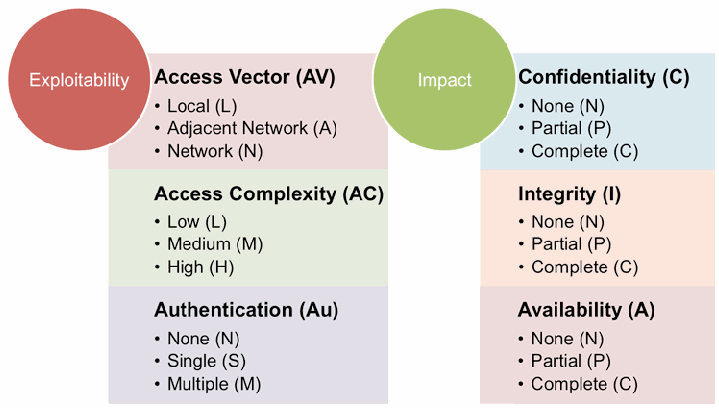
CVSS の基本評価基準を 2 つのグループで示した図です。赤い円「Exploitability」に「Access Vector (AV)」(Local (L)、Adjacent Network (A)、Network (N))、「Access Complexity (AC)」(Low (L)、Medium (M)、High (H))、「Authentication (Au)」(None (N)、Single (S)、Multiple (M))の 3 つの枠が付いています。緑の円「Impact」には「Confidentiality (C)」「Integrity (I)」「Availability (A)」の3 つの枠があり、それぞれ None (N)、Partial (P)、Complete (C) です。
Figure 1 – CVSS Base Metrics
図 1 – CVSS 基本評価基準
Vectors are expressed via a machine-readable textual representation of the values used to derive the score. This representation consists of the abbreviated metric name in a predetermined order, followed by a colon, and finally, the abbreviated metric value. The forward slash character ("/" ) is used to separate the metrics and square brackets are used to identify optional elements. A detailed description of the vector template is provided in section 2.1 and the CVSS specification [12]. The vector template syntax for the base score is:
ベクタは、スコアの導出に使われた値を機械可読なテキスト表現で表したものです。この表現は、あらかじめ決められた順序の評価基準名の略称、コロン、そして最後に評価基準値の略称からなります。スラッシュ文字("/" )は評価基準を区切るために使われ、角括弧は任意要素を識別するために使われます。ベクタテンプレートの詳細な説明は、2.1 節と CVSS 仕様 [12] に示されています。基本スコアのベクタテンプレートの構文は、次のとおりです。
AV:[L,A,N]/AC:[H,M,L]/Au:[M,S,N]/C:[N,P,C]/I:[N,P,C]/A:[N,P,C]
AV:[L,A,N]/AC:[H,M,L]/Au:[M,S,N]/C:[N,P,C]/I:[N,P,C]/A:[N,P,C]
Organizations will typically have software with newly reported vulnerabilities affecting their systems on a daily basis. Vulnerabilities are disclosed in a variety of ways: through vendor advisories, security research reports, vulnerability databases, and bug tracking systems are a few examples. The CVSS specification can assist in comparing different vulnerabilities with each other. Vulnerability analysts are typically the individuals assessing vulnerabilities and assigning values for the various CVSS metrics. The base metric group measures the static qualities of a vulnerability that do not change over time. The temporal metric group measures the qualities of a vulnerability that do change over time, while the environmental metric group measures the characteristics unique and relevant to an individual platform or environment. The temporal metrics are primarily concerned with the availability of exploit code and patches, which often change over time. The environmental metrics are specific to an end-user environment allowing for adjustment based on the specific enterprise and services affected.
組織では通常、システムに影響する新たな脆弱性がソフトウェアについて毎日のように報告されます。脆弱性は、ベンダーのアドバイザリ、セキュリティ研究報告書、脆弱性データベース、バグ追跡システムなど、さまざまな方法で開示されます。CVSS 仕様は、異なる脆弱性を相互に比較する際に役立ちます。脆弱性アナリストは通常、脆弱性を評価し、さまざまな CVSS 評価基準に値を割り当てる個人です。基本評価基準グループは、時間が経っても変化しない脆弱性の静的な性質を測定します。現状評価基準グループは時間とともに変化する脆弱性の性質を測定し、環境評価基準グループは個々のプラットフォームや環境に固有で関連する特性を測定します。現状評価基準は、主に、時間とともに変化することの多いエクスプロイトコードとパッチの有無に関わります。環境評価基準はエンドユーザー環境に固有であり、影響を受ける特定のエンタープライズやサービスに基づく調整を可能にします。
CVSS producers may optionally provide values for the temporal or environmental metric groups which provide important context that is not included in the base metric group. For example the Exploitability vector in the Temporal metrics may help to convey current threat information and Target Distribution in the Environmental metrics may help to convey exposure. If a CVSS producer chooses to measure the Temporal metrics it is recommended that the CVSS producer provide the date the Temporal vector values were assigned. If a CVSS producer chooses to measure the Environmental metrics it is recommended that the CVSS producer provide a description of the assumed end-user environment used when generating the Environmental vector values. End-users should update values for the Temporal and Environmental metric groups using more recent and locally relevant information for their organizations.
CVSS の作成者は、基本評価基準グループに含まれない重要な文脈を提供する、現状評価基準グループまたは環境評価基準グループの値を任意で提供してもよいです。たとえば、現状評価基準のエクスプロイト可能性ベクタは現在の脅威情報を伝えるのに役立つ場合があり、環境評価基準の対象の分布はエクスポージャーを伝えるのに役立つ場合があります。CVSS の作成者が現状評価基準を測定することを選ぶ場合、現状ベクタの値を割り当てた日付を提供することが推奨されています。CVSS の作成者が環境評価基準を測定することを選ぶ場合、環境ベクタの値を生成する際に使った想定上のエンドユーザー環境の説明を提供することが推奨されています。エンドユーザーは、組織にとってより新しく、組織の状況に即した情報を使って、現状評価基準グループと環境評価基準グループの値を更新すべきです。
2.1 Exploring the Base Metrics
2.1 基本評価基準の詳細
Guidance for assessing the six base metrics is provided within the following sections and should be used to compliment the definitions and information provided by the CVSS specification [12]. Limitations of the CVSS specification are discussed in section 2.2, and further considerations and guidance are provided in section 2.3.
6 つの基本評価基準を評価するためのガイダンスは、以下の各節で提供され、CVSS 仕様 [12] が示す定義と情報を補完するために使うべきです。CVSS 仕様の限界は 2.2 節で論じられ、さらなる考慮事項とガイダンスは 2.3 節で提供されます。
2.1.1 Access Vector
2.1.1 アクセスベクタ
The Access Vector metric measures an attacker’s ability to successfully exploit a vulnerability based on how remote an attacker can be, from a networking perspective, to an information system. There are three possible values for this metric: Local (AV:L), Adjacent Network (AV:A), and Network (AV:N).
アクセスベクタの評価基準は、攻撃者がネットワークの観点から、情報システムからどの程度離れていられるかに基づいて、攻撃者が脆弱性を首尾よくエクスプロイトする能力を測定します。この評価基準には、ローカル(AV:L)、隣接ネットワーク(AV:A)、ネットワーク(AV:N)の 3 つの値があります。
For the Access Vector to receive a value of “Network,” a vulnerability must be exploitable without requiring physical (i.e., local) or adjacent network access. Often, AV:N vulnerabilities can be exploited from IP addresses on the Internet. Examples of terms that should trigger a vulnerability analyst to believe a vulnerability is AV:N are remote, remotely exploitable, or remote attacker. Appendix A includes a variety of AV:N vulnerabilities such as CVE-2012-5841, CVE-2013-0214, CVE-2012-5652, and CVE-2012-5895.
アクセスベクタが「ネットワーク」の値を得るには、脆弱性が、物理的な(すなわちローカルな)アクセスや隣接ネットワークのアクセスを必要とせずにエクスプロイト可能でなければなりません。AV:N の脆弱性は、インターネット上の IP アドレスからエクスプロイトできることが多くあります。脆弱性アナリストに、脆弱性が AV:N であると考えさせる語の例は、remote、remotely exploitable、remote attacker です。付録 A には、CVE-2012-5841、CVE-2013-0214、CVE-2012-5652、CVE-2012-5895 など、さまざまな AV:N の脆弱性が含まれています。
To receive a value of “Adjacent Network,” vulnerabilities must be exploitable solely through a broadcast or collision domain, as in CVE-2008-1453. Examples of terms that should trigger a vulnerability analyst to believe the vulnerability is AV:A are local network or adjacent. Often the CVE description does not contain sufficient information to determine AV:A and requires reviewing security advisories relating to the vulnerability. Examples of local networks include, but are not limited to, wireless networks such as Wi-Fi or Bluetooth, or a connection to a local area network (LAN). Hardware vulnerabilities related to routers and switches are often categorized with an Access Vector of “Adjacent Network.”
「隣接ネットワーク」の値を得るには、CVE-2008-1453 のように、脆弱性が、ブロードキャストドメインまたはコリジョンドメインのみを通じてエクスプロイト可能でなければなりません。脆弱性アナリストに、脆弱性が AV:A であると考えさせる語の例は、local network や adjacent です。CVE の説明に AV:A を判断するのに十分な情報が含まれていないことが多く、その脆弱性に関するセキュリティアドバイザリを確認する必要があります。ローカルネットワークの例には、Wi-Fi や Bluetooth などのワイヤレスネットワーク、ローカルエリアネットワーク(LAN)への接続が含まれますが、これらに限りません。ルーターやスイッチに関連するハードウェアの脆弱性は、アクセスベクタが「隣接ネットワーク」に分類されることが多くあります。
To receive a value of “Local,” a vulnerability must only be exploitable via physical access, proximity to a device, or local shell/terminal access. Examples of terms that should trigger a vulnerability analyst to believe the vulnerability is AV:L are local, physical access, or physically proximate. To take advantage of CVE-2011-1007 one must have physical, or near physical access to the USB flash drive. It is important to note that local attacks do not suggest a change in score for the Authentication metric. If a vulnerability description mentions both remote and local access, then the appropriate metric should receive whichever value is more severe, according to the worst-case scenario.
「ローカル」の値を得るには、脆弱性が、物理的なアクセス、装置への近接、またはローカルのシェル/ターミナルへのアクセスによってのみエクスプロイト可能でなければなりません。脆弱性アナリストに、脆弱性が AV:L であると考えさせる語の例は、local、physical access、physically proximate です。CVE-2011-1007 を悪用するには、USB フラッシュドライブに物理的に、またはそれに近い形でアクセスしなければなりません。ローカルの攻撃は、認証の評価基準のスコアを変更することを示唆するものではないことに留意することが重要です。脆弱性の説明にリモートとローカルの両方のアクセスが記載されている場合、該当する評価基準には、最悪のシナリオに従い、より深刻なほうの値を付与すべきです。
2.1.2 Access Complexity
2.1.2 アクセス複雑性
The Access Complexity metric is a means to convey the level of difficulty required for an attacker to exploit a vulnerability once the target system is identified. The amount of effort is estimated by the number of special or unique conditions required to exploit the vulnerability. Conditions not within the control of the attacker will lower the overall score of the vulnerability. Access Complexity is evaluated independently; therefore changes in other base metrics are not considered reasons to raise Access Complexity. Access Complexity conditions typically include specialized access, non-default settings, and race conditions. In addition, other items outside the control of the attacker may raise Access Complexity.
アクセス複雑性の評価基準は、対象のシステムが特定された後に、攻撃者が脆弱性をエクスプロイトするために必要な困難さの水準を伝える手段です。労力の大きさは、脆弱性をエクスプロイトするために必要な特別な条件や固有の条件の数によって見積もられます。攻撃者の制御下にない条件は、脆弱性の全体のスコアを下げます。アクセス複雑性は独立して評価されるため、他の基本評価基準の変化は、アクセス複雑性を高くする理由とは見なされません。アクセス複雑性の条件には、通常、特殊なアクセス、既定でない設定、競合状態が含まれます。加えて、攻撃者の制御下にないその他の事項が、アクセス複雑性を高くする場合があります。
One example of increased Access Complexity would be the user interaction required to open an attachment containing a malicious payload. A remote attacker would typically have no direct control over whether a user will open an attachment, therefore increasing the complexity to exploit the vulnerability. There are three possible values for this metric: High (AC:H), Medium (AC:M), and Low (AC:L). The CVSS specification contains examples to assist in determining the appropriate value for Access Complexity [12].
アクセス複雑性が高くなる例の 1 つは、悪意のあるペイロードを含む添付ファイルを開くために必要な、利用者の操作です。リモートの攻撃者は通常、利用者が添付ファイルを開くかどうかを直接制御できないため、脆弱性をエクスプロイトする複雑性が高くなります。この評価基準には、高(AC:H)、中(AC:M)、低(AC:L)の 3 つの値があります。CVSS 仕様には、アクセス複雑性の適切な値を判断するのに役立つ例が含まれています [12]。
Any time a vulnerability has two or more specialized access conditions it should receive an Access Complexity value of “High.” Other reasons include an atypically complex or extremely rare scenario, or a race condition which tightly narrows the window of opportunity for a successful attack. Vulnerabilities requiring expanded privileges or a specialized server configuration are often AC:H. For example, vulnerability CVE-2012-6530 requires non-default settings, such as specific privileges and a precise value for a configuration parameter, and therefore is AC:H.
脆弱性に 2 つ以上の特殊なアクセス条件がある場合、アクセス複雑性の値は「高」とすべきです。その他の理由には、典型的でないほど複雑なシナリオや極めてまれなシナリオ、攻撃成功の機会が生じる時間枠を大幅に狭める競合状態があります。拡張された権限や特殊なサーバー構成を必要とする脆弱性は、AC:H であることが多くあります。たとえば、脆弱性 CVE-2012-6530 は、特定の権限や構成パラメータの正確な値など、既定でない設定を必要とするため、AC:H です。
For Access Complexity to be set to “Medium,” a single special condition is required for a vulnerability to be exploited. If a victim is required to interact in some way to unintentionally assist an attacker, it is referred to as victim interaction. Victim interaction is a common property of vulnerabilities receiving an AC value of “Medium,” and the NVD uses this concept to enhance CVSS by noting this property within the database. XSS vulnerabilities often rely on some level of victim interaction, and it can be observed in CVE-2012-5841 and CVE-2012-2360.
アクセス複雑性を「中」に設定するには、脆弱性をエクスプロイトするために 1 つの特殊な条件が必要です。被害者が、意図せず攻撃者を助けるような何らかの形で操作することが必要な場合、これは被害者の操作と呼ばれます。被害者の操作は、AC の値が「中」となる脆弱性に共通する特性であり、NVD はこの概念を、データベース内でこの特性を記載することで、CVSS を補強するために使っています。XSS の脆弱性は、ある程度の被害者の操作に依存することが多く、CVE-2012-5841 と CVE-2012-2360 で確認できます。
To receive a value of AC:L, no special conditions must be required for a vulnerability to be exploitable. If a vulnerability is present within default configurations or if it can be exploited with little skill or excessive information gathering, the Access Complexity is likely “Low.” For instance, vulnerability CVE-2013-1763 is exploitable without special or unique circumstances, and is therefore AC:L. Vulnerabilities with insufficient information should receive a value of “Low.”
AC:L の値を得るには、脆弱性がエクスプロイト可能であるために、特別な条件が要求されてはなりません。脆弱性が既定の構成に存在する場合、または、わずかなスキルでエクスプロイトできる場合、あるいは過度な情報収集を必要とせずにエクスプロイトできる場合、アクセス複雑性は「低」である可能性が高いです。たとえば、脆弱性 CVE-2013-1763 は、特別な状況や固有の状況なしにエクスプロイト可能であるため、AC:L です。情報が不十分な脆弱性には、「低」の値を付与すべきです。
2.1.3 Authentication
2.1.3 認証
The Authentication metric measures the access an attacker requires to exploit a vulnerability. As the number of times an attacker must authenticate increases the CVSS base score will decrease. There are three possible values for this metric: Multiple (Au:M), Single (Au:S), and None (Au:N). A value for the Authentication metric is assigned to a vulnerability based upon the number of authentication instances required to exploit the vulnerability.
認証の評価基準は、攻撃者が脆弱性をエクスプロイトするために必要とするアクセスを測定します。攻撃者が認証しなければならない回数が増えるほど、CVSS の基本スコアは下がります。この評価基準には、複数(Au:M)、単一(Au:S)、なし(Au:N)の 3 つの値があります。認証の評価基準の値は、脆弱性をエクスプロイトするために必要な認証の回数に基づいて、脆弱性に割り当てられます。
To receive a value of Au:M, the attacker must be required to successfully authenticate more than once in order to exploit a vulnerability. For instance, the requirement of authenticating to exploit a vulnerability within a restricted area of a web application, an attacker may need to first authenticate to gain access to the web application, and authenticate another time to gain privileged access. If an attacker must only prove their identity a single time, the Authentication metric is set to “Single.” Note that this includes authenticating via the command line, a desktop session, or a web interface. Vulnerability CVE-2012-6530 references remote authenticated users; in this case an attacker is required to authenticate to the server (among other considerations) to exploit the vulnerability. Examples of terms that should trigger a vulnerability analyst to believe the vulnerability is AV:S are authenticated users or authenticated attackers. If authentication is not required to successfully exploit a vulnerability it receives a value of Au:N. Many vulnerabilities, such as CVE-2012-3754 and CVE-2011-4583, within Appendix A do not require authentication.
Au:M の値を得るには、脆弱性をエクスプロイトするために、攻撃者が複数回認証に成功する必要があります。たとえば、Web アプリケーションの制限された領域にある脆弱性をエクスプロイトするために認証が必要な場合、攻撃者は、まず Web アプリケーションにアクセスするために認証し、さらに特権アクセスを得るためにもう一度認証する必要があるかもしれません。攻撃者が自分の ID を一度だけ証明すればよい場合、認証の評価基準は「単一」に設定されます。これには、コマンドライン、デスクトップセッション、Web インターフェースによる認証が含まれることに留意してください。脆弱性 CVE-2012-6530 は、リモートの認証済み利用者に言及しています。この場合、攻撃者は、脆弱性をエクスプロイトするために(他の条件とともに)サーバーに認証する必要があります。脆弱性アナリストに、脆弱性が AV:S であると考えさせる語の例は、authenticated users や authenticated attackers です。脆弱性をエクスプロイトするために認証が不要な場合、その脆弱性には Au:N の値が付与されます。付録 A にある CVE-2012-3754 や CVE-2011-4583 など、多くの脆弱性は、認証を必要としません。
2.1.4 Confidentiality
2.1.4 機密性
The Confidentiality metric measures the attacker’s ability to obtain unauthorized access to information from an application or system. Disclosure of passwords, personal information, or other information used to control, configure or maintain systems are examples of a loss of Confidentiality. There are three possible values for this metric: None (C:N), Partial (C:P), and Complete (C:C).
機密性の評価基準は、攻撃者が、アプリケーションやシステムの情報への無許可のアクセスを得る能力を測定します。パスワード、個人情報、またはシステムの制御、構成、保守に使われるその他の情報の開示は、機密性の喪失の例です。この評価基準には、なし(C:N)、部分的(C:P)、全面的(C:C)の 3 つの値があります。
If no information or data residing on or within a system is exposed due to exploitation, the Confidentiality metric receives a value of “None,” as in examples CVE-2008-1447 and CVE-2011-3918. If there is unauthorized information disclosure, but less than complete read access to an entire system, the Confidentiality metric receives a value of “Partial,” as in CVE-2012-5652. Finally, if an attacker has complete read access to all files and data on a system, the loss of Confidentiality is considered “Complete” as in CVE-2012-3754.
エクスプロイトによって、システム上またはシステム内にある情報やデータが一切暴露されない場合、CVE-2008-1447 や CVE-2011-3918 の例のように、機密性の評価基準には「なし」の値が付与されます。無許可の情報の開示はあるものの、システム全体への完全な読み取りアクセスには至らない場合、CVE-2012-5652 のように、機密性の評価基準には「部分的」の値が付与されます。最後に、攻撃者がシステム上のすべてのファイルとデータへの完全な読み取りアクセスを持つ場合、機密性の喪失は、CVE-2012-3754 のように「全面的」と見なされます。
2.1.5 Integrity
2.1.5 完全性
The Integrity metric measures an attacker’s ability to manipulate or remove data from a product or system. Altering data in a database, modifying files, changing access control lists, and DNS cache poisoning are all examples of a loss of Integrity. There are three possible values for this metric: None (I:N), Partial (I:P), and Complete (I:C).
完全性の評価基準は、攻撃者が、製品やシステムのデータを操作または削除する能力を測定します。データベース内のデータの改変、ファイルの変更、アクセス制御リストの変更、DNS キャッシュポイズニングは、すべて完全性の喪失の例です。この評価基準には、なし(I:N)、部分的(I:P)、全面的(I:C)の 3 つの値があります。
I:N is used when vulnerability exploitation cannot manipulate data. For example, the information leak in CVE-2012-5652 only exposes information –modification is not possible. A “Partial” impact to Integrity occurs when exploiting a vulnerability will allow a limited or uncontrolled modification to files or other contents of a system, as in CVE-2012-2144. Additionally, a vulnerability will have a “Partial” impact if modification is confined only to the application context. For the Integrity metric to be I:C, an attacker must be able to arbitrarily modify any system file or other data throughout the system on an as needed basis. CVE-2013-0900 allows for remote code execution, and therefore a “Complete” impact to Integrity. CVE-2013-0969 is an example of a vulnerability with only an impact to Integrity - in this example it is “Complete.”
I:N は、脆弱性のエクスプロイトでデータを操作できない場合に使われます。たとえば、CVE-2012-5652 の情報漏えいは、情報を暴露するだけで、改変はできません。脆弱性をエクスプロイトすることで、CVE-2012-2144 のように、システムのファイルやその他の内容に対する限定的な、または制御されない改変が可能になる場合、完全性への「部分的」な影響が生じます。加えて、改変がアプリケーションの文脈内に限定される場合も、その脆弱性は「部分的」な影響を持ちます。完全性の評価基準が I:C となるには、攻撃者が、必要に応じてシステム全体にわたり任意のシステムファイルやその他のデータを改変できなければなりません。CVE-2013-0900 はリモートコード実行を可能にするため、完全性への「全面的」な影響となります。CVE-2013-0969 は、完全性のみに影響を及ぼす脆弱性の例であり、この例では「全面的」です。
It is important to remember that according to Scoring Tip #10 of the CVSS specification, a “Partial” or “Complete” loss of Integrity may also affect Availability because if data is altered, access to the unmodified data is no longer possible [12].
CVSS 仕様の Scoring Tip #10 によれば、完全性の「部分的」または「全面的」な喪失は、データが改変されると未改変のデータにアクセスできなくなるため、可用性にも影響しうることを覚えておくことが重要です [12]。
2.1.6 Availability
2.1.6 可用性
The Availability metric measures an attacker’s ability to disrupt or prevent access to services or data. Vulnerabilities that impact availability can affect hardware, software, and network resources, such as flooding network bandwidth, consuming large amounts of memory, CPU cycles, or unnecessary power consumption. There are three possible values for this metric: None (A:N), Partial (A:P), and Complete (A:C).
可用性の評価基準は、攻撃者が、サービスやデータへのアクセスを妨害または阻止する能力を測定します。可用性に影響する脆弱性は、ネットワーク帯域幅の飽和、大量のメモリや CPU サイクルの消費、不必要な電力消費など、ハードウェア、ソフトウェア、ネットワークの資源に影響を及ぼす場合があります。この評価基準には、なし(A:N)、部分的(A:P)、全面的(A:C)の 3 つの値があります。
When there are no impacts to the availability of system resources or data, the Availability metric should receive a value of “None.” The impact is considered “Partial” if only an application is affected or if there are temporary resource or service interruptions, such as in CVE-2012-5533. Finally, to receive a value of "Complete,” access to a resource must no longer be possible, often in the form of freezing all processing, shutting down the resource, or taking the information system offline. Vulnerability CVE-2011-3918 causes a system to enter into a reboot loop causing a “Complete” impact to Availability. Examples of terms and phrases that should trigger a vulnerability analyst to believe the vulnerability is A:C are system hang or a reference to a restart after an attack has occurred. CVE-2013-2292 is an example of a vulnerability with only an impact to Availability – in this example it is “Complete.”
システムの資源やデータの可用性に影響がない場合、可用性の評価基準には「なし」の値を付与すべきです。影響が「部分的」と見なされるのは、アプリケーションのみが影響を受ける場合、または、CVE-2012-5533 のように、資源やサービスが一時的に中断される場合です。最後に、「全面的」の値を得るには、資源へのアクセスが不可能になっていなければならず、多くの場合、すべての処理の停止、資源のシャットダウン、情報システムのオフライン化の形をとります。脆弱性 CVE-2011-3918 は、システムを再起動ループに陥らせ、可用性への「全面的」な影響を引き起こします。脆弱性が A:C であると考えるようアナリストに促す語句の例は、system hang や、攻撃後に再起動するという記述です。CVE-2013-2292 は、可用性のみに影響を及ぼす脆弱性の例であり、この例では「全面的」です。
2.2 Limitations of the CVSS
2.2 CVSS の限界
While the CVSS provides a standardized mechanism to communicate a subset of vulnerability information, the CVSS has some limitations. These limitations include but are not limited to: evaluating relative vulnerability severity based exclusively on the score, only using the CVSS base metrics, and using the CVSS score as the sole means to determine organizational risk.
CVSS は、脆弱性情報の一部を伝えるための標準化された仕組みを提供しますが、いくつかの限界があります。これらの限界には、スコアのみに基づいて脆弱性の相対的な深刻度を評価すること、CVSS の基本評価基準のみを使うこと、CVSS のスコアを組織のリスクを判断する唯一の手段として使うことが含まれますが、これらに限りません。
There are a number of cases where the overall consequence of a vulnerability is greater than the numerical CVSS base score since the CVSS ignores externality of vulnerability impact. The CVSS specification is meant to score the impact to the system containing the vulnerability, not any downstream impact to other systems. A common example is a vulnerability which exists within a web application; the vulnerability is evaluated based on the impact to the web server, impacts to other systems that may navigate to the web application containing the vulnerability are not taken into account. Scoring Tip #2 from the CVSS specification explicitly states that the score should only consider the direct impact to the target host and describes how to score a cross-site scripting vulnerability [12]. The externality of vulnerability impact limitation logically extends to similar type of vulnerabilities like cross-site request forgery (CSRF).
CVSS は脆弱性の影響の外部性を無視するため、脆弱性の全体的な影響が、CVSS の数値の基本スコアよりも大きい場合が数多くあります。CVSS 仕様は、脆弱性を含むシステムへの影響をスコアリングすることを意図しており、他のシステムへの下流の影響をスコアリングするものではありません。一般的な例は、Web アプリケーション内に存在する脆弱性です。この脆弱性は、Web サーバーへの影響に基づいて評価され、脆弱性を含むWebアプリケーションにアクセスする可能性のある他のシステムへの影響は考慮されません。CVSS 仕様の Scoring Tip #2 は、スコアが対象ホストへの直接の影響のみを考慮すべきことを明示し、クロスサイトスクリプティングの脆弱性をスコアリングする方法を説明しています [12]。脆弱性の影響の外部性に関する制限は、クロスサイトリクエストフォージェリ(CSRF)のような類似の種類の脆弱性にも論理的に当てはまります。
Another example where the CVSS base score discounts the impact of a vulnerability, is when that vulnerability is discovered within a protocol (or common implementations), such as TLS or DNS. CVE-2008-1447, colloquially referred to as the Kaminsky Bug, highlights a past flaw within DNS, and the severity only accounted for impact to the DNS server and not to clients relying on the DNS server [3]. Finally, vulnerabilities affecting cyber-physical and/or industrial control systems, such as CVE-2012-4687, may also require additional scrutiny as these systems directly affect the physical world and misuse of these systems could pose a serious threat to human life and safety. Use of the environmental metrics can provide some remedy for both the DNS and the industrial control systems examples to influence the final score, but perhaps not a comprehensive solution.
CVSS の基本スコアが脆弱性の影響を割り引いて評価するもう 1 つの例は、その脆弱性が TLS や DNS などのプロトコル(または共通の実装)の中で発見された場合です。Kaminsky バグとして口語的に呼ばれる CVE-2008-1447 は、DNS 内の過去の欠陥を浮き彫りにしており、その深刻度は、DNS サーバーへの影響のみを考慮し、DNS サーバーに依拠するクライアントへの影響は考慮していませんでした [3]。最後に、CVE-2012-4687 のように、サイバーフィジカルシステムや産業用制御システム、あるいはその両方に影響する脆弱性も、これらのシステムが物理世界に直接影響し、その悪用が人命と安全に深刻な脅威をもたらしうるため、追加の精査が必要な場合があります。環境評価基準を使うことで、DNS と産業用制御システムの両方の例について、最終的なスコアに影響を与えるいくらかの改善策を得られますが、おそらく包括的な解決策ではありません。
A reliance on only the CVSS base metrics without accounting for temporal aspects or environmental specific circumstances of a vulnerability may lead to organizations improperly measuring the severity of a vulnerability. While some environmental specific circumstances are accounted for through the use of the environmental metrics focusing largely on impact, no attempt is made to account in the CVSS for any mitigating factors within the context of an environment that could increase or decrease the ability to exploit a particular vulnerability. End-user organizations may wish to prioritize vulnerability response based on timely threat information, which is measured by the Exploitability vector in the temporal metrics.
脆弱性の時間的側面や環境固有の状況を考慮せず、CVSS の基本評価基準のみに依拠することは、組織が脆弱性の深刻度を不適切に測定することにつながるおそれがあります。影響に主に焦点を当てた環境評価基準を使うことで、環境固有の状況の一部は考慮されますが、特定の脆弱性をエクスプロイトする能力を高めたり低めたりしうる、環境の文脈内の緩和要因を CVSS で考慮する試みはなされていません。エンドユーザー組織は、現状評価基準のエクスプロイト可能性ベクタで測定される、適時の脅威情報に基づいて、脆弱性への対応の優先順位を付けたいと考える場合があります。
Vulnerability assessment via the CVSS can assist in conducting risk assessments, but the CVSS scores should not be the sole factor when determining risk. The CVSS scores do not provide an aggregate score of a complete information system, and one should not sum up the scores to determine a final score for a system. Additionally, the CVSS score represents the impact of an individual vulnerability residing within an information system, and does not account for vulnerability chaining. Vulnerability chaining is the situation where multiple vulnerabilities are used together to perform an attack on a system. While useful as part of a risk management solution, the CVSS scores should not be used as the sole factor in determining risk.
CVSS による脆弱性評価は、リスクアセスメントの実施に役立ちますが、リスクを判断する際に、CVSS のスコアを唯一の要素とすべきではありません。CVSS のスコアは、完全な情報システムの総合スコアを提供するものではなく、システムの最終的なスコアを決定するためにスコアを合計すべきではありません。加えて、CVSS のスコアは、情報システム内に存在する個々の脆弱性の影響を表すものであり、脆弱性の連鎖を考慮していません。脆弱性の連鎖とは、複数の脆弱性を組み合わせて、システムに対する攻撃を実行する状況です。リスクマネジメントのソリューションの一部としては有用ですが、CVSS のスコアを、リスクを判断する唯一の要素として使うべきではありません。
2.3 Further Guidance and Considerations
2.3 追加のガイダンスと考慮事項
When performing vulnerability analysis, organizations should determine which information sources they will accept when attempting to research a specific vulnerability. Security researchers, vendors, and governmental entities are categories of information sources that can be leveraged. In the event of a conflict between two sources, a hierarchy should be created to assist in determining which source is more authoritative. Organizations should determine how much effort vulnerability analysts should expend in order to provide values for the CVSS metrics. Vulnerability analysts may not initially have sufficient information to fully assess a given vulnerability and will on occasion be unable to identify an appropriate source containing the desired information. In the event insufficient information is available, vulnerabilities should be scored according to the worst-case scenario. Vulnerability descriptions often state this as unknown impact vectors or unknown attack vectors. The worst-case scenario for all six base metrics results in the Access Vector set as “Network,” Authentication as “None,” Access Complexity as “Low,” and a value of “Complete” for the Confidentiality, Integrity, and Availability (CIA) triad. The worst-case scenario is represented by the following base vector:
脆弱性分析を行う際、組織は、特定の脆弱性を調査するときにどの情報源を受け入れるかを決めるべきです。セキュリティ研究者、ベンダー、政府機関は、活用できる情報源のカテゴリです。2 つの情報源が矛盾する場合に、どちらの情報源がより信頼できるかを判断するのに役立つ階層を作成すべきです。組織は、CVSS 評価基準の値を提供するために、脆弱性アナリストがどの程度の労力を費やすべきかを決めるべきです。脆弱性アナリストは、当初、特定の脆弱性を完全に評価するのに十分な情報を持っていないことがあり、必要な情報を含む適切な情報源を特定できないことも時折あります。十分な情報が得られない場合、脆弱性は、最悪のシナリオに従ってスコアリングすべきです。脆弱性の説明では、これは unknown impact vectors や unknown attack vectors と記載されることが多くあります。6 つすべての基本評価基準の最悪のシナリオでは、アクセスベクタが「ネットワーク」、認証が「なし」、アクセス複雑性が「低」となり、機密性、完全性、可用性(CIA)のそれぞれに「全面的」の値が割り当てられます。最悪のシナリオは、次の基本ベクタで表されます。
AV:N/AC:L/Au:N/C:C/I:C/A:C
AV:N/AC:L/Au:N/C:C/I:C/A:C
As an example the vulnerability description and available references for CVE-2012-5895 do not provide sufficient information to properly score the vulnerability and is therefore scored according to the worst-case scenario.
一例として、CVE-2012-5895 の脆弱性の説明と利用可能な参照情報では、その脆弱性を適切にスコアリングするのに十分な情報が得られないため、この脆弱性は最悪のシナリオに従ってスコアリングされています。
Reliably applying CIA impact levels across different classes of information systems and applications can be difficult. The following guidelines may assist in consistently assigning impact values. When considering Confidentiality, Integrity, and Availability at the application level, the resulting score is most likely “Partial” (i.e., CVE-2012-5533). As an example, when a vulnerability in an application renders an application unusable, as long as the underlying system is not compromised, the Availability value is “Partial.” When considering vulnerabilities at the hardware or system level, the impact for an affected metric is generally “Complete” (i.e., CVE-2011-3918).
異なる種類の情報システムやアプリケーションにわたって、CIA の影響レベルを一貫して適用することは、困難な場合があります。次のガイドラインは、影響値を一貫して割り当てるのに役立つ場合があります。アプリケーションレベルで機密性、完全性、可用性を考慮する場合、結果として得られるスコアは、「部分的」となる可能性が最も高いです(すなわち CVE-2012-5533)。たとえば、アプリケーションの脆弱性によってアプリケーションが使用不能になっても、基盤となるシステムが危殆化されていない限り、可用性の値は「部分的」です。ハードウェアレベルやシステムレベルの脆弱性を考慮する場合、影響を受ける評価基準への影響は、一般に「全面的」です(すなわち CVE-2011-3918)。
In addition to considering whether a vulnerability affects an application or system, it is also important to recognize that the security architecture of the operating system hosting the application influences impact. Access control and permission models, default settings, and configurations all vary widely from one operating system to the next, which affect vulnerability scores. The following example illustrates this scenario:
脆弱性がアプリケーションに影響するのかシステムに影響するのかを考慮することに加えて、アプリケーションをホストするオペレーティングシステムのセキュリティアーキテクチャが、影響に作用することも認識しておくことが重要です。アクセス制御や権限のモデル、既定の設定、構成は、オペレーティングシステムごとに大きく異なり、脆弱性のスコアに影響します。次の例は、このシナリオを示しています。
Operating System A by default results in applications running within the context of a privileged user with extended access to system information beyond those of a standard user would have. Operating System B by default results in applications running within the context of a process with standard or restricted system access. A vulnerability affecting an application running on Operating System A would result in higher impact scores than the same application running on Operating System B.
オペレーティングシステム A では、既定で、アプリケーションは、標準の利用者が持つものを超えるシステム情報への拡張アクセスを持つ特権利用者の権限で実行されます。オペレーティングシステム B では、既定で、アプリケーションは、標準または制限付きのシステムアクセス権を持つプロセスとして実行されます。オペレーティングシステム A で実行されるアプリケーションに影響する脆弱性は、オペレーティングシステム B で実行される同じアプリケーションよりも、高い影響スコアになります。
Occasionally, vulnerabilities which have been chained together as part of an exploit will be reported and described at the same time and in relation to each other making vulnerability assessment difficult. For instance, the iOS evasi0n jailbreak [15] leverages multiple vulnerabilities including CVE-2013-0977, CVE-2013-0978, CVE-2013-0979, and CVE-2013-0981 (these are not included within Appendix A.) Research is often required to identify and separate indistinctly reported vulnerabilities from each other. Vulnerabilities should be scored independently of each other as mentioned in Scoring Tip #1 [12]. Analysts should not consider the outcome of making a system or application more vulnerable as a reason to raise the score of the original vulnerability.
エクスプロイトの一部として連鎖された脆弱性が、同時に、また互いに関連して報告され、説明されることがあり、脆弱性評価を難しくします。たとえば、iOS の evasi0n 脱獄 [15] は、CVE-2013-0977、CVE-2013-0978、CVE-2013-0979、CVE-2013-0981 を含む複数の脆弱性を利用しています(これらは付録 A には含まれていません)。区別せずに報告された脆弱性を特定し、互いに分離するために、調査が必要になることがよくあります。Scoring Tip #1 [12] に記載されているとおり、脆弱性は互いに独立してスコアリングすべきです。アナリストは、システムやアプリケーションをより脆弱にするという結果を、元の脆弱性のスコアを引き上げる理由と見なすべきではありません。
Finally, end-user organizations may wish to use the CVSS vectors with an alternative scoring or decision-making mechanism. This could help an organization better integrate readily-available CVSS vectors into existing vulnerability response processes.
最後に、エンドユーザー組織は、CVSS のベクタを、別のスコアリングまたは意思決定の仕組みとともに使いたいと考える場合があります。これは、組織が、すぐに利用できる CVSS のベクタを、既存の脆弱性対応プロセスにより適切に統合するのに役立つ場合があります。
3 Scoring Practices
3 スコアリングのプラクティス
Organizations who wish to produce consistent vulnerability scores from different vulnerability analysts should correlate terminology from disparate vulnerability sources with CVSS metrics and values. Creating a mapping from terminology to CVSS metrics and values enables the organization to ensure a repeatable process that can be communicated from those responsible for providing vulnerability assessments to security implementers and system administrators. This is only possible if the vulnerability descriptions use consistent wording and results may vary for sources outside of CVE.
異なる脆弱性アナリストから一貫した脆弱性スコアを出したい組織は、異なる脆弱性情報源の用語を、CVSS の評価基準と値に対応付けるべきです。用語から CVSS の評価基準と値への対応付けを作成することで、組織は、脆弱性評価の提供を担当する者から、セキュリティの実装者やシステム管理者へ伝達できる再現可能なプロセスを確保できます。これは、脆弱性の説明で一貫した表現が使われている場合にのみ可能であり、CVE 以外の情報源では結果が異なる場合があります。
3.1 Common Keywords, Phrases and Suggested Vectors
3.1 一般的なキーワード、フレーズ、推奨ベクタ
The following table contains common keywords and phrases typically used within vulnerability descriptions. These common keywords and phrases are commonly used within the description and/or reference links provided by the CVE dictionary entry and often suggest an initial value for a base metric. It is important to remember that these initial values can be influenced by other factors, and therefore analysts should consider all available information before determining a final value.
次の表は、脆弱性の説明で通常使われる、一般的なキーワードとフレーズを含んでいます。これらの一般的なキーワードとフレーズは、CVE 辞書のエントリが提供する説明、参照リンク、あるいはその両方の中でよく使われ、基本評価基準の初期値を示唆することが多くあります。これらの初期値は他の要因に影響されることがあるため、アナリストは最終的な値を決定する前に、利用可能なすべての情報を考慮すべきであることを覚えておくことが重要です。
Table 1 - Common keywords and phrases in vulnerability descriptions
表 1 - 脆弱性の説明における一般的なキーワードとフレーズ
| Metric | Common Keywords and Phrases | Suggested Value |
|---|---|---|
| Access Vector (AV) | Remote, remotely exploitable, remote attacker | AV:N |
| Local network, adjacent network | AV:A | |
| Physically proximate1 | AV:[A, L] | |
| Local, physical access | AV:L | |
| Context dependent (assume worst-case) | AV:N | |
| Unknown attack vectors | AV:N/AC:L/Au:N | |
| Access Complexity (AC) | Where a <configuration setting> is enabled disabled | AC:M |
| Authentication (Au) | Authenticated user, authenticated attacker | Au:[S,M] |
| Confidentiality (C) | Read files, view sensitive information, information leak | C:[P,C] |
| Integrity (I) | Modify or delete files | I:[P,C] |
| Availability (A) | System hang, denial of service (DoS), reboot | A:[P,C] |
| CIA | Execute arbitrary code, execute arbitrary files | C:[P,C]/I:[P,C]/A:[P,C] |
| Gain root privileges, gain system privileges, gain user privileges, gain administrator privileges, gain application privileges | C:[P,C]/I:[P,C]/A:[P,C] | |
| Unknown or unspecified impact | C:[P,C]/I:[P,C]/A:[P,C]2 |
| 評価基準 | 一般的なキーワードとフレーズ | 推奨値 |
|---|---|---|
| アクセスベクタ(AV) | リモート、リモートから悪用可能、リモート攻撃者 | AV:N |
| ローカルネットワーク、隣接ネットワーク | AV:A | |
| 物理的に近接1 | AV:[A, L] | |
| ローカル、物理アクセス | AV:L | |
| 状況に依存(最悪のケースを想定) | AV:N | |
| 不明な攻撃ベクタ | AV:N/AC:L/Au:N | |
| アクセス複雑性(AC) | <構成設定> が有効/無効になっている場合 | AC:M |
| 認証(Au) | 認証済みユーザー、認証済み攻撃者 | Au:[S,M] |
| 機密性(C) | ファイルの読み取り、機密情報の閲覧、情報漏えい | C:[P,C] |
| 完全性(I) | ファイルの変更または削除 | I:[P,C] |
| 可用性(A) | システムのハング、サービス拒否(DoS)、再起動 | A:[P,C] |
| CIA | 任意のコードの実行、任意のファイルの実行 | C:[P,C]/I:[P,C]/A:[P,C] |
| root 権限、システム権限、ユーザー権限、管理者権限、アプリケーション権限の取得 | C:[P,C]/I:[P,C]/A:[P,C] | |
| 不明または特定されていない影響 | C:[P,C]/I:[P,C]/A:[P,C]2 |
3.2 Suggested Scoring Templates
3.2 推奨スコアリングテンプレート
The following scoring templates suggest typical scores for frequently occurring types of vulnerabilities described within the Common Weakness Enumeration (CWE) dictionary [10]. Based on information gathered from the NVD, these are some of the most common scoring scenarios that a vulnerability analyst may encounter. It is important to consider that these scoring templates do not fit all situations. Vulnerabilities often have unique characteristics that require deviation from these templates, and for some types of vulnerabilities, only a truncated vector can be supplied. Table 2 lists types of vulnerabilities by their CWE definition in no particular order.
次のスコアリングテンプレートは、Common Weakness Enumeration(CWE)辞書 [10] に記載された、頻繁に発生する種類の脆弱性に対する典型的なスコアを示します。NVD から収集した情報に基づくと、これらは脆弱性アナリストが遭遇する可能性のある、最も一般的なスコアリングシナリオの一部です。これらのスコアリングテンプレートがすべての状況に当てはまるわけではないことを考慮することが重要です。脆弱性には、これらのテンプレートからの逸脱が必要となる固有の特性があることが多く、一部の種類の脆弱性では、省略形のベクタしか提示できません。表 2 は、特に順序を定めず、CWE の定義に基づいて脆弱性の種類を一覧にしています。
Table 2 - Suggested Scoring Templates
表 2 - 推奨スコアリングテンプレート
| CWE | CWE Name | Suggested Scores |
|---|---|---|
| CWE-59 | Improper Link Resolution Before File Access ('Link Following') | AC:M |
| CWE-78 | Improper Neutralization of Special Elements used in an OS Command ('OS Command Injection') | C:C/I:C/A:C |
| CWE-79 | Improper Neutralization of Input During Web Page Generation ('Cross-site Scripting') | AC:M, C:N/I:P/A:N |
| CWE-89 | Improper Neutralization of Special Elements used in an SQL Command ('SQL Injection') | C:P/I:P/A:P |
| CWE-96 | Improper Neutralization of Directives in Statically Saved Code ('Static Code Injection') | C:P/I:P/A:P |
| CWE-129 | Improper Validation of Array Index | AC:L |
| CWE-352 | Cross-site Request Forgery (CSRF) | AC:[M,H]/C:P/I:P/A:P |
| CWE-384 | Session Fixation | AC:M/C:[N,P]/I:P/A:[N,P] |
| CWE-399 | Resource Management Errors3 | A:C |
| CWE-399 | Resource Management Errors4 | A:[P,C] |
| CWE-416 | Use-after-free | C:[P,C]/I:[P,C]/A:[P,C] |
| CWE-426 | Untrusted Search Path | AC:[M,H]/C:C/I:C/A:C |
| CWE-434 | Unrestricted File Upload | C:[P,C]/I:[P,C]/A:[P,C] |
| CWE-476 | Null Pointer Dereference | AC:[L,M]/C:N/I:N/A:[P,H] |
| CWE-601 | Open Redirect | C:P/I:P/A:N |
| CWE | CWE 名 | 推奨スコア |
|---|---|---|
| CWE-59 | Improper Link Resolution Before File Access ('Link Following') | AC:M |
| CWE-78 | Improper Neutralization of Special Elements used in an OS Command ('OS Command Injection') | C:C/I:C/A:C |
| CWE-79 | Improper Neutralization of Input During Web Page Generation ('Cross-site Scripting') | AC:M, C:N/I:P/A:N |
| CWE-89 | Improper Neutralization of Special Elements used in an SQL Command ('SQL Injection') | C:P/I:P/A:P |
| CWE-96 | Improper Neutralization of Directives in Statically Saved Code ('Static Code Injection') | C:P/I:P/A:P |
| CWE-129 | Improper Validation of Array Index | AC:L |
| CWE-352 | Cross-site Request Forgery (CSRF) | AC:[M,H]/C:P/I:P/A:P |
| CWE-384 | Session Fixation | AC:M/C:[N,P]/I:P/A:[N,P] |
| CWE-399 | Resource Management Errors3 | A:C |
| CWE-399 | Resource Management Errors4 | A:[P,C] |
| CWE-416 | Use-after-free | C:[P,C]/I:[P,C]/A:[P,C] |
| CWE-426 | Untrusted Search Path | AC:[M,H]/C:C/I:C/A:C |
| CWE-434 | Unrestricted File Upload | C:[P,C]/I:[P,C]/A:[P,C] |
| CWE-476 | Null Pointer Dereference | AC:[L,M]/C:N/I:N/A:[P,H] |
| CWE-601 | Open Redirect | C:P/I:P/A:N |
Appendix A - NVD Scoring Examples
付録 A - NVD のスコアリング例
This section showcases a list of example vulnerabilities scored via the CVSS to assist vulnerability analysts in scoring vulnerabilities via the CVSS. The scores are based on information provided by the NVD and includes the CVE ID, CWE ID, CVSS base score, CVSS vector, a description of the vulnerability, and a justification for each CVSS base score.
本節では、脆弱性アナリストが CVSS で脆弱性をスコアリングするのを支援するため、CVSS でスコアリングされた脆弱性の例を一覧で示します。これらのスコアは NVD が提供する情報に基づいており、CVE ID、CWE ID、CVSS 基本スコア、CVSS ベクタ、脆弱性の説明、および各 CVSS 基本スコアの根拠を含みます。
A.1 CVE-2012-5841 – XSS without Authentication
A.1 CVE-2012-5841 – 認証なしの XSS
CVE Description:
CVE の説明:
Mozilla Firefox before 17.0, Firefox ESR 10.x before 10.0.11, Thunderbird before 17.0, Thunderbird ESR 10.x before 10.0.11, and SeaMonkey before 2.14 implement cross-origin wrappers with a filtering behavior that does not properly restrict write actions, which allows remote attackers to conduct cross-site scripting (XSS) attacks via a crafted web site.
Mozilla Firefox 17.0 より前、Firefox ESR 10.x の 10.0.11 より前、Thunderbird 17.0 より前、Thunderbird ESR 10.x の 10.0.11 より前、および SeaMonkey 2.14 より前は、書き込み操作を適切に制限しないフィルタリング動作を持つクロスオリジンラッパーを実装しており、これにより、リモートの攻撃者が、細工された Web サイトを介してクロスサイトスクリプティング(XSS)攻撃を実行できます。
Additional Considerations:
追加の考慮事項:
The scoring template for Cross-site Scripting takes into consideration SCORING TIP #2 which states:
クロスサイトスクリプティングのスコアリングテンプレートは、次のように述べる SCORING TIP #2 を考慮しています。
“When scoring a vulnerability, consider the direct impact to the target host only. For example, consider a cross-site scripting vulnerability: the impact to a user’s system could be much greater than the impact to the target host. However, this is an indirect impact. Cross-site scripting vulnerabilities should be scored with no impact to confidentiality or availability, and partial impact to integrity.”
「脆弱性をスコアリングする際は、対象ホストへの直接の影響のみを考慮します。たとえば、クロスサイトスクリプティングの脆弱性を考えます。利用者のシステムへの影響は、対象ホストへの影響よりもはるかに大きい可能性があります。しかし、これは間接的な影響です。クロスサイトスクリプティングの脆弱性は、機密性と可用性への影響なし、完全性への部分的な影響としてスコアリングすべきです。」
Analysis:
分析:
Vector: AV:N/AC:M/Au:N/C:N/I:P/A:N Base Score: 4.3
CWE: CWE-79 - Improper Neutralization of Input During Web Page Generation ('Cross-site Scripting')
ベクタ: AV:N/AC:M/Au:N/C:N/I:P/A:N 基本スコア: 4.3
CWE: CWE-79 - Improper Neutralization of Input During Web Page Generation ('Cross-site Scripting')
| Metric | Value | Explanation |
|---|---|---|
| Access Vector | Network | From keyword “remote attacker” |
| Access Complexity | Medium | From Table 2 Cross-site Scripting Scoring Template (due to victim interaction) |
| Authentication | None | Not required |
| Confidentiality | None | From Table 2 Cross-site Scripting Scoring Template |
| Integrity | Partial | From Table 2 Cross-site Scripting Scoring Template |
| Availability | None | From Table 2 Cross-site Scripting Scoring Template |
| 評価基準 | 値 | 説明 |
|---|---|---|
| アクセスベクタ | ネットワーク | キーワード「remote attacker」から |
| アクセス複雑性 | 中 | 表 2 のクロスサイトスクリプティングのスコアリングテンプレートから(被害者の操作による) |
| 認証 | なし | 不要 |
| 機密性 | なし | 表 2 のクロスサイトスクリプティングのスコアリングテンプレートから |
| 完全性 | 部分的 | 表 2 のクロスサイトスクリプティングのスコアリングテンプレートから |
| 可用性 | なし | 表 2 のクロスサイトスクリプティングのスコアリングテンプレートから |
A.2 CVE-2012-2360 – XSS with Authentication
A.2 CVE-2012-2360 – 認証ありの XSS
CVE Description:
CVE の説明:
Cross-site scripting (XSS) vulnerability in the Wiki subsystem in Moodle 2.0.x before 2.0.9, 2.1.x before 2.1.6, and 2.2.x before 2.2.3 allows remote authenticated users to inject arbitrary web script or HTML via a crafted string that is inserted into a page title.
Moodle 2.0.x の 2.0.9 より前、2.1.x の 2.1.6 より前、2.2.x の 2.2.3 より前の Wiki サブシステムのクロスサイトスクリプティング(XSS)の脆弱性により、リモートの認証済み利用者が、ページタイトルに挿入される細工された文字列を介して、任意の Web スクリプトまたは HTML を注入できます。
Additional Considerations:
追加の考慮事項:
The scoring template for Cross-site Scripting takes into consideration SCORING TIP #2 which states:
クロスサイトスクリプティングのスコアリングテンプレートは、次のように述べる SCORING TIP #2 を考慮しています。
“When scoring a vulnerability, consider the direct impact to the target host only. For example, consider a cross-site scripting vulnerability: the impact to a user’s system could be much greater than the impact to the target host. However, this is an indirect impact. Cross-site scripting vulnerabilities should be scored with no impact to confidentiality or availability, and partial impact to integrity.”
「脆弱性をスコアリングする際は、対象ホストへの直接の影響のみを考慮します。たとえば、クロスサイトスクリプティングの脆弱性を考えます。利用者のシステムへの影響は、対象ホストへの影響よりもはるかに大きい可能性があります。しかし、これは間接的な影響です。クロスサイトスクリプティングの脆弱性は、機密性と可用性への影響なし、完全性への部分的な影響としてスコアリングすべきです。」
Analysis:
分析:
Vector: AV:N/AC:M/Au:S/C:N/I:P/A:N Base Score: 3.5
CWE: CWE-79 - Improper Neutralization of Input During Web Page Generation ('Cross-site Scripting')
ベクタ: AV:N/AC:M/Au:S/C:N/I:P/A:N 基本スコア: 3.5
CWE: CWE-79 - Improper Neutralization of Input During Web Page Generation ('Cross-site Scripting')
| Metric | Value | Explanation |
|---|---|---|
| Access Vector | Network | From keyword “remote…user” |
| Access Complexity | Medium | From Table 2 Cross-site Scripting Scoring Template (due to victim interaction) |
| Authentication | Single | From keyword “authenticated” |
| Confidentiality | None | From Table 2 Cross-site Scripting Scoring Template |
| Integrity | Partial | From Table 2 Cross-site Scripting Scoring Template |
| Availability | None | From Table 2 Cross-site Scripting Scoring Template |
| 評価基準 | 値 | 説明 |
|---|---|---|
| アクセスベクタ | ネットワーク | キーワード「remote…user」から |
| アクセス複雑性 | 中 | 表 2 のクロスサイトスクリプティングのスコアリングテンプレートから(被害者の操作による) |
| 認証 | 単一 | キーワード「authenticated」から |
| 機密性 | なし | 表 2 のクロスサイトスクリプティングのスコアリングテンプレートから |
| 完全性 | 部分的 | 表 2 のクロスサイトスクリプティングのスコアリングテンプレートから |
| 可用性 | なし | 表 2 のクロスサイトスクリプティングのスコアリングテンプレートから |
A.3 CVE-2011-2917 – SQL Injection
A.3 CVE-2011-2917 – SQL インジェクション
CVE Description:
CVE の説明:
SQL injection vulnerability in administrator/index2.php in Mambo CMS 4.6.5 and earlier allows remote attackers to execute arbitrary SQL commands via the zorder parameter.
Mambo CMS 4.6.5 以前の administrator/index2.php の SQL インジェクションの脆弱性により、リモートの攻撃者が、zorder パラメータを介して任意の SQL コマンドを実行できます。
Additional Considerations:
追加の考慮事項:
The scoring template for SQL Injection takes into consideration SCORING TIP #9 which states:
SQL インジェクションのスコアリングテンプレートは、次のように述べる SCORING TIP #9 を考慮しています。
“Vulnerabilities with a partial or complete loss of integrity can also cause an impact to availability. For example, an attacker who is able to modify records can probably also delete them.”
「完全性の部分的または全面的な喪失がある脆弱性は、可用性にも影響を及ぼしえます。たとえば、レコードを改変できる攻撃者は、おそらくそれらを削除することもできます。」
Analysis:
分析:
Vector: AV:N/AC:L/Au:N/C:P/I:P/A:P Base Score: 7.5
CWE: CWE-89 - Improper Neutralization of Special Elements used in an SQL Command ('SQL Injection')
ベクタ: AV:N/AC:L/Au:N/C:P/I:P/A:P 基本スコア: 7.5
CWE: CWE-89 - Improper Neutralization of Special Elements used in an SQL Command ('SQL Injection')
| Metric | Value | Explanation |
|---|---|---|
| Access Vector | Network | From keyword “remote attackers” |
| Access Complexity | Low | No special conditions exist. |
| Authentication | None | Not required |
| Confidentiality | Partial | From Table 2 SQL Injection Scoring Template and affects only the application |
| Integrity | Partial | From Table 2 SQL Injection Scoring Template and affects only the application |
| Availability | Partial | From Table 2 SQL Injection Scoring Template and affects only the application |
| 評価基準 | 値 | 説明 |
|---|---|---|
| アクセスベクタ | ネットワーク | 「remote attackers」というキーワードから |
| アクセス複雑性 | 低 | 特別な条件は存在しません。 |
| 認証 | なし | 不要 |
| 機密性 | 部分的 | 表 2 の SQL インジェクションのスコアリングテンプレートに基づき、影響はアプリケーションのみに及びます |
| 完全性 | 部分的 | 表 2 の SQL インジェクションのスコアリングテンプレートに基づき、影響はアプリケーションのみに及びます |
| 可用性 | 部分的 | 表 2 の SQL インジェクションのスコアリングテンプレートに基づき、影響はアプリケーションのみに及びます |
A.4 CVE-2013-0214 – Cross-site Request Forgery
A.4 CVE-2013-0214 – クロスサイトリクエストフォージェリ
CVE Description:
CVE の説明:
Cross-site request forgery (CSRF) vulnerability in the Samba Web Administration Tool (SWAT) in Samba 3.x before 3.5.21, 3.6.x before 3.6.12, and 4.x before 4.0.2 allows remote attackers to hijack the authentication of arbitrary users by leveraging knowledge of a password and composing requests that perform SWAT actions.
Samba 3.x の 3.5.21 より前、3.6.x の 3.6.12 より前、4.x の 4.0.2 より前の Samba Web Administration Tool(SWAT)のクロスサイトリクエストフォージェリ(CSRF)の脆弱性により、リモートの攻撃者が、パスワードの知識を利用し、SWAT の操作を実行するリクエストを組み立てることで、任意の利用者の認証をハイジャックできます。
Analysis:
分析:
Vector: AV:N/AC:H/Au:N/C:P/I:P/A:P Base Score: 5.1
CWE: CWE-352 Cross-site Request Forgery (CSRF)
ベクタ: AV:N/AC:H/Au:N/C:P/I:P/A:P 基本スコア: 5.1
CWE: CWE-352 Cross-site Request Forgery (CSRF)
| Metric | Value | Explanation |
|---|---|---|
| Access Vector | Network | From keyword “remote attackers” |
| Access Complexity | High | From Table 2 Cross-site Request Forgery (CSRF) due to victim interaction plus knowledge of password from vulnerability description |
| Authentication | None | Not required |
| Confidentiality | Partial | From Table 2 Cross-site Request Forgery (CSRF) Scoring Template and affects only the application |
| Integrity | Partial | From Table 2 Cross-site Request Forgery (CSRF) Scoring Template and affects only the application |
| Availability | Partial | From Table 2 Cross-site Request Forgery (CSRF) Scoring Template and affects only the application |
| 評価基準 | 値 | 説明 |
|---|---|---|
| アクセスベクタ | ネットワーク | キーワード「remote attackers」から |
| アクセス複雑性 | 高 | 表 2 のクロスサイトリクエストフォージェリ(CSRF)から。被害者の操作に加え、脆弱性の説明にあるパスワードの知識が必要であるため |
| 認証 | なし | 不要 |
| 機密性 | 部分的 | 表 2 のクロスサイトリクエストフォージェリ(CSRF)のスコアリングテンプレートから。影響を受けるのはアプリケーションのみ |
| 完全性 | 部分的 | 表 2 のクロスサイトリクエストフォージェリ(CSRF)のスコアリングテンプレートから。影響を受けるのはアプリケーションのみ |
| 可用性 | 部分的 | 表 2 のクロスサイトリクエストフォージェリ(CSRF)のスコアリングテンプレートから。影響を受けるのはアプリケーションのみ |
A.5 CVE-2012-0656 – Race Condition
A.5 CVE-2012-0656 – 競合状態
CVE Description:
CVE の説明:
Race condition in LoginUIFramework in Apple Mac OS X 10.7.x before 10.7.4, when the Guest account is enabled, allows physically proximate attackers to login to arbitrary accounts by entering the account name and no password.
Apple Mac OS X 10.7.x の 10.7.4 より前の LoginUIFramework の競合状態により、Guest アカウントが有効な場合、物理的に近接した攻撃者が、アカウント名を入力しパスワードを入力しないことで、任意のアカウントにログインできます。
Analysis:
分析:
Vector: AV:L/AC:M/Au:N/C:C/I:C/A:C Base Score: 6.2
CWE: CWE-362 – Concurrent Execution using Shared Resource with Improper Synchronization ('Race Condition')
ベクタ: AV:L/AC:M/Au:N/C:C/I:C/A:C 基本スコア: 6.2
CWE: CWE-362 – Concurrent Execution using Shared Resource with Improper Synchronization ('Race Condition')
| Metric | Value | Explanation |
|---|---|---|
| Access Vector | Local | From keyword “physically proximate attackers” |
| Access Complexity | Medium | From description “when the Guest account is enabled” (special condition, not enabled by default) |
| Authentication | None | Not required |
| Confidentiality | Complete | Worst case scenario if OS admin account accessed |
| Integrity | Complete | Worst case scenario if OS admin account accessed |
| Availability | Complete | Worst case scenario if OS admin account accessed |
| 評価基準 | 値 | 説明 |
|---|---|---|
| アクセスベクタ | ローカル | キーワード「physically proximate attackers」から |
| アクセス複雑性 | 中 | 説明「when the Guest account is enabled」から(特別な条件であり、既定では有効ではない) |
| 認証 | なし | 不要 |
| 機密性 | 全面的 | OS の管理者アカウントにアクセスされた場合の最悪のシナリオ |
| 完全性 | 全面的 | OS の管理者アカウントにアクセスされた場合の最悪のシナリオ |
| 可用性 | 全面的 | OS の管理者アカウントにアクセスされた場合の最悪のシナリオ |
A.6 CVE-2012-6530 – Access Complexity Example 1
A.6 CVE-2012-6530 – アクセス複雑性の例 1
CVE Description:
CVE の説明:
Stack-based buffer overflow in Sysax Multi Server before 5.52, when HTTP is enabled, allows remote authenticated users with the create folder permission to execute arbitrary code via a crafted request.
Sysax Multi Server 5.52 より前のスタックベースのバッファオーバーフローにより、HTTP が有効な場合、フォルダー作成権限を持つリモートの認証済み利用者が、細工されたリクエストを介して任意のコードを実行できます。
Analysis:
分析:
Vector: AV:N/AC:H/Au:S/C:C/I:C/A:C Base Score: 7.1
CWE: CWE-119 Improper Restriction of Operations within the Bounds of a Memory Buffer
ベクタ: AV:N/AC:H/Au:S/C:C/I:C/A:C 基本スコア: 7.1
CWE: CWE-119 Improper Restriction of Operations within the Bounds of a Memory Buffer
| Metric | Value | Explanation |
|---|---|---|
| Access Vector | Network | From keyword “remote…users” |
| Access Complexity | High | From description and reference link [13], “HTTP is enabled” is not a default parameter and user must have “create folder permission” which is not given by default |
| Authentication | Single | From keyword “authenticated” |
| Confidentiality | Complete | From reference link [13], “Sysax Multi Server runs as LOCALSYSTEM by default |
| Integrity | Complete | From reference link [13], “Sysax Multi Server runs as LOCALSYSTEM by default |
| Availability | Complete | From reference link [13], “Sysax Multi Server runs as LOCALSYSTEM by default |
| 評価基準 | 値 | 説明 |
|---|---|---|
| アクセスベクタ | ネットワーク | キーワード「remote…users」から |
| アクセス複雑性 | 高 | 説明と参照リンク [13] から。「HTTP is enabled」は既定のパラメータではなく、利用者は既定では付与されない「create folder permission」を持っていなければならない |
| 認証 | 単一 | キーワード「authenticated」から |
| 機密性 | 全面的 | 参照リンク [13] から。「Sysax Multi Server runs as LOCALSYSTEM by default」 |
| 完全性 | 全面的 | 参照リンク [13] から。「Sysax Multi Server runs as LOCALSYSTEM by default」 |
| 可用性 | 全面的 | 参照リンク [13] から。「Sysax Multi Server runs as LOCALSYSTEM by default」 |
A.7 CVE-2012-3754 – Access Complexity Example 2
A.7 CVE-2012-3754 – アクセス複雑性の例 2
CVE Description:
CVE の説明:
Use-after-free vulnerability in the Clear method in the ActiveX control in Apple QuickTime before 7.7.3 allows remote attackers to execute arbitrary code or cause a denial of service (application crash) via unspecified vectors.
Apple QuickTime 7.7.3 より前の ActiveX コントロールの Clear メソッドの解放後使用の脆弱性により、リモートの攻撃者が、不特定のベクタを介して、任意のコードを実行したり、サービス拒否(アプリケーションのクラッシュ)を引き起こしたりできます。
Analysis:
分析:
Vector: AV:N/AC:M/Au:N/C:C/I:C/A:C Base Score: 9.3
CWE: CWE-399 - Resource Management Errors
ベクタ: AV:N/AC:M/Au:N/C:C/I:C/A:C 基本スコア: 9.3
CWE: CWE-399 - Resource Management Errors
| Metric | Value | Explanation |
|---|---|---|
| Access Vector | Network | From keyword “remote attackers” |
| Access Complexity | Medium | From reference link [6] “ by persuading a victim to visit a specially-crafted Web site…” (victim interaction) |
| Authentication | None | Not required |
| Confidentiality | Complete | Worst case scenario if victim has elevated privileges |
| Integrity | Complete | Worst case scenario if victim has elevated privileges |
| Availability | Complete | Worst case scenario if victim has elevated privileges |
| 評価基準 | 値 | 説明 |
|---|---|---|
| アクセスベクタ | ネットワーク | キーワード「remote attackers」から |
| アクセス複雑性 | 中 | 参照リンク [6] の「 by persuading a victim to visit a specially-crafted Web site…」から(被害者の操作) |
| 認証 | なし | 不要 |
| 機密性 | 全面的 | 被害者が昇格した権限を持つ場合の最悪のシナリオ |
| 完全性 | 全面的 | 被害者が昇格した権限を持つ場合の最悪のシナリオ |
| 可用性 | 全面的 | 被害者が昇格した権限を持つ場合の最悪のシナリオ |
A.8 CVE-2008-1447 – The Kaminsky Bug
A.8 CVE-2008-1447 – Kaminsky バグ
CVE Description:
CVE の説明:
The DNS protocol, as implemented in (1) BIND 8 and 9 before 9.5.0-P1, 9.4.2-P1, and 9.3.5-P1; (2) Microsoft DNS in Windows 2000 SP4, XP SP2 and SP3, and Server 2003 SP1 and SP2; and other implementations allow remote attackers to spoof DNS traffic via a birthday attack that uses in-bailiwick referrals to conduct cache poisoning against recursive resolvers, related to insufficient randomness of DNS transaction IDs and source ports, aka "DNS Insufficient Socket Entropy Vulnerability" or "the Kaminsky bug."
(1) BIND 8 および 9 の 9.5.0-P1、9.4.2-P1、9.3.5-P1 より前、(2) Windows 2000 SP4、XP SP2 および SP3、Server 2003 SP1 および SP2 の Microsoft DNS、およびその他の実装で実装されている DNS プロトコルにより、リモートの攻撃者が、DNS トランザクション ID とソースポートのランダム性が不十分であることに関連して、再帰リゾルバーに対するキャッシュポイズニングを行うために in-bailiwick リファーラルを使うバースデー攻撃を介して、DNS トラフィックを偽装できます。「DNS Insufficient Socket Entropy Vulnerability」または「the Kaminsky bug」とも呼ばれます。
Analysis:
分析:
Vector: AV:N/AC:L/Au:N/C:N/I:P/A:P Base Score: 6.4
CWE: CWE-330 - Use of Insufficiently Random Values
ベクタ: AV:N/AC:L/Au:N/C:N/I:P/A:P 基本スコア: 6.4
CWE: CWE-330 - Use of Insufficiently Random Values
| Metric | Value | Explanation |
|---|---|---|
| Access Vector | Network | From keyword “remote attackers” |
| Access Complexity | Low | No special conditions exist |
| Authentication | None | Not required. |
| Confidentiality | None | Not impacted |
| Integrity | Partial | Exploit allows attacker to control the destination of the victim |
| Availability | Partial | Exploit allows attacker to control the destination of the victim |
| 評価基準 | 値 | 説明 |
|---|---|---|
| アクセスベクタ | ネットワーク | キーワード「remote attackers」から |
| アクセス複雑性 | 低 | 特別な条件は存在しません |
| 認証 | なし | 不要です。 |
| 機密性 | なし | 影響なし |
| 完全性 | 部分的 | エクスプロイトにより、攻撃者が被害者の接続先を制御できる |
| 可用性 | 部分的 | エクスプロイトにより、攻撃者が被害者の接続先を制御できる |
A.9 CVE-2011-3389 – Cryptographic Issues
A.9 CVE-2011-3389 – 暗号に関する問題
CVE Description:
CVE の説明:
The SSL protocol, as used in certain configurations in Microsoft Windows and Microsoft Internet Explorer, Mozilla Firefox, Google Chrome, Opera, and other products, encrypts data by using CBC mode with chained initialization vectors, which allows man-in-the-middle attackers to obtain plaintext HTTP headers via a blockwise chosen-boundary attack (BCBA) on an HTTPS session, in conjunction with JavaScript code that uses (1) the HTML5 WebSocket API, (2) the Java URLConnection API, or (3) the Silverlight WebClient API, aka a "BEAST" attack.
Microsoft Windows、Microsoft Internet Explorer、Mozilla Firefox、Google Chrome、Opera、その他の製品の特定の構成で使われている SSL プロトコルは、連鎖した初期化ベクタを持つ CBC モードを使ってデータを暗号化しており、これにより、中間者攻撃者が、(1) HTML5 WebSocket API、(2) Java URLConnection API、(3) Silverlight WebClient API のいずれかを使う JavaScript コードと組み合わせて、HTTPS セッションに対するブロック単位の選択境界攻撃(BCBA)を介して、平文の HTTP ヘッダーを取得できます。「BEAST」攻撃とも呼ばれます。
Additional Considerations:
追加の考慮事項:
From reference link [4]:
参照リンク [4] から:
“The code can be injected into the user's browser through JavaScript associated with a malicious advertisement distributed through a Web ad service or an IFRAME in a linkjacked site, ad, or other scripted elements on a webpage.
「このコードは、Web 広告サービスを通じて配信される悪意のある広告に関連付けられた JavaScript、またはリンクを乗っ取られたサイトや広告、Web ページ上のその他のスクリプト要素に含まれる IFRAME を通じて、利用者のブラウザーに注入できます。
Using the known text blocks, BEAST can then use information collected to decrypt the target's AES-encrypted requests, including encrypted cookies, and then hijack the no-longer secure connection. That decryption happens slowly, however; BEAST currently needs sessions of at least a half-hour to break cookies using keys over 1,000 characters long.”
既知のテキストブロックを使って、BEAST は、収集した情報を使い、暗号化された Cookie を含む、対象の AES で暗号化されたリクエストを復号し、もはや安全でなくなった接続をハイジャックできます。ただし、その復号は時間がかかります。BEAST は現在、1,000 文字を超える鍵を使った Cookie を破るために、少なくとも 30 分のセッションを必要とします。」
Analysis:
分析:
Vector: AV:N/AC:M/Au:N/C:P/I:N/A:N Base Score: 4.3
CWE: CWE-310 – Cryptographic Issues
ベクタ: AV:N/AC:M/Au:N/C:P/I:N/A:N 基本スコア: 4.3
CWE: CWE-310 – Cryptographic Issues
| Metric | Value | Explanation |
|---|---|---|
| Access Vector | Network | One example use of SSL is HTTPS which is often exposed as a remote service |
| Access Complexity | Medium | Per Additional Considerations, an additional vulnerability is required for exploitation, alongside a large number of minimum requests for the attack to be successful. |
| Authentication | None | Not required |
| Confidentiality | Partial | From description “obtain plaintext HTTP headers” which should not be possible using SSL |
| Integrity | None | Not impacted |
| Availability | None | Not impacted |
| 評価基準 | 値 | 説明 |
|---|---|---|
| アクセスベクタ | ネットワーク | SSL の使用例の 1 つは HTTPS であり、これはリモートサービスとして公開されていることが多い |
| アクセス複雑性 | 中 | 追加の考慮事項のとおり、エクスプロイトには追加の脆弱性が必要であり、攻撃を成功させるには、最低でも多数のリクエストが必要です。 |
| 認証 | なし | 不要 |
| 機密性 | 部分的 | 説明「obtain plaintext HTTP headers」から。SSL を使えば不可能なはずである |
| 完全性 | なし | 影響なし |
| 可用性 | なし | 影響なし |
A.10 CVE-2012-5533 – Denial of Service: Application
A.10 CVE-2012-5533 – サービス拒否: アプリケーション
CVE Description:
CVE の説明:
The http_request_split_value function in request.c in lighttpd before 1.4.32 allows remote attackers to cause a denial of service (infinite loop) via a request with a header containing an empty token, as demonstrated using the "Connection: TE,,Keep-Alive" header.
lighttpd 1.4.32 より前の request.c の http_request_split_value 関数により、リモートの攻撃者が、空のトークンを含むヘッダーを持つリクエストを介して、サービス拒否(無限ループ)を引き起こせます。「Connection: TE,,Keep-Alive」ヘッダーを使って実証されています。
Analysis:
分析:
Vector: AV:N/AC:L/Au:N/C:N/I:N/A:P Base Score: 5.0
CWE: CWE-399 - Resource Management Errors
ベクタ: AV:N/AC:L/Au:N/C:N/I:N/A:P 基本スコア: 5.0
CWE: CWE-399 - Resource Management Errors
| Metric | Value | Explanation |
|---|---|---|
| Access Vector | Network | From keyword “remote attackers” |
| Access Complexity | Low | No special conditions exist |
| Authentication | None | Not required |
| Confidentiality | None | Not impacted |
| Integrity | None | Not impacted |
| Availability | Partial | From Table 2 Resource Management Template and affects only the application |
| 評価基準 | 値 | 説明 |
|---|---|---|
| アクセスベクタ | ネットワーク | キーワード「remote attackers」から |
| アクセス複雑性 | 低 | 特別な条件は存在しません |
| 認証 | なし | 不要 |
| 機密性 | なし | 影響なし |
| 完全性 | なし | 影響なし |
| 可用性 | 部分的 | 表 2 のリソース管理のテンプレートから。影響を受けるのはアプリケーションのみ |
A.11 CVE-2011-3918 – Denial of Service: Operating System
A.11 CVE-2011-3918 – サービス拒否: オペレーティングシステム
CVE Description:
CVE の説明:
The Zygote process in Android 4.0.3 and earlier accepts fork requests from processes with arbitrary UIDs, which allows remote attackers to cause a denial of service (reboot loop) via a crafted application.
Android 4.0.3 以前の Zygote プロセスは、任意の UID を持つプロセスからの fork リクエストを受け付けるため、リモートの攻撃者が、細工されたアプリケーションを介して、サービス拒否(再起動ループ)を引き起こせます。
Analysis:
分析:
Vector: AV:N/AC:L/Au:N/C:N/I:N/A:C Base Score: 7.8
CWE: CWE-399 - Resource Management Errors
ベクタ: AV:N/AC:L/Au:N/C:N/I:N/A:C 基本スコア: 7.8
CWE: CWE-399 - Resource Management Errors
| Metric | Value | Explanation |
|---|---|---|
| Access Vector | Network | From keyword “remote attackers” |
| Access Complexity | Low | No special conditions exist |
| Authentication | None | Not required |
| Confidentiality | None | Not impacted |
| Integrity | None | Not impacted |
| Availability | Complete | From Table 2 Resource Management Template and affects the operating system |
| 評価基準 | 値 | 説明 |
|---|---|---|
| アクセスベクタ | ネットワーク | キーワード「remote attackers」から |
| アクセス複雑性 | 低 | 特別な条件は存在しません |
| 認証 | なし | 不要 |
| 機密性 | なし | 影響なし |
| 完全性 | なし | 影響なし |
| 可用性 | 全面的 | 表 2 のリソース管理のテンプレートから。影響を受けるのはオペレーティングシステム |
A.12 CVE-2012-4687 – Poor Key Generation
A.12 CVE-2012-4687 – 不適切な鍵生成
CVE Description:
CVE の説明:
Post Oak AWAM Bluetooth Reader Traffic System does not use a sufficient source of entropy for private keys, which makes it easier for man-in-the-middle attackers to spoof a device by predicting a key value.
Post Oak AWAM Bluetooth Reader Traffic System は、秘密鍵に十分なエントロピー源を使っていないため、中間者攻撃者が、鍵の値を予測することで、装置を偽装しやすくなります。
Analysis:
分析:
Vector: AV:N/AC:H/Au:N/C:C/I:C/A:C Base Score: 7.6
CWE: CWE-310 - Cryptographic Issues
ベクタ: AV:N/AC:H/Au:N/C:C/I:C/A:C 基本スコア: 7.6
CWE: CWE-310 - Cryptographic Issues
| Metric | Value | Explanation |
|---|---|---|
| Access Vector | Network | From reference link [8], “this vulnerability can be exploited remotely,” |
| Access Complexity | High | From the CVSS v2 specification description of High Access Complexity |
| Authentication | None | Not required |
| Confidentiality | Complete | From reference link [8], “by impersonating the device, an attacker can obtain the credentials of administrative users” |
| Integrity | Complete | From reference link [8], “by impersonating the device, an attacker can obtain the credentials of administrative users” |
| Availability | Complete | From reference link [8], “by impersonating the device, an attacker can obtain the credentials of administrative users” |
| 評価基準 | 値 | 説明 |
|---|---|---|
| アクセスベクタ | ネットワーク | 参照リンク [8] から。「this vulnerability can be exploited remotely,」 |
| アクセス複雑性 | 高 | CVSS v2 仕様の、アクセス複雑性が高い場合の説明から |
| 認証 | なし | 不要 |
| 機密性 | 全面的 | 参照リンク [8] から。「by impersonating the device, an attacker can obtain the credentials of administrative users」 |
| 完全性 | 全面的 | 参照リンク [8] から。「by impersonating the device, an attacker can obtain the credentials of administrative users」 |
| 可用性 | 全面的 | 参照リンク [8] から。「by impersonating the device, an attacker can obtain the credentials of administrative users」 |
A.13 CVE-2012-2144 – Session Fixation
A.13 CVE-2012-2144 – セッション固定
CVE Description:
CVE の説明:
Session fixation vulnerability in OpenStack Dashboard (Horizon) folsom-1 and 2012.1 allows remote attackers to hijack web sessions via the sessionid cookie.
OpenStack Dashboard(Horizon)の folsom-1 および 2012.1 のセッション固定の脆弱性により、リモートの攻撃者が、sessionid Cookie を介して Web セッションをハイジャックできます。
Analysis:
分析:
Vector: AV:N/AC:M/Au:N/C:P/I:P/A:P Base Score: 6.8
CWE: CWE-384 - Session Fixation
ベクタ: AV:N/AC:M/Au:N/C:P/I:P/A:P 基本スコア: 6.8
CWE: CWE-384 - Session Fixation
| Metric | Value | Explanation |
|---|---|---|
| Access Vector | Network | From keyword “remote attackers” |
| Access Complexity | Medium | From reference link [7], “hijack web sessions” indicates victim interaction |
| Authentication | None | Not required |
| Confidentiality | Partial | Attacker obtains the privileges of the application user |
| Integrity | Partial | Attacker obtains the privileges of the application user |
| Availability | Partial | Attacker obtains the privileges of the application user |
| 評価基準 | 値 | 説明 |
|---|---|---|
| アクセスベクタ | ネットワーク | キーワード「remote attackers」から |
| アクセス複雑性 | 中 | 参照リンク [7] から。「hijack web sessions」は被害者の操作を示している |
| 認証 | なし | 不要 |
| 機密性 | 部分的 | 攻撃者が、アプリケーション利用者の権限を得る |
| 完全性 | 部分的 | 攻撃者が、アプリケーション利用者の権限を得る |
| 可用性 | 部分的 | 攻撃者が、アプリケーション利用者の権限を得る |
A.14 CVE-2012-5652 – Information Leak
A.14 CVE-2012-5652 – 情報漏えい
CVE Description:
CVE の説明:
Drupal 6.x before 6.27 allows remote attackers to obtain sensitive information about uploaded files via a (1) RSS feed or (2) search result.
Drupal 6.x の 6.27 より前では、リモートの攻撃者が、(1) RSS フィード、または (2) 検索結果を介して、アップロードされたファイルに関する機微な情報を取得できます。
Analysis:
分析:
Vector: AV:N/AC:L/Au:N/C:P/I:N/A:N Base Score: 5.0
CWE: CWE-200 - Information Exposure
ベクタ: AV:N/AC:L/Au:N/C:P/I:N/A:N 基本スコア: 5.0
CWE: CWE-200 - Information Exposure
| Metric | Value | Explanation |
|---|---|---|
| Access Vector | Network | From keyword “remote attackers” |
| Access Complexity | Low | No special conditions exist |
| Authentication | None | Not required |
| Confidentiality | Partial | From description “obtain sensitive information about uploaded files” and only affects the application |
| Integrity | None | Not impacted |
| Availability | None | Not impacted |
| 評価基準 | 値 | 説明 |
|---|---|---|
| アクセスベクタ | ネットワーク | キーワード「remote attackers」から |
| アクセス複雑性 | 低 | 特別な条件は存在しません |
| 認証 | なし | 不要 |
| 機密性 | 部分的 | 説明「obtain sensitive information about uploaded files」から。影響を受けるのはアプリケーションのみ |
| 完全性 | なし | 影響なし |
| 可用性 | なし | 影響なし |
A.15 CVE-2011-1007 – Physically Proximate
A.15 CVE-2011-1007 – 物理的な近接
CVE Description:
CVE の説明:
Best Practical Solutions RT before 3.8.9 does not perform certain redirect actions upon a login, which allows physically proximate attackers to obtain credentials by resubmitting the login form via the back button of a web browser on an unattended workstation after an RT logout.
Best Practical Solutions RT 3.8.9 より前では、ログイン時に特定のリダイレクト動作を行わないため、物理的に近接した攻撃者が、RT のログアウト後に、無人のワークステーションで Web ブラウザーの戻るボタンを介してログインフォームを再送信することで、認証情報を取得できます。
Analysis:
分析:
Vector: AV:L/AC:L/Au:N/C:P/I:P/A:P Base Score: 4.6
CWE: CWE-310 – Cryptographic Issues
ベクタ: AV:L/AC:L/Au:N/C:P/I:P/A:P 基本スコア: 4.6
CWE: CWE-310 – Cryptographic Issues
| Metric | Value | Explanation |
|---|---|---|
| Access Vector | Local | From keyword “physically proximate” |
| Access Complexity | Low | No special conditions exist |
| Authentication | None | Not required |
| Confidentiality | Partial | Attacker obtains the credentials of the application user |
| Integrity | Partial | Attacker obtains the credentials of the application user |
| Availability | Partial | Attacker obtains the credentials of the application user |
| 評価基準 | 値 | 説明 |
|---|---|---|
| アクセスベクタ | ローカル | キーワード「physically proximate」から |
| アクセス複雑性 | 低 | 特別な条件は存在しません |
| 認証 | なし | 不要 |
| 機密性 | 部分的 | 攻撃者が、アプリケーション利用者の認証情報を得る |
| 完全性 | 部分的 | 攻撃者が、アプリケーション利用者の認証情報を得る |
| 可用性 | 部分的 | 攻撃者が、アプリケーション利用者の認証情報を得る |
A.16 CVE-2008-1453 – Network Adjacent
A.16 CVE-2008-1453 – ネットワーク隣接
CVE Description:
CVE の説明:
The Bluetooth stack in Microsoft Windows XP SP2 and SP3, and Vista Gold and SP1, allows physically proximate attackers to execute arbitrary code via a large series of Service Discovery Protocol (SDP) packets.
Microsoft Windows XP SP2 および SP3、Vista Gold および SP1 の Bluetooth スタックにより、物理的に近接した攻撃者が、大量の Service Discovery Protocol(SDP)パケットの連続を介して、任意のコードを実行できます。
Additional Considerations:
追加の考慮事項:
From reference link [1], the range of the Bluetooth radio in this context is listed as 0 m to 100 m.
参照リンク [1] から、この文脈での Bluetooth 無線の通信範囲は 0 m から 100 m と記載されています。
Analysis:
分析:
Vector: AV:A/AC:L/Au:N/C:C/I:C/A:C Base Score: 8.3
CWE: CWE-20 - Improper Input Validation
ベクタ: AV:A/AC:L/Au:N/C:C/I:C/A:C 基本スコア: 8.3
CWE: CWE-20 - Improper Input Validation
| Metric | Value | Explanation |
|---|---|---|
| Access Vector | Adjacent Network | From keyword “physically proximate” and within Bluetooth range. See Additional Considerations. |
| Access Complexity | Low | No special conditions exist |
| Authentication | None | Not required |
| Confidentiality | Complete | From reference link [14] “attackers can exploit this issue to execute arbitrary code with SYSTEM-level privileges” |
| Integrity | Complete | From reference link [14] “attackers can exploit this issue to execute arbitrary code with SYSTEM-level privileges” |
| Availability | Complete | From reference link [14] “attackers can exploit this issue to execute arbitrary code with SYSTEM-level privileges” |
| 評価基準 | 値 | 説明 |
|---|---|---|
| アクセスベクタ | 隣接ネットワーク | キーワード「physically proximate」から、かつ Bluetooth の通信範囲内。追加の考慮事項を参照してください。 |
| アクセス複雑性 | 低 | 特別な条件は存在しません |
| 認証 | なし | 不要 |
| 機密性 | 全面的 | 参照リンク [14] の「attackers can exploit this issue to execute arbitrary code with SYSTEM-level privileges」から |
| 完全性 | 全面的 | 参照リンク [14] の「attackers can exploit this issue to execute arbitrary code with SYSTEM-level privileges」から |
| 可用性 | 全面的 | 参照リンク [14] の「attackers can exploit this issue to execute arbitrary code with SYSTEM-level privileges」から |
A.17 CVE-2012-4507 – NULL Pointer Dereference
A.17 CVE-2012-4507 – NULL ポインタ参照
CVE Description:
CVE の説明:
The strchr function in procmime.c in Claws Mail (aka claws-mail) 3.8.1 allows remote attackers to cause a denial of service (NULL pointer dereference and crash) via a crafted email.
Claws Mail(別名 claws-mail)3.8.1 の procmime.c の strchr 関数により、リモートの攻撃者が、細工された電子メールを介して、サービス拒否(NULL ポインタ参照とクラッシュ)を引き起こせます。
Analysis:
分析:
Vector: AV:N/AC:L:Au:N/C:N/I:N/A:P Base Score: 5.0
CWE: CWE-476 - NULL Pointer Dereference
ベクタ: AV:N/AC:L:Au:N/C:N/I:N/A:P 基本スコア: 5.0
CWE: CWE-476 - NULL Pointer Dereference
| Metric | Value | Explanation |
|---|---|---|
| Access Vector | Network | From keyword “remote attackers” |
| Access Complexity | Low | No special conditions exist |
| Authentication | None | Not required |
| Confidentiality | None | From Table 2 Null Pointer Dereference Scoring Template. Not impacted |
| Integrity | None | From Table 2 Null Pointer Dereference Scoring Template. Not impacted |
| Availability | Partial | From Table 2 Null Pointer Dereference Scoring Template and description “cause a denial of service” of the application |
| 評価基準 | 値 | 説明 |
|---|---|---|
| アクセスベクタ | ネットワーク | キーワード「remote attackers」から |
| アクセス複雑性 | 低 | 特別な条件は存在しません |
| 認証 | なし | 不要 |
| 機密性 | なし | 表 2 の NULL ポインタ参照のスコアリングテンプレートから。影響なし |
| 完全性 | なし | 表 2 の NULL ポインタ参照のスコアリングテンプレートから。影響なし |
| 可用性 | 部分的 | 表 2 の NULL ポインタ参照のスコアリングテンプレートと、アプリケーションに関する説明「cause a denial of service」から |
A.18 CVE-2012-4472 – Unrestricted File Upload
A.18 CVE-2012-4472 – 無制限のファイルアップロード
CVE Description:
CVE の説明:
Unrestricted file upload vulnerability in upload.php in the Drag & Drop Gallery module 6.x-1.5 and earlier for Drupal allows remote attackers to execute arbitrary PHP code by uploading a file with an executable extension followed by a safe extension, then accessing it via a direct request to the directory specified by the filedir parameter.
Drupal 用の Drag & Drop Gallery モジュール 6.x-1.5 以前の upload.php の無制限のファイルアップロードの脆弱性により、リモートの攻撃者が、実行可能な拡張子の後に安全な拡張子を付けたファイルをアップロードし、その後、filedir パラメータで指定されたディレクトリへの直接のリクエストでそれにアクセスすることで、任意の PHP コードを実行できます。
Analysis:
分析:
Vector: AV:N/AC:H/Au:N/C:P/I:P/A:P Base Score: 5.1
CWE: CWE-434 - Unrestricted Upload of File with Dangerous Type
ベクタ: AV:N/AC:H/Au:N/C:P/I:P/A:P 基本スコア: 5.1
CWE: CWE-434 - Unrestricted Upload of File with Dangerous Type
| Metric | Value | Explanation |
|---|---|---|
| Access Vector | Network | From keyword “remote attackers” |
| Access Complexity | High | From description uploading a file with an executable extension followed by a safe extension, then accessing it via a direct request to the directory specified by the filedir parameter. |
| Authentication | None | Not required |
| Confidentiality | Partial | From Table 2 Unrestricted File Upload Scoring Template and affects only application |
| Integrity | Partial | From Table 2 Unrestricted File Upload Scoring Template and affects only application |
| Availability | Partial | From Table 2 Unrestricted File Upload Scoring Template and affects only application |
| 評価基準 | 値 | 説明 |
|---|---|---|
| アクセスベクタ | ネットワーク | キーワード「remote attackers」から |
| アクセス複雑性 | 高 | 説明にある、実行可能な拡張子の後に安全な拡張子を付けたファイルをアップロードし、その後、filedir パラメータで指定されたディレクトリへの直接のリクエストでアクセスすることから。 |
| 認証 | なし | 不要 |
| 機密性 | 部分的 | 表 2 の無制限のファイルアップロードのスコアリングテンプレートから。影響を受けるのはアプリケーションのみ |
| 完全性 | 部分的 | 表 2 の無制限のファイルアップロードのスコアリングテンプレートから。影響を受けるのはアプリケーションのみ |
| 可用性 | 部分的 | 表 2 の無制限のファイルアップロードのスコアリングテンプレートから。影響を受けるのはアプリケーションのみ |
A.19 CVE-2011-5252 – Open Redirect
A.19 CVE-2011-5252 – オープンリダイレクト
CVE Description:
CVE の説明:
Open redirect vulnerability in Users/Account/LogOff in Orchard 1.0.x before 1.0.21, 1.1.x before 1.1.31, 1.2.x before 1.2.42, and 1.3.x before 1.3.10 allows remote attackers to redirect users to arbitrary web sites and conduct phishing attacks via a URL in the ReturnUrl parameter.
Orchard 1.0.x の 1.0.21 より前、1.1.x の 1.1.31 より前、1.2.x の 1.2.42 より前、1.3.x の 1.3.10 より前の Users/Account/LogOff のオープンリダイレクトの脆弱性により、リモートの攻撃者が、ReturnUrl パラメータ内の URL を介して、利用者を任意の Web サイトにリダイレクトし、フィッシング攻撃を行えます。
Analysis:
分析:
Vector: AV:N/AC:M/Au:N/C:P/I:P/A:N Base Score: 5.8
CWE: CWE-601 - URL Redirection to Untrusted Site ('Open Redirect')
ベクタ: AV:N/AC:M/Au:N/C:P/I:P/A:N 基本スコア: 5.8
CWE: CWE-601 - URL Redirection to Untrusted Site ('Open Redirect')
| Metric | Value | Explanation |
|---|---|---|
| Access Vector | Network | From keyword “remote attackers” |
| Access Complexity | Medium | From description “users to arbitrary web sites and conduct phishing attacks” indicating victim interaction |
| Authentication | None | Not required |
| Confidentiality | Partial | From Table 2 Open Redirect Scoring Template |
| Integrity | Partial | From Table 2 Open Redirect Scoring Template |
| Availability | None | From Table 2 Open Redirect Scoring Template |
| 評価基準 | 値 | 説明 |
|---|---|---|
| アクセスベクタ | ネットワーク | キーワード「remote attackers」から |
| アクセス複雑性 | 中 | 説明「users to arbitrary web sites and conduct phishing attacks」から。被害者の操作を示している |
| 認証 | なし | 不要 |
| 機密性 | 部分的 | 表 2 のオープンリダイレクトのスコアリングテンプレートから |
| 完全性 | 部分的 | 表 2 のオープンリダイレクトのスコアリングテンプレートから |
| 可用性 | なし | 表 2 のオープンリダイレクトのスコアリングテンプレートから |
A.20 CVE-2013-0900 – Use-After-Free
A.20 CVE-2013-0900 – 解放後使用
CVE Description:
CVE の説明:
Use-after-free vulnerability in Microsoft Internet Explorer 6 through 10 allows remote attackers to execute arbitrary code via a crafted web site that triggers access to a deleted object, aka "Internet Explorer CCaret Use After Free Vulnerability."
Microsoft Internet Explorer 6 から 10 の解放後使用の脆弱性により、リモートの攻撃者が、削除されたオブジェクトへのアクセスを引き起こす細工された Web サイトを介して、任意のコードを実行できます。「Internet Explorer CCaret Use After Free Vulnerability」とも呼ばれます。
Analysis:
分析:
Vector: AV:N/AC:M/Au:N/C:C/I:C/A:C Base Score: 9.3
CWE: CWE-416 - Use After Free
ベクタ: AV:N/AC:M/Au:N/C:C/I:C/A:C 基本スコア: 9.3
CWE: CWE-416 - Use After Free
| Metric | Value | Explanation |
|---|---|---|
| Access Vector | Network | From keyword “remote attackers” |
| Access Complexity | Medium | From description “via a crafted web site” indicating victim interaction |
| Authentication | None | Not required |
| Confidentiality | Complete | Worst case scenario if victim has elevated privileges |
| Integrity | Complete | Worst case scenario if victim has elevated privileges |
| Availability | Complete | Worst case scenario if victim has elevated privileges |
| 評価基準 | 値 | 説明 |
|---|---|---|
| アクセスベクタ | ネットワーク | キーワード「remote attackers」から |
| アクセス複雑性 | 中 | 説明「via a crafted web site」から。被害者の操作を示している |
| 認証 | なし | 不要 |
| 機密性 | 全面的 | 被害者が昇格した権限を持つ場合の最悪のシナリオ |
| 完全性 | 全面的 | 被害者が昇格した権限を持つ場合の最悪のシナリオ |
| 可用性 | 全面的 | 被害者が昇格した権限を持つ場合の最悪のシナリオ |
A.21 CVE-2013-1763 – Array Index Error
A.21 CVE-2013-1763 – 配列インデックスのエラー
CVE Description:
CVE の説明:
Array index error in the __sock_diag_rcv_msg function in net/core/sock_diag.c in the Linux kernel before 3.7.10 allows local users to gain privileges via a large family value in a Netlink message.
3.7.10 より前の Linux カーネルの net/core/sock_diag.c の __sock_diag_rcv_msg 関数の配列インデックスのエラーにより、ローカルの利用者が、Netlink メッセージ内の大きな family 値を介して、権限を取得できます。
Analysis:
分析:
Vector: AV:L/AC:L/Au:N/C:C/I:C/A:C Base Score: 7.2
CWE: CWE-129 - Improper Validation of Array Index
ベクタ: AV:L/AC:L/Au:N/C:C/I:C/A:C 基本スコア: 7.2
CWE: CWE-129 - Improper Validation of Array Index
| Metric | Value | Explanation |
|---|---|---|
| Access Vector | Local | From keyword “local users” |
| Access Complexity | Low | No special conditions exist |
| Authentication | None | Not required |
| Confidentiality | Complete | From reference link [16] “An unprivileged local user could exploit this flaw to crash the system or run programs as an administrator” |
| Integrity | Complete | From reference link [16] “An unprivileged local user could exploit this flaw to crash the system or run programs as an administrator” |
| Availability | Complete | From reference link [16] “An unprivileged local user could exploit this flaw to crash the system or run programs as an administrator” |
| 評価基準 | 値 | 説明 |
|---|---|---|
| アクセスベクタ | ローカル | キーワード「local users」から |
| アクセス複雑性 | 低 | 特別な条件は存在しません |
| 認証 | なし | 不要 |
| 機密性 | 全面的 | 参照リンク [16] から。「An unprivileged local user could exploit this flaw to crash the system or run programs as an administrator」 |
| 完全性 | 全面的 | 参照リンク [16] から。「An unprivileged local user could exploit this flaw to crash the system or run programs as an administrator」 |
| 可用性 | 全面的 | 参照リンク [16] から。「An unprivileged local user could exploit this flaw to crash the system or run programs as an administrator」 |
A.22 CVE-2012-0204 – Untrusted Search Path
A.22 CVE-2012-0204 – 信頼できない検索パス
CVE Description:
CVE の説明:
Untrusted search path vulnerability in InfoSphere Import Export Manager 8.1 through 9.1 in InfoSphere Information Server MetaBrokers & Bridges (MBB) in IBM InfoSphere Information Server 8.1, 8.5 before FP3, 8.7, and 9.1 allows local users to gain privileges via a Trojan horse DLL in the current working directory.
IBM InfoSphere Information Server 8.1、8.5 の FP3 より前、8.7、9.1 の InfoSphere Information Server MetaBrokers & Bridges(MBB)内の InfoSphere Import Export Manager 8.1 から 9.1 の信頼できない検索パスの脆弱性により、ローカルの利用者が、カレントワーキングディレクトリ内のトロイの木馬 DLL を介して、権限を取得できます。
Additional Considerations:
追加の考慮事項:
There is a conflict between the CVE and vendor descriptions. While it can be reasonably assumed that the vendor has a better understanding of how a vulnerability can be exploited and extremity of the impact, some evidence should be provided. In this case the access vector Network is not explained in depth, but the advisory states “CVSS Base Score: 9.3 / CVSS Vector: (AV:N/AC:M/Au:N/C:C/I:C/A:C)”
CVE の説明とベンダーの説明の間に矛盾があります。ベンダーのほうが、脆弱性がどのようにエクスプロイトされうるか、また影響の極端さについて、よりよく理解していると合理的に想定できる一方で、何らかの証拠が提供されるべきです。この場合、アクセスベクタがネットワークであることは詳しく説明されていませんが、アドバイザリには「CVSS Base Score: 9.3 / CVSS Vector: (AV:N/AC:M/Au:N/C:C/I:C/A:C)」と記載されています。
Analysis:
分析:
Vector: AV:N/AC:M/Au:N/C:C/I:C/A:C Base Score: 9.3
CWE: CWE-426 - Untrusted Search Path
ベクタ: AV:N/AC:M/Au:N/C:C/I:C/A:C 基本スコア: 9.3
CWE: CWE-426 - Untrusted Search Path
| Metric | Value | Explanation |
|---|---|---|
| Access Vector | Network | From reference link [5] vendor advisory |
| Access Complexity | Medium | Requires placement of malicious DLL into current working directory |
| Authentication | None | Not required |
| Confidentiality | Complete | Worst case scenario if victim has elevated privileges |
| Integrity | Complete | Worst case scenario if victim has elevated privileges |
| Availability | Complete | Worst case scenario if victim has elevated privileges |
| 評価基準 | 値 | 説明 |
|---|---|---|
| アクセスベクタ | ネットワーク | 参照リンク [5] のベンダーのアドバイザリから |
| アクセス複雑性 | 中 | 悪意のある DLL をカレントワーキングディレクトリに配置する必要がある |
| 認証 | なし | 不要 |
| 機密性 | 全面的 | 被害者が昇格した権限を持つ場合の最悪のシナリオ |
| 完全性 | 全面的 | 被害者が昇格した権限を持つ場合の最悪のシナリオ |
| 可用性 | 全面的 | 被害者が昇格した権限を持つ場合の最悪のシナリオ |
A.23 CVE-2013-2292 – Physical Resource Consumption
A.23 CVE-2013-2292 – 物理的リソースの消費
CVE Description:
CVE の説明:
bitcoind and Bitcoin-Qt 0.8.0 and earlier allow remote attackers to cause a denial of service (electricity consumption) by mining a block to create a nonstandard Bitcoin transaction containing multiple OP_CHECKSIG script opcodes.
bitcoind および Bitcoin-Qt 0.8.0 以前では、リモートの攻撃者が、複数の OP_CHECKSIG スクリプトオペコードを含む非標準の Bitcoin トランザクションを作成するようにブロックをマイニングすることで、サービス拒否(電力消費)を引き起こすことができます。
Analysis:
分析:
Vector: AV:N/AC:L/Au:N/C:N/I:N/A:C Base Score: 7.8
CWE: CWE-399 - Resource Management Errors
ベクタ: AV:N/AC:L/Au:N/C:N/I:N/A:C 基本スコア: 7.8
CWE: CWE-399 - Resource Management Errors
| Metric | Value | Explanation |
|---|---|---|
| Access Vector | Network | From keyword “remote attackers” |
| Access Complexity | Low | No special conditions exist |
| Authentication | None | Not required |
| Confidentiality | None | From Table 2 Resource Management Errors Scoring Template Not impacted |
| Integrity | None | From Table 2 Resource Management Errors Scoring Template Not impacted |
| Availability | Complete | From Table 2 Resource Management Errors Scoring Template and impacts the device due to increased power consumption. |
| 評価基準 | 値 | 説明 |
|---|---|---|
| アクセスベクタ | ネットワーク | キーワード「remote attackers」から |
| アクセス複雑性 | 低 | 特別な条件は存在しません |
| 認証 | なし | 不要 |
| 機密性 | なし | 表 2 のリソース管理エラーのスコアリングテンプレートから。影響なし |
| 完全性 | なし | 表 2 のリソース管理エラーのスコアリングテンプレートから。影響なし |
| 可用性 | 全面的 | 表 2 のリソース管理エラーのスコアリングテンプレートから。消費電力の増加により装置に影響します。 |
A.24 CVE-2013-0969 – Integrity Complete
A.24 CVE-2013-0969 – 完全性への影響が全面的
CVE Description:
CVE の説明:
Login Window in Apple Mac OS X before 10.8.3 does not prevent application launching with the VoiceOver feature, which allows physically proximate attackers to bypass authentication and make arbitrary System Preferences changes via unspecified use of the keyboard.
Apple Mac OS X 10.8.3 より前のログインウィンドウは、VoiceOver 機能を使ったアプリケーションの起動を防止しません。そのため、物理的に近くにいる攻撃者は、キーボードを不特定の方法で使用して認証を回避し、システム環境設定を任意に変更できます。
Analysis:
分析:
Vector: AV:L/AC:L/Au:N/C:N/I:C/A:N Base Score: 4.9
CWE: CWE-264 - Permissions, Privileges, and Access Control
ベクタ: AV:L/AC:L/Au:N/C:N/I:C/A:N 基本スコア: 4.9
CWE: CWE-264 - Permissions, Privileges, and Access Control
| Metric | Value | Explanation |
|---|---|---|
| Access Vector | Local | From keyword “physically proximate” |
| Access Complexity | Low | No special conditions exist |
| Authentication | None | Not required |
| Confidentiality | None | Not impacted |
| Integrity | Complete | From description, “…make arbitrary System Preference changes…” |
| Availability | None | Not impacted |
| 評価基準 | 値 | 説明 |
|---|---|---|
| アクセスベクタ | ローカル | キーワード「physically proximate」から |
| アクセス複雑性 | 低 | 特別な条件は存在しません |
| 認証 | なし | 不要 |
| 機密性 | なし | 影響なし |
| 完全性 | 全面的 | 説明「…make arbitrary System Preference changes…」から |
| 可用性 | なし | 影響なし |
A.25 CVE-2011-4583 – Unspecified Impact
A.25 CVE-2011-4583 – 影響が不明
CVE Description:
CVE の説明:
Moodle 2.0.x before 2.0.6 and 2.1.x before 2.1.3 displays web service tokens associated with (1) disabled services and (2) users who no longer have authorization, which allows remote authenticated users to have an unspecified impact by reading these tokens
Moodle 2.0.x の 2.0.6 より前および 2.1.x の 2.1.3 より前のバージョンは、(1) 無効化されたサービスおよび (2) すでに認可を失った利用者に関連付けられた Web サービストークンを表示します。そのため、リモートの認証済み利用者は、これらのトークンを読み取ることで不特定の影響を及ぼす場合があります。
Analysis:
分析:
Vector: AV:N/AC:L/Au:S/C:P/I:P/A:P Base Score: 6.5
CWE: CWE-264 - Permissions, Privileges, and Access Controls
ベクタ: AV:N/AC:L/Au:S/C:P/I:P/A:P 基本スコア: 6.5
CWE: CWE-264 - Permissions, Privileges, and Access Controls
| Metric | Value | Explanation |
|---|---|---|
| Access Vector | Network | From keyword “remote…attackers” |
| Access Complexity | Medium | No special conditions exist |
| Authentication | None | From keyword “authenticated” |
| Confidentiality | Partial | From description, “unspecified impact” and affects only application |
| Integrity | Partial | From description, “unspecified impact” and affects only application |
| Availability | Partial | From description, “unspecified impact” and affects only application |
| 評価基準 | 値 | 説明 |
|---|---|---|
| アクセスベクタ | ネットワーク | キーワード「remote…attackers」から |
| アクセス複雑性 | 中 | 特別な条件は存在しません |
| 認証 | なし | キーワード「authenticated」から |
| 機密性 | 部分的 | 説明「unspecified impact」から。影響を受けるのはアプリケーションのみ |
| 完全性 | 部分的 | 説明「unspecified impact」から。影響を受けるのはアプリケーションのみ |
| 可用性 | 部分的 | 説明「unspecified impact」から。影響を受けるのはアプリケーションのみ |
A.26 CVE-2012-5895 – Unknown Impact and Attack Vectors
A.26 CVE-2012-5895 – 影響と攻撃ベクタが不明
CVE Description:
CVE の説明:
Multiple unspecified vulnerabilities in iRODS before 3.1 have unknown impact and attack vectors.
iRODS 3.1 より前の複数の不特定の脆弱性は、影響と攻撃ベクタが不明です。
Additional Considerations:
追加の考慮事項:
In cases where available information is too ambiguous to be useful, assume worst case scenario
入手できる情報が曖昧すぎて役に立たない場合は、最悪のシナリオを想定すべきです。
Analysis:
分析:
Vector: AV:N/AC:L/Au:N/C:C/I:C/A:C Base Score: 10.0
CWE: Insufficient information
ベクタ: AV:N/AC:L/Au:N/C:C/I:C/A:C 基本スコア: 10.0
CWE: 情報不足
| Metric | Value | Explanation |
|---|---|---|
| Access Vector | Network | From description “unknown impact and attack vectors” |
| Access Complexity | Low | From description “unknown impact and attack vectors” |
| Authentication | None | From description “unknown impact and attack vectors” |
| Confidentiality | Complete | From description “unknown impact and attack vectors” |
| Integrity | Complete | From description “unknown impact and attack vectors” |
| Availability | Complete | From description “unknown impact and attack vectors” |
| 評価基準 | 値 | 説明 |
|---|---|---|
| アクセスベクタ | ネットワーク | 説明「unknown impact and attack vectors」から |
| アクセス複雑性 | 低 | 説明「unknown impact and attack vectors」から |
| 認証 | なし | 説明「unknown impact and attack vectors」から |
| 機密性 | 全面的 | 説明「unknown impact and attack vectors」から |
| 完全性 | 全面的 | 説明「unknown impact and attack vectors」から |
| 可用性 | 全面的 | 説明「unknown impact and attack vectors」から |
Appendix B - NVD Scoring Methodology
付録 B - NVD のスコアリング方法論
This appendix describes the process NVD uses to collect, analyze, and score vulnerabilities in accordance with the CVSS. An overview of the CVSS is provided within section 2. Version 2.0 of the CVSS was first established as the vulnerability scoring system used by SCAP in specification version 1.0 [2] and has been used as primary guidance by the NVD since September 2007. Vulnerabilities scored prior to September 2007 used version 1.0 of the CVSS and were approximated to version 2.0’s metrics without human analysis and are noted as “incomplete approximation” in the description.
本付録は、NVD が CVSS に従って脆弱性を収集、分析し、スコアを付与するプロセスを説明します。CVSS の概要は 2 節に示されています。CVSS Version 2.0 は、仕様バージョン 1.0 [2] で SCAP が使用する脆弱性スコアリングシステムとして最初に確立され、2007年9月以降、NVD の主要な指針として使用されてきました。2007年9月より前にスコアリングされた脆弱性には CVSS Version 1.0 が使用されており、人による分析なしに Version 2.0 の評価基準に近似され、その説明には「incomplete approximation」と記されています。
B.1 Scoring Overview
B.1 スコアリングの概要
The NVD receives vulnerability information via the CVE dictionary data feeds. This information allows the NVD vulnerability analysts to perform research using links from CVE data feeds, and the analysts’ conclusions are captured within a web application developed by the NVD development team.
NVD は、CVE 辞書のデータフィードを介して、脆弱性情報を受け取ります。この情報により、NVD の脆弱性アナリストは、CVE データフィードのリンクを使って調査を行うことができ、アナリストの結論は、NVD の開発チームが開発した Web アプリケーションに記録されます。
The CVE dictionary feeds include:
CVE 辞書のフィードには、次のものが含まれます。
•The unique CVE identifier,
•一意の CVE 識別子、
•A description of the vulnerability, and
•脆弱性の説明、
•Links to websites and other references with information related to the vulnerability.
•脆弱性に関連する情報を持つ Web サイトやその他の参照先へのリンク。
NVD vulnerability analysts process this information in four distinct steps:
NVD の脆弱性アナリストは、この情報を、次の 4 つの別個の手順で処理します。
1.Link Availability and Applicability - Verify that the links supplied are publically available and are related to the vulnerability,
1.リンクの公開状況と適用可能性 - 提供されたリンクが一般に公開されており、脆弱性に関連していることを確認する、
2.Link Verification - Identify if a link contains specific information that directly relates to any of the following:
2.リンクの検証 - リンクに、次のいずれかに直接関連する具体的な情報が含まれているかを特定します。
•A U.S. government resource,
•米国政府の情報源、
•An advisory notice or bulletin,
•アドバイザリ通知またはブルテン、
•A patch or update for this vulnerability, and
•この脆弱性に対するパッチまたは更新、
•Proof of concept or exploit code.
•概念実証またはエクスプロイトコード。
3.CWE Identification - Determine if the vulnerability description and/or information available in the reference links can be used to categorize the vulnerability as recognized in the CWE dictionary, and
3.CWE の特定 - 脆弱性の説明、参照リンクで入手できる情報、あるいはその両方を使って、CWE 辞書で認められているとおりに脆弱性を分類できるかを判断する、
4.Assigning CVSS Metrics - Assign the CVSS base metric values, using previously determined suggested scoring templates when possible to ensure consistent scoring among vulnerability analysts.
4.CVSS 評価基準の割り当て - 脆弱性アナリスト間で一貫したスコアリングを確保するために、可能な場合は、以前に決定した推奨スコアリングテンプレートを使って、CVSS 基本評価基準の値を割り当てます。
Additional guidance for these four steps is provided in the following sections.
これら 4 つの手順に関する追加のガイダンスは、以下の節で提供します。
B.2 Link Availability and Applicability
B.2 リンクの有無と適用可能性
It is necessary to verify that the links supplied by the CVE data feed are publically available and are related to the vulnerability under scrutiny. The NVD analysts are presented with all of the references provided from the CVE data feed. Analysts should navigate to each reference link and verify that it resolves to an active web page and that the web page contains information pertinent to the vulnerability being analyzed. If a link is not pertinent to the vulnerability, analysts should ‘hide’ the link from the published vulnerability on the NVD web site. The vulnerability should be noted for later analysis, as links are dynamic and may be updated in the future, at which time the link can be reactivated.
CVE データフィードが提供するリンクが公に利用可能であり、調査対象の脆弱性に関連していることを検証する必要があります。NVD のアナリストには、CVE データフィードから提供されたすべての参照先が提示されます。アナリストは各参照リンクに移動し、有効な Web ページが表示されること、およびその Web ページに分析対象の脆弱性に関連する情報が含まれていることを検証すべきです。リンクが脆弱性に関連していない場合、アナリストは NVD の Web サイトで公開される脆弱性からそのリンクを「非表示」にすべきです。リンクは動的であり、将来更新される場合があり、その時点で再び有効にできるため、脆弱性を後の分析のために記録しておくべきです。
B.3 Link Verification
B.3 リンクの検証
The next step is to determine if the reference link contains specific information that directly relates to any of the following:
次の手順は、参照リンクに、次のいずれかに直接関連する具体的な情報が含まれているかを判断することです。
•A U.S. Government Resource – Indicated by generic top-level domains (gTLD), typically .gov, .mil, although others are included,
•米国政府の情報源 – 汎用トップレベルドメイン(gTLD)で示され、通常は .gov、.mil ですが、その他も含まれます。
•An advisory notice or bulletin – Including vendors of the vulnerable product and well-known security research organizations,
•アドバイザリ通知または速報 – 脆弱な製品のベンダーや著名なセキュリティ研究機関を含みます。
•A patch or update – This must be a downloadable installation package that does not require any user manipulation (e.g., manual code modifications). Workarounds are not considered patches. Typically, links identified as containing patches should resolve to an actual download within three re-directs, and
•パッチまたは更新 – 利用者による操作(たとえば、コードの手動変更)を必要としないダウンロード可能なインストールパッケージでなければなりません。回避策はパッチとは見なされません。通常、パッチを含むと特定されたリンクは、3 回以内のリダイレクトで実際のダウンロード先に解決されるべきであり、
•Proof of concept or exploit code – This can be actual code or a link to a proof-of-concept.
•概念実証またはエクスプロイトコード – 実際のコードの場合も、概念実証へのリンクの場合もあります。
If reference links can be directly mapped to one of the previous descriptions, it will be indicated on the published web page.
参照リンクを前述の説明のいずれかに直接対応付けられる場合、そのことは公開された Web ページに示されます。
B.4 CWE Identification5
B.4 CWE の特定5
Categorizing the type of the software vulnerability is the next step in the vulnerability analysis process. The description and/or information available in reference links can be used to classify the vulnerability according to the CWE dictionary. The NVD uses a subset of the CWE dictionary to determine the type of vulnerability or exposure being used to exploit the CVE. Most commonly, this information is directly available within the CVE description. NVD analysts assign the CWE type available from the subset list. If a CWE is indicated but not available, analysts should use the CWE dictionary to map the vulnerability based on the CWE taxonomy. If the CWE exists, but cannot be mapped directly, the CVE is labeled as CWE-Other. Other options include:
ソフトウェアの脆弱性の種類を分類することは、脆弱性分析プロセスの次の手順です。説明、参照リンクで入手できる情報、あるいはその両方を使って、CWE 辞書に従って脆弱性を分類できます。NVD は、CVE をエクスプロイトするために使われる脆弱性またはエクスポージャーの種類を判断するために、CWE 辞書のサブセットを使っています。この情報は、ほとんどの場合、CVE の説明の中で直接入手できます。NVD のアナリストは、サブセットの一覧から入手できる CWE の種類を割り当てます。CWE が示されているものの一覧にない場合、アナリストは、CWE の分類体系に基づいて脆弱性を対応付けるために、CWE 辞書を使うべきです。CWE は存在するものの直接対応付けられない場合、その CVE には CWE-Other のラベルが付けられます。その他の選択肢には、次のものがあります。
•Design error – This should only be used if it is indicated by the vendor of the vulnerable software.
•設計エラー(Design error) – 脆弱なソフトウェアのベンダーが示している場合にのみ使うべきです。
•Not in CWE – Used to identify a weakness that is not part of the current CWE dictionary.
•CWE にない(Not in CWE) – 現在の CWE 辞書に含まれていない弱点を特定するために使われます。
•Insufficient Information – Many CVEs do not identify a specific vulnerability type.
•情報不足(Insufficient Information) – 多くの CVE は、具体的な脆弱性の種類を特定していません。
CWE assignment has a direct impact on CVSS scores, as certain types of vulnerabilities are explicitly scored within examples and Scoring Tips. The NVD has expanded on this notion by developing the suggested scoring templates available within section 3.
特定の種類の脆弱性は例やスコアリングのヒントの中で明示的に評価されているため、CWE の割り当ては CVSS スコアに直接影響します。NVD はこの考え方を、第3節で利用できる推奨スコアリングテンプレートを作成することで発展させました。
B.5 Assigning CVSS Metrics
B.5 CVSS 評価基準の割り当て
The final step in the vulnerability assessment process is to assign the CVSS base metrics. This is primarily accomplished via the use of common keywords within CVE descriptions and external research. An initial attempt is made to match the vulnerability to a scoring template such as in Table 2, but if the information within the CVE description is ambiguous or the templates do not apply, analysts should attempt to utilize previously analyzed vulnerabilities available in the NVD data set by way of the public search capabilities on the NVD website. Searching for a keyword or phrase in the description may return an exact match or similar result that can be used as scoring guidance.
脆弱性評価プロセスの最後の手順は、CVSS の基本評価基準を割り当てることです。これは主に、CVE の説明にある一般的なキーワードと外部調査を使って行います。まず、脆弱性を表 2 のようなスコアリングテンプレートに照合しますが、CVE の説明にある情報があいまいな場合やテンプレートが当てはまらない場合、アナリストは NVD の Web サイトの公開検索機能を使って、NVD データセット内の過去に分析された脆弱性を参照すべきです。説明中のキーワードやフレーズを検索すると、スコアリングのガイダンスとして使える完全一致または類似の結果が返される場合があります。
If a vendor or third party includes a CVSS score as part of a reference link to a vulnerability, consider the source and whether or not the CVSS guidance is being implemented correctly. Often, when a vendor provides a conflicting score, it is due to the existence of additional information that has not been publically disclosed. While every effort should be made to determine why a vendor-provided score does not conform with an original assessment, the NVD analysts will generally only use publically available information to score a vulnerability.
ベンダーまたは第三者が、脆弱性への参照リンクの一部として CVSS のスコアを含めている場合は、その情報源と CVSS のガイダンスが正しく実装されているかどうかを考慮すべきです。ベンダーが矛盾するスコアを提供するのは、一般に公開されていない追加情報が存在するためであることがよくあります。ベンダーが提供したスコアが当初の評価と一致しない理由を判断するためにあらゆる努力を払うべきですが、NVD のアナリストは通常、脆弱性のスコアリングに一般に公開されている情報のみを使います。
Appendix C - Acronyms and Abbreviations
付録 C - 頭字語と略語
Selected terms used in the publication are defined below.
本刊行物で使われる主な用語を以下に定義します。
| API | Application Programming Interface |
| CIA | Confidentiality, Integrity, and Availability |
| CSRF | Cross-site Request Forgery |
| CVE | Common Vulnerabilities and Exposures |
| CVSS | Common Vulnerability Scoring System |
| CWE | Common Weakness Enumeration |
| DNS | Domain Name System |
| FIRST | Forum of Incident Response and Security Teams |
| HW | Hardware |
| ICS | Industrial Control System |
| LAN | Local Area Network |
| NIST | National Institute of Standards and Technology |
| NVD | National Vulnerability Database |
| OS | Operating System |
| RFC | Request for Comment |
| SCAP | Security Content Automation Protocol |
| SQL | Structured Query Language |
| SSL | Secure Sockets Layer |
| SW | Software |
| XSS | Cross-site Scripting |
| API | Application Programming Interface |
| CIA | Confidentiality, Integrity, and Availability |
| CSRF | Cross-site Request Forgery |
| CVE | Common Vulnerabilities and Exposures |
| CVSS | Common Vulnerability Scoring System |
| CWE | Common Weakness Enumeration |
| DNS | Domain Name System |
| FIRST | Forum of Incident Response and Security Teams |
| HW | Hardware |
| ICS | Industrial Control System |
| LAN | Local Area Network |
| NIST | National Institute of Standards and Technology |
| NVD | National Vulnerability Database |
| OS | Operating System |
| RFC | Request for Comment |
| SCAP | Security Content Automation Protocol |
| SQL | Structured Query Language |
| SSL | Secure Sockets Layer |
| SW | Software |
| XSS | Cross-site Scripting |
Appendix D - References
付録 D - 参考文献
[1] Bluetooth SIG, Bluetooth Basics: A Look at the Basics of Bluetooth Technology. [Web page] http://www.bluetooth.com/Pages/Basics.aspx [accessed 3/26/14].
[1] Bluetooth SIG, Bluetooth Basics: A Look at the Basics of Bluetooth Technology. [Web page] http://www.bluetooth.com/Pages/Basics.aspx [アクセス日: 3/26/14].
[2] D. Waltemire, S. Quinn, K. Scarfone, and A. Halbardier, The Technical Specification for the Security Content Automation Protocol (SCAP): SCAP Version 1.2, NIST SP 800-126 Revision 2, National Institute of Standards and Technology, U.S. Department of Commerce, Gaithersburg, MD, September 2011. [Web page] http://csrc.nist.gov/publications/nistpubs/800-126-rev2/SP800-126r2.pdf [accessed 3/26/14].
[2] D. Waltemire, S. Quinn, K. Scarfone, and A. Halbardier, The Technical Specification for the Security Content Automation Protocol (SCAP): SCAP Version 1.2, NIST SP 800-126 Revision 2, National Institute of Standards and Technology, U.S. Department of Commerce, Gaithersburg, MD, September 2011. [Web page] http://csrc.nist.gov/publications/nistpubs/800-126-rev2/SP800-126r2.pdf [アクセス日: 3/26/14].
[3] D. Kaminsky, It’s The End Of The Cache As We Know It, Presented at Black Ops 2008, Japan, 2008. [Web page] http://www.blackhat.com/presentations/bh-jp-08/bh-jp-08-Kaminsky/BlackHat-Japan-08-Kaminsky-DNS08-BlackOps.pdf [accessed 3/26/14].
[3] D. Kaminsky, It’s The End Of The Cache As We Know It, 発表: Black Ops 2008, Japan, 2008. [Web page] http://www.blackhat.com/presentations/bh-jp-08/bh-jp-08-Kaminsky/BlackHat-Japan-08-Kaminsky-DNS08-BlackOps.pdf [アクセス日: 3/26/14].
[4] Gallagher, Sean, “New JavaScript hacking tool can intercept PayPal, other secure sessions,” ArsTechnica, September 21, 2011. [Web page] http://arstechnica.com/business/2011/09/new-javascript-hacking-tool-can-intercept-paypal-other-secure-sessions/ [accessed 3/26/14].
[4] Gallagher, Sean, “New JavaScript hacking tool can intercept PayPal, other secure sessions,” ArsTechnica, September 21, 2011. [Web page] http://arstechnica.com/business/2011/09/new-javascript-hacking-tool-can-intercept-paypal-other-secure-sessions/ [アクセス日: 3/26/14].
[5] IBM, Security Bulletin: Multiple security vulnerabilities in the IBM InfoSphere Information Server Suite. [Web page] http://www-01.ibm.com/support/docview.wss?uid=swg21623501 [accessed 3/26/14].
[5] IBM, Security Bulletin: Multiple security vulnerabilities in the IBM InfoSphere Information Server Suite. [Web page] http://www-01.ibm.com/support/docview.wss?uid=swg21623501 [アクセス日: 3/26/14].
[6] IBM Internet Security Systems, Apple QuickTime Clear() code execution. [Web page] http://xforce.iss.net/xforce/xfdb/79901 [accessed 3/26/14].
[6] IBM Internet Security Systems, Apple QuickTime Clear() code execution. [Web page] http://xforce.iss.net/xforce/xfdb/79901 [アクセス日: 3/26/14].
[7] IBM Internet Security Systems, OpenStack Dashboard session hijacking. [Web page] http://xforce.iss.net/xforce/xfdb/75423 [accessed 3/26/14].
[7] IBM Internet Security Systems, OpenStack Dashboard session hijacking. [Web page] http://xforce.iss.net/xforce/xfdb/75423 [アクセス日: 3/26/14].
[8] Industrial Control Systems Cyber Emergency Response Team, Post Oak Bluetooth Traffic Systems Insufficient Entropy Vulnerability, Advisory (ICSA-12-335-01), November 30, 2012. [Web page] http://ics-cert.us-cert.gov/advisories/ICSA-12-335-01 [accessed 3/26/14].
[8] Industrial Control Systems Cyber Emergency Response Team, Post Oak Bluetooth Traffic Systems Insufficient Entropy Vulnerability, Advisory (ICSA-12-335-01), November 30, 2012. [Web page] http://ics-cert.us-cert.gov/advisories/ICSA-12-335-01 [アクセス日: 3/26/14].
[9] MITRE, Common Vulnerabilities and Exposures. [Web page] http://cve.mitre.org/ [accessed 3/26/14].
[9] MITRE, Common Vulnerabilities and Exposures. [Web page] http://cve.mitre.org/ [アクセス日: 3/26/14].
[10] MITRE, Common Weakness Enumeration. [Web page] http://cwe.mitre.org/ [accessed 3/26/14].
[10] MITRE, Common Weakness Enumeration. [Web page] http://cwe.mitre.org/ [アクセス日: 3/26/14].
[11] National Institute of Standards and Technology, National Vulnerability Database. [Web page] http://nvd.nist.gov/ [accessed 3/26/14].
[11] National Institute of Standards and Technology, National Vulnerability Database. [Web page] http://nvd.nist.gov/ [アクセス日: 3/26/14].
[12] P. Mell, K. Scarfone and S. Romanosky, A Complete Guide to the Common Vulnerability Scoring System Version 2.0 (CVSS), Forum of Incident Response and Security Team (FIRST), June 2007. [Web page] http://www.first.org/cvss/cvss-guide.pdf [accessed 3/26/14].
[12] P. Mell, K. Scarfone and S. Romanosky, A Complete Guide to the Common Vulnerability Scoring System Version 2.0 (CVSS), Forum of Incident Response and Security Team (FIRST), June 2007. [Web page] http://www.first.org/cvss/cvss-guide.pdf [アクセス日: 3/26/14].
[13] pwnag3. Sysax Multi Server 5.50 Exploit, January 17, 2012. [Web page] http://www.pwnag3.com/2012/01/sysax-multi-server-550-exploit.html [accessed 3/26/14].
[13] pwnag3. Sysax Multi Server 5.50 Exploit, January 17, 2012. [Web page] http://www.pwnag3.com/2012/01/sysax-multi-server-550-exploit.html [アクセス日: 3/26/14].
[14] Security Focus, Microsoft Windows Bluetooth Stack Remote Code Execution Vulnerability, June 10, 2008. [Web page] http://www.securityfocus.com/bid/29522/info [accessed 3/26/14].
[14] Security Focus, Microsoft Windows Bluetooth Stack Remote Code Execution Vulnerability, June 10, 2008. [Web page] http://www.securityfocus.com/bid/29522/info [アクセス日: 3/26/14].
[15] The iPhone Wiki, evasi0n. [Web page] http://theiphonewiki.com/wiki/Evasi0n [accessed 3/26/14].
[15] The iPhone Wiki, evasi0n. [Web page] http://theiphonewiki.com/wiki/Evasi0n [アクセス日: 3/26/14].
[16] Ubuntu, Ubuntu Security Notice USN-1749-1, Linux kernel (Quantal HWE) vulnerability, February 26, 2013. [Web page] http://www.ubuntu.com/usn/USN-1749-1/ [accessed 3/26/14].
[16] Ubuntu, Ubuntu Security Notice USN-1749-1, Linux kernel (Quantal HWE) vulnerability, February 26, 2013. [Web page] http://www.ubuntu.com/usn/USN-1749-1/ [アクセス日: 3/26/14].