NIST IR 8014 日本語訳
英語タイトル : Considerations for Identity Management in Public Safety Mobile Networks日本語タイトル : 公共安全モバイルネットワークにおけるアイデンティティ管理の考慮事項
公開日 : 2015-03-30
原文URL : https://csrc.nist.gov/pubs/ir/8014/final
翻訳編集 : 自動生成(有志による非公式の日本語訳), 原文取得日 : 2026-10-31, 訳文 : 385 / 386 ブロック
[要約] NIST IR 8014 は、公共安全ネットワークにおけるアイデンティティ管理の手法を分析し、公共安全で使うための技術要件と政策要件を策定する人を支援する報告書です。考慮事項は、LTE 系の標準にもとづく全国公共安全ブロードバンドネットワーク(NPSBN)を特に念頭に、公共安全通信ネットワークへの適用可能性という文脈で整理されています。アイデンティティ管理の短い背景と、適用できる連邦政府と業界のガイダンスの確認に続いて、アイデンティティの確認(身元確認)、トークンの選択、認証プロセスについての考慮事項を示します。特定のアイデンティティ管理技術を分析しますが、公共安全通信ネットワークで他の技術を使うことを妨げるものではないとされています。
NISTIR 8014
NISTIR 8014
Considerations for Identity Management in Public Safety Mobile Networks
公共安全モバイルネットワークにおけるアイデンティティ管理の考慮事項
Nelson Hastings
Joshua Franklin
Nelson Hastings
Joshua Franklin
This publication is available free of charge from: http://dx.doi.org/10.6028/NIST.IR.8014
本刊行物は次の URL から無料で入手できます: http://dx.doi.org/10.6028/NIST.IR.8014
[NIST のロゴ。公的な標章のため、この非公式サイトには掲載していません。原本 PDF を参照してください。]
NISTIR 8014
NISTIR 8014
Considerations for Identity Management in Public Safety Mobile Networks
公共安全モバイルネットワークにおけるアイデンティティ管理の考慮事項
Nelson Hastings
Joshua Franklin
Computer Security Division
Information Technology Laboratory
Nelson Hastings
Joshua Franklin
Computer Security Division
Information Technology Laboratory
This publication is available free of charge from: http://dx.doi.org/10.6028/NIST.IR.8014
本刊行物は次の URL から無料で入手できます: http://dx.doi.org/10.6028/NIST.IR.8014
March 2015
2015 年 3 月
U.S. Department of Commerce
Penny Pritzker, Secretary
米国商務省
Penny Pritzker 長官
National Institute of Standards and Technology
Willie May, Acting Under Secretary of Commerce for Standards and Technology and Acting Director
National Institute of Standards and Technology
Willie May、NIST 所長代行兼商務次官代行(標準・技術担当)
National Institute of Standards and Technology Interagency Report 8014
46 pages (March 2015)
National Institute of Standards and Technology Interagency Report 8014
46 ページ(2015 年 3 月)
This publication is available free of charge from: http://dx.doi.org/10.6028/NIST.IR.8014
本刊行物は次の URL から無料で入手できます: http://dx.doi.org/10.6028/NIST.IR.8014
Certain commercial entities, equipment, or materials may be identified in this document in order to describe an experimental procedure or concept adequately. Such identification is not intended to imply recommendation or endorsement by NIST, nor is it intended to imply that the entities, materials, or equipment are necessarily the best available for the purpose.
本書では、実験手順または概念を適切に説明するために、特定の商業事業者、機器、または資材を挙げている場合があります。そのような記載は、NIST による推奨や推薦を意味するものではなく、挙げられた事業者、資材、または機器がその目的に最適であるとは限らないことも意味しません。
There may be references in this publication to other publications currently under development by NIST in accordance with its assigned statutory responsibilities. The information in this publication, including concepts and methodologies, may be used by Federal agencies even before the completion of such companion publications. Thus, until each publication is completed, current requirements, guidelines, and procedures, where they exist, remain operative. For planning and transition purposes, Federal agencies may wish to closely follow the development of these new publications by NIST.
本刊行物では、NIST が法令で定められた責務に従って現在策定中の他の刊行物に言及している場合があります。概念や方法論を含む本刊行物の情報は、そうした関連刊行物の完成前であっても、連邦機関が利用してもよいです。したがって、各刊行物が完成するまでは、現行の要件、ガイドライン、手順が存在する場合は、それらが引き続き有効です。計画および移行のため、連邦機関は、NIST によるこれらの新しい刊行物の策定状況を注意深く追うことを検討してもよいです。
Organizations are encouraged to review all draft publications during public comment periods and provide feedback to NIST. All NIST Computer Security Division publications, other than the ones noted above, are available at http://csrc.nist.gov/publications.
組織は、公開意見募集の期間中にすべてのドラフト刊行物を確認し、NIST にフィードバックを提供することが推奨されます。上記以外の NIST Computer Security Division の刊行物はすべて、http://csrc.nist.gov/publications で入手できます。
Comments on this publication may be sent to:
本刊行物に関する意見の送付先:
National Institute of Standards and Technology
Attn: Computer Security Division, Information Technology Laboratory
100 Bureau Drive (Mail Stop 8930) Gaithersburg, MD 20899-8930
Email: nistir8014@nist.gov
National Institute of Standards and Technology
Attn: Computer Security Division, Information Technology Laboratory
100 Bureau Drive (Mail Stop 8930) Gaithersburg, MD 20899-8930
Email: nistir8014@nist.gov
Reports on Computer Systems Technology
コンピュータシステム技術に関する報告書
The Information Technology Laboratory (ITL) at the National Institute of Standards and Technology (NIST) promotes the U.S. economy and public welfare by providing technical leadership for the Nation’s measurement and standards infrastructure. ITL develops tests, test methods, reference data, proof of concept implementations, and technical analyses to advance the development and productive use of information technology. ITL’s responsibilities include the development of management, administrative, technical, and physical standards and guidelines for the cost-effective security and privacy of other than national security-related information in Federal information systems.
National Institute of Standards and Technology(NIST)の Information Technology Laboratory(ITL)は、米国の測定・標準基盤に対する技術的リーダーシップを提供することにより、米国経済と公共の福祉を促進しています。ITL は、情報技術の発展と生産的な利用を推進するために、テスト、テスト方法、参照データ、概念実証の実装、および技術分析を開発しています。ITL の責務には、連邦情報システムにおける国家安全保障関連以外の情報について、費用対効果の高いセキュリティとプライバシーを実現するための管理上、事務上、技術上、物理上の標準およびガイドラインの策定が含まれます。
Abstract
要旨
This document analyzes approaches to identity management for public safety networks in an effort to assist individuals developing technical and policy requirements for public safety use. These considerations are scoped into the context of their applicability to public safety communications networks with a particular focus on the nationwide public safety broadband network (NPSBN) based on the Long Term Evolution (LTE) family of standards. A short background on identity management is provided alongside a review of applicable federal and industry guidance. Considerations are provided for identity proofing, selecting tokens, and the authentication process. While specific identity management technologies are analyzed, the document does not preclude other identity management technologies from being used in public safety communications networks.
本書は、公共安全ネットワークの技術要件とポリシー要件を策定する人々を支援するため、公共安全ネットワークにおけるアイデンティティ管理へのアプローチを分析します。これらの考慮事項は、公共安全通信ネットワークへの適用可能性という文脈で整理されており、特に Long Term Evolution(LTE)規格群に基づく全国公共安全ブロードバンドネットワーク(NPSBN)に焦点を当てています。アイデンティティ管理に関する簡単な背景を、適用可能な連邦政府および業界のガイダンスのレビューとともに示します。本人確認、トークンの選択、認証プロセスについての考慮事項を示します。特定のアイデンティティ管理技術を分析していますが、本書は、他のアイデンティティ管理技術が公共安全通信ネットワークで使われることを排除するものではありません。
Keywords
キーワード
authentication; identity management; local authentication; Long Term Evolution; LTE; public safety; remote authentication
認証、アイデンティティ管理、ローカル認証、Long Term Evolution、LTE、公共安全、リモート認証
Acknowledgments
謝辞
This publication was developed as part of the National Telecommunications and Information Administration / National Institute of Standards and Technology Public Safety Communication Research program with sponsorship from the Office for Interoperability and Compatibility at the Department of Homeland Security. The authors wish to thank their colleagues who reviewed drafts of this document and contributed to its technical content including William Burr, William Fisher, Paul Grassi, Ray Perlner, Andrew Regenscheid, and Kevin Stine of NIST; Alex Kreilein of DHS OEC; Kenneth Boley of The Interoperability Group; Norbert Goetze of Nokia Networks; Kevin Donaghy and John Mears of Lockheed Martin; Mark Adams and Yama Noori of Northrop Grumman.
本刊行物は、National Telecommunications and Information Administration / National Institute of Standards and Technology の Public Safety Communication Research プログラムの一環として、Department of Homeland Security の Office for Interoperability and Compatibility の支援を受けて作成されました。著者は、本書の草稿をレビューし、その技術的内容に貢献してくださった同僚、NIST の William Burr、William Fisher、Paul Grassi、Ray Perlner、Andrew Regenscheid、Kevin Stine の各氏、DHS OEC の Alex Kreilein 氏、The Interoperability Group の Kenneth Boley 氏、Nokia Networks の Norbert Goetze 氏、Lockheed Martin の Kevin Donaghy 氏と John Mears 氏、Northrop Grumman の Mark Adams 氏と Yama Noori 氏に感謝します。
Audience
想定読者
This document is intended for those wishing to understand possible approaches to identity management in next-generation public safety networks. Local public safety networks, private sector communities, and public safety applications leveraging identity management services (such as criminal justice information and records management systems) may also find the guidance useful.
本書は、次世代の公共安全ネットワークにおけるアイデンティティ管理の可能なアプローチを理解したい人々を対象としています。ローカルの公共安全ネットワーク、民間部門のコミュニティ、およびアイデンティティ管理サービスを活用する公共安全アプリケーション(刑事司法情報や記録管理システムなど)も、このガイダンスが有用だと考えるかもしれません。
Trademark Information
商標情報
All product names are registered trademarks or trademarks of their respective companies.
すべての製品名は、それぞれの会社の登録商標または商標です。
Table of Contents
目次
List of Appendices
付録の一覧
List of Figures
図の一覧
FIGURE A – MAXIMUM POTENTIAL IMPACT FOR EACH ASSURANCE LEVEL
図 A – 保証レベルごとの最大の潜在的影響
FIGURE B – LEVEL OF ASSURANCE ACHIEVED FOR CJIS SCENARIO
図 B – CJIS シナリオで達成される保証レベル
1. Introduction
1. はじめに
The Middle Class Tax Relief and Job Creation Act of 2012 created the First Responder Network Authority (FirstNet). FirstNet, an independent agency under the Department of Commerce’s National Telecommunications & Information Administration (NTIA), has a mission to develop, build and operate the country's first nationwide public safety broadband network (NPSBN). Police, fire fighters, emergency medical services (EMS), and other emergency personnel1 use public safety networks for coordination during emergency situations, disasters, and other incidents. States, counties, and other jurisdictions across the U.S. concurrently operate numerous independent public safety networks based on different communication technologies.
Middle Class Tax Relief and Job Creation Act of 2012 により、First Responder Network Authority(FirstNet)が設立されました。FirstNet は、商務省の National Telecommunications & Information Administration(NTIA)の下にある独立機関であり、米国初の全国公共安全ブロードバンドネットワーク(NPSBN)を開発、構築、運用することを使命としています。警察官、消防士、救急医療サービス(EMS)、その他の緊急対応要員1は、緊急事態、災害、その他の事案の際の調整に公共安全ネットワークを使います。米国全土の州、郡、その他の管轄区域は、異なる通信技術に基づく多数の独立した公共安全ネットワークを同時に運用しています。
When public safety personnel from separate jurisdictions arrive at the same incident, interoperability problems often arise. This is due in part to jurisdictions using different communication technologies and non-standards based implementations. Personnel at the scene use land mobile radio devices, laptops, and other information technology designed by different manufacturers. Partly due to the fact that public safety devices are manufactured for a unique market, their price is often higher than their counterpart commercial off the shelf (COTS) devices with similar functionality. The NPSBN will be based on commercial standards, specifically the Long Term Evolution (LTE) family of standards, and to the extent practical use COTS mobile devices, which should decrease the cost of devices while increasing interoperability.
別々の管轄区域の公共安全要員が同じ事案の現場に到着すると、相互運用性の問題がよく生じます。これは一つには、各管轄区域が異なる通信技術と、標準に基づかない実装を使っているためです。現場の要員は、異なる製造者が設計した陸上移動無線機器、ラップトップ、その他の情報技術を使います。公共安全用のデバイスは独特の市場向けに製造されるという事情もあり、同様の機能を持つ市販品(COTS)のデバイスと比べて、価格がしばしば高くなります。NPSBNは商用規格、特にLong Term Evolution(LTE)規格群に基づき、実用上可能な範囲でCOTSモバイルデバイスを使用する予定であり、これによりデバイスの費用が低下し、相互運用性が高まるはずです。
The move from current terrestrial radio to next-generation cellular technologies for public safety provides an opportunity to incorporate high bandwidth technology and services, assisting with information sharing and cross-jurisdictional support. The introduction of these technologies and services requires that current public safety identity management mechanisms be revisited. A robust approach to identity management will ensure only authorized users and devices seamlessly access the NPSBN and the services it provides. This type of access control requires an authentication framework extending beyond what is natively provided by LTE technology.2
現在の地上波無線から、公共安全向けの次世代セルラー技術への移行は、高帯域幅の技術とサービスを取り入れる機会をもたらし、情報共有と管轄区域をまたぐ支援を助けます。これらの技術とサービスの導入には、現在の公共安全のアイデンティティ管理メカニズムの見直しが必要です。堅牢なアイデンティティ管理のアプローチにより、許可されたユーザーとデバイスのみが、NPSBN とそのサービスにシームレスにアクセスできるようになります。この種のアクセス制御には、LTE 技術が標準で提供するものを超える認証フレームワークが必要です。2
1.1 Purpose and Scope
1.1 目的と範囲
This document analyzes approaches to identity management for next generation public safety networks. A short background on identity management is provided alongside a review of applicable federal and industry guidance. Considerations are provided for identity proofing, selecting tokens, and the authentication process. All approaches and technologies are considered in the context of their applicability to public safety communications networks, particularly the NPSBN based on LTE technology. Local public safety networks, private sector communities, and public safety applications leveraging identity management services (such as criminal justice information and records management systems) may also find this guidance useful. While current and burgeoning identity management technologies are analyzed, the document does not preclude other identity management frameworks or technologies from being used in public safety communications networks.
本書は、次世代の公共安全ネットワークにおけるアイデンティティ管理へのアプローチを分析します。アイデンティティ管理に関する簡単な背景を、適用可能な連邦政府および業界のガイダンスのレビューとともに示します。本人確認、トークンの選択、認証プロセスについての考慮事項を示します。すべてのアプローチと技術は、公共安全通信ネットワーク、特にLTE技術に基づくNPSBNへの適用可能性という文脈で検討します。ローカルの公共安全ネットワーク、民間部門のコミュニティ、およびアイデンティティ管理サービスを活用する公共安全アプリケーション(刑事司法情報や記録管理システムなど)にとっても、このガイダンスは有用な場合があります。現在のアイデンティティ管理技術と新興のアイデンティティ管理技術を分析していますが、本書は、他のアイデンティティ管理フレームワークや技術が公共安全通信ネットワークで使われることを排除するものではありません。
This document helps to inform individuals developing technical and policy requirements for public safety communications networks. Although this document is intended to assist policy makers in their decision making process, it refrains from suggesting particular policies for use. The particular policies used will depend highly on the network’s architecture and security posture, in addition to the risk tolerance of the network’s senior officials, administrators, users, and applications.
本書は、公共安全通信ネットワークの技術要件とポリシー要件を策定する人々に情報を提供する助けとなります。本書は、政策立案者の意思決定プロセスを支援することを意図していますが、使用すべき特定のポリシーを示唆することは控えています。実際に使われるポリシーは、ネットワークのアーキテクチャとセキュリティ態勢に加えて、ネットワークの上級職員、管理者、ユーザー、アプリケーションのリスク許容度に大きく依存します。
In order to limit the length of this document, it does not provide guidance on the important topic of access control and authorization within public safety networks.3 Sensitive information and services from many jurisdictions and organizations will be accessible solely by NPSBN users, but users will not be immediately granted access to all of the information and services by gaining access to the NPSBN. Users will need to prove their identity and then be provided access to information and services that are meant for them. Guidance for how to perform these functions is not within the scope of this document.
本書の長さを抑えるため、公共安全ネットワーク内のアクセス制御と認可という重要なトピックについてのガイダンスは示しません。3 多くの管轄区域や組織の機微な情報とサービスは、NPSBN のユーザーだけがアクセスできるようになりますが、ユーザーは NPSBN にアクセスできるようになっただけで、すべての情報とサービスへのアクセスがすぐに与えられるわけではありません。ユーザーは、自分の ID を証明し、そのうえで、自分向けの情報とサービスへのアクセスを提供される必要があります。これらの機能を実行する方法のガイダンスは、本書の範囲外です。
1.2 Document Structure
1.2 文書の構成
The remainder of this document is organized into the following major sections:
本書の残りは、次の主要な節で構成されています。
•Identity Management & Authentication Background: Describes the baseline set of identity management knowledge and nomenclature used throughout this document.
•アイデンティティ管理と認証の背景: 本書全体で使われる、アイデンティティ管理に関する基本的な知識と用語体系を説明します。
•Identity Management Guidance & Frameworks: Provides a description of existing Federal and industry guidance relating to identity management of users and devices authenticating to information systems.
•アイデンティティ管理のガイダンスとフレームワーク: 情報システムに対して認証するユーザーとデバイスのアイデンティティ管理に関する、既存の連邦政府および業界のガイダンスを説明します。
•Registration & Issuance: Details the process of vetting an individual’s or device’s identity and binding a credential to an identity.
•登録と発行: 個人またはデバイスのアイデンティティを審査し、クレデンシャルをアイデンティティに紐付けるプロセスを詳述します。
•Token Selection in a Mobile Environment: Explores considerations for selecting tokens to be used to verify a claimed identity during the authentication process.
•モバイル環境でのトークンの選択: 認証プロセスで、主張されたアイデンティティを検証するために使われるトークンを選択する際の考慮事項を検討します。
•The Authentication Process: Describes how authentication protocols and assertions can be used to provide assurance in an individual’s or device’s identity.
•認証プロセス: 認証プロトコルとアサーションを使って、個人またはデバイスのアイデンティティに対する保証を提供する方法を説明します。
The document also contains appendices with supporting material:
本書には、補足資料を収めた付録もあります。
•Appendix A defines selected acronyms and abbreviations used in this specification,
•付録 A は、本仕様で使われる略語の一部を定義しています。
•Appendix B contains a list of references used in the development of this document,
•付録 B は、本書の作成に使った参考文献の一覧を収めています。
•Appendix C summarizes the NIST Special Publication (SP) 800-63-2 [1] registration and issuance requirements,
•付録 C は、NIST Special Publication(SP)800-63-2 [1] の登録と発行の要件を要約しています。
•Appendix D summarizes the NIST SP 800-63-2 requirements for token selection,
•付録 D は、NIST SP 800-63-2 のトークン選択の要件を要約しています。
•Appendix E contains the National Public Safety Telecommunications Council (NPSTC) identity management requirements, and
•付録Eは、National Public Safety Telecommunications Council(NPSTC)のアイデンティティ管理要件を収めており、
•Appendix F provides a technical description of LTE authentication mechanisms.
•付録 F は、LTE の認証メカニズムの技術的な説明を示しています。
2. Identity Management & Authentication Background
2. アイデンティティ管理と認証の背景
Identity management may be described as the process of managing the identification, authentication, and authorization associated with individuals or entities (devices, processes, etc.). Identification is the process of making an identity claim. An identity is a set of attributes uniquely describing a person, device, or entity within a given context. Authentication is the process of establishing confidence in a given identity claim. Authentication is performed by an individual or entity claiming an association with a specific identity and providing an authenticator or token (e.g., password, PIN, smartcard, biometric) as proof of that association. Finally, authorization is the act of determining and enforcing which information and systems an individual or non-person entity, such as devices, may access. The focus of this document is the identification and authentication of individuals and devices.
アイデンティティ管理は、個人または主体(デバイス、プロセスなど)に関連する、識別、認証、認可を管理するプロセスと説明できます。識別は、アイデンティティを主張するプロセスです。アイデンティティは、特定の文脈の中で、人、デバイス、または主体を一意に記述する属性の集合です。認証は、与えられたアイデンティティの主張に対する確信を確立するプロセスです。認証は、特定のアイデンティティとの関連を主張する個人または主体が、その関連の証明として、認証器またはトークン(たとえばパスワード、PIN、スマートカード、生体情報)を提供することで行われます。最後に、認可は、個人またはデバイスなどの人以外の主体が、どの情報とシステムにアクセスできるかを判断し、強制する行為です。本書の焦点は、個人とデバイスの識別と認証です。
2.1 The Identity Management Lifecycle
2.1 アイデンティティ管理のライフサイクル
Identities and tokens associated with individuals or entities are bound by an object or data structure called a credential. Tokens are possessed and controlled by a user to assert their identity, with passwords and cryptographic keys being common examples. It is helpful to describe the lifecycle of credentials in order to gain insight into the different aspects of the identity management process that influence the confidence, or level of assurance, that can be placed in a given credential. In general, the lifecycle of a credential has the following phases:
個人または主体に関連するアイデンティティとトークンは、クレデンシャルと呼ばれるオブジェクトまたはデータ構造によって結び付けられます。トークンは、ユーザーが自らのアイデンティティを主張するために所有し管理するもので、パスワードや暗号鍵が一般的な例です。クレデンシャルのライフサイクルを説明すると、あるクレデンシャルに置くことのできる確信、すなわち保証レベルに影響を与える、アイデンティティ管理プロセスのさまざまな側面を理解するのに役立ちます。一般に、クレデンシャルのライフサイクルには次の段階があります。
•Registration: An individual, entity, or their sponsor applies for a credential to be issued to the individual or entity. As part of this phase, information about the individual or entity is collected and verified to establish a level of assurance about their association to a claimed identity, often referred to as identity proofing.
•登録: 個人、主体、またはそのスポンサーが、その個人または主体に発行されるクレデンシャルを申請します。この段階の一環として、個人または主体に関する情報が収集され、検証されて、主張されたアイデンティティとの関連についての保証レベルが確立されます。これはしばしば本人確認と呼ばれます。
•Issuance: A token and the identity of the individual or entity are bound by a credential and issued to the individual, entity, or their sponsor. This phase may require the establishment or registration of the particular token used by the credential.
•発行: トークンと、個人または主体のアイデンティティが、クレデンシャルによって結び付けられ、個人、主体、またはそのスポンサーに発行されます。この段階では、クレデンシャルが使用する特定のトークンの確立または登録が必要になる場合があります。
•Usage: The individual or entity provides their credential to applications or service providers to prove their identity in order to gain access to information and services. As part of this phase, an application or service provider may verify the credential is currently valid and has not been revoked, suspended, or expired via an authentication protocol before providing access to their information or services.
•使用: 個人または主体は、情報とサービスにアクセスするために、アプリケーションまたはサービスプロバイダーに自らのクレデンシャルを提示して、アイデンティティを証明します。この段階の一環として、アプリケーションまたはサービスプロバイダーは、情報やサービスへのアクセスを提供する前に、認証プロトコルを通じて、クレデンシャルが現在有効であり、失効、一時停止、有効期限切れになっていないことを検証する場合があります。
•Expiration: Credentials are often issued with a particular time frame for their use. This lifetime is based on the type of token used and the associated threats to the token and credential. Once a credential’s lifetime has been met, the credential expires and is no longer valid and should not be accepted by applications and service providers.
•有効期限切れ: クレデンシャルは、特定の使用期間を設けて発行されることがよくあります。この有効期間は、使われるトークンの種類と、トークンおよびクレデンシャルに対する関連する脅威に基づいて決まります。クレデンシャルの有効期間が終わると、クレデンシャルは期限切れとなり、もはや有効ではなく、アプリケーションやサービスプロバイダーは受け入れるべきではありません。
•Revocation: A credential may need to be invalidated, or revoked, before its lifetime has expired, such as when the credential is lost or the token has been compromised. Once a credential is revoked it is no longer valid and should not be accepted by applications and service providers.
•失効: クレデンシャルは、たとえば紛失した場合やトークンが危殆化した場合など、有効期間が切れる前に無効にする、すなわち失効させる必要が生じる場合があります。クレデンシャルが失効すると、もはや有効ではなく、アプリケーションやサービスプロバイダーは受け入れるべきではありません。
•Suspension: A credential may need to be made temporally invalid, or suspended, before its lifetime is reached. This may be necessary when an individual is on vacation or a device is out of service. Once a credential’s suspension period is over, the credential can again be used by the individual or entity to authenticate.
•一時停止: クレデンシャルは、有効期間が満了する前に、一時的に無効にする、すなわち一時停止する必要が生じる場合があります。これは、個人が休暇中の場合や、デバイスが稼働していない場合に必要になることがあります。クレデンシャルの一時停止期間が終わると、個人または主体は、そのクレデンシャルを再び認証に使えます。
•Re-issuance/Updating: Before the end of a credential’s lifetime, a credential can be updated and/or reissued to reflect modifications in the identity and/or token bound to the credential. This modification may be due to a change in name, position, duties, responsibilities, or to simply keep the credential from expiring. Similarly, a token may need to be modified due to forgotten password or PIN, or a failure of hardware or software. In some cases, re-issuing or updating a credential is not permitted by the issuer’s security policy and the old credential must be revoked and a new credential issued. It is commonplace for credential re-issuance and updating to be performed multiple times before the more rigorous and complete registration and issuance processes need to occur once again.
•再発行/更新: クレデンシャルの有効期間の終了前に、クレデンシャルに結び付けられたアイデンティティやトークンの変更を反映するために、クレデンシャルを更新または再発行(あるいはその両方)できます。この変更は、氏名、役職、職務、責任の変更によることもあれば、単にクレデンシャルを期限切れにしないためのこともあります。同様に、パスワードやPINを忘れた場合、またはハードウェアやソフトウェアの障害により、トークンを変更する必要が生じる場合があります。場合によっては、発行者のセキュリティポリシーによってクレデンシャルの再発行や更新が許可されず、古いクレデンシャルを失効させて新しいクレデンシャルを発行しなければなりません。より厳格で完全な登録と発行のプロセスが再び必要になるまでの間に、クレデンシャルの再発行と更新が複数回行われることは一般的です。
The following sections provide background information on key aspects of the identity management lifecycle.
以下の節では、アイデンティティ管理のライフサイクルの主要な側面についての背景情報を示します。
2.2 Registration & Issuance
2.2 登録と発行
Identity proofing is the process of providing sufficient information (e.g., identity history, credentials, documents) to a requesting verification entity when attempting to establish an identity. Registration and issuance activities can be performed remotely or in-person, but identity proofing for higher assurance often requires the requestor to be physically present and alongside a human sponsor. The manner in which a user requests an identity and how identities are vetted has important security implications throughout the identity management lifecycle.
本人確認は、アイデンティティを確立しようとする際に、要求を受ける検証主体に十分な情報(たとえばアイデンティティの履歴、クレデンシャル、文書)を提供するプロセスです。登録と発行の活動は、リモートまたは対面で実施できますが、より高い保証のための本人確認では、多くの場合、要求者が人間のスポンサーの立ち会いのもとで物理的にその場にいる必要があります。ユーザーがアイデンティティを要求する方法と、アイデンティティを審査する方法は、アイデンティティ管理のライフサイクル全体にわたって、セキュリティ上の重要な意味を持ちます。
Documents (e.g., U.S. passports, state issued driver’s licenses, financial and utility statements, etc.) issued by commercial entities and/or local, state, or federal governments provide primary evidence of an individual’s identity during the identity proofing process. Public safety organizations are most likely already familiar with these and other identity proofing concepts due to the ongoing need of vetting the identities of government employees and public safety personnel. Although knowledge of general identity proofing concepts may be shared between two distinct public safety organizations, the identity proofing requirements and the level of assurance offered by their distinct organization’s process may not be equivalent.
商業事業者、または地方、州、連邦の政府が発行する文書(たとえば米国のパスポート、州が発行する運転免許証、金融機関や公共料金の明細書など)は、本人確認のプロセスにおいて、個人のアイデンティティの主要な証拠となります。公共安全組織は、政府職員や公共安全要員のアイデンティティを審査する必要が継続的にあるため、これらをはじめとする本人確認の概念にすでになじんでいる可能性が高いです。一般的な本人確認の概念に関する知識は、2つの異なる公共安全組織の間で共有されている場合がありますが、それぞれの組織で採用されている本人確認プロセスの要件と、そのプロセスが提供する保証レベルは、同等ではない場合があります。
Once identity proofing is complete, the user is registered with their organization and the issuance process begins. In the simplest case, a credential must be created that binds the user’s identity to a token, and possession of the token must be passed to the user. The manner in which a token is created and provided to the user influences the overall level of assurance. For example, can an individual or entity receive the credential remotely without physically picking it up from the issuer? Or, must the individual or the entity’s sponsor appear in-person before an issuer to be verified and provided the credential? The answers to these types of questions carry significant implications for the security of the process and thus the confidence that there has been no error or impropriety in the process that might cause the credential to be issued to a person other than the person indicated on the credential.
本人確認が完了すると、ユーザーは組織に登録され、発行プロセスが始まります。最も単純な場合、ユーザーのアイデンティティをトークンに結び付けるクレデンシャルを作成し、そのトークンをユーザーに引き渡さなければなりません。トークンが作成されユーザーに提供される方法は、全体の保証レベルに影響します。たとえば、個人または主体は、発行者から物理的に受け取ることなく、クレデンシャルをリモートで受け取れるでしょうか。それとも、個人本人または主体のスポンサーが、発行者のもとに対面で出向き、確認を受けたうえでクレデンシャルを提供されなければならないのでしょうか。これらの問いへの答えは、プロセスのセキュリティに重大な影響を及ぼし、したがって、クレデンシャルに記載された本人以外の人に発行される原因となる誤りや不正がプロセス内にないという確信にも重大な影響を及ぼします。
2.3 Tokens & Credentials
2.3 トークンとクレデンシャル
In addition to the way registration and issuance processes are performed, the type of token used influences the level of assurance that can be placed in the credential. Tokens are categorized as follows:
登録と発行のプロセスの実施方法に加えて、使われるトークンの種類も、クレデンシャルに置ける保証レベルに影響します。トークンは次のように分類されます。
•Something you know - Passwords and PINs are common examples.
•知っているもの(知識要素) - パスワードと PIN が一般的な例です。
•Something you have - Such as an identification badge or a cryptographic key.
•持っているもの(所持要素) - 身分証明バッジや暗号鍵などです。
•Something you are - For example, a fingerprint or other biometric data.
•本人そのもの(生体要素) - たとえば指紋やその他の生体データです。
Typical types of tokens include:
代表的なトークンの種類は次のとおりです。
•Memorized Secret Token – A secret shared between the user and the party issuing credentials. Memorized Secret Tokens are typically character strings (e.g., passwords, passphrases) or numerical strings (e.g., PINs.)
•記憶された秘密情報トークン – ユーザーとクレデンシャルを発行する当事者との間で共有される共有シークレットです。記憶された秘密情報トークンは通常、文字列(たとえばパスワード、パスフレーズ)または数字列(たとえば PIN)です。
•Pre-registered Knowledge Token – A series of responses to a set of prompts or challenge questions resulting in a set of shared secrets. Typical challenge questions may include a user registering answers to questions such as “What was your mother’s maiden name?” and “Where did you go to high school?”
•事前登録知識トークン – 一連のプロンプトまたはチャレンジ質問に対する一連の回答で、その結果として共有シークレットの組が得られます。典型的なチャレンジ質問では、ユーザーが「母親の旧姓は何ですか」「どこの高校に通いましたか」といった質問に対する回答を登録することがあります。
•Look-up Secret Token – A physical or electronic token that stores a set of secrets shared between the user and the party issuing credentials. For example, a user may be asked by the verifying entity to provide a specific subset of the numeric or character strings printed on a card in table format.
•ルックアップシークレットトークン – ユーザーとクレデンシャルを発行する当事者との間で共有される一連のシークレットを保存する、物理的または電子的なトークンです。たとえば、検証主体が、カードに表形式で印刷された数字列や文字列の特定の部分集合を提示するようユーザーに求める場合があります。
•Out of Band Token – A physical token that is uniquely addressable and can receive a one-time use secret from the verifying entity. The device is possessed and controlled by the user and supports private communication over a channel that is separate from the primary channel being used for authentication
•帯域外トークン – 一意にアドレス指定でき、検証主体から 1 回限りのシークレットを受信できる物理トークンです。このデバイスはユーザーが所持し管理し、認証に使われる主要なチャネルとは別のチャネルでの非公開の通信をサポートします
•Single-factor (SF) One-Time Password (OTP) Device – A hardware device that performs cryptographic operations on input provided to the device.
•単一要素(SF)ワンタイムパスワード(OTP)デバイス – デバイスに提供された入力に対して暗号操作を行うハードウェアデバイスです。
•Single-factor (SF) Cryptographic Device – A hardware device that performs cryptographic operations on input provided to the device, often using embedded symmetric or asymmetric cryptographic keys.
•単一要素(SF)暗号デバイス – デバイスに提供された入力に対して暗号操作を行うハードウェアデバイスで、多くの場合、組み込まれた共通鍵または非対称鍵を使います。
•Multi-factor (MF) Software Cryptographic Token – A cryptographic key is stored on disk or some other “soft” media and requires activation through a second factor of authentication. Authentication is accomplished by proving possession and control of the key.
•多要素(MF)ソフトウェア暗号トークン – 暗号鍵がディスクやその他の「ソフト」な媒体に保存され、第 2 の認証要素による有効化を必要とします。認証は、鍵の所持と管理を証明することで行われます。
•Multi-factor (MF) One-Time Password (OTP) Device – A hardware device that generates one-time passwords for use in authentication and which requires activation through a second factor of authentication. The second factor of authentication may be achieved through some kind of integral entry pad, an integral biometric (e.g., fingerprint) reader or a direct computer interface (e.g., USB port). The one-time password is typically displayed on the device and manually provided to the verifying entity as a password, although direct electronic input from the device to a computer is also allowed.
•多要素(MF)ワンタイムパスワード(OTP)デバイス – 認証に使うワンタイムパスワードを生成するハードウェアデバイスで、第 2 の認証要素による有効化を必要とします。第 2 の認証要素は、内蔵のキーパッド、内蔵の生体情報(たとえば指紋)リーダー、またはコンピュータとの直接のインタフェース(たとえば USB ポート)などによって実現できます。ワンタイムパスワードは通常、デバイスに表示され、パスワードとして検証主体に手動で提供されますが、デバイスからコンピュータへの直接の電子的な入力も許可されています。
•Multi-factor (MF) Cryptographic Device – A hardware device that contains a protected cryptographic key that requires activation through a second authentication factor. Authentication is accomplished by proving possession of the device and control of the key.
•多要素(MF)暗号デバイス – 保護された暗号鍵を含み、第 2 の認証要素による有効化を必要とするハードウェアデバイスです。認証は、デバイスの所持と鍵の管理を証明することで行われます。
The combination of multiple token categories is known as multi-factor authentication and provides greater assurance than using a single token. This does not imply that all tokens of the same type are equivalent in the assurance they provide, for instance - the length and complexity of a password impacts the strength. External circumstances also affect assurance, such as storing credentials in protected hardware or firmware, which provide tamper detection and integrity protection. Additional circumstances include understanding the difficulty in forging or issuing a fraudulent credential and how resistant a credential or token is to tampering, disclosure, and guessing.
複数のトークンの分類を組み合わせることは多要素認証として知られ、単一のトークンを使うよりも高い保証を提供します。これは、同じ種類のすべてのトークンが、提供する保証において同等であることを意味しません。たとえば、パスワードの長さと複雑さが強度に影響します。クレデンシャルを、改ざん検知と完全性保護を提供する保護されたハードウェアやファームウェアに保存するなど、外部の状況も保証に影響します。さらに、クレデンシャルの偽造や不正な発行の難しさ、およびクレデンシャルやトークンの、改ざん、開示、推測に対する耐性を理解することも、状況に含まれます。
2.4 Authentication
2.4 認証
The authentication process uses identities, credentials, and tokens to provide assurance in an entity’s identity claims. Simple authentication schemes involve two parties: an entity asserting an identity claim (the claimant) and an entity verifying that the claim is accurate (the verifier). The manner in which this authentication process is conducted influences the assurance a verifier has in the veracity of an entity’s identity claims. Authentication protocols are the mechanisms used to provide assurance to a verifier. These protocols exchange messages between at least two parties (often only the verifier and claimant) and assist the verifier in arriving at an authentication decision. Additional management mechanisms can supplement the authentication protocol to provide enhanced assurance to a verifying party.
認証プロセスでは、アイデンティティ、クレデンシャル、トークンを用いて、主体のアイデンティティの主張に対する保証を提供します。単純な認証方式には、2 つの当事者が関わります。アイデンティティを主張する主体(請求者)と、その主張が正確であることを検証する主体(検証者)です。この認証プロセスがどのように実施されるかは、検証者が主体のアイデンティティの主張の真実性について持つ保証に影響します。認証プロトコルは、検証者に保証を提供するために使われるメカニズムです。これらのプロトコルは、少なくとも 2 つの当事者の間(多くの場合は検証者と請求者だけ)でメッセージを交換し、検証者が認証の判断に至るのを助けます。検証当事者に強化された保証を提供するために、追加の管理メカニズムで認証プロトコルを補完できます。
Authentication can be performed both locally and remotely. Local authentication often occurs when individuals are physically present to the device or other system they are accessing, such as when an employee presents an identification badge or enters a PIN into the lockscreen of a mobile device. Remote authentication requires access to a network and is the primary method of authentication for the internet. NIST SP 800-63-2 defines remote authentication as “An information exchange between network-connected devices where the information cannot be reliably protected end-to-end by a single organization’s security controls.” [1]
認証は、ローカルでもリモートでも実施できます。ローカル認証は、従業員が身分証明バッジを提示したり、モバイルデバイスのロック画面に PIN を入力したりするときのように、個人がアクセスするデバイスやその他のシステムの物理的な場所にいる場合によく行われます。リモート認証にはネットワークへのアクセスが必要で、インターネットでの主要な認証方法です。NIST SP 800-63-2 は、リモート認証を「ネットワークに接続されたデバイス間の情報交換で、その情報を単一の組織のセキュリティ管理策によってエンドツーエンドで確実に保護できないもの」と定義しています [1]。
Assessing the strength of an authentication scheme is a difficult task and, as previously stated, the use of multi-factor tokens provides greater assurance. While tokens may support one, two, or three factors, it is possible that the chosen authentication scheme will not require all three factors at all times. There may be public safety scenarios in which the delay and complexity of using all of the supported factors may lead to life threatening or other dangerous situations. For instance, the same smartcard may be used as a multifactor cryptographic device to authenticate to an external application or as a single factor cryptographic device to gain access to a restricted area via a physical access control system. Identifying and implementing policies for these scenarios is a policy decision for organizations and agencies involved in public safety.
認証方式の強度を評価することは困難な作業であり、前述のとおり、多要素トークンを使うことでより高い保証が得られます。トークンは 1 つ、2 つ、または 3 つの要素をサポートできますが、選択した認証方式が、常に 3 つの要素すべてを要求するとは限りません。公共安全のシナリオには、サポートされるすべての要素を使うことによる遅延と複雑さが、生命を脅かす状況やその他の危険な状況につながりかねないものがあるかもしれません。たとえば、同じスマートカードを、外部のアプリケーションに認証するための多要素暗号デバイスとして使うことも、物理アクセス制御システムを介して立入制限区域へのアクセスを得るための単一要素暗号デバイスとして使うこともできます。これらのシナリオのポリシーを特定し実装することは、公共安全に関わる組織と機関のポリシー上の決定です。
3. Identity Management Guidance & Frameworks
3. アイデンティティ管理のガイダンスとフレームワーク
This section introduces the relevant identity management guidance from both public and private entities. Federal guidance includes OMB M-04-04, E-Authentication Guidance for Federal Agencies, NIST SP 800-63-2, Electronic Authentication Guideline, and HSPD-12, Policy for a Common Identification Standard for Federal Employees and Contractors, alongside its associated standards. Industry guidance includes information from the National Public Safety Telecommunications Council (NPSTC) and the Alliance for Telecommunications Industry Solutions (ATIS) guidance and frameworks.
本節では、公的組織と民間組織の両方による、関連するアイデンティティ管理のガイダンスを紹介します。連邦政府のガイダンスには、OMB M-04-04、E-Authentication Guidance for Federal Agencies,、NIST SP 800-63-2、Electronic Authentication Guideline、HSPD-12、Policy for a Common Identification Standard for Federal Employees and Contractors、およびこれらに関連する規格が含まれます。業界のガイダンスには、National Public Safety Telecommunications Council(NPSTC)と Alliance for Telecommunications Industry Solutions(ATIS)のガイダンスとフレームワークからの情報が含まれます。
3.1 OMB M-04-04: E-Authentication Guidance for Federal Agencies
3.1 OMB M-04-04: E-Authentication Guidance for Federal Agencies
OMB M-04-04 was issued to enable individuals to remotely access government services using the Internet and provide guidance to Federal agencies on identity verification and authentication [2]. OMB M-04-04 outlines a five-step process agencies should use to determine their identity verification and assurance needs:
OMB M-04-04 は、個人がインターネットを使って政府サービスにリモートでアクセスできるようにし、連邦機関にアイデンティティの検証と認証に関するガイダンスを提供するために発行されました [2]。OMB M-04-04 は、機関がアイデンティティ検証と保証のニーズを判断するために使うべき5段階のプロセスを示しています。
1.Conduct a risk assessment of the government system.
1.政府システムのリスクアセスメントを実施します。
2.Map identified risks to the appropriate assurance level.
2.特定されたリスクを適切な保証レベルに対応づけます。
3.Select technology based on e-authentication technical guidance.
3.電子認証の技術ガイダンスに基づいて技術を選択します。
4.Validate that the implemented system has met the required assurance level.
4.実装したシステムが、必要な保証レベルを満たしていることを検証します。
5.Periodically reassess the information system to determine technology refresh requirements.
5.技術更新の要件を判断するために、情報システムを定期的に再評価します。
Although all steps described are important for Federal agencies to follow when determining their identity verification and authentication level of assurance needs, this document focuses on the third step – selection of technology based on e-authentication technical guidance. Details about the relationship between steps 1, 2, 4, and 5 and how they can be performed is found in NIST SP 800-30 [3], NIST SP 800-37 [4], and NIST SP 800-53 [5].
連邦機関がアイデンティティ検証と認証の保証レベルのニーズを判断する際には、説明されたすべての手順に従うことが重要ですが、本書は 3 番目の手順、すなわち電子認証の技術ガイダンスに基づく技術の選択に焦点を当てます。手順 1、2、4、5 の関係と、それらの実施方法の詳細は、NIST SP 800-30 [3]、NIST SP 800-37 [4]、NIST SP 800-53 [5] にあります。
OMB-04-04 provides a description of authentication errors and their potential impacts that can be used to help determine the level of assurance that needs to be associated with a credential based on the type of authentication errors that might result. The following authentication errors are described:
OMB-04-04 は、認証エラーとその潜在的な影響を説明しており、生じうる認証エラーの種類に基づいて、クレデンシャルに関連づける必要のある保証レベルを判断する助けとなります。次の認証エラーが説明されています。
•Inconvenience, distress, or damage to standing or reputation,
•不便、苦痛、または地位や評判への損害、
•Financial loss,
•金銭的損失、
•Harm to agency programs or public interests,
•機関のプログラムや公共の利益への害、
•Unauthorized release of sensitive information,
•機微な情報の不正な開示、
•Personal safety, and
•身の安全、
•Civil or criminal violations.
•民事または刑事上の違反。
Given these authentication errors, an impact level can be associated with the authentication errors. The potential impact levels (High, Moderate, Low) are defined in Federal Information Processing Standard (FIPS) 199, Standards for Security Categorization of Federal Information and Information Systems [6].
これらの認証エラーを踏まえて、認証エラーに影響レベルを関連づけることができます。潜在的な影響レベル(高、中、低)は、Federal Information Processing Standard(FIPS)199、Standards for Security Categorization of Federal Information and Information Systems [6] で定義されています。
OMB-04-04 defines four levels of assurance associated with the validity of the identity associated with a credential:
OMB-04-04 は、クレデンシャルに関連づけられたアイデンティティの有効性に関する、4 つの保証レベルを定義しています。
•Level 1: Little or no confidence in the validity of the identity associated with the credential.
•レベル 1: クレデンシャルに関連づけられたアイデンティティの有効性に対する確信が、ほとんどない、またはまったくありません。
•Level 2: Some confidence in the validity of the identity associated with the credential.
•レベル 2: クレデンシャルに関連づけられたアイデンティティの有効性に対する確信が、ある程度あります。
•Level 3: High confidence in the validity of the identity associated with the credential.
•レベル 3: クレデンシャルに関連づけられたアイデンティティの有効性に対する確信が高いレベル。
•Level 4: Very high confidence in validity of the identity associated with the credential.
•レベル 4: クレデンシャルに関連づけられたアイデンティティの有効性に対する確信が非常に高いレベル。
Based on the authentication errors and their potential impacts, the level of assurance required for the credential can be determined. The following table from OMB M-04-04 provides a mapping between the authentication errors, their potential impact, and the credential’s level of assurance.
認証エラーとその潜在的な影響に基づいて、クレデンシャルに必要な保証レベルを判断できます。OMB M-04-04 の次の表は、認証エラー、その潜在的な影響、およびクレデンシャルの保証レベルの対応を示しています。
Figure A – Maximum Potential Impacts for Each Assurance Level
図 A – 保証レベルごとの最大の潜在的影響
| Categories of Authentication Errors | Assurance Level | |||
|---|---|---|---|---|
| 1 | 2 | 3 | 4 | |
| Inconvenience, distress, or damage to standing or reputation | Low | Mod | Mod | High |
| Financial loss | Low | Mod | Mod | High |
| Harm to agency programs or public interests | N/A | Low | Mod | High |
| Unauthorized release of sensitive information | N/A | Low | Mod | High |
| Personal safety | N/A | N/A | Low | Mod to High |
| Civil or criminal violations | N/A | Low | Mod | High |
| 認証エラーの分類 | 保証レベル | |||
|---|---|---|---|---|
| 1 | 2 | 3 | 4 | |
| 不便、苦痛、または地位や評判への損害 | 低 | 中 | 中 | 高 |
| 金銭的損失 | 低 | 中 | 中 | 高 |
| 機関のプログラムや公共の利益への害 | 該当なし | 低 | 中 | 高 |
| 機微な情報の不正な開示 | 該当なし | 低 | 中 | 高 |
| 身の安全 | 該当なし | 該当なし | 低 | 中から高 |
| 民事または刑事上の違反 | 該当なし | 低 | 中 | 高 |
For example, a credential at assurance level 1 can be used when inconvenience or financial loss have a low impact but not when it involves release of sensitive information, personal safety, and civil or criminal violations. A level 2 credential (or higher) can be used when release of sensitive information and civil or criminal violations have a low impact but not when it involves personnel safety. At the other end of the spectrum, a level 4 credential must be used when the impact of an authentication error has high impact. If a user already has a level 4 credential, they can use it for any application, even those requiring a level of assurance lower than 4, without the need to obtain another credential. It is important to note that the authentication errors in the personal safety and civil or criminal violations categories may be applicable to public safety scenarios.
たとえば、不便や金銭的損失の影響が小さい場合には保証レベル 1 のクレデンシャルを使えますが、機微な情報の開示、身の安全、または民事上もしくは刑事上の違反が関わる場合には使えません。機微な情報の開示および民事上もしくは刑事上の違反の影響が小さい場合にはレベル 2 以上のクレデンシャルを使えますが、個人の安全が関わる場合には使えません。もう一方の極端な場合として、認証エラーの影響が大きい場合にはレベル 4 のクレデンシャルを使わなければなりません。ユーザーがすでにレベル 4 のクレデンシャルを持っていれば、別のクレデンシャルを取得することなく、保証レベル 4 未満を求めるものも含め、あらゆるアプリケーションに使えます。身の安全と民事上もしくは刑事上の違反の分類における認証エラーは、公共安全のシナリオに当てはまる場合があります。
NIST SP 800-63-2 provides technical guidance on the types of technologies suitable to support the different level of assurance defined in OMB M-04-04 and is discussed in section 4.
NIST SP 800-63-2 は、OMB M-04-04 で定義された異なる保証レベルをサポートするのに適した技術の種類に関する技術ガイダンスを提供しており、4 節で論じられています。
3.2 Homeland Security Presidential Directive 12
3.2 国土安全保障大統領令 12
Homeland Security Presidential Directive 12 (HSPD-12) mandates a common identification standard to enhance security, promote interoperability and increase government efficiency [7]. To meet the goals outlined in HSPD-12, the Personal Identity Verification (PIV) card and its supporting infrastrucure was designed to be interoperable across Federal government for both physical access to government facilities and logical access to federal information systems. The PIV card contains several identity credentials (i.e., digital certificates) supported by a Public Key Infrastructure (PKI) to provide strong identity assurance in an interoperable manner. To provide a high level of assurance in the credentials across the Federal enterprise, the PIV standard established common processes for identity proofing and credential issuance. The technical requirements for PIV cards are found in FIPS 201-2, Personal Identity Verification (PIV) of Federal Employees and Contractors [8].
国土安全保障大統領令 12(HSPD-12)は、セキュリティを強化し、相互運用性を促進し、政府の効率を高めるために、共通の識別標準を義務づけています [7]。HSPD-12 に示された目標を満たすため、Personal Identity Verification(PIV)カードとそれを支えるインフラストラクチャは、政府施設への物理アクセスと連邦情報システムへの論理アクセスの両方に関して、連邦政府全体にわたって相互運用できるように設計されました。PIV カードには、公開鍵基盤(PKI)に支えられた複数のアイデンティティのクレデンシャル(すなわちデジタル証明書)が含まれ、相互運用可能な形で強固なアイデンティティ保証を提供します。連邦エンタープライズ全体でクレデンシャルに高い水準の保証を提供するため、PIV 標準は、本人確認とクレデンシャル発行の共通プロセスを確立しました。PIV カードの技術要件は、FIPS 201-2、Personal Identity Verification (PIV) of Federal Employees and Contractors [8] にあります。
With the successful issuance and deployment of PIV cards and PIV enabled systems, non-federal organizations expressed interest in issuing identity cards that provide an equivalent level of assurance as PIV cards and are able to interoperate not only among themselves, but also with PIV enabled systems. Since PIV cards are limited to the Federal government community, the Federal CIO Council recognized the need for a non-federal equivalent to the PIV card and developed the Personal Identity Verification Interoperability for Non-Federal Issuers (also referred to as PIV-I cards) to fill this gap [9]. Currently, PIV-I is the only PIV-compatible solution available to users outside the federal workforce. The majority of FirstNet users are likely to be non-federal, thus PIV-I cards or credentials may be useful in this circumstance.
PIV カードと PIV 対応システムの発行と展開が成功したことで、連邦以外の組織が、PIV カードと同等の保証レベルを提供し、組織間だけでなく PIV 対応システムとも相互運用できる ID カードを発行することに関心を示しました。PIV カードは連邦政府のコミュニティに限られるため、Federal CIO Council は、PIV カードに相当する連邦以外のものの必要性を認識し、この空白を埋めるために Personal Identity Verification Interoperability for Non-Federal Issuers(PIV-I カードとも呼ばれます)を策定しました [9]。現在、PIV-I は、連邦の職員以外のユーザーが利用できる、PIV と互換性のある唯一のソリューションです。FirstNet のユーザーの大多数は連邦以外である可能性が高いため、この状況では PIV-I カードまたはクレデンシャルが有用かもしれません。
Using PIV and PIV-I cards as credentials for mobile devices can be achieved in several ways. A mobile device could have an integrated smart card reader as part of the device or a separate smart card reader could be attached to the device via a wired or wireless connection. In addition to the PIV and PIV-I card’s wired interface, there is a wireless interface that a mobile device could leverage to directly communicate with the PIV or PIV-I card using Near Field Communication (NFC) technology. However, these solutions are probably not optimal for the user since today's mobile phones do not include an integrated contact smart card reader and carrying an external reader is an additional burden for the user and reduces usability of the mobile. To address the form factor issue, FIPS 201 permits the issuance of an additional Derived PIV credential in an alternative form factor to the PIV card. A Derived PIV credential can be issued by demonstrating possession of a valid PIV card without repeating the PIV identity proofing and vetting process. The initial requirements for Derived PIV credentials being considered can be found in NIST Special Publication 800-157, Guidelines for Derived Personal Identity Verification (PIV) Credentials [10]. Finally, draft NIST Interagency Report 7981, Mobile, PIV, and Authentication, provides other considerations for using PIV credentials in conjunction with mobile devices [11].
PIV カードと PIV-I カードをモバイルデバイスのクレデンシャルとして使うことは、いくつかの方法で実現できます。モバイルデバイスに、デバイスの一部として統合されたスマートカードリーダーを備えることも、別のスマートカードリーダーを有線または無線接続でデバイスに接続することもできます。PIV カードと PIV-I カードの有線インタフェースに加えて、無線インタフェースがあり、モバイルデバイスは Near Field Communication(NFC)技術を使って PIV カードまたは PIV-I カードと直接通信することができます。しかし、今日の携帯電話には統合された接触式スマートカードリーダーがなく、外付けのリーダーを持ち歩くことはユーザーの追加の負担となり、モバイルの使いやすさを損なうため、これらのソリューションはおそらくユーザーにとって最適ではありません。フォームファクタの問題に対処するため、FIPS 201 は、PIV カードとは別のフォームファクタで、追加の Derived PIV クレデンシャルを発行することを許可しています。Derived PIV クレデンシャルは、PIV のアイデンティティの本人確認と審査のプロセスを繰り返すことなく、有効な PIV カードを所持していることを示すことで発行できます。検討中の Derived PIV クレデンシャルの初期の要件は、NIST Special Publication 800-157、Guidelines for Derived Personal Identity Verification (PIV) Credentials [10] にあります。最後に、ドラフトの NIST Interagency Report 7981、Mobile, PIV, and Authentication は、モバイルデバイスと組み合わせて PIV クレデンシャルを使う際のその他の考慮事項を示しています [11]。
3.3 NIST Special Publication 800-63-2: Electronic Authentication Guideline
3.3 NIST 特別刊行物 800-63-2: 電子認証ガイドライン
NIST SP 800-63-2 was designed to supplement OMB M-04-04 by providing guidelines for implementing the third step of OMB’s process for agencies to meet their e-authentication assurance requirements - selecting a technology based on e-authentication technical guidance [1]. It is important to note that NIST SP 800-63-2 solely provides guidance for remote authentication - local authentication is not considered. This guidance defines technical requirements for the following five areas:
NIST SP 800-63-2 は、機関が電子認証の保証要件を満たすための OMB のプロセスの第 3 段階、すなわち電子認証の技術ガイダンスに基づく技術の選択を実施するためのガイドラインを提供することで、OMB M-04-04 を補完するよう設計されました [1]。NIST SP 800-63-2 はリモート認証のガイダンスのみを提供しており、ローカル認証は考慮されていないことに注意することが重要です。このガイダンスは、次の 5 つの領域の技術要件を定義しています。
1.Identity proofing and registration of applicants,
1.申請者の本人確認と登録、
2.Tokens (e.g., a cryptographic key or password) for authentication,
2.認証用のトークン(たとえば暗号鍵やパスワード)、
3.Token and credential management mechanisms used to establish and maintain token and credential information,
3.トークンとクレデンシャルの情報を確立し維持するために使われる、トークンとクレデンシャルの管理メカニズム、
4.Protocols used to support the authentication mechanism between the claimant and the verifier, and
4.請求者と検証者の間の認証メカニズムを支えるために使われるプロトコル、
5.Assertion mechanisms used to communicate the results of a remote authentication if these results are sent to other parties.
5.リモート認証の結果を他の当事者に送る場合に、その結果を伝えるために使われるアサーションメカニズム。
The requirements help to assess the strength of an authentication solution and are grouped into four levels of assurance. To help demonstrate the interplay between the five areas and the assurance levels we will briefly explore a modified public safety scenario from the Criminal Justice Information Services (CJIS) Security Policy [12] requirements.4 In this scenario, a detective has already been vetted and issued a PIV-I token by procedures in accordance with assurance level 4.
これらの要件は、認証ソリューションの強度を評価する助けとなり、4 つの保証レベルにまとめられています。5 つの領域と保証レベルの相互作用を示すために、Criminal Justice Information Services(CJIS)Security Policy [12] の要件から修正した公共安全のシナリオを簡単に調べます。4 このシナリオでは、刑事がすでに審査を受け、保証レベル 4 に従った手順で PIV-I トークンの発行を受けています。
During the course of an investigation, a detective attempts to access Criminal Justice Information (CJI) from a hotel room using an agency issued tablet device. The tablet device does not have a built-in smartcard reader, nor does the detective have an external card reader on hand. The detective contacts his agency, which remotely provisions a credential derived from his existing PIV-I credential, which is subsequently stored on his device. To gain access, the detective uses a tablet to establish a remote session via a secure virtual private network (VPN) tunnel. Upon connecting to the agency network, the detective is challenged for a username and possession of the newly provisioned credential. Before he can use the credential, the detective is required to authenticate to the token via a password-based mechanism. Once the detective’s credentials are validated, his identity is asserted by the infrastructure to all authorized applications needed to complete his queries.
捜査の過程で、刑事が、機関が支給したタブレットデバイスを使い、ホテルの部屋から Criminal Justice Information(CJI)にアクセスしようとします。このタブレットデバイスには、スマートカードリーダーが内蔵されておらず、刑事も外付けのカードリーダーを手元に持っていません。刑事は所属機関に連絡し、機関は、刑事の既存の PIV-I クレデンシャルから派生したクレデンシャルをリモートでプロビジョニングし、それが刑事のデバイスに保存されます。アクセスするために、刑事はタブレットを使い、安全な仮想プライベートネットワーク(VPN)トンネル経由でリモートセッションを確立します。機関のネットワークに接続すると、刑事は、ユーザー名と、新たにプロビジョニングされたクレデンシャルの所持を求められます。クレデンシャルを使う前に、刑事は、パスワードベースのメカニズムでトークンに対して認証することを求められます。刑事のクレデンシャルが検証されると、刑事のアイデンティティが、インフラストラクチャによって、問い合わせを完了するために必要なすべての許可されたアプリケーションに対してアサートされます。
According to the definitions from NIST SP 800-63-2, this scenario illustrates usage of a multifactor software cryptographic token. The token achieves multifactor status due to the use of something you know (a password) and something you have (a software token). The highest assurance level this type of token can obtain if it is used in a manner consistent with the requirements of NIST SP 800-63-2 is assurance level 3. A summary of requirements for tokens are provided in Appendix D and NIST SP 800-63-2 details the specific technical requirements.
NIST SP 800-63-2 の定義によれば、このシナリオは多要素ソフトウェア暗号トークンの使用を示しています。このトークンは、知っているもの(パスワード)と持っているもの(ソフトウェアトークン)を使うため、多要素となります。この種のトークンが、NIST SP 800-63-2 の要件に沿った方法で使われた場合に得られる最高の保証レベルは、保証レベル 3 です。トークンの要件の要約は付録 D に示しており、具体的な技術要件は NIST SP 800-63-2 に詳しく記載されています。
To ascertain the overall assurance level for the authentication solution, one must look to the other four areas of NIST SP 800-63-2 and guidance from SP 800-157. The only way this solution would provide assurance level 4 is if it obtained assurance level 4 in all five of the areas. For this scenario, the following levels of assurance achieved by this authentication solution are provided:
認証ソリューションの全体の保証レベルを確かめるには、NIST SP 800-63-2 の他の 4 つの領域と、SP 800-157 のガイダンスを見る必要があります。このソリューションが保証レベル 4 を提供する唯一の方法は、5 つの領域すべてで保証レベル 4 が得られている場合です。このシナリオでは、この認証ソリューションで達成される次の保証レベルが示されます。
Figure B - Level of assurance achieved by CJIS scenario
図 B - CJIS シナリオで達成される保証レベル
| Level 1 | Level 2 | Level 3 | Level 4 | |
|---|---|---|---|---|
| Registration & Identity Proofing | -- | -- | Achieved | -- |
| Tokens | -- | -- | Achieved | -- |
| Tokens and Credential Management | -- | -- | -- | Achieved |
| Authentication Mechanisms | -- | -- | -- | Achieved |
| Assertion Mechanisms | -- | -- | -- | Achieved |
| レベル 1 | レベル 2 | レベル 3 | レベル 4 | |
|---|---|---|---|---|
| 登録と本人確認 | -- | -- | 達成 | -- |
| トークン | -- | -- | 達成 | -- |
| トークンとクレデンシャルの管理 | -- | -- | -- | 達成 |
| 認証メカニズム | -- | -- | -- | 達成 |
| アサーションメカニズム | -- | -- | -- | 達成 |
Although the detective had been vetted and issued a PIV-I token by procedures in accordance with assurance level 4, because the token was remotely provisioned, the assurance level drops to level 3.
刑事は、審査を受け、保証レベル 4 に従った手順で PIV-I トークンの発行を受けていましたが、トークンがリモートでプロビジョニングされたため、保証レベルはレベル 3 に下がります。
Additionally, even though the original PIV-I smartcard provides assurance level 4, the derived credential’s comparable OMB E-Authentication Level is assurance level 3 when remotely provisioned. It is possible to issue a derived credential at assurance level 4 if the guidance from NIST SP 800-157 is followed.5 For an authentication solution to achieve one of the four assurance levels an equal or greater level of assurance must be obtained for all five areas. The overall level of assurance for an authentication solution is determined by the lowest level obtained by the solution in any of these five areas.
さらに、元の PIV-I スマートカードが保証レベル 4 を提供していても、派生クレデンシャルに相当する OMB 電子認証のレベルは、リモートでプロビジョニングされた場合、保証レベル 3 です。NIST SP 800-157 のガイダンスに従えば、保証レベル 4 の派生クレデンシャルを発行することは可能です。5 認証ソリューションが 4 つの保証レベルのいずれかを達成するには、5 つの領域すべてで、同等以上の保証レベルが得られていなければなりません。認証ソリューションの全体の保証レベルは、これら 5 つの領域のいずれかでそのソリューションが得た最も低いレベルによって決まります。
3.4 NPSTC Guidance
3.4 NPSTC のガイダンス
The National Public Safety Telecommunications Council (NPSTC) is an organization focusing on improving public safety communications and interoperability. NPSTC released a group of requirements “for an interoperable public safety broadband communications nationwide network to serve all local, tribal, state, and federal first responder communications” [13].
National Public Safety Telecommunications Council(NPSTC)は、公共安全通信と相互運用性の改善に注力する組織です。NPSTC は、「すべての地方、部族、州、連邦のファーストレスポンダーの通信に対応する、相互運用可能な公共安全ブロードバンド通信の全国ネットワーク向け」の一連の要件を公表しました [13]。
These requirements are intended for FirstNet and pertain to identity management for both the user and application, among other areas of interest such as provisioning.6 The document outlines the requirements an identity management framework must conform to in order to be sufficient for public safety’s needs. This framework will be used to “simplify the life of the first responder, simplify management of their credentials on behalf of the user’s administrative staff, and simplify application development by standardizing on the mechanics of user identity and user authentication” [13]. NPSTC states that this identity management framework is necessary in addition to the authentication provided by the LTE family of standards discussed in Appendix F.7
これらの要件は FirstNet を対象としており、プロビジョニングなどの他の関心領域のほか、ユーザーとアプリケーションの両方のアイデンティティ管理に関するものです。6 同文書は、アイデンティティ管理フレームワークが公共安全のニーズに十分であるために満たさなければならない要件を概説しています。このフレームワークは、「ファーストレスポンダーの業務を簡素化し、ユーザーの管理スタッフによるクレデンシャルの管理を簡素化し、ユーザーのアイデンティティとユーザー認証の仕組みを標準化することで、アプリケーション開発を簡素化する」ために使われます [13]。NPSTC は、このアイデンティティ管理フレームワークは、付録 F で論じる LTE 規格群が提供する認証に加えて必要であるとしています。7
Although all of NPSTC’s identity management requirements are presented in Appendix E of this document, the following provides a summary to assist the reader in understanding the types of requirements NPSTC recommends. NPSTC recommends a standards-based approach to identity management in which users and devices with identities can authenticate to both applications and services. Additionally, NPSTC recommends that local entities establish policies and procedures to govern the management of user identities and local entities should maintain these same identities. These policies must be capable of governing identities over the lifetime of their use and standard authentication interfaces for use in the NPSBN.
NPSTC のアイデンティティ管理要件はすべて本書の付録 E に示されていますが、読者が NPSTC の推奨する要件の種類を理解する助けとなるよう、以下に要約を示します。NPSTC は、アイデンティティを持つユーザーとデバイスが、アプリケーションとサービスの両方に対して認証できる、標準に基づくアイデンティティ管理のアプローチを推奨しています。さらに NPSTC は、ローカルの主体がユーザーアイデンティティの管理を統制するポリシーと手順を確立し、これらのアイデンティティを維持することを推奨しています。これらのポリシーは、アイデンティティをその使用期間全体にわたって統制でき、NPSBN で使用する標準認証インタフェースも統制できるものでなければなりません。
3.5 The ATIS Identity Management Framework
3.5 ATIS のアイデンティティ管理フレームワーク
The Alliance for Telecommunications Industry Solutions (ATIS) is a standards development organization for the wireless industry. There are three ATIS documents relating to identity management:
Alliance for Telecommunications Industry Solutions(ATIS)は、無線業界の標準策定組織です。アイデンティティ管理に関する ATIS の文書が 3 つあります。
•ATIS-1000035, Identity Management (IdM) Framework, [14]
•ATIS-1000035, Identity Management (IdM) Framework, [14]
•ATIS-1000044, Identity Management (IdM) Requirements and Use Cases Standard, [15] and
•ATIS-1000044, Identity Management (IdM) Requirements and Use Cases Standard, [15] および
•ATIS-1000045, Identity Management (IdM) Mechanisms and Procedures Standard [16].
•ATIS-1000045, Identity Management (IdM) Mechanisms and Procedures Standard [16].
ATIS-1000035, Identity Management (IdM) Framework, provides a foundation for the concepts, components, and capabilities required to perform identity management in next generation wireless networks. ATIS-1000044, Identity Management (IdM) Requirements and Use Cases Standard, prescribes requirements and provides use cases for identity management. ATIS-1000045, Identity Management (IdM) Mechanisms and Procedures Standard, provides ways in which an identity management solution can confirm to ATIS’s identity management requirements.
ATIS-1000035、Identity Management (IdM) Framework は、次世代の無線ネットワークでアイデンティティ管理を実行するために必要な概念、コンポーネント、能力の基礎を提供します。ATIS-1000044、Identity Management (IdM) Requirements and Use Cases Standard は、アイデンティティ管理の要件を規定し、ユースケースを提供します。ATIS-1000045、Identity Management (IdM) Mechanisms and Procedures Standard は、アイデンティティ管理ソリューションが ATIS のアイデンティティ管理要件に適合する方法を提供します。
3.6 GFIPM & NIEF
3.6 GFIPM と NIEF
The Global Federated Identity and Privilege Management (GFIPM) program seeks to develop secure cost-effective information sharing technologies [17]. The initiative allows federal, state, and local public safety personnel to access interagency applications and data via the Internet. Specifically, GFIPM assists in securely communicating identity and attribute information to other interested parties. The GFIPM initiative is under active development and is supported by the law enforcement community.
Global Federated Identity and Privilege Management(GFIPM)プログラムは、安全で費用対効果の高い情報共有技術の開発を目指しています [17]。この取り組みにより、連邦、州、地方の公共安全要員が、インターネットを通じて機関間のアプリケーションとデータにアクセスできます。具体的には、GFIPM は、アイデンティティと属性の情報を他の関心を持つ当事者に安全に伝えることを支援します。GFIPM の取り組みは活発に開発が進められており、法執行コミュニティの支援を受けています。
The GFIPM program spurred the development of the National Identity Exchange Federation (NIEF), which is a group of law enforcement agencies working to securely share sensitive law enforcement information [18]. Federal members of NEIF include the Federal Bureau of Investigation (FBI) and the Department of Homeland Security (DHS).
GFIPM プログラムは、機微な法執行情報を安全に共有するために取り組む法執行機関のグループである National Identity Exchange Federation(NIEF)の開発を促しました [18]。NIEF の連邦メンバーには、Federal Bureau of Investigation(FBI)と Department of Homeland Security(DHS)が含まれます。
4. Registration & Issuance
4. 登録と発行
The registration and issuance phases are the first two phases in the identity management life cycle. These phases and their associated processes form the foundation for the level of assurance that should be placed in identities, credentials, and tokens. This section addresses the registration and issuance phases for both individuals and devices.
登録と発行の段階は、アイデンティティ管理ライフサイクルの最初の 2 つの段階です。これらの段階と、それに関連するプロセスは、アイデンティティ、クレデンシャル、トークンに置くべき保証レベルの基礎を形成します。本節では、個人とデバイスの両方について、登録と発行の段階を扱います。
4.1 User Registration and Credential Issuance
4.1 ユーザーの登録とクレデンシャルの発行
The registration and identity proofing processes ensure that (a) the individual being registered is in fact the individual who is entitled to the particular identity; (b) an individual exists with the claimed attributes and that the attributes are sufficient to uniquely identify an individual within a given context; and (c) documentation is in place to make it difficult for an individual to repudiate participation in the registration process and dispute authentications performed with their credential. As part of the registration process, an individual provides proof that they are entitled to the particular identity that they are claiming. Examples of documents that can help to provide acceptable proof include U.S. passports, state issued driver’s licenses, social security cards, and financial records. The collected information is verified and the method of verification plays a large role in the resulting level of assurance.
登録と本人確認のプロセスは、次のことを確実にします。(a) 登録される個人が、実際にそのアイデンティティを持つ資格のある個人であること。(b) 主張された属性を持つ個人が存在し、その属性が特定の文脈の中で個人を一意に識別するのに十分であること。(c) 個人が、登録プロセスへの参加を否認したり、自らのクレデンシャルを使って行われた認証に異議を唱えたりすることを困難にするための文書が整備されていること。登録プロセスの一環として、個人は、自らが主張する特定のアイデンティティを持つ資格があることの証明を提供します。許容できる証明を提供する助けとなる文書の例には、米国のパスポート、州が発行する運転免許証、社会保障カード、金融記録があります。収集された情報は検証され、検証の方法は、結果として得られる保証レベルに大きな役割を果たします。
Identity proofing can be performed remotely or by having the individual physically present. When an individual is physically present during the identity proofing process, it is referred to as in-person identity proofing. When in-person identity proofing is impractical, remote identity proofing can be performed at a lower level of assurance.
本人確認は、リモートでも、個人が物理的にその場にいる状態でも実施できます。本人確認のプロセスで個人が物理的にその場にいる場合は、対面の本人確認と呼ばれます。対面の本人確認が現実的でない場合は、より低い保証レベルでリモートの本人確認を実施できます。
If the identity proofing process determines that an individual is entitled to a given identity, the issuance phase begins. The issuance process binds a particular identity to a specific token creating a new credential within the identity management system. Alternatively, a user may already have an existing token that will need to be registered into the existing identity management system. Similar to the registration process, the credential issuance can occur in-person or be provisioned remotely. When remote identity credential issuance takes place, care needs to be taken to ensure that the token’s confidentiality and integrity are protected when transporting the token between the identity management system and individual. The type of credentials and tokens issued, alongside whether in-person or remote credential issuance takes place impacts the level of assurance provided by the credential.
本人確認のプロセスで、個人が与えられたアイデンティティを持つ資格があると判断された場合、発行段階が始まります。発行プロセスは、特定のアイデンティティを特定のトークンに結び付け、アイデンティティ管理システム内に新しいクレデンシャルを作成します。あるいは、ユーザーがすでに既存のトークンを持っていて、それを既存のアイデンティティ管理システムに登録する必要がある場合もあります。登録プロセスと同様に、クレデンシャルの発行は、対面で行うことも、リモートでプロビジョニングすることもできます。リモートでアイデンティティのクレデンシャルを発行する場合は、アイデンティティ管理システムと個人の間でトークンを輸送する際に、トークンの機密性と完全性が保護されるよう注意する必要があります。発行されるクレデンシャルとトークンの種類は、対面でクレデンシャルを発行するかリモートで発行するかとともに、クレデンシャルが提供する保証レベルに影響します。
Once a credential is established, an identity management system may allow a new derived credential to be issued based on an individual demonstrating possession of a valid established identity credential. A derived credential streamlines the registration process by leveraging the results of the identity proofing previously performed for the established identity credential.
クレデンシャルが確立されると、アイデンティティ管理システムは、個人が有効な確立済みのアイデンティティクレデンシャルを所持していることを示すことに基づいて、新しい派生クレデンシャルの発行を許可する場合があります。派生クレデンシャルは、確立済みのアイデンティティクレデンシャルのために以前に実施された本人確認の結果を活用することで、登録プロセスを効率化します。
The issuance of derived credentials can be handled in-person or remotely. When the token of a derived credential is remotely delivered, best practices for token activation dictate using proof of possession for both the derived and original credentials. To ensure that the original credential was not compromised at the time the derived credential was established, its status should be re-confirmed at a time after the derived credential was issued. In addition, the issuer of the derived credential may wish to regularly monitor the status of the original credential depending on how tightly their policies tie the status of the original and derived credentials together. When the derived credential is revoked, it is up to the issuing organization’s policies whether or not to notify the issuer of the original credential used as the basis for the derived credential. Notification of the issuer of the original credential may result in the original credential being revoked.
派生クレデンシャルの発行は、対面でもリモートでも扱えます。派生クレデンシャルのトークンがリモートで配布される場合、トークンの有効化に関するベストプラクティスでは、派生クレデンシャルと元のクレデンシャルの両方について所持の証明を用いるとされています。派生クレデンシャルを確立した時点で元のクレデンシャルが危殆化していなかったことを確実にするため、その状態は、派生クレデンシャルが発行された後に再確認すべきです。さらに、派生クレデンシャルの発行者は、元のクレデンシャルと派生クレデンシャルの状態を自らのポリシーがどれだけ密接に結び付けているかに応じて、元のクレデンシャルの状態を定期的に監視することを望む場合があります。派生クレデンシャルが失効した場合、派生クレデンシャルの基礎となった元のクレデンシャルの発行者に通知するかどうかは、発行する組織のポリシーに委ねられます。元のクレデンシャルの発行者に通知すると、元のクレデンシャルが失効する可能性があります。
NIST SP 800-63-2 provides more details and provides specific requirements related to registration, identity proofing, derived credentials, and credential issuance. A summary of the identity proofing and credential issuance for various levels of assurance can be found in Appendix C.
NIST SP 800-63-2 は、登録、本人確認、派生クレデンシャル、クレデンシャルの発行に関する、より詳しい説明と具体的な要件を示しています。さまざまな保証レベルの本人確認とクレデンシャル発行の要約は、付録 C にあります。
4.2 Device Registration and Issuance
4.2 デバイスの登録と発行
This section discusses the registration and issuance phases of the identity management process for devices. Similar to individuals, the goal of device registration and issuance is to create a device credential containing an identity and token associated with the device. There is a fundamental difference between establishing the identity of an individual versus the identity of a device. In the context of the NPSBN, device credentials would primarily be used to gain access to the network while user credentials would be used for gaining access to information and services such as criminal justice information and records management systems. Devices residing on the network such as firewalls, servers, and switches, may also need a device identity.
本節では、デバイスについての、アイデンティティ管理プロセスの登録と発行の段階を論じます。個人の場合と同様に、デバイスの登録と発行の目標は、デバイスに関連づけられたアイデンティティとトークンを含むデバイスのクレデンシャルを作成することです。個人のアイデンティティを確立することと、デバイスのアイデンティティを確立することの間には、根本的な違いがあります。NPSBN の文脈では、デバイスのクレデンシャルは主にネットワークへのアクセスを得るために使われ、ユーザーのクレデンシャルは、刑事司法情報や記録管理システムなどの情報とサービスへのアクセスを得るために使われます。ファイアウォール、サーバー、スイッチなど、ネットワーク上にあるデバイスにも、デバイスのアイデンティティが必要な場合があります。
Various attributes are created and associated with individuals over time, such as date of birth, driver’s license number, and credit ratings. At some point, the number and type of attributes associated with an individual provides sufficient evidence to satisfy an organization’s policies for establishing and verifying identities. In contrast, devices generally do not accumulate the same type of attributes to establish a verifiable identity, thus limiting the applicability of the traditional identity proofing for devices. Instead of using the notion of identity proofing for devices, understanding how attributes can be assigned to uniquely identify a device, the stability of the assigned identity, and the assurance provided in the identity assignment process may be more appropriate.
生年月日、運転免許証番号、信用格付けなど、さまざまな属性が時間をかけて個人に作成され、関連づけられます。ある時点で、個人に関連づけられた属性の数と種類が、アイデンティティを確立し検証するための組織のポリシーを満たすのに十分な証拠となります。これに対して、デバイスは一般に、検証可能なアイデンティティを確立するための同じ種類の属性を蓄積しないため、従来の本人確認をデバイスに適用できる範囲は限られます。デバイスに対して本人確認という考え方を使うのではなく、デバイスを一意に識別するために属性をどのように割り当てられるか、割り当てられたアイデンティティの安定性、アイデンティティの割り当てプロセスで提供される保証を理解するほうが、適切かもしれません。
Device identities can be assigned as part of a device’s manufacturing process, configuration process, or dynamically while the device is in use. When assigned as part of the manufacturing process, device identities can be made fairly static by being placed into hardware or firmware components. Manufacturer created identities come from an authoritative source and have the greatest potential to be stable over a device’s lifetime. Unique device identifiers are useful for a manufacturer’s inventory control and quality assurance processes and therefore should be unique to each device. Device identities could be modified or spoofed during creation and how to prevent the modification of manufacturer components at the manufacturing facility and ensure the detection of counterfeit components is an open area of research. NIST provides guidance for addressing information and communications technology supply chain risk, which may be helpful in addressing counterfeit component detection and device identity modification and spoofing [19].
デバイスのアイデンティティは、デバイスの製造プロセスの一環として、構成プロセスの一環として、またはデバイスの使用中に動的に割り当てることができます。製造プロセスの一環として割り当てる場合、デバイスのアイデンティティは、ハードウェアやファームウェアのコンポーネントに組み込むことで、かなり静的にできます。製造者が作成したアイデンティティは、権威ある情報源に由来し、デバイスの寿命にわたって安定する可能性が最も高いものです。固有のデバイス識別子は、製造者の在庫管理と品質保証のプロセスに役立つため、デバイスごとに一意であるべきです。デバイスのアイデンティティは、作成中に変更されたり、なりすまされたりする可能性があります。製造施設で製造者のコンポーネントの変更をどう防ぎ、偽造コンポーネントの検出をどう確実にするかは、現在研究が進められている分野です。NIST は、情報通信技術のサプライチェーンリスクに対処するためのガイダンスを提供しており、偽造コンポーネントの検出やデバイスのアイデンティティの変更およびなりすましへの対処に役立つ場合があります [19]。
When device identities are assigned as part of the configuration process, they have the potential to remain relatively stable since they might only be configurable once or require the configuration process to be performed in order to change the previously assigned identity. Since device owners generally assign the device identities, the amount of assurance provided by these identities is less than what manufacturers offer.
デバイスのアイデンティティが構成プロセスの一環として割り当てられる場合、一度しか構成できない、または以前に割り当てられたアイデンティティを変更するには構成プロセスを実施する必要があるといった理由から、比較的安定したままである可能性があります。デバイスのアイデンティティは一般にデバイスの所有者が割り当てるため、これらのアイデンティティが提供する保証の度合いは、製造者が提供するものより低くなります。
Assigning identities while a device is in use is typically the least stable and least authoritative means of identification and accordingly provides the least assurance in the device’s identity. Multiple entities can concurrently assign identities, but only for a limited timeframe or context, as is the case with Dynamic Host Configuration Protocol (DHCP) servers and clients. Therefore this type of device identity could change every time the device is used. Stable and authoritative identities are preferred. Insecure device credentials could be exfiltrated from mobile devices and used for malicious purposes, such as accessing the NPSBN in an effort to monitor unencrypted traffic or affect other systems during an emergency situation.
デバイスの使用中にアイデンティティを割り当てることは、一般に最も安定性が低く、最も権威が低い識別手段であり、したがって、デバイスのアイデンティティに対する保証が最も低くなります。Dynamic Host Configuration Protocol(DHCP)のサーバーとクライアントの場合のように、複数の主体が同時にアイデンティティを割り当てることができますが、その割り当ては限られた期間または文脈に対してのみ行われます。そのため、この種のデバイスのアイデンティティは、デバイスを使うたびに変わる可能性があります。安定した権威あるアイデンティティを使うべきです。安全でないデバイスのクレデンシャルは、モバイルデバイスから外部へ持ち出され、緊急事態の際に、暗号化されていないトラフィックを監視したり他のシステムに影響を与えたりするために NPSBN にアクセスするなど、悪意のある目的に使われる可能性があります。
Once a device identity has been established, the issuance phase begins. For individuals, the device issuance process binds a particular identity to a specific token creating a new credential within the identity management system. Alternatively, a device may already have an existing token generated by the device’s manufacturer or owner that will need to be registered into the existing identity management system. Similar to the registration process, the credential issuance can occur in-person at the location where the device is manufactured or configured by its owner; or be provisioned remotely. When remote device credential issuance takes place, care needs to be taken to ensure that the token’s confidentiality and integrity are protected when transporting the token between the identity management system and device. The type of credentials and tokens issued, alongside whether in-person or remote credential issuance takes place impacts the level of assurance provided by the credential.
デバイスのアイデンティティが確立されると、発行段階が始まります。個人の場合と同様に、デバイスの発行プロセスは、特定のアイデンティティを特定のトークンに結び付け、アイデンティティ管理システム内に新しいクレデンシャルを作成します。あるいは、デバイスの製造者または所有者がすでに生成した既存のトークンをデバイスが持っていて、それを既存のアイデンティティ管理システムに登録する必要がある場合もあります。登録プロセスと同様に、クレデンシャルの発行は、デバイスが製造される場所、または所有者がデバイスを構成する場所で対面で行うことも、リモートでプロビジョニングすることもできます。リモートでデバイスのクレデンシャルを発行する場合は、アイデンティティ管理システムとデバイスの間でトークンを輸送する際に、トークンの機密性と完全性が保護されるよう注意する必要があります。発行されるクレデンシャルとトークンの種類は、対面でクレデンシャルを発行するかリモートで発行するかとともに、クレデンシャルが提供する保証レベルに影響します。
4.3 Device and User Identities Within the NPSBN
4.3 NPSBN 内のデバイスとユーザーのアイデンティティ
There are many public safety scenarios that may require both user and device identities. User identity and attribute information may need to be shared between multiple public safety agencies and organizations. User and device identities could help ensure that only authorized users and devices are able to access the NPSBN, leading to at least a partially closed network. Both of these identities are especially important if mobile devices are to be shared between multiple users. Device sharing between users, whether in a single jurisdiction or loaned externally, may necessitate the use of asset tracking and management systems that could leverage device identities.
ユーザーとデバイスの両方のアイデンティティを必要とする可能性のある公共安全のシナリオは数多くあります。ユーザーのアイデンティティと属性の情報は、複数の公共安全機関や組織の間で共有する必要がある場合があります。ユーザーとデバイスのアイデンティティは、許可されたユーザーとデバイスだけが NPSBN にアクセスできることを確実にする助けとなり、少なくとも部分的に閉じたネットワークにつながります。モバイルデバイスを複数のユーザーの間で共有する場合は、これらの両方のアイデンティティが特に重要です。ユーザー間のデバイス共有は、単一の管轄区域内でも外部への貸し出しでも、デバイスのアイデンティティを活用できる資産の追跡・管理システムの使用を必要とする場合があります。
It is possible that Bring Your Own Device (BYOD) scenarios will occur, where volunteer personnel might use their personal mobile devices to access the NPSBN and other emergency services. User identity will be important in these scenarios as the NPSBN could be user identity aware and allow enhanced functionality and feature sets for authenticated public safety employees. Upon conclusion of an emergency scenario with shared devices, these mechanisms could help ensure that loaned devices are returned to the appropriate organization. When devices are shared between public safety personnel of the same organization there should already be an associated device credential provisioned by that organization. There would only be a need to provision devices with the identities of personnel of the upcoming shift. This concept extends to a public safety organization’s cache of NPSBN-ready devices, as they already should have been provisioned with a strong device identity.
ボランティアの要員が個人のモバイルデバイスを使って NPSBN やその他の緊急サービスにアクセスする、Bring Your Own Device(BYOD)のシナリオが生じる可能性があります。これらのシナリオでは、NPSBN がユーザーのアイデンティティを認識し、認証された公共安全職員に強化された機能や機能セットを許可できるため、ユーザーのアイデンティティが重要になります。共有デバイスを使った緊急シナリオが終了した際に、これらのメカニズムは、貸し出されたデバイスが適切な組織に返却されることを確実にする助けとなります。同じ組織の公共安全要員の間でデバイスを共有する場合は、その組織によってプロビジョニングされた関連するデバイスクレデンシャルがすでに備わっているべきです。必要なのは、次のシフトの要員のアイデンティティをデバイスにプロビジョニングすることだけです。この考え方は、NPSBN 対応デバイスを備蓄する公共安全組織にも当てはまります。それらには、強力なデバイスアイデンティティがすでにプロビジョニングされているべきです。
5. Token Selection in a Mobile Environment
5. モバイル環境でのトークンの選択
The following provides guidance for selecting tokens in public safety scenarios and is divided into user authentication, remote user authentication, and remote device authentication. The type of authentication solution employed by an organization should be commensurate with the amount of risk posed to a particular information system. This solution should also be compatible with an organization’s existing or developing IT infrastructure.
以下は、公共安全のシナリオでのトークン選択のガイダンスを示しており、ユーザー認証、リモートのユーザー認証、リモートのデバイス認証に分かれています。組織が採用する認証ソリューションの種類は、特定の情報システムにもたらされるリスクの大きさに見合ったものであるべきです。このソリューションは、組織の既存または開発中の IT インフラストラクチャとも互換性があるべきです。
Public safety personnel work in a number of diverse disciplines, such as law enforcement, medical, fire safety. The specific type of environment someone is working in greatly impacts the authentication mechanism they can use. There may not be a single authentication solution that works for every discipline, even within a given jurisdiction. Some public safety scenarios require gloves or simultaneous access to multiple mobile information systems, while others require constant access to restricted public safety information. The feasibility of all authentication solutions should be assessed in accordance with public safety requirements and with the recognition that authentication technologies deployed in the near-term will need to adapt to the evolution of authentication technologies.
公共安全要員は、法執行、医療、消防安全など、さまざまな分野で働いています。ある人が働いている環境の具体的な種類は、その人が使える認証メカニズムに大きく影響します。特定の管轄区域内であっても、すべての分野で機能する単一の認証ソリューションは存在しないかもしれません。公共安全のシナリオには、手袋の着用や、複数のモバイル情報システムへの同時のアクセスが必要なものもあれば、制限された公共安全情報への常時のアクセスが必要なものもあります。すべての認証ソリューションの実現可能性は、公共安全の要件に従って、また、近い将来に展開される認証技術は認証技術の進化に適応する必要があるという認識のもとで、評価すべきです。
5.1 Local User Authentication
5.1 ローカルのユーザー認証
Local authentication occurs when a user inputs a PIN or uses a biometric reader (e.g., sensor for reading fingerprints, camera for iris scanning, microphone for speaker authentication) to access their mobile device, typically granting access past a lockscreen. At this time, PINs, passwords, gestures, and fingerprint scanners are the most common form of local authentication and serve as the first line of defense against malicious attempts to access a mobile device’s data and functionality. The authentication mechanisms described in the following sections are grouped into the something you know, something you have, and something you are categories.
ローカル認証は、ユーザーが PIN を入力するか、生体情報リーダー(たとえば、指紋を読み取るセンサー、虹彩スキャン用のカメラ、話者認証用のマイク)を使って、自分のモバイルデバイスにアクセスするときに行われ、通常はロック画面を越えるアクセスを許可します。現時点では、PIN、パスワード、ジェスチャー、指紋スキャナーがローカル認証の最も一般的な形式であり、モバイルデバイスのデータと機能にアクセスしようとする悪意ある試みに対する第一の防御線となっています。以下の節で説明する認証メカニズムは、知っているもの、持っているもの、本人そのものの分類にまとめられています。
5.1.1 PINs, Passwords, and Gestures
5.1.1 PIN、パスワード、ジェスチャー
PINS, passwords, and gestures are all something you know and are sometimes referred to as memorized secret tokens. These tokens are the current de facto standard for local authentication on a mobile device, although this is slowly beginning to change due the influence of biometric technology. Many users have expressed dissatisfaction with using memorized secret tokens (e.g., passwords, PINs) on mobile devices8, as they frequently make entry errors and must manually manage multiple passwords/PINs for a plethora of sites and portals [20]. In the case of public safety, operational requirements may either prohibit or constrain the ability of a first responder to authenticate to the device using a PIN, password, or gesture. During emergency circumstances, speed and ease of access may be the functional requirements of the user, which must be balanced with the security requirements of the network. For instance, the members of the fire service may find these authentication solutions disadvantageous due to their need for equipment designed to protect them from extreme temperatures and smoke inhalation.
PIN、パスワード、ジェスチャーはいずれも知っているものであり、記憶された秘密情報トークンと呼ばれることもあります。これらのトークンは、モバイルデバイスでのローカル認証における現在の事実上の標準ですが、生体認証技術の影響により、徐々に変わり始めています。多くのユーザーが、モバイルデバイスで記憶された秘密情報トークン(たとえばパスワード、PIN)を使うことに不満を表明しています8。入力ミスが頻繁に起こり、多数のサイトやポータルのために複数のパスワードやPINを手作業で管理しなければならないためです [20]。公共安全の場合、運用上の要件によって、ファーストレスポンダーがPIN、パスワード、ジェスチャーを使ってデバイスに認証することが禁止または制約される場合があります。緊急時には、アクセスの速さと容易さがユーザーの機能要件となる場合があり、ネットワークのセキュリティ要件とのバランスを取る必要があります。たとえば、消防隊員は、極度の高温や煙の吸入から身を守るために設計された装備が必要なため、これらの認証ソリューションを不利と感じる場合があります。
These credentials are vulnerable to attacks, such as automated credential guessing attacks, offline credential guessing attacks, and shoulder surfing found in desktop computer systems. The default length of a PIN for many mobile platforms is 4 digits resulting in only 10 000 possible combinations.9 Mobile device management systems can assist administrators by enforcing policies for longer and more complex PINs and passwords, resulting in a stronger, yet less usable authentication mechanism. To help alleviate a portion of this problem, researchers have proposed alternative password entry schemes like fastwords to increase the usability and security of mobile password entry [21].10
これらのクレデンシャルは、デスクトップコンピュータシステムで見られる、自動化されたクレデンシャル推測攻撃、オフラインのクレデンシャル推測攻撃、ショルダーサーフィンなどの攻撃に対して脆弱です。多くのモバイルプラットフォームでの PIN の既定の長さは 4 桁であり、可能な組み合わせは 10 000 通りしかありません。9 モバイルデバイス管理システムは、より長く複雑な PIN とパスワードのポリシーを強制することで管理者を支援できますが、その結果、認証メカニズムは強力になる一方で使いにくくなります。この問題の一部を緩和するために、研究者は、モバイルでのパスワード入力のユーザビリティとセキュリティを高めるために、fastwords のような代替のパスワード入力方式を提案しています [21]。10
Gesture-based memorized secret tokens take a variety of forms, such as the Android pattern lock, where users connect a series of dots on a lockscreen. Another type of gesture is to draw a simple image onscreen, such as a triangle within a circle, but this has not been widely implemented. Unique attacks exist for gestures, specifically the Android pattern lock, which is vulnerable to “smudge attacks.” These attacks use cameras under specific lighting to view the residue left by a user’s skin on the glass of the device to infer information about the gesture in order to bypass the lockscreen [22]. One weakness of the PINs, passwords, and gestures authentication model for public safety is the need for the user to interface with buttons or a touch-screen. The operational requirements of the fire service make this functionally improbable as they wear gloves and equipment designed to protect them from extreme temperatures and smoke inhalation. That equipment creates physical barriers between them and the device and makes manipulating an interface difficult, impractical, or impossible. To that end, a balance must be developed between their operational requirements and the need to authenticate users to the network.
ジェスチャーベースの記憶された秘密情報トークンにはさまざまな形があり、たとえば Android のパターンロックでは、ユーザーがロック画面上の一連の点を結びます。別の種類のジェスチャーとして、円の中の三角形のような単純な画像を画面上に描くものがありますが、広くは実装されていません。ジェスチャー、特に Android のパターンロックには固有の攻撃があり、「スマッジ攻撃」に対して脆弱です。この攻撃では、特定の照明のもとでカメラを使い、ユーザーの皮膚がデバイスのガラスに残した痕跡を見て、ジェスチャーに関する情報を推測し、ロック画面を回避します [22]。公共安全にとっての PIN、パスワード、ジェスチャーによる認証モデルの弱点の 1 つは、ユーザーがボタンやタッチスクリーンを操作する必要があることです。消防隊員は、手袋と、極度の高温や煙の吸入から身を守るために設計された装備を着用しているため、運用上、この操作は実現困難です。その装備は、隊員とデバイスの間に物理的な障壁を作り、インタフェースの操作を困難、非現実的、または不可能にします。そのため、運用上の要件と、ユーザーをネットワークに認証する必要性との間で、バランスを取る必要があります。
5.1.2 Physical Tokens
5.1.2 物理トークン
Physical tokens are something you have and are currently an uncommon form of local authentication for mobile devices. However, forthcoming proximity token technologies can leverage radio frequencies to support authentication between devices.
物理トークンは持っているものであり、現在のところ、モバイルデバイスのローカル認証の一般的でない形式です。しかし、今後登場する近接トークン技術は、無線周波数を利用して、デバイス間の認証をサポートできます。
Proximity tokens could be used to unlock a mobile device when the token is within a very close range to a mobile device. These tokens, possibly using near field communication (NFC), radio-frequency identification (RFID), Bluetooth, or other wireless technologies, could be worn as rings, on sleeves, or elsewhere on a public safety user’s body. The specific location on the body or equipment these tokens would be placed is scenario dependent. Other factors, such as an organization’s policies, will dictate how long a device remains unlocked and how often it needs to communicate with the user’s proximity token. Depending on the needs of a jurisdiction, it may be useful to require a separate form of authentication such as a PIN, password, or gesture when first authenticating. This technology is not widely used but is gradually becoming feasible to implement.
近接トークンは、モバイルデバイスのごく近くにあるときに、モバイルデバイスのロックを解除するために使えます。これらのトークンは、Near Field Communication(NFC)、Radio-Frequency Identification(RFID)、Bluetooth、その他の無線技術を使う可能性があり、指輪や袖、公共安全ユーザーの体のその他の場所に着用できます。これらのトークンを体や装備のどこに置くかは、シナリオによって決まります。組織のポリシーなどの他の要因によって、デバイスがロック解除されたままになる時間と、ユーザーの近接トークンと通信する必要がある頻度が決まります。管轄区域のニーズによっては、最初に認証するときに、PIN、パスワード、ジェスチャーなどの別の形式の認証を求めることが有用な場合があります。この技術は広く使われてはいませんが、実装が徐々に可能になりつつあります。
Besides proximity tokens, it is possible to leverage the Universal Integrated Circuit Card (UICC) residing within many mobile devices to store software cryptographic tokens for authentication. The UICC is the next-generation Subscriber Identity Module (SIM) card contained in modern mobile devices running the Universal Subscriber Identity Module (USIM) application used for remote authentication in LTE cellular networks. Although not currently implemented, it is possible that a user could locally authenticate to a lockscreen via a PIN, that is independent of the mobile OS lockscreen, which would in turn communicate with the USIM for verification. An alternative approach would be to insert and remove the UICC in a manner similar to a smartcard, which could be used in two factor authentication scenarios alongside a user’s PIN or password. Removing a USIM from a mobile device is generally difficult and could result in an untenable authentication situation for the user if it needs to be performed regularly. Therefore, the UICC password may be best used as an additional multifactor authentication mechanism.
近接トークンのほかに、多くのモバイルデバイスに搭載されている Universal Integrated Circuit Card(UICC)を利用して、認証用のソフトウェア暗号トークンを保存することもできます。UICC は、現代のモバイルデバイスに搭載されている次世代の Subscriber Identity Module(SIM)カードで、LTE セルラーネットワークでのリモート認証に使われる Universal Subscriber Identity Module(USIM)アプリケーションを実行します。現在は実装されていませんが、ユーザーが、モバイル OS のロック画面とは独立した PIN を使ってロック画面にローカルで認証し、その PIN が今度は検証のために USIM と通信する、ということも考えられます。別の方法は、UICC をスマートカードと同様に挿入して取り外すことで、ユーザーの PIN やパスワードとあわせて、二要素認証のシナリオで使えます。モバイルデバイスから USIM を取り外すことは一般に困難であり、定期的に行う必要がある場合は、ユーザーにとって成り立たない認証状況になりかねません。したがって、UICC のパスワードは、追加の多要素認証メカニズムとして使うのが最善かもしれません。
Although uncommon, physical tokens for generating one-time passwords and smartcards can also be used for local authentication to mobile devices. External smartcard readers can be connected to a mobile device via USB, Bluetooth, or NFC interface to leverage existing smart cards. These concepts will be further explored within the remote authentication sections.
一般的ではありませんが、ワンタイムパスワードを生成する物理トークンとスマートカードも、モバイルデバイスへのローカル認証に使えます。外付けのスマートカードリーダーを、USB、Bluetooth、NFC インタフェース経由でモバイルデバイスに接続して、既存のスマートカードを活用できます。これらの考え方は、リモート認証の節でさらに探ります。
5.1.3 Biometrics
5.1.3 生体認証
Biometric tokens are something you are and are gradually becoming a common form of local authentication for mobile devices. Many types of biological and physiological characteristics can be used for authentication, such the iris, face, voice, palm, and fingerprint but most are not commonly used in conjunction with mobile devices. In addition to physical characteristics, behavioral characteristics like how a user inputs text into a keyboard can be used for authentication. The gyroscopes, accelerometers and other sensors included within mobile deices allow for additional behavioral characteristics such as how a user walks, also known as their gait, to be used. Many first responders are required to wear gloves, masks, or other tactical gear that could infringe on the ability to accurately use biometric authentication systems.
生体トークンは本人そのものであり、モバイルデバイスのローカル認証の一般的な形式に徐々になりつつあります。虹彩、顔、声、手のひら、指紋など、多くの種類の生物学的・生理学的特性を認証に使えますが、そのほとんどはモバイルデバイスと組み合わせて一般的に使われてはいません。身体的特性に加えて、ユーザーがキーボードにテキストを入力する方法のような行動的特性も認証に使えます。モバイルデバイスに含まれるジャイロスコープ、加速度センサー、その他のセンサーによって、ユーザーの歩き方(歩容とも呼ばれます)などの追加の行動的特性も認証に使えます。多くのファーストレスポンダーは、手袋、マスク、その他の戦術装備の着用を求められ、それが生体認証システムを正確に使う能力を妨げる可能性があります。
The False Accept Rate (FAR) and False Rejection Rate (FRR) are measurements used to ascertain the correctness of biometric system. Biometric authentication systems are often bypassed via spoofing attacks in which fake biometric samples, such as a picture of a person, are presented to the authentication system. Liveness tests are the primary defense against spoofing attacks, in which an authentication system attempts to determine if a presented biometric is fake or genuine.
誤受入率(FAR)と誤拒否率(FRR)は、生体認証システムの正確さを確かめるために使われる測定値です。生体認証システムは、人物の写真などの偽の生体サンプルを認証システムに提示するなりすまし攻撃によって、回避されることがよくあります。ライブネス検査は、なりすまし攻撃に対する主要な防御であり、認証システムが、提示された生体情報が偽物か本物かを判断しようとします。
Fingerprint scanners are the most common biometric used in modern mobile devices due in part to the declining cost of fingerprint sensors over the past several years. There are multiple types of fingerprint sensors, such as optical and capacitance, each with unique ways of assessing characteristics of a sample. In general, fingerprint scanners on mobile devices have a smaller surface area than traditional scanners, affecting resolution, which may impact accuracy. Public safety organizations utilizing this technology should be aware of this limitation and vet the technology’s ability to meet public safety requirements before implementation in live scenarios. Regardless of the type of fingerprint scanner, certain public safety personnel may find this as an untenable method of authentication. Firefighters, medical examiners, and other public safety personnel need to wear gloves while on duty, rendering their fingers inaccessible to the sensors. Flaws in the liveness tests used to detect spoofing are a common method of bypass, often performed with commercially available equipment and materials - making this a viable attack strategy.
指紋スキャナーは、ここ数年の指紋センサーの価格低下もあって、現代のモバイルデバイスで最も一般的な生体認証方式です。光学式や静電容量式など複数の種類の指紋センサーがあり、それぞれがサンプルの特性を評価する独自の方法を持っています。一般に、モバイルデバイスの指紋スキャナーは、従来のスキャナーより表面積が小さいため、解像度に影響し、精度に影響を及ぼす可能性があります。この技術を利用する公共安全組織は、この制約を認識し、実際のシナリオで使う前に、その技術が公共安全の要件を満たす能力を審査すべきです。指紋スキャナーの種類にかかわらず、一部の公共安全要員は、これを成り立たない認証方法と考える場合があります。消防隊員、監察医、その他の公共安全要員は、勤務中は手袋を着用する必要があり、指をセンサーで読み取れなくなります。なりすましを検出するために使われるライブネス検査の欠陥は、よくある回避方法です。これらは市販の機器や資材を使って行われることが多く、実行可能な攻撃戦略となっています。
Facial recognition used locally employs a mobile device’s camera to take a picture of a user’s face and compare it against a representation of that same user’s facial characteristics. This authentication mechanism is offered natively by some mobile device platforms and the necessary hardware sensors are built into many mobile devices. In addition to the facial recognition capabilities of the mobile platform, applications can be developed using alternative recognition algorithms and implementations. Common bypass methods include presenting pictures, videos or a physical mask of the original individual to the camera to fool the authentication system. Liveness tests may require a user to perform an action such as blinking or moving their head.
ローカルで使う顔認識は、モバイルデバイスのカメラでユーザーの顔の写真を撮り、同じユーザーの顔の特徴の表現と比較します。この認証メカニズムは、一部のモバイルデバイスのプラットフォームが標準で提供しており、必要なハードウェアセンサーは多くのモバイルデバイスに組み込まれています。モバイルプラットフォームの顔認識機能に加えて、代替の認識アルゴリズムと実装を使ったアプリケーションも開発できます。一般的な回避方法には、認証システムをだますために、本人の写真、動画、または物理的なマスクをカメラに提示するものがあります。ライブネス検査では、まばたきや頭を動かすなどの動作をユーザーに求める場合があります。
Users are becoming accustomed to interacting with their mobile devices via voice due to the increased usage of voice-activated digital assistants and the rising accuracy of text-to-speech and speech-to-text. This technology can be extended to leveraging a user’s voice for authentication purposes. Speaker recognition takes a voice sample of user via the mobile device’s microphone to identify a user. The required sensors currently exist within mobile phones, but this may not hold true for all mobile devices such as wearables and certain tablets. Speaker recognition systems may be unsuitable for members of the fire service and other public safety personnel wearing masks or other headgear. Common methods of bypassing speaker recognition systems include replaying an audio recording of a person’s voice to the voice recognition system.
音声起動のデジタルアシスタントの利用が増え、テキスト読み上げと音声テキスト変換の精度が向上していることから、ユーザーは音声でモバイルデバイスを操作することに慣れつつあります。この技術は、認証の目的でユーザーの声を利用することにも拡張できます。話者認識は、モバイルデバイスのマイクでユーザーの音声サンプルを取得して、ユーザーを識別します。必要なセンサーは現在の携帯電話にありますが、ウェアラブルや一部のタブレットなど、すべてのモバイルデバイスに当てはまるとは限りません。話者認識システムは、マスクやその他のヘッドギアを着用している消防隊員やその他の公共安全要員には適さない場合があります。話者認識システムを回避する一般的な方法には、人の声を録音した音声を音声認識システムに再生するものがあります。
5.2 Remote User Authentication
5.2 リモートのユーザー認証
Passwords, smartcards, and biometrics can be used for remote user authentication for mobile devices. Remote authentication differs from local authentication in that many untrustworthy entities exist between the user and the entity performing verification. It is common for remote authentication protocols to send information over an untrusted network. An example of remote authentication is the use case described in section 3.3 where a detective remotely accesses criminal justice information via a VPN.
パスワード、スマートカード、生体情報は、モバイルデバイスのリモートのユーザー認証に使えます。リモート認証は、ユーザーと検証を行う主体との間に、信頼できない主体が多数存在する点で、ローカル認証と異なります。リモート認証プロトコルが、信頼されないネットワーク上で情報を送ることは一般的です。リモート認証の例は、3.3 節で説明したユースケースで、刑事が VPN を介して刑事司法情報にリモートでアクセスするものです。
5.2.1 PINs, Passwords, and Gestures
5.2.1 PIN、パスワード、ジェスチャー
The considerations for PINs, passwords, and gestures for remote authentication are similar to those used for local authentication. NIST SP 800-63-2 classifies these tokens as memorized secret tokens. These tokens are only capable of attaining assurance level 1 or 2. PINs, passwords, and gestures are often used in conjunction with biometric data or cryptographic keys to reach higher levels of assurance. For instance, a password and a cryptographic key together form a multi-factor software cryptographic token.
リモート認証での PIN、パスワード、ジェスチャーの考慮事項は、ローカル認証で使われるものと似ています。NIST SP 800-63-2 は、これらのトークンを記憶された秘密情報トークンに分類しています。これらのトークンは、保証レベル 1 または 2 にしか到達できません。PIN、パスワード、ジェスチャーは、より高い保証レベルに達するために、生体データや暗号鍵と組み合わせて使われることがよくあります。たとえば、パスワードと暗号鍵が一緒になって、多要素ソフトウェア暗号トークンを形成します。
5.2.2 Biometrics
5.2.2 生体認証
The biometric authentication mechanisms available for remote authentication are in large part similar to those available for local authentication. One key difference is that when using multi-factor tokens with biometric information for local authentication, the verification process occurs without any information leaving the token, such as ‘on-the-card’ verification. When using remote authentication techniques, verification can occur on backend systems residing external to the mobile device. The increased computational ability provided by these backend systems can lead to greater accuracy, potentially providing a stronger form of authentication. NIST SP 800-63-2 does not consider a biometric as an acceptable token for remote authentication and requires that biometrics are used in conjunction with another factor as is the case when proving possession of a cryptographic key. Therefore, NIST SP 800-63-2 provides no guidance for determining the strength of single factor biometric authentication solutions.11
リモート認証で使える生体認証メカニズムは、大部分がローカル認証で使えるものと似ています。重要な違いの 1 つは、ローカル認証で生体情報を持つ多要素トークンを使う場合、「カード上での」検証のように、トークンから情報が外に出ることなく検証プロセスが行われることです。リモート認証の技術を使う場合、検証は、モバイルデバイスの外部にあるバックエンドシステムで行えます。これらのバックエンドシステムが提供する計算能力の向上により、精度が高まり、より強力な認証形式を提供できる可能性があります。NIST SP 800-63-2 は、生体情報をリモート認証の許容されるトークンとは見なしておらず、暗号鍵の所持を証明する場合のように、生体情報を別の要素と組み合わせて使うことを求めています。したがって、NIST SP 800-63-2 は、単一要素の生体認証ソリューションの強度を判断するためのガイダンスを提供していません。11
5.2.3 One-Time Password Devices
5.2.3 ワンタイムパスワードデバイス
One-time password devices are physical devices used to generate a password with a short lifespan. NIST SP 800-63-2 classifies these devices as either single-factor or multi-factor one-time password tokens. In absence of an additional authentication factor, the user provides an acceptable one-time password from the token to another information system in a manner similar to password entry. OTP devices are commonly deployed alongside memorized secret tokens to result in a multifactor solution.
ワンタイムパスワードデバイスは、有効期間の短いパスワードを生成するために使われる物理デバイスです。NIST SP 800-63-2 は、これらのデバイスを、単一要素または多要素のワンタイムパスワードトークンのいずれかに分類しています。追加の認証要素がない場合、ユーザーは、パスワードを入力する場合と同様の方法で、トークンからの許容されるワンタイムパスワードを別の情報システムに提供します。OTP デバイスは、多要素ソリューションを実現するために、記憶された秘密情報トークンと併せて展開されることが一般的です。
5.2.4 Attached Contact Smartcard Reader
5.2.4 接続型の接触式スマートカードリーダー
In compliance with Homeland Security Presidential Directive 12 (HSPD-12), smartcards were deployed throughout the federal government and other organizations. Smartcards can be used to store credentials and contain a processor capable of performing complex cryptographic operations. When used in conjunction with a PIN, these devices are referred to as multi-factor cryptographic tokens capable of reaching assurance level 4. Smartcard readers are generally too large to be built into mobile devices, which requires the use of an external smartcard reader to access stored credentials. Smartcard readers can be connected to mobile devices via USB, Bluetooth, or other available interfaces to read credentials stored on smartcards. If large numbers of public safety personnel have already been issued a PIV or PIV-I related smartcard, there may not be a need to issue new tokens and credentials for those employees.
国土安全保障大統領令 12(HSPD-12)に従って、スマートカードは連邦政府全体とその他の組織に展開されました。スマートカードは、クレデンシャルを保存でき、複雑な暗号操作を実行できるプロセッサを備えています。PIN と組み合わせて使う場合、これらのデバイスは、保証レベル 4 に到達できる多要素暗号トークンと呼ばれます。スマートカードリーダーは一般にモバイルデバイスに内蔵するには大きすぎるため、保存されたクレデンシャルにアクセスするには外付けのスマートカードリーダーを使う必要があります。スマートカードリーダーは、USB、Bluetooth、その他の利用可能なインタフェースでモバイルデバイスに接続して、スマートカードに保存されたクレデンシャルを読み取れます。多数の公共安全要員に PIV または PIV-I 関連のスマートカードがすでに発行されている場合、それらの職員に新しいトークンとクレデンシャルを発行する必要はないかもしれません。
To authenticate with a smartcard, a user needs to insert their smartcard into the card reader, which must be connected to their mobile device. Although this may seem to be an attractive solution, this approach may introduce significant usability concerns. Active public safety personnel would be required to always carry an external card reader, which may have an undesirable form factor, with them and ensure that the reader stays connected to their mobile device in order to access critical external resources. Many public safety personnel already carry large amounts of equipment and may require immediate access to critical information during a life-threatening situation.
スマートカードで認証するには、ユーザーは、モバイルデバイスに接続されたカードリーダーにスマートカードを挿入する必要があります。これは魅力的なソリューションに思えるかもしれませんが、この方法は、ユーザビリティ上の重大な懸念をもたらす可能性があります。現場で活動する公共安全要員は、望ましくない形状や大きさの外付けカードリーダーを常に携行し、重要な外部リソースにアクセスできるよう、そのリーダーをモバイルデバイスに接続した状態に保つことが求められます。多くの公共安全要員はすでに大量の装備を携行しており、生命を脅かす状況では、重要な情報への即時のアクセスが必要になる場合があります。
5.2.5 NFC Smartcard
5.2.5 NFC スマートカード
NFC smartcard readers can address the usability concerns of using external smartcard readers with mobile devices. Once a smartcard is placed within centimeters of an NFC-enabled device, the mobile device can wirelessly communicate with a smartcard to access its stored credential. The user would need to hold or place the card very near to the mobile device as they enter the PIN protecting the credentials stored on the smartcard. This approach achieves multifactor authentication without the aforementioned bulky external card reader.
NFC スマートカードリーダーは、モバイルデバイスで外付けのスマートカードリーダーを使う際のユーザビリティの懸念に対処できます。スマートカードを NFC 対応デバイスの数センチメートル以内に置くと、モバイルデバイスはスマートカードと無線で通信し、保存されたクレデンシャルにアクセスできます。ユーザーは、スマートカードに保存されたクレデンシャルを保護する PIN を入力する間、カードをモバイルデバイスのすぐ近くで持つか置く必要があります。この方法は、前述のかさばる外付けのカードリーダーなしで多要素認証を実現します。
NFC technology has not been adopted by all mobile device manufacturers or mobile operating system developers. Therefore, organizations relying on NFC-capable devices will need to carefully select their mobile devices to ensure NFC-compatibility. Since jurisdictions may need to provide information and services to neighboring jurisdictions, it may be wise to have an additional authentication solution available for those without an NFC-capable device. Attacks on NFC technology have thus far focused on the NFC application stack, eavesdropping of the wireless information exchange, and presentation attacks via NFC tags [23] [24]. Sniffing NFC traffic has been accomplished using specialized equipment from ranges farther away than what is advertised by the NFC specification.
NFC 技術は、すべてのモバイルデバイスの製造者やモバイルオペレーティングシステムの開発者に採用されているわけではありません。そのため、NFC 対応デバイスに依存する組織は、NFC との互換性を確保するために、モバイルデバイスを慎重に選ぶ必要があります。管轄区域は、隣接する管轄区域に情報とサービスを提供する必要がある場合があるため、NFC 対応デバイスを持たない人のために、追加の認証ソリューションを用意しておくことが賢明かもしれません。NFC 技術への攻撃は、これまでのところ、NFC アプリケーションスタック、無線の情報交換の盗聴、NFC タグによるプレゼンテーション攻撃に焦点が当てられてきました [23] [24]。NFC トラフィックのスニッフィングは、NFC 仕様が示す範囲より遠い距離から、専用の機器を使って達成されています。
5.2.6 Software Cryptographic Tokens
5.2.6 ソフトウェア暗号トークン
In the absence of specialized equipment to incorporate smartcards and other physical tokens, multifactor software cryptographic tokens could be utilized. These tokens would be protected by a memorized secret token and stored within a mobile device’s non-removable internal storage or other trusted storage location (e.g., host card emulation [25]). Protecting software tokens using software-based mechanisms potentially increases the risk that the credential could be stolen – hardware-based storage is preferred to software-based mechanisms for credential storage. Authentication would be accomplished via the mobile operating system or some other external application. All major mobile platforms provide interfaces for storing and using software-based digital certificates.
スマートカードやその他の物理トークンを組み込むための専用の機器がない場合は、多要素ソフトウェア暗号トークンを利用できます。これらのトークンは、記憶された秘密情報トークンで保護され、モバイルデバイスの取り外せない内部ストレージ、またはその他の信頼できる保存場所(たとえば Host Card Emulation [25])に保存されます。ソフトウェアベースのメカニズムでソフトウェアトークンを保護すると、クレデンシャルが盗まれるリスクが高まる可能性があります。クレデンシャルの保存には、ソフトウェアベースのメカニズムよりもハードウェアベースのストレージが望ましいです。認証は、モバイルオペレーティングシステムまたはその他の外部アプリケーションを介して行われます。主要なモバイルプラットフォームはすべて、ソフトウェアベースのデジタル証明書を保存して使うためのインタフェースを提供しています。
As discussed in section 3.1, new credentials can be derived from existing PIV credentials and issued to users with mobile devices. These credentials could be remotely provisioned to users who successfully authenticate with their PIV card, although this reduces their overall assurance level, whereas derived credentials provisioned in-person and meeting the requirements of NIST SP 800-157 could maintain level of assurance 4. Security and interoperability testing would likely be required for widespread use.
3.1 節で論じたように、既存の PIV クレデンシャルから新しいクレデンシャルを派生させて、モバイルデバイスを持つユーザーに発行できます。これらのクレデンシャルは、PIV カードで認証に成功したユーザーにリモートでプロビジョニングできますが、その場合は全体の保証レベルが下がります。一方、対面でプロビジョニングされ、NIST SP 800-157 の要件を満たす派生クレデンシャルは、保証レベル 4 を維持できます。広く使うには、セキュリティと相互運用性のテストがおそらく必要です。
5.2.7 Removable Hardware Security Modules
5.2.7 取り外し可能なハードウェアセキュリティモジュール
Hardware security modules are physical devices providing trusted storage and other cryptographic operations such as encryption/decryption and digital signatures. USB and MicroSD security tokens are a common example of these types of tokens, and can contain a processor providing capabilities similar to that of a smartcard. These removable hardware tokens can be used to store software cryptographic credentials and other sensitive information while providing tamper resistance. Another example is the UICC residing within a mobile device, which can technically be removed from a device with some effort. USB and MicroSD tokens can more easily be inserted and removed from a mobile device as needed – provided that a mobile device has the correct physical interface for the token. Currently, there is no single hardwired data interface across all commercial phones, with the possible exception of the auxiliary audio port, which is only capable of low data transfer rates but it is possible that this transfer rate may be sufficient for authentication.
ハードウェアセキュリティモジュールは、信頼できる保存と、暗号化・復号やデジタル署名などのその他の暗号操作を提供する物理デバイスです。USB や MicroSD のセキュリティトークンはこれらの種類のトークンの一般的な例で、スマートカードと同様の能力を提供するプロセッサを含むことができます。これらの取り外し可能なハードウェアトークンは、改ざん耐性を提供しながら、ソフトウェアの暗号クレデンシャルやその他の機微な情報を保存するのに使えます。別の例は、モバイルデバイスに搭載された UICC で、多少の労力を要しますが、技術的にはデバイスから取り外せます。USB や MicroSD のトークンは、モバイルデバイスに適切な物理インタフェースがあれば、必要に応じてより容易に挿入したり取り外したりできます。現在のところ、すべての市販携帯電話に共通する有線データインタフェースはなく、補助オーディオポートが例外となる可能性があります。このポートは低いデータ転送速度しか実現できませんが、その転送速度でも認証には十分な可能性があります。
5.2.8 Embedded Hardware Security Modules
5.2.8 組み込み型のハードウェアセキュリティモジュール
Embedded hardware security modules are similar to removable hardware security modules, except that they cannot be removed from a mobile device. It is becoming increasingly common for mobile devices to have embedded hardware security modules, which are often distinct chips built into a mobile device. These modules provide authentication capabilities without the need for external hardware. Like removable hardware security modules, they typically have the ability to securely store cryptographic keys and perform cryptographic operations in hardware. This approach potentially provides unique security features not supported by other approaches, as small, trusted hardware is often presumed to provide a greater level of assurance in their operation. Many modern mobile devices provide some form of embedded hardware token but mobile operating system vendors and hardware manufacturers often restrict access by third-party developers. Therefore, specific approaches will depend on whatever hardware, firmware, and software support is ultimately provided by these parties.
組み込み型のハードウェアセキュリティモジュールは、取り外し可能なハードウェアセキュリティモジュールと似ていますが、モバイルデバイスから取り外すことができません。モバイルデバイスに組み込み型のハードウェアセキュリティモジュールが搭載されることはますます一般的になっており、多くの場合、モバイルデバイスに内蔵された独立したチップです。これらのモジュールは、外部のハードウェアを必要とせずに認証機能を提供します。取り外し可能なハードウェアセキュリティモジュールと同様に、通常は、暗号鍵を安全に保存し、暗号操作をハードウェアで実行する能力を持っています。小型で信頼できるハードウェアは、その動作により高い水準の保証を提供すると想定されることが多いため、この方法は、他の方法ではサポートされない独自のセキュリティ機能を提供する可能性があります。多くの現代のモバイルデバイスは、何らかの形の組み込み型ハードウェアトークンを備えていますが、モバイルオペレーティングシステムのベンダーやハードウェア製造者は、サードパーティの開発者によるアクセスを制限することがよくあります。したがって、具体的な方法は、これらの関係者が最終的に提供するハードウェア、ファームウェア、ソフトウェアのサポートに左右されます。
5.3 Remote Device Authentication
5.3 リモートのデバイス認証
Remote device authentication will be the method of authentication mobile devices use to gain access to the NPSBN. Software and hardware tokens can be leveraged for remote device authentication and used in a manner similar to remote user authentication. After provisioning, these devices could then prove its identity to a verifier by proving knowledge of a credential. This approach may require the establishment and management of a public key infrastructure (PKI) and for this, the existing Federal PKI could be leveraged. A greater level of assurance would be achieved if credentials were stored in hardware protected storage locations. A major difference would be the lack of user interaction in providing a password or PIN to unlock a credential for use.
リモートのデバイス認証は、モバイルデバイスが NPSBN にアクセスするために使う認証方法となります。ソフトウェアトークンとハードウェアトークンは、リモートのデバイス認証に利用でき、リモートのユーザー認証と同様の方法で使えます。プロビジョニングの後、各デバイスはクレデンシャルを知っていることを証明することで、検証者に自らのアイデンティティを証明できます。この方法では、公開鍵基盤(PKI)の確立と管理が必要になる場合があり、そのために既存の Federal PKI を活用できます。クレデンシャルがハードウェアで保護された保存場所に保存されていれば、より高い水準の保証が得られます。大きな違いは、クレデンシャルを使うためにロック解除するパスワードや PIN を提供する際の、ユーザー操作がないことです。
It is possible that during an emergency, the NPSBN will not function as intended, possibly due to the NPSBN directly being attacked (e.g., jamming) or some other reason (e.g., flood, terrorist attack). In the instance of the network ceasing to function, devices may still be able to operate by communicating via the cellular tower, without the use of the core network. Alternatively, devices could communicate directly to each other completely bypassing the cellular towers, possibly using each device’s Bluetooth, Wi-Fi, or cellular radios. 3GPP is currently working to standardize device-to-device communication via cellular technology, referred to as Proximity Services [26]. Devices would still need to authenticate to each other during these scenarios, possibly leveraging cached and/or pre-shared digital certificates and certificate status information. Another example of device-to-device authentication is two servers running public safety services mutually authenticating each other before sharing information.
緊急時に、NPSBN が意図したとおりに機能しないことがあり得ます。NPSBN が直接攻撃される(たとえば妨害電波)場合や、その他の理由(たとえば洪水、テロ攻撃)が原因である可能性があります。ネットワークが機能しなくなった場合でも、デバイスは、コアネットワークを使わずに、基地局経由で通信することで動作を続けられるかもしれません。あるいは、デバイスは、各デバイスの Bluetooth、Wi-Fi、またはセルラー無線を使って、基地局を完全に迂回し、互いに直接通信できる場合があります。3GPP は現在、近接サービス(Proximity Services)と呼ばれる、セルラー技術によるデバイス間通信の標準化に取り組んでいます [26]。このようなシナリオでも、デバイスは互いに認証する必要があり、キャッシュされた、または事前共有されたデジタル証明書と証明書の状態情報を活用する可能性があります。デバイス間認証の別の例は、公共安全サービスを実行する 2 台のサーバーが、情報を共有する前に相互に認証し合うことです。
6. The Authentication Process
6. 認証プロセス
During the usage phase of the identity management lifecycle, individuals and devices use their credentials to gain access to information and services provided by applications and service providers. To ensure that an individual or device gains access only to the information and services they are entitled to, applications and service providers need to establish confidence in a claimed identity.
アイデンティティ管理ライフサイクルの使用段階では、個人とデバイスは、アプリケーションとサービスプロバイダーが提供する情報とサービスにアクセスするために、自らのクレデンシャルを使います。個人またはデバイスが、アクセスする資格のある情報とサービスだけにアクセスできるようにするため、アプリケーションとサービスプロバイダーは、主張されたアイデンティティに対する確信を確立する必要があります。
6.1 Authentication Protocols
6.1 認証プロトコル
Authentication protocols establish confidence in the claimed identity. Authentication protocols use a set of messages to ensure an individual or device possesses a specific valid token. Determining whether or not a credential is still valid and has not been revoked, suspended, or expired is key to the authentication process, as is securely communicating the policy (business process and technical standard) under which the credential was issued. Protocols can also assist communicating parities to know who or what they are communicating with. The level of assurance that can be placed in the claimed identity will be influenced by the authentication processes and protocols used.
認証プロトコルは、主張されたアイデンティティに対する確信を確立します。認証プロトコルは、一連のメッセージを使い、個人またはデバイスが特定の有効なトークンを所持していることを確実にします。クレデンシャルが依然として有効で、失効、一時停止、有効期限切れになっていないかどうかを判断することは、クレデンシャルが発行された際のポリシー(業務プロセスと技術標準)を安全に伝達することと同様に、認証プロセスの要です。プロトコルは、通信の当事者が誰と、または何と通信しているかを把握する助けにもなります。主張されたアイデンティティに置くことのできる保証レベルは、使われる認証プロセスとプロトコルの影響を受けます。
An authentication protocol is one part of the overall authentication process and the strength of an authentication protocol depends heavily on the types of threats a protocol is designed to resist. NIST SP 800-63-2 derives level of assurance for protocols based on these threats. Examples of threats an authentication protocol may protect against are eavesdropping, replay attacks, and man-in-the-middle attacks. Attacks such as phishing, pharming, denial of service attacks, and malicious code may be outside of the scope of a protocol’s ability to defend against. However, the threats that an authentication protocol cannot protect against may be mitigated by other parts of the authentication process. Protocols are situation specific and those used for device authentication likely do not need to defend against the same set of threats that protocols used for user authentication would, as phishing and social engineering are not possible in this scenario. Example authentication protocols and related standards include LTE AKA [28], Kerberos [31], and OpenID [32].
認証プロトコルは、認証プロセス全体の一部であり、認証プロトコルの強度は、プロトコルが耐えるよう設計された脅威の種類に大きく依存します。NIST SP 800-63-2 は、これらの脅威に基づいてプロトコルの保証レベルを導出します。認証プロトコルが防御できる脅威の例には、盗聴、リプレイ攻撃、中間者攻撃があります。フィッシング、ファーミング、サービス拒否攻撃、悪意のあるコードなどの攻撃は、プロトコルが防御できる能力の範囲外かもしれません。しかし、認証プロトコルが防御できない脅威は、認証プロセスの他の部分によって緩和できる場合があります。プロトコルは状況に固有であり、デバイス認証に使われるものは、この場面ではフィッシングやソーシャルエンジニアリングが不可能であるため、ユーザー認証に使われるプロトコルと同じ一連の脅威に対して防御する必要はおそらくありません。認証プロトコルと関連規格の例には、LTE AKA [28]、Kerberos [31]、OpenID [32] があります。
6.2 Assertions
6.2 アサーション
After a verifier has established confidence in a claimed identity through an authentication protocol, it may issue statements about the claimed identity, referred to as assertions, to relying parties. Assertions can be issued by verifiers directly to the individual or device, which presents the assertion to the application or service provider. Alternatively, the application or service provider can receive the assertion directly from the verifier issuing the assertion. In this case, either an assertion reference12 is provided to the individual or device that is then presented to the application or service provider; or the verifier acts as a proxy between the individual or device and the application or service provider. Advantages of the verifier acting as a proxy include providing access to multiple applications and services providers at one time, enabling network monitoring and filtering, and enhancing web caching. Based on the assertions received, the applications and service providers determine the appropriate privileges or access to information and services that they should provide to the particular individual or device.
検証者は、認証プロトコルを通じて、主張されたアイデンティティに対する確信を確立した後、依拠当事者に対して、主張されたアイデンティティに関する言明を発行できます。これはアサーションと呼ばれます。アサーションは、検証者が個人またはデバイスに直接発行することができ、個人またはデバイスがそのアサーションをアプリケーションまたはサービスプロバイダーに提示します。あるいは、アプリケーションまたはサービスプロバイダーが、アサーションを発行する検証者から直接アサーションを受け取ることもできます。この場合、アサーション参照12を個人またはデバイスに提供し、その後それをアプリケーションまたはサービスプロバイダーに提示するか、検証者が個人またはデバイスとアプリケーションまたはサービスプロバイダーとの間のプロキシとして動作します。検証者がプロキシとして動作する利点には、複数のアプリケーションとサービスプロバイダーへのアクセスを一度に提供できること、ネットワークの監視とフィルタリングを可能にすること、Web キャッシュを強化することがあります。受け取ったアサーションに基づいて、アプリケーションとサービスプロバイダーは、特定の個人またはデバイスに提供すべき、情報とサービスへの適切な権限やアクセスを判断します。
Assertions can be expressed using various technologies such as cookies, Security Assertion Markup Language (SAML), and Kerberos tickets. SAML is an XML-based framework for creating and exchanging authentication and attribute information. Kerberos tickets provide strong authentication for client/server applications using symmetric-key cryptography. Cookies can be used as an assertion to enable single-sign-on or re-authenticate to a server. Cookies are information (often a string of text) supplied by a web server to be stored temporarily on a visitor’s computer that is returned to the server on subsequent visits. Cookies assist web servers in remembering information about a user, essentially keeping previous state information after the closing of a connection or session. The assertion mechanisms included here are only examples as other assertion technologies exist and could be used as part of the authentication process.
アサーションは、Cookie、Security Assertion Markup Language(SAML)、Kerberos チケットなど、さまざまな技術で表現できます。SAML は、認証情報と属性情報を作成し交換するための XML ベースのフレームワークです。Kerberos チケットは、共通鍵暗号を使って、クライアント/サーバーアプリケーションに強力な認証を提供します。Cookie は、シングルサインオンを可能にするため、またはサーバーに再認証するためのアサーションとして使えます。Cookie とは、Web サーバーが提供し、訪問者のコンピュータに一時的に保存される情報(多くの場合はテキスト文字列)です。その情報は、次回以降の訪問時にサーバーへ返されます。Cookie は、Web サーバーがユーザーに関する情報を記憶する助けとなり、本質的に、接続やセッションを終了した後も以前の状態情報を保持します。ここに挙げたアサーションメカニズムは例にすぎません。他のアサーション技術も存在し、認証プロセスの一部として使うことができます。
Since assertions are a mechanism that enables access to information and services, they are a potential target for attackers and need to be protected against various threats – inappropriate creation, modification, substitution, disclosure, reuse, and repudiation. NIST SP 800-63-2 provides more details and specific requirements related to the authentication process, authentication protocols, and assertions.
アサーションは、情報とサービスへのアクセスを可能にするメカニズムであるため、攻撃者の標的となる可能性があり、不適切な作成、変更、置換、開示、再利用、否認といったさまざまな脅威から保護する必要があります。NIST SP 800-63-2 は、認証プロセス、認証プロトコル、アサーションに関する、より詳しい説明と具体的な要件を示しています。
7. Conclusions
7. 結論
This document analyzed approaches to identity management for public safety networks to assist individuals developing technical and policy requirements for use in public safety. Considerations were scoped into the context of their applicability to public safety communications networks with a particular focus on the nationwide public safety broadband network. Many of these considerations where in regard to the types of technologies that allow public safety personnel to authenticate to systems used in respond to disasters and successfully complete their missions. A large number of the technologies offer what jurisdictions may ultimately deem to be sufficiently secure, but have significant usability drawbacks – and the reverse is also true. Still, other applicable technologies are undergoing active research or are hampered by economic realities, such as market penetration, and may not be an immediate boon to public safety.
本書は、公共安全で使う技術要件とポリシー要件を策定する人々を支援するため、公共安全ネットワークのアイデンティティ管理へのアプローチを分析しました。考慮事項は、特に全国公共安全ブロードバンドネットワークに焦点を当て、公共安全通信ネットワークへの適用可能性という文脈で整理しました。これらの考慮事項の多くは、公共安全要員が災害対応に使うシステムで認証を行い、任務を無事に完遂することを可能にする技術の種類に関するものでした。多くの技術は、管轄区域が最終的に十分に安全だと判断する可能性のある機能を提供しますが、ユーザビリティ上の重大な欠点があります。また、その逆の場合もあります。さらに、他の適用可能な技術は活発な研究の対象となっているか、市場への普及などの経済的な現実に阻まれており、公共安全にとって直ちに恩恵となるとは限りません。
This document repeatedly notes that selecting a single “secure credential” is insufficient for securing a public safety organization’s identity management infrastructure. Individuals must undergo some degree of identify proofing before they are even given the opportunity to authenticate to a public safety system. Once an individual is vetted to the satisfaction of the public safety organization they must be issued a credential via a secure channel. It is important to note that section 4 of this report did not identify every possible authentication technology that could be of use to the public safety community, and some jurisdictions may require greater or lesser levels of security to meet their unique requirements. Unfortunately, there is no immediately implementable authentication approach that can currently be recommended to all members of the public safety community.
本書は、単一の「安全なクレデンシャル」を選ぶだけでは、公共安全組織のアイデンティティ管理基盤を保護するには不十分であることを、繰り返し指摘しています。個人は、公共安全システムで認証する機会を得る前に、ある程度の本人確認を受けなければなりません。個人が公共安全組織の満足のいくまで審査されたら、安全なチャネルを通じてクレデンシャルを発行されなければなりません。本報告書の 4 節が、公共安全コミュニティに役立つ可能性のあるすべての認証技術を特定したわけではないこと、また、一部の管轄区域では、固有の要件を満たすために、より高い、またはより低い水準のセキュリティが必要となる場合があることに注意することが重要です。残念ながら、現時点では、公共安全コミュニティのすべての構成員に推奨できる、すぐに実装可能な認証アプローチはありません。
In lieu of recommending specific technologies for certain types of public safety employees, an array of authentication technologies were explored. The requirements mandated by each public safety discipline will dictate if a given authentication technology is both usable and secure under a specific context. It would be a useful future activity to identify the specific requirements for the various public safety disciplines and subsequent “sub-disciplines.” An analysis could then be performed to identify specific technology recommendations for a given discipline, taking into account duties, personal protective equipment, and other factors required to perform regular tasks. Once these recommendations are implemented, further study is then possible by gathering data on how the recommended technologies performed in the field. This feedback loop would help ensure public safety can understand, document, and analyze the challenges each discipline faces. It is likely that this analysis would require expertise from both the security and usability fields as well as individuals with working experience in that discipline.
特定の種類の公共安全職員に特定の技術を推奨する代わりに、一連の認証技術を検討しました。各公共安全分野が定める要件によって、特定の認証技術が特定の文脈で使いやすく、かつ安全であるかどうかが決まります。さまざまな公共安全分野と、それに続く「下位分野」の具体的な要件を特定することは、今後の有用な取り組みとなるでしょう。その後、職務、個人用保護具、通常の業務を行うために必要なその他の要因を考慮して、特定の分野に対する具体的な技術の推奨を特定する分析を行うことができます。これらの推奨が実装された後、推奨技術が現場でどのように機能したかについてのデータを収集すれば、さらなる研究が可能になります。このフィードバックループは、公共安全分野の各領域が直面する課題を理解し、文書化し、分析できるようにする助けとなります。この分析には、セキュリティとユーザビリティの両分野の専門知識に加え、その分野での実務経験を持つ人々が必要になる可能性が高いです。
New biometric capabilities for mobile devices are being devised and currently implemented features are being made more robust, necessitating additional research from a public safety perspective. This is especially true as biometrics authentication solutions are natively built into mobile devices and added via 3rd party application developers. Research needs to be performed to ensure these technologies are accurate and that generally accepted methods of testing and/or verifying biometric technologies exist. Another general class of technologies requiring additional scrutiny is wearables. This document only briefly explores the possibilities offered by these devices in a public safety context, but as the technology becomes more prevalent new and novel applications may begin to surface pushing today’s boundaries. The technological and policy implications these technologies bring to the field will need to be explored.
モバイルデバイスの新しい生体認証能力が考案されており、現在実装されている機能もより堅牢になりつつあるため、公共安全の観点からの追加の研究が必要です。これは、生体認証ソリューションがモバイルデバイスに標準で組み込まれ、3rd パーティのアプリケーション開発者によって追加される場合に、特に当てはまります。これらの技術が正確であること、および生体認証技術をテストまたは検証する、一般に受け入れられた方法が存在することを確実にするために、研究を行う必要があります。追加の精査が必要な技術のもう 1 つの一般的な分類は、ウェアラブルです。本書は、これらのデバイスが公共安全の文脈で提供する可能性を簡単に探ったにすぎませんが、この技術が普及するにつれ、今日の境界を押し広げる新しい斬新な応用が現れ始めるかもしれません。これらの技術が現場にもたらす技術上およびポリシー上の影響を探る必要があります。
Appendix A—Acronyms and Abbreviations
付録 A—頭字語および略語
Selected acronyms and abbreviations used in the guide are defined below.
本ガイドで使われる略語の一部を、以下に定義します。
| 3GPP | 3rd Generation Partnership Project |
| AKA | Authentication and Key Agreement |
| ATIS | Alliance for Telecommunications Industry Solutions |
| BYOD | Bring Your Own Device |
| CJIS | Criminal Justice Information Services |
| DHCP | Dynamic Host Configuration Protocol |
| DHS | Department of Homeland Security |
| FAR | False Acceptance Rate |
| FRR | False Rejection Rate |
| GFIPM | Global Federated Identity and Privilege Management |
| HSM | Hardware Security Module |
| HSPD | Homeland Security Presidential Directive |
| HW | Hardware |
| IdM | Identity Management |
| IR | Interagency Report |
| LTE | Long Term Evolution |
| LOA | Level of Assurance |
| MF | Multifactor |
| NFC | Near Field Communication |
| NIEF | National Identity Exchange Federation |
| NIST | National Institute of Standards and Technology |
| NPSTC | National Public Safety Telecommunications Council |
| NTIA | National Telecommunications and Information Administration |
| OMB | Office of Management and Budget |
| OS | Operating System |
| OTP | One Time Password |
| PIN | Personal Identification Number |
| PKI | Public Key Infrastructure |
| PSTN | Public Switched Telephone Network |
| SAML | Security Assertion Markup Language |
| SIM | Subscriber Identity Module |
| SF | Single factor |
| SoC | System on a Chip |
| SP | Special Publication |
| SQL | Structured Query Language |
| SSL | Secure Sockets Layer |
| UICC | Universal Integrated Circuit Card |
| USIM | Universal Subscriber Identification Module |
| USB | Universal Serial Bus |
| UMTS | Universal Mobile Telecommunications System |
| USIM | UMTS Subscriber Identity Module |
| VPN | Virtual Private Network |
| XML | Extensible Markup Language |
| 25 |
| 3GPP | 3rd Generation Partnership Project |
| AKA | Authentication and Key Agreement |
| ATIS | Alliance for Telecommunications Industry Solutions |
| BYOD | Bring Your Own Device |
| CJIS | Criminal Justice Information Services |
| DHCP | Dynamic Host Configuration Protocol |
| DHS | Department of Homeland Security |
| FAR | False Acceptance Rate |
| FRR | False Rejection Rate |
| GFIPM | Global Federated Identity and Privilege Management |
| HSM | Hardware Security Module |
| HSPD | Homeland Security Presidential Directive |
| HW | Hardware |
| IdM | Identity Management |
| IR | Interagency Report |
| LTE | Long Term Evolution |
| LOA | Level of Assurance |
| MF | Multifactor |
| NFC | Near Field Communication |
| NIEF | National Identity Exchange Federation |
| NIST | National Institute of Standards and Technology |
| NPSTC | National Public Safety Telecommunications Council |
| NTIA | National Telecommunications and Information Administration |
| OMB | Office of Management and Budget |
| OS | Operating System |
| OTP | One Time Password |
| PIN | Personal Identification Number |
| PKI | Public Key Infrastructure |
| PSTN | Public Switched Telephone Network |
| SAML | Security Assertion Markup Language |
| SIM | Subscriber Identity Module |
| SF | Single factor |
| SoC | System on a Chip |
| SP | Special Publication |
| SQL | Structured Query Language |
| SSL | Secure Sockets Layer |
| UICC | Universal Integrated Circuit Card |
| USIM | Universal Subscriber Identification Module |
| USB | Universal Serial Bus |
| UMTS | Universal Mobile Telecommunications System |
| USIM | UMTS Subscriber Identity Module |
| VPN | Virtual Private Network |
| XML | Extensible Markup Language |
| 25 |
The following terms are only used in Appendix F within the context of LTE authentication mechanisms.
以下の用語は、LTE の認証メカニズムの文脈で、付録 F でのみ使われます。
| AuC | Authentication Center |
| AUTN | Authentication token |
| eNB | eNodeB, Evolved Node B |
| eNodeB | Evolved Node B |
| EPC | Evolved Packet Core |
| EPS | Evolved Packet System |
| E-UTRAN | Evolved Universal Terrestrial Radio Access Network |
| GUTI | Globally Unique Temporary UE Identity |
| HSS | Home Subscriber Server |
| IMEI | International Mobile Equipment Identifier |
| IMS | IP Multimedia Subsystem |
| IMSI | International Mobile Subscriber Identity |
| K | Secret Key K |
| ME | Mobile Equipment |
| MME | Mobility Management Entity |
| P-GW | Packet Gateway |
| RAND | Random |
| RES | Response |
| S-GW | Serving Gateway |
| SQN | Sequence Number |
| TMSI | Temporary Mobile Subscriber Identity |
| UE | User Equipment |
| XRES | Expected result |
| 26 |
| AuC | 認証センター |
| AUTN | 認証トークン |
| eNB | eNodeB、進化型 Node B |
| eNodeB | 進化型 Node B |
| EPC | 進化型パケットコア |
| EPS | 進化型パケットシステム |
| E-UTRAN | 進化型汎用地上無線アクセスネットワーク |
| GUTI | グローバル一意の一時 UE アイデンティティ |
| HSS | ホーム加入者サーバー |
| IMEI | 国際移動体装置識別子 |
| IMS | IP マルチメディアサブシステム |
| IMSI | 国際移動体加入者識別番号 |
| K | 共通鍵 K |
| ME | 移動体装置 |
| MME | モビリティ管理エンティティ |
| P-GW | パケットゲートウェイ |
| RAND | ランダム値 |
| RES | 応答 |
| S-GW | サービングゲートウェイ |
| SQN | シーケンス番号 |
| TMSI | 一時移動体加入者識別番号 |
| UE | ユーザー装置 |
| XRES | 期待される結果 |
| 26 |
Appendix B—References
付録 B—参考文献
The list below provides references for this publication.
以下の一覧は、本刊行物の参考文献を示します。
[1] National Institute of Standards and Technology, Special Publication (SP) 800-63-2, Electronic Authentication Guideline, 2013. http://dx.doi.org/10.6028/NIST.SP.800-63-2
[1] National Institute of Standards and Technology, Special Publication (SP) 800-63-2, Electronic Authentication Guideline, 2013. http://dx.doi.org/10.6028/NIST.SP.800-63-2
[2] Office of Management and Budget, OMB M-04-04: E-Authentication Guidance for Federal Agencies, 2003. https://www.whitehouse.gov/sites/default/files/omb/memoranda/fy04/m04-04.pdf [accessed 03/20/15].
[2] Office of Management and Budget, OMB M-04-04: E-Authentication Guidance for Federal Agencies, 2003. https://www.whitehouse.gov/sites/default/files/omb/memoranda/fy04/m04-04.pdf [閲覧日: 03/20/15].
[3] National Institute of Standards and Technology, Special Publication (SP) 800-30 Revision 1, Guide for Conducting Risk Assessments, 2012. http://csrc.nist.gov/publications/nistpubs/800-30-rev1/sp800_30_r1.pdf
[3] National Institute of Standards and Technology, Special Publication (SP) 800-30 Revision 1, Guide for Conducting Risk Assessments, 2012. http://csrc.nist.gov/publications/nistpubs/800-30-rev1/sp800_30_r1.pdf
[4] National Institute of Standards and Technology, Special Publication (SP) 800-37 Revision 1, Guide for Applying the Risk Management Framework to Federal Information Systems, 2010. http://dx.doi.org/10.6028/NIST.SP.800-37r1
[4] National Institute of Standards and Technology, Special Publication (SP) 800-37 Revision 1, Guide for Applying the Risk Management Framework to Federal Information Systems, 2010. http://dx.doi.org/10.6028/NIST.SP.800-37r1
[5] National Institute of Standards and Technology, Special Publication (SP) 800-53-4, Security and Privacy Controls for Federal Information Systems and Organizations, 2013. http://dx.doi.org/10.6028/NIST.SP.800-53r4
[5] National Institute of Standards and Technology, Special Publication (SP) 800-53-4, Security and Privacy Controls for Federal Information Systems and Organizations, 2013. http://dx.doi.org/10.6028/NIST.SP.800-53r4
[6] National Institute of Standards and Technology, Federal Information Processing Standard (FIPS) 199, Standards for Security Categorization of Federal Information and Information Systems, 2004. http://csrc.nist.gov/publications/fips/fips199/FIPS-PUB-199-final.pdf
[6] National Institute of Standards and Technology, Federal Information Processing Standard (FIPS) 199, Standards for Security Categorization of Federal Information and Information Systems, 2004. http://csrc.nist.gov/publications/fips/fips199/FIPS-PUB-199-final.pdf
[7] Executive Office of the President, Homeland Security Presidential Directive 12, Policy for a Common Identification Standard for Federal Employees and Contractors, August 27, 2004. http://www.dhs.gov/homeland-security-presidential-directive-12
[7] Executive Office of the President, Homeland Security Presidential Directive 12, Policy for a Common Identification Standard for Federal Employees and Contractors, August 27, 2004. http://www.dhs.gov/homeland-security-presidential-directive-12
[8] National Institute of Standards and Technology, Federal Information Processing Standard (FIPS) 201-2, Personal Identity Verification (PIV) of Federal Employees and Contractors, 2013. http://dx.doi.org/10.6028/NIST.FIPS.201-2
[8] National Institute of Standards and Technology, Federal Information Processing Standard (FIPS) 201-2, Personal Identity Verification (PIV) of Federal Employees and Contractors, 2013. http://dx.doi.org/10.6028/NIST.FIPS.201-2
[9] Federal CIO Council, Personal Identity Verification Interoperability For Non-Federal Issuers, July 2010. https://cio.gov/wp-content/uploads/downloads/2012/09/PIV_Interoperabillity_Non-Federal_Issuers_May-2009.pdf [accessed 03/20/15].
[9] Federal CIO Council, Personal Identity Verification Interoperability For Non-Federal Issuers, July 2010. https://cio.gov/wp-content/uploads/downloads/2012/09/PIV_Interoperabillity_Non-Federal_Issuers_May-2009.pdf [閲覧日: 03/20/15].
[10] National Institute of Standards and Technology, Special Publication (SP) 800-157, Guidelines for Derived Personal Identity Verification (PIV) Credentials, 2014. http://dx.doi.org/10.6028/NIST.SP.800-157
[10] National Institute of Standards and Technology, Special Publication (SP) 800-157, Guidelines for Derived Personal Identity Verification (PIV) Credentials, 2014. http://dx.doi.org/10.6028/NIST.SP.800-157
[11] National Institute of Standards and Technology, DRAFT NISTIR 7981, Mobile, PIV, and Authentication, 2014. http://csrc.nist.gov/publications/drafts/nistir-7981/nistir7981_draft.pdf
[11] National Institute of Standards and Technology, DRAFT NISTIR 7981, Mobile, PIV, and Authentication, 2014. http://csrc.nist.gov/publications/drafts/nistir-7981/nistir7981_draft.pdf
[12] Federal Bureau of Investigation, Criminal Justice Information Services (CJIS) Security Policy, 2014. http://www.fbi.gov/about-us/cjis/cjis-security-policy-resource-center
[12] Federal Bureau of Investigation, Criminal Justice Information Services (CJIS) Security Policy, 2014. http://www.fbi.gov/about-us/cjis/cjis-security-policy-resource-center
[13] National Public Safety Teleommunications Council, Public Safety Broadband High-Level Launch Requirements Statement of Requirements for FirstNet Consideration, 2012. http://www.npstc.org/download.jsp?tableId=37&column=217&id=2609&file=BBWG_SoR_Launch_12112012.pdf [accessed 03/20/15].
[13] National Public Safety Teleommunications Council, Public Safety Broadband High-Level Launch Requirements Statement of Requirements for FirstNet Consideration, 2012. http://www.npstc.org/download.jsp?tableId=37&column=217&id=2609&file=BBWG_SoR_Launch_12112012.pdf [閲覧日: 03/20/15].
[14] Alliance for Telecommunications Industry Solutions, ATIS-1000035.2009: Next Generation Framework (NGN) Identity Management (IDM) Framework, 2009.
[14] Alliance for Telecommunications Industry Solutions, ATIS-1000035.2009: Next Generation Framework (NGN) Identity Management (IDM) Framework, 2009.
[15] Alliance for Telecommunications Industry Solutions, ATIS-1000044.2011: ATIS Identity Management: Requirement and Use Cases Standard, 2011.
[15] Alliance for Telecommunications Industry Solutions, ATIS-1000044.2011: ATIS Identity Management: Requirement and Use Cases Standard, 2011.
[16] Alliance for Telecommunications Industry Solutions, ATIS-1000045.2012: ATIS Identity Management: Mechanisms and Procedures Standard, 2012.
[16] Alliance for Telecommunications Industry Solutions, ATIS-1000045.2012: ATIS Identity Management: Mechanisms and Procedures Standard, 2012.
[17] Global Federated Identitty and Privilege Management, Global Federated Identity and Privilege Management, 2014. https://gfipm.net [accessed 03/20/15].
[17] Global Federated Identitty and Privilege Management, Global Federated Identity and Privilege Management, 2014. https://gfipm.net [閲覧日: 03/20/15].
[18] Global Federated Identity and Privilege Management, National Identity Exchange Federation, 2014. https://nief.gfipm.net [accessed 03/20/15].
[18] Global Federated Identity and Privilege Management, National Identity Exchange Federation, 2014. https://nief.gfipm.net [閲覧日: 03/20/15].
[19] National Institute of Standards and Technology, (Second Draft) NIST Special Publication (SP) 800-161, Supply Chain Risk Management Practices for Federal Information Systems and Organizations, 2014. http://csrc.nist.gov/publications/drafts/800-161/sp800_161_2nd_draft.pdf [accessed 03/20/15].
[19] National Institute of Standards and Technology, (Second Draft) NIST Special Publication (SP) 800-161, Supply Chain Risk Management Practices for Federal Information Systems and Organizations, 2014. http://csrc.nist.gov/publications/drafts/800-161/sp800_161_2nd_draft.pdf [閲覧日: 03/20/15].
[20] M. Jakobsson, et al., Implicit Authentication for Mobile Devices, in Usenix, 2009. https://www.usenix.org/legacy/event/hotsec09/tech/full_papers/jakobsson.pdf [accessed 03/20/15].
[20] M. Jakobsson, et al., Implicit Authentication for Mobile Devices, 収録: Usenix, 2009. https://www.usenix.org/legacy/event/hotsec09/tech/full_papers/jakobsson.pdf [閲覧日: 03/20/15].
[21] M. Jakobsson, and R. Akavipat, Rethinking Passwords to Adapt to Constrained Keyboards, 2011. http://www.markus-jakobsson.com/fastwords.pdf [accessed 03/20/15].
[21] M. Jakobsson, および R. Akavipat, Rethinking Passwords to Adapt to Constrained Keyboards, 2011. http://www.markus-jakobsson.com/fastwords.pdf [閲覧日: 03/20/15].
[22] A. Aviv, K. Gibson, E. Mossop, M. Blaze, and J. Smith, Smudge Attacks on Smartphone Touch Screens. Usenix Workshop on Offensive Technologies, 2010. https://www.usenix.org/legacy/event/woot10/tech/full_papers/Aviv.pdf [accessed 03/20/15].
[22] A. Aviv, K. Gibson, E. Mossop, M. Blaze, および J. Smith, Smudge Attacks on Smartphone Touch Screens. Usenix Workshop on Offensive Technologies, 2010. https://www.usenix.org/legacy/event/woot10/tech/full_papers/Aviv.pdf [閲覧日: 03/20/15].
[23] C. Miller, Don’t stand so close to me: An analysis of the NFC attack surface, in Blackhat 2012. https://media.blackhat.com/bh-us-12/Briefings/C_Miller/BH_US_12_Miller_NFC_attack_surface_Slides.pdf [accessed 03/20/15].
[23] C. Miller, Don’t stand so close to me: An analysis of the NFC attack surface, 収録: Blackhat 2012. https://media.blackhat.com/bh-us-12/Briefings/C_Miller/BH_US_12_Miller_NFC_attack_surface_Slides.pdf [閲覧日: 03/20/15].
[24] Haselsteiner, E. and K. Breitfuß, Security in Near Field Communication (NFC): Strengths and Weaknesses, in Workshop on RFID security, 2006. http://rfidsec2013.iaik.tugraz.at/RFIDSec06/Program/papers/002 - Security in NFC.pdf
[24] Haselsteiner, E. および K. Breitfuß, Security in Near Field Communication (NFC): Strengths and Weaknesses, 収録: Workshop on RFID security, 2006. http://rfidsec2013.iaik.tugraz.at/RFIDSec06/Program/papers/002 - Security in NFC.pdf
[25] Google. Host-based Card Emulation, 2014. http://developer.android.com/guide/topics/connectivity/nfc/hce.html [accessed 03/20/15].
[25] Google. Host-based Card Emulation, 2014. http://developer.android.com/guide/topics/connectivity/nfc/hce.html [閲覧日: 03/20/15].
[26] 3rd Generation Partnership Project, TR 22.803 - Feasibility study for Proximity Services (ProSe), 2013. http://www.3gpp.org/DynaReport/22803.htm [accessed 03/20/15].
[26] 3rd Generation Partnership Project, TR 22.803 - Feasibility study for Proximity Services (ProSe), 2013. http://www.3gpp.org/DynaReport/22803.htm [閲覧日: 03/20/15].
[27] National Institute of Standards and Technology, NISTIR 7298 Revision 2, Glossary of Key Information Security Terms, 2013. http://dx.doi.org/10.6028/NIST.IR.7298r2
[27] National Institute of Standards and Technology, NISTIR 7298 Revision 2, Glossary of Key Information Security Terms, 2013. http://dx.doi.org/10.6028/NIST.IR.7298r2
[28] 3rd Generation Partnership Project, TS 33.401 SAE - Security Architecture, 2014. http://www.3gpp.org/DynaReport/33401.htm [accessed 03/20/15].
[28] 3rd Generation Partnership Project, TS 33.401 SAE - Security Architecture, 2014. http://www.3gpp.org/DynaReport/33401.htm [閲覧日: 03/20/15].
[29] D. Forsberg, G.Horn, W.-D. Moeller, and V. Niemi, LTE Security, 2nd ed., John Wiley & Sons, Ltd.: United Kingdom, 2012.
[29] D. Forsberg, G.Horn, W.-D. Moeller, and V. Niemi, LTE Security, 2nd ed., John Wiley & Sons, Ltd.: United Kingdom, 2012.
[30] National Institute of Standards and Technology, Federal Information Processing Standard (FIPS) 140-2, Security Requirements for Cryptographic Modules, 2001. http://csrc.nist.gov/publications/fips/fips140-2/fips1402.pdf
[30] National Institute of Standards and Technology, Federal Information Processing Standard (FIPS) 140-2, Security Requirements for Cryptographic Modules, 2001. http://csrc.nist.gov/publications/fips/fips140-2/fips1402.pdf
[31] Massachusetts Institute of Technology, Kerberos: The Network Authentication Protocol, 2015. http://web.mit.edu/kerberos/ [accessed 3/20/15].
[31] Massachusetts Institute of Technology, Kerberos: The Network Authentication Protocol, 2015. http://web.mit.edu/kerberos/ [閲覧日: 3/20/15].
[32] OpenID, What Is OpenID?, 2015. http://openid.net/get-an-openid/what-is-openid/ [accessed 03/20/15].
[32] OpenID, What Is OpenID?, 2015. http://openid.net/get-an-openid/what-is-openid/ [閲覧日: 03/20/15].
Appendix C—Summary of Identity Proofing and Credential Issuance Requirements
付録 C—本人確認とクレデンシャル発行の要件の要約
This appendix contains a summary of the identity proofing and credential issuance requirements for the different level of assurance from the requirements found in NIST SP 800-63-2. For more specific details, or to resolve ambiguities, about the requirements found in this appendix, the identity proofing and credential issuance requirements found in NIST SP 800-63-2 are authoritative and take precedence. The identity proofing and credential issuance requirements for each level of assurance are presented as separate tables within this appendix.
本付録は、NIST SP 800-63-2 にある要件のうち、異なる保証レベルの本人確認とクレデンシャル発行の要件の要約を収めています。本付録にある要件についてのより具体的な詳細や曖昧さの解消については、NIST SP 800-63-2 にある本人確認とクレデンシャル発行の要件が権威あるものであり、優先されます。各保証レベルの本人確認とクレデンシャル発行の要件は、本付録内で別々の表として示します。
The following table provides an example of how the identity proofing and credential issuance requirements are presented for a given level of assurance.
次の表は、所定の保証レベルの本人確認とクレデンシャル発行の要件がどのように示されるかの例です。
| Level of Assurance X Identity Proofing and Credential Issuance Requirements | |||
|---|---|---|---|
| In-person | Requirement A | Requirement B | Requirement C |
| Requirement D | |||
| Remote | Requirement E | Requirement F | |
| Requirement G | |||
| Requirement H | |||
| 保証レベル X の本人確認とクレデンシャル発行の要件 | |||
|---|---|---|---|
| 対面 | 要件 A | 要件 B | 要件 C |
| 要件 D | |||
| リモート | 要件 E | 要件 F | |
| 要件 G | |||
| 要件 H | |||
In-person and Remote identity proofing can be used to meet the given level of assurance.
対面とリモートの本人確認のどちらでも、所定の保証レベルを満たすために使えます。
In-person identity proofing and credential issuance has to satisfy either requirement A OR requirement B OR requirement C. In addition, In-person identity proofing and credential issuance has to satisfy requirement D.
対面の本人確認とクレデンシャル発行は、要件 A または要件 B または要件 C のいずれかを満たさなければなりません。さらに、対面の本人確認とクレデンシャル発行は、要件 D を満たさなければなりません。
Remote identity proofing and credential issuance has to satisfy either requirement E OR [requirements F AND G]. In addition, Remote identity proofing and credential issuance has to satisfy requirement H.
リモートの本人確認とクレデンシャル発行は、要件 E または [要件 F および G] のいずれかを満たさなければなりません。さらに、リモートの本人確認とクレデンシャル発行は、要件 H を満たさなければなりません。
| Level of Assurance 1 Identity Proofing and Credential Issuance Requirements | |
|---|---|
| In-person | No specific requirements |
| No specific requirements | |
| No specific requirements | |
| Remote | No specific requirements |
| No specific requirements | |
| No specific requirements | |
| 保証レベル 1 の本人確認とクレデンシャル発行の要件 | |
|---|---|
| 対面 | 特定の要件なし |
| 特定の要件なし | |
| 特定の要件なし | |
| リモート | 特定の要件なし |
| 特定の要件なし | |
| 特定の要件なし | |
| Level of Assurance 2 Identity Proofing and Credential Issuance Requirements | |||||
|---|---|---|---|---|---|
| In-person | Possession of a valid current primary government picture ID | ||||
| Inspection of the photo-ID. Confirms that: name, date of birth, address and other personal information in record are consistent with the application. Compares picture to Applicant and records ID number | |||||
| Verifies photo-ID via the issuing government agency | Verifies photo-ID through credit bureaus | Verifies photo-ID through similar databases | |||
| When the photo-ID address and address of record is confirmed, credentials can be issued and notification sent to the address of record | Credentials are issued in a manner that confirms: | ||||
| The claimed address by the Applicant | The ability of the Applicant to receive email messages at the email address of record | The ability of the Applicant to receive telephone communications or text message at telephone number of record | |||
| Remote | Possession of a valid current primary government picture ID | ||||
| Possession of a financial account number | Possession of a utility account number | ||||
| Inspects both ID number and account number. Confirms that: name, date of birth, address and other personal information in records are on balance consistent with the application and sufficient to identify a unique individual | |||||
| Verifies primary government picture ID number through record checks either with the applicable agency or institution or through credit bureaus or similar databases | Verifies account number through record checks either with the applicable agency or institution or through credit bureaus or similar databases | ||||
| For utility account numbers, confirmation shall be performed by verifying knowledge of recent account activity | |||||
| Credentials are issued in a manner that sends notification to an address of record confirmed by the records check | Credentials are issued in a manner that confirms the ability of the Applicant to receive: | ||||
| Mail at the physical address of record | Email messages at the email address of record | Text message at telephone number of record | |||
| Any secret sent over an unprotected session shall be reset upon first use and shall be valid for a maximum lifetime of seven days. | |||||
| 保証レベル 2 の本人確認とクレデンシャル発行の要件 | |||||
|---|---|---|---|---|---|
| 対面 | 有効な現行の政府発行の主要な顔写真付き ID を所持していること | ||||
| 顔写真付き ID を検査します。氏名、生年月日、住所、記録内のその他の個人情報が申請内容と一致することを確認します。顔写真と申請者を照合し、ID 番号を記録します。 | |||||
| 発行元の政府機関を通じて顔写真付き ID を検証します。 | 信用情報機関を通じて顔写真付き ID を検証します。 | 同様のデータベースを通じて顔写真付き ID を検証します。 | |||
| 顔写真付き ID の住所と記録上の住所が確認された場合、クレデンシャルを発行し、記録上の住所に通知を送付してもよいです。 | クレデンシャルは、次を確認する方法で発行されます。 | ||||
| 申請者が申告した住所 | 申請者が記録上の電子メールアドレスで電子メールメッセージを受信できること | 申請者が記録上の電話番号で電話連絡またはテキストメッセージを受信できること | |||
| リモート | 有効な現行の政府発行の主要な顔写真付き ID を所持していること | ||||
| 金融口座番号を所持していること | 公共料金の口座番号を所持していること | ||||
| ID 番号と口座番号の両方を検査します。氏名、生年月日、住所、記録内のその他の個人情報が、全体として申請内容と一致し、一意の個人を識別するのに十分であることを確認します。 | |||||
| 該当する機関または団体、信用情報機関、もしくは同様のデータベースで記録を照会して、政府発行の主要な顔写真付き ID 番号を検証します。 | 該当する機関または団体、信用情報機関、もしくは同様のデータベースで記録を照会して、口座番号を検証します。 | ||||
| 公共料金の口座番号については、最近の口座利用状況に関する知識を検証して確認しなければなりません。 | |||||
| 記録の照会で確認された記録上の住所に通知を送付する方法で、クレデンシャルを発行します。 | クレデンシャルは、申請者が次を受信できることを確認する方法で発行されます。 | ||||
| 記録上の物理的住所宛ての郵便 | 記録上の電子メールアドレス宛ての電子メールメッセージ | 記録上の電話番号宛てのテキストメッセージ | |||
| 保護されていないセッションで送信されたシークレットは、初回使用時にリセットしなければならず、有効期間は最大 7 日間でなければなりません。 | |||||
| Level of Assurance 3 Identity Proofing and Credential Issuance Requirements | ||||
|---|---|---|---|---|
| In-person | Possession of a valid current primary government picture ID | |||
| Inspection of the photo-ID. Confirms that: name, date of birth, address and other personal information in record are consistent with the application. Compares picture to Applicant and records ID number | ||||
| Verifies photo-ID via the issuing government agency | Verifies photo-ID through credit bureaus | Verifies photo-ID through similar databases | ||
| Credentials are issued in a manner that confirms the claimed address by the Applicant when the credential is issued | Credential are issued in a manner that sends notification to address of record when the credential is issued | Credential are issued in a manner that confirms the Applicants ability to receive telephone communications at the telephone number of record while recording the Applicants voice or using alternate means that establishes an equivalent level of non-repudiation | ||
| Remote | Possession of a valid current primary government picture ID | |||
| Possession of a financial account number | Possession of a utility account number | |||
| Verifies the primary government picture ID information provided and confirms that: name, date of birth, address and other personal information in records are consistent with the application and sufficient to identify a unique individual | ||||
| Verifies the primary government picture ID number through record checks with the applicable agency | Verifies the primary government picture ID number through record checks with the applicable institution | Verifies the primary government picture ID number through record checks with credit bureaus | Verifies the primary government picture ID number through record checks with similar databases | |
| At a minimum, the records check for the primary government picture ID number confirms the name and address of the Applicant | ||||
| Verifies the financial account number information provided and confirms that: name, date of birth, address and other personal information in records are consistent with the application and sufficient to identify a unique individual | Verifies the utility account number information provided and confirms that: name, date of birth, address and other personal information in records are consistent with the application and sufficient to identify a unique individual | |||
| Verifies the financial account information through record checks either with the applicable agency or institution or through credit bureaus or similar databases | Verifies the utility account information through record checks either with the applicable agency or institution or through credit bureaus or similar databases | |||
| For utility account numbers, confirmation shall be performed by verifying knowledge of recent account activity | ||||
| At a minimum, the records check for the financial account number should confirm the name and address of the Applicant. | At a minimum, the records check for the utility account number should confirm the name and address of the Applicant. | |||
| Credentials are issued in a manner that confirms the ability of the Applicant to receive: | ||||
| Mail at the physical address of record | Messages (SMS, voice, or email) sent to an electronic address that is linked to physical address with the Applicant’s name when the electronic address and physical address is consistent with the information provided by the Applicant | |||
| Any secret sent over an unprotected session shall be reset upon first use and shall be valid for a maximum lifetime of seven days | ||||
| 保証レベル 3 の本人確認とクレデンシャル発行の要件 | ||||
|---|---|---|---|---|
| 対面 | 有効な現行の政府発行の主要な顔写真付き ID を所持していること | |||
| 顔写真付き ID を検査します。氏名、生年月日、住所、記録内のその他の個人情報が申請内容と一致することを確認します。顔写真と申請者を照合し、ID 番号を記録します。 | ||||
| 発行元の政府機関を通じて顔写真付き ID を検証します。 | 信用情報機関を通じて顔写真付き ID を検証します。 | 同様のデータベースを通じて顔写真付き ID を検証します。 | ||
| クレデンシャルは、発行時に申請者が申告した住所を確認する方法で発行されます。 | クレデンシャルは、発行時に記録上の住所に通知を送付する方法で発行されます。 | クレデンシャルは、申請者の音声を録音するか、同等の否認防止の水準を確立する代替手段を用いながら、申請者が記録上の電話番号で電話連絡を受信できることを確認する方法で発行されます。 | ||
| リモート | 有効な現行の政府発行の主要な顔写真付き ID を所持していること | |||
| 金融口座番号を所持していること | 公共料金の口座番号を所持していること | |||
| 提供された政府発行の主要な顔写真付き ID 情報を検証し、氏名、生年月日、住所、記録内のその他の個人情報が申請内容と一致し、一意の個人を識別するのに十分であることを確認します。 | ||||
| 該当する機関で記録を照会して、政府発行の主要な顔写真付き ID 番号を検証します。 | 該当する団体で記録を照会して、政府発行の主要な顔写真付き ID 番号を検証します。 | 信用情報機関で記録を照会して、政府発行の主要な顔写真付き ID 番号を検証します。 | 同様のデータベースで記録を照会して、政府発行の主要な顔写真付き ID 番号を検証します。 | |
| 政府発行の主要な顔写真付き ID 番号の記録照会では、少なくとも申請者の氏名と住所を確認します。 | ||||
| 提供された金融口座番号情報を検証し、氏名、生年月日、住所、記録内のその他の個人情報が申請内容と一致し、一意の個人を識別するのに十分であることを確認します。 | 提供された公共料金の口座番号情報を検証し、氏名、生年月日、住所、記録内のその他の個人情報が申請内容と一致し、一意の個人を識別するのに十分であることを確認します。 | |||
| 該当する機関または団体、信用情報機関、もしくは同様のデータベースで記録を照会して、金融口座情報を検証します。 | 該当する機関または団体、信用情報機関、もしくは同様のデータベースで記録を照会して、公共料金口座情報を検証します。 | |||
| 公共料金の口座番号については、最近の口座利用状況に関する知識を検証して確認しなければなりません。 | ||||
| 金融口座番号の記録照会では、少なくとも申請者の氏名と住所を確認すべきです。 | 公共料金の口座番号の記録照会では、少なくとも申請者の氏名と住所を確認すべきです。 | |||
| クレデンシャルは、申請者が次を受信できることを確認する方法で発行されます。 | ||||
| 記録上の物理的住所宛ての郵便 | 電子アドレスと物理的住所が申請者の提供した情報と一致する場合に、申請者の氏名が記載された、物理的住所にリンクされた電子アドレス宛てのメッセージ(SMS、音声、または電子メール) | |||
| 保護されていないセッションで送信されたシークレットは、初回使用時にリセットしなければならず、有効期間は最大 7 日間でなければなりません。 | ||||
| Level of Assurance 4 Identity Proofing and Credential Issuance Requirements | ||||
|---|---|---|---|---|
| In-person | Possession of a valid current primary government picture ID | |||
| Possession of a second independent Government ID document | Possession of financial account number that can be confirmed | |||
| Inspects the primary government picture ID. Confirms that: name, date of birth, address, and other personal information in record are consistent with the application. Compares picture to Applicant and records ID number. | ||||
| Verifies the primary government picture ID via issuing government agency | Verifies the primary government picture ID through credit bureaus | Verifies the primary government picture ID through similar databases | ||
| Verifies the second independent Government ID document. Confirms that the identifying information is consistent with the primary government picture ID. | Verifies the financial account number through record checks | Verifies the financial account number through credit bureaus | Verifies the financial account number through similar databases | |
| Confirms that: name, date of birth, address, and other personal information in records are on balance consistent with the application and sufficient to identify a unique individual | ||||
| Address of record shall be confirmed through validation of the primary ID | Address of record shall be confirmed through validation of the secondary ID | |||
| Credentials are issued in a manner that confirms the address of record. | ||||
| A current biometric (e.g., photograph or fingerprints) is recorded to ensure that Applicant cannot repudiate application | ||||
| Remote Not Admissible | Not applicable | |||
| Not applicable | ||||
| Not applicable | ||||
| 保証レベル 4 の本人確認とクレデンシャル発行の要件 | ||||
|---|---|---|---|---|
| 対面 | 有効な現行の政府発行の主要な顔写真付き ID を所持していること | |||
| 独立した 2 つ目の政府発行 ID 文書を所持していること | 確認できる金融口座番号を所持していること | |||
| 政府発行の主要な顔写真付き ID の検査。氏名、生年月日、住所、記録内のその他の個人情報が申請と一致していることを確認します。顔写真を申請者と照合し、ID 番号を記録します。 | ||||
| 発行元の政府機関を通じて、政府発行の主要な顔写真付き ID を検証する | 信用情報機関を通じて、政府発行の主要な顔写真付き ID を検証する | 同様のデータベースを通じて、政府発行の主要な顔写真付き ID を検証する | ||
| 独立した 2 つ目の政府発行 ID 文書を検証します。 識別情報が、政府発行の主要な顔写真付き ID と一致していることを確認します。 | 記録の照会により金融口座番号を検証する | 信用情報機関を通じて金融口座番号を検証する | 同様のデータベースを通じて金融口座番号を検証する | |
| 氏名、生年月日、住所、記録内のその他の個人情報が、全体として申請と一致しており、一意の個人を識別するのに十分であることを確認する | ||||
| 記録上の住所は、主要な ID の確認を通じて確認しなければならない | 記録上の住所は、2 つ目の ID の確認を通じて確認しなければならない | |||
| クレデンシャルは、記録上の住所を確認する方法で発行されます。 | ||||
| 申請者が申請を否認できないようにするため、現在の生体情報(たとえば写真や指紋)を記録する | ||||
| リモート 認められない | 該当なし | |||
| 該当なし | ||||
| 該当なし | ||||
Appendix D—Summary of Token Requirements
付録 D—トークン要件の要約
This appendix contains a summary of the token requirements for the different level of assurance from the requirements found in NIST SP 800-63-2. For more specific details, or to resolve ambiguities, about the requirements presented in this appendix, the token requirements found in NIST SP 800-63-2 are authoritative and take precedence. The token requirements for each level of assurance are presented as separate tables within this appendix.
本付録は、NIST SP 800-63-2 にある要件のうち、異なる保証レベルのトークン要件の要約を収めています。本付録に示す要件についてのより具体的な詳細や曖昧さの解消については、NIST SP 800-63-2 にあるトークン要件が権威あるものであり、優先されます。各保証レベルのトークン要件は、本付録内で別々の表として示します。
The following table provides an example of how token requirements are presented for a given level of assurance.
次の表は、所定の保証レベルのトークン要件がどのように示されるかの例です。
| Level of Assurance X Type Tokens | |||
|---|---|---|---|
| Token Description | Requirements | ||
| Token A Description | Requirement A | Requirement B | Requirement C |
| Requirement D | |||
| Token B Description | Requirement E | Requirement F | |
| Requirement G | |||
| Requirement H | |||
| 保証レベル X の種類のトークン | |||
|---|---|---|---|
| トークンの説明 | 要件 | ||
| トークン A の説明 | 要件 A | 要件 B | 要件 C |
| 要件 D | |||
| トークン B の説明 | 要件 E | 要件 F | |
| 要件 G | |||
| 要件 H | |||
Token A and Token B can be used to meet the given level of assurance.
トークン A とトークン B は、所定の保証レベルを満たすために使えます。
Token A has to satisfy either requirement A OR requirement B OR requirement C. In addition, Token A has to satisfy requirement D.
トークン A は、要件 A または要件 B または要件 C のいずれかを満たさなければなりません。さらに、トークン A は要件 D を満たさなければなりません。
Token B has to satisfy either requirement E OR [requirements F AND G]. In addition, Token B has to satisfy requirement H.
トークン B は、要件 E または [要件 F および G] のいずれかを満たさなければなりません。さらに、トークン B は要件 H を満たさなければなりません。
| Level of Assurance 1 Type Tokens | |||
|---|---|---|---|
| Token Description | Requirements | ||
| Memorized Secret Token (Something you know) | User chosen string of 6 or more characters from a 90 or more character alphabet | 4 or more digit PIN generated randomly | A secret with equivalent strength13 |
| Failed authentication attempts limited to 100 or fewer in any 30-day period | |||
| Pre-Registered Knowledge Token (Something you know) | The secret provides at least 14 bits of entropy | The entropy in the secret cannot be directly calculated (e.g. user chosen or personnel knowledge questions) | |
| No empty answers allowed | |||
| If the questions are not supplied by the user, the user shall select prompts from a set of at least 5 questions | |||
| Failed authentication attempts limited to 100 or fewer in any 30-day period | |||
| 保証レベル 1 の種類のトークン | |||
|---|---|---|---|
| トークンの説明 | 要件 | ||
| 記憶シークレットトークン (知っているもの) | 90 文字以上の文字集合から、ユーザーが選んだ 6 文字以上の文字列 | ランダムに生成された 4 桁以上の PIN | 同等の強度を持つシークレット13 |
| 認証失敗回数は、任意の 30 日間に 100 回以下に制限される | |||
| 事前登録知識トークン (知っているもの) | シークレットは少なくとも 14 ビットのエントロピーを提供する | シークレットのエントロピーを直接計算できない(たとえば、ユーザーが選んだ質問、または個人的な知識に関する質問) | |
| 空の回答は許可されない | |||
| 質問がユーザーから提供されない場合、ユーザーは少なくとも 5 つの質問からなる集合からプロンプトを選択しなければならない | |||
| 認証失敗回数は、任意の 30 日間に 100 回以下に制限される | |||
| Level of Assurance 2 Type Tokens | |||
|---|---|---|---|
| Token Description | Requirements | ||
| Memorized Secret Token (Something you know) | User chosen string of 8 or more characters from a 90 or more character alphabet | 6 or more digit PIN generated randomly | A secret with equivalent strength |
| Failed authentication attempts limited to 100 or fewer in any 30-day period | |||
| Pre-Registered Knowledge Token (Something you know) | The secret provides at least 20 bits of entropy | The entropy in the secret cannot be directly calculated (e.g. user chosen or personnel knowledge questions) | |
| No empty answers allowed | |||
| If the questions are not supplied by the user, the user shall select prompts from a set of at least 7 questions | |||
| Failed authentication attempts limited to 100 or fewer in any 30-day period | |||
| Look-up Secret Token (Something you have) | Token authenticator has 64 bits of entropy | Token authenticator has 20 bits of entropy | |
| Failed authentication attempts limited to 100 or fewer in any 30-day period | |||
| Out of Band Token (Something you have) | Token is uniquely addressable and supports communication over a channel that is separate from the primary authentication channel | ||
| Generated secret has at least 64 bits of entropy | Generated secret has at least 20 bits of entropy | ||
| Failed authentication attempts limited to 100 or fewer in any 30-day period | |||
| Single Factor One-Time Password Device (Something you have) | One-time password generated by a NIST-approved block cipher or hash function14 | ||
| One-time password lifetime limited on the order of minutes | |||
| FIPS 140-2 Level 1 or higher for the verification function | |||
| Single Factor Cryptographic Device (Something you have) | FIPS 140-2 Level 1 or higher | ||
| Token generated output (e.g. a nonce or challenge) has at least 64 bits of entropy | |||
| 保証レベル 2 の種類のトークン | |||
|---|---|---|---|
| トークンの説明 | 要件 | ||
| 記憶シークレットトークン (知っているもの) | 90 文字以上の文字集合から、ユーザーが選んだ 8 文字以上の文字列 | ランダムに生成された 6 桁以上の PIN | 同等の強度を持つシークレット |
| 認証失敗回数は、任意の 30 日間に 100 回以下に制限される | |||
| 事前登録知識トークン (知っているもの) | シークレットは少なくとも 20 ビットのエントロピーを提供する | シークレットのエントロピーを直接計算できない(たとえば、ユーザーが選んだ質問、または個人的な知識に関する質問) | |
| 空の回答は許可されない | |||
| 質問がユーザーから提供されない場合、ユーザーは少なくとも 7 つの質問からなる集合からプロンプトを選択しなければならない | |||
| 認証失敗回数は、任意の 30 日間に 100 回以下に制限される | |||
| ルックアップシークレットトークン (持っているもの) | トークンの認証器は 64 ビットのエントロピーを持つ | トークンの認証器は 20 ビットのエントロピーを持つ | |
| 認証失敗回数は、任意の 30 日間に 100 回以下に制限される | |||
| 帯域外トークン (持っているもの) | トークンは一意にアドレス指定でき、主要な認証チャネルとは別のチャネルでの通信をサポートする | ||
| 生成されたシークレットは少なくとも 64 ビットのエントロピーを持つ | 生成されたシークレットは少なくとも 20 ビットのエントロピーを持つ | ||
| 認証失敗回数は、任意の 30 日間に 100 回以下に制限される | |||
| 単一要素ワンタイムパスワードデバイス (持っているもの) | ワンタイムパスワードは、NIST 承認のブロック暗号またはハッシュ関数で生成される14 | ||
| ワンタイムパスワードの有効期間は分単位に制限される | |||
| 検証機能について FIPS 140-2 レベル 1 以上 | |||
| 単一要素暗号デバイス (持っているもの) | FIPS 140-2 レベル 1 以上 | ||
| トークンが生成する出力(たとえばナンスまたはチャレンジ)は少なくとも 64 ビットのエントロピーを持つ | |||
| Level of Assurance 3 Type Tokens | |
|---|---|
| Token Description | Requirements |
| Multi-factor Software Cryptographic Token (Something you have AND Something you know) | FIPS 140-2 Level 1 or higher |
| Password or other activation data to activate | |
| Erasure of unencrypted copy of the authentication key after each authentication | |
| Token generated output (e.g. a nonce or challenge) has at least 64 bits of entropy | |
| 保証レベル 3 の種類のトークン | |
|---|---|
| トークンの説明 | 要件 |
| 多要素ソフトウェア暗号トークン (持っているもの)かつ(知っているもの) | FIPS 140-2 レベル 1 以上 |
| 有効化のためのパスワードまたはその他の有効化データ | |
| 各認証後に、暗号化されていない認証鍵のコピーを消去する | |
| トークンが生成する出力(たとえばナンスまたはチャレンジ)は少なくとも 64 ビットのエントロピーを持つ | |
| Level of Assurance 4 Type Tokens | |
|---|---|
| Token Description | Requirements |
| Multi-factor One Time Password (OTP) Hardware Token (Something you have AND Something you know) | FIPS 140-2 Level 2 or higher with physical security at Level 3 or higher |
| One-time password generated by using an Approved block cipher or hash function | |
| One-time password lifetime limited to less than 2 minutes | |
| Password or other activation data entered for each one-time password generated | |
| Multi-factor Hardware Cryptographic Token (Something you have) AND [(Something you are) OR Something you know)] | FIPS 140-2 Level 2 or higher with physical security at Level 3 or higher |
| Password, PIN, or biometric to activate | |
| No authentication key export capabilities | |
| Token generated output (e.g. a nonce or challenge) has at least 64 bits of entropy | |
| 保証レベル 4 の種類のトークン | |
|---|---|
| トークンの説明 | 要件 |
| 多要素ワンタイムパスワード(OTP)ハードウェアトークン (持っているもの)かつ(知っているもの) | FIPS 140-2 レベル 2 以上で、物理的セキュリティはレベル 3 以上 |
| 承認されたブロック暗号またはハッシュ関数を使ってワンタイムパスワードを生成する | |
| ワンタイムパスワードの有効期間は 2 分未満に制限される | |
| ワンタイムパスワードを生成するたびに、パスワードまたはその他の有効化データを入力する | |
| 多要素ハードウェア暗号トークン (持っているもの)かつ[(本人であるもの)または(知っているもの)] | FIPS 140-2 レベル 2 以上で、物理的セキュリティはレベル 3 以上 |
| 有効化のためのパスワード、PIN、または生体情報 | |
| 認証鍵をエクスポートする機能がないこと | |
| トークンが生成する出力(たとえばナンスまたはチャレンジ)は少なくとも 64 ビットのエントロピーを持つ | |
Appendix E—NPSTC Identity Management Requirements
付録 E—NPSTC のアイデンティティ管理要件
This appendix contains a summary of the NPSTC requirements relating to identity management found in NPSTC’s Public Safety High-Level Launch Requirements [13]. These requirements are presented in various sections of the document and are provided here to assist the reader in quickly identifying and reviewing requirements from the public safety community related to identity management. Requirements are presented after titles of sections where requirements are located within the NPSTC document.
本付録は、NPSTC の Public Safety High-Level Launch Requirements [13] にある、アイデンティティ管理に関する NPSTC の要件の要約を収めています。これらの要件は同文書のさまざまな節に示されており、公共安全コミュニティからのアイデンティティ管理に関する要件を、読者がすばやく特定し確認できるよう、ここに示しています。要件は、NPSTC の文書内で要件が置かれている節の題名の後に示します。
Identity Framework Network Service Requirements
アイデンティティフレームワークのネットワークサービス要件
1.The identity management framework SHALL enable applications and services to securely verify the identity of users.
1.アイデンティティ管理フレームワークは、アプリケーションとサービスがユーザーのアイデンティティを安全に検証できるようにしなければなりません(SHALL)。
2.The identity management framework SHALL be standards based.
2.アイデンティティ管理フレームワークは、標準に基づかなければなりません(SHALL)。
3.Identity assertions SHALL be cryptographically protected when being transmitted from one entity to another in the network.
3.アイデンティティのアサーションは、ネットワーク内のある主体から別の主体へ送信される際に、暗号により保護されなければなりません(SHALL)。
4.The identity management framework SHALL issue identities to non-person entities on the network.
4.アイデンティティ管理フレームワークは、ネットワーク上の人以外の主体にアイデンティティを発行しなければなりません(SHALL)。
5.The identity management framework SHALL enable non-person entities to authenticate to applications and services where authorized.
5.アイデンティティ管理フレームワークは、人以外の主体が、認可されている場合にアプリケーションとサービスに認証できるようにしなければなりません(SHALL)。
6.The NPSBN SHALL define the process and procedures necessary for organizations (local, tribal, state, and federal) to gain approval to join the trust framework.
6.NPSBN は、組織(地方、部族、州、連邦)が信頼フレームワークへの参加の承認を得るために必要なプロセスと手順を定義しなければなりません(SHALL)。
Identity Management Framework Requirements
アイデンティティ管理フレームワークの要件
1.Governance of individual digital user identities SHALL be maintained by the local, tribal, state, or federal organization from which the user is affiliated.
1.個々のデジタルのユーザーアイデンティティの統制は、そのユーザーが所属する地方、部族、州、または連邦の組織によって維持されなければなりません(SHALL)。
2.FirstNet SHALL require that local, tribal, state, or federal organizations establish policies and procedures to govern the digital user identities of users within their respective organizations.
2.FirstNet は、地方、部族、州、または連邦の組織に対し、それぞれの組織内のユーザーのデジタルのユーザーアイデンティティを統制するポリシーと手順を確立することを求めなければなりません(SHALL)。
Device Identity Management
デバイスのアイデンティティ管理
1.NPSBN devices SHOULD be capable of being shared amongst different authorized human users.
1.NPSBN のデバイスは、異なる認可済みの人間のユーザー間で共有できる能力を備えるべきです(SHOULD)。
Authentication Services Requirements
認証サービスの要件
1.A NPSBN governance framework SHALL be established that identifies a set of security policies for agencies to participate in the identity management framework and to remain included in the framework over time.
1.機関がアイデンティティ管理フレームワークに参加し、時間が経ってもフレームワークに含まれ続けるための、一連のセキュリティポリシーを特定する NPSBN のガバナンスフレームワークを、確立しなければなりません(SHALL)。
2.The NPSBN SHALL have access to the identity management framework for purposes of user activity monitoring, security monitoring, and application delivery.
2.NPSBN は、ユーザー活動の監視、セキュリティ監視、アプリケーションの提供のために、アイデンティティ管理フレームワークにアクセスできなければなりません(SHALL)。
3.The NPSBN identity management framework SHALL enable both NPSBN- and PSE-based applications and services to verify the identities of users irrespective of authorized administrator (both FirstNet and PSEN) management of the user’s authentication credentials.
3.NPSBN のアイデンティティ管理フレームワークは、認可された管理者(FirstNet と PSEN の両方)によるユーザーの認証クレデンシャルの管理にかかわらず、NPSBN ベースと PSE ベースの両方のアプリケーションとサービスが、ユーザーのアイデンティティを検証できるようにしなければなりません(SHALL)。
4.The NPSBN authentication services SHALL support industry standard authentication interfaces for mobile and fixed infrastructure components.
4.NPSBN の認証サービスは、モバイルと固定のインフラストラクチャコンポーネント向けに、業界標準の認証インタフェースをサポートしなければなりません(SHALL)。
Authorization Services Requirements
認可サービスの要件
1.The identity management framework SHALL manage privileges for person and non-person entities.
1.アイデンティティ管理フレームワークは、人と人以外の主体の権限を管理しなければなりません(SHALL)。
2.Services and applications SHALL authorize access to information based on the identity of users, their roles, and other attributes based on policies for the services and applications.
2.サービスとアプリケーションは、ユーザーのアイデンティティ、ロール、およびサービスとアプリケーションのポリシーに基づくその他の属性に基づいて、情報へのアクセスを認可しなければなりません(SHALL)。
Appendix F—Description of LTE Authentication & Key Agreement
付録 F—LTE の認証と鍵合意の説明
The NPSBN is to be founded upon LTE technology and therefore it is important to understand the type of authentication mechanisms natively provided by this cornerstone technology. This appendix briefly discusses the primary LTE authentication mechanism mobile handsets use to authenticate to an LTE network, known as the Authentication and Key Agreement (AKA) protocol. The use of AKA in LTE is required by 3GPP TS 33.401 [28]. A detailed description of the AKA protocol is available within [29].
NPSBN は LTE 技術を基盤とするため、この基幹技術が標準で提供する認証メカニズムの種類を理解することが重要です。本付録では、モバイル端末が LTE ネットワークに認証するために使う、LTE の主要な認証メカニズムである、Authentication and Key Agreement(AKA)プロトコルを簡単に論じます。LTE での AKA の使用は 3GPP TS 33.401 [28] で求められています。AKA プロトコルの詳しい説明は [29] にあります。
To discuss the AKA protocol, it is necessary to introduce the components of the LTE network architecture. At a high level, an LTE network consists of a mobile device, a radio access network consisting of cellular towers, and a core network controlled by the network operator. The mobile device, known as the user equipment (UE), includes a removable hardware token known as the Universal Integrated Circuit Card (UICC)15 running a Universal Subscriber Identification Module (USIM) software application. A USIM contains a secret key K that is shared with the network operator before a UICC is provided to an end user. Network operators provision K within the Mobility Management Entity (MME), more specifically the Home Subscriber Server (HSS) running the authentication center (AuC) application. The HSS is the master database with subscriber data and the AuC assists in mapping an International Mobile Subscriber Identity (IMSI) to the secret key K that is unique to each user.
AKA プロトコルを論じるには、LTE ネットワークアーキテクチャの構成要素を紹介する必要があります。高い水準では、LTE ネットワークは、モバイルデバイス、基地局で構成される無線アクセスネットワーク、およびネットワーク事業者が管理するコアネットワークで構成されます。ユーザー装置(UE)として知られるモバイルデバイスには、Universal Subscriber Identification Module(USIM)ソフトウェアアプリケーションを実行する、Universal Integrated Circuit Card(UICC)15として知られる取り外し可能なハードウェアトークンが含まれます。USIM には共通鍵 K が含まれており、これは UICC がエンドユーザーに提供される前にネットワーク事業者と共有されます。ネットワーク事業者は、Mobility Management Entity(MME)、より具体的には認証センター(AuC)アプリケーションを実行する Home Subscriber Server(HSS)内に K をプロビジョニングします。HSS は加入者データを持つマスターデータベースであり、AuC は、International Mobile Subscriber Identity(IMSI)を、各ユーザーに固有の共通鍵 K に対応づけることを支援します。
Authentication between the UE and the cellular network is achieved via the LTE AKA protocol. The AKA protocol cryptographically proves that the UICC and network operator have knowledge of the secret key K. The AKA procedure commences immediately after a UE attaches to an LTE network, and is begun by a UE providing its identifier to the requesting MME. This identifier may be permanent, as is the case with the IMSI, or may be temporary.16 Examples of temporary identifiers include the Temporary Mobile Subscriber Identity (TMSI) and Globally Unique Temporary UE Identity (GUTI).
UE とセルラーネットワークの間の認証は、LTE AKA プロトコルによって行われます。AKA プロトコルは、UICC とネットワーク事業者が共通鍵 K を知っていることを、暗号により証明します。AKA の手順は、UE が LTE ネットワークに接続した直後に開始され、UE が要求元の MME に自らの識別子を提供することから始まります。この識別子は、IMSI のように恒久的なものである場合も、一時的なものである場合もあります。16 一時的な識別子の例には、Temporary Mobile Subscriber Identity(TMSI)と Globally Unique Temporary UE Identity(GUTI)があります。
After the identifier is provided to the core network, the MME provides the identifier, alongside additional cryptographic parameters, to the HSS/AuC to generate an authentication vector (AUTN). To compute an AUTN, the HSS/AuC needs to choose a random nonce (RAND), the secret key K, and a Sequence Number (SQN) as inputs to a cryptographic function. This function produces two cryptographic parameters used in the derivation of future cryptographic keys, alongside the expected result (XRES) and authentication token (AUTN). This authentication vector is passed back to the MME for storage. In addition, the MME provides the AUTN and RAND to the UE, which is then passed to the USIM application. The USIM sends AUTN, RAND, the secret key K, and its SQN through the same cryptographic function used by the HSS/AuC. The result is labeled as RES, which is sent back to the MME. If the XRES value is equal to the RES value, authentication is successful and the UE is granted access to the network.
識別子がコアネットワークに提供されると、MME は、追加の暗号パラメータとともに識別子を HSS/AuC に提供し、認証ベクトル(AUTN)を生成させます。AUTN を計算するために、HSS/AuC は、ランダムなナンス(RAND)、共通鍵 K、Sequence Number(SQN)を、暗号関数への入力として選ぶ必要があります。この関数は、期待される結果(XRES)と認証トークン(AUTN)とともに、将来の暗号鍵の導出に使われる 2 つの暗号パラメータを生成します。この認証ベクトルは、保存のために MME に返されます。さらに、MME は AUTN と RAND を UE に提供し、それが USIM アプリケーションに渡されます。USIM は、AUTN、RAND、共通鍵 K、自身の SQN を、HSS/AuC が使うものと同じ暗号関数に通します。その結果は RES と呼ばれ、MME に返送されます。XRES の値が RES の値と等しければ、認証は成功し、UE はネットワークへのアクセスを許可されます。
The following diagram provides shows the LTE AKA authentication process.
次の図は、LTE AKA の認証プロセスを示しています。
Figure C – LTE AKA Protocol Run
図 C – LTE AKA プロトコルの実行
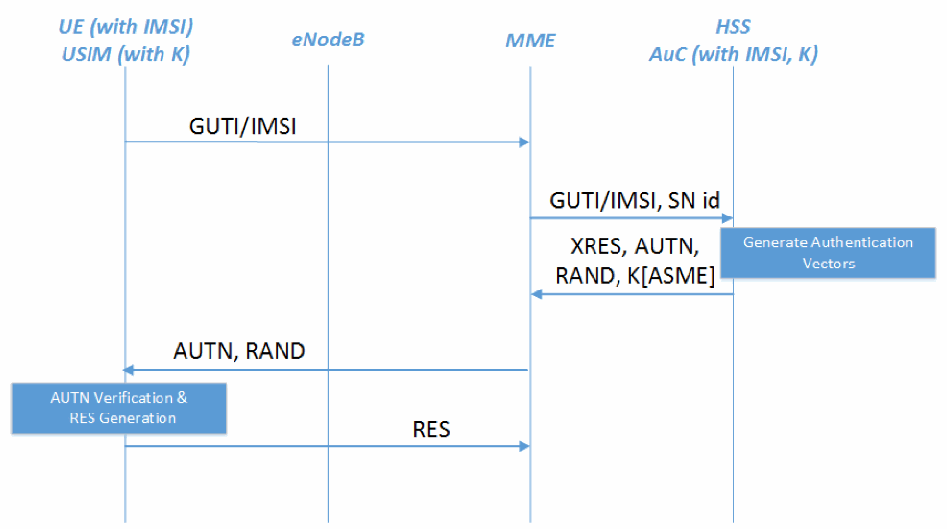
LTE AKA プロトコルの実行を示すシーケンス図です。縦の生存線で「UE (with IMSI) USIM (with K)」「eNodeB」「MME」「HSS AuC (with IMSI, K)」の4者を示します。1) UE が「GUTI/IMSI」を MME に送ります。2) MME が「GUTI/IMSI, SN id」を HSS に送ります。3) HSS が「Generate Authentication Vectors」(認証ベクトルの生成)を行い、「XRES, AUTN, RAND, K[ASME]」を MME に返します。4) MME が「AUTN, RAND」を UE に送ります。5) UE が「AUTN Verification & RES Generation」(AUTN の検証と RES の生成)を行い、「RES」を MME に送ります。eNodeB の生存線は UE と MME の間にあり、メッセージはその線を横切ります。
The authentication provided by LTE authenticates the UICC to the network. The capabilities of LTE do not support public safety’s need for user authentication as neither the user nor the UE are authenticated. To support user authentication, additions to the LTE family of standards or a separate authentication framework built on top of LTE would be required. The following provides additional context around the identifiers provided by LTE and their applicability to public safety.
LTE が提供する認証は、UICC をネットワークに対して認証します。LTE の能力は、ユーザーも UE も認証されないため、公共安全のユーザー認証のニーズをサポートしません。ユーザー認証をサポートするには、LTE 規格群への追加、または LTE の上に構築された別個の認証フレームワークが必要になります。以下では、LTE が提供する識別子と、その公共安全への適用可能性について、追加の文脈を示します。
When discussing authentication within the context of LTE, there are two distinct identifiers: the IMSI and the International Mobile Equipment Identifier (IMEI). As previously mentioned, the IMSI is the long-term identity that the carrier uses to identify a user. These identifiers typically consist of 15 digits, although they may be shorter. Since this identifier is stored on the UICC, and the UICC is removable, it is plausible that the UICC could be removed and used by another individual – making it unsuitable as a user identity in public safety scenarios.
LTE の文脈で認証を論じる際には、2 つの異なる識別子があります。IMSI と International Mobile Equipment Identifier(IMEI)です。前述のとおり、IMSI は、通信事業者がユーザーを識別するために使う長期のアイデンティティです。これらの識別子は通常 15 桁ですが、それより短い場合もあります。この識別子は UICC に保存され、UICC は取り外し可能であるため、UICC が取り外されて別の個人に使われる可能性があり、公共安全のシナリオでのユーザーのアイデンティティとしては不適切です。
The IMEI number is used to identify a specific mobile device to the network and is stored on a mobile device’s internal flash memory, although it may also be stored on the UICC. These identifiers typically consist of 15 digits, although they may be shorter. Since this identity is stored in flash memory, it is modifiable by a user, although it is illegal to alter the IMEI in some countries. IMEIs are often used by telecommunications carriers to prevent a handset from connecting to their networks, a process commonly referred to as “blacklisting.” Blacklisting helps to prevent stolen phones from being used on a cellular network. Due to the lack of a long-term integrity guarantee, it is unwise to use the IMEI in critical security decisions. Additionally, there is no relationship between an IMEI and a user, making the IMEI unsuitable as a user identity in public safety scenarios. The IMEI may be useful in non-security critical situations as a weak device identity.
IMEI 番号は、特定のモバイルデバイスをネットワークに対して識別するために使われ、モバイルデバイスの内部フラッシュメモリに保存されますが、UICC に保存される場合もあります。これらの識別子は通常 15 桁ですが、それより短い場合もあります。このアイデンティティはフラッシュメモリに保存されるため、ユーザーが変更できますが、一部の国では IMEI を改変することは違法です。IMEI は、通信事業者が、端末が自社のネットワークに接続するのを防ぐためによく使われ、このプロセスは一般に「ブラックリスト化」と呼ばれます。ブラックリスト化は、盗難された電話機がセルラーネットワークで使われるのを防ぐのに役立ちます。長期の完全性の保証がないため、重要なセキュリティ判断に IMEI を使うことは賢明ではありません。さらに、IMEI とユーザーとの間には関係がないため、IMEI は公共安全のシナリオでのユーザーのアイデンティティとして不適切です。IMEI は、セキュリティ上重要でない状況で、弱いデバイスのアイデンティティとして有用な場合があります。