NIST IR 8074 Vol. 2 日本語訳
英語タイトル : Supplemental Information for the Interagency Report on Strategic U.S. Government Engagement in International Standardization to Achieve U.S. Objectives for Cybersecurity日本語タイトル : 米国のサイバーセキュリティ目標を達成するための国際標準化への米国政府の戦略的関与に関する省庁間報告書の補足情報
公開日 : 2015-12-23
原文URL : https://csrc.nist.gov/pubs/ir/8074/v2/final
翻訳編集 : 自動生成(有志による非公式の日本語訳), 原文取得日 : 2026-10-31, 訳文 : 648 / 649 ブロック
[要約] NIST IR 8074 Vol. 2 は、第 1 巻の戦略的目標と勧告を支える背景情報と分析を提供する補足の巻です。重要な国際サイバーセキュリティ標準化の進行中の活動を現状にもとづいて要約し、米国政府と米国民間部門の関与を一覧にしています。連邦機関やその他の利害関係者が、国際サイバーセキュリティ標準の策定と関連する適合性評価の活動に、より効果的に参加できるよう計画するための情報も提供します。サイバーセキュリティ標準と適合性評価が重要な理由、標準化の主要分野、標準開発組織(SDO)、IT 標準策定をめぐる課題、SDO への効果的な関与の方法などを取り上げます。
NISTIR 8074
Volume 2
NISTIR 8074
第 2 巻
Supplemental Information for the Interagency Report on Strategic U.S. Government Engagement in International Standardization to Achieve U.S. Objectives for Cybersecurity
米国のサイバーセキュリティ目標を達成するための国際標準化への米国政府の戦略的関与に関する省庁間報告書の補足情報
Prepared by the International Cybersecurity Standardization Working Group
of the National Security Council’s
Cyber Interagency Policy Committee
国家安全保障会議の
サイバー省庁間政策委員会の
国際サイバーセキュリティ標準化作業部会が作成
This publication is available free of charge from: http://dx.doi.org/10.6028/NIST.IR.8074v2
本刊行物は次から無料で入手できます: http://dx.doi.org/10.6028/NIST.IR.8074v2
NISTIR 8074
Volume 2
NISTIR 8074
第 2 巻
Supplemental Information for the Interagency Report on Strategic U.S. Government Engagement in International Standardization to Achieve U.S. Objectives for Cybersecurity
米国のサイバーセキュリティ目標を達成するための国際標準化への米国政府の戦略的関与に関する省庁間報告書の補足情報
Prepared by the International Cybersecurity Standardization Working Group
of the National Security Council’s
Cyber Interagency Policy Committee
国家安全保障会議の
サイバー省庁間政策委員会の
国際サイバーセキュリティ標準化作業部会が作成
NIST Editors:
Michael Hogan
Elaine Newton
Information Technology Laboratory
NIST 編集者:
Michael Hogan
Elaine Newton
情報技術研究所
This publication is available free of charge from: http://dx.doi.org/10.6028/NIST.IR.8074v2
本刊行物は次から無料で入手できます: http://dx.doi.org/10.6028/NIST.IR.8074v2
December 2015
2015 年 12 月
U.S. Department of Commerce
Penny Pritzker, Secretary
米国商務省
Penny Pritzker 長官
National Institute of Standards and Technology
Willie May, Under Secretary of Commerce for Standards and Technology and Director
米国国立標準技術研究所
Willie May、NIST 所長兼商務次官(標準・技術担当)
National Institute of Standards and Technology Interagency Report 8074 Volume 2
79 pages (December 2015)
米国国立標準技術研究所 省庁間報告書 8074 第 2 巻
79 ページ(2015 年 12 月)
This publication is available free of charge from: http://dx.doi.org/10.6028/NIST.IR.8074v2
本刊行物は次から無料で入手できます: http://dx.doi.org/10.6028/NIST.IR.8074v2
DISCLAIMER
免責事項
Certain commercial entities may be identified in this document in order to describe a concept adequately. Such identification is not intended to imply recommendation or endorsement by NIST, nor is it intended to imply that the entities are necessarily the best available for the purpose.
本文書では、概念を適切に説明するために、特定の営利団体を挙げることがあります。そのような記載は、NIST による推奨または推薦を意味するものではなく、当該団体がその目的に必ずしも最適であることを意味するものでもありません。
Reports on Computer Systems Technology
コンピュータシステム技術に関する報告書
The Information Technology Laboratory (ITL) at the National Institute of Standards and Technology (NIST) promotes the U.S. economy and public welfare by providing technical leadership for the Nation’s measurement and standards infrastructure. ITL develops tests, test methods, reference data, proof of concept implementations, and technical analyses to advance the development and productive use of information technology. ITL’s responsibilities include the development of management, administrative, technical, and physical standards and guidelines for the cost-effective security and privacy of other than national security-related information in Federal information systems.
米国国立標準技術研究所(NIST)の情報技術研究所(ITL)は、国の計測・標準インフラストラクチャに対して技術面でのリーダーシップを提供することにより、米国の経済と公共の福祉を促進しています。ITL は、情報技術の開発と生産的な利用を進めるため、テスト、テスト方法、参照データ、概念実証の実装、および技術分析を開発しています。ITL の責務には、連邦情報システムにおける、国家安全保障関連以外の情報のセキュリティとプライバシーを費用対効果の高い形で実現するための、管理面、運用管理面、技術面、物理面の標準およびガイドラインの策定が含まれます。
Abstract
概要
This report provides background information and analysis in support of NISTIR 8074 Volume 1, Report on Strategic U.S. Government Engagement in International Standardization to Achieve U.S. Objectives for Cybersecurity. It provides a current summary of ongoing activities in critical international cybersecurity standardization and an inventory of U.S. Government and U.S. private sector engagement. It also provides information for federal agencies and other stakeholders to help plan more effective participation in international cybersecurity standards development and related conformity assessment activities.
本報告書は、NISTIR 8074 Volume 1, Report on Strategic U.S. Government Engagement in International Standardization to Achieve U.S. Objectives for Cybersecurity を支える背景情報と分析を提供します。重要な国際サイバーセキュリティ標準化で進行中の活動の最新の概要と、米国政府および米国民間部門の関与の一覧を示します。また、連邦機関およびその他の利害関係者が、国際サイバーセキュリティ標準の開発と関連する適合性評価活動への、より効果的な参加を計画するための情報も提供します。
Keywords
キーワード
conformity assessment; coordination; cybersecurity; ICS; Industrial Control Systems; international standards; IT; information technology; privacy; standards education; strategy; SDO; standards developing organizations; standards development
conformity assessment; coordination; cybersecurity; ICS; Industrial Control Systems; international standards; IT; information technology; privacy; standards education; strategy; SDO; standards developing organizations; standards development
Foreword
まえがき
NISTIR 8074 Volume 2 provides background information and analysis in support of NISTIR 8074 Volume 1, Interagency Report on Strategic U.S. Government Engagement in International Standardization to Achieve U.S. Objectives for Cybersecurity. It provides a current summary of ongoing activities in critical international cybersecurity standardization. It also provides information for Federal agencies and other stakeholders to help plan more effective participation in international cybersecurity standards development and related conformity assessment activities.
NISTIR 8074 Volume 2 は、NISTIR 8074 Volume 1, Interagency Report on Strategic U.S. Government Engagement in International Standardization to Achieve U.S. Objectives for Cybersecurity を支える背景情報と分析を提供します。重要な国際サイバーセキュリティ標準化で進行中の活動の最新の概要を示します。また、連邦機関およびその他の利害関係者が、国際サイバーセキュリティ標準の開発と関連する適合性評価活動への、より効果的な参加を計画するための情報も提供します。
Table of Contents
目次
Supplemental Information for the Interagency Report on Strategic U.S. Government Engagement in International Standardization to Achieve U.S. Objectives for Cybersecurity
米国のサイバーセキュリティ目標を達成するための国際標準化への米国政府の戦略的関与に関する省庁間報告書の補足情報
Introduction
はじめに
NISTIR 8074 Volumes 1 and 2 were drafted by the National Security Council (NSC) Cyber Interagency Policy Committee’s (IPC’s) International Cybersecurity Standardization Working Group. Volume 2 provides additional information that supports the strategic objectives and recommendations in NISTIR 8074 Volume 1, Interagency Report on Strategic U.S. Government Engagement in International Standardization to Achieve U.S. Objectives for Cybersecurity.
NISTIR 8074 の第 1 巻と第 2 巻は、国家安全保障会議(NSC)のサイバー省庁間政策委員会(IPC)の国際サイバーセキュリティ標準化作業部会が起草しました。第 2 巻は、NISTIR 8074 Volume 1, Interagency Report on Strategic U.S. Government Engagement in International Standardization to Achieve U.S. Objectives for Cybersecurity の戦略目標と勧告を裏付ける追加情報を提供します。
Use of cybersecurity standards for information technologies (IT) and industrial control systems (ICS) are necessary for the cybersecurity and resiliency of all U.S. information and communications systems and supporting infrastructures. Widespread awareness of the topics covered in this document will inform U.S. policymakers, enhance the effectiveness of standards engagement by agency cybersecurity standards participants and their management, and support cooperative activities between and among agencies, with other governments and the private sector. Such topics include: the nature of international standards development and types of conformity assessment; the role of international cybersecurity standards and conformity assessment in enhancing security and promoting commerce; an inventory of critical cybersecurity standards developing organizations (SDOs) and the status of cybersecurity standards in core areas; ongoing issues in IT standardization; and general principles for effective participation in standards development, including in situations where accelerating standards development is desirable.
情報技術(IT)および産業用制御システム(ICS)のためのサイバーセキュリティ標準の利用は、米国のすべての情報通信システムおよびそれを支えるインフラストラクチャのサイバーセキュリティとレジリエンスにとって必要です。本文書で扱う話題が広く認識されることは、米国の政策立案者に情報を提供し、機関のサイバーセキュリティ標準参加者とその管理者による標準への関与の有効性を高め、機関間、他国政府との間、および民間部門との協力活動を支えます。これらの話題には、国際標準開発の性質と適合性評価の種類、セキュリティの強化と商取引の促進における国際サイバーセキュリティ標準と適合性評価の役割、重要なサイバーセキュリティ標準開発組織(SDO)の一覧と中核分野におけるサイバーセキュリティ標準の状況、IT 標準化における継続的な課題、そして、標準開発の加速が望ましい状況を含め、標準開発への効果的な参加に関する一般原則が含まれます。
This document does not attempt to establish authoritative definitions for key terms, some of which have been defined more than once by other bodies. For purposes of this document, working definitions for key terms are found in Annex A.
本文書は、重要な用語について権威ある定義を確立しようとするものではなく、そのうちいくつかは他の団体によって複数回定義されています。本文書で使用する重要な用語の作業用定義は附属書 A に記載しています。
Conformity assessment, which determines whether a product, process, system, person or body has fulfilled specified requirements, is discussed within the body of this document and explained in more depth in Annex B.
適合性評価は、製品、プロセス、システム、人、または団体が規定された要件を満たしているかどうかを判断するものであり、本文書の本文で論じるとともに、附属書 B でより詳しく説明しています。
In support of the document’s analysis of the status of cybersecurity standardization for critically important IT applications, Annex C lists U.S. Government (USG) mandates relating to cybersecurity, and Annex D provides cybersecurity analyses for some key and emerging application areas.
極めて重要な IT アプリケーションに関するサイバーセキュリティ標準化の状況についての本文書の分析を裏付けるため、附属書 C は、サイバーセキュリティに関連する米国政府(USG)の義務付けを列挙し、附属書 D は、主要かつ新興のいくつかのアプリケーション分野についてのサイバーセキュリティ分析を提供します。
This document does not address USG use of these standards in regulation, procurement, or other mission-related activities. That topic is covered by OMB Circular A-119.
本文書は、規制、調達、その他の任務に関連する活動における、米国政府によるこれらの標準の使用は扱いません。その話題は OMB Circular A-119 で扱われています。
1 Why are cybersecurity standards critical?
1 サイバーセキュリティ標準が重要な理由
“America’s economic prosperity, national security, and our individual liberties depend on our commitment to securing cyberspace and maintaining an open, interoperable, secure, and reliable Internet. Our critical infrastructure continues to be at risk from threats in cyberspace, and our economy is harmed by the theft of our intellectual property. Although the threats are serious and they constantly evolve, I believe that if we address them effectively, we can ensure that the Internet remains an engine for economic growth and a platform for the free exchange of ideas.”1
「米国の経済的繁栄、国家安全保障、そして個人の自由は、サイバー空間の安全を確保し、開かれた、相互運用可能で、安全かつ信頼できるインターネットを維持するというわれわれの決意にかかっています。われわれの重要インフラストラクチャは、サイバー空間における脅威によって依然としてリスクにさらされており、われわれの経済は知的財産の窃取によって害を受けています。脅威は深刻であり、絶えず進化していますが、それらに効果的に対処すれば、インターネットが経済成長の原動力であり続け、自由な意見交換の場であり続けることができると私は信じています。」1
With the convergence and connectivity of IT, the deployment of cybersecurity standards-based products, processes, and services is essential. Establishment and use of international cybersecurity standards are essential for: ensuring the integrity and reliable operation of critical infrastructure, improving trust in online transactions, mitigating the effects of cyber incidents (e.g., crime), and ensuring secure interoperability among trade, law enforcement, and military partners, thereby facilitating increased efficiencies in the global economy. Such standards are especially important in the interconnected world where products, processes, and services are developed and delivered throughout global supply chains that provide acquirers little transparency into supplier practices beyond the prime contractor. A recent report on the economic costs of cybercrime stated:
IT の収束と接続性が進むなかで、サイバーセキュリティ標準に基づく製品、プロセス、サービスの展開は不可欠です。サイバーセキュリティに関する国際標準の確立と利用は、重要インフラストラクチャの完全性と信頼できる運用の確保、オンライン取引に対する信頼の向上、サイバーインシデント(例: 犯罪)の影響の緩和、通商、法執行、軍事のパートナー間の安全な相互運用性の確保、ひいてはグローバル経済における効率の向上の促進のために不可欠です。このような標準は、製品、プロセス、サービスがグローバルなサプライチェーンを通じて開発され提供され、調達者が元請業者を超えた供給者の慣行をほとんど把握できない、相互接続された世界で、特に重要です。サイバー犯罪の経済的コストに関する最近の報告書は、次のように述べています。
Cybercrime is a growth industry. The returns are great, and the risks are low. We estimate that the likely annual cost to the global economy from cybercrime is more than $400 billion. A conservative estimate would be $375 billion in losses, while the maximum could be as much as $575 billion. Even the smallest of these figures is more than the national income of most countries and governments and companies underestimate how much risk they face from cybercrime and how quickly this risk can grow.2
サイバー犯罪は成長産業です。見返りは大きく、リスクは低いです。サイバー犯罪によるグローバル経済への年間コストは、4,000 億ドルを超える可能性が高いと推定されます。控えめな推定では損失は 3,750 億ドルであり、最大で 5,750 億ドルに達する可能性があります。これらの数字のうち最小のものでさえ、ほとんどの国の国民所得を上回っており、政府や企業は、サイバー犯罪によって直面するリスクの大きさと、そのリスクがどれほど急速に拡大しうるかを過小評価しています。2
International standardization can also be used as a competitive tool. Firms often have well-defined strategies for standards development, including management of intellectual property rights, aimed at achieving that advantage. Advantage can be gained by influencing the development of a standard. In some cases, firms can gain a competitive advantage by being first to market with a standards-based product, process, or service.
国際標準化は、競争のための手段としても用いることができます。企業は、その優位性を得ることを目的として、知的財産権の管理を含む、標準開発のための明確な戦略を持っていることがよくあります。標準の策定に影響を与えることで、優位性を得ることができます。場合によっては、標準に基づく製品、プロセス、サービスをいち早く市場に投入することで、競争上の優位性を得ることができます。
Finally, federal agencies rely heavily on voluntary consensus standards—including international standards—which they often incorporate into regulatory and procurement requirements or use in support of other mission-related activities. Occasionally, standards-related measures are used by countries to protect domestic producers or provide a competitive advantage, or such measures can distort trade for other reasons as well. The World Trade Organization (WTO) Agreement, including the WTO Agreement on Technical Barriers to Trade (TBT Agreement), and other trade agreements establish rules governing the use of standards-related measures by governments to ensure that such measures are not used in a manner that discriminates against foreign products or otherwise creates unnecessary obstacles to trade.
最後に、連邦機関は自主的なコンセンサス標準(国際標準を含む)に大きく依存しており、それらを規制要件や調達要件に取り入れたり、その他の任務に関連する活動を支えるために使用したりすることがよくあります。標準に関連する措置は、国内の生産者を保護したり、競争上の優位性を与えたりするために各国が用いることがあり、また、それ以外の理由でも貿易を歪める可能性があります。貿易の技術的障害に関する WTO 協定(TBT 協定)を含む世界貿易機関(WTO)協定およびその他の貿易協定は、そのような措置が外国製品を差別する形で用いられたり、貿易に不必要な障害を生じさせたりすることがないようにするため、政府による標準関連措置の使用を規律する規則を定めています。
2 Why is conformity assessment for cybersecurity standards important?
2 サイバーセキュリティ標準の適合性評価が重要な理由
“When you can measure what you are speaking about and express it in numbers, you know something about it; but when you cannot measure, when you cannot express it in numbers, your knowledge is of a meager and unsatisfactory kind; it may be the beginning of knowledge, but you have scarcely, in your thoughts, advanced to the stage of science.”3
「あなたが語っていることを測定でき、それを数値で表現できるとき、あなたはそれについて何かを知っています。しかし、測定できないとき、数値で表現できないとき、あなたの知識は乏しく不十分なものです。それは知識の始まりかもしれませんが、あなたの思考は、科学の段階にはほとんど進んでいません。」3
When protecting sensitive information, industrial control systems, and networks, government agencies need to have a minimum level of assurance that a stated security claim is valid. Conformity assessment is activity that provides a demonstration that specified requirements relating to a product, process, system, person or body are fulfilled. Conformity assessment activities can be performed by many types of organizations or individuals. Conformity assessment can be conducted by: (1) a first party, which is generally the supplier or manufacturer; (2) a second party, which is generally the purchaser or user of the product; (3) a third party, which is an independent entity that is generally distinct from the first or second party and has no interest in transactions between the two parties; and (4) the government, which has a unique role in conformity assessment activities related to regulatory requirements. See Annex B for an overview.
機微な情報、産業用制御システム、ネットワークを保護するにあたり、政府機関は、述べられたセキュリティ上の主張が有効であることについて、最低限の保証を持つ必要があります。適合性評価とは、製品、プロセス、システム、人、または団体に関する規定された要件が満たされていることを実証する活動です。適合性評価の活動は、さまざまな種類の組織または個人が実施できます。適合性評価を実施できるのは、(1) 一般に供給者または製造者である第一者、(2) 一般に製品の購入者または利用者である第二者、(3) 一般に第一者または第二者とは別個の独立した主体で、両者間の取引に利害関係を持たない第三者、(4) 規制要件に関連する適合性評価の活動において固有の役割を持つ政府です。概要は附属書 B を参照してください。
In the field of IT, testing is often the most rigorous way to determine if a product, process, or service has fulfilled all of the requirements. An example is the USG requirement of using tested and validated cryptographic modules.4
IT の分野では、製品、プロセス、またはサービスがすべての要件を満たしているかどうかを判断するうえで、テストが最も厳格な方法であることがよくあります。一例は、テストされ検証された暗号モジュールを使用するという米国政府の要件です。4
A user’s (e.g., a regulator) confidence in test results may be influenced by the level of independence of the testing body (e.g., first, second, or third party) and/or recognition by an accrediting body. This in turn directly relates to the risk associated with product, process, or service non-conformance. For IT, four important types of conformity assessment-related testing are: conformance, performance, stress, and interoperability testing.
利用者(例: 規制当局)のテスト結果に対する信頼は、テスト機関の独立性のレベル(例: 第一者、第二者、第三者)、認定機関による承認、またはその両方に左右される場合があります。これは、製品、プロセス、またはサービスの不適合に伴うリスクに直接関係します。IT における適合性評価に関連するテストの重要な種類は 4 つあり、適合性テスト、性能テスト、ストレステスト、相互運用性テストです。
•Conformance testing captures the technical description of the requirements in a standard and measures whether an implementation (product, process, or service) faithfully fulfills these requirements. Conformance testing does not completely ensure the interoperability or performance of conforming products, processes, or services. Therefore, interoperability and performance testing are also important aspects for procurements.
•適合性テストは、標準に含まれる要件の技術的な記述を把握し、実装(製品、プロセス、またはサービス)がこれらの要件を忠実に満たしているかどうかを測定します。適合性テストだけでは、適合する製品、プロセス、またはサービスの相互運用性や性能を完全に保証することはできません。そのため、相互運用性テストと性能テストも、調達にとって重要な側面です。
•Performance testing measures the performance characteristics of an implementation, such as its throughput or responsiveness, under various conditions.
•性能テストは、さまざまな条件下での、スループットや応答性など、実装の性能特性を測定します。
•Stress testing involves scaling up the load on an implementation and then measuring performance as the load increases.
•ストレステストは、実装にかかる負荷を拡大し、負荷が増加するにつれて性能を測定します。
•Interoperability testing tests one implementation with another to establish that they can work together properly.
•相互運用性テストは、ある実装を別の実装と組み合わせてテストし、それらが適切に連携できることを確認します。
Testing, and ensuring the competence of bodies that conduct the testing, is as much of a market driver as the specific standard itself. In support of international trade, the TBT Agreement encourages mutual acceptance of test results of conformity assessment procedures and the use of international systems of conformity assessment.
テストと、テストを実施する機関の能力の確保は、特定の標準そのものと同程度に、市場を動かす要因となります。国際貿易を支えるため、TBT 協定は、適合性評価手続のテスト結果の相互受け入れと、国際的な適合性評価システムの使用を奨励しています。
Other types of conformity assessment are often used to ensure that products, processes, or services comply with regulations or voluntary consensus standards. These include: tests of components, certification of test results, and accreditation methods that assess the competence of testing, certification, and inspection bodies. Using commercial testing bodies known to be competent for specific testing areas can be more cost effective for federal agencies than developing USG testing expertise.
そのほかの種類の適合性評価も、製品、プロセス、またはサービスが規制や自主的なコンセンサス標準に準拠していることを確実にするために、しばしば用いられます。これには、構成要素のテスト、テスト結果の認証、テスト機関、認証機関、検査機関の能力を評価する認定の方法が含まれます。特定のテスト分野で能力があることが知られている民間のテスト機関を利用することは、連邦機関にとって、米国政府のテストの専門知識を整備するよりも費用対効果が高い場合があります。
3 Core Areas in Cybersecurity Standardization
3 サイバーセキュリティ標準化の中核分野
Core areas are key attributes of cybersecurity that broadly impact the overall cybersecurity of IT products, processes, and services. The NSC Cyber IPC’s International Cybersecurity Standardization Working Group reviewed the areas of cybersecurity standardization presently underway in many SDOs to determine a taxonomy. This taxonomy represents important areas of cybersecurity standardization. It is not all inclusive and could certainly evolve over time but it is considered sufficient for this analysis of the state of cybersecurity standardization. These core areas may also be interdependent. For instance, Security Automation and Continuous Monitoring is important for describing various aspects of how to support Cyber Incident Management, Information Security Management System, and Network Security.
中核分野とは、IT の製品、プロセス、サービスの全体的なサイバーセキュリティに広く影響を与える、サイバーセキュリティの主要な属性です。NSC サイバー IPC の国際サイバーセキュリティ標準化作業部会は、分類体系を定めるため、現在多くの SDO で進められているサイバーセキュリティ標準化の分野を検討しました。この分類体系は、サイバーセキュリティ標準化の重要な分野を表しています。すべてを網羅しているわけではなく、時間の経過とともに進化する可能性が十分にありますが、サイバーセキュリティ標準化の状況に関する本分析には十分であると考えられます。これらの中核分野は、相互に依存していることもあります。たとえば、セキュリティ自動化および継続的監視は、サイバーインシデント管理、情報セキュリティマネジメントシステム、ネットワークセキュリティをどのように支援するかについてのさまざまな側面を記述するうえで重要です。
The core areas of cybersecurity standardization include:
サイバーセキュリティ標準化の中核分野には、次のものがあります。
Cryptographic Techniques and mechanisms and their associated standards are used to provide: confidentiality; entity authentication; non-repudiation; key management; data integrity; trust worthy data platforms; message authentication; and digital signatures.
暗号技術(Cryptographic Techniques)とそのメカニズム、およびそれらに関連する標準は、機密性、エンティティ認証、否認防止、鍵管理、データの完全性、信頼できるデータプラットフォーム、メッセージ認証、電子署名を提供するために使用されます。
Cyber Incident Management standards support information sharing processes, products, and technology implementations for cyber incident identification, handling, and remediation. Such standards enable organizations to identify when a cyber incident has occurred, to properly respond to that incident and recover from any losses as a result of the incident. Such standards are one method to enable jurisdictions to exchange information about incidents, vulnerabilities, threats and attacks, the system(s) that were exploited, security configurations and weaknesses that could be exploited, etc.
サイバーインシデント管理(Cyber Incident Management)の標準は、サイバーインシデントの特定、対処、修復のための、情報共有のプロセス、製品、技術実装を支援します。このような標準により、組織は、サイバーインシデントがいつ発生したかを特定し、そのインシデントに適切に対応し、インシデントの結果として生じた損失から復旧できるようになります。このような標準は、管轄区域間で、インシデント、脆弱性、脅威、攻撃、悪用されたシステム、悪用される可能性のあるセキュリティ構成や弱点などに関する情報を交換できるようにするための方法の 1 つです。
Identity and Access Management and related standards enable the use of secure, interoperable digital identities and attributes of entities to be used across security domains and organizational boundaries. Examples of entities include people, places, organizations, hardware devices, software applications, information artifacts, and physical items. Standards for identity and access management support identification, authentication, authorization, privilege assignment, and audit to ensure that entities have appropriate access to information, services, and assets. In addition, many identity and access management standards include privacy features to maintain anonymity, unlinkability, untraceability, ensure data minimization, and require explicit user consent when attribute information may be shared among entities.
ID およびアクセス管理(Identity and Access Management)と関連する標準により、エンティティの安全で相互運用可能なデジタル ID と属性を、セキュリティドメインおよび組織の境界を越えて使用できるようになります。エンティティの例には、人、場所、組織、ハードウェアデバイス、ソフトウェアアプリケーション、情報成果物、物理的な物品があります。ID およびアクセス管理の標準は、エンティティが情報、サービス、資産に適切にアクセスできるようにするため、識別、認証、認可、権限の割り当て、監査を支援します。さらに、ID およびアクセス管理の標準の多くは、属性情報がエンティティ間で共有される可能性がある場合に、匿名性、連結不能性、追跡不能性を維持し、データ最小化を実現し、ユーザーの明示的な同意を求める、プライバシー機能を含んでいます。
Information Security Management System (ISMS) standards provide a set of processes and corresponding security controls to establish a governance, risk, and compliance structure for information security for an organization, an organizational unit, or a set of processes controlled by a single organizational entity. An ISMS requires a risk-based approach to security that involves selecting specific security controls based on the desired risk posture of the organization and requires measuring effectiveness of security processes and controls. An ISMS requires a cycle of continual improvement for an organization to continue assessing security risks, assessing controls, and improving security to remain within risk tolerance levels by balancing security and risk tolerances.
情報セキュリティマネジメントシステム(Information Security Management System: ISMS)の標準は、組織、組織単位、または単一の組織主体が管理する一連のプロセスについて、情報セキュリティのためのガバナンス、リスク、コンプライアンスの構造を確立するための、一連のプロセスとそれに対応するセキュリティ管理策を提供します。ISMS は、組織が望むリスク態勢に基づいて特定のセキュリティ管理策を選択するリスクベースのセキュリティアプローチを必要とし、セキュリティのプロセスと管理策の有効性の測定も必要とします。ISMS は、組織がセキュリティリスクと管理策を継続的に評価し、セキュリティを改善し続け、セキュリティとリスク許容度のバランスをとることで、リスク許容度の範囲内にとどまるための継続的改善サイクルを必要とします。
IT System Security Evaluation and assurance standards are used to provide: security assessment of operational systems; security requirements for cryptographic modules; security tests for cryptographic modules; automated security checklists; and security metrics.
IT システムのセキュリティ評価(IT System Security Evaluation)および保証の標準は、運用システムのセキュリティアセスメント、暗号モジュールのセキュリティ要件、暗号モジュールのセキュリティテスト、自動化されたセキュリティチェックリスト、セキュリティメトリクスを提供するために使用されます。
Network Security standards provide security requirements and guidelines on processes and methods for the secure management, operation and use of information, information networks, and their inter-connections. Such standards-based technologies can help to assure the confidentiality and integrity of data in motion, assure electronic commerce, and provide for a robust, secure and stable network and internet.
ネットワークセキュリティ(Network Security)の標準は、情報、情報ネットワーク、およびそれらの相互接続の安全な管理、運用、利用のためのプロセスと方法について、セキュリティ要件とガイドラインを提供します。このような標準に基づく技術は、転送中のデータの機密性と完全性の保証、電子商取引の保証、堅牢で安全かつ安定したネットワークとインターネットの提供に役立ちます。
Security Automation and Continuous Monitoring (SACM) standards describe protocols and data formats that enable the ongoing, automated collection, monitoring, verification, and maintenance of software, system, and network security configurations, and provide greater awareness of vulnerabilities and threats to support organizational risk management decisions. Automation protocols also include standards for machine-readable vulnerability identification and metrics, platform and asset identification, actionable threat information and policy triggers for actions to respond to threats and policy violations. Automated activities would include a Security Operation Center (SOC) to ensure autonomous and continuing monitoring and evolution of the security state of assets based upon prescribed events.
セキュリティ自動化および継続的監視(Security Automation and Continuous Monitoring: SACM)の標準は、ソフトウェア、システム、ネットワークのセキュリティ構成を、継続的かつ自動的に収集、監視、検証、維持できるようにするプロトコルとデータ形式を記述し、組織のリスク管理上の意思決定を支えるため、脆弱性と脅威に対するより高い認識を提供します。自動化プロトコルには、機械可読な脆弱性の識別とメトリクス、プラットフォームと資産の識別、実行可能な脅威情報、脅威やポリシー違反に対応する行動のためのポリシートリガーに関する標準も含まれます。自動化される活動には、規定された事象に基づいて資産のセキュリティ状態を自律的かつ継続的に監視し進化させることを確実にする、セキュリティオペレーションセンター(SOC)が含まれます。
Supply Chain Risk Management (SCRM) standards provide the confidence that organizations will produce and deliver information technology products or services that perform as required and mitigate supply chain-related risks, such as the insertion of counterfeits and malicious software, unauthorized production, tampering, theft, and poor quality products and services. IT SCRM standardization requirements include methodologies and processes that enable an organization’s increased visibility into, and understanding of, how technology that they acquire and manage is developed, integrated, and deployed, as well as the processes, procedures, and practices used to assure the integrity, security, resilience, and quality of the products and services. IT SCRM standardization lies at the intersection of cybersecurity and supply chain management and provides a mix of mitigation strategies from both disciplines for a targeted approach to managing IT supply chain risks.
サプライチェーンのリスク管理(Supply Chain Risk Management: SCRM)の標準は、組織が要求どおりに機能する情報技術製品またはサービスを生産し提供し、偽造品や悪意のあるソフトウェアの混入、無許可の生産、改ざん、窃取、低品質の製品やサービスなどのサプライチェーン関連リスクを緩和するという確信を与えます。IT SCRM の標準化要件には、組織が取得し管理する技術の開発、統合、展開の方法について組織の可視性と理解を高める方法論とプロセスに加え、製品およびサービスの完全性、セキュリティ、レジリエンス、品質を保証するためのプロセス、手順、実践が含まれます。IT SCRM の標準化は、サイバーセキュリティとサプライチェーン管理の交差点にあり、IT サプライチェーンリスクを管理するための的を絞ったアプローチとして、両分野の緩和戦略を組み合わせて提供します。
Software Assurance standards describe requirements and guidance for significantly decreasing the likelihood of software having vulnerabilities, either intentionally designed into the software or accidentally inserted at any time during its life cycle, and that the software functions in the intended manner. This includes custom software, commercial off-the-shelf software, firmware, operating systems, utilities, databases, applications and applets for the Web, software/platform/infrastructure as a service (SaaS, PaaS, IaaS), mobile and consumer devices, etc.
ソフトウェア保証(Software Assurance)の標準は、ソフトウェアが、意図的に設計に組み込まれたものであれ、ライフサイクルのいつかの時点で偶発的に混入したものであれ、脆弱性を持つ可能性を大幅に低減し、ソフトウェアが意図された方法で機能することを確実にするための要件とガイダンスを記述します。これには、カスタムソフトウェア、市販のオフザシェルフソフトウェア、ファームウェア、オペレーティングシステム、ユーティリティ、データベース、Web 向けのアプリケーションとアプレット、サービスとしてのソフトウェア/プラットフォーム/インフラストラクチャ(SaaS、PaaS、IaaS)、モバイルデバイスや消費者向けデバイスなどが含まれます。
System Security Engineering standards describe planning and design activities to meet security specifications or requirements for the purpose of reducing system susceptibility to threats, increasing system resilience, and enforcing organizational security policy. A comprehensive system security engineering effort: includes a combination of technical and nontechnical activities; ensures all relevant stakeholders are included in security requirements definition activities; ensures that security requirements are planned, designed, and implemented into a system during all phases of its lifecycle; assesses and understands susceptibility to threats in the projected or actual environment of operation; identifies and assesses vulnerabilities in the system and its environment of operation; identifies, specifies, designs, and develops protective measures to address system vulnerabilities; evaluates/assesses protective measures to ascertain their suitability, effectiveness and degree to which they can be expected to reduce mission/business risk; provides assurance evidence to substantiate the trustworthiness of protective measures; identifies quantifies, and evaluates the costs and benefits of protective measures to inform engineering trade-off and risk response decisions; and leverages multiple security focus areas to ensure that protective measures are appropriate, effective in combination, and interact properly with other system capabilities.
システムセキュリティエンジニアリング(System Security Engineering)の標準は、システムの脅威に対する感受性を低減し、システムのレジリエンスを高め、組織のセキュリティポリシーを徹底することを目的として、セキュリティ仕様または要件を満たすための計画および設計活動を記述します。包括的なシステムセキュリティエンジニアリングの取り組みには、技術的活動と非技術的活動の組み合わせを含めること、関連するすべての利害関係者をセキュリティ要件の定義活動に含めること、ライフサイクルのすべての段階でセキュリティ要件がシステムに計画、設計、実装されるようにすること、想定されるまたは実際の運用環境における脅威への感受性を評価して理解すること、システムとその運用環境における脆弱性を特定して評価すること、システムの脆弱性に対処する保護対策を特定、規定、設計、開発すること、保護対策の適切性、有効性、およびミッション/ビジネスリスクを低減すると期待できる度合いを確認するために保護対策を評価すること、保護対策の信頼性を裏付ける保証の証拠を提供すること、エンジニアリング上のトレードオフとリスク対応の意思決定に資するため保護対策のコストと便益を特定、定量化、評価すること、保護対策が適切で、組み合わせても有効であり、システムの他の機能と適切に相互作用するように複数のセキュリティ重点分野を活用することが含まれます。
4 Some Key IT Applications
4 主要な IT アプリケーションの例
IT applications are systems that support performing real-world tasks, which benefit organizations and people. Present USG priorities in IT applications are driven by agencies’ missions and specific legislative and policy mandates, which are listed in Annex C. Based upon the mandates listed in Annex C, some of the high priority IT applications for the USG are described below. A cybersecurity analysis of each of these IT application areas is contained in Annex D.
IT アプリケーションとは、組織と人々に利益をもたらす、実世界のタスクの実行を支えるシステムです。IT アプリケーションにおける現在の米国政府の優先事項は、各機関の任務と、附属書 C に列挙した特定の立法上および政策上の義務付けによって方向付けられています。附属書 C に列挙した義務付けに基づき、米国政府にとって優先度の高い IT アプリケーションのいくつかを以下に説明します。これらの IT アプリケーション分野それぞれのサイバーセキュリティ分析は、附属書 D に含まれています。
Cloud Computing: Cloud computing is a relatively new paradigm that changes the emphasis of the traditional IT services from procuring, maintaining, and operating the necessary hardware and related infrastructure to the business’ mission, and delivering value added capabilities and services at lower cost to users. Defined as a model for enabling convenient, on-demand network access to a shared pool of configurable computing resources (e.g., networks, servers, storage, applications, and services) that can be rapidly provisioned and released with minimal management effort or service provider interaction, cloud computing maximizes capacity utilization, improves IT flexibility and responsiveness, and minimizes cost of implementations and operations for all cloud-based information systems.
クラウドコンピューティング: クラウドコンピューティングは比較的新しいパラダイムであり、従来の IT サービスの重点を、必要なハードウェアと関連インフラストラクチャの調達、保守、運用から、事業の使命へと移し、ユーザーに付加価値のある能力とサービスをより低コストで提供するものです。クラウドコンピューティングは、最小限の管理労力またはサービスプロバイダーとのやり取りで迅速にプロビジョニングおよび解放できる、構成可能なコンピューティング資源(例: ネットワーク、サーバー、ストレージ、アプリケーション、サービス)の共有プールに便利にオンデマンドでネットワークアクセスできるようにするモデルと定義されています。これにより、容量の利用率が最大化され、IT の柔軟性と応答性が向上し、すべてのクラウドベース情報システムの実装コストと運用コストが最小限に抑えられます。
Emergency Management: The first responder community needs reliable, secure, and interoperable information and communications technology to protect the public during disasters and catastrophes. There is increasing convergence of the voice, data, and video information being exchanged to provide situational awareness in response to an event. For larger disasters and catastrophes, first responders from neighboring jurisdictions or inter-governmental jurisdictions (i.e., state or Federal) need to be integrated into the response, along with the information and communications technologies they use.
緊急事態管理: ファーストレスポンダーのコミュニティには、災害や大惨事の際に公衆を守るため、信頼でき、安全で、相互運用可能な情報通信技術が必要です。事象への対応における状況認識を提供するために交換される音声、データ、映像の情報は、ますます収束しつつあります。より大規模な災害や大惨事では、隣接する管轄区域や政府間の管轄区域(すなわち、州または連邦)のファーストレスポンダーを、その使用する情報通信技術とともに、対応に統合する必要があります。
Industrial Control Systems (ICS): ICS is a general term that encompasses several types of control systems, including supervisory control and data acquisition (SCADA) systems, distributed control systems (DCS), and other smaller control system configurations often found in the industrial control sectors. ICSs are used across the critical infrastructure and key resources (CIKR) sectors, including the electric, water, oil and gas, chemical, pharmaceutical, pulp and paper, food and beverage, and critical manufacturing (automotive, aerospace, and durable goods) industries.
産業用制御システム(ICS): ICS は、監視制御およびデータ収集(SCADA)システム、分散制御システム(DCS)、および産業用制御の部門でよく見られるその他のより小規模な制御システム構成を含む、数種類の制御システムを包括する一般的な用語です。ICS は、電力、水道、石油・ガス、化学、製薬、パルプ・製紙、食品・飲料、重要な製造業(自動車、航空宇宙、耐久財)の産業を含む、重要インフラストラクチャおよび主要資源(CIKR)の各部門で使用されています。
Health Information Technology (HIT): The use of information technology makes it possible for health care providers to better manage patient care through secure use and sharing of health information. HIT includes the use of electronic health records (EHRs) instead of paper medical records to maintain patient health information and to support and manage their clinical care. Secure and interoperable HIT provides for: seamless movement between health care providers without loss of information; instant access to medical histories at the point of care; fewer errors and redundant tests; more efficient and effective reporting, surveillance, and quality monitoring; and quick detection of adverse drug reactions and epidemics.
医療情報技術(HIT): 情報技術の利用により、医療提供者は医療情報を安全に利用し共有することで、患者のケアをより適切に管理できるようになります。HIT には、患者の健康情報を維持し、臨床ケアを支援・管理するため、紙の診療記録の代わりに電子カルテ(EHR)を使用することが含まれます。安全で相互運用可能な HIT により、次のことが可能になります。情報を失うことなく医療提供者間をシームレスに移動すること、診療の現場で病歴に即時にアクセスすること、誤りと重複した検査を減らすこと、より効率的で効果的な報告、サーベイランス、品質監視を行うこと、薬の有害反応や流行を迅速に検知すること。
Smart Grid: The electric power industry is undergoing grid modernization efforts to transform from a centralized, producer-controlled network to one that is a distributed and consumer-interactive grid that enables bidirectional flows of energy and uses two-way communication and control capabilities. The move to a smarter electric grid will provide new ways in which power can be generated, delivered and used that minimize environmental impacts, improve reliability and service, reduce costs and improve efficiency. Deployment of various Smart Grid elements, including smart sensors on distribution lines, smart meters in homes, and integration of widely dispersed sources of renewable energy, is already underway and further integrates the energy, IT and telecommunication sectors.
スマートグリッド: 電力業界は、集中型で生産者が管理するネットワークから、エネルギーの双方向の流れを可能にし、双方向の通信と制御の能力を用いる、分散型で消費者と相互作用するグリッドへと変革するため、グリッドの近代化に取り組んでいます。よりスマートな電力網への移行により、環境への影響を最小限に抑え、信頼性とサービスを向上させ、コストを削減し、効率を高める、電力の新たな生成、供給、利用の方法がもたらされます。配電線上のスマートセンサー、家庭内のスマートメーター、広く分散した再生可能エネルギー源の統合など、さまざまなスマートグリッドの要素の展開は既に進行しており、エネルギー、IT、電気通信の各部門をさらに統合しています。
Voting: The most familiar part of a voting system is the mechanism used to capture the citizenry’s choices or votes on ballots. In addition to the vote capture mechanism, a voting system includes voter registration databases and election management systems. Voter registration databases contain the list of citizens eligible to participate in a jurisdiction’s election. Voter registration databases populate poll books used at polling places to verify one’s eligibility to participate in an election and ensure they received the correct ballot style. The election management system is used to manage the definition of different ballot styles, configuration of the vote capture mechanism, collection and tallying of cast ballots, and creation of election reports and results.
投票: 投票システムの最もなじみ深い部分は、有権者の選択、すなわち投票を投票用紙に記録するために使用される仕組みです。投票システムには、投票記録の仕組みに加えて、有権者登録データベースと選挙管理システムが含まれます。有権者登録データベースには、管轄区域の選挙に参加する資格のある市民の一覧が含まれています。有権者登録データベースは、投票所で、選挙への参加資格を確認し、正しい投票用紙の様式を受け取ったことを確かめるために使用される、有権者名簿に情報を提供します。選挙管理システムは、さまざまな投票用紙の様式の定義、投票記録の仕組みの構成、投じられた投票用紙の収集と集計、選挙の報告書と結果の作成を管理するために使用されます。
5 Present State of International Cybersecurity Standardization
5 国際サイバーセキュリティ標準化の現状
The status of cybersecurity standards can be assessed by reviewing some key USG priority IT applications, which are described in Section 4 and Annex D with respect to the core areas of cybersecurity standardization that are described in Section 3.
サイバーセキュリティ標準の状況は、第 4 節と附属書 D で説明する米国政府の優先度の高い主要な IT アプリケーションのいくつかを、第 3 節で説明するサイバーセキュリティ標準化の中核分野に照らして検討することで、評価できます。
Table 1 below provides a snapshot of the present status of cybersecurity standards and their implementation by the marketplace. “Standards Mostly Available” indicates that SDO approved cybersecurity standards are for the most part available and that standards-based implementations are available. However, the availability of standards means that such standards require continuous maintenance and updating based upon feedback from testing and deployments of standards-based products, processes, and services, as well as improvements in technology and the exploitation of those improvements by our adversaries. “Some Standards Available” indicates that some standards exist and have standards-based implementations, but there may be a need for additional standards and/or revisions to existing standards in this area. “Standards Being Developed” indicates that needed SDO approved cybersecurity standards are still under development and that needed standards-based implementations are not yet available.
下の表 1 は、サイバーセキュリティ標準の現在の状況と、市場におけるその実装状況を示しています。「標準がほぼ利用可能(Standards Mostly Available)」は、SDO が承認したサイバーセキュリティ標準の大半が利用可能であり、標準に基づく実装も利用可能であることを示します。ただし、標準が利用可能であっても、標準に基づく製品、プロセス、サービスのテストや展開から得られるフィードバック、技術の向上、および敵対者によるその向上の悪用を踏まえ、標準を継続的に保守し更新する必要があります。「一部の標準が利用可能(Some Standards Available)」は、一部の標準が存在し、標準に基づく実装もあるものの、この分野では追加の標準、既存の標準の改訂、またはその両方が必要な場合があることを示します。「標準を策定中(Standards Being Developed)」は、必要な SDO 承認済みサイバーセキュリティ標準がまだ策定中であり、必要な標準に基づく実装がまだ利用できないことを示します。
“New Standards Needed” indicates that new cybersecurity standards development projects are starting to be considered by various SDOs. Where there are existing standards that are being implemented, it should be noted that these standards will also need to be maintained and replaced, particularly as new technologies evolve.
「新たな標準が必要(New Standards Needed)」は、新たなサイバーセキュリティ標準の策定プロジェクトが、さまざまな SDO で検討され始めていることを示します。実装が進められている既存の標準がある場合、特に新しい技術が進化するにつれて、それらの標準も保守され、置き換えられる必要があることに留意すべきです。
Cybersecurity standards include many standards that are much broader than cybersecurity but are very relevant to cybersecurity, as well as standards whose scopes are specific to one or more attributes of cybersecurity. It is important to highlight that there are a number of generic standards under development or in existence that are relevant to the core area rows and specific applications in the columns of Table 1 below. These standards may be revised or expanded to include cybersecurity information.
サイバーセキュリティ標準には、サイバーセキュリティよりはるかに広い範囲を扱うものの、サイバーセキュリティに非常に関連する多くの標準と、サイバーセキュリティの 1 つ以上の属性に特化した範囲を持つ標準が含まれます。下の表 1 の行にある中核分野と、列にある個別のアプリケーションに関連する、策定中または既存の汎用標準が数多くあることを強調しておくことが重要です。これらの標準は、サイバーセキュリティ情報を含めるように改訂または拡張される場合があります。
Four observations can be made on the overall status of ongoing cybersecurity standardization. First, robust standardization activities in the listed core areas of cybersecurity standardization are undoubtedly necessary for ensuring interoperability, security, usability, and resiliency. Second, as illustrated by the listed applications in Table 1, there is a mix of ongoing standardization and maintenance of existing standards that is necessary to sustain deployments of standards-based products, processes and services. Third, the standards produced by SDOs represent a point in time. They often need to evolve in a way that meets the challenges of the ever-changing threat landscape. Finally, while Table 1 is structured by applications, there are some cybersecurity standards that apply across the applications to the development and manufacturing of IT products (hardware and software), products that most if not all of these applications depend on.
進行中のサイバーセキュリティ標準化の全体的な状況について、4 つの観察を行うことができます。第一に、サイバーセキュリティ標準化の挙げられた中核分野における堅牢な標準化活動は、相互運用性、セキュリティ、ユーザビリティ、レジリエンスを確保するために間違いなく必要です。第二に、表 1 に挙げたアプリケーションが示すように、標準に基づく製品、プロセス、サービスの展開を維持するために必要な、進行中の標準化と既存の標準の保守が混在しています。第三に、SDO が作成する標準は、ある時点のものを表しています。標準は、絶えず変化する脅威の状況がもたらす課題に対応する形で進化する必要があることが多くあります。最後に、表 1 はアプリケーションごとに構成されていますが、これらのアプリケーションのすべてではないにしてもほとんどが依存する製品である IT 製品(ハードウェアとソフトウェア)の開発と製造について、アプリケーション全体に適用されるサイバーセキュリティ標準がいくつかあります。
Notes on Table 1 Status of Cybersecurity Standardization
表 1 の注記: サイバーセキュリティ標準化の状況
The ten listed core areas of cybersecurity standardization are important areas but are not all inclusive. An augmented taxonomy for core areas of cybersecurity standardization could be an area for further work. The six examples of key applications that depend upon cybersecurity are also not all inclusive. Many other applications could be added, such as automotive, financial services, mobile, and Internet of Things (IoT). However, the listed ten core areas and six examples of key applications are considered sufficient for the purposes of capturing a snapshot of the status of cybersecurity standardization.
挙げられた 10 のサイバーセキュリティ標準化の中核分野は重要な分野ですが、すべてを網羅しているわけではありません。サイバーセキュリティ標準化の中核分野について拡張された分類体系を整備することは、今後の作業の領域となりえます。サイバーセキュリティに依存する主要アプリケーションの 6 つの例も、すべてを網羅しているわけではありません。自動車、金融サービス、モバイル、モノのインターネット(IoT)など、ほかにも多くのアプリケーションを追加できます。しかし、挙げられた 10 の中核分野と 6 つの主要アプリケーションの例は、サイバーセキュリティ標準化の状況のスナップショットを捉えるという目的には十分であると考えられます。
Table 1: Status of Cybersecurity Standardization
表 1: サイバーセキュリティ標準化の状況
| Core Areas of Cybersecurity Standardization | Examples of Relevant SDOs | Examples of Some Key Applications | |||||
|---|---|---|---|---|---|---|---|
| Cloud Computing | Emergency Management | Industrial Control Systems | Health IT | Smart Grid | Voting | ||
| Cryptographic Techniques | IEEE ISO TC 68 ISO/IEC JTC 1 W3C | Standards Mostly Available | Some Standards Available | Some Standards Available | Some Standards Available | Some Standards Available | Some Standards Available |
| Cyber Incident Management | ISO/IEC JTC 1 ITU-T PCI | Some Standards Available | New Standards Needed | Some Standards Available | Some Standards Available | Some Standards Available | New Standards Needed |
| Identity and Access Management | FIDO Alliance IETF; OASIS OIDF ISO/IEC JTC 1 ITU-T; W3C | Standards Mostly Available | Standards Being Developed | New Standards Needed | Standards Being Developed | New Standards Needed | New Standards Needed |
| Information Security Management Systems | ATIS; IEC; ISA ISO/IEC JTC 1 ISO TC 223 OASIS The Open Group | Some Standards Available | New Standards Needed | Some Standards Available | Some Standards Available | New Standards Needed | New Standards Needed |
| IT System Security Evaluation | ISO/IEC JTC 1 The Open Group | Some Standards Available | Standards Mostly Available | Some Standards Available | Some Standards Available | Some Standards Available | Standards Mostly Available |
| Network Security | 3GPP; 3GPP; IEC IETF; IEEE ISO/IEC JTC 1 ITU-T The Open Group WiMAX Forum | Some Standards Available | Some Standards Available | Some Standards Available | Some Standards Available | Some Standards Available | Standards Mostly Available |
| Security Automation & Continuous Monitoring | IEEE; IETF ISO/IEC JTC 1 TCG The Open Group | Some Standards Available | Some Standards Available | New Standards Needed | Some Standards Available | New Standards Needed | New Standards Needed |
| Software Assurance | IEEE ISO/IEC JTC 1 OMG TCG The Open Group | Some Standards Available | Some Standards Available | Some Standards Available | Some Standards Available | Some Standards Available | Some Standards Available |
| Supply Chain Risk Management | IEEE ISO/IEC JTC 1 IEC TC 65 The Open Group | Some Standards Available | Some Standards Available | Some Standards Available | Some Standards Available | Some Standards Available | Some Standards Available |
| System Security Engineering | IEC; IEEE; ISA ISO/IEC JTC 1 SAE International The Open Group | Some Standards Available | Standards Mostly Available | Some Standards Available | Some Standards Available | Some Standards Available | Some Standards Available |
| サイバーセキュリティ標準化の中核分野 | 関連する SDO の例 | 主要アプリケーションの例 | |||||
|---|---|---|---|---|---|---|---|
| クラウドコンピューティング | 緊急事態管理 | 産業用制御システム | 医療 IT | スマートグリッド | 投票 | ||
| 暗号技術 | IEEE ISO TC 68 ISO/IEC JTC 1 W3C | 標準がほぼ利用可能 | 一部の標準が利用可能 | 一部の標準が利用可能 | 一部の標準が利用可能 | 一部の標準が利用可能 | 一部の標準が利用可能 |
| サイバーインシデント管理 | ISO/IEC JTC 1 ITU-T PCI | 一部の標準が利用可能 | 新たな標準が必要 | 一部の標準が利用可能 | 一部の標準が利用可能 | 一部の標準が利用可能 | 新たな標準が必要 |
| ID およびアクセス管理 | FIDO Alliance IETF; OASIS OIDF ISO/IEC JTC 1 ITU-T; W3C | 標準がほぼ利用可能 | 標準を策定中 | 新たな標準が必要 | 標準を策定中 | 新たな標準が必要 | 新たな標準が必要 |
| 情報セキュリティマネジメントシステム | ATIS; IEC; ISA ISO/IEC JTC 1 ISO TC 223 OASIS The Open Group | 一部の標準が利用可能 | 新たな標準が必要 | 一部の標準が利用可能 | 一部の標準が利用可能 | 新たな標準が必要 | 新たな標準が必要 |
| IT システムのセキュリティ評価 | ISO/IEC JTC 1 The Open Group | 一部の標準が利用可能 | 標準がほぼ利用可能 | 一部の標準が利用可能 | 一部の標準が利用可能 | 一部の標準が利用可能 | 標準がほぼ利用可能 |
| ネットワークセキュリティ | 3GPP; 3GPP; IEC IETF; IEEE ISO/IEC JTC 1 ITU-T The Open Group WiMAX Forum | 一部の標準が利用可能 | 一部の標準が利用可能 | 一部の標準が利用可能 | 一部の標準が利用可能 | 一部の標準が利用可能 | 標準がほぼ利用可能 |
| セキュリティ自動化および継続的監視 | IEEE; IETF ISO/IEC JTC 1 TCG The Open Group | 一部の標準が利用可能 | 一部の標準が利用可能 | 新たな標準が必要 | 一部の標準が利用可能 | 新たな標準が必要 | 新たな標準が必要 |
| ソフトウェア保証 | IEEE ISO/IEC JTC 1 OMG TCG The Open Group | 一部の標準が利用可能 | 一部の標準が利用可能 | 一部の標準が利用可能 | 一部の標準が利用可能 | 一部の標準が利用可能 | 一部の標準が利用可能 |
| サプライチェーンのリスク管理 | IEEE ISO/IEC JTC 1 IEC TC 65 The Open Group | 一部の標準が利用可能 | 一部の標準が利用可能 | 一部の標準が利用可能 | 一部の標準が利用可能 | 一部の標準が利用可能 | 一部の標準が利用可能 |
| システムセキュリティエンジニアリング | IEC; IEEE; ISA ISO/IEC JTC 1 SAE International The Open Group | 一部の標準が利用可能 | 標準がほぼ利用可能 | 一部の標準が利用可能 | 一部の標準が利用可能 | 一部の標準が利用可能 | 一部の標準が利用可能 |
Table 2 below provides a proposed classification system that the interagency can utilize for characterizing the maturity level of particular standards, which will help inform any discussions of prioritization and strategy. This table is not intended to show a sequential process. The Under Development, Reference Implementation, Testing, Commercial Availability and Market Acceptance levels may occur concurrently and iteratively.
下の表 2 は、省庁間が個々の標準の成熟度レベルを特徴付けるために利用できる分類体系の案を示しており、優先順位付けと戦略に関する議論に役立ちます。この表は、順次的なプロセスを示すことを意図したものではありません。策定中、参照実装、テスト、商用での利用可能性、市場での受容の各レベルは、同時に、また反復的に生じることがあります。
Note that some SDOs require two or more implementations before final approval of a standard. Such implementations may or may not be commercial products or services. In other cases, an SDO may be developing a standard while conforming commercial products or services are already being sold. Innovation in IT means that IT standards are constantly being developed, approved, and maintained. Revisions to previous editions of standards may or may not be backward-compatible. An SDO approved standard does not necessarily equate with success. Widespread market acceptance of an approved standard is the ultimate goal.
SDO によっては、標準の最終承認の前に 2 つ以上の実装を求めるものがあることに注意してください。そのような実装は、商用の製品やサービスである場合もそうでない場合もあります。それ以外の場合には、SDO が標準を策定している間に、その標準に適合する商用の製品やサービスが既に販売されていることもあります。IT におけるイノベーションは、IT 標準が絶えず策定され、承認され、保守されていることを意味します。標準の旧版に対する改訂には、後方互換性があるものとないものがあります。SDO が承認した標準が、必ずしも成功に等しいわけではありません。承認された標準が市場で広く受け入れられることが、最終的な目標です。
Table 2: An IT Standards Maturity Model
表 2: IT 標準の成熟度モデル
| Maturity Level | Definition |
|---|---|
| No Standard | SDOs have not initiated any standard development projects. |
| Under Development | SDOs have initiated standard development projects. Open source projects have been initiated. |
| Guidance Available | A company, government agency, or industry group document is available, indicating there may be sufficient understanding and content to use the document as a basis for a standard. |
| Approved Standard | SDO-approved standard is available to public. Some SDOs require multiple implementations before final designation as a “standard.” |
| Technically Stable | The standard is stable and its technical content is mature. No major revisions or amendments are in progress that will affect backward compatibility with the original standard. |
| Reference Implementation5 | Reference implementation is available. |
| Testing | Test tools are available. Testing and test reports are available. |
| Conformity Assessment6 | First, second, or third party assessment programs are available. |
| Commercial Availability | Several products/services from different vendors exist on the market to implement this standard. |
| Market Acceptance | Widespread use of technology within a particular industry. De facto or de jure market acceptance of standards-based products/services. |
| Sunset | Newer standards (revisions or replacements) are under development. |
| 成熟度レベル | 定義 |
|---|---|
| 標準なし | SDO が標準開発プロジェクトを開始していません。 |
| 策定中 | SDO が標準開発プロジェクトを開始しています。 オープンソースのプロジェクトが開始されています。 |
| ガイダンスあり | 企業、政府機関、または業界団体の文書が利用可能であり、その文書を標準の基礎として使用するのに十分な理解と内容がある可能性を示しています。 |
| 承認済み標準 | SDO が承認した標準が一般に公開されています。 SDO によっては、「標準」として最終的に指定する前に複数の実装を求めます。 |
| 技術的に安定 | 標準は安定しており、その技術的内容は成熟しています。元の標準との後方互換性に影響する大きな改訂や修正は進行中ではありません。 |
| 参照実装5 | 参照実装が利用可能です。 |
| テスト | テストツールが利用可能です。 テストとテスト報告書が利用可能です。 |
| 適合性評価6 | 第一者、第二者、または第三者による評価プログラムが利用可能です。 |
| 商用での利用可能性 | この標準を実装する複数の製品/サービスが、異なるベンダーから市場に提供されています。 |
| 市場での受容 | 特定の産業内での技術の広範な利用。標準に基づく製品/サービスの事実上または法律上の市場での受容。 |
| サンセット | より新しい標準(改訂または置き換え)が策定中です。 |
5.1 A High-Level Standards Status Analysis of the Applications in Table 1
5.1 表 1 のアプリケーションに関する高水準の標準状況分析
Cloud Computing: The adoption of a cloud-based solution may provide for better security, privacy and compliance than those achieved in the traditional IT model of the information system. For example, security patch updates can be conducted in which consumers can be assured that these necessary changes take place without their interaction. Maintaining systems with up-to-date patches is something that is frequently overlooked in smaller organizations and the shift to a cloud solution can improve such security.
クラウドコンピューティング: クラウドベースのソリューションの採用は、情報システムの従来の IT モデルで達成されるものよりも優れたセキュリティ、プライバシー、コンプライアンスをもたらす場合があります。たとえば、セキュリティパッチの更新は、利用者が関与しなくてもこれらの必要な変更が行われると確信できる形で実施できます。システムを最新のパッチで維持することは、小規模な組織ではしばしば見過ごされがちなことであり、クラウドソリューションへの移行によってこうしたセキュリティが向上する場合があります。
From the risk assessment process, through the identification of the risk mitigation mechanisms, to continuous monitoring (diagnosis and mitigation), cloud computing ecosystems may bring new challenges that need to be addressed before cloud consumers can take full advantage of cloud computing. The transition from distributed systems, for which system owners have full control and management capabilities available, to the utility-like resources provided by cloud computing ecosystems, requires additional or modified cybersecurity standards that address technical, policy and regulatory issues for security, privacy and forensics in the cloud.
リスクアセスメントのプロセスから、リスク緩和の仕組みの特定、継続的監視(診断と緩和)に至るまで、クラウドコンピューティングのエコシステムは、クラウドの利用者がクラウドコンピューティングを十分に活用できるようになる前に対処しなければならない、新たな課題をもたらす可能性があります。システムの所有者が完全な管理能力を持つ分散システムから、クラウドコンピューティングのエコシステムが提供するユーティリティのような資源への移行には、クラウドにおけるセキュリティ、プライバシー、フォレンジックについての技術面、政策面、規制面の問題に対処する、追加または修正されたサイバーセキュリティ標準が必要です。
In a cloud ecosystem, a cloud consumer’s ability to comply with any business, regulatory, operational, or security requirements in a cloud computing environment is a direct result of the service and deployment model adopted by the agency, the cloud architecture, and the deployment and management of the resources in the cloud environment. Leveraging NIST’s initial cloud computing definition and architecture, the two international standards developers have developed and approved a standardized cloud vocabulary [ISO/IEC 17788 | Recommendation ITU-T Y.3500], and a cloud architecture [ISO/IEC 17789 | Recommendation ITU-T Y.3502]. These standards create a strong foundation for the majority of the current cloud standards development, such as Application Security Validation [ISO/IEC 27034-4], Electronic Discovery [ISO/IEC 27050], Service Level Agreement Framework – Part 4: Security and Privacy [ISO/IEC 19086-4], Guidelines for security of supply chain security–cloud services [ISO/IEC CD 27036-4], and Code of practice for information security controls for cloud services [ISO/IEC FDIS 27017] to list a few of them. Recently approved is a Code of practice for protection of personally identifiable information (PII) in public clouds acting as PII processors [ISO/IEC 27018:2014]. Other architectural efforts come from the OpenStack Foundation. OpenStack is an open source set of software tools for building and managing cloud computing platforms for public and private clouds. The Institute of Electrical and Electronics Engineers (IEEE) has three projects underway addressing intercloud communications, cloud portability and interoperability profiles, and adaptive management of cloud computing environments.
クラウドのエコシステムでは、クラウドコンピューティング環境における事業上、規制上、運用上、またはセキュリティ上の要件に利用者が準拠できるかどうかは、機関が採用したサービスモデルと展開モデル、クラウドアーキテクチャ、およびクラウド環境における資源の展開と管理の直接の結果です。NIST による当初のクラウドコンピューティングの定義とアーキテクチャを活用して、2 つの国際標準開発組織が、標準化されたクラウドの用語集 [ISO/IEC 17788 | Recommendation ITU-T Y.3500] とクラウドアーキテクチャ [ISO/IEC 17789 | Recommendation ITU-T Y.3502] を策定し承認しました。これらの標準は、現在のクラウド標準策定の大部分に強固な基盤を提供しています。たとえば、Application Security Validation [ISO/IEC 27034-4]、Electronic Discovery [ISO/IEC 27050]、Service Level Agreement Framework – Part 4: Security and Privacy [ISO/IEC 19086-4]、Guidelines for security of supply chain security–cloud services [ISO/IEC CD 27036-4]、Code of practice for information security controls for cloud services [ISO/IEC FDIS 27017] があります。最近、PII 処理者として動作するパブリッククラウドにおける個人を特定できる情報(PII)の保護のための実践規範 [ISO/IEC 27018:2014] が承認されました。ほかのアーキテクチャ関連の取り組みは OpenStack Foundation によるものです。OpenStack は、パブリッククラウドおよびプライベートクラウド向けのクラウドコンピューティングプラットフォームを構築・管理するためのオープンソースのソフトウェアツール群です。米国電気電子学会(IEEE)は、インタークラウド通信、クラウドのポータビリティと相互運用性のプロファイル、クラウドコンピューティング環境の適応的な管理に取り組む 3 つのプロジェクトを進めています。
However, in order to authorize the use of a cloud-based information system, cloud consumers are required to build trust into the acquired cloud service, and into the cloud provider as a business partner. A well-defined, repeatable, risk assessment process provides the foundation for trust establishment and can only be achieved when a corresponding level of transparency into the cloud service offering is achieved. There are existing standards that address the information security management systems for information systems that are directly managed and controlled by system-owners, and that are also applicable to cloud providers or cloud brokers, and there are guides, such as The Open Group guide Cloud Computing for Business which provides guidance to consumers that need to gauge the risk incurred when adopting cloud-based solutions. However, a formal standards framework for cloud computing risk assessment remains to be developed by SDOs.
しかし、クラウドベースの情報システムの使用を認可するためには、クラウドの利用者は、取得したクラウドサービスと、事業上のパートナーとしてのクラウドプロバイダーに対する信頼を築く必要があります。明確に定義された反復可能なリスクアセスメントのプロセスは、信頼確立の基礎となり、クラウドサービスの提供について相応のレベルの透明性が得られて初めて達成できます。システムの所有者が直接管理し統制する情報システム向けの情報セキュリティマネジメントシステムを扱う既存の標準があり、それらはクラウドプロバイダーやクラウドブローカーにも適用できます。また、クラウドベースのソリューションを採用する際に生じるリスクを見極める必要のある利用者に指針を提供する、The Open Group のガイド Cloud Computing for Business のようなガイドもあります。しかし、クラウドコンピューティングのリスクアセスメントのための正式な標準フレームワークは、SDO によってまだ策定されていません。
The communication between end-users and cloud ecosystem is supported by existing standards that have been developed to facilitate communication, data exchange, and security, such as base-level infrastructure standards, (e.g., TCP/IP, DNS, SMTP, HTML, HTTP, HTTPS, FTP,) These standards offer a convenient and secure access to cloud-based information systems, while restricting majority security exposures of data in transit. Other standards such as SSL (Secure Sockets Layer) and TLS (Transport Layer Security) provide public-key cryptographic protocols that allow consumers and cloud providers to automatically establish shared keys that can be used to protect their communications (although much yet remains to be done in this space).
エンドユーザーとクラウドエコシステムとの間の通信は、通信、データ交換、セキュリティを促進するために策定された既存の標準、たとえば基本レベルのインフラストラクチャ標準(例: TCP/IP、DNS、SMTP、HTML、HTTP、HTTPS、FTP)によって支えられています。これらの標準は、クラウドベースの情報システムへの便利で安全なアクセスを提供するとともに、転送中のデータに対するセキュリティ上の露出の大半を制限します。SSL(Secure Sockets Layer)や TLS(Transport Layer Security)などのその他の標準は、利用者とクラウドプロバイダーが通信を保護するために使用できる共通鍵を自動的に確立できるようにする公開鍵暗号プロトコルを提供しています(この分野では、まだ多くのことが残されていますが)。
Other security standards that are relevant to cloud computing include XACML (eXtensible Access Control Markup Language) and SAML (Security Assertion Markup Language). A number of additional web-oriented standards exist, including the WS (Web Services) standards such as WS-Trust, WS-Policy, WS-SecurityPolicy, etc., but their adoption by the market place is limited.
クラウドコンピューティングに関連するその他のセキュリティ標準には、XACML(eXtensible Access Control Markup Language)と SAML(Security Assertion Markup Language)があります。WS-Trust、WS-Policy、WS-SecurityPolicy などの WS(Web Services)標準を含め、ウェブ指向の標準がほかにも数多く存在しますが、市場による採用は限られています。
Existing standards such as XML (eXtensible Markup Language)—a central standard for describing structured data and sharing it between possibly dissimilar systems—can support data portability in the cloud, while existing higher-level standards such as WSDL (Web Services Definition Language) and SOAP (Simple Object Access Protocol) that help web users locate and access web-based services are employed by many cloud providers in a building-blocks approach.
構造化データを記述し、異なる可能性のあるシステム間で共有するための中心的な標準である XML(eXtensible Markup Language)などの既存の標準は、クラウドにおけるデータのポータビリティを支えることができます。一方、ウェブユーザーがウェブベースのサービスを見つけてアクセスするのを助ける WSDL(Web Services Definition Language)や SOAP(Simple Object Access Protocol)などの既存のより高水準の標準は、多くのクラウドプロバイダーによって、構成要素を組み合わせる方式で採用されています。
The Open Virtualization Format (OVF) from the Distributed Management Task Force (DMTF) is an open standard for packaging and distributing virtual appliances or more generally software to be run in virtual machines. The standard describes an "open, secure, portable, efficient and extensible format for the packaging and distribution of software to be run in virtual machines". Because the OVF v1.1 standard is not tied to any particular hypervisor or processor architecture, ISO/IEC JTC1 adopted it as international standard in August 2011.
Distributed Management Task Force(DMTF)の Open Virtualization Format(OVF)は、仮想アプライアンス、より一般的には仮想マシン上で実行されるソフトウェアをパッケージ化して配布するためのオープン標準です。この標準は、「仮想マシン上で実行されるソフトウェアをパッケージ化して配布するための、オープンで、安全で、移植可能で、効率的かつ拡張可能な形式」と説明しています。OVF v1.1 標準は特定のハイパーバイザーやプロセッサアーキテクチャに依存しないため、ISO/IEC JTC1 は 2011 年 8 月にこれを国際標準として採用しました。
In sum, cloud computing can greatly benefit from carefully considered new standards. While current standards are being proven able to foster the rapid development of a cloud market place of competing but mostly incompatible products and services, standards are needed to supply privacy, security, portability, interoperability, forensics support, service level agreements (SLA) and metrics for cloud-based information systems. The Open Group guide, Cloud Performance Metrics7, has been contributed to the ISO/IEC JTC1 SC 38 Cloud Computing Work Group (WG3), which is working on Service Level Agreements. Key areas needing new cloud-oriented standards are: risk management, conformity assessment, security service level agreements, security metrics, continuous monitoring, privacy, and forensics (including electronic discovery).
要するに、クラウドコンピューティングは、慎重に検討された新たな標準から大きな恩恵を受けることができます。現在の標準は、競合するもののほとんど互換性のない製品とサービスからなるクラウド市場の急速な発展を促すことができると実証されつつありますが、クラウドベースの情報システムのために、プライバシー、セキュリティ、ポータビリティ、相互運用性、フォレンジックの支援、サービスレベル契約(SLA)、メトリクスを提供する標準が必要です。The Open Group のガイド Cloud Performance Metrics7は、サービスレベル契約に取り組んでいる ISO/IEC JTC1 SC 38 Cloud Computing Work Group(WG3)に提供されました。クラウド指向の新たな標準が必要な主な分野は、リスク管理、適合性評価、セキュリティのサービスレベル契約、セキュリティメトリクス、継続的監視、プライバシー、フォレンジック(電子証拠開示を含む)です。
Emergency Management First responders use private, land mobile radio systems for their mission critical voice communications. These networks are designed and built on a set of standards and user requirements that address critical operational concerns, including user authentication, security and reliability. With emergence of broadband applications and services, first responders are beginning to incorporate broadband data applications into their day-to-day operations. As a result of this uptake of IP-based services, first response agencies must incorporate cybersecurity planning into their minimum level functional requirements.
緊急事態管理 ファーストレスポンダーは、任務上不可欠な音声通信に、専用の陸上移動無線システムを使用しています。これらのネットワークは、ユーザー認証、セキュリティ、信頼性を含む重要な運用上の懸念に対処する一連の標準とユーザー要件に基づいて設計・構築されています。ブロードバンドのアプリケーションとサービスの登場に伴い、ファーストレスポンダーはブロードバンドのデータアプリケーションを日常業務に取り入れ始めています。IP ベースのサービスが導入された結果、初動対応機関は最低限の機能要件にサイバーセキュリティ計画を組み込まなければなりません。
First responders are in the initial stages of planning for and adopting a nationwide wireless broadband network in the 700 MHz spectrum band to provide voice and data capabilities. The technology standard of choice, Long Term Evolution (LTE), which is based on an all-IP architecture, will introduce both new capabilities and new, significant risks to public safety. Consequently, cybersecurity policies that are national in scope must be adopted across the community to ensure adequate security and mitigate cyber-attacks.
ファーストレスポンダーは、音声とデータの機能を提供するため、700 MHz 帯の全国規模の無線ブロードバンドネットワークの計画と導入の初期段階にあります。選択された技術標準である Long Term Evolution(LTE)は、オール IP アーキテクチャに基づいており、公共の安全に新たな能力と重大なリスクの両方をもたらします。したがって、十分なセキュリティを確保し、サイバー攻撃を緩和するため、全国規模のサイバーセキュリティ政策をコミュニティ全体で採用する必要があります。
Unfortunately, developing national cybersecurity policies for first responders will prove difficult, as there are more than 50 000 state and local public safety entities across the United States with varying interests and missions. Aside from the difficulty associated with achieving consensus on what these policies should be, it would be equally challenging to ensure uniform implementation across the Nation. However, there are many areas within the emergency response community that require cybersecurity standards, such as records management systems, geo-spatial information, and secure communications over wired and wireless networks. (The First Responder Network Authority (FirstNet) was created on February 22, 2012. It will use 700MHz spectrum and the LTE standards in order to provide a nationwide interoperable first responder communications system.)
残念ながら、ファーストレスポンダー向けの全国的なサイバーセキュリティ政策の策定は困難であることがわかるでしょう。米国全土には、関心と任務が異なる 50 000 を超える州および地方の公共安全機関があるためです。これらの政策がどうあるべきかについてのコンセンサスを達成することの難しさに加えて、全国で統一した実施を確保することも同様に困難です。しかし、緊急対応コミュニティには、記録管理システム、地理空間情報、有線および無線ネットワーク上の安全な通信など、サイバーセキュリティ標準が必要な分野が数多くあります。(First Responder Network Authority(FirstNet)は 2012 年 2 月 22 日に設立されました。FirstNet は、全国で相互運用可能なファーストレスポンダー向け通信システムを提供するため、700 MHz 帯のスペクトルと LTE 標準を使用します。)
At the federal level, agencies such as the Department of Homeland Security and the Department of Justice have policy directives in place that mandate specific cybersecurity requirements; however, state and local first responder agencies do not have the same cybersecurity requirements, if any at all. Additionally, because emergency communications operate over private networks, there is less incentive for state and local agencies to adopt or implement cybersecurity techniques as doing so would increase cost on severely constrained budgets.
連邦レベルでは、国土安全保障省や司法省などの機関が、特定のサイバーセキュリティ要件を義務付ける政策指令を定めています。しかし、州および地方のファーストレスポンダー機関には、同じサイバーセキュリティ要件がありません。そもそも何らかの要件がある場合でも、同じではありません。さらに、緊急通信は民間ネットワーク上で運用されるため、州および地方の機関には、サイバーセキュリティ技術を採用または実装する動機があまりありません。そうすると、厳しく制約された予算でのコストが増加するためです。
Industrial Control Systems (ICS): In order to securely design, develop, implement, and maintain cybersecurity in industrial control systems (ICS), the development and application of existing and new standards is needed. The Industrial Society of Automation (ISA), through the ISA99 committee, is developing and establishing standards, technical reports and related information that will define procedures for implementing electronically secure industrial automation and control systems, security practices, and assessing electronic security performance. This suite of standards, ISA/IEC 62443: Security for Industrial Automation and Control Systems is the result of a strong collaborative relationship between ISA99 and IEC TC65 WG10. Gaps in current ICS cybersecurity standards development include finalized metrics standards and business case development to incentivize application of ICS cybersecurity standards with limited resources of ICS owners and users. In the absence of tailored cybersecurity standards, ISC owners and operators could be encouraged to assure that the IT providers and the IT technology they use in their environments are at least conformant with standards like the Open Trusted Technology Provider Standard – which mitigate the risk of tainted and counterfeit IT products being installed and maintained in their environments.
産業用制御システム(ICS): 産業用制御システム(ICS)においてサイバーセキュリティを安全に設計、開発、実装、保守するためには、既存および新規の標準の策定と適用が必要です。Industrial Society of Automation(ISA)は、ISA99 委員会を通じて、電子的に安全な産業用オートメーションおよび制御システムを実装するための手順、セキュリティ実践、および電子セキュリティ性能の評価を定義する標準、技術報告書、関連情報を策定し確立しています。この一連の標準である ISA/IEC 62443: Security for Industrial Automation and Control Systems は、ISA99 と IEC TC65 WG10 の強力な協力関係の成果です。ICS のサイバーセキュリティ標準の現在の策定におけるギャップには、確定したメトリクス標準と、ICS の所有者および利用者の限られた資源のなかで ICS サイバーセキュリティ標準の適用に動機を与えるビジネスケースの策定があります。ICS 向けに調整されたサイバーセキュリティ標準がない状況では、ICS の所有者と運用者は、自らの環境で汚染された IT 製品や偽造された IT 製品が導入され保守されるリスクを緩和する Open Trusted Technology Provider Standard などの標準に、IT プロバイダーとその環境で使用する IT 技術が少なくとも適合していることを確実にするよう促される可能性があります。
Health Information Technology (HIT): Standards are necessary to implement a secure and interoperable HIT infrastructure. Many existing national and international cybersecurity standards, specifications, and technical frameworks can be applied to the HIT application area to provide core cybersecurity capabilities. However, with the increasing focus on HIT, there is a need for more mature standards that are directly applicable to, and developed within the context of this application area.
医療情報技術(HIT): 安全で相互運用可能な HIT インフラストラクチャを実装するには、標準が必要です。既存の国内および国際的なサイバーセキュリティ標準、仕様、技術フレームワークの多くは、HIT のアプリケーション分野に適用して、中核的なサイバーセキュリティ能力を提供できます。しかし、HIT への注目が高まるなかで、このアプリケーション分野に直接適用でき、その文脈の中で策定された、より成熟した標準が必要です。
Smart Grid: To address NIST’s responsibility under the Energy Independence and Security Act of 2007 to coordinate development of a Smart Grid interoperability framework that includes protocols and model standards, NIST identified standards that could be immediately applied to meet Smart Grid needs or were expected to be available in the near future, and identified and established priorities and action plans to develop additional needed standards to fill these gaps. Release 3.0 of the NIST Framework and Roadmap for Smart Grid Interoperability Standards identifies 71 Smart Grid-relevant standards, seventeen of which specifically address cybersecurity. However, to ensure the secure design, development, implementation, and maintenance of the Smart Grid infrastructure, there is a need to develop and apply interoperable security standards. There is also a need to assure that the IT providers that provide IT to the Smart Grid are following standards like the Open Trusted Technology Provider Standard (O-TTPS), which mitigate the risk of tainted and counterfeit IT components and products from being installed and maintained in their environments.
スマートグリッド: プロトコルとモデル標準を含むスマートグリッドの相互運用性フレームワークの策定を調整するという、Energy Independence and Security Act of 2007 に基づく NIST の責務に対処するため、NIST は、スマートグリッドのニーズを満たすために直ちに適用できる、または近い将来に利用可能になると見込まれる標準を特定し、これらのギャップを埋めるために必要な追加の標準を策定するための優先順位と行動計画を特定し確立しました。NIST Framework and Roadmap for Smart Grid Interoperability Standards のリリース 3.0 は、スマートグリッドに関連する 71 の標準を特定しており、そのうち 17 がサイバーセキュリティを特に扱っています。しかし、スマートグリッドインフラストラクチャの安全な設計、開発、実装、保守を確実にするには、相互運用可能なセキュリティ標準を策定し適用する必要があります。また、スマートグリッドに IT を提供する IT プロバイダーが、自らの環境で汚染された IT 構成要素や製品、偽造された IT 構成要素や製品が導入され保守されるリスクを緩和する Open Trusted Technology Provider Standard(O-TTPS)などの標準に従っていることを確実にする必要もあります。
Voting: In the United States, standards for voting systems are promulgated by the Election Assistance Commission (EAC) as the Voluntary Voting System Guidelines (VVSG), a standard developed with technical support from NIST. The EAC administers an accreditation program for testing laboratories that test the conformance of voting system equipment to the requirements found in the VVSG. The Institute of Electrical and Electronics Engineers (IEEE) Voting System Standards Committee 1622 (VSSC/1622) is creating standards and guidelines around a common data format (CDF) for election data so that election equipment used in U.S. elections and interfacing software can interoperate more easily. The Organization for the Advancement of Structured Information Standards (OASIS) has established a technical committee on Election and Voter Services that has produced the Election Markup Language (EML) based on the Extensible Markup Language (XML) with the goal of allowing hardware, software, and service providers of election system and service providers to exchange information.
投票: 米国では、投票システムの標準は、NIST の技術支援を受けて策定された標準である Voluntary Voting System Guidelines(VVSG)として、Election Assistance Commission(EAC)が公布しています。EAC は、投票システム機器が VVSG に定められた要件に適合しているかどうかを試験する試験所の認定プログラムを運営しています。米国電気電子学会(IEEE)の Voting System Standards Committee 1622(VSSC/1622)は、米国の選挙で使用される選挙機器と、それらと連携するソフトウェアがより容易に相互運用できるように、選挙データの共通データ形式(CDF)に関する標準とガイドラインを作成しています。Organization for the Advancement of Structured Information Standards(OASIS)は、選挙システムおよびサービスのハードウェア、ソフトウェア、サービスプロバイダーが情報を交換できるようにすることを目標として、Extensible Markup Language(XML)に基づく Election Markup Language(EML)を作成した、選挙および有権者サービスに関する技術委員会を設置しています。
5.2 A High-Level Standards Status Analysis of the Cybersecurity Core Areas in Table 1
5.2 表 1 のサイバーセキュリティ中核分野に関する高水準の標準状況分析
Cryptographic Techniques: Cryptographic algorithm standards have been widely available for some time. For example, the Advanced Encryption Standard (AES) block cipher is included in ISO/IEC 18033-3:2010, is the preferred block cipher for IEEE 802.11 to secure wireless networks, and is required to implement in version 1.2 of the IETF’s Transport Layer Security (TLS) protocol.
暗号技術: 暗号アルゴリズムの標準は、しばらく前から広く利用可能になっています。たとえば、Advanced Encryption Standard(AES)ブロック暗号は、ISO/IEC 18033-3:2010 に含まれ、無線ネットワークを保護するための IEEE 802.11 で推奨されるブロック暗号であり、IETF の Transport Layer Security(TLS)プロトコルのバージョン 1.2 で実装が必須とされています。
Public key cryptography standards have also been widely available. The Internet Engineering Task Force has been developing public key cryptography standards for Internet applications. The IEEE 1363 working group has been publishing standards for public key cryptography including: IEEE 1363-2000; IEEE 1363a-2004; IEEE 1363.1-2008; IEEE 1362.2-2008; IEEE 1363.3-2013; and IEEE 1363-2013 Cor.
公開鍵暗号の標準も広く利用可能になっています。Internet Engineering Task Force は、インターネットアプリケーション向けの公開鍵暗号の標準を策定してきました。IEEE 1363 作業部会は、IEEE 1363-2000、IEEE 1363a-2004、IEEE 1363.1-2008、IEEE 1362.2-2008、IEEE 1363.3-2013、IEEE 1363-2013 Cor を含む、公開鍵暗号の標準を公表してきました。
Lightweight cryptography standards are needed for emerging areas in which highly constrained devices are interconnected, typically communicating wirelessly with one another, working in concert to accomplish some task. Examples of these areas include: sensor networks, healthcare, distributed control systems, the Internet of Things (IoT), cyber-physical systems, and the smart grid. Security and privacy can be very important in all of these areas. Because the majority of modern cryptographic algorithms were designed for desktop/server environments, many of these algorithms cannot be implemented in the devices used by these applications. When current algorithms can be engineered to fit into the limited resources of constrained environments, their performance is typically not acceptable.
軽量暗号の標準は、高度に制約されたデバイスが相互接続され、通常は互いに無線で通信し、協調して何らかのタスクを達成する新興分野で必要とされています。こうした分野の例には、センサーネットワーク、ヘルスケア、分散制御システム、モノのインターネット(IoT)、サイバーフィジカルシステム、スマートグリッドがあります。セキュリティとプライバシーは、これらのすべての分野で非常に重要となりえます。現代の暗号アルゴリズムの大半は、デスクトップ/サーバー環境向けに設計されているため、これらのアルゴリズムの多くは、こうしたアプリケーションで使用されるデバイスに実装できません。現在のアルゴリズムを、制約された環境の限られた資源に収まるようにエンジニアリングできる場合でも、その性能は通常、許容できるものではありません。
Some relevant standards are:
関連する標準には、次のものがあります。
•ISO/IEC 29192-1: 2012-06-15, (1st edition) Lightweight cryptography – Part 1: General;
•ISO/IEC 29192-1: 2012-06-15, (1st edition) Lightweight cryptography – Part 1: General。
•ISO/IEC 29192-2: 2012-01-15 (1st edition), Lightweight cryptography – Part 2: Block ciphers;
•ISO/IEC 29192-2: 2012-01-15 (1st edition), Lightweight cryptography – Part 2: Block ciphers。
•ISO/IEC 29192-3: 2012-10-01 (1st edition), Lightweight cryptography – Part 3: Stream ciphers;
•ISO/IEC 29192-3: 2012-10-01 (1st edition), Lightweight cryptography – Part 3: Stream ciphers。
•ISO/IEC 29192-4: 2013-06-01 (1st edition), Lightweight cryptography – Part 4: Mechanisms using asymmetric techniques;
•ISO/IEC 29192-4: 2013-06-01 (1st edition), Lightweight cryptography – Part 4: Mechanisms using asymmetric techniques。
•ISO/IEC 29192-4:2013/Amd.1: (2014), Lightweight cryptography – Part 4: Mechanisms using asymmetric techniques; and
•ISO/IEC 29192-4:2013/Amd.1: (2014), Lightweight cryptography – Part 4: Mechanisms using asymmetric techniques。
•1st CD (Committee Draft) 29192-5, Lightweight cryptography - Part 5: Hash-functions.
•1st CD(Committee Draft)29192-5, Lightweight cryptography - Part 5: Hash-functions。
Where lightweight cryptography standards are needed to support constrained, interconnected devices, “Some Standards Available” appears in Table 1 for this core area.
制約された相互接続デバイスを支援するために軽量暗号の標準が必要であることから、表 1 では、この中核分野に「一部の標準が利用可能(Some Standards Available)」と記載しています。
Cyber Incident Management: While higher level standards for cyber incident management are available, emerging low-level standards and implementations are under development that will facilitate the automated exchange of incident-related data such as indicators of compromise; tactics, techniques, and procedures (TTPs); threat actors; and courses of action. Existing standards include:
サイバーインシデント管理: サイバーインシデント管理のための上位レベルの標準は利用可能ですが、侵害の痕跡(indicators of compromise)、戦術・技術・手順(TTP)、脅威アクター、対処方針(courses of action)などのインシデント関連データの自動交換を促進する、新たな下位レベルの標準と実装が策定中です。既存の標準には、次のものがあります。
•ISO/IEC 27035:2011, Information technology – Security techniques – Information security incident management;
•ISO/IEC 27035:2011, Information technology – Security techniques – Information security incident management。
•ITU-T X.1056, Security incident management guidelines for telecommunications organizations;
•ITU-T X.1056, Security incident management guidelines for telecommunications organizations。
•Payment Card Industry (PCI) Data Security Standard (DSS) v3;
•Payment Card Industry (PCI) Data Security Standard (DSS) v3。
•ISO/IEC 29147: 2014, Information technology – Security techniques – Vulnerability disclosure; and
•ISO/IEC 29147: 2014, Information technology – Security techniques – Vulnerability disclosure。
•ISO/IEC 30111: 2013, Information technology – Security techniques – Vulnerability handling process.
•ISO/IEC 30111: 2013, Information technology – Security techniques – Vulnerability handling process。
Emerging standards include:
新たな標準には、次のものがあります。
•IETF Request for Comments (RFC) 4765, Intrusion Detection Message Exchange Format (IDMEF);
•IETF Request for Comments (RFC) 4765, Intrusion Detection Message Exchange Format (IDMEF)。
•IETF RFC 5070, Incident Object Description Exchange Format (IODEF);
•IETF RFC 5070, Incident Object Description Exchange Format (IODEF)。
•IETF RFC 5901, Extensions to the IODEF for Reporting Phishing;
•IETF RFC 5901, Extensions to the IODEF for Reporting Phishing。
•IETF RFC 6545, Real-time Inter-network Defense (RID);
•IETF RFC 6545, Real-time Inter-network Defense (RID)。
•OASIS Structured Threat Information Expression (STIX);
•OASIS Structured Threat Information Expression (STIX)。
•OASIS Trusted Automated Exchange of Indicator Information (TAXII); and
•OASIS Trusted Automated Exchange of Indicator Information (TAXII)。
•OASIS Cyber Observable eXpression (CybOX).
•OASIS Cyber Observable eXpression (CybOX)。
IT cyber incident management procedures are relatively well understood. For ICS, the procedures are not so well understood, specifically what should critical infrastructure organizations do in the event of a cyber incident. Shutting down a continuously operating plant has its own risks—commercial and safety—and careful consideration and consensus are required to identify scenarios and recommended courses of action.
IT のサイバーインシデント管理手順は、比較的よく理解されています。ICS については、特に、サイバーインシデントが発生した場合に重要インフラストラクチャ組織が何をすべきかについて、手順がそれほどよく理解されていません。連続運転しているプラントを停止することには、それ自体のリスク(商業面および安全面)があり、シナリオと推奨される対処方針を特定するには、慎重な検討と合意が必要です。
Therefore, “Some Standards Available” or “New Standards Needed” appear in Table 1 for this core area.
したがって、表 1 では、この中核分野に「一部の標準が利用可能(Some Standards Available)」または「新たな標準が必要(New Standards Needed)」と記載しています。
Identity and Access Management: There are significant identity and access management standards that comprise risk management techniques and specifications to assert identity and authentication, as well as enforce access policy on a range of platforms. Mature enterprise standards such as Lightweight Directory Access Protocol (LDAP), Security Assertion Markup Language (SAML) and the family of Public Key Infrastructure (PKI) cryptographic techniques to authenticate users and devices are widely deployed and in use in the cloud-computing key IT application. Emerging standards are being developed to abstract authentication form factors away from applications, allowing a rich set of strong credentials to be interoperable online.
ID およびアクセス管理: ID およびアクセス管理には、IDを提示して認証を行い、さまざまなプラットフォームでアクセスポリシーを徹底するためのリスク管理手法と仕様からなる重要な標準があります。Lightweight Directory Access Protocol(LDAP)、Security Assertion Markup Language(SAML)、ユーザーとデバイスを認証するための公開鍵基盤(PKI)暗号技術のファミリーといった成熟したエンタープライズ標準は、主要な IT アプリケーションであるクラウドコンピューティングで広く展開され、使用されています。認証方式をアプリケーションから切り離し、多様な強力な認証情報をオンラインで相互運用できるようにする新たな標準が策定されています。
Risk based approaches to determine assurance levels required to protect online transactions, and the associated technical and procedural controls have been adopted at the federal level and similar standards ratified within international standards organizations. However, international government identity programs are developing their own standards and guidelines rather than adopting a smaller set of existing standards. In the private sector, industry has developed profiles to meet the needs of their business model and partners, and risk tolerance, but there is not agreement among organizations as to which identity assurance standard is the most holistic and therefore capable of being adopted cross-industry.
オンライン取引を保護するために必要な保証レベルとそれに関連する技術的および手続的な管理策を決定するリスクベースのアプローチは、連邦レベルで採用されており、同様の標準が国際標準化機関で承認されています。しかし、各国の政府の ID プログラムは、より少数の既存標準を採用するのではなく、独自の標準とガイドラインを策定しています。民間部門では、産業界が、自らの事業モデル、パートナー、リスク許容度のニーズを満たすプロファイルを策定していますが、どの ID 保証標準が最も包括的で、したがって業界横断で採用できるかについて、組織間に合意はありません。
Standards to enforce access policies, share attributes, preserve anonymity, minimize data release, and consent are still immature, difficult to deploy, and not available by a large majority of SaaS providers and traditional enterprise product vendors, additionally hampering adoption.
アクセスポリシーの徹底、属性の共有、匿名性の維持、データ開示の最小化、同意のための標準は、依然として成熟しておらず、展開が難しく、大多数の SaaS プロバイダーや従来型のエンタープライズ製品ベンダーが対応していないため、採用がさらに妨げられています。
HealthIT8 is in the midst of an aggressive effort to standardize authentication, consent, and authorization to medical records across patients, providers, insurers, and research entities. With the increase of commercial and enterprise internet-connected devices (IoT), standards for device identity, outside of traditional PKI, are just being researched, but the market has yet to determine what, if any that exist, will be leveraged.
HealthIT8は、患者、医療提供者、保険者、研究機関にまたがる診療記録の認証、同意、認可を標準化する積極的な取り組みの最中にあります。商用およびエンタープライズ向けのインターネット接続デバイス(IoT)が増えるなか、従来の PKI 以外のデバイス ID 標準は研究が始まったばかりであり、どの標準が存在し、それらのうちどれを活用するのかを市場はまだ判断できていません。
Information Security Management Systems (ISMS): The ISO/IEC 27000 series provides best practice recommendations on information security management, risks and controls within the context of an overall information security management system. The fundamental parts of this series are broadly applicable to IT systems and applications.
情報セキュリティマネジメントシステム(ISMS): ISO/IEC 27000 シリーズは、情報セキュリティマネジメントシステム全体の文脈における、情報セキュリティのマネジメント、リスク、管理策に関するベストプラクティスの推奨事項を提供しています。このシリーズの基本的な部分は、IT システムとアプリケーションに広く適用できます。
Because of some distinctive attributes of cloud computing, several standards are being developed for cloud computing applications. These include:
クラウドコンピューティングにはいくつかの際立った特性があるため、クラウドコンピューティングのアプリケーション向けに、いくつかの標準が策定されています。これには次のものがあります。
•ISO/IEC Final Draft International Standard (FDIS) 27017, Code of practice for information security controls based on ISO/IEC 27002 for cloud services;
•ISO/IEC Final Draft International Standard (FDIS) 27017, Code of practice for information security controls based on ISO/IEC 27002 for cloud services。
•ISO/IEC CD 27036-4, Information technology – Information security for supplier relationships – Part 4: Guidelines for security of Cloud services; and
•ISO/IEC CD 27036-4, Information technology – Information security for supplier relationships – Part 4: Guidelines for security of Cloud services。
•ISO/IEC 27018:2014, Code of practice for protection of personally identifiable information (PII) in public clouds acting as PII processors.
•ISO/IEC 27018:2014, Code of practice for protection of personally identifiable information (PII) in public clouds acting as PII processors。
There is a sector specific technical report for smart grid:
スマートグリッドには、分野固有の技術報告書があります。
•ISO/IEC TR 27019:2013 (1st edition), Information security management guidelines based on ISO/IEC27002 for process control systems specific to the energy industry.
•ISO/IEC TR 27019:2013 (1st 版), Information security management guidelines based on ISO/IEC27002 for process control systems specific to the energy industry。
There is one standard for business continuity that is relevant to emergency management:
緊急事態管理に関連する、事業継続のための標準が 1 つあります。
•ISO/IEC 27031:2011 (1st edition), Guidelines for ICT readiness for business continuity.
•ISO/IEC 27031:2011 (1st 版), Guidelines for ICT readiness for business continuity。
The ISA/IEC 62443 series of Industrial Automation and Control Systems (IACS) standards and technical reports includes security management requirements.
ISA/IEC 62443 シリーズの産業用オートメーションおよび制御システム(IACS)の標準と技術報告書には、セキュリティマネジメントの要件が含まれています。
The O-TTPS (recently approved as ISO/IEC 20243) identifies secure engineering best practices, including secure management of the IT products, components, and their supply chains.
O-TTPS(最近 ISO/IEC 20243 として承認)は、IT 製品、構成要素、およびそれらのサプライチェーンの安全な管理を含む、セキュアなエンジニアリングのベストプラクティスを特定しています。
More specific standards have been and are being developed to augment existing portfolios, such as the 27000-series. This is why “Some Standards Available” appears in Table 1 for this core area.
27000 シリーズなどの既存の標準群を補完するため、より具体的な標準が策定されてきており、現在も策定されています。このため、表 1 では、この中核分野に「一部の標準が利用可能(Some Standards Available)」と記載しています。
IT System Security Evaluation: There is a growing portfolio of standards for testing and validation of cryptographic modules that are being widely applied. The third edition of ISO/IEC 19790:2015, Security requirements for cryptographic modules, will be published later this year. ISO/IEC 24759:2014, Test requirements for cryptographic modules, is the second edition. A new technical report is ready to publish: ISO/IEC TR 30104:2015, Physical security attacks, mitigation techniques and security requirements.
IT システムのセキュリティ評価: 暗号モジュールのテストと検証のための標準群が拡大しており、広く適用されています。ISO/IEC 19790:2015, Security requirements for cryptographic modules の第 3 版は、本年中に公表される予定です。ISO/IEC 24759:2014, Test requirements for cryptographic modules は第 2 版です。新しい技術報告書、ISO/IEC TR 30104:2015, Physical security attacks, mitigation techniques and security requirements が公表の準備を終えています。
Draft standards include:
草案段階の標準には、次のものがあります。
•Draft International Standard (DIS) 17825, Testing methods for the mitigation of non-invasive attack classes against cryptographic modules;
•Draft International Standard (DIS) 17825, Testing methods for the mitigation of non-invasive attack classes against cryptographic modules。
•1st Working Draft (WD) 20085-1, Test tool requirements and test tool calibration methods for use in testing non-invasive attacks mitigation techniques in cryptographic modules – test tools and techniques;
•1st Working Draft (WD) 20085-1, Test tool requirements and test tool calibration methods for use in testing non-invasive attacks mitigation techniques in cryptographic modules – test tools and techniques。
•1st WD 20085-2, Test tool requirements and test tool calibration methods for use in testing non-invasive attacks mitigation techniques in cryptographic modules – test calibration methods and apparatus;
•1st WD 20085-2, Test tool requirements and test tool calibration methods for use in testing non-invasive attacks mitigation techniques in cryptographic modules – test calibration methods and apparatus。
•1st CD 18367, Cryptographic algorithms and security mechanisms conformance testing;
•1st CD 18367, Cryptographic algorithms and security mechanisms conformance testing。
•1st WD 19896-1, Competence requirements for information security testers and evaluators— Part 1 Introduction, concepts and general requirements; and
•1st WD 19896-1, Competence requirements for information security testers and evaluators— Part 1 Introduction, concepts and general requirements。
•1st WD 19896-2, Competence requirements for information security testers and evaluators— Part 2 Knowledge, skills, and effectiveness requirements for ISO/IEC 19790 testers.
•1st WD 19896-2, Competence requirements for information security testers and evaluators— Part 2 Knowledge, skills, and effectiveness requirements for ISO/IEC 19790 testers。
Standards for the security assessment of operational systems have been revised several times. These include the three part standard ISO/IEC 15408, Information technology—Security techniques—Evaluation criteria for IT security.
運用システムのセキュリティアセスメントのための標準は、何度か改訂されてきました。これには、3 部構成の標準 ISO/IEC 15408, Information technology—Security techniques—Evaluation criteria for IT security が含まれます。
In addition, there are process evaluation programs that should be considered. One program for mitigating the risk of maliciously tainted and counterfeit parts in IT products, to help assure security and integrity in these products, is the O-TTPS (standard) and Accreditation Program. While it does not cover product evaluations, it does provide for process evaluation. Such evaluations determine if a technology provider, component supplier, or distributor meets all of the process requirements in the standard throughout a product’s life-cycle (design thru disposal). This would include the product development and secure engineering methods they use and the supply chain security they provide. (The O-TTPS standard was recently approved as ISO/IEC 20243.)
さらに、検討すべきプロセス評価プログラムがあります。IT 製品における悪意を持って汚染された部品や偽造部品のリスクを緩和し、これらの製品のセキュリティと完全性を保証する助けとなるプログラムの 1 つに、O-TTPS(標準)と認定プログラム(Accreditation Program)があります。これは製品評価を対象としていませんが、プロセス評価を提供しています。このような評価では、技術プロバイダー、構成要素の供給者、または流通業者が、製品のライフサイクル全体(設計から廃棄まで)を通じて、標準のすべてのプロセス要件を満たしているかどうかを判断します。これには、製品開発とそれらが用いるセキュアなエンジニアリング手法、およびそれらが提供するサプライチェーンのセキュリティが含まれます。(O-TTPS 標準は、最近 ISO/IEC 20243 として承認されました。)
All of these draft and mature standards are broadly applicable to the evaluation of security properties of IT products. Therefore, “Standards Being Developed” or “Standards Mostly Available” appears in Table 1 for this core area.
これらの草案段階の標準と成熟した標準はすべて、IT 製品のセキュリティ特性の評価に広く適用できます。したがって、表 1 では、この中核分野に「標準を策定中(Standards Being Developed)」または「標準がほぼ利用可能(Standards Mostly Available)」と記載しています。
Network Security Many standards developers have developed and are developing network security standards. The IETF developed RFC 2196 provides a general and broad overview of information security including network security, incident response, or security policies. IETF Security Area Working Groups include: IP Security Maintenance and Extensions, Kitten (GSS-API Next Generation), Managed Incident Lightweight Exchange, Network Endpoint Assessment, Open Authentication, and Transport Layer Security.
ネットワークセキュリティ 多くの標準開発者が、ネットワークセキュリティの標準を策定してきており、現在も策定しています。IETF が策定した RFC 2196 は、ネットワークセキュリティ、インシデント対応、セキュリティポリシーを含む、情報セキュリティの全般的で広範な概要を提供しています。IETF の Security Area の作業部会には、IP Security Maintenance and Extensions、Kitten (GSS-API Next Generation)、Managed Incident Lightweight Exchange、Network Endpoint Assessment、Open Authentication、Transport Layer Security があります。
ISA/IEC-62443 standards series define procedures for implementing electronically secure Industrial Automation and Control Systems (IACS).
ISA/IEC-62443 標準シリーズは、電子的に安全な産業用オートメーションおよび制御システム(IACS)を実装するための手順を定義しています。
The IEEE standard, 802.11i-2004, implemented as Wi-Fi Protected Access II (WPA2), specifies security mechanisms for wireless networks. New versions of the IEEE 802.11 were published in 1999, 2007, and 2012. The next version is expected in 2016.
IEEE 標準 802.11i-2004 は、Wi-Fi Protected Access II(WPA2)として実装されており、無線ネットワークのセキュリティの仕組みを規定しています。IEEE 802.11 の新版は、1999 年、2007 年、2012 年に公表されました。次の版は 2016 年に出る見込みです。
“Some Standards Available” appears in Table 1 for much of this core area.
表 1 では、この中核分野の大部分に「一部の標準が利用可能(Some Standards Available)」と記載しています。
Security Automation and Continuous Monitoring (SACM): While higher level standards for security automation and continuous monitoring are available and low-level specifications and implementations are in use, they require maturation and shepherding through international standards developing organizations.
セキュリティ自動化および継続的監視(SACM): セキュリティ自動化および継続的監視のための上位レベルの標準は利用可能であり、下位レベルの仕様と実装も使用されていますが、それらを成熟させ、国際標準開発組織を通じて推進する必要があります。
Existing standards include a large body of work under ISO/IEC, IETF, and industry-led efforts (e.g., Cloud Security Alliance, Health Information Trust Alliance [HITRUST], North American Electric Reliability Corporation [NERC] Critical Infrastructure Protection [CIP]) related to asset, configuration, and vulnerability management -- the underpinning of a continuous monitoring capability. Emerging standards include those being developed by the IETF Security Automation and Continuous Monitoring Working Group.
既存の標準には、ISO/IEC、IETF、および産業界主導の取り組み(例: Cloud Security Alliance、Health Information Trust Alliance [HITRUST]、North American Electric Reliability Corporation [NERC] Critical Infrastructure Protection [CIP])の下にある、資産、構成、脆弱性の管理に関する—継続的監視能力の基盤となる—多数の成果物があります。新たな標準には、IETF の Security Automation and Continuous Monitoring Working Group が策定しているものがあります。
As with incident management, IT security automation and monitoring is relatively well developed. Security automation and continuous monitoring is much more difficult to implement in ICS. Disruption of finely balanced network communications timing and the lack of in-depth understanding of industrial communications protocols are two major limiting factors that will need to be addressed before this security barrier is more widely used.
インシデント管理と同様に、IT のセキュリティ自動化と監視は、比較的よく発達しています。セキュリティ自動化および継続的監視は、ICS では実装がはるかに困難です。精密に均衡したネットワーク通信のタイミングの混乱と、産業用通信プロトコルについての深い理解の不足が、このセキュリティ上の障壁がより広く使用されるようになる前に対処する必要のある、2 つの主要な制約要因です。
Therefore, “Some Standards Available” ” or “New Standards Needed” appear in Table 1 for this core area.
したがって、表 1 では、この中核分野に「一部の標準が利用可能(Some Standards Available)」または「新たな標準が必要(New Standards Needed)」と記載しています。
Software Assurance: It is important to have in place software assurance standards that provide assurance over the full lifecycle of software. For deployed software, the ISO/IEC 19770-2 software identification (SWID) tagging standard, produced by JTC1 SC7, can be used to identify software, measure the integrity of software distributions and installations, and to detect and manage missing software patches. This, together with source code and binary analysis techniques, can provide improved software assurance for a number of deployed software scenarios that cross all of the key IT application areas. Further work is needed to either apply this existing standard to Cloud deployments or to identify additional approaches that address software and service deployments in Cloud scenarios. Other relevant standards include:
ソフトウェア保証: ソフトウェアのライフサイクル全体にわたる保証を提供するソフトウェア保証標準を整備することが重要です。展開されたソフトウェアについては、JTC1 SC7 が作成した ISO/IEC 19770-2 のソフトウェア識別(SWID)タグ付け標準を使用して、ソフトウェアを識別し、ソフトウェアの配布物とインストールの完全性を測定し、欠落しているソフトウェアパッチを検知して管理できます。これをソースコードおよびバイナリの分析技術とあわせて用いることで、主要な IT アプリケーション分野のすべてにまたがる、多くの展開済みソフトウェアのシナリオについて、ソフトウェア保証を向上させることができます。この既存の標準をクラウドの展開に適用するか、クラウドのシナリオにおけるソフトウェアとサービスの展開に対処する追加のアプローチを特定するために、さらなる作業が必要です。そのほかの関連する標準には、次のものがあります。
•ISO/ IEC 27036-1:2014, Information technology — Security techniques — Information security for supplier relationships (Part 1: Overview and concepts);
•ISO/ IEC 27036-1:2014, Information technology — Security techniques — Information security for supplier relationships (Part 1: Overview and concepts)。
•ISO/ IEC 27036-2:2014, Information technology — Security techniques — Information security for supplier relationships (Part 2: Common requirements);
•ISO/ IEC 27036-2:2014, Information technology — Security techniques — Information security for supplier relationships (Part 2: Common requirements)。
•ISO/ IEC 27036-3: 2013, Information technology — Security techniques — Information security for supplier relationships (Part 3: Guidelines for ICT supply chain security);
•ISO/ IEC 27036-3: 2013, Information technology — Security techniques — Information security for supplier relationships (Part 3: Guidelines for ICT supply chain security)。
•Open Trusted Technology Provider Standard (O-TTPS), Version 1.0 - Mitigating Maliciously Tainted and Counterfeit Products (also approved as an ISO/IEC International Standard (ISO/IEC 20243:2015)
•Open Trusted Technology Provider Standard (O-TTPS), Version 1.0 - Mitigating Maliciously Tainted and Counterfeit Products(ISO/IEC 国際標準(ISO/IEC 20243:2015)としても承認されています)。
•SAE AS5553, Counterfeit Electronic Parts; Avoidance, Detection, Mitigation, and Disposition;
•SAE AS5553, Counterfeit Electronic Parts; Avoidance, Detection, Mitigation, and Disposition。
•SAE AS6462A - AS5553A, Fraudulent/Counterfeit Electronic Parts; Avoidance, Detection, Mitigation, and Disposition Verification Criteria;
•SAE AS6462A - AS5553A, Fraudulent/Counterfeit Electronic Parts; Avoidance, Detection, Mitigation, and Disposition Verification Criteria。
•ISO/ IEC 27035, Information technology — Security techniques — Information security incident management;
•ISO/ IEC 27035, Information technology — Security techniques — Information security incident management。
•ISO 3011, Information technology — Security techniques — Vulnerability handling processes; and
•ISO 3011, Information technology — Security techniques — Vulnerability handling processes。
•ISO/IEC 29147:2014, Information technology — Security techniques — Vulnerability disclosure.
•ISO/IEC 29147:2014, Information technology — Security techniques — Vulnerability disclosure。
Therefore, “Some Standards Available” appears in Table 1 for this core area.
したがって、表 1 では、この中核分野に「一部の標準が利用可能(Some Standards Available)」と記載しています。
Supply Chain Risk Management (SCRM): There are two high-level SCRM standards available: The Open Group standard is focused on IT providers (not the acquirer) and the JTC1 standard, which is very general. The Open Group standard (O-TTPS) (recently approved as ISO/IEC 20243) and the O-TTPS conformance assessment program are both publically available now for providers, component suppliers, integrators, and distributors of IT – they are not applicable to acquirers. The requirements cover best practices for product development, secure methodologies, and supply chain security – from design through disposal
サプライチェーンのリスク管理(SCRM): 利用可能な上位レベルの SCRM 標準は 2 つあります。The Open Group の標準は IT プロバイダー(調達者ではありません)に焦点を当てており、JTC1 の標準は非常に一般的なものです。The Open Group の標準(O-TTPS)(最近 ISO/IEC 20243 として承認)と O-TTPS 適合性評価プログラムは、どちらも現在、IT プロバイダー、構成要素の供給者、インテグレーター、流通業者向けに公開されています。これらは調達者には適用されません。要件は、設計から廃棄までの製品開発、セキュアな方法論、サプライチェーンセキュリティのベストプラクティスを対象としています
However, in a couple of cases, standards developers are focused on SCRM for specific applications, such as by JTC1 for Cloud Computing and ISO TC 65 for ICS. While any organization and any application would benefit from implementing those broad-based standards immediately, there is still a need for defining additional application specific requirements, which could be achieved either by evolving these standards, or by developing more specific standards to supplement or overlay these.
しかし、いくつかの場合には、標準開発者が特定のアプリケーション向けの SCRM に焦点を当てており、たとえば JTC1 はクラウドコンピューティング向け、ISO TC 65 は ICS 向けです。どの組織とどのアプリケーションも、これらの広範な標準を直ちに実装することで利益を得られますが、アプリケーション固有の追加要件を定義する必要が依然としてあり、これは、これらの標準を進化させるか、これらを補完またはその上に重ねるより具体的な標準を策定することによって達成できます。
This is why “Some Standards Available” appears in Table 1 for this core area.
このため、表 1 では、この中核分野に「一部の標準が利用可能(Some Standards Available)」と記載しています。
System Security Engineering Relevant international standards are:
システムセキュリティエンジニアリング 関連する国際標準は次のとおりです。
•The ISA/IEC-62443 standards series define procedures for implementing electronically secure Industrial Automation and Control Systems (IACS);
•ISA/IEC-62443 標準シリーズは、電子的に安全な産業用オートメーションおよび制御システム(IACS)を実装するための手順を定義しています。
•ISO/IEC 15026-2, Systems and software engineering — Systems and software assurance (Part 2: Assurance Case);
•ISO/IEC 15026-2, Systems and software engineering — Systems and software assurance (Part 2: Assurance Case)。
•ISO/IEC 15026-4, Systems and software engineering — Systems and software assurance (Part 4: Assurance in the life cycle);
•ISO/IEC 15026-4, Systems and software engineering — Systems and software assurance (Part 4: Assurance in the life cycle)。
•NDIA SA Guide Book/NATO AEP-67, Engineering for System Assurance in NATO Programs; and
•NDIA SA Guide Book/NATO AEP-67, Engineering for System Assurance in NATO Programs;
•ISO/IEC 20243:2015, Information Technology — Open Trusted Technology Provider Standard (O-TTPS) — Mitigating maliciously tainted and counterfeit products (The Open Group/O-TTPS).
•ISO/IEC 20243:2015, Information Technology — Open Trusted Technology Provider Standard (O-TTPS) — Mitigating maliciously tainted and counterfeit products (The Open Group/O-TTPS)。
Because further high level and application-specific standards work is needed for System Security Engineering, “Some Standards Available” appears in Table 1 for most of this core area.
システムセキュリティエンジニアリングには、さらなる上位レベルの標準およびアプリケーション固有の標準の作業が必要であるため、表 1 では、この中核分野の大部分に「一部の標準が利用可能(Some Standards Available)」と記載しています。
6 Standards Developing Organizations (SDOs)
6 標準開発組織(SDO)
Worldwide, there are over 200 SDOs developing IT and ICS relevant standards.9 Among those, there are dozens of SDOs developing cybersecurity standards, and yet fewer SDOs may be developing international standards.
世界には、IT および ICS に関連する標準を策定している SDO が 200 以上あります。9そのうち、サイバーセキュリティ標準を策定している SDO は数十あり、国際標準を策定している SDO はさらに少ない可能性があります。
However, these SDOs have many hundreds of cybersecurity standards projects under maintenance or development. Many of these standards are interdependent with each other. Therefore, in order to support overall cybersecurity, it is necessary to maintain consistency and interoperation with other standards from additional SDOs.
しかし、これらの SDO では、数百件ものサイバーセキュリティ標準プロジェクトが保守または開発されています。これらの標準の多くは互いに依存しています。したがって、サイバーセキュリティ全般を支えるためには、ほかの SDO が策定する標準との一貫性と相互運用性を維持する必要があります。
Notes on Figure 1 Examples of Cybersecurity SDOs
図 1 の注記: サイバーセキュリティ SDO の例
The following Figure 1 illustrates some of the SDOs that have developed cybersecurity standards, in which Federal agencies have had some level of participation. This figure is not intended to be all inclusive. Federal agency participation in these SDOs is driven by each agency’s mission and objectives.
次の図 1 は、サイバーセキュリティ標準を策定してきた SDO のうち、連邦機関が何らかのレベルで参加してきたいくつかを示しています。この図は、すべてを網羅することを意図したものではありません。これらの SDO への連邦機関の参加は、各機関の任務と目標によって方向付けられています。
A brief description of these SDOs, including a few specific subgroups, is given after Figure 1. In addition, based upon history, it is anticipated that other relevant SDOs will appear in the future.
いくつかの特定の小グループを含むこれらの SDO の簡単な説明を、図 1 の後に示します。さらに、これまでの経緯から、将来、ほかの関連する SDO が現れることが予想されます。
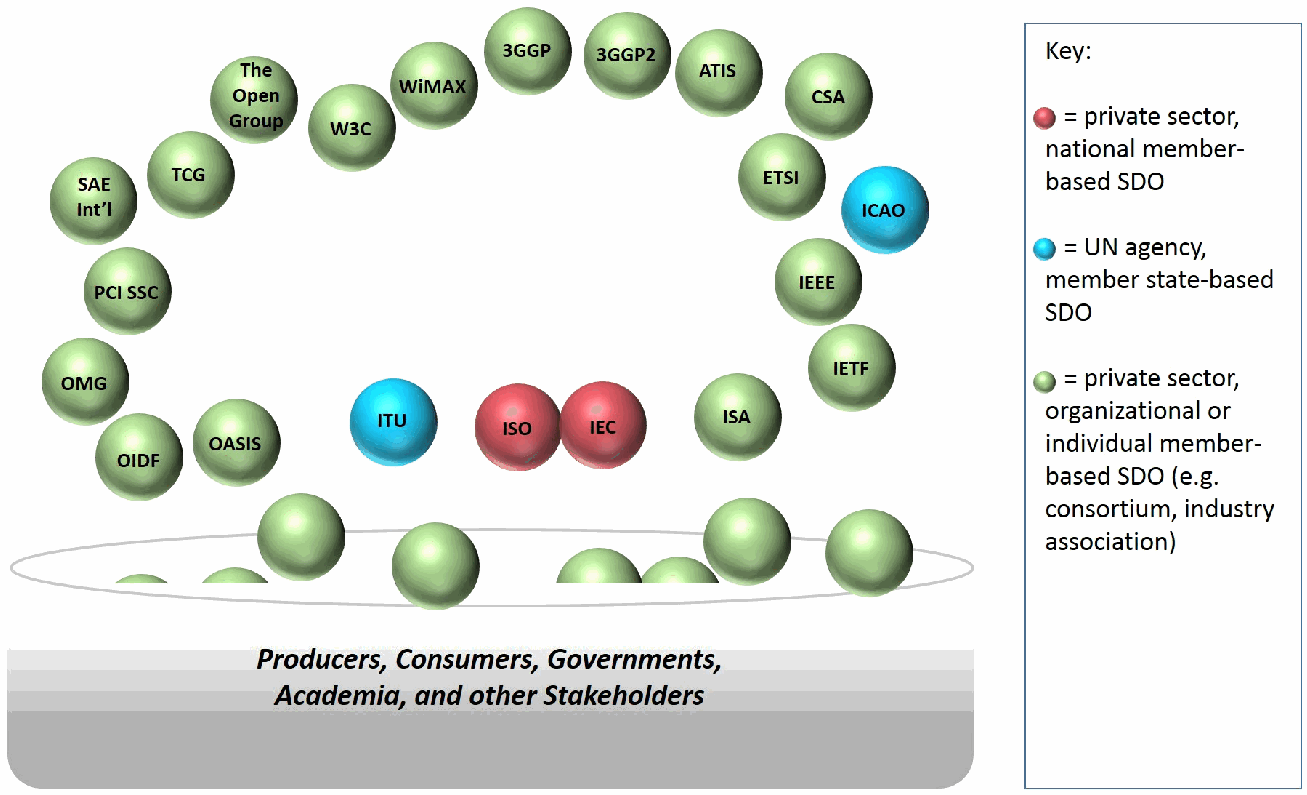
サイバーセキュリティ SDO の例を球で示した図です。「Producers, Consumers, Governments, Academia, and other Stakeholders」(生産者、消費者、政府、学術界、その他の利害関係者)と書かれた土台の上に、球が弧状に並んでいます。緑の球(民間部門の、組織または個人を会員とする SDO。コンソーシアム、業界団体など)は SAE Int'l、TCG、The Open Group、W3C、WiMAX、3GGP、3GGP2、ATIS、CSA、ETSI、IEEE、IETF、ISA、PCI SSC、OMG、OIDF、OASIS です。青の球(国連機関、加盟国を会員とする SDO)は ICAO と ITU、赤の球(民間部門の、各国を会員とする SDO)は ISO と IEC です。土台の上には名前のない緑の球もいくつか置かれています。凡例: 赤 = 民間部門の、各国を会員とする SDO、青 = 国連機関、加盟国を会員とする SDO、緑 = 民間部門の、組織または個人を会員とする SDO(コンソーシアム、業界団体など)。
Figure 1: Examples of Cybersecurity SDOs
図 1: サイバーセキュリティ SDO の例
3GPP: The 3rd Generation Partnership Project (3GPP) is a collaboration among groups of telecommunications associations established in December 1998, to make a globally applicable third generation (3G) mobile phone system specification within the scope of the International Mobile Telecommunications-2000 project of the ITU. 3GPP specifications are based on evolved Global System for Mobile Communications (GSM) specifications. 3GPP standardization encompasses Radio, Core Network and Service architecture. The groups are the European Telecommunications Standards Institute, Association of Radio Industries and Businesses/Telecommunication Technology Committee (ARIB/TTC) (Japan), China Communications Standards Association, Alliance for Telecommunications Industry Solutions (North America) and Telecommunications Technology Association (South Korea).
3GPP: 3rd Generation Partnership Project(3GPP)は、ITU の International Mobile Telecommunications-2000 プロジェクトの範囲内で、グローバルに適用できる第 3 世代(3G)携帯電話システムの仕様を作成するために 1998 年 12 月に設立された、電気通信関連団体のグループによる協力体制です。3GPP の仕様は、進化した Global System for Mobile Communications(GSM)の仕様に基づいています。3GPP の標準化は、無線、コアネットワーク、サービスアーキテクチャを対象としています。グループは、European Telecommunications Standards Institute、Association of Radio Industries and Businesses/Telecommunication Technology Committee(ARIB/TTC)(日本)、China Communications Standards Association、Alliance for Telecommunications Industry Solutions(北米)、Telecommunications Technology Association(韓国)です。
3GPP2: The Third Generation Partnership Project 2 (3GPP2) is a collaborative third generation (3G) telecommunications specifications-setting project comprising North American and Asian interests developing global specifications for ANSI/TIA/EIA-41 (ANSI: American National Standards Institute; TIA: Telecommunications Industry Association; EIA: Electronic Industries Alliance); Cellular Radiotelecommunication Intersystem Operations network evolution to 3G; and global specifications for the radio transmission technologies (RTTs) supported by ANSI/TIA/EIA-41.
3GPP2: Third Generation Partnership Project 2(3GPP2)は、ANSI/TIA/EIA-41(ANSI: American National Standards Institute、TIA: Telecommunications Industry Association、EIA: Electronic Industries Alliance)、3G への Cellular Radiotelecommunication Intersystem Operations ネットワークの進化、および ANSI/TIA/EIA-41 がサポートする無線伝送技術(RTT)についての、グローバルな仕様を策定している北米とアジアの関係者による、協力的な第 3 世代(3G)電気通信仕様策定プロジェクトです。
ATIS: is the North American Organizational Partner for the 3rd Generation Partnership Project (3GPP), a founding Partner of oneM2M, a member and major U.S. contributor to the International Telecommunication Union (ITU) Radio and Telecommunications sectors, and a member of the Inter-American Telecommunication Commission (CITEL). The ATIS Cloud Services Forum (CSF) is working to ensure that cloud services – as offered by service providers – are quickly operationalized to facilitate the delivery of interoperable, secure, and managed services. Current priorities include inter-carrier telepresence, content distribution network interconnection, cloud services framework, virtual desktop, virtual private network, and development of a cloud services checklist for onboarding.
ATIS: は、3rd Generation Partnership Project(3GPP)の北米の組織パートナー、oneM2M の創設パートナー、International Telecommunication Union(ITU)の無線部門および電気通信部門のメンバーであり、米国の主要な貢献者、そして Inter-American Telecommunication Commission(CITEL)のメンバーです。ATIS の Cloud Services Forum(CSF)は、サービスプロバイダーが提供するクラウドサービスを迅速に運用可能にし、相互運用可能で安全かつ管理されたサービスの提供を促進するために取り組んでいます。現在の優先事項には、キャリア間のテレプレゼンス、コンテンツ配信ネットワークの相互接続、クラウドサービスのフレームワーク、仮想デスクトップ、仮想プライベートネットワーク、オンボーディング用のクラウドサービス・チェックリストの策定があります。
CSA: The Cloud Security Alliance (CSA) is dedicated to defining and raising awareness of best practices and the development of industry standards to help ensure a secure cloud computing environment. Present cybersecurity related standards include: the Cloud Control Matrix (CCM), a security control framework specifically dedicated to Cloud Computing; Consensus Assessment Initiative Questionnaire (CAIQ), a due diligence framework to guide organizations in the assessment of the CCM controls implementation; CloudAudit, a common interface and namespace that allows enterprises to streamline their audit processes; and Privacy Level Agreement (PLA), a guidance to achieve a baseline compliance with mandatory personal data protection legislation across the European Union (EU).
CSA: Cloud Security Alliance(CSA)は、安全なクラウドコンピューティング環境の確保に役立つベストプラクティスの策定と、その認知度向上、および業界標準の開発に取り組んでいます。サイバーセキュリティに関連する現在の標準には、クラウドコンピューティングに特化したセキュリティ管理策のフレームワークである Cloud Control Matrix(CCM)、組織が CCM 管理策の実装状況を評価する際の指針となるデューデリジェンスのフレームワークである Consensus Assessment Initiative Questionnaire(CAIQ)、企業が監査プロセスを合理化できる共通のインターフェースと名前空間である CloudAudit、欧州連合(EU)全体の強制的な個人データ保護法令への基準となる準拠を達成するための指針である Privacy Level Agreement(PLA)があります。
ETSI: The European Telecommunications Standards Institute (ETSI), produces globally-applicable standards for Information and Communications Technologies (ICT), including fixed, mobile, radio, converged, broadcast and Internet technologies. ETSI has over 800 members from 64 countries. The ETSI Cyber Security committee (TC CYBER) is working closely with relevant stakeholders to develop standards to increase privacy and security for organizations and citizens across Europe.
ETSI: European Telecommunications Standards Institute(ETSI)は、固定、モバイル、無線、融合、放送、インターネットの各技術を含む、情報通信技術(ICT)についての、グローバルに適用できる標準を作成しています。ETSI は、64 か国から 800 を超える会員を擁しています。ETSI のサイバーセキュリティ委員会(TC CYBER)は、欧州の組織と市民のプライバシーとセキュリティを高める標準を策定するため、関連する利害関係者と緊密に協力しています。
IEC: The International Electrotechnical Commission (IEC) is a not-for-profit, non-governmental organization, founded in 1906. The IEC's members are National Committees, and they appoint experts and delegates coming from industry, government bodies, associations and academia to participate in the technical and conformity assessment work of the IEC. The IEC develops international standards for all electrical, electronic and related technologies.
IEC: International Electrotechnical Commission(IEC)は、1906 年に設立された非営利の非政府組織です。IEC の会員は各国委員会であり、各国委員会は、産業界、政府機関、団体、学術界の専門家と代表者を指名して、IEC の技術および適合性評価の作業に参加させています。IEC は、あらゆる電気、電子、および関連技術についての国際標準を策定しています。
IEC TC 57: The International Electrotechnical Commission (IEC), Technical Committee 57, Power systems management and associated information exchange, prepares international standards for power systems control equipment and systems including Energy Management Systems, SCADA, distribution automation, teleprotection, and associated information exchange for real-time and non-real-time information, used in the planning, operation and maintenance of power systems. IEC TC 57 Working Group (WG) 15 develops international standards addressing data and communications security for power systems.
IEC TC 57: International Electrotechnical Commission(IEC)の Technical Committee 57(電力システム管理および関連する情報交換)は、電力システムの計画、運用、保守に使用される、エネルギー管理システム、SCADA、配電自動化、遠隔保護、およびリアルタイム情報と非リアルタイム情報の関連する情報交換を含む、電力システム制御用の機器およびシステムに関する国際標準を作成しています。IEC TC 57 の作業部会(WG)15 は、電力システムのデータおよび通信セキュリティに関する国際標準を策定しています。
IEC TC 65: The International Electrotechnical Commission (IEC), Technical Committee 65, Industrial process measurement, control and automation, prepares international standards for systems and elements used for industrial process measurement, control and automation. TC 65 coordinates standardization activities which affect integration of components and functions into such systems including safety and security aspects. This work of standardization is to be carried out in the international fields for equipment and systems.
IEC TC 65: International Electrotechnical Commission(IEC)の Technical Committee 65(産業プロセスの計測、制御、オートメーション)は、産業プロセスの計測、制御、オートメーションに使用されるシステムと要素についての国際標準を作成しています。TC 65 は、安全面とセキュリティ面を含め、そのようなシステムへの構成要素と機能の統合に影響する標準化活動を調整しています。この標準化の作業は、機器とシステムに関する国際的な分野で行われます。
IEEE: The IEEE Standards Association (IEEE-SA) coordinates the efforts of experts throughout the IEEE in the development of standards in the areas of computers, power and healthcare, and has 20 000 plus participants worldwide, including individuals in corporations, organizations, universities, and government agencies. An example of IEEE cybersecurity standards are the wireless local area network (WLAN) computer communication security standards (e.g., IEEE 802.11 series).
IEEE: IEEE Standards Association(IEEE-SA)は、コンピューター、電力、ヘルスケアの分野における標準の策定に関して、IEEE 全体の専門家の取り組みを調整しており、企業、組織、大学、政府機関の個人を含む、世界中の 20 000 人を超える参加者がいます。IEEE のサイバーセキュリティ標準の例には、無線ローカルエリアネットワーク(WLAN)のコンピューター通信セキュリティ標準(例: IEEE 802.11 シリーズ)があります。
IETF: The Internet Engineering Task Force (IETF) issues the standards and protocols used to protect the Internet and enable global electronic commerce. The IETF develops cybersecurity standards for the Internet. The wiki for the security area provides further details.10
IETF: Internet Engineering Task Force(IETF)は、インターネットを保護し、グローバルな電子商取引を可能にするために使用される標準とプロトコルを発行しています。IETF は、インターネット向けのサイバーセキュリティ標準を策定しています。セキュリティ領域の wiki で、さらに詳しい情報を確認できます。10
ISA: The International Society of Automation (ISA) develops standards for automation and industrial control systems. Since 1949, over 150 standards have been developed by over 4000 industry experts around the world. The ISA Standards Committee, ISA99, Industrial Automation and Control System Security, is developing a multipart standard for security for industrial automation and control systems. A sister committee is ISA100, Wireless Systems for Automation.
ISA: International Society of Automation(ISA)は、オートメーションと産業用制御システムの標準を策定しています。1949 年以来、世界中の 4000 人を超える業界専門家によって、150 を超える標準が策定されてきました。ISA の標準委員会である ISA99(Industrial Automation and Control System Security)は、産業用オートメーションおよび制御システムのセキュリティに関する複数部構成の標準を策定しています。姉妹委員会に ISA100(Wireless Systems for Automation)があります。
ISO: The International Organization for Standardization (ISO) is an independent, non-governmental international organization with a membership of 162 national standards bodies. Through its members, it brings together experts to share knowledge and develop voluntary, consensus-based international standards covering almost every industry.
ISO: International Organization for Standardization(ISO)は、162 の国家標準団体を会員とする、独立した非政府の国際組織です。会員を通じて、専門家を集め、知識を共有し、ほぼすべての産業を対象とする、自主的でコンセンサスに基づく国際標準を策定しています。
ISO/IEC JTC 1: The International Organization for Standardization/International Electrotechnical Commission Joint Technical Committee 1 (ISO/IEC JTC 1), Information Technology, develops IT standards. ISO and IEC are private sector SDOs. In 1987, ISO and IEC established a joint Technical Committee by combining existing IT standards groups within ISO and IEC under a new joint Technical Committee, JTC 1. JTC 1 members are National Standards Bodies of different countries. Presently, there are 66 members. Approximately 2100 technical experts from around the world work within JTC 1. There are presently 18 JTC 1 Subcommittees (SCs) in which most of JTC 1 standards projects are being developed.
ISO/IEC JTC 1: International Organization for Standardization/International Electrotechnical Commission Joint Technical Committee 1(ISO/IEC JTC 1)情報技術は、IT 標準を策定しています。ISO と IEC は民間部門の SDO です。1987 年に、ISO と IEC は、ISO 内と IEC 内の既存の IT 標準グループを新しい合同技術委員会 JTC 1 のもとに統合して、合同技術委員会を設立しました。JTC 1 の会員は、さまざまな国の国家標準団体です。現在、66 の会員がいます。世界中の約 2100 人の技術専門家が JTC 1 内で活動しています。現在、18 の JTC 1 分科委員会(SC)があり、JTC 1 の標準プロジェクトの大部分はそこで策定されています。
JTC 1 SC 27 (IT security techniques) is the one JTC 1 SC that is completely focused on cybersecurity standardization. Many other JTC 1 SCs are directly involved in specific standards critical to cybersecurity, including SC 6 (public key infrastructure [PKI] certificates), SC 7 (software and systems engineering), SC 17 (identification cards and related devices), SC 22 (programming languages, software environments and system software interfaces), SC 37 (biometrics), SC 38 (cloud computing and distributed platforms), and SC 40 (IT service management and IT governance).
JTC 1 SC 27(IT セキュリティ技術)は、サイバーセキュリティ標準化に完全に特化した、JTC 1 の唯一の SC です。JTC 1 のほかの多くの SC も、サイバーセキュリティにとって重要な特定の標準に直接関与しており、SC 6(公開鍵基盤 [PKI] 証明書)、SC 7(ソフトウェアおよびシステムエンジニアリング)、SC 17(識別カードおよび関連デバイス)、SC 22(プログラミング言語、ソフトウェア環境、システムソフトウェアのインターフェース)、SC 37(バイオメトリクス)、SC 38(クラウドコンピューティングおよび分散プラットフォーム)、SC 40(IT サービスマネジメントおよび IT ガバナンス)があります。
ISO TC 68: The International Organization for Standardization Technical Committee 68 (ISO TC 68), Financial Services, develops standards in the field of banking, securities and other financial services. ISO TC 68 Subcommittee 2 (SC 2) develops international standards on security management and techniques applicable to general banking operations such as public key management and encryption algorithms.
ISO TC 68: International Organization for Standardization Technical Committee 68(ISO TC 68)金融サービスは、銀行、証券、その他の金融サービスの分野の標準を策定しています。ISO TC 68 Subcommittee 2(SC 2)は、公開鍵管理や暗号アルゴリズムなど、一般的な銀行業務に適用できる、セキュリティ管理と技術に関する国際標準を策定しています。
ITU: The International Telecommunication Union (ITU) is a treaty-based organization which was established in 1865. The ITU is based in Geneva, Switzerland, and its membership includes 193 Member States and more than 700 Sector Members and Associates. It has three sectors, the Radiocommunication (ITU-R), Telecommunication (ITU-T) and Development (ITU-D). Two of these sectors (ITU-R and ITU-T) develop cybersecurity standards. Of the two sectors, the ITU-T develops by far the most cybersecurity standards.
ITU: International Telecommunication Union(ITU)は、1865 年に設立された条約に基づく組織です。ITU はスイスのジュネーブに拠点を置き、193 の加盟国と、700 を超える部門メンバーおよび準メンバーで構成されています。ITU には、無線通信(ITU-R)、電気通信(ITU-T)、開発(ITU-D)の 3 つの部門があります。このうち 2 つの部門(ITU-R と ITU-T)が、サイバーセキュリティ標準を策定しています。この 2 つの部門のうち、サイバーセキュリティ標準を最も多く策定しているのは ITU-T です。
ITU-R: The ITU Radiocommunication Sector (ITU-R) is responsible for radio communication. Its role is to manage the international radio-frequency spectrum and satellite orbit resources and to develop standards for radiocommunications systems with the objective of ensuring the effective use of the spectrum. ITU-R Study Groups involved in standards critical to cybersecurity include SG-4 (Satellite Services) and SG-5 (Terrestrial Services).
ITU-R: ITU Radiocommunication Sector(ITU-R)は、無線通信を担当しています。その役割は、国際的な無線周波数スペクトルと衛星軌道資源を管理し、スペクトルの効果的な利用を確保することを目的として、無線通信システムの標準を策定することです。サイバーセキュリティにとって重要な標準に関与する ITU-R の研究委員会には、SG-4(衛星サービス)と SG-5(地上サービス)があります。
ITU-T: The ITU Telecommunication Standardization Sector (ITU-T) develops standards for the telecommunications infrastructure including voice, data, and video. ITU-T Study Groups involved in standards critical to cybersecurity include SG-9 (Cable Systems); SG-13 (Next Generation Networks); and SG-17 (Network Security).
ITU-T: ITU Telecommunication Standardization Sector(ITU-T)は、音声、データ、映像を含む電気通信インフラストラクチャの標準を策定しています。サイバーセキュリティにとって重要な標準に関与する ITU-T の研究委員会には、SG-9(ケーブルシステム)、SG-13(次世代ネットワーク)、SG-17(ネットワークセキュリティ)があります。
OASIS: The Organization for the Advancement of Structured Information Standards (OASIS) is a not-for-profit consortium that develops open standards for the global information society. The consortium produces Web services standards along with standards for security, e-business, and standardization efforts in the public sector and for application-specific markets. OASIS has more than 5000 participants representing over 600 organizations and individual members in 100 countries.
OASIS: Organization for the Advancement of Structured Information Standards(OASIS)は、グローバルな情報社会のためのオープン標準を策定している非営利のコンソーシアムです。このコンソーシアムは、Web サービスの標準に加えて、セキュリティ、電子ビジネス、公共部門および用途固有の市場での標準化の取り組みのための標準を作成しています。OASIS には、100 か国の 600 を超える組織と個人会員を代表する 5000 人を超える参加者がいます。
OIDF: The OpenID Foundation is a non-profit international standardization organization of individuals and companies that is enabling, promoting and protecting OpenID technologies. Formed in June 2007, the foundation serves as a public trust organization representing the open community of developers, vendors, and users. OIDF assists the community by providing needed infrastructure and help in promoting and supporting expanded adoption of OpenID.
OIDF: OpenID Foundation は、OpenID 技術の実現を可能にし、その普及を促進して保護する、個人と企業による非営利の国際標準化組織です。2007 年 6 月に設立され、開発者、ベンダー、ユーザーのオープンなコミュニティを代表する、公的な信頼を担う組織として機能しています。OIDF は、必要なインフラストラクチャを提供し、OpenID の採用拡大を促進し支援することで、コミュニティを支援しています。
PCI SSC: The Payment Card Industry Security Standards Council is an open global forum for the ongoing development, enhancement, storage, dissemination and implementation of security standards for account data protection. The organization was founded by American Express, Discover Financial Services, JCB International, MasterCard, and Visa Inc.
PCI SSC: Payment Card Industry Security Standards Council は、アカウントデータ保護のためのセキュリティ標準の継続的な策定、強化、保管、普及、実装を行うオープンなグローバルフォーラムです。この組織は、American Express、Discover Financial Services、JCB International、MasterCard、Visa Inc. によって設立されました。
SAE International: standards are internationally recognized for their role in helping ensure the safety, quality, and effectiveness of products and services across the mobility engineering industry. SAE International coordinates the development of technical standards based on best practices identified and described by SAE committees and task forces. Task forces are composed of engineering professionals from relevant fields. SAE International has more than 138 000 members globally. Membership is granted to individuals, not through companies.
SAE International: の標準は、モビリティエンジニアリング産業全体の製品とサービスの安全性、品質、有効性の確保に役立つものとして、国際的に認められています。SAE International は、SAE の委員会とタスクフォースが特定し記述したベストプラクティスに基づいて、技術標準の策定を調整しています。タスクフォースは、関連分野のエンジニアリング専門家で構成されています。SAE International には、世界中に 138 000 人を超える会員がいます。会員資格は、企業を通じてではなく、個人に与えられます。
TCG: The Trusted Computing Group (TCG) is a not-for-profit organization formed to develop, define and promote open, vendor-neutral, industry standards for trusted computing building blocks and software interfaces across multiple platforms. TCG has approximately 100 members from across the computing industry, including component vendors, software developers, systems vendors and network and infrastructure companies.
TCG: Trusted Computing Group(TCG)は、複数のプラットフォームにわたるトラステッドコンピューティングの構成要素とソフトウェアインターフェースについて、オープンでベンダー中立的な業界標準を策定、定義、促進するために設立された非営利組織です。TCG には、構成要素ベンダー、ソフトウェア開発者、システムベンダー、ネットワークおよびインフラストラクチャ企業を含む、コンピューティング業界全体から約 100 の会員がいます。
The Open Group: is an international vendor- and technology-neutral consortium, with over 25 years of experience, upon which organizations rely to lead the development of IT standards and certifications, and to provide them with access to key industry peers, suppliers and best practices. There are over 500 member companies with over 55 000 participants from over 150 countries. The Open Group provides guidance and an open environment in order to ensure interoperability and vendor neutrality.
The Open Group: は、25 年を超える経験を持つ、ベンダーと技術に中立な国際的コンソーシアムであり、組織は、IT 標準と認証の策定を主導し、業界の主要な同業者、供給者、ベストプラクティスにアクセスするために、これを頼りにしています。150 を超える国から、500 を超える会員企業と 55 000 人を超える参加者がいます。The Open Group は、相互運用性とベンダー中立性を確保するため、指針とオープンな環境を提供しています。
W3C: The World Wide Web Consortium (W3C) is a non-incorporated international community of 334 Member organizations that develops standards in support of Web technologies. The W3C work in the area of cybersecurity standards includes secure transferring data from one domain to another domain or between applications with well-defined document authentication. XML Encryption and XML Signature are key pieces of the XML security stack.
W3C: World Wide Web Consortium(W3C)は、Web 技術を支える標準を策定している、334 の会員組織による法人格のない国際コミュニティです。サイバーセキュリティ標準の分野における W3C の作業には、明確に定義された文書認証を用いて、あるドメインから別のドメインへ、またはアプリケーション間でデータを安全に転送することが含まれます。XML Encryption と XML Signature は、XML セキュリティスタックの重要な構成要素です。
WiMAX Forum: The WiMAX Forum is an industry-led, not-for-profit organization formed to certify and promote the compatibility and interoperability of broadband wireless products based upon the harmonized IEEE 802.16/ETSI (European Telecommunications Standards Institute) HiperMAN standard.
WiMAX Forum: WiMAX Forum は、調和された IEEE 802.16/ETSI(European Telecommunications Standards Institute)HiperMAN 標準に基づくブロードバンド無線製品の互換性と相互運用性を認証し促進するために設立された、業界主導の非営利組織です。
IT Supply Chain Risk Management (SCRM) Standards
IT サプライチェーンのリスク管理(SCRM)標準
Figure 2 illustrates a 2009 review of standards activities involved in IT Supply Chain Risk Management (SCRM), which to a great extent covers the cybersecurity standards landscape. Figure 2 is based on ISO/IEC JTC 1 SC 7 (System and Software Engineering) and ISO/IEC JTC 1 SC 27 (IT Security Techniques) portfolios and lists of liaisons, as well as additional U.S. government and industry players involved in IT SCRM. It is presented here to illustrate the complexity of the landscape and the need to be involved in multiple standards bodies to be effective.
図 2 は、IT サプライチェーンのリスク管理(SCRM)に関わる標準化活動についての 2009 年のレビューを示しており、これはサイバーセキュリティ標準の状況の大部分を対象としています。図 2 は、ISO/IEC JTC 1 SC 7(システムおよびソフトウェアエンジニアリング)と ISO/IEC JTC 1 SC 27(IT セキュリティ技術)のポートフォリオと連絡関係の一覧、ならびに IT SCRM に関わるそのほかの米国政府と産業界の関係者に基づいています。ここでは、状況の複雑さと、効果を上げるために複数の標準化団体に関与する必要があることを示すために掲載しています。
[NIST のロゴが写っている図。公的な標章のため、この非公式サイトには掲載していません。原本 PDF を参照してください。]
Figure 2: Standards Landscape for IT Supply Chain Risk Management (SCRM)
図 2: IT サプライチェーンのリスク管理(SCRM)のための標準の状況
7 IT Standards Development
7 IT 標準開発
An SDO typically manages its portfolio of standards through a project management system, which facilitates active participation by technical experts and development of technically sound standards. When a standards project is proposed and approved, the project is assigned to a technical development group and a project editor is appointed; the project editor serves as the key office and catalyst for the timely development of the standard and is responsible for meeting any target dates for revisions. Through negotiations, the disposition of the comments received on a draft standard is approved by the meeting participants. Based upon the approved disposition of comments, the project editor prepares the next version of the standard. There may be many iterations of this process before the draft standard is considered complete and technically sound.
SDO は通常、技術専門家の積極的な参加と技術的に健全な標準の策定を促進するプロジェクト管理システムを通じて、標準のポートフォリオを管理しています。標準プロジェクトが提案され承認されると、そのプロジェクトは技術開発グループに割り当てられ、プロジェクトエディターが任命されます。プロジェクトエディターは、標準の適時な策定において中心的な役割を担い、推進役を果たすとともに、改訂の目標期日を守る責任を負います。標準の草案に寄せられた意見の処理は、交渉を通じて会議の参加者によって承認されます。承認された意見の処理に基づいて、プロジェクトエディターが標準の次の版を作成します。標準の草案が完成し、技術的に健全であると見なされるまでに、このプロセスが何度も繰り返されることがあります。
Market forces typically drive standards development. Consequently, the development is driven by contributions from the participants. Standards development may be anticipatory or reactionary (or somewhere in between) with respect to products or services entering the marketplace. Many SDOs insist upon two or more successful independent implementations of the requirements in a draft standard before final approval of the standard. Additionally, such implementation developers can be a source of valuable technical feedback during the standard’s development. Another market factor is that standards may be developed in a regulated or unregulated environment.
標準開発は、通常、市場の力によって推進されます。その結果、策定は参加者の貢献によって推進されます。標準開発は、市場に登場する製品やサービスに対して、先行的なものにも事後対応的なもの(またはその中間)にもなりえます。多くの SDO は、標準の最終承認の前に、標準の草案にある要件の、2 つ以上の独立した実装の成功を求めます。さらに、そのような実装の開発者は、標準の策定中に貴重な技術的フィードバックの源となりえます。もう 1 つの市場要因は、標準が規制された環境でも規制されていない環境でも策定されうることです。
Figure 3 is a high-level, functional conceptualization of how IT standards are developed and standards-based IT products, processes and services are deployed. Depending on whether the project is anticipatory or reactionary (or somewhere in between), many of these functions will occur somewhat concurrently. Some of these functions (i.e., product/process/service/test tools development; testing; and deployment) occur outside of the SDO process but provide valuable feedback to the SDO functions.
図 3 は、IT 標準がどのように策定され、標準に基づく IT 製品、プロセス、サービスがどのように展開されるかについての、高水準の機能的な概念化です。プロジェクトが先行的か事後対応的か(またはその中間か)に応じて、これらの機能の多くは、ある程度同時に生じます。これらの機能のいくつか(すなわち、製品/プロセス/サービス/テストツールの開発、テスト、展開)は、SDO のプロセスの外で生じますが、SDO の機能に貴重なフィードバックを提供します。
For an SDO to start developing a standard, the members of the relevant SDO technical committee need a clear and comprehensive set of requirements for the intended application(s). Base standards often contain options so that such standards can support various applications. Profiles11 make various options in one or more base standards mandatory in order to support a specific application area. The SDO may also develop testing methodology standards that can be used by test tool developers to ensure that resulting test tools correctly ascertain if an IT product, process, or service meets the requirements of the base or profile standards.
SDO が標準の策定を開始するには、関連する SDO の技術委員会のメンバーが、意図するアプリケーションについて、明確で包括的な一連の要件を必要とします。基本標準には、さまざまなアプリケーションを支えられるようにするため、オプションが含まれていることがよくあります。プロファイル11は、特定のアプリケーション分野を支えるために、1 つ以上の基本標準にあるさまざまなオプションを必須にします。SDO は、テストツールの開発者が、結果として得られるテストツールが、IT 製品、プロセス、またはサービスが基本標準またはプロファイル標準の要件を満たしているかどうかを正しく確かめられるようにするために利用できる、テスト方法の標準も策定する場合があります。
In more reactionary standards development, the requirements for a standards project are based upon commercially available products, processes, and services. In more anticipatory standards development, provider and consumer use cases will drive the requirements. The development of the draft standard can require many iterations, especially for groundbreaking anticipatory standards development. Specific IT applications may require the profiling of options in the base standard to support the interoperability, security, etc. requirements of the application. The development of a testing infrastructure provides valuable feedback for all other stages of the IT standards lifecycle.
より事後対応的な標準開発では、標準プロジェクトの要件は、市販されている製品、プロセス、サービスに基づきます。より先行的な標準開発では、プロバイダーと利用者のユースケースが要件を推進します。標準の草案の策定には、特に画期的な先行的標準開発では、多くの反復が必要になることがあります。特定の IT アプリケーションでは、そのアプリケーションの相互運用性、セキュリティなどの要件を支えるため、基本標準のオプションをプロファイル化する必要がある場合があります。テスト基盤の整備は、IT 標準のライフサイクルのほかのすべての段階に、貴重なフィードバックを提供します。
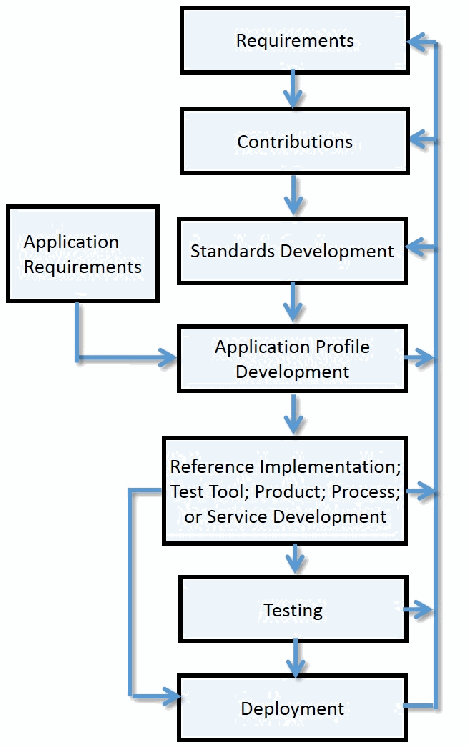
IT 標準のライフサイクルを示す流れ図です。上から下へ矢印でつながった箱は「Requirements」(要件)→「Contributions」(寄与文書)→「Standards Development」(標準の開発)→「Application Profile Development」(アプリケーションプロファイルの開発)→「Reference Implementation; Test Tool; Product; Process; or Service Development」(参照実装、試験ツール、製品、プロセス、またはサービスの開発)→「Testing」(試験)→「Deployment」(展開)です。左側の別の箱「Application Requirements」(アプリケーション要件)から「Application Profile Development」へ矢印があります。左側には「Reference Implementation; Test Tool; Product; Process; or Service Development」から「Deployment」へ直接向かう矢印もあります。右側のフィードバックの線は、「Application Profile Development」、「Reference Implementation; …」、「Testing」、「Deployment」から「Requirements」、「Contributions」、「Standards Development」へ戻ります。
Figure 3: IT Standards Life Cycle
図 3: IT 標準のライフサイクル
Many SDOs operate through a consensus process that is characterized by all or some of the following attributes: openness; transparency; balance; and due process or mechanisms for ensuring adherence to organizational procedures, including provision for appeals. Openness means that participation in standards development is open to all materially affected parties. Across the SDOs, there are different shades of openness, such as IETF’s “anyone can participate” philosophy to ISO’s limitation to member countries and recognized liaison organizations. Exposure of specifications to wide audiences during the development cycle can contribute to technical soundness. Transparency means that SDOs have clear and transparent processes for standards development to allow insight into the decision-making process and promote due process. Balance in an SDO is achieved by participation of vendors, system integrators, end users, consultants, academics, and others within the given technology area to ensure technical soundness and market relevance, and to ensure that to the extent possible no particular stakeholder group has undue influence in shaping the standard. Due process implies that mechanisms for ensuring adherence to organizational procedures, including provisions for appeals, are provided. Consensus requires that all views and objections be considered, and that an effort be made toward their resolution.
多くの SDO は、開放性、透明性、均衡、そして適正手続(不服申立ての規定を含む、組織の手続の遵守を確保する仕組み)の、すべてまたは一部によって特徴付けられるコンセンサスのプロセスを通じて運営されています。開放性とは、標準開発への参加が、実質的に影響を受けるすべての当事者に開かれていることを意味します。SDO によって、開放性の度合いはさまざまであり、IETF の「誰でも参加できる」という理念から、ISO の会員国と認められた連絡組織への限定まであります。策定サイクル中に仕様を幅広い対象に公開することは、技術的な健全性に寄与しえます。透明性とは、SDO が、意思決定プロセスへの洞察を可能にし、適正手続を促進するため、標準開発の明確で透明なプロセスを持っていることを意味します。SDO における均衡は、技術的な健全性と市場との関連性を確保するため、また、可能な限り、特定の利害関係者グループが標準の形成に不当な影響を及ぼさないようにするため、当該技術分野のベンダー、システムインテグレーター、エンドユーザー、コンサルタント、学術関係者などが参加することで達成されます。適正手続は、不服申立ての規定を含む、組織の手続の遵守を確保する仕組みが提供されていることを意味します。コンセンサスには、すべての見解と異議が検討され、その解決に向けた努力が行われることが必要です。
In the United States, the National Cooperative Research Act of 198412 opened a new era where organizations could collaborate to carry out joint research and development ventures and not be deemed illegal per se under Federal antitrust laws or similar State laws. One result of this has been a rapid growth in IT consortia developing standards. In developing their standards, many of these consortia follow the above principles. However, consortia are also formed that are not open, with membership restricted to specific business allies. Consortia range from unincorporated affiliations of companies to incorporated entities with budgets, offices and paid staff. A consortium may exist to complete a specific standard, but others have a broader mission and develop multiple standards necessary to enable the evolution of a category of IT business services and products. An oft-cited advantage of consortia is speed in developing a specification, but speed is sometimes obtained by restricting the participation, which in turn may slow uptake of the developed specification. For consortia with low non-U.S. participation, their standards may encounter difficulties being accepted by other countries.
米国では、1984 年の National Cooperative Research Act12が、組織が共同で研究開発事業を実施することができ、連邦の反トラスト法や類似の州法のもとでそれ自体が違法とはみなされない、新たな時代を開きました。その結果の 1 つとして、標準を策定する IT コンソーシアムが急速に増加しました。これらのコンソーシアムの多くは、標準の策定にあたり、上記の原則に従っています。しかし、オープンではなく、加盟が特定の事業上の同盟者に限られるコンソーシアムも設立されています。コンソーシアムは、法人格のない企業の連合から、予算、事務所、有給の職員を持つ法人組織まで、さまざまです。特定の標準を完成させるために存在するコンソーシアムもあれば、IT のビジネスサービスや製品の特定のカテゴリの発展を可能にするために必要な複数の標準を策定する、より広範な使命を持つものもあります。コンソーシアムの利点としてしばしば挙げられるのは、仕様の策定の速さですが、その速さは、参加を制限することによって得られる場合があり、そのことが、策定された仕様の採用を遅らせる可能性があります。米国以外の参加が少ないコンソーシアムの場合、その標準は、他国で受け入れられるうえで困難に直面する可能性があります。
Two case studies of SDOs are provided below to illustrate the diversity of standards development in the cybersecurity arena.
サイバーセキュリティの分野における標準開発の多様性を示すため、SDO の 2 つのケーススタディを以下に示します。
Case Study – IETF
ケーススタディ – IETF
The IETF is an open, bottom-up organization that develops Internet standards through the use of working groups. It has no formal membership, and final standards are published in the form of Requests for Comment (RFCs)13. All participants are volunteers and participate in working groups and/or the tri-annual public meetings and do not officially represent their home governments or organizations, but participate in an individual capacity. Accordingly, governments do not have any special status within the organization and standards generally become relevant through adoption, not government mandate.
IETF は、作業部会を通じてインターネット標準を策定する、オープンでボトムアップの組織です。正式な会員制はなく、最終的な標準はコメント募集(Request for Comments: RFC)13の形で公表されます。すべての参加者はボランティアであり、作業部会および年 3 回の公開会合に参加します。参加者は自国の政府や所属する組織を公式に代表するのではなく、個人の資格で参加します。したがって、政府は組織内で特別な地位を持たず、標準は一般に、政府の義務付けではなく採用を通じて意味を持つようになります。
The IETF’s process provides participants with a great deal of autonomy to influence how the next generation Internet will grow and evolve, and what underlying principles the network will support. Within the IETF, there is an ongoing balance between protecting the core principles of the Internet (such as openness) and commercial profit interests. This has some effect on the types of standards that the Internet Engineering Steering Group (IESG) approves as final RFCs. Often, there are competing RFCs that may serve to address the same core problem. Yet, based on the IETF’s “adoption” model, actual use of the standard dictates which standard will ultimately prevail.
IETF のプロセスは、参加者に、次世代のインターネットがどのように成長し進化するか、ネットワークがどのような基本原則を支えるかに影響を与えるための、大きな自律性を与えています。IETF 内では、インターネットの中核となる原則(開放性など)の保護と、商業的な利益の追求との間で、継続的なバランスがとられています。これは、Internet Engineering Steering Group(IESG)が最終的な RFC として承認する標準の種類に、ある程度の影響を与えます。同じ中核的な問題に対処しうる、競合する RFC が存在することもよくあります。しかし、IETF の「採用」モデルに基づき、標準の実際の使用が、最終的にどの標準が優勢になるかを決めます。
Historically, U.S.-based industry has sent the largest contingent of participants to IETF meetings, but recently other countries have recognized the value of influencing the RFC development process and are sending more people to participate. Some countries are increasingly working in a more coordinated and unified manner with their industry members with clearly defined reporting structures and a defined set of joint goals. From a government and industry-relations perspective, some countries’ regulatory and political regimes have certain advantages. For instance, the increase in globalization of the information and telecommunications technology industry makes it harder and harder to identify companies as U.S.-centric. Global companies have global loyalties and are often forced to respond to the regulatory and legal regimes of multiple nations. Further, within the United States the Internet industry remains unregulated, whereas in other regions of the world, IT companies may be partially state-owned, closely aligned with a local government regime, or closely regulated. Since the Internet was privatized in 1993, the USG has generally practiced a laissez faire approach to Internet standards development, allowing the private-sector to lead. Government experts participate in the IETF when they are working on a discrete need, but generally there has been little coordination of USG participants at IETF meetings to strategically track standards development that can impact national and economic security equities.
歴史的には、米国に拠点を置く産業界が IETF の会合に最大規模の参加者を送ってきましたが、最近では、他の国々も RFC の策定プロセスに影響を与えることの価値を認識し、より多くの人員を参加させています。一部の国々は、明確に定義された報告体制と、定められた共同目標のもとで、自国の産業界の会員と、より調整され統一された形で取り組むことを増やしています。政府と産業界の関係の観点からは、一部の国々の規制および政治の体制には、一定の利点があります。たとえば、情報通信技術産業のグローバル化の進展により、企業を米国中心と特定することがますます難しくなっています。グローバル企業はグローバルな忠誠心を持ち、複数の国の規制および法制度への対応を迫られることがよくあります。さらに、米国内ではインターネット産業は規制されないままですが、世界の他の地域では、IT 企業が部分的に国有であったり、現地の政府体制と密接に連携していたり、厳しく規制されていたりする場合があります。1993 年にインターネットが民営化されて以来、米国政府は一般に、インターネット標準の開発に対して自由放任のアプローチをとり、民間部門が主導することを認めてきました。政府の専門家は、個別のニーズに取り組んでいるときに IETF に参加しますが、国家安全保障と経済安全保障上の利益に影響しうる標準開発を戦略的に追跡するための、IETF の会合における米国政府の参加者の調整は、一般にほとんど行われていません。
In many cases, companies would be inhibited from sharing certain information with one another due to protection of proprietary information and antitrust and other rules within the United States. However, there has also been limited outreach on the side of the government to industry partners to discuss ways of coordinating before meetings on areas that have the potential to impact national security equities. Participants, whether corporate or government, produce their own trip reports, but, these reports are not shared within USG or synthesized to create a holistic picture of all relevant activities and working groups at the IETF, which number in the hundreds. This lack of coordination, which can be inherent for other individual member-based SDOs, means that participants act in isolation, and potentially against each other. Although this is appropriate in many commercial circumstances, there may be times when the USG may feel the need to leverage its U.S. industry counterparts within the IETF context to promote, shift, or eliminate a development that could have the potential to impact issues of national significance.
多くの場合、企業は、専有情報の保護と、米国内の反トラスト規則その他の規則のために、特定の情報を互いに共有することを妨げられます。しかし、国家安全保障上の利益に影響する可能性のある分野について、会合の前に調整する方法を話し合うための、政府側から産業界のパートナーへの働きかけも限られてきました。参加者は、企業か政府かを問わず、それぞれ出張報告書を作成していますが、これらの報告書は米国政府内で共有されることも、数百ある IETF の関連するすべての活動と作業部会についての全体像を作成するために統合されることもありません。この調整の欠如は、個人会員制のほかの SDO にも内在しうるものであり、参加者が孤立して行動し、場合によっては互いに対立しうることを意味します。これは多くの商業的状況では適切ですが、米国政府が、国家的に重要な問題に影響を与える可能性のある開発を促進し、変更し、または排除するために、IETF の文脈で米国産業界のカウンターパートを活用する必要性を感じることがあるかもしれません。
Case Study – ISO
ケーススタディ – ISO
An ISO standard is expected to take two to four years from inception to publication primarily due to the time required to develop international consensus on positions. The national body process treats larger and smaller countries equally.
ISO 標準は、主に立場についての国際的なコンセンサスを形成するために必要な時間のため、着手から公表まで 2 年から 4 年かかると見込まれます。国家団体のプロセスは、大国と小国を平等に扱います。
One method of developing an ISO standard is the use of the ISO five-step process that involves multiple draft reviews and requests comments from national bodies to advance drafts to the next formal stage of development. Advancing a standard from one formal stage to another requires an international ballot, voted on by each national body. With the votes, national bodies submit comments on the content, suggestions for improvement, and explanations for no votes. When a standard successfully advances through all required stages, it is published as an international standard.
ISO 標準を策定する方法の 1 つは、複数回の草案レビューを伴い、草案を次の正式な段階へ進めるために国家団体に意見を求める、ISO の 5 段階のプロセスを使用することです。標準をある正式な段階から別の段階へ進めるには、各国家団体が投票する国際投票が必要です。国家団体は、投票とともに、内容についての意見、改善の提案、反対票の説明を提出します。標準が必要なすべての段階を無事に進むと、国際標準として公表されます。
ISO Technical Committees can decide to use the ISO “fast track” process, or other fast processes, for developing ISO standards. These processes can approve an ISO standard within 8 months. National Bodies or Category A liaison organizations of an ISO Technical Committee are permitted to submit candidate standards for ISO fast-track balloting. ISO/IEC JTC 1 has developed a Publicly Available Specification (PAS) process that allows consortia to fast process their PASs into ISO/IEC approved standards. Consortia, such as OASIS, TCG, The Open Group, the Object Management Group (OMG), and EUROPAY, have used the JTC 1 PAS process to quickly approve over 40 PASs as ISO/IEC standards.14
ISO の技術委員会は、ISO 標準を策定するために、ISO の「ファストトラック」プロセスまたはその他の迅速なプロセスを使用することを決定できます。これらのプロセスでは、ISO 標準を 8 か月以内に承認できます。ISO 技術委員会の国家団体またはカテゴリー A の連絡組織は、ISO のファストトラック投票のために、標準の候補を提出することが認められています。ISO/IEC JTC 1 は、コンソーシアムが自らの PAS を迅速に処理して ISO/IEC が承認した標準にできる、Publicly Available Specification(PAS)プロセスを策定しました。OASIS、TCG、The Open Group、Object Management Group(OMG)、EUROPAY などのコンソーシアムは、JTC 1 の PAS プロセスを使用して、40 を超える PAS を ISO/IEC 標準として迅速に承認してきました。14
8 Accelerating IT Standards Development
8 IT 標準開発の加速
Assuming that the interagency determines that accelerating the development of a particular standard would be desirable, the ability of an SDO to expedite IT standards development would be related to several factors, including:
省庁間が、特定の標準の策定を加速することが望ましいと判断したと仮定すると、SDO が IT 標準の策定を迅速化できるかどうかは、次を含むいくつかの要因に関係します。
A.the level of effort expended by the participants;
A.参加者が費やす労力のレベル。
B.the level of technical and “political” difficulty (see below) in developing the standard; and
B.標準を策定する際の技術的および「政治的」な困難さ(後述)のレベル。
C.the effectiveness of the consensus process being followed.
C.従っているコンセンサスプロセスの有効性。
The development of a consensus IT standard may involve trade-offs among several attributes, such as such as speed, consensus, expense, and quality, and it can require many iterations before there is a technically sound and comprehensive final draft. The process can be time consuming, especially if the consensus group meets only a few times a year. When a standards project is of high priority to a Federal agency or agencies, there are several factors discussed below that may need to be addressed in order to accelerate a standard’s development without sacrificing quality.
コンセンサスに基づく IT 標準の策定には、速度、コンセンサス、費用、品質など、いくつかの属性間のトレードオフが伴うことがあり、技術的に健全で包括的な最終草案ができるまでに、多くの反復が必要になることがあります。このプロセスは、特にコンセンサスグループの会合が年に数回しか開かれない場合には、時間がかかることがあります。ある標準プロジェクトが 1 つまたは複数の連邦機関にとって優先度が高い場合、品質を犠牲にせずに標準の策定を加速するために、対処が必要となりうる要因が、以下で論じるとおりいくつかあります。
A. Level of Effort
A. 労力のレベル
The technical expertise and resources provided for a particular IT standards development project are driven by supplier and buyer market forces and deadlines. For most standards projects, participating IT experts from various stakeholder organizations typically allocate only a fraction of their time to standards development. In such situations, standards meetings of only a few days’ duration occur a few times a year. For other standards projects, time-to-market pressures and/or mandated deadlines can lead to technical experts working essentially full time for several months to complete a standard.
特定の IT 標準開発プロジェクトに提供される技術的専門知識と資源は、供給者と購入者の市場の力と期限によって決まります。ほとんどの標準プロジェクトでは、さまざまな利害関係者の組織から参加する IT 専門家は、通常、標準開発に自らの時間のごく一部しか割り当てません。このような状況では、わずか数日間の標準会合が年に数回開かれるだけです。そのほかの標準プロジェクトでは、市場投入までの時間への圧力、義務付けられた期限、またはその両方によって、技術専門家が、標準を完成させるために数か月間、ほぼフルタイムで取り組むことになる場合があります。
Consensus IT standards development depends on the voluntary contributions of subject matter experts provided by both buyer and supplier organizations. In the case of supplier organizations, the amount of subject matter expert time made available to the standards efforts will depend on the organizations’ assessment of commercial benefit—either market demand or the legal/regulatory requirements—for the results of the standard. USG agencies can encourage participation in standards development through their participation and leadership during the standards development process, and creating preferences in procurements for suppliers who have followed the completed standard and undergone conformance assessment and certification.
コンセンサスに基づく IT 標準の策定は、購入者と供給者の双方の組織が提供する、専門分野の専門家による自発的な貢献に依存しています。供給者の組織の場合、標準化の取り組みに提供される専門分野の専門家の時間の量は、標準の成果に対する、組織の商業的利益(市場の需要または法的/規制上の要件のいずれか)の評価に依存します。米国政府機関は、標準開発プロセスにおける自らの参加とリーダーシップを通じて、また、完成した標準に従い適合性評価と認証を受けた供給者を調達で優先することを通じて、標準開発への参加を奨励できます。
Examples: Federal Information Processing Standard (FIPS 201), Personal Identity Verification (PIV) of Federal Employees and Contractors, (2005) and the Registered Traveler Interoperability Consortium (RTIC) Specification (2006) are examples of high levels of effort that resulted in standards being developed within six months. Such timing was possible because of the resources dedicated to the work and the fact that both of these standards profiled already available base standards.
例: Federal Information Processing Standard(FIPS 201), Personal Identity Verification (PIV) of Federal Employees and Contractors(2005 年)と Registered Traveler Interoperability Consortium(RTIC)Specification(2006 年)は、高いレベルの労力によって、標準が 6 か月以内に策定された例です。このようなスケジュールが可能だったのは、その作業に資源が充てられたことと、これら 2 つの標準がどちらも、既に利用可能な基本標準をプロファイル化したものだったためです。
Example: The U.S. High Definition Television (HDTV) standard was developed quickly by industry in the early 1990s. The impetus for this rapid standards development was the declaration by the Federal Communications Commission (FCC) that industry had a specific deadline to produce such a standard and demonstrate its viability or the FCC would develop the standard. Industry quickly collaborated to develop the digital specification, established a testing facility, and demonstrated interoperable digital technology.
例: 米国の高精細テレビ(HDTV)標準は、1990 年代初めに産業界によって迅速に策定されました。この迅速な標準開発の推進力となったのは、連邦通信委員会(FCC)が、産業界にはそのような標準を作成して実現可能性を実証するための特定の期限があり、そうしなければ FCC が標準を策定すると宣言したことでした。産業界は迅速に協力してデジタル仕様を策定し、テスト施設を設け、相互運用可能なデジタル技術を実証しました。
B. Level of Difficulty
B. 困難さのレベル
The difficulty in developing an IT standard includes technical and political issues, as well as the maturity of a technology area. Technical challenges include: the lack of technical expertise by some stakeholders, limiting the capability to engage in a given project; the difficulty of developing a sound test method for standard requirement(s); and the need to develop thousands of test cases necessary for rigorous and comprehensive testing of complying implementations. Political difficulties include: vendor resistance to commoditizing an IT market through standardization, vendors pushing competitive standards, turf fights between standards developers, and the individual egos of the participants. While ensuring that all the important parties are in agreement before a project begins can greatly accelerate the standardization process, competitive standards solutions pushed by different industry alliances make such advance agreements problematic.
IT 標準を策定する際の困難には、技術的および政治的な問題、ならびに技術分野の成熟度が含まれます。技術的な課題には、一部の利害関係者の技術的専門知識の不足により、特定のプロジェクトに関与する能力が限られること、標準の要件に対する適切なテスト方法の開発の難しさ、および、適合する実装を厳格かつ包括的にテストするために必要な、数千のテストケースを開発する必要性があります。政治的な困難には、標準化を通じて IT 市場がコモディティ化することへのベンダーの抵抗、競合する標準を推進するベンダー、標準開発者間の縄張り争い、参加者個人のエゴがあります。プロジェクトの開始前に重要な当事者全員が合意していることを確実にすることで、標準化プロセスを大幅に加速できますが、異なる業界の同盟が推進する競合する標準の解決策は、そのような事前の合意を難しくします。
Example: Extensive peer reviewed testing is necessary before standardizing encryption algorithms because no definitive technical approach is known for ensuring an algorithm has no exploitable security flaw. Starting in 1997, NIST’s Information Technology Laboratory (ITL) led a worldwide, multiyear project to find a replacement standard for the Data Encryption Standard (DES). The approaching end-of-life for DES, which was originally developed in the 1970s, was widely recognized due to steadily increasing computer processing power. NIST solicited candidate encryption algorithms and provided a forum for peer reviewed testing of the candidate algorithms. As a result of that extensive testing, an algorithm was selected and FIPS 197, Advanced Encryption Standard (AES), was approved in November 2001. NIST also developed a conformance testing program for the AES. AES was subsequently incorporated into ISO/IEC 18033-3:2005, Information technology—Security techniques—Encryption algorithms— Part 3: Block ciphers.
例: 暗号アルゴリズムを標準化する前には、広範なピアレビューを経たテストが必要です。アルゴリズムに悪用可能なセキュリティ上の欠陥がないことを保証するための決定的な技術的アプローチは知られていないためです。1997 年から、NIST の情報技術研究所(ITL)は、Data Encryption Standard(DES)に代わる標準を見つけるための世界規模の複数年にわたるプロジェクトを主導しました。もともと 1970 年代に開発された DES の使用終了が近づいていることは、コンピューターの処理能力が着実に向上していたため、広く認識されていました。NIST は暗号アルゴリズムの候補を募り、候補アルゴリズムをピアレビューするための場を提供しました。この広範なテストの結果、アルゴリズムが選定され、FIPS 197, Advanced Encryption Standard (AES) が 2001 年 11 月に承認されました。NIST は AES の適合性テストプログラムも開発しました。AES はその後、ISO/IEC 18033-3:2005, Information technology—Security techniques—Encryption algorithms— Part 3: Block ciphers に取り入れられました。
Example: NIST led the test tool development for the Portable Operating System Interface (POSIX) standard developed by the IEEE. Working in support of the IEEE POSIX standards project, NIST staff and industry guest researchers developed about 100 000 test assertions, which served as the basis for producing the executable test code of the POSIX test tool. This test assertion/test code development took about three years.
例: NIST は、IEEE が策定した Portable Operating System Interface(POSIX)標準のテストツールの開発を主導しました。IEEE の POSIX 標準プロジェクトを支援して、NIST の職員と産業界からの客員研究者が、約 100 000 件のテストアサーションを開発し、これが POSIX テストツールの実行可能なテストコードを作成するための基礎となりました。このテストアサーションとテストコードの開発には、約 3 年かかりました。
Example: Business alliances are often formed to promote competitive solutions. Such competition is reflected is standardization. The completion of the standards can be delayed by such competition and the market acceptance of the final standards is slowed. Examples of format wars include the video tape formats (VHS versus Betamax) introduced in the 1970s, the micro flexible disks (e.g., 90 mm) introduced in the 1980s and more recently the rival high definition DVD formats (HD DVD versus Blu-ray Disc).
例: 競争力のある解決策を促進するために、事業上の提携が形成されることがよくあります。このような競争は標準化にも反映されます。そのような競争によって標準の完成が遅れることがあり、最終的な標準の市場での受容も遅くなります。フォーマット戦争の例には、1970 年代に導入されたビデオテープの規格(VHS 対 Betamax)、1980 年代に導入されたマイクロフロッピーディスク(例: 90 mm)、そして近年の競合する高精細 DVD 規格(HD DVD 対 Blu-ray Disc)があります。
C. Effectiveness of Consensus Standards Development Processes
C. コンセンサスに基づく標準開発プロセスの有効性
Many SDOs are in competition for new IT standards projects. As a result of this competitive environment, over the last 20 years many SDOs have streamlined their consensus development processes and added fast track processes to their repertoires. The effectiveness of standards processes, streamlined or other, also depends greatly upon the availability of experienced, competent leadership and administration that ensure that best practices are followed.
多くの SDO は、新たな IT 標準プロジェクトをめぐって競争しています。この競争的な環境の結果として、過去 20 年間に、多くの SDO がコンセンサス形成のプロセスを合理化し、ファストトラックのプロセスをレパートリーに加えてきました。合理化されたものであれそうでないものであれ、標準プロセスの有効性は、ベストプラクティスが守られるようにする、経験豊富で有能なリーダーシップと運営が得られるかどうかにも大きく左右されます。
Example: Starting in 1997, the Industry Usability Reporting Project (IUSR) developed a software usability specification and conducted pilot testing. In less than five months, using the INCITS (International Committee for Information Technology Standards) fast track process, the consortium’s specification was approved in American National Standard INCITS 354-2001, Information Technology—Common Industry Format for Usability Test Reports. In less than six months, using the JTC 1 fast track process, INCITS 354 was approved as International Standard 25062:2005, Software Engineering—Software Quality and Requirements Evaluation—Common Industry Format for Usability Test Reports. The multi-year delay between the national and international versions was largely due to a disagreement in the United States on where to submit INCITS 354 for international fast track processing.
例: 1997 年から、Industry Usability Reporting Project(IUSR)は、ソフトウェアのユーザビリティ仕様を策定し、パイロットテストを実施しました。INCITS(International Committee for Information Technology Standards)のファストトラックプロセスを使用して、5 か月足らずで、このコンソーシアムの仕様は、米国国家規格 INCITS 354-2001, Information Technology—Common Industry Format for Usability Test Reports として承認されました。JTC 1 のファストトラックプロセスを使用して、6 か月足らずで、INCITS 354 は国際標準 25062:2005, Software Engineering—Software Quality and Requirements Evaluation—Common Industry Format for Usability Test Reports として承認されました。国内版と国際版の間の複数年にわたる遅れは、主に、INCITS 354 を国際的なファストトラック処理のためにどこへ提出するかについての、米国内での意見の相違によるものでした。
Example: The BioAPI Consortium submitted its BioAPI specification to INCITS in September 2001. INCITS 358:2002, American National Standard for Information Technology – The BioAPI Specification, was approved in February 2002. This standard was submitted to ISO/IEC JTC 1/SC 37 for fast processing in 2003. It was approved as ISO/IEC 19784-1:2006, Information technology—Biometric application programming interface—Part 1: BioAPI specification. The SC 37 “fast processing” was slowed by the urge of the international technical experts to improve the standard, which in fact they did, but adding years to the development time.
例: BioAPI Consortium は、2001 年 9 月に BioAPI 仕様を INCITS に提出しました。INCITS 358:2002, American National Standard for Information Technology – The BioAPI Specification は、2002 年 2 月に承認されました。この標準は、2003 年に迅速な処理のために ISO/IEC JTC 1/SC 37 に提出されました。これは ISO/IEC 19784-1:2006, Information technology—Biometric application programming interface—Part 1: BioAPI specification として承認されました。SC 37 の「迅速な処理」は、国際的な技術専門家が標準を改善しようとしたことで遅くなりました。実際に改善は行われましたが、策定期間が数年延びました。
9 Ongoing Issues in IT Standards Development
9 IT 標準開発における継続的な課題
The following issues illustrate some of the factors that affect IT standards development. Such issues are likely to be ongoing, with no prospect for easy resolution, and therefore are expected to be part of the long term environment of IT standards development.
次の課題は、IT 標準開発に影響を与える要因のいくつかを示しています。このような課題は、継続的に存在し、容易な解決の見込みがない可能性が高く、したがって、IT 標準開発の長期的な環境の一部になると予想されます。
IT Standards and Public Policy
IT 標準と公共政策
An issue that has become increasingly relevant to U.S. interests is the policy direction some SDOs are taking when drafting “technical” standards. Over the past several years, certain countries have begun to “forum shop” their specific public policy or trade interests and issues and have found acceptance in certain SDOs. Although the USG and the U.S. private sector have vocally opposed SDO attempts at drafting public policy through the creation of technical standards, many parties see opportunities in the drafting process to encourage the adoption of policies that reflect their particular agendas. Without a strategy in place, this can be challenging to combat because many of the U.S. representatives to these committees are technical experts not involved in public policy debates. Based upon a U.S. contribution on this issue, ISO and IEC have re-stated their commitment to develop international standards that are market relevant, meeting the needs and concerns of all relevant stakeholders including public authorities where appropriate, without seeking to establish, drive or motivate public policy, regulations, or social and political agendas.15
米国の利益にとってますます重要になっている課題は、一部の SDO が「技術」標準を起草する際にとっている政策の方向性です。過去数年間に、特定の国々は、自国の特定の公共政策上または貿易上の利益や問題に適した議論の場を選び、一部の SDO で受け入れられるようになりました。米国政府と米国の民間部門は、技術標準の作成を通じて公共政策を策定しようとする SDO の試みに声高に反対してきましたが、多くの当事者は、起草プロセスの中に、自らの特定の政策課題を反映した政策の採用を促す機会を見いだしています。戦略がない状況では、これに対抗することは困難になりかねません。これらの委員会に参加する米国の代表者の多くが、公共政策の議論に関与していない技術専門家であるためです。この問題に関する米国の寄書に基づき、ISO と IEC は、適切な場合には公的機関を含むすべての関連する利害関係者のニーズと懸念を満たす、市場との関連性を持つ国際標準を、公共政策、規制、社会的・政治的課題を確立、推進、動機付けしようとすることなく策定するという自らの約束を、改めて表明しました。15
Open IT Standards
オープンな IT 標準
Open IT standards facilitate the exchange of data and interoperability with other IT systems, perhaps of different design or manufacture, by publicly defining requirements such as for interoperating processes, data formats (e.g., binary, ASCII, XML), interfaces (e.g., physical, software, logical), and protocols (e.g., syntactic and semantic rules for communication functions).
オープンな IT 標準は、相互運用するプロセス、データ形式(例: バイナリ、ASCII、XML)、インターフェース(例: 物理、ソフトウェア、論理)、プロトコル(例: 通信機能の構文規則と意味規則)などの要件を公に定義することで、おそらく設計や製造が異なる他の IT システムとの間のデータ交換と相互運用性を促進します。
Definitions for open standards vary within the IT industry. For various IT product, process and service markets, IT companies break into factions about the preferred definition of “open” standards based upon their market shares and whether that market sector presently depends upon open or proprietary standards. The common definition of an open standard is that it is open to all participants, it has clearly defined processes, and its specification is publicly available, whether for free or for a fee.
オープン標準の定義は、IT 業界内でさまざまです。さまざまな IT の製品、プロセス、サービスの市場において、IT 企業は、市場シェアと、その市場部門が現在オープン標準と専有標準のどちらに依存しているかに基づいて、「オープン」標準の望ましい定義について派閥に分かれます。オープン標準の一般的な定義は、すべての参加者に開かれていること、明確に定義されたプロセスを持つこと、仕様が無料か有料かを問わず公開されていることです。
A major issue for IT companies is if the standard requires reading on a patent to implement (a standard essential patent, or SEP). The SEP issue consists of two parts. The first is whether the SEP is required to be made available by a licensor on a Royalty Free (RF) or Reasonable and Non Discriminatory (RAND) basis; another option is RANDZ (Reasonable Non-discriminatory and Zero-cost). The second is whether the SDO requires early notification of potential SEPs by patent holders while a standards project is under development or if notification by a patent holder is voluntary.
IT 企業にとっての主要な問題は、標準を実装すると特許の権利範囲に抵触する(reading on a patent)かどうか(標準必須特許、SEP)です。SEP の問題は 2 つの部分からなります。第 1 は、ライセンサーが SEP をロイヤルティフリー(Royalty Free: RF)または合理的かつ非差別的(Reasonable and Non Discriminatory: RAND)な条件で利用可能にする必要があるかどうかです。もう 1 つの選択肢は RANDZ(Reasonable Non-discriminatory and Zero-cost)です。第 2 は、標準プロジェクトの策定中に、特許権者による潜在的な SEP の早期通知を SDO が求めるかどうか、または特許権者による通知が任意かどうかです。
The World Wide Web Consortium (W3C) now insists that all of its standards be implementable RF. The ISO/IEC and ITU-T require that their standards be implementable RF or RAND. The IETF traditionally favors technologies that are RF, but does not impose strict requirements. However, the IETF requires “immediate” disclosure of patented technology or patent claims known to any participant (not just the patent holder), even if the technology was contributed to the project by another participant.
World Wide Web Consortium(W3C)は現在、すべての標準が RF で実装可能であることを求めています。ISO/IEC と ITU-T は、標準が RF または RAND で実装可能であることを求めています。IETF は従来から RF の技術を好みますが、厳格な要件は課していません。ただし、IETF は、特許技術や特許クレームを、たとえその技術が別の参加者によってプロジェクトに提供されたものであっても、特許権者だけでなくあらゆる参加者が知った時点で「直ちに」開示することを求めています。
Differences between the U.S. and Other National/Regional Standards Systems
米国と他の国・地域の標準システムとの違い
As discussed in the overview, the U.S. standards system differs significantly from the government-driven standards systems in many other countries and regions. Hundreds of SDOs --most of which do not develop cybersecurity standards -- are domiciled within the United States. These organizations provide the infrastructure for the preparation of standards documents, and government personnel participate in SDO activities along with representatives from industry, academia, and other organizations and consumers. It is important to emphasize that these SDOs are primarily private-sector organizations and that the Federal government is simply one of many stakeholders and participants. The United States Standards Strategy16, elaborated through a private-public partnership in 2005, outlines the contribution of private-sector led standards development to overall competition and innovation in the U.S. economy.
概要で論じたように、米国の標準システムは、他の多くの国や地域の政府主導の標準システムとは大きく異なります。数百の SDO(その大半はサイバーセキュリティ標準を策定していません)が米国内に所在しています。これらの組織は、標準文書の作成のための基盤を提供しており、政府職員は、産業界、学術機関、その他の組織や消費者の代表者とともに、SDO の活動に参加しています。これらの SDO は主に民間部門の組織であり、連邦政府は多くの利害関係者および参加者の 1 つにすぎないことを強調しておくことが重要です。2005 年に官民のパートナーシップによって作成された米国標準戦略(United States Standards Strategy)16は、民間部門主導の標準開発が米国経済全体の競争とイノベーションにもたらす貢献を概説しています。
In many other standards systems, the government plays a larger role in standards development related activities. In such cases, these governments have more leverage to use standards as tools for competition and innovation policy. While U.S. Government agencies possess certain responsibilities related to standards, such as in the use of standards in regulation, procurement, or other activities, there is a much greater reliance in the United States than in the European Union or China on obtaining input from industry groups, consumers, and other interested parties in making decisions related to the technical content of standards and on allowing the private sector to drive standards development. By contrast, other governments have instituted top-down standards systems, which may involve governmental direction to stakeholders to develop particular standards, the provision of funding to national delegations, and hosting meetings.
他の多くの標準システムでは、政府が標準開発に関連する活動でより大きな役割を果たしています。そのような場合、これらの政府は、標準を競争政策やイノベーション政策の手段として用いる影響力をより多く持っています。米国政府機関は、規制、調達、その他の活動での標準の使用など、標準に関する一定の責務を負っていますが、米国では、欧州連合や中国に比べて、標準の技術的内容に関する決定を下す際に業界団体、消費者、その他の関心を持つ当事者から意見を得ること、および民間部門が標準開発を推進することを認めることへの依存がはるかに大きくなっています。これに対して、他の政府はトップダウンの標準システムを導入しており、それには、利害関係者に特定の標準を策定するよう政府が指示すること、国の代表団に資金を提供すること、会合を主催することが含まれる場合があります。
10 How to Effectively Engage SDOs
10 SDO に効果的に関与する方法
“Laws, like sausages, cease to inspire respect in proportion as we know how they are made.”17
「法律は、ソーセージと同じで、どのように作られるかを知るにつれて、尊敬の念を呼び起こさなくなります。」17
Consensus among participants in various SDOs to approve standards usually requires more than a majority but less than unanimity. Where there is voting to establish consensus, it may be voting by all participants, by one vote per organization (e.g., national body, company) or by weighted organizational voting. In all such scenarios, a federal agency, or even several federal agencies, will typically not have sufficient voice to gain approval for their technical contributions without agreement by other SDO participants. This requires active participation, timely contributions, and negotiation by the agency participants over many meeting cycles.
さまざまな SDO の参加者間で標準を承認するコンセンサスを得るには、通常、過半数を超え、全会一致には満たない支持が必要です。コンセンサスを確立するために投票を行う場合、それは、全参加者による投票、組織(例: 国家団体、企業)ごとに 1 票の投票、または組織の重み付け投票のいずれかとなります。そのようなあらゆるシナリオにおいて、連邦機関は、あるいは複数の連邦機関であっても、通常、ほかの SDO 参加者の同意なしに、自らの技術的な寄書の承認を得るのに十分な発言力を持ちません。そのため、機関の参加者は、多くの会合サイクルにわたって、積極的な参加、時宜を得た寄書、交渉を行う必要があります。
Continuity in participation is crucial to success. Participants must attend the meetings regularly over a period of one or more years and have established relationships with the other participants to facilitate necessary progress in moving the agenda forward and ensuring that the draft standards are technically sound and meet USG needs. It is important to understand and take advantage of the fact that negotiations occur before, after, during and in between the formal meeting sessions. In large standards projects, it is often difficult to draw participants’ attention to the specific needs of particular parties unless their representatives have obtained the respect of other participants through continuous attendance, thoughtful participation, and contribution to the needs of the project itself.
参加の継続性は、成功に不可欠です。参加者は、議題を前に進め、標準の草案が技術的に健全で米国政府のニーズを満たすようにするために必要な進展を促すため、1 年以上にわたって定期的に会合に出席し、ほかの参加者との関係を築いていなければなりません。交渉は、正式な会合のセッションの前、後、最中、およびセッションの合間に行われるという事実を理解し、活用することが重要です。大規模な標準プロジェクトでは、参加者の代表者が、継続的な出席、思慮深い参加、プロジェクト自体のニーズへの貢献を通じて、ほかの参加者の敬意を得ていない限り、特定の当事者の特定のニーズに参加者の注意を向けさせることは、しばしば困難です。
Contributions can provide inherent advantages to the submitter, if handled well. The prospects for a positive reception or changes to a contribution are best served by the following approach. All contributions should be made by the required deadline. Socializing contributions before the meeting can highlight potential issues, which can provide an opportunity to work with others offline on possible changes before the agenda topic. During the meeting, never assume that everyone has read a contribution, and never imply or state that someone has not read a contribution. It is important for the submitter to succinctly review a contribution at the meeting so that all participants are better prepared to discuss. Then, it is important to listen carefully to the meeting discussion in order to understand why something is important for other participants. In light of the discussion, there may be a need and an opportunity to call for a meeting break in order to work with other interested parties on a solution for changes to a contribution.
寄書は、うまく扱えば、提出者に本質的な利点をもたらすことがあります。寄書が好意的に受け入れられる見込み、または寄書に変更が加えられる見込みは、次のアプローチによって最も高まります。すべての寄書は、必要な期限までに提出すべきです。会合前に寄書を周知することで、潜在的な問題を浮き彫りにでき、議題の項目が取り上げられる前に、他の参加者と会合外で変更の可能性について協力する機会が得られます。会合中は、全員が寄書を読んだと決めつけてはならず、誰かが寄書を読んでいないとほのめかしたり述べたりしてはなりません。提出者が会合で寄書を簡潔に説明し、すべての参加者が議論の準備をより整えられるようにすることが重要です。そのうえで、他の参加者にとってなぜ何かが重要なのかを理解するため、会合での議論に注意深く耳を傾けることが重要です。議論を踏まえて、寄書の変更に関する解決策について他の関心を持つ当事者と協力するために、休憩を求める必要と機会がある場合があります。
Effective negotiation in international standards development requires not just technical expertise, but a thorough knowledge of the SDO’s standards development process and policies. Standards participation also requires knowledge of, and relationships with, the individual players, including both the leadership of the bodies and the technical experts involved – and for international fora, understanding of the culture of the fora and its participants. Awareness of the relevant IT market and associated market politics, which drive the motivations of the other participants, is likewise essential. It is important to understand and take advantage of the fact that negotiations occur before, after, during, and in between the formal meeting sessions. Possible allies will change for each agenda item. A professional and friendly demeanor at all times will help in finding allies
国際標準開発における効果的な交渉には、技術的な専門知識だけでなく、SDO の標準開発プロセスと方針についての十分な知識が必要です。標準への参加には、個々の関係者(団体の指導部と関与する技術専門家の両方を含む)についての知識と関係、および国際的なフォーラムの場合には、そのフォーラムとその参加者の文化についての理解も必要です。ほかの参加者の動機となる、関連する IT 市場と、それに伴う市場の駆け引きについて認識していることも、同様に不可欠です。交渉は、正式な会合のセッションの前、後、最中、およびセッションの合間に行われるという事実を理解し、活用することが重要です。味方となりうる相手は、議題の項目ごとに変わります。常に専門的で友好的な態度でいることは、味方を見つける助けとなります
Effective leadership in SDOs promotes timely development of technically sound standards. It is in the best interest of Federal agencies to support qualified Federal representatives (including contracted technical experts) in SDO leadership positions. Such leadership roles require those individuals to act neutrally. Candidates for such leadership positions should be both technically knowledgeable and thoroughly familiar with the SDO’s development processes and policies. Key SDO leadership positions include chairing or convening groups, providing the administrative/secretariat functions for groups, and serving as the project editor for a specific standards development project. It may be in the best interest of U.S. industry for the USG to take such leadership roles, especially when solicited by private sector participants.
SDO における効果的なリーダーシップは、技術的に健全な標準の時宜を得た策定を促します。SDO のリーダー的立場に就く資格のある連邦政府の代表者(契約した技術専門家を含む)を支援することは、連邦機関の最善の利益にかないます。このようなリーダー的役割では、それらの個人が中立的に行動することが求められます。こうしたリーダー的立場の候補者は、技術に精通し、SDO の開発プロセスと方針に十分習熟しているべきです。SDO の主要なリーダー的立場には、グループの議長を務めるか招集すること、グループの事務局としての運営機能を担うこと、特定の標準開発プロジェクトのプロジェクトエディターを務めることが含まれます。米国政府がこうしたリーダー的役割を担うことは、特に民間部門の参加者から求められた場合には、米国産業界の最善の利益にかなう可能性があります。
In addition to effective participation and leadership by Federal agency representatives, Federal agencies, consistent with agency missions, need to coordinate their positions. Office of Management and Budget (OMB) Circular A-119 [Section 15. b. (3)] emphasizes the need for interagency coordination and cooperation in voluntary standards development:
連邦機関の代表者による効果的な参加とリーダーシップに加えて、連邦機関は、それぞれの機関の任務に沿って、自らの立場を調整する必要があります。行政管理予算局(OMB)の Circular A-119 [Section 15. b. (3)] は、自主標準の策定における省庁間の調整と協力の必要性を強調しています。
Ensuring, when two or more agencies participate in a given voluntary consensus standards activity, that they coordinate their views on matters of paramount importance so as to present, whenever feasible, a single, unified position and, where not feasible, a mutual recognition of differences.
2 つ以上の機関が特定の自主的なコンセンサス標準の活動に参加する場合に、最も重要な事項について機関の見解を調整し、実行可能な場合には常に単一の統一した立場を示し、実行可能でない場合には相違点を相互に認めるようにすること。
The USG also needs to effectively engage with U.S. stakeholders. There are several methods agencies can use to engage and coordinate with stakeholders. Agencies may choose to establish external advisory committees per the Federal Advisory Committee Act (FACA), seek input using Federal Register Notice solicitations, use specific statutory or regulatory authority to create a forum for obtaining input, or use some other method that provides all potential stakeholders an equal opportunity to provide input and share their perspectives.
米国政府は、米国の利害関係者とも効果的に関与する必要があります。機関が利害関係者と関与し調整するために用いることのできる方法は、いくつかあります。機関は、連邦諮問委員会法(FACA)に従って外部の諮問委員会を設置すること、連邦官報の通知による募集を用いて意見を求めること、意見を得るためのフォーラムを設けるために特定の法律上または規則上の権限を用いること、またはすべての潜在的な利害関係者に意見の提供と見解の共有の平等な機会を与えるその他の方法を用いることを選択できます。
It is important to prioritize resources and engagement for maximum impact with various SDOs. To do this requires additional coordination, organizational buy-in, allocating budget to participate in standards over the potentially lengthy process of standards development, and holding lower-level technical personnel accountable to participate in SDOs. The number of cybersecurity standards projects is substantial; therefore an engagement model is required to ensure that the U.S. government is able to dynamically engage at the right level when necessary.
さまざまな SDO で最大の効果を得るために、資源と関与に優先順位を付けることが重要です。そのためには、追加の調整を行い、組織としての賛同を得て、長期にわたる可能性のある標準開発のプロセスを通じて標準に参加するための予算を配分し、下位の技術職員に SDO への参加について責任を持たせる必要があります。サイバーセキュリティ標準プロジェクトの数は多数にのぼるため、米国政府が必要なときに適切なレベルで柔軟に関与できるようにするための関与モデルが必要です。
The following four categories characterize the potential levels of engagement and resource planning needs that the interagency may determine is warranted for particular standards development projects:
次の 4 つのカテゴリは、省庁間で特定の標準開発プロジェクトについて妥当と判断する可能性のある、関与のレベルと資源計画上のニーズを特徴付けています。
Lead – in addition to monitoring and influencing (see below) provide resources to edit strategically important standards; chair committees, study groups, and other meetings; lead delegations; comment and provide text contributions to strategically important standards. This requires technology expertise in the areas of interest, as well as process leadership, knowledge of SDO procedures and stakeholders, and the ability to actively represent national position/requirements to the external standards activity.
主導(Lead) – モニタリングと影響力の行使(後述)に加えて、戦略的に重要な標準を編集するための資源を提供すること、委員会、研究グループ、その他の会合の議長を務めること、代表団を率いること、戦略的に重要な標準に対して意見を述べ、文章による寄書を提供すること。これには、関心のある分野の技術的専門知識に加えて、プロセスにおけるリーダーシップ、SDO の手続と利害関係者についての知識、そして外部の標準化活動において国の立場や要件を積極的に代表する能力が必要です。
Influence – in addition to monitoring (see below), provide resources to comment and provide text contributions to strategically important standards; work with industry and international players interested in the same subject and exert influence through formal and informal discussions and expertise. This requires technology expertise in the areas of interest and the ability to actively represent national position/requirements to the international standards activity.
影響力の行使(Influence) – モニタリング(後述)に加えて、戦略的に重要な標準に対して意見を述べ、文章による寄書を提供するための資源を提供すること、同じ主題に関心を持つ産業界や国際的な関係者と協力し、公式および非公式の議論と専門知識を通じて影響力を行使すること。これには、関心のある分野の技術的専門知識と、国際的な標準化活動において国の立場や要件を積極的に代表する能力が必要です。
Monitor - monitor programs of work and emerging and evolving standards produced by the SDOs of interest; develop an understanding of and relationships with the key players to allow for greater engagement when appropriate. Report on the progress of SDO program of work and on the standards of interest. This requires technology expertise in the areas of interest.
モニタリング(Monitor) - 関心のある SDO が策定する作業プログラム、および新たに出現し発展する標準を監視すること。適切な場合により深く関与できるよう、主要な関係者について理解を深め、関係を築くこと。SDO の作業プログラムの進捗と、関心のある標準について報告すること。これには、関心のある分野の技術的専門知識が必要です。
Participate - in limited specific activities is following, contributing to, and/or leading a specific standards effort for a select activity(s) specific to unique needs or interests.
参加(Participate)- 限定的な特定活動への参加とは、固有のニーズや関心に特化した選定された活動について、特定の標準化の取り組みを追跡し、貢献し、または主導することです。
All of these options include having USG participants function in these capacities, based on expertise, relationships, and knowledge of specific SDO processes.
これらの選択肢はいずれも、専門知識、人間関係、および特定の SDO のプロセスに関する知識に基づいて、米国政府の参加者がこれらの役割を果たすことを含みます。
Annex A – Terms and Definitions
附属書 A – 用語と定義
For the purposes of this document, the terms and definitions in this Annex apply. Note that, in some instances, more than one definition is provided to highlight that authoritative sources may develop different explanations for the same term.
本文書の目的上、本附属書の用語と定義が適用されます。なお、権威ある情報源が同じ用語について異なる説明を示している場合があることを示すため、複数の定義を示している場合があります。
Base Standards18 define fundamentals and generalized procedures. They provide an infrastructure that can be used by a variety of applications, each of which can make its own selection from the options offered by them.
基本標準(Base Standards)18は、基本事項と一般化された手順を定義します。さまざまなアプリケーションが利用できる基盤を提供し、各アプリケーションは、基本標準が提供するオプションから、それぞれ独自の選択を行うことができます。
Conformity Assessment19 is activity that provides demonstration that specified requirements relating to a product, process, system, person or body are fulfilled.
適合性評価(Conformity Assessment)19は、製品、プロセス、システム、人、または団体に関する規定された要件が満たされていることを実証する活動です。
Cyber refers to both information and communications networks. [SOURCE: This report]
サイバー(Cyber)は、情報ネットワークと通信ネットワークの両方を指します。[出典: 本報告書]
Cybersecurity is defined as the prevention of damage to, unauthorized use of, exploitation of, and—if needed—the restoration of electronic information and communications systems, and the information they contain, in order to strengthen the confidentiality, integrity and availability of these systems. [SOURCE: This report]
サイバーセキュリティ(Cybersecurity)は、電子的な情報通信システムとそこに含まれる情報の、機密性、完全性、可用性を強化するために、それらに対する損害、不正な使用、悪用を防止し、必要な場合にはそれらを復旧することと定義されます。[出典: 本報告書]
Cyberspace20 is the complex environment resulting from the interaction of people, software and services on the Internet by means of technology devices and networks connected to it, which does not exist in any physical form.
サイバー空間(Cyberspace)20は、インターネット上の人、ソフトウェア、サービスが、それに接続された技術デバイスとネットワークを通じて相互作用することによって生じる、複雑な環境であり、物理的な形では存在しません。
Industrial Control System (ICS)21 is a general term that encompasses several types of control systems, including supervisory control and data acquisition (SCADA) systems, distributed control systems (DCS), and other control system configurations such as Programmable Logic Controllers (PLC) often found in the industrial sectors and critical infrastructures.
産業用制御システム(Industrial Control System: ICS)21は、監視制御およびデータ収集(SCADA)システム、分散制御システム(DCS)、産業部門や重要インフラストラクチャでよく見られるプログラマブルロジックコントローラ(PLC)などのその他の制御システム構成を含む、数種類の制御システムを包括する一般的な用語です。
Information Technology (IT)22 The art and applied sciences that deal with data and information. Examples are capture, representation, processing, security, transfer, interchange, presentation, management, organization, storage, and retrieval of data and information.
情報技術(Information Technology: IT)22 データと情報を扱う技術および応用科学。例として、データと情報の取得、表現、処理、セキュリティ、転送、交換、提示、管理、整理、保管、検索があります。
Information and Communications Technologies (ICT) encompasses all technologies for the capture, storage, retrieval, processing, display, representation, organization, management, security, transfer, and interchange of data and information. [SOURCE: This report]
情報通信技術(Information and Communications Technologies: ICT)は、データと情報の取得、保管、検索、処理、表示、表現、整理、管理、セキュリティ、転送、交換のためのすべての技術を包含します。[出典: 本報告書]
Profiles23 define conforming subsets or combinations of base standards used to provide specific functions. Profiles identify the use of particular options available in the base standards, and provide a basis for the development of uniform, internationally recognized, conformance tests.
プロファイル(Profiles)23は、特定の機能を提供するために使用される基本標準の、適合するサブセットまたは組み合わせを定義します。プロファイルは、基本標準で利用可能な特定のオプションの使用を特定し、統一された国際的に認められた適合性テストの策定の基礎を提供します。
A Qualified Products List24 is a list of products that have met the qualification requirements stated in the applicable specification, including appropriate product identification and test or qualification reference number, with the name and plant address of the manufacturer and distributor, as applicable.
適格製品リスト(Qualified Products List)24は、該当する場合は製造者と流通業者の名称および工場の所在地とともに、適切な製品の識別情報とテストまたは適格性の参照番号を含む、適用される仕様に定められた適格性の要件を満たした製品の一覧です。
Reference implementation is the implementation of a standard to be used as a definitive interpretation for the requirements in that standard. Reference implementations can serve many purposes. They can be used to verify that the standard is implementable, validate conformance test tools, and support interoperability testing among other implementations. A reference implementation may or may not have the quality of a commercial product or service that implements the standard. [SOURCE: This report]
参照実装(Reference implementation)は、標準の要件についての決定的な解釈として用いられる、その標準の実装です。参照実装は、さまざまな目的に役立ちます。標準が実装可能であることの検証、適合性テストツールの妥当性確認、他の実装間の相互運用性テストの支援などに使用できます。参照実装は、標準を実装する商用の製品やサービスの品質を備えている場合も、備えていない場合もあります。[出典: 本報告書]
Resilience25 is the ability to reduce the magnitude and/or duration of disruptive events to critical infrastructure. The effectiveness of a resilient infrastructure or enterprise depends upon its ability to anticipate, absorb, adapt to, and/or rapidly recover from a potentially disruptive event.
レジリエンス(Resilience)25は、重要インフラストラクチャに対する破壊的事象の規模や期間、またはその両方を減らす能力です。レジリエントなインフラストラクチャまたは企業の有効性は、破壊的事象に先回りして備え、その影響を吸収し、事象に適応し、または迅速に復旧する能力に左右されます。
Resilience26 can also be defined as the adaptive capability of an organization in a complex and changing environment.
レジリエンス(Resilience)26は、複雑で変化する環境における組織の適応能力と定義することもできます。
Security27 refers to information security. Information security means protecting information and information systems from unauthorized access, use, disclosure, disruption, modification, or destruction in order to provide:
セキュリティ(Security)27は、情報セキュリティを指します。情報セキュリティとは、次のものを提供するために、情報と情報システムを、不正なアクセス、使用、開示、中断、改変、破壊から保護することを意味します。
A.Integrity, which means guarding against improper information modification or destruction, and includes ensuring information nonrepudiation and authenticity;
A.完全性(Integrity): 不適切な情報の改変や破壊から保護することを意味し、情報の否認防止と真正性を確保することを含みます。
B.Confidentiality, which means preserving authorized restrictions on access and disclosure, including means for protecting personal privacy and proprietary information; and
B.機密性(Confidentiality): アクセスと開示に対する許可された制限を維持することを意味し、個人のプライバシーと専有情報を保護するための手段を含みます。
C.Availability, which means ensuring timely and reliable access to and use of information.
C.可用性(Availability): 情報への適時かつ確実なアクセスと使用を確保することを意味します。
Security28 may also be defined as the preservation of confidentiality, integrity and availability of information. NOTE In addition, other properties, such as authenticity, accountability, non-repudiation, and reliability can also be relevant.
セキュリティ(Security)28は、情報の機密性、完全性、可用性の維持と定義することもできます。注記: さらに、真正性、アカウンタビリティ、否認防止、信頼性などのその他の特性も関連する場合があります。
A.Integrity, property of protecting the accuracy and completeness of assets;
A.完全性(Integrity): 資産の正確さと完全さを保護する特性。
B.Confidentiality, property that information is not made available or disclosed to unauthorized individuals, entities, or processes;
B.機密性(Confidentiality): 情報が、認可されていない個人、エンティティ、プロセスに対して利用可能にされず、開示されない特性。
C.Availability, property of being accessible and usable upon demand by an authorized entity.
C.可用性(Availability): 認可されたエンティティが要求したときに、アクセスして使用できる特性。
Software Assurance (SwA) is the level of confidence that software is free from vulnerabilities, either intentionally designed into the software or accidentally inserted at any time during its life cycle, and that the software functions as intended by the purchaser or user. [SOURCE: This report]
ソフトウェア保証(Software Assurance: SwA)は、ソフトウェアが、意図的に設計に組み込まれたものであれ、ライフサイクルのいつかの時点で偶発的に混入したものであれ、脆弱性を含まず、ソフトウェアが購入者または利用者の意図したとおりに機能するという、確信のレベルです。[出典: 本報告書]
Standard29 is a document, established by consensus and approved by a recognized body, that provides for common and repeated use, rules, guidelines or characteristics for activities or their results, aimed at the achievement of the optimum degree of order in a given context. Note: Standards should be based on the consolidated results of science, technology and experience, and aimed at the promotion of optimum community benefits.
標準(Standard)29は、コンセンサスによって確立され、認知された団体によって承認された文書であり、特定の状況における最適な秩序の達成を目的として、活動またはその結果に関する規則、ガイドライン、または特性を、共通かつ繰り返し使用できる形で提供するものです。注記: 標準は、科学、技術、経験の統合された成果に基づくべきです。また、共同体にとって最適な利益の促進を目的とすべきです。
Standard can also be defined as a document that may provide the requirements for: a product, process or service; a management or engineering process; or a testing methodology. An example of a product standard is the multipart ISO/IEC 24727, Integrated circuit card programming interfaces. An example of a management process standard is the ISO/IEC 27000, Information security management systems, family of standards. An example of an engineering process standard is ISO/IEC 15288, System life cycle processes. An example of a testing methodology standard is the multipart ISO/IEC 19795, Biometric Performance Testing and Reporting. [SOURCE: This report]
標準(Standard)は、製品、プロセス、またはサービスの要件、マネジメントまたはエンジニアリングのプロセスの要件、あるいはテスト方法の要件を提供する文書と定義することもできます。製品標準の例は、複数部構成の ISO/IEC 24727, Integrated circuit card programming interfaces です。マネジメントプロセス標準の例は、ISO/IEC 27000, Information security management systems の標準ファミリーです。エンジニアリングプロセス標準の例は、ISO/IEC 15288, System life cycle processes です。テスト方法標準の例は、複数部構成の ISO/IEC 19795, Biometric Performance Testing and Reporting です。[出典: 本報告書]
Standards Developing Organization (SDO) is any organization that develops and approves standards using various methods to establish consensus among its participants. Such organizations may be: accredited, such as ANSI-accredited IEEE; international treaty based, such as the ITU-T; private sector based, such as ISO/IEC; an international consortium, such as OASIS or IETF; or a government agency. [SOURCE: This report]
標準開発組織(Standards Developing Organization: SDO)は、参加者間のコンセンサスを確立するためのさまざまな方法を用いて、標準を策定し承認する組織です。そのような組織には、ANSI の認定を受けた IEEE のような認定された組織、ITU-T のような国際条約に基づく組織、ISO/IEC のような民間部門に基づく組織、OASIS や IETF のような国際コンソーシアム、または政府機関があります。[出典: 本報告書]
Supply Chain Risk Management (SCRM) is the implementation of processes, tools or techniques to minimize the adverse impact of attacks that allow the adversary to utilize implants or other vulnerabilities inserted prior to installation in order to infiltrate data, or manipulate information technology hardware, software, operating systems, peripherals (information technology products) or services at any point during the life cycle. [SOURCE: This report]
サプライチェーンのリスク管理(Supply Chain Risk Management: SCRM)は、導入前に埋め込まれたインプラントやその他の脆弱性を敵対者が利用して、データを外部に持ち出したり、ライフサイクルのあらゆる時点で情報技術のハードウェア、ソフトウェア、オペレーティングシステム、周辺機器(情報技術製品)、またはサービスを操作したりできるようにする攻撃の悪影響を最小限に抑えるための、プロセス、ツール、または技術の実装です。[出典: 本報告書]
Test Tools are a means of testing to confirm that an IT product, process, or service conforms to the requirements of a standard or standards. Examples of test tools are executable test code or reference data. [SOURCE: This report]
テストツール(Test Tools)は、IT 製品、プロセス、またはサービスが、標準の要件に適合していることを確認するためのテストの手段です。テストツールの例は、実行可能なテストコードや参照データです。[出典: 本報告書]
Annex B – Conformity Assessment30
附属書 B – 適合性評価30
Conformity assessment enables buyers, sellers, consumers, and regulators to have confidence that products sourced in global market meet specific requirements. It is the demonstration that specified requirements relating to a product, process, system, person or body are fulfilled.
適合性評価により、購入者、販売者、消費者、規制当局は、グローバル市場で調達された製品が特定の要件を満たしていると確信できます。適合性評価とは、製品、プロセス、システム、人、または団体に関する規定された要件が満たされていることの実証です。
Conformity assessment procedures provide a means of ensuring that the products, services, systems, persons, or bodies have certain required characteristics, and that these characteristics are consistent from product to product, service to service, system to system, etc. Conformity assessment can include: supplier's declaration of conformity, sampling and testing, inspection, certification, management system assessment and registration, the accreditation of the competence of those activities, and recognition of an accreditation program's capability.
適合性評価の手続は、製品、サービス、システム、人、または団体が一定の必要な特性を持っていること、およびこれらの特性が製品ごと、サービスごと、システムごとなどで一貫していることを確保する手段を提供します。適合性評価には、供給者による適合宣言、サンプリングとテスト、検査、認証、マネジメントシステムの評価と登録、それらの活動の能力の認定、および認定プログラムの能力の承認が含まれます。
Standards are interwoven into all aspects of these activities and can have a major impact on the outcome of a conformity assessment scheme or program. Conformity assessment activities form a vital link between standards (which define necessary characteristics or requirements) and the products themselves. Together standards and conformity assessment activities impact almost every aspect of life in the United States.
標準は、これらの活動のあらゆる側面に織り込まれており、適合性評価のスキームまたはプログラムの結果に大きな影響を与える可能性があります。適合性評価の活動は、標準(必要な特性や要件を定義するもの)と製品自体との間の重要な結び付きを形成します。標準と適合性評価の活動は、あわせて、米国の生活のほぼあらゆる側面に影響を与えています。
A specific conformity assessment scheme or program may include one or more conformity assessment activities. While each of these activities is a distinct operation, they are closely interrelated.
特定の適合性評価のスキームまたはプログラムには、1 つ以上の適合性評価の活動が含まれる場合があります。これらの各活動は別個の業務ですが、密接に相互に関連しています。
Conformity assessment activities can be performed by many types of organizations or individuals. Conformity assessment can be conducted by: (1) a first party, which is generally the supplier or manufacturer; (2) a second party, which is generally the purchaser or user of the product; (3) a third party, which is an independent entity that is generally distinct from the first or second party and has no interest in transactions between the two parties; and (4) the government, which has a unique role in conformity assessment activities related to regulatory requirements.
適合性評価の活動は、さまざまな種類の組織または個人が実施できます。適合性評価を実施できるのは、(1) 一般に供給者または製造者である第一者、(2) 一般に製品の購入者または利用者である第二者、(3) 一般に第一者または第二者とは別個の独立した主体で、両者間の取引に利害関係を持たない第三者、(4) 規制要件に関連する適合性評価の活動において固有の役割を持つ政府です。
Terminology for conformity assessment is found in standard ISO/IEC 17000.
適合性評価の用語は、標準 ISO/IEC 17000 に記載されています。
Types of Conformity Assessment31
適合性評価の種類31
Conformity assessment activities can be performed by many types of organizations or individuals. It can be conducted by:
適合性評価の活動は、さまざまな種類の組織または個人が実施できます。適合性評価を実施できるのは、次のとおりです。
1.first party, which is generally the supplier or manufacturer;
1.第一者。一般に供給者または製造者です。
2.second party, which is generally the purchaser or user of the product;
2.第二者。一般に製品の購入者または利用者です。
3.third party, which is an independent entity that is generally distinct from the first or second party and has no interest in transactions between the two parties; or
3.第三者。一般に第一者または第二者とは別個の独立した主体で、両者間の取引に利害関係を持ちません。
4.the government, which has a unique role in conformity assessment activities related to regulatory requirements. It should be noted that in the procurement area, the government acts as a second party.
4.政府。規制要件に関連する適合性評価の活動において固有の役割を持ちます。調達の分野では、政府は第二者として行動することに留意すべきです。
The following are different types of conformity assessment activities that these organizations use to determine that products, services, systems, persons, or bodies meet the specified requirements. While each of these activities is a distinct operation, they are closely interrelated.
以下は、これらの組織が、製品、サービス、システム、人、または団体が規定された要件を満たしているかどうかを判断するために用いる、さまざまな種類の適合性評価の活動です。これらの各活動は別個の業務ですが、密接に相互に関連しています。
Supplier's Declaration of Conformity (1st party only)32
供給者による適合宣言(第一者のみ)32
A Supplier's Declaration of Conformity (SDOC), sometimes called a Manufacturer's Declaration of Conformity or even (incorrectly) self-certification, is a first party assessment in which a supplier or manufacturer provides written assurance of conformity.
SDOC is generally used when:
供給者による適合宣言(Supplier's Declaration of Conformity: SDOC)は、製造者による適合宣言、あるいは(誤って)自己認証と呼ばれることもあり、供給者または製造者が適合について書面による保証を行う、第一者による評価です。
SDOC は、一般に次の場合に使用されます。
•the risk associated with noncompliance is low;
•不適合に伴うリスクが低い。
•there are adequate penalties for placing noncompliant products on the market; and
•不適合な製品を市場に出した場合に対する、適切な罰則があります。
•there are adequate mechanisms to remove noncompliant products from the market.
•不適合な製品を市場から排除する、適切な仕組みがあります。
ISO/IEC standard 1750 Parts 1 and 2 define requirements for suppliers and manufacturers to meet when they make formal claims that products, services, systems, processes or materials conform to relevant standards, regulations or other specifications. The standard has two parts. Part 1 specifies the general requirements for an SDOC. Part 2 contains requirements for supporting documentation to substantiate an SDOC, such as testing carried out by the supplier or an independent body.
ISO/IEC 標準 1750 のパート 1 と 2 は、製品、サービス、システム、プロセス、または材料が関連する標準、規制、その他の仕様に適合していると供給者や製造者が正式に主張する際に満たすべき要件を定義しています。この標準は 2 つのパートで構成されています。パート 1 は、SDOC の一般要件を規定しています。パート 2 は、供給者または独立した団体が実施するテストなど、SDOC を裏付ける支援文書の要件を含んでいます。
Sometimes the declaration takes the form of a separate document or label. The supplier makes such a declaration based on: (1) the manufacturer's confidence in the quality control system; or (2) the results of testing or inspection the manufacturer undertakes or authorizes others to undertake on his/her behalf. The manufacturer has the option of using an accredited laboratory or inspection body and indicating this on the declaration. However, this is not a requirement. The choice of where to test is left to the manufacturer. For regulatory purposes, authorities can ensure that the integrity of an SDOC is maintained by establishing requirements for who signs the declaration of conformity, requiring access to the declaration and/or compliance records, etc.
宣言は、別個の文書やラベルの形をとることがあります。供給者は、(1) 品質管理システムに対する製造者の確信、または (2) 製造者が実施する、または製造者に代わって他者に実施させるテストや検査の結果、に基づいてそのような宣言を行います。製造者は、認定を受けた試験所や検査機関を使用し、そのことを宣言に示すことを選択できますが、これは要件ではありません。どこでテストを行うかの選択は、製造者に委ねられています。規制上の目的では、当局は、誰が適合宣言に署名するかについての要件を定めたり、宣言またはコンプライアンスの記録へのアクセスを求めたりすることで、SDOC の完全性が維持されるようにすることができます。
Reliance on an SDOC is considered to be a trade-friendly approach to conformity assurance. From a manufacturer's perspective, the SDOC allows flexibility in choosing where to have a product tested, reduces the uncertainty associated with mandatory testing by designated foreign laboratories, as well as generally reducing associated testing costs and time to market.
SDOC に依拠することは、適合の保証への、貿易に好意的なアプローチと考えられています。製造者の観点からは、SDOC により、製品をどこでテストするかを柔軟に選択でき、指定された外国の試験所による義務的なテストに伴う不確実性が減り、また一般に、関連するテストの費用と市場投入までの時間が削減されます。
SDOC can also be a cost-saving and efficient tool for regulators to meet their legitimate policy objectives, such as ensuring protection of the environment or the health and safety of consumers. In addition, the SDOC is beneficial because there is no discrimination on the basis of the geographic location of a testing or other conformity assessment body—in short, conformity is the responsibility of the supplier. Under such a system, the question of “portability” of conformity assessment, or of the need to negotiate political agreements on mutual recognition, become moot.
SDOC は、規制当局が、環境の保護や消費者の健康と安全の確保など、正当な政策目標を達成するための、費用を節約できる効率的な手段にもなりえます。さらに、SDOC は、テスト機関やその他の適合性評価機関の所在地に基づく差別がないため、有益です。要するに、適合は供給者の責任です。このような制度の下では、適合性評価の「ポータビリティ」の問題や、相互承認についての政治的合意を交渉する必要性は、意味を失います。
In the United States, some regulatory agencies use SDOC for certain, but not all, equipment. For example, the U.S. Federal Communications Commission (FCC) has adopted a rule that permits recognition of SDOC for certain digital devices. For other equipment, such as personal computers and attachments thereto, the FCC allows the equipment declared compliant by the supplier, under a process called Declaration of Conformity, provided supporting test results are obtained from an accredited laboratory. This program benefits manufacturers in two ways: reducing costs and time to market while maintaining a high level of protection of health and safety.
米国では、一部の規制機関が、すべてではなく特定の機器に SDOC を使用しています。たとえば、米国の連邦通信委員会(FCC)は、特定のデジタルデバイスについて SDOC の承認を認める規則を採択しました。パーソナルコンピューターやその付属品などのそのほかの機器については、FCC は、認定を受けた試験所から裏付けとなるテスト結果が得られていることを条件に、適合宣言(Declaration of Conformity)と呼ばれるプロセスのもとで、供給者によって適合が宣言された機器を認めています。このプログラムは、健康と安全の高いレベルの保護を維持しつつ、費用と市場投入までの時間を削減することで、製造者に 2 つの面で利益をもたらします。
Other U.S. regulatory agencies also rely on SDOC for technical regulations. For example, the U.S. Department of Transportation accepts SDOC from manufacturers or importers of motor vehicles and motor vehicle equipment. Under U.S. law, manufacturers are required to certify that their products comply with all applicable Federal Motor Vehicle Safety Standards (FMVSS)33. This certification is in the form of a permanent label affixed to the product. This label is required for all vehicles and equipment covered by the FMVSS and must be present if a vehicle or equipment covered by the FMVSS is to enter the United States.
米国のほかの規制機関も、技術規則について SDOC に依拠しています。たとえば、米国運輸省は、自動車および自動車機器の製造者または輸入者からの SDOC を受け入れています。米国の法律では、製造者は、自社の製品が適用されるすべての Federal Motor Vehicle Safety Standards(FMVSS)33に適合していることを証明することが求められています。この証明は、製品に貼付される恒久的なラベルの形で行われます。このラベルは、FMVSS の対象となるすべての車両と機器に必要であり、FMVSS の対象となる車両または機器が米国に入るためには、貼付されていなければなりません。
While the SDOC can save costs, such an approach to conformity assurance may not always be appropriate, particularly where technical infrastructure is lacking or it would compromise health, safety or environmental protections.
SDOC は費用を節約できますが、このような適合の保証へのアプローチは、特に技術的なインフラストラクチャが不足している場合や、健康、安全、環境の保護を損なう場合には、常に適切であるとは限りません。
Inspection (1st, 2nd or 3rd party)34
検査(第一者、第二者、または第三者)34
Inspection is defined in ISO/IEC 17000 as “examination of a product design, product, process or installation and determination of its conformity with specific requirements, or on the basis of professional judgment, with requirements.”
検査は、ISO/IEC 17000 で「製品の設計、製品、プロセス、または設備の調査と、特定の要件への適合の判定、または専門的な判断に基づく要件への適合の判定」と定義されています。
Inspection can be performed by first, second or third parties. Generally, inspection systems only demonstrate conformity of the actual products inspected or a lot from which the inspected samples are drawn. Inspection is well-suited to product characteristics that can be readily measured and where production occurs in batches. The supplier can arrange for the inspection of a production batch when needed. However, for products in continuous production, the cost of having an inspector present during production may be restrictive.
検査は、第一者、第二者、または第三者が実施できます。一般に、検査システムは、検査した実際の製品、または検査したサンプルを抽出したロットの適合のみを実証します。検査は、容易に測定できる製品特性や、生産がバッチ単位で行われる場合に適しています。供給者は、必要なときに、生産バッチの検査を手配できます。ただし、連続生産される製品の場合、生産中に検査員を配置する費用が制約になることがあります。
Inspection is also used to ensure that component parts and materials have been installed correctly. This type of conformity assessment is often applied to structures that must meet regulatory requirements. The inspection may need to take place in phases based on the ability to inspect portions of the structure at certain phases of the construction. Second-party inspections are carried out by manufacturers on the suppliers of critical components and subassemblies that will go into their finished products. Many inspection programs use product markings such as the U.S. Department of Agriculture meat grades or certificates to attest to the conformity of inspected products. Inspection is also used as part of a more comprehensive conformity assessment system. For example, inspection is often used in the surveillance activities of certification systems
検査は、構成部品と材料が正しく取り付けられていることを確保するためにも使用されます。この種の適合性評価は、規制要件を満たす必要のある構造物にしばしば適用されます。検査は、建設の特定の段階で構造物の一部を検査できるかどうかに基づいて、段階ごとに行う必要がある場合があります。第二者による検査は、製造者が、完成品に組み込まれる重要な構成要素やサブアセンブリの供給者に対して実施します。多くの検査プログラムは、検査された製品の適合を証明するために、米国農務省の食肉等級などの製品の表示や証明書を使用しています。検査は、より包括的な適合性評価システムの一部としても使用されます。たとえば、検査は、認証システムの監視活動でしばしば使用されます
The International Organization for Standardization (ISO) and the International Electrotechnical Commission (IEC) have published a standard for organizations that operate primarily as inspection bodies, ISO/IEC 17020:1998, General criteria for the operation of various types of bodies performing inspection, which is currently being revised.
国際標準化機構(ISO)と国際電気標準会議(IEC)は、主に検査機関として運営される組織向けの標準 ISO/IEC 17020:1998, General criteria for the operation of various types of bodies performing inspection を公表しており、現在改訂中です。
Testing (1st, 2nd or 3rd party)35
テスト(第一者、第二者、または第三者)35
ISO/IEC 17000 defines testing as the "determination of one or more characteristics of an object of conformity assessment, according to a procedure," also known as a test method. The objects of testing are generally selected using some form of sampling procedure or process. The sampling process should be selected in a manner that is designed to ensure the validity of the test results or data. If the test method is well written and the sampling process is adequate, the test data should comply with the test method's requirements for accuracy and variability.
ISO/IEC 17000 は、テストを、テスト方法とも呼ばれる「手順に従って、適合性評価の対象の1つ以上の特性を判定すること」と定義しています。テストの対象は、一般に、何らかの形式のサンプリング手順またはプロセスを用いて選ばれます。サンプリングのプロセスは、テスト結果またはデータの妥当性を確保するよう設計された方法で選択すべきです。テスト方法が適切に書かれており、サンプリングのプロセスが十分であれば、テストデータは、テスト方法が定める正確さとばらつきの要件を満たすはずです。
Testing laboratories support billion dollar industries and affect the operation of U.S. and foreign industries and regulatory systems. Each day major corporate and regulatory decisions are made based on data produced by testing laboratories.
試験所は、数十億ドル規模の産業を支えており、米国と外国の産業や規制システムの運営に影響を与えています。毎日、主要な企業や規制上の決定が、試験所が作成するデータに基づいて行われています。
Test data are used in many tasks, including:
テストデータは、次を含む多くのタスクで使用されます。
•Product design and research;
•製品の設計と研究。
•Quality control prior to acceptance of incoming materials/components, during production, and prior to shipment/sale;
•入荷する材料や構成部品の受け入れ前、生産中、出荷や販売の前の品質管理。
•Insurance underwriting;
•保険の引受。
•Meeting contractual agreements;
•契約上の合意の履行。
•Satisfying government regulatory requirements;
•政府の規制要件の充足。
•Certification and labeling;
•認証とラベル表示。
•Buyer protection and information;
•購入者の保護と情報提供。
•Product comparisons;
•製品の比較。
•Building and structure design, construction and related engineering tasks;
•建物や構造物の設計、建設、および関連するエンジニアリングのタスク。
•Medical and health services;
•医療および保健サービス。
•Environmental protection;
•環境保護。
•Product operation, maintenance and repair;
•製品の運用、保守、修理。
•Legal proceedings; and
•法的手続。
•Forensic work.
•フォレンジック作業。
Flawed test data can result in defective products capable of causing serious injury or harm to the user or the environment. Defective products (such as fire detection and mitigation equipment and systems, security alarms, aircraft, and autos) can also result in serious injury or death - not only to users, but also to unsuspecting bystanders.
欠陥のあるテストデータは、利用者や環境に重大な傷害や被害を与えうる欠陥製品につながる可能性があります。欠陥製品(火災検知および消火の機器とシステム、防犯警報、航空機、自動車など)は、利用者だけでなく、何も知らない傍観者にも、重大な傷害や死亡をもたらす可能性があります。
Testing can be performed by laboratories differing widely in size, legal status, purpose, range of testing services offered, and technical competence. In the United States, they may be government regulatory laboratories, government research laboratories, or government-supported laboratories—at the federal, state or local levels. They can also be college/university laboratories, independent private sector laboratories, laboratories affiliated with or owned by industrial firms or industry associations, or manufacturers' in-house laboratories. Test laboratories can be for-profit or not-for-profit. Laboratories can operate facilities in one or multiple locations; and may even operate in multiple countries. Laboratories can offer only a limited range of testing services or services in many fields. In the United States, there are almost as many different types of laboratories as there are different types of users of the test data that the laboratories produce.
テストは、規模、法的地位、目的、提供するテストサービスの範囲、技術的能力が大きく異なる試験所によって実施されることがあります。米国では、連邦、州、地方レベルの政府規制試験所、政府研究試験所、または政府支援試験所で実施される場合があります。また、大学の試験所、独立した民間部門の試験所、産業企業や業界団体に付属する、またはそれらが所有する試験所、製造者の社内試験所で実施される場合もあります。試験所は営利の場合も非営利の場合もあります。試験所は1か所または複数の場所で施設を運営でき、複数の国で運営する場合もあります。試験所は、限られた範囲のテストサービスだけを提供することも、多くの分野でサービスを提供することもできます。米国では、試験データの利用者の種類は多岐にわたり、試験所の種類もそれとほぼ同じ程度に多様です。
Accuracy (or bias) refers to the degree of departure of the test result from the “true value.” For example, if a product is weighed and the result is 5.1 kg (when the actual weight is 5.0 kg), the test or measurement is inaccurate by 0.1 kg. The required degree of accuracy will depend on the characteristic being tested and the impact of test data accuracy on the ability of the product being tested to perform in an acceptable manner.
正確さ(または偏り)は、テスト結果が「真の値」からずれている度合いを指します。たとえば、製品の重さを量り、結果が 5.1 kg(実際の重さは 5.0 kg)だった場合、そのテストまたは測定は 0.1 kg だけ不正確です。必要な正確さの度合いは、テストされる特性と、テストデータの正確さが、テストされる製品が許容できる方法で機能する能力に及ぼす影響によって決まります。
Variability (or precision) refers to the degree of difference between the results from several repetitions of the same test. For example, if that same product (weighing 5.0 kg) were measured three times and the weights were recorded as 5.1 kg, 4.9 kg, and 5.0 kg., these results vary less than if measurements for that product were 4.5 kg, 5.0 kg and 5.5 kg.
ばらつき(または精度)は、同じテストを複数回繰り返した結果の間の差の度合いを指します。たとえば、同じ製品(重さ 5.0 kg)を 3 回測定し、重さが 5.1 kg、4.9 kg、5.0 kg と記録された場合、これらの結果のばらつきは、その製品の測定値が 4.5 kg、5.0 kg、5.5 kg だった場合よりも小さくなります。
Variability can be further defined in terms of repeatability, which is a measure of the variation among the test results when the same or similar test is repeated within one laboratory. Reproducibility (or replicability) is a measure of variation of test results from similar tests conducted in different laboratories. Reproducibility can be a key concern in conformity assessment programs, which use multiple laboratories.
ばらつきは、同一または類似のテストを 1 つの試験所内で繰り返した場合のテスト結果の変動の尺度である繰り返し性という観点で、さらに定義できます。再現性(または複製可能性)は、異なる試験所で実施された類似のテストのテスト結果の変動の尺度です。再現性は、複数の試験所を使用する適合性評価プログラムにおける重要な懸念事項となりえます。
A low degree of accuracy or increased variability in test results may occur not only due to errors by the laboratory staff or defects in the test equipment, but may also arise from other factors, such as flaws or variables in the test method or in the sample selection process. As noted elsewhere, the selection of good test methods and the use of an acceptable sampling process are vital to the production of good test results. Because test results are a vital component of most conformity assessment programs, the use of good test data is essential for the credibility of any such program.
テスト結果の正確さの低さやばらつきの増加は、試験所の職員の誤りやテスト機器の欠陥によって生じるだけでなく、テスト方法やサンプル選択のプロセスにおける欠陥や変動要因など、その他の要因からも生じることがあります。ほかの箇所で述べたように、適切なテスト方法の選択と、許容できるサンプリングプロセスの使用は、適切なテスト結果を得るために不可欠です。テスト結果はほとんどの適合性評価プログラムの重要な構成要素であるため、適切なテストデータの使用は、そのようなプログラムの信頼性にとって不可欠です。
Standards organizations have long recognized the importance of laboratory competence. For example, ISO/IEC 17025, General Requirements for the Competence of Testing and Calibration Laboratories, establishes general requirements for laboratory competence to conduct specific test or calibrations. The laboratory requirements set forth by this standard are both management and technical in nature. The compliance of a laboratory with ISO/IEC 17025 or its equivalent provides some assurance of the competence of that laboratory.
標準化団体は、試験所の能力の重要性を長年認識してきました。たとえば、ISO/IEC 17025, General Requirements for the Competence of Testing and Calibration Laboratories は、特定のテストまたは校正を実施する試験所の能力に関する一般要件を定めています。この標準が定める試験所の要件は、マネジメント面と技術面の両方に関するものです。試験所が ISO/IEC 17025 またはそれと同等のものに適合していることは、その試験所が有する能力をある程度保証します。
Certification (3rd party only)36
認証(第三者のみ)36
Many certification programs focus on product characteristics related to health, safety and protection of the environment. In addition, certification programs also focus on other product performance characteristics.
多くの認証プログラムは、健康、安全、環境保護に関連する製品特性に焦点を当てています。さらに、認証プログラムは、その他の製品性能特性にも焦点を当てています。
Certification systems are also used to enhance the purchaser's ability to compare product attributes, such as the usable volume of a refrigerator or grades of motor oil. In these cases the certification provides confidence that the rated volume or viscosity is based on testing and measurement in accordance with accepted standards. Still other programs certify that products actually come from a certain place, such as potatoes grown in Idaho. These types of certification programs are often developed by suppliers, or trade or professional organizations in response to a market need for reliable information on product characteristics.
認証システムは、冷蔵庫の使用可能な容量やエンジンオイルの等級など、製品の属性を購入者が比較する能力を高めるためにも使用されます。これらの場合、認証は、表示された容量や粘度が、認められた標準に従ったテストと測定に基づいているという確信を提供します。さらに、アイダホ州で栽培されたジャガイモのように、製品が実際に特定の場所に由来することを認証するプログラムもあります。これらの種類の認証プログラムは、製品特性に関する信頼できる情報への市場のニーズに応えて、供給者、または業界団体や専門家団体によって開発されることがよくあります。
ISO/IEC Guide 65, General requirements for bodies operating product certification systems, (to be replaced by ISO/IEC 17065) contains a set of general criteria for the operation of a certification program by a third party. This standard is used by many but not all certification programs.
ISO/IEC Guide 65, General requirements for bodies operating product certification systems(ISO/IEC 17065 に置き換えられる予定)には、第三者による認証プログラムの運営のための一連の一般的な基準が含まれています。この標準は、すべてではありませんが多くの認証プログラムで使用されています。
A competently operated certification program can provide a valuable communication tool that can reduce the cost of exchanging information among sellers, buyers, and other interested parties. However, the quality of the information conveyed via a specific certification program depends on many factors. Users of certification results need to be educated on the details of the certification process to enable them to assess the value of certification information and to make intelligent choices regarding its usage.
適切に運営される認証プログラムは、販売者、購入者、その他の関心を持つ当事者の間で情報を交換するコストを下げられる、貴重なコミュニケーション手段となりえます。しかし、特定の認証プログラムを通じて伝えられる情報の質は、多くの要因に左右されます。認証結果の利用者は、認証情報の価値を評価し、その使用について賢明な選択ができるよう、認証プロセスの詳細について教育を受ける必要があります。
Product Certification
製品認証
Product certification programs can be voluntary or mandatory and they may be carried out by either private sector bodies or government agencies.
製品認証プログラムは、任意のものも義務的なものもあり、民間部門の団体または政府機関のいずれかが実施することがあります。
Certification has two essential characteristics. It is conducted by an independent third party and includes some form of surveillance activity. Surveillance is a group of activities conducted by a certifier to ensure ongoing compliance once initial compliance has been determined. Post-market surveillance involves the evaluation of certified products taken from the marketplace to determine if product requirements continue to be met. Pre-market surveillance is the checking of products before they reach the market and may include audits of the supplier's process control systems and/or inspection of the production. In other certification systems, surveillance is accomplished by requiring all or some significant part of the activities used initially to determine compliance to be re-conducted on a periodic basis. This recertification process can take the form of retesting or re-assessing the characteristics of interest at prescribed intervals. Certification is very useful in situations that involve mass-produced products and characteristics that cannot be readily inspected.
認証には、2つの本質的な特徴があります。独立した第三者によって実施されること、そして何らかの形式のサーベイランス活動を含むことです。サーベイランスとは、最初の適合が判定された後に継続的な適合を確保するため、認証機関が行う一連の活動です。市販後のサーベイランスは、製品要件が引き続き満たされているかどうかを判断するために、市場から取り出した認証済み製品を評価することです。市販前のサーベイランスは、製品が市場に出る前に確認することであり、供給者のプロセス管理システムの監査、生産の検査、またはその両方が含まれる場合があります。そのほかの認証システムでは、最初に適合を判定するために用いた活動のすべて、またはその重要な部分を定期的に再実施することを求めることで、サーベイランスが行われます。この再認証プロセスは、関心のある特性を定められた間隔で再テストまたは再評価する形をとることがあります。認証は、大量生産される製品や、容易に検査できない特性を伴う状況で非常に有用です。
Many private organizations, as well as federal and state agencies in the United States, certify products ranging from electrical cords to meat products. In addition, many certification programs are operated at local government (city, township, county, etc.) levels. Consumers see evidence of the extensiveness of certification-related activities when they see, for example, the Underwriters Laboratories (UL) mark on such diverse products as electric coffee pots and fire extinguishers or when they see the NSF mark on products ranging from plumbing equipment to food and beverage vending machines. The U.S. Department of Agriculture's (USDA) certification mark can be found on poultry and other agricultural products, while the U.S. Department of Energy's (DOE) Energy Star mark can be found on many electrical and electronic products that have achieved a certain level of energy efficiency. These are only a few of the many certification marks which may appear on consumer products.
米国では、多くの民間組織に加え、連邦機関や州機関が、電気コードから食肉製品まで、さまざまな製品を認証しています。さらに、多くの認証プログラムが、地方自治体(市、町、郡など)のレベルで運営されています。消費者は、たとえば、電気コーヒーポットから消火器まで多様な製品に Underwriters Laboratories(UL)のマークが付いているのを見たとき、または配管設備から飲食品の自動販売機までの製品に NSF のマークが付いているのを見たときに、認証に関連する活動が広範囲に及んでいることの証拠を目にしています。米国農務省(USDA)の認証マークは、家禽やその他の農産物に、米国エネルギー省(DOE)の Energy Star マークは、一定のレベルのエネルギー効率を達成した多くの電気・電子製品に、それぞれ見られます。これらは、消費者製品に表示される可能性のある多くの認証マークのごく一部にすぎません。
Conformity Assessment Functional Overview
適合性評価の機能の概要
Figure B1 provides a functional overview of conformity assessment and the relationship among certification bodies, testing laboratories, laboratory accreditation bodies, product developers, and owners of Qualified Products Lists (QPL). The success of the accreditation and conformity process requires that the procurement agencies, laboratories, and laboratory accreditation authorities have a clear understanding of the requirements and test tools mandated by the accreditation authority. The laboratory accreditation process provides formal recognition that a laboratory is competent to carry out specific tests or calibrations or types of tests or calibrations.
図 B1 は、適合性評価の機能の概要と、認証機関、試験所、試験所認定機関、製品開発者、適格製品リスト(QPL)の所有者の間の関係を示しています。認定と適合のプロセスを成功させるには、調達機関、試験所、試験所認定機関が、認定機関が義務付ける要件とテストツールを明確に理解している必要があります。試験所認定のプロセスは、試験所が特定のテストまたは校正、あるいは特定の種類のテストまたは校正を実施する能力を持つことの正式な承認を提供します。
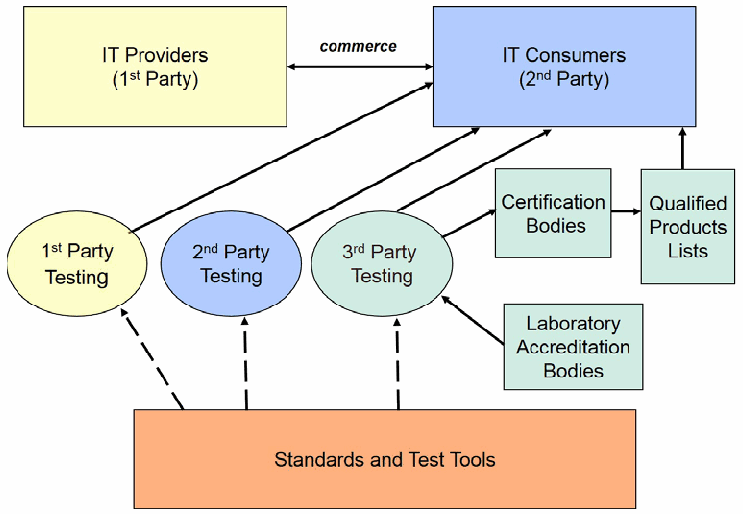
適合性評価の機能の概要を示す図です。上段の「IT Providers (1st Party)」(IT 提供者、第一者)と「IT Consumers (2nd Party)」(IT 利用者、第二者)は「commerce」(商取引)と書かれた双方向の矢印で結ばれています。その下に「1st Party Testing」「2nd Party Testing」「3rd Party Testing」(第一者・第二者・第三者による試験)の3つの楕円があり、それぞれから「IT Consumers (2nd Party)」へ矢印が向かっています。「3rd Party Testing」からは「Certification Bodies」(認証機関)へも矢印があり、そこから「Qualified Products Lists」(適格製品リスト)を経て「IT Consumers (2nd Party)」へ矢印が向かいます。「Laboratory Accreditation Bodies」(試験所認定機関)から「3rd Party Testing」へ矢印があります。下段の「Standards and Test Tools」(標準と試験ツール)から3つの試験の楕円へ破線の矢印が向かっています。
Figure B1: Conformity Assessment Functional Overview
図 B1: 適合性評価の機能の概要
Annex C – USG Legislative and Policy Mandates for Cybersecurity
附属書 C – サイバーセキュリティに関する米国政府の立法上および政策上の義務付け
Biometrics
バイオメトリクス
•USA PATRIOT Act (Public Law 107-56)
•USA PATRIOT Act (Public Law 107-56)
•Enhanced Border Security and Visa Entry Reform Act of 2002 (Public Law 107-173)
•Enhanced Border Security and Visa Entry Reform Act of 2002 (Public Law 107-173)
•Homeland Security Presidential Directive/HSPD #12: Policy for a Common Identification Standard for Federal Employees and Contractors (August 27, 2004)
•Homeland Security Presidential Directive/HSPD #12: Policy for a Common Identification Standard for Federal Employees and Contractors (August 27, 2004)
•National Security Presidential Directive/NSPD #59/ Homeland Security Presidential Directive/HSPD #24, Biometrics for Identification and Screening to Enhance National Security (June 5, 2008)
•National Security Presidential Directive/NSPD #59/ Homeland Security Presidential Directive/HSPD #24, Biometrics for Identification and Screening to Enhance National Security (June 5, 2008)
Cybersecurity
サイバーセキュリティ
•Federal Information Security Modernization Act of 2014 (Public Law 113-283)
•Federal Information Security Modernization Act of 2014 (Public Law 113-283)
•Cybersecurity Enhancement Act of 2014 (Public Law No: 113-274)
•Cybersecurity Enhancement Act of 2014 (Public Law No: 113-274)
•Improving Critical Infrastructure Cybersecurity (Executive Order, February 12, 2013)
•Improving Critical Infrastructure Cybersecurity (Executive Order, February 12, 2013)
•National Cybersecurity Center of Excellence (Public Law 112-55, Consolidated and Further Continuing Appropriations Act of 2012)
•National Cybersecurity Center of Excellence (Public Law 112-55, Consolidated and Further Continuing Appropriations Act of 2012)
•National Initiative For Cybersecurity Education (NICE)
•National Initiative For Cybersecurity Education (NICE)
•Section 5131 of the Information Technology Management Reform Act of 1996 (Public Law 104-106) [supersedes Computer Security Act of 1987 (Public Law 100-235)]
•Section 5131 of the Information Technology Management Reform Act of 1996 (Public Law 104-106) [supersedes Computer Security Act of 1987 (Public Law 100-235)]
•Federal Information Security Management Act (FISMA) of 2002 (Title III of the E-Government Act Federal Information Security Management Act of 2002 (Public Law 107-347))
•Federal Information Security Management Act (FISMA) of 2002 (Title III of the E-Government Act Federal Information Security Management Act of 2002 (Public Law 107-347))
•Cybersecurity Research and Development Act of 2002 (Public Law 107-305)
•Cybersecurity Research and Development Act of 2002 (Public Law 107-305)
•National Strategy to Secure Cyberspace (February 2003)
•National Strategy to Secure Cyberspace (February 2003)
•Homeland Security Presidential Directive #12: Policy for a Common Identification Standard for Federal Employees and Contractors (August 27, 2004)
•Homeland Security Presidential Directive #12: Policy for a Common Identification Standard for Federal Employees and Contractors (August 27, 2004)
•Conference Report on House Resolution 5441, Department of Homeland Security Appropriations Act, 2007: Title V - General Provisions (WHTI [Western Hemisphere Travel Initiative] Certification effort)
•Conference Report on House Resolution 5441, Department of Homeland Security Appropriations Act, 2007: Title V - General Provisions (WHTI [Western Hemisphere Travel Initiative] Certification effort)
•OMB Circular A-130 Management of Federal Information Resources (February 8, 1996)
•OMB Circular A-130 Management of Federal Information Resources (February 8, 1996)
•OMB M-04-04 E-Authentication Guidance for Federal Agencies (December 16, 2003)
•OMB M-04-04 E-Authentication Guidance for Federal Agencies (December 16, 2003)
•OMB Directive 05-24 Implementation of Homeland Security Presidential Directive (HSPD) 12 – Policy for a Common Identification Standard for Federal Employees and Contractors (August 5, 2005)
•OMB Directive 05-24 Implementation of Homeland Security Presidential Directive (HSPD) 12 – Policy for a Common Identification Standard for Federal Employees and Contractors (August 5, 2005)
•OMB Memorandum M-08-05, Implementation of Trusted Internet Connections (November 20, 2007)
•OMB Memorandum M-08-05, Implementation of Trusted Internet Connections (November 20, 2007)
•OMB M-08-23 Securing the Federal Government’s Domain Name System Infrastructure (August 22, 2008)
•OMB M-08-23 Securing the Federal Government’s Domain Name System Infrastructure (August 22, 2008)
•National Security Presidential Directive 54 / Homeland Security Presidential Directive 23 (NSPD-54/HSPD-23): Comprehensive National Cybersecurity Initiative (January 2008)
•National Security Presidential Directive 54 / Homeland Security Presidential Directive 23 (NSPD-54/HSPD-23): Comprehensive National Cybersecurity Initiative (January 2008)
Emergency Alert for Wireless Mobile Devices
無線モバイルデバイス向けの緊急警報
•Warning, Alert, and Response Network Act (part of the Security and Accountability For Every Port Act of 2006 (SAFE Port Act) (Public Law 109-347)
•Warning, Alert, and Response Network Act (part of the Security and Accountability For Every Port Act of 2006 (SAFE Port Act) (Public Law 109-347)
Healthcare Information Technology
医療情報技術
•Health Information Technology for Economic and Clinical Health (HITECH) Act, American Recovery and Reinvestment Act of 2009 (Public Law 111-5)
•Health Information Technology for Economic and Clinical Health (HITECH) Act, American Recovery and Reinvestment Act of 2009 (Public Law 111-5)
•Health Insurance Portability and Accountability Act (HIPAA) of 1996 (Public Law 104-191)
•Health Insurance Portability and Accountability Act (HIPAA) of 1996 (Public Law 104-191)
Identity Management
ID 管理
•National Strategy for Trusted Identities in Cyberspace (April 2011)
•National Strategy for Trusted Identities in Cyberspace (April 2011)
Internet Protocol version 6 (IPv6)
インターネットプロトコルバージョン 6(IPv6)
•OMB Memo on Transition to IPv6 (September 28, 2010)
•OMB Memo on Transition to IPv6 (September 28, 2010)
•OMB M-05-22 on Transition Planning for IPv6 (August 2, 2005)
•OMB M-05-22 on Transition Planning for IPv6 (August 2, 2005)
Smart Grid
スマートグリッド
•Energy Independence and Security Act (EISA) of 2007 (Public Law 110-140)
•Energy Independence and Security Act (EISA) of 2007 (Public Law 110-140)
•American Recovery and Reinvestment Act of 2009 (Public Law 111-5)
•American Recovery and Reinvestment Act of 2009 (Public Law 111-5)
Voluntary Voting System Standards
自主的な投票システム標準
•Military and Overseas Voter Empowerment (MOVE) Act of 2009
•Military and Overseas Voter Empowerment (MOVE) Act of 2009
•Help America Vote Act of 2002 (Public Law 107-252)
•Help America Vote Act of 2002 (Public Law 107-252)
Annex D – Cybersecurity Analysis of Application Areas
附属書 D – アプリケーション分野のサイバーセキュリティ分析
This Annex provides a cybersecurity analysis for each of the IT application areas highlighted in Section 4 and Table 1.
本附属書は、第 4 節と表 1 で取り上げた IT アプリケーション分野のそれぞれについて、サイバーセキュリティ分析を提供します。
D.1 Cloud Computing37
D.1 クラウドコンピューティング37
Cloud computing is a model for enabling convenient, on-demand network access to a shared pool of configurable computing resources (e.g., networks, servers, storage, applications, and services) that can be rapidly provisioned and released with minimal management effort or service provider interaction. This cloud model promotes availability and is composed of five main characteristics, three service models, and four deployment models.
クラウドコンピューティングは、最小限の管理労力またはサービスプロバイダーとのやり取りで迅速にプロビジョニングおよび解放できる、構成可能なコンピューティング資源(例: ネットワーク、サーバー、ストレージ、アプリケーション、サービス)の共有プールに、便利にオンデマンドでネットワークアクセスできるようにするモデルです。このクラウドモデルは可用性を促進し、5 つの基本特性、3 つのサービスモデル、4 つの導入モデルで構成されます。
Essential Characteristics:
基本特性:
•On-demand self-service. A consumer can unilaterally provision computing capabilities, such as server time and network storage, as needed automatically without requiring human interaction with each service’s provider.
•オンデマンド・セルフサービス。利用者は、サーバー時間やネットワークストレージなどのコンピューティング能力を、各サービスの提供者との人手によるやり取りを必要とせずに、必要に応じて一方的かつ自動的にプロビジョニングできます。
•Broad network access. Capabilities are available over the network and accessed through standard mechanisms that promote use by heterogeneous thin or thick client platforms (e.g., mobile phones, laptops, and personal digital assistants (PDAs)).
•広範なネットワークアクセス。能力はネットワーク経由で利用可能であり、異種のシンクライアントまたはシッククライアントのプラットフォーム(例: 携帯電話、ノートパソコン、携帯情報端末(PDA))による利用を促進する標準的な仕組みを通じてアクセスされます。
•Resource pooling. The provider’s computing resources are pooled to serve multiple consumers using a multi-tenant model, with different physical and virtual resources dynamically assigned and reassigned according to consumer demand. There is a sense of location independence in that the consumer generally has no control or knowledge over the exact location of the provided resources but may be able to specify location at a higher level of abstraction (e.g., country, state, or datacenter). Examples of resources include storage, processing, memory, network bandwidth, and virtual machines.
•リソースプーリング。提供者のコンピューティング資源は、マルチテナントモデルを用いて複数の利用者に提供するためにプールされ、さまざまな物理資源および仮想資源が、利用者の需要に応じて動的に割り当てられ、再割り当てされます。資源の所在に依存しない性質があります。利用者は一般に、提供される資源の正確な所在を制御することも知ることもできませんが、より高い抽象度(例: 国、州、データセンター)で所在を指定できる場合があります。資源の例には、ストレージ、処理、メモリ、ネットワーク帯域幅、仮想マシンがあります。
•Rapid elasticity. Capabilities can be rapidly and elastically provisioned, in some cases automatically, to quickly scale out and be rapidly released to quickly scale in. To the consumer, the capabilities available for provisioning often appear to be unlimited and can be purchased in any quantity at any time.
•迅速な弾力性。能力は迅速かつ弾力的にプロビジョニングでき、場合によっては自動的に、迅速なスケールアウトのために拡張でき、迅速なスケールインのために速やかに解放できます。利用者から見ると、プロビジョニング可能な能力は無制限であるように見えることが多く、いつでも任意の量を購入できます。
•Measured Service. Cloud systems automatically control and optimize resource use by leveraging a metering capability at a level of abstraction appropriate to the type of service (e.g., storage, processing, bandwidth, and active user accounts). Resource usage can be monitored, controlled, and reported providing transparency for both the provider and consumer of the utilized service.
•測定可能なサービス。クラウドシステムは、サービスの種類(例: ストレージ、処理、帯域幅、アクティブな利用者アカウント)に適した抽象度で計測機能を活用し、資源の使用を自動的に制御し、最適化します。資源の使用状況は監視、制御、報告でき、利用されるサービスの提供者と利用者の双方に透明性を提供します。
Service Models:
サービスモデル:
•Cloud Software as a Service (SaaS). The capability provided to the consumer is to use the provider’s applications running on a cloud infrastructure. The applications are accessible from various client devices through a thin client interface such as a web browser (e.g., web-based email). The consumer does not manage or control the underlying cloud infrastructure including network, servers, operating systems, storage, or even individual application capabilities, with the possible exception of limited user-specific application configuration settings.
•サービスとしてのクラウドソフトウェア(SaaS)。利用者に提供される能力は、クラウドインフラストラクチャ上で稼働する提供者のアプリケーションを利用することです。アプリケーションには、ウェブブラウザーなどのシンクライアントインターフェース(例: ウェブメール)を通じて、さまざまなクライアント端末からアクセスできます。利用者は、ネットワーク、サーバー、オペレーティングシステム、ストレージ、さらには個々のアプリケーション機能を含む基盤となるクラウドインフラストラクチャを管理も制御もしません。ただし、限定的な利用者固有のアプリケーション構成設定は例外となり得ます。
•Cloud Platform as a Service (PaaS). The capability provided to the consumer is to deploy onto the cloud infrastructure consumer-created or acquired applications created using programming languages and tools supported by the provider. The consumer does not manage or control the underlying cloud infrastructure including network, servers, operating systems, or storage, but has control over the deployed applications and possibly application hosting environment configurations.
•サービスとしてのクラウドプラットフォーム(PaaS)。利用者に提供される能力は、提供者がサポートするプログラミング言語とツールを使って作成された、利用者が作成または取得したアプリケーションを、クラウドインフラストラクチャに展開することです。利用者は、ネットワーク、サーバー、オペレーティングシステム、ストレージを含む基盤となるクラウドインフラストラクチャを管理も制御もしませんが、展開したアプリケーションを制御し、場合によってはアプリケーションのホスティング環境の構成設定も制御します。
•Cloud Infrastructure as a Service (IaaS). The capability provided to the consumer is to provision processing, storage, networks, and other fundamental computing resources where the consumer is able to deploy and run arbitrary software, which can include operating systems and applications. The consumer does not manage or control the underlying cloud infrastructure but has control over operating systems, storage, deployed applications, and possibly limited control of select networking components (e.g., host firewalls).
•サービスとしてのクラウドインフラストラクチャ(IaaS)。利用者に提供される能力は、処理能力、ストレージ、ネットワーク、その他の基本的なコンピューティング資源をプロビジョニングすることであり、利用者はそこに任意のソフトウェア(オペレーティングシステムやアプリケーションを含み得る)を展開して実行できます。利用者は基盤となるクラウドインフラストラクチャを管理も制御もしませんが、オペレーティングシステム、ストレージ、展開したアプリケーションを制御し、場合によっては一部のネットワークコンポーネント(例: ホストファイアウォール)を限定的に制御できます。
Deployment Models:
導入モデル:
•Private cloud. The cloud infrastructure is operated solely for an organization. It may be managed by the organization or a third party and may exist on premise or off premise.
•プライベートクラウド。クラウドインフラストラクチャは、単一の組織のためだけに運用されます。その組織または第三者が管理する場合があり、オンプレミスにもオフプレミスにも存在し得ます。
•Community cloud. The cloud infrastructure is shared by several organizations and supports a specific community that has shared concerns (e.g., mission, security requirements, policy, and compliance considerations). It may be managed by the organizations or a third party and may exist on premises or off premise.
•コミュニティクラウド。クラウドインフラストラクチャは、複数の組織で共有され、共通の関心事(例: 使命、セキュリティ要件、ポリシー、コンプライアンス上の考慮事項)を持つ特定のコミュニティを支えます。それらの組織または第三者が管理する場合があり、オンプレミスにもオフプレミスにも存在し得ます。
•Public cloud. The cloud infrastructure is made available to the general public or a large industry group and is owned by an organization selling cloud services.
•パブリッククラウド。クラウドインフラストラクチャは、一般の人々または大規模な業界団体に提供され、クラウドサービスを販売する組織が所有します。
•Hybrid cloud. The cloud infrastructure is a composition of two or more clouds (private, community, or public) that remain unique entities but are bound together by standardized or proprietary technology that enables data and application portability (e.g., cloud bursting for load-balancing between clouds).
•ハイブリッドクラウド。クラウドインフラストラクチャは、2 つ以上のクラウド(プライベート、コミュニティ、パブリック)を組み合わせたもので、各クラウドは独立した実体として保たれますが、データとアプリケーションの移植性を可能にする標準技術または独自技術で結合されています(例: クラウド間の負荷分散のためのクラウドバースティング)。
Threats
脅威
The “Cloud First” policy makes cloud computing the new norm for government agencies. However, if not properly addressed, federal information and information systems38 are subject to serious threats that can have adverse impacts on organizational operations (including mission, functions, image, and reputation), organizational assets, individuals, other organizations, and the Nation39 by compromising the confidentiality, integrity, or availability of information being processed, stored, or transmitted by those systems. The adoption of cloud computing marks the beginning of a new technological era that calls for additional guidance for agencies of how to best assess and manage the risk assumed from adopting this new technology that changes the emphasis of the traditional IT services from procuring, maintaining, and operating the necessary hardware and related infrastructure to the business’ mission, and delivering value added capabilities and services at lower cost to users.
「Cloud First」政策は、クラウドコンピューティングを政府機関の新たな標準にしています。しかし、適切に対処しなければ、連邦の情報と情報システム38は、それらのシステムが処理、保存、送信する情報の機密性、完全性、可用性が損なわれることにより、組織の運営(任務、機能、イメージ、評判を含む)、組織の資産、個人、他の組織、国家39に悪影響を及ぼしうる深刻な脅威にさらされます。クラウドコンピューティングの採用は新たな技術の時代の始まりを示しており、この新技術の採用に伴うリスクを機関が最善の方法で評価・管理するための追加ガイダンスが求められています。この技術は、従来の IT サービスにおける重点を、必要なハードウェアと関連インフラストラクチャの調達、保守、運用から、事業の任務およびユーザーに低コストで付加価値のある能力とサービスを提供することへと移します。
The three cybersecurity objectives, ensuring the confidentiality, integrity, and availability of information and information systems, are particularly relevant, in addition to privacy, as these are the high priority concerns and perceived risks related to cloud computing. Consistent with other Application Areas, cloud computing implementations are subject to local physical threats, including insider threats, as well as remote, external threats. For majority of Application Areas, the source of these threats includes accidents, natural disasters, hostile governments, criminal organizations, terrorist groups, malicious or unintentional introduction of vulnerabilities through internal and external authorized and unauthorized human and system access, including but not limited to employees and intruders. While the security of a cloud computing ecosystems may be affected by similar threat vectors, the cloud’s architectural native characteristics such as rapid-elasticity and broad network access, increase the cloud service’s availability and potentially can, on the positive side, prevent the loss of service during natural disasters. On the negative side, the multi-tenant model used to support the resource pooling characteristic requires careful architectural considerations and mechanisms in place to provide logical, vertical isolation of data, in such a way that no tenant can intentionally or unintentionally get access to another tenant’s data.
情報と情報システムの機密性、完全性、可用性を確保するという 3 つのサイバーセキュリティ目標は、プライバシーに加えて、特に関連性が高くなります。これらが、クラウドコンピューティングに関連する優先度の高い懸念事項であり、認識されているリスクであるためです。ほかのアプリケーション分野と同様に、クラウドコンピューティングの実装は、内部脅威を含む局所的な物理的脅威のほか、遠隔からの外部脅威にもさらされます。ほとんどのアプリケーション分野では、これらの脅威の発生源には、事故、自然災害、敵対的な政府、犯罪組織、テロリスト集団、ならびに従業員や侵入者などによる、内部および外部からの認可済みまたは未認可の人間とシステムのアクセスを通じた、悪意のある、または意図しない脆弱性の混入が含まれます。クラウドコンピューティングのエコシステムのセキュリティは、同様の脅威ベクトルの影響を受ける可能性がありますが、迅速な弾力性や広範なネットワークアクセスといったクラウド固有のアーキテクチャ特性は、クラウドサービスの可用性を高め、好ましい面では、自然災害時のサービスの喪失を防げる可能性があります。好ましくない面では、リソースプーリングの特性を支えるために使用されるマルチテナントモデルは、どのテナントも意図的にも意図せずにも別のテナントのデータにアクセスできないようにするため、データを論理的かつ垂直に分離するための慎重なアーキテクチャ上の検討と仕組みを必要とします。
Overall, cloud computing’s three service types and four deployment models heighten the need to develop data-centric architectures that consider data and systems protection in the context of logical as well as physical boundaries. Additionally, forensics investigations are more challenging in cloud ecosystems than traditional IT systems due to cloud native characteristics and architecture.
全体として、クラウドコンピューティングの 3 つのサービスタイプと 4 つの導入モデルは、物理的な境界だけでなく論理的な境界の文脈でも、データとシステムの保護を考慮した、データ中心のアーキテクチャを開発する必要性を高めています。さらに、クラウドに固有の特性とアーキテクチャのため、クラウドのエコシステムでは、従来の IT システムよりもフォレンジック調査が困難です。
Possible types of attacks against Cloud Computing services include the following:
クラウドコンピューティングサービスに対する攻撃の可能な種類には、次のものがあります。
•Compromises to the confidentiality and integrity of data in transit to and from a cloud provider;
•クラウドプロバイダーとの間で転送中のデータの機密性と完全性の危殆化。
•Compromises to the confidentiality and integrity of data at rest (when not in use);
•保存中(使用されていないとき)のデータの機密性と完全性の危殆化。
•Compromises to the confidentiality and integrity of data in memory (when data is in use)
•メモリ内(データが使用されているとき)のデータの機密性と完全性の危殆化。
•Attacks which take advantage of the homogeneity and power of cloud computing environments to rapidly scale and increase the magnitude of the attack;
•クラウドコンピューティング環境の同質性と能力を利用して、攻撃を迅速に拡大し、その規模を増大させる攻撃。
•Unauthorized access (through improper authentication or authorization, or vulnerabilities introduced during maintenance) to software, data, and resources in use by a cloud service consumer by another consumer;
•あるクラウドサービス利用者が使用しているソフトウェア、データ、資源への、別の利用者による(不適切な認証や認可、または保守中に混入した脆弱性を通じた)不正なアクセス。
•Inadequate cryptographic key management when encryption is extensively used to prevent data disclosure in multi-tenant environments;
•マルチテナント環境でデータの開示を防ぐために暗号化が広く使用される場合の、不適切な暗号鍵管理。
•Increased levels of network-based attacks that exploit software or vulnerabilities in applications designed for private networks and not using an Internet threat model;
•プライベートネットワーク向けに設計され、インターネットの脅威モデルを用いていないアプリケーションのソフトウェアや脆弱性を悪用する、ネットワークベースの攻撃の増加。
•Portability and interoperability constraints resulting from non-standard application programming interfaces (APIs) and lack of data format standardization cause vendor lock-in and cloud consumer’s inability to change cloud service provider and promote competitiveness;
•標準化されていないアプリケーションプログラミングインターフェース(API)とデータ形式の標準化の欠如によるポータビリティと相互運用性の制約は、ベンダーロックインを引き起こし、クラウド利用者がクラウドサービスプロバイダーを変更して競争を促すことができなくなります。
•Attacks that take advantage of virtual machines that have not recently been patched because they have not been in use; and
•使用されていないために最近パッチが適用されていない仮想マシンを悪用する攻撃。
•Attacks that exploit inconsistencies in global privacy policies and regulations.
•グローバルなプライバシーポリシーや規制の不整合を悪用する攻撃。
Security Objectives
セキュリティ目標
Major security objectives for cloud computing ecosystems include the following:
クラウドコンピューティングのエコシステムの主なセキュリティ目標には、次のものがあります。
•Define cloud-adapted information security management system (a cloud-adapted risk management framework, with a cloud consumer centric approach.) This includes the trust boundary concept – a logical boundary that identifies, from the consumer’s perspective, all the security controls the system inherits or uses directly, including the ones implemented by other actors, and it is essential for the risk management process and security authorization of the acquired cloud service.
•クラウドに適応した情報セキュリティマネジメントシステム(クラウド利用者中心のアプローチによる、クラウドに適応したリスクマネジメントフレームワーク)を定義すること。これには、トラストバウンダリの概念が含まれます。これは、利用者の視点から、システムが継承または直接使用するすべてのセキュリティ管理策(他の関係者が実装したものを含む)を特定する論理的な境界であり、取得したクラウドサービスのリスク管理プロセスとセキュリティ認可に不可欠です。
•Define a methodology that allows for clear identification and delineation of security and privacy responsibilities between service provider(s), broker(s) and consumer. This is important since it provides the foundation for the Service Level Agreement (SLA) negotiation (including security SLA) and the security metrics used to monitor the acquired cloud service.
•サービスプロバイダー、ブローカー、利用者の間のセキュリティとプライバシーの責任を明確に特定し、区分できるようにする方法論を定義すること。これは、サービスレベル契約(SLA)の交渉(セキュリティ SLA を含む)と、取得したクラウドサービスを監視するために使用されるセキュリティメトリクスの基礎となるため、重要です。
•Protect consumer’s data from unauthorized disclosure or modification. Even though access control to data is a key part of the risk management, re-iterating its importance by identifying it as a separate objective is essential. This includes supporting identity and access management such that the consumer has the capability to enforce identity and access control policies on users accessing cloud services. The objective can include consumer’s ability to grant access to its data selectively, available to other authorized entities (data sharing management capability).
•利用者のデータを、不正な開示や改変から保護すること。データへのアクセス制御はリスク管理の重要な部分ですが、それを独立した目標として特定し、その重要性を繰り返し示すことが不可欠です。これには、利用者が、クラウドサービスにアクセスするユーザーに対して ID およびアクセス制御ポリシーを徹底する能力を持てるよう、ID およびアクセス管理を支援することが含まれます。この目標には、利用者が、自らのデータへのアクセスを、他の認可されたエンティティが利用できる形で選択的に許可する能力(データ共有管理能力)が含まれる場合があります。
•Providing security guidance for SLA & metrics. This is directly correlated with the overall SLA. The objective is also setting the foundation for the continuous diagnostic and mitigation and continuous monitoring of cloud service.
•SLA とメトリクスに関するセキュリティのガイダンスを提供すること。これは、SLA 全体と直接関連しています。この目標は、クラウドサービスの継続的な診断と緩和、および継続的監視の基礎を築くものでもあります。
•Support cost-effective portability such that the consumer can take action to change cloud service providers when needed to satisfy availability, confidentiality and integrity requirements. This includes the ability to close an account on a particular date and time, and to copy data from one service provider to another.
•可用性、機密性、完全性の要件を満たすために必要な場合に、利用者がクラウドサービスプロバイダーを変更する措置をとれるよう、費用対効果の高いポータビリティを支援すること。これには、特定の日時にアカウントを閉鎖する能力と、あるサービスプロバイダーから別のサービスプロバイダーにデータをコピーする能力が含まれます。
•Proper cryptographic key management solutions for keys used for data confidentiality and integrity protection and for keys used for users’ identification (when applicable). This objectives ensures that data encryption, data signing and users’ identification mechanisms do not give a false sense of security and keys do not become accessible to unauthorized entities;
•データの機密性と完全性の保護に使用される鍵、および(該当する場合)ユーザーの識別に使用される鍵について、適切な暗号鍵管理のソリューションを備えること。この目標は、データの暗号化、データへの署名、ユーザーの識別の仕組みが誤った安心感を与えないようにし、鍵が認可されていないエンティティにアクセス可能にならないようにするものです。
•Prevent unauthorized access to cloud computing infrastructure resources. This includes implementing security domains that have logical separation between computing resources (e.g. logical separation of consumer workloads running on the same physical server by virtual machine [VM] monitors [hypervisors] in a multitenant environment) and using secure-by-default configurations.
•クラウドコンピューティングのインフラストラクチャ資源への不正なアクセスを防止すること。これには、コンピューティング資源間に論理的な分離がある(例: マルチテナント環境で、仮想マシン [VM] モニター [ハイパーバイザー] によって同じ物理サーバー上で稼働する利用者のワークロードを論理的に分離する)セキュリティドメインを実装することと、デフォルトで安全な構成を使用することが含まれます。
•Design web applications deployed in a cloud using an Internet threat model. This objective promotes best practices for web applications in general, including the cloud-based ones, by highlighting the need to embed security into the software development process.
•インターネットの脅威モデルを用いて、クラウドに展開される Web アプリケーションを設計すること。この目標は、ソフトウェア開発プロセスにセキュリティを組み込む必要性を強調することで、クラウドベースのものを含む Web アプリケーション全般のベストプラクティスを促進します。
•Protect Internet browsers from attacks to mitigate end-user security vulnerabilities. This includes taking measures to protect internet-connected personal computing devices by applying security software, personal firewalls, and patch maintenance.
•エンドユーザーのセキュリティ上の脆弱性を緩和するため、インターネットブラウザーを攻撃から保護すること。これには、セキュリティソフトウェア、パーソナルファイアウォール、パッチの維持管理を適用することで、インターネットに接続された個人のコンピューティングデバイスを保護する措置をとることが含まれます。
•Monitor access control and intrusion detection mechanisms implemented by cloud provider and broker, and design independent assessment mechanism to verify they are in place. This includes (but does not rely on) traditional perimeter security measures in combination with the domain security model. Traditional perimeter security includes restricting physical access to network and devices, protecting individual components from exploitation through security patch deployment, default most secure configurations, disabling all unused ports and services, role based access control, monitoring audit trails, minimizing the use of privilege, antivirus software; and encrypting communications.
•クラウドプロバイダーとブローカーが実装するアクセス制御と侵入検知の仕組みを監視し、それらが整備されていることを検証する独立した評価の仕組みを設計すること。これには、ドメインセキュリティモデルと組み合わせた従来の境界セキュリティ対策が含まれます(ただし、それに依存するものではありません)。従来の境界セキュリティには、ネットワークとデバイスへの物理的なアクセスの制限、セキュリティパッチの展開による個々の構成要素の悪用からの保護、デフォルトで最も安全な構成、使用していないすべてのポートとサービスの無効化、ロールベースアクセス制御、監査証跡の監視、権限の使用の最小化、ウイルス対策ソフトウェア、通信の暗号化が含まれます。
Standards Landscape
標準の状況
NIST Special Publication 500-291 version 2, NIST Cloud Computing Standards Roadmap (July 2013) surveyed the existing standards landscape for interoperability, performance, portability, security, and accessibility standards relevant to cloud computing. Using this available information, current standards, standards gaps, and standardization priorities are identified within this document.
NIST Special Publication 500-291 version 2, NIST Cloud Computing Standards Roadmap(2013 年 7 月)は、クラウドコンピューティングに関連する、相互運用性、性能、ポータビリティ、セキュリティ、アクセシビリティの標準の既存の状況を調査しました。この入手可能な情報を用いて、本文書では、現在の標準、標準のギャップ、標準化の優先事項が特定されています。
The communication between end-users and cloud ecosystem is supported by existing standards that have been developed to facilitate communication, data exchange, and security, such as base-level infrastructure standards, (e.g. TCP/IP, DNS, SMTP, HTML, HTTP, HTTPS, FTP,) These standards offer a convenient and secure access to cloud-based information systems, while restricting majority security exposures of data in transit. Other standards such as SSL and TLS provide public-key cryptographic protocols that allow consumers and cloud providers to automatically establish shared keys that can be used to protect their communications (although much yet remains to be done in this space).
エンドユーザーとクラウドエコシステムとの間の通信は、通信、データ交換、セキュリティを促進するために策定された既存の標準、たとえば基本レベルのインフラストラクチャ標準(例: TCP/IP、DNS、SMTP、HTML、HTTP、HTTPS、FTP)によって支えられています。これらの標準は、クラウドベースの情報システムへの便利で安全なアクセスを提供するとともに、転送中のデータに対するセキュリティ上のリスクの大半を抑制します。SSL や TLS などのその他の標準は、利用者とクラウドプロバイダーが、通信の保護に使用できる共通鍵を自動的に確立できるようにする公開鍵暗号プロトコルを提供しています(この分野では、まだ多くのことが残されていますが)。
Other security standards that are relevant to cloud computing include XACML (eXtensible Access Control Markup Language) and SAML (Security Assertion Markup Language). A number of additional web-oriented standards exist, including the WS (Web Services) standards such as WS-Trust, WS-Policy, WS-SecurityPolicy, etc., but their adoption by the market place is limited.
クラウドコンピューティングに関連するその他のセキュリティ標準には、XACML(eXtensible Access Control Markup Language)と SAML(Security Assertion Markup Language)があります。WS-Trust、WS-Policy、WS-SecurityPolicy などの WS(Web Services)標準を含め、ウェブ指向の標準がほかにも数多く存在しますが、市場による採用は限られています。
Cloud security related standards development in JTC 1 SC 27, IT Security Techniques, has resulted in some approved standards with more under development. ISO/IEC 27040:2015 provides detailed technical guidance on how organizations can define an appropriate level of risk mitigation by employing a well-proven and consistent approach to the planning, design, documentation, and implementation of data storage security. ISO/IEC 27018:2014 establishes commonly accepted control objectives, controls and guidelines for implementing measures to protect Personally Identifiable Information (PII) in accordance with the privacy principles in ISO/IEC 29100 for the public cloud computing environment. ISO/IEC FDIS 27017 will provide guidance on the information security elements of cloud computing, recommending and assisting with the implementation of cloud-specific information security controls supplementing the guidance in ISO/IEC 27002. Draft standard ISO/IEC CD 27036-4 will provide guidance for security of cloud services in supplier relationships.
JTC 1 SC 27(IT セキュリティ技術)におけるクラウドセキュリティ関連の標準開発は、承認された標準をいくつか生み出しており、さらに多くが策定中です。ISO/IEC 27040:2015 は、データストレージのセキュリティの計画、設計、文書化、実装に対して、実績のある一貫したアプローチを採用することで、組織が適切なレベルのリスク緩和を定義する方法について、詳細な技術的ガイダンスを提供しています。ISO/IEC 27018:2014 は、パブリッククラウドコンピューティング環境について、ISO/IEC 29100 のプライバシー原則に従って、個人を特定できる情報(PII)を保護するための対策を実装するための、一般に受け入れられている管理目的、管理策、ガイドラインを確立しています。ISO/IEC FDIS 27017 は、ISO/IEC 27002 のガイダンスを補足する、クラウド固有の情報セキュリティ管理策の実装を推奨し支援する、クラウドコンピューティングの情報セキュリティの要素に関するガイダンスを提供する予定です。標準の草案である ISO/IEC CD 27036-4 は、供給者との関係におけるクラウドサービスのセキュリティについてのガイダンスを提供する予定です。
Stemming from the focus on Virtualization Security, JTC 1 SC 27 recently approved a number of study periods, such as “Security Guidelines for the design and implementation of virtualized servers,” “Emerging virtualization security,” “Virtualized roots of trust,” “Architecture of trusted connected to cloud services,” and “Application security validation.” These study periods range from 6 to 12 months and could potentially lead to new work items. While exploring risk management for cloud computing, JTC 1 SC 27 has expanded to two separate study periods: “Cloud and New Data related technology risk management (CDRM),” and “Information Security Risks and Opportunities.”
仮想化セキュリティへの注目に端を発して、JTC 1 SC 27 は最近、「Security Guidelines for the design and implementation of virtualized servers」、「Emerging virtualization security」、「Virtualized roots of trust」、「Architecture of trusted connected to cloud services」、「Application security validation」など、いくつかのスタディピリオドを承認しました。これらのスタディピリオドの期間は 6 か月から 12 か月で、新たな作業項目につながる可能性があります。クラウドコンピューティングのリスク管理を検討するなかで、JTC 1 SC 27 は取り組みを、「Cloud and New Data related technology risk management (CDRM)」と「Information Security Risks and Opportunities」という 2 つの別個のスタディピリオドへと拡張しました。
Following the footsteps of SC 38 on collection use cases, there is a study period on Cloud security use cases and potential standardization gaps. SC38 has developed a 4-part standard on ISO/IEC 19086, Information technology–Cloud Computing–Service Level Agreement (SLA) framework, and SC 27 WG4 accepted to lead the effort on ISO/IEC 19086-4 Part 4: Security and Privacy. It is currently a working draft. Similarly, SC27 WG5 is invited to contribute to SC 38 on efforts relating to identity management, privacy, and biometrics for cloud computing.
ユースケースの収集に関する SC 38 の取り組みに続いて、クラウドセキュリティのユースケースと標準化の潜在的なギャップに関するスタディピリオドがあります。SC38 は、ISO/IEC 19086, Information technology–Cloud Computing–Service Level Agreement (SLA) framework について 4 部構成の標準を策定しており、SC 27 WG4 は ISO/IEC 19086-4 Part 4: Security and Privacy の取り組みを主導することを引き受けました。これは現在、作業草案の段階です。同様に、SC27 WG5 は、クラウドコンピューティングのための ID 管理、プライバシー、バイオメトリクスに関する取り組みについて、SC 38 に貢献するよう招請されています。
Present Cloud Security Alliance (CSA) standards include: the Cloud Control Matrix (CCM), a security control framework specifically dedicated to Cloud Computing; Consensus Assessment Initiative Questionnaire (CAIQ), a due diligence framework to guide organizations in the assessment of the CCM controls implementation; CloudAudit, a common interface and namespace that allows enterprises to streamline their audit processes; and Privacy Level Agreement (PLA), a guidance to achieve a baseline compliance with mandatory personal data protection legislation across the EU.
現在の Cloud Security Alliance(CSA)の標準には、クラウドコンピューティングに特化したセキュリティ管理策のフレームワークである Cloud Control Matrix(CCM)、組織による CCM の管理策の実装の評価を導くデューデリジェンスのフレームワークである Consensus Assessment Initiative Questionnaire(CAIQ)、企業が監査プロセスを合理化できるようにする共通のインターフェースと名前空間である CloudAudit、EU 全体の強制的な個人データ保護法令への基準となる準拠を達成するための指針である Privacy Level Agreement(PLA)があります。
D.2 Emergency Management
D.2 緊急事態管理
The first responder community needs reliable, secure, and interoperable information and communications technology to protect the public during disasters and catastrophes. There is increasing convergence of the voice, data, and video information being exchanged to provide situational awareness in response to an event. For larger disasters and catastrophes, first responders from neighboring jurisdictions or inter-governmental jurisdictions (i.e., state or Federal) need to be integrated into the response, along with the information and communications technologies they use.
ファーストレスポンダーのコミュニティには、災害や大惨事の際に公衆を守るため、信頼でき、安全で、相互運用可能な情報通信技術が必要です。事象への対応における状況認識を提供するために交換される音声、データ、映像の情報は、ますます収束しつつあります。より大規模な災害や大惨事では、隣接する管轄区域や政府間の管轄区域(すなわち、州または連邦)のファーストレスポンダーを、その使用する情報通信技術とともに、対応に統合する必要があります。
Threats
脅威
Historically, the first responder community has not operated their communication and data systems as a single entity, rather by jurisdiction, region, or by federal agency. The increased use of broadband-based applications and infrastructure by emergency response agencies stands to make emergency communications systems more vulnerable to cyber-attacks. As a result, agencies should address cybersecurity in their planning efforts and coordinate with their partners to ensure shared resources are secured from cyber-attacks. Currently, there is an effort to build a nationwide public safety broadband network in the 700 MHz spectrum that would initially provide data access and eventually voice services. As this nationwide network is built out, a need for cybersecurity awareness will increase. Threats include possible blended attacks and disasters: a physical catastrophe combined with the disruption of the information and communications technology, affecting one or more characteristics (availability, confidentiality, and/or integrity). Supply chain threats to the integrity and reliability of network components must also be considered. As a national network is rolled out and emergency response agencies move towards broadband-enabled networks and devices, their communications will likely be transmitted over commercial infrastructures, making them more vulnerable to cyber-attack.
歴史的に、ファーストレスポンダーのコミュニティは、通信システムとデータシステムを単一の主体として運用してこず、管轄区域、地域、または連邦機関ごとに運用してきました。緊急対応機関によるブロードバンドベースのアプリケーションとインフラストラクチャの利用の増加は、緊急通信システムをサイバー攻撃に対してより脆弱にするおそれがあります。その結果、機関は、計画の取り組みにおいてサイバーセキュリティに対処し、共有資源がサイバー攻撃から保護されるよう、パートナーと調整すべきです。現在、700 MHz 帯の全国規模の公共安全ブロードバンドネットワークを構築する取り組みがあり、当初はデータアクセスを、最終的には音声サービスを提供することになります。この全国規模のネットワークが構築されるにつれて、サイバーセキュリティへの認識の必要性は高まります。脅威には、複合的な攻撃と災害の可能性が含まれます。これは、物理的な大惨事と、情報通信技術の中断が組み合わさり、1 つ以上の特性(可用性、機密性、完全性)に影響を及ぼすものです。ネットワーク構成要素の完全性と信頼性に対するサプライチェーンの脅威も考慮しなければなりません。全国規模のネットワークが展開され、緊急対応機関がブロードバンド対応のネットワークとデバイスに移行するにつれて、その通信は商用のインフラストラクチャ上で送信される可能性が高く、サイバー攻撃に対してより脆弱になります。
Agencies therefore must make cybersecurity a priority and begin building expertise in cybersecurity preparedness to ensure that their networks can prevent, deter, and mitigate cyber-attacks while reducing their physical and logical vulnerabilities. In the near term, agencies need to implement features for end-to-end cybersecurity, such as authentication and encryption, and coordinate with their partners to ensure shared resources are secured from physically and cyber-attacks.
したがって、機関はサイバーセキュリティを優先事項とし、物理的および論理的な脆弱性を減らしながら、ネットワークがサイバー攻撃を防止し、抑止し、緩和できるようにするため、サイバーセキュリティへの備えに関する専門知識の構築を開始しなければなりません。短期的には、機関は認証や暗号化などのエンドツーエンドのサイバーセキュリティ機能を実装し、共有資源が物理的な攻撃およびサイバー攻撃から保護されるよう、パートナーと調整する必要があります。
Security Objectives
セキュリティ目標
As the nationwide network is built out and the users of the systems incorporate its use in day-to-day operations, cybersecurity issues should be addressed in each agency’s standard operating procedures. Also, as the network is built out, cybersecurity features should address network vulnerabilities, which typically occur due to a deficiency in cybersecurity standardization across communication and information systems.
全国規模のネットワークが構築され、システムの利用者がそれを日常業務に取り入れるにつれて、各機関の標準作業手順でサイバーセキュリティの問題に対処すべきです。また、ネットワークが構築されるにつれて、サイバーセキュリティ機能は、通常、通信システムと情報システム全体でのサイバーセキュリティ標準化の不足によって生じるネットワークの脆弱性に対処すべきです。
Some core areas of cybersecurity standardization that need to be addressed for first responders include the following:
ファーストレスポンダーのために対処する必要があるサイバーセキュリティ標準化の中核分野には、次のものがあります。
•Identity management – Each first responder or public safety user needs to be authenticated onto their home network or a visitor network if they are roaming.
•ID 管理 – 各ファーストレスポンダーまたは公共安全のユーザーは、ホームネットワーク、またはローミングしている場合は訪問先ネットワークに対して認証される必要があります。
•Information security management systems – First responders’ connections to records management systems and related databases need to be protected.
•情報セキュリティマネジメントシステム – ファーストレスポンダーの記録管理システムおよび関連データベースへの接続を保護する必要があります。
•Network security – Overall cybersecurity throughout the nationwide network, including encryption (for confidentiality and integrity), based on long term evolution (LTE) technology is required.
•ネットワークセキュリティ – Long Term Evolution(LTE)技術に基づく、暗号化(機密性と完全性のため)を含む、全国規模のネットワーク全体にわたる全般的なサイバーセキュリティが必要です。
•Supply chain security – The integrity and reliability of suppliers and the components they provide, or serve as integrators of, for first responders or public safety users need to be considered. The ISO/IEC 28000 family on standards is relevant to Supply Chain Security.
•サプライチェーンセキュリティ – ファーストレスポンダーまたは公共安全のユーザー向けに、供給者とその供給する構成要素、またはそれらを統合する者の、完全性と信頼性を考慮する必要があります。ISO/IEC 28000 ファミリーの標準は、サプライチェーンセキュリティに関連しています。
Standards Landscape
標準の状況
The emergency management and business continuity community comprises many different entities, including the government at distinct levels (e.g., Federal, State, local governments); business and industry; nongovernmental organizations; and individual citizens. Each of these entities has its own focus, unique missions and responsibilities, varied resources and capabilities, and operating principles and procedures.
緊急事態管理と事業継続のコミュニティは、さまざまなレベルの政府(例: 連邦、州、地方の政府)、企業と産業界、非政府組織、個々の市民など、多くの異なる主体で構成されています。これらの各主体は、独自の重点、固有の任務と責任、多様な資源と能力、運用原則と手順を持っています。
Interoperability in public safety networks has been identified as a pressing issue in both the 9-11 Commission Report and the federal assessment of the response to Hurricane Katrina. Both events revealed the inability of public safety personnel to communicate with people from other agencies due to conflicting standards and the lack of adequate communications infrastructure. This led to an inefficient response to rapidly changing circumstances and, especially in Manhattan, a high casualty rate among front-line public safety personnel. As new wireless networks are developed by SDOs such as 3GPP and IEEE 802, determining if these emerging standards-based technologies are suitable for meeting public safety needs is an ongoing issue.
公共安全ネットワークにおける相互運用性は、9-11 Commission Report と、ハリケーン・カトリーナへの対応に関する連邦の評価の両方で、差し迫った課題として特定されています。どちらの出来事でも、相反する標準と適切な通信インフラストラクチャの欠如により、公共安全の職員が他の機関の人員と通信できないことが明らかになりました。これにより、急速に変化する状況への対応が非効率となり、特にマンハッタンでは、第一線の公共安全職員の死傷者数が多くなりました。3GPP や IEEE 802 などの SDO によって新たな無線ネットワークが開発されるなか、これらの新たな標準に基づく技術が公共安全のニーズを満たすのに適しているかどうかを判断することは、継続的な課題です。
To minimize the impact of disasters, terrorist attacks and other major incidents, ISO has developed a standard for emergency management and incident response: ISO 22320:2011, Societal security–Emergency management–Requirements for incident response. ISO 22320 outlines global best practice for establishing command and control organizational structures and procedures, decision support, traceability and information management.
災害、テロ攻撃、その他の大規模なインシデントの影響を最小限に抑えるため、ISO は、緊急事態管理とインシデント対応のための標準 ISO 22320:2011, Societal security–Emergency management–Requirements for incident response を策定しました。ISO 22320 は、指揮統制の組織構造と手順、意思決定支援、追跡可能性、情報管理を確立するための、グローバルなベストプラクティスを概説しています。
At the U.S. level, the Emergency Management Accreditation Program (EMAP) has developed and maintains on a three-year cycle a set of 64 standards (The Emergency Management Standard) by which State and local government programs that apply for EMAP accreditation are evaluated.
米国レベルでは、Emergency Management Accreditation Program(EMAP)が、EMAP の認定を申請する州および地方政府のプログラムを評価するための、64 の標準(The Emergency Management Standard)を策定し、3 年周期で維持しています。
The National Fire Protection Program (NFPA) has developed and maintains NFPA 1600, Standard on Disaster/Emergency Management and Business Continuity Programs. This standard establishes a common set of criteria for all hazards disaster/emergency management and business continuity programs. NFPA 1600 has been adopted by the U.S. Department of Homeland Security as a voluntary consensus standard for emergency preparedness.
National Fire Protection Program(NFPA)は、NFPA 1600, Standard on Disaster/Emergency Management and Business Continuity Programs を策定し、維持しています。この標準は、あらゆる危険を対象とする災害/緊急事態管理および事業継続プログラムのための共通の一連の基準を確立しています。NFPA 1600 は、緊急事態への備えのための自主的なコンセンサス標準として、米国国土安全保障省に採用されています。
NFPA also develops and maintains standards for devices used by first responders. The 2013 NFPA 1981, Standard on Open-Circuit Self-Contained Breathing Apparatus (SCBA) for Emergency Services, establishes levels of respiratory protection and functional requirements for SCBA used by emergency services personnel. The 2013 NFPA 1982, Standard on Personal Alert Safety Systems (PASS), covers labeling, design, performance, testing, and certification for PASS that monitor an emergency responder's motion and automatically emit an audible alarm if the responder becomes incapacitated—allowing the PASS to be manually activated if assistance is needed.
NFPA は、ファーストレスポンダーが使用するデバイスの標準も策定し、維持しています。2013 年版の NFPA 1981, Standard on Open-Circuit Self-Contained Breathing Apparatus (SCBA) for Emergency Services は、緊急サービスの職員が使用する SCBA の呼吸保護のレベルと機能要件を確立しています。2013 年版の NFPA 1982, Standard on Personal Alert Safety Systems (PASS) は、緊急対応者の動きを監視し、対応者が行動不能になった場合に自動的に警報音を発する PASS(支援が必要な場合は手動で作動させることもできます)の、表示、設計、性能、テスト、認証を扱っています。
D.3 Industrial Control Systems (ICS)
D.3 産業用制御システム(ICS)
Industrial control system (ICS) is a general term that encompasses several types of control systems, including supervisory control and data acquisition (SCADA) systems, distributed control systems (DCS), and other smaller control system configurations. ICS are critical to the operation of the U.S. critical infrastructures that are often highly interconnected and mutually dependent systems.
産業用制御システム(ICS)は、監視制御およびデータ収集(SCADA)システム、分散制御システム(DCS)、およびその他のより小規模な制御システム構成を含む、数種類の制御システムを包括する一般的な用語です。ICS は、しばしば高度に相互接続され相互に依存するシステムである、米国の重要インフラストラクチャの運用にとって不可欠です。
Many of today’s ICS evolved from the insertion of IT capabilities into existing physical systems, often replacing or supplementing physical control mechanisms. For example, embedded digital controls replaced analog mechanical controls in rotating machines and engines. Improvements in cost-performance have encouraged this evolution; resulting in many of today’s “smart” technologies such as smart transportation, smart buildings, and smart manufacturing. While this increases the connectivity and criticality of these systems, it also creates a greater need for their adaptability, resiliency, safety, and security. The introduction of IT capabilities to promote corporate connectivity and remote access into physical systems presents emergent behavior that has security implications.
今日の ICS の多くは、既存の物理システムに IT 機能を組み込むことで進化してきたものであり、多くの場合、物理的な制御機構を置き換えたり補完したりしています。たとえば、回転機械やエンジンでは、組み込みのデジタル制御がアナログの機械式制御に取って代わりました。コストパフォーマンスの向上がこの進化を促した結果、スマート交通、スマートビルディング、スマート製造など、今日の多くの「スマート」技術が生まれました。これにより、これらのシステムの接続性と重要性が高まる一方で、適応性、レジリエンス、安全性、セキュリティを高める必要性も増しています。企業との接続やリモートアクセスを促進するために物理システムに IT 機能を導入すると、セキュリティ上の影響を伴う創発的な挙動が生じます。
ICS now use many standard IT protocols, such as TCP/IP networking, HTTP, File Transfer Protocol (FTP), and Extensible Markup Language (XML).
ICS は現在、TCP/IP ネットワーク、HTTP、File Transfer Protocol(FTP)、Extensible Markup Language(XML)など、多くの標準的な IT プロトコルを使用しています。
Threats
脅威
Originally, ICS implementations were susceptible primarily to local threats because many of their components were in physically secured areas and the components were not connected to IT networks or systems. However, the trend toward integrating ICS systems with IT solutions provides significantly less isolation for ICSs from the outside world than predecessor systems, creating a greater need to secure these systems from remote, external threats. Also, the increasing use of wireless networking places ICS implementations at greater risk from attackers who are in relatively close physical proximity but do not have direct physical access to the equipment. Accordingly, threats to control systems can come from numerous sources, including hostile governments, terrorist groups, disgruntled employees, malicious intruders, complexities, accidents, and natural disasters. Malicious or accidental actions by insiders can result in damage, as well. Protecting the integrity and availability of ICS systems and data is typically of utmost importance, but confidentiality is another important concern.
当初、ICS の実装は、その構成要素の多くが物理的に保護された区域にあり、IT ネットワークやシステムに接続されていなかったため、主に局所的な脅威の影響を受けやすいものでした。しかし、ICS システムを IT ソリューションと統合する傾向により、ICS は、以前のシステムよりも外部の世界から隔離される度合いが大幅に低下し、これらのシステムを遠隔の外部の脅威から保護する必要性が高まっています。また、無線ネットワークの利用の増加により、物理的に比較的近い場所にいるものの、機器に直接物理的にアクセスできない攻撃者から、ICS の実装がより大きなリスクにさらされています。したがって、制御システムに対する脅威は、敵対的な政府、テロリスト集団、不満を持つ従業員、悪意のある侵入者、複雑さ、事故、自然災害など、数多くの発生源からもたらされる可能性があります。内部者による悪意のある行為や偶発的な行為も、損害をもたらす可能性があります。ICS システムとデータの完全性と可用性の保護は、通常、最も重要ですが、機密性も重要な懸念事項です。
Possible types of attacks against ICS systems include the following:
ICS システムに対する攻撃の可能な種類には、次のものがあります。
•Delaying or blocking the flow of information through ICS networks, which could disrupt ICS operation;
•ICS ネットワークを通る情報の流れを遅延させたり遮断したりして、ICS の運用を妨害する可能性があるもの。
•Making unauthorized changes to instructions, issuing unauthorized commands, and changing alarm thresholds, which could potentially damage, disable, or shut down equipment;
•命令を不正に変更し、不正なコマンドを発行し、警報のしきい値を変更することで、機器に損害を与えたり、機能を停止させたり、シャットダウンさせたりする可能性があるもの。
•Sending false information to system operators either to disguise unauthorized changes or to cause the operators to initiate inappropriate actions;
•不正な変更を隠すため、またはオペレーターに不適切な操作を開始させるため、システムのオペレーターに虚偽の情報を送るもの。
•Modifying the ICS software or configuration settings, or infecting the ICS with malware, which could have various negative effects; and
•ICS のソフトウェアや構成設定を改変したり、ICS をマルウェアに感染させたりして、さまざまな悪影響を及ぼす可能性があるもの。
•Interfering with the operation of safety systems, which could endanger human life and result in environmental hazards.
•安全システムの動作を妨害し、人命を危険にさらし、環境上の危険をもたらす可能性があるもの。
Although many IT security controls could be used as a starting point for ICS systems, special considerations must be taken when introducing these controls to ICS environments. ICSs have many characteristics that differ from traditional Internet-based information processing systems, including different risks and priorities. Some of these include significant risk to the health and safety of human lives and serious damage to the environment, as well as serious financial issues such as production losses, negative impact to a nation’s economy, and compromise of proprietary information. ICSs have different performance and reliability requirements and often use operating systems and applications that are not supported properly by IT security controls. Furthermore, the goals of safety and security must be reconciled with the design and operation of ICSs.
多くの IT セキュリティ管理策は ICS システムの出発点として利用できますが、これらの管理策を ICS 環境に導入する際には、特別な考慮が必要です。ICS には、リスクと優先事項の違いを含め、従来のインターネットベースの情報処理システムとは異なる多くの特性があります。その例には、人の健康と安全に対する重大なリスクや環境への深刻な損害のほか、生産損失、国の経済への悪影響、専有情報の漏えいといった財務面の深刻な問題があります。ICS には従来とは異なる性能および信頼性の要件があり、IT セキュリティ管理策で適切にサポートされないオペレーティングシステムやアプリケーションを使用していることもよくあります。さらに、安全性とセキュリティの目標を、ICS の設計と運用において調和させる必要があります。
Security Objectives
セキュリティ目標
Major security objectives for an ICS implementation often include the following:
ICS 実装の主なセキュリティ目標には、多くの場合、次のものが含まれます。
•Restrict logical access to the ICS network and network activity. This includes using a demilitarized zone (DMZ) network architecture with firewalls to prevent network traffic from passing directly between the enterprise and ICS networks, and having separate authentication mechanisms and credentials for users of the enterprise and ICS networks. The ICS should also use a network topology that has multiple layers, with the most critical communications occurring in the most secure and reliable layer.
•ICS ネットワークとネットワーク活動への論理的なアクセスを制限すること。これには、エンタープライズネットワークと ICS ネットワークの間でネットワークトラフィックが直接通過しないようにする、ファイアウォールを備えた非武装地帯(DMZ)のネットワークアーキテクチャを使用すること、およびエンタープライズネットワークと ICS ネットワークのユーザーに別々の認証の仕組みと認証情報を持たせることが含まれます。ICS はまた、複数の階層を持つネットワークトポロジーを使用すべきであり、最も重要な通信は最も安全で信頼できる階層で行われるようにすべきです。
•Restrict physical access to the ICS network and devices. This includes using a combination of physical access controls, such as locks, card readers, and/or guards, to prevent unauthorized physical access to components which could cause serious disruption of the ICS’s functionality.
•ICS ネットワークとデバイスへの物理的なアクセスを制限すること。これには、ICS の機能に重大な障害を引き起こす可能性のある構成要素への不正な物理アクセスを防ぐため、錠、カードリーダー、警備員などの物理アクセス制御を組み合わせて使用することが含まれます。
•Protect individual ICS components from exploitation. This includes deploying security patches rapidly, after testing them under field conditions; disabling all unused ports and services; restricting ICS user privileges to only those that are required for each person’s role; tracking and monitoring audit trails; and using security controls such as antivirus software and file integrity checking software where technically feasible to detect, prevent, deter, and mitigate malware.
•ICS の個々の構成要素を悪用から保護すること。これには、現場の条件下でテストしたうえで、セキュリティパッチを迅速に展開すること、使用していないすべてのポートとサービスを無効化すること、ICS ユーザーの権限を、各人の役割に必要なものだけに制限すること、監査証跡を追跡して監視すること、マルウェアを検知し、防止し、抑止し、緩和するため、技術的に可能な場合にウイルス対策ソフトウェアやファイル完全性チェックソフトウェアなどのセキュリティ管理策を使用することが含まれます。
•Maintain functionality during adverse conditions. This involves designing the ICS so that each critical component has a redundant counterpart, so that when failures occur there is a seamless transfer to the redundant component to prevent catastrophic cascading events.
•悪条件の下で機能を維持すること。これには、各重要構成要素に冗長な対応物があるように ICS を設計し、障害が発生したときに、壊滅的な連鎖的事象を防ぐため、冗長な構成要素へシームレスに切り替わるようにすることが含まれます。
•Build a culture of reliability, security and resilience for controls systems, components and supporting architecture. This includes promoting the acceptance of and adherence to a set of codified ICS cybersecurity standards appropriate for each sector.
•制御システム、構成要素、およびそれを支えるアーキテクチャの、信頼性、セキュリティ、レジリエンスの文化を築くこと。これには、各部門に適した、成文化された一連の ICS サイバーセキュリティ標準の受容と遵守を促進することが含まれます。
•Coordinate ICS cybersecurity efforts among federal, state, local, and tribal governments, as well as owners, operators and vendors. This involves reducing the likelihood of success and severity of impact of a cyber-attack against critical infrastructure control systems through risk mitigation activities.
•連邦、州、地方、部族の政府、ならびに所有者、運用者、ベンダーの間で、ICS のサイバーセキュリティの取り組みを調整すること。これには、リスク緩和活動を通じて、重要インフラストラクチャの制御システムに対するサイバー攻撃が成功する可能性とその影響の深刻さを低減することが含まれます。
Standards Landscape
標準の状況
ICS cybersecurity standards are being developed by several SDOs, including ISA, IEC, and IEEE.
ICS のサイバーセキュリティ標準は、ISA、IEC、IEEE を含むいくつかの SDO によって策定されています。
The Industrial Society of Automation (ISA), through the ISA99 committee, is developing and establishing standards, technical reports and related information that will define procedures for implementing electronically secure industrial automation and control systems, security practices, and assessing electronic security performance. This suite of standards, ISA/IEC 62443, Security for Industrial Automation and Control Systems, is the result of a strong collaborative relationship between ISA99 and IEC TC65 WG10.
Industrial Society of Automation(ISA)は、ISA99 委員会を通じて、電子的に安全な産業用オートメーションおよび制御システムを実装するための手順、セキュリティ実践、および電子セキュリティ性能の評価を定義する標準、技術報告書、関連情報を策定し確立しています。この一連の標準である ISA/IEC 62443, Security for Industrial Automation and Control Systems は、ISA99 と IEC TC65 WG10 の強力な協力関係の成果です。
Examples of broadly applicable cybersecurity standards for ICS include the IEEE 802 local area network standards and the ISO/IEC 27000 series on information security management systems.
ICS に広く適用できるサイバーセキュリティ標準の例には、IEEE 802 のローカルエリアネットワーク標準と、情報セキュリティマネジメントシステムに関する ISO/IEC 27000 シリーズがあります。
Gaps in current ICS cybersecurity standards development include finalized metrics standards and business case development to incentivize application of ICS cybersecurity standards with limited resources of ICS owners and users.
現在の ICS サイバーセキュリティ標準策定におけるギャップには、確定済みのメトリクス標準がないこと、および ICS の所有者と利用者が限られた資源で ICS サイバーセキュリティ標準を適用するよう促すためのビジネスケースが策定されていないことが含まれます。
D.4 Health Information Technology (HIT)
D.4 医療情報技術(HIT)
The adoption and use of health information technology promises an array of potential benefits for individuals and the U.S. healthcare system through improved clinical care and reduced cost. At the same time, this environment also poses new challenges and opportunities for safeguarding individually identifiable health information, and maintaining trust in technology implementations intended to facilitate the use and exchange of electronic health information. The overarching privacy and security goal of this application area is to build public trust and participation in HIT and electronic health information exchange by incorporating effective privacy and security solutions in every phase of its development, adoption, and use.
医療情報技術の採用と利用は、臨床ケアの改善とコスト削減を通じて、個人と米国の医療システムに、さまざまな潜在的な利益をもたらすことが期待されます。同時に、この環境は、個人を特定できる医療情報を保護し、電子的な医療情報の利用と交換を促進することを意図した技術の実装に対する信頼を維持するうえで、新たな課題と機会ももたらします。このアプリケーション分野のプライバシーとセキュリティに関する包括的な目標は、HIT の策定、採用、利用のあらゆる段階に、効果的なプライバシーとセキュリティのソリューションを組み込むことで、HIT と電子的な医療情報交換に対する国民の信頼と参加を築くことです。
Threats
脅威
Ensuring the confidentiality, integrity, and availability of health information is critical to providing high quality, coordinated patient care and maintaining trust in HIT. Much like other application areas, threat sources may include accidents, natural disasters, external loss of service, criminal activity, equipment failures, user errors, and intentional and unintentional exposures of personal health information by authorized or unauthorized personnel.
医療情報の機密性、完全性、可用性を確保することは、質の高い調整された患者ケアを提供し、HIT に対する信頼を維持するうえで極めて重要です。ほかのアプリケーション分野とよく似て、脅威の発生源には、事故、自然災害、外部のサービス喪失、犯罪行為、機器の故障、ユーザーの誤り、認可された職員または認可されていない職員による個人の医療情報の意図的および意図しない露出が含まれます。
Security Objectives
セキュリティ目標
In general, the meaningful use of HIT will help to ensure adequate privacy and security protections for personal health information. The security objectives of HIT revolve around the implementation of security controls that provide for the confidentiality, integrity, and availability of patient information and for the systems supporting the use and exchange of that information.
一般に、HIT の有意義な利用は、個人の医療情報に対する適切なプライバシーとセキュリティの保護を確保する助けとなります。HIT のセキュリティ目標は、患者情報と、その情報の利用と交換を支えるシステムの、機密性、完全性、可用性を提供するセキュリティ管理策の実装を中心としています。
Major security objectives for this application area include the following:
このアプリケーション分野の主なセキュリティ目標には、次のものがあります。
•Protect patient information from unauthorized disclosure or modification;
•患者情報を、不正な開示や改変から保護すること。
•Ensure patient information is available to authorized entities when it is needed;
•患者情報が、必要なときに認可されたエンティティに対して利用可能であることを確保すること。
•Explore and promote, where appropriate, existing and emerging technologies to enhance security and privacy of health information; and
•適切な場合には、医療情報のセキュリティとプライバシーを強化するための既存および新興の技術を探求し、促進すること。
•Educate HIT consumers on security and privacy issues related to the uses of HIT and protected health information.
•HIT の利用者に対して、HIT の利用と保護対象医療情報に関連するセキュリティとプライバシーの問題について教育すること。
Standards Landscape
標準の状況
Many existing national and international cybersecurity standards, specifications, and technical frameworks can be applied to the HIT application area to provide core cybersecurity capabilities. ISO TC 215, Health informatics, has developed ISO 27799:2008, Health informatics— Information security management in health using ISO/IEC 27002. Communication security is supported by many existing standards such as base-level infrastructure standards, (e.g. TCP/IP, DNS, SMTP, HTML, HTTP, HTTPS, FTP,) These standards can offer a convenient and secure access to HIT information systems, while restricting majority security exposures of data in transit. Other standards such as SSL and TLS provide public-key cryptographic protocols that allow consumers and cloud providers to automatically establish shared keys that can be used to protect their communications.
既存の国内および国際的なサイバーセキュリティ標準、仕様、技術フレームワークの多くは、HIT のアプリケーション分野に適用し、中核的なサイバーセキュリティ能力を提供できます。ISO TC 215(医療情報学)は、ISO 27799:2008, Health informatics— Information security management in health using ISO/IEC 27002 を策定しました。通信セキュリティは、基本レベルのインフラストラクチャ標準(例: TCP/IP、DNS、SMTP、HTML、HTTP、HTTPS、FTP)など、多くの既存標準によって支えられています。これらの標準により、HIT 情報システムに便利かつ安全にアクセスできるとともに、転送中のデータに対する大半のセキュリティ上の露出を制限できます。SSL や TLS などの標準は、利用者とクラウドプロバイダーが、通信の保護に使用できる共有鍵を自動的に確立できる公開鍵暗号プロトコルを提供します。
However, with the increasing focus on HIT, there is a need for more mature standards that are directly applicable to, and developed within the context of, this application area.
しかし、HIT への注目が高まるなかで、このアプリケーション分野に直接適用でき、その文脈の中で策定された、より成熟した標準が必要です。
D.5 Smart Grid
D.5 スマートグリッド
The electric power industry is ready to make the transformation from a centralized, producer-controlled network to one that is less centralized and consumer-interactive. The move to a smarter electric grid promises to change the electric industry much like the Internet has changed the way we communicate. Twenty years ago, few people were utilizing the Internet. Today the Internet has revolutionized many aspects of our lives. The Smart Grid represents an extension of this movement towards a change in power usage. Deployment of various Smart Grid elements, including smart sensors on distribution lines, smart meters in homes, and widely dispersed sources of renewable energy, is already underway and will be accelerated as a result of federal Smart Grid Investment Grants and other incentives.
電力業界は、集中型で生産者が管理するネットワークから、より分散化され、消費者との相互作用を伴うネットワークへと変革する準備が整っています。よりスマートな電力網への移行は、インターネットが私たちの通信方法を変えたのと同じように、電力業界を変えることが期待されています。20年前には、インターネットを利用している人は少数でした。今日、インターネットは私たちの生活の多くの側面に変革をもたらしました。スマートグリッドは、電力の利用方法の変化に向けたこの動きの延長を表しています。配電線上のスマートセンサー、家庭内のスマートメーター、広く分散した再生可能エネルギー源など、さまざまなスマートグリッド要素の展開はすでに進行しており、連邦政府のスマートグリッド投資助成金やその他のインセンティブによって加速するでしょう。
Threats
脅威
The implementation of the Smart Grid will rely on the IT infrastructures in ensuring the reliability and security of the electric sector. Therefore, the security of systems and information in the IT and telecommunications infrastructures must be addressed by an evolving electric sector. Security must be included in all phases of the system development life cycle, from design phase through implementation, maintenance, and disposition/sunset.
スマートグリッドの実装は、電力部門の信頼性とセキュリティを確保するうえで、IT インフラストラクチャに依存することになります。したがって、IT および電気通信インフラストラクチャにおけるシステムと情報のセキュリティには、進化する電力部門が対処しなければなりません。セキュリティは、設計段階から、実装、保守、廃棄/サンセットに至るまで、システム開発ライフサイクルのすべての段階に含めなければなりません。
Cybersecurity must address not only deliberate attacks launched by disgruntled employees, agents of industrial espionage, and terrorists, but also inadvertent compromises of the information infrastructure due to user errors, equipment failures, and natural disasters. Vulnerabilities might allow an attacker to penetrate a network, gain access to control software, and alter load conditions to destabilize the grid in unpredictable ways. The need to address potential vulnerabilities has been acknowledged across the federal government.
サイバーセキュリティは、不満を持つ従業員、産業スパイの工作員、テロリストが仕掛ける意図的な攻撃だけでなく、ユーザーの誤り、機器の故障、自然災害による情報インフラストラクチャの偶発的な危殆化にも対処しなければなりません。脆弱性により、攻撃者がネットワークに侵入し、制御ソフトウェアにアクセスして、負荷の状態を変更し、予測できない形で電力網を不安定にする可能性があります。潜在的な脆弱性に対処する必要性は、連邦政府全体で認識されています。
Additional risks to the grid include:
電力網への追加のリスクには、次のものがあります。
•Increased complexity of the grid could introduce vulnerabilities and increase exposure to potential attackers and unintentional errors;
•電力網の複雑さが増すことで、脆弱性が持ち込まれ、潜在的な攻撃者や意図しない誤りにさらされる度合いが高まる可能性があること。
•Interconnected networks can introduce common vulnerabilities resulting in a domino effect – a cascading series of failures across the grid;
•相互接続されたネットワークは、共通の脆弱性を持ち込み、ドミノ効果、すなわち電力網全体にわたる一連の連鎖的な障害をもたらす可能性があること。
•Increasing vulnerabilities to communication disruptions and the introduction of malicious software/firmware or compromised hardware could result in denial of service (DoS) or other malicious attacks;
•通信の中断に対する脆弱性の増大と、悪意のあるソフトウェア/ファームウェアや危殆化したハードウェアの混入により、サービス拒否(DoS)やその他の悪意のある攻撃が生じる可能性があること。
•Increased number of entry points and paths are available for potential adversaries to exploit;
•潜在的な敵対者が悪用できる、侵入口と経路の数が増えること。
•Interconnected systems can increase the amount of private information exposed and increase the risk when data is aggregated;
•相互接続されたシステムは、露出する非公開情報の量を増やし、データが集約された場合のリスクを高める可能性があること。
•Increased use of new technologies can introduce new vulnerabilities; and
•新技術の利用の増加により、新たな脆弱性が持ち込まれる可能性があること。
•Expansion of the amount of data that will be collected that can lead to the potential for compromise of data confidentiality, including the breach of customer privacy.
•収集されるデータ量の拡大により、顧客のプライバシーの侵害を含め、データの機密性が危殆化される可能性が生じること。
Security Objectives
セキュリティ目標
In its broadest sense, cybersecurity for the electric power industry covers all issues involving automation and communications that affect the operation of electric power systems and the functioning of the utilities that manage them and the business processes that support the customer base. In the power industry, the focus has been on implementing equipment that can improve power system reliability. Until recently, communications and IT equipment were typically seen as supporting power system reliability. However, increasingly these sectors are becoming more critical to the reliability of the power system. For example, in the August 14, 2003, blackout a contributing factor was issues with communications latency in control systems. With the exception of the initial power equipment problems, the ongoing and cascading failures were primarily due to problems in providing the right information to the right individuals within the right time period. Also, the IT infrastructure failures were not due to any terrorist or Internet hacker attack; the failures were caused by inadvertent events—mistakes, lack of key alarms, and poor design. Therefore, inadvertent compromises must also be addressed, and the focus must be an all-hazards approach.
最も広い意味では、電力業界のサイバーセキュリティは、電力システムの運用、それを管理する事業者の機能、および顧客基盤を支える業務プロセスに影響する、オートメーションと通信に関わるあらゆる問題を対象とします。電力業界では、電力システムの信頼性を向上させられる機器の導入に焦点が当てられてきました。最近まで、通信機器と IT 機器は、通常、電力システムの信頼性を支えるものと見られていました。しかし、これらの部門は、電力システムの信頼性にとってますます重要になりつつあります。たとえば、2003 年 8 月 14 日の大停電では、制御システムにおける通信の遅延の問題が一因でした。最初の電力機器の問題を除けば、継続的かつ連鎖的な障害は、主に、適切な時間内に適切な人に適切な情報を提供することにおける問題によるものでした。また、IT インフラストラクチャの障害は、テロリストやインターネットのハッカーによる攻撃によるものではなく、意図しない事象、すなわち、ミス、重要な警報の欠如、不十分な設計によって引き起こされました。したがって、意図しない危殆化にも対処しなければならず、オールハザードのアプローチに重点を置かなければなりません。
Standards Landscape
標準の状況
Traditionally, cybersecurity for IT focuses on the protection of information and information systems from unauthorized access, use, disclosure, disruption, modification, or destruction in order to provide confidentiality, integrity, and availability. Cybersecurity for the smart grid requires an expansion of this focus to address the combined IT, ICS, and communication systems, and their integration with physical equipment and resources in order to maintain the reliability and the security of the smart grid and to protect the privacy of consumers. Smart grid cybersecurity must include a balance of both electricity- and cyber-system technologies and processes in IT and in ICS operations and governance.40
従来、IT のサイバーセキュリティは、機密性、完全性、可用性を提供するために、情報と情報システムを、不正なアクセス、使用、開示、中断、改変、破壊から保護することに焦点を当てています。スマートグリッドのサイバーセキュリティでは、スマートグリッドの信頼性とセキュリティを維持し、消費者のプライバシーを保護するために、この焦点を、IT、ICS、通信システムの組み合わせと、それらの物理的な機器や資源との統合に対処するよう拡大する必要があります。スマートグリッドのサイバーセキュリティは、IT と ICS の運用およびガバナンスにおける、電力システムの技術とプロセス、およびサイバーシステムの技術とプロセスの両方のバランスを含まなければなりません。40
NIST Special Publication 1108r3, NIST Framework and Roadmap for Smart Grid Interoperability Standards, Release 3.0, includes a review of cybersecurity standards relevant for the Smart Grid. Table 4-1 (p. 59) identifies 71 smart grid-relevant standards. Sixteen standards or relevant publications, which specifically address cybersecurity, are listed together as a group in the table.
NIST Special Publication 1108r3, NIST Framework and Roadmap for Smart Grid Interoperability Standards, Release 3.0 は、スマートグリッドに関連するサイバーセキュリティ標準のレビューを含んでいます。表 4-1(p. 59)は、スマートグリッドに関連する 71 の標準を特定しています。サイバーセキュリティを特に扱う 16 の標準または関連刊行物が、表の中で 1 つのグループとしてまとめて列挙されています。
ISO/IEC TR 27019:2013 provides guiding principles based on ISO/IEC 27002 for information security management applied to process control systems as used in the energy utility industry.
ISO/IEC TR 27019:2013 は、エネルギー事業で使用されるプロセス制御システムに適用される情報セキュリティマネジメントのための、ISO/IEC 27002 に基づく指導原則を提供しています。
Much of the content of the ISA/IEC 62443 series can also be applied to Smart Grid.
ISA/IEC 62443 シリーズの内容の多くは、スマートグリッドにも適用できます。
D.6 Voting
D.6 投票
The most familiar part of a voting system is the mechanism used to capture the citizenry’s choices or votes on ballots. In addition to the vote capture mechanism, a voting system includes voter registration databases and election management systems. Voter registration databases contain the list of citizens eligible to participate in a jurisdiction’s election. Voter registration databases populate poll books used at polling places to verify one’s eligibility to participate in an election and ensure they received the correct ballot style. The election management system is used to manage the definition of different ballot styles, configuration of the vote capture mechanism, collection and tallying of cast ballots, and creation of election reports and results. The information flowing throughout the voting systems can be in paper or electronic form.
投票システムの最もなじみ深い部分は、市民の選択、すなわち投票を投票用紙に記録するために使用される仕組みです。投票システムには、投票記録の仕組みに加えて、有権者登録データベースと選挙管理システムが含まれます。有権者登録データベースには、管轄区域の選挙に参加する資格のある市民の一覧が含まれています。有権者登録データベースは、投票所で、選挙への参加資格を確認し、正しい投票用紙の様式を受け取ったことを確かめるために使用される、有権者名簿に情報を提供します。選挙管理システムは、さまざまな投票用紙の様式の定義、投票記録の仕組みの構成、投じられた投票用紙の収集と集計、選挙の報告書と結果の作成を管理するために使用されます。投票システム全体を流れる情報は、紙または電子形式です。
The voting system in the United States is decentralized so the various States can choose the type of voting systems they wish to use to support and conduct their elections. Examples of some types of voting systems used in the United States include the following.
米国の投票システムは分散型であるため、各州は、選挙を支え実施するために使用したい種類の投票システムを選択できます。米国で使用されている投票システムの種類の例には、次のものがあります。
•Optical Scan systems where voters marks their choices (such as filling in an oval with a pen or pencil) on paper ballot; and election reports are created by running the marked ballots through a scanner so choices can be tallied.
•光学式スキャンシステム。有権者が紙の投票用紙に選択を記入し(ペンや鉛筆で楕円を塗りつぶすなど)、記入済みの投票用紙をスキャナーに通して選択を集計し、選挙報告書を作成します。
•Directed Recording Electronic (DRE) voting systems where voters make their choices using a touch screen; and election reports are created by collecting and processing the electronically recorded cast ballots.
•直接記録式電子(Directed Recording Electronic: DRE)投票システム。有権者がタッチスクリーンを使って選択を行い、投じられた投票が電子的に記録されます。選挙の報告書は、その記録された投票を収集して処理することで作成されます。
•DRE with Voter Verifiable Paper Audit Trail (VVPAT) are the same DREs but an additional paper record is created with the voter’s choices that a voter can verify if they want and can be used to audit the accuracy of electronically generated reports and tallies.
•有権者が検証できる紙の監査証跡(Voter Verifiable Paper Audit Trail: VVPAT)を備えた DRE は、通常の DRE と同じですが、有権者の選択を記録した紙の記録が追加で作成されます。有権者は希望すればその記録を検証でき、電子的に生成された報告書や集計の正確性を監査するためにも使用できます。
As a result of the issues with punch card voting systems used in the 2000 election, the Help America Vote Act (HAVA) of 2002, enacted to improve and update the voting systems used throughout the United States, established the Election Assistance Commission (EAC). One of the EAC’s responsibilities is to create voluntary voting systems guidelines and establish a national voluntary testing and certification program for voting systems used in State and federal elections. Until recently, the focus of the voting system guidelines have been for polling place voting systems where one goes to a specific polling place to cast their ballot. With the enactment of the Military and Overseas Voter Empowerment (MOVE) Act of 2009, States are required to provide election material via electronic communications to military and overseas absentee voters. In addition, the MOVE act calls for the development of standards for electronic absentee voting systems.
2000 年の選挙で使用されたパンチカード式投票システムの問題の結果として、米国全体で使用される投票システムを改善し最新化するために制定された、2002 年の Help America Vote Act(HAVA)は、Election Assistance Commission(EAC)を設立しました。EAC の責務の 1 つは、自主的な投票システムガイドラインを作成し、州および連邦の選挙で使用される投票システムの全国的な自主的なテストおよび認証プログラムを確立することです。最近まで、投票システムガイドラインの焦点は、特定の投票所に行って投票用紙を投じる、投票所の投票システムに当てられていました。2009 年の Military and Overseas Voter Empowerment(MOVE)Act の制定により、州は、軍人および海外の不在者投票の有権者に、電子通信によって選挙関連資料を提供することが求められています。さらに、MOVE 法は、電子的な不在者投票システムの標準の策定を求めています。
Threats
脅威
Past work on voting systems have focused on paper-based polling place voting systems, where a variety of local threats to voting system equipment and election data exist. Earlier work on standards and guidelines for polling place voting systems focused on ensuring the reliability of voting system equipment in the face of hardware failures and environmental threats, and minimizing the risks of accidental or malicious misuse of voting system equipment or data by voters and polling place staff with physical access.
投票システムに関するこれまでの作業は、紙ベースの投票所の投票システムに焦点を当てており、そこでは、投票システム機器と選挙データに対するさまざまな局所的な脅威が存在します。投票所の投票システムの標準とガイドラインに関する初期の作業は、ハードウェアの故障や環境上の脅威に直面しても投票システム機器の信頼性を確保すること、および、物理的にアクセスできる有権者や投票所の職員による、投票システム機器やデータの偶発的または悪意のある不正使用のリスクを最小限に抑えることに焦点を当てていました。
The move to electronic voting systems has resulted in a new threat environment, while simultaneously creating opportunities for implementing additional technical security controls to combat these new threats. In addition to malicious or accidental misuse of electronic voting systems by those with physical access to electronic voting machines before, during or after elections, individuals charged with designing, implementing, configuring or deploying electronic voting systems may be in a position to tamper with equipment. The electronic voting systems must also be protected in-storage between elections, as equipment could be tampered with long before any elections take place.
電子投票システムへの移行は、新たな脅威環境をもたらすと同時に、これらの新たな脅威に対抗するための追加の技術的なセキュリティ管理策を実装する機会も生み出しました。選挙の前、最中、後に電子投票機に物理的にアクセスできる者による、電子投票システムの悪意のある、または偶発的な不正使用に加えて、電子投票システムの設計、実装、構成、展開を担当する個人が、機器を改ざんできる立場にある可能性があります。電子投票システムは、機器が選挙の実施よりはるか前に改ざんされる可能性があるため、選挙と選挙の間の保管中も保護しなければなりません。
Current work on voting system standards and guidelines is directed at remote electronic voting for overseas and military voters, further changing the threat environment to include Internet-based threats, and hostile individuals or groups capable of inflicting damage from remote locations.
投票システムの標準とガイドラインに関する現在の作業は、海外および軍人の有権者向けのリモート電子投票に向けられており、脅威環境がさらに変化して、インターネットベースの脅威と、遠隔地から損害を与えられる敵対的な個人やグループが含まれるようになっています。
In general, possible attacks against voting systems may be directed at:
一般に、投票システムに対する想定される攻撃は、次を対象とする場合があります。
•Changing the results of the election. Accidental or malicious attacks could result in the modification of votes after being cast, or could cause systems to malfunction and incorrectly store or tabulate cast ballots.
•選挙結果の改変。偶発的または悪意のある攻撃により、投じられた後の投票が改変されたり、システムが誤動作して投じられた投票用紙が誤って保存または集計されたりする可能性があります。
•Violating ballot secrecy or voter privacy. Improperly designed, implemented or deployed voting systems could allow individuals to observe how a voter voted. Individuals or groups, particularly those with logical or physical access to voting systems, could gain unauthorized access to how individuals voted in the election.
•投票の秘密または有権者のプライバシーの侵害。不適切に設計、実装、または展開された投票システムでは、有権者がどのように投票したかを個人が観察できてしまう可能性があります。特に投票システムに論理的または物理的にアクセスできる個人やグループは、選挙で個人がどのように投票したかについて、不正にアクセスできる可能性があります。
•Disruption of voting. Hardware and software failures, and potential malicious attacks including denial of service attacks, may disrupt the voting process, or even result in the loss of cast ballots.
•投票の妨害。ハードウェアとソフトウェアの障害や、サービス拒否攻撃を含む悪意のある攻撃の可能性により、投票プロセスが妨害されたり、投じられた投票用紙が失われたりすることさえあります。
•Creating distrust in the election outcome. Some small-scale attacks may not be capable of changing the results of an election, but could have a negative effect on the public’s trust in elections.
•選挙結果に対する不信の醸成。小規模な攻撃の中には、選挙の結果を変えることはできなくても、選挙に対する国民の信頼に悪影響を及ぼしうるものがあります。
Security Objectives
セキュリティ目標
Voting systems have a unique set of security objectives. Election results must be auditable while also protecting the secrecy of cast ballots, even from those auditing the election systems and results. Proper security controls must be implemented on systems, while also keeping the voting systems easy to use by the aging poll worker population and voters. Systems must carefully balance the needs of each of these objectives.
投票システムには、独自の一連のセキュリティ目標があります。選挙結果は、監査可能でなければならず、同時に、選挙システムと結果を監査する者に対してさえも、投じられた投票用紙の秘密を保護しなければなりません。システムには適切なセキュリティ管理策を実装しなければならず、同時に、高齢化する投票所の従事者と有権者にとって、投票システムを使いやすく保たなければなりません。システムは、これらの各目標のニーズを慎重に均衡させなければなりません。
Major security objectives for voting systems include the following:
投票システムの主なセキュリティ目標には、次のものがあります。
•Accuracy: Voting systems should accurately capture, store and tabulate cast ballots.
•正確性: 投票システムは、投じられた投票用紙を正確に記録し、保存し、集計すべきです。
•Integrity: Voting system integrity typically includes protection of voting system software as well as important election records, including voter registration databases, blank ballots and candidate lists, cast ballots, and tabulation reports.
•完全性: 投票システムの完全性には、通常、投票システムのソフトウェアに加えて、有権者登録データベース、白紙の投票用紙と候補者リスト、投じられた投票用紙、集計報告書を含む、重要な選挙記録の保護が含まれます。
•Auditability: It should be possible to independently verify the results of the election.
•監査可能性: 選挙の結果を、独立して検証できるようにすべきです。
•Voter Privacy: The voting system should protect the secrecy of the selections that voters make from unauthorized observation at the polling place.
•有権者のプライバシー: 投票システムは、有権者が行う選択の秘密を、投票所での不正な観察から保護すべきです。
•Reliability: Voting systems should be designed so that they will function properly during an election. In the event of a failure, the system should be designed to prevent catastrophic failures that could lead to the loss of cast ballots.
•信頼性: 投票システムは、選挙中に適切に機能するよう設計すべきです。障害が発生した場合には、投じられた投票用紙の喪失につながりうる壊滅的な障害を防ぐよう、システムを設計すべきです。
•Transparency: Public observers should be able to monitor the elections process and verify that equipment is functioning correctly and that proper procedures are adhered to.
•透明性: 公衆のオブザーバーは、選挙のプロセスを監視し、機器が正しく機能していること、および適切な手順が守られていることを検証できるべきです。
•Usability and Accessibility: Voting systems should be designed so that election staff can easily operate equipment without errors, and so that all voters are able to cast valid votes as intended, without errors, and with confidence that their ballots choices were recorded correctly.
•ユーザビリティとアクセシビリティ: 投票システムは、選挙の職員が機器を誤りなく容易に操作でき、すべての有権者が、意図したとおりに、誤りなく、自分の投票内容が正しく記録されたという確信を持って、有効な投票を行えるよう、設計すべきです。
Standards Landscape
標準の状況
In the United States, standards for electronic and paper based polling place voting systems are promulgated by the EAC as the Voluntary Voting System Guidelines (VVSG). The EAC administers an accreditation program for testing laboratories that tests the conformance of voting system equipment to the requirements found in the VVSG. As a result of the MOVE Act, interest in guidelines for remote electronic voting systems has increased, leading the EAC to establish a pilot testing and certification program that currently focuses on remote electronic voting systems from supervised and controlled platforms.
米国では、電子式および紙ベースの投票所投票システムの標準は、EAC により Voluntary Voting System Guidelines(VVSG)として公布されています。EAC は、投票システム機器が VVSG に定められた要件に適合しているかを検査する試験所の認定プログラムを運営しています。MOVE 法により、リモート電子投票システムのガイドラインへの関心が高まり、EAC はパイロット試験・認証プログラムを設けました。このプログラムは現在、監督下に置かれた管理対象プラットフォームを利用するリモート電子投票システムに焦点を当てています。
The Institute of Electrical and Electronics Engineers (IEEE) has established the Voting System Electronic Data Interchange project P1622 that is investigating formats to allow voting systems to exchange information electronically. The Organization for the Advancement of Structured Information Standards (OASIS) has established a technical committee on Election and Voter Services that has produced the Election Markup Language (EML) based on the Extensible Markup Language (XML) with the goal of allowing hardware, software, and service providers of election system and service providers to exchange information.
米国電気電子学会(IEEE)は、投票システムが情報を電子的に交換できるようにする形式を調査している Voting System Electronic Data Interchange プロジェクト P1622 を設立しました。Organization for the Advancement of Structured Information Standards(OASIS)は、選挙システムおよびサービスのハードウェア、ソフトウェア、サービス提供者が情報を交換できるようにすることを目的として、Extensible Markup Language(XML)に基づく Election Markup Language(EML)を作成した、Election and Voter Services 技術委員会を設置しました。