NIST IR 8112 日本語訳
英語タイトル : Attribute Metadata: A Proposed Schema for Evaluating Federated Attributes日本語タイトル : 属性メタデータ:フェデレーテッド属性を評価するための提案スキーマ
公開日 : 2018-01-12
原文URL : https://csrc.nist.gov/pubs/ir/8112/final
翻訳編集 : 自動生成(有志による非公式の日本語訳), 原文取得日 : 2026-10-31, 訳文 : 322 / 326 ブロック
[要約] NIST IR 8112 は、オンライン取引の際に個人についてアサートされる可能性のある属性のためのメタデータスキーマを提案する報告書です。スキーマは、属性スキーマメタデータと属性値メタデータという 2 つの中核コンポーネントを含み、依拠当事者(RP)がアクセス制御ポリシーを充実させ、個人が保護対象のリソースにアクセスする能力を実行時に評価する際に使用できます。本書は、属性アサーションに対する組織間の確信を支えるための任意の要素の集合と、相互運用性を支えるために必要なセマンティクスおよび構文を定義しています。含まれるメタデータは、組織のリスク情報に基づく認可ポリシーと個人の評価を支援することに焦点を当てており、ユースケースも示されています。
NISTIR 8112
NISTIR 8112
Attribute Metadata
属性メタデータ
A Proposed Schema for Evaluating Federated Attributes
フェデレーテッド属性を評価するための提案スキーマ
Paul A. Grassi
Naomi B. Lefkovitz
Ellen M. Nadeau
Ryan J. Galluzzo
Abhiraj T. Dinh
Paul A. Grassi
Naomi B. Lefkovitz
Ellen M. Nadeau
Ryan J. Galluzzo
Abhiraj T. Dinh
This publication is available free of charge from:
本刊行物は次の場所から無料で入手できます。
https://doi.org/10.6028/NIST.IR.8112
https://doi.org/10.6028/NIST.IR.8112
[NIST のロゴ。公的な標章のため、この非公式サイトには掲載していません。原本 PDF を参照してください。]
NISTIR 8112
NISTIR 8112
Attribute Metadata
属性メタデータ
A Proposed Schema for Evaluating Federated Attributes
フェデレーテッド属性を評価するための提案スキーマ
Paul A. Grassi
Naomi B. Lefkovitz
Ellen M. Nadeau
Applied Cybersecurity Division
Information Technology Laboratory
Paul A. Grassi
Naomi B. Lefkovitz
Ellen M. Nadeau
Applied Cybersecurity Division
Information Technology Laboratory
Ryan J. Galluzzo
Abhiraj T. Dinh
Deloitte & Touche LLP
Rosslyn, VA
Ryan J. Galluzzo
Abhiraj T. Dinh
Deloitte & Touche LLP
Rosslyn, VA
This publication is available free of charge from:
本刊行物は次の場所から無料で入手できます。
https://doi.org/10.6028/NIST.IR.8112
https://doi.org/10.6028/NIST.IR.8112
January 2018
2018年1月
U.S. Department of Commerce
Wilbur L. Ross, Jr., Secretary
米国商務省
Wilbur L. Ross, Jr. 長官
National Institute of Standards and Technology
Walter Copan, NIST Director and Under Secretary of Commerce for Standards and Technology
米国国立標準技術研究所
Walter Copan、NIST 所長兼商務次官(標準・技術担当)
National Institute of Standards and Technology Internal Report 8112
44 pages (January 2018)
米国国立標準技術研究所 内部報告書 8112
44ページ(2018年1月)
This publication is available free of charge from:
https://doi.org/10.6028/NIST.IR.8112
本刊行物は次の場所から無料で入手できます。
https://doi.org/10.6028/NIST.IR.8112
Certain commercial entities, equipment, or materials may be identified in this document in order to describe an experimental procedure or concept adequately. Such identification is not intended to imply recommendation or endorsement by NIST, nor is it intended to imply that the entities, materials, or equipment are necessarily the best available for the purpose.
本書では、実験的な手順や概念を適切に説明するために、特定の商業的主体、装置、または資材に言及する場合があります。こうした言及は、NIST による推奨や支持を意味するものではなく、それらの主体、資材、または装置がその目的に利用可能なもののうち必ずしも最良であることを意味するものでもありません。
There may be references in this publication to other publications currently under development by NIST in accordance with its assigned statutory responsibilities. The information in this publication, including concepts and methodologies, may be used by federal agencies even before the completion of such companion publications. Thus, until each publication is completed, current requirements, guidelines, and procedures, where they exist, remain operative. For planning and transition purposes, federal agencies may wish to closely follow the development of these new publications by NIST.
本刊行物では、NIST が法令上の責務に従って現在策定中のほかの刊行物に言及する場合があります。概念や方法論を含む本刊行物の情報は、そうした関連刊行物の完成前であっても、連邦機関が使用してもよいです。したがって、各刊行物が完成するまでは、現行の要件、ガイドライン、手順が存在する場合は、それらが引き続き有効です。計画および移行のため、連邦機関は、NIST によるこれらの新しい刊行物の策定状況を注意深く追うことを検討してもよいです。
Organizations are encouraged to review all draft publications during public comment periods and provide feedback to NIST. Many NIST cybersecurity publications, other than the ones noted above, are available at http://csrc.nist.gov/publications.
組織は、パブリックコメントの期間中にすべてのドラフト刊行物を確認し、NIST にフィードバックを提供することが奨励されています。上記以外にも、NIST の多くのサイバーセキュリティ刊行物が http://csrc.nist.gov/publications で入手できます。
Comments on this publication may be submitted to:
本刊行物へのコメントは次の宛先に提出できます。
National Institute of Standards and Technology
Attn: Applied Cybersecurity Division, Information Technology Laboratory
100 Bureau Drive (Mail Stop 2000) Gaithersburg, MD 20899-2000
Email: nsticworkshop@nist.gov
National Institute of Standards and Technology
Attn: Applied Cybersecurity Division, Information Technology Laboratory
100 Bureau Drive (Mail Stop 2000) Gaithersburg, MD 20899-2000
Email: nsticworkshop@nist.gov
All comments are subject to release under the Freedom of Information Act (FOIA).
すべてのコメントは、情報自由法(FOIA)に基づく公開の対象となります。
Reports on Computer Systems Technology
コンピュータシステム技術に関する報告書
The Information Technology Laboratory (ITL) at the National Institute of Standards and Technology (NIST) promotes the U.S. economy and public welfare by providing technical leadership for the Nation’s measurement and standards infrastructure. ITL develops tests, test methods, reference data, proof of concept implementations, and technical analyses to advance the development and productive use of information technology. ITL’s responsibilities include the development of management, administrative, technical, and physical standards and guidelines for the cost-effective security and privacy of other than national security-related information in federal information systems.
米国国立標準技術研究所(NIST)の情報技術研究所(ITL)は、国の計測・標準インフラストラクチャに対する技術的なリーダーシップを提供することで、米国経済と公共の福祉を促進しています。ITL は、情報技術の開発と生産的な利用を進めるため、テスト、テスト手法、参照データ、概念実証の実装、および技術分析を開発しています。ITL の責務には、連邦情報システムにおける国家安全保障関連以外の情報について、費用対効果の高いセキュリティとプライバシーを実現するための、管理面、運用面、技術面、物理面の標準およびガイドラインの策定が含まれます。
Abstract
要旨
This NIST Internal Report contains a metadata schema for attributes that may be asserted about an individual during an online transaction. The schema can be used by relying parties to enrich access control policies, as well as during run-time evaluation of an individual’s ability to access protected resources. Attribute metadata could also create the possibility for data sharing permissions and limitations on individual data elements. There are other possible applications of attribute metadata, such as evaluation and execution of business logic in decision support systems or associated with devices or non-person entities; however, the metadata contained herein is focused on supporting an organization’s risk-informed authorization policies and evaluation for individuals.
本 NIST 内部報告書は、オンライン取引の際に個人について表明される可能性のある属性のためのメタデータスキーマを示します。このスキーマは、依拠当事者がアクセス制御ポリシーを充実させるため、また個人が保護対象のリソースにアクセスする能力を実行時に評価するために使用できます。属性メタデータは、個々のデータ要素に対するデータ共有の許可や制限を可能にすることもあります。属性メタデータには、意思決定支援システムにおける業務ロジックの評価と実行、あるいはデバイスや非人間エンティティに関連付けた利用など、ほかの応用の可能性もありますが、本書に含まれるメタデータは、組織のリスク情報に基づく認可ポリシーと個人の評価を支援することに焦点を当てています。
Keywords
キーワード
access control; assertions; attributes; attribute metadata; attribute schema metadata; attribute values; attribute value metadata; authorization; federation; identity; identity federation; information security; metadata; privacy; risk; risk management; security; trust.
アクセス制御、アサーション、属性、属性メタデータ、属性スキーマメタデータ、属性値、属性値メタデータ、認可、フェデレーション、アイデンティティ、アイデンティティフェデレーション、情報セキュリティ、メタデータ、プライバシー、リスク、リスク管理、セキュリティ、信頼。
Acknowledgments
謝辞
The authors would like to thank Josh Freedman for his significant contributions to this report, as well as Sean Brooks for his considerate inclusion of privacy related content. In addition, we would like to thank Anil John and the Federal Identity, Credential, and Access Management (FICAM) Attribute Tiger Team for their leadership in developing the initial set of attribute metadata necessary for federal systems. Finally, we express significant gratitude to Darran Rolls of SailPoint Technologies, Inc., as well as Gerry Gebel and David Brossard of Axiomatics, for their insightful review of this report.
著者らは、本報告書への多大な貢献に対して Josh Freedman に、またプライバシー関連の内容を配慮して盛り込んでくれた Sean Brooks に感謝します。さらに、連邦システムに必要な属性メタデータの初期の集合を策定するうえでのリーダーシップに対して、Anil John と Federal Identity, Credential, and Access Management(FICAM)Attribute Tiger Team に感謝します。最後に、本報告書に対する示唆に富むレビューに対して、SailPoint Technologies, Inc. の Darran Rolls、ならびに Axiomatics の Gerry Gebel と David Brossard に深く感謝します。
Executive Summary
エグゼクティブサマリー
This NIST Internal Report proposes attribute schema metadata and attribute value metadata as part of an overall schema intended to convey information about a subject’s attribute(s) to allow for a relying party (RP) to:
本 NIST 内部報告書は、サブジェクトの属性に関する情報を伝えることを目的とした全体的なスキーマの一部として、属性スキーマメタデータと属性値メタデータを提案します。これにより、依拠当事者(RP)は次のことが可能になります。
•Obtain greater understanding of how the attribute and its value were obtained, determined, and vetted;
•属性とその値がどのように取得、決定、審査されたかをより深く理解します。
•Have greater confidence in applying appropriate authorization decisions to subjects external to the domain of a protected system or data;
•保護対象のシステムやデータのドメインの外部にあるサブジェクトに対して、適切な認可の決定を適用することについて、より高い確信を持ちます。
•Develop more granular access control policies;
•より粒度の細かいアクセス制御ポリシーを策定します。
•Make more effective authorization decisions;
•より効果的な認可の決定を行います。
•Manage rules about the processing of data more effectively; and
•データ処理に関するルールをより効果的に管理します。
•Promote federation of attributes.
•属性のフェデレーションを促進します。
This document defines a set of optional elements to support cross-organization confidence in attribute assertions as well as the semantics and syntax required to support interoperability. The schema contains two core components, attribute schema metadata and attribute value metadata which, along with their suggested elements, are described below:
本書は、属性アサーションに対する組織間の確信を支えるための任意の要素の集合と、相互運用性を支えるために必要なセマンティクスおよび構文を定義します。このスキーマは、属性スキーマメタデータと属性値メタデータという 2 つの中核コンポーネントを含み、それらと推奨される要素を以下に説明します。
•Attribute Schema Metadata (ASM) - Metadata for the attribute itself, not the specific attribute’s value. For example, this metadata may describe the format in which the attribute will be transmitted, such as that height will always be sent in inches regardless of what the actual value may be (e.g., height= 72). This schema in Table 1 provides a set of attribute metadata from which to choose when constructing and executing an attribute sharing agreement (often called trust-time) for their inclusion.
•属性スキーマメタデータ(Attribute Schema Metadata、ASM) - 属性そのもののメタデータであり、特定の属性の値に関するものではありません。たとえば、このメタデータは、属性が送信される形式を記述する場合があります。身長は実際の値にかかわらず常にインチで送信される、といったものです(例:height= 72)。表 1 のこのスキーマは、属性共有の合意を構築して実行する際(しばしばトラストタイムと呼ばれます)に、その合意に含めるものを選択できる属性メタデータの集合を提供します。
Table 1 – Attribute Schema Metadata
表 1 – 属性スキーマメタデータ
| Metadata | Description | Recommended Values |
|---|---|---|
| Description | An informative description of the attribute | Any |
| Allowed Values | A defined set of allowed values for the attribute | Any |
| Format | A defined format in which the attribute will be expressed | Any |
| Verification Frequency | The frequency at which the Attribute Provider will re-verify the attribute | Any |
| Data Processing | Describes the basis for processing attributes and attribute values | Any |
| メタデータ | 説明 | 推奨される値 |
|---|---|---|
| Description(説明) | 属性についての情報を与える説明 | 任意 |
| Allowed Values(許容される値) | その属性に許容される値の定義された集合 | 任意 |
| Format(形式) | その属性が表現される定義された形式 | 任意 |
| Verification Frequency(検証の頻度) | 属性プロバイダーが属性を再検証する頻度 | 任意 |
| Data Processing(データ処理) | 属性と属性値の処理の根拠を記述するもの | 任意 |
•Attribute Value Metadata (AVM) - These elements focus on the asserted value for the attribute. Following the same example as above, the attribute value would be the actual height. A possible AVM for the height could be the name of the originating organization that provisioned the height, for example the Department of Motor Vehicles (DMV) in the subject’s home state. This schema in Table 2 provides a set of AVM and proposed values for those metadata fields.
•属性値メタデータ(Attribute Value Metadata、AVM) - これらの要素は、属性についてアサートされた値に焦点を当てています。上記と同じ例では、属性値は実際の身長です。身長について考えられるAVMは、その身長を提供した元の組織の名称であり、たとえばサブジェクトの居住州の自動車局(DMV)です。表2のこのスキーマは、AVMの集合と、それらのメタデータフィールドに対して提案される値を示します。
Table 2 – Attribute Value Metadata
表 2 – 属性値メタデータ
| Metadata Element | Description | Values |
|---|---|---|
| Origin | The name of the entity that issues or creates the initial attribute value | -<Origin’s Name> -“None” |
| Provider | The name of the entity that is providing the attribute | -<Provider’s Name> -“None” |
| Pedigree | Description of the attribute value’s relationship to the authoritative source of the value | -“Authoritative” -“Sourced” -“Self-Asserted” -“Derived” |
| Verifier | The entity that verified the attribute’s value | -“Origin” -“Provider” -“Not Verified” |
| Verification Method | The method by which the attribute value was verified as true and belonging to the specific individual | -“Document Verification” -“Record Verification” -“Document Verification with Record Verification” -“Proof of Possession” -“Probabilistic Verification” -“Not Verified” |
| Last Verification | The date and time when the attribute value was last verified as being true and belonging to the specified individual | No restrictions |
| Last Refresh | The date and time when the attribute was last refreshed | No restrictions |
| Expiration Date | The date an attribute’s value is no longer valid | No restrictions |
| Date Consented | The date on which subject consent for release of the attribute value was acquired | No restrictions |
| Consent Type | Indicates the type of consent | No restrictions |
| Acceptable Uses | Allowed use conditions for entities that receive attributes | No restrictions |
| Cache Time To Live | The length of time for which an attribute value may be cached | No restrictions |
| Data Deletion Date | Indicates the date the attribute is to be deleted from records | No restrictions |
| Classification | The security classification level of the attribute | -“Unclassified” -“Controlled Unclassified” -“Confidential” -“Secret” -“Top Secret” -“Company Confidential” |
| Releasability | The restrictions regarding to whom an attribute value may be released | -“NATO” -“NOFORN” -“FVEY” -“Public Release” -“Externally Releasable for Business Purposes” -“Do Not Release” -“None” |
| メタデータ要素 | 説明 | 値 |
|---|---|---|
| Origin(発行元) | 最初の属性値を発行または作成するエンティティの名称 | -<発行元の名称> -“None” |
| Provider(プロバイダー) | 属性を提供しているエンティティの名称 | -<プロバイダーの名称> -“None” |
| Pedigree(ペディグリー) | 属性値の、その値の権威あるソースとの関係の説明 | -“Authoritative” -“Sourced” -“Self-Asserted” -“Derived” |
| Verifier(検証者) | 属性の値を検証したエンティティ | -“Origin” -“Provider” -“Not Verified” |
| Verification Method(検証方法) | 属性値が真であり、特定の個人に帰属することを検証した方法 | -“Document Verification” -“Record Verification” -“Document Verification with Record Verification” -“Proof of Possession” -“Probabilistic Verification” -“Not Verified” |
| Last Verification(最終検証) | 属性値が真であり、指定された個人に帰属することが最後に検証された日時 | 制限なし |
| Last Refresh(最終更新) | 属性が最後に更新された日時 | 制限なし |
| Expiration Date(有効期限) | 属性の値が有効でなくなる日付 | 制限なし |
| Date Consented(同意日) | 属性値の開示に対するサブジェクトの同意が得られた日付 | 制限なし |
| Consent Type(同意の種類) | 同意の種類を示すもの | 制限なし |
| Acceptable Uses(許容される用途) | 属性を受け取るエンティティに許される使用条件 | 制限なし |
| Cache Time To Live(キャッシュの有効期間) | 属性値をキャッシュしてよい期間の長さ | 制限なし |
| Data Deletion Date(データ削除日) | 属性を記録から削除する日付を示すもの | 制限なし |
| Classification(分類) | 属性のセキュリティ分類レベル | -“Unclassified” -“Controlled Unclassified” -“Confidential” -“Secret” -“Top Secret” -“Company Confidential” |
| Releasability(開示可能性) | 属性値を誰に開示してよいかに関する制限 | -“NATO” -“NOFORN” -“FVEY” -“Public Release” -“Externally Releasable for Business Purposes” -“Do Not Release” -“None” |
The schema in this document is intended to demonstrate the value of attribute schema and attribute value metadata in supporting U.S. federal government use cases. NIST envisions that the core set of metadata proposed here can serve as a library or menu from which both commercial and federal implementers can draw common semantics, syntaxes, and values to support their specific needs. This will serve as a starting point for the development of a metadata standard that can enable greater federation across markets and sectors.
本書のスキーマは、米国連邦政府のユースケースを支えるうえでの、属性スキーマメタデータと属性値メタデータの価値を示すことを意図しています。NIST は、ここで提案する中核的なメタデータの集合が、民間と連邦の両方の実装者が、それぞれの特定のニーズを支えるために共通のセマンティクス、構文、値を引き出せるライブラリまたはメニューとして機能しうると考えています。これは、市場やセクターをまたぐより大きなフェデレーションを可能にしうるメタデータ標準の策定の出発点となります。
Though this is a finalized document, this schema will be developed further in future revisions, based upon implementation feedback received by the community.
本書は最終版ですが、このスキーマは、コミュニティから寄せられる実装のフィードバックに基づいて、今後の改訂でさらに発展させられます。
Table of Contents
目次
List of Figures
図の一覧
List of Tables
表の一覧
1 Introduction
1 はじめに
Access control policy increasingly depends on evaluating the attributes of the individual or subject that is attempting to access a protected resource [Special Publication (SP) 800-162]. As enterprise domains continue to expand, architectures become further distributed, business relationships become more complex, and organizations increasingly depend on federated identities, methods are needed for evaluating externally asserted attributes to make the best and most appropriate authorization decision possible. Such mechanisms will increase the ability of organizations to consume attributes as well as enrich and enforce critical access control policies. At the “Advanced Identity Workshop: Applying Measurement Science in the Identity Ecosystem” (hereafter “workshop”) held at NIST in Gaithersburg on January 12 and 13, 2016, NIST proposed an initial set of attribute metadata as a step towards enabling greater federation and trust of identity attributes among identity ecosystem participants. This NIST Internal Report (NISTIR) represents a refined list of optional metadata that may be adopted when participating in a federated environment.
アクセス制御ポリシーは、保護対象のリソースにアクセスしようとする個人またはサブジェクトの属性を評価することにますます依存しています [Special Publication(SP)800-162]。エンタープライズのドメインが拡大を続け、アーキテクチャがさらに分散し、業務上の関係がより複雑になり、組織がフェデレーテッドアイデンティティにますます依存するにつれて、外部からアサートされた属性を評価して、可能な限り最良かつ最も適切な認可の決定を行うための方法が必要になっています。こうした仕組みは、組織が属性を利用する能力を高めるとともに、重要なアクセス制御ポリシーを充実させ、実施する能力を高めます。2016 年 1 月 12 日と 13 日にメリーランド州ゲイザースバーグの NIST で開催された「Advanced Identity Workshop: Applying Measurement Science in the Identity Ecosystem」(以下「ワークショップ」)で、NIST は、アイデンティティエコシステムの参加者間でのアイデンティティ属性のフェデレーションと信頼を高めるための一歩として、属性メタデータの初期の集合を提案しました。本 NIST 内部報告書(NISTIR)は、フェデレーテッド環境に参加する際に採用してもよい、任意のメタデータの改良された一覧を示すものです。
1.1 Purpose
1.1 目的
This NISTIR proposes attribute schema metadata and attribute value metadata to convey information about a subject’s attribute(s) to allow for a relying party (RP) to:
本 NISTIR は、サブジェクトの属性に関する情報を伝えるために、属性スキーマメタデータと属性値メタデータを提案します。これにより、依拠当事者(RP)は次のことが可能になります。
•Achieve greater understanding of how the attribute and its value were obtained, determined, and vetted;
•属性とその値がどのように取得、決定、審査されたかをより深く理解します。
•Promote greater confidence in applying appropriate authorization decisions to subjects external to the domain of a protected system or data (i.e., external users);
•保護対象のシステムやデータのドメイン外にいるサブジェクト(すなわち外部ユーザー)に対して、適切な認可の決定を適用することへの確信を高めます。
•Enable more effective authorization decisions; and
•より効果的な認可の決定を可能にします。
•Promote federation of attributes.
•属性のフェデレーションを促進します。
The model proposed in this document allows RPs to determine the most appropriate attribute metadata elements for a given transaction. In the future, it could serve as a foundation for an attribute confidence scoring structure to simplify further the process of aligning attribute based authorization decisions with the risk environment.
本書で提案するモデルにより、RP は、特定の取引に最も適した属性メタデータ要素を決定できます。将来的には、属性に基づく認可の決定をリスク環境に合わせる過程をさらに簡素化するための、属性の確信度スコアリング構造の基盤となる可能性があります。
In addition, as a NISTIR, this document is intended to be treated as an “implementers’ draft” so that developers and business owners can determine the efficacy and required adjustments of the attribute metadata elements. By issuing this as an implementers’ draft, NIST seeks to obtain feedback on agencies’ and industries’ experiences with this approach in order to identify next steps, such as potentially transitioning this document to a NIST SP or a contribution to a private sector standards developer.
さらに、NISTIR として、本書は「実装者向けドラフト」として扱われることを意図しており、開発者や業務責任者が、属性メタデータ要素の有効性と必要な調整を判断できるようにしています。NIST は、これを実装者向けドラフトとして発行することで、このアプローチに関する各機関および産業界の経験についてのフィードバックを得て、本書を NIST SP に移行する、あるいは民間部門の標準策定団体への貢献とするなど、次のステップを特定することを目指しています。
1.2 Scope
1.2 範囲
This NISTIR defines a set of optional elements of an attribute metadata schema to support cross-organization decision making, such as two executive branch agencies, in attribute assertions. It also provides the semantics and syntax required to support interoperability. NIST does not intend to make any of this schema required in federal systems and attribute-based information sharing. Rather, this schema represents a compendium of possible metadata elements to assist in risk-based decision making by an RP. This schema is focused on subjects (individual users); objects and data tagging, while related, are out of scope.
本 NISTIR は、たとえば 2 つの行政府機関のような組織間での意思決定を、属性アサーションにおいて支えるための、属性メタデータスキーマの任意の要素の集合を定義します。また、相互運用性を支えるために必要なセマンティクスと構文も提供します。NIST は、このスキーマのいずれかを、連邦システムや属性に基づく情報共有において必須とする意図はありません。むしろ、このスキーマは、RP によるリスクに基づく意思決定を支援するための、メタデータ要素の候補を集めた概要集です。このスキーマはサブジェクト(個人ユーザー)に焦点を当てており、関連はあるものの、オブジェクトとデータのタグ付けは範囲外です。
Specifically, this document addresses the following:
具体的には、本書は次の事項を扱います。
•Attribute Schema Metadata (ASM) - Metadata for the attribute itself, not the specific attribute’s value. For example, this metadata may describe the format in which the attribute will be transmitted, such as that a subject’s height will always be sent in inches regardless of what the actual value may be (e.g., height= '72'). This schema provides a set of attribute metadata from which to choose when establishing and executing an attribute sharing agreement (i.e., trust-time) and the rationale for their inclusion.
•属性スキーマメタデータ(Attribute Schema Metadata、ASM) - 属性そのもののメタデータであり、特定の属性の値に関するものではありません。たとえば、このメタデータは、属性が送信される形式を記述する場合があります。サブジェクトの身長は実際の値にかかわらず常にインチで送信される、といったものです(例:height= '72')。このスキーマは、属性共有の合意(すなわちトラストタイム)を確立して実行する際に、その合意に含めるものを選択できる属性メタデータの集合と、それらを含める根拠を提供します。
•Attribute Value Metadata (AVM) - These elements focus on the asserted value for the attribute. Following the same example as above, the attribute value would be the actual height (72). A possible AVM for the height could be the name of the originating organization that provisioned the height, for example the DMV in the subject’s home state. This schema provides a set of AVM, proposed values for those metadata fields, and rationale for their inclusion.
•属性値メタデータ(Attribute Value Metadata、AVM) - これらの要素は、属性についてアサートされた値に焦点を当てています。上記と同じ例では、属性値は実際の身長(72)になります。身長についての AVM の候補は、その身長をプロビジョニングした発行元の組織の名称であり、たとえばサブジェクトの居住州の DMV です。このスキーマは、AVM の集合、それらのメタデータフィールドに対する提案値、およびそれらを含める根拠を提供します。
•Use Cases - To demonstrate the applicability of the proposed metadata schema, this document also provides example use cases in which the application of the proposed schema would be used to support authorization decision making, thus allowing for greater confidence in federated identities and attributes.
•ユースケース - 提案するメタデータスキーマの適用可能性を示すため、本書では、提案するスキーマの適用が認可の決定を支えるために使われ、それによってフェデレーテッドアイデンティティと属性に対するより高い確信が得られる、ユースケースの例も示します。
•Example Assertions - Finally, this report includes example assertions illustrating what a technical implementation of the schema would look like leveraging standards such as Extensible Access Control Markup Language (XACML).
•アサーションの例 - 最後に、本報告書には、Extensible Access Control Markup Language(XACML)などの標準を活用して、このスキーマの技術的な実装がどのようなものになるかを示す、アサーションの例を含めています。
While the schema in this document is intended to demonstrate the value of attribute metadata in supporting U.S. federal government use cases, the ideal metadata schema could be used in both commercial and public sector implementations, thus serving as a foundation to enable greater federation across markets and sectors. Furthermore, NIST intends for the schema to be protocol and technology agnostic, thus capable of being supported across the spectrum of modern run-time access control architectures.
本書のスキーマは、米国連邦政府のユースケースを支えるうえでの属性メタデータの価値を示すことを意図していますが、理想的なメタデータスキーマは、民間部門と公共部門の両方の実装で使用でき、市場やセクターをまたぐより大きなフェデレーションを可能にする基盤となりえます。さらに、NIST は、このスキーマがプロトコルや技術に依存せず、現代のあらゆる実行時アクセス制御アーキテクチャにわたって支えられることを意図しています。
2 Definitions and Acronyms
2 定義と頭字語
Assertion
Assertion
A statement from an attribute provider to a relying party that contains identity attributes about a subject. Assertions may also contain authentication or other identity information about the subject.
属性プロバイダーから依拠当事者への、サブジェクトに関するアイデンティティ属性を含む陳述。アサーションには、サブジェクトに関する認証情報やその他のアイデンティティ情報が含まれる場合もあります。
Attribute
Attribute
A reference of a named quality or characteristic inherent in or ascribed to someone or something.
誰かまたは何かに内在する、またはそれに帰せられる、名前付きの性質または特性への参照。
Attribute Based Access Control (ABAC)
Attribute Based Access Control (ABAC)
Access control based on attributes associated with subjects, objects, targets, initiators, resources, or the environment. An access control rule set defines the combination of attributes under which access may take place.
サブジェクト、オブジェクト、ターゲット、イニシエーター、リソース、または環境に関連付けられた属性に基づくアクセス制御。アクセス制御のルールセットは、アクセスが行われうる属性の組み合わせを定義します。
Attribute Reference (or “Reference”)
Attribute Reference (or “Reference”)
A statement asserting a property of a subject without necessarily containing authentication or other identity information, independent of format. For example, for the attribute ‘birthday’, a reference could be ‘older than 18’ or ‘born in December’.
認証情報やその他のアイデンティティ情報を必ずしも含まずに、サブジェクトの性質をアサートする、形式に依存しない陳述。たとえば、属性「誕生日」に対する参照は、「18 歳より上」や「12 月生まれ」となりえます。
Attribute Provider (AP)
Attribute Provider (AP)
Manages and provides assertions of identity attributes to other relying and federated parties.
アイデンティティ属性のアサーションを管理し、ほかの依拠当事者およびフェデレーション当事者に提供します。
Attribute Provider Statement (APS)
Attribute Provider Statement (APS)
A document that captures the security, privacy, data protection, and attribute management practices of a given attribute provider or party acting as an attribute provider for a given set of transactions.
特定の属性プロバイダー、または一連の取引について属性プロバイダーとして行動する当事者の、セキュリティ、プライバシー、データ保護、属性管理のプラクティスを記載した文書。
Attribute Schema Metadata (ASM)
Attribute Schema Metadata (ASM)
Data providing information about the context and structure of an attribute. See metadata.
属性の文脈と構造に関する情報を提供するデータ。メタデータを参照してください。
Attribute Value Metadata (AVM)
属性値メタデータ(AVM)
Data describing an asserted value for an associated attribute.
関連する属性についてアサートされた値を記述するデータ。
Authorization
認可
The decision to permit or deny a subject access to resources (e.g., network, data, application, services) based on the evaluation of access control policies.
アクセス制御ポリシーの評価に基づいて、サブジェクトによるリソース(たとえば、ネットワーク、データ、アプリケーション、サービス)へのアクセスを許可または拒否する決定。
Credential Service Provider (CSP)
クレデンシャルサービスプロバイダー(CSP)
An entity that issues digital credentials to subjects and issues or registers authenticators for subjects’ use. A CSP may be an independent third party, or may issue credentials for its own use. A CSP may provide and verify attributes or may assert attributes provided and verified by other entities.
サブジェクトにデジタルクレデンシャルを発行し、サブジェクトが使用する認証器を発行または登録するエンティティ。CSP は、独立したサードパーティの場合もあれば、自らの使用のためにクレデンシャルを発行する場合もあります。CSP は、属性を提供して検証する場合もあれば、ほかのエンティティが提供し検証した属性をアサートする場合もあります。
Federation
フェデレーション
A process that allows for the conveyance of identity attributes and authentication information across a set of networked systems.
ネットワーク接続された一連のシステム間で、アイデンティティ属性と認証情報を伝達できるようにするプロセス。
Identity Provider (IDP)
アイデンティティプロバイダー(IDP)
A CSP in a federation that manages the subject’s primary authentication credentials and issues assertions derived from those credentials.
フェデレーションにおいて、サブジェクトの主要な認証クレデンシャルを管理し、それらのクレデンシャルから導出されたアサーションを発行する CSP。
Metadata
メタデータ
Structured information that describes, explains, locates, or otherwise makes it easier to retrieve, use, or manage an information resource. Metadata is often called data about information or information about information.
情報資源を記述し、説明し、その所在を示し、あるいはその取得、使用、管理を容易にする構造化された情報。メタデータは、しばしば「データに関するデータ」または「情報に関する情報」と呼ばれます。
Personally Identifiable Information (PII)
個人を特定できる情報(PII)
Information that can be used to distinguish or trace an individual’s identity, either alone or when combined with other information that is linked or linkable to a specific individual.
単独で、または特定の個人に関連付けられている、もしくは関連付け可能なほかの情報と組み合わせることで、個人の身元を識別または追跡するために使用できる情報。
Relying Party (RP)
依拠当事者(RP)
An entity that relies upon a subject’s authenticator(s) and credentials or an IDP’s assertion of a subject’s identity, typically to process a transaction or to grant access to information or a system.
サブジェクトの認証器とクレデンシャル、または IDP によるサブジェクトの身元のアサーションに依拠するエンティティ。通常は、取引を処理するため、または情報やシステムへのアクセスを許可するために依拠します。
Trust-time
信頼確立時
Refers to the process of establishing agreements between framework participants in order to develop metadata schema requirements consistent with community needs.
コミュニティのニーズに沿ったメタデータスキーマの要件を策定するために、フレームワーク参加者間で合意を確立するプロセスを指します。
3 Metadata
3 メタデータ
The term attribute is used throughout this document to refer to a defined characteristic of an individual — often referred to as subject attributes. Home address is one example of an attribute of a person. The term attribute value is used throughout to refer to a specifically assigned value for an attribute; for example, Jane Doe’s home address is 1 Main St., Anytown, VA 11111. Attribute providers collect and maintain these elements—the attribute and its value[s]—together. In a federated environment, these attributes are asserted to the relying party (RP) to support the provision of a benefit or service, or when authorizing access to a protected resource.
本書では、属性という用語を、個人の定義された特性(しばしばサブジェクト属性と呼ばれます)を指すために全体で使用しています。自宅住所は、人の属性の一例です。属性値という用語は、属性に具体的に割り当てられた値を指すために全体で使用しています。たとえば、Jane Doe の自宅住所は 1 Main St., Anytown, VA 11111 です。属性プロバイダーは、これらの要素、すなわち属性とその値を、一緒に収集して維持します。フェデレーテッド環境では、これらの属性は、利益やサービスの提供を支えるため、または保護対象のリソースへのアクセスを認可する際に、依拠当事者(RP)にアサートされます。
Attributes and attribute values may also be associated with devices or non-person entities; however, these entities are not addressed in this document. For the purposes of this document, all attributes are deemed to be personally identifiable information (PII), and organizations should consider any security risks related to transmitting and retaining attributes, in addition to the various privacy risk considerations provided in this document.
属性と属性値は、デバイスや非人間エンティティに関連付けられる場合もありますが、これらのエンティティは本書では扱いません。本書では、すべての属性は個人を特定できる情報(PII)とみなし、組織は、本書で示すさまざまなプライバシーリスクの考慮事項に加えて、属性の送信と保持に関連するセキュリティリスクも考慮すべきです。
Oftentimes, a set of asserted attributes and their values is enough on its own to support access to systems or applications. In the instance above, the information provided may be sufficient to allow Jane to benefit from a service her town provides for residents. Alternatively, in more sensitive contexts (e.g., national security systems, systems that enable access to personally identifiable information), RPs may want additional information about the specific attributes and attribute values they are receiving. Who provided Jane’s home address? Did she self-assert it, or did the AP retrieve it from a database, such as the DMV or her employer? These data of the attributes, or metadata, enable the RP to interrogate the attribute value and information about the value itself during authorization policy evaluation. Information about the value may include where the attribute came from, whether it has been verified, and how often it is updated. This allows the RP to make a more informed decision about whether or not to trust an attribute when making access control decisions. Figure 1 illustrates the use of attribute metadata in an identity assertion.
アサートされた一連の属性とその値だけで、システムやアプリケーションへのアクセスを支えるのに十分な場合がよくあります。上の例では、提供された情報で、Jane が町の提供する住民向けサービスの恩恵を受けられるようにするのに十分な場合があります。あるいは、より機微な文脈(たとえば、国家安全保障システム、個人を特定できる情報へのアクセスを可能にするシステム)では、RP は、受け取る特定の属性と属性値についての追加情報を求める場合があります。Jane の自宅住所を提供したのは誰か。本人がセルフアサートしたのか、それとも AP が DMV や雇用主などのデータベースから取得したのか。こうした属性のデータ、すなわちメタデータにより、RP は、認可ポリシーの評価の際に、属性値とその値自体に関する情報を精査できます。値に関する情報には、その属性の出所、検証済みかどうか、どのくらいの頻度で更新されるかが含まれえます。これにより、RP は、アクセス制御の決定を行う際に、属性を信頼するかどうかについて、より十分な情報に基づく判断を下せます。図 1 は、アイデンティティのアサーションにおける属性メタデータの使用を示しています。
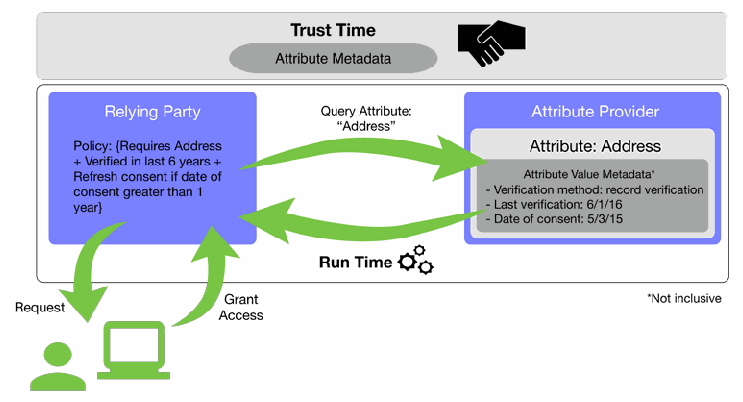
図。上部の帯は「Trust Time(トラストタイム)」で、楕円形の「Attribute Metadata(属性メタデータ)」と握手のアイコンがあります。その下の歯車アイコンがある「Run Time(ランタイム)」領域に「Relying Party(依拠当事者)」の枠があり、「Policy: {Requires Address + Verified in last 6 years + Refresh consent if date of consent greater than 1 year}」(住所が必要、過去6年以内に検証済み、同意日から1年を超えたら同意を更新)と書かれています。依拠当事者から「Attribute Provider(属性提供者)」の枠へ「Query Attribute: “Address”」(属性の照会:「住所」)というラベルの矢印が伸びています。属性提供者の枠には「Attribute: Address」と「Attribute Value Metadata*: - Verification method: record verification - Last verification: 6/1/16 - Date of consent: 5/3/15」(検証方法:記録による検証、最終検証日:6/1/16、同意日:5/3/15)があります。属性提供者から依拠当事者へ戻る矢印もあります。左下では、コンピューターの前の利用者から依拠当事者へ「Request(要求)」の矢印が伸び、依拠当事者から利用者へ「Grant Access(アクセスの許可)」の矢印が戻ります。脚注:「*網羅的ではない」。
Figure 1 Trusted Access Using Attribute Metadata Assertion
図 1 属性メタデータのアサーションを用いた信頼されたアクセス
The ASM and AVM listed in each section of this schema are not mandatory. Collectively, these elements aim to support transactional needs in federations and trust frameworks across the private and public sectors. NIST envisions that communities and federations will leverage the included metadata elements to develop their own profiles (i.e., a tailored version of this schema). In addition, this schema supports extensibility for instances when the information contained herein is not sufficient for federated partners.
本スキーマの各節に挙げた ASM と AVM は必須ではありません。これらの要素は全体として、民間部門と公共部門にわたるフェデレーションおよびトラストフレームワークにおける取引に関するニーズを支えることを目指しています。NIST は、コミュニティとフェデレーションが、含まれているメタデータ要素を活用して独自のプロファイル(すなわち、このスキーマを調整したバージョン)を策定することを想定しています。さらに、このスキーマは、ここに含まれる情報がフェデレーションのパートナーにとって十分でない場合にも拡張できるようになっています。
When implementing this schema, organizations must evaluate and understand both the authorization considerations and the privacy implications associated with a given use case or transaction type. With the additional granularity that attribute schema and attribute value metadata can provide, new information can be revealed which may provide a broader profile of an individual than was intended or anticipated. For instance, asserting that the verifier of Jane’s address is her employer reveals more than just 1 Main St., Anytown, VA to the receiving entity. The receiving entity now knows who she works for in addition to where she resides, something that Jane may not be aware of and may not wish to reveal.
本スキーマを実装する際、組織は、特定のユースケースまたは取引の種類に関連する認可上の考慮事項とプライバシーへの影響の両方を評価し、理解しなければなりません。属性スキーマメタデータと属性値メタデータが提供しうる粒度の細かさにより、意図または予期されていたよりも広範な個人のプロファイルとなりうる新たな情報が明らかになる場合があります。たとえば、Jane の住所の検証者が彼女の雇用主であるとアサートすることは、受け取るエンティティに対して、1 Main St., Anytown, VA 以上のことを明らかにします。受け取るエンティティは、彼女の居住地に加えて勤務先も知ることになり、これは Jane が気づいておらず、明らかにしたくないかもしれない事柄です。
When deciding which metadata elements to select, the involved parties should conduct a privacy risk assessment to consider these possibilities, identify any potential adverse impacts to individuals’ privacy that could arise from including certain metadata elements, and determine how to address identified privacy risks. To assist with this privacy risk assessment process, privacy considerations associated with the metadata elements are included throughout this document. This is certainly not an exhaustive list; there might be additional privacy considerations apart from those listed, and the listed considerations might change over time. Ultimately, the listed considerations may aid in deciding which elements of metadata to include, maximizing the benefit of a transaction while minimizing problems for the individuals associated with the metadata. If a metadata element does reveal information about an individual, but is still necessary to a transaction and thus must be included, the appropriate parties should consider how to provide visibility of the metadata to the individual or other measures to achieve predictability, manageability, or disassociability commensurate with the privacy risks introduced.
どのメタデータ要素を選択するかを決定する際、関係当事者は、これらの可能性を検討し、特定のメタデータ要素を含めることから生じうる個人のプライバシーへの潜在的な悪影響を特定し、特定されたプライバシーリスクにどう対処するかを決定するために、プライバシーリスクアセスメントを実施すべきです。このプライバシーリスクアセスメントのプロセスを支援するため、メタデータ要素に関連するプライバシー上の考慮事項を、本書の全体に含めています。これは決して網羅的な一覧ではなく、挙げたもの以外のプライバシー上の考慮事項が存在する可能性があり、挙げた考慮事項は時間とともに変わる可能性があります。最終的に、挙げた考慮事項は、メタデータのどの要素を含めるかの決定に役立ち、メタデータに関連する個人にとっての問題を最小限に抑えながら、取引の利益を最大化する助けとなる場合があります。あるメタデータ要素が個人に関する情報を明らかにするものの、取引に依然として必要であり、そのため含めなければならない場合、適切な当事者は、もたらされるプライバシーリスクに見合った予測可能性、管理可能性、または関連付け解除可能性を実現するために、そのメタデータを個人に可視化する方法やその他の措置を検討すべきです。
3.1 Attribute Schema Metadata
3.1 属性スキーマメタデータ
ASM provide information that is applicable to the attribute being asserted, regardless of the value of that attribute. ASM are intended to be static, discussed, and agreed upon by federated parties in advance of the actual assertion. For this reason, ASM are considered “trust-time” metadata and can be encapsulated in agreements such as attribute provider statements (APS), contracts, or trust frameworks. Table 3 provides the list of ASM that organizations can consider when establishing identity federation agreements. This is unlike AVM, which are dynamic and thus asserted and evaluated at run-time.
ASM は、アサートされる属性に当てはまる情報を、その属性の値にかかわらず提供します。ASM は静的であることを意図しており、実際のアサーションの前に、フェデレーションの当事者間で議論され、合意されます。このため、ASM は「トラストタイム」のメタデータとみなされ、属性プロバイダーステートメント(APS)、契約、トラストフレームワークなどの合意に含めることができます。表 3 は、組織がアイデンティティフェデレーションの合意を確立する際に検討できる ASM の一覧です。これは、動的であるため実行時にアサートされ評価される AVM とは異なります。
Table 3 – Attribute Schema Metadata
表 3 – 属性スキーマメタデータ
| Metadata | Description | Recommended Values |
|---|---|---|
| Description | An informative description of the attribute | Any |
| Allowed Values | A defined set of allowed values for the attribute | Any |
| Format | A defined format in which the attribute will be expressed | Any |
| Verification Frequency | The frequency at which the Attribute Provider will re-verify the attribute | Any |
| Data Processing | Describes the condition for allowing the processing of the attributes and attribute values | Any |
| メタデータ | 説明 | 推奨値 |
|---|---|---|
| 説明 | 属性についての情報を与える説明 | 任意 |
| 許容される値 | その属性に許容される値の定義された集合 | 任意 |
| 形式 | 属性の値が表現される定義された形式 | 任意 |
| 検証頻度 | 属性プロバイダーが属性を再検証する頻度 | 任意 |
| データ処理 | 属性と属性値の処理を許可する条件を記述するもの | 任意 |
3.1.1 Description
3.1.1 説明
The description metadata element ensures that all entities participating in the federation of attributes have the same semantic understanding of the attribute. This enables both trust and interoperability by providing a common understanding of what the attribute and its value(s) represent. There are no set values for this metadata element as it is intended to be a free form, text-based definition.
Description メタデータ要素は、属性のフェデレーションに参加するすべてのエンティティが、その属性について同じセマンティクス上の理解を持てるようにします。これにより、属性とその値が何を表すかについての共通の理解が得られ、信頼と相互運用性の両方が可能になります。このメタデータ要素は、自由形式のテキストベースの定義であることを意図しているため、決まった値はありません。
3.1.2 Allowed Values
3.1.2 許容される値
This metadata element provides a common, agreed-to set of values for an attribute. This ensures that when an AP transmits the attribute, the receiving organization is able to appropriately process the values. Variations between provider and RP in expressing values for an attribute— for example, a value outside of an expected range—adversely impact interoperability and performance of authorization activities. For this reason, providing information for the resolution of this metadata element is highly recommended.
このメタデータ要素は、属性に対する、共通の合意された値の集合を提供します。これにより、AP が属性を送信する際に、受け取る組織が値を適切に処理できるようになります。属性の値の表現におけるプロバイダーと RP の間の相違(たとえば、想定される範囲外の値)は、相互運用性と認可活動の性能に悪影響を及ぼします。このため、このメタデータ要素を解決するための情報を提供することが強く推奨されます。
3.1.3 Format
3.1.3 形式
This metadata element describes the format for expressing an attribute’s value. For example, the attribute height may always be expressed in meters rather than centimeters. As with allowed values, up front agreement around the format of expressed attributes supports technical interoperability of assertions during run-time as well as appropriate policy evaluation of the attributes when determining access to resources.
このメタデータ要素は、属性値を表現する形式を記述します。たとえば、属性 height は、センチメートルではなく常にメートルで表現される場合があります。許容される値の場合と同様に、属性の表現形式について事前に合意しておくことは、実行時のアサーションの技術的な相互運用性を支えるとともに、リソースへのアクセスを判断する際の属性の適切なポリシー評価にも役立ちます。
3.1.4 Verification Frequency
3.1.4 検証頻度
In most situations, it is highly beneficial for the RP and the AP to agree to set rates for periodic verification of attribute values. This metadata element captures the frequency with which this re-verification occurs, to ensure that both parties have established valid verification intervals. When determining if verification frequency is appropriate to include for a particular attribute, the parties should consider the fluidity of the attribute and its value; for example, date of birth may never need to be re-verified. They should also consider the risk associated with the transaction, or the environment in which the RP and AP are operating. Including this ASM element may negate the need for some of the currency AVM elements discussed later in this paper.
ほとんどの状況では、RP と AP が属性値の定期的な検証頻度を定めることに合意することは、非常に有益です。このメタデータ要素は再検証の頻度を記録し、両当事者が有効な検証間隔を確立していることを確認するものです。特定の属性に検証頻度を含めるのが適切かどうかを判断する際、当事者は、その属性と値の変動のしやすさを考慮すべきです。たとえば、生年月日は再検証がまったく必要ない可能性があります。また、取引に関連するリスクや、RP と AP が運用されている環境も考慮すべきです。この ASM 要素を含めることで、本書で後述する現行性 AVM 要素の一部が不要になる場合があります。
3.1.5 Data Processing
3.1.5 データ処理(Data Processing)
There may be legal requirements or trust framework policies that require a specified condition to be able to process data. Therefore, to avoid placing the RP in violation of any such requirements, it is beneficial for the AP and the RP to agree on whether a condition is required for the processing of the attributes before the attributes are sent to the RP and the type of condition required (e.g. subject consent, contract, legal obligation, public interest).
データを処理できるようにするために、指定された条件を求める法的要件やトラストフレームワークのポリシーが存在する場合があります。したがって、RP がそうした要件に違反する状況に置かれることを避けるため、AP と RP は、属性が RP に送信される前に、属性の処理に条件が必要かどうか、および必要な条件の種類(たとえば、サブジェクトの同意、契約、法的義務、公共の利益)について合意しておくことが有益です。
3.2 Attribute Value Metadata
3.2 属性値メタデータ
While ASM are important, it is the granular attribute value metadata—for example, information about attribute values’ authoritativeness, the processes used to create or establish them, and the frequency with which they are refreshed—that is designed to enable greater trust across systems. RPs can establish semantics and syntax of AVM at trust-time in order to make authorization decisions about access to resources or benefits at run-time. Regardless of the access control methodology leveraged by an organization, integrating AVM into decision support systems can enable more informed decisions and support richer policy development.
ASM は重要ですが、システム間でのより大きな信頼を可能にすることを意図して設計されているのは、粒度の細かい属性値メタデータ、たとえば、属性値の権威性、それらを作成または確立するために使われたプロセス、更新される頻度に関する情報です。RP は、実行時にリソースや利益へのアクセスについて認可の決定を行うために、トラストタイムで AVM のセマンティクスと構文を確立できます。組織が活用するアクセス制御の方法論にかかわらず、AVM を意思決定支援システムに統合することで、より十分な情報に基づく決定が可能になり、より豊富なポリシー策定を支えられます。
3.2.1 Metadata Categories
3.2.1 メタデータのカテゴリー
While AVM may be used for many purposes by RPs, certain metadata elements are more commonly tied to specific types of decisions. To facilitate RP decision-making and increase interoperability, this schema establishes five categories based on common uses of metadata: accuracy, currency, provenance, privacy, and classification. Each category of metadata elements is important for enabling the federation of attributes across a community or environment. Metadata associated with accuracy, currency, and provenance may facilitate cross-system trust by establishing a consistent picture of the attribute value itself and the practices that generated that value, while privacy and classification can be leveraged to convey specific restrictions and protections that may need to be put in place based on certain data types, transactions, or use cases. Table 4 presents the five categories and their definitions. Table 5 provides a breakdown of the number of metadata elements by category.
AVM は RP によってさまざまな目的で使用されえますが、特定のメタデータ要素は、特定の種類の決定とより一般的に結び付けられます。RP の意思決定を促進し、相互運用性を高めるため、本スキーマは、メタデータの一般的な用途に基づく 5 つのカテゴリーを定めています。正確性、現行性、来歴、プライバシー、分類です。メタデータ要素の各カテゴリーは、コミュニティや環境をまたいで属性のフェデレーションを可能にするうえで重要です。正確性、現行性、来歴に関連するメタデータは、属性値そのものと、その値を生成したプラクティスについて一貫した全体像を確立することで、システム間の信頼を促進しえます。一方、プライバシーと分類は、特定のデータ型、取引、ユースケースに基づいて導入が必要になりうる、特定の制限と保護を伝えるために活用できます。表 4 は、5 つのカテゴリーとその定義を示しています。表 5 は、カテゴリー別のメタデータ要素の数の内訳を示しています。
The sections that follow list and provide details on the elements in each category.
以降の各節では、各カテゴリーの要素を列挙し、その詳細を示します。
Table 4 – Categories of Attribute Value Metadata
表 4 – 属性値メタデータのカテゴリー
| Metadata Category | Description |
|---|---|
| Provenance | Metadata relevant or pertaining to evaluating the source of the attribute’s value |
| Accuracy | Metadata relevant or pertaining to determining if the attribute’s value is correct and belongs to a specific subject |
| Currency | Metadata relevant or pertaining to determining the “freshness” of a given attribute’s value |
| Privacy | Metadata relevant or pertaining to the management of privacy policies relating to a given attribute’s value |
| Classification | Metadata relevant or pertaining to the security classification of a given attribute’s value |
| メタデータのカテゴリー | 説明 |
|---|---|
| Provenance(来歴) | 属性の値の出所を評価することに関連する、または関わるメタデータ |
| Accuracy(正確性) | 属性の値が正しく、特定のサブジェクトに帰属するかどうかを判断することに関連する、または関わるメタデータ |
| Currency(現行性) | 特定の属性の値の「鮮度」を判断することに関連する、または関わるメタデータ |
| Privacy(プライバシー) | 特定の属性の値に関するプライバシーポリシーの管理に関連する、または関わるメタデータ |
| Classification(分類) | 特定の属性の値のセキュリティ分類に関連する、または関わるメタデータ |
Table 5 – Distribution of Attribute Value Metadata Elements
表 5 – 属性値メタデータ要素の分布
| Metadata Category | Number of Elements |
|---|---|
| Provenance | 3 |
| Accuracy | 2 |
| Currency | 3 |
| Privacy | 5 |
| Classification | 2 |
| All categories | 15 |
| メタデータのカテゴリー | 要素数 |
|---|---|
| Provenance(来歴) | 3 |
| Accuracy(正確性) | 2 |
| Currency(現行性) | 3 |
| Privacy(プライバシー) | 5 |
| Classification(分類) | 2 |
| すべてのカテゴリー | 15 |
3.2.1.1 Provenance Metadata
3.2.1.1 来歴メタデータ
Table 6 – Provenance Metadata
表 6 – 来歴メタデータ
| Metadata Element | Description | Recommended Values |
|---|---|---|
| Origin | The name of the entity that issues or creates the initial attribute value | -<Origin’s Name> -“None” |
| Provider | The name of the entity that is providing the attribute | -<Provider’s Name> -“None” |
| Pedigree | Description of the attribute value’s relationship to the authoritative source of the value | -“Authoritative” -“Sourced” -“Self-Asserted” -“Derived” |
| メタデータ要素 | 説明 | 推奨される値 |
|---|---|---|
| Origin(発行元) | 最初の属性値を発行または作成するエンティティの名称 | -<発行元の名称> -“None” |
| Provider(プロバイダー) | 属性を提供しているエンティティの名称 | -<プロバイダーの名称> -“None” |
| Pedigree(ペディグリー) | 属性値の、その値の権威あるソースとの関係の説明 | -“Authoritative” -“Sourced” -“Self-Asserted” -“Derived” |
Origin
Origin(発行元)
The Origin element conveys the name of the entity that established the initial attribute value. This may or may not be an authoritative entity, or the provider; if, for example, the AP generates the attribute value through a derivation process, then the AP would be the origin. The key distinction between the origin and the provider is the act of initially generating, capturing, or provisioning the attribute’s value, rather than just asserting the attribute’s value to an RP.
Origin 要素は、最初の属性値を確立したエンティティの名称を伝えます。これは、権威あるエンティティである場合もそうでない場合もあり、プロバイダーである場合もそうでない場合もあります。たとえば、AP が導出プロセスによって属性値を生成する場合、AP が発行元となります。発行元とプロバイダーの重要な違いは、属性値を単に RP にアサートすることではなく、最初に生成、取得、またはプロビジョニングする行為にあります。
Provider
Provider(プロバイダー)
This specifies the name of the entity that supplies the attribute value to the RP. This does not have to be the AP itself. This element enables RPs to understand and evaluate the source of the individual attribute values that may be included in a bundle of attributes. For example, if a full service credential provider generates an assertion with several identity attributes provided by multiple APs, the provider element enables the RP to understand, at a granular level, where each has come from and determine whether or not that value can be used for access to specific resources. In instances where a single attribute is asserted directly to the RP, this element may be omitted since the assertion itself will carry the provider information as well as a certificate or digital signature.
これは、属性値を RP に供給するエンティティの名称を指定します。これは AP 自身である必要はありません。この要素により、RP は、属性の集合に含まれうる個々の属性値の出所を理解し、評価できます。たとえば、フルサービスのクレデンシャルプロバイダーが、複数の AP から提供された複数のアイデンティティ属性を含むアサーションを生成する場合、Provider 要素により、RP は各属性値がどこから来たのかを細かい粒度で理解し、その値を特定のリソースへのアクセスに使用できるかどうかを判断できます。単一の属性が RP に直接アサートされる場合、アサーション自体がプロバイダー情報と、証明書またはデジタル署名を運ぶため、この要素は省略してもよいです。
Pedigree
Pedigree(ペディグリー)
Pedigree refers to the attribute value’s relationship to an authoritative source. Essentially, it allows the RP to understand better the process by which an attribute’s value is generated and to determine whether or not it is from an acceptable authoritative source. Recommended values for this element include:
Pedigree は、属性値の、権威あるソースとの関係を指します。基本的に、これにより RP は、属性の値が生成されるプロセスをよりよく理解し、それが許容できる権威あるソースに由来するかどうかを判断できます。この要素の推奨される値は次のとおりです。
1.Authoritative - The attribute’s value was acquired directly from the source of authority. For example, an AP has received a driver’s license number directly from the state DMV which issued the license.
1.Authoritative - 属性の値が、権威の源から直接取得されました。たとえば、AP が、運転免許証番号を、その免許証を発行した州の DMV から直接受け取りました。
2.Sourced - The attribute’s value has been acquired from one or more non-authoritative sources. For example, an AP purchases a driver’s license number from a third-party data aggregator.
2.Sourced - 属性の値が、権威のない 1 つ以上のソースから取得されました。たとえば、AP が、運転免許証番号をサードパーティのデータアグリゲーターから購入しました。
3.Self-Asserted - The value was provided to the AP directly by the individual with whom the attribute value is associated. For example, an AP receives a driver’s license number directly from the individual who references ownership of the license through a web form or questionnaire. Self-asserted attributes may also be verified or unverified.
3.Self-Asserted - 値が、その属性値に関連付けられた個人から AP に直接提供されました。たとえば、AP が、運転免許証番号を、ウェブフォームやアンケートを通じてその免許証の所有を示す個人から直接受け取りました。セルフアサートされた属性も、検証済みの場合も未検証の場合もあります。
4.Derived - The attribute value was produced through the analysis and manipulation of related attribute values and data. For example, a GPS ride sharing application could determine a value for a home address based on analysis of pick-up and drop-off locations. Derived should not be confused with the concept of Probabilistic Verification (a recommended value for the Verification Method), which focuses on verifying the attribute’s value rather than generating it.
4.Derived - 属性値が、関連する属性値とデータの分析と加工を通じて生成されました。たとえば、GPS を使ったライドシェアアプリケーションが、乗車地と降車地の分析に基づいて自宅住所の値を判定できます。Derived は、属性の値を生成することではなく検証することに焦点を当てた、Probabilistic Verification(Verification Method の推奨される値)の概念と混同すべきではありません。
Taken in conjunction with the accuracy metadata, this information can enable the RP to better understand the origin of an attribute value, how it relates to its authoritative source, and how it has been verified — all of which help an RP establish a more complete picture of the value’s usefulness and trustworthiness.
正確性メタデータと併せて考えると、この情報により、RP は、属性値の発行元、その値と権威あるソースとの関係、およびその値がどのように検証されたかをよりよく理解できます。これらはいずれも、RP がその値の有用性と信頼性についてより完全な全体像を確立するのに役立ちます。
Privacy Considerations: Provenance metadata reveal information about the relationship between the data source and the subject which could allow for profiling of the subject beyond the purpose of authorization and which the subject may not know is occurring. For example, the origin value could reveal employment status and location, socio-economic information, or even health history; all of which may have unintended and potentially negative consequences for a subject’s privacy.
プライバシー上の考慮事項:来歴メタデータは、データソースとサブジェクトとの関係についての情報を明らかにします。これは、認可の目的を超えてサブジェクトのプロファイリングを可能にする場合があり、サブジェクトがそれが行われていることを知らない場合もあります。たとえば、Origin の値は、雇用状況と所在地、社会経済的な情報、さらには健康の履歴を明らかにする場合があり、これらはいずれも、サブジェクトのプライバシーに意図しない、潜在的に悪い結果をもたらしえます。
Selection and use of these metadata elements should be carefully considered based on both authorization needs as well as a privacy risk assessment. For example, when leveraging attributes for access to moderate assurance level services that involve customers (i.e., non-enterprise users) it may be sufficient for the RP to request an attribute value’s verification method without the origin element-the value of which may not outweigh the risk to privacy. The original source of the information may not be essential as long as the value has been verified using an acceptable method. To the extent selection of these elements is operationally necessary, RPs may manage the privacy risk through additional policies such as limiting use of the value outside of the authorization process or retaining the record of the verification without the actual value.
これらのメタデータ要素の選択と使用は、認可上のニーズとプライバシーリスクアセスメントの両方に基づいて慎重に検討すべきです。たとえば、顧客(すなわち非エンタープライズユーザー)が関わる中程度の保証レベルのサービスへのアクセスに属性を活用する場合、RP は、Origin 要素を除いて、属性値の検証方法のみを要求すれば十分な場合があります。Origin 要素の値は、プライバシーへのリスクを上回らない可能性があるためです。値が許容される方法で検証されている限り、情報の元のソースは必須ではない場合があります。これらの要素の選択が運用上必要である範囲において、RP は、認可プロセス以外での値の使用を制限する、あるいは実際の値を保持せずに検証の記録を保持するなど、追加のポリシーによってプライバシーリスクを管理してもよいです。
3.2.1.2 Accuracy Metadata Elements
3.2.1.2 正確性メタデータ要素
Table 7 – Accuracy Metadata
表 7 – 正確性メタデータ
| Metadata Element | Description | Recommended Values |
|---|---|---|
| Verifier | The entity that verified the attribute’s value | -“Origin” -“Provider” -“Not Verified” |
| Verification Method | The method by which the attribute value was verified as true and belonging to the specific individual | -“Document Verification” -“Record Verification” -“Document Verification with Record Verification” -“Proof of Possession” -“Probabilistic Verification” -“Not Verified” |
| メタデータ要素 | 説明 | 推奨される値 |
|---|---|---|
| Verifier(検証者) | 属性の値を検証したエンティティ | -“Origin” -“Provider” -“Not Verified” |
| Verification Method(検証方法) | 属性値が真であり、特定の個人に帰属することを検証した方法 | -“Document Verification” -“Record Verification” -“Document Verification with Record Verification” -“Proof of Possession” -“Probabilistic Verification” -“Not Verified” |
Verifier
Verifier(検証者)
Verified attributes help RPs make informed decisions about whether to trust an attribute’s value during policy evaluation. In addition, understanding who verified an attribute value may influence the RP’s decision about whether or not to accept an attribute value as part of an access control decision. The verifier metadata element is intended to answer this “who” question. Namely, did the organization that established the attribute value perform the verification themselves or was the verification done at a later date by the AP? Acceptable values for this metadata field include:
検証済みの属性は、RP がポリシー評価の際に属性の値を信頼するかどうかについて、十分な情報に基づく判断を下す助けとなります。さらに、属性値を誰が検証したかを理解することは、アクセス制御の決定の一部として属性値を受け入れるかどうかに関する RP の判断に影響を与える場合があります。Verifier メタデータ要素は、この「誰が」という問いに答えることを意図しています。すなわち、属性値を確立した組織が自ら検証を行ったのか、それとも後日 AP が検証を行ったのかということです。このメタデータフィールドで許容される値には、次のものがあります。
1.Origin - The attribute’s value was verified by the entity that issued or created it (e.g., a Social Security Number verified by the Social Security Administration).
1.Origin - 属性の値が、それを発行または作成したエンティティによって検証されました(たとえば、社会保障庁によって検証された社会保障番号)。
2.Provider - The attribute’s value was verified by the AP.
2.Provider - 属性の値が、AP によって検証されました。
3.Not Verified - The value of the attribute was not verified.
3.Not Verified - 属性の値は検証されませんでした。
Verification Method
Verification Method(検証方法)
This metadata element contains information on the process used to confirm that an attribute value is both true and belongs to the specified individual. This is sometimes necessary to support an authorization decision, but may not always be required. The acceptable values for verification method are intended to provide insight into the verification processes used by providers and enable greater confidence in a given attribute’s value. This is particularly beneficial if there are multiple providers for instances of a single attribute. Recommended values for this element are:
このメタデータ要素は、属性値が真であるとともに、指定された個人に帰属することを確認するために使用されたプロセスに関する情報を含みます。これは、認可の決定を支えるために必要な場合がありますが、常に必要とは限りません。検証方法として許容される値は、プロバイダーが使用する検証プロセスについての洞察を提供し、特定の属性の値に対するより高い確信を可能にすることを意図しています。これは、単一の属性のインスタンスに複数のプロバイダーが存在する場合に特に有益です。この要素の推奨される値は次のとおりです。
1.Document Verification - The attribute value was verified by inspecting a document that is acceptable to the RP (e.g., driver’s license, medical record, utility bill). Transactional participants may want to determine the types of acceptable documents for attribute value verification in advance.
1.Document Verification - 属性値が、RP が許容する文書(たとえば、運転免許証、医療記録、公共料金の請求書)を調べることで検証されました。取引の参加者は、属性値の検証に許容される文書の種類を事前に決めておきたい場合があります。
2.Record Verification - The attribute value was verified against an authoritative record or database. For the purposes of this schema, the term “authoritative” is used consistently with its definition in SP 800-63-3.
2.Record Verification - 属性値が、権威ある記録またはデータベースと照合して検証されました。本スキーマでは、「権威ある」という用語を、SP 800-63-3 での定義と一貫した意味で使用しています。
3.Document Verification with Record Verification - The attribute value was verified against both an acceptable document and an authoritative record or database.
3.Document Verification with Record Verification - 属性値が、許容される文書と、権威ある記録またはデータベースの両方と照合して検証されました。
4.Proof of Possession - Confirmation of an individual’s ability to demonstrate possession of a device or account is used to verify the attribute’s value. Certain attributes and their values, such as phone numbers and email addresses, can be verified by direct communication (SMS, voice, or email) with the entity to which the value is attributed. This method of verification may not be applicable to all attribute values. However, to a certain set of attributes, this is a legitimate approach to determining that the attribute’s value is both valid and associated with the appropriate individual.
4.Proof of Possession - 個人がデバイスまたはアカウントを所有していることを示す能力の確認が、属性の値を検証するために使われます。電話番号や電子メールアドレスなど、特定の属性とその値は、その値が帰属するエンティティとの直接の通信(SMS、音声、または電子メール)によって検証できます。この検証方法は、すべての属性値に適用できるとは限りません。しかし、ある種の属性については、属性の値が有効であり、かつ適切な個人に関連付けられていることを判断するための正当なアプローチです。
5.Probabilistic Verification - The AP has compared the attribute’s value to multiple non-authoritative data sources to increase the probability that the attribute value is true and belongs to the appropriate individual. For example, rather than verifying a user address with the post office, an AP may compare the shipping addresses from multiple e-commerce transactions to increase confidence in the attributes’ value. There may be many reasons an AP leverages “probabilistic verification” including the lack of available authoritative sources or limited automated capabilities to leverage authoritative sources. Methods of ‘probabilistic verification’ should be defined in the provider’s APS and should be carefully considered for potentially negative privacy impacts. Probabilistic Verification should not be confused with the concept of a Derived pedigree, which focuses on generating the attribute’s value rather than verifying it.
5.Probabilistic Verification - AP は、属性の値を権威のない複数のデータソースと比較して、属性値が真であり、適切な個人に帰属する確率を高めています。たとえば、郵便局でユーザーの住所を検証する代わりに、AP が複数の電子商取引の取引における配送先住所を比較して、属性の値に対する確信を高める場合があります。AP が「probabilistic verification」を活用する理由は、利用可能な権威あるソースがないこと、権威あるソースを活用する自動化能力が限られていることなど、さまざまにありえます。「probabilistic verification」の方法は、プロバイダーの APS で定義すべきです。また、プライバシーへの潜在的な悪影響について慎重に検討すべきです。Probabilistic Verification は、属性の値を検証することではなく生成することに焦点を当てた、Derived ペディグリーの概念と混同すべきではありません。
6.Not Verified - The attribute’s value has not been verified.
6.Not Verified - 属性の値が検証されていません。
3.2.1.3 Currency Metadata
3.2.1.3 現行性メタデータ
Table 8 – Currency Metadata
表 8 – 現行性メタデータ
| Metadata Element | Description | Recommended Values |
|---|---|---|
| Last Verification | The date and time when the attribute value was last verified as being true and belonging to the specified individual | No restrictions |
| Last Refresh | The date and time when the attribute was last refreshed | No restrictions |
| Expiration Date | The date an attribute’s value is no longer valid | No restrictions |
| メタデータ要素 | 説明 | 推奨される値 |
|---|---|---|
| Last Verification(最終検証) | 属性値が真であり、指定された個人に帰属することが最後に検証された日時 | 制限なし |
| Last Refresh(最終更新) | 属性が最後に更新された日時 | 制限なし |
| Expiration Date(有効期限) | 属性の値が有効でなくなる日付 | 制限なし |
Last Verification
Last Verification(最終検証)
RPs may not trust certain attribute values unless they have been verified within a certain time period. This is particularly true for certain values associated with attributes such as Role or Security Clearance, where the original established date of the value alone may not be sufficient for granting access to national security systems or data. Last Verification provides the most recent date and time at which the value was verified as true and belonging to the specified individual. This metadata provides only the last date that verification occurred, and does not include any information about method of verification.
RP は、特定の期間内に検証されていない限り、特定の属性値を信頼しない場合があります。これは特に、Role や Security Clearance などの属性に関連する特定の値に当てはまり、値が最初に確立された日付だけでは、国家安全保障システムやデータへのアクセスを許可するのに十分でない場合があります。Last Verification は、値が真であり、指定された個人に帰属することが検証された最新の日時を提供します。このメタデータは、検証が行われた最新の日付のみを提供し、検証の方法に関する情報は含みません。
Last Refresh
Last Refresh(最終更新)
Last Refresh contains information on the date and time when an attribute’s value was last refreshed. The age of the attribute can be derived from this attribute value. Last Refresh also allows RPs to determine the currency of the attribute value, and whether the attribute was updated recently enough to be used in a particular transaction.
Last Refresh は、属性の値が最後に更新された日時に関する情報を含みます。この属性値から、属性の経過時間を導き出せます。Last Refresh により、RP は、属性値の現行性、および属性が特定の取引で使用できるほど最近更新されたかどうかも判断できます。
Expiration Date
Expiration Date(有効期限)
Attribute values sent from an AP to an RP may only be valid for its defined use for a set amount of time, depending on requirements, policy, or legal factors. The date after which an attribute’s value is considered no longer valid for its defined use is the Expiration Date. Though Expiration Date and Last Refresh both allow an RP to determine if an attribute’s value is current and sufficient, Expiration Date differs from Last Refresh in that there is a specified date or threshold after which the attribute’s value becomes void for its defined use. RPs have the freedom to accept attributes after they have been considered expired for their original intended use, but this decision is made at their own discretion based upon the intended use of the attribute value, the type of interaction it is supporting, and the environment in which they operate. For example, an RP may choose to accept a recently expired driver’s license number for access to a low assurance service. However, it is unlikely that an agency would accept a lapsed security clearance for access to classified data.
AP から RP に送信される属性値は、要件、ポリシー、または法的要因に応じて、定められた用途に対して一定の期間のみ有効な場合があります。属性の値が、定められた用途に対してもはや有効でないとみなされる日付が、Expiration Date です。Expiration Date と Last Refresh はどちらも、RP が属性の値が現行で十分なものかどうかを判断できるようにしますが、Expiration Date は、その日付またはしきい値を過ぎると、属性の値が定められた用途に対して無効になるという指定がある点で、Last Refresh とは異なります。RP は、属性が当初の意図された用途に対して期限切れとみなされた後でも、その属性を受け入れる自由を持ちますが、この判断は、属性値の意図された用途、それが支えているやり取りの種類、および RP が運用されている環境に基づいて、RP 自身の裁量で行われます。たとえば、RP は、低い保証レベルのサービスへのアクセスについては、最近期限が切れた運転免許証番号を受け入れることを選ぶ場合があります。しかし、機密データへのアクセスについて、失効したセキュリティクリアランスを機関が受け入れる可能性は低いでしょう。
3.2.1.4 Privacy Metadata
3.2.1.4 プライバシーメタデータ
Table 9 – Privacy Metadata
表 9 – プライバシーメタデータ
| Metadata Element | Description | Recommended Values |
|---|---|---|
| Date of Consent | The date on which subject consent for release of the attribute value was acquired | No restrictions |
| Consent Type | Indicates the type of consent | No restrictions |
| Acceptable Uses | Allowed use conditions for entities that receive attributes | No restrictions |
| Cache Time To Live | The length of time for which an attribute value may be cached | No restrictions |
| Data Deletion Date | Indicates the date the attribute is to be deleted from records | No restrictions |
| メタデータ要素 | 説明 | 推奨される値 |
|---|---|---|
| Date of Consent(同意日) | 属性値の開示に対するサブジェクトの同意が得られた日付 | 制限なし |
| Consent Type(同意の種類) | 同意の種類を示すもの | 制限なし |
| Acceptable Uses(許容される用途) | 属性を受け取るエンティティに許される使用条件 | 制限なし |
| Cache Time To Live(キャッシュの有効期間) | 属性値をキャッシュしてよい期間の長さ | 制限なし |
| Data Deletion Date(データ削除日) | 属性を記録から削除する日付を示すもの | 制限なし |
Date of Consent
Date of Consent(同意日)
As referenced in Subsection 3.1.5, the RP and AP may have agreed in advance on attribute metadata for conveying subject consent as a condition for processing the data when required by law or policy. In addition, some RPs may wish to understand when that consent was received; this could help an RP maintain predictability and manage any privacy risks arising from the duration of time between when the consent was initially granted and the current processing of the attributes.
第 3.1.5 節で触れたように、RP と AP は、法律やポリシーによって求められる場合にデータを処理するための条件として、サブジェクトの同意を伝える属性メタデータについて、あらかじめ合意している場合があります。さらに、一部の RP は、その同意がいつ得られたかを把握したい場合があります。これは、RP が予測可能性を維持し、同意が最初に与えられた時点から現在の属性の処理までの期間に起因するプライバシーリスクを管理するのに役立ちます。
Consent Type
Consent Type(同意の種類)
As referenced in Subsection 3.1.5, and above in Date of Consent, the RP and AP may have agreed in advance on attribute metadata for conveying subject consent as a condition for processing the data when required by law or policy. In addition, some RPs may wish to understand the specific consent type where consent is a factor in maintaining predictability. For example, an RP may determine that a parental-delegated consent is a contextual factor that alters its analysis when assessing the privacy risk that may arise from the processing of the attributes. As a result, the RP can take appropriate steps to manage any identified privacy risks. Potential values for this element include, but are not limited to: opt-in, opt-out, parental-delegated, power of attorney-delegated.
第 3.1.5 節、および上記の Date of Consent で触れたように、RP と AP は、法律やポリシーによって求められる場合にデータを処理するための条件として、サブジェクトの同意を伝える属性メタデータについて、あらかじめ合意している場合があります。さらに、一部の RP は、同意が予測可能性を維持するうえでの要因となる場合に、具体的な同意の種類を把握したい場合があります。たとえば、RP は、親権者による委任の同意が、属性の処理から生じうるプライバシーリスクを評価する際の分析を変える文脈上の要因であると判断する場合があります。その結果、RP は、特定されたプライバシーリスクを管理するための適切な措置を講じることができます。この要素の取りうる値には、オプトイン、オプトアウト、親権者による委任、委任状による委任が含まれますが、これらに限定されません。
Acceptable Uses
Acceptable Uses(許容される用途)
This metadata element explains to receiving entities the use conditions for the attribute. For example, values might be limited to use for authorization, eligible for secondary uses beyond authorization, or not eligible for any further disclosure. Additionally, organizations or trust frameworks might also maintain their own categories of acceptable uses based on their policies. Potential values for this element include:
このメタデータ要素は、属性の使用条件を、受け取るエンティティに説明します。たとえば、値は、認可のための使用に限定される場合、認可を超える二次利用が可能な場合、またはそれ以上の開示が認められない場合があります。さらに、組織やトラストフレームワークが、自らのポリシーに基づいて独自の許容される用途のカテゴリーを維持している場合もあります。この要素の取りうる値には、次のものがあります。
1.Authorization - The attribute value may only be used for processes related to authorization or compliance with law or legal process.
1.Authorization - 属性値は、認可、または法律や法的手続への準拠に関連するプロセスにのみ使用できます。
2.Secondary Use - The attribute value may be used for purposes beyond processes related to authorization or compliance with law or legal process. Secondary use may be unlimited, or subjects may only have agreed to specific types of uses such as service improvement, marketing, etc. Entities may choose as a best practice – or may be required by law or policy – to request separate, explicit consent from the user at initiation of the use.
2.Secondary Use - 属性値は、認可、または法律や法的手続への準拠に関連するプロセス以外の目的にも使用できます。二次利用は無制限の場合もあれば、サブジェクトがサービスの改善やマーケティングなど特定の種類の利用にのみ同意している場合もあります。エンティティは、ベストプラクティスとして、あるいは法律やポリシーによる要求に基づき、その利用の開始時にユーザーから個別の明示的な同意を求めることを選択する場合があります。
3.No Further Disclosure - Although certain types of secondary uses by the RP may be permitted, further release to other third parties may not be permitted (unless required by law or legal process or unless with additional consent from the subject).
3.No Further Disclosure - RP による特定の種類の二次利用は許可される場合があるものの、ほかのサードパーティへのさらなる開示は許可されない場合があります(法律や法的手続で求められる場合、またはサブジェクトの追加の同意がある場合を除く)。
Cache Time to Live
Cache Time to Live(キャッシュの有効期間)
This metadata element describes the length of time for which a specific attribute value may reside in cache memory for use again in future transactions. Due to the sensitivity of certain attributes’ values, this metadata element enables the parties involved to cache properly and handle the values they are sending and retrieving as part of their transactions. In some cases, the time to live may be dictated by regulation or law, and this information needs to be relayed to RP systems so data are handled accordingly. The more sensitive an attribute value, the shorter time it will likely be enabled to live in temporary memory.
このメタデータ要素は、特定の属性値を、将来の取引で再び使用するためにキャッシュメモリに保持してよい期間の長さを記述します。特定の属性の値の機微性のため、このメタデータ要素により、関係当事者は、取引の一環として送受信する値を適切にキャッシュし、取り扱えます。場合によっては、有効期間が規則や法律で定められていることがあり、データが適切に取り扱われるよう、この情報を RP のシステムに伝える必要があります。属性値の機微性が高いほど、一時メモリに保持できる期間は短くなる可能性が高くなります。
Note: Attribute value sensitivity cannot be treated as an absolute metric. Sensitivity is a contextual, risk-based determination. Therefore, even if an AP determines that the attribute value is not sensitive within the context of its system, receiving entities should make their own periodic risk assessments as to the attribute value’s sensitivity based on the context of their systems, uses, and aggregation of additional data.
注:属性値の機微性は、絶対的な指標として扱うことはできません。機微性は、文脈に依存する、リスクに基づく判断です。したがって、AP が、自らのシステムの文脈では属性値が機微ではないと判断した場合でも、受け取るエンティティは、自らのシステム、用途、追加データの集約の文脈に基づいて、属性値の機微性について、自ら定期的にリスクアセスメントを行うべきです。
Data Deletion Date
Data Deletion Date(データ削除日)
This metadata element refers to long-term holding of attribute values. Minimizing data, and indicating the retention time for this data, is a generally accepted privacy principle. Some attribute values may produce little to no privacy risk for individuals. Other values may add new privacy risks or increase existing privacy risks. A deletion date ensures that sensitive information does not remain in systems indefinitely.
このメタデータ要素は、属性値の長期保持を指します。データを最小化し、このデータの保持期間を示すことは、一般に受け入れられているプライバシーの原則です。属性値の中には、個人へのプライバシーリスクをほとんど、またはまったく生じさせないものもあります。ほかの値は、新たなプライバシーリスクを加えたり、既存のプライバシーリスクを高めたりする場合があります。削除日により、機微な情報がシステムに無期限に残らないことが確実になります。
Note: Attribute value sensitivity cannot be treated as an absolute metric. Sensitivity is a contextual, risk-based determination. Therefore, even if an AP determines that within the context of its system, the attribute value is not sensitive, receiving entities should make their own periodic risk assessments as to the attribute value’s sensitivity based on the context of their systems, uses, and aggregation of additional data.
注:属性値の機微性は、絶対的な指標として扱うことはできません。機微性は、文脈に依存する、リスクに基づく判断です。したがって、AP が、自らのシステムの文脈では属性値が機微ではないと判断した場合でも、受け取るエンティティは、自らのシステム、用途、追加データの集約の文脈に基づいて、属性値の機微性について、自ら定期的にリスクアセスメントを行うべきです。
3.2.1.5 Classification Metadata
3.2.1.5 分類メタデータ
Table 10 – Classification Metadata
表 10 – 分類メタデータ
| Metadata Element | Description | Recommended Values |
|---|---|---|
| Classification | The security classification level of the attribute | -“Unclassified” -“Controlled Unclassified” -“Confidential” -“Secret” -“Top Secret” -“Company Confidential” |
| Releasability | The restrictions on who may receive an attribute value | -“NATO” -“NOFORN” -“FVEY” -“Public Release” -“Externally Releasable for Business Purposes” -“Do Not Release” -“None” |
| メタデータ要素 | 説明 | 推奨される値 |
|---|---|---|
| Classification(分類) | 属性のセキュリティ分類レベル | -“Unclassified” -“Controlled Unclassified” -“Confidential” -“Secret” -“Top Secret” -“Company Confidential” |
| Releasability(開示可能性) | 属性値を誰が受け取ってよいかに関する制限 | -“NATO” -“NOFORN” -“FVEY” -“Public Release” -“Externally Releasable for Business Purposes” -“Do Not Release” -“None” |
Classification
Classification(分類)
Making certain attribute values available to RPs can carry national security implications. In these situations, identification of such attribute values at the time of exchange can be absolutely crucial to ensuring that the attribute values are appropriately handled and protected across the attribute’s lifecycle. The recommended values for use in this schema are:
特定の属性値を RP が利用できるようにすることは、国家安全保障に関わる場合があります。こうした状況では、交換の時点でそのような属性値を識別することが、属性値が属性のライフサイクル全体にわたって適切に取り扱われ、保護されることを確実にするうえで、絶対的に重要になりえます。本スキーマで使用する推奨される値は次のとおりです。
1.Unclassified - Unclassified attribute values are those that carry with them no national security implications. However, these attributes may still be sensitive and require special protections.
1.Unclassified - Unclassified の属性値は、国家安全保障に関わりのないものです。ただし、これらの属性も機微であり、特別な保護が必要な場合があります。
2.Controlled Unclassified - These attribute values are not sensitive enough to have a negative impact on national security, but are sensitive enough that they should be protected from improper access or exposure (e.g., For Official Use Only or “FOUO” information).
2.Controlled Unclassified - これらの属性値は、国家安全保障に悪影響を与えるほど機微ではないものの、不適切なアクセスや露出から保護すべき程度には機微です(たとえば、For Official Use Only、すなわち「FOUO」の情報)。
3.Confidential - Attribute values, which, if subject to unauthorized disclosure, could be expected to cause damage to national security.
3.Confidential - 不正に開示された場合に、国家安全保障に損害を与えると予想される属性値。
4.Secret - Attribute values, which, if subject to unauthorized disclosure, could be expected to cause serious damage to national security.
4.Secret - 不正に開示された場合に、国家安全保障に重大な損害を与えると予想される属性値。
5.Top Secret - Attribute values, which, if subject to unauthorized disclosure, could be expected to cause exceptionally grave damage to national security.
5.Top Secret - 不正に開示された場合に、国家安全保障に例外的に重大な損害を与えると予想される属性値。
6.Company Confidential - Attribute values which, if released, may cause damage to the organization, or the employees of the organization, that produced, generated, or maintains the values. For example, the professional title or specialization of a specific employee, if exposed, may inadvertently reveal information about a sensitive company project.
6.Company Confidential - 開示された場合に、その値を作成、生成、または維持する組織、あるいはその組織の従業員に損害を与えうる属性値。たとえば、特定の従業員の職位や専門分野は、露出した場合に、機微な社内プロジェクトに関する情報を意図せず明らかにしてしまう場合があります。
As with all classified information, the determination of the classification level for any attribute must be made by the appropriate authority, and the integrity of this classification must be maintained as the attribute and its values are transmitted or stored in by IT systems.
あらゆる機密情報と同様に、あらゆる属性の分類レベルの決定は、適切な権限を持つ者が行わなければならず、この分類の完全性は、属性とその値が IT システムによって送信または保存される間、維持されなければなりません。
Releasability
Releasability(開示可能性)
Refers to restrictions that may be placed on the releasability of an attribute’s value. The recommended values for this element include:
属性の値の開示可能性に課されうる制限を指します。この要素の推奨される値には、次のものがあります。
1.NATO - The attribute’s value is releasable to North Atlantic Treaty Organization allies only and should not be distributed to other foreign nationals.
1.NATO - 属性の値は、北大西洋条約機構の同盟国にのみ開示でき、ほかの外国籍の者に配布すべきではありません。
2.NOFORN - The attribute’s value is not releasable to any foreign nationals.
2.NOFORN - 属性の値は、いかなる外国籍の者にも開示できません。
3.FVEY - The attribute’s value is releasable to Five Eye nations only.
3.FVEY - 属性の値は、ファイブ・アイズ諸国にのみ開示できます。
4.Public Release - The attribute’s value is explicitly approved for public release.
4.Public Release - 属性の値は、一般への公開が明示的に承認されています。
5.Externally Releasable for Business Purposes - The attribute’s value has been explicitly approved for release to parties externally, but for approved business purposes only. For example, this may be leveraged by an entity to approve the release of attribute values as part of a federated environment supporting their supply chain.
5.Externally Releasable for Business Purposes - 属性の値は、外部の当事者への開示が明示的に承認されていますが、承認された業務目的に限られます。たとえば、エンティティが、自らのサプライチェーンを支えるフェデレーテッド環境の一環として、属性値の開示を承認するために活用できます。
6.Do Not Release - The attribute’s value has not been approved for release beyond the originating organization.
6.Do Not Release - 属性の値は、発信元の組織の外への開示が承認されていません。
7.None - There are no distribution or release caveats associated with the attribute’s value. This, however, does not mean that the attribute value may be freely distributed.
7.None - 属性の値に関連する配布上または開示上の注意事項はありません。ただし、これは、属性値を自由に配布してよいという意味ではありません。
4 Use Cases
4 ユースケース
This section details three use cases as a means of demonstrating the ways in which ASM and AVM can be leveraged to enrich authorization decisions, facilitate cross boundary interoperability and trust, and enable adoption of federated attributes. Each use case carries with it a set of authorization and privacy considerations as well as suggested metadata necessary to fulfill evaluation of the requisite authorization policy, in addition to an example of what an AVM assertion may look like.
この節では、ASM と AVM を活用して、認可の決定を充実させ、境界を越えた相互運用性と信頼を促進し、フェデレーテッド属性の採用を可能にする方法を示すため、3 つのユースケースを詳しく説明します。各ユースケースには、AVM のアサーションがどのようなものになるかの例に加え、一連の認可上およびプライバシー上の考慮事項と、必要な認可ポリシーの評価を満たすために必要な推奨されるメタデータが付いています。
The use cases are:
ユースケースは次のとおりです。
1.Federated Access to Classified Documents in an Information Sharing Environment
1.情報共有環境における機密文書へのフェデレーテッドアクセス
2.Citizen Access to Federal Benefits
2.市民による連邦給付へのアクセス
3.Law Enforcement Access to Intelligence Database
3.法執行機関によるインテリジェンスデータベースへのアクセス
4.1 Federated Access to Classified Documents in an Information Sharing Environment
4.1 情報共有環境における機密文書へのフェデレーテッドアクセス
Overview
概要
Monique, an Army employee with a current Secret clearance, attempts to access an information system that stores classified information, hosted by the Air Force on a shared Secure Internet Protocol Router Network (SIPRNet) site. Furthermore, the system, due to its sensitivity and the number of possible individuals that have legitimate need to access it, is protected using Attribute Based Access Control (ABAC) principles. ABAC evaluates access policy to enforce decisions based on attributes specific to the user and the resource (not addressed in the schema).
現在 Secret クリアランスを持つ陸軍職員の Monique が、空軍が共有 Secure Internet Protocol Router Network(SIPRNet)サイトでホストしている、機密情報を保存する情報システムにアクセスしようとします。さらに、このシステムは、その機微性と、正当にアクセスする必要のある個人が多数いる可能性があることから、属性ベースアクセス制御(ABAC)の原則を用いて保護されています。ABAC は、ユーザーとリソースに固有の属性(スキーマでは扱いません)に基づいて決定を実施するために、アクセスポリシーを評価します。
When Monique attempts access to the resource, an attribute query is routed to her agency, the Army, to obtain the attributes needed to grant or deny access. The Army then asserts the requested set of attributes, which are evaluated against the access control policy of the Air Force hosted site so a decision can be made.
Monique がリソースへのアクセスを試みると、アクセスを許可または拒否するために必要な属性を取得するため、属性クエリが彼女の所属機関である陸軍にルーティングされます。次に陸軍が、要求された一連の属性をアサートし、それが空軍がホストするサイトのアクセス制御ポリシーに照らして評価され、決定が行われます。
While in an actual implementation there may be many different attributes required to access the protected resource, for the purposes of illustration, this use case will only focus on the clearance attribute. Furthermore, in this scenario it is assumed that the semantics and syntax associated with the attribute itself are established.
実際の実装では、保護対象のリソースにアクセスするために多くのさまざまな属性が必要になる場合がありますが、例示のため、このユースケースではクリアランス属性のみに焦点を当てます。さらに、このシナリオでは、属性自体に関連するセマンティクスと構文が確立されているものと想定します。
Table 11 – Clearance Attribute
表 11 – クリアランス属性
| Attribute | Value |
|---|---|
| Clearance | Secret |
| 属性 | 値 |
|---|---|
| Clearance | Secret |
Authorization Considerations
認可上の考慮事項
In a traditional ABAC scenario, the assertion from the Army system would only provide the value that they maintain within their own records. As a result, the receiving agency’s access control system is only able to make a decision based upon the asserted attribute value and nothing more (i.e., the employee’s clearance is Secret therefore they are authorized for access). Information such as: the recency of the clearance issuance, when it was last verified by the asserting agency, and from where the value originated are not factored into the process.
従来の ABAC のシナリオでは、陸軍システムからのアサーションは、陸軍が自らの記録に保持している値のみを提供します。その結果、受け取る機関のアクセス制御システムは、アサートされた属性値のみに基づいて決定を行うことしかできません(すなわち、その職員のクリアランスは Secret であり、したがってアクセスが認可されます)。クリアランスの発行がどれだけ最近か、アサートする機関によって最後に検証されたのはいつか、値がどこに由来するかといった情報は、プロセスで考慮されません。
With the inclusion of attribute metadata, the relying agency is able to make an informed, risk-based decision by adding the evaluation of the attribute metadata into their ABAC policies. For example, they could determine that anyone accessing this specific resource must have a Secret clearance that: originated from a DoD entity, has been verified in the last six months, and was verified by the providing entity against an authoritative database.
属性メタデータを含めることで、依拠する機関は、属性メタデータの評価を自らの ABAC ポリシーに加えることにより、十分な情報に基づく、リスクに基づく決定を行えます。たとえば、この特定のリソースにアクセスする者は、国防総省の組織に由来し、過去 6 か月以内に検証されており、提供するエンティティによって権威あるデータベースと照合して検証された Secret クリアランスを持っていなければならない、と決定できます。
Authorization Policy
認可ポリシー
1.Origin MUST be an organization that is part of the Department of Defense
1.Origin は、国防総省に属する組織でなければなりません(MUST)。
2.Verification of clearance MUST have been done in the last six months
2.クリアランスの検証は、過去 6 か月以内に行われていなければなりません(MUST)。
3.Verification of clearance MUST have been done against an authoritative database
3.クリアランスの検証は、権威あるデータベースと照合して行われていなければなりません(MUST)。
Through the establishment of AVM, these further considerations and requirements can be expressed in policy and compared to asserted information.
AVM を確立することで、これらのさらなる考慮事項と要件をポリシーで表現し、アサートされた情報と比較できます。
Privacy Considerations
プライバシー上の考慮事項
In this scenario, the privacy risks are limited. Although the selected attributes are an absolute requirement for access based on national security needs, the requested value and metadata are minimal, and are being returned to a trusted party as part of the assertion in the context of the subject’s employment duties.
このシナリオでは、プライバシーリスクは限定的です。選択された属性は、国家安全保障上のニーズに基づくアクセスに絶対的に必要な要件ですが、要求される値とメタデータは最小限であり、サブジェクトの職務の文脈におけるアサーションの一部として、信頼された当事者に返されます。
Suggested Attribute Value Metadata
推奨される属性値メタデータ
Based on the scenario’s authorization and privacy considerations, the table below illustrates the AVM that is applied to support appropriate authorization decisions by the relying agency. It also provides notional values.
シナリオの認可上およびプライバシー上の考慮事項に基づいて、下の表は、依拠する機関による適切な認可の決定を支えるために適用される AVM を示しています。また、概念上の値も示しています。
Table 12 – AVM to Support Access Control Decisions
表 12 – アクセス制御の決定を支える AVM
| Element | Value |
|---|---|
| Verifier | Origin - The clearance was verified by the originating entity—which in this case is the same as the provider |
| Verification Method | Record Check - The attribute value was verified against the sponsoring agency’s clearance database |
| Last Verification | 6/10/16 (assume an access request date of 7/1/2016) |
| Origin | United States Army |
| Pedigree | Authoritative - The attribute’s value was generated and in this case asserted as well by the authoritative source |
| 要素 | 値 |
|---|---|
| Verifier(検証者) | Origin - クリアランスは、発行元のエンティティによって検証された(このケースではプロバイダーと同じ) |
| Verification Method(検証方法) | Record Check - 属性値は、スポンサー機関のクリアランスデータベースと照合して検証された |
| Last Verification(最終検証) | 6/10/16(アクセス要求の日付を 2016 年 7 月 1 日と想定) |
| Origin(発行元) | United States Army |
| Pedigree(ペディグリー) | Authoritative - 属性の値は、権威あるソースによって生成され、このケースではアサートもされた |
XACML Example Policy
XACML ポリシーの例
The following attribute and metadata names, and valid values, are fictional. These will ultimately depend on the technologies of the attribute sources that are being queried to evaluate policy. URIs and namespaces, in some cases, have been removed for brevity.
以下の属性およびメタデータの名前と有効な値は架空のものです。これらは最終的に、ポリシーを評価するために照会される属性ソースの技術に依存します。URI と名前空間は、場合によっては、簡潔にするために削除しています。
<xacml3:Policy Version="1.0" RuleCombiningAlgId="urn:oasis:names:tc:xacml:3.0:rule-combining-algorithm:deny-overrides" PolicyId="http://www.axiomatics.com/automatic-unique-id/50f5b25e-dc7f-4672-a673-1a482e53f023">
  <xacml3:Description>Use Case #1</xacml3:Description>
                <xacml3:PolicyDefaults><xacml3:XPathVersion>http://www.w3.org/TR/1999/REC-xpath-19991116</xacml3:XPathVersion></xacml3:PolicyDefaults>
  <xacml3:Target/>
  <xacml3:Rule RuleId="c01d7519-be21-4985-88d8-10941f44590a" Effect="Permit">
    <xacml3:Description>isTSClearance</xacml3:Description>
    <xacml3:Target>
      <xacml3:AnyOf>
        <xacml3:AllOf>
          <xacml3:Match MatchId="urn:oasis:names:tc:xacml:3.0:function:string-equal-ignore-case">
            <xacml3:AttributeValue DataType="http://www.w3.org/2001/XMLSchema#string">Secret</xacml3:AttributeValue>
            <xacml3:AttributeDesignator Category="urn:oasis:names:tc:xacml:1.0:subject-category:access-subject" AttributeId="clearance.value" MustBePresent="false" DataType="http://www.w3.org/2001/XMLSchema#string"/>
          </xacml3:Match>
        </xacml3:AllOf>
      </xacml3:AnyOf>
      <xacml3:AnyOf>
        <xacml3:AllOf>
          <xacml3:Match MatchId="urn:oasis:names:tc:xacml:3.0:function:string-equal-ignore-case">
            <xacml3:AttributeValue DataType="http://www.w3.org/2001/XMLSchema#string">ORIGIN</xacml3:AttributeValue>
            <xacml3:AttributeDesignator Category="urn:oasis:names:tc:xacml:1.0:subject-category:access-subject" AttributeId="clearance.verifier" MustBePresent="false" DataType="http://www.w3.org/2001/XMLSchema#string"/>
          </xacml3:Match>
        </xacml3:AllOf>
      </xacml3:AnyOf>
      <xacml3:AnyOf>
        <xacml3:AllOf>
          <xacml3:Match MatchId="urn:oasis:names:tc:xacml:3.0:function:string-equal-ignore-case">
            <xacml3:AttributeValue DataType="http://www.w3.org/2001/XMLSchema#string">authoritative</xacml3:AttributeValue>
            <xacml3:AttributeDesignator Category="urn:oasis:names:tc:xacml:1.0:subject-category:access-subject" AttributeId="clearance.pedigree" MustBePresent="false" DataType="http://www.w3.org/2001/XMLSchema#string"/>
          </xacml3:Match>
        </xacml3:AllOf>
      </xacml3:AnyOf>
      <xacml3:AnyOf>
        <xacml3:AllOf>
          <xacml3:Match MatchId="urn:oasis:names:tc:xacml:3.0:function:string-equal-ignore-case">
            <xacml3:AttributeValue DataType="http://www.w3.org/2001/XMLSchema#string">records check</xacml3:AttributeValue>
            <xacml3:AttributeDesignator Category="urn:oasis:names:tc:xacml:1.0:subject-category:access-subject" AttributeId="clearance.verification_method" MustBePresent="false" DataType="http://www.w3.org/2001/XMLSchema#string"/>
          </xacml3:Match>
        </xacml3:AllOf>
      </xacml3:AnyOf>
    </xacml3:Target>
  </xacml3:Rule>
<xacml3:Rule RuleId="4bae1384-729b-4e3e-895e-ea8dfefe5704" Effect="Permit">
  <xacml3:Description>isOriginDOD</xacml3:Description>
  <xacml3:Target>
    <xacml3:AnyOf>
      <xacml3:AllOf>
        <xacml3:Match MatchId="urn:oasis:names:tc:xacml:3.0:function:string-equal-ignore-case">
          <xacml3:AttributeValue DataType="http://www.w3.org/2001/XMLSchema#string">DOD</xacml3:AttributeValue>
          <xacml3:AttributeDesignator Category="urn:oasis:names:tc:xacml:1.0:subject-category:access-subject" AttributeId="clearance.origin" MustBePresent="false" DataType="http://www.w3.org/2001/XMLSchema#string"/>
        </xacml3:Match>
      </xacml3:AllOf>
      <xacml3:AllOf>
        <xacml3:Match MatchId="urn:oasis:names:tc:xacml:3.0:function:string-equal-ignore-case">
          <xacml3:AttributeValue DataType="http://www.w3.org/2001/XMLSchema#string">ARMY</xacml3:AttributeValue>
          <xacml3:AttributeDesignator Category="urn:oasis:names:tc:xacml:1.0:subject-category:access-subject" AttributeId="clearance.origin" MustBePresent="false" DataType="http://www.w3.org/2001/XMLSchema#string"/>
        </xacml3:Match>
      </xacml3:AllOf>
      <xacml3:AllOf>
        <xacml3:Match MatchId="urn:oasis:names:tc:xacml:3.0:function:string-equal-ignore-case">
          <xacml3:AttributeValue DataType="http://www.w3.org/2001/XMLSchema#string">NAVY</xacml3:AttributeValue>
          <xacml3:AttributeDesignator Category="urn:oasis:names:tc:xacml:1.0:subject-category:access-subject" AttributeId="clearance.origin" MustBePresent="false" DataType="http://www.w3.org/2001/XMLSchema#string"/>
        </xacml3:Match>
      </xacml3:AllOf>
      <xacml3:AllOf>
        <xacml3:Match MatchId="urn:oasis:names:tc:xacml:3.0:function:string-equal-ignore-case">
          <xacml3:AttributeValue DataType="http://www.w3.org/2001/XMLSchema#string">MARINES</xacml3:AttributeValue>
          <xacml3:AttributeDesignator Category="urn:oasis:names:tc:xacml:1.0:subject-category:access-subject" AttributeId="clearance.origin" MustBePresent="false" DataType="http://www.w3.org/2001/XMLSchema#string"/>
        </xacml3:Match>
      </xacml3:AllOf>
      <xacml3:AllOf>
        <xacml3:Match MatchId="urn:oasis:names:tc:xacml:3.0:function:string-equal-ignore-case">
          <xacml3:AttributeValue DataType="http://www.w3.org/2001/XMLSchema#string">AIR FORCE</xacml3:AttributeValue>
          <xacml3:AttributeDesignator Category="urn:oasis:names:tc:xacml:1.0:subject-category:access-subject" AttributeId="clearance.origin" MustBePresent="false" DataType="http://www.w3.org/2001/XMLSchema#string"/>
        </xacml3:Match>
      </xacml3:AllOf>
      <xacml3:AllOf>
        <xacml3:Match MatchId="urn:oasis:names:tc:xacml:3.0:function:string-equal-ignore-case">
          <xacml3:AttributeValue DataType="http://www.w3.org/2001/XMLSchema#string">USCG</xacml3:AttributeValue>
          <xacml3:AttributeDesignator Category="urn:oasis:names:tc:xacml:1.0:subject-category:access-subject" AttributeId="clearance.origin" MustBePresent="false" DataType="http://www.w3.org/2001/XMLSchema#string"/>
        </xacml3:Match>
      </xacml3:AllOf>
    </xacml3:AnyOf>
  </xacml3:Target>
</xacml3:Rule>
<xacml3:Rule RuleId="a17ecf55-77c0-4ddc-ab81-fcff342bcf7f" Effect="Permit">
  <xacml3:Description>verificationDateWithinYear</xacml3:Description>
  <xacml3:Target/>
    <xacml3:Condition xmlns:xacml3="urn:oasis:names:tc:xacml:3.0:core:schema:wd-17">
      <xacml3:Apply FunctionId="urn:oasis:names:tc:xacml:1.0:function:dateTime-less-than">
        <xacml3:Apply FunctionId="urn:oasis:names:tc:xacml:1.0:function:dateTime-one-and-only">
          <xacml3:AttributeDesignator Category="urn:oasis:names:tc:xacml:3.0:attribute-category:environment" AttributeId="urn:oasis:names:tc:xacml:1.0:environment:current-dateTime" MustBePresent="false" DataType="http://www.w3.org/2001/XMLSchema#dateTime"/>
        </xacml3:Apply>
        <xacml3:Apply FunctionId="urn:oasis:names:tc:xacml:3.0:function:dateTime-add-yearMonthDuration">
          <xacml3:Apply FunctionId="urn:oasis:names:tc:xacml:1.0:function:dateTime-one-and-only">
            <xacml3:AttributeDesignator Category="urn:oasis:names:tc:xacml:1.0:subject-category:access-subject" AttributeId="clearance.last_verification" MustBePresent="false" DataType="http://www.w3.org/2001/XMLSchema#dateTime"/>
          </xacml3:Apply>
          <xacml3:AttributeValue DataType="http://www.w3.org/2001/XMLSchema#yearMonthDuration">P6M</xacml3:AttributeValue>
        </xacml3:Apply>
      </xacml3:Apply>
    </xacml3:Condition>
  </xacml3:Rule>
</xacml3:Policy>4.2 Citizen Access to Federal Benefits
4.2 市民による連邦給付へのアクセス
Overview
概要
Jane is a veteran, and she is in the process of establishing an online account to manage her Veterans Affairs (VA) educational benefits. The VA system leverages a federated identity model that is integrated with multiple trusted Identity Providers (IDPs), which offer high assurance credentials and identity attributes. Furthermore, the VA system leverages the asserted attributes to both populate the online registration form and to make an initial eligibility determination when establishing an account.
Jane は退役軍人であり、退役軍人省(VA)の教育給付を管理するためのオンラインアカウントを開設する手続きの途中です。VA のシステムは、高い保証レベルのクレデンシャルとアイデンティティ属性を提供する、複数の信頼されたアイデンティティプロバイダー(IDP)と統合されたフェデレーテッドアイデンティティモデルを活用しています。さらに VA のシステムは、アサートされた属性を、オンライン登録フォームへの入力と、アカウント開設時の初期の適格性判定の両方に活用します。
When Jane initiates the registration process she is notified by her IDP which attributes are being asserted to the VA, for what they are going to be used, and what type of metadata is being provided. Failure to enroll via the online process (if, for example the attribute value metadata is not within policy) triggers a backup offline verification process conducted by the VA.
Jane が登録プロセスを開始すると、彼女の IDP から、どの属性が VA にアサートされるか、それが何に使用されるか、どの種類のメタデータが提供されるかが通知されます。オンラインプロセスによる登録に失敗した場合(たとえば、属性値メタデータがポリシーの範囲内にない場合)、VA が実施するバックアップのオフライン検証プロセスが起動されます。
Table 13 – Veteran Status Attribute
表 13 – 退役軍人の資格属性
| Attribute | Value |
|---|---|
| Veteran | Yes |
| 属性 | 値 |
|---|---|
| Veteran | Yes |
Authorization Considerations
認可上の考慮事項
For this transaction, the VA has identified the attribute Veteran Status as critical to making an initial authorization decision. Though the VA is likely to have an existing record for Jane, it may not be easily accessible to the application. To ease the process of online enrollment for the service, the VA has determined an external assertion of veteran status is sufficient to open an account if the following policy is met:
この取引について、VA は、Veteran Status 属性が初期の認可の決定を行うために不可欠であると特定しています。VA は Jane の既存の記録を持っている可能性が高いものの、アプリケーションからは容易にアクセスできない場合があります。サービスへのオンライン登録のプロセスを容易にするため、VA は、次のポリシーが満たされる場合には、退役軍人の資格に関する外部のアサーションがアカウントを開設するのに十分であると判断しています。
Authorization Policy
認可ポリシー
1.Veteran status must have been verified by the provider or the originating authority
1.退役軍人の資格は、プロバイダーまたは発行元の機関によって検証されていなければなりません
2.Veteran status must have been verified through document verification and against an authoritative database
2.退役軍人の資格は、文書検証と、権威あるデータベースとの照合の両方を通じて検証されていなければなりません
Privacy Considerations
プライバシー上の考慮事項
In this use case, some metadata elements with privacy implications, such as provider, are necessary for the transaction. Adding additional controls to maintain predictability, manageability, and disassociability commensurate with identified privacy risks can better manage these privacy concerns. For example. since provider must be included, obtaining explicit consent from Jane before releasing her veteran status (as required by the authorization policy), enables Jane to be aware of the transfer of this attribute value, and to grant her permission for the transfer or decline the transaction based on her preference. Other metadata elements with privacy implications, such as origin, are not needed in this transaction, technically or policy-wise. Thus, they should be excluded since they are not necessary and their inclusion would potentially reveal a broad profile of Jane (e.g., related to her associations with certain organizations).
このユースケースでは、プロバイダーなど、プライバシーに影響するメタデータ要素の一部が、取引に必要です。特定されたプライバシーリスクに見合った予測可能性、管理可能性、関連付け解除可能性を維持するための追加の管理策を加えることで、こうしたプライバシー上の懸念をよりよく管理できます。たとえば、プロバイダーを含めなければならないため、(認可ポリシーが求めるとおり)退役軍人の資格を開示する前に Jane から明示的な同意を得ることで、Jane はこの属性値の移転を認識でき、自らの意向に基づいて、移転を許可するか、取引を辞退するかを選べます。発行元など、プライバシーに影響するほかのメタデータ要素は、技術面でもポリシー面でも、この取引では必要ありません。したがって、これらは必要ではなく、含めると Jane の広範なプロファイル(たとえば、特定の組織との関わりに関するもの)が明らかになる可能性があるため、除外すべきです。
Suggested Attribute Value Metadata
推奨される属性値メタデータ
Based on the scenario’s authorization and privacy considerations, the table below illustrates the AVM that is applied to support appropriate decisions by the VA system. It also provides notional values.
シナリオの認可上およびプライバシー上の考慮事項に基づいて、下の表は、VA のシステムによる適切な決定を支えるために適用される AVM を示しています。また、概念上の値も示しています。
Table 14 – AVM to Support Enrollment Decisions
表 14 – 登録の決定を支える AVM
| Element | Value |
|---|---|
| Verifier | Provider - The clearance was verified by the IDP (also acting as the AP in this instance) |
| Verification Method | Document verification with Record Check - The attribute value was verified against a DD-214 provided by Jane and was checked against a National Archives and Records Administration database |
| 要素 | 値 |
|---|---|
| Verifier(検証者) | Provider - 資格は、IDP(この事例では AP としても動作する)によって検証された |
| Verification Method(検証方法) | Document verification with Record Check - 属性値は、Jane が提供した DD-214 と照合して検証され、National Archives and Records Administration のデータベースと照合して確認された |
XACML Example Policy
XACML ポリシーの例
The following attribute and metadata names, and valid values, are fictional. These will ultimately depend on the technologies of the attribute sources that is being queried to evaluate policy. URI’s and namespaces, in some cases, have been removed for brevity.
以下の属性およびメタデータの名前と有効な値は架空のものです。これらは最終的に、ポリシーを評価するために照会される属性ソースの技術に依存します。URI と名前空間は、場合によっては、簡潔にするために削除しています。
<xacml3:Policy Version="1" RuleCombiningAlgId="urn:oasis:names:tc:xacml:3.0:rule-combining-algorithm:deny-overrides" PolicyId="9458137c-535b-4f2e-9907-2e8c7d5881ad">
<xacml3:Description>Use Case #2</xacml3:Description>
<xacml3:PolicyDefaults>
<xacml3:XPathVersion>http://www.w3.org/TR/1999/REC-xpath-19991116</xacml3:XPathVersion>
</xacml3:PolicyDefaults>
<xacml3:Target/>
<xacml3:Rule RuleId="35e6f270-5504-4596-9786-431d7de04402" Effect="Permit">
<xacml3:Description>isVeteran</xacml3:Description>
<xacml3:Target>
<xacml3:AnyOf>
<xacml3:AllOf>
<xacml3:Match MatchId="urn:oasis:names:tc:xacml:1.0:function:boolean-equal">
<xacml3:AttributeValue DataType="http://www.w3.org/2001/XMLSchema#boolean">true</xacml3:AttributeValue>
<xacml3:AttributeDesignator Category="UC2" AttributeId="veteran.value" MustBePresent="false" DataType="http://www.w3.org/2001/XMLSchema#boolean"/>
</xacml3:Match>
</xacml3:AllOf>
</xacml3:AnyOf>
<xacml3:AnyOf>
<xacml3:AllOf>
<xacml3:Match MatchId="urn:oasis:names:tc:xacml:3.0:function:string-equal-ignore-case">
<xacml3:AttributeValue DataType="http://www.w3.org/2001/XMLSchema#string">PROVIDER</xacml3:AttributeValue>
<xacml3:AttributeDesignator Category="UC2" AttributeId="veteran.verifier" MustBePresent="false" DataType="http://www.w3.org/2001/XMLSchema#string"/>
</xacml3:Match>
</xacml3:AllOf>
</xacml3:AnyOf>
<xacml3:AnyOf>
<xacml3:AllOf>
<xacml3:Match MatchId="urn:oasis:names:tc:xacml:3.0:function:string-equal-ignore-case">
<xacml3:AttributeValue DataType="http://www.w3.org/2001/XMLSchema#string">>Document Verification with Record Verification</xacml3:AttributeValue>
<xacml3:AttributeDesignator Category="UC2" AttributeId="veteran.verification_method" MustBePresent="false" DataType="http://www.w3.org/2001/XMLSchema#string"/>
</xacml3:Match>
</xacml3:AllOf>
</xacml3:AnyOf>
</xacml3:Target>
</xacml3:Rule>
</xacml3:Policy>4.3 Law Enforcement Access to a Government Database
4.3 法執行機関による政府データベースへのアクセス
Overview
概要
Claude is with the Los Angeles Police Department (LAPD) and is attempting to access an FBI criminal justice database to gather additional information for a high-profile case. This database uses a federated identity model with multiple IDPs across affiliated law enforcement agencies. Due to the sensitive information retained within the database, access is protected based on ABAC. The attributes are asserted by the appropriate law enforcement agency (in this case the LAPD) to the FBI, who is then able to evaluate the attributes and make an access decision.
Claude はロサンゼルス市警察(LAPD)の所属で、注目度の高い事件の追加情報を収集するために、FBI の刑事司法データベースにアクセスしようとしています。このデータベースは、関連する法執行機関にまたがる複数の IDP を持つフェデレーテッドアイデンティティモデルを使用しています。データベースに保持されている機微な情報のため、アクセスは ABAC に基づいて保護されています。属性は、適切な法執行機関(このケースでは LAPD)によって FBI にアサートされ、FBI がその属性を評価してアクセスの決定を行います。
Table 15 – Law Enforcement Officer Attributes
表 15 – 法執行官の属性
| Attribute | Value |
|---|---|
| Sworn Law Enforcement Officer | Yes |
| CJIS Privacy Training | Yes |
| 属性 | 値 |
|---|---|
| Sworn Law Enforcement Officer | Yes |
| CJIS Privacy Training | Yes |
Authorization Considerations
認可上の考慮事項
We assume in this example that the access request was sent on 7/1/16. The FBI allows access to this database based on two major requirements. The first requirement is that Claude must be a Sworn Law Enforcement Officer (LEO), verified at least quarterly to prevent granting access to retired users. The second requirement is that Claude must have completed Criminal Justice Information System (CJIS) Privacy Training. This training must have been completed – and verified – within the last 12 months.
この例では、アクセス要求が 2016 年 7 月 1 日に送信されたと想定します。FBI は、2 つの主な要件に基づいて、このデータベースへのアクセスを許可しています。第 1 の要件は、Claude が宣誓した法執行官(LEO)であり、退職したユーザーにアクセスを付与することを防ぐため、少なくとも四半期ごとに検証されていることです。第 2 の要件は、Claude が Criminal Justice Information System(CJIS)のプライバシートレーニングを修了していることです。このトレーニングは、過去 12 か月以内に修了され、かつ検証されていなければなりません。
Authorization Policy
認可ポリシー
1.Origin MUST be FBI or an affiliated law enforcement agency
1.Origin は、FBI または関連する法執行機関でなければなりません(MUST)
2.User MUST be a Sworn LEO with status validated within the last quarter (3 months)
2.ユーザーは、直近の四半期(3 か月)以内に状態が確認された、宣誓した LEO でなければなりません(MUST)
3.CJIS Privacy Training MUST have been completed within the last 12 months
3.CJIS Privacy Training は、過去 12 か月以内に修了されていなければなりません(MUST)
Privacy Considerations
プライバシー上の考慮事項
In this use case, certain metadata elements are necessary to demonstrate compliance with access requirements for this database. However, excessive metadata collection that extends beyond these requirements could unnecessarily reveal information about law enforcement officials accessing the system. For example, provider metadata is not necessary for this transaction, and could reveal unintended information about Claude by divulging his relationship with the provider organization. Other metadata elements (e.g., origin) are necessary, but might still have privacy implications for Claude by revealing information about him. In these instances, it is important to—when possible—ensure that Claude is aware of which information is being transferred.
このユースケースでは、このデータベースのアクセス要件への準拠を示すために、特定のメタデータ要素が必要です。しかし、これらの要件を超えて過剰にメタデータを収集すると、システムにアクセスする法執行官に関する情報を不必要に明らかにしてしまう可能性があります。たとえば、プロバイダーメタデータはこの取引には必要なく、プロバイダー組織との関係を明らかにすることで、Claude に関する意図しない情報を明らかにする可能性があります。ほかのメタデータ要素(たとえば Origin)は必要ですが、それでも Claude に関する情報を明らかにすることで、Claude のプライバシーに影響する可能性があります。こうした場合には、可能であれば、どの情報が移転されているかを Claude が認識できるようにすることが重要です。
Suggested Attribute Value Metadata
推奨される属性値メタデータ
Based on the scenario’s authorization and privacy considerations, the table below illustrates the AVM that is applied to support appropriate authorization decisions by the FBI. It also provides notional values.
シナリオの認可上およびプライバシー上の考慮事項に基づいて、下の表は、FBI による適切な認可の決定を支えるために適用される AVM を示しています。また、概念上の値も示しています。
Table 16 – AVM to Support Federated Access Decisions
表 16 – フェデレーテッドアクセスの決定を支える AVM
| Element | Value |
|---|---|
| Verifier | Origin - The status and verification dates for both Sworn LEO and CJIS Privacy Training would be verified by the originating entity (LAPD) |
| Last Verification (Sworn LEO) | 6/15/16 |
| Last Verification (CJIS Privacy Training) | 6/1/15 |
| Origin | Los Angeles Police Department |
| Pedigree | Authoritative - The attribute’s value was generated and in this case asserted as well by the authoritative source |
| 要素 | 値 |
|---|---|
| Verifier(検証者) | Origin - Sworn LEO と CJIS Privacy Training の両方の状態と検証日は、発行元のエンティティ(LAPD)によって検証される |
| Last Verification (Sworn LEO)(最終検証(Sworn LEO)) | 6/15/16 |
| Last Verification (CJIS Privacy Training)(最終検証(CJIS Privacy Training)) | 6/1/15 |
| Origin(発行元) | Los Angeles Police Department |
| Pedigree(ペディグリー) | Authoritative - 属性の値は、権威あるソースによって生成され、このケースではアサートもされた |
Based on information about the user sent to the FBI by the LAPD IDP, the user is a Sworn LEO and has been verified as such within the last month (6/15/16). The user has also completed CJIS Privacy Training. However, the last verified date for the CJIS Privacy Training value was 13 months ago (6/1/15). In accordance with policy and based on interrogation of AVM, Claude is denied access based on the amount of time since the value for CJIS Privacy Training was verified. Here, the FBI has maintained its policy that simply taking the CJIS Privacy Training is not enough; it must have also been completed and verified within the last year as well. Similar to the “Federated Access to Classified Document in an Information Sharing Environment” example, the inclusion of AVM allows for more informed and fine-grained access control decisions than in a traditional ABAC instance.
LAPD の IDP から FBI に送信されたユーザーに関する情報に基づくと、ユーザーは宣誓した LEO であり、直近 1 か月以内(2016 年 6 月 15 日)にそのことが検証されています。ユーザーは CJIS Privacy Training も修了しています。しかし、CJIS Privacy Training の値の最終検証日は 13 か月前(2015 年 6 月 1 日)でした。ポリシーに従い、AVM の精査に基づいて、CJIS Privacy Training の値が検証されてからの経過期間を理由に、Claude はアクセスを拒否されます。ここで FBI は、CJIS Privacy Training を受講しただけでは十分ではなく、過去 1 年以内に修了され、かつ検証されていなければならない、というポリシーを維持しています。「情報共有環境における機密文書へのフェデレーテッドアクセス」の例と同様に、AVM を含めることで、従来の ABAC の場合よりも、より十分な情報に基づく、より粒度の細かいアクセス制御の決定が可能になります。
XACML Example Policy
XACML ポリシーの例
The following Attribute and metadata names, and valid values, are fictional. These will ultimately depend on the technologies of the attribute sources that are being queried to evaluate policy. URI’s and namespaces, in some cases, have been removed for brevity.
以下の属性およびメタデータの名前と有効な値は架空のものです。これらは最終的に、ポリシーを評価するために照会される属性ソースの技術に依存します。URI と名前空間は、場合によっては、簡潔にするために削除しています。
<xacml3:Policy Version="1" RuleCombiningAlgId="urn:oasis:names:tc:xacml:3.0:rule-combining-algorithm:deny-overrides" PolicyId="72537098-66a9-4283-8790-9c567eb2be1d">
  <xacml3:Description>Use Case #3</xacml3:Description>
  <xacml3:PolicyDefaults>
    <xacml3:XPathVersion>http://www.w3.org/TR/1999/REC-xpath-19991116</xacml3:XPathVersion>
  </xacml3:PolicyDefaults><xacml3:Target/><xacml3:Rule RuleId="1db3d77b-7467-42d3-82cc-0ae61facdad4" Effect="Permit">
  <xacml3:Description>isSLEO</xacml3:Description>
  <xacml3:Target>
    <xacml3:AnyOf>
      <xacml3:AllOf>
        <xacml3:Match MatchId="urn:oasis:names:tc:xacml:1.0:function:boolean-equal">
          <xacml3:AttributeValue DataType="http://www.w3.org/2001/XMLSchema#boolean">true</xacml3:AttributeValue>
          <xacml3:AttributeDesignator Category="UC3" AttributeId="sleo.value" MustBePresent="false" DataType="http://www.w3.org/2001/XMLSchema#boolean"/>
        </xacml3:Match>
      </xacml3:AllOf>
    </xacml3:AnyOf>
    <xacml3:AnyOf>
      <xacml3:AllOf>
        <xacml3:Match MatchId="urn:oasis:names:tc:xacml:3.0:function:string-equal-ignore-case">
          <xacml3:AttributeValue DataType="http://www.w3.org/2001/XMLSchema#string">ORIGIN</xacml3:AttributeValue>
          <xacml3:AttributeDesignator Category="UC3" AttributeId="sleo.verifier" MustBePresent="false" DataType="http://www.w3.org/2001/XMLSchema#string"/>
        </xacml3:Match>
      </xacml3:AllOf>
    </xacml3:AnyOf>
    <xacml3:AnyOf>
      <xacml3:AllOf>
        <xacml3:Match MatchId="urn:oasis:names:tc:xacml:3.0:function:string-equal-ignore-case">
          <xacml3:AttributeValue DataType="http://www.w3.org/2001/XMLSchema#string">LAPD</xacml3:AttributeValue>
          <xacml3:AttributeDesignator Category="UC3" AttributeId="sleo.origin" MustBePresent="false" DataType="http://www.w3.org/2001/XMLSchema#string"/>
        </xacml3:Match>
      </xacml3:AllOf>
    </xacml3:AnyOf>
    <xacml3:AnyOf>
      <xacml3:AllOf>
        <xacml3:Match MatchId="urn:oasis:names:tc:xacml:3.0:function:string-equal-ignore-case">
          <xacml3:AttributeValue DataType="http://www.w3.org/2001/XMLSchema#string">AUTHORITATIVE</xacml3:AttributeValue>
          <xacml3:AttributeDesignator Category="UC3" AttributeId="sleo.pedigree" MustBePresent="false" DataType="http://www.w3.org/2001/XMLSchema#string"/>
        </xacml3:Match>
      </xacml3:AllOf>
    </xacml3:AnyOf>
  </xacml3:Target>
  <xacml3:Condition xmlns:xacml3="urn:oasis:names:tc:xacml:3.0:core:schema:wd-17">
    <xacml3:Apply FunctionId="urn:oasis:names:tc:xacml:1.0:function:dateTime-less-than">
      <xacml3:Apply FunctionId="urn:oasis:names:tc:xacml:1.0:function:dateTime-one-and-only">
        <xacml3:AttributeDesignator Category="urn:oasis:names:tc:xacml:3.0:attribute-category:environment" AttributeId="urn:oasis:names:tc:xacml:1.0:environment:current-dateTime" MustBePresent="false" DataType="http://www.w3.org/2001/XMLSchema#dateTime"/>
      </xacml3:Apply>
      <xacml3:Apply FunctionId="urn:oasis:names:tc:xacml:3.0:function:dateTime-add-yearMonthDuration">
        <xacml3:Apply FunctionId="urn:oasis:names:tc:xacml:1.0:function:dateTime-one-and-only">
          <xacml3:AttributeDesignator Category="UC3" AttributeId="sleo.last_verification" MustBePresent="false" DataType="http://www.w3.org/2001/XMLSchema#dateTime"/>
        </xacml3:Apply>
        <xacml3:AttributeValue DataType="http://www.w3.org/2001/XMLSchema#yearMonthDuration">P3M</xacml3:AttributeValue>
      </xacml3:Apply>
    </xacml3:Apply>
  </xacml3:Condition>
</xacml3:Rule>
<xacml3:Rule RuleId="0ef722ee-1b81-4c4b-98fa-34fbc5f17ea3" Effect="Permit">
  <xacml3:Description>isPrivTrained</xacml3:Description>
  <xacml3:Target>
    <xacml3:AnyOf>
      <xacml3:AllOf>
        <xacml3:Match MatchId="urn:oasis:names:tc:xacml:1.0:function:boolean-equal">
          <xacml3:AttributeValue DataType="http://www.w3.org/2001/XMLSchema#boolean">true</xacml3:AttributeValue>
          <xacml3:AttributeDesignator Category="UC3" AttributeId="cjis_privacy_training.value" MustBePresent="false" DataType="http://www.w3.org/2001/XMLSchema#boolean"/>
        </xacml3:Match>
      </xacml3:AllOf>
    </xacml3:AnyOf>
    <xacml3:AnyOf>
      <xacml3:AllOf>
        <xacml3:Match MatchId="urn:oasis:names:tc:xacml:3.0:function:string-equal-ignore-case">
          <xacml3:AttributeValue DataType="http://www.w3.org/2001/XMLSchema#string">ORIGIN</xacml3:AttributeValue>
          <xacml3:AttributeDesignator Category="UC3" AttributeId="cjis_privacy_training.verifier" MustBePresent="false" DataType="http://www.w3.org/2001/XMLSchema#string"/>
        </xacml3:Match>
      </xacml3:AllOf>
    </xacml3:AnyOf>
    <xacml3:AnyOf>
      <xacml3:AllOf>
        <xacml3:Match MatchId="urn:oasis:names:tc:xacml:3.0:function:string-equal-ignore-case">
          <xacml3:AttributeValue DataType="http://www.w3.org/2001/XMLSchema#string">LAPD</xacml3:AttributeValue>
          <xacml3:AttributeDesignator Category="UC3" AttributeId="cjis_privacy_training.origin" MustBePresent="false" DataType="http://www.w3.org/2001/XMLSchema#string"/>
        </xacml3:Match>
      </xacml3:AllOf>
    </xacml3:AnyOf>
    <xacml3:AnyOf>
      <xacml3:AllOf>
        <xacml3:Match MatchId="urn:oasis:names:tc:xacml:3.0:function:string-equal-ignore-case">
          <xacml3:AttributeValue DataType="http://www.w3.org/2001/XMLSchema#string">AUTHORITATIVE</xacml3:AttributeValue>
          <xacml3:AttributeDesignator Category="UC3" AttributeId="cjis_privacy_training.pedigree" MustBePresent="false" DataType="http://www.w3.org/2001/XMLSchema#string"/>
        </xacml3:Match>
      </xacml3:AllOf>
    </xacml3:AnyOf>
  </xacml3:Target>
  <xacml3:Condition xmlns:xacml3="urn:oasis:names:tc:xacml:3.0:core:schema:wd-17">
    <xacml3:Apply FunctionId="urn:oasis:names:tc:xacml:1.0:function:dateTime-less-than">
      <xacml3:Apply FunctionId="urn:oasis:names:tc:xacml:1.0:function:dateTime-one-and-only">
        <xacml3:AttributeDesignator Category="urn:oasis:names:tc:xacml:3.0:attribute-category:environment" AttributeId="urn:oasis:names:tc:xacml:1.0:environment:current-dateTime" MustBePresent="false" DataType="http://www.w3.org/2001/XMLSchema#dateTime"/>
      </xacml3:Apply>
      <xacml3:Apply FunctionId="urn:oasis:names:tc:xacml:3.0:function:dateTime-add-yearMonthDuration">
        <xacml3:Apply FunctionId="urn:oasis:names:tc:xacml:1.0:function:dateTime-one-and-only">
          <xacml3:AttributeDesignator Category="UC3" AttributeId="cjis_privacy_training.last_verification" MustBePresent="false" DataType="http://www.w3.org/2001/XMLSchema#dateTime"/>
        </xacml3:Apply>
        <xacml3:AttributeValue DataType="http://www.w3.org/2001/XMLSchema#yearMonthDuration">P1Y</xacml3:AttributeValue>
      </xacml3:Apply>
    </xacml3:Apply>
  </xacml3:Condition>
</xacml3:Rule>
</xacml3:Policy>5 References
5 参考文献
[SP 800-162] NIST Special Publication 800-162, Guide to Attribute Based Access Control Definition and Considerations, January 2014. Available at: http://nvlpubs.nist.gov/nistpubs/specialpublications/NIST.sp.800-162.pdf.
[SP 800-162] NIST Special Publication 800-162, Guide to Attribute Based Access Control Definition and Considerations, January 2014. 入手先: http://nvlpubs.nist.gov/nistpubs/specialpublications/NIST.sp.800-162.pdf.
[SP 800-63-3] DRAFT NIST Special Publication 800-63-3, Digital Identity Guidelines, January 2017. Available at: https://pages.nist.gov/800-63-3/.
[SP 800-63-3] DRAFT NIST Special Publication 800-63-3, Digital Identity Guidelines, January 2017. 入手先: https://pages.nist.gov/800-63-3/.