NIST IR 8136 日本語訳
英語タイトル : An Overview of Mobile Application Vetting Services for Public Safety日本語タイトル : 公共安全向けモバイルアプリケーション審査サービスの概要
公開日 : 2017-01-27
原文URL : https://csrc.nist.gov/pubs/ir/8136/final
翻訳編集 : 自動生成(有志による非公式の日本語訳), 原文取得日 : 2026-10-31, 訳文 : 140 / 141 ブロック
[要約] NIST IR 8136 は、公共安全向けの全国規模の通信ネットワークで使われるモバイルアプリケーションを念頭に、既存のモバイルアプリケーション審査サービスを概観する報告書です。FirstNet が構築する LTE ネットワークでは、初動対応者向けにモバイルアプリケーションが重要な資源になるとされ、一般向け・企業向けに提供されている審査サービスを活用する意義が述べられています。審査サービスが備える機能と、それらが公共安全のニーズとどう関係するかを説明し、公共安全の組織が審査サービスを選ぶ際の助けとなることを意図しています。調査対象のサービスの一覧、機能の記述と列挙、観察事項と結論を示しますが、本書はこれらのサービスの品質や有効性を評価するものではないとしています。
NISTIR 8136
NISTIR 8136
An Overview of Mobile Application Vetting Services for Public Safety
公共安全向けモバイルアプリケーション審査サービスの概要
Gema Howell
Michael Ogata
Gema Howell
Michael Ogata
This publication is available free of charge from: https://doi.org/10.6028/NIST.IR.8136
この刊行物は次の場所から無料で入手できます: https://doi.org/10.6028/NIST.IR.8136
[NIST のロゴ。公的な標章のため、この非公式サイトには掲載していません。原本 PDF を参照してください。]
NISTIR 8136
NISTIR 8136
An Overview of Mobile Application Vetting Services for Public Safety
公共安全向けモバイルアプリケーション審査サービスの概要
Gema Howell
Applied Cybersecurity Division
Information Technology Laboratory
Gema Howell
応用サイバーセキュリティ部門
情報技術研究所
Michael Ogata
Software and Systems Division
Information Technology Laboratory
Michael Ogata
ソフトウェア・システム部門
情報技術研究所
This publication is available free of charge from: https://doi.org/10.6028/NIST.IR.8136
この刊行物は次の場所から無料で入手できます: https://doi.org/10.6028/NIST.IR.8136
January 2017
2017 年 1 月
U.S. Department of Commerce
Penny Pritzker, Secretary
米国商務省
Penny Pritzker 長官
National Institute of Standards and Technology
米国国立標準技術研究所
Kent Rochford, Acting NIST Director and Under Secretary of Commerce for Standards and Technology
Kent Rochford、NIST 所長代行兼商務次官(標準・技術担当)
National Institute of Standards and Technology Internal Report
17 pages (January 2017)
米国国立標準技術研究所 内部報告書
17 ページ(2017 年 1 月)
This publication is available free of charge from: https://doi.org/10.6028/NIST.IR.8136
この刊行物は次の場所から無料で入手できます: https://doi.org/10.6028/NIST.IR.8136
Certain commercial entities, equipment, or materials may be identified in this document in order to describe an experimental procedure or concept adequately. Such identification is not intended to imply recommendation or endorsement by NIST, nor is it intended to imply that the entities, materials, or equipment are necessarily the best available for the purpose.
本書では、実験の手順や概念を適切に説明するために、特定の商業団体、装置、または資料を挙げている場合があります。こうした記載は、NIST による推奨や支持を意味するものではなく、それらの団体、資料、または装置が目的に対して必ずしも最良であることを意味するものでもありません。
There may be references in this publication to other publications currently under development by NIST in accordance with its assigned statutory responsibilities. The information in this publication, including concepts and methodologies, may be used by federal agencies even before the completion of such companion publications. Thus, until each publication is completed, current requirements, guidelines, and procedures, where they exist, remain operative. For planning and transition purposes, federal agencies may wish to closely follow the development of these new publications by NIST.
本書には、NIST が割り当てられた法令上の責務に従って現在策定中の他の刊行物への言及が含まれている場合があります。概念や方法論を含む本書の情報は、そうした関連刊行物が完成する前であっても、連邦機関によって使用される場合があります。したがって、各刊行物が完成するまでは、現行の要件、ガイドライン、および手順が存在する場合、それらは引き続き有効です。計画および移行のため、連邦機関は、NIST によるこれらの新しい刊行物の策定状況を注意深く追うことを検討してもよいです。
Organizations are encouraged to review all draft publications during public comment periods and provide feedback to NIST. Many NIST cybersecurity publications, other than the ones noted above, are available at http://csrc.nist.gov/publications.
組織には、パブリックコメント期間中にすべてのドラフト刊行物を確認し、NIST にフィードバックを提供することが推奨されます。上記以外の NIST のサイバーセキュリティ関連刊行物の多くは、http://csrc.nist.gov/publications で入手できます。
National Institute of Standards and Technology
Attn: Applied Cybersecurity Division, Information Technology Laboratory
100 Bureau Drive (Mail Stop 2000) Gaithersburg, MD 20899-2000
Email: nistir8136@nist.gov
米国国立標準技術研究所
Attn: Applied Cybersecurity Division, Information Technology Laboratory
100 Bureau Drive (Mail Stop 2000) Gaithersburg, MD 20899-2000
Email: nistir8136@nist.gov
Reports on Computer Systems Technology
コンピュータシステム技術に関する報告書
The Information Technology Laboratory (ITL) at the National Institute of Standards and Technology (NIST) promotes the U.S. economy and public welfare by providing technical leadership for the Nation’s measurement and standards infrastructure. ITL develops tests, test methods, reference data, proof of concept implementations, and technical analyses to advance the development and productive use of information technology. ITL’s responsibilities include the development of management, administrative, technical, and physical standards and guidelines for the cost-effective security and privacy of other than national security-related information in federal information systems.
米国国立標準技術研究所(NIST)の情報技術研究所(ITL)は、国の測定・標準インフラに技術面での指導力を発揮することで、米国経済と公共の福祉を促進しています。ITL は、情報技術の発展と生産的な活用を進めるため、試験、試験方法、参照データ、概念実証の実装、技術分析を開発しています。ITL の責務には、連邦情報システムにおける、国家安全保障関連以外の情報の費用対効果の高いセキュリティとプライバシーのための、管理面、事務面、技術面、物理面の標準およびガイドラインの策定が含まれます。
Abstract
要旨
The Middle Class Tax Relief Act of 2012 mandated the creation of the Nation’s first nationwide, high-speed communications network dedicated for public safety. The law instantiated a new federal entity, the Federal Responder Network Authority (FirstNet), to build, maintain, and operate a new Long Term Evolution (LTE) network. This network has the potential to equip first responders with a modern array of network devices. Mobile applications stand to be an important resource that will be utilized by this network. However, current mobile application developers may not be aware of the unique needs and requirements that must be met for operation on FirstNet’s network. It would benefit the public safety community to leverage the mobile application vetting services and infrastructures that already exist. These services currently target the general public and enterprise markets. This document is intended to be an overview of existing mobile application vetting services and the features these services provide and how they relate to public safety’s needs. It is also meant to aid public safety organizations when choosing which mobile application vetting services are used to evaluate relevant mobile applications.
2012 年の Middle Class Tax Relief Act は、公共安全専用の、国内初となる全国規模の高速通信ネットワークの構築を義務づけました。この法律により、新たな連邦組織である Federal Responder Network Authority(FirstNet)が設置され、新しい Long Term Evolution(LTE)ネットワークの構築、保守、運用を担うことになりました。このネットワークは、ファーストレスポンダーに最新のネットワーク機器を装備させる可能性があります。モバイルアプリケーションは、このネットワークで活用される重要な資源になると見込まれます。しかし、現在のモバイルアプリケーション開発者は、FirstNet のネットワーク上で動作させるために満たさなければならない固有のニーズや要件を認識していない場合があります。公共安全分野の関係者にとって、すでに存在するモバイルアプリケーション審査サービスとそのインフラを活用することは有益です。これらのサービスは現在、一般市民向けおよびエンタープライズ向けの市場を対象としています。本書は、既存のモバイルアプリケーション審査サービス、それらが提供する機能、およびそれらが公共安全分野のニーズとどのように関係するかを概観することを目的としています。また、公共安全組織が、関連するモバイルアプリケーションの評価にどの審査サービスを使用するか選ぶ際の助けとなることも意図しています。
Keywords
キーワード
Application Vetting; Mobile applications; security; software assurance; software testing
Application Vetting; Mobile applications; security; software assurance; software testing
Table of Contents
目次
List of Appendices
付録の一覧
List of Figures
図の一覧
1 Purpose & Scope
1 目的と範囲
The creation of the Nation’s first dedicated broadband network for public safety stands to bring a boon of data and functionality directly into the hands of first responders. Mobile applications will be the delivery mechanism for much of this data. NIST Interagency Report 8018 [5] recommends that public safety organizations should evaluate mobile applications for security before allowing them access to the Nationwide Public Safety Broadband Network (NPSBN). Furthermore, the report suggests leveraging the existing mobile application vetting services. These vetting services largely target existing personal, enterprise, and federal markets but do not yet cover the specific needs of public safety.
国内初の公共安全専用ブロードバンドネットワークの整備により、大量のデータと機能がファーストレスポンダーの手元に直接届けられるようになります。そのデータの多くは、モバイルアプリケーションを通じて提供されることになります。NIST Interagency Report 8018 [5] は、公共安全の組織が、モバイルアプリケーションに Nationwide Public Safety Broadband Network(NPSBN)へのアクセスを許可する前に、セキュリティの面から評価すべきであると推奨しています。さらに同報告書は、既存のモバイルアプリケーション審査サービスを活用することを提案しています。これらの審査サービスは、主に既存の個人向け、エンタープライズ向け、連邦向けの市場を対象としており、公共安全に固有のニーズはまだ網羅していません。
An application vetting process is a sequence of activities that aims to determine if an application conforms to the organization’s security requirements [1]. The phrase mobile application vetting is used in this document to describe a product or entity that provides portions of the mobile application vetting process externally as a service. This contrasts with tools that can be used internally by an organization to evaluate mobile applications. This document focuses on services over tools because of its intended public safety audience. While mobile applications stand to become an excellent tool to aid in the fulfillment of public safety’s varied missions, the expertise required to evaluate these mobile applications is well outside of public safety’s traditional core skill set. Furthermore, requiring individual public safety organizations to acquire the technical competency to vet applications would be an extra strain on public safety’s resources.
アプリケーション審査プロセスとは、アプリケーションが組織のセキュリティ要件に適合しているかどうかを判断することを目的とした、一連の活動です [1]。本書では、モバイルアプリケーション審査という語を、モバイルアプリケーション審査プロセスの一部を、サービスとして外部から提供する製品または事業体を指して用います。これは、組織が内部でモバイルアプリケーションの評価に使えるツールとは異なります。本書は、想定する読者が公共安全の関係者であることから、ツールよりもサービスに焦点を当てています。モバイルアプリケーションは、公共安全のさまざまな任務の遂行を助ける優れた手段になると見込まれますが、それらを評価するために必要な専門知識は、公共安全の従来の中核的な技能の範囲から大きく外れています。さらに、個々の公共安全の組織にアプリケーションを審査するための技術的な能力の習得を求めることは、公共安全の資源に余計な負担をかけることになります。
The purpose of this document is to be a high-level investigation of application vetting services with the goal of enumerating the traits they exhibit which may be useful to public safety. Presently, there is no common language to describe mobile application vetting services. This document provides an overview of some mobile application vetting services available when this document was developed. This report is in no way intended to be an evaluation of the quality or the efficacy of these services. A quantitative study to validate the claims of these services is out of scope for this effort. Inclusion or omission of vetting services from this document in no way implies an endorsement or disapproval on behalf of NIST.
本書の目的は、アプリケーション審査サービスを高いレベルで調査し、公共安全にとって有用となり得るサービスの特性を列挙することです。現在のところ、モバイルアプリケーション審査サービスを説明するための共通の言語はありません。本書は、本書の作成時点で利用可能であったいくつかのモバイルアプリケーション審査サービスの概要を示します。本報告書は、これらのサービスの品質や有効性を評価することを意図したものでは決してありません。これらのサービスの主張を検証するための定量的な調査は、この取り組みの範囲外です。審査サービスを本書に掲載することも、掲載しないことも、NIST による支持や不支持を意味するものでは決してありません。
2 Document Structure
2 文書の構成
This document is divided into five additional sections. Section 3 provides a brief primer to mobile application vetting. Section 4 lists the vetting services considered for review. Section 5 defines a set of features used to describe the services researched. Section 6 contains a table summarizing the results of the investigation. Finally, Section 7 summarizes this effort’s overall observations and conclusions.
本書は、このほかに 5 つの節に分かれています。第 3 節では、モバイルアプリケーション審査の簡単な入門を示します。第 4 節では、レビューの対象として検討した審査サービスを挙げます。第 5 節では、調査したサービスを説明するために使う一連の機能を定義します。第 6 節には、調査結果をまとめた表を掲載します。最後に、第 7 節では、この取り組み全体の所見と結論をまとめます。
3 Mobile Application Vetting
3 モバイルアプリケーション審査
This section provides a brief overview of the mobile application vetting process and why that process is relevant to public safety. A more complete description of the vetting process can be found in NIST Special Publication (SP) 800-163 Vetting the Security of Mobile Applications [1]. Concisely, mobile application vetting is a strategy used to inform the decision of whether a mobile application should be permitted for use within an IT infrastructure. NIST SP 800-163 defines the application vetting process as being made up of four activities:
この節では、モバイルアプリケーション審査プロセスの概要と、そのプロセスが公共安全にとってなぜ重要かを簡単に説明します。審査プロセスのより完全な説明は、NIST Special Publication (SP) 800-163 Vetting the Security of Mobile Applications [1] にあります。簡潔に言えば、モバイルアプリケーション審査とは、モバイルアプリケーションを IT インフラ内での使用に許可すべきかどうかの判断に情報を提供するために用いる戦略です。NIST SP 800-163 は、アプリケーション審査プロセスを次の 4 つの活動から成るものと定義しています。
1.Selection – Obtaining applications from the two general sources: public application marketplaces (Google Play, iTunes, Amazon, etc.) and custom built applications that are not made available in public marketplaces.
1.選択 – 一般的な 2 つの入手元、すなわち公開アプリケーションマーケットプレイス(Google Play、iTunes、Amazon など)と、公開マーケットプレイスでは提供されていない独自開発のアプリケーションからアプリケーションを入手します。
2.Testing – Applying tools, evaluation techniques, and analysis methods to determine if an application meets the usability and security requirements of the organization.
2.テスト – ツール、評価技法、分析手法を適用して、アプリケーションが組織のユーザビリティおよびセキュリティの要件を満たしているかどうかを判断します。
3.Approval/Rejection – Issuance of the go/no go decision based on the outcome of the testing activates
3.承認/却下 – テスト活動の結果に基づいて、実施可否(go/no go)の判断を下します。
4.Deployment – Making an approved application accessible to the appropriate users within the IT infrastructure.
4.展開 – 承認されたアプリケーションを、IT インフラ内の適切なユーザーが利用できるようにします。
Consider the following scenario as a high-level example of NIST SP 800-163 in practice:
NIST SP 800-163 の実際の適用例を大まかに示すものとして、次のシナリオを考えてください。
Jan is the IT security officer for the local fire department. Her responsibilities include ensuring the mobile devices used by the staff of the department meet the security requirements established by her organization. The firefighters at this department wish to use a new, publicly available (that is, available from a public app store), mobile application that accesses a database of hazardous materials. The firefighters wish to install this application on their department-issued mobile device for use during their mission. Using the mobile application vetting process, Jan learns the application attempts to access the GPS location of the mobile device while also making remote connections to unknown servers via the internet. Thus, Jan denies the firefighters request for use of the application.
Jan は地元の消防署の IT セキュリティ責任者です。彼女の責務には、署の職員が使うモバイルデバイスが組織の定めるセキュリティ要件を満たしていることを確保することが含まれます。この署の消防士たちは、危険物のデータベースにアクセスする新しい一般公開(つまり、公開アプリストアで入手できる)モバイルアプリケーションを使いたいと考えています。消防士たちは、任務中に使うために、このアプリケーションを署から支給されたモバイルデバイスにインストールしたいと考えています。モバイルアプリケーション審査プロセスを用いて調べた結果、Jan は、このアプリケーションがモバイルデバイスの GPS 位置情報にアクセスしようとする一方で、インターネット経由で未知のサーバーにリモート接続していることを知ります。そこで Jan は、消防士たちによるこのアプリケーションの使用要求を却下します。
This document describes organizations that provide the testing activity as a service. These organizations attempt to provide assurance that the application being evaluated does not exhibit undesirable behavior.
本書では、テスト活動をサービスとして提供する組織について説明します。これらの組織は、評価対象のアプリケーションが望ましくない動作を示さないことの保証を提供しようとしています。
Undesirable behavior is characterized as anything a mobile application can to do violate the confidentiality, integrity, and/or availability of data or functionality associated with the mobile application. This extends to behavior that affects the device on which the application is running as well as any other entity to which the application connects (back-end servers, other mobile devices, network infrastructure, etc.). Undesirable behavior can be introduced into a mobile application through one of two paths: malice and software weakness. Malicious undesirable behaviors include viruses, trojans, adware, and spyware. That is, behaviors designed with the intent to violate confidentiality, integrity, and/or availability. Software weaknesses introduce undesirable behavior by way of flaws of design that expose an application to a form of attack. Improper mobile device resource requests, the inclusion of flawed libraries, misconfiguration, incorrect encryption mechanisms, or poorly handled user input can all open an application to outside attack.
望ましくない動作とは、モバイルアプリケーションに関連するデータや機能の機密性、完全性、または可用性を侵害し得る、モバイルアプリケーションのあらゆる動作を指します。これは、アプリケーションが動作しているデバイスに影響を与える動作や、アプリケーションが接続するその他のあらゆる主体(バックエンドサーバー、他のモバイルデバイス、ネットワークインフラなど)に影響を与える動作にも及びます。望ましくない動作は、悪意またはソフトウェアの弱点という2つの経路のいずれかを通じて、モバイルアプリケーションに持ち込まれる可能性があります。悪意のある望ましくない動作には、ウイルス、トロイの木馬、アドウェア、スパイウェアが含まれます。つまり、機密性、完全性、または可用性を侵害する意図を持って設計された動作です。ソフトウェアの弱点は、アプリケーションを何らかの攻撃にさらす設計上の欠陥を通じて、望ましくない動作をもたらします。モバイルデバイス資源に対する不適切な要求、欠陥のあるライブラリの組み込み、設定ミス、不適切な暗号化の仕組み、または不適切に処理されたユーザー入力は、いずれもアプリケーションを外部からの攻撃にさらす可能性があります。
This document focuses on mobile application vetting services instead of providing an exhaustive analysis of mobile application vetting techniques. The skills and techniques required to analyze mobile applications are specialized and constantly evolving. The information security infrastructure currently present within the public safety community will either be required to expand its technical expertise to accommodate mobile application testing or rely on mobile application vetting services to test applications on their behalf.
本書は、モバイルアプリケーション審査の技法を網羅的に分析するのではなく、モバイルアプリケーション審査サービスに焦点を当てています。モバイルアプリケーションを分析するために必要な技能と技法は専門的であり、絶えず進化しています。公共安全のコミュニティ内に現在ある情報セキュリティの基盤は、モバイルアプリケーションのテストに対応するために技術的な専門知識を拡充するか、あるいは、モバイルアプリケーション審査サービスに自らに代わってアプリケーションをテストしてもらうか、のいずれかが求められることになります。
4 Methodology and List of Considered Vetting Services
4 調査方法と検討対象の審査サービス一覧
Research was performed to explore the features offered by mobile application vetting services. A web search of “mobile application security testing” and “mobile application testing” provided a list of companies with some variant of a mobile application vetting service; some who specialize in performing application vetting services and other companies who provide a variety of services including some mobile application testing or scanning. A quantitative study to the claims of these services is out of scope for this effort. Instead the marketing material for each service was examined and common functionality features (see Section 5) were extracted.
モバイルアプリケーション審査サービスが提供する機能を調べるため、調査を実施しました。「mobile application security testing」と「mobile application testing」をウェブ検索したところ、何らかの形でモバイルアプリケーション審査サービスを提供する企業の一覧が得られました。その中には、アプリケーション審査サービスを専門に行う企業もあれば、モバイルアプリケーションのテストやスキャンなどを含む各種サービスを提供する企業もありました。これらのサービスの主張を定量的に調べることは、この取り組みの範囲外です。その代わりに、各サービスの宣伝資料を調べ、共通する機能(第5節を参照)を抽出しました。
The following table lists the mobile application vetting services that ranked prominently in the search results. They are presented in alphabetical order along with the date they were evaluated.
次の表は、検索結果の上位に挙がったモバイルアプリケーション審査サービスの一覧です。サービスは、評価した日付とともにアルファベット順で示しています。
Table 1 - Mobile Application Vetting Service List
表 1 - モバイルアプリケーション審査サービスの一覧
| Mobile Application Vetting Service | Month Accessed |
|---|---|
| Aspect Security | 03/2016 |
| Applause App Quality | 03/2016 |
| AppSec Labs | 03/2016 |
| Appthority | 03/2016 |
| Cigital | 03/2016 |
| Foregenix | 03/2016 |
| Kryptowire | 04/2016 |
| Lookout | 03/2016 |
| Netcraft | 03/2016 |
| NetSPI | 03/2016 |
| NowSecure | 06/2016 |
| Paladion | 03/2016 |
| Veracode | 03/2016 |
| モバイルアプリケーション審査サービス | アクセスした月 |
|---|---|
| Aspect Security | 03/2016 |
| Applause App Quality | 03/2016 |
| AppSec Labs | 03/2016 |
| Appthority | 03/2016 |
| Cigital | 03/2016 |
| Foregenix | 03/2016 |
| Kryptowire | 04/2016 |
| Lookout | 03/2016 |
| Netcraft | 03/2016 |
| NetSPI | 03/2016 |
| NowSecure | 06/2016 |
| Paladion | 03/2016 |
| Veracode | 03/2016 |
5 Mobile Application Vetting Service Feature Descriptions
5 モバイルアプリケーション審査サービスの機能の説明
The goal of this exercise is to gain understanding of the features offered by services in the mobile application vetting space. The following list of features was derived from the analysis of the mobile application vetting services mentioned in the previous section. Features were established according to common characteristics found within each mobile application vetting service. This section describes each feature and provides details on how the information may be beneficial to public safety.
この作業の目標は、モバイルアプリケーション審査の分野でサービスが提供する機能を理解することです。次の機能の一覧は、前節で挙げたモバイルアプリケーション審査サービスの分析から導き出したものです。機能は、各モバイルアプリケーション審査サービスに共通して見られる特性に基づいて定めました。この節では、各機能を説明し、その情報が公共安全にとってどのように有益となり得るかを詳しく述べます。
5.1 Laboratory Analysis
5.1 ラボ分析
Mobile application analysis can occur within a vetting organization’s testing infrastructure. This analysis can employ techniques such as decompilation, reverse engineering, penetration testing, etc. Public safety should be aware of these techniques as requiring their use may imply application developers to accede to this type of testing. There are three main methods a vetting service can use when evaluating a mobile application: static application analysis, dynamic application analysis and penetration testing. These methods are briefly described below.
モバイルアプリケーションの分析は、審査組織のテスト用インフラの中で行われる場合があります。この分析では、逆コンパイル、リバースエンジニアリング、ペネトレーションテストなどの技法を用いることがあります。これらの技法の使用を求めることは、アプリケーション開発者にこの種のテストへの同意を求めることを意味する場合があるため、公共安全の関係者はこれらの技法を認識しておくべきです。審査サービスがモバイルアプリケーションを評価する際に用いることができる主な方法は、静的アプリケーション分析、動的アプリケーション分析、ペネトレーションテストの 3 つです。これらの方法を以下で簡単に説明します。
Static Analysis
静的分析
Static analysis applies testing techniques to an application that is not being run. This includes, but is not limited to, analysis of an application’s source code, executable files, and design documentation.
静的分析は、実行されていないアプリケーションにテスト技法を適用するものです。これには、アプリケーションのソースコード、実行可能ファイル、設計文書の分析が含まれますが、これらに限られません。
Dynamic Analysis
動的分析
Dynamic analysis describes techniques used on apps running in virtual testing environments or on physical devices housed within the laboratory. However, depending on the requirements of the vetting service, mobile application developers may be required to expose their source code to enable this type of testing.
動的分析は、仮想のテスト環境で実行されているアプリ、またはラボ内に設置された物理デバイス上で実行されているアプリに用いる技法を指します。ただし、審査サービスの要件によっては、この種のテストを可能にするために、モバイルアプリケーション開発者がソースコードを開示しなければならない場合があります。
Penetration Testing
ペネトレーションテスト
Penetration testing is generally a form of manual testing where a penetration tester performs attacks on software in search of vulnerabilities. Per NIST Special Publication 800-115, Technical Guide to Information Security Testing and Assessment [2], "Penetration testing is security testing in which assessors mimic real-world attacks to identify methods for circumventing the security features of an application, system, or network.” Penetration testing has the advantage of incorporating non-technical methods of attack such as social engineering or breaching physical security controls. However, penetration testing is very labor intensive and requires targeted expertise to be effective.
ペネトレーションテストは、一般に手動によるテストの一種であり、ペネトレーションテスターが脆弱性を探してソフトウェアに攻撃を行います。NIST Special Publication 800-115, Technical Guide to Information Security Testing and Assessment [2] によれば、「評価者が実世界の攻撃を模倣し、アプリケーション、システム、またはネットワークのセキュリティ機能を回避する方法を特定するセキュリティテストが、ペネトレーションテストです」とされています。ペネトレーションテストには、ソーシャルエンジニアリングや物理的なセキュリティ管理策の突破といった、技術的でない攻撃手法を取り入れられるという利点があります。しかし、ペネトレーションテストは非常に労力がかかり、効果を上げるには専門性の高い知識が必要です。
5.2 On Device Analysis
5.2 デバイス上の分析
Vetting organizations may choose to extract data from client mobile devices, in real time, as a means of strengthening their understanding of real-time threats to the mobile application ecosystem. Information such as the list of running/installed applications, the identities of accessed remote servers, as well as specific behaviors of running applications can help vetting organizations identify undesirable behavior. This telemetry may be transmitted back to the vetting service for storage and analysis. Public safety should be made aware of what types of data are being exfiltrated from their devices even if that data is intended for benign use by the vetting organization.
審査組織は、モバイルアプリケーションのエコシステムに対するリアルタイムの脅威への理解を深める手段として、クライアントのモバイルデバイスからデータをリアルタイムで抽出することを選ぶ場合があります。実行中またはインストール済みのアプリケーションの一覧、アクセスされたリモートサーバーの識別情報、実行中のアプリケーションの具体的な動作といった情報は、審査組織が望ましくない動作を特定するのに役立ちます。このテレメトリは、保存と分析のために審査サービスへ送り返される場合があります。公共安全の関係者には、たとえそのデータが審査組織による無害な用途を意図したものであっても、自分たちのデバイスからどのような種類のデータが外部に持ち出されているかを知らせるべきです。
5.3 Pricing Models
5.3 料金モデル
The pricing model feature conveys whether the vetting service provider offers their service free of charge or requires the customer to purchase their services. Possible pricing models include: per month, per year, per user, and per application (as well as combinations thereof). Public safety should be aware of the costs involved for mobile application vetting services.
料金モデルの機能は、審査サービスの提供者がサービスを無料で提供しているのか、顧客にサービスの購入を求めているのかを示します。考えられる料金モデルには、月単位、年単位、ユーザー単位、アプリケーション単位(およびそれらの組み合わせ)があります。公共安全の関係者は、モバイルアプリケーション審査サービスにかかる費用を認識しておくべきです。
5.4 On Demand Scanning
5.4 オンデマンドスキャン
The mobile application ecosystem is large and constantly evolving. Depending on the depth of testing, mobile application vetting can be a time-intensive operation. This makes analysis of all known mobile applications unfeasible. As such, mobile application vetting services have different models for how they choose what applications they take under consideration. Some may focus on apps that are popular in the major application stores. Others may allow their customers to make on-demand requests for applications to be investigated. The public safety application ecosystem will be smaller than the public commercial application stores, but may have a greater need for on demand application evaluation.
モバイルアプリケーションのエコシステムは大規模で、絶えず進化しています。テストの深さによっては、モバイルアプリケーションの審査に多くの時間がかかる場合があります。そのため、既知のすべてのモバイルアプリケーションを分析することは現実的ではありません。このため、モバイルアプリケーション審査サービスには、どのアプリケーションを対象とするかを選ぶ方法について、さまざまなモデルがあります。主要なアプリケーションストアで人気のあるアプリに注力するサービスもあります。顧客が、調査対象とするアプリケーションをオンデマンドで依頼できるようにしているサービスもあります。公共安全のアプリケーションのエコシステムは、公共の商用アプリケーションストアよりも小さくなりますが、オンデマンドでのアプリケーション評価の必要性はより大きい場合があります。
5.5 Target User Audience
5.5 対象ユーザー層
Mobile application vetting services vary in their intended target audience. Understanding who application vetting services are targeting as their end users may benefit public safety organizations when choosing services for their own use. The categories below detail the different audience types that were observed as part of this research. This information is beneficial to public safety because it gives insight into how mobile application vetting services may support their needs. Note, these categories are not mutually exclusive as some vetting service may target multiple categories.
モバイルアプリケーション審査サービスは、想定する対象ユーザー層によって異なります。アプリケーション審査サービスがどのような人々をエンドユーザーとして対象にしているかを理解することは、公共安全の組織が自らの利用のためにサービスを選ぶ際に有益となる場合があります。以下の区分は、この調査の中で観察されたさまざまなユーザー層の種類を詳しく示したものです。この情報は、モバイルアプリケーション審査サービスが公共安全のニーズをどのように支援し得るかを知る手がかりになるため、公共安全にとって有益です。なお、これらの区分は相互に排他的ではなく、複数の区分を対象とする審査サービスもあります。
Enterprise
エンタープライズ
Mobile application vetting services may aim to provide services at an enterprise scale. This is to satisfy the desire of organizations that are looking to secure mobile applications used within their infrastructure. Enterprise scale solutions may have varying pricing models. They often work in conjunction with their enterprise clients to tailor their reporting and testing services to fit the specifics of the enterprise’s mission. Solutions aimed at this audience may also integrate into other products, such as Mobile Device Management (MDM) / Enterprise Mobility Management (EMM) and Mobile Application Management (MAM) solutions, offered by the vetting service1. Differentiating between companies’ solutions is out of scope for this document.
モバイルアプリケーション審査サービスは、エンタープライズ規模でのサービス提供を目指している場合があります。これは、自らのインフラ内で使われるモバイルアプリケーションを保護したいと考える組織の要望に応えるためです。エンタープライズ規模のソリューションには、さまざまな料金モデルがある場合があります。多くの場合、エンタープライズの顧客と協力して、エンタープライズの任務の特性に合わせて報告やテストのサービスを調整します。この層を対象とするソリューションは、審査サービスが提供するモバイルデバイス管理(MDM)/エンタープライズモビリティ管理(EMM)やモバイルアプリケーション管理(MAM)のソリューションなど、ほかの製品と統合される場合もあります1。各社のソリューションの違いを比較することは、本書の範囲外です。
General Consumer
一般消費者
Vetting services may offer solutions targeted toward individual general consumers. These types of services are typically aimed at a wider audience than enterprise solutions. They tend to focus on general security issues as well as identifying malware.
審査サービスには、個人の一般消費者を対象としたソリューションを提供するものがあります。この種のサービスは通常、エンタープライズ向けのソリューションよりも幅広い層を対象としています。一般的なセキュリティ上の問題や、マルウェアの特定に重点を置く傾向があります。
Application Developers
アプリケーション開発者
Vetting services may work directly with mobile application developers. These services integrate their scanning and analysis techniques into a developer’s software development lifecycle to provide feedback as applications are being developed.
審査サービスには、モバイルアプリケーション開発者と直接連携するものがあります。これらのサービスは、スキャンや分析の技法を開発者のソフトウェア開発ライフサイクルに組み込み、アプリケーションの開発中にフィードバックを提供します。
5.6 Supported Platforms
5.6 対応プラットフォーム
Evaluating a mobile application may require specialized techniques and expertise depending on what platform the mobile application was intended to run on. As such, mobile application vetting services often make claims as to which mobile application platforms they support. Two subcategories were observed as common platforms supported by services.
モバイルアプリケーションの評価には、そのアプリケーションがどのプラットフォームで動作することを想定しているかに応じて、専門的な技法や知識が必要になる場合があります。そのため、モバイルアプリケーション審査サービスは、どのモバイルアプリケーションプラットフォームに対応しているかを表明していることがよくあります。サービスが対応する一般的なプラットフォームとして、2 つの小区分が観察されました。
1.Mobile Operating platform (e.g. iOS, Android, Blackberry, Windows ,etc.)
1.モバイルオペレーティングプラットフォーム(例: iOS、Android、Blackberry、Windows など)
2.Web applications (i.e. applications targeted to run on a mobile device’s browser)
2.ウェブアプリケーション(すなわち、モバイルデバイスのブラウザー上で動作することを想定したアプリケーション)
Understanding which platforms a mobile application vetting service supports benefits public safety by allowing them to choose services that meet the needs of the devices in use.
モバイルアプリケーション審査サービスがどのプラットフォームに対応しているかを理解することは、使用中のデバイスのニーズを満たすサービスを選べるようにすることで、公共安全の組織にとって有益です。
5.7 Customer Application Repository
5.7 顧客アプリケーションリポジトリ
Customer application repositories are storage containers provided as a service for customers to submit and store information about specific mobile applications. The applications stored in such repositories may be comprised of both publicly available applications as well as custom built applications. The purpose of these repositories is to provide the user with a central location to review, update, and reanalyze specific mobile applications. This feature may be of interest to public safety because it shapes how a customer interacts with the mobile application vetting service.
顧客アプリケーションリポジトリとは、顧客が特定のモバイルアプリケーションに関する情報を提出し、保存できるように、サービスとして提供される保管場所です。このようなリポジトリに保存されるアプリケーションには、一般公開されているアプリケーションと、独自開発のアプリケーションの両方が含まれる場合があります。これらのリポジトリの目的は、特定のモバイルアプリケーションを確認、更新、再分析するための一元的な場所をユーザーに提供することです。この機能は、顧客が審査サービスとやり取りする方法を左右するため、公共安全の関心を引く場合があります。
5.8 Commercial Application Dataset
5.8 商用アプリケーションデータセット
A commercial application dataset is a listing of mobile applications which are currently available in the commercial application stores. These applications have been vetted by the service provider and the list is provided to the customer as part of their product. Public safety may use this data set to evaluate general purpose applications which may be used on public safety devices.
商用アプリケーションデータセットとは、商用アプリケーションストアで現在入手できるモバイルアプリケーションの一覧です。これらのアプリケーションはサービス提供者によって審査済みであり、その一覧は製品の一部として顧客に提供されます。公共安全の関係者は、このデータセットを使って、公共安全のデバイスで使用される可能性のある汎用アプリケーションを評価してもよいです。
5.9 Country of Service Provider
5.9 サービス提供者の国
The country of the service provider is the location at which the vetting service provider originated or has office locations. Public safety should be aware of where their information is going and where it is being stored. Some service providers may be found outside of the U.S.
サービス提供者の国とは、審査サービスの提供者が創業した、または事務所を構えている場所です。公共安全の関係者は、自らの情報がどこへ送られ、どこに保存されるのかを認識しておくべきです。米国外に所在するサービス提供者もあります。
6 Mobile Application Vetting Feature Enumeration
6 モバイルアプリケーション審査の機能一覧
Figure 1 illustrates an enumeration of the data collected from the mobile application vetting services feature research. When looking over each vetting service’s website, the list of features was used to note findings. Details within the chart reflect the vendor claims and have not been validated.
図 1 は、モバイルアプリケーション審査サービスの機能調査から収集したデータの一覧を示しています。各審査サービスのウェブサイトを調べる際には、機能の一覧を使って調査結果を記録しました。図中の詳細は、ベンダーの主張を反映したものであり、検証されていません。
Figure 1 - Mobile Application Vetting Services Research Data
図 1 - モバイルアプリケーション審査サービスの調査データ
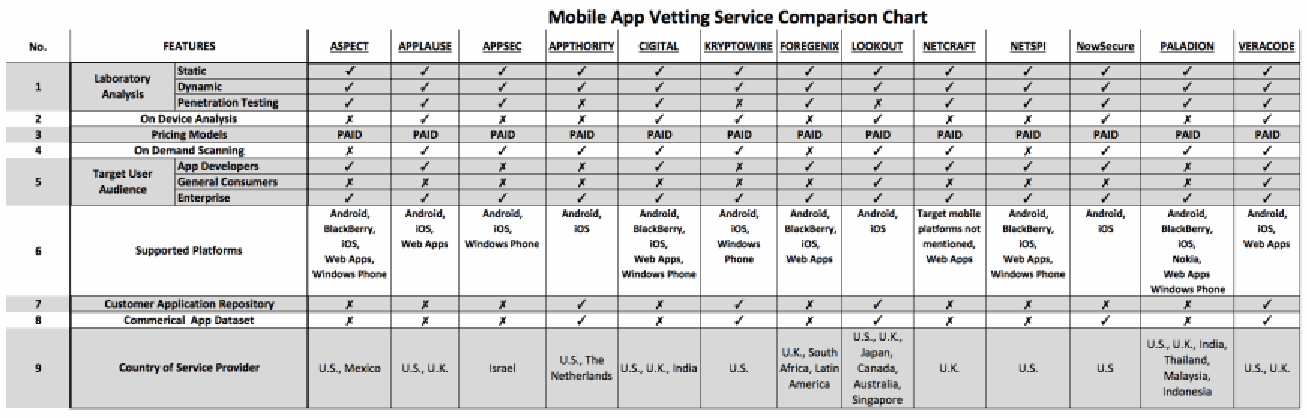
「Mobile App Vetting Service Comparison Chart」と題した表の画像です。行は番号付きの機能で、1 Laboratory Analysis(Static、Dynamic、Penetration Testing)、2 On Device Analysis、3 Pricing Models、4 On Demand Scanning、5 Target User Audience(App Developers、General Consumers、Enterprise)、6 Supported Platforms、7 Customer Application Repository、8 Commerical App Dataset、9 Country of Service Provider です。列は 13 のサービスで、✓ はその機能があるとうたわれていること、✗ はないことを示します。サービスごとの値は次のとおりです。ASPECT: Static ✓、Dynamic ✓、Penetration Testing ✓、On Device Analysis ✗、価格 PAID、On Demand Scanning ✗、App Developers ✓、General Consumers ✗、Enterprise ✓、対応プラットフォーム「Android, BlackBerry, iOS, Web Apps, Windows Phone」、Customer Application Repository ✗、Commerical App Dataset ✗、国「U.S., Mexico」。APPLAUSE: Static ✓、Dynamic ✓、Penetration Testing ✓、On Device Analysis ✓、価格 PAID、On Demand Scanning ✓、App Developers ✓、General Consumers ✗、Enterprise ✓、対応プラットフォーム「Android, iOS, Web Apps」、Customer Application Repository ✗、Commerical App Dataset ✗、国「U.S., U.K.」。APPSEC: Static ✓、Dynamic ✓、Penetration Testing ✓、On Device Analysis ✗、価格 PAID、On Demand Scanning ✓、App Developers ✗、General Consumers ✗、Enterprise ✓、対応プラットフォーム「Android, iOS, Windows Phone」、Customer Application Repository ✗、Commerical App Dataset ✗、国「Israel」。APPTHORITY: Static ✓、Dynamic ✓、Penetration Testing ✗、On Device Analysis ✗、価格 PAID、On Demand Scanning ✓、App Developers ✗、General Consumers ✗、Enterprise ✓、対応プラットフォーム「Android, iOS」、Customer Application Repository ✓、Commerical App Dataset ✓、国「U.S., The Netherlands」。CIGITAL: Static ✓、Dynamic ✓、Penetration Testing ✓、On Device Analysis ✓、価格 PAID、On Demand Scanning ✓、App Developers ✓、General Consumers ✗、Enterprise ✓、対応プラットフォーム「Android, BlackBerry, iOS, Web Apps, Windows Phone」、Customer Application Repository ✗、Commerical App Dataset ✗、国「U.S., U.K., India」。KRYPTOWIRE: Static ✓、Dynamic ✓、Penetration Testing ✗、On Device Analysis ✓、価格 PAID、On Demand Scanning ✓、App Developers ✗、General Consumers ✗、Enterprise ✓、対応プラットフォーム「Android, iOS, Windows Phone」、Customer Application Repository ✓、Commerical App Dataset ✓、国「U.S.」。FOREGENIX: Static ✓、Dynamic ✓、Penetration Testing ✓、On Device Analysis ✗、価格 PAID、On Demand Scanning ✗、App Developers ✓、General Consumers ✗、Enterprise ✓、対応プラットフォーム「Android, BlackBerry, iOS, Web Apps」、Customer Application Repository ✗、Commerical App Dataset ✗、国「U.K., South Africa, Latin America」。LOOKOUT: Static ✓、Dynamic ✓、Penetration Testing ✗、On Device Analysis ✓、価格 PAID、On Demand Scanning ✓、App Developers ✓、General Consumers ✓、Enterprise ✓、対応プラットフォーム「Android, iOS」、Customer Application Repository ✓、Commerical App Dataset ✓、国「U.S., U.K., Japan, Canada, Australia, Singapore」。NETCRAFT: Static ✓、Dynamic ✓、Penetration Testing ✓、On Device Analysis ✗、価格 PAID、On Demand Scanning ✓、App Developers ✓、General Consumers ✗、Enterprise ✓、対応プラットフォーム「Target mobile platforms not mentioned, Web Apps」、Customer Application Repository ✗、Commerical App Dataset ✗、国「U.K.」。NETSPI: Static ✓、Dynamic ✓、Penetration Testing ✓、On Device Analysis ✗、価格 PAID、On Demand Scanning ✗、App Developers ✓、General Consumers ✗、Enterprise ✓、対応プラットフォーム「Android, BlackBerry, iOS, Web Apps, Windows Phone」、Customer Application Repository ✗、Commerical App Dataset ✗、国「U.S.」。NowSecure: Static ✓、Dynamic ✓、Penetration Testing ✓、On Device Analysis ✓、価格 PAID、On Demand Scanning ✓、App Developers ✓、General Consumers ✗、Enterprise ✓、対応プラットフォーム「Android, iOS」、Customer Application Repository ✗、Commerical App Dataset ✓、国「U.S」。PALADION: Static ✓、Dynamic ✓、Penetration Testing ✓、On Device Analysis ✗、価格 PAID、On Demand Scanning ✓、App Developers ✗、General Consumers ✗、Enterprise ✓、対応プラットフォーム「Android, BlackBerry, iOS, Nokia, Web Apps, Windows Phone」、Customer Application Repository ✗、Commerical App Dataset ✗、国「U.S., U.K., India, Thailand, Malaysia, Indonesia」。VERACODE: Static ✓、Dynamic ✓、Penetration Testing ✓、On Device Analysis ✓、価格 PAID、On Demand Scanning ✓、App Developers ✓、General Consumers ✓、Enterprise ✓、対応プラットフォーム「Android, iOS, Web Apps」、Customer Application Repository ✓、Commerical App Dataset ✓、国「U.S., U.K.」。
7 Observations and Conclusions
7 所見と結論
The market of mobile application vetting services continues to grow and evolve daily. This continual expansion has led to the development of mobile application testing services focusing and specializing in different aspects of the mobile application vetting problem. It is essential for public safety to acquire knowledge of all types of analysis to narrow down which service performs the tests necessary to provide security through a public safety mobile application.
モバイルアプリケーション審査サービスの市場は、日々成長と進化を続けています。この絶え間ない拡大により、モバイルアプリケーション審査という課題のさまざまな側面に焦点を当て、特化したモバイルアプリケーションのテストサービスが生まれました。公共安全のモバイルアプリケーションを通じてセキュリティを確保するために必要なテストを、どのサービスが行うのかを絞り込むには、公共安全の関係者があらゆる種類の分析に関する知識を得ることが不可欠です。
Some key conclusions found during research are:
調査の中で得られた主な結論は次のとおりです。
•In general, all mobile application vetting services provide static and dynamic analysis, which are both assessments performed in-house at the service’s laboratory. A more infrequently observed technique was client-side/real-time analysis.
•一般に、すべてのモバイルアプリケーション審査サービスは静的分析と動的分析を提供しており、これらはいずれもサービスのラボで社内で実施される評価です。これより観察される頻度が低かった技法は、クライアント側/リアルタイムの分析でした。
•The on demand scanning model was the most prevalent in the services researched.
•オンデマンドスキャンのモデルは、調査したサービスの中で最も多く見られました。
•All the services researched focused on enterprise users.
•調査したすべてのサービスは、エンタープライズのユーザーに焦点を当てていました。
•Seven of the eleven application vetting services made mention of including application developers in their processes.
•11 のアプリケーション審査サービスのうち 7 つは、プロセスにアプリケーション開発者を含めることに言及していました。
•Two services target the general consumer market.
•2 つのサービスは、一般消費者市場を対象としています。
•Android and iOS are the most common operating platforms supported. Many services also target web applications.
•Android と iOS は、対応しているオペレーティングプラットフォームとして最も一般的です。多くのサービスはウェブアプリケーションも対象としています。
7.1 Areas for Further Consideration
7.1 さらに検討すべき領域
7.1.1 Public Safety Specific Analytic Features
7.1.1 公共安全に固有の分析機能
NISTIR 8018, Public Safety Mobile Application Security Requirements Workshop Summary, identifies six areas of concern for mobile application security that are specific to public safety [5]. Three of the areas identified in that document have requirements that could be evaluated by mobile application vetting services. During the research, no services explicitly mentioned including these features as part of their analysis. The public safety community should investigate mobile application vetting services for their ability to evaluate the following areas.
NISTIR 8018, Public Safety Mobile Application Security Requirements Workshop Summary は、公共安全に特有のモバイルアプリケーションセキュリティに関する 6 つの懸念領域を特定しています [5]。そのうち 3 つの領域には、モバイルアプリケーション審査サービスで評価できる可能性のある要件があります。調査の中で、これらの機能を分析の一部に含めると明示していたサービスはありませんでした。公共安全コミュニティは、モバイルアプリケーション審査サービスが次の領域を評価できるかどうかを調べるべきです。
Network Usage
ネットワーク使用
Mobile applications for public safety will be required to operate during a variety of network conditions. An evaluation of how much and how efficiently an application interacts with the network may be important to public safety when evaluating mobile applications. Furthermore, public safety mobile networks will need a degree of protection from either intentional or unintentional abuse of network resources.
公共安全向けのモバイルアプリケーションは、さまざまなネットワーク条件の下で動作することが求められます。アプリケーションがネットワークとどの程度、どれだけ効率的にやり取りするかの評価は、公共安全の分野でモバイルアプリケーションを評価する際に重要となる場合があります。さらに、公共安全のモバイルネットワークには、ネットワーク資源の意図的または非意図的な濫用に対する一定の保護が必要となります。
Battery life
バッテリー寿命
The analysis of a mobile application’s effect on a device’s battery life may be vital information for public safety. Rapid depletion of a device’s battery life may quickly render a public safety responder’s mobile device unusable in an emergency situation. Evaluating the battery impact of a mobile application may empower public safety to choose applications that more efficiently use a limited resource.
モバイルアプリケーションがデバイスのバッテリー寿命に与える影響の分析は、公共安全にとって極めて重要な情報となる場合があります。デバイスのバッテリーが急速に消耗すると、緊急事態において公共安全の対応要員のモバイルデバイスがすぐに使用できなくなるおそれがあります。モバイルアプリケーションがバッテリーに与える影響を評価することで、公共安全の担当者は、限られた資源をより効率的に使うアプリケーションを選べるようになる場合があります。
Location information
位置情報
Public safety has special requirements for location information when compared to general purpose applications. Real-time monitoring of a device’s location must be protected and controlled to protect first responders. Furthermore, location information may need to be retained for auditing purposes. To aid these requirements, public safety applications must declare all location information being gathered and whether that data is transmitted, stored, or both.
公共安全には、汎用のアプリケーションと比べて、位置情報に関する特別な要件があります。ファーストレスポンダーを守るため、デバイスの位置のリアルタイム監視は保護され、管理されなければなりません。さらに、位置情報は監査のために保持する必要がある場合があります。これらの要件を支援するため、公共安全向けのアプリケーションは、収集するすべての位置情報と、そのデータが送信されるのか、保存されるのか、あるいはその両方なのかを宣言しなければなりません。
7.1.2 Report Mechanism
7.1.2 報告の仕組み
Typically, an application vetting service provides analysis reports of the mobile applications being investigated. The technical expertise required to understand these reports, as well as the contents of the report, will vary from service to service. A public safety organization will need to analyze the form of the report supplied by a vetting service to decide whether it meets their requirements.
通常、アプリケーション審査サービスは、調査対象のモバイルアプリケーションの分析報告書を提供します。これらの報告書を理解するために必要な技術的専門知識や、報告書の内容は、サービスごとに異なります。公共安全の組織は、審査サービスが提供する報告書の形式を分析し、自組織の要件を満たすかどうかを判断する必要があります。
7.1.3 Report Redistribution
7.1.3 報告書の再配布
It is currently unclear what organization(s) have the authority for enforcing mobile application vetting for public safety. It may be the case that multiple organizations perform the function. The information gathered during the mobile application vetting process will be vital to improving the quality, usability, and security of public safety mobile apps. The sharing of lessons learned and test results will be critical to further these efforts. Furthermore, this information sharing will reduce redundant reexamination of mobile apps by different public safety organizations. As such, it may be important for public safety to be conscious of what rights they have for report redistribution when they engage with a mobile application vetting service.
公共安全向けのモバイルアプリケーションの審査を実施する権限を、どの組織が持っているのかは、現時点では明らかではありません。複数の組織がその機能を担っている可能性があります。モバイルアプリケーションの審査の過程で収集される情報は、公共安全向けモバイルアプリの品質、使いやすさ、セキュリティを向上させるうえで極めて重要となります。得られた教訓やテスト結果の共有は、これらの取り組みを進めるうえで不可欠です。さらに、この情報共有により、異なる公共安全組織によるモバイルアプリの重複した再検査が減ります。このため、公共安全の組織は、モバイルアプリケーション審査サービスを利用する際に、報告書の再配布についてどのような権利を持つかを意識しておくことが重要となる場合があります。
Appendix A—References
付録 A—参考文献
[1] S. Quirolgico, J. Voas, and T. Karygiannis, NIST Special Publication 800-163 Vetting the Security of Mobile Applications. National Institute of Standards and Technology, Gaithersburg, Maryland, January 2015, 44pp. http://dx.doi.org/10.6028/NIST.SP.800-163
[1] S. Quirolgico, J. Voas, and T. Karygiannis, NIST Special Publication 800-163 Vetting the Security of Mobile Applications. National Institute of Standards and Technology, Gaithersburg, Maryland, January 2015, 44pp. http://dx.doi.org/10.6028/NIST.SP.800-163
[2] K. Scarfone, M. Souppaya, C. Cody, A. Orebaugh, NIST Special Publication 800-115 Technical Guide to Information Security Testing and Assessment. National Institute of Standards and Technology, Gaithersburg, Maryland, September 2008, 80pp. http://dx.doi.org/10.6028/NIST.SP.800-115
[2] K. Scarfone, M. Souppaya, C. Cody, A. Orebaugh, NIST Special Publication 800-115 Technical Guide to Information Security Testing and Assessment. National Institute of Standards and Technology, Gaithersburg, Maryland, September 2008, 80pp. http://dx.doi.org/10.6028/NIST.SP.800-115
[3] M. Souppaya, K. Scarfone, NIST Special Publication 800-124 Revision 1 Guidelines for Managing the Security of Mobile Devices in the Enterprise, National Institute of Standards and Technology, Gaithersburg, Maryland, June 2013, http://dx.doi.org/10.6028/NIST.SP.800-124r1
[3] M. Souppaya, K. Scarfone, NIST Special Publication 800-124 Revision 1 Guidelines for Managing the Security of Mobile Devices in the Enterprise, National Institute of Standards and Technology, Gaithersburg, Maryland, June 2013, http://dx.doi.org/10.6028/NIST.SP.800-124r1
[4] J. Franklin, et al., Draft NIST Special Publication 1800-4 Mobile Device Security. National Institute of Standards and Technology, Gaithersburg, Maryland, November 2015. https://nccoe.nist.gov/publication/draft/1800-4b/
[4] J. Franklin, et al., Draft NIST Special Publication 1800-4 Mobile Device Security. National Institute of Standards and Technology, Gaithersburg, Maryland, November 2015. https://nccoe.nist.gov/publication/draft/1800-4b/
[5] M. Ogata, N. Hastings, and B. Guttman, Public Safety Mobile Application Security Requirements Workshop Summary. NISTIR 8018, National Institute of Standards and Technology, Gaithersburg, Maryland, January 2015. 56pp. http://dx.doi.org/10.6028/NIST.IR.8018
[5] M. Ogata, N. Hastings, and B. Guttman, Public Safety Mobile Application Security Requirements Workshop Summary. NISTIR 8018, National Institute of Standards and Technology, Gaithersburg, Maryland, January 2015. 56pp. http://dx.doi.org/10.6028/NIST.IR.8018