NIST IR 8214 日本語訳
英語タイトル : Threshold Schemes for Cryptographic Primitives: Challenges and Opportunities in Standardization and Validation of Threshold Cryptography日本語タイトル : 暗号プリミティブのためのしきい値方式:しきい値暗号の標準化と検証における課題と機会
公開日 : 2019-03-01
原文URL : https://csrc.nist.gov/pubs/ir/8214/final
翻訳編集 : 自動生成(有志による非公式の日本語訳), 原文取得日 : 2026-10-31, 訳文 : 507 / 507 ブロック
[要約] NIST IR 8214 は、暗号プリミティブをしきい値方式を用いて実装する可能性を概観し、その標準化と検証に関する課題と機会を検討する報告書です。しきい値方式では、全体で n 個のコンポーネントのうち f 個まで危殆化しても、望ましいセキュリティ目標を達成できるとされています。本書は、システムモデルと敵対者の違いに応じたセキュリティ上のトレードオフの例を含み、しきい値の種類、通信インタフェース、実行プラットフォーム、セットアップと保守の要件といった高レベルの特徴を列挙しています。標準化についての議論を支援し、ステークホルダーの関与を促すことを意図しています。
NISTIR 8214
NISTIR 8214
Threshold Schemes for Cryptographic Primitives
暗号プリミティブのためのしきい値方式
Challenges and Opportunities in Standardization and Validation of Threshold Cryptography
しきい値暗号の標準化と検証における課題と機会
Luís T. A. N. Brandão Nicky Mouha Apostol Vassilev
Luís T. A. N. Brandão Nicky Mouha Apostol Vassilev
This publication is available free of charge from: https://doi.org/10.6028/NIST.IR.8214
本刊行物は次の URL から無料で入手できます: https://doi.org/10.6028/NIST.IR.8214
NISTIR 8214
NISTIR 8214
Threshold Schemes for Cryptographic Primitives
暗号プリミティブのためのしきい値方式
Challenges and Opportunities in Standardization and Validation of Threshold Cryptography
しきい値暗号の標準化と検証における課題と機会
Luís T. A. N. Brandão Nicky Mouha Apostol Vassilev Computer Security Division Information Technology Laboratory
Luís T. A. N. Brandão Nicky Mouha Apostol Vassilev Computer Security Division Information Technology Laboratory
This publication is available free of charge from: https://doi.org/10.6028/NIST.IR.8214
本刊行物は次の URL から無料で入手できます: https://doi.org/10.6028/NIST.IR.8214
March 2019
2019 年 3 月
U.S. Department of Commerce Wilbur L. Ross, Jr., Secretary
米国商務省 Wilbur L. Ross, Jr. 長官
National Institute of Standards and Technology
National Institute of Standards and Technology
Walter G. Copan, NIST Director and Under Secretary of Commerce for Standards and Technology
Walter G. Copan、NIST 所長兼商務次官(標準・技術担当)
National Institute of Standards and Technology Internal Report 8214 63 pages (March 2019)
National Institute of Standards and Technology Internal Report 8214 63 ページ(2019 年 3 月)
This publication is available free of charge from: https://doi.org/10.6028/NIST.IR.8214
本刊行物は次の URL から無料で入手できます: https://doi.org/10.6028/NIST.IR.8214
Certain commercial entities, equipment, or materials may be identified in this document in order to describe an experimental procedure or concept adequately. Such identification is not intended to imply recommendation or endorsement by NIST, nor is it intended to imply that the entities, materials, or equipment are necessarily the best available for the purpose.
本書では、実験手順または概念を適切に説明するために、特定の商業事業者、機器、または資材を挙げている場合があります。そのような記載は、NIST による推奨や推薦を意味するものではなく、挙げられた事業者、資材、または機器がその目的に最適であるとは限らないことも意味しません。
There may be references in this publication to other publications currently under development by NIST in accordance with its assigned statutory responsibilities. The information in this publication, including concepts and methodologies, may be used by federal agencies even before the completion of such companion publications. Thus, until each publication is completed, current requirements, guidelines, and procedures, where they exist, remain operative. For planning and transition purposes, federal agencies may wish to closely follow the development of these new publications by NIST.
本刊行物では、NIST が法令で定められた責務に従って現在策定中の他の刊行物に言及している場合があります。概念や方法論を含む本刊行物の情報は、そうした関連刊行物の完成前であっても、連邦機関が利用してもよいです。したがって、各刊行物が完成するまでは、現行の要件、ガイドライン、手順が存在する場合は、それらが引き続き有効です。計画および移行のため、連邦機関は、NIST によるこれらの新しい刊行物の策定状況を注意深く追うことを検討してもよいです。
Organizations are encouraged to review all draft publications during public comment periods and provide feedback to NIST. Many NIST cybersecurity publications, other than the ones noted above, are available at https://csrc.nist.gov/publications.
組織は、公開意見募集の期間中にすべてのドラフト刊行物を確認し、NIST にフィードバックを提供することが推奨されます。上記以外にも、NIST のサイバーセキュリティ関連刊行物の多くが https://csrc.nist.gov/publications で入手できます。
Comments on this publication may be submitted to:
本刊行物に関する意見の提出先
National Institute of Standards and Technology Attn: Computer Security Division, Information Technology Laboratory 100 Bureau Drive (Mail Stop 8930) Gaithersburg, MD 20899-8930 Email: threshold-crypto@nist.gov
National Institute of Standards and Technology Attn: Computer Security Division, Information Technology Laboratory 100 Bureau Drive (Mail Stop 8930) Gaithersburg, MD 20899-8930 Email: threshold-crypto@nist.gov
All comments are subject to release under the Freedom of Information Act (FOIA).
すべての意見は、情報自由法(FOIA)に基づき公開される場合があります。
Reports on Computer Systems Technology
コンピュータシステム技術に関する報告書
The Information Technology Laboratory (ITL) at the National Institute of Standards and Technology (NIST) promotes the U.S. economy and public welfare by providing technical leadership for the Nation’s measurement and standards infrastructure. ITL develops tests, test methods, reference data, proof of concept implementations, and technical analyses to advance the development and productive use of information technology. ITL’s responsibilities include the development of management, administrative, technical, and physical standards and guidelines for the cost-effective security and privacy of other than national security-related information in federal information systems.
National Institute of Standards and Technology(NIST)の Information Technology Laboratory(ITL)は、米国の測定・標準基盤に対する技術的リーダーシップを提供することにより、米国経済と公共の福祉を促進しています。ITL は、情報技術の発展と生産的な利用を推進するために、テスト、テスト方法、参照データ、概念実証の実装、および技術分析を開発しています。ITL の責務には、連邦情報システムにおける国家安全保障関連以外の情報について、費用対効果の高いセキュリティとプライバシーを実現するための管理上、運用上、技術上、物理上の標準およびガイドラインの策定が含まれます。
Abstract
要旨
The Computer Security Division at the National Institute of Standards and Technology is interested in promoting the security of implementations of cryptographic primitives. This security depends not only on the theoretical properties of the primitives but also on the ability to withstand attacks on their implementations. It is thus important to mitigate breakdowns that result from differences between ideal and real implementations of cryptographic algorithms.
National Institute of Standards and Technology の Computer Security Division は、暗号プリミティブの実装のセキュリティを促進することに関心を持っています。このセキュリティは、プリミティブの理論的な性質だけでなく、実装に対する攻撃に耐える能力にも依存します。したがって、暗号アルゴリズムの理想的な実装と現実の実装との差異から生じる破綻を緩和することが重要です。
This document overviews the possibility of implementing cryptographic primitives using threshold schemes, where multiple components contribute to the operation in a way that attains the desired security goals even if \(f\) out of \(n\) of its components are compromised. There is also an identified potential in providing resistance against side-channel attacks, which exploit inadvertent leakage from real implementations. Security goals of interest include the secrecy of cryptographic keys, as well as enhanced integrity and availability, among others.
本書は、暗号プリミティブをしきい値方式で実装する可能性の概要を示します。しきい値方式では、n 個のコンポーネントのうち f 個が危殆化しても望ましいセキュリティ目標を達成できるよう、複数のコンポーネントが動作に寄与します。また、現実の実装から意図せず生じる漏えいを悪用するサイドチャネル攻撃に対する耐性を提供する可能性も指摘されています。対象とするセキュリティ目標には、暗号鍵の秘匿性のほか、完全性や可用性の強化などがあります。
This document considers challenges and opportunities related to standardization of threshold schemes for cryptographic primitives. It includes examples illustrating security tradeoffs under variations of system model and adversaries. It enumerates several high-level characterizing features of threshold schemes, including the types of threshold, the communication interfaces (with the environment and between components), the executing platform (e.g., single device vs. multiple devices) and the setup and maintenance requirements.
本書は、暗号プリミティブのためのしきい値方式の標準化に関する課題と機会を検討します。システムモデルと敵対者の違いに応じたセキュリティ上のトレードオフを示す例を含みます。また、しきい値方式のいくつかの高レベルの特徴を列挙します。これには、しきい値の種類、(環境との間、およびコンポーネント間の)通信インタフェース、実行プラットフォーム(たとえば単一デバイスと複数デバイス)、セットアップと保守の要件が含まれます。
The document poses a number of questions, motivating aspects to take into account when considering standardization. A particular challenge is the development of criteria that may help guide a selection of threshold cryptographic schemes. An open question is deciding at what level each standard should be defined (e.g., specific base techniques vs. conceptualized functionalities) and which flexibility of parametrization they should allow. Suitability to testing and validation of implementations are also major concerns to be addressed. Overall, the document intends to support discussion about standardization, including motivating an engagement from stakeholders. This is a step towards enabling threshold cryptography within the US federal government and beyond.
本書は、標準化を検討する際に考慮すべき側面を動機づける、いくつかの問いを提起します。特に難しい課題は、しきい値暗号方式の選択を導くのに役立つ基準の策定です。未解決の問いは、各標準をどのレベルで定義すべきか(たとえば、具体的な基盤技法と、概念化された機能のどちらか)、そしてどの程度のパラメータ化の柔軟性を認めるべきかを決めることです。実装のテストと検証への適合性も、対処すべき主要な懸念事項です。全体として、本書は、ステークホルダーの関与を促すことを含め、標準化についての議論を支援することを意図しています。これは、米国連邦政府内外でしきい値暗号を可能にするための一歩です。
Keywords: threshold schemes; secure implementations; cryptographic primitives; threshold cryptography; secure multi-party computation; intrusion tolerance; distributed systems; resistance to side-channel attacks; standards and validation.
キーワード: しきい値方式、安全な実装、暗号プリミティブ、しきい値暗号、セキュアマルチパーティ計算、侵入耐性、分散システム、サイドチャネル攻撃への耐性、標準と検証。
Acknowledgments
謝辞
The authors thank their NIST colleagues who reviewed recent or early versions of this document. This includes Lily Chen, René Peralta, Ray Perlner, and Andrew Regenscheid.
著者は、本書の最近の版または初期の版をレビューしてくださった NIST の同僚に感謝します。これには、Lily Chen、René Peralta、Ray Perlner、Andrew Regenscheid が含まれます。
The initial draft of this report was published online on July 26, 2018, for a period of public comments. We have since then received valuable feedback from external reviewers, which allowed us to improve the quality of the final document. We thank the comments received (in chronological order) from the following persons: Svetla Nikova from KU Leuven; Gokhan Kocak from Asena Inc.; Oliver Stengele from the Karlsruhe Institute of Technology; Aivo Kalu from Cybernetica AS; Christian Cachin, Hugo Krawczyk, Tal Rabin, Jason Resch and Chrysa Stathatkopoulou from IBM Research; Tanja Lange from Technische Universiteit Eindhoven; Yehuda Lindel from Bar-Ilan University and Unbound Tech; Samuel Ranellucci from Unbound Tech; Dan Bogdanov from Cybernetica AS; Rosario Gennaro from The City College of New York; Thalia May Laing from HP Labs; Karim Eldefrawy from SRI International; John Wallrabenstein from Analog.
本報告書の最初のドラフトは、2018 年 7 月 26 日に、公開意見募集の期間を設けてオンラインで公開されました。それ以来、外部のレビュー担当者から貴重なフィードバックを受け取り、最終版の品質を向上させることができました。次の方々(意見を受け取った順)からの意見に感謝します。KU Leuven の Svetla Nikova、Asena Inc. の Gokhan Kocak、Karlsruhe Institute of Technology の Oliver Stengele、Cybernetica AS の Aivo Kalu、IBM Research の Christian Cachin、Hugo Krawczyk、Tal Rabin、Jason Resch、Chrysa Stathatkopoulou、Technische Universiteit Eindhoven の Tanja Lange、Bar-Ilan University と Unbound Tech の Yehuda Lindel、Unbound Tech の Samuel Ranellucci、Cybernetica AS の Dan Bogdanov、The City College of New York の Rosario Gennaro、HP Labs の Thalia May Laing、SRI International の Karim Eldefrawy、Analog の John Wallrabenstein。
Executive Summary
エグゼクティブサマリー
As cryptography becomes ubiquitous, it becomes increasingly relevant to address the potentially disastrous breakdowns resulting from differences between ideal and real implementations of cryptographic algorithms. These differences give rise to a range of attacks that exploit vulnerabilities in order to compromise diverse aspects of real-world implementations. Threshold schemes have the potential to enable secure modes of operation even when certain subsets of components are compromised. However, they also present new challenges for the standardization and validation of security assertions about their implementations.
暗号が遍在するようになるにつれ、暗号アルゴリズムの理想的な実装と現実の実装との差異から生じる、壊滅的になりうる破綻に対処することが、ますます重要になっています。これらの差異は、現実世界の実装のさまざまな側面を危殆化させるために脆弱性を悪用する、さまざまな攻撃を生み出します。しきい値方式には、コンポーネントの特定の部分集合が危殆化しても、安全な動作モードを可能にする潜在力があります。しかし同時に、その実装についてのセキュリティ主張の標準化と検証に、新たな課題ももたらします。
This report is focused on threshold cryptographic schemes, i.e., threshold schemes used for secure implementations of cryptographic primitives. In a threshold scheme, some security property is tolerant to the compromise of up to a threshold number \(f\) (out of a total number \(n\) of) components in the system. The topic is related to traditional “threshold cryptography” (here adopted as an umbrella term), secure multi-party computation and intrusion-tolerant distributed systems. A major goal is enhanced protection of secret keys used by implementations of cryptographic algorithms. More generally, the goal includes the enhancement of a variety of security properties, such as confidentiality, integrity and/or availability.
本報告書は、しきい値暗号方式、すなわち暗号プリミティブの安全な実装に用いられるしきい値方式に焦点を当てます。しきい値方式では、システム内のコンポーネントが、しきい値の個数 \(f\)(全部で \(n\) 個のうち)まで危殆化しても、あるセキュリティ特性が保たれます。このトピックは、従来の「しきい値暗号」(ここでは包括的な用語として採用)、セキュアマルチパーティ計算、および侵入耐性のある分散システムに関連します。主要な目標は、暗号アルゴリズムの実装で使われる秘密鍵の保護の強化です。より一般的には、目標には、機密性、完全性、可用性(あるいはそのいずれか)などの、さまざまなセキュリティ特性の強化が含まれます。
Secret sharing is a fundamental technique in threshold cryptography. It enables a key (or some other secret input) to be split into multiple shares distributed across multiple parties. The “threshold” property translates into the ability to reconstruct the key from a threshold number of shares, but not from fewer. Thus, splitting a key into shares is an approach for protecting the secrecy of a key at rest, since the leakage of one or few shares does not reveal the key. However, this does not solve the problem of how to execute an algorithm that depends on a key. Particularly, conventional implementations of key-based cryptographic algorithms require the whole key as input, so if the key had been subject to secret sharing then the shared key would have to be reconstructed for use by the algorithm.
秘密分散は、しきい値暗号の基本的な技法です。これにより、鍵(またはその他の秘密の入力)を複数のシェアに分割し、複数の関係者に分散させることができます。「しきい値」の性質は、しきい値の個数のシェアからは鍵を復元できますが、それより少ない個数からは復元できないという能力として表れます。したがって、鍵をシェアに分割することは、保存時の鍵の秘匿性を保護する手法です。1 つまたは少数のシェアが漏えいしても、鍵は明らかにならないためです。しかし、これは、鍵に依存するアルゴリズムをどう実行するかという問題を解決しません。特に、鍵ベースの暗号アルゴリズムの従来の実装は、入力として鍵全体を必要とするため、鍵が秘密分散の対象となっていた場合、アルゴリズムが使用するために、分散された鍵を復元しなければなりません。
In threshold cryptography, the shares of the key do not need to be recombined to compute a particular result. Instead, the parties independently or collaboratively calculate shares of the output, without revealing the input shares to one another. This may be facilitated by certain mathematical properties, such as homomorphisms, or by cryptographic “secure computation” protocols. Using the threshold property, the output from the share computation can then be reconstructed into a final output. This is possible to achieve for NIST-approved algorithms, such as Rivest–Shamir–Adleman (RSA) and Digital Signature Algorithm (DSA) signatures, and Advanced Encryption Standard (AES) enciphering and deciphering.
しきい値暗号では、特定の結果を計算するために、鍵のシェアを再結合する必要はありません。代わりに、関係者が、互いに入力シェアを明かすことなく、独立に、または協調して、出力のシェアを計算します。これは、準同型性などの特定の数学的性質や、暗号の「セキュア計算」プロトコルによって実現できる場合があります。しきい値の性質を用いて、シェア計算からの出力を、最終的な出力へと復元できます。これは、Rivest–Shamir–Adleman(RSA)や Digital Signature Algorithm(DSA)の署名、Advanced Encryption Standard(AES)の暗号化と復号など、NIST 承認のアルゴリズムで実現可能です。
Threshold schemes can be used, with different security goals, in different applications. For example: (i) implement a digital signature algorithm without any single component ever holding the signing key; (ii) implement encryption and decryption correctly even if one compromised component attempts to corrupt the output; (iii) generate unbiased randomness even if some (but not all) randomness contributors are biased or unavailable.
しきい値方式は、異なるセキュリティ目標のもとで、異なるアプリケーションに使用できます。たとえば、(i) どの単一のコンポーネントも署名用秘密鍵を保持することなく、デジタル署名アルゴリズムを実装します。(ii) 1 つの危殆化したコンポーネントが出力を破壊しようとしても、暗号化と復号を正しく実装します。(iii) 乱数の提供者の一部(全部ではない)が偏っている、または利用できない場合でも、偏りのない乱数を生成します。
The computational paradigm in threshold cryptography brings several security advantages but also some potential weaknesses. For example, the use of multiple shares increases the attack surface to encompass all shares. Thus, the security effect of implementing a threshold scheme depends on an attack model. It is particularly relevant to consider how difficult it may be to compromise more than the threshold number \(f\) of components. In some cases, for example with low \(f\), the increased attack surface may enable an attack more efficient and effective than possible against a conventional (non-threshold) primitive, even if the nodes in the threshold scheme have independent modes of compromise (e.g., each compromisable via mutually exclusive attack vectors). On the other hand, a threshold scheme may provide better security even if the components are individually easier to compromise, e.g., in some settings/models where they are also easier to patch.
しきい値暗号の計算パラダイムは、いくつかのセキュリティ上の利点をもたらしますが、潜在的な弱点もいくつかあります。たとえば、複数のシェアを使うことで、攻撃対象領域がすべてのシェアを含むまで広がります。したがって、しきい値方式を実装することのセキュリティ上の効果は、攻撃モデルに依存します。しきい値の個数 \(f\) を超えるコンポーネントを危殆化させることがどの程度困難かを考慮することが、特に重要です。場合によっては、たとえば \(f\) が小さい場合、しきい値方式のノードが独立した危殆化の様式を持っていても(たとえば、それぞれが互いに排他的な攻撃ベクトルによって危殆化可能であっても)、拡大した攻撃対象領域によって、従来の(しきい値でない)プリミティブに対して可能な攻撃よりも効率的で効果的な攻撃が可能になる場合があります。一方で、しきい値方式は、コンポーネントが個々には危殆化しやすい場合でも、たとえば、パッチを適用するのもより容易な設定/モデルにおいて、より優れたセキュリティを提供する場合があります。
The security effect of a threshold design may also be different across different properties of interest. For example, while the compromise of one share might not reveal the original key, the corruption of a single share (or of a computation dependent on it) may affect the integrity of the output. These observations highlight the need to look at the security benefits brought by each threshold scheme as a possible tradeoff across properties. In some settings there may be a strengthening of some security properties while for others the assurance may be reduced.
しきい値の設計のセキュリティ上の効果は、対象とする特性ごとに異なる場合もあります。たとえば、1 つのシェアが危殆化しても元の鍵が明らかにならない場合があるものの、1 つのシェア(またはそれに依存する計算)が破壊されると、出力の完全性に影響する場合があります。これらの観察は、各しきい値方式がもたらすセキュリティ上の利点を、特性間の起こりうるトレードオフとして捉える必要性を浮き彫りにします。設定によっては、一部のセキュリティ特性が強化される一方で、他の特性については保証が低下する場合があります。
There are techniques designed to mitigate foreseen compromises in more complicated scenarios. For example, verifiable secret-sharing enables detection of misuse of shares by a shareholder, thereby enabling operational modes that tolerate this kind of corruption. As another example, proactive secret sharing can be used to periodically reshare a secret, thereby periodically reducing to zero the number of compromised shares. Assuming that old uncompromised shares are erased, the refreshing makes it more difficult to reach a state where the number of contemporaneous compromised shares surpasses the compromise threshold.
より複雑なシナリオで予見される危殆化を緩和するよう設計された技法があります。たとえば、検証可能秘密分散は、シェアの保持者によるシェアの不正使用の検知を可能にし、この種の不正な改変に耐える動作モードを可能にします。別の例として、プロアクティブ秘密分散を用いると、秘密を定期的に再分散でき、それによって危殆化したシェアの数を定期的にゼロに戻せます。古い未危殆化のシェアが消去されていると仮定すると、このリフレッシュにより、同時に危殆化したシェアの数が危殆化のしきい値を超える状態に到達することが、より困難になります。
Separating the analysis of different security aspects can sometimes lead to pitfalls. To avoid such problems it is important to use appropriate formal models of security. At the same time, it is relevant to assess potential tradeoffs that a threshold cryptographic scheme induces across different security properties. A system model is also important to characterize different types of attack that a system may be subject to. Specific attacks in the real world exploit differences between conventional implementations and their idealized versions. Threshold schemes can be used to improve resistance against some of these specific attacks that breach specific security properties (e.g., confidentiality of a key) or sets thereof.
異なるセキュリティの側面の分析を切り離すことは、ときに落とし穴につながります。そうした問題を避けるには、適切なセキュリティの形式モデルを用いることが重要です。同時に、しきい値暗号方式が異なるセキュリティ特性にまたがって生じさせるトレードオフの可能性を評価することも重要です。システムモデルも、システムがさらされうるさまざまな種類の攻撃を特徴づけるうえで重要です。現実世界の具体的な攻撃は、従来の実装とその理想化されたバージョンとの差異を悪用します。しきい値方式は、特定のセキュリティ特性(たとえば鍵の機密性)またはその集合を破るこれらの具体的な攻撃の一部に対する耐性を向上させるために使用できます。
An abstract security model is not enough to assess the effects of placing a threshold scheme in an adversarial environment. One also needs to characterize implementation aspects whose variation may affect security. Such characterization helps distinguish, possibly across different application contexts, the resistance provided against certain classes of attacks. To this end, this document proposes that a basis for discussion and comparison of threshold schemes should include the description of several characterizing features. These include the types of threshold, the communication interfaces, the target computing platforms, and the setup and maintenance requirements.
抽象的なセキュリティモデルだけでは、しきい値方式を敵対的な環境に置いた場合の影響を評価するには不十分です。変化するとセキュリティに影響しうる実装の側面も特徴づける必要があります。そのような特徴づけは、場合によっては異なるアプリケーションの文脈にまたがって、特定の種類の攻撃に対して提供される耐性を区別するのに役立ちます。この目的のため、本書は、しきい値方式の議論と比較の基礎に、いくつかの特徴づける要素の記述を含めるべきであると提案します。これらにはしきい値の種類、通信インタフェース、対象コンピューティングプラットフォーム、およびセットアップと保守の要件が含まれます。
The examples in the document illustrate how security properties can vary depending on high-level features, on assumed attack vectors and on the type of adversarial goals and capabilities. On one hand, this helps prevent a possible misconception that a higher threshold directly means higher security. On the other hand, it also intends to convey that threshold schemes can be used to implement cryptographic primitives in a more secure way. Altogether, structured security assertions also promote a path for meaningful security validation of actual implementations.
本書の例は、セキュリティ特性が、高レベルの特徴、想定される攻撃ベクトル、敵対者の目標と能力の種類によって、どのように変わりうるかを示します。一方では、しきい値が高いことが直ちに高いセキュリティを意味するという、ありうる誤解を防ぐのに役立ちます。他方では、しきい値方式が、暗号プリミティブをより安全に実装するために使用できることを伝えることも意図しています。総じて、構造化されたセキュリティ主張は、実際の実装の有意義なセキュリティ検証への道筋も促進します。
This document considers the benefits of standardizing threshold cryptographic schemes, possibly along with auxiliary threshold-cryptography primitives. Naturally, there is interest on threshold schemes for NIST-approved cryptographic primitives. Also of major importance is the development of corresponding approaches for validation of implementations of threshold cryptographic schemes. This should be aligned with the current modernization process and evolving structure of the testing methodology of the NIST cryptographic validation programs. Of particular relevance is the development of approaches to enable automated validation tests with state-of-the-art techniques.
本書は、しきい値暗号方式を、場合によっては補助的なしきい値暗号プリミティブとともに標準化することの利点を検討します。当然ながら、NIST 承認の暗号プリミティブのためのしきい値方式には関心が寄せられています。同様に非常に重要なのは、しきい値暗号方式の実装を検証するための対応するアプローチの策定です。これは、NIST の暗号検証プログラムのテスト方法論の、現在の近代化プロセスと進化する構造に整合させるべきです。特に重要なのは、最先端の技法による自動化された検証テストを可能にするアプローチの策定です。
The use of well-characterized threshold schemes to implement cryptographic primitives offers potential security benefits. But what criteria should one use to select from a potential pool of candidate threshold schemes? What flexibility of features and parameters should a threshold-cryptographic-scheme standard allow? Should some base primitives be independently standardized and/or validated? This document does not offer definitive answers to these questions. Instead, it motivates the need to develop an objective basis for addressing them. It also hints at various representative questions to consider, namely about security assessment, efficiency and applicability, among others.
十分に特徴づけられたしきい値方式を暗号プリミティブの実装に使用することは、セキュリティ上の潜在的な利点を提供します。しかし、候補となりうるしきい値方式の集合から選択するために、どのような基準を用いるべきでしょうか。しきい値暗号方式の標準では、特徴やパラメータの選択にどの程度の柔軟性を持たせるべきでしょうか。一部の基盤プリミティブは、独立に標準化または検証(あるいはその両方)すべきでしょうか。本書は、これらの問いに決定的な答えを示しません。代わりに、これらの問いに取り組むための客観的な基礎を策定する必要性を促します。また、セキュリティ評価、効率、適用可能性などについて、検討すべきさまざまな代表的な問いも示唆します。
There are important challenges and opportunities related to the standardization of threshold cryptographic schemes. Addressing these may bring about important security improvements to real implementations of cryptographic primitives. Fortunately, there is a plethora of research work done in the broad area of threshold cryptography, providing useful insights about possible options, caveats and tradeoffs. Further value can arise from addressing these challenges with feedback and collaboration from stakeholders, including academic researchers, industry participants and government representatives.
しきい値暗号方式の標準化に関連して、重要な課題と機会があります。これらに取り組むことで、暗号プリミティブの現実の実装に重要なセキュリティ向上がもたらされる可能性があります。幸いなことに、しきい値暗号の広い領域では多数の研究が行われており、可能な選択肢、注意点、トレードオフについて有用な知見が得られています。学術研究者、産業界の参加者、政府の代表者を含むステークホルダーからのフィードバックと協力を得てこれらの課題に取り組むことで、さらなる価値が生まれる可能性があります。
Table of Contents
目次
List of Figures
図の一覧
1 Illustration of Blakley secret sharing
1 Blakley 秘密分散の図解
2 Illustration of share randomization in Blakley secret sharing
2 Blakley 秘密分散におけるシェアのランダム化の図解
List of Tables
表の一覧
1 Representative attack types
1 代表的な攻撃の種類
2 Characterizing features of threshold schemes
2 しきい値方式の特徴
1 Introduction
1 はじめに
Protecting sensitive information from unauthorized disclosure has always been challenging. “Two may keep counsel, putting one away,” William Shakespeare wrote in “Romeo and Juliet” (1597) [Sha97]. Later, in “Poor Richard’s Almanack — 1735” [Sau34], Benjamin Franklin observed that “Three may keep a secret, if two of them are dead.” Today, cryptography is a primary means of protecting digital information. In modern cryptography the algorithms are well known but the keys are secret. Thus, the effectiveness of encrypting data hinges on maintaining the secrecy of cryptographic keys. However, this is difficult in conventional implementations, as keys are usually stored in one place on a device, and used there to run the algorithm. Devices, much like people, are not completely dependable guardians of secrets. Does this mean that keys are the Achilles’ heel of cryptography?1
機微な情報を不正な開示から守ることは、常に困難でした。William Shakespeare は「ロミオとジュリエット」(1597 年)[Sha97] で「一人を遠ざければ、二人で秘密を守れる」と書きました。のちに Benjamin Franklin は「Poor Richard’s Almanack — 1735」[Sau34] で「三人で秘密を守れる、そのうち二人が死んでいれば」と述べました。今日、暗号はデジタル情報を保護する主要な手段です。現代暗号では、アルゴリズムはよく知られていますが、鍵は秘密です。したがって、データの暗号化の有効性は、暗号鍵の秘匿性を維持することにかかっています。しかし、従来の実装では、鍵は通常デバイス上の 1 か所に保存され、そこでアルゴリズムを実行するために使われるため、これは困難です。デバイスは、人間と同様に、秘密の完全に信頼できる守り手ではありません。これは、鍵が暗号のアキレス腱であることを意味するのでしょうか。1
The localization of a key, for use by an algorithm, is susceptible to enabling leaking it out. For example, the internal state of a conventional implementation might be compromised through a bug such as Heartbleed [DLK+14, NVD14], Spectre [KGG+18, NVD18a, NVD18b], Meltdown [LSG+18, NVD18c] and Foreshadow [BMW+18], letting an attacker read private memory locations, including secret keys contained therein. Another example is the cold-boot attack [HSH+09], which allows recovery of keys from the dynamic random access memory (DRAM) of a computer, even seconds to minutes after it has been removed from the device. Some attacks inject faults into the computation, for example by changing the supply voltage. An example is the “Bellcore” attack [BDL97, ABF+03], where a fault induces an incorrect computation whose output reveals a secret key. Other attacks obtain information through a side channel, such as the execution time, the amount of energy it consumes, or the electromagnetic emanations it produces. Many of these fall into the category of non-invasive attacks, which can be performed without direct physical contact with components within the device. Attacks that exploit leakage of key-dependent information can lead to disastrous scenarios in which the master key used to encrypt and authenticate device firmware becomes compromised [RSWO17].
アルゴリズムが使用する鍵を一か所に置くことは、鍵の漏えいを招きやすくします。たとえば、従来の実装の内部状態は、Heartbleed [DLK+14, NVD14]、Spectre [KGG+18, NVD18a, NVD18b]、Meltdown [LSG+18, NVD18c]、Foreshadow [BMW+18] のようなバグによって危殆化し、攻撃者が、そこに含まれる秘密鍵を含め、非公開のメモリ位置を読み取れる場合があります。別の例はコールドブート攻撃 [HSH+09] で、コンピュータから取り外してから数秒から数分後でも、そのダイナミックランダムアクセスメモリ(DRAM)から鍵を復元できます。一部の攻撃は、たとえば供給電圧を変えることで、計算にフォールトを注入します。例として「Bellcore」攻撃 [BDL97, ABF+03] があり、フォールトが誤った計算を引き起こし、その出力が秘密鍵を明らかにします。ほかの攻撃は、実行時間、消費エネルギー量、発生する電磁放射といったサイドチャネルを通じて情報を得ます。これらの多くは、デバイス内のコンポーネントへの直接の物理的接触なしに実行できる非侵襲攻撃に分類されます。鍵に依存する情報の漏えいを悪用する攻撃は、デバイスのファームウェアの暗号化と認証に用いるマスター鍵が危殆化するという、壊滅的なシナリオにつながる可能性があります [RSWO17]。
To counter the inherent security risks of handling secret keys in conventional implementations of cryptographic algorithms, technical approaches have emerged that split the secret key into two or more shares across different components or parties. For example, when secret sharing is used on the key, the compromise of up to the confidentiality threshold number \(f\) (out of \(n\)) of the shares does not reveal information about the original key. Using appropriate threshold techniques, the shares can then be separately processed, leading the computation to a correct result as if the original secret key had been processed by a classic algorithm. The threshold approach can thus significantly increase the confidentiality of secret keys in cryptographic implementations.
暗号アルゴリズムの従来の実装で秘密鍵を扱うことに内在するセキュリティリスクに対抗するため、秘密鍵を、異なるコンポーネントまたは関係者にまたがる 2 つ以上のシェアに分割する技術的アプローチが登場しました。たとえば、鍵に秘密分散を用いる場合、機密性のしきい値の個数 \(f\)(\(n\) 個のうち)までのシェアが危殆化しても、元の鍵に関する情報は明らかになりません。適切なしきい値技法を用いれば、シェアを別々に処理でき、計算は、元の秘密鍵が従来のアルゴリズムで処理されたかのような正しい結果に至ります。したがって、しきい値アプローチは、暗号実装における秘密鍵の機密性を大幅に高めることができます。
There is a potential benefit complementary to mitigating single-point-of-failure issues in hardware and software implementations. The threshold approach can also enable decentralization of trust, when delegating the ability to perform some cryptographic operation. This can be useful for higher-level distributed applications, e.g., when the performing of a cryptographic operation should require agreement by multiple parties.
ハードウェアとソフトウェアの実装における単一障害点の問題を緩和することを補完する、潜在的な利点があります。しきい値アプローチは、何らかの暗号操作を実行する能力を委任する際に、信頼の分散化も可能にします。これは、より高レベルの分散アプリケーションで、たとえば、暗号操作の実行に複数の関係者の合意を必要とすべき場合に有用です。
This report is focused on threshold schemes applied to cryptographic primitives. In an \(f\)-out-of-\(n\) threshold scheme, some security property is tolerant to some kind of compromise of up to \(f\) out of \(n\) components in the system. As a mnemonic, the symbol \(f\) can be thought of as counting the number of “faulty” (i.e., compromised) components that can be tolerated. This threshold \(f\) can be specific to some implicit type of compromise, e.g., possibly including cases of crash, leakage, intrusion and accidental or malicious malfunctioning.
本報告書は、暗号プリミティブに適用されるしきい値方式に焦点を当てます。\(f\)-out-of-\(n\) のしきい値方式では、システム内のコンポーネントの最大 \(f\) 個(\(n\) 個のうち)までの何らかの種類の危殆化に対して、あるセキュリティ特性が耐性を持ちます。覚えやすくするために、記号 \(f\) は、許容できる「faulty」(すなわち危殆化した)コンポーネントの数を数えるものと考えられます。このしきい値 \(f\) は、暗黙の何らかの種類の危殆化に固有でもよく、たとえば、クラッシュ、漏えい、侵入、偶発的または悪意ある誤動作の場合を含む可能性があります。
In a dual perspective, a threshold can be defined with respect to an operational property. A \(k\)-out-of-\(n\) threshold property denotes that the presence or participation of \(k\) correct components is required to ensure some correct operation. The relation between the different thresholds (respectively represented by symbols \(k\) and \(f\)), e.g., \(k = f + 1\) or \(k = 2f + 1\), can vary depending on the scheme and on the type of compromise and security property.
双対的な視点では、しきい値は動作に関する特性について定義できます。\(k\)-out-of-\(n\) のしきい値特性は、何らかの正しい動作を確実にするために、\(k\) 個の正しいコンポーネントの存在または参加が必要であることを表します。異なるしきい値(それぞれ記号 \(k\) と \(f\) で表される)の関係、たとえば \(k = f + 1\) や \(k = 2f + 1\) は、方式、危殆化の種類、セキュリティ特性によって異なりえます。
The threshold paradigm brings several security advantages but also some potential weaknesses. For example, the use of multiple shares increases the attack surface to encompass all shares. Thus, the security effect of implementing a threshold scheme depends on an attack model. It is particularly relevant to consider how difficult may be the compromise of more than the threshold number \(f\) of components. In some cases, for example with low \(f\), the increased attack surface may enable an attack more efficient and effective than possible against a conventional (non-threshold) primitive.
しきい値パラダイムは、いくつかのセキュリティ上の利点をもたらしますが、潜在的な弱点もあります。たとえば、複数のシェアを使うことで、攻撃対象領域がすべてのシェアに及びます。したがって、しきい値方式を実装することのセキュリティ上の効果は、攻撃モデルに依存します。しきい値の個数 \(f\) を超えるコンポーネントを危殆化させることがどの程度困難かを考慮することが特に重要です。場合によっては、たとえば \(f\) が小さい場合、拡大した攻撃対象領域によって、従来の(しきい値でない)プリミティブに対する場合よりも効率的で効果的な攻撃が可能になることがあります。
The threshold concept can apply to security properties of interest beyond the secrecy of keys. For example, it is useful to enable availability and integrity of computations in spite of malfunctioning of some of its components. Traditional techniques of fault tolerance often achieve such resistance when considering random or predictably modeled faults. However, we are specially interested in resistance against targeted attacks, which can be malicious and arbitrary. Considering a wide scope of security goals, threshold schemes can exist in several flavors, depending on the security aspects they address and the techniques used. There are challenges in ensuring the simultaneous upholding of diverse security properties, such as secrecy of key material, correctness of outputs and continued availability.
しきい値の概念は、鍵の秘匿性を超えた、対象とするセキュリティ特性にも適用できます。たとえば、一部のコンポーネントが誤動作しても、計算の可用性と完全性を可能にすることが有用です。従来のフォールトトレランスの技法は、ランダムな、または予測可能なモデルで表されるフォールトを考える場合には、このような耐性をしばしば達成します。しかし、私たちが特に関心を持つのは、悪意があり任意でありうる標的型攻撃に対する耐性です。幅広いセキュリティ目標を考えると、しきい値方式は、対処するセキュリティの側面と用いる技法に応じて、いくつかの形態で存在しえます。鍵素材の秘匿性、出力の正しさ、継続的な可用性といった、多様なセキュリティ特性を同時に維持することを確実にするうえでは、課題があります。
In fact, the security impact of a threshold design may be different across different properties of interest. For example, in some schemes the compromise of one share might not reveal the original key, but the corruption of a single share (or of a computation dependent on it) may affect the integrity of the output. These observations highlight the need to look at the security benefits brought by threshold cryptography as a possible tradeoff across properties.
実際、しきい値設計のセキュリティへの影響は、対象とする特性ごとに異なる場合があります。たとえば、一部の方式では、1つのシェアが危殆化しても元の鍵は明らかになりませんが、1つのシェア(またはそれに依存する計算)が改ざんされると、出力の完全性に影響する場合があります。これらの観察は、しきい値暗号がもたらすセキュリティ上の利点を、特性間の起こりうるトレードオフとして捉える必要性を浮き彫りにします。
The basic security model for cryptographic algorithms assumes an ideal black box, in which the cryptographic computations are correct and the internal states are kept secret. For example, such ideal constructs have no side channels that could leak secret keys. This model contrasts with the reality of conventional implementations, which can be subject to attacks that exploit differences between the ideal and real worlds. Threshold schemes deal with some of those differences, by providing tolerance against the compromise of several components. They may also hinder the exploitation of existing compromises (such as noisy leakage) from a set of components, e.g., providing resistance against side-channel attacks.
暗号アルゴリズムの基本的なセキュリティモデルは、暗号計算が正しく、内部状態が秘密に保たれる、理想的なブラックボックスを仮定します。たとえば、そのような理想的な構成物には、秘密鍵を漏えいさせうるサイドチャネルがありません。このモデルは、理想世界と現実世界との差異を悪用する攻撃を受けうる、従来の実装の現実とは対照的です。しきい値方式は、複数のコンポーネントの危殆化に対する耐性を提供することで、それらの差異の一部に対処します。また、一連のコンポーネントからの既存の危殆化(ノイズを含む漏えいなど)の悪用を妨げる場合もあり、たとえばサイドチャネル攻撃への耐性を提供します。
A separate analysis of different security properties may lead to some pitfalls. Some formal models of security are useful to avoid them. The ideal-real simulation paradigm, common to analysis of secure multi-party computation protocols, combines the notion of security into a definition of an ideal world. This abstraction captures an intended application in an ideal world, then allowing security properties to be derived therefrom. Complementary, a system model is also important to characterize different types of attack that a system may be subject to. Specific attacks in the real world exploit differences between conventional implementations and their idealized versions. Some of these may target breaching specific security properties (e.g., confidentiality of a key) or sets thereof. There is a particular interest in understanding how threshold schemes can be used to improve resistance against these specific attacks. It is also relevant to assess potential tradeoffs that a threshold cryptographic scheme induces across different security properties.
異なるセキュリティ特性を個別に分析すると、いくつかの落とし穴につながる場合があります。セキュリティの形式モデルの中には、それらを避けるのに役立つものがあります。セキュアマルチパーティ計算プロトコルの分析で一般的な理想・現実シミュレーションパラダイムでは、理想世界を定義することでセキュリティの概念をまとめて扱います。この抽象化は、意図するアプリケーションを理想世界で捉え、そこからセキュリティ特性を導出できるようにします。これに加えて、システムモデルも、システムがさらされうるさまざまな種類の攻撃を特徴づけるうえで重要です。現実世界の具体的な攻撃は、従来の実装とその理想化されたバージョンとの差異を悪用します。これらの攻撃の一部は、特定のセキュリティ特性(たとえば鍵の機密性)またはその集合を破ることを狙う場合があります。しきい値方式を、これらの具体的な攻撃に対する耐性を向上させるためにどう使えるかを理解することには、特別な関心が寄せられています。また、しきい値暗号方式が異なるセキュリティ特性にまたがって生じさせるトレードオフの可能性を評価することも重要です。
There are techniques designed to mitigate foreseen compromises in more complicated scenarios. For example, verifiable secret-sharing enables detection of misuse of shares by a shareholder, thereby enabling operational modes that tolerate this kind of corruption. As another example, proactive secret sharing can be used to periodically reshare a secret, thereby periodically reducing to zero the number of compromised shares. However, an abstract security model is not enough to assess the effects of placing a threshold scheme in an adversarial environment. One also needs to characterize implementation aspects whose variation may affect security. These include the types of threshold, the communication interfaces, the target computing platforms, and the setup and maintenance requirements.
より複雑なシナリオで予見される危殆化を緩和するよう設計された技法があります。たとえば、検証可能秘密分散は、シェアの保持者によるシェアの不正使用の検知を可能にし、この種の破壊に耐える動作モードを可能にします。別の例として、プロアクティブ秘密分散を用いると、秘密を定期的に再分散でき、それによって危殆化したシェアの数を定期的にゼロに戻せます。しかし、抽象的なセキュリティモデルだけでは、しきい値方式を敵対的な環境に置いた場合の影響を評価するには不十分です。変化するとセキュリティに影響しうる実装の側面も特徴づける必要があります。これらには、しきい値の種類、通信インタフェース、対象コンピューティングプラットフォーム、セットアップと保守の要件が含まれます。
For example, system models and attack types can differ substantially across different platforms and communication mediums. It should thus be considered how the components inter-communicate, and how they can be assumed separate and independent vs. mutually interfering. In a single device setting, this may involve interaction between different components within a single chip or a single computer. In a contrasting setting, multiple nodes (e.g., servers) may be placed in different locations, communicating within a private network or across the Internet.
たとえば、システムモデルと攻撃の種類は、プラットフォームや通信媒体によって大きく異なりえます。したがって、コンポーネントがどのように相互通信し、どのように互いに分離され独立していると仮定できるか、あるいは互いに干渉しうるかを考慮すべきです。単一デバイスの設定では、これは、単一のチップまたは単一のコンピュータ内の異なるコンポーネント間の相互作用を伴う場合があります。対照的な設定では、複数のノード(たとえばサーバー)が異なる場所に置かれ、プライベートネットワーク内で、またはインターネットを介して通信する場合があります。
Altogether, the security assertions made with respect to an instantiated set of features provide a path for security validation of actual implementations. Of particular interest are approaches that enable automated validation tests with state-of-the-art techniques. The use of well-characterized threshold cryptographic schemes to implement cryptographic primitives offers potential security benefits. It is thus important to develop objective criteria for selecting from a potential pool of candidate threshold schemes.
総じて、具体化された一連の特徴に関して行われるセキュリティ主張は、実際の実装のセキュリティ検証への道筋を提供します。特に関心が寄せられているのは、最先端の技法による自動化された検証テストを可能にするアプローチです。十分に特徴づけられたしきい値暗号方式を暗号プリミティブの実装に使用することは、セキュリティ上の潜在的な利点を提供します。したがって、候補となりうるしきい値方式の集合から選択するための客観的な基準を策定することが重要です。
Audience. This document is targeted, with varying goals, at a diverse audience. Internally for NIST, the goal is to initiate a discussion about threshold schemes for cryptographic primitives. This motivated the inclusion of representative questions relevant to standardization.
対象読者。本書は、目的はさまざまですが、多様な読者を対象としています。NIST 内部では、暗号プリミティブのためのしきい値方式についての議論を開始することが目的です。このため、標準化に関連する代表的な問いを盛り込みました。
The document is also written for people with managerial/policy responsibilities in development and/or adoption of cryptographic services and modules. For such an audience, the document highlights critical aspects of the security of implementations that can be significantly affected by nuances in the system model and the employed threshold techniques. Several simple examples are provided, including some based on classic secret sharing schemes.
本書は、暗号サービスやモジュールの開発または採用(あるいはその両方)に関して、管理/ポリシー上の責任を持つ人々のためにも書かれています。そのような読者に対して、本書は、システムモデルと採用するしきい値技法の細かな違いによって大きく影響されうる、実装のセキュリティの重要な側面を強調します。古典的な秘密分散方式に基づくものを含め、いくつかの簡単な例を示します。
The text is also directed to experts in cryptography from academia and industry. For them, the document is an invitation to engage with NIST in a collaborative effort to resolve the open questions related to the standardization of threshold schemes for cryptographic primitives and the corresponding guidelines for implementation validation.
本文は、学術界と産業界の暗号の専門家にも向けられています。彼らにとって本書は、暗号プリミティブのためのしきい値方式の標準化と、それに対応する実装検証のガイドラインに関する未解決の問いを解決するための共同の取り組みに、NIST とともに参加するための招待状です。
It is useful to further clarify one intentional design aspect related to the references to related work. This document intends to initiate a discussion that may lead NIST to standardize threshold schemes for cryptographic primitives. For that purpose, we sought to convey in a balanced way that there are feasible threshold approaches, but without showing particular preferences. In fact, we specifically opted to avoid an assessment of the most recent works, preferring instead to exemplify precursory threshold techniques. Therefore, we do not make an exhaustive analysis and do not try to include the depth and nuances typical of a research paper or a technical survey. We hope that a thorough assessment of state-of-the-art threshold approaches can be subsequently performed with an inclusive participation of stakeholders.
関連研究への参照に関わる、意図的な設計上の側面を、さらに明確にしておくことが有用です。本書は、NIST が暗号プリミティブのためのしきい値方式を標準化することにつながりうる議論を開始することを意図しています。その目的のため、実現可能なしきい値アプローチがあることを、特定の選好を示すことなく、バランスよく伝えようとしました。実際、最新の研究の評価を避け、代わりに先駆的なしきい値技法を例示することを、意図的に選びました。したがって、網羅的な分析は行っておらず、研究論文や技術サーベイに典型的な深さや微妙な差異を含めようとはしていません。最先端のしきい値アプローチの徹底的な評価は、ステークホルダーの包括的な参加を得て、のちに行えることを期待しています。
2 Fundamentals
2 基礎
2.1 Terminology
2.1 用語
This document makes use of two dual perspectives of a threshold. In “\(f\)-out-of-\(n\)” the threshold “\(f\)” denotes the maximum number of components that can be compromised (with respect to some implicit security property of the components), while retaining some (implicit) security property for the global system. Correspondingly, in “\(k\)-out-of-\(n\)” the threshold “\(k\)” denotes the minimum number of components that must remain uncompromised to be possible to ensure some security property of the global system.
本書は、しきい値についての 2 つの双対的な視点を用います。「\(f\)-out-of-\(n\)」では、しきい値「\(f\)」は、(コンポーネントの何らかの暗黙のセキュリティ特性に関して)危殆化しうるコンポーネントの最大数を表し、その間も全体システムの(暗黙の)何らかのセキュリティ特性が保たれます。対応して、「\(k\)-out-of-\(n\)」では、しきい値「\(k\)」は、全体システムの何らかのセキュリティ特性を確保できるようにするために、危殆化していないまま残らなければならないコンポーネントの最小数を表します。
We borrow terminology from different research areas, with some overlap, using several terms that share similar connotations, sometimes (but not always) interchangeable. Some informal correspondences follow:
本書は、いくつかの重複を伴いつつ、異なる研究分野の用語を借用しており、似た含意を共有するいくつかの用語を、ときに(常にではありませんが)入れ替え可能なものとして使っています。非公式な対応関係を以下に示します。
•Active/byzantine/malicious: characterization of compromised nodes, or of an adversary, when being able to arbitrarily deviate or induce deviations from a protocol specification.
•アクティブ/ビザンチン/悪意ある(Active/byzantine/malicious): プロトコル仕様から任意に逸脱する、または逸脱を引き起こすことができる場合の、危殆化したノードまたは敵対者の特徴づけ。
•Agent/component/node/party/share: a constituent part of an implemented threshold scheme, affecting the prosecution of a functional goal (a cryptographic operation, in our context) to be achieved by a collective of parts; most often used to denote one of the \(n\) parts whose compromise counts towards the threshold \(f\); when the context is clear, some terms can designate parts outside of the threshold composition.
•エージェント/コンポーネント/ノード/関係者/シェア(Agent/component/node/party/share): 実装されたしきい値方式の構成部分で、部分の集合体によって達成されるべき機能上の目標(本書の文脈では暗号操作)の遂行に影響するもの。最も多くの場合、\(n\) 個の部分のうちの 1 つで、その危殆化がしきい値 \(f\) に数えられるものを表すために使われます。文脈が明確な場合、一部の用語は、しきい値の構成の外にある部分を指すこともあります。
•Aggregator/broker/combiner/dealer/proxy/relay: an agent with a special role in aiding the setup, execution and/or maintenance of a threshold protocol; usually not accounted in \(n\), except if explicitly stated as such (e.g., the case of a primary node).
•アグリゲーター/ブローカー/コンバイナー/ディーラー/プロキシ/リレー(Aggregator/broker/combiner/dealer/proxy/relay): しきい値プロトコルのセットアップ、実行、保守(あるいはそのいずれか)を支援する特別な役割を持つエージェント。通常は、明示的にそう述べられている場合(たとえばプライマリノードの場合)を除き、\(n\) には数えられません。
•Bad/compromised/corrupted/controlled/faulty/intruded: state of a node, whereby it departs from an ideally healthy state, and starts being counted towards the threshold \(f\).
•不良/危殆化/破壊/制御された/故障/侵入された(Bad/compromised/corrupted/controlled/faulty/intruded): ノードが理想的な健全状態から外れ、しきい値 \(f\) に数えられ始める状態。
•Client/user: an agent, not in the threshold set of components, who is a stakeholder of the result of a cryptographic computation, typically the requester for that computation.
•クライアント/ユーザー(Client/user): しきい値の構成コンポーネントの集合に含まれないエージェントで、暗号計算の結果のステークホルダーであり、通常はその計算の要求者。
•Compromise/corruption/intrusion: a process by which a node transitions from an ideally healthy state to a compromised state and/or by which it remains therein.
•危殆化/破壊/侵入(Compromise/corruption/intrusion): ノードが理想的な健全状態から危殆化した状態に遷移する、または危殆化した状態にとどまるプロセス。
•Good/healthy/honest/recovered: ideal state of a node, not yet compromised by an adversary, but susceptible to attacks.
•良好/健全/正直/復旧済み(Good/healthy/honest/recovered): ノードの理想的な状態で、まだ敵対者によって危殆化されていませんが、攻撃を受けうる状態。
•Honest-but-curious/Leaky/Passive/Semi-honest: characterization of compromised components, or of an adversary, when the internal state of the former is exfiltrated by the latter, but without altering the computations and message-exchanges specified by the protocol.
•正直だが好奇心のある/漏えいする/パッシブ/準正直(Honest-but-curious/Leaky/Passive/Semi-honest): 危殆化したコンポーネントまたは敵対者の特徴づけで、前者の内部状態が後者によって外部へ持ち出されますが、プロトコルが規定する計算とメッセージ交換は変更されない場合。
•Recovery/refresh/rejuvenation/replacement: transitioning of a node or nodes from a (possibly) bad state back to a good state; nuances include update, reversion, change and reset of internal states, as well as effective replacement of physical components.
•復旧/リフレッシュ/リジュビネーション/交換(Recovery/refresh/rejuvenation/replacement): ノードが、(場合によっては)不良な状態から良好な状態に戻る遷移。細かな違いとして、更新、巻き戻し、内部状態の変更とリセット、物理コンポーネントの実質的な交換があります。
The above notes simply intend to convey intuition helpful for reading the document. We do not undertake here the goal of unifying terminology from different areas. Cited references in the text provide necessary context. The encyclopedia of cryptography and security [TJ11] and the NIST glossary of security terms [Kis13] provide additional suggestions.
上記の注記は、本書を読むのに役立つ直観を伝えることを意図したものにすぎません。ここでは、異なる分野の用語を統一することを目標とはしていません。本文で引用する参考文献が、必要な文脈を提供します。暗号とセキュリティの百科事典 [TJ11] と NIST のセキュリティ用語集 [Kis13] が、追加の示唆を提供します。
2.2 Secret sharing
2.2 秘密分散
Secret sharing is based on splitting the key into multiple shares. For example, to split key \(K\) into three shares \(K_1\), \(K_2\), and \(K_3\), we randomly select shares \(K_1\) and \(K_2\) from the same key space as \(K\), and let the third share \(K_3 = K_1 \oplus K_2 \oplus K\) be the one-time pad encryption of \(K\), where \(\oplus\) is the exclusive OR operation if the keys are bit-strings. No two shares provide any information about the secret key — all shares are required to recover \(K\).
秘密分散は、鍵を複数のシェアに分割することに基づきます。たとえば、鍵 \(K\) を 3 つのシェア \(K_1\)、\(K_2\)、\(K_3\) に分割するには、シェア \(K_1\) と \(K_2\) を、\(K\) と同じ鍵空間からランダムに選び、3 つ目のシェアを \(K_3 = K_1 \oplus K_2 \oplus K\)、すなわち \(K\) のワンタイムパッド暗号とします。ここで \(\oplus\) は、鍵がビット列の場合の排他的論理和演算です。どの 2 つのシェアも秘密鍵に関する情報を一切与えません。\(K\) を復元するには、すべてのシェアが必要です。
The described scheme, with \(n = 3\) parties, has a threshold property: it is a “\(f\)-out-of-3” scheme with \(f = 2\) with respect to the leakage of any two shares alone not giving away information of the original secret key; it is a \(k\)-out-of-3 scheme with \(k = 3\) with respect to all three shares being required to recover the key. The \(k\) notation is used hereafter for the concrete case of secret-sharing schemes.
説明した方式は、\(n = 3\) の関係者で、しきい値の性質を持ちます。これは「\(f\)-out-of-3」方式で \(f = 2\) であり、どの 2 つのシェアが漏えいしても、それだけでは元の秘密鍵に関する情報が明らかになりません。また \(k\)-out-of-3 方式で \(k = 3\) であり、鍵の復元には 3 つのシェアすべてが必要です。以降、秘密分散方式の具体的な場合には、\(k\) の表記を用います。
More generally, \(k\)-out-of-\(n\) secret-sharing schemes can be defined, for any integers \(n\) and \(k\) satisfying \(n \geq k \geq 1\). Such secret-sharing schemes were independently developed in 1979 by Shamir [Sha79] and Blakley [Bla79]. There, any \(k\) parties together can recover a secret shared across \(n\) parties, but \(k - 1\) parties together do not know anything about the secret.
より一般に、\(k\)-out-of-\(n\) の秘密分散方式は、任意の整数 \(n\) と \(k\)(\(n \geq k \geq 1\) を満たす)について定義できます。このような秘密分散方式は、1979 年に Shamir [Sha79] と Blakley [Bla79] によって独立に開発されました。そこでは、任意の \(k\) 人の関係者が集まれば、\(n\) 人の関係者に分散された秘密を復元できますが、\(k - 1\) 人の関係者が集まっても秘密については何もわかりません。
Blakley secret sharing. With the help of Fig. 1, we describe an example of Blakley’s scheme for \(k = 2\) and \(n = 3\), with some simplifications for illustration purposes. The secret is the \(x\)-coordinate (\(x_s\)) of the point \(P(x, y)\) in the two-dimensional plane (see Fig. 1(a)). A non-vertical line in the plane is defined as a set of points \((x, y)\) satisfying \(y = hx + g\) for some constants \(h\) and \(g\). If Alice obtains coefficients \(h_A\) and \(g_A\) for some line \(\{(x, y) : y = h_A x + g_A\}\), containing the point \(P\), this does not give Alice any advantage in discovering its \(x\)-coordinate \(x_s\) (see Fig. 1(b)). This is because the definition of the line does not provide any special information about any point in the line, i.e. all points in the line (and all \(x\)-coordinates) are equally likely. In practice, lines are selected only from a finite space of lines, e.g., with all coefficients being integers modulo some prime number \(Q\), and the lines themselves are finite collections of points, e.g., with \(x\) and \(y\) being also integers modulo \(Q\). The prime modulus \(Q\) must be larger than the secret \(x_s\) and larger than the number \(n\) of parties.
Blakley 秘密分散。図 1 を用いて、\(k = 2\)、\(n = 3\) の場合の Blakley 方式の例を、説明のためにいくつか単純化して示します。秘密は、2 次元平面上の点 \(P(x, y)\) の \(x\) 座標(\(x_s\))です(図 1(a) を参照)。平面上の垂直でない直線は、点 \((x, y)\) の集合で、\(y = hx + g\) を満たすものとして定義されます(\(h\) と \(g\) は何らかの定数)。Alice が係数 \(h_A\) と \(g_A\) を、点 \(P\) を含むある直線 \(\{(x, y) : y = h_A x + g_A\}\) について入手しても、その \(x\) 座標 \(x_s\) を発見するうえで Alice に何の優位も与えません(図 1(b) を参照)。これは、直線の定義が、直線上のどの点についても特別な情報を提供しない、すなわち直線上のすべての点(およびすべての \(x\) 座標)が等しく確からしいためです。実際には、直線は有限の直線の空間からのみ選ばれ、たとえば、すべての係数をある素数 \(Q\) を法とする整数とし、直線自体も、たとえば \(x\) と \(y\) をやはり \(Q\) を法とする整数とする点の有限集合です。素数の法 \(Q\) は、秘密 \(x_s\) より大きく、関係者の数 \(n\) より大きくなければなりません。
Similarly, if Bob and Charlie obtain coefficients of other lines that pass through the same point \(P\), individually they cannot determine \(P\). Note that the lines cannot be parallel to each other and to Alice’s line. However, any two together — Alice with Bob, or Alice with Charlie, or Bob with Charlie — can easily compute \(P\) as the intersection of their lines (see Fig. 1(c)). We have thus described a 2-out-of-3 secret-sharing scheme. To build a \(k\)-out-of-\(n\) Blakley scheme for some \(k > 2\), one considers hyperplanes \(y = h_1 x_1 + \ldots + h_{k-1} x_{k-1} + g\) that intersect in a single point \(P(x_1, \ldots, x_{k-1}, y)\) in the \(k\)-dimensional space, provided that no hyper-place is orthogonal to the \(x_1\)-axis. Choosing \(n \geq k\) such hyperplanes, one can distribute the corresponding coefficients to \(n\) different parties. Then any \(k\) parties together can compute efficiently the intersection point \(P\) and recover the secret as its \(x_1\)-coordinate.
同様に、Bob と Charlie が、同じ点 \(P\) を通る別の直線の係数を入手しても、それぞれ単独では \(P\) を決定できません。直線は、互いに、また Alice の直線と平行であってはならないことに注意してください。しかし、どの 2 人が集まっても(Alice と Bob、Alice と Charlie、Bob と Charlie)、それぞれの直線の交点として \(P\) を容易に計算できます(図 1(c) を参照)。以上で、2-out-of-3 の秘密分散方式を説明しました。\(k\)-out-of-\(n\) の Blakley 方式を、ある \(k > 2\) について構築するには、超平面 \(y = h_1 x_1 + \ldots + h_{k-1} x_{k-1} + g\) を考えます。これらは単一の点 \(P(x_1, \ldots, x_{k-1}, y)\) で交わり(\(k\) 次元空間内)、どの超平面も \(x_1\) 軸に直交しないものとします。\(n \geq k\) 個のそのような超平面を選べば、対応する係数を \(n\) 人の異なる関係者に配布できます。任意の \(k\) 人の関係者が集まれば、交点 \(P\) を効率的に計算し、その \(x_1\) 座標として秘密を復元できます。
Shamir secret sharing. Shamir secret sharing is based on the observation that any set of \(k\) distinct points determines completely a polynomial of degree \(k - 1\). For example, consider a set of positive integer coefficients \(c_0, c_1, \ldots, c_{k-1}\) and define the polynomial \(f(x) = c_0 + c_1 x + \ldots + c_{k-1} x^{k-1}\). Typically, the secret is the coefficient \(c_0 = f(0)\) and each party \(i\) receives as share the point \((i, f(i))\), where \(i\) is a positive integer distinct for each party (e.g., \(1, 2, \ldots, n\)). Then, any set of \(k\) parties can reconstruct \(f(x)\), and therefore compute the secret \(f(0)\), whereas \(k - 1\) parties cannot. All coefficients are based on finite field arithmetic defined in terms of a prime number \(Q\). Since each party must receive a distinct point, and that point must not be \((0, f(0))\), the modulus \(Q\) must be larger than the number \(n\) of parties. The points on the curve are thus defined as \((x, f(x) \bmod Q)\) and the secret and any other coefficient are integers between 0 and \(Q - 1\). This ensures that no information from the secret can be recovered from incomplete sets of (i.e., with fewer than \(k\)) points on the curve.
Shamir 秘密分散。Shamir 秘密分散は、任意の \(k\) 個の相異なる点が \(k - 1\) 次の多項式を完全に決定するという観察に基づきます。たとえば、正の整数の係数の集合 \(c_0, c_1, \ldots, c_{k-1}\) を考え、多項式 \(f(x) = c_0 + c_1 x + \ldots + c_{k-1} x^{k-1}\) を定義します。通常、秘密は係数 \(c_0 = f(0)\) であり、各関係者 \(i\) はシェアとして点 \((i, f(i))\) を受け取ります。ここで \(i\) は、各関係者ごとに異なる正の整数です(たとえば \(1, 2, \ldots, n\))。すると、任意の \(k\) 人の関係者の集合が \(f(x)\) を再構成でき、したがって秘密 \(f(0)\) を計算できますが、\(k - 1\) 人では不可能です。すべての係数は、素数 \(Q\) で定義される有限体の算術に基づきます。各関係者は異なる点を受け取らなければならず、その点は \((0, f(0))\) であってはならないため、法 \(Q\) は関係者の数 \(n\) より大きくなければなりません。したがって、曲線上の点は \((x, f(x) \bmod Q)\) と定義され、秘密およびその他の係数は 0 から \(Q - 1\) の間の整数です。これにより、曲線上の不完全な(すなわち \(k\) 個未満の)点の集合から、秘密に関する情報を一切復元できないことが保証されます。
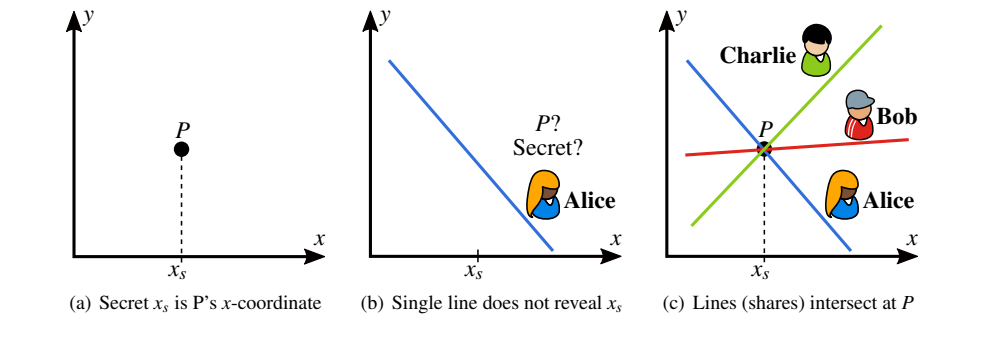
3つの x–y 平面の図です。(a)「Secret xs is P's x-coordinate」(秘密 xs は P の x 座標):点「P」から x 軸上の「xs」へ縦の破線が下りています。(b)「Single line does not reveal xs」(1本の直線では xs は分からない):青い直線が1本あり、その横に人物のイラスト「Alice」、「P? Secret?」(P は? 秘密は?)の文字があり、x 軸上に「xs」が示されています。(c)「Lines (shares) intersect at P」(直線〔シェア〕は P で交わる):人物のイラスト「Alice」の青、「Bob」の赤、「Charlie」の緑の3本の直線が点「P」で交わり、P から x 軸上の「xs」へ縦の破線が下りています。
Figure 1. Illustration2 of Blakley secret sharing
図 1. 2Blakley 秘密分散の図解
The schemes of Shamir and Blakley are information-theoretically secure, which means that in a standalone set of \(k - 1\) shares there is indeed no information about the secret.
Shamir 方式と Blakley 方式は情報理論的に安全です。これは、単独の \(k - 1\) 個のシェアの集合には、秘密に関する情報が実際に一切含まれないことを意味します。
While information-theoretic security may be an advantage, the property requires that each share is of the same size as the secret, thus meaning that the overall size of all shares is \(n\) times the size of the secret. In contrast, there are secret-sharing schemes with reduced optimal size, at the cost of guaranteeing only computational (i.e., cryptographic) security [Kra94]. There, the size of each share can be up to \(k\) times smaller than the size of the secret — this is especially useful if secret sharing is to be used to share large amounts of data.
情報理論的な安全性は利点となりえますが、この性質は、各シェアが秘密と同じサイズであることを必要とし、したがって、すべてのシェアの合計サイズが秘密のサイズの \(n\) 倍になることを意味します。これに対し、計算量的(すなわち暗号的)な安全性のみを保証することと引き換えに、最適なサイズが縮小された秘密分散方式もあります [Kra94]。この場合、各シェアのサイズは秘密のサイズの最大 \(k\) 分の 1 まで小さくできます。これは、大量のデータを共有するために秘密分散を使う場合に特に有用です。
Note: some elements of secret-sharing are standardized by the International Organization for Standardization (ISO) / International Electrotechnical Commission (IEC) [ISO16, ISO17].
注: 秘密分散の一部の要素は、International Organization for Standardization(ISO)/ International Electrotechnical Commission(IEC)によって標準化されています [ISO16, ISO17]。
2.3 Secret resharing
2.3 秘密の再分散
The need to compute new random shares for the same original secret key often arises in practice. It may happen that over time some (\(< k\)) shares are compromised [OY91], thus creating a need to compute new shares and discard the old ones. Resharing can even be proactive [HJKY95], e.g., at regular intervals in time and not as a direct response to a detected compromise.
同じ元の秘密鍵に対して新しいランダムなシェアを計算する必要は、実際にはしばしば生じます。時間の経過とともに、一部(\(< k\))のシェアが危殆化することがあり [OY91]、その場合、新しいシェアを計算して古いシェアを破棄する必要が生じます。再分散は、プロアクティブにも行えます [HJKY95]。たとえば、検知された危殆化への直接の対応としてではなく、時間の定期的な間隔で行います。
Resharing in Blakley’s scheme. We continue here the 2-out-of-3 example of Blakley’s scheme, where two parties are required to reconstruct a secret \(x_s\) shared among three parties. Each resharing of \(x_s\) requires re-randomizing the point \(P\) along the vertical line that defines the secret. In other words, for each randomization iteration \(r\) a random \(y\)-coordinate \(y_r\) is sampled, defining a new point \(P_r = (x_s, y_r)\). Then, the new share (a line) for each party is also randomized, subject to the constraints that all new lines are non-vertical, intersect at the new point \(P_r\) and are different from one another. With this construction, a single party (Alice, Bob, or Charlie) still cannot gain any useful insight into the reshared secret \(x_s\). This is because at each new resharing \(r\) the point \(P_r\) where the three lines intersect is chosen randomly in the vertical line that passes through the secret.
Blakley 方式での再分散。ここでは、Blakley 方式の 2-out-of-3 の例を続けます。そこでは、3 人の関係者の間で共有される秘密 \(x_s\) を再構成するのに 2 人が必要です。\(x_s\) を再分散するたびに、秘密を定める垂直線に沿って点 \(P\) を再ランダム化する必要があります。言い換えると、ランダム化の反復 \(r\) ごとに、ランダムな \(y\) 座標 \(y_r\) が抽出され、新しい点 \(P_r = (x_s, y_r)\) が定まります。続いて、各関係者の新しいシェア(直線)も、すべての新しい直線が垂直でなく、新しい点 \(P_r\) で交わり、互いに異なるという制約のもとでランダム化されます。この構成でも、単独の関係者(Alice、Bob、Charlie)は、再分散された秘密 \(x_s\) について有用な洞察を得られません。これは、新たな再分散 \(r\) のたびに、3 本の直線が交わる点 \(P_r\) が、秘密を通る垂直線上でランダムに選ばれるためです。
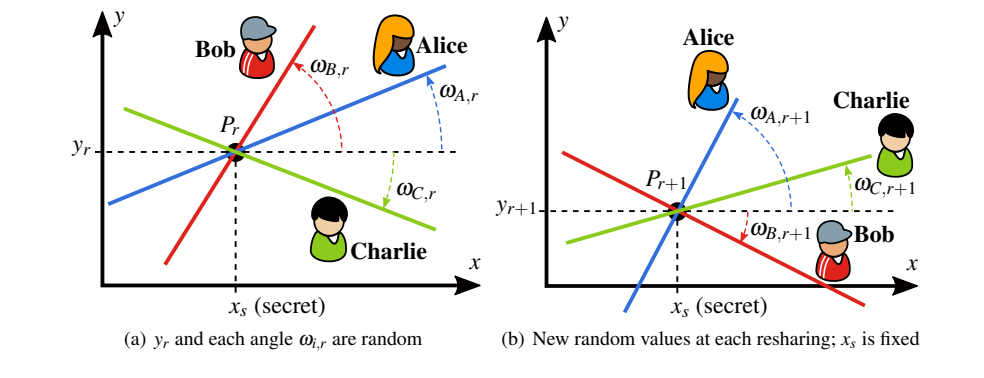
2つの x–y 平面の図です。(a)「yr and each angle ωi,r are random」(yr と各角度 ωi,r はランダム):3本の直線(「Bob」の赤、「Alice」の青、「Charlie」の緑)が点「Pr」で交わります。Pr の高さ「yr」は横の破線で、x 座標は「xs (secret)」(xs、秘密)で示され、各直線の角度「ωB,r」「ωA,r」「ωC,r」が破線の弧で示されています。(b)「New random values at each resharing; xs is fixed」(再分散のたびに新しいランダムな値になり、xs は固定):新しい3本の直線(「Alice」の青、「Charlie」の緑、「Bob」の赤)が、同じ「xs (secret)」の上の高さ「yr+1」にある新しい点「Pr+1」で交わり、角度「ωA,r+1」「ωC,r+1」「ωB,r+1」が破線の弧で示されています。
Figure 2. Illustration of share randomization in Blakley secret sharing
図 2. Blakley 秘密分散におけるシェアのランダム化の図解
For visual intuition, we illustrate in Fig. 2 a parametrization based on angles. A line through a point \(P\) in the plane can be parametrized in terms of its angle \(\omega\), in the interval \((-\pi/2, \pi/2)\), with respect to the \(x\) axis. Thus, for each resharing iteration \(r\) we attribute to each party \(i\) a new random angle \(w_{i,r}\) and the \(x\)-coordinate where the line intersects with the \(x\)-axis. In practice the used parametrization is based on polynomial coefficients, so the share (a line) is instead revealed as \((g, h)\), where \(y = hx + g\) is the equation that defines the line.
視覚的な直観のため、図 2 に角度に基づくパラメータ化を示します。平面上の点 \(P\) を通る直線は、角度 \(\omega\)(区間 \((-\pi/2, \pi/2)\) 内、\(x\) 軸に対する)でパラメータ化できます。したがって、再分散の反復 \(r\) ごとに、各関係者 \(i\) に新しいランダムな角度 \(w_{i,r}\) と、直線が \(x\) 軸と交わる \(x\) 座標を割り当てます。実際には、用いられるパラメータ化は多項式の係数に基づくため、シェア(直線)は代わりに \((g, h)\) として明かされます。ここで \(y = hx + g\) は直線を定める式です。
For each new iteration \(r + 1\), one computes a new point \(P_{r+1} = (x_s, y_{r+1})\) and new random lines for each party. These lines, passing through point \(P_{r+1}\) correspond to new random angles, as illustrated in Fig. 2(b). The party selecting new shares must ensure that the lines of different parties do not overlap, i.e., that they do not have the same angles, and are non-vertical. Concretely, this means that \(\omega_{i,r} \neq \omega_{j,r} \neq \pi/2\) for \(i, j \in \{A, B, C\}\) and \(i \neq j\). The generalization to the case \(k > 2\) is as before: the new point \(P\) would require randomizing \(k - 1\) coordinates, and the resharing would proceed as in the initial sharing.
新しい反復 \(r + 1\) ごとに、新しい点 \(P_{r+1} = (x_s, y_{r+1})\) と、各関係者の新しいランダムな直線を計算します。点 \(P_{r+1}\) を通るこれらの直線は、図 2(b) に示すとおり、新しいランダムな角度に対応します。新しいシェアを選ぶ側は、異なる関係者の直線が重ならないこと、すなわち同じ角度を持たず、かつ垂直でないことを確実にしなければなりません。具体的には、\(\omega_{i,r} \neq \omega_{j,r} \neq \pi/2\) となることを意味し、ここで \(i, j \in \{A, B, C\}\) かつ \(i \neq j\) です。\(k > 2\) の場合への一般化は前と同様です。新しい点 \(P\) は \(k - 1\) 個の座標のランダム化を必要とし、再分散は最初の分散と同様に進みます。
Resharing in Shamir’s scheme. Share re-randomization can also be done with Shamir secret sharing. There, the fixed secret is \(c_0 \bmod Q = f(0) \bmod Q\). At each randomization iteration \(r\), one chooses random coefficients \(c_{1,r}, \ldots, c_{k-1,r}\) for a new polynomial \(f_r(x) = c_0 + c_{1,r} x + \ldots + c_{k-1,r} x^{k-1}\) satisfying \(f_r(0) = c_0\). The new shares are then points evaluated with \(f_r\). Concretely, each party \(i\), for \(i = 1, 2, 3, \ldots\) receives \(f_r(i)\) as its new share.
Shamir 方式での再分散。シェアの再ランダム化は、Shamir 秘密分散でも行えます。そこでは、固定された秘密は \(c_0 \bmod Q = f(0) \bmod Q\) です。ランダム化の各反復 \(r\) で、新しい多項式のためにランダムな係数 \(c_{1,r}, \ldots, c_{k-1,r}\) を選び、\(f_r(x) = c_0 + c_{1,r} x + \ldots + c_{k-1,r} x^{k-1}\) とします。これは \(f_r(0) = c_0\) を満たします。新しいシェアは、\(f_r\) で評価された点です。具体的には、各関係者 \(i\)(\(i = 1, 2, 3, \ldots\))は新しいシェアとして \(f_r(i)\) を受け取ります。
2.4 Threshold cryptography
2.4 しきい値暗号
We take broad input from several research areas with traditionally distinctive names, but with a strong relation to threshold schemes. Since we are focused on the implementation of cryptographic primitives, we adopt the umbrella term “threshold cryptography” to denote our area of interest. The expression “threshold cryptography” has been traditionally used to refer to schemes where some computation is performed over secret shares of inputs [DF90, DSDFY94]. Usually, the setting is such that the shares are used to compute something useful, but without being revealed across parties. Often, a main security goal is secrecy of cryptographic keys, but a variety of other security properties, such as integrity and availability, may also be a motivating drive. Achieving these properties is possible based on a variety of techniques. For example, integrity may in some settings be enhanced based on verifiable secret sharing schemes [AMGC85, Fel87] and/or zero-knowledge proofs [GMR85, BFM88], allowing checking whether shares are used consistently. Specifically, a threshold scheme can be made robust against adversarially induced inconsistencies in shares or in related computations, outputting correct results in spite of up to a threshold number of compromised parties [GRJK00]. While we focus on secure implementations of cryptographic primitives, the actual threshold techniques may also include non-cryptographic techniques, e.g., simple replication and majority voting.
本書は、従来は異なる名称で呼ばれてきたものの、しきい値方式と強い関係を持つ、複数の研究分野から幅広く知見を取り入れています。私たちは暗号プリミティブの実装に焦点を当てているため、関心領域を表す包括的な用語として「しきい値暗号」を採用します。「しきい値暗号」という表現は、従来、入力の秘密シェアに対して何らかの計算が行われる方式を指すために使われてきました [DF90, DSDFY94]。通常、その設定は、シェアが何か有用なものを計算するために使われますが、関係者間で明かされないというものです。多くの場合、主要なセキュリティ目標は暗号鍵の秘匿性ですが、完全性や可用性などのほかのさまざまなセキュリティ特性も、動機づけとなりえます。これらの特性の達成は、さまざまな技法に基づいて可能です。たとえば、完全性は、設定によっては、検証可能秘密分散方式 [AMGC85, Fel87] やゼロ知識証明 [GMR85, BFM88](あるいはその両方)に基づいて強化でき、シェアが一貫して使われているかを確認できます。具体的には、しきい値方式は、シェアまたは関連する計算に敵対的に引き起こされた不整合に対して頑健にでき、しきい値の個数までの関係者が危殆化していても正しい結果を出力できます [GRJK00]。私たちは暗号プリミティブの安全な実装に焦点を当てていますが、実際のしきい値技法には、単純な複製や多数決のような、暗号的でない技法も含まれる場合があります。
One main area of related research is “secure multi-party computation” (SMPC) [Yao86, GMW87, BGW88, CCD88]. It allows mutually distrustful parties to compute functions (and randomized functionalities) of their combined inputs, without revealing the corresponding inputs to one another. This can be useful for threshold schemes even if the inputs of different parties are not shares of some key and/or if the actual computation requires interaction between parties. Provided suitable definitions and assumptions, any cryptographic primitive can be implemented in a threshold manner based on SMPC. Often this is based on a framework of definitions of ideal functionalities, and protocols that emulate those functionalities. Nonetheless, some systems may implement threshold techniques (e.g., secret-sharing, replication) not modeled within an SMPC framework.
関連する研究の主要な領域の 1 つが「セキュアマルチパーティ計算」(SMPC)です [Yao86, GMW87, BGW88, CCD88]。これにより、互いに信頼しない関係者が、それぞれの入力を互いに明かすことなく、結合した入力の関数(およびランダム化された機能)を計算できます。これは、異なる関係者の入力が何らかの鍵のシェアでない場合や、実際の計算に関係者間のやり取りが必要な場合でも、しきい値方式に有用です。適切な定義と仮定が与えられれば、どの暗号プリミティブも、SMPC に基づいてしきい値の形で実装できます。これは多くの場合、理想機能の定義の枠組みと、それらの機能を模倣するプロトコルに基づきます。とはいえ、システムによっては、SMPC の枠組みの中でモデル化されていないしきい値技法(たとえば秘密分散、複製)を実装する場合があります。
Threshold schemes also do not encompass all that exists in the realm of SMPC. In usual SMPC descriptions, the parties themselves are stakeholders of the secrecy of their input and correctness of the output, e.g., in the millionaires’ problem [Yao82] and in secure set intersection [FNP04]. In threshold schemes for cryptographic primitives, the nodes within the threshold system can have a neutral interest for the outcome, and in fact just be a service provider (of cryptographic services) to a set of external users/clients.
しきい値方式は、SMPC の領域に存在するすべてを包含するわけでもありません。通常の SMPC の記述では、関係者自身が、入力の秘匿性と出力の正しさのステークホルダーです。たとえば、億万長者問題 [Yao82] や、セキュアな集合の共通部分の計算 [FNP04] がそうです。暗号プリミティブのためのしきい値方式では、しきい値システム内のノードは、結果に対して中立的な利害を持つ場合があり、実際には、外部のユーザー/クライアントの集合に対する(暗号サービスの)サービス提供者にすぎない場合もあります。
Threshold schemes can also be based on elements from the “distributed systems” research area, where fault and intrusion tolerance are main topics. Common properties of interest in distributed systems are liveness (making progress even in the face of concurrent execution/requests) and safety (ensuring consistency of state across multiple parties). Why would this be relevant for threshold cryptography? As an example, consider implementing a multi-party threshold version of a full-fledged cryptographic platform. Such a platform would perform a variety of cryptographic operations, some using secret keys, and based on requests by users whose credentials and authorization profiles may be updated across time. Now we could ask: in a setting where availability (of cryptographic operations) is a critical property, and where the system is supposed to operate even in cases of network partition (i.e., even if some parties in the threshold scheme cannot inter-communicate), can consistency (of state, e.g., credentials, across different parties) be simultaneously satisfied under concurrent executions? This is a kind of “distributed systems” problem relevant for threshold schemes. There are settings [Bre12] where these three properties (consistency, availability and partition tolerance) cannot be guaranteed to be achieved simultaneously.
しきい値方式は、フォールトトレランスと侵入耐性が主要なトピックである「分散システム」の研究領域の要素にも基づきえます。分散システムで対象とする一般的な特性は、ライブネス(並行する実行/要求があっても進行すること)と安全性(複数の関係者間で状態の一貫性を確保すること)です。なぜこれがしきい値暗号に関連するのでしょうか。例として、本格的な暗号プラットフォームのマルチパーティしきい値版を実装することを考えます。そのようなプラットフォームは、さまざまな暗号操作を行い、その一部は秘密鍵を使い、時間とともに資格情報と認可プロファイルが更新されうるユーザーからの要求に基づきます。ここで、次のような問いを立てられます。(暗号操作の)可用性が重要な特性であり、システムがネットワークの分断(すなわち、しきい値方式の一部の関係者が相互通信できない場合)でも動作することが想定される設定で、並行する実行の下で、(状態、たとえば異なる関係者間の資格情報の)一貫性を同時に満たせるでしょうか。これは、しきい値方式に関連する一種の「分散システム」の問題です。これら 3 つの特性(一貫性、可用性、分断耐性)を同時に達成することを保証できない設定があります [Bre12]。
2.5 Side-channel and fault attacks
2.5 サイドチャネル攻撃とフォールト攻撃
The secrecy of keys can be compromised by the leakage of key-dependent information during computations. This is possible even without direct physical contact with components within the device. For example, the time taken, the power consumed, and the electromagnetic radiation emanated by a device can be measured without penetrating the device enclosure.
鍵の秘匿性は、計算中の鍵に依存する情報の漏えいによって危殆化する可能性があります。これは、デバイス内のコンポーネントとの直接の物理的接触がなくても可能です。たとえば、デバイスが要する時間、消費する電力、放射する電磁放射は、デバイスの筐体を貫通することなく測定できます。
We will assume that, regardless of whether the computation is in hardware or software, the device that performs the computation consists of some circuit with wires connecting to logical gates and memory cells. Then, the attacker’s view of the circuit elements may be noisy (the noisy leakage model [CJRR99]), or the attacker may be limited by the number of wires of the circuit that it can observe within a certain period of time (the probing model [ISW03]). The noisy leakage model and probing model have been unified [DDF14]. In both models, under some reasonable assumptions on the statistical distributions of side-channel information, the complexity of a side-channel attack of a suitable implementation with an \(n\)-out-of-\(n\) secret-sharing increases exponentially with the number of shares.
計算がハードウェアで行われるかソフトウェアで行われるかにかかわらず、計算を行うデバイスは、論理ゲートとメモリセルを結ぶ配線を持つ何らかの回路で構成されていると仮定します。すると、攻撃者から見た回路要素はノイズを含む場合があり(ノイズあり漏えいモデル [CJRR99])、あるいは攻撃者が一定期間内に観測できる回路の配線の数に制限される場合があります(プロービングモデル [ISW03])。ノイズあり漏えいモデルとプロービングモデルは統一されています [DDF14]。どちらのモデルでも、サイドチャネル情報の統計的分布に関する妥当な仮定の下で、\(n\)-out-of-\(n\) の秘密分散を用いた適切な実装に対するサイドチャネル攻撃の複雑さは、シェアの数に対して指数的に増加します。
As such, side channel attacks on secret-shared implementations become infeasible if the number of shares is sufficiently high, and is further thwarted when the shares are refreshed before the attacker can collect enough side-channel information. Further refinements of the model take transient behavior (“glitches”) of the transistors into account, which can be handled by Threshold Implementations (TI) [NRR06] or by “lazy engineering” to just increase the number of shares [BGG+14].
そのため、秘密分散された実装に対するサイドチャネル攻撃は、シェアの数が十分に多ければ実行不可能になり、攻撃者が十分なサイドチャネル情報を収集する前にシェアがリフレッシュされれば、さらに阻止されます。モデルをさらに洗練して、トランジスタの過渡的な挙動(「グリッチ」)を考慮したものもあり、これは Threshold Implementations(TI)[NRR06] によって、あるいは単にシェアの数を増やす「怠惰なエンジニアリング(lazy engineering)」[BGG+14] によって扱えます。
Besides the aforementioned side-channel attacks, an attacker may also obtain key-dependent information by injecting a fault into the computation, and then observing the outputs [BDL97]. To inject the fault, the attacker may, for example, apply a strong external electromagnetic field. Note that the injection of faults may also introduce errors in the outputs of the computation, thereby violating the integrity of the outputs. If the threshold scheme is endowed with the ability to detect which shares have errors, and if the threshold scheme does not require all shares to be present, it can resist temporary and permanent faults in parts of the computation. This would provide resistance against a wide range of fault attacks.
前述のサイドチャネル攻撃のほかにも、攻撃者は、計算にフォールトを注入し、その出力を観察することで、鍵に依存する情報を得る場合があります [BDL97]。フォールトを注入するために、攻撃者はたとえば強い外部電磁場を印加する場合があります。フォールトの注入は、計算の出力に誤りをもたらし、それによって出力の完全性を損なう場合もあることに注意してください。しきい値方式が、どのシェアに誤りがあるかを検知する能力を備えており、かつすべてのシェアが揃っていることを必要としなければ、計算の一部における一時的および永続的なフォールトに耐えられます。これは、広範なフォールト攻撃に対する耐性を提供します。
3 Examples
3 例
3.1 Threshold signature examples
3.1 しきい値署名の例
3.1.1 Basic threshold computation on secret shares
3.1.1 秘密シェアに対する基本的なしきい値計算
First, we recall the RSA (Rivest-Shamir-Adleman) signature scheme [RSA78], which defines the public key as \((N, e)\) and the private key as \(d\), such that \(ed = 1 \bmod \phi(N)\). Here, the modulus \(N\) is a product of two large secret primes and \(\phi\) is Euler’s totient function. Then, the RSA signature for a (possibly hashed) message m is defined as \(s = m^d \bmod N\). Anyone possessing the public key can verify the signature by checking \(s^e = m^{ed} = m \bmod N\).
まず、RSA(Rivest-Shamir-Adleman)署名方式 [RSA78] を振り返ります。これは、公開鍵を \((N, e)\)、秘密鍵を \(d\) と定め、\(ed = 1 \bmod \phi(N)\) となるようにします。ここで、法 \(N\) は 2 つの大きな秘密の素数の積であり、\(\phi\) はオイラーのトーティエント関数です。続いて、(ハッシュされている場合もある)メッセージ m に対する RSA 署名は \(s = m^d \bmod N\) と定義されます。公開鍵を持つ者は誰でも、\(s^e = m^{ed} = m \bmod N\) を確認することで署名を検証できます。
Now let us proceed to describe a simple threshold variant of this signature scheme [Fra90, BH98]. We first consider the role of a dealer — someone that, knowing the secret parameter \(\phi(N)\) and the secret signing key \(d\), wishes to delegate to other parties the ability to jointly produce signatures in a threshold manner. The dealer splits the private key \(d\) into three shares \(d_1\), \(d_2\), and \(d_3\), such that \(d_1 + d_2 + d_3 = d \bmod \phi(N)\). Now, without reconstructing \(d\), it is possible to first process the message independently using each of the shares: \(s_1 = m^{d_1}\), \(s_2 = m^{d_2}\), and \(s_3 = m^{d_3}\); and then compute the signature \(s = s_1 s_2 s_3\). Note that this is indeed a valid RSA signature, as \(s_1 s_2 s_3 = m^{d_1 + d_2 + d_3} = m^d \bmod N\). This simple threshold RSA signature scheme mitigates the risk of exposing the potentially high-value private key \(d\), which does not appear in any of the three shares that are used in the actual computations. Thus, compromising any one of the shares, and even two of them, poses no threat of exposing \(d\). Moreover, frequent updates to the key shares (\(d_1\), \(d_2\), and \(d_3\)) would reduce the window of opportunity for attacks and thereby further reduce the risk. Refreshing can even occur after every signature.
次に、この署名方式の単純なしきい値版 [Fra90, BH98] を説明します。まず、ディーラーの役割を考えます。ディーラーとは、秘密パラメータ \(\phi(N)\) と秘密の署名鍵 \(d\) を知っており、他の関係者に、しきい値方式で共同して署名を生成する能力を委任したい者です。ディーラーは秘密鍵 \(d\) を、3 つのシェア \(d_1\)、\(d_2\)、\(d_3\) に分割します。これらは \(d_1 + d_2 + d_3 = d \bmod \phi(N)\) を満たします。すると、\(d\) を復元することなく、まず各シェアを使って独立にメッセージを処理し、\(s_1 = m^{d_1}\)、\(s_2 = m^{d_2}\)、\(s_3 = m^{d_3}\) を得て、続いて署名 \(s = s_1 s_2 s_3\) を計算できます。これは、\(s_1 s_2 s_3 = m^{d_1 + d_2 + d_3} = m^d \bmod N\) であるため、確かに有効な RSA 署名であることに注意してください。この単純なしきい値 RSA 署名方式は、高い価値を持つ可能性のある秘密鍵 \(d\) が露出するリスクを緩和します。これは、実際の計算に使われる 3 つのシェアのいずれにも現れないためです。したがって、いずれか 1 つのシェア、さらには 2 つのシェアが危殆化しても、\(d\) が露出する脅威にはなりません。さらに、鍵のシェア(\(d_1\)、\(d_2\)、\(d_3\))を頻繁に更新すれば、攻撃の機会となる時間枠が狭まり、リスクがさらに低減されます。リフレッシュは、署名のたびに行うこともできます。
3.1.2 A \(k\)-out-of-\(n\) threshold scheme
3.1.2 \(k\)-out-of-\(n\) のしきい値方式
In the above example, all shares must be present. This might be impractical in situations where one or more of the shares become unavailable. For such cases, a \(k\)-out-of-\(n\) threshold scheme could be used when at least \(k\) shares are available.
上記の例では、すべてのシェアが揃っていなければなりません。これは、1 つ以上のシェアが利用できなくなる状況では非現実的な場合があります。そのような場合には、\(k\)-out-of-\(n\) のしきい値方式を、少なくとも \(k\) 個のシェアが利用可能であるときに使うことができます。
But how to generalize from the \(n\)-out-of-\(n\) to a \(k\)-out-of-\(n\) signature scheme (with \(k < n\))? The needed secret-sharing is no longer a simple additive decomposition into shares (in the exponent), and correspondingly the combination into a final signature becomes more complex, namely because the share-holders do not know \(\phi(N)\) (the group order). It is nonetheless possible to slightly adjust the computation of key shares and signature shares so that the final combination becomes possible even without knowledge of the secret information [Sho00]. The secret vs. public knowledge of the order of the underlying group can indeed be relevant in the development of diverse threshold schemes, with some schemes taking advantage of using groups with publicly known group order (e.g., as in the case of ElGamal decryption [DF90]).
しかし、\(n\)-out-of-\(n\) から \(k\)-out-of-\(n\) の署名方式(\(k < n\) の場合)へ、どのように一般化するのでしょうか。必要な秘密分散は、もはや(指数部での)シェアへの単純な加法的分解ではなく、それに応じて最終的な署名への結合もより複雑になります。これは、シェアの保持者が \(\phi(N)\)(群の位数)を知らないためです。それでも、鍵のシェアと署名のシェアの計算を少し調整することで、秘密情報を知らなくても最終的な結合が可能になります [Sho00]。基礎となる群の位数が秘密か公開かは、実際にさまざまなしきい値方式の開発に関係しえます。一部の方式は、位数が公に知られている群を使う利点を活かしています(たとえば ElGamal 復号の場合 [DF90])。
So for RSA signatures one can use, e.g., a 2-out-of-3 secret-sharing scheme, and a corresponding threshold variant of RSA. Then, in the case of one share being irrecoverably lost or breached, the private signature key \(d\) remains intact, available, and not breached. This means that one can continue to use the same public key to verify the correctness of the signature.
そのため、RSA 署名には、たとえば 2-out-of-3 の秘密分散方式と、それに対応するしきい値版の RSA を使えます。すると、1 つのシェアが回復不能な形で失われた、または侵害された場合でも、署名用秘密鍵 \(d\) は損なわれず、利用可能で、侵害されないままです。これは、署名の正しさを検証するために、同じ公開鍵を使い続けられることを意味します。
In contrast, when a conventional implementation is breached, the corresponding public/private key pair would have to be revoked and a new pair issued. Typically this also requires an external certification of the public key by a certificate authority and propagating it to all relying parties. In addition, a 2-out-of-3 threshold signature scheme becomes more resilient to future share losses if it continuously refreshes the key shares, provided that at most one is compromised at any given time. Note that in a scheme composed of three separate conventional RSA implementations with independent keys, refreshing would require updating the public/private key pairs, along with all entailing inconveniences.
これに対し、従来の実装が侵害された場合は、対応する公開鍵/秘密鍵のペアを失効させ、新しいペアを発行しなければなりません。通常、これには、認証局による公開鍵の外部での認証と、すべての依拠当事者へのその伝達も必要です。加えて、2-out-of-3 のしきい値署名方式は、同時に危殆化するシェアが最大でも 1 つである限り、鍵のシェアを継続的にリフレッシュすれば、将来のシェアの喪失に対してより強靭になります。独立した鍵を持つ 3 つの別々の従来の RSA 実装で構成された方式では、リフレッシュに公開鍵/秘密鍵のペアの更新が必要となり、それに伴うあらゆる不便が生じることに注意してください。
3.1.3 Avoiding the dealer
3.1.3 ディーラーの回避
In the above descriptions, an implicit trusted party, often called the dealer, knows the secret \(d\) and performs each secret-sharing operation. Particularly, the threshold RSA examples based on a common modulus \(N\) required the dealer to also know the secret prime factorization. If needed, the dealer could, without revealing the secret, prove to each share-holder that \(N\) is indeed a valid product of two primes, by using zero-knowledge proofs [vdGP88]. Nonetheless, in a dealerless setting a threshold computation of shares of the secret signing key \(d\) would also require a threshold generation of the public \(N\), along with a secret sharing of its factorization. This does not lend itself to a straightforward efficient computation, but can in general be done based on SMPC protocols [BF97]. Different RSA-based threshold schemes can take advantage of specialized solutions, with tradeoffs related to the threshold parameters \(k\) and \(n\) and to properties of the prime factorization.
上記の説明では、しばしばディーラーと呼ばれる暗黙の信頼された関係者が、秘密 \(d\) を知っており、各秘密分散操作を行っています。特に、共通の法 \(N\) に基づくしきい値 RSA の例では、ディーラーは秘密の素因数分解も知っている必要がありました。必要であれば、ディーラーは、秘密を明かすことなく、ゼロ知識証明を用いて、\(N\) が確かに 2 つの素数の有効な積であることを、各シェアの保持者に証明できます [vdGP88]。とはいえ、ディーラーのない設定では、秘密の署名鍵 \(d\) のシェアのしきい値計算には、公開の \(N\) のしきい値生成と、その素因数分解の秘密分散も必要になります。これは、単純で効率的な計算には向きませんが、一般には SMPC プロトコルに基づいて行えます [BF97]。RSA に基づくしきい値方式の中には、しきい値パラメータ \(k\) と \(n\)、および素因数分解の性質に関するトレードオフを伴う、特化した解法を利用できるものもあります。
Schemes based on particular assumptions can enable a more straightforward selection and verification of the validity of public elements. For example, this is possible based on assumptions of intractability of computing discrete logarithms in certain groups of known order. If the group parameters can be verified as correct in a standalone procedure, then no one requires having any secret knowledge about the group. Furthermore, if the selection is made in a way that avoids the possibility of a trapdoor being known, then the parameters can be trusted by anyone. The intractability assumption can then, for fixed security parameters, be accepted for global parameters of a group (e.g., [Ber06]). In particular, this can facilitate a respective threshold mechanism, so that a secret key never exists locally at any entity. For example, one can then define a dealer-absent threshold version of a public key generation (the result of an exponentiation), such that each party knows one share of the secret key (a discrete logarithm) [Ped91, GJKR99].
特定の仮定に基づく方式では、公開要素をより簡単に選択し、その妥当性を検証できます。たとえば、位数が既知の特定の群における離散対数計算の困難性に関する仮定に基づけば、これが可能です。群のパラメータが独立した手順で正しいと検証できるなら、誰も群について秘密の知識を持つ必要はありません。さらに、トラップドアが知られている可能性を避ける形で選択が行われれば、誰でもパラメータを信頼できます。この困難性の仮定は、固定されたセキュリティパラメータについて、群のグローバルパラメータに対して受け入れることができます(たとえば [Ber06])。特に、これにより、どのエンティティにも秘密鍵がローカルに存在しないようにする、対応するしきい値の仕組みを実現しやすくなります。たとえば、各関係者が秘密鍵(離散対数)のシェアを 1 つ知る形で、公開鍵生成(べき乗の結果)のディーラーなしのしきい値版を定義できます [Ped91, GJKR99]。
The same possibilities exist for resharing. In suitable threshold schemes, the share-holders can perform resharing without a dealer, i.e., interacting to create new shares for the same secret, without ever reconstructing the secret. The final shares can even be obtained for new threshold structures (e.g., different threshold and number of parties) [DJ97].
再分散にも、同じ可能性があります。適切なしきい値方式では、シェアの保持者は、ディーラーなしで、すなわち、同じ秘密に対する新しいシェアを作成するために、秘密を復元することなくやり取りして、再分散を行えます。最終的なシェアは、新しいしきい値構造(たとえば異なるしきい値と関係者の数)についても得られます [DJ97]。
3.1.4 Other constructions
3.1.4 その他の構成
The above examples focused on threshold schemes where the secret-key is shared, and then a threshold scheme enables a generation of a signature identical to the non-threshold manner. A feature of those schemes is that the final signature is identical to a non-threshold one, thereby being inherently efficient in size (i.e., not incurring an increase with the threshold parameter). Such schemes also have the property that the identities of the signatories remain secret to the external users interested in verifying the correctness of a signature. However, some settings may favor the identifiability of signatories, e.g., as an accountability and credibility feature. Each signatory might also prefer retaining an individual public credential, not wanting to use a private-key share associated with a common public key. Even in this setting it is possible to devise short threshold signatures, with size equal to a non-threshold signature. Concretely, “multi-signature” schemes [IN83, MOR01] enable multiple parties, with independent secret-public key pairs, to jointly produce a common short signature.3
上記の例では、秘密鍵が分散され、しきい値方式によって、しきい値でない方式と同一の署名を生成できるしきい値方式を取り上げました。これらの方式の特徴は、最終的な署名がしきい値でない署名と同一であり、したがってサイズの面で本質的に効率的であること(すなわち、しきい値パラメータに応じてサイズが増加しないこと)です。このような方式では、署名の正しさを検証したい外部ユーザーに対して、署名者の身元が秘密に保たれるという性質もあります。しかし、設定によっては、たとえば説明責任と信頼性のために、署名者を識別できることが望まれる場合があります。また、各署名者が、共通の公開鍵に関連付けられた秘密鍵のシェアを使わずに、個別の公開資格情報を保持することを好む場合もあります。このような設定でも、しきい値でない署名と同じサイズの短いしきい値署名を考案できます。具体的には、「マルチ署名」方式 [IN83, MOR01] により、独立した秘密鍵・公開鍵のペアを持つ複数の関係者が、共通の短い署名を共同で生成できます。3
A multi-signature scheme can be used as a threshold signature scheme where the application layer, and possibly the user, has added flexibility to define which subsets of signatories determine a valid signature, i.e., beyond structures defined by a pre-determined threshold number. For example, a multi-signature may be defined as valid if it contains one signature from each of three groups of individuals in different roles in an organization. The verification procedure then depends on the set of independent public keys. For example, these schemes can be easily based on Schnorr signatures [Sch90, BN06].
マルチ署名方式は、アプリケーション層、場合によってはユーザーが、あらかじめ決められたしきい値の個数で定義される構造を超えて、どの署名者の部分集合が有効な署名を決めるかを定義する柔軟性を加えた、しきい値署名方式として使えます。たとえば、マルチ署名は、組織内の異なる役割にある個人の 3 つのグループのそれぞれから 1 つずつの署名を含む場合に有効と定義できます。この場合、検証手順は、独立した公開鍵の集合に依存します。たとえば、これらの方式は、Schnorr 署名 [Sch90, BN06] に基づいて容易に実現できます。
To complement the resilience in the face of compromise, signatures can also be implemented with a “forward security” property [And02]. Such schemes can be based on an evolving private key, while the public key remains fixed, so that even a future key leakage will not allow the adversary to forge past messages, assuming the signer erases past keys [BM99]. To some extent, this property has some conceptual similarity to the refreshing we previously described in the RSA example. This property can be achieved also for threshold signatures [AMN01], including the case of multi-signatures [SA09].
危殆化に直面した際の強靭性を補完するために、署名は「前方セキュリティ」の性質 [And02] を持つよう実装することもできます。このような方式は、公開鍵が固定されたまま、秘密鍵が変化していくことに基づきえます。そのため、署名者が過去の鍵を消去していると仮定すれば、将来に鍵が漏えいしても、敵対者が過去のメッセージを偽造することはできません [BM99]。ある程度、この性質は、先に RSA の例で説明したリフレッシュと概念的に似ています。この性質は、マルチ署名の場合 [SA09] を含め、しきい値署名でも達成できます [AMN01]。
In summary, we showed by examples that “threshold signature schemes” can be based on secret-shared computation of regular signatures or on multi-signatures, with or without a dealer, with or without robustness, and possibly with forward security.
要約すると、「しきい値署名方式」は、通常の署名の秘密分散された計算、またはマルチ署名に基づきえて、ディーラーの有無、頑健性の有無を問わず、場合によっては前方セキュリティを備えうることを、例によって示しました。
Several of the exemplified threshold schemes take advantage of group homomorphic properties. While such properties are not applicable in every cryptographic primitive, threshold computation can still in general be obtained via secure multi-party computation.
例示したしきい値方式のいくつかは、群の準同型性を利用しています。このような性質はすべての暗号プリミティブに適用できるわけではありませんが、しきい値計算は、一般にはセキュアマルチパーティ計算によって得ることができます。
3.2 Side-channel attacks and countermeasures
3.2 サイドチャネル攻撃と対策
Timing attacks were first presented by Kocher [Koc96], and have been shown to be easy to perform on a variety of cryptographic algorithms. An advantage of timing attacks is that no specialized equipment is required. Because they do not require physical access to the system, they may even be performed remotely over the Internet [BB03].
タイミング攻撃は Kocher [Koc96] によって最初に示され、さまざまな暗号アルゴリズムに対して容易に実行できることが示されています。タイミング攻撃の利点は、特別な機器が不要なことです。システムへの物理的アクセスを必要としないため、インターネット越しにリモートで実行される場合さえあります [BB03]。
A possible countermeasure against timing attacks is to ensure that the implementation is “constant time,” that is, that its execution time does not depend on the value of the secret key. This turns out to be surprisingly difficult for many commonly-used implementations. The reason is that having “constant-time” source code, that is, source code without key-dependent branches or memory accesses [Ber05], may not be sufficient. Indeed, an implementation that is free of timing attacks on one platform may be vulnerable on another platform. This can happen, for example, when source code that contains multiplication operations is compiled with a different runtime library [KPVV16], or when the same binary is executed on a different processor [Por18].
タイミング攻撃への対策の 1 つは、実装が「定数時間(constant time)」であること、すなわち、その実行時間が秘密鍵の値に依存しないことを確実にすることです。これは、広く使われている多くの実装にとって、意外なほど困難であることがわかっています。その理由は、「定数時間」のソースコード、すなわち鍵に依存する分岐やメモリアクセスのないソースコード [Ber05] を持つだけでは、十分でない場合があるためです。実際、あるプラットフォームでタイミング攻撃を受けない実装が、別のプラットフォームでは脆弱な場合があります。これは、たとえば、乗算演算を含むソースコードが異なるランタイムライブラリでコンパイルされる場合 [KPVV16] や、同じバイナリが異なるプロセッサで実行される場合 [Por18] に起こりえます。
The execution time of the program, however, is just one example of a side channel. Implementations in hardware and software may also leak through other side channels, such as power consumption or electromagnetic radiation. The limitation of the currently-known countermeasures (such as “constant-time” implementations, dual-rail logic, or electromagnetic shielding) is that they usually do not get rid of all the leakage, but may still be vulnerable to higher-order or data-dependent leakages.
しかし、プログラムの実行時間は、サイドチャネルの一例にすぎません。ハードウェアとソフトウェアの実装は、消費電力や電磁放射などの、ほかのサイドチャネルを通じても漏えいする場合があります。現在知られている対策(「定数時間」実装、デュアルレールロジック、電磁シールドなど)の限界は、通常、すべての漏えいを取り除けず、より高次の漏えいやデータ依存の漏えいに対して脆弱なままの場合があることです。
To protect against side-channel attacks, the framework of threshold cryptography can provide a promising starting point. If the implementation is split into a number of “parties,” such that no single party holds the entire secret required to perform the cryptographic operation, then the leakage of information from only one “party” would not enable a successful attack on the original secret.
サイドチャネル攻撃から保護するために、しきい値暗号の枠組みは、有望な出発点を提供できます。実装が複数の「関係者」に分割され、どの単一の関係者も暗号操作の実行に必要な秘密全体を保持しないようにしていれば、1 つの「関係者」だけからの情報漏えいでは、元の秘密に対する攻撃を成功させることはできません。
However, when all these parties reside on a single chip, we must assume that an attacker can gain some (bounded) information about every party. In that case, it may happen that the threshold cryptosystem only complicates a side-channel attack by a small factor, depending on the number of parties. For example, the \(n\)-out-of-\(n\) threshold block cipher by Brickell et al. [BCF00] uses the \(n\)-fold composition (or cascade) of a block cipher with \(n\) different keys, which may slow down power analysis attacks only by roughly a factor of \(n\).
しかし、これらの関係者がすべて 1 つのチップ上にある場合は、攻撃者が何らかの(上限のある)情報をすべての関係者について得られると仮定しなければなりません。その場合、しきい値暗号システムは、関係者の数に応じた小さな係数でしかサイドチャネル攻撃を複雑にしない場合があります。たとえば、Brickell らによる \(n\)-out-of-\(n\) のしきい値ブロック暗号 [BCF00] は、異なる \(n\) 個の鍵を用いたブロック暗号の \(n\) 重合成(またはカスケード)を使用しますが、これは電力解析攻撃をおよそ \(n\) 倍遅くするにとどまる場合があります。
Nevertheless, there exist sound countermeasures against side-channel attacks where the secret variables are split into shares, such that a threshold number of shares can be used to recombine the secret, but fewer shares reveal no information at all. We described the theoretical foundation of these approaches and their resistance against side-channel attacks in Sec. 2.
それでも、秘密の変数をシェアに分割し、しきい値の個数のシェアで秘密を再結合できますが、それより少ないシェアでは情報が一切明らかにならないようにする、サイドチャネル攻撃に対する健全な対策が存在します。これらのアプローチの理論的基盤と、サイドチャネル攻撃に対するそれらの耐性については、第 2 節で説明しました。
4 Models
4 モデル
The basic security model for conventional cryptographic algorithms assumes an ideal black box, in which the cryptographic computations are correct and all internal states, including keys, are kept secret. This basic model leaves aside the possibility of leakage through side-channels, such as timing and power. This may be due to these parameters not being included in the model, or being assumed independent of the secrets (e.g., assuming instantaneous or constant-time computations). Under this assumption, the problem of quantifying a security property of the algorithm can be reduced to the problem of evaluating the complexity of the best-known attack against this model.
従来の暗号アルゴリズムの基本的なセキュリティモデルは、暗号計算が正しく、鍵を含むすべての内部状態が秘密に保たれる、理想的なブラックボックスを仮定します。この基本モデルは、タイミングや電力などのサイドチャネルを通じた漏えいの可能性を除外しています。これは、これらのパラメータがモデルに含まれていないこと、または秘密から独立であると仮定されていること(たとえば、瞬時の計算や定数時間の計算を仮定すること)による場合があります。この仮定の下では、アルゴリズムのセキュリティ特性を定量化する問題は、このモデルに対する最もよく知られた攻撃の複雑さを評価する問題に帰着できます。
For example, one can define the security strength, which can also be expressed as bit strength, of different classes of cryptographic algorithms based on the amount of work needed to perform a brute-force search of the key in a large space related to the key size. When the algorithms are implemented in real hardware and software, the black-box assumption can break down in several ways. For example, bugs in the implementation can lead to side effects that compromise the secret key, as with Heartbleed. Also, the material and electromagnetic characteristics of the platforms on which the algorithms run can cause side-channel information to leak and allow attackers to recover the secret key.
たとえば、鍵のサイズに関連する大きな空間で鍵を総当たり探索するために必要な作業量に基づいて、異なる種類の暗号アルゴリズムのセキュリティ強度(ビット強度としても表せます)を定義できます。アルゴリズムが実際のハードウェアとソフトウェアで実装される場合、ブラックボックスの仮定はいくつかの形で崩れる可能性があります。たとえば、実装のバグが、Heartbleed のように、秘密鍵を危殆化させる副作用につながる場合があります。また、アルゴリズムが動作するプラットフォームの材質的・電磁的特性がサイドチャネル情報を漏えいさせ、攻撃者が秘密鍵を復元できるようにする場合があります。
The distinction of ideal versus real implementations can yield useful insights into the assessment of threshold schemes for cryptographic primitives. What are the security advantages and disadvantages of performing separate computations on shares of a key, compared to conventional implementations that use a single secret key? How can threshold cryptography mitigate the potentially disastrous consequences that a coding error or a side-channel leak could have on a conventional implementation?
理想的な実装と現実の実装の区別は、暗号プリミティブのためのしきい値方式の評価に有用な知見をもたらしえます。単一の秘密鍵を使う従来の実装と比べて、鍵のシェアに対して個別の計算を行うことには、どのようなセキュリティ上の利点と欠点があるでしょうか。コーディングエラーやサイドチャネルの漏えいが従来の実装に及ぼしうる、壊滅的になりうる結果を、しきい値暗号はどのように緩和できるでしょうか。
This section considers how a range of applicable scenarios may differently affect a range of tradeoffs between several security properties. These scenarios depend on adversarial goals and capabilities, and various properties of the system model. It is important to be aware that security strengthening and weakening may co-exist. The discussion also preludes the next section, which motivates the need to describe characterizing features of threshold schemes.
本節では、適用可能なさまざまなシナリオが、複数のセキュリティ特性間のさまざまなトレードオフにどのように異なる影響を与えうるかを検討します。これらのシナリオは、敵対者の目標と能力、およびシステムモデルのさまざまな性質に依存します。セキュリティの強化と弱体化が共存しうることを認識しておくことが重要です。この議論は、しきい値方式の特徴を記述する必要性を示す次節への導入でもあります。
4.1 Security considerations
4.1 セキュリティ上の考慮事項
In a first baseline comparison, a real implementation allows vectors of attack not possible in an ideal black-box. Once these are identified, one asks how to augment conventional implementations, in the real world, to improve security. Particularly, how does a threshold approach affect security, compared to a non-threshold approach? Perhaps security is improved if an attacker is limited to not compromising more than \(f\)-out-of-\(n\) components within a certain time interval. Also, as explained in Sec. 3.2, a threshold design may make it inherently more difficult to exploit existing compromises (such as noisy leakage) in the set of “parties”. While these intuitions are valuable, we want to enable a more meaningful formulation and/or validation of security assertions about implementations based on threshold schemes.
最初の基準となる比較では、現実の実装は、理想的なブラックボックスでは不可能な攻撃ベクトルを可能にします。これらが特定されたら、現実世界でセキュリティを向上させるために、従来の実装をどう拡張するかを問います。特に、しきい値でないアプローチと比べて、しきい値アプローチはセキュリティにどう影響しますか。攻撃者が一定の時間間隔内に \(n\) 個のコンポーネントのうち \(f\) 個を超えて危殆化できないよう制限されていれば、セキュリティは向上するかもしれません。また、第 3.2 節で説明したとおり、しきい値の設計は、「関係者」の集合における既存の危殆化(ノイズを含む漏えいなど)の悪用を、本質的により困難にする場合があります。これらの直観は価値がありますが、しきい値方式に基づく実装についてのセキュリティ主張を、より有意義に定式化または検証(あるいはその両方)できるようにしたいと考えています。
Two general metrics of interest are reliability and availability [Rad97]. We can call them meta-metrics, since we are especially interested in considering them to measure (even when just qualitatively/comparatively) the upholding of concrete security properties related to implementations under attack. Reliability — probability of not failing a security goal — is specially suited for cases of “all-or-nothing” security, where the break of a certain property represents a catastrophic failure. For example, if a secret decryption key is leaked, then secrecy is lost with respect to the plaintext associated with public ciphertexts, without anything being able to revert it. Availability — proportion of time during which a security goal is satisfied — can be used to measure the actual “availability” of a service or property, e.g., the proportion of cryptographic output produced as intended. These metrics also depend on the mission time of an application, so it is relevant to consider, for example, resilience enhanced by rejuvenating compromised components back into a healthy state.
対象とする 2 つの一般的な指標は、信頼性と可用性です [Rad97]。これらはメタ指標と呼べます。攻撃を受ける実装に関連する具体的なセキュリティ特性が維持されているかを(定性的または比較的に評価する場合も含めて)測定するために、これらを考慮することに特に関心があるためです。信頼性、すなわちセキュリティ目標を達成できない確率は、特定の特性の破綻が壊滅的な失敗を意味する「オール・オア・ナッシング」のセキュリティの場合に特に適しています。たとえば、秘密の復号鍵が漏えいすると、公開された暗号文に対応する平文の秘匿性が失われ、それを元に戻すことはできません。可用性、すなわちセキュリティ目標が満たされている時間の割合は、サービスや特性の実際の「可用性」、たとえば意図したとおりに生成された暗号出力の割合を測定するために使えます。これらの指標はアプリケーションのミッション時間にも依存するため、たとえば、危殆化したコンポーネントを健全な状態に戻すリジュビネーションによって強化された強靭性を考慮することが重要です。
4.1.1 Diverse security properties
4.1.1 多様なセキュリティ特性
A threshold augmentation may have different effects across different security properties, e.g., confidentiality vs. availability vs. integrity, possibly improving one while degrading others. To show the nuances, consider the 3-out-of-3 threshold RSA-signature scheme described in Sec. 3.1.1, supported on a 3-out-of-3 secret sharing of the key. (Recall that, with the notation used here, a 3-out-of-3 secret sharing of the key means \(k = 3\) for availability, i.e., three parties (out of \(n = 3\)) are necessary to produce a signature, and \(f = 2\) for confidentiality, i.e., any subset of only two parties cannot learn anything about the key.) There, each node loses visibility of the original signing key, but retains the ability to influence the output of a computation dependent on the key. If a compromised node simply refrains from outputting, then it compromises the availability of the signing operation. If a corrupted node outputs a syntactically valid but semantically incorrect output share, then it may or may not compromise the integrity of the final signature, depending on whether or not the mechanism (implicit in the example) responsible for recombining the output shares is prescribed or not to verify the correctness of the signature.
しきい値による拡張は、異なるセキュリティ特性、たとえば機密性、可用性、完全性にまたがって異なる影響を及ぼす場合があり、ほかを劣化させながら 1 つを向上させることもあります。その細かな違いを示すために、第 3.1.1 節で説明した、鍵の 3-out-of-3 秘密分散に支えられた 3-out-of-3 のしきい値 RSA 署名方式を考えます。(ここで使う表記では、鍵の 3-out-of-3 秘密分散は、可用性については \(k = 3\)、すなわち署名の生成に(\(n = 3\) のうち)3 人の関係者が必要であり、機密性については \(f = 2\)、すなわち 2 人だけの関係者のどの部分集合も鍵について何も知りえないことを意味することを思い出してください。)そこでは、各ノードは元の署名鍵が見えなくなりますが、鍵に依存する計算の出力に影響を与える能力は保持します。危殆化したノードが単に出力を控えれば、署名操作の可用性が損なわれます。破壊されたノードが、構文的には有効だが意味的には誤った出力シェアを出力した場合、最終的な署名の完全性が損なわれるかどうかは、出力シェアを再結合する仕組み(例では暗黙のもの)が、署名の正しさを検証するよう規定されているかどうかによります。
In summary, even for the considered simple example of “3-out-of-3” signature scheme (based on a “3-out-of-3” secret sharing), there are different compromise thresholds for different properties. For example, the compromise thresholds for confidentiality (of the signing key) and availability (to produce signatures) are respectively \(f_{\mathrm{C}} = 2\) and \(f_{\mathrm{A}} = 0\), similar to the underlying secret-sharing scheme. For integrity of produced signatures, the compromise threshold is by default also equal to \(f_{\mathrm{I}} = 0\), since the described mechanism produces an incorrect signature if one of the output shares is incorrect. However, one can also consider an analysis that incorporates the context of a signature application where the corruption is detected by a verification against the provided plaintext. If the detection of a bad signature prevents an error propagation in the application, then the integrity compromise can be disregarded (\(f_{\mathrm{I}} = n\)) and the problem be instead classified as an availability issue (\(f_{\mathrm{A}} = 0\)). More generally, for a “\(k\)-out-of-\(n\)” signature scheme: \(f_C = k - 1\) (for the confidentiality of the signing key); \(f_A\) can depend on the scheme, but ideally can be as high as \(n - k\); \(f_I\) can depend on the scheme and on the application definition of integrity compromise.
要約すると、考えた単純な「3-out-of-3」署名方式(「3-out-of-3」秘密分散に基づく)の例でも、特性ごとに危殆化のしきい値が異なります。たとえば、(署名鍵の)機密性と(署名を生成するための)可用性の危殆化のしきい値は、基礎となる秘密分散方式と同様に、それぞれ \(f_{\mathrm{C}} = 2\) と \(f_{\mathrm{A}} = 0\) です。生成された署名の完全性については、説明した仕組みが、出力シェアの 1 つが誤っていれば誤った署名を生成するため、危殆化のしきい値はデフォルトで同様に \(f_{\mathrm{I}} = 0\) です。しかし、破壊が、提供された平文に対する検証によって検知される署名アプリケーションの文脈を取り入れた分析も考えられます。不正な署名の検知によってアプリケーションでの誤りの伝播が防がれるなら、完全性の危殆化は無視でき(\(f_{\mathrm{I}} = n\))、問題は代わりに可用性の問題(\(f_{\mathrm{A}} = 0\))に分類できます。より一般に、「\(k\)-out-of-\(n\)」の署名方式では、\(f_C = k - 1\)(署名鍵の機密性について)、\(f_A\) は方式に依存しえますが、理想的には \(n - k\) まで高くできます。\(f_I\) は、方式と、完全性の危殆化のアプリケーションでの定義に依存しえます。
Based on the above, under certain types of attack the exemplified threshold scheme may, in comparison with the conventional scheme, improve the confidentiality of the original key, while degrading the availability and/or integrity of the intended output. Particularly, this happens if: (when \(f_{\mathrm{A}} = 0\)) compromising the availability of one (\(= 1 + f_{\mathrm{A}}\)) out of the three nodes in the threshold version is easier than compromising the availability of a conventional non-threshold version; (when \(f_{\mathrm{I}} = 0\)) if compromising the integrity of one (\(= 1 + f_{\mathrm{I}}\)) out of the three nodes in the threshold version is easier than compromising the integrity of a conventional non-threshold version; if compromising the confidentiality in the conventional implementation is easier than compromising the confidentiality of all \(n\) (\(= 1 + f_{\mathrm{C}}\)) nodes in the threshold version (when \(f_{\mathrm{C}} = n - 1\)). In some attack/compromise models it may be possible to quantify the likelihood of \(f + 1\) nodes being compromised, e.g., dependent on an attack intensity and rejuvenation pattern [BB12]. In particular, one may find that under certain models the threshold property induces less reliability or availability if not properly provisioned with rejuvenation mechanisms. If, for example, nodes are of similar type, such as several hardware security modules (HSMs) or several virtual machines (VMs) in different computers and have diversity at certain levels (OS, vendor, etc.), and if a constant rate probability of compromise is plausible for certain attack vectors, then it is possible to analyze the impact of reactive and proactive rejuvenation.
以上に基づくと、特定の種類の攻撃の下では、例示したしきい値方式は従来の方式と比べて、元の鍵の機密性を向上させる一方で、意図した出力の可用性または完全性(あるいはその両方)を劣化させる場合があります。特に、次の場合に起こります。(\(f_{\mathrm{A}} = 0\) の場合)しきい値版の 3 つのノードのうち 1 つ(\(= 1 + f_{\mathrm{A}}\))の可用性を損なうことが、従来のしきい値でない版の可用性を損なうことより容易な場合。(\(f_{\mathrm{I}} = 0\) の場合)しきい値版の 3 つのノードのうち 1 つ(\(= 1 + f_{\mathrm{I}}\))の完全性を損なうことが、従来のしきい値でない版の完全性を損なうことより容易な場合。従来の実装で機密性を損なうことが、しきい値版の すべての \(n\) 個(\(= 1 + f_{\mathrm{C}}\))のノードの機密性を損なうことより容易な場合(\(f_{\mathrm{C}} = n - 1\) の場合)。攻撃/危殆化モデルによっては、\(f + 1\) 個のノードが危殆化する可能性を、たとえば攻撃の強度とリジュビネーションのパターンに応じて定量化できる場合があります [BB12]。特に、あるモデルの下では、リジュビネーションの仕組みが適切に備えられていなければ、しきい値の性質によって信頼性や可用性がかえって低下することがわかる場合があります。たとえば、ノードが、複数のハードウェアセキュリティモジュール(HSM)や異なるコンピュータ上の複数の仮想マシン(VM)のように同種であり、特定のレベル(OS、ベンダーなど)で多様性を持ち、特定の攻撃ベクトルについて一定の割合で危殆化が起きるという仮定が妥当であれば、事後対応型およびプロアクティブなリジュビネーションの影響を分析できます。
Consider the mentioned case with threshold \(f_{\mathrm{I}} = 0\) for integrity. In a context where integrity is as important as confidentiality, can the above mentioned scheme still be appropriate? Yes, since the difficulty of compromising each property may vary with the conceived type of attack on the implementation. For example: compromising confidentiality may be possible by passively exploiting side-channel leakage from a set of nodes; compromising integrity may require actively intruding a node to (maliciously) change an internal state (e.g., an incorrect share). Particularly, a security property \(P_1\) having a compromise threshold value \(f_1\) lower than the threshold \(f_2\) of another property \(P_2\) does not imply that \(P_1\) is easier to break than \(P_2\). Thus, there may be scenarios justifying a threshold scheme with a high threshold for some properties, even if with a low threshold (including \(f = 0\)) for others. Properties with associated threshold 0 may possibly also be distinctively protected per node, e.g., based on standard non-threshold techniques. Also, as already mentioned with an example for integrity, some properties with a low threshold in a threshold scheme module may be considered in an adjusted way at the application layer, if the application can handle the compromise of a property (e.g., integrity) in the threshold scheme. (Still, the compromise of some properties, such as confidentiality of a key, may often be undetectable).
完全性についてのしきい値が \(f_{\mathrm{I}} = 0\) である、先に挙げた場合を考えます。完全性が機密性と同じくらい重要な文脈で、上記の方式はなお適切でありうるでしょうか。はい、適切でありえます。各特性を危殆化させることの難しさは、実装に対して想定される攻撃の種類によって異なりうるためです。たとえば、機密性の危殆化は、一連のノードからのサイドチャネル漏えいを受動的に悪用することで可能な場合がありますが、完全性の危殆化は、内部状態(たとえば誤ったシェア)を(悪意をもって)変更するために、ノードに能動的に侵入することを必要とする場合があります。特に、あるセキュリティ特性 \(P_1\) の危殆化のしきい値 \(f_1\) が、しきい値 \(f_2\)(別の特性 \(P_2\) のもの)より低いことは、\(P_1\) が \(P_2\) より破りやすいことを意味しません。したがって、一部の特性については高いしきい値を持ち、ほかの特性については低いしきい値(\(f = 0\) を含む)を持つしきい値方式を正当化するシナリオもありえます。しきい値が 0 の特性は、場合によっては、標準的なしきい値でない技法に基づくなどして、ノードごとに個別に保護することもできます。また、完全性の例ですでに述べたように、しきい値方式のモジュールで低いしきい値を持つ一部の特性は、アプリケーションがしきい値方式における特性(たとえば完全性)の危殆化に対処できる場合、アプリケーション層で調整された形で考慮することもできます。(とはいえ、鍵の機密性のような一部の特性の危殆化は、検知できないことがよくあります。)
4.1.2 A word of caution: pitfalls of decoupling security properties
4.1.2 注意の言葉: セキュリティ特性を切り離すことの落とし穴
A simplistic decoupling of security properties may lead to pitfalls. An enumeration of separate security properties (e.g., privacy of input and correctness of output) may sometimes fail to capture relevant dependencies or other independent properties. A typical example in cryptography research is related to commitment schemes, useful for auction applications as follows: first, each agent independently commits to a chosen bid, in a way that hides its value but binds the agent to the value; then all agents reveal their bids in a verifiable way, and the one with the highest bid wins. An over-simplistic analysis of the application could determine that the commitment would only need to ensure hiding and binding properties — respectively mappable to confidentiality and integrity properties. However, this would fail to capture a needed property of non-malleability [DDN03]: upon seeing a commitment from someone else, an agent should not be able to produce a new commitment that commits to a value related to the originally committed value, and which the agent is able to open upon seeing the opening of the original commitment. There are hiding-and-binding commitments that are simultaneously malleable [Ped92], which would be ill-suited to the mentioned application.
セキュリティ特性の単純な切り離しは、落とし穴につながる場合があります。個別のセキュリティ特性(たとえば入力のプライバシーと出力の正しさ)を列挙しても、関連する依存関係やほかの独立した特性を捉えそこなう場合があります。暗号研究における典型的な例は、次のようにオークションのアプリケーションに有用なコミットメント方式に関連します。まず、各エージェントが、選んだ入札額に独立にコミットします。その際、値を隠すものの、エージェントをその値に拘束する形で行います。次に、すべてのエージェントが検証可能な形で入札額を明らかにし、最も高い入札額の者が落札します。アプリケーションの過度に単純な分析では、コミットメントは隠蔽性と拘束性(それぞれ機密性と完全性の特性に対応づけられます)を確保するだけでよいと判断するかもしれません。しかし、これでは、必要な非可鍛性(non-malleability)の性質 [DDN03] を捉えそこないます。すなわち、他者のコミットメントを見たとき、エージェントは、元のコミットメントの値に関連する値にコミットし、かつ元のコミットメントのオープンを見た時点でオープンできるような、新しいコミットメントを作れてはなりません。隠蔽性と拘束性を持ちながら同時に可鍛性を持つコミットメントも存在し [Ped92]、それは上記のアプリケーションには不向きです。
In contrast to the mentioned pitfall, there are formal methods for defining and proving security. For example, the ideal-real simulation paradigm [Can01] provides an abstraction that captures the intended application in an ideal world. Starting with such modeling, one can then deduce diverse properties, such as confidentiality, integrity and availability, among others (e.g. non-repudiation, or plausible deniability). If some intended property is not present, then the specified ideal world is not capturing the intended functionality, and perhaps a different ideal version should be specified. This formal approach may offer useful properties, such as composability, allowing upper layer protocols to be analyzed by replacing the threshold protocol by a corresponding ideal functionality.
上述の落とし穴とは対照的に、セキュリティを定義し証明するための形式手法があります。たとえば、理想・現実シミュレーションパラダイム [Can01] は、意図するアプリケーションを理想世界で捉える抽象化を提供します。このようなモデル化から出発して、機密性、完全性、可用性をはじめとする(たとえば否認防止や、もっともらしい否認など)さまざまな特性を導出できます。意図した特性が存在しない場合、指定した理想世界は意図した機能を捉えておらず、おそらく別の理想版を指定すべきです。この形式的アプローチは、合成可能性のような有用な性質を提供する場合があります。これにより、しきい値プロトコルを対応する理想機能に置き換えることで、上位層のプロトコルを分析できます。
The above mentioned considerations are also pertinent when changing from a conventional scheme to a threshold scheme. The threshold augmentation may require adjusting an ideal functionality and/or adding definitions and security properties. For example, the communication between components of the threshold scheme may be subject to attacks/compromises that affect security in a way that is not possible in the non-threshold version (where the notion of communication between components is not even applicable). As another example, a security property defined with the help of a “game” (a game-based definition), where an adversary has some access to an “oracle” (e.g., an encryption oracle), may have to update the game definition (including the definition of a success) to account for the possibility of several components being controlled by the adversary.
上述の考慮事項は、従来の方式からしきい値方式に変更する場合にも当てはまります。しきい値による拡張では、理想機能の調整、または定義やセキュリティ特性の追加(あるいはその両方)が必要になる場合があります。たとえば、しきい値方式のコンポーネント間の通信は、しきい値でない版では起こりえない形でセキュリティに影響する攻撃/危殆化の対象になる場合があります(しきい値でない版では、コンポーネント間の通信という概念自体が適用できません)。別の例として、敵対者が「オラクル」(たとえば暗号化オラクル)に何らかのアクセスを持つ「ゲーム」(ゲームベースの定義)を用いて定義されたセキュリティ特性では、複数のコンポーネントが敵対者に制御される可能性を考慮するために、ゲームの定義(成功の定義を含む)を更新しなければならない場合があります。
4.1.3 Specific attacks
4.1.3 具体的な攻撃
As just conveyed, there is a phase of security assessment that justifies care about pitfalls of basing the analysis on a limited number of security properties. In that regard, we assume as baseline that a conventional implementation already implicitly satisfies the security requisites of an intended context. For example, if we discuss a block-cipher or a signature algorithm, then we assume we are talking of corresponding algorithms already suitable under some formal model. In other words, the reference conventional system would be secure if its implementation was not subject to compromise in the real world. It is then that we position our perspective about threshold schemes in a setting that considers specific attack vectors in the real world. These attacks, exploiting differences between conventional implementations and their idealized versions, may sometimes be focused on specific security properties, e.g., confidentiality of a key. For possible relations between threshold parameters (e.g., \(f\) and \(n\)), other features (see Sec. 5), and the assumed difficulty to perform exploits (e.g., per node), we consider how threshold approaches can affect (e.g., improve) security properties of interest. This may include asking how difficult it is to compromise more than \(f\) parties, and/or to extract meaningful information from leakage collected from a threshold scheme. To be clear, this is not incompatible with threshold schemes being themselves provably secure within formal models of security, e.g., within the ideal/real simulation paradigm. Our focus is in asking how and which threshold schemes may improve security in the real world.
先ほど述べたとおり、限られた数のセキュリティ特性に分析の基礎を置くことの落とし穴に注意を払うことを正当化する、セキュリティ評価の段階があります。その点で、基準として、従来の実装がすでに、意図する文脈のセキュリティ上の必要条件を暗黙のうちに満たしていると仮定します。たとえば、ブロック暗号や署名アルゴリズムを議論する場合、対応するアルゴリズムが、何らかの形式モデルの下ですでに適切であるものを話題にしていると仮定します。言い換えると、参照となる従来のシステムは、その実装が現実世界で危殆化の対象とならなければ、安全です。そのうえで、現実世界での具体的な攻撃ベクトルを考慮する設定に、しきい値方式についての私たちの視点を位置づけます。従来の実装とその理想化されたバージョンとの差異を悪用するこれらの攻撃は、ときに、特定のセキュリティ特性、たとえば鍵の機密性に焦点を当てる場合があります。しきい値パラメータ(たとえば \(f\) と \(n\))、ほかの特徴(第 5 節を参照)、悪用を実行する難しさの想定(たとえばノードごと)の間の起こりうる関係について、しきい値アプローチが、対象とするセキュリティ特性にどう影響しうるか(たとえば向上させうるか)を検討します。これには、\(f\) を超える関係者を危殆化させること、またはしきい値方式から収集した漏えいから意味のある情報を抽出することが、どの程度困難かを問うことが含まれる場合があります。明確にしておくと、これは、しきい値方式自体が、セキュリティの形式モデル、たとえば理想・現実シミュレーションパラダイムの中で、証明可能に安全であることと矛盾しません。私たちの焦点は、どのように、またどのしきい値方式が、現実世界でセキュリティを向上させうるかを問うことにあります。
We have been focusing on attacks against the confidentiality of a key, but attacks can have other goals. An attack focused on breaking availability can try to accomplish a denial of service of some cryptographic operation. The consequences can be catastrophic if the operation is part of a time-sensitive critical mission. Threshold schemes also provide tradeoffs for availability. If nodes can only fail by crash, better availability can typically be obtained by increasing the overall number of nodes \(n\), while keeping \(k\) constant. However, if nodes can become malicious, then availability (of correct operations, i.e., with integrity) requires handling faulty nodes. The cost (in \(n\)) for handling faulty nodes may vary significantly based on the ability vs. inability to detect and replace faulty nodes and may impose restrictions on \(f\) and \(k\).
私たちは鍵の機密性に対する攻撃に焦点を当ててきましたが、攻撃にはほかの目標もありえます。可用性を破ることに焦点を当てた攻撃は、何らかの暗号操作のサービス拒否を達成しようとする場合があります。その操作が時間的制約のある重要なミッションの一部であれば、結果は壊滅的になりえます。しきい値方式は、可用性についてもトレードオフをもたらします。ノードがクラッシュによってのみ故障しうる場合は、通常、ノードの総数 \(n\) を増やし、\(k\) を一定に保つことで、より高い可用性が得られます。しかし、ノードが悪意を持ちうる場合、(正しい操作、すなわち完全性を備えた操作の)可用性には、故障したノードの扱いが必要になります。故障したノードを扱うための(\(n\) で見た)コストは、故障したノードを検知して交換できるかどうかによって大きく異なる場合があり、\(f\) と \(k\) に制約を課す場合があります。
4.1.4 Proofs of Security
4.1.4 セキュリティの証明
Proofs of security are essential in state-of-the-art cryptography. Their importance in supporting proposals of cryptographic schemes is recognized in the “NIST Cryptographic Standards and Guidelines Development Process” document, published by the Cryptographic Technology Group in 2016 [Gro16]. These proofs can serve as a guide to follow a logical path to assess the security of a threshold scheme, being useful to identify assumptions and attack models on which to base security assertions. This can, for example, be helpful to compare security of a threshold scheme vs. the security of a corresponding conventional (non-threshold) scheme. Proofs are characterized by different attributes, e.g.: contextualized to adversary types (e.g., see Sec. 4.2), security parameters (e.g., computational and/or statistical) and other characteristics of a system model (e.g., see Sec. 4.3); proving an enumeration of security properties vs. proving that a scheme (protocol) emulates an ideal functionality; proving security in a standalone setting vs. establishing security under composition with other protocol executions; being thorough in modeling the real world vs. omitting consideration of possible real side-channels. Proofs may also vary with the primitive type and research area, e.g., single-device setting (e.g., threshold circuits) vs. general SMPC. Overall, results from state-of-the-art research can provide useful insights on these choices.
セキュリティの証明は、最先端の暗号において不可欠です。暗号方式の提案を支えるうえでのその重要性は、Cryptographic Technology Group が 2016 年に公表した「NIST Cryptographic Standards and Guidelines Development Process」文書 [Gro16] で認められています。これらの証明は、しきい値方式のセキュリティを評価するための論理的な道筋をたどる指針となり、セキュリティ主張の基礎となる仮定や攻撃モデルを特定するのに役立ちます。これは、たとえば、しきい値方式のセキュリティを、対応する従来の(しきい値でない)方式のセキュリティと比較するのに有用です。証明は、さまざまな属性によって特徴づけられます。たとえば、敵対者の種類(第 4.2 節を参照)や、セキュリティパラメータ(計算量的または統計的、あるいはその両方)、システムモデルのその他の特徴(第 4.3 節を参照)に応じた文脈づけ、セキュリティ特性を列挙して証明することと方式(プロトコル)が理想機能を模倣することを証明すること、単独の設定でセキュリティを証明することとほかのプロトコルの実行との合成の下でセキュリティを確立すること、現実世界を徹底してモデル化することと現実に起こりうるサイドチャネルの考慮を省くこと、などです。証明は、プリミティブの種類や研究分野によっても異なりえます。たとえば、単一デバイスの設定(しきい値回路など)と一般的な SMPC の設定です。全体として、最先端の研究成果は、これらの選択について有用な知見を提供できます。
Table 1. Representative attack types
表 1. 代表的な攻撃の種類
| Type | Representative question |
|---|---|
| passive vs. active | Does the attack affect the specified protocol flow? |
| static vs. adaptive | To which extent are the choices of the attacker based on observations of the protocol execution? |
| communication interfaces vs. side-channels | Is the attack based on information channels not modeled in the protocol specification? |
| detectable vs. undetectable | Is the system aware of (e.g., reacts to or logs evidence of) attempted attacks and/or successful intrusions? |
| invasive vs. non-invasive | Does an attack require physical access to and/or does it affect the physical structure of a device? |
| threshold-related vs. similar between non-threshold and nodes | Is an attack on the threshold scheme a straightforward generalization (e.g., parallel or sequential attack to nodes) of a possible attack to the conventional implementation? |
| 種類 | 代表的な問い |
|---|---|
| パッシブ vs. アクティブ | 攻撃は、規定されたプロトコルの流れに影響しますか。 |
| 静的 vs. 適応的 | 攻撃者の選択は、プロトコル実行の観察にどの程度基づいていますか。 |
| 通信インタフェース vs. サイドチャネル | 攻撃は、プロトコル仕様でモデル化されていない情報チャネルに基づいていますか。 |
| 検知可能 vs. 検知不能 | システムは、試行された攻撃や成功した侵入を認識していますか(たとえば、それらに反応する、またはその証拠を記録する)。 |
| 侵襲 vs. 非侵襲 | 攻撃には、デバイスへの物理的アクセスが必要ですか、またはデバイスの物理的構造に影響しますか。 |
| しきい値方式に特有の攻撃 vs. しきい値でない方式とノードへの攻撃の双方に類似する攻撃 | しきい値方式への攻撃は、従来の実装への攻撃を単純に一般化したもの(たとえば、ノードに対する並列的または逐次的な攻撃)ですか。 |
4.2 Types of attack
4.2 攻撃の種類
Security goals are considered with respect to an adversary, also known as an “attacker”. When evaluating a proposal for threshold scheme implementation, we would like to have a sense of the range of adversarial scenarios that it may be able to withstand. As a baseline to crosscheck security assertions, we consider several attack types, as enumerated in Table 1. This is not intended as a full characterization or rigorous taxonomy, but it helps us recall and differentiate relevant cases when considering threshold schemes.
セキュリティ目標は、「攻撃者」とも呼ばれる敵対者との関係で考えられます。しきい値方式の実装の提案を評価する際には、それがどの範囲の敵対的シナリオに耐えうるかの感触を得たいと考えます。セキュリティ主張を相互検証するための基準として、表 1 に列挙するいくつかの攻撃の種類を考えます。これは完全な特徴づけや厳密な分類を意図したものではありませんが、しきい値方式を検討する際に関連する場合を思い出し、区別するのに役立ちます。
Passive vs. active. A passive attacker (or a passively corrupted node) does not change the flow of the prescribed protocol execution, but may gain knowledge of the internal state of some participants, as well as read the content transmitted via communication channels. In active attacks, some components may be subject to intrusion and behave arbitrarily differently from the protocol specification; in the later case, the attacker may also interfere with the communication channels, by altering, dropping and/or reordering messages.
パッシブ vs. アクティブ。パッシブな攻撃者(またはパッシブに破壊されたノード)は、規定されたプロトコルの実行の流れを変えませんが、一部の参加者の内部状態を知り、通信チャネルで送信される内容を読む場合があります。アクティブな攻撃では、一部のコンポーネントが侵入を受け、プロトコル仕様とは任意に異なる動作をする場合があります。後者の場合、攻撃者は、メッセージの改変、破棄、順序の入れ替え(あるいはそのいずれか)によって、通信チャネルに干渉する場合もあります。
Static vs. adaptive. In static attacks, the attack pattern, e.g., the choice of which components to try to compromise, does not depend on observations of the protocol execution. In adaptive attacks, the attacker can adapt the adversarial actions based on an observation of the protocol flow. For example, a node may be targeted for intrusion upon being elected to a role of leader in a phase of the protocol.
静的 vs. 適応的。静的な攻撃では、攻撃のパターン、たとえばどのコンポーネントを危殆化させようとするかの選択は、プロトコルの実行の観察に依存しません。適応的な攻撃では、攻撃者は、プロトコルの流れの観察に基づいて敵対的な行動を適応させられます。たとえば、ノードは、プロトコルのあるフェーズでリーダーの役割に選出された時点で、侵入の標的にされる場合があります。
Communication interfaces vs. side-channels. Some attacks can be perpetrated via regular communication channels, though possibly using specially crafted messages. For example, a corrupted client may send an invalid message to a node of a threshold scheme in order to exploit a buffer-overflow vulnerability. Other attacks can be based on side-channels, as mentioned in Sec. 3.2, taking advantage of an information flow outside the scope of the explicitly designated communication interface of the system.
通信インタフェース vs. サイドチャネル。一部の攻撃は、おそらく特別に細工したメッセージを使うものの、通常の通信チャネルを介して実行できます。たとえば、破壊されたクライアントが、バッファオーバーフローの脆弱性を悪用するために、しきい値方式のノードに不正なメッセージを送る場合があります。ほかの攻撃は、第 3.2 節で述べたとおり、サイドチャネルに基づき、システムの明示的に指定された通信インタフェースの範囲外の情報の流れを利用する場合があります。
Detectable vs. undetectable. Attacks may be detectable (and detected or undetected) or undetectable. The latter may happen due to adversaries that are able to bypass possible attack-detection mechanisms. They may also result from blatant attacks, if the attacked system is nonetheless unprepared for detection. When a system does not detect being under attack or having been compromised, it is unable to initiate reactive measures of attack mitigation. It may nonetheless have proactive measures in place, triggered at regular intervals of time, e.g., replacing components that might or might not meanwhile have been compromised. The prospect of attack detectability may also act as a deterrent against malicious behavior. From a different angle: a stealth attack may lead to a detectable compromise/intrusion; a detectable attack may lead to an undetected compromise/intrusion.
検知可能 vs. 検知不能。攻撃は、検知可能(かつ検知される、または検知されない)な場合と、検知不能な場合があります。後者は、起こりうる攻撃検知の仕組みを回避できる敵対者によって生じる場合があります。また、攻撃が露骨なものであっても、攻撃を受けたシステムが検知に備えていなければ、そうなる場合があります。システムが、攻撃を受けていること、または危殆化されたことを検知しない場合、攻撃緩和のための事後対応策を開始できません。それでも、時間の定期的な間隔で作動するプロアクティブな対策、たとえば、その間に危殆化されたかもしれない(されていないかもしれない)コンポーネントの交換を備えている場合があります。攻撃が検知される可能性があること自体が、悪意ある行動への抑止力として働く場合もあります。別の角度から見ると、ステルス攻撃が検知可能な危殆化/侵入につながる場合があり、検知可能な攻撃が検知されない危殆化/侵入につながる場合があります。
Invasive vs. non-invasive. Another attack characterization relates to the needed proximity and interaction between the attacker and the physical boundaries of the attacked system. Non-invasive attacks do not require interaction within the physical boundary of the system [ISO12]. Invasive attacks require the attacker to be in the presence of (e.g., “touching”) the physical device or be in its immediate proximity. This includes the case of stripping out some coating layers of a device, to reach an area of a circuit that can then be directly probed. This may also include beaming ultra-violet light into particular zones of a circuit (which requires close proximity), to change an internal state (e.g., a lock bit [AK96]) and thereby inducing a change of behavior.
侵襲 vs. 非侵襲。別の攻撃の特徴づけは、攻撃者と攻撃対象システムの物理的境界との間に必要な近接性と相互作用に関するものです。非侵襲攻撃は、システムの物理的境界内での相互作用を必要としません [ISO12]。侵襲攻撃は、攻撃者が物理デバイスのそばにいる(たとえば「触れる」)こと、またはそのごく近くにいることを必要とします。これには、デバイスのコーティング層の一部を剥がして、直接プロービングできる回路の領域に到達する場合が含まれます。また、回路の特定の領域に紫外線を照射して(近接が必要)、内部状態(たとえばロックビット [AK96])を変更し、それによって動作の変化を引き起こす場合も含まれます。
Conventional vs. threshold-related. While threshold schemes may be designed to mitigate the effectiveness of some attacks on conventional applications, the actual implementation of a threshold design may be the cause of new inherent vulnerabilities. For example, an attack may be able to exploit some vulnerability in the communication network that intermediates several nodes, where such a network would not even exist in a conventional implementation. We characterize an attack as threshold-related if the attack vector is inherently allowed by the threshold design. Complementary, there are conventional attacks that can be considered similarly with respect to each component of a threshold scheme. In the latter case, it is still relevant to consider, for example, if an attacker is able to choose whether to attack the nodes/platform in parallel or sequentially.
従来型 vs. しきい値に特有。しきい値方式は、従来のアプリケーションに対する一部の攻撃の有効性を緩和するよう設計できますが、しきい値の設計の実際の実装が、新たな固有の脆弱性の原因になる場合があります。たとえば、攻撃が、複数のノードを仲介する通信ネットワークの何らかの脆弱性を悪用できる場合があり、そのようなネットワークは従来の実装には存在すらしません。攻撃ベクトルがしきい値の設計によって本質的に許されている場合、その攻撃をしきい値に特有であると特徴づけます。補完的に、しきい値方式の各コンポーネントに対して同様に考えられる従来型の攻撃もあります。後者の場合でも、たとえば、攻撃者がノード/プラットフォームを並列に攻撃するか逐次的に攻撃するかを選べるかどうかを考慮することは、なお重要です。
Tolerance to compromise can be useful even in scenarios of non-intentional adversaries. For example, some systems may be constrained to satisfy auditability requirements that warrant taking down components for audit. If a service is supported on a multi-party threshold scheme with tolerance to compromise, then the audit of components can be done without affecting the overall availability.
危殆化への耐性は、意図的でない敵対者のシナリオでも有用でありえます。たとえば、一部のシステムは、監査のためにコンポーネントを停止することを正当化する監査可能性の要件を満たすよう制約される場合があります。サービスが、危殆化への耐性を持つマルチパーティのしきい値方式で支えられていれば、全体の可用性に影響することなく、コンポーネントの監査を行えます。
4.3 System model
4.3 システムモデル
The goal of this subsection is to convey possible nuances of system models, in order to encourage a reflection of different consequences they may induce. Several characterizing features of system model for threshold schemes are further discussed in Sec. 5.
本小節では、システムモデルにありうる細かな違いを伝え、それらがもたらしうるさまざまな結果について考えるよう促します。しきい値方式のシステムモデルを特徴づけるいくつかの要素については、第 5 節でさらに議論します。
4.3.1 Interactions
4.3.1 相互作用
For a security assessment, it is relevant to consider the interaction between the threshold system and its environment. A threshold system, e.g., a module composed of \(n\) nodes, usually interacts with its clients/operators, through a medium of communication. The system may also include other interfaces through which a (possibly stealthy) adversary may obtain information and/or actively interact with components of the system. Thus, attack vectors are not limited just to actual intrusion/compromise of nodes, but also to adversarial effects on the environment. For example: corrupted clients may behave maliciously to try to induce a denial of service for other clients; an adversary controlling part of the network might be able to induce a state of inconsistency across different nodes, even if no node in particular can be said to be compromised. We are interested in security properties involving both the threshold entity and the complementary environment.
セキュリティ評価では、しきい値システムとその環境との間の相互作用を考慮することが重要です。しきい値システム、たとえば \(n\) 個のノードで構成されるモジュールは、通常、通信媒体を通じて、そのクライアント/オペレータと相互作用します。システムには、(おそらく秘密裏の)敵対者が情報を得たり、システムのコンポーネントと能動的に相互作用したりできる、ほかのインタフェースが含まれる場合もあります。したがって、攻撃ベクトルは、ノードへの実際の侵入/危殆化だけでなく、環境に対する敵対的な影響にも及びます。たとえば、破壊されたクライアントが、ほかのクライアントに対するサービス拒否を引き起こそうと悪意をもって振る舞う場合があります。ネットワークの一部を制御する敵対者は、特定のノードが危殆化したとは言えない場合でも、異なるノード間の不整合の状態を引き起こせる可能性があります。私たちは、しきい値の主体と補完的な環境の両方を含むセキュリティ特性に関心があります。
Besides the \(n\) nodes and users/clients, there may also exist special auxiliary components with the task of relaying, proxying and/or aggregating messages. Such components, which we may call brokers, can conceivably be outside of the threshold compromise model (i.e., not accounted in \(n\)). Particularly, it may be justifiably assumed that a broker does not fail within the attack model considered for the other components. For example, a broker may be a simple stateless web-redirector, independent of the cryptographic computation needed by the threshold components. Conversely, the \(n\) nodes accounted for the threshold may be instantiated in a platform more susceptible to certain attacks.
\(n\) 個のノードとユーザー/クライアントのほかに、メッセージの中継、プロキシ、集約(あるいはそのいずれか)を担う特別な補助コンポーネントが存在する場合もあります。こうしたコンポーネントはブローカーと呼べますが、しきい値の危殆化モデルの外にある(すなわち \(n\) に数えられない)ことも考えられます。特に、ブローカーが、ほかのコンポーネントについて考える攻撃モデルの下では故障しないと、正当に仮定できる場合があります。たとえば、ブローカーは、しきい値のコンポーネントに必要な暗号計算から独立した、単純なステートレスのウェブリダイレクタである場合があります。逆に、しきい値に数えられる \(n\) 個のノードは、特定の攻撃をより受けやすいプラットフォーム上で実体化される場合があります。
A broker can be used to modularize some concerns, e.g., replacing or substantiating usual assumptions, such as the existence of authenticated channels. Depending on the communication model, the broker can, for example, broadcast messages from clients to all components. At the inter-node level, the broker can be a router at the center of a star configuration, substantiating an inter-node (logical) clique model. The broker can also act as a mediator between each client and the set of nodes of the threshold scheme, possibly hiding from the client the threshold scheme layer. For example, the broker can produce secret shares of the client’s messages and then only send these shares to the nodes; in the reverse direction, it can check consistency, and possibly perform error correction, and aggregate replies from a threshold number of nodes, to then just send a consolidated reply to the client. Depending on the protocol, the threshold nature can be hidden or not from the client. Even in the broker case, the threshold nature of the scheme may, as a feature, be intentionally revealed to the client. For example, the client may receive a multi-signature enabling non-repudiation of the participation of a number of nodes in the production of a response.
ブローカーは、いくつかの懸念を切り分ける(モジュール化する)ために使えます。たとえば、認証されたチャネルの存在といった通常の仮定を置き換えたり、裏づけたりします。通信モデルによっては、ブローカーは、たとえばクライアントからすべてのコンポーネントへメッセージをブロードキャストできます。ノード間のレベルでは、ブローカーは、スター型構成の中心にあるルーターとなり、ノード間の(論理的な)クリークモデルを裏づけることができます。ブローカーはまた、各クライアントとしきい値方式のノードの集合との間の仲介者として機能し、場合によってはしきい値方式の層をクライアントから隠すこともできます。たとえば、ブローカーは、クライアントのメッセージの秘密シェアを生成し、それらのシェアだけをノードに送ることができます。逆方向では、整合性を確認し、場合によっては誤り訂正を行い、しきい値の個数のノードからの応答を集約して、統合した応答だけをクライアントに送ることができます。プロトコルによっては、しきい値の性質をクライアントから隠すことも、隠さないこともできます。ブローカーがある場合でも、方式のしきい値の性質は、特徴として、意図的にクライアントに明らかにされる場合があります。たとえば、クライアントは、応答の生成に一定数のノードが参加したことの否認防止を可能にするマルチ署名を受け取る場合があります。
The security of a cryptographic service also depends on the communication model. Conceivably, an attacker may be able to eavesdrop, delay, drop, corrupt and/or forge messages in a number of communication channels. A protocol secure in the case of synchronous, fail-safe (messages always delivered) and authenticated channels may become insecure if the channel conditions change. Thus, the characterization of the communication model is essential to contextualize security claims about a threshold scheme. Main characterizing parameters include the existence or lack of synchrony, authentication and encryption. Also, the presence of certain trusted components (or trusted setups) may significantly affect the capabilities of the system. For example, the existence of trusted clocks may sometimes be sufficient to counteract certain difficulties imposed by asynchronous communication channels. It is specifically pertinent to justify when the communication medium should be protected with some mechanism, such as transport layer security (TLS), Internet protocol security (IPSec) or others.
暗号サービスのセキュリティは、通信モデルにも依存します。攻撃者が、多数の通信チャネルで、メッセージの盗聴、遅延、破棄、破壊、偽造(あるいはそのいずれか)を行える場合が考えられます。同期的で、フェイルセーフ(メッセージが常に配送される)で、認証されたチャネルの場合に安全なプロトコルも、チャネルの条件が変われば安全でなくなる場合があります。したがって、通信モデルの特徴づけは、しきい値方式に関するセキュリティ主張を文脈づけるうえで不可欠です。主な特徴づけのパラメータには、同期性、認証、暗号化の有無があります。また、特定の信頼されたコンポーネント(または信頼されたセットアップ)の存在は、システムの能力に大きく影響する場合があります。たとえば、信頼されたクロックの存在は、非同期の通信チャネルによって課される特定の困難に対抗するのに十分な場合があります。通信媒体を、トランスポート層セキュリティ(TLS)、Internet protocol security(IPSec)などの何らかの仕組みで保護すべき場合を正当化することは、特に重要です。
4.3.2 Identity trust
4.3.2 身元の信頼
It is easy to leave implicit certain assumptions about the identities of nodes involved in a threshold scheme, but different settings lead to different results. Who decides and enforces who the participants (nodes) of a multi-party threshold scheme are? Is the identity of each party verifiable by other parties? Is the set of parties constant, does it change in a well-defined manner, or is it arbitrarily open to new membership?
しきい値方式に関わるノードの身元についての特定の仮定を暗黙のままにしておくのは簡単ですが、設定が異なれば結果も異なります。マルチパーティのしきい値方式の参加者(ノード)が誰であるかを、誰が決定し、強制するのでしょうか。各関係者の身元は、ほかの関係者が検証できるのでしょうか。関係者の集合は一定でしょうか、明確に定められた方法で変化するのでしょうか、それとも新たなメンバーに対して任意に開かれているのでしょうか。
In an easy scenario, no new nodes join after the onset of a threshold scheme, and their identities remain valid throughout their lifetimes. A dealer knowing a secret can define the setup configuration, deploying nodes, establishing their identities and possibly even the inter-node communication channels. The dealer then distributes shares of the secret and delegates the threshold execution of some cryptographic primitive.
簡単なシナリオでは、しきい値方式の開始後に新しいノードは加わらず、その身元は寿命の間ずっと有効なままです。秘密を知るディーラーが、セットアップの構成を定義し、ノードを配置し、その身元を確立し、場合によってはノード間の通信チャネルまで確立できます。ディーラーは続いて秘密のシェアを分配し、何らかの暗号プリミティブのしきい値による実行を委任します。
A threshold scheme may also be implemented in a setting where the nodes have identities tied to public keys within a public-key infrastructure (PKI). The PKI can then support secure authentication and communication (e.g., with confidentiality and integrity of content and origin) between any pair of nodes. (This assurance assumes that the attacker may control the delivery of messages between nodes but cannot prevent nodes from accessing the root certification authority.) With PKI-based signatures, a threshold scheme can be designed to enable external users to verify that results were indeed obtained upon a threshold interaction.
しきい値方式は、ノードが公開鍵基盤(PKI)内の公開鍵に結び付いた身元を持つ設定でも実装できます。この場合、PKI は、任意のノードの組の間での安全な認証と通信(たとえば、内容と出所の機密性と完全性を伴う)を支えられます。(この保証は、攻撃者がノード間のメッセージの配送を制御できますが、ノードがルート認証局にアクセスするのを妨げられないことを前提とします。)PKI に基づく署名を用いれば、しきい値方式を、外部のユーザーが、結果が確かにしきい値による相互作用の上で得られたものであることを検証できるように設計できます。
In a different setting, the initial state of parties might be defined by a joint protocol, e.g., a distributed key generation [Ped92]. The joint computation may yield to every node a share of a new secret, possibly along with authentication credentials. This can conceivably be used by a certification authority (CA) to generate a new signing key, without ever having it available (for leakage) in any localized point. In such case, there is no use for a trusted dealer of shared secrets, although the nodes may still have been deployed by the same entity.
別の設定では、関係者の初期状態が、たとえば分散鍵生成 [Ped92] のような共同プロトコルによって定義される場合があります。この共同計算により、すべてのノードが新しい秘密のシェアを得る場合があり、認証用の資格情報も得ることがあります。これは、認証局(CA)が、漏えいのおそれのある形でどこか 1 か所に鍵を置くことなく、新しい署名用秘密鍵を生成するために使える可能性があります。この場合、共有シークレットを扱う信頼されたディーラーは不要ですが、ノードが同一の主体によって配置されている場合もあります。
Some systems may need or benefit from being dynamic with respect to the number of participants in a protocol. This may involve allowing different parties to dynamically enter the protocol, thereby making the threshold parameters \(f\) and \(n\) variable (perhaps while maintaining a fixed \(f/n\) ratio). What if there is no verifiability criterion for the legitimacy of a new intended guest participant? In a Sybil attack [Dou02] a single entity can forge multiple entities perceived as valid, thereby easily breaking any fixed threshold ratio \(f/n\) (\(< 1\)) of compromisable components. Some mitigation measures may involve enforcing a cost of participation per party, e.g., performing some cryptographic puzzle [JB99].
システムによっては、プロトコルの参加者の数について動的であることが必要な、または有益な場合があります。これには、異なる関係者がプロトコルに動的に参加できるようにし、それによってしきい値パラメータ \(f\) と \(n\) を可変にすること(おそらく \(f/n\) の比を固定したまま)が含まれる場合があります。新たに参加しようとする者の正当性を検証する基準がなければ、どうなるでしょうか。Sybil 攻撃 [Dou02] では、単一の主体が、有効と見なされる複数の主体を偽造でき、それによって、危殆化可能なコンポーネントの固定されたしきい値の比 \(f/n\)(\(< 1\))を容易に破れます。緩和策には、関係者ごとの参加コストを課すこと、たとえば何らかの暗号パズル [JB99] を解かせることが含まれる場合があります。
In more controlled settings, there may be a requirement that new parties be able to prove belonging to an allowed group. This may be based on a PKI certificate signed by an authority. Some scenarios can justify having a dynamic number of parties in an actual threshold scheme for cryptographic primitives. This may happen, for example, in the case of an implementation with a system of intrusion detection and proactive and reactive refreshing of nodes. There may be times when the system must refresh some nodes, and due to a high rate of reactive refreshing it may temporarily have no additional nodes to join.
より管理された設定では、新しい関係者に、許可されたグループに属することの証明を求める要件がある場合があります。これは、認証機関が署名した PKI 証明書に基づく場合があります。暗号プリミティブのための実際のしきい値方式で、関係者の数を動的にすることを正当化するシナリオもあります。これは、たとえば、侵入検知のシステムと、ノードのプロアクティブおよび事後対応型のリフレッシュを備えた実装の場合に起こりえます。システムが一部のノードをリフレッシュしなければならない時期があり、事後対応型のリフレッシュの割合が高いために、一時的に新たに加えられる追加のノードがない場合があります。
4.3.3 Trust between clients and threshold scheme
4.3.3 クライアントとしきい値方式との間の信頼
We have emphasized the use of threshold schemes as a way to enhance the protection of secret keys. But when the threshold system is then used to, say, encrypt or sign messages at the request of a client, is there a concern about confidentiality of the plaintext? An intention to ensure confidentiality of the plaintext may dictate restrictions on the type of threshold scheme and system model. If the plaintext is to remain secret, then the client cannot simply send the plaintext in clear to one or several of the nodes. Alternatively, it may for example: (i) send it through a trusted proxy that creates and sends a corresponding plaintext share to each node; or (ii) it may communicate directly a share to each node; or (iii) it may encrypt shares for each node but send them through a single primary node. Each example may be supported by a nuanced system model, e.g., respectively (i) the existence of a special trusted component; (ii) a communication model where each client can directly communicate with each node; (iii) a PKI (or shared symmetric keys) enabling encrypted communication with each node.
私たちは、秘密鍵の保護を強化する手段としてのしきい値方式の利用を強調してきました。しかし、しきい値システムが、たとえばクライアントの要求でメッセージを暗号化または署名するために使われる場合、平文の機密性に懸念はあるでしょうか。平文の機密性を確保する意図は、しきい値方式の種類とシステムモデルに制約を課す場合があります。平文を秘密に保つ場合、クライアントは平文をそのまま 1 つまたは複数のノードに送ることはできません。代わりに、たとえば、(i) 対応する平文のシェアを作成して各ノードに送る信頼されたプロキシを通して送る、(ii) 各ノードにシェアを直接伝える、(iii) 各ノードのシェアを暗号化して、単一のプライマリノードを通して送る、といった方法があります。それぞれの例は、細かく規定されたシステムモデルによって支えられる場合があります。たとえば、それぞれ (i) 特別な信頼されたコンポーネントの存在、(ii) 各クライアントが各ノードと直接通信できる通信モデル、(iii) 各ノードとの暗号化通信を可能にする PKI(または共有された共通鍵)です。
We can also consider the assurances that a client would like to receive from a threshold scheme operation. We already referred to the possibility of a client receiving independent signatures (or multi-signatures) from the nodes. Going further, we can also think of clients wanting to obtain assurance of correct behavior by the nodes. This can be achieved, for example, with the support of publicly verifiable secret sharing (PVSS) schemes [Sta96, Sch99].
クライアントがしきい値方式の操作から受け取りたい保証についても考えられます。クライアントがノードから独立した署名(またはマルチ署名)を受け取る可能性には、すでに言及しました。さらに進んで、クライアントがノードの正しい動作の保証を得たいと考える場合も考えられます。これは、たとえば、公開検証可能秘密分散(PVSS)方式 [Sta96, Sch99] の支援によって達成できます。
Another matter related to the relation between users and threshold system is authentication and authorization of users. Cryptographic modules often have to support an access control mechanism to determine from which users to accept which requests for cryptographic operations. Access control can itself be implemented using a threshold approach.
ユーザーとしきい値システムとの関係に関するもう 1 つの事項は、ユーザーの認証と認可です。暗号モジュールは、どのユーザーからのどの暗号操作の要求を受け付けるかを判断するアクセス制御の仕組みを、しばしばサポートしなければなりません。アクセス制御自体も、しきい値アプローチで実装できます。
4.3.4 Distributed agreement/consensus
4.3.4 分散合意/コンセンサス
To explain the importance of defining a system model, we use the distributed agreement/consensus problem — fundamental in the area of distributed systems — to illustrate how varying models can lead to a wide variability of results. This is a relevant problem for threshold schemes, namely for certain multi-party implementation settings. The goal of consensus is to ensure that all good parties within a group of \(n\) parties agree on a value proposed by one of the good parties, even if up to \(f\)-out-of-\(n\) parties are compromised. For example, this may be necessary for letting a multi-party system decide which cryptographic operations to perform in which order, when the system receives concurrent requests, possibly maliciously delivered, from multiple users.
システムモデルを定義することの重要性を説明するために、分散システムの領域の基本的な問題である分散合意/コンセンサス問題を用いて、モデルが異なると結果に大きなばらつきが生じうることを示します。これは、しきい値方式、特に一部のマルチパーティの実装設定にとって関連する問題です。コンセンサスの目標は、\(n\) 人の関係者からなるグループ内のすべての正しい関係者が、\(f\)-out-of-\(n\) 人までの関係者が危殆化していても、正しい関係者の 1 人が提案した値に合意することを確実にすることです。たとえば、これは、マルチパーティのシステムが、複数のユーザーから、場合によっては悪意をもって届けられる同時並行の要求を受けたときに、どの暗号操作をどの順序で実行するかを決定できるようにするために必要になる場合があります。
Results relating \(n\) and \(f\) within this setting include many impossibilities [Lyn89], with myriad nuances depending on communication and failure models. In one extreme, the problem is unsolvable deterministically in a completely asynchronous setting [FLP85], even with (non-transferable) authentication and a single crash-stop process (which can only fail by crashing). Yet, realistic subtle nuances of the system model circumvent the impossibility.
この設定で \(n\) と \(f\) を関係づける結果には、通信モデルと故障モデルに応じた無数の細かな違いを伴う、多くの不可能性が含まれます [Lyn89]。一方の極端では、完全に非同期の設定では、(譲渡不可能な)認証があり、単一のクラッシュ停止プロセス(クラッシュによってのみ故障しうるもの)が 1 つだけあっても、この問題は決定論的には解けません [FLP85]。しかし、システムモデルの現実的な微妙な違いによって、この不可能性は回避されます。
For example, the problem is solvable even with Byzantine faults if the processes have access to randomness [Ben83, Rab83] or synchronous communication [PSL80, LSP82, DDS87]. In those settings the number of good components must be larger than two-thirds of the total, i.e., \(k \geq (2n + 1)/3\), or equivalently \(n \geq 3f + 1\). Provided the appropriate timing assumptions, if nodes only fail by crash then a non-crashed simple-majority is sufficient, i.e., \(k \geq f + 1\), or equivalently \(n \geq 2f + 1\) [Lam06]. In another extreme, consensus is solvable even with a single good party if a suitable trusted setup can be instantiated to enable transferable message authentication. This is the case when a PKI setup enables cryptographic signatures [PSL80], or in some other setups (e.g., reliable broadcast and secret channels in a precomputation phase [PW92]).
たとえば、プロセスが乱数 [Ben83, Rab83] や同期通信 [PSL80, LSP82, DDS87] を利用できれば、ビザンチン故障があってもこの問題は解けます。これらの設定では、正しいコンポーネントの数が全体の 3 分の 2 より大きくなければならず、すなわち \(k \geq (2n + 1)/3\)、あるいは同値に \(n \geq 3f + 1\) です。適切なタイミングの仮定の下では、ノードがクラッシュによってのみ故障するなら、クラッシュしていないものの単純過半数で十分であり、すなわち \(k \geq f + 1\)、あるいは同値に \(n \geq 2f + 1\) です [Lam06]。もう一方の極端では、譲渡可能なメッセージ認証を可能にする適切な信頼されたセットアップを実現できれば、正しい関係者が 1 人だけでもコンセンサスは解けます。これは、PKI のセットアップによって暗号署名が可能になる場合 [PSL80] や、ほかの一部のセットアップ(たとえば、事前計算フェーズでの信頼できるブロードキャストと秘密チャネル [PW92])に当てはまります。
The discussion above motivates reflecting also on the property of brittleness [Vas15]. This expresses a degree of susceptibility to a breakdown of the security properties (e.g., exfiltration of a key) of a particular algorithm due to errors in the configuration and/or input parameters. In other words, one is concerned with the fragility of a system with respect to changes in the system model or expected setup. Even if a system has all desired properties under a well-defined model, it may be unsuitable for real deployment if it fails catastrophically under reasonable variations of the environment. One would typically prefer instead some kind of graceful degradation. Also related and pertinent is the consideration of how protocols behave differently under different types of attack. Some protocols can be characterized by two (or more) ordered thresholds (e.g, \(f_1 < f_2\)), meaning that desired security properties hold while the first threshold is not surpassed, but the security failure is not catastrophic while the second threshold is not met [FHHW03]. The thresholds can also depend on the type of attackers, and different nodes can be subject to different types of compromise.
上記の議論は、脆弱性(brittleness)の性質 [Vas15] についても考えることを動機づけます。これは、構成や入力パラメータ(あるいはその両方)の誤りによって、特定のアルゴリズムのセキュリティ特性が破綻する(たとえば鍵が持ち出される)ことへのなりやすさの度合いを表します。言い換えると、システムモデルや想定されるセットアップの変化に対するシステムの脆さが関心事になります。システムが、明確に定義されたモデルの下で望ましい特性をすべて備えていても、環境の妥当な変動の下で壊滅的に失敗するなら、実際の配備には不適切な場合があります。通常は、代わりに、何らかの縮退運転(graceful degradation)が望まれます。また、関連し重要なのは、プロトコルが攻撃の種類によってどのように異なる振る舞いをするかの検討です。プロトコルの中には、順序づけられた 2 つ(またはそれ以上)のしきい値(たとえば \(f_1 < f_2\))によって特徴づけられるものがあります。これは、最初のしきい値を超えない間は望ましいセキュリティ特性が保たれ、2 つ目のしきい値に達しない間はセキュリティの失敗が壊滅的でないことを意味します [FHHW03]。しきい値は、攻撃者の種類にも依存しえて、異なるノードが異なる種類の危殆化の対象となる場合もあります。
5 Characterizing features
5 特徴的な要素
We now provide a high-level structured review of characterizing features of threshold schemes, to facilitate the discussion towards criteria for evaluation of concrete proposals. We intend to motivate a characterization that helps clarify security tradeoffs when reflecting on diverse adversarial models. Put differently, we find that the upfront clarification of certain high-level features is important for discussing the standardization and validation of threshold cryptographic schemes. Table 2 shows examples of possible representations and attributes of characterizing features — it does not intend to be exhaustive.
ここでは、具体的な提案を評価する基準に向けた議論を促すために、しきい値方式の特徴づける特徴について、高レベルで構造化したレビューを示します。さまざまな敵対者モデルを考える際に、セキュリティ上のトレードオフを明確にするのに役立つ特徴づけを動機づけることを意図しています。言い換えると、特定の高レベルの特徴を事前に明確にしておくことは、しきい値暗号方式の標準化と検証を議論するうえで重要であると考えます。表 2 は、特徴づける特徴の可能な表現と属性の例を示しており、網羅的であることは意図していません。
5.1 Threshold values
5.1 しきい値
5.1.1 A threshold
5.1.1 しきい値
From within a total number \(n\) of components, a “threshold” can be expressed in two ways: a minimum required number \(k\) of good (i.e., non-compromised) components; or a maximum allowed number \(f\) of bad (i.e., compromised) components. Correspondingly, the dual threshold notation — \(f\) vs. \(k\) — enables us to pinpoint each perspective, which can be useful. For example: in some cases, a design goal is directly set as the ability to withstand the compromise of up to a threshold number \(f\) of components; in other cases, design constraints such as cost may directly limit the total number \(n\) of components, which in turn may impose a threshold number \(k\) of good components, depending on the protocol and adversarial model.
コンポーネントの総数 \(n\) の中で、「しきい値」は 2 通りに表せます。正しい(すなわち危殆化していない)コンポーネントの必要最小数 \(k\)、または不良な(すなわち危殆化した)コンポーネントの許容最大数 \(f\) です。対応して、双対のしきい値表記である \(f\) 対 \(k\) により、それぞれの視点を明確にでき、有用な場合があります。たとえば、場合によっては、設計目標が、しきい値の個数 \(f\) までのコンポーネントの危殆化に耐える能力として直接設定されます。別の場合には、コストなどの設計上の制約がコンポーネントの総数 \(n\) を直接制限し、それが、プロトコルと敵対者モデルに応じて、正しいコンポーネントのしきい値の個数 \(k\) を課す場合があります。
As already discussed in Sec. 4.1.1, these thresholds (of good and bad number of components) make sense when contextualized (sometimes implicitly) to some security property. For example, when referring to a \(k\)-out-of-\(n\) secret sharing scheme the \(k\) refers to availability (minimum number of components necessary to recover a secret), whereas the compromise threshold \(f\) for confidentiality of the secret (maximum number of components that together cannot recover the secret) is in that case equal to \(k - 1\). The meanings of good and bad and the corresponding thresholds can vary across different security properties. The threshold symbols \(k\) and \(f\) can be indexed by the corresponding security property (e.g., \(f_{\mathrm{C}}\) vs. \(f_{\mathrm{I}}\) vs. \(f_{\mathrm{A}}\), respectively for confidentiality, integrity and availability), but we omit indices when the context is clear.
第 4.1.1 節ですでに議論したとおり、これらの(正しいコンポーネントと不良なコンポーネントの数の)しきい値は、(ときに暗黙のうちに)何らかのセキュリティ特性に文脈づけられて初めて意味を持ちます。たとえば、\(k\)-out-of-\(n\) の秘密分散方式に言及する場合、\(k\) は可用性(秘密を復元するのに必要なコンポーネントの最小数)を指し、一方、秘密の機密性についての危殆化のしきい値 \(f\)(共同しても秘密を復元できないコンポーネントの最大数)は、その場合 \(k - 1\) に等しくなります。正しいと不良なの意味と、対応するしきい値は、セキュリティ特性によって異なりえます。しきい値の記号 \(k\) と \(f\) には、対応するセキュリティ特性で添字を付けられます(たとえば、機密性、完全性、可用性についてそれぞれ \(f_{\mathrm{C}}\)、\(f_{\mathrm{I}}\)、\(f_{\mathrm{A}}\))が、文脈が明確な場合は添字を省略します。
Table 2. Characterizing features of threshold schemes
表 2. しきい値方式の特徴的な要素
| Feature | Representation | Examples |
|---|---|---|
| Threshold type | Threshold numbers of bad (\(f\)) and good (\(k\)) nodes | max \(f = 0, \ldots (n-1)/3, (n-1)/2, n-1\) or min \(k = n, \ldots 2f+1, f+1, 1\) |
| Variation with security property and attack vector | \((k_{\mathrm{Secrecy}}, k_{\mathrm{Integrity}}) = (1, n)\), \(((n-1)/2, (n-1)/2), \ldots, (n, 1)\) | |
| Compromise across nodes | common; independent; sequential | |
| Communication interfaces | Client \(\leftrightarrow\) crypto module | broadcast; primary node; secret-sharing |
| Inter-node structure | star; clique | |
| Channel protection | TLS; IPSec; dedicated physical connections; trusted paths [NIS01]; application-level encryption | |
| Target executing platforms | Multiple parties vs. single device | multiple interacting computers; multi-chip in single device; threshold circuit design |
| Software vs. hardware | VMs as components; HSM; crypto accelerators; crypto libraries; trusted computing environments | |
| Auxiliary components | global clock; proxy; combiner; random number generator (RNG) | |
| Setup and maintenance | Bootstrap support | dealer; SMPC |
| Rejuvenation modes | reactive vs. proactive; parallel vs. sequential | |
| Diversity generation | offline pre-computation vs. on-the-fly; unbounded vs. limited set | |
| Diversity levels | operating system; CA; access control; location; vendor; processor architecture; randomization |
| 特徴 | 表現 | 例 |
|---|---|---|
| しきい値の種類 | 不良(\(f\))なノードと正しい(\(k\))ノードのしきい値の個数 | 最大 \(f = 0, \ldots (n-1)/3, (n-1)/2, n-1\) または最小 \(k = n, \ldots 2f+1, f+1, 1\) |
| セキュリティ特性と攻撃ベクトルによる変化 | \((k_{\mathrm{Secrecy}}, k_{\mathrm{Integrity}}) = (1, n)\), \(((n-1)/2, (n-1)/2), \ldots, (n, 1)\) | |
| ノード間での危殆化 | 共通、独立、逐次 | |
| 通信インタフェース | クライアント \(\leftrightarrow\) 暗号モジュール | ブロードキャスト、プライマリノード、秘密分散 |
| ノード間の構造 | スター型、クリーク | |
| チャネルの保護 | TLS、IPSec、専用の物理接続、トラステッドパス [NIS01]、アプリケーションレベルの暗号化 | |
| 対象の実行プラットフォーム | 複数の関係者 vs. 単一デバイス | 相互作用する複数のコンピュータ、単一デバイス内のマルチチップ、しきい値回路の設計 |
| ソフトウェア vs. ハードウェア | コンポーネントとしての VM、HSM、暗号アクセラレータ、暗号ライブラリ、トラステッドコンピューティング環境 | |
| 補助コンポーネント | グローバルクロック、プロキシ、コンバイナー、乱数生成器(RNG) | |
| セットアップと保守 | ブートストラップの支援 | ディーラー、SMPC |
| リジュビネーションのモード | 事後対応型 vs. プロアクティブ、並列 vs. 逐次 | |
| 多様性の生成 | オフラインの事前計算 vs. その場での生成、無制限 vs. 限られた集合 | |
| 多様性のレベル | オペレーティングシステム、CA、アクセス制御、場所、ベンダー、プロセッサアーキテクチャ、ランダム化 |
5.1.2 Relating \(n\) vs. \(f\) and \(k\)
5.1.2 \(n\) と \(f\)、\(k\) の関係
When analyzing proposals for concrete threshold schemes, we intend that the system model be sufficiently characterized to enable determining allowed relations between \(n\) vs. \(f\) and \(k\). Furthermore, it is important to understand how these thresholds can have an extreme variation across security properties.
具体的なしきい値方式の提案を分析する際には、\(n\) と \(f\)、\(k\) の間の許容される関係を判断できるよう、システムモデルが十分に特徴づけられていることを意図しています。さらに、これらのしきい値がセキュリティ特性によって極端に変わりうることを理解することが重要です。
As one example, a \(n\)-out-of-\(n\) secret-sharing scheme has an optimal threshold for confidentiality (\(f_C = n - 1\), i.e., \(k_C = 1\)) and at the same time a pessimal threshold for integrity (\(f_I = 0\), i.e., \(k_I = n\)) and availability (\(f_A = 0\), i.e., \(k_A = n\)).
一例として、\(n\)-out-of-\(n\) の秘密分散方式は、機密性について最適なしきい値(\(f_C = n - 1\)、すなわち \(k_C = 1\))を持つと同時に、完全性(\(f_I = 0\)、すなわち \(k_I = n\))と可用性(\(f_A = 0\)、すなわち \(k_A = n\))について最悪のしきい値を持ちます。
For another example, consider a threshold randomness-generator, intended to output uniformly random bit-strings, periodically or upon request. In a particular specification, the output randomness can be defined as the XOR of bit-string contributions from several generators of randomness (the components of the threshold scheme). The output is then uniformly random if at least one (good) contribution is a uniformly random bit-string that is independent of the other contributions. Note that the guarantees for independence are important but out of scope for this report. Thus, this scheme has an optimal integrity threshold, i.e., \((k_I, f_I) = (1, n - 1)\), with respect to guaranteeing the uniformly random property of a produced output. However, if an output generation requires the participation of all components, then the scheme also has the worst threshold for availability, i.e., \((k_A, f_A) = (n, 0)\), since a single bad party can boycott the output.
別の例として、周期的に、または要求に応じて、一様ランダムなビット列を出力することを意図した、しきい値乱数生成器を考えます。特定の仕様では、出力の乱数は、複数の乱数生成器(しきい値方式のコンポーネント)からのビット列の寄与の XOR として定義できます。少なくとも 1 つの(正しい)寄与が、ほかの寄与から独立した一様ランダムなビット列であれば、出力は一様ランダムになります。独立性の保証は重要ですが、本報告書の範囲外であることに注意してください。したがって、この方式は、生成された出力の一様ランダムという性質を保証することに関して、最適な完全性のしきい値、すなわち \((k_I, f_I) = (1, n - 1)\) を持ちます。しかし、出力の生成にすべてのコンポーネントの参加が必要な場合、この方式は可用性についても最悪のしきい値、すなわち \((k_A, f_A) = (n, 0)\) を持ちます。単一の不良な関係者が出力をボイコットできるためです。
In comparison, the two examples have the same availability thresholds (\(f_A = 0\)), but different integrity thresholds: pessimal (\(f_I = 0\)) in the first example and optimal \(f_I = n - 1\)) in the second example. Furthermore, confidentiality is a relevant property with optimal threshold (\(f_A = n - 1\)) in the first example, whereas it is not even applicable in the second example.
比較すると、2 つの例は同じ可用性のしきい値(\(f_A = 0\))を持ちますが、完全性のしきい値は異なります。1 つ目の例では最悪(\(f_I = 0\))、2 つ目の例では最適(\(f_I = n - 1\))です。さらに、機密性は、1 つ目の例では最適なしきい値(\(f_A = n - 1\))を持つ関連する特性ですが、2 つ目の例では適用できません。
5.1.3 Different thresholds for the same scheme
5.1.3 同じ方式での異なるしきい値
We gave examples for how the same threshold scheme may be characterized by different thresholds for different security properties. Going further, the thresholds may vary even for a fixed qualitative property (e.g., confidentiality, or integrity, or availability). Typically, an active/malicious/byzantine adversary induces a lower fault-tolerance threshold (i.e., lower tolerance to compromise), when compared to a passive and/or crash-only adversary. The same is true for system model assumptions, such as asynchrony vs. synchrony of communication channels, and the absence vs. existence of a trusted setup such as a public-key infrastructure. The distributed consensus problem in Sec. 4.3.4 shows how a threshold can vary widely depending on the setting.
同じしきい値方式が、セキュリティ特性ごとに異なるしきい値で特徴づけられうる例を示しました。さらに、固定された定性的な特性(たとえば機密性、または完全性、または可用性)についてさえ、しきい値は変わりえます。通常、アクティブ/悪意ある/ビザンチンな敵対者は、パッシブな敵対者やクラッシュのみの敵対者(あるいはそのいずれか)と比べて、より低いフォールトトレランスのしきい値(すなわち、危殆化への耐性がより低い)をもたらします。通信チャネルの非同期性と同期性、公開鍵基盤のような信頼されたセットアップの有無といった、システムモデルの仮定についても同様です。第 4.3.4 節の分散コンセンサス問題は、しきい値が設定によってどれほど大きく変わりうるかを示します。
The determination of relevant threshold values can also depend on the primitives used and the application context, e.g., how the actual threshold scheme is used in connection with other entities. In some applications, a client can check the validity of signatures obtained upon request to a threshold signature module. If a detection of an incorrect signature allows a proper reaction, then a threshold signature scheme can be useful even if its integrity does not tolerate compromised components (i.e., if \(f = 0\)). One could then argue that the application itself allows a different threshold for integrity. Similar verifiability with respect to decryption, or symmetric-key encryption, may be more difficult/costlier, though not impossible. In fact, certain threshold schemes can be directly built with a property (often called robustness) that prevents integrity violations when up to a threshold number of parties misbehave. For example, this can be based on verifiable secret sharing schemes, which allow verification of correct use of shares. It can also be based on zero-knowledge proofs of correct behavior.
関連するしきい値の決定は、使用するプリミティブと、アプリケーションの文脈、たとえば実際のしきい値方式がほかの主体との関連でどのように使われるかにも依存しえます。アプリケーションによっては、クライアントが、しきい値署名モジュールへの要求に応じて得た署名の有効性を確認できます。不正な署名が検知されたときに適切な対応ができるなら、しきい値署名方式は、その完全性が危殆化したコンポーネントに耐えない場合(すなわち \(f = 0\) の場合)でも有用でありえます。その場合、アプリケーション自体が、完全性について異なるしきい値を許容していると言えるかもしれません。復号や共通鍵暗号についての同様の検証可能性は、不可能ではないものの、より困難またはより高コストな場合があります。実際、特定のしきい値方式は、しきい値の個数までの関係者が不正に振る舞っても完全性の侵害を防ぐ性質(しばしば頑健性と呼ばれます)を備えるように、直接構築できます。たとえば、これは、シェアの正しい使用の検証を可能にする検証可能秘密分散方式に基づくことができます。また、正しい動作のゼロ知識証明に基づくこともできます。
In the simplest form, a threshold \(f\) is a number that defines a simple partition of subsets, distinguishing the set of subsets with more than \(f\) nodes from the remaining subsets. It is worth noticing that the concept can extend to more general partitions [ISN89, HM00].
最も単純な形では、しきい値 \(f\) は、部分集合の単純な分割を定める数であり、\(f\) 個より多くのノードを持つ部分集合の集まりを、残りの部分集合と区別します。この概念が、より一般的な分割に拡張できることは注目に値します [ISN89, HM00]。
5.1.4 Representative questions about threshold values
5.1.4 しきい値に関する代表的な問い
1.For each desired security property, what are the threshold values (maximum \(f\) and/or minimum \(k\)), as a function of the total number \(n\) of components?
1.望ましい各セキュリティ特性について、しきい値(最大 \(f\)、または最小 \(k\)、あるいはその両方)は、コンポーネントの総数 \(n\) の関数としてどうなりますか。
2.What envisioned application contexts justify a high threshold for some properties at the cost of a low threshold for other properties (or of other mitigation measures)?
2.どのような想定されるアプリケーションの文脈が、一部の特性について高いしきい値を、他の特性について低いしきい値(または他の緩和策)を代償として持つことを正当化しますか。
3.How do threshold values vary with respect to conceivable variations of the system model (e.g., synchrony vs. asynchrony, passive vs. active adversaries)?
3.しきい値は、システムモデルの考えうる変動(たとえば、同期 vs. 非同期、パッシブ vs. アクティブな敵対者)に対して、どのように変わりますか。
5.2 Communication interfaces
5.2 通信インタフェース
The augmentation from a conventional cryptographic implementation to a threshold scheme impacts the communication model. Conceivably, a client can now communicate with more than one component (hereafter “node”), and the nodes can communicate between themselves. In Sec. 4.3.1 we already described several nuances of system model, including synchrony vs. asynchrony, and the possible existence of a broker. We now briefly describe three nuances of communication structures related to clients and nodes.
従来の暗号実装からしきい値方式への拡張は、通信モデルに影響します。クライアントは、複数のコンポーネント(以下「ノード」)と通信できるようになり、ノード同士も通信できます。第 4.3.1 節では、同期 vs. 非同期や、ブローカーが存在する可能性を含め、システムモデルのいくつかの細かな違いをすでに説明しました。ここでは、クライアントとノードに関連する通信構造の 3 つの細かな違いを簡単に説明します。
5.2.1 Client to/from primary node
5.2.1 クライアントとプライマリノードの間
The client may communicate with the threshold scheme via a single contact component. When such component is one of the \(n\) nodes of the threshold scheme, we can call it a primary node for communication. It relays to all other nodes the communication from the client (e.g., a plaintext), and inversely the result (e.g., a signature). For example, it aggregates intermediate results produced by other components, to then send a single consolidated reply to the client. In such a setting the system might, for example with respect to availability, not be able to tolerate the failure of the primary node (if this role does not change across nodes). But other threshold properties, e.g., confidentiality sustained on a secret sharing scheme across all nodes, may remain independent of the use or not of a primary.
クライアントは、単一の窓口となるコンポーネントを通じてしきい値方式と通信する場合があります。そのコンポーネントがしきい値方式の \(n\) 個のノードの 1 つである場合、これを通信のためのプライマリノードと呼べます。プライマリノードは、クライアントからの通信(たとえば平文)を他のすべてのノードに中継し、逆に結果(たとえば署名)を中継します。たとえば、他のコンポーネントが生成した中間結果を集約して、単一の統合された応答をクライアントに送ります。このような設定では、システムは、たとえば可用性に関して、(この役割がノード間で変わらない場合)プライマリノードの故障に耐えられない場合があります。しかし、ほかのしきい値の性質、たとえばすべてのノードにまたがる秘密分散方式に支えられた機密性は、プライマリを使うか否かに依存しないままの場合があります。
5.2.2 From client to all nodes
5.2.2 クライアントからすべてのノードへ
If the client is aware of the threshold scheme, it may be able to replicate a request across all components. A possible advantage is ensuring that all correct components receive the same request. Correspondingly, the client may also receive replies from all (or a threshold number of) components and only then decide on a final result. In a different implementation model, the client can perform secret-sharing on the input and then communicate one share per component. This can be used to support confidentiality of the input, e.g., a plaintext to encrypt or sign. At the very least, this prevents components from applying corruptions dependent on the plaintext value. In the reverse direction, the client can reconstruct (possibly with error-correction) an output from a set of replied shares.
クライアントがしきい値方式を認識している場合、要求をすべてのコンポーネントに複製して送れる場合があります。想定される利点は、すべての正しいコンポーネントが同じ要求を受け取ることを確実にできることです。対応して、クライアントは、すべての(またはしきい値の個数の)コンポーネントから応答を受け取り、それから初めて最終結果を決定することもできます。別の実装モデルでは、クライアントが入力に対して秘密分散を行い、コンポーネントごとに 1 つのシェアを伝えることができます。これは、入力、たとえば暗号化または署名する平文の機密性を支えるために使えます。少なくとも、これによって、コンポーネントが平文の値に依存した改ざんを行うことを防げます。逆方向では、クライアントは、応答されたシェアの集合から(場合によっては誤り訂正を用いて)出力を復元できます。
5.2.3 Inter-node communication
5.2.3 ノード間通信
In typical threshold schemes, the components have to directly communicate between themselves. (An exception is when the client is the sole intermediary between nodes). The inter-node network structure influences the efficiency and security of communication. In a star configuration, a primary node intermediates all communication. In a clique configuration (i.e., a complete graph), all nodes are able to directly contact any other node. For efficiency reasons, a star configuration may be used for most communication and a clique configuration be available for secondary communications. A dynamic selection of the primary node (also known as leader) may enable overcoming cases of it being compromised [CL02].
典型的なしきい値方式では、コンポーネントは互いに直接通信しなければなりません。(例外は、クライアントがノード間の唯一の仲介者である場合です。)ノード間のネットワーク構造は、通信の効率とセキュリティに影響します。スター型構成では、プライマリノードがすべての通信を仲介します。クリーク構成(すなわち完全グラフ)では、すべてのノードが他の任意のノードと直接通信できます。効率上の理由から、ほとんどの通信にはスター型構成を使い、副次的な通信にはクリーク構成を利用できるようにする場合があります。プライマリノード(リーダーとも呼ばれます)を動的に選択することで、それが危殆化した場合を克服できる場合があります [CL02]。
5.2.4 Representative questions about communication interfaces
5.2.4 通信インタフェースに関する代表的な問い
1.Are clients aware of the threshold nature of the implementation?
1.クライアントは、実装のしきい値としての性質を認識していますか。
2.How is the initial request from a client propagated through the set of nodes?
2.クライアントからの最初の要求は、ノードの集合の中をどのように伝播しますか。
3.How can the inter-node communication be compromised?
3.ノード間通信は、どのように危殆化されうるでしょうか。
4.How does the client obtain a consolidated reply based on a set of partial results produced by a set of nodes?
4.クライアントは、ノードの集合が生成した部分的な結果の集合に基づく、統合された応答をどのように得ますか。
5.How is the logical/physical “boundary” [NIS18c] of the system affected by the existing communication channels?
5.システムの論理的/物理的な「境界」[NIS18c] は、既存の通信チャネルによってどのように影響されますか。
5.3 Target computing platforms
5.3 対象コンピューティングプラットフォーム
To some extent, the implementation platform can be abstracted from some functional properties of a threshold scheme. Yet, there are distinctive platform-related aspects relevant for security assessment and validation. We elaborate here on three main instances: single-device vs. multi-party; software vs. hardware; and auxiliary components. These aspects can affect other features and are relevant for the development of validation profiles.
ある程度、実装プラットフォームは、しきい値方式の一部の機能的な性質から抽象化できます。しかし、セキュリティ評価と検証に関連する、プラットフォームに特有の側面があります。ここでは、3 つの主な事例について詳しく述べます。単一デバイス vs. マルチパーティ、ソフトウェア vs. ハードウェア、補助コンポーネントです。これらの側面は他の特徴に影響しえて、検証プロファイルの策定に関連します。
5.3.1 Software vs. hardware
5.3.1 ソフトウェア vs. ハードウェア
Cryptography is implemented on a variety of computing platforms. In the early days of the modern technological revolution in computing and communications, cryptographic algorithms were implemented predominantly in hardware. Examples of such embodiments are the secure phone lines between federal offices in the 1970s. Hardware implementations provide a level of isolation of the sensitive cryptographic keys and their utilization in processing information, along with storage and management of keys and other sensitive parameters.
暗号は、さまざまなコンピューティングプラットフォームで実装されています。コンピューティングと通信における現代の技術革命の初期には、暗号アルゴリズムは主にハードウェアで実装されていました。そのような実現形態の例は、1970 年代の連邦機関間のセキュアな電話回線です。ハードウェア実装は、機微な暗号鍵とその情報処理での利用を、鍵やその他の機微なパラメータの保存・管理とともに、一定のレベルで隔離します。
It is natural to think of the physical boundary of a dedicated circuit board, a dedicated chip, a smart card, or USB key. Thus, one can relate that physical boundary to the ideal black box boundary introduced in Sec. 4 and formulate a set of security assertions. This in fact is the foundation for FIPS 140-2 [NIS01], which was initially developed for hardware cryptographic implementations. This standard contains specific security requirements on the physical boundary of hardware modules, namely in Ref. [NIS01, Section 4], which are concerned with ensuring the attacker cannot probe the circuitry and extract the keys.
専用の回路基板、専用のチップ、スマートカード、USB キーの物理的境界を考えるのは自然です。したがって、その物理的境界を、第 4 節で導入した理想的なブラックボックスの境界に関連づけ、一連のセキュリティ主張を定式化できます。これは実際、当初ハードウェアの暗号実装のために策定された FIPS 140-2 [NIS01] の基礎です。この標準には、ハードウェアモジュールの物理的境界に関する具体的なセキュリティ要件、特に文献 [NIS01, Section 4] にあるものが含まれ、これらは、攻撃者が回路をプロービングして鍵を抽出できないようにすることに関わっています。
As the adoption of cryptography extended into e-commerce over the Internet, software implementations of cryptography emerged and over the years became a widely used embodiment for cryptographic primitives. Software cryptographic implementations on a general purpose computer (GPC) are just like any other software component that runs within the control of an operating system (OS). GPCs are much more porous (see Sec. 1) and tend to provide fewer assurances with respect to the isolation of cryptographic keys and other security-sensitive parameters from unauthorized access by other applications running on the same GPC/OS platform, or remotely through the network interfaces of the platform. Correspondingly, these software modules are subject only to a subset of the security requirements described in Ref. [NIS01] and are limited to a lower level of security assurances they can claim to deliver.
暗号の採用がインターネット上の電子商取引に広がるにつれて、暗号のソフトウェア実装が登場し、長年にわたって暗号プリミティブの広く使われる実現形態になりました。汎用コンピュータ(GPC)上の暗号のソフトウェア実装は、オペレーティングシステム(OS)の制御下で動作するほかのソフトウェアコンポーネントと同じです。GPC ははるかに隙が多く(第 1 節を参照)、同じ GPC/OS プラットフォーム上で動作する他のアプリケーションからの、またはプラットフォームのネットワークインタフェースを通じたリモートからの、不正アクセスに対する、暗号鍵やその他のセキュリティに敏感なパラメータの隔離について、提供する保証が少ない傾向があります。それに応じて、これらのソフトウェアモジュールは、文献 [NIS01] で説明されているセキュリティ要件の一部にのみ従い、提供できると主張できるセキュリティ保証のレベルも低いものに限られます。
Given this historical context, the distinction of hardware vs. software in FIPS 140-2 comes from the difference in isolation that the approaches provide, and is not directly related to the manner in which the computation is performed. Note, for example, that an HSM might actually contain an embedded microcontroller that performs the cryptographic computation in software. Also, some hardware platforms such as a Field-Programmable Gate Arrays (FPGAs) can be “reprogrammed,” a property that was historically reserved for software implementations. For the sake of readability, we will assume a more “traditional” separation between hardware and software, focusing primarily on the isolation properties, rather than on different types of computing platforms.
この歴史的な経緯を踏まえると、FIPS 140-2 におけるハードウェアとソフトウェアの区別は、それぞれの方法が提供する隔離の違いに由来し、計算が行われる方法に直接関係するものではありません。たとえば、HSM が、暗号計算をソフトウェアで実行する組み込みマイクロコントローラを実際に含んでいる場合があることに注意してください。また、Field-Programmable Gate Array(FPGA)のような一部のハードウェアプラットフォームは「再プログラム」でき、これは歴史的にソフトウェア実装に限られた性質でした。読みやすさのために、異なる種類のコンピューティングプラットフォームではなく、主に隔離の性質に焦点を当てて、より「伝統的な」ハードウェアとソフトウェアの区分を仮定します。
The hybrid approach to cryptographic implementations aims to benefit from the flexibility in software and the isolation and/or acceleration in hardware. Here a portion of the implementation is in software executing on a GPC/OS platform and another portion is executing on a dedicated HSM attached to the same GPC. Examples of such modules are the Trusted Platform Module (TPM) [Mor11], or the cryptographic extensions of standard Central Processing Unit (CPU) instruction sets, such as the Software Guard Extensions (SGX) instruction on Intel platforms [Int18], and the TrustZone technology on Advanced RISC Machine (ARM) processors [ARM18]. These modules can also be used as secure sub-components within a hybrid fault model. The “secure” components have a more restricted mode of compromise (e.g., only by crash), thereby enabling better thresholds for byzantine fault tolerance of a distributed system composed also of larger and less secure components [VCB+13, BDK17].
暗号実装のハイブリッドアプローチは、ソフトウェアの柔軟性と、ハードウェアの隔離または高速化(あるいはその両方)の利点を得ることを目指します。ここでは、実装の一部が GPC/OS プラットフォーム上で動作するソフトウェアで、別の一部が同じ GPC に接続された専用の HSM で動作します。そのようなモジュールの例には、Trusted Platform Module(TPM)[Mor11]、標準的な Central Processing Unit(CPU)命令セットの暗号拡張(Intel プラットフォームの Software Guard Extensions(SGX)命令 [Int18] や、Advanced RISC Machine(ARM)プロセッサの TrustZone 技術 [ARM18] など)があります。これらのモジュールは、ハイブリッド故障モデルの中で、安全なサブコンポーネントとして使うこともできます。「安全な」コンポーネントは、危殆化の様式がより限定されており(たとえばクラッシュによってのみ)、そのため、より大きく安全性の低いコンポーネントも含む分散システムのビザンチンフォールトトレランスについて、より良いしきい値を可能にします [VCB+13, BDK17]。
In some cases, a specific cryptographic primitive is implemented partially in software and partially in hardware. For example, an RSA signature algorithm may be implemented in such a way that the modulo exponentiation is executed in hardware but the required padding of the data is implemented in software. In other cases, an entire suite of fully implemented cryptographic primitives is implemented in an HSM and used by a software component through application programming interfaces (API).
場合によっては、特定の暗号プリミティブが、部分的にソフトウェアで、部分的にハードウェアで実装されます。たとえば、RSA 署名アルゴリズムは、剰余べき乗がハードウェアで実行され、必要なデータのパディングがソフトウェアで実装されるように実装される場合があります。ほかの場合には、完全に実装された暗号プリミティブのスイート全体が HSM に実装され、アプリケーションプログラミングインタフェース(API)を通じてソフトウェアコンポーネントから使われます。
The hybrid approach offers important security advantages for implementing cryptographic primitives and key management in isolation, as well as performance improvements. For example, a hybrid implementation could potentially mitigate cold-boot attacks [HSH+09], which allows keys to be recovered in seconds or even minutes after it has been removed from the device. Cold-boot attacks typically assume that the keys are stored in the virtual memory of the operating system, and might therefore be moved into DRAM. An HSM could mitigate this attack by ensuring that keys never leave the HSM.
ハイブリッドアプローチは、暗号プリミティブと鍵管理を隔離して実装するうえで重要なセキュリティ上の利点と、性能の向上をもたらします。たとえば、ハイブリッド実装は、鍵がデバイスから取り外された後、数秒、さらには数分が経過しても鍵を復元できるコールドブート攻撃 [HSH+09] を緩和できる可能性があります。コールドブート攻撃は通常、鍵がオペレーティングシステムの仮想メモリに保存されており、そのため DRAM に移される可能性があると仮定します。HSM は、鍵が HSM の外に出ないようにすることで、この攻撃を緩和できます。
Another reason to delegate the execution of cryptographic primitives to dedicated hardware is for performance improvement. An example of this is the AES extension on Intel [Gue09] and Advanced Micro Devices (AMD) CPUs [AMD12]. HSMs offer similar acceleration benefits.
暗号プリミティブの実行を専用ハードウェアに委ねるもう 1 つの理由は、性能向上です。この例が、Intel [Gue09] や Advanced Micro Devices(AMD)の CPU [AMD12] の AES 拡張です。HSM も同様の高速化の利点を提供します。
5.3.2 Single device vs. multi-party
5.3.2 単一デバイス vs. マルチパーティ
When a threshold scheme is developed to enable tolerance to the compromise of several components, it is intuitive to think of a set of interacting parties (also known as nodes or devices). For example, a multi-party threshold setting can be composed of \(n\) computers communicating over the Internet, or \(n\) hardware security modules (HSMs) connected via a private network, or \(n\) virtual machines (VMs) running within the same hardware machine. The connectivity may be dynamic, with the components being possibly replaceable for testing, updating and patching. In a multi-party computation, the nodes may be separated by a network, possibly asynchronous, inherently outside of the control of the threshold scheme. For testing and validation, the tester/validator might not be able to simulate a realistic communication medium between multiple parties.
複数のコンポーネントの危殆化への耐性を可能にするためにしきい値方式が開発される場合、相互作用する一連の関係者(ノードまたはデバイスとも呼ばれます)を思い浮かべるのは直感的です。たとえば、マルチパーティのしきい値設定は、インターネットを介して通信する \(n\) 台のコンピュータ、プライベートネットワークで接続された \(n\) 台のハードウェアセキュリティモジュール(HSM)、または同じハードウェアマシン内で動作する \(n\) 台の仮想マシン(VM)で構成できます。接続性は動的な場合があり、コンポーネントは、テスト、更新、パッチ適用のために交換可能な場合があります。マルチパーティ計算では、ノードがネットワークで隔てられている場合があり、そのネットワークは、おそらく非同期で、本質的にしきい値方式の制御の外にあります。テストと検証において、テスト担当者/検証担当者は、複数の関係者の間の現実的な通信媒体をシミュレートできない場合があります。
In contrast to the alluded multi-party systems, we also consider “single device” settings. Main distinctive aspects include, typically, a somewhat rigid configuration of components and a well-defined physical boundary. If the device is a hardware circuit, then in most cases the connections between inner wires and gates are fixed throughout the life of the device. However, there are technologies that actually allow even those components to be adapted across the lifetime of the device, e.g. FPGA. Communication synchrony between components is often expected and achieved. Threshold schemes are applicable to the single-device setting by means of an inner threshold design. There, the inputs and outputs of a threshold circuit become encodings (e.g, sets of secret shares) of the inputs and outputs of the conventional (non-threshold) circuit. For confidentiality, the threshold property may be that no isolated subset of up to \(f\) wires in the threshold circuit contains information about any bit that would be flowing in the original circuit. A main application of this design is providing increased resistance against certain side-channel attacks [NRR06].
先に触れたマルチパーティのシステムとは対照的に、「単一デバイス」の設定も考えます。主な特徴として、通常、コンポーネントの構成がある程度固定されていること、および物理的境界が明確に定義されていることが挙げられます。デバイスがハードウェア回路であれば、ほとんどの場合、内部配線とゲートの間の接続は、デバイスの寿命を通じて固定されています。しかし、たとえば FPGA のように、デバイスの寿命を通じてそうしたコンポーネントさえ適応させられる技術もあります。コンポーネント間の通信には、しばしば同期性が期待され、実現されています。内部しきい値設計を用いることで、しきい値方式を単一デバイスの設定に適用できます。そこでは、しきい値回路の入力と出力は、従来の(しきい値でない)回路の入力と出力を符号化したもの(たとえば秘密シェアの集合)になります。機密性については、しきい値回路内の最大 \(f\) 本までの、互いに分離されたどの配線部分集合にも、元の回路で流れるどのビットに関する情報も含まれないことが、しきい値の性質となりえます。この設計の主な応用は、特定のサイドチャネル攻撃に対する耐性を高めることです [NRR06]。
There is flexibility in distinguishing, and identifying similarities, between multi-party and single-device scenarios. For example, we could imagine the physical components within a device with a threshold design to be multiple “parties”. Conversely, a single-device may indeed not have any redundancy of hardware components, and yet a threshold scheme be applied by means of repeated executions of an algorithm. The value of distinguishing the platforms is in facilitating a categorization of aspects that may justify different standardization and/or validation profiles. For example, in a multi-party setting it may be easier to isolate, replace and test corruption of a singular component, for the purpose of validating properties of an implementation. In some single-device cases, it may be infeasible to achieve complete separation of components to test their individual correctness.
マルチパーティと単一デバイスのシナリオを区別し、類似点を見いだす際には柔軟に考えられます。たとえば、しきい値設計を持つデバイス内の物理コンポーネントを、複数の「関係者」と考えることもできます。逆に、単一デバイスにはハードウェアコンポーネントの冗長性がまったくなくても、アルゴリズムを繰り返し実行することでしきい値方式を適用できる場合があります。プラットフォームを区別する価値は、異なる標準化プロファイルや検証プロファイル(あるいはその両方)を正当化しうる側面の分類を促すことにあります。たとえば、マルチパーティの設定では、実装の特性を検証するために、個々のコンポーネントを隔離し、交換し、侵害された状態にするテストを行うことが、より容易な場合があります。一部の単一デバイスの場合には、コンポーネントごとの正しさをテストするために、コンポーネントを完全に分離することが実現不可能な場合があります。
5.3.3 Auxiliary components
5.3.3 補助コンポーネント
Threshold schemes may require essential components beyond those accounted in \(n\). To use a distinctive term, we call them auxiliary components. These may include, for example, a trusted global clock, a proxy, a common random (or pseudo-random) bit generator, a combiner of information from components. Having a threshold-scheme characterization that acknowledges these components enables a better system model for security assessment. For example: a trusted (assumed trustworthy) clock may be what enables synchrony in a system model, which in turn can influence the threshold and the protocol; the interaction with a trusted random number generator may be necessary to take advantage of the threshold design of a circuit based on secret-sharing; we have also already given examples of how the auxiliary components may affect the inter-node and the client-node communication interfaces. The auxiliary components may have their own compromise model, and their testing and validation is also needed when testing and validating a threshold system. Yet, it is foreseeable that a great deal of analysis about the auxiliary components can be modularized away from threshold-related arguments.
しきい値方式には、\(n\) に数えられるものに加えて、不可欠なコンポーネントが必要になる場合があります。特徴的な用語を用いて、これらを補助コンポーネントと呼びます。これらには、たとえば、信頼されたグローバルクロック、プロキシ、共通の乱数(または疑似乱数)ビット生成器、コンポーネントからの情報のコンバイナーが含まれます。これらのコンポーネントを認識するしきい値方式の特徴づけは、セキュリティ評価のためのより良いシステムモデルを可能にします。たとえば、信頼された(信頼に足ると仮定された)クロックは、システムモデルの同期性を可能にするものでありえて、それがしきい値とプロトコルに影響しえます。信頼された乱数生成器との相互作用は、秘密分散に基づく回路のしきい値設計の利点を活かすために必要な場合があります。また、補助コンポーネントがノード間およびクライアントとノードの間の通信インタフェースにどう影響しうるかの例も、すでに示しました。補助コンポーネントには独自の危殆化モデルがある場合があり、しきい値システムのテストと検証を行う際には、それらのテストと検証も必要です。それでも、補助コンポーネントに関する分析の多くは、しきい値に関連する議論から切り離してモジュール化できると予見されます。
5.3.4 Representative questions about computing platforms
5.3.4 コンピューティングプラットフォームに関する代表的な問い
1.If a proposed threshold scheme is devised for a “single-device” setting, what can go wrong if its components are instead separated and communicate over the Internet?
1.提案されたしきい値方式が「単一デバイス」の設定向けに考案されている場合、そのコンポーネントが代わりに分離され、インターネットを介して通信すると、何がうまくいかなくなりうますか。
2.Which parts of the logical boundary of the threshold system do not correspond to a physical boundary, as verified by the system developer or deployer?
2.しきい値システムの論理的境界のうち、システムの開発者または配備者によって確認された物理的境界に対応しない部分はどこか。
3.Is the system simply developed at the software layer, or are there software components tied to particular hardware components?
3.システムは単にソフトウェア層で開発されているのか、それとも特定のハードウェアコンポーネントに結び付いたソフトウェアコンポーネントがあるのか。
4.Which auxiliary components support the threshold scheme but have a failure model different from the one applied to the threshold nodes?
4.しきい値方式を支えますが、しきい値のノードに適用される故障モデルとは異なる故障モデルを持つ補助コンポーネントはどれか。
5.4 Setup and maintenance
5.4 セットアップと保守
In some settings a threshold scheme can be implemented from scratch as an alternative to a construction with a single point of failure. In other cases the starting point is exactly an existing single-point-of-failure entity, which is intended to be redesigned as a threshold system. To compare the effects from the change, we should consider how the system is bootstrapped, including “who” deploys the nodes, and their initial states. Also relevant is the setup of the communication network and continued maintenance of the system, including during detection and/or recovery of compromised components.
設定によっては、しきい値方式を、単一障害点を持つ構成の代替として、ゼロから実装できます。ほかの場合には、出発点がまさに既存の単一障害点を持つ主体であり、それをしきい値システムとして再設計することが意図されます。変更による影響を比較するには、「誰が」ノードを配置するかやノードの初期状態を含め、システムがどのようにブートストラップされるかを考慮すべきです。また、通信ネットワークのセットアップと、危殆化したコンポーネントの検知や復旧の最中を含む、システムの継続的な保守も重要です。
5.4.1 Dealer vs. dealer-free setup
5.4.1 ディーラーあり vs. ディーラーなしのセットアップ
In secret sharing, a “dealer” is an entity, possibly outside the failure model of the threshold scheme, that knows a secret and “deals” shares of it to the nodes of the threshold scheme. In a possible scenario, a key holder in a safe environment deals shares of a long-term signature key to nodes that operate in a threshold manner in a less-secure environment. The role of a dealer is not necessarily limited to applications related to secret keys. As a practical example, a setup phase can also consist of a trusted party generating and secret sharing so-called “Beaver-triplets” — triplets of field elements (possibly bits) where the third is the product of the first two. The pre-processing of these triplets enables a very-efficient execution of certain secure computation protocols [Bea92].
秘密分散において、「ディーラー」は、場合によってはしきい値方式の故障モデルの外にある主体で、秘密を知っており、そのシェアをしきい値方式のノードに「配る」ものです。起こりうるシナリオとして、安全な環境にいる鍵の保持者が、長期の署名用秘密鍵のシェアを、安全性の低い環境でしきい値方式で動作するノードに配ります。ディーラーの役割は、必ずしも秘密鍵に関連するアプリケーションに限られません。実用的な例として、セットアップフェーズが、信頼された主体が、いわゆる「Beaverトリプル」、すなわち体の元(場合によってはビット)の3つ組で、3番目が最初の2つの積であるものを生成し、秘密分散することで構成される場合もあります。これらのトリプルの前処理により、特定のセキュア計算プロトコルを非常に効率的に実行できます [Bea92]。
In a setting with a dealer, it is relevant to consider the extent to which the protocol security withstands or breaks in the presence of misbehavior by the dealer [BR07]. Some protocols can be made secure against an untrusted dealer, with respect to integrity, if the protocol enables parties to verify correctness of the distributed parameters. Other protocols may have security hinge on an assumption of a trusted dealer. Depending on the functionality, there may exist tradeoffs between efficiency and the property of supporting the malicious dealer.
ディーラーがいる設定では、ディーラーの不正行為がある場合に、プロトコルのセキュリティがどの程度耐えるか、あるいは破れるかを考慮することが重要です [BR07]。一部のプロトコルは、関係者が分配されたパラメータの正しさを検証できるようにすれば、完全性に関して、信頼できないディーラーに対して安全にできます。ほかのプロトコルは、セキュリティが信頼されたディーラーの仮定にかかっている場合があります。機能によっては、効率と、悪意あるディーラーに対応する性質との間にトレードオフが存在する場合があります。
5.4.2 Rejuvenation of nodes
5.4.2 ノードのリジュビネーション
It is desirable that compromising \(f\)-out-of-\(n\) nodes in a good threshold scheme is not easier than compromising 1-out-of-1 in a conventional scheme. But is such property inherently guaranteed if \(f > 0\) and if the process of compromising each node is independent? Not necessarily, even if the compromise of a node requires an independent exploitation effort (e.g., time, computation) per node.
優れたしきい値方式では、\(f\)-out-of-\(n\) 個のノードを危殆化させることは、従来の方式の 1-out-of-1 を危殆化させることより容易でないようにすべきです。しかし、\(f > 0\) で、各ノードを危殆化させるプロセスが独立している場合、その性質は本質的に保証されるでしょうか。ノードの危殆化がノードごとに独立した悪用の労力(たとえば時間、計算)を必要とする場合でも、必ずしもそうではありません。
If nodes of a threshold system can only transition from an uncompromised to a compromised state, then the system may be less secure under certain attack vectors. This may be due to an increased attack surface, a sufficiently low \(f / n\) ratio and a sufficiently high mission time. This is a well-known result in fault tolerance, as may happen in a basic triple-modular-redundancy design [KK07]. One may also consider adversarial scenarios that induce a probability rate of a node under attack becoming compromised [OY91]. To counteract these transitions, it is possible, and in many settings essential, to implement recovery/replacement/rejuvenation of nodes that can bring nodes back to a “healthy” (uncompromised) state. There is a plethora of possible rejuvenation modes, e.g., reactive vs. proactive, parallel vs. sequential, instantaneous vs. delayed, stateless vs. stateful, etc.
しきい値システムのノードが、危殆化していない状態から危殆化した状態へのみ遷移しうる場合、システムは特定の攻撃ベクトルの下で安全性が低くなる場合があります。これは、攻撃対象領域の拡大、十分に低い \(f / n\) の比、十分に長いミッション時間によって生じる場合があります。これはフォールトトレランスにおけるよく知られた結果で、基本的な三重モジュール冗長(TMR)の設計で起こりうるものです [KK07]。攻撃を受けているノードが危殆化する確率の割合を引き起こす、敵対的なシナリオを考えることもできます [OY91]。これらの遷移に対抗するために、ノードを「健全な」(危殆化していない)状態に戻せる、ノードの復旧/交換/リジュビネーションを実装することが可能であり、多くの設定では不可欠です。起こりうるリジュビネーションのモードは多数あり、たとえば、事後対応型 vs. プロアクティブ、並列 vs. 逐次、即時 vs. 遅延、ステートレス vs. ステートフルなどがあります。
If a compromise is detected, then the corresponding node should be reactively replaced by a healthy version, lest the system eventually converges to all nodes being compromised. If the compromises are not detectable but are nonetheless conceivable, then a proactive recovery should take place. In the threshold signature scheme from Sec. 3, the resharing of the secret key constitutes a parallel rejuvenation of nodes. If there is no persistent intrusion, and the number of compromises never exceeds the allowed threshold, then the resharing brings the whole system back to a pristine state, with all nodes healthy.
危殆化が検知された場合は、システムが最終的にすべてのノードが危殆化した状態に収束しないよう、対応するノードを事後対応的に健全なバージョンに交換すべきです。危殆化が検知できないものの、起こりうる場合には、プロアクティブな復旧を行うべきです。第 3 節のしきい値署名方式では、秘密鍵の再分散は、ノードの並列リジュビネーションにあたります。持続的な侵入がなく、危殆化の数が許容されるしきい値を超えなければ、再分散によって、システム全体が、すべてのノードが健全な、まっさらな状態に戻ります。
The rejuvenation feature brings along a whole new set of considerations, possibly affecting security in non-trivial ways. If the nodes need to be stateful (i.e., hold state about the application), then newly inserted nodes need to be consistently updated, which requires specification as a sub-protocol. The rejuvenation of a previously compromised node may need to diversify some component, to prevent re-exploitation of the same vulnerability [KF95]. The diversification operation may have its own requirements, possibly requiring pre-computation vs. being generated on-the-fly by some sampling procedure.
リジュビネーションの機能は、まったく新しい一連の考慮事項をもたらし、場合によってはセキュリティに自明でない形で影響します。ノードがステートフルである(すなわちアプリケーションに関する状態を保持する)必要がある場合、新たに挿入されたノードは一貫して更新される必要があり、そのためにサブプロトコルとしての規定が必要です。以前に危殆化したノードのリジュビネーションでは、同じ脆弱性の再度の悪用を防ぐために、何らかのコンポーネントを多様化する必要がある場合があります [KF95]。多様化の操作には独自の要件があり、事前計算が必要な場合もあれば、何らかのサンプリング手順によってその場で生成される場合もあります。
In some protocols a rejuvenation may have to take place in parallel, e.g., such as the already discussed example of updating key shares, with all online parties being rejuvenated simultaneously. In other cases, rejuvenations may occur sequentially, replacing/recovering each node at a time, especially if the process involves a long downtime. Many of the considerations pertinent to the initial setup of a threshold system are also applicable to the rejuvenation context. For example, is there a “dealer” responsible for setting up the full state of a rejuvenated node or should the state be updated by the set of online nodes?
一部のプロトコルでは、リジュビネーションを並列に行わなければならない場合があります。たとえば、すでに議論した鍵のシェアの更新の例では、オンラインのすべての関係者が同時にリジュビネーションされます。ほかの場合には、特にプロセスに長いダウンタイムを伴う場合、リジュビネーションが逐次的に行われ、各ノードを 1 つずつ交換/復旧する場合があります。しきい値システムの初期セットアップに関連する多くの考慮事項は、リジュビネーションの文脈にも当てはまります。たとえば、リジュビネーションされたノードの状態全体をセットアップする責任を持つ「ディーラー」はいるのでしょうか。それとも状態はオンラインのノードの集合によって更新されるべきでしょうか。
If a threshold scheme is based on electing a primary node, what happens when the primary node is the one in need of replacement? If a scheme allows reactive and proactive rejuvenations, can an attacker take advantage of knowing the schedule/ordering of the proactive rejuvenations? What happens if the regular threshold scheme performs correctly in an asynchronous environment, but the recovery procedure requires synchrony? Not handling asynchrony in recovery procedures may hide subtle problems [SNV07]. If the regular threshold scheme requires only a simple honest majority, but the corresponding rejuvenation mechanism requires a 2/3 honest majority, then the threshold properties are also affected.
しきい値方式がプライマリノードの選出に基づく場合、プライマリノード自身が交換を必要とするときに何が起こるでしょうか。方式が事後対応型とプロアクティブなリジュビネーションを許容する場合、攻撃者は、プロアクティブなリジュビネーションのスケジュールや順序を知ることを利用できるでしょうか。通常のしきい値方式が非同期環境で正しく動作しますが、復旧手順が同期性を必要とする場合は、何が起こるでしょうか。復旧手順で非同期性を扱わないことは、微妙な問題を隠す場合があります [SNV07]。通常のしきい値方式が単純な正直者の過半数だけを必要としますが、対応するリジュビネーションの仕組みが正直者の 3 分の 2 の過半数を必要とする場合、しきい値の性質にも影響が及びます。
5.4.3 Levels of diversity
5.4.3 多様性のレベル
Intuitively, a main motivation for threshold schemes is to improve security by withstanding the compromise of some nodes.4 Yet, a standalone characterization of threshold values does not say anything about the difficulty of compromising the threshold number \(f\) of nodes. Consider the case of a common vulnerability, i.e., common across all nodes (e.g., a bug in a common operating system). Once the vulnerability is discovered, an adversary might be able to exploit it with negligible cost to compromise all nodes. In this example, this would then be “as easy” as compromising a conventional scheme with the same vulnerability.
直観的には、しきい値方式の主な動機は、一部のノードの危殆化に耐えることでセキュリティを向上させることです。4しかし、しきい値だけを単独で特徴づけても、しきい値の個数 \(f\) のノードを危殆化させることの難しさについては何もわかりません。共通の脆弱性、すなわちすべてのノードに共通する脆弱性(たとえば共通のオペレーティングシステムのバグ)がある場合を考えます。脆弱性が発見されると、敵対者は、無視できるコストでそれを悪用して、すべてのノードを危殆化できるかもしれません。この例では、同じ脆弱性を持つ従来の方式を危殆化させることと「同じくらい容易」になります。
Consider an example where all nodes are symmetric with respect to the threshold protocol, i.e., all implement the same functionality. One can then imagine all nodes being implemented in the same manner, say, the same software, possibly containing a common vulnerability. Conversely, each node can also be programmed for the same functionality via different software versions [CA78]. In practice, common vulnerabilities may occur at multiple levels where the set of nodes is homogeneous, e.g., operating system, network protocol, hardware design, physical location, password. Diversity may be implemented across space (i.e., across the components within a threshold protocol) and time (i.e., replacements and executions across time). In the multi-party case, rejuvenation can happen by actually replacing a physical node by a new one. In certain single-device settings, rejuvenation might be limited to refreshing randomness, while the actual hardware structure remains fixed. In a software setting, rejuvenation may correspond to replacing a virtual machine, or changing some randomness used when compiling a software version. At some levels, there may be a small set of variants (e.g., operating systems), whereas others (e.g., passwords) are impossible to replace.
すべてのノードがしきい値プロトコルに関して対称である、すなわちすべてが同じ機能を実装している例を考えます。この場合、すべてのノードが同じ方法、たとえば、共通の脆弱性を含む可能性のある同じソフトウェアで実装されている場合を想像できます。逆に、各ノードを、異なるソフトウェアバージョンで同じ機能になるようにプログラムすることもできます [CA78]。実際には、共通の脆弱性は、ノードの集合が同質である複数のレベル、たとえば、オペレーティングシステム、ネットワークプロトコル、ハードウェア設計、物理的な場所、パスワードで生じえます。多様性は、空間(すなわちしきい値プロトコル内のコンポーネント間)と時間(すなわち時間をまたぐ交換と実行)にわたって実装できます。マルチパーティの場合、リジュビネーションは、物理ノードを新しいものに実際に交換することで行えます。特定の単一デバイスの設定では、リジュビネーションは乱数のリフレッシュに限られ、実際のハードウェア構造は固定されたままの場合があります。ソフトウェアの設定では、リジュビネーションは、仮想マシンの交換や、ソフトウェアバージョンのコンパイル時に使う乱数の変更に相当する場合があります。レベルによっては、少数の変種(たとえばオペレーティングシステム)しかない場合がある一方、ほかのレベル(たとえばパスワード)は交換が不可能です。
The use of diversity is a longstanding practice of traditional fault-tolerance, but its use for security is more intricate [LS04]. Implementation-wise, multiple levels of diversity (among other properties) may be required to reduce the possibility of common vulnerabilities [SZ05] and to substantiate an assumption that compromising more nodes is more difficult than compromising fewer nodes. A fundamental difficulty is that the level of effort used by an attack vector may be unpredictable until the attack takes place.
多様性の利用は、従来のフォールトトレランスの長年の慣行ですが、セキュリティのための利用はより入り組んでいます [LS04]。実装面では、共通の脆弱性の可能性を減らし [SZ05]、より多くのノードを危殆化させることが、より少ないノードを危殆化させることより困難であるという仮定を裏づけるために、(ほかの性質に加えて)複数のレベルの多様性が必要になる場合があります。根本的な困難は、攻撃ベクトルが用いる労力の水準が、攻撃が実際に行われるまで予測できない場合があることです。
5.4.4 Representative questions about setup and maintenance
5.4.4 セットアップと保守に関する代表的な問い
1.Can a threshold scheme be bootstrapped in both dealer and dealer-free manners?
1.しきい値方式は、ディーラーありとディーラーなしの両方の方法でブートストラップできますか。
2.What levels of diversity are envisioned to deter common-mode failures?
2.共通原因故障を抑止するために、どのレベルの多様性が想定されていますか。
3.What dependency of compromise exists across nodes, for envisioned attack vectors?
3.想定される攻撃ベクトルについて、ノード間に危殆化のどのような依存関係がありますか。
4.Does the sub-protocol for handling rejuvenations interfere with the system availability?
4.リジュビネーションを扱うサブプロトコルは、システムの可用性に干渉しますか。
6 Validation of implementations
6 実装の検証
6.1 The existing CMVP and FIPS 140-2
6.1 既存の CMVP と FIPS 140-2
Governments recognize cryptography’s important role in protecting sensitive information from unauthorized disclosure or modification, and tend to select algorithms with well-established theoretical security properties. For example, US and Canadian federal agencies must use NIST-defined cryptographic algorithm standards to protect sensitive data in computer and telecommunications systems [tC96]. They must also use only validated cryptographic implementations, typically referred to as modules.
政府は、機微な情報を不正な開示や改変から保護するうえでの暗号の重要な役割を認識しており、理論的なセキュリティ特性が十分に確立されたアルゴリズムを選ぶ傾向があります。たとえば、米国とカナダの連邦機関は、コンピュータおよび電気通信システムの機微なデータを保護するために、NIST が定義する暗号アルゴリズムの標準を使用しなければなりません [tC96]。また、通常はモジュールと呼ばれる、検証された暗号実装のみを使用しなければなりません。
As we have pointed out, the correct and bug-free implementation of a cryptographic algorithm and the environment in which it executes are also very important for security. To assess security aspects related to real hardware and software implementations, NIST established the Cryptographic Module Validation Program (CMVP) [NIS18c] in 1995 to validate cryptographic modules against the security requirements in Federal Information Processing Standard (FIPS) Publication 140-2 [NIS01]. The CMVP leverages independent third-party testing laboratories to test commercial-off-the-shelf cryptographic modules supplied by industry vendors.
すでに指摘したとおり、暗号アルゴリズムの正しくバグのない実装と、それが実行される環境も、セキュリティにとって非常に重要です。現実のハードウェアとソフトウェアの実装に関連するセキュリティの側面を評価するため、NIST は 1995 年に Cryptographic Module Validation Program(CMVP)[NIS18c] を設立し、Federal Information Processing Standard(FIPS)Publication 140-2 [NIS01] のセキュリティ要件に照らして暗号モジュールを検証することを目的としました。CMVP は、独立した第三者のテスト機関を活用して、産業界のベンダーが供給する市販の暗号モジュールをテストします。
FIPS 140-2 is a standard defined as a system of conformance security assertions. The security assertions in the standard cover a wide range of cryptographic primitives implemented into various types of physical embodiments called cryptographic modules. The security assertions are grouped into sets, one for each security level. FIPS 140-2 defines four security levels for cryptographic modules. Depending on the type of technology used for a particular module, e.g. software or hardware, the standard defines a subset of applicable security assertions that the module must meet for a chosen security level and module-specific functional capabilities. In turn, the cryptographic primitives approved by NIST and adopted in FIPS 140-2 through Annex A for use in cryptographic modules are also specified as sets of conformance security assertions. This allows the CMVP to work with a reasonably constrained and well-defined set of security assertions that can be validated.
FIPS 140-2 は、適合性セキュリティ主張の体系として定義された標準です。標準のセキュリティ主張は、暗号モジュールと呼ばれるさまざまな種類の物理的な実現形態に実装された、幅広い暗号プリミティブを対象とします。セキュリティ主張は、セキュリティレベルごとに 1 つずつの集合にグループ化されています。FIPS 140-2 は、暗号モジュールについて 4 つのセキュリティレベルを定義しています。特定のモジュールに使われる技術の種類、たとえばソフトウェアかハードウェアかによって、標準は、選択したセキュリティレベルとモジュール固有の機能的能力についてモジュールが満たさなければならない、適用可能なセキュリティ主張の部分集合を定義します。また、NIST によって承認され、Annex A を通じて FIPS 140-2 に採用された、暗号モジュールで使用するための暗号プリミティブも、適合性セキュリティ主張の集合として規定されています。これにより、CMVP は、検証可能な、合理的に絞られ明確に定義されたセキュリティ主張の集合を扱えます。
The Common Criteria [Com17] follows a contrasting approach, where one is allowed to define a unique set of security assertions for a target component, often referred to as a target of evaluation (TOE). The goal of the Common Criteria certification then is to evaluate the correctness of the specific security assertions claimed by the TOE. The evaluation is typically much less structured than the validation process in FIPS 140-2, takes longer time and requires substantially higher expertise from the evaluators and validators.
Common Criteria [Com17] は対照的なアプローチをとり、対象コンポーネント(しばしば評価対象(TOE)と呼ばれます)について、独自のセキュリティ主張の集合を定義することが認められています。Common Criteria 認証の目標は、TOE が主張する個別のセキュリティ主張の正しさを評価することです。この評価は、通常、FIPS 140-2 の検証プロセスよりはるかに構造化されておらず、より長い時間を要し、評価者と検証者にかなり高い専門性を要求します。
6.2 Integration of threshold cryptographic schemes
6.2 しきい値暗号方式の統合
When we consider standardizing threshold cryptographic schemes for approved NIST cryptographic primitives, we intend to pursue the approach of conformance security assertions, similar to the approach taken for the cryptographic primitives and modules.
NIST 承認の暗号プリミティブのためのしきい値暗号方式を標準化することを考える際には、暗号プリミティブとモジュールで採られたアプローチと同様に、適合性セキュリティ主張のアプローチを追求することを意図しています。
FIPS 140-2 already has security requirements for secret sharing applied to cryptographic keys. Section 4.7.4 of the standard defines security requirements for split-knowledge procedures for security levels 3 and 4, stipulating that “if knowledge of \(n\) key components is required to reconstruct the original key, then knowledge of \(n - 1\) components provides no information about the original key, other than the length.” This can for example be satisfied by implementations of the Shamir and Blakley secret sharing schemes mentioned in Sec. 2.2.
FIPS 140-2 には、暗号鍵に適用される秘密分散のセキュリティ要件がすでにあります。標準の Section 4.7.4 は、セキュリティレベル 3 と 4 について、知識分割手順のセキュリティ要件を定義しており、「元の鍵を復元するのに \(n\) 個の鍵コンポーネントの知識が必要な場合、\(n - 1\) 個のコンポーネントの知識は、長さ以外に、元の鍵に関する情報を一切与えない。」と規定しています。これは、たとえば、第 2.2 節で述べた Shamir 秘密分散方式と Blakley 秘密分散方式の実装によって満たせます。
The above-mentioned provision in FIPS 140-2 refers only to secret-sharing and by itself does not ensure that keys are never recombined when needed by an algorithm, which is a main subject of threshold schemes for cryptographic primitives. That provision is thus insufficient to accommodate the plethora of threshold considerations that have been pointed out in this report. Generally speaking, the process towards standardization of threshold schemes may involve reconsidering the adequacy of the validation requirements and where necessary devise new or complementary requirements.
FIPS 140-2 の上記の規定は秘密分散のみに言及しており、それ自体では、アルゴリズムが必要とするときに鍵が再結合されないことを保証しません。これは、暗号プリミティブのためのしきい値方式の主要な主題です。したがって、この規定は、本報告書で指摘した、しきい値に関する多数の考慮事項に対応するには不十分です。一般的に言えば、しきい値方式の標準化に向けたプロセスには、検証要件の妥当性の再検討と、必要に応じた新たな、または補完的な要件の考案が伴う場合があります。
As technology progresses and cryptography becomes ubiquitous in the federal information infrastructure, the number and complexity of modules to be validated increases. This makes it increasingly difficult to detect at validation stage all possible defects that might compromise security. This is one more reason to consider the potential of threshold cryptography in avoiding single points of failure in real implementations. However, similarly to conventional cryptography, the security of the threshold cryptographic implementation may also be impacted by defects introduced as a result of human errors or unsafe optimization by the tools used to compile or synthesize the implementation. Thus, it is important to ensure that the algorithms supporting threshold cryptography are theoretically secure, and to verify that they have been implemented correctly. The definition of guidelines would help develop a structured process of formulating and validating security assertions about threshold cryptographic implementations.
技術が進歩し、暗号が連邦の情報インフラストラクチャで遍在するようになるにつれ、検証すべきモジュールの数と複雑さが増します。これにより、セキュリティを危うくしうるすべての欠陥を検証の段階で検知することが、ますます困難になります。これは、現実の実装における単一障害点を避けるうえでのしきい値暗号の可能性を考える、もう 1 つの理由です。しかし、従来の暗号と同様に、しきい値暗号実装のセキュリティも、人的ミス、または実装をコンパイルまたは合成するツールによる安全でない最適化の結果として持ち込まれた欠陥の影響を受けうる場合があります。したがって、しきい値暗号を支えるアルゴリズムが理論上安全であることを確実にし、それらが正しく実装されていることを検証することが重要です。ガイドラインの定義は、しきい値暗号実装についてのセキュリティ主張を定式化し検証する構造化されたプロセスを策定するのに役立ちます。
One additional challenge is to enable ways to validate those assertions in an automated fashion. NIST is working with the industry to rebuild its cryptographic validation programs and improve the efficiency and effectiveness of cryptographic module testing in order to reduce the time and cost required for testing while providing a high level of assurance for Federal government consumers. As the NIST cryptographic validation programs evolve, the adoption of new cryptographic technology into them should target the future structure and mechanisms for testing and reporting results [NIS18b]. The current project includes an Industry/NIST collaboration website for automated validation of cryptographic algorithms (ACVP) and cryptographic modules [NIS18a, NIS18b].
追加の課題の 1 つは、それらの主張を自動化された方法で検証できるようにすることです。NIST は、検証に要する時間とコストを削減しつつ、連邦政府の利用者に高いレベルの保証を提供するために、産業界と協力して、暗号検証プログラムを再構築し、暗号モジュールのテストの効率と有効性を改善しています。NIST の暗号検証プログラムが進化するにつれて、そこへの新しい暗号技術の採用は、テストと結果の報告についての将来の構造と仕組みを対象とすべきです [NIS18b]。現在のプロジェクトには、暗号アルゴリズム(ACVP)と暗号モジュールの自動検証のための、産業界と NIST の協働ウェブサイトが含まれます [NIS18a, NIS18b]。
It is encouraging to note that automated methods for validating protocol implementations have emerged recently (e.g., [CHH+17, BBK17, DLFK+17]). This experience may be useful to leverage for the protocols involved in threshold cryptographic schemes.
プロトコルの実装を検証する自動化された方法が最近登場していることは、心強いことです(たとえば [CHH+17, BBK17, DLFK+17])。この経験は、しきい値暗号方式に関わるプロトコルに活用するのに有用かもしれません。
7 Criteria for standardization
7 標準化の基準
Active research over the last few decades has resulted in a substantial body of literature on threshold cryptographic schemes. Usually there are tradeoffs of threshold values for different security properties, potentially depending on the application context and system model. With appropriate caution, threshold cryptography offers a great potential for strengthening the security of cryptographic implementations. But what criteria should one use to ask for and select from a potential pool of candidate threshold cryptographic schemes?
過去数十年にわたる活発な研究により、しきい値暗号方式に関する相当な量の文献が生まれました。通常、異なるセキュリティ特性についてのしきい値にはトレードオフがあり、場合によってはアプリケーションの文脈とシステムモデルに依存します。適切な注意を払えば、しきい値暗号は、暗号実装のセキュリティを強化する大きな可能性を持ちます。しかし、候補となりうるしきい値暗号方式の集合から、どのような基準を用いて求め、選択すべきでしょうか。
7.1 Representative questions
7.1 代表的な問い
We intend this document to promote the development of criteria for evaluation of proposals of threshold cryptographic schemes. Here we list representative questions likely to induce a discussion about this:
本書は、しきい値暗号方式の提案を評価する基準の策定を促すことを意図しています。ここでは、これについての議論を引き起こすと思われる代表的な問いを挙げます。
1.Characterizing features
1.特徴的な特性
a.Are the characterizing features of the threshold scheme fully described?
a.しきい値方式の特徴的な特性は、十分に記述されていますか。
b.On what executing platforms can the scheme be implemented?
b.方式は、どの実行プラットフォームで実装できますか。
c.What are the node-rejuvenation mechanisms (e.g., resharing or replacement)?
c.ノードのリジュビネーションの仕組み(たとえば再分散や交換)は何か。
d.What are the operational costs and properties of setup and maintenance?
d.セットアップと保守の運用コストと特性は何か。
e.How are nearby components assumed separate/independent vs. interfering?
e.近接するコンポーネントは、分離/独立しているか、干渉しうるか、どのように仮定されていますか。
2.Applicability of scheme
2.方式の適用可能性
a.How efficient/performant are the operations as a function of threshold parameters?
a.しきい値パラメータの関数として、操作はどの程度効率的/高性能か。
b.Is the scheme applicable to NIST-approved cryptographic primitives?
b.方式は、NIST 承認の暗号プリミティブに適用できますか。
c.Do base primitives (e.g., oblivious transfer) require independent standardization?
c.基盤プリミティブ(たとえばオブリビアス転送)は、独立した標準化を必要としますか。
d.Is the system model applicable to known and relevant application contexts?
d.システムモデルは、既知の関連するアプリケーションの文脈に適用できますか。
3.Implementations
3.実装
a.Should the standard take into account feasibility and interoperability on different platforms, e.g., hardware or operating systems?
a.標準は、ハードウェアやオペレーティングシステムなどの異なるプラットフォームでの実現可能性と相互運用性を考慮すべきか。
b.Should the standard define common APIs for client-side functions?
b.標準は、クライアント側の機能のための共通の API を定義すべきか。
c.What degree of automated protocol validation should be targeted for proposed standards?
c.提案される標準では、プロトコルの自動検証をどの程度まで目標とすべきか。
4.Implementation vs. security
4.実装 vs. セキュリティ
a.How is diversity of nodes related to known attack vectors?
a.ノードの多様性は、既知の攻撃ベクトルとどう関係しますか。
b.What threshold aspects can lead to new implementation bugs or misconfiguration?
b.しきい値のどのような側面が新たな実装上のバグや設定ミスにつながりうますか。
c.What trusted setup / assumptions are required (e.g., dealer, special components)?
c.どのような信頼されたセットアップ/仮定が必要か(たとえばディーラー、特別なコンポーネント)。
d.How brittle is the scheme (likely to break under small environmental variations)?
d.方式はどれほど脆いか(わずかな環境の変動で破綻しやすいか)。
e.What faults can be detected and reversed, while identifying the culprit node(s)?
e.問題のあるノードを特定しつつ、どのようなフォールトを検知し、元に戻せますか。
5.Security
5.セキュリティ
a.What threshold properties relate to resistance against side-channel attacks and how?
a.しきい値のどのような性質がサイドチャネル攻撃への耐性に関係し、どのように関係しますか。
b.Are there identified security tradeoffs across attack types and configurations?
b.攻撃の種類と構成にまたがるセキュリティ上のトレードオフは特定されていますか。
c.How does the reliability compare against that of a conventional implementation?
c.従来の実装と比べて、信頼性はどうか。
d.What features of graceful degradation exist against conceivable failures?
d.想定される故障に対して、どのような縮退運転(graceful degradation)の機能がありますか。
e.Does the security proof ensure composability useful for conceived deployments?
e.セキュリティ証明は、想定される配備に有用な合成可能性を保証していますか。
f.Can real attacks thwart the trusted setup assumed in the proof of security?
f.現実の攻撃は、セキュリティ証明で仮定された信頼されたセットアップを阻害しうるか。
g.To which degree has/have the proof(s) of security been formally verified?
g.セキュリティ証明は、どの程度形式的に検証されていますか。
6.Validation
6.検証
a.Do the security assertions match / fit into the FIPS 140-2 framework?
a.セキュリティ主張は、FIPS 140-2 の枠組みに合致する/適合しますか。
b.How testable is the scheme (can security assertions be tested and validated)?
b.方式はどの程度テスト可能か(セキュリティ主張をテストし検証できるか)。
c.Is there a proposed automated validation mechanism?
c.自動検証の仕組みは提案されていますか。
7.Licensing
7.ライセンス
a.What are the intellectual property implications and the licensing conditions?
a.知的財産上の含意とライセンス条件は何ですか。
8.New standards development
8.新しい標準の策定
Depending on the adopted approach to developing the new standards, there may be submissions of candidate threshold schemes for evaluation. If such an approach is adopted then potential criteria for quality submissions might include the following:
新しい標準を策定するために採用するアプローチによっては、評価のために候補となるしきい値方式が提出される場合があります。そのようなアプローチを採用する場合、質の高い提案に求める基準の候補には、次のものが含まれる可能性があります。
a.Are working implementations available?
a.動作する実装は利用可能ですか。
b.Is interoperability between two or more different implementations demonstrated?
b.2 つ以上の異なる実装の間の相互運用性は実証されていますか。
c.Are high-level use-cases/applications (e.g., signing, decryption, etc.) feasible?
c.高レベルのユースケース/アプリケーション(たとえば署名、復号など)は実現可能ですか。
We need to develop an objective criteria set to support a call for and a selection of schemes for standardization. An actual criteria guideline would elaborate further on each of the above questions, or variations thereof, and possibly others. The development of such criteria would benefit from collaborative public feedback from the cryptography research community, as well as from stakeholders in the government and industry.
標準化のための方式の募集と選定を支える、客観的な基準一式を策定する必要があります。実際の基準ガイドラインでは、上記の各問いやその変形、場合によってはほかの問いについて、さらに詳しく説明することになります。このような基準の策定には、暗号研究コミュニティや政府・産業界のステークホルダーからの協力的な公開フィードバックが役立つでしょう。
In addition, there may exist pertinent questions about what and how to standardize. What flexibility of parametrization should a standard allow? Should there be distinct standardization profiles to separately focus on distinct attribute instantiations, e.g., single-device vs. multi-party platform, side-channel attack vs. intrusion per node? Next, we elaborate a bit further on two additional aspects.
加えて、何をどのように標準化するかについて、関連する問いがありえます。標準では、パラメータ化にどの程度の柔軟性を認めるべきでしょうか。たとえば、単一デバイス対マルチパーティのプラットフォーム、サイドチャネル攻撃対ノードごとの侵入といった、異なる属性の具体化にそれぞれ焦点を当てる、別個の標準化プロファイルを設けるべきでしょうか。次に、2つの追加の側面についてもう少し詳しく述べます。
7.2 Standardization at what granularity level?
7.2 どの粒度レベルで標準化するか
Current industry guidelines for best practices in cybersecurity [Ver18] recommend active patching of vulnerable components. If in a validated multi-party threshold scheme a node is found to have a serious vulnerability, the node may need to be patched. This would not be a problem if the scheme tolerates the full compromise of at least one node, and/or if it can replace it with another type of (validated) component. In that case, the overall system continues to operate smoothly during the patching and revalidation of the vulnerable component. Thus, when considering the standardization of a particular threshold scheme, there may be value in validating implementations with diverse platforms/implementations for the individual nodes. This example suggests a question about the standardization criteria: what levels of granularity/modularity should be considered for standardization?
サイバーセキュリティのベストプラクティスに関する現在の業界ガイドライン [Ver18] は、脆弱なコンポーネントへの積極的なパッチ適用を推奨しています。検証済みのマルチパーティしきい値方式で、あるノードに深刻な脆弱性が見つかった場合、そのノードにパッチを適用する必要があるかもしれません。方式が少なくとも1つのノードの完全な危殆化に耐えられる場合、および/または、そのノードを別の種類の(検証済みの)コンポーネントに置き換えられる場合、これは問題になりません。その場合、脆弱なコンポーネントのパッチ適用と再検証の間も、システム全体は円滑に動作し続けます。したがって、特定のしきい値方式の標準化を考える際には、個々のノードについて、多様なプラットフォーム/実装で検証することに価値がある場合があります。この例は、標準化の基準についての問いを示唆します。標準化にあたって、どのレベルの粒度/モジュール性を考慮すべきでしょうか。
While it may be useful to standardize modular components, such development is not on its own sufficient to achieve good standards for threshold schemes for cryptographic primitives. There are difficulties associated with secure composition of secure components into a protocol (e.g., into a threshold scheme). Composability is indeed a recurring subject in the development of secure multi-party computation protocols. It is thus an open question how one should or should not create standards for combining modular components.
モジュール化されたコンポーネントを標準化することは有用かもしれませんが、そのような策定だけでは、暗号プリミティブのためのしきい値方式の優れた標準を実現するには十分ではありません。安全なコンポーネントをプロトコル(たとえばしきい値方式)へと安全に合成することには、困難が伴います。合成可能性は実際、セキュアマルチパーティ計算プロトコルの策定で繰り返し現れる主題です。したがって、モジュール化されたコンポーネントを組み合わせるための標準を、どのように作るべきか、あるいは作るべきでないかは、未解決の問いです。
Another consideration on what and how to standardize pertains to the potentially large set of available solutions. On the one hand, SMPC provides general techniques that can use common building blocks to enable thresholdizing any cryptographic primitive. On the other hand, there are also specialized (ad-hoc) solutions with techniques tailored to specific primitives and their applications. How should we handle the two types of solutions in the standardization process, both of which are likely to improve over time? Some benchmarking may be helpful for navigating the pool of possibilities and making objective comparisons between ad-hoc and generic solutions. It is important that this process for characterizing such solutions is conducted in a way that invites and encourages participation from all stakeholders.
何をどのように標準化するかについての、もう1つの考慮事項は、利用可能な解法の集合が潜在的に大きいことです。一方では、SMPCは、共通の構成要素を使って、どの暗号プリミティブでもしきい値化できる一般的な技法を提供します。他方では、特定のプリミティブとそのアプリケーションに合わせた技法を持つ、特化した(アドホックな)解法もあります。どちらも時間とともに改善されると思われるこの2種類の解法を、標準化のプロセスでどう扱うべきでしょうか。選択肢の幅を把握し、アドホックな解法と汎用の解法を客観的に比較するには、何らかのベンチマークが役立つかもしれません。こうした解法を特徴づけるプロセスは、すべてのステークホルダーの参加を促し、奨励する形で実施することが重要です。
7.3 Standardization opportunities
7.3 標準化の機会
At a basic level, secret-sharing schemes can be used to split a secret key while its use is not required, ensuring that a threshold number \(f + 1\) of shares is needed to reconstruct the key. However, this by itself does not enable cryptographic primitives to use the key shares instead of the recombined key. Secret sharing alone might also not enable threshold properties for other purposes, such as preventing a corruption of the intended output. The above limitations can be addressed with threshold cryptography (in the broad sense of encompassing threshold schemes for a secure implementation of cryptographic primitives). For example, the computation may be performed on shares of the key, without the need to ever recombine the original key, and enabling threshold security for other properties, including integrity and availability. What then should be standardized, within the realm of threshold cryptography?
基本的なレベルでは、秘密分散方式は、秘密鍵の使用が必要でない間も鍵を分割しておくために使え、鍵を復元するにはしきい値の個数 \(f + 1\) のシェアが必要であることを確実にします。しかし、これ自体では、暗号プリミティブが、再結合された鍵の代わりに鍵のシェアを使えるようにはなりません。秘密分散だけでは、意図した出力の破壊を防ぐなど、ほかの目的のためのしきい値の性質を可能にできない場合もあります。上記の限界には、しきい値暗号(暗号プリミティブの安全な実装のためのしきい値方式を包含する広い意味で)で対処できます。たとえば、元の鍵を再結合する必要なく鍵のシェアに対して計算を行い、完全性や可用性を含むほかの特性についてもしきい値セキュリティを可能にできます。では、しきい値暗号の領域内で、何を標準化すべきでしょうか。
Threshold schemes have wide applicability, in the sense that there are general techniques to convert a conventional implementation into a threshold version thereof. One can thus ask: for which conventional cryptographic schemes should one consider standardization of a threshold version? On one hand, there is a clear interest in enabling threshold versions of NIST-approved cryptographic primitives. On the other hand, the consideration of standardization of threshold schemes is in itself an opportunity to review suitability for new standards. In this line, we also wonder how the standardization of threshold schemes might also benefit other ongoing NIST efforts of standardization. For example, could elements from the lightweight [MBTM17] and post-quantum cryptography (PQC) [NIS17] projects at NIST be useful for threshold cryptography? Could the schemes considered by those projects also be looked at in the perspective of possible threshold variants? More research is needed. That is why we do not intend here to show any preference about concrete cases, but simply to raise the point for consideration. We believe that a better clarification may arise from a constructive interaction with the research community and other stakeholders.
しきい値方式は、従来の実装をそのしきい値版に変換する一般的な技法があるという意味で、幅広い適用可能性を持ちます。したがって、次のように問えます。どの従来の暗号方式について、そのしきい値版の標準化を検討すべきでしょうか。一方では、NIST承認の暗号プリミティブのしきい値版を可能にすることに明確な関心があります。他方では、しきい値方式の標準化を検討すること自体が、新しい標準としての適切性を見直す機会です。この点で、しきい値方式の標準化が、NISTのほかの進行中の標準化の取り組みにも利益をもたらしうるかどうかについても考えます。たとえば、NISTの軽量暗号 [MBTM17] や耐量子暗号(PQC)[NIS17] のプロジェクトの要素は、しきい値暗号に有用でしょうか。これらのプロジェクトで検討されている方式も、しきい値版の可能性という観点から検討できるでしょうか。さらなる研究が必要です。そのため、ここでは具体的な事例についてのいかなる選好も示すつもりはなく、検討すべき点を提起するだけです。研究コミュニティやその他のステークホルダーとの建設的なやり取りから、より明確な理解が得られると考えます。
8 Conclusions
8 結論
Conventional cryptographic implementations have a single point of failure when the secret key is stored in one location, or when a localized fault breaks integrity of the output or availability of a cryptographic operation. These failure modes can be mitigated by using threshold schemes for a secure implementation of cryptographic primitives. This includes schemes related to secure multi-party computation and intrusion-tolerant distributed systems. Usually, a threshold property is expressed as an \(f\)-out-of-\(n\) tolerance to compromise, where the compromise of up to \(f\) nodes does not break some security property. For example, when up to \(f\) parties possess no information about a secret, security against a wide range of side-channel attacks can be achieved under some reasonable assumptions about the distributions of side-channel information. Furthermore, a threshold scheme may even provide resistance against side-channel attacks that collect information correlated across all nodes (beyond the threshold). This is because, in some models, a threshold design may complicate the exploitation of noisy side-channel information.
従来の暗号実装は、秘密鍵が 1 か所に保存されている場合や、局所的なフォールトが出力の完全性または暗号操作の可用性を損なう場合に、単一障害点を持ちます。これらの障害モードは、暗号プリミティブの安全な実装のためにしきい値方式を使うことで緩和できます。これには、セキュアマルチパーティ計算や侵入耐性のある分散システムに関連する方式が含まれます。通常、しきい値の性質は、\(f\)-out-of-\(n\) の危殆化への耐性として表され、最大 \(f\) 個のノードが危殆化しても、あるセキュリティ特性は破られません。たとえば、最大 \(f\) 人の関係者が秘密について何の情報も持たない場合、サイドチャネル情報の分布についての妥当な仮定の下で、幅広いサイドチャネル攻撃に対するセキュリティを達成できます。さらに、しきい値方式は、(しきい値を超えて)すべてのノードにわたって相関する情報を収集するサイドチャネル攻撃に対する耐性さえ提供しうる場合があります。これは、モデルによっては、しきい値の設計が、ノイズを含むサイドチャネル情報の悪用を複雑にしうるためです。
Threshold schemes can be efficient. For example, we described how a simple threshold RSA signature scheme based on a \(n\)-out-of-\(n\) secret-sharing has a complexity that increases only linearly with the number of shares, and whose computation is parallelized across several nodes. In such case, the simplicity of the method is based on a mathematical property (a homomorphism) of the underlying structure of the original scheme. In contrast, schemes for other cryptographic primitives, such as some block ciphers, may require significant computational overhead compared to their conventional counterparts. Still, even in those cases the threshold schemes may be practical and justifiable, depending on the intended security assurances and the application context.
しきい値方式は効率的でありえます。たとえば、\(n\)-out-of-\(n\) の秘密分散に基づく単純なしきい値 RSA 署名方式は、複雑さがシェアの数に対して線形にしか増加せず、その計算が複数のノードにまたがって並列化されることを説明しました。この場合、方法の単純さは、元の方式の基礎構造の数学的性質(準同型性)に基づいています。対照的に、一部のブロック暗号のような、ほかの暗号プリミティブのための方式は、従来のものと比べてかなりの計算オーバーヘッドを必要とする場合があります。それでも、そうした場合でも、意図するセキュリティ保証とアプリケーションの文脈によっては、しきい値方式が実用的で正当化されうる場合があります。
The discussion in the preceding sections highlighted nuanced security assertions that can be obtained about threshold cryptographic schemes. The security of such schemes has to be seen through the prism of a security model and possibly considering several system models of implementation. For example, there may be differences between active or passive attacks. To help navigate the landscape of possible schemes, this report enumerated characterizing features and their possible effects. For example: there are potential benefits of rerandomizing the shares of the secret key; properties can be different between multi-device vs. single-device platforms; some security properties are different depending on the communication platform with the environment and between components.
前の各節の議論は、しきい値暗号方式について得られる、細やかなセキュリティ主張を浮き彫りにしました。そのような方式のセキュリティは、セキュリティモデルというプリズムを通して、場合によっては実装の複数のシステムモデルを考慮して見る必要があります。たとえば、アクティブな攻撃とパッシブな攻撃の間には違いがありえます。起こりうる方式の全体像をたどる助けとして、本報告書は、特徴づける特徴とその起こりうる影響を列挙しました。たとえば、秘密鍵のシェアを再ランダム化することには潜在的な利点があります。マルチデバイスと単一デバイスのプラットフォームの間で性質は異なりえます。一部のセキュリティ特性は、環境との間、およびコンポーネント間の通信プラットフォームによって異なります。
An understanding of a variety of instantiations of characterizing features is necessary for the development of objective criteria for selecting candidates for standardization. For the purpose of standardization and validation, the combination of characterizing features and attack models should be translated into security assertions. The way these can fit into FIPS 140-2 and/or require complementary standardization is a matter for discussion.
特徴づける要素のさまざまな具体化を理解することは、標準化の候補を選ぶための客観的な基準を策定するうえで必要です。標準化と検証の目的では、特徴づける要素と攻撃モデルの組み合わせを、セキュリティ主張として表現すべきです。これらを FIPS 140-2 にどのように適合させられるか、あるいは補完的な標準化が必要かどうかは、議論の対象です。
We have looked at numerous factors that influence the type of security assessment that can be made about threshold cryptographic schemes. Clearly, threshold cryptography has potential to improve the security of the implementation of cryptographic primitives, provided it is carefully used. There is a clear interest in enabling threshold schemes for already standardized cryptographic primitives. The standardization effort may also constitute an opportunity to consider the case for standardizing new primitives. There are long-standing research results, and the research community is still active in the area.
私たちは、しきい値暗号方式について行えるセキュリティ評価の種類に影響する、多数の要因を検討してきました。明らかに、しきい値暗号は、慎重に使えば、暗号プリミティブの実装のセキュリティを向上させる可能性を持ちます。すでに標準化された暗号プリミティブのためのしきい値方式を可能にすることには、明確な関心があります。標準化の取り組みは、新しいプリミティブを標準化する場合を検討する機会にもなりえます。長年にわたる研究成果があり、この領域では研究コミュニティが今も活発です。
We intend this report to initiate a discussion on the standardization of threshold cryptographic schemes. We can envision some of the challenges ahead. The most immediate seems to be the development of criteria for and selection of proposals. This document did not put forth such criteria, but motivated the need for one and developed some basis for it.
本報告書は、しきい値暗号方式の標準化についての議論を開始することを意図しています。今後の課題のいくつかを想定できます。最も差し迫った課題は、提案を評価するための基準の策定と、提案の選定であるようです。本書は、そのような基準を提示していませんが、基準の必要性を示し、その基礎をいくらか築きました。
Once criteria are in place, the selection and standardization of concrete schemes should include an integration with validation methodologies. How then to express security assertions that may fit within FIPS 140-2 or fit well as a complement thereof? What security and implementation profiles should be devised? When tackling these challenges, positive synergies may result from engaging with and incorporating feedback from the research community and other stakeholders.
基準が整ったら、具体的な方式の選定と標準化には、検証方法論との統合を含めるべきです。では、FIPS 140-2 の枠内に適合させられる、またはその補完として適切に適合させられるセキュリティ主張を、どのように表現すればよいでしょうか。どのようなセキュリティと実装のプロファイルを考案すべきでしょうか。これらの課題に取り組む際には、研究コミュニティやその他のステークホルダーと関わり、そのフィードバックを取り入れることで、好ましい相乗効果が生まれるかもしれません。
References
参考文献
[ABF+03] C. Aumüller, P. Bier, W. Fischer, P. Hofreiter, and J.-P. Seifert. Fault Attacks on RSA with CRT: Concrete Results and Practical Countermeasures. In B. S. Kaliski, Ç. K. Koç, and C. Paar (eds.), Cryptographic Hardware and Embedded Systems — CHES 2002, vol. 2523 of LNCS, pages 260–275. Springer Berlin Heidelberg, 2003. DOI:10.1007/3-540-36400-5_20.
[ABF+03] C. Aumüller, P. Bier, W. Fischer, P. Hofreiter, and J.-P. Seifert. Fault Attacks on RSA with CRT: Concrete Results and Practical Countermeasures. In B. S. Kaliski, Ç. K. Koç, and C. Paar (eds.), Cryptographic Hardware and Embedded Systems — CHES 2002, vol. 2523 of LNCS, pages 260–275. Springer Berlin Heidelberg, 2003. DOI:10.1007/3-540-36400-5_20.
[AK96] R. Anderson and M. Kuhn. Tamper Resistance: A Cautionary Note. Proc. 2nd USENIX Workshop on Electronic Commerce (WOEC’96), 2:1–11, 1996.
[AK96] R. Anderson and M. Kuhn. Tamper Resistance: A Cautionary Note. Proc. 2nd USENIX Workshop on Electronic Commerce (WOEC’96), 2:1–11, 1996.
[AMD12] AMD Corporation. AMD has you covered. https://www.amd.com/Documents/Security_021.pdf, 2012.
[AMD12] AMD Corporation. AMD has you covered. https://www.amd.com/Documents/Security_021.pdf, 2012.
[AMGC85] B. Awerbuch, S. Micali, S. Goldwasser, and B. Chor. Verifiable secret sharing and achieving simultaneity in the presence of faults. In Proc. 26th Annual Symposium on Foundations of Computer Science, SFCS ’85, pages 383–395. IEEE Computer Society, 1985. DOI:10.1109/SFCS.1985.64.
[AMGC85] B. Awerbuch, S. Micali, S. Goldwasser, and B. Chor. Verifiable secret sharing and achieving simultaneity in the presence of faults. In Proc. 26th Annual Symposium on Foundations of Computer Science, SFCS ’85, pages 383–395. IEEE Computer Society, 1985. DOI:10.1109/SFCS.1985.64.
[AMN01] M. Abdalla, S. Miner, and C. Namprempre. Forward-Secure Threshold Signature Schemes. In D. Naccache (ed.), Topics in Cryptology — CT-RSA 2001, pages 441–456. Springer Berlin Heidelberg, 2001. DOI:10.1007/3-540-45353-9_32.
[AMN01] M. Abdalla, S. Miner, and C. Namprempre. Forward-Secure Threshold Signature Schemes. In D. Naccache (ed.), Topics in Cryptology — CT-RSA 2001, pages 441–456. Springer Berlin Heidelberg, 2001. DOI:10.1007/3-540-45353-9_32.
[And02] R. Anderson. Two remarks on public key cryptology. Technical report, University of Cambridge, Computer Laboratory, 2002.
[And02] R. Anderson. Two remarks on public key cryptology. Technical report, University of Cambridge, Computer Laboratory, 2002.
[ARM18] ARM Corporation. TrustZone. https://www.arm.com/products/security-on-arm/trustzone, 2018.
[ARM18] ARM Corporation. TrustZone. https://www.arm.com/products/security-on-arm/trustzone, 2018.
[BB03] D. Brumley and D. Boneh. Remote Timing Attacks Are Practical. In Proc. 12th Conference on USENIX Security Symposium — SSYM’03, pages 1–13. USENIX Association, 2003.
[BB03] D. Brumley and D. Boneh. Remote Timing Attacks Are Practical. In Proc. 12th Conference on USENIX Security Symposium — SSYM’03, pages 1–13. USENIX Association, 2003.
[BB12] L. T. A. N. Brandão and A. N. Bessani. On the reliability and availability of replicated and rejuvenating systems under stealth attacks and intrusions. Journal of the Brazilian Computer Society, 18(1):61–80, 2012. DOI:10.1007/s13173-012-0062-x.
[BB12] L. T. A. N. Brandão and A. N. Bessani. On the reliability and availability of replicated and rejuvenating systems under stealth attacks and intrusions. Journal of the Brazilian Computer Society, 18(1):61–80, 2012. DOI:10.1007/s13173-012-0062-x.
[BBK17] K. Bhargavan, B. Blanchet, and N. Kobeissi. Verified Models and Reference Implementations for the TLS 1.3 Standard Candidate. In 2017 IEEE Symposium on Security and Privacy (SP), pages 483–502. IEEE, may 2017. DOI:10.1109/SP.2017.26.
[BBK17] K. Bhargavan, B. Blanchet, and N. Kobeissi. Verified Models and Reference Implementations for the TLS 1.3 Standard Candidate. In 2017 IEEE Symposium on Security and Privacy (SP), pages 483–502. IEEE, may 2017. DOI:10.1109/SP.2017.26.
[BCF00] E. F. Brickell, G. D. Crescenzo, and Y. Frankel. Sharing Block Ciphers. In Information Security and Privacy – ACISP 2000, vol. 1841 of LNCS, pages 457–470. Springer Berlin Heidelberg, 2000. DOI:10.1007/10718964_37.
[BCF00] E. F. Brickell, G. D. Crescenzo, and Y. Frankel. Sharing Block Ciphers. In Information Security and Privacy – ACISP 2000, vol. 1841 of LNCS, pages 457–470. Springer Berlin Heidelberg, 2000. DOI:10.1007/10718964_37.
[BDK17] J. Behl, T. Distler, and R. Kapitza. Hybrids on Steroids: SGX-Based High Performance BFT. In Proc. 12th European Conference on Computer Systems, EuroSys ’17, pages 222–237, New York, NY, USA, 2017. ACM. DOI:10.1145/3064176.3064213.
[BDK17] J. Behl, T. Distler, and R. Kapitza. Hybrids on Steroids: SGX-Based High Performance BFT. In Proc. 12th European Conference on Computer Systems, EuroSys ’17, pages 222–237, New York, NY, USA, 2017. ACM. DOI:10.1145/3064176.3064213.
[BDL97] D. Boneh, R. A. DeMillo, and R. J. Lipton. On the Importance of Checking Cryptographic Protocols for Faults. In W. Fumy (ed.), Advances in Cryptology — EUROCRYPT ’97, vol. 1233 of LNCS, pages 37–51. Springer Berlin Heidelberg, 1997. DOI:10.1007/3-540-69053-0_4.
[BDL97] D. Boneh, R. A. DeMillo, and R. J. Lipton. On the Importance of Checking Cryptographic Protocols for Faults. In W. Fumy (ed.), Advances in Cryptology — EUROCRYPT ’97, vol. 1233 of LNCS, pages 37–51. Springer Berlin Heidelberg, 1997. DOI:10.1007/3-540-69053-0_4.
[Bea92] D. Beaver. Efficient Multiparty Protocols Using Circuit Randomization. In J. Feigenbaum (ed.), Advances in Cryptology — CRYPTO ’91, vol. 576 of LNCS, pages 420–432. Springer Berlin Heidelberg, 1992. DOI:10.1007/3-540-46766-1_34.
[Bea92] D. Beaver. Efficient Multiparty Protocols Using Circuit Randomization. In J. Feigenbaum (ed.), Advances in Cryptology — CRYPTO ’91, vol. 576 of LNCS, pages 420–432. Springer Berlin Heidelberg, 1992. DOI:10.1007/3-540-46766-1_34.
[Ben83] M. Ben-Or. Another Advantage of Free Choice (Extended Abstract): Completely Asynchronous Agreement Protocols. In Proc. 2nd Annual ACM Symposium on Principles of Distributed Computing, PODC ’83, pages 27–30. ACM, 1983. DOI:10.1145/800221.806707.
[Ben83] M. Ben-Or. Another Advantage of Free Choice (Extended Abstract): Completely Asynchronous Agreement Protocols. 第2回 ACM Symposium on Principles of Distributed Computing, PODC ’83 論文集, 27–30頁. ACM, 1983. DOI:10.1145/800221.806707.
[Ber05] D. J. Bernstein. Cache-timing attacks on AES. https://cr.yp.to/antiforgery/cachetiming-20050414.pdf, 2005.
[Ber05] D. J. Bernstein. Cache-timing attacks on AES. https://cr.yp.to/antiforgery/cachetiming-20050414.pdf, 2005.
[Ber06] D. J. Bernstein. Curve25519: New Diffie-Hellman Speed Records. In M. Yung, Y. Dodis, A. Kiayias, and T. Malkin (eds.), Public Key Cryptography — PKC 2006, vol. 3958 of LNCS, pages 207–228. Springer Berlin Heidelberg, 2006. DOI:10.1007/11745853_14.
[Ber06] D. J. Bernstein. Curve25519: New Diffie-Hellman Speed Records. M. Yung、Y. Dodis、A. Kiayias、およびT. Malkin(編), Public Key Cryptography — PKC 2006, LNCS第3958巻, 207–228頁所収. Springer Berlin Heidelberg, 2006. DOI:10.1007/11745853_14.
[BF97] D. Boneh and M. Franklin. Efficient generation of shared RSA keys. In B. S. Kaliski (ed.), Advances in Cryptology — CRYPTO ’97, vol. 1294 of LNCS, pages 425–439. Springer Berlin Heidelberg, 1997. DOI:10.1007/BFb0052253.
[BF97] D. BonehおよびM. Franklin. Efficient generation of shared RSA keys. B. S. Kaliski(編), Advances in Cryptology — CRYPTO ’97, LNCS第1294巻, 425–439頁所収. Springer Berlin Heidelberg, 1997. DOI:10.1007/BFb0052253.
[BFM88] M. Blum, P. Feldman, and S. Micali. Non-interactive Zero-knowledge and Its Applications. In Proc. 20th Annual ACM Symposium on Theory of Computing, STOC ’88, pages 103–112. ACM, 1988. DOI:10.1145/62212.62222.
[BFM88] M. Blum、P. Feldman、およびS. Micali. Non-interactive Zero-knowledge and Its Applications. 第20回 ACM Symposium on Theory of Computing, STOC ’88 論文集, 103–112頁. ACM, 1988. DOI:10.1145/62212.62222.
[BGG+14] J. Balasch, B. Gierlichs, V. Grosso, O. Reparaz, and F. Standaert. On the Cost of Lazy Engineering for Masked Software Implementations. In Smart Card Research and Advanced Applications — CARDIS, vol. 8968 of LNCS, pages 64–81. Springer Berlin Heidelberg, 2014. DOI:10.1007/978-3-319-16763-3_5.
[BGG+14] J. Balasch、B. Gierlichs、V. Grosso、O. Reparaz、およびF. Standaert. On the Cost of Lazy Engineering for Masked Software Implementations. Smart Card Research and Advanced Applications — CARDIS, LNCS第8968巻, 64–81頁所収. Springer Berlin Heidelberg, 2014. DOI:10.1007/978-3-319-16763-3_5.
[BGW88] M. Ben-Or, S. Goldwasser, and A. Wigderson. Completeness Theorems for Non-cryptographic Fault-tolerant Distributed Computation. In Proceedings of the Twentieth Annual ACM Symposium on Theory of Computing, STOC ’88, pages 1–10, New York, NY, USA, 1988. ACM. DOI:10.1145/62212.62213.
[BGW88] M. Ben-Or, S. Goldwasser, and A. Wigderson. Completeness Theorems for Non-cryptographic Fault-tolerant Distributed Computation. In Proceedings of the Twentieth Annual ACM Symposium on Theory of Computing, STOC ’88, pages 1–10, New York, NY, USA, 1988. ACM. DOI:10.1145/62212.62213.
[BH98] D. Boneh and J. Horwitz. Generating a product of three primes with an unknown factorization. In J. P. Buhler (ed.), Algorithmic Number Theory, LNCS, pages 237–251, Berlin, Heidelberg, 1998. Springer Berlin Heidelberg. DOI:10.1007/BFb0054866.
[BH98] D. BonehおよびJ. Horwitz. Generating a product of three primes with an unknown factorization. J. P. Buhler(編), Algorithmic Number Theory, LNCS, 237–251頁, Berlin, Heidelberg, 1998 所収. Springer Berlin Heidelberg. DOI:10.1007/BFb0054866.
[Bla79] G. R. Blakley. Safeguarding cryptographic keys. In Proc. International Workshop on Managing Requirements Knowledge, vol. 48 of AFIPS 1979, pages 313–317, 1979. DOI:10.1109/AFIPS.1979.98.
[Bla79] G. R. Blakley. Safeguarding cryptographic keys. Proc. International Workshop on Managing Requirements Knowledge, AFIPS 1979第48巻, 313–317頁, 1979 所収. DOI:10.1109/AFIPS.1979.98.
[BM99] M. Bellare and S. K. Miner. A Forward-Secure Digital Signature Scheme. In M. Wiener (ed.), Advances in Cryptology — CRYPTO’ 99, vol. 1666 of LNCS, pages 431–448. Springer Berlin Heidelberg, 1999. DOI:10.1007/3-540-48405-1_28.
[BM99] M. BellareおよびS. K. Miner. A Forward-Secure Digital Signature Scheme. M. Wiener(編), Advances in Cryptology — CRYPTO’ 99, LNCS第1666巻, 431–448頁所収. Springer Berlin Heidelberg, 1999. DOI:10.1007/3-540-48405-1_28.
[BMW+18] J. v. Bulck, M. Minkin, O. Weisse, D. Genkin, B. Kasikci, F. Piessens, M. Silberstein, T. F. Wenisch, Y. Yarom, and R. Strackx. Foreshadow: Extracting the Keys to the Intel SGX Kingdom with Transient Out-of-Order Execution. In 27th USENIX Security Symposium (USENIX Security 18), page 991–1008, Baltimore, MD, 2018. USENIX Association.
[BMW+18] J. v. Bulck、M. Minkin、O. Weisse、D. Genkin、B. Kasikci、F. Piessens、M. Silberstein、T. F. Wenisch、Y. Yarom、およびR. Strackx. Foreshadow: Extracting the Keys to the Intel SGX Kingdom with Transient Out-of-Order Execution. 27th USENIX Security Symposium (USENIX Security 18), 991–1008頁, Baltimore, MD, 2018 所収. USENIX Association.
[BN06] M. Bellare and G. Neven. Multi-signatures in the Plain public-Key Model and a General Forking Lemma. In Proc. 13th ACM Conference on Computer and Communications Security, CCS ’06, pages 390–399. ACM, 2006. DOI:10.1145/1180405.1180453.
[BN06] M. BellareおよびG. Neven. Multi-signatures in the Plain public-Key Model and a General Forking Lemma. Proc. 第13回 ACM Conference on Computer and Communications Security, CCS ’06, 390–399頁. ACM, 2006. DOI:10.1145/1180405.1180453.
[BR07] M. Bellare and P. Rogaway. Robust Computational Secret Sharing and a Unified Account of Classical Secret-sharing Goals. In Proceedings of the 14th ACM Conference on Computer and Communications Security, CCS ’07, pages 172–184, New York, NY, USA, 2007. ACM. DOI:10.1145/1315245.1315268.
[BR07] M. BellareおよびP. Rogaway. Robust Computational Secret Sharing and a Unified Account of Classical Secret-sharing Goals. Proceedings of the 14th ACM Conference on Computer and Communications Security, CCS ’07, 172–184頁, New York, NY, USA, 2007 所収. ACM. DOI:10.1145/1315245.1315268.
[Bre12] E. Brewer. CAP Twelve Years Later: How the "Rules" Have Changed. Computer, 45:23–29, 01 2012. DOI:10.1109/MC.2012.37.
[Bre12] E. Brewer. CAP Twelve Years Later: How the "Rules" Have Changed. Computer, 45:23–29, 01 2012. DOI:10.1109/MC.2012.37.
[CA78] L. Chen and A. Avizienis. N-Version Programming: A Fault-Tolerance Approach to Reliability of Software Operation. Digest FTCS-8: 8th Annual International Conference on Fault Tolerant Computing, pages 3–9, June 1978.
[CA78] L. ChenおよびA. Avizienis. N-Version Programming: A Fault-Tolerance Approach to Reliability of Software Operation. Digest FTCS-8: 第8回 Annual International Conference on Fault Tolerant Computing, 3–9頁, June 1978.
[Can01] R. Canetti. Universally Composable Security: A New Paradigm for Cryptographic Protocols. In Proc. 42nd IEEE Symposium on Foundations of Computer Science, FOCS ’01, pages 136–145. IEEE Computer Society, 2001. DOI:10.1109/SFCS.2001.959888.
[Can01] R. Canetti. Universally Composable Security: A New Paradigm for Cryptographic Protocols. Proc. 第42回 IEEE Symposium on Foundations of Computer Science, FOCS ’01, 136–145頁. IEEE Computer Society, 2001. DOI:10.1109/SFCS.2001.959888.
[CCD88] D. Chaum, C. Crépeau, and I. Damgard. Multiparty Unconditionally Secure Protocols. In Proceedings of the Twentieth Annual ACM Symposium on Theory of Computing, STOC ’88, pages 11–19, New York, NY, USA, 1988. ACM. DOI:10.1145/62212.62214.
[CCD88] D. Chaum、C. Crépeau、およびI. Damgard. Multiparty Unconditionally Secure Protocols. Proceedings of the Twentieth Annual ACM Symposium on Theory of Computing, STOC ’88, 11–19頁, New York, NY, USA, 1988 所収. ACM. DOI:10.1145/62212.62214.
[CHH+17] C. Cremers, M. Horvat, J. Hoyland, S. Scott, and T. van der Merwe. A Comprehensive Symbolic Analysis of TLS 1.3. In Proceedings of the 2017 ACM SIGSAC Conference on Computer and Communications Security, CCS ’17, pages 1773–1788, New York, NY, USA, 2017. ACM. DOI:10.1145/3133956.3134063.
[CHH+17] C. Cremers、M. Horvat、J. Hoyland、S. Scott、およびT. van der Merwe. A Comprehensive Symbolic Analysis of TLS 1.3. Proceedings of the 2017 ACM SIGSAC Conference on Computer and Communications Security, CCS ’17, 1773–1788頁, New York, NY, USA, 2017 所収. ACM. DOI:10.1145/3133956.3134063.
[CJRR99] S. Chari, C. S. Jutla, J. R. Rao, and P. Rohatgi. Towards Sound Approaches to Counteract Power-Analysis Attacks. In M. Wiener (ed.), Advances in Cryptology — CRYPTO’ 99, vol. 1666 of LNCS, pages 398–412. Springer Berlin Heidelberg, 1999. DOI:10.1007/3-540-48405-1_26.
[CJRR99] S. Chari、C. S. Jutla、J. R. Rao、およびP. Rohatgi. Towards Sound Approaches to Counteract Power-Analysis Attacks. M. Wiener(編), Advances in Cryptology — CRYPTO’ 99, LNCS第1666巻, 398–412頁所収. Springer Berlin Heidelberg, 1999. DOI:10.1007/3-540-48405-1_26.
[CL02] M. Castro and B. Liskov. Practical Byzantine Fault Tolerance and Proactive Recovery. ACM Trans. Comput. Syst., 20(4):398–461, November 2002. DOI:10.1145/571637.571640.
[CL02] M. CastroおよびB. Liskov. Practical Byzantine Fault Tolerance and Proactive Recovery. ACM Trans. Comput. Syst., 20(4):398–461, November 2002. DOI:10.1145/571637.571640.
[Com17] Common Criteria. Common Criteria for Information Technology Security Evaluation, April 2017. https://www.commoncriteriaportal.org/.
[Com17] Common Criteria. Common Criteria for Information Technology Security Evaluation, April 2017. https://www.commoncriteriaportal.org/.
[CvH91] D. Chaum and E. van Heyst. Group Signatures. In D. W. Davies (ed.), Advances in Cryptology — EUROCRYPT ’91, vol. 547 of LNCS, pages 257–265. Springer Berlin Heidelberg, 1991. DOI:10.1007/3-540-46416-6_22.
[CvH91] D. ChaumおよびE. van Heyst. Group Signatures. D. W. Davies(編), Advances in Cryptology — EUROCRYPT ’91, LNCS第547巻, 257–265頁所収. Springer Berlin Heidelberg, 1991. DOI:10.1007/3-540-46416-6_22.
[DDF14] A. Duc, S. Dziembowski, and S. Faust. Unifying Leakage Models: From Probing Attacks to Noisy Leakage. In Advances in Cryptology — EUROCRYPT 2014, vol. 8441 of LNCS, pages 423–440. Springer Berlin Heidelberg, 2014. DOI:10.1007/978-3-642-55220-5_24.
[DDF14] A. Duc、S. Dziembowski、およびS. Faust. Unifying Leakage Models: From Probing Attacks to Noisy Leakage. Advances in Cryptology — EUROCRYPT 2014, LNCS第8441巻, 423–440頁所収. Springer Berlin Heidelberg, 2014. DOI:10.1007/978-3-642-55220-5_24.
[DDN03] D. Dolev, C. Dwork, and M. Naor. Nonmalleable Cryptography. SIAM Review, 45(4):727–784, 2003. DOI:10.1137/S0036144503429856.
[DDN03] D. Dolev、C. Dwork、およびM. Naor. Nonmalleable Cryptography. SIAM Review, 45(4):727–784, 2003. DOI:10.1137/S0036144503429856.
[DDS87] D. Dolev, C. Dwork, and L. Stockmeyer. On the Minimal Synchronism Needed for Distributed Consensus. J. ACM, 34(1):77–97, January 1987. DOI:10.1145/7531.7533.
[DDS87] D. Dolev、C. Dwork、およびL. Stockmeyer. On the Minimal Synchronism Needed for Distributed Consensus. J. ACM, 34(1):77–97, January 1987. DOI:10.1145/7531.7533.
[DF90] Y. Desmedt and Y. Frankel. Threshold cryptosystems. In G. Brassard (ed.), Advances in Cryptology — CRYPTO’ 89 Proceedings, vol. 435 of LNCS, pages 307–315. Springer New York, 1990. DOI:10.1007/0-387-34805-0_28.
[DF90] Y. DesmedtおよびY. Frankel. Threshold cryptosystems. G. Brassard(編), Advances in Cryptology — CRYPTO’ 89 Proceedings, LNCS第435巻, 307–315頁所収. Springer New York, 1990. DOI:10.1007/0-387-34805-0_28.
[DJ97] Y. Desmedt and S. Jajodia. Redistributing Secret Shares to New Access Structures and Its Applications. Technical Report ISSE-TR-97-01, George Mason University, July 1997.
[DJ97] Y. DesmedtおよびS. Jajodia. Redistributing Secret Shares to New Access Structures and Its Applications. Technical Report ISSE-TR-97-01, George Mason University, July 1997.
[DLFK+17] A. Delignat-Lavaud, C. Fournet, M. Kohlweiss, J. Protzenko, A. Rastogi, N. Swamy, S. Zanella-Béguelin, K. Bhargavan, J. Pan, and J. K. Zinzindohoué. Implementing and proving the TLS 1.3 record layer. In 2017 IEEE Symposium on Security and Privacy (SP), pages 463–482. IEEE, May 2017. DOI:10.1109/SP.2017.58.
[DLFK+17] A. Delignat-Lavaud、C. Fournet、M. Kohlweiss、J. Protzenko、A. Rastogi、N. Swamy、S. Zanella-Béguelin、K. Bhargavan、J. Pan、およびJ. K. Zinzindohoué. Implementing and proving the TLS 1.3 record layer. 2017 IEEE Symposium on Security and Privacy (SP), 463–482頁所収. IEEE, May 2017. DOI:10.1109/SP.2017.58.
[DLK+14] Z. Durumeric, F. Li, J. Kasten, J. Amann, J. Beekman, M. Payer, N. Weaver, D. Adrian, V. Paxson, M. Bailey, and J. A. Halderman. The Matter of Heartbleed. In Proc. 2014 Conference on Internet Measurement Conference, IMC ’14, pages 475–488, New York, NY, USA, 2014. ACM. DOI:10.1145/2663716.2663755.
[DLK+14] Z. Durumeric、F. Li、J. Kasten、J. Amann、J. Beekman、M. Payer、N. Weaver、D. Adrian、V. Paxson、M. Bailey、およびJ. A. Halderman. The Matter of Heartbleed. Proc. 2014 Conference on Internet Measurement Conference, IMC ’14, 475–488頁, New York, NY, USA, 2014. ACM. DOI:10.1145/2663716.2663755.
[Dou02] J. R. Douceur. The Sybil Attack. In P. Druschel, F. Kaashoek, and A. Rowstron (eds.), Peer-to-Peer Systems, pages 251–260. Springer Berlin Heidelberg, 2002. DOI:10.1007/3-540-45748-8_24.
[Dou02] J. R. Douceur. The Sybil Attack. P. Druschel、F. Kaashoek、およびA. Rowstron(編), Peer-to-Peer Systems, 251–260頁所収. Springer Berlin Heidelberg, 2002. DOI:10.1007/3-540-45748-8_24.
[DSDFY94] A. De Santis, Y. Desmedt, Y. Frankel, and M. Yung. How to Share a Function Securely. In Proc. 26th Annual ACM Symposium on Theory of Computing, STOC ’94, pages 522–533. ACM, 1994. DOI:10.1145/195058.195405.
[DSDFY94] A. De Santis、Y. Desmedt、Y. Frankel、およびM. Yung. How to Share a Function Securely. Proc. 第26回 Annual ACM Symposium on Theory of Computing, STOC ’94, 522–533頁. ACM, 1994. DOI:10.1145/195058.195405.
[Fel87] P. Feldman. A Practical Scheme for Non-interactive Verifiable Secret Sharing. In Proc. 28th Annual Symposium on Foundations of Computer Science, SFCS ’87, pages 427–438. IEEE Computer Society, 1987. DOI:10.1109/SFCS.1987.4.
[Fel87] P. Feldman. A Practical Scheme for Non-interactive Verifiable Secret Sharing. Proc. 第28回 Annual Symposium on Foundations of Computer Science, SFCS ’87, 427–438頁. IEEE Computer Society, 1987. DOI:10.1109/SFCS.1987.4.
[FHHW03] M. Fitzi, M. Hirt, T. Holenstein, and J. Wullschleger. Two-Threshold Broadcast and Detectable Multi-party Computation. In E. Biham (ed.), Advances in Cryptology — EUROCRYPT 2003, vol. 2656 of LNCS, pages 51–67, Berlin, Heidelberg, 2003. Springer Berlin Heidelberg. DOI:10.1007/3-540-39200-9_4.
[FHHW03] M. Fitzi、M. Hirt、T. Holenstein、およびJ. Wullschleger. Two-Threshold Broadcast and Detectable Multi-party Computation. E. Biham(編), Advances in Cryptology — EUROCRYPT 2003, LNCS第2656巻, 51–67頁, Berlin, Heidelberg, 2003 所収. Springer Berlin Heidelberg. DOI:10.1007/3-540-39200-9_4.
[FLP85] M. J. Fischer, N. A. Lynch, and M. S. Paterson. Impossibility of Distributed Consensus with One Faulty Process. J. ACM, 32(2):374–382, April 1985. DOI:10.1145/3149.214121.
[FLP85] M. J. Fischer、N. A. Lynch、およびM. S. Paterson. Impossibility of Distributed Consensus with One Faulty Process. J. ACM, 32(2):374–382, April 1985. DOI:10.1145/3149.214121.
[FNP04] M. J. Freedman, K. Nissim, and B. Pinkas. Efficient private matching and set intersection. In International conference on the theory and applications of cryptographic techniques, pages 1–19. Springer, 2004.
[FNP04] M. J. Freedman、K. Nissim、およびB. Pinkas. Efficient private matching and set intersection. International conference on the theory and applications of cryptographic techniques, 1–19頁所収. Springer, 2004.
[Fra90] Y. Frankel. A Practical Protocol for Large Group Oriented Networks. In J.-J. Quisquater and J. Vandewalle (eds.), Advances in Cryptology — EUROCRYPT ’89, LNCS, pages 56–61, Berlin, Heidelberg, 1990. Springer Berlin Heidelberg. DOI:10.1007/3-540-46885-4_8.
[Fra90] Y. Frankel. A Practical Protocol for Large Group Oriented Networks. J.-J. QuisquaterおよびJ. Vandewalle(編), Advances in Cryptology — EUROCRYPT ’89, LNCS, 56–61頁, Berlin, Heidelberg, 1990 所収. Springer Berlin Heidelberg. DOI:10.1007/3-540-46885-4_8.
[GJKR99] R. Gennaro, S. Jarecki, H. Krawczyk, and T. Rabin. Secure Distributed Key Generation for Discrete-Log Based Cryptosystems. In J. Stern (ed.), Advances in Cryptology — EUROCRYPT ’99, vol. 1592 of LNCS, pages 295–310, Berlin, Heidelberg, 1999. Springer Berlin Heidelberg. DOI:10.1007/3-540-48910-X_21.
[GJKR99] R. Gennaro、S. Jarecki、H. Krawczyk、およびT. Rabin. Secure Distributed Key Generation for Discrete-Log Based Cryptosystems. J. Stern(編), Advances in Cryptology — EUROCRYPT ’99, LNCS第1592巻, 295–310頁, Berlin, Heidelberg, 1999 所収. Springer Berlin Heidelberg. DOI:10.1007/3-540-48910-X_21.
[GMR85] S. Goldwasser, S. Micali, and C. Rackoff. The Knowledge Complexity of Interactive Proof-systems. In Proc. 17th Annual ACM Symposium on Theory of Computing, STOC ’85, pages 291–304. ACM, 1985. DOI:10.1145/22145.22178.
[GMR85] S. Goldwasser、S. Micali、およびC. Rackoff. The Knowledge Complexity of Interactive Proof-systems. Proc. 第17回 Annual ACM Symposium on Theory of Computing, STOC ’85, 291–304頁. ACM, 1985. DOI:10.1145/22145.22178.
[GMW87] O. Goldreich, S. Micali, and A. Wigderson. How to Play ANY Mental Game or A Completeness Theorem for Protocols with Honest Majority. In Proc. 19th Annual ACM Symposium on Theory of Computing, STOC ’87, pages 218–229. ACM, 1987. DOI:10.1145/28395.28420.
[GMW87] O. Goldreich、S. Micali、およびA. Wigderson. How to Play ANY Mental Game or A Completeness Theorem for Protocols with Honest Majority. Proc. 第19回 Annual ACM Symposium on Theory of Computing, STOC ’87, 218–229頁. ACM, 1987. DOI:10.1145/28395.28420.
[GRJK00] R. Gennaro, T. Rabin, S. Jarecki, and H. Krawczyk. Robust and Efficient Sharing of RSA Functions. Journal of Cryptology, 13(2):273–300, Mar 2000. DOI:10.1007/s001459910011.
[GRJK00] R. Gennaro、T. Rabin、S. Jarecki、およびH. Krawczyk. Robust and Efficient Sharing of RSA Functions. Journal of Cryptology, 13(2):273–300, Mar 2000. DOI:10.1007/s001459910011.
[Gro16] C. T. Group. NIST Cryptographic Standards and Guidelines Development Process. NISTIR 7977, March 2016. DOI:10.6028/NIST.IR.7977.
[Gro16] C. T. Group. NIST Cryptographic Standards and Guidelines Development Process. NISTIR 7977, March 2016. DOI:10.6028/NIST.IR.7977.
[Gue09] S. Gueron. Intel’s New AES Instructions for Enhanced Performance and Security. In O. Dunkelman (ed.), Fast Software Encryption, 16th International Workshop, FSE 2009, vol. 5665 of LNCS, pages 51–66. Springer, 2009. DOI:10.1007/978-3-642-03317-9_4.
[Gue09] S. Gueron. Intel’s New AES Instructions for Enhanced Performance and Security. In O. Dunkelman (ed.), Fast Software Encryption, 16th International Workshop, FSE 2009, vol. 5665 of LNCS, pages 51–66. Springer, 2009. DOI:10.1007/978-3-642-03317-9_4.
[HJKY95] A. Herzberg, S. Jarecki, H. Krawczyk, and M. Yung. Proactive Secret Sharing Or: How to Cope With Perpetual Leakage. In D. Coppersmith (ed.), Advances in Cryptology — CRYPT0’ 95, pages 339–352. Springer Berlin Heidelberg, 1995. DOI:10.1007/3-540-44750-4_27.
[HJKY95] A. Herzberg, S. Jarecki, H. Krawczyk, and M. Yung. Proactive Secret Sharing Or: How to Cope With Perpetual Leakage. In D. Coppersmith (ed.), Advances in Cryptology — CRYPT0’ 95, pages 339–352. Springer Berlin Heidelberg, 1995. DOI:10.1007/3-540-44750-4_27.
[HM00] M. Hirt and U. Maurer. Player Simulation and General Adversary Structures in Perfect Multiparty Computation. Journal of Cryptology, 13(1):31–60, Jan 2000. DOI:10.1007/s001459910003.
[HM00] M. Hirt and U. Maurer. Player Simulation and General Adversary Structures in Perfect Multiparty Computation. Journal of Cryptology, 13(1):31–60, Jan 2000. DOI:10.1007/s001459910003.
[HSH+09] J. A. Halderman, S. D. Schoen, N. Heninger, W. Clarkson, W. Paul, J. A. Calandrino, A. J. Feldman, J. Appelbaum, and E. W. Felten. Lest We Remember: Cold-boot Attacks on Encryption Keys. Commun. ACM, 52(5):91–98, May 2009. DOI:10.1145/1506409.1506429.
[HSH+09] J. A. Halderman, S. D. Schoen, N. Heninger, W. Clarkson, W. Paul, J. A. Calandrino, A. J. Feldman, J. Appelbaum, and E. W. Felten. Lest We Remember: Cold-boot Attacks on Encryption Keys. Commun. ACM, 52(5):91–98, May 2009. DOI:10.1145/1506409.1506429.
[IN83] K. Itakura and K. Nakamura. A public-key cryptosystem suitable for digital multisignatures. In NEC J. Res. Dev. 71, pages 1–8, Oct. 1983.
[IN83] K. Itakura and K. Nakamura. A public-key cryptosystem suitable for digital multisignatures. In NEC J. Res. Dev. 71, pages 1–8, Oct. 1983.
[Int18] Intel Corporation. Software Guard Extention (SGX). https://software.intel.com/en-us/sgx, 2018.
[Int18] Intel Corporation. Software Guard Extention (SGX). https://software.intel.com/en-us/sgx, 2018.
[ISN89] M. Ito, A. Saito, and T. Nishizeki. Secret sharing scheme realizing general access structure. Electronics and Communications in Japan (Part III: Fundamental Electronic Science), 72(9):56–64, 1989. DOI:10.1002/ecjc.4430720906.
[ISN89] M. Ito, A. Saito, and T. Nishizeki. Secret sharing scheme realizing general access structure. Electronics and Communications in Japan (Part III: Fundamental Electronic Science), 72(9):56–64, 1989. DOI:10.1002/ecjc.4430720906.
[ISO12] ISO. ISO/IEC 19790:2012, Information technology – Security techniques – Security requirements for cryptographic modules. https://www.iso.org/standard/52906.html, August 2012.
[ISO12] ISO. ISO/IEC 19790:2012, Information technology – Security techniques – Security requirements for cryptographic modules. https://www.iso.org/standard/52906.html, August 2012.
[ISO16] ISO. ISO/IEC 19592-1:2016, Information technology – Security techniques – Secret sharing – Part 1: General. https://www.iso.org/standard/65422.html, 2016.
[ISO16] ISO. ISO/IEC 19592-1:2016, Information technology – Security techniques – Secret sharing – Part 1: General. https://www.iso.org/standard/65422.html, 2016.
[ISO17] ISO. ISO/IEC 19592-2:2017, Information technology – Security techniques – Secret sharing – Part 2: Fundamental mechanisms. https://www.iso.org/standard/65425.html, 2017.
[ISO17] ISO. ISO/IEC 19592-2:2017, Information technology – Security techniques – Secret sharing – Part 2: Fundamental mechanisms. https://www.iso.org/standard/65425.html, 2017.
[ISW03] Y. Ishai, A. Sahai, and D. A. Wagner. Private Circuits: Securing Hardware against Probing Attacks. In Advances in Cryptology — CRYPTO 2003, vol. 2729 of LNCS, pages 463–481. Springer Berlin Heidelberg, 2003. DOI:10.1007/978-3-540-45146-4_27.
[ISW03] Y. Ishai, A. Sahai, and D. A. Wagner. Private Circuits: Securing Hardware against Probing Attacks. In Advances in Cryptology — CRYPTO 2003, vol. 2729 of LNCS, pages 463–481. Springer Berlin Heidelberg, 2003. DOI:10.1007/978-3-540-45146-4_27.
[JB99] A. Juels and J. Brainard. Client puzzles: A Cryptographic countermeasure against connection depletion attacks. In Network and distributed system security symposium — NDSS’99, vol. 99, pages 151–168. Internet Society, 1999.
[JB99] A. Juels and J. Brainard. Client puzzles: A Cryptographic countermeasure against connection depletion attacks. In Network and distributed system security symposium — NDSS’99, vol. 99, pages 151–168. Internet Society, 1999.
[KF95] N. Kolettis and N. D. Fulton. Software Rejuvenation: Analysis, Module and Applications. In Proc. 25th International Symposium on Fault-Tolerant Computing, FTCS ’95, pages 381–390. IEEE, 1995. DOI:10.1109/FTCS.1995.466961.
[KF95] N. Kolettis and N. D. Fulton. Software Rejuvenation: Analysis, Module and Applications. In Proc. 25th International Symposium on Fault-Tolerant Computing, FTCS ’95, pages 381–390. IEEE, 1995. DOI:10.1109/FTCS.1995.466961.
[KGG+18] P. Kocher, D. Genkin, D. Gruss, W. Haas, M. Hamburg, M. Lipp, S. Mangard, T. Prescher, M. Schwarz, and Y. Yarom. Spectre Attacks: Exploiting Speculative Execution. arXiv:1801.01203, January 2018.
[KGG+18] P. Kocher, D. Genkin, D. Gruss, W. Haas, M. Hamburg, M. Lipp, S. Mangard, T. Prescher, M. Schwarz, and Y. Yarom. Spectre Attacks: Exploiting Speculative Execution. arXiv:1801.01203, January 2018.
[Kis13] R. Kissel. Glossary of Key Information Security Terms. NISTIR 7298 Revision 2, May 2013. DOI:10.6028/NIST.IR.7298r2.
[Kis13] R. Kissel. Glossary of Key Information Security Terms. NISTIR 7298 Revision 2, May 2013. DOI:10.6028/NIST.IR.7298r2.
[KK07] I. Koren and C. M. Krishna. Fault-Tolerant Systems. Morgan Kaufmann Publishers Inc., 1st edition, 2007.
[KK07] I. Koren and C. M. Krishna. Fault-Tolerant Systems. Morgan Kaufmann Publishers Inc., 1st edition, 2007.
[Koc96] P. C. Kocher. Timing Attacks on Implementations of Diffie-Hellman, RSA, DSS, and Other Systems. In N. Koblitz (ed.), Advances in Cryptology — CRYPTO ’96, vol. 1109 of LNCS, pages 104–113. Springer Berlin Heidelberg, 1996. DOI:10.1007/3-540-68697-5_9.
[Koc96] P. C. Kocher. Timing Attacks on Implementations of Diffie-Hellman, RSA, DSS, and Other Systems. In N. Koblitz (ed.), Advances in Cryptology — CRYPTO ’96, vol. 1109 of LNCS, pages 104–113. Springer Berlin Heidelberg, 1996. DOI:10.1007/3-540-68697-5_9.
[KPVV16] T. Kaufmann, H. Pelletier, S. Vaudenay, and K. Villegas. When Constant-Time Source Yields Variable-Time Binary: Exploiting Curve25519-donna Built with MSVC 2015. In Cryptology and Network Security — CANS 2016, vol. 10052 of LNCS, pages 573–582. Springer Berlin Heidelberg, 2016. DOI:10.1007/978-3-319-48965-0_36.
[KPVV16] T. Kaufmann, H. Pelletier, S. Vaudenay, and K. Villegas. When Constant-Time Source Yields Variable-Time Binary: Exploiting Curve25519-donna Built with MSVC 2015. In Cryptology and Network Security — CANS 2016, vol. 10052 of LNCS, pages 573–582. Springer Berlin Heidelberg, 2016. DOI:10.1007/978-3-319-48965-0_36.
[Kra94] H. Krawczyk. Secret Sharing Made Short. In D. R. Stinson (ed.), Advances in Cryptology — CRYPTO ’93, vol. 573 of LNCS, pages 136–146. Springer Berlin Heidelberg, 1994. DOI:10.1007/3-540-48329-2_12.
[Kra94] H. Krawczyk. Secret Sharing Made Short. In D. R. Stinson (ed.), Advances in Cryptology — CRYPTO ’93, vol. 573 of LNCS, pages 136–146. Springer Berlin Heidelberg, 1994. DOI:10.1007/3-540-48329-2_12.
[Lam06] L. Lamport. Lower bounds for asynchronous consensus. Distributed Computing, 19(2):104–125, Oct 2006. DOI:10.1007/s00446-006-0155-x.
[Lam06] L. Lamport. Lower bounds for asynchronous consensus. Distributed Computing, 19(2):104–125, Oct 2006. DOI:10.1007/s00446-006-0155-x.
[LS04] B. Littlewood and L. Strigini. Redundancy and Diversity in Security. In P. Samarati, P. Ryan, D. Gollmann, and R. Molva (eds.), Computer Security – ESORICS 2004, pages 423–438. Springer Berlin Heidelberg, 2004. DOI:10.1007/978-3-540-30108-0_26.
[LS04] B. Littlewood and L. Strigini. Redundancy and Diversity in Security. In P. Samarati, P. Ryan, D. Gollmann, and R. Molva (eds.), Computer Security – ESORICS 2004, pages 423–438. Springer Berlin Heidelberg, 2004. DOI:10.1007/978-3-540-30108-0_26.
[LSG+18] M. Lipp, M. Schwarz, D. Gruss, T. Prescher, W. Haas, S. Mangard, P. Kocher, D. Genkin, Y. Yarom, and M. Hamburg. Meltdown. arXiv:1801.01207, January 2018.
[LSG+18] M. Lipp, M. Schwarz, D. Gruss, T. Prescher, W. Haas, S. Mangard, P. Kocher, D. Genkin, Y. Yarom, and M. Hamburg. Meltdown. arXiv:1801.01207, January 2018.
[LSP82] L. Lamport, R. Shostak, and M. Pease. The Byzantine Generals Problem. ACM Transactions on Programming Languages and Systems, 4(3):382–401, July 1982. DOI:10.1145/357172.357176.
[LSP82] L. Lamport, R. Shostak, and M. Pease. The Byzantine Generals Problem. ACM Transactions on Programming Languages and Systems, 4(3):382–401, July 1982. DOI:10.1145/357172.357176.
[Lyn89] N. Lynch. A Hundred Impossibility Proofs for Distributed Computing. In Proc. 8th Annual ACM Symposium on Principles of Distributed Computing, PODC ’89, pages 1–28. ACM, 1989. DOI:10.1145/72981.72982.
[Lyn89] N. Lynch. A Hundred Impossibility Proofs for Distributed Computing. In Proc. 8th Annual ACM Symposium on Principles of Distributed Computing, PODC ’89, pages 1–28. ACM, 1989. DOI:10.1145/72981.72982.
[MBTM17] K. A. McKay, L. Bassham, M. S. Turan, and N. Mouha. NISTIR 8114 — Report on Lightweight Cryptography, 2017. DOI:10.6028/NIST.IR.8114.
[MBTM17] K. A. McKay, L. Bassham, M. S. Turan, and N. Mouha. NISTIR 8114 — Report on Lightweight Cryptography, 2017. DOI:10.6028/NIST.IR.8114.
[MOR01] S. Micali, K. Ohta, and L. Reyzin. Accountable-subgroup Multisignatures: Extended Abstract. In Proc. 8th ACM Conference on Computer and Communications Security, CCS ’01, pages 245–254. ACM, 2001. DOI:10.1145/501983.502017.
[MOR01] S. Micali, K. Ohta, and L. Reyzin. Accountable-subgroup Multisignatures: Extended Abstract. In Proc. 8th ACM Conference on Computer and Communications Security, CCS ’01, pages 245–254. ACM, 2001. DOI:10.1145/501983.502017.
[Mor11] T. Morris. Trusted Platform Module. In H. C. A. van Tilborg and S. Jajodia (eds.), Encyclopedia of Cryptography and Security, 2nd Ed., pages 1332–1335. Springer, 2011. DOI:10.1007/978-1-4419-5906-5_796.
[Mor11] T. Morris. Trusted Platform Module. In H. C. A. van Tilborg and S. Jajodia (eds.), Encyclopedia of Cryptography and Security, 2nd Ed., pages 1332–1335. Springer, 2011. DOI:10.1007/978-1-4419-5906-5_796.
[NIS01] NIST. Security Requirements for Cryptographic Modules, Federal Information Processing Standard (FIPS) 140-2, 2001. DOI:10.6028/NIST.FIPS.140-2.
[NIS01] NIST. Security Requirements for Cryptographic Modules, Federal Information Processing Standard (FIPS) 140-2, 2001. DOI:10.6028/NIST.FIPS.140-2.
[NIS17] NIST. Post-quantum Cryptography Project. https://csrc.nist.gov/projects/post-quantum-cryptography, 2017.
[NIS17] NIST. Post-quantum Cryptography Project. https://csrc.nist.gov/projects/post-quantum-cryptography, 2017.
[NIS18a] NIST. Automated Cryptographic Validation Protocol. https://github.com/usnistgov/ACVP, 2018.
[NIS18a] NIST. Automated Cryptographic Validation Protocol. https://github.com/usnistgov/ACVP, 2018.
[NIS18b] NIST. Automated Cryptographic Validation Testing. https://csrc.nist.gov/projects/acvt/, 2018.
[NIS18b] NIST. Automated Cryptographic Validation Testing. https://csrc.nist.gov/projects/acvt/, 2018.
[NIS18c] NIST. Cryptographic Module Validation Program. https://csrc.nist.gov/projects/cryptographic-module-validation-program, 2018.
[NIS18c] NIST. Cryptographic Module Validation Program. https://csrc.nist.gov/projects/cryptographic-module-validation-program, 2018.
[NRR06] S. Nikova, C. Rechberger, and V. Rijmen. Threshold Implementations Against Side-Channel Attacks and Glitches. In P. Ning, S. Qing, and N. Li (eds.), Information and Communications Security — ICICS 2006, vol. 4307 of LNCS, pages 529–545. Springer Berlin Heidelberg, 2006. DOI:10.1007/11935308_38.
[NRR06] S. Nikova, C. Rechberger, and V. Rijmen. Threshold Implementations Against Side-Channel Attacks and Glitches. In P. Ning, S. Qing, and N. Li (eds.), Information and Communications Security — ICICS 2006, vol. 4307 of LNCS, pages 529–545. Springer Berlin Heidelberg, 2006. DOI:10.1007/11935308_38.
[NVD14] NVD. National Vulnerability Database — CVE-2014-0160. https://nvd.nist.gov/vuln/detail/CVE-2014-0160, 2014.
[NVD14] NVD. National Vulnerability Database — CVE-2014-0160. https://nvd.nist.gov/vuln/detail/CVE-2014-0160, 2014.
[NVD18a] NVD. National Vulnerability Database — CVE-2017-5715. https://nvd.nist.gov/vuln/detail/CVE-2017-5715, 2018.
[NVD18a] NVD. National Vulnerability Database — CVE-2017-5715. https://nvd.nist.gov/vuln/detail/CVE-2017-5715, 2018.
[NVD18b] NVD. National Vulnerability Database — CVE-2017-5753. https://nvd.nist.gov/vuln/detail/CVE-2017-5753, 2018.
[NVD18b] NVD. National Vulnerability Database — CVE-2017-5753. https://nvd.nist.gov/vuln/detail/CVE-2017-5753, 2018.
[NVD18c] NVD. National Vulnerability Database — CVE-2017-5754. https://nvd.nist.gov/vuln/detail/CVE-2017-5754, 2018.
[NVD18c] NVD. National Vulnerability Database — CVE-2017-5754. https://nvd.nist.gov/vuln/detail/CVE-2017-5754, 2018.
[OY91] R. Ostrovsky and M. Yung. How to Withstand Mobile Virus Attacks (Extended Abstract). In Proc. 10th Annual ACM Symposium on Principles of Distributed Computing, PODC ’91, pages 51–59. ACM, 1991. DOI:10.1145/112600.112605.
[OY91] R. Ostrovsky and M. Yung. How to Withstand Mobile Virus Attacks (Extended Abstract). In Proc. 10th Annual ACM Symposium on Principles of Distributed Computing, PODC ’91, pages 51–59. ACM, 1991. DOI:10.1145/112600.112605.
[Ped91] T. P. Pedersen. A Threshold Cryptosystem without a Trusted Party. In D. W. Davies (ed.), Advances in Cryptology — EUROCRYPT ’91, vol. 547 of LNCS, pages 522–526. Springer Berlin Heidelberg, 1991. DOI:10.1007/3-540-46416-6_47.
[Ped91] T. P. Pedersen. A Threshold Cryptosystem without a Trusted Party. In D. W. Davies (ed.), Advances in Cryptology — EUROCRYPT ’91, vol. 547 of LNCS, pages 522–526. Springer Berlin Heidelberg, 1991. DOI:10.1007/3-540-46416-6_47.
[Ped92] T. P. Pedersen. Non-Interactive and Information-Theoretic Secure Verifiable Secret Sharing. In J. Feigenbaum (ed.), Advances in Cryptology — CRYPTO ’91, vol. 576 of LNCS, pages 129–140. Springer Berlin Heidelberg, 1992. DOI:10.1007/3-540-46766-1_9.
[Ped92] T. P. Pedersen. Non-Interactive and Information-Theoretic Secure Verifiable Secret Sharing. In J. Feigenbaum (ed.), Advances in Cryptology — CRYPTO ’91, vol. 576 of LNCS, pages 129–140. Springer Berlin Heidelberg, 1992. DOI:10.1007/3-540-46766-1_9.
[Por18] T. Pornin. BearSSL — Constant-Time Mul. https://bearssl.org/ctmul.html, 2018.
[Por18] T. Pornin. BearSSL — Constant-Time Mul. https://bearssl.org/ctmul.html, 2018.
[PSL80] M. Pease, R. Shostak, and L. Lamport. Reaching Agreement in the Presence of Faults. J. ACM, 27(2):228–234, April 1980. DOI:10.1145/322186.322188.
[PSL80] M. Pease, R. Shostak, and L. Lamport. Reaching Agreement in the Presence of Faults. J. ACM, 27(2):228–234, April 1980. DOI:10.1145/322186.322188.
[PW92] B. Pfitzmann and M. Waidner. Unconditional Byzantine agreement for any number of faulty processors. In A. Finkel and M. Jantzen (eds.), STACS 92, pages 337–350. Springer Berlin Heidelberg, 1992. DOI:10.1007/3-540-55210-3_195.
[PW92] B. Pfitzmann and M. Waidner. Unconditional Byzantine agreement for any number of faulty processors. In A. Finkel and M. Jantzen (eds.), STACS 92, pages 337–350. Springer Berlin Heidelberg, 1992. DOI:10.1007/3-540-55210-3_195.
[Rab83] M. O. Rabin. Randomized Byzantine Generals. In Proc. 24th Annual Symposium on Foundations of Computer Science, SFCS ’83, pages 403–409. IEEE Computer Society, 1983. DOI:10.1109/SFCS.1983.48.
[Rab83] M. O. Rabin. Randomized Byzantine Generals. In Proc. 24th Annual Symposium on Foundations of Computer Science, SFCS ’83, pages 403–409. IEEE Computer Society, 1983. DOI:10.1109/SFCS.1983.48.
[Rad97] J. Radatz. The IEEE Standard Dictionary of Electrical and Electronics Terms. IEEE Standards Office, 6th edition, 1997.
[Rad97] J. Radatz. The IEEE Standard Dictionary of Electrical and Electronics Terms. IEEE Standards Office, 6th edition, 1997.
[RSA78] R. L. Rivest, A. Shamir, and L. Adleman. A method for obtaining digital signatures and public-key cryptosystems. Communications of the ACM, 21(2):120–126, 1978. DOI:10.1145/359340.359342.
[RSA78] R. L. Rivest, A. Shamir, and L. Adleman. A method for obtaining digital signatures and public-key cryptosystems. Communications of the ACM, 21(2):120–126, 1978. DOI:10.1145/359340.359342.
[RSWO17] E. Ronen., A. Shamir, A.-O. Weingarten, and C. O’Flynn. IoT Goes Nuclear: Creating a ZigBee Chain Reaction. IEEE Symposium on Security and Privacy, pages 195–212, 2017. DOI:10.1109/SP.2017.14.
[RSWO17] E. Ronen., A. Shamir, A.-O. Weingarten, and C. O’Flynn. IoT Goes Nuclear: Creating a ZigBee Chain Reaction. IEEE Symposium on Security and Privacy, pages 195–212, 2017. DOI:10.1109/SP.2017.14.
[SA09] N. R. Sunitha and B. B. Amberker. Forward-Secure Multi-signatures. In M. Parashar and S. K. Aggarwal (eds.), Distributed Computing and Internet Technology, pages 89–99. Springer Berlin Heidelberg, 2009. DOI:10.1007/978-3-540-89737-8_9.
[SA09] N. R. Sunitha and B. B. Amberker. Forward-Secure Multi-signatures. In M. Parashar and S. K. Aggarwal (eds.), Distributed Computing and Internet Technology, pages 89–99. Springer Berlin Heidelberg, 2009. DOI:10.1007/978-3-540-89737-8_9.
[Sau34] R. Saunders. Poor Richard’s Almanack — 1735. Benjamin Franklin, 1734.
[Sau34] R. Saunders. Poor Richard’s Almanack — 1735. Benjamin Franklin, 1734.
[Sch90] C. P. Schnorr. Efficient Identification and Signatures for Smart Cards. In G. Brassard (ed.), Advances in Cryptology — CRYPTO’89 Proceedings, vol. 435 of LNCS, pages 239–252. Springer New York, 1990. DOI:10.1007/0-387-34805-0_22.
[Sch90] C. P. Schnorr. Efficient Identification and Signatures for Smart Cards. In G. Brassard (ed.), Advances in Cryptology — CRYPTO’89 Proceedings, vol. 435 of LNCS, pages 239–252. Springer New York, 1990. DOI:10.1007/0-387-34805-0_22.
[Sch99] B. Schoenmakers. A Simple Publicly Verifiable Secret Sharing Scheme and Its Application to Electronic Voting. In M. Wiener (ed.), Advances in Cryptology — CRYPTO ’99, vol. 1666 of LNCS, pages 148–164. Springer Berlin Heidelberg, 1999. DOI:10.1007/3-540-48405-1_10.
[Sch99] B. Schoenmakers. A Simple Publicly Verifiable Secret Sharing Scheme and Its Application to Electronic Voting. In M. Wiener (ed.), Advances in Cryptology — CRYPTO ’99, vol. 1666 of LNCS, pages 148–164. Springer Berlin Heidelberg, 1999. DOI:10.1007/3-540-48405-1_10.
[Sha97] W. Shakespeare. An excellent conceited Tragedie of Romeo and Juliet. Printed by John Danter, London, 1597.
[Sha97] W. Shakespeare. An excellent conceited Tragedie of Romeo and Juliet. Printed by John Danter, London, 1597.
[Sha79] A. Shamir. How to Share a Secret. Communications of the ACM, 22(11):612–613, Nov 1979. DOI:10.1145/359168.359176.
[Sha79] A. Shamir. How to Share a Secret. Communications of the ACM, 22(11):612–613, Nov 1979. DOI:10.1145/359168.359176.
[Sho00] V. Shoup. Practical Threshold Signatures. In B. Preneel (ed.), Advances in Cryptology — EUROCRYPT 2000, vol. 1807 of LNCS, pages 207–220. Springer Berlin Heidelberg, 2000. DOI:10.1007/3-540-45539-6_15.
[Sho00] V. Shoup. Practical Threshold Signatures. In B. Preneel (ed.), Advances in Cryptology — EUROCRYPT 2000, vol. 1807 of LNCS, pages 207–220. Springer Berlin Heidelberg, 2000. DOI:10.1007/3-540-45539-6_15.
[SNV07] P. Sousa, N. F. Neves, and P. Verissimo. Hidden Problems of Asynchronous Proactive Recovery. Proc. 3rd Workshop on on Hot Topics in System Dependability, 2007.
[SNV07] P. Sousa, N. F. Neves, and P. Verissimo. Hidden Problems of Asynchronous Proactive Recovery. Proc. 3rd Workshop on Hot Topics in System Dependability, 2007.
[Sta96] M. Stadler. Publicly Verifiable Secret Sharing. In U. Maurer (ed.), Advances in Cryptology — EUROCRYPT ’96, vol. 1070 of LNCS, pages 190–199. Springer Berlin Heidelberg, 1996. DOI:10.1007/3-540-68339-9_17.
[Sta96] M. Stadler. Publicly Verifiable Secret Sharing. In U. Maurer (ed.), Advances in Cryptology — EUROCRYPT ’96, vol. 1070 of LNCS, pages 190–199. Springer Berlin Heidelberg, 1996. DOI:10.1007/3-540-68339-9_17.
[SZ05] F. B. Schneider and L. Zhou. Implementing Trustworthy Services Using Replicated State Machines. IEEE Security and Privacy, 3(5):34–43, September 2005. DOI:10.1109/MSP.2005.125.
[SZ05] F. B. Schneider and L. Zhou. Implementing Trustworthy Services Using Replicated State Machines. IEEE Security and Privacy, 3(5):34–43, September 2005. DOI:10.1109/MSP.2005.125.
[tC96] U. S. 104th Congress. Information Technology Management Reform Act. Public Law 104–106, Section 5131, 1996. https://www.dol.gov/ocfo/media/regs/ITMRA.pdf.
[tC96] U. S. 104th Congress. Information Technology Management Reform Act. Public Law 104–106, Section 5131, 1996. https://www.dol.gov/ocfo/media/regs/ITMRA.pdf.
[TJ11] H. C. A. Tilborg and S. Jajodia. Encyclopedia of Cryptography and Security. Springer Publishing Company, Incorporated, 2nd edition, 2011. DOI:10.1007/978-1-4419-5906-5.
[TJ11] H. C. A. Tilborg and S. Jajodia. Encyclopedia of Cryptography and Security. Springer Publishing Company, Incorporated, 2nd edition, 2011. DOI:10.1007/978-1-4419-5906-5.
[Vas15] A. Vassilev. Cryptographic Validation Challenges With Brittle Algorithms. https://csrc.nist.gov/groups/ST/lwc-workshop2015/presentations/session5-vassilev.pdf, July 2015.
[Vas15] A. Vassilev. Cryptographic Validation Challenges With Brittle Algorithms. https://csrc.nist.gov/groups/ST/lwc-workshop2015/presentations/session5-vassilev.pdf, July 2015.
[VCB+13] G. S. Veronese, M. Correia, A. N. Bessani, L. C. Lung, and P. Veríssimo. Efficient Byzantine Fault-Tolerance. IEEE Transactions on Computers, 62(1):16–30, 01 2013. DOI:10.1109/TC.2011.221.
[VCB+13] G. S. Veronese, M. Correia, A. N. Bessani, L. C. Lung, and P. Veríssimo. Efficient Byzantine Fault-Tolerance. IEEE Transactions on Computers, 62(1):16–30, 01 2013. DOI:10.1109/TC.2011.221.
[vdGP88] J. van de Graaf and R. Peralta. A Simple and Secure Way to Show the Validity of Your Public Key. In C. Pomerance (ed.), Advances in Cryptology — CRYPTO ’87, vol. 293 of LNCS, pages 128–134. Springer Berlin Heidelberg, 1988. DOI:10.1007/3-540-48184-2_9.
[vdGP88] J. van de Graaf and R. Peralta. A Simple and Secure Way to Show the Validity of Your Public Key. In C. Pomerance (ed.), Advances in Cryptology — CRYPTO ’87, vol. 293 of LNCS, pages 128–134. Springer Berlin Heidelberg, 1988. DOI:10.1007/3-540-48184-2_9.
[Ver18] Verizon. 2018 Data Breach Investigations Report. https://www.verizonenterprise.com/verizon-insights-lab/dbir/, 2018.
[Ver18] Verizon. 2018 Data Breach Investigations Report. https://www.verizonenterprise.com/verizon-insights-lab/dbir/, 2018.
[VMB18] A. Vassilev, N. Mouha, and L. Brandão. Psst, Can You Keep a Secret? IEEE Computer, 51(1):94–97, January 2018. DOI:10.1109/MC.2018.1151029.
[VMB18] A. Vassilev, N. Mouha, and L. Brandão. Psst, Can You Keep a Secret? IEEE Computer, 51(1):94–97, January 2018. DOI:10.1109/MC.2018.1151029.
[Yao82] A. C. Yao. Protocols for secure computations. In 23rd Annual Symposium on Foundations of Computer Science, SFCS ’82, pages 160–164, 11 1982. DOI:10.1109/SFCS.1982.88.
[Yao82] A. C. Yao. Protocols for secure computations. In 23rd Annual Symposium on Foundations of Computer Science, SFCS ’82, pages 160–164, 11 1982. DOI:10.1109/SFCS.1982.88.
[Yao86] A. C. Yao. How to Generate and Exchange Secrets. In Proc. 27th Annual Symposium on Foundations of Computer Science, SFCS ’86, pages 162–167. IEEE Computer Society, 1986. DOI:10.1109/SFCS.1986.25.
[Yao86] A. C. Yao. How to Generate and Exchange Secrets. In Proc. 27th Annual Symposium on Foundations of Computer Science, SFCS ’86, pages 162–167. IEEE Computer Society, 1986. DOI:10.1109/SFCS.1986.25.