NIST IR 8259A 日本語訳
英語タイトル : IoT Device Cybersecurity Capability Core Baseline日本語タイトル : IoT デバイスのサイバーセキュリティ能力のコアベースライン
公開日 : 2020-05-29
原文URL : https://csrc.nist.gov/pubs/ir/8259/a/final
翻訳編集 : 自動生成(有志による非公式の日本語訳), 原文取得日 : 2026-10-31, 訳文 : 109 / 109 ブロック
[要約] NIST IR 8259A は、モノのインターネット(IoT)デバイスのサイバーセキュリティ能力のコアベースラインを定義する報告書です。コアベースラインは、デバイスとそのデータ、システム、エコシステムを保護する一般的なサイバーセキュリティ管理策をサポートするために、一般に必要となるデバイス能力の集合とされています。表 1 では、能力ごとに共通の要素、その能力を含める根拠、既存のガイダンスに見られる IoT の参考例を示しています。組織が製造、統合、または調達する新しい IoT デバイスに求める能力を特定する際の出発点を提供することを目的としており、NIST IR 8259 と併せて使用できるとされています。
NISTIR 8259A
NISTIR 8259A
IoT Device Cybersecurity Capability Core Baseline
IoT デバイスのサイバーセキュリティ能力のコアベースライン
Michael Fagan Katerina N. Megas Karen Scarfone Matthew Smith
Michael Fagan Katerina N. Megas Karen Scarfone Matthew Smith
This publication is available free of charge from: https://doi.org/10.6028/NIST.IR.8259A
この刊行物は次のサイトから無料で入手できます: https://doi.org/10.6028/NIST.IR.8259A
NISTIR 8259A
NISTIR 8259A
IoT Device Cybersecurity Capability Core Baseline
IoT デバイスのサイバーセキュリティ能力のコアベースライン
Michael Fagan Katerina N. Megas Applied Cybersecurity Division Information Technology Laboratory
Michael Fagan Katerina N. Megas 応用サイバーセキュリティ部門 情報技術研究所
Karen Scarfone Scarfone Cybersecurity Clifton, VA
Karen Scarfone Scarfone Cybersecurity Clifton, VA
Matthew Smith Huntington Ingalls Industries Annapolis Junction, MD
Matthew Smith Huntington Ingalls Industries Annapolis Junction, MD
This publication is available free of charge from: https://doi.org/10.6028/NIST.IR.8259A
この刊行物は次のサイトから無料で入手できます: https://doi.org/10.6028/NIST.IR.8259A
May 2020
2020 年 5 月
U.S. Department of Commerce Wilbur L. Ross, Jr., Secretary
米国商務省 Wilbur L. Ross, Jr. 長官
National Institute of Standards and Technology
National Institute of Standards and Technology
Walter Copan, NIST Director and Under Secretary of Commerce for Standards and Technology
Walter Copan、NIST 所長兼商務次官(標準・技術担当)
National Institute of Standards and Technology Interagency or Internal Report 8259A 23 pages (May 2020)
National Institute of Standards and Technology Interagency or Internal Report 8259A 23 ページ(2020 年 5 月)
This publication is available free of charge from: https://doi.org/10.6028/NIST.IR.8259A
この刊行物は次のサイトから無料で入手できます: https://doi.org/10.6028/NIST.IR.8259A
Certain commercial entities, equipment, or materials may be identified in this document in order to describe an experimental procedure or concept adequately. Such identification is not intended to imply recommendation or endorsement by NIST, nor is it intended to imply that the entities, materials, or equipment are necessarily the best available for the purpose.
実験の手順や概念を適切に説明するため、この文書では特定の商業団体、機器、資材が示されている場合があります。こうした記載は、NIST による推奨や承認を意味するものではなく、それらの団体、資材、機器が当該目的に最適であると意味するものでもありません。
There may be references in this publication to other publications currently under development by NIST in accordance with its assigned statutory responsibilities. The information in this publication, including concepts and methodologies, may be used by federal agencies even before the completion of such companion publications. Thus, until each publication is completed, current requirements, guidelines, and procedures, where they exist, remain operative. For planning and transition purposes, federal agencies may wish to closely follow the development of these new publications by NIST.
この刊行物では、NIST が法令上の責務に従って現在策定中の他の刊行物が参照されている場合があります。連邦機関は、そうした関連刊行物の完成前であっても、この刊行物の情報(概念や方法論を含む)を利用してかまいません。したがって、各刊行物が完成するまでは、現行の要件、ガイドライン、手順が存在する場合には、それらが引き続き有効です。計画および移行のため、連邦機関は、NIST によるこれらの新しい刊行物の策定状況を注意深く追うことを検討してもよいです。
Organizations are encouraged to review all draft publications during public comment periods and provide feedback to NIST. Many NIST cybersecurity publications, other than the ones noted above, are available at https://csrc.nist.gov/publications.
組織は、パブリックコメント期間中にすべてのドラフト刊行物を確認し、NIST にフィードバックを提供することが推奨されます。上記以外にも、NIST の多くのサイバーセキュリティ関連刊行物が https://csrc.nist.gov/publications で入手できます。
Comments on this publication may be submitted to:
この刊行物に対するコメントは、次の宛先に提出できます。
National Institute of Standards and Technology Attn: Applied Cybersecurity Division, Information Technology Laboratory 100 Bureau Drive (Mail Stop 2000) Gaithersburg, MD 20899-2000 Email: iotsecurity@nist.gov
National Institute of Standards and Technology Attn: Applied Cybersecurity Division, Information Technology Laboratory 100 Bureau Drive (Mail Stop 2000) Gaithersburg, MD 20899-2000 Email: iotsecurity@nist.gov
All comments are subject to release under the Freedom of Information Act (FOIA).
すべてのコメントは、情報自由法(FOIA)に基づいて公開される場合があります。
Reports on Computer Systems Technology
コンピュータシステム技術に関する報告書
The Information Technology Laboratory (ITL) at the National Institute of Standards and Technology (NIST) promotes the U.S. economy and public welfare by providing technical leadership for the Nation’s measurement and standards infrastructure. ITL develops tests, test methods, reference data, proof of concept implementations, and technical analyses to advance the development and productive use of information technology. ITL’s responsibilities include the development of management, administrative, technical, and physical standards and guidelines for the cost-effective security and privacy of other than national security-related information in federal information systems.
米国国立標準技術研究所(NIST)の情報技術研究所(ITL)は、米国の測定・標準インフラに技術面でのリーダーシップを提供することで、米国経済と公共の福祉を促進しています。ITL は、情報技術の開発と生産的な利用を進めるため、テスト、テスト方法、参照データ、概念実証実装、技術分析を開発しています。ITL の責務には、連邦情報システムにおける国家安全保障関連以外の情報について、費用対効果の高いセキュリティとプライバシーを実現するための、管理面・行政面・技術面・物理面の標準とガイドラインの策定が含まれます。
Abstract
概要
Device cybersecurity capabilities are cybersecurity features or functions that computing devices provide through their own technical means (i.e., device hardware and software). This publication defines an Internet of Things (IoT) device cybersecurity capability core baseline, which is a set of device capabilities generally needed to support common cybersecurity controls that protect an organization’s devices as well as device data, systems, and ecosystems. The purpose of this publication is to provide organizations a starting point to use in identifying the device cybersecurity capabilities for new IoT devices they will manufacture, integrate, or acquire. This publication can be used in conjunction with NISTIR 8259, Foundational Cybersecurity Activities for IoT Device Manufacturers.
デバイスのサイバーセキュリティ能力とは、コンピューティングデバイスが自らの技術的手段(すなわち、デバイスのハードウェアとソフトウェア)によって提供する、サイバーセキュリティの特徴または機能です。この刊行物は、モノのインターネット(IoT)デバイスのサイバーセキュリティ能力のコアベースラインを定義します。これは、組織のデバイスに加え、デバイスのデータ、システム、エコシステムを保護する一般的なサイバーセキュリティ管理策をサポートするために、一般に必要となるデバイス能力の集合です。この刊行物の目的は、組織が、製造、統合、または調達する新しい IoT デバイスに求めるデバイスのサイバーセキュリティ能力を特定する際に使える、出発点を提供することです。この刊行物は、NISTIR 8259, Foundational Cybersecurity Activities for IoT Device Manufacturers と併せて使用できます。
Keywords
キーワード
cybersecurity baseline; Internet of Things (IoT); securable computing devices.
サイバーセキュリティのベースライン;モノのインターネット(IoT);セキュリティ確保可能なコンピューティングデバイス。
Acknowledgments
謝辞
The authors wish to thank all contributors to this publication, including the participants in workshops and other interactive sessions; the individuals and organizations from the public and private sectors, including manufacturers from various sectors as well as several manufacturer trade organizations, who provided feedback on the preliminary essay and the public comment drafts; and colleagues at NIST who offered invaluable inputs and feedback. Special thanks to Cybersecurity for IoT Program team members Barbara Cuthill and Jeff Marron and the NIST FISMA Implementation Project team for their extensive help in copy editing.
著者は、この刊行物に貢献したすべての方々に感謝します。これには、ワークショップやその他の対話型セッションの参加者、予備的なエッセイとパブリックコメント用ドラフトにフィードバックを寄せた、さまざまな分野の製造者や複数の製造者業界団体を含む官民の個人および組織、ならびに貴重な意見とフィードバックを提供してくれた NIST の同僚が含まれます。特に、Cybersecurity for IoT Program のチームメンバーである Barbara Cuthill と Jeff Marron、および NIST FISMA Implementation Project チームには、文書の校正で多大な助力をいただいたことに感謝します。
Audience
想定読者
The main audience for this publication is IoT device manufacturers. This publication may also help IoT device customers or integrators.
この刊行物の主な想定読者は、IoT デバイスの製造者です。この刊行物は、IoT デバイスの顧客やインテグレーターにも役立つ場合があります。
Table of Contents
目次
Patent Disclosure Notice
特許開示に関する通知
NOTICE: ITL has requested that holders of patent claims whose use may be required for compliance with the guidance or requirements of this publication disclose such patent claims to ITL. However, holders of patents are not obligated to respond to ITL calls for patents and ITL has not undertaken a patent search in order to identify which, if any, patents may apply to this publication.
通知: ITL は、この刊行物のガイダンスまたは要件への準拠に使用が必要となる可能性のある特許請求項の保有者に対し、そのような特許請求項を ITL に開示するよう求めています。ただし、特許の保有者には ITL の特許の募集に応答する義務はなく、ITL は、この刊行物に適用される特許があるとして、それがどの特許であるかを特定するための特許調査を行っていません。
As of the date of publication and following call(s) for the identification of patent claims whose use may be required for compliance with the guidance or requirements of this publication, no such patent claims have been identified to ITL.
発行日の時点において、この刊行物のガイダンスまたは要件への準拠に使用が必要となる可能性のある特許請求の範囲の特定を求めた募集を経て、そのような特許請求の範囲は ITL に対して特定されていません。
No representation is made or implied by ITL that licenses are not required to avoid patent infringement in the use of this publication.
この刊行物の使用において特許侵害を避けるためにライセンスが不要であるとの表明を、ITL は明示的にも黙示的にも行っていません。
1 Introduction
1 はじめに
Computing devices that integrate physical and/or sensing capabilities and network interface capabilities are being designed, developed, and deployed at an ever-increasing pace. These devices are fulfilling customer needs in all sectors of the economy. Many of these computing devices are connected to the internet. A novel characteristic of these devices is the combination of connectivity and the ability to sense and/or affect the physical world. As devices become smaller and more complex, with an increasing number of features, the security of those devices also becomes more complex. This publication defines a baseline set of device cybersecurity capabilities that organizations should consider when confronting the challenge of the Internet of Things (IoT).
物理的な機能やセンシング機能、およびネットワークインターフェース機能を統合したコンピューティングデバイスが、かつてない速さで設計、開発、配備されています。これらのデバイスは、経済のあらゆる分野で顧客のニーズを満たしています。これらのコンピューティングデバイスの多くは、インターネットに接続されています。これらのデバイスの新しい特徴は、接続性と、物理世界を感知する、または物理世界に作用する能力の組み合わせです。デバイスが小型化・複雑化し、機能の数が増えるにつれて、それらのデバイスのセキュリティも複雑になります。この刊行物は、組織がモノのインターネット(IoT)という課題に向き合う際に検討すべき、デバイスのサイバーセキュリティ能力のベースラインの集合を定義します。
Device cybersecurity capabilities are cybersecurity features or functions that computing devices provide through their own technical means (i.e., device hardware and software). The IoT device cybersecurity capability core baseline (core baseline)1 defined in this publication is a set of device capabilities generally needed to support commonly used cybersecurity controls that protect devices as well as device data, systems, and ecosystems. The concept of a baseline in any context requires careful consideration; security capabilities for IoT devices are no exception.
デバイスのサイバーセキュリティ能力とは、コンピューティングデバイスが自らの技術的手段(すなわち、デバイスのハードウェアとソフトウェア)によって提供する、サイバーセキュリティの特徴または機能です。この刊行物で定義する IoT デバイスのサイバーセキュリティ能力のコアベースライン(コアベースライン)1は、デバイスに加え、デバイスのデータ、システム、エコシステムを保護する、一般的に使われているサイバーセキュリティ管理策をサポートするために、一般に必要となるデバイス能力の集合です。どのような文脈でもベースラインという概念には慎重な検討が必要であり、IoT デバイスのセキュリティ能力も例外ではありません。
The core baseline has been derived from researching common cybersecurity risk management approaches and commonly used capabilities for addressing cybersecurity risks to IoT devices, which were refined and validated using a collaborative public-private process to incorporate all viewpoints. Multiple requests for comment were issued, and multiple workshops and roundtables were held. NIST is committed to an open and transparent process that facilitates stakeholder feedback and iterative improvement.
コアベースラインは、一般的なサイバーセキュリティリスクマネジメントのアプローチと、IoT デバイスに対するサイバーセキュリティリスクに対処するために一般的に使われている能力を調査して導き出され、あらゆる観点を取り入れるために、官民が協力するプロセスを使って洗練され、検証されました。複数回の意見募集が行われ、複数のワークショップと円卓会議が開催されました。NIST は、ステークホルダーのフィードバックと反復的な改善を促す、公開で透明なプロセスに取り組んでいます。
These capabilities were developed in the context of NISTIR 8259, Foundational Cybersecurity Activities for IoT Device Manufacturers [2], which discusses considerations for manufacturers to help guide them in choosing and implementing the device cybersecurity capabilities their IoT devices will provide. NISTIR 8259 also defines terminology and concepts that provide critical context for understanding device cybersecurity capabilities as one part of the entire IoT cybersecurity ecosystem. Thus, though both NISTIR 8259 and this publication have manufacturers as the intended audience, the considerations and capabilities discussed across the two publications can be used by manufacturers, integrators, or consumers. For more information on how these capabilities can be incorporated into a manufacturer’s development processes, see NISTIR 8259. Other organizations can use the core baseline in the context that is available and appropriate to them.
これらの能力は、NISTIR 8259, Foundational Cybersecurity Activities for IoT Device Manufacturers [2] の文脈で策定されました。この文書は、製造者が、自らの IoT デバイスが提供するデバイスのサイバーセキュリティ能力を選択し実装する際の指針となる考慮事項を論じています。NISTIR 8259 はまた、デバイスのサイバーセキュリティ能力を、IoT サイバーセキュリティエコシステム全体の一部として理解するために重要な文脈となる、用語と概念も定義しています。したがって、NISTIR 8259 とこの刊行物はどちらも製造者を想定読者としていますが、2 つの刊行物で論じられている考慮事項と能力は、製造者、インテグレーター、消費者が使用できます。これらの能力を製造者の開発プロセスに組み込む方法について詳しくは、NISTIR 8259 を参照してください。他の組織は、自らが利用でき、自らに適した文脈で、コアベースラインを使用できます。
Regardless of an organization’s role, this baseline is intended to give all organizations a starting point for IoT device cybersecurity risk management, but the implementation of all capabilities is not considered mandatory. The individual capabilities in the baseline may be implemented in full, in part, or not at all. It is left to the implementing organization to understand the unique risk context in which it operates and what is appropriate for its given circumstance. For more information on how to conduct a risk assessment, see NIST Special Publication 800-30, Guide for Conducting Risk Assessments [3].
組織の役割にかかわらず、このベースラインは、すべての組織に IoT デバイスのサイバーセキュリティリスクマネジメントの出発点を与えることを意図したものですが、すべての能力を実装することは必須とは見なされません。ベースラインの個々の能力は、完全に実装しても、部分的に実装しても、まったく実装しなくてもかまいません。自らが事業を行っている固有のリスクの文脈と、自らの状況に適したものが何であるかを理解することは、実装する組織に委ねられています。リスクアセスメントの実施方法について詳しくは、NIST Special Publication 800-30, Guide for Conducting Risk Assessments [3] を参照してください。
Furthermore, this baseline is not the only set of capabilities that exist. This baseline represents a coordinated effort to produce a definition of common capabilities, not an exhaustive list. Therefore, an implementing organization may define capabilities that better suit their organization. Using these additional capabilities to support IoT device cybersecurity risk management is encouraged. For more information on IoT device security and privacy considerations, see NISTIR 8228, Considerations for Managing Internet of Things (IoT) Cybersecurity and Privacy Risks [4].
さらに、このベースラインは、存在する能力の集合の唯一のものではありません。このベースラインは、共通の能力の定義を作成するための協調的な取り組みを表すものであり、網羅的な一覧ではありません。したがって、実装する組織は、自らの組織により適した能力を定義してもかまいません。IoT デバイスのサイバーセキュリティリスクマネジメントを支援するために、これらの追加の能力を使用することが奨励されます。IoT デバイスのセキュリティとプライバシーに関する考慮事項について詳しくは、NISTIR 8228, Considerations for Managing Internet of Things (IoT) Cybersecurity and Privacy Risks [4] を参照してください。
2 IoT Device Cybersecurity Capability Core Baseline Definition
2 IoT デバイスのサイバーセキュリティ能力のコアベースラインの定義
Table 1 defines the IoT device cybersecurity capability core baseline. The core baseline’s role is as a default for minimally securable devices. However, device cybersecurity capabilities will often need to be added or removed from an IoT device’s design, integration, or acquisition to best address an organization’s common cybersecurity risks. The core baseline does not specify how the device cybersecurity capabilities are to be achieved, so organizations who choose to adopt the core baseline for any of the IoT devices they produce, integrate, or acquire have considerable flexibility in implementing it to effectively address needs.
表 1 は、IoT デバイスのサイバーセキュリティ能力のコアベースラインを定義します。コアベースラインの役割は、最低限のセキュリティ対策が可能なデバイスの既定値となることです。ただし、組織に共通するサイバーセキュリティリスクに最も適切に対処するため、IoT デバイスの設計、統合、または調達に際して、デバイスのサイバーセキュリティ能力を追加または削除する必要が生じることがよくあります。コアベースラインは、デバイスのサイバーセキュリティ能力をどのように実現するかを規定していないため、自らが製造、統合、または調達する IoT デバイスのいずれかにコアベースラインを採用する組織は、ニーズに効果的に対処する実装方法について、かなりの柔軟性を持ちます。
Each row in Table 1 covers one of the device cybersecurity capabilities in the core baseline:
表 1 の各行は、コアベースラインにおけるデバイスのサイバーセキュリティ能力の 1 つを扱います。
•The first column defines the capability. Note that Figure 1, which is located in Appendix A, indicates how the capability relates to the risk mitigation areas and challenges defined in NISTIR 8228, Considerations for Managing Internet of Things (IoT) Cybersecurity and Privacy Risks [3].
•最初の列は、その能力を定義します。付録 A にある図 1 は、その能力が、NISTIR 8228, Considerations for Managing Internet of Things (IoT) Cybersecurity and Privacy Risks [3] で定義されているリスク軽減の領域および課題とどのように関連しているかを示しています。
•The second column provides a numbered list of common elements of that capability—elements an organization seeking to implement the core baseline often (but not always) would use in order to achieve the capability. (Note: the elements are not intended to be comprehensive, nor are they in any particular order.)
•2 番目の列は、その能力の共通の要素を番号付きの一覧で示します。これは、コアベースラインを実装しようとする組織が、その能力を実現するために(常にではありませんが)よく使う要素です。(注: これらの要素は網羅的であることを意図したものではなく、特定の順序でもありません。)
•The third column explains the rationale for needing the capability and its common elements to be included in the core baseline.
•3 番目の列は、その能力とその共通の要素をコアベースラインに含める必要がある理由を説明します。
•The last column lists IoT reference examples that indicate existing sources of IoT device cybersecurity guidance specifying a similar or related capability. Because the table only covers the basics of the capabilities, the references can be invaluable for understanding each capability in more detail and learning how to implement each capability in a reasonable manner. The following are the references used in Table 1:
•最後の列は、類似した、または関連する能力を規定している、IoT デバイスのサイバーセキュリティに関する既存のガイダンスの情報源を示す、IoT の参考例を挙げます。この表は能力の基本的な部分しか扱っていないため、これらの参考文献は、各能力をより詳しく理解し、各能力を合理的な方法で実装する方法を学ぶうえで非常に役立ちます。表 1 で使われている参考文献は、次のとおりです。
•AGELIGHT: AgeLight Digital Trust Advisory Group, “IoT Safety Architecture & Risk Toolkit (IoTSA) v3.1” [5]
•AGELIGHT: AgeLight Digital Trust Advisory Group, “IoT Safety Architecture & Risk Toolkit (IoTSA) v3.1” [5]
•BITAG: Broadband Internet Technical Advisory Group (BITAG), “Internet of Things (IoT) Security and Privacy Recommendations” [6]
•BITAG: Broadband Internet Technical Advisory Group (BITAG), “Internet of Things (IoT) Security and Privacy Recommendations” [6]
•CSA: Cloud Security Alliance (CSA) IoT Working Group, “Identity and Access Management for the Internet of Things” [7]
•CSA: Cloud Security Alliance (CSA) IoT Working Group, “Identity and Access Management for the Internet of Things” [7]
•CSDE: Council to Secure the Digital Economy (CSDE), “The C2 Consensus on IoT Device Security Baseline Capabilities” [8]
•CSDE: Council to Secure the Digital Economy (CSDE), “The C2 Consensus on IoT Device Security Baseline Capabilities” [8]
•CTIA: CTIA, “CTIA Cybersecurity Certification Test Plan for IoT Devices, Version 1.0.1” [9]
•CTIA: CTIA, “CTIA Cybersecurity Certification Test Plan for IoT Devices, Version 1.0.1” [9]
•ENISA: European Union Agency for Network and Information Security (ENISA), “Baseline Security Recommendations for IoT in the context of Critical Information Infrastructures” [10]
•ENISA: European Union Agency for Network and Information Security (ENISA), “Baseline Security Recommendations for IoT in the context of Critical Information Infrastructures” [10]
•ETSI: European Telecommunications Standards Institute (ETSI), “Cyber Security for Consumer Internet of Things” [11]
•ETSI: European Telecommunications Standards Institute (ETSI), “Cyber Security for Consumer Internet of Things” [11]
•GSMA: Groupe Spéciale Mobile Association (GSMA), “GSMA IoT Security Assessment” [12]
•GSMA: Groupe Spéciale Mobile Association (GSMA), “GSMA IoT Security Assessment” [12]
•IEC: International Electrotechnical Commission (IEC), “IEC 62443-4-2, Edition 1.0, Security for industrial automation and control systems – Part 4-2: Technical security requirements for IACS components” [13]
•IEC: International Electrotechnical Commission (IEC), “IEC 62443-4-2, Edition 1.0, Security for industrial automation and control systems – Part 4-2: Technical security requirements for IACS components” [13]
•IIC: Industrial Internet Consortium (IIC), “Industrial Internet of Things Volume G4: Security Framework” [14]
•IIC: Industrial Internet Consortium (IIC), “Industrial Internet of Things Volume G4: Security Framework” [14]
•IoTSF: IoT Security Foundation (IoTSF), “IoT Security Compliance Framework, Release 2” [15]
•IoTSF: IoT Security Foundation (IoTSF), “IoT Security Compliance Framework, Release 2” [15]
•ISOC/OTA: Internet Society/Online Trust Alliance (OTA), “IoT Security & Privacy Trust Framework v2.5” [16]
•ISOC/OTA: Internet Society/Online Trust Alliance (OTA), “IoT Security & Privacy Trust Framework v2.5” [16]
•NEMA: National Electrical Manufacturers Association (NEMA), “Cyber Hygiene Best Practices” [17]
•NEMA: National Electrical Manufacturers Association (NEMA), “Cyber Hygiene Best Practices” [17]
•OCF: Open Connectivity Foundation (OCF) “OCF Security Specification Version 2.1.2” [18]
•OCF: Open Connectivity Foundation (OCF) “OCF Security Specification Version 2.1.2” [18]
•PSA: Platform Security Architecture (PSA) Joint Stakeholder Agreement (JSA) Members, “PSA Certified™ Level I Questionnaire, Version 2.0 Beta” [19]
•PSA: Platform Security Architecture (PSA) Joint Stakeholder Agreement (JSA) Members, “PSA Certified™ Level I Questionnaire, Version 2.0 Beta” [19]
Appendix B provides the definitions for the underlined terms in Table 1.
付録 B は、表 1 の下線付きの用語の定義を示します。
Table 1: The Device Cybersecurity Capability Core Baseline for Securable IoT Devices
表 1: セキュリティ保護可能な IoT デバイスのためのデバイスのサイバーセキュリティ能力のコアベースライン
| Device Cybersecurity Capability | Common Elements | Rationale | IoT Reference Examples |
|---|---|---|---|
| Device Identification: The IoT device can be uniquely identified logically and physically. |
|
|
|
| Device Configuration: The configuration of the IoT device’s software can be changed, and such changes can be performed by authorized entities only. |
|
|
|
| Data Protection: The IoT device can protect the data it stores and transmits from unauthorized access and modification. |
|
|
|
| Logical Access to Interfaces: The IoT device can restrict logical access to its local and network interfaces, and the protocols and services used by those interfaces, to authorized entities only. |
|
|
|
| Software Update: The IoT device’s software can be updated by authorized entities only using a secure and configurable mechanism. |
|
|
|
| Cybersecurity State Awareness: The IoT device can report on its cybersecurity state and make that information accessible to authorized entities only. |
|
|
|
| デバイスのサイバーセキュリティ能力 | 共通の要素 | 根拠 | IoT の参考例 |
|---|---|---|---|
| デバイス識別: IoT デバイスを、論理的にも物理的にも一意に識別できます。 |
|
|
|
| デバイス構成: IoT デバイスのソフトウェアの構成を変更でき、そのような変更を行えるのは認可されたエンティティのみです。 |
|
|
|
| データ保護: IoT デバイスは、自らが保存し送信するデータを、不正アクセスおよび改変から保護できます。 |
|
|
|
| インターフェースへの論理アクセス: IoT デバイスは、そのローカルインターフェースおよびネットワークインターフェース、ならびにそれらのインターフェースが使うプロトコルとサービスへの論理アクセスを、認可されたエンティティのみに制限できます。 |
|
|
|
| ソフトウェア更新: IoT デバイスのソフトウェアを更新できるのは、安全で構成可能な仕組みを使う、認可されたエンティティのみです。 |
|
|
|
| サイバーセキュリティ状態の把握: IoT デバイスは、自らのサイバーセキュリティ状態を報告し、その情報を認可されたエンティティのみがアクセスできるようにできます。 |
|
|
|
References
参考文献
[1] Joint Task Force Transformation Initiative (2013) Security and Privacy Controls for Federal Information Systems and Organizations. (National Institute of Standards and Technology, Gaithersburg, MD), NIST Special Publication (SP) 800-53, Rev. 4, Includes updates as of January 22, 2015. https://doi.org/10.6028/NIST.SP.800-53r4
[1] Joint Task Force Transformation Initiative (2013) Security and Privacy Controls for Federal Information Systems and Organizations. (National Institute of Standards and Technology, Gaithersburg, MD), NIST Special Publication (SP) 800-53, Rev. 4, Includes updates as of January 22, 2015. https://doi.org/10.6028/NIST.SP.800-53r4
[2] Fagan M, Megas KN, Scarfone K, Smith M (2020) Foundational Cybersecurity Activities for IoT Device Manufacturers. (National Institute of Standards and Technology, Gaithersburg, MD), NIST Interagency or Internal Report (IR) 8259. https://doi.org/10.6028/NIST.IR.8259
[2] Fagan M, Megas KN, Scarfone K, Smith M (2020) Foundational Cybersecurity Activities for IoT Device Manufacturers. (National Institute of Standards and Technology, Gaithersburg, MD), NIST Interagency or Internal Report (IR) 8259. https://doi.org/10.6028/NIST.IR.8259
[3] Joint Task Force Transformation Initiative (2012) Guide for Conducting Risk Assessments. (National Institute of Standards and Technology, Gaithersburg, MD), NIST Special Publication (SP) 800-30, Rev. 4. https://doi.org/10.6028/NIST.SP.800-30r1
[3] Joint Task Force Transformation Initiative (2012) Guide for Conducting Risk Assessments. (National Institute of Standards and Technology, Gaithersburg, MD), NIST Special Publication (SP) 800-30, Rev. 4. https://doi.org/10.6028/NIST.SP.800-30r1
[4] Boeckl K, Fagan M, Fisher W, Lefkovitz N, Megas K, Nadeau E, Piccarreta B, Gabel O’Rourke D, Scarfone K (2019) Considerations for Managing Internet of Things (IoT) Cybersecurity and Privacy Risks. (National Institute of Standards and Technology, Gaithersburg, MD), NIST Interagency or Internal Report (IR) 8228. https://doi.org/10.6028/NIST.IR.8228
[4] Boeckl K, Fagan M, Fisher W, Lefkovitz N, Megas K, Nadeau E, Piccarreta B, Gabel O’Rourke D, Scarfone K (2019) Considerations for Managing Internet of Things (IoT) Cybersecurity and Privacy Risks. (National Institute of Standards and Technology, Gaithersburg, MD), NIST Interagency or Internal Report (IR) 8228. https://doi.org/10.6028/NIST.IR.8228
[5] AgeLight Digital Trust Advisory Group (2019) IoT Safety Architecture & Risk Toolkit (IoTSA) v3.1. (AgeLight Advisory & Research Group, Bellevue, WA). http://agelight.com/iot.html
[5] AgeLight Digital Trust Advisory Group (2019) IoT Safety Architecture & Risk Toolkit (IoTSA) v3.1. (AgeLight Advisory & Research Group, Bellevue, WA). http://agelight.com/iot.html
[6] Broadband Internet Technical Advisory Group (BITAG) (2016) Internet of Things (IoT) Security and Privacy Recommendations. (Broadband Internet Technical Advisory Group [BITAG], Denver, CO). https://www.bitag.org/documents/BITAG_Report_-_Internet_of_Things_(IoT)_Security_and_Privacy_Recommendations.pdf
[6] Broadband Internet Technical Advisory Group (BITAG) (2016) Internet of Things (IoT) Security and Privacy Recommendations. (Broadband Internet Technical Advisory Group [BITAG], Denver, CO). https://www.bitag.org/documents/BITAG_Report_-_Internet_of_Things_(IoT)_Security_and_Privacy_Recommendations.pdf
[7] Cloud Security Alliance (CSA) IoT Working Group (2015) Identity and Access Management for the Internet of Things. (Cloud Security Alliance [CSA]). https://cloudsecurityalliance.org/download/identity-and-access-management-for-the-iot/
[7] Cloud Security Alliance (CSA) IoT Working Group (2015) Identity and Access Management for the Internet of Things. (Cloud Security Alliance [CSA]). https://cloudsecurityalliance.org/download/identity-and-access-management-for-the-iot/
[8] Council to Secure the Digital Economy (CSDE) (2019) The C2 Consensus on IoT Device Security Baseline Capabilities. (Council to Secure the Digital Economy [CSDE]). https://securingdigitaleconomy.org/wp-content/uploads/2019/09/CSDE_IoT-C2-Consensus-Report_FINAL.pdf
[8] Council to Secure the Digital Economy (CSDE) (2019) The C2 Consensus on IoT Device Security Baseline Capabilities. (Council to Secure the Digital Economy [CSDE]). https://securingdigitaleconomy.org/wp-content/uploads/2019/09/CSDE_IoT-C2-Consensus-Report_FINAL.pdf
[9] CTIA (2018) CTIA Cybersecurity Certification Test Plan for IoT Devices, Version 1.0.1. (CTIA, Washington, DC). https://www.ctia.org/about-ctia/test-plans/
[9] CTIA (2018) CTIA Cybersecurity Certification Test Plan for IoT Devices, Version 1.0.1. (CTIA, Washington, DC). https://www.ctia.org/about-ctia/test-plans/
[10] European Union Agency for Network and Information Security (ENISA) (2017) Baseline Security Recommendations for IoT in the context of Critical Information Infrastructures. (European Union Agency for Network and Information Security [ENISA], Athens, Greece). https://www.enisa.europa.eu/publications/baseline-security-recommendations-for-iot
[10] European Union Agency for Network and Information Security (ENISA) (2017) Baseline Security Recommendations for IoT in the context of Critical Information Infrastructures. (European Union Agency for Network and Information Security [ENISA], Athens, Greece). https://www.enisa.europa.eu/publications/baseline-security-recommendations-for-iot
[11] European Telecommunications Standards Institute (ETSI) (2019) Cyber Security for Consumer Internet of Things. ETSI Technical Specification 103 645 V1.1.1.2 (European Telecommunications Standards Institute [ETSI], Sophia Antipolis Cedex, France). https://www.etsi.org/deliver/etsi_ts/103600_103699/103645/01.01.01_60/ts_103645v010101p.pdf
[11] European Telecommunications Standards Institute (ETSI) (2019) Cyber Security for Consumer Internet of Things. ETSI Technical Specification 103 645 V1.1.1.2 (European Telecommunications Standards Institute [ETSI], Sophia Antipolis Cedex, France). https://www.etsi.org/deliver/etsi_ts/103600_103699/103645/01.01.01_60/ts_103645v010101p.pdf
[12] Groupe Spéciale Mobile Association (GSMA) (2017) GSMA IoT Security Assessment. (Groupe Spéciale Mobile Association [GSMA], London, UK). https://www.gsma.com/iot/iot-security-assessment/
[12] Groupe Spéciale Mobile Association (GSMA) (2017) GSMA IoT Security Assessment. (Groupe Spéciale Mobile Association [GSMA], London, UK). https://www.gsma.com/iot/iot-security-assessment/
[13] International Electrotechnical Commission (IEC) (2019) IEC 62443-4-2, Edition 1.0, Security for industrial automation and control systems, Part 4-2: Technical security requirements for IACS components. (International Electrotechnical Commission [IEC], Geneva, Switzerland). https://webstore.iec.ch/publication/34421
[13] International Electrotechnical Commission (IEC) (2019) IEC 62443-4-2, Edition 1.0, Security for industrial automation and control systems, Part 4-2: Technical security requirements for IACS components. (International Electrotechnical Commission [IEC], Geneva, Switzerland). https://webstore.iec.ch/publication/34421
[14] Industrial Internet Consortium (IIC) (2016) Industrial Internet of Things Volume G4: Security Framework. (Industrial Internet Consortium [IIC], Needham, MA). https://www.iiconsortium.org/IISF.htm
[14] Industrial Internet Consortium (IIC) (2016) Industrial Internet of Things Volume G4: Security Framework. (Industrial Internet Consortium [IIC], Needham, MA). https://www.iiconsortium.org/IISF.htm
[15] IoT Security Foundation (IoTSF) (2018) IoT Security Compliance Framework, Release 2. (IoT Security Foundation [IoTSF], Livingston, Scotland). https://www.iotsecurityfoundation.org/best-practice-guidelines/
[15] IoT Security Foundation (IoTSF) (2018) IoT Security Compliance Framework, Release 2. (IoT Security Foundation [IoTSF], Livingston, Scotland). https://www.iotsecurityfoundation.org/best-practice-guidelines/
[16] Online Trust Alliance (OTA) (2017) IoT Security & Privacy Trust Framework v2.5. (Online Trust Alliance [OTA], an Internet Society initiative). https://www.internetsociety.org/resources/doc/2018/iot-trust-framework-v2-5/
[16] Online Trust Alliance (OTA) (2017) IoT Security & Privacy Trust Framework v2.5. (Online Trust Alliance [OTA], an Internet Society initiative). https://www.internetsociety.org/resources/doc/2018/iot-trust-framework-v2-5/
[17] National Electrical Manufacturers Association (NEMA) (2018) Cyber Hygiene Best Practices. (National Electrical Manufacturers Association [NEMA], Rosslyn, VA). https://www.nema.org/Standards/Pages/Cyber-Hygiene-Best-Practices.aspx
[17] National Electrical Manufacturers Association (NEMA) (2018) Cyber Hygiene Best Practices. (National Electrical Manufacturers Association [NEMA], Rosslyn, VA). https://www.nema.org/Standards/Pages/Cyber-Hygiene-Best-Practices.aspx
[18] Open Connectivity Foundation (OCF) (2020) OCF Security Specification Version 2.1.2. (Open Connectivity Foundation [OCF], Beaverton, Oregon). https://openconnectivity.org/specs/OCF_Security_Specification_v2.1.2.pdf
[18] Open Connectivity Foundation (OCF) (2020) OCF Security Specification Version 2.1.2. (Open Connectivity Foundation [OCF], Beaverton, Oregon). https://openconnectivity.org/specs/OCF_Security_Specification_v2.1.2.pdf
[19] Platform Security Architecture (PSA) Joint Stakeholder Agreement (JSA) Members (2020) PSA Certified™ Level 1 Questionnaire, Version 2.0 Beta. (Arm Limited, Cambridge, United Kingdom). https://www.psacertified.org/security-certification/psa-certified-level-1
[19] Platform Security Architecture (PSA) Joint Stakeholder Agreement (JSA) Members (2020) PSA Certified™ Level 1 Questionnaire, Version 2.0 Beta. (Arm Limited, Cambridge, United Kingdom). https://www.psacertified.org/security-certification/psa-certified-level-1
[20] Johnson A, Dempsey K, Ross R, Gupta S, Bailey D (2011) Guide for Security-Focused Configuration Management of Information Systems. (National Institute of Standards and Technology, Gaithersburg, MD), NIST Special Publication (SP) 800-128. https://doi.org/10.6028/NIST.SP.800-128
[20] Johnson A, Dempsey K, Ross R, Gupta S, Bailey D (2011) Guide for Security-Focused Configuration Management of Information Systems. (National Institute of Standards and Technology, Gaithersburg, MD), NIST Special Publication (SP) 800-128. https://doi.org/10.6028/NIST.SP.800-128
[21] Barker E, Chen L, Roginsky A, Vassilev A, Davis R (2019) Recommendation for Pair-Wise Key-Establishment Schemes Using Discrete Logarithm Cryptography. (National Institute of Standards and Technology, Gaithersburg, MD), NIST Special Publication (SP) 800-56A, Rev. 3. https://doi.org/10.6028/NIST.SP.800-56Ar3
[21] Barker E, Chen L, Roginsky A, Vassilev A, Davis R (2019) Recommendation for Pair-Wise Key-Establishment Schemes Using Discrete Logarithm Cryptography. (National Institute of Standards and Technology, Gaithersburg, MD), NIST Special Publication (SP) 800-56A, Rev. 3. https://doi.org/10.6028/NIST.SP.800-56Ar3
[22] Committee on National Security Systems (2015) Committee on National Security Systems (CNSS) Glossary. (National Security Agency, Ft. Meade, MD), CNSS Instruction (CNSSI) No. 4009.
[22] Committee on National Security Systems (2015) Committee on National Security Systems (CNSS) Glossary. (National Security Agency, Ft. Meade, MD), CNSS Instruction (CNSSI) No. 4009.
[23] Souppaya M, Scarfone K (2013) Guide to Enterprise Patch Management Technologies. (National Institute of Standards and Technology, Gaithersburg, MD), NIST Special Publication (SP) 800-40, Rev. 3. https://doi.org/10.6028/NIST.SP.800-40r3
[23] Souppaya M, Scarfone K (2013) Guide to Enterprise Patch Management Technologies. (National Institute of Standards and Technology, Gaithersburg, MD), NIST Special Publication (SP) 800-40, Rev. 3. https://doi.org/10.6028/NIST.SP.800-40r3
Appendix A—Understanding the IoT Device Cybersecurity Capability Core Baseline in the Context of Customer Needs and Goals
付録 A—顧客のニーズと目標の文脈における IoT デバイスのサイバーセキュリティ能力のコアベースラインの理解
Organizations should keep in mind that the capabilities presented in Table 1 are meant as a starting point to help provide the means stakeholders may need to meet common cybersecurity needs and goals. Risk mitigation areas that customers may pursue is one way to consider cybersecurity needs and goals that may need to be supported by an IoT device through device cybersecurity capabilities. For example, Figure 1 shows the risk mitigation areas and challenges defined in NISTIR 8228, Considerations for Managing Internet of Things (IoT) Cybersecurity and Privacy Risks [3] that would be supported, in part, by the capabilities defined in Table 1. NISTIR 8228 cites additional challenges that the core device cybersecurity capabilities do not address because those challenges generally apply to relatively few IoT devices compared to the applicability of the core capabilities.
組織は、表 1 に示す能力が、ステークホルダーが一般的なサイバーセキュリティのニーズと目標を満たすために必要となる手段を提供する助けとなる、出発点として意図されていることを念頭に置くべきです。顧客が追求しうるリスク軽減領域を考慮することは、IoT デバイスがデバイスのサイバーセキュリティ能力を通じてサポートする必要があるサイバーセキュリティのニーズと目標を検討する一つの方法です。たとえば、図 1 は、NISTIR 8228, Considerations for Managing Internet of Things (IoT) Cybersecurity and Privacy Risks [3] で定義されたリスク軽減領域と課題のうち、表 1 で定義された能力によって一部サポートされるものを示しています。NISTIR 8228 は、コアとなるデバイスのサイバーセキュリティ能力が扱わない追加の課題も挙げています。これらの課題は、コア能力の適用範囲と比べると、一般に該当する IoT デバイスが比較的少ないためです。
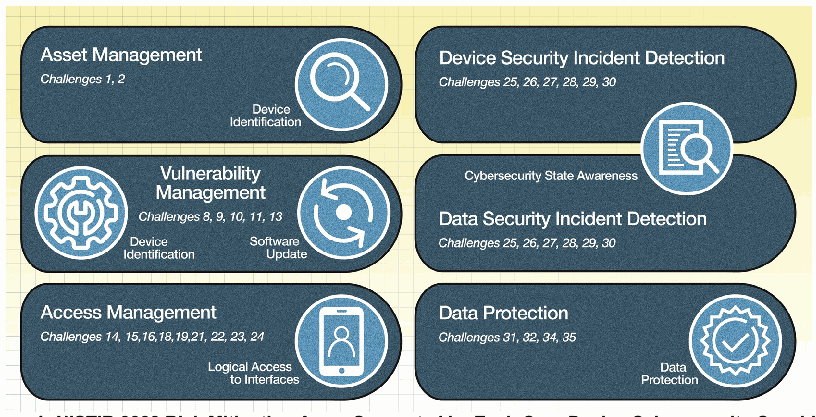
薄い黄色の方眼の背景に、紺色の角丸のパネルが2列3段で6つ並んだ図です。各パネルには NISTIR 8228 のリスク軽減領域の名前と課題の番号があり、それを支える中核の能力が丸いアイコンとラベルで示されています。左の列は、「Asset Management(資産管理)– Challenges 1, 2」に虫眼鏡のアイコン「Device Identification(デバイス識別)」、「Vulnerability Management(脆弱性管理)– Challenges 8, 9, 10, 11, 13」に歯車とスパナのアイコン「Device Identification」と循環する矢印のアイコン「Software Update(ソフトウェア更新)」、「Access Management(アクセス管理)– Challenges 14, 15,16,18,19,21, 22, 23, 24」にスマートフォンと人物のアイコン「Logical Access to Interfaces(インターフェースへの論理アクセス)」です。右の列は、「Device Security Incident Detection(デバイスのセキュリティインシデントの検知)– Challenges 25, 26, 27, 28, 29, 30」と「Data Security Incident Detection(データのセキュリティインシデントの検知)– Challenges 25, 26, 27, 28, 29, 30」の2つのパネルの間に、文書と虫眼鏡のアイコン「Cybersecurity State Awareness(サイバーセキュリティ状態の把握)」が共通に置かれています。最後が「Data Protection(データ保護)– Challenges 31, 32, 34, 35」で、チェックマークの付いたバッジのアイコン「Data Protection」です。
Figure 1: NISTIR 8228 Risk Mitigation Areas Supported by Each Core Device Cybersecurity Capability
図 1: 各コアデバイスのサイバーセキュリティ能力によってサポートされる NISTIR 8228 のリスク軽減の領域
Figure 1 demonstrates that a broad and common set of risk mitigation areas was considered for the core baseline, which should be understood by manufacturers and other readers using the core baseline as a starting point. Though IoT devices providing the basic device cybersecurity capabilities described in the core baseline may help many customers more easily meet their cybersecurity needs and goals while using IoT devices, in reality, customers will likely target different and more specific risk mitigation areas. Therefore, the six capabilities and common elements in Table 1 should not be considered the universal and complete definition of necessary device cybersecurity capabilities for all customers.
図 1 は、コアベースラインについて幅広く一般的なリスク軽減領域が考慮されたことを示しています。これは、コアベースラインを出発点として用いる製造者やその他の読者が理解しておくべきです。コアベースラインに記述された基本的なデバイスのサイバーセキュリティ能力を備える IoT デバイスは、多くの顧客が IoT デバイスを使用する際に、自らのサイバーセキュリティのニーズと目標をより容易に満たす助けとなる場合がありますが、実際には、顧客は異なる、より具体的なリスク軽減領域を対象とする可能性が高いでしょう。したがって、表 1 の 6 つの能力と共通要素を、すべての顧客に必要なデバイスのサイバーセキュリティ能力の普遍的かつ完全な定義と見なすべきではありません。
As described in NISTIR 8259, manufacturers should consider their IoT device’s expected customers and expected use cases to begin to identify the precise device cybersecurity capabilities needed in context. Manufacturers can further define the device cybersecurity capabilities with new or additional elements based on their knowledge and research of their customers. This may mean incorporating device cybersecurity capabilities to support risk mitigations in other areas than what is discussed here (e.g., penetration or other forms of component testing/validation, specific network architectures to reduce risk) or incorporating more unique elements for an IoT device that support less broadly applicable, but in the context of a customer or use case vitally important risk mitigations and other cybersecurity needs and goals. Manufacturers should also keep in mind other considerations in addition to risk mitigations that may impact device cybersecurity and their elements, such as usability considerations based on the customer and use case, roles and responsibility related to cybersecurity and how customers may expect them to be distributed, and societal cybersecurity needs and goals (e.g., protection against the development of botnets) that may not be directly reflected in the customer’s needs and goals, to name a few.
NISTIR 8259 で説明されているように、製造者は、文脈に応じて必要となる正確なデバイスのサイバーセキュリティ能力を特定するため、各 IoT デバイスの想定顧客と想定ユースケースを考慮すべきです。製造者は、顧客に関する知識と調査に基づき、新たな要素または追加要素を用いてデバイスのサイバーセキュリティ能力をさらに定義することができます。これは、ここで論じている領域以外のリスク軽減を支えるデバイスのサイバーセキュリティ能力(たとえば、侵入テストやその他の形態のコンポーネントのテスト/検証、リスクを低減する特定のネットワークアーキテクチャ)を組み込むこと、あるいは、広く適用できるものではないものの、顧客またはユースケースの文脈では極めて重要なリスク軽減やその他のサイバーセキュリティのニーズと目標を支える、IoT デバイス固有の要素をさらに組み込むことを意味する場合があります。製造者はまた、リスク軽減に加えて、デバイスのサイバーセキュリティとその要素に影響しうる他の考慮事項も念頭に置くべきです。例として、顧客とユースケースに基づく使いやすさ、サイバーセキュリティに関する役割と責任、および顧客がそれらの分担方法にどのような期待を持つか、さらに、顧客のニーズと目標には直接反映されない可能性がある社会全体のサイバーセキュリティのニーズと目標(たとえば、ボットネットの開発に対する防御)が挙げられます。
Appendix B—Glossary
付録 B—用語集
Selected terms used in this document are defined below.
この文書で使われている主な用語を、以下に定義します。
| Authorized Entity | An entity that has implicitly or explicitly been granted approval to interact with a particular IoT device. The device cybersecurity capabilities in the core baseline do not specify how authorization is implemented for distinguishing authorized and unauthorized entities, but can include identity management and authentication to establish the authorization of entities. It is left to the organization to decide how each device will implement authorization. Also, an entity authorized to interact with an IoT device in one way might not be authorized to interact with the same device in another way. |
| Configuration | “The possible conditions, parameters, and specifications with which an information system or system component can be described or arranged [20].” The Device Configuration capability does not define which configuration settings should exist, simply that a mechanism to manage configuration settings exists. |
| Core Baseline | A set of technical device capabilities needed to support common cybersecurity controls that protect the customer’s devices and device data, systems, and ecosystems. |
| Cybersecurity State | The condition of a device’s cybersecurity expressed in a way that is meaningful and useful to authorized entities. For example, a very simple device might express its state in terms of whether or not it is operating as expected, while a complex device might perform cybersecurity logging, check its integrity at boot and report the results, and examine and report additional aspects of its cybersecurity state. |
| Degraded Cybersecurity State | A cybersecurity state that indicates the device’s cybersecurity has been significantly negatively impacted, such as the device being unable to operate as expected, or the integrity of the device’s software being violated. |
| Device Cybersecurity Capability Core Baseline | See core baseline. |
| Device Identifier | A context-unique value—a value unique within a specific context—that is associated with a device (for example, a string consisting of a network address). (This definition is derived from [21].) |
| Entity | A person, device, service, network, domain, manufacturer, or other party who might interact with an IoT device. |
| Interface | A boundary between the IoT device and entities where interactions take place. (This definition is derived from [22].) There are two types of interfaces: network and local. |
| Local Interface | An interface that can only be accessed physically, such as a port (e.g., USB, audio, video/display, serial, parallel, Thunderbolt) or a removable media drive (e.g., CD/DVD drive, memory card slot). |
| Logical Identifier | A device identifier that is expressed logically by the device’s software. An example is a media access control (MAC) address assigned to a network interface. |
| Network Interface | An interface that connects the IoT device to a network. |
| Physical Identifier | A device identifier that is expressed physically by the device (e.g., printed onto a device’s housing, displayed on a device’s screen). |
| Software | “Computer programs and associated data that may be dynamically written or modified during the device’s execution” (e.g., application code, libraries) [1]. |
| Update | A patch, upgrade, or other modification to code that corrects security and/or functionality problems in software. (This definition is derived from [23].) |
| Authorized Entity | 特定の IoT デバイスとやり取りすることについて、暗黙的または明示的に承認を与えられたエンティティ。コアベースラインのデバイスのサイバーセキュリティ能力は、認可されたエンティティと認可されていないエンティティを区別するために認可をどのように実装するかを規定していませんが、エンティティの認可を確立するためのアイデンティティ管理と認証を含めることができます。各デバイスが認可をどのように実装するかは、組織の判断に委ねられています。また、ある方法で IoT デバイスとやり取りすることを認可されたエンティティが、同じデバイスと別の方法でやり取りすることを認可されているとは限りません。 |
| Configuration | 「情報システムまたはシステムコンポーネントを記述または配置できる、可能な条件、パラメーター、仕様 [20]」。Device Configuration の能力は、どのような構成設定が存在すべきかを定義するものではなく、構成設定を管理する仕組みが存在することだけを定義します。 |
| Core Baseline | 顧客のデバイスと、デバイスのデータ、システム、エコシステムを保護する一般的なサイバーセキュリティ管理策をサポートするために必要な、技術的なデバイス能力の集合。 |
| Cybersecurity State | 認可されたエンティティにとって意味があり有用な形で表現された、デバイスのサイバーセキュリティの状態。たとえば、非常に単純なデバイスは、期待どおりに動作しているかどうかという観点で自らの状態を表現するかもしれませんが、複雑なデバイスは、サイバーセキュリティのログ記録を行い、起動時に完全性を確認してその結果を報告し、サイバーセキュリティ状態の追加の側面を調べて報告するかもしれません。 |
| Degraded Cybersecurity State | デバイスのサイバーセキュリティが大幅に悪影響を受けたことを示すサイバーセキュリティ状態。たとえば、デバイスが期待どおりに動作できない、あるいはデバイスのソフトウェアの完全性が損なわれている場合などです。 |
| Device Cybersecurity Capability Core Baseline | core baseline を参照してください。 |
| Device Identifier | デバイスに関連付けられた、文脈内で一意の値(特定の文脈内で一意である値)(たとえば、ネットワークアドレスからなる文字列)。(この定義は [21] から派生しています。) |
| Entity | IoT デバイスとやり取りする可能性のある、人、デバイス、サービス、ネットワーク、ドメイン、製造者、その他の当事者。 |
| Interface | IoT デバイスとエンティティの間にあり、やり取りが行われる境界。(この定義は [22] から派生しています。)インターフェースには、ネットワークとローカルの 2 種類があります。 |
| Local Interface | 物理的にしかアクセスできないインターフェース。たとえば、ポート(たとえば、USB、オーディオ、ビデオ/ディスプレイ、シリアル、パラレル、Thunderbolt)やリムーバブルメディアドライブ(たとえば、CD/ |
| Logical Identifier | デバイスのソフトウェアによって論理的に表現されるデバイス識別子。例は、ネットワークインターフェースに割り当てられたメディアアクセス制御(MAC)アドレスです。 |
| Network Interface | IoT デバイスをネットワークに接続するインターフェース。 |
| Physical Identifier | デバイスによって物理的に表現されるデバイス識別子(たとえば、デバイスの筐体に印刷されている、デバイスの画面に表示されている)。 |
| Software | 「デバイスの実行中に動的に書き込まれたり変更されたりしうる、コンピュータープログラムと関連データ」(たとえば、アプリケーションコード、ライブラリ)[1]。 |
| Update | ソフトウェアのセキュリティまたは機能の問題を修正する、コードへのパッチ、アップグレード、その他の変更。(この定義は [23] から派生しています。) |