NIST IR 8259B 日本語訳
英語タイトル : IoT Non-Technical Supporting Capability Core Baseline日本語タイトル : IoT非技術的支援能力のコアベースライン
公開日 : 2021-08-25
原文URL : https://csrc.nist.gov/pubs/ir/8259/b/final
翻訳編集 : 自動生成(有志による非公式の日本語訳), 原文取得日 : 2026-10-31, 訳文 : 102 / 102 ブロック
[要約] NIST IR 8259B は、モノのインターネット(IoT)デバイス製造者の非技術的支援能力のコアベースラインを定義する刊行物です。非技術的な支援能力とは、IoT デバイスのサイバーセキュリティを支援するために、製造者または第三者の組織が行う行動を指します。コアベースラインは、組織のデバイスに加え、デバイスのデータ、システム、エコシステムを保護する一般的なサイバーセキュリティ管理策を支援するために、製造者またはその他の第三者に一般に求められる非技術的支援能力の集合です。本刊行物は、組織が製造、統合、または取得する IoT デバイスに関して必要となる非技術的支援能力を特定する際の出発点を提供することを目的としており、NISTIR 8259 および NISTIR 8259A と併せて使用することを意図しています。
NISTIR 8259B
NISTIR 8259B
IoT Non-Technical Supporting Capability Core Baseline
IoT非技術的支援能力のコアベースライン
Michael Fagan Jeffrey Marron Kevin G. Brady, Jr. Barbara B. Cuthill Katerina N. Megas Rebecca Herold
Michael Fagan Jeffrey Marron Kevin G. Brady, Jr. Barbara B. Cuthill Katerina N. Megas Rebecca Herold
This publication is available free of charge from: https://doi.org/10.6028/NIST.IR.8259B
この刊行物は次の場所から無償で入手できます: https://doi.org/10.6028/NIST.IR.8259B
NISTIR 8259B
NISTIR 8259B
Internet of Things Non-Technical Supporting Capability Core Baseline
モノのインターネットの非技術的支援能力のコアベースライン
Michael Fagan Jeffrey Marron Kevin G. Brady, Jr. Barbara B. Cuthill Katerina N. Megas Applied Cybersecurity Division Information Technology Laboratory
Michael Fagan Jeffrey Marron Kevin G. Brady, Jr. Barbara B. Cuthill Katerina N. Megas 応用サイバーセキュリティ部門 情報技術研究所
Rebecca Herold The Privacy Professor Des Moines, IA
Rebecca Herold The Privacy Professor Des Moines, IA
This publication is available free of charge from: https://doi.org/10.6028/NIST.IR.8259B
この刊行物は次の場所から無償で入手できます: https://doi.org/10.6028/NIST.IR.8259B
August 2021
2021年8月
U.S. Department of Commerce Gina M. Raimondo, Secretary
米国商務省 Gina M. Raimondo 長官
National Institute of Standards and Technology James K. Olthoff, Performing the Non-Exclusive Functions and Duties of the Under Secretary of Commerce for Standards and Technology & Director, National Institute of Standards and Technology
国立標準技術研究所 James K. Olthoff、商務次官(標準・技術担当)兼国立標準技術研究所所長の非専属的な職務および任務を代行
National Institute of Standards and Technology Interagency or Internal Report 8259B 21 pages (August 2021)
米国国立標準技術研究所省庁間または内部報告書 8259B 21ページ(2021年8月)
This publication is available free of charge from: https://doi.org/10.6028/NIST.IR.8259B
この刊行物は次の場所から無償で入手できます: https://doi.org/10.6028/NIST.IR.8259B
Certain commercial entities, equipment, or materials may be identified in this document in order to describe an experimental procedure or concept adequately. Such identification is not intended to imply recommendation or endorsement by NIST, nor is it intended to imply that the entities, materials, or equipment are necessarily the best available for the purpose.
実験の手順や概念を適切に説明するために、本書では特定の商業的な事業体、機器、または資材を挙げている場合があります。そうした記載は、NIST による推奨や支持を意味するものではなく、それらの事業体、資材、または機器が目的に照らして必ずしも最良であることを意味するものでもありません。
There may be references in this publication to other publications currently under development by NIST in accordance with its assigned statutory responsibilities. The information in this publication, including concepts and methodologies, may be used by federal agencies even before the completion of such companion publications. Thus, until each publication is completed, current requirements, guidelines, and procedures, where they exist, remain operative. For planning and transition purposes, federal agencies may wish to closely follow the development of these new publications by NIST.
本刊行物では、NIST が割り当てられた法定責任に従って現在策定中の他の刊行物に言及している場合があります。本刊行物の情報は、概念や方法論を含め、そうした関連刊行物が完成する前であっても、連邦機関が利用する場合があります。したがって、各刊行物が完成するまでは、現行の要件、ガイドライン、および手順が存在する場合、それらが引き続き有効です。計画および移行のため、連邦機関は、NIST によるこれらの新しい刊行物の策定状況を注意深く追うことを検討してもよいです。
Organizations are encouraged to review all draft publications during public comment periods and provide feedback to NIST. Many NIST cybersecurity publications, other than the ones noted above, are available at https://csrc.nist.gov/publications.
組織は、パブリックコメント期間中にすべてのドラフト刊行物を確認し、NIST にフィードバックを提供すべきです。上記で言及したものを除く NIST のサイバーセキュリティ刊行物の多くは、https://csrc.nist.gov/publications で入手できます。
Comments on this publication may be submitted to:
本刊行物に対するコメントは次の宛先に提出できます:
National Institute of Standards and Technology Attn: Applied Cybersecurity Division, Information Technology Laboratory 100 Bureau Drive (Mail Stop 2000) Gaithersburg, MD 20899-2000 Email: iotsecurity@nist.gov
National Institute of Standards and Technology Attn: Applied Cybersecurity Division, Information Technology Laboratory 100 Bureau Drive (Mail Stop 2000) Gaithersburg, MD 20899-2000 Email: iotsecurity@nist.gov
All comments are subject to release under the Freedom of Information Act (FOIA).
すべてのコメントは情報公開法(FOIA)に基づく公開の対象となります。
Reports on Computer Systems Technology
コンピュータシステム技術に関する報告書
The Information Technology Laboratory (ITL) at the National Institute of Standards and Technology (NIST) promotes the U.S. economy and public welfare by providing technical leadership for the Nation’s measurement and standards infrastructure. ITL develops tests, test methods, reference data, proof of concept implementations, and technical analyses to advance the development and productive use of information technology. ITL’s responsibilities include the development of management, administrative, technical, and physical standards and guidelines for the cost-effective security and privacy of other than national security-related information in federal information systems.
米国国立標準技術研究所(NIST)の情報技術研究所(ITL)は、米国の測定・標準インフラに技術的リーダーシップを提供することで、米国の経済と公共の福祉を促進しています。ITL は、情報技術の発展と生産的な利用を進めるため、試験、試験方法、参照データ、概念実証の実装、および技術分析を開発しています。ITL の責務には、連邦情報システムにおける国家安全保障関連以外の情報の費用対効果の高いセキュリティとプライバシーのための、管理、事務、技術、および物理に関する標準とガイドラインの策定が含まれます。
Abstract
概要
Non-technical supporting capabilities are actions a manufacturer or third-party organization performs in support of the cybersecurity of an IoT device. This publication defines an Internet of Things (IoT) device manufacturers’ non-technical supporting capability core baseline, which is a set of non-technical supporting capabilities generally needed from manufacturers or other third parties to support common cybersecurity controls that protect an organization’s devices as well as device data, systems, and ecosystems. The purpose of this publication is to provide organizations a starting point to use in identifying the non-technical supporting capabilities needed in relation to IoT devices they will manufacture, integrate, or acquire. This publication is intended to be used in conjunction with NISTIR 8259, Foundational Cybersecurity Activities for IoT Device Manufacturers and NISTIR 8259A, IoT Device Cybersecurity Capability Core Baseline.
非技術的な支援能力とは、IoT デバイスのサイバーセキュリティを支援するために、製造者または第三者の組織が行う行動です。本刊行物は、モノのインターネット(IoT)デバイス製造者の非技術的支援能力のコアベースラインを定義します。これは、組織のデバイスに加え、デバイスのデータ、システム、エコシステムを保護する一般的なサイバーセキュリティ管理策を支援するために、製造者またはその他の第三者に一般に求められる非技術的支援能力の集合です。本刊行物の目的は、組織が製造、統合、または取得する IoT デバイスに関して必要となる非技術的支援能力を特定する際に利用できる出発点を提供することです。本刊行物は、NISTIR 8259, Foundational Cybersecurity Activities for IoT Device Manufacturers および NISTIR 8259A, IoT Device Cybersecurity Capability Core Baseline と併せて使用することを意図しています。
Keywords
キーワード
cybersecurity baseline; Internet of Things (IoT); securable computing devices.
サイバーセキュリティベースライン、モノのインターネット(IoT)、セキュリティ保護可能なコンピューティングデバイス。
Acknowledgments
謝辞
The authors wish to thank all contributors to this publication, including the participants in workshops and other interactive sessions; the individuals and organizations from the public and private sectors, including manufacturers from various sectors as well as several manufacturer trade organizations, who provided feedback on the preliminary public content, and colleagues at NIST who offered invaluable inputs and feedback. Special thanks to Cybersecurity for IoT team members Brad Hoehn and David Lemire and the NIST FISMA (Federal Information Security Modernization Act) Implementation Project team for their extensive help.
著者らは、本刊行物に貢献したすべての方々に感謝します。これには、ワークショップやその他の対話型セッションの参加者、予備的な公開内容にフィードバックを寄せた官民の個人および組織(さまざまな分野の製造者や複数の製造者業界団体を含む)、ならびに貴重な意見とフィードバックを提供した NIST の同僚が含まれます。Cybersecurity for IoT チームのメンバーである Brad Hoehn 氏と David Lemire 氏、および NIST FISMA(Federal Information Security Modernization Act)Implementation Project チームの多大な支援に特に感謝します。
Audience
想定読者
The main audience for this publication is IoT device manufacturers, especially with the emerging role of product security officers. This publication may also help IoT device customers or integrators.
本刊行物の主な想定読者は、IoT デバイスの製造者であり、特に製品セキュリティ責任者という新たな役割に関わる者です。本刊行物は、IoT デバイスの顧客やインテグレーターにも役立つ場合があります。
Patent Disclosure Notice
特許開示に関する通知
NOTICE: ITL has requested that holders of patent claims whose use may be required for compliance with the guidance or requirements of this publication disclose such patent claims to ITL. However, holders of patents are not obligated to respond to ITL calls for patents, and ITL has not undertaken a patent search in order to identify which, if any, patents may apply to this publication.
通知: ITL は、本刊行物のガイダンスまたは要件への準拠に使用が必要となる可能性のある特許請求の範囲の保有者に対し、そのような特許請求の範囲を ITL に開示するよう求めています。ただし、特許の保有者には ITL の特許の募集に応答する義務はなく、ITL は、本刊行物に適用される特許があるとすればどれかを特定するための特許調査を実施していません。
As of the date of publication and following call(s) for the identification of patent claims whose use may be required for compliance with the guidance or requirements of this publication, no such patent claims have been identified to ITL.
発行日の時点において、本刊行物のガイダンスまたは要件への準拠に使用が必要となる可能性のある特許請求の範囲の特定を求めた募集を経て、そのような特許請求の範囲は ITL に対して特定されていません。
No representation is made or implied by ITL that licenses are not required to avoid patent infringement in the use of this publication.
ITL は、本刊行物の使用において特許侵害を避けるためにライセンスが不要であるとの表明を、明示的にも黙示的にも行っていません。
Table of Contents
目次
List of Appendices
付録の一覧
1 Introduction
1 はじめに
Internet of Things (IoT) devices often lack built-in device cybersecurity capabilities, as well as non-technical support relevant to cybersecurity. Customers can use this type of information to help mitigate cybersecurity risks related to the IoT devices and their use. The wide range of connectivity possible for IoT devices, and the ability for these devices to interact with the physical world, means securing these devices often becomes a priority; but it is a challenge for customers when they are not adequately supported.
モノのインターネット(IoT)デバイスには、デバイスに組み込まれたサイバーセキュリティ能力のほか、サイバーセキュリティに関連する非技術的な支援も不足していることがよくあります。顧客は、この種の情報を利用して、IoT デバイスとその使用に関連するサイバーセキュリティリスクを軽減できます。IoT デバイスは幅広い接続性を持ちうること、そして物理世界と相互作用できることから、これらのデバイスの保護はしばしば優先事項になります。しかし、顧客が十分な支援を受けられない場合、それは顧客にとって課題となります。
This publication should be used and understood within the context of NISTIR 8259, Foundational Cybersecurity Activities for IoT Device Manufacturers [1] and NISTIR 8259A, IoT Device Cybersecurity Capability Core Baseline [2]. NISTIR 8259 discusses considerations for manufacturers to help guide them in choosing and implementing the device cybersecurity capabilities their IoT devices will provide. 8259A discusses device technical cybersecurity capabilities, which are cybersecurity features or functions that devices provide through their own technical means (i.e., device hardware and software), and establishes a core baseline of device cybersecurity capabilities IoT device customers commonly need.
本刊行物は、NISTIR 8259, Foundational Cybersecurity Activities for IoT Device Manufacturers [1] および NISTIR 8259A, IoT Device Cybersecurity Capability Core Baseline [2] の文脈の中で使用し、理解すべきです。NISTIR 8259 は、製造者が自らの IoT デバイスが提供するデバイスのサイバーセキュリティ能力を選択して実装する際の指針となる考慮事項を論じています。8259A は、デバイスのサイバーセキュリティ能力、すなわちデバイスが自らの技術的手段(つまりデバイスのハードウェアとソフトウェア)によって提供するサイバーセキュリティ機能を論じ、IoT デバイスの顧客が一般に必要とするデバイスのサイバーセキュリティ能力のコアベースラインを確立しています。
To complement the core baseline from NISTIR 8259A, the IoT non-technical supporting capability core baseline is a set of actions performed by manufacturers and/or designated supporting third parties (called supporting parties). These actions will help others (e.g., customers, end-users) use the cybersecurity capabilities of IoT devices, and support the on-going cybersecurity of the IoT device and the system and networks the device connects to (the digital ecosystem). Providing such non-technical cybersecurity support through educational materials or other types of non-technical tools and actions can benefit the entire IoT device ecosystem and allow manufacturers to better support the cybersecurity of devices throughout the entire device lifecycle. Both device cybersecurity capabilities and non-technical supporting capabilities are vital to customers’ abilities to achieve their needs and goals. Similar to the IoT device cybersecurity capability core baseline in NISTIR 8259A, this IoT non-technical supporting capability core baseline is intended to give organizations a starting point for establishing non-technical actions to support IoT device cybersecurity risk management.
NISTIR 8259A のコアベースラインを補完するため、IoT 非技術的支援能力のコアベースラインは、製造者、または指定された支援する第三者(支援当事者と呼びます)、あるいはその両方が行う行動の集合です。これらの行動は、他者(たとえば顧客、エンドユーザー)が IoT デバイスのサイバーセキュリティ能力を使用する助けとなり、IoT デバイス、およびデバイスが接続するシステムとネットワーク(デジタルエコシステム)の継続的なサイバーセキュリティを支援します。教材やその他の種類の非技術的なツールおよび行動を通じてこのような非技術的なサイバーセキュリティ支援を提供することは、IoT デバイスのエコシステム全体に利益をもたらし、製造者がデバイスのライフサイクル全体にわたってデバイスのサイバーセキュリティをよりよく支援できるようにします。顧客が自らのニーズと目標を達成するには、デバイスのサイバーセキュリティ能力と非技術的支援能力の両方が不可欠です。NISTIR 8259A の IoT デバイスのサイバーセキュリティ能力のコアベースラインと同様に、この IoT 非技術的支援能力のコアベースラインは、IoT デバイスのサイバーセキュリティリスクマネジメントを支援する非技術的な行動を確立するための出発点を組織に提供することを意図しています。
Specifically, this publication describes four recommended non-technical supporting capabilities related to the full lifecycle of cybersecurity management that manufacturers should implement to support the IoT devices they make for the full length of life: 1) Documentation; 2) Information and Query Reception; 3) Information Dissemination; and 4) Education and Awareness.
具体的には、本刊行物は、製造者が自ら製造する IoT デバイスを製品寿命の全期間にわたって支援するために実施すべき、サイバーセキュリティマネジメントのライフサイクル全体に関連する 4 つの推奨される非技術的支援能力を説明します。1) 文書化、2) 情報および問い合わせの受付、3) 情報配信、4) 教育および意識向上。
A manufacturer’s choice of non-technical supporting capabilities considers the purpose of the IoT device and the intended uses. Such actions make it easier for customers to understand and identify how IoT devices are built to meet their cybersecurity needs as well as the manufacturers’ expectations for how the IoT device should be securely used. Figure 1 shows the four non-technical supporting capabilities included in this baseline.
製造者による非技術的支援能力の選択では、IoT デバイスの目的と想定される用途が考慮されます。そのような行動により、顧客は、IoT デバイスが自らのサイバーセキュリティ上のニーズを満たすようにどのように作られているかや、IoT デバイスをセキュアに使用する方法に関する製造者の期待を、理解し特定しやすくなります。図 1 は、このベースラインに含まれる 4 つの非技術的支援能力を示しています。
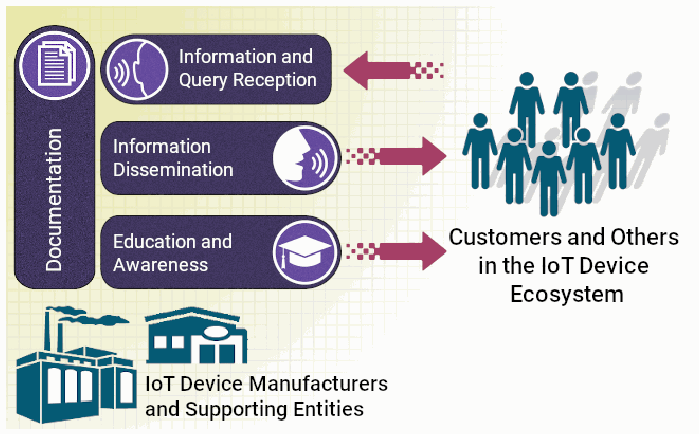
4つの非技術的支援能力を示す図です。左側の縦長の帯「Documentation」が、3つの角丸の箱「Information and Query Reception」(右から矢印が入る)、「Information Dissemination」と「Education and Awareness」(それぞれ右へ矢印が出る)を支えています。矢印は「Customers and Others in the IoT Device Ecosystem」と記された人々の集まりにつながります。左下には工場と建物のアイコンがあり、「IoT Device Manufacturers and Supporting Entities」と記されています。
Figure 1: How customers and others in the IoT device ecosystem will use the capabilities in the baseline if provided by IoT device manufacturers and supporting entities.
図 1: IoT デバイスの製造者と支援主体がベースラインの能力を提供する場合に、顧客と IoT デバイスのエコシステム内のその他の関係者がそれらの能力をどのように使用するか。
Documentation captures information potential customers and others in the ecosystem may need to know about the IoT devices and ways in which it, and associated data and systems, can be secured. Such documentation is also often necessary prior to purchase and throughout the IoT device’s lifecycle for the customer and others in the ecosystem (e.g., auditors and assessors). This documentation supports the appropriate treatment of risk, compliance, and assurance from internal and external perspectives when the IoT device and associated systems are implemented within the customer environment. As shown in Figure 1, documentation acts as a pillar of support for other non-technical capabilities. This is because other non-technical capabilities, including those in the IoT non-technical supporting baseline, will use the information captured via documentation to customize their delivery.
文書化は、潜在的な顧客やエコシステム内のその他の関係者が、IoT デバイスについて、またデバイスと関連するデータおよびシステムをセキュアにする方法について知る必要がある情報を記録します。このような文書は、購入前、および IoT デバイスのライフサイクル全体を通じて、顧客やエコシステム内のその他の関係者(たとえば監査者や評価者)にとって必要になることも多くあります。この文書は、IoT デバイスと関連システムが顧客の環境内に実装される際に、内部および外部の視点からのリスク、コンプライアンス、保証の適切な取扱いを支援します。図 1 に示すように、文書化は他の非技術的能力を支える柱として機能します。これは、IoT 非技術的支援ベースラインに含まれるものを含む他の非技術的能力が、文書化によって記録された情報を使って提供内容を調整するためです。
Information and Query Reception occurs after purchase and allows customers and others in the ecosystem (e.g., researchers, product rating organizations) to submit questions and other information related to securing the IoT device and associated systems. The manufacturer and supporting parties can then respond. Information and query reception can assist customers and others in many ways throughout the lifecycle of an IoT device such as by allowing manufacturers and supporting third -party entities to adapt and update their support services (e.g., provided through other non-technical supporting capabilities) for the customers’ cybersecurity needs and goals.
情報および問い合わせの受付は購入後に行われ、顧客やエコシステム内のその他の関係者(たとえば研究者、製品評価組織)が、IoT デバイスと関連システムの保護に関する質問やその他の情報を提出できるようにします。製造者と支援当事者は、それに応答できます。情報および問い合わせの受付は、IoT デバイスのライフサイクル全体を通じて、さまざまな形で顧客やその他の関係者を支援できます。たとえば、製造者や支援する第三者が、顧客のサイバーセキュリティ上のニーズと目標に合わせて、(他の非技術的支援能力を通じて提供するなどした)支援サービスを調整し更新できるようにします。
Information Dissemination allows for information to continue to flow to customers and others in the ecosystem about the cybersecurity of their IoT devices and associated systems. Customers and others will benefit from 1) the disclosure of newly discovered cybersecurity vulnerabilities for the device, associated systems and software, etc. and 2) notifications about IoT device updates, such as software updates, algorithm changes, new protocols, or changes in the vendors used by the manufacturer to update cybersecurity, that may impact cybersecurity risks.1
情報配信は、顧客やエコシステム内のその他の関係者に対し、自らの IoT デバイスと関連システムのサイバーセキュリティに関する情報が引き続き流れるようにします。顧客やその他の関係者は、1) デバイス、関連システム、ソフトウェアなどについて新たに発見されたサイバーセキュリティ上の脆弱性の開示、および 2) ソフトウェア更新、アルゴリズムの変更、新しいプロトコル、サイバーセキュリティを更新するために製造者が利用するベンダーの変更など、サイバーセキュリティリスクに影響しうる IoT デバイスの更新に関する通知から利益を得ます。1
Education and Awareness provides the educational content required to support customers and others in the secure use and safeguarding of IoT devices and associated systems, software, and hardware. By making customers and others in the ecosystem more knowledgeable about how to secure the IoT devices, and how to most effectively use the device’s cybersecurity capabilities, manufacturers can help reduce the number of occurrences and related severity of IoT device compromises, thwart attacks against the devices, and reduce the number of vulnerabilities that are exploited and lead to compromised devices.
教育および意識向上は、顧客やその他の関係者が、IoT デバイスと、関連するシステム、ソフトウェア、ハードウェアをセキュアに使用し保護することを支援するために必要な教育コンテンツを提供します。製造者は、エコシステム内の顧客やその他の関係者に、IoT デバイスをセキュアにする方法と、デバイスのサイバーセキュリティ能力を最も効果的に使用する方法についてより多くの知識を持たせることで、IoT デバイスの危殆化の発生件数と関連する深刻度を減らし、デバイスに対する攻撃を阻止し、悪用されてデバイスの危殆化につながる脆弱性の数を減らす助けとなれます。
Customers are the typical recipients of the non-technical supporting capabilities, but some customers may not be able to use these non-technical supporting capabilities directly. In the latter case, the capability might be used by other entities in the IoT device ecosystem (e.g., vendors, trade or professional organizations, advocacy groups, and technology media) to help customers meet their needs and goals.
非技術的支援能力の受け手として一般的なのは顧客ですが、一部の顧客は、これらの非技術的支援能力を直接使用できない場合があります。その場合、顧客がニーズと目標を満たす助けとなるよう、その能力は IoT デバイスのエコシステム内の他の主体(たとえばベンダー、業界団体や専門家団体、アドボカシーグループ、テクノロジーメディア)によって使用されることがあります。
This baseline was developed after reviewing a variety of guidance documents from multiple sources and receiving input from stakeholders. It represents a coordinated effort to produce a definition of common capabilities not an exhaustive list. The core baseline is intended to be a flexible starting point. Manufacturers and supporting parties can use the IoT non-technical supporting capability core baseline in the context of the activities in NISTIR 8259 and that is appropriate to them. It is important to note that manufacturers and supporting third parties should implement the non-technical supporting capabilities that support the risk management needs of customers of the IoT device within its intended digital ecosystem. This will then result in each of the individual non-technical supporting capabilities in the baseline being implemented in a manner consistent with the needs and expectations of those customers. If additional supporting capabilities are necessary to enable secure use of the devices, organizations are encouraged to consider defining additional supporting capabilities that better suit their use case(s).
このベースラインは、複数の情報源からのさまざまなガイダンス文書を確認し、ステークホルダーから意見を得たうえで策定されました。これは、網羅的な一覧ではなく、共通の能力の定義を作成するための協調的な取り組みを表しています。コアベースラインは、柔軟な出発点であることを意図しています。製造者と支援当事者は、NISTIR 8259 の活動の文脈で、自らに適した形で IoT 非技術的支援能力のコアベースラインを使用できます。製造者と支援する第三者は、IoT デバイスが想定するデジタルエコシステム内でのその顧客のリスクマネジメント上のニーズを支える非技術的支援能力を実装すべきであることに注意することが重要です。そうすれば、ベースライン内の個々の非技術的支援能力は、それらの顧客のニーズと期待に沿った形で実装されることになります。デバイスのセキュアな使用を可能にするために追加の支援能力が必要な場合、組織は、自らのユースケースにより適した追加の支援能力を定義することを検討するよう推奨されます。
2 The IoT Non-Technical Supporting Capability Core Baseline
2 IoT 非技術的支援能力のコアベースライン
Table 1 defines the IoT device non-technical supporting capability core baseline, which, in combination with the device cybersecurity (technical) capability core baseline of NISTIR 8259A, can make it possible to secure an IoT device. The table below draws from the concepts in Section 4 of NISTIR 8259, which highlights the importance of communication with customers and others in the IoT device ecosystem about cybersecurity, and in Section 3, which provide many examples of information that customers and others may need to know about IoT devices or the design of the device.
表 1 は、IoT デバイスの非技術的支援能力のコアベースラインを定義します。これは、NISTIR 8259A のデバイスのサイバーセキュリティ(技術的)能力のコアベースラインと組み合わせることで、IoT デバイスの保護を可能にします。以下の表は、サイバーセキュリティについて顧客と IoT デバイスのエコシステム内のその他の関係者とコミュニケーションをとることの重要性を強調する NISTIR 8259 の Section 4 の概念と、顧客やその他の関係者が IoT デバイスやデバイスの設計について知る必要のある情報の多くの例を示す Section 3 の概念を踏まえています。
Table 1 is a high-level starting point for IoT device manufacturers to understand how they may have to plan for and support the customer’s cybersecurity needs and goals in non-technical ways. The complexities of IoT device manufacturing may result in organizations other than the device manufacturer providing critical cybersecurity support such as some or all of the non-technical supporting capabilities described in this publication. Therefore, the target for this guidance includes supporting parties (e.g., cloud service provider and contracted servicer) that may play a role in one or more of the actions in Table 1 in addition to the manufacturer.
表 1 は、IoT デバイスの製造者が、顧客のサイバーセキュリティ上のニーズと目標を非技術的な方法でどのように計画し支援する必要があるかを理解するための、高水準の出発点です。IoT デバイスの製造の複雑さにより、本刊行物に記載された非技術的支援能力の一部またはすべてなど、重要なサイバーセキュリティ支援を、デバイスの製造者以外の組織が提供する場合があります。したがって、このガイダンスの対象には、製造者に加えて表 1 の 1 つ以上の行動で役割を果たしうる支援当事者(たとえばクラウドサービスプロバイダーや契約サービス提供者)が含まれます。
The non-technical supporting capabilities in Table 1 describe the intended recipient of the value of the capability as the customer (i.e., those with whom the communications take place). This stems from an assumption that the customer of an IoT device will have cybersecurity needs, goals, and responsibilities related to the IoT device. For a specific customer or use case, there may be other individuals or entities from the IoT device ecosystem who may be part of that communication. For example, an enterprise customer may have several supporting contractors or entities as well as employees to whom the information described in the table may need to be communicated. Alternatively, a building owner incorporating IoT devices will need to pass information to building tenants using those IoT devices. In this case, it is also noteworthy how future owners/users of the IoT devices (i.e., future tenants) may not be considered customers in the traditional sense. Finally, in addition to the customer, for some sectors, there may be robust third-party ecosystem entities (e.g., product reviewers and assessors, retailers, and vendors) that may use non-technical supporting capabilities to help improve the cybersecurity for the sector broadly.
表 1 の非技術的支援能力は、その能力の価値の意図された受け手を顧客(すなわちコミュニケーションが行われる相手)として記述しています。これは、IoT デバイスの顧客が、そのデバイスに関連するサイバーセキュリティ上のニーズ、目標、責任を持つという前提に基づいています。特定の顧客やユースケースでは、IoT デバイスのエコシステムの他の個人や主体がそのコミュニケーションに加わる場合があります。たとえば、エンタープライズの顧客には、表に記載された情報を伝える必要のある従業員のほか、複数の支援する請負業者や主体がいる場合があります。あるいは、IoT デバイスを導入するビルの所有者は、それらの IoT デバイスを使用するビルの入居者に情報を伝える必要があります。この場合、IoT デバイスの将来の所有者/利用者(すなわち将来の入居者)が、従来の意味での顧客とは見なされない場合がある点も注目に値します。最後に、顧客に加えて、一部の分野では、堅牢な第三者エコシステムの主体(たとえば製品のレビュアーや評価者、小売業者、ベンダー)が、その分野全体のサイバーセキュリティの向上を助けるために非技術的支援能力を使用する場合があります。
The specific actions listed in the table are meant to reflect the typical actions many customers and others in the IoT device ecosystem expect manufacturers and supporting parties to take to support cybersecurity needs and goals. Manufacturers can choose and customize non-technical capabilities based upon the intended use cases and customers of the IoT device, with examples and rationales provided to give additional information about customer expectations or why these actions are important. As with NISTIR 8259A, more context would be needed to articulate specific non-technical supporting capabilities. Other types of non-technical supporting capabilities may be needed to best address the system context within which the IoT device is used and also in consideration of each IoT device user organization’s2 system cybersecurity risks. Organizations that choose to adopt the core baseline non-technical capabilities for any of the IoT devices they produce, integrate, or acquire have considerable flexibility in identifying the actions to implement those capabilities that can most effectively address IoT device usage within the customers’ own system and their goals and purpose for using IoT devices.
表に記載された具体的な行動は、サイバーセキュリティ上のニーズと目標を支援するために、多くの顧客や IoT デバイスのエコシステム内のその他の関係者が、製造者と支援当事者に期待する典型的な行動を反映することを意図しています。製造者は、IoT デバイスの想定されるユースケースと顧客に基づいて非技術的能力を選択し、カスタマイズできます。顧客の期待や、これらの行動が重要である理由についての追加情報を提供するために、例と根拠が示されています。NISTIR 8259A と同様に、具体的な非技術的支援能力を明確に示すには、より多くの文脈が必要です。IoT デバイスが使用されるシステムの文脈に最もよく対処するため、また IoT デバイスを利用する各組織2のシステムのサイバーセキュリティリスクを考慮して、他の種類の非技術的支援能力が必要になる場合があります。自らが製造、統合、または取得するいずれかの IoT デバイスについて、コアベースラインの非技術的能力を採用することを選択する組織は、顧客自身のシステム内での IoT デバイスの使用と、IoT デバイスを使用する目標および目的に最も効果的に対処できる、能力を実装するための行動を特定するうえで、かなりの柔軟性を持ちます。
Each row in Table 1 covers one of the device non-technical supporting capabilities in the IoT non-technical supporting capability core baseline:
表 1 の各行は、IoT 非技術的支援能力のコアベースラインにあるデバイスの非技術的支援能力の一つを扱っています。
•The first column describes the non-technical supporting capability.
•1 列目は、非技術的支援能力を記述します。
•The second column provides a numbered list of common actions within that supporting capability. These are actions that an organization implementing the non-technical supporting capability often (but not always) would use to achieve the capability. It is important to understand that the actions are not intended to be comprehensive nor are they presented in any particular order.3
•2 列目は、その支援能力内の一般的な行動の番号付き一覧を示します。これらは、非技術的支援能力を実装する組織が、その能力を達成するために(常にではありませんが)多くの場合に用いる行動です。これらの行動は網羅的であることを意図しておらず、特定の順序で示されているわけでもないことを理解することが重要です。3
•The third column explains the rationale for needing the non-technical support capability.
•3 列目は、その非技術的支援能力が必要な理由の根拠を説明します。
•The last column lists IoT reference examples that indicate existing sources of IoT device cybersecurity guidance specifying a similar or related capability. Because the table only covers the basics of the capabilities, the references can be invaluable for understanding each capability in more detail and learning how to implement each capability in a reasonable manner. The following are the references used in Table 1:
•最後の列は、同様または関連する能力を規定している IoT デバイスのサイバーセキュリティガイダンスの既存の情報源を示す、IoT の参照例を挙げています。この表は能力の基本だけを扱っているため、参照先は、各能力をより詳細に理解し、各能力を妥当な方法で実装する方法を学ぶうえで非常に有用です。表 1 で使用されている参照先は次のとおりです。
•AGELIGHT: AgeLight Digital Trust Advisory Group, “IoT Safety Architecture & Risk Toolkit v4.0” [7]
•AGELIGHT: AgeLight Digital Trust Advisory Group, “IoT Safety Architecture & Risk Toolkit v4.0” [7]
•CTA: Consumer Technology Association, “American National Standards Institute (ANSI)/CTA Standard - Baseline Cybersecurity Standard for Devices and Device Systems: ANSI/CTA-2088” [8]
•CTA: Consumer Technology Association, “American National Standards Institute (ANSI)/CTA Standard - Baseline Cybersecurity Standard for Devices and Device Systems: ANSI/CTA-2088” [8]
•CSDE: Council to Secure the Digital Economy (CSDE), “The C2 Consensus on IoT Device Security Baseline Capabilities” [9]
•CSDE: Council to Secure the Digital Economy (CSDE), “The C2 Consensus on IoT Device Security Baseline Capabilities” [9]
•ETSI: European Telecommunications Standards Institute, “Cyber Security for Consumer Internet of Things: Baseline Requirements v2.1.0” [10]
•ETSI: European Telecommunications Standards Institute, “Cyber Security for Consumer Internet of Things: Baseline Requirements v2.1.0” [10]
•IoTSF: IoT Security Foundation (IoTSF), “IoT Security Compliance Framework v2.1” [11]
•IoTSF: IoT Security Foundation (IoTSF), “IoT Security Compliance Framework v2.1” [11]
Table 1: Non-Technical Supporting Capabilities
表 1: 非技術的支援能力
| Non-Technical Supporting Capability | Common Actions | Rationale | IoT Reference Examples |
|---|---|---|---|
| Documentation: The ability for the manufacturer and/or the manufacturer's supporting entity, to create, gather, and store information relevant to cybersecurity of the IoT device prior to customer purchase, and throughout the development of a device and its subsequent lifecycle. |
|
|
|
| Documentation (continued) |
|
| (see above) |
| Information and Query Reception: The ability for the manufacturer and/or supporting entity to receive information and queries from the customer and others related to cybersecurity of the IoT device. |
|
|
|
| Information Dissemination: The ability for the manufacturer and/or supporting entity to broadcast and distribute (e.g., to the customer or others in the IoT device ecosystem) information related to cybersecurity of the IoT device. |
|
|
|
| Education and Awareness: The ability for the manufacturer and/or supporting entity to create awareness of and educate customers and others in the IoT device ecosystem about cybersecurity-related information, considerations, features, etc. of the IoT device. |
|
|
|
| 非技術的支援能力 | 一般的な行動 | 根拠 | IoT の参照例 |
|---|---|---|---|
| 文書化: 顧客の購入前、およびデバイスの開発とその後のライフサイクル全体を通じて、製造者、製造者の支援主体、またはその両方が、IoT デバイスのサイバーセキュリティに関連する情報を作成、収集、保管する能力。 |
|
|
|
| 文書化(続き) |
|
| (上記を参照) |
| 情報および問い合わせの受付: 製造者、支援主体、またはその両方が、IoT デバイスのサイバーセキュリティに関する情報と問い合わせを、顧客およびその他の関係者から受け付ける能力。 |
|
|
|
| 情報配信: 製造者、支援主体、またはその両方が、IoT デバイスのサイバーセキュリティに関する情報を(たとえば顧客や IoT デバイスのエコシステム内のその他の関係者に)広く発信し配布する能力。 |
|
|
|
| 教育および意識向上: 製造者、支援主体、またはその両方が、IoT デバイスのサイバーセキュリティ関連の情報、考慮事項、機能などについて、顧客および IoT デバイスのエコシステム内のその他の関係者の意識を高め、教育する能力。 |
|
|
|
References
参考文献
[1] Fagan M, Megas KN, Scarfone K, Smith M (2020) Foundational Cybersecurity Activities for IoT Device Manufacturers. (National Institute of Standards and Technology, Gaithersburg, MD), NIST Interagency or Internal Report (IR) 8259. https://doi.org/10.6028/NIST.IR.8259
[1] Fagan M, Megas KN, Scarfone K, Smith M (2020) Foundational Cybersecurity Activities for IoT Device Manufacturers. (National Institute of Standards and Technology, Gaithersburg, MD), NIST Interagency or Internal Report (IR) 8259. https://doi.org/10.6028/NIST.IR.8259
[2] Fagan M, Megas KN, Scarfone K, Smith M (2020) IoT Device Cybersecurity Capability Core Baseline. (National Institute of Standards and Technology, Gaithersburg, MD), NIST Interagency or Internal Report (IR) 8259A. https://doi.org/10.6028/NIST.IR.8259A
[2] Fagan M, Megas KN, Scarfone K, Smith M (2020) IoT Device Cybersecurity Capability Core Baseline. (National Institute of Standards and Technology, Gaithersburg, MD), NIST Interagency or Internal Report (IR) 8259A. https://doi.org/10.6028/NIST.IR.8259A
[3] Boeckl K, Fagan M, Fisher W, Lefkovitz N, Megas K, Nadeau E, Piccarreta B, O'Rourke DG, Scarfone K (2018) Considerations for Managing Internet of Things (IoT) Cybersecurity and Privacy Risks. (National Institute of Standards and Technology, Gaithersburg, MD), NIST Interagency or Internal Report (IR) 8228. https://doi.org/10.6028/NIST.IR.8228
[3] Boeckl K, Fagan M, Fisher W, Lefkovitz N, Megas K, Nadeau E, Piccarreta B, O'Rourke DG, Scarfone K (2018) Considerations for Managing Internet of Things (IoT) Cybersecurity and Privacy Risks. (National Institute of Standards and Technology, Gaithersburg, MD), NIST Interagency or Internal Report (IR) 8228. https://doi.org/10.6028/NIST.IR.8228
[4] Fagan M, Megas, KN, Marron, J, Brady KG, Jr, Cuthill BB, Herold R (2020) Creating a Profile Using the IoT Core Baseline and Non-Technical Baseline. (National Institute of Standards and Technology, Gaithersburg, MD), Draft NIST Interagency or Internal Report (IR) 8259C. https://doi.org/10.6028/NIST.IR.8259C-draft
[4] Fagan M, Megas, KN, Marron, J, Brady KG, Jr, Cuthill BB, Herold R (2020) Creating a Profile Using the IoT Core Baseline and Non-Technical Baseline. (National Institute of Standards and Technology, Gaithersburg, MD), Draft NIST Interagency or Internal Report (IR) 8259C. https://doi.org/10.6028/NIST.IR.8259C-draft
[5] National Institute of Standards and Technology (2020) IoT Device Cybersecurity Requirement Catalogs. (National Institute of Standards and Technology, Gaithersburg, MD). Available at https://github.com/usnistgov/IoT-Device-Cybersecurity-Requirement-Catalogs.
[5] National Institute of Standards and Technology (2020) IoT Device Cybersecurity Requirement Catalogs. (National Institute of Standards and Technology, Gaithersburg, MD). 入手先: https://github.com/usnistgov/IoT-Device-Cybersecurity-Requirement-Catalogs.
[6] Joint Task Force Transformation Initiative (2012) Guide for Conducting Risk Assessments. (National Institute of Standards and Technology, Gaithersburg, MD), NIST Special Publication (SP) 800-30, Rev. 1. https://doi.org/10.6028/NIST.SP.800-30r1
[6] Joint Task Force Transformation Initiative (2012) Guide for Conducting Risk Assessments. (National Institute of Standards and Technology, Gaithersburg, MD), NIST Special Publication (SP) 800-30, Rev. 1. https://doi.org/10.6028/NIST.SP.800-30r1
[7] AgeLight Digital Trust Advisory Group (2020) IoT Safety Architecture & Risk Toolkit v4.0. Updated February 24, 2020. Available at https://www.agelight.com/iot
[7] AgeLight Digital Trust Advisory Group (2020) IoT Safety Architecture & Risk Toolkit v4.0. 2020年2月24日更新. 入手先: https://www.agelight.com/iot
[8] Consumer Technology Association (2020) ANSI/CTA-2088 - Baseline Cybersecurity Standard for Devices and Device Systems (Consumer Technology Association, Arlington, VA). Available at https://csde.org/projects/c2-consensus/
[8] Consumer Technology Association (2020) ANSI/CTA-2088 - Baseline Cybersecurity Standard for Devices and Device Systems (Consumer Technology Association, Arlington, VA). 入手先: https://csde.org/projects/c2-consensus/
[9] Council to Secure the Digital Economy (2019) The C2 Consensus on IoT Device Security Baseline Capabilities. Available at https://csde.org/wp-content/uploads/2019/09/CSDE_IoT-C2-Consensus-Report_FINAL.pdf
[9] Council to Secure the Digital Economy (2019) The C2 Consensus on IoT Device Security Baseline Capabilities. 入手先: https://csde.org/wp-content/uploads/2019/09/CSDE_IoT-C2-Consensus-Report_FINAL.pdf
[10] European Telecommunications Standards Institute (2020) ETSI EN 303 645 v2.1.0 - Cyber Security for Consumer Internet of Things: Baseline Requirements (European Telecommunications Standards Institute, Valbonne, France). Available at https://www.etsi.org/deliver/etsi_en/303600_303699/303645/02.01.01_60/en_303645v020101p.pdf
[10] European Telecommunications Standards Institute (2020) ETSI EN 303 645 v2.1.0 - Cyber Security for Consumer Internet of Things: Baseline Requirements (European Telecommunications Standards Institute, Valbonne, France). 入手先: https://www.etsi.org/deliver/etsi_en/303600_303699/303645/02.01.01_60/en_303645v020101p.pdf
[11] IoT Security Foundation (2020) IoT Security Compliance Framework v2.1. (Internet of Things Security Foundation, Livingston, UK). Available at https://www.iotsecurityfoundation.org/iotsf-issues-update-to-popular-iot-security-compliance-framework/
[11] IoT Security Foundation (2020) IoT Security Compliance Framework v2.1. (Internet of Things Security Foundation, Livingston, UK). 入手先: https://www.iotsecurityfoundation.org/iotsf-issues-update-to-popular-iot-security-compliance-framework/
[12] Johnson A, Dempsey K, Ross R, Gupta S, Bailey D (2011) Guide for Security-Focused Configuration Management of Information Systems. (National Institute of Standards and Technology, Gaithersburg, MD), NIST Special Publication (SP) 800-128. https://doi.org/10.6028/NIST.SP.800-128
[12] Johnson A, Dempsey K, Ross R, Gupta S, Bailey D (2011) Guide for Security-Focused Configuration Management of Information Systems. (National Institute of Standards and Technology, Gaithersburg, MD), NIST Special Publication (SP) 800-128. https://doi.org/10.6028/NIST.SP.800-128
[13] Joint Task Force (2020) Security and Privacy Controls for Information Systems and Organizations. (National Institute of Standards and Technology, Gaithersburg, MD), NIST Special Publication (SP) 800-53, Rev. 5. Includes updates as of December 10, 2020. https://doi.org/10.6028/NIST.SP.800-53r5
[13] Joint Task Force (2020) Security and Privacy Controls for Information Systems and Organizations. (National Institute of Standards and Technology, Gaithersburg, MD), NIST Special Publication (SP) 800-53, Rev. 5. 2020年12月10日時点の更新を含む. https://doi.org/10.6028/NIST.SP.800-53r5
[14] Souppaya M, Scarfone K (2013) Guide to Enterprise Patch Management Technologies. (National Institute of Standards and Technology, Gaithersburg, MD), NIST Special Publication (SP) 800-40, Rev. 3. https://doi.org/10.6028/NIST.SP.800-40r3
[14] Souppaya M, Scarfone K (2013) Guide to Enterprise Patch Management Technologies. (National Institute of Standards and Technology, Gaithersburg, MD), NIST Special Publication (SP) 800-40, Rev. 3. https://doi.org/10.6028/NIST.SP.800-40r3
[15] Barker E, Chen L, Roginsky A, Vassilev A, Davis R (2019) Recommendation for Pair-Wise Key-Establishment Schemes Using Discrete Logarithm Cryptography. (National Institute of Standards and Technology, Gaithersburg, MD), NIST Special Publication (SP) 800-56A, Rev. 3. https://doi.org/10.6028/NIST.SP.800-56Ar3
[15] Barker E, Chen L, Roginsky A, Vassilev A, Davis R (2019) Recommendation for Pair-Wise Key-Establishment Schemes Using Discrete Logarithm Cryptography. (National Institute of Standards and Technology, Gaithersburg, MD), NIST Special Publication (SP) 800-56A, Rev. 3. https://doi.org/10.6028/NIST.SP.800-56Ar3
[16] Committee on National Security Systems (2015) Committee on National Security Systems (CNSS) Glossary. (National Security Agency, Ft. Meade, MD), CNSS Instruction (CNSSI) No. 4009. Available at https://www.cnss.gov/CNSS/issuances/Instructions.cfm
[16] Committee on National Security Systems (2015) Committee on National Security Systems (CNSS) Glossary. (National Security Agency, Ft. Meade, MD), CNSS Instruction (CNSSI) No. 4009. 入手先: https://www.cnss.gov/CNSS/issuances/Instructions.cfm
[17] Schaffer K, Mell P, Trinh H. (2021) Recommendations for Federal Vulnerability Disclosure Guidelines. (National Institute of Standards and Technology, Gaithersburg, MD), Draft NIST Special Publication (SP) 800-216. https://doi.org/10.6028/NIST.SP.800-216-draft
[17] Schaffer K, Mell P, Trinh H. (2021) Recommendations for Federal Vulnerability Disclosure Guidelines. (National Institute of Standards and Technology, Gaithersburg, MD), Draft NIST Special Publication (SP) 800-216. https://doi.org/10.6028/NIST.SP.800-216-draft
Appendix A—Acronyms
付録 A—略語
Selected acronyms and abbreviations used in this paper are defined below.
本書で使用されている主な略語と頭字語を以下に定義します。
| ACD | Applied Cybersecurity Division |
| CNSS | Committee on National Security Systems |
| FISMA | Federal Information Security Modernization Act |
| IoT | Internet of Things |
| ITL | Information Technology Laboratory |
| IR | Internal Report |
| MAC | Media Access Control |
| NIST | National Institute of Standards and Technology |
| SBOM | Software Bill of Materials |
| SP | Special Publication |
| ACD | Applied Cybersecurity Division |
| CNSS | Committee on National Security Systems |
| FISMA | Federal Information Security Modernization Act |
| IoT | モノのインターネット(Internet of Things) |
| ITL | 情報技術研究所(Information Technology Laboratory) |
| IR | 内部報告書(Internal Report) |
| MAC | メディアアクセス制御(Media Access Control) |
| NIST | 米国国立標準技術研究所(National Institute of Standards and Technology) |
| SBOM | ソフトウェア部品表(Software Bill of Materials) |
| SP | Special Publication |
Appendix B—Glossary
付録 B—用語集
Selected terms used in this document are defined below.
本書で使用されている主な用語を以下に定義します。
| Communications | The actions and associated activities that are used to exchange information, provide instructions, give details, etc. In the context of this paper, communications refers to the full range of activities involved with providing information to support the secure use of IoT devices. Communications include using such tools as phone calls, emails, user guides, in-person classes, instruction manuals, webinars, written instructions, videos, quizzes, frequently asked questions (FAQ) documents, and any other type of tool for such information exchanges. |
| Configuration [7, Adapted] | The possible conditions, parameters, and specifications with which an information system or system component can be described or arranged. The Device Configuration capability does not define which configuration settings should exist, simply that a mechanism to manage configuration settings exists. |
| Core Baseline | A set of technical device capabilities needed to support common cybersecurity controls that protect the customer’s devices and device data, systems, and ecosystems. |
| Customer [12] | The organization or person that receives a product or service. |
| Device Cybersecurity Capability | Cybersecurity features or functions that computing devices provide through their own technical means (i.e., device hardware and software). |
| Device Identifier [10, Adapted] | A context-unique value—a value unique within a specific context—that is associated with a device (for example, a string consisting of a network address). |
| Entity | A person, device, service, network, domain, manufacturer, or other party who might interact with an IoT device. |
| IoT Platform | An IoT platform is typically a third-party vendor provided/hosted SaaS6-based tool that is used to support IoT device and endpoint management, connectivity and network management, data management, processing and analysis, application development, cybersecurity, access control, monitoring, event processing, and interfacing/integration. Documentation about such a third party can provide important information about supply chain cybersecurity practices and vulnerabilities to allow for the IoT user to more accurately determine risks related to the use of an IoT platform. |
| Maintenance [11] | Any act that either prevents the failure or malfunction of IoT device and supporting equipment or restores its operating capability. |
| Non-Technical Supporting Capability | Non-technical supporting capabilities are actions an organization performs in support of the cybersecurity of an IoT device. |
| Non-Technical Supporting Capability Core Baseline | The non-technical supporting capability core baseline is a set of non-technical supporting capabilities generally needed from manufacturers or other third parties to support common cybersecurity controls that protect an organization’s devices as well as device data, systems, and ecosystems. |
| Software | Computer programs and associated data that may be dynamically written or modified during the device’s execution (e.g., application code, libraries). |
| Supporting Parties | Providers of external system services to the manufacturer through a variety of consumer-producer relationships including but not limited to: joint ventures; business partnerships; outsourcing arrangements (i.e., through contracts, interagency agreements, lines of business arrangements); licensing agreements; and/or supply chain exchanges. Supporting services include, for example, Telecommunications, engineering services, power, water, software, tech support, and security. |
| Term of Support | The length of time for which the device will be supported by the manufacturer or supporting parties for such actions and materials as part replacements, software updates, vulnerability notices, technical support questions, etc. |
| Training | Teaching people the knowledge and relevant and needed cybersecurity skills and competencies that will enable them to understand how to use and configure the IoT devices to enable them to most securely use the IoT devices. |
| Update [9] | A patch, upgrade, or other modification to code that corrects security and/or functionality problems in software. |
| Communications | 情報の交換、指示の提供、詳細の説明などに用いられる行動と関連する活動。本書の文脈では、コミュニケーションとは、IoT デバイスのセキュアな使用を支援する情報を提供することに関わる活動の全範囲を指します。 コミュニケーションには、電話、電子メール、ユーザーガイド、対面の講習、取扱説明書、ウェビナー、文書による指示、動画、クイズ、よくある質問(FAQ)文書、その他このような情報交換のためのあらゆる種類のツールの使用が含まれます。 |
| Configuration [7, Adapted] | 情報システムまたはシステム構成要素を記述または配置できる、可能な状態、パラメータ、仕様。 デバイス構成の能力は、どの構成設定が存在すべきかを定義するものではなく、構成設定を管理する仕組みが存在することだけを定義します。 |
| Core Baseline | 顧客のデバイスとデバイスのデータ、システム、エコシステムを保護する一般的なサイバーセキュリティ管理策を支援するために必要な、技術的なデバイス能力の集合。 |
| Customer [12] | 製品またはサービスを受け取る組織または人。 |
| Device Cybersecurity Capability | コンピューティングデバイスが自らの技術的手段(すなわちデバイスのハードウェアとソフトウェア)によって提供するサイバーセキュリティ機能。 |
| Device Identifier [10, Adapted] | デバイスに関連付けられた、文脈内で一意な値(特定の文脈内で一意である値)(たとえばネットワークアドレスからなる文字列)。 |
| Entity | IoT デバイスと相互作用する可能性のある、人、デバイス、サービス、ネットワーク、ドメイン、製造者、またはその他の当事者。 |
| IoT Platform | IoT プラットフォームは通常、第三者のベンダーが提供/ホストする SaaS6 ベースのツールであり、IoT デバイスとエンドポイントの管理、接続性とネットワークの管理、データの管理・処理・分析、アプリケーション開発、サイバーセキュリティ、アクセス制御、監視、イベント処理、インタフェース/統合を支援するために使用されます。そのような第三者に関する文書は、サプライチェーンのサイバーセキュリティの実践と脆弱性に関する重要な情報を提供でき、IoT の利用者が IoT プラットフォームの使用に関連するリスクをより正確に判断できるようにします。 |
| Maintenance [11] | IoT デバイスおよび支援機器の故障や誤動作を防ぐ、または動作能力を回復させる、あらゆる行為。 |
| Non-Technical Supporting Capability | 非技術的支援能力とは、IoT デバイスのサイバーセキュリティを支援するために組織が行う行動です。 |
| Non-Technical Supporting Capability Core Baseline | 非技術的支援能力のコアベースラインとは、組織のデバイスに加え、デバイスのデータ、システム、エコシステムを保護する一般的なサイバーセキュリティ管理策を支援するために、製造者またはその他の第三者に一般に求められる非技術的支援能力の集合です。 |
| Software | デバイスの実行中に動的に書き込まれたり変更されたりする場合があるコンピュータプログラムと関連データ(たとえばアプリケーションコード、ライブラリ)。 |
| Supporting Parties | 合弁事業、業務提携、アウトソーシングの取り決め(すなわち契約、機関間協定、事業分野の取り決めによるもの)、ライセンス契約、サプライチェーン上の取引などを含みますが、これらに限定されない、さまざまな消費者と生産者の関係を通じて、製造者に外部のシステムサービスを提供する者。支援サービスには、たとえば電気通信、エンジニアリングサービス、電力、水道、ソフトウェア、技術サポート、セキュリティが含まれます。 |
| Term of Support | 部品の交換、ソフトウェア更新、脆弱性の通知、技術サポートの問い合わせなどの行動や資料について、製造者または支援当事者がデバイスをサポートする期間の長さ。 |
| Training | IoT デバイスをもっともセキュアに使用できるよう、IoT デバイスの使用方法と構成方法を理解できるようにする、関連する必要なサイバーセキュリティの知識、スキル、能力を人に教えること。 |
| Update [9] | ソフトウェアのセキュリティ上または機能上の問題を修正する、コードへのパッチ、アップグレード、その他の変更。 |