NIST IR 8287 日本語訳
英語タイトル : A Roadmap for Successful Regional Alliances and Multistakeholder Partnerships to Build the Cybersecurity Workforce日本語タイトル : サイバーセキュリティ人材を育成するための、地域アライアンスとマルチステークホルダーパートナーシップを成功させるロードマップ
公開日 : 2020-02-20
原文URL : https://csrc.nist.gov/pubs/ir/8287/final
翻訳編集 : 自動生成(有志による非公式の日本語訳), 原文取得日 : 2026-10-31, 訳文 : 329 / 329 ブロック
[要約] NIST IR 8287 は、サイバーセキュリティ人材を育成する地域アライアンスとマルチステークホルダーパートナーシップを成功させるためのロードマップを示す報告書です。2016 年に NICE が資金を提供した RAMPS の 5 つのパイロットプログラムの概要と、そこから得られたベストプラクティスおよび教訓に基づいています。ロードマップは、プログラムの目標と指標を定める、戦略と戦術を策定する、影響と成果を測定する、取り組みを持続させる、という 4 つの主要な構成要素から成ります。本文書は考慮すべき要素を検討するもので、具体的な手順を示す手引書とすることは意図していないと述べています。
NISTIR 8287
NISTIR 8287
A Roadmap for Successful Regional Alliances and Multistakeholder Partnerships to Build the Cybersecurity Workforce
サイバーセキュリティ人材を育成するための、地域アライアンスとマルチステークホルダーパートナーシップを成功させるロードマップ
Danielle Santos
Sanjay Goel
John Costanzo
Debbie Sagen
Patty Buddelmeyer
Danielle Santos
Sanjay Goel
John Costanzo
Debbie Sagen
Patty Buddelmeyer
This publication is available free of charge from:
https://doi.org/10.6028/NIST.IR.8287
本刊行物は次の場所から無料で入手できます。
https://doi.org/10.6028/NIST.IR.8287
NISTIR 8287
NISTIR 8287
A Roadmap for Successful Regional Alliances and Multistakeholder Partnerships to Build the Cybersecurity Workforce
サイバーセキュリティ人材を育成するための、地域アライアンスとマルチステークホルダーパートナーシップを成功させるロードマップ
Danielle Santos
Applied Cybersecurity Division
Information Technology Laboratory
Danielle Santos
Applied Cybersecurity Division
Information Technology Laboratory
Debbie Sagen
Pikes Peak Community College
Colorado Springs, CO
Debbie Sagen
Pikes Peak Community College
Colorado Springs, CO
Sanjay Goel
Dept. of Info. Security & Digital Forensics
University at Albany, SUNY
Albany, NY
Sanjay Goel
Dept. of Info. Security & Digital Forensics
University at Albany, SUNY
Albany, NY
Patty Buddelmeyer
Southwestern Ohio Council for Higher Education
Dayton, OH
Patty Buddelmeyer
Southwestern Ohio Council for Higher Education
Dayton, OH
John Costanzo
Virginia Cyber Alliance and HRCyber Alliance
Old Dominion University
Norfolk, VA
John Costanzo
Virginia Cyber Alliance and HRCyber Alliance
Old Dominion University
Norfolk, VA
This publication is available free of charge from:
https://doi.org/10.6028/NIST.IR.8287
本刊行物は次の場所から無料で入手できます。
https://doi.org/10.6028/NIST.IR.8287
February 2020
2020 年 2 月
U.S. Department of Commerce
Wilbur L. Ross, Jr., Secretary
米国商務省
Wilbur L. Ross, Jr. 長官
National Institute of Standards and Technology
Walter Copan, NIST Director and Under Secretary of Commerce for Standards and Technology
米国国立標準技術研究所
Walter Copan、NIST 所長兼商務次官(標準・技術担当)
National Institute of Standards and Technology Interagency or Internal Report 8287
32 pages (February 2020)
米国国立標準技術研究所省庁間または内部報告書 8287
32 ページ(2020 年 2 月)
This publication is available free of charge from:
https://doi.org/10.6028/NIST.IR.8287
本刊行物は次の場所から無料で入手できます。
https://doi.org/10.6028/NIST.IR.8287
Certain commercial entities, equipment, or materials may be identified in this document in order to describe an experimental procedure or concept adequately. Such identification is not intended to imply recommendation or endorsement by NIST, nor is it intended to imply that the entities, materials, or equipment are necessarily the best available for the purpose.
本文書では、実験の手順や概念を適切に説明するために、特定の商業団体、機器、資材が示されている場合があります。こうした記載は、NIST による推奨や支持を意味するものではなく、それらの団体、資材、機器が当該目的にとって必ずしも最良であることを意味するものでもありません。
There may be references in this publication to other publications currently under development by NIST in accordance with its assigned statutory responsibilities. The information in this publication, including concepts and methodologies, may be used by federal agencies even before the completion of such companion publications. Thus, until each publication is completed, current requirements, guidelines, and procedures, where they exist, remain operative. For planning and transition purposes, federal agencies may wish to closely follow the development of these new publications by NIST.
本刊行物には、NIST が法令上の責務に従って現在策定中の他の刊行物への言及が含まれる場合があります。概念や方法論を含む本刊行物の情報は、そうした関連刊行物の完成前であっても、連邦機関が利用してもよいものです。したがって、各刊行物が完成するまでは、現行の要件、ガイドライン、手順が存在する場合には、それらが引き続き有効です。計画および移行のため、連邦機関は、NIST によるこれらの新しい刊行物の策定状況を注意深く追うことを検討してもよいです。
Organizations are encouraged to review all draft publications during public comment periods and provide feedback to NIST. Many NIST cybersecurity publications, other than the ones noted above, are available at https://csrc.nist.gov/publications.
各組織は、パブリックコメント期間中にすべてのドラフト刊行物を確認し、NIST にフィードバックを提供することが推奨されます。上記以外にも、NIST のサイバーセキュリティ関連刊行物の多くが https://csrc.nist.gov/publications で入手できます。
Comments on this publication may be submitted to:
本刊行物に対するコメントは、次の宛先に提出できます。
National Institute of Standards and Technology
Attn: Applied Cybersecurity Division, Information Technology Laboratory
100 Bureau Drive (Mail Stop 2000) Gaithersburg, MD 20899-0003
Email: nice.nist@nist.gov
National Institute of Standards and Technology
Attn: Applied Cybersecurity Division, Information Technology Laboratory
100 Bureau Drive (Mail Stop 2000) Gaithersburg, MD 20899-0003
Email: nice.nist@nist.gov
All comments are subject to release under the Freedom of Information Act (FOIA).
すべてのコメントは、情報自由法(FOIA)に基づいて公開される場合があります。
Reports on Computer Systems Technology
コンピュータシステム技術に関する報告書
The Information Technology Laboratory (ITL) at the National Institute of Standards and Technology (NIST) promotes the U.S. economy and public welfare by providing technical leadership for the Nation’s measurement and standards infrastructure. ITL develops tests, test methods, reference data, proof of concept implementations, and technical analyses to advance the development and productive use of information technology. ITL’s responsibilities include the development of management, administrative, technical, and physical standards and guidelines for the cost-effective security and privacy of other than national security-related information in federal information systems.
米国国立標準技術研究所(NIST)の情報技術研究所(ITL)は、国の計測・標準インフラに対する技術的なリーダーシップを提供することで、米国経済と公共の福祉を促進しています。ITL は、情報技術の開発と生産的な利用を進めるため、試験、試験方法、参照データ、概念実証の実装、技術分析を開発しています。ITL の責務には、連邦情報システムにおける国家安全保障関連以外の情報のセキュリティとプライバシーを費用対効果の高い形で確保するための、管理上、運用上、技術上、物理上の標準およびガイドラインの策定が含まれます。
Abstract
要旨
In September 2016, the National Initiative for Cybersecurity Education, led by the National Institute of Standards and Technology in the U.S. Department of Commerce, awarded funding for five pilot programs for Regional Alliances and Multistakeholder Partnerships to Stimulate (RAMPS) Cybersecurity Education and Workforce Development. The document that follows provides a summary of the five pilot programs and outlines a roadmap for building similar programs based on the best practices found and lessons learned.
2016 年 9 月、米国商務省の米国国立標準技術研究所が主導する National Initiative for Cybersecurity Education は、サイバーセキュリティ教育と人材育成を促進するための地域アライアンスとマルチステークホルダーパートナーシップ(Regional Alliances and Multistakeholder Partnerships to Stimulate、RAMPS)の 5 つのパイロットプログラムに資金を提供しました。以下の文書は、5 つのパイロットプログラムの概要を示し、得られたベストプラクティスと教訓に基づいて、同様のプログラムを構築するためのロードマップを示します。
The roadmap for successful alliances to build the cybersecurity workforce requires four primary components: 1) establishing program goals and metrics, 2) developing strategies and tactics, 3) measuring impact and results, and 4) sustaining the effort. Each section of the roadmap provides specific examples and activities that the pilot programs found to be successful and repeatable in other efforts.
サイバーセキュリティ人材を育成するアライアンスを成功させるためのロードマップには、4 つの主要な構成要素が必要です。1) プログラムの目標と指標を定める、2) 戦略と戦術を策定する、3) 影響と成果を測定する、4) 取り組みを持続させる、です。ロードマップの各節では、パイロットプログラムが成功し、他の取り組みでも再現できると判断した具体的な例と活動を示します。
Keywords
キーワード
alliance; collaboration; cybersecurity; education; partnership; RAMPS; stakeholder; workforce.
alliance; collaboration; cybersecurity; education; partnership; RAMPS; stakeholder; workforce.
Supplemental Content
補足資料
RAMPS Web Page with additional information on the five projects:
https://www.nist.gov/itl/applied-cybersecurity/nice/regional-alliances-and-multistakeholder-partnerships-stimulate-ramps
5 つのプロジェクトに関する追加情報を掲載した RAMPS のウェブページ:
https://www.nist.gov/itl/applied-cybersecurity/nice/regional-alliances-and-multistakeholder-partnerships-stimulate-ramps
Acknowledgments
謝辞
The authors would like to thank Cassie Barlow and Sean Creighton of the Southwestern Ohio Council for Higher Education and Tina Slankas of the Cyber Security Canyon for their contributions to this document. The authors also thank those contributors who reviewed drafts of this document: Marian Merritt, Rodney Petersen, Davina Pruitt-Mentle, Kevin Stine, Shannan Williams, Donna Dodson, Jim St. Pierre, and Jeff Marron.
著者らは、本文書への貢献に対して、Southwestern Ohio Council for Higher Education の Cassie Barlow 氏と Sean Creighton 氏、および Cyber Security Canyon の Tina Slankas 氏に感謝します。また、本文書のドラフトをレビューしてくださった Marian Merritt、Rodney Petersen、Davina Pruitt-Mentle、Kevin Stine、Shannan Williams、Donna Dodson、Jim St. Pierre、Jeff Marron の各氏にも感謝します。
Table of Contents
目次
List of Appendices
付録の一覧
1 Introduction
1 はじめに
The cybersecurity workforce shortfall is well documented. According to CyberSeek.org1, there were 313 735 open cybersecurity-related positions from September 2017 through August 2018. The 2017 Global Information Security Workforce Study states that 1.8 million more cybersecurity professionals will be needed to accommodate the predicted global shortfall by 2022 [1]. The National Initiative for Cybersecurity Education (NICE) is addressing this critical issue by energizing and promoting a robust network and ecosystem of cybersecurity education, training, and workforce development. Supporting this mission, objective 3.3 of the NICE Strategic Plan emphasizes guiding career development and workforce planning by facilitating state and regional consortia to identify cybersecurity pathways addressing local workforce needs [2].
サイバーセキュリティ人材の不足は、十分に裏づけられています。CyberSeek.org1 によると、2017 年 9 月から 2018 年 8 月までに、サイバーセキュリティ関連の求人は 313 735 件ありました。2017 Global Information Security Workforce Study は、予測される世界的な不足に対応するため、2022 年までにさらに 180 万人のサイバーセキュリティ専門家が必要になると述べています [1]。National Initiative for Cybersecurity Education(NICE)は、サイバーセキュリティの教育、トレーニング、人材育成に関する強固なネットワークとエコシステムを活性化し促進することで、この重大な問題に取り組んでいます。この使命を支えるものとして、NICE Strategic Plan の目標 3.3 は、地域の人材ニーズに対応するサイバーセキュリティのキャリアパスを特定するための州・地域のコンソーシアムを促進することにより、キャリア開発と人材計画を導くことを重視しています [2]。
By fostering regional alliances:
地域アライアンスを育成することにより、次のことが実現します。
•workforce needs of local business and non-profit organizations are better aligned with the learning objectives of education and training providers conforming to the NICE Cybersecurity Workforce Framework,
•地元の企業や非営利組織の人材ニーズが、NICE Cybersecurity Workforce Framework に準拠する教育・トレーニング提供者の学習目標と、より適切に整合します。
•the pipeline of students pursuing cybersecurity careers is enlarged,
•サイバーセキュリティのキャリアを目指す学生の供給源が拡大します。
•more Americans are upskilled and moved into middle-class jobs in cybersecurity, and
•より多くの米国人がスキルを高め、サイバーセキュリティ分野の中流層の職に就きます。
•local economic development to stimulate job growth is supported.
•雇用の拡大を促す地域経済の発展が支えられます。
1.1 Background
1.1 背景
In September 2016, NICE, led by the National Institute of Standards and Technology (NIST) in the U.S. Department of Commerce, awarded funding for five pilot programs for Regional Alliances and Multistakeholder Partnerships to Stimulate (RAMPS) Cybersecurity Education and Workforce Development. These programs focused on bringing together employers who have cybersecurity skill shortages with educators to focus on developing a skilled workforce to meet industry needs within local or regional economies. Awards were provided to universities, a consortium, and a community college who pre-identified partnerships with at least one of each of the following:
2016 年 9 月、米国商務省の米国国立標準技術研究所(NIST)が主導する NICE は、サイバーセキュリティ教育と人材育成を促進するための地域アライアンスとマルチステークホルダーパートナーシップ(RAMPS)の 5 つのパイロットプログラムに資金を提供しました。これらのプログラムは、サイバーセキュリティのスキル不足に直面している雇用主と教育者を結びつけ、地域または地方の経済圏における産業界のニーズに応える熟練した人材の育成に焦点を当てるものでした。助成は、次のそれぞれを少なくとも 1 つずつ含むパートナーシップを事前に特定していた、大学、コンソーシアム、コミュニティカレッジに提供されました。
•K-12 school or Local Education Agency
•K-12 の学校または Local Education Agency
•Institution of higher education or college/university system
•高等教育機関、または大学・カレッジのシステム
•Local employer
•地元の雇用主
Each of the five programs had unique approaches to addressing the cybersecurity workforce needs in their region. These efforts included building interest in and pathways to become a cybersecurity professional. Programs also focused on encouraging more employer engagement in local communities in order to influence education and training providers to develop job-driven training that provides the skills that businesses need. Brief descriptions2 of each program are as follows:
5 つのプログラムはそれぞれ、自地域のサイバーセキュリティ人材ニーズに対処するための独自のアプローチをとりました。これらの取り組みには、サイバーセキュリティ専門家になることへの関心とそのためのキャリアパスの構築が含まれていました。各プログラムは、企業が必要とするスキルを提供する就職直結型のトレーニングを教育・トレーニング提供者が開発するよう働きかけるために、地域社会で雇用主の関与をさらに促すことにも注力しました。各プログラムの簡単な説明2は次のとおりです。
Arizona Statewide Cyber Workforce Consortium
Arizona Statewide Cyber Workforce Consortium
State of Arizona Region; based in Phoenix, Arizona
ArizonaCyber.org
State of Arizona Region; based in Phoenix, Arizona
ArizonaCyber.org
The Arizona Statewide Cyber Workforce Consortium, led by Chicanos Por La Causa and Cyber Security Canyon, developed a unified approach to creating cybersecurity resources from a number of existing efforts. The partnership was used to provide a unity of vision, bridging traditional and non-traditional educational pathways to create cybersecurity talent. It also enabled the alignment of employers’ efforts through the Greater Phoenix Chamber of Commerce Foundation. Assistance was provided to help align job descriptions to the NICE Cybersecurity Workforce Framework, review curriculum for greater relevance that adheres to program requirements of the National Security Agency and Department of Homeland Security designated two-year National Centers of Academic Excellence programs, and create job experiences for students interested in learning more about the field of cybersecurity. The partnership connected applicants from traditional and nontraditional backgrounds to employers to provide skilled workers for the growing number of cybersecurity positions in state government and the region’s critical infrastructure segments, including manufacturing, health care, and the defense industrial base.
Chicanos Por La Causa と Cyber Security Canyon が率いる Arizona Statewide Cyber Workforce Consortium は、既存の多くの取り組みからサイバーセキュリティのリソースを作り出すための、統一されたアプローチを開発しました。このパートナーシップは、ビジョンの一体性をもたらし、従来型と非従来型の教育経路を橋渡ししてサイバーセキュリティ人材を創出するために使われました。また、Greater Phoenix Chamber of Commerce Foundation を通じて、雇用主の取り組みを整合させることも可能にしました。職務記述書を NICE Cybersecurity Workforce Framework に整合させること、National Security Agency と Department of Homeland Security が指定する 2 年制の National Centers of Academic Excellence プログラムの要件に沿うよう、カリキュラムの関連性を高めるために見直すこと、サイバーセキュリティ分野についてもっと学びたい学生のために職務体験を創出することを支援しました。このパートナーシップは、従来型と非従来型の背景を持つ応募者を雇用主に結びつけ、州政府や、製造業、医療、防衛産業基盤など地域の重要インフラ分野で増加しているサイバーセキュリティの職に、熟練した人材を提供しました。
Cincinnati-Dayton Cyber Corridor (Cin-Day Cyber)
Cincinnati-Dayton Cyber Corridor (Cin-Day Cyber)
Southwestern Ohio Region, including Northern Kentucky; based in Dayton, Ohio
cindaycyber.org
Cin-Day Cyber RAMPS Final Report
Southwestern Ohio Region, including Northern Kentucky; based in Dayton, Ohio
cindaycyber.org
Cin-Day Cyber RAMPS Final Report
Led by the Southwestern Ohio Council for Higher Education (SOCHE), Cin-Day Cyber focused on strengthening cybersecurity education to support the growth of a highly-skilled cybersecurity workforce. Working closely with secondary schools, higher education, industry, and government, Cin-Day Cyber researched local current and future job demand, developed and delivered workshops to build career interest in cybersecurity, created and managed cyber-related internships, and facilitated industry and higher education roundtables to develop partnerships that addressed the challenges of the cybersecurity workforce supply and demand in the Cincinnati-Dayton region.
Southwestern Ohio Council for Higher Education(SOCHE)が率いる Cin-Day Cyber は、高度なスキルを持つサイバーセキュリティ人材の増加を支えるため、サイバーセキュリティ教育の強化に注力しました。中等学校、高等教育、産業界、政府と緊密に連携して、地域の現在および将来の求人需要を調査し、サイバーセキュリティへのキャリア上の関心を高めるワークショップを開発・提供し、サイバー関連のインターンシップを創設・運営し、産業界と高等教育のラウンドテーブルを促進して、Cincinnati-Dayton 地域におけるサイバーセキュリティ人材の需給の課題に対処するパートナーシップを築きました。
Cyber Prep Program
サイバー・プレップ・プログラム
Southern Colorado Region; based in Colorado Springs, Colorado
ppcc.edu/cyberprep
Cyber Prep Program RAMPS Final Report
Southern Colorado Region; based in Colorado Springs, Colorado
ppcc.edu/cyberprep
Cyber Prep Program RAMPS Final Report
The Cyber Prep Program at Pikes Peak Community College established a formal, sustainable partnership between secondary-school districts, employers, and the college. The program built cybersecurity workforce development pathways to address local workforce needs and supported the development of cybersecurity programs in area high schools and in the college’s area vocational program. The program created a summer cybersecurity work experience for high school students and provided opportunities for registered apprenticeships to ensure a sustainable cybersecurity workforce for the future.
Pikes Peak Community College の Cyber Prep Program は、中等学校の学区、雇用主、同カレッジの間に、正式で持続可能なパートナーシップを確立しました。このプログラムは、地域の人材ニーズに対処するためのサイバーセキュリティ人材育成の経路を構築し、地域の高校と同カレッジの地域職業プログラムにおけるサイバーセキュリティプログラムの開発を支援しました。また、高校生向けにサイバーセキュリティの夏季職場体験を創設し、将来の持続可能なサイバーセキュリティ人材を確保するために、登録見習制度(registered apprenticeship)の機会を提供しました。
It is demonstrated through data collected from each of these programs that regional alliances have a positive effect on educational and workforce pathways. Many examples can be provided to support this, including university and community college articulation agreements that helped save students approximately 50 credit hours or 1.5 years of study, internship partnerships that helped place over 100 students with local employers, and several workshops, trainings, career fairs, camps, and forums held. These activities build bridges between higher education and employers looking for current and future employees in cybersecurity.
これらの各プログラムから収集したデータにより、地域アライアンスが教育および人材育成の経路に好ましい効果をもたらすことが示されています。これを裏づける例は数多くあります。たとえば、学生の学習期間を約50単位(1.5年)分短縮するのに役立った大学とコミュニティカレッジの単位互換協定、100人を超える学生を地元の雇用主に配置するのに役立ったインターンシップの連携、さらに開催された複数のワークショップ、研修、キャリアフェア、キャンプ、フォーラムなどです。これらの活動は、サイバーセキュリティ分野で現在および将来の従業員を求める高等教育機関と雇用主との間の橋渡しをします。
Hampton Roads Cybersecurity Education, Workforce and Economic Development Alliance
ハンプトン・ローズ地域のサイバーセキュリティ教育・人材育成・経済開発アライアンス
Southeast Virginia Region, including Hampton Roads and Tidewater Regions; based in Norfolk, Virginia
securitybehavior.com/hrcyber
HR Cyber RAMPS Final Report
Southeast Virginia Region, including Hampton Roads and Tidewater Regions; based in Norfolk, Virginia
securitybehavior.com/hrcyber
HR Cyber RAMPS Final Report
Old Dominion University’s Center for Cybersecurity Education and Research coordinated the Hampton Roads Cybersecurity Education, Workforce and Economic Development Alliance (HRCyber). HRCyber is a partnership of educational institutions, government agencies, non-profit organizations, and private employers focused on developing educational pathways from high school through community college to four-year institutions and continued professional development, providing a capable and fully trained cybersecurity workforce for the region. The specific goal of supporting local economic development and job growth was achieved by aligning regional educational and skills development offerings to the workforce practices and activities of business and non-profit organizations within the Hampton Roads region.
Old Dominion University の Center for Cybersecurity Education and Research は、Hampton Roads Cybersecurity Education, Workforce and Economic Development Alliance(HRCyber)の連携を取りまとめました。HRCyber は、教育機関、政府機関、非営利組織、民間雇用主によるパートナーシップです。高校からコミュニティカレッジを経て4年制教育機関へと続き、さらに継続的な専門能力開発へつながる教育経路を構築し、地域に有能で十分な訓練を受けたサイバーセキュリティ人材を提供することに重点を置いています。Hampton Roads 地域の企業や非営利組織の人材活用の慣行や活動に、地域の教育やスキル開発の提供内容を整合させることで、地域の経済発展と雇用拡大を支援するという具体的な目標を達成しました。
Partnership to Advance Cybersecurity Education and Training
サイバーセキュリティ教育・訓練を推進するパートナーシップ
Capital District and New York City Region; based in Albany, New York
albany.edu/facets
Partnership to Advance Cybersecurity Education and Training Final Report
Capital District and New York City Region; based in Albany, New York
albany.edu/facets
Partnership to Advance Cybersecurity Education and Training Final Report
The Partnership to Advance Cybersecurity Education and Training was led by the State University of New York at Albany. New York’s Capital Region has a unique workforce potential, with its range of higher education institutions and Science, Technology, Engineering, and Math (STEM) graduates and a growing advanced technology sector. The project built clear educational paths and increased regional workforce capacity for a range of potential careers in cybersecurity based on industry needs.
Partnership to Advance Cybersecurity Education and Training は、State University of New York at Albany が主導しました。New York 州の Capital Region には、多様な高等教育機関、科学・技術・工学・数学(STEM)分野の卒業生、成長する先端技術部門があり、独自の人材供給力があります。このプロジェクトは、産業界のニーズに基づき、明確な教育経路を構築するとともに、サイバーセキュリティ分野のさまざまなキャリアに対応する地域の人材供給力を高めました。
1.2 Purpose and Scope of Document
1.2 本文書の目的と範囲
As a result of the outcomes and accomplishments of the RAMPS pilot programs, this document provides a record of the methods and best practices used and presents a roadmap for communities interested in building similar regional alliances. It describes the essential components of a successful alliance and provides examples of activities that can be accomplished by having such partnerships.
RAMPS パイロットプログラムの成果と実績を踏まえ、本文書は、用いられた方法とベストプラクティスの記録を提供し、同様の地域アライアンスの構築に関心を持つコミュニティのためのロードマップを示します。成功するアライアンスの不可欠な構成要素を説明し、こうしたパートナーシップによって実現できる活動の例を示します。
This publication was created for those seeking guidance on how to organize and facilitate regional efforts to enhance cybersecurity education and workforce development. While this document explores some elements for consideration when forming alliances, it is not intended to be a how-to guide that gives specific instructions. NIST believes that this is best left to the local or regional experts who are familiar with the needs of their specific community.
本刊行物は、サイバーセキュリティ教育と人材育成を強化するための地域の取り組みを、どのように組織し促進するかについての指針を求める人々のために作成されました。本文書は、アライアンスを形成する際に考慮すべきいくつかの要素を検討していますが、具体的な手順を示す手引書となることを意図したものではありません。NIST は、それは、自らのコミュニティの具体的なニーズに精通した地域の専門家に委ねるのが最善だと考えています。
2 Key Challenges and Strategies to Address Them
2 主な課題とその対処戦略
There is no shortage of challenges when it comes to building a better cybersecurity workforce, and challenges will vary from region to region depending on the maturity of existing efforts. Awareness of these challenges will aid in forming strategies and priority actions for regional efforts. The topics that follow are key challenges that the RAMPS pilots encountered in building their programs.
より優れたサイバーセキュリティ人材を育成するうえで、課題には事欠きません。また、課題は、既存の取り組みの成熟度に応じて、地域ごとに異なります。これらの課題を認識することは、地域の取り組みの戦略と優先すべき行動を形成するのに役立ちます。以下の項目は、RAMPS のパイロットがプログラムを構築するなかで直面した主な課題です。
1.Employers are unsure about their cybersecurity workforce needs.
1.雇用主は、自社のサイバーセキュリティ人材のニーズがはっきりしません。
2.There is a disconnect between workforce supply and demand in the context of talent.
2.人材の供給と需要との間に乖離があります。
3.Resources for education and workforce development programs are independent rather than coordinated.
3.教育・人材育成プログラムのリソースは、連携されずに個別に運用されています。
4.Retention of talent in small communities is often difficult.
4.小規模なコミュニティでは、人材の定着がしばしば困難です。
2.1 Determining Workforce Needs
2.1 人材ニーズの把握
With the exception of companies that provide cybersecurity products and services, most employers commonly do not understand their own cybersecurity workforce needs, including the number of professionals needed or the cybersecurity skillsets they should hold. Companies continue to struggle with recognizing a return on their security investments, especially since gains are often seen as the absence of attacks and senior managers typically operate from a reactive stance, often failing to understand their own proactive, ongoing security needs.
サイバーセキュリティの製品やサービスを提供する企業を除き、ほとんどの雇用主は、必要な専門家の数や、専門家が持つべきサイバーセキュリティのスキルセットを含め、自社のサイバーセキュリティ人材のニーズを理解していないのが普通です。企業は、セキュリティ投資の見返りを認識することに苦労し続けています。特に、成果は攻撃がないことと見なされることが多く、上級管理職は通常、受け身の姿勢で動き、自社の積極的かつ継続的なセキュリティニーズを理解していないことがよくあるためです。
In response to this challenge, several RAMPS groups conducted regional surveys to determine current and future workforce needs by measuring and assessing the knowledge and skills of cybersecurity new hires. Surveys were conducted amongst employers, trade associations, and academic institutions [3][4]. The outcomes of these surveys ranged from providing baselines that were used to help academic institutions in revising curricula and determining the need for new academic programs to the development or expansion of internship opportunities. Further, some communities created programs that train executives on the business needs and challenges of cybersecurity so that management decisions can be made in pace with evolving technologies and cybersecurity risks.
この課題に対応して、いくつかの RAMPS グループは、サイバーセキュリティ分野の新入社員の知識とスキルを測定・評価することにより、現在および将来の人材ニーズを判断するための地域調査を実施しました。調査は、雇用主、業界団体、学術機関を対象に行われました [3][4]。これらの調査の成果は、学術機関がカリキュラムを改訂し、新しい学術プログラムの必要性を判断するのに役立つベースラインの提供から、インターンシップの機会の開発や拡大に至るまで、さまざまでした。さらに、一部のコミュニティは、経営幹部にサイバーセキュリティの事業上のニーズと課題を教えるプログラムを作り、進化する技術やサイバーセキュリティリスクの変化に歩調を合わせた経営判断を可能にしました。
2.2 Connecting Workforce Supply and Demand
2.2 人材の需要と供給の結びつけ
The second challenge is the mismatch between workforce supply and demand. While there are many emerging academic programs in cybersecurity, there is a mismatch between the needs of employers and the students coming from these cybersecurity degree or certificate programs[3]. This skills gap is driven partly from the rapid changes occurring in cybersecurity that lag behind educational programs in colleges and universities.
2つ目の課題は、人材の供給と需要のミスマッチです。サイバーセキュリティの新しい学術プログラムが数多く登場している一方で、雇用主のニーズと、こうしたサイバーセキュリティの学位または修了証プログラムを修了した学生との間にはミスマッチがあります [3]。このスキルギャップの一因は、サイバーセキュリティ分野で急速に起きている変化に、大学の教育プログラムが追いついていないことです。
RAMPS pilot communities addressed this challenge by holding a variety of workshops. Some sessions brought together industry representatives and curriculum designers to create and refine course curriculum content that would better meet industry needs. Feedback from industry during these workshops led faculty to require internships for cybersecurity students so that they would gain valuable work experience before graduation.
RAMPS のパイロットコミュニティは、さまざまなワークショップを開催することで、この課題に対処しました。一部のセッションでは、業界の代表者とカリキュラム設計者が集まり、産業界のニーズによりよく応える講座のカリキュラムの内容を作成・改良しました。こうしたワークショップでの産業界からのフィードバックを受けて、教員は、サイバーセキュリティの学生が卒業前に貴重な実務経験を積めるよう、インターンシップを必須にしました。
Progress was also made by developing more technically-focused two-year programs at community colleges that can be linked to bachelor’s degree programs at four-year schools. These programs can meet local talent needs for information technology professionals with deep cybersecurity knowledge. Curriculum updates can be approved more quickly and graduates are work-ready sooner because community colleges are required to be responsive to employer demand. Interdisciplinary programs in cybersecurity were also developed. In one case, a cybersecurity major and minor was built with courses drawn from multiple disciplines such as philosophy, computer science, computer engineering, information technology, and criminal justice.
また、コミュニティカレッジで、4 年制の学校の学士課程プログラムにつなげられる、より技術に重点を置いた 2 年制プログラムを開発することでも、進展がありました。これらのプログラムは、サイバーセキュリティの深い知識を持つ情報技術の専門家に対する、地域の人材ニーズを満たすことができます。コミュニティカレッジは雇用主の需要に応えることを求められるため、カリキュラムの更新はより迅速に承認され、卒業生はより早く即戦力になります。サイバーセキュリティの学際的なプログラムも開発されました。ある事例では、哲学、コンピュータサイエンス、コンピュータ工学、情報技術、刑事司法など、複数の学問分野の科目を取り入れた、サイバーセキュリティの専攻と副専攻が作られました。
Another successful method used to connect supply with demand was to collect and analyze data to understand cybersecurity workforce needs and opportunities. This included: 1) conducting educational program inventory and gap analyses; 2) creating an inventory of regional expertise in cybersecurity and cybersecurity research being conducted at area universities; 3) analyzing open cybersecurity positions to determine the scope of positions at entry-, mid-, and senior-levels; and 4) analyzing cybersecurity policy and practices in the region.
供給と需要を結びつけるために用いられたもう1つの成功例は、サイバーセキュリティ人材のニーズと機会を理解するためにデータを収集・分析することでした。これには、1) 教育プログラムの棚卸しとギャップ分析の実施、2) 地域のサイバーセキュリティ専門知識と、地域の大学で行われているサイバーセキュリティ研究の一覧の作成、3) サイバーセキュリティの求人を分析し、初級・中級・上級レベルの職の範囲を把握すること、4) 地域のサイバーセキュリティの方針と慣行の分析が含まれていました。
2.3 Creating Synergy Amongst Existing Programs
2.3 既存プログラム間の相乗効果の創出
The third challenge is limited and constrained resources. While there is good financial support available, it is frequently expended over significant numbers of educational programs, some of which may be redundant. Consequently, some organizations are unable to fully develop educational and training programs with the programmatic depth required to adequately prepare learners for the workforce. Other organizations that are able to establish high-quality curriculum may not be able to maintain them, including through virtual or physical labs and facilities. Resources should be synergized and focused to minimize redundancy and improve program quality.
3つ目の課題は、リソースが限られ、制約されていることです。十分な財政支援はあるものの、それが多数の教育プログラムに分散して費やされることが多く、その中には重複しているものもあります。その結果、一部の組織は、学習者が職に就けるよう十分に備えさせるために必要なプログラムの深さを備えた教育・トレーニングプログラムを十分に開発できません。質の高いカリキュラムを確立できた他の組織でも、仮想または物理のラボや施設を含め、それらを維持できない場合があります。重複を最小限に抑え、プログラムの質を高めるために、リソースを相乗的に連携させ、集中させるべきです。
Leveraging existing consortia helped the RAMPS pilots address this challenge. In one case, partnering with the National Centers of Academic Excellence in Cybersecurity (CAE) program allowed regional colleges and universities to become an attractor for students seeking to enroll in institutions with the CAE designation. The CAE program recognizes colleges and universities with cybersecurity programs that have met stringent criteria. It has designations in Cyber Operations and Cyber Defense. In another case, local and state-wide committees were utilized for creating partnerships.
既存のコンソーシアムを活用したことは、RAMPS のパイロットがこの課題に対処するのに役立ちました。ある事例では、National Centers of Academic Excellence in Cybersecurity(CAE)プログラムと提携したことで、地域のカレッジや大学が、CAE の指定を受けた教育機関への入学を希望する学生を引きつける存在になれました。CAE プログラムは、厳格な基準を満たしたサイバーセキュリティのプログラムを持つカレッジや大学を認定するものです。Cyber Operations と Cyber Defense の指定があります。別の事例では、パートナーシップを築くために、地域および州全体の委員会が活用されました。
Taking advantage of modern technologies can also help to solve this challenge. For example, virtual labs and cyber ranges proved to be a successful method of minimizing resources needed to achieve maximum reach. Linking cybersecurity lab environments within a region can allow for greater, more seamless collaboration.
最新の技術を活用することも、この課題の解決に役立ちます。たとえば、仮想ラボとサイバーレンジは、最大限の到達範囲を実現するために必要なリソースを最小限に抑える方法として、成功を収めました。地域内のサイバーセキュリティのラボ環境を結びつけることで、より大規模で、よりシームレスな連携が可能になります。
2.4 Retaining Talent
2.4 人材の定着
The fourth challenge is the flight of top cybersecurity talent from smaller markets to larger markets that offer higher salaries. Small and rural economies continue to struggle to attract and retain cybersecurity talent, especially since they are less likely to be competitive with market salaries for cybersecurity professionals in larger markets. To facilitate economic development, innovative methods can be used to retain local talent.
4つ目の課題は、優秀なサイバーセキュリティ人材が、小規模な市場から、より高い給与を提示する大規模な市場へ流出することです。小規模な経済圏や農村地域は、サイバーセキュリティ人材を引きつけ、定着させることに苦労し続けています。特に、大規模な市場のサイバーセキュリティ専門家の給与水準に対抗しにくいためです。経済発展を促進するために、地元の人材を定着させる革新的な方法を用いることができます。
This challenge can be addressed by seeking out and collaborating with business leaders who understand the value of retaining workers in a specific region and who are willing and able to work with the business development community, academic institutions, and other businesses to build the locality’s cybersecurity ecosystem. Organizing meetings can be helpful in bringing these diverse groups together to discuss ways to attract and retain additional workers and cybersecurity businesses into the region.
この課題には、特定の地域に労働者をとどめることの価値を理解し、事業開発コミュニティ、学術機関、他の企業と協力して、その地域のサイバーセキュリティのエコシステムを築く意思と能力のある経営者を探し、連携することで対処できます。会合を開くことは、こうした多様なグループを集め、追加の労働者やサイバーセキュリティ企業を地域に引きつけ、とどめる方法を議論するのに役立ちます。
A cybersecurity internship or apprenticeship program is another way to help develop home-grown cybersecurity talent and retain those workers locally. These programs allow students to work with local companies and provide networking opportunities with professionals in the career field. These connections often lead to full-time employment for the interns or apprentices.
サイバーセキュリティのインターンシップや見習制度のプログラムも、地元育ちのサイバーセキュリティ人材を育て、その人材を地元にとどめるのに役立つ方法の 1 つです。これらのプログラムでは、学生が地元の企業で働くことができ、その職業分野の専門家との人脈づくりの機会が得られます。こうしたつながりは、インターンや見習いのフルタイム雇用につながることがよくあります。
Additionally, small and rural economies should consider recruiting students nationally to participate in internship programs in their region. Visiting students can help further promote the region as a great place to work and live. Establish partnerships with chambers of commerce and other community advocates to welcome the students or new employees to the region by providing them the opportunity to participate in engaging regional activities.
さらに、小規模な経済圏や農村の経済圏は、地域のインターンシッププログラムに参加してもらうために、全国から学生を募集することを検討すべきです。訪問した学生は、その地域が働き、暮らすのに素晴らしい場所であることを、さらに広める助けになります。商工会議所やその他の地域の支援者と提携し、学生や新入社員が魅力的な地域の活動に参加できる機会を提供して、地域に迎え入れてください。
The RAMPS program demonstrated that building an alliance of academia, industry, and government helped regions to address these challenges successfully. Developing such alliances requires resources, individual and organizational champions, supportive leadership, and perseverance. The effort may take time to develop as programs are built piece by piece; yet, collaboration to knit together existing programs can provide a jump start. Relationships with the right organizations must be nurtured by identifying mutual synergies then leveraging them to create a shared vision.
RAMPS プログラムは、学術界、産業界、政府のアライアンスを築くことが、地域がこれらの課題にうまく対処する助けになることを示しました。このようなアライアンスを築くには、リソース、個人および組織の推進者、支援的なリーダーシップ、粘り強さが必要です。プログラムは少しずつ築かれていくため、この取り組みが形になるまでには時間がかかる場合があります。それでも、既存のプログラムを結びつける連携は、立ち上げを早めることができます。相互に補完し合える点を見いだして活用し、共通のビジョンを作り出すことで、適切な組織との関係を育んでいく必要があります。
3 Roadmap
3 ロードマップ
The co-authors of and contributors to this document analyzed the outcomes of each of the five RAMPS pilot programs and have created a model by which similar programs can be created in other regions. This roadmap describes the steps that the pilots took in developing, maintaining, and measuring the success of their alliances.
本文書の共著者と貢献者は、5 つの RAMPS パイロットプログラムそれぞれの成果を分析し、同様のプログラムを他の地域で作るためのモデルを作成しました。このロードマップは、パイロットがアライアンスを開発し、維持し、その成功を測定するうえでとった手順を記述しています。
One of the first actions that should be taken when starting a RAMPS-like program is to create a clear set of goals for the alliance, realizing that it will only be successful if each goal is well-defined and all participants are able to see the benefits it will produce. The second priority should be to develop and begin to implement strategies. Determine what mechanisms will be used to coordinate the alliance and what the primary activities of the alliance will be. The third action is to establish clear metrics and measurement techniques for each goal and tactic within the alliance’s strategy to ensure that realistic expectations are set. With these underpinnings, the alliance can then launch, using the roadmap provided below as a guide:
RAMPS のようなプログラムを始めるときに最初にとるべき行動の 1 つは、アライアンスの明確な目標の集合を作ることです。各目標が適切に定義され、すべての参加者がそれがもたらす利益を理解できて初めて、アライアンスが成功することを認識しておく必要があります。2 番目の優先事項は、戦略を策定し、実施に着手することです。アライアンスを調整するためにどのような仕組みを使い、アライアンスの主な活動が何になるかを決定します。3 番目の行動は、現実的な期待が設定されるよう、アライアンスの戦略の中の各目標と戦術に対して、明確な指標と測定手法を確立することです。こうした土台があれば、アライアンスは、以下に示すロードマップを指針として、立ち上げることができます。
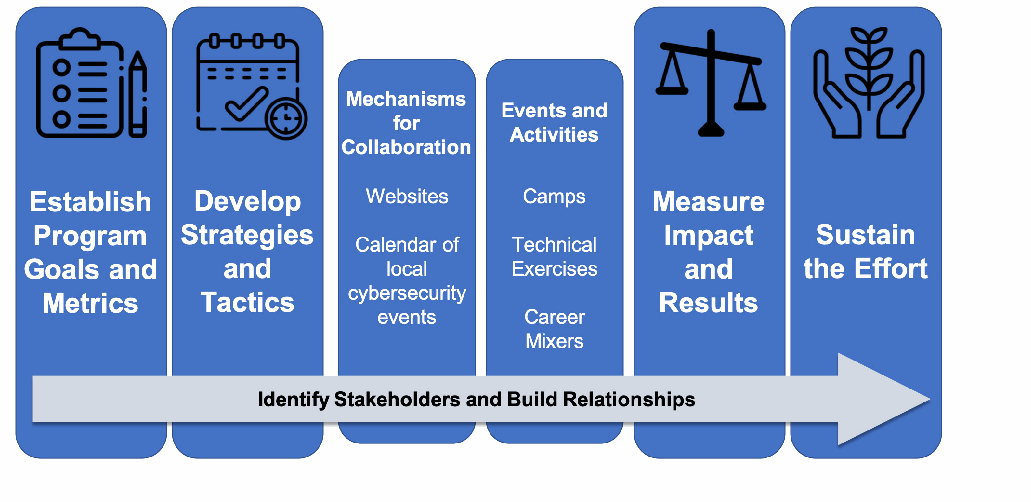
左から右へ並ぶ6本の青い柱で示したロードマップの図です。「Establish Program Goals and Metrics」(チェックリストのアイコン)、「Develop Strategies and Tactics」(チェック印と時計のある暦のアイコン)、「Mechanisms for Collaboration」(項目は「Websites」「Calendar of local cybersecurity events」)、「Events and Activities」(項目は「Camps」「Technical Exercises」「Career Mixers」)、「Measure Impact and Results」(天秤のアイコン)、「Sustain the Effort」(植物を支える両手のアイコン)の順です。中央の2本は短く、戦略の段階の下位の項目として置かれています。6本の柱の下部を右向きの灰色の矢印が横切り、「Identify Stakeholders and Build Relationships」と書かれています。
Figure 1 - RAMPS Roadmap Graphic
図 1 - RAMPS ロードマップの図
3.1 Getting Started
3.1 始めるにあたって
Start by identifying a lead organization that can be the catalyst to lead and keep the effort moving forward. Second, identify people willing to provide formal administrative support including scheduling, organizing, and documenting convenings and tracking progress. Consider having a project manager as part of the administrative team who can help to organize the project, manage workflow, coordinate meetings, and hold organizations accountable for their outcomes.
まず、取り組みを先導し、前進させ続ける触媒となりうる主導組織を特定します。次に、会合の日程調整、運営、文書化、進捗の追跡を含む、正式な事務的支援を提供する意思のある人々を特定します。事務局の一員として、プロジェクトの整理、ワークフローの管理、会議の調整を行い、各組織にその成果に対する責任を負わせることができるプロジェクトマネージャーを置くことを検討します。
To determine the scope of a regional alliance there are many criteria for consideration. Regions can vary in size and range from specific cities to economic communities that cross state boundaries. Refer to section 1.1 for examples of regions from the RAMPS pilot programs.
地域アライアンスの範囲を決めるには、検討すべき多くの基準があります。地域の規模はさまざまで、特定の都市から、州の境界をまたぐ経済共同体にまで及びます。RAMPS パイロットプログラムの地域の例については、1.1 節を参照してください。
Consider the following when defining an alliance:
アライアンスを定義する際は、次の点を検討します。
•Create meaningful relationships with individual companies by inviting them to join advisory boards or serve as subject matter experts on panels and working groups.
•個々の企業を諮問委員会に招いたり、パネルやワーキンググループで専門分野の専門家を務めてもらったりして、意味のある関係を築きます。
•Research relationships that will be complementary to your goals and priorities.
•自らの目標や優先事項を補完する関係を調べます。
•Find anchor institutions and others who are already investing resources, including money or time, into similar efforts.
•中核となる機関と、すでに同様の取り組みに資金や時間などのリソースを投じている他の主体を見つけます。
•Determine where the most impact can be made and opportunities for impact, including economically-depressed areas or low-income areas.
•経済的に低迷している地域や低所得地域を含め、最も大きな影響を与えられる場所と、影響を与える機会を見極めます。
•Recognize statewide dynamics, drawing regional lines where it makes sense.
•州全体の力学を認識し、適切なところで地域の境界線を引きます。
•Seek out opportunities for virtual collaborations while also assessing the ability to make face-to-face contact so that work can start, and relationships can be built.
•仮想の連携の機会を探すとともに、作業を開始し、関係を築けるよう、対面で接触できるかどうかも評価します。
•Size regions appropriately so that it is reasonable and can be manageable with available resources, keeping in mind that local or state government funding may be tied to keeping jobs in a specific geographical area.
•地域の規模は、合理的で、利用できるリソースで管理できる適切な大きさにします。その際、地方政府や州政府の資金は、特定の地理的区域内の雇用を維持することに結びついている場合があることを念頭に置きます。
3.2 Identifying Stakeholders
3.2 ステークホルダーの特定
Including multiple types of stakeholders in your regional alliance will increase opportunities for success. It should be clear that the stakeholders of the alliance can vary across different regions. For instance, in areas near capital cities or military presences, government agencies, in their role as employers, can be strong partners. In other areas, industry could be the primary partner for such an alliance.
地域アライアンスに複数の種類のステークホルダーを含めると、成功の機会が増えます。アライアンスのステークホルダーは、地域によって異なりうることを明確にしておくべきです。たとえば、州都や軍の拠点の近くの地域では、政府機関が、雇用主という立場で、強力なパートナーになりえます。ほかの地域では、産業界がそのようなアライアンスの主要なパートナーになることもあります。
In addition to providing valuable insight and subject matter expertise, stakeholders may also have existing efforts that would benefit from participation in the alliance. Other groups may have tools, such as existing cyber ranges or established strategies or frameworks that can be utilized by the group. Finding synergies and identifying projects that can show early success to the community can help bring awareness and buy-in from the community.
ステークホルダーは、貴重な洞察や主題の専門知識を提供するだけでなく、アライアンスへの参加が役立つような既存の取り組みを持っている場合もあります。ほかのグループは、既存のサイバーレンジや、グループが活用できる確立された戦略やフレームワークなどのツールを持っている場合があります。相乗効果を見つけ、コミュニティに早期の成功を示せるプロジェクトを特定することは、コミュニティからの認知と賛同を得るのに役立ちます。
Table 1 provides an idea of the types of groups to consider when building a cybersecurity education and workforce regional alliance.
表 1 は、サイバーセキュリティ教育と人材の地域アライアンスを構築する際に検討すべきグループの種類の目安を示しています。
Table 1 – Types of Stakeholders
表 1 – ステークホルダーの種類
| Academia | Government | Industry | Other |
|---|---|---|---|
| Public and Private Primary and Secondary (K-12) Schools and Districts and Career Tech Centers | Local Government Business and Economic Development Offices | Local Small or Medium Sized Companies in Multiple Business Sectors (technology, health, energy, government services, financial, etc.) | Chambers of Commerce |
| School Boards | City and County Governments | Government Contractors | Regional Economic Development Organizations |
| Community Colleges | State Departments of Education | Professional Associations (InfraGard, ISACA, International Information System Security Certification Consortium , Information Systems Security Association, CompTIA, etc.) | Space Grant Consortiums |
| Public and Private Colleges and Universities, including Minority Serving Institutions and National Centers of Academic Excellence in Cybersecurity | Local and State Elected Officials including: Legislators, Governors, Caucuses, and Judges | Cybersecurity Companies Providing Products and Services to Other Organizations | Local Media |
| Other Academic Institutions (Trade Schools, Apprenticeship Programs, etc) | Federal Elected Officials (U.S. Representatives & Senators) | Non-profit Organizations (Trade Associations, Technology Councils) | |
| Influential Community Leaders, including: Parents, School Counselors, Career Navigators, Teachers and Faculty, Academic Administrators, and School Boards | Federal Agencies such as the National Science Foundation, Department of Homeland Security and Secret Service, Federal Bureau of Investigation, and Department of Defense | Small Business Development Centers | |
| Federally Funded Labs and Research and Development Centers |
| 学術界 | 政府 | 産業界 | その他 |
|---|---|---|---|
| 公立・私立の初等・中等(K-12)学校、学区、キャリア技術センター | 地方政府の事業・経済開発部門 | 複数の事業分野(技術、医療、エネルギー、政府サービス、金融など)の地元の中小企業 | 商工会議所 |
| 教育委員会 | 市・郡の政府 | 政府の契約業者 | 地域の経済開発組織 |
| コミュニティカレッジ | 州の教育省 | 専門家団体(InfraGard、ISACA、International Information System Security Certification Consortium、Information Systems Security Association、CompTIA など) | Space Grant Consortiums |
| 公立・私立のカレッジと大学(マイノリティ支援機関や National Centers of Academic Excellence in Cybersecurity を含む) | 地方・州の選出公職者(議員、知事、議員連盟、裁判官を含む) | 他の組織に製品やサービスを提供するサイバーセキュリティ企業 | 地元メディア |
| その他の教育機関(専門学校、見習制度のプログラムなど) | 連邦の選出公職者(米国の下院議員・上院議員) | 非営利組織(業界団体、技術協議会) | |
| 影響力のある地域の指導者(保護者、スクールカウンセラー、キャリアナビゲーター、教員、学術管理者、教育委員会を含む) | 国立科学財団、国土安全保障省およびシークレットサービス、連邦捜査局、国防総省などの連邦機関 | 中小企業開発センター | |
| 連邦政府が資金を提供する研究所および研究開発センター |
3.3 Building Relationships
3.3 関係の構築
After core stakeholders are identified, it is critical to begin building and maintaining both formal and informal relationships among them. These relationships can lead to additional opportunities for research, funding, work, and other areas of common interest. Relationships can initially be built by interviewing each stakeholder formally, based on a set of structured questions to determine their organization’s needs and wants, assets, and concerns. Next, holding a formal session to allow stakeholders to get to know one another can be useful, allowing the lead organization to report on existing synergies among the stakeholders, common concerns, and possible gap areas.
中核となるステークホルダーを特定したら、ステークホルダー間で正式および非公式の関係を築き、維持し始めることが重要です。これらの関係は、研究、資金、仕事、その他の共通の関心分野における追加の機会につながる可能性があります。関係は、まず、各ステークホルダーに対して、組織のニーズと要望、資産、懸念を把握するための一連の構造化された質問に基づいて、正式にインタビューすることで築けます。次に、ステークホルダーが互いを知る機会となる正式なセッションを開くことが有用です。主導組織は、そこで、ステークホルダー間の既存の相乗効果、共通の懸念、考えられるギャップの領域について報告できます。
Once stakeholder contacts are established, it is critical to maintain the relationship. This can be done by holding quarterly or monthly meetings, roundtables, workshops, or conferences. Regular meetings keep the stakeholders engaged in the project, while periodic workshops and conferences allow the regional alliance to expand its reach by bringing in experts in specific topics and opening these events to the public.
ステークホルダーとの接点ができたら、その関係を維持することが重要です。これは、四半期ごとまたは毎月の会合、ラウンドテーブル、ワークショップ、会議を開くことで行えます。定期的な会合は、ステークホルダーをプロジェクトに関与させ続けます。一方、定期的なワークショップや会議は、特定のトピックの専門家を招き、これらのイベントを一般に公開することで、地域アライアンスが影響の及ぶ範囲を広げることを可能にします。
3.4 Establishing Program Goals
3.4 プログラム目標の設定
As a prerequisite to forming alliances and developing a plan of action, it is important to perform an environmental scan of existing efforts to minimize unnecessary duplication of effort. While this activity will be ongoing, an initial assessment of efforts already in place and existing groups who may have a similar mission is beneficial.
アライアンスを形成し、行動計画を策定するための前提条件として、不要な作業の重複を最小限にするために、既存の取り組みについて環境調査を行うことが重要です。この活動は継続的に行われますが、すでに実施されている取り組みと、同様の使命を持つ可能性のある既存のグループについての初期評価が有益です。
Analyze existing supply of potential cybersecurity workers and how to move them into cybersecurity careers. Start by examining traditional technology fields – computer science and engineering – but also consider non-traditional disciplines as well as adults who can be reskilled to move into cybersecurity. For example, start by creating an inventory of existing information technology programs in area high schools, colleges and universities, and private training programs, looking for those that have a cybersecurity focus. Next, assess which organizations support extra-curricular activities such as CyberPatriot competition teams or GenCyber summer camps for students and teachers. Representatives from organizations that have existing programs or have begun to develop new programs can be recruited to join the core group of alliance stakeholders.
サイバーセキュリティ人材となりうる人々の既存の供給状況と、その人々をサイバーセキュリティのキャリアに移行させる方法を分析します。まず、コンピュータサイエンスや工学といった従来型の技術分野を調べますが、非従来型の分野や、リスキリングによってサイバーセキュリティに転身できる成人も検討します。たとえば、まず、地域の高校、カレッジや大学、民間のトレーニングプログラムにある既存の情報技術プログラムの一覧を作成し、サイバーセキュリティに重点を置いているものを探します。次に、学生と教員向けの CyberPatriot の競技チームや GenCyber の夏季キャンプなど、課外活動を支援している組織を評価します。既存のプログラムを持っているか、新しいプログラムの開発を始めている組織の代表者を、アライアンスのステークホルダーの中核グループに参加するよう募ることができます。
After assessing the landscape, create a vision for the collaboration. Consider the target stakeholder groups and the potential impact of the regional alliance and its ability to improve existing efforts and launch new initiatives. To be successful, leaders from the various stakeholder groups need to define scale, scope, and boundaries for the program. Often, a subgroup from the core team of stakeholders can develop a draft mission and vision, asking for input from the larger group before finalizing them. Completing this step early will allow stakeholders to buy in to the vision early, too, making it easier to align themselves with program priorities and activities and recruit additional members to help.
状況を評価した後、連携のビジョンを作ります。対象となるステークホルダーのグループと、地域アライアンスが与えうる影響、さらに既存の取り組みを改善し新しい取り組みを立ち上げる能力を検討します。成功するには、さまざまなステークホルダーグループのリーダーが、プログラムの規模、範囲、境界を定義する必要があります。多くの場合、ステークホルダーの中核チームの小グループが、ミッションとビジョンの案を作成し、確定する前に、より大きなグループに意見を求めることができます。この手順を早期に終えることで、ステークホルダーが早い段階でビジョンに賛同することも可能になり、プログラムの優先事項や活動に自らを整合させ、協力してもらうために追加のメンバーを募ることが容易になります。
3.4.1 Make a Realistic Plan
3.4.1 現実的な計画の策定
Begin by determining the purpose of the program – the “why.” This will be unique to each regional alliance but should be agreed upon by all stakeholders involved. Examples of purpose can range from wanting to grow talent in specific categories of cybersecurity work to educating executives on why cybersecurity should be a priority for their organizations and how they can build their resiliency through a stronger cybersecurity workforce. A well-articulated purpose statement can help to rally additional employers, K-20 faculty and administrators, and non-profit leaders to work collaboratively to reach program goals.
まず、プログラムの目的、つまり「なぜ」を決めることから始めます。これは地域アライアンスごとに固有のものですが、関わるすべてのステークホルダーが合意すべきものです。目的の例は、サイバーセキュリティ業務の特定のカテゴリで人材を育てることから、サイバーセキュリティをなぜ自らの組織の優先事項とすべきか、より強力なサイバーセキュリティ人材を通じてどのようにレジリエンスを高められるかを経営幹部に教育することまで、多岐にわたります。適切に表現された目的の説明は、プログラムの目標を達成するために協力するよう、さらに多くの雇用主、K-20の教員や管理者、非営利組織のリーダーを結集するのに役立ちます。
3.4.2 Start the Documentation Processes
3.4.2 文書化プロセスの開始
Having a well-documented plan will not only keep efforts focused but also serve as a reference point when reaching out to new stakeholders. Additionally, keeping record of progress and success can lead to potential funding and program expansion, often from outside the group’s sphere of influence. Providing timelines in the plan will help keep alliance members organized and focused, especially as the effort grows. Publishing this information allows participants to speak with one voice about the purpose of the effort and its execution which helps to amplify the alliance’s efforts. It also helps with celebrating progress as milestones will be well-known, and progress will be easy to monitor.
十分に文書化された計画があれば、取り組みの焦点が保たれるだけでなく、新しいステークホルダーに働きかけるときの参照点にもなります。さらに、進捗と成功の記録を残すことで、多くの場合、グループの影響圏の外から、潜在的な資金提供やプログラムの拡大につながる可能性があります。計画にタイムラインを示すことは、特に取り組みが大きくなるにつれて、アライアンスのメンバーが整理され、焦点を保つのに役立ちます。この情報を公表することで、参加者が取り組みの目的とその実行について一貫した説明をできるようになり、アライアンスの取り組みを増幅するのに役立ちます。また、マイルストーンが広く知られ、進捗を監視しやすくなるため、進捗を祝うことにも役立ちます。
The RAMPS pilot programs had varying methods to document their strategic plans and progress made throughout the duration of their projects. Methods included the development of strategic plans and project plans, conducting regular meetings with stakeholders, and producing minutes and posting proceedings from workshops.
RAMPS パイロットプログラムは、プロジェクトの期間を通じて、戦略計画と進捗を文書化するために、さまざまな方法を用いていました。方法には、戦略計画とプロジェクト計画の策定、ステークホルダーとの定期的な会合の開催、議事録の作成とワークショップの議事の掲載が含まれていました。
3.5 Developing Strategies and Tactics
3.5 戦略と戦術の策定
There are many long and short-term activities that can be pursued which will vary depending on the mission, vision, and the available resources of your program. The RAMPS pilot programs identified common tactics that were beneficial to all projects; these are described below by way of mechanisms for collaboration and holding events and activities.
追求できる長期および短期の活動は数多くあり、プログラムの使命、ビジョン、利用できるリソースに応じて異なります。RAMPS パイロットプログラムは、すべてのプロジェクトにとって有益だった共通の戦術を特定しました。それらは、連携の仕組みと、イベントや活動の開催という形で、以下に記述されています。
3.5.1 Establish Mechanisms for Collaboration
3.5.1 連携の仕組みの確立
Focusing on external collaboration and information sharing, a website should be established to serve as a resource for partners and outreach to new community members. The website can be a landing place to share resources, links to career discovery tools, and a calendar of local cybersecurity events. It can also provide a space to share documentation of the alliance’s progress and reports.
外部との連携と情報共有に焦点を当てて、パートナーのリソースとなり、新しいコミュニティメンバーへのアウトリーチにもなるウェブサイトを設けるべきです。このウェブサイトは、リソース、キャリア探索ツールへのリンク、地域のサイバーセキュリティイベントのカレンダーを共有する場所にできます。また、アライアンスの進捗の文書や報告書を共有する場も提供できます。
Internal collaboration, on the other hand, can be managed through project management platforms. There are free project management or collaboration tools available to consider or a stakeholder member of your alliance may have access to a tool that can be shared. Examples of tools used for the RAMPS pilots include GoogleDocs, GoogleSheets, and SharePoint.
一方、内部の連携は、プロジェクト管理プラットフォームで管理できます。検討できる無料のプロジェクト管理ツールや連携ツールがあります。また、アライアンスのステークホルダーのメンバーが、共有できるツールを利用できる場合もあります。RAMPS のパイロットで使われたツールの例には、GoogleDocs、GoogleSheets、SharePoint があります。
3.5.2 Host Events and Activities
3.5.2 イベントと活動の開催
Holding events to introduce stakeholders to one another and give them baseline information to place them on equal footing is a great way to launch a new regional alliance. In the short term, the RAMPS pilots found that it is significantly better for the program if events get started immediately, noting that the desire to achieve perfection can get in the way of getting started. Implementing smaller pilot events or iterations of an event or activity can be a good place to start and then continuously improved upon. Example activities include:
ステークホルダーを互いに紹介し、対等な立場に立てるよう基本情報を提供するイベントを開くことは、新しい地域アライアンスを立ち上げる優れた方法です。RAMPS のパイロットでは、短期的には、イベントをすぐに開始することがプログラムにとって大幅に有益であることが分かりました。また、完璧を求める気持ちが開始の妨げになりうると指摘しました。小規模なパイロットイベントや、イベントまたは活動を繰り返し実施することから始め、それを継続的に改善していくことが、良い出発点となりえます。活動の例には、次のものがあります。
Technical Exercises Including Competitions and Ranges
競技会やレンジを含む技術演習
•Cybersecurity Competitions or Challenges - learners use skills in networking, operating systems, and basic computer science concepts to defend a digital infrastructure. They often compete in teams and use virtual images to locate potential vulnerabilities and harden their system, all while maintaining critical services. Teams may also be required to participate in a written assessment of a company's cybersecurity needs as well as a proposal and bid for services to be provided. Examples include K-12 or collegiate competitions, challenges, capture the flags, Packet Wars, and Hack-a-thons.
•サイバーセキュリティの競技会またはチャレンジ - 学習者は、ネットワーキング、オペレーティングシステム、基本的なコンピュータサイエンスの概念に関するスキルを使って、デジタルインフラストラクチャーを防御します。多くの場合、チームで競い、仮想イメージを使って潜在的な脆弱性を見つけ、重要なサービスを維持しながらシステムを堅牢化します。チームには、企業のサイバーセキュリティニーズに関する文書による評価に加え、提供するサービスの提案書と入札書の作成への参加が求められる場合もあります。例には、K-12 または大学対抗の競技会、チャレンジ、capture the flag、Packet Wars、ハッカソンがあります。
•Cyber Ranges - virtual labs and simulations that help train learners. Examples include the Arizona Cyber Warfare Range, HRCyber Cyber Lab Collaborative, Old Dominion University/Tidewater Community College/Thomas Nelson Community College cyber virtual lab partnerships, and The University at Albany/New York State Information Technology Services Cyber Range.
•サイバーレンジ - 学習者の訓練に役立つ仮想ラボとシミュレーション。例には、Arizona Cyber Warfare Range、HRCyber Cyber Lab Collaborative、Old Dominion University/Tidewater Community College/Thomas Nelson Community College のサイバー仮想ラボのパートナーシップ、The University at Albany/New York State Information Technology Services Cyber Range があります。
Informational
情報提供
•Industry Day - invite employers to learn more about the region’s cybersecurity education initiatives, learn how to “plug in” and assist, and network with area faculty and administrators.
•Industry Day - 雇用主を招き、地域のサイバーセキュリティ教育の取り組みについて詳しく知ってもらい、どのように「参加」して支援できるかを学んでもらい、地域の教員や管理者と人脈を築いてもらいます。
•Exhibit Booth - seek out industry stakeholders at established events or conferences to find a champion of the company and encourage employers to provide experiential learning if they want to hire experienced candidates.
•展示ブース - 確立されたイベントやカンファレンスで産業界のステークホルダーを探し、企業の推進者を見つけて、経験のある候補者を採用したい雇用主には体験型学習を提供するよう促します。
•Student and Parent Events - hold events such as Cyber Saturdays for students to work with cybersecurity experts from both industry and academia while their parents are given information on the potential career opportunities in cybersecurity.
•学生と保護者向けのイベント - Cyber Saturdays のようなイベントを開き、学生が産業界と学術界の両方のサイバーセキュリティ専門家と交流する間、保護者にはサイバーセキュリティ分野で考えられるキャリアの機会についての情報を提供します。
•Presentations - provide career awareness materials to learners. Materials from the National Cybersecurity Career Awareness Week Toolkit can be downloaded and adjusted so that they are tailored to your audience.
•プレゼンテーション - 学習者にキャリア意識向上のための資料を提供します。National Cybersecurity Career Awareness Week Toolkit の資料は、ダウンロードして調整し、対象者に合わせることができます。
•Workshops - coordinate or participate in meetings to engage in intensive discussion and collaboration with stakeholders. Examples include Developing the Curriculum (DACUM) workshop and strategic planning workshops.
•ワークショップ - ステークホルダーとの集中的な議論と連携を行うための会合を調整するか、それに参加します。例には、Developing the Curriculum(DACUM)ワークショップと戦略計画ワークショップがあります。
•Symposiums and Conferences - host, speak at, or network at cybersecurity conferences. Conferences can be geared toward information sharing and collaboration, training, or a mix.
•シンポジウムとカンファレンス - サイバーセキュリティのカンファレンスを主催する、登壇する、またはそこで人脈を築きます。カンファレンスは、情報共有と連携、トレーニング、またはその両方を組み合わせたものに向けることができます。
Educational
教育
•Camps - host, participate in, create lesson plans for, promote, or volunteer at camps such as Cyber Warrior Princess, GenCyber, CyberPatriot, or youth coding camps that are based on using the Raspberry Pi.
•キャンプ - Cyber Warrior Princess、GenCyber、CyberPatriot などのキャンプや、Raspberry Pi の利用に基づく青少年向けのコーディングキャンプを、主催する、参加する、授業計画を作成する、宣伝する、またはボランティアとして参加します。
•High School and College Internships - help connect students with employers to provide them with internship opportunities and assist companies in developing internship programs.
•高校・大学のインターンシップ - 学生が雇用主とつながり、インターンシップの機会を得られるよう支援し、企業がインターンシッププログラムを開発するのを支援します。
•Executive Forums and Trainings - offer forums for executives to share cybersecurity concerns and provide trainings to inform senior leaders on the importance of a strong cybersecurity workforce. Executive awareness programs should focus on basic cybersecurity awareness so that executives feel empowered to make proactive investments in cybersecurity. The education should be case-driven, addressing specific tasks that executives need for cybersecurity management in their organizations.
•経営幹部向けのフォーラムとトレーニング - 経営幹部がサイバーセキュリティに関する懸念を共有できるフォーラムを提供し、強力なサイバーセキュリティ人材の重要性を上級リーダーに伝えるためのトレーニングを提供します。経営幹部向けの意識向上プログラムは、経営幹部がサイバーセキュリティへの積極的な投資を行う力を得られるよう、基本的なサイバーセキュリティの意識向上に焦点を当てるべきです。教育は事例に基づくものとし、経営幹部が自らの組織でサイバーセキュリティを管理するために必要となる具体的な業務を扱います。
•Scholarships - seek out government funding or sponsorships from industry to provide financial assistance to students pursuing education in cybersecurity or related programs.
•奨学金 - サイバーセキュリティまたは関連プログラムの教育を受ける学生に経済的な援助を提供するために、政府の資金や産業界からのスポンサーシップを探します。
Networking
ネットワーキング
•Internship Fairs - host or encourage students to participate in in-person or virtual fairs to meet with employers and explore opportunities for employment through internships.
•インターンシップフェア - 学生が雇用主と会い、インターンシップを通じた就職の機会を探せるよう、対面または仮想のフェアを開催するか、学生の参加を促します。
•Career Mixers - host or encourage students to participate in activities to help prepare them for the workforce and facilitate opportunities to meet with employers, such as mock interviews or resumé building workshops.
•キャリアミキサー - 模擬面接や履歴書作成ワークショップなど、学生が就職の準備をし、雇用主と会う機会を得られるよう支援する活動を開催するか、学生の参加を促します。
•Meetups - host, volunteer, or be a guest speaker at meetup events that convene interested parties to learn about cybersecurity topics.
•ミートアップ - サイバーセキュリティのトピックについて学びたい関係者を集めるミートアップイベントを、主催する、ボランティアとして参加する、またはゲストスピーカーを務めます。
Media and Marketing
メディアとマーケティング
•Web Presence - create a website where you can post notifications of upcoming events, share resources, and keep others informed of your work.
•ウェブでの存在感 - 今後のイベントの告知を掲載し、リソースを共有し、自らの活動を他者に知らせ続けることのできるウェブサイトを作ります。
•Videos - create videos to promote cybersecurity education and career opportunities. Videos can include interviews with current practitioners to show what “a day in the life” looks like or provide data on the importance and impact of cybersecurity.
•動画 - サイバーセキュリティ教育とキャリアの機会を宣伝する動画を作ります。動画には、現役の実務者へのインタビューを含めて「ある一日」がどのようなものかを示したり、サイバーセキュリティの重要性と影響に関するデータを提供したりできます。
•Media Outlets - share your progress and accomplishments with news outlets and publishers to further boost your messaging.
•報道機関 - メッセージをさらに後押しするため、進捗と成果をニュースメディアや出版社と共有します。
3.6 Measuring Impact and Results
3.6 影響と成果の測定
It is important to define metrics that will be used to measure the impact and results of the regional alliance. These metrics should be clearly defined and integrated into the plan early and updated along with all other documentation about the regional alliance’s efforts. Metrics may vary depending on the type, size, mission, and goals of the alliance. Example metrics used by the RAMPS pilots include:
地域アライアンスの影響と成果を測定するために用いる指標を定義することが重要です。これらの指標は、明確に定義して計画に早期に組み込み、地域アライアンスの取り組みに関する他のすべての文書とともに更新すべきです。指標は、アライアンスの種類、規模、使命、目標によって異なる場合があります。RAMPS のパイロットが用いた指標の例には、次のものがあります。
Environmental Scan Metrics
環境調査の指標
•Company surveys of employees and managers
•従業員と管理者を対象とした企業調査
•Number of students not able to be placed in employment
•就職できなかった学生の数
•Number of unfilled, available jobs in cybersecurity
•サイバーセキュリティ分野で、埋まっていない空きの求人数
•Number of educational programs offered and the number of students completing each program
•提供された教育プログラムの数と、各プログラムを修了した学生の数
Relationship Building/Stakeholder Metrics
関係構築・ステークホルダーの指標
•Number of executives that join the advisory board
•諮問委員会に加わる経営幹部の数
•Amount of support from leadership via financial resources and advocacy
•資金面での資源と支持表明による、リーダーシップからの支援の額
Events and Activities Metrics
イベントと活動の指標
•Attendance at community events
•地域イベントへの参加者数
•Attendance for full events vs. part of the event
•イベント全体への参加と、一部への参加の比較
•Individual and team ranking in competitions
•競技会での個人およびチームの順位
Media and Outreach Metrics
メディアとアウトリーチの指標
•View counts, comments, and shares on videos and other multimedia
•動画やその他のマルチメディアの視聴回数、コメント数、共有数
•Visits, clicks, and other metrics for websites and posted materials
•ウェブサイトや掲載資料への訪問数、クリック数、その他の指標
•Number of documents or digital artifacts produced and distribution numbers
•作成された文書やデジタル成果物の数と、配布数
•Number of media contact connections
•メディアとのつながりの数
•Number of press releases
•プレスリリースの数
Impact Metrics
影響の指標
•Number of industry partners or other meaningful relationships, new jobs, or companies created
•産業界のパートナーやその他の意味のある関係の数、新たに創出された雇用や企業の数
•Stories that can be told about the results from and effects of the alliance – i.e., that show external validation, additional funding, promotion by others, etc.
•アライアンスの成果と効果について語れる事例(たとえば、外部による検証、追加の資金提供、他者による宣伝などを示すもの)
•Level of economic return – for example, transfer pathway agreements saving students money and getting them into the workforce quicker
•経済的な見返りの水準(たとえば、編入経路の協定により、学生が費用を節約でき、より早く就職できるようになること)
•Number of job seekers hired
•採用された求職者の数
•Number of new programs created
•新たに作成されたプログラムの数
•Number of barriers removed – for example, helping underserved communities gain access to computers
•取り除かれた障壁の数(たとえば、十分なサービスを受けられていないコミュニティがコンピューターを利用できるよう支援すること)
•Number of new faculty
•新任の教員の数
•Increased enrollment numbers
•入学者数の増加
Other Metrics
その他の指標
•Number of formal internships created
•正式に創設されたインターンシップの数
•Measuring multi-purpose use for products, tools, or resources that were created
•作成された製品、ツール、リソースの多目的な利用の測定
•Number of internships or apprenticeships completed
•修了したインターンシップまたは見習制度の数
•Increase in community college crossover via articulation agreements and the expansion of the two-year to four-year pipeline
•単位互換協定によるコミュニティカレッジの相互乗り入れの増加と、2 年制から 4 年制への経路の拡大
•Increase in high school programs, both academic and extra-curricular activities such as competition teams
•高校のプログラムの増加(学術的なものと、競技チームなどの課外活動の両方)
Measurement of progress, impact, and results leads to evidence of maturity. Building a cybersecurity community involves integrating the entire ecosystem within a region, including the resources of educational institutions, industry, and state and federal governments to facilitate collaborations that support the community’s entire spectrum of cybersecurity needs and workforce potential. The goals of such an ecosystem are: ensuring strong and community-relevant training, increased cybersecurity workforce capacity, facilitated learner placement, and fostered cybersecurity innovation. The process of building the ecosystem requires foundational efforts and careful planning as the program matures over time. Figure 2 highlights the different stages of maturity and benchmarked activities against which the maturity of a program can be gauged.
進捗、影響、成果の測定は、成熟度の証拠につながります。サイバーセキュリティコミュニティを構築するには、地域内のエコシステム全体を統合する必要があります。これには、教育機関、産業界、州政府および連邦政府のリソースが含まれ、コミュニティのサイバーセキュリティニーズと人材の潜在力の全域を支える連携を促進します。このようなエコシステムの目標は、強力でコミュニティに関連性のあるトレーニングの確保、サイバーセキュリティ人材の受け入れ能力の向上、学習者の配置の促進、サイバーセキュリティのイノベーションの育成です。エコシステムを構築するプロセスには、プログラムが時間をかけて成熟していくなかで、基礎的な取り組みと慎重な計画が必要です。図 2 は、成熟度のさまざまな段階と、プログラムの成熟度を測るための基準となる活動を示しています。
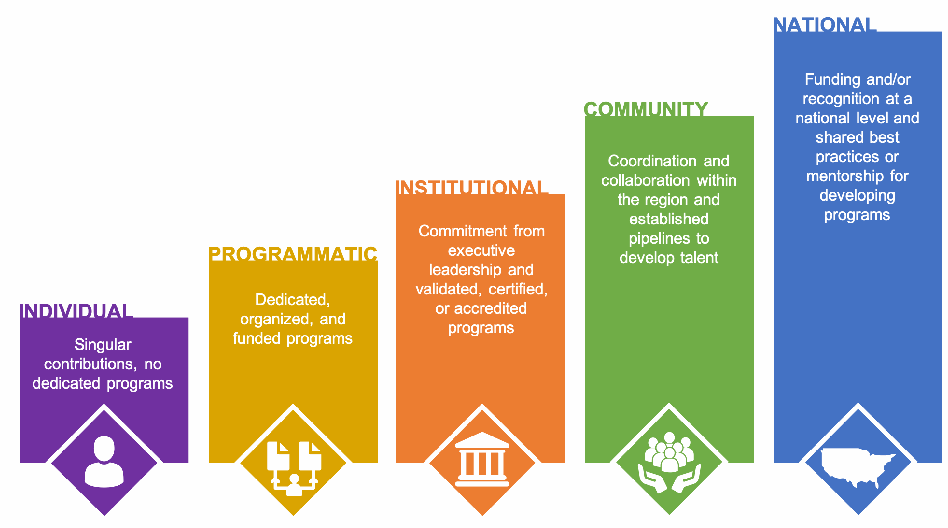
成熟度モデルを、左から右へ階段のように高くなる5本の色付きの柱で示した図です。各柱の上に段階名、中に短い説明、下端のひし形にアイコンがあります。「INDIVIDUAL」(紫、人物のアイコン)は「個人による単独の貢献で、専用プログラムはない」、「PROGRAMMATIC」(黄、文書と人物をつないだアイコン)は「専用に組織され、資金提供を受けたプログラム」、「INSTITUTIONAL」(橙、柱のある建物のアイコン)は「経営幹部のリーダーシップによるコミットメントと、検証、認証、または認定を受けたプログラム」、「COMMUNITY」(緑、両手に支えられた人々のアイコン)は「地域内での調整と連携、および人材育成のために確立された経路」、「NATIONAL」(青、米国の地図のアイコン)は「国レベルでの資金提供および/または認知と、プログラム開発に向けたベストプラクティスの共有またはメンタリング」です。
Figure 2 - RAMPS Maturity Model
図 2 - RAMPS 成熟度モデル
Level 1: Individual
レベル 1: 個人
•Individual faculty, researchers, or employees at non-profit organizations secure funding and work on projects
•個々の教員、研究者、または非営利組織の従業員が、資金を確保してプロジェクトに取り組む
•Some training or formal education courses in cybersecurity, but no dedicated programs
•サイバーセキュリティに関するトレーニングや正規の教育課程はあるが、専用のプログラムはない
•Volunteer practitioners serve as speakers or mentors for individual classes, clubs, meetups, or community meetings
•ボランティアの実務者が、個々の授業、クラブ、ミートアップ、地域の会合で講演者やメンターを務める
Level 2: Programmatic
レベル 2: プログラム
•Dedicated cybersecurity programs are established within K-12, graduate or undergraduate, and through training providers or employers
•K-12、大学院または学部、およびトレーニング提供者や雇用主を通じて、専用のサイバーセキュリティプログラムが確立されている
•Funded research programs
•資金提供を受けた研究プログラム
•Organized and recurring extra-curricular activities
•組織化され、繰り返し行われる課外活動
Level 3: Institutional
レベル 3: 機関
•Dedicated champion at the institution or organization
•機関または組織に専任の推進者がいる
•Commitment from upper management
•上級管理職のコミットメント
•Institutional resources dedicated to cybersecurity education, research, and workforce development
•サイバーセキュリティの教育、研究、人材育成に充てられた機関のリソース
•Accredited programs such as Career and Technical Student Organizations, National Centers of Academic Excellence in Cybersecurity, and participation in the Registered Apprenticeship Program
•Career and Technical Student Organizations、National Centers of Academic Excellence in Cybersecurity、Registered Apprenticeship Program への参加などの認定プログラム
•Established hiring programs such as employer-led commitments or campaigns and involvement of University Career Services in student placement
•雇用主主導のコミットメントやキャンペーン、学生の配置への University Career Services の関与など、確立された採用プログラム
•Established cybersecurity research centers
•確立されたサイバーセキュリティ研究センター
Level 4: Community
レベル 4: コミュニティ
•Established community advisory board with diverse representation from academia, industry, and government
•学術界、産業界、政府から多様な代表者が参加する、確立されたコミュニティ諮問委員会
•On-going collaborations across multiple academic institutions, including K-20 and coordinated programs across multiple institutions (e.g. pipeline from community colleges to four-year colleges and universities)
•K-20 を含む複数の学術機関にまたがる継続的な連携と、複数の機関にまたがる調整されたプログラム(たとえば、コミュニティカレッジから 4 年制のカレッジや大学への経路)
•Growing public-private partnerships in research and training
•研究とトレーニングにおける官民パートナーシップの拡大
•Dedicated cybersecurity job fairs
•専用のサイバーセキュリティ就職フェア
•Cybersecurity awareness for community via seminars and lectures for different demographic groups, learning pamphlets for different audiences, and basic functional cybersecurity classes for the community
•さまざまな年齢層・属性向けのセミナーや講義、さまざまな対象者向けの学習用パンフレット、コミュニティ向けの基本的な実用サイバーセキュリティ講座によるコミュニティのサイバーセキュリティ意識向上
•Academic programs coordinated with the community such as working with state agencies for retraining the workforce, working with corporations to provide courses on site, and developing high school programs that offer credit at colleges or universities
•労働力の再訓練のために州の機関と連携すること、企業と協力して現地で講座を提供すること、カレッジや大学で単位を取得できる高校のプログラムを開発することなど、コミュニティと連携して実施する学術プログラム
•Community involvement in cybersecurity events and academic programs such as business-sponsored public lectures
•企業がスポンサーとなる公開講座など、サイバーセキュリティのイベントや学術プログラムへのコミュニティの関与
•Economic development programs to support innovation in cybersecurity
•サイバーセキュリティにおけるイノベーションを支える経済開発プログラム
•Student placement pipeline into regional employers
•地域の雇用主への学生の就職につなげる人材供給経路
Level 5: National
レベル 5: 全国
•National-level reputation and ranking of educational programs
•教育プログラムの全国的な評判とランキング
•Research collaborations with universities across the country
•全国の大学との研究連携
•Engagement with federal agencies, including economic development funders
•経済開発の資金提供者を含む、連邦機関との関わり
•Shared best practices for other communities to use and learn from
•他のコミュニティが活用し、そこから学べる、共有されたベストプラクティス
•Well-funded security research programs with large federal and state grants
•連邦および州の大規模な助成金による、潤沢な資金を持つセキュリティ研究プログラム
•Student placement pipeline with national employers
•全国の雇用主への学生の就職につなげる人材供給経路
3.7 Sustaining the Effort
3.7 取り組みの持続
The ultimate goal should be to create a self-sustaining effort that will continue to address the workforce development needs of the cybersecurity ecosystem within the region. Tapping into existing efforts and initiatives at the start of forming an alliance can enable progress in the long term to grow and gain momentum. Additionally, allowing participants maximum flexibility to define the alliance’s goals and activities increases the likelihood that the initiatives will be sustainable. With buy-in from all participants, there is greater likelihood that specific projects and goals of the program will spin off into their own efforts.
最終的な目標は、地域内のサイバーセキュリティのエコシステムにおける人材育成のニーズに引き続き対処する、自立して持続する取り組みを作ることです。アライアンスの形成当初に既存の取り組みやイニシアチブを活用することで、長期にわたって進展を促し、勢いを増すことができます。さらに、アライアンスの目標と活動を定義するうえで参加者に最大限の柔軟性を与えることは、イニシアチブが持続可能になる可能性を高めます。すべての参加者の賛同があれば、プログラムの個別のプロジェクトや目標が、それぞれ独自の取り組みとして発展する可能性が高まります。
It can be challenging to sustain a program with a mix of funding resources. Before you commit to accepting new funding sources, research and consider carefully all possible funding sources, including federal and state grants, private sector grants, and industry memberships. For example, the RAMPS pilot groups sought out research and workforce development grants and growth and opportunity funds from state and local governments. They applied for federal government funding opportunities from the National Science Foundation, Department of Labor, and others to gain additional funding to continue momentum.
資金源が混在するプログラムを持続させることは、困難な場合があります。新しい資金源の受け入れを決める前に、連邦・州の助成金、民間部門の助成金、業界の会費など、考えられるすべての資金源を調べ、慎重に検討してください。たとえば、RAMPS のパイロットグループは、研究と人材育成の助成金や、州政府・地方政府の成長・機会基金を探しました。また、勢いを維持するための追加資金を得るため、National Science Foundation や Department of Labor などの連邦政府の資金提供の機会に応募しました。
4 Conclusions and Other Considerations
4 結論とその他の考慮事項
In conclusion, bringing together the multiple stakeholders in the cybersecurity ecosystem – industry, government, and educational institutions – can help communities address many of the cybersecurity workforce challenges that they face today. There are synergies among stakeholders that can be a natural glue for establishing a collaborative and local cybersecurity ecosystem. However, recognizing those synergies requires careful nurturing, relationship building, and patience. The challenge is to convince organizations to invest in collaboration as a business imperative and as a mutually beneficial and strengthening activity, not just as a charitable contribution.
結論として、サイバーセキュリティのエコシステムにおける複数のステークホルダー、すなわち産業界、政府、教育機関を結集することは、コミュニティが今日直面しているサイバーセキュリティ人材の課題の多くに対処する助けになります。ステークホルダー間には相乗効果があり、それが、連携した地域のサイバーセキュリティエコシステムを確立するための自然な接着剤になりえます。しかし、そうした相乗効果を認識するには、慎重な育成、関係構築、忍耐が必要です。課題は、組織に対し、連携への投資を、単なる慈善的な寄付としてではなく、事業上の必須事項として、また相互に有益で強化し合う活動として行うよう説得することです。
This document provides a roadmap based upon models from the five RAMPS pilot projects from which regional alliances and partnerships can be formed to strengthen the cybersecurity workforce. It does not include an all-encompassing project plan but rather a starting place and important milestones.
本文書は、サイバーセキュリティ人材を強化するための地域アライアンスとパートナーシップを形成できる、5 つの RAMPS パイロットプロジェクトのモデルに基づくロードマップを示します。すべてを網羅するプロジェクト計画ではなく、出発点と重要なマイルストーンを示すものです。
Each RAMPS program was organized differently and had unique goals.
各 RAMPS プログラムは、それぞれ異なる形で組織され、独自の目標を持っていました。
Cin-Day Cyber created new synergies between individuals and companies that had not existed previously. The initiative enabled a deeper understanding of the cybersecurity industry and workforce needs and helped strengthen the alliance among industry, higher education, and K-12. Further, the work inspired numerous students to pursue careers in cybersecurity, established vital connections with industry, enhanced institutional collaboration, and provided critical research in cybersecurity for the region.
Cin-Day Cyber は、これまで存在しなかった、個人と企業の間の新しい相乗効果を生み出しました。この取り組みは、サイバーセキュリティ産業と人材ニーズへの理解を深め、産業界、高等教育、K-12 の間のアライアンスを強化するのに役立ちました。さらに、この活動は多くの学生にサイバーセキュリティのキャリアを目指す意欲を与え、産業界との重要なつながりを確立し、機関間の連携を強め、地域にとって重要なサイバーセキュリティの研究を提供しました。
The Cyber Prep initiative established a formal, sustainable partnership between school districts, employers, Pikes Peak Community College, and many local workforce development-related agencies and organizations. After thoughtfully assessing local assets and documenting gaps, the Cyber Prep team launched several new efforts to create or enhance programs for teens to explore cybersecurity. These efforts now bolster the region’s larger cybersecurity ecosystem.
Cyber Prep の取り組みは、学区、雇用主、Pikes Peak Community College、そして人材育成に関連する多くの地域の機関や組織の間に、正式で持続可能なパートナーシップを確立しました。Cyber Prep のチームは、地域の資産を慎重に評価し、ギャップを文書化したうえで、10 代の若者がサイバーセキュリティを探究するためのプログラムを新たに作る、または強化するいくつかの取り組みを立ち上げました。これらの取り組みは、現在、地域のより大きなサイバーセキュリティエコシステムを支えています。
HRCyber expanded the cybersecurity ecosystem within Hampton Roads (southeast Virginia) by linking stakeholders together who may not have otherwise connected and developed ways that these stakeholders could partner and collaborate in finding qualified candidates to fill the cybersecurity workforce needs across the region.
HRCyber は、Hampton Roads(バージニア州南東部)のサイバーセキュリティエコシステムを拡大しました。そのために、本来はつながっていなかったかもしれないステークホルダーを結びつけ、地域全体のサイバーセキュリティ人材のニーズを満たす適格な候補者を見つける際に、これらのステークホルダーが提携し連携する方法を開発しました。
At The University at Albany, the partners demonstrated that a strong cybersecurity regional alliance can be built (in the Capital District), and the academic program and students are reaping the benefits.
The University at Albany では、パートナーが、(Capital District に)強力なサイバーセキュリティの地域アライアンスを築けることを実証し、学術プログラムと学生はその恩恵を受けています。
As shown through the diversity of the RAMPS pilots, there is no one right way to build a regional alliance. Merely having an organization play the convener role can help cybersecurity workforce development in a region, leading to national impact.
RAMPS のパイロットの多様性が示すとおり、地域アライアンスを築く唯一の正しい方法はありません。ある組織が招集者の役割を担うだけでも、地域のサイバーセキュリティ人材育成の助けとなり、全国的な影響につながる可能性があります。
References
参考文献
[1] Frost & Sullivan (2017) 2017 Global Information Security Workforce Study Benchmarking Workforce Capacity and Response to Cyber Risk. https://www.isc2.org/-/media/B7E003F79E1D4043A0E74A57D5B6F33E.ashx
[1] Frost & Sullivan (2017) 2017 Global Information Security Workforce Study Benchmarking Workforce Capacity and Response to Cyber Risk. https://www.isc2.org/-/media/B7E003F79E1D4043A0E74A57D5B6F33E.ashx
[2] NICE Program Office (2016) NICE Strategic Plan. https://www.nist.gov/document/nicestrategicplan011218webpdf
[2] NICE Program Office (2016) NICE Strategic Plan. https://www.nist.gov/document/nicestrategicplan011218webpdf
[3] Social Science Research Center at Old Dominion University (2017) Final Data Report. http://securitybehavior.com/hrcyber/doc/2017_Final%20Data%20Report.pdf
[3] Social Science Research Center at Old Dominion University (2017) Final Data Report. http://securitybehavior.com/hrcyber/doc/2017_Final%20Data%20Report.pdf
[4] Pikes Peak Community College (2018) Cybersecurity Education And Training Assessment: Assessing the Skills Gap in the Colorado Springs MSA. Page 36 https://www.nist.gov/document/rampswesternregionfinalreportmay2019pdf
[4] Pikes Peak Community College (2018) Cybersecurity Education And Training Assessment: Assessing the Skills Gap in the Colorado Springs MSA. Page 36 https://www.nist.gov/document/rampswesternregionfinalreportmay2019pdf
Appendix A—Acronyms
付録 A — 略語
Selected acronyms and abbreviations used in this paper are defined below.
本稿で使用している主な略語と省略形を、以下に定義します。
| CAE | National Centers of Academic Excellence in Cybersecurity |
| Cin-Day Cyber | Cincinnati-Dayton Cyber Corridor |
| CTE | Career and Technical Education |
| CTSO | Career and Technical Student Organization |
| DACUM | Developing the Curriculum |
| HRCyber | Hampton Roads Cybersecurity Education, Workforce and Economic Development Alliance |
| NICE | National Initiative for Cybersecurity Education |
| NIST | National Institute of Standards and Technology |
| RAMPS | Regional Alliances and Multistakeholder Partnerships to Stimulate |
| SOCHE | Southwestern Ohio Council for Higher Education |
| STEM | Science, Technology, Engineering, and Math |
| CAE | National Centers of Academic Excellence in Cybersecurity |
| Cin-Day Cyber | Cincinnati-Dayton Cyber Corridor |
| CTE | キャリア・技術教育(Career and Technical Education) |
| CTSO | キャリア・技術系学生組織(Career and Technical Student Organization) |
| DACUM | カリキュラム開発(Developing the Curriculum) |
| HRCyber | Hampton Roads Cybersecurity Education, Workforce and Economic Development Alliance |
| NICE | National Initiative for Cybersecurity Education |
| NIST | 米国国立標準技術研究所 |
| RAMPS | サイバーセキュリティ教育と人材育成を促進するための地域アライアンスとマルチステークホルダーパートナーシップ(Regional Alliances and Multistakeholder Partnerships to Stimulate) |
| SOCHE | Southwestern Ohio Council for Higher Education |
| STEM | 科学・技術・工学・数学 |
Appendix B—Best Practices and Example Activities
付録 B — ベストプラクティスと活動例
This list provides examples and best practices used by the RAMPS Pilot programs. It is organized by five topic areas: Advising and Informing, Building Curriculum and Training Programs, Activities for Learners, Activities for Job Seekers, and Outreach.
この一覧は、RAMPS パイロットプログラムが用いた例とベストプラクティスを示しています。助言と情報提供、カリキュラムとトレーニングプログラムの構築、学習者向けの活動、求職者向けの活動、アウトリーチの 5 つのトピック領域に整理されています。
Advising and Informing
助言と情報提供
1.Create a cybersecurity advisory board with top executives of organizations which can be instrumental in creating synergistic relationships with employers.
1.雇用主との相乗的な関係を築くうえで重要な役割を果たしうる、組織の最高幹部によるサイバーセキュリティ諮問委員会を作ります。
a.The University at Albany created a very strong advisory board of senior organizational leadership which was instrumental in helping shape curriculum, organizing cybersecurity job fairs, providing direct recruitment of talent by employers, and building collaboration in funding opportunities. The advisory board also inspired several very talented cybersecurity professionals from local organizations to teach at the University at Albany and was beneficial in the development of relationships across multiple industries and academic institutions.
a.The University at Albany は、組織の上級リーダーによる非常に強力な諮問委員会を作りました。この委員会は、カリキュラムの形成、サイバーセキュリティ就職フェアの開催、雇用主による人材の直接採用、資金提供の機会における連携の構築に、大きな役割を果たしました。諮問委員会は、地元の組織で働く非常に優秀な複数のサイバーセキュリティ専門家が The University at Albany で教えるきっかけにもなり、複数の業界や学術機関にわたる関係の構築にも有益でした。
b.Cin-Day Cyber established a Leadership Council that met monthly and included key partners in the alliance such as higher education, economic development, K-12, industry, and government. The group acted as a steering committee to inform events and initiatives, as well as served as ambassadors for cybersecurity across the state of Ohio in an effort to extend relationship building that resulted in additional support for cybersecurity education.
b.Cin-Day Cyber は、高等教育、経済開発、K-12、産業界、政府などのアライアンスの主要なパートナーを含む、Leadership Council を設置し、毎月開催しました。このグループは、イベントやイニシアチブに助言する運営委員会として機能し、サイバーセキュリティ教育への追加の支援につながる関係構築を広げるため、Ohio 州全体でサイバーセキュリティの大使も務めました。
2.Bring together key faculty and administrators from across the educational spectrum to discuss what is taught at K-12, community colleges, and four-year institutions. This will assist in developing pathways into a cybersecurity career.
2.K-12、コミュニティカレッジ、4 年制の教育機関で何が教えられているかを議論するため、教育の全段階から主要な教員と管理者を集めます。これは、サイバーセキュリティのキャリアにつながる経路を築くのに役立ちます。
a.Cin-Day Cyber used a previously established Degree Finder, modified it to add cybersecurity degrees and certificates, then promoted the tool to students, showing them a variety of opportunities and career paths in cybersecurity.
a.Cin-Day Cyber は、以前から確立されていた Degree Finder を使い、サイバーセキュリティの学位と修了証を追加するよう修正したうえで、そのツールを学生に宣伝して、サイバーセキュリティにおけるさまざまな機会とキャリアパスを示しました。
3.Connect with local employers
3.地元の雇用主とつながります
a.Cyber Prep held annual Industry Day sessions, inviting employers to learn more about the region’s cybersecurity education initiatives, learn how to “plug in” and assist, and network with area faculty and administrators.
a.Cyber Prep は、毎年 Industry Day のセッションを開催し、雇用主を招いて、地域のサイバーセキュリティ教育の取り組みについて詳しく知ってもらい、どのように「参加」して支援できるかを学んでもらい、地域の教員や管理者と人脈を築いてもらいました。
b.Cyber Prep helped companies develop paid summer internships for high school students and helped school districts recruit participants and place them with employers. In all, 31 high school students were placed at 17 different companies across two summers of the program. Assignments included work with defense contractors where officials had to make the case that teens under age 18 could contribute in meaningful ways. The program was so successful that some students continued their internships into the fall semester while others received offers to return to work in subsequent summers as they entered college. All employers were impressed with the level of talent, helping them to understand that hiring a local workforce is a viable option.
b.Cyber Prep は、企業が高校生向けの有給の夏季インターンシップを開発するのを支援し、学区が参加者を募集して雇用主に配置するのを助けました。プログラムの 2 回の夏を通じて、合計 31 人の高校生が 17 の異なる企業に配置されました。配置先には防衛関連の契約業者での業務も含まれ、そこでは担当者が、18 歳未満の若者でも意味のある形で貢献できることを説明しなければなりませんでした。プログラムは非常に成功し、一部の学生は秋学期までインターンシップを続け、ほかの学生は、大学に進学した後の夏にも戻って働くという申し出を受けました。すべての雇用主が、人材の水準の高さに感銘を受け、地元の人材を採用することが現実的な選択肢であると理解するようになりました。
c.Cin-Day Cyber connected 74 college students with paid internships in both the private and government sectors, to expose students to experiential learning opportunities.
c.Cin-Day Cyber は、学生が体験型学習の機会に触れられるよう、74 人の大学生を、民間部門と政府部門の両方の有給インターンシップにつなげました。
d.Cin-Day Cyber partnered with two regional and one state economic development agencies to attract summer interns and to develop campaign efforts to retain existing talent and attract new talent to the region.
d.Cin-Day Cyber は、夏季インターンを集め、既存の人材を地域にとどめ新たな人材を引きつけるキャンペーンの取り組みを開発するため、2 つの地域および 1 つの州の経済開発機関と提携しました。
e.HRCyber developed a high school cybersecurity internship program. In this internship, the students worked 30 hours with a local cyber company and they were paid $10/hour. A total of 20 students completed these internships; several were asked to stay on as an intern (paid by the employer) and one was offered a part-time position. These activities allowed the participants to learn from subject matter experts in cybersecurity from the local colleges/universities, federal government, and cybersecurity business professionals.
e.HRCyber は、高校生向けのサイバーセキュリティのインターンシッププログラムを開発しました。このインターンシップでは、学生が地元のサイバー企業で 30 時間働き、時給 10 ドルが支払われました。合計 20 人の学生がこのインターンシップを修了し、数人はインターンとして残るよう求められ(雇用主が報酬を支払う)、1 人はパートタイムの職を提示されました。これらの活動により、参加者は、地元のカレッジ・大学、連邦政府、サイバーセキュリティ企業の専門家など、サイバーセキュリティの主題専門家から学ぶことができました。
Building Curriculum and Training Programs
カリキュラムとトレーニングプログラムの構築
1.Educational programs need to define a clear focus area, and then map their curriculum to reference standards such as those provided by NIST and NICE. This curricular alignment allows for common goals, terms, and understanding of skills in the field which are effective bridges between academia and industry. Consider using the Developing a Curriculum (DACUM) technique to assist in aligning the industry requirements with the academic courses and programs.
1.教育プログラムは、明確な重点領域を定め、そのうえでカリキュラムを NIST や NICE が提供するような参照標準に対応づける必要があります。このカリキュラムの整合により、この分野のスキルについて、共通の目標、用語、理解が得られ、学術界と産業界の間の効果的な橋渡しとなります。産業界の要件と学術的な講座やプログラムの整合を支援するために、Developing a Curriculum(DACUM)の手法を使うことを検討してください。
a.HRCyber held a Developing the Curriculum (DACUM) workshop with a panel of industry representatives who spent two days identifying the knowledge, skills, and abilities of a cybersecurity analyst. This information was then used to create a DACUM chart that colleges and universities could use to create and refine course curriculum. As a result of this workshop, Old Dominion University changed the internship requirements for its cybersecurity major to mandatory, ensuring every student has the ability to complete this high impact practice and gain critical work experience in cybersecurity.
a.HRCyber は、Developing the Curriculum(DACUM)ワークショップを開催し、産業界の代表者のパネルが 2 日間かけて、サイバーセキュリティアナリストの知識、スキル、能力を特定しました。この情報は、カレッジや大学が講座のカリキュラムを作成・改良するために使える DACUM チャートの作成に使われました。このワークショップの結果、Old Dominion University は、サイバーセキュリティ専攻のインターンシップの要件を必須に変更し、すべての学生が、この影響の大きい実践を修了し、サイバーセキュリティにおける重要な実務経験を積めるようにしました。
2.Work with local two-year colleges and four-year institutions to develop new academic degree and certificate programs in cybersecurity that are responsive to local employer needs.
2.地元の 2 年制カレッジや 4 年制の教育機関と協力して、地元の雇用主のニーズに応える、サイバーセキュリティの新しい学位・修了証プログラムを開発します。
a.In the Cyber Prep program, Pikes Peak Community College developed a new academic degree in cybersecurity to supplement the existing cybersecurity certificate program embedded in the Computer Network Technology degree program. The college then sought four-year partners, signing articulation agreements with six colleges and universities willing to accept the degree as part of their four-year offerings. In addition, the college developed articulation agreements and concurrent enrollment plans with area high schools as part of the RAMPS pilot, allowing high school students to earn college credit and high school credit in their school’s cybersecurity program.
a.Cyber Prep プログラムの中で、Pikes Peak Community College は、Computer Network Technology の学位プログラムに組み込まれている既存のサイバーセキュリティ修了証プログラムを補完する、サイバーセキュリティの新しい学位を開発しました。その後、同カレッジは 4 年制のパートナーを探し、この学位を 4 年制の提供課程の一部として受け入れる意思のある 6 つのカレッジおよび大学と、単位互換協定を結びました。さらに同カレッジは、RAMPS パイロットの一環として、地域の高校と単位互換協定および同時履修計画を整備し、高校生が、自校のサイバーセキュリティプログラムで、大学の単位と高校の単位の両方を取得できるようにしました。
b.Old Dominion University (ODU) created an interdisciplinary major/minor in cybersecurity in Fall 2016 with courses drawn from multiple disciplines such as, philosophy, computer science, computer engineering, information technology, and criminal justice. This program has grown from 11 students to over 100 in just two years. Building upon the success of this program, ODU also developed two additional interdisciplinary majors: Cyber Operations and Cybercrime.
b.Old Dominion University(ODU)は、2016 年秋に、哲学、コンピュータサイエンス、コンピュータ工学、情報技術、刑事司法など、複数の学問分野の科目を取り入れた、サイバーセキュリティの学際的な専攻・副専攻を創設しました。このプログラムは、わずか 2 年で、学生 11 人から 100 人超に成長しました。このプログラムの成功を土台に、ODU は、Cyber Operations と Cybercrime という 2 つの学際的な専攻も追加で開発しました。
3.To boost enrollment and increase the cybersecurity workforce, the student body from community colleges should be developed and supported to allow easy transition into four-year cybersecurity programs.
3.入学者数を増やしてサイバーセキュリティ人材を増やすため、コミュニティカレッジの学生層を育成し、支援して、4 年制のサイバーセキュリティプログラムへの移行を容易にすべきです。
a.The University at Albany helped facilitate community college student entry into their university by developing 2+2 programs with articulation agreements so that the students can work through the entire four-year program starting at a community college. The 2+2 program has helped the students succeed, improving their performance. To get them ready for the four-year program, community college students are exposed to the same tools that the students at The University at Albany use such as virtual environments that can be accessed remotely.
a.The University at Albany は、学生がコミュニティカレッジから始めて 4 年間のプログラム全体を修了できるよう、単位互換協定付きの 2+2 プログラムを開発することで、コミュニティカレッジの学生の同大学への編入を促進しました。この 2+2 プログラムは、学生が成功し、成績を向上させる助けとなっています。4 年制プログラムに向けた準備として、コミュニティカレッジの学生は、遠隔からアクセスできる仮想環境など、The University at Albany の学生が使うのと同じツールに触れます。
b.HRCyber worked with Old Dominion University and three community colleges (Northern Virginia Community College, Tidewater Community College, and Thomas Nelson Community College) to develop articulation agreements with the Associate of Applied Science in Information Technology Systems and the Bachelor of Science in Interdisciplinary Studies for Cybersecurity. These articulations agreements will save the transferring student over 50 credit hours, 1.5 years of time, and $16,500 in ODU tuition.
b.HRCyber は、Old Dominion University および 3 つのコミュニティカレッジ(Northern Virginia Community College、Tidewater Community College、Thomas Nelson Community College)と協力して、Associate of Applied Science in Information Technology Systems と Bachelor of Science in Interdisciplinary Studies for Cybersecurity との単位互換協定を整備しました。これらの単位互換協定により、編入する学生は、50 単位時間超、1.5 年分の時間、ODU の授業料 16 500 ドルを節約できます。
c.Cin-Day Cyber provided three high school students who might have studied a field other than cybersecurity or computer science with a $5,000 college scholarship to further their education in cybersecurity and computer science. Scholarships are one of the best ways to grow the workforce pipeline that is experiencing a shortage, such as in the cybersecurity realm. Further, Cin-Day Cyber sponsored National Cybersecurity Career Awareness Week at area STEM middle and high schools.
c.Cin-Day Cyber は、サイバーセキュリティやコンピュータサイエンス以外の分野を学んでいたかもしれない 3 人の高校生に、サイバーセキュリティとコンピュータサイエンスの教育をさらに進めるため、5 000 ドルの大学奨学金を提供しました。奨学金は、サイバーセキュリティ分野のように不足が生じている人材供給源を育てる最良の方法の 1 つです。さらに、Cin-Day Cyber は、地域の STEM 中学校・高校での National Cybersecurity Career Awareness Week を後援しました。
d.The Cyber Prep Program developed more technically-focused two-year programs at community colleges that can be linked to bachelor’s degree programs at four-year schools. These programs can meet local talent needs for information technology professionals with deep cybersecurity knowledge and curriculum updates can be approved more quickly and graduates are work-ready sooner because community colleges are responsive to employer demand.
d.Cyber Prep Program は、コミュニティカレッジに、4 年制の学校の学士課程プログラムにつなげられる、より技術に重点を置いた 2 年制プログラムを開発しました。これらのプログラムは、サイバーセキュリティの深い知識を持つ情報技術の専門家に対する、地域の人材ニーズを満たすことができます。また、コミュニティカレッジは雇用主の需要に応えるため、カリキュラムの更新はより迅速に承認され、卒業生はより早く即戦力になります。
4.To provide hands-on training to students and reduce the gap between education and job readiness, cybersecurity labs should be built through industry and academia collaborations. Development costs can be shared across multiple stakeholders, allowing both students and organizational employees to benefit from training in the laboratories.
4.学生に実践的なトレーニングを提供し、教育と就業準備の間のギャップを縮めるため、サイバーセキュリティのラボは、産業界と学術界の連携を通じて構築すべきです。開発費用は複数のステークホルダーで分担でき、学生と組織の従業員の両方が、ラボでのトレーニングの恩恵を受けられます。
a.The University at Albany built two cybersecurity and digital forensics teaching laboratories and two research laboratories in which they routinely worked with industry partners for both training and research.
a.The University at Albany は、サイバーセキュリティとデジタルフォレンジックの教育用ラボを 2 つ、研究用ラボを 2 つ構築し、そこで産業界のパートナーとトレーニングと研究の両方について日常的に協力しました。
b.The University at Albany also worked with New York State Information Technology Services (NYSITS) to build a cyber range that will help train employees at NYSITS and students in the one-year Master of Science program focused on Cyber Operations.
b.The University at Albany は、New York State Information Technology Services(NYSITS)とも協力して、NYSITS の従業員と、Cyber Operations に重点を置いた 1 年制の理学修士プログラムの学生の訓練に役立つサイバーレンジを構築しました。
c.HRCyber assisted Old Dominion University with funding to expand its cybersecurity virtual lab and in opening it up to other educational institutions outside of the university network. This lab was able to provide a secure and user-friendly environment for students and faculty to remotely engage in hands-on training.
c.HRCyber は、Old Dominion University が、サイバーセキュリティの仮想ラボを拡張し、大学ネットワーク外の他の教育機関にも開放するための資金面で、同大学を支援しました。このラボは、学生と教員が遠隔で実践的なトレーニングに取り組める、安全で使いやすい環境を提供することができました。
d.Cin-Day Cyber assisted with the development of the Ohio Cyber Range, a statewide initiative. Further, Cin-Day Cyber worked with teachers in K-12 to earn certifications in teaching cybersecurity.
d.Cin-Day Cyber は、州全体のイニシアチブである Ohio Cyber Range の開発を支援しました。さらに、Cin-Day Cyber は、K-12 の教員と協力して、サイバーセキュリティを教えるための資格の取得を支援しました。
5.Build educational programs for executive professionals. It is impractical to assume that senior executives will gain a deep knowledge of cybersecurity during a short class or presentation; however, short and focused programs that provide enough understanding to be able to ask the right questions and make informed decisions are critical.
5.経営幹部向けの教育プログラムを構築します。上級幹部が短い授業やプレゼンテーションで、サイバーセキュリティの深い知識を身につけると想定するのは非現実的です。しかし、適切な問いを立て、情報に基づく判断ができる程度の理解を提供する、短く焦点を絞ったプログラムは極めて重要です。
a.The team at Pikes Peak Community College has developed specific modules for all members of the Colorado Springs-based National Cybersecurity Center to introduce them to basic cybersecurity concepts, practices, and issues. Designed for non-cybersecurity experts, the courses introduce state and local government managers to the importance of cybersecurity in their work.
a.Pikes Peak Community College のチームは、Colorado Springs に拠点を置く National Cybersecurity Center のすべてのメンバー向けに、基本的なサイバーセキュリティの概念、慣行、課題を紹介する専用のモジュールを開発しました。サイバーセキュリティの専門家ではない人向けに設計された講座は、州政府や地方政府の管理者に、自らの業務におけるサイバーセキュリティの重要性を紹介します。
b.The University at Albany conducted professional training for executives and management during the New York State Cybersecurity Conference. The training provided guidance on how to make risk-based decisions for cybersecurity.
b.The University at Albany は、New York State Cybersecurity Conference の期間中に、経営幹部と管理職向けの専門トレーニングを実施しました。このトレーニングは、サイバーセキュリティについてリスクに基づく判断を行う方法の指針を提供しました。
Activities for Learners
学習者向けの活動
1.Create partnerships with the K-12 school districts across the region to engage students and their parents as early as possible in STEM programs, including cybersecurity. Start programs such as summer cybersecurity camps for middle and high school students which can be useful in creating a pipeline of students from high schools into college and university programs. Several points of caution are worth mentioning, such as these programs must be: 1) organized far in advance so that parents can plan summer activities for the family; and 2) very hands-on and entertaining to capture student imagination and interest. A poorly-run camp has the potential to turn students away from cybersecurity. The camp day should be split between education and other activities as students are not used to sitting for 6 to 8 hours each day studying the same topic. While developing hands-on activities can be time consuming, there are many cybersecurity camps being offered and sharing resources with other organizations can amortize development costs.
1.地域全体の K-12 の学区とパートナーシップを築き、サイバーセキュリティを含む STEM プログラムに、学生とその保護者をできるだけ早い時期から関与させます。中学生・高校生向けのサイバーセキュリティ夏季キャンプなどのプログラムを始めることは、高校から大学のプログラムへの学生の供給源を作るのに役立ちます。いくつかの注意点に触れておく価値があります。たとえば、これらのプログラムは、1) 保護者が家族の夏の予定を立てられるよう、十分前もって組織し、2) 学生の想像力と関心をつかむため、非常に実践的で楽しいものにしなければなりません。運営の悪いキャンプは、学生をサイバーセキュリティから遠ざける可能性があります。学生は、毎日 6〜8 時間、同じトピックを座って学ぶことに慣れていないので、キャンプの 1 日は、教育とそれ以外の活動に分けるべきです。実践的な活動の開発には時間がかかる場合がありますが、サイバーセキュリティのキャンプは数多く提供されており、他の組織とリソースを共有することで、開発費用を分散できます。
a.An example of a K-12 program initiated by HRCyber includes “Cyber Saturdays” which provided both high school students and their parents with activities and information related to cybersecurity careers. A total of 92 students and 41 parents attended the two Cyber Saturday events. Another example is a K-12 school counselors’ workshop which brought together counselors, career coaches, and career and technical education (CTE) teachers to learn about education pathways leading to a career in cybersecurity and for them to share their best practices regarding cybersecurity courses and activities.
a.HRCyber が始めた K-12 プログラムの例には、高校生とその保護者の両方に、サイバーセキュリティのキャリアに関する活動と情報を提供した「Cyber Saturdays」があります。2 回の Cyber Saturday イベントには、合計 92 人の学生と 41 人の保護者が参加しました。もう 1 つの例は、K-12 のスクールカウンセラー向けワークショップで、カウンセラー、キャリアコーチ、キャリア・技術教育(CTE)の教員が集まり、サイバーセキュリティのキャリアにつながる教育経路について学び、サイバーセキュリティの講座や活動に関するベストプラクティスを共有しました。
b.The City of Virginia Beach hosts an annual STEM Trifecta where K-12 students and their teachers compete in three areas: Robotics Challenge, Cybersecurity Challenge, and a Maker Expo. Over 1,000 students from 71 schools participated in the June 2018 event. HRCyber promoted this event and encouraged its partners to participate as judges and mentors.
b.City of Virginia Beach は、K-12 の学生とその教員が、Robotics Challenge、Cybersecurity Challenge、Maker Expo の 3 分野で競う、年次の STEM Trifecta を開催しています。2018 年 6 月のイベントには、71 校から 1 000 人を超える学生が参加しました。HRCyber はこのイベントを宣伝し、パートナーに審査員やメンターとして参加するよう促しました。
c.To increase student interest, Cin-Day Cyber worked with middle and high school students on their CyberPatriot programs, holding camps and sponsoring teams that competed at local, state, and national levels. One of the area’s schools won the state competition.
c.学生の関心を高めるため、Cin-Day Cyber は、中学生・高校生の CyberPatriot プログラムに協力し、キャンプを開催し、地域、州、全国のレベルで競うチームを後援しました。地域の学校の 1 校は、州の競技会で優勝しました。
d.The Cyber Prep program focused on engaging teens to consider careers in cybersecurity. Cyber Prep team members hosted Cyber Warrior Princess summer camps and weekend day events for over 50 middle school girls that incorporated learning technical skills, conducting hands-on computer work, and doing fun team building activities to engage and inspire them to explore cybersecurity.
d.Cyber Prep プログラムは、10 代の若者がサイバーセキュリティのキャリアを考えるよう促すことに重点を置きました。Cyber Prep のチームメンバーは、50 人を超える女子中学生向けに、Cyber Warrior Princess の夏季キャンプと週末の日帰りイベントを主催しました。これらは、技術スキルの習得、実践的なコンピューター作業、楽しいチームビルディング活動を取り入れ、彼女たちをサイバーセキュリティの探究に引き込み、意欲を高めるものでした。
2.Creating or engaging with student clubs are a great way of integrating different cybersecurity communities in the same institution.
2.学生クラブを作る、または学生クラブと関わることは、同じ機関内のさまざまなサイバーセキュリティコミュニティを統合する優れた方法です。
a.The University at Albany created three clubs: ISACA Student Club (student chapter), Cyber Defense Organization (cybersecurity competitions), and the Digital Forensics Association. These clubs have students from multiple academic department programs working together on events and activities, drawing programs closer by exposing students to different disciplinary approaches to cybersecurity. These clubs are also a great way to attract organizations to sponsor events, help students with interview skills and resumé reviews, and teach skill sets necessary for club activities such as hackathons and cybersecurity competitions.
a.The University at Albany は、ISACA Student Club(学生支部)、Cyber Defense Organization(サイバーセキュリティの競技会)、Digital Forensics Association の 3 つのクラブを作りました。これらのクラブでは、複数の学術部門のプログラムの学生が、イベントや活動で一緒に取り組み、学生にサイバーセキュリティへの異なる学問分野のアプローチに触れさせることで、各プログラムを近づけています。これらのクラブは、イベントを後援する組織を引きつけ、面接のスキルや履歴書のレビューで学生を支援し、ハッカソンやサイバーセキュリティの競技会といったクラブ活動に必要なスキルセットを教えるうえでも、優れた方法です。
b.Old Dominion University started a Cyber Security Student Association in 2016 and in one year it grew to one of their largest student clubs. They sponsored several activities where speakers from local cybersecurity companies came in to share their experiences and discuss their career pathways. The Association also hosts an annual cybersecurity conference and capture the flag event.
b.Old Dominion University は、2016 年に Cyber Security Student Association を立ち上げ、1 年で最大級の学生クラブの 1 つに成長しました。地元のサイバーセキュリティ企業の講演者を招いて、経験を共有し、キャリアパスについて議論してもらう活動を、いくつか後援しました。この協会は、年次のサイバーセキュリティカンファレンスと capture the flag イベントも開催しています。
Activities for Job Seekers
求職者向けの活動
1.Start internship or cooperative education programs to create an early pipeline of students to industry, and build relationships between students and employers to improve retention of students locally. In addition, starting mentorship programs with local employers helps connect students with local businesses.
1.産業界への学生の供給源を早期に作り、学生を地元にとどめる率を高めるために学生と雇用主の関係を築く目的で、インターンシップや産学協同教育のプログラムを始めます。さらに、地元の雇用主とのメンターシッププログラムを始めることは、学生と地元企業を結びつけるのに役立ちます。
a.HRCyber created a high school cybersecurity internship program where students spent 30 hours working as an intern for a local cybersecurity company. This initiative proved itself to be valuable experience for both the student and the employer. In one case, the company hired the high school student prior to graduation and another company continued the internships, using their own resources for three students over the summer.
a.HRCyber は、学生が地元のサイバーセキュリティ企業でインターンとして 30 時間働く、高校生向けのサイバーセキュリティのインターンシッププログラムを作りました。この取り組みは、学生と雇用主の双方にとって価値ある経験であることが証明されました。ある事例では、企業が卒業前にその高校生を採用し、別の企業は、夏のあいだ 3 人の学生について、自社のリソースを使ってインターンシップを継続しました。
b.HRCyber also worked with the Virginia Space Grant Consortium to provide cybersecurity internships to students from across the state using the Commonwealth STEM Industry Internship program to place the interns. These internships were very successful and provided the students with valuable experience in cybersecurity. Twenty-six interns were placed during the RAMPS project and it continues with a total of 107 cybersecurity interns placed since January 2017.
b.HRCyber は、Virginia Space Grant Consortium とも協力して、Commonwealth STEM Industry Internship プログラムを使ってインターンを配置し、州全体の学生にサイバーセキュリティのインターンシップを提供しました。これらのインターンシップは非常に成功し、学生にサイバーセキュリティにおける貴重な経験を提供しました。RAMPS プロジェクトの期間中に 26 人のインターンが配置され、取り組みは続いており、2017 年 1 月以降、合計 107 人のサイバーセキュリティインターンが配置されています。
c.Cin-Day Cyber leveraged existing relationships with employers to add cybersecurity internships as a key strategy for meeting workforce demand. Additionally, Cin-Day partnered with research universities to hold a Cyber Research Fair to bring industry together with students who presented their research findings.
c.Cin-Day Cyber は、雇用主との既存の関係を活用して、人材需要を満たすための重要な戦略として、サイバーセキュリティのインターンシップを追加しました。さらに、Cin-Day は研究大学と提携して、Cyber Research Fair を開催し、研究成果を発表する学生と産業界を引き合わせました。
d.Cyber Prep coalition members saw the need for a cybersecurity-specific Career and Technical Student Organization (CTSO) in middle and high schools for students to explore cybersecurity through competitions, and develop skills and leadership abilities as a way to supplement existing competitions like CyberPatriot. The result was the development of sudoCYBER, a student organization to support the adoption of a cybersecurity school curriculum that now has 19 chapters across Colorado.
d.Cyber Prep の連合メンバーは、CyberPatriot のような既存の競技会を補完するものとして、中学校・高校で学生が競技会を通じてサイバーセキュリティを探究し、スキルとリーダーシップの能力を伸ばせるよう、サイバーセキュリティに特化した Career and Technical Student Organization(CTSO)が必要だと考えました。その結果、サイバーセキュリティの学校カリキュラムの採用を支援する学生組織 sudoCYBER が作られ、現在 Colorado 州内に 19 の支部があります。
2.Organize cybersecurity-specific job fairs to connect talent with industry. It takes great effort for employers to go to regular job fairs to screen out hundreds of job seekers and for job seekers to scan through a large number of employers. Cybersecurity-specific fairs will help narrow the search.
2.人材と産業界を結びつけるため、サイバーセキュリティに特化した就職フェアを開催します。雇用主が通常の就職フェアに出向いて何百人もの求職者を選別するのも、求職者が多数の雇用主を見て回るのも、大きな労力がかかります。サイバーセキュリティに特化したフェアは、探索の絞り込みに役立ちます。
a.The University at Albany started hosting annual Cyber Job Fairs, and several employers indicated that they preferred attending them over more general fairs because doing so provided a higher yield of qualified applicants. It is important to align the job fairs with the recruitment cycles of employers to ease the burden on the organizations that have a standard recruitment process.
a.The University at Albany は、年次の Cyber Job Fairs の開催を始めました。複数の雇用主は、適格な応募者をより多く獲得できるため、より一般的なフェアよりもこれらのフェアへの参加を好むと述べました。標準的な採用プロセスを持つ組織の負担を軽減するために、就職フェアを雇用主の採用サイクルに合わせることが重要です。
b.Cin-Day Cyber partnered with industry associations to host forums, workshops, and career fairs with guidance on identifying and recruiting job candidates, as well as building programs that increase student interest in the cybersecurity field. Additionally, Cin-Day Cyber held “Cyber Mixers” that brought industry partners together with cybersecurity department heads and career services directors so industry would have a better understanding of current higher education programs and the volume of students in the pipeline.
b.Cin-Day Cyber は、業界団体と提携して、採用候補者の特定と採用、およびサイバーセキュリティ分野への学生の関心を高めるプログラムの構築に関する指針を示すフォーラム、ワークショップ、就職フェアを開催しました。さらに、Cin-Day Cyber は「Cyber Mixers」を開催し、産業界のパートナーとサイバーセキュリティ学科の学科長やキャリアサービスの責任者を引き合わせました。これにより産業界は、現在の高等教育プログラムと、人材パイプラインにいる学生の数をよりよく理解できるようになりました。
Outreach
アウトリーチ
1.Create an online presence to share progress and reports, including research on supply and demand, calendar of upcoming events, contact information for internship programs, and overarching information about cybersecurity initiatives.
1.進捗と報告書を共有するためのオンライン上の情報発信基盤を設けます。これには、需給に関する調査、今後のイベントカレンダー、インターンシッププログラムの連絡先、サイバーセキュリティの取り組みに関する総合的な情報を含めます。
a.Cin-Day Cyber’s website is an example that contains both rich content as well as visuals to display the accomplishments of the initiative.
a.Cin-Day Cyber のウェブサイトは、豊富なコンテンツと、イニシアチブの成果を示すビジュアルの両方を備えた例です。
b.In collaboration with Pikes Peak Community College, the Colorado Springs Chamber of Commerce & Economic Development Corporation launched the website coloradospringscybersecurity.com. The site outlines resources for job seekers – including transitioning military – to pursue education, training, and employment. It also provides an asset map of local cybersecurity organizations, highlights resources to learn more about cybersecurity, and advertises events and activities.
b.Pikes Peak Community College と協力して、Colorado Springs Chamber of Commerce & Economic Development Corporation は coloradospringscybersecurity.com というウェブサイトを立ち上げました。このサイトでは、民間への移行を進める軍関係者を含む求職者が、教育、訓練、就職の機会を追求するためのリソースを紹介しています。また、地元のサイバーセキュリティ組織の資産マップを提供し、サイバーセキュリティについてさらに学ぶためのリソースを紹介するとともに、イベントや活動を告知しています。
2.Encourage participation in national gatherings of cybersecurity experts from education.
2.教育分野のサイバーセキュリティ専門家による全国的な集まりへの参加を促します。
a.Cin-Day Cyber funded 18 students to attend the 2017 NICE Conference which provided them a better understanding of cybersecurity career opportunities and allowed them to make industry connections.
a.Cin-Day Cyber は、18 人の学生が 2017 NICE Conference に参加するための資金を提供し、これにより学生は、サイバーセキュリティのキャリアの機会をよりよく理解し、産業界とのつながりを築くことができました。