NIST IR 8323 Rev. 1 日本語訳
英語タイトル : Foundational PNT Profile: Applying the Cybersecurity Framework for the Responsible Use of Positioning, Navigation, and Timing (PNT) Services日本語タイトル : 基盤的 PNT プロファイル:測位・航法・タイミング(PNT)サービスの責任ある利用に向けたサイバーセキュリティフレームワークの適用
公開日 : 2023-01-31
原文URL : https://csrc.nist.gov/pubs/ir/8323/r1/final
翻訳編集 : 自動生成(有志による非公式の日本語訳), 原文取得日 : 2026-10-31, 訳文 : 751 / 752 ブロック
[要約] NIST IR 8323 Rev. 1 は、大統領令 13905 の第 4 節に対応して NIST が作成した、任意利用の測位・航法・タイミング(PNT)プロファイルを示す報告書です。PNT プロファイルは NIST サイバーセキュリティフレームワークを用いて作成されたもので、PNT サービスを利用するシステム、ネットワーク、資産に対するリスクを組織が管理するため、リスクマネジメントプログラムの一部として利用できます。広く適用できることを意図しており、分野別ガイダンスを策定するための基盤となりえます。PNT の利用者が PNT 信号およびデータを形成・利用する際のリスクを管理するための柔軟なフレームワークを提供します。
NIST Internal Report NIST IR 8323r1
NIST 内部報告書 NIST IR 8323r1
Foundational PNT Profile: Applying the Cybersecurity Framework for the Responsible Use of Positioning, Navigation, and Timing (PNT) Services
基盤的 PNT プロファイル: 測位・航法・タイミング(PNT)サービスの責任ある利用に向けたサイバーセキュリティフレームワークの適用
Michael Bartock Joseph Brule Ya-Shian Li-Baboud Suzanne Lightman James McCarthy Karri Meldorf Karen Reczek Doug Northrip Arthur Scholz Theresa Suloway
Michael Bartock Joseph Brule Ya-Shian Li-Baboud Suzanne Lightman James McCarthy Karri Meldorf Karen Reczek Doug Northrip Arthur Scholz Theresa Suloway
This publication is available free of charge from: https://doi.org/10.6028/NIST.IR.8323r1
本刊行物は次のURLから無料で入手できます: https://doi.org/10.6028/NIST.IR.8323r1
NIST Internal Report NIST IR 8323r1
NIST 内部報告書 NIST IR 8323r1
Foundational PNT Profile: Applying the Cybersecurity Framework for the Responsible Use of Positioning, Navigation, and Timing (PNT) Services
基盤的 PNT プロファイル: 測位・航法・タイミング(PNT)サービスの責任ある利用に向けたサイバーセキュリティフレームワークの適用
Michael Bartock
Suzanne Lightman
Computer Security Division
Information Technology Laboratory
Michael Bartock
Suzanne Lightman
Computer Security Division
Information Technology Laboratory
Ya-Shian Li-Baboud
Software Systems Division
Information Technology Laboratory
Ya-Shian Li-Baboud
Software Systems Division
Information Technology Laboratory
James McCarthy
Applied Cybersecurity Division
Information Technology Laboratory
James McCarthy
Applied Cybersecurity Division
Information Technology Laboratory
Karen Reczek
Standards Coordination Office
Laboratory Programs
Karen Reczek
Standards Coordination Office
Laboratory Programs
Joseph Brule
Karri Meldorf
Doug Northrip
Arthur Scholz
Theresa Suloway
The MITRE Corporation
Joseph Brule
Karri Meldorf
Doug Northrip
Arthur Scholz
Theresa Suloway
The MITRE Corporation
This publication is available free of charge from: https://doi.org/10.6028/NIST.IR.8323r1
本刊行物は次のURLから無料で入手できます: https://doi.org/10.6028/NIST.IR.8323r1
January 2023
2023年1月
[米国商務省の紋章。公的な標章のため、この非公式サイトには掲載していません。原本 PDF を参照してください。]
U.S. Department of Commerce Gina M. Raimondo, Secretary
米国商務省 Gina M. Raimondo 長官
National Institute of Standards and Technology
National Institute of Standards and Technology
Laurie E. Locascio, NIST Director and Under Secretary of Commerce for Standards and Technology
Laurie E. Locascio、NIST 所長兼商務次官(標準・技術担当)
Certain commercial entities, equipment, or materials may be identified in this document in order to describe an experimental procedure or concept adequately. Such identification is not intended to imply recommendation or endorsement by the National Institute of Standards and Technology (NIST), nor is it intended to imply that the entities, materials, or equipment are necessarily the best available for the purpose.
本書では、実験手順または概念を十分に説明するために、特定の商業的な組織、機器、または材料を挙げている場合があります。このような記載は、米国国立標準技術研究所(NIST)による推奨または是認を意味するものではなく、挙げた組織、材料、または機器がその目的に最適であると必ずしも認めることを意味するものでもありません。
There may be references in this publication to other publications currently under development by NIST in accordance with its assigned statutory responsibilities. The information in this publication, including concepts and methodologies, may be used by federal agencies even before the completion of such companion publications. Thus, until each publication is completed, current requirements, guidelines, and procedures, where they exist, remain operative. For planning and transition purposes, federal agencies may wish to closely follow the development of these new publications by NIST.
本刊行物には、NIST が法令で定められた責務に従って現在策定中の他の刊行物への言及が含まれる場合があります。概念や方法論を含む本刊行物の情報は、そうした関連刊行物の完成前であっても、連邦機関が利用してもよいです。したがって、各刊行物が完成するまでは、既存の要件、ガイドライン、手順がある場合は、それらが引き続き有効です。計画および移行のため、連邦機関は、NIST によるこれらの新しい刊行物の策定状況を注意深く追うことを検討してもよいです。
Organizations are encouraged to review all draft publications during public comment periods and provide feedback to NIST. Many NIST cybersecurity publications, other than the ones noted above, are available at https://csrc.nist.gov/publications.
各組織は、パブリックコメント期間中にすべてのドラフト刊行物を確認し、NIST にフィードバックを提供することが推奨されています。上記以外の NIST のサイバーセキュリティ関連刊行物の多くは、https://csrc.nist.gov/publications で入手できます。
NIST Technical Series Policies
Copyright, Use, and Licensing Statements
NIST Technical Series Publication Identifier Syntax
NIST Technical Series Policies
Copyright, Use, and Licensing Statements
NIST Technical Series Publication Identifier Syntax
Publication History
Approved by the NIST Editorial Review Board on 2023-01-20
Supersedes NIST IR 8323 (February 2021) https://doi.org/10.6028/NIST.IR.8323
刊行履歴
NIST Editorial Review Board により2023-01-20に承認
NIST IR 8323(2021年2月)に代わる https://doi.org/10.6028/NIST.IR.8323
How to Cite this NIST Technical Series Publication:
Bartock M, Lightman S, Li-Baboud YS, McCarthy J, Reczek K, Brule J, Meldorf K, Northrip D, Scholz A, Suloway T (2023) Foundational PNT Profile: Applying the Cybersecurity Framework for the Responsible Use of Positioning, Navigation, and Timing (PNT) Services. (National Institute of Standards and Technology, Gaithersburg, MD), NIST Internal Report (IR) NIST IR 8323r1. https://doi.org/10.6028/NIST.IR.8323r1
本 NIST Technical Series 刊行物の引用方法:
Bartock M, Lightman S, Li-Baboud YS, McCarthy J, Reczek K, Brule J, Meldorf K, Northrip D, Scholz A, Suloway T (2023) Foundational PNT Profile: Applying the Cybersecurity Framework for the Responsible Use of Positioning, Navigation, and Timing (PNT) Services. (National Institute of Standards and Technology, Gaithersburg, MD), NIST Internal Report (IR) NIST IR 8323r1. https://doi.org/10.6028/NIST.IR.8323r1
Author ORCID iDs
Michael Bartock: 0000-0003-0875-4555
Suzanne Lightman: 0000-0002-50007-3887
James McCarthy: 0000-0002-5559-733X
Ya-Shian Li-Baboud: 0000-0003-3234-4345
Karen Reczek: 0000-0002-0174-9019
Joseph Brule: 0000-0002-7987-6050
Karri Meldorf: 0000-0003-3617-3846
著者の ORCID iD
Michael Bartock: 0000-0003-0875-4555
Suzanne Lightman: 0000-0002-50007-3887
James McCarthy: 0000-0002-5559-733X
Ya-Shian Li-Baboud: 0000-0003-3234-4345
Karen Reczek: 0000-0002-0174-9019
Joseph Brule: 0000-0002-7987-6050
Karri Meldorf: 0000-0003-3617-3846
Contact Information
pnt-eo@list.nist.gov
連絡先
pnt-eo@list.nist.gov
National Institute of Standards and Technology
Attn: Applied Cybersecurity Division, Information Technology Laboratory
100 Bureau Drive (Mail Stop 2000) Gaithersburg, MD 20899-2000
National Institute of Standards and Technology
Attn: Applied Cybersecurity Division, Information Technology Laboratory
100 Bureau Drive (Mail Stop 2000) Gaithersburg, MD 20899-2000
All comments are subject to release under the Freedom of Information Act (FOIA).
すべてのコメントは、情報自由法(FOIA)に基づく公開の対象となります。
Abstract
概要
The national and economic security of the United States (U.S.) is dependent upon the reliable functioning of the nation’s critical infrastructure. Positioning, Navigation, and Timing (PNT) services are widely deployed throughout this infrastructure. In a government-wide effort to mitigate the potential impacts of a PNT disruption or manipulation, Executive Order (EO) 13905, Strengthening National Resilience Through Responsible Use of Positioning, Navigation and Timing Services, was issued on February 12, 2020. The National Institute of Standards and Technology (NIST), as part of the Department of Commerce (DoC), produced this voluntary PNT Profile in response to Sec.4 Implementation (a), as detailed in the EO. The PNT Profile was created by using the NIST Cybersecurity Framework and can be used as part of a risk management program to help organizations manage risks to systems, networks, and assets that use PNT services. The PNT Profile is intended to be broadly applicable and can serve as a foundation for the development of sector-specific guidance. This PNT Profile provides a flexible framework for users of PNT to manage risks when forming and using PNT signals and data, which are susceptible to disruptions and manipulations that can be natural, manufactured, intentional, or unintentional.
米国の国家安全保障と経済安全保障は、国の重要インフラが確実に機能することに依存しています。測位・航法・タイミング(PNT)サービスは、このインフラ全体に広く展開されています。PNT の途絶や操作が及ぼしうる影響を緩和するための政府全体の取り組みとして、大統領令(EO)13905「測位・航法・タイミングサービスの責任ある利用を通じた国家レジリエンスの強化(Strengthening National Resilience Through Responsible Use of Positioning, Navigation and Timing Services)」が2020年2月12日に発出されました。米国国立標準技術研究所(NIST)は、商務省(DoC)の一部として、この大統領令の第4節「実施」(a) に詳述されている内容に対応して、任意の PNT プロファイルを作成しました。PNT プロファイルは NIST サイバーセキュリティフレームワークを用いて作成されたもので、PNT サービスを利用するシステム、ネットワーク、資産に対するリスクを組織が管理するのを支援するため、リスクマネジメントプログラムの一部として利用できます。PNT プロファイルは幅広く適用できることを意図しており、分野別ガイダンスを策定するための基盤として利用できます。この PNT プロファイルは、PNT の利用者が PNT 信号およびデータを生成し利用する際のリスクを管理するための柔軟なフレームワークを提供します。PNT 信号およびデータは、自然由来または人為的で、意図的または非意図的な途絶や操作の影響を受けやすいものです。
Keywords
キーワード
Critical infrastructure; Cybersecurity Framework; Executive Order; GPS; GNSS; navigation; PNT; positioning; risk management; timing.
Critical infrastructure; Cybersecurity Framework; Executive Order; GPS; GNSS; navigation; PNT; positioning; risk management; timing.
Reports on Computer Systems Technology
コンピューターシステム技術に関する報告書
The Information Technology Laboratory (ITL) at the National Institute of Standards and Technology (NIST) promotes the U.S. economy and public welfare by providing technical leadership for the Nation’s measurement and standards infrastructure. ITL develops tests, test methods, reference data, proof of concept implementations, and technical analyses to advance the development and productive use of information technology. ITL’s responsibilities include the development of management, administrative, technical, and physical standards and guidelines for the cost-effective security and privacy of other than national security-related information in federal information systems.
米国国立標準技術研究所(NIST)の情報技術研究所(ITL)は、国の計測・標準インフラに対する技術的なリーダーシップを提供することで、米国経済と公共の福祉を促進しています。ITL は、情報技術の開発と生産的な利用を進めるため、試験、試験方法、参照データ、概念実証の実装、技術分析を開発しています。ITL の責務には、連邦情報システムにおける国家安全保障に関係しない情報の費用対効果に優れたセキュリティとプライバシーを確保するための、経営、管理、技術、物理の各標準およびガイドラインの策定が含まれます。
Supplemental Content
補足コンテンツ
Any potential updates for this document that are not yet published in an errata update or revision—including additional issues and potential corrections—will be posted as they are identified; see the NIST IR 8323r1 publication details.
正誤表の更新や改訂版としてまだ公開されていない、本書の更新の可能性(追加の課題や修正案を含む)は、特定され次第掲載されます。NIST IR 8323r1 の刊行物詳細ページを参照してください。
Patent Disclosure Notice
特許開示に関する通知
NOTICE: ITL has requested that holders of patent claims whose use may be required for compliance with the guidance or requirements of this publication disclose such patent claims to ITL. However, holders of patents are not obligated to respond to ITL calls for patents and ITL has not undertaken a patent search in order to identify which, if any, patents may apply to this publication.
通知: ITL は、本刊行物のガイダンスまたは要件への準拠に使用が必要となる可能性のある特許請求項の保有者に対し、当該特許請求項を ITL に開示するよう要請しています。ただし、特許の保有者には ITL の特許開示の呼びかけに応じる義務はなく、ITL は、本刊行物に適用される特許がある場合にそれを特定するための特許調査を実施していません。
As of the date of publication and following call(s) for the identification of patent claims whose use may be required for compliance with the guidance or requirements of this publication, no such patent claims have been identified to ITL.
刊行日の時点で、本刊行物のガイダンスまたは要件への準拠に使用が必要となる可能性のある特許請求項の特定を求めた後も、そのような特許請求項は ITL に対して特定されていません。
No representation is made or implied by ITL that licenses are not required to avoid patent infringement in the use of this publication.
本刊行物を使用するにあたって特許侵害を避けるためにライセンスが不要であることを、ITL は表明も示唆もしていません。
Table of Contents
目次
List of Tables
表の一覧
List of Figures
図の一覧
Acknowledgments
謝辞
The authors wish to thank all individuals and organizations, that provided special contribution to the creation of this document: Michael Striffolino, Department of Homeland Security (DHS) Cybersecurity and Infrastructure Security Agency (CISA), Mary Beth Perry, DHS CISA Associate, and John Fischer, Orolia.
著者らは、本書の作成に特別な貢献をしてくださったすべての個人および組織に感謝します。Michael Striffolino、Department of Homeland Security (DHS) Cybersecurity and Infrastructure Security Agency (CISA)、Mary Beth Perry(DHS CISA Associate)、John Fischer(Orolia)の各氏です。
The authors also acknowledge the contributions of Thelma Allen, Lisa Carnahan, Amber Crutchfield, Katya Delak, Elizabeth Donley, James Foti, Jonathan Hardis, Judah Levine, Michael Lombardi, Kristina Rigopoulos, Matthew Scholl, Kevin Stine, James St. Pierre, and Isabel Van Wyk, National Institute of Standards and Technology (NIST); Michael Calabro, Booz Allen Hamilton; Michael Lewis, Chevron; James Platt, DHS CISA; Ernest Wong, DHS Science and Technology Directorate (S&T); Gerry Trevino of JBSA 5G Next Gen; Betsy Barron, Robin Drake, Jason Kuruvilla (former employee), and Thomas Walters, MITRE; David Howard, U.S. Department of Energy (DOE); and Karen Van Dyke, U.S. Department of Transportation (DOT).
著者らは、National Institute of Standards and Technology (NIST) の Thelma Allen、Lisa Carnahan、Amber Crutchfield、Katya Delak、Elizabeth Donley、James Foti、Jonathan Hardis、Judah Levine、Michael Lombardi、Kristina Rigopoulos、Matthew Scholl、Kevin Stine、James St. Pierre、Isabel Van Wyk、Booz Allen Hamilton の Michael Calabro、Chevron の Michael Lewis、DHS CISA の James Platt、DHS Science and Technology Directorate (S&T) の Ernest Wong、JBSA 5G Next Gen の Gerry Trevino、MITRE の Betsy Barron、Robin Drake、Jason Kuruvilla(元職員)、Thomas Walters、U.S. Department of Energy (DOE) の David Howard、および U.S. Department of Transportation (DOT) の Karen Van Dyke の各氏の貢献にも謝意を表します。
Executive Summary
エグゼクティブサマリー
Executive Order 13905, Strengthening National Resilience Through Responsible Use of Positioning, Navigation, and Timing (PNT) Services, was issued on February 12, 2020 [EO-13905]. It seeks to protect the national and economic security of the United States from the disruption or manipulation of systems that form or use PNT data and information vital to the functioning of U.S. critical infrastructure and technology-based industries. The Executive Order (EO) directs the Department of Commerce to develop a PNT Profile that will address the four components of responsible use of PNT, as stated in the EO:
大統領令13905「測位・航法・タイミング(PNT)サービスの責任ある利用を通じた国家レジリエンスの強化(Strengthening National Resilience Through Responsible Use of Positioning, Navigation, and Timing (PNT) Services)」は、2020年2月12日に発出されました [EO-13905]。この大統領令は、米国の重要インフラおよび技術基盤産業の機能に不可欠な PNT データおよび情報を形成または利用するシステムの途絶や操作から、米国の国家安全保障と経済安全保障を守ることを目指しています。この大統領令(EO)は、大統領令に記載された PNT の責任ある利用の四つの構成要素に対応する PNT プロファイルを策定するよう、商務省に指示しています。
1.Identify systems that use or form PNT data.
1.PNT データを利用または形成するシステムを識別すること。
2.Identify PNT data sources.
2.PNT データ源を識別すること。
3.Detect disruption and manipulation of the systems that form or use PNT services and data.
3.PNT サービスおよびデータを形成または利用するシステムの途絶や操作を検知すること。
4.Manage risk regarding responsible use of these systems.
4.これらのシステムの責任ある利用に関するリスクを管理すること。
The PNT Profile provides a flexible framework for users of PNT services to manage risks when forming or using PNT signals or data, which are susceptible to disruptions and manipulations that can be natural, manufactured, intentional, or unintentional. It was created by applying the NIST Cybersecurity Framework (CSF) [NIST-CSF] and can be applied to all organizations that use PNT services, irrespective of the level of familiarity or knowledge that they have with the NIST CSF. Organizations that have fully or partially adopted, or who have not adopted the NIST CSF can benefit.
PNT プロファイルは、PNT サービスの利用者が PNT 信号またはデータを形成または利用する際のリスクを管理するための柔軟なフレームワークを提供します。PNT 信号およびデータは、自然発生、人為的に作られたもの、意図的、非意図的のいずれの場合もある途絶や操作の影響を受けやすいものです。このプロファイルは NIST サイバーセキュリティフレームワーク(CSF)[NIST-CSF] を適用して作成されたもので、NIST CSF についてどの程度精通しているかにかかわらず、PNT サービスを利用するすべての組織に適用できます。NIST CSF を全面的に採用している組織、部分的に採用している組織、採用していない組織のいずれにとっても有益です。
The PNT Profile is voluntary and does not: constitute regulations, define mandatory practices, provide a checklist for compliance, or carry statutory authority. It is intended to be a foundational set of guidelines. Sector-specific agencies (SSAs) and entities may wish to augment or further develop their own PNT cybersecurity efforts via full or partial implementation of the recommended practices in this document. Any implementation of its recommendations will not necessarily protect organizations from all PNT disruption or manipulation. Each organization is encouraged to make their risk management decisions in the context of their own cyber ecosystem, architecture, and components. The PNT Profile’s strategic focus is to supplement preexisting resilience measures and elevate the postures of less mature initiatives.
PNT プロファイルは任意利用のものであり、規制を構成せず、必須の実践事項を定めず、準拠のためのチェックリストを提供せず、法的権限も持ちません。これは、基盤的なガイドラインの集合となることを意図しています。分野別担当機関(SSA)や各主体は、本書の推奨事項を全面的または部分的に実施することにより、独自の PNT サイバーセキュリティの取り組みを強化または発展させたいと考える場合があります。本書の推奨事項をどのように実施しても、組織をすべての PNT の途絶や操作から保護できるとは限りません。各組織は、自らのサイバーエコシステム、アーキテクチャ、構成要素の文脈でリスクマネジメントの意思決定を行うことが推奨されます。PNT プロファイルの戦略的な重点は、既存のレジリエンス対策を補完し、成熟度の低い取り組みの態勢を引き上げることにあります。
1. Introduction
1. はじめに
Executive Order 13905 (EO 13905), Strengthening National Resilience through Responsible Use of Positioning, Navigation, and Timing Services, was issued on February 12, 2020 [EO-13905]. It seeks to help organizations protect themselves from disruption or manipulation of positioning, navigation, and timing (PNT) services, particularly those organizations whose use of PNT services is vital to the functioning of U.S. critical infrastructure. EO 13905 directs the Department of Commerce to develop a PNT Profile for users of PNT services.
大統領令13905(EO 13905)「測位・航法・タイミングサービスの責任ある利用を通じた国家レジリエンスの強化(Strengthening National Resilience through Responsible Use of Positioning, Navigation, and Timing Services)」は、2020年2月12日に発出されました [EO-13905]。この大統領令は、測位・航法・タイミング(PNT)サービスの途絶や操作から、各組織、特に PNT サービスの利用が米国の重要インフラの機能に不可欠な組織が自らを守るのを支援することを目指しています。EO 13905 は、PNT サービスの利用者向けの PNT プロファイルを策定するよう、商務省に指示しています。
1.1. Purpose and Objectives
1.1. 目的と目標
The PNT Profile is designed to be used as part of a risk management program in order to help organizations manage risks to systems, networks, and assets that use PNT services. The PNT Profile provides guidance for establishing risk management approaches to achieve the desired outcomes commensurate with acceptable and responsible levels of risk that result from the disruption or manipulation of PNT data. The PNT Profile is not intended to serve as a solution or compliance checklist that would guarantee the responsible use of PNT services.
PNT プロファイルは、PNT サービスを利用するシステム、ネットワーク、資産に対するリスクを組織が管理するのを支援するため、リスクマネジメントプログラムの一部として利用されるように設計されています。PNT プロファイルは、PNT データの途絶や操作から生じるリスクについて、許容可能で責任あるリスク水準に見合った望ましい成果を達成するためのリスクマネジメントのアプローチを確立するガイダンスを提供します。PNT プロファイルは、PNT サービスの責任ある利用を保証する解決策やコンプライアンスのチェックリストとして機能することを意図したものではありません。
Use of the PNT Profile will help organizations:
PNT プロファイルを利用すると、組織は次のことができます。
•Identify systems that use PNT services and determine their operating and performance requirements;
•PNT サービスを利用するシステムを識別し、その運用要件と性能要件を決定します。
•Identify sources of PNT data;
•PNT データの源を識別します。
•Identify known and anticipated threats to PNT services, equipment, and data;
•PNT サービス、機器、データに対する既知および予想される脅威を識別します。
•Protect systems that are dependent on PNT services by adhering to basic principles of responsible use;
•責任ある利用の基本原則を順守することで、PNT サービスに依存するシステムを保護します。
•Detect disruptions and manipulation of PNT services and data;
•PNT サービスおよびデータの途絶や操作を検知します。
•Address risk in the management and use of PNT services and data;
•PNT サービスおよびデータの管理と利用におけるリスクに対処します。
•Respond to PNT service or data anomalies in a timely, effective, and resilient manner; and,
•PNT サービスまたはデータの異常に、適時に、効果的に、かつレジリエンスをもって対応します。
•Recover from PNT service or data anomalies in a timely, effective, and resilient manner.
•PNT サービスまたはデータの異常から、適時に、効果的に、かつレジリエンスをもって復旧します。
1.2. Scope
1.2. 適用範囲
The PNT Profile’s scope includes systems that use PNT services, including systems that consume and then rebroadcast PNT data for consumption by other organizational entities where a PNT service is defined as “any system, network, or capability that provides a reference to calculate or augment the calculation of longitude, latitude, altitude, or transmission of time or frequency data, or any combination thereof” [EO-13905]. PNT service providers include government systems, such as Global Positioning Systems (GPS), public NIST Network Time Protocol (NTP) servers, commercial services, and internal systems. The PNT Profile’s scope does not include source PNT signal generators and providers (e.g., a Global Navigation Satellite System (GNSS) control segment or space segment, as shown in Fig. 1). PNT services interface with PNT systems and components operated by an organization to produce PNT data, which can take the form of position, navigation, or timing information. Responsible use of PNT services requires the stakeholder to identify the dependencies of PNT data (within their components, sub-systems, and systems), evaluate the impact should the disruption or manipulation of PNT data be realized, and manage the residual risk.
PNT プロファイルの適用範囲には、PNT サービスを利用するシステムが含まれます。これには、PNT データを受信し、組織内の他の主体が利用できるよう再配信するシステムも含まれます。ここで PNT サービスとは、「経度、緯度、高度を計算するため、またはその計算を補強するための基準、あるいは時刻もしくは周波数データを送信するための基準(またはこれらの任意の組み合わせ)を提供する、あらゆるシステム、ネットワーク、または機能」と定義されます [EO-13905]。PNT サービスの提供者には、全地球測位システム(GPS)などの政府のシステム、一般公開されている NIST ネットワークタイムプロトコル(NTP)サーバー、商用サービス、内部システムが含まれます。PNT プロファイルの適用範囲には、PNT 信号の発生源となる信号発生器や提供者(たとえば、図1に示す全球測位衛星システム(GNSS)の管制部門や宇宙部門)は含まれません。PNT サービスは、組織が運用する PNT システムおよび構成要素とインターフェースして PNT データを生成します。PNT データは、位置、航法、または時刻の情報の形をとる場合があります。PNT サービスの責任ある利用には、関係者が(自らの構成要素、サブシステム、システムの範囲内で)PNT データへの依存関係を識別し、PNT データの途絶や操作が現実になった場合の影響を評価し、残存リスクを管理することが求められます。
This PNT Profile defines the responsible use of PNT services as it relates to critical infrastructure and national and economic security. In this case, responsible use by organizations includes incorporation of:
本 PNT プロファイルは、重要インフラならびに国家安全保障および経済安全保障に関連して、PNT サービスの責任ある利用を定義します。この場合、組織による責任ある利用には、次の要素を組み込むことが含まれます。
•Risk-informed management of PNT services;
•PNT サービスのリスクに基づく管理
•Risk-based approaches that minimize the potential effects of the disruption or manipulation of PNT services and data; and
•PNT サービスおよびデータの途絶や操作が及ぼしうる影響を最小限に抑える、リスクベースのアプローチ、および
•Deliberate planning and action regarding the secure management of PNT services.
•PNT サービスのセキュアな管理に関する意図的な計画と行動
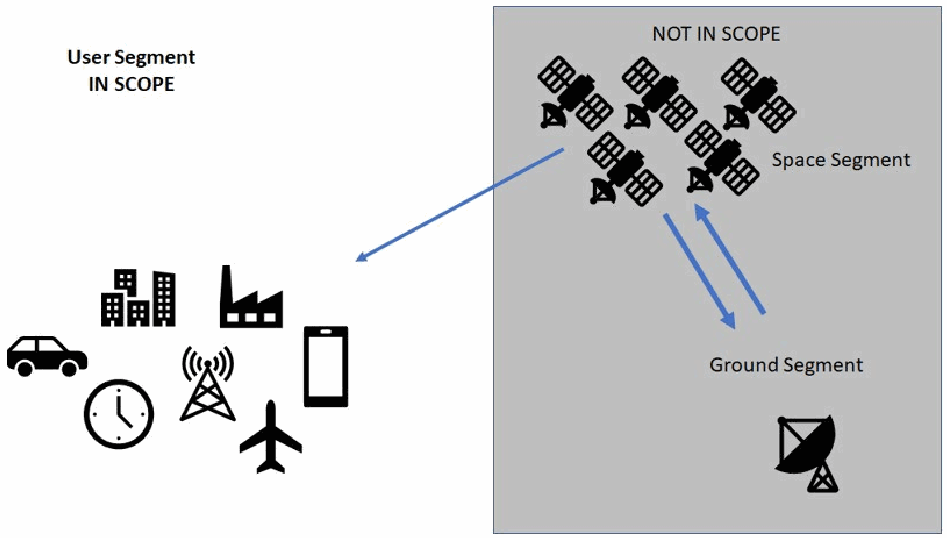
PNT プロファイルの対象範囲を示す図です。左側の「User Segment IN SCOPE(ユーザーセグメント:対象範囲内)」には、自動車、ビル、工場、時計、通信塔、携帯電話、航空機のアイコンがあります。右側の灰色の枠「NOT IN SCOPE(対象範囲外)」には、「Space Segment(宇宙セグメント)」の衛星群と「Ground Segment(地上セグメント)」のアンテナがあります。宇宙セグメントと地上セグメントの間には双方向の矢印があり、宇宙セグメントからユーザーセグメントへ矢印が向かっています。
Fig. 1. Example of How the PNT Profile Applies to GNSS
図1. PNT プロファイルを GNSS に適用する例
The PNT Profile addresses systems and components operated by an organization to produce PNT data, which can take the form of position, navigation, or timing information. The provider (in this example, the GNSS space and ground segments) is not within the scope of the PNT Profile.
PNT プロファイルが対象とするのは、組織が運用して PNT データを生成するシステムと構成要素です。PNT データは、位置、航法、または時刻の情報の形をとる場合があります。提供者(この例では GNSS の宇宙部門と地上部門)は、PNT プロファイルの適用範囲に含まれません。
For the purposes of the PNT Profile, PNT data include all information used by PNT equipment to form PNT solutions. This includes but is not limited to signals, waveforms, network packets, and other means to transmit PNT information.
PNT プロファイルでは、PNT データとは、PNT 機器が PNT の解を形成するために用いるすべての情報を指します。これには、信号、波形、ネットワークパケット、その他 PNT 情報を送信する手段が含まれますが、これらに限られません。
1.3. Audience
1.3. 想定読者
This document’s intended audience includes:
本書の想定読者は次のとおりです。
•Public and private organizations that use PNT services;
•PNT サービスを利用する公的機関および民間組織
•Managers responsible for the use of PNT services;
•PNT サービスの利用に責任を負う管理者
•Risk managers, cybersecurity professionals, and others with a role in risk management for systems that use PNT services;
•PNT サービスを利用するシステムのリスクマネジメントを担うリスク管理者、サイバーセキュリティ専門家、その他の担当者
•Procurement officials responsible for acquisition of PNT services;
•PNT サービスの調達に責任を負う調達担当者
•Mission and business process owners responsible for achieving operational outcomes dependent on PNT services; and
•PNT サービスに依存する運用上の成果の達成に責任を負う、ミッションおよび業務プロセスのオーナー
•Researchers and analysts who study systems that rely on PNT and/or study the unique cybersecurity needs of PNT services.
•PNT に依存するシステムを研究する、または PNT サービス特有のサイバーセキュリティ上のニーズを研究する研究者およびアナリスト
The PNT Profile is intended for a general audience and is broadly applicable. The PNT Profile applies to organizations that:
PNT プロファイルは一般の読者を想定しており、広く適用できます。PNT プロファイルは、次のような組織に適用されます。
•Have already adopted the NIST Cybersecurity Framework (CSF) to help identify, assess, and manage cybersecurity risks [NIST-CSF];
•サイバーセキュリティリスクの識別、評価、管理を支援するため、すでに NIST サイバーセキュリティフレームワーク(CSF)を採用している組織。
•Are familiar with the NIST CSF and want to improve their risk postures; or
•NIST CSF に精通しており、自らのリスク態勢を改善したいと考えている組織、または
•Are unfamiliar with the NIST CSF but need to implement risk management frameworks for the responsible use of their PNT services.
•NIST CSF に精通していないが、PNT サービスの責任ある利用のためにリスクマネジメントフレームワークを実装する必要がある組織
2. Intended Use
2. 想定される利用
The PNT Profile is a flexible tool that can be used by an organization to help meet mission and business objectives that are dependent upon the use of PNT services. The PNT Profile can also help organizations determine risks based on their assessments of potential impacts of manipulation or disruption of PNT services to business and operational objectives. The PNT Profile is intended to help users of PNT services prioritize necessary cybersecurity activities based on business objectives. Additionally, the PNT Profile can be used to help organizations identify areas where standards, practices, and other guidance could help manage risks to systems that use PNT services. An organization can use the PNT Profile in conjunction with its systematic process for identifying, assessing, and managing risk. NIST acknowledges the existing efforts being undertaken by individual entities to address the responsible use of PNT services in their sectors. The PNT Profile is intended to complement, but not replace these efforts.
PNT プロファイルは柔軟なツールであり、組織は、PNT サービスの利用に依存する任務および事業の目標を満たすのを支援するために利用できます。また、PNT プロファイルは、PNT サービスの操作や途絶が事業上および運用上の目標に及ぼしうる影響を組織が評価した結果に基づいて、リスクを判断するのにも役立ちます。PNT プロファイルは、PNT サービスの利用者が、事業目標に基づいて必要なサイバーセキュリティ活動に優先順位を付けるのを支援することを意図しています。さらに、PNT プロファイルは、PNT サービスを利用するシステムのリスクを管理するうえで、標準、実践事項、その他のガイダンスが役立つ領域を組織が識別するのにも利用できます。組織は、リスクを識別、評価、管理するための体系的なプロセスと併せて PNT プロファイルを利用できます。NIST は、各主体が自らの分野で PNT サービスの責任ある利用に対処するために進めている既存の取り組みを認識しています。PNT プロファイルは、こうした取り組みを補完することを意図したものであり、置き換えるものではありません。
NIST also encourages the development of sector-specific guidance if more specific risk management efforts may be required. Organizations within various sectors can customize the PNT Profile by considering the following:
NIST は、より具体的なリスクマネジメントの取り組みが必要になる場合に備えて、分野別ガイダンスの策定も推奨します。さまざまな分野の組織は、次の点を考慮して PNT プロファイルをカスタマイズできます。
•What processes and assets require PNT data (direct recipients of PNT services)?
•どのプロセスと資産が PNT データを必要としますか(PNT サービスの直接の受け手)。
•What processes and assets are dependent on other assets that require PNT data (i.e., what are the secondary effects)?
•どのプロセスと資産が、PNT データを必要とする他の資産に依存していますか(すなわち、二次的な影響は何か)。
•What processes and assets are vulnerable to the disruption or manipulation of PNT services?
•どのプロセスと資産が、PNT サービスの途絶や操作に対して脆弱か。
•What are the integrity and availability thresholds of PNT to avoid mission impact?
•任務への影響を避けるために必要な、PNT の完全性と可用性のしきい値は何か。
•What safeguards are available?
•どのような保護策を利用できますか。
•What is the impact to the organization should a process or asset be lost or degraded?
•プロセスや資産が失われる、または劣化した場合の組織への影響は何か。
•What techniques can be used to detect events of concern?
•懸念されるイベントを検知するために、どのような手法を使用できますか。
•What techniques can be used to respond to events of concern?
•懸念されるイベントに対応するために、どのような手法を使用できますか。
•What techniques can be used to recover pre-event capabilities?
•イベント前の機能を復旧するために、どのような手法を使用できますか。
3. Overview
3. 概要
3.1. Risk Management Overview
3.1. リスクマネジメントの概要
Risk management is the ongoing process of identifying, assessing, and responding to risk as related to an organization’s mission objectives. To manage risk, organizations should understand the likelihood that an event will occur as well as its potential impacts. An organization should also consider statutory and policy requirements that may influence or inform cybersecurity decisions.
リスクマネジメントとは、組織の任務目標に関連するリスクを識別、評価し、それに対応する継続的なプロセスです。リスクを管理するために、組織は、イベントが発生する可能性とその潜在的な影響を理解すべきです。また組織は、サイバーセキュリティに関する意思決定に影響を与える、または情報を提供する可能性のある、法令および方針上の要件も考慮すべきです。
The PNT Profile supports and is informed by cybersecurity risk management processes. Using the PNT Profile, organizations can make more informed decisions, based on business needs and risk assessments, to select and prioritize cybersecurity activities and expenditures that help identify systems dependent on PNT, identify appropriate PNT sources, detect disturbances and manipulation of PNT services, manage the risk to these systems, and promote resiliency.
PNT プロファイルは、サイバーセキュリティリスクマネジメントのプロセスを支援し、またそれに基づいています。PNT プロファイルを利用することで、組織は、事業上のニーズとリスク評価に基づき、PNT に依存するシステムの識別、適切な PNT 源の識別、PNT サービスの外乱や操作の検知、これらのシステムに対するリスクの管理、レジリエンスの促進に役立つサイバーセキュリティ活動と支出を、より十分な情報に基づいて選択し、優先順位を付けることができます。
The PNT Profile provides a flexible approach for users of PNT to manage risks when forming and using PNT signals and data regardless of the source of the risk, including natural events, malicious actions, and human activities that have unintended consequences. It also provides a starting point from which organizations can customize their approach to manage risk to their PNT services and data. A customized approach provides the most appropriate measures, processes, and prioritization of resources for reliable and efficient functioning of critical infrastructure applications.
PNT プロファイルは、PNT の利用者が PNT 信号およびデータを形成・利用する際のリスクを、自然現象、悪意のある行為、意図しない結果を招く人間の活動など、リスクの発生源にかかわらず管理するための柔軟なアプローチを提供します。また、組織が自らの PNT サービスおよびデータに対するリスクを管理するアプローチをカスタマイズするための出発点も提供します。カスタマイズしたアプローチにより、重要インフラのアプリケーションが確実かつ効率的に機能するための、最も適切な対策、プロセス、リソースの優先順位付けが得られます。
Organizations can use the PNT Profile in conjunction with existing risk management processes. The PNT Profile assumes that the organization implements cybersecurity risk management processes, and this profile is intended to provide additional risk management considerations specific to PNT. Examples of cybersecurity risk management processes include International Organization for Standardization (ISO) 31000:2018, ISO/International Electrotechnical Commission (IEC) 27005:2018, and NIST Special Publication 800-39. A list of additional resources is included in Appendix A of the PNT Profile.
組織は、PNT プロファイルを既存のリスクマネジメントプロセスと併せて利用できます。PNT プロファイルは、組織がサイバーセキュリティリスクマネジメントのプロセスを実装していることを前提としており、このプロファイルは、PNT に固有のリスクマネジメント上の考慮事項を追加で提供することを意図しています。サイバーセキュリティリスクマネジメントのプロセスの例としては、国際標準化機構(ISO)31000:2018、ISO/国際電気標準会議(IEC)27005:2018、NIST Special Publication 800-39 があります。追加の資料の一覧は PNT プロファイルの付録Aに掲載しています。
3.2. Cybersecurity Framework Overview
3.2. サイバーセキュリティフレームワークの概要
Created through collaboration between industry and government, the Cybersecurity Framework [NIST-CSF] provides prioritized, flexible, risk-based, and voluntary guidance based on existing standards, guidelines, and practices to help organizations better understand, manage, and communicate cybersecurity risks. Although it was designed for organizations that are part of the U.S. critical infrastructure, many other organizations in the private and public sectors (including federal agencies) use the NIST Cybersecurity Framework.
サイバーセキュリティフレームワーク [NIST-CSF] は、産業界と政府の協力により作成され、既存の標準、ガイドライン、実践事項に基づく、優先順位付けされた、柔軟でリスクベースの任意利用のガイダンスを提供し、組織がサイバーセキュリティリスクをより深く理解し、管理し、伝達するのを支援します。米国の重要インフラに属する組織向けに設計されましたが、民間部門と公共部門(連邦機関を含む)の多くの組織が NIST サイバーセキュリティフレームワークを利用しています。
The NIST Cybersecurity Framework consists of three main components:1
NIST サイバーセキュリティフレームワークは、三つの主要な構成要素から成ります。1
1.The Framework Core provides a catalog of desired cybersecurity activities and outcomes2 using common language. The Core guides organizations in managing and reducing their cybersecurity risks in a way that complements an organization’s existing cybersecurity and risk management processes.
1.フレームワークコア(Framework Core)は、望ましいサイバーセキュリティ活動と成果2を、共通の言語でまとめたカタログを提供します。コアは、組織が既存のサイバーセキュリティおよびリスクマネジメントのプロセスを補完する形で、サイバーセキュリティリスクを管理・低減するための指針となります。
2.The Framework Implementation Tiers provide context for how an organization views cybersecurity risk management. The Tiers help organizations understand whether they have a functioning and repeatable cybersecurity risk management process and the extent to which cybersecurity risk management is integrated with broader organizational risk management decisions.
2.フレームワークインプリメンテーションティア(Framework Implementation Tiers)は、組織がサイバーセキュリティリスクマネジメントをどのように捉えているかの文脈を提供します。ティアは、組織が機能し反復可能なサイバーセキュリティリスクマネジメントのプロセスを持っているか、またサイバーセキュリティリスクマネジメントが組織全体のより広いリスクに関する意思決定にどの程度統合されているかを、組織が理解するのに役立ちます。
3.The Framework Profiles are customized to the outcomes of the Core to align with an organization’s requirements. Profiles are primarily used to identify and prioritize opportunities for improving cybersecurity at an organization.
3.フレームワークプロファイル(Framework Profiles)は、組織の要件に合わせて、コアの成果に応じてカスタマイズされます。プロファイルは主に、組織のサイバーセキュリティを改善する機会を識別し、優先順位を付けるために用いられます。
The Framework Core presents standards, guidelines, and practices within five concurrent and continuous functions, which are described below. In the context of this “PNT Profile”, a “cybersecurity event” refers to a potential for the disruption or manipulation of PNT services.
フレームワークコアは、標準、ガイドライン、実践事項を、並行して継続的に行う五つの機能の中に示しており、以下で説明します。この「PNT プロファイル」の文脈では、「サイバーセキュリティイベント」とは、PNT サービスの途絶や操作が生じる可能性を指します。
1.Identify: Develop the organizational understanding to manage cybersecurity risk to systems, assets, data, and capabilities. The activities in the Identify function are foundational to the effective use of the NIST Cybersecurity Framework, enabling an organization to focus and prioritize its efforts in a manner consistent with its risk management strategy and business needs.
1.識別(IDENTIFY): システム、資産、データ、機能に対するサイバーセキュリティリスクを管理するための、組織としての理解を深めます。識別機能の活動は、NIST サイバーセキュリティフレームワークを効果的に利用するための基礎となり、組織がリスクマネジメント戦略と事業上のニーズに沿った形で取り組みに焦点を当て、優先順位を付けることを可能にします。
2.Protect: Develop and implement the appropriate safeguards to ensure the delivery of critical infrastructure services. The activities in the Protect function support the ability to limit or contain the impact of a potential PNT cybersecurity event.
2.防御(PROTECT): 重要インフラのサービスの提供を確実にするため、適切な保護策を策定し、実装します。防御機能の活動は、潜在的な PNT サイバーセキュリティイベントの影響を制限または封じ込める能力を支えます。
3.Detect: Develop and implement the appropriate activities to identify the occurrence of a cybersecurity event. The activities in the Detect function enable timely discovery of PNT cybersecurity events.
3.検知(DETECT): サイバーセキュリティイベントの発生を特定するための適切な活動を策定し、実装します。検知機能の活動は、PNT サイバーセキュリティイベントを適時に発見することを可能にします。
4.Respond: Develop and implement the appropriate activities to take action regarding a detected cybersecurity event. The activities in the Respond function support the ability to contain the impact of a potential PNT cybersecurity event.
4.対応(RESPOND): 検知したサイバーセキュリティイベントに対して措置を講じるための適切な活動を策定し、実装します。対応機能の活動は、潜在的な PNT サイバーセキュリティイベントの影響を封じ込める能力を支えます。
5.Recover: Develop and implement the appropriate activities to maintain plans for resilience and to restore any capabilities or services that were impaired due to a cybersecurity event. The activities in the Recover function support timely recovery to normal operations to reduce the impact of a PNT cybersecurity event.
5.復旧(RECOVER): レジリエンスのための計画を維持し、サイバーセキュリティイベントによって損なわれた機能やサービスを復元するための適切な活動を策定し、実装します。復旧機能の活動は、通常運用への適時の復旧を支え、PNT サイバーセキュリティイベントの影響を軽減します。
When considered together, these functions provide a high-level, strategic view of the life cycle of an organization’s management of PNT cybersecurity risk. The Framework Core then identifies underlying Categories and Subcategories for each Function. The 108 Subcategories are discrete cybersecurity outcomes that are organized into 23 Categories like “Asset Management” or “Protective Technology”. Table 1 shows the Five Functions and 23 Categories of the Core.
これらの機能を併せて考えると、組織の PNT サイバーセキュリティリスク管理のライフサイクルを、高い視点から戦略的に捉えることができます。フレームワークコアはさらに、各機能の基礎となるカテゴリとサブカテゴリを特定します。108のサブカテゴリは、個別のサイバーセキュリティ成果であり、「資産管理」や「保護技術」のような23のカテゴリに整理されています。表1に、コアの五つの機能と23のカテゴリを示します。
Table 1. Cybersecurity Framework Functions and Categories
表1. サイバーセキュリティフレームワークの機能とカテゴリ
| Function Unique Identifier | Function | Category Unique Identifier | Category |
|---|---|---|---|
| ID | Identify | ID.AM | Asset Management |
| ID.BE | Business Environment | ||
| ID.GV | Governance | ||
| ID.RA | Risk Assessment | ||
| ID.RM | Risk Management Strategy | ||
| ID.SC | Supply Chain Risk Management | ||
| PR | Protect | PR.AC | Access Control |
| PR.AT | Awareness and Training | ||
| PR.DS | Data Security | ||
| PR.IP | Information Protection Processes and Procedures | ||
| PR.MA | Maintenance | ||
| PR.PT | Protective Technology | ||
| DE | Detect | DE.AE | Anomalies and Events |
| DE.CM | Security Continuous Monitoring | ||
| DE.DP | Detection Processes | ||
| RS | Respond | RS.RP | Response Planning |
| RS.CO | Communications | ||
| RS.AN | Analysis | ||
| RS.MI | Mitigation | ||
| RS.IM | Improvements | ||
| RC | Recover | RC.RP | Recovery Planning |
| RC.IM | Improvements | ||
| RC.CO | Communications |
| 機能の一意識別子 | 機能 | カテゴリの一意識別子 | カテゴリ |
|---|---|---|---|
| ID | 識別(Identify) | ID.AM | 資産管理 |
| ID.BE | ビジネス環境 | ||
| ID.GV | ガバナンス | ||
| ID.RA | リスク評価 | ||
| ID.RM | リスク管理戦略 | ||
| ID.SC | サプライチェーンリスク管理 | ||
| PR | 防御(Protect) | PR.AC | アクセス制御 |
| PR.AT | 意識向上およびトレーニング | ||
| PR.DS | データセキュリティ | ||
| PR.IP | 情報保護のプロセスと手順 | ||
| PR.MA | 保守 | ||
| PR.PT | 保護技術 | ||
| DE | 検知(Detect) | DE.AE | 異常とイベント |
| DE.CM | セキュリティの継続的監視 | ||
| DE.DP | 検知プロセス | ||
| RS | 対応(Respond) | RS.RP | 対応計画 |
| RS.CO | コミュニケーション | ||
| RS.AN | 分析 | ||
| RS.MI | 低減 | ||
| RS.IM | 改善 | ||
| RC | 復旧(Recover) | RC.RP | 復旧計画 |
| RC.IM | 改善 | ||
| RC.CO | コミュニケーション |
References are existing standards, guidelines, and practices that provide practical guidance to help an organization achieve the desired outcome of each Subcategory. An example of two Subcategories and applicable References within the Asset Management Category are shown in Fig. 2.
参考情報(References)は、各サブカテゴリの望ましい成果を組織が達成するのを支援する実践的なガイダンスを提供する、既存の標準、ガイドライン、実践事項です。資産管理カテゴリにおける二つのサブカテゴリと適用される参考情報の例を、図2に示します。
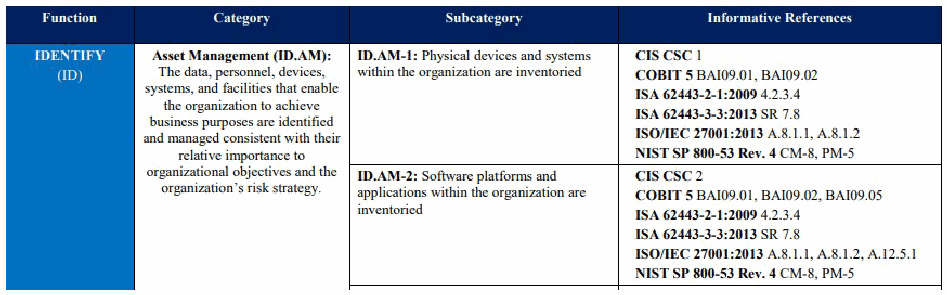
サイバーセキュリティフレームワークのコアの抜粋を表の形で示した図で、列はFunction(機能)、Category(カテゴリ)、Subcategory(サブカテゴリ)、Informative References(参考情報)です。機能: IDENTIFY(ID)。カテゴリ: Asset Management(ID.AM): 組織が事業目的を達成できるようにするデータ、人員、デバイス、システムおよび施設を、組織の目的に対する相対的な重要度および組織のリスク戦略に沿って識別し、管理します。サブカテゴリ ID.AM-1: 組織内の物理デバイスとシステムの目録が作成されています。参考情報: CIS CSC 1; COBIT 5 BAI09.01, BAI09.02; ISA 62443-2-1:2009 4.2.3.4; ISA 62443-3-3:2013 SR 7.8; ISO/IEC 27001:2013 A.8.1.1, A.8.1.2; NIST SP 800-53 Rev. 4 CM-8, PM-5。サブカテゴリ ID.AM-2: 組織内のソフトウェアプラットフォームとアプリケーションの目録が作成されています。参考情報: CIS CSC 2; COBIT 5 BAI09.01, BAI09.02, BAI09.05; ISA 62443-2-1:2009 4.2.3.4; ISA 62443-3-3:2013 SR 7.8; ISO/IEC 27001:2013 A.8.1.1, A.8.1.2, A.12.5.1; NIST SP 800-53 Rev. 4 CM-8, PM-5。
Fig. 2. Cybersecurity Framework Subcategory Example
図2. サイバーセキュリティフレームワークのサブカテゴリの例
The Subcategory outcomes are organized according to Functions and Categories and are not prioritized within the Core. Each organization has unique requirements, risk tolerance, and resources. Therefore, the prioritization of the Subcategory outcomes will vary from one organization to the next.
サブカテゴリの成果は、機能とカテゴリに従って整理されており、コアの中で優先順位付けはされていません。各組織には固有の要件、リスク許容度、リソースがあります。したがって、サブカテゴリの成果の優先順位付けは、組織ごとに異なります。
The PNT Profile in Section 4 can be used as a foundation for building a custom profile, as shown in Fig. 3. A custom profile can be built using the business objectives, threat environment, requirements, and controls as inputs. The outcomes associated with a custom profile based on the PNT Profile are the outcomes from the Executive Order: identification of systems dependent on PNT services that identify appropriate PNT services, detect disruption and manipulation of PNT services, and manage the risk to those systems.
第4節の PNT プロファイルは、図3に示すように、カスタムプロファイルを構築するための基盤として利用できます。カスタムプロファイルは、事業目標、脅威環境、要件、管理策を入力として構築できます。PNT プロファイルに基づくカスタムプロファイルに関連する成果は、大統領令に掲げられた成果、すなわち、適切な PNT サービスを識別する PNT サービス依存システムの識別、PNT サービスの途絶や操作の検知、およびそれらのシステムに対するリスクの管理です。
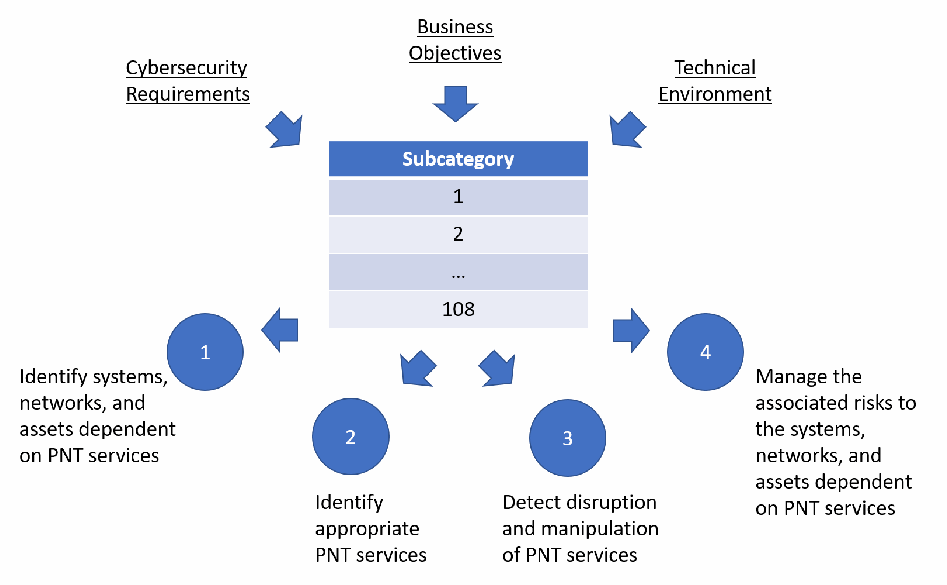
PNT プロファイルの作成過程を示す図です。「Cybersecurity Requirements(サイバーセキュリティ要件)」「Business Objectives(ビジネス目標)」「Technical Environment(技術環境)」の3つの入力から、中央の「Subcategory(サブカテゴリ)」の表(1、2、…、108 の行)へ矢印が向かっています。表からは番号付きの4つの円へ矢印が出ており、1 は「PNT サービスに依存するシステム、ネットワーク、資産を識別する」、2 は「適切な PNT サービスを識別する」、3 は「PNT サービスの途絶や操作を検知する」、4 は「PNT サービスに依存するシステム、ネットワーク、資産に関連するリスクを管理する」です。
Fig. 3. PNT Profile Creation Process
図3. PNT プロファイルの作成プロセス
Since organizations within the PNT community sector or sub-sector share many of the same business objectives and regulatory requirements, creation of a high-level profile can provide a common starting point. The PNT Profile can make it easier for organizations to begin incorporating cybersecurity and can also be used to provide a baseline of cybersecurity for organizations within a sector or sub-sector. Individual organizations can further customize a profile by taking the sector/sub-sector profile and then tailor or augment it to address requirements, business objectives, or environmental threats unique to them.
PNT コミュニティの分野または下位分野に属する組織は、事業目標や規制要件の多くを共有しているため、高い視点のプロファイルを作成することで、共通の出発点を提供できます。PNT プロファイルは、組織がサイバーセキュリティの取り入れを始めやすくするとともに、分野または下位分野内の組織に対するサイバーセキュリティのベースラインを提供するのにも利用できます。個々の組織は、分野・下位分野のプロファイルを取り入れ、自らに固有の要件、事業目標、環境上の脅威に対応するようにテーラリングまたは拡張することで、プロファイルをさらにカスタマイズできます。
The PNT Profile is intended to be implemented within the larger context of an organization that is developing and executing its own cybersecurity program.3 That program should be based on organizational cybersecurity risk management policies and procedures. This PNT Profile is best implemented if a cybersecurity program is in place at the organizational level. However, this caveat does not preclude any organization from implementing the PNT Profile should a cybersecurity program not be in place.
PNT プロファイルは、独自のサイバーセキュリティプログラムを策定し実行している組織の、より大きな文脈の中で実装されることを意図しています。3そのプログラムは、組織のサイバーセキュリティリスクマネジメントの方針と手順に基づくべきです。この PNT プロファイルは、組織レベルでサイバーセキュリティプログラムが整備されている場合に最も効果的に実装されます。ただし、この但し書きは、サイバーセキュリティプログラムが整備されていない組織が PNT プロファイルを実装することを妨げるものではありません。
4. The PNT Profile
4. PNT プロファイル
This section was created by using the Cybersecurity Framework, as described in Sec. 3.2. The tables summarize the Subcategories for a Function and a Category. The references provided in the tables include cybersecurity guidance, PNT-specific guidance, and illustrative methods to implement the guidance. It is not intended to be a comprehensive list of all PNT references (see References), but a sample of potentially relevant resources depending on the PNT service(s) the organizations use and their PNT service and data requirements. The references that correspond to the Subcategory may not necessarily apply to all sectors. The Categories and Subcategories defined by the Cybersecurity Framework will address different aspects of the four components identified in the Executive Order, as illustrated in Table 2. Sections 4.1 through 4.5 provide insight on how the Subcategories address the responsible use of PNT. Note: Not all Subcategories in the NIST CSF are listed here; only those most applicable to this PNT Profile are included. Acronyms described in the PNT Profile are listed in Appendix B.
この節は、3.2節で説明したサイバーセキュリティフレームワークを用いて作成しました。表は、機能とカテゴリごとのサブカテゴリをまとめたものです。表に示す参考情報には、サイバーセキュリティのガイダンス、PNT 固有のガイダンス、およびそのガイダンスを実装するための例示的な方法が含まれます。これは PNT に関するすべての参考情報を網羅する一覧(「参考文献」を参照)ではなく、組織が利用する PNT サービス、および PNT サービスとデータに関する要件に応じて、関連する可能性のある資料の一例です。サブカテゴリに対応する参考情報が、すべての分野に当てはまるとは限りません。サイバーセキュリティフレームワークが定義するカテゴリとサブカテゴリは、表2に示すように、大統領令で特定された四つの構成要素の異なる側面に対処します。4.1節から4.5節では、サブカテゴリが PNT の責任ある利用にどのように対処するかについて考察します。注: NIST CSF のすべてのサブカテゴリをここに示しているわけではなく、この PNT プロファイルに最も当てはまるものだけを含めています。PNT プロファイルで説明する頭字語は、付録Bに一覧しています。
Table 2. Mapping the EO Implementation Guidance to the Cybersecurity Framework Profile
表2. 大統領令の実施ガイダンスとサイバーセキュリティフレームワークプロファイルの対応付け
| Identify systems dependent on PNT services | Identify appropriate PNT sources | Detect disturbance or manipulation of PNT services | Manage the risk to PNT systems | ||
|---|---|---|---|---|---|
| IDENTIFY | Asset Management | X | X | X | X |
| Business Environment | X | X | X | X | |
| Governance | X | ||||
| Risk Assessment | X | X | X | X | |
| Risk Management | X | X | X | X | |
| Supply Chain Risk Management | X | X | X | ||
| PROTECT | Access Control | X | X | X | X |
| Awareness And Training | X | ||||
| Data Security | X | X | X | X | |
| Information Protection Processes and Procedures | X | X | X | ||
| Maintenance | X | X | X | X | |
| Protective Technology | X | X | X | ||
| DETECT | Anomalies and Events | X | X | X | |
| Security Continuous Monitoring | X | X | X | X | |
| Detection Process | X | X | X | ||
| RESPOND | Response Planning | X | |||
| Communications | X | X | |||
| Analysis | X | X | |||
| Mitigation | X | X | |||
| Improvements | X | ||||
| RECOVER | Recovery Planning | X | X | X | |
| Improvements | X | X | X | ||
| Communications | X | X | X |
| PNT サービスに依存するシステムを識別する | 適切な PNT 源を識別する | PNT サービスの外乱や操作を検知する | PNT システムに対するリスクを管理する | ||
|---|---|---|---|---|---|
| 識別(IDENTIFY) | 資産管理 | X | X | X | X |
| ビジネス環境 | X | X | X | X | |
| ガバナンス | X | ||||
| リスク評価 | X | X | X | X | |
| リスクマネジメント | X | X | X | X | |
| サプライチェーンリスク管理 | X | X | X | ||
| 防御(PROTECT) | アクセス制御 | X | X | X | X |
| 意識向上およびトレーニング | X | ||||
| データセキュリティ | X | X | X | X | |
| 情報保護のプロセスと手順 | X | X | X | ||
| 保守 | X | X | X | X | |
| 保護技術 | X | X | X | ||
| 検知(DETECT) | 異常とイベント | X | X | X | |
| セキュリティの継続的監視 | X | X | X | X | |
| 検知プロセス | X | X | X | ||
| 対応(RESPOND) | 対応計画 | X | |||
| コミュニケーション | X | X | |||
| 分析 | X | X | |||
| 低減 | X | X | |||
| 改善 | X | ||||
| 復旧(RECOVER) | 復旧計画 | X | X | X | |
| 改善 | X | X | X | ||
| コミュニケーション | X | X | X |
The Executive Order defines four components, and the NIST CSF defines a set of Functions and Categories. The PNT Profile maps the components of the Executive Order to the NIST CSF. It is important to note that there are interdependencies between the NIST CSF Functions, and that each component of the Executive Order will require multiple Functions, Categories, and Subcategories.
大統領令は四つの構成要素を定義しており、NIST CSF は機能とカテゴリの集合を定義しています。PNT プロファイルは、大統領令の構成要素を NIST CSF に対応付けます。NIST CSF の機能の間には相互依存関係があり、大統領令の各構成要素には複数の機能、カテゴリ、サブカテゴリが必要になることに留意することが重要です。
Successful implementations require a comprehensive approach. The CSF Functions and guidance in the PNT Profile address the generic needs of PNT users in critical infrastructure that depend on PNT services to meet their business objectives. The components of the Foundational PNT Profile are concisely summarized in Fig. 4. In order to support a risk-based, practical, and effective approach to the responsible use of PNT, organizations can select, tailor, and augment the security controls defined in PNT references in Sec. 4.1 through Sec. 4.5.
実装を成功させるには、包括的なアプローチが必要です。CSF の機能と PNT プロファイルのガイダンスは、事業目標を達成するために PNT サービスに依存する重要インフラの PNT 利用者に共通する一般的なニーズに対応しています。基盤的 PNT プロファイルの構成要素を、図4に簡潔にまとめます。PNT の責任ある利用に向けて、リスクベースで実践的かつ効果的なアプローチを支えるために、組織は、4.1節から4.5節の PNT の参考情報で定義されているセキュリティ管理策を選択し、テーラリングし、拡張できます。
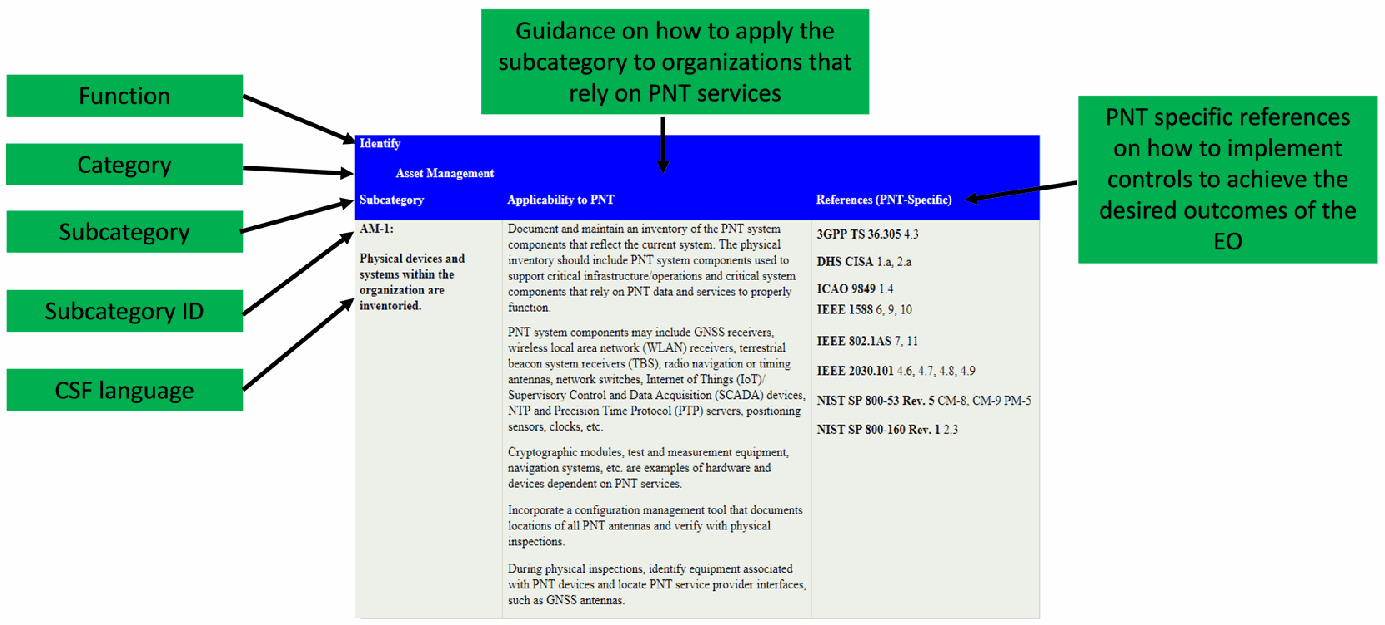
PNT プロファイルの表の注釈付き例です。表の抜粋には、左側に「Identify」「Asset Management」「Subcategory」、中央に「Applicability to PNT」、右側に「References (PNT-Specific)」を記した青い見出しがあり、その下に AM-1(「組織内の物理デバイスとシステムが棚卸しされている。」)の行があり、適用性の説明と、3GPP TS 36.305 4.3、DHS CISA 1.a, 2.a、ICAO 9849 1.4、IEEE 1588 6, 9, 10、IEEE 802.1AS 7, 11、IEEE 2030.101 4.6, 4.7, 4.8, 4.9、NIST SP 800-53 Rev. 5 CM-8, CM-9 PM-5、NIST SP 800-160 Rev. 1 2.3 などの参考情報が示されています。緑色の吹き出しが矢印で各部分を指し、「Function(機能)」「Category(カテゴリ)」「Subcategory(サブカテゴリ)」「Subcategory ID(サブカテゴリID)」「CSF language(CSFの文言)」、「Guidance on how to apply the subcategory to organizations that rely on PNT services(PNTサービスに依存する組織にサブカテゴリを適用する方法の指針)」は「Applicability to PNT」列を、「PNT specific references on how to implement controls to achieve the desired outcomes of the EO(大統領令の望ましい成果を達成するための管理策の実装方法に関するPNT固有の参考情報)」は「References」列を指しています。
Fig. 4. Components of the PNT Profile
図4. PNT プロファイルの構成要素
4.1. Identify Function
4.1. 識別(IDENTIFY)機能
The Identify function is foundational to the risk assessment process. It is highly recommended that those who intend to implement all or part of the PNT Profile start with the Identify function. An organization needs to analyze its mission objectives related to its reliance on PNT data.
識別機能は、リスク評価プロセスの基盤です。PNT プロファイルの全部または一部を実装しようとする組織には、識別機能から始めることを強く推奨します。組織は、PNT データへの依存に関連する任務目標を分析する必要があります。
The Identify function provides key activities that should be given strong consideration in this analysis. Consideration of the organization’s mission and business objectives, threat environment, assets, and vulnerabilities will have a significant influence on the overall risk; these are directly addressed in the other four CSF functions (i.e., Protect, Detect, Respond, Recover).
識別機能は、この分析で十分に考慮すべき主要な活動を示しています。組織の任務と事業目標、脅威環境、資産、脆弱性を考慮することは、全体的なリスクに大きな影響を与えます。これらの要素は、CSF の他の4つの機能(すなわち、防御、検知、対応、復旧)で直接扱われます。
The objectives of the Identify function include:
識別機能の目標には、次のものが含まれます。
•Identify the business or operational environment and organization’s purpose;
•事業環境または運用環境と、組織の目的を識別します。
•Identify all assets, including applications dependent on PNT data;
•PNT データに依存するアプリケーションを含め、すべての資産を識別します。
•Identify sources and infrastructure that provide PNT information; and
•PNT 情報を提供する源とインフラを識別します。
•Identify the vulnerabilities, threats, and impacts should the threat be realized in order to assess the risk.
•リスクを評価するために、脆弱性、脅威、および脅威が現実になった場合の影響を識別します。
The Identify function within the NIST Cybersecurity Framework defines six categories, all of which have at least one Subcategory that applies to the PNT Profile to varying degrees, as summarized in Sec. 4.1.1 through Sec. 4.1.6.
NIST サイバーセキュリティフレームワークの識別機能は六つのカテゴリを定義しており、そのすべてに、程度の差はあれ PNT プロファイルに適用される少なくとも一つのサブカテゴリがあります。これらを4.1.1節から4.1.6節にまとめます。
4.1.1. Asset Management Category
4.1.1. 資産管理カテゴリ
The data, personnel, devices, systems, and facilities that enable the organization to achieve its business objectives are identified and managed in a manner that is consistent with their importance to organizational objectives and the organization’s risk strategy. In the context of the PNT Profile, the assets that require and support PNT services in order to fulfill the organization’s mission and business objectives are identified.
組織が事業目標を達成できるようにするデータ、要員、デバイス、システム、施設は、組織の目標に対する重要度と組織のリスク戦略に整合する形で識別され、管理されます。PNT プロファイルの文脈では、組織の任務および事業目標を果たすために PNT サービスを必要とし、またそれを支える資産が識別されます。
There are five Subcategories within Asset Management that apply to the PNT Profile, as summarized in the table below.
資産管理には、PNT プロファイルに適用される五つのサブカテゴリがあり、下の表にまとめます。
Table 3. Identify – Asset Management Subcategories Applicable to PNT
表3. 識別 – PNT に適用される資産管理サブカテゴリ
| Identify Asset Management Subcategory | Applicability to PNT | References (PNT-Specific) |
|---|---|---|
| AM-1: Physical devices and systems within the organization are inventoried. | Document and maintain an inventory of the PNT system components that reflect the current system. The physical inventory should include PNT system components used to support critical infrastructure/ PNT system components may include GNSS receivers, wireless local area network (WLAN) receivers, terrestrial beacon system receivers (TBS), radio navigation or timing antennas, network switches, Internet of Things (IoT)/ Supervisory Control and Data Acquisition (SCADA) devices, NTP and Precision Time Protocol (PTP) servers, positioning sensors, clocks, etc. Cryptographic modules, test and measurement equipment, navigation systems, etc., are examples of hardware and devices dependent on PNT services. Incorporate a configuration management tool that documents locations of all PNT antennas and verify with physical inspections. During physical inspections, identify equipment associated with PNT devices and locate PNT service provider interfaces, such as GNSS antennas. | 3GPP TS 36.305 4.3 DHS CISA 1.a, 2.a ICAO 9849 1.4 IEEE 1588 6, 9, 10 IEEE 802.1AS 7, 11 IEEE 2030.101 4.6, 4.7, 4.8, 4.9 NIST SP 800-53 Rev. 5 CM-8, CM-9 PM-5 NIST SP 800-160 Rev. 1 2.3 |
| AM-2: Software platforms and applications within the organization are inventoried. | The software inventory should include PNT system components used to support critical infrastructure/ Document and maintain an inventory of PNT system software components, such as software license information, software version numbers, human-machine interface (HMI), and other industrial control systems (ICS) component applications, software, and operating systems. System software inventory is reviewed and updated as defined by the organization. Identify all software, applications, and systems that are dependent on PNT data, including software that relies on distributed time, using phase and frequency synchronization methods. These methods may include packet-based communication protocols (e.g., NTP, PTP), frequency protocols using the physical layer network (e.g., Synchronous Ethernet (SyncE)), or physical signals (e.g., 10 MHz, 1 PPS, Inter-range instrumentation group time code B (IRIG-B)). Applications dependent on PNT data may include test and measurement tools, kernels, databases, logging software, cryptography/certificate management, and other software that rely on synchronized clocks or positioning information to verify information consistency. Some functions, such as multilateration, are also sensitive to timing performance and should, therefore, be inventoried. | 3GPP TS 36.305 4.3 DHS CISA 1.a, 1.b, 1.c, 2.a DHS PNT Appendix C ICAO 9849 1.4, 5.1.4 IEEE 1588 5-14, Annex A, P IEEE 802.1AS 7, 10 IEEE 2030.101 4.3 IETF 5905 5-15 IETF 7384 5, 7 IMO 1575 Appendix C ITU-T G.8261 6, 7, Annex A, P NIST SP 800-53 Rev. 5 CM-8, PM-5 |
| AM-3: Organizational communication and data flows are mapped. | Identify all connections within the PNT system, as well as between the PNT system and other systems. All connections and signal interfaces are documented, authorized, and reviewed. Connection information may include the physical interface characteristics, logical interface characteristics, data characteristics, ports, port configurations, protocols, addresses, description of the data, security requirements, and nature of the connection. Identify the PNT data source and distribution medium for the applications and systems that meets the PNT data performance and resilience requirements needed. It is critical to know where each system derives PNT data from. For example, the organization may want to investigate software programs that can help its organization identify PNT data sources to assess which sources are most beneficial to organizational mission stability. For each software that provisions or uses PNT data, identify the input and output data interfaces. | DHS CISA 1, 2 GPS IS-200 3 GPS IS-705 3 GPS IS-800 3 GPS SPS B.1.2, B.1.3, 14 IEEE 802.1AS 7.4, 8.5 IEEE 1588 8-12 IEEE 2030.101 4.2 IEC 61850-90-4 10 IETF 5905 5-14 IMO 1575 A-D, Appendix C ITU-T G.8261 6 ITU-T G.8262 6-12, Appendix III ITU-T G.8272 6-12 NIST SP 800-53 Rev. 5 AC-4, CA-3, CA- 9, PL-8, SA-17 RTCA 326 3.1.1 GAL ICD BDS ICD |
| AM-4: External information systems are catalogued. | Identify and catalogue all external connections for the PNT system. Identify all PNT signals, data sources, and related data products that pertain to an event or the status of the PNT source. Examples of external systems include engineering design services and those that are controlled under separate authority, personal devices, and other hosted services. | DHS CISA 3 GPS USER NIST SP 800-53 Rev. 5 AC-20, PM-5, SA- 9 USG FRP Appendix B |
| AM-5: Resources (e.g., hardware, devices, data, time, personnel, and software) are prioritized based on their classification, criticality, and business value. | Determine required resources to support current regulations and standards requirements for the responsible use of PNT systems. Provide adequate staffing with the appropriate training such that PNT support is available in a timely manner (consistent with thresholds defined in the organization’s business plan). Formalize PNT roles provide a process for transitioning staff members (with PNT expertise) to be replaced. The remaining staff members are provided with necessary resources and PNT training. Identify and prioritize PNT system components, processors, and functions based on their classification, criticality, and business value. Identify the types of information in the organization’s possession, custody, or control for which security safeguards are needed (e.g., sensitive or protected information). Stakeholders are advised to use other functions within the CSF to inform identification procedures. For example, while testing business continuity procedures, use the findings of a lost PNT source to identify which aspects of the mission were impacted and to what degree, and reprioritize accordingly. When identifying resources and prioritizing trade-offs for PNT systems, holistically consider requirements, such as availability, continuity, data integrity, timeliness of anomaly detection, response, and recovery. | 3GPP TS22.071 4 DHS CISA 3 ISO/IEC/IEEE 15939:2017 6.3.2.3 NIST SP 800-37 3 NIST SP 800-53 Rev. 5 AC-20, RA-9 USG FRP Appendix B |
| 識別 資産管理 サブカテゴリ | PNT への適用 | 参考情報(PNT 固有) |
|---|---|---|
| AM-1: 組織内の物理デバイスとシステムが棚卸しされています。 | 現行のシステムを反映した PNT システム構成要素の一覧を文書化し、維持します。物理的な一覧には、重要インフラ/運用を支えるために使用される PNT システム構成要素と、正しく機能するために PNT データおよびサービスに依存する重要なシステム構成要素を含めるべきです。 PNT システム構成要素には、GNSS 受信機、無線ローカルエリアネットワーク(WLAN)受信機、地上ビーコンシステム受信機(TBS)、電波航法用または時刻供給用のアンテナ、ネットワークスイッチ、モノのインターネット(IoT)/監視制御・データ収集(SCADA)デバイス、NTP および高精度時刻プロトコル(PTP)サーバー、測位センサー、時計などが含まれる場合があります。 暗号モジュール、試験・測定機器、航法システムなどは、PNT サービスに依存するハードウェアおよびデバイスの例です。 すべての PNT アンテナの設置場所を文書化する構成管理ツールを取り入れ、物理的な点検で検証します。 物理的な点検の際には、PNT デバイスに関連する機器を識別し、GNSS アンテナなどの PNT サービス提供者とのインターフェースの場所を特定します。 | 3GPP TS 36.305 4.3 DHS CISA 1.a, 2.a ICAO 9849 1.4 IEEE 1588 6, 9, 10 IEEE 802.1AS 7, 11 IEEE 2030.101 4.6, 4.7, 4.8, 4.9 NIST SP 800-53 Rev. 5 CM-8, CM-9 PM-5 NIST SP 800-160 Rev. 1 2.3 |
| AM-2: 組織内のソフトウェアプラットフォームとアプリケーションが棚卸しされています。 | ソフトウェアの一覧には、重要インフラ/運用を支えるために使用される PNT システム構成要素と、正しく機能するために PNT データおよびサービスに依存する重要なアプリケーションを含めるべきです。 ソフトウェアのライセンス情報、ソフトウェアのバージョン番号、ヒューマンマシンインターフェース(HMI)、その他の産業用制御システム(ICS)構成要素のアプリケーション、ソフトウェア、オペレーティングシステムなど、PNT システムのソフトウェア構成要素の一覧を文書化し、維持します。システムソフトウェアの一覧は、組織が定めるとおりに見直し、更新します。 位相同期および周波数同期の方式を用いた分散時刻に依存するソフトウェアを含め、PNT データに依存するすべてのソフトウェア、アプリケーション、システムを識別します。これらの方式には、パケットベースの通信プロトコル(例: NTP、PTP)、物理層ネットワークを用いる周波数プロトコル(例: 同期イーサネット(SyncE))、物理信号(例: 10 MHz、1 PPS、Inter-range instrumentation group time code B(IRIG-B))が含まれる場合があります。 PNT データに依存するアプリケーションには、試験・測定ツール、カーネル、データベース、ログ記録ソフトウェア、暗号/証明書管理、および情報の一貫性を検証するために同期された時計や位置情報に依存するその他のソフトウェアが含まれる場合があります。マルチラテレーションなど一部の機能も、タイミング性能の影響を受けやすいため、棚卸しの対象とすべきです。 | 3GPP TS 36.305 4.3 DHS CISA 1.a, 1.b, 1.c, 2.a DHS PNT Appendix C ICAO 9849 1.4, 5.1.4 IEEE 1588 5-14, Annex A, P IEEE 802.1AS 7, 10 IEEE 2030.101 4.3 IETF 5905 5-15 IETF 7384 5, 7 IMO 1575 Appendix C ITU-T G.8261 6, 7, Annex A, P NIST SP 800-53 Rev. 5 CM-8, PM-5 |
| AM-3: 組織の通信とデータフローが対応付けられています。 | PNT システム内の、およびPNT システムと他のシステムとの間のすべての接続を識別します。すべての接続と信号インターフェースは、文書化され、認可され、見直されます。 接続情報には、物理インターフェースの特性、論理インターフェースの特性、データの特性、ポート、ポートの設定、プロトコル、アドレス、データの説明、セキュリティ要件、接続の性質が含まれる場合があります。 必要な PNT データの性能要件とレジリエンス要件を満たす、アプリケーションおよびシステム向けの PNT データ源と配信媒体を識別します。各システムがどこから PNT データを得ているかを知ることは重要です。たとえば、組織は、PNT データ源を識別するのに役立つソフトウェアプログラムを調べて、どのデータ源が組織の任務の安定性にとって最も有益かを評価したいと考える場合があります。 PNT データを提供または使用する各ソフトウェアについて、入力と出力のデータインターフェースを識別します。 | DHS CISA 1, 2 GPS IS-200 3 GPS IS-705 3 GPS IS-800 3 GPS SPS B.1.2, B.1.3, 14 IEEE 802.1AS 7.4, 8.5 IEEE 1588 8-12 IEEE 2030.101 4.2 IEC 61850-90-4 10 IETF 5905 5-14 IMO 1575 A-D, Appendix C ITU-T G.8261 6 ITU-T G.8262 6-12, Appendix III ITU-T G.8272 6-12 NIST SP 800-53 Rev. 5 AC-4, CA-3, CA- 9, PL-8, SA-17 RTCA 326 3.1.1 GAL ICD BDS ICD |
| AM-4: 外部の情報システムがカタログ化されています。 | PNT システムのすべての外部接続を識別し、カタログ化します。 PNT 源のイベントまたは状態に関係するすべての PNT 信号、データ源、関連するデータ製品を識別します。 外部システムの例としては、エンジニアリング設計サービス、別の権限の下で管理されるシステム、個人用デバイス、その他のホスト型サービスがあります。 | DHS CISA 3 GPS USER NIST SP 800-53 Rev. 5 AC-20, PM-5, SA- 9 USG FRP Appendix B |
| AM-5: リソース(例: ハードウェア、デバイス、データ、時間、要員、ソフトウェア)が、分類、重要度、事業価値に基づいて優先順位付けされています。 | PNT システムの責任ある利用について、現行の規則および標準の要件を支えるために必要なリソースを決定します。 (組織の事業計画で定めたしきい値に整合する形で)PNT の支援を適時に利用できるよう、適切なトレーニングを受けた十分な要員を配置します。PNT に関する役割を正式に定め、PNT の専門知識を持つ要員を後任者に交代させるためのプロセスを整備します。残る要員には、必要なリソースと PNT トレーニングを提供します。 分類、重要度、事業価値に基づいて、PNT システムの構成要素、プロセッサ、機能を識別し、優先順位を付けます。 組織が所有、保管、または管理する情報のうち、セキュリティ保護策が必要な種類(例: 機微な情報や保護対象の情報)を識別します。 関係者は、識別の手順に情報を提供するために、CSF の他の機能を利用すべきです。たとえば、事業継続の手順を試験する際には、PNT 源が失われた場合の結果を用いて、任務のどの側面がどの程度影響を受けたかを識別し、それに応じて優先順位を付け直します。 PNT システムのリソースを識別し、トレードオフの優先順位を付ける際には、可用性、継続性、データの完全性、異常の検知・対応・復旧の適時性などの要件を総合的に考慮します。 | 3GPP TS22.071 4 DHS CISA 3 ISO/IEC/IEEE 15939:2017 6.3.2.3 NIST SP 800-37 3 NIST SP 800-53 Rev. 5 AC-20, RA-9 USG FRP Appendix B |
4.1.2. Business Environment Category
4.1.2. ビジネス環境カテゴリ
The organization’s mission, objectives, stakeholders, and activities are understood and prioritized. This information is used to inform cybersecurity roles, responsibilities, and risk management decisions. In the context of this PNT Profile, identify includes activities that are facilitated by or require PNT services in order to fulfill the organization’s mission, objectives, or other stakeholders’ needs.
組織の任務、目標、関係者、活動が理解され、優先順位付けされています。この情報は、サイバーセキュリティ上の役割、責任、リスクマネジメントの意思決定に情報を提供するために用いられます。この PNT プロファイルの文脈では、識別には、組織の任務、目標、あるいはその他の関係者のニーズを果たすために、PNT サービスによって円滑化される、または PNT サービスを必要とする活動が含まれます。
There are four Subcategories within Business Environment that apply to the PNT Profile, as summarized in the table below.
ビジネス環境には、PNT プロファイルに適用される四つのサブカテゴリがあり、下の表にまとめます。
Table 4. Business Environment Subcategories Applicable to PNT
表4. PNT に適用されるビジネス環境サブカテゴリ
| Identify Business Environment Subcategory | Applicability to PNT | References (PNT-Specific) |
|---|---|---|
| BE-1: The organization’s role in the supply chain is identified and communicated. | Organizations that engage in the reception and rebroadcast of PNT (or otherwise supply PNT) services to their consumers need to understand the cascading effects of a disruption or manipulation of PNT services to customers that may be a part of the critical infrastructure relying on the PNT service. | DHS S&T 2022 ISO 27001 NIST SP 800-37 NIST SP 800-53 Rev. 5 CP-2, SR-3, SR-4 |
| BE-2: The organization’s place in critical infrastructure and its industry sector is identified and communicated. | Critical infrastructure owner/operators need to understand and communicate the effects of a disruption or manipulation of PNT services on the organization’s ability to fulfill its mission, objectives, or other stakeholders’ needs. Distribution of PNT data may rely on critical infrastructures such as power and communications sectors. For example, the accuracy of time and frequency transfer over fiber are sensitive to reflections, and users can benefit from fiber maintenance techniques that minimize reflections. | DHS S&T 2022 NIST SP 800-53 Rev. 5 PM-11, RA-9 NIST TN 2187 II.A.1 |
| BE-4: Dependencies and critical functions for the delivery of critical services are established. | Identify and prioritize internal critical business services that are dependent on PNT system processes and components. Identify any consumers and their requirements that rely on the organization’s products or services whose delivery or production is derived from or relies upon PNT data. Recognize that different users and applications may have different requirements. Identify and prioritize supporting services for critical PNT system processes and components. For organizations that form PNT data, understand PNT data performance, the resilience levels of the service provided, and customer dependencies on PNT data. The organization’s infrastructure, such as network communication architectures and protocols, can impact recovery time in the event of a path or node failure. | DHS CISA 3.a, 3.b, 3.c GPS 2, 3, 4, 5 GPS SPS 3 IEEE 2030.101 4.4-4.7 NIST SP 800-53 Rev. 5 CP-8, PE-9, PE-11, PM-8, RA-9 USG FRP 4, 6 |
| BE-5: Resilience requirements to support the delivery of critical services are established for all operating states (e.g., under duress or attack, during recovery, normal operations.) | Consider and prioritize requirements in the context of safety, operational criticality, cost, and other resource availability. Identify performance levels of PNT data regardless of environmental threats or if applications can rely on alternatives without the PNT data (systems/components). Identify PNT data traceability requirements and reconcile with the PNT data performance (e.g., accuracy, integrity, continuity, availability, coverage) for the software, applications, systems, and operating environment. Where applicable and practical, identify network performance parameters at the device’s ingress and egress ports, static and dynamic delays between nodes, and end-to-end delay characteristics for the distribution of PNT data. Resiliency requirements permit an organization to determine if the full capability of its current PNT service provider is needed. For example, if relative time synchronization or frequency synchronization is sufficient, then an organization may have more complementary holdover reference options. PNT applications requiring only a relative frame of reference may have additional resilience capabilities using local sensors, signals of opportunity, computations, and communications. | 3GPP TS 22.878 4, 5 DHS CISA 6 DHS PNT III-V DHS RCF 5-7 GPS SPS 3 IEC 61850-90-4 14.2.4 IEEE 1588 12.2 IETF 8633 3.2, 3.3 ITU-T G.8262 11 ITU-T G.8272 7 ITU-T G.8275.1 Appendices I, II NIST SP 800-53 Rev. 5 CP-2, CP-11, RA-9, SA-8 RTCA 229 2.1.1.4, 2.1.2.3- 2.1.2.6, 2.1.3.3-2.1.3.6, 2.1.4.3- 2.1.4.7, 2.1.5.3 -2.1.5.7, 2.2.1.1, 2.2.1.2-2.2.1.6 RTCA 235 14.2, 14.3, 14.4 USG FRP 1.7, 6 |
| 識別 ビジネス環境 サブカテゴリ | PNT への適用 | 参考情報(PNT 固有) |
|---|---|---|
| BE-1: サプライチェーンにおける組織の役割が識別され、伝達されています。 | PNT サービスを受信して再配信する(または他の形で PNT サービスを供給する)組織は、PNT サービスの途絶や操作が、その PNT サービスに依存する重要インフラの一部である可能性のある顧客に及ぼす連鎖的な影響を理解する必要があります。 | DHS S&T 2022 ISO 27001 NIST SP 800-37 NIST SP 800-53 Rev. 5 CP-2, SR-3, SR-4 |
| BE-2: 重要インフラおよびその産業分野における組織の位置付けが識別され、伝達されています。 | 重要インフラの所有者/運用者は、PNT サービスの途絶や操作が、組織が任務、目標、またはその他の関係者のニーズを果たす能力に及ぼす影響を理解し、伝達する必要があります。 PNT データの配信は、電力部門や通信部門などの重要インフラに依存する場合があります。たとえば、光ファイバーを介した時刻・周波数の伝送の精度は反射の影響を受けやすく、利用者は、反射を最小限に抑える光ファイバーの保守技術の恩恵を受けることができます。 | DHS S&T 2022 NIST SP 800-53 Rev. 5 PM-11, RA-9 NIST TN 2187 II.A.1 |
| BE-4: 重要なサービスの提供に必要な依存関係と重要な機能が確立されています。 | PNT システムのプロセスと構成要素に依存する、組織内部の重要な事業サービスを識別し、優先順位を付けます。 PNT データから得られる、または PNT データに依存して提供もしくは生産される、組織の製品やサービスに依存する利用者とその要件を識別します。 利用者やアプリケーションによって要件が異なる場合があることを認識します。 重要な PNT システムのプロセスと構成要素を支援するサービスを識別し、優先順位を付けます。 PNT データを生成する組織は、PNT データの性能、提供するサービスのレジリエンス水準、顧客の PNT データへの依存関係を理解します。 ネットワーク通信のアーキテクチャやプロトコルなど、組織のインフラは、経路やノードに障害が発生した場合の復旧時間に影響を与える場合があります。 | DHS CISA 3.a, 3.b, 3.c GPS 2, 3, 4, 5 GPS SPS 3 IEEE 2030.101 4.4-4.7 NIST SP 800-53 Rev. 5 CP-8, PE-9, PE-11, PM-8, RA-9 USG FRP 4, 6 |
| BE-5: 重要なサービスの提供を支えるレジリエンス要件が、すべての運用状態(例: 強要または攻撃を受けている状態、復旧中、通常運用)について確立されています。 | 安全性、運用上の重要度、コスト、その他のリソースの利用可能性の観点から、要件を考慮し、優先順位を付けます。 環境上の脅威にかかわらず、あるいはアプリケーションが PNT データなしの代替手段(システム/構成要素)に依存できる場合でも、PNT データの性能水準を識別します。 ソフトウェア、アプリケーション、システム、運用環境について、PNT データのトレーサビリティ要件を識別し、PNT データの性能(例: 精度、完全性、継続性、可用性、カバレッジ)と整合させます。 適用可能で実用的な場合は、デバイスの入口ポートと出口ポートにおけるネットワーク性能パラメーター、ノード間の静的および動的な遅延、PNT データの配信におけるエンドツーエンドの遅延特性を識別します。 レジリエンス要件により、組織は、現在の PNT サービス提供者の完全な機能が必要かどうかを判断できます。たとえば、相対的な時刻同期や周波数同期で十分であれば、組織はより多くの補完的なホールドオーバー基準の選択肢を持てる場合があります。 相対的な基準系のみを必要とする PNT アプリケーションは、ローカルセンサー、機会信号、演算、通信を用いて、レジリエンス機能を追加できる場合があります。 | 3GPP TS 22.878 4, 5 DHS CISA 6 DHS PNT III-V DHS RCF 5-7 GPS SPS 3 IEC 61850-90-4 14.2.4 IEEE 1588 12.2 IETF 8633 3.2, 3.3 ITU-T G.8262 11 ITU-T G.8272 7 ITU-T G.8275.1 Appendices I, II NIST SP 800-53 Rev. 5 CP-2, CP-11, RA-9, SA-8 RTCA 229 2.1.1.4, 2.1.2.3- 2.1.2.6, 2.1.3.3-2.1.3.6, 2.1.4.3- 2.1.4.7, 2.1.5.3 -2.1.5.7, 2.2.1.1, 2.2.1.2-2.2.1.6 RTCA 235 14.2, 14.3, 14.4 USG FRP 1.7, 6 |
4.1.3. Governance Category
4.1.3. ガバナンスカテゴリ
The policies, procedures, and processes to manage and monitor the organization’s regulatory, legal, risk, environmental, and operational requirements are understood and inform the management of cybersecurity risk. In the context of this PNT Profile, identify the legal, risk, environmental, and operational requirements that are enabled or impacted using PNT services.
組織の規制、法律、リスク、環境、運用上の要件を管理・監視するための方針、手順、プロセスが理解され、サイバーセキュリティリスクの管理に情報を提供しています。この PNT プロファイルの文脈では、PNT サービスを利用することによって実現される、または影響を受ける法律、リスク、環境、運用上の要件を識別します。
There is one Subcategory within Governance that applies to the PNT Profile, as summarized in the table below.
ガバナンスには、PNT プロファイルに適用される一つのサブカテゴリがあり、下の表にまとめます。
Table 5. Governance Subcategory Applicable to PNT
表5. PNT に適用されるガバナンスサブカテゴリ
| Identify Governance Subcategory | Applicability to PNT | References (PNT-Specific) |
|---|---|---|
| GV-4: Governance and risk management processes address cybersecurity risks. | Develop a comprehensive strategy to manage risk to PNT-dependent operations. Include cybersecurity considerations in the risk management strategy. Review and update the risk management strategy, as necessary. Understand governance structure, including quality assurance and oversight, of PNT sources, applications, and systems using PNT data for critical applications with respect to traceability, performance monitoring, and resilience requirements. Implementations that include complementary or redundant PNT sources need to consider governance and risk implications, such as the interoperability, compatibility, and interchangeability of different sources. Verify that any impacts to the PNT data output are not detrimental to the mission. For example, understand how multiple GNSS constellations with different geodetic reference frames and time scales impact the PNT data output. GPS uses the World Geodetic System 1984 (WGS 84) as the reference frame for positioning, and the GPS time scale is synchronized to UTC(USNO) within 1 μs. Be aware of legally accepted standards and sources. For example, UTC(NIST) and UTC(USNO) are the sources of legal time in the U.S. Understand standards that support interoperability for PNT services and national/international coordination to support the performance, standardization, and cost minimization of user equipment. Consider the governance and risk implications of using multi-GNSS receivers as well as practical considerations, such as interoperability and interchangeability of the different GNSS constellations for the organization’s applications. Foreign PNT service providers, such as satellite constellations, should only be used in accordance with current federal policy guidance and restrictions. | BIPM Defraigne 2022 3 DHS CISA 2.b, 2.c, 3.a DOT CMPS FCC E911 FINRA 4590 GPS GNSS GPS IS-200 3.3.4, 20.3.3.4.3.3.1 GPS SPS IANA TZDB ICAO 9849 1, 6.2, 6.3, 7.2, 7.3, 7.15, 7.16 IEEE 2030.101 Annex C IERS Bulletin-C Matsakis 2018 NIST SP 800-53 Rev. 5, PM-3, PM-7, PM9, PM-10, PM-11, PM-28, RA-1, RA- 2, RA-3, SA-2 NIST SP 800-160 Rev. 1 3.3.8 NIST USNO RTCA 229 1.3.3 RTCA 326 3.1.2 USG FRP 1.7.5 through 1.7.9, 6 USNG USNO GPS GAL ICD BDS ICD |
| 識別 ガバナンス サブカテゴリ | PNT への適用 | 参考情報(PNT 固有) |
|---|---|---|
| GV-4: ガバナンスおよびリスクマネジメントのプロセスが、サイバーセキュリティリスクに対処しています。 | PNT に依存する運用に対するリスクを管理するための包括的な戦略を策定します。リスクマネジメント戦略にはサイバーセキュリティ上の考慮事項を含めます。リスクマネジメント戦略は、必要に応じて見直し、更新します。 重要なアプリケーションで PNT データを使用する PNT 源、アプリケーション、システムについて、トレーサビリティ、性能監視、レジリエンス要件に関して、品質保証と監督を含むガバナンス構造を理解します。 補完的または冗長な PNT 源を含む実装では、異なる PNT 源の相互運用性、互換性、交換可能性など、ガバナンスとリスクへの影響を考慮する必要があります。PNT データの出力への影響が任務にとって有害でないことを検証します。たとえば、測地基準系と時刻系が異なる複数の GNSS コンステレーションが PNT データの出力にどのような影響を与えるかを理解します。GPS は測位の基準系として World Geodetic System 1984(WGS 84)を使用しており、GPS の時刻系は UTC(USNO) に対して 1 μs 以内で同期されています。 法的に認められた標準と源を認識します。たとえば、UTC(NIST) と UTC(USNO) は、米国における法定時刻の源です。 PNT サービスの相互運用性を支える標準と、ユーザー機器の性能、標準化、コスト最小化を支える国内・国際的な調整について理解します。 マルチ GNSS 受信機の利用によるガバナンスとリスクへの影響、および組織のアプリケーションにおける各 GNSS コンステレーションの相互運用性や交換可能性などの実用上の考慮事項を考慮します。衛星コンステレーションなど外国の PNT サービス提供者は、現行の連邦政府の方針ガイダンスおよび制限に従ってのみ使用すべきです。 | BIPM Defraigne 2022 3 DHS CISA 2.b, 2.c, 3.a DOT CMPS FCC E911 FINRA 4590 GPS GNSS GPS IS-200 3.3.4, 20.3.3.4.3.3.1 GPS SPS IANA TZDB ICAO 9849 1, 6.2, 6.3, 7.2, 7.3, 7.15, 7.16 IEEE 2030.101 Annex C IERS Bulletin-C Matsakis 2018 NIST SP 800-53 Rev. 5, PM-3, PM-7, PM9, PM-10, PM-11, PM-28, RA-1, RA- 2, RA-3, SA-2 NIST SP 800-160 Rev. 1 3.3.8 NIST USNO RTCA 229 1.3.3 RTCA 326 3.1.2 USG FRP 1.7.5 through 1.7.9, 6 USNG USNO GPS GAL ICD BDS ICD |
4.1.4. Risk Assessment Category
4.1.4. リスク評価カテゴリ
The organization understands the cybersecurity risk to operations (including mission, functions, image, or reputation), assets, and individuals. In the context of this PNT Profile, the risk to organizational operations in the event of disruption or manipulation to PNT services is the main concern.
組織は、運用(任務、機能、イメージ、評判を含む)、資産、個人に対するサイバーセキュリティリスクを理解しています。この PNT プロファイルの文脈では、PNT サービスの途絶や操作が生じた場合の組織の運用に対するリスクが主な関心事です。
There are five Subcategories within Risk Assessment that apply to the PNT Profile, as summarized in the table below.
リスク評価には、PNT プロファイルに適用される五つのサブカテゴリがあり、下の表にまとめます。
Table 6. Risk Assessment Subcategories Applicable to PNT
表6. PNT に適用されるリスク評価サブカテゴリ
| Identify Risk Assessment Subcategory | Applicability to PNT | References (PNT-Specific) |
|---|---|---|
| RA-1: Asset vulnerabilities are identified and documented. | Identify, document, and report vulnerabilities that exist on the PNT system and the system that distributes PNT data. Where safe and feasible, include the use of vulnerability scanning on the PNT system, its components, or a representative system. Testing and characterization to assess system vulnerabilities are recommended periodically or when there are changes to the threat model, the organization’s reliance on PNT data, or modifications to the PNT equipment. Receiver or system vulnerability testing may include PNT signal simulation to assess susceptibility to disruption or manipulation of the PNT signal. Testing should be conducted in accordance with industry best practices, laws, and regulations as well as within the business continuity constraints defined for the organization. Vulnerabilities for an operational environment may include the susceptibility to atmospheric and scintillation effects on PNT signals, spoofing of unauthenticated signals, or disruptions or manipulations of PNT services. | DHS CISA 4.a DHS GPS CI ICAO 9849 5, 7.13 IEEE 2030.101 4.12, 4.14, 5 NIST SP 800-53 Rev. 5 CA-2, CA-7, CA-8, PM-15, RA-3, RA-5, SA-5, SA-11, SI-2, SI- 4, SI-5 NTP SEC RTCA 229 1.6.2, 2, 2.1.1.1.4, 2.1.1.1.5, 2.4, 2.5 RTCA 356 3.8.1, 3.8.2 USG FRP 1.7.3 |
| RA-2: Cyber threat intelligence is received from information-sharing forums and sources. | Establish and maintain ongoing contact with security groups and associations to receive security alerts and advisories. Security groups and associations may include special interest groups, forums, professional associations, news groups, and peer groups of security professionals in similar organizations. Implement a collaborative threat research and awareness program that includes a cross-organization information- sharing capability. Organizations should consider having both unclassified and classified information-sharing capabilities. The coordination of information is important in building a comprehensive threat assessment indicator of evolving threats in the operating environment, including the geographical and temporal characteristics of the threat. | DOT CGSIC DHS CISA 4.a ICS-CERT NCCIC NERC EISAC NTP SEC NIST SP 800-53 Rev. 5 PM-15, PM-16 USG FRP Appendix B |
| RA-3: Threats, both internal and external, are identified and documented. | Threats in an operational environment may include natural, manufactured, intentional, and unintentional disruptions and manipulations, such as radio frequency interference (RFI), denial of service, data manipulation, unpredictable or uncharacteristic delays in the communication of PNT data, or loss of PNT service. The threat assessment should include internal and external parties, user errors, hardware or software errors, compromise, failure, network impairments, and environmental conditions. Examples of threats to PNT data availability and integrity include (i) PNT user or component errors or impaired PNT components and communications; (ii) RFI, such as signal blockage, multipath, atmospheric scintillations, and interference from other radio frequency sources; (iii) other environmental threats, such as temperature variations, aging, vibrations, and power outages; (iv) hostile attacks, such as jamming, spoofing, High-Altitude Nuclear Detonation, High-Altitude Electromagnetic Pulse, or PNT component or network compromises (e.g., denial of service and delay attacks); and confidentiality, especially when PNT data is bound or associated with sensitive data. | DHS CISA IE DHS GPS CI DIA DOT 12464 DOT CGSIC GPS SPS A.5.4.1 ICAO 9849 5.3- 5.5, Appendix F IETF 7384 3 IETF CMP 6 ITU-T 810 6 ITU-T GNSS Appendix II, V, VII Kaplan 9, 10 NASIC NIST SP 800-37 2 NIST SP 800-53 Rev. 5 PM-12, PM16, RA- 3, SI-5 NIST SP 800-160 Rev. 1 2.3 NOAA SWS RTCA 235 4-12 RTCA 292 2-14 RTCA 326 3.2 RTCA 356 3.2, 3.3, 3.4, 3.5 |
| RA-4: Potential business impacts and likelihoods are identified. | The likelihood of an attack is a function of the capability and intent of a potential adversary that may be influenced by non-technical factors. For example, a foreign GNSS provider may deny PNT to the U.S. in a time of war or heightened tensions. Foreign satellite constellations should only be used in accordance with current federal policy guidance and restrictions. Identify the potential business impacts of the disruption or manipulation of PNT service. The impact of a realized threat on PNT data performance and resilience may be evaluated in a test or field environment. Consider the impact of both observed and anticipated threats on downstream applications and users, as well as the potential interval of time during which the threat can continue. For each identified threat, include the extent of impact, error manifestation (step or ramp error and rate of ramp), detection thresholds, and error propagation implications on safety and operations. Understand that the vulnerabilities for a system or component may impact dependent systems (i.e., a vulnerability may have impacts beyond the system that was subjected to an exploit). Based on applications’ PNT data performance requirements, identify, characterize, and document the error sources of PNT data where applicable. Documenting PNT measurement uncertainty characteristics in conjunction with the assessed vulnerability exploits is useful in order to assess whether the PNT data meets mission requirements. For example, time signals and data are subject to phase variations due to frequency drift, frequency offset, jitter, wander, and discontinuities. Phase discontinuities can be caused by changes in the time source or in the network topology, where errors in signal regeneration or analog to digital conversion can contribute to performance degradation. | DOT 12464 IEEE 1139 IEEE 1193 NIST SP 1065 3-12 NIST SP 800-53 Rev. 5 CP-2, PM9, PM-11, PM-9, RA-2, RA-3, RA-9 NIST TN 1366 RTCA 235 2.1,13 RTCA 292 2.3-2.6 |
| RA-5: Threats, vulnerabilities, likelihoods, and impacts are used to assess risk. | Conduct and document periodic assessments of risk to PNT systems that consider the threats, vulnerabilities, the likelihood that the threat will be realized, and the impact (including scale) to operations and assets. The residual risk should be reassessed on a periodic basis, when there is a substantive change to the system’s vulnerabilities (such as an equipment upgrade), a change in the likelihood of threat realization (such as a time of international tension), a change in the impact should a threat be realized (such as an organization’s increased use or dependency on PNT services), or as a result of lessons learned from recovery actions. The organization’s failure and fault analysis should include all known threats to business processes due to a loss of PNT data assurance for a given operational environment. Estimate the internal, external, environmental, intentional, and unintentional risks to the business or mission based the impact of a PNT disruption or manipulation. Consider the feasibility of continued operations. | DHS GPS CI ICAO 9849 7.4, 7.5, Appendix F IETF 7384 3.1-3.3 IETF 8633 3-9 IETF 8915 3-9 IETF CMP NIST SP 800-53 Rev. 5 CA-2, CA-7, PM- 16, PM-28, RA-2 NIST SP 800-160 Rev. 1 2.3, 2.4 RTCA 235 2.1-2.4, 3, 14 RTCA 326 2.1, 2.2, 3.1- 3.4 RTCA 356 2.7, 3.5 |
| 識別 リスク評価 サブカテゴリ | PNT への適用 | 参考情報(PNT 固有) |
|---|---|---|
| RA-1: 資産の脆弱性が識別され、文書化されています。 | PNT システムおよび PNT データを配信するシステムに存在する脆弱性を識別し、文書化し、報告します。安全かつ実行可能な場合は、PNT システム、その構成要素、または代表的なシステムに対する脆弱性スキャンの利用を含めます。 システムの脆弱性を評価するための試験と特性評価は、定期的に、または脅威モデル、組織の PNT データへの依存、PNT 機器の変更に変化があった場合に実施することが推奨されます。 受信機やシステムの脆弱性試験には、PNT 信号の途絶や操作への感受性を評価するための PNT 信号シミュレーションが含まれる場合があります。試験は、業界のベストプラクティス、法令および規制に従い、かつ組織で定めた事業継続上の制約の範囲内で実施すべきです。 運用環境の脆弱性には、PNT 信号に対する大気やシンチレーションの影響の受けやすさ、認証されていない信号のスプーフィング、PNT サービスの途絶や操作などが含まれる場合があります。 | DHS CISA 4.a DHS GPS CI ICAO 9849 5, 7.13 IEEE 2030.101 4.12, 4.14, 5 NIST SP 800-53 Rev. 5 CA-2, CA-7, CA-8, PM-15, RA-3, RA-5, SA-5, SA-11, SI-2, SI- 4, SI-5 NTP SEC RTCA 229 1.6.2, 2, 2.1.1.1.4, 2.1.1.1.5, 2.4, 2.5 RTCA 356 3.8.1, 3.8.2 USG FRP 1.7.3 |
| RA-2: サイバー脅威インテリジェンスが、情報共有のフォーラムおよび情報源から受け取られています。 | セキュリティ警告と注意喚起を受け取るために、セキュリティグループや協会との継続的な連絡を確立し、維持します。 セキュリティグループや協会には、同様の組織のセキュリティ専門家による、特別関心グループ、フォーラム、専門家団体、ニュースグループ、ピアグループが含まれる場合があります。 組織横断の情報共有機能を含む、共同の脅威調査・意識向上プログラムを実装します。組織は、非機密と機密の両方の情報共有機能を持つことを検討すべきです。 情報の調整は、脅威の地理的および時間的特性を含む、運用環境で進展する脅威について包括的な脅威評価指標を構築するうえで重要です。 | DOT CGSIC DHS CISA 4.a ICS-CERT NCCIC NERC EISAC NTP SEC NIST SP 800-53 Rev. 5 PM-15, PM-16 USG FRP Appendix B |
| RA-3: 内部および外部の脅威が識別され、文書化されています。 | 運用環境における脅威には、無線周波数干渉(RFI)、サービス拒否、データ操作、PNT データの通信における予測不能または通常と異なる遅延、PNT サービスの喪失など、自然発生、人為的、意図的、非意図的な途絶や操作が含まれる場合があります。 脅威評価には、内部および外部の関係者、ユーザーエラー、ハードウェアまたはソフトウェアのエラー、危殆化、障害、ネットワークの劣化、環境条件を含めるべきです。PNT データの可用性と完全性に対する脅威の例には、(i) PNT 利用者または構成要素のエラー、または PNT 構成要素と通信の劣化、(ii) 信号遮蔽、マルチパス、大気シンチレーション、他の無線周波数源からの干渉などの RFI、(iii) 温度変動、経年劣化、振動、停電などのその他の環境上の脅威、(iv) ジャミング、スプーフィング、高高度核爆発、高高度電磁パルス、PNT 構成要素やネットワークの危殆化(例: サービス拒否攻撃や遅延攻撃)などの敵対的な攻撃、および PNT データが機微なデータと結び付けられている、または関連付けられている場合には特に、機密性への脅威があります。 | DHS CISA IE DHS GPS CI DIA DOT 12464 DOT CGSIC GPS SPS A.5.4.1 ICAO 9849 5.3- 5.5, Appendix F IETF 7384 3 IETF CMP 6 ITU-T 810 6 ITU-T GNSS Appendix II, V, VII Kaplan 9, 10 NASIC NIST SP 800-37 2 NIST SP 800-53 Rev. 5 PM-12, PM16, RA- 3, SI-5 NIST SP 800-160 Rev. 1 2.3 NOAA SWS RTCA 235 4-12 RTCA 292 2-14 RTCA 326 3.2 RTCA 356 3.2, 3.3, 3.4, 3.5 |
| RA-4: 事業への潜在的な影響と可能性が識別されています。 | 攻撃の可能性は、非技術的な要因に左右される場合がある潜在的な攻撃者の能力と意図の関数です。たとえば、外国の GNSS 提供者が、戦時や緊張の高まった時期に米国への PNT を拒否する場合があります。外国の衛星コンステレーションは、現行の連邦政府の方針ガイダンスおよび制限に従ってのみ使用すべきです。 PNT サービスの途絶や操作が事業に及ぼす潜在的な影響を識別します。脅威が現実になった場合の PNT データの性能とレジリエンスへの影響は、試験環境またはフィールド環境で評価できる場合があります。観測された脅威と予想される脅威の両方が、下流のアプリケーションと利用者に及ぼす影響、および脅威が継続しうる時間の潜在的な間隔を考慮します。識別した脅威ごとに、影響の範囲、エラーの現れ方(ステップ誤差またはランプ誤差、およびランプの速度)、検知しきい値、安全性と運用に対する誤差の伝搬の影響を含めます。 システムや構成要素の脆弱性が、依存するシステムに影響を及ぼす場合があることを理解します(すなわち、脆弱性の影響は、攻撃を受けたシステムを超えて及ぶ場合があります)。アプリケーションの PNT データ性能要件に基づいて、適用可能な場合は PNT データの誤差源を識別し、特性を明らかにして、文書化します。 PNT データがミッション要件を満たしているかを評価するためには、評価された脆弱性の悪用と併せて、PNT 測定の不確かさの特性を文書化することが有用です。たとえば、時刻信号とデータは、周波数ドリフト、周波数オフセット、ジッター、ワンダー、不連続性による位相変動の影響を受けます。位相の不連続性は、時刻源またはネットワークトポロジーの変化によって生じる場合があり、信号再生やアナログ・デジタル変換の誤りが、性能劣化の一因になることがあります。 | DOT 12464 IEEE 1139 IEEE 1193 NIST SP 1065 3-12 NIST SP 800-53 Rev. 5 CP-2, PM9, PM-11, PM-9, RA-2, RA-3, RA-9 NIST TN 1366 RTCA 235 2.1,13 RTCA 292 2.3-2.6 |
| RA-5: 脅威、脆弱性、可能性、影響を用いてリスクが評価されています。 | 脅威、脆弱性、脅威が現実になる可能性、運用と資産への影響(規模を含む)を考慮して、PNT システムに対するリスクの定期的な評価を実施し、文書化します。 残存リスクは、定期的に、システムの脆弱性に実質的な変化があった場合(機器のアップグレードなど)、脅威が現実になる可能性に変化があった場合(国際的な緊張が高まった時期など)、脅威が現実になった場合の影響に変化があった場合(組織の PNT サービスの利用や依存が増加した場合など)、あるいは復旧措置から得られた教訓の結果として、再評価すべきです。 組織の故障・障害の分析には、特定の運用環境で PNT データの保証が失われたことによる、事業プロセスに対するすべての既知の脅威を含めるべきです。 PNT の途絶や操作の影響に基づいて、事業または任務に対する内部、外部、環境、意図的、非意図的なリスクを見積もります。運用を継続できる実現可能性を考慮します。 | DHS GPS CI ICAO 9849 7.4, 7.5, Appendix F IETF 7384 3.1-3.3 IETF 8633 3-9 IETF 8915 3-9 IETF CMP NIST SP 800-53 Rev. 5 CA-2, CA-7, PM- 16, PM-28, RA-2 NIST SP 800-160 Rev. 1 2.3, 2.4 RTCA 235 2.1-2.4, 3, 14 RTCA 326 2.1, 2.2, 3.1- 3.4 RTCA 356 2.7, 3.5 |
4.1.5. Risk Management Strategy
4.1.5. リスク管理戦略
The organization’s priorities, constraints, risk tolerances, and assumptions are established and used to support operational risk decisions. The risk management strategy takes into consideration and factors all aspects of the organization (to include its reliance on PNT services). The responsible use of PNT (and associated assurance measures) will augment or influence the residual risk, definition of the priorities, identification of constraints, and other aspects of the existing risk management strategy.
組織の優先事項、制約、リスク許容度、前提が確立され、運用上のリスクに関する意思決定を支えるために用いられています。リスク管理戦略は、(PNT サービスへの依存を含む)組織のあらゆる側面を考慮し、織り込んでいます。PNT の責任ある利用(および関連する保証策)は、残存リスク、優先事項の定義、制約の識別、および既存のリスク管理戦略のその他の側面を補強し、または左右します。
There are two Subcategories in Risk Management that apply to the PNT Profile, as summarized in the table below.
リスクマネジメントには、PNT プロファイルに適用される二つのサブカテゴリがあり、下の表にまとめます。
Table 7. Risk Management Strategy Subcategories Applicable to PNT
表7. PNT に適用されるリスク管理戦略サブカテゴリ
| Identify Risk Management Strategy Subcategory | Applicability to PNT | References (PNT Specific) |
|---|---|---|
| RM-1: Risk management processes are established, managed, and agreed to by organizational stakeholders. | Responsible use of PNT services includes the consideration of the acquisition, integration, deployment, operations and maintenance, repair, and replacement of PNT components and services. These considerations include the dependencies on the PNT primary sources and evaluation of the impacts as part of the PNT service acquisitions, systems integration, and deployment. PNT considerations are identified and then incorporated or integrated into cybersecurity and operational policies. Review and update the risk management strategy, as necessary. | ISO 27001 ISO 15288 6.3.4 ISO 17666 ISO 16085 6, 7, 8.2, Annex A, B NIST SP 800-53 Rev. 5 PM-9 NIST SP 800-37 Rev. 2 3.1 |
| RM-3: The organization’s determination of risk tolerance is informed by its role in critical infrastructure and sector specific risk analysis. | The loss or degradation of an organization’s capabilities or function may impact its customers, partners or other stakeholders. Consider and communicate the organization’s risk tolerance to its stakeholders and its impact on critical infrastructure. | ISO 27001 NIST SP 800-53 Rev. 5 RA-9, PM-8, PM-9, PM-11 |
| 識別 リスク管理 戦略 サブカテゴリ | PNT への適用 | 参考情報(PNT 固有) |
|---|---|---|
| RM-1: リスクマネジメントのプロセスが組織の関係者によって確立、管理され、合意されています。 | PNT サービスの責任ある利用には、PNT 構成要素およびサービスの取得、統合、展開、運用・保守、修理、交換の検討が含まれます。これらの検討には、PNT の主要な源への依存関係と、PNT サービスの取得、システム統合、展開の一環としての影響評価が含まれます。 PNT に関する考慮事項を識別し、サイバーセキュリティ方針および運用方針に取り入れ、または統合します。リスク管理戦略は、必要に応じて見直し、更新します。 | ISO 27001 ISO 15288 6.3.4 ISO 17666 ISO 16085 6, 7, 8.2, Annex A, B NIST SP 800-53 Rev. 5 PM-9 NIST SP 800-37 Rev. 2 3.1 |
| RM-3: 組織のリスク許容度の決定が、重要インフラにおける役割と分野固有のリスク分析によって裏付けられています。 | 組織の機能や能力が失われる、または劣化すると、顧客、パートナー、その他の関係者に影響が及ぶ場合があります。組織のリスク許容度とそれが重要インフラに及ぼす影響を考慮し、関係者に伝達します。 | ISO 27001 NIST SP 800-53 Rev. 5 RA-9, PM-8, PM-9, PM-11 |
4.1.6. Supply Chain Risk Management Category
4.1.6. サプライチェーンリスク管理カテゴリ
The organization’s priorities, constraints, risk tolerances, and assumptions are established and used to support risk decisions associated with managing supply chain risk. The organization has established and implemented the processes to identify, assess, and manage supply chain risks. In the context of this PNT Profile, identify the PNT service providers in order to assess and manage the risk to the PNT service.
組織の優先事項、制約、リスク許容度、前提が確立され、サプライチェーンリスクの管理に関連するリスクの意思決定を支えるために用いられています。組織は、サプライチェーンリスクを識別、評価、管理するプロセスを確立し、実装しています。この PNT プロファイルの文脈では、PNT サービスに対するリスクを評価し管理するために、PNT サービス提供者を識別します。
There is one Subcategory within Supply Chain Risk Management that applies to this PNT Profile, as summarized in the table below.
サプライチェーンリスク管理には、この PNT プロファイルに適用される一つのサブカテゴリがあり、下の表にまとめます。
Table 8. Supply Chain Risk Assessment Subcategory Applicable to PNT
表8. PNT に適用されるサプライチェーンリスク評価サブカテゴリ
| Identify Supply Chain Risk Management Subcategory | Applicability to PNT | References (PNT Specific) |
|---|---|---|
| SC-2: Suppliers and third-party partners of information systems, components, and services are identified, prioritized, and assessed using a cyber supply chain risk assessment process. | Identify any external systems or services that the organization uses for ingesting PNT data. Remain apprised of current and future regulations related to the acquisition of PNT services, sources, and devices forming, transporting, or using PNT data. Identify any external systems or services that the organization is dependent on for its PNT data. In making supply chain decisions on PNT systems, components, and services, considerations may include (i) functional requirements; (ii) any relevant and applicable federal law, regulation, or statutory policy; (iii) the threat environment; (iv) mission-level goals, criticality, and functions; (v) security policies; (vi) organizational policies, vulnerabilities, risks, and risk tolerance; and (vii) the business objectives. Supply chain vulnerabilities include (i) systems and components; (ii) the development and operational environment; and (iii) the logistics or delivery environment that transports systems and components (logically or physically). Consider access paths within the supply chain that would allow adversaries to gain information about the PNT system and introduce hardware, software, or firmware that could cause the disruption or manipulation of the PNT data as well as any dependencies that may be easier to subvert. Supply chain threat sources include (i) hostile cyber or physical attacks to either the supply chain or an information system component traversing the supply chain; (ii) human errors; and (iii) geopolitical disruptions, economic upheavals, and natural or manufactured disasters. Likelihood determination of PNT supply chain exploits include (i) threat information and assumptions; (ii) PNT component exposure to external access; (iii) system, process, or component vulnerabilities; and (iv) empirical data on vulnerabilities from system, process, and component test and analysis results. Mission criticality and impact analysis of supply chain vulnerabilities, threats, and likelihood of PNT systems and components can be used to determine the organization’s risk and guide the selection of supply chain security controls. | DHS GPS CI 5 NDAA 889 NIST SP 800-161 2.2, 3 NIST SP 800-53 Rev. 5 PM-9, RA-3, SR-2, SR-3, SR-5, SR-6 USG FRP 1.7 |
| 識別 サプライチェーンリスク 管理 サブカテゴリ | PNT への適用 | 参考情報(PNT 固有) |
|---|---|---|
| SC-2: 情報システム、構成要素、サービスの供給者およびサードパーティのパートナーが、サイバーサプライチェーンリスク評価プロセスを用いて識別され、優先順位付けされ、評価されています。 | 組織が PNT データを取り込むために使用する外部システムやサービスを識別します。 PNT サービス、PNT 源、および PNT データを形成、輸送、または使用するデバイスの取得に関する、現在および将来の規制を把握しておきます。 組織が PNT データを得るために依存している外部システムやサービスを識別します。 PNT のシステム、構成要素、サービスのサプライチェーンに関する意思決定を行う際には、(i) 機能要件、(ii) 関連し適用可能な連邦法、規制、または法定の方針、(iii) 脅威環境、(iv) 任務レベルの目標、重要度、機能、(v) セキュリティ方針、(vi) 組織の方針、脆弱性、リスク、リスク許容度、(vii) 事業目標を考慮する場合があります。 サプライチェーンの脆弱性には、(i) システムと構成要素、(ii) 開発・運用環境、(iii) システムと構成要素を(論理的または物理的に)輸送する物流または配送環境が含まれます。攻撃者が PNT システムに関する情報を入手し、PNT データの途絶や操作を引き起こしうるハードウェア、ソフトウェア、ファームウェアを持ち込める、サプライチェーン内のアクセス経路、および、より容易に破壊される可能性のある依存関係を考慮します。 サプライチェーンの脅威源には、(i) サプライチェーン、またはサプライチェーンを経由する情報システム構成要素に対する敵対的なサイバー攻撃や物理的攻撃、(ii) 人為的ミス、(iii) 地政学的な混乱、経済的な動乱、自然または人為的な災害が含まれます。 PNT サプライチェーンに対する攻撃の可能性の判断には、(i) 脅威情報と前提、(ii) 外部アクセスにさらされている PNT 構成要素、(iii) システム、プロセス、構成要素の脆弱性、(iv) システム、プロセス、構成要素の試験・分析結果から得られる脆弱性に関する経験的データが含まれます。 PNT のシステムと構成要素のサプライチェーンの脆弱性、脅威、可能性に関する任務上の重要度と影響の分析は、組織のリスクを判断し、サプライチェーンのセキュリティ管理策の選択を導くために利用できます。 | DHS GPS CI 5 NDAA 889 NIST SP 800-161 2.2, 3 NIST SP 800-53 Rev. 5 PM-9, RA-3, SR-2, SR-3, SR-5, SR-6 USG FRP 1.7 |
4.2. Protect Function
4.2. 防御(PROTECT)機能
The Protect Function includes development, implementation, and verification measures to prevent the loss of functionality in the case of PNT disruption or manipulation. Additionally, the Protect function enables the response to and recovery from cybersecurity events with planning and preparation activities, while execution of risk mitigation is addressed in the Response and Recovery functions.
防御機能には、PNT の途絶や操作が生じた場合に機能が失われることを防ぐための、策定、実装、検証の対策が含まれます。さらに防御機能は、計画と準備の活動によって、サイバーセキュリティイベントへの対応と復旧を可能にします。一方、リスク低減の実行は、対応機能と復旧機能で扱われます。
The objectives of the Protect function include:
防御機能の目標には、次のものが含まれます。
•Protect the systems that form, transmit, and use PNT data to support the needed level of integrity, availability, and confidentiality based on application needs.
•アプリケーションのニーズに基づき、必要な水準の完全性、可用性、機密性を支えるために、PNT データを形成、送信、使用するシステムを保護します。
•Protect the deployment and use of PNT services through adherence to cybersecurity principles, including understanding the baseline characteristics and application tolerances of the PNT sources, data, and any contextual information; providing sufficient resources; managing the systems development life cycle (SDLC); and deploying needed training, authorizations, and access control.
•PNT 源、データ、関連する状況情報のベースライン特性とアプリケーションの許容範囲の理解、十分なリソースの提供、システム開発ライフサイクル(SDLC)の管理、必要なトレーニング、認可、アクセス制御の展開を含む、サイバーセキュリティの原則を順守することで、PNT サービスの展開と利用を保護します。
•Should a threat be realized, protect users and applications that are dependent on PNT data by enabling them to maintain a sufficient level of operations through verified response and recovery plans.
•脅威が現実になった場合に、検証済みの対応計画と復旧計画により、PNT データに依存する利用者とアプリケーションが十分な水準の運用を維持できるようにすることで、これらを保護します。
•Protect organizations that rely on PNT services and data with respect to business and operational needs.
•事業上および運用上のニーズに関して、PNT サービスとデータに依存する組織を保護します。
The Protect function defines six categories, all of which have at least one Subcategory that applies to this PNT Profile in varying degrees, as summarized in Sec. 4.2.1 through Sec. 4.2.6.
防御機能は六つのカテゴリを定義しており、そのすべてに、程度の差はあれ この PNT プロファイルに適用される少なくとも一つのサブカテゴリがあります。これらを4.2.1節から4.2.6節にまとめます。
4.2.1. Access Control Category
4.2.1. アクセス制御カテゴリ
Access to physical and logical assets and associated facilities is limited to authorized users, processes, and devices and is managed consistent with the assessed risk of unauthorized access to authorized activities. In the context of this PNT Profile, assets may include GNSS antennas, receivers, servers, and subscriptions, and “physical access” may include radio frequency emanations.
物理的および論理的な資産と関連施設へのアクセスは、認可された利用者、プロセス、デバイスに限定され、認可された活動に対する不正アクセスについて評価されたリスクに整合する形で管理されます。この PNT プロファイルの文脈では、資産には GNSS アンテナ、受信機、サーバー、契約が含まれる場合があり、「物理的アクセス」には無線周波数の放射が含まれる場合があります。
There are seven Subcategories within Access Control that apply to this PNT Profile, as summarized in the table below.
アクセス制御には、この PNT プロファイルに適用される七つのサブカテゴリがあり、下の表にまとめます。
Table 9. Protect Access Control Categories Applicable to PNT
表9. PNT に適用される防御アクセス制御カテゴリ
| Protect Access Control Subcategory | Applicability to PNT | References (PNT-Specific) |
|---|---|---|
| AC-1: Identities and credentials are issued, managed, verified, revoked, and audited for authorized devices, users, and processes. | Where applicable, establish and manage identification and authentication credentials of PNT users, data sources, and applications that use PNT data. When warranted, authenticate PNT sources and data to verify PNT data integrity. Authentication can also be used to verify that PNT resources are used by authorized devices, users, and processes. Revoke credentials when the authorization of PNT sources, devices, users, and processes expires or is no longer needed. | DHS GPS CI DHS TFS 3.10, 3.11 IEEE 1588 Annex P 2.1.2 IETF 5906 7, 8, 10 IETF 7384 5.1 IETF 8915 1, 5.2, 5.6, 5.7, 8 NIST SP 800-53 Rev. 5 IA-1, IA-2, IA-3, IA-4, IA-5, IA-7, IA-8, IA-10, IA-11, IA-12 |
| AC-2: Physical access to assets is managed and protected. | Protect physical access to the PNT equipment and resources. Determine access requirements during emergency situations. Maintain and review visitor access records to the facility where the PNT equipment resides, including antennas. The access and provisioning process may include lists of authorized individuals, identity credentials, escort requirements, guards, fences, turnstiles, locks, and the monitoring of facility access. For example, obscure the visibility of antennas from public access, or use decoy antennas. | DHS GPS CI NIST SP 800-53 Rev. 5 PE-1, PE-2, PE-3, PE-4, PE-5, PE-6, PE-8, PE-9 |
| AC-3: Remote access is managed. | Establish usage restrictions, connection requirements, implementation guidance, and authorizations for remote access to the systems that use or form PNT data. Consider radio frequency as part of remote access and employ appropriate mitigations at the receiving antennae. Enable secure remote access and management to PNT systems and devices. Compliance to secure standardized network management protocols can facilitate remote network management and monitoring. Ensure safe use of service and management protocols by following security alerts and adhering to latest best practices. Document the use of security capabilities, such as access control lists, authentication, and configuration parameters to reduce the probability of cyberattacks. | DHS GPS CI DHS TFS 3.11 IETF CMP 1, 4, 6 IEEE 1588 Annex P 2.5.3 IETF CMP 3-6 NIST SP 800-53 Rev. 5 AC-1, AC-17, AC- 19, AC-20, SC-15 SNMP3 SNMPSEC |
| AC-4: Access permissions and authorizations are managed, incorporating the principles of least privilege and separation of duties. | Create access control lists that enforce which authenticated users are authorized to use or perform actions on PNT systems. Enable approved access lists for all controls that follow, such as NTP and PTP time servers, signaling channels, and other PNT systems. Define and manage access permissions for systems that use PNT services. Identify user actions that can be performed on the systems that use or form PNT data without needing to verify identification or authentication (e.g., during emergencies). | IEEE 1588 Annex P 2.1.2, 2.5.2, 2.5.5 IETF 8633 3.4, 5.1 NIST SP 800-53 Rev. 5 AC-1, AC-2, AC-3, AC5, AC-6, AC-14, AC-16, AC-24 NIST SP 800-160 Rev. 1 Appendix F.1.14 |
| AC-5: Network integrity is protected (e.g., network segregation, network segmentation). | Identify and control connections between system components. Monitor and control connections and communications at the external boundary and at key internal boundaries. Information Assurance (IA) measures to ensure integrity should be considered at the network boundaries and internal controls. Boundary protection mechanisms may include boundary clocks, routers, gateways, unidirectional gateways, data diodes, and separating system components into logically separate networks or subnetworks. Intradomain measures include network segmentation and segregation where appropriate. Consider the isolation of control plane, user plane, and signaling plane where appropriate and practical. | DHS CISA 1.a, 4.a IEEE 1588 Annex P IETF 5906 6 IETF 7384 5.2 NIST SP 800-53 Rev. 5 AC-4, SC-7, SC-10 |
| AC-6: Identities are proofed and bound to credentials and asserted in interactions. | Prior to issuing identity credentials and authorizations to form or to use PNT data, determine the identity and any associated contextual information needed about a user, device, or process to establish a satisfactory level of assurance. Contextual information used to proof user or asset identity may include proximity, location, movement, associations, and environmental factors. PNT data sources are validated for authenticity. Clients, applications, and systems are validated for the authorized use of the PNT data or services. Note that the sensitivity (and associated confidentiality requirements) of PNT data may be impacted when bound or associated with other data. | ATIS-I-0000070 2-7 DHS CISA 2.d DHS GPS CI IEEE 1588 16.14, Annex P IETF 5906 7, 8-10 NISTIR 8014 4-6 NIST SP 800-53 Rev. 5 AC-1, AC-2, AC-3, AC16, AC-19, AC-24, IA-1, IA-2, IA-4, IA- 5, IA-8, IA-12, PE-2, PS-3 |
| AC-7: Users, devices, and other assets are authenticated (e.g., single-factor, multi- factor) commensurate with the risk of the transaction (e.g., individuals’ security and privacy risks and other organizational risks). | Ensure that PNT devices and equipment use appropriate authentication for the risk associated with downstream operations, which depend on accurate and reliable PNT data. Not all PNT services support authentication, and alternates should be sought when practical and warranted. Users, devices, and assets are authenticated to prevent the realization of cyberthreats via remote connections to the PNT data source. Authentication protects data provenance and verifies the authenticity of the data source. Implement source, client, or mutual authentication based on the IA requirements of the organization and be cognizant of the fact that different applications may have different authentication requirements. Understand that implementations may influence message delay and delay variations. Verify that PNT data performance remains within tolerances. | DHS CISA 2.d, 5.b DHS GPS CI DHS TFS 2.2 IEEE 1588 16.14, Appendix P.2.1, 2.2 IETF 4082 2-5 IETF 5906 2-12 IETF 7384 5.1, 5.7 IETF 7822 2-4 IETF 8573 3-7 IETF 8633 5.5, 5.6 IETF 8915 1,4, 5.5, 8.3, 8.4 NIST NTP NIST SP 800-53 Rev. 5 AC-14, IA-1, IA-2, IA-3, IA-5, IA-8, IA-9, IA-10, IA-11 |
| 防御 アクセス制御 サブカテゴリ | PNT への適用 | 参考情報(PNT 固有) |
|---|---|---|
| AC-1: 認可されたデバイス、利用者、プロセスに対して、ID と認証情報が発行、管理、検証、失効、監査されています。 | 適用可能な場合は、PNT の利用者、データ源、PNT データを使用するアプリケーションの識別・認証情報を確立し、管理します。 正当な理由がある場合は、PNT データの完全性を検証するために PNT 源とデータを認証します。認証は、PNT リソースが認可されたデバイス、利用者、プロセスによって使用されていることの検証にも利用できます。 PNT 源、デバイス、利用者、プロセスの認可が失効した場合、または不要になった場合は、認証情報を失効させます。 | DHS GPS CI DHS TFS 3.10, 3.11 IEEE 1588 Annex P 2.1.2 IETF 5906 7, 8, 10 IETF 7384 5.1 IETF 8915 1, 5.2, 5.6, 5.7, 8 NIST SP 800-53 Rev. 5 IA-1, IA-2, IA-3, IA-4, IA-5, IA-7, IA-8, IA-10, IA-11, IA-12 |
| AC-2: 資産への物理的アクセスが管理され、保護されています。 | PNT 機器とリソースへの物理的アクセスを保護します。緊急時のアクセス要件を決定します。 アンテナを含む PNT 機器が設置されている施設への訪問者のアクセス記録を維持し、見直します。 アクセスとプロビジョニングのプロセスには、認可された個人の一覧、ID 認証情報、同行の要件、警備員、フェンス、回転式ゲート、錠、施設へのアクセスの監視が含まれる場合があります。たとえば、アンテナを一般の人の目に触れないようにする、またはおとりのアンテナを使用します。 | DHS GPS CI NIST SP 800-53 Rev. 5 PE-1, PE-2, PE-3, PE-4, PE-5, PE-6, PE-8, PE-9 |
| AC-3: リモートアクセスが管理されています。 | PNT データを使用または形成するシステムへのリモートアクセスについて、使用上の制限、接続要件、実装ガイダンス、認可を確立します。 無線周波数をリモートアクセスの一部として考慮し、受信アンテナで適切な低減策を講じます。 PNT のシステムとデバイスへの、安全なリモートアクセスと管理を可能にします。セキュアで標準化されたネットワーク管理プロトコルに準拠することで、リモートでのネットワーク管理と監視を円滑にできます。 セキュリティ警告に従い、最新のベストプラクティスを順守することで、サービスプロトコルと管理プロトコルを安全に使用できるようにします。サイバー攻撃の可能性を下げるために、アクセス制御リスト、認証、設定パラメーターなどのセキュリティ機能の使用を文書化します。 | DHS GPS CI DHS TFS 3.11 IETF CMP 1, 4, 6 IEEE 1588 Annex P 2.5.3 IETF CMP 3-6 NIST SP 800-53 Rev. 5 AC-1, AC-17, AC- 19, AC-20, SC-15 SNMP3 SNMPSEC |
| AC-4: アクセス許可と認可が、最小権限と職務分離の原則を取り入れて管理されています。 | 認証された利用者のうち、誰が PNT システムを使用し、またはそのシステムに対して操作を行う権限を持つかを強制するアクセス制御リストを作成します。 NTP および PTP の時刻サーバー、シグナリングチャネル、その他の PNT システムなど、以下のすべての管理策について、承認されたアクセスリストを有効にします。 PNT サービスを使用するシステムのアクセス許可を定義し、管理します。PNT データを使用または形成するシステムに対して、識別や認証を検証することなく(例: 緊急時)実行できる利用者の操作を識別します。 | IEEE 1588 Annex P 2.1.2, 2.5.2, 2.5.5 IETF 8633 3.4, 5.1 NIST SP 800-53 Rev. 5 AC-1, AC-2, AC-3, AC5, AC-6, AC-14, AC-16, AC-24 NIST SP 800-160 Rev. 1 Appendix F.1.14 |
| AC-5: ネットワークの完全性が保護されています(例: ネットワークの分離、ネットワークのセグメンテーション)。 | システム構成要素間の接続を識別し、制御します。外部境界と主要な内部境界で、接続と通信を監視し、制御します。 完全性を確保するための情報保証(IA)対策を、ネットワーク境界と内部の管理策で考慮すべきです。境界保護の仕組みには、境界クロック、ルーター、ゲートウェイ、単方向ゲートウェイ、データダイオード、システム構成要素の論理的に分離されたネットワークやサブネットワークへの分割が含まれる場合があります。ドメイン内の対策には、必要に応じたネットワークのセグメンテーションと分離が含まれます。 適切かつ実用的な場合は、コントロールプレーン、ユーザープレーン、シグナリングプレーンの分離を考慮します。 | DHS CISA 1.a, 4.a IEEE 1588 Annex P IETF 5906 6 IETF 7384 5.2 NIST SP 800-53 Rev. 5 AC-4, SC-7, SC-10 |
| AC-6: ID が確認され、認証情報に結び付けられ、やり取りの中で表明されています。 | PNT データを形成または使用するための ID 認証情報と認可を発行する前に、十分な保証水準を確立するために必要な、利用者、デバイス、プロセスに関する身元と関連する状況情報を判断します。利用者や資産の身元確認に用いる状況情報には、近接性、位置、移動、関連付け、環境要因が含まれる場合があります。 PNT データ源の真正性が検証されます。 クライアント、アプリケーション、システムが、PNT データまたはサービスの認可された使用について検証されます。 PNT データの機微性(および関連する機密性要件)は、他のデータと結び付けられた、または関連付けられた場合に影響を受ける場合があることに留意してください。 | ATIS-I-0000070 2-7 DHS CISA 2.d DHS GPS CI IEEE 1588 16.14, Annex P IETF 5906 7, 8-10 NISTIR 8014 4-6 NIST SP 800-53 Rev. 5 AC-1, AC-2, AC-3, AC16, AC-19, AC-24, IA-1, IA-2, IA-4, IA- 5, IA-8, IA-12, PE-2, PS-3 |
| AC-7: 利用者、デバイス、その他の資産が、取引のリスク(例: 個人のセキュリティとプライバシーのリスク、その他の組織のリスク)に見合う形で認証されています(例: 単一要素、多要素)。 | PNT デバイスと機器が、正確で信頼できる PNT データに依存する下流の運用に関連するリスクに見合った認証を使用するようにします。すべての PNT サービスが認証をサポートしているわけではなく、実用的で正当な理由がある場合は、代替手段を探すべきです。 PNT データ源へのリモート接続を介したサイバー脅威の顕在化を防ぐために、利用者、デバイス、資産が認証されます。 認証は、データの来歴を保護し、データ源の真正性を検証します。組織の IA 要件に基づいて、出所認証、クライアント認証、または相互認証を実装し、アプリケーションによって認証要件が異なる場合があることを認識しておきます。 実装がメッセージの遅延や遅延変動に影響を与える場合があることを理解します。PNT データの性能が許容範囲内にとどまることを検証します。 | DHS CISA 2.d, 5.b DHS GPS CI DHS TFS 2.2 IEEE 1588 16.14, Appendix P.2.1, 2.2 IETF 4082 2-5 IETF 5906 2-12 IETF 7384 5.1, 5.7 IETF 7822 2-4 IETF 8573 3-7 IETF 8633 5.5, 5.6 IETF 8915 1,4, 5.5, 8.3, 8.4 NIST NTP NIST SP 800-53 Rev. 5 AC-14, IA-1, IA-2, IA-3, IA-5, IA-8, IA-9, IA-10, IA-11 |
4.2.2. Awareness and Training Category
4.2.2. 意識向上およびトレーニングカテゴリ
The organization’s personnel and partners are provided cybersecurity awareness education and trained to perform their cybersecurity-related duties and responsibilities consistent with related policies, procedures, and agreements. In the context of this PNT Profile, the focus is on privileged users who monitor and maintain equipment that forms, communicates, or uses PNT data.
組織の要員とパートナーは、サイバーセキュリティの意識向上教育を受け、関連する方針、手順、契約に整合する形で、サイバーセキュリティに関する職務と責任を果たすための訓練を受けています。この PNT プロファイルの文脈では、PNT データを形成、通信、使用する機器を監視・保守する特権利用者に焦点を当てます。
There are two Subcategories within Awareness and Training that apply to the PNT Profile, as summarized in the table below.
意識向上およびトレーニングには、PNT プロファイルに適用される二つのサブカテゴリがあり、下の表にまとめます。
Table 10. Awareness and Training Subcategory Applicable to PNT
表10. PNT に適用される意識向上およびトレーニングサブカテゴリ
| Protect Awareness and Training Subcategory | Applicability to PNT | References (PNT-Specific) |
|---|---|---|
| AT-2: Privileged users understand their roles and responsibilities. | Determine how to establish what privileged user qualifications are, what training is required to meet those qualifications, and ways to validate that the qualifications have been met. Consider comprehensive training programs for transitioning staff assigned to the business and operational implementation of the organization’s PNT services and applications that are dependent on PNT data. Operators, network and system administrators, and other technical staff are trained to install, test, and maintain PNT systems, as well as to detect and respond to compromised PNT data with respect to the PNT data source and applications or systems that use PNT data. | DHS CISA 5.a ICAO 9849 1.3.1, 1.3.4, 7.3, 7.4, 7.5.6, 7.6.1 NIST SP 800-53 Rev. 5 AT-3, PM-13 NIST SP 800-160 Appendix E USG FRP 1.7.8 |
| AT-3: Third-party stakeholders (e.g., suppliers, customers, partners) understand their roles and responsibilities. | Identify and communicate user boundaries and responsibilities for monitoring, control, and assuring performance tolerances of PNT data. Owners and operators can include this Subcategory for third party contracting requirements. This can apply to organizations that consume and rebroadcast PNT services and organizations that produce PNT related hardware to the critical infrastructure. | DHS S&T 2022 ISO 27001 NIST SP 800-53 Rev. 5 PS-7, SA-9, SA-16 NIST TN 2187 II.A.4 |
| 防御 意識向上およびトレーニング サブカテゴリ | PNT への適用 | 参考情報(PNT 固有) |
|---|---|---|
| AT-2: 特権利用者が自らの役割と責任を理解しています。 | 特権利用者の資格要件をどのように定めるか、その資格要件を満たすためにどのようなトレーニングが必要か、また資格要件が満たされたことを検証する方法を決定します。 組織の PNT サービスと PNT データに依存するアプリケーションの、事業面および運用面の実装を担当する要員を移行させるための、包括的なトレーニングプログラムを検討します。 運用者、ネットワークおよびシステムの管理者、その他の技術要員は、PNT システムを導入、試験、保守できるように、また PNT データ源と PNT データを使用するアプリケーションやシステムに関して、危殆化した PNT データを検知し、それに対応できるように訓練を受けます。 | DHS CISA 5.a ICAO 9849 1.3.1, 1.3.4, 7.3, 7.4, 7.5.6, 7.6.1 NIST SP 800-53 Rev. 5 AT-3, PM-13 NIST SP 800-160 Appendix E USG FRP 1.7.8 |
| AT-3: サードパーティの関係者(例: 供給者、顧客、パートナー)が自らの役割と責任を理解しています。 | PNT データの監視、管理、性能許容範囲の保証に関する、利用者の境界と責任を識別し、伝達します。 所有者と運用者は、サードパーティとの契約要件についてこのサブカテゴリを含めることができます。これは、PNT サービスを受信して再配信する組織や、重要インフラ向けに PNT 関連のハードウェアを製造する組織に適用できます。 | DHS S&T 2022 ISO 27001 NIST SP 800-53 Rev. 5 PS-7, SA-9, SA-16 NIST TN 2187 II.A.4 |
4.2.3. Data Security Category
4.2.3. データセキュリティカテゴリ
Information and data are managed consistent with the organization’s risk strategy to protect the confidentiality, integrity, and availability of PNT services. In this PNT Profile, the availability and integrity of PNT services are of primary concern throughout the enterprise. PNT data that is bound or associated with personally identifiable information (PII) or other sensitive data increases confidentiality concerns.
情報とデータは、PNT サービスの機密性、完全性、可用性を保護するため、組織のリスク戦略に整合する形で管理されます。この PNT プロファイルでは、エンタープライズ全体を通じて、PNT サービスの可用性と完全性が主な関心事です。個人を特定できる情報(PII)やその他の機微なデータと結び付けられた、または関連付けられた PNT データは、機密性に関する懸念を高めます。
There are seven Subcategories within Data Security that apply to the PNT Profile, as summarized in the table below.
データセキュリティには、PNT プロファイルに適用される七つのサブカテゴリがあり、下の表にまとめます。
Table 11. Data Security Subcategories Applicable to PNT
表11. PNT に適用されるデータセキュリティサブカテゴリ
| Protect Data Security Subcategory | Applicability to PNT | References (PNT-Specific) |
|---|---|---|
| DS-1: Data at rest is protected. | Applications dependent on PNT data, such as location and time stamp to log the position and time of an event, may need to protect against repudiation and alteration. Sensitive information may need to be encrypted. PNT data may be critical for downstream activities, such as analytics and forensics. Apply measures such as access control lists, encryption, and other data-at-rest protections commensurate with the criticality of the activities dependent on PNT. | GPS ICD-870 3.3, 3.3.1 IETF CMP 6 NIST SP 800-37 3 NIST SP 800-53 Rev. 5 MP-3, MP-4, MP-6, SC-28 |
| DS-2: Data in transit is protected. | Use encryption and transmission security in accordance with availability, integrity, and confidentiality requirements. Time protocols may need integrity, authentication, and—for certain use cases—confidentiality protections. Prior to deploying encryption or decryption implementations, understand the implementation’s effects on PNT data communications delay and delay variances. Verify that synchronization precision remains within the specified tolerances. | IEEE 1588 16.14, Annex P.2.2.1.3, P.2.2.3 IETF 7384 5.1-5.3, 5.7-5.9 IETF 8915 1, 3-9 IETF NTS 1-10 NIST SP 800-53 Rev. 5 SC-8, SC-11, SC- 12 |
| DS-3: Assets are formally managed throughout removal, transfers, and disposition. | Depending on the assessment of the sensitivity of PNT data, enforce accountability for all PNT system components throughout the system life cycle, including removal, transfers, and disposition. Some of the asset management requirements can be met by implementing solutions that provide the hardware inventory, software inventory, systems development life cycle management, and media sanitization technical capabilities. | DHS CISA 4.b ISO 15288 NIST SP 800-53 Rev. 5 CM-8, MP-6, PE-16, PE-20 |
| DS-4: Adequate capacity to ensure availability is maintained. | Provide enough capacity to meet PNT data performance requirements—including availability, stability, and timeliness—and verify that the capacity will perform within predefined thresholds under normal operating conditions as well as in the presence of PNT service disruptions and manipulation. Consider performing developmental and operational tests to verify and validate PNT service performance under normal and contested conditions. Consider the principle of defense in depth using independent, diverse, and isolated PNT sources and communication paths. For example, multi-GNSS and multi-frequency receivers may mitigate interference events and spoofing attacks, as well as avoid errors due to variations in ionospheric delays. However, foreign satellite constellations should only be used in accordance with current federal policy guidance and restrictions. Keep apprised of potential and scheduled disruptions from PNT service providers. Where needed, incorporate measures such as stand-alone and holdover capabilities or other means for deriving PNT data when PNT sources are unavailable. | 3GPP TR22.878 4, 5 3GPP TS36.305 4.3 DHS RCF 3, 5.3, 5.4 DHS PNT IV, V GPS GNSS GPS USER ICAO 9849 2.2.3, 2.2.4, 5.1, 6.2, Appendix G IEC 62439-3 4, 5 IEEE 1588 Appendix P.2.3 IEEE 2030.101 4.6, 4.8, 4.9, 4.12, 4.13 IETF 7384 5.4 ITU-T G.8262 11 ITU-T G.8275 7.2 Kaplan 1.8, 12, 13 NIST SP 800-53 Rev. 5 AU-4, CP-2, PE-11, SC-5 NIST SP 800-160 Appendix F.4 RTCA 229 1.5.2, 2.1.1.7- 2.1.1.9, 2.1.2.3-2.1.2.6, 2.1.3.7- 2.1.3.9, 2.1.4.7- 2.1.4.9, 2.1.5.7- 2.1.5.9, 2.5.9.2 RTCA 356 3.5, 5.6.1 USG FRP 1.7.5.2, 6 |
| DS-5: Protections against data leaks are implemented. | Protect the PNT system against data leaks. Special attention must be paid to PNT data which is bound to or used in conjunction with potentially sensitive data, such as PII. The physical location of critical assets needs to be protected against data leaks. | IETF 8633 5.1 IETF 8915 1, 9 NIST SP 800-53 Rev. 5 AC-4, AC-5, AC-6, PE19, PS-3, PS-6, SC-7, SC-8, SC-13, SC- 31, SI-4 |
| DS-6: Integrity-checking mechanisms are used to verify software, firmware, and information integrity. | Implement methods to verify integrity in the event of PNT data discrepancies among PNT sources. Protections should also be put in place to verify that PNT input signals conform with service interface specifications and prevent internal data corruption. Information integrity may be checked or verified using redundant or independent PNT sources. Methods to evaluate PNT data integrity include algorithms that check the consistency of PNT output data and estimate the current magnitude and characteristics PNT data errors and uncertainty. For example, using multiple GNSS frequencies and multiple constellations can provide a means to cross-check PNT data and potentially remove error sources. However, foreign satellite constellations should only be used in accordance with current federal policy guidance and restrictions. Be aware of the potential for PNT data ambiguities in the PNT system and prepare users and applications to resolve any potential ambiguity (when two or more PNT systems disagree). Consider PNT systems that employ authentication and encryption of PNT data to preserve integrity and resist spoofing. Consider using an ensemble of multiple PNT sources to improve PNT data integrity and to estimate data uncertainties. Consider using PNT receivers that can verify that the data has been produced by a trusted identity and has not been modified. Consider PNT receivers that execute data integrity checks and IS/ICD/Data compliance checks to verify integrity and resist spoofing. Qualify new PNT firmware and software by verifying, validating, and executing documented device and end-to-end test plans under normal and failure mode conditions, and can include but not limited to standards conformance and interoperability testing. Consider including potential PNT data interoperability issues in the affected application systems validation test plan, including leap second and GPS week rollover testing, well in advance of an event. For critical systems, consider verifying and validating PNT systems, components, and procedures through tests, measurements, inspections, and continuous monitoring. | 3GPP TS36.305 4.3 DHS CISA 2.c DHS GPS CI 3 DHS RCF 5.2, 7, 8 DHS S&T DHS S&T 2021 GPS GNSS GPS IS-200 GPS IS-705 GPS IS-800 3 GPS ICD-240 GPS ICD-870 IANA TZDB ICAO 9849 2.2.2, 4.1-4.4, 7.8, 7.10 IEEE 1139 IEEE 1193 IEEE 1588 16.14, Annex P 2.2 IEEE 2030.101 5 IETF 5906 4 IETF 8633 3.7, 4 IETF 8915 1, 5 IMO 1575 Appendix C ISO/IEC 17025 NIST SP 800-53 Rev. 5 SI-7, SI-10 NIST SP 800-160 Rev. 1 2.3, 3.3.6, 3.4.9-3.4.11, Appendix F RTCA 229 1.6, 1.8.1.5, 2.1.1.1- 2.1.1.6, 2.1.1.10, 2.1.1.12, 2.1.2.1, 2.1.2.2, 2.1.3.1,2.1.3.2, 2.1.4.1, 2.1.4.2, 2.1.4.10, 2.1.4.11, 2.1.5.2, 2.2.1.6, 2.5.8, 2.5.9 U.S. FRP 1.7, 4.3, A.1.10 GAL ICD BDS ICD |
| DS-8: Integrity checking mechanisms are used to verify hardware integrity. | Verify PNT device calibration, status, orientation (e.g., antenna positioning), and actual state compared to the desired state. Consider standards-based mechanisms, such as Trusted Platform Modules (TPM) and other device attestation measures when warranted and practical. | DHS GPS CI 4, 6 IEEE 1588 Annex M, N NISTIR 8320 NIST SP 800-53 Rev. 5 PE-11, SA-10, SI-7 |
| 防御 データセキュリティ サブカテゴリ | PNT への適用 | 参考情報(PNT 固有) |
|---|---|---|
| DS-1: 保存データが保護されています。 | イベントの位置と時刻を記録するための位置情報やタイムスタンプなど、PNT データに依存するアプリケーションは、否認や改ざんから保護する必要がある場合があります。機微な情報は暗号化する必要がある場合があります。 PNT データは、分析やフォレンジックなどの下流の活動にとって重要である場合があります。PNT に依存する活動の重要度に見合った、アクセス制御リスト、暗号化、その他の保存データの保護策を適用します。 | GPS ICD-870 3.3, 3.3.1 IETF CMP 6 NIST SP 800-37 3 NIST SP 800-53 Rev. 5 MP-3, MP-4, MP-6, SC-28 |
| DS-2: 転送中のデータが保護されています。 | 可用性、完全性、機密性の要件に従って、暗号化と伝送セキュリティを使用します。時刻プロトコルには、完全性、認証、そして特定のユースケースでは機密性の保護が必要になる場合があります。暗号化または復号の実装を展開する前に、その実装が PNT データ通信の遅延と遅延変動に与える影響を理解します。同期精度が規定の許容範囲内にとどまることを検証します。 | IEEE 1588 16.14, Annex P.2.2.1.3, P.2.2.3 IETF 7384 5.1-5.3, 5.7-5.9 IETF 8915 1, 3-9 IETF NTS 1-10 NIST SP 800-53 Rev. 5 SC-8, SC-11, SC- 12 |
| DS-3: 資産が、撤去、移転、廃棄を通じて正式に管理されています。 | PNT データの機微性の評価に応じて、撤去、移転、廃棄を含むシステムのライフサイクル全体を通じて、すべての PNT システム構成要素に対する説明責任を徹底します。 資産管理要件の一部は、ハードウェアの棚卸し、ソフトウェアの棚卸し、システム開発ライフサイクル管理、媒体のサニタイズの技術的機能を提供するソリューションを実装することで満たせます。 | DHS CISA 4.b ISO 15288 NIST SP 800-53 Rev. 5 CM-8, MP-6, PE-16, PE-20 |
| DS-4: 可用性を確保するための十分な容量が維持されています。 | 可用性、安定性、適時性を含む PNT データの性能要件を満たすのに十分な容量を提供し、通常の運用条件下でも、PNT サービスの途絶や操作が生じている状況下でも、その容量が事前に定義したしきい値の範囲内で動作することを検証します。通常の条件下および対立的な条件下での PNT サービスの性能を検証・妥当性確認するために、開発試験と運用試験の実施を検討します。 独立し、多様で、隔離された PNT 源と通信経路を用いた多層防御の原則を検討します。たとえば、マルチ GNSS およびマルチ周波数の受信機は、干渉イベントやスプーフィング攻撃を低減し、電離層遅延の変動による誤差を回避できる場合があります。ただし、外国の衛星コンステレーションは、現行の連邦政府の方針ガイダンスおよび制限に従ってのみ使用すべきです。 PNT サービス提供者による、潜在的および予定された途絶を把握しておきます。 必要に応じて、PNT 源が利用できない場合に PNT データを得るためのスタンドアロン機能やホールドオーバー機能などの対策、またはその他の手段を取り入れます。 | 3GPP TR22.878 4, 5 3GPP TS36.305 4.3 DHS RCF 3, 5.3, 5.4 DHS PNT IV, V GPS GNSS GPS USER ICAO 9849 2.2.3, 2.2.4, 5.1, 6.2, Appendix G IEC 62439-3 4, 5 IEEE 1588 Appendix P.2.3 IEEE 2030.101 4.6, 4.8, 4.9, 4.12, 4.13 IETF 7384 5.4 ITU-T G.8262 11 ITU-T G.8275 7.2 Kaplan 1.8, 12, 13 NIST SP 800-53 Rev. 5 AU-4, CP-2, PE-11, SC-5 NIST SP 800-160 Appendix F.4 RTCA 229 1.5.2, 2.1.1.7- 2.1.1.9, 2.1.2.3-2.1.2.6, 2.1.3.7- 2.1.3.9, 2.1.4.7- 2.1.4.9, 2.1.5.7- 2.1.5.9, 2.5.9.2 RTCA 356 3.5, 5.6.1 USG FRP 1.7.5.2, 6 |
| DS-5: データ漏えいに対する保護策が実装されています。 | PNT システムをデータ漏えいから保護します。PII など機微な可能性のあるデータと結び付けられた、またはそれと併せて使用される PNT データには、特別な注意を払わなければなりません。 重要な資産の物理的な場所を、データ漏えいから保護する必要があります。 | IETF 8633 5.1 IETF 8915 1, 9 NIST SP 800-53 Rev. 5 AC-4, AC-5, AC-6, PE19, PS-3, PS-6, SC-7, SC-8, SC-13, SC- 31, SI-4 |
| DS-6: ソフトウェア、ファームウェア、情報の完全性を検証するために、完全性検査の仕組みが使用されています。 | PNT 源の間で PNT データに食い違いが生じた場合に、完全性を検証する方法を実装します。 PNT 入力信号がサービスインターフェース仕様に適合していることを検証し、内部データの破損を防ぐための保護策も講じるべきです。 情報の完全性は、冗長または独立した PNT 源を用いて検査または検証できる場合があります。PNT データの完全性を評価する方法には、PNT 出力データの一貫性を検査し、PNT データの誤差の現在の大きさと特性および不確かさを推定するアルゴリズムが含まれます。たとえば、複数の GNSS 周波数と複数のコンステレーションを使用すると、PNT データを相互に照合する手段が得られ、誤差源を除去できる可能性があります。ただし、外国の衛星コンステレーションは、現行の連邦政府の方針ガイダンスおよび制限に従ってのみ使用すべきです。PNT システムには PNT データの曖昧性が生じる可能性があることに留意し、(二つ以上の PNT システムの結果が食い違う場合の)潜在的な曖昧性を利用者とアプリケーションが解消できるように備えます。 完全性を維持し、スプーフィングに耐えるために、PNT データの認証と暗号化を採用する PNT システムを検討します。 PNT データの完全性を向上させ、データの不確かさを推定するために、複数の PNT 源の集合を使用することを検討します。 データが信頼できる ID によって生成され、改変されていないことを検証できる PNT 受信機の使用を検討します。 完全性を検証し、スプーフィングに耐えるために、データの完全性検査と IS/ICD/データの準拠性検査を実行する PNT 受信機を検討します。 新しい PNT ファームウェアとソフトウェアは、文書化されたデバイス試験計画とエンドツーエンドの試験計画を、通常時および障害モードの条件下で検証、妥当性確認、実行することで適格性を確認します。これには、標準への適合性試験と相互運用性試験が含まれますが、これらに限られません。 PNT データの相互運用性に関して生じうる問題を、うるう秒や GPS 週番号のロールオーバーの試験を含め、事象の発生よりかなり前の段階で、影響を受けるアプリケーションシステムの妥当性確認試験計画に含めることを検討します。 重要なシステムについては、試験、測定、検査、継続的モニタリングを通じて、PNT のシステム、構成要素、手順の検証と妥当性確認を検討します。 | 3GPP TS36.305 4.3 DHS CISA 2.c DHS GPS CI 3 DHS RCF 5.2, 7, 8 DHS S&T DHS S&T 2021 GPS GNSS GPS IS-200 GPS IS-705 GPS IS-800 3 GPS ICD-240 GPS ICD-870 IANA TZDB ICAO 9849 2.2.2, 4.1-4.4, 7.8, 7.10 IEEE 1139 IEEE 1193 IEEE 1588 16.14, Annex P 2.2 IEEE 2030.101 5 IETF 5906 4 IETF 8633 3.7, 4 IETF 8915 1, 5 IMO 1575 Appendix C ISO/IEC 17025 NIST SP 800-53 Rev. 5 SI-7, SI-10 NIST SP 800-160 Rev. 1 2.3, 3.3.6, 3.4.9-3.4.11, Appendix F RTCA 229 1.6, 1.8.1.5, 2.1.1.1- 2.1.1.6, 2.1.1.10, 2.1.1.12, 2.1.2.1, 2.1.2.2, 2.1.3.1,2.1.3.2, 2.1.4.1, 2.1.4.2, 2.1.4.10, 2.1.4.11, 2.1.5.2, 2.2.1.6, 2.5.8, 2.5.9 U.S. FRP 1.7, 4.3, A.1.10 GAL ICD BDS ICD |
| DS-8: ハードウェアの完全性を検証するために、完全性検査の仕組みが使用されています。 | PNT デバイスの校正、状態、向き(例: アンテナの位置決め)、および望ましい状態と比較した実際の状態を検証します。 正当な理由があり実用的な場合は、Trusted Platform Module(TPM)などの標準ベースの仕組みや、その他のデバイスアテステーション対策を検討します。 | DHS GPS CI 4, 6 IEEE 1588 Annex M, N NISTIR 8320 NIST SP 800-53 Rev. 5 PE-11, SA-10, SI-7 |
4.2.4. Information Protection Processes and Procedures Category
4.2.4. 情報保護のプロセスと手順カテゴリ
Security policies (that address purpose, scope, roles, responsibilities, management commitment, and coordination among organizational entities), processes, and procedures are maintained and used to manage the protection of information systems and assets. In the context of this PNT Profile, the PNT data and services are subject to the security policies of the information that the PNT data is bound or associated with (e.g., PII, location of critical assets).
セキュリティ方針(目的、適用範囲、役割、責任、経営層のコミットメント、組織内の主体間の調整に対処するもの)、プロセス、手順が維持され、情報システムと資産の保護を管理するために使用されています。この PNT プロファイルの文脈では、PNT データとサービスは、その PNT データが結び付けられた、または関連付けられた情報(例: PII、重要な資産の所在地)のセキュリティ方針の対象となります。
There are five Subcategories within Information Protection Processes and Procedures that apply to the PNT Profile, as summarized in the table below.
情報保護のプロセスと手順には、PNT プロファイルに適用される五つのサブカテゴリがあり、下の表にまとめられています。
Table 12. Information Protection Processes and Procedures Applicable to PNT
表12. PNT に適用される情報保護のプロセスと手順
| Protect Information Protection Processes and Procedures Subcategory | Applicability to PNT | References (PNT-Specific) |
|---|---|---|
| IP-1: A baseline configuration of information technology / industrial control systems are created and maintained that incorporates security principles (e.g. concept of least functionality) is created and maintained. | Document baseline information for PNT devices and components (e.g., serial numbers, license information, version numbers, HMI and other ICS component applications, patch information). Document configuration instructions and backups, architecture, and wiring diagrams, and other PNT system information so that the reliance on and interdependency of PNT-related assets are understood and can be maintained. Install and configure PNT devices and components per manufacturer instructions using established safety and best practices guidelines. Understand the limitations of the original equipment manufacturer (OEM) equipment being fielded and consider the ability of the PNT devices and components to be suitable for the site’s environment and adaptable to new features and protection mechanisms for PNT data. Periodically review and simplify PNT systems to reduce unknown interactions and effects. Configuring the PNT devices and components in a manner such that only essential capabilities are provided can reduce complexity and may reduce the attack surface. Network configuration and deployment can impact recovery time in the event of a path or node failure. Verify that the baseline configuration results in a system that meets the baseline PNT performance requirements, such as uncertainty, wander, and jitter tolerances. | 3GPP TR22.878 4, 5 DHS CISA 4.b, 5.b DHS GPS CI 11 DHS TFS 1, 2 GPS-SPS 2.4 ICAO 9849 6.4, Appendix F 5.2, 5.3 IEEE 1588 Annex P IEEE 2030.101 4.6-4.13, 4.15 IETF 5906 5 IETF 8633 2-9 IMO 1575 C.1, E ITU G. 8272 I.1 ITU-T G.8275 7, 8 ITU-T GNSS 2, 4, 5, Appendix V, VII NIST SP 800-53 Rev. 5 CM-1, CM-2, CM- 3, CM-4, CM5, CM-6, CM-7, CM-9, SA-10 NIST SP 800-160 3.4.9, 3.4.10, 3.4.11 Appendix F, G NTP SEC RTCA 229 2.2.1.1, 2.4.1, 2.5.2, 2.5.3, 2.5.4, 2.5.7, 2.5.11 RTCA 235 2.5.2.1, 2.5.2.2, Appendix G RTCA 356 3.5, 3.6, 5.6.1, 5.6.4, 5.6.5 USG FRP Appendix A |
| IP-2: A System Development Life Cycle to manage systems is implemented. | An operational system development life cycle for PNT services is established to incorporate and manage security measures throughout the life cycle of components. Document the requirements, approach, architectures, and assumptions used to minimize risks for systems that form or use PNT data, thereby verifying PNT data performance, such as the availability, integrity, and confidentiality of services. Consider the intended lifetime of the systems that form PNT data. The system components and architecture should be designed for complementary or redundant PNT sources to mitigate end-of-life and reliability issues, limit the failure modes, and increase the probability that the organization’s PNT systems are able to detect anomalous inputs and remain available through the presence of different threat models. Select, use, and ensemble complementary PNT services based on system priority classifications to meet business continuity objectives. | DHS CISA 4.b IEEE 2030.101 4.5, 4.6 NIST SP 800-53 Rev. 5 PL-8, SA-3, SA-4, SA-8, SA-10, SA-11, SA-15, SA-17, SI-12, SI-13, SI-14, SI-16, SI-17 NIST SP 800-160 Rev. 1 3.2.1, Appendix F.3 RTCA 326 4.2 USG FRP 1.4, 1.7.2 |
| IP-3: Configuration change control processes are in place. | Employ configuration change control for PNT devices and components that are consistent with the software development life cycle to maintain a functioning baseline and monitor all changes to validate impacts and integrity. Prior to deploying a change, conduct impact analyses. Identify and record the effects of impact on downstream applications, users, and downtime. Provide a mechanism so that changes in PNT firmware and software can be returned to a proper working state and should comply with the latest standards. Change control and maintenance procedures should include documentation and artifacts that will impact the performance of the PNT system, such as calibration procedures. | DHS GPS CI IMO 1575 C.1, E.3 NIST SP 800-53 Rev. 5 CM-3, CM-4, SA-10 NIST SP 800-160 Rev. 1 3.3.5 RTCA 356 3.8.3, 3.8.4 |
| IP-9: Response plans (Incident Response and Business Continuity) and recovery plans (Incident Recovery and Disaster Recovery) are in place and managed. | Develop and maintain response and recovery plans that identify essential functions and associated contingency requirements, as well as provide a roadmap for implementing incident response. Plans should incorporate recovery objectives, restoration priorities, tests, metrics, contingency roles, personnel assignments, and contact information. Prioritize maintaining essential functions despite system disruption or manipulation, as well as the eventual restoration of the PNT devices and components. As part of response planning, verify that systems have capabilities to mitigate PNT disruptions, such as anomaly detection with holdover capabilities. If complementary PNT sources are used, consider common failure modes and whether vulnerabilities of alternate and complementary sources are understood. Response planning should consider appropriate restrictions on the downstream consumption of PNT information to limit the impact of PNT disruptions. Define the incident types, resources, and management support needed to effectively maintain and mature the incident response and contingency capabilities. For critical applications and where practical, identify all known PNT system and component fault and failure modes within the deployed environments with the objective of increasing the probability that at least one PNT source will not be susceptible to each failure mode identified. For each failure and fault mode, identify detection and compensation strategies, effects on the computed PNT data, and effects on the applications dependent on the data to determine whether the response and recovery plans are adequate to meet business continuity objectives. Implement mitigation strategies to temporary PNT disruptions and manipulations for all critical services. A means to maintain business continuity is leveraging complementary and holdover PNT sources and redundant components, such as antennas spaced sufficiently apart and high-stability oscillators. Select, use, and ensemble PNT sources based on system priority classifications to meet business continuity objectives. Identify complementary PNT sources with multiple phenomenologies and an understanding of the benefits, limitations, and dissimilar failure modes to increase the probability that the PNT service's ability to detect anomalous inputs and remain available in contested environments. For responses to PNT data-dependent critical functions that involve failures or shutdowns, define, and execute fail- secure or fail-safe plans for PNT systems and components. Perform PNT system acceptance testing to verify and validate response and recovery plans. For example, for systems with redundant or complementary time sources, validate current system time delivered via a time distribution protocol by removing the primary time source and confirming that the time accuracy and precision, as well as any phase or frequency steps or ramps, are in accordance with predefined clock requirements for the time server and downstream applications. Consider the creation and maintenance of developmental and operational test and evaluation methods to assess, verify, and validate PNT service performance under normal and contested conditions. | DHS CISA 1.f DHS IDM DHS RCF 5-7 ICAO 9849 1.5 IEC 61850-90-12 5.8 IEEE 2030.101 4.12-4.14 ISO / IEC / IEEE 15939:2017 6 ITU-T 8262 11 IMO 1575 E.4 ITU-T 8275 7.2 NIST JRES 120.017 NIST SP 800-53 Rev. 5 CP-1, CP-2, CP-7, CP-10, CP-12, CP13, IR-1, IR-7, IR-8, IR-9, PE-17 NIST SP 800-160 Rev.1 Appendix F.2.6 RTCA 356 5.6.6 USG FRP 1.7.3, 6 |
| IP-10: Response and recovery plans are tested. | Assess threat preparedness by verifying incident response and recovery plans of the PNT systems. For critical applications, consider qualification and periodic testing to assess PNT response and recovery plans for infrequent events (e.g., leap seconds) or changes to the components or operations that would significantly impact the performance for the system. Review the results to determine the efficiency and effectiveness of the plans as well as readiness to execute the plans. Use the results of the tests to inform other CSF functions, such as “Detect.” Exercise the response and recovery plans to validate that the effects of the anomalous events on the PNT data’s availability, integrity, and continuity are within specified tolerances. For example, for systems with redundant or complementary time sources, validate current system time delivered via a time distribution protocol by removing the primary time source and confirming that the time accuracy and precision, as well as any phase or frequency steps or ramps, are in accordance with pre-defined clock requirements for the time server and downstream applications. Testing response and recovery plans may include the use of RF signals to simulate anomalous events. Any simulation that involves RF transmissions must be done in in a manner that is consistent with industry best practices and in accordance with laws and regulations. | DHS RCF 8 DHS S&T ICAO 9849 5.3.2.2 IEC 61850-90-4 14.2.4 IEEE 2030.101 5.4.2.5 ITU-T GNSS Appendix VII.3, VII.4 NERC GridEx NIST SP 800-53 Rev. 5 CP-4, IR-3, PM-14 RTCA 229 2 RTCA 326 3.4.2, 3.4.4 |
| 防御 情報保護の プロセスと 手順 サブカテゴリ | PNT への適用 | 参考情報(PNT 固有) |
|---|---|---|
| IP-1: セキュリティ原則(例: 最小機能の概念)を取り入れた、情報技術/産業用制御システムのベースライン構成が作成され、維持されています。 | PNT デバイスと構成要素のベースライン情報(例: シリアル番号、ライセンス情報、バージョン番号、HMI およびその他の ICS 構成要素のアプリケーション、パッチ情報)を文書化します。PNT 関連の資産への依存関係と相互依存関係が理解され、維持できるように、構成手順とバックアップ、アーキテクチャ、配線図、その他の PNT システム情報を文書化します。 確立された安全性とベストプラクティスのガイドラインを用いて、製造者の指示に従って PNT デバイスと構成要素を導入し、構成します。配備されている相手先ブランド製造(OEM)機器の制限を理解し、PNT デバイスと構成要素が設置場所の環境に適しているか、また PNT データの新機能や保護の仕組みに適応できるかを検討します。 未知の相互作用や影響を減らすため、PNT システムを定期的に見直し、簡素化します。PNT デバイスと構成要素を、必須の機能のみが提供されるように構成すると、複雑さが低減され、攻撃対象領域を減らせる場合があります。ネットワークの構成と展開は、経路やノードに障害が発生した場合の復旧時間に影響を与える場合があります。 ベースライン構成によって、不確かさ、ワンダー、ジッターの許容範囲など、ベースラインの PNT 性能要件を満たすシステムが得られることを検証します。 | 3GPP TR22.878 4, 5 DHS CISA 4.b, 5.b DHS GPS CI 11 DHS TFS 1, 2 GPS-SPS 2.4 ICAO 9849 6.4, Appendix F 5.2, 5.3 IEEE 1588 Annex P IEEE 2030.101 4.6-4.13, 4.15 IETF 5906 5 IETF 8633 2-9 IMO 1575 C.1, E ITU G. 8272 I.1 ITU-T G.8275 7, 8 ITU-T GNSS 2, 4, 5, Appendix V, VII NIST SP 800-53 Rev. 5 CM-1, CM-2, CM- 3, CM-4, CM5, CM-6, CM-7, CM-9, SA-10 NIST SP 800-160 3.4.9, 3.4.10, 3.4.11 Appendix F, G NTP SEC RTCA 229 2.2.1.1, 2.4.1, 2.5.2, 2.5.3, 2.5.4, 2.5.7, 2.5.11 RTCA 235 2.5.2.1, 2.5.2.2, Appendix G RTCA 356 3.5, 3.6, 5.6.1, 5.6.4, 5.6.5 USG FRP Appendix A |
| IP-2: システムを管理するためのシステム開発ライフサイクルが実装されています。 | 構成要素のライフサイクル全体を通じてセキュリティ対策を取り入れ、管理するために、PNT サービスの運用面のシステム開発ライフサイクルを確立します。 PNT データを形成または使用するシステムのリスクを最小限に抑えるために用いる要件、アプローチ、アーキテクチャ、前提を文書化し、それによってサービスの可用性、完全性、機密性などの PNT データの性能を検証します。 PNT データを形成するシステムの想定される寿命を考慮します。システム構成要素とアーキテクチャは、寿命末期や信頼性の問題を緩和し、障害モードを限定し、組織の PNT システムが異常な入力を検知でき、さまざまな脅威モデルの下でも利用可能であり続ける可能性を高めるよう、補完的または冗長な PNT 源を想定して設計すべきです。 事業継続の目標を満たすために、システムの優先度区分に基づいて補完的な PNT サービスを選択し、使用し、組み合わせます。 | DHS CISA 4.b IEEE 2030.101 4.5, 4.6 NIST SP 800-53 Rev. 5 PL-8, SA-3, SA-4, SA-8, SA-10, SA-11, SA-15, SA-17, SI-12, SI-13, SI-14, SI-16, SI-17 NIST SP 800-160 Rev. 1 3.2.1, Appendix F.3 RTCA 326 4.2 USG FRP 1.4, 1.7.2 |
| IP-3: 構成変更管理のプロセスが整備されています。 | 機能するベースラインを維持し、すべての変更を監視して影響と完全性を妥当性確認するために、ソフトウェア開発ライフサイクルに整合した構成変更管理を、PNT デバイスと構成要素に対して採用します。 変更を展開する前に、影響分析を実施します。下流のアプリケーション、利用者、停止時間への影響を識別し、記録します。 PNT のファームウェアとソフトウェアの変更を適切な動作状態に戻せる仕組みを提供し、最新の標準に準拠すべきです。 変更管理および保守の手順には、校正手順など、PNT システムの性能に影響する文書や成果物を含めるべきです。 | DHS GPS CI IMO 1575 C.1, E.3 NIST SP 800-53 Rev. 5 CM-3, CM-4, SA-10 NIST SP 800-160 Rev. 1 3.3.5 RTCA 356 3.8.3, 3.8.4 |
| IP-9: 対応計画(インシデント対応と事業継続)と復旧計画(インシデントからの復旧と災害復旧)が整備され、管理されています。 | 必須の機能と関連する緊急時対応要件を識別し、インシデント対応を実装するためのロードマップを提供する、対応計画と復旧計画を策定し、維持します。計画には、復旧目標、復元の優先順位、試験、指標、緊急時の役割、要員の割り当て、連絡先情報を含めるべきです。システムの途絶や操作があっても必須の機能を維持すること、および最終的な PNT デバイスと構成要素の復元を優先します。 対応計画の一環として、ホールドオーバー機能を備えた異常検知など、PNT の途絶を低減する機能をシステムが備えていることを検証します。補完的な PNT 源を使用する場合は、共通の障害モードと、代替源および補完源の脆弱性が理解されているかを検討します。 対応計画では、PNT の途絶の影響を限定するために、PNT 情報の下流での利用に対する適切な制限を考慮すべきです。 インシデント対応と緊急時対応の能力を効果的に維持し成熟させるために必要な、インシデントの種類、リソース、経営層の支援を定義します。重要なアプリケーションについて、実用的な場合は、識別した各障害モードの影響を受けない PNT 源が少なくとも一つ存在する可能性を高めることを目的として、展開環境内の PNT のシステムと構成要素のすべての既知のフォールトと障害モードを識別します。障害モードとフォールトモードごとに、検知と補償の戦略、算出される PNT データへの影響、そのデータに依存するアプリケーションへの影響を識別し、対応計画と復旧計画が事業継続の目標を満たすのに十分かを判断します。 すべての重要なサービスについて、一時的な PNT の途絶や操作に対する低減戦略を実装します。事業継続を維持する手段の一つは、補完的な PNT 源やホールドオーバー用の PNT 源、および十分に離して設置したアンテナや高安定度発振器といった冗長な構成要素を活用することです。事業継続の目標を満たすために、システムの優先度区分に基づいて PNT 源を選択し、使用し、組み合わせます。PNT サービスが異常な入力を検知でき、対立的な環境でも利用可能であり続ける可能性を高めるために、複数の物理現象に基づき、利点、制限、異なる障害モードを理解したうえで、補完的な PNT 源を識別します。 障害やシャットダウンを伴う、PNT データに依存する重要な機能への対応については、PNT システムと構成要素に対するフェイルセキュアまたはフェイルセーフの計画を定義し、実行します。 対応計画と復旧計画を検証し、妥当性確認するために、PNT システムの受け入れ試験を実施します。たとえば、冗長または補完的な時刻源を持つシステムでは、主要な時刻源を取り除いたうえで、時刻配信プロトコルで配信される現在のシステム時刻を妥当性確認し、時刻の確度と精度、および位相または周波数のステップやランプが、時刻サーバーと下流のアプリケーションについて事前に定義された時計要件に従っていることを確認します。 通常の条件下および対立的な条件下での PNT サービスの性能を評価、検証、妥当性確認するために、開発試験評価と運用試験評価の方法の作成と維持を検討します。 | DHS CISA 1.f DHS IDM DHS RCF 5-7 ICAO 9849 1.5 IEC 61850-90-12 5.8 IEEE 2030.101 4.12-4.14 ISO / IEC / IEEE 15939:2017 6 ITU-T 8262 11 IMO 1575 E.4 ITU-T 8275 7.2 NIST JRES 120.017 NIST SP 800-53 Rev. 5 CP-1, CP-2, CP-7, CP-10, CP-12, CP13, IR-1, IR-7, IR-8, IR-9, PE-17 NIST SP 800-160 Rev.1 Appendix F.2.6 RTCA 356 5.6.6 USG FRP 1.7.3, 6 |
| IP-10: 対応計画と復旧計画が試験されています。 | PNT システムのインシデント対応計画と復旧計画を検証することで、脅威への備えを評価します。 重要なアプリケーションについては、まれにしか起こらないイベント(例: うるう秒)や、システムの性能に大きな影響を与える構成要素または運用の変更に対する PNT の対応計画と復旧計画を評価するための、適格性確認と定期的な試験を検討します。結果を確認して、計画の効率と有効性、および計画を実行する準備ができているかを判断します。試験の結果は、「検知」など CSF の他の機能に情報を提供するために使用します。 異常なイベントが PNT データの可用性、完全性、継続性に及ぼす影響が規定の許容範囲内であることを妥当性確認するために、対応計画と復旧計画を演習します。たとえば、冗長または補完的な時刻源を持つシステムでは、主要な時刻源を取り除いたうえで、時刻配信プロトコルで配信される現在のシステム時刻を妥当性確認し、時刻の確度と精度、および位相または周波数のステップやランプが、時刻サーバーと下流のアプリケーションについて事前に定義された時計要件に従っていることを確認します。 対応計画と復旧計画の試験には、異常なイベントを模擬するための RF 信号の使用が含まれる場合があります。RF 送信を伴う模擬は、業界のベストプラクティスに整合し、法令および規制に従う形で実施しなければなりません。 | DHS RCF 8 DHS S&T ICAO 9849 5.3.2.2 IEC 61850-90-4 14.2.4 IEEE 2030.101 5.4.2.5 ITU-T GNSS Appendix VII.3, VII.4 NERC GridEx NIST SP 800-53 Rev. 5 CP-4, IR-3, PM-14 RTCA 229 2 RTCA 326 3.4.2, 3.4.4 |
4.2.5. Maintenance Category
4.2.5. 保守カテゴリ
Maintenance and repairs to industrial control and information system components are performed consistent with policies and procedures. In the context of this PNT Profile, the systems and components of interest include GNSS receivers, antennas, modules, and time servers.
産業用制御システムおよび情報システムの構成要素の保守と修理は、方針と手順に整合する形で実施されます。この PNT プロファイルの文脈では、対象となるシステムと構成要素には、GNSS 受信機、アンテナ、モジュール、時刻サーバーが含まれます。
Both Subcategories within the Maintenance category apply to the PNT Profile, as summarized in the table below.
保守カテゴリの二つのサブカテゴリは、いずれも PNT プロファイルに適用され、下の表にまとめられています。
Table 13. Maintenance Subcategories Applicable to PNT
表13. PNT に適用される保守サブカテゴリ
| Protect Maintenance Subcategory | Applicability to PNT | References (PNT-Specific) |
|---|---|---|
| MA-1: Maintenance and repair of organizational assets are performed and logged, with approved and controlled tools. | Schedule, perform, record, and review records of maintenance and repairs on PNT devices and components. Assess the impacts of the maintenance and repair of the PNT devices and components on the end user’s operations and verify that the PNT devices and components perform within specified tolerances. Infrequent events, such as leap seconds, may be handled differently by different sources of PNT. Understand how these events and their implementations impact operations. Make available and adhere to documentation and artifacts, such as software maintenance procedures, configuration parameters (including default values and ranges), test plans, compliance test result documentation, and other pertinent information to verify consistent and valid deployments. Document PNT system and component calibration procedures and results for applications that require legal traceability or known uncertainty. The frequency of calibrations is dependent on factors such as environmental conditions, changes in PNT systems, components and architecture, exposure to disruptions and manipulations, and PNT data performance requirements. Calibration procedures may include the absolute or relative calibration or recalibration of components. Document procedures for minimum periodic calibrations to a standard reference, particularly for applications that require traceability. For example, in the U.S., legal or metrological time calibration requires an unbroken chain of documented calibrations to UTC(NIST) or UTC(USNO). Delay variations and the stability of each component due to factors such as temperature or aging should be characterized in the environment in which the PNT system will be deployed. The calibration of component delays (e.g., antenna, surge suppressors, cables, connectors, splitters, receivers, switches) should be recorded to verify that the absolute accuracy and precision in the end-to-end systems that form and use PNT data are within specified tolerances. | Defraigne 2022 MA-1 DHS CISA 4 DHS GPS CI DHS RCF 8 DHS TFS 1.6, 2, 3.6, 3.8 IEEE 1139 IEEE 1193 IEEE 1588 Annex N IEEE 2030.101 4.7, 6 IETF 8633 3.1 ISO/IEC 17025 ITU-T GNSS 2 Levine 2021 NIST SP 250-29 NIST SP 800-53 Rev. 5 MA-1, MA-2, MA- 3, MA-5, MA-6 NIST SP 1065 5-10 |
| MA-2: Remote maintenance of organizational assets is approved, logged, and performed in a manner that prevents unauthorized access. | Enforce approval requirements, control, and monitoring of remote maintenance activities. Employ the appropriate level of authentication, least privilege, logging, record keeping, and session termination for remote maintenance. | DHS CISA 4.b DHS GPS CI IEEE 1588 Annex P.2.5.2 IEEE 2030.101 4.8.2, 4.15.2, 4.15.3, Annex G.2.4 IETF 8633 3.5, A.3 NIST SP 800-53 Rev. 5 MA-4 NIST SP 800-160 Rev. 1 Appendix F.1.14 |
| 防御 保守 サブカテゴリ | PNT への適用 | 参考情報(PNT 固有) |
|---|---|---|
| MA-1: 組織の資産の保守と修理が、承認され管理されたツールを用いて実施され、記録されています。 | PNT デバイスと構成要素の保守と修理を計画し、実施し、記録し、その記録を見直します。 PNT デバイスと構成要素の保守と修理がエンドユーザーの運用に与える影響を評価し、PNT デバイスと構成要素が規定の許容範囲内で動作することを検証します。 うるう秒のようなまれにしか起こらないイベントは、PNT の源によって取り扱いが異なる場合があります。こうしたイベントとその実装が運用に与える影響を理解します。 一貫した有効な展開を検証するために、ソフトウェアの保守手順、設定パラメーター(既定値と範囲を含む)、試験計画、適合性試験結果の文書、その他の関連情報などの文書や成果物を利用可能にし、順守します。 法的なトレーサビリティや既知の不確かさを必要とするアプリケーションについては、PNT のシステムと構成要素の校正手順と結果を文書化します。校正の頻度は、環境条件、PNT のシステム、構成要素、アーキテクチャの変更、途絶や操作へのさらされやすさ、PNT データの性能要件などの要因に依存します。 校正手順には、構成要素の絶対校正または相対校正、あるいは再校正が含まれる場合があります。特にトレーサビリティを必要とするアプリケーションについては、標準の基準に対する最小限の定期校正の手順を文書化します。たとえば米国では、法定または計量学的な時刻の校正には、UTC(NIST) または UTC(USNO) に至る、文書化された途切れのない校正の連鎖が必要です。 温度や経年劣化などの要因による各構成要素の遅延変動と安定性は、PNT システムが展開される環境で特性を明らかにすべきです。PNT データを形成し使用するエンドツーエンドのシステムの絶対的な確度と精度が規定の許容範囲内にあることを検証するために、構成要素の遅延(例: アンテナ、サージ抑制器、ケーブル、コネクター、分配器、受信機、スイッチ)の校正を記録すべきです。 | Defraigne 2022 MA-1 DHS CISA 4 DHS GPS CI DHS RCF 8 DHS TFS 1.6, 2, 3.6, 3.8 IEEE 1139 IEEE 1193 IEEE 1588 Annex N IEEE 2030.101 4.7, 6 IETF 8633 3.1 ISO/IEC 17025 ITU-T GNSS 2 Levine 2021 NIST SP 250-29 NIST SP 800-53 Rev. 5 MA-1, MA-2, MA- 3, MA-5, MA-6 NIST SP 1065 5-10 |
| MA-2: 組織の資産のリモート保守が、承認され、記録され、不正アクセスを防ぐ形で実施されています。 | リモート保守活動について、承認要件、管理、監視を徹底します。 リモート保守には、適切な水準の認証、最小権限、ログ記録、記録の保持、セッションの終了を採用します。 | DHS CISA 4.b DHS GPS CI IEEE 1588 Annex P.2.5.2 IEEE 2030.101 4.8.2, 4.15.2, 4.15.3, Annex G.2.4 IETF 8633 3.5, A.3 NIST SP 800-53 Rev. 5 MA-4 NIST SP 800-160 Rev. 1 Appendix F.1.14 |
4.2.6. Protective Technology Category
4.2.6. 保護技術カテゴリ
Technical security solutions are managed to verify the security and resilience of systems and assets consistent with related policies, procedures, and agreements.
技術的なセキュリティソリューションは、関連する方針、手順、契約に整合する形で、システムと資産のセキュリティとレジリエンスを検証するために管理されます。
There are five Subcategories within the Protective Technology category that apply to the PNT Profile, as summarized in the table below.
保護技術カテゴリには、PNT プロファイルに適用される五つのサブカテゴリがあり、下の表にまとめられています。
Table 14. Protective Technology Subcategories Applicable to PNT
表14. PNT に適用される保護技術サブカテゴリ
| Protect Protective Technology Subcategory | Applicability to PNT | References (PNT-Specific) |
|---|---|---|
| PT-1: Audit/log records are determined, documented, implemented, and reviewed in accordance with policy. | Generate audit records that contain information such as what, when, the source, the outcome, and the identity of any individuals or PNT components associated with the event. Consider maintaining audit logs for extended periods to support forensic analysis. A log file should also include entries of proper working states in addition to entries of anomalies and events. Wherever practical, logging and audit mechanisms should produce data elements in accordance with standard data formats to facilitate parsing and consumption by analytic teams. PNT-dependent applications that require an audit trail often require legal or metrological traceability meaning an unbroken documented chain of calibrations from a standard or other trusted reference. As part of characterizing the physical device using or forming PNT data, determine the delay characteristics between the device clock and the time stamping functions used for the audit and logs. | Defraigne 2022 5 DHS CISA 7.a DHS GPS CI DOT 12464 IEEE 1588 16.14. III, IV, V 4.4.2 Matsakis 2018 NIST SP 800-53 Rev. 5 AU-1, AU-2, AU-3, AU-6, AU-7, AU-12, AU-13, AU-14, AU- 16 NIST SP 800-160 Rev. 1 3.3.2, 3.3.5 SEC 613 |
| PT-2: Removable media is protected, and its use restricted according to policy. | Employ safeguards to restrict the use of portable media when used on PNT devices and components. Ensure that PNT devices and equipment follow organizational policy on removable media. | NIST SP 800-53 Rev. 5 MP-1, MP-2, MP-3, MP-4, MP5, MP-7, MP-8 |
| PT-3: The principle of least functionality is incorporated by configuring systems to provide only essential capabilities. | PNT deployment should employ the principle of least functionality. Configure the PNT system to provide only essential capabilities. When PNT data or services do not require functionality from intermediary nodes, they can be disabled to minimize attack surfaces. | IEEE 1588 Annex P2.5.1,2.5.5 IETF CMP 6 IETF 7384 7.3 NIST SP 800-53 Rev. 5 AC-3, CM-7 |
| PT-4: Communications and control networks are protected. | Typically, PNT systems have high availability and integrity requirements. Identify communications and control network requirements for availability, integrity, authentication, stability, confidentiality, and other pertinent parameters based on classes of applications, and provide appropriate levels of protection. Observe cyber hygiene in communications and control networks. Consider appropriate measures for networks that distribute PNT data. Some measures need to be considered at the architectural phase of the SDLC, such as transport security implementations, while others can be applied at the configuration or deployment phase, such as transport security. For example, some NTP/PTP devices have multiple network ports that could be configured to isolate control traffic. As needed, consider transport security for networks that distribute PNT data. Note that implementing some transport security measures (e.g., use of cryptographic algorithms and implementations) can lead to time synchronization performance degradation that may be problematic, especially for high-precision timing applications. Verify that protective measures will not adversely affect the overall system performance requirements. | DHS CISA 4.a, 5.a DHS GPS CI IEEE 1588 16.14.4.4.2, Annex P IETF 8633 4.4, 5.5, 5.6 IETF NTS 3 ITU-T G.8275 8 NIST SP 800-53 Rev. 5 AC-12, AC-17, AC- 18, CP-8, SC-5, SC-7, SC-10, SC-11, SC-20, SC-21, SC-22, SC-23, SC-31, SC-37, SC-38, SC-47 NIST SP 800-160 Rev. 1 Appendix F |
| PT-5: Mechanisms (e.g., failsafe, load balancing, hot swap) are implemented to achieve resilience requirements in normal and adverse situations. | Mechanisms include proactive measures that reject bad PNT signals and data to limit how far threats penetrate into PNT systems. Reactive measures should also be present to handle threats that penetrate into PNT systems, including holdover capabilities paired with anomaly detection, features to limit performance degradation, and recovery capabilities. Resiliency measures can also be achieved through new system designs that limit exposure times to attack surfaces, protect internal states, and have intelligent control algorithms. Some mechanisms to consider in the design phase include leveraging PNT service providers with hardened signals, redundant PNT sources, fused PNT sources, or others in accordance with the resiliency requirements of the mission. | DHS RCF 5-7 IEEE 1588 9.3, 16.4, 17 NIST SP 800-53 Rev. 5 CP-7, CP-8, CP- 11, CP-12, CP-13, PE-11, PL-8, SC-6 USG FRP 5.1 |
| 防御 保護技術 サブカテゴリ | PNT への適用 | 参考情報(PNT 固有) |
|---|---|---|
| PT-1: 監査/ログ記録が、方針に従って決定、文書化、実装、見直しされています。 | 何が、いつ、発生源、結果、イベントに関連する個人または PNT 構成要素の ID といった情報を含む監査記録を生成します。フォレンジック分析を支えるため、監査ログを長期間維持することを検討します。 ログファイルには、異常やイベントの項目に加えて、適切な動作状態の項目も含めるべきです。 実用的な場合はいつでも、ログ記録と監査の仕組みは、分析チームによる構文解析と利用を円滑にするため、標準的なデータ形式に従ってデータ要素を生成すべきです。 監査証跡を必要とする PNT 依存のアプリケーションは、多くの場合、法的または計量学的なトレーサビリティ、すなわち標準またはその他の信頼できる基準からの、文書化された途切れのない校正の連鎖を必要とします。 PNT データを使用または形成する物理デバイスの特性を明らかにする一環として、デバイスの時計と、監査およびログに使用するタイムスタンプ機能との間の遅延特性を決定します。 | Defraigne 2022 5 DHS CISA 7.a DHS GPS CI DOT 12464 IEEE 1588 16.14. III, IV, V 4.4.2 Matsakis 2018 NIST SP 800-53 Rev. 5 AU-1, AU-2, AU-3, AU-6, AU-7, AU-12, AU-13, AU-14, AU- 16 NIST SP 800-160 Rev. 1 3.3.2, 3.3.5 SEC 613 |
| PT-2: リムーバブルメディアが保護され、その使用が方針に従って制限されています。 | PNT デバイスと構成要素で可搬媒体を使用する場合に、その使用を制限するための保護策を採用します。 PNT デバイスと機器が、リムーバブルメディアに関する組織の方針に従うようにします。 | NIST SP 800-53 Rev. 5 MP-1, MP-2, MP-3, MP-4, MP5, MP-7, MP-8 |
| PT-3: システムが必須の機能のみを提供するように構成することで、最小機能の原則が取り入れられています。 | PNT の展開には、最小機能の原則を採用すべきです。PNT システムを、必須の機能のみを提供するように構成します。 PNT データまたはサービスが中継ノードの機能を必要としない場合は、攻撃対象領域を最小限に抑えるために、それらの機能を無効にできます。 | IEEE 1588 Annex P2.5.1,2.5.5 IETF CMP 6 IETF 7384 7.3 NIST SP 800-53 Rev. 5 AC-3, CM-7 |
| PT-4: 通信ネットワークと制御ネットワークが保護されています。 | 一般に、PNT システムには高い可用性と完全性の要件があります。アプリケーションの種類に基づいて、可用性、完全性、認証、安定性、機密性、その他の関連パラメーターに関する通信ネットワークと制御ネットワークの要件を識別し、適切な水準の保護を提供します。 通信ネットワークと制御ネットワークでサイバー衛生を守ります。PNT データを配信するネットワークに対する適切な対策を検討します。 トランスポートセキュリティの実装のように、SDLC のアーキテクチャ段階で検討する必要がある対策もあれば、トランスポートセキュリティのように、構成段階または展開段階で適用できる対策もあります。たとえば、一部の NTP/PTP デバイスは複数のネットワークポートを備えており、制御トラフィックを分離するように構成できます。 必要に応じて、PNT データを配信するネットワークのトランスポートセキュリティを検討します。一部のトランスポートセキュリティ対策(例: 暗号アルゴリズムと実装の使用)を実装すると、特に高精度のタイミングを必要とするアプリケーションにとって問題となりうる、時刻同期性能の劣化につながる場合があることに留意してください。保護策がシステム全体の性能要件に悪影響を及ぼさないことを検証します。 | DHS CISA 4.a, 5.a DHS GPS CI IEEE 1588 16.14.4.4.2, Annex P IETF 8633 4.4, 5.5, 5.6 IETF NTS 3 ITU-T G.8275 8 NIST SP 800-53 Rev. 5 AC-12, AC-17, AC- 18, CP-8, SC-5, SC-7, SC-10, SC-11, SC-20, SC-21, SC-22, SC-23, SC-31, SC-37, SC-38, SC-47 NIST SP 800-160 Rev. 1 Appendix F |
| PT-5: 通常時および悪条件下のレジリエンス要件を達成するための仕組み(例: フェイルセーフ、負荷分散、ホットスワップ)が実装されています。 | 仕組みには、脅威が PNT システムの内部にどこまで侵入するかを限定するために、不正な PNT 信号とデータを拒否する事前対策が含まれます。PNT システムの内部に侵入した脅威に対処するための事後対策も備えるべきです。これには、異常検知と組み合わせたホールドオーバー機能、性能劣化を抑える機能、復旧機能が含まれます。 レジリエンス対策は、攻撃対象領域へのさらされ時間を限定し、内部状態を保護し、インテリジェントな制御アルゴリズムを備えた新しいシステム設計によっても達成できます。設計段階で検討する仕組みには、強化された信号を持つ PNT サービス提供者の活用、冗長な PNT 源、融合した PNT 源、あるいは任務のレジリエンス要件に従ったその他のものがあります。 | DHS RCF 5-7 IEEE 1588 9.3, 16.4, 17 NIST SP 800-53 Rev. 5 CP-7, CP-8, CP- 11, CP-12, CP-13, PE-11, PL-8, SC-6 USG FRP 5.1 |
4.3. Detect Function
4.3. 検知(DETECT)機能
The Detect Function addresses the development and deployment of appropriate activities to monitor for anomalous events and notify downstream users and applications upon their occurrence. The Detect Function is informed by the Identify Function and is enabled by the Protect Function.
検知機能は、異常なイベントを監視し、イベントの発生時に下流の利用者とアプリケーションに通知するための、適切な活動の策定と展開を扱います。検知機能は識別機能から情報を得て、防御機能によって実現されます。
The objectives of the Detect Function include:
検知機能の目標には、次のものが含まれます。
•Enabling detection through monitoring and consistency checking; and
•モニタリングと一貫性の検査によって検知を可能にします。
•Establishing a process for deploying and handling detected anomalies and events.
•検知した異常とイベントを展開し、取り扱うためのプロセスを確立します。
The Detect Function defines three categories, all of which have Subcategories that apply to the PNT Profile to varying degrees, as summarized in Sec. 4.3.1 through Sec. 4.3.3.
検知機能は三つのカテゴリを定義しており、そのすべてに、程度の差はあれ PNT プロファイルに適用されるサブカテゴリがあります。これらを4.3.1節から4.3.3節にまとめます。
4.3.1. Anomalies and Events Category
4.3.1. 異常とイベントカテゴリ
Anomalous activity is detected, and the potential impact of events is understood. In the context of this PNT Profile, this includes detection of uncharacteristic PNT data or a loss of PNT data for some period.
異常な活動が検知され、イベントの潜在的な影響が理解されています。この PNT プロファイルの文脈では、これには、通常と異なる PNT データの検知、またはある期間にわたる PNT データの喪失の検知が含まれます。
There are five Subcategories within Anomalies and Events that apply to the PNT Profile, as summarized in the table below.
異常とイベントには、PNT プロファイルに適用される五つのサブカテゴリがあり、下の表にまとめます。
Table 15. Anomalies and Events Subcategories Applicable to PNT
表15. PNT に適用される異常とイベントサブカテゴリ
| Detect Anomalies and Events Subcategory | Applicability to PNT | References (PNT-Specific) |
|---|---|---|
| AE-1: A baseline of network operations and expected data flows for users and systems is established and managed. | Verify that operational PNT data performance baselines and expected data flows for relevant external PNT information systems, the organization’s PNT system, and applications dependent on PNT data are captured, developed, and maintained to detect events. When practical, comply with standards-based solutions for data formatting, message formatting, and message transmission to facilitate interoperability and integration. | DHS CISA 1.d GPS ICD-870 3.1 IEEE 1588 Annex J IETF CMP IMO 1575 D, D.1, D.2 NIST SP 800-53 Rev. 5 AC-4, CA-3, CM-2, SC-16, SI-4 RTCA 229 1.5.2, 1.7.2 USG FRP Appendix B |
| AE-2: Detected events are analyzed to understand attack targets and methods. | Review and analyze detected events within the PNT system in (i) real time to maintain normalcy of operations; and (ii) forensically to understand the characteristics (e.g., source, data error statistics, duration, frequency, and location) of anomalous events. Be able to identify potential cyber incidents and understand attack targets and methods. Be able to distinguish between potentially harmful events and normal operations. Be able to predict harm based on events. Consider the PNT system when analyzing cybersecurity events involving downstream applications. For RFI, include environmental monitoring with direction- finding capabilities to locate the source. Preserve the raw data, analysis, and characterization to aid in the analysis of future events. | DHS GPS CI DHS RCF 5.2 Kaplan 2017 Chapters 9, 10 NIST SP 800-53 Rev. 5 AU-6, CA-7, IR-4, RA-5, SI-4 RTCA 229 Appendix R RTCA 235 2.1 |
| AE-3: Event data are collected and correlated from multiple sources and sensors. | Multiple sensors and sources can be used to correlate fault modes and contribute to anomaly detection models and algorithms. PNT data from multiple sources may be used, cross-checked, and compared for the detection of anomalous behavior. Compile sufficient event data across the PNT system using various sources, such as event reports, logs, audit monitoring, network monitoring, physical access monitoring, environmental monitoring, and user and administrator reports. Standards-based data formatting and serialization promotes the communication interoperability and interchangeability of PNT data and supporting data. Consider subscribing to or enabling user community and PNT provider communications for status on PNT data and services. Use authoritative sources of PNT data products, such as informational almanacs and status information, with authentication and data integrity verification capabilities. For GPS, NAVCEN has information on almanacs, operational advisories, NANU (Notice Advisory to Navstar Users), and CGSIC (Civil GPS Service Interface Committee) bulletins. Additional sector-specific advisories may be provided by ISACs and sector-specific agencies. | DOT CGSIC GPS ICD-870 3.1 GPS USER ICAO 9849 5.3.3.5, 7.11 IEEE 1588 Annex J IEEE 2030.101 4.7, 4.8, 4.13, 5.4.4 IETF CMP IMO 1575 2, 3 NAVCEN NIST SP 800-53 Rev. 5 AU-6, CA-7, CP-2, IR-4, IR-5, IR-8, SI-4 NIST SP 800-160 Rev. 1 3.3.7 RTCA 229 Appendix G.2, G.3 RTCA 235 1.1 SPD-7 USG FRP Appendix A GAL ICD BDS ICD |
| AE-4: Impact of events is determined. | Identify the effects of anomalous events on the PNT data and applications that are dependent on the PNT data. PNT events (including infrequent events and true anomalies) can have unexpected impacts on systems and operations downstream from PNT devices and equipment. Users should understand how such events might impact operations. | DOT 12464 NIST SP 800-53 Rev. 5 CP-2, IR-4, RA- 3, SI-4 RTCA 229 Appendix R |
| AE-5: Incident alert thresholds are established. | Established PNT incident thresholds and understanding potential impacts to the mission enables proper reporting, alerting thresholds, and the development of adequate incident alert procedures. For critical applications, document absolute or relative PNT data error and uncertainty tolerances that serve as detection thresholds, which can be expressed as a statistical distribution within the confidence levels needed for operations. For PNT-dependent applications, consider and document the required notification or alarm communication time upon nearing and exceeding thresholds. Based on mission requirements, consider reviewing and revising thresholds on a routine basis. | GPS SPS 2.3.4 ICAO 9849 7.11 IMO 1575 2.2.1, Appendix C NIST SP 800-53 Rev. 5 IR-4, IR-5, IR-8 USG FRP Appendix A |
| 検知 異常とイベント サブカテゴリ | PNT への適用 | 参考情報(PNT 固有) |
|---|---|---|
| AE-1: 利用者とシステムのネットワーク運用および想定されるデータフローのベースラインが確立され、管理されています。 | イベントを検知するために、関連する外部の PNT 情報システム、組織の PNT システム、PNT データに依存するアプリケーションについて、運用上の PNT データ性能のベースラインと想定されるデータフローが取得、作成、維持されていることを検証します。 実用的な場合は、相互運用性と統合を円滑にするため、データ形式、メッセージ形式、メッセージ伝送について、標準ベースのソリューションに準拠します。 | DHS CISA 1.d GPS ICD-870 3.1 IEEE 1588 Annex J IETF CMP IMO 1575 D, D.1, D.2 NIST SP 800-53 Rev. 5 AC-4, CA-3, CM-2, SC-16, SI-4 RTCA 229 1.5.2, 1.7.2 USG FRP Appendix B |
| AE-2: 検知したイベントが分析され、攻撃の標的と方法が理解されています。 | PNT システム内で検知されたイベントを、(i) 運用の正常性を維持するためにリアルタイムで、また (ii) 異常なイベントの特性(例: 発生源、データ誤差の統計、継続時間、頻度、場所)を理解するためにフォレンジックの観点から、見直し、分析します。潜在的なサイバーインシデントを識別し、攻撃の標的と方法を理解できるようにします。 害を及ぼす可能性のあるイベントと通常の運用とを区別できるようにします。イベントに基づいて被害を予測できるようにします。 下流のアプリケーションが関与するサイバーセキュリティイベントを分析する際には、PNT システムを考慮します。 RFI については、発生源を特定するための方向探知機能を備えた環境モニタリングを含めます。 将来のイベントの分析に役立てるため、生データ、分析結果、特性評価を保存します。 | DHS GPS CI DHS RCF 5.2 Kaplan 2017 Chapters 9, 10 NIST SP 800-53 Rev. 5 AU-6, CA-7, IR-4, RA-5, SI-4 RTCA 229 Appendix R RTCA 235 2.1 |
| AE-3: イベントデータが複数の情報源とセンサーから収集され、相関付けられています。 | 複数のセンサーと情報源を使用して、障害モードを相関付け、異常検知のモデルとアルゴリズムに貢献できます。 異常な挙動を検知するために、複数の情報源からの PNT データを使用し、相互に照合し、比較できる場合があります。 イベント報告、ログ、監査モニタリング、ネットワークモニタリング、物理アクセスのモニタリング、環境モニタリング、利用者および管理者からの報告など、さまざまな情報源を用いて、PNT システム全体で十分なイベントデータを収集します。 標準ベースのデータ形式とシリアライズは、PNT データおよび支援データの通信の相互運用性と交換可能性を促進します。 PNT データとサービスの状況を把握するために、利用者コミュニティや PNT 提供者の通信の購読または有効化を検討します。認証およびデータ完全性検証の機能を備えた、情報提供用のアルマナックや状況情報など、PNT データ製品の信頼できる情報源を使用します。GPS については、NAVCEN がアルマナック、運用上の注意喚起、NANU(Notice Advisory to Navstar Users)、CGSIC(Civil GPS Service Interface Committee)の公報に関する情報を提供しています。分野別の追加の注意喚起は、ISAC や分野別担当機関から提供される場合があります。 | DOT CGSIC GPS ICD-870 3.1 GPS USER ICAO 9849 5.3.3.5, 7.11 IEEE 1588 Annex J IEEE 2030.101 4.7, 4.8, 4.13, 5.4.4 IETF CMP IMO 1575 2, 3 NAVCEN NIST SP 800-53 Rev. 5 AU-6, CA-7, CP-2, IR-4, IR-5, IR-8, SI-4 NIST SP 800-160 Rev. 1 3.3.7 RTCA 229 Appendix G.2, G.3 RTCA 235 1.1 SPD-7 USG FRP Appendix A GAL ICD BDS ICD |
| AE-4: イベントの影響が判断されています。 | 異常なイベントが、PNT データおよび PNT データに依存するアプリケーションに与える影響を識別します。 PNT イベント(まれなイベントと真の異常を含む)は、PNT デバイスや機器の下流にあるシステムや運用に、予期しない影響を与える場合があります。利用者は、こうしたイベントが運用にどのような影響を与えうるかを理解すべきです。 | DOT 12464 NIST SP 800-53 Rev. 5 CP-2, IR-4, RA- 3, SI-4 RTCA 229 Appendix R |
| AE-5: インシデント警告のしきい値が確立されています。 | PNT インシデントのしきい値を確立し、任務への潜在的な影響を理解することで、適切な報告、警告のしきい値、十分なインシデント警告手順の策定が可能になります。 重要なアプリケーションについては、検知しきい値として機能する、PNT データの絶対的または相対的な誤差と不確かさの許容範囲を文書化します。これは、運用に必要な信頼水準内の統計分布として表現できます。PNT に依存するアプリケーションについては、しきい値に近づいた時点と超えた時点で必要となる通知または警報の通信時間を考慮し、文書化します。任務の要件に基づいて、しきい値を定期的に見直し、改訂することを検討します。 | GPS SPS 2.3.4 ICAO 9849 7.11 IMO 1575 2.2.1, Appendix C NIST SP 800-53 Rev. 5 IR-4, IR-5, IR-8 USG FRP Appendix A |
4.3.2. Security Continuous Monitoring Category
4.3.2. セキュリティの継続的監視カテゴリ
The information system and assets are monitored to identify cybersecurity events and verify the effectiveness of protective measures. In the context of this PNT Profile, the interface to the PNT service provider, the receivers that process and form the PNT data, the intermediate nodes that transport PNT services, and the end applications consuming PNT data are monitored.
情報システムと資産は、サイバーセキュリティイベントを識別し、防御策の有効性を検証するために監視されます。この PNT プロファイルの文脈では、PNT サービス提供者とのインターフェース、PNT データを処理して形成する受信機、PNT サービスを輸送する中継ノード、PNT データを利用するエンドアプリケーションが監視されます。
There are eight Subcategories within the Security Continuous Monitoring Category that apply to the PNT Profile, as summarized in the table below.
セキュリティの継続的監視カテゴリには、PNT プロファイルに適用される八つのサブカテゴリがあり、下の表にまとめます。
Table 16. Security Continuous Monitoring Subcategories Applicable to PNT
表16. PNT に適用されるセキュリティの継続的監視サブカテゴリ
| Detect Security Continuous Monitoring Subcategory | Applicability to PNT | References (PNT-Specific) |
|---|---|---|
| CM-1: The network is monitored to detect potential cybersecurity events. | Monitor the PNT source and associated information products, PNT distribution, PNT data output characteristics, and additional characteristics from applications and systems dependent on PNT data against known baseline characteristics to detect anomalies, including when PNT security measures may fail. Heighten system monitoring activities when there is an indication of increased risk. Use an effective mix and fusion of data from multiple, diverse PNT sources and PNT data distribution routes. Consider using fault detection and exclusion algorithms to automatically detect faults and exclude erroneous sources in the computation of data used to form or that is dependent upon PNT data. This enables redundancy and consistency checking to detect changes in propagation delays and other characteristics indicating compromises in PNT data. Verify that the monitoring strategy is sufficiently robust to detect PNT data and other system behavior anomalies for all identified fault and failure modes. Detection thresholds can be determined from nominal and anomalous data for each fault and failure mode. Consider relevant fault parameters and acceptance bounds based on reasonable or conservative criteria for various classes of applications and users. Detection models can leverage correlations between fault modes and minimum detectable limits. Analysis of the correlation engines may be able to determine if some faults can remain undetected. These findings can be used in the risk management procedures. Consider providing a loopback reference timing signal to continuously monitor for changes in the total network and signal propagation delay. Within a specified time, alert dependent users and applications when monitoring is unavailable or when PNT data or service is unavailable. Software and hardware can be integrated into the PNT system and critical infrastructure components to detect and mitigate GNSS jamming and spoofing events and preserve PNT data availability, continuity, and integrity. | DHS CISA 1.d DHS RCF 7, 8 DOT 12464 GDGPS ICAO 9849 5.3.1.5-5.3.1.9, 7.8 IEEE 1588 16.11, 16.12, Annex J, P.2.4 IEEE 2030.101 4.5.2 IETF CMP IMO 1575 C.2.2, Appendix C.1 ITU-T GNSS Appendix III, VI NIST SP 800-53 Rev. 5 AU-12, CA-7, CM3, SC-5, SC-7, SI-4 RTCA 229 1.7.2, 1.7.3, 2.1.1.5, 2.1.3.2.2.3, 2.1.5.2.2, 2.2.1.6, 2.2.2.6 RTCA 235 2.3, 2.5 USG FRP Appendix B |
| CM-2: The physical environment is monitored to detect potential cybersecurity events. | Physical access to PNT devices and components is actively monitored to detect potential breaches in security. Actively monitor the physical environment to include the RF environment. PNT devices and equipment may be in remote locations. Positively identify people who access areas that contain PNT devices. Where feasible, implement the use of access controls that are specific to personnel, such as swipe cards and personal identification numbers (PINs). | DHS GPS CI ICAO 9849 5.3.7 Kaplan 10 NIST SP 800-53 Rev. 5 CA-7, PE-6, PE-20 |
| CM-3: Personnel activity is monitored to detect potential cybersecurity events. | Monitor personnel actions for unauthorized activity on or using PNT systems or data. The scope of the monitoring can include elements such as login attributes (e.g., time, physical location, operating system, device, credentials), electronic access control systems, physical access control systems (e.g., sign in/out sheets, logging), security status monitoring of personnel activity associated with PNT systems, detecting software use, and installation restrictions. | NIST SP 800-53 Rev. 5 AC-2, AU-12, AU-13, CA-7, CM-10, CM-11 |
| CM-4: Malicious code is detected. | Deploy malicious code detection mechanisms, such as behavioral anomaly detection tools, throughout the PNT systems to detect and eradicate malicious code. Should a PNT data consumer experience an anomaly, consider investigating the PNT system and associated applications as possible sources of the anomaly. Systems that use and support PNT data should be included in the antivirus analysis. Update malicious code protection mechanisms, such as antivirus protections, when new releases are available in accordance with the configuration management policy and procedures for the PNT systems involved. | DHS CISA 4.a NIST SP 800-53 Rev. 5 SC-44, SI-3, SI-4, SI-8 |
| CM-5: Unauthorized mobile code is detected. | PNT devices and equipment contain operating systems and may be vulnerable to unauthorized mobile code introduced by other vectors. Mobile code detection mechanisms throughout the enterprise are recommended because vulnerabilities’ level of access may be inherited from other applications of the mobile code. | DHS CISA 4.a NIST SP 800-53 Rev. 5 SC-18, SI-4, SC-44 |
| CM-6: External service provider activity is monitored to detect potential cybersecurity events. | Detect deviation from PNT service providers’ interface specifications, which are defined in a service-level agreement (SLA) with the service provider. This can include signal integrity, availability, continuity, and coverage. Consider subscribing to or enabling user community and PNT provider communications for status on PNT data and services. For example, NAVCEN has information on almanacs, Operational (OPS) Advisories, NANU (Notice Advisory to Navstar Users), and CGSIC (Civil GPS Service Interface Committee) bulletins. Additional sector- specific advisories may be provided by ISACs and sector-specific agencies. | DOT CMPS 3 GPS IS-200 3 GPS IS-705 3 GPS IS-800 3 ICAO 9849 7.8, 7.11 IMO 1575 2.2, B.1, E.1 NAVCEN NIST SP 800-53 Rev. 5 CA-7, PS-7, SA-4, SA-9, SI-4 USG FRP Appendix B |
| CM-7: Monitoring for unauthorized personnel, connections, devices, and software is performed. | Conduct ongoing security status monitoring on PNT systems for unauthorized personnel, connections, devices, access points, and software. Monitor for system inventory discrepancies. Collect, aggregate, and analyze data from systems that use and support the generation and dissemination of PNT data to indicate potential unauthorized access or activity. | NIST SP 800-53 Rev. 5 AU-12, CA-7, CM- 3, CM-8, PE-6, PE-20, SI-4 NTP MON |
| CM-8: Vulnerability scans are performed. | Conduct vulnerability scans on PNT systems where safe, feasible, and in a manner that is consistent with industry best practices. Include analysis, remediation, and information sharing in the vulnerability scanning process. Ensure that scanning activities do not negatively impact online PNT devices and equipment operation. Vulnerability scanning may include the use of RF signals to simulate events such as jamming and spoofing. Any simulation that involves RF transmissions must be done in a responsible manner, according to manufacturer instructions, and in accordance with laws and regulations to avoid impacts on operations or to others. Monitor the PNT source, network distribution characteristics (e.g., delays, jitter, bandwidth saturation), signal distribution medium characteristics (e.g., timing delays), PNT data output, and additional characteristics from applications and systems that are dependent on PNT data for anomalous behavior, including when security measures may fail and the system needs to fail-secure or fail-safe. All sources of PNT, including alternate or complementary PNT devices, need to be tested and enabled in advance of a PNT disruption event. | DHS CISA 1.a IEEE 2030.101 5 NIST SP 800-53 Rev. 5 RA-5 NIST SP 800-115 RTCA 229 1.6.2, 1.7.2, 2.1.1.1.5, 2.4, 2.5 RTCA 326 3.4.4 |
| 検知 セキュリティの継続的 モニタリング サブカテゴリ | PNT への適用 | 参考情報(PNT 固有) |
|---|---|---|
| CM-1: 潜在的なサイバーセキュリティイベントを検知するために、ネットワークが監視されています。 | PNT のセキュリティ対策が機能しなくなる場合を含め、異常を検知するために、PNT 源と関連する情報製品、PNT の配信、PNT データの出力特性、および PNT データに依存するアプリケーションとシステムからの追加の特性を、既知のベースライン特性と照らして監視します。 リスクが高まっている兆候がある場合は、システムの監視活動を強化します。 多様な複数の PNT 源と PNT データの配信経路からのデータを、効果的に組み合わせて融合します。PNT データを形成するために、または PNT データに依存して使用されるデータの計算において、障害を自動的に検知し、誤った情報源を除外するために、障害検知・除外アルゴリズムの使用を検討します。これにより、冗長性と一貫性の検査が可能になり、伝搬遅延の変化や、PNT データの危殆化を示すその他の特性を検知できます。 識別したすべての障害モードとフォールトモードについて、PNT データやその他のシステム挙動の異常を検知するのに十分な堅牢性を監視戦略が備えていることを検証します。検知しきい値は、障害モードとフォールトモードごとの正常データと異常データから決定できます。さまざまな種類のアプリケーションと利用者について、妥当なまたは保守的な基準に基づく関連するフォールトパラメーターと許容範囲を考慮します。 検知モデルは、障害モード間の相関と最小検知可能限界を活用できます。相関エンジンを分析することで、一部の障害が検知されないままとなりうるかを判断できる場合があります。こうして得られた知見は、リスクマネジメントの手順に利用できます。 ネットワーク全体および信号伝搬の合計遅延の変化を継続的に監視するために、ループバックの基準タイミング信号の提供を検討します。 監視が利用できない場合、または PNT データやサービスが利用できない場合は、規定の時間内に、依存する利用者とアプリケーションに警告します。 ソフトウェアとハードウェアを PNT システムおよび重要インフラの構成要素に統合することで、GNSS のジャミングやスプーフィングのイベントを検知して低減し、PNT データの可用性、継続性、完全性を維持できます。 | DHS CISA 1.d DHS RCF 7, 8 DOT 12464 GDGPS ICAO 9849 5.3.1.5-5.3.1.9, 7.8 IEEE 1588 16.11, 16.12, Annex J, P.2.4 IEEE 2030.101 4.5.2 IETF CMP IMO 1575 C.2.2, Appendix C.1 ITU-T GNSS Appendix III, VI NIST SP 800-53 Rev. 5 AU-12, CA-7, CM3, SC-5, SC-7, SI-4 RTCA 229 1.7.2, 1.7.3, 2.1.1.5, 2.1.3.2.2.3, 2.1.5.2.2, 2.2.1.6, 2.2.2.6 RTCA 235 2.3, 2.5 USG FRP Appendix B |
| CM-2: 潜在的なサイバーセキュリティイベントを検知するために、物理環境が監視されています。 | セキュリティ侵害の可能性を検知するために、PNT デバイスと構成要素への物理的アクセスを能動的に監視します。RF 環境を含む物理環境を能動的に監視します。 PNT デバイスと機器は、遠隔地にある場合があります。 PNT デバイスがある区域にアクセスする人物を確実に識別します。実行可能な場合は、スワイプカードや個人識別番号(PIN)など、要員に固有のアクセス制御の使用を実装します。 | DHS GPS CI ICAO 9849 5.3.7 Kaplan 10 NIST SP 800-53 Rev. 5 CA-7, PE-6, PE-20 |
| CM-3: 潜在的なサイバーセキュリティイベントを検知するために、要員の活動が監視されています。 | PNT システムまたはデータ上、あるいはそれらを用いた不正な活動がないか、要員の行動を監視します。監視の範囲には、ログインの属性(例: 時刻、物理的な場所、オペレーティングシステム、デバイス、認証情報)、電子的アクセス制御システム、物理的アクセス制御システム(例: 入退室記録簿、ログ記録)、PNT システムに関連する要員の活動のセキュリティ状況監視、ソフトウェアの使用の検知、インストールの制限といった要素を含めることができます。 | NIST SP 800-53 Rev. 5 AC-2, AU-12, AU-13, CA-7, CM-10, CM-11 |
| CM-4: 悪意のあるコードが検知されています。 | 悪意のあるコードを検知して根絶するために、挙動の異常検知ツールなどの悪意のあるコードの検知機構を PNT システム全体に展開します。 PNT データの利用者に異常が生じた場合は、その異常の発生源の可能性として、PNT システムと関連するアプリケーションの調査を検討します。 PNT データを使用し支援するシステムは、ウイルス対策の分析に含めるべきです。 ウイルス対策などの悪意のあるコードからの保護機構は、新しいリリースが利用可能になった時点で、関係する PNT システムの構成管理の方針と手順に従って更新します。 | DHS CISA 4.a NIST SP 800-53 Rev. 5 SC-44, SI-3, SI-4, SI-8 |
| CM-5: 不正なモバイルコードが検知されています。 | PNT デバイスと機器にはオペレーティングシステムが含まれており、他の経路で持ち込まれた不正なモバイルコードに対して脆弱である場合があります。脆弱性のアクセスレベルは、モバイルコードの他のアプリケーションから引き継がれる場合があるため、エンタープライズ全体でモバイルコードの検知機構を設けることが推奨されます。 | DHS CISA 4.a NIST SP 800-53 Rev. 5 SC-18, SI-4, SC-44 |
| CM-6: 潜在的なサイバーセキュリティイベントを検知するために、外部サービスプロバイダーの活動が監視されています。 | サービスプロバイダーとのサービスレベルアグリーメント(SLA)で定められた、PNT サービス提供者のインターフェース仕様からの逸脱を検知します。これには、信号の完全性、可用性、継続性、カバレッジが含まれます。 PNT データとサービスの状況を把握するために、利用者コミュニティや PNT 提供者の通信の購読または有効化を検討します。たとえば、NAVCEN は、アルマナック、運用(OPS)上の注意喚起、NANU(Notice Advisory to Navstar Users)、CGSIC(Civil GPS Service Interface Committee)の公報に関する情報を提供しています。分野別の追加の注意喚起は、ISAC や分野別担当機関から提供される場合があります。 | DOT CMPS 3 GPS IS-200 3 GPS IS-705 3 GPS IS-800 3 ICAO 9849 7.8, 7.11 IMO 1575 2.2, B.1, E.1 NAVCEN NIST SP 800-53 Rev. 5 CA-7, PS-7, SA-4, SA-9, SI-4 USG FRP Appendix B |
| CM-7: 不正な要員、接続、デバイス、ソフトウェアの監視が実施されています。 | PNT システムについて、不正な要員、接続、デバイス、アクセスポイント、ソフトウェアがないか、セキュリティ状況の継続的な監視を実施します。 システムの棚卸しの不一致を監視します。 不正なアクセスや活動の可能性を示すために、PNT データの生成と配信を使用し支援するシステムからのデータを収集、集約、分析します。 | NIST SP 800-53 Rev. 5 AU-12, CA-7, CM- 3, CM-8, PE-6, PE-20, SI-4 NTP MON |
| CM-8: 脆弱性スキャンが実施されています。 | 安全で実行可能な場合は、業界のベストプラクティスに整合する形で、PNT システムに対して脆弱性スキャンを実施します。脆弱性スキャンのプロセスには、分析、是正、情報共有を含めます。スキャン活動が、稼働中の PNT デバイスと機器の動作に悪影響を与えないようにします。 脆弱性スキャンには、ジャミングやスプーフィングなどのイベントを模擬するための RF 信号の使用が含まれる場合があります。RF 送信を伴う模擬は、運用や他者への影響を避けるために、責任ある方法で、製造者の指示に従い、法令および規制に従って実施しなければなりません。 セキュリティ対策が機能しなくなり、システムがフェイルセキュアまたはフェイルセーフになる必要がある場合を含め、PNT 源、ネットワーク配信の特性(例: 遅延、ジッター、帯域の飽和)、信号配信媒体の特性(例: タイミング遅延)、PNT データの出力、および PNT データに依存するアプリケーションとシステムからの追加の特性について、異常な挙動がないかを監視します。 代替または補完的な PNT デバイスを含む PNT のすべての源を、PNT の途絶イベントが発生する前に、試験して有効にしておく必要があります。 | DHS CISA 1.a IEEE 2030.101 5 NIST SP 800-53 Rev. 5 RA-5 NIST SP 800-115 RTCA 229 1.6.2, 1.7.2, 2.1.1.1.5, 2.4, 2.5 RTCA 326 3.4.4 |
4.3.3. Detection Processes Category
4.3.3. 検知プロセスカテゴリ
Detection processes and procedures are maintained and tested to promote awareness of anomalous events. In the context of this PNT Profile, the process and procedures on the information systems and assets as well as the analytic processes and procedures are maintained, updated, and tested.
異常なイベントへの認識を促すために、検知のプロセスと手順が維持され、試験されています。この PNT プロファイルの文脈では、情報システムと資産に関するプロセスと手順、および分析のプロセスと手順が、維持され、更新され、試験されます。
There are four Subcategories within the Detection Process Category that apply to the PNT Profile, as summarized in the table below.
検知プロセスカテゴリには、PNT プロファイルに適用される四つのサブカテゴリがあり、下の表にまとめます。
Table 17. Detection Processes Applicable to PNT
表17. PNT に適用される検知プロセス
| Detect Detection Processes Subcategory | Applicability to PNT | References (PNT-Specific) |
|---|---|---|
| DP-1: Roles and responsibilities for detection are well- defined to ensure accountability. | When feasible, provision roles and responsibilities within a cooperative detection framework for data collection, data storage, and data dissemination towards improving future PNT protection, detection, response, and recovery capabilities. Understand PNT service provider and sector specific PNT detection roles and responsibilities. | DHS IDM DOT CMPS 1.3 ICAO 9849 7.8 NIST SP 800-53 Rev. 5 CA-2, CA-7, PM- 14 USG FRP 2.1-2.4, 3.2.11 |
| DP-3: Detection processes are tested. | Validate that event detection processes are operating as intended. PNT devices and components that are upgraded are re-validated with end-to-end testing by the users. Perform periodic testing to verify the performance of the detection process against the most current threat profiles and vulnerabilities. | DHS RCF 6 DHS S&T NIST SP 800-53 Rev. 5 CA-2, CA-7. PM- 14, SI-3, SI-4 RTCA 229 1.7.2, 1.7.3, 1.8.2.3, 2.1.1.4.1, 2.1.1.5, 2.1.1.13, 2.1.2.2, 2.1.3.2, 2.1.4.2, 2.1.4.9, 2.1.5.2, 2.4.1.1, 2.5.3, 2.5.7, 2.5.9-2.5.11 RTCA 326 3.4.4 |
| DP-4: Event detection information is communicated. | Communicate PNT data anomaly detection and the current best estimate of PNT data quality to personnel, partners, analytics, and downstream application users. When the cause of a PNT service disruption event is suspected to be external, share event detection with the appropriate external stakeholders for further investigation. | ICAO 9849 7.12, Appendix F IEEE 1588 7.6.2, 16.11, 16.12 IEEE C37.238 6.2.1, 6.3 IETF CMP IMO 1575 2.3, B.2.2.1 ITU-T G.8275 Appendix II, IV NAVCEN NIST SP 800-53 Rev. 5 AU-6, CA-2, CA-7, RA5, SI-4 RTCA 229 2.1.1.4 USG FRP Appendix B |
| DP-5: Detection processes are continuously improved. | Modify and improve the monitoring strategy as new fault modes are identified and until detection performance is acceptable. Periodically examine the organization’s PNT anomaly detection processes and seek to improve them continuously. | NIST SP 800-53 Rev. 5 CA-2, CA-5, CA-7, PL-2, PM-14, RA-5, SI-4 |
| 検知 検知プロセス サブカテゴリ | PNT への適用 | 参考情報(PNT 固有) |
|---|---|---|
| DP-1: 説明責任を確保するため、検知に関する役割と責任が明確に定義されています。 | 実行可能な場合は、将来の PNT の防御、検知、対応、復旧の能力を向上させるために、データの収集、保存、配布に関する協調的な検知フレームワークの中で、役割と責任を割り当てます。 PNT サービス提供者および分野固有の PNT 検知の役割と責任を理解します。 | DHS IDM DOT CMPS 1.3 ICAO 9849 7.8 NIST SP 800-53 Rev. 5 CA-2, CA-7, PM- 14 USG FRP 2.1-2.4, 3.2.11 |
| DP-3: 検知プロセスが試験されています。 | イベント検知プロセスが意図したとおりに動作していることを妥当性確認します。アップグレードされた PNT デバイスと構成要素は、利用者によるエンドツーエンドの試験で再度妥当性確認されます。 最新の脅威プロファイルと脆弱性に対する検知プロセスの性能を検証するために、定期的な試験を実施します。 | DHS RCF 6 DHS S&T NIST SP 800-53 Rev. 5 CA-2, CA-7. PM- 14, SI-3, SI-4 RTCA 229 1.7.2, 1.7.3, 1.8.2.3, 2.1.1.4.1, 2.1.1.5, 2.1.1.13, 2.1.2.2, 2.1.3.2, 2.1.4.2, 2.1.4.9, 2.1.5.2, 2.4.1.1, 2.5.3, 2.5.7, 2.5.9-2.5.11 RTCA 326 3.4.4 |
| DP-4: イベント検知情報が伝達されています。 | PNT データの異常検知と、PNT データ品質の現時点での最良の推定値を、要員、パートナー、分析担当、下流のアプリケーション利用者に伝達します。 PNT サービスの途絶イベントの原因が外部にあると疑われる場合は、さらなる調査のために、適切な外部の関係者とイベント検知を共有します。 | ICAO 9849 7.12, Appendix F IEEE 1588 7.6.2, 16.11, 16.12 IEEE C37.238 6.2.1, 6.3 IETF CMP IMO 1575 2.3, B.2.2.1 ITU-T G.8275 Appendix II, IV NAVCEN NIST SP 800-53 Rev. 5 AU-6, CA-2, CA-7, RA5, SI-4 RTCA 229 2.1.1.4 USG FRP Appendix B |
| DP-5: 検知プロセスが継続的に改善されています。 | 新たな障害モードが識別されるたびに、また検知性能が許容できるものになるまで、監視戦略を変更し、改善します。 組織の PNT 異常検知プロセスを定期的に調べ、継続的な改善に努めます。 | NIST SP 800-53 Rev. 5 CA-2, CA-5, CA-7, PL-2, PM-14, RA-5, SI-4 |
4.4. Respond Function
4.4. 対応(RESPOND)機能
Develop and implement the appropriate activities to respond to a detected cybersecurity or anomalous event. The activities in the Respond Function support the ability to contain the impacts of a disruption or manipulation to PNT services or data.
検知したサイバーセキュリティイベントまたは異常なイベントに対応するための適切な活動を策定し、実装します。対応機能の活動は、PNT サービスまたはデータの途絶や操作の影響を封じ込める能力を支えます。
The Respond Function serves as a list of recommended actions and is triggered by the outputs generated by the Detect Function. The Protect Function provides the ability for the Respond Function to execute the proper response to an event according to a predefined plan.
対応機能は推奨される措置の一覧として機能し、検知機能が生成する出力によって起動されます。防御機能は、対応機能が事前に定義した計画に従ってイベントへの適切な対応を実行できるようにします。
The objectives of the Respond Function are to:
対応機能の目標は次のとおりです。
•Contain PNT events using a verified response procedure
•検証済みの対応手順を用いて PNT イベントを封じ込めます。
•Communicate the occurrence and impact of the event on PNT data to PNT data users, applications, and stakeholders
•PNT データに関するイベントの発生と影響を、PNT データの利用者、アプリケーション、関係者に伝達します。
•Develop processes to respond to and mitigate new known or anticipated threats or vulnerabilities; and
•新たに判明した、または予想される脅威や脆弱性に対応し、それらを低減するためのプロセスを策定します。
•Evolve response strategies and plans based on lessons learned
•教訓に基づいて、対応戦略と対応計画を進化させます。
The Respond Function within the Cybersecurity Framework defines five Categories, all of which have at least one Subcategory that applies to the PNT Profile to varying degrees, as summarized in Sec. 4.4.1 through Sec. 4.4.5.
サイバーセキュリティフレームワークの対応機能は五つのカテゴリを定義しており、そのすべてに、程度の差はあれ PNT プロファイルに適用される少なくとも一つのサブカテゴリがあります。これらを4.4.1節から4.4.5節にまとめます。
4.4.1. Response Planning Category
4.4.1. 対応計画カテゴリ
Response processes and procedures are executed and maintained after detected cybersecurity incidents. There is one Subcategory within Response Planning that applies to the PNT Profile, as summarized in the table below.
対応のプロセスと手順は、検知したサイバーセキュリティインシデントの後に実行され、維持されます。対応計画には、PNT プロファイルに適用される一つのサブカテゴリがあり、下の表にまとめます。
Table 18. Response Planning Subcategory Applicable to PNT
表18. PNT に適用される対応計画サブカテゴリ
| Respond Response Planning Subcategory | Applicability to PNT | References (PNT-Specific) |
|---|---|---|
| RP-1: Response plan is executed during or after an incident. | Execute the response plan during or after a cybersecurity event that affects PNT systems in accordance with the predefined threshold. Document the steps and results of the response plans as they are being executed. Include categories of incidents and PNT resilience level requirements based on application criticality and impact. Update the response plans to address changes to the organization, such as PNT system, attack vectors, environment of operation, and problems encountered during plan implementation, execution, and testing. | DHS RCF 5.3, 5.4, 6 IMO 1575 C.2.1, C.2.2 NIST SP 800-53 Rev. 5 CP-2, CP-10, IR-4, IR-8 |
| 対応 対応計画 サブカテゴリ | PNT への適用 | 参考情報(PNT 固有) |
|---|---|---|
| RP-1: 対応計画が、インシデントの最中または後に実行されます。 | PNT システムに影響を与えるサイバーセキュリティイベントの最中または後に、事前に定義したしきい値に従って、対応計画を実行します。 対応計画の手順と結果を、実行しながら文書化します。アプリケーションの重要度と影響に基づく、インシデントの区分と PNT のレジリエンス水準の要件を含めます。 PNT システム、攻撃ベクトル、運用環境などの組織の変化や、計画の実装、実行、試験の際に発生した問題に対応するために、対応計画を更新します。 | DHS RCF 5.3, 5.4, 6 IMO 1575 C.2.1, C.2.2 NIST SP 800-53 Rev. 5 CP-2, CP-10, IR-4, IR-8 |
4.4.2. Communications Category
4.4.2. コミュニケーションカテゴリ
Response activities are coordinated with internal and external stakeholders (e.g., external support from law enforcement agencies). In the context of this PNT Profile, external stakeholders may include sources that announce events that will impact the PNT service, such as PNT interference or corrections for leap seconds.
対応活動は、内部および外部の関係者(例: 法執行機関からの外部支援)と調整されます。この PNT プロファイルの文脈では、外部の関係者には、PNT 干渉やうるう秒の補正など、PNT サービスに影響するイベントを通知する情報源が含まれる場合があります。
There are four Subcategories within the Communications category that apply to the PNT Profile, as summarized in the table below.
コミュニケーションカテゴリには、PNT プロファイルに適用される四つのサブカテゴリがあり、下の表にまとめます。
Table 19. Communications Subcategories Applicable to PNT
表19. PNT に適用されるコミュニケーションサブカテゴリ
| Respond Communications Subcategory | Applicability to PNT | References (PNT-Specific) |
|---|---|---|
| CO-1: Personnel know their roles and order of operations when a response is needed. | Ensure that personnel are trained to respond to PNT disruptions and manipulations and understand recovery time objectives (RTO), recovery point objectives (RPO), restoration priorities, task sequences, and assignment responsibilities for event response programs and processes in a manner that is consistent with business continuity objectives. | DHS CISA 1.f, 7.a DHS RCF 5.2, 8.3 IMO 1575 C.2.2 NIST SP 800-61 NIST SP 800-34 Rev.1 3.2.1, CP-2, CP-3, IR-3, IR-8 NIST SP 800-53 Rev. 5 CP-2, CP-3, IR-3, IR-8 USG FRP 5.1.2.5 |
| CO-2: Incidents are reported consistent with established criteria. | Ensure that cybersecurity events on the PNT system are reported in a manner consistent with the response plan. Suspected intentional interference should be reported to stakeholders through the appropriate channels and procedures. For example, suspected land-based RFI can be reported to NAVCEN, National Aeronautics and Space Administration (NASA) Aviation Safety Reporting System for aeronautics, or the North American Electric Reliability Corporation (NERC) E-ISAC for the electric utility sector. | DHS CISA IE DHS IDM FCC GPS USER ICAO 9849 7.12, Appendix F 6.1.1 NAVCEN NIST SP 800-53 Rev. 5 AU-6, IR-6, IR-8 NIST SP 800-61 Rev. 2 4 NERC CIP-008-6 NERC EISAC USG FRP |
| CO-3: Information is shared consistent with response plans. | Share cybersecurity incident information with relevant stakeholders as defined in the organizational sharing policies. Where feasible, consider enabling PNT systems and PNT data information sharing to alert downstream users and applications of a disruption or manipulation of PNT data, allowing applications and users to respond in near real-time based on application tolerances. | DHS CISA 1.d, 1.f DHS IDM FCC GPS USER ICAO 9849 7.12, Appendix F 6.1.1 IEEE 1588 7.6.2, 16.11, 16.12 IETF CMP NAVCEN NERC EISAC NIST SP 800-53 Rev. 5 CP-2, IR-4, IR-8 NIST SP 800-61 Rev. 2 2.4 |
| CO-4: Coordination with stakeholders occurs consistent with response plans. | In the event of PNT disruption or manipulation, coordinate PNT cybersecurity incident response actions with all relevant stakeholders in accordance with predefined agreements. When agreed upon between stakeholders, common data formats facilitate information sharing to strengthen the protection of the user community. | DHS IDM NERC EISAC NIST SP 800-53 Rev. 5 CP-2, IR-4, IR-8, PE-6 NIST SP 800-61 Rev. 2 2.4 |
| 対応 コミュニケーション サブカテゴリ | PNT への適用 | 参考情報(PNT 固有) |
|---|---|---|
| CO-1: 対応が必要なときに、要員が自らの役割と作業の順序を把握しています。 | 事業継続の目標に整合する形で、要員が PNT の途絶や操作に対応するための訓練を受け、イベント対応のプログラムとプロセスについて、目標復旧時間(RTO)、目標復旧時点(RPO)、復元の優先順位、作業の順序、割り当てられた責任を理解していることを確実にします。 | DHS CISA 1.f, 7.a DHS RCF 5.2, 8.3 IMO 1575 C.2.2 NIST SP 800-61 NIST SP 800-34 Rev.1 3.2.1, CP-2, CP-3, IR-3, IR-8 NIST SP 800-53 Rev. 5 CP-2, CP-3, IR-3, IR-8 USG FRP 5.1.2.5 |
| CO-2: インシデントが、確立された基準に整合する形で報告されています。 | PNT システム上のサイバーセキュリティイベントが、対応計画に整合する形で報告されることを確実にします。 意図的な干渉が疑われる場合は、適切なチャネルと手順を通じて関係者に報告すべきです。たとえば、地上からの RFI が疑われる場合は、NAVCEN、航空分野ではアメリカ航空宇宙局(NASA)の Aviation Safety Reporting System、電力事業分野では北米電力信頼度協議会(NERC)の E-ISAC に報告できます。 | DHS CISA IE DHS IDM FCC GPS USER ICAO 9849 7.12, Appendix F 6.1.1 NAVCEN NIST SP 800-53 Rev. 5 AU-6, IR-6, IR-8 NIST SP 800-61 Rev. 2 4 NERC CIP-008-6 NERC EISAC USG FRP |
| CO-3: 情報が、対応計画に整合する形で共有されています。 | サイバーセキュリティインシデントの情報を、組織の共有方針で定められた関連する関係者と共有します。 実行可能な場合は、PNT データの途絶や操作を下流の利用者とアプリケーションに警告し、アプリケーションと利用者がアプリケーションの許容範囲に基づいてほぼリアルタイムで対応できるように、PNT システムと PNT データの情報共有を可能にすることを検討します。 | DHS CISA 1.d, 1.f DHS IDM FCC GPS USER ICAO 9849 7.12, Appendix F 6.1.1 IEEE 1588 7.6.2, 16.11, 16.12 IETF CMP NAVCEN NERC EISAC NIST SP 800-53 Rev. 5 CP-2, IR-4, IR-8 NIST SP 800-61 Rev. 2 2.4 |
| CO-4: 関係者との調整が、対応計画に整合する形で行われています。 | PNT の途絶や操作が生じた場合は、事前に定義した合意に従って、PNT サイバーセキュリティインシデント対応の措置を、すべての関連する関係者と調整します。 関係者間で合意した場合、共通のデータ形式は、利用者コミュニティの保護を強化するための情報共有を円滑にします。 | DHS IDM NERC EISAC NIST SP 800-53 Rev. 5 CP-2, IR-4, IR-8, PE-6 NIST SP 800-61 Rev. 2 2.4 |
4.4.3. Analysis Category
4.4.3. 分析カテゴリ
Analysis is conducted to verify effective response and support recovery activities. In the context of this PNT Profile, the analysis will include the direct recipients of PNT services as well as secondary or downstream effects.
分析は、効果的な対応を検証し、復旧活動を支えるために実施されます。この PNT プロファイルの文脈では、分析には、PNT サービスの直接の受け手に加えて、二次的または下流への影響も含まれます。
There are five Subcategories within the Analysis Category that apply to the PNT Profile, as summarized in the table below.
分析カテゴリには、PNT プロファイルに適用される五つのサブカテゴリがあり、下の表にまとめます。
Table 20. Analysis - Subcategories Applicable to PNT
表20. 分析 - PNT に適用されるサブカテゴリ
| Respond Analysis Subcategory | Applicability to PNT | References (PNT-Specific) |
|---|---|---|
| AN-1: Notifications from detection systems are investigated. | Investigate cybersecurity-related notifications generated from PNT anomaly detection systems. Identify and locate potential sources of RFI. After determining that the source of a PNT data anomaly is external to the organization’s system, partner with the appropriate external stakeholders for further investigation. DHS coordinates development, implementation, and exercise of procedures to enable federal agencies with assigned responsibilities, authorities, and jurisdictions to investigate and mitigate GNSS-based PNT interference. Should multiple sensors report data anomaly events, analytics can be used to determine if the events are correlated or otherwise traced to a common causal agent. | DHS IDM ICAO 9849 Appendix F 6.2 NIST SP 800-53 Rev. 5 AU-6, CA-7, IR-4, IR-5, PE-6, RA-5, SI-4 RTCA 235 14.1.2 |
| AN-2: The impact of the incident is understood. | Understand the full implication of a cybersecurity incident based on thorough investigation and analysis results. Consider the organizational impacts on PNT services that may affect downstream applications, users, and systems that are dependent on PNT. Understand downstream impacts and relationships through leveraging mapped services and outlined policies. Understand the scope and necessary actions required for remediation. | ITU-T G.8275.1 Annex D NIST SP 800-53 Rev. 5 CP-2, IR-4, RA-3 NIST SP 800-61 Rev. 2 3 |
| AN-3: Forensics are performed. | Conduct forensic analysis on collected cybersecurity event information to determine if the adversary left a footprint or if there are any residual effects to the system. Conduct forensic analysis to aid in determination of the root cause of PNT disruption or manipulation. | ICAO 9849 Appendix F 6.2 NIST SP 800-53 Rev. 5 AU-7, IR-4 NIST SP 800-61 Rev. 2 3 |
| AN-4: Incidents are categorized consistent with response plans. | Categorize cybersecurity incidents according to the level of severity and impact consistent with the response plan. | NIST SP 800-53 Rev. 5 CP-2, IR-4, IR-5, IR-8, RA-3 NIST SP 800-61 Rev. 2 2 3.2 |
| AN-5: Processes are established to receive, analyze, and respond to vulnerabilities disclosed to the organization from internal and external sources (e.g., internal testing, security bulletins, or security researchers). | For PNT components and applications that are dependent on PNT data, identify verification and validation procedures and processes for anticipated and known threats in response to existing and newly identified PNT fault and failure modes, including interfering signals, natural phenomena, and internal system failures. Reference available public and private trusted sources of threat and vulnerability intelligence information as it relates to PNT. Update PNT disruption event characterization documentation as well as organization or industry-shared databases to track the observed probability of occurrence in order to continuously update the risk assessment and response plans. Analyze the impact of the PNT data anomaly on user and application errors. Characterize nominal and anomalous PNT data from the incident for improving future monitoring and detection. | DHS RCF 7, 8 DOT 12464 GPS-ICD-240 ICAO 9849 7.6, 7.7 NCCIC NIST SP 800-53 Rev. 5 CA-1, CA-2, PM-4, PM-15, RA-1, RA-7, SI-5, SR-6 NIST SP 800-61 Rev. 2 3, 3.2 NIST SP 800-160 Rev. 1 3.4.9, 3.4.11 NTP SEC RTCA 326 3.4.4 RTCA 356 3.8 USG FRP Appendix B |
| 対応 分析 サブカテゴリ | PNT への適用 | 参考情報(PNT 固有) |
|---|---|---|
| AN-1: 検知システムからの通知が調査されています。 | PNT の異常検知システムが生成した、サイバーセキュリティに関連する通知を調査します。 RFI の潜在的な発生源を識別し、位置を特定します。 PNT データの異常の発生源が組織のシステムの外部にあると判断した後は、さらなる調査のために、適切な外部の関係者と連携します。DHS は、責任、権限、管轄を割り当てられた連邦機関が、GNSS ベースの PNT 干渉を調査し、低減できるようにするための手順の策定、実装、演習を調整しています。 複数のセンサーがデータ異常イベントを報告した場合は、分析によって、それらのイベントが相関しているか、または共通の原因要素にたどれるかを判断できます。 | DHS IDM ICAO 9849 Appendix F 6.2 NIST SP 800-53 Rev. 5 AU-6, CA-7, IR-4, IR-5, PE-6, RA-5, SI-4 RTCA 235 14.1.2 |
| AN-2: インシデントの影響が理解されています。 | 徹底した調査と分析の結果に基づいて、サイバーセキュリティインシデントが持つ意味の全体を理解します。 PNT に依存する下流のアプリケーション、利用者、システムに影響を及ぼす可能性のある、PNT サービスへの組織的な影響を考慮します。 対応付けられたサービスと概説された方針を活用して、下流への影響と関係を理解します。 是正に必要な範囲と措置を理解します。 | ITU-T G.8275.1 Annex D NIST SP 800-53 Rev. 5 CP-2, IR-4, RA-3 NIST SP 800-61 Rev. 2 3 |
| AN-3: フォレンジックが実施されています。 | 収集したサイバーセキュリティイベントの情報に対してフォレンジック分析を行い、攻撃者が痕跡を残したか、システムに残存する影響があるかを判断します。 PNT の途絶や操作の根本原因の特定に役立てるために、フォレンジック分析を実施します。 | ICAO 9849 Appendix F 6.2 NIST SP 800-53 Rev. 5 AU-7, IR-4 NIST SP 800-61 Rev. 2 3 |
| AN-4: インシデントが、対応計画に整合する形で分類されています。 | 対応計画に整合する形で、サイバーセキュリティインシデントを深刻度と影響の水準に従って分類します。 | NIST SP 800-53 Rev. 5 CP-2, IR-4, IR-5, IR-8, RA-3 NIST SP 800-61 Rev. 2 2 3.2 |
| AN-5: 組織に内部および外部の情報源(例: 内部試験、セキュリティ情報、セキュリティ研究者)から開示された脆弱性を、受け取り、分析し、対応するプロセスが確立されています。 | PNT 構成要素と PNT データに依存するアプリケーションについて、干渉信号、自然現象、内部システムの障害を含む、既存の、および新たに識別された PNT のフォールトモードと障害モードへの対応として、予想される脅威と既知の脅威に対する検証および妥当性確認の手順とプロセスを識別します。 PNT に関連する脅威と脆弱性のインテリジェンス情報について、利用可能な公的および民間の信頼できる情報源を参照します。 リスク評価と対応計画を継続的に更新するために、PNT 途絶イベントの特性評価の文書、および組織または業界で共有されるデータベースを更新し、観測された発生確率を追跡します。PNT データの異常が利用者とアプリケーションの誤差に与える影響を分析します。将来のモニタリングと検知を改善するために、インシデントで得られた正常な PNT データと異常な PNT データの特性を明らかにします。 | DHS RCF 7, 8 DOT 12464 GPS-ICD-240 ICAO 9849 7.6, 7.7 NCCIC NIST SP 800-53 Rev. 5 CA-1, CA-2, PM-4, PM-15, RA-1, RA-7, SI-5, SR-6 NIST SP 800-61 Rev. 2 3, 3.2 NIST SP 800-160 Rev. 1 3.4.9, 3.4.11 NTP SEC RTCA 326 3.4.4 RTCA 356 3.8 USG FRP Appendix B |
4.4.4. Mitigation Category
4.4.4. 低減カテゴリ
Activities are performed to contain an event, mitigate its effects, and resolve the incident. In the context of PNT, mitigation measures may include failover to alternate or a fusion of PNT sources, notification to or from external stakeholders of ongoing PNT anomalies, and other activities.
イベントを封じ込め、その影響を低減し、インシデントを解決するための活動が実施されます。PNT の文脈では、低減策には、代替の PNT 源または融合した PNT 源へのフェイルオーバー、継続中の PNT 異常に関する外部の関係者への通知または外部の関係者からの通知、その他の活動が含まれる場合があります。
There are three Subcategories within the Mitigation Category that apply to the PNT Profile, as summarized in the table below.
低減カテゴリには、PNT プロファイルに適用される三つのサブカテゴリがあり、下の表にまとめます。
Table 21. Mitigation Subcategories Applicable to PNT
表21. PNT に適用される低減サブカテゴリ
| Respond Mitigation Subcategory | Applicability to PNT | References (PNT-Specific) |
|---|---|---|
| MI-1: Incidents are contained. | Contain cybersecurity incidents to minimize impacts on the PNT system. Containment of a PNT event may require notification of downstream users and the transition to alternate or complementary PNT sources in accordance with resiliency level requirements and the business continuity plan for containment. | DHS GPS CI NIST SP 800-53 Rev. 5 IR-4 NIST SP 800-61 Rev. 2 3.4.1 |
| MI-2: Incidents are mitigated. | Given successful containment measures, implement PNT- based mitigation measures that can include alternate or complementary sources in order to operate through the incident. Once the effects of the incident are contained, take steps to return the PNT system to a proper working state. These steps may include resetting, recalibration, and replacement of units in a manner that does not impact forensic efforts. Apply patches and updates to mitigate the vulnerability or incident. Mitigation procedures or measures should be part of the business continuity plan. Consider mitigation strategies such as PNT source and data path redundancy, diversity, and segmentation to minimize the impacts of PNT disruption or manipulation. Complementary or alternative PNT sources may include on-board sensors, clocks with acceptable holdover characteristics, other satellite constellations, signal frequencies, terrestrial RF sources (e.g., cellular, TBS), network-based PNT sources (e.g., NTP, PTP), and other signals of opportunity. | 3GPP TR22.878 4, 5 DHS GPS CI DHS RCF 5.3, 5.4 IMO 1575 C.2.1, C.2.2 ITU-T G.8262 V ITU-T G.8272 7 Kaplan 1.8, 13 NIST SP 800-53 Rev. 5 IR-4 NIST SP 800-61 Rev. 2 3.4 NTP SEC USG FRP 4 |
| MI-3: Newly identified vulnerabilities are mitigated or documented as accepted risks. | Risk assessments (refer to RA-1) should be updated with newly identified PNT vulnerabilities and mitigated or documented as acceptable risks. Maintain an RFI incident database in order to inform future mitigation strategies. | NIST SP 800-53 Rev. 5 CA-2, CA-7, RA-3, RA-5, RA-5 NIST SP 800-61 Rev. 2 3 NTP SEC RTCA 235 14.1.4, 14.2-14.4 RTCA 356 3.8 |
| 対応 低減 サブカテゴリ | PNT への適用 | 参考情報(PNT 固有) |
|---|---|---|
| MI-1: インシデントが封じ込められています。 | PNT システムへの影響を最小限に抑えるために、サイバーセキュリティインシデントを封じ込めます。 PNT イベントの封じ込めには、下流の利用者への通知と、レジリエンス水準の要件および封じ込めのための事業継続計画に従った、代替または補完的な PNT 源への切り替えが必要になる場合があります。 | DHS GPS CI NIST SP 800-53 Rev. 5 IR-4 NIST SP 800-61 Rev. 2 3.4.1 |
| MI-2: インシデントが低減されています。 | 封じ込め策が成功したことを前提に、インシデントの間も運用を継続するために、代替または補完的な源を含みうる PNT を基盤とする低減策を実装します。 インシデントの影響が封じ込められたら、PNT システムを適切な動作状態に戻すための手順を実施します。これらの手順には、フォレンジックの取り組みに影響しない形での、ユニットのリセット、再校正、交換が含まれる場合があります。 脆弱性またはインシデントを低減するために、パッチと更新を適用します。 低減の手順または対策は、事業継続計画の一部とすべきです。 PNT の途絶や操作の影響を最小限に抑えるために、PNT 源とデータ経路の冗長化、多様化、セグメンテーションなどの低減戦略を検討します。 補完的または代替の PNT 源には、搭載センサー、許容できるホールドオーバー特性を持つ時計、他の衛星コンステレーション、信号周波数、地上の RF 源(例: セルラー、TBS)、ネットワークベースの PNT 源(例: NTP、PTP)、その他の機会信号が含まれる場合があります。 | 3GPP TR22.878 4, 5 DHS GPS CI DHS RCF 5.3, 5.4 IMO 1575 C.2.1, C.2.2 ITU-T G.8262 V ITU-T G.8272 7 Kaplan 1.8, 13 NIST SP 800-53 Rev. 5 IR-4 NIST SP 800-61 Rev. 2 3.4 NTP SEC USG FRP 4 |
| MI-3: 新たに識別された脆弱性が低減されている、または受容したリスクとして文書化されています。 | リスク評価(RA-1 を参照)は、新たに識別された PNT の脆弱性で更新し、低減するか、許容できるリスクとして文書化すべきです。 将来の低減戦略に情報を提供するために、RFI インシデントのデータベースを維持します。 | NIST SP 800-53 Rev. 5 CA-2, CA-7, RA-3, RA-5, RA-5 NIST SP 800-61 Rev. 2 3 NTP SEC RTCA 235 14.1.4, 14.2-14.4 RTCA 356 3.8 |
4.4.5. Improvements Category
4.4.5. 改善カテゴリ
Organizational response activities are improved by incorporating lessons learned from current and previous detection and response activities. Both Subcategories within the Improvements Category apply to the PNT Profile, as summarized in the table below.
組織の対応活動は、現在および過去の検知・対応活動から得られた教訓を取り入れることで改善されます。改善カテゴリの二つのサブカテゴリは、いずれも PNT プロファイルに適用され、下の表にまとめます。
Table 22. Respond - Improvements Subcategories Applicable to PNT
表22. 対応 - PNT に適用される改善サブカテゴリ
| Respond Improvements Subcategory | Applicability to PNT | References (PNT-Specific) |
|---|---|---|
| IM-1: Response plans incorporate lessons learned. | PNT response plans incorporate lessons learned from ongoing incident handling activities into incident response procedures, training, and testing and implement the resulting changes accordingly. | NIST SP 800-53 Rev. 5 CP-2, IR-4, IR-8 NIST SP-800-61 Rev. 2 |
| IM-2: Response strategies are updated. | Enable a process for the response plan to evolve to reflect new threats, improved technology, and lessons learned. Analyze detected event information and incident responses to gain perspective on the impacts to the organization. Then correlate with and, if necessary, update the risk assessment. Determine preventative actions for fault modes by reviewing the identification, protection, and detection functions and updating as applicable. Revise protection, monitoring, detection, response, and recovery capabilities as needed to mitigate newly identified vulnerabilities in a timely manner. Industry standards may also need to evolve with new PNT capabilities, taking into account changes in threat models as well as technical, operational, and economic factors. | DHS IDM DOT 12464 ICAO 9849 6.3, 6.4, 6.5, 6.7, 6.8, 6.9 IMO 1575 E.1 NIST SP 800-53 Rev. 5 CP-2, IR-4, IR-8 NTP SEC RTCA 326 3.4.1 |
| 対応 改善 サブカテゴリ | PNT への適用 | 参考情報(PNT 固有) |
|---|---|---|
| IM-1: 対応計画に教訓が取り入れられています。 | PNT の対応計画では、継続中のインシデント処理活動から得られた教訓を、インシデント対応の手順、トレーニング、試験に取り入れ、その結果として生じる変更をそれに応じて実装します。 | NIST SP 800-53 Rev. 5 CP-2, IR-4, IR-8 NIST SP-800-61 Rev. 2 |
| IM-2: 対応戦略が更新されています。 | 新たな脅威、改良された技術、教訓を反映して対応計画が進化するためのプロセスを整えます。 検知したイベントの情報とインシデント対応を分析して、組織への影響についての見識を得ます。次に、それをリスク評価と関連付け、必要に応じてリスク評価を更新します。 識別、防御、検知の機能を見直し、必要に応じて更新することで、フォールトモードに対する予防措置を決定します。 新たに識別された脆弱性を適時に低減するために、必要に応じて防御、モニタリング、検知、対応、復旧の機能を改訂します。 業界標準も、脅威モデルの変化や技術的、運用上、経済的な要因を考慮して、新たな PNT の能力とともに進化する必要がある場合があります。 | DHS IDM DOT 12464 ICAO 9849 6.3, 6.4, 6.5, 6.7, 6.8, 6.9 IMO 1575 E.1 NIST SP 800-53 Rev. 5 CP-2, IR-4, IR-8 NTP SEC RTCA 326 3.4.1 |
4.5. Recover Function
4.5. 復旧(RECOVER)機能
The Recover Function develops and implements the appropriate activities to maintain plans for resilience and restore any capabilities or services that were impaired due to a cybersecurity event.
復旧機能は、レジリエンスのための計画を維持し、サイバーセキュリティイベントによって損なわれた機能やサービスを復元するための適切な活動を策定し、実装します。
The activities in the Recover Function support timely recovery to normal operations and return the organization back to its proper working state after a disruption or manipulation of PNT services has occurred. The effectiveness of the Recover Function is dependent upon implementation of the previous functions—Identify, Protect, Detect, and Respond.
復旧機能の活動は、通常運用への適時の復旧を支え、PNT サービスの途絶や操作が生じた後に、組織を適切な動作状態に戻します。復旧機能の有効性は、前の機能、すなわち識別、防御、検知、対応の実装に依存します。
The objectives of the Recovery Function are to:
復旧機能の目標は次のとおりです。
•Restore systems dependent upon PNT services to a proper working state using a verified recovery procedure
•検証済みの復旧手順を用いて、PNT サービスに依存するシステムを適切な動作状態に復元します。
•Communicate recovery activities and status of the PNT services to PNT data users, applications, and stakeholders; and
•復旧活動と PNT サービスの状況を、PNT データの利用者、アプリケーション、関係者に伝達します。
•Evolve recovery strategies and plans based on lessons learned
•教訓に基づいて、復旧戦略と復旧計画を進化させます。
The Recover Function within the NIST Cybersecurity Framework defines three Categories. Other than identify appropriate PNT sources, all these Categories and Subcategories correlate with all the components of the EO.
NIST サイバーセキュリティフレームワークの復旧機能は三つのカテゴリを定義しています。適切な PNT 源を特定することを除き、これらのカテゴリとサブカテゴリはすべて、大統領令のすべての構成要素に関連しています。
4.5.1. Recovery Planning Category
4.5.1. 復旧計画カテゴリ
Recovery processes and procedures are executed and maintained to restore systems or assets affected by cybersecurity incidents to a proper working state.
復旧のプロセスと手順は、サイバーセキュリティインシデントの影響を受けたシステムや資産を適切な動作状態に復元するために、実行され、維持されます。
There is one Subcategory within Recovery Planning that applies to the PNT Profile.
復旧計画には、PNT プロファイルに適用される一つのサブカテゴリがあります。
Table 23. Recovery Planning Subcategory Applicable to PNT
表23. PNT に適用される復旧計画サブカテゴリ
| Recover Recovery Planning Subcategory | Applicability to PNT | References (PNT-Specific) |
|---|---|---|
| RP-1: Recovery plan is executed during or after a cybersecurity incident. | The business continuity plan should include a recovery plan. Execute the recovery plan during or after a cybersecurity incident on the PNT system. Restore the PNT system within a predefined, acceptable time period from configuration-controlled and integrity- protected information representing a known, operational state for the components. Perform system acceptance testing. The recovery plan can include specific actions for restoration, recalibration, resetting, and test validation of equipment. | DHS RCF 5, 6 ICAO 9849 7.7 IEEE 2030.101 5 NIST SP 800-34 Rev. 1 NIST SP 800-53 Rev. 5 CP-10, IR-4, IR-8 NIST SP 800-160 Rev. 1 3.4.11, Appendix F.2.6 NIST SP 800-184 RTCA 229 2.4, 2.5 |
| 復旧 復旧計画 サブカテゴリ | PNT への適用 | 参考情報(PNT 固有) |
|---|---|---|
| RP-1: 復旧計画が、サイバーセキュリティインシデントの最中または後に実行されます。 | 事業継続計画には復旧計画を含めるべきです。PNT システムに対するサイバーセキュリティインシデントの最中または後に、復旧計画を実行します。 構成要素の既知の稼働状態を表す、構成管理され完全性が保護された情報から、事前に定義した許容できる期間内に PNT システムを復元します。 システムの受け入れ試験を実施します。 復旧計画には、機器の復元、再校正、リセット、試験による妥当性確認に関する具体的な措置を含めることができます。 | DHS RCF 5, 6 ICAO 9849 7.7 IEEE 2030.101 5 NIST SP 800-34 Rev. 1 NIST SP 800-53 Rev. 5 CP-10, IR-4, IR-8 NIST SP 800-160 Rev. 1 3.4.11, Appendix F.2.6 NIST SP 800-184 RTCA 229 2.4, 2.5 |
4.5.2. Improvements Category
4.5.2. 改善カテゴリ
Recovery planning and processes are improved by incorporating lessons learned into future activities. In the context of this PNT Profile, the efficacy of the recovery actions, such as restoration of the PNT system, test plans, user notification and failover, are evaluated and improved should a similar event occur.
復旧計画とプロセスは、教訓を今後の活動に取り入れることで改善されます。この PNT プロファイルの文脈では、PNT システムの復元、試験計画、利用者への通知、フェイルオーバーなどの復旧措置の有効性が評価され、同様のイベントが起きた場合に備えて改善されます。
There are two Subcategories within the Improvements Category that apply to the PNT Profile, as summarized in the table below.
改善カテゴリには、PNT プロファイルに適用される二つのサブカテゴリがあり、下の表にまとめます。
Table 24. Recover - Improvements Subcategories Applicable to PNT
表24. 復旧 - PNT に適用される改善サブカテゴリ
| Recover Improvements Subcategory | Applicability to PNT | References (PNT-Specific) |
|---|---|---|
| IM-1: Recovery plans incorporate lessons learned. | PNT recovery plans incorporate lessons learned from ongoing incident handling activities into incident recovery procedures, training, and testing and implement the resulting changes accordingly. Update the vulnerability, threat, impact, and risk assessment. The data and resulting analysis will assist in the analyses of future events, updating risk assessments, and the development of monitoring, detection, response, and recovery features. | DOT 12464 NIST SP 800-53 Rev. 5 CP-2, IR-4, IR-8 NIST SP 800-61 Rev. 2 3.4 NTP SEC |
| IM-2: Recovery strategies are updated. | Update the recovery plan to incorporate lessons learned, reflect new threats, improve technology, and address changes to the organization, PNT system, operating environment, and problems encountered during plan implementation, execution, and testing. Recovery timeliness and prioritization based on application criticality are key to reducing impacts. Evaluate incident characteristics to determine the optimal recovery strategy and revise the recovery plan as needed. | NIST SP 800-53 Rev. 5 CP-2, IR-4, IR-8 NIST SP 800-61 Rev. 2 3.4 RTCA 326 3.4.1 |
| 復旧 改善 サブカテゴリ | PNT への適用 | 参考情報(PNT 固有) |
|---|---|---|
| IM-1: 復旧計画に教訓が取り入れられています。 | PNT の復旧計画では、継続中のインシデント処理活動から得られた教訓を、インシデント復旧の手順、トレーニング、試験に取り入れ、その結果として生じる変更をそれに応じて実装します。 脆弱性、脅威、影響、リスクの評価を更新します。そのデータと分析結果は、将来のイベントの分析、リスク評価の更新、モニタリング、検知、対応、復旧の機能の開発に役立ちます。 | DOT 12464 NIST SP 800-53 Rev. 5 CP-2, IR-4, IR-8 NIST SP 800-61 Rev. 2 3.4 NTP SEC |
| IM-2: 復旧戦略が更新されています。 | 教訓を取り入れ、新たな脅威を反映し、技術の進歩を反映し、組織、PNT システム、運用環境の変化や、計画の実装、実行、試験の際に発生した問題に対応するために、復旧計画を更新します。 アプリケーションの重要度に基づく復旧の適時性と優先順位付けは、影響を軽減するうえで重要です。インシデントの特性を評価して最適な復旧戦略を決定し、必要に応じて復旧計画を改訂します。 | NIST SP 800-53 Rev. 5 CP-2, IR-4, IR-8 NIST SP 800-61 Rev. 2 3.4 RTCA 326 3.4.1 |
4.5.3. Communications Category
4.5.3. コミュニケーションカテゴリ
Restoration activities are coordinated with internal and external parties. In the context of this PNT Profile, external parties may include industry associations that provide insight with respect to how PNT services are restored after a PNT event, such as RFI. Restoration activities can include corrections for anomalies, calibrations, verification, and validation procedures.
復元活動は、内部および外部の関係者と調整されます。この PNT プロファイルの文脈では、外部の関係者には、RFI などの PNT イベントの後に PNT サービスがどのように復元されるかについて見識を提供する業界団体が含まれる場合があります。復元活動には、異常の補正、校正、検証、妥当性確認の手順が含まれる場合があります。
There are three Subcategories within the Communications Category that apply to the PNT Profile, as summarized in the table below.
コミュニケーションカテゴリには、PNTプロファイルに適用されるサブカテゴリが3つあり、下表にまとめられています。
Table 25. Communications Subcategories Applicable to PNT
表25. PNT に適用されるコミュニケーションサブカテゴリ
| Recover Communications Subcategory | Applicability to PNT | References (PNT-Specific) |
|---|---|---|
| CO-1: Public relations are managed. | Centralize and coordinate information distribution and manage the public-facing representation of the organization. Public relations management may include managing media interactions, creating privacy policies, coordinating and logging all requests for interviews, handling and ‘triaging’ phone calls and email requests, matching media requests with appropriate and available internal experts who are ready to be interviewed, screening all of the information provided to the media, and ensuring that personnel are familiar with public relations. | NIST SP 800-34 Rev. 2 4 NIST SP 800-53 Rev. 5 IR-4 NIST SP 800-184 2.4 |
| CO-2: Reputation is repaired after an incident. | Employ a crisis response strategy to protect against negative impacts and repair organizational reputation. Crisis response strategies may include actions to shape attributions of the crisis, change perceptions of the organization in crisis, and reduce the negative effects generated by the crisis. | NIST SP 800-53 Rev. 5 IR-4 NIST SP 800-184 (all sections) |
| CO-3: Recovery activities are communicated to internal and external stakeholders as well as executive and management teams. | Communicate recovery activities to all relevant internal and external stakeholders, executive teams, and management teams. | DOT 12464 DHS S&T NIST SP 800-34 Rev. 2 NIST SP 800-53 Rev. 5 CP-2, IR-4 NIST SP 800-184 NTP SEC |
| 復旧 コミュニケーション サブカテゴリ | PNTへの適用 | 参考情報(PNT固有) |
|---|---|---|
| CO-1: 広報が管理されています。 | 情報の配布を一元化して調整し、組織の対外的な表象を管理します。 広報管理には、メディア対応の管理、プライバシーポリシーの作成、すべての取材依頼の調整と記録、電話やメールでの依頼の処理と「トリアージ」、メディアからの依頼を、取材に対応できる適切な社内専門家に割り当てること、メディアに提供するすべての情報の審査、要員が広報について理解していることの確認が含まれる場合があります。 | NIST SP 800-34 Rev. 2 4 NIST SP 800-53 Rev. 5 IR-4 NIST SP 800-184 2.4 |
| CO-2: インシデント後に評判が回復されています。 | 悪影響から保護し、組織の評判を回復するために、危機対応戦略を採用します。 危機対応戦略には、危機の責任の帰属に影響を与える措置、危機にある組織に対する認識を変える措置、危機によって生じる悪影響を軽減する措置が含まれる場合があります。 | NIST SP 800-53 Rev. 5 IR-4 NIST SP 800-184 (全セクション) |
| CO-3: 復旧活動が、内部および外部の関係者、ならびに経営層と管理チームに伝達されています。 | 復旧活動を、関係するすべての内部および外部の関係者、経営チーム、管理チームに伝達します。 | DOT 12464 DHS S&T NIST SP 800-34 Rev. 2 NIST SP 800-53 Rev. 5 CP-2、IR-4 NIST SP 800-184 NTP SEC |
References
参考文献
[3GPP-TS22.071] 3rd Generation Partnership Project (2022) Location Services (LCS) Service description Stage 1(Release 17) March 2022. (Technical Specification Group Services and System Aspects, Sophia Antipolis, France). Specification 22.071. Available at https://portal.3gpp.org/desktopmodules/Specifications/SpecificationDetails.aspx?specificationId=584
[3GPP-TS22.071] 3rd Generation Partnership Project (2022) Location Services (LCS) Service description Stage 1(Release 17) March 2022. (Technical Specification Group Services and System Aspects, Sophia Antipolis, France). Specification 22.071. 入手先: https://portal.3gpp.org/desktopmodules/Specifications/SpecificationDetails.aspx?specificationId=584
[3GPP-TR22.826] 3rd Generation Partnership Project (2021) Study on Communication Services for Critical Medical Applications (Release 17.2) March 2021. (Technical Specification Group Services and System Aspects, Sophia Antipolis, France). Specification 22.826. Available at https://portal.3gpp.org/desktopmodules/Specifications/SpecificationDetail s.aspx?specificationId=3546
[3GPP-TR22.826] 3rd Generation Partnership Project (2021) Study on Communication Services for Critical Medical Applications (Release 17.2) March 2021. (Technical Specification Group Services and System Aspects, Sophia Antipolis, France). Specification 22.826. 入手先: https://portal.3gpp.org/desktopmodules/Specifications/SpecificationDetail s.aspx?specificationId=3546
[3GPP-TR22.878] 3rd Generation Partnership Project (2021); Feasibility Study on 5G Timing Resiliency System (Release 18.2) December 2021. (Technical Specification Group Services and System Aspects, Sophia Antipolis, France). Specification TR.878. Available at https://portal.3gpp.org/desktopmodules/Specifications/SpecificationDetail s.aspx?specificationId=3769
[3GPP-TR22.878] 3rd Generation Partnership Project (2021); Feasibility Study on 5G Timing Resiliency System (Release 18.2) December 2021. (Technical Specification Group Services and System Aspects, Sophia Antipolis, France). Specification TR.878. 入手先: https://portal.3gpp.org/desktopmodules/Specifications/SpecificationDetail s.aspx?specificationId=3769
[3GPP-TS36.305] 3rd Generation Partnership Project (2022) Stage 2 functional specification of User Equipment (UE) positioning in E-UTRAN (Release 17) (Radio Access Network Evolved Universal Terrestrial Radio Access Network (E- UTRAN,) March 2022. Specification TS36.305. Available at https://portal.3gpp.org/desktopmodules/Specifications/SpecificationDetail s.aspx?specificationId=2433
[3GPP-TS36.305] 3rd Generation Partnership Project (2022) Stage 2 functional specification of User Equipment (UE) positioning in E-UTRAN (Release 17) (Radio Access Network Evolved Universal Terrestrial Radio Access Network (E- UTRAN,) March 2022. Specification TS36.305. 入手先: https://portal.3gpp.org/desktopmodules/Specifications/SpecificationDetail s.aspx?specificationId=2433
[ATIS-I-0000070] ATIS-I-0000070 (2018) Context-Aware Identity Management Framework. (ATIS, Washington, DC). Available at https://access.atis.org/apps/group_public/download.php/43565/ATIS-I-0000070.pdf
[ATIS-I-0000070] ATIS-I-0000070 (2018) Context-Aware Identity Management Framework. (ATIS, Washington, DC). 入手先: https://access.atis.org/apps/group_public/download.php/43565/ATIS-I-0000070.pdf
[Barret2018] Barrett M (2018) Framework for Improving Critical Infrastructure Cybersecurity Version 1.1, NIST Cybersecurity Framework. Available at: https://doi.org/10.6028/NIST.CSWP.04162018
[Barret2018] Barrett M (2018) Framework for Improving Critical Infrastructure Cybersecurity Version 1.1, NIST Cybersecurity Framework. 入手先: https://doi.org/10.6028/NIST.CSWP.04162018
[BDS-ICD] China Satellite Navigation Office (2019) BeiDou Navigation Satellite System Signal In Space Interface Control Document Open Service Signal B1I Version 3.0.
[BDS-ICD] China Satellite Navigation Office (2019) BeiDou Navigation Satellite System Signal In Space Interface Control Document Open Service Signal B1I Version 3.0.
[BIPM] Bureau of Weights and Measures (2022) Realizing and disseminating international reference time scales UTC, UTCr and TT(BIPM) (BIPM, Paris, France). Available at https://www.bipm.org/en/time-metrology
[BIPM] Bureau of Weights and Measures (2022) Realizing and disseminating international reference time scales UTC, UTCr and TT(BIPM) (BIPM, Paris, France). 入手先: https://www.bipm.org/en/time-metrology
[CNSSI-4009] Committee on National Security Systems (2015) Committee on National Security Systems Glossary. Committee on National Security Systems Instruction (CNSSI) No. 4009, April 2015. Available at https://rmf.org/wp-content/uploads/2017/10/CNSSI-4009.pdf
[CNSSI-4009] Committee on National Security Systems (2015) Committee on National Security Systems Glossary. Committee on National Security Systems Instruction (CNSSI) No. 4009, April 2015. 入手先: https://rmf.org/wp-content/uploads/2017/10/CNSSI-4009.pdf
[Defraigne2022] Defraigne P, Achkar J, Coleman MJ, Gertsvolf M, Ichikawa R, Levine J, Uhrich P, Whibberley P, Wouters M, Bauch A. Achieving traceability to UTC through GNSS measurements. Metrologia. 2022 Oct 28;59(6):064001. Available at https://iopscience.iop.org/article/10.1088/1681-7575/ac98cb/pdf
[Defraigne2022] Defraigne P, Achkar J, Coleman MJ, Gertsvolf M, Ichikawa R, Levine J, Uhrich P, Whibberley P, Wouters M, Bauch A. Achieving traceability to UTC through GNSS measurements. Metrologia. 2022 Oct 28;59(6):064001. 入手先: https://iopscience.iop.org/article/10.1088/1681-7575/ac98cb/pdf
[DHS-CISA] Cybersecurity & Infrastructure Security Agency (2022) Time Guidance for Network Operators, Chief Information Officers, and Chief Information Security Officers, (DHS, Washington, DC). Available at https://www.cisa.gov/sites/default/files/publications/time_guidance_network_operators_cios_cisos_508_0.pdf
[DHS-CISA] Cybersecurity & Infrastructure Security Agency (2022) Time Guidance for Network Operators, Chief Information Officers, and Chief Information Security Officers, (DHS, Washington, DC). 入手先: https://www.cisa.gov/sites/default/files/publications/time_guidance_network_operators_cios_cisos_508_0.pdf
[DHS-CISA-IE] Cybersecurity & Infrastructure Security Agency (2022) Global Positioning System Interference Event, (DHS, Washington, DC). Available at https://www.cisa.gov/sites/default/files/publications/CISA-Insights_GPS-Interference_508.pdf
[DHS-CISA-IE] Cybersecurity & Infrastructure Security Agency (2022) Global Positioning System Interference Event, (DHS, Washington, DC). 入手先: https://www.cisa.gov/sites/default/files/publications/CISA-Insights_GPS-Interference_508.pdf
[DHS-GPS-CI] Department of Homeland Security. Improving the Operation and Development of Global Positioning System (GPS) Equipment Used by Critical Infrastructure. (DHS, Washington, DC). Available at https://www.cisa.gov/uscert/sites/default/files/documents/Improving_the_Operation_and_Development_of_Global_Positioning_System_%28GPS%29_Equipment_Used_by_Critical_Infrastructure_S508C.pdf
[DHS-GPS-CI] Department of Homeland Security. Improving the Operation and Development of Global Positioning System (GPS) Equipment Used by Critical Infrastructure. (DHS, Washington, DC). 入手先: https://www.cisa.gov/uscert/sites/default/files/documents/Improving_the_Operation_and_Development_of_Global_Positioning_System_%28GPS%29_Equipment_Used_by_Critical_Infrastructure_S508C.pdf
[DHS-IDM] Department of Homeland Security (2008) United States Positioning, Navigation, and Timing Interference Detection and Mitigation Plan Summary. (DHS, Washington, DC). Available at https://www.gps.gov/news/2008/2008-04-idm-public-summary.pdf
[DHS-IDM] Department of Homeland Security (2008) United States Positioning, Navigation, and Timing Interference Detection and Mitigation Plan Summary. (DHS, Washington, DC). 入手先: https://www.gps.gov/news/2008/2008-04-idm-public-summary.pdf
[DHS-PNT] Department of Homeland Security (2020) Report on Positioning, Navigation, and Timing (PNT) Backup and Complementary Capabilities to the Global Positioning System (GPS.) (DHS, Washington, DC).Available at https://www.cisa.gov/sites/default/files/publications/report- on-pnt-backup-complementary-capabilities-to-gps_508.pdf
[DHS-PNT] Department of Homeland Security (2020) Report on Positioning, Navigation, and Timing (PNT) Backup and Complementary Capabilities to the Global Positioning System (GPS.) (DHS, Washington, DC).入手先: https://www.cisa.gov/sites/default/files/publications/report- on-pnt-backup-complementary-capabilities-to-gps_508.pdf
[DHS-RCF] Department of Homeland Security (2022) Resilient PNT Conformance Framework. (DHS, Washington, DC). Available at https://www.dhs.gov/sites/default/files/2022-05/22_0531_st_resilient_pnt_conformance_framework_v2.0.pdf
[DHS-RCF] Department of Homeland Security (2022) Resilient PNT Conformance Framework. (DHS, Washington, DC). 入手先: https://www.dhs.gov/sites/default/files/2022-05/22_0531_st_resilient_pnt_conformance_framework_v2.0.pdf
[DHS-S&T] Department of Homeland Security (2020) Science and Technology Position, Navigation, and Timing (PNT) Program. (DHS, Washington, DC). Available at https://www.dhs.gov/science-and-technology/pnt-program
[DHS-S&T] Department of Homeland Security (2020) Science and Technology Position, Navigation, and Timing (PNT) Program. (DHS, Washington, DC). 入手先: https://www.dhs.gov/science-and-technology/pnt-program
[DHS-S&T-2021] Department of Homeland Security (2021) GPS Receiver Allow List Development Guide. (DHS, Washington, DC). Available at https://www.dhs.gov/sites/default/files/2022-11/22_1109_st_gps_allow_list_development_duide_v1.1.pdf
[DHS-S&T-2021] Department of Homeland Security (2021) GPS Receiver Allow List Development Guide. (DHS, Washington, DC). 入手先: https://www.dhs.gov/sites/default/files/2022-11/22_1109_st_gps_allow_list_development_duide_v1.1.pdf
[DHS-S&T-2022] Department of Homeland Security (2022) Resilient Positioning, Navigation, and Timing (PNT) Reference Architecture Version 1.0. (DHS, Washington, DC). Available at https://www.dhs.gov/science-and-technology/publication/resilient-pnt-reference-architecture
[DHS-S&T-2022] Department of Homeland Security (2022) Resilient Positioning, Navigation, and Timing (PNT) Reference Architecture Version 1.0. (DHS, Washington, DC). 入手先: https://www.dhs.gov/science-and-technology/publication/resilient-pnt-reference-architecture
[DHS-TFS] Department of Homeland Security (2015) Best Practices for Improved Robustness of Time and Frequency Sources in Fixed Locations. (DHS, Washington, DC). Available at https://www.dhs.gov/sites/default/files/publications/GPS-PNT-Best-Practices-Time-Frequency-Sources-Fixed-Locations-508.pdf
[DHS-TFS] Department of Homeland Security (2015) Best Practices for Improved Robustness of Time and Frequency Sources in Fixed Locations. (DHS, Washington, DC). 入手先: https://www.dhs.gov/sites/default/files/publications/GPS-PNT-Best-Practices-Time-Frequency-Sources-Fixed-Locations-508.pdf
[DIA] Defense Intelligence Agency (2022) DIA Challenges to Security in Space. (DIA, Washington, DC). Available at https://www.dia.mil/Portals/110/Documents/News/Military_Power_Publications/Challenges_Security_Space_2022.pdf
[DIA] Defense Intelligence Agency (2022) DIA Challenges to Security in Space. (DIA, Washington, DC). 入手先: https://www.dia.mil/Portals/110/Documents/News/Military_Power_Publications/Challenges_Security_Space_2022.pdf
[DOT] Department of Transportation. What is Positioning, Navigation and Timing (PNT)? (Department of Transportation, Washington, DC). Available at https://www.transportation.gov/pnt/what-positioning-navigation-and-timing-pnt
[DOT] Department of Transportation. What is Positioning, Navigation and Timing (PNT)? (Department of Transportation, Washington, DC). 入手先: https://www.transportation.gov/pnt/what-positioning-navigation-and-timing-pnt
[DOT-CGSIC] Department of Transportation. (2020) Civil GPS Service Interface Committee. (Department of Transportation. Washington, DC.) Available at https://www.gps.gov/cgsic/
[DOT-CGSIC] Department of Transportation. (2020) Civil GPS Service Interface Committee. (Department of Transportation. Washington, DC.) 入手先: https://www.gps.gov/cgsic/
[DOT-CMPS] Department of Transportation (2020) Global Positioning System (GPS) Civil Monitoring Performance Specification, 3rd Edition. (Department of Transportation, Washington, DC), GPS Civil Monitoring Performance Specification DOT-VNTSC-FAA-20-08. Available at https://www.gps.gov/technical/ps/2020-civil-monitoring-performance-specification.pdf
[DOT-CMPS] Department of Transportation (2020) Global Positioning System (GPS) Civil Monitoring Performance Specification, 3rd Edition. (Department of Transportation, Washington, DC), GPS Civil Monitoring Performance Specification DOT-VNTSC-FAA-20-08. 入手先: https://www.gps.gov/technical/ps/2020-civil-monitoring-performance-specification.pdf
[DOT-12464] Van Dyke K, Kovach K, Lavrakas J (2004) Status Update on GPS Integrity Failure Modes and Effects Analysis. (Department of Transportation, Washington, DC). Available at https://rosap.ntl.bts.gov/view/dot/12464/dot_12464_DS1.pdf
[DOT-12464] Van Dyke K, Kovach K, Lavrakas J (2004) Status Update on GPS Integrity Failure Modes and Effects Analysis. (Department of Transportation, Washington, DC). 入手先: https://rosap.ntl.bts.gov/view/dot/12464/dot_12464_DS1.pdf
[EO-13905] Executive Order 13905 (2020) Strengthening National Resilience Through Responsible Use of Positioning, Navigation, and Timing Services. (The White House, Washington, DC), February 12, 2020. https://www.govinfo.gov/app/details/FR-2020-02-18/2020-03337
[EO-13905] Executive Order 13905 (2020) Strengthening National Resilience Through Responsible Use of Positioning, Navigation, and Timing Services. (The White House, Washington, DC), February 12, 2020. https://www.govinfo.gov/app/details/FR-2020-02-18/2020-03337
[FCC] Federal Communications Commission (2020) Jammer Enforcement. (FCC, Washington DC). Available at https://www.fcc.gov/general/jammer-enforcement
[FCC] Federal Communications Commission (2020) Jammer Enforcement. (FCC, Washington DC). 入手先: https://www.fcc.gov/general/jammer-enforcement
[FCC-E911] Federal Communications Commission (2020) Wireless E911 Location Accuracy Requirements Sixth Report and Order and Order on Reconsideration-PS Docket No. 07-114 (FCC, Washington DC). Available at https://docs.fcc.gov/public/attachments/DOC-365168A1.pdf
[FCC-E911] Federal Communications Commission (2020) Wireless E911 Location Accuracy Requirements Sixth Report and Order and Order on Reconsideration-PS Docket No. 07-114 (FCC, Washington DC). 入手先: https://docs.fcc.gov/public/attachments/DOC-365168A1.pdf
[FINRA-4590] Financial Industry Regulatory Authority (2016) 4590. Synchronization of Member Business Clocks. (FINRA, Washington, DC). Available at https://www.finra.org/rules-guidance/rulebooks/finra-rules/4590
[FINRA-4590] Financial Industry Regulatory Authority (2016) 4590. Synchronization of Member Business Clocks. (FINRA, Washington, DC). 入手先: https://www.finra.org/rules-guidance/rulebooks/finra-rules/4590
[GAL-ICD] European GNSS (Galileo) Open Service (2021) Signal-in-Space Interface Control Document Issue 2.0. (European Union). Available at https://www.gsceuropa.eu/sites/default/files/sites/all/files/Galileo_OS_SIS_ICD_v2.0.pdf
[GAL-ICD] European GNSS (Galileo) Open Service (2021) Signal-in-Space Interface Control Document Issue 2.0. (European Union). 入手先: https://www.gsceuropa.eu/sites/default/files/sites/all/files/Galileo_OS_SIS_ICD_v2.0.pdf
[GDGPS] National Aeronautics and Space Administration (2020) The Global Differential GPS System (Jet Propulsion Laboratory, NASA, Pasadena, CA). Available at https://www.gdgps.net/.
[GDGPS] National Aeronautics and Space Administration (2020) The Global Differential GPS System (Jet Propulsion Laboratory, NASA, Pasadena, CA). 入手先: https://www.gdgps.net/.
[GPS] Department of Homeland Security, U.S. Coast Guard (1996) Navstar GPS User Equipment Introduction. (U.S. Coast Guard Navigation Center, Department of Homeland Security, Alexandria, VA), September 1996. Available at https://www.navcen.uscg.gov/sites/default/files/pubs/gps/gpsuser/gpsuser.pdf
[GPS] Department of Homeland Security, U.S. Coast Guard (1996) Navstar GPS User Equipment Introduction. (U.S. Coast Guard Navigation Center, Department of Homeland Security, Alexandria, VA), September 1996. 入手先: https://www.navcen.uscg.gov/sites/default/files/pubs/gps/gpsuser/gpsuser.pdf
[GPS-ICD-240] SAIC (GPS SE&I) (2021) Navstar GPS Control Segment to User Support Community. (Air Force Space Command, Department of Homeland Security, and the U.S. Coast Guard, Washington, DC), Global Positioning System Interface Control Document ICD-GPS-240C. Available at https://www.gps.gov/technical/icwg/ICD-GPS-240D.pdf
[GPS-ICD-240] SAIC (GPS SE&I) (2021) Navstar GPS Control Segment to User Support Community. (Air Force Space Command, Department of Homeland Security, and the U.S. Coast Guard, Washington, DC), Global Positioning System Interface Control Document ICD-GPS-240C. 入手先: https://www.gps.gov/technical/icwg/ICD-GPS-240D.pdf
[GPS-ICD-870] SAIC (GPS SE&I) (2020) Navstar Next Generation GPS Control Segment (OCX) to User Support Community Interface. (Air Force Space Command, Department of Homeland Security, Department of Transportation, Federal Aviation Administration, and the U.S. Coast Guard, Washington, DC), Global Positioning System Interface Control Document ICD-GPS-870E. Available at https://www.gps.gov/technical/icwg/ICD-GPS-870E.pdf
[GPS-ICD-870] SAIC (GPS SE&I) (2020) Navstar Next Generation GPS Control Segment (OCX) to User Support Community Interface. (Air Force Space Command, Department of Homeland Security, Department of Transportation, Federal Aviation Administration, and the U.S. Coast Guard, Washington, DC), Global Positioning System Interface Control Document ICD-GPS-870E. 入手先: https://www.gps.gov/technical/icwg/ICD-GPS-870E.pdf
[GPS-GNSS] National Coordination Office for Space-Based Positioning, Navigation, and Timing (2020) Other Global Navigation Satellite Systems (GNSS). Available at https://www.gps.gov/systems/gnss/
[GPS-GNSS] National Coordination Office for Space-Based Positioning, Navigation, and Timing (2020) Other Global Navigation Satellite Systems (GNSS). 入手先: https://www.gps.gov/systems/gnss/
[GPS-IS-200] SAIC (GPS SE&I) (2022) Navstar GPS Space Segment/Navigation User Segment Interfaces. (Air Force Space Command, Washington, DC), Global Positioning System Interface Specification Document IS-GPS- 200N. Available at https://www.gps.gov/technical/icwg/IS-GPS-200N.pdf
[GPS-IS-200] SAIC (GPS SE&I) (2022) Navstar GPS Space Segment/Navigation User Segment Interfaces. (Air Force Space Command, Washington, DC), Global Positioning System Interface Specification Document IS-GPS- 200N. 入手先: https://www.gps.gov/technical/icwg/IS-GPS-200N.pdf
[GPS-IS-705] SAIC (GPS SE&I) (2021) Navstar GPS Space Segment/User Segment L5 Interfaces. (Air Force Space Command, Washington, DC) , Global Positioning System Interface Specification Document IS-GPS-705D. Available at https://www.gps.gov/technical/icwg/IS-GPS-705H.pdf
[GPS-IS-705] SAIC (GPS SE&I) (2021) Navstar GPS Space Segment/User Segment L5 Interfaces. (Air Force Space Command, Washington, DC) , Global Positioning System Interface Specification Document IS-GPS-705D. 入手先: https://www.gps.gov/technical/icwg/IS-GPS-705H.pdf
[GPS-IS-800] SAIC (GPS SE&I) (2021) Navstar GPS Space Segment/User Segment L1C Interfaces. (Air Force Space Command, Washington, DC) , Global Positioning System Interface Specification Document IS-GPS-800D. Available at https://www.gps.gov/technical/icwg/IS-GPS-800H.pdf
[GPS-IS-800] SAIC (GPS SE&I) (2021) Navstar GPS Space Segment/User Segment L1C Interfaces. (Air Force Space Command, Washington, DC) , Global Positioning System Interface Specification Document IS-GPS-800D. 入手先: https://www.gps.gov/technical/icwg/IS-GPS-800H.pdf
[GPS-SPS] U.S. Department of Defense (2020) Global Positioning System (GPS) Standard Positioning Service Performance Standard, 5th Edition. (Department of Defense, Washington, DC). Available at https://www.gps.gov/technical/ps/2020-SPS-performance-standard.pdf
[GPS-SPS] U.S. Department of Defense (2020) Global Positioning System (GPS) Standard Positioning Service Performance Standard, 5th Edition. (Department of Defense, Washington, DC). 入手先: https://www.gps.gov/technical/ps/2020-SPS-performance-standard.pdf
[GPS-USER] Department of Transportation (2022) Global Positioning System (GPS) Service Outages and Status Reports. (Department of Transportation, Washington, DC). Available at https://www.gps.gov/support/user/
[GPS-USER] Department of Transportation (2022) Global Positioning System (GPS) Service Outages and Status Reports. (Department of Transportation, Washington, DC). 入手先: https://www.gps.gov/support/user/
[IANA-TZDB] Internet Assigned Numbers Authority (2022) Time Zone Database . (IANA, Los Angeles, CA). Available at https://www.iana.org/time-zones
[IANA-TZDB] Internet Assigned Numbers Authority (2022) Time Zone Database . (IANA, Los Angeles, CA). 入手先: https://www.iana.org/time-zones
[ICAO-9849] International Civil Aviation Organization (2017) Doc 9849 Global Navigation Satellite System Manual. Third edition. (Montréal, Québec). Available at https://www.icao.int/Meetings/anconf12/Documents/Doc.%209849.pdf
[ICAO-9849] International Civil Aviation Organization (2017) Doc 9849 Global Navigation Satellite System Manual. Third edition. (Montréal, Québec). 入手先: https://www.icao.int/Meetings/anconf12/Documents/Doc.%209849.pdf
[ICS-CERT] Cybersecurity & Infrastructure Security Agency (2020) Industrial Control Systems. (DHS, Washington, DC). Available at https://us-cert.cisa.gov/ics
[ICS-CERT] Cybersecurity & Infrastructure Security Agency (2020) Industrial Control Systems. (DHS, Washington, DC). 入手先: https://us-cert.cisa.gov/ics
[IEC-61850-90-4] International Electrotechnical Commission (2020) IEC 61850-90-4: 2020 Communication Networks and Systems for Power Utility Automation - Part 90-4: Network Engineering Guidelines (IEC, Geneva, Switzerland). Available at https://webstore.iec.ch/publication/64801
[IEC-61850-90-4] International Electrotechnical Commission (2020) IEC 61850-90-4: 2020 Communication Networks and Systems for Power Utility Automation - Part 90-4: Network Engineering Guidelines (IEC, Geneva, Switzerland). 入手先: https://webstore.iec.ch/publication/64801
[IEC-61850-90-12] International Electrotechnical Commission (2020) IEC 61850-90-12:2020 Communication networks and systems for power utility automation - Part 90-12: Wide area network engineering guidelines. (IEC Geneva, Switzerland). Available at https://webstore.iec.ch/publication/63706
[IEC-61850-90-12] International Electrotechnical Commission (2020) IEC 61850-90-12:2020 Communication networks and systems for power utility automation - Part 90-12: Wide area network engineering guidelines. (IEC Geneva, Switzerland). 入手先: https://webstore.iec.ch/publication/63706
[IEC-62439-3] International Electrotechnical Commission (2021) IEC 62439-3 Industrial communication networks - High availability automation networks - Part 3: Parallel Redundancy Protocol (PRP) and High-availability Seamless Redundancy (HSR). (IEC, Geneva, Switzerland). Available at https://webstore.iec.ch/publication/64423
[IEC-62439-3] International Electrotechnical Commission (2021) IEC 62439-3 Industrial communication networks - High availability automation networks - Part 3: Parallel Redundancy Protocol (PRP) and High-availability Seamless Redundancy (HSR). (IEC, Geneva, Switzerland). 入手先: https://webstore.iec.ch/publication/64423
[IEEE-C37.238] IEEE Standards Association (2017) IEEE C37.238:2017 IEEE Standard Profile for Use of IEEE 1588 Precision Time Protocol in Power System Applications (IEEE SA, Piscataway, NJ). Available at https://standards.ieee.org/standard/C37_238-2017.html
[IEEE-C37.238] IEEE Standards Association (2017) IEEE C37.238:2017 IEEE Standard Profile for Use of IEEE 1588 Precision Time Protocol in Power System Applications (IEEE SA, Piscataway, NJ). 入手先: https://standards.ieee.org/standard/C37_238-2017.html
[IEEE-802.1AS] IEEE Standards Association (2020) IEEE 802.1AS Timing and Synchronization for Time Sensitive Applications (IEEE SA, Piscataway, NJ). Available at https://standards.ieee.org/ieee/802.1AS/7121/
[IEEE-802.1AS] IEEE Standards Association (2020) IEEE 802.1AS Timing and Synchronization for Time Sensitive Applications (IEEE SA, Piscataway, NJ). 入手先: https://standards.ieee.org/ieee/802.1AS/7121/
[IEEE-1588] IEEE Standards Association (2019) IEEE 1588:2019 IEEE Standard for a Precision Clock Synchronization Protocol for Networked Measurement and Control System (IEEE SA, Piscataway, NJ). Available at https://standards.ieee.org/standard/1588-2019.html
[IEEE-1588] IEEE Standards Association (2019) IEEE 1588:2019 IEEE Standard for a Precision Clock Synchronization Protocol for Networked Measurement and Control System (IEEE SA, Piscataway, NJ). 入手先: https://standards.ieee.org/standard/1588-2019.html
[IEEE-1139] IEEE Standards Association (2008) IEEE 1139:2008 Standard Definitions of Physical Quantities for Fundamental Frequency and Time Metrology---Random Instabilities (IEEE SA, Piscataway, NJ). Available at doi: https://doi.org/10.1109/IEEESTD.2008.4797525.
[IEEE-1139] IEEE Standards Association (2008) IEEE 1139:2008 Standard Definitions of Physical Quantities for Fundamental Frequency and Time Metrology---Random Instabilities (IEEE SA, Piscataway, NJ). 入手先: doi: https://doi.org/10.1109/IEEESTD.2008.4797525.
[IEEE-1193] IEEE Standards Association (2003) IEEE 1193:2003 IEEE Guide for Measurement of Environmental Sensitivities of Standard Frequency Generators (IEEE SA, Piscataway, NJ). Available at doi: https://doi.org/10.1109/IEEESTD.2004.94440. (Undergoing Revision)
[IEEE-1193] IEEE Standards Association (2003) IEEE 1193:2003 IEEE Guide for Measurement of Environmental Sensitivities of Standard Frequency Generators (IEEE SA, Piscataway, NJ). 入手先: doi: https://doi.org/10.1109/IEEESTD.2004.94440.(改訂中)
[IEEE-2030.101] IEEE Standards Association (2018) IEEE 2030.101:2018 Guide for Designing a Time Synchronization System for Power Substations (IEEE SA, Piscataway, NJ). Available at https://standards.ieee.org/standard/2030_101-2018.html
[IEEE-2030.101] IEEE Standards Association (2018) IEEE 2030.101:2018 Guide for Designing a Time Synchronization System for Power Substations (IEEE SA, Piscataway, NJ). 入手先: https://standards.ieee.org/standard/2030_101-2018.html
[IERS] International Earth Rotation and Reference Systems Service (2022) IERS Bulletins (IERS, Paris, France). Available at https://datacenter.iers.org/bulletins.php
[IERS] International Earth Rotation and Reference Systems Service (2022) IERS Bulletins (IERS, Paris, France). 入手先: https://datacenter.iers.org/bulletins.php
[IETF-4082] Perrig A, Song D, Canetti D, Tygar, JD, Briscoe, B (2005) Timed Efficient Stream Loss-Tolerant Authentication (TESLA): Multicast Source Authentication Transform Introduction (Internet Engineering Task Force (IETF) Network Working Group), IETF Request for Comments (RFC) 4082. Available at https://tools.ietf.org/html/rfc4082
[IETF-4082] Perrig A, Song D, Canetti D, Tygar, JD, Briscoe, B (2005) Timed Efficient Stream Loss-Tolerant Authentication (TESLA): Multicast Source Authentication Transform Introduction (Internet Engineering Task Force (IETF) Network Working Group), IETF Request for Comments (RFC) 4082. 入手先: https://tools.ietf.org/html/rfc4082
[IETF-5905] Mills D, Martin J, Burbank J, and Kach W. Network Time Protocol Version 4: Protocol and Algorithms Specification. (Internet Engineering Task Force (IETF) Network Working Group) Available at https://datatracker.ietf.org/doc/html/rfc5905
[IETF-5905] Mills D, Martin J, Burbank J, and Kach W. Network Time Protocol Version 4: Protocol and Algorithms Specification. (Internet Engineering Task Force (IETF) Network Working Group) 入手先: https://datatracker.ietf.org/doc/html/rfc5905
[IETF-7384] Mizrahi T (2014) Security Requirements for Time Protocols in Packet Switched Networks. Introduction (Internet Engineering Task Force (IETF) Network Working Group), IETF Request for Comments (RFC) 7384. Available at https://tools.ietf.org/html/rfc7384
[IETF-7384] Mizrahi T (2014) Security Requirements for Time Protocols in Packet Switched Networks. Introduction (Internet Engineering Task Force (IETF) Network Working Group), IETF Request for Comments (RFC) 7384. 入手先: https://tools.ietf.org/html/rfc7384
[IETF-8573] Malhotra A, Goldberg S (2019) Message Authentication Code for the Network Time Protocol (Internet Engineering Task Force (IETF) Network Working Group), IETF Request for Comments (RFC) 8573. Available at https://tools.ietf.org/html/rfc8573
[IETF-8573] Malhotra A, Goldberg S (2019) Message Authentication Code for the Network Time Protocol (Internet Engineering Task Force (IETF) Network Working Group), IETF Request for Comments (RFC) 8573. 入手先: https://tools.ietf.org/html/rfc8573
[IETF-8633] Reilly D, Stenn H, Sibold D (2019) Network Time Protocol Best Current Practices. (Internet Engineering Task Force (IETF) Network Working Group), IETF Request for Comments (RFC) 8633. Available at https://tools.ietf.org/html/rfc8633
[IETF-8633] Reilly D, Stenn H, Sibold D (2019) Network Time Protocol Best Current Practices. (Internet Engineering Task Force (IETF) Network Working Group), IETF Request for Comments (RFC) 8633. 入手先: https://tools.ietf.org/html/rfc8633
[IETF-8915] Franke D, Sibold D, Danserie M, Sunblad R, Teichel K (2020) Using the Network Time Security Specification to Secure the Network Time Protocol. (Internet Engineering Task Force (IETF) Network Working Group), IETF Request for Comments (RFC) 88915. Available at https://tools.ietf.org/html/rfc8915
[IETF-8915] Franke D, Sibold D, Danserie M, Sunblad R, Teichel K (2020) Using the Network Time Security Specification to Secure the Network Time Protocol. (Internet Engineering Task Force (IETF) Network Working Group), IETF Request for Comments (RFC) 88915. 入手先: https://tools.ietf.org/html/rfc8915
[IETF-CMP] Haberman B (2020) Control Messages Protocol for Use with Network Time Protocol. Internet Engineering Task Force (IETF) Network Working Group), V4 Draft. Available at https://datatracker.ietf.org/doc/html/draft-ietf-ntp-mode-6-cmds-10
[IETF-CMP] Haberman B (2020) Control Messages Protocol for Use with Network Time Protocol. Internet Engineering Task Force (IETF) Network Working Group), V4 Draft. 入手先: https://datatracker.ietf.org/doc/html/draft-ietf-ntp-mode-6-cmds-10
[IETF-NTS] Franke D, Sibold D, Teichel K, Dansarie M, Sundblad R (2020) Network Time Security for the Network Time Protocol Internet Engineering Task Force (IETF) Network Time Protocol Working Group). Available at https://tools.ietf.org/html/draft-ietf-ntp-using-nts-for-ntp-28
[IETF-NTS] Franke D, Sibold D, Teichel K, Dansarie M, Sundblad R (2020) Network Time Security for the Network Time Protocol Internet Engineering Task Force (IETF) Network Time Protocol Working Group). 入手先: https://tools.ietf.org/html/draft-ietf-ntp-using-nts-for-ntp-28
[IMO-1575] International Maritime Organization (2017) MSC.1/Circular.1575 - Guidelines for Shipborne Position, Navigation and Timing (PNT) Data Processing Guidelines for Shipborne Position, Navigation and Timing. (IMO, London, England). Available at https://www.imorules.com/MSCCIRC_1575.html
[IMO-1575] International Maritime Organization (2017) MSC.1/Circular.1575 - Guidelines for Shipborne Position, Navigation and Timing (PNT) Data Processing Guidelines for Shipborne Position, Navigation and Timing. (IMO, London, England). 入手先: https://www.imorules.com/MSCCIRC_1575.html
[ISO-15288] International Organization for Standardization (2015) ISO/IEC/IEEE 15288 Systems and software engineering – Life cycle processes (ISO, Geneva, Switzerland), May. 2015. Available at https://www.iso.org/standard/63711.html
[ISO-15288] International Organization for Standardization (2015) ISO/IEC/IEEE 15288 Systems and software engineering – Life cycle processes (ISO, Geneva, Switzerland), May. 2015. 入手先: https://www.iso.org/standard/63711.html
[ISO-16085] International Organization for Standardization (2021) ISO/IEC/IEEE 16085 Systems and software engineering – Life cycle processes – Risk management. (ISO, Geneva, Switzerland), Jan. 2021. Available at https://www.iso.org/standard/74371.html
[ISO-16085] International Organization for Standardization (2021) ISO/IEC/IEEE 16085 Systems and software engineering – Life cycle processes – Risk management. (ISO, Geneva, Switzerland), Jan. 2021. 入手先: https://www.iso.org/standard/74371.html
[ISO-17025] International Organization for Standardization (2017) ISO/IEC 17025 General Requirements for the Competence of Testing and Calibration Laboratories. (ISO, Geneva, Switzerland), Corrigendum 1, Mar. 2018. Available at https://www.iso.org/standard/66912.html
[ISO-17025] International Organization for Standardization (2017) ISO/IEC 17025 General Requirements for the Competence of Testing and Calibration Laboratories. (ISO, Geneva, Switzerland), Corrigendum 1, Mar. 2018. 入手先: https://www.iso.org/standard/66912.html
[ISO-17666] International Organization for Standardization (2016) ISO/IEC 17666 Space systems – Risk management. (ISO, Geneva, Switzerland), Nov. 2016. Available at https://www.iso.org/standard/69239.html
[ISO-17666] International Organization for Standardization (2016) ISO/IEC 17666 Space systems – Risk management. (ISO, Geneva, Switzerland), Nov. 2016. 入手先: https://www.iso.org/standard/69239.html
[ISO-27001] International Organization for Standardization (2022) ISO/IEC 27001 Information security, cybersecurity and privacy protection – Information security management systems - Requirements. (ISO, Geneva, Switzerland), Oct. 2022. Available at https://www.iso.org/standard/82875.html
[ISO-27001] International Organization for Standardization (2022) ISO/IEC 27001 Information security, cybersecurity and privacy protection – Information security management systems - Requirements. (ISO, Geneva, Switzerland), Oct. 2022. 入手先: https://www.iso.org/standard/82875.html
[ITRF] International Earth Rotation and Reference Systems Service (2022) ITRF2020 International Terrestrial Reference Frame. (IERS International Terrestrial Reference System Centre, Paris, France), Oct. 2022. Available at https://itrf.ign.fr/en/homepage
[ITRF] International Earth Rotation and Reference Systems Service (2022) ITRF2020 International Terrestrial Reference Frame. (IERS International Terrestrial Reference System Centre, Paris, France), Oct. 2022. 入手先: https://itrf.ign.fr/en/homepage
[ITU-T-810] International Telecommunications Union Telecommunications Standardization Sector (1996) ITU-T G.810, Definitions and Terminology for Synchronization Networks. (ITU-T, Geneva, Switzerland), Corrigendum 1, Nov. 2001. Available at https://www.itu.int/rec/T-REC-G.810/en
[ITU-T-810] International Telecommunications Union Telecommunications Standardization Sector (1996) ITU-T G.810, Definitions and Terminology for Synchronization Networks. (ITU-T, Geneva, Switzerland), Corrigendum 1, Nov. 2001. 入手先: https://www.itu.int/rec/T-REC-G.810/en
[ITU-T-G.8261] International Telecommunications Union Telecommunications Standardization Sector (2019) ITU-T G.8261/Y.1361 Timing and synchronization aspects in packet networks. (ITU-T, Geneva, Switzerland). Available at https://www.itu.int/rec/T-REC-G.8261-201908-I/en
[ITU-T-G.8261] International Telecommunications Union Telecommunications Standardization Sector (2019) ITU-T G.8261/Y.1361 Timing and synchronization aspects in packet networks. (ITU-T, Geneva, Switzerland). 入手先: https://www.itu.int/rec/T-REC-G.8261-201908-I/en
[ITU-T-G.8262] International Telecommunications Union Telecommunications Standardization Sector (2018) ITU-T G.8262/Y.1367 Timing Characteristics of Primary Reference Time Clocks. (ITU-T, Geneva, Switzerland). Available at https://www.itu.int/rec/T-REC-G.8262
[ITU-T-G.8262] International Telecommunications Union Telecommunications Standardization Sector (2018) ITU-T G.8262/Y.1367 Timing Characteristics of Primary Reference Time Clocks. (ITU-T, Geneva, Switzerland). 入手先: https://www.itu.int/rec/T-REC-G.8262
[ITU-T-G.8272] International Telecommunications Union Telecommunications Standardization Sector (2018) ITU-T G.8262/Y.1367 Timing Characteristics of Primary Reference Time Clocks. (ITU-T, Geneva, Switzerland). Available at https://www.itu.int/rec/T-REC-G.8272/en
[ITU-T-G.8272] International Telecommunications Union Telecommunications Standardization Sector (2018) ITU-T G.8262/Y.1367 Timing Characteristics of Primary Reference Time Clocks. (ITU-T, Geneva, Switzerland). 入手先: https://www.itu.int/rec/T-REC-G.8272/en
[ITU-T-G.8275.1] International Telecommunications Union Telecommunications Standardization Sector (2022) ITU-T G.8275.1/Y.1369.1 Amendment 3 Precision Time Protocol Telecom Profile for Phase/Time Synchronization with Full Timing Support from The Network. (ITU-T, Geneva, Switzerland). Available at https://www.itu.int/rec/T-REC-G.8275.1/en
[ITU-T-G.8275.1] International Telecommunications Union Telecommunications Standardization Sector (2022) ITU-T G.8275.1/Y.1369.1 Amendment 3 Precision Time Protocol Telecom Profile for Phase/Time Synchronization with Full Timing Support from The Network. (ITU-T, Geneva, Switzerland). 入手先: https://www.itu.int/rec/T-REC-G.8275.1/en
[ITU-T-GNSS] International Telecommunications Union Telecommunications Standardization Sector (2020) ITU-T GSTR-GNSS Considerations on the use of GNSS as a primary time reference in telecommunications (ITU-T, Geneva, Switzerland). Available at https://www.itu.int/dms_pub/itu- t/opb/tut/T-TUT-HOME-2020-PDF-E.pdf
[ITU-T-GNSS] International Telecommunications Union Telecommunications Standardization Sector (2020) ITU-T GSTR-GNSS Considerations on the use of GNSS as a primary time reference in telecommunications (ITU-T, Geneva, Switzerland). 入手先: https://www.itu.int/dms_pub/itu- t/opb/tut/T-TUT-HOME-2020-PDF-E.pdf
[Kaplan2017] Kaplan E, Hegarty C. (2017). Understanding GPS/GNSS: principles and applications. (Artech House, Boston MA). 3rd ed.
[Kaplan2017] Kaplan E, Hegarty C. (2017). Understanding GPS/GNSS: principles and applications. (Artech House, Boston MA). 3rd ed.
[Levine2021] Levine J (2021) Distributing Time and Frequency Information. Position, Navigation, and Timing Technologies in the 21st Century: Integrated Satellite Navigation, Sensor Systems, and Civil Applications Volume 1, Chapter 29:821-848 (IEEE Press, Piscataway, NJ). Available at https://tf.nist.gov/general/pdf/2940.pdf
[Levine2021] Levine J (2021) Distributing Time and Frequency Information. Position, Navigation, and Timing Technologies in the 21st Century: Integrated Satellite Navigation, Sensor Systems, and Civil Applications Volume 1, Chapter 29:821-848 (IEEE Press, Piscataway, NJ). 入手先: https://tf.nist.gov/general/pdf/2940.pdf
[Matsakis2018] Matsakis D, Levine J, Lombardi, M (2018) Metrological and legal traceability of time signals. (National Institute of Standards and Technology, Gaithersburg, MD). Available at https://tf.nist.gov/general/pdf/2941.pdf
[Matsakis2018] Matsakis D, Levine J, Lombardi, M (2018) Metrological and legal traceability of time signals. (National Institute of Standards and Technology, Gaithersburg, MD). 入手先: https://tf.nist.gov/general/pdf/2941.pdf
[NASIC] National Air and Space Intelligence Center (2019) Competing in Space. (NASIC, Dayton, OH). Available at https://media.defense.gov/2019/Jan/16/2002080386/-1/-1/1/190115-F-NV711-0002.PDF
[NASIC] National Air and Space Intelligence Center (2019) Competing in Space. (NASIC, Dayton, OH). 入手先: https://media.defense.gov/2019/Jan/16/2002080386/-1/-1/1/190115-F-NV711-0002.PDF
[NAVCEN] Department of Homeland Security. U.S. Coast Guard (2020) GPS Problem Reporting. (DHS, USCG, Washington DC). Available at https://www.navcen.uscg.gov/report-a-problem
[NAVCEN] Department of Homeland Security. U.S. Coast Guard (2020) GPS Problem Reporting. (DHS, USCG, Washington DC). 入手先: https://www.navcen.uscg.gov/report-a-problem
[NCCIC] Department of Homeland Security (2012) National Cybersecurity & Communications Integration Center (NCCIC) Overview (DHS, Washington, DC). Available at https://csrc.nist.gov/CSRC/media/Events/ISPAB-OCTOBER-2012-MEETING/documents/ispab_oct2012_lzelvin_nccic-overview.pdf
[NCCIC] Department of Homeland Security (2012) National Cybersecurity & Communications Integration Center (NCCIC) Overview (DHS, Washington, DC). 入手先: https://csrc.nist.gov/CSRC/media/Events/ISPAB-OCTOBER-2012-MEETING/documents/ispab_oct2012_lzelvin_nccic-overview.pdf
[NDAA] Department of Defense, General Services Administration, and National Aeronautics and Space Administration (2019) Interim Rule Issued by DoD, GSA, and NASA (DoD, GSA, and NASA, Washington, DC). Available at https://www.acquisition.gov/FAR-Case-2019-009/889_Part_B
[NDAA] Department of Defense, General Services Administration, and National Aeronautics and Space Administration (2019) Interim Rule Issued by DoD, GSA, and NASA (DoD, GSA, and NASA, Washington, DC). 入手先: https://www.acquisition.gov/FAR-Case-2019-009/889_Part_B
[NERC-CIP-008-6] North American Electric Reliability Corporation (2020) CIP-008-6 Cyber Security Incident Reporting and Response Planning. Available at https://www.nerc.com/pa/Stand/Reliability%20Standards/CIP-008-6.pdf
[NERC-CIP-008-6] North American Electric Reliability Corporation (2020) CIP-008-6 Cyber Security Incident Reporting and Response Planning. 入手先: https://www.nerc.com/pa/Stand/Reliability%20Standards/CIP-008-6.pdf
[NERC-EISAC] North American Electric Reliability Corporation (2020) Electricity Information Sharing and Analysis Center. Available at https://www.nerc.com/pa/CI/ESISAC/Pages/default.aspx
[NERC-EISAC] North American Electric Reliability Corporation (2020) Electricity Information Sharing and Analysis Center. 入手先: https://www.nerc.com/pa/CI/ESISAC/Pages/default.aspx
[NERC-GRIDEX] North American Electric Reliability Corporation (2020) GridEx. Available at https://www.nerc.com/pa/CI/ESISAC/Pages/GridEx.aspx
[NERC-GRIDEX] North American Electric Reliability Corporation (2020) GridEx. 入手先: https://www.nerc.com/pa/CI/ESISAC/Pages/GridEx.aspx
[NIST-CSF] National Institute of Standards and Technology (2018) Framework for Improving Critical Infrastructure Cybersecurity, Version 1.1. (National Institute of Standards and Technology, Gaithersburg, MD). https://doi.org/10.6028/NIST.CSWP.04162018
[NIST-CSF] National Institute of Standards and Technology (2018) Framework for Improving Critical Infrastructure Cybersecurity, Version 1.1. (National Institute of Standards and Technology, Gaithersburg, MD). https://doi.org/10.6028/NIST.CSWP.04162018
[NIST-CSRC] NIST Information Technology Laboratory (2022) Computer Security Resource Center Glossary. Available at https://csrc.nist.gov/glossary
[NIST-CSRC] NIST Information Technology Laboratory (2022) Computer Security Resource Center Glossary. 入手先: https://csrc.nist.gov/glossary
[NIST-FIPS-200] National Institute of Standards and Technology (2006) Minimum Security Requirements for Federal Information and Information Systems. (U.S. Department of Commerce, Washington, DC), Federal Information Processing Standards Publication (FIPS) 200. https://doi.org/10.6028/NIST.FIPS.200
[NIST-FIPS-200] National Institute of Standards and Technology (2006) Minimum Security Requirements for Federal Information and Information Systems. (U.S. Department of Commerce, Washington, DC), Federal Information Processing Standards Publication (FIPS) 200. https://doi.org/10.6028/NIST.FIPS.200
[NISTIR-8014] Hastings N, Franklin, J (2015) Considerations for Identity Management in Public Safety Mobile Networks. (National Institute of Standards and Technology, Gaithersburg, MD), NIST Interagency or Internal Report (IR) 8014. https://doi.org/10.6028/NIST.IR.8014
[NISTIR-8014] Hastings N, Franklin, J (2015) Considerations for Identity Management in Public Safety Mobile Networks. (National Institute of Standards and Technology, Gaithersburg, MD), NIST Interagency or Internal Report (IR) 8014. https://doi.org/10.6028/NIST.IR.8014
[NISTIR-8320] Bartock M, Souppaya M, Savino R, Knoll T, Shetty U, Cherfaoui M, Yeluri R, Malhotra, Banks D, Jordan M, Pendarakis D, Rao, JR, Romness P, Scarfone K (2022) Hardware-Enabled Security: Enabling a Layered Approach to Platform Security for Cloud and Edge Computing Use Cases. (National Institute of Standards and Technology, Gaithersburg, MD). https://nvlpubs.nist.gov/nistpubs/ir/2022/NIST.IR.8320.pdf
[NISTIR-8320] Bartock M, Souppaya M, Savino R, Knoll T, Shetty U, Cherfaoui M, Yeluri R, Malhotra, Banks D, Jordan M, Pendarakis D, Rao, JR, Romness P, Scarfone K (2022) Hardware-Enabled Security: Enabling a Layered Approach to Platform Security for Cloud and Edge Computing Use Cases. (National Institute of Standards and Technology, Gaithersburg, MD). https://nvlpubs.nist.gov/nistpubs/ir/2022/NIST.IR.8320.pdf
[NIST-JRES-120.017] Yao J, Levine J, Weiss M (2015) Toward Continuous GPS Carrier-Phase Time Transfer: Eliminating the Time Discontinuity at an Anomaly. NIST Journal of Research 120: 280-292. https://doi.org/10.6028/jres.120.017
[NIST-JRES-120.017] Yao J, Levine J, Weiss M (2015) Toward Continuous GPS Carrier-Phase Time Transfer: Eliminating the Time Discontinuity at an Anomaly. NIST Journal of Research 120: 280-292. https://doi.org/10.6028/jres.120.017
[NIST-SP-250-29] Kamas G, Lombardi, M (2004) Remote Frequency Calibrations: The NIST Frequency Measurement and Analysis Service. (National Institute of Standards and Technology, Gaithersburg, MD), NIST Special Publication (SP) 250-29, Rev. E. Available at https://tsapps.nist.gov/publication/get_pdf.cfm?pub_id=105424
[NIST-SP-250-29] Kamas G, Lombardi, M (2004) Remote Frequency Calibrations: The NIST Frequency Measurement and Analysis Service. (National Institute of Standards and Technology, Gaithersburg, MD), NIST Special Publication (SP) 250-29, Rev. E. 入手先: https://tsapps.nist.gov/publication/get_pdf.cfm?pub_id=105424
[NIST-SP-800-30] Joint Task Force Transformation Initiative (2012) Guide for Conducting Risk Assessments. (National Institute of Standards and Technology, Gaithersburg, MD), NIST Special Publication (SP) 800-30, Rev. 1. https://doi.org/10.6028/NIST.SP.800-30r1
[NIST-SP-800-30] Joint Task Force Transformation Initiative (2012) Guide for Conducting Risk Assessments. (National Institute of Standards and Technology, Gaithersburg, MD), NIST Special Publication (SP) 800-30, Rev. 1. https://doi.org/10.6028/NIST.SP.800-30r1
[NIST-SP-800-34] Swanson MA, Bowen P, Phillips AW, Gallup D, Lynes D (2010) Contingency Planning Guide for Federal Information Systems. (National Institute of Standards and Technology, Gaithersburg, MD), NIST Special Publication (SP) 800-34, Rev. 1, Includes updates as of November 11, 2010. https://doi.org/10.6028/NIST.SP.800-34r1
[NIST-SP-800-34] Swanson MA, Bowen P, Phillips AW, Gallup D, Lynes D (2010) Contingency Planning Guide for Federal Information Systems. (National Institute of Standards and Technology, Gaithersburg, MD), NIST Special Publication (SP) 800-34, Rev. 1, Includes updates as of November 11, 2010. https://doi.org/10.6028/NIST.SP.800-34r1
[NIST-SP-800-37] Joint Task Force (2018) Risk Management Framework for Information Systems and Organizations: A System Life Cycle Approach for Security and Privacy. (National Institute of Standards and Technology, Gaithersburg, MD), NIST Special Publication (SP) 800-37, Rev. 2. https://doi.org/10.6028/NIST.SP.800-37r2
[NIST-SP-800-37] Joint Task Force (2018) Risk Management Framework for Information Systems and Organizations: A System Life Cycle Approach for Security and Privacy. (National Institute of Standards and Technology, Gaithersburg, MD), NIST Special Publication (SP) 800-37, Rev. 2. https://doi.org/10.6028/NIST.SP.800-37r2
[NIST-SP-800-39] Joint Task Force Transformation Initiative (2011) Managing Information Security Risk: Organization, Mission, and Information System View. (National Institute of Standards and Technology, Gaithersburg, MD), NIST Special Publication (SP) 800-39. https://doi.org/10.6028/NIST.SP.800-39
[NIST-SP-800-39] Joint Task Force Transformation Initiative (2011) Managing Information Security Risk: Organization, Mission, and Information System View. (National Institute of Standards and Technology, Gaithersburg, MD), NIST Special Publication (SP) 800-39. https://doi.org/10.6028/NIST.SP.800-39
[NIST-SP-800-53] Joint Task Force Transformation Initiative (2020) Security and Privacy Controls for Federal Information Systems and Organizations. (National Institute of Standards and Technology, Gaithersburg, MD), NIST Special Publication (SP) 800-53, Rev. 5, Includes updates as of December 10, 2020. https://doi.org/10.6028/NIST.SP.800-53r5
[NIST-SP-800-53] Joint Task Force Transformation Initiative (2020) Security and Privacy Controls for Federal Information Systems and Organizations. (National Institute of Standards and Technology, Gaithersburg, MD), NIST Special Publication (SP) 800-53, Rev. 5, Includes updates as of December 10, 2020. https://doi.org/10.6028/NIST.SP.800-53r5
[NIST-SP-800-61] Cichonski PR, Millar T, Grance T, Scarfone KA (2012) Computer Security Incident Handling Guide. (National Institute of Standards and Technology, Gaithersburg, MD), NIST Special Publication (SP) 800-61, Rev. 2. https://doi.org/10.6028/NIST.SP.800-61r2
[NIST-SP-800-61] Cichonski PR, Millar T, Grance T, Scarfone KA (2012) Computer Security Incident Handling Guide. (National Institute of Standards and Technology, Gaithersburg, MD), NIST Special Publication (SP) 800-61, Rev. 2. https://doi.org/10.6028/NIST.SP.800-61r2
[NIST-SP-800-98] Karygiannis T, Eydt B, Barber G, Bunn L, Phillips T (2007) Guidelines for Securing Radio Frequency Identification (RFID) Systems. (National Institute of Standards and Technology, Gaithersburg, MD), NIST Special Publication (SP) 800-98. https://doi.org/10.6028/NIST.SP.800-98
[NIST-SP-800-98] Karygiannis T, Eydt B, Barber G, Bunn L, Phillips T (2007) Guidelines for Securing Radio Frequency Identification (RFID) Systems. (National Institute of Standards and Technology, Gaithersburg, MD), NIST Special Publication (SP) 800-98. https://doi.org/10.6028/NIST.SP.800-98
[NIST SP 800-115] Scarfone KA, Souppaya MP, Cody A, Orebaugh AD (2008) Technical Guide to Information Security Testing and Assessment. (National Institute of Standards and Technology, Gaithersburg, MD), NIST Special Publication (SP) 800-115. https://doi.org/10.6028/NIST.SP.800-115
[NIST SP 800-115] Scarfone KA, Souppaya MP, Cody A, Orebaugh AD (2008) Technical Guide to Information Security Testing and Assessment. (National Institute of Standards and Technology, Gaithersburg, MD), NIST Special Publication (SP) 800-115. https://doi.org/10.6028/NIST.SP.800-115
[NIST-SP-800-160] Ross R, Graubart R, Bodeau D, McQuaid R (2016) Systems Security Engineering: Cyber Resiliency Considerations for the Engineering of Trustworthy Secure Systems (National Institute of Standards and Technology, Gaithersburg, MD), NIST Special Publication (SP) 800-160,Vol. 1, Rev.1. https://doi.org/10.6028/NIST.SP.800-160v1
[NIST-SP-800-160] Ross R, Graubart R, Bodeau D, McQuaid R (2016) Systems Security Engineering: Cyber Resiliency Considerations for the Engineering of Trustworthy Secure Systems (National Institute of Standards and Technology, Gaithersburg, MD), NIST Special Publication (SP) 800-160,Vol. 1, Rev.1. https://doi.org/10.6028/NIST.SP.800-160v1
[NIST-SP-800-160-2] Ross R, Pillitteri VY, Graubart R, Bodeau D, McQuaid R (2021) Systems Security Engineering: Cyber Resiliency Considerations for the Engineering of Trustworthy Secure Systems (National Institute of Standards and Technology, Gaithersburg, MD), NIST Special Publication (SP) 800-160,Vol. 2, Rev. 1. https://doi.org/10.6028/NIST.SP.800-160v2r1
[NIST-SP-800-160-2] Ross R, Pillitteri VY, Graubart R, Bodeau D, McQuaid R (2021) Systems Security Engineering: Cyber Resiliency Considerations for the Engineering of Trustworthy Secure Systems (National Institute of Standards and Technology, Gaithersburg, MD), NIST Special Publication (SP) 800-160,Vol. 2, Rev. 1. https://doi.org/10.6028/NIST.SP.800-160v2r1
[NIST-SP-800-161] Boyens J, Bartol N, Winkler K, Holbrook A, Fallon M (2022) Supply Chain Risk Management Practices for Federal Information Systems and Organizations, (National Institute of Standards and Technology, Gaithersburg, MD), NIST Special Publication (SP) 800-161, Rev. 1. Available at https://nvlpubs.nist.gov/nistpubs/SpecialPublications/NIST.SP.800-161r1.pdf
[NIST-SP-800-161] Boyens J, Bartol N, Winkler K, Holbrook A, Fallon M (2022) Supply Chain Risk Management Practices for Federal Information Systems and Organizations, (National Institute of Standards and Technology, Gaithersburg, MD), NIST Special Publication (SP) 800-161, Rev. 1. 入手先: https://nvlpubs.nist.gov/nistpubs/SpecialPublications/NIST.SP.800-161r1.pdf
[NIST-SP-800-184] Bartock MJ, Scarfone KA, Smith MC, Witte GA, Cichonski JA, Souppaya MP (2016) Guide for Cybersecurity Event Recovery. (National Institute of Standards and Technology, Gaithersburg, MD), NIST Special Publication (SP) 800-184. https://doi.org/10.6028/NIST.SP.800-184
[NIST-SP-800-184] Bartock MJ, Scarfone KA, Smith MC, Witte GA, Cichonski JA, Souppaya MP (2016) Guide for Cybersecurity Event Recovery. (National Institute of Standards and Technology, Gaithersburg, MD), NIST Special Publication (SP) 800-184. https://doi.org/10.6028/NIST.SP.800-184
[NIST-SP-1065] Riley W, Howe DA (2008) Handbook of Frequency Stability Analysis. (National Institute of Standards and Technology, Gaithersburg, MD), NIST Special Publication (SP) 1065. Available at https://tsapps.nist.gov/publication/get_pdf.cfm?pub_id=50505
[NIST-SP-1065] Riley W, Howe DA (2008) Handbook of Frequency Stability Analysis. (National Institute of Standards and Technology, Gaithersburg, MD), NIST Special Publication (SP) 1065. 入手先: https://tsapps.nist.gov/publication/get_pdf.cfm?pub_id=50505
[NIST-T&F-Glossary] NIST Physical Measurement Laboratory, Time and Frequency Division (2020) Time and Frequency Glossary from A to Z. Available at https://www.nist.gov/pml/time-and-frequency-division/popular-links/time- frequency-z
[NIST-T&F-Glossary] NIST Physical Measurement Laboratory, Time and Frequency Division (2020) Time and Frequency Glossary from A to Z. 入手先: https://www.nist.gov/pml/time-and-frequency-division/popular-links/time- frequency-z
[NIST-TN-1366] Volk CM, Levine J (1994) Analytical Estimation of Carrier Multipath Bias on GPS Position Measurements. (National Institute of Standards and Technology, Gaithersburg, MD), NIST Technical Note (TN) 1366. Available at http://doi.org/10.6028/NIST.TN.1366
[NIST-TN-1366] Volk CM, Levine J (1994) Analytical Estimation of Carrier Multipath Bias on GPS Position Measurements. (National Institute of Standards and Technology, Gaithersburg, MD), NIST Technical Note (TN) 1366. 入手先: http://doi.org/10.6028/NIST.TN.1366
[NIST-TN-2187] Sherman JA, Arissian L, Brown RC, Deutch MJ, Donley EA, Gerginov V, Levine J, Nelson GK, Novick AN, Patla BR, Parker TE, Stuhl BK, Sutton DD, Yao J, Yates WC, Zhang V, Lombardi MA (2021) A Resilient Architecture for the Realization and Distribution of Coordinated Universal Time to Critical Infrastructure Systems in the United States. (National Institute of Standards and Technology, Gaithersburg, MD), NIST Technical Note (TN) 2187. Available at https://nvlpubs.nist.gov/nistpubs/TechnicalNotes/NIST.TN.2187.pdf
[NIST-TN-2187] Sherman JA, Arissian L, Brown RC, Deutch MJ, Donley EA, Gerginov V, Levine J, Nelson GK, Novick AN, Patla BR, Parker TE, Stuhl BK, Sutton DD, Yao J, Yates WC, Zhang V, Lombardi MA (2021) A Resilient Architecture for the Realization and Distribution of Coordinated Universal Time to Critical Infrastructure Systems in the United States. (National Institute of Standards and Technology, Gaithersburg, MD), NIST Technical Note (TN) 2187. 入手先: https://nvlpubs.nist.gov/nistpubs/TechnicalNotes/NIST.TN.2187.pdf
[NIST-USNO] NIST Physical Measurement Laboratory, Time and Frequency Division (2022) NIST USNO. Available at https://www.nist.gov/pml/time-and-frequency-division/time-services/nist-usno
[NIST-USNO] NIST Physical Measurement Laboratory, Time and Frequency Division (2022) NIST USNO. 入手先: https://www.nist.gov/pml/time-and-frequency-division/time-services/nist-usno
[NOAA-SWS] NOAA Space Weather Prediction Center (2022) NOAA Space Weather Scales. Available at https://www.swpc.noaa.gov/noaa-scales-explanation
[NOAA-SWS] NOAA Space Weather Prediction Center (2022) NOAA Space Weather Scales. 入手先: https://www.swpc.noaa.gov/noaa-scales-explanation
[NTP-MON] Network Time Protocol (2020) Who is using my NTP server? Available at http://support.ntp.org/bin/view/Support/MonitoringAndControllingNTP#Who_is_using_my_NTP_server
[NTP-MON] Network Time Protocol (2020) Who is using my NTP server? 入手先: http://support.ntp.org/bin/view/Support/MonitoringAndControllingNTP#Who_is_using_my_NTP_server
[NTP-SEC] Network Time Protocol (2020) NTP Security Notice. Available at http://support.ntp.org/bin/view/Main/SecurityNotice
[NTP-SEC] Network Time Protocol (2020) NTP Security Notice. 入手先: http://support.ntp.org/bin/view/Main/SecurityNotice
[PPD-21] Presidential Policy Directive (PPD)-21 (2013) Critical Infrastructure Security and Resilience. (The White House, Washington, DC), DCPD201300092, February 12, 2013. https://www.govinfo.gov/content/pkg/DCPD-201300092/html/DCPD-201300092.htm
[PPD-21] Presidential Policy Directive (PPD)-21 (2013) Critical Infrastructure Security and Resilience. (The White House, Washington, DC), DCPD201300092, February 12, 2013. https://www.govinfo.gov/content/pkg/DCPD-201300092/html/DCPD-201300092.htm
[RTCA-229] Radio Technical Commission for Aeronautics (2020) RTCA DO-229 Minimum Operational Performance Standards for Global Positioning Systems/Satellite-Based Augmentation System Airborne Equipment. (RTCA, Washington, DC). Available at https://my.rtca.org/NC__Product?id=a1B36000001IcklEAC
[RTCA-229] Radio Technical Commission for Aeronautics (2020) RTCA DO-229 Minimum Operational Performance Standards for Global Positioning Systems/Satellite-Based Augmentation System Airborne Equipment. (RTCA, Washington, DC). 入手先: https://my.rtca.org/NC__Product?id=a1B36000001IcklEAC
[RTCA-235] Radio Technical Commission for Aeronautics (2008) RTCA DO-235A Assessment of Radio Frequency Interference Relevant to the GNSS LI Frequency Band. (RTCA, Washington, DC). Available at https://my.rtca.org/NC__Product?id=a1B36000001IckKEAS
[RTCA-235] Radio Technical Commission for Aeronautics (2008) RTCA DO-235A Assessment of Radio Frequency Interference Relevant to the GNSS LI Frequency Band. (RTCA, Washington, DC). 入手先: https://my.rtca.org/NC__Product?id=a1B36000001IckKEAS
[RTCA-292] Radio Technical Commission for Aeronautics (2004) RTCA DO-292 Assessment of Radio Frequency Interference Relevant to the GNSS L5/E5A Frequency Band. (RTCA, Washington, DC). Available at https://my.rtca.org/nc__store?search=292
[RTCA-292] Radio Technical Commission for Aeronautics (2004) RTCA DO-292 Assessment of Radio Frequency Interference Relevant to the GNSS L5/E5A Frequency Band. (RTCA, Washington, DC). 入手先: https://my.rtca.org/nc__store?search=292
[RTCA-316] Radio Technical Commission for Aeronautics (2009) RTCA DO-316 Minimum Operational Performance Standards for Global Positioning System/Aircraft Base Augmentation System. (RTCA, Washington, DC). Available at https://my.rtca.org/nc__store?search=316
[RTCA-316] Radio Technical Commission for Aeronautics (2009) RTCA DO-316 Minimum Operational Performance Standards for Global Positioning System/Aircraft Base Augmentation System. (RTCA, Washington, DC). 入手先: https://my.rtca.org/nc__store?search=316
[RTCA-326] Radio Technical Commission for Aeronautics (2010) RTCA D DO-326 - Airworthiness Security Process Specification. (RTCA, Washington, DC). Available at https://my.rtca.org/nc__store?search=326
[RTCA-326] Radio Technical Commission for Aeronautics (2010) RTCA D DO-326 - Airworthiness Security Process Specification. (RTCA, Washington, DC). 入手先: https://my.rtca.org/nc__store?search=326
[RTCA-356] Radio Technical Commission for Aeronautics (2018) RTCA DO-356A Airworthiness Security Methods and Considerations. (RTCA, Washington, DC). Available at https://my.rtca.org/NCProduct?id=a1B36000001IcelEAC
[RTCA-356] Radio Technical Commission for Aeronautics (2018) RTCA DO-356A Airworthiness Security Methods and Considerations. (RTCA, Washington, DC). 入手先: https://my.rtca.org/NCProduct?id=a1B36000001IcelEAC
[SEC-613] Securities Exchange Commission (2020) Rule 613 (Consolidated Audit Trail.) (SEC, Washington, DC). Available at https://www.sec.gov/divisions/marketreg/rule613-info.htm
[SEC-613] Securities Exchange Commission (2020) Rule 613 (Consolidated Audit Trail.) (SEC, Washington, DC). 入手先: https://www.sec.gov/divisions/marketreg/rule613-info.htm
[SNMP3] Case J, et al. Simple Network Management Protocol, Version 3 (Internet Engineering Task Force (IETF) Network Working Group), IETF Request for Comments (RFC) 3410 through (RFC) 3418. Available at https://tools.ietf.org/html/rfc3410, https://tools.ietf.org/html/rfc3411, https://tools.ietf.org/html/rfc3412, https://tools.ietf.org/html/rfc3413, https://tools.ietf.org/html/rfc3414, https://tools.ietf.org/html/rfc3415, https://tools.ietf.org/html/rfc3416, https://tools.ietf.org/html/rfc3417, https://tools.ietf.org/html/rfc3418
[SNMP3] Case J, et al. Simple Network Management Protocol, Version 3 (Internet Engineering Task Force (IETF) Network Working Group), IETF Request for Comments (RFC) 3410 through (RFC) 3418. 入手先: https://tools.ietf.org/html/rfc3410, https://tools.ietf.org/html/rfc3411, https://tools.ietf.org/html/rfc3412, https://tools.ietf.org/html/rfc3413, https://tools.ietf.org/html/rfc3414, https://tools.ietf.org/html/rfc3415, https://tools.ietf.org/html/rfc3416, https://tools.ietf.org/html/rfc3417, https://tools.ietf.org/html/rfc3418
[SNMPSEC] Cybersecurity & Infrastructure Security Agency (2017) Reducing the Risk of SNMP Abuse. Alert (TA17-156A) (DHS, Washington, DC). Available at https://us-cert.cisa.gov/ncas/alerts/TA17-156A
[SNMPSEC] Cybersecurity & Infrastructure Security Agency (2017) Reducing the Risk of SNMP Abuse. Alert (TA17-156A) (DHS, Washington, DC). 入手先: https://us-cert.cisa.gov/ncas/alerts/TA17-156A
[SPD-7] Space Policy Directive 7 (SPD)-7 (2021) The United States Space-Based Positioning, Navigation, and Timing Policy. (The White House, Washington, DC), DCPD-202100025, January 15, 2021. Available at https://www.govinfo.gov/app/details/DCPD-202100025
[SPD-7] Space Policy Directive 7 (SPD)-7 (2021) The United States Space-Based Positioning, Navigation, and Timing Policy. (The White House, Washington, DC), DCPD-202100025, January 15, 2021. 入手先: https://www.govinfo.gov/app/details/DCPD-202100025
[USG-FRP] Department of Defense, Department of Homeland Security, and Department of Transportation (2021) 2021 Federal Radionavigation Plan (Department of Transportation, Washington DC). Available at https://www.navcen.uscg.gov/nav-pubs-and-documents-general-library
[USG-FRP] Department of Defense, Department of Homeland Security, and Department of Transportation (2021) 2021 Federal Radionavigation Plan (Department of Transportation, Washington DC). 入手先: https://www.navcen.uscg.gov/nav-pubs-and-documents-general-library
[USNG] Federal Geographic Data Committee (2001) Standard for A U.S. National Grid, FGDC-STD-011-2001. (FGDC, Reston, VA). Available at https://www.fgdc.gov/standards/projects/usng/TFIGURES_6.pdf/at_down load/file
[USNG] Federal Geographic Data Committee (2001) Standard for A U.S. National Grid, FGDC-STD-011-2001. (FGDC, Reston, VA). 入手先: https://www.fgdc.gov/standards/projects/usng/TFIGURES_6.pdf/at_down load/file
[USNO-GPS] United States Naval Observatory (2022) GPS Time Transfer (U.S. Navy, Washington DC). Available at https://www.cnmoc.usff.navy.mil/Our-Commands/United-States-Naval-Observatory/Precise-Time-Department/Global-Positioning-System/USNO-GPS-Time-Transfer/
[USNO-GPS] United States Naval Observatory (2022) GPS Time Transfer (U.S. Navy, Washington DC). 入手先: https://www.cnmoc.usff.navy.mil/Our-Commands/United-States-Naval-Observatory/Precise-Time-Department/Global-Positioning-System/USNO-GPS-Time-Transfer/
[VIM] Joint Committee on Guides in Metrology (2012) International Vocabulary of Metrology – Basic and General Concepts and Associated Terms (VIM 3rd Edition), (BIPM, Cedex France). 200:2012. Available at https://www.bipm.org/en/publications/guides/#vim
[VIM] Joint Committee on Guides in Metrology (2012) International Vocabulary of Metrology – Basic and General Concepts and Associated Terms (VIM 3rd Edition), (BIPM, Cedex France). 200:2012. 入手先: https://www.bipm.org/en/publications/guides/#vim
Appendix A. Selected Bibliography
付録A 選定した参考文献
3rd Generation Partnership Project (2020) 3GPP TS 22.104 Service Reequipments for Cyber-physical Control Applications in Vertical Domains. (3GPP, Sophia Antipolis, France). Available at https://portal.3gpp.org/desktopmodules/Specifications/SpecificationDetails.aspx?specificationId=3528
3rd Generation Partnership Project (2020) 3GPP TS 22.104 Service Reequipments for Cyber-physical Control Applications in Vertical Domains. (3GPP, Sophia Antipolis, France). 入手先: https://portal.3gpp.org/desktopmodules/Specifications/SpecificationDetails.aspx?specificationId=3528
3rd Generation Partnership Project (2018) R2-1817172 Overview of UE Time Synchronization Methods. (3GPP, Sophia Antipolis, France). Available at https://www.3gpp.org/ftp/TSG_RAN/WG2_RL2/TSGR2_104/Docs/R2-1817172.zip
3rd Generation Partnership Project (2018) R2-1817172 Overview of UE Time Synchronization Methods. (3GPP, Sophia Antipolis, France). 入手先: https://www.3gpp.org/ftp/TSG_RAN/WG2_RL2/TSGR2_104/Docs/R2-1817172.zip
3rd Generation Partnership Project (2020) SID: Feasibility Study on 5G Timing Resiliency System FS_5TRS. (3GPP, Sophia Antipolis, France). Available at https://portal.3gpp.org/ngppapp/CreateTDoc.aspx?mode=view&contributionUid=S1-202281
3rd Generation Partnership Project (2020) SID: Feasibility Study on 5G Timing Resiliency System FS_5TRS. (3GPP, Sophia Antipolis, France). 入手先: https://portal.3gpp.org/ngppapp/CreateTDoc.aspx?mode=view&contributionUid=S1-202281
https://www.afrl.af.mil/News/Article/2874807/afrls-pnt-agilepod-achieves-flight-test-objectives/https://doi.org/10.21236/ADA290597 or https://afresearchlab.com/technology/sensors/agilepod/
https://www.afrl.af.mil/News/Article/2874807/afrls-pnt-agilepod-achieves-flight-test-objectives/ https://doi.org/10.21236/ADA290597 または https://afresearchlab.com/technology/sensors/agilepod/
ATIS (2017) ATIS-0900005 GPS Vulnerability. (ATIS, Washington, DC). Available at https://access.atis.org/apps/group_public/download.php/36304/ATIS-0900005.pdf
ATIS (2017) ATIS-0900005 GPS Vulnerability. (ATIS, Washington, DC). 入手先: https://access.atis.org/apps/group_public/download.php/36304/ATIS-0900005.pdf
Allan DW, Weiss MA (1980) Accurate Time and Frequency Transfer During Common-View of a GPS Satellite, 34th Annual Frequency Control Symposium, (U.S. Army Electronic Research and Development Command, Philadelphia, PA) pp. 334-346. Available at https://apps.dtic.mil/dtic/tr/fulltext/u2/a213670.pdf
Allan DW, Weiss MA (1980) Accurate Time and Frequency Transfer During Common-View of a GPS Satellite, 34th Annual Frequency Control Symposium, (U.S. Army Electronic Research and Development Command, Philadelphia, PA) pp. 334-346. 入手先: https://apps.dtic.mil/dtic/tr/fulltext/u2/a213670.pdf
Anand DM, Freiheit C, Weiss, MA, Shenoi K, Ossareh H (2019) A Timing Impairment Module for Electrical Synchrometrology. 2019 IEEE International Symposium on Precision Clock Synchronization for Measurement, Control, and Communication (ISPCS), (IEEE, Portland, OR), pp. 1-7. Available at https://ieeexplore.ieee.org/document/8886638
Anand DM, Freiheit C, Weiss, MA, Shenoi K, Ossareh H (2019) A Timing Impairment Module for Electrical Synchrometrology. 2019 IEEE International Symposium on Precision Clock Synchronization for Measurement, Control, and Communication (ISPCS), (IEEE, Portland, OR), pp. 1-7. 入手先: https://ieeexplore.ieee.org/document/8886638
Boehm BW (1991) Software risk management: Principles and practices. IEEE Software, vol. 8, no.1, pp. 32–41. Available at https://doi.org/10.1109/52.62930
Boehm BW (1991) Software risk management: Principles and practices. IEEE Software, vol. 8, no.1, pp. 32–41. 入手先: https://doi.org/10.1109/52.62930
Communications Security, Reliability, And Interoperability Council VII (2020) Final Report - Risks to 5G from Legacy Vulnerabilities and Best Practices for Mitigation. (Working Group 2: Managing Security Risk in the Transition to 5, CSRIC, Washington, DC). Available at https://www.fcc.gov/file/18918/download
Communications Security, Reliability, And Interoperability Council VII (2020) Final Report - Risks to 5G from Legacy Vulnerabilities and Best Practices for Mitigation. (Working Group 2: Managing Security Risk in the Transition to 5, CSRIC, Washington, DC). 入手先: https://www.fcc.gov/file/18918/download
CTIA (2019) Protecting America’s Next-Generation Networks (CTIA, Washington, DC). Available at https://api.ctia.org/wp-content/uploads/2018/07/ProtectingAmericasNetworks_FINAL.pdf
CTIA (2019) Protecting America’s Next-Generation Networks (CTIA, Washington, DC). 入手先: https://api.ctia.org/wp-content/uploads/2018/07/ProtectingAmericasNetworks_FINAL.pdf
Department of Defense. (2015) DoD Program Manager’s Guidebook for Integrating the Cybersecurity Risk Management Framework (RMF) into the System Acquisition Lifecycle. (DOD, Washington, DC). Available at https://www.dau.edu/tools/Lists/DAUTools/Attachments/37/DoD%20-%20Guidebook,%20Cybersecurity%20Risk%20Management%20Framework,%20v1.08,%20Sep%202015.pdf
Department of Defense. (2015) DoD Program Manager’s Guidebook for Integrating the Cybersecurity Risk Management Framework (RMF) into the System Acquisition Lifecycle. (DOD, Washington, DC). 入手先: https://www.dau.edu/tools/Lists/DAUTools/Attachments/37/DoD%20-%20Guidebook,%20Cybersecurity%20Risk%20Management%20Framework,%20v1.08,%20Sep%202015.pdf
Dropping B, Coggins K, Platt J. (2018) Timing Security: Mitigating Threats in a Changing Landscape Webinar. (ATIS, Washington, DC). Available at https://www.atis.org/wp-content/uploads/01_news_events/webinar-pptslides/Timing-Security5222018.pdf
Dropping B, Coggins K, Platt J. (2018) Timing Security: Mitigating Threats in a Changing Landscape Webinar. (ATIS, Washington, DC). 入手先: https://www.atis.org/wp-content/uploads/01_news_events/webinar-pptslides/Timing-Security5222018.pdf
Egea-Roca D, Arizabaleta-Diez M, Pany T, Antreich F, Lopez-Salcedo JA, Paonni M, Seco-Granados G (2022) GNSS User Technology: State-of-the-Art and Future Trends. IEEE Access, vol. 10, pp.39939–39968. Available at https://doi.org/10.1109/ACCESS.2022.3165594
Egea-Roca D, Arizabaleta-Diez M, Pany T, Antreich F, Lopez-Salcedo JA, Paonni M, Seco-Granados G (2022) GNSS User Technology: State-of-the-Art and Future Trends. IEEE Access, vol. 10, pp.39939–39968. 入手先: https://doi.org/10.1109/ACCESS.2022.3165594
Electric Power Research Institute (2020) Roadmap for Resilient Positioning, Navigation, and Timing (PNT) For the Electricity Subsector. (EPRI, Washington, DC). Available at https://www.epri.com/research/products/000000003002020266
Electric Power Research Institute (2020) Roadmap for Resilient Positioning, Navigation, and Timing (PNT) For the Electricity Subsector. (EPRI, Washington, DC). 入手先: https://www.epri.com/research/products/000000003002020266
European Securities and Markets Authority (2017) Guidelines Transaction Reporting, Order Record Keeping and Clock Synchronisation Under MiFID II. (EMSA, Lison, Portugal). Available at https://www.esma.europa.eu/sites/default/files/library/2016-1452_guidelines_mifid_ii_transaction_reporting.pdf
European Securities and Markets Authority (2017) Guidelines Transaction Reporting, Order Record Keeping and Clock Synchronisation Under MiFID II. (EMSA, Lison, Portugal). 入手先: https://www.esma.europa.eu/sites/default/files/library/2016-1452_guidelines_mifid_ii_transaction_reporting.pdf
Executive Order 13636 (2013) Improving Critical Infrastructure Cybersecurity. (The White House, Washington, DC), DCPD-201300091, February 12, 2013. Available at https://www.govinfo.gov/content/pkg/FR-2013-02-19/pdf/2013-03915.pdf
Executive Order 13636 (2013) Improving Critical Infrastructure Cybersecurity. (The White House, Washington, DC), DCPD-201300091, February 12, 2013. 入手先: https://www.govinfo.gov/content/pkg/FR-2013-02-19/pdf/2013-03915.pdf
Federal Aviation Administration, Department of Transportation (2020) NOTAMS, TFRs, Aircraft Safety Alerts (Department of Transportation, Washington, DC). Available at https://www.faa.gov/pilots/safety/notams_tfr/
Federal Aviation Administration, Department of Transportation (2020) NOTAMS, TFRs, Aircraft Safety Alerts (Department of Transportation, Washington, DC). 入手先: https://www.faa.gov/pilots/safety/notams_tfr/
Federal Aviation Administration, U.S. Department of Transportation (2021) Wide Area Augmentation System. Available at https://www.faa.gov/sites/faa.gov/files/about/office_org/headquarters_offices/ato/WAAS_QFSheet.pdf
Federal Aviation Administration, U.S. Department of Transportation (2021) Wide Area Augmentation System. 入手先: https://www.faa.gov/sites/faa.gov/files/about/office_org/headquarters_offices/ato/WAAS_QFSheet.pdf
Federal Aviation Administration, U.S. Department of Transportation (2021) SBAS Worldwide. Available at https://www.faa.gov/sites/faa.gov/files/2021-12/SBAS_Worldwide_quick_facts.pdf
Federal Aviation Administration, U.S. Department of Transportation (2021) SBAS Worldwide. 入手先: https://www.faa.gov/sites/faa.gov/files/2021-12/SBAS_Worldwide_quick_facts.pdf
Federal Trade Commission (2020) Jammer Enforcement. (FCC, Washington, DC). Available at https://www.fcc.gov/general/jammer-enforcement
Federal Trade Commission (2020) Jammer Enforcement. (FCC, Washington, DC). 入手先: https://www.fcc.gov/general/jammer-enforcement
Hopkin P (2018) Fundamentals of risk management: Understanding, evaluating and implementing effective risk management. Kogan Page Publishers. Available at http://dspace.vnbrims.org:13000/xmlui/bitstream/handle/123456789/5077/Fundamentals%20of%20Risk%20Management.pdf?sequence=1
Hopkin P (2018) Fundamentals of risk management: Understanding, evaluating and implementing effective risk management. Kogan Page Publishers. 入手先: http://dspace.vnbrims.org:13000/xmlui/bitstream/handle/123456789/5077/Fundamentals%20of%20Risk%20Management.pdf?sequence=1
International Maritime Organization (2002) IMO Resolution A.915(22) Revised Maritime Policy and Requirements for a Future GNSS. (IMO, London, England). Available at https://wwwcdn.imo.org/localresources/en/KnowledgeCentre/IndexofIMOResolutions/AssemblyDocuments/A.915(22).pdf
International Maritime Organization (2002) IMO Resolution A.915(22) Revised Maritime Policy and Requirements for a Future GNSS. (IMO, London, England). 入手先: https://wwwcdn.imo.org/localresources/en/KnowledgeCentre/IndexofIMOResolutions/AssemblyDocuments/A.915(22).pdf
International Organization for Standardization (2018) ISO 31000:2018 – Risk management – Guidelines (ISO, Geneva, Switzerland). Available at https://www.iso.org/standard/65694.html
International Organization for Standardization (2018) ISO 31000:2018 – Risk management – Guidelines (ISO, Geneva, Switzerland). 入手先: https://www.iso.org/standard/65694.html
International Organization for Standardization/International Electrotechnical Commission (2018) ISO/IEC 27005:2018 – Information technology – Security techniques – Information security risk management (ISO, Geneva, Switzerland). Available at https://www.iso.org/standard/75281.html
International Organization for Standardization/International Electrotechnical Commission (2018) ISO/IEC 27005:2018 – Information technology – Security techniques – Information security risk management (ISO, Geneva, Switzerland). 入手先: https://www.iso.org/standard/75281.html
Joint Task Force Transformation Initiative (2011) Managing Information Security Risk: Organization, Mission, and Information System View. (National Institute of Standards and Technology, Gaithersburg, MD), NIST Special Publication (SP) 800-39. https://doi.org/10.6028/NIST.SP.800-39
Joint Task Force Transformation Initiative (2011) Managing Information Security Risk: Organization, Mission, and Information System View. (National Institute of Standards and Technology, Gaithersburg, MD), NIST Special Publication (SP) 800-39. https://doi.org/10.6028/NIST.SP.800-39
Haimes, Y. Y., Kaplan, S., & Lambert, J. H. (2002). Risk filtering, ranking, and management framework using hierarchical holographic modeling. Risk Analysis, 22(2), 383-397.
Haimes, Y. Y., Kaplan, S., & Lambert, J. H. (2002). Risk filtering, ranking, and management framework using hierarchical holographic modeling. Risk Analysis, 22(2), 383-397.
Lambert JH, Keisler JM, Wheeler WE, Collier ZA, Linkov I (2013). Multiscale approach to the security of hardware supply chains for energy systems. Environment Systems and Decisions, vol. 33 no.3, pp.326-334. Available at https://doi.org/10.1007/s10669-013-9465-2
Lambert JH, Keisler JM, Wheeler WE, Collier ZA, Linkov I (2013). Multiscale approach to the security of hardware supply chains for energy systems. Environment Systems and Decisions, vol. 33 no.3, pp.326-334. 入手先: https://doi.org/10.1007/s10669-013-9465-2
Levine J (1999) Introduction to time and frequency metrology. Review of scientific instruments 70(6):2567-2596. Available at https://tf.nist.gov/general/pdf/1288.pdf
Levine J (1999) Introduction to time and frequency metrology. Review of scientific instruments 70(6):2567-2596. 入手先: https://tf.nist.gov/general/pdf/1288.pdf
Levine J (2016) Measuring Time and Comparing Clocks. (National Institute of Standards and Technology, Gaithersburg, MD). Available at https://tf.nist.gov/general/pdf/2718.pdf
Levine J (2016) Measuring Time and Comparing Clocks. (National Institute of Standards and Technology, Gaithersburg, MD). 入手先: https://tf.nist.gov/general/pdf/2718.pdf
Lightman S, Suloway T, Brule J (2022) Satellite Ground Segment: Applying the Cybersecurity Framework to Assure Satellite Command and Control (National Institute of Standards and Technology, Gaithersburg, MD), NIST Interagency or Internal Report (IR) 8401 (Draft). Available at https://nvlpubs.nist.gov/nistpubs/ir/2022/NIST.IR.8401.ipd.pdf
Lightman S, Suloway T, Brule J (2022) Satellite Ground Segment: Applying the Cybersecurity Framework to Assure Satellite Command and Control (National Institute of Standards and Technology, Gaithersburg, MD), NIST Interagency or Internal Report (IR) 8401 (Draft). 入手先: https://nvlpubs.nist.gov/nistpubs/ir/2022/NIST.IR.8401.ipd.pdf
Linkov I, Bridges T, Creutzig F, Decker J, Fox-Lent C, Kröger W, Lambert JH, Levermann A, Montreuil B, Nathwani J, Nyer R (2014) Changing the resilience paradigm. Nature Climate Change. vol.4, no. 6, pp.407-9.
Linkov I, Bridges T, Creutzig F, Decker J, Fox-Lent C, Kröger W, Lambert JH, Levermann A, Montreuil B, Nathwani J, Nyer R (2014) Changing the resilience paradigm. Nature Climate Change. vol.4, no. 6, pp.407-9.
National Institute of Standards and Technology (2020) NIST Time Calibration Services. (National Institute of Standards and Technology, Gaithersburg, MD). Available at https://www.nist.gov/programs-projects/time-measurement-and-analysis-service-tmas
National Institute of Standards and Technology (2020) NIST Time Calibration Services. (National Institute of Standards and Technology, Gaithersburg, MD). 入手先: https://www.nist.gov/programs-projects/time-measurement-and-analysis-service-tmas
National Oceanic and Atmospheric Association (2020) National Geodetic Survey. Antenna Calibrations. (NOAA, Washington, DC). Available at https://www.ngs.noaa.gov/ANTCAL/
National Oceanic and Atmospheric Association (2020) National Geodetic Survey. Antenna Calibrations. (NOAA, Washington, DC). 入手先: https://www.ngs.noaa.gov/ANTCAL/
Nighswander T, Ledvina B, Diamond J, Brumley R, Brumley D (2012) GPS Software Attacks. Proceedings of the 2012 ACM Conference on Computer and Communications Security. (Association for Computer Machinery, Raleigh, NC), pp. 450-461. https://dl.acm.org/doi/10.1145/2382196.2382245
Nighswander T, Ledvina B, Diamond J, Brumley R, Brumley D (2012) GPS Software Attacks. Proceedings of the 2012 ACM Conference on Computer and Communications Security. (Association for Computer Machinery, Raleigh, NC), pp. 450-461. https://dl.acm.org/doi/10.1145/2382196.2382245
North American Electrical Reliability Corporation (2020) Reliability Standards for the Bulk Electric Systems of North America, Standard BAL-001-2 – Real Power Balancing Control Performance. (NERC, Washington, DC). Available at https://www.nerc.com/pa/Stand/Reliability%20Standards%20Complete%20Set/RSCompleteSet. pdf
North American Electrical Reliability Corporation (2020) Reliability Standards for the Bulk Electric Systems of North America, Standard BAL-001-2 – Real Power Balancing Control Performance. (NERC, Washington, DC). 入手先: https://www.nerc.com/pa/Stand/Reliability%20Standards%20Complete%20Set/RSCompleteSet. pdf
Paulsen C, Boyens JM, Bartol N, Winkler K (2018) Criticality Analysis Process Model: Prioritizing Systems and Components. (National Institute of Standards and Technology, Gaithersburg, MD), NIST Interagency or Internal Report (IR) 8179. https://doi.org/10.6028/NIST.IR.8179
Paulsen C, Boyens JM, Bartol N, Winkler K (2018) Criticality Analysis Process Model: Prioritizing Systems and Components. (National Institute of Standards and Technology, Gaithersburg, MD), NIST Interagency or Internal Report (IR) 8179. https://doi.org/10.6028/NIST.IR.8179
Plumb J, Larson KM, White J, Powers E (2005) Absolute calibration of a geodetic time transfer system. IEEE Transactions on Ultrasonics, Ferroelectrics, and Frequency Control 52(11):1904-11. Available at https://ieeexplore.ieee.org/abstract/document/1561658
Plumb J, Larson KM, White J, Powers E (2005) Absolute calibration of a geodetic time transfer system. IEEE Transactions on Ultrasonics, Ferroelectrics, and Frequency Control 52(11):1904-11. 入手先: https://ieeexplore.ieee.org/abstract/document/1561658
Psiaki M, Humphreys T (2016) GNSS Spoofing and Detection. Proceedings of the IEEE, (IEEE, Piscataway, NJ), pp 1258-1270.
Psiaki M, Humphreys T (2016) GNSS Spoofing and Detection. Proceedings of the IEEE, (IEEE, Piscataway, NJ), pp 1258-1270.
Savory J, Sherman J, Romisch S (2018) White rabbit-based time distribution at NIST. IEEE International Frequency Control Symposium (IFCS) (IEEE, Piscataway, NJ), pp. 1-5. Available at https://tsapps.nist.gov/publication/get_pdf.cfm?pub_id=925954
Savory J, Sherman J, Romisch S (2018) White rabbit-based time distribution at NIST. IEEE International Frequency Control Symposium (IFCS) (IEEE, Piscataway, NJ), pp. 1-5. 入手先: https://tsapps.nist.gov/publication/get_pdf.cfm?pub_id=925954
Stouffer KA, Lightman S, Pillitteri VY, Abrams M, Hahn A (2015) Guide to Industrial Control Systems (ICS) Security. (National Institute of Standards and Technology, Gaithersburg, MD), NIST Special Publication (SP) 800-82, Rev. 2. https://doi.org/10.6028/NIST.SP.800-82r2
Stouffer KA, Lightman S, Pillitteri VY, Abrams M, Hahn A (2015) Guide to Industrial Control Systems (ICS) Security. (National Institute of Standards and Technology, Gaithersburg, MD), NIST Special Publication (SP) 800-82, Rev. 2. https://doi.org/10.6028/NIST.SP.800-82r2
Sullivan DB, Allan DW, Howe DA, Walls FL eds. (1990) Characterization of Clocks and Oscillators. (National Institute of Standards and Technology, Gaithersburg, MD), NIST Technical Note (TN) 1337. https://doi.org/10.6028/NIST.TN.1337
Sullivan DB, Allan DW, Howe DA, Walls FL eds. (1990) Characterization of Clocks and Oscillators. (National Institute of Standards and Technology, Gaithersburg, MD), NIST Technical Note (TN) 1337. https://doi.org/10.6028/NIST.TN.1337
University of Texas (2020) Texas Spoofing Test Battery (TEXBAT). (University of Texas, Austin, TX). Available at https://radionavlab.ae.utexas.edu/index.php?option=com_content&view=article&id=289:texas-spoofing-test-battery-texbat&catid=50&Itemid=27
University of Texas (2020) Texas Spoofing Test Battery (TEXBAT). (University of Texas, Austin, TX). 入手先: https://radionavlab.ae.utexas.edu/index.php?option=com_content&view=article&id=289:texas-spoofing-test-battery-texbat&catid=50&Itemid=27
Lombardi MA (2002) Fundamentals of Time and Frequency. The Mechatronics Handbook. Available at https://tf.nist.gov/general/pdf/1498.pdf
Lombardi MA (2002) Fundamentals of Time and Frequency. The Mechatronics Handbook. 入手先: https://tf.nist.gov/general/pdf/1498.pdf
Lombardi MA (2010) A NIST disciplined oscillator: Delivering UTC (NIST) to the calibration laboratory. NCSLi Measure 5(4):46-54. Available at https://tf.nist.gov/general/pdf/2478.pdf
Lombardi MA (2010) A NIST disciplined oscillator: Delivering UTC (NIST) to the calibration laboratory. NCSLi Measure 5(4):46-54. 入手先: https://tf.nist.gov/general/pdf/2478.pdf
Lombardi MA, Nelson LM, Novick AN, Zhang VS (2001) Time and Frequency Measurements Using the Global Positioning System. Cal. Lab. Int. J. Metrology July-September:26-33. Available at https://tf.nist.gov/general/pdf/1424.pdf
Lombardi MA, Nelson LM, Novick AN, Zhang VS (2001) Time and Frequency Measurements Using the Global Positioning System. Cal. Lab. Int. J. Metrology July-September:26-33. 入手先: https://tf.nist.gov/general/pdf/1424.pdf
Mader GL (1999) GPS antenna calibration at the National Geodetic Survey. GPS solutions3(1):50-8. https://link.springer.com/article/10.1007/PL00012780
Mader GL (1999) GPS antenna calibration at the National Geodetic Survey. GPS solutions3(1):50-8. https://link.springer.com/article/10.1007/PL00012780
McCarthy J, Mamula D, Brule J, Meldorf K (2022) Cybersecurity Profile for Hybrid Satellite Networks (HSN) Cybersecurity. (National Institute of Standards and Technology, Gaithersburg, MD), NIST Cybersecurity White Paper (CSWP) 27 (Initial Public Draft). Available at https://nvlpubs.nist.gov/nistpubs/CSWP/NIST.CSWP.27.ipd.pdf
McCarthy J, Mamula D, Brule J, Meldorf K (2022) Cybersecurity Profile for Hybrid Satellite Networks (HSN) Cybersecurity. (National Institute of Standards and Technology, Gaithersburg, MD), NIST Cybersecurity White Paper (CSWP) 27 (Initial Public Draft). 入手先: https://nvlpubs.nist.gov/nistpubs/CSWP/NIST.CSWP.27.ipd.pdf
Morton YJ, van Diggelen F, Spilker Jr JJ, Parkinson BW, Lo S, Gao G (2021) Position, Navigation, and Timing Technologies in the 21st Century, Volumes 1 and 2: Integrated Satellite Navigation, Sensor Systems, and Civil Applications. (IEEE Press, Piscataway, NJ). Available at https://ieeexplore.ieee.org/book/9304973
Morton YJ, van Diggelen F, Spilker Jr JJ, Parkinson BW, Lo S, Gao G (2021) Position, Navigation, and Timing Technologies in the 21st Century, Volumes 1 and 2: Integrated Satellite Navigation, Sensor Systems, and Civil Applications. (IEEE Press, Piscataway, NJ). 入手先: https://ieeexplore.ieee.org/book/9304973
NASPI Time Synchronization Task Force (2017) Time Synchronization in the Electric Power System. NASPI Technical Report. (North American Synchrophasor Initiative). Available at https://www.naspi.org/sites/default/files/reference_documents/tstf_electric_power_system_report_pnnl_26331_march_2017_0.pdf
NASPI Time Synchronization Task Force (2017) Time Synchronization in the Electric Power System. NASPI Technical Report. (North American Synchrophasor Initiative). 入手先: https://www.naspi.org/sites/default/files/reference_documents/tstf_electric_power_system_report_pnnl_26331_march_2017_0.pdf
National Emergency Number Association (2022) NENA-STA-026.5 NENA PSAP Master Clock Standard (NENA, Alexandria, VA). Available at https://cdn.ymaws.com/www.nena.org/resource/resmgr/standards/nena-sta-026.5-2022_psap_mas.pdf
National Emergency Number Association (2022) NENA-STA-026.5 NENA PSAP Master Clock Standard (NENA, Alexandria, VA). 入手先: https://cdn.ymaws.com/www.nena.org/resource/resmgr/standards/nena-sta-026.5-2022_psap_mas.pdf
National Institute of Standards and Technology (2006) Minimum Security Requirements for Federal Information and Information Systems. (U.S. Department of Commerce, Washington, DC), Federal Information Processing Standards Publication (FIPS) 200. https://doi.org/10.6028/NIST.FIPS.200
National Institute of Standards and Technology (2006) Minimum Security Requirements for Federal Information and Information Systems. (U.S. Department of Commerce, Washington, DC), Federal Information Processing Standards Publication (FIPS) 200. https://doi.org/10.6028/NIST.FIPS.200
National Institute of Standards and Technology (2020) NIST Frequency Calibration Services. (National Institute of Standards and Technology, Gaithersburg, MD). Available at https://www.nist.gov/programs-projects/frequency-measurement-and-analysis-service-fmas
National Institute of Standards and Technology (2020) NIST Frequency Calibration Services. (National Institute of Standards and Technology, Gaithersburg, MD). 入手先: https://www.nist.gov/programs-projects/frequency-measurement-and-analysis-service-fmas
National Institute of Standards and Technology (2020) NIST Internet Time Service. (National Institute of Standards and Technology, Gaithersburg, MD). Available at https://www.nist.gov/time-distribution/internet-time-service-its
National Institute of Standards and Technology (2020) NIST Internet Time Service. (National Institute of Standards and Technology, Gaithersburg, MD). 入手先: https://www.nist.gov/time-distribution/internet-time-service-its
Ray J, Senior, K (2005) Geodetic techniques for time and frequency comparisons using GPS phase and code measurements. Metrologia, 42(4), 215.
Ray J, Senior, K (2005) Geodetic techniques for time and frequency comparisons using GPS phase and code measurements. Metrologia, 42(4), 215.
Scholl M, Suloway T (2022) Introduction to Cybersecurity for Commercial Satellite Operations (National Institute of Standards and Technology, Gaithersburg, MD), NIST Interagency or Internal Report (IR) 8270 (2nd Draft). Available at https://nvlpubs.nist.gov/nistpubs/ir/2022/NIST.IR.8270-draft2.pdf
Scholl M, Suloway T (2022) Introduction to Cybersecurity for Commercial Satellite Operations (National Institute of Standards and Technology, Gaithersburg, MD), NIST Interagency or Internal Report (IR) 8270 (2nd Draft). 入手先: https://nvlpubs.nist.gov/nistpubs/ir/2022/NIST.IR.8270-draft2.pdf
Wang F, Li H, Lu M (2017) GNSS Spoofing Detection and Mitigation Based on Maximum Likelihood Estimation. Sensors, 17:1532.
Wang F, Li H, Lu M (2017) GNSS Spoofing Detection and Mitigation Based on Maximum Likelihood Estimation. Sensors, 17:1532.
Wong E. (2020) Responsible Use of PNT for DLT in the Financial Services Sector ATIS Time and Money Conference (New York, NY). Available at https://www.gps.gov/multimedia/presentations/2020/ATIS/wong.pdf
Wong E. (2020) Responsible Use of PNT for DLT in the Financial Services Sector ATIS Time and Money Conference (New York, NY). 入手先: https://www.gps.gov/multimedia/presentations/2020/ATIS/wong.pdf
Yao J, Lombardi MA, Novick N, Patla B, Sherman JA, Zhang VS. (2016) The Effects of the January 2016 UTC Offset Anomaly on GPS-Controlled Clocks Monitored At NIST. (National Institute of Standards and Technology, Gaithersburg, MD.) Available at https://tf.nist.gov/general/pdf/2886.pdf
Yao J, Lombardi MA, Novick N, Patla B, Sherman JA, Zhang VS. (2016) The Effects of the January 2016 UTC Offset Anomaly on GPS-Controlled Clocks Monitored At NIST. (National Institute of Standards and Technology, Gaithersburg, MD.) 入手先: https://tf.nist.gov/general/pdf/2886.pdf
Yao J, Weiss M, Curry C, Levine J (2016) GPS Jamming and GPS Carrier-Phase Time Transfer. Proceedings of the 2016 Precise Time and Time Interval Meeting, ION-PTTI 2016 (Monterey CA), pp 80-85. Available at https://www.nist.gov/publications/gps-jamming-and-gps-carrier-phase-time-transfer
Yao J, Weiss M, Curry C, Levine J (2016) GPS Jamming and GPS Carrier-Phase Time Transfer. Proceedings of the 2016 Precise Time and Time Interval Meeting, ION-PTTI 2016 (Monterey CA), pp 80-85. 入手先: https://www.nist.gov/publications/gps-jamming-and-gps-carrier-phase-time-transfer
Appendix B. List of Symbols, Abbreviations, and Acronyms
付録B 記号・略語・頭字語の一覧
CISA
Cybersecurity and Infrastructure Security Agency
CISA
サイバーセキュリティ・インフラストラクチャセキュリティ庁(Cybersecurity and Infrastructure Security Agency)
CRPA
Controlled Reception Pattern Antenna
CRPA
制御受信パターンアンテナ(Controlled Reception Pattern Antenna)
CSF
Cybersecurity Framework
CSF
サイバーセキュリティフレームワーク(Cybersecurity Framework)
DHS
Department of Homeland Security
DHS
国土安全保障省(Department of Homeland Security)
DOT
Department of Transportation
DOT
運輸省(Department of Transportation)
EISAC
Electricity Information Sharing and Analysis Center
EISAC
電力情報共有分析センター(Electricity Information Sharing and Analysis Center)
EO
Executive Order
EO
大統領令(Executive Order)
FCC
Federal Communications Commission
FCC
連邦通信委員会(Federal Communications Commission)
FPGA
Field-programmable Gate Array
FPGA
フィールドプログラマブルゲートアレイ(Field-programmable Gate Array)
GDGPS
Global Differential GPS System
GDGPS
グローバル差分 GPS システム(Global Differential GPS System)
GNSS
Global Navigation Satellite System
GNSS
全球測位衛星システム(Global Navigation Satellite System)
GPS
Global Positioning System
GPS
全地球測位システム(Global Positioning System)
HMI
Human Machine Interface
HMI
ヒューマンマシンインターフェース(Human Machine Interface)
ICS
Industrial Control System
ICS
産業用制御システム(Industrial Control System)
IDM
Interference Detection and Mitigation
IDM
干渉の検知と低減(Interference Detection and Mitigation)
IEC
International Electrotechnical Commission
IEC
国際電気標準会議(International Electrotechnical Commission)
IEEE
Institute of Electrical and Electronics Engineers
IEEE
電気電子技術者協会(Institute of Electrical and Electronics Engineers)
IERS
International Earth Rotation and Reference Systems Service
IERS
国際地球回転・基準系事業(International Earth Rotation and Reference Systems Service)
IETF
Internet Engineering Task Force
IETF
インターネット技術タスクフォース(Internet Engineering Task Force)
IMO
International Maritime Organization
IMO
国際海事機関(International Maritime Organization)
IMU
Inertial Measurement Units
IMU
慣性計測装置(Inertial Measurement Units)
INS
Inertial Navigation Systems
INS
慣性航法システム(Inertial Navigation Systems)
IoT
Internet of Things
IoT
モノのインターネット(Internet of Things)
IRIG
Inter-range Instrumentation Group Time Code
IRIG
測距計装グループ時刻コード(Inter-range Instrumentation Group Time Code)
IRIG-B
Inter-range Instrumentation Group Time Code B
IRIG-B
測距計装グループ時刻コード B(Inter-range Instrumentation Group Time Code B)
ISAC
Information Sharing and Analysis Center
ISAC
情報共有分析センター(Information Sharing and Analysis Center)
ISO
International Organization for Standardization
ISO
国際標準化機構(International Organization for Standardization)
IT
Information Technology
IT
情報技術(Information Technology)
ITRS
International Terrestrial Reference System
ITRS
国際地球基準系(International Terrestrial Reference System)
ITRF
International Terrestrial Reference Frame
ITRF
国際地球基準座標系(International Terrestrial Reference Frame)
ITU-T
International Telecommunication Union International Telecommunications Standardization Sector
ITU-T
国際電気通信連合 国際電気通信標準化部門(International Telecommunication Union International Telecommunications Standardization Sector)
NANU
Notice Advisory to Navstar Users
NANU
Navstar 利用者への通知勧告(Notice Advisory to Navstar Users)
NASA
National Aeronautics and Space Administration
NASA
アメリカ航空宇宙局(National Aeronautics and Space Administration)
NAVCEN
U.S. Coast Guard Navigation Center
NAVCEN
米国沿岸警備隊航法センター(U.S. Coast Guard Navigation Center)
NCCIC
National Cybersecurity and Communications Integration Center
NCCIC
国家サイバーセキュリティ・通信統合センター(National Cybersecurity and Communications Integration Center)
NERC
North American Electric Reliability Corporation
NERC
北米電力信頼度協議会(North American Electric Reliability Corporation)
NGS
National Geodetic Survey
NGS
国家測地調査局(National Geodetic Survey)
NIST
National Institute of Standards and Technology
NIST
米国国立標準技術研究所(National Institute of Standards and Technology)
NOTAM
Notices to Air Missions
NOTAM
航空情報(Notices to Air Missions)
NTP
Network Time Protocol
NTP
ネットワークタイムプロトコル(Network Time Protocol)
NTP SEC
NTP Security Notice
NTP SEC
NTP セキュリティ通知(NTP Security Notice)
OEM
Original Equipment Manufacturer
OEM
相手先ブランド製造(Original Equipment Manufacturer)
PII
Personally Identifiable Information
PII
個人を特定できる情報(Personally Identifiable Information)
PIN
Personal Identification Number
PIN
個人識別番号(Personal Identification Number)
PNT
Positioning, Navigation, And Timing
PNT
測位・航法・タイミング(Positioning, Navigation, And Timing)
PNT Profile
Foundational PNT Profile: Applying the Cybersecurity Framework for the Responsible Use of Positioning, Navigation, and Timing (PNT) Services
PNT Profile
基盤的 PNT プロファイル: 測位・航法・タイミング(PNT)サービスの責任ある利用に向けたサイバーセキュリティフレームワークの適用(Foundational PNT Profile: Applying the Cybersecurity Framework for the Responsible Use of Positioning, Navigation, and Timing (PNT) Services)
PPS
Pulse Per Second
PPS
毎秒パルス(Pulse Per Second)
PTP
Precision Time Protocol
PTP
高精度時刻プロトコル(Precision Time Protocol)
RAIM
Receiver Autonomous Integrity Monitoring
RAIM
受信機自律完全性監視(Receiver Autonomous Integrity Monitoring)
RF
Radio Frequency
RF
無線周波数(Radio Frequency)
RFC
Request for Comments
RFC
コメント募集(Request for Comments)
RFI
Radio Frequency Interference
RFI
無線周波数干渉(Radio Frequency Interference)
RPO
Recovery Point Objective
RPO
目標復旧時点(Recovery Point Objective)
RTO
Recovery Time Objective
RTO
目標復旧時間(Recovery Time Objective)
SCADA
Supervisory Control and Data Acquisition
SCADA
監視制御・データ収集(Supervisory Control and Data Acquisition)
SLA
Service-Level Agreement
SLA
サービスレベルアグリーメント(Service-Level Agreement)
SP
Special Publication
SP
特別刊行物(Special Publication)
SPS
Standard Positioning Service
SPS
標準測位サービス(Standard Positioning Service)
TAI
International Atomic Time
TAI
国際原子時(International Atomic Time)
TBS
Terrestrial Beacon System
TBS
地上ビーコンシステム(Terrestrial Beacon System)
USG FRP
U.S. Government Federal Radionavigation Plan
USG FRP
米国政府連邦無線航法計画(U.S. Government Federal Radionavigation Plan)
USNO
United States Naval Observatory
USNO
米国海軍天文台(United States Naval Observatory)
UTC
Coordinated Universal Time
UTC
協定世界時(Coordinated Universal Time)
VPN
Virtual Private Network
VPN
仮想プライベートネットワーク(Virtual Private Network)
WAAS
Wide Area Augmentation System
WAAS
広域補強システム(Wide Area Augmentation System)
WLAN
Wireless Local Area Network
WLAN
無線ローカルエリアネットワーク(Wireless Local Area Network)
WGS 84
World Geodetic System 1984
WGS 84
世界測地系1984(World Geodetic System 1984)
Appendix C. Glossary
付録C 用語集
accuracy (absolute)
The degree of conformity of a measured or calculated value to the true value, typically based on a global reference system. For time, the global reference can be based on the following time scales: UTC, International Atomic Time (TAI), or GPS. For position, the global reference can be WGS 84.
accuracy (absolute)
測定値または計算値が真の値に適合している度合いで、通常はグローバルな基準系に基づきます。時刻の場合、グローバルな基準は、UTC、国際原子時(TAI)、GPS のいずれかの時刻系に基づくことができます。位置の場合、グローバルな基準は WGS 84 とすることができます。
accuracy (relative)
The degree of agreement between measured or calculated values among the devices and applications dependent on the position, navigation, or time data at an instant in time.
accuracy (relative)
ある瞬間における、位置、航法、または時刻のデータに依存するデバイスとアプリケーションの間で、測定値または計算値が一致している度合い。
agility
The property of a system or an infrastructure that can be reconfigured, in which resources can be reallocated, and in which components can be reused or repurposed so that cyber defenders can define, select, and tailor cyber courses of action for a broad range of disruptions or malicious cyber activities. [NIST-SP-800-160-2]
agility
サイバー防御者が、広範な途絶や悪意あるサイバー活動に対するサイバー対処行動を定義、選択、調整できるように、再構成が可能で、リソースを再配分でき、構成要素を再利用または転用できる、システムまたはインフラの特性。[NIST-SP-800-160-2]
Allan deviation
A non-classical statistic used to estimate stability. The NIST equation for the Allan deviation (with non-overlapping samples) is
Allan deviation
安定度を推定するために用いる、非古典的な統計量。(重複しない標本を用いる)アラン偏差の NIST の式は次のとおりです。
where \(\bar{y}_i\) is the ith of M frequency offset averages over the observation period, \(\tau\). Or
ここで \(\bar{y}_i\) は、観測期間 \(\tau\) にわたる周波数オフセット平均のうち i番目のもので、全部で M 個あります。または、
where \(x_i\) is a series of phase offset measurements in time units that consists of individual measurements, \(x_1,\ x_2,\ x_3\), and so on, N is the number of values in the \(x_i\) series, and the data are equally spaced in intervals τ seconds long.
ここで \(x_i\) は、時間の単位で表した位相オフセット測定値の系列で、個々の測定値 \(x_1,\ x_2,\ x_3\) などから成り、N は \(x_i\) 系列の値の数であり、データは τ 秒間隔で等間隔に並んでいます。
The confidence interval of an Allan deviation estimate is dependent on the noise type but is often estimated as \(\frac{\sigma_y(\tau)}{\sqrt{N}}\).
アラン偏差の推定値の信頼区間は、ノイズの種類に依存しますが、多くの場合 \(\frac{\sigma_y(\tau)}{\sqrt{N}}\) と推定されます。
[NIST-T&F-Glossary, adapted] [NIST-SP-1065, adapted]
[NIST-T&F-Glossary, adapted] [NIST-SP-1065, adapted]
atomic clock
A clock referenced to an atomic oscillator. Only clocks with an internal atomic oscillator qualify as atomic clocks. [NIST-T&F-Glossary, adapted]
atomic clock
原子発振器を基準とする時計。内部に原子発振器を持つ時計のみが原子時計と認められます。[NIST-T&F-Glossary, adapted]
atomic oscillator
An oscillator that uses the quantized energy levels in atoms or molecules as the source of its resonance. The laws of quantum mechanics dictate that the energies of a bound system, such as an atom, have certain discrete values. An electromagnetic field at a particular frequency can boost an atom from one energy level to a higher one, or an atom at a high energy level can drop to a lower level by emitting energy. The resonance frequency, fo, of an atomic oscillator is the difference between the two energy levels divided by Planck’s constant, h.
atomic oscillator
原子または分子の量子化されたエネルギー準位を共鳴の源として用いる発振器。量子力学の法則により、原子のような束縛系のエネルギーは、ある離散的な値をとります。特定の周波数の電磁場は、原子をあるエネルギー準位からより高い準位に励起できます。また、高いエネルギー準位にある原子は、エネルギーを放出して低い準位に落ちることがあります。原子発振器の共鳴周波数 fo は、二つのエネルギー準位の差をプランク定数 h で割った値です。
The principle underlying the atomic oscillator is that since all atoms of a specific element are identical, they should produce exactly the same frequency when they absorb or release energy. In theory, the atom is a perfect “pendulum” whose oscillations are counted to measure a time interval. The national frequency standards developed by NIST and other laboratories derive their resonance frequency from the cesium atom and typically use cesium fountain technology. Rubidium oscillators are the lowest priced and most common atomic oscillators, but cesium beam and hydrogen maser atomic oscillators are also sold commercially in much smaller quantities. [NIST-T&F-Glossary]
原子発振器の原理は、特定の元素のすべての原子は同一であるため、エネルギーを吸収または放出するときに、まったく同じ周波数を生じるはずだというものです。理論上、原子は完全な「振り子」であり、その振動を数えることで時間間隔を測定します。NIST やその他の研究所が開発した国家周波数標準は、セシウム原子から共鳴周波数を得ており、通常はセシウム泉方式の技術を用います。ルビジウム発振器は最も低価格で最も一般的な原子発振器であり、セシウムビーム型や水素メーザー型の原子発振器も、はるかに少ない数量ではあるが市販されています。[NIST-T&F-Glossary]
attack
Any kind of malicious activity that attempts to collect, disrupt, deny, degrade, or destroy information system resources or the information itself. [CNSSI-4009]
attack
情報システムのリソースまたは情報そのものを、収集、妨害、拒否、劣化、または破壊しようとするあらゆる種類の悪意ある活動。[CNSSI-4009]
availability (PNT)
The availability of a PNT system is the percentage of time that the services of the system are usable. Availability is an indication of the ability of the system to provide usable service within the specified coverage area. Signal availability is the percentage of time that PNT signals transmitted from external sources are available for use. Availability is a function of both the physical characteristics of the environment and the technical capabilities of the PNT service provider. [USG-FRP (Appendix E), adapted]
availability (PNT)
PNT システムの可用性とは、そのシステムのサービスを利用できる時間の割合です。可用性は、規定のカバレッジ領域内で利用可能なサービスをシステムが提供できる能力を示す指標です。信号の可用性は、外部の源から送信される PNT 信号を利用できる時間の割合です。可用性は、環境の物理的特性と PNT サービス提供者の技術的能力の両方の関数です。[USG-FRP (Appendix E), adapted]
calibration
A comparison between a device under test and an established standard, such as UTC(NIST). When the calibration is finished, it should be possible to state the estimated time offset and/or frequency offset of the device under test with respect to the standard, as well as the measurement uncertainty. Calibrations can be absolute or relative. Absolute calibrations are not biased by the calibration reference and would, therefore, be more reproducible. However, absolute calibrations can be more complex to determine. The bias in relative calibrations would be consistent if all the devices in the system are calibrated against the same calibration reference. Calibrations may also be performed relative to other devices without reference to an absolute standard. Relative calibrations are generally simpler to perform than absolute calibrations. [NIST-T&F-Glossary, adapted]
calibration
被試験デバイスと、UTC(NIST) などの確立された標準との比較。校正が完了すると、標準に対する被試験デバイスの推定時刻オフセットおよび/または周波数オフセット、および測定の不確かさを示すことができます。校正には絶対校正と相対校正があります。絶対校正は校正基準による偏りを受けないため、再現性が高くなります。ただし、絶対校正は決定がより複雑になる場合があります。システム内のすべてのデバイスを同じ校正基準に対して校正すれば、相対校正の偏りは一貫したものとなります。校正は、絶対標準を参照せずに、他のデバイスとの相対で実施する場合もあります。相対校正は一般に、絶対校正よりも実施が簡単です。[NIST-T&F-Glossary, adapted]
characterization
An extended test of the performance characteristics of a clock or oscillator. A characterization involves more work than a typical calibration. The device under test is usually measured for a long period of time (days or weeks), and sometimes, a series of measurements is made under different environmental conditions. A characterization is often used to determine the types of noise that limit the uncertainty of the measurement and the sensitivity of the device to environmental changes. [NIST-T&F-Glossary]
characterization
時計または発振器の性能特性に関する拡張試験。特性評価は、一般的な校正よりも作業量が多くあります。被試験デバイスは通常、長期間(数日から数週間)にわたって測定され、場合によっては、異なる環境条件下で一連の測定が行われます。特性評価は、測定の不確かさを制限するノイズの種類や、デバイスの環境変化に対する感度を判断するためによく用いられます。[NIST-T&F-Glossary]
clock
A device that generates periodic, accurately spaced signals for timekeeping applications. A clock consists of at least three parts: an oscillator, a device that counts the oscillations and converts them to units of time interval (such as seconds, minutes, hours, and days), and a means of displaying or recording the results. [NIST-T&F-Glossary]
clock
計時用途のために、正確な間隔の周期信号を生成するデバイス。時計は少なくとも三つの部分から成ります。発振器、その振動を数えて時間間隔の単位(秒、分、時、日など)に変換するデバイス、および結果を表示または記録する手段です。[NIST-T&F-Glossary]
component
A hardware, software, firmware part or element of a larger PNT system with well-defined inputs and outputs and a specific function. [NIST-SP-800-160, adapted] [DHS-RCF, adapted]
component
より大きな PNT システムの、入力と出力が明確に定義され、特定の機能を持つハードウェア、ソフトウェア、ファームウェアの部分または要素。[NIST-SP-800-160, adapted] [DHS-RCF, adapted]
confidentiality
Preserving authorized restrictions on information access and disclosure, including means for protecting personal privacy and proprietary information. [NIST-FIPS-200]
confidentiality
個人のプライバシーや専有情報を保護する手段を含め、情報へのアクセスと開示に対する認可された制限を維持すること。[NIST-FIPS-200]
continuity
The probability that the specified PNT system performance will be maintained for the duration of a phase of operation, presuming that the PNT system was available at the beginning of that phase of operation. [USG-FRP]
continuity
PNT システムが運用フェーズの開始時に利用可能であったと仮定して、規定の PNT システム性能が、その運用フェーズの期間中維持される確率。[USG-FRP]
coverage
The surface area or space volume in which the signals are adequate to permit the user to determine a position to a specified level of accuracy. Coverage is influenced by system geometry, signal power levels, receiver sensitivity, atmospheric noise conditions, and other factors that affect signal availability. [USG-FRP]
coverage
利用者が規定の確度で位置を決定できるのに十分な信号が得られる、表面積または空間の体積。カバレッジは、システムの幾何学的配置、信号電力レベル、受信機の感度、大気ノイズの状況、その他信号の可用性に影響する要因の影響を受けます。[USG-FRP]
cybersecurity
Prevention of damage to, protection of, and restoration of computers, electronic communications systems, electronic communications services, wire communication, and electronic communication, including information contained therein, to ensure its availability, integrity, authentication, confidentiality, and nonrepudiation. For example, PNT data is generated by cyber systems. Protection of the devices and systems used to generate PNT data should be considered part of cybersecurity. [NIST-SP-800-53]
cybersecurity
コンピューター、電子通信システム、電子通信サービス、有線通信および電子通信(これらに含まれる情報を含む)への損害を防止し、これらを保護および復元して、可用性、完全性、認証、機密性および否認防止を確保すること。たとえば、PNT データはサイバーシステムによって生成されます。PNT データの生成に用いるデバイスとシステムの保護は、サイバーセキュリティの一部と考えるべきです。[NIST-SP-800-53]
delay (path delay)
The [signal] delay between a transmitter and a receiver. Path delay is often the largest contributor to time transfer uncertainty. For example, consider a radio signal broadcast over a 1000 km path. Since radio signals travel at the speed of light (with a delay of about 3.3 µs/km), we can calibrate the 1000 km path by estimating the path delay as 3.3 ms and applying a 3.3 ms correction to our measurement. Sophisticated time transfer systems, such as GPS, automatically correct for path delay. The absolute path delay is not important to frequency transfer systems because on-time pulses are not required, but variations in path delay still limit the frequency uncertainty. [NIST-T&F-Glossary, adapted]
delay (path delay)
送信機と受信機の間の[信号の]遅延。経路遅延は、多くの場合、時刻伝送の不確かさに最も大きく寄与します。たとえば、1000 km の経路で放送される電波信号を考えます。電波信号は光速で(約 3.3 µs/km の遅延で)進むため、経路遅延を 3.3 ms と推定し、測定値に 3.3 ms の補正を適用することで、1000 km の経路を校正できます。GPS のような高度な時刻伝送システムは、経路遅延を自動的に補正します。周波数伝送システムでは、オンタイムパルスが必要ないため、絶対的な経路遅延は重要ではありませんが、経路遅延の変動は依然として周波数の不確かさを制限します。[NIST-T&F-Glossary, adapted]
disciplined oscillator
An oscillator whose output frequency is continuously adjusted (often through the use of a phase locked loop) to agree with an external reference. For example, a GPS disciplined oscillator (GPSDO) usually consists of a quartz or rubidium oscillator whose output frequency is continuously adjusted to agree with signals broadcast by the GPS satellites.
disciplined oscillator
出力周波数が、外部の基準に一致するように(多くの場合、位相同期ループを用いて)継続的に調整される発振器。たとえば、GPS同期発振器(GPSDO)は通常、水晶発振器またはルビジウム発振器から成り、その出力周波数は GPS 衛星が放送する信号に一致するように継続的に調整されます。
frequency
The rate of a repetitive event. If T is the period of a repetitive event, then the frequency f is its reciprocal, 1/T. Conversely, the period is the reciprocal of the frequency, T = 1/ f. Because the period is a time interval expressed in seconds (s), it is easy to see the close relationship between time interval and frequency. The standard unit for frequency is the hertz (Hz), defined as the number of events or cycles per second. The frequency of electrical signals is often measured in multiples of hertz, including kilohertz (kHz), megahertz (MHz), or gigahertz (GHz). [NIST-T&F-Glossary]
frequency
反復事象の発生率。T を反復事象の周期とすると、周波数 f はその逆数 1/T です。逆に、周期は周波数の逆数、T = 1/f です。周期は秒(s)で表される時間間隔であるため、時間間隔と周波数の間に密接な関係があることは容易に分かります。周波数の標準単位はヘルツ(Hz)で、1秒あたりの事象または周期の数として定義されます。電気信号の周波数は、キロヘルツ(kHz)、メガヘルツ(MHz)、ギガヘルツ(GHz)など、ヘルツの倍数で測定されることが多くあります。[NIST-T&F-Glossary]
frequency accuracy
The degree of conformity of a measured or calculated frequency to its definition. Because accuracy is related to the offset from an ideal value, frequency accuracy is usually stated in terms of the frequency offset. [NIST-T&F-Glossary]
frequency accuracy
測定または計算された周波数が、その定義に適合している度合い。確度は理想値からのオフセットに関係するため、周波数確度は通常、周波数オフセットで表されます。[NIST-T&F-Glossary]
frequency drift
An undesired progressive change in frequency with time. Frequency drift can be caused by instability in the oscillator and environmental changes, although it is often hard to distinguish between drift and oscillator aging. Frequency drift may be in either direction (resulting in a higher or lower frequency) and is not necessarily linear. [NIST-T&F-Glossary]
frequency drift
時間とともに生じる、周波数の望ましくない漸進的な変化。周波数ドリフトは、発振器の不安定性や環境の変化によって生じる場合がありますが、ドリフトと発振器の経年変化を区別することは難しいことが多くあります。周波数ドリフトはどちらの方向にも(周波数が高くなる場合も低くなる場合も)生じ、必ずしも線形ではありません。[NIST-T&F-Glossary]
frequency offset
The difference between a measured frequency and an ideal frequency with zero uncertainty. This ideal frequency is called the nominal frequency. [NIST-T&F-Glossary]
frequency offset
測定された周波数と、不確かさがゼロの理想的な周波数との差。この理想的な周波数を公称周波数と呼びます。[NIST-T&F-Glossary]
Frequency offset can be measured in either the frequency domain or the time domain. A simple frequency domain measurement involves directly counting and displaying the output frequency of the device under test with a frequency counter. The frequency offset is calculated as
周波数オフセットは、周波数領域でも時間領域でも測定できます。単純な周波数領域の測定では、周波数カウンターを用いて、被試験デバイスの出力周波数を直接カウントして表示します。周波数オフセットは次のように計算されます。
where \(f_{meas}\) is the reading from the frequency counter, and \(f_{nom}\) is the specified output frequency of the device under test.
ここで \(f_{meas}\) は周波数カウンターの読み値であり、\(f_{nom}\) は被試験デバイスの規定の出力周波数です。
Frequency offset measurements in the time domain involve measuring the time difference between the device under test and the reference. The time interval measurements can be made with an oscilloscope or a time interval counter. If at least two time interval measurements are made, frequency offset can be estimated as
時間領域での周波数オフセットの測定では、被試験デバイスと基準との間の時間差を測定します。時間間隔の測定はオシロスコープまたは時間間隔カウンターで行えます。少なくとも二つの時間間隔の測定を行えば、周波数オフセットは次のように推定できます。
where \(\Delta t\) is the difference between time interval measurements (phase difference), and T is the measurement period.
ここで \(\Delta t\) は時間間隔測定値の差(位相差)であり、T は測定時間間隔です。
[NIST-T&F-Glossary, Adapted]
[NIST-T&F-Glossary, Adapted]
frequency stability
The degree to which an oscillating signal produces the same frequency for a specified interval of time. It is important to note the time interval—some devices have good short-term stability while others have good long-term stability. Stability does not determine whether the frequency of a signal is right or wrong. It only indicates whether that frequency stays the same. The Allan deviation is the most common metric used to estimate frequency stability, but several similar statistics are also used. [NIST-T&F-Glossary]
frequency stability
発振信号が、指定された時間間隔にわたって同じ周波数を生成する度合い。時間間隔に注意することが重要です。短期的な安定度が良好なデバイスもあれば、長期的な安定度が良好なデバイスもあります。安定度は、信号の周波数が正しいか誤っているかを決めるものではありません。その周波数が変わらないかどうかを示すだけです。アラン偏差は周波数安定度の推定に用いる最も一般的な指標ですが、いくつかの類似の統計量も用いられます。[NIST-T&F-Glossary]
Global Navigation Satellite System
GNSS collectively refers to the worldwide positioning, navigation, and timing (PNT) determination capability available from one or more satellite constellations. Each GNSS system employs a constellation of satellites that operate in conjunction with a network of ground stations. Receivers and system integrity monitoring are augmented as necessary to support the required position, navigation, and timing performance for the intended operation. [USG-FRP, adapted] [ICAO-9849, adapted]
Global Navigation Satellite System
GNSS は、一つ以上の衛星コンステレーションから得られる、世界規模の測位・航法・タイミング(PNT)決定能力の総称です。各 GNSS システムは、地上局のネットワークと連携して動作する衛星コンステレーションを使用します。想定される運用に必要な位置、航法、時刻の性能を支えるため、受信機とシステムの完全性監視は必要に応じて補強されます。[USG-FRP, adapted] [ICAO-9849, adapted]
Global Positioning System
The Global Positioning System (GPS) is a U.S.-owned utility that provides users with positioning, navigation, and timing (PNT) services. This system consists of three segments: the space segment, the control segment, and the user segment. The U.S. Space Force develops, maintains, and operates the space and control segments. [GPS-GNSS]
Global Positioning System
全地球測位システム(GPS)は、利用者に測位・航法・タイミング(PNT)サービスを提供する、米国が所有する公共設備です。このシステムは、宇宙部門、管制部門、利用者部門の三つの部門から成ります。米国宇宙軍が宇宙部門と管制部門を開発、維持、運用しています。[GPS-GNSS]
holdover
An operating condition of a clock that has lost its controlling reference input, is using its local oscillator, and can be augmented with stored data acquired while locked to the reference input or a frequency reference to control its output.
holdover
制御用の基準入力を失い、局部発振器を使用している時計の動作状態であり、基準入力に同期していた間に取得した保存データ、または周波数基準を用いて出力を制御できます。
integrity
A measure of the trust that can be placed in the correctness of the information supplied by a PNT service provider. Integrity includes the ability of the system to provide timely warnings to users when the PNT data should not be used. [USG-FRP]
integrity
PNT サービス提供者が提供する情報の正しさに置くことができる信頼の尺度。完全性には、PNT データを使用すべきでない場合に、システムが利用者に適時に警告を出す能力が含まれます。[USG-FRP]
interchangeable
The ability to combine signals from multiple PNT data sources into a single PNT solution, as well as the ability to provide a solution from an alternative source when a primary source is not available. [USG-FRP]
interchangeable
複数の PNT データ源からの信号を単一の PNT 解に統合する能力、および主要な源が利用できないときに代替の源から解を提供する能力。[USG-FRP]
interference (electromagnetic)
Any electromagnetic disturbance that interrupts, obstructs, degrades, or otherwise limits the performance of user equipment. [USG-FRP (Appendix E)]
interference (electromagnetic)
利用者機器の性能を中断、妨害、劣化、またはその他の形で制限する、あらゆる電磁的な妨害。[USG-FRP (Appendix E)]
jamming
An attack that attempts to interfere with the reception of broadcast communications. [CNSSI-4009]
jamming
放送通信の受信を妨害しようとする攻撃。[CNSSI-4009]
A deliberate communications disruption meant to degrade the operational performance of the RF subsystem. Jamming is achieved by interjecting electromagnetic waves on the same frequency that the reader to tag uses for communication. [NIST-SP-800-98]
RF サブシステムの運用性能を低下させることを意図した、意図的な通信の妨害。ジャミングは、リーダーからタグへの通信で使用されるのと同じ周波数に電磁波を割り込ませることで行われます。[NIST-SP-800-98]
The deliberate radiation, reradiation, or reflection of electromagnetic energy for the purpose of preventing or reducing the effective use of a signal. [USG-FRP (Appendix E)]
信号の有効な使用を妨げ、または減らす目的で、電磁エネルギーを意図的に放射、再放射、または反射すること。[USG-FRP (Appendix E)]
jitter
The short-term variations of the significant instants of a timing signal from their ideal positions in time (where short-term implies that these variations are of frequency greater than or equal to 10 Hz). [ITU-T-810]
jitter
タイミング信号の有意な瞬間が時間上の理想的な位置から短期的に変動すること(ここで短期的とは、これらの変動の周波数が 10 Hz 以上であることを意味します)。[ITU-T-810]
leap second
A second added to Coordinated Universal Time (UTC) to make it agree with astronomical time to within 0.9 second. UTC is an atomic time scale based on the performance of atomic clocks. Astronomical time is based on the rotational rate of the Earth. Since atomic clocks are more stable than the rate at which the Earth rotates, leap seconds are needed to keep the two time scales in agreement. [NIST-T&F-Glossary, adapted]
leap second
協定世界時(UTC)を天文時と0.9秒以内で一致させるために、UTC に加える1秒。UTC は、原子時計の性能に基づく原子時の時刻系です。天文時は、地球の自転速度に基づきます。原子時計は地球の自転速度よりも安定しているため、二つの時刻系を一致させておくためにうるう秒が必要となります。[NIST-T&F-Glossary, adapted]
multipath
The propagation phenomenon that results in signals reaching the receiving antenna by two or more paths. When two or more signals arrive simultaneously, wave interference results. The received signal fades if the wave interference is time varying or if one of the terminals is in motion. [USG-FRP (Appendix E)]
multipath
信号が二つ以上の経路で受信アンテナに到達する伝搬現象。二つ以上の信号が同時に到着すると、波の干渉が生じます。波の干渉が時間とともに変化する場合、または端末の一方が移動している場合、受信信号はフェージングを起こします。[USG-FRP (Appendix E)]
navigation
The ability to determine a current and desired position (relative or absolute) and apply corrections to course, orientation, and speed to attain a desired position. Navigation coverage requirements could be global, from sub-surface to surface and from surface to space. [DOT, adapted]
navigation
現在の位置と目的の位置(相対または絶対)を判断し、目的の位置に到達するために進路、向き、速度に補正を加える能力。航法のカバレッジ要件は、海面下から地表まで、また地表から宇宙までの全球に及ぶ場合があります。[DOT, adapted]
nominal frequency
An ideal frequency with zero uncertainty. The nominal frequency is the frequency labeled on an oscillator’s output. For this reason, it is sometimes called the nameplate frequency. For example, an oscillator whose nameplate or label reads 5 MHz has a nominal frequency of 5 MHz. The difference between the nominal frequency and the actual output frequency of the oscillator is the frequency offset. [NIST-T&F-Glossary]
nominal frequency
不確かさがゼロの理想的な周波数。公称周波数は、発振器の出力に表示された周波数です。このため、銘板周波数と呼ばれることもあります。たとえば、銘板またはラベルに 5 MHz と表示された発振器の公称周波数は 5 MHz です。公称周波数と発振器の実際の出力周波数との差が周波数オフセットです。[NIST-T&F-Glossary]
oscillator
An electronic device used to generate an oscillating signal. The oscillation is based on a periodic event that repeats at a constant rate. The device that controls this event is called a resonator. The resonator needs an energy source so it can sustain oscillation. Taken together, the energy source and resonator form an oscillator. Although many simple types of oscillators (both mechanical and electronic) exist, the two types of oscillators primarily used for time and frequency measurements are quartz oscillators and atomic oscillators. [NIST-T&F-Glossary]
oscillator
発振信号を生成するために用いる電子デバイス。発振は、一定の速度で繰り返される周期的な事象に基づきます。この事象を制御するデバイスは共振器と呼ばれます。共振器は、発振を維持できるようにエネルギー源を必要とします。エネルギー源と共振器を合わせたものが発振器を形成します。(機械式と電子式の)単純な種類の発振器は数多く存在しますが、時刻・周波数の測定で主に用いられる発振器は、水晶発振器と原子発振器の二種類です。[NIST-T&F-Glossary]
PNT data
All information used to form or disseminate PNT solutions, including signals, waveforms, and network packets.
PNT data
信号、波形、ネットワークパケットを含む、PNT の解を形成または配布するために用いるすべての情報。
PNT solution
The full solution provided by a PNT system or source, including time, position, and velocity. A PNT system or source may provide a full PNT solution or a part of it. For example, a GNSS receiver provides a full PNT solution, while a local clock provides only a timing or frequency solution. [DHS-RCF]
PNT solution
時刻、位置、速度を含む、PNT システムまたは PNT 源が提供する完全な解。PNT システムまたは PNT 源は、完全な PNT の解、またはその一部を提供する場合があります。たとえば、GNSS 受信機は完全な PNT の解を提供しますが、ローカルの時計は時刻または周波数の解のみを提供します。[DHS-RCF]
PNT source
A PNT system component that is used to produce a PNT solution. Examples include GNSS receivers, networked and local clocks, inertial navigation systems (INS), and timing services provided over a wired or wireless connection. [DHS-RCF]
PNT source
PNT の解を生成するために用いる PNT システムの構成要素。例としては、GNSS 受信機、ネットワーク上の時計やローカルの時計、慣性航法システム(INS)、有線または無線接続を介して提供されるタイミングサービスがあります。[DHS-RCF]
PNT system
The components, processes, and parameters that collectively produce the final PNT solution for the consumer. [DHS-RCF]
PNT system
利用者に最終的な PNT の解を生成する、構成要素、プロセス、パラメーターの全体。[DHS-RCF]
phase
The position of a point in time (instant) on a waveform cycle. A complete cycle is defined as the interval required for the waveform to retain its arbitrary initial value. [NIST-T&F-Glossary]
phase
波形の周期上における、ある時点(瞬時)の位置。完全な周期は、波形が任意の初期値に戻るまでに必要な間隔として定義されます。[NIST-T&F-Glossary]
phenomenologies
Physical phenomena such as radio frequencies, inertial sensors, and scene mapping, as well as diverse sources and data paths using those physical phenomena (e.g., multiple radio frequencies) to provide interchangeable solutions to users to ensure robust availability. [USG-FRP]
phenomenologies
無線周波数、慣性センサー、シーンマッピングなどの物理現象に加え、堅牢な可用性を確保するため、これらの物理現象(例: 複数の無線周波数)を利用して、利用者に相互に代替可能な解決策を提供する多様な情報源とデータ経路。[USG-FRP]
positioning
The ability to accurately and precisely determine one’s location and orientation two-dimensionally (or three-dimensionally, when required) referenced to a standard reference frame, such as the World Geodetic System 1984, WGS 84, or the International Terrestrial Reference Frame ITRF2020 [ITRF]. [DOT, adapted]
positioning
World Geodetic System 1984(WGS 84)や国際地球基準座標系 ITRF2020 [ITRF] などの標準基準系を基準として、自らの位置と向きを二次元(必要な場合は三次元)で正確かつ精密に決定する能力。[DOT, adapted]
precision
Refers to how closely individual PNT measurements agree with each other. [USG-FRP]
precision
個々の PNT 測定値が互いにどの程度一致しているかを指します。[USG-FRP]
proper working state
A condition in which the device or system contains no compromised internal components or data fields (e.g., data stored to memory) and from which the device or system can recognize and process valid input signals and output valid PNT solutions. An initial pre-deployment configuration is a basic example. The accuracy of the immediate PNT solution is not specified in this definition, as it will depend on the specifics of the device or system’s performance and the degradation allowed by different resilience levels. [DHS-RCF]
proper working state
デバイスまたはシステムに、危殆化した内部構成要素やデータフィールド(例: メモリに保存されたデータ)が含まれず、デバイスまたはシステムが有効な入力信号を認識して処理し、有効な PNT の解を出力できる状態。展開前の初期構成が基本的な例です。直後の PNT の解の確度は、デバイスまたはシステムの性能の詳細と、異なるレジリエンス水準で許容される劣化に依存するため、この定義では規定しません。[DHS-RCF]
reliability
The probability of performing a specified function without failure under given conditions for a specified period of time. [USG-FRP]
reliability
所定の条件下で、所定の期間にわたり、故障なく規定の機能を果たす確率。[USG-FRP]
residual risk
Portion of risk remaining after security measures have been applied. [CNSSI-4009]
residual risk
セキュリティ対策を適用した後に残るリスクの部分。[CNSSI-4009]
resilience
The ability to prepare for and adapt to changing conditions and withstand and recover rapidly from disruptions. Resilience includes the ability to withstand and recover from deliberate attacks, accidents, or naturally occurring threats or incidents. [PPD-21]
resilience
変化する状況に備えて適応し、途絶に耐えて速やかに復旧する能力。レジリエンスには、意図的な攻撃、事故、自然に発生する脅威またはインシデントに耐え、そこから復旧する能力が含まれます。[PPD-21]
risk
A measure of the extent to which an entity is threatened by a potential circumstance or event, and typically a function of: (i) the adverse impacts that would arise if the circumstance or event occurs; and (ii) the likelihood of occurrence. [NIST-SP-800-37]
risk
あるエンティティが潜在的な状況または事象によって脅かされる程度の尺度であり、通常は次の関数となります。(i) その状況または事象が発生した場合に生じる悪影響、および (ii) 発生の可能性。[NIST-SP-800-37]
risk assessment
The process of identifying, estimating, and prioritizing risks to organizational operations (including mission, functions, image, reputation), organizational assets, individuals, other organizations, and the Nation, resulting from the operation of an information system. Part of risk management incorporates threat and vulnerability analyses, and considers mitigations provided by security controls planned or in place. Synonymous with risk analysis. [NIST-SP-800-30]
risk assessment
情報システムの運用に起因する、組織の運用(任務、機能、イメージ、評判を含む)、組織の資産、個人、他の組織、国家に対するリスクを、識別し、見積もり、優先順位を付けるプロセス。リスクマネジメントの一部として、脅威分析と脆弱性分析を取り入れ、計画済みまたは導入済みのセキュリティ管理策による低減を考慮します。リスク分析と同義です。[NIST-SP-800-30]
risk management
The program and supporting processes to manage information security risk to organizational operations (including mission, functions, image, reputation), organizational assets, individuals, other organizations, and the Nation and includes (i) establishing the context for risk-related activities, (ii) assessing risk, (iii) responding to risk once determined, and (iv) monitoring risk over time. [NIST-SP-800-39]
risk management
組織の運用(任務、機能、イメージ、評判を含む)、組織の資産、個人、他の組織、国家に対する情報セキュリティリスクを管理するためのプログラムと支援プロセス。(i) リスク関連活動の文脈の確立、(ii) リスクの評価、(iii) 判明したリスクへの対応、(iv) 時間の経過に伴うリスクの監視を含みます。[NIST-SP-800-39]
Risk Management Framework
The Risk Management Framework (RMF), presented in NIST SP 800-37, provides a disciplined and structured process that integrates information security and risk management activities into the system development life cycle. [NIST-SP-800-37]
Risk Management Framework
NIST SP 800-37 に示されるリスクマネジメントフレームワーク(RMF)は、情報セキュリティとリスクマネジメントの活動をシステム開発ライフサイクルに統合する、規律ある構造化されたプロセスを提供します。[NIST-SP-800-37]
secure
To reduce the risks of intrusions and attacks as well as the effects of natural or manmade disasters on critical infrastructure by physical means or defensive cyber measures. [PPD-21]
secure
物理的手段または防御的なサイバー対策によって、重要インフラに対する侵入や攻撃のリスク、ならびに自然災害や人為的災害の影響を低減すること。[PPD-21]
short-term stability
The stability of a time or frequency signal over a short measurement interval, usually an interval of 100 seconds or less in duration. [NIST-T&F-Glossary]
short-term stability
短い測定間隔(通常は継続時間が100秒以下の間隔)における、時刻または周波数信号の安定度。[NIST-T&F-Glossary]
spoofing
Faking the sending address of a transmission to gain illegal entry into a secure system. [CNSSI-4009]
spoofing
安全なシステムに不正に侵入するために、送信の送信元アドレスを偽ること。[CNSSI-4009]
The deliberate inducement of a user or resource to take incorrect action. Note: Impersonating, masquerading, piggybacking, and mimicking are forms of spoofing. [CNSSI-4009]
利用者またはリソースに、誤った行動をとらせるよう意図的に仕向けること。注: なりすまし、偽装、便乗、模倣は、スプーフィングの一形態です。[CNSSI-4009]
Two classes of spoofing include (1) measurement spoofing: introduces signal or signal delay that cause the target receiver to produce incorrect measurements of time of arrival or frequency of arrival or their rates of change; and (2) data spoofing: introduces incorrect digital data to the target receiver for its use in processing of signals and the calculation of PNT. [DHS-GPS-CI, adapted]
スプーフィングには二つの種類があります。(1) 測定スプーフィング: 標的の受信機が、到着時刻、到着周波数、またはそれらの変化率を誤って測定するような、信号または信号遅延を導入します。(2) データスプーフィング: 標的の受信機が信号の処理と PNT の計算に使用する、誤ったデジタルデータを導入します。[DHS-GPS-CI, adapted]
Within the context of this document, spoofing includes manipulation of legitimate GNSS signals with intent to corrupt PNT data or signal measurement integrity. For example, it includes, but is not limited to: the transmission of delayed or false GNSS signals with intent to manipulate an asset’s computed position or time and frequency.
本書の文脈では、スプーフィングには、PNT データまたは信号測定の完全性を損なう意図での正当な GNSS 信号の操作が含まれます。たとえば、資産の算出位置、あるいは時刻や周波数を操作する意図での、遅延した、または偽の GNSS 信号の送信が含まれますが、これらに限られません。
stability
An inherent characteristic of an oscillator that determines how well it can produce the same frequency over a given time interval. Stability does not indicate whether the frequency is right or wrong, but only whether it stays the same. The stability of an oscillator does not necessarily change when the frequency offset changes. An oscillator can be adjusted, and its frequency moved either further away from or closer to its nominal frequency without changing its stability at all.
stability
発振器が一定の時間間隔にわたってどれだけ同じ周波数を生成できるかを決める、発振器の固有の特性。安定度は周波数が正しいか誤っているかを示すものではなく、周波数が変わらないかどうかを示すだけです。発振器の安定度は、周波数オフセットが変化しても必ずしも変化しません。発振器は調整が可能で、その周波数を公称周波数から遠ざけたり近づけたりしても、安定度はまったく変わりません。
The stability of an oscillator is usually specified by a statistic, such as the Allan deviation, that estimates the frequency fluctuations of the device over a given time interval. Some devices, such as an OCXO [Oven Controlled Crystal (Xtal) Oscillator] have good short-term stability and poor long-term stability. Other devices, such as a GPS disciplined oscillator (GPSDO), typically have poor short-term stability and good long-term stability. [NIST-T&F-Glossary, adapted]
発振器の安定度は通常、アラン偏差のように、一定の時間間隔にわたるデバイスの周波数変動を推定する統計量によって規定されます。OCXO[Oven Controlled Crystal (Xtal) Oscillator: 恒温槽付き水晶発振器]のように、短期安定度が良好で長期安定度が低いデバイスもあります。GPS 同期発振器(GPSDO)のように、一般に短期安定度が低く長期安定度が良好なデバイスもあります。[NIST-T&F-Glossary, adapted]
synchronization
The process of setting two or more clocks to the same time. [NIST-T&F-Glossary]
synchronization
二つ以上の時計を同じ時刻に設定するプロセス。[NIST-T&F-Glossary]
syntonization
The process of setting two or more oscillators to the same frequency. [NIST-T&F-Glossary]
syntonization
二つ以上の発振器を同じ周波数に設定するプロセス。[NIST-T&F-Glossary]
threat
Any circumstance or event with the potential to adversely impact organizational operations, organizational assets, individuals, other organizations, or the Nation through a system via unauthorized access, destruction, disclosure, modification of information, or denial of service. [NIST-SP-800-53]
threat
不正アクセス、情報の破壊・開示・改変、またはサービス拒否を介して、システムを通じて組織の運用、組織の資産、個人、他の組織、国家に悪影響を与える可能性のある、あらゆる状況またはイベント。[NIST-SP-800-53]
traceability, metrological
Property of a measurement result whereby the result can be related to a reference through a documented, unbroken chain of calibrations, each contributing to the measurement uncertainty. [VIM]
traceability, metrological
測定結果が、それぞれが測定の不確かさに寄与する、文書化された途切れのない校正の連鎖を通じて、基準に関連付けられるという、測定結果の性質。[VIM]
time interval
The elapsed time between two events. In time and frequency metrology, time interval is usually measured in small fractions of a second, such as milliseconds, microseconds, or nanoseconds. Higher-resolution time interval measurements are often made with a time interval counter. [NIST-T&F-Glossary]
time interval
二つのイベントの間の経過時間。時刻・周波数の計量学では、時間間隔は通常、ミリ秒、マイクロ秒、ナノ秒など、1秒の小さな端数で測定されます。より高分解能の時間間隔測定は、多くの場合、時間間隔カウンターで行います。[NIST-T&F-Glossary]
time scale
An agreed upon system for keeping time. All time scales use a frequency source to define the length of the second, which is the standard unit of time interval. Seconds are then counted to measure longer units of time interval, such as minutes, hours, or days. Modern time scales, such as UTC, define the second based on an atomic property of the cesium atom, and thus standard seconds are produced by cesium oscillators. Earlier time scales (including earlier versions of Universal Time) were based on astronomical observations that measured the frequency of the Earth’s rotation. [NIST-T&F-Glossary]
time scale
時刻を保つために合意された体系。すべての時刻系は、時間間隔の標準単位である1秒の長さを定義するために、周波数源を用います。次に、分、時、日など、より長い時間間隔の単位を測るために、秒を数えます。UTC のような現代の時刻系は、セシウム原子の原子的な性質に基づいて1秒を定義しており、標準の秒はセシウム発振器によって生成されます。以前の時刻系(世界時の以前の版を含む)は、地球の自転の周波数を測る天文観測に基づいていました。[NIST-T&F-Glossary]
validation
Confirmation (through the provision of strong, sound, and objective evidence and demonstration) that requirements for a specific intended use or application have been fulfilled and that the system, while in use, fulfills its mission or business objectives while being able to provide adequate protection for stakeholder and mission or business assets, minimize or contain asset loss and associated consequences, and achieve its intended use in its intended operational environment with the desired level of trustworthiness. [NIST-SP-800-160 (§3.4.11), adapted]
validation
特定の意図された使用または用途に対する要件が満たされていること、およびシステムが、使用中に、関係者と任務または事業の資産を適切に保護し、資産の損失と関連する結果を最小化または封じ込め、意図された運用環境で望ましい信頼性の水準で意図された用途を達成できる一方で、その任務または事業目標を果たしていることの(強固で、妥当で、客観的な証拠と実証の提供による)確認。[NIST-SP-800-160 (§3.4.11), adapted]
verification
Process of producing objective evidence that sufficiently demonstrates that the system satisfies its security requirements and security characteristics with the level of assurance that applies to the system. [NIST-SP-800-160 (§3.4.9), adapted]
verification
システムが、そのシステムに適用される保証の水準で、セキュリティ要件とセキュリティ特性を満たしていることを十分に実証する客観的な証拠を生成するプロセス。[NIST-SP-800-160 (§3.4.9), adapted]
vulnerability
A weakness in an information system, system security procedures, internal controls, or implementation that could be exploited or triggered by a threat source. [NIST-SP-800-30]
vulnerability
情報システム、システムのセキュリティ手順、内部統制、または実装における弱点であって、脅威源によって悪用または誘発されうるもの。[NIST-SP-800-30]
wander
The long-term variations—random walk frequency noise—of the significant instants of a digital signal from their ideal position in time (where long-term implies that these variations are of frequency less than 10 Hz). [ITU-T-810, adapted]
wander
デジタル信号の有意瞬時が、時間上の理想的な位置から長期的に変動すること(ランダムウォーク周波数ノイズ)(ここで長期的とは、これらの変動の周波数が 10 Hz 未満であることを意味します)。[ITU-T-810, adapted]
World Geodetic System 1984
An Earth-centered, Earth-fixed terrestrial reference system and geodetic datum. WGS 84 is based on a consistent set of constants and model parameters that describe the Earth’s size, shape, gravity, and geomagnetic fields. WGS 84 is the standard U.S. Department of Defense definition of a global reference system for geospatial information and is the reference system for GPS. It is consistent with the International Terrestrial Reference System (ITRS). [USG-FRP]
World Geodetic System 1984
地球中心・地球固定の地球基準系および測地基準系。WGS 84 は、地球の大きさ、形状、重力場、地磁気場を記述する、一貫した定数とモデルパラメーターの集合に基づきます。WGS 84 は、地理空間情報のためのグローバルな基準系に関する米国国防総省の標準的な定義であり、GPS の基準系です。国際地球基準系(ITRS)と整合しています。[USG-FRP]
Appendix D. Applying the PNT Profile to Cybersecurity Risk Management
付録D PNT プロファイルのサイバーセキュリティリスクマネジメントへの適用
The PNT Profile can be used to augment an organization’s pre-existing risk management program. This section further tailors the PNT Profile in context of a few notional fault scenarios to illustrate how the guidance can be applied to assess and manage PNT related risks in the context of a loss or degradation of PNT data or services. Organizations using the PNT data have the responsibility for mitigating temporary PNT disruptions. An effective PNT risk management strategy provides a dynamic and flexible approach to control risks in evolving environments. A comprehensive risk management strategy requires proper preparation, which is further detailed in Appendix E. Organizations are encouraged to apply the PNT Profile with their risk management approach from concept to acquisitions to acceptance, integration, and deployment, to operations and maintenance. Leveraging the organization’s existing risk management program enables a system-level shared context. Furthermore, setting priorities for privacy and security risk management affords additional assurance from component to system implementation.
PNT プロファイルは、組織の既存のリスクマネジメントプログラムを補強するために利用できます。この節では、いくつかの想定上の障害シナリオの文脈で PNT プロファイルをさらにテーラリングし、PNT データまたはサービスが失われる、または劣化する場合に、PNT に関連するリスクを評価し管理するためにこのガイダンスをどのように適用できるかを示します。PNT データを使用する組織には、一時的な PNT の途絶を低減する責任があります。効果的な PNT リスクマネジメント戦略は、進化する環境でリスクを管理するための動的かつ柔軟なアプローチを提供します。包括的なリスクマネジメント戦略には適切な準備が必要であり、これについては付録Eで詳しく説明します。各組織は、構想から取得、受け入れ、統合、展開、運用・保守に至るまで、自らのリスクマネジメントのアプローチとともに PNT プロファイルを適用することが推奨されます。組織の既存のリスクマネジメントプログラムを活用することで、システムレベルの共通の文脈が得られます。さらに、プライバシーとセキュリティのリスクマネジメントの優先順位を設定することで、構成要素からシステムの実装に至るまで、追加の保証が得られます。
Each organization selects PNT Profile Subcategories, the cybersecurity outcomes relevant to their mission and business objectives and implements associated controls proportional to their risk exposure. The organization verifies and validates the implementation throughout the PNT system lifecycle. A PNT system lifecycle can include the consideration of the acquisition, integration, deployment, operations and maintenance, repair, and replacement of PNT components and services. A comprehensive, well-documented, and disciplined risk management process for PNT systems allows for continuous monitoring of threats, likelihoods, and impacts, in order to provide efficient identification and analysis of risks and effectiveness of the controls applied to manage those risks. Equally important, an agile risk management approach enables continuous adaptation to evolving threats through adoption of innovative and rapid advances in technology and current best practices.
各組織は、自らの任務および事業目標に関連するサイバーセキュリティ成果である PNT プロファイルのサブカテゴリを選択し、リスクエクスポージャーに見合った関連する管理策を実装します。組織は、PNT システムのライフサイクル全体を通じて、その実装を検証し、妥当性確認します。PNT システムのライフサイクルには、PNT 構成要素およびサービスの取得、統合、展開、運用・保守、修理、交換の検討を含めることができます。PNT システムに対する包括的で、十分に文書化され、規律あるリスクマネジメントプロセスにより、脅威、可能性、影響を継続的に監視でき、リスクの効率的な識別と分析、およびそれらのリスクを管理するために適用した管理策の有効性を確保できます。同様に重要なこととして、アジャイルなリスクマネジメントのアプローチは、革新的で急速な技術の進歩と現在のベストプラクティスの採用を通じて、進化する脅威への継続的な適応を可能にします。
Organizations evolve the operational reliability and effectiveness throughout a PNT system’s lifecycle by continuously monitoring risks and assessing risk mitigation strategies, such as:
組織は、リスクを継続的に監視し、次のようなリスク低減戦略を評価することで、PNT システムのライフサイクル全体を通じて、運用上の信頼性と有効性を向上させます。
•new techniques and technologies to improve the ability to identify, protect, detect, respond, and recover from PNT system attacks
•PNT システムへの攻撃を識別し、防御し、検知し、対応し、復旧する能力を向上させる新しい手法と技術
•the emergence of exploitable PNT vulnerabilities
•悪用可能な PNT の脆弱性の出現
•methods to mitigate vulnerabilities and operational impacts
•脆弱性と運用上の影響を低減する方法
•operational environment changes in which the PNT-dependent system is deployed to determine if updates are required to the system’s cybersecurity controls
•PNT に依存するシステムが展開される運用環境の変化(システムのサイバーセキュリティ管理策に更新が必要かどうかを判断するため)
Table 26 illustrates how the PNT Profile can be used by a notional organization to address example scenarios and apply the five functions of the CSF to manage the risk to PNT systems. Equipment manufacturers and end users can address the scenarios through resiliency and redundancy.
表26は、想定上の組織が PNT プロファイルを用いて例示シナリオに対処し、CSF の五つの機能を適用して PNT システムに対するリスクを管理する方法を示しています。機器の製造者とエンドユーザーは、レジリエンスと冗長性を通じてこれらのシナリオに対処できます。
Table 26. Applying the PNT Profile to User Risk Management
表26. PNT プロファイルの利用者リスクマネジメントへの適用
| Example Scenarios | Identify | Protect | Detect | Respond | Recover |
|---|---|---|---|---|---|
| User: A human action or inaction with a system resulting in faults or failure in the PNT system or data. User risks include both unintentional and intentional threats. | Identify personnel qualifications and user equipment training. Baseline personnel qualifications and training on designing, deploying, testing, securing, and maintaining PNT user equipment are implemented and verified. [AM-1 through AM-5] Identify vulnerabilities and threats related to personnel integrating, maintaining, and relying on PNT user equipment and services. [RA-1, RA-2, RA-3] | Awareness and adherence to installation and maintenance best practices. [IP-1, MA-1, MA-2] Configuration change control process are established and adhered to. [IP-3] Enable event logging including identification of users and components associated with an event. [PT-1] Assure sound systems engineering and integration and administration teams have adequate cybersecurity, user equipment, testing, and maintenance training. Users have training and experience in using complementary sources of PNT data and signals. [AT-2] Understand user responsibilities with respect to PNT data performance. [AT-3] User identities are securely managed with access control limited to their roles and responsibilities. [AC-1, AC-4, AC-6, AC-7] | End-to-end systems testing to verify user configuration after firmware, software, equipment integration and upgrades. [DS-4] Newly deployed or updated PNT data streams are continuously monitored against established PNT data sources to correlate faults. [AE-3] PNT data alert thresholds are established. [AE-5] Integrity monitoring. Continuous monitoring of user actions and related risk management controls. [CM-1] | Execute response plan. Apply proper working configuration. Document steps and results and address changes relative to user interactions with the PNT system, in addition to any software and hardware configuration changes, in the response plan. Record new threats and vulnerabilities. [RP-1, MI-2, MI-3] Continue to log data from all PNT sources as feasible. [AN-1] Operational constraints due to loss or compromise of the PNT data are understood and communicated before continuing operations. [AN-2] Alert stakeholders including downstream users describing the limitations and extent of disruption in PNT source integrity and availability. [CO-2, CO-3] | Execute recovery plan. Restore PNT system within an acceptable time period. Perform system acceptance testing. The recovery plan can include specific actions for restoration, recalibration, resetting, and test validation of equipment. [RP-1] Periodically verify personnel are adequately trained to execute recovery plans. [CO-1] Update risk assessment. Improve PNT training, testing, monitoring, detection, response, recovery procedures, and resiliency features. [IM-1] Update the recovery plan to incorporate lessons learned, reflect new threats, improve technology, and address changes to the organization, PNT system, operating environment, and problems encountered during plan implementation, execution, and testing. [IM-2] |
| Software: Fault or failure in the PNT user equipment firmware or application code and associated impact on other systems that are dependent on the software. The faults or failures encompass unintentional performance degradation due to malicious breaches. | Inventory software applications producing or relying on PNT data or signals. PNT software and intended use, users, applicable regulations, and environment, including baseline performance characteristics, performance limitations are understood and verified. [AM-1 through AM-5] Identify vulnerabilities and threats to PNT user software and downstream applications. [RA-1, RA-2, RA-3] | A baseline software configuration adhering to cybersecurity principles for applications providing and using PNT data is applied. [IP-1] Systematic calibration and characterization procedures of PNT system uncertainty and integrity alert thresholds. [MA-1] End-to-end systems testing to verify firmware, software, equipment integration and upgrades. [DS-4] Adopt appropriate software assurance methods. Consider verification of PNT systems such as device conformance and systems interoperability testing and certification needed to meet organizational requirements. [DS-6] Firmware and software updates are verified to conform to standards and to understand impact of changes on user applications. Backup configuration files of known proper working states. [IP-3] Enable event logging including both normal and anomalous software operating states. [PT-1] | Event logging including both normal and anomalous software operating states. [AE-3] PNT data alert thresholds are established. [AE-5] Integrity monitoring. Continuous monitoring of the PNT device outputs and applications relying on the PNT data from the device and associated risk management controls. [CM-1] | Execute response plan. Notify downstream users of potential PNT data availability and integrity impacts. Apply proper working configuration. Document steps and results and address changes in software or software configuration with the PNT system in the response plan. Record new threats and vulnerabilities. [RP-1, MI-1, MI-2, MI-3] Continue to log data from all PNT sources as feasible. [AN-1] Operational constraints due to loss or compromise of the PNT data are understood and communicated before continuing operations. [ AN-2] Alert stakeholders including the device manufacturer about hardware faults or failures describing the limitations and extent of disruption in PNT source integrity. [CO-2, CO-3] | Execute recovery plan. Restore PNT system within an acceptable time period. Perform system acceptance testing. The recovery plan can include specific actions for restoration, recalibration, resetting, and test validation of equipment. [RP-1] Update risk assessment. Improve PNT training, testing, monitoring, detection, response, recovery procedures, and resiliency features. [IM-1] Update the recovery plan to incorporate lessons learned, reflect new threats, improve technology, and address changes to the organization, PNT system, operating environment, and problems encountered during plan implementation, execution, and testing. [IM-2] |
| Hardware: Fault or failure in the PNT user equipment design, or implementation or integration, such as gateware. | Inventory all physical devices. PNT user equipment and intended use, users, applicable regulations, and environment, including baseline performance characteristics, are understood and verified. [AM-1 through AM-5] Identify vulnerabilities and threats to PNT devices and components. [RA-1, RA-2, RA-3] Identify hardware resilience capabilities. Consider how other sensors can be leveraged to monitor and detect anomalies in PNT sources. [BE-5] | Consider redundant or complementary PNT sources. Consider objective metrics in the recovery plan such as (1) recovery point objective (RPO), which is the maximum tolerable period of time in which PNT data might be lost and can be applied in determining holdover capabilities of the PNT system; and (2) recovery time objective (RTO), which is how quickly an application must recover following a PNT service disruption. Additional sources such as NTP and WWVB, and sensors such as Inertial Navigation Systems (INS) and Inertial Measurement Units can provide (IMUs) can be used to continue to provide PNT information to the user. [IP-9] Calibration and characterization of PNT system uncertainty including establishment of testing, certification, and continuous monitoring and integrity alert thresholds expectations under operational environmental conditions. [MA-1] Event logging including both normal and anomalous hardware operating states. [PT-1] Redundancy or complementary sensors and sensor fusion algorithms. User equipment technologies: Holdover clocks, inertial measurement/navigation systems, simultaneous localization and mapping, and redundant power supplies. [PT-5] Physical and remote access to devices are secured and properly managed. [AC-1 through AC-4] Protect PNT user equipment data. [DS-4] | Integrity monitoring. Continuous monitoring of the PNT user equipment and associated components including effectiveness of mitigation controls. [CM-1] Event logging including both normal and anomalous hardware operating states. [AE-3] PNT data alert thresholds are established. [AE-5] Verify PNT device integrity and availability. Identify and document known limitations. [DS-1, DS-4, DS-6, DS-8] | Execute response plan. Notify downstream users of potential PNT data availability and integrity impacts. Apply proper working configuration. Document steps and results and address changes in hardware or hardware configuration with the PNT system in the response plan. Record new threats and vulnerabilities. [RP-1, MI-1, MI-2, MI-3] Continue to log data from all PNT sources as feasible. [AN-1] Operational constraints due to loss or compromise of the PNT data are understood and communicated before continuing operations. [ AN-2] Alert stakeholders including the device manufacturer of hardware faults or failures describing the limitations and extent of disruption in PNT source integrity. [CO-2, CO-3] | Execute recovery plan. Restore PNT system within an acceptable time period. Perform system acceptance testing. The recovery plan can include specific actions for restoration, recalibration, resetting, and test validation of equipment. Verify backup PNT sources are serviceable, operational, and sufficient before continuing operations safely. [RP-1] Update risk assessment. Improve PNT training, testing, monitoring, detection, response, recovery procedures, and resiliency features. [IM-1] Update the recovery plan to incorporate lessons learned, reflect new threats, improve technology, and address changes to the organization, PNT system, operating environment, and problems encountered during plan implementation, execution, and testing. [IM-2] |
| Data in transit: Includes adversarial and non-adversarial sources of disruption and manipulation of PNT data or signal in transit. Examples of transmission threats include path delay variations, multipath interference, jamming, and spoofing. | Identify vulnerabilities and threats to the communication modes from external PNT sources and internal networks transmitting and receiving PNT data and signals. [RA-1, RA-3] Identify PNT signal and data communication threats. Follow information sources from ISACs and bulletins such as NANUs, Notice to Air Missions (NOTAMs), Safety Information Bulletins (SIBs) to be aware of possible disruption of PNT sources in each area and time frame. [RA2] Identify communication resilience capabilities. Consider how other sensors can be leveraged to monitor and detect anomalies in PNT sources. [BE-5] | Consider multiple communication paths and complementary PNT sources. A resilient communications network topology can limit the impact of communication attacks. Consider objective metrics in the recovery plan such as RPO and RTO. Additional PNT sources such as NTP and WWVB, and sensors such as INS and IMUs can be used to continue to provide PNT information to the user. [IP-9] Apply communication technologies that preserves integrity and improves the reliability and resilience of the PNT information. Consider using controlled reception pattern antenna (CRPA) to reduce impacts of RF interference. Note that such antenna may be subject to export controls. [DS-2, PT-4, IP-2] Use latest software and firmware after testing and characterization. [MA-1] Calibration and characterization of PNT system uncertainty including establishment of testing, certification, and continuous monitoring and integrity alert thresholds expectations under operational environmental conditions. [MA-1] Network integrity protection. Consider redundant, resilient, adaptive, and agile practices for network engineering, management, operational and maintenance procedures that protect the types of data at issue. [AC-5] | Integrity monitoring. Continuous monitoring of the PNT data in transit and control effectiveness. [CM-1] Event logging including both normal and anomalous communication states. [AE-3] PNT data alert thresholds are established. [AE-5] | Execute contingency procedures and assess functionality of systems relying on complementary PNT sources or alternative modes of PNT communications. Notify downstream users of potential PNT data availability and integrity impacts. Record new threats and vulnerabilities. [RP-1, MI-1, MI-2, MI-3] Continue to log data from all PNT sources as feasible. [AN-1] Operational constraints due to the loss of the PNT data are understood and communicated before continuing operations. [ AN-2] Alert user community of communication disruptions describing the limitations and extent of disruption in PNT source integrity and availability. [CO-2, CO-3] | Execute recovery plan. Equipment with adaptive algorithms and networks can switch to use available communication channels with minimal PNT availability and integrity degradation. Verify backup PNT sources are serviceable, operational, and sufficient before continuing operations safely. [RP-1] Update risk assessment. Improve PNT training, testing, monitoring, detection, response, recovery procedures, and resiliency features. [IM-1] Update the recovery plan to incorporate lessons learned, reflect new threats, improve technology, and address changes to the organization, PNT system, operating environment, and problems encountered during plan implementation, execution, and testing. [IM-2] |
Supply chain: Includes disruptions, degradations, or compromise of PNT services, software or hardware components, including counterfeiting, leading to components that may not be as reliable or components that have been maliciously modified. | Identify the role of the organization or critical infrastructure in providing PNT services. Organizations using a PNT source to re-broadcast or transmit PNT data must be aware of how changes can impact PNT data and signals downstream. [BE-1, BE-2] Suppliers and third-party testing and certification. Consider relevant conformance testing, certification requirements, and processes. [SC-2] Identify vulnerabilities, including sources of errors, and threats in the PNT supply chain. For example, when PNT services are transferred through multiple parties and locations. [RA-1, RA-3] Assure the total uncertainty remains within industry standards and regulatory requirements. [GV-4] | Suppliers and third-party partners understand their roles and responsibilities. [AT-3] Hardware component authentication such as radio-frequency identification (RFIDs), physically unclonable functions (PUFs), or other markers. [AC-1, AC-6, AC-7] Hardware lifecycle management can include, but not limited to, consideration of the acquisition, integration, deployment, operations and maintenance, repair, and replacement of PNT components and services. [DS-3] | Clarify monitoring and detection responsibilities and support open communication channels among supply chain to analyze and support root cause determination of anomalous PNT data or signal output. [AE-3] Understand risk impacts among supply chain partners. Policies and procedures, including lessons learned over time, are adequately documented and shared with stakeholders. [AE-4] PNT data alert thresholds are established. [AE-5] Verify PNT device integrity. Identify and document known limitations. [DS-6, DS-8] | Execute contingency procedures and assess functionality of systems relying on complementary PNT services or other third-party services. Notify downstream users of potential PNT data availability and integrity impacts. Record new threats and vulnerabilities. [RP-1, MI-1, MI-2, MI-3] Operational constraints due to the loss or compromise of the PNT services or components are understood and communicated before continuing operations. [ AN-2] Alert user community of supply chain disruptions and threats describing the limitations and extent of the threat in PNT source integrity and availability. [CO-2, CO-3] | Execute recovery plan. Equipment and applications can switch to use available services or components with minimum PNT availability and integrity degradation. Verify backup PNT sources are serviceable, operational, and sufficient before continuing operations safely. [RP-1] Update the recovery plan to incorporate lessons learned, reflect new threats, improve technology, and address changes to the organization, PNT system, operating environment, and problems encountered during plan implementation, execution, and testing. [IM-2] |
| 例示シナリオ | 識別 | 防御 | 検知 | 対応 | 復旧 |
|---|---|---|---|---|---|
| 利用者: システムに対する人間の行動または不作為によって、PNT システムまたはデータに障害や故障が生じるもの。利用者リスクには、非意図的な脅威と意図的な脅威の両方が含まれます。 | 要員の資格要件と、利用者機器に関するトレーニングを識別します。PNT 利用者機器の設計、展開、試験、セキュリティ確保、保守に関する、要員の資格要件とトレーニングのベースラインが実装され、検証されます。[AM-1 through AM-5] PNT 利用者機器とサービスの統合、保守、および依存に関わる要員に関連する脆弱性と脅威を識別します。[RA-1, RA-2, RA-3] | 設置と保守のベストプラクティスの認識と順守。[IP-1, MA-1, MA-2] 構成変更管理プロセスが確立され、順守されています。[IP-3] イベントに関連する利用者と構成要素の識別を含む、イベントログ記録を有効にします。[PT-1] 健全なシステムエンジニアリング、統合、管理の各チームが、十分なサイバーセキュリティ、利用者機器、試験、保守のトレーニングを受けていることを確保します。利用者は、補完的な PNT データ源と信号を使用するためのトレーニングと経験を持っています。[AT-2] PNT データの性能に関する利用者の責任を理解します。[AT-3] 利用者の ID は安全に管理され、アクセス制御は利用者の役割と責任に限定されています。[AC-1, AC-4, AC-6, AC-7] | ファームウェア、ソフトウェア、機器の統合とアップグレードの後に利用者構成を検証するための、エンドツーエンドのシステム試験。[DS-4] 新たに展開または更新された PNT データストリームを、確立された PNT データ源と照らして継続的に監視し、障害を相関付けます。[AE-3] PNT データの警告しきい値が確立されています。[AE-5] 完全性モニタリング。利用者の行動と関連するリスクマネジメント管理策の継続的なモニタリング。[CM-1] | 対応計画を実行します。適切な動作構成を適用します。手順と結果を文書化し、ソフトウェアおよびハードウェアの構成変更に加えて、PNT システムとの利用者のやり取りに関する変更も、対応計画の中で扱います。新たな脅威と脆弱性を記録します。[RP-1, MI-2, MI-3] 実行可能な範囲で、すべての PNT 源からのデータのログ記録を継続します。[AN-1] PNT データの喪失または危殆化による運用上の制約を理解し、運用を継続する前に伝達します。[AN-2] PNT 源の完全性と可用性の途絶の制限と範囲を説明して、下流の利用者を含む関係者に警告します。[CO-2, CO-3] | 復旧計画を実行します。許容できる期間内に PNT システムを復元します。システムの受け入れ試験を実施します。復旧計画には、機器の復元、再校正、リセット、試験による妥当性確認に関する具体的な措置を含めることができます。[RP-1] 要員が復旧計画を実行するための十分なトレーニングを受けていることを、定期的に検証します。[CO-1] リスク評価を更新します。PNT のトレーニング、試験、モニタリング、検知、対応、復旧の手順、およびレジリエンス機能を改善します。[IM-1] 教訓を取り入れ、新たな脅威を反映し、技術を改善し、組織、PNT システム、運用環境の変化や、計画の実装、実行、試験の際に発生した問題に対応するために、復旧計画を更新します。[IM-2] |
| ソフトウェア: PNT 利用者機器のファームウェアまたはアプリケーションコードの障害や故障と、そのソフトウェアに依存する他のシステムへの影響。障害や故障には、悪意ある侵害による意図しない性能低下が含まれます。 | PNT データまたは信号を生成する、あるいはそれらに依存するソフトウェアアプリケーションの棚卸しを行います。ベースラインの性能特性や性能上の制限を含む、PNT ソフトウェアと意図された用途、利用者、適用される規制、環境が理解され、検証されます。[AM-1 through AM-5] PNT 利用者ソフトウェアおよび下流のアプリケーションに対する脆弱性と脅威を識別します。[RA-1, RA-2, RA-3] | PNT データを提供し使用するアプリケーションについて、サイバーセキュリティの原則に従ったベースラインのソフトウェア構成を適用します。[IP-1] PNT システムの不確かさと完全性警告しきい値の、体系的な校正と特性評価の手順。[MA-1] ファームウェア、ソフトウェア、機器の統合とアップグレードを検証するための、エンドツーエンドのシステム試験。[DS-4] 適切なソフトウェア保証の方法を採用します。組織の要件を満たすために必要な、デバイスの適合性や、システムの相互運用性の試験と認証など、PNT システムの検証を検討します。[DS-6] ファームウェアとソフトウェアの更新が標準に適合していることを検証し、変更が利用者アプリケーションに与える影響を理解します。既知の適切な動作状態の構成ファイルをバックアップします。[IP-3] 正常なソフトウェア動作状態と異常なソフトウェア動作状態の両方を含む、イベントログ記録を有効にします。[PT-1] | 正常なソフトウェア動作状態と異常なソフトウェア動作状態の両方を含むイベントログ記録。[AE-3] PNT データの警告しきい値が確立されています。[AE-5] 完全性モニタリング。PNT デバイスの出力と、デバイスからの PNT データに依存するアプリケーション、および関連するリスクマネジメント管理策の継続的なモニタリング。[CM-1] | 対応計画を実行します。PNT データの可用性と完全性への潜在的な影響を下流の利用者に通知します。適切な動作構成を適用します。手順と結果を文書化し、PNT システムにおけるソフトウェアまたはソフトウェア構成の変更を、対応計画の中で扱います。新たな脅威と脆弱性を記録します。[RP-1, MI-1, MI-2, MI-3] 実行可能な範囲で、すべての PNT 源からのデータのログ記録を継続します。[AN-1] PNT データの喪失または危殆化による運用上の制約を理解し、運用を継続する前に伝達します。[ AN-2] PNT 源の完全性の途絶の制限と範囲を説明して、ハードウェアの障害や故障について、デバイスの製造者を含む関係者に警告します。[CO-2, CO-3] | 復旧計画を実行します。許容できる期間内に PNT システムを復元します。システムの受け入れ試験を実施します。復旧計画には、機器の復元、再校正、リセット、試験による妥当性確認に関する具体的な措置を含めることができます。[RP-1] リスク評価を更新します。PNT のトレーニング、試験、モニタリング、検知、対応、復旧の手順、およびレジリエンス機能を改善します。[IM-1] 教訓を取り入れ、新たな脅威を反映し、技術を改善し、組織、PNT システム、運用環境の変化や、計画の実装、実行、試験の際に発生した問題に対応するために、復旧計画を更新します。[IM-2] |
| ハードウェア: PNT 利用者機器の設計、実装、または統合(ゲートウェアなど)における障害や故障。 | すべての物理デバイスの棚卸しを行います。ベースラインの性能特性を含む、PNT 利用者機器と意図された用途、利用者、適用される規制、環境が理解され、検証されます。[AM-1 through AM-5] PNT デバイスと構成要素に対する脆弱性と脅威を識別します。[RA-1, RA-2, RA-3] ハードウェアのレジリエンス機能を識別します。PNT 源の異常を監視し検知するために、他のセンサーをどのように活用できるかを検討します。[BE-5] | 冗長または補完的な PNT 源を検討します。復旧計画で、(1) PNT データが失われる可能性がある許容最大期間であり、PNT システムのホールドオーバー機能の決定に適用できる目標復旧時点(RPO)、(2) PNT サービスの途絶後にアプリケーションがどれだけ速やかに復旧しなければならないかを示す目標復旧時間(RTO)といった客観的な指標を検討します。NTP や WWVB などの追加の源、および慣性航法システム(INS)や慣性計測装置(IMU)などのセンサーを使用して、利用者に PNT 情報を提供し続けることができます。[IP-9] 運用環境条件下での試験、認証、継続的モニタリング、完全性警告しきい値の期待値の設定を含む、PNT システムの不確かさの校正と特性評価。[MA-1] 正常なハードウェア動作状態と異常なハードウェア動作状態の両方を含むイベントログ記録。[PT-1] 冗長または補完的なセンサーと、センサー融合アルゴリズム。利用者機器の技術: ホールドオーバークロック、慣性計測/航法システム、自己位置推定と地図作成の同時実行(SLAM)、冗長な電源。[PT-5] デバイスへの物理的アクセスとリモートアクセスが保護され、適切に管理されています。[AC-1 through AC-4] PNT 利用者機器のデータを保護します。[DS-4] | 完全性モニタリング。低減策の管理策の有効性を含む、PNT 利用者機器と関連する構成要素の継続的なモニタリング。[CM-1] 正常なハードウェア動作状態と異常なハードウェア動作状態の両方を含むイベントログ記録。[AE-3] PNT データの警告しきい値が確立されています。[AE-5] PNT デバイスの完全性と可用性を検証します。既知の制限を識別し、文書化します。[DS-1, DS-4, DS-6, DS-8] | 対応計画を実行します。PNT データの可用性と完全性への潜在的な影響を下流の利用者に通知します。適切な動作構成を適用します。手順と結果を文書化し、PNT システムにおけるハードウェアまたはハードウェア構成の変更を、対応計画の中で扱います。新たな脅威と脆弱性を記録します。[RP-1, MI-1, MI-2, MI-3] 実行可能な範囲で、すべての PNT 源からのデータのログ記録を継続します。[AN-1] PNT データの喪失または危殆化による運用上の制約を理解し、運用を継続する前に伝達します。[ AN-2] PNT 源の完全性の途絶の制限と範囲を説明して、ハードウェアの障害や故障について、デバイスの製造者を含む関係者に警告します。[CO-2, CO-3] | 復旧計画を実行します。許容できる期間内に PNT システムを復元します。システムの受け入れ試験を実施します。復旧計画には、機器の復元、再校正、リセット、試験による妥当性確認に関する具体的な措置を含めることができます。運用を安全に継続する前に、バックアップの PNT 源が使用可能で、稼働しており、十分であることを検証します。[RP-1] リスク評価を更新します。PNT のトレーニング、試験、モニタリング、検知、対応、復旧の手順、およびレジリエンス機能を改善します。[IM-1] 教訓を取り入れ、新たな脅威を反映し、技術を改善し、組織、PNT システム、運用環境の変化や、計画の実装、実行、試験の際に発生した問題に対応するために、復旧計画を更新します。[IM-2] |
| 転送中のデータ: 転送中の PNT データまたは信号に対する、敵対的および非敵対的な途絶や操作の発生源を含みます。送信上の脅威の例には、経路遅延の変動、マルチパス干渉、ジャミング、スプーフィングがあります。 | PNT データと信号を送受信する、外部の PNT 源および内部ネットワークからの通信モードに対する脆弱性と脅威を識別します。[RA-1, RA-3] PNT 信号とデータ通信の脅威を識別します。各地域と期間における PNT 源の途絶の可能性を把握するために、ISAC の情報源や、NANU、航空情報(NOTAM)、安全情報公報(SIB)などの公報を追います。[RA2] 通信のレジリエンス機能を識別します。PNT 源の異常を監視し検知するために、他のセンサーをどのように活用できるかを検討します。[BE-5] | 複数の通信経路と補完的な PNT 源を検討します。レジリエントな通信ネットワークトポロジーは、通信攻撃の影響を限定できます。復旧計画で、RPO や RTO などの客観的な指標を検討します。NTP や WWVB などの追加の PNT 源、および INS や IMU などのセンサーを使用して、利用者に PNT 情報を提供し続けることができます。[IP-9] 完全性を維持し、PNT 情報の信頼性とレジリエンスを向上させる通信技術を適用します。RF 干渉の影響を低減するために、制御受信パターンアンテナ(CRPA)の使用を検討します。このようなアンテナは輸出管理の対象となる場合があることに留意してください。[DS-2, PT-4, IP-2] 試験と特性評価の後に、最新のソフトウェアとファームウェアを使用します。[MA-1] 運用環境条件下での試験、認証、継続的モニタリング、完全性警告しきい値の期待値の設定を含む、PNT システムの不確かさの校正と特性評価。[MA-1] ネットワークの完全性の保護。対象となる種類のデータを保護する、ネットワークのエンジニアリング、管理、運用、保守の手順に関する、冗長でレジリエントな、適応的でアジャイルな実践を検討します。[AC-5] | 転送中の PNT データと管理策の有効性の継続的なモニタリングによる、完全性モニタリング。[CM-1] 正常な通信状態と異常な通信状態の両方を含むイベントログ記録。[AE-3] PNT データの警告しきい値が確立されています。[AE-5] | 緊急時対応手順を実行し、補完的な PNT 源または代替の PNT 通信モードに依存するシステムの機能を評価します。PNT データの可用性と完全性への潜在的な影響を下流の利用者に通知します。新たな脅威と脆弱性を記録します。[RP-1, MI-1, MI-2, MI-3] 実行可能な範囲で、すべての PNT 源からのデータのログ記録を継続します。[AN-1] PNT データの喪失による運用上の制約を理解し、運用を継続する前に伝達します。[ AN-2] PNT 源の完全性と可用性の途絶の制限と範囲を説明して、通信の途絶について利用者コミュニティに警告します。[CO-2, CO-3] | 復旧計画を実行します。適応型アルゴリズムとネットワークを備えた機器は、PNT の可用性と完全性の劣化を最小限に抑えて、利用可能な通信チャネルを使用するよう切り替えることができます。運用を安全に継続する前に、バックアップの PNT 源が使用可能で、稼働しており、十分であることを検証します。[RP-1] リスク評価を更新します。PNT のトレーニング、試験、モニタリング、検知、対応、復旧の手順、およびレジリエンス機能を改善します。[IM-1] 教訓を取り入れ、新たな脅威を反映し、技術を改善し、組織、PNT システム、運用環境の変化や、計画の実装、実行、試験の際に発生した問題に対応するために、復旧計画を更新します。[IM-2] |
サプライチェーン: PNT サービス、ソフトウェア、ハードウェア構成要素の途絶、劣化、危殆化を含みます。偽造により、信頼性が低い可能性のある構成要素や、悪意をもって改変された構成要素が生じる場合を含みます。 | PNT サービスの提供における、組織または重要インフラの役割を識別します。PNT データを再放送または送信するために PNT 源を使用する組織は、変更が下流の PNT データと信号にどのような影響を与えうるかを認識していなければなりません。[BE-1, BE-2] 供給者とサードパーティによる試験と認証。関連する適合性試験と認証の要件、およびプロセスを検討します。[SC-2] PNT サプライチェーンにおける、誤差の源を含む脆弱性と脅威を識別します。たとえば、PNT サービスが複数の当事者と場所を経由して移転される場合です。[RA-1, RA-3] 全体の不確かさが、業界標準と規制要件の範囲内にとどまることを確保します。[GV-4] | 供給者とサードパーティのパートナーが、自らの役割と責任を理解しています。[AT-3] 無線周波数識別(RFID)、物理複製困難関数(PUF)、その他のマーカーなどによる、ハードウェア構成要素の認証。[AC-1, AC-6, AC-7] ハードウェアのライフサイクル管理には、PNT 構成要素およびサービスの取得、統合、展開、運用・保守、修理、交換の検討を含めることができますが、これらに限られません。[DS-3] | 異常な PNT データまたは信号出力の根本原因の判断を分析し支援するために、サプライチェーン全体にわたって、監視と検知の責任を明確にし、オープンなコミュニケーションチャネルを支援します。[AE-3] サプライチェーンのパートナー間のリスクの影響を理解します。時間をかけて得た教訓を含む方針と手順は、十分に文書化され、関係者と共有されています。[AE-4] PNT データの警告しきい値が確立されています。[AE-5] PNT デバイスの完全性を検証します。既知の制限を識別し、文書化します。[DS-6, DS-8] | 緊急時対応手順を実行し、補完的な PNT サービスまたはその他のサードパーティサービスに依存するシステムの機能を評価します。PNT データの可用性と完全性への潜在的な影響を下流の利用者に通知します。新たな脅威と脆弱性を記録します。[RP-1, MI-1, MI-2, MI-3] PNT サービスまたは構成要素の喪失や危殆化による運用上の制約を理解し、運用を継続する前に伝達します。[ AN-2] PNT 源の完全性と可用性における脅威の制限と範囲を説明して、サプライチェーンの途絶と脅威について利用者コミュニティに警告します。[CO-2, CO-3] | 復旧計画を実行します。機器とアプリケーションは、PNT の可用性と完全性の劣化を最小限に抑えて、利用可能なサービスまたは構成要素を使用するよう切り替えることができます。 運用を安全に継続する前に、バックアップの PNT 源が使用可能で、稼働しており、十分であることを検証します。[RP-1] 教訓を取り入れ、新たな脅威を反映し、技術を改善し、組織、PNT システム、運用環境の変化や、計画の実装、実行、試験の際に発生した問題に対応するために、復旧計画を更新します。[IM-2] |
Appendix E. Organization-Specific PNT Profiles
付録E 組織固有の PNT プロファイル
NISTIR 8323 provides the foundational set of cybersecurity outcomes based on the five functions of the NIST Cybersecurity Framework relevant to the responsible use of PNT sources and data. The set of outcomes selected by the organization based on its mission and business objectives are intended to manage the risks associated with the use of PNT data. However, it should be noted that implementation of the foundational profile is necessary but not complete compliance with Executive Order 13905. This appendix will provide guidance to PNT stakeholders on applying the NISTIR 8323 to create sector-specific and organization PNT user profiles and to address other aspects of the Executive Order.
NISTIR 8323 は、PNT 源とデータの責任ある利用に関連する、NIST サイバーセキュリティフレームワークの五つの機能に基づく、サイバーセキュリティ成果の基盤的な集合を提供します。組織がその任務と事業目標に基づいて選択する成果の集合は、PNT データの利用に関連するリスクを管理することを意図しています。ただし、基盤的プロファイルの実装は、大統領令13905への完全な準拠には必要ではあるものの、十分ではない点に留意すべきです。この付録は、PNT の関係者に対し、分野別および組織別の PNT 利用者プロファイルを作成し、大統領令のその他の側面に対処するために NISTIR 8323 を適用するためのガイダンスを提供します。
Creating a custom PNT profile based on the foundational profile is beneficial to an organization, especially if they are part of a critical infrastructure. Each custom PNT profile is intended to capture the requirements of an organizations PNT source and data and a prioritized set of PNT data security outcomes. The custom PNT profile can be used to inform new PNT source and services acquisitions process when researching and evaluating PNT services and sources. In accordance with EO 13905, the U.S. government will develop contractual language to include relevant cybersecurity outcomes from the foundational PNT profile as potential requirements in federal contracts for products, systems, and services that use or integrate PNT services. It is important to consider adaptability and flexibility in contractual clauses in order to address evolving context-dependent risks. A custom profile will facilitate a flexible, systematic risk management process for the use of PNT data to meet sector-specific regulatory and standards requirements. In addition, an organizational PNT profile would enable assessment of their ability to satisfy the contract when using and providing PNT sources and data.
基盤的プロファイルに基づいてカスタム PNT プロファイルを作成することは、特に重要インフラの一部である組織にとって有益です。各カスタム PNT プロファイルは、組織の PNT 源およびデータに関する要件と、優先順位付けされた一連の PNT データセキュリティ成果を捉えることを意図しています。カスタム PNT プロファイルは、PNT サービスと PNT 源を調査・評価する際に、新たな PNT 源およびサービスの取得プロセスに役立てることができます。EO 13905 に従い、米国政府は、PNT サービスを使用または統合する製品、システム、サービスに関する連邦契約の潜在的な要件として、基盤的 PNT プロファイルの関連するサイバーセキュリティ成果を含める契約文言を策定します。進化する状況依存のリスクに対処するため、契約条項の適応性と柔軟性を考慮することが重要です。カスタムプロファイルは、分野固有の規制および標準の要件を満たすため、PNT データの利用に関する柔軟で体系的なリスクマネジメントプロセスを促進します。さらに、組織の PNT プロファイルにより、組織は PNT 源とデータを使用および提供する際に契約を満たす能力を評価できます。
Organizations have different assets, architectures, cybersecurity resources, and tolerances to PNT denial or disruption. Risk-based, accurate, comprehensive, and systematic assessments regarding responsible use of PNT requires knowledge of assets, any cybersecurity measures in place, knowledge of any external dependencies, and the impact should there be a loss or degradation of PNT data that is in the context of the individual organization. Organization-specific PNT profiles can augment PNT guidance provided by the U.S. government through the relevant agencies. Organizations can adopt a risk-based approach to diverse PNT uses, building on this and other documents; the intent is not to impose one uniform approach. Generating the assessment and definition of a way forward to achieve the appropriate level of PNT assurance will require leadership and a cadre of subject matter expertise such as:
組織によって、資産、アーキテクチャ、サイバーセキュリティリソース、PNT の拒否や途絶に対する許容度は異なります。PNT の責任ある利用に関するリスクベースで正確かつ包括的、体系的な評価には、資産、導入済みのサイバーセキュリティ対策、外部依存関係についての知識に加え、個々の組織の状況において PNT データが失われたり劣化したりした場合の影響についての知識が必要です。組織固有の PNT プロファイルは、米国政府が関連機関を通じて提供する PNT ガイダンスを補強できます。組織は、本書やその他の文書を基礎として、多様な PNT の利用にリスクベースのアプローチを採用できます。単一の画一的なアプローチを課すことは意図していません。適切な水準の PNT 保証を達成するための評価と今後の進め方の定義には、リーダーシップと、次のような分野の専門知識を持つ人材が必要です。
•The Chief Information Officer (CIO). Manages people, processes, and technologies within the IT organization with the ability to influence the direction of resources for greater assurance or accept the residual risk.
•最高情報責任者(CIO)。IT 組織内の人、プロセス、技術を管理し、保証を高めるためにリソースの方向性に影響を与える、または残存リスクを受容する権限を持ちます。
•Cybersecurity Experts. Provide knowledge of cyber-threats and the ability of the current or proposed IT infrastructure’s ability to mitigate attacks.
•サイバーセキュリティの専門家。サイバー脅威に関する知識と、現行または提案された IT インフラの攻撃を低減する能力に関する知識を提供します。
•Operators and Operations Management. Provides knowledge of daily operations and the impact of an incident or the impact of changes to the information technology (IT) system on operations.
•運用担当者と運用管理者。日常の運用に関する知識と、インシデントの影響または情報技術(IT)システムの変更が運用に及ぼす影響に関する知識を提供します。
•Users of PNT Data. Provide insight on the impact should the organization’s products or services be delayed, degraded, or lost. Provide knowledge of PNT application uses cases and PNT data performance, reliability, and resilience measures.
•PNT データの利用者。組織の製品やサービスが遅延、劣化、または喪失した場合の影響について見識を提供します。PNT アプリケーションのユースケースと、PNT データの性能、信頼性、レジリエンスの指標に関する知識を提供します。
•System Administration. Configures systems or gather information to provide data for engineering, analysis or enforce technical and managerial controls.
•システム管理。システムを構成するか、エンジニアリングや分析に用いるデータを提供するための情報を収集するか、技術的・管理的管理策を実施します。
•IT and System Design. Provides knowledge of current or proposed designs and propose new or modified components or systems.
•IT およびシステム設計。現行または提案されている設計に関する知識を提供し、新規または変更された構成要素やシステムを提案します。
•System Engineering. Integrates modifications or designs of systems providing or transmitting PNT information.
•システムエンジニアリング。PNT 情報を提供または送信するシステムの変更や設計を統合します。
•Marketing, Sales, Engineering Personnel of vendors and manufacturers of PNT user equipment and services.
•PNT 利用者機器とサービスの、ベンダーや製造者のマーケティング、営業、エンジニアリングの担当者。
Aggregation or easy access to relevant information will expedite the PNT Profile development process for an organization. This is especially important for the Identify function and will aid in the ability to evaluate the degree of the organization’s implementation of the Categories and Subcategories within all of the functions. The type of information that will be needed will include:
関連情報を集約する、または容易にアクセスできるようにすることで、組織の PNT プロファイル策定プロセスが迅速になります。これは識別機能で特に重要であり、すべての機能のカテゴリとサブカテゴリについて、組織の実装度を評価する能力を高めます。必要となる情報の種類には、次のものが含まれます。
•Any standards, guides, policy, regulations, best practices, concept of operations, continuity plans, cybersecurity incident response and recovery plans, risk management documentation, and other documentation that applies to the organization’s business and mission objectives.
•組織の事業および任務目標に適用される、標準、ガイド、方針、規制、ベストプラクティス、運用概念、継続計画、サイバーセキュリティインシデントの対応・復旧計画、リスクマネジメントの文書、その他の文書。
•Network and system architecture and diagrams with details such as:
•次のような詳細を含む、ネットワークとシステムのアーキテクチャおよび図:
•Boundaries
•境界
•Interfaces
•インターフェース
•Information flows
•情報フロー
•Connectivity
•接続性
•Any external dependencies (especially PNT related dependencies)
•外部依存関係(特に PNT に関連する依存関係)
•Network access points to include any temporary access points (such as wireless access points) or hardware interfaces (such as Universal Serial Bus (USB) drives, compact discs (CDs))
•一時的なアクセスポイント(無線アクセスポイントなど)やハードウェアインターフェース(Universal Serial Bus(USB)ドライブ、コンパクトディスク(CD)など)を含む、ネットワークアクセスポイント
•Inventory of assets and their deployment.
•資産とその展開の一覧。
Once the team is assembled and the background information is made available, a systematic analysis of the foundational profile can be made in the context of the individual organization. Some of the Subcategories will require much more robust implementations (relative to other organizations) while other Subcategories may not be as critical.
チームが編成され、背景情報が利用できるようになれば、個々の組織の文脈で基盤的プロファイルの体系的な分析を行えます。サブカテゴリのうち、(他の組織と比べて)はるかに堅牢な実装を必要とするものがある一方で、それほど重要ではないものもあります。
The organization will have applicable knowledge of their specific protection measures and the organization’s personnel will provide information that is unique to the organization. As a part of its findings, the team can provide references, documentation, and other artifacts to supplement the informative references provided by the Foundational PNT profile. The findings of the team will enable executives and leaders to make informed decisions regarding the “As is” or “Proposed” PNT posture.
組織は、自らに固有の保護対策について把握しており、組織の要員は、その組織に固有の情報を提供します。調査結果の一環として、チームは、基盤的 PNT プロファイルが提供する参考情報を補足するための参照資料、文書、その他の成果物を提供できます。チームの調査結果により、経営層やリーダーは、「現状」または「提案」の PNT 態勢について、十分な情報に基づいて意思決定できるようになります。
Appendix F. Change Log
付録F. 変更履歴
This table contains changes that have been incorporated into NIST Interagency or Internal Report (NIST IR) 8323 revision 1 from the initial public draft. Change log updates can include corrections, clarifications, and or other major and minor changes in the publication that are either editorial or substantive in nature.
この表には、最初のパブリックドラフトから NIST 省庁間・内部報告書(NIST IR)8323 改訂第1版に取り入れた変更を記載しています。変更履歴の更新には、訂正、明確化、その他の、編集上または内容上の大小の変更が含まれる場合があります。
Table 27. Change Log
表27. 変更履歴
| Publication Identifier | Date | Type | Change | Pages |
|---|---|---|---|---|
| NIST IR 8323 ipd | 01-25-2023 | Editorial | Updated [DHS-S&T-2021] and addressed editorial comments. | 81, multiple pages |
| NIST IR 8323 ipd | 12-15-2022 | Substantive | Added [ITRF], published October 2022, to references section. Referenced ITRF2020 in glossary definition for positioning. Added ITRF acronym to Acronyms section. | 86, 100, 107 |
| NIST IR 8323 ipd | 12-15-2022 | Editorial | Updated NOTAM acronym after change. | 99 |
| NIST IR 8323 ipd | 12-15-2022 | Substantive | Added [GDGPS] to DE.CM-1 and references section. Added GDGPS to acronyms list. | 58, 82, 99 |
| NIST IR 8323 ipd | 12-15-2022 | Substantive | Added reference [DHS-CISA-IE] to ID.RA-3, RS.CO-2, and references section. | 26, 66, 79 |
| NIST IR 8323 ipd | 11-02-2022 | Substantive | Added references to profiles related to the space and ground segments. | 96 |
| NIST IR 8323 ipd | 11-02-2022 | Substantive | Added acronym RPO. | 100 |
| NIST IR 8323 ipd | 11-02-2022 | Editorial | Revised formatting and grammar. | Multiple pages |
| NIST IR 8323 ipd | 11-02-2022 | Substantive | Added reference [GPS USER] to ID.AM-4, PT.DS-4, DE.AE-3, RS.CO-2, RS.CO-3, and references section. | 17, 39, 54, 66, 67, 81 |
| NIST IR 8323 ipd | 11-02-2022 | Substantive | Added [ISO 16085] to ID.RM-1 and references section. | 29, 84 |
| NIST IR 8323 ipd | 11-02-2022 | Substantive | Added [ISO 15288] to ID.RM-1, ID.DS-3, and references section. | 29, 39, 84 |
| NIST IR 8323 ipd | 11-02-2022 | Substantive | Added [ISO 27001] to ID.BE-1, ID.RM-1, ID.RM-3, PT.AT-3, and references section. | 19, 29, 37, 84 |
| NIST IR 8323 ipd | 11-02-2022 | Substantive | Added [ISO 17666] to ID.RM-1 and references section. | 29, 84 |
| NIST IR 8323 ipd | 11-07-2022 | Substantive | Added [BIPM] and [IERS] to ID.GV-4 and references section. Added IERS to acronyms section. | 22, 78, 83, 99 |
| NIST IR 8323 ipd | 11-07-2022 | Substantive | Added [IANA TZDB] to ID.GV-4, PT.DS-6 and references section. | 22, 40, 82 |
| NIST IR 8323 ipd | 11-07-2022 | Substantive | Added reference [Defraigne 2022] to ID.GV-4, PT.MA-1, PT.PT-1 and references section. | 22, 48, 50, 79 |
| NIST IR 8323 ipd | 10-19-2022 | Substantive | Added reference to [NIST-CSRC]. Revised glossary term for “jamming” and added “spoofing”. | 86, 105, 107 |
| NIST IR 8323 ipd | 07-17-2022 | Substantive | Added DHS S&T guidelines [DHS S&T 2021] to PT.DS-6 and references section. | 40, 80 |
| NIST IR 8323 ipd | 06-14-2022 | Substantive | Added references [GAL-ICD] and [BDS-ICD] to ID.AM-3, ID.GV-4, PT.DS-6, DE.AE-3, and references section. | 17, 22, 40, 54, 78, 81 |
| NIST IR 8323 ipd | 06-14-2022 | Substantive | Added additional sensor controls to Acronyms and Glossary sections. | 98,99 |
| NIST IR 8323 ipd | 06-14-2022 | Substantive | Added reference [GPS SPS] for additional GPS performance expectations to ID.GV-4. | 22 |
| NIST IR 8323 ipd | 06-14-2022 | Substantive | Added informative reference [NOAA SWS] to ID.RA-3 and references section. | 26, 89 |
| NIST IR 8323 ipd | 06-14-2022 | Substantive | Added informative reference [SPD-7] to DE.AE-3 and references section to understand sector-specific agencies responsible for monitoring the civil performance of space-based PNT services. | 55, 91 |
| NIST IR 8323 ipd | 06-03-2022 | Substantive | Added reference [3GPP TS22.071] to ID.AM-5 and references section. | 17, 79 |
| NIST IR 8323 ipd | 06-03-2022 | Substantive | Added reference [FCC E911] to ID.GV-4 and references section. | 22,81 |
| NIST IR 8323 ipd | 06-03-2022 | Editorial | Updated references [3GPP TS36.305], [3GPP TR22.826], [3GPP TR22.878], [DHS GPS CI], [DHS RCF], [DIA], [GPS], [GPS IS-200], [GPS IS-705], [GPS IS-800], [GPS ICD-240], [IEC 62439-3], [IEEE 802.1AS], [ITU-T G.8275.1], [NAVCEN], [NIST SP 800-161], [NISTIR 8320] to reflect the latest versions and links. | 79-92 |
| NIST IR 8323 ipd | 06-03-2022 | Substantive | Added [IETF 5905] to references section. | 84 |
| NIST IR 8323 ipd | 06-03-2022 | Substantive | Added reference [DHS S&T 2022] to ID.BE-1, ID.BE-2, PT.AT-3, and references section. | 19, 38, 80, 81 |
| NIST IR 8323 ipd | 06-03-2022 | Substantive | Added reference [NIST TN 2187] to IE.BE-2, PT.AT-3, and references section. | 19, 38, 90 |
| NIST IR 8323 ipd | 06-01-2022 | Editorial | RTCA 229: Reference was misplaced, moved from ID.AM-1 to ID.BE-5 | 15, 21 |
| NIST IR 8323 ipd | 06-01-2022 | Editorial | RCTA 292: Reference was misplaced, moved from ID.AM-1 to ID.RA-1 | 15, 24 |
| NIST IR 8323 ipd | 06-01-2022 | Editorial | RCTA 326: This is an airworthiness specification. Does not apply to ID.AM-1. Deleted reference. | 15 |
| NIST IR 8323 ipd | 06-01-2022 | Editorial | USG FRP: Reference was misplaced. Moved from ID.AM-1 to ID.GV-4. | 15, 22 |
| NIST IR 8323 ipd | 06-01-2022 | Substantive | Added ID.BE-1 with informative references. Applicable to organizations that receive and rebroadcast PNT | 19 |
| NIST IR 8323 ipd | 06-01-2022 | Substantive | Added ID.BE-2 and informative references. PNT supports and is impacted by other elements of the critical infrastructure | 19 |
| NIST IR 8323 ipd | 06-01-2022 | Substantive | Added reference to ID.GV-4; UTC(USNO) and UTC(NIST) for data products on time difference between UTC(NIST) from UTC(USNO) | 22 |
| NIST IR 8323 ipd | 06-01-2022 | Substantive | Added reference to ID.GV-4; Obtaining USNO data products to establish time differences between GPS and UTC(USNO) | 22 |
| NIST IR 8323 ipd | 06-01-2022 | Editorial | Removed VIM reference in ID.GV-4. Is a general document providing definitions on metrology for accuracy and traceability. | 22 |
| NIST IR 8323 ipd | 06-01-2022 | Editorial | Removed two references in ID.RA-1, DE.CM-8. Out of date threat documents. (1995 and 2001) | 24, 61 |
| NIST IR 8323 ipd | 06-01-2022 | Editorial | Removed CSF references for any specific Subcategory. The CSF applies equally to all the Subcategories | Multiple pages |
| NIST IR 8323 ipd | 06-01-2022 | Substantive | Added the Risk Management Strategy category and added ID.RM-1 and ID.RM-3 Subcategories with informative references. | 29 |
| NIST IR 8323 ipd | 06-01-2022 | Substantive | Added the Protect Awareness and Training category and added PT.AT-3 Subcategory with informative references. | 37 |
| NIST IR 8323 ipd | 06-01-2022 | Editorial | Added “residual risk” to the glossary | 107 |
| NIST IR 8323 ipd | 06-01-2022 | Editorial | Removed NISTIR 8250 reference from PT.DS-8. Is a general reference for calibration procedures and does not apply to hardware integrity measures. | 42 |
| NIST IR 8323 ipd | 06-01-2022 | Editorial | Removed IETF 7882 from reference section. Was not specifically referenced in any Subcategory. | 84 |
| NIST IR 8323 ipd | 06-01-2022 | Editorial | Removed NISTIR 8250 from reference section. Was a general reference for calibration procedures. | 84 |
| NIST IR 8323 ipd | 06-01-2022 | Editorial | Updated NIST SP 800-160-2 reference to current version. | 88 |
| NIST IR 8323 ipd | 06-01-2022 | Editorial | Added “agility” to glossary. | 102 |
| NIST IR 8323 ipd | 06-01-2022 | Substantive | Appendix D PNT User Risk Management. | 110 |
| NIST IR 8323 ipd | 06-01-2022 | Substantive | Appendix E Proposed summary of CISA language in a new appendix to include reference to contract language. | 118 |
| NIST IR 8323 ipd | 06-01-2022 | Substantive | Added reference [IEEE 1139] to ID.RA-4, PT.DS-6, PT.MA-1, and references section. | 27, 40, 48, 84 |
| NIST IR 8323 ipd | 06-01-2022 | Substantive | Added reference [IEEE 1193] to ID.RA-4, PT.DS-6, PT.MA-1, and references section. | 27, 40, 48, 84 |
| NIST IR 8323 ipd | 06-01-2022 | Substantive | Added reference [ISO 17025] to PT.DS-6, PT.MA-1, and references section. | 40, 48, 85 |
| NIST IR 8323 ipd | 10-16-2019 | Editorial | Fixed misspellings in Executive Summary. | 1 |
| NIST IR 8323 ipd | 10-16-2019 | Substantive | Replaced introductory paragraph in Section 2. | 5 |
| 刊行物識別子 | 日付 | 種別 | 変更内容 | ページ |
|---|---|---|---|---|
| NIST IR 8323 ipd | 01-25-2023 | 編集上 | [DHS-S&T-2021] を更新し、編集上のコメントに対応しました。 | 81, 複数ページ |
| NIST IR 8323 ipd | 12-15-2022 | 内容上 | 参考文献の節に [ITRF](2022年10月刊行)を追加しました。測位に関する用語集の定義で ITRF2020 を参照しました。略語の節に ITRF の略語を追加しました。 | 86, 100, 107 |
| NIST IR 8323 ipd | 12-15-2022 | 編集上 | NOTAM の略語を更新しました。 | 99 |
| NIST IR 8323 ipd | 12-15-2022 | 内容上 | DE.CM-1 と参考文献の節に [GDGPS] を追加しました。略語一覧に GDGPS を追加しました。 | 58, 82, 99 |
| NIST IR 8323 ipd | 12-15-2022 | 内容上 | ID | 26, 66, 79 |
| NIST IR 8323 ipd | 11-02-2022 | 内容上 | 宇宙部門と地上部門に関連するプロファイルへの参考文献を追加しました。 | 96 |
| NIST IR 8323 ipd | 11-02-2022 | 内容上 | 略語 RPO を追加しました。 | 100 |
| NIST IR 8323 ipd | 11-02-2022 | 編集上 | 書式と文法を修正しました。 | 複数ページ |
| NIST IR 8323 ipd | 11-02-2022 | 内容上 | ID | 17, 39, 54, 66, 67, 81 |
| NIST IR 8323 ipd | 11-02-2022 | 内容上 | ID.RM-1 と参考文献の節に [ISO 16085] を追加しました。 | 29, 84 |
| NIST IR 8323 ipd | 11-02-2022 | 内容上 | ID.RM-1、ID.DS-3、参考文献の節に [ISO 15288] を追加しました。 | 29, 39, 84 |
| NIST IR 8323 ipd | 11-02-2022 | 内容上 | ID | 19, 29, 37, 84 |
| NIST IR 8323 ipd | 11-02-2022 | 内容上 | ID.RM-1 と参考文献の節に [ISO 17666] を追加しました。 | 29, 84 |
| NIST IR 8323 ipd | 11-07-2022 | 内容上 | ID.GV-4 と参考文献の節に [BIPM] と [IERS] を追加しました。略語の節に IERS を追加しました。 | 22, 78, 83, 99 |
| NIST IR 8323 ipd | 11-07-2022 | 内容上 | ID.GV-4、PT.DS-6、参考文献の節に [IANA TZDB] を追加しました。 | 22, 40, 82 |
| NIST IR 8323 ipd | 11-07-2022 | 内容上 | ID | 22, 48, 50, 79 |
| NIST IR 8323 ipd | 10-19-2022 | 内容上 | [NIST-CSRC] への参照を追加しました。用語集の「jamming」の用語を改訂し、「spoofing」を追加しました。 | 86, 105, 107 |
| NIST IR 8323 ipd | 07-17-2022 | 内容上 | PT.DS-6 と参考文献の節に DHS S&T のガイドライン [DHS S&T 2021] を追加しました。 | 40, 80 |
| NIST IR 8323 ipd | 06-14-2022 | 内容上 | ID | 17, 22, 40, 54, 78, 81 |
| NIST IR 8323 ipd | 06-14-2022 | 内容上 | 略語と用語集の節に追加のセンサー制御を追加しました。 | 98,99 |
| NIST IR 8323 ipd | 06-14-2022 | 内容上 | GPS の追加の性能に関する期待値について、ID | 22 |
| NIST IR 8323 ipd | 06-14-2022 | 内容上 | ID.RA-3 と参考文献の節に参考情報 [NOAA SWS] を追加しました。 | 26, 89 |
| NIST IR 8323 ipd | 06-14-2022 | 内容上 | 宇宙ベースの PNT サービスの民生用途の性能を監視する責任を負う分野別機関を理解するため、DE | 55, 91 |
| NIST IR 8323 ipd | 06-03-2022 | 内容上 | ID.AM-5 と参考文献の節に参考文献 [3GPP TS22.071] を追加しました。 | 17, 79 |
| NIST IR 8323 ipd | 06-03-2022 | 内容上 | ID.GV-4 と参考文献の節に参考文献 [FCC E911] を追加しました。 | 22,81 |
| NIST IR 8323 ipd | 06-03-2022 | 編集上 | 参考文献 [3GPP TS36.305]、[3GPP TR22.826]、[3GPP TR22.878]、[DHS GPS CI]、[DHS RCF]、[DIA]、[GPS]、[GPS IS-200]、[GPS IS-705]、[GPS IS-800]、[GPS ICD-240]、[IEC 62439-3]、[IEEE 802.1AS]、[ITU-T G.8275.1]、[NAVCEN]、[NIST SP 800-161]、[NISTIR 8320] を、最新の版とリンクが反映されるよう更新しました。 | 79-92 |
| NIST IR 8323 ipd | 06-03-2022 | 内容上 | 参考文献の節に [IETF 5905] を追加しました。 | 84 |
| NIST IR 8323 ipd | 06-03-2022 | 内容上 | ID | 19, 38, 80, 81 |
| NIST IR 8323 ipd | 06-03-2022 | 内容上 | IE | 19, 38, 90 |
| NIST IR 8323 ipd | 06-01-2022 | 編集上 | RTCA 229: 参考文献が誤った位置にあったため、ID.AM-1 から ID.BE-5 に移しました。 | 15, 21 |
| NIST IR 8323 ipd | 06-01-2022 | 編集上 | RCTA 292: 参考文献が誤った位置にあったため、ID.AM-1 から ID.RA-1 に移しました。 | 15, 24 |
| NIST IR 8323 ipd | 06-01-2022 | 編集上 | RCTA 326: これは耐空性仕様です。ID.AM-1 には適用されないため、参考文献を削除しました。 | 15 |
| NIST IR 8323 ipd | 06-01-2022 | 編集上 | USG FRP: 参考文献が誤った位置にあったため、ID.AM-1 から ID.GV-4 に移しました。 | 15, 22 |
| NIST IR 8323 ipd | 06-01-2022 | 内容上 | ID.BE-1 と参考情報を追加しました。PNT を受信して再送信する組織に適用されます。 | 19 |
| NIST IR 8323 ipd | 06-01-2022 | 内容上 | ID.BE-2 と参考情報を追加しました。PNT は重要インフラの他の要素を支え、またそれらの影響を受けます。 | 19 |
| NIST IR 8323 ipd | 06-01-2022 | 内容上 | ID.GV-4 に参考文献を追加しました。UTC(NIST) と UTC(USNO) の時刻差に関するデータ製品として、UTC(NIST) と UTC(USNO) を追加しました。 | 22 |
| NIST IR 8323 ipd | 06-01-2022 | 内容上 | ID.GV-4 に参考文献を追加しました。GPS と UTC(USNO) の時刻差を確立するための USNO データ製品の入手に関するものです。 | 22 |
| NIST IR 8323 ipd | 06-01-2022 | 編集上 | ID.GV-4 から VIM の参考文献を削除しました。これは、確度とトレーサビリティに関する計量学の定義を提供する一般的な文書です。 | 22 |
| NIST IR 8323 ipd | 06-01-2022 | 編集上 | ID.RA-1 と DE.CM-8 から二つの参考文献を削除しました。これらは古い脅威文書(1995年と2001年)です。 | 24, 61 |
| NIST IR 8323 ipd | 06-01-2022 | 編集上 | 特定のサブカテゴリに対する CSF の参考文献を削除しました。CSF はすべてのサブカテゴリに等しく適用されます。 | 複数ページ |
| NIST IR 8323 ipd | 06-01-2022 | 内容上 | リスク管理戦略カテゴリを追加し、参考情報を付けて ID.RM-1 と ID.RM-3 のサブカテゴリを追加しました。 | 29 |
| NIST IR 8323 ipd | 06-01-2022 | 内容上 | 防御の意識向上およびトレーニングカテゴリを追加し、参考情報を付けて PT.AT-3 サブカテゴリを追加しました。 | 37 |
| NIST IR 8323 ipd | 06-01-2022 | 編集上 | 用語集に「residual risk」を追加しました。 | 107 |
| NIST IR 8323 ipd | 06-01-2022 | 編集上 | PT.DS-8 から NISTIR 8250 の参考文献を削除しました。これは校正手順に関する一般的な参考文献であり、ハードウェアの完全性対策には適用されません。 | 42 |
| NIST IR 8323 ipd | 06-01-2022 | 編集上 | 参考文献の節から IETF 7882 を削除しました。どのサブカテゴリでも具体的に参照されていなかったためです。 | 84 |
| NIST IR 8323 ipd | 06-01-2022 | 編集上 | 参考文献の節から NISTIR 8250 を削除しました。校正手順に関する一般的な参考文献でした。 | 84 |
| NIST IR 8323 ipd | 06-01-2022 | 編集上 | NIST SP 800-160-2 の参考文献を現行版に更新しました。 | 88 |
| NIST IR 8323 ipd | 06-01-2022 | 編集上 | 用語集に「agility」を追加しました。 | 102 |
| NIST IR 8323 ipd | 06-01-2022 | 内容上 | 付録D PNT 利用者リスクマネジメント。 | 110 |
| NIST IR 8323 ipd | 06-01-2022 | 内容上 | 付録E 契約文言への参照を含む、新たな付録に CISA の文言の要約案を追加しました。 | 118 |
| NIST IR 8323 ipd | 06-01-2022 | 内容上 | ID | 27, 40, 48, 84 |
| NIST IR 8323 ipd | 06-01-2022 | 内容上 | ID | 27, 40, 48, 84 |
| NIST IR 8323 ipd | 06-01-2022 | 内容上 | PT | 40, 48, 85 |
| NIST IR 8323 ipd | 10-16-2019 | 編集上 | エグゼクティブサマリーの誤字を修正しました。 | 1 |
| NIST IR 8323 ipd | 10-16-2019 | 内容上 | 第2節の導入段落を差し替えました。 | 5 |