NIST IR 8401 日本語訳
英語タイトル : Satellite Ground Segment: Applying the Cybersecurity Framework to Satellite Command and Control日本語タイトル : 衛星地上セグメント:衛星のコマンド・制御へのサイバーセキュリティフレームワークの適用
公開日 : 2022-12-30
原文URL : https://csrc.nist.gov/pubs/ir/8401/final
翻訳編集 : 自動生成(有志による非公式の日本語訳), 原文取得日 : 2026-10-31, 訳文 : 427 / 428 ブロック
[要約] NIST IR 8401 は、NIST サイバーセキュリティフレームワークを宇宙運用の地上セグメントに適用し、衛星バスおよびペイロードのコマンド・制御に重点を置く報告書です。宇宙のサイバーエコシステムは、本質的にリスクが高く、コストが高く、しばしば近づくことが困難な環境であり、それぞれ異なるものの相互依存する複数のセグメントで構成されているとしています。本書の意図は、サイバーセキュリティフレームワークを宇宙セクターの地上セグメント向けのプロファイルの作成に適用することで、同フレームワークを紹介することです。このプロファイルは、ステークホルダーがリスクを管理するための柔軟な枠組みを提供し、その目標は、既存のレジリエンス対策を補完し、成熟度の低い取り組みの態勢を引き上げることです。
NIST Interagency Report
NIST 機関間報告書
NIST IR 8401
NIST IR 8401
Satellite Ground Segment
衛星地上セグメント
Applying the Cybersecurity Framework to Satellite Command and Control
衛星のコマンド・制御へのサイバーセキュリティフレームワークの適用
Suzanne Lightman Theresa Suloway Joseph Brule
Suzanne Lightman Theresa Suloway Joseph Brule
This publication is available free of charge from: https://doi.org/10.6028/NIST.IR.8401
本刊行物は次の場所から無料で入手できます: https://doi.org/10.6028/NIST.IR.8401
NIST Interagency Report
NIST 機関間報告書
NIST IR 8401
NIST IR 8401
Satellite Ground Segment
衛星地上セグメント
Applying the Cybersecurity Framework to Satellite Command and Control
衛星のコマンド・制御へのサイバーセキュリティフレームワークの適用
Suzanne Lightman Computer Security Division Information Technology Laboratory
Suzanne Lightman Computer Security Division Information Technology Laboratory
Theresa Suloway Joseph Brule The MITRE Corporation McLean, VA
Theresa Suloway Joseph Brule The MITRE Corporation McLean, VA
This publication is available free of charge from: https://doi.org/10.6028/NIST.IR.8401
本刊行物は次の場所から無料で入手できます: https://doi.org/10.6028/NIST.IR.8401
December 2022
2022年12月
[米国商務省の紋章。公的な標章のため、この非公式サイトには掲載していません。原本 PDF を参照してください。]
U.S. Department of Commerce Gina M. Raimondo, Secretary
米国商務省 Gina M. Raimondo 長官
National Institute of Standards and Technology
National Institute of Standards and Technology
Laurie E. Locascio, NIST Director and Under Secretary of Commerce for Standards and Technology
Laurie E. Locascio、NIST 所長兼商務次官(標準・技術担当)
Certain commercial entities, equipment, or materials may be identified in this document in order to describe an experimental procedure or concept adequately. Such identification is not intended to imply recommendation or endorsement by the National Institute of Standards and Technology (NIST), nor is it intended to imply that the entities, materials, or equipment are necessarily the best available for the purpose.
本書では、実験的な手順や概念を適切に説明するために、特定の商業事業体、機器、または資材が示されている場合があります。こうした表示は、米国国立標準技術研究所(NIST)による推奨や承認を意味するものではなく、それらの事業体、資材、または機器がその目的に最適であることを必ずしも意味するものでもありません。
There may be references in this publication to other publications currently under development by NIST in accordance with its assigned statutory responsibilities. The information in this publication, including concepts and methodologies, may be used by federal agencies even before the completion of such companion publications. Thus, until each publication is completed, current requirements, guidelines, and procedures, where they exist, remain operative. For planning and transition purposes, federal agencies may wish to closely follow the development of these new publications by NIST.
本刊行物には、NIST が割り当てられた法定責務に従って現在策定中の他の刊行物への言及が含まれる場合があります。概念や方法論を含む本刊行物の情報は、そうした関連刊行物が完成する前であっても、連邦政府機関が使用できます。したがって、各刊行物が完成するまでは、現行の要件、ガイドライン、手順が存在する場合、それらが引き続き有効です。計画および移行のため、連邦機関は、NIST によるこれらの新しい刊行物の策定状況を注意深く追うことを検討してもよいです。
Organizations are encouraged to review all draft publications during public comment periods and provide feedback to NIST. Many NIST cybersecurity publications, other than the ones noted above, are available at https://csrc.nist.gov/publications.
組織は、パブリックコメント期間中にすべてのドラフト刊行物を確認し、NIST にフィードバックを提供することが推奨されます。上記以外の NIST のサイバーセキュリティ関連刊行物の多くは、https://csrc.nist.gov/publications で入手できます。
Authority
権限
This publication has been developed by NIST in accordance with its statutory responsibilities under the Federal Information Security Modernization Act (FISMA) of 2014, 44 U.S.C. § 3551 et seq., Public Law (P.L.) 113-283. NIST is responsible for developing information security standards and guidelines, including minimum requirements for federal information systems, but such standards and guidelines shall not apply to national security systems without the express approval of appropriate federal officials exercising policy authority over such systems. This guideline is consistent with the requirements of the Office of Management and Budget (OMB) Circular A-130.
本刊行物は、2014年連邦情報セキュリティ近代化法(FISMA)、44 U.S.C. § 3551 et seq.、公法(P.L.)113-283に基づく法定責務に従って、NIST が策定しました。NIST は、連邦情報システムの最低限の要件を含む情報セキュリティ標準およびガイドラインを策定する責任を負っていますが、適切な連邦政府当局者が当該システムに対する政策権限を行使して明示的に承認しない限り、これらの標準およびガイドラインは国家安全保障システムには適用してはなりません。本ガイドラインは、行政管理予算局(OMB)通達 A-130 の要件と整合しています。
Nothing in this publication should be taken to contradict the standards and guidelines made mandatory and binding on federal agencies by the Secretary of Commerce under statutory authority. Nor should these guidelines be interpreted as altering or superseding the existing authorities of the Secretary of Commerce, Director of the OMB, or any other federal official. This publication may be used by nongovernmental organizations on a voluntary basis and is not subject to copyright in the United States. Attribution would, however, be appreciated by NIST.
本刊行物のいかなる内容も、商務長官が法定権限に基づき連邦政府機関に義務的かつ拘束力のあるものとした標準やガイドラインに反するものと解釈すべきではありません。また、これらのガイドラインを、商務長官、OMB 長官、またはその他の連邦政府当局者の既存の権限を変更または取って代わるものと解釈すべきではありません。本刊行物は、非政府組織が任意で使用でき、米国では著作権の対象になりません。ただし、NIST としては出典を明記していただければ幸いです。
NIST Technical Series Policies
NIST テクニカルシリーズのポリシー
Copyright, Fair Use, and Licensing Statements
著作権、フェアユース、およびライセンスに関する声明
NIST Technical Series Publication Identifier Syntax
NIST テクニカルシリーズ刊行物の識別子の構文
Publication History
刊行履歴
Approved by the NIST Editorial Review Board on 2022-10-24
2022年10月24日に NIST 編集審査委員会により承認
How to Cite this NIST Technical Series Publication:
本 NIST テクニカルシリーズ刊行物の引用方法:
Lightman S, Suloway T, Brule J (2023) Satellite Ground Segment: Applying the Cybersecurity Framework to Satellite Command and Control. (National Institute of Standards and Technology, Gaithersburg, MD), NIST Interagency or Internal Report (IR) NIST IR 8401. https://doi.org/10.6028/NIST.IR.8401
Lightman S, Suloway T, Brule J (2023) Satellite Ground Segment: Applying the Cybersecurity Framework to Satellite Command and Control. (National Institute of Standards and Technology, Gaithersburg, MD), NIST Interagency or Internal Report (IR) NIST IR 8401. https://doi.org/10.6028/NIST.IR.8401
Author ORCID iDs
著者の ORCID iD
Suzanne Lightman: 0000-0002-5007-3887
Suzanne Lightman: 0000-0002-5007-3887
Joseph Brule: 0000-0002-7987-6050
Joseph Brule: 0000-0002-7987-6050
Contact Information
連絡先
pnt-eo@list.nist.gov
pnt-eo@list.nist.gov
National Institute of Standards and Technology Attn: Computer Security Division, Information Technology Laboratory 100 Bureau Drive (Mail Stop 8930) Gaithersburg, MD 20899-8930
National Institute of Standards and Technology Attn: Computer Security Division, Information Technology Laboratory 100 Bureau Drive (Mail Stop 8930) Gaithersburg, MD 20899-8930
All comments are subject to release under the Freedom of Information Act (FOIA).
すべてのコメントは、情報自由法(FOIA)に基づく公開の対象となります。
Abstract
要旨
Space operations are increasingly important to the national and economic security of the United States. Commercial space’s contribution to the critical infrastructure is growing in both volume and diversity of services as illustrated by the increased use of commercial communications satellite (COMSAT) bandwidth, purchase of commercial imagery, and the hosting of government payloads on commercial satellites. The U.S. government recognizes and supports space resilience as illustrated by numerous space policies, executive orders, and the National Cyber Strategy. The space cyber-ecosystem is an inherently risky, high-cost, and often inaccessible environment consisting of distinct yet interdependent segments. This report applies the NIST Cybersecurity Framework to the ground segment of space operations with an emphasis on the command and control of satellite buses and payloads.
宇宙運用は、米国の国家安全保障と経済安全保障にとってますます重要になっています。商業宇宙が重要インフラに寄与する度合いは、サービスの量と多様性の両面で拡大しており、その例として、商用通信衛星(COMSAT)の帯域の利用増加、商用画像の購入、商用衛星への政府ペイロードの搭載があります。米国政府は、多数の宇宙政策、大統領令、国家サイバー戦略に示されるとおり、宇宙のレジリエンスを認識し支援しています。宇宙のサイバーエコシステムは、本質的にリスクが高く、コストが高く、しばしば近づくことが困難な環境であり、それぞれ異なるものの相互依存する複数のセグメントで構成されています。本報告書は、NIST サイバーセキュリティフレームワークを宇宙運用の地上セグメントに適用し、衛星バスおよびペイロードのコマンド・制御に重点を置きます。
Keywords
キーワード
control; critical infrastructure; Cybersecurity Framework; ground segment; risk management; space operations; telemetry; tracking.
制御; 重要インフラ; サイバーセキュリティフレームワーク; 地上セグメント; リスクマネジメント; 宇宙運用; テレメトリ; 追跡。
Reports on Computer Systems Technology
コンピュータシステム技術に関する報告書
The Information Technology Laboratory (ITL) at the National Institute of Standards and Technology (NIST) promotes the U.S. economy and public welfare by providing technical leadership for the Nation’s measurement and standards infrastructure. ITL develops tests, test methods, reference data, proof of concept implementations, and technical analyses to advance the development and productive use of information technology. ITL’s responsibilities include the development of management, administrative, technical, and physical standards and guidelines for the cost-effective security and privacy of other than national security-related information in federal information systems.
米国国立標準技術研究所(NIST)の情報技術研究所(ITL)は、国の計測・標準インフラに技術面でのリーダーシップを提供することで、米国の経済と公共の福祉を促進しています。ITL は、情報技術の開発と生産的な利用を促進するため、テスト、テスト手法、参照データ、概念実証の実装、および技術分析を開発しています。ITL の責務には、連邦情報システムにおいて、国家安全保障に関わらない情報のセキュリティとプライバシーを費用対効果の高い形で確保するための管理、運営、技術、物理の各標準とガイドラインを策定することが含まれます。
Supplemental Content
補足情報
Any potential updates for this document that are not yet published in an errata update or revision—including additional issues and potential corrections—will be posted as they are identified; see the NIST IR 8401 publication details.
正誤表の更新や改訂としてまだ公開されていない、本書の更新の可能性(追加の問題や修正の可能性を含む)は、特定され次第掲載されます。NIST IR 8401 の刊行物詳細を参照してください。
Patent Disclosure Notice
特許開示に関する通知
NOTICE: ITL has requested that holders of patent claims whose use may be required for compliance with the guidance or requirements of this publication disclose such patent claims to ITL. However, holders of patents are not obligated to respond to ITL calls for patents and ITL has not undertaken a patent search in order to identify which, if any, patents may apply to this publication.
通知: ITL は、本刊行物のガイダンスまたは要件への準拠に使用が必要となる可能性のある特許クレームの保有者に対し、当該特許クレームを ITL に開示するよう要請しました。ただし、特許の保有者には ITL の特許に関する要請に応答する義務はなく、ITL も、どの特許が本刊行物に該当するかを特定するための特許調査を行っていません。
As of the date of publication and following call(s) for the identification of patent claims whose use may be required for compliance with the guidance or requirements of this publication, no such patent claims have been identified to ITL.
発行日の時点で、本刊行物のガイダンスまたは要件への準拠に使用が必要となる可能性のある特許クレームの特定を求めた後も、そのような特許クレームは ITL に対して特定されていません。
No representation is made or implied by ITL that licenses are not required to avoid patent infringement in the use of this publication.
ITL は、本刊行物の使用にあたって特許侵害を避けるためにライセンスが不要であると表明することも、示唆することもありません。
Table of Contents
目次
List of Tables
表の一覧
List of Figures
図の一覧
Acknowledgments
謝辞
This publication is the result of a collaborative effort involving stakeholders throughout the world, including industry, academia, and government. NIST launched the project by hosting a series of biweekly workshops throughout the second half of 2021. The authors wish to thank all individuals and organizations that contributed to the creation of this document, including:
本刊行物は、産業界、学術界、政府を含む世界中のステークホルダーが協力した成果です。NIST は、2021年後半を通じて隔週のワークショップを開催し、このプロジェクトを開始しました。著者らは、次の方々を含め、本書の作成に貢献したすべての個人と組織に感謝します。
•Anne Aouizerate, Airbus
•Anne Aouizerate, Airbus
•Felipe Fernandez, Fortinet
•Felipe Fernandez, Fortinet
•Jeff Finke, The MITRE Corporation
•Jeff Finke, The MITRE Corporation
•Bertrand Leconte, Airbus
•Bertrand Leconte, Airbus
•Nicholas Martin, Lockheed Martin Space
•Nicholas Martin, Lockheed Martin Space
•Stephen McCauley, Kratos Defense & Security Solutions
•Stephen McCauley, Kratos Defense & Security Solutions
•Richard D. Newbold, EPRi
•Richard D. Newbold, EPRi
•Oliver Rossi, Airbus
•Oliver Rossi, Airbus
•Chelsea J. Smethurst, Microsoft
•Chelsea J. Smethurst, Microsoft
•Nicholas Tsamis, The MITRE Corporation
•Nicholas Tsamis, The MITRE Corporation
•Shelly Waite-Bey, Waite SLTS, LLC
•Shelly Waite-Bey, Waite SLTS, LLC
•Matt Young, Utah State University Space Dynamics Laboratory
•Matt Young, Utah State University Space Dynamics Laboratory
Executive Summary
エグゼクティブサマリー
As stated in the September 2018 United States National Cyber Strategy, the U.S. Government (USG) considers unfettered access and freedom to operate in space vital to the advancement of the security, economic prosperity, and scientific knowledge of the nation, and is concerned about the growing cyber-related threats to space assets and their supporting infrastructure. [NCS-2018] The USG issued Space Policy Directive 5 (SPD-5) in 2020 which establishes key cybersecurity principles to guide and serve as the foundation for America’s approach to the cyber protection of space systems. SPD-5 also fosters practices within the USG and commercial space operations that protect space assets and their supporting infrastructure from cyber threats. [SPD-5]
2018年9月の米国国家サイバー戦略(United States National Cyber Strategy)に述べられているとおり、米国政府(USG)は、宇宙への妨げのないアクセスと宇宙で活動する自由を、国の安全保障、経済的繁栄、科学知識の発展にとって不可欠と考えており、宇宙資産とそれを支えるインフラに対するサイバー関連の脅威の増大を懸念しています。[NCS-2018] USG は2020年に宇宙政策指令 5(SPD-5)を発出しました。これは、宇宙システムのサイバー防護に対する米国のアプローチを導き、その基礎となる主要なサイバーセキュリティ原則を定めたものです。SPD-5 はまた、宇宙資産とそれを支えるインフラをサイバー脅威から保護する慣行を、USG および商業宇宙運用において促進します。[SPD-5]
The intent of this document is to introduce the Cybersecurity Framework by applying it to create a Profile for the space sector’s ground segment. The Profile provides a flexible framework for stakeholders to manage risks. Organizations are encouraged to make their risk management decisions in the context of their own cyber ecosystem, architecture, and risk tolerance. The goal of the profile is to supplement preexisting resilience measures and elevate the postures of less mature initiatives.
本書の意図は、サイバーセキュリティフレームワークを宇宙セクターの地上セグメント向けのプロファイルの作成に適用することで、同フレームワークを紹介することです。このプロファイルは、ステークホルダーがリスクを管理するための柔軟な枠組みを提供します。組織は、自らのサイバーエコシステム、アーキテクチャ、リスク許容度の文脈の中で、リスクマネジメントの意思決定を行うことが推奨されます。本プロファイルの目標は、既存のレジリエンス対策を補完し、成熟度の低い取り組みの態勢を引き上げることです。
The Profile defined in this report helps address SPD-5’s goals for securing space. It directly supports key principles such as developing and implementing cybersecurity plans to ensure space systems’ ability to verify the integrity, confidentiality, and availability of critical functions as well as retain or recover positive control of space vehicles.
本報告書で定義するプロファイルは、宇宙の安全確保という SPD-5 の目標への対応に役立ちます。これは、宇宙システムが重要機能の完全性、機密性、可用性を検証できるようにするとともに、宇宙機の確実な制御を維持または回復できるようにするためのサイバーセキュリティ計画を策定・実施することなど、主要な原則を直接支援します。
The ground segment profile is voluntary and does not issue regulations, define mandatory practices, provide a checklist for compliance, or carry statutory authority. It is intended to be a foundational set of guidelines.
地上セグメントプロファイルは任意のものであり、規制を発出せず、義務的な慣行を定めず、準拠のためのチェックリストを提供せず、法定の権限も持ちません。これは、基礎となるガイドライン一式となることを意図しています。
1. Introduction
1. はじめに
Space is an increasingly important element of the Nation’s critical infrastructure. A loss or degradation of space services could significantly impact the security and economic well-being of the United States. The United States Government (USG) recognizes that government-owned space operations can be augmented through activities such as the leasing of commercial communications satellite (COMSAT) bandwidth, commercial space-based telecommunication services, the purchase of commercial imagery, and the use of commercial satellite buses to host payloads and other capabilities.
宇宙は、国の重要インフラの要素として重要性を増しています。宇宙サービスの喪失または低下は、米国の安全保障と経済的福祉に重大な影響を及ぼす可能性があります。米国政府(USG)は、政府所有の宇宙運用が、商用通信衛星(COMSAT)の帯域のリース、商用の宇宙ベースの通信サービス、商用画像の購入、商用衛星バスを用いたペイロードやその他の機能の搭載といった活動によって補強され得ることを認識しています。
To protect this sector, the National Institute of Standards and Technology (NIST) has developed this Profile under the Cybersecurity Framework to assist the operators of the commercial ground segment of the space sector in providing cybersecurity for their systems. The NIST Cybersecurity Framework [NIST-CSF] provides a means for stakeholders to assess their cybersecurity posture in terms of identification, protection, detection, response, and recovery operations and to derive a plan to elevate risk posture.
このセクターを守るため、米国国立標準技術研究所(NIST)は、宇宙セクターの商用地上セグメントの運用者が自らのシステムのサイバーセキュリティを確保することを支援するため、サイバーセキュリティフレームワークに基づく本プロファイルを策定しました。NIST サイバーセキュリティフレームワーク [NIST-CSF] は、ステークホルダーが識別、防御、検知、対応、復旧の各運用の観点から自らのサイバーセキュリティ態勢を評価し、リスク態勢を引き上げる計画を導き出す手段を提供します。
The scope of this document is the operational phase of the commercial space ground segment. Though the scope is defined as the ground segment, it is acknowledged that the cybersecurity requirements of the space segment may impact the ground segment. Space vehicles have severe size, weight, and power (SWaP) constraints, and due to these limitations, it may be impractical to implement some cybersecurity controls on the satellite itself. Consideration of measures to enable the ground segment to improve the security posture on behalf of the space vehicles is warranted. Stakeholders are referred to other documents for further guidance on securing the space vehicle [NIST-IR8270] and user [NIST-IR8323] segments.
本書の適用範囲は、商用宇宙の地上セグメントの運用フェーズです。 適用範囲は地上セグメントと定めていますが、宇宙セグメントのサイバーセキュリティ要件が地上セグメントに影響する可能性があることは認識されています。宇宙機にはサイズ、重量、電力(SWaP)に関する厳しい制約があり、この制約のため、一部のサイバーセキュリティ対策を衛星自体に実装することは現実的でない場合があります。宇宙機に代わって地上セグメントがセキュリティ態勢を向上させられるようにする対策を検討することが求められます。宇宙機 [NIST-IR8270] およびユーザー [NIST-IR8323] の各セグメントの保護に関する追加のガイダンスについては、他の文書を参照してください。
1.1. Purpose and Objectives
1.1. 目的と目標
The Satellite Ground Segment Cybersecurity Profile (herein referred to as the Profile) is designed to be used as part of a risk management program to help organizations manage cybersecurity risks to systems, networks, and assets that comprise the ground segment of satellite operations. The Profile provides guidance for:
衛星地上セグメントのサイバーセキュリティプロファイル(以下「本プロファイル」)は、衛星運用の地上セグメントを構成するシステム、ネットワーク、資産に対するサイバーセキュリティリスクを組織が管理できるよう、リスクマネジメントプログラムの一部として使用することを想定して設計されています。本プロファイルは、次の事項に関するガイダンスを提供します。
•Classifying systems, processes, and components of satellite command, control, and payload systems in order to determine cybersecurity risk posture and address the residual risk in the management and control of the space segment;
•衛星のコマンド、制御、ペイロードの各システムにおけるシステム、プロセス、コンポーネントを分類し、サイバーセキュリティのリスク態勢を判断して、宇宙セグメントの管理・制御における残存リスクに対処すること。
•Defining a desired cybersecurity state for the systems, processes, and components of satellite command, control, and payload systems; and
•衛星のコマンド、制御、ペイロードの各システムにおけるシステム、プロセス、コンポーネントについて、望ましいサイバーセキュリティ状態を定義すること。
•Establishing defined and repeatable risk management approaches to elevate an actual cybersecurity state to a desired cybersecurity state.
•実際のサイバーセキュリティ状態を望ましいサイバーセキュリティ状態に引き上げるための、定義された反復可能なリスクマネジメントのアプローチを確立すること。
The Profile does not serve as a compliance checklist nor does this document define the specific requirements that guarantee an acceptable level of residual risk for the operational systems.
本プロファイルは、コンプライアンスのチェックリストとして機能するものではなく、本書も、運用システムの残存リスクを許容可能な水準にすることを保証する具体的な要件を定義するものではありません。
Use of the Profile will help organizations:
本プロファイルを使用すると、組織は次のことができるようになります。
•identify their systems and processes that enable command and control of space vehicle buses and payloads, and determine performance requirements;
•宇宙機のバスおよびペイロードのコマンド・制御を可能にするシステムとプロセスを識別し、性能要件を決定すること。
•identify known and anticipated threats to the satellite ground segment and supporting infrastructure;
•衛星地上セグメントとそれを支えるインフラに対する、既知の脅威と予想される脅威を識別すること。
•protect the systems that the ground segment relies on through policy, training, resilience, and access control;
•ポリシー、訓練、レジリエンス、アクセス制御を通じて、地上セグメントが依存するシステムを防御すること。
•detect a loss of ground segments’ confidentiality, integrity, or availability;
•地上セグメントの機密性、完全性、可用性の喪失を検知すること。
•respond to confidentiality breaches of Telemetry, Tracking, and Command (TT&C) and a manipulation or loss of satellite commands or telemetry in a timely, effective, and resilient manner; and
•テレメトリ・追跡・コマンド(TT&C)の機密性の侵害、ならびに衛星コマンドまたはテレメトリの改ざんや喪失に、適時かつ効果的でレジリエントな方法で対応すること。
•recover from anomalies in a timely, effective, and resilient manner.
•異常から、適時かつ効果的でレジリエントな方法で復旧すること。
1.2. Scope
1.2. 適用範囲
The baseline profile focuses on two components of the satellite ground segment, as depicted on the left side of Figure 1:
ベースラインプロファイルは、図 1 の左側に示すとおり、衛星地上セグメントの 2 つの構成要素に焦点を当てています。
•the Mission Operations Center (MOC) that issues commands to a satellite control data handling platform and receives telemetry from a space vehicle’s bus; and
•衛星の制御用データ処理プラットフォームにコマンドを発行し、宇宙機のバスからテレメトリを受信するミッション運用センター(MOC)。
•Payload Control Centers (PCC) that may issue commands to and receive responses from payloads that are hosted on a different organization’s bus (i.e., the payload is residing on a space vehicle where the space vehicle bus operations are executed by an independent MOC).1 (Note that Figure 1 is a simplified diagram. There may be multiple payloads on the spacecraft corresponding to multiple PCCs or there may be multiple PCCs interfacing with a single MOC)
•別の組織のバスに搭載されたペイロードにコマンドを発行し、そこから応答を受信する場合があるペイロード制御センター(PCC)(すなわち、ペイロードは宇宙機に搭載されており、その宇宙機のバス運用は独立した MOC が実行します)。1(図 1 は簡略化した図です。宇宙機には複数のペイロードがあり、それぞれが複数の PCC に対応する場合もあれば、複数の PCC が 1 つの MOC とインターフェースする場合もあります。)
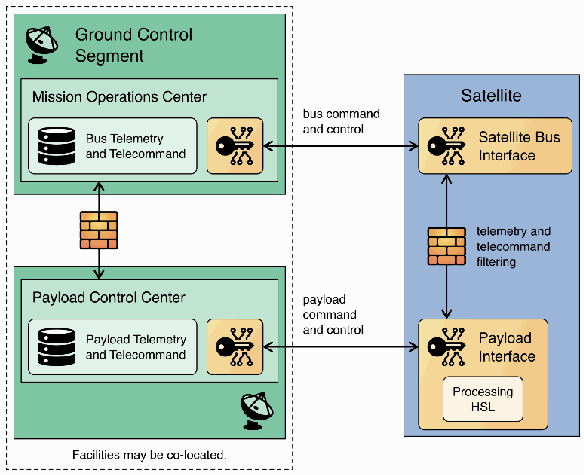
ブロック図です。左側の破線の枠(「施設は同じ場所に配置される場合があります。」)に緑色の「地上管制セグメント」があり、「ミッション運用センター」(「バステレメトリおよびテレコマンド」と鍵の図記号を含む)と、その下の「ペイロード管制センター」(「ペイロードテレメトリおよびテレコマンド」と鍵の図記号を含む)がファイアウォールの図記号を介してつながっています。右側の青色の「衛星」の枠には「衛星バスインターフェース」と「ペイロードインターフェース」(「処理 HSL」を含む)があり、「テレメトリおよびテレコマンドのフィルタリング」と書かれたファイアウォールの図記号を介してつながっています。ミッション運用センターと衛星バスインターフェースは「バスのコマンドおよび制御」の双方向矢印で、ペイロード管制センターとペイロードインターフェースは「ペイロードのコマンドおよび制御」の双方向矢印で結ばれています。
Fig. 1. Satellite Ground Segment Components of Commercial Space Operations
図 1. 商業宇宙運用の衛星地上セグメントの構成要素
The Profile’s scope includes any system, network, or capability that interacts with a satellite bus or payload for purposes of Querying, Commanding, Control and Status (C&S), or Command and Control (C2). Figure 2 shows which components are in and out of scope for the Profile. Out of scope items are assessed and managed separately as they may have different needs and impacts.
本プロファイルの適用範囲には、照会、コマンド送信、制御・ステータス(C&S)、またはコマンド・制御(C2)の目的で、衛星バスまたはペイロードとやり取りするあらゆるシステム、ネットワーク、機能が含まれます。図 2 は、本プロファイルの適用範囲内の構成要素と範囲外の構成要素を示しています。範囲外のものは、ニーズや影響が異なる可能性があるため、別途評価・管理されます。
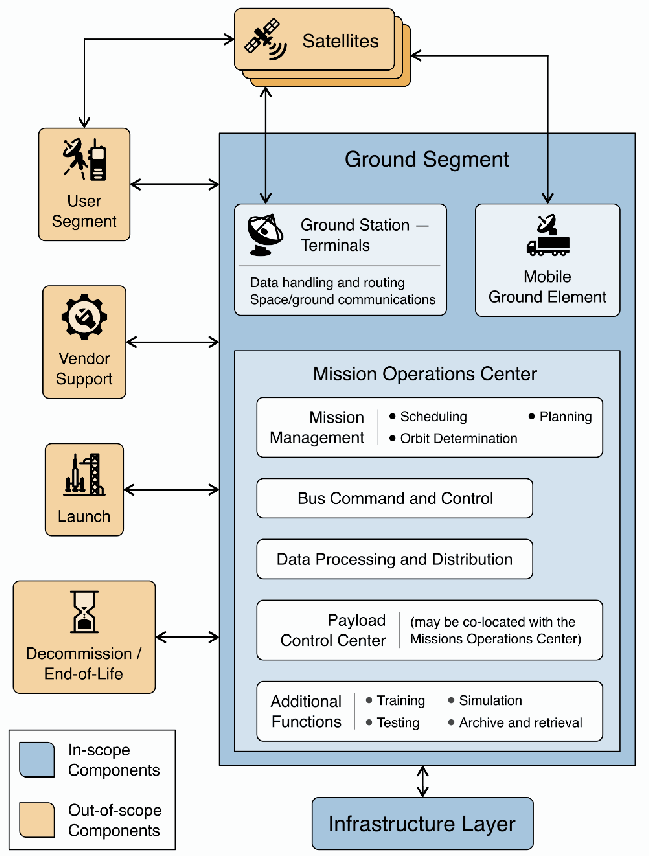
適用範囲内・範囲外の構成要素を示す図です。青色の大きな「地上セグメント」(範囲内)の中に、「地上局端末」(「データ処理およびルーティング」「宇宙・地上通信」)、「移動型地上要素」、そして「ミッション運用センター」の枠があります。この枠には「ミッション管理」(スケジューリング、計画、軌道決定)、「バスのコマンドおよび制御」、「データ処理および配信」、「ペイロード管制センター(ミッション運用センターと同じ場所に配置される場合があります)」、「追加機能」(訓練、試験、シミュレーション、アーカイブおよび検索)が並びます。オレンジ色の範囲外の枠「衛星」「ユーザーセグメント」「ベンダーサポート」「打ち上げ」「廃止・運用終了」は地上セグメントと双方向矢印で結ばれ、「衛星」はユーザーセグメント、地上局、移動型地上要素とも結ばれています。地上セグメントの下には青色の「インフラストラクチャ層」が双方向矢印でつながっています。凡例では青色が「適用範囲内の構成要素」、オレンジ色が「適用範囲外の構成要素」を表します。
Fig. 2. Components In and Out of Scope for the Profile
図 2. プロファイルの適用範囲内および範囲外の構成要素
The Profile’s scope does not include the space vehicle itself or the user segment of the space system.
本プロファイルの適用範囲には、宇宙機自体や、宇宙システムのユーザーセグメントは含まれません。
The Profile will support the stakeholder’s ability to:
本プロファイルは、ステークホルダーが次のことを行う能力を支援します。
•make risk-informed decisions about the cybersecurity of the ground segment and its corresponding impact to the space segment’s bus and payload;
•地上セグメントのサイバーセキュリティと、それが宇宙セグメントのバスおよびペイロードに及ぼす影響について、リスクに基づいた意思決定を行うこと。
•select risk-based approaches that minimize the potential effects of the disruption or manipulation of satellite bus and payload commanding and telemetry; and
•衛星バスおよびペイロードのコマンド送信とテレメトリの中断や改ざんによる潜在的な影響を最小限に抑える、リスクベースのアプローチを選択すること。
•consider planning and action regarding the secure management and recovery of the space segment.
•宇宙セグメントの安全な管理と復旧に関する計画と行動を検討すること。
1.3. Audience
1.3. 想定読者
The intended audience includes public and private organizations that own, operate, or manage space systems and are seeking to assess or elevate their current security posture, such as:
想定読者には、宇宙システムを所有、運用、または管理し、現在のセキュリティ態勢を評価または強化しようとしている公的・民間の組織が含まれます。たとえば、次のような組織です。
•risk managers, cybersecurity professionals, and others with a role in risk management for ground systems; and
•リスク管理者、サイバーセキュリティ専門家、および地上システムのリスクマネジメントに関わるその他の人々。
•researchers and analysts who study space systems and the unique cybersecurity needs of the space cyber-ecosystem.
•宇宙システムと、宇宙のサイバーエコシステム固有のサイバーセキュリティニーズを研究する研究者およびアナリスト。
The Profile is suitable for a range of stakeholders with varying degrees of risk management experience, including organizations with the following characteristics:
本プロファイルは、リスクマネジメントの経験の度合いが異なるさまざまなステークホルダーに適しています。これには、次のような特徴を持つ組織が含まれます。
•have already adopted the NIST Cybersecurity Framework to help identify, assess, and manage cybersecurity risks [NIST-CSF];
•サイバーセキュリティリスクの識別、評価、管理に役立てるため、すでに NIST サイバーセキュリティフレームワークを採用しています [NIST-CSF]。
•are familiar with the Cybersecurity Framework and want to improve their risk posture; or
•サイバーセキュリティフレームワークに精通しており、リスク態勢を改善したいと考えています。
•are unfamiliar with the Cybersecurity Framework but need to implement or augment risk management efforts.
•サイバーセキュリティフレームワークに詳しくありませんが、リスクマネジメントの取り組みを実施または強化する必要があります。
2. Intended Use
2. 想定される用途
The Profile is a flexible tool that an organization can use as a part of its risk management effort. This Profile is intended to augment, rather than replace, such efforts.
本プロファイルは、組織がリスクマネジメントの取り組みの一環として使用できる柔軟なツールです。本プロファイルは、そうした取り組みを置き換えるものではなく、補強することを意図しています。
The Profile will aid in the prioritization of cybersecurity activities based on business objectives and identify areas where standards, practices, and other guidance could help manage risks. NIST also encourages the development of organization-specific profiles by applying this profile to a particular mission or cyber-ecosystem. Considerations for specific profiles include:
本プロファイルは、事業目標に基づくサイバーセキュリティ活動の優先順位付けに役立つとともに、標準、慣行、その他のガイダンスがリスク管理に役立つ領域を識別します。NIST はまた、本プロファイルを特定のミッションやサイバーエコシステムに適用して、組織固有のプロファイルを作成することを推奨しています。固有のプロファイルを検討する際の考慮事項には、次のものがあります。
1.What ground segment processes and assets are dependent on other assets (i.e., what are the externalities and secondary effects)?
1.地上セグメントのどのプロセスや資産が他の資産に依存していますか(すなわち、外部性や二次的影響は何か)。
2.What is the level of interconnectivity (logical and physical) of the ground segment with other processes?
2.地上セグメントと他のプロセスとの相互接続(論理的および物理的)の度合いはどの程度か。
3.What processes and assets are vulnerable?
3.どのプロセスや資産が脆弱か。
4.What are the integrity and availability thresholds to avoid mission impact?
4.ミッションへの影響を避けるための完全性と可用性のしきい値は何か。
5.What are the confidentiality requirements?
5.機密性の要件は何か。
6.What safeguards are currently in place?
6.現在どのような保護措置が講じられていますか。
7.What is the impact to the organization should a process or asset be lost or degraded?
7.プロセスや資産が失われたり低下したりした場合、組織への影響はどうなりますか。
8.What techniques can be used to detect events of concern?
8.懸念されるイベントを検知するために、どのような技術を使用できますか。
9.What techniques can be used to respond to events of concern?
9.懸念されるイベントに対応するために、どのような技術を使用できますか。
10.What techniques can be used to recover to pre-event capabilities?
10.イベント前の機能に復旧するために、どのような技術を使用できますか。
11.What techniques can be leveraged to measure effectiveness of implemented policies and methodologies to iteratively revise security measures?
11.実施したポリシーや方法論の有効性を測定し、セキュリティ対策を反復的に見直すために、どのような技術を活用できますか。
3. Overview
3. 概要
3.1. Risk Management Overview
3.1. リスクマネジメントの概要
Risk management is the ongoing process of identifying, assessing, and responding to risk as related to an organization’s mission objectives. To manage risk, organizations should understand any potential impact as well as the likelihood that an event will occur. An organization should also consider statutory and policy requirements that may influence or inform cybersecurity decisions.
リスクマネジメントとは、組織のミッション目標に関連するリスクを識別、評価し、それに対応する継続的なプロセスです。リスクを管理するには、組織は潜在的な影響と、イベントが発生する可能性の両方を理解すべきです。組織はまた、サイバーセキュリティに関する意思決定に影響を与え、またはその判断材料となり得る、法令やポリシーの要件も考慮すべきです。
The Profile provides a flexible approach for stakeholders to manage risks when interfacing with the satellite bus or payload regardless of the source of the risk, including natural events, malicious actions, and human activities that have unintended consequences. It also provides a starting point from which organizations can customize their risk management approach.
本プロファイルは、自然事象、悪意ある行為、意図しない結果をもたらす人間の活動など、リスクの発生源にかかわらず、ステークホルダーが衛星バスまたはペイロードとやり取りする際のリスクを管理するための柔軟なアプローチを提供します。また、組織が自らのリスクマネジメントのアプローチをカスタマイズするための出発点も提供します。
The Profile is intended to be used in conjunction with existing risk management processes to provide additional risk management considerations. Examples of cybersecurity risk management processes include International Organization for Standardization (ISO) 31000:2018, ISO/International Electrotechnical Commission (IEC) 27005, NIST Special Publication (SP) 800-39 [NIST-SP800-39], and NASA Risk Management Handbook [NASA-SP-2011]. A list of additional resources is included in Appendix C.
本プロファイルは、既存のリスクマネジメントプロセスと併用して、リスクマネジメント上の追加の考慮事項を提供することを意図しています。サイバーセキュリティのリスクマネジメントプロセスの例としては、国際標準化機構(ISO)31000:2018、ISO/国際電気標準会議(IEC)27005、NIST 特別刊行物(SP)800-39 [NIST-SP800-39]、NASA Risk Management Handbook [NASA-SP-2011] があります。追加資料の一覧は付録 C に掲載しています。
3.2. Cybersecurity Framework Overview
3.2. サイバーセキュリティフレームワークの概要
Created through collaboration between industry and government, the Cybersecurity Framework [NIST-CSF] provides prioritized, flexible, risk-based, and voluntary guidance based on existing standards, guidelines, and practices to help organizations better understand, manage, and communicate cybersecurity risks.
サイバーセキュリティフレームワーク [NIST-CSF] は、産業界と政府の協働により作成され、既存の標準、ガイドライン、慣行に基づいて、優先順位付けされた、柔軟でリスクベースの任意のガイダンスを提供し、組織がサイバーセキュリティリスクをよりよく理解、管理、伝達できるようにします。
The Cybersecurity Framework consists of three main components:2
サイバーセキュリティフレームワークは、3 つの主要な要素で構成されます。2
1.The Framework Core provides a catalog of desired cybersecurity activities and outcomes3 using common language. The Core guides organizations in managing and reducing their cybersecurity risks in a way that complements an organization’s existing cybersecurity and risk management processes.
1.フレームワークコアは、共通の言語を用いて、望ましいサイバーセキュリティ活動と成果3のカタログを提供します。コアは、組織の既存のサイバーセキュリティおよびリスクマネジメントのプロセスを補完する形で、組織がサイバーセキュリティリスクを管理し低減するための指針となります。
2.The Framework Implementation Tiers provide context for how an organization views cybersecurity risk management. The Tiers help organizations understand whether they have a functioning and repeatable cybersecurity risk management process and the extent to which cybersecurity risk management is integrated with broader organizational risk management decisions.
2.フレームワークの実装ティアは、組織がサイバーセキュリティのリスクマネジメントをどのように捉えているかの文脈を提供します。ティアは、組織が機能する反復可能なサイバーセキュリティのリスクマネジメントプロセスを有しているか、また、サイバーセキュリティのリスクマネジメントがより広範な組織のリスクマネジメントの意思決定にどの程度統合されているかを、組織が理解するのに役立ちます。
3.The Framework Profiles are customized to the outcomes of the Core to align with an organization’s requirements. Profiles are primarily used to identify and prioritize opportunities for improving cybersecurity at an organization.
3.フレームワークプロファイルは、組織の要件に合わせて、コアの成果をカスタマイズしたものです。プロファイルは主に、組織のサイバーセキュリティを改善する機会を識別し、優先順位を付けるために使用されます。
The Framework Core presents standards, guidelines, and practices within five concurrent and continuous Functions, which are described below:
フレームワークコアは、並行して継続的に実施される 5 つの機能の中で、標準、ガイドライン、慣行を示します。各機能は以下のとおりです。
1.Identify – Develop the organizational understanding to manage cybersecurity risk to systems, assets, data, and capabilities. The activities in the Identify Function are foundational to the effective use of the Cybersecurity Framework, enabling an organization to focus and prioritize its efforts in a manner consistent with its risk management strategy and business needs.
1.識別(IDENTIFY) – システム、資産、データ、能力に対するサイバーセキュリティリスクを管理するための組織的な理解を深めます。識別機能の活動は、サイバーセキュリティフレームワークを効果的に使用するための基盤であり、組織がリスクマネジメント戦略と事業ニーズに沿った形で取り組みを絞り込み、優先順位を付けることを可能にします。
2.Protect – Develop and implement the appropriate safeguards to ensure the delivery of critical infrastructure services. The activities in the Protect Function support the ability to limit or contain the impact of a potential cybersecurity event.
2.防御(PROTECT) – 重要インフラサービスの提供を確保するための適切な保護措置を策定し、実施します。防御機能の活動は、潜在的なサイバーセキュリティイベントの影響を制限または封じ込める能力を支えます。
3.Detect – Develop and implement the appropriate activities to identify the occurrence of a cybersecurity event. The activities in the Detect Function enable the timely discovery of cybersecurity events.
3.検知(DETECT) – サイバーセキュリティイベントの発生を識別するための適切な活動を策定し、実施します。検知機能の活動は、サイバーセキュリティイベントの適時の発見を可能にします。
4.Respond – Develop and implement the appropriate activities to act regarding a detected cybersecurity incident. The activities in the Respond Function support the ability to contain the impact of a potential cybersecurity incident.
4.対応(RESPOND) – 検知されたサイバーセキュリティインシデントに関して行動するための適切な活動を策定し、実施します。対応機能の活動は、潜在的なサイバーセキュリティインシデントの影響を封じ込める能力を支えます。
5.Recover – Develop and implement appropriate activities to maintain resilience and to restore any capabilities or services that were impaired due to a cybersecurity event. The activities in the Recover Function support timely recovery to normal operations, reduce the impact of a cybersecurity event, and provide insight and guidance for overall improvement.
5.復旧(RECOVER) – レジリエンスを維持し、サイバーセキュリティイベントによって損なわれた能力やサービスを復元するための適切な活動を策定し、実施します。復旧機能の活動は、通常運用への適時の復旧を支え、サイバーセキュリティイベントの影響を軽減し、全体的な改善に向けた洞察と指針を提供します。
When considered together, these Functions provide a high-level, strategic view of the life cycle of an organization’s management of cybersecurity risk.
これらの機能をまとめて考えると、組織によるサイバーセキュリティリスク管理のライフサイクルを、高いレベルで戦略的に捉えることができます。
The Framework Core then identifies underlying Categories and Subcategories for each Function. The 108 Subcategories are discrete cybersecurity outcomes that are organized into 23 Categories such as “Asset Management” and “Protective Technology.” Figure 3 depicts the basic structure of the Framework Core.
フレームワークコアはさらに、各機能の下位にあるカテゴリとサブカテゴリを識別します。108 のサブカテゴリは個別のサイバーセキュリティ成果であり、「資産管理」や「保護技術」などの 23 のカテゴリに整理されています。図 3 にフレームワークコアの基本構造を示します。
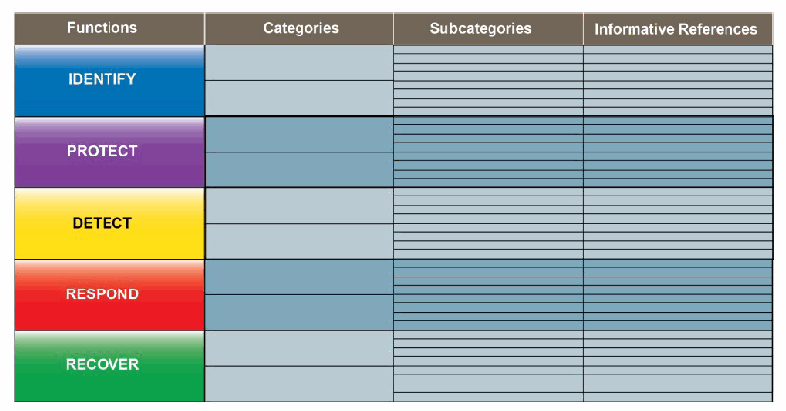
Framework Core の構造を示す模式的な表です。列見出しは「Functions」「Categories」「Subcategories」「Informative References」です。色分けされた 5 つの Function の行「IDENTIFY」(青)、「PROTECT」(紫)、「DETECT」(黄)、「RESPOND」(赤)、「RECOVER」(緑)があり、各 Function は複数の Category のセルに、各 Category はさらに多数の Subcategory と Informative Reference の行に分かれています。
Fig. 3. Structure of the Framework Core
図 3. フレームワークコアの構造
The Cybersecurity Framework is outcome-based and focuses on the cybersecurity functions rather than components. A Cybersecurity Framework Profile is not intended to provide specific implementation guidance; however, a Profile will supply Informative References to existing standards, guidelines, and practices that provide practical guidance to help an organization achieve the desired outcome of each Subcategory. An example of two Subcategories and their Informative References within the Asset Management Category is shown in Figure 4.
サイバーセキュリティフレームワークは成果ベースであり、構成要素ではなくサイバーセキュリティ機能に焦点を当てています。サイバーセキュリティフレームワークのプロファイルは、具体的な実装ガイダンスを提供することを意図していません。ただし、プロファイルは、組織が各サブカテゴリの望ましい成果を達成するための実践的なガイダンスを提供する既存の標準、ガイドライン、慣行への参考情報を示します。資産管理カテゴリ内の 2 つのサブカテゴリとその参考情報の例を、図 4 に示します。
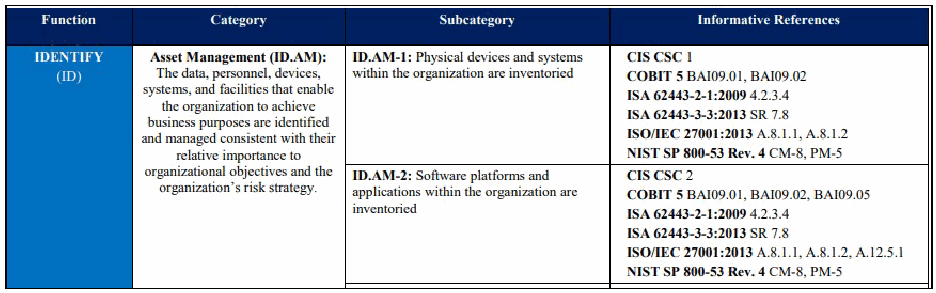
Cybersecurity Framework Core の表の抜粋です。列は「Function」「Category」「Subcategory」「Informative References」です。Function:「IDENTIFY (ID)」。Category:「Asset Management (ID.AM): The data, personnel, devices, systems, and facilities that enable the organization to achieve business purposes are identified and managed consistent with their relative importance to organizational objectives and the organization’s risk strategy.」。Subcategory「ID.AM-1: Physical devices and systems within the organization are inventoried」には参考情報「CIS CSC 1; COBIT 5 BAI09.01, BAI09.02; ISA 62443-2-1:2009 4.2.3.4; ISA 62443-3-3:2013 SR 7.8; ISO/IEC 27001:2013 A.8.1.1, A.8.1.2; NIST SP 800-53 Rev. 4 CM-8, PM-5」。Subcategory「ID.AM-2: Software platforms and applications within the organization are inventoried」には参考情報「CIS CSC 2; COBIT 5 BAI09.01, BAI09.02, BAI09.05; ISA 62443-2-1:2009 4.2.3.4; ISA 62443-3-3:2013 SR 7.8; ISO/IEC 27001:2013 A.8.1.1, A.8.1.2, A.12.5.1; NIST SP 800-53 Rev. 4 CM-8, PM-5」。
Fig. 4. Cybersecurity Framework Subcategory Example
図 4. サイバーセキュリティフレームワークのサブカテゴリの例
A Cybersecurity Framework Profile is an assessment of an organization in the context of the Cybersecurity Framework Core. A “current” Profile is a review of the Core Subcategories in terms of their applicability and current efficacy from the perspective of the organization. A “target” Profile is a set of Subcategories that are selected by an organization as being relevant to the organization to achieve a desired cybersecurity state. A gap is identified when a target Subcategory is missing or insufficiently implemented by the current Profile.
サイバーセキュリティフレームワークのプロファイルとは、サイバーセキュリティフレームワークのコアの文脈における組織の評価です。「現在の」プロファイルは、コアのサブカテゴリについて、その適用可能性と現在の有効性を組織の観点から確認したものです。「目標」プロファイルは、望ましいサイバーセキュリティ状態を達成するために組織に関連があるとして、組織が選択したサブカテゴリの集合です。目標のサブカテゴリが現在のプロファイルで欠けている、または十分に実施されていない場合、ギャップが識別されます。
The Cybersecurity Framework [NIST-CSF] provides additional guidance regarding its purpose and use.
サイバーセキュリティフレームワーク [NIST-CSF] は、その目的と使用に関する追加のガイダンスを提供しています。
4. Baseline Profile
4. ベースラインプロファイル
This section was created by using the Cybersecurity Framework, as described in Section 3.2. The tables summarize the Subcategories within a Category for a Function. The Informative References provide additional guidance.
このセクションは、セクション 3.2 で説明したサイバーセキュリティフレームワークを用いて作成されました。表は、機能ごとにカテゴリ内のサブカテゴリをまとめたものです。参考情報は、追加のガイダンスを提供します。
By design, the Cybersecurity Framework is inherently flexible to accommodate the unique environments and needs of different organizations. Users of this document should understand that deviations between their enterprise and the assumptions made in this Profile will impact the applicability of the Subcategories. Therefore, stakeholders are advised to review all the Subcategories (including those considered not applicable) in the context of their organization.
サイバーセキュリティフレームワークは、設計上、さまざまな組織固有の環境やニーズに対応できるよう本質的に柔軟です。本書の利用者は、自らのエンタープライズと、本プロファイルが置いた前提との間に相違がある場合、サブカテゴリの適用可能性に影響することを理解すべきです。したがって、ステークホルダーは、(適用対象外と考えられるものを含め)すべてのサブカテゴリを、自らの組織の文脈で確認すべきです。
4.1. Identity Function
4.1. 識別機能
The Identify Function is foundational to the risk assessment process; risk management practitioners should start with the Identify Function. In order to manage risks and assets, they first have to be identified. Consideration of the organization’s mission and business objectives, threat environment, assets, and vulnerabilities will have a significant influence on the overall risk management decision and will also impact the other four Functions (i.e., Protect, Detect, Respond, Recover).
識別機能はリスクアセスメントプロセスの基盤であり、リスクマネジメントの実務者は識別機能から始めるべきです。リスクと資産を管理するには、まずそれらを識別しなければなりません。組織のミッションと事業目標、脅威環境、資産、脆弱性を考慮することは、リスクマネジメント全体の意思決定に大きな影響を与え、ほかの 4 つの機能(すなわち、防御、検知、対応、復旧)にも影響を及ぼします。
The objectives of the Identify Function include:
識別機能の目標には、次のものがあります。
•identify the business or operational environment and organization’s purpose;
•事業環境または運用環境と、組織の目的を識別すること。
•identify all assets, including hardware, software, personnel, roles, and responsibilities, and the assets’ criticality;
•ハードウェア、ソフトウェア、要員、役割、責任を含むすべての資産と、その資産の重要度を識別すること。
•identify infrastructure that provides ground segment functionality; and
•地上セグメントの機能を提供するインフラを識別すること。
•identify the current and trending vulnerabilities, threats, and impacts should the threat be realized to assess the risk.
•リスクを評価するために、現在の脆弱性と脅威、その傾向、および脅威が現実となった場合の影響を識別すること。
The Identify Function within the Cybersecurity Framework defines six Categories, which are summarized in Table 1. Each of these Categories has at least one Subcategory that applies to the ground segment. However, organizations should review all Subcategories in the Identify Function in case any of them apply to the organization’s environment.
サイバーセキュリティフレームワークの識別機能は 6 つのカテゴリを定義しており、表 1 にまとめています。これらの各カテゴリには、地上セグメントに適用される少なくとも 1 つのサブカテゴリがあります。ただし、組織は、組織の環境に当てはまるものがある場合に備え、識別機能のすべてのサブカテゴリを確認すべきです。
Table 1. Baseline Profile for the Identify Function
表 1. 識別機能のベースラインプロファイル
| Subcategory | Applicability to the Ground Segment | References |
|---|---|---|
Identify: Asset Management Category The data, personnel, devices, systems, and facilities that enable the organization to achieve its business objectives are identified and managed in a manner that is consistent with their importance to organizational objectives and the organization’s risk strategy. Asset management and prioritization is an important factor in other functions and activities such as contingency planning for future attacks, responding to malware events, emergency responses, and recovery actions. Asset management will assist in prioritizing response and recovery activities. | ||
| ID.AM-1: Physical devices and systems within the organization are inventoried | Organizations should document and maintain an inventory of the components, to include cloud-based resources, that reflect the current system. Organizations should also consider incorporating a configuration management tool that documents the physical location of all physical components, then verify each component’s location and identify its physical interfaces during physical inspections. | [NIST-SP800-53r5] CM-8, CM-9, PM-5 [NIST-SP800-160V1] 2.3 |
| ID.AM-2: Software platforms and applications within the organization are inventoried | Organizations should document and maintain an inventory of software components, including applications, firmware and operating systems. The inventory should also include non-traditional components such as virtual machine images and application programming interfaces (APIs). Relevant information such as licenses and versions should also be added. The software inventory should be reviewed and updated as defined by the organization. | [NIST-SP800-53r5] CM-8, PM-5 [NIST-SP800-204] |
| ID.AM-3: Organizational communication and data flows are mapped | Organizations should identify all connections within and between systems, and should document, authorize, and review all connections and interfaces. Connection information may include physical and logical interface characteristics, data characteristics, ports, protocols, addresses, security requirements, and connection purpose. In addition to IT specific data flows, communication and data flow mappings should include analog connections, such as radio frequency or optical transmitters/ receivers and interfaces. Some components (such as those that directly send commands or receive data from the space segment) are normally physically or logically isolated from other networks. Temporary connections to components for updates, diagnostics, scanning, etc. should be included in the mapping. | [IEC61850-90-4] 10, 14 [NIST-SP800-53r5] AC-4, CA-3, CA-9, PL-8, SA-17 |
| ID.AM-4: External information systems are catalogued | Typically, connections to external information systems are strictly limited in the ground segment. Organizations should ensure that components that directly interface with space vehicles are securely isolated from external networks but can access necessary data from external sources, such as reach back to the satellite vendor for anomaly resolution support and connections to external databases. How this data is transferred should be catalogued. | [NIST-SP800-53r5] AC-20, PM-5, SA-9 |
| ID.AM-5: Resources (e.g., hardware, devices, data, time, personnel and software) are prioritized based on their classification, criticality and business value | Organizations should identify and prioritize ground system components, processors, services, and functions based on their classification, criticality, and value in the context of maintaining positive control of the space segment. Organizations should provide adequate staffing with the appropriate training such that support is available in a timely manner (consistent with thresholds defined in the organization’s business plan). Stakeholders are advised to use other Functions within the Cybersecurity Framework to inform the identification and prioritization procedures. For example, while testing business continuity procedures, use the findings to identify which resources of the mission were impacted and to what degree, and reprioritize accordingly. | [NIST-SP800-37r2] [NIST-SP800-53r5] AC-20, CP-2, CP-8, RA-2, RA-9, SA-20, SC-6 |
| ID.AM-6: Cybersecurity roles and responsibilities for the entire workforce and third-party stakeholders (e.g., suppliers, customers, partners) are established | Organizations should assign cybersecurity roles and responsibilities for the ground systems. The roles and responsibilities for third-party stakeholders and collaborative partners (such as organizations that own or operate payloads that are hosted) are determined on a case-by-case basis. | [NIST-SP800-53r5] CP-2, PM-2, PM-29,PS-2, PS-7 |
Identify: Business Environment Category The organization’s mission, objectives, stakeholders, and activities are documented, reviewed, and prioritized. This information is used to inform cybersecurity roles, responsibilities, and risk management decisions. | ||
| ID.BE-1: The organization’s role in the supply chain is identified and communicated | Organizations should assess and implement their supply chain risk management policy and procedures with respect to ground segment systems. | [NIST-SP800-53r5] SR-1, SR-3 [NIST-SP800-161] |
| ID.BE-2: The organization’s place in critical infrastructure and its industry sector is identified and communicated | Depending on the types of payloads or services provided by the satellite, organizations should consider the ground segment’s dependencies on and interdependencies with other critical infrastructure segments as part of their broader cyber risk management policy. They should also consider any related regulatory requirements. | [NIST-SP800-53r5] PM-8 |
| ID.BE-3: Priorities for organizational mission, objectives and activities are established and communicated | Organizations should consider communicating the priorities, threshold, and objective performance parameters so that potential customers of the satellite services will understand the scope and suitability for their mission. | [NIST-SP800-53r5] PM-11 |
| ID.BE-4: Dependencies and critical functions for delivery of critical services are established | Organizations should identify any critical capabilities from other sectors such as power, transportation, communications, timing etc. that may impact the mission. The organization’s infrastructure, such as network communication architectures, services, protocols, and hardware components, can impact recovery time. | [NIST-SP800-53r5] CP-2, CP-8, PE-9, PE-11, PM-8, RA-9, SA-20, SR-2 |
| ID.BE-5: Resilience requirements to support delivery of critical services are established for all operating states (e.g., under duress/attack, during recovery, normal operations) | Resilience requirements for the MOC and PCC are strongly dependent on the space and user segments. The ability for the space segment to function autonomously, the criticality of the services provided by the payload, the system’s architecture, and procedural considerations will all define upper and lower bounds on resilience requirements (such as recovery time, periods of outage, etc.). | [IEC61850-90-4] 12.2, 14.2.4 [NIST-SP800-53r5] CP-2, CP-11, RA-9, SA-8, SA-20 |
Identify: Governance Category The policies, procedures, and processes to manage and monitor the organization’s regulatory, legal, risk, environmental, and operational requirements are documented, reviewed, and inform the management of cybersecurity risk. | ||
| ID.GV-1: Organizational cybersecurity policy is established and communicated | This subcategory enables the organization to identify key functions and assign areas of responsibility to ensure a comprehensive cybersecurity approach. | [NIST-SP800-53r5] AC-1, AT-1, AU-1, CA-1, CM-1, CP-1, IA-1, IR-1, MA-1, MP-1, PE-1, PL-1, PM-1, PS-1, PT-1, RA-1, SA-1, SC-1, SI-1, SR-1 |
| ID.GV-2: Cybersecurity roles and responsibilities are coordinated and aligned with internal roles and external partners | Organizations should define roles and responsibilities between the organization and any third party such as cloud-based infrastructures or other services. These agreements are typically made in advance. Clearly defined internal roles and responsibilities will facilitate a response in a time of duress. If the PCC is operated by an external partner, then coordination of the roles and responsibilities between the mission owner and payload operations should be determined in advance on a case-by-case basis. The MOC or PCC may require coordination with external entities for space situational awareness (such as space weather, collision avoidance, and other hazards), with well-developed responses to identified events. | [NIST-SP800-53r5] PM-1, PM-2, PM-29, PS-7, PS-9 [NOAA-SW] |
| ID.GV-3: Legal and regulatory requirements regarding cybersecurity, including privacy and civil liberties obligations, are understood and managed | The MOC and PCC interface with the bus or payloads, not the data contained, so civil liberties and privacy considerations are generally not applicable. However, there may be cases in which the MOC or PCC may act as a conduit for user or mission data that may be subject to additional legal requirements. Organizations should review the ground segment and associated services for any relevant regulatory and legal requirements. | [NIST-SP800-53r5] AC-1, AT-1, AU-1, CA-1, CM-1, CP-1, IA-1, IR-1, MA-1, MP-1, PE-1, PL-1, PM-1, PS-1, PT-1, RA-1, SA-1, SC-1, SI-1, SR-1 |
| ID.GV-4: Governance and risk management processes address cybersecurity risks | Organizations should develop comprehensive risk management strategies which include cybersecurity considerations. For organizations that host payloads, the risk management processes for C2 of the bus may be influenced by changes in the payload mission. Organizations should also review and update their risk management strategy as necessary. | [NIST-SP800-53r5] PM-3, PM-7, PM-9, PM-10, PM-11, PM-28, RA-1, RA-2, RA-3, SA-2 [NIST-SP800-160V1] 3.3.8 |
Identify: Risk Assessment Category The organization documents and reviews the cybersecurity risk to operations (including mission, functions, image, or reputation), assets, and individuals. The ground segment is an important part of the organization’s risk assessment process, but attributes such as impact and likelihood must consider the space and user segments. Risk assessments are not normally done by individual segments. Typically, the analysis is performed by a separate group within the organization that considers the entire mission. | ||
| ID.RA-1: Asset vulnerabilities are identified and documented. | Organizations should identify, document, and report vulnerabilities that exist in the ground segment. Vulnerability scanning is normally tested on a representative system to ensure that it is safe and feasible for the operational system. There are alternatives to vulnerability scanning that would be less risky for operational systems, like using information from asset and configuration management technologies to find known vulnerable versions of software and known security misconfigurations. Space systems often have custom software performing key functions. This software can have vulnerabilities which may not be caught by typical vulnerability scanning tools. Special considerations for custom software are warranted. Organizations should test systems frequently and prioritize documenting discovered vulnerabilities. Testing should also occur whenever there have been modifications to the system. | [NIST-SP800-53r5] CA-2, CA-5, CA-7, CA-8, PM-4, PM-15, RA-3, RA-5, SA-5, SA-11, SI-2, SI-4, SI-5 |
| ID.RA-2: Cyber threat intelligence is received from information sharing forums and sources. | Organizations should have procedures and processes to receive and analyze threat intelligence from a variety of sources. Commercial entities can use resources such as reports generated by vendors, public interest groups, industry associations and sector-specific organizations (Space Information Sharing and Analysis Center [ISAC] for this sector). In some cases, threat intelligence may be received from national sources through appropriate channels. | [CISA-ICS] [DHS-NCCIC] [NIST-SP800-53r5] PM-15, PM-16, RA-10, SI-5 [NIST-SP800-150] [Space-ISAC] |
| ID.RA-3: Threats, both internal and external, are identified and documented. | Organizations should incorporate threat modeling processes to identify and understand existing and future threats to the ground segment. Potential threat modeling categories may include kinetic physical, non-kinetic physical, electronic, and cybersecurity threats. Threat identification and documentation is not limited to malicious attacks or threats to information systems. Organizations should consider integrating cyber threat assessments with other existing reliability and environmental assessments typically performed by space systems developers. | [CCSDS-GREEN] [DIA-SPACE] [NASIC] [NIST-IR8179] [NIST-SP800-37r2] [NIST-SP800-53r5] PM-12, PM-16, RA-3, RA-10, SI-5 [NIST-SP800-154] [NIST-SP800-160V1] 2.3 [RTCA-DO-235] 4-12 |
| ID.RA-4: Potential business impacts and likelihoods are identified. | Organizations should identify any potential impacts based on the results of performing ID.RA-1 through ID.RA-3. Stakeholders should be made aware that this type of analysis is probabilistic and typically presented as a range. Likelihood is impacted by externalities such as a time of peace versus a time of heightened tensions. For malicious threat agents, likelihood is a function of capability and intent. Assessments should be updated as organizations’ knowledge of threat agents’ capabilities increase, and events occur that may increase the likelihood of attack. The impact analysis should be updated as the organization’s business and knowledge evolves. | [NIST-SP800-53r5] CP-2, PM-9, PM-11, RA-2, RA-3, RA-9 [RTCA-DO-235] 2.1, 13 |
| ID.RA-5: Threats, vulnerabilities, likelihoods and impacts are used to determine risk. | The risk determination requires a coordinated effort between threat analysts (for capability and intent of threat agents), system designers (for vulnerability assessment), and mission owner (for impact). Organizations should reassess risk on a periodic basis, and when there is a substantive change:
| [IETF-RFC8915] 3-9 [NIST-SP800-30r1] [NIST-SP800-53r5] CA-2, CA-7, PM-16, PM-28, RA-2, RA-3 [NIST-SP800-160V1] 2.3, 2.4 [RTCA-DO-235] 2.1-2.4, 3, 14 |
| ID.RA-6: Risk responses are identified and prioritized. | Organizations should have processes and procedures to identify and prioritize risk responses. Risk responses include activities such as acknowledging and accepting the risk, transferring the risk, mitigating the risk by addressing vulnerabilities through technical or operational means, or eliminating the risk by changing operations. | [NIST-SP800-53r5] CA-5, PM-4, PM-9, PM-28, RA-7 |
Identify: Risk Management Strategy Category The organization’s priorities, constraints, risk tolerances, and assumptions are established and used to support operational risk decisions. The risk management strategy takes into consideration the risk factors of all three segments (space, ground, and user) as appropriate. This profile concentrates on the inclusion of the ground segment in the risk management strategy. | ||
| ID.RM-1: Risk management processes are established, managed and agreed to by organizational stakeholders. | Organizations should establish risk management processes that detail how the risk management strategy is developed for the organization or sub-organizations. Although this profile concentrates on the ground segment, the process itself will be the same across the organization. Given that the risk accepted by one segment may impact or be imposed on other segments, the risk management strategy should include all three segments. | [NIST-SP800-53r5] PM-9, PM-28 |
| ID.RM-2: Organizational risk tolerance is determined and clearly expressed. | Organizations should determine the risk tolerance for their ground segment. This risk tolerance will include the MOC and PCC. The organizational risk tolerance of the ground segment (and the potential residual risk that may be inherited) may then be used in risk management of the space and user segments as appropriate. | [NIST-SP800-53r5] PM-9 |
| ID.RM-3: The organization’s determination of risk tolerance is informed by its role in critical infrastructure and sector specific risk analysis | Organizations should determine their risk tolerance related to the ground segment. An organization may determine its risk tolerance across all the segments that it operates. Risk tolerance will be determined by the entire organization (to include the space and user segment), and the risks of the ground segment should be included in that determination, including the MOC and the PCC. | [NIST-SP800-53r5] PM-8, PM-9, PM-11, RA-9 |
Identify: Supply Chain Risk Management Category The organization’s priorities, constraints, risk tolerances, and assumptions are established and used to support risk decisions associated with managing supply chain risk. The organization has established and implemented the processes to identify, assess, and manage supply chain risks. | ||
| ID.SC-1: Cyber supply chain risk management processes are identified, established, assessed, managed and agreed to by organizational stakeholders. | Due to the nature of the ground segment, some of the equipment used is highly specialized with a limited supply chain. Organizations should consider this specialized nature when determining and managing supply chain risk. Supply chain risk management processes need to consider challenges and constraints that may not observed in typical IT environments. For example, the unique delivery of updates and patching necessitated by the constrained external connections of the ground segment. The MOC has constrained external connections and critical components that directly communicate with the space segment and are typically securely isolated from the network. | [NIST-SP800-53r5] PM-30, SA-9, SR-1, SR-2, SR-3, SR-5 [NIST-SP800-161] |
| ID.SC-2: Suppliers and third-party partners of information systems, components and services are identified, prioritized and assessed using a cyber supply chain risk assessment process. | Organizations should consider having multiple sources for hardware or software to facilitate line-item replacement by different manufacturers. This measure can avoid supply chain breakage impacts due to the loss of a vendor or poor production lots delaying delivery of equipment. Any use of third parties should be reviewed and agreed upon in advance on a case-by-case basis. Assessment of a potential third-party partner should include an understanding of their cyber maturity and the corresponding level of trust that would be suitable. Limit information access to the greatest extent practical and sensitive information should be securely isolated. Organizations should remain informed of current and future regulations related to the acquisition of services (such as buses to accommodate a hosted payload) and devices that may form and transport C2 messages or receive payload acknowledgements or telemetry. | [NIST-SP800-53r5] PM-9, RA-3, SA-15, SR-2, SR-3, SR-5, SR-6 [NIST-SP800-161] 2.2, 3 |
| ID.SC-3: Contracts with suppliers and third-party partners are used to implement appropriate measures designed to meet the objectives of an organization’s cybersecurity program and Cyber Supply Chain Risk Management Plan. | Organizations should have processes in place to develop and review contracts to ensure that the contracts meet the needs of the ground segment, including regulatory constraints. Consider contractual language to identify and screen any software bill of materials (SBOM) within custom software. If SBOMs are requested, organizations should monitor for vulnerabilities in underlying software libraries. Mission unique and custom software often has very specific dependencies with existing Command and Control (C2) tools, Telemetry, Tracking, and Control TT&C tools. Special attention should be given to custom software and its dependencies to ensure there are contractual obligations covering their cybersecurity throughout the anticipated lifespan of the satellite being supported. Considerations may include:
| [NDAA] Section 889 [NIST-SP800-53r5] SA-4, SA-9, SR-2, SR-3, SR-5 |
| ID.SC-4: Suppliers and third-party partners are routinely assessed using audits, test results, or other forms of evaluations to confirm they are meeting their contractual obligations. | Organizations should conduct assessments and evaluations in the context of supply chain considerations for the ground segment such as:
The organization should consider access paths within the supply chain that might allow adversaries to gain information and introduce hardware, software, or firmware that could cause disruption of the space or ground segment as well as any dependencies that may exist. | [NIST-SP800-53r5] AU-6, CA-2, CA-7, PS-7, SA-9, SA-11 |
| ID.SC-5: Response and recovery planning and testing are conducted with suppliers and third-party providers | Organizations should include suppliers and third-party providers in recovery planning and testing as appropriate for the ground segment. Scenarios where this may apply include situations where:
Typically, such activities are done in advance of satellite launch, though modifications in these activities may take place throughout the life of the satellite. | [NIST-SP800-53r5] CP-2, CP-4, IR-3, IR-4, IR-8, IR-9 |
| サブカテゴリ | 地上セグメントへの適用 | 参考情報 |
|---|---|---|
識別: 資産管理カテゴリ 組織が事業目標を達成することを可能にするデータ、要員、デバイス、システム、施設が、組織の目標に対する重要度と組織のリスク戦略に整合した形で識別され、管理されています。資産管理と優先順位付けは、将来の攻撃に備えた緊急時対応計画、マルウェアイベントへの対応、緊急対応、復旧措置など、他の機能や活動においても重要な要素です。資産管理は、対応活動と復旧活動の優先順位付けに役立ちます。 | ||
| ID.AM-1: 組織内の物理デバイスおよびシステムのインベントリが作成されています | 組織は、現行のシステムを反映した、クラウドベースのリソースを含む構成要素のインベントリを文書化し、維持すべきです。組織はまた、すべての物理コンポーネントの物理的な設置場所を文書化する構成管理ツールの導入を検討すべきです。そのうえで、物理検査の際に各コンポーネントの設置場所を検証し、その物理インターフェースを識別すべきです。 | [NIST-SP800-53r5] CM-8, CM-9, PM-5 [NIST-SP800-160V1] 2.3 |
| ID.AM-2: 組織内のソフトウェアプラットフォームおよびアプリケーションのインベントリが作成されています | 組織は、アプリケーション、ファームウェア、オペレーティングシステムを含むソフトウェアコンポーネントのインベントリを文書化し、維持すべきです。インベントリには、仮想マシンイメージやアプリケーションプログラミングインターフェース(API)といった従来型でないコンポーネントも含めるべきです。ライセンスやバージョンなどの関連情報も追加すべきです。ソフトウェアインベントリは、組織が定めるとおりに見直し、更新すべきです。 | [NIST-SP800-53r5] CM-8, PM-5 [NIST-SP800-204] |
| ID.AM-3: 組織の通信およびデータフローがマッピングされています | 組織は、システム内およびシステム間のすべての接続を識別し、すべての接続とインターフェースを文書化し、認可し、見直すべきです。接続情報には、物理的・論理的なインターフェースの特性、データの特性、ポート、プロトコル、アドレス、セキュリティ要件、接続の目的が含まれる場合があります。 IT 固有のデータフローに加えて、通信とデータフローのマッピングには、無線周波数または光の送信機/受信機とインターフェースなどのアナログ接続も含めるべきです。 一部のコンポーネント(宇宙セグメントに直接コマンドを送信したり、宇宙セグメントから直接データを受信したりするものなど)は、通常、ほかのネットワークから物理的または論理的に隔離されています。更新、診断、スキャンなどのためにコンポーネントに一時的に接続する場合も、マッピングに含めるべきです。 | [IEC61850-90-4] 10, 14 [NIST-SP800-53r5] AC-4, CA-3, CA-9, PL-8, SA-17 |
| ID.AM-4: 外部情報システムが目録化されています | 通常、地上セグメントでは外部の情報システムへの接続は厳しく制限されています。組織は、宇宙機と直接インターフェースするコンポーネントが外部ネットワークから安全に隔離されている一方で、異常解決の支援を求める衛星ベンダーへの連絡経路や外部データベースへの接続など、外部ソースから必要なデータにアクセスできるようにすべきです。このデータをどのように転送するかを目録化すべきです。 | [NIST-SP800-53r5] AC-20, PM-5, SA-9 |
| ID.AM-5: リソース(ハードウェア、デバイス、データ、時間、要員、ソフトウェアなど)が、その分類、重要度、事業価値に基づいて優先順位付けされています | 組織は、宇宙セグメントの確実な制御を維持するという文脈で、分類、重要度、価値に基づいて、地上システムのコンポーネント、プロセッサ、サービス、機能を識別し、優先順位を付けるべきです。 組織は、適切な訓練を受けた十分な人員を配置し、(組織の事業計画に定めるしきい値に沿って)適時に支援を受けられるようにすべきです。 ステークホルダーは、識別と優先順位付けの手順に情報を提供するため、サイバーセキュリティフレームワークの他の機能を利用することが推奨されています。たとえば、事業継続手順をテストする際には、その結果を用いて、ミッションのどのリソースがどの程度影響を受けたかを識別し、それに応じて優先順位を見直すべきです。 | [NIST-SP800-37r2] [NIST-SP800-53r5] AC-20, CP-2, CP-8, RA-2, RA-9, SA-20, SC-6 |
| ID.AM-6: 全従業員および第三者ステークホルダー(供給者、顧客、パートナーなど)のサイバーセキュリティ上の役割と責任が確立されています | 組織は、地上システムのサイバーセキュリティに関する役割と責任を割り当てるべきです。 第三者のステークホルダーや協力パートナー(搭載ペイロードを所有または運用する組織など)の役割と責任は、個別に判断して決定されます。 | [NIST-SP800-53r5] CP-2, PM-2, PM-29,PS-2, PS-7 |
識別: 事業環境カテゴリ 組織のミッション、目標、ステークホルダー、活動が文書化され、見直され、優先順位が付けられています。この情報は、サイバーセキュリティの役割、責任、リスクマネジメントの意思決定に情報を提供するために使用されます。 | ||
| ID.BE-1: サプライチェーンにおける組織の役割が識別され、伝達されています | 組織は、地上セグメントのシステムに関して、サプライチェーンリスクマネジメントのポリシーと手順を評価し、実施すべきです。 | [NIST-SP800-53r5] SR-1, SR-3 [NIST-SP800-161] |
| ID.BE-2: 重要インフラおよび産業セクターにおける組織の位置付けが識別され、伝達されています | 衛星が提供するペイロードやサービスの種類に応じて、組織は、より広範なサイバーリスクマネジメントポリシーの一環として、地上セグメントの他の重要インフラセグメントへの依存関係と相互依存関係を考慮すべきです。関連する規制要件も考慮すべきです。 | [NIST-SP800-53r5] PM-8 |
| ID.BE-3: 組織のミッション、目標、活動の優先事項が確立され、伝達されています | 組織は、衛星サービスの潜在的な顧客が自らのミッションに対する範囲と適合性を理解できるよう、優先事項、しきい値、目標性能パラメータを伝達することを検討すべきです。 | [NIST-SP800-53r5] PM-11 |
| ID.BE-4: 重要サービスの提供に必要な依存関係と重要機能が確立されています | 組織は、電力、輸送、通信、タイミングなど、ミッションに影響を及ぼす可能性のある他のセクターの重要な機能を識別すべきです。ネットワーク通信アーキテクチャ、サービス、プロトコル、ハードウェアコンポーネントなど、組織のインフラは、復旧時間に影響を与える可能性があります。 | [NIST-SP800-53r5] CP-2, CP-8, PE-9, PE-11, PM-8, RA-9, SA-20, SR-2 |
| ID.BE-5: 重要サービスの提供を支援するレジリエンス要件が、すべての運用状態(強制下/攻撃中、復旧中、通常運用など)について確立されています | MOC と PCC のレジリエンス要件は、宇宙セグメントとユーザーセグメントに強く依存します。宇宙セグメントが自律的に機能できる能力、ペイロードが提供するサービスの重要度、システムのアーキテクチャ、手順上の考慮事項のすべてが、レジリエンス要件(復旧時間、停止期間など)の上限と下限を決定します。 | [IEC61850-90-4] 12.2, 14.2.4 [NIST-SP800-53r5] CP-2, CP-11, RA-9, SA-8, SA-20 |
識別: ガバナンスカテゴリ 組織の規制、法律、リスク、環境、運用の各要件を管理・監視するためのポリシー、手順、プロセスが文書化され、見直され、サイバーセキュリティリスクの管理に情報を提供しています。 | ||
| ID.GV-1: 組織のサイバーセキュリティポリシーが確立され、伝達されています | このサブカテゴリにより、組織は、包括的なサイバーセキュリティのアプローチを確保するために、主要な機能を識別し、責任範囲を割り当てることができます。 | [NIST-SP800-53r5] AC-1, AT-1, AU-1, CA-1, CM-1, CP-1, IA-1, IR-1, MA-1, MP-1, PE-1, PL-1, PM-1, PS-1, PT-1, RA-1, SA-1, SC-1, SI-1, SR-1 |
| ID.GV-2: サイバーセキュリティの役割と責任が、内部の役割および外部のパートナーと調整され、整合しています | 組織は、自組織とクラウドベースのインフラやその他のサービスなどの第三者との間の役割と責任を定義すべきです。こうした取り決めは通常、事前に行われます。 内部の役割と責任が明確に定義されていれば、緊急時の対応が円滑になります。PCC を外部のパートナーが運用している場合、ミッションオーナーとペイロード運用の間の役割と責任の調整は、事前に個別に判断して決めるべきです。 MOC や PCC では、宇宙状況認識(宇宙天気、衝突回避、その他のハザードなど)に関して外部組織との調整が必要になる場合があり、識別されたイベントに対して十分に整備された対応が求められます。 | [NIST-SP800-53r5] PM-1, PM-2, PM-29, PS-7, PS-9 [NOAA-SW] |
| ID.GV-3: プライバシーおよび市民的自由に関する義務を含め、サイバーセキュリティに関する法的・規制上の要件が理解され、管理されています | MOC と PCC が接続するのはバスやペイロードであり、そこに含まれるデータではないため、市民的自由とプライバシーに関する考慮事項は一般に適用されません。ただし、MOC や PCC が、追加の法的要件の対象となり得るユーザーデータやミッションデータの経路として機能する場合があります。組織は、地上セグメントと関連サービスについて、関連する規制上および法的な要件を確認すべきです。 | [NIST-SP800-53r5] AC-1, AT-1, AU-1, CA-1, CM-1, CP-1, IA-1, IR-1, MA-1, MP-1, PE-1, PL-1, PM-1, PS-1, PT-1, RA-1, SA-1, SC-1, SI-1, SR-1 |
| ID.GV-4: ガバナンスおよびリスクマネジメントのプロセスがサイバーセキュリティリスクに対処しています | 組織は、サイバーセキュリティの考慮事項を含む包括的なリスクマネジメント戦略を策定すべきです。ペイロードを搭載する組織では、バスの C2 に関するリスクマネジメントプロセスが、ペイロードのミッションの変化の影響を受ける場合があります。 組織はまた、必要に応じてリスクマネジメント戦略を見直し、更新すべきです。 | [NIST-SP800-53r5] PM-3, PM-7, PM-9, PM-10, PM-11, PM-28, RA-1, RA-2, RA-3, SA-2 [NIST-SP800-160V1] 3.3.8 |
識別: リスクアセスメントカテゴリ 組織は、運用(ミッション、機能、イメージ、評判を含む)、資産、個人に対するサイバーセキュリティリスクを文書化し、見直しています。地上セグメントは組織のリスクアセスメントプロセスの重要な一部ですが、影響や可能性といった属性は、宇宙セグメントとユーザーセグメントも考慮しなければなりません。リスクアセスメントは通常、個々のセグメントごとには行われません。一般に、ミッション全体を考慮する組織内の別のグループが分析を実施します。 | ||
| ID.RA-1: 資産の脆弱性が識別され、文書化されています。 | 組織は、地上セグメントに存在する脆弱性を識別し、文書化し、報告すべきです。 脆弱性スキャンは通常、運用システムに対して安全かつ実行可能であることを確認するため、代表的なシステムでテストされます。運用システムにとってリスクの低い脆弱性スキャンの代替手段もあります。たとえば、資産管理技術や構成管理技術の情報を用いて、既知の脆弱なバージョンのソフトウェアや既知のセキュリティ設定ミスを見つける方法があります。 宇宙システムには、主要な機能を果たすカスタムソフトウェアが多くあります。このソフトウェアには、一般的な脆弱性スキャンツールでは検出されない脆弱性が存在する場合があります。カスタムソフトウェアには特別な配慮が必要です。 組織は、システムを頻繁にテストし、発見された脆弱性の文書化を優先すべきです。システムに変更があった場合も、そのたびにテストを実施すべきです。 | [NIST-SP800-53r5] CA-2, CA-5, CA-7, CA-8, PM-4, PM-15, RA-3, RA-5, SA-5, SA-11, SI-2, SI-4, SI-5 |
| ID.RA-2: 情報共有フォーラムおよび情報源からサイバー脅威インテリジェンスを受領しています。 | 組織は、さまざまなソースから脅威インテリジェンスを受け取り、分析するための手順とプロセスを備えるべきです。 商業事業体は、ベンダー、公益団体、業界団体、セクター固有の組織(このセクターでは Space Information Sharing and Analysis Center [ISAC])が作成するレポートなどのリソースを利用できます。場合によっては、適切な経路を通じて国の機関から脅威インテリジェンスを受け取ることもあります。 | [CISA-ICS] [DHS-NCCIC] [NIST-SP800-53r5] PM-15, PM-16, RA-10, SI-5 [NIST-SP800-150] [Space-ISAC] |
| ID.RA-3: 内部および外部の脅威が識別され、文書化されています。 | 組織は、地上セグメントに対する現在および将来の脅威を識別し理解するため、脅威モデリングのプロセスを取り入れるべきです。脅威モデリングのカテゴリの候補には、運動エネルギーを伴う物理的脅威、運動エネルギーを伴わない物理的脅威、電子的脅威、サイバーセキュリティ上の脅威が含まれる場合があります。 脅威の識別と文書化は、悪意ある攻撃や情報システムへの脅威に限られません。組織は、宇宙システムの開発者が通常実施する他の既存の信頼性評価や環境評価と、サイバー脅威評価を統合することを検討すべきです。 | [CCSDS-GREEN] [DIA-SPACE] [NASIC] [NIST-IR8179] [NIST-SP800-37r2] [NIST-SP800-53r5] PM-12, PM-16, RA-3, RA-10, SI-5 [NIST-SP800-154] [NIST-SP800-160V1] 2.3 [RTCA-DO-235] 4-12 |
| ID.RA-4: 潜在的な事業影響とその可能性が識別されています。 | 組織は、ID.RA-1 から ID.RA-3 の実施結果に基づいて、潜在的な影響を識別すべきです。ステークホルダーには、この種の分析が確率的なものであり、通常は範囲で示されることを認識させるべきです。可能性は、平時か緊張が高まっている時期かといった外部要因の影響を受けます。 悪意ある脅威アクターの場合、可能性は能力と意図の関数です。組織が脅威アクターの能力についての知識を深めた場合、および攻撃の可能性を高め得る事象が発生した場合に、評価を更新すべきです。 影響分析は、組織の事業と知識の進展に合わせて更新すべきです。 | [NIST-SP800-53r5] CP-2, PM-9, PM-11, RA-2, RA-3, RA-9 [RTCA-DO-235] 2.1, 13 |
| ID.RA-5: 脅威、脆弱性、可能性、影響を用いてリスクを決定しています。 | リスクの決定には、脅威アナリスト(脅威アクターの能力と意図について)、システム設計者(脆弱性評価について)、ミッションオーナー(影響について)の連携した取り組みが必要です。 組織は、定期的に、また次のような実質的な変化があった場合に、リスクを再評価すべきです。
| [IETF-RFC8915] 3-9 [NIST-SP800-30r1] [NIST-SP800-53r5] CA-2, CA-7, PM-16, PM-28, RA-2, RA-3 [NIST-SP800-160V1] 2.3, 2.4 [RTCA-DO-235] 2.1-2.4, 3, 14 |
| ID.RA-6: リスク対応が識別され、優先順位付けされています。 | 組織は、リスクへの対応を識別し、優先順位を付けるためのプロセスと手順を備えるべきです。 リスクへの対応には、リスクを認識して受容する、リスクを移転する、技術的または運用上の手段で脆弱性に対処してリスクを軽減する、運用を変更してリスクを排除するといった活動が含まれます。 | [NIST-SP800-53r5] CA-5, PM-4, PM-9, PM-28, RA-7 |
識別: リスクマネジメント戦略カテゴリ 組織の優先事項、制約、リスク許容度、前提が確立され、運用上のリスクに関する意思決定を支援するために使用されています。リスクマネジメント戦略は、必要に応じて 3 つのセグメント(宇宙、地上、ユーザー)すべてのリスク要因を考慮します。本プロファイルは、リスクマネジメント戦略に地上セグメントを含めることに重点を置いています。 | ||
| ID.RM-1: 組織のステークホルダーによってリスクマネジメントプロセスが確立、管理され、合意されています。 | 組織は、組織または下位組織のリスクマネジメント戦略がどのように策定されるかを詳述したリスクマネジメントプロセスを確立すべきです。本プロファイルは地上セグメントに重点を置いていますが、プロセス自体は組織全体で同じです。あるセグメントが受容したリスクがほかのセグメントに影響したり、ほかのセグメントに課されたりする可能性があることから、リスクマネジメント戦略には 3 つのセグメントすべてを含めるべきです。 | [NIST-SP800-53r5] PM-9, PM-28 |
| ID.RM-2: 組織のリスク選好度が決定され、明確に表現されています。 | 組織は、地上セグメントのリスク許容度を決定すべきです。このリスク許容度には、MOC と PCC が含まれます。 地上セグメントの組織としてのリスク許容度(および継承され得る潜在的な残存リスク)は、必要に応じて、宇宙セグメントとユーザーセグメントのリスクマネジメントにも使用できます。 | [NIST-SP800-53r5] PM-9 |
| ID.RM-3: 重要インフラにおける組織の役割とセクター固有のリスク分析に基づいて、組織のリスク許容度が決定されています | 組織は、地上セグメントに関するリスク許容度を決定すべきです。 組織は、運用するすべてのセグメントにわたってリスク許容度を決定する場合があります。リスク許容度は(宇宙セグメントとユーザーセグメントを含む)組織全体で決定され、その決定には、MOC と PCC を含む地上セグメントのリスクを含めるべきです。 | [NIST-SP800-53r5] PM-8, PM-9, PM-11, RA-9 |
識別: サプライチェーンリスクマネジメントカテゴリ 組織の優先事項、制約、リスク許容度、前提が確立され、サプライチェーンリスクの管理に関連するリスクの意思決定を支援するために使用されています。組織は、サプライチェーンリスクを識別、評価、管理するプロセスを確立し、実施しています。 | ||
| ID.SC-1: サイバーサプライチェーンリスクマネジメントプロセスが識別、確立、評価、管理され、組織のステークホルダーによって合意されています。 | 地上セグメントの性質上、使用される機器の一部は高度に専門化されており、サプライチェーンが限られています。組織は、サプライチェーンリスクを判断し管理する際に、この専門性を考慮すべきです。 サプライチェーンリスクマネジメントプロセスでは、一般的な IT 環境では見られない課題や制約を考慮する必要があります。たとえば、地上セグメントでは外部接続が制約されていることから、更新やパッチ適用の提供方法が独特になります。MOC は外部接続が制約されており、宇宙セグメントと直接通信する重要なコンポーネントは、通常、ネットワークから安全に隔離されています。 | [NIST-SP800-53r5] PM-30, SA-9, SR-1, SR-2, SR-3, SR-5 [NIST-SP800-161] |
| ID.SC-2: 情報システム、コンポーネント、サービスの供給者と第三者パートナーが、サイバーサプライチェーンリスク評価プロセスを用いて識別、優先順位付け、評価されています。 | 組織は、異なる製造者による個々の品目の置き換えを容易にするため、ハードウェアやソフトウェアの調達先を複数持つことを検討すべきです。この対策により、ベンダーの喪失や不良な生産ロットによる機器納入の遅延に起因するサプライチェーンの途絶の影響を避けることができます。 第三者の利用は、個別に判断して、事前に見直し、合意すべきです。潜在的な第三者パートナーの評価には、そのサイバー成熟度と、それに応じて適切な信頼のレベルを理解することを含めるべきです。情報へのアクセスは実行可能な限り制限し、機微な情報は安全に隔離すべきです。 組織は、サービス(ホステッドペイロードを収容するバスなど)の調達や、C2 メッセージを構成・転送したり、ペイロードの確認応答やテレメトリを受信したりするデバイスに関する、現行および今後の規制について、常に情報を得ておくべきです。 | [NIST-SP800-53r5] PM-9, RA-3, SA-15, SR-2, SR-3, SR-5, SR-6 [NIST-SP800-161] 2.2, 3 |
| ID.SC-3: 供給者および第三者パートナーとの契約を用いて、組織のサイバーセキュリティプログラムおよびサイバーサプライチェーンリスクマネジメント計画の目的達成を意図した適切な対策を実施しています。 | 組織は、契約が規制上の制約を含む地上セグメントのニーズを満たすことを確実にするため、契約を作成し見直すプロセスを整えておくべきです。 カスタムソフトウェア内のソフトウェア部品表(SBOM)を識別し、精査するための契約文言を検討すべきです。SBOM を要求する場合、組織は基盤となるソフトウェアライブラリの脆弱性を監視すべきです。 ミッション固有のカスタムソフトウェアは、既存のコマンド・制御(C2)ツールやテレメトリ・追跡・制御 TT&C ツールと非常に特定の依存関係を持つことがよくあります。カスタムソフトウェアとその依存関係には特別な注意を払い、支援対象の衛星の想定寿命を通じてそれらのサイバーセキュリティを担保する契約上の義務が設けられていることを確保すべきです。 考慮事項には、次のものが含まれる場合があります。
| [NDAA] Section 889 [NIST-SP800-53r5] SA-4, SA-9, SR-2, SR-3, SR-5 |
| ID.SC-4: 供給者および第三者パートナーが、契約上の義務を履行していることを確認するため、監査、テスト結果、またはその他の評価方法を用いて定期的に評価されています。 | 組織は、地上セグメントのサプライチェーンに関する次のような考慮事項を踏まえて、アセスメントと評価を実施すべきです。
組織は、攻撃者が情報を入手したり、宇宙セグメントまたは地上セグメントの中断を引き起こし得るハードウェア、ソフトウェア、ファームウェアを持ち込んだりすることを可能にしかねない、サプライチェーン内のアクセス経路と、存在し得る依存関係を考慮すべきです。 | [NIST-SP800-53r5] AU-6, CA-2, CA-7, PS-7, SA-9, SA-11 |
| ID.SC-5: 供給者および第三者プロバイダーとともに、対応・復旧の計画策定とテストが実施されています | 組織は、地上セグメントに適した形で、供給者と第三者プロバイダーを復旧計画とテストに含めるべきです。 これが当てはまり得る状況には、次のようなものがあります。
通常、こうした活動は衛星の打ち上げ前に行われますが、衛星の運用期間を通じて、これらの活動に変更が生じる場合があります。 | [NIST-SP800-53r5] CP-2, CP-4, IR-3, IR-4, IR-8, IR-9 |
4.2. Protect Function
4.2. 防御機能
The Protect Function includes development, implementation, and verification measures to prevent the loss of assurance or functionality within the ground segment. Additionally, the Protect Function enables the response to and recovery from cybersecurity events with planning and preparation activities, while the execution of risk mitigation is addressed in the Response and Recovery Functions.
防御機能には、地上セグメント内での保証や機能の喪失を防ぐための、策定、実施、検証の対策が含まれます。さらに、防御機能は、計画と準備の活動によってサイバーセキュリティイベントへの対応と復旧を可能にします。一方、リスク低減の実行は、対応機能と復旧機能で扱います。
The ground segment is becoming more interconnected and cloud-based ground infrastructures, however legacy space operations and the space vehicles themselves use custom software and hardware that was not generally created to be part of a modern highly interconnected cyber-ecosystem. This can be especially problematic with legacy components that may have been created prior to the development of security best practices or that use obsolete security measures. Where conventional information technology (IT) cybersecurity measures may not be available, the profile strives to suggest compensating controls. Where practical, this section addresses some of the issues resulting from legacy or repurposed components; organizations should apply additional consideration to niche components.
地上セグメントでは相互接続化とクラウドベース化が進んでいますが、従来型の宇宙運用と宇宙機自体は、現代の高度に相互接続されたサイバーエコシステムの一部となることを想定せずに作られたカスタムのソフトウェアとハードウェアを使用しています。これは、セキュリティのベストプラクティスが策定される前に作られた、または旧式のセキュリティ対策を使用しているレガシーコンポーネントで、特に問題となり得ます。従来の情報技術(IT)のサイバーセキュリティ対策を利用できない場合、本プロファイルは代替管理策を提案するよう努めています。実行可能な場合、このセクションでは、レガシーコンポーネントや転用されたコンポーネントに起因する問題の一部を取り上げます。組織は、ニッチなコンポーネントについて追加の検討を行うべきです。
The objectives of the Protect Function include:
防御機能の目標には、次のものがあります。
•protecting the systems that format and transmit commands to the required level of assurance;
•コマンドを整形して送信するシステムを、必要な保証レベルまで保護すること。
•protecting the systems that receive and process telemetry or other data from the satellite; and
•衛星からテレメトリやその他のデータを受信して処理するシステムを保護すること。
•should a threat be realized, protecting the ground segment to maintain a sufficient level of operations through verified response and recovery plans and prevent adverse impacts on the space segment.
•脅威が現実となった場合に、検証済みの対応計画と復旧計画を通じて、十分な運用レベルを維持するよう地上セグメントを保護し、宇宙セグメントへの悪影響を防ぐこと。
The Protect Function defines six Categories, which are summarized in Table 2. Each of these Categories has at least one Subcategory that applies to the ground segment. However, organizations should review all Subcategories in the Protect Function in case any of them apply to the organization’s environment.
防御機能は 6 つのカテゴリを定義しており、表 2 にまとめています。これらの各カテゴリには、地上セグメントに適用される少なくとも 1 つのサブカテゴリがあります。ただし、組織は、組織の環境に当てはまるものがある場合に備え、防御機能のすべてのサブカテゴリを確認すべきです。
Table 2. Baseline Profile for the Protect Function
表 2. 防御機能のベースラインプロファイル
| Subcategory | Applicability to the Ground Segment | References |
|---|---|---|
Protect: Access Control Category Access to physical and logical assets and associated facilities is limited to authorized users, processes, and devices. The extent of the management and the degree of the limitations are consistent with the assessed risk of unauthorized access. In the context of the ground segment, assets may include antennas, receivers, and servers. “Physical access” may include measures to protect RF emanations through means such as directional antennas, beam shaping, the use of access codes within direct-sequence spread spectrum (DSS) implementations, etc. Emergency scenarios will be more thoroughly addressed in the Respond and Recover functions; however, there are important impacts within the Access Control category. Due to the environment that the ground segment operates within, the organization may have to bypass regular access controls in an emergency. | ||
| AC-1: Identities and credentials are issued, managed, verified, revoked and audited for authorized devices, users and processes. | Organizations should have processes and procedures to manage credentials, including issuance, verification, revocation, and auditing. Organizations should revoke credentials when the authorization of operators, devices, and processes expire or are no longer needed. | [NIST-SP800-53r5] IA-1, IA-2, IA-3, IA-4, IA-5, IA-6, IA-7, IA-8, IA-9, IA-10, IA-11, IA-12 |
| PR.AC-2: Physical access to assets is managed and protected | Organizations should define physical access procedures and controls for the ground segment for normal operations, including remote assets. Organizations should establish procedures for physical access in emergency situations that enable effective emergency response in a timely manner. Organizations should restrict and manage physical access to antenna fields and operation centers and consider hardware-enabled security for remote physical assets. | [NIST-IR8320] [NIST-SP800-53r5] PE-1, PE-2, PE-3, PE-4, PE-5, PE-6, PE-8, PE-9 |
| PR.AC-3: Remote access is managed | Organizations should manage connections to and from the ground segment in accordance with organizational policies and procedures. Organizations should consider securely isolating components that directly communicate with the space segment. This can be done by measures such as privileged access components, role-based access controls or disconnecting from external networks. Traditionally, ground segment isolation was accomplished through air gapping or limited connections. Increasingly, isolation is being accomplished via accounts, tenant isolation, and identities when using third-party services. Organizations may permit or require remote access to the ground segment as part of their standard operations. Organizations should assess the risk of remote access or transition to cloud-based services. Remote access could be part of an organization’s emergency response. If implemented, organizations should allow limited remote access to a subset of personnel using machines that are directly controlled and maintained by the organization. | [NIST-SP800-53r5] AC-1, AC-17, AC-19, AC-20,SC-7 SC-15 |
| PR.AC-4: Access permissions and authorizations are managed, incorporating the principles of least privilege and separation of duties | Organizations should establish policies, procedures, and processes to manage access permissions and authorizations. These policies and controls should enforce least-privilege principles for access to the ground segment. Organizations can consider having limited access under risk-based adaptive policies that provide access on a limited time or limited privilege basis. Organizations should configure access to components and services such that functionality is limited to performing tasks associated with satellite operations. Organizations should develop mandatory access controls and provide any additional access with discretionary access controls to limit the authorization of an authenticated user. Organizations should consider implementing role-based access control to achieve granular authorization which limits users to assigned tasks and responsibilities. Organizations should define access and authorization controls for normal operations and for emergency situations. | [NIST-SP800-53r5] AC-1, AC-2, AC-3, AC-5, AC-6, AC-14, AC-16, AC-24 [NIST-SP800-160V1] Appendix F.1.14 |
| PR.AC-5: Network integrity is protected (e.g., network segregation, network segmentation) | Organizations should establish procedures and controls to protect the integrity of ground segment networks. For example, organizations can impact radius for breaches and prevent lateral movement by segmenting access by network, user, devices, and applications. | [NIST-SP800-53r5] AC-4, AC-10, SC-7, SC-10, SC-20 |
| PR.AC-6: Identities are proofed and bound to credentials and asserted in interactions | Organizations should verify identities of users (this can include people, systems, and software) to the appropriate level of assurance prior to issuing credentials. When validating credentials, organizations should consider contextual information such as geographic location, normal duty hours, task(s) being executed relative to normal tasking, etc. | [ATIS-I-0000070] 2-7 [NIST-IR8014] 4-6 [NIST-SP800-53r5] AC-16, IA-1, IA-2, IA-4, IA-5, IA-8, IA-12, PE-2, PS-3 |
| PR.AC-7: Users, devices and other assets are authenticated (e.g., single-factor, multi-factor) commensurate with the risk of the transaction (e.g., individuals’ security and privacy risks and other organizational risks) | Organizations should establish procedures and controls to ensure that users, devices, services, and others are authenticated before allowing connections. The ground segment provides the only communications to the space segment, so preventing unauthenticated communication should be a high priority. Traditionally, the ground segment requires physical access and authentication when initiating a session communicating with the space segment. Organizations should evaluate the risks and implement adequate controls if they are transitioning to more remote operations or cloud-based implementations. Controls like requirements for multifactor authentication which provide additional protection should be considered. Authentication on the space link provides protection against link intrusions. In cases where authentication adds unacceptable volume or latency to the link, the organization should consider compensating controls for authentication prior to communication with the space segment, such as logins or physical access controls. | [IETF-RFC4082] 2-5 [IETF-RFC7822] 2-4 [NIST-SP800-53r5] AC-14, IA-1, IA-2, IA-3, IA-5, IA-8, IA-9, IA-10 |
Protect: Awareness and Training Category The organization’s personnel and partners are provided cybersecurity awareness education and trained to perform their cybersecurity-related duties and responsibilities consistent with related policies, procedures, and agreements. The awareness and training category is not unique to the satellite industry. The focus is on privileged users who operate, monitor, and maintain equipment that interfaces with the space segment and third-party partners. In the hosted payload scenario, third-party partnerships between the PCC and the MOC vary widely and are coordinated in advance. | ||
| PR.AT-1: All users are informed and trained. | Organizations should provide awareness education and training for all ground segment personnel for the bus and payload. | [NIST-SP800-53r5] AT-2, PM-13, PM-14 |
| PR.AT-2: Privileged users understand their roles and responsibilities. | Organizations should provide more specialized training in accordance with the granularity of the authorization and operation policies to ground segment personnel for the bus and payload. | [NIST-SP800-53r5] AT-3, PM-13 [NIST-SP800-160V1] Appendix E |
| PR.AT-3: Third-party stakeholders (e.g., suppliers, customers, partners) understand their roles and responsibilities. | Organizations should establish and have agreement on definitions of the roles and responsibilities between third-party organizations and the ground segment. Throughout the space community, there is a wide range of third-party relationships, such as these examples:
| [NIST-SP800-53r5] AT-3, PS-7, SA-9 |
| PR.AT-4: Senior executives understand their roles and responsibilities. | Organizations should ensure that their senior executives understand their roles and responsibilities. This is especially relevant in emergency scenarios involving the ground segment. In the event of an emergency, senior executives may need to override granular authorization processes implemented in the MOC and PCC. Organizations should train senior executives for these scenarios. | [NIST-SP800-53r5] AT-3, PM-2, PM-13 |
| PR.AT-5: Physical and cybersecurity personnel understand their roles and responsibilities. | Organizations should ensure that both physical security and cybersecurity personnel in the ground segment understand their roles and responsibilities. | [NIST-SP800-53r5] AT-3, CP-3, IR-2, PM-13 |
Protect: Data Security Category Information and data are managed to protect the confidentiality, integrity, and availability of commands, responses, or telemetry in a manner that is consistent with the organization’s risk strategy. In the context of the ground segment, the focus is on the TT&C uplinks and downlinks. Some of the typical characteristics of these data flows include:
| ||
| PR.DS-1: Data-at-rest is protected. | Organizations should implement policies and controls so that data-at-rest is protected in accordance with risk. Risk is determined in part by sensitivity of the data under consideration. The more sensitive the data, the greater the protection needed. Similarly, the risk should also be informed by how and from where the data is accessed (for example, if a request originates from unmanaged devices or is from digital media). Organizations should consider controls for data-at-rest on operational systems, backup systems, and digital media. Such controls can include access control lists, encryption, and physical controls to prevent access. Organizations should also consider storing data separately from the operational system so the information is retained even if the system is lost. | [GPS-ICD-870] 3.3, 3.3.1 [NIST-SP800-37r2] 3 [NIST-SP800-53r5] MP-2, MP-3, MP-4, MP-5, MP-6, MP-7, MP-8, SC-28 [NIST-SP800-175Br1] [NIST-SP800-209] |
| PR.DS-2: Data-in-transit is protected. | Organizations should establish policy and controls to protect data-in-transit in the ground segment. Command uplinks are typically encrypted and authenticated. Consider measures such as a command count or nonce to protect against replay attacks or spoofing. Organizations should verify all communications that cross trust boundaries are encrypted end-to-end. During design and operations phases of the mission, organizations should consider how properties of the communications link, such as free path loss and interference, may interact with controls intended to protect the link and assure data in transit. Organizations should consider measures such as spread spectrum, error detection, error correction, etc. to mitigate jamming, denial of service, and integrity attacks in accordance with the organization’s availability and integrity requirements. If publicly available links (such as commercial carriers) are used on terrestrial links between PCC and MOC, then consider measures such as geographic diversity and redundancy to mitigate availability attacks. | [IETF-RFC2488] [IETF-RFC2760] [NIST-SP800-53r5] SC-8, SC-11, SC-12 [RB-2012] [CCSDS-BLUE] |
| PR.DS-3: Assets are formally managed throughout removal, transfers and disposition. | Organizations should establish policies and procedures to manage assets throughout their lifecycle. Media sanitization and zeroization of cryptographic variables should be given special consideration. | [NIST-SP800-53r5] CM-8, MP-6, PE-16, PE-20 |
| PR.DS-4: Adequate capacity to ensure availability is maintained. | Organizations should determine what level of availability needs to be maintained and establish the required capacity for their ground segments. Commands, response, and telemetry tend to be low-bandwidth operations, and availability constraints are normally due to environmental events impacting RF or optical links. The command link is sensitive to delay and jitter. All services and communications pathways to and from the spacecraft should be examined to ensure they have adequate capacity to handle peak throughput requirements. Consider cyber/ If organizations are using service providers, they should consider what capacity exists at the ground station to maintain data rates in case organizations are disconnected from other systems. | [IEC62439-3] 4, 5, Appendix P.2.3, 4.6, 4.8, 4.9, 4.12, 4.13 [NIST-SP800-53r5] AU-4, CP-2, PE-11, SC-5 [NIST-SP800-160V1] Appendix F.4 |
| PR.DS-5: Protections against data leaks are implemented. | Organizations should implement and evaluate protections against data leaks, especially in the cases of changes in operating procedures or the adoption of new systems. Within a ground segment, many of these protections can be provided by functions such as authentication, isolation of information flows, strict access control, and encryption of data in transit. | [GPS-ICD-240] [NIST-SP800-53r5] AC-4, AC-5, AC-6, PE-19, PS-3, PS-6, SC-7, SC-8, SC-13, SC-31, SI-4 |
| PR.DS-6: Integrity checking mechanisms are used to verify software, firmware and information integrity. | Organizations should adopt processes and procedures to provide integrity protection consistent with the architecture, design, and available technologies. For example, command links protected with encryption or anti-replay techniques assure that software loads are not corrupted in transit. Digital signatures for authentication provides a level of information integrity, and supply chain risk management technologies and procedures that provide a level of assurance for software and firmware. Organizations should have processes and procedures in place to protect hardware, firmware, and code from unauthorized access and tampering. Processes should help prevent unauthorized modifications, both inadvertent and intentional, which could circumvent or negate the intended security characteristics. Given the high value of satellites, organizations should consider if additional measures are warranted for any integrity loss that could result in the loss or damage of the space vehicle. These additional controls could include two-person integrity controls for high-risk, high-sensitivity commands. | [GPS-ICD-240] [NASA-NPR7150-2D] [NIST-SP800-53r5] SI-7, SI-10 [NIST-SP800-160V1] 2.3, 3.3.6, 3.4.9-3.4.11, Appendix F [NIST-SP800-161] [NIST-SP800-193] [NIST-SP800-218] PO.3.3, PS.1 |
| PR.DS-7: The development and testing environment(s) are separate from the production environment. | Due to the high value of the space segment and the risk of damage from the ground segment, organizations should not deploy untested software and systems on the production systems of the ground segment. Organizations should consider using a development environment for testing software updates, system modifications, etc. This type of testing can reduce the risk of failure or damage on the production systems. In addition, it is important to maintain the configuration baseline of the test system to match the current baseline of the operational system.. | [NIST-SP800-53r5] CM-2, SA-3 [NIST-SP800-160V1] 2.3, 3.3.6, 3.4.9-3.4.11, Appendix F |
| PR.DS-8: Integrity checking mechanisms are used to verify hardware integrity. | Controls in this category work in conjunction with other Categories such as Identify: Asset Management and Identify: Supply Chain Risk Management. Organizations should consider the use of hardware-enabled security and trusted platform modules (TPMs) as well as anti-tamper controls as defined in FIPS 140-3. | [FIPS140-3] [NIST-IR8320] [NIST-SP800-53r5] AC-25, SA-10, SI-7, SR-9, SR-10 [NIST-SP1800-19] [NIST-SP1800-34] |
Protect: Information Protection Processes and Procedures Category Security policies (that address purpose, scope, roles, responsibilities, management commitment, and coordination among organizational entities), processes, and procedures are maintained and used to manage the protection of information systems and assets. | ||
| PR.IP-1: A baseline configuration of information technology/industrial control systems is created and maintained incorporating security principles (e.g. concept of least functionality). | Having a maintained baseline configuration is especially important to the ground segment. In most cases, it is not practical to upgrade the space segment, and changes to the configuration of the ground segment can have unforeseen consequences. A secured and maintained configuration baseline can be used to help avoid these consequences. Information assurance requirements and configuration may impact the overall performance of the system, so organizations should verify that the baseline configuration results in a system that meets the baseline performance requirements, such as delay, wander, and jitter tolerances. Organizations should install and configure devices and components per manufacturer instructions using established best practices. They should also understand the limitations of the original equipment being fielded and verify that devices and components are suitable. Organizations should configure the MOC and PCC in a manner such that only essential capabilities are provided to minimize complexity. Reduced complexity can reduce the attack surface and impact recovery time. | [NIST-SP800-53r5] CM-1, CM-2, CM-3, CM-4, CM-5, CM-6, CM-7, CM-9, SA-10 [NIST-SP800-137] Section D [NIST-SP800-160V1] 3.4.9, 3.4.10, 3.4.11, Appendix F, Appendix G [RTCA-DO-235] |
| PR.IP-2: A System Development Life Cycle to manage systems is implemented. | Space systems can have a lengthy design and operations phase (sometimes decades) and consideration of the evolution of the threat landscape and value of the data (both the systems in flight and the data being generated) are subject to changes in risk during this period. Maintain separation of concerns and consider agile designs to facilitate upgrades and modifications. The organization’s SDLC (or sub-system’s SLDC) should incorporate and manage security measures throughout the life cycle of components. This should include documenting the requirements, approach, architectures, and assumptions used to minimize risks for systems. Organizations should consider the intended lifetime of systems that are dependent on the ground segment, and be aware that systems nearing end-of-life may have parts/components obsolescence or availability issues. If legacy systems are incapable of providing cyber security controls and cannot be replaced, organizations should consider putting in place compensating controls. These compensating controls may take the form of appliances that act as secure buffers between the network and legacy systems. | [NIST-SP800-53r5] SA-3, SA-4, SA-8, SA-10, SA-11 [NIST-SP800-160V1] 3.2.1, Appendix F.3 |
| PR.IP-3: Configuration change control processes are in place. | Organizations should employ configuration change control for the ground segment and its components that are consistent with the software development life cycle to maintain a functioning baseline. Organizations should monitor all changes to validate impacts and integrity, and conduct impact analyses prior to deploying a change. Organizations should provide a mechanism so that changes to the firmware and software can be returned to a proper working state. | [NIST-SP800-53r5] CM-3, CM-4, SA-10 [NIST-SP800-137] Section D [NIST-SP800-160V1] 3.3.5, 3.8.3, 3.8.4 |
| PR.IP-4: Backups of information are conducted, maintained and tested. | Within a ground segment, backup of information is typically provided as a part of the implementation of other Subcategories, especially PR.IP-9 and 10. To avoid mission loss and facilitate recovery, ground segment organizations typically have one or more redundant facilities that include transmitters, receivers, and servers that are fully backed up (with critical databases, reference software, gold codes, keys etc.) which can generate commands, process telemetry, and other critical operations. | [NIST-SP800-53r5] CP-4, CP-6, CP-9 |
| PR.IP-5: Policy and regulations regarding the physical operating environment for organizational assets are met. | The organization should review the physical operating environment to ensure that policies and regulations are met for the ground segment. This could include reviewing emergency lighting, fire protection, and climate controls. | [NIST-SP800-53r5] PE-1, PE-12, PE-13, PE-14 |
| PR.IP-6: Data is destroyed according to policy | The organization should conduct reviews to ensure that data is destroyed according to policy. This could include reviewing data sanitization procedures and component disposal. | [NIST-SP800-53r5] MP-6, SR-12 |
| PR.IP-7: Protection processes are improved. | The organization does assessments to identify areas for improvement in protection processes for the ground segment. These assessments can include reviewing plans and implementing measures of performance. | [NIST-SP800-53r5] CA-2, CA-7, CA-8, CP-2, CP-4, IR-3, IR-8, PL-2, PM-6 |
| PR.IP-8: Effectiveness of protection technologies is shared. | The organization shares information on the effectiveness of protection technologies as appropriate. This Subcategory is important for commercial-off-the-shelf (COTS) hardware and software that are implemented in the ground segment. However, the ground segment contains many components that are unique to space operations and may not have relevant information to share outside of other organizations in the space industry. Organizations should consider what might be useful to share within the space industry. | [NIST-SP800-53r5] AC-21, CA-7, CP-2, IR-8, SI-4 [NIST-SP800-150] [Space-ISAC] |
| PR.IP-9: Response plans (Incident Response and Business Continuity) and recovery plans (Incident Recovery and Disaster Recovery) are in place and managed. | Organizations should develop and maintain response and recovery plans that identify essential functions and associated contingency requirements, as well as provide a roadmap for implementing incident response. Plans should incorporate recovery objectives, restoration priorities, tests, metrics, contingency roles, personnel assignments, and contact information. Plans should prioritize maintaining essential functions despite system disruption or manipulation, as well as the eventual restoration to normal operations. This is especially relevant to the ground segment. Space assets are high-cost, high-value assets that are inaccessible, have a limited ability to act autonomously, and are reliant on the ground segment. Response and business continuity plans for the ground segment need to be executed in a manner that is consistent with the space segment’s ability to operate autonomously and in the case of a congested orbital slot, in a manner to avoid collisions. | [IEC61850-90-12] 5.8, 4.12-4.14 [NIST-SP800-53r5] CP-1, CP-2, CP-7, CP-10, IR-1, IR-7, IR-8, IR-9, PE-17 [NIST-SP800-61r2] [NIST-SP800-160V1] 6.5, 6.6, Appendix F.2 |
| PR.IP-10: Response and recovery plans are tested. | Organizations should assess preparedness by testing incident response and recovery plans to verify effectiveness and for training purposes. Organizations should also consider qualification and periodic testing to assess the response and recovery plans as the satellites lose capabilities due to age or changes to space operations that would significantly impact the performance requirements for the ground segment. Organizations should review the results of testing to determine the efficiency and effectiveness of the plans as well as readiness to execute the plans. The results can also be used to inform other Cybersecurity Framework Functions, such as Detect. Testing and verification of recovery plans should be done in a manner that does not impact operations. Consider the use of test environments (refer to PR.DS-7). The testing of response and recovery plans can validate the command link’s availability, integrity, and confidentiality and confirm that it remains within specified tolerances throughout an incident. Recovery and response plans for the space segment are addressed in NISTIR 8270. | [IEC61850-90-4] 14.2.4, 5.4.2.5 [NERC-GridEx] [NIST-SP800-53r5] CP-4, IR-3, PM-14 [NIST-SP800-115] [NISTIR-8270] |
| PR.IP-11: Cybersecurity is included in human resources practices (e.g., deprovisioning, personnel screening). | Given the high value of space assets and the potential of international incidents, organizations should consider measures such as periodic background checks, screenings, etc. for MOC and PCC personnel. | [NIST-SP800-53r5] PS-1, PS-2, PS-3, PS-4, PS-5, PS-6, PS-7, PS-8, PS-9, SA-21 |
| PR.IP-12: A vulnerability management plan is developed and implemented. | Organizations should have a plan to address and mitigate identified vulnerabilities for the ground segment. This may be part of a wider vulnerability management plan that covers the entire organization. | [CISA-CIVR-PB] Appendix A [NIST-SP800-53r5] RA-1, RA-3, RA-5, SI-2 |
Protect: Maintenance Category Maintenance and repairs of industrial control and information system components are performed consistent with policies and procedures. The ground segment may have to perform maintenance tasks on behalf of space vehicles, and the ground segment should consider that in its maintenance and repair activities. | ||
| PR.MA-1: Maintenance and repair of organizational assets are performed and logged, with approved and controlled tools | An approved suite of tools should be put in place to control the configuration, planning and maintenance of assets, including consideration for automated discovery and policy compliance checks. Due to the nature of such tools, they may generate new vulnerabilities in the system and should be subject to controls, assessment, and monitoring. Organizations should schedule, perform, record, and review records of maintenance and repairs for the ground segment. As part of that review, organizations should assess the impacts of the maintenance and repair to the MOC and PCC devices and components on the satellite bus and payload operations, and verify that their performance is within specified tolerances. To facilitate proper maintenance, organizations should make available and require adherence to documentation and artifacts, such as software maintenance procedures, configuration parameters (including default values and ranges), test plans, compliance test result documentation, and other pertinent information to ensure consistent and valid operations. | [NIST-SP800-53r5] MA-1, MA-2, MA-3, MA-5, MA-6 |
| PR.MA-2: Remote maintenance of organizational assets is approved, logged and performed in a manner that prevents unauthorized access | Since remote maintenance is especially applicable to the ground segment, organizations should implement procedures to ensure that remote maintenance is performed in a controlled and secure manner. The space segment contains high-value assets that are physically inaccessible and mostly receive maintenance through the ground segment. Organizations should consider enhanced protections for remote maintenance in these circumstances, including enhanced protection of communications, strict access control, and logging actions. Additional security measures such as end to end encryption and authorized command protections may be warranted for maintenance communications due to potential confidentiality and integrity needs when on-board software updates are made, but it is not appropriate for the MOC/PCC to have read access at all levels. | [NIST-SP800-53r5] MA-4 [NIST-SP800-160V1] Appendix F.1.14 |
Protect: Protective Technology Category Technical security solutions are managed to ensure the security and resilience of systems and assets consistent with related policies, procedures, and agreements. | ||
| PR.PT-1: Audit/log records are determined, documented, implemented and reviewed in accordance with policy. | The ground segment has responsibility for maintaining audit/log records for both the ground and space segments. Due to the spatial environment, there can be significant implications to any incident, whether cyber or physical. In addition to developing practices and procedures for Audit/Log of the ground segment’s IT infrastructure, organizations should also have logging procedures for:
Wherever practical, logging and audit mechanisms should produce data elements in accordance with standard data formats to facilitate parsing and consumption by analytic teams. Logging all events may not be practical, and cybersecurity events may be determined by other operational event logging, therefore Audit logging should be informed by risk, organizational needs, risk tolerance and industry best practices. Organizations should consider maintaining audit logs for extended periods to support forensic analysis. Audit logging should be determined by risk tolerance and tailored by industry best practices. | [NIST-SP800-53r5] AU-1, AU-2, AU-3, AU-6, AU-7, AU-12, AU-13, AU-14, AU-16 [NIST-SP800-92] [NIST-SP800-160V1] 3.3.2, 3.3.5 |
| PR.PT-2: Removable media is protected and its use restricted according to policy. | Use of removable media in the ground segment can be required for purposes such as cryptographic key loading/rotation, software and firmware updates, or other data transfers for isolated components. Organizations should have policy that clearly defines any restrictions on the use of removable media and lays out the safeguards to enforce the restrictions. Such policies are necessary to protect the physical media and maintain a log of its chain of custody. | [NIST-SP800-53r5] MP-1, MP-2, MP-3, MP-4, MP-5, MP-7, MP-8 |
| PR. PT-3: The principle of least functionality is incorporated by configuring systems to provide only essential capabilities. | Organizations should configure the ground segment system’s hardware and software to only provide essential capabilities. Disabled functionality will minimize attack surfaces and facilitate detection. | [NIST-SP800-53r5] AC-2, AC-3, CM-7 |
| PR.PT-4: Communications and control networks are protected. | The MOC and PCC have high availability and integrity requirements. Organizations should consider protection of the communications and control networks throughout the lifecycle. Some controls can only be applied during the architectural phase, while others can be added in the operations or deployment phases. Implementation of some security measures can lead to performance degradation. Organizations should verify that protective measures will not adversely affect overall system performance requirements. | [NIST-CSF] PR.PT-P3 [NIST-SP800-53r5] AC-12, AC-17, AC-18, CP-8, SC-5, SC-7, SC-10, SC-11, SC-20, SC-21, SC-22, SC-23, SC-31, SC-37, SC-38, SC-47 [NIST-SP800-160V1] Appendix F |
| PR.PT-5: Mechanisms (e.g., failsafe, load balancing, hot swap) are implemented to achieve resilience requirements in normal and adverse situations | The duration that a space vehicle may operate autonomously without communication from the ground segment defines the lower bound of resilience requirements. Stringent resilience requirements may necessitate hot swaps at the MOC and PCC facilities, while cold spares may be sufficient for other organizations. The resilience of other sectors within the critical infrastructure may impact the ground segment. Organizations should consider measures as applicable such as power backup, redundant communications infrastructure, and alternate service providers. Some organizations use mobile ground sites to provide geographic diversity. Measures should be present to mitigate attacks that penetrate the ground segment, including holdover capabilities paired with anomaly detection, features to limit performance degradation, and recovery capabilities. | [NIST-SP800-53r5] CP-7, CP-8, CP-11, CP-12, CP-13, PE-11, PL-8, SC-6, SC-24 |
| サブカテゴリ | 地上セグメントへの適用 | 参考情報 |
|---|---|---|
防御: アクセス制御カテゴリ 物理的・論理的な資産および関連施設へのアクセスは、認可されたユーザー、プロセス、デバイスに限定されています。管理の範囲と制限の程度は、評価された不正アクセスのリスクに整合しています。地上セグメントの文脈では、資産にはアンテナ、受信機、サーバーが含まれる場合があります。「物理アクセス」には、指向性アンテナ、ビーム成形、直接拡散スペクトラム(DSS)実装におけるアクセスコードの使用などの手段で RF 放射を保護する対策が含まれる場合があります。 緊急シナリオは対応機能と復旧機能でより詳しく扱いますが、アクセス制御カテゴリの中にも重要な影響があります。地上セグメントが運用される環境のため、組織は緊急時に通常のアクセス制御を回避しなければならない場合があります。 | ||
| AC-1: Identities and credentials are issued, managed, verified, revoked and audited for authorized devices, users and processes. | 組織は、発行、検証、失効、監査を含め、認証情報を管理するためのプロセスと手順を備えるべきです。 組織は、オペレーター、デバイス、プロセスの認可が失効した場合、または不要になった場合には、認証情報を失効させるべきです。 | [NIST-SP800-53r5] IA-1, IA-2, IA-3, IA-4, IA-5, IA-6, IA-7, IA-8, IA-9, IA-10, IA-11, IA-12 |
| PR.AC-2: Physical access to assets is managed and protected | 組織は、リモート資産を含め、通常運用時の地上セグメントに対する物理アクセスの手順と管理策を定義すべきです。 組織は、適時に効果的な緊急対応を可能にする、緊急事態における物理アクセスの手順を確立すべきです。 組織は、アンテナ施設と運用センターへの物理アクセスを制限・管理し、リモートの物理資産にはハードウェアベースのセキュリティの採用を検討すべきです。 | [NIST-IR8320] [NIST-SP800-53r5] PE-1, PE-2, PE-3, PE-4, PE-5, PE-6, PE-8, PE-9 |
| PR.AC-3: Remote access is managed | 組織は、組織のポリシーと手順に従って、地上セグメントとの間の接続を管理すべきです。組織は、宇宙セグメントと直接通信するコンポーネントを安全に隔離することを検討すべきです。これは、特権アクセスコンポーネント、ロールベースのアクセス制御、外部ネットワークからの切断といった対策によって実現できます。 従来、地上セグメントの隔離はエアギャップや限定的な接続によって実現されていました。サードパーティのサービスを使用する場合は、アカウント、テナントの分離、ID によって隔離を実現することが増えています。 組織は、標準的な運用の一環として、地上セグメントへのリモートアクセスを許可したり、必須としたりする場合があります。組織は、リモートアクセスまたはクラウドベースのサービスへの移行のリスクを評価すべきです。リモートアクセスは、組織の緊急対応の一部となる場合があります。実施する場合、組織は、組織が直接管理・保守するマシンを使用する一部の要員に限って、限定的なリモートアクセスを許可すべきです。 | [NIST-SP800-53r5] AC-1, AC-17, AC-19, AC-20,SC-7 SC-15 |
| PR.AC-4: Access permissions and authorizations are managed, incorporating the principles of least privilege and separation of duties | 組織は、アクセス許可と認可を管理するためのポリシー、手順、プロセスを確立すべきです。これらのポリシーと管理策は、地上セグメントへのアクセスについて最小権限の原則を強制すべきです。 組織は、限られた時間または限られた権限でアクセスを提供する、リスクベースの適応型ポリシーの下で、アクセスを制限することを検討できます。 組織は、コンポーネントとサービスへのアクセスを、機能が衛星運用に関連するタスクの実行に限定されるように構成すべきです。 組織は、強制アクセス制御を整備し、追加のアクセスには任意アクセス制御を用いて、認証済みユーザーの認可を制限すべきです。 組織は、ユーザーを割り当てられたタスクと責任に限定する、きめ細かな認可を実現するために、ロールベースのアクセス制御の実装を検討すべきです。 組織は、通常運用時と緊急時のアクセス制御と認可の管理策を定義すべきです。 | [NIST-SP800-53r5] AC-1, AC-2, AC-3, AC-5, AC-6, AC-14, AC-16, AC-24 [NIST-SP800-160V1] Appendix F.1.14 |
| PR.AC-5: Network integrity is protected (e.g., network segregation, network segmentation) | 組織は、地上セグメントのネットワークの完全性を保護するための手順と管理策を確立すべきです。たとえば、ネットワーク、ユーザー、デバイス、アプリケーションごとにアクセスをセグメント化することで、侵害の影響範囲を抑え、ラテラルムーブメントを防ぐことができます。 | [NIST-SP800-53r5] AC-4, AC-10, SC-7, SC-10, SC-20 |
| PR.AC-6: Identities are proofed and bound to credentials and asserted in interactions | 組織は、認証情報を発行する前に、ユーザー(人、システム、ソフトウェアを含む場合があります)の身元を適切な保証レベルまで検証すべきです。認証情報を検証する際、組織は、地理的な位置、通常の勤務時間、通常のタスクと比べて実行中のタスクなどの文脈情報を考慮すべきです。 | [ATIS-I-0000070] 2-7 [NIST-IR8014] 4-6 [NIST-SP800-53r5] AC-16, IA-1, IA-2, IA-4, IA-5, IA-8, IA-12, PE-2, PS-3 |
| PR.AC-7: Users, devices and other assets are authenticated (e.g., single-factor, multi-factor) commensurate with the risk of the transaction (e.g., individuals’ security and privacy risks and other organizational risks) | 組織は、接続を許可する前に、ユーザー、デバイス、サービスなどが認証されることを確実にするための手順と管理策を確立すべきです。地上セグメントは宇宙セグメントへの唯一の通信手段を提供するため、認証されていない通信を防ぐことは優先度の高い事項とすべきです。 従来、地上セグメントでは、宇宙セグメントと通信するセッションを開始する際に、物理アクセスと認証が必要でした。組織は、よりリモートな運用やクラウドベースの実装に移行する場合、リスクを評価し、適切な管理策を実装すべきです。 追加の保護を提供する多要素認証の要件などの管理策を検討すべきです。 宇宙リンク上の認証は、リンクへの侵入に対する防御を提供します。認証によってリンクのデータ量や遅延が許容できないほど増加する場合、組織は、ログインや物理アクセス制御など、宇宙セグメントとの通信の前に行う認証の代替管理策を検討すべきです。 | [IETF-RFC4082] 2-5 [IETF-RFC7822] 2-4 [NIST-SP800-53r5] AC-14, IA-1, IA-2, IA-3, IA-5, IA-8, IA-9, IA-10 |
防御: 意識向上およびトレーニングカテゴリ 組織の要員とパートナーに、サイバーセキュリティの意識向上教育が提供され、関連するポリシー、手順、合意に沿って、サイバーセキュリティに関する職務と責任を果たせるよう訓練されています。意識向上およびトレーニングのカテゴリは、衛星産業に特有のものではありません。焦点は、宇宙セグメントとインターフェースする機器を運用、監視、保守する特権ユーザーと、サードパーティのパートナーにあります。ホステッドペイロードのシナリオでは、PCC と MOC の間のサードパーティとの提携は多岐にわたり、事前に調整されます。 | ||
| PR.AT-1: All users are informed and trained. | 組織は、バスとペイロードに関わる地上セグメントのすべての要員に、意識向上教育とトレーニングを提供すべきです。 | [NIST-SP800-53r5] AT-2, PM-13, PM-14 |
| PR.AT-2: Privileged users understand their roles and responsibilities. | 組織は、バスとペイロードに関わる地上セグメントの要員に、認可と運用のポリシーの粒度に応じた、より専門的なトレーニングを提供すべきです。 | [NIST-SP800-53r5] AT-3, PM-13 [NIST-SP800-160V1] Appendix E |
| PR.AT-3: Third-party stakeholders (e.g., suppliers, customers, partners) understand their roles and responsibilities. | 組織は、サードパーティ組織と地上セグメントとの間の役割と責任の定義を確立し、合意しておくべきです。 宇宙コミュニティ全体では、次のような例のように、幅広いサードパーティとの関係があります。
| [NIST-SP800-53r5] AT-3, PS-7, SA-9 |
| PR.AT-4: Senior executives understand their roles and responsibilities. | 組織は、上級幹部が自らの役割と責任を理解していることを確実にすべきです。 これは、地上セグメントが関わる緊急シナリオで特に重要です。緊急事態の際、上級幹部は、MOC と PCC に実装されたきめ細かな認可プロセスを上書きする必要が生じる場合があります。組織は、こうしたシナリオについて上級幹部を訓練すべきです。 | [NIST-SP800-53r5] AT-3, PM-2, PM-13 |
| PR.AT-5: Physical and cybersecurity personnel understand their roles and responsibilities. | 組織は、地上セグメントの物理セキュリティ要員とサイバーセキュリティ要員の双方が、自らの役割と責任を理解していることを確実にすべきです。 | [NIST-SP800-53r5] AT-3, CP-3, IR-2, PM-13 |
防御: データセキュリティカテゴリ 情報とデータは、組織のリスク戦略に整合した形で、コマンド、応答、テレメトリの機密性、完全性、可用性を保護するよう管理されています。地上セグメントの文脈では、焦点は TT&C のアップリンクとダウンリンクにあります。これらのデータフローの典型的な特性には、次のようなものがあります。
| ||
| PR.DS-1: Data-at-rest is protected. | 組織は、保存データがリスクに応じて保護されるよう、ポリシーと管理策を実装すべきです。リスクは、一部には、対象となるデータの機微性によって決まります。データの機微性が高いほど、必要な保護も大きくなります。同様に、リスクは、データにどのようにして、どこからアクセスされるか(たとえば、要求が管理対象外のデバイスから発信されているか、デジタルメディアからのものか)にも影響されるべきです。 組織は、運用システム、バックアップシステム、デジタルメディア上の保存データに対する管理策を検討すべきです。こうした管理策には、アクセス制御リスト、暗号化、アクセスを防ぐ物理的管理策が含まれる場合があります。 組織は、システムが失われても情報が保持されるよう、運用システムとは別にデータを保存することも検討すべきです。 | [GPS-ICD-870] 3.3, 3.3.1 [NIST-SP800-37r2] 3 [NIST-SP800-53r5] MP-2, MP-3, MP-4, MP-5, MP-6, MP-7, MP-8, SC-28 [NIST-SP800-175Br1] [NIST-SP800-209] |
| PR.DS-2: Data-in-transit is protected. | 組織は、地上セグメントにおける伝送中のデータを保護するためのポリシーと管理策を確立すべきです。 コマンドのアップリンクは通常、暗号化され、認証されます。リプレイ攻撃やなりすましから保護するため、コマンドカウントやナンスなどの対策を検討してください。 組織は、信頼境界を越えるすべての通信がエンドツーエンドで暗号化されていることを検証すべきです。 ミッションの設計フェーズと運用フェーズにおいて、組織は、自由空間経路損失や干渉といった通信リンクの特性が、リンクを保護し伝送中のデータを保証することを意図した管理策とどのように相互作用し得るかを検討すべきです。組織は、可用性と完全性に関する自らの要件に従って、ジャミング、サービス拒否、完全性への攻撃を緩和するために、スペクトラム拡散、誤り検出、誤り訂正などの対策を検討すべきです。 PCC と MOC の間の地上回線に、(商用キャリアなどの)一般に利用可能な回線を使用する場合は、可用性への攻撃を緩和するために、地理的な分散や冗長化などの対策を検討してください。 | [IETF-RFC2488] [IETF-RFC2760] [NIST-SP800-53r5] SC-8, SC-11, SC-12 [RB-2012] [CCSDS-BLUE] |
| PR.DS-3: Assets are formally managed throughout removal, transfers and disposition. | 組織は、ライフサイクル全体を通じて資産を管理するためのポリシーと手順を確立すべきです。 メディアのサニタイズと暗号変数のゼロ化には、特別な配慮をすべきです。 | [NIST-SP800-53r5] CM-8, MP-6, PE-16, PE-20 |
| PR.DS-4: Adequate capacity to ensure availability is maintained. | 組織は、維持する必要がある可用性のレベルを決定し、自らの地上セグメントに必要な容量を確立すべきです。 コマンド、応答、テレメトリは低帯域幅の運用になりがちであり、可用性の制約は通常、RF リンクや光リンクに影響を与える環境イベントに起因します。コマンドリンクは遅延とジッターの影響を受けやすいです。宇宙機との間のすべてのサービスと通信経路を調べ、ピーク時のスループット要件を処理するのに十分な容量があることを確実にすべきです。システムの規模を決定する際に、ピーク時のコマンドとテレメトリのスループットを判断するため、サイバーおよびカウンタースペースに関連するケースを考慮してください。サイバーに関連するケースには、あるサイトのダウンタイムによって追加のスループットが別のサイトやプロバイダーに移ることが含まれる場合があります。緊急時のケースでは、根本原因分析や異常対応などの活動のために、宇宙機との大量のやり取りが必要になる場合があります。 サービスプロバイダーを使用している場合、組織は、ほかのシステムから切断された場合にデータレートを維持するために、地上局にどのような容量があるかを検討すべきです。 | [IEC62439-3] 4, 5, Appendix P.2.3, 4.6, 4.8, 4.9, 4.12, 4.13 [NIST-SP800-53r5] AU-4, CP-2, PE-11, SC-5 [NIST-SP800-160V1] Appendix F.4 |
| PR.DS-5: Protections against data leaks are implemented. | 組織は、特に運用手順の変更や新しいシステムの導入があった場合に、データ漏えいに対する保護策を実装し、評価すべきです。 地上セグメント内では、これらの保護策の多くは、認証、情報フローの隔離、厳格なアクセス制御、伝送中のデータの暗号化といった機能によって提供できます。 | [GPS-ICD-240] [NIST-SP800-53r5] AC-4, AC-5, AC-6, PE-19, PS-3, PS-6, SC-7, SC-8, SC-13, SC-31, SI-4 |
| PR.DS-6: Integrity checking mechanisms are used to verify software, firmware and information integrity. | 組織は、アーキテクチャ、設計、利用可能な技術に整合した完全性保護を提供するプロセスと手順を採用すべきです。たとえば、暗号化やアンチリプレイ技術で保護されたコマンドリンクにより、ソフトウェアのロードが伝送中に破損しないことを保証します。認証のためのデジタル署名は一定レベルの情報の完全性を提供し、サプライチェーンのリスクマネジメントの技術と手順は、ソフトウェアとファームウェアに一定レベルの保証を提供します。 組織は、ハードウェア、ファームウェア、コードを不正アクセスや改ざんから保護するためのプロセスと手順を備えるべきです。プロセスは、意図したセキュリティ特性を回避または無効化し得る、不注意によるものと意図的なものの双方の不正な変更を防ぐのに役立つべきです。 衛星の価値が高いことを踏まえ、組織は、宇宙機の喪失や損傷につながり得る完全性の喪失に対して、追加の対策が必要かどうかを検討すべきです。こうした追加の管理策には、リスクが高く機微性が高いコマンドに対する二人制の完全性管理が含まれる場合があります。 | [GPS-ICD-240] [NASA-NPR7150-2D] [NIST-SP800-53r5] SI-7, SI-10 [NIST-SP800-160V1] 2.3, 3.3.6, 3.4.9-3.4.11, Appendix F [NIST-SP800-161] [NIST-SP800-193] [NIST-SP800-218] PO.3.3, PS.1 |
| PR.DS-7: The development and testing environment(s) are separate from the production environment. | 宇宙セグメントの価値が高く、地上セグメントから損害を与えるリスクがあることから、組織は、テストされていないソフトウェアやシステムを地上セグメントの本番システムに展開してはなりません。 組織は、ソフトウェアの更新やシステムの変更などをテストするために、開発環境を使用することを検討すべきです。この種のテストにより、本番システムでの障害や損傷のリスクを低減できます。 加えて、テストシステムの構成ベースラインを、運用システムの現在のベースラインと一致させて維持することが重要です。 | [NIST-SP800-53r5] CM-2, SA-3 [NIST-SP800-160V1] 2.3, 3.3.6, 3.4.9-3.4.11, Appendix F |
| PR.DS-8: Integrity checking mechanisms are used to verify hardware integrity. | このカテゴリの管理策は、識別: 資産管理や識別: サプライチェーンリスクマネジメントなど、ほかのカテゴリと連携して機能します。 組織は、ハードウェアベースのセキュリティ、トラステッドプラットフォームモジュール(TPM)、および FIPS 140-3 で定義された耐タンパー管理策の使用を検討すべきです。 | [FIPS140-3] [NIST-IR8320] [NIST-SP800-53r5] AC-25, SA-10, SI-7, SR-9, SR-10 [NIST-SP1800-19] [NIST-SP1800-34] |
防御: 情報保護のプロセスと手順カテゴリ セキュリティポリシー(目的、適用範囲、役割、責任、経営層のコミットメント、組織内の各部門間の調整を扱うもの)、プロセス、手順が維持され、情報システムと資産の保護を管理するために使用されています。 | ||
| PR.IP-1: A baseline configuration of information technology/industrial control systems is created and maintained incorporating security principles (e.g. concept of least functionality). | 維持されたベースライン構成を持つことは、地上セグメントにとって特に重要です。多くの場合、宇宙セグメントをアップグレードすることは現実的ではなく、地上セグメントの構成の変更は予期しない結果をもたらす可能性があります。安全に保護され維持された構成ベースラインは、こうした結果を避けるのに役立ちます。 情報保証要件と構成はシステム全体の性能に影響を与える可能性があるため、組織は、ベースライン構成によって、遅延、ワンダー、ジッターの許容値などのベースライン性能要件を満たすシステムになることを検証すべきです。 組織は、確立されたベストプラクティスを用いて、製造者の指示に従ってデバイスとコンポーネントをインストールし、構成すべきです。また、導入される元の機器の限界を理解し、デバイスとコンポーネントが適しているかを検証すべきです。 組織は、複雑さを最小限に抑えるために、MOC と PCC を、必要不可欠な機能のみが提供されるように構成すべきです。複雑さが軽減されれば、攻撃対象領域を縮小し、復旧時間に与える影響も抑えられます。 | [NIST-SP800-53r5] CM-1, CM-2, CM-3, CM-4, CM-5, CM-6, CM-7, CM-9, SA-10 [NIST-SP800-137] Section D [NIST-SP800-160V1] 3.4.9, 3.4.10, 3.4.11, Appendix F, Appendix G [RTCA-DO-235] |
| PR.IP-2: A System Development Life Cycle to manage systems is implemented. | 宇宙システムは、設計・運用フェーズが長期(場合によっては数十年)にわたることがあり、この間に、脅威の状況の変化やデータ(飛行中のシステムと生成されるデータの両方)の価値について、リスクの変化が生じ得ることを考慮する必要があります。関心事の分離を維持し、アップグレードや変更を容易にするアジャイルな設計を検討してください。 組織の SDLC(またはサブシステムの SDLC)は、コンポーネントのライフサイクル全体を通じてセキュリティ対策を組み込み、管理すべきです。これには、システムのリスクを最小限に抑えるために用いられる要件、アプローチ、アーキテクチャ、前提を文書化することが含まれるべきです。 組織は、地上セグメントに依存するシステムの想定寿命を考慮し、サポート終了が近いシステムでは、部品やコンポーネントの陳腐化や入手性の問題が生じ得ることに注意すべきです。 レガシーシステムがサイバーセキュリティ管理策を提供できず、置き換えることもできない場合、組織は代替の管理策を整備することを検討すべきです。こうした代替の管理策は、ネットワークとレガシーシステムの間で安全な緩衝材として機能するアプライアンスの形をとる場合があります。 | [NIST-SP800-53r5] SA-3, SA-4, SA-8, SA-10, SA-11 [NIST-SP800-160V1] 3.2.1, Appendix F.3 |
| PR.IP-3: Configuration change control processes are in place. | 組織は、機能するベースラインを維持するために、ソフトウェア開発ライフサイクルに整合した構成変更管理を、地上セグメントとそのコンポーネントに適用すべきです。組織は、影響と完全性を検証するためにすべての変更を監視し、変更を展開する前に影響分析を実施すべきです。 組織は、ファームウェアとソフトウェアの変更を適切な動作状態に戻せる仕組みを提供すべきです。 | [NIST-SP800-53r5] CM-3, CM-4, SA-10 [NIST-SP800-137] Section D [NIST-SP800-160V1] 3.3.5, 3.8.3, 3.8.4 |
| PR.IP-4: Backups of information are conducted, maintained and tested. | 地上セグメントでは、情報のバックアップは通常、ほかのサブカテゴリ、特に PR.IP-9 と PR.IP-10 の実装の一部として提供されます。 ミッションの喪失を避け、復旧を容易にするため、地上セグメントの組織は通常、コマンドの生成、テレメトリの処理、その他の重要な運用を行える、送信機、受信機、サーバーを含む冗長な施設を 1 つ以上備えており、これらは(重要なデータベース、参照ソフトウェア、ゴールドコード、鍵などとともに)完全にバックアップされています。 | [NIST-SP800-53r5] CP-4, CP-6, CP-9 |
| PR.IP-5: Policy and regulations regarding the physical operating environment for organizational assets are met. | 組織は、地上セグメントについてポリシーと規制が満たされていることを確実にするため、物理的な運用環境を見直すべきです。これには、非常用照明、防火、空調管理の見直しが含まれる場合があります。 | [NIST-SP800-53r5] PE-1, PE-12, PE-13, PE-14 |
| PR.IP-6: Data is destroyed according to policy | 組織は、データがポリシーに従って破棄されることを確実にするため、レビューを実施すべきです。これには、データのサニタイズ手順とコンポーネントの廃棄の見直しが含まれる場合があります。 | [NIST-SP800-53r5] MP-6, SR-12 |
| PR.IP-7: Protection processes are improved. | 組織は、地上セグメントの防御プロセスの改善領域を識別するため、アセスメントを実施します。こうしたアセスメントには、計画の見直しや性能指標の導入が含まれる場合があります。 | [NIST-SP800-53r5] CA-2, CA-7, CA-8, CP-2, CP-4, IR-3, IR-8, PL-2, PM-6 |
| PR.IP-8: Effectiveness of protection technologies is shared. | 組織は、必要に応じて、防御技術の有効性に関する情報を共有します。 このサブカテゴリは、地上セグメントに実装される市販(COTS)のハードウェアとソフトウェアにとって重要です。ただし、地上セグメントには宇宙運用に固有のコンポーネントが多く含まれており、宇宙産業内の他の組織以外に共有できる関連情報がない場合があります。組織は、宇宙産業内で共有すると有用と思われるものを検討すべきです。 | [NIST-SP800-53r5] AC-21, CA-7, CP-2, IR-8, SI-4 [NIST-SP800-150] [Space-ISAC] |
| PR.IP-9: Response plans (Incident Response and Business Continuity) and recovery plans (Incident Recovery and Disaster Recovery) are in place and managed. | 組織は、重要な機能と関連する緊急時対応要件を識別し、インシデント対応を実施するためのロードマップを提供する、対応計画と復旧計画を策定し、維持すべきです。計画には、復旧目標、復元の優先順位、テスト、指標、緊急時の役割、要員の割り当て、連絡先情報を盛り込むべきです。計画は、システムの中断や改ざんがあっても重要な機能を維持すること、および最終的な通常運用への復元を優先すべきです。 これは地上セグメントにとって特に重要です。宇宙資産は、コストが高く価値が高い資産であり、近づくことができず、自律的に行動する能力が限られ、地上セグメントに依存しています。 地上セグメントの対応計画と事業継続計画は、宇宙セグメントが自律的に運用できる能力に整合した形で、また軌道スロットが混雑している場合は衝突を避ける形で、実行される必要があります。 | [IEC61850-90-12] 5.8, 4.12-4.14 [NIST-SP800-53r5] CP-1, CP-2, CP-7, CP-10, IR-1, IR-7, IR-8, IR-9, PE-17 [NIST-SP800-61r2] [NIST-SP800-160V1] 6.5, 6.6, Appendix F.2 |
| PR.IP-10: Response and recovery plans are tested. | 組織は、インシデント対応計画と復旧計画をテストして、その有効性を検証し、訓練の目的にも用いることで、準備態勢を評価すべきです。 組織はまた、衛星の老朽化による機能低下や、地上セグメントの性能要件に重大な影響を与える宇宙運用の変更に伴って、対応計画と復旧計画を評価するための適格性確認と定期的なテストを検討すべきです。 組織は、計画の効率と有効性、および計画を実行する準備ができているかを判断するために、テスト結果を確認すべきです。結果は、検知など、サイバーセキュリティフレームワークの他の機能に情報を提供するためにも使用できます。 復旧計画のテストと検証は、運用に影響を与えない方法で行うべきです。テスト環境の使用を検討してください(PR 対応計画と復旧計画のテストにより、コマンドリンクの可用性、完全性、機密性を検証し、インシデントの間を通じて、それが規定の許容範囲内にとどまっていることを確認できます。 宇宙セグメントの復旧計画と対応計画は、NISTIR 8270 で扱われています。 | [IEC61850-90-4] 14.2.4, 5.4.2.5 [NERC-GridEx] [NIST-SP800-53r5] CP-4, IR-3, PM-14 [NIST-SP800-115] [NISTIR-8270] |
| PR.IP-11: Cybersecurity is included in human resources practices (e.g., deprovisioning, personnel screening). | 宇宙資産の価値が高く、国際的なインシデントが起こり得ることから、組織は、MOC と PCC の要員に対する定期的な身元調査やスクリーニングなどの対策を検討すべきです。 | [NIST-SP800-53r5] PS-1, PS-2, PS-3, PS-4, PS-5, PS-6, PS-7, PS-8, PS-9, SA-21 |
| PR.IP-12: A vulnerability management plan is developed and implemented. | 組織は、地上セグメントについて識別された脆弱性に対処し、緩和するための計画を備えるべきです。これは、組織全体を対象とするより広範な脆弱性管理計画の一部である場合があります。 | [CISA-CIVR-PB] Appendix A [NIST-SP800-53r5] RA-1, RA-3, RA-5, SI-2 |
防御: メンテナンスカテゴリ 産業用制御システムおよび情報システムのコンポーネントの保守と修理は、ポリシーと手順に整合した形で実施されています。地上セグメントは、宇宙機に代わって保守タスクを実施しなければならない場合があり、保守と修理の活動ではそのことを考慮すべきです。 | ||
| PR.MA-1: Maintenance and repair of organizational assets are performed and logged, with approved and controlled tools | 資産の構成、計画、保守を管理するために、自動検出やポリシー準拠チェックの考慮を含め、承認されたツール一式を整備すべきです。こうしたツールの性質上、システムに新たな脆弱性を生み出す可能性があるため、管理策、アセスメント、監視の対象とすべきです。 組織は、地上セグメントの保守と修理を計画し、実施し、記録し、その記録を見直すべきです。 その見直しの一環として、組織は、MOC と PCC のデバイスとコンポーネントの保守と修理が、衛星バスとペイロードの運用に与える影響を評価し、その性能が規定の許容範囲内にあることを検証すべきです。 適切な保守を円滑にするため、組織は、ソフトウェア保守手順、構成パラメータ(デフォルト値と範囲を含む)、テスト計画、コンプライアンステストの結果文書、その他の関連情報といった文書や成果物を利用可能にして、その遵守を求め、一貫性のある有効な運用を確実にすべきです。 | [NIST-SP800-53r5] MA-1, MA-2, MA-3, MA-5, MA-6 |
| PR.MA-2: Remote maintenance of organizational assets is approved, logged and performed in a manner that prevents unauthorized access | リモート保守は地上セグメントに特に当てはまるため、組織は、リモート保守が管理された安全な方法で実施されることを確実にするための手順を実装すべきです。 宇宙セグメントには、物理的に近づけない価値の高い資産が含まれており、その保守は主に地上セグメントを通じて受けます。こうした状況では、組織は、通信の保護強化、厳格なアクセス制御、操作のログ記録など、リモート保守に対する保護の強化を検討すべきです。搭載ソフトウェアを更新する際には機密性と完全性のニーズが生じ得るため、保守通信には、エンドツーエンドの暗号化や認可されたコマンドの保護といった追加のセキュリティ対策が求められる場合がありますが、MOC/PCC がすべてのレベルで読み取りアクセス権を持つことは適切ではありません。 | [NIST-SP800-53r5] MA-4 [NIST-SP800-160V1] Appendix F.1.14 |
防御: 保護技術カテゴリ 技術的なセキュリティソリューションは、関連するポリシー、手順、合意に整合した形で、システムと資産のセキュリティとレジリエンスを確保するよう管理されています。 | ||
| PR.PT-1: Audit/log records are determined, documented, implemented and reviewed in accordance with policy. | 地上セグメントは、地上セグメントと宇宙セグメントの両方の監査/ログ記録を維持する責任を負います。 宇宙という環境のため、サイバーであれ物理的であれ、あらゆるインシデントには重大な影響が生じ得ます。 組織は、地上セグメントの IT インフラの監査/ログに関する慣行と手順を策定することに加えて、次のものについてもログ記録の手順を備えるべきです。
実行可能な限り、ログ記録と監査の仕組みは、分析チームによる解析と利用を容易にするため、標準のデータ形式に従ってデータ要素を生成すべきです。 すべてのイベントをログに記録することは現実的でない場合があり、サイバーセキュリティイベントは他の運用イベントのログ記録によって判断できる場合もあるため、監査ログの記録は、リスク、組織のニーズ、リスク許容度、業界のベストプラクティスに基づいて決定すべきです。 組織は、フォレンジック分析を支援するために、監査ログを長期間維持することを検討すべきです。監査ログの記録は、リスク許容度によって決定し、業界のベストプラクティスによって調整すべきです。 | [NIST-SP800-53r5] AU-1, AU-2, AU-3, AU-6, AU-7, AU-12, AU-13, AU-14, AU-16 [NIST-SP800-92] [NIST-SP800-160V1] 3.3.2, 3.3.5 |
| PR.PT-2: Removable media is protected and its use restricted according to policy. | 地上セグメントでは、暗号鍵のロード/ローテーション、ソフトウェアとファームウェアの更新、隔離されたコンポーネントへのその他のデータ転送といった目的のために、リムーバブルメディアの使用が必要になる場合があります。 組織は、リムーバブルメディアの使用に関する制限を明確に定義し、その制限を強制するための保護措置を示すポリシーを備えるべきです。 こうしたポリシーは、物理メディアを保護し、その保管の連鎖(チェーンオブカストディ)のログを維持するために必要です。 | [NIST-SP800-53r5] MP-1, MP-2, MP-3, MP-4, MP-5, MP-7, MP-8 |
| PR. PT-3: The principle of least functionality is incorporated by configuring systems to provide only essential capabilities. | 組織は、地上セグメントのシステムのハードウェアとソフトウェアを、必要不可欠な機能のみを提供するように構成すべきです。 機能を無効にすることで、攻撃対象領域を最小限に抑え、検知を容易にします。 | [NIST-SP800-53r5] AC-2, AC-3, CM-7 |
| PR.PT-4: Communications and control networks are protected. | MOC と PCC には、高い可用性と完全性の要件があります。 組織は、ライフサイクル全体を通じて、通信ネットワークと制御ネットワークの保護を検討すべきです。管理策の中には、アーキテクチャのフェーズでしか適用できないものもあれば、運用フェーズや展開フェーズで追加できるものもあります。 一部のセキュリティ対策を実装すると、性能が低下する場合があります。組織は、保護対策がシステム全体の性能要件に悪影響を及ぼさないことを検証すべきです。 | [NIST-CSF] PR.PT-P3 [NIST-SP800-53r5] AC-12, AC-17, AC-18, CP-8, SC-5, SC-7, SC-10, SC-11, SC-20, SC-21, SC-22, SC-23, SC-31, SC-37, SC-38, SC-47 [NIST-SP800-160V1] Appendix F |
| PR.PT-5: Mechanisms (e.g., failsafe, load balancing, hot swap) are implemented to achieve resilience requirements in normal and adverse situations | 宇宙機が地上セグメントからの通信なしに自律的に運用できる期間が、レジリエンス要件の下限を定めます。厳格なレジリエンス要件では、MOC と PCC の施設でホットスワップが必要になる場合がありますが、他の組織ではコールドスペアで十分な場合があります。 重要インフラ内の他のセクターのレジリエンスが、地上セグメントに影響を及ぼす場合があります。組織は、電源のバックアップ、冗長な通信インフラ、代替サービスプロバイダーなど、該当する対策を検討すべきです。 組織によっては、地理的な分散を確保するために移動式の地上サイトを使用しています。地上セグメントに侵入する攻撃を緩和するための対策を講じるべきです。これには、異常検知と組み合わせたホールドオーバー機能、性能低下を抑える機能、復旧機能が含まれます。 | [NIST-SP800-53r5] CP-7, CP-8, CP-11, CP-12, CP-13, PE-11, PL-8, SC-6, SC-24 |
4.3. Detect Function
4.3. 検知機能
The Detect Function addresses the development and deployment of appropriate activities to monitor for anomalous events and notify users and applications upon their occurrence. The Detect Function is informed by the Identify Function and is enabled by the Protect Function.
検知機能は、異常なイベントを監視し、それが発生した際にユーザーとアプリケーションに通知する適切な活動の策定と展開を扱います。検知機能は識別機能から情報を得て、防御機能によって実現されます。
The objectives of the Detect Function include:
検知機能の目標には、次のものがあります。
•enabling detection through monitoring and consistency checking; and
•監視と整合性チェックによる検知を可能にすること。
•establishing a process for deploying detection capabilities and handling/disposition of detected anomalies and events.
•検知機能を展開し、検知された異常とイベントを処理・処分するためのプロセスを確立すること。
The Detect Function may leverage capabilities such as automation and Security Information and Event Management (SIEM) to assist in detecting previously uncovered threats and minimize false positives. These capabilities involve data parsing, analytics, and sharing of information. If practical, comply with standards-based solutions for data formatting, message formatting, and message transmission to facilitate interoperability, integration, and sharing.
検知機能は、自動化やセキュリティ情報イベント管理(SIEM)などの機能を活用して、これまで把握されていなかった脅威の検知を支援し、誤検知を最小限に抑えることができます。これらの機能には、データの解析、分析、情報の共有が含まれます。実行可能であれば、相互運用性、統合、共有を促進するため、データ形式、メッセージ形式、メッセージ伝送に関する標準ベースのソリューションに準拠してください。
The Detect Function defines three Categories, all of which have Subcategories that apply to the ground segment to varying degrees, as summarized in Table 3.
検知機能は 3 つのカテゴリを定義しており、表 3 にまとめたとおり、そのすべてに、程度の差はあれ地上セグメントに適用されるサブカテゴリがあります。
Table 3. Baseline Profile for the Detect Function
表 3. 検知機能のベースラインプロファイル
| Subcategory | Applicability to the Ground Segment | References |
|---|---|---|
Detect: Anomalies and Events Category Anomalous activity is detected, and the potential impact of events is understood. | ||
| DE.AE-1: A baseline of network operations and expected data flows for users and systems is established and managed. | Organizations should verify that operational performance baselines and expected data flows are captured, developed, and maintained to detect events. Due to the connected nature of the ground and space segments, this baseline may include space segment as well as ground. | [NIST-SP800-53r5] AC-4, CA-3, CM-2, SC-16, SI-4 |
| DE.AE-2: Detected events are analyzed to understand attack targets and methods. | Organizations should review and analyze detected events within the ground segment to accomplish the following:
Organizations should be able to distinguish between potentially harmful events and normal operations, and predict harm based on early indications and events. When organizations see events that affect the space vehicles, they should do analysis to consider whether MOC and PCC systems are involved. Organizations should have procedures to preserve the raw data, analysis, and characterization to aid in the analysis of future events. Organizations should understand that the ground segment has responsibility to analyze events on behalf of the space segment. | [NIST-SP800-53r5] AU-6, CA-7, IR-4, RA-5, SI-4 [NIST-SP800-128] [RTCA-DO-235] 2.1 |
| DE.AE-3: Event data are collected and correlated from multiple sources and sensors | Organizations can use multiple sensors and sources to correlate events, cross-check detected anomalies, and contribute to anomaly detection models and algorithms. Organizations should compile event data across the ground segment using various sources, such as event reports, logs, audit monitoring, network monitoring, physical access monitoring, environmental monitoring, and human-machine interface (HMI) reports. Organizations should consider the inclusion of events from external and shared resources such as open source, industry forums, user groups, etc. | [NIST-SP800-53r5] AU-6, CA-7, CP-2, IR-4, IR-5, IR-8, SI-4 [NIST-SP800-160V1] 3.3.7, Appendix G.2, Appendix G.3 [RTCA-DO-235] 1.1 [Space-ISAC] |
| DE.AE-4: Impact of events is determined | Organizations should have procedures to identify the impact of events. Events (including infrequent events and true anomalies) can have unexpected impacts on connected devices and operations. In addition to the impact of events on the ground segment, organizations should also consider any potential impacts to the space segment. | [NIST-SP800-53r5] CP-2, IR-3, IR-4, IR-5, IR-8, SI-4 |
| DE.AE-5: Incident alert thresholds are established | Organizations should establish incident thresholds with the understanding of potential impacts to both the ground segment and the space segment (where indicated). Attributes such as criticality, sensitivity, and tolerance to false positives will vary amongst stakeholders. Discussions regarding the setting and review of thresholds may need to include external stakeholders. For critical applications, organizations can document error and uncertainty tolerances that serve as detection thresholds. These thresholds can be expressed as a statistical distribution within the confidence levels needed for operations. Organizations should consider and document the required notification or alarm communication time upon nearing and exceeding thresholds. Organizations should review these thresholds periodically. | [NIST-SP800-53r5] IR-4, IR-5, IR-8 |
Detect: Security Continuous Monitoring Category The information system and assets are monitored to identify cybersecurity events and verify the effectiveness of protective measures. The granularity of the monitoring and the depth of the analysis is consistent with the findings of the risk assessment (refer to ID.RA-1 through ID.RA-5). In the context of the ground segment, this category covers the interface to the bus or payload; the receivers that process and form the commands; responses and telemetry; the processed telemetry; and state of health information from the space segment. | ||
| DE.CM-1: The network is monitored to detect potential cybersecurity events | Space Vehicles are physically inaccessible and SWaP constrained, therefore consider network monitoring as an integrated whole. Organizations should monitor the bus and payload TT&C in addition to the network activity within the ground segment. Attention to the TT&C enables the ground segment to detect attacks on behalf of the space segment and anomalies in the TT&C may provide insight on attacks to the ground segment.. System monitoring activities should be heightened when there is an indication of increased risk. Organizations should correlate data from diverse sensors and probes, including using fault detection and exclusion algorithms to automatically detect faults and exclude erroneous sources in the analytics. These actions enable redundancy and consistency checking. Organizations should verify that the monitoring strategy is sufficiently robust to detect space and ground segment behavior anomalies for all identified fault and failure modes. Detection thresholds should be determined from nominal and anomalous historical data for each fault and failure mode. Detection models can leverage correlations between fault modes and minimum detectable limits. Analysis of the correlation engines may be able to determine if some faults can remain undetected. These findings can then be used in the risk management procedures. As RF transmissions are critical to space operations, organizations should have a continuous monitoring program for identifying and responding to interfering and potentially hostile RF emanations. Software and hardware can be integrated into the ground segment to detect and mitigate jamming and spoofing events to preserve data availability and integrity. | [NIST-IR7800] [NIST-SP800-53r5] AU-12, CA-7, CM-3, SC-5, SC-7, SI-4 [RTCA-DO-235] 2.3, 2.5 |
| DE.CM-2: The physical environment is monitored to detect potential cybersecurity events | Organizations should monitor physical access to ground segment facilities to detect potential breaches in security. Because of the reliance on the RF environment, organizations should also monitor the RF environment for interfering or potentially hostile emanations. Ground segment equipment such as antennas and alternate facilities may be in remote locations, and near-real-time physical monitoring of remote sites can be challenging. Organizations can consider technologies that generate alerts in real time as well as require periodic physical inspections of remote sites. Other controls that organizations should consider are ones that positively identify people who access these remote areas (use of biometrics, swipe cards, and PINs). | [NIST-SP800-53r5] CA-7, PE-6, PE-20 |
| DE.CM-3: Personnel activity is monitored to detect potential cybersecurity events | Organizations should monitor personnel actions for unauthorized or atypical activity. The scope of the monitoring can include elements such as login attributes (e.g., time, physical location, operating system, device, credentials), electronic access control systems, physical access control systems (e.g., sign in/out sheets, logging), and security status monitoring of personnel. Since unauthorized personnel activity at the ground segment can affect both the ground and space segments, organizations should have access and monitoring controls in place for actions that can affect both segments. | [NIST-SP800-53r5] AC-2, AU-12, AU-13, CA-7, CM-10, CM-11 |
| DE.CM-4: Malicious code is detected | Given the importance of least functionality within the ground segment, organizations should have controls to ensure that all code that is not authorized and verified is detected. Due to the SWaP constraints within the space vehicles, it may be impractical for the space vehicle to detect malware within itself. Therefore, organizations should consider measures to enable the ground segment to detect malicious code across the space segment (e.g., by interrogating traffic going to/from the satellite for signs of malware). | [NIST-SP800-53r5] SC-44, SI-3, SI-4, SI-8 [NIST-SP800-218] |
| DE.CM-5: Unauthorized mobile code is detected | Given the importance of least functionality, organizations should consider detection of all mobile code to ensure that it has been approved. This control is especially germane to organizations that have adopted cloud-based infrastructure. | [NIST-SP800-53r5] SC-18, SC-44, SI-4 |
| DE.CM-6: External service provider activity is monitored to detect potential cybersecurity events | Connections to the MOC or PCC are strictly controlled and, in most cases, least privilege principles (restricted access, limited connectivity, etc.) should be enacted. Organizations that implement third-party suppliers or services such as cloud-based infrastructures should monitor and analyze the activity to verify that it is in accordance with pre-defined agreements. (See PR.AT-3) Data flows should be encrypted (with independent key management). However, because of the encryption, strong analysis tools like deep packet inspection may not be possible, so data flows can only be superficially monitored. Therefore, these communications may require alternative analytics. Flows that are associated with custom protocols and specifications will provide a similar challenge to analyze and may require additional consideration. | [NIST-SP800-53r5] CA-7, PS-7, SA-4, SA-9, SI-4 |
| DE.CM-7: Monitoring for unauthorized personnel, connections, devices and software is performed | Remote access should also be granted under the principles of least functionality, least privilege, and separation of duties. Organizations should monitor for system discrepancies from inventory and conduct ongoing security status monitoring on ground systems for unauthorized personnel, connections, devices, access points, and software. | [NIST-SP800-53r5] AU-12, CA-7, CM-3, CM-8, PE-6, PE-20, SI-4 |
| DE.CM-8: Vulnerability scans are performed | Organizations should conduct vulnerability scans on ground systems where safe, feasible, and in a manner that is consistent with industry best practices and the organization’s risk tolerance. Organizations should ensure that scanning activities are pre-defined and do not impact operations. Organizations could also consider ground segment technologies and measures to perform vulnerability analysis on the space segment. The concept of vulnerability scans on the space vehicle is under development. If practical to do so, organizations may perform the scans on a test system rather than the space segment itself. (See PR.DS-7) | [NIST-SP800-53r5] RA-5 [NIST-SP800-115] |
Detect: Detection Processes Category Detection processes and procedures are maintained and tested to ensure awareness of anomalous events. In the context of the ground segment, the process and procedures related to the information systems and assets as well as the analytic processes and procedures are maintained, updated, and tested. | ||
| DE.DP-1: Roles and responsibilities for detection are well defined to ensure accountability | All roles including data collection, analytics, reporting, and notification are identified and performance criteria are defined. PCCs responsible for hosted payloads should have an agreement on these roles and responsibilities with the host’s MOC. | [NIST-SP800-53r5] CA-2, CA-7, PM-14 |
| DE.DP-2: Detection activities comply with all applicable requirements | Organizations should confirm that their detection activities comply with applicable requirements. Organizations with MOCs responsible for hosting third-party payloads should perform detection activities in accordance with pre-defined agreements for hosted payloads. | [NIST-SP800-53r5] AC-1, AT-1, AU-1, CA-1, CA-2, CA-7, CM-1, CP-1, IA-1, IR-1, MA-1, MP-1 PE-1, PL-1, PM-1, PM-14, PS-1, PT-1, RA-1, SA-1, SC-1, SI-1, SI-4, SR-1, SR-9, SR-10 |
| DE.DP-3: Detection processes are tested | Organizations should validate that event detection processes are operating as intended and within pre-defined thresholds that include false positives and efficacy of the detection (e.g., false negatives). Detection processes should be re-validated when the ground system is upgraded or modified for the collection of the correct data elements as well as with end-to-end testing. Organizations should perform periodic testing to verify the performance of the detection process against the most current threat profiles and vulnerabilities. | [NIST-SP800-53r5] CA-2, CA-7. PM-14, SI-3, SI-4 |
| DE.DP-4: Event detection information is communicated | Organizations should consider sharing of detected information with regional Computer Emergency Response Teams (CERTs) or industry organizations such as the Space ISAC. MOCs with buses that host (or PCCs that are hosted by an independent organization) may have pre-arranged information sharing agreements. | [NIST-SP800-53r5] AU-6, CA-2, CA-7, RA-5, SI-4 [Space-ISAC] |
| DE.DP-5: Detection processes are continuously improved | Organizations should modify and improve the monitoring strategy as new fault modes are identified. Periodically, the organizations should examine their anomaly detection processes and determine if improvements are needed. Tools, techniques, and procedures should be kept current (e.g., updated signatures, intelligence). Organizations can consider the use of technology such as machine learning detection capabilities, in tandem with proactive threat hunting based on pre-built queries, to reduce false positives, improve detection, and assist in response. Organizations should reevaluate the processes as the space segment ages to ensure sufficient robustness. | [NIST-SP800-53r5] CA-2, CA-7, PL-2, PM-14, RA-5, SI-4 |
| サブカテゴリ | 地上セグメントへの適用 | 参考情報 |
|---|---|---|
検知: 異常とイベントカテゴリ 異常な活動が検知され、イベントの潜在的な影響が理解されています。 | ||
| DE.AE-1: ユーザーおよびシステムのネットワーク運用と想定されるデータフローのベースラインが確立され、管理されています。 | 組織は、イベントを検知するために、運用性能のベースラインと想定されるデータフローが取得、作成、維持されていることを検証すべきです。 地上セグメントと宇宙セグメントは接続されているため、このベースラインには地上セグメントだけでなく宇宙セグメントも含まれる場合があります。 | [NIST-SP800-53r5] AC-4, CA-3, CM-2, SC-16, SI-4 |
| DE.AE-2: 検知されたイベントは、攻撃対象と攻撃手法を理解するために分析されます。 | 組織は、次のことを達成するために、地上セグメント内で検知されたイベントを確認し、分析すべきです。
組織は、有害となり得るイベントと通常運用を区別し、初期の兆候とイベントに基づいて被害を予測できるようにすべきです。 組織は、宇宙機に影響を及ぼすイベントを確認した場合、MOC と PCC のシステムが関与しているかどうかを検討するための分析を行うべきです。 組織は、将来のイベントの分析に役立てるため、生データ、分析結果、特性評価を保存する手順を備えるべきです。 組織は、地上セグメントが宇宙セグメントに代わってイベントを分析する責任を負うことを理解すべきです。 | [NIST-SP800-53r5] AU-6, CA-7, IR-4, RA-5, SI-4 [NIST-SP800-128] [RTCA-DO-235] 2.1 |
| DE.AE-3: イベントデータは複数のソースとセンサーから収集され、相関付けられます。 | 組織は、複数のセンサーとソースを用いて、イベントを相関分析し、検知された異常を相互検証し、異常検知モデルとアルゴリズムに寄与させることができます。 組織は、イベントレポート、ログ、監査監視、ネットワーク監視、物理アクセス監視、環境監視、ヒューマンマシンインターフェース(HMI)のレポートなど、さまざまなソースを使用して、地上セグメント全体のイベントデータを収集すべきです。 組織は、オープンソース、業界フォーラム、ユーザーグループなど、外部および共有リソースからのイベントを含めることを検討すべきです。 | [NIST-SP800-53r5] AU-6, CA-7, CP-2, IR-4, IR-5, IR-8, SI-4 [NIST-SP800-160V1] 3.3.7, Appendix G.2, Appendix G.3 [RTCA-DO-235] 1.1 [Space-ISAC] |
| DE.AE-4: イベントの影響が判定されます。 | 組織は、イベントの影響を特定する手順を備えるべきです。 イベント(まれなイベントや真の異常を含む)は、接続されたデバイスや運用に予期しない影響を及ぼす可能性があります。組織は、地上セグメントへのイベントの影響に加えて、宇宙セグメントへの潜在的な影響も考慮すべきです。 | [NIST-SP800-53r5] CP-2, IR-3, IR-4, IR-5, IR-8, SI-4 |
| DE.AE-5: インシデントの警告しきい値が確立されます。 | 組織は、地上セグメントと(該当する場合は)宇宙セグメントの両方への潜在的な影響を理解したうえで、インシデントのしきい値を確立すべきです。 重要度、機微性、誤検知の許容度といった属性は、ステークホルダーによって異なります。しきい値の設定と見直しに関する議論には、外部のステークホルダーを含める必要がある場合があります。 重要なアプリケーションについて、組織は、検知のしきい値として機能する誤差と不確かさの許容範囲を文書化できます。これらのしきい値は、運用に必要な信頼水準内の統計的分布として表現できます。 組織は、しきい値に近づいた時点と超えた時点で必要となる通知または警報の伝達時間を検討し、文書化すべきです。 組織は、これらのしきい値を定期的に見直すべきです。 | [NIST-SP800-53r5] IR-4, IR-5, IR-8 |
検知: セキュリティの継続的監視カテゴリ 情報システムと資産が監視され、サイバーセキュリティイベントの識別と防御策の有効性の検証が行われます。監視の粒度と分析の深さは、リスクアセスメントの結果(ID | ||
| DE.CM-1: 潜在的なサイバーセキュリティイベントを検知するためにネットワークが監視されます。 | 宇宙機は物理的にアクセスできず、SWaP の制約もあるため、ネットワーク監視は統合された全体として検討すべきです。 組織は、地上セグメント内のネットワーク活動に加えて、バスとペイロードの TT&C を監視すべきです。TT&C に注意を払うことで、地上セグメントは宇宙セグメントに代わって攻撃を検知でき、TT&C の異常は地上セグメントへの攻撃に関する洞察を与える可能性があります。 リスクの増大を示す兆候がある場合は、システム監視活動を強化すべきです。 組織は、多様なセンサーとプローブからのデータを相関させるべきです。これには、障害検出・除外アルゴリズムを用いて、障害を自動的に検出し、分析から誤ったソースを除外することが含まれます。これらの措置により、冗長性と整合性のチェックが可能になります。 組織は、識別されたすべての障害モードと故障モードについて、宇宙セグメントと地上セグメントの挙動の異常を検知できるほど、監視戦略が十分に堅牢であることを検証すべきです。検知のしきい値は、障害モードと故障モードごとに、正常時と異常時の過去のデータから決定すべきです。 検知モデルは、障害モード間の相関と最小検出限界を活用できます。相関エンジンを分析することで、検知されないままとなり得る障害があるかどうかを判断できる場合があります。これらの知見は、リスクマネジメントの手順で使用できます。 RF 伝送は宇宙運用にとって不可欠であるため、組織は、干渉する RF 放射や敵対的となり得る RF 放射を識別し、それに対応するための継続的監視プログラムを備えるべきです。ジャミングやスプーフィングのイベントを検知・緩和し、データの可用性と完全性を維持するため、ソフトウェアとハードウェアを地上セグメントに統合できます。 | [NIST-IR7800] [NIST-SP800-53r5] AU-12, CA-7, CM-3, SC-5, SC-7, SI-4 [RTCA-DO-235] 2.3, 2.5 |
| DE.CM-2: 潜在的なサイバーセキュリティイベントを検知するために物理環境が監視されます。 | 組織は、セキュリティ侵害の可能性を検知するために、地上セグメント施設への物理アクセスを監視すべきです。 RF 環境に依存するため、組織は、干渉する放射や敵対的となり得る放射についても、RF 環境を監視すべきです。 アンテナや代替施設などの地上セグメントの機器は遠隔地にある場合があり、遠隔サイトのほぼリアルタイムの物理監視は困難な場合があります。組織は、リアルタイムでアラートを生成する技術を検討できるほか、遠隔サイトの定期的な物理検査を求めることもできます。 組織が検討すべきその他の管理策には、こうした遠隔地にアクセスする人物を確実に識別するもの(生体認証、スワイプカード、PIN の使用)があります。 | [NIST-SP800-53r5] CA-7, PE-6, PE-20 |
| DE.CM-3: 潜在的なサイバーセキュリティイベントを検知するために要員の活動が監視されます。 | 組織は、不正な、または通常と異なる活動がないか、要員の行動を監視すべきです。監視の範囲には、ログイン属性(時刻、物理的な場所、オペレーティングシステム、デバイス、認証情報など)、電子的アクセス制御システム、物理アクセス制御システム(入退室記録簿、ログ記録など)、要員のセキュリティ状態の監視といった要素を含めることができます。 地上セグメントでの要員による不正な活動は地上セグメントと宇宙セグメントの両方に影響し得るため、組織は、両方のセグメントに影響し得る行動に対するアクセス制御と監視の管理策を整えておくべきです。 | [NIST-SP800-53r5] AC-2, AU-12, AU-13, CA-7, CM-10, CM-11 |
| DE.CM-4: 悪意のあるコードが検知されます。 | 地上セグメントにおける最小機能の重要性を踏まえ、組織は、認可および検証されていないすべてのコードが検知されることを確実にする管理策を備えるべきです。 宇宙機の SWaP の制約のため、宇宙機自身がその内部でマルウェアを検知することは現実的でない場合があります。そのため、組織は、地上セグメントが宇宙セグメント全体で悪意のあるコードを検知できるようにする対策(たとえば、衛星との間を行き来するトラフィックを調べて、マルウェアの兆候を探すなど)を検討すべきです。 | [NIST-SP800-53r5] SC-44, SI-3, SI-4, SI-8 [NIST-SP800-218] |
| DE.CM-5: 許可されていないモバイルコードが検知されます。 | 最小機能の重要性を踏まえ、組織は、承認されていることを確実にするために、すべてのモバイルコードの検知を検討すべきです。この管理策は、クラウドベースのインフラを採用している組織に特に当てはまります。 | [NIST-SP800-53r5] SC-18, SC-44, SI-4 |
| DE.CM-6: 潜在的なサイバーセキュリティイベントを検知するために外部サービスプロバイダーの活動が監視されます。 | MOC や PCC への接続は厳格に管理されており、ほとんどの場合、最小権限の原則(アクセスの制限、接続の制限など)を適用すべきです。 クラウドベースのインフラなど、サードパーティの供給者やサービスを導入する組織は、その活動を監視・分析して、あらかじめ定義された取り決めに従っていることを検証すべきです。(PR データフローは(独立した鍵管理により)暗号化すべきです。ただし、暗号化のため、ディープパケットインスペクションのような強力な分析ツールは使用できない場合があり、データフローは表面的にしか監視できません。したがって、こうした通信には代替の分析が必要になる場合があります。 カスタムプロトコルや仕様に関連するフローも、同様に分析が困難であり、追加の検討が必要になる場合があります。 | [NIST-SP800-53r5] CA-7, PS-7, SA-4, SA-9, SI-4 |
| DE.CM-7: 不正な要員、接続、デバイスおよびソフトウェアの監視が行われます。 | リモートアクセスも、最小機能、最小権限、職務分離の原則に基づいて付与すべきです。組織は、インベントリとのシステムの不一致を監視し、不正な要員、接続、デバイス、アクセスポイント、ソフトウェアがないか、地上システムのセキュリティ状況を継続的に監視すべきです。 | [NIST-SP800-53r5] AU-12, CA-7, CM-3, CM-8, PE-6, PE-20, SI-4 |
| DE.CM-8: 脆弱性スキャンが実施されます。 | 組織は、安全かつ実行可能で、業界のベストプラクティスと組織のリスク許容度に整合した方法で、地上システムに対して脆弱性スキャンを実施すべきです。組織は、スキャン活動があらかじめ定義されており、運用に影響を与えないことを確実にすべきです。 組織は、宇宙セグメントの脆弱性分析を行うための地上セグメントの技術と対策も検討できます。宇宙機に対する脆弱性スキャンの概念は、現在開発中です。実行可能であれば、組織は宇宙セグメント自体ではなくテストシステムでスキャンを実施してもよいです。(PR | [NIST-SP800-53r5] RA-5 [NIST-SP800-115] |
検知: 検知プロセスカテゴリ 異常なイベントへの認識を確実にするために、検知のプロセスと手順が維持され、テストされています。地上セグメントの文脈では、情報システムと資産に関するプロセスと手順に加え、分析に関するプロセスと手順も維持、更新、テストされています。 | ||
| DE.DP-1: 説明責任を確保するため、検知に関する役割と責任が明確に定義されています。 | データ収集、分析、報告、通知を含むすべての役割が特定され、性能基準が定義されています。ホステッドペイロードを担当する PCC は、これらの役割と責任についてホストの MOC と合意しておくべきです。 | [NIST-SP800-53r5] CA-2, CA-7, PM-14 |
| DE.DP-2: 検知活動は、適用されるすべての要件に準拠しています。 | 組織は、検知活動が適用される要件に準拠していることを確認すべきです。 サードパーティのペイロードをホストする責任を持つ MOC を有する組織は、ホステッドペイロードについてあらかじめ定義された取り決めに従って、検知活動を実施すべきです。 | [NIST-SP800-53r5] AC-1, AT-1, AU-1, CA-1, CA-2, CA-7, CM-1, CP-1, IA-1, IR-1, MA-1, MP-1 PE-1, PL-1, PM-1, PM-14, PS-1, PT-1, RA-1, SA-1, SC-1, SI-1, SI-4, SR-1, SR-9, SR-10 |
| DE.DP-3: 検知プロセスはテストされます。 | 組織は、イベント検知プロセスが、意図したとおりに、また、誤検知や検知の有効性(たとえば、見逃し)を含むあらかじめ定義されたしきい値内で運用されていることを検証すべきです。 検知プロセスは、正しいデータ要素が収集されることを確認するため、地上システムが更新または変更された際に、エンドツーエンドのテストとともに再検証すべきです。 組織は、最新の脅威プロファイルと脆弱性に対する検知プロセスの性能を検証するために、定期的なテストを実施すべきです。 | [NIST-SP800-53r5] CA-2, CA-7. PM-14, SI-3, SI-4 |
| DE.DP-4: イベント検知情報が伝達されます。 | 組織は、検知した情報を、地域の Computer Emergency Response Team(CERT)や、Space ISAC などの業界団体と共有することを検討すべきです。ホストするバスを持つ MOC、または独立した組織にホストされる PCC は、事前に取り決められた情報共有の合意を結んでいる場合があります。 | [NIST-SP800-53r5] AU-6, CA-2, CA-7, RA-5, SI-4 [Space-ISAC] |
| DE.DP-5: 検知プロセスは継続的に改善されます。 | 組織は、新たな障害モードが特定されるたびに、監視戦略を修正し、改善すべきです。 組織は、異常検知プロセスを定期的に調べ、改善が必要かどうかを判断すべきです。ツール、技術、手順は最新の状態に保つべきです(たとえば、シグネチャやインテリジェンスの更新)。 組織は、誤検知を減らし、検知を改善し、対応を支援するために、事前に作成したクエリに基づく能動的な脅威ハンティングと併せて、機械学習による検知機能などの技術の使用を検討できます。 組織は、宇宙セグメントの老朽化に伴い、十分な堅牢性を確保するため、プロセスを再評価すべきです。 | [NIST-SP800-53r5] CA-2, CA-7, PL-2, PM-14, RA-5, SI-4 |
4.4. Respond Function
4.4. 対応機能
The activities in the Respond Function support the ability to contain the impact of an incident by developing and implementing the appropriate activities to respond to a detected cybersecurity attack or anomalous incident.
対応機能の活動は、検知されたサイバーセキュリティ攻撃や異常なインシデントに対応するための適切な活動を策定し、実施することで、インシデントの影響を封じ込める能力を支えます。
The Respond Function actions are triggered by the outputs generated by the Detect Function. The Protect Function provides the ability for the Respond Function to execute the proper response to an event according to a pre-defined plan.
対応機能の行動は、検知機能が生成する出力によって開始されます。防御機能は、対応機能が事前に定められた計画に従ってイベントに適切な対応を実行する能力を提供します。
The objectives of the Response Function are to:
対応機能の目標は、次のとおりです。
•contain events using a verified response procedure;
•検証済みの対応手順を用いてイベントを封じ込めること。
•communicate the occurrence and impact of the event on satellite operations and stakeholders;
•イベントの発生と、それが衛星運用とステークホルダーに与える影響を伝達すること。
•develop processes to respond to and mitigate new known or anticipated threats or vulnerabilities; and
•新たに認識された、または予想される脅威や脆弱性に対応し、それらを緩和するためのプロセスを策定すること。
•evolve response strategies and plans based on lessons learned.
•教訓に基づいて、対応戦略と計画を進化させること。
The Respond Function within the Cybersecurity Framework defines five Categories, as summarized in Table 4.
サイバーセキュリティフレームワークの対応機能は、表 4 にまとめているとおり、5 つのカテゴリを定義しています。
Table 4. Baseline Profile for the Respond Function
表 4. 対応機能のベースラインプロファイル
| Subcategory | Applicability to the Ground Segment | References |
|---|---|---|
Respond: Response Planning Category Response processes and procedures are executed and maintained after detected cybersecurity incidents. | ||
| RS.RP-1: Response plan is executed during or after an incident. | Organizations should execute a response plan during or after a cybersecurity event that impacts space systems in accordance with the pre-defined threshold. Organizations should document the steps and results of the response plans as they are being executed. It is best to include resilience-level requirements based on criticality and impact categories for incidents. Organizations should update the response plans to address changes to the organization. | [CISA-CIVR-PB] Appendix B [NIST-SP800-53r5] CP-2, CP-10, IR-4, IR-8 |
Respond: Communications Category Response activities are coordinated with internal and external stakeholders. In the context of the ground segment, external stakeholders may include organizations with payloads that are hosting (or being hosted by) independent organizations. | ||
| RS.CO-1: Personnel know their roles and order of operations when a response is needed | Organizations should ensure that personnel know, are trained, and have exercised their roles in response to disruptions. Responders should understand recovery time objectives (RTO), recovery point objectives (RPO), restoration priorities, task sequences, and assignment responsibilities for event response programs and processes in a manner that is consistent with business continuity objectives. | [NIST-SP800-34r1] 3.2.1 [NIST-SP800-53r5] CP-2, CP-3, IR-3, IR-8 [NIST-SP800-61r2] |
| RS.CO-2: Incidents are reported consistent with established criteria | Organizations should ensure that cybersecurity events that exceed a predetermined threshold are reported in a manner that is consistent with the response plan and will initiate the response plan in a timely manner. | [DHS-GPS-PR] [NERC-CIP-008-6] [NIST-SP800-53r5] AU-6, IR-6, IR-8 [NIST-SP800-61r2] 4 |
| RS.CO-3: Information is shared consistent with response plans | Timely information exchange within organizations improves the overall efficiency of incident response. Organizations should exchange information with external stakeholders in accordance with pre-arranged agreements and thresholds to ensure obligations are met. (See ID.GV-2 and DE.AE-5) Organizations should coordinate appropriately with law enforcement officials where applicable. Sharing information with consortia focused on space missions or regulatory bodies will enhance space situational awareness. | [FCC-JAMMER] [NIST-SP800-53r5] CP-2, IR-4, IR-8 [NIST-SP800-61r2] 2.4 |
| RS.CO-4: Coordination with stakeholders occurs consistent with response plans | If the satellite hosts third-party payloads, incidents that impact satellite bus operations should be reported to the stakeholders in accordance with the response plan and pre-arranged agreements with the PCC. (See ID.GV-4) | [NIST-SP800-53r5] CP-2, IR-4, IR-8, PE-6 [NIST-SP800-61r2] 2.4 |
| RS.CO-5: Voluntary information sharing occurs with external stakeholders to achieve broader cybersecurity situational awareness | Suspected intentional interference should be reported to stakeholders through the appropriate channels and procedures. For example, suspected land-based radio frequency interference (RFI) can be reported to NAVCEN, NASA Aviation Safety Reporting System for aeronautics. When agreed upon between stakeholders, common data formats facilitate information sharing to strengthen the protection of the user community. | [NIST-SP800-53r5] PM-15, PM-16, SI-5 |
Respond: Analysis Category Analysis is conducted to verify the efficacy of the response and support recovery activities. | ||
| RS.AN-1: Notifications from detection systems are investigated | Organizations should investigate cybersecurity-related notifications generated from the anomaly detection systems. The investigation of RFI may involve, and in some cases require, notification of external agencies. If public safety is impacted, the RFI should be reported to the Federal Communications Commission (FCC) or other authoritative body and if applicable to state and local authorities. Commercial owners and operators may report RFI to the Purposeful Interference Response Team (PIRT) which is an interagency organization within the U.S. Government to facilitate U.S. collaboration to attribute and resolve satellite interference. | [CISA-CIVR-PB] 10 [CISA-RFI-BPG] [NIST-SP800-53r5] AU-6, CA-7, IR-4, IR-5, PE-6, RA-5, SI-4 [RTCA-DO-235] 14.1.2 |
| RS.AN-2: The impact of the incident is understood | Within the ground segment, organizations should develop an understanding of the full implications of a cybersecurity incident based on thorough investigation and analysis results. Organizations should understand impacts that may affect the space segment and/or third-party stakeholders (in the case of a MOC that hosts third-party payloads) or the end-user community. | [CISA-CIVR-PB] 10 [NIST-SP800-53r5] CP-2, IR-4, RA-3 [NIST-SP800-61r2] 3 |
| RS.AN-3: Forensics are performed | Organizations should conduct forensic analysis on collected cybersecurity event information to determine if there are any residual effects to the system. Conducting a forensic analysis can aid in the determination of the root cause. | [CISA-CIVR-PB] 16 [NIST-SP800-53r5] AU-7, IR-4 [NIST-SP800-61r2] 3 |
| RS.AN-4: Incidents are categorized consistent with response plans | Organizations should categorize cybersecurity incidents according to the level of severity and impact consistent with the response plan. Such categorization may include impacts on the space segment. | [NIST-SP800-53r5] CP-2, IR-4, IR-5, IR-8, RA-3 [NIST-SP800-61r2] 2, 3.2 |
| RS.AN-5: Processes are established to receive, analyze and respond to vulnerabilities disclosed to the organization from internal and external sources (e.g. internal testing, security bulletins, or security researchers) | Organizations should establish processes for responding to vulnerabilities disclosed to the organizations. These processes are especially important when the vulnerability affects systems that interface with the space segment. | [DHS-NCCIC] [GPS-ICD-240] 7.6, 7.7 [NIST-SP800-53r5] CA-1, CA-2, PM-4, PM-15, RA-1, RA-7, SI-5, SR-6 [NIST-SP800-61r2] 3, 3.2 [NIST-SP800-160V1] 3.4.9, 3.4.11 |
Respond: Mitigation Category Activities are performed to contain an event, mitigate its effects, and resolve the incident. | ||
| RS.MI-1: Incidents are contained | Organizations should contain cybersecurity incidents to minimize impacts on the ground segment. Containment may require transition to alternate sites and isolation of the primary MOC in accordance with resiliency-level requirements and the business continuity plan for containment. Containment may also involve rapidly zeroizing processing equipment containing sensitive data. Some organizations have remote assets that are in vulnerable locations and operators may need to quickly disable equipment. Organizations should have processes in place to enable security orchestration automated response (SOAR) capabilities to reduce time to respond to active threats using machine learning. | [CISA-CIVR-PB] 14 [NIST-SP800-53r5] IR-4 [NIST-SP800-61r2] 3.4.1 |
| RS.MI-2: Incidents are mitigated | Once the effects of the incident are contained, organizations should take steps to return the MOC or PCC to a proper working state. These steps may include the resetting, recalibration, and replacement of units. However, these actions should be done in a manner that does not impact forensic efforts. Organizations should apply patches and updates to mitigate the vulnerability if needed. Organizations should also consider mitigation strategies such as redundancy, diversity, and segmentation to minimize the impacts of disruptions. | [NIST-SP800-53r5] IR-4 [NIST-SP800-61r2] 3.4 |
| RS.MI-3: Newly identified vulnerabilities are mitigated or documented as accepted risks | When new vulnerabilities are identified, risk assessments (refer to the Identify: Risk Assessment Category) should be updated. Organizations should then mitigate or document acceptable risks. | [NIST-SP800-53r5] CA-2, CA-7, RA-3, RA-5, RA-7 [NIST-SP800-61r2] 3 [RTCA-DO-235] 3.8, 14.1.4, 14.2-14.4 |
Respond: Improvements Category This category is a post-incident analysis activity that involves other functions within the Cybersecurity Framework. Organizational response activities are improved by incorporating lessons learned from current and previous detection and response activities. | ||
| RS.IM-1: Response plans incorporate lessons learned | Response plans incorporate lessons learned from ongoing incident handling activities into incident response procedures, training, and testing. Organizations should keep plans updated and implement the resulting changes accordingly. | [NIST-SP800-53r5] CP-2, IR-4, IR-8 [NIST-SP800-61r2] |
| RS.IM-2: Response strategies are updated | Organizations should do the following:
Organizations may have automated processes in place to enable SOAR capabilities to reduce response time. Organizations should evaluate and revise these processes as a result of the lessons learned from the incident. | [NIST-SP800-53r5] CP-2, IR-4, IR-8 |
| サブカテゴリ | 地上セグメントへの適用 | 参考情報 |
|---|---|---|
対応: 対応計画カテゴリ 検知されたサイバーセキュリティインシデントの後に、対応のプロセスと手順が実行され、維持されています。 | ||
| RS.RP-1: インシデントの最中または発生後に対応計画が実行されます。 | 組織は、宇宙システムに影響を及ぼすサイバーセキュリティイベントの最中または発生後に、あらかじめ定義されたしきい値に従って対応計画を実行すべきです。 組織は、対応計画の実行中に、その手順と結果を文書化すべきです。インシデントの重要度と影響のカテゴリに基づくレジリエンスレベルの要件を含めることが最善です。 組織は、組織の変化に対応するため、対応計画を更新すべきです。 | [CISA-CIVR-PB] Appendix B [NIST-SP800-53r5] CP-2, CP-10, IR-4, IR-8 |
対応: コミュニケーションカテゴリ 対応活動は、内部および外部のステークホルダーと調整されています。地上セグメントの文脈では、外部のステークホルダーには、独立した組織をホストしている(またはその組織にホストされている)ペイロードを持つ組織が含まれる場合があります。 | ||
| RS.CO-1: 対応が必要な場合、要員は自らの役割と作業の順序を把握しています。 | 組織は、要員が中断への対応における自らの役割を把握し、訓練を受け、演習を行っていることを確実にすべきです。 対応担当者は、事業継続の目標に整合した形で、イベント対応プログラムとプロセスにおける目標復旧時間(RTO)、目標復旧時点(RPO)、復元の優先順位、タスクの順序、担当の責任を理解すべきです。 | [NIST-SP800-34r1] 3.2.1 [NIST-SP800-53r5] CP-2, CP-3, IR-3, IR-8 [NIST-SP800-61r2] |
| RS.CO-2: インシデントは、確立された基準に従って報告されます。 | 組織は、あらかじめ定められたしきい値を超えるサイバーセキュリティイベントが、対応計画に整合した形で報告され、対応計画が適時に開始されることを確実にすべきです。 | [DHS-GPS-PR] [NERC-CIP-008-6] [NIST-SP800-53r5] AU-6, IR-6, IR-8 [NIST-SP800-61r2] 4 |
| RS.CO-3: 情報は対応計画に整合する形で共有されます。 | 組織内で適時に情報を交換すると、インシデント対応全体の効率が向上します。 組織は、義務が果たされることを確実にするため、事前に取り決めた合意としきい値に従って、外部のステークホルダーと情報を交換すべきです。(ID 組織は、該当する場合、法執行当局と適切に調整すべきです。宇宙ミッションに焦点を当てたコンソーシアムや規制当局と情報を共有することは、宇宙状況認識を高めます。 | [FCC-JAMMER] [NIST-SP800-53r5] CP-2, IR-4, IR-8 [NIST-SP800-61r2] 2.4 |
| RS.CO-4: ステークホルダーとの調整は対応計画に整合する形で行われます。 | 衛星がサードパーティのペイロードをホストしている場合、衛星バスの運用に影響を与えるインシデントは、対応計画と PCC との事前の取り決めに従って、ステークホルダーに報告すべきです。(ID | [NIST-SP800-53r5] CP-2, IR-4, IR-8, PE-6 [NIST-SP800-61r2] 2.4 |
| RS.CO-5: より広範なサイバーセキュリティ状況認識を実現するため、外部のステークホルダーとの任意の情報共有が行われます。 | 意図的な干渉の疑いは、適切な経路と手順を通じてステークホルダーに報告すべきです。たとえば、地上からの無線周波数干渉(RFI)の疑いは、NAVCEN や、航空分野では NASA Aviation Safety Reporting System に報告できます。 ステークホルダー間で合意されている場合、共通のデータ形式は情報共有を促進し、ユーザーコミュニティの保護を強化します。 | [NIST-SP800-53r5] PM-15, PM-16, SI-5 |
対応: 分析カテゴリ 対応の有効性を検証し、復旧活動を支援するために、分析が実施されています。 | ||
| RS.AN-1: 検知システムからの通知が調査されます。 | 組織は、異常検知システムから生成されるサイバーセキュリティ関連の通知を調査すべきです。 RFI の調査には、外部機関への通知が伴う場合があり、場合によっては必要となります。公共の安全に影響がある場合、RFI は連邦通信委員会(FCC)またはその他の権威ある機関に報告し、該当する場合は州および地方の当局にも報告すべきです。商業の所有者と運用者は、RFI を Purposeful Interference Response Team(PIRT)に報告できます。PIRT は、衛星干渉の原因を特定して解決する米国の協力を促進する、米国政府内の省庁間組織です。 | [CISA-CIVR-PB] 10 [CISA-RFI-BPG] [NIST-SP800-53r5] AU-6, CA-7, IR-4, IR-5, PE-6, RA-5, SI-4 [RTCA-DO-235] 14.1.2 |
| RS.AN-2: インシデントの影響が把握されます。 | 地上セグメント内で、組織は、徹底した調査と分析の結果に基づき、サイバーセキュリティインシデントの影響の全体像を理解すべきです。 組織は、宇宙セグメントやサードパーティのステークホルダー(サードパーティのペイロードをホストする MOC の場合)、あるいはエンドユーザーコミュニティに及ぶ可能性のある影響を理解すべきです。 | [CISA-CIVR-PB] 10 [NIST-SP800-53r5] CP-2, IR-4, RA-3 [NIST-SP800-61r2] 3 |
| RS.AN-3: フォレンジックが実施されます。 | 組織は、システムに残存する影響があるかどうかを判断するため、収集したサイバーセキュリティイベント情報に対してフォレンジック分析を実施すべきです。 フォレンジック分析の実施は、根本原因の特定に役立つ場合があります。 | [CISA-CIVR-PB] 16 [NIST-SP800-53r5] AU-7, IR-4 [NIST-SP800-61r2] 3 |
| RS.AN-4: インシデントは対応計画に整合する形で分類されます。 | 組織は、対応計画に整合した形で、重大度と影響のレベルに応じてサイバーセキュリティインシデントを分類すべきです。この分類には、宇宙セグメントへの影響が含まれる場合があります。 | [NIST-SP800-53r5] CP-2, IR-4, IR-5, IR-8, RA-3 [NIST-SP800-61r2] 2, 3.2 |
| RS.AN-5: 内部および外部の情報源(内部テスト、セキュリティ速報、セキュリティ研究者など)から組織に開示された脆弱性を受け取り、分析し、対応するプロセスが確立されています。 | 組織は、組織に開示された脆弱性に対応するためのプロセスを確立すべきです。これらのプロセスは、脆弱性が宇宙セグメントとインターフェースするシステムに影響する場合に、特に重要です。 | [DHS-NCCIC] [GPS-ICD-240] 7.6, 7.7 [NIST-SP800-53r5] CA-1, CA-2, PM-4, PM-15, RA-1, RA-7, SI-5, SR-6 [NIST-SP800-61r2] 3, 3.2 [NIST-SP800-160V1] 3.4.9, 3.4.11 |
対応: 緩和カテゴリ イベントを封じ込め、その影響を緩和し、インシデントを解決するための活動が実施されています。 | ||
| RS.MI-1: インシデントが封じ込められます。 | 組織は、地上セグメントへの影響を最小限に抑えるため、サイバーセキュリティインシデントを封じ込めるべきです。封じ込めには、レジリエンスレベルの要件と封じ込めのための事業継続計画に従って、代替サイトへの移行や主要な MOC の隔離が必要になる場合があります。 封じ込めには、機微なデータを含む処理機器の迅速なゼロ化も伴う場合があります。組織によっては、脆弱な場所にリモート資産があり、オペレーターが機器を速やかに無効化する必要が生じる場合があります。 組織は、機械学習を用いて、アクティブな脅威への対応時間を短縮するセキュリティオーケストレーション自動応答(SOAR)機能を有効にするプロセスを整えておくべきです。 | [CISA-CIVR-PB] 14 [NIST-SP800-53r5] IR-4 [NIST-SP800-61r2] 3.4.1 |
| RS.MI-2: インシデントが緩和されます。 | インシデントの影響が封じ込められたら、組織は、MOC または PCC を適切な動作状態に戻すための措置を講じるべきです。これらの措置には、ユニットのリセット、再較正、交換が含まれる場合があります。ただし、これらの行為は、フォレンジックの取り組みに影響を与えない方法で行うべきです。 組織は、必要に応じて、脆弱性を緩和するためにパッチと更新を適用すべきです。 組織はまた、中断の影響を最小限に抑えるため、冗長性、多様性、セグメンテーションなどの緩和戦略も検討すべきです。 | [NIST-SP800-53r5] IR-4 [NIST-SP800-61r2] 3.4 |
| RS.MI-3: 新たに特定された脆弱性は緩和されるか、受容されたリスクとして文書化されます。 | 新たな脆弱性が特定された場合は、リスクアセスメント(識別: リスクアセスメントカテゴリを参照)を更新すべきです。そのうえで、組織はリスクを緩和するか、許容可能なリスクとして文書化すべきです。 | [NIST-SP800-53r5] CA-2, CA-7, RA-3, RA-5, RA-7 [NIST-SP800-61r2] 3 [RTCA-DO-235] 3.8, 14.1.4, 14.2-14.4 |
対応: 改善カテゴリ このカテゴリは、サイバーセキュリティフレームワーク内のほかの機能を伴う、インシデント後の分析活動です。組織の対応活動は、現在および過去の検知・対応活動から得られた教訓を取り入れることで改善されます。 | ||
| RS.IM-1: 対応計画には得られた教訓が取り入れられます。 | 対応計画は、進行中のインシデント処理活動から得られた教訓を、インシデント対応の手順、訓練、テストに取り入れます。組織は、計画を最新の状態に保ち、その結果生じる変更を適宜実施すべきです。 | [NIST-SP800-53r5] CP-2, IR-4, IR-8 [NIST-SP800-61r2] |
| RS.IM-2: 対応戦略が更新されます。 | 組織は、次のことを行うべきです。
組織は、対応時間を短縮するために SOAR 機能を有効にする自動化されたプロセスを整えている場合があります。組織は、インシデントから得られた教訓を踏まえて、これらのプロセスを評価し、改訂すべきです。 | [NIST-SP800-53r5] CP-2, IR-4, IR-8 |
4.5. Recover Function
4.5. 復旧機能
The Recover Function develops and implements the appropriate activities to maintain resilience and restore any capabilities or services that were impaired due to a cybersecurity event.
復旧機能は、レジリエンスを維持し、サイバーセキュリティイベントによって損なわれた機能やサービスを復元するための適切な活動を策定し、実施します。
The activities in the Recover Function support timely recovery to normal operations and return the organization back to its proper working state after an incident has occurred. The effectiveness of the Recover Function is dependent upon the implementation of the previous Functions—Identify, Protect, Detect, and Respond.
復旧機能の活動は、通常運用への適時の復旧を支え、インシデントが発生した後に組織を適切な動作状態に戻します。復旧機能の有効性は、それ以前の機能(識別、防御、検知、対応)の実装に依存します。
The objectives of the Recover Function are as follows:
復旧機能の目標は、次のとおりです。
•restore the ground segment’s services to a proper working state using a verified recovery procedure so that systems dependent on those services can function properly;
•検証済みの復旧手順を用いて地上セグメントのサービスを適切な動作状態に復元し、それらのサービスに依存するシステムが適切に機能できるようにすること。
•communicate the recovery activities and status of the ground segment services to stakeholders; and
•地上セグメントのサービスの復旧活動と状況をステークホルダーに伝達すること。
•evolve recovery strategies and plans based on lessons learned.
•教訓に基づいて、復旧戦略と計画を進化させること。
The Recover Function within the Cybersecurity Framework defines three Categories, which are summarized in Table 5.
サイバーセキュリティフレームワークの復旧機能は、表 5 にまとめているとおり、3 つのカテゴリを定義しています。
Table 5. Baseline Profile for the Recover Function
表 5. 復旧機能のベースラインプロファイル
| Subcategory | Applicability to the Ground Segment | References |
|---|---|---|
Recover: Recovery Planning Category Recovery processes and procedures are executed and maintained to restore systems or assets affected by cybersecurity incidents to a proper working state. Recovery plans are typically a part of the business continuity plan. | ||
| RC.RP-1: Recovery plan is executed during or after a cybersecurity incident. | Organizations should restore the ground segment system within a pre-defined, acceptable time period from configuration-controlled and integrity-protected information representing a known good state for the components. Organizations should perform system acceptance testing. The recovery plan can include specific actions for restoration, recalibration, resetting, and test validation of equipment. | [NIST-SP800-34r1] [NIST-SP800-53r5] CP-10, IR-4, IR-8 [NIST-SP800-160V1] 3.4.11, Appendix F.2.6 [NIST-SP800-184] |
Recover: Improvements Category Recovery planning and processes are improved by incorporating lessons learned into future activities. In the context of the ground segment, the efficacy of the recovery actions, such as restoring control of the space segment, test plans, user notification, and failover, are evaluated and improved should a similar event occur. | ||
| RC.IM-1: Recovery plans incorporate lessons learned. | Organizations should update the recovery plan to incorporate lessons learned, reflect new threats, improve technology, and address changes to the organization, operating environment, and deficiencies encountered during plan implementation, execution, and testing. | [NIST-SP800-53r5] CP-2, IR-4, IR-8 [NIST-SP800-61r2] 3.4 |
| RC.IM-2: Recovery strategies are updated. | Organizations should evaluate the incident’s characteristics and impact to determine if the recovery strategy was sufficient or appropriate (i.e., proportional to the impact) and revise the recovery strategy and corresponding plan accordingly. | [NIST-SP800-53r5] CP-2, IR-4, IR-8 [NIST-SP800-61r2] 3.4, 3.4.1 |
Recover: Communications Category Restoration activities are coordinated with internal and external parties. In the context of the ground segment, external parties may include partners that host (or are hosting) a third-party payload. Restoration activities can include corrections for anomalies, calibrations, verification, and validation procedures. | ||
| RC.CO-1: Public relations are managed. | The organization should consider putting procedures in place for technical support of the public relations function in the case of a cybersecurity incident. | [NIST-SP800-34r1] 4 [NIST-SP800-53r5] IR-4 [NIST-SP800-184] 2.4 |
| RC.CO-2: Reputation is repaired after an incident. | The organization should consider putting procedures in place for technical support of the public relations function in the case of a cybersecurity incident to repair the organization’s reputation. | [NIST-SP800-53r5] IR-4 [NIST-SP800-184] |
| RC.CO-3: Recovery activities are communicated to internal and external stakeholders as well as executive and management teams. | Organizations should communicate recovery activities to all relevant internal and external stakeholders, executive teams, and management teams. | [NIST-SP800-34r1] [NIST-SP800-53r5] CP-2, IR-4 [NIST-SP800-184] |
| サブカテゴリ | 地上セグメントへの適用 | 参考情報 |
|---|---|---|
復旧: 復旧計画カテゴリ サイバーセキュリティインシデントの影響を受けたシステムや資産を適切な動作状態に復元するために、復旧のプロセスと手順が実行され、維持されています。復旧計画は通常、事業継続計画の一部です。 | ||
| RC.RP-1: サイバーセキュリティインシデントの最中または発生後に復旧計画が実行されます。 | 組織は、コンポーネントの既知の正常な状態を表す、構成管理され完全性が保護された情報に基づいて、あらかじめ定義された許容可能な期間内に地上セグメントのシステムを復元すべきです。 組織は、システム受け入れテストを実施すべきです。 復旧計画には、機器の復元、再較正、リセット、テストによる検証のための具体的な行動を含めることができます。 | [NIST-SP800-34r1] [NIST-SP800-53r5] CP-10, IR-4, IR-8 [NIST-SP800-160V1] 3.4.11, Appendix F.2.6 [NIST-SP800-184] |
復旧: 改善カテゴリ 復旧計画とプロセスは、得られた教訓を今後の活動に取り入れることで改善されます。地上セグメントの文脈では、宇宙セグメントの制御の復元、テスト計画、ユーザーへの通知、フェイルオーバーなどの復旧行動の有効性が評価され、同様のイベントが発生した場合に備えて改善されます。 | ||
| RC.IM-1: 復旧計画には得られた教訓が取り入れられます。 | 組織は、得られた教訓を取り入れ、新たな脅威を反映し、技術を改善し、組織の変化、運用環境、および計画の実装・実行・テスト中に見つかった不備に対応するために、復旧計画を更新すべきです。 | [NIST-SP800-53r5] CP-2, IR-4, IR-8 [NIST-SP800-61r2] 3.4 |
| RC.IM-2: 復旧戦略が更新されます。 | 組織は、インシデントの特性と影響を評価して、復旧戦略が十分または適切(すなわち、影響に見合ったもの)であったかどうかを判断し、それに応じて復旧戦略と対応する計画を改訂すべきです。 | [NIST-SP800-53r5] CP-2, IR-4, IR-8 [NIST-SP800-61r2] 3.4, 3.4.1 |
復旧: コミュニケーションカテゴリ 復元活動は、内部および外部の関係者と調整されています。地上セグメントの文脈では、外部の関係者には、サードパーティのペイロードをホストするパートナー(またはホストしているパートナー)が含まれる場合があります。復元活動には、異常の修正、較正、検証、妥当性確認の手順が含まれる場合があります。 | ||
| RC.CO-1: 広報が管理されます。 | 組織は、サイバーセキュリティインシデントが発生した場合に、広報機能を技術面で支援するための手順を整備することを検討すべきです。 | [NIST-SP800-34r1] 4 [NIST-SP800-53r5] IR-4 [NIST-SP800-184] 2.4 |
| RC.CO-2: インシデント後に評判が回復されます。 | 組織は、組織の評判を回復するために、サイバーセキュリティインシデントが発生した場合に広報機能を技術面で支援するための手順を整備することを検討すべきです。 | [NIST-SP800-53r5] IR-4 [NIST-SP800-184] |
| RC.CO-3: 復旧活動は、内部および外部のステークホルダーに加え、経営陣および管理チームにも伝達されます。 | 組織は、復旧活動を、関連するすべての内部および外部のステークホルダー、経営層、管理層に伝達すべきです。 | [NIST-SP800-34r1] [NIST-SP800-53r5] CP-2, IR-4 [NIST-SP800-184] |
References
参考文献
[ATIS-I-0000070] Alliance for Telecommunications Industry Solutions (2018) Context-Aware Identity Management Framework, ATIS-I-0000070 (ATIS, Washington, DC). Available at https://access.atis.org/apps/group_public/download.php/43565/ATIS-I0000070.pdf
[ATIS-I-0000070] Alliance for Telecommunications Industry Solutions (2018) Context-Aware Identity Management Framework, ATIS-I-0000070 (ATIS, Washington, DC). 入手先: https://access.atis.org/apps/group_public/download.php/43565/ATIS-I0000070.pdf
[CCSDS-BLUE] The Consultative Committee for Space Data Systems (CCSDS) (2015) Space Data Link Security Protocol, CCSDS 355.0-B-1 (CCSDS, Washington, DC). Available at: https://public.ccsds.org/Pubs/355x0b1.pdf
[CCSDS-BLUE] The Consultative Committee for Space Data Systems (CCSDS) (2015) Space Data Link Security Protocol, CCSDS 355.0-B-1 (CCSDS, Washington, DC). 入手先: https://public.ccsds.org/Pubs/355x0b1.pdf
[CCSDS-GREEN] The Consultative Committee for Space Data Systems (CCSDS) (2022) Security Threats Against Space Missions, CCSDS 350.1-G-3 (CCSDS, Washington, DC). Available at https://public.ccsds.org/Pubs/350x1g3.pdf
[CCSDS-GREEN] The Consultative Committee for Space Data Systems (CCSDS) (2022) Security Threats Against Space Missions, CCSDS 350.1-G-3 (CCSDS, Washington, DC). 入手先: https://public.ccsds.org/Pubs/350x1g3.pdf
[CISA-CIVR-PB] Cybersecurity and Infrastructure Security Agency (2021) Cybersecurity Incident & Vulnerability Response Playbooks: Operational Procedures for Planning and Conducting Cybersecurity Incident and Vulnerability Response Activities in FCEB Information Systems. (CISA, Washington, DC). Available at https://www.cisa.gov/sites/default/files/publications/Federal_Government_Cybersecurity_Incident_and_Vulnerability_Response_Playbooks_508C.pdf
[CISA-CIVR-PB] Cybersecurity and Infrastructure Security Agency (2021) Cybersecurity Incident & Vulnerability Response Playbooks: Operational Procedures for Planning and Conducting Cybersecurity Incident and Vulnerability Response Activities in FCEB Information Systems. (CISA, Washington, DC). 入手先: https://www.cisa.gov/sites/default/files/publications/Federal_Government_Cybersecurity_Incident_and_Vulnerability_Response_Playbooks_508C.pdf
[CISA-ICS] Cybersecurity and Infrastructure Security Agency (2020) Industrial Control Systems. (CISA, Washington, DC). Available at https://us-cert.cisa.gov/ics
[CISA-ICS] Cybersecurity and Infrastructure Security Agency (2020) Industrial Control Systems. (CISA, Washington, DC). 入手先: https://us-cert.cisa.gov/ics
[CISA-RFI-BPG] Cybersecurity and Infrastructure Security Agency and SAFECOM/National Council of Statewide Interoperability Coordinators (2020) Radio Frequency Interference Best Practices Guidebook. (CISA, Washington, DC). Available at https://www.cisa.gov/sites/default/files/publications/safecom-ncswic_rf_interference_best_practices_guidebook_2.7.20_-_final_508c.pdf
[CISA-RFI-BPG] Cybersecurity and Infrastructure Security Agency and SAFECOM/National Council of Statewide Interoperability Coordinators (2020) Radio Frequency Interference Best Practices Guidebook. (CISA, Washington, DC). 入手先: https://www.cisa.gov/sites/default/files/publications/safecom-ncswic_rf_interference_best_practices_guidebook_2.7.20_-_final_508c.pdf
[CNSSI-4009] Committee on National Security Systems (2022) Committee on National Security Systems (CNSS) Glossary, Committee on National Security Systems Instruction (CNSSI) No. 4009. Available at https://www.cnss.gov/CNSS/issuances/Instructions.cfm
[CNSSI-4009] Committee on National Security Systems (2022) Committee on National Security Systems (CNSS) Glossary, Committee on National Security Systems Instruction (CNSSI) No. 4009. 入手先: https://www.cnss.gov/CNSS/issuances/Instructions.cfm
[DHS-Cyber-Eco] Department of Homeland Security (2011) Enabling Distributed Security in Cyberspace: Building a Healthy and Resilient Cyber Ecosystem with Automated Collective Action. (DHS, Washington, DC). Available at https://www.dhs.gov/xlibrary/assets/nppd-cyber-ecosystem-white-paper-03-23-2011.pdf
[DHS-Cyber-Eco] Department of Homeland Security (2011) Enabling Distributed Security in Cyberspace: Building a Healthy and Resilient Cyber Ecosystem with Automated Collective Action. (DHS, Washington, DC). 入手先: https://www.dhs.gov/xlibrary/assets/nppd-cyber-ecosystem-white-paper-03-23-2011.pdf
[DHS-GPS-PR] Department of Homeland Security (2020) GPS Problem Reporting. (US Coast Guard, DHS, Washington, DC). Available at https://www.navcen.uscg.gov/?pageName=gpsUserInput
[DHS-GPS-PR] Department of Homeland Security (2020) GPS Problem Reporting. (US Coast Guard, DHS, Washington, DC). 入手先: https://www.navcen.uscg.gov/?pageName=gpsUserInput
[DHS-NCCIC] Department of Homeland Security (2012) National Cybersecurity & Communications Integration Center (NCCIC) Overview. (DHS, Washington, DC). Available at https://csrc.nist.gov/CSRC/media/Events/ISPAB-OCTOBER-2012MEETING/documents/ispab_oct2012_lzelvin_nccic-overview.pdf
[DHS-NCCIC] Department of Homeland Security (2012) National Cybersecurity & Communications Integration Center (NCCIC) Overview. (DHS, Washington, DC). 入手先: https://csrc.nist.gov/CSRC/media/Events/ISPAB-OCTOBER-2012MEETING/documents/ispab_oct2012_lzelvin_nccic-overview.pdf
[DHS-RCF] Department of Homeland Security (2020) Resilient PNT Conformance Framework. (DHS, Washington, DC). Available at https://www.dhs.gov/sites/default/files/publications/2020_12_resilient_pnt_conformance_framework.pdf
[DHS-RCF] Department of Homeland Security (2020) Resilient PNT Conformance Framework. (DHS, Washington, DC). 入手先: https://www.dhs.gov/sites/default/files/publications/2020_12_resilient_pnt_conformance_framework.pdf
[DIA-Space] Defense Intelligence Agency (2019) Challenges to Security in Space. (DIA, Washington, DC). Available at https://apps.dtic.mil/sti/pdfs/AD1082341.pdf
[DIA-Space] Defense Intelligence Agency (2019) Challenges to Security in Space. (DIA, Washington, DC). 入手先: https://apps.dtic.mil/sti/pdfs/AD1082341.pdf
[FCC-Jammer] Federal Communications Commission (2020) Jammer Enforcement. (FCC, Washington DC). Available at https://www.fcc.gov/general/jammer-enforcement
[FCC-Jammer] Federal Communications Commission (2020) Jammer Enforcement. (FCC, Washington DC). 入手先: https://www.fcc.gov/general/jammer-enforcement
[FIPS140-3] National Institute of Standards and Technology (2019) Security Requirements for Cryptographic Modules. (U.S. Department of Commerce, Washington, DC), Federal Information Processing Standards Publication (FIPS) 140-3. https://doi.org/10.6028/NIST.FIPS.140-3
[FIPS140-3] National Institute of Standards and Technology (2019) Security Requirements for Cryptographic Modules. (U.S. Department of Commerce, Washington, DC), Federal Information Processing Standards Publication (FIPS) 140-3. https://doi.org/10.6028/NIST.FIPS.140-3
[FIPS200] National Institute of Standards and Technology (2006) Minimum Security Requirements for Federal Information and Information Systems. (U.S. Department of Commerce, Washington, DC), Federal Information Processing Standards Publication (FIPS) 200. https://doi.org/10.6028/NIST.FIPS.200
[FIPS200] National Institute of Standards and Technology (2006) Minimum Security Requirements for Federal Information and Information Systems. (U.S. Department of Commerce, Washington, DC), Federal Information Processing Standards Publication (FIPS) 200. https://doi.org/10.6028/NIST.FIPS.200
[GPS-ICD-240] SAIC (GPS Systems Engineering & Integration [SE&I]) (2019) Navstar GPS Control Segment to User Support Community Interfaces, Global Positioning System Interface Control Document ICD-GPS-240C. (Air Force Space Command, Department of Homeland Security and the U.S. Coast Guard, Washington, DC). Available at https://www.gps.gov/technical/icwg/ICD-GPS-240C.pdf
[GPS-ICD-240] SAIC (GPS Systems Engineering & Integration [SE&I]) (2019) Navstar GPS Control Segment to User Support Community Interfaces, Global Positioning System Interface Control Document ICD-GPS-240C. (Air Force Space Command, Department of Homeland Security and the U.S. Coast Guard, Washington, DC). 入手先: https://www.gps.gov/technical/icwg/ICD-GPS-240C.pdf
[GPS-ICD-870] SAIC (GPS SE&I) (2020) NAVSTAR Next Generation GPS Control Segment (OCX) to User Support Community Interface, Global Positioning System Interface Control Document ICD-GPS-870E. (Air Force Space Command, Department of Homeland Security, Department of Transportation, Federal Aviation Administration, and the U.S. Coast Guard, Washington, DC). Available at https://www.gps.gov/technical/icwg/ICD-GPS-870E.pdf
[GPS-ICD-870] SAIC (GPS SE&I) (2020) NAVSTAR Next Generation GPS Control Segment (OCX) to User Support Community Interface, Global Positioning System Interface Control Document ICD-GPS-870E. (Air Force Space Command, Department of Homeland Security, Department of Transportation, Federal Aviation Administration, and the U.S. Coast Guard, Washington, DC). 入手先: https://www.gps.gov/technical/icwg/ICD-GPS-870E.pdf
[IEC61850-90-4] International Electrotechnical Commission (2020) IEC TR 61850-90-4:2020 Communication networks and systems for power utility automation - Part 90-4: Network engineering guidelines (IEC, Geneva, Switzerland). Available at https://webstore.iec.ch/publication/64801
[IEC61850-90-4] International Electrotechnical Commission (2020) IEC TR 61850-90-4:2020 Communication networks and systems for power utility automation - Part 90-4: Network engineering guidelines (IEC, Geneva, Switzerland). 入手先: https://webstore.iec.ch/publication/64801
[IEC61850-90-12] International Electrotechnical Commission (2020) IEC TR 61850-90-12:2020 Communication networks and systems for power utility automation - Part 90-12: Wide area network engineering guidelines. (IEC, Geneva, Switzerland). Available at https://webstore.iec.ch/publication/63706
[IEC61850-90-12] International Electrotechnical Commission (2020) IEC TR 61850-90-12:2020 Communication networks and systems for power utility automation - Part 90-12: Wide area network engineering guidelines. (IEC, Geneva, Switzerland). 入手先: https://webstore.iec.ch/publication/63706
[IEC62439-3] International Electrotechnical Commission (2021) IEC 62439-3 Industrial communication networks - High availability automation networks - Part 3: Parallel Redundancy Protocol (PRP) and High-availability Seamless Redundancy (HSR). (IEC, Geneva, Switzerland). Available at https://webstore.iec.ch/publication/64423
[IEC62439-3] International Electrotechnical Commission (2021) IEC 62439-3 Industrial communication networks - High availability automation networks - Part 3: Parallel Redundancy Protocol (PRP) and High-availability Seamless Redundancy (HSR). (IEC, Geneva, Switzerland). 入手先: https://webstore.iec.ch/publication/64423
[IETF-RFC2488] Allman M, Glover D, Sanchez L (1999) Enhancing TCP Over Satellite Channels using Standard Mechanisms, (Internet Engineering Task Force (IETF) Network Working Group), IETF Best Current Practice (BCP) 28, IETF Request for Comments (RFC) 2488. https://doi.org/10.17487/RFC2488
[IETF-RFC2488] Allman M, Glover D, Sanchez L (1999) Enhancing TCP Over Satellite Channels using Standard Mechanisms, (Internet Engineering Task Force (IETF) Network Working Group), IETF Best Current Practice (BCP) 28, IETF Request for Comments (RFC) 2488. https://doi.org/10.17487/RFC2488
[IETF-RFC2760] Allman M, Dawkins S, Glover D, Griner J, Tran D, Henderson T, Heidemann J, Touch J, Kruse H, Ostermann S, Scott K, Semke J (2000) Ongoing TCP Research Related to Satellites. (Internet Engineering Task Force (IETF) Network Working Group), IETF Request for Comments (RFC) 2760. https://doi.org/10.17487/RFC2760
[IETF-RFC2760] Allman M, Dawkins S, Glover D, Griner J, Tran D, Henderson T, Heidemann J, Touch J, Kruse H, Ostermann S, Scott K, Semke J (2000) Ongoing TCP Research Related to Satellites. (Internet Engineering Task Force (IETF) Network Working Group), IETF Request for Comments (RFC) 2760. https://doi.org/10.17487/RFC2760
[IETF-RFC4082] Perrig A, Song D, Canetti R, Tygar JD, Briscoe B (2005) Timed Efficient Stream Loss-Tolerant Authentication (TESLA): Multicast Source Authentication Transform Introduction. (Internet Engineering Task Force (IETF) Network Working Group), IETF Request for Comments (RFC) 4082. https://doi.org/10.17487/RFC4082
[IETF-RFC4082] Perrig A, Song D, Canetti R, Tygar JD, Briscoe B (2005) Timed Efficient Stream Loss-Tolerant Authentication (TESLA): Multicast Source Authentication Transform Introduction. (Internet Engineering Task Force (IETF) Network Working Group), IETF Request for Comments (RFC) 4082. https://doi.org/10.17487/RFC4082
[IETF-RFC7822] Mizrahi T, Mayer D (2016) Network Time Protocol Version 4 (NTPv4) Extension Fields. (Internet Engineering Task Force), IETF Request for Comments (RFC) 7822. https://doi.org/10.17487/RFC7822
[IETF-RFC7822] Mizrahi T, Mayer D (2016) Network Time Protocol Version 4 (NTPv4) Extension Fields. (Internet Engineering Task Force), IETF Request for Comments (RFC) 7822. https://doi.org/10.17487/RFC7822
[IETF-RFC8915] Franke D, Sibold D, Teichel K, Dansarie M, Sundblad R (2020) Network Time Security for the Network Time Protocol. (Internet Engineering Task Force), IETF RFC 8915. https://doi.org/10.17487/RFC8915
[IETF-RFC8915] Franke D, Sibold D, Teichel K, Dansarie M, Sundblad R (2020) Network Time Security for the Network Time Protocol. (Internet Engineering Task Force), IETF RFC 8915. https://doi.org/10.17487/RFC8915
[ITU-T-G.810] International Telecommunications Union Telecommunications Standardization Sector (1996) ITU-T G.810, Definitions and Terminology for Synchronization Networks (ITU-T, Geneva, Switzerland), Corrigendum 1, Nov. 2001. Available at https://www.itu.int/rec/T-REC-G.810/en
[ITU-T-G.810] International Telecommunications Union Telecommunications Standardization Sector (1996) ITU-T G.810, Definitions and Terminology for Synchronization Networks (ITU-T, Geneva, Switzerland), Corrigendum 1, Nov. 2001. 入手先: https://www.itu.int/rec/T-REC-G.810/en
[NASA-SP-2011] NASA (2011). NASA Risk Management Handbook, NASA/SP-2011-3422 Version 1.0. Available at: https://ntrs.nasa.gov/api/citations/20120000033/downloads/20120000033.pdf
[NASA-SP-2011] NASA (2011). NASA Risk Management Handbook, NASA/SP-2011-3422 Version 1.0. 入手先: https://ntrs.nasa.gov/api/citations/20120000033/downloads/20120000033.pdf
[NASA-smallsat] Small Spacecraft Systems Virtual Institute (2021) State-of-the-Art Small Spacecraft Technology, NASA/TP—20210021263. (Ames Research Center, NASA, Moffett Field, CA). Available at https://www.nasa.gov/sites/default/files/atoms/files/soa_2021.pdf
[NASA-smallsat] Small Spacecraft Systems Virtual Institute (2021) State-of-the-Art Small Spacecraft Technology, NASA/TP—20210021263. (Ames Research Center, NASA, Moffett Field, CA). 入手先: https://www.nasa.gov/sites/default/files/atoms/files/soa_2021.pdf
[NASA-NPR7150] NASA (2022) NASA Procedural Requirements: NASA Software Engineering Requirements, NPR 7150.2C. Available at https://nodis3.gsfc.nasa.gov/displayDir.cfm?t=NPR&c=7150&s=2D
[NASA-NPR7150] NASA (2022) NASA Procedural Requirements: NASA Software Engineering Requirements, NPR 7150.2C. 入手先: https://nodis3.gsfc.nasa.gov/displayDir.cfm?t=NPR&c=7150&s=2D
[NASIC] National Air and Space Intelligence Center (2019) Competing in Space. (NASIC, Dayton, OH). Available at https://media.defense.gov/2019/Jan/16/2002080386/-1/-1/1/190115-FNV711-0002.PDF
[NASIC] National Air and Space Intelligence Center (2019) Competing in Space. (NASIC, Dayton, OH). 入手先: https://media.defense.gov/2019/Jan/16/2002080386/-1/-1/1/190115-FNV711-0002.PDF
[NCS-2018] The White House (2018) National Cyber Strategy of the United States of America. (The White House, Washington, DC). Available at https://trumpwhitehouse.archives.gov/wp-content/uploads/2018/09/National-Cyber-Strategy.pdf
[NCS-2018] The White House (2018) National Cyber Strategy of the United States of America. (The White House, Washington, DC). 入手先: https://trumpwhitehouse.archives.gov/wp-content/uploads/2018/09/National-Cyber-Strategy.pdf
[NDAA] Department of Defense, General Services Administration, and National Aeronautics and Space Administration (2019) Interim Rule Issued by DoD, GSA, and NASA. (DoD, GSA, and NASA, Washington, DC). Available at https://www.acquisition.gov/FAR-Case-2019009/889_Part_B
[NDAA] Department of Defense, General Services Administration, and National Aeronautics and Space Administration (2019) Interim Rule Issued by DoD, GSA, and NASA. (DoD, GSA, and NASA, Washington, DC). 入手先: https://www.acquisition.gov/FAR-Case-2019009/889_Part_B
[NERC-CIP-008-6] North American Electric Reliability Corporation (2020) CIP-008-6 – Cyber Security – Incident Reporting and Response Planning. Available at https://www.nerc.com/pa/Stand/Reliability%20Standards/CIP-008-6.pdf
[NERC-CIP-008-6] North American Electric Reliability Corporation (2020) CIP-008-6 – Cyber Security – Incident Reporting and Response Planning. 入手先: https://www.nerc.com/pa/Stand/Reliability%20Standards/CIP-008-6.pdf
[NERC-GridEx] North American Electric Reliability Corporation (2020) GridEx. Available at https://www.nerc.com/pa/CI/ESISAC/Pages/GridEx.aspx
[NERC-GridEx] North American Electric Reliability Corporation (2020) GridEx. 入手先: https://www.nerc.com/pa/CI/ESISAC/Pages/GridEx.aspx
[NIST-CSF] National Institute of Standards and Technology (2018) Framework for Improving Critical Infrastructure Cybersecurity, Version 1.1. (National Institute of Standards and Technology, Gaithersburg, MD). https://doi.org/10.6028/NIST.CSWP.6
[NIST-CSF] National Institute of Standards and Technology (2018) Framework for Improving Critical Infrastructure Cybersecurity, Version 1.1. (National Institute of Standards and Technology, Gaithersburg, MD). https://doi.org/10.6028/NIST.CSWP.6
[NIST-IR7298] Celia Paulsen, Robert Byers. (2022). Glossary of Key Information Security Terms. Available at https://doi.org/10.6028/NIST.IR.7298r3
[NIST-IR7298] Celia Paulsen, Robert Byers. (2022). Glossary of Key Information Security Terms. 入手先: https://doi.org/10.6028/NIST.IR.7298r3
[NIST-IR7800] Waltermire D, Halbardier A, Humenansky A, Mell P (2012) Applying the Continuous Monitoring Technical Reference Model to the Asset, Configuration, and Vulnerability Management Domains. (National Institute of Standards and Technology, Gaithersburg, MD), NIST Interagency or Internal Report (IR) 7800 (Draft). Available at https://csrc.nist.gov/CSRC/media/Publications/nistir/7800/draft/documents/Draft-NISTIR-7800.pdf
[NIST-IR7800] Waltermire D, Halbardier A, Humenansky A, Mell P (2012) Applying the Continuous Monitoring Technical Reference Model to the Asset, Configuration, and Vulnerability Management Domains. (National Institute of Standards and Technology, Gaithersburg, MD), NIST Interagency or Internal Report (IR) 7800 (Draft). 入手先: https://csrc.nist.gov/CSRC/media/Publications/nistir/7800/draft/documents/Draft-NISTIR-7800.pdf
[NIST-IR8014] Hastings NE, Franklin JM (2015) Considerations for Identity Management in Public Safety Mobile Networks. (National Institute of Standards and Technology, Gaithersburg, MD), NIST Interagency or Internal Report (IR) 8014. https://doi.org/10.6028/NIST.IR.8014
[NIST-IR8014] Hastings NE, Franklin JM (2015) Considerations for Identity Management in Public Safety Mobile Networks. (National Institute of Standards and Technology, Gaithersburg, MD), NIST Interagency or Internal Report (IR) 8014. https://doi.org/10.6028/NIST.IR.8014
[NIST-IR8179] Paulsen C, Boyens JM, Bartol N, Winkler K (2018) Criticality Analysis Process Model: Prioritizing Systems and Components. (National Institute of Standards and Technology, Gaithersburg, MD), NIST Interagency or Internal Report (IR) 8179. https://doi.org/10.6028/NIST.IR.8179
[NIST-IR8179] Paulsen C, Boyens JM, Bartol N, Winkler K (2018) Criticality Analysis Process Model: Prioritizing Systems and Components. (National Institute of Standards and Technology, Gaithersburg, MD), NIST Interagency or Internal Report (IR) 8179. https://doi.org/10.6028/NIST.IR.8179
[NIST-IR8270] Scholl M (2022) Introduction to Cybersecurity for Commercial Satellite Operations. (National Institute of Standards and Technology, Gaithersburg, MD), NIST Interagency or Internal Report (IR) 8270 (2nd Draft). https://doi.org/10.6028/NIST.IR.8270-draft2
[NIST-IR8270] Scholl M (2022) Introduction to Cybersecurity for Commercial Satellite Operations. (National Institute of Standards and Technology, Gaithersburg, MD), NIST Interagency or Internal Report (IR) 8270 (2nd Draft). https://doi.org/10.6028/NIST.IR.8270-draft2
[NIST-IR8320] Bartock M, Souppaya M, Savino R, Knoll T, Shetty U, Cherfaoui M, Yeluri R, Malhotra A, Banks D, Jordan M, Pendarakis D, Rao JR, Romness P, Scarfone K (2022) Hardware-Enabled Security: Enabling a Layered Approach to Platform Security for Cloud and Edge Computing Use Cases. (National Institute of Standards and Technology, Gaithersburg, MD), NIST Interagency or Internal Report (IR) 8320. https://doi.org/10.6028/NIST.IR.8320
[NIST-IR8320] Bartock M, Souppaya M, Savino R, Knoll T, Shetty U, Cherfaoui M, Yeluri R, Malhotra A, Banks D, Jordan M, Pendarakis D, Rao JR, Romness P, Scarfone K (2022) Hardware-Enabled Security: Enabling a Layered Approach to Platform Security for Cloud and Edge Computing Use Cases. (National Institute of Standards and Technology, Gaithersburg, MD), NIST Interagency or Internal Report (IR) 8320. https://doi.org/10.6028/NIST.IR.8320
[NIST-IR8323] Bartock MJ, Lightman S, Li-Baboud Y, McCarthy J, Reczek K, Brule J, Northrip D, Scholz A, Suloway T (2021) Foundational PNT Profile: Applying the Cybersecurity Framework for the Responsible Use of Positioning, Navigation, and Timing (PNT) Services. (National Institute of Standards and Technology, Gaithersburg, MD), NIST Interagency or Internal Report (IR) 8323. https://doi.org/10.6028/NIST.IR.8323
[NIST-IR8323] Bartock MJ, Lightman S, Li-Baboud Y, McCarthy J, Reczek K, Brule J, Northrip D, Scholz A, Suloway T (2021) Foundational PNT Profile: Applying the Cybersecurity Framework for the Responsible Use of Positioning, Navigation, and Timing (PNT) Services. (National Institute of Standards and Technology, Gaithersburg, MD), NIST Interagency or Internal Report (IR) 8323. https://doi.org/10.6028/NIST.IR.8323
[NIST-SP800-30r1] Joint Task Force Transformation Initiative (2012) Guide for Conducting Risk Assessments. (National Institute of Standards and Technology, Gaithersburg, MD), NIST Special Publication (SP) 800-30, Rev. 1. https://doi.org/10.6028/NIST.SP.800-30r1
[NIST-SP800-30r1] Joint Task Force Transformation Initiative (2012) Guide for Conducting Risk Assessments. (National Institute of Standards and Technology, Gaithersburg, MD), NIST Special Publication (SP) 800-30, Rev. 1. https://doi.org/10.6028/NIST.SP.800-30r1
[NIST-SP800-34r1] Swanson MA, Bowen P, Phillips AW, Gallup D, Lynes D (2010) Contingency Planning Guide for Federal Information Systems. (National Institute of Standards and Technology, Gaithersburg, MD), NIST Special Publication (SP) 800-34, Rev. 1, Includes updates as of November 11, 2010. https://doi.org/10.6028/NIST.SP.800-34r1
[NIST-SP800-34r1] Swanson MA, Bowen P, Phillips AW, Gallup D, Lynes D (2010) Contingency Planning Guide for Federal Information Systems. (National Institute of Standards and Technology, Gaithersburg, MD), NIST Special Publication (SP) 800-34, Rev. 1, Includes updates as of November 11, 2010. https://doi.org/10.6028/NIST.SP.800-34r1
[NIST-SP800-37r2] Joint Task Force (2018) Risk Management Framework for Information Systems and Organizations: A System Life Cycle Approach for Security and Privacy. (National Institute of Standards and Technology, Gaithersburg, MD), NIST Special Publication (SP) 800-37, Rev. 2. https://doi.org/10.6028/NIST.SP.800-37r2
[NIST-SP800-37r2] Joint Task Force (2018) Risk Management Framework for Information Systems and Organizations: A System Life Cycle Approach for Security and Privacy. (National Institute of Standards and Technology, Gaithersburg, MD), NIST Special Publication (SP) 800-37, Rev. 2. https://doi.org/10.6028/NIST.SP.800-37r2
[NIST-SP800-39] Joint Task Force Transformation Initiative (2011) Managing Information Security Risk: Organization, Mission and Information System View. (National Institute of Standards and Technology, Gaithersburg, MD), NIST Special Publication (SP) 800-39. https://doi.org/10.6028/NIST.SP.800-39
[NIST-SP800-39] Joint Task Force Transformation Initiative (2011) Managing Information Security Risk: Organization, Mission and Information System View. (National Institute of Standards and Technology, Gaithersburg, MD), NIST Special Publication (SP) 800-39. https://doi.org/10.6028/NIST.SP.800-39
[NIST-SP800-53r5] Joint Task Force (2020) Security and Privacy Controls for Information Systems and Organizations. (National Institute of Standards and Technology, Gaithersburg, MD), NIST Special Publication (SP) 800-53, Rev. 5. Includes updates as of December 10, 2020. https://doi.org/10.6028/NIST.SP.800-53r5
[NIST-SP800-53r5] Joint Task Force (2020) Security and Privacy Controls for Information Systems and Organizations. (National Institute of Standards and Technology, Gaithersburg, MD), NIST Special Publication (SP) 800-53, Rev. 5. Includes updates as of December 10, 2020. https://doi.org/10.6028/NIST.SP.800-53r5
[NIST-SP800-61r2] Cichonski PR, Millar T, Grance T, Scarfone KA (2012) Computer Security Incident Handling Guide. (National Institute of Standards and Technology, Gaithersburg, MD), NIST Special Publication (SP) 800-61, Rev. 2. https://doi.org/10.6028/NIST.SP.800-61r2
[NIST-SP800-61r2] Cichonski PR, Millar T, Grance T, Scarfone KA (2012) Computer Security Incident Handling Guide. (National Institute of Standards and Technology, Gaithersburg, MD), NIST Special Publication (SP) 800-61, Rev. 2. https://doi.org/10.6028/NIST.SP.800-61r2
[NIST-SP800-82r2] Keith Stouffer, Suzanne Lightman, Victoria Pillitteri, Marshall Abrams, Adam Hahn (2015). Guide to Industrial Control Systems (ICS) Security. . (National Institute of Standards and Technology, Gaithersburg, MD), NIST Special Publication (SP) 800-82, Rev. 2. https://doi.org/10.6028/NIST.SP.800-82r2
[NIST-SP800-82r2] Keith Stouffer, Suzanne Lightman, Victoria Pillitteri, Marshall Abrams, Adam Hahn (2015). Guide to Industrial Control Systems (ICS) Security. . (National Institute of Standards and Technology, Gaithersburg, MD), NIST Special Publication (SP) 800-82, Rev. 2. https://doi.org/10.6028/NIST.SP.800-82r2
[NIST-SP800-92] Kent K, Souppaya MP (2006) Guide to Computer Security Log Management. (National Institute of Standards and Technology, Gaithersburg, MD), NIST Special Publication (SP) 800-92. https://doi.org/10.6028/NIST.SP.800-92
[NIST-SP800-92] Kent K, Souppaya MP (2006) Guide to Computer Security Log Management. (National Institute of Standards and Technology, Gaithersburg, MD), NIST Special Publication (SP) 800-92. https://doi.org/10.6028/NIST.SP.800-92
[NIST-SP800-115] Scarfone KA, Souppaya MP, Cody A, Orebaugh AD (2008) Technical Guide to Information Security Testing and Assessment. (National Institute of Standards and Technology, Gaithersburg, MD), NIST Special Publication (SP) 800-115. https://doi.org/10.6028/NIST.SP.800-115
[NIST-SP800-115] Scarfone KA, Souppaya MP, Cody A, Orebaugh AD (2008) Technical Guide to Information Security Testing and Assessment. (National Institute of Standards and Technology, Gaithersburg, MD), NIST Special Publication (SP) 800-115. https://doi.org/10.6028/NIST.SP.800-115
[NIST-SP800-128] Johnson LA, Dempsey KL, Ross RS, Gupta S, Bailey D (2011) Guide for Security-Focused Configuration Management of Information Systems. (National Institute of Standards and Technology, Gaithersburg, MD), NIST Special Publication (SP) 800-128, Includes updates as of October 10, 2019. https://doi.org/10.6028/NIST.SP.800-128
[NIST-SP800-128] Johnson LA, Dempsey KL, Ross RS, Gupta S, Bailey D (2011) Guide for Security-Focused Configuration Management of Information Systems. (National Institute of Standards and Technology, Gaithersburg, MD), NIST Special Publication (SP) 800-128, Includes updates as of October 10, 2019. https://doi.org/10.6028/NIST.SP.800-128
[NIST-SP800-137] Dempsey KL, Chawla NS, Johnson LA, Johnston R, Jones AC, Orebaugh AD, Scholl MA, Stine KM (2011) Information Security Continuous Monitoring (ISCM) for Federal Information Systems and Organizations. (National Institute of Standards and Technology, Gaithersburg, MD), NIST Special Publication (SP) 800-137. https://doi.org/10.6028/NIST.SP.800-137
[NIST-SP800-137] Dempsey KL, Chawla NS, Johnson LA, Johnston R, Jones AC, Orebaugh AD, Scholl MA, Stine KM (2011) Information Security Continuous Monitoring (ISCM) for Federal Information Systems and Organizations. (National Institute of Standards and Technology, Gaithersburg, MD), NIST Special Publication (SP) 800-137. https://doi.org/10.6028/NIST.SP.800-137
[NIST-SP800-145] Mell PM, Grance T (2011) The NIST Definition of Cloud Computing. (National Institute of Standards and Technology, Gaithersburg, MD), NIST Special Publication (SP) 800-145. https://doi.org/10.6028/NIST.SP.800-145
[NIST-SP800-145] Mell PM, Grance T (2011) The NIST Definition of Cloud Computing. (National Institute of Standards and Technology, Gaithersburg, MD), NIST Special Publication (SP) 800-145. https://doi.org/10.6028/NIST.SP.800-145
[NIST-SP800-150] Johnson CS, Waltermire DA, Badger ML, Skorupka C, Snyder J (2016) Guide to Cyber Threat Information Sharing. (National Institute of Standards and Technology, Gaithersburg, MD), NIST Special Publication (SP) 800-150. https://doi.org/10.6028/NIST.SP.800-150
[NIST-SP800-150] Johnson CS, Waltermire DA, Badger ML, Skorupka C, Snyder J (2016) Guide to Cyber Threat Information Sharing. (National Institute of Standards and Technology, Gaithersburg, MD), NIST Special Publication (SP) 800-150. https://doi.org/10.6028/NIST.SP.800-150
[NIST-SP800-154] Souppaya M, Scarfone K (2016) Guide to Data-Centric System Threat Modeling. (National Institute of Standards and Technology, Gaithersburg, MD), NIST Special Publication (SP) 800-154 (Draft). Available at https://csrc.nist.gov/publications/detail/sp/800-154/draft
[NIST-SP800-154] Souppaya M, Scarfone K (2016) Guide to Data-Centric System Threat Modeling. (National Institute of Standards and Technology, Gaithersburg, MD), NIST Special Publication (SP) 800-154 (Draft). 入手先: https://csrc.nist.gov/publications/detail/sp/800-154/draft
[NIST-SP800-160V1] Ross RS, McEvilley M, Winstead M (2022) Engineering Trustworthy Secure Systems. (National Institute of Standards and Technology, Gaithersburg, MD), NIST Special Publication (SP) NIST SP 800-160v1r1. https://doi.org/10.6028/NIST.SP.800-160v1r1
[NIST-SP800-160V1] Ross RS, McEvilley M, Winstead M (2022) Engineering Trustworthy Secure Systems. (National Institute of Standards and Technology, Gaithersburg, MD), NIST Special Publication (SP) NIST SP 800-160v1r1. https://doi.org/10.6028/NIST.SP.800-160v1r1
[NIST-SP800-160V2] Ross RS, Pillitteri VY, Graubart R, Bodeau D, McQuaid R (2021) Developing Cyber Resilient Systems: A Systems Security Engineering Approach. (National Institute of Standards and Technology, Gaithersburg, MD), NIST Special Publication (SP) 800-160, Vol. 2, Rev. 1. https://doi.org/10.6028/NIST.SP.800-160v2r1
[NIST-SP800-160V2] Ross RS, Pillitteri VY, Graubart R, Bodeau D, McQuaid R (2021) Developing Cyber Resilient Systems: A Systems Security Engineering Approach. (National Institute of Standards and Technology, Gaithersburg, MD), NIST Special Publication (SP) 800-160, Vol. 2, Rev. 1. https://doi.org/10.6028/NIST.SP.800-160v2r1
[NIST-SP800-161] Boyens JM, Smith AM, Bartol N, Winkler K, Holbrook A, Fallon M (2022) Cybersecurity Supply Chain Risk Management Practices for Systems and Organizations. (National Institute of Standards and Technology, Gaithersburg, MD), NIST Special Publication (SP) 800-161r1. https://doi.org/10.6028/NIST.SP.800-161r1
[NIST-SP800-161] Boyens JM, Smith AM, Bartol N, Winkler K, Holbrook A, Fallon M (2022) Cybersecurity Supply Chain Risk Management Practices for Systems and Organizations. (National Institute of Standards and Technology, Gaithersburg, MD), NIST Special Publication (SP) 800-161r1. https://doi.org/10.6028/NIST.SP.800-161r1
[NIST-SP800-175Br1] Barker EB (2020) Guideline for Using Cryptographic Standards in the Federal Government: Cryptographic Mechanisms. (National Institute of Standards and Technology, Gaithersburg, MD), NIST Special Publication (SP) 800-175B, Rev. 1. https://doi.org/10.6028/NIST.SP.800-175Br1
[NIST-SP800-175Br1] Barker EB (2020) Guideline for Using Cryptographic Standards in the Federal Government: Cryptographic Mechanisms. (National Institute of Standards and Technology, Gaithersburg, MD), NIST Special Publication (SP) 800-175B, Rev. 1. https://doi.org/10.6028/NIST.SP.800-175Br1
[NIST-SP800-184] Bartock MJ, Scarfone KA, Smith MC, Witte GA, Cichonski JA, Souppaya MP (2016) Guide for Cybersecurity Event Recovery. (National Institute of Standards and Technology, Gaithersburg, MD), NIST Special Publication (SP) 800-184. https://doi.org/10.6028/NIST.SP.800-184
[NIST-SP800-184] Bartock MJ, Scarfone KA, Smith MC, Witte GA, Cichonski JA, Souppaya MP (2016) Guide for Cybersecurity Event Recovery. (National Institute of Standards and Technology, Gaithersburg, MD), NIST Special Publication (SP) 800-184. https://doi.org/10.6028/NIST.SP.800-184
[NIST-SP800-193] Regenscheid AR (2018) Platform Firmware Resiliency Guidelines. (National Institute of Standards and Technology, Gaithersburg, MD), NIST Special Publication (SP) 800-193. https://doi.org/10.6028/NIST.SP.800-193
[NIST-SP800-193] Regenscheid AR (2018) Platform Firmware Resiliency Guidelines. (National Institute of Standards and Technology, Gaithersburg, MD), NIST Special Publication (SP) 800-193. https://doi.org/10.6028/NIST.SP.800-193
[NIST-SP800-204] Chandramouli R (2019) Security Strategies for Microservices-based Application Systems. (National Institute of Standards and Technology, Gaithersburg, MD), NIST Special Publication (SP) 800-204. https://doi.org/10.6028/NIST.SP.800-204
[NIST-SP800-204] Chandramouli R (2019) Security Strategies for Microservices-based Application Systems. (National Institute of Standards and Technology, Gaithersburg, MD), NIST Special Publication (SP) 800-204. https://doi.org/10.6028/NIST.SP.800-204
[NIST-SP800-209] Chandramouli R, Pinhas D (2020) Security Guidelines for Storage Infrastructure. (National Institute of Standards and Technology, Gaithersburg, MD), NIST Special Publication (SP) 800-209. https://doi.org/10.6028/NIST.SP.800-209
[NIST-SP800-209] Chandramouli R, Pinhas D (2020) Security Guidelines for Storage Infrastructure. (National Institute of Standards and Technology, Gaithersburg, MD), NIST Special Publication (SP) 800-209. https://doi.org/10.6028/NIST.SP.800-209
[NIST-SP800-218] Souppaya M, Scarfone K, Dodson D (2022) Secure Software Development Framework (SSDF) Version 1.1: Recommendations for Mitigating the Risk of Software Vulnerabilities. (National Institute of Standards and Technology, Gaithersburg, MD), NIST Special Publication (SP) 800-218. https://doi.org/10.6028/NIST.SP.800-218
[NIST-SP800-218] Souppaya M, Scarfone K, Dodson D (2022) Secure Software Development Framework (SSDF) Version 1.1: Recommendations for Mitigating the Risk of Software Vulnerabilities. (National Institute of Standards and Technology, Gaithersburg, MD), NIST Special Publication (SP) 800-218. https://doi.org/10.6028/NIST.SP.800-218
[NIST-SP1800-19] Bartock M, Souppaya M, Dodson D, Carroll D, Masten R, Scinta G, Massis P, Prafullchandra H, Malnar J, Singh H, Ghandi R, Storey L, Yeluri R, Shea T, Dalton M, Weber R, Scarfone K, Phoenix C, Dukes A, Haskins J, Swarts B (2022) Trusted Cloud: Security Practice Guide for VMware Hybrid Cloud Infrastructure as a Service (IaaS) Environments. (National Institute of Standards and Technology, Gaithersburg, MD), NIST Special Publication (SP) 1800-19. Available at https://csrc.nist.gov/publications/detail/sp/1800-19/final
[NIST-SP1800-19] Bartock M, Souppaya M, Dodson D, Carroll D, Masten R, Scinta G, Massis P, Prafullchandra H, Malnar J, Singh H, Ghandi R, Storey L, Yeluri R, Shea T, Dalton M, Weber R, Scarfone K, Phoenix C, Dukes A, Haskins J, Swarts B (2022) Trusted Cloud: Security Practice Guide for VMware Hybrid Cloud Infrastructure as a Service (IaaS) Environments. (National Institute of Standards and Technology, Gaithersburg, MD), NIST Special Publication (SP) 1800-19. 入手先: https://csrc.nist.gov/publications/detail/sp/1800-19/final
[NIST-SP1800-34] Boyens J, Diamond T, Grayson N, Paulsen C, Polk WT, Regenscheid AR, Souppaya MP, Brown C, Deane C, Hurlburt J, Scarfone KA (2022) Validating the Integrity of Computing Devices. (National Institute of Standards and Technology, Gaithersburg, MD), NIST Special Publication (SP) 1800-34. https://csrc.nist.gov/publications/detail/sp/1800-34/final
[NIST-SP1800-34] Boyens J, Diamond T, Grayson N, Paulsen C, Polk WT, Regenscheid AR, Souppaya MP, Brown C, Deane C, Hurlburt J, Scarfone KA (2022) Validating the Integrity of Computing Devices. (National Institute of Standards and Technology, Gaithersburg, MD), NIST Special Publication (SP) 1800-34. https://csrc.nist.gov/publications/detail/sp/1800-34/final
[NIST-TF-Glossary] NIST Physical Measurement Laboratory, Time and Frequency Division (2020) Time and Frequency Glossary from A to Z. Available at https://www.nist.gov/pml/time-and-frequency-division/popular-links/time-frequency-z
[NIST-TF-Glossary] NIST Physical Measurement Laboratory, Time and Frequency Division (2020) Time and Frequency Glossary from A to Z. 入手先: https://www.nist.gov/pml/time-and-frequency-division/popular-links/time-frequency-z
[NOAA-SW] NOAA Space Weather Prediction Center. Available at https://www.swpc.noaa.gov/
[NOAA-SW] NOAA Space Weather Prediction Center. 入手先: https://www.swpc.noaa.gov/
[PPD-21] Presidential Policy Directive 21 (PPD-21) (2013) Presidential Policy Directive – Critical Infrastructure Security and Resilience. (The White House, Washington, DC). Available at https://obamawhitehouse.archives.gov/the-press-office/2013/02/12/presidential-policy-directive-critical-infrastructure-security-and-resil
[PPD-21] Presidential Policy Directive 21 (PPD-21) (2013) Presidential Policy Directive – Critical Infrastructure Security and Resilience. (The White House, Washington, DC). 入手先: https://obamawhitehouse.archives.gov/the-press-office/2013/02/12/presidential-policy-directive-critical-infrastructure-security-and-resil
[RB-2012] Rodriguez Bejarano JM, Yun A, De La Cuesta B (2012) “Security in IP satellite networks: COMSEC and TRANSEC integration aspects.” 2012 6th Advanced Satellite Multimedia Systems Conference (ASMS) and 12th Signal Processing for Space Communications Workshop (SPSC), pp. 281-288. Available at https://ieeexplore.ieee.org/document/6333089
[RB-2012] Rodriguez Bejarano JM, Yun A, De La Cuesta B (2012) “Security in IP satellite networks: COMSEC and TRANSEC integration aspects.” 2012 6th Advanced Satellite Multimedia Systems Conference (ASMS) and 12th Signal Processing for Space Communications Workshop (SPSC), pp. 281-288. 入手先: https://ieeexplore.ieee.org/document/6333089
[RTCA-DO-235] Radio Technical Commission for Aeronautics (2008) RTCA DO-235A Assessment of Radio Frequency Interference Relevant to the GNSS L1 Frequency Band. (RTCA, Washington, DC). Available at https://standards.globalspec.com/std/1090607/RTCA%20DO-235
[RTCA-DO-235] Radio Technical Commission for Aeronautics (2008) RTCA DO-235A Assessment of Radio Frequency Interference Relevant to the GNSS L1 Frequency Band. (RTCA, Washington, DC). 入手先: https://standards.globalspec.com/std/1090607/RTCA%20DO-235
[Space-ISAC] https://s-isac.org/
[Space-ISAC] https://s-isac.org/
[SPD-5] Space Policy Directive 5 (SPD-5) (2020) Memorandum on Space Policy Directive-5—Cybersecurity Principles for Space Systems. (The White House, Washington, DC), September 4, 2020. Available at https://trumpwhitehouse.archives.gov/presidential-actions/memorandum-space-policy-directive-5-cybersecurity-principles-space-systems/
[SPD-5] Space Policy Directive 5 (SPD-5) (2020) Memorandum on Space Policy Directive-5—Cybersecurity Principles for Space Systems. (The White House, Washington, DC), September 4, 2020. 入手先: https://trumpwhitehouse.archives.gov/presidential-actions/memorandum-space-policy-directive-5-cybersecurity-principles-space-systems/
[USG-FRP] Department of Defense, Department of Homeland Security, and Department of Transportation (2019) 2019 Federal Radionavigation Plan (Department of Transportation, Washington DC). Available at https://www.transportation.gov/pnt/radionavigation-systems-planning
[USG-FRP] Department of Defense, Department of Homeland Security, and Department of Transportation (2019) 2019 Federal Radionavigation Plan (Department of Transportation, Washington DC). 入手先: https://www.transportation.gov/pnt/radionavigation-systems-planning
Appendix A. List of Abbreviations and Acronyms
付録 A. 略語および頭字語一覧
Selected acronyms and abbreviations used in this document are defined below.
本書で使用している主な略語を以下に定義します。
API Application Programming Interface
API アプリケーションプログラミングインターフェース
ASMS Advanced Satellite Multimedia Systems Conference
ASMS 先進衛星マルチメディアシステム会議
ATIS Alliance for Telecommunications Industry Solutions
ATIS 電気通信産業ソリューション連合
BCP Best Current Practice
BCP ベストカレントプラクティス
C2 Command and Control
C2 コマンド・制御
CCSDS The Consultative Committee for Space Data Systems
CCSDS 宇宙データシステム諮問委員会
CERT Computer Emergency Response Team
CERT コンピュータ緊急対応チーム
CISA Cybersecurity and Infrastructure Security Agency
CISA サイバーセキュリティ・インフラストラクチャセキュリティ庁
CNSS Committee on National Security Systems
CNSS 国家安全保障システム委員会
CNSSI Committee on National Security Systems Instruction
CNSSI 国家安全保障システム委員会指令
COMSAT Communications Satellite
COMSAT 通信衛星
COMSEC Communications Security
COMSEC 通信セキュリティ
COTS Commercial Off the Shelf
COTS 市販品
C&S Control and Status
C&S 制御・ステータス
DHS Department of Homeland Security
DHS 国土安全保障省
DIA Defense Intelligence Agency
DIA 国防情報局
DoD Department of Defense
DoD 国防総省
DSS Direct-Sequence Spread Spectrum
DSS 直接拡散スペクトラム
FCC Federal Communications Commission
FCC 連邦通信委員会
FIPS Federal Information Processing Standards
FIPS 連邦情報処理標準
FOIA Freedom of Information Act
FOIA 情報自由法
GPS Global Positioning System
GPS 全地球測位システム
GPS SE&I Global Positioning System Systems Engineering & Integration
GPS SE&I 全地球測位システムのシステムエンジニアリングおよびインテグレーション
GSA General Services Administration
GSA 一般調達局
HMI Human-Machine Interface
HMI ヒューマンマシンインターフェース
HSR High-Availability Seamless Redundancy
HSR 高可用性シームレス冗長性
IaaS Infrastructure as a Service
IaaS サービスとしてのインフラストラクチャ
IEC International Electrotechnical Commission
IEC 国際電気標準会議
IETF Internet Engineering Task Force
IETF インターネット技術タスクフォース
IR Interagency or Internal Report
IR 機関間報告書または内部報告書
ISAC Information Sharing and Analysis Center
ISAC 情報共有分析センター
ISCM Information Security Continuous Monitoring
ISCM 情報セキュリティの継続的監視
ISO International Organization for Standardization
ISO 国際標準化機構
IT Information Technology
IT 情報技術
ITL Information Technology Laboratory
ITL 情報技術研究所
ITU-T International Telecommunication Union International Telecommunications Standardization Sector
ITU-T 国際電気通信連合 電気通信標準化部門
MOC Mission Operations Center
MOC ミッション運用センター
NASA National Aeronautics and Space Administration
NASA アメリカ航空宇宙局
NASIC National Air and Space Intelligence Center
NASIC 国立航空宇宙情報センター
NCCIC National Cybersecurity and Communications Integration Center
NCCIC 国家サイバーセキュリティ・通信統合センター
NERC North American Electric Reliability Corporation
NERC 北米電力信頼度協議会
NIST National Institute of Standards and Technology
NIST 米国国立標準技術研究所
NIST IR National Institute of Standards and Technology Interagency or Internal Report
NIST IR 米国国立標準技術研究所 機関間報告書または内部報告書
NTPv4 Network Time Protocol Version 4
NTPv4 ネットワークタイムプロトコル バージョン 4
PCC Payload Control Center
PCC ペイロード制御センター
PIN Personal Identification Number
PIN 個人識別番号
PIRT Purposeful Interference Response Team
PIRT 意図的干渉対応チーム
PNT Positioning, Navigation, and Timing
PNT 測位・航法・タイミング
PPD Presidential Policy Directive
PPD 大統領政策指令
PRP Parallel Redundancy Protocol
PRP 並列冗長プロトコル
RF Radio Frequency
RF 無線周波数
RFC Request for Comments
RFC コメント募集
RFI Radio Frequency Interference
RFI 無線周波数干渉
RMF Risk Management Framework
RMF リスク管理フレームワーク
RPO Recovery Point Objectives
RPO 目標復旧時点
RTCA Radio Technical Commission for Aeronautics
RTCA 航空無線技術委員会
RTO Recovery Time Objectives
RTO 目標復旧時間
SBOM Software Bill of Materials
SBOM ソフトウェア部品表
SIEM Security Information and Event Management
SIEM セキュリティ情報イベント管理
SOAR Security Orchestration Automated Response
SOAR セキュリティオーケストレーション自動応答
SP Special Publication
SP 特別刊行物
SPD Space Policy Directive
SPD 宇宙政策指令
SPSC Signal Processing for Space Communications Workshop
SPSC 宇宙通信向け信号処理ワークショップ
SSDF Secure Software Development Framework
SSDF セキュアソフトウェア開発フレームワーク
SWaP Size, Weight, and Power
SWaP サイズ、重量、電力
TCP Transmission Control Protocol
TCP 伝送制御プロトコル
TESLA Timed Efficient Stream Loss-Tolerant Authentication
TESLA 時間効率型ストリーム損失耐性認証
TPI Two-Person Integrity
TPI 二人制完全性
TPM Trusted Platform Module
TPM トラステッドプラットフォームモジュール
TRANSEC Transmission Security
TRANSEC 伝送セキュリティ
TT&C Telemetry, Tracking, and Command
TT&C テレメトリ・追跡・コマンド
U.S. United States
U.S. 米国
USG United States Government
USG 米国政府
Appendix B. Glossary
付録 B. 用語集
Selected terms used in this document are defined below.
本書で使用している主な用語を以下に定義します。
attack Any kind of malicious activity that attempts to collect, disrupt, deny, degrade, or destroy information system resources or the information itself. [CNSSI-4009]
attack 情報システムのリソースまたは情報そのものの収集、妨害、拒否、劣化、破壊を試みる、あらゆる種類の悪意ある活動。[CNSSI-4009]
bus The primary spacecraft structure containing power, temperature control, and directional thrusters of the satellite that provides locations for the payloads. [NASA-smallsat]
bus ペイロードの設置場所を提供する、衛星の電力、温度制御、方向制御用スラスターを収容した、宇宙機の主構造。[NASA-smallsat]
calibration A comparison between a device under test and an established standard, such as Coordinated Universal Time UTC (NIST). When the calibration is finished, it should be possible to state the estimated time offset and/or frequency offset of the device under test with respect to the standard, as well as the measurement uncertainty. Calibrations can be absolute or relative. Absolute calibrations are not biased by the calibration reference and would, therefore, be more reproducible. However, absolute calibrations can be more complex to determine. The bias in relative calibrations would be consistent if all the devices in the system are calibrated against the same calibration reference. Calibrations may also be performed relative to other devices without reference to an absolute standard. Relative calibrations are generally simpler to perform than absolute calibrations. [NIST-T&F-Glossary, Adapted]
calibration 試験対象のデバイスと、協定世界時 UTC (NIST) などの確立された標準との比較。較正が完了すれば、標準に対する試験対象デバイスの推定時間オフセットおよび/または周波数オフセット、ならびに測定の不確かさを述べることができるはずです。較正には絶対較正と相対較正があります。絶対較正は較正基準による偏りを受けないため、再現性がより高くなります。ただし、絶対較正の決定はより複雑になる場合があります。システム内のすべてのデバイスが同じ較正基準に対して較正されていれば、相対較正の偏りは一貫します。較正は、絶対標準を参照せずに他のデバイスとの相対で行われることもあります。相対較正は一般に、絶対較正より実施が簡単です。[NIST-T&F-Glossary, Adapted]
cloud computing A model for enabling ubiquitous, convenient, on-demand network access to a shared pool of configurable computing resources (e.g., networks, servers, storage, applications, and services) that can be rapidly provisioned and released with minimal management effort or service provider interaction. [NIST-SP800-145]
cloud computing 最小限の管理労力またはサービスプロバイダーとのやり取りで迅速にプロビジョニングおよび解放できる、構成可能なコンピューティングリソース(ネットワーク、サーバー、ストレージ、アプリケーション、サービスなど)の共有プールに対して、どこからでも便利にオンデマンドでネットワークアクセスできるようにするためのモデル。[NIST-SP800-145]
communications security A component of Information Assurance that deals with measures and controls taken to deny unauthorized persons information derived from telecommunications and to ensure the authenticity of such telecommunications. COMSEC includes cryptographic security, transmission security, emissions security, and physical security of COMSEC material. [CNSSI-4009]
communications security 情報保証の構成要素の一つで、電気通信から得られる情報を権限のない者に与えないための対策と管理策、および当該電気通信の真正性を確保するための対策と管理策を扱います。COMSEC には、暗号セキュリティ、伝送セキュリティ、放射セキュリティ、COMSEC 資料の物理セキュリティが含まれます。[CNSSI-4009]
component A hardware, software, or firmware part or element of a larger system with well-defined inputs and outputs and a specific function. [DHS-RCF, Adapted]
component 明確に定義された入力と出力、および特定の機能を持つ、より大きなシステムのハードウェア、ソフトウェア、またはファームウェアの部品または要素。[DHS-RCF, Adapted]
confidentiality Preserving authorized restrictions on information access and disclosure, including means for protecting personal privacy and proprietary information. [FIPS200]
confidentiality 個人のプライバシーと専有情報を保護する手段を含め、情報へのアクセスと開示について認可された制限を維持すること。[FIPS200]
cyber ecosystem The aggregation and interactions of a variety of diverse participants (such as private firms, non‐profits, governments, individuals, and processes) and cyber devices (computers, software, and communications technologies). [DHS-Cyber-Eco, Adapted]
cyber ecosystem 多様な参加者(民間企業、非営利団体、政府、個人、プロセスなど)とサイバーデバイス(コンピュータ、ソフトウェア、通信技術)の集合とその相互作用。[DHS-Cyber-Eco, Adapted]
cybersecurity Prevention of damage to, protection of, and restoration of computers, electronic communications systems, electronic communications services, wire communication, and electronic communication, including information contained therein, to ensure its availability, integrity, authentication, confidentiality, and nonrepudiation. For example, PNT data is generated by cyber systems. Protection of the devices and systems used to generate PNT data should be considered part of cybersecurity. [NIST-SP800-53r5]
cybersecurity コンピュータ、電子通信システム、電子通信サービス、有線通信および電子通信(そこに含まれる情報を含む)への損害の防止、それらの保護および復元を通じて、その可用性、完全性、認証、機密性および否認防止を確保すること。たとえば、PNT データはサイバーシステムによって生成されます。PNT データの生成に使用されるデバイスとシステムの保護は、サイバーセキュリティの一部と考えるべきです。[NIST-SP800-53r5]
integrity A measure of the trust that can be placed in the correctness of the information supplied by a PNT service provider. Integrity includes the ability of the system to provide timely warnings to users when the PNT data should not be used. [USG-FRP]
integrity PNT サービスプロバイダーが提供する情報の正確さに寄せられる信頼の尺度。完全性には、PNT データを使用すべきでない場合に、システムがユーザーに適時に警告を発する能力が含まれます。[USG-FRP]
interference (electromagnetic) Any electromagnetic disturbance that interrupts, obstructs, degrades, or otherwise limits the performance of user equipment. [USG-FRP, Appendix E]
interference (electromagnetic) ユーザー機器の性能を妨げる、阻害する、低下させる、またはその他の形で制限する、あらゆる電磁的擾乱。[USG-FRP, Appendix E]
jitter The short-term variations of the significant instants of a timing signal from their ideal positions in time (where short-term implies that these variations are of frequency greater than or equal to 10 Hz). [ITU-T-G.810]
jitter タイミング信号の有意瞬間が理想的な時間上の位置から短期的に変動すること(ここで短期的とは、これらの変動の周波数が 10 Hz 以上であることを意味する)。[ITU-T-G.810]
mission operations center A facility that provides C2 for the satellite bus, receives TT&C from the satellite, and requests and retrieves data as necessary.
mission operations center 衛星バスの C2 を提供し、衛星から TT&C を受信し、必要に応じてデータを要求・取得する施設。
mobile code Software programs or parts of programs obtained from remote information systems, transmitted across a network, and executed on a local information system without explicit installation or execution by the recipient. [CNSSI-4009]
mobile code リモートの情報システムから取得され、ネットワークを介して伝送され、受信者による明示的なインストールや実行なしにローカルの情報システム上で実行される、ソフトウェアプログラムまたはその一部。[CNSSI-4009]
payload Elements of the spacecraft that provide (commercial, scientific, or other) services to end-users. [NASA-smallsat, Adapted]
payload エンドユーザーに(商用、科学、その他の)サービスを提供する、宇宙機の要素。[NASA-smallsat, Adapted]
payload control center A facility that provides C2 for satellite payloads.
payload control center 衛星ペイロードの C2 を提供する施設。
proper working state A condition in which the device or system contains no compromised internal components or data fields (e.g., data stored to memory) and from which the device or system can recognize and process valid input signals and output valid PNT solutions. An initial pre-deployment configuration is a basic example. The accuracy of the immediate PNT solution is not specified in this definition, as it will depend on the specifics of the device or system’s performance and the degradation allowed by different resilience levels. [DHS-RCF]
proper working state デバイスまたはシステムに危殆化した内部コンポーネントやデータフィールド(たとえば、メモリに格納されたデータ)がなく、そこから有効な入力信号を認識して処理し、有効な PNT 解を出力できる状態。初期の展開前の構成が基本的な例です。直近の PNT 解の精度は、デバイスやシステムの性能の詳細や、レジリエンスレベルごとに許容される劣化に依存するため、この定義では規定されません。[DHS-RCF]
reliability The probability of performing a specified function without failure under given conditions for a specified period of time. [USG-FRP]
reliability 所定の条件下で、所定の期間、故障なしに規定の機能を実行する確率。[USG-FRP]
remote access Access to an organizational information system by a user (or a process acting on behalf of a user) communicating through an external network. [NIST-SP800-53r5]
remote access 外部ネットワークを介して通信するユーザー(またはユーザーに代わって動作するプロセス)による、組織の情報システムへのアクセス。[NIST-SP800-53r5]
resilience The ability to prepare for and adapt to changing conditions and withstand and recover rapidly from disruptions. Resilience includes the ability to withstand and recover from deliberate attacks, accidents, or naturally occurring threats or incidents. [PPD-21]
resilience 変化する状況に備えて適応し、中断に耐えて迅速に回復する能力。レジリエンスには、意図的な攻撃、事故、自然に発生する脅威やインシデントに耐え、そこから回復する能力が含まれます。[PPD-21]
risk A measure of the extent to which an entity is threatened by a potential circumstance or event and typically a function of: (i) the adverse impacts that would arise if the circumstance or event occurs; and (ii) the likelihood of occurrence. [NIST-SP800-37r2]
risk ある主体が潜在的な状況やイベントによって脅かされる程度の尺度であり、通常は次の関数です。(i) その状況やイベントが発生した場合に生じる悪影響、(ii) 発生の可能性。[NIST-SP800-37r2]
risk assessment The process of identifying, estimating, and prioritizing risks to organizational operations (including mission, functions, image, and reputation), organizational assets, individuals, other organizations, and the Nation resulting from the operation of an information system. Part of risk management incorporates threat and vulnerability analyses and considers mitigations provided by security controls planned or in place. Synonymous with risk analysis. [NIST-SP800-30r1]
risk assessment 情報システムの運用に起因する、組織の運用(ミッション、機能、イメージ、評判を含む)、組織の資産、個人、他の組織、および国家に対するリスクを識別、推定し、優先順位を付けるプロセス。リスクマネジメントの一部として、脅威分析と脆弱性分析を取り入れ、計画済みまたは実施済みのセキュリティ管理策による緩和を考慮します。リスク分析と同義です。[NIST-SP800-30r1]
risk management The program and supporting processes to manage information security risk to organizational operations (including mission, functions, image, and reputation), organizational assets, individuals, other organizations, and the Nation, and includes (i) establishing the context for risk-related activities, (ii) assessing risk, (iii) responding to risk once determined, and (iv) monitoring risk over time. [NIST-SP800-39]
risk management 組織の運用(ミッション、機能、イメージ、評判を含む)、組織の資産、個人、他の組織、および国家に対する情報セキュリティリスクを管理するためのプログラムと支援プロセス。(i) リスクに関連する活動の背景の確立、(ii) リスクの評価、(iii) 判明したリスクへの対応、(iv) 長期にわたるリスクの監視を含みます。[NIST-SP800-39]
Risk Management Framework A disciplined and structured process that integrates information security and risk management activities into the system development life cycle. [NIST-SP800-37r2]
Risk Management Framework 情報セキュリティとリスクマネジメントの活動を、システム開発ライフサイクルに統合する、規律ある構造化されたプロセス。[NIST-SP800-37r2]
secure To reduce the risks of intrusions and attacks as well as the effects of natural or human-caused disasters on critical infrastructure by physical means or defensive cyber measures. [PPD-21, Adapted]
secure 物理的手段またはサイバー防御策によって、重要インフラに対する侵入や攻撃のリスク、ならびに自然災害や人為的災害の影響を低減すること。[PPD-21, Adapted]
two-person integrity A system of storage and handling designed to prohibit individual access to certain material by requiring the presence of at least two authorized persons for the task to be performed. [CNSSI-4009, Adapted]
two-person integrity 特定の資料に対する個人のアクセスを禁じるために、作業の実施に少なくとも 2 人の認可された者の立ち会いを求めるように設計された、保管および取扱いの仕組み。[CNSSI-4009, Adapted]
transmission security Measures (security controls) applied to transmissions in order to prevent interception, disruption of reception, communications deception, and/or derivation of intelligence by analysis of transmission characteristics such as signal parameters or message externals. Note: TRANSEC is that field of COMSEC which deals with the security of communication transmissions, rather than that of the information being communicated. [CNSSI-4009]
transmission security 傍受、受信の妨害、通信を欺く行為、および/または信号パラメータやメッセージの外形など伝送の特性の分析による情報の導出を防ぐために、伝送に適用される対策(セキュリティ管理策)。注: TRANSEC は COMSEC の分野のうち、伝達される情報ではなく通信伝送のセキュリティを扱うものです。[CNSSI-4009]
threat Any circumstance or event with the potential to adversely impact organizational operations, organizational assets, individuals, other organizations, or the Nation through a system via unauthorized access, destruction, disclosure, modification of information, or denial of service. [NIST-SP800-53r5, Adapted]
threat システムを通じて、不正アクセス、破壊、開示、情報の改ざん、またはサービス拒否により、組織の運用、組織の資産、個人、他の組織、または国家に悪影響を及ぼす可能性のある、あらゆる状況またはイベント。[NIST-SP800-53r5, Adapted]
validation Confirmation (through the provision of strong, sound, and objective evidence and demonstration) that requirements for a specific intended use or application have been fulfilled and that the system, while in use, fulfills its mission or business objectives while being able to provide adequate protection for stakeholder and mission or business assets, minimize or contain asset loss and associated consequences, and achieve its intended use in its intended operational environment with the desired level of trustworthiness. [NIST-SP800-160V1, Adapted]
validation 特定の意図された用途またはアプリケーションの要件が満たされていること、ならびにシステムが使用中に、ステークホルダーとミッションまたは事業の資産に対する適切な保護を提供でき、資産の損失とそれに伴う結果を最小限に抑えまたは封じ込め、意図された運用環境で望ましい信頼性のレベルで意図された用途を達成できる状態で、そのミッションまたは事業目標を満たしていることの、(強力で、妥当で、客観的な証拠の提示と実証による)確認。[NIST-SP800-160V1, Adapted]
verification The process of producing objective evidence that sufficiently demonstrates that the system satisfies its security requirements and security characteristics with the level of assurance that applies to the system. [NIST-SP800-160V1, Adapted]
verification システムが、そのシステムに適用される保証のレベルで、セキュリティ要件とセキュリティ特性を満たしていることを十分に実証する、客観的な証拠を作成するプロセス。[NIST-SP800-160V1, Adapted]
vulnerability A weakness in an information system, system security procedures, internal controls, or implementation that could be exploited or triggered by a threat source. [NIST-SP800-30r1, Adapted]
vulnerability 脅威源によって悪用または誘発される可能性のある、情報システム、システムのセキュリティ手順、内部統制、または実装における弱点。[NIST-SP800-30r1, Adapted]
Appendix C. Additional Resources
付録 C. 追加資料
Aerospace Report No. TOR-2016-01797 Ground Segment Systems Engineering Handbook. August 1, 2016. Available through The Aerospace Corporation, El Segundo, CA 90245.
Aerospace Report No. TOR-2016-01797 Ground Segment Systems Engineering Handbook. August 1, 2016. 入手先(経由): The Aerospace Corporation, El Segundo, CA 90245.
Buenneke R, Abramson R (2006). Best Practices of Commercial Satellite Communications Infrastructure. Available at https://arc.aiaa.org/doi/10.2514/6.2006-5386
Buenneke R, Abramson R (2006). Best Practices of Commercial Satellite Communications Infrastructure. 入手先: https://arc.aiaa.org/doi/10.2514/6.2006-5386
Communications Security, Reliability and Interoperability Council VII (2020) Final Report - Risks to 5g from Legacy Vulnerabilities and Best Practices for Mitigation. (Working Group 2: Managing Security Risk in the Transition to 5, CSRIC, Washington, DC). Available at https://www.fcc.gov/file/18918/download
Communications Security, Reliability and Interoperability Council VII (2020) Final Report - Risks to 5g from Legacy Vulnerabilities and Best Practices for Mitigation. (Working Group 2: Managing Security Risk in the Transition to 5, CSRIC, Washington, DC). 入手先: https://www.fcc.gov/file/18918/download
CTIA (2019) Protecting America’s Next-Generation Networks (CTIA, Washington, DC). Available at https://api.ctia.org/wp-content/uploads/2018/07/ProtectingAmericasNetworks_FINAL.pdf
CTIA (2019) Protecting America’s Next-Generation Networks (CTIA, Washington, DC). 入手先: https://api.ctia.org/wp-content/uploads/2018/07/ProtectingAmericasNetworks_FINAL.pdf
Department of Defense (2015) DoD Program Manager’s Guidebook for Integrating the Cybersecurity Risk Management Framework (RMF) into the System Acquisition Lifecycle. (DOD, Washington, DC). Available at https://www.dau.edu/tools/Lists/DAUTools/Attachments/37/DoD%20-%20Guidebook,%20Cybersecurity%20Risk%20Management%20Framework,%20v1.08,%20Sep%202015.pdf
Department of Defense (2015) DoD Program Manager’s Guidebook for Integrating the Cybersecurity Risk Management Framework (RMF) into the System Acquisition Lifecycle. (DOD, Washington, DC). 入手先: https://www.dau.edu/tools/Lists/DAUTools/Attachments/37/DoD%20-%20Guidebook,%20Cybersecurity%20Risk%20Management%20Framework,%20v1.08,%20Sep%202015.pdf
Executive Order 13636 (2013) Improving Critical Infrastructure Cybersecurity. (The White House, Washington, DC), DCPD-201300091, February 12, 2013. Available at https://www.govinfo.gov/content/pkg/FR-2013-02-19/pdf/2013-03915.pdf
Executive Order 13636 (2013) Improving Critical Infrastructure Cybersecurity. (The White House, Washington, DC), DCPD-201300091, February 12, 2013. 入手先: https://www.govinfo.gov/content/pkg/FR-2013-02-19/pdf/2013-03915.pdf
International Organization for Standardization (2018) ISO 31000:2018 – Risk management – Guidelines (ISO, Geneva, Switzerland). Available at https://www.iso.org/standard/65694.html
International Organization for Standardization (2018) ISO 31000:2018 – Risk management – Guidelines (ISO, Geneva, Switzerland). 入手先: https://www.iso.org/standard/65694.html
International Organization for Standardization/International Electrotechnical Commission (2018) ISO/IEC 27005:2018 – Information technology – Security techniques – Information security risk management (ISO, Geneva, Switzerland). Available at https://www.iso.org/standard/75281.html
International Organization for Standardization/International Electrotechnical Commission (2018) ISO/IEC 27005:2018 – Information technology – Security techniques – Information security risk management (ISO, Geneva, Switzerland). 入手先: https://www.iso.org/standard/75281.html