NIST IR 8425 日本語訳
英語タイトル : Profile of the IoT Core Baseline for Consumer IoT Products日本語タイトル : 消費者向け IoT 製品に対する IoT コアベースラインのプロファイル
公開日 : 2022-09-20
原文URL : https://csrc.nist.gov/pubs/ir/8425/final
翻訳編集 : 自動生成(有志による非公式の日本語訳), 原文取得日 : 2026-10-31, 訳文 : 256 / 257 ブロック
[要約] NIST IR 8425 は、NIST のモノのインターネット(IoT)コアベースラインの消費者向けプロファイルを文書化し、消費者向け IoT 分野(家庭用または個人用の IoT 製品)で一般的に必要とされるサイバーセキュリティ能力を特定する報告書です。このプロファイルは、NIST による大統領令 14028 への対応の一環として策定され、当初は Recommended Criteria for Cybersecurity Labeling for Consumer Internet of Things (IoT) Products で公表されました。プロファイルの機能は、IoT 製品全体に適用することを意図したサイバーセキュリティ上の成果として記述されており、IoT 製品の機能と非技術的な支援能力に分けて整理されています。報告書はまた、推奨する消費者向けプロファイルを策定するための基礎と関連する考慮事項を論じており、NIST は原典文書の全体像を調査し、1 年にわたって利害関係者と協議してこれを策定しました。
NIST Internal Report
NIST 内部報告書
NIST IR 8425
NIST IR 8425
Profile of the IoT Core Baseline for Consumer IoT Products
消費者向け IoT 製品に対する IoT コアベースラインのプロファイル
Michael Fagan Katerina Megas Paul Watrobski Jeffery Marron Barbara Cuthill
Michael Fagan Katerina Megas Paul Watrobski Jeffery Marron Barbara Cuthill
This publication is available free of charge from: https://doi.org/10.6028/NIST.IR.8425
本書は次の URL から無料で入手できます:https://doi.org/10.6028/NIST.IR.8425
NIST Internal Report
NIST 内部報告書
NIST IR 8425
NIST IR 8425
Profile of the IoT Core Baseline for Consumer IoT Products
消費者向け IoT 製品に対する IoT コアベースラインのプロファイル
Michael Fagan Katerina N. Megas Paul Watrobski Jeffrey Marron Barbara B. Cuthill Applied Cybersecurity Division Information Technology Laboratory
Michael Fagan Katerina N. Megas Paul Watrobski Jeffrey Marron Barbara B. Cuthill 応用サイバーセキュリティ部門 情報技術研究所
This publication is available free of charge from: https://doi.org/10.6028/NIST.IR.8425
本書は次の URL から無料で入手できます:https://doi.org/10.6028/NIST.IR.8425
September 2022
2022年9月
[米国商務省の紋章。公的な標章のため、この非公式サイトには掲載していません。原本 PDF を参照してください。]
U.S. Department of Commerce Gina M. Raimondo, Secretary
米国商務省 Gina M. Raimondo 長官
National Institute of Standards and Technology Laurie E. Locascio, NIST Director and Under Secretary of Commerce for Standards and Technology
国立標準技術研究所 Laurie E. Locascio、NIST 所長兼商務次官(標準・技術担当)
Certain commercial entities, equipment, or materials may be identified in this document in order to describe an experimental procedure or concept adequately. Such identification is not intended to imply recommendation or endorsement by the National Institute of Standards and Technology (NIST), nor is it intended to imply that the entities, materials, or equipment are necessarily the best available for the purpose.
本書では、実験の手順や概念を適切に説明するために、特定の商業的主体、機器、または資材を挙げている場合があります。こうした記載は、米国国立標準技術研究所(NIST)による推奨や承認を意味するものではなく、挙げられた主体、資材、または機器がその目的に最適であることを意味するものでもありません。
There may be references in this publication to other publications currently under development by NIST in accordance with its assigned statutory responsibilities. The information in this publication, including concepts and methodologies, may be used by federal agencies even before the completion of such companion publications. Thus, until each publication is completed, current requirements, guidelines, and procedures, where they exist, remain operative. For planning and transition purposes, federal agencies may wish to closely follow the development of these new publications by NIST.
本書には、NIST が法定の責務に従って現在策定中の他の刊行物への言及が含まれる場合があります。それらの関連刊行物が完成する前であっても、本書の情報(概念および方法論を含む)を連邦機関が利用してもかまいません。したがって、各刊行物が完成するまでは、現行の要件、ガイドライン、および手順が存在する場合には、それらが引き続き有効です。計画および移行のため、連邦機関は、NIST によるこれらの新しい刊行物の策定状況を注意深く追うことを検討してもよいです。
Organizations are encouraged to review all draft publications during public comment periods and provide feedback to NIST. Many NIST cybersecurity publications, other than the ones noted above, are available at https://csrc.nist.gov/publications.
組織は、すべての草案について、パブリックコメント期間中に内容を確認し、NIST にフィードバックを提供することが推奨されます。上記以外の NIST のサイバーセキュリティ関連刊行物の多くは、https://csrc.nist.gov/publications で入手できます。
NIST Technical Series Policies
NIST テクニカルシリーズの方針
Copyright, Fair Use, and Licensing Statements
著作権、フェアユース、およびライセンスに関する声明
NIST Technical Series Publication Identifier Syntax
NIST テクニカルシリーズ刊行物の識別子の構文
Publication History
刊行履歴
Approved by the NIST Editorial Review Board on 2022-09-08
2022-09-08 に NIST 編集審査委員会(Editorial Review Board)が承認
How to Cite this NIST Technical Series Publication:
本 NIST テクニカルシリーズ刊行物の引用方法
Fagan M, Megas KN, Watrobski P, Marron J, Cuthill B (2022) Profile of the IoT Core Baseline for Consumer IoT Products. (National Institute of Standards and Technology, Gaithersburg, MD), NIST Interagency or Internal Report (IR) NIST IR 8425. https://doi.org/10.6028/NIST.IR.8425
Fagan M, Megas KN, Watrobski P, Marron J, Cuthill B (2022) Profile of the IoT Core Baseline for Consumer IoT Products. (National Institute of Standards and Technology, Gaithersburg, MD), NIST Interagency or Internal Report (IR) NIST IR 8425. https://doi.org/10.6028/NIST.IR.8425
Author ORCID iDs
著者の ORCID iD
Michael Fagan: 0000-0002-1861-2609
Katerina N. Megas: 0000-0002-2815-5448
Paul Watrobski: 0000-0002-6449-3030
Jeffrey Marron: 0000-0002-7871-683X
Barbara B. Cuthill: 0000-0002-2588-6165
Michael Fagan: 0000-0002-1861-2609
Katerina N. Megas: 0000-0002-2815-5448
Paul Watrobski: 0000-0002-6449-3030
Jeffrey Marron: 0000-0002-7871-683X
Barbara B. Cuthill: 0000-0002-2588-6165
Contact Information
連絡先
iotsecuirty@nist.gov
iotsecuirty@nist.gov
National Institute of Standards and Technology Attn: Applied Cybersecurity Division, Information Technology Laboratory 100 Bureau Drive (Mail Stop 2000) Gaithersburg, MD 20899-2000
米国国立標準技術研究所 気付:応用サイバーセキュリティ部門、情報技術研究所 100 Bureau Drive(Mail Stop 2000)Gaithersburg, MD 20899-2000
All comments are subject to release under the Freedom of Information Act (FOIA).
すべてのコメントは、情報自由法(FOIA)に基づいて公開される場合があります。
Reports on Computer Systems Technology
コンピュータシステム技術に関する報告書
The Information Technology Laboratory (ITL) at the National Institute of Standards and Technology (NIST) promotes the U.S. economy and public welfare by providing technical leadership for the Nation’s measurement and standards infrastructure. ITL develops tests, test methods, reference data, proof of concept implementations, and technical analyses to advance the development and productive use of information technology. ITL’s responsibilities include the development of management, administrative, technical, and physical standards and guidelines for the cost-effective security and privacy of other than national security-related information in federal information systems.
米国国立標準技術研究所(NIST)の情報技術研究所(ITL)は、国の測定および標準のインフラストラクチャに技術的なリーダーシップを提供することで、米国経済と公共の福祉を促進しています。ITL は、情報技術の開発と生産的な利用を推進するため、テスト、テスト方法、参照データ、概念実証の実装、および技術分析を開発しています。ITL の責務には、連邦情報システムにおける国家安全保障に関係しない情報のセキュリティとプライバシーを費用対効果よく確保するための、管理、行政、技術、および物理的な標準とガイドラインの策定が含まれます。
Abstract
要旨
This publication documents the consumer profile of NIST’s Internet of Things (IoT) core baseline and identifies cybersecurity capabilities commonly needed for the consumer IoT sector (i.e., IoT products for home or personal use). It can also be a starting point for businesses to consider in the purchase of IoT products. The consumer profile was developed as part of NIST’s response to Executive Order 14028 and was initially published in Recommended Criteria for Cybersecurity Labeling for Consumer Internet of Things (IoT) Products. The consumer profile capabilities are phrased as cybersecurity outcomes that are intended to apply to the entire IoT product. This document also discusses the foundations for developing the recommended consumer profile and related considerations. NIST reviewed a landscape of relevant source documents to inform the consumer profile and engaged with stakeholders across a year-long effort to develop the recommendations.
本書は、NIST のモノのインターネット(IoT)コアベースラインの消費者向けプロファイルを文書化し、消費者向け IoT 分野(すなわち、家庭用または個人用の IoT 製品)で一般的に必要とされるサイバーセキュリティ能力を特定します。企業が IoT 製品の購入を検討する際の出発点としても使えます。この消費者向けプロファイルは、NIST による大統領令 14028 への対応の一環として策定され、当初は Recommended Criteria for Cybersecurity Labeling for Consumer Internet of Things (IoT) Products で公表されました。消費者向けプロファイルの能力は、IoT 製品全体に適用することを意図したサイバーセキュリティ上の成果として記述されています。本書ではまた、推奨する消費者向けプロファイルを策定するための基礎と、関連する考慮事項についても論じます。NIST は、プロファイルの基礎とするため関連する原典文書の全体像を調査し、1 年にわたる取り組みの中で利害関係者と協議して、推奨事項を策定しました。
Keywords
キーワード
Internet of Things (IoT); consumer IoT; cybersecurity; IoT products; privacy; safety; securable products.
モノのインターネット(IoT);消費者向け IoT;サイバーセキュリティ;IoT 製品;プライバシー;安全性;セキュリティ対策が可能な製品。
Audience
想定読者
The intended audience for this report consists of manufacturers of consumer products, especially product security officers, retailers and related integrators and technical support firms serving the consumer and business sectors, and testing and certification bodies interested in establishing baselines of IoT cybersecurity capabilities.
本報告書の想定読者は、消費者向け製品の製造者(特に製品セキュリティ責任者)、消費者向けおよび事業者向け市場にサービスを提供する小売業者や関連するインテグレーター、技術サポート企業、ならびに IoT のサイバーセキュリティ能力のベースラインの確立に関心を持つ試験・認証機関です。
Patent Disclosure Notice
特許開示に関する通知
NOTICE: ITL has requested that holders of patent claims whose use may be required for compliance with the guidance or requirements of this publication disclose such patent claims to ITL. However, holders of patents are not obligated to respond to ITL calls for patents and ITL has not undertaken a patent search in order to identify which, if any, patents may apply to this publication.
通知: ITL は、本書のガイダンスまたは要件への準拠に使用が必要となる可能性のある特許請求の範囲の保有者に対し、当該特許請求の範囲を ITL に開示するよう求めています。ただし、特許の保有者には ITL の特許開示要請に応じる義務はなく、ITL は、本書に適用される可能性のある特許があるかどうかを特定するための特許調査を行っていません。
As of the date of publication and following call(s) for the identification of patent claims whose use may be required for compliance with the guidance or requirements of this publication, no such patent claims have been identified to ITL.
公表日の時点で、本書のガイダンスまたは要件への準拠に使用が必要となる可能性のある特許請求の範囲の特定を求めた後も、そのような特許請求の範囲は ITL に特定されていません。
No representation is made or implied by ITL that licenses are not required to avoid patent infringement in the use of this publication.
本書の利用にあたり特許侵害を避けるためにライセンスが不要であるという表明を、ITL は明示的にも黙示的にも行いません。
Table of Contents
目次
List of Tables
表の一覧
List of Figures
図の一覧
Acknowledgments
謝辞
The authors wish to thank all contributors to this publication, including the participants in workshops and other interactive sessions; the individuals and organizations from the private and public sectors, including manufacturers from various sectors as well as several manufacturer trade organizations, who provided feedback during NIST’s Executive Order 14028 response period. Special thanks to Cybersecurity for IoT team members Rebecca Herold, Brad Hoehn, and David Lemire.
著者らは、本書に貢献したすべての方々に感謝します。これには、ワークショップやその他の対話型セッションの参加者、および NIST の大統領令 14028 への対応期間中にフィードバックを寄せた民間部門と公共部門の個人および組織(さまざまな分野の製造者や複数の製造者業界団体を含む)が含まれます。Cybersecurity for IoT チームのメンバーである Rebecca Herold、Brad Hoehn、David Lemire に特に感謝します。
1. Introduction
1. はじめに
On May 12, 2021, the President issued Executive Order (EO) 14028, which, among other directives, called for NIST to recommend requirements for a consumer IoT product cybersecurity labeling program. As part of NIST’s response to this directive1, a profile of the IoT core baseline2 for consumer IoT products was created. This profile served as part of the recommendations that NIST published in response to the EO in February 2022 titled Recommended Criteria for Cybersecurity Labeling for Consumer Internet of Things (IoT) Products [EO_Criteria].
2021年5月12日、大統領は大統領令(EO)14028を発出しました。この大統領令は、他の指示とともに、NIST に対し、消費者向け IoT 製品のサイバーセキュリティ・ラベリング制度の要件を推奨するよう求めました。この指示への NIST の対応1の一環として、消費者向け IoT 製品に対する IoT コアベースライン2のプロファイルが作成されました。このプロファイルは、NIST が 2022年2月に当該大統領令への対応として公表した推奨事項 Recommended Criteria for Cybersecurity Labeling for Consumer Internet of Things (IoT) Products [EO_Criteria] の一部となりました。
The profile builds on the NISTIR 8259 series by extending the IoT core baseline for consumer IoT products. NISTIR 8259, Foundational Cybersecurity Activities for IoT Device Manufacturers [IR8259], provides foundational guidance for IoT device manufacturers pertaining to developing IoT devices that can be used securely by customers. NISTIR 8259 does not target any specific IoT sector but discusses how manufacturers can approach cybersecurity for IoT devices in general. NISTIR 8259A, IoT Device Cybersecurity Capability Core Baseline [IR8259A] and NISTIR 8295B, IoT Non-Technical Supporting Capability Core Baseline [IR259B] define the IoT device cybersecurity capability core baseline (also referred to as the core baseline). The core baseline is a starting point for manufacturers to use in identifying the cybersecurity capabilities their customers may expect from the IoT devices they create. NISTIR 8259A discusses device cybersecurity capabilities, which are functions or features implemented by the device through its own hardware and software. For example, NISTIR 8259A discusses concepts such as data protection, access control, and software update, among others. NISTIR 8259B discusses non-technical supporting capabilities, which are actions taken by organizations to support the cybersecurity of the device. For example, NISTIR 8259B discusses concepts such as education and awareness, and information and query reception (e.g., by manufacturers/developers).
このプロファイルは、消費者向け IoT 製品に向けて IoT コアベースラインを拡張することで、NISTIR 8259 シリーズを土台としています。NISTIR 8259(Foundational Cybersecurity Activities for IoT Device Manufacturers [IR8259])は、顧客が安全に使用できる IoT デバイスを開発するための基礎的なガイダンスを、IoT デバイスの製造者に提供します。NISTIR 8259 は特定の IoT 分野を対象とせず、製造者が IoT デバイスのサイバーセキュリティに一般的にどう取り組めるかを論じています。NISTIR 8259A(IoT Device Cybersecurity Capability Core Baseline [IR8259A])と NISTIR 8295B(IoT Non-Technical Supporting Capability Core Baseline [IR259B])は、IoT デバイスのサイバーセキュリティ能力コアベースライン(コアベースラインとも呼びます)を定義しています。コアベースラインは、製造者が、自社の作る IoT デバイスに顧客が期待しうるサイバーセキュリティ能力を特定する際の出発点です。NISTIR 8259A は、デバイスのサイバーセキュリティ能力、すなわちデバイスが自身のハードウェアとソフトウェアによって実装する機能や特徴を論じています。たとえば NISTIR 8259A では、データ保護、アクセス制御、ソフトウェア更新などの概念を取り上げています。NISTIR 8259B は、非技術的な支援能力、すなわちデバイスのサイバーセキュリティを支援するために組織が講じる行動を論じています。たとえば NISTIR 8259B では、教育と意識向上、情報および問い合わせの受付(例: 製造者/開発者による受付)などの概念を取り上げています。
Like NISTIR 8259, these baseline documents are not sector or use case specific, and instead present a starting point for any IoT device. Tailoring the baseline capabilities for a specific sector and/or use case requires a form of profiling. The profiling process using the NISTIR 8259 series directs a profiler to gather sector/use case-specific information and interpret the relevant impacts to select the baseline capabilities most applicable to the needs and goal of customers in the sector/use case.
NISTIR 8259 と同様に、これらのベースライン文書は特定の分野やユースケースに限定されず、あらゆる IoT デバイスの出発点を示すものです。ベースラインの機能を特定の分野やユースケースに合わせて調整するには、プロファイリングという作業が必要です。NISTIR 8259 シリーズを用いたプロファイリングのプロセスでは、プロファイル作成者が、分野やユースケースに固有の情報を収集し、関連する影響を解釈して、その分野やユースケースの顧客のニーズと目標に最も適したベースラインの機能を選択します。
The rest of this document describes the results of this profiling process for the consumer sector and is organized as follows:
本書の残りの部分では、消費者分野についてこのプロファイリングを行った結果を説明します。構成は次のとおりです。
•Section 2 explains the intended applicability of the consumer profile to consumer IoT products and defines the consumer profile.
•第 2 章では、消費者向けプロファイルを消費者向け IoT 製品に適用する意図と、消費者向けプロファイルの定義を説明します。
•Section 3 describes the process used to develop the consumer profile in more depth.
•第 3 章では、消費者向けプロファイルの作成に用いたプロセスをより詳しく説明します。
•Section 4 explores additional considerations readers should consider when using the consumer profile.
•第 4 章では、消費者向けプロファイルを使用する際に読者が考慮すべき追加の事項を検討します。
2. Consumer Profile of the IoT Core Baseline
2. IoT コアベースラインの消費者向けプロファイル
This section builds on the whitepaper, Recommended Criteria for Cybersecurity Labeling for Consumer Internet of Things (IoT) Products [EO_Criteria]. First, the scope of an “IoT product” is defined, then the consumer IoT product profile of the IoT core baseline is presented.
本章は、ホワイトペーパー Recommended Criteria for Cybersecurity Labeling for Consumer Internet of Things (IoT) Products [EO_Criteria] を土台としています。まず「IoT 製品」の適用範囲を定義し、次に、IoT コアベースラインの消費者向け IoT 製品プロファイルを示します。
2.1. IoT Product Scope Statement
2.1. IoT 製品の適用範囲の説明
Consumer IoT products often constitute a set of system components that work together to deliver functionality realized at the end point or ‘device’ component of the product. NIST describes an IoT device as computing equipment with at least one transducer (i.e., sensor or actuator) and at least one network interface [IR8259]. All IoT products contain at least one IoT device and may contain only this product component. In many cases, the IoT product may be purchased as one piece of equipment (i.e., the IoT device) but still requires other components to operate, such as a backend (e.g., cloud server) or companion user application on a personal computer or smartphone.
消費者向け IoT 製品は多くの場合、製品のエンドポイントすなわち「デバイス」コンポーネントで実現される機能を提供するために連携するシステムコンポーネントの集合で構成されます。NIST は、IoT デバイスを、少なくとも 1 つのトランスデューサー(すなわちセンサーまたはアクチュエーター)と少なくとも 1 つのネットワークインターフェースを備えたコンピューティング機器と説明しています [IR8259]。すべての IoT 製品は少なくとも 1 つの IoT デバイスを含み、このコンポーネントのみで構成される場合もあります。多くの場合、IoT 製品は 1 つの機器(すなわち IoT デバイス)として購入されても、動作にはバックエンド(例: クラウドサーバー)や、パーソナルコンピューターまたはスマートフォン上のコンパニオンユーザーアプリケーションなど、他のコンポーネントが必要です。
Complex IoT products may contain multiple physical IoT devices, contain other kinds of equipment, or connect to multiple backends or companion applications as components. Though there are possibly a large number of component combinations that may create an IoT product, it is helpful to think of three specific kinds of IoT product components (other than the IoT device itself, which is always present in an IoT product):
複雑な IoT 製品には、複数の物理的な IoT デバイスが含まれる場合、他の種類の機器が含まれる場合、あるいはコンポーネントとして複数のバックエンドやコンパニオンアプリケーションに接続する場合があります。IoT 製品を構成しうるコンポーネントの組み合わせは非常に多くなる可能性がありますが、(IoT 製品に必ず存在する IoT デバイス自体を除き)次の 3 種類の具体的な IoT 製品コンポーネントを考えると役に立ちます。
•Specialty networking/gateway hardware (e.g., a hub within the system where the IoT device is used).
•専用のネットワーク/ゲートウェイハードウェア(例: IoT デバイスが使用されるシステム内のハブ)。
•Companion application software (e.g., a mobile app for communicating with the IoT device).
•コンパニオンアプリケーションソフトウェア(例: IoT デバイスと通信するためのモバイルアプリ)。
•Backends (e.g., a cloud service, or multiple services, that may store and/or process data from the IoT device).
•バックエンド(例: IoT デバイスのデータを保存または処理する、1 つまたは複数のクラウドサービス)。
Some IoT product components, such as the IoT device(s) (and perhaps a specialty networking/gateway hardware3) will be “in the box” that the customer purchases.4 Other components, such as companion application software or backends, will exist “outside the box5,” but nonetheless are part of the IoT product through the support they provide for the operation of the IoT product. Regardless of these relationships, these additional product components have access to the IoT device and the data it creates and uses – making them potential attack vectors that could impact the IoT device, customer, and others (e.g., via attacks on systems, local networks, or the Internet at large). Since these additional components can introduce new or unique risks to the IoT product, the entire IoT product, including auxiliary components, must be securable.
IoT デバイス(および場合によっては専用のネットワーク/ゲートウェイハードウェア3)など、一部の IoT 製品コンポーネントは、顧客が購入する「箱の中」にあります。4コンパニオンアプリケーションソフトウェアやバックエンドなど、その他のコンポーネントは「箱の外5」に存在しますが、IoT 製品の動作を支援することを通じて IoT 製品の一部となっています。こうした関係にかかわらず、これらの追加のコンポーネントは IoT デバイスと、そのデバイスが作成・使用するデータにアクセスできるため、IoT デバイス、顧客、その他の者に影響しうる攻撃経路(例: システム、ローカルネットワーク、インターネット全体への攻撃を介したもの)となる可能性があります。これらの追加のコンポーネントは IoT 製品に新たな、あるいは固有のリスクをもたらしうるため、補助的なコンポーネントを含む IoT 製品全体がセキュリティ保護可能でなければなりません。
Note on Conformity Assessment Considerations of IoT Components
IoT コンポーネントの適合性評価に関する考慮事項についての注記
This document discusses capabilities at the IoT product level, but IoT products are defined as a set of IoT product components. When considering the process of conformity assessment in this context, it is important to note the complexities of assessing the wide variety of IoT component combinations that could create a product. Further, some of these IoT product components may be fully or partially modularized, wherein customers may have choice of component and/or component platform. For example, some companion application software will run on mobile operating systems or through a web browser, for which cybersecurity goes well beyond the role the component may play in the IoT product. In these cases, assessing these IoT product components for conformity to the cybersecurity capabilities in the consumer profile should consider this fact and utilize existing standards and/or conformity mechanisms as part of the IoT product conformity mechanism as much as possible. For example, operating system or cloud cybersecurity certification programs may exist that can demonstrate partial support for the cybersecurity capabilities identified in the consumer profile, but in many cases the support the IoT component provides for the product will be achieved using additional application software and/or hardware that may not be considered or assessed by existing programs. The assessment of cybersecurity for the IoT product can, therefore, accept the existing certification and assess the cybersecurity of the additional application software/hardware.
本書では IoT 製品レベルの機能を論じていますが、IoT 製品は IoT 製品コンポーネントの集合として定義されます。この文脈で適合性評価のプロセスを考える際には、製品を構成しうる IoT コンポーネントの組み合わせが非常に多様であり、それらを評価することが複雑であることに留意することが重要です。さらに、これらの IoT 製品コンポーネントの一部は、全面的または部分的にモジュール化されており、顧客がコンポーネントやコンポーネントのプラットフォームを選択できる場合があります。たとえば、コンパニオンアプリケーションソフトウェアの中には、モバイルオペレーティングシステム上や Web ブラウザー経由で動作するものがあり、そのサイバーセキュリティは、当該コンポーネントが IoT 製品で果たす役割をはるかに超えます。こうした場合、これらの IoT 製品コンポーネントが消費者向けプロファイルのサイバーセキュリティ能力に適合しているかを評価するときには、この点を考慮し、IoT 製品の適合性評価の仕組みの一部として、可能な限り既存の標準や適合性評価の仕組みを利用することが重要です。たとえば、オペレーティングシステムやクラウドのサイバーセキュリティ認証プログラムが存在し、消費者向けプロファイルで特定されたサイバーセキュリティ能力を部分的に支えていることを示せる場合がありますが、多くの場合、IoT コンポーネントが製品に提供する支援は、既存のプログラムでは考慮・評価されない追加のアプリケーションソフトウェアやハードウェアを用いて実現されます。したがって、IoT 製品のサイバーセキュリティ評価では、既存の認証を受容し、追加のアプリケーションソフトウェアやハードウェアのサイバーセキュリティを評価できます。
In this context, an IoT product is defined as an IoT device or IoT devices and any additional product components that are necessary to use the IoT device beyond basic operational features. For example, an unconnected smart lightbulb may still illuminate in one color, but its smart features, such as color changes, cannot be used without other product components.
この文脈では、IoT 製品とは、IoT デバイス(1 つまたは複数)と、基本的な動作機能を超えて IoT デバイスを使用するために必要な追加の製品コンポーネントすべてを指します。たとえば、ネットワークに接続されていないスマート電球は、単色で点灯することはできても、色の変更などのスマート機能は、他の製品コンポーネントがなければ使用できません。
2.2. Consumer Profile
2.2. 消費者向けプロファイル
This section defines the cybersecurity capabilities6 expected of IoT products and IoT product developers as a part of a consumer profile.
本節では、消費者向けプロファイルの一部として、IoT 製品と IoT 製品開発者に期待されるサイバーセキュリティ能力6を定義します。
Product criteria are recommended to apply to the IoT product overall, as well as to each individual IoT product component, as appropriate. Most criteria concern the IoT product directly and are expected to be satisfied by software and/or hardware means implemented in the IoT product. Some criteria apply to the IoT product developer rather than to the IoT product directly. These criteria are expected to be satisfied through actions and supported by assertions and evidence from the developer rather than from the IoT product itself.
製品基準は、IoT 製品全体と、必要に応じて個々の IoT 製品コンポーネントの両方に適用することを推奨します。ほとんどの基準は IoT 製品そのものに関するもので、IoT 製品に実装されたソフトウェアやハードウェアの手段によって満たされることが期待されます。一部の基準は、IoT 製品そのものではなく、IoT 製品開発者に適用されます。これらの基準は、IoT 製品そのものではなく、開発者による行動と、開発者からの表明および証拠の裏付けによって満たされることが期待されます。
The following figure lays out the high-level IoT product capabilities and IoT product developer7 activities developed based on NISTIRs 8259A and 8259B, respectively, that are discussed in the sections below.
次の図は、以下の節で論じる、NISTIR 8259A および 8259B をそれぞれ基に策定された IoT 製品の高レベルの機能と、IoT 製品開発者7の活動を示しています。
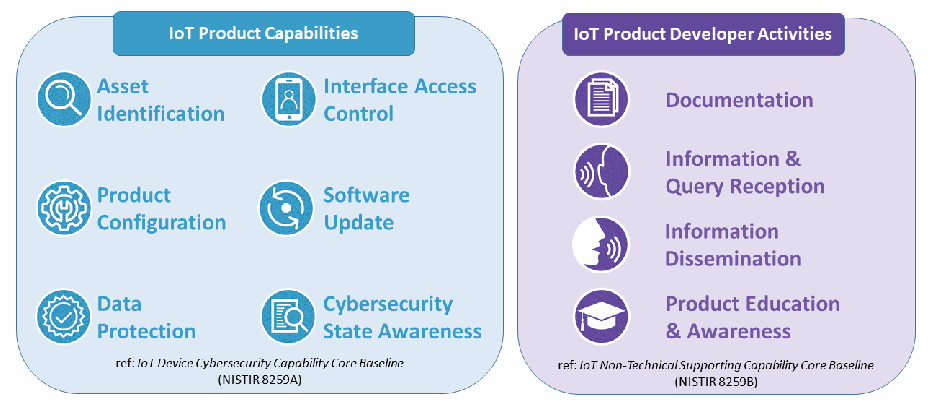
角の丸い2つの枠からなる図です。左の枠「IoT Product Capabilities」には、アイコン付きで6つの能力 Asset Identification、Interface Access Control、Product Configuration、Software Update、Data Protection、Cybersecurity State Awareness が並び、下端に「ref: IoT Device Cybersecurity Capability Core Baseline (NISTIR 8259A)」とあります。右の枠「IoT Product Developer Activities」には、アイコン付きで4つの活動 Documentation、Information & Query Reception、Information Dissemination、Product Education & Awareness が並び、下端に「ref: IoT Non-Technical Supporting Capability Core Baseline (NISTIR 8259B)」とあります。
Fig. 1. Capabilities Identified for the Consumer Profile.
図 1. 消費者向けプロファイルで特定された機能
Each capability’s name and high-level definition of the capability are presented, followed by an alpha-numerical list of sub-criteria for each capability. For some sub-criteria,8 additional detail to the outcome (i.e., normative text) is listed following bolded text, while additional explanation and examples (i.e., informative text) are listed following italicized text. Finally, each capability is accompanied by a short description of the intended cybersecurity utility of the capability.
各機能について、機能名と機能の高レベルの定義を示し、続いて各機能の副基準を英数字で列挙します。一部の副基準8では、成果への追加の詳細(すなわち規範的な文章)を太字の文の後に、追加の説明と例(すなわち参考となる文章)を斜体の文の後に示します。最後に、各機能には、その機能が意図するサイバーセキュリティ上の有用性の短い説明が付いています。
2.2.1. IoT Product Capabilities
2.2.1. IoT 製品の機能
Asset Identification
資産の識別
The IoT product is uniquely identifiable and inventories all of the IoT product’s components.
IoT 製品は一意に識別でき、IoT 製品のすべてのコンポーネントの一覧を保持します。
1.The IoT product can be uniquely identified by the customer and other authorized entities (e.g., the IoT product developer).9
1.IoT 製品は、顧客およびその他の認可された主体(例: IoT 製品開発者)が一意に識別できます。9
2.The IoT product uniquely identifies each IoT product component and maintains an up-to- date inventory10 of connected product components.
2.IoT 製品は、各 IoT 製品コンポーネントを一意に識別し、接続されている製品コンポーネントの最新の一覧10を維持します。
Cybersecurity utility: The ability to identify IoT products and their components is necessary to support such activities as asset management for updates, data protection, and digital forensics capabilities for incident response.
サイバーセキュリティ上の有用性: IoT 製品とそのコンポーネントを識別できることは、更新のための資産管理、データ保護、インシデント対応のためのデジタルフォレンジック機能といった活動を支えるために必要です。
Product Configuration
製品構成
The configuration of the IoT product is changeable, there is the ability to restore a secure default setting, and any and all changes can only be performed by authorized individuals, services, and other IoT product components.
IoT 製品の構成は変更でき、セキュアなデフォルト設定に戻す機能があり、あらゆる変更は認可された個人、サービス、およびその他の IoT 製品コンポーネントのみが実行できます。
1.Authorized individuals (i.e., customer), services, and other IoT product components can change the configuration settings of the IoT product via one or more IoT product components.11
1.認可された個人(すなわち顧客)、サービス、およびその他の IoT 製品コンポーネントは、1 つ以上の IoT 製品コンポーネントを介して、IoT 製品の構成設定を変更できます。11
2.Authorized individuals (i.e., customer), services, and other IoT product components have the ability to restore the IoT product to a secure default (i.e., uninitialized) configuration.
2.認可された個人(すなわち顧客)、サービス、およびその他の IoT 製品コンポーネントは、IoT 製品をセキュアなデフォルトの(すなわち初期化されていない)構成に戻すことができます。
3.The IoT product applies configuration settings to applicable IoT components.
3.IoT 製品は、該当する IoT コンポーネントに構成設定を適用します。
Cybersecurity utility: The ability to change aspects of how the IoT product functions can help customers tailor the IoT product’s functionality to their needs and goals. Customers can configure their IoT products to avoid specific threats and risk they know about based on their risk appetite.
サイバーセキュリティ上の有用性: IoT 製品の機能の働き方の一部を変更できることは、顧客が IoT 製品の機能を自らのニーズと目標に合わせるのに役立ちます。顧客は、自らのリスク選好度に基づき、把握している特定の脅威やリスクを避けるように IoT 製品を構成できます。
Data Protection
データ保護
The IoT product protects data stored across all IoT product components and transmitted both between IoT product components and outside the IoT product from unauthorized access, disclosure, and modification.
IoT 製品は、すべての IoT 製品コンポーネントに保存されたデータ、ならびに IoT 製品コンポーネント間および IoT 製品外へ送信されるデータを、不正なアクセス、開示、および変更から保護します。
1.Each IoT product component protects data it stores via secure means.
1.各 IoT 製品コンポーネントは、保存するデータをセキュアな手段で保護します。
2.The IoT product has the ability to delete or render inaccessible stored data that are either collected from or about the customer, home, family, etc.
2.IoT 製品は、顧客、家庭、家族などから、またはそれらについて収集され保存されたデータを、削除する、またはアクセスできない状態にする機能を備えます。
3.When data are sent between IoT product components or outside the product, protections are used for the data transmission.12
3.IoT 製品コンポーネント間または製品外へデータを送信するときには、データ伝送に対する保護が用いられます。12
Cybersecurity utility: Maintaining confidentiality, integrity, and availability of data is foundational to cybersecurity for IoT products. Customers will expect that data are protected and that protection of data helps to ensure safe and intended functionality of the IoT product.
サイバーセキュリティ上の有用性: データの機密性、完全性、可用性を維持することは、IoT 製品のサイバーセキュリティの基盤です。顧客はデータが保護されることを期待し、データの保護は IoT 製品の安全かつ意図どおりの機能を確保するのに役立ちます。
Interface Access Control
インターフェースのアクセス制御
The IoT product restricts logical access to local and network interfaces – and to protocols and services used by those interfaces – to only authorized individuals, services, and IoT product components.
IoT 製品は、ローカルインターフェースとネットワークインターフェースへの論理アクセス、およびそれらのインターフェースが使用するプロトコルとサービスへの論理アクセスを、認可された個人、サービス、および IoT 製品コンポーネントのみに制限します。
1.Each IoT product component controls access to and from all interfaces (e.g., local interfaces, whether externally accessible or not, network interfaces, protocols, and services) in order to limit access to only authorized entities. At a minimum, the IoT product component shall:
1.各 IoT 製品コンポーネントは、認可された主体のみにアクセスを限定するため、すべてのインターフェース(例: 外部からアクセス可能かどうかを問わないローカルインターフェース、ネットワークインターフェース、プロトコル、サービス)との間のアクセスを制御します。IoT 製品コンポーネントは、少なくとも次のことをしなければなりません。
a.Use and have access only to interfaces necessary for the IoT product’s operation. All other channels and access to channels are removed or secured.
a.IoT 製品の動作に必要なインターフェースのみを使用し、それらにのみアクセスします。それ以外のすべてのチャネルとチャネルへのアクセスは、除去またはセキュア化されています。
b.For all interfaces necessary for the IoT product’s use, access control measures are in place (e.g., unique password-based multifactor authentication, physical interface ports inaccessible from the outside of a component).
b.IoT 製品の使用に必要なすべてのインターフェースについて、アクセス制御策が講じられています(例: 一意のパスワードに基づく多要素認証、コンポーネントの外部からアクセスできない物理インターフェースポート)。
c.For all interfaces, access and modification privileges are limited.
c.すべてのインターフェースについて、アクセス権限と変更権限が制限されています。
2.Some, but not necessarily all, IoT product components have the means to protect and maintain interface access control. At a minimum, the IoT product shall:
2.一部の(ただし必ずしもすべてではない)IoT 製品コンポーネントは、インターフェースのアクセス制御を保護し維持する手段を備えます。IoT 製品は、少なくとも次のことをしなければなりません。
a.Validate that data shared among IoT product components match specified definitions of format and content.
a.IoT 製品コンポーネント間で共有されるデータが、書式と内容について指定された定義に一致していることを検証します。
b.Prevent unauthorized transmissions or access to other product components.
b.他の製品コンポーネントへの不正な送信やアクセスを防止します。
c.Maintain appropriate access control during initial connection (i.e., on-boarding) and when reestablishing connectivity after disconnection or outage.
c.最初の接続時(すなわちオンボーディング時)、および切断や障害の後に接続を再確立するときに、適切なアクセス制御を維持します。
Cybersecurity utility: Enumerating and controlling access to all internal and external interfaces to the IoT product will help preserve the confidentiality, integrity, and availability of the IoT product, its components, and data by helping prevent unauthorized access and modification.
サイバーセキュリティ上の有用性: IoT 製品の内部および外部のすべてのインターフェースを列挙してアクセスを制御することは、不正なアクセスや変更の防止に役立つことで、IoT 製品、そのコンポーネント、およびデータの機密性、完全性、可用性を維持するのに役立ちます。
Software Update
ソフトウェア更新
The software13 of all IoT product components can be updated by authorized individuals, services, and other IoT product components only by using a secure and configurable mechanism, as appropriate for each IoT product component.
すべての IoT 製品コンポーネントのソフトウェア13は、各 IoT 製品コンポーネントに適した、セキュアで構成可能な仕組みのみを使用して、認可された個人、サービス、およびその他の IoT 製品コンポーネントによって更新できます。
1.Each IoT product component can receive, verify, and apply verified software updates.
1.各 IoT 製品コンポーネントは、ソフトウェア更新を受信し、検証し、検証済みのソフトウェア更新を適用できます。
2.The IoT product implements measures to keep software on IoT product components up to date (i.e., automatic application of updates or consistent customer notification of available updates via the IoT product).
2.IoT 製品は、IoT 製品コンポーネントのソフトウェアを最新に保つ対策(すなわち、更新の自動適用、または IoT 製品を介して利用可能な更新を顧客に継続的に通知すること)を実装します。
Cybersecurity utility: Software may have vulnerabilities discovered after the IoT product has been deployed; software update capabilities can help ensure secure delivery of security patches.
サイバーセキュリティ上の有用性: IoT 製品の展開後にソフトウェアの脆弱性が発見される場合があります。ソフトウェア更新機能は、セキュリティパッチの安全な配布に役立ちます。
Cybersecurity State Awareness
サイバーセキュリティ状態の認識
The IoT product supports detection of cybersecurity incidents affecting or affected by IoT product components and the data they store and transmit.
IoT 製品は、IoT 製品コンポーネントまたはそれらが保存・送信するデータに影響を及ぼす、あるいはそれらから影響を受けるサイバーセキュリティインシデントの検知を支援します。
1.The IoT product securely captures and records information about the state of IoT components14 that can be used to detect cybersecurity incidents affecting or affected by IoT product components and the data they store and transmit.
1.IoT 製品は、IoT 製品コンポーネントまたはそれらが保存・送信するデータに影響を及ぼす、あるいはそれらから影響を受けるサイバーセキュリティインシデントの検知に利用できる、IoT コンポーネントの状態14に関する情報を安全に取得し、記録します。
Cybersecurity utility: Protection of data and ensuring proper functionality can be supported by the ability to alert the customer when the device starts operating in unexpected ways, which could mean that unauthorized access is being attempted, malware has been loaded, botnets have been created, device software errors have happened, or other types of actions have occurred that was not initiated by the IoT product user or intended by the developer.
サイバーセキュリティ上の有用性: デバイスが予期しない動作を始めたときに顧客に警告する機能は、データの保護と適切な機能の確保を支援できます。予期しない動作は、不正アクセスが試みられていること、マルウェアが読み込まれたこと、ボットネットが作成されたこと、デバイスのソフトウェアエラーが発生したこと、または IoT 製品の利用者が開始したものでも開発者が意図したものでもないその他の種類の動作が生じたことを意味する場合があります。
2.2.2. IoT Product Non-Technical Supporting Capabilities
2.2.2. IoT 製品の非技術的な支援能力
Documentation
文書化
The IoT product developer creates, gathers, and stores15 information relevant to cybersecurity of the IoT product and its product components prior to customer purchase, and throughout the development of a product and its subsequent lifecycle.
IoT 製品開発者は、顧客による購入前、ならびに製品の開発とその後のライフサイクルの全体を通じて、IoT 製品とその製品コンポーネントのサイバーセキュリティに関連する情報を作成、収集、および保管15します。
1.Throughout the development lifecycle, the IoT product developer creates or gathers and stores information relevant to the cybersecurity of the IoT product and its product components, including:
1.開発ライフサイクルの全体を通じて、IoT 製品開発者は、IoT 製品とその製品コンポーネントのサイバーセキュリティに関連する情報を作成または収集して保管します。これには次が含まれます。
a.Assumptions made during the development process and other expectations related to the IoT product, including:
a.開発過程で置いた前提、および IoT 製品に関するその他の期待事項。これには次が含まれます。
i.Expected customers and use cases.
i.想定する顧客とユースケース。
ii.Physical use and characteristics, including security of the location of the IoT product and its product components (e.g., a camera for use inside the home that has an off switch on the device vs. a security camera for use outside the home that does not have an off switch on the device).
ii.物理的な使用状況と特性(IoT 製品とその製品コンポーネントの設置場所のセキュリティを含む)(例: デバイスにオフスイッチがある屋内用カメラと、デバイスにオフスイッチがない屋外用の防犯カメラの違い)。
iii.Network access and requirements (e.g., bandwidth requirements).
iii.ネットワークアクセスとその要件(例: 帯域幅の要件)。
iv.Data created and handled by the IoT product.
iv.IoT 製品が作成し取り扱うデータ。
v.Any expected data inputs and outputs (including error codes, frequency, type/form, range of acceptable values, etc.).
v.想定されるデータの入力と出力(エラーコード、頻度、種類/形式、許容される値の範囲などを含む)。
vi.The IoT product developer’s assumed cybersecurity requirements for the IoT product.
vi.IoT 製品開発者が IoT 製品について想定するサイバーセキュリティ要件。
vii.Any laws and regulations with which the IoT product and related support activities comply.
vii.IoT 製品と関連する支援活動が準拠している法律および規制。
viii.Expected lifespan and anticipated cybersecurity costs related to the IoT product (e.g., price of maintenance) and length and terms of support.
viii.IoT 製品の想定寿命と、それに関連して見込まれるサイバーセキュリティ費用(例: 保守の価格)、ならびにサポートの期間と条件。
b.All IoT components, including but not limited to the IoT device, that are part of the IoT product.
b.IoT デバイスを含むがこれに限らない、IoT 製品の一部であるすべての IoT コンポーネント。
c.How the baseline product criteria are met by the IoT product across its product components, including which baseline product criteria are not met by IoT product components and why (e.g., the capability is not needed based on risk assessment).
c.IoT 製品の各製品コンポーネントを通じてベースライン製品基準をどのように満たすか。これには、IoT 製品コンポーネントが満たしていないベースライン製品基準とその理由(例: リスクアセスメントに基づき、その機能が不要であること)も含まれます。
d.Product design and support considerations related to the IoT product, for example:
d.IoT 製品に関連する製品設計とサポートの考慮事項。例:
i.All hardware and software components, from all sources (e.g., open source, propriety third-party, internally developed) used to create the IoT product (i.e., used to create each product component).
i.IoT 製品の作成(すなわち各製品コンポーネントの作成)に使用された、あらゆる入手元(例: オープンソース、サードパーティーの独自仕様製品、社内開発)のすべてのハードウェアおよびソフトウェアコンポーネント。
ii.IoT platform used in the development and operation of the IoT product, its product components, including related documentation.
ii.IoT 製品とその製品コンポーネントの開発と運用に使用された IoT プラットフォーム(関連する文書を含む)。
iii.Trustworthiness and protection of software and hardware elements implemented to create the IoT product and its product components (e.g., secure boot, hardware root of trust, and secure enclave).
iii.IoT 製品とその製品コンポーネントを作成するために実装されたソフトウェアおよびハードウェア要素の信頼性と保護(例: セキュアブート、ハードウェアルートオブトラスト、セキュアエンクレーブ)。
iv.Consideration for the known risks related to the IoT product and known potential misuses.
iv.IoT 製品に関連する既知のリスクと、既知の潜在的な悪用の考慮。
v.Secure software development and supply chain practices used.
v.使用されたセキュアなソフトウェア開発とサプライチェーンの実践。
vi.Accreditation, certification, and/or evaluation results for cybersecurity-related practices.
vi.サイバーセキュリティに関連する実践についての認定、認証、および/または評価の結果。
vii.The ease of installation and maintenance of the IoT product by a customer (i.e., the usability of the product [ISO9241]).
vii.顧客による IoT 製品の設置と保守の容易さ(すなわち製品のユーザビリティ [ISO9241])。
e.Maintenance requirements for the IoT product, for example:
e.IoT 製品の保守要件、たとえば:
i.Cybersecurity maintenance expectations and associated instructions or procedures (e.g., vulnerability/patch management plan).
i.サイバーセキュリティの保守に関する期待事項と、関連する指示または手順(例: 脆弱性/パッチ管理計画)。
ii.How the IoT product developer identifies authorized supporting parties who can perform maintenance activities (e.g., authorized repair centers).
ii.IoT 製品開発者が、保守作業を実施できる認可された支援者(例: 認可修理センター)をどのように識別するか。
iii.Cybersecurity considerations of the maintenance process (e.g., how customer data unrelated to the maintenance process remain confidential even from maintainers).
iii.保守プロセスにおけるサイバーセキュリティの考慮事項(例: 保守プロセスと無関係な顧客データを、保守担当者に対してさえ機密に保つ方法)。
f.The secure system lifecycle policies and processes associated with the IoT product, including:
f.IoT 製品に関連するセキュアなシステムライフサイクルのポリシーとプロセス。これには次が含まれます:
i.Steps taken during development to ensure the IoT product and its product components are free of any known, exploitable vulnerabilities.
i.IoT 製品とその製品コンポーネントに、悪用可能な既知の脆弱性がないことを確実にするために、開発中に講じた手順。
ii.The process of working with component suppliers and third-party vendors to ensure the security of the IoT product and its product components is maintained for the duration of its supported lifecycle.
ii.サポート対象のライフサイクルの期間を通じて IoT 製品とその製品コンポーネントのセキュリティが維持されるよう、コンポーネントの供給者およびサードパーティーベンダーと連携するプロセス。
iii.Any post end-of-support considerations, such as the discovery of a vulnerability that would significantly impact the security, privacy, or safety of customers who continue to use the IoT product and its product components.
iii.サポート終了後の考慮事項(たとえば、IoT 製品とその製品コンポーネントを使い続ける顧客のセキュリティ、プライバシー、または安全に大きな影響を与える脆弱性が発見された場合など)。
g.The vulnerability management policies and processes associated with the IoT product, including:
g.IoT 製品に関連する脆弱性管理のポリシーとプロセス。これには次が含まれます:
i.Methods of receiving reports of vulnerabilities (see Information and Query Reception below).
i.脆弱性の報告を受け付ける方法(下記の「情報と問い合わせの受付」を参照)。
ii.Processes for recording reported vulnerabilities.
ii.報告された脆弱性を記録するプロセス。
iii.Policy for responding to reported vulnerabilities, including the process of coordinating vulnerability response activities among component suppliers and third-party vendors.
iii.報告された脆弱性への対応方針(コンポーネントの供給者およびサードパーティーベンダー間で脆弱性対応活動を調整するプロセスを含む)。
iv.Policy for disclosing reported vulnerabilities.
iv.報告された脆弱性を開示する方針。
v.Processes for receiving notification from component suppliers and third-party vendors about any change in the status of their supplied components, such as end of production, end of support, deprecated status (e.g., the product is no longer recommended for use), or known insecurities.
v.コンポーネントの供給者およびサードパーティーベンダーから、供給されたコンポーネントの状態の変化(生産終了、サポート終了、非推奨の状態(例: 製品の使用がもはや推奨されない)、既知のセキュリティ上の問題など)に関する通知を受けるプロセス。
Cybersecurity utility: Generating, capturing, and storing important information about the IoT product and its development (e.g., assessment of the IoT product and development practices used to create and maintain it) can help inform the IoT product developer about the product’s actual cybersecurity posture.
サイバーセキュリティ上の有用性: IoT 製品とその開発に関する重要な情報(例: IoT 製品の評価や、IoT 製品を作成・維持するために用いた開発の実践)を生成、取得、保管することは、IoT 製品開発者が製品の実際のサイバーセキュリティ態勢を把握するのに役立ちます。
Information and Query Reception
情報と問い合わせの受付
The IoT product developer has the ability to receive information relevant to cybersecurity and respond to queries from the customer and others about information relevant to cybersecurity.
IoT 製品開発者は、サイバーセキュリティに関連する情報を受け取り、サイバーセキュリティに関連する情報について顧客やその他の者からの問い合わせに応答する能力を備えます。
1.The IoT product developer can receive information related to the cybersecurity of the IoT product and its product components and can respond to queries related to cybersecurity of the IoT product and its product components from customers and others, including:
1.IoT 製品開発者は、IoT 製品とその製品コンポーネントのサイバーセキュリティに関連する情報を受け取り、顧客やその他の者からの IoT 製品とその製品コンポーネントのサイバーセキュリティに関する問い合わせに応答できます。これには次が含まれます。
a.The ability of the IoT product developer to identify a point of contact to receive maintenance and vulnerability information (e.g., bug reporting capabilities and bug bounty programs) from customers and others in the IoT product ecosystem (e.g., repair technician acting on behalf of the customer).
a.IoT 製品開発者が、顧客や IoT 製品エコシステム内のその他の者(例: 顧客に代わって行動する修理技術者)から、保守や脆弱性の情報(例: バグ報告機能やバグバウンティプログラム)を受け付ける窓口を特定できること。
b.The ability of the IoT product developer to receive queries from and respond to customers and others in the IoT product ecosystem about the cybersecurity of the IoT product and/or its components.
b.IoT 製品開発者が、顧客や IoT 製品エコシステム内のその他の者から、IoT 製品および/またはそのコンポーネントのサイバーセキュリティに関する問い合わせを受け付け、それに応答できること。
Cybersecurity utility: As IoT products are used by customers, those customers may have questions or reports of issues that can help improve the cybersecurity of the IoT product over time.
サイバーセキュリティ上の有用性: 顧客が IoT 製品を使用するなかで、顧客から質問や問題の報告が寄せられることがあり、それらは時間をかけて IoT 製品のサイバーセキュリティを向上させるのに役立ちます。
Information Dissemination
情報の周知
The IoT product developer broadcasts (e.g., to the public) and distributes (e.g., to the customer or others in the IoT product ecosystem) information relevant to cybersecurity.
IoT 製品開発者は、サイバーセキュリティに関連する情報を(例: 一般向けに)広く発信し、(例: 顧客や IoT 製品エコシステム内のその他の者に)配布します。
1.The IoT product developer can broadcast to many/all entities via a channel (e.g., a post on a public channel, emails sent to all impacted customers’ registered addresses) to alert the public and customers of the IoT product about cybersecurity relevant information and events throughout the support lifecycle. At a minimum, this information shall include:
1.IoT 製品開発者は、チャネル(例: 公開チャネルへの投稿、影響を受けるすべての顧客の登録アドレスへのメール送信)を介して多数またはすべての主体に発信し、サポートライフサイクルの全体を通じて、サイバーセキュリティに関連する情報や事象を、一般および IoT 製品の顧客に警告できます。この情報には、少なくとも次を含めなければなりません。
a.Updated terms of support (e.g., frequency of updates and mechanism(s) of application) and notice of availability and/or application of software updates.
a.更新されたサポート条件(例: 更新の頻度と適用の仕組み)、およびソフトウェア更新が利用可能であることや適用されたことの通知。
b.End of term of support or functionality for the IoT product.
b.IoT 製品のサポートまたは機能の提供期間の終了。
c.Needed maintenance operations.
c.必要な保守作業。
d.New IoT device vulnerabilities, associated details, and mitigation actions needed from the customer.
d.IoT デバイスの新たな脆弱性、関連する詳細、および顧客に求められる緩和策。
e.Breach discovery related to an IoT product and its product components used by the customers, associated details, and mitigation actions needed from the customer (if any).
e.顧客が使用する IoT 製品とその製品コンポーネントに関連する侵害の発見、関連する詳細、および(ある場合は)顧客に求められる緩和策。
2.The IoT product developer can distribute information relevant to cybersecurity of the IoT product and its product components to alert appropriate ecosystem entities (e.g., IoT product component manufactures and/or supporting entities, common vulnerability tracking authorities, accreditors and certifiers, third-party support and maintenance organizations) about cybersecurity relevant information, for example:
2.IoT 製品開発者は、IoT 製品とその製品コンポーネントのサイバーセキュリティに関連する情報を配布し、エコシステム内の適切な主体(例: IoT 製品コンポーネントの製造者および/または支援する主体、共通脆弱性の追跡機関、認定機関および認証機関、サードパーティーのサポート・保守組織)にサイバーセキュリティ関連情報を知らせて注意を促すことができます。たとえば:
a.Applicable documentation captured during the design and development of the IoT product and its product components.16
a.IoT 製品とその製品コンポーネントの設計および開発中に取得された該当する文書。16
b.Cybersecurity and vulnerability alerts and information about resolution of any vulnerability.
b.サイバーセキュリティと脆弱性に関する警告、および脆弱性の解決に関する情報。
c.An overview of the information security practices and safeguards used by the IoT product developer.
c.IoT 製品開発者が用いる情報セキュリティの実践と保護対策の概要。
d.Accreditation, certification, and/or evaluation results for the IoT product developer’s cybersecurity-related practices.
d.IoT 製品開発者のサイバーセキュリティに関連する実践についての認定、認証、および/または評価の結果。
e.A risk assessment report or summary for the IoT product developer’s business environment risk posture.
e.IoT 製品開発者の事業環境におけるリスクの状況に関するリスクアセスメント報告書または要約。
Cybersecurity utility: As the IoT product, its components, threats, and mitigations change, customers will need to be informed about how to securely use the IoT product.
サイバーセキュリティ上の有用性: IoT 製品、そのコンポーネント、脅威、緩和策が変化するにつれて、顧客には IoT 製品を安全に使用する方法を知らせる必要があります。
Product Education and Awareness
製品の教育と意識向上
The IoT product developer creates awareness of and educates customers and others in the IoT product ecosystem about cybersecurity-related information (e.g., considerations, features) related to the IoT product and its product components.17
IoT 製品開発者は、IoT 製品とその製品コンポーネントに関連するサイバーセキュリティ関連の情報(例: 考慮事項、機能)について、顧客および IoT 製品エコシステム内のその他の者の意識を高め、教育します。17
1.The IoT product developer creates awareness and provides education targeted at customers about information relevant to cybersecurity of the IoT product and its product components, including:
1.IoT 製品開発者は、IoT 製品とその製品コンポーネントのサイバーセキュリティに関連する情報について、顧客を対象とした意識向上と教育を行います。これには次が含まれます。
a.The presence and use of IoT product cybersecurity capabilities, including at a minimum:
a.IoT 製品のサイバーセキュリティ能力の存在と使用。これには少なくとも次が含まれます。
i.How to change configuration settings and the cybersecurity implications of changing settings, if any.
i.構成設定の変更方法と、設定変更に伴うサイバーセキュリティ上の影響(ある場合)。
ii.How to configure and use access control functionality (e.g., set and change passwords).
ii.アクセス制御機能の構成方法と使用方法(例: パスワードの設定と変更)。
iii.How software updates are applied and any instructions necessary for the customer on how to use software update functionality.
iii.ソフトウェア更新の適用方法と、ソフトウェア更新機能の使い方について顧客に必要な指示。
iv.How to manage device data including creation, update, and deletion of data on the IoT product.
iv.IoT 製品上のデータの作成、更新、削除を含む、デバイスのデータの管理方法。
b.How to maintain the IoT product and its product components during its lifetime, including after the period of security support (e.g., delivery of software updates and patches) from the IoT product developer.
b.IoT 製品開発者によるセキュリティサポート(例: ソフトウェア更新やパッチの提供)の期間終了後を含め、IoT 製品とその製品コンポーネントを存続期間中に維持する方法。
c.How an IoT product and its product components can be securely re-provisioned or disposed of.
c.IoT 製品とその製品コンポーネントを安全に再プロビジョニングまたは廃棄する方法。
d.Vulnerability management options (e.g., configuration and patch management and anti-malware) available for the IoT product or its product components that could be used by customers.
d.顧客が利用できる、IoT 製品またはその製品コンポーネントで使える脆弱性管理の選択肢(例: 構成管理、パッチ管理、マルウェア対策)。
e.Additional information customers can use to make informed purchasing decisions about the security of the IoT product (e.g., the duration and scope of product support via software upgrades and patches).
e.顧客が IoT 製品のセキュリティについて十分な情報に基づいて購入を判断するために使える追加の情報(例: ソフトウェアのアップグレードやパッチによる製品サポートの期間と範囲)。
Cybersecurity utility: Customers will need to be informed about how to securely use the device to lead to the best cybersecurity outcomes for the customers and the consumer IoT product marketplace.
サイバーセキュリティ上の有用性: 顧客と消費者向け IoT 製品市場にとって最良のサイバーセキュリティ上の成果につなげるには、顧客にデバイスを安全に使用する方法を知らせる必要があります。
3. Consumer Sector Considerations Used to Create the Profile
3. プロファイルの作成に用いた消費者分野の考慮事項
NIST used the concepts of profiling the IoT device cybersecurity capability core baseline to develop the consumer profile. The first step was to gather sources and other information about consumer IoT product cybersecurity. Next, NIST used this information to create the consumer profile using the sources, information, and resulting takeaways and insights.
NIST は、消費者向けプロファイルを策定するために、IoT デバイスのサイバーセキュリティ能力コアベースラインをプロファイリングするという考え方を用いました。最初の段階は、消費者向け IoT 製品のサイバーセキュリティに関する原典やその他の情報を収集することでした。次に NIST は、原典、情報、およびそこから得られた要点と知見を用いて、この情報から消費者向けプロファイルを作成しました。
3.1. Gathering Source Information about Consumer IoT Product Cybersecurity
3.1. 消費者向け IoT 製品のサイバーセキュリティに関する原典情報の収集
The consumer profile stemmed from NIST’s response to EO 14028, which directed NIST to develop recommendations for a consumer IoT product cybersecurity label program. The recommendations were broader than the development of a consumer profile of the IoT core baseline, but the profile was a key element of this task. Therefore, NIST was able to gather sources and engage in discussions with external stakeholders about the needs and goals of consumer IoT product customers. Across a year of events, meetings, and other engagements, hundreds of comments were gathered related to cybersecurity labeling for consumer IoT products, many of which informed the profiling of the core baseline for this sector.
消費者向けプロファイルは、消費者向け IoT 製品のサイバーセキュリティ・ラベル制度に関する推奨事項の策定を NIST に指示した EO 14028 への NIST の対応から生まれました。この推奨事項は、IoT コアベースラインの消費者向けプロファイルの策定よりも広範でしたが、プロファイルはこの作業の重要な要素でした。そのため NIST は、原典を収集し、消費者向け IoT 製品の顧客のニーズと目標について外部の利害関係者と議論することができました。1 年にわたるイベント、会合、その他の取り組みを通じて、消費者向け IoT 製品のサイバーセキュリティ・ラベリングに関する数百件のコメントが集まり、その多くがこの分野に向けたコアベースラインのプロファイリングに役立ちました。
NIST also looked across the public domain to identify applicable vulnerabilities for the consumer IoT product sector. This information is important to determine a cross-sectional view of vulnerabilities for consumer IoT products that can serve as the basis for determining threats and vulnerabilities. These threats and vulnerabilities inform the profiling process, particularly aspects of minimal securability. Table 1, reproduced from the Consumer Cybersecurity Labeling for IoT Products: Discussion Draft on the Path Forward Whitepaper [Path_Forward] lists a number of applicable, well-documented vulnerabilities, their associated MITRE ATT&CK Framework [ATT_CK] attack categories, and the profiled capabilities that can help address the vulnerability.18
NIST はまた、消費者向け IoT 製品分野に該当する脆弱性を特定するため、公開情報を広く調べました。この情報は、脅威と脆弱性を判断する基礎となる、消費者向け IoT 製品の脆弱性の横断的な全体像を把握するうえで重要です。こうした脅威と脆弱性は、プロファイリングのプロセス、特に最小限のセキュリティ確保可能性に関する側面に反映されます。表 1 は、ホワイトペーパー Consumer Cybersecurity Labeling for IoT Products: Discussion Draft on the Path Forward [Path_Forward] から転載したもので、該当する、十分に文書化された脆弱性、それに関連する MITRE ATT&CK フレームワーク [ATT_CK] の攻撃カテゴリー、およびその脆弱性への対処に役立つプロファイル化された機能を挙げています。18
Table 1. Example Consumer IoT Vulnerabilities and the Relevant Capabilities from the Consumer Profile.
表 1. 消費者向け IoT の脆弱性の例と、消費者向けプロファイルの関連する機能
| Vulnerability | Relevant Consumer Profile Capabilities |
|---|---|
| Mirai Malware Variants Attacks – Use of weak authentication to enable the loading of malware onto the device and use that device in DDOS and other attacks. | |
| Unauthorized access to the IoT device | Asset Identification Interface Access Control Information Dissemination Education and Awareness |
| Malicious code can be loaded on the IoT device | Software Update Cybersecurity State Awareness Education and Awareness |
| Commands can be launched using the device | Interface Access Control Documentation |
| Unauthorized Publication of Fitness Tracker Data – Fitness tracker location data for military personnel were publicly posted even when product was configured for privacy. | |
| Web application vulnerabilities | Product configuration Cybersecurity State Awareness Documentation Information Dissemination |
| Mobile application vulnerabilities | Product Configuration Cybersecurity State Awareness Documentation Information Dissemination |
| Ability for de-identified data to be re-identified | Product Configuration Data Protection Documentation |
| Unauthorized access to home security camera data – Unauthorized access to data and views of the inside and outside of buildings occurred with multiple brands of security cameras. | |
| Weak authentication | Interface Access Control |
| Unauthorized data sharing | Data Protection Documentation Information Dissemination |
| Non-responsive to questions and complaints to the developers | Information and Query Reception |
| Lack of monitoring capabilities and procedures | Asset Identification Product Configuration Documentation |
| Lack of data recording/collection controls | Asset Identification Product Configuration Documentation Information Dissemination Education and Awareness |
| 脆弱性 | 関連する消費者向けプロファイルの機能 |
|---|---|
| Mirai マルウェア亜種による攻撃 – 脆弱な認証を利用してデバイスにマルウェアを読み込ませ、そのデバイスを DDOS などの攻撃に使用します。 | |
| IoT デバイスへの不正アクセス | 資産の識別 インターフェースのアクセス制御 情報の周知 教育と意識向上 |
| IoT デバイスに悪意あるコードを読み込める | ソフトウェア更新 サイバーセキュリティ状態の認識 教育と意識向上 |
| デバイスを使ってコマンドを実行できる | インターフェースのアクセス制御 文書化 |
| フィットネストラッカーのデータの不正公開 – 製品がプライバシー保護の設定になっていても、軍関係者のフィットネストラッカーの位置データが公開されました。 | |
| Web アプリケーションの脆弱性 | 製品構成 サイバーセキュリティ状態の認識 文書化 情報の周知 |
| モバイルアプリケーションの脆弱性 | 製品構成 サイバーセキュリティ状態の認識 文書化 情報の周知 |
| 匿名化されたデータが再識別される可能性 | 製品構成 データ保護 文書化 |
| 家庭用防犯カメラのデータへの不正アクセス – 複数のブランドの防犯カメラで、建物の内部および外部のデータや映像への不正アクセスが発生しました。 | |
| 脆弱な認証 | インターフェースのアクセス制御 |
| データの不正な共有 | データ保護 文書化 情報の周知 |
| 開発者への質問や苦情に応答がない | 情報と問い合わせの受付 |
| 監視機能と手順の欠如 | 資産の識別 製品構成 文書化 |
| データの記録/収集に対する統制の欠如 | 資産の識別 製品構成 文書化 情報の周知 教育と意識向上 |
NIST also looked at the existing standards, conformity, and labeling ecosystem for IoT devices and products to understand where others had accounted for consumer IoT product considerations. Approximately 30 source documents were reviewed, including IoT cybersecurity laws, catalogs of cybersecurity capabilities, sets of baseline capabilities, and tiering schemes.19 All specifically addressed the IoT device itself, but several included the cloud, mobile app, hub, or other external components in their considerations as part of an IoT product. Throughout the public comment periods and discussions with stakeholders, the broader view (i.e., of IoT product vs. IoT device) was supported, as NIST observed much consensus in the need to include all components of an IoT product in the scope for an established set of cybersecurity capabilities.
NIST はまた、IoT デバイスおよび製品に関する既存の標準、適合性評価、ラベリングのエコシステムを調べ、他者が消費者向け IoT 製品の考慮事項をどのように扱っているかを把握しました。約 30 件の原典文書(IoT のサイバーセキュリティに関する法律、サイバーセキュリティ能力のカタログ、ベースライン機能の集合、階層化の枠組みなど)を調査しました。19いずれも IoT デバイス自体を具体的に扱っていましたが、そのいくつかは、IoT 製品の一部としてクラウド、モバイルアプリ、ハブ、その他の外部コンポーネントも考慮に含めていました。パブリックコメント期間と利害関係者との議論を通じて、より広い見方(すなわち IoT デバイスではなく IoT 製品を対象とすること)が支持されました。確立されたサイバーセキュリティ能力の集合の適用範囲に IoT 製品のすべてのコンポーネントを含める必要があるという点で、広い合意が見られたためです。
3.2. Assessing Consumer IoT Product Cybersecurity Sources
3.2. 消費者向け IoT 製品のサイバーセキュリティに関する原典の評価
Source documents can be most directly compared to the technical and non-technical supporting capabilities established in NISTIRs 8259A and 8259B. Of the 30 source documents collected, a sub-sample of 8 were most directly related to consumer IoT products. This sub-sample was compared to the capabilities described in NISTIR 8259A/B, which showed there was broad alignment with the technical capabilities, though some common technical capabilities not found in NISTIR 8259A were used to adapt the core baseline for the consumer profile. However, few source documents addressed the non-technical capabilities developed based on NISTIR 8259B. As the intended users of consumer IoT devices are usually not experts in cybersecurity, these non-technical supporting capabilities are essential to ensure secure operation.
原典文書は、NISTIR 8259A および 8259B で確立された技術的能力および非技術的な支援能力と最も直接的に比較できます。収集した 30 件の原典文書のうち、8 件のサブサンプルが消費者向け IoT 製品と最も直接的に関連していました。このサブサンプルを NISTIR 8259A/B に記載された機能と比較したところ、技術的能力については広い整合が見られましたが、NISTIR 8259A にはない一般的な技術的能力の一部が、コアベースラインを消費者向けプロファイルに適合させるために用いられました。一方、NISTIR 8259B を基に策定された非技術的能力を扱う原典文書はほとんどありませんでした。消費者向け IoT デバイスの想定利用者は通常サイバーセキュリティの専門家ではないため、これらの非技術的な支援能力は、安全な運用を確保するために不可欠です。
This was confirmed through public comments and verbal feedback throughout the work on the EO response, which served as another source for information NIST drew from to inform the consumer profile. Through these sources, NIST also heard a number of other ways the consumer sector may be different than the general case or other sectors. For example, the cybersecurity risk management of enterprise customers is generally more structured and formalized compared to the cybersecurity risk management approach used by customers in the consumer sector. Enterprises also, typically, have greater access to cybersecurity expertise than typical consumers. These differences and other insights have implications for how cybersecurity capabilities must be approached and delivered. Table 2 highlights key insights used in the development of the consumer IoT profile.
このことは、EO への対応作業全体を通じて寄せられたパブリックコメントや口頭でのフィードバックによっても裏付けられました。これらは、NIST が消費者向けプロファイルに反映した別の情報源でもありました。こうした情報源を通じて、NIST は、消費者分野が一般的なケースや他の分野と異なりうる点についても、さまざまな意見を得ました。たとえば、エンタープライズの顧客のサイバーセキュリティリスク管理は、消費者分野の顧客が用いる手法に比べて、一般により構造化され、形式化されています。また、エンタープライズは通常、一般の消費者よりもサイバーセキュリティの専門知識を得やすい立場にあります。こうした違いやその他の知見は、サイバーセキュリティ能力にどのように取り組み、提供しなければならないかに影響します。表 2 は、消費者向け IoT プロファイルの策定に用いた主な知見を示しています。
Table 2. Highlighted Insights and Key Takeaways from the Consumer IoT Profiling Process.
表 2. 消費者向け IoT プロファイリング過程で得られた主な知見と重要な要点
| Highlighted Insight | Key Takeaway |
|---|---|
| Cybersecurity insights for the consumer sector based on risks and vulnerabilities are similar to those for the general core baseline case. (e.g., those listed in Table 1) | Most capabilities have similar cybersecurity concepts as the core baseline |
| Device-level cybersecurity guidelines would be insufficient based on customers’ needs and goals for this sector, including but not limited to their lack of distinction between the IoT device and supporting components. | Product is the preferred level for consumer IoT cybersecurity guidelines. |
| Privacy and safety are prominent concerns for consumer IoT products along with cybersecurity. | Cybersecurity capabilities must be designed to not create risks in these areas, and to support general approaches to privacy and safety risk mitigation. |
| There is no clear, universal set of consumer needs and goals for cybersecurity in the consumer sector, and NIST identified several approaches to addressing customer needs and goals among the source documents included in the landscape review. | Capabilities should be based on universally accepted and generally applicable cybersecurity functions. |
| Needs and goals for customers in this sector will vary. Customers may have limited knowledge and abilities with IoT/IT technologies and cybersecurity functions. | Human-factors related to cybersecurity capabilities are paramount to mitigating cybersecurity risks. |
| 主な知見 | 重要な要点 |
|---|---|
| リスクと脆弱性に基づく消費者分野のサイバーセキュリティに関する知見は、一般的なコアベースラインの場合と似ています。(例: 表 1 に挙げたもの) | ほとんどの能力は、コアベースラインと似たサイバーセキュリティの概念を持つ |
| この分野の顧客のニーズと目標(IoT デバイスと支援コンポーネントを区別しないことなどを含むがこれに限らない)に照らすと、デバイスレベルのサイバーセキュリティガイドラインでは不十分です。 | 消費者向け IoT のサイバーセキュリティガイドラインは、製品レベルで策定するのが適切です。 |
| 消費者向け IoT 製品では、サイバーセキュリティとともに、プライバシーと安全が主要な懸念事項です。 | サイバーセキュリティ能力は、これらの領域にリスクをもたらさないように設計し、プライバシーと安全のリスク緩和への一般的な取り組みを支えなければなりません。 |
| 消費者分野のサイバーセキュリティに関する消費者のニーズと目標には、明確で普遍的な集合は存在せず、NIST は、全体像の調査に含まれた原典文書の中に、顧客のニーズと目標に対処するいくつかの手法を確認しました。 | 能力は、普遍的に受け入れられ、一般に適用可能なサイバーセキュリティ機能に基づくべきです。 |
| この分野の顧客のニーズと目標はさまざまです。顧客は、IoT/IT 技術やサイバーセキュリティ機能に関する知識と能力が限られている場合があります。 | サイバーセキュリティ能力に関連する人的要因は、サイバーセキュリティリスクを緩和するうえで最も重要です。 |
These insights and resulting takeaways lead NIST to the following considerations regarding a consumer IoT profile:
これらの知見とそこから得られた要点から、NIST は消費者向け IoT プロファイルについて次の考慮事項に至りました。
1.It became clear that many consumer IoT devices are supported by additional components, such as a back-end and/or mobile app, that are critical to using the IoT device to the point that the device cannot be meaningfully used without these components.
1.多くの消費者向け IoT デバイスは、バックエンドやモバイルアプリなどの追加のコンポーネントに支えられており、それらが IoT デバイスの使用に不可欠であるため、これらのコンポーネントなしではデバイスを実用的に使用できないほどであることが明らかになりました。
2.Additionally, home consumers often have little control over these additional components. Therefore, when considering how device-centricity will apply to the consumer sector, the concept should expand beyond the device to include the full product. This scope may include additional components as part of an IoT product, including those that the consumer interacts with only indirectly (e.g., backend).
2.さらに、家庭の消費者は、これらの追加のコンポーネントをほとんど制御できないことが多くあります。したがって、デバイス中心の考え方を消費者分野にどう適用するかを考える際には、その概念をデバイスを超えて製品全体に拡張すべきです。この範囲には、IoT 製品の一部としての追加のコンポーネントが含まれることがあり、消費者が間接的にしか関わらないもの(例: バックエンド)も含まれます。
3.The consumer profile must be implemented in the context of key privacy and safety perceptions and considerations for the sector. Safety and privacy considerations are dynamic for consumer IoT products, though, owing to the fact that even in this specific sector, use cases for IoT products may vary significantly. There may be clear safety implications to a product and its operation, but this is not always the case. The same goes for privacy. This is exacerbated by the fact that different use cases may share broad safety and/or privacy considerations, but the specifics on their impacts and/or mitigations can be very different. This all means that the consumer profile’s cybersecurity capabilities must broadly support a variety of use cases while taking care to not hinder these areas.
3.消費者向けプロファイルは、この分野におけるプライバシーと安全に関する主要な認識と考慮事項の文脈で実装しなければなりません。ただし、この特定の分野の中でも IoT 製品のユースケースは大きく異なりうるため、消費者向け IoT 製品における安全とプライバシーの考慮事項は流動的です。製品とその動作に明確な安全上の含意がある場合もあれば、そうでない場合もあります。プライバシーについても同様です。ユースケースが異なっても安全および/またはプライバシーに関する広範な考慮事項は共通していることがありますが、その影響や緩和策の具体的な内容は大きく異なりうることが、この状況を一層難しくしています。これらすべては、消費者向けプロファイルのサイバーセキュリティ能力が、これらの領域を妨げないよう注意しつつ、さまざまなユースケースを広く支えなければならないことを意味します。
4.Cybersecurity practices of the customers (i.e., home consumers) that would be managing consumer IoT products will vary in definition and maturity. The unpredictable and ad hoc nature of customer risk mitigation for consumer IoT products highlight the need for broadly useful and generally recommended cybersecurity practices be reflected in the profile.
4.消費者向け IoT 製品を管理することになる顧客(すなわち家庭の消費者)のサイバーセキュリティの実践は、定義も成熟度もさまざまです。消費者向け IoT 製品に対する顧客のリスク緩和が予測不能で場当たり的であることは、広く役立ち、一般に推奨されるサイバーセキュリティの実践をプロファイルに反映する必要性を浮き彫りにしています。
5.Additionally, an important cybersecurity need for this sector is usable cybersecurity capabilities that are implemented to require minimal/efficient customer set-up and interaction for use, since these customers will not have deep knowledge or resources to leverage if capabilities are not usable to them.
5.さらに、この分野における重要なサイバーセキュリティ上のニーズは、使用に必要な顧客の設定と操作が最小限で効率的で済むように実装された、使いやすいサイバーセキュリティ能力です。顧客は深い知識も、機能が使いにくい場合に活用できる資源も持たないためです。
6.Finally, specific standards, solutions, implementations, or mitigations should be used as appropriate for an IoT product’s functionality and use case. This means no single set of specific requirements can be applicable to all consumer IoT products. Therefore, the consumer profile describes IoT product-level cybersecurity guidelines in terms of outcomes to be achieved and supported by the product as a whole but may not apply to all IoT product components the same way. Some components may not be able, or need, to support all criteria.20 These outcomes provide guidance for a variety of technologies and use cases but allow flexibility in the application of the consumer profile to specific IoT products.21
6.最後に、特定の標準、ソリューション、実装、または緩和策は、IoT 製品の機能とユースケースに適したものを使用すべきです。つまり、すべての消費者向け IoT 製品に適用できる単一の具体的な要件の集合は存在しません。そのため消費者向けプロファイルは、IoT 製品レベルのサイバーセキュリティガイドラインを、製品全体として達成し支えるべき成果という形で記述していますが、すべての IoT 製品コンポーネントに同じように適用されるとは限りません。一部のコンポーネントは、すべての基準を支援することができない、あるいは支援する必要がない場合があります。20これらの成果は、さまざまな技術とユースケースに対するガイダンスを提供する一方で、消費者向けプロファイルを特定の IoT 製品に適用する際の柔軟性も確保しています。21
NIST applied these considerations to the NISTIRs 8259A/B core baseline capabilities to adapt the general IoT approach for the consumer sector. The resulting consumer profile, though more directly tailored for the sector, is still meant to speak to a broad range of IoT technologies, use cases, and risk mitigation considerations. Therefore, application of the consumer profile to a specific product, product type, or IoT product component may require additional, but similar, tailoring through gathering and consideration of information as described in this Section.
NIST は、一般的な IoT の手法を消費者分野に適合させるため、これらの考慮事項を NISTIR 8259A/B のコアベースライン機能に適用しました。その結果できた消費者向けプロファイルは、この分野により直接的に合わせたものではあるものの、幅広い IoT 技術、ユースケース、リスク緩和の考慮事項に対応することを依然として意図しています。そのため、消費者向けプロファイルを特定の製品、製品の種類、または IoT 製品コンポーネントに適用するには、本章で述べたような情報の収集と検討を通じた、追加の、ただし同様の調整が必要になる場合があります。
References
参考文献
[ATT_CK] The MITRE Corporation (2013) Adversarial Tactics, Techniques, and Common Knowledge. (The MITRE Corporation, Bedford, MA). https://attack.mitre.org/
[ATT_CK] The MITRE Corporation (2013) Adversarial Tactics, Techniques, and Common Knowledge. (The MITRE Corporation, Bedford, MA). https://attack.mitre.org/
[EO_Criteria] National Institute of Standards and Technology (2022) Recommended Criteria for Cybersecurity Labeling for Consumer Internet of Things (IoT) Products. (National Institute of Standards and Technology, Gaithersburg, MD), NIST Cybersecurity White Paper. https://doi.org/10.6028/NIST.CSWP.24
[EO_Criteria] National Institute of Standards and Technology (2022) Recommended Criteria for Cybersecurity Labeling for Consumer Internet of Things (IoT) Products. (National Institute of Standards and Technology, Gaithersburg, MD), NIST Cybersecurity White Paper. https://doi.org/10.6028/NIST.CSWP.24
[IR8259] Fagan M, Megas KN, Scarfone K, Smith M (2020) Foundational Cybersecurity Activities for IoT Device Manufacturers. (National Institute of Standards and Technology, Gaithersburg, MD), NIST Interagency or Internal Report (IR) 8259. https://doi.org/10.6028/NIST.IR.8259
[IR8259] Fagan M, Megas KN, Scarfone K, Smith M (2020) Foundational Cybersecurity Activities for IoT Device Manufacturers. (National Institute of Standards and Technology, Gaithersburg, MD), NIST Interagency or Internal Report (IR) 8259. https://doi.org/10.6028/NIST.IR.8259
[IR8259A] Fagan M, Megas KN, Scarfone K, Smith M (2020) IoT Device Cybersecurity Capability Core Baseline. (National Institute of Standards and Technology, Gaithersburg, MD), NIST Interagency or Internal Report (IR) 8259A. https://doi.org/10.6028/NIST.IR.8259A
[IR8259A] Fagan M, Megas KN, Scarfone K, Smith M (2020) IoT Device Cybersecurity Capability Core Baseline. (National Institute of Standards and Technology, Gaithersburg, MD), NIST Interagency or Internal Report (IR) 8259A. https://doi.org/10.6028/NIST.IR.8259A
[IR8259B] Fagan M, Marron J, Brady KG, Jr, Cuthill BB, Megas KN, Herold R (2020) IoT Non-Technical Supporting Capability Core Baseline. (National Institute of Standards and Technology, Gaithersburg, MD), NIST Interagency or Internal Report (IR) 8259B. https://doi.org/10.6028/NIST.IR.8259B
[IR8259B] Fagan M, Marron J, Brady KG, Jr, Cuthill BB, Megas KN, Herold R (2020) IoT Non-Technical Supporting Capability Core Baseline. (National Institute of Standards and Technology, Gaithersburg, MD), NIST Interagency or Internal Report (IR) 8259B. https://doi.org/10.6028/NIST.IR.8259B
[ISO9241] International Organization for Standardization/International Electrotechnical Commission (2018) ISO 9241-11:2018 Ergonomics of human-system interaction – Part 11: Usability: Definitions and concepts (ISO Geneva, Switzerland). Available at https://www.iso.org/standard/63500.html
[ISO9241] International Organization for Standardization/International Electrotechnical Commission (2018) ISO 9241-11:2018 Ergonomics of human-system interaction – Part 11: Usability: Definitions and concepts (ISO Geneva, Switzerland). 入手先: https://www.iso.org/standard/63500.html
[Path_Forward] National Institute of Standards and Technology (2021) Consumer Cybersecurity Labeling for IoT Products: Discussion Draft on the Path Forward. (National Institute of Standards and Technology, Gaithersburg, MD). Available at: https://www.nist.gov/document/draft-paper-consumer-cybersecurity-labeling-iot-products-discussion-draft-path-forward
[Path_Forward] National Institute of Standards and Technology (2021) Consumer Cybersecurity Labeling for IoT Products: Discussion Draft on the Path Forward. (National Institute of Standards and Technology, Gaithersburg, MD). 入手先: https://www.nist.gov/document/draft-paper-consumer-cybersecurity-labeling-iot-products-discussion-draft-path-forward
Appendix A. Glossary
付録 A. 用語集
consumer IoT product
IoT products that are intended for personal, family, or household use.
consumer IoT product
個人、家族、または家庭での使用を意図した IoT 製品。
core baseline
A set of device cybersecurity capabilities and non-technical supporting capabilities needed to support common cybersecurity controls that protect the customer’s devices and device data, systems, and ecosystems.
core baseline
顧客のデバイスと、デバイスのデータ、システム、およびエコシステムを保護する一般的なサイバーセキュリティ対策を支えるために必要な、デバイスのサイバーセキュリティ能力と非技術的な支援能力の集合。
product cybersecurity capability
Cybersecurity features or functions that computing devices provide through their own technical means (i.e., device hardware and software). [IR8259]
product cybersecurity capability
コンピューティングデバイスが自らの技術的手段(すなわちデバイスのハードウェアとソフトウェア)によって提供するサイバーセキュリティ上の特徴または機能。[IR8259]
Note: This term is synonymous with device cybersecurity capabilities, as defined in NISTIR 8259, but is scoped to an IoT product as defined in this document as opposed to only the IoT device.
注: この用語は、NISTIR 8259 で定義されているデバイスのサイバーセキュリティ能力と同義ですが、適用範囲は IoT デバイスのみではなく、本書で定義する IoT 製品です。
IoT device
Devices that have at least one transducer (sensor or actuator) for interacting directly with the physical world and at least one network interface (e.g., Ethernet, Wi-Fi, Bluetooth) for interfacing with the digital world.
IoT device
物理世界と直接やり取りするための少なくとも 1 つのトランスデューサー(センサーまたはアクチュエーター)と、デジタル世界とのインターフェースとなる少なくとも 1 つのネットワークインターフェース(例: Ethernet、Wi-Fi、Bluetooth)を備えたデバイス。
IoT product
An IoT device or IoT devices and any additional product components (e.g., backend, mobile app) that are necessary to use the IoT device beyond basic operational features.
IoT product
IoT デバイス、または複数の IoT デバイスと、基本的な動作機能を超えて IoT デバイスを使用するために必要な追加の製品コンポーネント(例: バックエンド、モバイルアプリ)。
IoT product component
An IoT device or other digital equipment or service (e.g., backend, mobile app) used to create IoT products.
IoT product component
IoT 製品の作成に用いられる、IoT デバイスまたはその他のデジタル機器やサービス(例: バックエンド、モバイルアプリ)。
non-technical supporting capability
Non-technical supporting capabilities are actions an organization performs in support of the cybersecurity of an IoT device.
non-technical supporting capability
非技術的な支援能力とは、IoT デバイスのサイバーセキュリティを支援するために組織が行う行動のことです。