NIST IR 8473 日本語訳
英語タイトル : Cybersecurity Framework Profile for Electric Vehicle Extreme Fast Charging Infrastructure日本語タイトル : 電気自動車用超急速充電インフラのためのサイバーセキュリティフレームワーク プロファイル
公開日 : 2023-10-16
原文URL : https://csrc.nist.gov/pubs/ir/8473/final
翻訳編集 : 自動生成(有志による非公式の日本語訳), 原文取得日 : 2026-10-31, 訳文 : 542 / 544 ブロック
[要約] NIST IR 8473 は、電気自動車超急速充電(EV/XFC)エコシステム向けに策定されたサイバーセキュリティフレームワーク プロファイルです。対象には、このエコシステムが依存する 4 つのドメイン、すなわち電気自動車(EV)、超急速充電(XFC)、XFC のクラウドまたはサードパーティ運用、電力事業者およびビルのネットワークを含みます。本プロファイルは NIST サイバーセキュリティフレームワーク バージョン 1.1 を利用し、関係者が自組織のサイバーセキュリティ態勢を把握・評価・伝達するための、組織固有のプロファイルを策定するのに役立つ任意のガイダンスを提供します。EV/XFC 業界で現在使われている既存のリスク管理プログラムや、サイバーセキュリティ標準・規制・業界ガイドラインを置き換えるものではなく、補完することを意図しています。
NIST Interagency Report NIST IR 8473
NIST 省庁間報告書 NIST IR 8473
Cybersecurity Framework Profile for Electric Vehicle Extreme Fast Charging Infrastructure
電気自動車用超急速充電インフラのためのサイバーセキュリティフレームワーク プロファイル
Jim McCarthy Nakia Grayson Joseph Brule Tom Cottle Alan Dinerman John Dombrowski Josie Long Hillary Tran Karen Quigg Michael Thompson Anne Townsend Nik Urlaub
Jim McCarthy Nakia Grayson Joseph Brule Tom Cottle Alan Dinerman John Dombrowski Josie Long Hillary Tran Karen Quigg Michael Thompson Anne Townsend Nik Urlaub
This publication is available free of charge from: https://doi.org/10.6028/NIST.IR.8473
本資料は次の場所から無償で入手できます: https://doi.org/10.6028/NIST.IR.8473
NIST Interagency Report NIST IR 8473
NIST 省庁間報告書 NIST IR 8473
Cybersecurity Framework Profile for Electric Vehicle Extreme Fast Charging Infrastructure
電気自動車用超急速充電インフラのためのサイバーセキュリティフレームワーク プロファイル
Jim McCarthy* Nakia Grayson
Jim McCarthy* Nakia Grayson
Applied Cybersecurity Division Information Technology Laboratory
応用サイバーセキュリティ部門 情報技術研究所
Joseph Brule Tom Cottle Alan Dinerman John Dombrowski Josie Long Hillary Tran Karen Quigg Michael Thompson Anne Townsend Nik Urlaub
Joseph Brule Tom Cottle Alan Dinerman John Dombrowski Josie Long Hillary Tran Karen Quigg Michael Thompson Anne Townsend Nik Urlaub
The MITRE Corporation McLean, VA
The MITRE Corporation McLean, VA
*Former NIST employee; all work for this publication was done while at NIST.
*元 NIST 職員。本資料に関する作業はすべて NIST 在職中に行われました。
This publication is available free of charge from: https://doi.org/10.6028/NIST.IR.8473
本資料は次の場所から無償で入手できます: https://doi.org/10.6028/NIST.IR.8473
October 2023
2023年10月
[米国商務省の紋章。公的な標章のため、この非公式サイトには掲載していません。原本 PDF を参照してください。]
U.S. Department of Commerce Gina M. Raimondo, Secretary
米国商務省 Gina M. Raimondo 長官
National Institute of Standards and Technology
米国国立標準技術研究所
Laurie E. Locascio, NIST Director and Under Secretary of Commerce for Standards and Technology
Laurie E. Locascio、NIST 所長兼商務次官(標準・技術担当)
Certain commercial equipment, instruments, software, or materials, commercial or non-commercial, are identified in this paper in order to specify the experimental procedure adequately. Such identification does not imply recommendation or endorsement of any product or service by NIST, nor does it imply that the materials or equipment identified are necessarily the best available for the purpose.
本稿では、実験手順を適切に特定するために、特定の商用の装置、機器、ソフトウェア、材料(商用か非商用かを問わない)に言及している場合があります。こうした特定は、NIST がいかなる製品やサービスも推奨または支持していることを意味せず、特定された材料や装置がその目的にとって必ずしも最良のものであることを意味するものでもありません。
There may be references in this publication to other publications currently under development by NIST in accordance with its assigned statutory responsibilities. The information in this publication, including concepts and methodologies, may be used by federal agencies even before the completion of such companion publications. Thus, until each publication is completed, current requirements, guidelines, and procedures, where they exist, remain operative. For planning and transition purposes, federal agencies may wish to closely follow the development of these new publications by NIST.
本資料では、NIST が法令上の責務に従って現在策定中の他の資料に言及している場合があります。概念や方法論を含む本資料の情報は、そうした関連資料の完成前であっても、連邦政府機関が利用できます。したがって、各資料が完成するまでは、現行の要件、ガイドライン、手順が存在する場合には、それらが引き続き有効です。計画および移行のため、連邦機関は、NIST によるこれらの新しい刊行物の策定状況を注意深く追うことを検討してもよいです。
Organizations are encouraged to review all draft publications during public comment periods and provide feedback to NIST. Many NIST cybersecurity publications, other than the ones noted above, are available at https://csrc.nist.gov/publications.
組織は、パブリックコメント期間中にすべてのドラフト資料を確認し、NIST にフィードバックを提供することが推奨されています。上記以外の NIST のサイバーセキュリティ関連資料の多くは、https://csrc.nist.gov/publications で入手できます。
NIST Technical Series Policies
NIST 技術シリーズのポリシー
Copyright, Use, and Licensing Statements
著作権、使用、ライセンスに関する声明
NIST Technical Series Publication Identifier Syntax
NIST 技術シリーズ刊行物の識別子の構文
Publication History
刊行履歴
Approved by the NIST Editorial Review Board on 2023-10-05
2023-10-05 に NIST 編集審査委員会が承認
How to Cite this NIST Technical Series Publication:
本 NIST 技術シリーズ刊行物の引用方法:
McCarthy J, Grayson N, Brule J, Cottle T, Dinerman A, Dombrowski J, Long J, Tran H, Quigg K, Thompson M, Townsend A, Urlaub N (2023) Cybersecurity Framework Profile for Electric Vehicle Extreme Fast Charging Infrastructure (National Institute of Standards and Technology, Gaithersburg, MD), NIST Interagency Report (IR) NIST IR 8473. https://doi.org/10.6028/NIST.IR.8473
McCarthy J, Grayson N, Brule J, Cottle T, Dinerman A, Dombrowski J, Long J, Tran H, Quigg K, Thompson M, Townsend A, Urlaub N (2023) Cybersecurity Framework Profile for Electric Vehicle Extreme Fast Charging Infrastructure (National Institute of Standards and Technology, Gaithersburg, MD), NIST Interagency Report (IR) NIST IR 8473. https://doi.org/10.6028/NIST.IR.8473
Author ORCID iDs
著者の ORCID iD
Jim McCarthy: 0000-0002-5559-733X Nakia Grayson: 0000-0003-1062-4338 Michael Thompson: 0000-0002-0836-244X John Dombrowski: 0000-0002-9408-1838
Jim McCarthy: 0000-0002-5559-733X Nakia Grayson: 0000-0003-1062-4338 Michael Thompson: 0000-0002-0836-244X John Dombrowski: 0000-0002-9408-1838
National Institute of Standards and Technology Attn: Applied Cybersecurity Division, Information Technology Laboratory 100 Bureau Drive (Mail Stop 2002) Gaithersburg, MD 20899-2002
National Institute of Standards and Technology Attn: Applied Cybersecurity Division, Information Technology Laboratory 100 Bureau Drive (Mail Stop 2002) Gaithersburg, MD 20899-2002
All comments are subject to release under the Freedom of Information Act (FOIA).
すべてのコメントは、情報自由法(FOIA)に基づく公開の対象となります。
Abstract
要旨
This document is the Cybersecurity Framework Profile (Profile) developed for the Electric Vehicle Extreme Fast Charging (EV/XFC) ecosystem, including the four domains that relies on the ecosystem (i) Electric Vehicles (EV); (ii) Extreme Fast Charging (XFC); (iii) XFC Cloud or Third-Party Operations; and (iv) Utility and Building Networks. This Profile utilizes the NIST Cybersecurity Framework Version 1.1 and provides voluntary guidance to help relevant parties develop Profiles specific to their organization to understand, assess, and communicate their cybersecurity posture as a part of their risk management process. The Profile is intended to supplement, not replace, an existing risk management program or cybersecurity standards, regulations, and industry guidelines that are in current use by the EV/XFC industry.
本書は、電気自動車超急速充電(EV/XFC)エコシステム向けに策定されたサイバーセキュリティフレームワーク プロファイル(以下「プロファイル」)です。このエコシステムが依存する4つのドメイン、すなわち (i) 電気自動車(EV)、(ii) 超急速充電(XFC)、(iii) XFC のクラウドまたはサードパーティ運用、(iv) 電力事業者およびビルのネットワークを含みます。本プロファイルは NIST サイバーセキュリティフレームワーク バージョン 1.1 を利用しており、関係者が、リスク管理プロセスの一環として自組織のサイバーセキュリティ態勢を把握・評価・伝達するための、組織固有のプロファイルを策定するのに役立つ任意のガイダンスを提供します。本プロファイルは、EV/XFC 業界で現在使われている既存のリスク管理プログラムや、サイバーセキュリティ標準・規制・業界ガイドラインを置き換えるものではなく、補完することを意図しています。
Keywords
キーワード
Cybersecurity Framework; electric vehicle, EV/XFC ecosystem; extreme fast charging; Framework; mission objectives; profile; risk management; security controls.
サイバーセキュリティフレームワーク; 電気自動車、EV/XFC エコシステム; 超急速充電; フレームワーク; ミッション目標; プロファイル; リスク管理; セキュリティ管理策。
Reports on Computer Systems Technology
コンピュータシステム技術に関する報告書
The Information Technology Laboratory (ITL) at the National Institute of Standards and Technology (NIST) promotes the U.S. economy and public welfare by providing technical leadership for the nation’s measurement and standards infrastructure. ITL develops tests, test methods, reference data, proof of concept implementations, and technical analyses to advance the development and productive use of information technology. ITL’s responsibilities include the development of management, administrative, technical, and physical standards and guidelines for the cost-effective security and privacy of other than national security-related information in federal information systems.
米国国立標準技術研究所(NIST)の情報技術研究所(ITL)は、国の測定・標準インフラに関する技術的リーダーシップを提供することで、米国経済と公共の福祉の増進に貢献しています。ITL は、情報技術の発展と生産的な利用を促進するため、テスト、テスト手法、参照データ、概念実証実装、技術分析を開発しています。ITL の責務には、連邦政府情報システムにおける、国家安全保障に関するもの以外の情報について、費用対効果の高いセキュリティとプライバシーを実現するための、管理・運営・技術・物理面の標準とガイドラインの策定が含まれます。
Department of Energy Points of Contact
エネルギー省の連絡窓口
The National Cybersecurity Center of Excellence (NCCoE) would like to thank the following Department of Energy (DOE) colleagues for their collaboration on this profile.
国立サイバーセキュリティ卓越センター(NCCoE)は、本プロファイルの作成にご協力いただいた次のエネルギー省(DOE)の同僚に感謝します。
Lee Slezak - DOE, Office of Energy Efficiency and Renewable Energy (EERE)
Lee Slezak - DOE、エネルギー効率・再生可能エネルギー局(EERE)
Jessica Yoo Perry – DOE, Office of Cybersecurity, Energy Security, and Emergency Response (CESER)
Jessica Yoo Perry – DOE、サイバーセキュリティ・エネルギー保障・緊急対応局(CESER)
Acknowledgements
謝辞
The National Cybersecurity Center of Excellence (NCCoE) would like to thank the following individuals for their discussions and insights during the development of this profile.
国立サイバーセキュリティ卓越センター(NCCoE)は、本プロファイルの作成中に議論や知見を提供してくださった次の方々に感謝します。
Nicole K. Bell, NIST Guest Researcher
Nicole K. Bell、NIST ゲスト研究員
Dr. Sunil M. Chhaya, Electric Transportation Program (EPRI)
Dr. Sunil M. Chhaya、Electric Transportation Program (EPRI)
Lovington Dela Cruz, Arcadis
Lovington Dela Cruz, Arcadis
Katya Delak, NIST Office of Weights and Measures
Katya Delak, NIST Office of Weights and Measures
Alexis Diamond, NIST Guest Researcher
Alexis Diamond, NIST Guest Researcher
Gregory Brian Dindlebeck, Pacific Northwest National Laboratory
Gregory Brian Dindlebeck, Pacific Northwest National Laboratory
Xavier Francia, DER Cybersecurity Program (EPRI)
Xavier Francia, DER Cybersecurity Program (EPRI)
Dr.-Ing. Friedrich Emanuel Hust, Mercedes-Benz AG
Dr.-Ing. Friedrich Emanuel Hust, Mercedes-Benz AG
Alexander Irrgang, Mercedes-Benz AG
Alexander Irrgang, Mercedes-Benz AG
Pamela K. Isom, IsAdvice & Consulting
Pamela K. Isom, IsAdvice & Consulting
Moe Kia, BC Hydro
Moe Kia, BC Hydro
Ramesh Krishnasagar, Bp
Ramesh Krishnasagar, Bp
Alanna Quail, Via Motors
Alanna Quail, Via Motors
Lionel Richard Saposnik, Saiflow
Lionel Richard Saposnik, Saiflow
Dor Shmaryahu, SaiFlow
Dor Shmaryahu, SaiFlow
Or Shwartz, SaiFlow
Or Shwartz, SaiFlow
Werner Streich, P3 Group
Werner Streich, P3 Group
Mauricio Tavares, Privacy Test Driver
Mauricio Tavares, Privacy Test Driver
Jennifer Tisdale, GRIMM
Jennifer Tisdale, GRIMM
Patent Disclosure Notice
特許開示に関する通知
NOTICE: ITL has requested that holders of patent claims whose use may be required for compliance with the guidance or requirements of this publication disclose such patent claims to ITL. However, holders of patents are not obligated to respond to ITL calls for patents and ITL has not undertaken a patent search in order to identify which, if any, patents may apply to this publication.
通知: ITL は、本資料のガイダンスまたは要件への準拠に使用が必要となる可能性のある特許クレームの保有者に対し、当該特許クレームを ITL へ開示するよう求めています。ただし、特許保有者には ITL の特許照会に応じる義務はなく、ITL は、どの特許が本資料に該当し得るかを特定するための特許調査を行っていません。
As of the date of publication and following call(s) for the identification of patent claims whose use may be required for compliance with the guidance or requirements of this publication, no such patent claims have been identified to ITL.
発行日の時点で、本資料のガイダンスまたは要件への準拠に使用が必要となる可能性のある特許クレームの特定を求める募集を行った後も、そのような特許クレームは ITL に対して特定されていません。
No representation is made or implied by ITL that licenses are not required to avoid patent infringement in the use of this publication.
ITL は、本資料の使用にあたって特許侵害を避けるためのライセンスが不要であると表明または示唆するものではありません。
Table of Contents
目次
List of Tables
表の一覧
List of Figures
図の一覧
1. Introduction
1. はじめに
To address risks to critical infrastructure, the Cybersecurity Enhancement Act of 2014 [S.1353] assigned responsibility to the National Institute of Standards and Technology (NIST) to identify and develop cybersecurity risk frameworks for voluntary use by critical infrastructure owners and operators. This formalized NIST’s previous work developing Version 1.0 of the Framework under Executive Order (EO) 13636, Improving Critical Infrastructure Cybersecurity, and provided guidance for future Framework evolution [EO.13636]. The NIST Cybersecurity Framework [NIST-CSF] is a voluntary, risk-based assemblage of industry standards and best practices designed to help organizations manage cybersecurity risks. Standards listed in the informative reference section are simply recognized best practices or provide relevant information and are not meant to represent any type of regulatory or compliance mandate from this document. Informative references listed under “Ecosystem” can provide additional information or best practices for any ecosystem member, references listed under specific domains (EV, XFC/EVSE, Cloud/Third-Party, Utility/Building Management Systems) can provide information or best practices for that domain.
重要インフラに対するリスクに対処するため、2014年サイバーセキュリティ強化法 [S.1353] は、重要インフラの所有者・運営者が任意で利用できるサイバーセキュリティリスクのフレームワークを特定・策定する責任を、米国国立標準技術研究所(NIST)に付与しました。これは、大統領令(EO)13636「重要インフラのサイバーセキュリティの改善」に基づくフレームワーク バージョン 1.0 の策定という NIST の従前の取り組みを正式なものとし、フレームワークの今後の発展に向けたガイダンスを示しました [EO.13636]。NIST サイバーセキュリティフレームワーク [NIST-CSF] は、組織がサイバーセキュリティリスクを管理するのに役立つよう設計された、業界標準とベストプラクティスのリスクベースの集合体であり、任意で利用されるものです。参考情報の節に挙げた標準は、広く認められたベストプラクティスであるか、関連する情報を提供するものにすぎず、本書による何らかの規制や準拠の義務を表すものではありません。「エコシステム」の見出しの下に挙げた参考情報は、エコシステムのあらゆる構成員に対する追加の情報やベストプラクティスを提供でき、特定のドメイン(EV、XFC/EVSE、クラウド/サードパーティ、電力事業者/ビル管理システム)の見出しの下に挙げた参考情報は、そのドメインに対する情報やベストプラクティスを提供できます。
The number of electric vehicles (EVs) is projected to be 24.6M by 2030 [EEI-2022]. The EV infrastructure was prominently included in the Infrastructure Investment and Jobs Act and is also expected to grow. As of 2023, there were over 48,000 public charging stations in the US, and a commitment by the Infrastructure Investment and Jobs Act is in place to increase this number to 500,000 by 2030. The U.S. EV charging infrastructure market size was valued at $3.15B in 2022 and is expected to grow to $24B by 2030. [Grandview]
電気自動車(EV)の台数は、2030年までに 2,460 万台になると予測されています [EEI-2022]。EV インフラは「インフラ投資雇用法」にも大きく盛り込まれており、同様に成長が見込まれています。2023年時点で米国には 48,000 か所を超える公共充電ステーションがあり、インフラ投資雇用法のコミットメントにより、この数を 2030年までに 500,000 か所へ増やすことになっています。米国の EV 充電インフラの市場規模は、2022年には 31.5 億ドルと評価され、2030年までに 240 億ドルへ成長すると見込まれています。[Grandview]
Given the current value, expected growth, potential for cyber-related attacks, and the criticality of the transportation and energy sectors, the Department of Energy (DOE) in collaboration with the Electric Power Research Institute (EPRI) studied the Electric Vehicle/Extreme Fast Charging ecosystem (EV/XFC ecosystem). Recognizing the need for relevant parties to assess their cybersecurity posture as a part of risk management, the DOE commissioned NIST to apply the NIST Cybersecurity Framework (CSF) to the EV/XFC ecosystem.
現在の価値、見込まれる成長、サイバー関連の攻撃の可能性、および運輸部門とエネルギー部門の重要性を踏まえ、エネルギー省(DOE)は電力研究所(EPRI)と協力して、電気自動車/超急速充電エコシステム(EV/XFC エコシステム)を調査しました。関係者がリスク管理の一環として自らのサイバーセキュリティ態勢を評価する必要があることを認識し、DOE は NIST に対し、NIST サイバーセキュリティフレームワーク(CSF)を EV/XFC エコシステムに適用するよう委託しました。
This document is the result of that effort. The Cybersecurity Framework Profile for Extreme Fast Charging (XFC) Infrastructure (referred to herein as the EV/XFC Cybersecurity Framework Profile) is a sector-level profile. The EV/XFC Cybersecurity Framework Profile is an application of the Framework Categories and Subcategories in the context of the EV/XFC cybersecurity ecosystem identified by the DOE and EPRI and NIST tailored the CSF to apply to ecosystem. The EV/XFC Cybersecurity Framework Profile provides ecosystem-relevant parties a means to assess and communicate their cybersecurity posture, by addressing risks specific to the ecosystem using the structure of the Cybersecurity Framework. The EV/XFC Cybersecurity Framework Profile provides users with an industry-level risk-based approach for managing cybersecurity activities and facilitates cross-collaboration between the various industry relevant parties, vendors, and end users.
本書はその取り組みの成果です。超急速充電(XFC)インフラのためのサイバーセキュリティフレームワーク プロファイル(本書では EV/XFC サイバーセキュリティフレームワーク プロファイルと呼びます)は、セクターレベルのプロファイルです。EV/XFC サイバーセキュリティフレームワーク プロファイルは、DOE と EPRI が特定した EV/XFC サイバーセキュリティエコシステムの文脈における、フレームワークのカテゴリとサブカテゴリの適用です。また、NIST は CSF をエコシステムに適用できるよう調整しました。EV/XFC サイバーセキュリティフレームワーク プロファイルは、サイバーセキュリティフレームワークの構造を用いてエコシステム固有のリスクに対処することにより、エコシステムの関係者に、自らのサイバーセキュリティ態勢を評価し伝達する手段を提供します。また、サイバーセキュリティ活動を管理するための業界レベルのリスクベースのアプローチを利用者に提供し、業界のさまざまな関係者、ベンダー、エンドユーザー間の相互協力を促進します。
[装飾の画像。本文を読むのに必要のない装飾のため、この非公式サイトには掲載していません。原本 PDF を参照してください。]
Fig. 1. Charging an EV
図 1. EV の充電
1.1. Purpose
1.1. 目的
The EV/XFC Cybersecurity Framework Profile is designed to be part of an enterprise risk management program to aid organizations in managing threats to systems, networks, and assets within the EV/XFC ecosystem. The EV/XFC Cybersecurity Framework Profile is not intended to serve as the only solution or as a compliance checklist. Users of this profile will understand that its application cannot eliminate the likelihood of disruption or guarantee some level of assurance.
EV/XFC サイバーセキュリティフレームワーク プロファイルは、EV/XFC エコシステム内のシステム、ネットワーク、資産に対する脅威を組織が管理するのに役立つよう、エンタープライズリスク管理プログラムの一部となることを想定して設計されています。EV/XFC サイバーセキュリティフレームワーク プロファイルは、唯一の解決策やコンプライアンスのチェックリストとして機能することを意図していません。本プロファイルの利用者は、その適用によって、サービスが中断する可能性をなくすことも、一定水準の保証を担保することもできないことを理解するでしょう。
Use of the Profile will help organizations:
本プロファイルを使用すると、組織は次のことを行いやすくなります。
•Identify key assets and interfaces in each of the ecosystem domains.
•エコシステムの各ドメインにおける主要な資産とインターフェースを識別します。
•Address cybersecurity risk in the management and use of EV/XFC services.
•EV/XFC サービスの管理と利用におけるサイバーセキュリティリスクに対処します。
•Identify the threats, vulnerabilities, and associated risks to EV/XFC services, equipment, and data.
•EV/XFC のサービス、機器、データに対する脅威、脆弱性、関連するリスクを識別します。
•Apply protection mechanisms to reduce risk to manageable levels.
•保護メカニズムを適用して、リスクを管理可能な水準まで低減します。
•Detect disruptions and manipulation of EV/XFC services.
•EV/XFC サービスの中断や不正操作を検知します。
•Respond to and recover from EV/XFC service anomalies in a timely, effective, and resilient manner.
•EV/XFC サービスの異常に、適時、効果的かつ回復力のある方法で対応し、そこから復旧します。
1.2. Scope
1.2. 適用範囲
The EV/XFC ecosystem relies on multiple connected domains. This Profile addresses the four major domains in the EV/XFC ecosystem:
EV/XFC エコシステムは、相互に接続された複数のドメインに依存しています。本プロファイルは、EV/XFC エコシステムの 4 つの主要なドメインを対象とします。
•EV. EVs come in a variety of shapes and sizes—motorcycles, cars, Electric Vehicle Take-Off and Landing (EVTOL) equipment, such as drones or aircraft, and commercial vehicles (e.g., tractor-trailers, construction vehicles, buses). EVs rely on multiple networking systems to communicate internally and with external entities. Internally, there are control systems for batteries, motors, charging, and the vehicle itself that operates through an internal Control Area Network (CAN). The charger and vehicle communicate through a physical connector. The vehicle communicates with vendor cloud/third-party organizations via Bluetooth, Wi-Fi, or cellular.
•EV。EV には、オートバイ、乗用車、ドローンや航空機などの電動垂直離着陸機(EVTOL)、商用車(トラクタートレーラー、建設車両、バスなど)といった、さまざまな形状と大きさのものがあります。EV は、内部および外部の事業体と通信するために、複数のネットワークシステムに依存しています。内部には、バッテリー、モーター、充電、および車両そのものの制御システムがあり、車内の Control Area Network(CAN)を通じて動作します。充電器と車両は物理コネクターを通じて通信します。車両は、Bluetooth、Wi-Fi、またはセルラー通信を介して、ベンダーのクラウドやサードパーティ組織と通信します。
•XFC/EVSE. Electric Vehicle Supply Equipment (EVSE) consists of systems that provide electric power to the vehicle to recharge the vehicle’s batteries. EVSE systems include electrical conductors, related equipment such as Battery Energy Storage Systems (BESS), software, and communications protocols that deliver energy efficiently and safely to the vehicle. Extreme Fast Charging (XFC) is a type of EVSE that is capable of recharging vehicles in a manner of minutes rather than hours. [Energies-2019] In addition to connecting to the EV, the XFC/EVSE and related equipment must connect and communicate with cloud providers and third-party vendors for providing EVSE location information, billing, and other services.
•XFC/EVSE。電気自動車用給電設備(EVSE)は、車両のバッテリーを充電するために車両へ電力を供給するシステムで構成されます。EVSE システムには、電気導体、バッテリーエネルギー貯蔵システム(BESS)などの関連機器、ソフトウェア、および車両へ効率的かつ安全にエネルギーを届ける通信プロトコルが含まれます。超急速充電(XFC)は、車両を数時間ではなく数分で充電できる EVSE の一種です。[Energies-2019] XFC/EVSE と関連機器は、EV に接続することに加え、EVSE の位置情報、課金、その他のサービスを提供するために、クラウドプロバイダーやサードパーティベンダーと接続して通信しなければなりません。
•Cloud/Third-Party Organizations. The EV/XFC ecosystem consists of independently owned and operated domains, and most charging stations are operated by a charging network with business models that blend station, electricity, and vehicle charging sales together. Third parties are individuals or entities that facilitate transactions but are not one of the primary parties within the exchange. The EV/XFC ecosystem typically uses cloud service providers for these transactions because they are suitable for sensitive data exchanges that involve financial information, personally identifiable information (PII), and other potentially sensitive data.
•クラウド/サードパーティ組織。EV/XFC エコシステムは、独立して所有・運営されるドメインで構成されており、充電ステーションの大半は、ステーション、電力、車両充電の販売を組み合わせたビジネスモデルを持つ充電ネットワークによって運営されています。サードパーティとは、取引を仲介するものの、その取引における主たる当事者ではない個人または事業体です。EV/XFC エコシステムでは、金融情報、個人を特定できる情報(PII)、その他の機微なデータを含む可能性のあるデータ交換に適していることから、通常、これらの取引にクラウドサービスプロバイダーが使われます。
•Utilities/Building Systems. Utilities provide the power necessary to fuel the EV/XFC ecosystem. Building and facility management systems may be present in installations where energy management is required, such as EVSE installed at shopping centers, as well as where distributed energy resources (DER) may be present or where physical security control is required. Both utilities and building/facility management systems include equipment to monitor power utilization, communicate with networked devices and supervisory systems, and help control on-site energy demands.
•電力事業者/ビルシステム。電力事業者は、EV/XFC エコシステムを動かすのに必要な電力を供給します。ビル・施設管理システムは、ショッピングセンターに設置された EVSE のようにエネルギー管理が必要な設置場所のほか、分散型エネルギー資源(DER)が存在し得る場所や、物理セキュリティ管理が必要な場所に存在する場合があります。電力事業者もビル/施設管理システムも、電力使用量を監視し、ネットワーク接続されたデバイスや監視システムと通信し、現地のエネルギー需要の制御を支援する機器を備えています。
The scope of cybersecurity and enterprise risk management includes operational technology (OT) in addition to information technology (IT). While managing cybersecurity risks is equally important to IT and OT processes, there are considerable operational differences between the two, which may impact the implementation of risk management techniques for IT vs OT. Despite these differences, the interdependencies between IT and OT are increasing, which leads to increasing reliance of OT on IT processes and possibly inherited vulnerabilities and risks between the two technologies.
サイバーセキュリティとエンタープライズリスク管理の範囲には、情報技術(IT)に加えて運用技術(OT)が含まれます。サイバーセキュリティリスクの管理は、IT と OT のプロセスにとって等しく重要ですが、両者には運用上の大きな違いがあり、IT と OT でのリスク管理手法の実装に影響する場合があります。こうした違いはあるものの、IT と OT の相互依存性は高まっており、OT が IT のプロセスにますます依存するようになるとともに、両技術の間で脆弱性やリスクが継承される可能性があります。
The EV/XFC ecosystem has always relied on a combination of IT and OT processes. Integrated risk management includes a collaboration of IT and OT professionals to generate integrated assessments, mitigations, and recovery plans.
EV/XFC エコシステムは、従来から IT と OT のプロセスを組み合わせて依存してきました。統合的なリスク管理には、IT と OT の専門家が協力して、統合的なアセスメント、緩和策、復旧計画を作成することが含まれます。
The foundational concepts used to define the EV/XFC Cybersecurity Framework Profile’s scope were derived from previous research and documentation developed by the Electric Power Research Institute (EPRI) [EPRI-2023] as illustrated in Fig. 2 below. Power generation and communications within the utility are outside the scope of the EV/XFC Cybersecurity Framework Profile.
EV/XFC サイバーセキュリティフレームワーク プロファイルの範囲を定義するために用いた基本的な概念は、下の図 2 に示すように、電力研究所(EPRI)が作成した過去の研究と文書 [EPRI-2023] から導き出されました。電力事業者内の発電と通信は、EV/XFC サイバーセキュリティフレームワーク プロファイルの範囲外です。
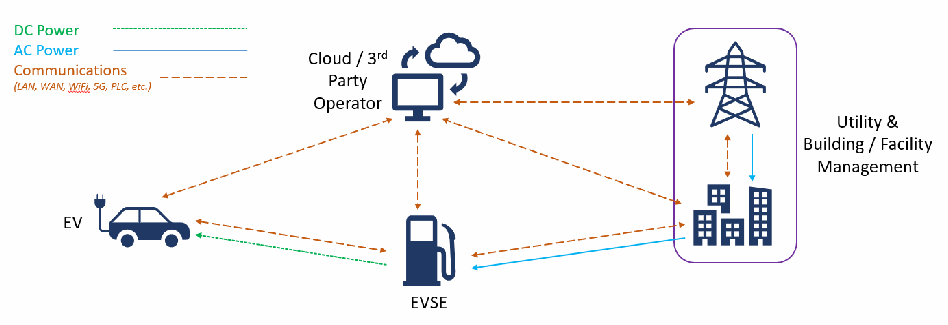
EV/XFC エコシステムの4つのドメインとその接続を示す図です。凡例は DC Power(直流電力)、AC Power(交流電力)、Communications(LAN、WAN、WiFi、5G、PLC など)の線の種類を示します。上部の「Cloud / 3rd Party Operator」(コンピューターとクラウドのアイコン)は、EV、EVSE(充電器のアイコン)、「Utility & Building / Facility Management」(枠内の送電鉄塔と建物)と通信で結ばれています。EV と EVSE の間では通信と直流電力がやり取りされ、ユーティリティ/建物ドメインは EVSE に交流電力を供給し、EVSE と通信します。
Fig. 2. EV/XFC Ecosystem Domains and Profile Scope
図 2. EV/XFC エコシステムのドメインとプロファイルの範囲
1.3. Audience
1.3. 想定読者
The EV/XFC Cybersecurity Framework Profile may be used by any number of relevant parties within the EV/XFC ecosystem. The relevant parties within the ecosystem are diverse and growing. Members of the ecosystem include:
EV/XFC サイバーセキュリティフレームワーク プロファイルは、EV/XFC エコシステム内のさまざまな関係者が利用できます。エコシステム内の関係者は多様であり、増え続けています。エコシステムの構成員には次の者が含まれます。
•EV owners (including individuals in the general public and fleet owners)
•EV の所有者(一般市民の個人およびフリート所有者を含む)
•EV manufacturers
•EV 製造者
•EVSE owners/operators
•EVSE の所有者/運営者
•EVSE manufacturers
•EVSE 製造者
•Cloud/Third-Party providers
•クラウド/サードパーティのプロバイダー
•Utility owner/operators
•電力事業者の所有者/運営者
•Building Network Owners/Providers
•ビルネットワークの所有者/プロバイダー
•Suppliers/Vendors
•サプライヤー/ベンダー
This document is intended for organizations and relevant parties involved in the EV/XFC industry that use or produce EV/XFC services, systems, and related components such as:
本書は、EV/XFC のサービス、システム、関連コンポーネントを使用または製造する、EV/XFC 業界の組織や関係者を対象としています。たとえば次のとおりです。
•Public and private organizations that use or provide EV/XFC services
•EV/XFC サービスを使用または提供する公的・民間の組織
•Managers responsible for the use or provision of EV/XFC services
•EV/XFC サービスの使用または提供に責任を負う管理者
•Risk managers, cybersecurity professionals, and others with a role in risk management for systems that use or provide EV/XFC services
•EV/XFC サービスを使用または提供するシステムのリスク管理に役割を持つ、リスク管理者、サイバーセキュリティ専門家、その他の担当者
•Procurement officials responsible for the acquisition of EV/XFC infrastructure or services
•EV/XFC インフラやサービスの調達に責任を負う調達担当者
•Mission and business process owners responsible for achieving operational outcomes dependent on EV/XFC services
•EV/XFC サービスに依存する運用上の成果を達成する責任を負う、ミッションおよびビジネスプロセスの所有者
The EV/XFC Cybersecurity Framework Profile is intended for a general audience and is broadly applicable. The Profile applies to organizations that:
EV/XFC サイバーセキュリティフレームワーク プロファイルは、一般的な読者を想定しており、広く適用できます。本プロファイルは、次のような組織に適用されます。
•Have already adopted the NIST Cybersecurity Framework to help identify, assess, and manage cybersecurity risks.
•サイバーセキュリティリスクの識別、評価、管理に役立てるため、NIST サイバーセキュリティフレームワークをすでに採用している組織。
•Are familiar with the Framework and want to improve their risk postures.
•フレームワークに精通しており、リスク態勢を改善したい組織。
•Are unfamiliar with the Framework but need to implement risk management frameworks for their organization.
•フレームワークに精通していませんが、自組織にリスク管理フレームワークを導入する必要がある組織。
2. Intended Use
2. 想定される使用方法
The EV/XFC Cybersecurity Framework Profile provides a framework that organizations may use to assess their cybersecurity posture (both the “as is” and “to be” states) as a part of their risk management processes and procedures. This profile provides guidance, and its use is voluntary. The Profile provides an assessment methodology for organizations to determine risks and the potential impacts of cyber-based disruptions to the EV/XFC ecosystem. The Profile is intended to help organizations within the EV/XFC community prioritize cybersecurity activities based on their mission objectives.
EV/XFC サイバーセキュリティフレームワーク プロファイルは、組織がリスク管理のプロセスや手順の一環として、自らのサイバーセキュリティ態勢(「現状」と「あるべき姿」の両方)を評価するために使用できるフレームワークを提供します。本プロファイルはガイダンスを提供するものであり、その使用は任意です。本プロファイルは、EV/XFC エコシステムに対するサイバー起因の中断によるリスクと潜在的な影響を、組織が判断するための評価手法を提供します。本プロファイルは、EV/XFC コミュニティ内の組織が、自らのミッション目標に基づいてサイバーセキュリティ活動の優先順位を付けるのを支援することを意図しています。
Additionally, the Profile can be used to help organizations identify areas where standards, practices, and other guidance can help manage risks to systems that use EV/XFC services. An organization can use the Profile in conjunction with its processes for identifying, assessing, and managing risk. The Profile is intended to complement, not replace, the organization’s existing risk management processes. This Profile is intended to be used as a foundational profile, and specific organizations can customize the EV/XFC Cybersecurity Framework Profile by considering the following questions:
さらに、本プロファイルは、EV/XFC サービスを使用するシステムのリスクを管理するうえで、標準、プラクティス、その他のガイダンスが役立つ領域を組織が識別する際にも使用できます。組織は、リスクを識別、評価、管理するための自らのプロセスと併せて、本プロファイルを使用できます。本プロファイルは、組織の既存のリスク管理プロセスを置き換えるのではなく、補完することを意図しています。本プロファイルは基礎となるプロファイルとして使用されることを想定しており、個々の組織は、次の問いを検討することで EV/XFC サイバーセキュリティフレームワーク プロファイルをカスタマイズできます。
•What are the mission objectives for the organizations within the ecosystem?
•エコシステム内の組織のミッション目標は何ですか。
•What processes or assets support the mission objective?
•どのプロセスや資産がそのミッション目標を支えていますか。
•What processes and assets are vulnerable to disruption or degradation?
•どのプロセスや資産が中断や劣化に対して脆弱ですか。
•What is the impact to the mission should a process or asset be lost or degraded?
•プロセスや資産が失われたり劣化したりした場合、ミッションにどのような影響がありますか。
•What are the integrity and availability thresholds of EV/XFC to avoid mission impact?
•ミッションへの影響を避けるために、EV/XFC に求められる完全性と可用性のしきい値は何ですか。
•What safeguards are available?
•どのような防護措置を利用できますか。
•What techniques can be used to detect events of concern?
•懸念されるイベントを検知するために、どのような手法を使用できますか。
•What techniques can be used to respond to events of concern?
•懸念されるイベントに対応するために、どのような手法を使用できますか。
•What techniques can be used to recover pre-event capabilities?
•イベント前の能力を復旧するために、どのような手法を使用できますか。
3. EV/XFC Cybersecurity Mission Objectives
3. EV/XFC のサイバーセキュリティ ミッション目標
The Mission Objective is defined as a high-level goal that must be achieved for an organization to succeed at its primary mission or purpose. Often the development of a Profile starts with the identification of an organization’s mission objectives. The EV/XFC Cybersecurity Mission Objectives provide the context for an organization to manage its cybersecurity risk as it relates to its specific mission needs. To ensure that the Profile aligns cybersecurity outcomes with mission requirements, input from stakeholders and experts in a particular field is critical. CSF Categories and Subcategories especially relevant to each mission objective can then be identified and prioritized to fit the needs of the organization.
ミッション目標とは、組織が主要なミッションまたは目的を成功させるために達成しなければならない高レベルの目標と定義されます。プロファイルの策定は、多くの場合、組織のミッション目標を識別することから始まります。EV/XFC のサイバーセキュリティ ミッション目標は、組織が自らの具体的なミッションニーズに関連してサイバーセキュリティリスクを管理するための文脈を提供します。サイバーセキュリティの成果をミッション要件に整合させるには、特定の分野の利害関係者や専門家の意見が不可欠です。そのうえで、各ミッション目標にとって特に関連性の高い CSF のカテゴリとサブカテゴリを識別し、組織のニーズに合わせて優先順位を付けることができます。
Mission objectives identified in this CSF Profile are those that may be common to organizations in the Electric Vehicle Extreme Fast Charging industry but recognizes that individual mission objectives may vary by organization. After identifying the Mission Objectives, an organization can use this information for prioritizing areas of particular concern. Prioritization is meant to be informative rather than prescriptive.
この CSF プロファイルで識別したミッション目標は、電気自動車超急速充電業界の組織に共通する可能性があるものであり、個々のミッション目標は組織によって異なることを認識しています。ミッション目標を識別した後、組織はその情報を、特に懸念される領域の優先順位付けに利用できます。優先順位付けは、規定を課すものではなく、情報を提供することを意図しています。
For this profile, between February 2023-May 2023, NCCoE hosted 12 virtual working group sessions for EV/XFC ecosystem and the four major domains in the EV/XFC ecosystem identified above in 1.2 Scope. The working group discussions resulted in four Mission Objectives that characterize high-level critical operational needs to an organization to meet its primary mission in the EV/XFC ecosystem including the four domains. Each organization should consider its own goals and priorities when consulting this Profile and adjust how the organization may apply guidance accordingly. The following Mission Objectives listed in the sections below can serve as a starting point for a particular organization to define their own Mission Objectives but should not be considered an exhaustive list as they do not directly address every technical aspect of the EVSE ecosystem.
本プロファイルのために、2023年2月から5月にかけて、NCCoE は、EV/XFC エコシステムと、上記 1.2 適用範囲で識別した EV/XFC エコシステムの 4 つの主要ドメインを対象に、12 回のバーチャル ワーキンググループ セッションを開催しました。ワーキンググループでの議論の結果、4 つのミッション目標がまとまりました。これらの目標は、4 つのドメインを含む EV/XFC エコシステムにおいて、組織が主要なミッションを果たすために必要な、高レベルの重要な運用上のニーズを特徴づけるものです。各組織は、本プロファイルを参照する際に自らの目標と優先事項を考慮すべきであり、それに応じてガイダンスの適用方法を調整すべきです。以下の各節に挙げるミッション目標は、特定の組織が自らのミッション目標を定義する際の出発点となり得ますが、EVSE エコシステムのあらゆる技術的側面を直接扱ってはいないため、網羅的な一覧とみなすべきではありません。
3.1. Mission Objective 1: Deliver Reliable Performance through Secure Communications
3.1. ミッション目標 1: 安全な通信による信頼性の高い性能の提供
Communicating across the XFC infrastructure is critical to the performance in the EV/XFC ecosystem and the success of the EV industry. Because of this in tandem dependency, the communications should be reliable and secure to fulfill the ecosystem’s mission needs. The XFC infrastructure faces many operational and cybersecurity threats and vulnerabilities, especially to its communication infrastructure; therefore, greater attention is needed to secure communications. Secure communications enable fundamental EV/XFC activities, such as charging experience, billing processes, and availability of charging stations.
XFC インフラ全体での通信は、EV/XFC エコシステムの性能と EV 業界の成功にとって極めて重要です。このように相互に依存しているため、エコシステムのミッションニーズを満たすには、通信は信頼でき、安全であるべきです。XFC インフラは、特に通信インフラについて、運用上およびサイバーセキュリティ上の多くの脅威と脆弱性に直面しており、通信の保護にはより一層の注意が必要です。安全な通信は、充電体験、課金プロセス、充電ステーションの可用性といった、EV/XFC の基本的な活動を支えます。
The rationale for this Mission Objective includes:
このミッション目標の根拠には、次のものがあります。
•EV. Communication between the EV (battery management system) and the charging station is necessary to facilitate the EV battery charging process. The EV connects to cloud/third-party applications to manage the transactions and collect data. EV user systems (e.g., infotainment) also may communicate with other vehicle systems, such as the charge controller and battery management systems. The interface between these applications presents a potential attack surface for malicious actors to cause damage.
•EV。EV(バッテリー管理システム)と充電ステーションとの間の通信は、EV のバッテリー充電プロセスを円滑にするために必要です。EV はクラウド/サードパーティのアプリケーションに接続して、取引を管理し、データを収集します。EV ユーザーシステム(インフォテインメントなど)も、充電コントローラーやバッテリー管理システムなど、車両の他のシステムと通信する場合があります。これらのアプリケーション間のインターフェースは、悪意ある者が損害を与えるための潜在的な攻撃対象領域となります。
•XFC/EVSE. The charging station requires secure communication to the cloud to facilitate financial transactions, provide authorization to charge, collect maintenance logs, and receive updates. Additionally, the charging station draws power from the metered utility.
•XFC/EVSE。充電ステーションには、金融取引を円滑に行い、充電の認可を提供し、保守ログを収集し、更新を受信するために、クラウドとの安全な通信が必要です。さらに、充電ステーションは、計量された電力事業者から電力を引き込みます。
•Cloud/Third-Party. Cloud service providers require reliable secure connections to the EV, charging station, and the utility to facilitate the charging process. Secure reliable communications allow for validation of financial transactions, protect personal information, and allow for maintenance updates and logs to be transmitted quickly and economically.
•クラウド/サードパーティ。クラウドサービスプロバイダーには、充電プロセスを円滑にするために、EV、充電ステーション、電力事業者との信頼できる安全な接続が必要です。信頼できる安全な通信により、金融取引の検証、個人情報の保護が可能となり、保守の更新やログを迅速かつ経済的に送信できます。
•Utility/Building Management Systems. Utilities and building management systems provide power to the charging station. Coordination between the XFC chargers and utilities is required for various smart grid applications such as peak shaving/load shifting or forecasting. Where this communication exists, it must be reliable and secure.
•電力事業者/ビル管理システム。電力事業者とビル管理システムは、充電ステーションに電力を供給します。ピークシェービング/負荷移行や需要予測など、さまざまなスマートグリッドのアプリケーションでは、XFC 充電器と電力事業者の間の調整が必要です。こうした通信が存在する場合、それは信頼でき、かつ安全でなければなりません。
3.2. Mission Objective 2: Maintain Resilience of the XFC Infrastructure
3.2. ミッション目標 2: XFC インフラのレジリエンスの維持
All users in the EV/XFC ecosystem should have reliable access to services. A loss of cybersecurity may impact physical security; therefore, organizations must implement safeguards to ensure the cyber resilience of the EV/XFC ecosystem. All cybersecurity decisions should be balanced with business needs to maintain usability of the system while keeping the ecosystem secure and resilient.
EV/XFC エコシステムのすべての利用者は、サービスに信頼できる形でアクセスできるべきです。サイバーセキュリティが失われると物理的なセキュリティに影響を及ぼす可能性があるため、組織は EV/XFC エコシステムのサイバーレジリエンスを確保するための防護措置を実装しなければなりません。サイバーセキュリティに関するあらゆる判断は、システムの使いやすさを維持しながらエコシステムを安全でレジリエントに保てるよう、ビジネス上のニーズとの均衡をとるべきです。
The rationale for this mission objective includes:
このミッション目標の根拠には、次のものがあります。
•EV. EV owners want assurance that their vehicle is protected before they are willing to participate in the charging ecosystem. Batteries are a significant expense, and a compromised XFC ecosystem could potentially lead to physical damage to the battery, EV components, and other nearby equipment. Thus, implemented safeguards will ease the minds of users and encourage them to use the charging stations.
•EV。EV の所有者は、充電エコシステムへの参加を決める前に、自分の車両が保護されているという確信を求めます。バッテリーは高額であり、XFC エコシステムが危殆化すると、バッテリー、EV の部品、その近くの他の機器に物理的な損傷が生じる可能性があります。したがって、防護措置を実装することで、利用者は安心し、充電ステーションを利用しやすくなります。
•XFC/EVSE. Due to the unique position of charging stations in the ecosystem, geographical dispersion, and general lack of physical security, charging stations have become an appealing target for threat actors. EVSE infrastructures should be protected, both cyber and physical, to prevent attacks like ransomware or damage to the charging infrastructure itself.
•XFC/EVSE。充電ステーションは、エコシステム内での特異な位置づけ、地理的な分散、物理セキュリティの一般的な不足により、脅威アクターにとって魅力的な標的となっています。ランサムウェアなどの攻撃や、充電インフラ自体への損害を防ぐために、EVSE インフラは、サイバー面と物理面の両方で保護されるべきです。
•Cloud/Third-Party. The cloud/third-party environment facilitates connectivity between domains of the infrastructure. It should be protected to maintain operations.
•クラウド/サードパーティ。クラウド/サードパーティの環境は、インフラのドメイン間の接続を支えています。運用を維持するために、これを保護すべきです。
•Utility/Building Management Systems. Utilities and building management systems should have protection systems in place to prevent manipulation of utility components to maintain safe operations.
•電力事業者/ビル管理システム。安全な運用を維持するために、電力事業者とビル管理システムは、電力事業者の構成要素が不正に操作されるのを防ぐ保護システムを整備すべきです。
3.3. Mission Objective 3: Build and Maintain Trustworthy Relationships with Partners and Customers
3.3. ミッション目標 3: パートナーおよび顧客との信頼できる関係の構築と維持
EV/XFC cybersecurity requires collection and use of partner and customer data from many sources. Building and maintaining relationships with relevant parties demands organizations consider and mitigate against risks throughout the information lifecycle. Protecting the confidentiality of sensitive information (e.g., system status information) ensures confidence in the organization and establishes trust among partners and with customers. Personal information should also be protected (e.g., credit card information, individual XFC usage patterns) to ensure that user information is not correlated for inappropriate use, resulting in a loss of trust from users. Cybersecurity disruptions to systems can impact product quality, leading partners, and customers to question the trustworthiness of the organization.
EV/XFC のサイバーセキュリティには、多くのソースからのパートナーおよび顧客のデータの収集と利用が必要です。関係者との関係を構築・維持するには、組織が情報ライフサイクル全体にわたってリスクを考慮し、緩和することが求められます。機微な情報(システムの状態情報など)の機密性を保護することは、組織への信頼を確保し、パートナー間および顧客との間の信頼を築くことにつながります。個人情報(クレジットカード情報、個人の XFC 利用パターンなど)も、利用者情報が不適切な目的で相関付けられて利用者の信頼を失うことのないよう、保護すべきです。システムに対するサイバーセキュリティ上の中断は、製品の品質に影響を及ぼし、パートナーや顧客がその組織の信頼性に疑問を抱く原因となる場合があります。
The rationale for this mission objective includes:
このミッション目標の根拠には、次のものがあります。
•EV. EV owners trust that charging stations will be available and operable, will not cause damage to the EV while charging, and will protect their information during transactions.
•EV。EV の所有者は、充電ステーションが利用でき、動作可能であり、充電中に EV に損傷を与えず、取引中の自分の情報を保護してくれると信頼しています。
•XFC/EVSE. EVSEs are the most visible representation of the EV/XFC ecosystem, and a cyber incident can have broad impact leaving the public uncertain of the safety, security and reliability of EVs, potentially impacting future sales.
•XFC/EVSE。EVSE は EV/XFC エコシステムの最も目に見える象徴であり、サイバーインシデントは広範な影響を及ぼして、EV の安全性、セキュリティ、信頼性について一般の人々に不安を与え、将来の販売に影響する可能性があります。
•Cloud/Third-Party. Cloud and Third-Party providers capture and maintain sensitive financial information for transactions across the EV/XFC ecosystem. Inadvertent release of this sensitive information can result in a loss of trust from all ecosystem relevant parties as well as result in high costs to the cloud/third-party providers due to fines, civil lawsuits, or compensation to customers.
•クラウド/サードパーティ。クラウドおよびサードパーティのプロバイダーは、EV/XFC エコシステム全体の取引に関する機微な金融情報を取得し、保持しています。この機微な情報が不注意で漏えいすると、エコシステムのすべての関係者からの信頼を失うおそれがあるうえ、罰金、民事訴訟、顧客への補償により、クラウド/サードパーティのプロバイダーに高額の費用が生じる可能性があります。
•Utility/Building Management Systems. Disruptions in the power supply may leave EV owners stranded and others in the EV/XFC ecosystem unable to perform their business functions. These types of disruptions erode trust in the EV/XFC ecosystem.
•電力事業者/ビル管理システム。電力供給が中断すると、EV の所有者が立ち往生したり、EV/XFC エコシステムの他の関係者が業務を遂行できなくなったりするおそれがあります。このような中断は、EV/XFC エコシステムへの信頼を損ないます。
3.4. Mission Objective 4: Maintain Continuity of Operations
3.4. ミッション目標 4: 業務継続性の維持
The EV/XFC ecosystem must sustain operations and ensure the organization’s mission continues in the face of adversity. Organizations need to monitor for deviations to identify potential cybersecurity events and detect and respond to anomalous behavior. Cyber supply chain risk management processes should also be identified and agreed to by organizational relevant parties. Moreover, organizations account for disruptions through business continuity/contingency planning and implementation of response and recovery plans. Achieving this objective requires each domain in the EV/XFC ecosystem to work together as expected.
EV/XFC エコシステムは、逆境にあっても運用を維持し、組織のミッションを継続させなければなりません。組織は、潜在的なサイバーセキュリティイベントを識別するために逸脱を監視し、異常な挙動を検知して対応する必要があります。サイバーサプライチェーンリスク管理プロセスも、組織の関係者が識別し、合意しておくべきです。さらに、組織は、事業継続/コンティンジェンシー計画と、対応計画および復旧計画の実装によって、中断に備えます。この目標を達成するには、EV/XFC エコシステムの各ドメインが期待どおりに連携する必要があります。
The rationale for this mission objective includes:
このミッション目標の根拠には、次のものがあります。
•EV. Understanding when an EV is compromised or acting outside its normal baseline operation is key to safe and reliable operations of the vehicle.
•EV。EV が危殆化したときや、通常のベースライン運用から外れて動作しているときにそれを把握することは、車両の安全で信頼できる運用の鍵となります。
•XCF/EVSE. To detect anomalous behavior, it is necessary to understand the stations’ charging cycle profile and power consumption to identify deviations from normal operations, which may indicate malicious behavior. Supply chain issues (e.g., quality, integrity, availability) impact the reliability of EVSE.
•XCF/EVSE。異常な挙動を検知するには、ステーションの充電サイクルプロファイルと電力消費を理解し、悪意ある挙動を示す可能性のある通常運用からの逸脱を識別する必要があります。サプライチェーンの問題(品質、完全性、可用性など)は、EVSE の信頼性に影響します。
•Cloud/Third-Party. Cloud/Third-Party entities must be able to identify malicious behaviors that deviate from cybersecurity baselines (e.g., unknown, or new connections and/or transmissions from sources other than the service provider or authorized by the service provider).
•クラウド/サードパーティ。クラウド/サードパーティの事業体は、サイバーセキュリティのベースラインから逸脱する悪意ある挙動(未知の接続や新たな接続、サービスプロバイダー以外のソースからの、またはサービスプロバイダーが認可していない送信など)を識別できなければなりません。
•Utility/Building Management Systems. Utilities typically have programs in place to detect anomalous activity from external systems that could impact operations.
•電力事業者/ビル管理システム。電力事業者は通常、運用に影響を及ぼし得る外部システムからの異常な活動を検知するプログラムを整備しています。
4. Overview of the Cybersecurity Framework
4. サイバーセキュリティフレームワークの概要
This section was derived from Version 1.1 of the NIST Cybersecurity Framework (CSF), and the reader is advised to consult the CSF and its corresponding quick start guide for additional details [NIST-CSF] [NIST-SP1271]. The CSF assists organizations in better managing and reducing cybersecurity risk in a way that responds to the industry’s unique cybersecurity needs, risks, threats, and/or cyber sophistication (regardless of its size). The Framework provides an approach to analyzing cybersecurity risk, enabling enterprises to understand their cybersecurity challenges, and selecting appropriate mitigation strategies. The Framework emphasizes the risk management process for cybersecurity by stating that “the Framework focuses on using business drivers to guide cybersecurity activities and considering cybersecurity risks as part of the organization’s risk management process” [NIST-CSF].
本節は、NIST サイバーセキュリティフレームワーク(CSF)バージョン 1.1 に基づいています。詳細については、CSF とその対応するクイックスタートガイドを参照してください [NIST-CSF] [NIST-SP1271]。CSF は、組織が、業界固有のサイバーセキュリティニーズ、リスク、脅威、あるいはサイバー面での高度さ(規模を問わない)に対応する形で、サイバーセキュリティリスクをより適切に管理し、低減できるよう支援します。フレームワークは、サイバーセキュリティリスクを分析し、エンタープライズが自らのサイバーセキュリティ上の課題を理解して、適切な緩和戦略を選択できるようにする手法を提供します。フレームワークは、「フレームワークは、ビジネス推進要因を用いてサイバーセキュリティ活動を導き、サイバーセキュリティリスクを組織のリスク管理プロセスの一部として考慮することに重点を置いている」と述べて、サイバーセキュリティのリスク管理プロセスを強調しています [NIST-CSF]。
The Framework presents industry standards, guidelines, and practices in a manner that allows cybersecurity activities and outcomes to be clearly communicated at all levels of an organization, from executives to individuals with operational job roles. Building on those standards, guidelines, and practices, the Framework provides a common taxonomy and mechanism for organizations to:
フレームワークは、経営層から運用担当者まで、組織のあらゆる階層で、サイバーセキュリティ活動と成果を明確に伝達できるように、業界標準、ガイドライン、プラクティスを提示しています。これらの標準、ガイドライン、プラクティスに基づき、フレームワークは、組織が次のことを行うための共通の分類法と仕組みを提供します。
•Describe their current cybersecurity posture.
•現在のサイバーセキュリティ態勢を記述します。
•Describe their target state for cybersecurity.
•サイバーセキュリティの目標とする状態を記述します。
•Identify and prioritize opportunities for improvement within the context of a continuous and repeatable process.
•継続的で反復可能なプロセスという文脈の中で、改善の機会を識別し、優先順位を付けます。
•Assess progress toward the target state.
•目標とする状態に向けた進捗を評価します。
•Communicate among internal and external relevant parties about cybersecurity risk.
•サイバーセキュリティリスクについて、内部および外部の関係者間で伝達します。
The Framework consists of three main components: the Core, Profiles, and Implementation Tiers. The Core is a catalog of cybersecurity outcomes written in a common language. A Framework profile is an alignment of organizational requirements, objectives, risk appetite, and resources against the desired outcomes of the Framework Core. Implementation Tiers guide organizations to consider the appropriate level of rigor for their cybersecurity program and can be used as a communication tool to discuss risk appetite, mission priority, and budget; further discussion on Implementation Tiers is not included in this profile.
フレームワークは、コア、プロファイル、実装ティアの 3 つの主要な構成要素から成ります。コアは、共通の言語で記述されたサイバーセキュリティ成果のカタログです。フレームワークのプロファイルは、組織の要件、目標、リスク選好度、資源を、フレームワークコアの望ましい成果に対して整合させたものです。実装ティアは、サイバーセキュリティプログラムに適切な厳格さの水準を組織が検討する際の指針となり、リスク選好度、ミッションの優先順位、予算を議論するためのコミュニケーション手段としても使用できます。実装ティアに関するこれ以上の議論は、本プロファイルには含まれません。
4.1. The Framework Core
4.1. フレームワークコア
The Framework Core consists of five Functions [NIST-CSF]:
フレームワークコアは、5 つの機能で構成されます [NIST-CSF]。
•Identify. The activities in the Identify function are the foundation for effective use of the Framework. Understanding the business context, the resources that support critical functions, and the related cybersecurity risks enables an organization to focus on and prioritize its efforts, consistent with its risk management strategy and business needs.
•識別(IDENTIFY)。識別機能の活動は、フレームワークを効果的に使用するための基礎となります。ビジネスの文脈、重要な機能を支える資源、および関連するサイバーセキュリティリスクを理解することで、組織は、リスク管理戦略とビジネスニーズに沿って、取り組みに焦点を当て、優先順位を付けられるようになります。
•Protect. The Protect function supports the ability to limit or contain the impact of a potential cybersecurity event.
•防御。防御機能は、潜在的なサイバーセキュリティイベントの影響を制限または封じ込める能力を支えます。
•Detect. The Detect function enables timely discovery of cybersecurity events.
•検知。検知機能は、サイバーセキュリティイベントを適時に発見できるようにします。
•Respond. The Respond function supports the ability to contain the impact of a potential cybersecurity event.
•対応。対応機能は、潜在的なサイバーセキュリティイベントの影響を封じ込める能力を支えます。
•Recover. The Recover function supports timely recovery to normal operations to reduce the impact from a cybersecurity event.
•復旧。復旧機能は、サイバーセキュリティイベントの影響を減らすため、通常運用への適時の復旧を支えます。
When considered together, these functions provide a high-level, strategic view for managing cybersecurity risk. The Framework further identifies underlying key Categories and Subcategories for each function and matches them with example informative references such as existing standards, guidelines, and practices for each subcategory. As stated previously, the informative references are meant to be used as examples of best practices and to provide relevant information and are by no means any type of regulatory or compliance mandate from the perspective of this guidance Table 1 illustrates the alignment of Categories to Functions.
これらの機能を合わせて考えると、サイバーセキュリティリスクを管理するための高レベルで戦略的な視点が得られます。フレームワークはさらに、各機能の基礎となる主要なカテゴリとサブカテゴリを識別し、各サブカテゴリに、既存の標準、ガイドライン、プラクティスなどの参考情報の例を対応付けています。前述のとおり、参考情報はベストプラクティスの例として、また関連情報を提供するために用いられることを意図しており、本ガイダンスの観点からは、いかなる種類の規制上またはコンプライアンス上の義務でもありません。表1は、カテゴリと機能の対応を示しています。
Table 1. Function and Category Unique Identifiers of NIST CSF 1.1
表 1. NIST CSF 1.1 の機能とカテゴリの一意識別子
| Function | Function Unique Identifier | Category | Category Unique Identifier |
|---|---|---|---|
| IDENTIFY | ID | Asset Management | ID.AM |
| Business Environment | ID.BE | ||
| Governance | ID.GV | ||
| Risk Assessment | ID.RA | ||
| Risk Management Strategy | ID.RM | ||
| Supply Chain Risk Management | ID.SC | ||
| PROTECT | PR | Access Control | PR.AC |
| Awareness and Training | PR.AT | ||
| Data Security | PR.DS | ||
| Information Protection Processes and Procedures | PR.IP | ||
| Maintenance | PR.MA | ||
| Protective Technology | PR.PT | ||
| DETECT | DE | Anomalies and Events | DE.AE |
| Security Continuous Monitoring | DE.CM | ||
| Detection Processes | DE.DP | ||
| RESPOND | RS | Response Planning | RS.RP |
| Communications | RS.CO | ||
| Analysis | RS.AN | ||
| Mitigation | RS.MI | ||
| Improvements | RS.IM | ||
| RECOVER | RC | Recovery Planning | RC.RP |
| Improvements | RC.IM | ||
| Communications | RC.CO |
| 機能 | 機能の一意識別子 | カテゴリ | カテゴリの一意識別子 |
|---|---|---|---|
| 識別(IDENTIFY) | ID | 資産管理 | ID.AM |
| ビジネス環境 | ID.BE | ||
| ガバナンス | ID.GV | ||
| リスクアセスメント | ID.RA | ||
| リスク管理戦略 | ID.RM | ||
| サプライチェーンリスク管理 | ID.SC | ||
| 防御(PROTECT) | PR | アクセス制御 | PR.AC |
| 意識向上およびトレーニング | PR.AT | ||
| データセキュリティ | PR.DS | ||
| 情報保護プロセスおよび手順 | PR.IP | ||
| 保守 | PR.MA | ||
| 保護技術 | PR.PT | ||
| 検知(DETECT) | DE | 異常とイベント | DE.AE |
| セキュリティの継続的監視 | DE.CM | ||
| 検知プロセス | DE.DP | ||
| 対応(RESPOND) | RS | 対応計画 | RS.RP |
| コミュニケーション | RS.CO | ||
| 分析 | RS.AN | ||
| 緩和 | RS.MI | ||
| 改善 | RS.IM | ||
| 復旧(RECOVER) | RC | 復旧計画 | RC.RP |
| 改善 | RC.IM | ||
| コミュニケーション | RC.CO |
The Framework Categories decompose into Subcategories that are more detailed cybersecurity activities and specific outcomes of technical and/or management activities. The final components of the Framework Core are informative references. Informative references map the Subcategories and provide the reader with existing standards, guidelines, and practices that can help an organization achieve the desired outcome for each subcategory.
フレームワークのカテゴリは、より詳細なサイバーセキュリティ活動であり、技術面または管理面の活動の具体的な成果である、サブカテゴリに分解されます。フレームワークコアの最後の構成要素は参考情報です。参考情報はサブカテゴリに対応付けられ、各サブカテゴリの望ましい成果を組織が達成するのに役立つ、既存の標準、ガイドライン、プラクティスを読者に提供します。
Profile development applies the Cybersecurity Framework in focusing on the cybersecurity areas of particular concern to an industry, organization, or functional area as identified through its risk management processes. By evaluating the elements of the Cybersecurity Framework in the context of a particular mission, organization, or sector, a profile is created that shows the organization’s cybersecurity posture based on evaluation of the mission against the Cybersecurity Framework Functions, Categories, and Subcategories.
プロファイルの策定では、リスク管理プロセスを通じて特定された、業界、組織、または機能領域にとって特に懸念されるサイバーセキュリティ領域に重点を置くために、サイバーセキュリティフレームワークを適用します。特定のミッション、組織、またはセクターの文脈でサイバーセキュリティフレームワークの要素を評価することにより、サイバーセキュリティフレームワークの機能、カテゴリ、サブカテゴリに照らしたミッションの評価に基づいて、組織のサイバーセキュリティ態勢を示すプロファイルが作成されます。
Profiles are used to identify opportunities for improving an organization’s cybersecurity posture by creating and comparing a “current” profile (the “as is” state) with a “target” profile (the “to be” state). A target profile offers a prioritization of Subcategories based on pressing mission and operational considerations for a specific community, industry, or group of relevant parties. Target profiles are a basis for identifying and engaging in discussions about cybersecurity activities and outcomes that are important to the profile’s user community. Within an organization, profiles offer a consistent way to discuss cybersecurity objectives across organizational or agency roles—from senior leadership to technical implementors—using common terminology. Individuals within the organization or agency may use the gaps between the current and target profiles to discuss prioritization and allocation of resources to meet cybersecurity objectives.
プロファイルは、「現在の」プロファイル(「現状」の状態)と「目標」プロファイル(「あるべき姿」の状態)を作成して比較することにより、組織のサイバーセキュリティ態勢を改善する機会を識別するために使用されます。目標プロファイルは、特定のコミュニティ、業界、または関係者グループにとって差し迫ったミッション上および運用上の考慮事項に基づく、サブカテゴリの優先順位付けを提示します。目標プロファイルは、プロファイルの利用者コミュニティにとって重要なサイバーセキュリティ活動と成果を識別し、それについて議論するための基礎となります。組織内では、プロファイルは、共通の用語を用いて、上級幹部から技術的な実装担当者まで、組織や機関内のさまざまな役割にわたってサイバーセキュリティの目標を議論するための一貫した方法を提供します。組織や機関内の個人は、現在のプロファイルと目標プロファイルとの間のギャップを使用して、サイバーセキュリティの目標を達成するための資源の優先順位付けと配分について議論できます。
4.2. Sector-Level Profiles
4.2. セクターレベルのプロファイル
Sector-level profiles emerged as a concept after the development of the CSF. Sector-level profiles can act as a starting point for members of the sector to develop their organization’s “current” or “target” profile. Sector-level profiles provide a basis for sub‐sectors and individual organizations to facilitate conversations and discuss security activities using consistent terminology. Sector-level profiles are intended to:
セクターレベルのプロファイルは、CSF の策定後に生まれた概念です。セクターレベルのプロファイルは、セクターの構成員が自組織の「現在の」プロファイルや「目標」プロファイルを策定するための出発点になり得ます。セクターレベルのプロファイルは、サブセクターや個々の組織が、一貫した用語を用いて対話し、セキュリティ活動について議論するための基礎を提供します。セクターレベルのプロファイルは、次のことを意図しています。
•Provide a foundational profile for organizations to augment or tailor specific to their organizational needs.
•組織が自らのニーズに合わせて拡張または調整するための、基礎的なプロファイルを提供します。
•Decrease the chance that organizations overlook a category or subcategory.
•組織がカテゴリやサブカテゴリを見落とす可能性を減らします。
•Encourage consistent analysis of cybersecurity‐risk in the sector ecosystem/environment.
•セクターのエコシステム/環境におけるサイバーセキュリティリスクの一貫した分析を促します。
•Align sector and regulatory cybersecurity requirements or needs.
•セクターおよび規制上のサイバーセキュリティ要件やニーズを整合させます。
Developing sector-level profiles can be facilitated through a collaborative, community of interest (COI) driven process. To ensure that a profile aligns cybersecurity outcomes with mission and business needs, input from relevant parties and experts in the targeted field is critical.
セクターレベルのプロファイルの策定は、共通の関心を持つコミュニティ(COI)が主導する協調的なプロセスを通じて円滑に進められます。プロファイルがサイバーセキュリティの成果をミッションとビジネスのニーズに確実に整合させるためには、対象分野の関係者や専門家の意見が不可欠です。
5. XFC Baseline Profile
5. XFC ベースラインプロファイル
The XFC Baseline Profile was created by using the Cybersecurity Framework as described in Sec. 4. The baseline profile consists of tables for each Category that summarize how each associated subcategory applies generally to the EV/XFC ecosystem with informative references for additional guidance. The tables provide domain-specific considerations as appropriate.
XFC ベースラインプロファイルは、第 4 節で説明したサイバーセキュリティフレームワークを用いて作成されました。ベースラインプロファイルは、カテゴリごとの表で構成されており、関連する各サブカテゴリが EV/XFC エコシステムに一般的にどのように適用されるかを、追加のガイダンスのための参考情報とともに要約しています。表では、必要に応じてドメイン固有の考慮事項を示します。
By design, the Cybersecurity Framework is flexible to accommodate the unique environments and needs of different organizations. Users of this document will understand that deviations between their enterprise and the assumptions made in this profile may impact the applicability of the Subcategories. Therefore, relevant parties are advised to review all the Subcategories in the context of their organization.
設計上、サイバーセキュリティフレームワークは、さまざまな組織に固有の環境やニーズに対応できるよう柔軟になっています。本書の利用者は、自らのエンタープライズと本プロファイルで置いた前提との間に相違があると、サブカテゴリの適用可能性に影響する場合があることを理解するでしょう。したがって、関係者は、自組織の文脈ですべてのサブカテゴリを確認すべきです。
5.1. Identify Function
5.1. 識別機能
Cybersecurity decisions are not made in a vacuum but within the context of each organization’s business goals and objectives. Decision making evaluates alternatives based on their potential impact on the business.
サイバーセキュリティに関する判断は、真空の中で行われるのではなく、各組織のビジネス上の目標や目的の文脈の中で行われます。意思決定では、ビジネスへの潜在的な影響に基づいて代替案を評価します。
The Identify function is the foundation of the risk assessment process, so risk management practitioners should start there first. Consideration of the organization’s mission and business objectives, threat environment, assets, and vulnerabilities will have significant influence on the overall risk management decision and will also impact the other four Functions (i.e., Protect, Detect, Respond, Recover).
識別機能はリスクアセスメントプロセスの基礎であるため、リスク管理の実務者はまずここから始めるべきです。組織のミッションとビジネス目標、脅威環境、資産、脆弱性を考慮することは、リスク管理全体の判断に大きな影響を与え、他の 4 つの機能(防御、検知、対応、復旧)にも影響します。
The objectives of the Identify function include:
識別機能の目的には、次のものがあります。
•Identifying the business or operational environment and organization’s purpose
•ビジネス環境または運用環境と組織の目的を識別する
•Identifying all assets, including hardware, software, personnel, roles, and responsibilities, and assets’ criticality
•ハードウェア、ソフトウェア、要員、役割、責任を含むすべての資産と、資産の重要度を識別する
•Identifying infrastructure that provides EV/XFC functionality
•EV/XFC の機能を提供するインフラを識別する
•Identifying the current and trending vulnerabilities, threats, and impacts should the threat be realized to assess the risk.
•リスクを評価するために、現在および傾向としての脆弱性と脅威、ならびに脅威が現実となった場合の影響を識別します。
The Identify function consists of six Categories:
識別機能は、6 つのカテゴリで構成されます。
•Asset Management
•資産管理
•Business Environment
•ビジネス環境
•Governance
•ガバナンス
•Risk Assessment
•リスクアセスメント
•Risk Management
•リスク管理
•Supply Chain Risk Management
•サプライチェーンリスク管理
Each of these Categories and associated Subcategories is summarized in Sec. 5.1.1 through Sec. 5.1.6.
これらの各カテゴリと関連するサブカテゴリは、5.1.1 節から 5.1.6 節で要約します。
5.1.1. Asset Management Category
5.1.1. 資産管理カテゴリ
The data, personnel, devices, systems, and facilities that enable the organization to achieve business purposes are identified and managed consistently with their relative importance to organizational objectives and the organization’s risk strategy.
組織がビジネス目的を達成できるようにするデータ、要員、デバイス、システム、施設は、組織の目標と組織のリスク戦略に対する相対的な重要性に応じて、識別され、一貫して管理されます。
In the context of the ecosystem, managing these resources provides the information needed to inform ongoing decision making consistent with the organization’s business objectives and risk strategy. The domains within the EV/XFC ecosystem operate independently to achieve common goals. However, to best manage and use their resources, interdependencies and collaborations should be considered among the domains.
エコシステムの文脈では、これらの資源を管理することで、組織のビジネス目標とリスク戦略に沿った継続的な意思決定に必要な情報が得られます。EV/XFC エコシステム内のドメインは、共通の目標を達成するために独立して運用されています。しかし、資源を最適に管理して利用するには、ドメイン間の相互依存性と協力関係を考慮すべきです。
Table 2. Identify: Asset Management Category
表 2. 識別: 資産管理カテゴリ
| Subcategory | Domain | Specific Considerations | Informative References |
|---|---|---|
AM-1: Physical devices and systems within the organization are inventoried. | Ecosystem: Hardware inventory is a basic function that supports security and management. The inventory’s ability to support security and management is dependent on its accuracy and granularity. Factors that contribute to accuracy include how frequently inventories are performed, how thoroughly the inventory is performed (through means such as automation), and the use of physical inspections or other mechanisms for verification. Factors that contribute to granularity of the inventory include information such as the manufacturer, model number, serial number, version, its function, or its enabled (or disabled) capabilities. Consideration should be given to including rented or leased equipment in the inventory in addition to assets that are directly owned and managed by the organization. A comprehensive inventory may define subsystems, components, or subassemblies as distinct physical assets. | [NIST SP 800-53r5] NERC CIP |
| AM-1 | EV | No additional domain-specific considerations to EV manufacturers once the vehicle is delivered to the customer; however, manufacturers may catalogue the equipment installed in their vehicles and consider providing that information to EV owners as needed. EV owners may consider being aware of the basic information about their vehicle, such as voltage ratings, rated charging current, charging method (alternating current (AC) or direct current (DC)) and charging connector type. | [NIST SP 800-53r5] CM-8, PM-5 |
| AM-1 | XFC/EVSE | Applicable, but no additional EVSE-specific considerations. | [NIST SP 800-53r5] [NIST Handbook 44] ISA/IEC 62443-2-1:D4E1 ISA/IEC 62443-3-3:2013 OIML D31:2019 OIML G22:2022 |
| AM-1 | Cloud/Third-Party | Applicable, but no additional Cloud/ | [NIST SP 800-53r5] CM-8, PM-5 |
| AM-1 | Utility/Building Management System | Applicable, but no additional Utility Building/Management System-specific considerations. | [NIST SP 800-53r5] ISA/IEC 62443-2-1:D4E1 ISA/IEC 62443-3-3:2013 |
AM-2: Software platforms and applications within the organization are inventoried. | Ecosystem: Accurate and current software inventory is considered a basic security function. The software inventory may include developer and version information, associated hardware, update history, and known bugs. The inventory should consider tracking how software is used and updated so that extraneous, outdated, or vulnerable software can be properly managed. Comprehensive software inventories may use a software bill of materials (SBOM) to track any software dependencies that may have an impact on the software’s function. | [NIST SP 800-53r5] NERC CIP |
| AM-2 | EV | EV manufacturers should consider routinely pushing or providing software updates and patches to EV owners and relevant third parties. | [NIST SP 800-53r5] ISO 24089:20231 |
| AM-2 | XFC/EVSE | EVSE manufacturers should consider routinely pushing and patching software updates and patches to EVSE owners and relevant third parties. | [NIST Handbook 44] [NIST SP 800-53r5] OIML D31:2019 OIML G22:2022 ISA/IEC 62443-2-1:D4E1 ISA/IEC 62443-3-3:2013 |
| AM-2 | Cloud/Third-Party | Cloud/Third-Party owners/operators may consider including any external third-party software hosted on or connected to the systems. | [NIST SP 800-53r5] SA-8 |
| AM-2 | Utility/Building Management System | Utility/Building management owners/may consider including external third-party software hosted on their systems in the software inventory. | [NIST SP 800-53r5] ISA/IEC 62443-2-1:D4E1 ISA/IEC 62443-3-3:2013 |
AM-3: Organizational communication and data flows are mapped. | Ecosystem: Consider all data flows, internal data flows; within systems, between systems within an organization, and any external or third-party flows. Mapped data flows should consider showing how different types of data are communicated, requirements for transmission, and information on path redundancies. Catalogued information may include any communication and encryption protocols used, associated sensors and end points, and any associated connectors or possible connection points. | [NIST SP 800-53r5] NERC CIP |
| AM-3 | EV | This mapping may include communication and data relating to vehicle identification, system information, battery statistics, payment information, accounts, etc. Data path/flow diagrams should consider including the EV wire harness and each relevant electric control unit (ECU). Diagrams may also show how ECUs are connected to communication buses, sensors, and actuators, the communication protocols they use, physical location of hardware in the EV, any available ports, and the directionality of communications. | [NIST SP 800-53r5] CA-3, CA-6, CA-9 |
| AM-3 | XFC/EVSE | XFC/EVSE interfaces should consider ensuring that only necessary data are sent or received to fulfill their task. It may be necessary to consider measures to avoid an indirect exchange of information between the EV and the utility domain. Consider also including EVSE- and EV-specific interfacing, as well as any communication to any cloud/third-party systems or utility/building management systems. | ISA/IEC 62443-2-1:D4E1 OIML D31:2019 OIML G22:2022 |
| AM-3 | Cloud/Third-Party | Cloud/Third-Party members should consider including business and operations-specific flows within the organization as well as interactions with external partners and entities, including EVSE, utilities, building/facility management systems, and transaction management systems. Consider paying particular attention to Payment Card Industry (PCI) data flows and data flows to and from data leaks. | [NIST SP 800-53r5] CA-3, CA-6, CA-9 |
| AM-3 | Utility/Building Management System | Consider paying particular attention to data leaks. Data path/flow diagrams should consider showing relevant utility/substation Supervisory Control and Data Acquisition (SCADA) system layouts including Programmatic Logic Controllers (PLCs), Human Machine Interfaces (HMIs), and the equipment they control. Diagrams may show how the cloud network communicates information to the utility. The diagrams can show how information flows and the communication protocols they use. | [NIST SP 800-53r5] ISA/IEC 62443-2-1:D4E1 |
AM-4: External information systems are catalogued. | Ecosystem: Catalogue external partner connections and level of access to external information systems, establish processes and agreements with all external partners to ensure an understanding of information system usage, and establish a level of trust and security that is consistent with the policies of the organization. | [NIST SP 800-53r5] NERC CIP |
| AM-4 | EV | This may include cataloging EVSE connections to EV, processes used to verify EV identity and accounts, and charge profile information (current, capacity, battery health, etc.) communication. EV connections to cloud-based systems, including account, profile, and location information, should consider also being included. | [NIST SP 800-53r5] AC-20, PM-5, SA-9 |
| AM-4 | XFC/EVSE | External information systems that EVSE interfaces with may include EV-specific systems as well as any communication to any cloud/third-party operators or utility/building management systems. EVSE functionality may be dependent upon external information systems to support EVSE connections to EV, to the utility (data flow for power metering, account billing, and demand forecasting) and connections to cloud (to support data flow for charge station search and reservation and billing information). | ISA/IEC 62443-2-1:D4E1 ORG 1.1 |
| AM-4 | Cloud/Third-Party | Cloud/Third-Party owners/operators may include interactions with external partners, systems, and entities, such as EVSE, utilities, building/facility management systems, and transaction management systems. | [NIST SP 800-53r5] AC-20, PM-5, SA-9 |
| AM-4 | Utility/Building Management System | Some aspects of utility or building/facility management require external information systems for proper operation and support EVSE connections to utility and cloud-based systems for functions such as demand forecasting. | ISA/IEC 62443-2-1:D4E1 ORG 1.1 |
AM-5: Resources (e.g., hardware, devices, data, time, personnel, and software) are prioritized based on their classification, criticality, and business value. | Ecosystem: Identification and prioritization of the criticality and business value of assets are pre-requisites for allocation of resources and enable risk management decisions to either reduce or accept the residual risk. Prioritization of assets allows an organization to focus on the most pending needs first. Special consideration should be considered for user safety, financial, and privacy/personally identifiable information security during prioritization. | [NIST-SP800-37r2] [NIST-SP800-53r5] |
| AM-5 | EV | EV manufacturers have an additional concern in that they will be supporting equipment and systems already in the customer’s possession and use. In addition to their current assets, manufacturers may consider the importance of resources necessary to support discontinued models. | [NIST-SP800-53r5] AC-20, RA-2, RA-9, SA-20, SC-6 |
| AM-5 | XFC/EVSE | The prioritization of resources will be influenced by the XFC/EVSE’s ability to support different makes and models of EV. The resource prioritization may be updated as the number and variety of EVs change. XFC/EVSE stations are geographically diverse, and the local owners/operators may have different risk tolerances. As such, the evaluations may be adjusted based on local threat assessments, vulnerabilities of local equipment, local risk assessments, and the individual owners’ tolerance. EVSE manufacturers may consider supporting equipment and systems already in the customer’s possession and use, which would influence the prioritization process. EVSE owners/operators can acknowledge that prioritization may be adjusted based on geographical location in addition to the equipment/system type and model. This may mean defining what types of EVs are eligible to charge during times of decreased availability. For example, emergency response EVs may be prioritized during an emergency to ensure that their missions are upheld. | ISA/IEC 62443-2-1:D4E1 OIM D31:2019 |
| AM-5 | Cloud/Third-Party | Criticality to customer and partners organizations may be part of the prioritization. | [NIST-SP800-53r5] AC-20, RA-2, RA-9, SA-20, SC-6 |
| AM-5 | Utility/Building Management System | Consumers may be elements of the critical infrastructure (such as shipping or disaster recovery). This may mean prioritizing what loads receive power during a time of decreased availability and communicating that prioritization with partners. | [NIST-SP800-53r5] ISA/IEC 62443-2-1:D4E1 |
AM-6: Cybersecurity roles and responsibilities for the entire workforce and third-party stakeholders (e.g., suppliers, customers, partners) are established. | Ecosystem: Clear definition of roles and responsibilities enables coordination of cybersecurity programs. The roles and responsibilities for external organizations such as customers, partners, third parties, and suppliers may be defined in advance on a case-by-case basis. Consider putting memorandums of understanding or other agreements in place to facilitate tracking a participant’s performance and hold them accountable for their responsibilities. Role and responsibility definitions should consider including details about authorities across domains, cover the entire cybersecurity posture of an organization including accounting for external relevant parties, and detail the level of transparency required for accountable and acceptable use, storage, and interaction with intellectual property. | [NIST-SP800-53r5] NERC CIP |
| AM-6 | EV | Additional relevant parties for EV manufacturers include elements of the workforce involved in vehicle design, and pre/post-sales support. EV owners may be made aware of methods and opportunities for good cyber hygiene as it relates to their EV usage, as well as informed on the responsibilities to the customer of their vehicle manufacturer. | ISO/SAE 21434 RQ-07-04, RQ-07-06 |
| AM-6 | XFC/EVSE | Additional relevant parties for EVSE manufacturers should consider including elements of the workforce involved in equipment design/usage, pre/post-sales support, and those involved during EVSE installation design and construction. | ISA/IEC 62443-2-1:D4E1 ORG 1.3 |
| AM-6 | Cloud/Third-Party | Extra emphasis may be placed on external partner relationships due to the requirement for externally sourced operational data. | [NIST-SP800-53r5] CP-2, PM-2, PM-29 |
| AM-6 | Utility/Building Management System | Utilities and network building should consider defining the roles and responsibilities in context of rules and regulations that apply to the energy sector. Extra emphasis may be placed on physical security personnel to protect the physical operating environment and infrastructure against cybersecurity risks. | ISA/IEC 62443-2-1:D4E1 ORG 1.3 |
| サブカテゴリ | ドメイン | 固有の考慮事項 | 参考情報 |
|---|---|---|
AM-1: 組織内の物理デバイスとシステムが目録化されています。 | エコシステム: ハードウェアの目録は、セキュリティと管理を支える基本的な機能です。目録がセキュリティと管理を支える能力は、その正確さと粒度に左右されます。正確さに寄与する要因には、目録を作成する頻度、(自動化などの手段による)目録作成の徹底度、検証のための物理的な点検その他の仕組みの利用があります。目録の粒度に寄与する要因には、製造者、型番、シリアル番号、バージョン、機能、有効(または無効)な能力などの情報があります。組織が直接所有し管理している資産に加えて、レンタルまたはリースの機器も目録に含めることを検討すべきです。包括的な目録では、サブシステム、コンポーネント、サブアセンブリを個別の物理資産として定義する場合があります。 | [NIST SP 800-53r5] NERC CIP |
| AM-1 | EV | 車両が顧客に引き渡された後は、EV 製造者に対する追加のドメイン固有の考慮事項はありません。ただし、製造者は、自社の車両に搭載された機器を目録化し、必要に応じてその情報を EV 所有者に提供することを検討してもよいでしょう。 EV 所有者は、定格電圧、定格充電電流、充電方式(交流(AC)または直流(DC))、充電コネクターの種類など、自分の車両の基本情報を把握することを検討してもよいでしょう。 | [NIST SP 800-53r5] CM-8, PM-5 |
| AM-1 | XFC/EVSE | 適用可能ですが、EVSE 固有の追加の考慮事項はありません。 | [NIST SP 800-53r5] [NIST Handbook 44] ISA/IEC 62443-2-1:D4E1 ISA/IEC 62443-3-3:2013 OIML D31:2019 OIML G22:2022 |
| AM-1 | クラウド/サードパーティ | 適用可能ですが、クラウド/ | [NIST SP 800-53r5] CM-8, PM-5 |
| AM-1 | 電力事業者/ビル管理システム | 適用可能ですが、電力事業者/ | [NIST SP 800-53r5] ISA/IEC 62443-2-1:D4E1 ISA/IEC 62443-3-3:2013 |
AM-2: 組織内のソフトウェアプラットフォームとアプリケーションが目録化されています。 | エコシステム: 正確で最新のソフトウェア目録は、基本的なセキュリティ機能とみなされます。ソフトウェア目録には、開発者とバージョンの情報、関連するハードウェア、更新履歴、既知のバグを含めることができます。目録では、不要なソフトウェア、古いソフトウェア、脆弱なソフトウェアを適切に管理できるよう、ソフトウェアがどのように使用・更新されているかの追跡を検討すべきです。包括的なソフトウェア目録では、ソフトウェアの機能に影響を及ぼし得るソフトウェアの依存関係を追跡するために、ソフトウェア部品表(SBOM)を使用する場合があります。 | [NIST SP 800-53r5] NERC CIP |
| AM-2 | EV | EV 製造者は、ソフトウェアの更新とパッチを、EV 所有者や関係するサードパーティに定期的にプッシュ配信または提供することを検討すべきです。 | [NIST SP 800-53r5] ISO 24089:20231 |
| AM-2 | XFC/EVSE | EVSE 製造者は、ソフトウェアの更新とパッチを、EVSE 所有者や関係するサードパーティに定期的にプッシュ配信し適用することを検討すべきです。 | [NIST Handbook 44] [NIST SP 800-53r5] OIML D31:2019 OIML G22:2022 ISA/IEC 62443-2-1:D4E1 ISA/IEC 62443-3-3:2013 |
| AM-2 | クラウド/サードパーティ | クラウド/ | [NIST SP 800-53r5] SA-8 |
| AM-2 | 電力事業者/ビル管理システム | 電力事業者/ | [NIST SP 800-53r5] ISA/IEC 62443-2-1:D4E1 ISA/IEC 62443-3-3:2013 |
AM-3: 組織の通信とデータフローが対応付けられています。 | エコシステム: すべてのデータフロー、すなわちシステム内、組織内のシステム間の内部データフロー、および外部またはサードパーティとのフローを考慮します。対応付けたデータフローでは、さまざまな種類のデータがどのように伝達されるか、伝送の要件、経路の冗長性に関する情報を示すことを検討すべきです。目録化する情報には、使用されている通信プロトコルと暗号化プロトコル、関連するセンサーとエンドポイント、関連するコネクターや想定される接続点が含まれる場合があります。 | [NIST SP 800-53r5] NERC CIP |
| AM-3 | EV | この対応付けには、車両の識別、システム情報、バッテリーの統計、支払い情報、アカウントなどに関する通信とデータを含めてもよいでしょう。データ経路/ | [NIST SP 800-53r5] CA-3, CA-6, CA-9 |
| AM-3 | XFC/EVSE | XFC/EVSE のインターフェースでは、タスクの遂行に必要なデータのみを送受信するようにすることを検討すべきです。EV と電力事業者ドメインの間で情報が間接的に交換されるのを避ける対策を検討する必要がある場合があります。EVSE および EV に固有のインターフェース、ならびにクラウド/ | ISA/IEC 62443-2-1:D4E1 OIML D31:2019 OIML G22:2022 |
| AM-3 | クラウド/サードパーティ | クラウド/ | [NIST SP 800-53r5] CA-3, CA-6, CA-9 |
| AM-3 | 電力事業者/ビル管理システム | データ漏えいに特に注意を払うことを検討してください。データ経路/ | [NIST SP 800-53r5] ISA/IEC 62443-2-1:D4E1 |
AM-4: 外部の情報システムが目録化されています。 | エコシステム: 外部パートナーの接続と外部の情報システムへのアクセス水準を目録化し、情報システムの使用についての理解を確保するために、すべての外部パートナーとの間でプロセスと合意を確立し、組織のポリシーに沿った信頼とセキュリティの水準を確立します。 | [NIST SP 800-53r5] NERC CIP |
| AM-4 | EV | これには、EVSE と EV の接続、EV の ID とアカウントを検証するために使用されるプロセス、充電プロファイル情報(電流、容量、バッテリーの状態など)の通信を目録化することが含まれる場合があります。アカウント、プロファイル、位置情報を含む、EV とクラウドベースのシステムとの接続も、含めることを検討すべきです。 | [NIST SP 800-53r5] AC-20, PM-5, SA-9 |
| AM-4 | XFC/EVSE | EVSE がインターフェースする外部の情報システムには、EV 固有のシステムのほか、クラウド/ | ISA/IEC 62443-2-1:D4E1 ORG 1.1 |
| AM-4 | クラウド/サードパーティ | クラウド/ | [NIST SP 800-53r5] AC-20, PM-5, SA-9 |
| AM-4 | 電力事業者/ビル管理システム | 電力事業者またはビル/ | ISA/IEC 62443-2-1:D4E1 ORG 1.1 |
AM-5: リソース(ハードウェア、デバイス、データ、時間、要員、ソフトウェアなど)が、その分類、重要度、ビジネス上の価値に基づいて優先順位付けされています。 | エコシステム: 資産の重要度とビジネス上の価値を識別して優先順位を付けることは、資源を配分するための前提条件であり、残存リスクを低減するか受容するかというリスク管理上の判断を可能にします。資産の優先順位付けにより、組織は最も差し迫ったニーズに最初に集中できます。優先順位付けでは、利用者の安全、財務、プライバシー/ | [NIST-SP800-37r2] [NIST-SP800-53r5] |
| AM-5 | EV | EV 製造者には、すでに顧客が所有し使用している機器やシステムを支援することになるという追加の懸念があります。現在の資産に加えて、製造者は、生産終了したモデルを支援するために必要な資源の重要性を考慮してもよいでしょう。 | [NIST-SP800-53r5] AC-20, RA-2, RA-9, SA-20, SC-6 |
| AM-5 | XFC/EVSE | 資源の優先順位付けは、XFC/EVSE がさまざまなメーカーやモデルの EV に対応できるかどうかに左右されます。資源の優先順位付けは、EV の台数や種類の変化に応じて更新される場合があります。 XFC/EVSE ステーションは地理的に分散しており、現地の所有者/ | ISA/IEC 62443-2-1:D4E1 OIM D31:2019 |
| AM-5 | クラウド/サードパーティ | 顧客およびパートナー組織にとっての重要度が、優先順位付けの一部になる場合があります。 | [NIST-SP800-53r5] AC-20, RA-2, RA-9, SA-20, SC-6 |
| AM-5 | 電力事業者/ビル管理システム | 需要家は、重要インフラ(輸送や災害復旧など)の要素である場合があります。これは、可用性が低下している間にどの負荷に電力を供給するかを優先順位付けし、その優先順位付けをパートナーと共有することを意味する場合があります。 | [NIST-SP800-53r5] ISA/IEC 62443-2-1:D4E1 |
AM-6: 従業員全体およびサードパーティの利害関係者(サプライヤー、顧客、パートナーなど)のサイバーセキュリティに関する役割と責任が確立されています。 | エコシステム: 役割と責任を明確に定義することで、サイバーセキュリティプログラムの調整が可能になります。顧客、パートナー、サードパーティ、サプライヤーなどの外部組織の役割と責任は、個別の事例ごとに事前に定義してもよいでしょう。参加者の実績の追跡や、その責任に対する説明責任を果たさせるために、覚書その他の取り決めを締結することを検討してください。役割と責任の定義では、ドメイン間の権限に関する詳細を含めること、外部の関係者を考慮して組織のサイバーセキュリティ態勢全体を対象とすること、知的財産の説明責任ある許容可能な使用、保管、およびやり取りに必要な透明性の水準を詳述することを検討すべきです。 | [NIST-SP800-53r5] NERC CIP |
| AM-6 | EV | EV 製造者にとっての追加の関係者には、車両の設計や販売前後の支援に関わる従業員が含まれます。EV 所有者には、EV の使用に関する適切なサイバーハイジーンの方法と機会が知らされるとともに、車両製造者が顧客に対して負う責任についても情報が提供される場合があります。 | ISO/SAE 21434 RQ-07-04, RQ-07-06 |
| AM-6 | XFC/EVSE | EVSE 製造者にとっての追加の関係者には、機器の設計/ | ISA/IEC 62443-2-1:D4E1 ORG 1.3 |
| AM-6 | クラウド/サードパーティ | 外部から調達する運用データが必要であるため、外部パートナーとの関係を特に重視する場合があります。 | [NIST-SP800-53r5] CP-2, PM-2, PM-29 |
| AM-6 | 電力事業者/ビル管理システム | 電力事業者とビルネットワークは、エネルギーセクターに適用される規則や規制の文脈で、役割と責任を定義することを検討すべきです。サイバーセキュリティリスクから物理的な運用環境とインフラを保護するために、物理セキュリティ要員を特に重視する場合があります。 | ISA/IEC 62443-2-1:D4E1 ORG 1.3 |
5.1.2. Business Environment Category
5.1.2. ビジネス環境カテゴリ
The organization’s mission, objectives, relevant parties, and activities are understood and prioritized by organizations; this information is used to inform cybersecurity roles, responsibilities, and risk management decisions.
組織のミッション、目標、関係者、活動が理解され、優先順位が付けられています。この情報は、サイバーセキュリティに関する役割、責任、リスク管理上の判断に反映されます。
In the context of the EV/XFC ecosystem, organizations will understand the business environment for relevant parties from across domains and how it impacts their specific domain.
EV/XFC エコシステムの文脈では、組織は、各ドメインの関係者のビジネス環境と、それが自らのドメインにどう影響するかを理解します。
Table 3. Identify: Business Environment Category
表 3. 識別: ビジネス環境カテゴリ
| Subcategory | Domain | Specific Considerations | Informative References |
|---|---|---|
BE-1: The organization’s role in the supply chain is identified and communicated. | Ecosystem: Degree of applicability and role in the supply chain is domain specific. In general, identification of the role in the supply chain are pre-requisites for supply risk management and communication of the role facilitates definition of thresholds, service level agreements, memorandums of understanding and other commitments. Identifying and understanding relationships and interfaces with suppliers influences the organization’s role in the supply chain. The organization’s role in the supply chain is influenced by system interdependencies that may impact supply chain positions and agreements. Subcomponents (e.g., microcontrollers, sensors, electrical wiring, connectors.) critical to the function of onboard controllers and management systems may be considered when identifying how supply chain roles impact goods/services. | [NIST-SP800-53r5] SR-1, SR-3 |
| BE-1 | EV | EV manufacturers’ role in the supply chain may include relationships and interfaces with suppliers, customers, EVSE manufacturers/operators, and cloud/third-party operators. | ISO/SAE 21434 RQ-07-04, WP-07-01 |
| BE-1 | XFC/EVSE | EVSE manufacturers’ role in the supply chain may include that of an equipment manufacturer, consumer/holder of data from EV owners, and a developer of tools used for communication within the EV/XFC ecosystem. EVSE owners/operators may consider following a similar path, understanding their position in the supply chain as a user/maintainer of EVSE systems and service provider to EVs. | ISA/IEC 62443-2-1:D4E1 ORG 1.6 |
| BE-1 | Cloud/Third-Party | Cloud/Third-Party owners/operators’ role in the supply chain typically includes a service provider and consumer/holder of data from other EV/XFC entities. Additionally, identified dependencies and requirements may be communicated internally and with impacted business partners. | [NIST-SP800-53r5] SR-1, SR-3 |
| BE-1 | Utility/Building Management System | Utility/building management systems’ role in the supply chain may include a service provider, and consumer/holder of data. | [NIST-SP800-53r5] SR-1, SR-3 |
BE-2: The organization’s place in critical infrastructure and its industry sector is identified and communicated. | Ecosystem: Transportation and energy are considered critical infrastructure sectors; however, the degree to which the subcategory applies is domain specific. | [NIST-SP800-161] [NIST-SP800-53r5] |
| BE-2 | EV | EV manufacturers should consider educating/informing their customers about their vehicle’s capability to charge from/communicate with various types of infrastructure safely. This may include informing EV owners of which types of charge connectors are compatible with their vehicle, when connector adapters are applicable, what charge station characteristics are required (voltage, current ratings, DC/AC), or more specifically, what EVSE brands/models or third-party apps are compatible with their EV. The EV manufacturer may consider communicating the risks and/or potential consequences of failing to adhere to these recommendations. | [NIST-SP800-161] [NIST-SP800-53r5] ISO/SAE 21434 |
| BE-2 | XFC/EVSE | The EVSE owners/manufacturers can communicate how service/availability to EV owners could be limited and how the EVSE may behave relative to the utility during a period of lost or degraded energy availability or communications. EVSE manufacturers/owners may consider identifying the relationship of industry competitors as alternatives in the event of emergency to ensure the sustainment of critical infrastructure operation. | [NIST-SP800-161] [NIST-SP800-53r5] |
| BE-2 | Cloud/Third-Party | Identified dependencies and requirements may be communicated internally and with impacted business partners. EVSE reservation and alternative billing options to cloud/third-party use should consider being defined for use in the event of degradation or an outage. | [NIST-SP800-161] [NIST-SP800-53r5] |
| BE-2 | Utility/Building Management System | Identified dependencies and requirements may be communicated internally and with impacted business partners. | [NIST-SP800-161] [NIST-SP800-53r5] |
BE-3: Priorities for organizational mission, objectives, and activities are established and communicated. | Ecosystem: Prioritization guides the organization’s strategic activities as it operates and interfaces with customers and partners within the EV/XFC ecosystem. Current and future regulations and contractual obligations may influence the organization’s priorities. Ecosystem members can consider prioritizing operator safety and personal information security in their organizational missions, objectives, and activities. | [NIST-SP800-53r5] PM-11 |
| BE-3 | EV | EV manufacturers may consider emphasizing the cybersecurity and operational requirements of partners in the EV/XFC ecosystem in the prioritization process. | [NIST-SP800-53r5] PM-11 |
| BE-3 | XFC/EVSE | EVSE manufacturers and owners/operators should consider emphasizing the cybersecurity and operational requirements of partners within the EV/XFC ecosystem in the prioritization process. | [NIST-SP800-53r5] PM-11 |
| BE-3 | Cloud/Third-Party | Cloud/Third-Party owners/operators may consider focusing more on secure communications and operational requirements/ | [NIST-SP800-53r5] PM-11 |
| BE-3 | Utility/Building Management System | Utility/Building management owners/operators may consider additional focus on stability and integrity of the grid and the operational requirements/ | [NIST-SP800-53r5] PM-11 |
BE-4: Dependencies and critical functions for delivery of critical services are established. | Ecosystem: EV/XFC ecosystem members may consider understanding their position within the EV/XFC ecosystem to properly identify dependencies and critical functions, both internal and external, that may impact their delivery of goods and services to customers and partners. For example, communications between the EVSE and other systems could be a critical function for the ecosystem. In the event of primary communication disruption, redundancies or alternative communication avenues could allow operation to continue at some level and insulate downstream functions from failure propagation. | [NIST-SP800-53r5] CP-2, CP-8, PE-9, PE-11, PM-8, RA-9, SA-20, SR-2 |
| BE-4 | EV | Interdependencies may include finding available charging stations, making reservations, billing the transaction, and connecting to/communicating with the charging station. EVs that do not communicate correctly with the EV charger and/or cloud could incorrectly pay for services, leak personal identifiable information (PII), or cause harm to the EV, EVSE, utility/building infrastructure, or user/owner. | ISO/SAE 21434 RQ-15-01, RQ-15-02 |
| BE-4 | XFC/EVSE | EVSE manufacturers may consider understanding their position in the EV/XFC ecosystem, both as an equipment manufacturer/supplier and provider that others depend upon. EVSE manufacturers may recognize that providing safe and reliable patches as well as support to operators are critical functions. EVSE owners/operators may consider following a similar path, understanding their position in the ecosystem as a service provider with multi-directional dependencies and critical functions. Interdependencies may include receiving utility power to transform for EV, receiving booking requests from the EV via cloud apps, and effective collaboration with third parties to charge EV owners for purchase. | ISA/IEC 62443-2-1:D4E1 AVAIL 1.2 |
| BE-4 | Cloud/Third-Party | Cloud/Third-Party owners/operators may have layered dependencies due to being a service provider, as well as partner of and consumer/holder of data from other EV/XFC entities. Depending upon organizational and operational designs, the cloud/third-party owners/operators may also provide multiple critical functions within the EV/XFC ecosystem. Interdependencies may include communications with EVSE regarding current status and availability. | [NIST-SP800-53r5] CP-2, CP-8, PE-9, PE-11, PM-8 |
| BE-4 | Utility/Building Management System | Depending upon organizational and operational designs, the utility/building management owners/operators may also provide multiple critical functions within the EV/XFC ecosystem. Interdependencies may include proper electricity rate/tariff selection to temper demand and accurate billing for services. Critical functions may include reliable distribution of power to critical loads. | ISA/IEC 62443-2-1:D4E1 AVAIL 1.2 |
BE-5: Resilience requirements to support delivery of critical services are established for all operating states (e.g., under duress/attack, during recovery, normal operations). | Ecosystem: EV/XFC ecosystem members may consider defining how they will remain in business during various scenarios, including planning on how to work with partner organizations to address issues and concerns identified in the scenarios. Graceful degradation of operations and operating at reduced capacities are preferrable to complete failure during attack and recovery. Resilience plans may include details for how operating states are defined, operational adjustments in each state, and necessary communications. | [NIST-SP800-53r5] IEC 61850-90-4 NERC CIP |
| BE-5 | EV | EV manufacturers may consider the potential severity associated with impacts to EV owners. These requirements could include the ability to respond to a malicious EVSE/Third-Party or to protect the EV in the event of EV manufacturers equipment compromise. The EV manufacturer may consider how EV use may change during an ecosystem disruption and how the EV may recommend behavioral changes to the driver. For example, if a cyber-attack limits EVSE operability, the EV may recommend planning to charge at home. | [NIST-SP800-53r5] IEC 61850-90-4 |
| BE-5 | XFC/EVSE | EVSE manufacturers can consider providing designs and support to help EV/XFC partners achieve their resiliency targets. These requirements, for example, could include the ability to respond to malicious EV firmware. The EVSE can consider communicating how operations will continue in the event of decreased power availability. This may include changes to reservations, charge time, and pricing. | [NIST Handbook 44] ISA/IEC 62443-2-1:D4E1 OIML D31:2019 OIML G22:2022 |
| BE-5 | Cloud/Third-Party | Applicable, but no additional Cloud/ | [NIST-SP800-53r5] IEC 61850-90-4 |
| BE-5 | Utility/Building Management System | Depending on organizational and operational designs, the utility/building management owners/operators may rely on, as well as provide support to, EV/XFC partners. The utility may consider defining priorities for distribution and planning for decreased service capacity. | ISA/IEC 62443-2-1:D4E1 AVAIL 1.1 |
| サブカテゴリ | ドメイン | 固有の考慮事項 | 参考情報 |
|---|---|---|
BE-1: 組織のサプライチェーンにおける役割が識別され、伝達されています。 | エコシステム: 適用の度合いとサプライチェーンにおける役割はドメインごとに異なります。一般に、サプライチェーンにおける役割の識別は、サプライリスク管理の前提条件であり、役割を伝達することで、しきい値、サービスレベル契約、覚書、その他のコミットメントを定義しやすくなります。サプライヤーとの関係やインターフェースを識別して理解することは、組織のサプライチェーンにおける役割に影響します。組織のサプライチェーンにおける役割は、サプライチェーン上の位置づけや合意に影響し得るシステムの相互依存性の影響を受けます。オンボードコントローラーや管理システムの機能にとって重要なサブコンポーネント(マイクロコントローラー、センサー、電気配線、コネクターなど)は、サプライチェーンにおける役割が物品/ | [NIST-SP800-53r5] SR-1, SR-3 |
| BE-1 | EV | EV 製造者のサプライチェーンにおける役割には、サプライヤー、顧客、EVSE 製造者/ | ISO/SAE 21434 RQ-07-04, WP-07-01 |
| BE-1 | XFC/EVSE | EVSE 製造者のサプライチェーンにおける役割には、機器製造者、EV 所有者からのデータの利用者/保持者、EV/XFC エコシステム内の通信に使用されるツールの開発者としての役割が含まれる場合があります。EVSE の所有者/運営者も同様の道筋をたどり、EVSE システムの利用者/保守者および EV に対するサービスプロバイダーとしての、サプライチェーンにおける自らの位置づけを理解することを検討してもよいでしょう。 | ISA/IEC 62443-2-1:D4E1 ORG 1.6 |
| BE-1 | クラウド/サードパーティ | クラウド/ | [NIST-SP800-53r5] SR-1, SR-3 |
| BE-1 | 電力事業者/ビル管理システム | 電力事業者/ | [NIST-SP800-53r5] SR-1, SR-3 |
BE-2: 重要インフラにおける位置づけと産業セクターが識別され、伝達されています。 | エコシステム: 運輸とエネルギーは重要インフラセクターとみなされますが、このサブカテゴリが適用される度合いはドメインごとに異なります。 | [NIST-SP800-161] [NIST-SP800-53r5] |
| BE-2 | EV | EV 製造者は、自社の車両がさまざまな種類のインフラから安全に充電したり、それらと通信したりできる能力について、顧客に教育/ | [NIST-SP800-161] [NIST-SP800-53r5] ISO/SAE 21434 |
| BE-2 | XFC/EVSE | EVSE の所有者/製造者は、EV 所有者へのサービス/ | [NIST-SP800-161] [NIST-SP800-53r5] |
| BE-2 | クラウド/サードパーティ | 識別された依存関係と要件は、社内および影響を受けるビジネスパートナーに伝達してもよいでしょう。サービスの劣化や停止の際に使用するため、クラウド/ | [NIST-SP800-161] [NIST-SP800-53r5] |
| BE-2 | 電力事業者/ビル管理システム | 識別された依存関係と要件は、社内および影響を受けるビジネスパートナーに伝達してもよいでしょう。 | [NIST-SP800-161] [NIST-SP800-53r5] |
BE-3: 組織のミッション、目標、活動の優先順位が確立され、伝達されています。 | エコシステム: 優先順位付けは、組織が EV/XFC エコシステム内で顧客やパートナーと関わりながら運用する際の、戦略的活動を導きます。現在および将来の規制や契約上の義務が、組織の優先順位に影響する場合があります。エコシステムの構成員は、組織のミッション、目標、活動において、運営者の安全と個人情報のセキュリティを優先することを検討してもよいでしょう。 | [NIST-SP800-53r5] PM-11 |
| BE-3 | EV | EV 製造者は、優先順位付けのプロセスにおいて、EV/ | [NIST-SP800-53r5] PM-11 |
| BE-3 | XFC/EVSE | EVSE 製造者および所有者/ | [NIST-SP800-53r5] PM-11 |
| BE-3 | クラウド/サードパーティ | クラウド/ | [NIST-SP800-53r5] PM-11 |
| BE-3 | 電力事業者/ビル管理システム | 電力事業者/ | [NIST-SP800-53r5] PM-11 |
BE-4: 重要なサービスの提供に必要な依存関係と重要な機能が確立されています。 | エコシステム: EV/XFC エコシステムの構成員は、顧客やパートナーへの物品およびサービスの提供に影響し得る、内部と外部の依存関係と重要な機能を適切に識別するために、EV/ | [NIST-SP800-53r5] CP-2, CP-8, PE-9, PE-11, PM-8, RA-9, SA-20, SR-2 |
| BE-4 | EV | 相互依存性には、利用可能な充電ステーションの検索、予約、取引の課金、充電ステーションへの接続/ | ISO/SAE 21434 RQ-15-01, RQ-15-02 |
| BE-4 | XFC/EVSE | EVSE 製造者は、機器製造者/ | ISA/IEC 62443-2-1:D4E1 AVAIL 1.2 |
| BE-4 | クラウド/サードパーティ | クラウド/ | [NIST-SP800-53r5] CP-2, CP-8, PE-9, PE-11, PM-8 |
| BE-4 | 電力事業者/ビル管理システム | 組織や運用の設計によっては、電力事業者/ | ISA/IEC 62443-2-1:D4E1 AVAIL 1.2 |
BE-5: 重要なサービスの提供を支えるレジリエンス要件が、すべての運用状態(危機/ | エコシステム: EV/XFC エコシステムの構成員は、さまざまなシナリオでどのように事業を継続するかを、シナリオで識別された問題や懸念事項に対処するためにパートナー組織とどのように連携するかの計画を含めて、定義することを検討してもよいでしょう。攻撃中や復旧中は、完全な機能停止よりも、運用を段階的に縮退させ、能力を落として運用する方が望ましいといえます。レジリエンス計画には、運用状態の定義方法、各状態での運用上の調整、必要な通信の詳細を含めてもよいでしょう。 | [NIST-SP800-53r5] IEC 61850-90-4 NERC CIP |
| BE-5 | EV | EV 製造者は、EV 所有者への影響に関連する潜在的な深刻度を考慮してもよいでしょう。これらの要件には、悪意ある EVSE/サードパーティに対応する能力や、EV 製造者の機器が危殆化した場合に EV を保護する能力が含まれる場合があります。EV 製造者は、エコシステムの障害時に EV の使い方がどう変わり得るか、また EV が運転者に行動の変更をどのように推奨し得るかを検討してもよいでしょう。たとえば、サイバー攻撃によって EVSE の運用が制限された場合、EV は自宅での充電を計画するよう推奨する場合があります。 | [NIST-SP800-53r5] IEC 61850-90-4 |
| BE-5 | XFC/EVSE | EVSE 製造者は、EV/XFC のパートナーがレジリエンスの目標を達成できるよう、設計と支援を提供することを検討できます。これらの要件には、たとえば、悪意ある EV ファームウェアに対応する能力が含まれる場合があります。EVSE は、電力の供給が低下した場合に運用がどのように継続されるかを伝えることを検討できます。これには、予約、充電時間、料金の変更が含まれる場合があります。 | [NIST Handbook 44] ISA/IEC 62443-2-1:D4E1 OIML D31:2019 OIML G22:2022 |
| BE-5 | クラウド/サードパーティ | 適用可能ですが、クラウド/ | [NIST-SP800-53r5] IEC 61850-90-4 |
| BE-5 | 電力事業者/ビル管理システム | 組織や運用の設計によっては、電力事業者/ | ISA/IEC 62443-2-1:D4E1 AVAIL 1.1 |
5.1.3. Governance Category
5.1.3. ガバナンスカテゴリ
The policies, procedures, and processes that manage and monitor the organization’s regulatory, legal, risk, environmental, and operational requirements are documented, reviewed, and inform the management of cybersecurity risk.
組織の規制、法律、リスク、環境、運用に関する要件を管理・監視するためのポリシー、手順、プロセスが文書化され、見直され、サイバーセキュリティリスクの管理に反映されています。
The EV/XFC ecosystem spans several sectors, and the domains will have unique operational requirements. There is a wide range of legal and regulatory requirements across the ecosystem. A domain may benefit from an awareness of the rest of the ecosystem’s constraints and requirements.
EV/XFC エコシステムは複数のセクターにまたがっており、各ドメインには固有の運用要件があります。エコシステム全体には、広範な法的要件および規制要件があります。各ドメインは、エコシステムの他の部分の制約と要件を把握することで、利益を得られる場合があります。
Table 4. Identify: Governance Category
表 4. 識別(IDENTIFY): ガバナンスカテゴリ
| Subcategory | Domain | Specific Considerations | Informative References |
|---|---|---|
GV-1: Organizational cybersecurity policy is established and communicated. | Ecosystem: EV/XFC ecosystem may collaborate on policies with external organizations within the domain to ensure consistency and should also consider inputs from partner companies within the ecosystem to ensure interoperability. Additionally, policies may be defined to account for activities, roles, and responsibilities to manage operational systems, regulatory requirements, update and maintenance strategies, or applicable industry standards among other considerations. | [NIST-SP800-53r5] ISO/SAE 21434 NERC CIP |
| GV-1 | EV | Applicable, but no additional EV-specific considerations. | ISO/SAE 21434 ISO 24089:2023 |
| GV-1 | XFC/EVSE | Applicable, but no additional EVSE-specific considerations. | ISA/IEC 62443-2-1:D4E1 ORG 1.1 |
| GV-1 | Cloud/Third-Party | Applicable, but no additional Cloud/ | [NIST-SP800-53r5] CP-1, IA-1, IR-1, MA-1, MP-1, PE-1, PL-1, PM-1 |
| GV-1 | Utility/Building Management System | Applicable, but no additional Utilities/Building Management System-specific considerations. | ISA/IEC 62443-2-1:D4E1 ORG 1.1 |
GV-2: Cybersecurity roles and responsibilities are coordinated and aligned with internal roles and external partners. | Ecosystem: Agreements with external organizations or partners are typically made in advance and documented in a service-level agreement (SLA), memorandum of understanding (MOU), or other forms of agreement. These agreements clearly define cybersecurity roles and responsibilities to properly define how their cybersecurity programs should function in a coordinated manner and allow for accountability for participant responsibilities. | [NIST-SP800-53r5] PM-1, PM-2, PM-29, PS-7, PS-9 |
| GV-2 | EV | Roles and responsibilities may include those involved in vehicle design, pre/post-sales support, software/firmware lifecycle activities, and supporting nominal vehicle operations such as charging, maintenance, and patching. | ISO/SAE 21434 RQ-07-04, RQ-07-06, WP-07-01 |
| GV-2 | XFC/EVSE | Roles and responsibilities may include those during EVSE installation design, construction, maintenance, updating, and operation. EVSE manufacturers can also consider defining roles to better support the needs of EV/XFC partners and customers, which may follow established OT or IT processes and methods for equipment, remote services, and capabilities. | ISA/IEC 62443-2-1:D4E1 ORG 1.3 |
| GV-2 | Cloud/Third-Party | Applicable, no additional Cloud/ | [NIST-SP800-53r5] PM-1, PM-2, PM-29 |
| GV-2 | Utility/Building Management System | Applicable, no additional Utility/Building Management System-specific considerations. | ISA/IEC 62443-2-1:D4E1 ORG 1.3 |
GV-3: Legal and regulatory requirements regarding cybersecurity, including privacy and civil liberties obligations, are understood and managed. | Ecosystem: Understanding the cybersecurity legal and regulatory requirements published and planned for their industry sector allows the elements of the ecosystem to comply with the requirements in a manner that is compatible with the organizations other obligations and goals. Requirements may include privacy, customer data security/management, and regulatory obligations. | [NIST-SP800-53r5] AC-1, AT-1, AU-1, CA-1, CM-1, CP-1, IA-1, IR-1, MA-1, MP-1, PE-1, PL-1, PM-1, PS-1, PT-1, RA-1, SA-1, SC-1, SI-1, SR-1 |
| GV-3 | EV | Applicable, but no additional EV-specific considerations. | [NIST-SP800-53r5] SA-1, SC-1, SI-1, SR-1 |
| GV-3 | XFC/EVSE | Applicable, but no additional EVSE-specific considerations. | ISA/IEC 62443-2-1:D4E1 ORG 1.1 |
| GV-3 | Cloud/Third-Party | Applicable, but no additional Cloud/ | [NIST-SP800-53r5] SA-1, SC-1, SI-1, SR-1 |
| GV-3 | Utility/Building Management System | Applicable, but no additional Utilities/Building Management System-specific considerations. | ISA/IEC 62443-2-1:D4E1 ORG 1.1 |
GV-4: Governance and risk management processes address cybersecurity risks. | Ecosystem: EV/XFC ecosystem members may consider ensuring that cybersecurity risks are included in processes conducted within organizational governance and risk groups. Management processes may include policies, procedures, lifecycle activities, and contractual or regulatory requirements. | [NIST-SP800-53r5] [NIST-SP800-160V1] ISO/SAE 21434 |
| GV-4 | EV | Applicable, but no additional EV-specific considerations. | ISO/SAE 21434 RQ-05-01, RQ-05-02, RQ-05-03, RQ-05-04, RQ-05-05, WP-05-01 |
| GV-4 | XFC/EVSE | Applicable, but no additional EVSE-specific considerations. | ISA/IEC 62443-2-1:D4E1 ORG 2.1 |
| GV-4 | Cloud/Third-Party | Applicable, but no additional Cloud/ | [NIST-SP800-53r5] [NIST-SP800-160V1] |
| GV-4 | Utility/Building Management System | Applicable, but no additional Utilities/Building Management System-specific considerations. | ISA/IEC 62443-2-1:D4E1 ORG 2.1 |
| サブカテゴリ | ドメイン | 固有の考慮事項 | 参考情報 |
|---|---|---|
GV-1: 組織のサイバーセキュリティポリシーが確立され、伝達されています。 | エコシステム: EV/XFC エコシステムは、整合性を確保するため、ドメイン内の外部組織とポリシーについて協力してもよく、相互運用性を確保するためにエコシステム内のパートナー企業からの意見も考慮すべきです。さらに、運用システムの管理、規制要件、更新・保守戦略、適用される業界標準などを考慮して、活動、役割、責任に関するポリシーを定義してもよいです。 | [NIST-SP800-53r5] ISO/SAE 21434 NERC CIP |
| GV-1 | EV | 適用可能ですが、EV固有の追加の考慮事項はありません。 | ISO/SAE 21434 ISO 24089:2023 |
| GV-1 | XFC/EVSE | 適用可能ですが、EVSE固有の追加の考慮事項はありません。 | ISA/IEC 62443-2-1:D4E1 ORG 1.1 |
| GV-1 | クラウド/サードパーティ | 適用可能ですが、クラウド/ | [NIST-SP800-53r5] CP-1, IA-1, IR-1, MA-1, MP-1, PE-1, PL-1, PM-1 |
| GV-1 | 電力事業者/ビル管理システム | 適用可能ですが、電力事業者/ | ISA/IEC 62443-2-1:D4E1 ORG 1.1 |
GV-2: サイバーセキュリティに関する役割と責任が、内部の役割および外部のパートナーと調整され、整合しています。 | エコシステム: 外部の組織やパートナーとの合意は、通常、事前に行われ、サービスレベル契約(SLA)、覚書(MOU)、その他の形式の合意に文書化されます。これらの合意は、サイバーセキュリティに関する役割と責任を明確に定義し、各組織のサイバーセキュリティプログラムが連携して適切に機能する方法を定めるとともに、参加者がそれぞれの責任を果たすことへの説明責任を確保します。 | [NIST-SP800-53r5] PM-1, PM-2, PM-29, PS-7, PS-9 |
| GV-2 | EV | 役割と責任には、車両の設計、販売前後の支援、ソフトウェア/ | ISO/SAE 21434 RQ-07-04, RQ-07-06, WP-07-01 |
| GV-2 | XFC/EVSE | 役割と責任には、EVSE の設置設計、建設、保守、更新、運用の際のものが含まれる場合があります。EVSE 製造者は、EV/XFC のパートナーや顧客のニーズをより適切に支援するための役割を定義することも検討することもできます。これには、機器、リモートサービス、機能に関する既存の OT または IT のプロセスや手法に従うことが含まれる場合があります。 | ISA/IEC 62443-2-1:D4E1 ORG 1.3 |
| GV-2 | クラウド/サードパーティ | 適用可能ですが、クラウド/ | [NIST-SP800-53r5] PM-1, PM-2, PM-29 |
| GV-2 | 電力事業者/ビル管理システム | 適用可能ですが、電力事業者/ | ISA/IEC 62443-2-1:D4E1 ORG 1.3 |
GV-3: プライバシーおよび市民の自由に関する義務を含む、サイバーセキュリティに関する法的要件および規制要件が理解され、管理されています。 | エコシステム: 自らの産業セクターについて公表され、または計画されているサイバーセキュリティの法的要件および規制要件を理解することで、エコシステムの構成要素は、組織のその他の義務や目標と両立する形で要件を遵守できます。要件には、プライバシー、顧客データのセキュリティ/ | [NIST-SP800-53r5] AC-1, AT-1, AU-1, CA-1, CM-1, CP-1, IA-1, IR-1, MA-1, MP-1, PE-1, PL-1, PM-1, PS-1, PT-1, RA-1, SA-1, SC-1, SI-1, SR-1 |
| GV-3 | EV | 適用可能ですが、EV固有の追加の考慮事項はありません。 | [NIST-SP800-53r5] SA-1, SC-1, SI-1, SR-1 |
| GV-3 | XFC/EVSE | 適用可能ですが、EVSE固有の追加の考慮事項はありません。 | ISA/IEC 62443-2-1:D4E1 ORG 1.1 |
| GV-3 | クラウド/サードパーティ | 適用可能ですが、クラウド/ | [NIST-SP800-53r5] SA-1, SC-1, SI-1, SR-1 |
| GV-3 | 電力事業者/ビル管理システム | 適用可能ですが、電力事業者/ | ISA/IEC 62443-2-1:D4E1 ORG 1.1 |
GV-4: ガバナンスとリスク管理のプロセスが、サイバーセキュリティリスクに対処しています。 | エコシステム: EV/XFC エコシステムの構成員は、組織のガバナンスおよびリスクに関するグループが実施するプロセスに、サイバーセキュリティリスクが含まれるようにすることを検討してもよいです。管理プロセスには、ポリシー、手順、ライフサイクル活動、契約上または規制上の要件が含まれる場合があります。 | [NIST-SP800-53r5] [NIST-SP800-160V1] ISO/SAE 21434 |
| GV-4 | EV | 適用可能ですが、EV固有の追加の考慮事項はありません。 | ISO/SAE 21434 RQ-05-01, RQ-05-02, RQ-05-03, RQ-05-04, RQ-05-05, WP-05-01 |
| GV-4 | XFC/EVSE | 適用可能ですが、EVSE固有の追加の考慮事項はありません。 | ISA/IEC 62443-2-1:D4E1 ORG 2.1 |
| GV-4 | クラウド/サードパーティ | 適用可能ですが、クラウド/ | [NIST-SP800-53r5] [NIST-SP800-160V1] |
| GV-4 | 電力事業者/ビル管理システム | 適用可能ですが、電力事業者/ | ISA/IEC 62443-2-1:D4E1 ORG 2.1 |
5.1.4. Risk Assessment Category
5.1.4. リスクアセスメントカテゴリ
The organization understands the cybersecurity risk to organizational operations (including mission, functions, image, or reputation), organizational assets, and individuals.
組織は、組織の運営(ミッション、機能、イメージ、評判を含む)、組織の資産、および個人に対するサイバーセキュリティリスクを理解しています。
There is a high level of interaction and interdependence of OT and IT within the EV/XFC ecosystem, so consideration of a coordinated or hybrid approach of OT and IT risk assessment is warranted.
EV/XFC エコシステム内では OT と IT の相互作用と相互依存性が高いため、OT と IT のリスクアセスメントを調整した、あるいは混合した手法を検討することが妥当です。
Table 5. Identify: Risk Assessment Category
表 5. 識別(IDENTIFY): リスクアセスメントカテゴリ
| Subcategory | Domain | Specific Considerations | Informative References |
|---|---|---|
RA-1: Asset vulnerabilities are identified and documented. | Ecosystem: EV/XFC ecosystem may consider a robust and timely process to identify, document, and report vulnerabilities that exist in their assets. Perform periodic scanning and testing at a frequency consistent with policy and whenever there have been modifications to the system. This ecosystem has custom assets with software performing key functions. These assets can have vulnerabilities that are not detected by typical scanning tools. Special considerations for niche firmware and software are warranted. | [NIST-SP800-53r5] Auto-ISAC E-ISAC NERC CIP |
| RA-1 | EV | Consider participation in forums such as Auto-ISAC to gain information regarding vulnerabilities. Known asset vulnerabilities may include accessible connector ports, etc. | ISO/SAE 21434 RQ-08-05, WP-09-01 |
| RA-1 | XFC/EVSE | Known asset vulnerabilities may include accessible connector ports, poor EVSE physical security, EVSE devices running outdated kernels, unsigned firmware, remotely accessible EVSE devices. | ISA/IEC 62443-2-1:D4E1 EVENT 1.9 |
| RA-1 | Cloud/Third-Party | Known asset vulnerabilities may include poor password protection, lack of authentication (e.g., client-side validation, unsanitized log-on fields) | [NIST-SP800-53r5] CA-2, CA-5, CA-7, CA-8, PM-4, PM-15, RA-3, RA-5, SA-5, SA-11, SI-2, SI-4, SI-5 |
| RA-1 | Utility/Building Management System | Consider participation in forums such as E-ISAC to gain information regarding vulnerabilities. Known asset vulnerabilities may include poor password protection, outdated control infrastructure software, and poor substation physical security. | ISA/IEC 62443-2-1:D4E1 EVENT 1.9 |
RA-2: Cyber threat intelligence is received from information sharing forums and sources. | Ecosystem: EV/XFC ecosystem members should consider maintaining an awareness of cyber threat intelligence sources along with cyber threat reports that relate to organizational assets. Ecosystem members may routinely review threat reports to compare with equipment catalogues and check for applicable vulnerabilities or actionable information. | [NIST-SP800-53r5] [NIST-SP800-150] NERC CIP |
| RA-2 | EV | EV manufactures may consider participation in Automotive-Information Sharing and Analysis (Auto-ISAC) for industry-specific intelligence. | ISO/SAE 21434 RQ-08-01, WP-08-01 |
| RA-2 | XFC/EVSE | Applicable, but no additional EVSE-specific considerations. | ISA/IEC 62443-2-1:D4E1 ORG 1.1 |
| RA-2 | Cloud/Third Party | Applicable, but no additional Cloud/Third Party-specific considerations. | [NIST-SP800-53r5] [NIST-SP800-150] |
| RA-2 | Utility/Building Management System | Utility/Building Management Systems may consider participation in Electricity Information Sharing and Analysis Center (E-ISAC) for industry-specific intelligence. Organizations within the Energy sector may have limited access to intelligence gained by national means through appropriate channels. | ISA/IEC 62443-2-1:D4E1 ORG 1.1 |
RA-3: Threats, both internal and external, are identified and documented. | Ecosystem: Identification can occur from Cyber Threat Intelligence (CTI) sources, cybersecurity assessment/testing activities, or from other sources of information. Organizations can incorporate threat modeling processes to identify and understand existing and future threats specific to their domain. Consider threats such as insider threats, physical threats, cybersecurity threats, etc. Special considerations should consider being made for threats that impact safety, safety-critical systems/components, and financial/transactional systems/components. Threats to critical partners or suppliers may also be considered. Threats may be considered for the organization while in hardware/software design and manufacturing as well as during normal operation and maintenance. Organizations may also consider the threats that can be introduced in legacy equipment or systems. | [NIST-IR8179] [NIST-SP800-37r2] [NIST-SP800-53r5] [NIST-SP800-154] [NIST-SP800-160V1] NERC CIP |
| RA-3 | EV | Applicable, but no additional EV-specific considerations. | ISO/SAE 21434 RQ-15-04, RQ-15-06, WP-15-03 |
| RA-3 | XFC/EVSE | Applicable, but no additional EVSE-specific considerations. | [NIST-SP800-53r5] PM-12, PM-16, RA-3, RA-10, SI-5 |
| RA-3 | Cloud/Third-Party | Applicable, but no additional Cloud/ | [NIST-SP800-53r5] PM-12, PM-16, RA-3, RA-10, SI-5 |
| RA-3 | Utility/Building Management System | Applicable, but no additional Utility/Building Management System-specific considerations. | [NIST-SP800-53r5] PM-12, PM-16, RA-3, RA-10, SI-5 |
RA-4: Potential business impacts and likelihoods are identified. | Ecosystem: The potential for local attacks/breaches to spread to other domains is a consideration for discussion internal and external to an organization, regarding impacted ecosystem members. This may include risks to interfacing with a compromised external organization within the domain. | [NIST-SP800-53r5] NERC CIP |
| RA-4 | EV | Applicable, but no additional EV-specific considerations. | ISO/SAE 21434 Clause 15 |
| RA-4 | XFC/EVSE | Applicable, but no additional EVSE-specific considerations. | ISA/IEC 62443-2-1:D4E1 ORG 2.1 |
| RA-4 | Cloud/Third-Party | Possible impacts on charge station availability and PII should consider being identified. | [NIST-SP800-53r5] CP-2, PM-9, PM-11, RA-2, RA-3, RA-9 |
| RA-4 | Utility/Building Management System | Potential impacts to energy availability and PII should consider being identified. | ISA/IEC 62443-2-1:D4E1 ORG 2.1 |
RA-5: Threats, vulnerabilities, likelihoods, and impacts are used to determine risk. | Ecosystem: Historically, the determination and management of IT and OT risk have been treated as separate disciplines. Given the level of IT/ OT interaction and interdependencies within this ecosystem, consider a holistic risk determination that includes IT and OT. | [NIST-SP800-30r1] [NIST-SP800-53r5] [NIST-SP800-160V1] NERC CIP |
| RA-5 | EV | Applicable, but no additional EV-specific considerations. | ISO/SAE 21434 WP-15-04, WP-15-05, WP-15-06, WP-15-07 |
| RA-5 | XFC/EVSE | Applicable, but no additional EVSE-specific considerations. | ISA/IEC 62443-2-1:D4E1 ORG 2.1 |
| RA-5 | Cloud/Third-Party | Applicable, but no additional Cloud/ | [NIST-SP800-53r5] CA-2, CA-7, PM-16, PM-28, RA-2, RA-3 |
| RA-5 | Utility/Building Management System | Applicable, but no additional Utility/Building Management System-specific considerations. | ISA/IEC 62443-2-1:D4E1 ORG 2.1 |
RA-6: Risk responses are identified and prioritized. | Ecosystem: This allows for better alignment of those responses based on risk to the organization. Risk responses may derive from discussing details of the response, such as the associated response time, any limitations, and any potential impacts to operations. Given the interdependences of the domains within the ecosystem, organizations may consider coordinating the responses with external organizations. Consider prioritizing responses to ensure safety and personal information security. | [NIST-SP800-53r5] NERC CIP |
| RA-6 | EV | Applicable, but no additional EV-specific considerations. | ISO/SAE 21434 WP-13-01 |
| RA-6 | XFC/EVSE | Applicable, but no additional EVSE-specific considerations. | ISA/IEC 62443-2-1:D4E1 ORG 2.1 |
| RA-6 | Cloud/Third-Party | Applicable, but no additional Cloud/ | [NIST-SP800-53r5] CA-5, PM-4, PM-9, PM-28, RA-7 |
| RA-6 | Utility/Building Management System | Applicable, but no additional Utilities/Building Management System-specific considerations. | ISA/IEC 62443-2-1:D4E1 ORG 2.1 |
| サブカテゴリ | ドメイン | 固有の考慮事項 | 参考情報 |
|---|---|---|
RA-1: 資産の脆弱性が識別され、文書化されています。 | エコシステム: EV/XFC エコシステムは、自らの資産に存在する脆弱性を識別、文書化、報告するための堅牢で適時なプロセスを検討してもよいです。ポリシーに沿った頻度で、またシステムに変更が加えられた場合はその都度、定期的なスキャンとテストを実施してください。 このエコシステムには、重要な機能を果たすソフトウェアを備えたカスタム資産があります。これらの資産には、一般的なスキャンツールでは検出されない脆弱性が存在する場合があります。ニッチなファームウェアやソフトウェアには、特別な配慮が必要です。 | [NIST-SP800-53r5] Auto-ISAC E-ISAC NERC CIP |
| RA-1 | EV | 脆弱性に関する情報を得るために、Auto-ISAC などのフォーラムへの参加を検討してください。既知の資産の脆弱性には、アクセス可能なコネクターポートなどが含まれる場合があります。 | ISO/SAE 21434 RQ-08-05, WP-09-01 |
| RA-1 | XFC/EVSE | 既知の資産の脆弱性には、アクセス可能なコネクターポート、EVSE の不十分な物理セキュリティ、古いカーネルを実行している EVSE デバイス、署名されていないファームウェア、リモートからアクセス可能な EVSE デバイスなどが含まれる場合があります。 | ISA/IEC 62443-2-1:D4E1 EVENT 1.9 |
| RA-1 | クラウド/サードパーティ | 既知の資産の脆弱性には、不十分なパスワード保護、認証の欠如(クライアント側での検証、サニタイズされていないログオンフィールドなど)が含まれる場合があります。 | [NIST-SP800-53r5] CA-2, CA-5, CA-7, CA-8, PM-4, PM-15, RA-3, RA-5, SA-5, SA-11, SI-2, SI-4, SI-5 |
| RA-1 | 電力事業者/ビル管理システム | 脆弱性に関する情報を得るために、E-ISAC などのフォーラムへの参加を検討してください。既知の資産の脆弱性には、不十分なパスワード保護、古い制御インフラのソフトウェア、変電所の不十分な物理セキュリティが含まれる場合があります。 | ISA/IEC 62443-2-1:D4E1 EVENT 1.9 |
RA-2: サイバー脅威インテリジェンスが、情報共有フォーラムや情報源から受け取られています。 | エコシステム: EV/XFC エコシステムの構成員は、組織の資産に関連するサイバー脅威レポートとあわせて、サイバー脅威インテリジェンスの情報源を常に把握しておくことを検討すべきです。エコシステムの構成員は、脅威レポートを定期的に確認して機器の目録と照合し、該当する脆弱性や対処可能な情報がないか確認してもよいです。 | [NIST-SP800-53r5] [NIST-SP800-150] NERC CIP |
| RA-2 | EV | EV 製造者は、業界固有のインテリジェンスを得るために、Automotive-Information Sharing and Analysis(Auto-ISAC)への参加を検討してもよいです。 | ISO/SAE 21434 RQ-08-01, WP-08-01 |
| RA-2 | XFC/EVSE | 適用可能ですが、EVSE 固有の追加の考慮事項はありません。 | ISA/IEC 62443-2-1:D4E1 ORG 1.1 |
| RA-2 | クラウド/サードパーティ | 適用可能ですが、クラウド/ | [NIST-SP800-53r5] [NIST-SP800-150] |
| RA-2 | 電力事業者/ビル管理システム | 電力事業者/ | ISA/IEC 62443-2-1:D4E1 ORG 1.1 |
RA-3: 内部と外部の両方の脅威が識別され、文書化されています。 | エコシステム: 識別は、サイバー脅威インテリジェンス(CTI)の情報源、サイバーセキュリティの評価/ | [NIST-IR8179] [NIST-SP800-37r2] [NIST-SP800-53r5] [NIST-SP800-154] [NIST-SP800-160V1] NERC CIP |
| RA-3 | EV | 適用可能ですが、EV 固有の追加の考慮事項はありません。 | ISO/SAE 21434 RQ-15-04, RQ-15-06, WP-15-03 |
| RA-3 | XFC/EVSE | 適用可能ですが、EVSE 固有の追加の考慮事項はありません。 | [NIST-SP800-53r5] PM-12, PM-16, RA-3, RA-10, SI-5 |
| RA-3 | クラウド/サードパーティ | 適用可能ですが、クラウド/ | [NIST-SP800-53r5] PM-12, PM-16, RA-3, RA-10, SI-5 |
| RA-3 | 電力事業者/ビル管理システム | 適用可能ですが、電力事業者/ | [NIST-SP800-53r5] PM-12, PM-16, RA-3, RA-10, SI-5 |
RA-4: 潜在的なビジネスへの影響とその可能性が識別されています。 | エコシステム: ローカルな攻撃や侵害が他のドメインに拡大する可能性は、影響を受けるエコシステムの構成員に関して、組織の内部および外部で議論すべき検討事項です。これには、ドメイン内の侵害された外部組織と連携する際のリスクが含まれる場合があります。 | [NIST-SP800-53r5] NERC CIP |
| RA-4 | EV | 適用可能ですが、EV 固有の追加の考慮事項はありません。 | ISO/SAE 21434 Clause 15 |
| RA-4 | XFC/EVSE | 適用可能ですが、EVSE 固有の追加の考慮事項はありません。 | ISA/IEC 62443-2-1:D4E1 ORG 2.1 |
| RA-4 | クラウド/サードパーティ | 充電ステーションの可用性と PII に対する起こり得る影響を識別することを検討すべきです。 | [NIST-SP800-53r5] CP-2, PM-9, PM-11, RA-2, RA-3, RA-9 |
| RA-4 | 電力事業者/ビル管理システム | エネルギーの可用性と PII に対する潜在的な影響を識別することを検討すべきです。 | ISA/IEC 62443-2-1:D4E1 ORG 2.1 |
RA-5: 脅威、脆弱性、可能性、影響を用いて、リスクが判断されています。 | エコシステム: これまで、IT と OT のリスクの判断と管理は、別個の分野として扱われてきました。このエコシステム内での IT/OT の相互作用と相互依存性の水準を踏まえ、IT と OT を含む総合的なリスクの判断を検討してください。 | [NIST-SP800-30r1] [NIST-SP800-53r5] [NIST-SP800-160V1] NERC CIP |
| RA-5 | EV | 適用可能ですが、EV 固有の追加の考慮事項はありません。 | ISO/SAE 21434 WP-15-04, WP-15-05, WP-15-06, WP-15-07 |
| RA-5 | XFC/EVSE | 適用可能ですが、EVSE 固有の追加の考慮事項はありません。 | ISA/IEC 62443-2-1:D4E1 ORG 2.1 |
| RA-5 | クラウド/サードパーティ | 適用可能ですが、クラウド/ | [NIST-SP800-53r5] CA-2, CA-7, PM-16, PM-28, RA-2, RA-3 |
| RA-5 | 電力事業者/ビル管理システム | 適用可能ですが、電力事業者/ | ISA/IEC 62443-2-1:D4E1 ORG 2.1 |
RA-6: リスク対応が識別され、優先順位が付けられています。 | エコシステム: これにより、組織にとってのリスクに基づいて、それらの対応をより適切に整合させることができます。リスク対応は、関連する対応時間、制約、運用への潜在的な影響など、対応の詳細を議論することから導かれる場合があります。エコシステム内のドメインの相互依存性を踏まえ、組織は外部組織と対応を調整することを検討してもよいです。安全と個人情報のセキュリティを確保するための対応に優先順位を付けることを検討してください。 | [NIST-SP800-53r5] NERC CIP |
| RA-6 | EV | 適用可能ですが、EV 固有の追加の考慮事項はありません。 | ISO/SAE 21434 WP-13-01 |
| RA-6 | XFC/EVSE | 適用可能ですが、EVSE 固有の追加の考慮事項はありません。 | ISA/IEC 62443-2-1:D4E1 ORG 2.1 |
| RA-6 | クラウド/サードパーティ | 適用可能ですが、クラウド/ | [NIST-SP800-53r5] CA-5, PM-4, PM-9, PM-28, RA-7 |
| RA-6 | 電力事業者/ビル管理システム | 適用可能ですが、電力事業者/ | ISA/IEC 62443-2-1:D4E1 ORG 2.1 |
5.1.5. Risk Management Category
5.1.5. リスク管理カテゴリ
The organization’s priorities, constraints, risk tolerances, and assumptions are established and used to support operational risk decisions.
組織の優先順位、制約、リスク許容度、前提が確立され、運用上のリスクに関する判断を支えるために使用されています。
In the context of the EV/XFC ecosystem, the risk tolerance for a particular domain may be influenced by the impact of an incident on partner organizations or the other domains.
EV/XFC エコシステムの文脈では、特定のドメインのリスク許容度は、インシデントがパートナー組織や他のドメインに及ぼす影響によって左右される場合があります。
Table 6. Identify: Risk Management Category
表 6. 識別: リスク管理カテゴリ
| Subcategory | Domain | Specific Considerations | Informative References |
|---|---|---|
RM-1: Risk management processes are established, managed, and agreed to by organizational stakeholders. | Ecosystem: Risk management processes may include, but are not limited to, supply chain, cybersecurity, assets, business environment, and regulatory governance. The established framework should potentially include risk identification, assessment, monitoring, and mitigation strategies to protect ecosystem assets. This may include data, hardware, software, networks, and facilities. Members should consider ensuring risk management strategies are aligned with the organization’s risk tolerance policies. | [NIST-SP800-53r5] ISA/IEC 62443-2-1:D4E1 |
| RM-1 | EV | Risk management processes are likely to include considerations of obligations to and from EV/XFC partners and suppliers | ISO/SAE 21434 WP-05-01 |
| RM-1 | XFC/EVSE | Risk management processes should potentially include accounting for EV/XFC partners, suppliers, and organizations like North American Electric Reliability Corporation (NERC) and Federal Energy Regulatory Commission (FERC). | ISA/IEC 62443-2-1:D4E1 ORG 2.1 |
| RM-1 | Cloud/Third-Party | Risk management processes should potentially include accounting for EV/XFC partners, web vendors, suppliers, and customers. | [NIST-SP800-53r5] PM-9, PM-28 |
| RM-1 | Utility/Building Management System | Risk management processes should potentially include accounting for EV/XFC partners, customers and organizations like NERC and FERC. | ISA/IEC 62443-2-1:D4E1 ORG 2.1 |
RM-2: Organizational risk tolerance is determined and clearly expressed. | Ecosystem: Ecosystem elements may determine the risk tolerance associated with activities within the organization, such as product development, supply chain management, cybersecurity, asset management, business environment, and regulatory governance. Risk tolerance may be communicated through means such as policies, procedures, guidelines, and training programs. Risk tolerance should consider including special considerations for any safety, safety-critical, financial, or regulatory aspects. Organizations may communicate their risk tolerance to the other domains within the ecosystem. | [NIST-SP800-53r5] PM-9 |
| RM-2 | EV | Applicable, but no additional EV-specific considerations. | [NIST-SP800-53r5] PM-9 |
| RM-2 | XFC/EVSE | Applicable, but no additional EVSE-specific considerations. | [NIST-SP800-53r5] PM-9 |
| RM-2 | Cloud/Third-Party | Applicable, but no additional Cloud/Third-Party specific considerations. | ISA/IEC 62443-2-1:D4E1 ORG 2.1 |
| RM-2 | Utility/Building Management System | Applicable, but no additional Utility/Building Management System-specific considerations | ISA/IEC 62443-2-1:D4E1 ORG 2.1 |
RM-3: The organization’s determination of risk tolerance is informed by its role in critical infrastructure and sector specific risk analysis. | Ecosystem: Elements of the ecosystem include energy, transportation, communication, or shipping. Risk analysis for the elements of the critical infrastructure is influenced by their (potentially) broad impact. Some sectors within the critical infrastructure have unique attack surfaces and there may be determined adversaries with a nation state level of capabilities. The actual role in the critical infrastructure is organization specific. | [NIST-SP800-53r5] PM-8, PM-9, PM-11, RA-9 |
| RM-3 | EV | Applicable, but no additional EV specific considerations | [NIST-SP800-53r5] PM-8, PM-9, PM-11, RA-9 |
| RM-3 | XFC/EVSE | Applicable, but no additional EVSE specific considerations. | ISA/IEC 62443-2-1:D4E1 ORG 2.1 |
| RM-3 | Cloud/Third-Party | Applicable, but no additional Cloud/Third-Party specific considerations | [NIST-SP800-53r5] PM-8, PM-9, PM-11, RA-9 |
| RM-3 | Utility/Building Management System | Applicable, but no additional Utility/Building Management System specific considerations | ISA/IEC 62443-2-1:D4E1 ORG 2.1 |
| サブカテゴリ | ドメイン | 固有の考慮事項 | 参考情報 |
|---|---|---|
RM-1: リスク管理プロセスが確立され、管理され、組織の利害関係者によって合意されています。 | エコシステム: リスク管理プロセスには、サプライチェーン、サイバーセキュリティ、資産、ビジネス環境、規制ガバナンスが含まれる場合がありますが、これらに限定されません。確立されるフレームワークには、エコシステムの資産を保護するためのリスク識別、評価、監視、緩和の戦略が含まれる可能性があります。これには、データ、ハードウェア、ソフトウェア、ネットワーク、施設が含まれる場合があります。構成員は、リスク管理戦略が組織のリスク許容度に関するポリシーと整合していることを確認することを検討すべきです。 | [NIST-SP800-53r5] ISA/IEC 62443-2-1:D4E1 |
| RM-1 | EV | リスク管理プロセスには、EV/XFC のパートナーに対する義務とパートナーからの義務に関する考慮事項が含まれる可能性があります。 | ISO/SAE 21434 WP-05-01 |
| RM-1 | XFC/EVSE | リスク管理プロセスには、EV/XFC のパートナー、サプライヤー、North American Electric Reliability Corporation(NERC)や Federal Energy Regulatory Commission(FERC)のような組織を考慮に入れることが推奨されます。 | ISA/IEC 62443-2-1:D4E1 ORG 2.1 |
| RM-1 | クラウド/サードパーティ | リスク管理プロセスには、EV/XFC のパートナー、Web ベンダー、サプライヤー、顧客を考慮に入れることが推奨されます。 | [NIST-SP800-53r5] PM-9, PM-28 |
| RM-1 | 電力事業者/ビル管理システム | リスク管理プロセスには、EV/XFC のパートナー、顧客、NERC や FERC のような組織を考慮に入れることが推奨されます。 | ISA/IEC 62443-2-1:D4E1 ORG 2.1 |
RM-2: 組織のリスク許容度が決定され、明確に表現されています。 | エコシステム: エコシステムの構成要素は、製品開発、サプライチェーン管理、サイバーセキュリティ、資産管理、ビジネス環境、規制ガバナンスなど、組織内の活動に関連するリスク許容度を決定する場合があります。リスク許容度は、ポリシー、手順、ガイドライン、トレーニングプログラムなどの手段で伝達される場合があります。リスク許容度には、安全性、安全が重要な事項、財務面、規制面について特別な配慮を含めることを検討すべきです。組織は、自らのリスク許容度をエコシステム内の他のドメインに伝達する場合があります。 | [NIST-SP800-53r5] PM-9 |
| RM-2 | EV | 適用可能ですが、EV 固有の追加の考慮事項はありません。 | [NIST-SP800-53r5] PM-9 |
| RM-2 | XFC/EVSE | 適用可能ですが、EVSE 固有の追加の考慮事項はありません。 | [NIST-SP800-53r5] PM-9 |
| RM-2 | クラウド/サードパーティ | 適用可能ですが、クラウド/ | ISA/IEC 62443-2-1:D4E1 ORG 2.1 |
| RM-2 | 電力事業者/ビル管理システム | 適用可能ですが、電力事業者/ | ISA/IEC 62443-2-1:D4E1 ORG 2.1 |
RM-3: 組織のリスク許容度の決定には、重要インフラにおける組織の役割とセクター固有のリスク分析が反映されます。 | エコシステム: エコシステムの構成要素には、エネルギー、運輸、通信、海運が含まれます。重要インフラの構成要素に関するリスク分析は、それらが及ぼす可能性のある広範な影響を踏まえて行われます。重要インフラの一部のセクターには固有の攻撃対象領域があり、国家レベルの能力を持つ敵対者が特定されている場合があります。重要インフラにおける実際の役割は組織ごとに異なります。 | [NIST-SP800-53r5] PM-8, PM-9, PM-11, RA-9 |
| RM-3 | EV | 適用可能ですが、EV 固有の追加の考慮事項はありません。 | [NIST-SP800-53r5] PM-8, PM-9, PM-11, RA-9 |
| RM-3 | XFC/EVSE | 適用可能ですが、EVSE 固有の追加の考慮事項はありません。 | ISA/IEC 62443-2-1:D4E1 ORG 2.1 |
| RM-3 | クラウド/サードパーティ | 適用可能ですが、クラウド/ | [NIST-SP800-53r5] PM-8, PM-9, PM-11, RA-9 |
| RM-3 | 電力事業者/ビル管理システム | 適用可能ですが、電力事業者/ | ISA/IEC 62443-2-1:D4E1 ORG 2.1 |
5.1.6. Supply Chain Risk Management Category
5.1.6. サプライチェーンリスク管理カテゴリ
The organization’s priorities, constraints, risk tolerances, and assumptions are established and used to support risk decisions associated with managing supply chain risk. The organization has established and implemented processes to identify, assess, and manage supply chain risks.
組織の優先順位、制約、リスク許容度、前提が確立され、サプライチェーンリスクの管理に関連するリスクの判断を支えるために使用されています。組織は、サプライチェーンリスクを識別、評価、管理するプロセスを確立し、実装しています。
Supply chain risk management (SCRM) is typically an intra-organization function; but, in the context of the EV/XFC ecosystem, organizations will need to understand the partner’s SCRM so that the impacts of any risk inherited by partners impacts are understood and kept within the level of the organization’s tolerance.
サプライチェーンリスク管理(SCRM)は通常、組織内の機能です。しかし、EV/XFC エコシステムの文脈では、組織はパートナーの SCRM を理解し、パートナーから引き継ぐリスクの影響を把握して、組織のリスク許容度の範囲内に収める必要があります。
Table 7. Identify: Supply Chain Risk Management Category
表 7. 識別: サプライチェーンリスク管理カテゴリ
| Subcategory | Domain | Specific Considerations | Informative References |
|---|---|---|
SC-1: Cyber supply chain risk management processes are identified, established, assessed, managed, and agreed to by organizational stakeholders. | Ecosystem: Roles within the supply chain may include partners, suppliers, customers, and service providers. These processes include activities such as cybersecurity analysis, passive/active assessments, or cyber threat intelligence collection, and ingestion. Organizations should consider identifying critical components, systems, and processes related to cyber supply chain risk management including a document methodology for doing so. Roles and responsibilities may be established and consistently implemented across the organization. Consider assessing the supply chain for potential cybersecurity risks, probability and impact of cyber events, and processes in place to manage risk. Management of the supply chain may include monitoring and implemented security controls across the ecosystem. | [NIST-SP800-53r5] [NIST-SP800-161] |
| SC-1 | EV | Critical components may include the head unit system, on-board-diagnostic interface, telematic control units, central gateway modules, battery management systems, electronic control units, and communication controllers. Subcomponents (e.g., microcontrollers, sensors, electrical wiring, connectors.) critical to the function of onboard controllers and management systems should consider being included in the evaluation of cyber supply chain risk. | ISO/SAE 21434 RQ-07-04, WP-07-01 |
| SC-1 | XFC/EVSE | Critical components may include the charging station controller, power module controls, protection circuits, power conversion system, supply equipment communication controller, thermal management systems, human-machine interface, and EVSE meter equipment. Subcomponents (e.g., microcontrollers, sensors, electrical wiring, connectors.) critical to the function of onboard controllers and management systems should consider being included in the evaluation of cyber supply chain risk. | [NIST-SP800-53r5] [NIST-SP800-161] |
| SC-1 | Cloud/Third-Party | Critical components may include physical data centers, network equipment, servers, storage devices, operating systems, and encryption mechanisms. Subcomponents (e.g., microcontrollers, sensors, electrical wiring, connectors.) critical to the function of onboard controllers and management systems should consider being included in the evaluation of cyber supply chain risk. | [NIST-SP800-53r5] [NIST-SP800-161] |
| SC-1 | Utility/Building Management System | Critical components may include the power distribution units, remote-controlled breakers, local circuit protection, and generation/storage grid systems. Subcomponents (e.g., microcontrollers, sensors, electrical wiring, connectors.) critical to the function of onboard controllers and management systems should consider being included in the evaluation of cyber supply chain risk. | [NIST-SP800-53r5] [NIST-SP800-161] |
SC-2: Suppliers and third-party partners of information systems, components and services are identified, prioritized, and assessed using a cyber supply chain risk assessment process. | Ecosystem: Assessments may include ecosystem partners, suppliers, customers, and service providers. Organizations may consider suppliers and partners involved in the development, manufacturing, and distribution of assets. Suppliers and partners should consider being prioritized based on risk and potential impact to the ecosystem. Consider assessing risks if suppliers and partners have proper policies, procedures, and security controls in place to mitigate the cybersecurity risks. | [NIST-SP800-53r5] [NIST-SP800-161] |
| SC-2 | EV | Applicable, but no additional EV-specific considerations. | ISO/SAE 21434 RQ-07-04, WP-07-01 |
| SC-2 | XFC/EVSE | Some of the equipment used within the XFC/ EVSE is highly specialized with a limited supply chain. Organizations can consider this specialized nature when determining and managing supply chain risk. | [NIST-SP800-161] 2.2, 3 |
| SC-2 | Cloud/Third-Party | Applicable, but no additional Cloud/ | [NIST-SP800-161] 2.2, 3 |
| SC-2 | Utility/Building Management System | Applicable, but no additional Utility/Building Management System-specific considerations. | [NIST-SP800-161] 2.2, 3 |
SC-3: Contracts with suppliers and third-party partners are used to implement appropriate measures designed to meet the objectives of an organization’s cybersecurity program and Cyber Supply Chain Risk Management Plan. | Ecosystem: Consider contractual measures such as customer- and multi-level service-level agreements (SLAs), bilateral contracts, cost-plus contracts, etc. These measures must be negotiated and agreed upon in advance and include performance language. Ecosystem members may consider establishing contractual agreements with suppliers and third-party partners that enforce cybersecurity requirements to protect confidentiality, integrity, and availability of information. Contractual agreements may include security control, monitoring, and incident response requirements. | [NIST-SP800-53r5] SA-4, SA-9, SR-2, SR-3, SR-5 |
| SC-3 | EV | Applicable, but no additional EV-specific considerations. | [ISO/SAE 21434] RQ-07-04, WP-07-01 |
| SC-3 | XFC/EVSE | Applicable, but no additional EVSE-specific considerations. | [NIST-SP800-53r5] SA-4, SA-9 |
| SC-3 | Cloud/Third-Party | Applicable, but no additional Cloud/ | [NIST-SP800-53r5] SA-4, SA-9 |
| SC-3 | Utility/Building Management System | Applicable, but no additional Utility/Building Management System-specific considerations. | [NIST-SP800-53r5] SA-4, SA-9 |
SC-4: Suppliers and third-party partners are routinely assessed using audits, test results, or other forms of evaluations to confirm they are meeting their contractual obligations. | Ecosystem: Consider methods such as audits, vulnerability scans, penetration tests, and other evaluation forms to routinely assess and confirm suppliers and third-party/EV/XFC partners are meeting contractual cybersecurity obligations. Promptly address security concerns or compliance issues with suppliers and third-party partners. Consider establishing formal procedures and contingency plans to manage and enforce contractual obligations within the ecosystem. | [NIST-SP800-53r5] AU-6, CA-2, CA-7, PS-7, SA-9, SA-11 |
| SC-4 | EV | Applicable, but no additional EV-specific considerations. | [NIST-SP800-53r5] AU-6 |
| SC-4 | XFC/EVSE | Applicable, but no additional EVSE-specific considerations. | ISA/IEC 62443-3-3:2013 SR 6.1 |
| SC-4 | Cloud/Third-Party | Applicable, but no additional Cloud/ | [NIST-SP800-53r5] AU-6 |
| SC-4 | Utility/Building Management System | Applicable, but no additional Utility/Building Management System-specific considerations. | ISA/IEC 62443-3-3:2013 SR 6.1 |
SC-5: Response and recovery planning and testing are conducted with suppliers and third-party providers. | Ecosystem: Ecosystem members should consider regularly evaluating compliance of supplier and third-party providers/partners response and recovery activities to ensure incident response plans are aligned with ecosystem cyber supply chain risk management strategy. | [NIST-SP800-53r5] CP-2, CP-4, IR-3, IR-4, IR-8, IR-9 |
| SC-5 | EV | Applicable, but no additional EV-specific considerations. | [NIST-SP800-53r5] IR-3, IR-4, IR-8, IR-9 |
| SC-5 | XFC/EVSE | Applicable, but no additional EVSE-specific considerations. | ISA/IEC 62443-3-3:2013 SR 2.8, SR 3.3, SR.6.1, SR 7.3, SR 7.4 |
| SC-5 | Cloud/Third-Party | Applicable, but no additional Cloud/ | [NIST-SP800-53r5] IR-3, IR-4, IR-8, IR-9 |
| SC-5 | Utility/Building Management System | Applicable, but no additional Utility/Building Management System-specific considerations. | ISA/IEC 62443-3-3:2013 SR 2.8, SR 3.3, SR.6.1, SR 7.3, SR 7.4 |
| サブカテゴリ | ドメイン | 固有の考慮事項 | 参考情報 |
|---|---|---|
SC-1: サイバーサプライチェーンリスク管理プロセスが識別、確立、評価、管理され、組織の利害関係者によって合意されています。 | エコシステム: サプライチェーン内の役割には、パートナー、サプライヤー、顧客、サービスプロバイダーが含まれる場合があります。これらのプロセスには、サイバーセキュリティ分析、パッシブ/ | [NIST-SP800-53r5] [NIST-SP800-161] |
| SC-1 | EV | 重要なコンポーネントには、ヘッドユニットシステム、車載診断インターフェース、テレマティクス制御ユニット、セントラルゲートウェイモジュール、バッテリー管理システム、電子制御ユニット、通信コントローラーなどが含まれる場合があります。車載コントローラーや管理システムの機能に不可欠なサブコンポーネント(マイクロコントローラー、センサー、電気配線、コネクターなど)を、サイバーサプライチェーンリスクの評価対象に含めることを検討すべきです。 | ISO/SAE 21434 RQ-07-04, WP-07-01 |
| SC-1 | XFC/EVSE | 重要なコンポーネントには、充電ステーションコントローラー、電力モジュール制御、保護回路、電力変換システム、給電設備の通信コントローラー、熱管理システム、ヒューマンマシンインターフェース、EVSE の計量機器などが含まれる場合があります。車載コントローラーや管理システムの機能に不可欠なサブコンポーネント(マイクロコントローラー、センサー、電気配線、コネクターなど)を、サイバーサプライチェーンリスクの評価対象に含めることを検討すべきです。 | [NIST-SP800-53r5] [NIST-SP800-161] |
| SC-1 | クラウド/サードパーティ | 重要なコンポーネントには、物理的なデータセンター、ネットワーク機器、サーバー、ストレージデバイス、オペレーティングシステム、暗号化メカニズムなどが含まれる場合があります。車載コントローラーや管理システムの機能に不可欠なサブコンポーネント(マイクロコントローラー、センサー、電気配線、コネクターなど)を、サイバーサプライチェーンリスクの評価対象に含めることを検討すべきです。 | [NIST-SP800-53r5] [NIST-SP800-161] |
| SC-1 | 電力事業者/ビル管理システム | 重要なコンポーネントには、配電ユニット、遠隔制御ブレーカー、ローカルの回路保護、発電/ | [NIST-SP800-53r5] [NIST-SP800-161] |
SC-2: 情報システム、コンポーネント、サービスのサプライヤーおよびサードパーティのパートナーが、サイバーサプライチェーンリスクアセスメントプロセスを用いて識別され、優先順位が付けられ、評価されています。 | エコシステム: 評価には、エコシステムのパートナー、サプライヤー、顧客、サービスプロバイダーが含まれる場合があります。組織は、資産の開発、製造、流通に関わるサプライヤーとパートナーを考慮してもよいです。サプライヤーとパートナーは、エコシステムへのリスクと潜在的な影響に基づいて優先順位を付けることを検討すべきです。サプライヤーやパートナーに、サイバーセキュリティリスクを緩和するための適切なポリシー、手順、セキュリティ管理策が整備されているかどうかを評価することを検討してください。 | [NIST-SP800-53r5] [NIST-SP800-161] |
| SC-2 | EV | 適用可能ですが、EV 固有の追加の考慮事項はありません。 | ISO/SAE 21434 RQ-07-04, WP-07-01 |
| SC-2 | XFC/EVSE | XFC/EVSE 内で使用される機器の一部は、高度に専門化されており、サプライチェーンが限られています。組織は、サプライチェーンリスクを判断し管理する際に、この専門性を考慮できます。 | [NIST-SP800-161] 2.2, 3 |
| SC-2 | クラウド/サードパーティ | 適用可能ですが、クラウド/ | [NIST-SP800-161] 2.2, 3 |
| SC-2 | 電力事業者/ビル管理システム | 適用可能ですが、電力事業者/ | [NIST-SP800-161] 2.2, 3 |
SC-3: サプライヤーおよびサードパーティのパートナーとの契約が、組織のサイバーセキュリティプログラムとサイバーサプライチェーンリスク管理計画の目的を満たすように設計された適切な対策を実施するために使用されています。 | エコシステム: 顧客向けや多層のサービスレベル契約(SLA)、二者間契約、コストプラス契約などの契約上の対策を検討してください。これらの対策は、事前に交渉して合意し、性能に関する文言を含めなければなりません。エコシステムの構成員は、情報の機密性、完全性、可用性を保護するためのサイバーセキュリティ要件を適用する契約を、サプライヤーおよびサードパーティのパートナーと結ぶことを検討してもよいです。契約には、セキュリティ管理策、監視、インシデント対応の要件を含める場合があります。 | [NIST-SP800-53r5] SA-4, SA-9, SR-2, SR-3, SR-5 |
| SC-3 | EV | 適用可能ですが、EV 固有の追加の考慮事項はありません。 | [ISO/SAE 21434] RQ-07-04, WP-07-01 |
| SC-3 | XFC/EVSE | 適用可能ですが、EVSE 固有の追加の考慮事項はありません。 | [NIST-SP800-53r5] SA-4, SA-9 |
| SC-3 | クラウド/サードパーティ | 適用可能ですが、クラウド/ | [NIST-SP800-53r5] SA-4, SA-9 |
| SC-3 | 電力事業者/ビル管理システム | 適用可能ですが、電力事業者/ | [NIST-SP800-53r5] SA-4, SA-9 |
SC-4: サプライヤーおよびサードパーティのパートナーが契約上の義務を果たしていることを確認するために、監査、テスト結果、またはその他の形式の評価を用いて定期的に評価されています。 | エコシステム: サプライヤーおよびサードパーティ/EV/XFC のパートナーが契約上のサイバーセキュリティ義務を果たしていることを定期的に評価・確認する方法として、監査、脆弱性スキャン、侵入テスト、その他の評価手法を検討してください。サプライヤーやサードパーティのパートナーに関するセキュリティ上の懸念やコンプライアンス上の問題には、速やかに対処してください。エコシステム内の契約上の義務を管理し、履行を徹底するための正式な手順と緊急時対応計画の確立を検討してください。 | [NIST-SP800-53r5] AU-6, CA-2, CA-7, PS-7, SA-9, SA-11 |
| SC-4 | EV | 適用可能ですが、EV 固有の追加の考慮事項はありません。 | [NIST-SP800-53r5] AU-6 |
| SC-4 | XFC/EVSE | 適用可能ですが、EVSE 固有の追加の考慮事項はありません。 | ISA/IEC 62443-3-3:2013 SR 6.1 |
| SC-4 | クラウド/サードパーティ | 適用可能ですが、クラウド/ | [NIST-SP800-53r5] AU-6 |
| SC-4 | 電力事業者/ビル管理システム | 適用可能ですが、電力事業者/ | ISA/IEC 62443-3-3:2013 SR 6.1 |
SC-5: 対応計画と復旧計画、およびそのテストが、サプライヤーおよびサードパーティのプロバイダーと実施されています。 | エコシステム: エコシステムの構成員は、インシデント対応計画がエコシステムのサイバーサプライチェーンリスク管理戦略と整合するように、サプライヤーおよびサードパーティのプロバイダー/ | [NIST-SP800-53r5] CP-2, CP-4, IR-3, IR-4, IR-8, IR-9 |
| SC-5 | EV | 適用可能ですが、EV 固有の追加の考慮事項はありません。 | [NIST-SP800-53r5] IR-3, IR-4, IR-8, IR-9 |
| SC-5 | XFC/EVSE | 適用可能ですが、EVSE 固有の追加の考慮事項はありません。 | ISA/IEC 62443-3-3:2013 SR 2.8, SR 3.3, SR.6.1, SR 7.3, SR 7.4 |
| SC-5 | クラウド/サードパーティ | 適用可能ですが、クラウド/ | [NIST-SP800-53r5] IR-3, IR-4, IR-8, IR-9 |
| SC-5 | 電力事業者/ビル管理システム | 適用可能ですが、電力事業者/ | ISA/IEC 62443-3-3:2013 SR 2.8, SR 3.3, SR.6.1, SR 7.3, SR 7.4 |
5.2. Protect Function Considerations Across the EV/XFC Domains
5.2. EV/XFC ドメイン全体にわたる防御機能の考慮事項
The Protect function defines activities that support the ability to limit or contain the impact of a potential cybersecurity event. Develop and implement the appropriate safeguards to ensure delivery of critical infrastructure services.
防御機能は、潜在的なサイバーセキュリティ事象の影響を制限または封じ込める能力を支える活動を定義します。重要インフラサービスの提供を確実にするため、適切な防護措置を策定し、実装してください。
The Protect function consists of six Categories:
防御機能は、6 つのカテゴリで構成されます。
•Identity Management, Authentication, and Access Control
•アイデンティティ管理、認証、アクセス制御
•Awareness and Training
•意識向上およびトレーニング
•Data Security
•データセキュリティ
•Information Protection Processes and Procedures
•情報保護プロセスおよび手順
•Maintenance
•保守
•Protective Technology
•保護技術
5.2.1. Identity Management, Authentication and Access Control Category
5.2.1. アイデンティティ管理、認証、アクセス制御カテゴリ
Access to physical and logical assets and associated facilities is limited to authorized users, processes, and devices, and is managed consistent with the assessed risk of unauthorized access to authorized activities and transactions. Relative to other cyber-ecosystems, the EV/XFC will need to provide greater access to external organizations to function. Consider more granular levels of identity management, authentication, and access controls to strike a balance between limiting exposure and allowing sufficient access.
物理的および論理的な資産と関連施設へのアクセスは、認可されたユーザー、プロセス、デバイスに限定され、認可された活動や取引への不正アクセスについて評価されたリスクに応じて管理されます。他のサイバーエコシステムと比べ、EV/XFC が機能するには外部組織により広範なアクセスを提供する必要があります。露出を抑えつつ十分なアクセスを可能にするため、アイデンティティ管理、認証、アクセス制御の粒度をより細かくすることを検討してください。
Table 8. Protect: Identity Management, Authentication and Access Control
表 8. 防御: アイデンティティ管理、認証、アクセス制御
| Subcategory | Domain | Specific Considerations | Informative References |
|---|---|---|
AC-1: Identities and credentials are issued, managed, verified, revoked, and audited for authorized devices, users, and processes. | Ecosystem: Consider implementing formal procedures and guidelines to issue, manage, and verify identities and credentials. Credential management may be performed by an independent entity. This may include the management of authentication mechanisms (e.g., single-factor, multi-factor) and unique identifiers, such as usernames, passwords, certificates, biometrics, smart cards, and hardware tokens. Implement mechanisms to track, log, approve, and audit access attempts and activities of devices within the ecosystem. Identities/credentials stored within the ecosystem may include manufacturer identities, employee identities, supplier identities, provider identities, device identities, test and validation certificates, software certificates, and system administration credentials. Consider that credentials should be promptly accredited and decommissioned when issued and revoked. | [NIST-SP800-53r5] NERC CIP |
| AC-1 | EV | EV manufacturers can provide means to ensure the system is able to allow customers to authenticate interactions with and within their systems. Domain-specific identities/credentials stored within the EV may include credentials for authentication, software/firmware certificates, and diagnostics and maintenance. | [NIST-SP800-53r5] IA-1, IA-2, IA-3, IA-4, IA-5, IA-6, IA-7, IA-8, IA-9, IA-10, IA-11, IA-12 |
| AC-1 | XFC/EVSE | EVSE manufacturers can provide means or ensure the system is able to allow customers to authenticate interactions with and within their systems. Domain-specific identities/credentials stored within the EVSE may include charging station identities, metering credentials, billing credentials, software/firmware certificates, and system administration credentials. | ISA/IEC 62443-2-1:D4E1 ISA/IEC 62443-3-3:2013 |
| AC-1 | Cloud/Third-Party | Applicable, but no additional Cloud/ | [NIST-SP800-53r5] IA-1, IA-2, IA-3, IA-4, IA-5, IA-6, IA-7, IA-8, IA-9, IA-10, IA-11, IA-12 |
| AC-1 | Utility/Building Management System | Utility/building management devices/systems-specific identities/credentials may include control system credentials, energy management system credentials, and building access credentials. | ISA/IEC 62443-2-1:D4E1 ISA/IEC 62443-3-3:2013 |
AC-2: Physical access to assets is managed and protected. | Ecosystem: Physical connections to communication ports must be protected, and if deemed unnecessary, removed, or disabled. | [NIST-IR8320] [NIST-SP800-53r5] NERC CIP |
| AC-2 | EV | Physical access may include access to critical systems, such as battery management and charging management, diagnostic, or non-critical systems, such as the infotainment system. | [NIST-SP800-53r5] PE-1, PE-2, PE-3, PE-4, PE-5, PE-6, PE-8, PE-9 |
| AC-2 | XFC/EVSE | Physical access may include (but is not limited to) battery energy storage systems (BESS), networking/communication equipment, and account/financial transaction equipment. EVSE-specific protections are warranted due to the unmanned nature of many EVSE installations. This may take the form of tamper-resistant tools (locks, proprietary tools, etc.), access and tamper logging switches/devices, or deactivating ports allowing unauthenticated access or modification of log/configuration data. This could also include physically securing the charge cable connector to prevent tampering or monitoring for tamper evident events and signals. EVSE owners/operators may consider surveilling the EVSE surroundings for unusual behavior. | [NIST Handbook 44] ISA/IEC 62443-2-1:D4E1 OIML D31:2019 OIML G22:2022 |
| AC-2 | Cloud/Third-Party | Applicable, but no additional Cloud/ | [NIST-SP800-53r5] PE-1, PE-2, PE-3, PE-4, PE-5, PE-6, PE-8, PE-9 |
| AC-2 | Utility/Building Management System | Applicable, but no additional Utility/Building Management System specific considerations. | ISA/IEC 62443-2-1:D4E1 ORG 3.1, AVAIL 1.1, AVAIL 1.2 |
AC-3: Remote access is managed. | Ecosystem: Ecosystem members can consider establishing formal access control policies and guidelines that clearly define remote access privileges. Management may take the form of authentication, training, verification prior to access being granted, and automatic timeout threshold implementation. Managing remote access may include authentication and management and audit mechanisms to track, log, and approve access attempts and activities of devices within the ecosystem. | [NIST-SP800-53r5] NERC CIP |
| AC-3 | EV | This may include (but is not limited to) authorized over the air (OTA) updates, vehicle status/usage information, and customer remote access features. | [NIST-SP800-53r5] ISO 24089:2023 |
| AC-3 | XFC/EVSE | This may include (but is not limited to) authorized over the air (OTA) updates, EV chargers, BESS, networking/communication equipment, utility/building management systems, and account/financial transaction equipment. EVSE owners/operators may consider supporting different wireless protocols (such as Wi-Fi, Bluetooth, Near Field Communication (NFC), etc.) that might be necessary to provide remote access to the equipment. | ISA/IEC 62443-2-1:D4E1 ISA/IEC 62443-3-3:2013 OIML D31:2019 OIML G22:2022 |
| AC-3 | Cloud/Third-Party | This may include remote access from EVs, EVSE, web vendor, and utility/building management systems. | [NIST-SP800-53r5] AC-2, AC-17, AC-19, AC-20 |
| AC-3 | Utility/Building Management System | This may include remote access from EVSE and Cloud/Third-Party systems, as well as other utility/building management systems and assets. | ISA/IEC 62443-2-1:D4E1 ISA/IEC 62443-3-3:2013 |
AC-4: Access permissions and authorizations are managed, incorporating the principles of least privilege and separation of duties. | Ecosystem: Least privilege and separation of duties help contain the cyber security attacks encountered by the asset, component or system protected by the permissions. lists of required authorizations should consider being periodically reviewed to remove outdated permissions and may include Role Based Access Control (RBAC) or other access control paradigms. | [NIST-SP800-53r5] [NIST-SP800-160V1] NERC CIP |
| AC-4 | EV | EV reviews may include (but are not limited to) internal vehicle systems, remote access, and EVSE interfacing. EV manufacturers may consider defining and limiting what settings EV owners can modify during normal operation and identifying authorized drivers or users. | [NIST-SP800-53r5] AC-1, AC-2, AC-3, AC-5, AC-6, AC-14, AC-16, AC-24 |
| AC-4 | XFC/EVSE | XFC/EVSE reviews may include (but are not limited to) EV charger, BESS, networking/communication equipment, utility/building management systems, and account/financial transaction equipment. EVSE manufacturers/ | PCI-DSS v4 ISA/IEC 62443-2-1:D4E1 ISA/IEC 62443-3-3:2013 OIML D31:2019 |
| AC-4 | Cloud/Third-Party | Cloud/Third-Party reviews may include access permissions and authorizations from EVs, EVSE systems, web vendors, and utility/building management systems. | PCI-DSS v4 |
| AC-4 | Utility/Building Management System | The utility/building management system reviews may include access permissions and authorizations from EVSE and cloud/third-party systems, as well as other utility/building management systems and assets like SCADA, system controls, sensors, HMIs, sensors, and servers. | ISA/IEC 62443-2-1:D4E1 ISA/IEC 62443-3-3:2013 |
AC-5: Network integrity is protected (e.g., network segregation, network segmentation). | Ecosystem: The EV/XFC ecosystem members should consider including integrity protection measures for both IT and OT networks. Network integrity enables secure and available communications as well helping protect any network connected data and systems. Employing consistent network integrity assessments, security training, and incident response plans minimizes the frequency and impact of network security incidents. | [NIST-SP800-53r5] NERC CIP |
| AC-5 | EV | Networks may include (but are not limited to) internal Controller Area Network (CAN) links between systems, such as battery management, infotainment and charge controller systems, and external communications with EVSE and cloud/third-party systems. | [NIST-SP800-53r5] AC-4, SC-7, SC-10, SC-20 |
| AC-5 | XFC/EVSE | EVSE owners/operators should consider protecting network integrity, including segmentation and segregation of networked devices at an EVSE installation such as EV charger, BESS, networking/communication equipment, utility/building management systems, and account/financial transaction equipment. | PCI-DSS v4 ISA/IEC 62443-2-1:D4E1 ISA/IEC 62443-3-3:2013 |
| AC-5 | Cloud/Third-Party | Cloud/Third-Party considerations may include networked links to/from EVs, EVSE systems, web vendors, and utility/building management systems. | [NIST-SP800-53r5] PCI-DSS v4 |
| AC-5 | Utility/Building Management System | The utility/building management system considerations may include network links to/from EVSE and Cloud/Third-Party systems, as well as other utility/building management systems and assets. | ISA/IEC 62443-2-1:D4E1 ISA/IEC 62443-3-3:2013 |
AC-6: Identities are proofed, bound to credentials, and asserted in interactions. | Ecosystem: Ecosystem members should consider asserting more tightly proofed and bound credentials for interactions with greater associated risk and discuss acceptable levels of credential complexity, credential renewal and reissuance frequency, as well as the use of multifactor authentication. This activity may include utilization of security features provided by industry standards, protocols, and tools, as well as relevant standards, protocols, and tools from other industries that utilize similar system architectures and equipment. Increased or additional credentials may be considered for interactions of increased risk, such as when modifying system settings or protocols, performing routine maintenance and updates, and when utilizing apps containing PII and payment account access. | [NIST-IR8014] [NIST-SP800-53r5] [NIST-SP800-207] ATIS-I-0000070 NERC CIP |
| AC-6 | EV | EV-specific considerations include user accounts accessible from the EV and driver identification. | [NIST-SP800-53r5] PCI-DSS v4 |
| AC-6 | XFC/EVSE | Applicable, no additional EVSE-specific considerations. | PCI-DSS v4 ISA/IEC 62443-3-3:2013 |
| AC-6 | Cloud/Third-Party | Applicable, no additional Cloud/ | [NIST-SP800-53r5] PCI-DSS v4 |
| AC-6 | Utility/Building Management System | Applicable, no additional Utility/Building Management System-specific considerations. | PCI-DSS v4 ISA/IEC 62443-3-3:2013 |
AC-7: Users, devices, and other assets are authenticated (e.g., single-factor, multi-factor) commensurate with the risk of the transaction (e.g., individuals’ security and privacy risks and other organizational risks). | Ecosystem: EV/XFC ecosystem may consider the implementation of multi-factor authentication (MFA) where possible. Assets may include data, hardware, software, networks, and facilities. | [NIST-SP800-53r5] [NIST-SP800-207] IETF-RFC4082 NERC CIP |
| AC-7 | EV | Transactions and interactions may include remote vehicle access by both user and manufacturer as well as interfaces with EVSE networks. | [NIST-SP800-53r5] AC-14, IA-2, IA-3, IA-5, IA-8, IA-9, IA-10 |
| AC-7 | XFC/EVSE | Transactions and interactions may include remote access to devices, interfaces with physical devices such as EVs, cloud/third-party systems, and utility/building management systems. | ISA/IEC 62443-3-3:2013 SR 1.1, SR 1.2, SR 1.5, SR 1.7, SR 1.8, SR 1.9, SR 1.10 |
| AC-7 | Cloud/Third-Party | Transactions and interactions may include network links to/from EVs, EVSE systems, web vendors, and utility/building management systems. | [NIST-SP800-53r5] AC-14, IA-2, IA-3, IA-5, IA-8, IA-9, IA-10 |
| AC-7 | Utility/Building Management System | Transactions and interactions may include network links to/from EVSE and cloud/third-party systems, as well as other utility/building management systems and assets. | ISA/IEC 62443-3-3:2013 SR 1.1, SR 1.2, SR 1.5, SR 1.7, SR 1.8, SR 1.9, SR 1.10 |
| サブカテゴリ | ドメイン | 固有の考慮事項 | 参考情報 |
|---|---|---|
AC-1: 認可されたデバイス、ユーザー、プロセスに対して、ID と認証情報が発行、管理、検証、失効、監査されています。 | エコシステム: ID と認証情報を発行、管理、検証するための正式な手順とガイドラインの実装を検討してください。認証情報の管理は、独立した事業体が行ってもよいでしょう。これには、認証メカニズム(単要素、多要素など)と、ユーザー名、パスワード、証明書、生体情報、スマートカード、ハードウェアトークンなどの一意の識別子の管理が含まれる場合があります。エコシステム内のデバイスによるアクセスの試行と活動を追跡、記録、承認、監査するメカニズムを実装します。エコシステム内に保存される ID/認証情報には、製造者の ID、従業員の ID、サプライヤーの ID、プロバイダーの ID、デバイスの ID、テストおよび検証用の証明書、ソフトウェア証明書、システム管理の認証情報が含まれる場合があります。認証情報は、発行時に速やかに有効化し、失効時には速やかに無効化すべきであることを考慮してください。 | [NIST-SP800-53r5] NERC CIP |
| AC-1 | EV | EV 製造者は、顧客が自分のシステムとのやり取り、およびシステム内でのやり取りを認証できるようにするための手段を提供できます。EV 内に保存されるドメイン固有の ID/ | [NIST-SP800-53r5] IA-1, IA-2, IA-3, IA-4, IA-5, IA-6, IA-7, IA-8, IA-9, IA-10, IA-11, IA-12 |
| AC-1 | XFC/EVSE | EVSE 製造者は、顧客が自分のシステムとのやり取り、およびシステム内でのやり取りを認証できるようにする手段を提供するか、そのようにシステムを確保できます。EVSE 内に保存されるドメイン固有の ID/認証情報には、充電ステーションの ID、計量用の認証情報、課金用の認証情報、ソフトウェア/ | ISA/IEC 62443-2-1:D4E1 ISA/IEC 62443-3-3:2013 |
| AC-1 | クラウド/サードパーティ | 適用可能ですが、クラウド/サードパーティ 固有の追加の考慮事項はありません。 | [NIST-SP800-53r5] IA-1, IA-2, IA-3, IA-4, IA-5, IA-6, IA-7, IA-8, IA-9, IA-10, IA-11, IA-12 |
| AC-1 | 電力事業者/ビル管理システム | 電力事業者/ビル管理のデバイス/システムに固有の ID/ | ISA/IEC 62443-2-1:D4E1 ISA/IEC 62443-3-3:2013 |
AC-2: 資産への物理的アクセスが管理され、保護されています。 | エコシステム: 通信ポートへの物理的接続は保護しなければならず、不要と判断された場合は、取り外すか無効化しなければなりません。 | [NIST-IR8320] [NIST-SP800-53r5] NERC CIP |
| AC-2 | EV | 物理的アクセスには、バッテリー管理や充電管理などの重要なシステム、診断システム、またはインフォテインメントシステムなどの重要でないシステムへのアクセスが含まれる場合があります。 | [NIST-SP800-53r5] PE-1, PE-2, PE-3, PE-4, PE-5, PE-6, PE-8, PE-9 |
| AC-2 | XFC/EVSE | 物理的アクセスには、バッテリーエネルギー貯蔵システム(BESS)、ネットワーク/ | [NIST Handbook 44] ISA/IEC 62443-2-1:D4E1 OIML D31:2019 OIML G22:2022 |
| AC-2 | クラウド/サードパーティ | 適用可能ですが、クラウド/サードパーティ 固有の追加の考慮事項はありません。 | [NIST-SP800-53r5] PE-1, PE-2, PE-3, PE-4, PE-5, PE-6, PE-8, PE-9 |
| AC-2 | 電力事業者/ビル管理システム | 適用可能ですが、電力事業者/ビル管理システム 固有の追加の考慮事項はありません。 | ISA/IEC 62443-2-1:D4E1 ORG 3.1, AVAIL 1.1, AVAIL 1.2 |
AC-3: リモートアクセスが管理されています。 | エコシステム: エコシステムの構成員は、リモートアクセス権限を明確に定義する正式なアクセス制御ポリシーとガイドラインの確立を検討できます。管理は、認証、トレーニング、アクセス許可前の検証、自動タイムアウトのしきい値の実装という形をとる場合があります。リモートアクセスの管理には、エコシステム内のデバイスによるアクセスの試行と活動を追跡、記録、承認するための、認証、管理、監査のメカニズムが含まれる場合があります。 | [NIST-SP800-53r5] NERC CIP |
| AC-3 | EV | これには、認可された無線(OTA)更新、車両の状態/ | [NIST-SP800-53r5] ISO 24089:2023 |
| AC-3 | XFC/EVSE | これには、認可された無線(OTA)更新、EV 充電器、BESS、ネットワーク/ | ISA/IEC 62443-2-1:D4E1 ISA/IEC 62443-3-3:2013 OIML D31:2019 OIML G22:2022 |
| AC-3 | クラウド/サードパーティ | これには、EV、EVSE、Web ベンダー、電力事業者/ | [NIST-SP800-53r5] AC-2, AC-17, AC-19, AC-20 |
| AC-3 | 電力事業者/ビル管理システム | これには、EVSE およびクラウド/ | ISA/IEC 62443-2-1:D4E1 ISA/IEC 62443-3-3:2013 |
AC-4: アクセス許可と認可が、最小権限と職務分離の原則を取り入れて管理されています。 | エコシステム: 最小権限と職務分離は、アクセス許可によって保護される資産、コンポーネント、システムが受けるサイバーセキュリティ攻撃を封じ込めるのに役立ちます。必要な認可の一覧は、古くなった許可を削除するために定期的に見直すことを検討すべきであり、ロールベースアクセス制御(RBAC)やその他のアクセス制御の方式を含めてもよいでしょう。 | [NIST-SP800-53r5] [NIST-SP800-160V1] NERC CIP |
| AC-4 | EV | EV の見直しには、車両の内部システム、リモートアクセス、EVSE とのインターフェースが含まれる場合があります(これらに限定されません)。EV 製造者は、通常運用中に EV 所有者が変更できる設定を定義して制限することや、認可された運転者または利用者を識別することを検討してもよいでしょう。 | [NIST-SP800-53r5] AC-1, AC-2, AC-3, AC-5, AC-6, AC-14, AC-16, AC-24 |
| AC-4 | XFC/EVSE | XFC/EVSE の見直しには、EV 充電器、BESS、ネットワーク/ | PCI-DSS v4 ISA/IEC 62443-2-1:D4E1 ISA/IEC 62443-3-3:2013 OIML D31:2019 |
| AC-4 | クラウド/サードパーティ | クラウド/ | PCI-DSS v4 |
| AC-4 | 電力事業者/ビル管理システム | 電力事業者/ | ISA/IEC 62443-2-1:D4E1 ISA/IEC 62443-3-3:2013 |
AC-5: ネットワークの完全性が保護されています(ネットワークの分離、ネットワークのセグメンテーションなど)。 | エコシステム: EV/XFC エコシステムの構成員は、IT ネットワークと OT ネットワークの両方に対する完全性保護の対策を含めることを検討すべきです。ネットワークの完全性は、安全で利用可能な通信を可能にし、ネットワークに接続されたデータやシステムの保護にも役立ちます。一貫したネットワーク完全性の評価、セキュリティトレーニング、インシデント対応計画を実施することで、ネットワークセキュリティインシデントの頻度と影響を最小限に抑えられます。 | [NIST-SP800-53r5] NERC CIP |
| AC-5 | EV | ネットワークには、バッテリー管理、インフォテインメント、充電コントローラーのシステム間の車内 Controller Area Network(CAN)リンク、ならびに EVSE やクラウド/ | [NIST-SP800-53r5] AC-4, SC-7, SC-10, SC-20 |
| AC-5 | XFC/EVSE | EVSE の所有者/運営者は、EV 充電器、BESS、ネットワーク/ | PCI-DSS v4 ISA/IEC 62443-2-1:D4E1 ISA/IEC 62443-3-3:2013 |
| AC-5 | クラウド/サードパーティ | クラウド/ | [NIST-SP800-53r5] PCI-DSS v4 |
| AC-5 | 電力事業者/ビル管理システム | 電力事業者/ | ISA/IEC 62443-2-1:D4E1 ISA/IEC 62443-3-3:2013 |
AC-6: ID が確認され、認証情報に結び付けられ、やり取りの中で提示されています。 | エコシステム: エコシステムの構成員は、関連するリスクがより大きいやり取りには、より厳格に確認され結び付けられた認証情報を用いることを検討し、認証情報の許容される複雑さの水準、認証情報の更新と再発行の頻度、多要素認証の使用について議論すべきです。この活動には、業界標準、プロトコル、ツールが提供するセキュリティ機能の利用のほか、類似のシステムアーキテクチャと機器を利用する他の業界の関連する標準、プロトコル、ツールの利用が含まれる場合があります。 システム設定やプロトコルの変更、定期的な保守や更新の実施、PII や支払いアカウントへのアクセスを含むアプリの利用時など、リスクが高まるやり取りには、強化された、または追加の認証情報を検討してもよいでしょう。 | [NIST-IR8014] [NIST-SP800-53r5] [NIST-SP800-207] ATIS-I-0000070 NERC CIP |
| AC-6 | EV | EV 固有の考慮事項には、EV からアクセスできるユーザーアカウントと運転者の識別が含まれます。 | [NIST-SP800-53r5] PCI-DSS v4 |
| AC-6 | XFC/EVSE | 適用可能ですが、EVSE 固有の追加の考慮事項はありません。 | PCI-DSS v4 ISA/IEC 62443-3-3:2013 |
| AC-6 | クラウド/サードパーティ | 適用可能ですが、クラウド/サードパーティ 固有の追加の考慮事項はありません。 | [NIST-SP800-53r5] PCI-DSS v4 |
| AC-6 | 電力事業者/ビル管理システム | 適用可能ですが、電力事業者/ビル管理システム 固有の追加の考慮事項はありません。 | PCI-DSS v4 ISA/IEC 62443-3-3:2013 |
AC-7: ユーザー、デバイス、その他の資産が、取引のリスク(個人のセキュリティおよびプライバシーのリスク、その他の組織のリスクなど)に見合った方法で認証されています(単要素、多要素など)。 | エコシステム: EV/XFC エコシステムは、可能な場合は多要素認証(MFA)の実装を検討してもよいでしょう。資産には、データ、ハードウェア、ソフトウェア、ネットワーク、施設が含まれる場合があります。 | [NIST-SP800-53r5] [NIST-SP800-207] IETF-RFC4082 NERC CIP |
| AC-7 | EV | 取引とやり取りには、ユーザーと製造者の双方による車両へのリモートアクセス、ならびに EVSE ネットワークとのインターフェースが含まれる場合があります。 | [NIST-SP800-53r5] AC-14, IA-2, IA-3, IA-5, IA-8, IA-9, IA-10 |
| AC-7 | XFC/EVSE | 取引とやり取りには、デバイスへのリモートアクセス、EV などの物理デバイス、クラウド/ | ISA/IEC 62443-3-3:2013 SR 1.1, SR 1.2, SR 1.5, SR 1.7, SR 1.8, SR 1.9, SR 1.10 |
| AC-7 | クラウド/サードパーティ | 取引とやり取りには、EV、EVSE システム、Web ベンダー、電力事業者/ | [NIST-SP800-53r5] AC-14, IA-2, IA-3, IA-5, IA-8, IA-9, IA-10 |
| AC-7 | 電力事業者/ビル管理システム | 取引とやり取りには、EVSE およびクラウド/ | ISA/IEC 62443-3-3:2013 SR 1.1, SR 1.2, SR 1.5, SR 1.7, SR 1.8, SR 1.9, SR 1.10 |
5.2.2. Awareness and Training Category
5.2.2. 意識向上およびトレーニングカテゴリ
The organization’s personnel and partners are provided cybersecurity awareness education and are trained to perform their cybersecurity-related duties and responsibilities consistent with related policies, procedures, and agreements.
組織の要員とパートナーには、サイバーセキュリティの意識向上教育が提供され、関連するポリシー、手順、合意に沿ってサイバーセキュリティに関する職務と責任を果たせるよう訓練されています。
The Awareness and Training category is not unique to the EV/XFC ecosystem, and like other cyber-ecosystems, focuses on privileged users who operate, monitor, and maintain systems and interfaces.
意識向上およびトレーニングのカテゴリは EV/XFC エコシステムに固有のものではなく、他のサイバーエコシステムと同様に、システムとインターフェースを運用、監視、保守する特権ユーザーに焦点を当てています。
Table 9. Protect: Awareness and Training Category
表 9. 防御: 意識向上およびトレーニングカテゴリ
| Subcategory | Domain | Specific Considerations | Informative References |
|---|---|---|
AT-1: All users are informed and trained. | Ecosystem: User training may be recurring and include information about how to interact correctly with the system as well as education about common cybersecurity methods and warning signs before, during, and after an attack or incident. | [NIST-SP800-53r5] AT-2, PM-13, PM-14 |
| AT-1 | EV | This may include staff at multiple levels, from administrative staff to design and manufacturing staff. EV manufacturers may consider including EV owner cybersecurity information and recommend best practices in the vehicle manual. Information provided in the manual may include the recommended use of multifactor authentication, PIN, and recommended settings. | [NIST-SP800-53r5] AT-2, PM-14 |
| AT-1 | XFC/EVSE | This may include staff at multiple levels, from administrative staff to design, manufacturing, maintenance, and operations staff. | ISA/IEC 62443-2-1:D4E1 ORG 1.4 |
| AT-1 | Cloud/Third-Party | This may include staff at multiple levels, from administrative and operations staff to EV/XFC partners and vendors. App developers can consider encouraging positive cyber practices among users of the app, like multifactor identification and strong passwords, as well as incorporating good cyber coding practices and assessments. | [NIST-SP800-53r5] AT-2, PM-14 |
| AT-1 | Utility/Building Management System | Applicable, but no additional Utility/Building Management-specific considerations. | ISA/IEC 62443-2-1:D4E1 ORG 1.4 |
AT-2: Privileged users understand their roles and responsibilities. | Ecosystem: Privileged users include (but are not limited to) admin/root users/accounts, system administrators, and developers. Ecosystem members can consider clearly defining and routinely updating roles and responsibilities, and then implement training programs to help privileged users understand and abide by their roles and responsibilities. Consider continually testing awareness levels, and reevaluate and retrain as needed to help maintain system security. Privileged user-specific training should consider emphasizing elevated attacker desire to compromise privileged accounts and the consequences of breaches. | [NIST-SP800-53r5] [NIST-SP800-161] |
| AT-2 | EV | Applicable, but no additional EV-specific considerations. | [NIST-SP800-53r5] AT-3, PM-13 |
| AT-2 | XFC/EVSE | Applicable, but no additional EVSE-specific considerations. | [NIST-SP800-53r5] AT-3, PM-13 |
| AT-2 | Cloud/Third-Party | Applicable, but no additional Cloud/ | [NIST-SP800-53r5] AT-3, PM-13 |
| AT-2 | Utility/Building Management System | Applicable, but no additional Utility/Building Management System-specific considerations. | [NIST-SP800-53r5] AT-3, PM-13 |
AT-3: Third-party stakeholders (e.g., suppliers, customers, partners) understand their roles and responsibilities. | Ecosystem: Members can consider clearly defining and routinely updating roles and responsibilities and then implementing training programs to help third-party-relevant parties understand and abide by their roles and responsibilities. Awareness levels may be continually tested, reevaluated, and retrained to maintain system security. Understanding roles and responsibilities may include identifying ways in which cybersecurity may be compromised and common preventative measures. | [NIST-SP800-53r5] AT-3, PS-7, SA-9 |
| AT-3 | EV | Applicable, but no additional EV-specific considerations. | [NIST-SP800-53r5] AT-3, PS-7 |
| AT-3 | XFC/EVSE | Applicable, but no additional EVSE-specific considerations. | ISA/IEC 62443-2-1:D4E1 ORG 1.3, ORG 1.4 |
| AT-3 | Cloud/Third-Party | Applicable, but no additional Cloud/ | [NIST-SP800-53r5] AT-3, PS-7 |
| AT-3 | Utility/Building Management System | Applicable, but no additional Utility/Building Management System-specific considerations. | ISA/IEC 62443-2-1:D4E1 ORG 1.3, ORG 1.4 |
AT-4: Senior executives understand their roles and responsibilities. | Ecosystem: The level of resources applied to cybersecurity is correlated with the level of buy-in from senior executives. Senior executives that understand their roles and responsibilities should consider providing leadership throughout the organization. Ecosystem members may consider clearly defining and routinely updating roles and responsibilities of senior executives, and then developing routine training programs to help understand and abide by those roles and responsibilities. Awareness levels may be continually tested, reevaluated, and retrained to maintain system security. Senior executive-specific training should consider emphasizing elevated attacker desire to compromise executive accounts and the consequences of breaches. | [NIST-SP800-53r5] AT-3, PM-2, PM-13, PM-29 |
| AT-4 | EV | Applicable, but no additional EV-specific considerations. | [NIST-SP800-53r5] PM-2, PM-13, PM-29 |
| AT-4 | XFC/EVSE | Applicable, but no additional EVSE-specific considerations. | ISA/IEC 62443-2-1:D4E1 ORG 1.3, ORG 1.4 |
| AT-4 | Cloud/Third-Party | Applicable, but no additional Cloud/ | [NIST-SP800-53r5] PM-2, PM-13, PM-29 |
| AT-4 | Utility/Building Management System | Applicable, but no additional Utility/Building Management System-specific considerations. | ISA/IEC 62443-2-1:D4E1 ORG 1.3, ORG 1.4 |
AT-5: Physical and cybersecurity personnel understand their roles and responsibilities. | Ecosystem: Understanding roles and responsibilities includes clearly defining and routinely updating roles and responsibilities, and then implementing training programs to help physical and cybersecurity personnel understand and abide by their roles and responsibilities. Awareness levels may be continually tested, reevaluated, and retrained to maintain system security. Physical/cybersecurity personnel-specific training should consider emphasizing the best practices to adopt and how to identify and report cybersecurity risks. This should consider including personnel involved in design, manufacturing, maintenance, and administration/operation roles. | [NIST-SP800-53r5] AT-3, CP-3, IR-2, PM-13 |
| AT-5 | EV | Applicable, but no additional EV specific considerations. | [NIST-SP800-53r5] AT-3, IR-2, PM-13 |
| AT-5 | XFC/EVSE | Applicable, but no additional EVSE specific considerations. | ISA/IEC 62443-2-1:D4E1 ORG 1.3, ORG 1.4 |
| AT-5 | Cloud/Third-Party | Applicable, but no additional Cloud/Third-Party specific considerations. | [NIST-SP800-53r5] AT-3, IR-2, PM-13 |
| AT-5 | Utility/Building Management System | Utility/Building Management Systems may consider existing physical security requirements and/or regulations. | ISA/IEC 62443-2-1:D4E1 ORG 1.3, ORG 1.4 |
| サブカテゴリ | ドメイン | 固有の考慮事項 | 参考情報 |
|---|---|---|
AT-1: すべてのユーザーに情報が伝えられ、訓練が行われています。 | エコシステム: ユーザー向けのトレーニングは繰り返し実施してもよく、システムとの適切なやり取りの方法に加え、攻撃やインシデントの前、最中、後における、一般的なサイバーセキュリティの手法や警戒すべき兆候に関する教育を含めてもよいでしょう。 | [NIST-SP800-53r5] AT-2, PM-13, PM-14 |
| AT-1 | EV | これには、管理スタッフから設計・製造スタッフまで、複数の階層のスタッフが含まれる場合があります。EV 製造者は、EV 所有者向けのサイバーセキュリティ情報を車両の取扱説明書に含め、ベストプラクティスを推奨することを検討してもよいでしょう。取扱説明書で提供する情報には、多要素認証や PIN の使用の推奨、推奨される設定を含めてもよいでしょう。 | [NIST-SP800-53r5] AT-2, PM-14 |
| AT-1 | XFC/EVSE | これには、管理スタッフから、設計、製造、保守、運用のスタッフまで、複数の階層のスタッフが含まれる場合があります。 | ISA/IEC 62443-2-1:D4E1 ORG 1.4 |
| AT-1 | クラウド/サードパーティ | これには、管理・運用スタッフから EV/XFC のパートナーやベンダーまで、複数の階層のスタッフが含まれる場合があります。アプリ開発者は、多要素識別や強力なパスワードなど、アプリの利用者の間で望ましいサイバー慣行を奨励するとともに、優れたサイバーコーディングの実践や評価を取り入れることを検討できます。 | [NIST-SP800-53r5] AT-2, PM-14 |
| AT-1 | 電力事業者/ビル管理システム | 適用可能ですが、電力事業者/ビル管理システム 固有の追加の考慮事項はありません。 | ISA/IEC 62443-2-1:D4E1 ORG 1.4 |
AT-2: 特権ユーザーが自らの役割と責任を理解しています。 | エコシステム: 特権ユーザーには、管理者/ | [NIST-SP800-53r5] [NIST-SP800-161] |
| AT-2 | EV | 適用可能ですが、EV 固有の追加の考慮事項はありません。 | [NIST-SP800-53r5] AT-3, PM-13 |
| AT-2 | XFC/EVSE | 適用可能ですが、EVSE 固有の追加の考慮事項はありません。 | [NIST-SP800-53r5] AT-3, PM-13 |
| AT-2 | クラウド/サードパーティ | 適用可能ですが、クラウド/サードパーティ 固有の追加の考慮事項はありません。 | [NIST-SP800-53r5] AT-3, PM-13 |
| AT-2 | 電力事業者/ビル管理システム | 適用可能ですが、電力事業者/ビル管理システム 固有の追加の考慮事項はありません。 | [NIST-SP800-53r5] AT-3, PM-13 |
AT-3: サードパーティの利害関係者(サプライヤー、顧客、パートナーなど)が自らの役割と責任を理解しています。 | エコシステム: 構成員は、役割と責任を明確に定義して定期的に更新し、サードパーティの関係者が自らの役割と責任を理解して遵守できるようにするトレーニングプログラムを実施することを検討できます。システムのセキュリティを維持するために、認識の水準を継続的にテストし、再評価し、再トレーニングしてもよいでしょう。役割と責任を理解するには、サイバーセキュリティが損なわれ得る経路と、一般的な予防策を識別することが含まれる場合があります。 | [NIST-SP800-53r5] AT-3, PS-7, SA-9 |
| AT-3 | EV | 適用可能ですが、EV 固有の追加の考慮事項はありません。 | [NIST-SP800-53r5] AT-3, PS-7 |
| AT-3 | XFC/EVSE | 適用可能ですが、EVSE 固有の追加の考慮事項はありません。 | ISA/IEC 62443-2-1:D4E1 ORG 1.3, ORG 1.4 |
| AT-3 | クラウド/サードパーティ | 適用可能ですが、クラウド/サードパーティ 固有の追加の考慮事項はありません。 | [NIST-SP800-53r5] AT-3, PS-7 |
| AT-3 | 電力事業者/ビル管理システム | 適用可能ですが、電力事業者/ビル管理システム 固有の追加の考慮事項はありません。 | ISA/IEC 62443-2-1:D4E1 ORG 1.3, ORG 1.4 |
AT-4: 上級幹部が自らの役割と責任を理解しています。 | エコシステム: サイバーセキュリティに投じられる資源の水準は、上級幹部の賛同の度合いと相関します。自らの役割と責任を理解している上級幹部は、組織全体にリーダーシップを発揮することを検討すべきです。エコシステムの構成員は、上級幹部の役割と責任を明確に定義して定期的に更新し、それらを理解し遵守できるようにする定期的なトレーニングプログラムを策定することを検討できます。システムのセキュリティを維持するために、認識の水準を継続的にテストし、再評価し、再トレーニングしてもよいでしょう。上級幹部向けのトレーニングでは、攻撃者が幹部のアカウントを危殆化させようとする意欲が高いことと、侵害の結果を強調することを検討すべきです。 | [NIST-SP800-53r5] AT-3, PM-2, PM-13, PM-29 |
| AT-4 | EV | 適用可能ですが、EV 固有の追加の考慮事項はありません。 | [NIST-SP800-53r5] PM-2, PM-13, PM-29 |
| AT-4 | XFC/EVSE | 適用可能ですが、EVSE 固有の追加の考慮事項はありません。 | ISA/IEC 62443-2-1:D4E1 ORG 1.3, ORG 1.4 |
| AT-4 | クラウド/サードパーティ | 適用可能ですが、クラウド/サードパーティ 固有の追加の考慮事項はありません。 | [NIST-SP800-53r5] PM-2, PM-13, PM-29 |
| AT-4 | 電力事業者/ビル管理システム | 適用可能ですが、電力事業者/ビル管理システム 固有の追加の考慮事項はありません。 | ISA/IEC 62443-2-1:D4E1 ORG 1.3, ORG 1.4 |
AT-5: 物理セキュリティ要員とサイバーセキュリティ要員が自らの役割と責任を理解しています。 | エコシステム: 役割と責任の理解には、役割と責任を明確に定義して定期的に更新すること、および物理セキュリティ要員とサイバーセキュリティ要員が自らの役割と責任を理解して遵守できるようにするトレーニングプログラムを実施することが含まれます。システムのセキュリティを維持するために、認識の水準を継続的にテストし、再評価し、再トレーニングしてもよいでしょう。物理/ これには、設計、製造、保守、管理/ | [NIST-SP800-53r5] AT-3, CP-3, IR-2, PM-13 |
| AT-5 | EV | 適用可能ですが、EV 固有の追加の考慮事項はありません。 | [NIST-SP800-53r5] AT-3, IR-2, PM-13 |
| AT-5 | XFC/EVSE | 適用可能ですが、EVSE 固有の追加の考慮事項はありません。 | ISA/IEC 62443-2-1:D4E1 ORG 1.3, ORG 1.4 |
| AT-5 | クラウド/サードパーティ | 適用可能ですが、クラウド/サードパーティ 固有の追加の考慮事項はありません。 | [NIST-SP800-53r5] AT-3, IR-2, PM-13 |
| AT-5 | 電力事業者/ビル管理システム | 電力事業者/ | ISA/IEC 62443-2-1:D4E1 ORG 1.3, ORG 1.4 |
5.2.3. Data Security Category
5.2.3. データセキュリティカテゴリ
Information and records (data) are managed consistent with the organization’s risk strategy to protect the confidentiality, integrity, and availability of information.
情報と記録(データ)は、情報の機密性、完全性、可用性を保護するために、組織のリスク戦略に沿って管理されています。
The domains within the EV/XFC ecosystem may be subject to laws and regulations with specific data security requirements, and the domains may have an obligation to provide data security for partner organizations. The tools, techniques, processes, and procedures will require a level of inter-organization cooperation that other organizations do not typically encounter.
EV/XFC エコシステム内のドメインは、データセキュリティについて特定の要件を定めた法令や規制の対象となる場合があり、パートナー組織に対してデータセキュリティを提供する義務を負う場合があります。ツール、手法、プロセス、手順には、他の組織が通常は経験しない水準の組織間協力が必要になります。
Table 10. Protect: Data Security Category
表 10. 防御: データセキュリティカテゴリ
| Subcategory | Domain | Specific Considerations | Informative References |
|---|---|---|
DS-1: Data-at-rest is protected. | Ecosystem: Ecosystem members can consider having increased protections for sensitive, PII, or transactional data. Data-at-rest (DAR) protections may be provided through measures such as:
Which DAR protection measure(s) to implement is determined on a case-by-case basis in a manner that is consistent with the organization’s risk management. | [NIST-SP800-37r2] [NIST-SP800-53r5] [NIST-SP800-175Br1] [NIST-SP800-209] NERC CIP |
| DS-1 | EV | DAR includes any information that is stored onboard electronic management and control systems within the EV. This data may include any information cached or stored on the vehicle, information on vehicle performance, battery performance, charging history, location history, associated accounts, and charging profiles from EV/XFC partners, and suppliers/vendors. | [NIST-SP800-53r5] [NIST-SP800-175Br1] [NIST-SP800-209] |
| DS-1 | XFC/EVSE | DAR includes any information that is in equipment, firmware, or software within the EVSE. This data may include information from EV owners, EV/XFC partners, and suppliers/vendors as well as reservations and credentials used to access accounts and databases. | [NIST Handbook 44] ISA/IEC 62443-2-1:D4E1 ISA/IEC 62443-3-3:2013 OIML D31:2019 |
| DS-1 | Cloud/Third-Party | DAR includes any information that is stored in databases owned and managed by third parties. This data may include information from EV owners, EV/XFC partners, customers, and cloud and payment processing vendors. Consider protecting information database access from unauthorized access and security breaches. | [NIST-SP800-53r5] [NIST-SP800-175Br1] [NIST-SP800-209] |
| DS-1 | Utility/Building Management System | DAR includes any information that is stored on utility servers. This data may include load forecasting and account information from EV/XFC partners, utility/building management partners, and suppliers/vendors. | ISA/IEC 62443-2-1:D4E1 ISA/IEC 62443-3-3:2013 |
DS-2: Data-in-transit (DIT) is protected. | Ecosystem: Ecosystem members may consider having increased protections for sensitive, PII, or transactional data. Data-in-transit (DIT) protections may be provided through measures such as:
Which DIT protection measure(s) to implement is determined on a case-by-case basis in a manner that is consistent with the organization’s risk management. | [NIST-SP800-53r5] NERC CIP |
| DS-2 | EV | DIT may include any information that is transmitted over wired or wireless communication channels onboard electronic management and control systems within the EV or data leaving the EV. This data may include information on vehicle performance, battery performance, charging history, location and financial history, and vehicle owners from EV/XFC partners, and suppliers/vendors. Consider additional DIT protections for over-the-air (OTA) updates. | [NIST-SP800-53r5] ISO 24089:2023 |
| DS-2 | XFC/EVSE | EVSE owners/operators should consider encrypting all traffic leaving the EVSE. | PCI-DSS v4 ISA/IEC 62443-2-1:D4E1 ISA/IEC 62443-3-3:2013 OIML D31:2019 OIML D22:2022 |
| DS-2 | Cloud/Third-Party | DIT may include information from EV owners, EV/XFC partners, customers, and cloud and payment processing vendors. Cloud/third-party owners/operators might consider encrypting all traffic. | [NIST-SP800-53r5] PCI-DSS v4 |
| DS-2 | Utility/Building Management System | DIT may include information from EV/XFC partners, utility/building management partners, and suppliers/vendors. Utility/building management owners/operators may consider encrypting all operational data. | ISA/IEC 62443-2-1:D4E1 ISA/IEC 62443-3-3:2013 |
DS-3: Assets are formally managed throughout removal, transfer, and disposition. | Ecosystem: Manage assets, which may include hardware, software, information databases, and developmental/ | [NIST-SP800-53r5] NERC CIP |
| DS-3 | EV | Managed data may include information on vehicle performance, battery performance, charging history, location history, and vehicle owners from EV/XFC partners, and suppliers/vendors. Transfer of EV assets should consider including encryption and authentication protocols and should consider only being managed by authorized parties. Consider going through a formal provision process when updating firmware and verifying that updates can only be made by a certified party. Consider including guidelines for data retention, backup, and secure disposal in any procedures. | [NIST-SP800-53r5] ISO 24089:2023 |
| DS-3 | XFC/EVSE | Associated data may include information from EV owners, EV/XFC partners, and suppliers/vendors. | ISA/IEC 62443-2-1:D4E1 ISA/IEC 62443-3-3:2013 |
| DS-3 | Cloud/Third-Party | Data may include information from EV owners, EV/XFC partners, customers, and cloud and payment processing vendors. EVSE owners/operators should consider implementing or integrating asset management systems for all EVSE assets in the network. | [NIST-SP800-53r5] CM-8, MP-6, PE-16, PE-20 |
| DS-3 | Utility/Building Management System | Data may include information from EV/XFC partners, utility/building management partners, and suppliers/vendors. | ISA/IEC 62443-2-1:D4E1 ISA/IEC 62443-3-3:2013 |
DS-4: Adequate capacity to ensure availability is maintained. | Ecosystem: Measures to augment capacity may include:
Methods such as load balancing address abnormal server loads due to elevated traffic from user activity, incorrect server configurations, or cybersecurity events. | [NIST-SP800-53r5] [NIST-SP800-160V1] IEC62439-3 NERC CIP |
| DS-4 | EV | This may include availability of the EV infrastructure that manages networks, processing, and storage capacities. | [NIST-SP800-53r5] [NIST-SP800-160V1] |
| DS-4 | XFC/EVSE | This may include availability of the XFC/EVSE charging network, supporting processes for charging, and information from EV owners, EV/XFC partners, and suppliers/vendors. | [NIST Handbook 44] ISA/IEC 62443-3-3:2013 OIML G22:2022 OIML D31:2019 |
| DS-4 | Cloud/Third-Party | This may include information from EV owners, EV/XFC partners, customers, and cloud and payment processing vendors. Cloud and third-party system providers may consider implementing high-availability networks with the required redundancy of gateways, servers, etc. | [NIST-SP800-53r5] [NIST-SP800-160V1] |
| DS-4 | Utility/Building Management System | This may include information from EV/XFC partners, utility/building management partners, and suppliers/vendors. | ISA/IEC 62443-3-3:2013 SR 7.1, SR 7.2 |
DS-5: Protections against data leaks are implemented. | Ecosystem: Ecosystem members may consider initially identifying what is classified as sensitive data, where they are stored, and where there is data transfer between systems, then apply appropriate protective measures, such as cryptography, access control, proper sanitization or disposal of information systems, destruction of data, and other confidentiality protections. | [NIST-SP800-53r5] NERC CIP |
| DS-5 | EV | Data leak protections may apply to information on vehicle performance, battery performance, charging information and history, location and location history, and vehicle owners from EV/XFC partners, and suppliers/vendors. Special consideration may be paid to any communication interfaces internal or external to the EV. This may take the form of a gateway protecting access to any internal vehicle data buses or encrypting information leaving the EV. EV manufacturers may consider establishing formal procedures to manage access to sensitive information. | [NIST-SP800-53r5] AC-4, AC-5, AC-6, PS-6, SC-7, SC-8, SC-13 |
| DS-5 | XFC/EVSE | Data leak protections may apply to information from EV owners, payment information, EV/XFC partners, and suppliers/vendors. EVSE owners/operators may want to consider how meta data of the EVSE is exposed and limit access to it. | ISA/IEC 62443-2-1:D4E1 ISA/IEC 62443-3-3:2013 |
| DS-5 | Cloud/Third-Party | Data leak protections may apply to information from EV owners, EV/XFC partners, customers, and cloud and payment processing vendors. Special consideration may be paid by cloud/third-party owners/operators on what information may be exposed through application program interfaces (APIs). | [NIST-SP800-53r5] AC-4, AC-5, AC-6, PS-6, SC-7, SC-8, SC-13 |
| DS-5 | Utility/Building Management System | Data leak protections may apply to information from EV/XFC partners, utility/building management partners, and suppliers/vendors. | ISA/IEC 62443-2-1:D4E1 ISA/IEC 62443-3-3:2013 |
DS-6: Integrity checking mechanisms are used to verify software, firmware, and information integrity. | Ecosystem: Integrity checking mechanisms to verify software, firmware, and information integrity may be considered for use. This may take the form of a secure communication channel standard (e.g., open charge point protocol (OCPP), or other standards), or a more advanced cryptographic mechanisms, such as digital signatures to validate the integrity of the firmware or software. | [NIST-SP800-53r5] [NIST-SP800-160V1] [NIST-SP800-161] [NIST-SP800-193] [NIST-SP800-218] |
| DS-6 | EV | This may include secure communication channels, cryptographic mechanisms, and digital signatures to validate the integrity of the firmware or software. EV systems that may utilize these methods include the onboard control units, communication networks, and charging infrastructure. | [NIST-SP800-160V1] [NIST-SP800-193] [NIST-SP800-218] ISO 24089:2023 |
| DS-6 | XFC/EVSE | EVSE manufacturers may provide means to use integrity checking mechanisms to verify software, firmware, and information integrity, such as including alerting capabilities on compromised software/firmware updates. This may include secure software updates and verification of EV connection integrity and identity. | [NIST Handbook 44] ISA/IEC 62443-2-1:D4E1 ISA/IEC 62443-3-3:2013 OIML D31:2019 OIML G22:2022 |
| DS-6 | Cloud/Third-Party | This may include measures to verify user identities and protect against unauthorized access. Cloud and third-party systems may consider implementing allow-lists for software sources. | [NIST-SP800-160V1] [NIST-SP800-193] [NIST-SP800-218] |
| DS-6 | Utility/Building Management System | This may include metering data collected about energy consumed, information used to manage loads and balance power, and local breaker/switchgear control commands. | ISA/IEC 62443-2-1:D4E1 ISA/IEC 62443-3-3:2013 |
DS-7: The development and testing environment(s) are separate from the production environment. | Ecosystem: Separating development and testing environments from production environments is considered a best practice. Exceptions, such as early release (e.g., beta versions), can be managed closely while trying to keep as much separation as possible between development and production. | [NIST-SP800-53r5] [NIST-SP800-160V1] |
| DS-7 | EV | Applicable, but no additional EV-specific considerations. | [NIST-SP800-53r5] CM-2, SA-3 |
| DS-7 | XFC/EVSE | Applicable, but no additional EVSE-specific considerations. | ISA/IEC 62443-2-1:D4E1 NET 1.01 |
| DS-7 | Cloud/Third-Party | Applicable, but no additional Cloud/ | [NIST-SP800-53r5] CM-2, SA-3 |
| DS-7 | Utility/Building Management System | Applicable, but no additional Utility/Building Management System-specific considerations. | ISA/IEC 62443-2-1:D4E1 NET 1.01 |
DS-8: Integrity checking mechanisms are used to verify hardware integrity. | Ecosystem: Examples of hardware integrity checking mechanisms include trusted platform modules, acceptance testing, component and subassembly verification, tamper detection, etc. | [NIST-IR800-8320] [NIST-SP800-53r5] [NIST-SP1800-19] [NIST-SP1800-34] FIPS 140-3 |
| DS-8 | EV | EV-specific hardware under evaluation may include the battery system, charge controller, propulsion and control systems, electrical wiring, and connectors. | [NIST-SP800-53r5] FIPS 140-3 |
| DS-8 | XFC/EVSE | EVSE-specific measures may include verifying the integrity of the safety systems (connector ground, overcurrent protection, and cooling system), verification of connected EV identity, or verifying EVSE on-board hardware has not been tampered with. | [NIST-SP800-53r5] FIPS 140-3 |
| DS-8 | Cloud/Third-Party | Applicable, but no additional Cloud-Third-Party specific considerations. | [NIST-SP800-53r5] FIPS 140-3 |
| DS-8 | Utility/Building Management System | This may include periodic testing of breaker functionality and regular maintenance and monitoring or energy infrastructure. | [NIST-SP800-53r5] FIPS 140-3 |
| サブカテゴリ | ドメイン | 固有の考慮事項 | 参考情報 |
|---|---|---|
DS-1: 保存データが保護されています。 | エコシステム: エコシステムの構成員は、機微なデータ、PII、取引データに対する保護を強化することを検討できます。保存データ(DAR)の保護は、次のような対策によって提供される場合があります。
どのDAR保護対策を実装するかは、組織のリスク管理に沿って、個別の事例ごとに決定されます。 | [NIST-SP800-37r2] [NIST-SP800-53r5] [NIST-SP800-175Br1] [NIST-SP800-209] NERC CIP |
| DS-1 | EV | DARには、EV内の搭載電子管理・制御システムに保存されているあらゆる情報が含まれます。このデータには、車両にキャッシュまたは保存されている情報、車両性能、バッテリー性能、充電履歴、位置履歴、関連するアカウント、EV/ | [NIST-SP800-53r5] [NIST-SP800-175Br1] [NIST-SP800-209] |
| DS-1 | XFC/EVSE | DARには、EVSE内の機器、ファームウェア、ソフトウェアにあるあらゆる情報が含まれます。このデータには、EV所有者、EV/ | [NIST Handbook 44] ISA/IEC 62443-2-1:D4E1 ISA/IEC 62443-3-3:2013 OIML D31:2019 |
| DS-1 | クラウド/サードパーティ | DARには、サードパーティが所有・管理するデータベースに保存されているあらゆる情報が含まれます。このデータには、EV所有者、EV/ | [NIST-SP800-53r5] [NIST-SP800-175Br1] [NIST-SP800-209] |
| DS-1 | 電力事業者/ビル管理システム | DARには、電力事業者のサーバーに保存されているあらゆる情報が含まれます。このデータには、EV/ | ISA/IEC 62443-2-1:D4E1 ISA/IEC 62443-3-3:2013 |
DS-2: 転送中のデータ(DIT)が保護されています。 | エコシステム: エコシステムの構成員は、機微なデータ、PII、取引データに対する保護を強化することを検討してもよいです。転送中のデータ(DIT)の保護は、次のような対策によって提供される場合があります。
どのDIT保護対策を実装するかは、組織のリスク管理に沿って、個別の事例ごとに決定されます。 | [NIST-SP800-53r5] NERC CIP |
| DS-2 | EV | DITには、EV内の搭載電子管理・制御システムにおいて有線または無線の通信チャネルで送信される情報や、EVから出ていく情報が含まれる場合があります。このデータには、車両性能、バッテリー性能、充電履歴、位置および金融の履歴、EV/ | [NIST-SP800-53r5] ISO 24089:2023 |
| DS-2 | XFC/EVSE | EVSEの所有者/ | PCI-DSS v4 ISA/IEC 62443-2-1:D4E1 ISA/IEC 62443-3-3:2013 OIML D31:2019 OIML D22:2022 |
| DS-2 | クラウド/サードパーティ | DITには、EV所有者、EV/ | [NIST-SP800-53r5] PCI-DSS v4 |
| DS-2 | 電力事業者/ビル管理システム | DITには、EV/ | ISA/IEC 62443-2-1:D4E1 ISA/IEC 62443-3-3:2013 |
DS-3: 資産が、撤去、移転、処分を通じて正式に管理されています。 | エコシステム: ハードウェア、ソフトウェア、情報データベース、開発/ | [NIST-SP800-53r5] NERC CIP |
| DS-3 | EV | 管理対象のデータには、車両性能、バッテリー性能、充電履歴、位置履歴、EV/ | [NIST-SP800-53r5] ISO 24089:2023 |
| DS-3 | XFC/EVSE | 関連するデータには、EV所有者、EV/ | ISA/IEC 62443-2-1:D4E1 ISA/IEC 62443-3-3:2013 |
| DS-3 | クラウド/サードパーティ | データには、EV所有者、EV/ | [NIST-SP800-53r5] CM-8, MP-6, PE-16, PE-20 |
| DS-3 | 電力事業者/ビル管理システム | データには、EV/ | ISA/IEC 62443-2-1:D4E1 ISA/IEC 62443-3-3:2013 |
DS-4: 可用性を確保するための十分な容量が維持されています。 | エコシステム: 容量を増強するための対策には、次のものが含まれる場合があります。
ロードバランシングなどの手法は、ユーザー活動によるトラフィックの増加、サーバー構成の誤り、またはサイバーセキュリティイベントに起因する異常なサーバー負荷に対処します。 | [NIST-SP800-53r5] [NIST-SP800-160V1] IEC62439-3 NERC CIP |
| DS-4 | EV | これには、ネットワーク、処理、ストレージの容量を管理するEVインフラの可用性が含まれる場合があります。 | [NIST-SP800-53r5] [NIST-SP800-160V1] |
| DS-4 | XFC/EVSE | これには、XFC/ | [NIST Handbook 44] ISA/IEC 62443-3-3:2013 OIML G22:2022 OIML D31:2019 |
| DS-4 | クラウド/サードパーティ | これには、EV所有者、EV/ | [NIST-SP800-53r5] [NIST-SP800-160V1] |
| DS-4 | 電力事業者/ビル管理システム | これには、EV/ | ISA/IEC 62443-3-3:2013 SR 7.1, SR 7.2 |
DS-5: データ漏えいに対する保護が実装されています。 | エコシステム: エコシステムの構成員は、まず、機微なデータとして分類されるもの、その保存場所、システム間でデータが転送される場所を特定し、そのうえで、暗号技術、アクセス制御、情報システムの適切なサニタイズまたは廃棄、データの破棄、その他の機密性保護といった適切な保護対策を適用することを検討する場合があります。 | [NIST-SP800-53r5] NERC CIP |
| DS-5 | EV | データ漏えいに対する保護は、車両性能、バッテリー性能、充電情報と履歴、位置と位置履歴、EV/ | [NIST-SP800-53r5] AC-4, AC-5, AC-6, PS-6, SC-7, SC-8, SC-13 |
| DS-5 | XFC/EVSE | データ漏えいに対する保護は、EV所有者、決済情報、EV/ | ISA/IEC 62443-2-1:D4E1 ISA/IEC 62443-3-3:2013 |
| DS-5 | クラウド/サードパーティ | データ漏えいに対する保護は、EV所有者、EV/ | [NIST-SP800-53r5] AC-4, AC-5, AC-6, PS-6, SC-7, SC-8, SC-13 |
| DS-5 | 電力事業者/ビル管理システム | データ漏えいに対する保護は、EV/ | ISA/IEC 62443-2-1:D4E1 ISA/IEC 62443-3-3:2013 |
DS-6: ソフトウェア、ファームウェア、情報の完全性を検証するために、完全性検査メカニズムが使用されています。 | エコシステム: ソフトウェア、ファームウェア、情報の完全性を検証する完全性検査メカニズムの使用を検討する場合があります。これは、安全な通信チャネルの標準(Open Charge Point Protocol(OCPP)やその他の標準など)、またはファームウェアやソフトウェアの完全性を検証するデジタル署名など、より高度な暗号メカニズムという形をとる場合があります。 | [NIST-SP800-53r5] [NIST-SP800-160V1] [NIST-SP800-161] [NIST-SP800-193] [NIST-SP800-218] |
| DS-6 | EV | これには、ファームウェアやソフトウェアの完全性を検証するための、安全な通信チャネル、暗号メカニズム、デジタル署名が含まれる場合があります。これらの手法を利用できるEVのシステムには、車載制御ユニット、通信ネットワーク、充電インフラがあります。 | [NIST-SP800-160V1] [NIST-SP800-193] [NIST-SP800-218] ISO 24089:2023 |
| DS-6 | XFC/EVSE | EVSE製造者は、危殆化したソフトウェア/ | [NIST Handbook 44] ISA/IEC 62443-2-1:D4E1 ISA/IEC 62443-3-3:2013 OIML D31:2019 OIML G22:2022 |
| DS-6 | クラウド/サードパーティ | これには、ユーザーIDを検証し、不正アクセスから保護する対策が含まれる場合があります。クラウドおよびサードパーティのシステムは、ソフトウェアの入手元に許可リストを実装することを検討する場合があります。 | [NIST-SP800-160V1] [NIST-SP800-193] [NIST-SP800-218] |
| DS-6 | 電力事業者/ビル管理システム | これには、消費されたエネルギーについて収集された計量データ、負荷の管理と電力の均衡に使用される情報、ローカルのブレーカー/ | ISA/IEC 62443-2-1:D4E1 ISA/IEC 62443-3-3:2013 |
DS-7: 開発環境およびテスト環境が、本番環境から分離されています。 | エコシステム: 開発環境およびテスト環境を本番環境から分離することは、ベストプラクティスとされています。早期リリース(ベータ版など)のような例外は、開発環境と本番環境の間をできる限り分離しながら、厳密に管理できます。 | [NIST-SP800-53r5] [NIST-SP800-160V1] |
| DS-7 | EV | 適用可能ですが、EV固有の追加の考慮事項はありません。 | [NIST-SP800-53r5] CM-2, SA-3 |
| DS-7 | XFC/EVSE | 適用可能ですが、EVSE固有の追加の考慮事項はありません。 | ISA/IEC 62443-2-1:D4E1 NET 1.01 |
| DS-7 | クラウド/サードパーティ | 適用可能ですが、クラウド/ | [NIST-SP800-53r5] CM-2, SA-3 |
| DS-7 | 電力事業者/ビル管理システム | 適用可能ですが、電力事業者/ | ISA/IEC 62443-2-1:D4E1 NET 1.01 |
DS-8: ハードウェアの完全性を検証するために、完全性検査メカニズムが使用されています。 | エコシステム: ハードウェアの完全性検査メカニズムの例には、トラステッドプラットフォームモジュール、受け入れテスト、コンポーネントおよびサブアセンブリの検証、改ざん検知などがあります。 | [NIST-IR800-8320] [NIST-SP800-53r5] [NIST-SP1800-19] [NIST-SP1800-34] FIPS 140-3 |
| DS-8 | EV | 評価対象となるEV固有のハードウェアには、バッテリーシステム、充電コントローラー、推進・制御システム、電気配線、コネクターが含まれる場合があります。 | [NIST-SP800-53r5] FIPS 140-3 |
| DS-8 | XFC/EVSE | EVSE固有の対策には、安全システム(コネクターの接地、過電流保護、冷却システム)の完全性の検証、接続されたEVのIDの検証、EVSEの搭載ハードウェアが改ざんされていないことの検証が含まれる場合があります。 | [NIST-SP800-53r5] FIPS 140-3 |
| DS-8 | クラウド/サードパーティ | 適用可能ですが、クラウド/ | [NIST-SP800-53r5] FIPS 140-3 |
| DS-8 | 電力事業者/ビル管理システム | これには、ブレーカーの機能の定期的なテストと、エネルギーインフラの定期的な保守および監視が含まれる場合があります。 | [NIST-SP800-53r5] FIPS 140-3 |
5.2.4. Information Protection and Processes Category
5.2.4. 情報保護およびプロセスカテゴリ
Security policies (that address purpose, scope, roles, responsibilities, management commitment, and coordination among organizational entities), processes, and procedures are maintained and used to manage protection of information systems and assets.
セキュリティポリシー(目的、範囲、役割、責任、経営層のコミットメント、組織内の各主体間の調整を扱うもの)、プロセス、手順が維持され、情報システムと資産の保護を管理するために使用されています。
Due to the interdependencies within the EV/XFC ecosystem, the domains will require a greater level of inter-organization cooperation.
EV/XFC エコシステム内の相互依存性のため、各ドメインには、より高い水準の組織間協力が必要になります。
Table 11. Protect: Information Protection Processes and Procedures Category
表 11. 防御: 情報保護プロセスおよび手順カテゴリ
| Subcategory | Domain | Specific Considerations | Informative References |
|---|---|---|
IP-1: A baseline configuration of information technology/industrial control systems is created and maintained, incorporating security principles (e.g., concept of least functionality). | Ecosystem: Consider configuring the components within the IT and ICS systems within the context of what is required of the component rather than what the component is capable of doing. Disabling unnecessary capabilities and limiting the functionality of devices reduces the attack surface, limits the spread of an attack in the event of a compromise, and facilitates the detection of anomalies by reducing complexity. Consider third-party systems and devices in addition to intra-organization interfaces. | [NIST-SP800-53r5] [NIST-SP800-137] [NIST-SP800-160V1] NERC CIP |
| IP-1 | EV | Applicable, but no additional EV-specific considerations. | [NIST-SP800-53r5] [NIST-SP800-160V1] |
| IP-1 | XFC/EVSE | Applicable, but no additional EVSE-specific considerations. | ISA/IEC 62443-2-1:D4E1 ISA/IEC 62443-3-3:2013 OIML D 31 |
| IP-1 | Cloud/Third-Party | Applicable, but no additional Cloud/ | [NIST-SP800-53r5] [NIST-SP800-160V1] |
| IP-1 | Utility/Building Management System | Applicable, but no additional Utility/Building Management System-specific considerations. | ISA/IEC 62443-2-1:D4E1 ISA/IEC 62443-3-3:2013 |
IP-2: A System Development Life Cycle to manage systems is implemented. | Ecosystem: Consider including security requirements, failure analyses, and preventative measures in software development lifecycle (SDLC) planning. | [NIST-SP800-53r5] [NIST-SP800-160V1] |
| IP-2 | EV | This may include development systems and assets, original equipment manufacturer (OEM)/owner information assets and recommended/required replacement schedules. | [NIST-SP800-53r5] [NIST-SP800-160V1] |
| IP-2 | XFC/EVSE | This may include development systems and assets, EV owner information, manufacturing systems and assets, and EV/XFC partner information systems. | ISA/IEC 62443-2-1:D4E1 ORG 1.1, ORG 2.3 |
| IP-2 | Cloud/Third-Party | This may include development systems and assets, EV owner information, and EV/XFC partner information systems. | [NIST-SP800-53r5] [NIST-SP800-160V1] |
| IP-2 | Utility/Building Management System | This may include development systems and assets and EV/XFC partner information systems. | ISA/IEC 62443-2-1:D4E1 ORG 1.1, ORG 2.3 |
IP-3: Configuration change control processes are in place. | Ecosystem: The ecosystem should consider employing configuration change control for the domain and elements that is consistent with the software development life cycle to maintain a functioning baseline. Domains must monitor all changes to validate impacts and integrity and conduct impact analyses prior to deploying a change. Organizations should consider providing a mechanism so changes to the firmware and software can be returned to a proper working state. | [NIST-SP800-53r5] [NIST-SP800-137] [NIST-SP800-160V1] NERC CIP |
| IP-3 | EV | This may include development systems, OTA updates to customer vehicles, and operational systems. | [NIST-SP800-53r5] ISO 24089:2023 |
| IP-3 | XFC/EVSE | This may include development systems, operational systems, and IT/ICS systems. EVSE manufacturers may consider implementing configuration management mechanisms to prevent unwanted changes that might occur by maintenance errors. | ISA/IEC 62443-2-1:D4E1 ISA/IEC 62443-3-3:2013 |
| IP-3 | Cloud/Third-Party | This may include development systems, operational systems, and IT/ICS systems. | [NIST-SP800-53r5] CM-3, CM-4, SA-10 |
| IP-3 | Utility/Building Management System | This may include development systems, operational systems, and IT/ICS systems. | ISA/IEC 62443-2-1:D4E1 ISA/IEC 62443-3-3:2013 |
IP-4: Backups of information are conducted, maintained, and tested. | Ecosystem: Backups may include software versions, licenses, system information, certificates, key material, and/or user information. The length of time these backups are maintained should be considered based on their business needs or compliance requirements. | [NIST-SP800-53r5] NERC CIP |
| IP-4 | EV | Applicable, but no additional EV-specific considerations. | [NIST-SP800-53r5] CP-4, CP-6, CP-9 |
| IP-4 | XFC/EVSE | Applicable, but no additional EVSE-specific considerations. | ISA/IEC 62443-2-1:D4E1 ISA/IEC 62443-3-3:2013 |
| IP-4 | Cloud/Third-Party | Applicable, but no additional Cloud/ | [NIST-SP800-53r5] CP-4, CP-6, CP-9 |
| IP-4 | Utility/Building Management System | Applicable, but no additional Utility/Building Management System-specific considerations. | ISA/IEC 62443-2-1:D4E1 ISA/IEC 62443-3-3:2013 |
IP-5: Policy and regulations regarding the physical operating environment for organizational assets are met. | Ecosystem: The physical operating environment may impact safety and the function of IT and OT components. This could include reviewing emergency lighting, fire protection, and climate controls. Meeting these policies may include activities such as creating and consistently updating policies regarding access controls, awareness and training, maintenance, or safety criteria. Consider regulations and policies at all levels. | [NIST-SP800-53r5] ISO/SAE 21434 |
| IP-5 | EV | This may include assets connected to, or accessible from, EVSE or Utility/Building assets (e.g., BESS, charging ports, system temperature/safety thresholds). | [NIST-SP800-53r5] ISO/SAE 21434 |
| IP-5 | XFC/EVSE | This may include automatic failsafe states for EVSE assets connected to EV, Cloud/Third-Party, or Utility/Building assets. This may include physical status indications (e.g., tamper alarms, sensor readings) for deployed equipment and panels. | [NIST Handbook 44] ISA/IEC 62443-2-1:D4E1 |
| IP-5 | Cloud/Third-Party | This may include Cloud/Third-Party assets connected to utility/building assets. | [NIST-SP800-53r5] PE-1, PE-12, PE-13, PE-14 |
| IP-5 | Utility/Building Management System | This may include physical status indications (e.g., tamper alarms) for deployed equipment and panels. | ISA/IEC 62443-2-1:D4E1 ORG 3.1, AVAIL 1.2 |
IP-6: Data is destroyed according to policy. | Ecosystem: Consider any organization data that is located within third-party or partner organizations and provide mechanisms and procedures to verify that data destruction has been done in accordance with the ecosystem’s policy. The ecosystem may conduct audits and reviews to ensure that data is destroyed according to policy. Consider reviewing data sanitization procedures and component disposal. | [NIST-SP800-53r5] NERC CIP |
| IP-6 | EV | Policies related to account, payment systems and information, transactional, PII, or other sensitive data may be treated as higher priority, including additional policies or mechanisms regarding data destruction, data sanitization, or auditing. | [NIST-SP800-53r5] MP-6, SR-12 |
| IP-6 | XFC/EVSE | Policies related to account, payment systems and information, transactional, PII, or other sensitive data may be treated as higher priority, including additional policies or mechanisms regarding data destruction, data sanitization, or auditing. | ISA/IEC 62443-2-1:D4E1 ISA/IEC 62443-3-3:2013 |
| IP-6 | Cloud/Third-Party | This may include account, financial, or connection data, as well as the creation of a data destruction policy. Cloud providers handling financial payment card data may likely be implementing data storage, data retention, and data disposal policy consistent with existing standards (i.e., Payment Card Industry Data Security Standard (DSS)). | [NIST-SP800-53r5] MP-6, SR-12 |
| IP-6 | Utility/Building Management System | Applicable, but no additional Utility/Building Management System-specific considerations. | ISA/IEC 62443-2-1:D4E1 ISA/IEC 62443-3-3:2013 |
IP-7: Protection processes are improved. | Ecosystem: The motivation for such improvements may come from lessons learned, improved attacker capabilities (as documented by threat and vulnerability reports), a change in the criticality of an asset as well as improved or increased security tools or practices. Organizations can consider implementing processes to validate the improvements were implemented effectively (e.g., establishing after action report process, documenting lessons learned, and updating response and recovery plans). Protection processes related to sensitive user data may be considered as a higher priority. | [NIST-SP800-53r5] NERC CIP |
| IP-7 | EV | Protection processes related to safety critical systems may be considered as higher priority. Manufacturers may consider implementing a database of past events to better track and manage events and corresponding improvement processes. | [NIST-SP800-53r5] CA-2, CA-7, CA-8 |
| IP-7 | XFC/EVSE | Protection processes related to safety critical systems may be considered as a higher priority. Owners/ | ISA/IEC 62443-2-1:D4E1 ORG 1.1 |
| IP-7 | Cloud/Third-Party | Applicable, but no additional Cloud/ | [NIST-SP800-53r5] CA-2, CA-7, CA-8 |
| IP-7 | Utility/Building Management System | Applicable, but no additional Utility/Building Management System-specific considerations. | ISA/IEC 62443-2-1:D4E1 ORG 1.1 |
IP-8: Effectiveness of protection technologies is shared. | Ecosystem: Consider participation in collaborative forums such as the E-ISAC or Auto-ISAC. Sharing the effectiveness of protection technologies benefits the community, and distributing within the domain is especially beneficial. | [NIST-SP800-53r5] [NIST-SP800-150] NERC CIP |
| IP-8 | EV | Applicable, but no additional EV-specific considerations. | [NIST-SP800-53r5] [NIST-SP800-150] |
| IP-8 | XFC/EVSE | Manufacturers may consider including standards development and interoperability of systems and components as part of the information sharing process. | ISA/IEC 62443-2-1:D4E1 ORG 1.1 |
| IP-8 | Cloud/Third-Party | Applicable, but no additional Cloud/ | [NIST-SP800-53r5] [NIST-SP800-150] |
| IP-8 | Utility/Building Management System | Applicable, but no additional Utility/Building Management System-specific considerations. | ISA/IEC 62443-2-1:D4E1 ORG 1.1 |
IP-9: Response plans (Incident Response and Business Continuity) and recovery plans (Incident Recovery and Disaster Recovery) are in place and managed. | Ecosystem: Response and recovery plans identify essential functions and associated contingency requirements, as well as provide a roadmap for implementation. These plans may include incident response, business continuity, incident recovery, and disaster recovery plans. Plans may consider incorporating recovery objectives, restoration priorities, tests, metrics, contingency roles, personnel assignments, and contact information. Consider prioritizing maintaining essential functions despite system disruption or manipulation when developing plans, as well as the eventual restoration to normal operations. Members can consider updating response and recovery plans based on improvements identified in PR.IP-7, including testing (e.g., pen testing) to ensure efficacy of plans. Implementing RS.RP-1 and RC.RP-1 is dependent on and consistent with this Subcategory. | [NIST-SP800-53r5] [NIST-SP800-61r2] [NIST-SP800-160V1] IEC61850-90-12 NERC CIP |
| IP-9 | EV | Manufacturers should consider defining clear responsibilities for the vehicle components during response and recovery plans. The components may include hardware, software, networks, operators, and cloud/third-party systems providers. | [NIST-SP800-53r5] [NIST-SP800-61r2] [NIST-SP800-160V1] IEC61850-90-12 |
| IP-9 | XFC/EVSE | Manufacturers/owners should consider defining clear responsibilities for the charging site components during response and recovery plans. The components may include hardware, software, networks, operators, and cloud/third-party systems providers. | [NIST Handbook 44] ISA/IEC 62443-2-1:D4E1 |
| IP-9 | Cloud/Third-Party | Applicable, but no additional Cloud/ | [NIST-SP800-53r5] [NIST-SP800-61r2] [NIST-SP800-160V1] |
| IP-9 | Utility/Building Management System | Applicable, but no additional Utility/Building Management System-specific considerations. | ISA/IEC 62443-2-1:D4E1 EVENT 1.8, AVAIL 1.1 |
IP-10: Response and recovery plans are tested. | Ecosystem: Testing may be conducted stand alone or in conjunction with other members. Ecosystem members can consider additional steps to verify that the appropriate parties are included in recovery and response plan tests, which may include contingency plan testing, business continuity testing, or incident response testing. When scenarios cannot be feasibly tested, a tabletop exercise (TTX) format may be used. After action reports (AARs) may be subsequently written and used to improve response. | [NIST-SP800-53r5] [NIST-SP800-115] [NIST-IR8270] IEC 61850-90-4 NERCGridEx NERC CIP |
| IP-10 | EV | Applicable, but no additional EV-specific considerations. | [NIST-SP800-53r5] [NIST-SP800-115] |
| IP-10 | XFC/EVSE | Applicable, but no additional EVSE-specific considerations. | ISA/IEC 62443-2-1:D4E1 ISA/IEC 62443-3-3:2013 |
| IP-10 | Cloud/Third-Party | Applicable, but no additional Cloud/ | [NIST-SP800-53r5] [NIST-SP800-115] |
| IP-10 | Utility/Building Management System | Applicable, but no additional Utility/Building Management System-specific considerations. | ISA/IEC 62443-2-1:D4E1 ISA/IEC 62443-3-3:2013 |
IP-11: Cybersecurity is included in human resources practices (e.g., deprovisioning, personnel screening). | Ecosystem: This may include practices such as deprovisioning, personnel screening, new hire training, policy development and communication, and ensuring data use adheres to company mission and goals. | [NIST-SP800-53r5] NERC CIP |
| IP-11 | EV | Applicable, but no additional EV-specific considerations. | [NIST-SP800-53r5] PS-1, PS-2, PS-3, PS-4, PS-5, PS-6, PS-7, PS-8, PS-9 |
| IP-11 | XFC/EVSE | Applicable, but no additional EVSE-specific considerations. | ISA/IEC 62443-2-1:D4E1 ORG 1.1, ORG 1.2 |
| IP-11 | Cloud/Third-Party | Applicable, but no additional Cloud/ | [NIST-SP800-53r5] PS-1, PS-2, PS-3, PS-4, PS-5, PS-6, PS-7, PS-8, PS-9 |
| IP-11 | Utility/Building Management System | Applicable, but no additional Utility/Building Management System-specific considerations. | ISA/IEC 62443-2-1:D4E1 ORG 1.1, ORG 1.2 |
IP-12: A vulnerability management plan is developed and implemented. | Ecosystem: Vulnerability management plans may include vulnerability identification, scoring, mitigation, response, information sharing, and coordinated efforts. Ecosystem members may consider using a measurement framework and Cyber Threat Intelligence (CTI) to determine risk postures from vulnerabilities and prioritize management activities or strategies. (e.g., The Common Vulnerability Scoring System (CVSS), National Vulnerability Database (NVD), Common Vulnerabilities and Exposures (CVE), and Common Weakness Enumeration (CWE)). | [NIST-SP800-53r5] CISA-CIVR-PB NERC CIP |
| IP-12 | EV | This may include development systems, OTA updates to customer vehicles, and operational systems. | [NIST-SP800-53r5] ISO/SAE 21434 ISO 24089:2023 |
| IP-12 | XFC/EVSE | This may include development systems, operational systems, and IT/ICS systems. | ISA/IEC 62443-2-1:D4E1 EVENT 1.9 |
| IP-12 | Cloud/Third-Party | This may include development systems, operational systems, and IT/ICS systems. | [NIST-SP800-53r5] RA-1, RA-3, RA-5 |
| IP-12 | Utility/Building Management System | This may include development systems, operational systems, and IT/ICS systems. | ISA/IEC 62443-2-1:D4E1 EVENT 1.9 |
| サブカテゴリ | ドメイン | 固有の考慮事項 | 参考情報 |
|---|---|---|
IP-1: セキュリティ原則(最小機能の概念など)を取り入れて、情報技術/ | エコシステム: IT および ICS システム内のコンポーネントは、コンポーネントができることではなく、コンポーネントに求められることに基づいて構成することを検討してください。不要な機能を無効化し、デバイスの機能を制限することで、攻撃対象領域が縮小され、危殆化した場合の攻撃の拡大が抑えられ、複雑さが減ることで異常の検知が容易になります。組織内のインターフェースに加えて、サードパーティのシステムやデバイスも考慮してください。 | [NIST-SP800-53r5] [NIST-SP800-137] [NIST-SP800-160V1] NERC CIP |
| IP-1 | EV | 適用可能ですが、EV 固有の追加の考慮事項はありません。 | [NIST-SP800-53r5] [NIST-SP800-160V1] |
| IP-1 | XFC/EVSE | 適用可能ですが、EVSE 固有の追加の考慮事項はありません。 | ISA/IEC 62443-2-1:D4E1 ISA/IEC 62443-3-3:2013 OIML D 31 |
| IP-1 | クラウド/サードパーティ | 適用可能ですが、クラウド/ | [NIST-SP800-53r5] [NIST-SP800-160V1] |
| IP-1 | 電力事業者/ビル管理システム | 適用可能ですが、電力事業者/ | ISA/IEC 62443-2-1:D4E1 ISA/IEC 62443-3-3:2013 |
IP-2: システムを管理するためのシステム開発ライフサイクルが実装されています。 | エコシステム: ソフトウェア開発ライフサイクル(SDLC)の計画に、セキュリティ要件、障害分析、予防策を含めることを検討してください。 | [NIST-SP800-53r5] [NIST-SP800-160V1] |
| IP-2 | EV | これには、開発システムと資産、相手先ブランド製造業者(OEM)/ | [NIST-SP800-53r5] [NIST-SP800-160V1] |
| IP-2 | XFC/EVSE | これには、開発システムと資産、EV 所有者の情報、製造システムと資産、EV/XFC パートナーの情報システムが含まれる場合があります。 | ISA/IEC 62443-2-1:D4E1 ORG 1.1, ORG 2.3 |
| IP-2 | クラウド/サードパーティ | これには、開発システムと資産、EV 所有者の情報、EV/XFC パートナーの情報システムが含まれる場合があります。 | [NIST-SP800-53r5] [NIST-SP800-160V1] |
| IP-2 | 電力事業者/ビル管理システム | これには、開発システムと資産、および EV/XFC パートナーの情報システムが含まれる場合があります。 | ISA/IEC 62443-2-1:D4E1 ORG 1.1, ORG 2.3 |
IP-3: 構成変更管理のプロセスが整備されています。 | エコシステム: エコシステムは、機能するベースラインを維持するために、ソフトウェア開発ライフサイクルと整合した、ドメインと要素に対する構成変更管理の採用を検討すべきです。各ドメインは、影響と完全性を検証するためにすべての変更を監視しなければならず、変更を展開する前に影響分析を実施しなければなりません。 組織は、ファームウェアやソフトウェアの変更を適切な動作状態に戻せる仕組みを提供することを検討すべきです。 | [NIST-SP800-53r5] [NIST-SP800-137] [NIST-SP800-160V1] NERC CIP |
| IP-3 | EV | これには、開発システム、顧客車両への OTA 更新、運用システムが含まれる場合があります。 | [NIST-SP800-53r5] ISO 24089:2023 |
| IP-3 | XFC/EVSE | これには、開発システム、運用システム、IT/ | ISA/IEC 62443-2-1:D4E1 ISA/IEC 62443-3-3:2013 |
| IP-3 | クラウド/サードパーティ | これには、開発システム、運用システム、IT/ | [NIST-SP800-53r5] CM-3, CM-4, SA-10 |
| IP-3 | 電力事業者/ビル管理システム | これには、開発システム、運用システム、IT/ | ISA/IEC 62443-2-1:D4E1 ISA/IEC 62443-3-3:2013 |
IP-4: 情報のバックアップが実施、維持、テストされています。 | エコシステム: バックアップには、ソフトウェアのバージョン、ライセンス、システム情報、証明書、鍵素材、ユーザー情報が含まれる場合があります。これらのバックアップを保持する期間は、ビジネス上のニーズやコンプライアンス要件に基づいて検討すべきです。 | [NIST-SP800-53r5] NERC CIP |
| IP-4 | EV | 適用可能ですが、EV 固有の追加の考慮事項はありません。 | [NIST-SP800-53r5] CP-4, CP-6, CP-9 |
| IP-4 | XFC/EVSE | 適用可能ですが、EVSE 固有の追加の考慮事項はありません。 | ISA/IEC 62443-2-1:D4E1 ISA/IEC 62443-3-3:2013 |
| IP-4 | クラウド/サードパーティ | 適用可能ですが、クラウド/ | [NIST-SP800-53r5] CP-4, CP-6, CP-9 |
| IP-4 | 電力事業者/ビル管理システム | 適用可能ですが、電力事業者/ | ISA/IEC 62443-2-1:D4E1 ISA/IEC 62443-3-3:2013 |
IP-5: 組織の資産の物理的な運用環境に関するポリシーと規制が満たされています。 | エコシステム: 物理的な運用環境は、安全性と IT および OT コンポーネントの機能に影響を及ぼす場合があります。これには、非常用照明、防火設備、空調制御の確認が含まれる可能性があります。これらのポリシーを満たすには、アクセス制御、意識向上およびトレーニング、保守、または安全性の基準に関するポリシーの作成と一貫した更新といった活動が含まれる場合があります。あらゆる水準の規制とポリシーを考慮してください。 | [NIST-SP800-53r5] ISO/SAE 21434 |
| IP-5 | EV | これには、EVSE または電力事業者/ | [NIST-SP800-53r5] ISO/SAE 21434 |
| IP-5 | XFC/EVSE | これには、EV、クラウド/ | [NIST Handbook 44] ISA/IEC 62443-2-1:D4E1 |
| IP-5 | クラウド/サードパーティ | これには、電力事業者/ | [NIST-SP800-53r5] PE-1, PE-12, PE-13, PE-14 |
| IP-5 | 電力事業者/ビル管理システム | これには、配備された機器やパネルの物理的な状態表示(改ざん警報など)が含まれる場合があります。 | ISA/IEC 62443-2-1:D4E1 ORG 3.1, AVAIL 1.2 |
IP-6: データがポリシーに従って破棄されています。 | エコシステム: サードパーティやパートナー組織内にある組織のデータを考慮し、データの破棄がエコシステムのポリシーに従って行われたことを検証するための仕組みと手順を提供してください。エコシステムは、データがポリシーに従って破棄されていることを確認するために、監査やレビューを実施してもよいです。データのサニタイズ手順とコンポーネントの廃棄の見直しを検討してください。 | [NIST-SP800-53r5] NERC CIP |
| IP-6 | EV | アカウント、決済システムと情報、取引、PII、その他の機微なデータに関するポリシーは、データの破棄、データのサニタイズ、監査に関する追加のポリシーや仕組みを含め、より高い優先度で扱われる場合があります。 | [NIST-SP800-53r5] MP-6, SR-12 |
| IP-6 | XFC/EVSE | アカウント、決済システムと情報、取引、PII、その他の機微なデータに関するポリシーは、データの破棄、データのサニタイズ、監査に関する追加のポリシーや仕組みを含め、より高い優先度で扱われる場合があります。 | ISA/IEC 62443-2-1:D4E1 ISA/IEC 62443-3-3:2013 |
| IP-6 | クラウド/サードパーティ | これには、アカウント、金融、接続のデータのほか、データ破棄ポリシーの作成が含まれる場合があります。金融決済カードのデータを扱うクラウドプロバイダーは、既存の標準(Payment Card Industry Data Security Standard(DSS)など)に沿った、データの保存、データの保持、データの廃棄に関するポリシーを実装している可能性が高いといえます。 | [NIST-SP800-53r5] MP-6, SR-12 |
| IP-6 | 電力事業者/ビル管理システム | 適用可能ですが、電力事業者/ | ISA/IEC 62443-2-1:D4E1 ISA/IEC 62443-3-3:2013 |
IP-7: 保護プロセスが改善されています。 | エコシステム: こうした改善の動機は、教訓、(脅威および脆弱性のレポートに記載された)攻撃者の能力の向上、資産の重要度の変化、セキュリティツールや実践の改善・増強から生じる場合があります。組織は、改善が効果的に実施されたことを検証するプロセス(事後報告書プロセスの確立、教訓の文書化、対応計画および復旧計画の更新など)の実装を検討できます。 機微なユーザーデータに関連する保護プロセスは、より高い優先度で扱ってもよいです。 | [NIST-SP800-53r5] NERC CIP |
| IP-7 | EV | 安全性が重要なシステムに関連する保護プロセスは、より高い優先度で扱ってもよいです。製造者は、イベントとそれに対応する改善プロセスをより適切に追跡し管理するために、過去のイベントのデータベースの実装を検討してもよいです。 | [NIST-SP800-53r5] CA-2, CA-7, CA-8 |
| IP-7 | XFC/EVSE | 安全性が重要なシステムに関連する保護プロセスは、より高い優先度で扱ってもよいです。所有者/ | ISA/IEC 62443-2-1:D4E1 ORG 1.1 |
| IP-7 | クラウド/サードパーティ | 適用可能ですが、クラウド/ | [NIST-SP800-53r5] CA-2, CA-7, CA-8 |
| IP-7 | 電力事業者/ビル管理システム | 適用可能ですが、電力事業者/ | ISA/IEC 62443-2-1:D4E1 ORG 1.1 |
IP-8: 保護技術の有効性が共有されています。 | エコシステム: E-ISAC や Auto-ISAC などの協調フォーラムへの参加を検討してください。保護技術の有効性を共有することはコミュニティに利益をもたらし、ドメイン内で共有することは特に有益です。 | [NIST-SP800-53r5] [NIST-SP800-150] NERC CIP |
| IP-8 | EV | 適用可能ですが、EV 固有の追加の考慮事項はありません。 | [NIST-SP800-53r5] [NIST-SP800-150] |
| IP-8 | XFC/EVSE | 製造者は、情報共有プロセスの一環として、標準の策定と、システムやコンポーネントの相互運用性を含めることを検討してもよいです。 | ISA/IEC 62443-2-1:D4E1 ORG 1.1 |
| IP-8 | クラウド/サードパーティ | 適用可能ですが、クラウド/ | [NIST-SP800-53r5] [NIST-SP800-150] |
| IP-8 | 電力事業者/ビル管理システム | 適用可能ですが、電力事業者/ | ISA/IEC 62443-2-1:D4E1 ORG 1.1 |
IP-9: 対応計画(インシデント対応と事業継続)と復旧計画(インシデント復旧と災害復旧)が整備され、管理されています。 | エコシステム: 対応計画と復旧計画は、必須機能と関連するコンティンジェンシー要件を識別し、実装のロードマップを提供します。これらの計画には、インシデント対応計画、事業継続計画、インシデント復旧計画、災害復旧計画が含まれる場合があります。計画には、復旧目標、復旧の優先順位、テスト、指標、コンティンジェンシーにおける役割、要員の割り当て、連絡先情報を組み込むことを検討してもよいです。計画の策定にあたっては、システムの中断や不正操作があっても必須機能を維持することと、最終的な通常運用への復元を優先することを検討してください。構成員は、PR | [NIST-SP800-53r5] [NIST-SP800-61r2] [NIST-SP800-160V1] IEC61850-90-12 NERC CIP |
| IP-9 | EV | 製造者は、対応計画および復旧計画の中で、車両コンポーネントに関する明確な責任を定義することを検討すべきです。コンポーネントには、ハードウェア、ソフトウェア、ネットワーク、運営者、クラウド/ | [NIST-SP800-53r5] [NIST-SP800-61r2] [NIST-SP800-160V1] IEC61850-90-12 |
| IP-9 | XFC/EVSE | 製造者/ | [NIST Handbook 44] ISA/IEC 62443-2-1:D4E1 |
| IP-9 | クラウド/サードパーティ | 適用可能ですが、クラウド/ | [NIST-SP800-53r5] [NIST-SP800-61r2] [NIST-SP800-160V1] |
| IP-9 | 電力事業者/ビル管理システム | 適用可能ですが、電力事業者/ | ISA/IEC 62443-2-1:D4E1 EVENT 1.8, AVAIL 1.1 |
IP-10: 対応計画と復旧計画がテストされています。 | エコシステム: テストは、単独で、または他の構成員と共同で実施できます。エコシステムの構成員は、復旧計画および対応計画のテストに適切な関係者が含まれていることを確認するための追加の手順を検討できます。これには、コンティンジェンシー計画のテスト、事業継続のテスト、インシデント対応のテストが含まれる場合があります。シナリオを現実的にテストできない場合は、机上演習(TTX)形式を使用してもよいです。その後、事後報告書(AAR)を作成して、対応の改善に活用してもよいです。 | [NIST-SP800-53r5] [NIST-SP800-115] [NIST-IR8270] IEC 61850-90-4 NERCGridEx NERC CIP |
| IP-10 | EV | 適用可能ですが、EV 固有の追加の考慮事項はありません。 | [NIST-SP800-53r5] [NIST-SP800-115] |
| IP-10 | XFC/EVSE | 適用可能ですが、EVSE 固有の追加の考慮事項はありません。 | ISA/IEC 62443-2-1:D4E1 ISA/IEC 62443-3-3:2013 |
| IP-10 | クラウド/サードパーティ | 適用可能ですが、クラウド/ | [NIST-SP800-53r5] [NIST-SP800-115] |
| IP-10 | 電力事業者/ビル管理システム | 適用可能ですが、電力事業者/ | ISA/IEC 62443-2-1:D4E1 ISA/IEC 62443-3-3:2013 |
IP-11: サイバーセキュリティが人事慣行(プロビジョニング解除、要員のスクリーニングなど)に含まれています。 | エコシステム: これには、プロビジョニング解除、要員のスクリーニング、新規採用者向けトレーニング、ポリシーの策定と周知、データの使用が企業のミッションと目標に沿っていることの確保といった慣行が含まれる場合があります。 | [NIST-SP800-53r5] NERC CIP |
| IP-11 | EV | 適用可能ですが、EV 固有の追加の考慮事項はありません。 | [NIST-SP800-53r5] PS-1, PS-2, PS-3, PS-4, PS-5, PS-6, PS-7, PS-8, PS-9 |
| IP-11 | XFC/EVSE | 適用可能ですが、EVSE 固有の追加の考慮事項はありません。 | ISA/IEC 62443-2-1:D4E1 ORG 1.1, ORG 1.2 |
| IP-11 | クラウド/サードパーティ | 適用可能ですが、クラウド/ | [NIST-SP800-53r5] PS-1, PS-2, PS-3, PS-4, PS-5, PS-6, PS-7, PS-8, PS-9 |
| IP-11 | 電力事業者/ビル管理システム | 適用可能ですが、電力事業者/ | ISA/IEC 62443-2-1:D4E1 ORG 1.1, ORG 1.2 |
IP-12: 脆弱性管理計画が策定され、実装されています。 | エコシステム: 脆弱性管理計画には、脆弱性の識別、スコアリング、緩和、対応、情報共有、協調した取り組みが含まれる場合があります。エコシステムの構成員は、脆弱性によるリスク態勢を判断し、管理活動や戦略の優先順位を付けるために、測定フレームワークとサイバー脅威インテリジェンス(CTI)の使用を検討してもよいです(たとえば、共通脆弱性評価システム(CVSS)、National Vulnerability Database(NVD)、Common Vulnerabilities and Exposures(CVE)、Common Weakness Enumeration(CWE))。 | [NIST-SP800-53r5] CISA-CIVR-PB NERC CIP |
| IP-12 | EV | これには、開発システム、顧客車両への OTA 更新、運用システムが含まれる場合があります。 | [NIST-SP800-53r5] ISO/SAE 21434 ISO 24089:2023 |
| IP-12 | XFC/EVSE | これには、開発システム、運用システム、IT/ | ISA/IEC 62443-2-1:D4E1 EVENT 1.9 |
| IP-12 | クラウド/サードパーティ | これには、開発システム、運用システム、IT/ | [NIST-SP800-53r5] RA-1, RA-3, RA-5 |
| IP-12 | 電力事業者/ビル管理システム | これには、開発システム、運用システム、IT/ | ISA/IEC 62443-2-1:D4E1 EVENT 1.9 |
5.2.5. Maintenance Category
5.2.5. 保守カテゴリ
Maintenance and repairs of industrial control and information system components are performed, consistent with policies and procedures.
産業用制御システムおよび情報システムのコンポーネントの保守と修理は、ポリシーと手順に沿って実施されています。
Though maintenance and repairs of OT and IT system components are not unique to the EV/XFC ecosystem, organizations need to understand the level of interdependencies between IT and OT and the corresponding influence on maintenance policy and procedures.
OT および IT システムのコンポーネントの保守と修理は EV/XFC エコシステムに固有のものではありませんが、組織は、IT と OT の相互依存性の水準と、それが保守のポリシーと手順に及ぼす影響を理解する必要があります。
Table 12. Protect: Maintenance Category
表 12. 防御: 保守カテゴリ
| Subcategory | Domain | Specific Considerations | Informative References |
|---|---|---|
MA-1: Maintenance and repair of organizational assets are performed and logged with approved and controlled tools. | Ecosystem: An approved suite of tools may be put in place to control the configuration, planning and maintenance of assets, including consideration for automated discovery and policy compliance checks. This may include tools utilized for both local, physical maintenance, and repair as well as remote servicing of equipment. Ensure that any maintenance or repair done by a partner or subcontractor on behalf of the organization is done in a manner that is approved by the organization. | [NIST-SP800-53r5] NERC CIP |
| MA-1 | EV | This may involve providing a maintenance institution validation process so EV owners can identify accredited mechanics. Accreditation may include verifying that the tooling used is qualified, and that maintenance technicians or mechanics are appropriately trained or certified. | [NIST-SP800-53r5] MA-1, MA-2, MA-3, MA-5, MA-6 |
| MA-1 | XFC/EVSE | This may involve verifying physical anti-tamper mechanisms, such as door sensors or tamper-evident seals, to ensure that processes are being followed. EVSE owners/ | ISA/IEC 62443-2-1:D4E1 AVAIL 1.2 |
| MA-1 | Cloud/Third-Party | Applicable, but no additional Cloud/Third-Party specific considerations. | [NIST-SP800-53r5] MA-1, MA-2, MA-3, MA-5, MA-6 |
| MA-1 | Utility/Building Management System | Applicable, but no additional Utility/Building Management specific considerations. | ISA/IEC 62443-2-1:D4E1 AVAIL 1.2 |
MA-2: Remote maintenance of organizational assets is approved, logged, and performed in a manner that prevents unauthorized access. | Ecosystem: Manual approval of remote maintenance access and Multi-Factor Authentication (MFA) may help prevent unauthorized access. This maintenance may entail safety aspects of all systems that depend on or interact with the asset being worked on. | [NIST-SP800-53r5] [NIST-SP800-161] NERC CIP |
| MA-2 | EV | Applicable, but no additional EV specific considerations. | [NIST-SP800-53r5] MA-4 |
| MA-2 | XFC/EVSE | This may involve verifying that sensors or tamper-evident seals are installed to ensure that processes are being followed. Both physical access and wireless access methods may be considered. | ISA/IEC 62443-2-1:D4E1 OIML D31:2019 |
| MA-2 | Cloud/Third-Party | Applicable, but no additional Cloud/Third-Party specific considerations. | [NIST-SP800-53r5] MA-4 |
| MA-2 | Utility/Building Management System | Applicable, but no additional Utility/Building Management specific considerations. | ISA/IEC 62443-2-1:D4E1 ORG 3.1 |
| サブカテゴリ | ドメイン | 固有の考慮事項 | 参考情報 |
|---|---|---|
MA-1: 組織の資産の保守と修理が、承認され管理されたツールを用いて実施され、記録されています。 | エコシステム: 資産の構成、計画、保守を管理するために、自動検出やポリシー遵守チェックの考慮を含め、承認されたツール一式を整備してもよいです。これには、ローカルでの物理的な保守・修理に使用されるツールと、機器のリモート保守に使用されるツールの両方が含まれる場合があります。パートナーや下請業者が組織に代わって行う保守や修理は、組織が承認した方法で行われるようにしてください。 | [NIST-SP800-53r5] NERC CIP |
| MA-1 | EV | これには、EV 所有者が認定された整備士を識別できるようにするための、保守機関の検証プロセスの提供が含まれる場合があります。認定には、使用される工具が適格であること、および保守技術者や整備士が適切に訓練されているか資格を有していることの確認が含まれる場合があります。 | [NIST-SP800-53r5] MA-1, MA-2, MA-3, MA-5, MA-6 |
| MA-1 | XFC/EVSE | これには、プロセスが守られていることを確保するために、ドアセンサーや改ざん検知シールなどの物理的な改ざん防止メカニズムを検証することが含まれる場合があります。EVSE の所有者/ | ISA/IEC 62443-2-1:D4E1 AVAIL 1.2 |
| MA-1 | クラウド/サードパーティ | 適用可能ですが、クラウド/ | [NIST-SP800-53r5] MA-1, MA-2, MA-3, MA-5, MA-6 |
| MA-1 | 電力事業者/ビル管理システム | 適用可能ですが、電力事業者/ | ISA/IEC 62443-2-1:D4E1 AVAIL 1.2 |
MA-2: 組織の資産のリモート保守が、承認され、記録され、不正アクセスを防ぐ方法で実施されています。 | エコシステム: リモート保守アクセスの手動承認と多要素認証(MFA)は、不正アクセスの防止に役立つ場合があります。この保守では、作業対象の資産に依存する、またはそれとやり取りするすべてのシステムの安全面が関係する場合があります。 | [NIST-SP800-53r5] [NIST-SP800-161] NERC CIP |
| MA-2 | EV | 適用可能ですが、EV 固有の追加の考慮事項はありません。 | [NIST-SP800-53r5] MA-4 |
| MA-2 | XFC/EVSE | これには、プロセスが守られていることを確保するために、センサーや改ざん検知シールが設置されていることを検証することが含まれる場合があります。物理的アクセスと無線アクセスの両方の方法を考慮してもよいです。 | ISA/IEC 62443-2-1:D4E1 OIML D31:2019 |
| MA-2 | クラウド/サードパーティ | 適用可能ですが、クラウド/ | [NIST-SP800-53r5] MA-4 |
| MA-2 | 電力事業者/ビル管理システム | 適用可能ですが、電力事業者/ | ISA/IEC 62443-2-1:D4E1 ORG 3.1 |
5.2.6. Protective Technology Category
5.2.6. 保護技術カテゴリ
Technical security solutions are managed to ensure the security and resilience of systems and assets, consistent with related policies, procedures, and agreements.
技術的なセキュリティソリューションは、関連するポリシー、手順、合意に沿って、システムと資産のセキュリティとレジリエンスを確保するよう管理されています。
Much of the technology within the EV/XFC ecosystem is single purpose or unique to the domains within the ecosystem. Commercial off-the-shelf (COTS) security solutions may need modification or tuning to function properly and avoid unintended consequences.
EV/XFC エコシステム内の技術の多くは、単一目的であるか、エコシステム内のドメインに固有のものです。市販品(COTS)のセキュリティソリューションは、適切に機能させて意図しない結果を避けるために、修正や調整が必要になる場合があります。
Table 13. Protect: Protective Technology Category
表 13. 防御: 保護技術カテゴリ
| Subcategory | Domain | Specific Considerations | Informative References |
|---|---|---|
PT-1: Audit/log records are determined, documented, implemented, and reviewed in accordance with policy. | Ecosystem: These logs may include information regarding asset access, modification, communications, data, or use. Logging all events is not practical; therefore, audit logging should consider being informed by risk, organizational needs, risk tolerance and industry best practices. Logs may be used for activities such as establishing system baselines, tracking changes, identifying trends between units, diagnosing problems, detecting anomalies, etc. Wherever practical, logging and audit mechanisms should consider producing data elements in accordance with standard data formats to facilitate parsing and consumption by analytic teams. Consider maintaining audit logs for extended periods to support forensic analysis. Audit logging should consider being determined by risk tolerance and tailored by industry best practices. | [NIST-SP800-53r5] [NIST-SP800-92] [NIST-SP800-161] NERC CIP |
| PT-1 | EV | EV manufacturers can consider logging system status and health over time, including indicators such as battery health. | [NIST-SP800-53r5] [NIST-SP800-92] |
| PT-1 | XFC/EVSE | Logging calibration parameters, access, maintenance, and updates may be considered. | [NIST Handbook 44] ISA/IEC 62443-2-1:D4E1 ISA/IEC 62443-3-3:2013 OIML D31:2019 |
| PT-1 | Cloud/Third-Party | In addition to sending metering values from EVSE to the cloud, cloud/third-party owners/operators may also consider logging smart meters for the utility/building management systems. | [NIST-SP800-53r5] [NIST-SP800-92] |
| PT-1 | Utility/Building Management System | Logging historical system demand as a function of time and location may be considered. | ISA/IEC 62443-2-1:D4E1 ISA/IEC 62443-3-3:2013 |
PT-2: Removable media is protected, and its use restricted according to policy. | Ecosystem: Removable media may include hard drives, flash drives, Compact Discs (CDs), Digital Versatile Discs (DVDs), and Secure Digital (SD) cards. Authorized use practices may include encryption, access management, sanitization, and malware scanning when utilizing removable media to limit cybersecurity risks. Both physical and wireless access methods can be considered for removable media. | [NIST-SP800-53r5] NERC CIP |
| PT-2 | EV | Removable media may include connections made through EV-specific ports or hardware (e.g., On-Board Diagnostic II (OBD-II), Controller Area Network (CAN), Infotainment). | [NIST-SP800-53r5] MP-1, MP-2, MP-3, MP-4, MP-5, MP-7, MP-8 |
| PT-2 | XFC/EVSE | Removable media may include EVSE-specific ports or hardware (e.g., maintenance ports, maintenance service equipment, diagnostic equipment, etc). | [NIST Handbook 44] ISA/IEC 62443-2-1:D4E1 ISA/IEC 62443-3-3:2013 OIML G22:2022 OIML D31:2019 |
| PT-2 | Cloud/Third-Party | Applicable, but no additional Cloud/ | [NIST-SP800-53r5] MP-1, MP-2, MP-3, MP-4, MP-5, MP-7, MP-8 |
| PT-2 | Utility/Building Management System | Applicable, but no additional Utility/Building Management-specific considerations. | ISA/IEC 62443-2-1:D4E1 ISA/IEC 62443-3-3:2013 |
PT-3: The principle of least functionality is incorporated by configuring systems to provide only essential capabilities. | Ecosystem: The principle of least functionality reduces the attack surface, facilitates anomaly detection, and may help contain an incident in the event of a compromise. Consideration may be given to whether non-essential functionalities including connection ports, communication protocols, and active modes should consider being deactivated. | [NIST-SP800-53r5] NERC CIP |
| PT-3 | EV | Applicable, but no additional EV-specific considerations. | [NIST-SP800-53r5] AC-2, AC-3, CM-7 |
| PT-3 | XFC/EVSE | Applicable, but no additional EVSE-specific considerations. | ISA/IEC 62443-2-1:D4E1 ISA/IEC 62443-3-3:2013 |
| PT-3 | Cloud/Third-Party | Applicable, but no additional Cloud/ | [NIST-SP800-53r5] AC-2, AC-3, CM-7 |
| PT-3 | Utility/Building Management System | Applicable, but no additional Utility/Building Management-specific considerations. | ISA/IEC 62443-2-1:D4E1 ISA/IEC 62443-3-3:2013 |
PT-4: Communications and control networks are protected. | Ecosystem: The ecosystem may consider enacting protection of communications and control networks throughout the lifecycle. Some controls can only be applied during the architectural phase, while others can be added in the operations or deployment phases. Implementing some security measures can lead to performance degradation. Organizations may verify that protective measures will not adversely affect overall system performance requirements. These network protections may consider following common IT or OT network protections, including firewalls, encryption, antivirus, etc. | [NIST-SP800-53r5] [NIST-SP800-160V1] NERC CIP |
| PT-4 | EV | Communication and control networks may include information systems for internally communicated traffic, onboard electronic management and control systems, and interfaces with external networks or information systems. Networks may include a vehicle’s central gateway module, sensors, control units, communication modules, telematics units, and battery management systems. External systems may include network traffic with charging stations, grid systems, and external servers. The use of hardware/software gateways should be considered. EV manufacturers may consider the use of mechanisms to segment a vehicle’s internal networks, and authenticate devices on the internal network, as well as communication between internal networks. | [NIST-SP800-53r5] AC-12, AC-17, AC-18, SC-5, SC-7, SC-10, SC-11, SC-20, SC-21, SC-22, SC-23 |
| PT-4 | XFC/EVSE | Communication and control networks may include information systems for internally communicated traffic, onboard electronic management and control systems, and interfaces with external networks or information systems. EVSE manufacturers can consider incorporating protections for non-standard networks including Internet of Things (IoT), Industrial Internet of Things (IIoT), and Mesh networks. | ISA/IEC 62443-2-1:D4E1 CM 1.3, NET 1.01, NET 1.02, NET 1.04, NET 1.05, NET 1.06, NET 1.09, USER 1.16 ISA/IEC 62443-3-3:2013 OIML D31:2019 |
| PT-4 | Cloud/Third-Party | Cloud/Third-Party owners/operators may consider implementing protection mechanisms for and with communications and network traffic in EVs, EVSEs, smart grid systems, and both normal and abnormal scenarios. | [NIST-SP800-53r5] AC-12, AC-17, AC-18, SC-5, SC-7, SC-10, SC-11, SC-20, SC-21, SC-22, SC-23 |
| PT-4 | Utility/Building Management System | Utility/Building management owners/operators may consider implementing protection mechanisms to communications and network traffic in EVSEs, smart grid systems, and other utility and building management systems. | ISA/IEC 62443-2-1:D4E1 ISA/IEC 62443-3-3:2013 |
PT-5: Mechanisms (e.g., failsafe, load balancing, hot swap) are implemented to achieve resilience requirements in normal and adverse situations. | Ecosystem: These mechanisms may be implemented to automatically activate upon detecting adverse conditions. Resilience mechanisms may include fault tolerant architectures, resource management strategies and activities, backup/recovery plans, and cyber security protection frameworks. | [NIST-SP800-53r5] CP-7, CP-8, CP-11, CP-12, CP-13, PE-11, PL-8, SC-6, SC-24 |
| PT-5 | EV | Applicable, but no additional EV-specific considerations. | [NIST-SP800-53r5] CP-7, CP-8, CP-11, CP-12, CP-13 |
| PT-5 | XFC/EVSE | Applicable, but no additional EVSE-specific considerations. | ISA/IEC 62443-3-3:2013 SR 7.1, SR 7.2 |
| PT-5 | Cloud/Third-Party | Applicable, but no additional Cloud/ | [NIST-SP800-53r5] CP-7, CP-8, CP-11, CP-12, CP-13 |
| PT-5 | Utility/Building Management System | Applicable, but no additional Utility/Building Management System-specific considerations. | ISA/IEC 62443-3-3:2013 SR 7.1, SR 7.2 |
| サブカテゴリ | ドメイン | 固有の考慮事項 | 参考情報 |
|---|---|---|
PT-1: 監査/ | エコシステム: これらのログには、資産へのアクセス、変更、通信、データ、使用に関する情報が含まれる場合があります。 すべてのイベントを記録することは現実的ではありません。そのため、監査ログの記録にあたっては、リスク、組織のニーズ、リスク許容度、業界のベストプラクティスを考慮すべきです。ログは、システムのベースラインの確立、変更の追跡、ユニット間の傾向の特定、問題の診断、異常の検知などの活動に使用される場合があります。 実行可能な場合は、分析チームによる解析と利用を容易にするため、ログ記録および監査のメカニズムが標準データ形式に従ったデータ要素を生成することを考慮すべきです。 フォレンジック分析を支援するため、監査ログを長期間保持することを検討してください。監査ログの記録方法は、リスク許容度に基づいて決定し、業界のベストプラクティスに合わせて調整することを検討すべきです。 | [NIST-SP800-53r5] [NIST-SP800-92] [NIST-SP800-161] NERC CIP |
| PT-1 | EV | EV製造者は、バッテリーの健全性などの指標を含め、システムの状態と健全性を経時的に記録することを検討してもよいです。 | [NIST-SP800-53r5] [NIST-SP800-92] |
| PT-1 | XFC/EVSE | 較正パラメーター、アクセス、保守、更新を記録することを検討してもよいです。 | [NIST Handbook 44] ISA/IEC 62443-2-1:D4E1 ISA/IEC 62443-3-3:2013 OIML D31:2019 |
| PT-1 | クラウド/サードパーティ | EVSEからクラウドに計量値を送信することに加えて、クラウド/ | [NIST-SP800-53r5] [NIST-SP800-92] |
| PT-1 | 電力事業者/ビル管理システム | 時間および場所ごとの過去のシステム需要を記録することを検討してもよいです。 | ISA/IEC 62443-2-1:D4E1 ISA/IEC 62443-3-3:2013 |
PT-2: リムーバブルメディアは保護され、その使用はポリシーに従って制限されています。 | エコシステム: リムーバブルメディアには、ハードドライブ、フラッシュドライブ、コンパクトディスク(CD)、デジタル多用途ディスク(DVD)、Secure Digital(SD)カードが含まれる場合があります。許可された使用方法には、サイバーセキュリティリスクを抑えるため、リムーバブルメディアの利用時に行う暗号化、アクセス管理、サニタイズ、マルウェアスキャンが含まれる場合があります。 リムーバブルメディアについては、物理的アクセスと無線アクセスの両方の方法を考慮してもよいです。 | [NIST-SP800-53r5] NERC CIP |
| PT-2 | EV | リムーバブルメディアには、EV固有のポートやハードウェア(On-Board Diagnostic II(OBD-II)、Controller Area Network(CAN)、インフォテインメントなど)を通じた接続が含まれる場合があります。 | [NIST-SP800-53r5] MP-1, MP-2, MP-3, MP-4, MP-5, MP-7, MP-8 |
| PT-2 | XFC/EVSE | リムーバブルメディアには、EVSE固有のポートやハードウェア(保守ポート、保守サービス機器、診断機器など)が含まれる場合があります。 | [NIST Handbook 44] ISA/IEC 62443-2-1:D4E1 ISA/IEC 62443-3-3:2013 OIML G22:2022 OIML D31:2019 |
| PT-2 | クラウド/サードパーティ | 適用可能ですが、クラウド/ | [NIST-SP800-53r5] MP-1, MP-2, MP-3, MP-4, MP-5, MP-7, MP-8 |
| PT-2 | 電力事業者/ビル管理システム | 適用可能ですが、電力事業者/ | ISA/IEC 62443-2-1:D4E1 ISA/IEC 62443-3-3:2013 |
PT-3: システムが必須の機能のみを提供するように構成することで、最小機能の原則が取り入れられています。 | エコシステム: 最小機能の原則は、攻撃対象領域を縮小し、異常検知を容易にし、侵害が発生した場合のインシデント封じ込めに役立つ場合があります。接続ポート、通信プロトコル、アクティブモードなど、必須でない機能を無効化することを検討してもよいです。 | [NIST-SP800-53r5] NERC CIP |
| PT-3 | EV | 適用可能ですが、EV固有の追加の考慮事項はありません。 | [NIST-SP800-53r5] AC-2, AC-3, CM-7 |
| PT-3 | XFC/EVSE | 適用可能ですが、EVSE固有の追加の考慮事項はありません。 | ISA/IEC 62443-2-1:D4E1 ISA/IEC 62443-3-3:2013 |
| PT-3 | クラウド/サードパーティ | 適用可能ですが、クラウド/ | [NIST-SP800-53r5] AC-2, AC-3, CM-7 |
| PT-3 | 電力事業者/ビル管理システム | 適用可能ですが、電力事業者/ | ISA/IEC 62443-2-1:D4E1 ISA/IEC 62443-3-3:2013 |
PT-4: 通信ネットワークと制御ネットワークは保護されています。 | エコシステム: エコシステム全体のライフサイクルを通じて、通信ネットワークと制御ネットワークを保護する方策の実施を検討してもよいです。一部の管理策はアーキテクチャ段階でしか適用できませんが、運用段階や展開段階で追加できるものもあります。 一部のセキュリティ対策を実装すると、性能が低下する場合があります。組織は、保護対策がシステム全体の性能要件に悪影響を及ぼさないことを確認してもよいです。 これらのネットワーク保護では、ファイアウォール、暗号化、アンチウイルスなど、一般的なITまたはOTのネットワーク保護に従うことを検討してもよいです。 | [NIST-SP800-53r5] [NIST-SP800-160V1] NERC CIP |
| PT-4 | EV | 通信ネットワークと制御ネットワークには、内部通信トラフィック用の情報システム、搭載された電子管理・制御システム、外部のネットワークや情報システムとのインターフェースが含まれる場合があります。ネットワークには、車両のセントラルゲートウェイモジュール、センサー、制御ユニット、通信モジュール、テレマティクスユニット、バッテリー管理システムが含まれる場合があります。外部システムには、充電ステーション、グリッドシステム、外部サーバーとのネットワークトラフィックが含まれる場合があります。ハードウェア/ | [NIST-SP800-53r5] AC-12, AC-17, AC-18, SC-5, SC-7, SC-10, SC-11, SC-20, SC-21, SC-22, SC-23 |
| PT-4 | XFC/EVSE | 通信ネットワークと制御ネットワークには、内部通信トラフィック用の情報システム、搭載された電子管理・制御システム、外部のネットワークや情報システムとのインターフェースが含まれる場合があります。EVSE製造者は、モノのインターネット(IoT)、産業用モノのインターネット(IIoT)、メッシュネットワークを含む非標準ネットワークに対する保護の組み込みを検討してもよいです。 | ISA/IEC 62443-2-1:D4E1 CM 1.3, NET 1.01, NET 1.02, NET 1.04, NET 1.05, NET 1.06, NET 1.09, USER 1.16 ISA/IEC 62443-3-3:2013 OIML D31:2019 |
| PT-4 | クラウド/サードパーティ | クラウド/ | [NIST-SP800-53r5] AC-12, AC-17, AC-18, SC-5, SC-7, SC-10, SC-11, SC-20, SC-21, SC-22, SC-23 |
| PT-4 | 電力事業者/ビル管理システム | 電力事業者/ | ISA/IEC 62443-2-1:D4E1 ISA/IEC 62443-3-3:2013 |
PT-5: 正常時および悪条件下でレジリエンス要件を満たすために、メカニズム(フェイルセーフ、負荷分散、ホットスワップなど)が実装されています。 | エコシステム: これらのメカニズムは、悪条件を検知した際に自動的に作動するよう実装される場合があります。レジリエンスのメカニズムには、耐障害アーキテクチャ、リソース管理の戦略と活動、バックアップ/ | [NIST-SP800-53r5] CP-7, CP-8, CP-11, CP-12, CP-13, PE-11, PL-8, SC-6, SC-24 |
| PT-5 | EV | 適用可能ですが、EV固有の追加の考慮事項はありません。 | [NIST-SP800-53r5] CP-7, CP-8, CP-11, CP-12, CP-13 |
| PT-5 | XFC/EVSE | 適用可能ですが、EVSE固有の追加の考慮事項はありません。 | ISA/IEC 62443-3-3:2013 SR 7.1, SR 7.2 |
| PT-5 | クラウド/サードパーティ | 適用可能ですが、クラウド/ | [NIST-SP800-53r5] CP-7, CP-8, CP-11, CP-12, CP-13 |
| PT-5 | 電力事業者/ビル管理システム | 適用可能ですが、電力事業者/ | ISA/IEC 62443-3-3:2013 SR 7.1, SR 7.2 |
5.3. Detect Function Considerations Across the EV/XFC Domains
5.3. EV/XFC ドメイン全体にわたる検知機能の考慮事項
Develop and implement the appropriate activities to identify the occurrence of a cybersecurity event. The activities in the Detect function enable timely discovery of cybersecurity events.
サイバーセキュリティイベントの発生を識別するための適切な活動を策定し、実装します。検知機能の活動により、サイバーセキュリティイベントを適時に発見できます。
•Anomalies and Events
•異常とイベント
•Security Continuous Monitoring
•セキュリティの継続的監視
•Detection Processes
•検知プロセス
5.3.1. Anomalies and Events
5.3.1. 異常とイベント
Anomalous activity is detected, and the potential impact of events is understood.
異常な活動が検知され、イベントの潜在的な影響が理解されています。
In the context EV/XFC, anomalies that occur within domains may also impact other domains or the entire ecosystem. Agreements made in advance regarding data and event sharing between the various ecosystem members and domains warrant consideration.
EV/XFCの文脈では、ドメイン内で発生する異常が、他のドメインやエコシステム全体にも影響する場合があります。さまざまなエコシステム構成員とドメインの間でデータやイベントを共有することについて、事前に合意しておくことは検討に値します。
Table 14. Detect: Anomalies and Events Category
表 14. 検知: 異常とイベントカテゴリ
| Subcategory| Domain | Specific Considerations | Informative References |
|---|---|---|
AE-1: A baseline of network operations and expected data flows for users and systems is established and managed. | Ecosystem: EV/XFC ecosystem members can consider using operational data in these baselining efforts. This baseline may be used to help behavioral anomaly detections and determine anomalous cybersecurity activities or events. Baseline information cataloged may include normal traffic levels, message formats, safe operating ranges, network/system activity, etc. Higher baseline levels of information may be kept for more critical systems. | [NIST-SP800-53r5] [NIST-SP800-92] [NIST-SP800-161] |
| AE-1 | EV | Applicable, but no additional EV-specific considerations. | [NIST-SP800-53r5] AC-4, CA-3, CM-2, SC-16, SI-4 |
| AE-1 | XFC/EVSE | Applicable, but no additional EVSE-specific considerations. | ISA/IEC 62443-2-1:D4E1 NET 1.01 |
| AE-1 | Cloud/Third-Party | Cloud/Third-Party considerations may include maintaining a baseline of users’ behaviors such as, charging sessions telemetry, and devices’ configurations, in order to detect any suspicious or malicious deviations. | [NIST-SP800-53r5] AC-4, CA-3, CM-2, SC-16, SI-4 |
| AE-1 | Utility/Building Management System | Applicable, but no additional Utility/Building Management System-specific considerations. | ISA/IEC 62443-2-1:D4E1 NET 1.01 |
AE-2: Detected events are analyzed to understand attack targets and methods. | Ecosystem: Event analysis may utilize Cyber Threat Intelligence (CTI) sources, such as Information Sharing and Analysis Centers (ISACs) or vulnerability databases, to better understand and determine the impacts and attack vectors or vulnerabilities used during the event. | [NIST-SP800-53r5] [NIST-SP800-128] NERC CIP |
| AE-2 | EV | Applicable, but no additional EV specific considerations. | [NIST-SP800-53r5] AU-6, CA-7, IR-4, RA-5, SI-4 |
| AE-2 | XFC/EVSE | Applicable, but no additional EVSE-specific considerations. | ISA/IEC 62443-2-1:D4E1 ISA/IEC 62443-3-3:2013 |
| AE-2 | Cloud/Third-Party | Applicable, but no additional Cloud/ | [NIST-SP800-53r5] [NIST-SP800-128] |
| AE-2 | Utility/Building Management System | Applicable, but no additional Utility/Building Management System-specific considerations. | ISA/IEC 62443-2-1:D4E1 ISA/IEC 62443-3-3:2013 |
AE-3: Event data are collected and correlated from multiple sources and sensors. | Ecosystem: A diverse set of sources may provide a more complete understanding. Ecosystem members may consider using correlated data from multiple systems or partners to better analyze events. Consider collecting event data from all networks, systems, and communication affected or involved in the cyber event. EV/XFC ecosystem members may consider correlating data across domains. Cyber events may be analyzed to predict consequences and develop better indicators of ongoing cyber-attacks. | [NIST-SP800-53r5] [NIST-SP800-160V1] NERC CIP |
| AE-3 | EV | Important EV-specific data collected may include Battery Management System (BMS) sensor data readings, communications with the external systems, information generated by or related to safety-critical systems, etc. | [NIST-SP800-53r5] IR-4, IR-5, IR-8 |
| AE-3 | XFC/EVSE | Important EVSE-specific data collected may include output current and voltage sensor readings, communications with external systems including the EV, etc. | ISA/IEC 62443-2-1:D4E1 ISA/IEC 62443-3-3:2013 |
| AE-3 | Cloud/Third-Party | Applicable, but no additional Cloud/ | [NIST-SP800-53r5] IR-4, IR-5, IR-8 |
| AE-3 | Utility/Building Management System | Applicable, but no additional Utility/Building Management System-specific considerations. | ISA/IEC 62443-2-1:D4E1 ISA/IEC 62443-3-3:2013 |
AE-4: Impact of events is determined. | Ecosystem: Impact analysis may be used to prioritize event handling actions and activities. Event impact may be determined with regard to the systems, networks, and communications involved or effected in the attacks, their stated functions, how functions have been compromised, and road to recovery or restoration of normal functionality. | [NIST-SP800-53r5] [NIST-SP800-61r2] |
| AE-4 | EV | Applicable, but no additional EV-specific considerations. | ISO/SAE 21434 15-01, RQ-08-04, RQ-08-05 |
| AE-4 | XFC/EVSE | Applicable, but no additional EVSE-specific considerations. | ISA/IEC 62443-2-1:D4E1 EVENT 1.8 |
| AE-4 | Cloud/Third-Party | Applicable, but no additional Cloud/ | [NIST-SP800-53r5] CP-2, IR-3, IR-4, IR-5, IR-8, SI-4 |
| AE-4 | Utility/Building Management System | Applicable, but no additional Utility/Building Management System-specific considerations. | ISA/IEC 62443-2-1:D4E1 EVENT 1.8 |
AE-5: Incident alert thresholds are established. | Ecosystem: Thresholds are established to distinguish between anomalies and cyber events, which may initiate a response when the system leaves the normal operating range or is considered under attack/duress. When considering thresholds, consider including the creation and updating of relevant threshold criteria. EV/XFC ecosystem members can consider integrating operational limits into alert thresholds. | [NIST-SP800-53r5] NERC CIP |
| AE-5 | EV | Applicable, but no additional EV-specific considerations. | ISO/SAE 21434 Clause 8 and clause 13.3 |
| AE-5 | XFC/EVSE | Applicable, but no additional EVSE-specific considerations. | ISA/IEC 62443-2-1:D4E1 EVENT 1.1, EVENT 1.7 |
| AE-5 | Cloud/Third-Party | Applicable, but no additional Cloud/ | [NIST-SP800-53r5] IR-4, IR-5, IR-8 |
| AE-5 | Utility/Building Management System | Applicable, but no additional Utility/Building Management System-specific considerations. | ISA/IEC 62443-2-1:D4E1 EVENT 1.1, EVENT 1.7 |
| サブカテゴリ | ドメイン | 固有の考慮事項 | 参考情報 |
|---|---|---|
AE-1: ユーザーとシステムについて、ネットワーク運用と想定されるデータフローのベースラインが確立され、管理されています。 | エコシステム: EV/ | [NIST-SP800-53r5] [NIST-SP800-92] [NIST-SP800-161] |
| AE-1 | EV | 適用可能ですが、EV固有の追加の考慮事項はありません。 | [NIST-SP800-53r5] AC-4, CA-3, CM-2, SC-16, SI-4 |
| AE-1 | XFC/EVSE | 適用可能ですが、EVSE固有の追加の考慮事項はありません。 | ISA/IEC 62443-2-1:D4E1 NET 1.01 |
| AE-1 | クラウド/サードパーティ | クラウド/ | [NIST-SP800-53r5] AC-4, CA-3, CM-2, SC-16, SI-4 |
| AE-1 | 電力事業者/ビル管理システム | 適用可能ですが、電力事業者/ | ISA/IEC 62443-2-1:D4E1 NET 1.01 |
AE-2: 検知されたイベントが、攻撃の標的と手法を理解するために分析されています。 | エコシステム: イベント分析では、イベントの影響や、イベント中に使われた攻撃ベクトルまたは脆弱性をよりよく理解して判断するために、情報共有分析センター(ISAC)や脆弱性データベースなどのサイバー脅威インテリジェンス(CTI)ソースを利用する場合があります。 | [NIST-SP800-53r5] [NIST-SP800-128] NERC CIP |
| AE-2 | EV | 適用可能ですが、EV固有の追加の考慮事項はありません。 | [NIST-SP800-53r5] AU-6, CA-7, IR-4, RA-5, SI-4 |
| AE-2 | XFC/EVSE | 適用可能ですが、EVSE固有の追加の考慮事項はありません。 | ISA/IEC 62443-2-1:D4E1 ISA/IEC 62443-3-3:2013 |
| AE-2 | クラウド/サードパーティ | 適用可能ですが、クラウド/ | [NIST-SP800-53r5] [NIST-SP800-128] |
| AE-2 | 電力事業者/ビル管理システム | 適用可能ですが、電力事業者/ | ISA/IEC 62443-2-1:D4E1 ISA/IEC 62443-3-3:2013 |
AE-3: イベントデータが、複数のソースとセンサーから収集され、相関付けられています。 | エコシステム: 多様なソースがあれば、より完全な理解が得られる場合があります。エコシステムの構成員は、イベントをより適切に分析するために、複数のシステムやパートナーからの相関データを使用することを検討できます。サイバーイベントの影響を受けた、またはそれに関与したすべてのネットワーク、システム、通信からイベントデータを収集することを検討してください。EV/ | [NIST-SP800-53r5] [NIST-SP800-160V1] NERC CIP |
| AE-3 | EV | 収集される重要なEV固有のデータには、バッテリー管理システム(BMS)のセンサー読み取り値、外部システムとの通信、安全性が重要なシステムによって生成される、あるいはそれに関連する情報などが含まれる場合があります。 | [NIST-SP800-53r5] IR-4, IR-5, IR-8 |
| AE-3 | XFC/EVSE | 収集される重要なEVSE固有のデータには、出力電流・電圧のセンサー読み取り値、EVを含む外部システムとの通信などが含まれる場合があります。 | ISA/IEC 62443-2-1:D4E1 ISA/IEC 62443-3-3:2013 |
| AE-3 | クラウド/サードパーティ | 適用可能ですが、クラウド/ | [NIST-SP800-53r5] IR-4, IR-5, IR-8 |
| AE-3 | 電力事業者/ビル管理システム | 適用可能ですが、電力事業者/ | ISA/IEC 62443-2-1:D4E1 ISA/IEC 62443-3-3:2013 |
AE-4: イベントの影響が判断されています。 | エコシステム: 影響分析は、イベント対応の措置や活動に優先順位を付けるために使用できます。イベントの影響は、攻撃に関与した、または影響を受けたシステム、ネットワーク、通信、それらに明示された機能、機能がどのように侵害されたか、通常の機能の回復または復旧までの道筋に照らして判断できます。 | [NIST-SP800-53r5] [NIST-SP800-61r2] |
| AE-4 | EV | 適用可能ですが、EV固有の追加の考慮事項はありません。 | ISO/SAE 21434 15-01, RQ-08-04, RQ-08-05 |
| AE-4 | XFC/EVSE | 適用可能ですが、EVSE固有の追加の考慮事項はありません。 | ISA/IEC 62443-2-1:D4E1 EVENT 1.8 |
| AE-4 | クラウド/サードパーティ | 適用可能ですが、クラウド/ | [NIST-SP800-53r5] CP-2, IR-3, IR-4, IR-5, IR-8, SI-4 |
| AE-4 | 電力事業者/ビル管理システム | 適用可能ですが、電力事業者/ | ISA/IEC 62443-2-1:D4E1 EVENT 1.8 |
AE-5: インシデントのアラートしきい値が確立されています。 | エコシステム: 異常とサイバーイベントを区別するしきい値を確立します。システムが通常の動作範囲を外れた場合や、攻撃を受けている、または強制下にあるとみなされる場合に、対応が開始されることがあります。しきい値を検討する際は、関連するしきい値基準の作成と更新を含めることを検討してください。EV/ | [NIST-SP800-53r5] NERC CIP |
| AE-5 | EV | 適用可能ですが、EV固有の追加の考慮事項はありません。 | ISO/SAE 21434 Clause 8 and clause 13.3 |
| AE-5 | XFC/EVSE | 適用可能ですが、EVSE固有の追加の考慮事項はありません。 | ISA/IEC 62443-2-1:D4E1 EVENT 1.1, EVENT 1.7 |
| AE-5 | クラウド/サードパーティ | 適用可能ですが、クラウド/ | [NIST-SP800-53r5] IR-4, IR-5, IR-8 |
| AE-5 | 電力事業者/ビル管理システム | 適用可能ですが、電力事業者/ | ISA/IEC 62443-2-1:D4E1 EVENT 1.1, EVENT 1.7 |
5.3.2. Security Continuous Monitoring
5.3.2. セキュリティの継続的監視
The information system and assets are monitored to identify cybersecurity events and verify the effectiveness of protective measures.
情報システムと資産は、サイバーセキュリティイベントを識別し、保護対策の有効性を検証するために監視されています。
Due to the interdependence of IT and OT in the EV/XFC ecosystem, fusion of data from IT and OT events will add significant value to the subsequent analysis.
EV/XFC エコシステムでは IT と OT が相互に依存しているため、IT と OT のイベントのデータを融合することで、その後の分析に大きな価値が加わります。
Table 15. Detect: Security Continuous Monitoring Category
表 15. 検知: セキュリティの継続的監視カテゴリ
| Subcategory | Domain | Specific Considerations | Informative References |
|---|---|---|
CM-1: The network is monitored to detect potential cybersecurity events. | Ecosystem: This may include implementing network monitoring tools and methods to analyze network traffic for unauthorized or abnormal access attempts, irregular network traffic volume or contents, or flow of information including increased monitoring to information leaving the network. Ecosystem members may consider establishing formal procedures and contingency plans for reporting and responding to detected cybersecurity risks. | [NIST-IR7800] [NIST-SP800-53r5] NERC CIP |
| CM-1 | EV | Network monitoring may include internally communicated traffic within the EV and traffic with external systems, including EVSE and Cloud/Third-Party systems. The network may include the vehicle’s central gateway module, sensors, control units, communication modules, telematics units, and battery management systems. Data exchange between external systems may include information on vehicle performance, battery performance, charging history, vehicle owners, communications with charging stations, grid systems, and external servers. | [NIST-SP800-53r5] AU-1, AU-2, AU-3, AU-6, AU-7, AU-12, AU-13, AU-14, AU-16 |
| CM-1 | XFC/EVSE | Network monitoring may include internally communicated traffic within the EVSE and traffic with external systems, including EV and Cloud/Third-Party systems. The network may include information on transactions, charging and battery-related information/metrics, and sensor readings. EVSE owners/operators may consider including non-standard networks including IoT, IIoT and Mesh networks. EVSE owners/operators may consider collecting data and monitor the telemetry from multiple sources and sensors, which may provide a more complete network status. | ISA/IEC 62443-2-1:D4E1 ISA/IEC 62443-3-3:2013 |
| CM-1 | Cloud/Third-Party | Monitoring may include network traffic with EVs, EVSEs, smart grid systems, and both normal and abnormal activity. | [NIST-SP800-53r5] AU-1, AU-2, AU-3, AU-6, AU-7, AU-12, AU-13, AU-14, AU-16 |
| CM-1 | Utility/Building Management System | Monitoring may include network traffic with EVSEs, smart grid systems, and other utility and building management systems. Utility/Building Management owners/operators can consider including non-standard networks, including IoT, IIoT and Mesh networks. | ISA/IEC 62443-2-1:D4E1 ISA/IEC 62443-3-3:2013 |
CM-2: The physical environment is monitored to detect potential cybersecurity events. | Ecosystem: Monitoring may include continuously monitoring critical components, systems, and processes that have been identified as potential cybersecurity risks, are safety-critical, or have safety considerations. Subcomponents (e.g., microcontrollers, sensors, electrical wiring, connectors.) critical to the function of onboard controllers and management systems may be included in the continuous monitoring of the physical environment. | [NIST-SP800-53r5] CA-7, PE-6, PE-20 |
| CM-2 | EV | Critical hardware components may include the head unit system, on-board-diagnostic interfaces, telematic control units, central gateway modules, battery management systems, electronic control units, and communication controllers. This may include logging, alarming or monitoring CAN access ports, physical access ports, and connections. | [NIST-SP800-53r5] PE-6, PE-20 |
| CM-2 | XFC/EVSE | Critical hardware components may include the charging station controllers, power module controls, protection circuits, power conversion systems, supply equipment communication controllers, thermal management systems, human-machine interfaces, and EVSE meter equipment. This may include means to monitor status such as tamper switches or alarms, and sensors for safety-critical systems/components. | ISA/IEC 62443-2-1:D4E1 EVENT 1.1 |
| CM-2 | Cloud/Third-Party | Critical hardware components may include physical data centers, network equipment, servers, or storage devices. | [NIST-SP800-53r5] PE-6, PE-20 |
| CM-2 | Utility/Building Management System | This may include monitoring the status of equipment with tools such as area access monitoring and device tamper switches or alarms. Critical hardware components may include the power distribution units, remote-controlled breakers, local circuit protection, and generation/storage grid systems. | ISA/IEC 62443-2-1:D4E1 EVENT 1.1 |
CM-3: Personnel activity is monitored to detect potential cybersecurity events. | Ecosystem: Personnel monitoring may include activities during pre-deployment (e.g., manufacturing, assembly, and distribution), deployment (e.g., installation and commissioning), and post-deployment (e.g., operation, maintenance, and upgrade). This may include limiting ease of access to internal systems or components after development, monitoring new connections or connection attempts, and monitoring changes in system settings. | [NIST-SP800-53r5] NERC CIP |
| CM-3 | EV | Applicable, but no additional EV-specific considerations. | [NIST-SP800-53r5] AC-2, AU-12, AU-13 |
| CM-3 | XFC/EVSE | Applicable, but no additional EVSE-specific considerations. | ISA/IEC 62443-2-1:D4E1 ISA/IEC 62443-3-3:2013 |
| CM-3 | Cloud/Third-Party | Applicable, but no additional Cloud/ | [NIST-SP800-53r5] AC-2, AU-12, AU-13 |
| CM-3 | Utility/Building Management System | Applicable, but no additional Utility/Building Management System-specific considerations. | ISA/IEC 62443-2-1:D4E1 ISA/IEC 62443-3-3:2013 |
CM-4: Malicious code is detected. | Ecosystem: Detection activities may incorporate commonly used Tactics, Techniques, and Procedures (TTPs), unauthorized code execution, and/or unusual system activity. | [NIST-SP800-53r5] [NIST-SP800-218] NERC CIP |
| CM-4 | EV | EV manufacturers can consider providing means to ensure the ability to analyze and detect malicious code affecting software and firmware on EV computer systems that may include vehicle control units, communication modules, charging systems, and battery management systems. | [NIST-SP800-53r5] ISO/SAE 21434 |
| CM-4 | XFC/EVSE | EVSE manufacturers may consider providing means of ensuring the ability to analyze and detect malicious code affecting software and firmware on EVSE computer systems that may include the communication modules, charge control systems, power distribution modules, and energy management systems. | ISA/IEC 62443-2-1:D4E1 ISA/IEC 62443-3-3:2013 |
| CM-4 | Cloud/Third-Party | Applicable, but no additional Cloud/ | [NIST-SP800-53r5] SI-3, SI-4, SI-8 |
| CM-4 | Utility/Building Management System | Applicable, but no additional Utility/Building Management System-specific considerations. | ISA/IEC 62443-2-1:D4E1 ISA/IEC 62443-3-3:2013 |
CM-5: Unauthorized mobile code is detected. | Ecosystem: Mobile code includes software being sent between devices, software or code that is remotely executable on another device, and/or scripted code formats. Members may consider only providing access to controlled and monitored mobile code. | [NIST-SP800-53r5] NERC CIP |
| CM-5 | EV | Applicable, but no additional EV specific considerations. | [NIST-SP800-53r5] ISO/SAE 21434 |
| CM-5 | XFC/EVSE | Applicable, but no additional EVSE-specific considerations. | ISA/IEC 62443-2-1:D4E1 ISA/IEC 62443-3-3:2013 |
| CM-5 | Cloud/Third-Party | Applicable, but no additional Cloud/ | [NIST-SP800-53r5] SC-18, SC-44 |
| CM-5 | Utility/Building Management System | Applicable, but no additional Utility/Building Management System-specific considerations. | ISA/IEC 62443-2-1:D4E1 ISA/IEC 62443-3-3:2013 |
CM-6: External service provider activity is monitored to detect potential cybersecurity events. | Ecosystem: Directly applicable to the EV/XFC ecosystem. The ecosystem comprises four distinct domains that require a level of service from each other to function. | [NIST-SP800-53r5] NERC CIP |
| CM-6 | EV | Service provider activity may include remote access attempts and software updates to onboard electronic management and control systems. EV manufacturers may consider monitoring external service interactions with hardware components that may include the telematics units, infotainment and navigation systems, remote keyless entry systems, diagnostic ports, and charging systems. | [NIST-SP800-53r5] ISO/SAE 21434 |
| CM-6 | XFC/EVSE | Service provider activity may include remote access attempts, configuration changes, software updates, and diagnostic tests to onboard electronic management and control systems. EVSE manufacturers can consider monitoring external service interactions with hardware components that may include metering equipment, payment processing units, communication modules, and charge control systems. EVSE owner/operators may consider implementing remote access controls for remote EVSE manufacturers. | ISA/IEC 62443-2-1:D4E1 ORG 1.1, ORG 1.3 |
| CM-6 | Cloud/Third-Party | Applicable, but no additional Cloud/Third-Party specific considerations. | [NIST-SP800-53r5] CA-7, PS-7, SA-4, SA-9 |
| CM-6 | Utility/Building Management System | Applicable, but no additional Utility/Building Management System specific considerations. | ISA/IEC 62443-2-1:D4E1 ORG 1.1, ORG 1.3 |
CM-7: Monitoring for unauthorized personnel, connections, devices, and software is performed. | Ecosystem: The effectiveness of this subcategory depends on the implementation of other CSF Subcategories, such as putting processes in place to monitor organizational systems, controlling physical access to equipment, track and monitor assets, or maintaining change management controls. | [NIST-SP800-53r5] NERC CIP |
| CM-7 | EV | This may include steps of the equipment lifecycle, from manufacture and assembly to operation and maintenance. Factors for monitoring may include new connections to communication buses, new mobile devices connections, electronics hardware access, and changes in settings. | [NIST-SP800-53r5] ISO/SAE 21434 |
| CM-7 | XFC/EVSE | This may include steps of the equipment lifecycle, from manufacture, assembly, deployment, operation, and maintenance. Factors to monitor may include new connections to communication buses, EV identification at charging port, and opening of the EVSE enclosure. | ISA/IEC 62443-2-1:D4E1 ORG 2.2, EVENT 1.1 |
| CM-7 | Cloud/Third-Party | Applicable, but no additional Cloud/ | [NIST-SP800-53r5] CM-3, CM-8, PE-6, PE-20 |
| CM-7 | Utility/Building Management System | Applicable, but no additional Utility/Building Management System-specific considerations. | ISA/IEC 62443-2-1:D4E1 ORG 2.2, EVENT 1.1 |
CM-8: Vulnerability scans are performed. | Ecosystem: Scans may be performed by the organization itself or contracted out to external parties such as red/purple team and penetration testing activities. | [NIST-SP800-53r5] [NIST-SP800-115] |
| CM-8 | EV | Vulnerability scans may include the telematics units, infotainment and navigation systems, remote keyless entry systems, diagnostic ports, and charging systems. | [NIST-SP800-53r5] [NIST-SP800-115] ISO/SAE 21434 |
| CM-8 | XFC/EVSE | Vulnerability scans may include metering equipment, payment processing units, communication modules, and charge control systems. EVSE owners/operators may consider implementing a vulnerabilities management solution for continuous vulnerability assessment for all EVSE equipment on site’s network. | ISA/IEC 62443-2-1:D4E1 ORG 2.2, EVENT 1.1 |
| CM-8 | Cloud/Third-Party | Applicable, but no additional Cloud/ | [NIST-SP800-53r5] [NIST-SP800-115] |
| CM-8 | Utility/Building Management System | Applicable, but no additional Utility/Building Management System-specific considerations. | ISA/IEC 62443-2-1:D4E1 ORG 2.2, EVENT 1.1 |
| サブカテゴリ | ドメイン | 固有の考慮事項 | 参考情報 |
|---|---|---|
CM-1: 潜在的なサイバーセキュリティイベントを検知するために、ネットワークが監視されています。 | エコシステム: これには、不正または異常なアクセスの試み、ネットワークトラフィックの量や内容の不規則性、情報の流れを分析するためのネットワーク監視ツールと手法の実装が含まれる場合があり、ネットワークから出ていく情報の監視強化も含まれます。エコシステムの構成員は、検知したサイバーセキュリティリスクを報告し対応するための、正式な手順とコンティンジェンシー計画の確立を検討できます。 | [NIST-IR7800] [NIST-SP800-53r5] NERC CIP |
| CM-1 | EV | ネットワーク監視には、EV 内部で通信されるトラフィックと、EVSE やクラウド/ | [NIST-SP800-53r5] AU-1, AU-2, AU-3, AU-6, AU-7, AU-12, AU-13, AU-14, AU-16 |
| CM-1 | XFC/EVSE | ネットワーク監視には、EVSE 内部で通信されるトラフィックと、EV やクラウド/ | ISA/IEC 62443-2-1:D4E1 ISA/IEC 62443-3-3:2013 |
| CM-1 | クラウド/サードパーティ | 監視には、EV、EVSE、スマートグリッドシステムとのネットワークトラフィックが含まれる場合があり、正常な活動と異常な活動の両方を対象とします。 | [NIST-SP800-53r5] AU-1, AU-2, AU-3, AU-6, AU-7, AU-12, AU-13, AU-14, AU-16 |
| CM-1 | 電力事業者/ビル管理システム | 監視には、EVSE、スマートグリッドシステム、その他の電力事業者およびビル管理システムとのネットワークトラフィックが含まれる場合があります。電力事業者/ | ISA/IEC 62443-2-1:D4E1 ISA/IEC 62443-3-3:2013 |
CM-2: 潜在的なサイバーセキュリティイベントを検知するために、物理環境が監視されています。 | エコシステム: 監視には、潜在的なサイバーセキュリティリスクとして識別されたコンポーネント、システム、プロセス、安全性にとって重要なコンポーネント、システム、プロセス、または安全面の考慮が必要なコンポーネント、システム、プロセスを継続的に監視することが含まれる場合があります。オンボードコントローラーや管理システムの機能にとって重要なサブコンポーネント(マイクロコントローラー、センサー、電気配線、コネクターなど)を、物理環境の継続的な監視に含めてもよいです。 | [NIST-SP800-53r5] CA-7, PE-6, PE-20 |
| CM-2 | EV | 重要なハードウェアコンポーネントには、ヘッドユニットシステム、車載診断インターフェース、テレマティクス制御ユニット、セントラルゲートウェイモジュール、バッテリー管理システム、電子制御ユニット、通信コントローラーが含まれる場合があります。これには、CAN アクセスポートや物理アクセスポート、接続の記録、アラーム発報、監視が含まれる場合があります。 | [NIST-SP800-53r5] PE-6, PE-20 |
| CM-2 | XFC/EVSE | 重要なハードウェアコンポーネントには、充電ステーションコントローラー、電力モジュール制御、保護回路、電力変換システム、給電設備の通信コントローラー、熱管理システム、ヒューマンマシンインターフェース、EVSE の計量機器が含まれる場合があります。これには、改ざん検知スイッチやアラームなどの状態を監視する手段や、安全性が重要なシステム/ | ISA/IEC 62443-2-1:D4E1 EVENT 1.1 |
| CM-2 | クラウド/サードパーティ | 重要なハードウェアコンポーネントには、物理的なデータセンター、ネットワーク機器、サーバー、ストレージデバイスが含まれる場合があります。 | [NIST-SP800-53r5] PE-6, PE-20 |
| CM-2 | 電力事業者/ビル管理システム | これには、エリアへの入退室監視やデバイスの改ざん検知スイッチ/ | ISA/IEC 62443-2-1:D4E1 EVENT 1.1 |
CM-3: 潜在的なサイバーセキュリティイベントを検知するために、要員の活動が監視されています。 | エコシステム: 要員の監視には、配備前(製造、組み立て、流通など)、配備時(設置や試運転など)、配備後(運用、保守、アップグレードなど)の活動が含まれる場合があります。これには、開発後の内部システムやコンポーネントへのアクセスのしやすさを制限すること、新規の接続や接続の試みを監視すること、システム設定の変更を監視することが含まれる場合があります。 | [NIST-SP800-53r5] NERC CIP |
| CM-3 | EV | 適用可能ですが、EV 固有の追加の考慮事項はありません。 | [NIST-SP800-53r5] AC-2, AU-12, AU-13 |
| CM-3 | XFC/EVSE | 適用可能ですが、EVSE 固有の追加の考慮事項はありません。 | ISA/IEC 62443-2-1:D4E1 ISA/IEC 62443-3-3:2013 |
| CM-3 | クラウド/サードパーティ | 適用可能ですが、クラウド/ | [NIST-SP800-53r5] AC-2, AU-12, AU-13 |
| CM-3 | 電力事業者/ビル管理システム | 適用可能ですが、電力事業者/ | ISA/IEC 62443-2-1:D4E1 ISA/IEC 62443-3-3:2013 |
CM-4: 悪意あるコードが検知されています。 | エコシステム: 検知活動には、一般的に使用される戦術、技術、手順(TTP)、不正なコードの実行、異常なシステム活動を取り入れてもよいです。 | [NIST-SP800-53r5] [NIST-SP800-218] NERC CIP |
| CM-4 | EV | EV 製造者は、車両制御ユニット、通信モジュール、充電システム、バッテリー管理システムなどを含む EV のコンピューターシステム上のソフトウェアとファームウェアに影響する悪意あるコードを、分析し検知できることを確保する手段を提供することを検討できます。 | [NIST-SP800-53r5] ISO/SAE 21434 |
| CM-4 | XFC/EVSE | EVSE 製造者は、通信モジュール、充電制御システム、配電モジュール、エネルギー管理システムなどを含む EVSE のコンピューターシステム上のソフトウェアとファームウェアに影響する悪意あるコードを、分析し検知できることを確保する手段を提供することを検討してもよいです。 | ISA/IEC 62443-2-1:D4E1 ISA/IEC 62443-3-3:2013 |
| CM-4 | クラウド/サードパーティ | 適用可能ですが、クラウド/ | [NIST-SP800-53r5] SI-3, SI-4, SI-8 |
| CM-4 | 電力事業者/ビル管理システム | 適用可能ですが、電力事業者/ | ISA/IEC 62443-2-1:D4E1 ISA/IEC 62443-3-3:2013 |
CM-5: 不正なモバイルコードが検知されています。 | エコシステム: モバイルコードには、デバイス間で送信されるソフトウェア、別のデバイス上でリモート実行可能なソフトウェアやコード、スクリプトコード形式が含まれます。構成員は、管理され監視されたモバイルコードへのアクセスのみを提供することを検討してもよいです。 | [NIST-SP800-53r5] NERC CIP |
| CM-5 | EV | 適用可能ですが、EV 固有の追加の考慮事項はありません。 | [NIST-SP800-53r5] ISO/SAE 21434 |
| CM-5 | XFC/EVSE | 適用可能ですが、EVSE 固有の追加の考慮事項はありません。 | ISA/IEC 62443-2-1:D4E1 ISA/IEC 62443-3-3:2013 |
| CM-5 | クラウド/サードパーティ | 適用可能ですが、クラウド/ | [NIST-SP800-53r5] SC-18, SC-44 |
| CM-5 | 電力事業者/ビル管理システム | 適用可能ですが、電力事業者/ | ISA/IEC 62443-2-1:D4E1 ISA/IEC 62443-3-3:2013 |
CM-6: 潜在的なサイバーセキュリティイベントを検知するために、外部サービスプロバイダーの活動が監視されています。 | エコシステム: EV/XFC エコシステムに直接当てはまります。このエコシステムは、機能するために互いにある水準のサービスを必要とする、4 つの異なるドメインで構成されています。 | [NIST-SP800-53r5] NERC CIP |
| CM-6 | EV | サービスプロバイダーの活動には、搭載された電子管理・制御システムに対するリモートアクセスの試みやソフトウェア更新が含まれる場合があります。EV 製造者は、テレマティクスユニット、インフォテインメントおよびナビゲーションシステム、リモートキーレスエントリーシステム、診断ポート、充電システムなどのハードウェアコンポーネントとの外部サービスのやり取りを監視することを検討してもよいです。 | [NIST-SP800-53r5] ISO/SAE 21434 |
| CM-6 | XFC/EVSE | サービスプロバイダーの活動には、搭載された電子管理・制御システムに対するリモートアクセスの試み、構成変更、ソフトウェア更新、診断テストが含まれる場合があります。EVSE 製造者は、計量機器、決済処理ユニット、通信モジュール、充電制御システムなどのハードウェアコンポーネントとの外部サービスのやり取りを監視することを検討できます。EVSE の所有者/運営者は、リモートの EVSE 製造者に対するリモートアクセス制御の実装を検討してもよいです。 | ISA/IEC 62443-2-1:D4E1 ORG 1.1, ORG 1.3 |
| CM-6 | クラウド/サードパーティ | 適用可能ですが、クラウド/ | [NIST-SP800-53r5] CA-7, PS-7, SA-4, SA-9 |
| CM-6 | 電力事業者/ビル管理システム | 適用可能ですが、電力事業者/ | ISA/IEC 62443-2-1:D4E1 ORG 1.1, ORG 1.3 |
CM-7: 認可されていない要員、接続、デバイス、ソフトウェアの監視が実施されています。 | エコシステム: このサブカテゴリの有効性は、組織のシステムを監視するプロセスの整備、機器への物理的アクセスの管理、資産を追跡・監視すること、変更管理の維持など、他の CSF サブカテゴリの実装に左右されます。 | [NIST-SP800-53r5] NERC CIP |
| CM-7 | EV | これには、製造・組み立てから運用・保守に至る、機器のライフサイクルの各段階が含まれる場合があります。監視の対象となる要素には、通信バスへの新たな接続、新たなモバイルデバイスの接続、電子ハードウェアへのアクセス、設定の変更が含まれる場合があります。 | [NIST-SP800-53r5] ISO/SAE 21434 |
| CM-7 | XFC/EVSE | これには、製造、組み立て、配備、運用、保守に至る機器のライフサイクルの各段階が含まれる場合があります。監視する要素には、通信バスへの新たな接続、充電ポートでの EV の識別、EVSE 筐体の開放が含まれる場合があります。 | ISA/IEC 62443-2-1:D4E1 ORG 2.2, EVENT 1.1 |
| CM-7 | クラウド/サードパーティ | 適用可能ですが、クラウド/ | [NIST-SP800-53r5] CM-3, CM-8, PE-6, PE-20 |
| CM-7 | 電力事業者/ビル管理システム | 適用可能ですが、電力事業者/ | ISA/IEC 62443-2-1:D4E1 ORG 2.2, EVENT 1.1 |
CM-8: 脆弱性スキャンが実施されています。 | エコシステム: スキャンは、組織自身が実施してもよく、レッド/ | [NIST-SP800-53r5] [NIST-SP800-115] |
| CM-8 | EV | 脆弱性スキャンには、テレマティクスユニット、インフォテインメントおよびナビゲーションシステム、リモートキーレスエントリーシステム、診断ポート、充電システムが含まれる場合があります。 | [NIST-SP800-53r5] [NIST-SP800-115] ISO/SAE 21434 |
| CM-8 | XFC/EVSE | 脆弱性スキャンには、計量機器、決済処理ユニット、通信モジュール、充電制御システムが含まれる場合があります。EVSE の所有者/ | ISA/IEC 62443-2-1:D4E1 ORG 2.2, EVENT 1.1 |
| CM-8 | クラウド/サードパーティ | 適用可能ですが、クラウド/ | [NIST-SP800-53r5] [NIST-SP800-115] |
| CM-8 | 電力事業者/ビル管理システム | 適用可能ですが、電力事業者/ | ISA/IEC 62443-2-1:D4E1 ORG 2.2, EVENT 1.1 |
5.3.3. Detection Processes
5.3.3. 検知プロセス
Detection processes and procedures are maintained, tested, and updated to ensure awareness of anomalous events.
検知プロセスと手順は、異常なイベントを確実に認識できるよう、維持され、テストされ、更新されています。
This category is common to all cyber ecosystems; however, the EV/XFC ecosystem is relatively new, and, therefore, additional consideration is warranted so that the most current best practices and processes may be embraced.
このカテゴリはすべてのサイバーエコシステムに共通ですが、EV/XFC エコシステムは比較的新しいため、最新のベストプラクティスとプロセスを取り入れられるよう、追加の配慮が必要です。
Table 16. Detect: Detection Processes Category
表 16. 検知: 検知プロセスカテゴリ
| Subcategory | Domain | Specific Considerations | Informative References |
|---|---|---|
DP-1: Roles and responsibilities for detection are well defined to ensure accountability. | Ecosystem: EV/XFC ecosystem members may consider having well-defined ecosystem-wide detection roles and responsibilities in addition to the domains’ internal activities. This may include creating or updating roles and responsibilities to include or improve detection activities. Roles and responsibilities may include event detection, diagnosis, status communications, and response plan decisions or actions. | [NIST-SP800-53r5] CA-2, CA-7, PM-14 |
| DP-1 | EV | Applicable, but no additional EV-specific considerations. | [NIST-SP800-53r5] CA-2, CA-7 |
| DP-1 | XFC/EVSE | Applicable, but no additional EVSE-specific considerations. | ISA/IEC 62443-2-1:D4E1 ORG 1.3 |
| DP-1 | Cloud/Third-Party | Applicable, but no additional Cloud/ | [NIST-SP800-53r5] CA-2, CA-7 |
| DP-1 | Utility/Building Management System | Applicable, but no additional Utility/Building Management System-specific considerations. | ISA/IEC 62443-2-1:D4E1 ORG 1.3 |
DP-2: Detection activities comply with all applicable requirements. | Ecosystem: Activities and requirements include (but are not limited to) policy, contractual, regulation, and legal requirements. | [NIST-SP800-53r5] [NIST-SP800-61r2] NERC CIP |
| DP-2 | EV | Applicable, but no additional EV-specific considerations. | [NIST-SP800-53r5] SI-1, SI-4, SR-1, SR-9, SR-10 |
| DP-2 | XFC/EVSE | Applicable, but no additional EVSE-specific considerations. | ISA/IEC 62443-2-1:D4E1 EVENT 1.1 |
| DP-2 | Cloud/Third-Party | Applicable, but no additional Cloud/ | [NIST-SP800-53r5] SI-1, SI-4, SR-1, SR-9, SR-10 |
| DP-2 | Utility/Building Management System | Applicable, but no additional Utility/Building Management System-specific considerations. | ISA/IEC 62443-2-1:D4E1 EVENT 1.1 |
DP-3: Detection processes are tested. | Ecosystem: Consider regular testing detection processes for accuracy, coverage, and completeness, or against known threats or vulnerabilities. Detection processes may be tested using audits and adversarial emulation activities. | [NIST-SP800-53r5] NERC CIP |
| DP-3 | EV | Applicable, but no additional EV-specific considerations. | [NIST-SP800-53r5] CA-2, CA-7. PM-14, SI-3, SI-4 |
| DP-3 | XFC/EVSE | Applicable, but no additional EVSE-specific considerations. | ISA/IEC 62443-2-1:D4E1 ISA/IEC 62443-3-3:2013 |
| DP-3 | Cloud/Third-Party | Applicable, but no additional Cloud/ | [NIST-SP800-53r5] CA-2, CA-7. PM-14, SI-3, SI-4 |
| DP-3 | Utility/Building Management System | Applicable, but no additional Utility/Building Management System-specific considerations. | ISA/IEC 62443-2-1:D4E1 ISA/IEC 62443-3-3:2013 |
DP-4: Event detection information is communicated. | Ecosystem: Event information may include event origin, type, scale, effected systems, or consequences to delivered product and communicated to affected relevant parties. | [NIST-SP800-53r5] NERC CIP |
| DP-4 | EV | Applicable, but no additional EV-specific considerations. | [NIST-SP800-53r5] AU-6, CA-2, CA-7 |
| DP-4 | XFC/EVSE | Applicable, but no additional EVSE-specific considerations. | ISA/IEC 62443-2-1:D4E1 ISA/IEC 62443-3-3:2013 |
| DP-4 | Cloud/Third-Party | Applicable, but no additional Cloud/ | [NIST-SP800-53r5] AU-6, CA-2, CA-7 |
| DP-4 | Utility/Building Management System | Applicable, but no additional Utility/Building Management System specific considerations. | ISA/IEC 62443-2-1:D4E1 ISA/IEC 62443-3-3:2013 |
DP-5: Detection processes are continuously improved. | Ecosystem: These improvements may take the form of additional or increased tool use, activities, or Cyber Threat Intelligence use. | [NIST-SP800-53r5] CA-2, CA-7, PL-2, PM-14, RA-5, SI-4 |
| DP-5 | EV | Applicable, but no additional EV-specific considerations. | [NIST-SP800-53r5] CA-2, CA-7, PL-2, PM-14, RA-5 |
| DP-5 | XFC/EVSE | Applicable, but no additional EVSE-specific considerations. | ISA/IEC 62443-2-1:D4E1 ORG 1.1 |
| DP-5 | Cloud/Third-Party | Applicable, but no additional Cloud/ | [NIST-SP800-53r5] CA-2, CA-7, PL-2, PM-14, RA-5 |
| DP-5 | Utility/Building Management System | Applicable, but no additional Utility/Building Management System-specific considerations. | ISA/IEC 62443-2-1:D4E1 ORG 1.1 |
| サブカテゴリ | ドメイン | 固有の考慮事項 | 参考情報 |
|---|---|---|
DP-1: 検知に関する役割と責任が、説明責任を確保するために明確に定義されています。 | エコシステム: EV/XFC エコシステムの構成員は、各ドメイン内部の活動に加えて、エコシステム全体にわたる検知の役割と責任を明確に定義することを検討できます。これには、検知活動を含める、または改善するために、役割と責任を作成または更新することが含まれる場合があります。役割と責任には、イベントの検知、診断、状態の伝達、対応計画に関する判断や対処が含まれる場合があります。 | [NIST-SP800-53r5] CA-2, CA-7, PM-14 |
| DP-1 | EV | 適用可能ですが、EV 固有の追加の考慮事項はありません。 | [NIST-SP800-53r5] CA-2, CA-7 |
| DP-1 | XFC/EVSE | 適用可能ですが、EVSE 固有の追加の考慮事項はありません。 | ISA/IEC 62443-2-1:D4E1 ORG 1.3 |
| DP-1 | クラウド/サードパーティ | 適用可能ですが、クラウド/ | [NIST-SP800-53r5] CA-2, CA-7 |
| DP-1 | 電力事業者/ビル管理システム | 適用可能ですが、電力事業者/ | ISA/IEC 62443-2-1:D4E1 ORG 1.3 |
DP-2: 検知活動が、適用されるすべての要件に準拠しています。 | エコシステム: 活動と要件には、ポリシー、契約、規制、法的要件が含まれます(これらに限定されません)。 | [NIST-SP800-53r5] [NIST-SP800-61r2] NERC CIP |
| DP-2 | EV | 適用可能ですが、EV 固有の追加の考慮事項はありません。 | [NIST-SP800-53r5] SI-1, SI-4, SR-1, SR-9, SR-10 |
| DP-2 | XFC/EVSE | 適用可能ですが、EVSE 固有の追加の考慮事項はありません。 | ISA/IEC 62443-2-1:D4E1 EVENT 1.1 |
| DP-2 | クラウド/サードパーティ | 適用可能ですが、クラウド/ | [NIST-SP800-53r5] SI-1, SI-4, SR-1, SR-9, SR-10 |
| DP-2 | 電力事業者/ビル管理システム | 適用可能ですが、電力事業者/ | ISA/IEC 62443-2-1:D4E1 EVENT 1.1 |
DP-3: 検知プロセスがテストされています。 | エコシステム: 検知プロセスの正確さ、網羅性、完全性について、または既知の脅威や脆弱性に照らして、定期的にテストすべきです。検知プロセスは、監査や敵対者エミュレーション活動を用いてテストしてもよいです。 | [NIST-SP800-53r5] NERC CIP |
| DP-3 | EV | 適用可能ですが、EV 固有の追加の考慮事項はありません。 | [NIST-SP800-53r5] CA-2, CA-7. PM-14, SI-3, SI-4 |
| DP-3 | XFC/EVSE | 適用可能ですが、EVSE 固有の追加の考慮事項はありません。 | ISA/IEC 62443-2-1:D4E1 ISA/IEC 62443-3-3:2013 |
| DP-3 | クラウド/サードパーティ | 適用可能ですが、クラウド/ | [NIST-SP800-53r5] CA-2, CA-7. PM-14, SI-3, SI-4 |
| DP-3 | 電力事業者/ビル管理システム | 適用可能ですが、電力事業者/ | ISA/IEC 62443-2-1:D4E1 ISA/IEC 62443-3-3:2013 |
DP-4: イベント検知の情報が伝達されています。 | エコシステム: イベントの発生源、種類、規模、影響を受けたシステム、または提供された製品への影響などを含むイベント情報を、影響を受ける関係者に伝達する場合があります。 | [NIST-SP800-53r5] NERC CIP |
| DP-4 | EV | 適用可能ですが、EV 固有の追加の考慮事項はありません。 | [NIST-SP800-53r5] AU-6, CA-2, CA-7 |
| DP-4 | XFC/EVSE | 適用可能ですが、EVSE 固有の追加の考慮事項はありません。 | ISA/IEC 62443-2-1:D4E1 ISA/IEC 62443-3-3:2013 |
| DP-4 | クラウド/サードパーティ | 適用可能ですが、クラウド/ | [NIST-SP800-53r5] AU-6, CA-2, CA-7 |
| DP-4 | 電力事業者/ビル管理システム | 適用可能ですが、電力事業者/ | ISA/IEC 62443-2-1:D4E1 ISA/IEC 62443-3-3:2013 |
DP-5: 検知プロセスが継続的に改善されています。 | エコシステム: こうした改善は、ツールの追加的または増加した使用、活動、サイバー脅威インテリジェンスの活用という形をとる場合があります。 | [NIST-SP800-53r5] CA-2, CA-7, PL-2, PM-14, RA-5, SI-4 |
| DP-5 | EV | 適用可能ですが、EV 固有の追加の考慮事項はありません。 | [NIST-SP800-53r5] CA-2, CA-7, PL-2, PM-14, RA-5 |
| DP-5 | XFC/EVSE | 適用可能ですが、EVSE 固有の追加の考慮事項はありません。 | ISA/IEC 62443-2-1:D4E1 ORG 1.1 |
| DP-5 | クラウド/サードパーティ | 適用可能ですが、クラウド/ | [NIST-SP800-53r5] CA-2, CA-7, PL-2, PM-14, RA-5 |
| DP-5 | 電力事業者/ビル管理システム | 適用可能ですが、電力事業者/ | ISA/IEC 62443-2-1:D4E1 ORG 1.1 |
5.4. Respond Function Considerations Across the EV/XFC Domains
5.4. EV/XFC ドメイン全体にわたる対応機能の考慮事項
The activities in the Respond function support the ability to contain the impact of an incident by developing and implementing the appropriate responses to a detected cybersecurity attack or anomalous incident.
対応機能の活動は、検知されたサイバーセキュリティ攻撃や異常なインシデントに対する適切な対応を策定して実装することにより、インシデントの影響を封じ込める能力を支えます。
The Respond function actions are triggered by the outputs generated by the Detect function and the Protect function provides the ability to execute the proper response to an incident according to a pre-defined plan.
対応機能の措置は、検知機能が生成する出力によって開始され、防御機能は、事前に定義された計画に従ってインシデントへの適切な対応を実行する能力を提供します。
The objectives of the Response function are to:
対応機能の目的は次のとおりです。
•Contain events using a verified response procedure.
•検証済みの対応手順を用いてイベントを封じ込めます。
•Communicate the occurrence and impact of the incident to operations and relevant parties.
•インシデントの発生と影響を、運用部門と関係者に伝達します。
•Develop processes to respond to and mitigate new known or anticipated threats or vulnerabilities.
•新たに判明した、または予想される脅威や脆弱性に対応し緩和するためのプロセスを策定します。
•Evolve response strategies and plans based on lessons learned.
•教訓に基づいて、対応戦略と計画を発展させます。
5.4.1. Analysis
5.4.1. 分析
Analysis is conducted to verify the efficacy of the response and support recovery activities.
分析は、対応の有効性を検証し、復旧活動を支えるために実施されます。
In the context of the EV/XFC ecosystem, the analysis should include the efficacy of IT and OT responses.
EV/XFC エコシステムの文脈では、分析には IT と OT の対応の有効性を含めるべきです。
Table 17. Respond: Analysis Category
表 17. 対応: 分析カテゴリ
| Subcategory | Domain | Specific Considerations | Informative References |
|---|---|---|
AN-1: Notifications from detection systems are investigated. | Ecosystem: Investigations may include combining relevant notifications together, adding an initial detection system, or updating the notifications to investigate. Investigation should consider being used as a tool in system diagnosis, event/incident response and mitigations. | [NIST-SP800-53r5] AU-6, CA-7, IR-4, IR-5, PE-6, RA-5, SI-4 |
| AN-1 | EV | Applicable, but no additional EV-specific considerations. | [NIST-SP800-53r5] CA-7, IR-5, SI-4 |
| AN-1 | XFC/EVSE | Applicable, but no additional EVSE-specific considerations. | [NIST-SP800-53r5] ISA/IEC 62443-2-1:D4E1 ISA/IEC 62443-3-3:2013 |
| AN-1 | Cloud/Third-Party | Applicable, but no additional Cloud/ | [NIST-SP800-53r5] CA-7, IR-5, SI-4 |
| AN-1 | Utility/Building Management System | Applicable, but no additional Utility/Building Management System-specific considerations. | [NIST-SP800-53r5] ISA/IEC 62443-2-1:D4E1 ISA/IEC 62443-3-3:2013 |
AN-2: The impact of the incident is understood. | Ecosystem: In addition to the impacts to system availability, data protection and integrity, consider broader impacts such as loss of productivity, impact to external users/customers, damage to reputation, etc. | [NIST-SP800-53r5] [NIST-SP800-61r2] |
| AN-2 | EV | Impacts to safety critical systems and components should consider being treated as high priority or understood in greater detail. | [NIST-SP800-53r5] [NIST-SP800-61r2] |
| AN-2 | XFC/EVSE | Impacts to safety critical systems and components should consider being treated as high priority or understood in greater detail. | [NIST-SP800-53r5] [NIST-SP800-61r2] ISA/IEC 62443-2-1:D4E1 |
| AN-2 | Cloud/Third-Party | Applicable, but no additional Cloud/ | [NIST-SP800-53r5] CP-2, IR-4, RA-3 |
| AN-2 | Utility/Building Management System | Applicable, but no additional Utility/Building Management System-specific considerations. | [NIST-SP800-53r5] ISA/IEC 62443-2-1:D4E1 |
AN-3: Forensics are performed. | Ecosystem: Forensics provide information that aids in selecting response actions and informs improvements for future response plans. | [NIST-SP800-53r5] [NIST-SP800-61r2] NERC CIP |
| AN-3 | EV | Applicable, but no additional EV-specific considerations. | [NIST-SP800-53r5] [NIST-SP800-61r2] |
| AN-3 | XFC/EVSE | Applicable, but no additional EVSE-specific considerations. | [NIST-SP800-53r5] [NIST-SP800-61r2] ISA/IEC 62443-2-1:D4E1 ISA/IEC 62443-3-3:2013 |
| AN-3 | Cloud/Third-Party | Applicable, but no additional Cloud/ | [NIST-SP800-61r2] 2.4.2, 2.4.3, 3.1.1 |
| AN-3 | Utility/Building Management System | Applicable, but no additional Utility/Building Management System-specific considerations. | [NIST-SP800-61r2] ISA/IEC 62443-2-1:D4E1 ISA/IEC 62443-3-3:2013 |
AN-4: Incidents are categorized consistent with response plans. | Ecosystem: Categorizing incidents enables a more prompt initiation of response actions and may influence future risk management decisions. | [NIST-SP800-53r5] [NIST-SP800-61r2] |
| AN-4 | EV | Applicable, but no additional EV-specific considerations. | [NIST-SP800-53r5] [NIST-SP800-61r2] |
| AN-4 | XFC/EVSE | Applicable, but no additional EVSE-specific considerations. | [NIST-SP800-53r5] [NIST-SP800-61r2] ISA/IEC 62443-2-1:D4E1 |
| AN-4 | Cloud/Third-Party | Applicable, but no additional Cloud/ | [NIST-SP800-53r5] [NIST-SP800-61r2] |
| AN-4 | Utility/Building Management System | Applicable, but no additional Utility/Building Management System-specific considerations. | [NIST-SP800-53r5] [NIST-SP800-61r2] ISA/IEC 62443-2-1:D4E1 |
AN-5: Processes are established to receive, analyze, and respond to vulnerabilities disclosed to the organization from internal and external sources (e.g., internal testing, security bulletins, or security researchers). | Ecosystem: EV/XFC ecosystem members can consider establishing processes to receive, analyze and respond to disclosed vulnerabilities from internal or external sources. Responses may include ensuring they are properly protected against the vulnerability and updating policy, practices, or guidance correspondingly. | [NIST-SP800-53r5] [NIST-SP800-61r2] [NIST-SP800-160V1] DHS-NCCIC NERC CIP |
| AN-5 | EV | Vulnerabilities impacting safety critical systems may be given higher priority or cause increased responses. Responses may include, but are not limited to, testing mitigation effectiveness, component recalls, and priority updates. | [NIST-SP800-53r5] [NIST-SP800-61r2] DHS-NCCIC ISO/SAE 21434 ISO 24089:20233 |
| AN-5 | XFC/EVSE | Vulnerabilities impacting safety critical systems may be given higher priority or cause increased responses. Responses may include, but are not limited to, testing mitigation effectiveness, component recalls, and priority updates. | [NIST-SP800-53r5] [NIST-SP800-61r2] |
| AN-5 | Cloud/Third-Party | Applicable, but no additional Cloud/ | [NIST-SP800-53r5] [NIST-SP800-61r2] DHS-NCCIC |
| AN-5 | Utility/Building Management System | Applicable, but no additional Utility/Building Management System-specific considerations. | [NIST-SP800-53r5] [NIST-SP800-61r2] DHS-NCCIC |
| サブカテゴリ | ドメイン | 固有の考慮事項 | 参考情報 |
|---|---|---|
AN-1: 検知システムからの通知が調査されています。 | エコシステム: 調査には、関連する通知をまとめること、初期検知システムを追加すること、または調査対象の通知を更新することが含まれる場合があります。調査では、システム診断、イベント/ | [NIST-SP800-53r5] AU-6, CA-7, IR-4, IR-5, PE-6, RA-5, SI-4 |
| AN-1 | EV | 適用可能ですが、EV 固有の追加の考慮事項はありません。 | [NIST-SP800-53r5] CA-7, IR-5, SI-4 |
| AN-1 | XFC/EVSE | 適用可能ですが、EVSE 固有の追加の考慮事項はありません。 | [NIST-SP800-53r5] ISA/IEC 62443-2-1:D4E1 ISA/IEC 62443-3-3:2013 |
| AN-1 | クラウド/サードパーティ | 適用可能ですが、クラウド/サードパーティ 固有の追加の考慮事項はありません。 | [NIST-SP800-53r5] CA-7, IR-5, SI-4 |
| AN-1 | 電力事業者/ビル管理システム | 適用可能ですが、電力事業者/ビル管理システム 固有の追加の考慮事項はありません。 | [NIST-SP800-53r5] ISA/IEC 62443-2-1:D4E1 ISA/IEC 62443-3-3:2013 |
AN-2: インシデントの影響が理解されています。 | エコシステム: システムの可用性、データ保護および完全性への影響に加えて、生産性の低下、外部のユーザー/ | [NIST-SP800-53r5] [NIST-SP800-61r2] |
| AN-2 | EV | 安全性が重要なシステムとコンポーネントへの影響は、高い優先度で扱うこと、またはより詳細に把握することを検討すべきです。 | [NIST-SP800-53r5] [NIST-SP800-61r2] |
| AN-2 | XFC/EVSE | 安全性が重要なシステムとコンポーネントへの影響は、高い優先度で扱うこと、またはより詳細に把握することを検討すべきです。 | [NIST-SP800-53r5] [NIST-SP800-61r2] ISA/IEC 62443-2-1:D4E1 |
| AN-2 | クラウド/サードパーティ | 適用可能ですが、クラウド/サードパーティ 固有の追加の考慮事項はありません。 | [NIST-SP800-53r5] CP-2, IR-4, RA-3 |
| AN-2 | 電力事業者/ビル管理システム | 適用可能ですが、電力事業者/ビル管理システム 固有の追加の考慮事項はありません。 | [NIST-SP800-53r5] ISA/IEC 62443-2-1:D4E1 |
AN-3: フォレンジックが実施されています。 | エコシステム: フォレンジックは、対応措置の選択を支援し、将来の対応計画の改善に役立つ情報を提供します。 | [NIST-SP800-53r5] [NIST-SP800-61r2] NERC CIP |
| AN-3 | EV | 適用可能ですが、EV 固有の追加の考慮事項はありません。 | [NIST-SP800-53r5] [NIST-SP800-61r2] |
| AN-3 | XFC/EVSE | 適用可能ですが、EVSE 固有の追加の考慮事項はありません。 | [NIST-SP800-53r5] [NIST-SP800-61r2] ISA/IEC 62443-2-1:D4E1 ISA/IEC 62443-3-3:2013 |
| AN-3 | クラウド/サードパーティ | 適用可能ですが、クラウド/サードパーティ 固有の追加の考慮事項はありません。 | [NIST-SP800-61r2] 2.4.2, 2.4.3, 3.1.1 |
| AN-3 | 電力事業者/ビル管理システム | 適用可能ですが、電力事業者/ビル管理システム 固有の追加の考慮事項はありません。 | [NIST-SP800-61r2] ISA/IEC 62443-2-1:D4E1 ISA/IEC 62443-3-3:2013 |
AN-4: インシデントが対応計画に沿って分類されています。 | エコシステム: インシデントを分類することで、対応措置をより迅速に開始でき、将来のリスク管理に関する判断に影響を与える場合があります。 | [NIST-SP800-53r5] [NIST-SP800-61r2] |
| AN-4 | EV | 適用可能ですが、EV 固有の追加の考慮事項はありません。 | [NIST-SP800-53r5] [NIST-SP800-61r2] |
| AN-4 | XFC/EVSE | 適用可能ですが、EVSE 固有の追加の考慮事項はありません。 | [NIST-SP800-53r5] [NIST-SP800-61r2] ISA/IEC 62443-2-1:D4E1 |
| AN-4 | クラウド/サードパーティ | 適用可能ですが、クラウド/サードパーティ 固有の追加の考慮事項はありません。 | [NIST-SP800-53r5] [NIST-SP800-61r2] |
| AN-4 | 電力事業者/ビル管理システム | 適用可能ですが、電力事業者/ビル管理システム 固有の追加の考慮事項はありません。 | [NIST-SP800-53r5] [NIST-SP800-61r2] ISA/IEC 62443-2-1:D4E1 |
AN-5: 内部テスト、セキュリティ速報、セキュリティ研究者など、内部および外部の情報源から組織に開示された脆弱性を受け取り、分析し、対応するプロセスが確立されています。 | エコシステム: EV/XFC エコシステムの構成員は、内部または外部の情報源から開示された脆弱性を受け取り、分析し、対応するプロセスを確立することを検討できます。対応には、脆弱性から適切に保護されていることの確認や、それに応じたポリシー、実践、ガイダンスの更新が含まれる場合があります。 | [NIST-SP800-53r5] [NIST-SP800-61r2] [NIST-SP800-160V1] DHS-NCCIC NERC CIP |
| AN-5 | EV | 安全性が重要なシステムに影響する脆弱性には、より高い優先度が与えられるか、より強化された対応が行われる場合があります。対応には、緩和策の有効性のテスト、コンポーネントのリコール、優先度の更新などが含まれる場合がありますが、これらに限定されません。 | [NIST-SP800-53r5] [NIST-SP800-61r2] DHS-NCCIC ISO/SAE 21434 ISO 24089:20233 |
| AN-5 | XFC/EVSE | 安全性が重要なシステムに影響する脆弱性には、より高い優先度が与えられるか、より強化された対応が行われる場合があります。対応には、緩和策の有効性のテスト、コンポーネントのリコール、優先度の更新などが含まれる場合がありますが、これらに限定されません。 | [NIST-SP800-53r5] [NIST-SP800-61r2] |
| AN-5 | クラウド/サードパーティ | 適用可能ですが、クラウド/サードパーティ 固有の追加の考慮事項はありません。 | [NIST-SP800-53r5] [NIST-SP800-61r2] DHS-NCCIC |
| AN-5 | 電力事業者/ビル管理システム | 適用可能ですが、電力事業者/ビル管理システム 固有の追加の考慮事項はありません。 | [NIST-SP800-53r5] [NIST-SP800-61r2] DHS-NCCIC |
5.4.2. Communications
5.4.2. コミュニケーション
Response activities are coordinated with internal and external stakeholders (e.g., external support from law enforcement agencies).
対応活動は、内部および外部の利害関係者(法執行機関からの外部支援など)と調整されています。
Relative to other ecosystems, the EV/XFC ecosystem’s response is likely to need more inter-organization communications to enable a coordinated response to incidents.
他のエコシステムと比べて、EV/XFC エコシステムの対応では、インシデントへの調整された対応を可能にするために、より多くの組織間コミュニケーションが必要になる可能性が高いといえます。
Table 18. Respond: Communications Category
表 18. 対応: コミュニケーションカテゴリ
| Subcategory | Domain | Specific Considerations | Informative References |
|---|---|---|
CO-1: Personnel know their roles and order of operations when a response is needed. | Ecosystem: The efficacy and timeliness of the response depends on how well responders understand the recovery time objectives and recovery point objectives, restoration priorities, task sequences, and other tasks in a manner that is consistent with the continuity plans. | [NIST-SP800-34r1] [NIST-SP800-53r5] [NIST-SP800-61r2] NERC CIP |
| CO-1 | EV | Applicable, but no additional EV-specific considerations. | [NIST-SP800-53r5] [NIST-SP800-61r2] |
| CO-1 | XFC/EVSE | Applicable, but no additional EVSE-specific considerations. | [NIST-SP800-53r5] [NIST-SP800-61r2] ISA/IEC 62443-2-1:D4E1 |
| CO-1 | Cloud/Third-Party | Applicable, but no additional Cloud/ | [NIST-SP800-53r5] CP-3, IR-8 |
| CO-1 | Utility/Building Management System | Applicable, but no additional Utility/Building Management System-specific considerations. | [NIST-SP800-34r1] [NIST-SP800-53r5] [NIST-SP800-61r2] ISA/IEC 62443-2-1:D4E1 |
CO-2: Incidents are reported, consistent with established criteria. | Ecosystem: The reporting typically includes internal and the appropriate external relevant parties. Reporting can be done in a manner that is consistent with pre-defined thresholds and should consider initiating the response in a timely manner. | [NIST-SP800-53r5] [NIST-SP800-61r2] NERC-CIP-008-6 |
| CO-2 | EV | Applicable, but no additional EV-specific considerations. | [NIST-SP800-53r5] NERC-CIP-008-6 |
| CO-2 | XFC/EVSE | Applicable, but no additional EVSE-specific considerations. | [NIST-SP800-53r5] NERC-CIP-008-6 ISA/IEC 62443-2-1:D4E1 |
| CO-2 | Cloud/Third-Party | Applicable, but no additional Cloud/ | [NIST-SP800-53r5] [NIST-SP800-61r2] |
| CO-2 | Utility/Building Management System | Applicable, but no additional Utility/Building Management System specific considerations. | [NIST-SP800-53r5] [NIST-SP800-61r2] ISA/IEC 62443-2-1:D4E1 |
CO-3: Consistent information is shared with response plans. | Ecosystem: The information shared may include the creation or updating of information sharing response plan actions and activities. Information may be shared with all effected entities, both internal and external, and may include information related to incident analysis, mitigation/recovery efforts and plans, or paths forward. Organizations may coordinate with law enforcement and regulatory officials where applicable. Consider sharing with industry groups, ISAC, or other consortia to increase cyber situational awareness. | [NIST-SP800-53r5] [NIST-SP800-61r2] |
| CO-3 | EV | Applicable, but no additional EV-specific considerations. | [NIST-SP800-53r5] [NIST-SP800-61r2] |
| CO-3 | XFC/EVSE | Applicable, but no additional EVSE-specific considerations. | [NIST-SP800-53r5] [NIST-SP800-61r2] ISA/IEC 62443-2-1:D4E1 |
| CO-3 | Cloud/Third-Party | Applicable, but no additional Cloud/ | [NIST-SP800-53r5] CP-2, IR-4 |
| CO-3 | Utility/Building Management System | Applicable, but no additional Utility/Building Management System-specific considerations. | [NIST-SP800-53r5] ISA/IEC 62443-2-1:D4E1 |
CO-4: Coordination with stakeholders occurs consistent with response plans. | Ecosystem: Consider defining the terms and conditions associated with the coordination in advance. Coordination may take the form of communications, plans, activities, or responsibilities. | [NIST-SP800-53r5] [NIST-SP800-61r2] |
| CO-4 | EV | Applicable, but no additional EV-specific considerations. | [NIST-SP800-53r5] [NIST-SP800-61r2] |
| CO-4 | XFC/EVSE | Applicable, but no additional EVSE-specific considerations. | [NIST-SP800-53r5] [NIST-SP800-61r2] ISA/IEC 62443-2-1:D4E1 |
| CO-4 | Cloud/Third-Party | Applicable, but no additional Cloud/ | [NIST-SP800-53r5] [NIST-SP800-61r2] |
| CO-4 | Utility/Building Management System | Applicable, but no additional Utility/Building Management System-specific considerations. | [NIST-SP800-53r5] [NIST-SP800-61r2] ISA/IEC 62443-2-1:D4E1 |
CO-5: Voluntary information sharing occurs with external stakeholders to achieve broader cybersecurity situational awareness. | Ecosystem: The domains are independent organizations that may impact other domains. Information sharing assists the domains by enabling proactive response actions, which benefits the whole ecosystem. This information may include cybersecurity risk positions or response actions. | [NIST-SP800-53r5] PM-15, PM-16, SI-5 |
| CO-5 | EV | Applicable, but no additional EV-specific considerations. | [NIST-SP800-53r5] PM-15, PM-16, SI-5 |
| CO-5 | XFC/EVSE | Applicable, but no additional EVSE-specific considerations. | [NIST-SP800-53r5] PM-15, PM-16, SI-5 |
| CO-5 | Cloud/Third-Party | Applicable, but no additional Cloud/ | [NIST-SP800-53r5] PM-15, PM-16, SI-5 |
| CO-5 | Utility/Building Management System | Applicable, but no additional Utility/Building Management System-specific considerations. | [NIST-SP800-53r5] PM-15, PM-16, SI-5 |
| サブカテゴリ | ドメイン | 固有の考慮事項 | 参考情報 |
|---|---|---|
CO-1: 対応が必要になったときに、要員が自らの役割と作業の順序を把握しています。 | エコシステム: 対応の有効性と適時性は、対応担当者が、復旧時間目標と復旧時点目標、復旧の優先順位、作業の順序、その他の作業を、継続計画と整合する形でどれだけよく理解しているかに左右されます。 | [NIST-SP800-34r1] [NIST-SP800-53r5] [NIST-SP800-61r2] NERC CIP |
| CO-1 | EV | 適用可能ですが、EV 固有の追加の考慮事項はありません。 | [NIST-SP800-53r5] [NIST-SP800-61r2] |
| CO-1 | XFC/EVSE | 適用可能ですが、EVSE 固有の追加の考慮事項はありません。 | [NIST-SP800-53r5] [NIST-SP800-61r2] ISA/IEC 62443-2-1:D4E1 |
| CO-1 | クラウド/サードパーティ | 適用可能ですが、クラウド/サードパーティ 固有の追加の考慮事項はありません。 | [NIST-SP800-53r5] CP-3, IR-8 |
| CO-1 | 電力事業者/ビル管理システム | 適用可能ですが、電力事業者/ビル管理システム 固有の追加の考慮事項はありません。 | [NIST-SP800-34r1] [NIST-SP800-53r5] [NIST-SP800-61r2] ISA/IEC 62443-2-1:D4E1 |
CO-2: インシデントが、確立された基準に沿って報告されています。 | エコシステム: 報告には通常、内部の関係者と適切な外部の関係者が含まれます。報告は、あらかじめ定義されたしきい値に沿って行うことができ、対応を適時に開始することを検討すべきです。 | [NIST-SP800-53r5] [NIST-SP800-61r2] NERC-CIP-008-6 |
| CO-2 | EV | 適用可能ですが、EV 固有の追加の考慮事項はありません。 | [NIST-SP800-53r5] NERC-CIP-008-6 |
| CO-2 | XFC/EVSE | 適用可能ですが、EVSE 固有の追加の考慮事項はありません。 | [NIST-SP800-53r5] NERC-CIP-008-6 ISA/IEC 62443-2-1:D4E1 |
| CO-2 | クラウド/サードパーティ | 適用可能ですが、クラウド/サードパーティ 固有の追加の考慮事項はありません。 | [NIST-SP800-53r5] [NIST-SP800-61r2] |
| CO-2 | 電力事業者/ビル管理システム | 適用可能ですが、電力事業者/ビル管理システム 固有の追加の考慮事項はありません。 | [NIST-SP800-53r5] [NIST-SP800-61r2] ISA/IEC 62443-2-1:D4E1 |
CO-3: 一貫した情報が、対応計画に沿って共有されています。 | エコシステム: 共有される情報には、情報共有対応計画の措置や活動の作成または更新が含まれる場合があります。情報は、内部と外部の両方の、影響を受けるすべての事業体と共有してもよく、インシデント分析、緩和/ 組織は、該当する場合、法執行機関や規制当局の担当者と調整してもよいです。 サイバー状況認識を高めるために、業界団体、ISAC、その他のコンソーシアムとの共有を検討してください。 | [NIST-SP800-53r5] [NIST-SP800-61r2] |
| CO-3 | EV | 適用可能ですが、EV 固有の追加の考慮事項はありません。 | [NIST-SP800-53r5] [NIST-SP800-61r2] |
| CO-3 | XFC/EVSE | 適用可能ですが、EVSE 固有の追加の考慮事項はありません。 | [NIST-SP800-53r5] [NIST-SP800-61r2] ISA/IEC 62443-2-1:D4E1 |
| CO-3 | クラウド/サードパーティ | 適用可能ですが、クラウド/サードパーティ 固有の追加の考慮事項はありません。 | [NIST-SP800-53r5] CP-2, IR-4 |
| CO-3 | 電力事業者/ビル管理システム | 適用可能ですが、電力事業者/ビル管理システム 固有の追加の考慮事項はありません。 | [NIST-SP800-53r5] ISA/IEC 62443-2-1:D4E1 |
CO-4: 利害関係者との調整が、対応計画に沿って行われています。 | エコシステム: 調整に関する条件を事前に定義することを検討してください。調整は、コミュニケーション、計画、活動、責任という形をとる場合があります。 | [NIST-SP800-53r5] [NIST-SP800-61r2] |
| CO-4 | EV | 適用可能ですが、EV 固有の追加の考慮事項はありません。 | [NIST-SP800-53r5] [NIST-SP800-61r2] |
| CO-4 | XFC/EVSE | 適用可能ですが、EVSE 固有の追加の考慮事項はありません。 | [NIST-SP800-53r5] [NIST-SP800-61r2] ISA/IEC 62443-2-1:D4E1 |
| CO-4 | クラウド/サードパーティ | 適用可能ですが、クラウド/サードパーティ 固有の追加の考慮事項はありません。 | [NIST-SP800-53r5] [NIST-SP800-61r2] |
| CO-4 | 電力事業者/ビル管理システム | 適用可能ですが、電力事業者/ビル管理システム 固有の追加の考慮事項はありません。 | [NIST-SP800-53r5] [NIST-SP800-61r2] ISA/IEC 62443-2-1:D4E1 |
CO-5: より広範なサイバーセキュリティ状況認識を実現するために、外部の利害関係者との間で任意の情報共有が行われています。 | エコシステム: 各ドメインは、他のドメインに影響を及ぼし得る独立した組織です。情報共有は、事前対応的な措置を可能にすることで各ドメインを支援し、エコシステム全体に利益をもたらします。この情報には、サイバーセキュリティリスクの状況や対応措置が含まれる場合があります。 | [NIST-SP800-53r5] PM-15, PM-16, SI-5 |
| CO-5 | EV | 適用可能ですが、EV 固有の追加の考慮事項はありません。 | [NIST-SP800-53r5] PM-15, PM-16, SI-5 |
| CO-5 | XFC/EVSE | 適用可能ですが、EVSE 固有の追加の考慮事項はありません。 | [NIST-SP800-53r5] PM-15, PM-16, SI-5 |
| CO-5 | クラウド/サードパーティ | 適用可能ですが、クラウド/サードパーティ 固有の追加の考慮事項はありません。 | [NIST-SP800-53r5] PM-15, PM-16, SI-5 |
| CO-5 | 電力事業者/ビル管理システム | 適用可能ですが、電力事業者/ビル管理システム 固有の追加の考慮事項はありません。 | [NIST-SP800-53r5] PM-15, PM-16, SI-5 |
5.4.3. Improvements Category
5.4.3. 改善カテゴリ
Organizational response activities are improved by incorporating lessons learned from current and previous detection/response activities.
組織の対応活動は、現在および過去の検知/対応活動の教訓を取り入れることで改善されています。
In the context of the EV/XFC ecosystem, the sharing of lessons learned between domains can result in ecosystem wide improvements.
EV/XFC エコシステムの文脈では、ドメイン間で教訓を共有することで、エコシステム全体の改善につながる可能性があります。
Table 19. Respond: Improvements Category
表 19. 対応: 改善カテゴリ
| Subcategory | Domain | Specific Considerations | Informative References |
|---|---|---|
IM-1: Response plans incorporate lessons learned. | Ecosystem: Lessons learned may include past incidents, other industries responding to a similar incident, or from external information sources. | [NIST-SP800-53r5] [NIST-SP800-61r2] |
| IM-1 | EV | Applicable, but no additional EV-specific considerations. | [NIST-SP800-53r5] [NIST-SP800-61r2] |
| IM-1 | XFC/EVSE | Applicable, but no additional EVSE-specific considerations. | [NIST-SP800-53r5] [NIST-SP800-61r2] ISA/IEC 62443-2-1:D4E1 |
| IM-1 | Cloud/Third-Party | Applicable, but no additional Cloud/ | [NIST-SP800-53r5] [NIST-SP800-61r2] |
| IM-1 | Utility/Building Management System | Applicable, but no additional Utility/Building Management System-specific considerations. | [NIST-SP800-53r5] [NIST-SP800-61r2] ISA/IEC 62443-2-1:D4E1 |
IM-2: Response strategies are updated. | Ecosystem: Response strategies may include updating response plans periodically either around major events or an initial update. | [NIST-SP800-53r5] CP-2, IR-4, IR-8 |
| IM-2 | EV | Applicable, but no additional EV-specific considerations. | [NIST-SP800-53r5] ISO/SAE 21434 |
| IM-2 | XFC/EVSE | Applicable, but no additional EVSE-specific considerations. | [NIST-SP800-53r5] ISA/IEC 62443-2-1:D4E1 |
| IM-2 | Cloud/Third-Party | Applicable, but no additional Cloud/ | [NIST-SP800-53r5] CP-2, IR-4, IR-8 |
| IM-2 | Utility/Building Management System | Applicable, but no additional Utility/Building Management System-specific considerations. | [NIST-SP800-53r5] ISA/IEC 62443-2-1:D4E1 |
| サブカテゴリ | ドメイン | 固有の考慮事項 | 参考情報 |
|---|---|---|
IM-1: 対応計画に教訓が取り入れられています。 | エコシステム: 教訓には、過去のインシデント、類似のインシデントに対応した他の業界、外部の情報源からのものが含まれる場合があります。 | [NIST-SP800-53r5] [NIST-SP800-61r2] |
| IM-1 | EV | 適用可能ですが、EV 固有の追加の考慮事項はありません。 | [NIST-SP800-53r5] [NIST-SP800-61r2] |
| IM-1 | XFC/EVSE | 適用可能ですが、EVSE 固有の追加の考慮事項はありません。 | [NIST-SP800-53r5] [NIST-SP800-61r2] ISA/IEC 62443-2-1:D4E1 |
| IM-1 | クラウド/サードパーティ | 適用可能ですが、クラウド/サードパーティ 固有の追加の考慮事項はありません。 | [NIST-SP800-53r5] [NIST-SP800-61r2] |
| IM-1 | 電力事業者/ビル管理システム | 適用可能ですが、電力事業者/ビル管理システム 固有の追加の考慮事項はありません。 | [NIST-SP800-53r5] [NIST-SP800-61r2] ISA/IEC 62443-2-1:D4E1 |
IM-2: 対応戦略が更新されています。 | エコシステム: 対応戦略には、大規模なイベントを契機として、または当初の更新として、対応計画を定期的に更新することが含まれる場合があります。 | [NIST-SP800-53r5] CP-2, IR-4, IR-8 |
| IM-2 | EV | 適用可能ですが、EV 固有の追加の考慮事項はありません。 | [NIST-SP800-53r5] ISO/SAE 21434 |
| IM-2 | XFC/EVSE | 適用可能ですが、EVSE 固有の追加の考慮事項はありません。 | [NIST-SP800-53r5] ISA/IEC 62443-2-1:D4E1 |
| IM-2 | クラウド/サードパーティ | 適用可能ですが、クラウド/サードパーティ 固有の追加の考慮事項はありません。 | [NIST-SP800-53r5] CP-2, IR-4, IR-8 |
| IM-2 | 電力事業者/ビル管理システム | 適用可能ですが、電力事業者/ビル管理システム 固有の追加の考慮事項はありません。 | [NIST-SP800-53r5] ISA/IEC 62443-2-1:D4E1 |
5.4.4. Mitigation
5.4.4. 緩和
Activities are performed to contain an event, mitigate its effects, and resolve the incident.
イベントを封じ込め、その影響を緩和し、インシデントを解決するための活動が実施されています。
Mitigation is not unique to the EV/XFC ecosystem, and, like other ecosystems, timely mitigation will minimize the overall impact of the incident.
緩和は EV/XFC エコシステムに固有のものではなく、他のエコシステムと同様に、適時の緩和によってインシデント全体の影響を最小限に抑えられます。
Table 20. Respond: Mitigation Category
表 20. 対応: 緩和カテゴリ
| Subcategory | Domain | Specific Considerations | Informative References |
|---|---|---|
MI-1: Incidents are contained. | Ecosystem: Timely containment can minimize the impact of the incident and hastens the response and recovery. | [NIST-SP800-53r5] [NIST-SP800-61r2] |
| MI-1 | EV | Applicable, but no additional EV-specific considerations. | [NIST-SP800-53r5] [NIST-SP800-61r2] |
| MI-1 | XFC/EVSE | Applicable, but no additional EVSE-specific considerations. | [NIST-SP800-53r5] [NIST-SP800-61r2] ISA/IEC 62443-2-1:D4E1 ISA/IEC 62443-3-3:2013 |
| MI-1 | Cloud/Third-Party | Applicable, but no additional Cloud/ | [NIST-SP800-53r5] [NIST-SP800-61r2] |
| MI-1 | Utility/Building Management System | Applicable, but no additional Utility/Building Management System-specific considerations. | [NIST-SP800-53r5] [NIST-SP800-61r2] ISA/IEC 62443-2-1:D4E1 ISA/IEC 62443-3-3:2013 |
MI-2: Incidents are mitigated. | Ecosystem: Mitigation efforts may occur in response to newly learned cyber threat intelligence, in response to an incident, or as vulnerabilities become known, as part of an automated security tool/program, or in accordance with policies and contractual agreements. | [NIST-SP800-53r5] [NIST-SP800-61r2] |
| MI-2 | EV | Applicable, but no additional EV-specific considerations. | [NIST-SP800-53r5] [NIST-SP800-61r2] |
| MI-2 | XFC/EVSE | Applicable, but no additional EVSE-specific considerations. | [NIST-SP800-53r5] [NIST-SP800-61r2] ISA/IEC 62443-2-1:D4E1 |
| MI-2 | Cloud/Third-Party | Applicable, but no additional Cloud/ | [NIST-SP800-53r5] [NIST-SP800-61r2] |
| MI-2 | Utility/Building Management System | Applicable, but no additional Utility/Building Management System-specific considerations. | [NIST-SP800-53r5] [NIST-SP800-61r2] ISA/IEC 62443-2-1:D4E1 |
MI-3: Newly identified vulnerabilities are mitigated or documented as accepted risks. | Ecosystem: Vulnerabilities may be considered as general classes or types instead of treating each specific vulnerability separately. | [NIST-SP800-53r5] [NIST-SP800-61r2] |
| MI-3 | EV | Vulnerabilities impacting safety-critical systems may be given higher priority or cause increased responses. Responses may include, but are not limited to, testing mitigation effectiveness, component recalls, priority updates. | [NIST-SP800-53r5] [NIST-SP800-61r2] ISO/SAE 21434 ISO 24089:2021 |
| MI-3 | XFC/EVSE | Vulnerabilities impacting critical systems may be given higher priority or cause increased responses. Responses may include, but are not limited to, testing mitigation effectiveness, component recalls, priority updates. | [NIST-SP800-53r5] [NIST-SP800-61r2] ISA/IEC 62443-2-1:D4E1 |
| MI-3 | Cloud/Third-Party | Applicable, but no Cloud/ | [NIST-SP800-53r5] [NIST-SP800-61r2] |
| MI-3 | Utility/Building Management System | Applicable, but no additional Utility/Building Management System-specific considerations. | [NIST-SP800-53r5] [NIST-SP800-61r2] ISA/IEC 62443-2-1:D4E1 |
| サブカテゴリ | ドメイン | 固有の考慮事項 | 参考情報 |
|---|---|---|
MI-1: インシデントが封じ込められています。 | エコシステム: 適時の封じ込めにより、インシデントの影響を最小限に抑え、対応と復旧を早めることができます。 | [NIST-SP800-53r5] [NIST-SP800-61r2] |
| MI-1 | EV | 適用可能ですが、EV 固有の追加の考慮事項はありません。 | [NIST-SP800-53r5] [NIST-SP800-61r2] |
| MI-1 | XFC/EVSE | 適用可能ですが、EVSE 固有の追加の考慮事項はありません。 | [NIST-SP800-53r5] [NIST-SP800-61r2] ISA/IEC 62443-2-1:D4E1 ISA/IEC 62443-3-3:2013 |
| MI-1 | クラウド/サードパーティ | 適用可能ですが、クラウド/サードパーティ 固有の追加の考慮事項はありません。 | [NIST-SP800-53r5] [NIST-SP800-61r2] |
| MI-1 | 電力事業者/ビル管理システム | 適用可能ですが、電力事業者/ビル管理システム 固有の追加の考慮事項はありません。 | [NIST-SP800-53r5] [NIST-SP800-61r2] ISA/IEC 62443-2-1:D4E1 ISA/IEC 62443-3-3:2013 |
MI-2: インシデントが緩和されています。 | エコシステム: 緩和の取り組みは、新たに得られたサイバー脅威インテリジェンスへの対応として、インシデントへの対応として、脆弱性が判明した時点で、自動化されたセキュリティツール/ | [NIST-SP800-53r5] [NIST-SP800-61r2] |
| MI-2 | EV | 適用可能ですが、EV 固有の追加の考慮事項はありません。 | [NIST-SP800-53r5] [NIST-SP800-61r2] |
| MI-2 | XFC/EVSE | 適用可能ですが、EVSE 固有の追加の考慮事項はありません。 | [NIST-SP800-53r5] [NIST-SP800-61r2] ISA/IEC 62443-2-1:D4E1 |
| MI-2 | クラウド/サードパーティ | 適用可能ですが、クラウド/サードパーティ 固有の追加の考慮事項はありません。 | [NIST-SP800-53r5] [NIST-SP800-61r2] |
| MI-2 | 電力事業者/ビル管理システム | 適用可能ですが、電力事業者/ビル管理システム 固有の追加の考慮事項はありません。 | [NIST-SP800-53r5] [NIST-SP800-61r2] ISA/IEC 62443-2-1:D4E1 |
MI-3: 新たに識別された脆弱性が緩和されているか、受容されたリスクとして文書化されています。 | エコシステム: 脆弱性は、個々の具体的な脆弱性を別々に扱うのではなく、一般的なクラスや種類として考慮してもよいでしょう。 | [NIST-SP800-53r5] [NIST-SP800-61r2] |
| MI-3 | EV | 安全性が重要なシステムに影響する脆弱性には、より高い優先度が与えられるか、強化された対応が必要となる場合があります。対応には、緩和策の有効性のテスト、コンポーネントのリコール、優先的な更新が含まれる場合がありますが、これらに限定されません。 | [NIST-SP800-53r5] [NIST-SP800-61r2] ISO/SAE 21434 ISO 24089:2021 |
| MI-3 | XFC/EVSE | 重要なシステムに影響する脆弱性には、より高い優先度が与えられるか、強化された対応が必要となる場合があります。対応には、緩和策の有効性のテスト、コンポーネントのリコール、優先的な更新が含まれる場合がありますが、これらに限定されません。 | [NIST-SP800-53r5] [NIST-SP800-61r2] ISA/IEC 62443-2-1:D4E1 |
| MI-3 | クラウド/サードパーティ | 適用可能ですが、クラウド/サードパーティ 固有の追加の考慮事項はありません。 | [NIST-SP800-53r5] [NIST-SP800-61r2] |
| MI-3 | 電力事業者/ビル管理システム | 適用可能ですが、電力事業者/ビル管理システム 固有の追加の考慮事項はありません。 | [NIST-SP800-53r5] [NIST-SP800-61r2] ISA/IEC 62443-2-1:D4E1 |
5.4.5. Response Planning
5.4.5. 対応計画
Response processes and procedures are executed and maintained after detected cybersecurity incidents.
対応のプロセスと手順は、サイバーセキュリティインシデントの検知後に実行され、維持されています。
Response processes and procedures are not unique to the EV/XFC ecosystem, and like other cyber-ecosystems, need to be pre-defined for a timely response to an incident and avoid ambiguities.
対応のプロセスと手順は EV/XFC エコシステムに固有のものではなく、他のサイバーエコシステムと同様に、インシデントへの適時の対応のためにあらかじめ定義し、曖昧さを避ける必要があります。
Table 21. Respond: Response Planning Category
表 21. 対応: 対応計画カテゴリ
| Subcategory | Domain | Specific Considerations | Informative References |
|---|---|---|
RP-1: Response plan is executed during or after an incident. | Ecosystem: The domains may consider executing response plans during or after an incident in accordance with the pre-defined threshold and document the steps and results of the response plan as it is being executed. | [NIST-SP800-53r5] CP-2, CP-10, IR-4, IR-8 |
| RP-1 | EV | Applicable, but no additional EV-specific considerations. | [NIST-SP800-53r5] ISO 24089:2023 |
| RP-1 | XFC/EVSE | Applicable, but no additional EVSE-specific considerations. | [NIST-SP800-53r5] CP-2, CP-10, IR-4 |
| RP-1 | Cloud/Third-Party | Applicable, but no additional Cloud/ | [NIST-SP800-53r5] CP-10, IR-4 |
| RP-1 | Utility/Building Management System | Applicable, but no additional Utility/Building Management System-specific considerations. | [NIST-SP800-34r1] [NIST-SP800-53r5] |
| サブカテゴリ | ドメイン | 固有の考慮事項 | 参考情報 |
|---|---|---|
RP-1: 対応計画がインシデント中またはインシデント後に実行されています。 | エコシステム: 各ドメインは、あらかじめ定義されたしきい値に従ってインシデント中またはインシデント後に対応計画を実行すること、および対応計画の実行中にその手順と結果を文書化することを検討してもよいでしょう。 | [NIST-SP800-53r5] CP-2, CP-10, IR-4, IR-8 |
| RP-1 | EV | 適用可能ですが、EV 固有の追加の考慮事項はありません。 | [NIST-SP800-53r5] ISO 24089:2023 |
| RP-1 | XFC/EVSE | 適用可能ですが、EVSE 固有の追加の考慮事項はありません。 | [NIST-SP800-53r5] CP-2, CP-10, IR-4 |
| RP-1 | クラウド/サードパーティ | 適用可能ですが、クラウド/サードパーティ 固有の追加の考慮事項はありません。 | [NIST-SP800-53r5] CP-10, IR-4 |
| RP-1 | 電力事業者/ビル管理システム | 適用可能ですが、電力事業者/ビル管理システム 固有の追加の考慮事項はありません。 | [NIST-SP800-34r1] [NIST-SP800-53r5] |
5.5. Recover Function Considerations Across the EV/XFC Domains
5.5. EV/XFC ドメイン全体にわたる復旧機能の考慮事項
Develop and implement the appropriate activities to maintain plans for resilience and to restore any capabilities or services that were impaired due to a cybersecurity event. The activities in the Recover function support timely recovery to normal operations to reduce the impact from a cybersecurity event. Examples of outcome Categories within this function include:
レジリエンスのための計画を維持し、サイバーセキュリティイベントによって損なわれた能力やサービスを復元するための、適切な活動を策定し、実装します。復旧機能の活動は、サイバーセキュリティイベントによる影響を減らすために、通常運用への適時の復旧を支えます。この機能における成果カテゴリの例には、次のものがあります。
•Recovery Planning
•復旧計画
•Improvements
•改善
•Communications
•コミュニケーション
5.5.1. Communications
5.5.1. コミュニケーション
Restoration activities are coordinated with internal and external parties (e.g., coordinating centers, internet service providers, owners of attacking systems, victims, other computer security incident response teams, and vendors).
復旧活動は、内部および外部の関係者(調整センター、インターネットサービスプロバイダー、攻撃元システムの所有者、被害者、他のコンピューターセキュリティインシデント対応チーム、ベンダーなど)と調整されています。
The communications category is not unique to the EV/XFC ecosystem, and like other ecosystems, timely communications and coordinated restoration will lead to more timely recovery.
コミュニケーションのカテゴリは EV/XFC エコシステムに固有のものではなく、他のエコシステムと同様に、適時のコミュニケーションと調整された復旧が、より適時の回復につながります。
Table 22. Recover: Communications Category
表 22. 復旧: コミュニケーションカテゴリ
| Subcategory | Domain | Specific Considerations | Informative References |
|---|---|---|
CO-1: Public relations are managed. | Ecosystem: Management of public relations may include different recipients such as shareholders, partners, users, and the public. The message and communications may need to be tailored in accordance with the recipients’ interests. Communication in this regard may include disclosure of the event/incident, recovery plans or activities, coordination with external partners or entities. | [NIST-SP800-53r5] [NIST-SP800-61r2] |
| CO-1 | EV | Applicable, but no additional EV-specific considerations. | [NIST-SP800-53r5] [NIST-SP800-61r2] |
| CO-1 | XFC/EVSE | Applicable, but no additional EVSE-specific considerations. | [NIST-SP800-53r5] [NIST-SP800-61r2] |
| CO-1 | Cloud/Third-Party | Applicable, but no additional Cloud/ | [NIST-SP800-53r5] [NIST-SP800-61r2] |
| CO-1 | Utility/Building Management System | Applicable, but no additional Utility/Building Management System-specific considerations. | [NIST-SP800-53r5] [NIST-SP800-61r2] |
CO-2: Reputation is repaired after an incident. | Ecosystem: This repair may take the form of public outreach, policy or activity reform, or coordination with external partners or entities. | [NIST-SP800-53r5] [NIST-SP800-61r2] NERC-CIP-008-6 |
| CO-2 | EV | Applicable, but no additional EV-specific considerations. | [NIST-SP800-53r5] [NIST-SP800-61r2] NERC-CIP-008-6 |
| CO-2 | XFC/EVSE | Applicable, but no additional EVSE-specific considerations. | [NIST-SP800-53r5] [NIST-SP800-61r2] NERC-CIP-008-6 |
| CO-2 | Cloud/Third-Party | Applicable, but no additional Cloud/ | [NIST-SP800-53r5] [NIST-SP800-61r2] NERC-CIP-008-6 |
| CO-2 | Utility/Building Management System | Applicable, but no additional Utility/Building Management System-specific considerations. | [NIST-SP800-53r5] [NIST-SP800-61r2] NERC-CIP-008-6 |
CO-3: Recovery activities are communicated to internal and external stakeholders as well as executive and management teams. | Ecosystem: Communications may consist of recovery timelines, future mitigation/prevention strategies, and incident or root-cause analysis. | [NIST-SP800-53r5] [NIST-SP800-61r2] NERC CIP |
| CO-3 | EV | Applicable, but no EV-specific considerations. | [NIST-SP800-53r5] [NIST-SP800-61r2] |
| CO-3 | XFC/EVSE | Applicable, but no EVSE-specific considerations. | [NIST-SP800-53r5] [NIST-SP800-61r2] |
| CO-3 | Cloud/Third-Party | Applicable, but no additional Cloud/ | [NIST-SP800-53r5] [NIST-SP800-61r2] |
| CO-3 | Utility/Building Management System | Applicable, but no additional Utility/Building Management System-specific considerations. | [NIST-SP800-53r5] [NIST-SP800-61r2] |
| サブカテゴリ | ドメイン | 固有の考慮事項 | 参考情報 |
|---|---|---|
CO-1: 広報が管理されています。 | エコシステム: 広報の管理には、株主、パートナー、ユーザー、一般市民など、さまざまな受け手が含まれる場合があります。メッセージとコミュニケーションは、受け手の関心に応じて調整する必要がある場合があります。この点でのコミュニケーションには、イベント/ | [NIST-SP800-53r5] [NIST-SP800-61r2] |
| CO-1 | EV | 適用可能ですが、EV 固有の追加の考慮事項はありません。 | [NIST-SP800-53r5] [NIST-SP800-61r2] |
| CO-1 | XFC/EVSE | 適用可能ですが、EVSE 固有の追加の考慮事項はありません。 | [NIST-SP800-53r5] [NIST-SP800-61r2] |
| CO-1 | クラウド/サードパーティ | 適用可能ですが、クラウド/ | [NIST-SP800-53r5] [NIST-SP800-61r2] |
| CO-1 | 電力事業者/ビル管理システム | 適用可能ですが、電力事業者/ | [NIST-SP800-53r5] [NIST-SP800-61r2] |
CO-2: インシデント後に評判が回復します。 | エコシステム: この回復は、一般向けの広報活動、ポリシーや活動の改革、あるいは外部のパートナーや事業体との調整という形をとる場合があります。 | [NIST-SP800-53r5] [NIST-SP800-61r2] NERC-CIP-008-6 |
| CO-2 | EV | 適用可能ですが、EV 固有の追加の考慮事項はありません。 | [NIST-SP800-53r5] [NIST-SP800-61r2] NERC-CIP-008-6 |
| CO-2 | XFC/EVSE | 適用可能ですが、EVSE 固有の追加の考慮事項はありません。 | [NIST-SP800-53r5] [NIST-SP800-61r2] NERC-CIP-008-6 |
| CO-2 | クラウド/サードパーティ | 適用可能ですが、クラウド/ | [NIST-SP800-53r5] [NIST-SP800-61r2] NERC-CIP-008-6 |
| CO-2 | 電力事業者/ビル管理システム | 適用可能ですが、電力事業者/ | [NIST-SP800-53r5] [NIST-SP800-61r2] NERC-CIP-008-6 |
CO-3: 復旧活動が、内部および外部の利害関係者、ならびに経営幹部や管理チームに伝達されています。 | エコシステム: コミュニケーションには、復旧のタイムライン、今後の緩和/ | [NIST-SP800-53r5] [NIST-SP800-61r2] NERC CIP |
| CO-3 | EV | 適用可能ですが、EV 固有の考慮事項はありません。 | [NIST-SP800-53r5] [NIST-SP800-61r2] |
| CO-3 | XFC/EVSE | 適用可能ですが、EVSE 固有の考慮事項はありません。 | [NIST-SP800-53r5] [NIST-SP800-61r2] |
| CO-3 | クラウド/サードパーティ | 適用可能ですが、クラウド/ | [NIST-SP800-53r5] [NIST-SP800-61r2] |
| CO-3 | 電力事業者/ビル管理システム | 適用可能ですが、電力事業者/ | [NIST-SP800-53r5] [NIST-SP800-61r2] |
5.5.2. Improvements
5.5.2. 改善
Recovery planning and processes are improved by incorporating lessons learned into future activities.
復旧計画とプロセスは、今後の活動に教訓を取り入れることで改善されています。
In the context of the EV/XFC ecosystem, sharing lessons learned between domains can result in ecosystem wide improvements.
EV/XFC エコシステムの文脈では、ドメイン間で教訓を共有することで、エコシステム全体の改善につながる可能性があります。
Table 23. Recover: Improvements Category.
表 23. 復旧: 改善カテゴリ
| Subcategory | Domain | Specific Considerations | Informative References |
|---|---|---|
IM-1: Recovery plans incorporate lessons learned. | Ecosystem: Updated recovery plans may include updated, new, or increased activities to reduce the likelihood of the event occurring. | [NIST-SP800-53r5] [NIST-SP800-61r2] NERC CIP |
| IM-1 | EV | Applicable, but no additional EV-specific considerations. | [NIST-SP800-53r5] [NIST-SP800-61r2] ISO/SAE 21434 |
| IM-1 | XFC/EVSE | Applicable, but no additional EVSE-specific considerations. | [NIST-SP800-53r5] [NIST-SP800-61r2] ISA/IEC 62443-2-1:D4E1 |
| IM-1 | Cloud/Third-Party | Applicable, but no additional Cloud/ | [NIST-SP800-53r5] [NIST-SP800-61r2] |
| IM-1 | Utility/Building Management System | Applicable, but no additional Utility/Building Management System-specific considerations. | [NIST-SP800-53r5] [NIST-SP800-61r2] ISA/IEC 62443-2-1:D4E1 |
IM-2: Recovery strategies are updated. | Ecosystem: Updates to the strategy may include updating response plans periodically, around major events, or an initial update. | [NIST-SP800-53r5] [NIST-SP800-61r2] |
| IM-2 | EV | Applicable, but no additional EV-specific considerations. | [NIST-SP800-53r5] [NIST-SP800-61r2] |
| IM-2 | XFC/EVSE | Applicable, but no additional EVSE-specific considerations. | [NIST-SP800-53r5] [NIST-SP800-61r2] ISA/IEC 62443-2-1:D4E1 |
| IM-2 | Cloud/Third-Party | Applicable, but no additional Cloud/ | [NIST-SP800-53r5] [NIST-SP800-61r2] |
| IM-2 | Utility/Building Management System | Applicable, but no additional Utility/Building Management System-specific considerations. | [NIST-SP800-53r5] [NIST-SP800-61r2] ISA/IEC 62443-2-1:D4E1 |
| サブカテゴリ | ドメイン | 固有の考慮事項 | 参考情報 |
|---|---|---|
IM-1: 復旧計画に教訓が取り入れられています。 | エコシステム: 更新された復旧計画には、イベントが発生する可能性を下げるための、更新された、新規の、または増強された活動が含まれる場合があります。 | [NIST-SP800-53r5] [NIST-SP800-61r2] NERC CIP |
| IM-1 | EV | 適用可能ですが、EV 固有の追加の考慮事項はありません。 | [NIST-SP800-53r5] [NIST-SP800-61r2] ISO/SAE 21434 |
| IM-1 | XFC/EVSE | 適用可能ですが、EVSE 固有の追加の考慮事項はありません。 | [NIST-SP800-53r5] [NIST-SP800-61r2] ISA/IEC 62443-2-1:D4E1 |
| IM-1 | クラウド/サードパーティ | 適用可能ですが、クラウド/サードパーティ 固有の追加の考慮事項はありません。 | [NIST-SP800-53r5] [NIST-SP800-61r2] |
| IM-1 | 電力事業者/ビル管理システム | 適用可能ですが、電力事業者/ビル管理システム 固有の追加の考慮事項はありません。 | [NIST-SP800-53r5] [NIST-SP800-61r2] ISA/IEC 62443-2-1:D4E1 |
IM-2: 復旧戦略が更新されています。 | エコシステム: 戦略の更新には、定期的に、大規模なイベントを契機として、または当初の更新として、対応計画を更新することが含まれる場合があります。 | [NIST-SP800-53r5] [NIST-SP800-61r2] |
| IM-2 | EV | 適用可能ですが、EV 固有の追加の考慮事項はありません。 | [NIST-SP800-53r5] [NIST-SP800-61r2] |
| IM-2 | XFC/EVSE | 適用可能ですが、EVSE 固有の追加の考慮事項はありません。 | [NIST-SP800-53r5] [NIST-SP800-61r2] ISA/IEC 62443-2-1:D4E1 |
| IM-2 | クラウド/サードパーティ | 適用可能ですが、クラウド/サードパーティ 固有の追加の考慮事項はありません。 | [NIST-SP800-53r5] [NIST-SP800-61r2] |
| IM-2 | 電力事業者/ビル管理システム | 適用可能ですが、電力事業者/ビル管理システム 固有の追加の考慮事項はありません。 | [NIST-SP800-53r5] [NIST-SP800-61r2] ISA/IEC 62443-2-1:D4E1 |
5.5.3. Recovery Planning
5.5.3. 復旧計画
Recovery processes and procedures are executed and maintained to ensure restoration of systems or assets affected by cybersecurity incidents.
復旧のプロセスと手順は、サイバーセキュリティインシデントの影響を受けたシステムや資産の復元を確実にするために、実行され、維持されています。
Recovery processes and procedures are not unique to the EV/XFC ecosystem, but the prioritization of recovery operations may be informed by the impact of the assets to other domains.
復旧のプロセスと手順は EV/XFC エコシステムに固有のものではありませんが、復旧作業の優先順位付けは、資産が他のドメインに与える影響に左右される場合があります。
Table 24. Recover: Recovery Planning Category
表 24. 復旧: 復旧計画カテゴリ
| Subcategory | Domain | Specific Considerations | Informative References |
|---|---|---|
RP-1: Recovery plan is executed during or after an incident. | Ecosystem: A recovery plan may include an evaluation and updating processes to the recovery plan. | [NIST-SP800-34r1] [NIST-SP800-53r5] [NIST-SP800-160V1] [NIST-SP800-184] NERC CIP |
| RP-1 | EV | Recovery plans may potentially include proliferation of any software, hardware and policy updates, mitigation implementations, or recalls to all affected EV production centers and individual EVs. | [NIST-SP800-53r5] [NIST-SP800-184] ISO/SAE 21434 |
| RP-1 | XFC/EVSE | Consider having recovery plans include proliferation of any software, hardware and policy updates, mitigation implementations, or recalls to all affected EVSE production centers and individual EVSE devices. | [NIST-SP800-53r5] [NIST-SP800-184] ISA/IEC 62443-2-1:D4E1 |
| RP-1 | Cloud/Third-Party | Applicable, but no additional Cloud/ | [NIST-SP800-53r5] [NIST-SP800-184] |
| RP-1 | Utility/Building Management System | Applicable, but no additional Utility/Building Management System-specific considerations. | [NIST-SP800-34r1] [NIST-SP800-53r5] [NIST-SP800-184] ISA/IEC 62443-2-1:D4E1 |
| サブカテゴリ | ドメイン | 固有の考慮事項 | 参考情報 |
|---|---|---|
RP-1: 復旧計画がインシデント中またはインシデント後に実行されています。 | エコシステム: 復旧計画には、復旧計画の評価と更新のプロセスが含まれる場合があります。 | [NIST-SP800-34r1] [NIST-SP800-53r5] [NIST-SP800-160V1] [NIST-SP800-184] NERC CIP |
| RP-1 | EV | 復旧計画には、影響を受けるすべてのEV生産拠点と個々のEVへの、ソフトウェア、ハードウェア、ポリシーの更新、緩和策の実装、またはリコールの展開が含まれる可能性があります。 | [NIST-SP800-53r5] [NIST-SP800-184] ISO/SAE 21434 |
| RP-1 | XFC/EVSE | 復旧計画に、影響を受けるすべてのEVSE生産拠点と個々のEVSEデバイスへの、ソフトウェア、ハードウェア、ポリシーの更新、緩和策の実装、またはリコールの展開を含めることを検討してください。 | [NIST-SP800-53r5] [NIST-SP800-184] ISA/IEC 62443-2-1:D4E1 |
| RP-1 | クラウド/サードパーティ | 適用可能ですが、クラウド/ | [NIST-SP800-53r5] [NIST-SP800-184] |
| RP-1 | 電力事業者/ビル管理システム | 適用可能ですが、電力事業者/ | [NIST-SP800-34r1] [NIST-SP800-53r5] [NIST-SP800-184] ISA/IEC 62443-2-1:D4E1 |
References
参考文献
[ATIS-I-0000070] Alliance for Telecommunications Industry Solutions (2018) Context-Aware Identity Management Framework, ATIS-I-0000070 (ATIS, Washington, DC). Available at https://access.atis.org/apps/group_public/download.php/43565/ATIS-I0000070.pdf
[ATIS-I-0000070] Alliance for Telecommunications Industry Solutions (2018) Context-Aware Identity Management Framework, ATIS-I-0000070 (ATIS, Washington, DC). 入手先: https://access.atis.org/apps/group_public/download.php/43565/ATIS-I0000070.pdf
[Auto-ISAC] Automotive Information Sharing and Analysis Center. Available at: https://automotiveisac.com/
[Auto-ISAC] Automotive Information Sharing and Analysis Center. 入手先: https://automotiveisac.com/
[CISA-CIVR-PB] Cybersecurity and Infrastructure Security Agency (2021) Cybersecurity Incident & Vulnerability Response Playbooks: Operational Procedures for Planning and Conducting Cybersecurity Incident and Vulnerability Response Activities in FCEB Information Systems. (CISA, Washington, DC). Available at https://www.cisa.gov/sites/default/files/publications/Federal_Government_Cybersecurity_Incident_and_Vulnerability_Response_Playbooks_508C.pdf
[CISA-CIVR-PB] Cybersecurity and Infrastructure Security Agency (2021) Cybersecurity Incident & Vulnerability Response Playbooks: Operational Procedures for Planning and Conducting Cybersecurity Incident and Vulnerability Response Activities in FCEB Information Systems. (CISA, Washington, DC). 入手先: https://www.cisa.gov/sites/default/files/publications/Federal_Government_Cybersecurity_Incident_and_Vulnerability_Response_Playbooks_508C.pdf
[CISA-ICS] Cybersecurity and Infrastructure Security Agency (2020) Industrial Control Systems. (CISA, Washington, DC). Available at https://us-cert.cisa.gov/ics
[CISA-ICS] Cybersecurity and Infrastructure Security Agency (2020) Industrial Control Systems. (CISA, Washington, DC). 入手先: https://us-cert.cisa.gov/ics
[CISA-RFI-BPG] Cybersecurity and Infrastructure Security Agency and SAFECOM/National Council of Statewide Interoperability Coordinators (2020) Radio Frequency Interference Best Practices Guidebook. (CISA, Washington, DC). Available at https://www.cisa.gov/sites/default/files/publications/safecom-ncswic_rf_interference_best_practices_guidebook_2.7.20_-_final_508c.pdf
[CISA-RFI-BPG] Cybersecurity and Infrastructure Security Agency and SAFECOM/National Council of Statewide Interoperability Coordinators (2020) Radio Frequency Interference Best Practices Guidebook. (CISA, Washington, DC). 入手先: https://www.cisa.gov/sites/default/files/publications/safecom-ncswic_rf_interference_best_practices_guidebook_2.7.20_-_final_508c.pdf
[DHS-NCCIC] Department of Homeland Security (2012) National Cybersecurity & Communications Integration Center (NCCIC) Overview. (DHS, Washington, DC). Available at https://csrc.nist.gov/CSRC/media/Events/ISPAB-OCTOBER-2012MEETING/documents/ispab_oct2012_lzelvin_nccic-overview.pdf
[DHS-NCCIC] Department of Homeland Security (2012) National Cybersecurity & Communications Integration Center (NCCIC) Overview. (DHS, Washington, DC). 入手先: https://csrc.nist.gov/CSRC/media/Events/ISPAB-OCTOBER-2012MEETING/documents/ispab_oct2012_lzelvin_nccic-overview.pdf
[EEI-2022] Scruggs T (2022) “EEI Projects 26.4 Million Electric Vehicles Will Be on U.S. Roads in 2030”. Edison Electric Institute. June 20, 2022. Available at: https://www.eei.org/News/news/All/eei-projects-26-million-electric-vehicles-will-be-on-us-roads-in-2030
[EEI-2022] Scruggs T (2022) “EEI Projects 26.4 Million Electric Vehicles Will Be on U.S. Roads in 2030”. Edison Electric Institute. June 20, 2022. 入手先: https://www.eei.org/News/news/All/eei-projects-26-million-electric-vehicles-will-be-on-us-roads-in-2030
[E-ISAC] Electricity information Sharing and Analysis Center. Available at: https://www.eisac.com/s/
[E-ISAC] Electricity information Sharing and Analysis Center. 入手先: https://www.eisac.com/s/
[EO.13636] The White House, Office of the Press Secretary. “Executive Order --Improving Critical Infrastructure Cybersecurity”. February 12, 2013. Available at: https://obamawhitehouse.archives.gov/the-press-office/2013/02/12/executive-order-improving-critical-infrastructure-cybersecurity
[EO.13636] The White House, Office of the Press Secretary. “Executive Order --Improving Critical Infrastructure Cybersecurity”. February 12, 2013. 入手先: https://obamawhitehouse.archives.gov/the-press-office/2013/02/12/executive-order-improving-critical-infrastructure-cybersecurity
[Energies-2019] Ronanki, D, Kelkar, A, Williamson, S. “Extreme Fast Charging Technology—Prospects to Enhance Sustainable Electric Transportation”. Energies 2019,12, 3721. https://doi.org/10.3390/en12193721
[Energies-2019] Ronanki, D, Kelkar, A, Williamson, S. “Extreme Fast Charging Technology—Prospects to Enhance Sustainable Electric Transportation”. Energies 2019,12, 3721. https://doi.org/10.3390/en12193721
[EPRI-2023] Cybersecurity Platform and Certification Framework Development for Extreme Fast Charging (XFC)-Integrated Charging Ecosystem. EPRI, Palo Alto, CA: 2023. 3002027649. Available at: https://www.epri.com/research/products/000000003002027649
[EPRI-2023] Cybersecurity Platform and Certification Framework Development for Extreme Fast Charging (XFC)-Integrated Charging Ecosystem. EPRI, Palo Alto, CA: 2023. 3002027649. 入手先: https://www.epri.com/research/products/000000003002027649
[Grandview] Grand View Research. “U.S. Electric Vehicle (EV) Charging Infrastructure Market Size, Share & Trends Analysis Report By Charger Type, By Connector Type, By Level of Charging, By Connectivity, By Application, And Segment Forecasts, 2023 – 2030” Report ID: GVR-3-68038-309-6. Available at: https://www.grandviewresearch.com/industry-analysis/us-electric-vehicle-charging-infrastructure-evci-market
[Grandview] Grand View Research. “U.S. Electric Vehicle (EV) Charging Infrastructure Market Size, Share & Trends Analysis Report By Charger Type, By Connector Type, By Level of Charging, By Connectivity, By Application, And Segment Forecasts, 2023 – 2030” Report ID: GVR-3-68038-309-6. 入手先: https://www.grandviewresearch.com/industry-analysis/us-electric-vehicle-charging-infrastructure-evci-market
[IEC 61850-90-4] International Electrotechnical Commission (2020) IEC TR 61850-90-4:2020 Communication networks and systems for power utility automation - Part 90-4: Network engineering guidelines (IEC, Geneva, Switzerland). Available at https://webstore.iec.ch/publication/64801
[IEC 61850-90-4] International Electrotechnical Commission (2020) IEC TR 61850-90-4:2020 Communication networks and systems for power utility automation - Part 90-4: Network engineering guidelines (IEC, Geneva, Switzerland). 入手先: https://webstore.iec.ch/publication/64801
[IEC61850-90-12] International Electrotechnical Commission (2020) IEC TR 61850-90-12:2020 Communication networks and systems for power utility automation - Part 90-12: Wide area network engineering guidelines. (IEC, Geneva, Switzerland). Available at https://webstore.iec.ch/publication/63706
[IEC61850-90-12] International Electrotechnical Commission (2020) IEC TR 61850-90-12:2020 Communication networks and systems for power utility automation - Part 90-12: Wide area network engineering guidelines. (IEC, Geneva, Switzerland). 入手先: https://webstore.iec.ch/publication/63706
[IEC62439-3] International Electrotechnical Commission (2021) IEC 62439-3 Industrial communication networks - High availability automation networks - Part 3: Parallel Redundancy Protocol (PRP) and High-availability Seamless Redundancy (HSR). (IEC, Geneva, Switzerland). Available at https://webstore.iec.ch/publication/64423
[IEC62439-3] International Electrotechnical Commission (2021) IEC 62439-3 Industrial communication networks - High availability automation networks - Part 3: Parallel Redundancy Protocol (PRP) and High-availability Seamless Redundancy (HSR). (IEC, Geneva, Switzerland). 入手先: https://webstore.iec.ch/publication/64423
[IEC62443-2-1] International Electrotechnical Commission (2010) IEC 62443-2-1:2010 Industrial communication networks - Network and system security - Part 2-1: Establishing an industrial automation and control system security program. (IEC, Geneva, Switzerland). Available at https://webstore.iec.ch/publication/7030
[IEC62443-2-1] International Electrotechnical Commission (2010) IEC 62443-2-1:2010 Industrial communication networks - Network and system security - Part 2-1: Establishing an industrial automation and control system security program. (IEC, Geneva, Switzerland). 入手先: https://webstore.iec.ch/publication/7030
[IEC62443-3-3] International Electrotechnical Commission (2013) IEC 62443-3-3:2013 Industrial communication networks - Network and system security - Part 3-3: System security requirements and security levels. (IEC, Geneva, Switzerland). Available at https://webstore.iec.ch/publication/7033
[IEC62443-3-3] International Electrotechnical Commission (2013) IEC 62443-3-3:2013 Industrial communication networks - Network and system security - Part 3-3: System security requirements and security levels. (IEC, Geneva, Switzerland). 入手先: https://webstore.iec.ch/publication/7033
[IETF-RFC4082] Perrig A, Song D, Canetti R, Tygar JD, Briscoe B (2005) Timed Efficient Stream Loss-Tolerant Authentication (TESLA): Multicast Source Authentication Transform Introduction. (Internet Engineering Task Force (IETF) Network Working Group), IETF Request for Comments (RFC) 4082. https://doi.org/10.17487/RFC4082
[IETF-RFC4082] Perrig A, Song D, Canetti R, Tygar JD, Briscoe B (2005) Timed Efficient Stream Loss-Tolerant Authentication (TESLA): Multicast Source Authentication Transform Introduction. (Internet Engineering Task Force (IETF) Network Working Group), IETF Request for Comments (RFC) 4082. https://doi.org/10.17487/RFC4082
[ISO 24089] International Organizations for Standardization. (2023). Road vehicles-Software update engineering. (24089:2023). Available at https://www.iso.org/standard/77796.html
[ISO 24089] International Organizations for Standardization. (2023). Road vehicles-Software update engineering. (24089:2023). 入手先: https://www.iso.org/standard/77796.html
[ISO-SAE-21434] International Organizations for Standardization/SAE. (2021). Road vehicles — Cybersecurity engineering.(21434:2021). Available at https://www.iso.org/obp/ui/en/#iso:std:iso-sae:21434:ed-1:v1:en
[ISO-SAE-21434] International Organizations for Standardization/SAE. (2021). Road vehicles — Cybersecurity engineering.(21434:2021). 入手先: https://www.iso.org/obp/ui/en/#iso:std:iso-sae:21434:ed-1:v1:en
[Johnson-Berg] Johnson J, Berg T, Anderson B, Wright, B. (2022). Review of Electric Vehicle Charger Cybersecurity Vulnerabilities, Potential Impacts, and Defenses. Energies. 15. 3931. https://doi.org/10.3390/en15113931.
[Johnson-Berg] Johnson J, Berg T, Anderson B, Wright, B. (2022). Review of Electric Vehicle Charger Cybersecurity Vulnerabilities, Potential Impacts, and Defenses. Energies. 15. 3931. https://doi.org/10.3390/en15113931.
[NERC-CIP-008-6] North American Electric Reliability Corporation (2020) CIP-008-6 – Cyber Security – Incident Reporting and Response Planning. Available at https://www.nerc.com/pa/Stand/Reliability%20Standards/CIP-008-6.pdf
[NERC-CIP-008-6] North American Electric Reliability Corporation (2020) CIP-008-6 – Cyber Security – Incident Reporting and Response Planning. 入手先: https://www.nerc.com/pa/Stand/Reliability%20Standards/CIP-008-6.pdf
[NERC-GridEx] North American Electric Reliability Corporation (2020) GridEx. Available at https://www.nerc.com/pa/CI/ESISAC/Pages/GridEx.aspx
[NERC-GridEx] North American Electric Reliability Corporation (2020) GridEx. 入手先: https://www.nerc.com/pa/CI/ESISAC/Pages/GridEx.aspx
[NIST-CSF] National Institute of Standards and Technology (2018) Framework for Improving Critical Infrastructure Cybersecurity, Version 1.1. (National Institute of Standards and Technology, Gaithersburg, MD). https://doi.org/10.6028/NIST.CSWP.04162018
[NIST-CSF] National Institute of Standards and Technology (2018) Framework for Improving Critical Infrastructure Cybersecurity, Version 1.1. (National Institute of Standards and Technology, Gaithersburg, MD). https://doi.org/10.6028/NIST.CSWP.04162018
[NIST-IR7298] Paulsen C, Byers R. (2022). Glossary of Key Information Security Terms. Available at: https://csrc.nist.gov/publications/detail/nistir/7298/rev-3/final
[NIST-IR7298] Paulsen C, Byers R. (2022). Glossary of Key Information Security Terms. 入手先: https://csrc.nist.gov/publications/detail/nistir/7298/rev-3/final
[NIST-IR7800] Waltermire D, Halbardier A, Humenansky A, Mell P (2012) Applying the Continuous Monitoring Technical Reference Model to the Asset, Configuration, and Vulnerability Management Domains. (National Institute of Standards and Technology, Gaithersburg, MD), NIST Interagency or Internal Report (IR) 7800 (Draft). Available at https://csrc.nist.gov/CSRC/media/Publications/nistir/7800/draft/documents/Draft-NISTIR-7800.pdf
[NIST-IR7800] Waltermire D, Halbardier A, Humenansky A, Mell P (2012) Applying the Continuous Monitoring Technical Reference Model to the Asset, Configuration, and Vulnerability Management Domains. (National Institute of Standards and Technology, Gaithersburg, MD), NIST Interagency or Internal Report (IR) 7800 (Draft). 入手先: https://csrc.nist.gov/CSRC/media/Publications/nistir/7800/draft/documents/Draft-NISTIR-7800.pdf
[NIST-IR8014] Hastings NE, Franklin JM (2015) Considerations for Identity Management in Public Safety Mobile Networks. (National Institute of Standards and Technology, Gaithersburg, MD), NIST Interagency or Internal Report (IR) 8014. https://doi.org/10.6028/NIST.IR.8014
[NIST-IR8014] Hastings NE, Franklin JM (2015) Considerations for Identity Management in Public Safety Mobile Networks. (National Institute of Standards and Technology, Gaithersburg, MD), NIST Interagency or Internal Report (IR) 8014. https://doi.org/10.6028/NIST.IR.8014
[NIST-IR8179] Paulsen C, Boyens JM, Bartol N, Winkler K (2018) Criticality Analysis Process Model: Prioritizing Systems and Components. (National Institute of Standards and Technology, Gaithersburg, MD), NIST Interagency or Internal Report (IR) 8179. https://doi.org/10.6028/NIST.IR.8179
[NIST-IR8179] Paulsen C, Boyens JM, Bartol N, Winkler K (2018) Criticality Analysis Process Model: Prioritizing Systems and Components. (National Institute of Standards and Technology, Gaithersburg, MD), NIST Interagency or Internal Report (IR) 8179. https://doi.org/10.6028/NIST.IR.8179
[NIST-IR8320] Bartock M, Souppaya M, Savino R, Knoll T, Shetty U, Cherfaoui M, Yeluri R, Malhotra A, Banks D, Jordan M, Pendarakis D, Rao JR, Romness P, Scarfone K (2022) Hardware-Enabled Security: Enabling a Layered Approach to Platform Security for Cloud and Edge Computing Use Cases. (National Institute of Standards and Technology, Gaithersburg, MD), NIST Interagency or Internal Report (IR) 8320. https://doi.org/10.6028/NIST.IR.8320
[NIST-IR8320] Bartock M, Souppaya M, Savino R, Knoll T, Shetty U, Cherfaoui M, Yeluri R, Malhotra A, Banks D, Jordan M, Pendarakis D, Rao JR, Romness P, Scarfone K (2022) Hardware-Enabled Security: Enabling a Layered Approach to Platform Security for Cloud and Edge Computing Use Cases. (National Institute of Standards and Technology, Gaithersburg, MD), NIST Interagency or Internal Report (IR) 8320. https://doi.org/10.6028/NIST.IR.8320
[NIST-SP1271] NIST SP 1271, Getting Started with the NIST Cybersecurity Framework: A Quick Start Guide. https://doi.org/10.6028/NIST.SP.1271
[NIST-SP1271] NIST SP 1271, Getting Started with the NIST Cybersecurity Framework: A Quick Start Guide. https://doi.org/10.6028/NIST.SP.1271
[NIST-SP800-30r1] Joint Task Force Transformation Initiative (2012) Guide for Conducting Risk Assessments. (National Institute of Standards and Technology, Gaithersburg, MD), NIST Special Publication (SP) 800-30, Rev. 1. https://doi.org/10.6028/NIST.SP.800-30r1
[NIST-SP800-30r1] Joint Task Force Transformation Initiative (2012) Guide for Conducting Risk Assessments. (National Institute of Standards and Technology, Gaithersburg, MD), NIST Special Publication (SP) 800-30, Rev. 1. https://doi.org/10.6028/NIST.SP.800-30r1
[NIST-SP800-34r1] Swanson MA, Bowen P, Phillips AW, Gallup D, Lynes D (2010) Contingency Planning Guide for Federal Information Systems. (National Institute of Standards and Technology, Gaithersburg, MD), NIST Special Publication (SP) 800-34, Rev. 1, Includes updates as of November 11, 2010. https://doi.org/10.6028/NIST.SP.800-34r1
[NIST-SP800-34r1] Swanson MA, Bowen P, Phillips AW, Gallup D, Lynes D (2010) Contingency Planning Guide for Federal Information Systems. (National Institute of Standards and Technology, Gaithersburg, MD), NIST Special Publication (SP) 800-34, Rev. 1, Includes updates as of November 11, 2010. https://doi.org/10.6028/NIST.SP.800-34r1
[NIST-SP800-37r2] Joint Task Force (2018) Risk Management Framework for Information Systems and Organizations: A System Life Cycle Approach for Security and Privacy. (National Institute of Standards and Technology, Gaithersburg, MD), NIST Special Publication (SP) 800-37, Rev. 2. https://doi.org/10.6028/NIST.SP.800-37r2
[NIST-SP800-37r2] Joint Task Force (2018) Risk Management Framework for Information Systems and Organizations: A System Life Cycle Approach for Security and Privacy. (National Institute of Standards and Technology, Gaithersburg, MD), NIST Special Publication (SP) 800-37, Rev. 2. https://doi.org/10.6028/NIST.SP.800-37r2
[NIST-SP800-53r5] Joint Task Force (2020) Security and Privacy Controls for Information Systems and Organizations. (National Institute of Standards and Technology, Gaithersburg, MD), NIST Special Publication (SP) 800-53, Rev. 5. Includes updates as of December 10, 2020. https://doi.org/10.6028/NIST.SP.800-53r5
[NIST-SP800-53r5] Joint Task Force (2020) Security and Privacy Controls for Information Systems and Organizations. (National Institute of Standards and Technology, Gaithersburg, MD), NIST Special Publication (SP) 800-53, Rev. 5. Includes updates as of December 10, 2020. https://doi.org/10.6028/NIST.SP.800-53r5
[NIST-SP800-61r2] Cichonski PR, Millar T, Grance T, Scarfone KA (2012) Computer Security Incident Handling Guide. (National Institute of Standards and Technology, Gaithersburg, MD), NIST Special Publication (SP) 800-61, Rev. 2. https://doi.org/10.6028/NIST.SP.800-61r2
[NIST-SP800-61r2] Cichonski PR, Millar T, Grance T, Scarfone KA (2012) Computer Security Incident Handling Guide. (National Institute of Standards and Technology, Gaithersburg, MD), NIST Special Publication (SP) 800-61, Rev. 2. https://doi.org/10.6028/NIST.SP.800-61r2
[NIST-SP800-92] Kent K, Souppaya MP (2006) Guide to Computer Security Log Management. (National Institute of Standards and Technology, Gaithersburg, MD), NIST Special Publication (SP) 800-92. https://doi.org/10.6028/NIST.SP.800-92
[NIST-SP800-92] Kent K, Souppaya MP (2006) Guide to Computer Security Log Management. (National Institute of Standards and Technology, Gaithersburg, MD), NIST Special Publication (SP) 800-92. https://doi.org/10.6028/NIST.SP.800-92
[NIST-SP800-115] Scarfone KA, Souppaya MP, Cody A, Orebaugh AD (2008) Technical Guide to Information Security Testing and Assessment. (National Institute of Standards and Technology, Gaithersburg, MD), NIST Special Publication (SP) 800-115. https://doi.org/10.6028/NIST.SP.800-115
[NIST-SP800-115] Scarfone KA, Souppaya MP, Cody A, Orebaugh AD (2008) Technical Guide to Information Security Testing and Assessment. (National Institute of Standards and Technology, Gaithersburg, MD), NIST Special Publication (SP) 800-115. https://doi.org/10.6028/NIST.SP.800-115
[NIST-SP800-128] Johnson LA, Dempsey KL, Ross RS, Gupta S, Bailey D (2011) Guide for Security-Focused Configuration Management of Information Systems. (National Institute of Standards and Technology, Gaithersburg, MD), NIST Special Publication (SP) 800-128, Includes updates as of October 10, 2019. https://doi.org/10.6028/NIST.SP.800-128
[NIST-SP800-128] Johnson LA, Dempsey KL, Ross RS, Gupta S, Bailey D (2011) Guide for Security-Focused Configuration Management of Information Systems. (National Institute of Standards and Technology, Gaithersburg, MD), NIST Special Publication (SP) 800-128, Includes updates as of October 10, 2019. https://doi.org/10.6028/NIST.SP.800-128
[NIST-SP800-137] Dempsey KL, Chawla NS, Johnson LA, Johnston R, Jones AC, Orebaugh AD, Scholl MA, Stine KM (2011) Information Security Continuous Monitoring (ISCM) for Federal Information Systems and Organizations. (National Institute of Standards and Technology, Gaithersburg, MD), NIST Special Publication (SP) 800-137. https://doi.org/10.6028/NIST.SP.800-137
[NIST-SP800-137] Dempsey KL, Chawla NS, Johnson LA, Johnston R, Jones AC, Orebaugh AD, Scholl MA, Stine KM (2011) Information Security Continuous Monitoring (ISCM) for Federal Information Systems and Organizations. (National Institute of Standards and Technology, Gaithersburg, MD), NIST Special Publication (SP) 800-137. https://doi.org/10.6028/NIST.SP.800-137
[NIST-SP800-150] Johnson CS, Waltermire DA, Badger ML, Skorupka C, Snyder J (2016) Guide to Cyber Threat Information Sharing. (National Institute of Standards and Technology, Gaithersburg, MD), NIST Special Publication (SP) 800-150. https://doi.org/10.6028/NIST.SP.800-150
[NIST-SP800-150] Johnson CS, Waltermire DA, Badger ML, Skorupka C, Snyder J (2016) Guide to Cyber Threat Information Sharing. (National Institute of Standards and Technology, Gaithersburg, MD), NIST Special Publication (SP) 800-150. https://doi.org/10.6028/NIST.SP.800-150
[NIST-SP800-154] Souppaya M, Scarfone K (2016) Guide to Data-Centric System Threat Modeling. (National Institute of Standards and Technology, Gaithersburg, MD), NIST Special Publication (SP) 800-154 (Draft). Available at https://csrc.nist.gov/publications/detail/sp/800-154/draft
[NIST-SP800-154] Souppaya M, Scarfone K (2016) Guide to Data-Centric System Threat Modeling. (National Institute of Standards and Technology, Gaithersburg, MD), NIST Special Publication (SP) 800-154 (Draft). 入手先: https://csrc.nist.gov/publications/detail/sp/800-154/draft
[NIST-SP800-160V1] Ross RS, Oren JC, McEvilley M (2016) Systems Security Engineering: Considerations for a Multidisciplinary Approach in the Engineering of Trustworthy Secure Systems. (National Institute of Standards and Technology, Gaithersburg, MD), NIST Special Publication (SP) 800-160, Vol. 1, Includes updates as of March 21, 2018. https://doi.org/10.6028/NIST.SP.800-160v1
[NIST-SP800-160V1] Ross RS, Oren JC, McEvilley M (2016) Systems Security Engineering: Considerations for a Multidisciplinary Approach in the Engineering of Trustworthy Secure Systems. (National Institute of Standards and Technology, Gaithersburg, MD), NIST Special Publication (SP) 800-160, Vol. 1, Includes updates as of March 21, 2018. https://doi.org/10.6028/NIST.SP.800-160v1
[NIST-SP800-161] Boyens J, Paulsen C, Moorthy R, Bartol N (2015) Supply Chain Risk Management Practices for Federal Information Systems and Organizations. (National Institute of Standards and Technology, Gaithersburg, MD), NIST Special Publication (SP) 800-161. http://doi.org/10.6028/NIST.SP.800-161
[NIST-SP800-161] Boyens J, Paulsen C, Moorthy R, Bartol N (2015) Supply Chain Risk Management Practices for Federal Information Systems and Organizations. (National Institute of Standards and Technology, Gaithersburg, MD), NIST Special Publication (SP) 800-161. http://doi.org/10.6028/NIST.SP.800-161
[NIST-SP800-175Br1] Barker EB (2020) Guideline for Using Cryptographic Standards in the Federal Government: Cryptographic Mechanisms. (National Institute of Standards and Technology, Gaithersburg, MD), NIST Special Publication (SP) 800-175B, Rev. 1. https://doi.org/10.6028/NIST.SP.800-175Br1
[NIST-SP800-175Br1] Barker EB (2020) Guideline for Using Cryptographic Standards in the Federal Government: Cryptographic Mechanisms. (National Institute of Standards and Technology, Gaithersburg, MD), NIST Special Publication (SP) 800-175B, Rev. 1. https://doi.org/10.6028/NIST.SP.800-175Br1
[NIST-SP800-184] Bartock MJ, Scarfone KA, Smith MC, Witte GA, Cichonski JA, Souppaya MP (2016) Guide for Cybersecurity Event Recovery. (National Institute of Standards and Technology, Gaithersburg, MD), NIST Special Publication (SP) 800-184. https://doi.org/10.6028/NIST.SP.800-184
[NIST-SP800-184] Bartock MJ, Scarfone KA, Smith MC, Witte GA, Cichonski JA, Souppaya MP (2016) Guide for Cybersecurity Event Recovery. (National Institute of Standards and Technology, Gaithersburg, MD), NIST Special Publication (SP) 800-184. https://doi.org/10.6028/NIST.SP.800-184
[NIST-SP800-193] Regenscheid AR (2018) Platform Firmware Resiliency Guidelines. (National Institute of Standards and Technology, Gaithersburg, MD), NIST Special Publication (SP) 800-193. https://doi.org/10.6028/NIST.SP.800-193
[NIST-SP800-193] Regenscheid AR (2018) Platform Firmware Resiliency Guidelines. (National Institute of Standards and Technology, Gaithersburg, MD), NIST Special Publication (SP) 800-193. https://doi.org/10.6028/NIST.SP.800-193
[NIST-SP800-209] Chandramouli R, Pinhas D (2020) Security Guidelines for Storage Infrastructure. (National Institute of Standards and Technology, Gaithersburg, MD), NIST Special Publication (SP) 800-209. https://doi.org/10.6028/NIST.SP.800-209
[NIST-SP800-209] Chandramouli R, Pinhas D (2020) Security Guidelines for Storage Infrastructure. (National Institute of Standards and Technology, Gaithersburg, MD), NIST Special Publication (SP) 800-209. https://doi.org/10.6028/NIST.SP.800-209
[NIST-SP800-218] Souppaya M, Scarfone K, Dodson D (2022) Secure Software Development Framework (SSDF) Version 1.1: Recommendations for Mitigating the Risk of Software Vulnerabilities. (National Institute of Standards and Technology, Gaithersburg, MD), NIST Special Publication (SP) 800-218. https://doi.org/10.6028/NIST.SP.800-218
[NIST-SP800-218] Souppaya M, Scarfone K, Dodson D (2022) Secure Software Development Framework (SSDF) Version 1.1: Recommendations for Mitigating the Risk of Software Vulnerabilities. (National Institute of Standards and Technology, Gaithersburg, MD), NIST Special Publication (SP) 800-218. https://doi.org/10.6028/NIST.SP.800-218
[NIST-SP1800-19] Bartock M, Souppaya M, Dodson D, Carroll D, Masten R, Scinta G, Massis P, Prafullchandra H, Malnar J, Singh H, Ghandi R, Storey L, Yeluri R, Shea T, Dalton M, Weber R, Scarfone K, Phoenix C, Dukes A, Haskins J, Swarts B (2022) Trusted Cloud: Security Practice Guide for VMware Hybrid Cloud Infrastructure as a Service (IaaS) Environments. (National Institute of Standards and Technology, Gaithersburg, MD), NIST Special Publication (SP) 1800-19. Available at https://doi.org/10.6028/NIST.SP.1800-19
[NIST-SP1800-19] Bartock M, Souppaya M, Dodson D, Carroll D, Masten R, Scinta G, Massis P, Prafullchandra H, Malnar J, Singh H, Ghandi R, Storey L, Yeluri R, Shea T, Dalton M, Weber R, Scarfone K, Phoenix C, Dukes A, Haskins J, Swarts B (2022) Trusted Cloud: Security Practice Guide for VMware Hybrid Cloud Infrastructure as a Service (IaaS) Environments. (National Institute of Standards and Technology, Gaithersburg, MD), NIST Special Publication (SP) 1800-19. 入手先: https://doi.org/10.6028/NIST.SP.1800-19
[NIST-SP1800-34] Diamond T, Grayson N, Polk W, Regenscheid A, Souppaya M, Brown C, Deane C, Scarfone K (2022) Validating the Integrity of Computing Devices. (National Institute of Standards and Technology, Gaithersburg, MD), NIST Special Publication (SP) 1800-34 (Final). Available at https://doi.org/10.6028/NIST.SP.1800-34
[NIST-SP1800-34] Diamond T, Grayson N, Polk W, Regenscheid A, Souppaya M, Brown C, Deane C, Scarfone K (2022) Validating the Integrity of Computing Devices. (National Institute of Standards and Technology, Gaithersburg, MD), NIST Special Publication (SP) 1800-34 (Final). 入手先: https://doi.org/10.6028/NIST.SP.1800-34
[RTCA-DO-235] Radio Technical Commission for Aeronautics (2008) RTCA DO-235A Assessment of Radio Frequency Interference Relevant to the GNSS L1 Frequency Band. (RTCA, Washington, DC). Available at https://standards.globalspec.com/std/1090607/RTCA%20DO-235
[RTCA-DO-235] Radio Technical Commission for Aeronautics (2008) RTCA DO-235A Assessment of Radio Frequency Interference Relevant to the GNSS L1 Frequency Band. (RTCA, Washington, DC). 入手先: https://standards.globalspec.com/std/1090607/RTCA%20DO-235
[S.1353] S.1353 - 113th Congress (2013-2014): Cybersecurity Enhancement Act of 2014, S.1353, 113th Cong. (2014), https://www.congress.gov/bill/113th-congress/senate-bill/1353/text.
[S.1353] S.1353 - 113th Congress (2013-2014): Cybersecurity Enhancement Act of 2014, S.1353, 113th Cong. (2014), https://www.congress.gov/bill/113th-congress/senate-bill/1353/text.
Appendix A. List of Symbols, Abbreviations, and Acronyms
付録 A. 記号、略語、頭字語の一覧
AAR After Action Report
AAR 事後報告書
AC Alternating Current
AC 交流
API Application Programming Interface
API アプリケーションプログラミングインターフェース
AUTO-ISAC Automotive Information Sharing and Analysis Center
AUTO-ISAC 自動車情報共有分析センター
BESS Battery Energy Storage System
BESS バッテリーエネルギー貯蔵システム
BMS Battery Management System
BMS バッテリー管理システム
CAN Control Area Network
CAN コントローラエリアネットワーク
CD Compact Disc
CD コンパクトディスク
COI Community of Interest
COI 共通の関心を持つコミュニティ
COTS Commercial Off the Shelf
COTS 市販品
CRC Cyclic Redundancy Check
CRC 巡回冗長検査
CSF Cybersecurity Framework
CSF サイバーセキュリティフレームワーク
CTI Cyber Threat Intelligence
CTI サイバー脅威インテリジェンス
CVE Common Vulnerabilities and Exposures
CVE 共通脆弱性識別子
CVSS Common Vulnerability Scoring System
CVSS 共通脆弱性評価システム
CWE Common Weakness Enumeration
CWE 共通脆弱性タイプ一覧
DAR Data-At-Rest
DAR 保存データ
DC Direct Current
DC 直流
DE Detect
DE 検知
DER Distributed Energy Resources
DER 分散型エネルギー資源
DIT Data-In-Transit
DIT 転送中のデータ
DOE Department of Energy
DOE エネルギー省
DVD Digital Versatile Disc
DVD デジタル多用途ディスク
E-ISAC Electricity Information Sharing and Analysis Center
E-ISAC 電力情報共有分析センター
ECU Electronic Control Unit
ECU 電子制御ユニット
EO Executive Order
EO 大統領令
EPRI Electric Power Research Institute
EPRI 電力研究所
EV Electric Vehicle
EV 電気自動車
EVSE Electric Vehicle Supply Equipment
EVSE 電気自動車用給電設備
EVTOLS Electric Vehicle Take-Off and Landing
EVTOLS 電動垂直離着陸機
FERC Federal Energy Regulatory Commission
FERC 連邦エネルギー規制委員会
HMI Human-Machine Interface
HMI ヒューマンマシンインターフェース
ICS Industrial Control System
ICS 産業用制御システム
ID Identify / Identity
ID 識別 / アイデンティティ
IIOT Industrial Internet of Things
IIOT 産業用モノのインターネット
IOT Internet of Things
IOT モノのインターネット
IT Information Technology
IT 情報技術
IEC International Electrotechnical Commission
IEC 国際電気標準会議
ISAC Information Sharing and Analysis Center
ISAC 情報共有分析センター
ISO International Organization for Standardization
ISO 国際標準化機構
MOU Memorandum of Understanding
MOU 覚書
MFA Multi-Factor Authentication
MFA 多要素認証
NERC North American Electric Reliability Corporation
NERC 北米電力信頼度評議会
NFC Near Field Communication
NFC 近距離無線通信
NIST National Institute of Standards and Technology
NIST 米国国立標準技術研究所
NVD National Vulnerability Database
NVD 国家脆弱性データベース
OBD-II On-Board Diagnostic II
OBD-II 車載診断 II
OCPI Open Charge Point Interface
OCPI Open Charge Point Interface
OCPP Open Charge Point Protocol
OCPP Open Charge Point Protocol
OEM Original Equipment Manufacturer
OEM 相手先ブランド製造業者
OT Operational Technology
OT 運用技術
OTA Over the Air
OTA 無線(Over the Air)
PCI Payment Card Industry
PCI ペイメントカード業界
PII Personally Identifiable Information
PII 個人を特定できる情報
PIN Personal Identification Number
PIN 暗証番号
PLC Programmable Logic Controller
PLC プログラマブルロジックコントローラー
PR Protect
PR 防御
RBAC Role Based Access Control
RBAC ロールベースアクセス制御
RC Recover
RC 復旧
RF Radio Frequency
RF 無線周波数
RS Respond
RS 対応
SBOM Software Bill of Material
SBOM ソフトウェア部品表
SDLC Software Development Lifecycle
SDLC ソフトウェア開発ライフサイクル
SCADA Supervisory Control and Data Acquisition
SCADA 監視制御・データ収集
SCRM Supply Chain Risk Management
SCRM サプライチェーンリスク管理
SD Secure Digital
SD セキュアデジタル
SLA Service Level Agreement
SLA サービスレベル契約
TTP Tactics, Techniques, and Procedures
TTP 戦術、技術、手順
TTX Tabletop Exercise
TTX 机上演習
V2G Vehicle-To-Grid
V2G ビークルツーグリッド
XFC Extreme Fast Charging
XFC 超急速充電