NIST IR 8477 日本語訳
英語タイトル : Mapping Relationships Between Documentary Standards, Regulations, Frameworks, and Guidelines: Developing Cybersecurity and Privacy Concept Mappings日本語タイトル : 文書標準、規制、フレームワーク、ガイドライン間の関係のマッピング:サイバーセキュリティとプライバシーの概念マッピングの作成
公開日 : 2024-02-26
原文URL : https://csrc.nist.gov/pubs/ir/8477/final
翻訳編集 : 自動生成(有志による非公式の日本語訳), 原文取得日 : 2026-10-31, 訳文 : 269 / 270 ブロック
[要約] NIST IR 8477 は、文書標準、規制、フレームワーク、ガイドラインの要素を、サイバーセキュリティフレームワーク(CSF)のサブカテゴリや SP 800-53r5 の管理策など、特定の NIST 刊行物にマッピングするための NIST のアプローチを説明する報告書です。このアプローチは、NIST の National Online Informative References(OLIR)プロセスを通じて提出され、NIST のオンライン Cybersecurity and Privacy Reference Tool(CPRT)でホストされる、サイバーセキュリティおよびプライバシー刊行物に関わる関係のマッピングに使用されます。人間が利用できる機械可読な形式で、さまざまなレベルの概念の関係を、異なる詳細度で捉える柔軟性を提供します。概念体系と用語の標準、およびセキュリティとプライバシーのコミュニティにとってどのような情報が最も価値があるかという経験に基づいています。
NIST Internal Report
NIST 内部報告書
NIST IR 8477
NIST IR 8477
Mapping Relationships Between Documentary Standards, Regulations, Frameworks, and Guidelines
文書標準、規制、フレームワーク、ガイドライン間の関係のマッピング
Developing Cybersecurity and Privacy Concept Mappings
サイバーセキュリティとプライバシーの概念マッピングの作成
Karen Scarfone Murugiah Souppaya Michael Fagan
Karen Scarfone Murugiah Souppaya Michael Fagan
This publication is available free of charge from: https://doi.org/10.6028/NIST.IR.8477
本刊行物は次の場所から無料で入手できます: https://doi.org/10.6028/NIST.IR.8477
NIST Internal Report
NIST 内部報告書
NIST IR 8477
NIST IR 8477
Mapping Relationships Between Documentary Standards, Regulations, Frameworks, and Guidelines
文書標準、規制、フレームワーク、ガイドライン間の関係のマッピング
Developing Cybersecurity and Privacy Concept Mappings
サイバーセキュリティとプライバシーの概念マッピングの作成
Karen Scarfone
Karen Scarfone
Scarfone Cybersecurity
Scarfone Cybersecurity
Murugiah Souppaya Computer Security Division Information Technology Laboratory
Murugiah Souppaya Computer Security Division Information Technology Laboratory
Michael Fagan
Michael Fagan
Applied Cybersecurity Division Information Technology Laboratory
Applied Cybersecurity Division Information Technology Laboratory
This publication is available free of charge from: https://doi.org/10.6028/NIST.IR.8477
本刊行物は次の場所から無料で入手できます: https://doi.org/10.6028/NIST.IR.8477
February 2024
2024年2月
[米国商務省の紋章。公的な標章のため、この非公式サイトには掲載していません。原本 PDF を参照してください。]
U.S. Department of Commerce Gina M. Raimondo, Secretary
米国商務省 Gina M. Raimondo 長官
National Institute of Standards and Technology
National Institute of Standards and Technology
Laurie E. Locascio, NIST Director and Under Secretary of Commerce for Standards and Technology
Laurie E. Locascio、NIST 所長兼商務次官(標準・技術担当)
Certain equipment, instruments, software, or materials, commercial or non-commercial, are identified in this paper in order to specify the experimental procedure adequately. Such identification does not imply recommendation or endorsement of any product or service by NIST, nor does it imply that the materials or equipment identified are necessarily the best available for the purpose.
本書では、実験手順を適切に特定するために、商用・非商用を問わず、特定の機器、装置、ソフトウェア、または資材が示されています。こうした表示は、NIST による製品やサービスの推奨や承認を意味するものではなく、示された資材や機器がその目的に最適であることを必ずしも意味するものでもありません。
There may be references in this publication to other publications currently under development by NIST in accordance with its assigned statutory responsibilities. The information in this publication, including concepts and methodologies, may be used by federal agencies even before the completion of such companion publications. Thus, until each publication is completed, current requirements, guidelines, and procedures, where they exist, remain operative. For planning and transition purposes, federal agencies may wish to closely follow the development of these new publications by NIST.
本刊行物には、NIST が法定の責務に従って現在策定中の他の刊行物への言及が含まれる場合があります。概念や方法論を含む本刊行物の情報は、そうした関連刊行物の完成前であっても、連邦政府機関が使用できます。したがって、各刊行物が完成するまでは、現行の要件、ガイドライン、手順が存在する場合、それらが引き続き有効です。計画および移行のため、連邦機関は、NIST によるこれらの新しい刊行物の策定状況を注意深く追うことを検討してもよいです。
Organizations are encouraged to review all draft publications during public comment periods and provide feedback to NIST. Many NIST cybersecurity publications, other than the ones noted above, are available at https://csrc.nist.gov/publications.
組織は、パブリックコメント期間中にすべてのドラフト刊行物を確認し、NIST にフィードバックを提供するよう奨励されています。上記以外の NIST のサイバーセキュリティ関連刊行物の多くは、https://csrc.nist.gov/publications で入手できます。
NIST Technical Series Policies
Copyright, Use, and Licensing Statements
NIST Technical Series Publication Identifier Syntax
NIST テクニカルシリーズのポリシー
著作権、使用、およびライセンスに関する声明
NIST テクニカルシリーズ刊行物の識別子の構文
Publication History
Approved by the NIST Editorial Review Board on 2024-02-23
刊行履歴
2024年2月23日に NIST 編集審査委員会により承認
How to Cite this NIST Technical Series Publication
Scarfone KA, Souppaya MP, Fagan MJ (2024) Mapping Relationships Between Documentary Standards, Regulations, Frameworks, and Guidelines: Developing Cybersecurity and Privacy Concept Mappings. (National Institute of Standards and Technology, Gaithersburg, MD), NIST Interagency or Internal Report (IR) NIST IR 8477. https://doi.org/10.6028/NIST.IR.8477
本 NIST テクニカルシリーズ刊行物の引用方法
Scarfone KA, Souppaya MP, Fagan MJ (2024) Mapping Relationships Between Documentary Standards, Regulations, Frameworks, and Guidelines: Developing Cybersecurity and Privacy Concept Mappings. (National Institute of Standards and Technology, Gaithersburg, MD), NIST Interagency or Internal Report (IR) NIST IR 8477. https://doi.org/10.6028/NIST.IR.8477
Author ORCID iDs
Karen Scarfone: 0000-0001-6334-9486
Murugiah Souppaya: 0000-0002-8055-8527
Michael Fagan: 0000-0002-1861-2609
著者の ORCID iD
Karen Scarfone: 0000-0001-6334-9486
Murugiah Souppaya: 0000-0002-8055-8527
Michael Fagan: 0000-0002-1861-2609
Contact Information
mapping@nist.gov
連絡先
mapping@nist.gov
National Institute of Standards and Technology
Attn: Applied Cybersecurity Division, Information Technology Laboratory
100 Bureau Drive (Mail Stop 2000) Gaithersburg, MD 20899-2000
National Institute of Standards and Technology
Attn: Applied Cybersecurity Division, Information Technology Laboratory
100 Bureau Drive (Mail Stop 2000) Gaithersburg, MD 20899-2000
Additional Information
Additional information about this publication is available at https://csrc.nist.gov/pubs/ir/8477/final, including related content, potential updates, and document history.
追加情報
本刊行物に関する追加情報(関連コンテンツ、更新の可能性、文書の履歴を含む)は、https://csrc.nist.gov/pubs/ir/8477/final で入手できます。
All comments are subject to release under the Freedom of Information Act (FOIA).
すべてのコメントは、情報自由法(FOIA)に基づく公開の対象となります。
Abstract
要旨
This document describes the National Institute of Standards and Technology’s (NIST’s) approach to mapping the elements of documentary standards, regulations, frameworks, and guidelines to a particular NIST publication, such as Cybersecurity Framework (CSF) Subcategories or SP 800-53r5 controls. This approach is to be used to map relationships involving NIST cybersecurity and privacy publications that will be submitted via the NIST National Online Informative References (OLIR) process and hosted on NIST’s online Cybersecurity and Privacy Reference Tool (CPRT). The approach provides flexibility to capture relationships for various levels of concepts and in different degrees of detail in human-consumable, machine-readable formats. The approach has been informed by concept system and terminology standards, as well as experience with what information the security and privacy community would find most valuable.
本書は、文書標準、規制、フレームワーク、ガイドラインの要素を、サイバーセキュリティフレームワーク(CSF)のサブカテゴリや SP 800-53r5 の管理策など、特定の NIST 刊行物にマッピングするための、米国国立標準技術研究所(NIST)のアプローチを説明します。このアプローチは、NIST の National Online Informative References(OLIR)プロセスを通じて提出され、NIST のオンライン Cybersecurity and Privacy Reference Tool(CPRT)でホストされる、NIST のサイバーセキュリティおよびプライバシー刊行物に関わる関係をマッピングするために使用されます。このアプローチは、人間が利用できる機械可読な形式で、さまざまなレベルの概念の関係を、異なる詳細度で捉える柔軟性を提供します。このアプローチは、概念体系と用語の標準、およびセキュリティとプライバシーのコミュニティにとってどのような情報が最も価値があるかという経験に基づいています。
Keywords
キーワード
concept mapping; crosswalk; cybersecurity; mapping; privacy; relationship; terminology science.
概念マッピング; 対応表; サイバーセキュリティ; マッピング; プライバシー; 関係; 用語学。
Reports on Computer Systems Technology
コンピュータシステム技術に関する報告書
The Information Technology Laboratory (ITL) at the National Institute of Standards and Technology (NIST) promotes the U.S. economy and public welfare by providing technical leadership for the Nation’s measurement and standards infrastructure. ITL develops tests, test methods, reference data, proof of concept implementations, and technical analyses to advance the development and productive use of information technology. ITL’s responsibilities include the development of management, administrative, technical, and physical standards and guidelines for the cost-effective security and privacy of other than national security-related information in federal information systems.
米国国立標準技術研究所(NIST)の情報技術研究所(ITL)は、国の計測・標準インフラに技術面でのリーダーシップを提供することで、米国の経済と公共の福祉を促進しています。ITL は、情報技術の開発と生産的な利用を促進するため、テスト、テスト手法、参照データ、概念実証の実装、および技術分析を開発しています。ITL の責務には、連邦情報システムにおける国家安全保障関連以外の情報について、費用対効果の高いセキュリティとプライバシーを実現するための、管理面、運用管理面、技術面、物理面の標準とガイドラインの策定が含まれます。
Audience
想定読者
The primary audience is subject-matter experts (SMEs) for a documentary standard, regulation, framework, guideline, or other content who want to map between concepts in their content and concepts in NIST publications. SMEs may own the content being mapped to NIST publications. This document may also be of interest to SMEs who choose to follow this same approach for interoperability and compatibility reasons when mapping between two non-NIST publications. A secondary audience for this document includes the users who will leverage the mappings to support various use cases.
主な想定読者は、文書標準、規制、フレームワーク、ガイドライン、その他のコンテンツの分野専門家(SME)で、自らのコンテンツの概念と NIST 刊行物の概念との間でマッピングを行いたい人々です。SME は、NIST 刊行物にマッピングされるコンテンツを所有している場合があります。本書は、2 つの NIST 以外の刊行物の間でマッピングを行う際に、相互運用性と互換性の理由から同じアプローチに従うことを選ぶ SME にも関心が持たれる可能性があります。本書の副次的な想定読者には、さまざまなユースケースを支援するためにマッピングを活用する利用者が含まれます。
Acknowledgments
謝辞
The authors thank everyone who contributed to this publication by applying the approach to their mapping scenarios and providing feedback on the approach.
著者らは、自らのマッピングシナリオにこのアプローチを適用し、アプローチについてフィードバックを提供することで、本刊行物に貢献したすべての人に感謝します。
Patent Disclosure Notice
特許開示に関する通知
NOTICE: The Information Technology Laboratory (ITL) has requested that holders of patent claims whose use may be required for compliance with the guidance or requirements of this publication disclose such patent claims to ITL. However, holders of patents are not obligated to respond to ITL calls for patents and ITL has not undertaken a patent search in order to identify which, if any, patents may apply to this publication.
通知: 情報技術研究所(ITL)は、本刊行物のガイダンスまたは要件への準拠に使用が必要となる可能性のある特許クレームの保有者に対し、当該特許クレームを ITL に開示するよう要請しました。ただし、特許の保有者には ITL の特許に関する要請に応答する義務はなく、ITL も、どの特許が本刊行物に該当するかを特定するための特許調査を行っていません。
Following the ITL call for the identification of patent claims whose use may be required for compliance with the guidance or requirements of this publication, notice of one or more such claims has been received.
本刊行物のガイダンスまたは要件への準拠に使用が必要となる可能性のある特許クレームの特定を求める ITL の呼びかけに続いて、そのような特許クレームが 1 件以上あるとの通知を受け取りました。
By publication, no position is taken by ITL with respect to the validity or scope of any patent claim or of any rights in connection therewith. The known patent holder(s) has (have), however, provided to NIST a letter of assurance stating either (1) a general disclaimer to the effect that it does (they do) not hold and does (do) not currently intend holding any essential patent claim(s), or (2) that it (they) will negotiate royalty-free or royalty-bearing licenses with other parties on a demonstrably nondiscriminatory basis with reasonable terms and conditions.
本刊行物の発行により、ITL は、いかなる特許クレームの有効性や範囲、またはそれに関連する権利についても、立場を取るものではありません。ただし、既知の特許保有者は NIST に保証書を提出しており、その内容は、(1) 必須の特許クレームを保有しておらず、現時点で保有する意図もない旨の一般的な免責、または (2) 明確に差別のない基準に基づき、合理的な条件の下で、他の当事者とロイヤルティ無償またはロイヤルティ有償のライセンスを交渉する旨のいずれかです。
Details may be obtained from mapping@nist.gov.
詳細は mapping@nist.gov から入手できます。
No representation is made or implied that this is the only license that may be required to avoid patent infringement in the use of this publication.
本刊行物の使用にあたって特許侵害を避けるために必要となる可能性のあるライセンスが、これだけであると表明することも、示唆することもありません。
Table of Contents
目次
List of Tables
表の一覧
List of Figures
図の一覧
Executive Summary
エグゼクティブサマリー
Understanding how the elements of diverse cybersecurity and privacy standards, regulations, frameworks, guidelines, and other content are related to each other is an ongoing challenge for people in nearly every organization. It can be time-consuming and difficult to answer questions like:
多様なサイバーセキュリティおよびプライバシーの標準、規制、フレームワーク、ガイドライン、その他のコンテンツの要素が互いにどのように関連しているかを理解することは、ほぼすべての組織の人々にとって継続的な課題です。次のような疑問に答えるには、時間がかかり、困難な場合があります。
•How does conforming to one standard help the organization conform to another standard? What parts of the second standard does the first standard fail to address?
•ある標準に準拠することは、組織が別の標準に準拠する上でどのように役立ちますか。2 番目の標準のどの部分を、最初の標準は扱っていませんか。
•Where can we find more information on how to satisfy a particular requirement in a guideline? What types of technologies can we use, and what types of skills do the implementers need to have?
•ガイドラインの特定の要件を満たす方法について、どこでさらに情報を得られますか。どのような種類の技術を使用でき、実装者はどのような種類のスキルを持つ必要がありますか。
•If we want to conform to a particular standard, what types of cybersecurity capabilities do our technology product and service providers need to support?
•特定の標準に準拠したい場合、技術製品やサービスのプロバイダーは、どのような種類のサイバーセキュリティ機能をサポートする必要がありますか。
•If we perform a particular security assessment methodology, what requirements will be sufficiently validated across our compliance portfolio?
•特定のセキュリティアセスメント手法を実施した場合、コンプライアンスポートフォリオ全体で、どの要件が十分に検証されますか。
•What recommendations substantially changed from a guideline’s previous version to its current version?
•ガイドラインの前バージョンから現行バージョンで、どの推奨事項が大きく変更されましたか。
•What security and privacy controls must be in place before we adopt a new technology?
•新しい技術を採用する前に、どのようなセキュリティおよびプライバシーの管理策を整備しておく必要がありますか。
This document explains NIST’s approach for identifying and documenting the relationships between concepts in cybersecurity and privacy, such as how the concepts of a NIST or third-party standard or guideline relate to the concepts of a foundational NIST publication like the Cybersecurity Framework (CSF) or NIST Special Publication (SP) 800-53. There are many possible concept types, including controls, requirements, recommendations, outcomes, technologies, functions, processes, techniques, roles, and skills. NIST’s approach is to be used by both NIST and third parties for mapping all relationships involving NIST cybersecurity and privacy publications that will be submitted to NIST’s National Online Informative References (OLIR) Program and hosted in NIST’s online Cybersecurity and Privacy Reference Tool (CPRT).
本書は、サイバーセキュリティとプライバシーにおける概念間の関係(たとえば、NIST またはサードパーティの標準やガイドラインの概念が、サイバーセキュリティフレームワーク(CSF)や NIST 特別刊行物(SP)800-53 のような基盤となる NIST 刊行物の概念とどのように関連しているか)を識別し、文書化するための NIST のアプローチを説明します。管理策、要件、推奨事項、成果、技術、機能、プロセス、手法、役割、スキルなど、概念の種類は多数あります。NIST のアプローチは、NIST の National Online Informative References(OLIR)プログラムに提出され、NIST のオンライン Cybersecurity and Privacy Reference Tool(CPRT)でホストされる、NIST のサイバーセキュリティおよびプライバシー刊行物に関わるすべての関係をマッピングするために、NIST と第三者の双方が使用することを想定しています。
By following this approach, NIST and others in the cybersecurity and privacy standards community can jointly establish a single concept system over time that links cybersecurity and privacy concepts from many sources into a cohesive, consistent set of relationship mappings. The mappings can then be used by different audiences to better describe the interrelated aspects of the global cybersecurity and privacy corpus.
このアプローチに従うことで、NIST とサイバーセキュリティおよびプライバシーの標準コミュニティの関係者は、時間をかけて共同で単一の概念体系を確立できます。この概念体系は、多くのソースからのサイバーセキュリティとプライバシーの概念を、まとまりのある一貫した関係マッピングの集合に結び付けます。このマッピングは、さまざまな読者が、グローバルなサイバーセキュリティとプライバシーのコーパスの相互に関連する側面をよりよく説明するために使用できます。
1. Introduction
1. はじめに
A concept is a “unit of knowledge created by a unique combination of characteristics” [ISO1087]. In cybersecurity and privacy, there are many concept types, including controls, requirements, recommendations, outcomes, technologies, functions, processes, techniques, roles, and skills. The term mapping indicates that one concept is related to another concept.
概念とは、「特性の固有の組み合わせによって作られる知識の単位」[ISO1087] です。サイバーセキュリティとプライバシーには、管理策、要件、推奨事項、成果、技術、機能、プロセス、手法、役割、スキルなど、多くの種類の概念があります。マッピングという用語は、ある概念が別の概念に関連していることを示します。
Many existing mappings do not characterize their relationships. In other words, they do not indicate how the two concepts are related. For example, a mapping can say that a cybersecurity standard’s Identity Governance control is related to NIST SP 800-53’s control AC-2, Account Management. However, this mapping does not indicate whether the two controls are equivalent, whether one helps achieve the other, whether one is a prerequisite for or a component of the other, or whether they overlap.
既存のマッピングの多くは、その関係を特徴付けていません。言い換えれば、2 つの概念がどのように関連しているかを示していません。たとえば、マッピングでは、あるサイバーセキュリティ標準の Identity Governance 管理策が NIST SP 800-53 の管理策 AC-2(アカウント管理)に関連していると示すことはできます。しかし、このマッピングは、2 つの管理策が同等であるか、一方が他方の達成に役立つか、一方が他方の前提条件または構成要素であるか、あるいは重なり合っているかを示していません。
Mapping is often conducted as an abstract exercise (e.g., “map A to B”) without explicitly determining, documenting, or communicating the mapping’s purpose, use cases, scope, audience, or other assumptions. As a result, people who use the mapping must guess at its meaning and context. These kinds of mappings save people a little time by pointing them to potentially relevant information. Users of these mappings still need to read and comprehend the concepts in both documents within the documents’ respective contexts to understand the nature of the relationship.
マッピングは、その目的、ユースケース、適用範囲、読者、その他の前提を明示的に決定、文書化、伝達することなく、抽象的な作業(たとえば「A を B にマッピングする」)として行われることがよくあります。その結果、マッピングを使用する人は、その意味と文脈を推測しなければなりません。こうした種類のマッピングは、関連する可能性のある情報を示すことで、少しの時間を節約します。こうしたマッピングの利用者は、関係の性質を理解するために、それぞれの文書の文脈の中で、両方の文書の概念を読んで理解する必要があります。
This highlights another issue: the lack of consistency and transparency in the assumptions and mapping approaches followed by the subject-matter experts (SMEs) who create the mappings. Mappings are less valuable and harder to use and maintain without clearly indicating why two concepts were mapped and what that mapping signifies. There is also the chance SMEs will utilize their own perspectives and concepts while mapping without documenting them, and the perspectives and understanding of the concepts may be significantly different for future users of the mapping. This is especially true in emerging disciplines like cybersecurity and privacy, where concepts and concept types are abundant, change over time, and are not always well-documented. Additionally, terms like “mapping” and “crosswalk” are widely used but not consistently defined. Without consistent terminology and definitions, information sharing is difficult and can be prone to miscommunications and loss of nuance.
これは別の問題を浮き彫りにします。マッピングを作成する分野専門家(SME)が従う前提とマッピングのアプローチに、一貫性と透明性が欠けていることです。2 つの概念がなぜマッピングされ、そのマッピングが何を意味するのかが明確に示されていないと、マッピングの価値は下がり、使用や維持も難しくなります。また、SME がマッピングの際に自らの視点や概念を文書化せずに用いる可能性があり、マッピングの将来の利用者にとって、概念に対する視点や理解が大きく異なる場合があります。これは、概念や概念の種類が豊富で、時間とともに変化し、必ずしも十分に文書化されていない、サイバーセキュリティやプライバシーのような新興の分野で特に当てはまります。さらに、「マッピング」や「クロスウォーク」といった用語は広く使われていますが、一貫して定義されているわけではありません。一貫した用語と定義がなければ、情報共有は困難で、誤解やニュアンスの喪失が生じやすくなります。
1.1. Purpose and Scope
1.1. 目的と適用範囲
This document explains the basics of cybersecurity and privacy concept mapping, including defining foundational terminology. It also presents the technical elements of NIST’s approach for creating human-consumable mappings that involve NIST cybersecurity and privacy publications. NIST’s approach is to be used by both NIST and third parties for mapping all relationships involving NIST cybersecurity and privacy publications that will be submitted to NIST’s National Online Informative References (OLIR) Program and hosted in NIST’s online Cybersecurity and Privacy Reference Tool (CPRT). The elements of NIST’s approach are meant to supplement — not replace — organizations’ existing mapping methodologies.
本書は、基盤となる用語の定義を含め、サイバーセキュリティとプライバシーの概念マッピングの基本を説明します。また、NIST のサイバーセキュリティおよびプライバシー刊行物に関わる、人間が利用できるマッピングを作成するための、NIST のアプローチの技術的な要素も示します。NIST のアプローチは、NIST の National Online Informative References(OLIR)プログラムに提出され、NIST のオンライン Cybersecurity and Privacy Reference Tool(CPRT)でホストされる、NIST のサイバーセキュリティおよびプライバシー刊行物に関わるすべての関係をマッピングするために、NIST と第三者の双方が使用することを想定しています。NIST のアプローチの要素は、組織の既存のマッピング手法を置き換えるのではなく、補完することを意図しています。
Examples throughout this document come from other NIST publications. This is not intended to imply that only NIST publications can be sources of concepts for mappings. The mapping approach should work for any type of information, particularly cybersecurity or privacy content, regardless of source.
本書全体の例は、ほかの NIST 刊行物から取ったものです。これは、NIST 刊行物だけがマッピングの概念の出典になり得ることを意味するものではありません。このマッピングのアプローチは、出典を問わず、あらゆる種類の情報、特にサイバーセキュリティやプライバシーのコンテンツに適用できます。
Mapping for prose concepts (i.e., ideas in the form of ordinary written language), such as requirements in documentary standards, is fundamentally different than mapping for specific technology elements, such as individual software configuration settings that can be unambiguously documented and implemented by machines. Mapping prose concepts necessitates human interpretation and understanding of the concepts and their sources, as does using the resulting mappings. The scope of this document is the creation of human-consumable mappings for prose concepts. Lower-level concepts that can be expressed without prose are out of scope.
文書標準の要件のような散文の概念(すなわち、通常の書き言葉の形をとった考え)のマッピングは、機械が曖昧さなく文書化し実装できる個々のソフトウェア設定のような、特定の技術要素のマッピングとは根本的に異なります。散文の概念のマッピングには、結果として得られるマッピングの使用と同様に、概念とその出典に対する人間の解釈と理解が必要です。本書の適用範囲は、散文の概念について、人間が利用できるマッピングを作成することです。散文なしで表現できる下位レベルの概念は、適用範囲外です。
Details about how to organize, format, and submit mapping data for potential inclusion in NIST repositories and NIST’s processes for reviewing and posting submitted mappings are out of scope for this document. See Section 1.2 for more information.
NIST のリポジトリへの収録の可能性に向けて、マッピングデータを整理し、書式を整え、提出する方法の詳細と、提出されたマッピングを審査し掲載するための NIST のプロセスは、本書の適用範囲外です。詳細についてはセクション 1.2 を参照してください。
1.2. Related Work
1.2. 関連研究
The CPRT offers a consistent data format for browsing and downloading digitized reference data for various NIST cybersecurity and privacy standards, guidelines, and frameworks. These datasets make it easier for users to identify, locate, and customize content in and across NIST resources without needing to review hundreds of pages of narrative within the publications. The reference data are exportable in different data formats, including Excel and JavaScript Object Notation (JSON) (machine-readable). As the tool evolves, users will be able to draw upon multiple NIST resources to answer specific cybersecurity and privacy questions and build their own guidance.
CPRT は、さまざまな NIST のサイバーセキュリティおよびプライバシーの標準、ガイドライン、フレームワークについて、デジタル化された参照データを閲覧しダウンロードするための、一貫したデータ形式を提供します。これらのデータセットにより、利用者は、刊行物内の何百ページもの説明文を確認しなくても、NIST の各種リソース内およびリソース間でコンテンツを識別し、見つけ、カスタマイズしやすくなります。参照データは、Excel や JavaScript Object Notation(JSON)(機械可読)など、さまざまなデータ形式でエクスポートできます。このツールが進化するにつれて、利用者は複数の NIST リソースを活用して、特定のサイバーセキュリティとプライバシーの疑問に答え、独自のガイダンスを作成できるようになります。
NIST encourages SMEs for third-party standards, guidance, and other cybersecurity and privacy content to submit mappings to NIST publications to the National OLIR Program [IR8278A]. Such mappings must comply with requirements available through the OLIR Program website. NIST will make mappings available through the CPRT interface in human-consumable, machine-readable formats. Future OLIR and CPRT updates will enable convenient, rapid updates to mappings by their creators.
NIST は、サードパーティの標準、ガイダンス、その他のサイバーセキュリティおよびプライバシーのコンテンツの SME に対し、NIST 刊行物へのマッピングを National OLIR Program に提出するよう推奨しています [IR8278A]。こうしたマッピングは、OLIR プログラムのウェブサイトで入手できる要件に準拠しなければなりません。NIST は、CPRT のインターフェースを通じて、人間が利用できる形式および機械可読形式でマッピングを提供します。今後の OLIR と CPRT の更新により、マッピングの作成者がマッピングを便利かつ迅速に更新できるようになります。
1.3. Publication Structure
1.3. 刊行物の構成
The rest of this publication contains the following sections and appendices:
本刊行物の残りの部分は、次のセクションと付録で構成されます。
•Section 2 provides an overview of the approach for concept mapping.
•セクション 2 は、概念マッピングのアプローチの概要を説明します。
•Section 3 discusses the need to identify and document use cases for each mapping.
•セクション 3 は、各マッピングのユースケースを識別し文書化する必要性を論じます。
•Section 4 describes several concept relationship styles for mapping and suggests suitable situations for each style.
•セクション 4 は、マッピングのいくつかの概念関係のスタイルを説明し、それぞれのスタイルに適した状況を示します。
•Section 5 offers tips for evaluating concept pairs and documenting relationships.
•セクション 5 は、概念の組を評価し、関係を文書化するためのヒントを提供します。
•The References section lists the references cited throughout this publication.
•参考文献のセクションは、本刊行物全体で引用した参考文献を一覧にしています。
•Appendix A provides a glossary of selected terms used in this publication.
•付録 A は、本刊行物で使用している主な用語の用語集を提供します。
2. Concept Mapping Approach Overview
2. 概念マッピングのアプローチの概要
The approach to cybersecurity and privacy concept mapping draws from the field of terminology science. As described in International Organization for Standardization (ISO) 1087:2019, Terminology work and terminology science – Vocabulary, terminology science is “concerned with the systematic collection, description, processing and presentation of concepts and their designations” [ISO1087]. Terminology science is typically used to identify concepts within a particular domain, such as cybersecurity or privacy, and to define those concepts and their relationships to each other within a single, cohesive concept system. ISO 1087 defines a concept system as a “set of concepts structured in one or more related domains according to the concept relations among its concepts” [ISO1087]. As ISO 704:2022, Terminology work – Principles and methods states, “Concepts do not exist as isolated units of knowledge but always in relation to each other” [ISO704].
サイバーセキュリティとプライバシーの概念マッピングのアプローチは、用語学の分野に基づいています。国際標準化機構(ISO)1087:2019(Terminology work and terminology science – Vocabulary)に述べられているとおり、用語学は「概念とその呼称の体系的な収集、記述、処理、提示に関わる」ものです [ISO1087]。用語学は通常、サイバーセキュリティやプライバシーなどの特定の領域内の概念を識別し、それらの概念と相互の関係を、単一のまとまりのある概念体系の中で定義するために使用されます。ISO 1087 は、概念体系を「概念間の概念関係に従って、1 つ以上の関連領域で構造化された概念の集合」と定義しています [ISO1087]。ISO 704:2022(Terminology work – Principles and methods)が述べているとおり、「概念は孤立した知識の単位として存在するのではなく、常に互いに関連して存在する」[ISO704]。
In the case of cybersecurity and privacy mapping, the concepts are already defined in concept sources, including documentary standards, regulations, frameworks, and guidelines. In some cases, concepts may be directly known (i.e., terminology), but they are more often reflected in the requirements, recommendations, outcomes, controls, technologies, and architectures in standards, guidance, and other sources. These concept definitions are analogous to the definitions in the ISO 1087 and ISO 704 standards. The task in mapping is to define the relationships between existing concepts that are defined in different sources with the goal of illuminating the concept systems in them and the relationships that exist between them. Using a consistent approach and terminology for creating mappings could establish a single concept system for cybersecurity and privacy concepts from many sources.
サイバーセキュリティとプライバシーのマッピングの場合、概念は、文書標準、規制、フレームワーク、ガイドラインを含む概念の出典においてすでに定義されています。場合によっては、概念が直接知られていること(すなわち用語)もありますが、標準、ガイダンス、その他の出典における要件、推奨事項、成果、管理策、技術、アーキテクチャに反映されていることのほうが多いです。これらの概念の定義は、ISO 1087 や ISO 704 の標準の定義に類似しています。マッピングの作業は、異なる出典で定義された既存の概念間の関係を定義し、それらに含まれる概念体系と、それらの間に存在する関係を明らかにすることを目標としています。マッピングを作成するために一貫したアプローチと用語を用いれば、多くの出典のサイバーセキュリティとプライバシーの概念について、単一の概念体系を確立できる可能性があります。
This approach has adapted numerous concept relationship types from ISO 704 and reiterates that standard’s assertion that concept definitions should be supplemented by gathering context, examples, and other related information. This effort will improve understanding of each concept and involve the concept source owners in developing, reviewing, maintaining, and supporting respective mappings when feasible. In concept systems, the definition of a concept is not all-encompassing. It provides enough information to distinguish the concept from others but does not include every detail regarding the concept [ISO704].
このアプローチは、ISO 704 から多数の概念関係の種類を取り入れ、概念の定義は、文脈、例、その他の関連情報を収集することで補完すべきであるという同標準の主張を繰り返しています。この取り組みにより、各概念の理解が向上し、可能な場合は、概念の出典の所有者が、それぞれのマッピングの策定、審査、維持、支援に関与することになります。概念体系において、概念の定義はすべてを網羅するものではありません。その概念を他の概念と区別するのに十分な情報は提供しますが、概念に関するあらゆる詳細を含むわけではありません [ISO704]。
NIST proposes that SMEs add these steps to their existing processes for creating mappings that involve NIST content:
NIST は、SME が NIST のコンテンツに関わるマッピングを作成する既存のプロセスに、次のステップを追加することを提案します。
•Identify and document use cases for the mapping (Section 3).
•マッピングのユースケースを識別し、文書化します(セクション 3)。
•Choose a concept relationship style (Section 4).
•概念関係のスタイルを選択します(セクション 4)。
•Evaluate concept pairs and document their relationships (Section 5).
•概念の組を評価し、その関係を文書化します(セクション 5)。
Each of these will be discussed in more detail. Note that these steps do not encompass a complete mapping development life cycle, as described in NIST IR 8278Ar1 [IR8278A]. The steps enhance rather than replace what SMEs have already been doing.
これらのそれぞれについて、さらに詳しく論じます。これらのステップは、NIST IR 8278Ar1 [IR8278A] で説明されているマッピング開発のライフサイクル全体を網羅するものではないことに注意してください。このステップは、SME がすでに行ってきたことを置き換えるのではなく、強化するものです。
3. Identify and Document Use Cases for the Mapping
3. マッピングのユースケースの識別と文書化
Most mappings involve two sources, such as a NIST publication and a third-party publication. In the NIST OLIR and CPRT contexts, the NIST publication is called the focal document, and the second publication is called the reference document. Some mappings involve only one version of one source; in other words, they map concepts within the source to other concepts within the same source (i.e., the focal document and the reference document are the same). NIST anticipates creating and publishing these one-source mappings for appropriate publications.
ほとんどのマッピングは、NIST 刊行物とサードパーティの刊行物のように、2 つの出典を対象とします。NIST の OLIR と CPRT の文脈では、NIST 刊行物をフォーカル文書、2 つ目の刊行物を参照文書と呼びます。一部のマッピングは、1 つの出典の 1 つのバージョンだけを対象とします。言い換えれば、出典内の概念を、同じ出典内の他の概念にマッピングします(すなわち、フォーカル文書と参照文書が同じです)。NIST は、適切な刊行物について、こうした単一の出典のマッピングを作成し、公開することを見込んでいます。
After choosing the sources you want to map, document your assumptions in one or more use cases before mapping. Each use case provides context for the mapping and improves its usability and transparency. Five assumptions that are typically important to document are:
マッピングしたい出典を選んだら、マッピングの前に、前提を 1 つ以上のユースケースに文書化してください。各ユースケースは、マッピングの文脈を提供し、その使いやすさと透明性を向上させます。文書化することが通常重要な前提は、次の 5 つです。
1.The intended users of the mapping. Include the skills and knowledge that the mapping users are expected to have. A mapping can be consumed by tools and technologies as well.
1.マッピングの想定される利用者。マッピングの利用者が持つことが期待されるスキルと知識を含めてください。マッピングは、ツールや技術が利用することもあります。
2.Why someone would want to use this mapping. This gets to the core of why you want to create the mapping. For example, you may want to help people understand how complying with standard A can help them to comply with standard B or point people from the skills defined in standard A to the corresponding items in standard B for which those skills are necessary.
2.なぜ誰かがこのマッピングを使用したいと思いますか。これは、マッピングを作成したい理由の核心です。たとえば、標準 A に準拠することが標準 B への準拠にどのように役立つかを理解できるようにしたい場合や、標準 A で定義されたスキルから、そのスキルが必要となる標準 B の対応する項目へと導きたい場合があります。
3.The types of concepts to be mapped. As mentioned in Section 1, there are many types of cybersecurity and privacy concepts. Each source often has multiple types of concepts (e.g., outcomes, implementations, requirements/recommendations, principles, technologies, techniques/methodologies, roles). There are some factors to consider and document when selecting concept types:
3.マッピングする概念の種類。セクション 1 で述べたとおり、サイバーセキュリティとプライバシーの概念には多くの種類があります。各出典には、複数の種類の概念(たとえば、成果、実装、要件/推奨事項、原則、技術、手法/方法論、役割)が含まれることがよくあります。概念の種類を選ぶ際に考慮し、文書化すべき要素がいくつかあります。
•Relevance: Generally, you want to select the concept type from each source that is most relevant to the use case. Combining multiple concept types from each source into a single mapping may be more confusing than defining multiple use cases and having a separate mapping for each one.
•関連性: 一般に、各出典から、ユースケースに最も関連する概念の種類を選びたいと考えるはずです。各出典の複数の種類の概念を 1 つのマッピングにまとめると、複数のユースケースを定義してそれぞれに別個のマッピングを用意するよりも、わかりにくくなる可能性があります。
•Level of granularity: Many sources have concepts defined at multiple levels of granularity. For example, NIST SP 800-53r5 (Revision 5) [SP800-53] defines 20 control families. Each of those families contains multiple controls, and some controls also contain control enhancements. Mapping a technology’s cybersecurity functions to the 20 control families would be faster and easier than mapping them to the individual controls or control enhancements but generally would not be as valuable to mapping users. However, mapping at the lowest level is not always practical. For example, if a document defines 10 high-level concepts, 100 mid-level concepts, and 1000 low-level concepts, mapping for all 1000 low-level concepts may take far more time than is practical. It may also provide a level of detail that your intended mapping users neither need nor want. Just because you can map at the lowest level does not mean you should.
•粒度のレベル: 多くの出典は、複数の粒度のレベルで概念を定義しています。たとえば、NIST SP 800-53r5(改訂第 5 版)[SP800-53] は、20 の管理策ファミリーを定義しています。それらの各ファミリーには複数の管理策が含まれ、一部の管理策には管理策の強化も含まれます。技術のサイバーセキュリティ機能を 20 の管理策ファミリーにマッピングするほうが、個々の管理策や管理策の強化にマッピングするよりも速く簡単ですが、一般に、マッピングの利用者にとってはそれほど価値がありません。ただし、最も低いレベルでのマッピングが常に実用的とは限りません。たとえば、ある文書が 10 個の高レベルの概念、100 個の中レベルの概念、1000 個の低レベルの概念を定義している場合、1000 個すべての低レベルの概念をマッピングすると、現実的な範囲をはるかに超える時間がかかる場合があります。また、想定されるマッピングの利用者が必要としておらず、望んでもいない詳細度になる可能性もあります。最も低いレベルでマッピングできるからといって、そうすべきとは限りません。
•Conceptual relationship between sources: Sources and the concept types they contain may have different target audiences or speak to different conceptual layers within the concept system. For example, workforce skills from the National Initiative for Cybersecurity Education Workforce Framework for Cybersecurity (NICE Framework) or device capabilities from the NIST Internet of Things (IoT) Device Cybersecurity Baselines may be related to organizational activities documented in other sources, such as industry guidance that recommends cybersecurity controls for systems. In this case, the cybersecurity controls are a concept type that would be defined for one conceptual layer (e.g., information technology [IT]/system cybersecurity), while the workforce skills or device capabilities would be concept types from related but distinct conceptual layers (i.e., cybersecurity education and workforce development and system component cybersecurity development, respectively). Therefore, it is important to establish and document assumptions about how the two sources are conceptually related overall before attempting to define more specific relationships.
•出典間の概念的な関係: 出典と、それに含まれる概念の種類は、異なる対象読者を持つ場合や、概念体系内の異なる概念層について述べている場合があります。たとえば、National Initiative for Cybersecurity Education Workforce Framework for Cybersecurity(NICE フレームワーク)の人材のスキルや、NIST Internet of Things(IoT)Device Cybersecurity Baselines のデバイスの機能は、システムのサイバーセキュリティ管理策を推奨する業界ガイダンスなど、ほかの出典に記載された組織の活動に関連している場合があります。この場合、サイバーセキュリティ管理策は、ある概念層(たとえば、情報技術[IT]/システムのサイバーセキュリティ)で定義される概念の種類であり、人材のスキルやデバイスの機能は、関連はあるが別個の概念層(それぞれ、サイバーセキュリティ教育と人材開発、およびシステムコンポーネントのサイバーセキュリティ開発)の概念の種類となります。したがって、より具体的な関係を定義しようとする前に、2 つの出典が全体として概念的にどう関連しているかについての前提を確立し、文書化することが重要です。
4.The direction of the mapping. A mapping could indicate how a concept in source A maps to a concept in source B, vice versa, or both. As Section 4 discusses, many mappings either have an obvious direction or are inherently directionless, so explicitly indicating the direction of mapping is often not necessary.
4.マッピングの方向。マッピングは、出典 A の概念が出典 B の概念にどのように対応するか、その逆、またはその両方を示す場合があります。セクション 4 で論じるように、多くのマッピングは、方向が明らかであるか、本質的に方向がないため、マッピングの方向を明示的に示す必要がないことも多いです。
5.How exhaustive the mapping will be. An exhaustive mapping will not be necessary in most cases, such as mapping between concept systems in different domains (e.g., NICE Framework roles to Secure Software Development Framework [SSDF] categories) or at different levels of abstraction (e.g., CSF to SP 800-53 controls). Mapping indirect or tenuous relationships would create so many mappings that they would lose their value. Instead, we recommend capturing the strongest direct relationships between concepts. This helps keep the mapping clear and in line with the stated use case, targets the needs of the audience, and helps them prioritize their work.
5.マッピングがどの程度網羅的か。異なる領域の概念体系の間(たとえば、NICE フレームワークの役割とセキュアソフトウェア開発フレームワーク[SSDF]のカテゴリ)や、異なる抽象度の間(たとえば、CSF と SP 800-53 の管理策)のマッピングなど、ほとんどの場合、網羅的なマッピングは必要ありません。間接的な関係や希薄な関係をマッピングすると、マッピングの数が多くなりすぎ、価値が失われてしまいます。代わりに、概念間の最も強い直接的な関係を捉えることをお勧めします。これにより、マッピングが明確になって記載されたユースケースに沿ったものになり、読者のニーズに合致して、読者が作業の優先順位を付けるのに役立ちます。
You could document a use case by writing a brief sentence that combines these assumptions. For example:
これらの前提を組み合わせた短い文を書くことで、ユースケースを文書化できます。次に例を示します。
•Chief Information Security Officers (CISOs), risk officers, and assessors need to determine how meeting the requirements of standard A will help satisfy the recommendations of standard B.
•最高情報セキュリティ責任者(CISO)、リスク責任者、評価者は、標準 A の要件を満たすことが、標準 B の推奨事項を満たす上でどのように役立つかを判断する必要があります。
•Technology project managers need to know which types of technologies and human knowledge, skills, or abilities defined in guidance A are most helpful for performing tasks in document B.
•技術プロジェクトマネージャーは、ガイダンス A で定義された技術と、人間の知識・スキル・能力の種類のうち、文書 B のタスクの実行に最も役立つものを知る必要があります。
•Cloud administrators need additional information on how to implement the processes in guidance A within cloud environment B.
•クラウド管理者は、ガイダンス A のプロセスをクラウド環境 B 内で実装する方法についての追加情報を必要としています。
•The organization’s cybersecurity professionals who evaluate the capabilities of technology products and services need to know which device capabilities defined in guidance A support the organization’s implementation of cybersecurity capabilities specified in guidance B.
•技術製品やサービスの機能を評価する組織のサイバーセキュリティ専門家は、ガイダンス A で定義されたデバイスの機能のうち、ガイダンス B で規定されたサイバーセキュリティ機能の組織による実装を支援するものを知る必要があります。
•Users of standard A need to know which of its clauses have substantially changed from one version to a subsequent version.
•標準 A の利用者は、その条項のうち、あるバージョンから後続のバージョンにかけて大きく変更されたものを知る必要があります。
You could also document your assumptions for each use case as four columns in a spreadsheet or table or through a markup language (e.g., JSON, Extensible Markup Language [XML]). Table 1 illustrates an example of this.
各ユースケースの前提は、スプレッドシートや表の 4 つの列として、またはマークアップ言語(たとえば JSON、Extensible Markup Language[XML])で文書化することもできます。表 1 にその例を示します。
Table 1. Notional documentation of assumptions
表 1. 前提条件の文書化の概念的な例
| Target Audience | Source A Concepts | Source B Concepts | Reason and Exhaustiveness |
|---|---|---|---|
| CISOs | Requirements of standard A | Recommendations of standard B | Which source A concepts are most helpful for satisfying source B concepts |
| 対象読者 | 出典 A の概念 | 出典 B の概念 | 理由と網羅性 |
|---|---|---|---|
| CISO | 標準 A の要件 | 標準 B の推奨事項 | 出典 B の概念を満たす上で、出典 A のどの概念が最も役立つか |
4. Choose a Concept Relationship Style
4. 概念関係のスタイルの選択
Once the use case is documented, choose a relationship style, which is an explicitly defined convention for characterizing relationships for a use case. Think about which concept relationship style is appropriate for your mapping, and consider your documented assumptions. A predefined style increases interoperability among mappings and allows a broader group of users to efficiently and effectively use them to meet a more expansive set of needs. If predefined styles do not adequately describe the relationships you intend to capture in your mapping, create a style that better characterizes the relationships between the two sets of concepts.
ユースケースを文書化したら、関係のスタイルを選択します。これは、ユースケースにおける関係を特徴付けるための、明示的に定義された規約です。どの概念関係のスタイルが自分のマッピングに適しているかを考え、文書化した前提を考慮してください。事前に定義されたスタイルは、マッピング間の相互運用性を高め、より幅広い利用者グループが、より広範なニーズを満たすために効率的かつ効果的に使用できるようにします。事前に定義されたスタイルが、マッピングで捉えようとしている関係を十分に表現していない場合は、2 つの概念の集合間の関係をよりよく特徴付けるスタイルを作成してください。
This section describes NIST’s definitions for relationship styles and offers suggestions for which style is typically best for various situations. The styles described in this section are listed in Table 2 along with a notional example of each style. The styles are generally listed in order from the most subjective to the most objective. As of this writing, NIST accepts OLIR submissions and provides OLIR templates for three styles: concept crosswalk, supportive relationship mapping, and set theory relationship mapping.
このセクションでは、関係スタイルについての NIST の定義を説明し、さまざまな状況でどのスタイルが通常最適かについての提案を示します。このセクションで説明するスタイルは、各スタイルの概念的な例とともに表 2 に一覧で示されています。スタイルは一般に、最も主観的なものから最も客観的なものの順に並んでいます。本書の執筆時点で、NIST は、概念クロスウォーク、支援関係のマッピング、集合論的関係のマッピングの 3 つのスタイルについて、OLIR の提出を受け付け、OLIR テンプレートを提供しています。
Table 2. Concept relationship styles
表 2. 概念関係のスタイル
| Concept Relationship Style | Typical Situations | Notional Example |
|---|---|---|
| Concept crosswalk (Section 4.1) |
| CSF 2.0 subcategory ID.RA-01 SP 800-53r5 control CA-2 |
| Supportive relationship mapping (Section 4.2) |
| Zero trust architecture (ZTA) project capability Certificate Authority Relationship type: Supports Relationship property: Example of CSF 2.0 subcategory PR.AA-01 |
| Set theory relationship mapping (Section 4.3) |
| CSF 2.0 subcategory PR.IR-03 Rationale: Semantic Relationship type: Equal Privacy Framework 1.0 subcategory PR.PT-P4 |
| Structural relationship mapping (Section 4.4) |
| CSF 2.0 category DE.AE Relationship type: Parent-child CSF 2.0 subcategory DE.AE-07 |
| 概念関係のスタイル | 典型的な状況 | 概念的な例 |
|---|---|---|
| 概念クロスウォーク(セクション 4.1) |
| CSF 2.0 サブカテゴリ ID.RA-01 SP 800-53r5 管理策 CA-2 |
| 支援関係のマッピング(セクション 4.2) |
| ゼロトラストアーキテクチャ(ZTA)プロジェクトの機能 Certificate Authority 関係の種類: Supports 関係のプロパティ: Example of CSF 2.0 サブカテゴリ PR.AA-01 |
| 集合論的関係のマッピング(セクション 4.3) |
| CSF 2.0 サブカテゴリ PR.IR-03 根拠: Semantic 関係の種類: Equal Privacy Framework 1.0 サブカテゴリ PR.PT-P4 |
| 構造的関係のマッピング(セクション 4.4) |
| CSF 2.0 カテゴリ DE.AE 関係の種類: Parent-child CSF 2.0 サブカテゴリ DE.AE-07 |
Section 4.5 discusses when a custom style might be appropriate as an alternative to one of these predefined styles. Section 4.6 discusses the use of mappings with different relationship styles.
セクション 4.5 では、これらの事前に定義されたスタイルの代替として、カスタムスタイルが適切となり得る場合を論じます。セクション 4.6 では、異なる関係スタイルのマッピングの使用を論じます。
Multiple concept relationship styles can be used to document relationships between two concept sources or even when documenting relationships within one source. For example, consider the NIST CSF. NIST could use parent-child (i.e., structural) relationships to define the structure of the CSF and use supportive relationships to indicate when achieving one CSF Subcategory helps support achieving other Subcategories. You could then create concept crosswalks between the CSF’s Subcategories and other sources, effectively pointing people to additional sources of information on each Subcategory. These three types of mappings can all be combined into one concept system, which provides a richer and more useful explanation of how the concepts are related than any of the mappings could provide on its own.
複数の概念関係のスタイルを使用して、2 つの概念の出典間の関係を文書化することも、1 つの出典内の関係を文書化することもできます。たとえば、NIST CSF を考えます。NIST は、親子関係(すなわち構造的関係)を用いて CSF の構造を定義し、支援関係を用いて、ある CSF サブカテゴリの達成が他のサブカテゴリの達成を支援する場合を示すことができます。次に、CSF のサブカテゴリと他の出典との間に概念クロスウォークを作成し、各サブカテゴリに関する追加の情報源を実質的に人々に示すことができます。これら 3 種類のマッピングはすべて 1 つの概念体系にまとめることができ、どのマッピング単独よりも、概念がどのように関連しているかについて、より豊かで有用な説明を提供します。
4.1. Concept Crosswalk
4.1. 概念クロスウォーク
Definition: A concept crosswalk indicates that a relationship exists between two concepts without any additional characterization of that relationship. In other words, a relationship statement in a concept crosswalk only indicates that concept A and concept B are related and captures no additional information about the relationship between the two concepts. Therefore, it’s particularly important to document the use case for a concept crosswalk because the use case is the only source of contextual information about the intention and meaning of each relationship.
定義: 概念クロスウォークは、2 つの概念の間に関係が存在することを、その関係の追加の特徴付けなしに示します。言い換えれば、概念クロスウォークの関係の記述は、概念 A と概念 B が関連していることだけを示し、2 つの概念間の関係に関する追加の情報は捉えません。したがって、ユースケースが各関係の意図と意味に関する文脈情報の唯一の出典であるため、概念クロスウォークのユースケースを文書化することは特に重要です。
Primary Uses: Crosswalks are generally well-suited to the following situations:
主な用途: クロスウォークは一般に、次のような状況に適しています。
•Pointing to additional information on a topic (e.g., for more information on how to implement concept A, see clause 10 in source B), which has historically been called an informative reference
•トピックに関する追加情報を示すこと(たとえば、概念 A の実装方法の詳細は出典 B の条項 10 を参照)。このような参照は歴史的に参考情報としての参照と呼ばれてきました
•Documenting a set of mappings at a consistent level even though several types of concepts are being mapped and the relative strength of their relationships varies significantly
•複数の種類の概念がマッピングされ、その関係の相対的な強さが大きく異なる場合でも、マッピングの集合を一貫したレベルで文書化する
•Mapping two sources with different and weakly related concept types
•異なる、関連の弱い種類の概念を持つ 2 つの出典をマッピングする
Mappers may also choose to create a crosswalk for exploratory or preparatory purposes as the initial draft of a mapping that will eventually follow a more detailed relationship style. This may be helpful, for example, if a working group wants to first reach consensus on which relationships to characterize before making that characterization.
マッパーは、最終的により詳細な関係スタイルに従うマッピングの最初のドラフトとして、探索的または準備的な目的でクロスウォークを作成することもできます。これは、たとえば、作業部会が、関係を特徴付ける前に、どの関係を特徴付けるかについて、まず合意を得たい場合に役立つことがあります。
Examples:
例:
•SP 800-53r5 cross-references [SP800-53]
•SP 800-53r5 の相互参照 [SP800-53]
•Cybersecurity Framework (CSF) 1.1 [CSF11] and 2.0 [CSF20] informative references
•サイバーセキュリティフレームワーク(CSF)1.1 [CSF11] と 2.0 [CSF20] の参考情報
•SSDF informative references [SP800-218]
•SSDF の参考情報 [SP800-218]
•Various crosswalks in the repository for the NIST OLIR Program
•NIST OLIR プログラムのリポジトリにあるさまざまなクロスウォーク
Figure 1 shows a screenshot from an SP 800-53r5 to CSF crosswalk with the CSF as the focal document and SP 800-53r5 as the reference document.
図 1 は、CSF をフォーカル文書、SP 800-53r5 を参照文書とした、SP 800-53r5 から CSF へのクロスウォークのスクリーンショットを示しています。
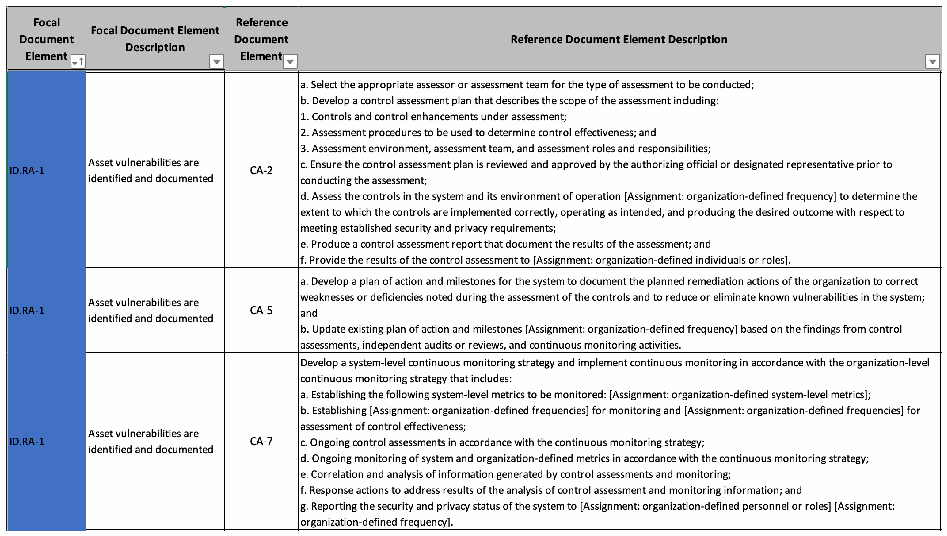
4列からなる表計算ソフト形式のクロスウォークのスクリーンショット:Focal Document Element(フォーカル文書の要素)、Focal Document Element Description(フォーカル文書の要素の説明)、Reference Document Element(参照文書の要素)、Reference Document Element Description(参照文書の要素の説明)。3行で、CSF要素 ID.RA-1(「資産の脆弱性が特定され、文書化されている」)を SP 800-53r5 の管理策に対応付けている。CA-2行:「a. 実施する評価の種類に適した評価者または評価チームを選定する。b. 評価の範囲(次を含む)を記述した管理策評価計画を策定する。1. 評価対象の管理策および管理策の強化。2. 管理策の有効性を判定するために使用する評価手順。3. 評価環境、評価チーム、評価の役割および責任。c. 評価を実施する前に、管理策評価計画が認可担当者または指定された代理人によってレビューされ、承認されていることを確認する。d. システムおよびその運用環境の管理策を[組織が定めた頻度]で評価し、確立されたセキュリティおよびプライバシー要件の充足に関して、管理策が正しく実装され、意図したとおりに機能し、望ましい結果を生み出している程度を判定する。e. 評価結果を記録した管理策評価報告書を作成する。f. 管理策評価の結果を[組織が定めた個人または役割]に提供する。」CA-5行:「a. 管理策の評価中に指摘された弱点または欠陥を是正し、システム内の既知の脆弱性を低減または排除するために組織が計画している是正措置を記録する、システムの行動計画およびマイルストーンを策定する。b. 管理策評価、独立監査またはレビュー、および継続的監視活動の結果に基づき、既存の行動計画およびマイルストーンを[組織が定めた頻度]で更新する。」CA-7行:「組織レベルの継続的監視戦略に従ってシステムレベルの継続的監視戦略を策定し、その戦略に従って継続的監視を実施する。この戦略には次を含める。a. 監視対象となる次のシステムレベル指標を確立する。[組織が定めたシステムレベル指標]。b. 監視の[組織が定めた頻度]および管理策の有効性評価の[組織が定めた頻度]を確立する。c. 継続的監視戦略に従って管理策の評価を継続的に実施する。d. 継続的監視戦略に従って、システムおよび組織が定めた指標を継続的に監視する。e. 管理策評価および監視で生成された情報を相関付け、分析する。f. 管理策評価および監視情報の分析結果に対処するための対応措置を講じる。g. システムのセキュリティおよびプライバシーの状態を[組織が定めた人員または役割]に[組織が定めた頻度]で報告する。」
Fig. 1. Concept crosswalk example between SP 800-53r5 and the NIST CSF
図 1. SP 800-53r5 と NIST CSF の間の概念クロスウォークの例
4.2. Supportive Relationship Mapping
4.2. 支援関係のマッピング
Definition: Supportive relationship mapping indicates how a supporting concept can or does help achieve a supported concept. The supportive relationship mapping style supports the use of the following relationship types:
定義: 支援関係のマッピングは、支援する概念が、支援される概念の達成にどのように役立ち得るか、または役立っているかを示します。支援関係のマッピングのスタイルは、次の関係の種類の使用をサポートします。
•Supports: Concept A supports concept B when A can be applied alone or in combination with one or more other concepts to achieve B in whole or in part.
•Supports: 概念 A が、単独で、または 1 つ以上の他の概念と組み合わせて適用することで、B の全体または一部を達成できる場合、概念 A は概念 B を支援します。
•Is supported by: Concept A is supported by concept B when B can be applied alone or in combination with one or more other concepts to achieve A in whole or in part.
•Is supported by: 概念 B が、単独で、または 1 つ以上の他の概念と組み合わせて適用することで、A の全体または一部を達成できる場合、概念 A は概念 B に支援されます。
•Identical: Concept A and concept B are identical. They use exactly the same wording.
•Identical: 概念 A と概念 B は同一です。まったく同じ文言を使用しています。
•Equivalent: Concept A and concept B are equivalent. They have the same meaning but different wording.
•Equivalent: 概念 A と概念 B は同等です。意味は同じですが、文言は異なります。
•Contrary: Concept A and concept B each have one or more elements that contradict one or more elements of the other concept. The contradictions may be opposites but do not have to be. This is based on the contrary concept type in Section 6.5.4 of [ISO704].
•Contrary: 概念 A と概念 B はそれぞれ、もう一方の概念の 1 つ以上の要素と矛盾する 1 つ以上の要素を持ちます。矛盾は正反対のものである場合もありますが、そうである必要はありません。これは [ISO704] のセクション 6.5.4 の反対概念の種類に基づいています。
•No relationship: Concept A and concept B are not related or are not sufficiently related to merit another supportive relationship type.
•No relationship: 概念 A と概念 B は関連していない、または別の支援関係の種類とするほど十分に関連していません。
The supports and is supported by relationships are more than simply cause and effect. They can also indicate whether or not the supporting concept is necessary for achieving the supported concept. One of the following relationship properties can optionally be assigned to each supports and is supported by relationship:
Supports と Is supported by の関係は、単なる因果関係以上のものです。支援する概念が、支援される概念の達成に必要かどうかも示すことができます。Supports と Is supported by の各関係には、次の関係のプロパティのいずれか 1 つを任意で割り当てることができます。
•Example of: The supporting concept C is one way (an example) of achieving the supported concept D in whole or in part. However, the supported concept D could also be achieved without applying the supporting concept C. In other words, one can accomplish D without C. This is based on the generic relationship type in Section 5.5.4.2 of [ISO704].
•Example of: 支援する概念 C は、支援される概念 D の全体または一部を達成する 1 つの方法(例)です。ただし、支援される概念 D は、支援する概念 C を適用しなくても達成できます。言い換えれば、C なしでも D を達成できます。これは [ISO704] のセクション 5.5.4.2 の一般関係の種類に基づいています。
•Integral to: The supporting concept C is integral to and a component of the supported concept. The supporting concept must be applied as part of achieving the supported concept. In other words, one cannot accomplish D without C. This is based on the partitive relationship type in Section 5.5.4.3 of [ISO704].
•Integral to: 支援する概念 C は、支援される概念 D に不可欠であり、その構成要素です。支援される概念 D を達成する一環として、支援する概念 C を適用しなければなりません。言い換えれば、C なしでは D を達成できません。これは [ISO704] のセクション 5.5.4.3 の部分関係の種類に基づいています。
•Precedes: The supporting concept C precedes the supported concept D when concept C must be achieved before applying the supported concept D. In other words, concept C is a prerequisite for concept D. The supporting concept itself is not part of the supported concept. This is based on the sequential relation type in Section 5.5.5 of [ISO704].
•Precedes: 支援する概念 C は、支援される概念 D を適用する前に概念 C を達成しなければならない場合に、D に先行します。言い換えれば、概念 C は概念 D の前提条件です。支援する概念自体は、支援される概念の一部ではありません。これは [ISO704] のセクション 5.5.5 の順序関係の種類に基づいています。
There are no supportive relationship properties for identical, equivalent, and contrary relationships.
identical、equivalent、contrary の関係には、支援関係のプロパティはありません。
The supportive relationship types and properties indicate the relative relationships between pairs of concepts within the context of a specified use case. The relationship types and properties are unlikely to have exactly the same meaning in different mappings because each use case will be different and the resulting mapping will be unique, taking into account mappers’ assumptions and viewpoints. While relationship types and properties have the same basic meaning across mappings, be careful not to assume that the way concept A supports concept B is the same as the way concept B supports concept C. Always refer to the use case documentation described in Section 3 to understand the context and assumptions for each mapping.
支援関係の種類とプロパティは、指定されたユースケースの文脈の中での、概念の組の間の相対的な関係を示します。ユースケースごとに異なり、得られるマッピングはマッパーの前提や見方を反映した固有のものになるため、関係の種類とプロパティが、異なるマッピングで厳密に同じ意味を持つ可能性は低いです。関係の種類とプロパティは、マッピング間で基本的な意味は同じですが、概念 A が概念 B を支援する方法が、概念 B が概念 C を支援する方法と同じだと考えないよう注意してください。各マッピングの文脈と前提を理解するには、常にセクション 3 で説明したユースケースの文書を参照してください。
Primary Uses: The supportive relationship mapping style is generally well-suited to the following situations:
主な用途: 支援関係のマッピングのスタイルは、一般に次のような状況に適しています。
•The sources have similar concept types. Examples include the following:
•出典が類似した種類の概念を持ちます。例には次のものがあります。
•A controls community mapping security controls in their control catalog to controls in the SP 800-53r5 catalog
•管理策のコミュニティが、自らの管理策カタログにあるセキュリティ管理策を、SP 800-53r5 カタログの管理策にマッピングする
•NIST authors mapping a set of procedures for assessing of security and privacy controls employed within systems and organizations to an assessment methodology performed within an effective risk management framework, with both the procedures and methodology defined in SP 800-53A
•NIST の著者が、システムと組織内で採用されているセキュリティおよびプライバシー管理策を評価するための手順の集合を、効果的なリスク管理フレームワーク内で実施される評価方法論にマッピングする(手順と方法論はどちらも SP 800-53A で定義されている)
•The sources have different but strongly related concept types. Examples include the following:
•出典が、異なるが強く関連する種類の概念を持ちます。例には次のものがあります。
•A standards developer mapping cybersecurity requirements in one of their standards to NIST CSF subcategories (outcomes)
•標準の策定者が、自らの標準の 1 つにあるサイバーセキュリティ要件を、NIST CSF のサブカテゴリ(成果)にマッピングする
•An industry working group mapping implementation recommendations in their DevSecOps guidelines to implementation examples from the NIST SSDF
•業界の作業部会が、自らの DevSecOps ガイドラインにある実装の推奨事項を、NIST SSDF の実装例にマッピングする
•A community mapping the capabilities of security principles and architectures, like zero trust, to the technology functional components provided by a NIST National Cybersecurity Center of Excellence (NCCoE) project build
•コミュニティが、ゼロトラストのようなセキュリティの原則やアーキテクチャの機能を、NIST National Cybersecurity Center of Excellence(NCCoE)プロジェクトのビルドが提供する技術の機能コンポーネントにマッピングする
•A software vendor mapping recommended configuration settings for their software to technology function components in an NCCoE project build
•ソフトウェアベンダーが、自らのソフトウェアの推奨設定を、NCCoE プロジェクトのビルドの技術機能コンポーネントにマッピングする
•A guidance developer mapping elements from their guidance to the NICE Framework Competency Areas that support them
•ガイダンスの策定者が、自らのガイダンスの要素を、それを支援する NICE フレームワークのコンピテンシー領域にマッピングする
•A cryptographic module software developer mapping evidence from test results for their module to corresponding requirements in Federal Information Processing Standard (FIPS) 140-3
•暗号モジュールのソフトウェア開発者が、自らのモジュールのテスト結果の証拠を、連邦情報処理標準(FIPS)140-3 の対応する要件にマッピングする
Examples:
例:
•NIST SP 1800-36 Volume E, Section 4.1, Table 4-1 contains a mapping between functions from the NIST NCCoE’s Trusted IoT Device Onboarding project reference design and NIST CSF 1.1 subcategories to show how the reference design’s functions help support the CSF subcategories and vice versa. Table 3 shows an excerpt from that mapping.
•NIST SP 1800-36 Volume E のセクション 4.1 の表 4-1 には、NIST NCCoE の Trusted IoT Device Onboarding プロジェクトのリファレンスデザインの機能と NIST CSF 1.1 のサブカテゴリとの間のマッピングが含まれており、リファレンスデザインの機能が CSF のサブカテゴリをどのように支援するか、およびその逆を示しています。表 3 にそのマッピングの抜粋を示します。
Table 3. Supportive relationship mapping examples from SP 1800-36 Vol. E
表 3. SP 1800-36 Vol. E の支援関係のマッピングの例
| Logical Component | Component’s Function | Function’s Relationships to CSF 1.1 Subcategories (and Relationship Properties) | Relationship Explanation |
|---|---|---|---|
| Certificate Authority (CA) | Issues and signs certificates as needed. | Supports (example of) PR.AC-1: Identities and credentials are issued, managed, verified, revoked, and audited for authorized devices, users, and processes | The fact that a credential is signed by a trusted CA provides a mechanism that may be used for enabling the credential to be verified and revoked. |
| Supports (integral to) PR.AC-6: Identities are proofed and bound to credentials and asserted in interactions | If the device credential is an X.509 certificate (e.g., an IDevID) that is signed by a CA, this certificate binds the device’s credential to the device’s identity. | ||
| Application-Layer Onboarding Service | After the device connects to the network, this component interacts with the device using… | Is Supported by (precedes) ID.AM-2: Software platforms and applications within the organization are inventoried | In some application-layer onboarding mechanisms, the IoT device must be prepared for application-layer onboarding during the factory provisioning process. In these cases, the… |
| 論理コンポーネント | コンポーネントの機能 | 機能と CSF 1.1 サブカテゴリとの関係(および関係のプロパティ) | 関係の説明 |
|---|---|---|---|
| Certificate Authority (CA) | 必要に応じて証明書を発行し、署名します。 | Supports (example of) PR.AC-1: Identities and credentials are issued, managed, verified, revoked, and audited for authorized devices, users, and processes | 認証情報が信頼された CA によって署名されているという事実は、その認証情報を検証・失効できるようにするために使用し得る仕組みを提供します。 |
| Supports (integral to) PR.AC-6: Identities are proofed and bound to credentials and asserted in interactions | デバイスの認証情報が CA によって署名された X.509 証明書(たとえば IDevID)である場合、この証明書は、デバイスの認証情報をデバイスの ID に結び付けます。 | ||
| Application-Layer Onboarding Service | デバイスがネットワークに接続した後、このコンポーネントは次を使用してデバイスとやり取りする… | Is Supported by (precedes) ID.AM-2: Software platforms and applications within the organization are inventoried | 一部のアプリケーション層のオンボーディングの仕組みでは、IoT デバイスは、工場でのプロビジョニングの過程でアプリケーション層のオンボーディングに備える必要があります。こうした場合、… |
•NIST SP 1800-35 Volume E, Section 4.2.1, Table 4-9 contains a mapping between zero trust architecture functions from the NIST NCCoE’s ZTA project reference design and SP 800-53 controls. Because hundreds of NIST SP 800-53 controls can help support ZTA functions, mapping was only performed on existing SP 800-53 controls. Table 4 shows an excerpt from that table.
•NIST SP 1800-35 Volume E のセクション 4.2.1 の表 4-9 には、NIST NCCoE の ZTA プロジェクトのリファレンスデザインのゼロトラストアーキテクチャの機能と、SP 800-53 の管理策との間のマッピングが含まれています。ZTA の機能を支援し得る NIST SP 800-53 の管理策は数百あるため、マッピングは既存の SP 800-53 の管理策に限定して実施されました。表 4 にその表の抜粋を示します。
Table 4. Supportive relationship mapping examples from SP 1800-35 Vol. E
表 4. SP 1800-35 Vol. E の支援関係のマッピングの例
| ZTA Project Component | ZTA Project Function | Function’s Relationships to SP 800-53 Controls (and Relationship Properties) | Relationship Explanation |
|---|---|---|---|
| ICAM - Identity Governance | Provides policy-based, centralized, automated processes to manage user identity and access control functions (e.g., ensuring segregation of duties, role management, logging, auditing, access reviews, analytics, and reporting) to ensure compliance with requirements and regulations. | Supports (integral to) AC-2: Account Management | The Identity Governance function includes account management such as authorized users of the system, access authorizations (i.e., privileges), and assignment of organization-defined attributes. |
| Supports (integral to) AC-3: Access Enforcement | The Identity Governance function enforces approved authorizations for logical access to information and system resources by identified users in accordance with applicable access control policies. | ||
| Supports (precedes) AC-4: Information Flow Enforcement | The Identity Governance function is a necessary component of the identity component of access authorizations on which information flow enforcement depends. | ||
| Supports (integral to) AC-5: Separation of Duties | The Identity Governance component can manage access permissions and authorizations in a way that incorporates the separation of duties principle. |
| ZTA プロジェクトのコンポーネント | ZTA プロジェクトの機能 | 機能と SP 800-53 の管理策との関係(および関係のプロパティ) | 関係の説明 |
|---|---|---|---|
| ICAM - Identity Governance | 要件と規制への準拠を確保するため、ユーザー ID とアクセス制御の機能(たとえば、職務の分離、ロール管理、ログ記録、監査、アクセスレビュー、分析、レポート)を管理するための、ポリシーベースで集中型の自動化されたプロセスを提供します。 | 支援する(不可欠な構成要素) AC-2: Account Management | Identity Governance の機能には、システムの認可されたユーザー、アクセス認可(すなわち権限)、および組織が定義した属性の割り当てなどのアカウント管理が含まれます。 |
| 支援する(不可欠な構成要素) AC-3: Access Enforcement | Identity Governance の機能は、適用されるアクセス制御ポリシーに従って、識別されたユーザーによる情報とシステムリソースへの論理アクセスに対する承認済みの認可を強制します。 | ||
| 支援する(先行する) AC-4: Information Flow Enforcement | Identity Governance の機能は、情報フローの強制が依存するアクセス認可の ID コンポーネントに必要な構成要素です。 | ||
| 支援する(不可欠な構成要素) AC-5: Separation of Duties | Identity Governance のコンポーネントは、職務分離の原則を取り入れた形で、アクセス許可と認可を管理できます。 |
4.3. Set Theory Relationship Mapping
4.3. 集合論的関係のマッピング
Definition: Set theory relationship mapping is a relationship style derived from the branch of mathematics known as set theory. Each mapping done with this style includes both a rationale for the mapping and a relationship type.
定義: 集合論的関係のマッピングは、集合論として知られる数学の分野から派生した関係のスタイルです。このスタイルで行う各マッピングには、マッピングの根拠と関係の種類の両方が含まれます。
Set theory relationship mapping supports three options for the rationale, which is a high-level context within which the two concepts are related:
集合論的関係のマッピングは、根拠(2 つの概念が関連している高レベルの文脈)について、3 つの選択肢をサポートします。
1.Syntactic: How similar is the wording that expresses the two concepts? This is a word-for-word analysis of the relationship, not an interpretation of the language.
1.Syntactic: 2 つの概念を表す文言はどの程度類似していますか。これは関係の語句ごとの分析であり、言語の解釈ではありません。
2.Semantic: How similar are the meanings of the two concepts? This involves some interpretation of each concept’s language.
2.Semantic: 2 つの概念の意味はどの程度類似していますか。これには、各概念の言語についてある程度の解釈が必要になります。
3.Functional: How similar are the results of executing the two concepts? This involves understanding what will happen if the two concepts are implemented, performed, or otherwise executed.
3.Functional: 2 つの概念を実行した結果はどの程度類似していますか。これには、2 つの概念を実装、実施、またはその他の方法で実行した場合に何が起こるかを理解することが必要になります。
The set theory relationship mapping style supports five relationship types for documenting the logical similarity of two concepts:
集合論的関係のマッピングのスタイルは、2 つの概念の論理的な類似性を文書化するための 5 つの関係の種類をサポートします。
1.Subset of: Concept A is a subset of concept B. In other words, concept B contains everything that concept A does and more.
1.Subset of: 概念 A は概念 B の部分集合です。言い換えれば、概念 B は概念 A が含むすべてに加えて、それ以上のものを含みます。
2.Intersects with: Concept A and concept B have some overlap, but each includes content that the other does not.
2.Intersects with: 概念 A と概念 B には一部重なりがありますが、それぞれが相手にない内容を含みます。
3.Equal: Concept A and concept B are the same, although not necessarily identical.
3.Equal: 概念 A と概念 B は同じです(必ずしも同一ではない)。
4.Superset of: Concept A is a superset of concept B. In other words, concept A contains everything that concept B does and more.
4.Superset of: 概念 A は概念 B の上位集合です。言い換えれば、概念 A は概念 B が含むすべてに加えて、それ以上のものを含みます。
5.No relationship: Concept A and concept B are unrelated; their content does not overlap.
5.No relationship: 概念 A と概念 B は無関係で、その内容は重なっていません。
The relationship type and the rationale must be used together. For example, consider CSF 1.1’s PR.AC-1, “Identities and credentials are issued, managed, verified, revoked, and audited for authorized devices, users and processes” [CSF11] and the Privacy Framework’s PR.AC-P1, “Identities and credentials are issued, managed, verified, revoked, and audited for authorized individuals, processes, and devices.” These two concepts have identical wording except for “users” versus “individuals” and the order of the last few words. With a rationale of syntactic, the relationship type would be intersects with because the two overlap, but each includes content that the other does not. However, with a rationale of semantic, the relationship type would be equal if “users” and “individuals” have the same meaning in their respective sources, subset if “users” was a subset of “individuals,” and so on.
関係の種類と根拠は、組み合わせて使用しなければなりません。たとえば、CSF 1.1 の PR.AC-1「Identities and credentials are issued, managed, verified, revoked, and audited for authorized devices, users and processes」[CSF11] と、Privacy Framework の PR.AC-P1「Identities and credentials are issued, managed, verified, revoked, and audited for authorized individuals, processes, and devices.」を考えます。これら 2 つの概念は、「users」と「individuals」の違い、および最後の数語の順序を除き、文言が同一です。根拠が syntactic の場合、2 つは重なっているがそれぞれが相手にない内容を含むため、関係の種類は intersects with になります。しかし、根拠が semantic の場合、「users」と「individuals」がそれぞれの出典で同じ意味であれば関係の種類は equal、「users」が「individuals」の部分集合であれば subset、というようになります。
More than one rationale may apply to a pair of concepts. The SME who performs the mapping also chooses the rationale that they deem most useful. The expert can also do multiple mappings for the concept pair, each using a different rationale.
概念の組には、複数の根拠が当てはまる場合があります。マッピングを行う SME は、最も有用だと考える根拠を選ぶこともできます。専門家は、概念の組に対して、それぞれ異なる根拠を用いた複数のマッピングを行うこともできます。
The set theory relationship mapping style has been supported by NIST OLIR since its launch, and it is also leveraged by the NIST Open Security Controls Assessment Language (OSCAL) to support automated cybersecurity control assessment.
集合論的関係のマッピングのスタイルは、NIST OLIR の開始以来サポートされており、NIST Open Security Controls Assessment Language(OSCAL)でも、サイバーセキュリティ管理策評価の自動化を支援するために活用されています。
Primary Uses: The set theory relationship mapping style is generally well-suited to the following situations:
主な用途: 集合論的関係のマッピングのスタイルは、一般に次のような状況に適しています。
•Indicating how much commonality two similar sets of concepts have, such as how requirements in a new version of a standard compare to their counterparts in a previous version or how requirements in one standard compare to a second standard based on the first one
•標準の新しいバージョンの要件が以前のバージョンの対応する要件とどう比較されるか、あるいは、ある標準の要件が、それに基づく 2 つ目の標準とどう比較されるかなど、類似した 2 つの概念の集合がどの程度の共通性を持つかを示す
•Mapping two sets of concepts when the pairs of concepts are mostly the same as each other or supersets or subsets of each other (when there are relatively few relationships of type intersects with)
•概念の組が、ほとんど互いに同じであるか、互いの上位集合または部分集合である場合(intersects with の関係が比較的少ない場合)に、2 つの概念の集合をマッピングする
Examples: Examples of set theory relationship mapping are available from the OLIR repository.
例: 集合論的関係のマッピングの例は、OLIR リポジトリで入手できます。
•NIST has mapped the Functions, Categories, and Subcategories of the NIST Cybersecurity Framework version 1.1 (focal document) to the Functions, Categories, and Subcategories of its Privacy Framework version 1.0 (reference document). The Privacy Framework is based on the Cybersecurity Framework, so the set theory relationship mapping indicates where the two frameworks have identical concepts, as well as how their corresponding concepts differ at a high level. Table 5 shows an example from the full mapping.
•NIST は、NIST サイバーセキュリティフレームワークバージョン 1.1(フォーカル文書)の機能、カテゴリ、サブカテゴリを、Privacy Framework バージョン 1.0(参照文書)の機能、カテゴリ、サブカテゴリにマッピングしました。Privacy Framework はサイバーセキュリティフレームワークに基づいているため、この集合論的関係のマッピングは、2 つのフレームワークで概念が同一である箇所と、対応する概念が高いレベルでどのように異なるかを示します。表 5 に、マッピング全体からの例を示します。
Table 5. Set theory relationship mapping example from OLIR repository
表 5. OLIR リポジトリの集合論的関係のマッピングの例
| CSF 1.1 Element | CSF 1.1 Element Description | Rationale | Relationship | Privacy Framework Element | Privacy Framework Element Description |
|---|---|---|---|---|---|
| PR | Develop and implement appropriate safeguards to ensure delivery of critical services. | Syntactic | Intersects with | PR-P | Develop and implement appropriate data processing safeguards. |
| PR.AC | Access to physical and logical assets and associated facilities is limited to authorized users, processes, and devices, and is managed consistent with the assessed risk of unauthorized access to authorized activities and transactions. | Functional | Intersects with | PR.AC-P | Access to data and devices is limited to authorized individuals, processes, and devices, and is managed consistent with the assessed risk of unauthorized access. |
| PR.AC-1 | Identities and credentials are issued, managed, verified, revoked, and audited for authorized devices, users, and processes | Semantic | Equal to | PR.AC-P1 | Identities and credentials are issued, managed, verified, revoked, and audited for authorized individuals, processes, and devices. |
| PR.AC-2 | Physical access to assets is managed and protected | Functional | Superset of | PR.AC-P2 | Physical access to data and devices is managed. |
| CSF 1.1 の要素 | CSF 1.1 の要素の説明 | 根拠 | 関係 | Privacy Framework の要素 | Privacy Framework の要素の説明 |
|---|---|---|---|---|---|
| PR | 重要サービスの提供を確保するための適切な保護措置を策定し、実施します。 | 構文上 | 交差する | PR-P | 適切なデータ処理の保護措置を策定し、実施します。 |
| PR.AC | 物理的・論理的な資産および関連施設へのアクセスは、認可されたユーザー、プロセス、デバイスに限定され、認可された活動やトランザクションへの不正アクセスについて評価されたリスクに整合するよう管理されます。 | 機能上 | 交差する | PR.AC-P | データとデバイスへのアクセスは、認可された個人、プロセス、デバイスに限定され、不正アクセスについて評価されたリスクに整合するよう管理されます。 |
| PR.AC-1 | 認可されたデバイス、ユーザー、プロセスについて、ID と認証情報が発行、管理、検証、失効、監査される | 意味上 | 等しい | PR.AC-P1 | 認可された個人、プロセス、デバイスについて、ID と認証情報が発行、管理、検証、失効、監査されます。 |
| PR.AC-2 | 資産への物理アクセスが管理され、保護されています。 | 機能上 | 上位集合である | PR.AC-P2 | データとデバイスへの物理アクセスが管理されています。 |
4.4. Structural Relationship Mapping
4.4. 構造的関係のマッピング
Definition: The structural relationship mapping style captures an inherent hierarchical structure of concepts, usually defined within a single source. For example, the CSF defines several Functions. Each Function is composed of Categories, and each Category is composed of Subcategories. This structure is a hierarchy of a parent-child relationship and, thus, a form of mapping. Structural relationships are not as informative as the ones used in the supportive, extended, or set theory styles. A parent-child relationship implies that the child concept is part of the parent concept, but it does not specify whether the child concept is required or optional in order to achieve the parent concept.
定義: 構造的関係のマッピングのスタイルは、通常は単一の出典内で定義される、概念に固有の階層構造を捉えます。たとえば、CSF はいくつかの機能を定義しています。各機能はカテゴリで構成され、各カテゴリはサブカテゴリで構成されています。この構造は親子関係の階層であり、したがってマッピングの一形態です。構造的関係は、支援関係、拡張、集合論のスタイルで使用される関係ほど情報量が多くありません。親子関係は、子の概念が親の概念の一部であることを意味しますが、親の概念を達成するために子の概念が必須か任意かは指定しません。
Structural relationships are fully objective because they are only based on a source’s intrinsic structure. Even though subjectivity was likely involved in the structure’s creation, the scope of the mapping is the final structure, and that is objective. However, structural relationships provide no insights as to how concepts relate to each other independent of the structure. A second mapping using a different concept relationship style can supplement a structural relationship mapping.
構造的関係は、出典の固有の構造のみに基づいているため、完全に客観的です。構造の作成には主観が関与した可能性が高いものの、マッピングの範囲は最終的な構造であり、それは客観的です。しかし、構造的関係は、構造とは無関係に概念が互いにどのように関連しているかについての洞察を提供しません。別の概念関係のスタイルを用いた 2 つ目のマッピングで、構造的関係のマッピングを補完できます。
Structural relationships may already be defined in data models and other forms.
構造的関係は、データモデルやその他の形式で、すでに定義されている場合があります。
Primary Uses: The structural relationship mapping style is generally well-suited to the following situations:
主な用途: 構造的関係のマッピングのスタイルは、一般に次のような状況に適しています。
•Indicating the parent-child structure of the elements of a framework, standard, regulation, or other content defined in a formal hierarchy (within one or more sources)
•(1 つ以上の出典内で)正式な階層として定義されている、フレームワーク、標準、規制、その他のコンテンツの要素の親子構造を示す
Examples: The NIST CPRT makes the structure of CSF 1.1 and 2.0, SSDF 1.1, SP 800-53r5, and other NIST frameworks and baselines available in downloadable Excel and JSON formats. The parent-child relationships are implied but not explicitly stated as of this writing. Table 6 contains a notional example from SSDF 1.1 of how a set of parent-child relationships can capture the structure of a standard, framework, or other hierarchical content. Each row in the table has the relationship parent-child.
例: NIST CPRT は、CSF 1.1 と 2.0、SSDF 1.1、SP 800-53r5、その他の NIST のフレームワークとベースラインの構造を、ダウンロード可能な Excel と JSON の形式で提供しています。親子関係は、本書の執筆時点では暗黙的であり、明示的には述べられていません。表 6 は、SSDF 1.1 から、一連の親子関係が標準、フレームワーク、その他の階層的なコンテンツの構造をどのように捉えられるかを示す、概念的な例です。表の各行は、親子の関係を持っています。
Table 6. Notional example of parent-child relationships
表 6. 親子関係の概念的な例
| Concept A (Parent) | Concept B (Child) |
|---|---|
| Prepare the Organization (PO): Organizations should ensure that their people, processes, and technology are prepared to perform… | Define Security Requirements for Software Development (PO.1): Ensure that security requirements for software development are known… |
| Define Security Requirements for Software Development (PO.1): Ensure that security requirements for software development are known… | PO.1.1: Identify and document all security requirements for the organization’s software development infrastructures and processes… |
| Define Security Requirements for Software Development (PO.1): Ensure that security requirements for software development are known… | PO.1.2: Identify and document all security requirements for organization-developed software to meet… |
| Define Security Requirements for Software Development (PO.1): Ensure that security requirements for software development are known… | PO.1.3: Communicate requirements to all third parties who will provide commercial software components to the organization… |
| Prepare the Organization (PO): Organizations should ensure that their people, processes, and technology are prepared to perform… | Implement Roles and Responsibilities (PO.2): Ensure that everyone inside and outside of the organization involved in the SDLC is prepared… |
| Implement Roles and Responsibilities (PO.2): Ensure that everyone inside and outside of the organization involved in the SDLC is prepared… | PO.2.1: Create new roles and alter responsibilities for existing roles as needed to encompass all parts of the SDLC. Periodically review and maintain the defined roles and responsibilities, updating them as needed. |
| 概念 A(親) | 概念 B(子) |
|---|---|
| 組織の準備(PO):組織は、人材、プロセス、技術が実行に備えているべきです… | ソフトウェア開発のセキュリティ要件の定義(PO.1):ソフトウェア開発のセキュリティ要件が既知となっていることを確実にします… |
| ソフトウェア開発のセキュリティ要件の定義(PO.1):ソフトウェア開発のセキュリティ要件が既知となっていることを確実にします… | PO.1.1:組織のソフトウェア開発インフラストラクチャとプロセスに関するすべてのセキュリティ要件を特定し、文書化します… |
| ソフトウェア開発のセキュリティ要件の定義(PO.1):ソフトウェア開発のセキュリティ要件が既知となっていることを確実にします… | PO.1.2:組織が開発するソフトウェアが満たすべきすべてのセキュリティ要件を特定し、文書化します… |
| ソフトウェア開発のセキュリティ要件の定義(PO.1):ソフトウェア開発のセキュリティ要件が既知となっていることを確実にします… | PO.1.3:組織に商用ソフトウェアコンポーネントを提供するすべての第三者に要件を伝達します… |
| 組織の準備(PO):組織は、人材、プロセス、技術が実行に備えているべきです… | 役割と責任の実施(PO.2):SDLC に関与する組織内外のすべての人が備えていることを確実にします… |
| 役割と責任の実施(PO.2):SDLC に関与する組織内外のすべての人が備えていることを確実にします… | PO.2.1:SDLC のすべての部分を網羅するために必要に応じて新しい役割を作成し、既存の役割の責任を変更します。定義した役割と責任を定期的に見直して維持し、必要に応じて更新します。 |
4.5. Custom
4.5. カスタム
This approach does not attempt to capture every conceivable style or type of relationship. For example, the approach does not provide a way for someone studying the cybersecurity risks of a particular technology (e.g., mobile, semiconductors) to map the components of that technology to NIST-catalogued threats and countermeasures.
このアプローチは、考え得るあらゆるスタイルや種類の関係を捉えようとするものではありません。たとえば、このアプローチでは、特定の技術(モバイル、半導体など)のサイバーセキュリティリスクを研究している人が、その技術のコンポーネントを NIST がカタログ化した脅威や対策にマッピングする方法は提供していません。
Using more relationship styles and types can make it difficult or impossible to link concepts together in a consistent way in a single concept system. Additional relationship types can also make it more challenging and time-consuming for SMEs because distinctions between relationship styles and types may be subtle, so selecting the appropriate one will require more thought and evaluation.
関係のスタイルと種類を増やすと、単一の概念体系の中で概念を一貫した方法で結び付けることが難しくなる、または不可能になる場合があります。追加の関係の種類は、SME にとっても負担と時間を増やす可能性があります。関係のスタイルと種類の違いは微妙な場合があり、適切なものを選ぶのにより多くの検討と評価が必要になるためです。
NIST welcomes suggestions for relationship types and properties to add to existing styles. NIST also recognizes that there may be cases in which none of the existing styles are suitable and a new custom style is needed. NIST encourages SMEs considering the development of a custom style to first contact NIST to discuss the situation, learn what other style changes or additions may be in progress, and determine a recommended course of action.
NIST は、既存のスタイルに追加する関係の種類とプロパティについての提案を歓迎します。NIST はまた、既存のスタイルのいずれも適さず、新しいカスタムスタイルが必要な場合があることも認識しています。NIST は、カスタムスタイルの開発を検討している SME に対し、まず NIST に連絡して状況を話し合い、ほかにどのようなスタイルの変更や追加が進行中かを知り、推奨される対応方針を決めることを推奨します。
In the future, NIST will release details of how a SME would document a custom style so that mapping users will understand it and be able to convert it to other styles if appropriate.
今後、NIST は、マッピングの利用者がカスタムスタイルを理解し、必要に応じて他のスタイルに変換できるよう、SME がカスタムスタイルをどのように文書化するかの詳細を公開する予定です。
4.6. Using Mappings with Different Relationship Styles
4.6. 異なる関係スタイルのマッピングの使用
Different relationship styles are best suited for particular situations. Rather than trying to force the use of one relationship style for all mappings, this approach enables the use of multiple relationship styles while also ensuring a level of interoperability for all mappings that use any of those styles. This enables mapping users to choose to either have all mappings within a single concept system downgraded to the lowest common denominator in terms of relationship styles or have a concept system using multiple relationship styles.
関係のスタイルによって、適した状況は異なります。このアプローチは、すべてのマッピングに 1 つの関係スタイルを無理に使おうとするのではなく、複数の関係スタイルの使用を可能にするとともに、それらのスタイルを使うすべてのマッピングについて一定レベルの相互運用性を確保します。これにより、マッピングの利用者は、単一の概念体系内のすべてのマッピングを、関係スタイルの観点で最小公分母に合わせて単純化するか、複数の関係スタイルを使用した概念体系を持つかを選べます。
Interoperability is also important because the SMEs who perform mappings may decide that they want to switch relationship styles because of time constraints involving the style they originally chose. For example, concept crosswalks are the most basic relationship style because they provide the least information. Mappings in all other relationship styles can be trivially downgraded to concept crosswalks by omitting all their relationship types and properties, leaving just concept pairs.
マッピングを行う SME が、最初に選んだスタイルに関する時間的制約から、関係スタイルを切り替えたいと考えることもあるため、相互運用性は重要でもあります。たとえば、概念クロスウォークは最も提供する情報が少ないため、最も基本的な関係スタイルです。他のすべての関係スタイルのマッピングは、関係の種類とプロパティをすべて省いて概念の組だけを残すことで、概念クロスウォークに簡単に引き下げることができます。
Most set theory relationships can be automatically converted to their supportive relationship counterparts, as depicted in Table 7. This might be of interest to SMEs who want to convert existing set theory relationship mappings to the new supportive relationship mappings. However, set theory intersects with relationships cannot be automatically converted because they only indicate overlap between the concepts, not the nature of that overlap. An intersects with relationship can either be automatically converted to a concept crosswalk or manually reevaluated by an SME in order to remap it as a supportive relationship.
ほとんどの集合論的関係は、表 7 に示すとおり、対応する支援関係に自動的に変換できます。これは、既存の集合論的関係のマッピングを新しい支援関係のマッピングに変換したい SME の関心を引く可能性があります。ただし、集合論的関係の intersects with は、概念間の重なりしか示さず、その重なりの性質を示さないため、自動的に変換できません。intersects with の関係は、概念クロスウォークに自動的に変換するか、SME が手動で再評価して、支援関係として再マッピングすることができます。
Table 7. Converting set theory relationships to supportive relationships
表 7. 集合論的関係の支援関係への変換
| Set Theory Relationship | Supportive Relationship |
|---|---|
| subset of | supports (integral to) |
| equal | equivalent |
| superset of | is supported by (integral to) |
| intersects with | N/A |
| 集合論的関係 | 支援関係 |
|---|---|
| subset of | supports (integral to) |
| equal | equivalent |
| superset of | is supported by (integral to) |
| intersects with | N/A |
When converting mappings in a way that attempts to preserve relationship meaning (e.g., using the conversions stated in Table 7), it is important to consider the assumptions and other context captured related to the mapping being converted. The context in which a mapping was performed may impact exactly how relationships should be interpreted, which can in turn impact how one relationship should be converted to another.
関係の意味を保持しようとする形でマッピングを変換する場合(たとえば表 7 に示す変換を使用する場合)は、変換するマッピングに関連して記録された前提とその他の文脈を考慮することが重要です。マッピングが行われた文脈は、関係を厳密にどう解釈すべきかに影響を与える可能性があり、その結果、ある関係を別の関係にどう変換すべきかにも影響を与える可能性があります。
5. Evaluate Concept Pairs and Document Their Relationships
5. 概念の組の評価とその関係の文書化
After documenting the use cases for the mapping and choosing the relationship style, the identification of relationships that constitute the mapping can commence. It is recommended that a SME start a new mapping by documenting a representative sample of the mapping in an ad hoc format of their choice, like a spreadsheet or document. There are two major objectives for this sample: 1) identify issues with the use cases or relationship style choice that may necessitate changes, and 2) have other SMEs review the sample and the use case documentation, and provide feedback on them to help improve the quality of the mapping. Having a sample reviewed is a recommended practice because it helps reduce the impact of individual bias and the likelihood of inconsistent mapping.
マッピングのユースケースを文書化し、関係のスタイルを選択した後、マッピングを構成する関係の識別を始めることができます。SME は、新しいマッピングを始める際、スプレッドシートや文書など、自分が選んだアドホックな形式で、マッピングの代表的なサンプルを文書化することが推奨されます。このサンプルには、2 つの主な目的があります。1) ユースケースまたは関係スタイルの選択に、変更が必要になる可能性のある問題がないか識別すること。2) ほかの SME にサンプルとユースケースの文書をレビューしてもらい、フィードバックを提供してもらうことで、マッピングの品質を向上させること。サンプルのレビューを受けることは、個人のバイアスの影響や、一貫性のないマッピングの可能性を減らすのに役立つため、推奨される実践です。
When mapping, the SME should document the rationale for each relationship. This provides valuable context and justification that other SMEs can use to evaluate the mappings and that mapping users can utilize to better understand each mapping.
マッピングを行う際、SME は各関係の根拠を文書化すべきです。これは、他の SME がマッピングを評価するために使用でき、マッピングの利用者が各マッピングをよりよく理解するために利用できる、貴重な文脈と正当化を提供します。
Here are a few mapping tips for SMEs based on feedback from users of the NIST approach:
ここでは、NIST のアプローチの利用者からのフィードバックに基づく、SME 向けのマッピングのヒントをいくつか示します。
•If you are planning to map in only one direction (from A to B), it may still be valuable to examine the concept pairs in the opposite direction. Sometimes that will identify previously unknown relationships.
•一方向(A から B)のみのマッピングを計画している場合でも、概念の組を逆方向から調べることは有益な場合があります。それによって、それまで知られていなかった関係が見つかることがあります。
•A mapping between two sources is likely to use a subset of the relationship types for a style. If you narrowly define your use case, such as only indicating absolute requirements, you might only use one relationship type.
•2 つの出典間のマッピングは、あるスタイルの関係の種類の部分集合を使用する可能性が高いです。絶対的な要件のみを示すなど、ユースケースを狭く定義すれば、使用する関係の種類は 1 つだけになることもあります。
•You may want to take a phased approach to mapping. For example, you may initially want to map only one or two particular relationship types within a style. In the future, you can always revisit your mapping and add more relationship types to it.
•マッピングには段階的なアプローチをとる場合があります。たとえば、最初はスタイル内の特定の 1 つか 2 つの関係の種類だけをマッピングしたい場合があります。将来、いつでもマッピングを見直して、さらに関係の種類を追加できます。
•Filling in the blanks in the relationship statements may make the mapping process less abstract. For example, instead of saying “X is one way of doing or achieving Y,” you might say, “Project function X is one way (an example) of doing or achieving SP 800-53 control Y.”
•関係の記述の空欄を埋めると、マッピングのプロセスが抽象的でなくなる場合があります。たとえば、「X は Y を行う、または達成する 1 つの方法である」と言う代わりに、「プロジェクトの機能 X は、SP 800-53 の管理策 Y を行う、または達成する 1 つの方法(例)である」と言うことができます。
•If you want to distinguish the strongest (primary) relationships from other relationships, consider creating one mapping for the primary relationships and a separate mapping for the secondary relationships.
•最も強い(主要な)関係を他の関係と区別したい場合は、主要な関係用のマッピングと、副次的な関係用の別のマッピングを作成することを検討してください。
•Mapping can highlight ambiguities with wording, differences in granularity, duplication of concepts, and other issues within either of the sources being mapped. Be sure to capture and share these observations because they can significantly improve the next version of the affected sources.
•マッピングは、マッピング対象のいずれかの出典内の、文言のあいまいさ、粒度の違い、概念の重複、その他の問題を浮き彫りにすることがあります。これらの所見は、該当する出典の次のバージョンを大幅に改善できる可能性があるため、必ず記録して共有してください。
References
参考文献
[CSF11] National Institute of Standards and Technology (2018) Framework for Improving Critical Infrastructure Cybersecurity, Version 1.1. (National Institute of Standards and Technology, Gaithersburg, MD), NIST Cybersecurity White Paper (CSWP) NIST CSWP 6. https://doi.org/10.6028/NIST.CSWP.6
[CSF11] National Institute of Standards and Technology (2018) Framework for Improving Critical Infrastructure Cybersecurity, Version 1.1. (National Institute of Standards and Technology, Gaithersburg, MD), NIST Cybersecurity White Paper (CSWP) NIST CSWP 6. https://doi.org/10.6028/NIST.CSWP.6
[CSF20] National Institute of Standards and Technology (2024) The NIST Cybersecurity Framework (CSF) 2.0 (National Institute of Standards and Technology, Gaithersburg, MD), NIST Cybersecurity White Paper (CSWP) NIST CSWP 29. https://doi.org/10.6028/NIST.CSWP.29
[CSF20] National Institute of Standards and Technology (2024) The NIST Cybersecurity Framework (CSF) 2.0 (National Institute of Standards and Technology, Gaithersburg, MD), NIST Cybersecurity White Paper (CSWP) NIST CSWP 29. https://doi.org/10.6028/NIST.CSWP.29
[IR8278r1] Keller N, Quinn SD, Scarfone KA, Smith MC, Johnson V (2024) National Online Informative References (OLIR) Program: Overview, Benefits, and Use. (National Institute of Standards and Technology, Gaithersburg, MD), NIST Interagency or Internal Report (IR) NIST IR 8278r1. https://doi.org/10.6028/NIST.IR.8278r1
[IR8278r1] Keller N, Quinn SD, Scarfone KA, Smith MC, Johnson V (2024) National Online Informative References (OLIR) Program: Overview, Benefits, and Use. (National Institute of Standards and Technology, Gaithersburg, MD), NIST Interagency or Internal Report (IR) NIST IR 8278r1. https://doi.org/10.6028/NIST.IR.8278r1
[IR8278Ar1] Barrett MP, Keller N, Quinn SD, Smith MC, Scarfone KA, Johnson V (2024) National Online Informative References (OLIR) Program: Submission Guidance for OLIR Developers. (National Institute of Standards and Technology, Gaithersburg, MD), NIST Interagency or Internal Report (IR) NIST IR 8278Ar1. https://doi.org/10.6028/NIST.IR.8278Ar1
[IR8278Ar1] Barrett MP, Keller N, Quinn SD, Smith MC, Scarfone KA, Johnson V (2024) National Online Informative References (OLIR) Program: Submission Guidance for OLIR Developers. (National Institute of Standards and Technology, Gaithersburg, MD), NIST Interagency or Internal Report (IR) NIST IR 8278Ar1. https://doi.org/10.6028/NIST.IR.8278Ar1
[ISO704] International Organization for Standardization (2022) ISO 704:2022 – Terminology work – Principles and Methods (ISO, Geneva, Switzerland). Available at https://www.iso.org/standard/79077.html
[ISO704] International Organization for Standardization (2022) ISO 704:2022 – Terminology work – Principles and Methods (ISO, Geneva, Switzerland). 入手先: https://www.iso.org/standard/79077.html
[ISO1087] International Organization for Standardization (2019) ISO 1087:2019 – Terminology work and terminology science – Vocabulary (ISO, Geneva, Switzerland). Available at https://www.iso.org/standard/62330.html
[ISO1087] International Organization for Standardization (2019) ISO 1087:2019 – Terminology work and terminology science – Vocabulary (ISO, Geneva, Switzerland). 入手先: https://www.iso.org/standard/62330.html
[SP800-53] Joint Task Force (2020) Security and Privacy Controls for Information Systems and Organizations. (National Institute of Standards and Technology, Gaithersburg, MD), NIST Special Publication (SP) 800-53, Rev. 5. Includes updates as of December 10, 2020. https://doi.org/10.6028/NIST.SP.800-53r5
[SP800-53] Joint Task Force (2020) Security and Privacy Controls for Information Systems and Organizations. (National Institute of Standards and Technology, Gaithersburg, MD), NIST Special Publication (SP) 800-53, Rev. 5. Includes updates as of December 10, 2020. https://doi.org/10.6028/NIST.SP.800-53r5
[SP800-218] Souppaya MP, Scarfone KA, Dodson DF (2022) Secure Software Development Framework (SSDF) Version 1.1: Recommendations for Mitigating the Risk of Software Vulnerabilities. (National Institute of Standards and Technology, Gaithersburg, MD), NIST Special Publication (SP) 800-218. https://doi.org/10.6028/NIST.SP.800-218
[SP800-218] Souppaya MP, Scarfone KA, Dodson DF (2022) Secure Software Development Framework (SSDF) Version 1.1: Recommendations for Mitigating the Risk of Software Vulnerabilities. (National Institute of Standards and Technology, Gaithersburg, MD), NIST Special Publication (SP) 800-218. https://doi.org/10.6028/NIST.SP.800-218
Appendix A. Glossary
付録 A. 用語集
concept
A “unit of knowledge created by a unique combination of characteristics.” [ISO1087]
concept
「特性の固有の組み合わせによって作られる知識の単位」。[ISO1087]
concept crosswalk
A concept relationship style that identifies that a relationship exists between two concepts without any additional characterization of that relationship.
concept crosswalk
2 つの概念の間に関係が存在することを、その関係の追加の特徴付けなしに識別する、概念関係のスタイル。
concept mapping
An indication that one concept is related to another concept.
concept mapping
ある概念が別の概念に関連していることを示すもの。
concept relationship style
An explicitly defined convention for characterizing relationships for a use case.
concept relationship style
ユースケースにおける関係を特徴付けるための、明示的に定義された規約。
concept source
A document or other resource that contains definitions of concepts.
concept source
概念の定義を含む文書またはその他のリソース。
concept system
A “set of concepts structured in one or more related domains according to the concept relations among its concepts.” [ISO1087]
concept system
「概念間の概念関係に従って、1 つ以上の関連領域で構造化された概念の集合」。[ISO1087]
concept type
A category of concepts found within a particular domain.
concept type
特定の領域内に見られる概念のカテゴリ。
Note: In the domain of cybersecurity and privacy, concept types include controls, requirements, recommendations, outcomes, technologies, functions, processes, techniques, roles, and skills.
注: サイバーセキュリティとプライバシーの領域では、概念の種類には、管理策、要件、推奨事項、成果、技術、機能、プロセス、手法、役割、スキルが含まれます。
mapping
See concept mapping.
mapping
concept mapping を参照してください。
one-source mapping
A mapping between concepts within a single concept source.
one-source mapping
単一の概念の出典内の概念間のマッピング。
relationship style
See concept relationship style.
relationship style
concept relationship style を参照してください。
set theory relationship mapping
A concept relationship style derived from the branch of mathematics known as set theory.
set theory relationship mapping
集合論として知られる数学の分野から派生した、概念関係のスタイル。
Note: Set theory relationship types include subset of, intersects with, equivalent, and superset of.
注: 集合論的関係の種類には、subset of、intersects with、equivalent、superset of が含まれます。
structural relationship mapping
A concept relationship style that captures an inherent hierarchical structure of concepts, usually defined within a single concept source.
structural relationship mapping
通常は単一の概念の出典内で定義される、概念に固有の階層構造を捉える、概念関係のスタイル。
Note: Structural relationship types are parent-child.
注: 構造的関係の種類は parent-child です。
supportive relationship mapping
A concept relationship style that identifies how one concept can or does help achieve another concept.
supportive relationship mapping
ある概念が別の概念の達成にどのように役立ち得るか、または役立っているかを識別する、概念関係のスタイル。
Note: Supportive relationship types include supports, is supported by, identical, equivalent, and contrary.
注: 支援関係の種類には、supports、is supported by、identical、equivalent、contrary が含まれます。