NIST IR 8498 日本語訳
英語タイトル : Cybersecurity for Smart Inverters: Guidelines for Residential and Light Commercial Solar Energy Systems日本語タイトル : スマートインバーターのサイバーセキュリティ:住宅用および小規模商業用の太陽光発電システムのためのガイドライン
公開日 : 2024-12-20
原文URL : https://csrc.nist.gov/pubs/ir/8498/final
翻訳編集 : 自動生成(有志による非公式の日本語訳), 原文取得日 : 2026-10-31, 訳文 : 415 / 417 ブロック
[要約] NIST IR 8498 は、配電網に接続され、電力事業者が直接所有も運用もしていない、住宅用および小規模商業用の太陽光発電システムのスマートインバーターに対する、実用的なサイバーセキュリティガイダンスを提供する報告書です。ガイドラインは、National Vulnerability Database(NVD)に記録された既知の脆弱性の調査、既知のサイバー攻撃に関する情報の調査、および 5 台のスマートインバーター例の試験に基づいています。第 2 節で住宅所有者、太陽光発電システムの設置者、保守者のための 7 つのサイバーセキュリティガイドラインを示し、第 3 節でスマートインバーター製造者のための 10 件のサイバーセキュリティ機能に関する推奨事項を示します。これらの推奨事項は、NIST IR 8259A と IR 8259B で定義された IoT のサイバーセキュリティ機能ベースラインを土台としています。
NIST Interagency Report
NIST 省庁間報告書
NIST IR 8498
NIST IR 8498
Cybersecurity for Smart Inverters
スマートインバーターのサイバーセキュリティ
Guidelines for Residential and Light Commercial Solar Energy Systems
住宅用および小規模商業用の太陽光発電システムのためのガイドライン
Final
最終版
James McCarthy Jeffrey Marron Don Faatz Daniel Rebori-Carretero Johnathan Wiltberger Nik Urlaub
James McCarthy Jeffrey Marron Don Faatz Daniel Rebori-Carretero Johnathan Wiltberger Nik Urlaub
This publication is available free of charge from: https://doi.org/10.6028/NIST.IR.8498
本刊行物は次の URL から無償で入手できます: https://doi.org/10.6028/NIST.IR.8498
NIST Interagency Report
NIST 省庁間報告書
NIST IR 8498
NIST IR 8498
Cybersecurity for Smart Inverters
スマートインバーターのサイバーセキュリティ
Guidelines for Residential and Light Commercial Solar Energy Systems
住宅用および小規模商業用の太陽光発電システムのためのガイドライン
Final
最終版
James McCarthy* Jeffrey Marron Applied Cybersecurity Division Information Technology Laboratory
James McCarthy* Jeffrey Marron 応用サイバーセキュリティ部門 情報技術研究所
Don Faatz Daniel Rebori-Carretero Jonathan Wiltberger Nik Urlaub# The MITRE Corporation
Don Faatz Daniel Rebori-Carretero Jonathan Wiltberger Nik Urlaub# The MITRE Corporation
*Former NIST employee; all work for this publication was done while at NIST.
*元 NIST 職員。本刊行物に関する作業はすべて NIST 在籍中に行われました。
#Former MITRE employee; all work for this publication was done while at MITRE.
#元 MITRE 職員。本刊行物に関する作業はすべて MITRE 在籍中に行われました。
This publication is available free of charge from: https://doi.org/10.6028/NIST.IR.8498
本刊行物は次の URL から無償で入手できます: https://doi.org/10.6028/NIST.IR.8498
December 2024
2024年12月
[米国商務省の紋章。公的な標章のため、この非公式サイトには掲載していません。原本 PDF を参照してください。]
U.S. Department of Commerce Gina M. Raimondo, Secretary
米国商務省 Gina M. Raimondo 長官
National Institute of Standards and Technology
国立標準技術研究所(National Institute of Standards and Technology)
Laurie E. Locascio, NIST Director and Under Secretary of Commerce for Standards and Technology
Laurie E. Locascio、NIST 所長兼商務次官(標準・技術担当)
Certain equipment, instruments, software, or materials, commercial or non-commercial, are identified in this paper in order to specify the experimental procedure adequately. Such identification does not imply recommendation or endorsement of any product or service by NIST, nor does it imply that the materials or equipment identified are necessarily the best available for the purpose.
本論文では、実験手順を十分に特定するために、商用・非商用を問わず、特定の機器、計器、ソフトウェア、または資材を挙げています。こうした特定は、NIST がいかなる製品やサービスも推奨または支持していることを意味せず、挙げた資材や機器がその目的に最適であるとは限らないことを意味するものでもありません。
There may be references in this publication to other publications currently under development by NIST in accordance with its assigned statutory responsibilities. The information in this publication, including concepts and methodologies, may be used by federal agencies even before the completion of such companion publications. Thus, until each publication is completed, current requirements, guidelines, and procedures, where they exist, remain operative. For planning and transition purposes, federal agencies may wish to closely follow the development of these new publications by NIST.
本刊行物には、NIST が法令上割り当てられた責務に従って現在策定中のほかの刊行物への言及が含まれる場合があります。概念や方法論を含む本刊行物の情報は、そうした関連刊行物の完成前であっても、連邦政府機関が使用してもよいです。したがって、各刊行物が完成するまでは、現行の要件、ガイドライン、および手順が存在する場合、それらは引き続き有効です。計画および移行のため、連邦機関は、NIST によるこれらの新しい刊行物の策定状況を注意深く追うことを検討してもよいです。
Organizations are encouraged to review all draft publications during public comment periods and provide feedback to NIST. Many NIST cybersecurity publications, other than the ones noted above, are available at https://csrc.nist.gov/publications.
組織は、すべてのドラフト刊行物についてパブリックコメント期間中に確認し、NIST にフィードバックを提供するよう促されています。上記以外の NIST のサイバーセキュリティ関連刊行物の多くは https://csrc.nist.gov/publications で入手できます。
NIST Technical Series Policies
Copyright, Use, and Licensing Statements
NIST Technical Series Publication Identifier Syntax
NIST Technical Series の方針
著作権・使用・ライセンスに関する声明
NIST Technical Series 刊行物識別子の構文
Publication History
Approved by the NIST Editorial Review Board on 2024-12-10
刊行履歴
2024-12-10 に NIST Editorial Review Board が承認
How to Cite this NIST Technical Series Publication
McCarthy J, Marron J, Faatz D, Rebori-Carretero D, Wiltberger J, Urlaub N (2024) Cybersecurity for Smart Inverters: Guidelines for Home and Small Business Solar Energy Systems. (National Institute of Standards and Technology, Gaithersburg, MD). NIST Interagency Report (IR) NIST IR 8498. https://doi.org/10.6028/NIST.IR.8498
本 NIST Technical Series 刊行物の引用方法
McCarthy J, Marron J, Faatz D, Rebori-Carretero D, Wiltberger J, Urlaub N (2024) Cybersecurity for Smart Inverters: Guidelines for Home and Small Business Solar Energy Systems. (National Institute of Standards and Technology, Gaithersburg, MD). NIST Interagency Report (IR) NIST IR 8498. https://doi.org/10.6028/NIST.IR.8498
Author ORCID iDs
James McCarthy: 0000-0002-5559-733X
Jeffrey Marron: 0000-0002-7871-683X
著者の ORCID iD
James McCarthy: 0000-0002-5559-733X
Jeffrey Marron: 0000-0002-7871-683X
Contact Information
energy_nccoe@nist.gov
連絡先
energy_nccoe@nist.gov
National Institute of Standards and Technology
Attn: National Cybersecurity Center of Excellence, Information Technology Laboratory
100 Bureau Drive (Mail Stop 2002) Gaithersburg, MD 20899-2002
National Institute of Standards and Technology
Attn: National Cybersecurity Center of Excellence, Information Technology Laboratory
100 Bureau Drive (Mail Stop 2002) Gaithersburg, MD 20899-2002
Additional Information
Additional information about this publication is available at https://csrc.nist.gov/pubs/ir/8498/final including related content, potential updates, and document history.
追加情報
本刊行物に関する追加情報(関連コンテンツ、更新の可能性、文書の履歴を含む)は https://csrc.nist.gov/pubs/ir/8498/final で入手できます。
All comments are subject to release under the Freedom of Information Act (FOIA).
寄せられたコメントはすべて、情報自由法(FOIA)に基づく公開の対象です。
Abstract
概要
This report provides practical cybersecurity guidance for small-scale solar inverter implementations that are typically used in homes and small businesses. These guidelines are informed by a review of known smart-inverter vulnerabilities documented in the National Vulnerability Database (NVD), a review of information about known smart-inverter cyber-attacks, and testing of five example smart inverters. The report also provides recommendations to smart-inverter manufacturers on the cybersecurity capabilities needed in their products to implement the seven guidelines. These recommendations build on the Internet of Things (IoT) cybersecurity capability baselines defined in NIST IR 8259A and IR 8259B by providing smart-inverter-specific information for some of the baseline cybersecurity capabilities.
本報告書は、住宅や小規模事業所で一般的に使用される小規模な太陽光インバーターの実装に対する、実用的なサイバーセキュリティガイダンスを提供します。これらのガイドラインは、National Vulnerability Database(NVD)に記録されている既知のスマートインバーターの脆弱性の調査、既知のスマートインバーターへのサイバー攻撃に関する情報の調査、および 5 台のスマートインバーター例の試験に基づいています。本報告書はまた、7 つのガイドラインを実装するために製品に必要なサイバーセキュリティ機能について、スマートインバーターの製造者に推奨事項を示します。これらの推奨事項は、NIST IR 8259A と IR 8259B で定義された Internet of Things(IoT)のサイバーセキュリティ機能ベースラインを土台とし、一部のベースラインのサイバーセキュリティ機能について、スマートインバーター固有の情報を提供するものです。
Keywords
キーワード
IoT cybersecurity capabilities; light commercial inverter; residential inverter; small-scale solar energy system; smart-inverter cybersecurity.
IoT サイバーセキュリティ機能、小規模商業用インバーター、住宅用インバーター、小規模太陽光発電システム、スマートインバーターのサイバーセキュリティ。
Reports on Computer Systems Technology
コンピュータシステム技術に関する報告書
The Information Technology Laboratory (ITL) at the National Institute of Standards and Technology (NIST) promotes the U.S. economy and public welfare by providing technical leadership for the Nation’s measurement and standards infrastructure. ITL develops tests, test methods, reference data, proof of concept implementations, and technical analyses to advance the development and productive use of information technology. ITL’s responsibilities include the development of management, administrative, technical, and physical standards and guidelines for the cost-effective security and privacy of other than national security-related information in federal information systems.
国立標準技術研究所(NIST)の情報技術研究所(ITL)は、国の計測・標準インフラに技術的なリーダーシップを提供することで、米国経済と公共の福祉を促進しています。ITL は、情報技術の開発と生産的な利用を進めるため、テスト、テスト方法、参照データ、概念実証の実装、および技術分析を開発しています。ITL の責務には、連邦政府の情報システムにおける、国家安全保障に関連するもの以外の情報について、費用対効果の高いセキュリティとプライバシーのための管理上・運用上・技術上・物理上の標準およびガイドラインの策定が含まれます。
Patent Disclosure Notice
特許開示に関する通知
NOTICE: ITL has requested that holders of patent claims whose use may be required for compliance with the guidance or requirements of this publication disclose such patent claims to ITL. However, holders of patents are not obligated to respond to ITL calls for patents and ITL has not undertaken a patent search in order to identify which, if any, patents may apply to this publication.
通知: ITL は、本刊行物のガイダンスまたは要件への準拠にその使用が必要となる可能性のある特許請求項の保有者に対し、当該特許請求項を ITL に開示するよう依頼しました。ただし、特許の保有者には ITL の特許照会に回答する義務はなく、ITL は、本刊行物に該当する特許があるとすればどれかを特定するための特許調査を行っていません。
As of the date of publication and following call(s) for the identification of patent claims whose use may be required for compliance with the guidance or requirements of this publication, no such patent claims have been identified to ITL.
公表日の時点で、本刊行物のガイダンスまたは要件への準拠にその使用が必要となる可能性のある特許請求項の特定を求める照会を行いましたが、そのような特許請求項は ITL に対して特定されていません。
No representation is made or implied by ITL that licenses are not required to avoid patent infringement in the use of this publication.
本刊行物の使用にあたり、特許侵害を避けるためにライセンスが不要であることを、ITL は表明も示唆もしていません。
Table of Contents
目次
List of Tables
表の一覧
List of Figures
図の一覧
Acknowledgments
謝辞
The National Cybersecurity Center of Excellence (NCCoE) is grateful to our collaborators on this project for their expertise and equipment in developing this guidance.
National Cybersecurity Center of Excellence(NCCoE)は、本ガイダンスの策定にあたり専門知識と機器を提供してくださった、本プロジェクトの協力者の皆様に感謝します。
| Name | Organization |
|---|---|
| Paul Abbazia | Bedrock Systems |
| Adrian Beatty | Wunderlich-Malec Engineering |
| Barbara B. Cuthill | NIST Applied Cybersecurity Division |
| Eileen Division | The MITRE Corporation1 |
| Joel Gil | Bedrock Systems |
| Siv Hilde Houmb | Norwegian University of Science and Technology |
| Ian Kittle | U.S. Department of Homeland Security |
| Trond Oines | Solar Technologies Scandinavia |
| Jeremy Panicker | Schneider Electric |
| Sean Plankey | Bedrock Systems |
| Aleksandr Rakitin | Schneider Electric |
| Chris Rezendes | Spherical Analytics |
| Mark Rice | Pacific Northwest National Laboratory |
| TJ Roe | Radiflow |
| Thomas P. Roth | NIST Smart Connected Systems Division |
| Arif Sarwat | Florida International University |
| Chris Rezendes | Spherical Analytics |
| John Walsh | Bedrock Systems |
| Don Wingate | Schneider Electric |
| Tsion Yimer | Morgan State University |
| 氏名 | 所属組織 |
|---|---|
| Paul Abbazia | Bedrock Systems |
| Adrian Beatty | Wunderlich-Malec Engineering |
| Barbara B. Cuthill | NIST Applied Cybersecurity Division |
| Eileen Division | The MITRE Corporation1 |
| Joel Gil | Bedrock Systems |
| Siv Hilde Houmb | Norwegian University of Science and Technology |
| Ian Kittle | U.S. Department of Homeland Security |
| Trond Oines | Solar Technologies Scandinavia |
| Jeremy Panicker | Schneider Electric |
| Sean Plankey | Bedrock Systems |
| Aleksandr Rakitin | Schneider Electric |
| Chris Rezendes | Spherical Analytics |
| Mark Rice | Pacific Northwest National Laboratory |
| TJ Roe | Radiflow |
| Thomas P. Roth | NIST Smart Connected Systems Division |
| Arif Sarwat | Florida International University |
| Chris Rezendes | Spherical Analytics |
| John Walsh | Bedrock Systems |
| Don Wingate | Schneider Electric |
| Tsion Yimer | Morgan State University |
Executive Summary
エグゼクティブサマリー
This report provides practical cybersecurity guidance for the smart inverters used in small-scale residential and light-commercial solar energy systems connected to the electric distribution network and not directly owned or operated by a utility. Smart inverters manage the flow of energy to and from homes or small businesses and the electrical grid. By sensing conditions on the grid and communicating with the electric utility, these devices contribute to power availability, safety, and grid stability.
本報告書は、配電網に接続され、電力事業者が直接所有も運用もしていない、小規模な住宅用および小規模商業用の太陽光発電システムで使用されるスマートインバーターに対する、実用的なサイバーセキュリティガイダンスを提供します。スマートインバーターは、住宅や小規模事業所と電力網との間のエネルギーの流れを管理します。これらの機器は、電力網の状況を検知し、電力事業者と通信することで、電力の可用性、安全性、および電力網の安定性に貢献します。
Smart inverters often use the internet to connect with cloud-based management capabilities. This connectivity exposes smart inverters to cyber threats and increases the need for effective device cybersecurity that ensures continued safe and reliable operation.
スマートインバーターは、クラウドベースの管理機能に接続するためにインターネットを使用することがよくあります。この接続性により、スマートインバーターはサイバー脅威にさらされ、安全で信頼できる動作を継続させるための効果的な機器のサイバーセキュリティの必要性が高まります。
Section 2 of this report provides seven cybersecurity guidelines for homeowners, solar energy system installers, and solar energy system maintainers. These cybersecurity guidelines describe actions that can help ensure that a residential or small business solar energy system is installed, configured, and operated safely and securely.
本報告書の第 2 節では、住宅所有者、太陽光発電システムの設置者、および保守者のための 7 つのサイバーセキュリティガイドラインを示します。これらのガイドラインは、住宅用または小規模事業所用の太陽光発電システムが安全に設置・構成・運用されるようにするのに役立つ行動を記述しています。
Section 3 of this report provides ten cybersecurity capability recommendations for smart-inverter manufacturers. These cybersecurity capabilities are derived from the Internet of Things cybersecurity capability core baselines presented in NIST Interagency Report (IR) 8259A and 8259B and enable implementation of the Sec. 2 guidelines.
本報告書の第 3 節では、スマートインバーター製造者のための 10 件のサイバーセキュリティ機能に関する推奨事項を示します。これらのサイバーセキュリティ機能は、NIST Interagency Report(IR)8259A および 8259B に示された Internet of Things のサイバーセキュリティ機能のコアベースラインから導かれたものであり、第 2 節のガイドラインの実装を可能にします。
A collection of appendices provides information that supports the development and use of these guidelines and recommendations.
一連の付録は、これらのガイドラインと推奨事項の策定と利用を支える情報を提供します。
Appendix A provides a bibliography of publications that were consulted in developing the guidelines and recommendations.
付録 A は、ガイドラインと推奨事項の策定にあたり参照した刊行物の文献目録を示します。
Appendix B provides a list of abbreviations and acronyms.
付録 B は、略語と頭字語の一覧を示します。
Appendix C provides a sample Provisioning Checklist that system installers can tailor and use in verifying that they have completed the actions defined in the Sec. 2 guidelines.
付録 C は、システム設置者が、第 2 節のガイドラインで定義された行動を完了したことの確認のために、調整して使用できるプロビジョニングチェックリストの例を示します。
Appendix D records the results of testing five installed smart inverters to determine their ability to implement the Sec. 2 guidelines.
付録 D は、設置済みの 5 台のスマートインバーターについて、第 2 節のガイドラインを実装する能力を判定するために行った試験の結果を記録します。
Appendix E maps the Sec. 2 guidelines to six general cybersecurity guidance sources.
付録 E は、第 2 節のガイドラインを 6 つの一般的なサイバーセキュリティガイダンスの出典に対応付けます。
Appendix F presents information about known smart-inverter cybersecurity vulnerabilities documented in the National Vulnerability Database (NVD).
付録 F は、National Vulnerability Database(NVD)に記録されている、既知のスマートインバーターのサイバーセキュリティ上の脆弱性に関する情報を示します。
1. Introduction
1. はじめに
This report provides practical cybersecurity guidance for small-scale residential and light-commercial inverters that are connected to the distribution network, not directly owned and operated by the utility, and typically used in homes and small businesses. It was developed by examining the current smart-inverter threat landscape, currently available smart-inverter cybersecurity capabilities, and potential mitigations that system installers, homeowners, and small business owners can implement. These capabilities and mitigations were validated through testing to demonstrate their practicality. The report provides recommendations to smart-inverter manufacturers for cybersecurity capabilities needed in their products to implement the seven guidelines. These recommendations build on the Internet of Things (IoT) cybersecurity capability baselines defined in NIST Interagency Report (IR) 8259A [1] and IR 8259B [2] by providing smart-inverter-specific information.
本報告書は、配電網に接続され、電力事業者が直接所有も運用もしておらず、通常は住宅や小規模事業所で使用される、小規模な住宅用および小規模商業用インバーターに対する、実用的なサイバーセキュリティガイダンスを提供します。本報告書は、スマートインバーターをめぐる現在の脅威の状況、現在利用可能なスマートインバーターのサイバーセキュリティ機能、およびシステム設置者、住宅所有者、小規模事業主が実装できる潜在的な緩和策を調べて策定しました。これらの機能と緩和策は、実用性を示すために試験によって検証しました。本報告書は、7 つのガイドラインを実装するために製品に必要なサイバーセキュリティ機能について、スマートインバーターの製造者に推奨事項を示します。これらの推奨事項は、NIST Interagency Report(IR)8259A [1] と IR 8259B [2] で定義された Internet of Things(IoT)のサイバーセキュリティ機能ベースラインを土台とし、スマートインバーター固有の情報を提供するものです。
As shown in Fig. 1, the U.S. Energy Information Administration [3] projects a continuing increase in solar generation, including small-scale solar such as residential and light commercial solar energy systems.
図 1 に示すように、米国エネルギー情報局 [3] は、住宅用や小規模商業用の太陽光発電システムなどの小規模太陽光発電を含め、太陽光発電が今後も増加すると予測しています。
[第三者の画像。第三者の著作物のため、この非公式サイトには掲載していません。原本 PDF を参照してください。]
Fig. 1. U.S. electric generation
図 1. 米国の発電
The electrical grid is incorporating more IoT and smart devices (e.g., smart inverters) that have less centralized control. These devices often use the internet to connect with cloud-based management capabilities. This internet connectivity increases exposure to cyber threats, thus increasing the need for effective cybersecurity to prevent impacts on the grid.
電力網には、集中制御の度合いが低い IoT 機器やスマート機器(スマートインバーターなど)が増えて組み込まれています。これらの機器は、クラウドベースの管理機能に接続するために、インターネットを使用することがよくあります。このインターネット接続によってサイバー脅威にさらされる度合いが高まるため、電力網への影響を防ぐための効果的なサイバーセキュリティの必要性が高まっています。
The compromise of a single residential or light commercial smart inverter connected to the distribution network would have a minimal impact on the grid today. However, as the solar energy market grows, utilities may become more dependent on the supply of power from distributed renewable energy resources during peak daytime power consumption. As this transformation occurs, attacks developed to compromise multiple residential or light commercial smart inverters may have significant impacts. The inverter’s safety-critical functions must always be capable of detecting conditions in which providing power flow would be unsafe.
配電網に接続された住宅用または小規模商業用のスマートインバーター 1 台が危殆化しても、現在の電力網への影響は最小限です。しかし、太陽光発電の市場が成長するにつれて、電力事業者は、日中の電力消費のピーク時に分散型再生可能エネルギー資源からの電力供給にいっそう依存するようになる可能性があります。この変化が進むと、複数の住宅用または小規模商業用のスマートインバーターを危殆化させるために開発された攻撃が、重大な影響を及ぼす可能性があります。インバーターの安全上重要な機能は、電力の流れを提供することが安全でない状況を、常に検知できなければなりません。
If vendors share software across multiple product lines, weaknesses discovered and exploited in residential and light commercial smart inverters could be leveraged to compromise larger commercial inverters.
ベンダーが複数の製品ラインでソフトウェアを共有している場合、住宅用や小規模商業用のスマートインバーターで発見され悪用された弱点が、より大規模な商業用インバーターを危殆化させるために利用される可能性があります。
Even without impacting the electrical grid, cyber attacks on small-scale solar energy systems can have negative effects on homeowners and small business owners, such as:
電力網に影響しない場合でも、小規模太陽光発電システムへのサイバー攻撃は、住宅所有者や小規模事業主に次のような悪影響を及ぼす可能性があります。
•Loss of financial benefit: An inverter disconnecting from the grid would lead to the loss of any expected financial benefits from installing the equipment.
•経済的利益の喪失: インバーターが電力網から切断されると、機器を設置することで期待されていた経済的利益が失われます。
•Damage to the home, business, or installed equipment: An attack on an inverter could damage the inverter or cause the inverter’s output to exceed safe operating conditions (e.g., harmonic distortion, overvoltage, incorrect frequency), potentially damaging other home or business equipment (e.g., AC, stove, electronics).
•住宅、事業所、または設置機器の損傷: インバーターへの攻撃は、インバーターを損傷させたり、インバーターの出力が安全な動作条件(高調波ひずみ、過電圧、周波数の誤りなど)を超える原因になったりして、住宅や事業所のほかの機器(エアコン、コンロ、電子機器など)を損傷させる可能性があります。
•Loss of equipment at key need: An attack on an inverter could prevent the system from operating when needed (e.g., power outage).
•重要な場面での機器の喪失: インバーターへの攻撃は、必要なとき(停電時など)にシステムが動作することを妨げる可能性があります。
Cybersecurity protections for the smart inverters used in small-scale residential and small business solar energy systems can reduce the likelihood of a successful cyber attack.
小規模な住宅用および小規模事業所用の太陽光発電システムで使用されるスマートインバーターのサイバーセキュリティ保護は、サイバー攻撃が成功する可能性を低減できます。
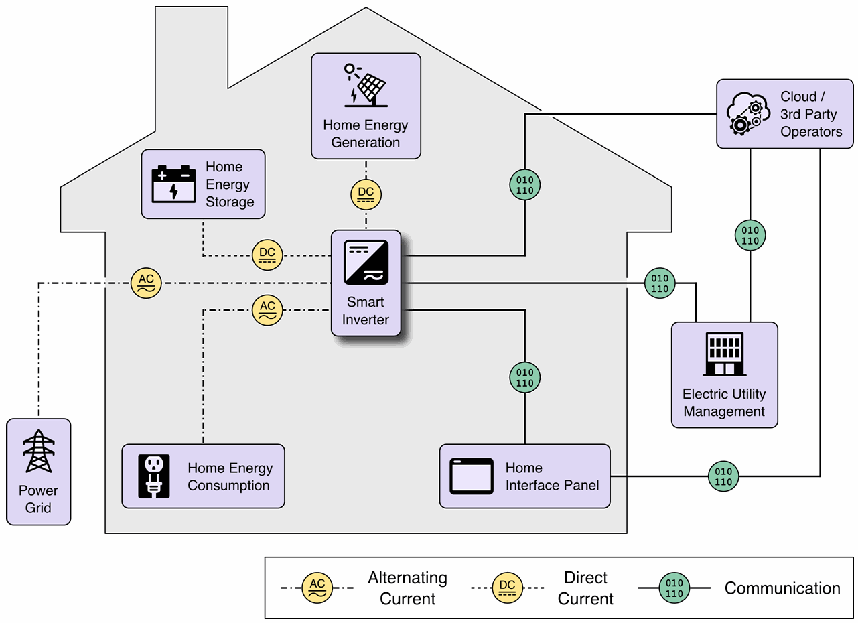
家の輪郭の中に描かれた、住宅用または小規模商業用の太陽光発電システムの図です。中央に Smart Inverter(スマートインバータ)があります。Home Energy Generation(家庭の発電。太陽光パネルのアイコン)と Home Energy Storage(家庭の蓄電。電池のアイコン)は、それぞれ DC(直流)の線でスマートインバータにつながります。スマートインバータは AC(交流)の線で家の中の Home Energy Consumption(家庭の電力消費。コンセントのアイコン)と、家の外の Power Grid(電力網。送電鉄塔のアイコン)につながります。通信の線(010/110 の印)は、スマートインバータから Cloud / 3rd Party Operators(クラウド/第三者の運用者)、Electric Utility Management(電力会社の管理)、Home Interface Panel(家庭のインタフェースパネル)へ伸びています。家庭のインタフェースパネルからもクラウド/第三者の運用者へ通信の線があり、クラウド/第三者の運用者は電力会社の管理ともつながっています。下部の凡例は線の種類を示し、Alternating Current(交流。一点鎖線)、Direct Current(直流。点線)、Communication(通信。実線、010/110)です。
Fig. 2. The role of a smart inverter in a residential or light commercial solar energy system
図 2. 住宅用または小規模商業用の太陽光発電システムにおけるスマートインバーターの役割
Fig. 2 illustrates the central role that a smart inverter plays in a residential or light commercial solar energy system. The smart inverter orchestrates the behavior of the solar energy system and its interactions with the electrical grid. The smart inverter receives direct current (DC) power from the system’s solar panels and directs that energy to one of three uses:
図 2 は、住宅用または小規模商業用の太陽光発電システムでスマートインバーターが果たす中心的な役割を示しています。スマートインバーターは、太陽光発電システムの動作と、電力網との相互作用を統括します。スマートインバーターは、システムの太陽光パネルから直流(DC)電力を受け取り、そのエネルギーを次の 3 つの用途のいずれかに振り向けます。
1.The smart inverter can convert the DC power to alternating current (AC) power and provide it to the home or small business for immediate use.
1.スマートインバーターは、DC 電力を交流(AC)電力に変換し、住宅や小規模事業所に提供してすぐに使用させることができます。
2.The smart inverter can provide excess AC power to the electric utility by communicating with the electric utility or third-party operators via communications links.
2.スマートインバーターは、通信リンクを介して電力事業者または第三者の運用者と通信することにより、余剰の AC 電力を電力事業者に提供できます。
3.If AC power is not needed by the home, business, or local utility, the smart inverter can use the DC power produced by the solar panels to charge the batteries in the home energy storage component of the system.
3.住宅、事業所、または地域の電力事業者が AC 電力を必要としない場合、スマートインバーターは、太陽光パネルが生成した DC 電力を使用して、システムの家庭用エネルギー貯蔵部のバッテリーを充電できます。
Additionally, the smart inverter can draw energy from the home energy storage component if the home or business needs more power than the solar panel can provide. The smart inverter can also provide power from home energy storage to support the grid in times of high demand. The smart inverter coordinates providing power from home energy storage by communicating with the electric utility or third-party operators via communications links.
さらに、スマートインバーターは、住宅や事業所が太陽光パネルの供給できる量より多くの電力を必要とする場合に、家庭用エネルギー貯蔵部からエネルギーを引き出すことができます。スマートインバーターは、需要が高い時間帯に電力網を支えるために、家庭用エネルギー貯蔵部から電力を供給することもできます。スマートインバーターは、通信リンクを介して電力事業者または第三者の運用者と通信することで、家庭用エネルギー貯蔵部からの電力供給を調整します。
The communication links used for coordination with the electric utility or third-party operators, if not protected, expose the smart inverter to potential cyber-attacks. In the absence of proven-correct software, software defects should be assumed to exist in smart-inverter software. Some defects should be assumed to enable the manipulation of smart-inverter behavior that potentially impacts the home, business, and electrical grid.
電力事業者や第三者の運用者との調整に使用される通信リンクは、保護されていなければ、スマートインバーターを潜在的なサイバー攻撃にさらします。正しさが証明されたソフトウェアが存在しない場合、スマートインバーターのソフトウェアには欠陥が存在すると想定すべきです。一部の欠陥は、住宅、事業所、電力網に影響を及ぼす可能性のある形でスマートインバーターの動作を操作できると想定すべきです。
1.1. Audience
1.1. 想定読者
This paper provides cybersecurity guidance for residential and small commercial smart inverter solar energy system owners, installers, maintainers, and component manufacturers.
本論文は、住宅用および小規模商業用のスマートインバーター太陽光発電システムの所有者、設置者、保守者、および部品製造者に、サイバーセキュリティガイダンスを提供します。
System owners, homeowners, and small business owners can use this guidance to understand the cybersecurity capabilities that should be included in their systems and to discuss the cybersecurity of their systems with vendors, installers, and maintainers. System installers can use this guidance to develop installation procedures and checklists to ensure that the systems they install provide appropriate cybersecurity for system owners. System maintainers can use this guidance to define procedures that ensure cybersecurity-related maintenance (e.g., system patching) is being performed and verify that the system continues to provide appropriate security. Manufacturers can use this guidance to ensure that their products provide the cybersecurity capabilities needed to support secure installation and operation.
システム所有者、住宅所有者、小規模事業主は、本ガイダンスを使用して、自分のシステムに含めるべきサイバーセキュリティ機能を理解し、ベンダー、設置者、保守者とシステムのサイバーセキュリティについて話し合うことができます。システム設置者は、本ガイダンスを使用して、自分が設置するシステムがシステム所有者に適切なサイバーセキュリティを提供することを確実にするための、設置手順とチェックリストを策定できます。システム保守者は、本ガイダンスを使用して、サイバーセキュリティに関連する保守(システムへのパッチ適用など)が実施されていることを確実にする手順を定め、システムが適切なセキュリティを引き続き提供していることを検証できます。製造者は、本ガイダンスを使用して、自社の製品が、セキュアな設置と運用を支えるために必要なサイバーセキュリティ機能を提供していることを確実にできます。
1.2. Report Organization
1.2. 報告書の構成
The cybersecurity guidance is presented in four main sections, each tailored to a specific audience.
サイバーセキュリティガイダンスは 4 つの主要な節で示しており、それぞれが特定の読者向けに調整されています。
•Section 1 describes why cybersecurity is important for residential and small business solar energy systems and why this cybersecurity guidance focuses on smart inverters.
•第 1 節では、住宅用および小規模事業所用の太陽光発電システムにとってサイバーセキュリティがなぜ重要か、そして本サイバーセキュリティガイダンスがなぜスマートインバーターに焦点を当てているかを説明します。
•Section 2 provides seven guidelines for ensuring that a residential or small business solar energy system is installed, configured, and operated securely.
•第 2 節では、住宅用または小規模事業所用の太陽光発電システムが安全に設置・構成・運用されることを確実にするための、7 つのガイドラインを示します。
•Section 3 identifies six technical and four non-technical cybersecurity capabilities that smart-inverter manufacturers should consider including in their products, as defined in IR 8259A and IR 8259B. This section also provides smart-inverter-specific recommendations in the form of additional information for the IR 8259A and IR 8259B cybersecurity capabilities to help ensure that smart inverters are installed, configured, and operated securely.
•第 3 節では、IR 8259A と IR 8259B で定義された、スマートインバーター製造者が製品に含めることを検討すべき、6 つの技術的サイバーセキュリティ機能と 4 つの非技術的サイバーセキュリティ機能を特定します。この節ではまた、スマートインバーターが安全に設置・構成・運用されることを確実にするために、IR 8259A と IR 8259B のサイバーセキュリティ機能に対する追加情報の形で、スマートインバーター固有の推奨事項を示します。
•Section 4 summarizes the development and presentation of this cybersecurity guidance.
•第 4 節では、本サイバーセキュリティガイダンスの策定と提示を要約します。
This guidance is augmented by a collection of appendices that provide supporting information for the guidelines and recommendations.
本ガイダンスは、ガイドラインと推奨事項を支える情報を提供する一連の付録で補強されています。
•Appendix A is a bibliography of publications that were consulted in developing this guidance.
•付録 A は、本ガイダンスの策定にあたり参照した刊行物の文献目録です。
•Appendix B provides a list of abbreviations and acronyms.
•付録 B は、略語と頭字語の一覧を示します。
•Appendix C provides a sample Provisioning Checklist for solar energy system installers. This checklist can be tailored to the activities needed for specific products and environments. Installers can use the tailored checklist to verify that they have completed the actions defined in the guidelines. The completed checklist can be shared with homeowners and small business owners as a record of the cybersecurity-related actions completed with the installation.
•付録 C は、太陽光発電システムの設置者向けのプロビジョニングチェックリストの例を示します。このチェックリストは、特定の製品や環境に必要な作業に合わせて調整できます。設置者は、調整したチェックリストを使用して、ガイドラインで定義された行動を完了したことを確認できます。完了したチェックリストは、設置に伴って完了したサイバーセキュリティ関連の行動の記録として、住宅所有者や小規模事業主と共有できます。
•Appendix D records the results of testing five installed smart inverters to determine their ability to implement the guidelines presented in Sec. 2.
•付録 D は、設置済みの 5 台のスマートインバーターについて、第 2 節で示したガイドラインを実装する能力を判定するために行った試験の結果を記録します。
•Appendix E maps the guidelines to six general cybersecurity guidance sources. Manufacturers may use these mappings to better understand the recommendations in Sec. 3 and how to implement the recommendations in their products.
•付録 E は、ガイドラインを 6 つの一般的なサイバーセキュリティガイダンスの出典に対応付けます。製造者は、これらの対応付けを使用して、第 3 節の推奨事項と、それを自社の製品に実装する方法をよりよく理解できます。
•Appendix F presents information about known smart-inverter cybersecurity vulnerabilities documented in the National Vulnerability Database (NVD). This information was used in formulating the guidelines.
•付録 F は、National Vulnerability Database(NVD)に記録されている、既知のスマートインバーターのサイバーセキュリティ上の脆弱性に関する情報を示します。この情報は、ガイドラインの策定に使用しました。
2. Cybersecurity Guidelines for Owners and Installers
2. 所有者および設置者のためのサイバーセキュリティガイドライン
This section provides seven guidelines for homeowners and solar energy system installers and maintainers. These guidelines define actions that should be taken to help ensure that a residential or small business solar energy system is installed, configured, and operated securely. They encompass smart-inverter configuration actions that should be performed across the solar energy system life cycle by installers, maintainers, and homeowners. These guidelines also provide a collection of cybersecurity protections that should be utilized for a secure solar energy system installation.
本節では、住宅所有者、ならびに太陽光発電システムの設置者および保守者のための 7 つのガイドラインを示します。これらのガイドラインは、住宅用または小規模事業所用の太陽光発電システムがセキュアに設置・構成・運用されるよう、取るべき行動を定義しています。ガイドラインには、設置者、保守者、住宅所有者が太陽光発電システムのライフサイクル全体にわたって実施すべき、スマートインバーターの構成作業が含まれます。また、これらのガイドラインは、太陽光発電システムをセキュアに設置するために活用すべき一連のサイバーセキュリティ保護も示します。
The guidelines are informed by a collection of general cybersecurity guidance presented in Appendix E and were tested against the cybersecurity capabilities available in five smart inverters. The results of that testing are presented in Appendix D.
ガイドラインは、付録 E に示した一連の一般的なサイバーセキュリティガイダンスを根拠としており、5 台のスマートインバーターで利用可能なサイバーセキュリティ機能に照らして試験しました。その試験結果は付録 D に示します。
Each guideline contains the following sections:
各ガイドラインは、次の節で構成されます。
•A description of the guideline
•ガイドラインの説明
•A definition of the solar energy system life cycle phases in which the guideline should be implemented
•ガイドラインを実装すべき、太陽光発電システムのライフサイクル段階の定義
•There are five phases in the solar energy system life cycle: manufacturing2, setup (or installation), operation, maintenance, and decommissioning (i.e., retirement). The guidelines in Sec. 2 are implemented in one or more of four life cycle phases:
•太陽光発電システムのライフサイクルには、製造2、セットアップ(または設置)、運用、保守、廃棄(すなわち退役)の 5 つの段階があります。第 2 節のガイドラインは、4 つのライフサイクル段階のうち 1 つ以上で実装されます。
•Setup — The smart inverter is installed and configured in a home or business.
•セットアップ — スマートインバーターを住宅または事業所に設置し、構成します。
•Operation — The homeowner or business owner uses the smart inverter to perform its intended function.
•運用 — 住宅所有者または事業主が、スマートインバーターを本来の機能のために使用します。
•Maintenance — The smart inverter undergoes maintenance to correct a problem or ensure continued safe and reliable operation.
•保守 — スマートインバーターに対し、問題を修正する、または安全で信頼できる動作を継続させるための保守を行います。
•Decommissioning — The smart inverter is removed from the home or business.
•廃棄 — スマートインバーターを住宅または事業所から取り外します。
•Examples of configuration actions to implement the guideline
•ガイドラインを実装するための構成作業の例
•The examples are described at a high level as the process to implement the guideline will vary by manufacturer and smart-inverter model. Consult the manufacturer’s documentation for specific instructions.
•ガイドラインを実装するプロセスは製造者やスマートインバーターのモデルによって異なるため、例は概要レベルで記述しています。具体的な手順については、製造者の文書を参照してください。
2.1. Guideline #1: Change Default Passwords and Credentials
2.1. ガイドライン #1: 既定のパスワードと認証情報の変更
Device manufacturers often create preconfigured accounts that may have well-known or easily-discoverable default passwords, individual device-specific passwords, or other access credentials to simplify the installation and setup of a device. However, once installed and connected to communication networks, these passwords and credentials may allow anyone who knows the values to access the device and change its configuration.
機器の製造者は、機器の設置とセットアップを簡単にするために、よく知られている、または容易に見つかる既定のパスワード、機器固有の個別のパスワード、あるいはその他のアクセス用認証情報を持つ、事前に構成されたアカウントを作成していることがよくあります。しかし、機器が設置され通信ネットワークに接続されると、これらのパスワードや認証情報によって、その値を知っている誰もが機器にアクセスし、その構成を変更できてしまう可能性があります。

Setup(セットアップ)、Operations(運用)、Maintenance(保守)、Decommission(廃止)の 4 つの矢印形のフェーズが横に並んだライフサイクルの図です。Setup(セットアップ) が青で強調され、Operations(運用)、Maintenance(保守)、Decommission(廃止) は灰色です。
Fig. 3. Guideline #1 life cycle phase
図 3. ガイドライン #1 のライフサイクル段階
As shown in Fig. 3, during the device setup and installation process, each preconfigured account should be assigned a new, unique password or credential. Any new accounts created as part of installation or operation of the device should be assigned unique passwords or credentials. Multi-factor authentication3 (MFA) can also improve security, especially for more privileged accounts (see Sec. 2.2)4.
図 3 に示すように、機器のセットアップと設置のプロセス中に、事前に構成された各アカウントに、新しく一意のパスワードまたは認証情報を割り当てるべきです。機器の設置または運用の一環として新たに作成されたアカウントにも、一意のパスワードまたは認証情報を割り当てるべきです。多要素認証3(MFA)は、特により高い特権を持つアカウントのセキュリティ向上にも役立ちます(第 2.2 節を参照)4。
In addition to interacting with people, smart inverters may also interact with other systems and devices. These interactions need to be mutually authenticated using strong credentials (e.g., digital certificates) that should also be changed from factory defaults during setup.
人とのやり取りに加えて、スマートインバーターはほかのシステムや機器ともやり取りする場合があります。これらのやり取りでは、強力な認証情報(デジタル証明書など)を用いて相互認証すべきです。この認証情報も、セットアップ時に工場出荷時の既定値から変更すべきです。
2.2. Guideline #2: Use Role-Based Access Control (RBAC)
2.2. ガイドライン #2: ロールベースアクセス制御(RBAC)の使用
Limiting access to only those capabilities a person needs to perform their responsibilities is a key tenet of good cybersecurity. Various people and organizations may need to access a smart inverter in a home or small business solar energy system. Rather than assigning access permissions directly to each person or organization, a more manageable approach would be to identify roles and the access permissions they need to perform specific tasks. A smart inverter may have defined roles for installers, maintainers, the electric utility, third-party operators, and homeowners. Adding or removing access permissions for a person or organization involves adding their account to or removing it from one or more roles. For a system installer, it may be important to make interface changes and set values for different aspects of the system to ensure that it functions properly in its environment. A homeowner may instead need the ability to view monitor data and historical usage graphs. A homeowner may not need, nor should they be able to reconfigure the smart inverter, and a system installer may not need some of the historical data. Although these roles and permissions may vary, the concept of separate roles is vital to ensuring secure access to the device based on the user.
自分の責務を果たすために必要な機能だけにアクセスを制限することは、優れたサイバーセキュリティの重要な原則です。住宅や小規模事業所の太陽光発電システムでは、さまざまな人や組織がスマートインバーターにアクセスする必要が生じる場合があります。アクセス許可を個々の人や組織に直接割り当てるのではなく、ロールと、特定のタスクを実行するために各ロールが必要とするアクセス許可を特定するほうが、管理しやすくなります。スマートインバーターには、設置者、保守者、電力事業者、第三者の運用者、住宅所有者のロールが定義されている場合があります。人や組織のアクセス許可の追加または削除は、そのアカウントを1つ以上のロールに追加する、またはロールから削除することで行います。システム設置者には、システムがその環境で適切に機能するよう、インターフェースを変更し、システムのさまざまな側面の値を設定する必要がある場合があります。一方、住宅所有者には、監視データや過去の使用状況グラフを閲覧する機能が必要な場合があります。住宅所有者にはスマートインバーターを再構成する必要がない場合があり、また再構成できるようにすべきでもありません。システム設置者には、過去のデータの一部が不要な場合があります。これらのロールとアクセス許可はさまざまであり得ますが、ユーザーに応じてデバイスへのセキュアなアクセスを確保するうえで、ロールを分離する考え方は不可欠です。
As shown in Fig. 4, an initial collection of roles with appropriate access permissions should be defined during the setup phase of the smart-inverter life cycle. Roles may need to be created, modified, or deleted during the maintenance phase. For example, software updates may add or remove smart-inverter capabilities that require updates to role definitions. The assignment of people and organizations to roles should be reviewed periodically to ensure they are up to date and appropriate.
図 4 に示すように、適切なアクセス許可を持つロールの初期の一式は、スマートインバーターのライフサイクルのセットアップ段階で定義すべきです。ロールは、保守段階で作成、変更、または削除する必要が生じる場合があります。たとえば、ソフトウェアの更新によってスマートインバーターの機能が追加または削除され、ロールの定義の更新が必要になることがあります。人や組織へのロールの割り当ては、最新かつ適切な状態にあることを確実にするために、定期的に見直すべきです。

Setup(セットアップ)、Operations(運用)、Maintenance(保守)、Decommission(廃止)の 4 つの矢印形のフェーズが横に並んだライフサイクルの図です。Setup(セットアップ)、Maintenance(保守) が青で強調され、Operations(運用)、Decommission(廃止) は灰色です。
Fig. 4. Guideline #2 life cycle phase
図 4. ガイドライン #2 のライフサイクル段階
A basic collection of roles for a smart inverter might include:
スマートインバーターの基本的なロールの一式には、次のようなものが含まれます。
•An Installer role with the access permissions needed to perform initial setup and configuration of the smart inverter. A smart-inverter manufacturer might include this as a default role along with a default user account, as described in Guideline #1 (Sec. 2.1).
•設置者(Installer)ロール: スマートインバーターの初期セットアップと構成の実施に必要なアクセス許可を持ちます。スマートインバーターの製造者は、ガイドライン #1(第 2.1 節)で説明したように、これを既定のユーザーアカウントとともに既定のロールとして含める場合があります。
•A Maintainer role with the access permissions needed to install software updates, perform diagnostics, and make repairs.
•保守者(Maintainer)ロール: ソフトウェアの更新のインストール、診断の実施、修理に必要なアクセス許可を持ちます。
•A Homeowner role with the access permissions needed to monitor the operation of the smart inverter and respond to alerts.
•住宅所有者(Homeowner)ロール: スマートインバーターの動作の監視とアラートへの対応に必要なアクセス許可を持ちます。
2.3. Guideline #3: Configure the Recording of Events in a Log
2.3. ガイドライン #3: イベントをログに記録する設定
A log of cybersecurity-relevant activities that is stored in another location can help identify the factors that led to an unexpected event, recover from the compromise, and determine how to prevent such compromises in the future.
別の場所に保存されたサイバーセキュリティ関連の活動のログは、予期しないイベントにつながった要因の特定、危殆化からの復旧、および将来そのような危殆化を防ぐ方法の判断に役立ちます。
Logs should contain information about the operation of the smart inverter (e.g., normal or anomalous values of system parameters) when an event is detected and enable reviewers to understand the chain of events with a degree of fidelity. Event logging supports troubleshooting for smart-inverter issues as well as responses to cyber events.
ログには、イベントが検知されたときのスマートインバーターの動作に関する情報(システムパラメーターの正常値または異常値など)を含め、確認者が一連の出来事をある程度正確に理解できるようにすべきです。イベントのログ記録は、スマートインバーターの問題のトラブルシューティングと、サイバーイベントへの対応を支援します。
In addition to system parameters, logs should also contain cybersecurity-relevant information, such as:
システムパラメーターに加えて、ログには次のようなサイバーセキュリティ関連の情報も含めるべきです:
•Creation or removal of user accounts
•ユーザーアカウントの作成または削除
•Successful and unsuccessful user authentication, including the identity associated with the authentication
•ユーザー認証の成功と失敗(認証に関連付けられた ID を含む)
•Changes to smart-inverter configuration settings, including previous and new values and the identity of the user or system making changes to enabled/disabled features, assigned user roles, and role permissions
•スマートインバーターの構成設定の変更(変更前と変更後の値、および有効化/無効化された機能、割り当てられたユーザーロール、ロールのアクセス許可を変更したユーザーまたはシステムの ID を含む)
•Enabling previously disabled features
•以前に無効にされていた機能の有効化
•Records of software and firmware updates, including how the update was initiated (e.g., by a user, automatically), the source of the update, and any update integrity information (e.g., checksums, hashes)
•ソフトウェアとファームウェアの更新の記録(更新の開始方法[ユーザーによる、自動など]、更新の出所、更新の完全性情報[チェックサム、ハッシュなど]を含む)
•Communications events, such as network connections or loss of connectivity
•ネットワーク接続や接続の喪失などの通信イベント
•Actions performed directly from the smart-inverter’s control panel
•スマートインバーターの操作パネルから直接実行された操作
As shown in Fig. 5, logging capabilities should be configured and enabled by the installer during solar energy system setup. During operations and maintenance, the owner or maintenance technician should verify that information is being collected and stored in logs as intended.
図 5 に示すように、ログ記録機能は、太陽光発電システムのセットアップ中に設置者が構成し、有効にすべきです。運用および保守の間、所有者または保守技術者は、情報が意図どおりにログに収集・保存されていることを検証すべきです。

Setup(セットアップ)、Operations(運用)、Maintenance(保守)、Decommission(廃止)の 4 つの矢印形のフェーズが横に並んだライフサイクルの図です。Setup(セットアップ)、Operations(運用)、Maintenance(保守) が青で強調され、Decommission(廃止) は灰色です。
Fig. 5. Guideline #3 life cycle phase
図 5. ガイドライン #3 のライフサイクル段階
2.4. Guideline #4: Update Software Regularly
2.4. ガイドライン #4: ソフトウェアの定期的な更新
Smart inverters depend on software to provide the “smart” elements of their operation. Even well-developed software has vulnerabilities that are discovered after deployment and need to be corrected. Additionally, manufacturers continuously evolve the software capabilities in their devices. Therefore, it is important to provide a secure avenue to update smart-inverter software that verifies the validity, source, and authenticity of updates prior to installation. This ensures that software stays up to date with the latest security and functional capabilities. Updates that impact the security of the smart inverter should be deployed as soon as possible. Keeping smart-inverter software updated helps protect against weaknesses discovered after the device has been set up in a home or small business solar energy system.
スマートインバーターは、動作の「スマート」な要素を提供するためにソフトウェアに依存しています。十分に開発されたソフトウェアにも、配備後に発見され、修正する必要のある脆弱性があります。さらに、製造者は自社の機器のソフトウェア機能を継続的に進化させています。したがって、インストールの前に更新の有効性、出所、真正性を検証する、スマートインバーターのソフトウェアを更新するためのセキュアな手段を提供することが重要です。これにより、ソフトウェアが最新のセキュリティ機能と動作機能で最新の状態に保たれます。スマートインバーターのセキュリティに影響する更新は、できる限り早く展開すべきです。スマートインバーターのソフトウェアを最新の状態に保つことは、機器が住宅用または小規模事業所用の太陽光発電システムにセットアップされた後に発見された弱点から保護するのに役立ちます。

Setup(セットアップ)、Operations(運用)、Maintenance(保守)、Decommission(廃止)の 4 つの矢印形のフェーズが横に並んだライフサイクルの図です。Setup(セットアップ)、Maintenance(保守) が青で強調され、Operations(運用)、Decommission(廃止) は灰色です。
Fig. 6. Guideline #4 life cycle phase
図 6. ガイドライン #4 のライフサイクル段階
Updating a smart-inverter’s software should be part of the device’s initial setup and ongoing maintenance5, as shown in Fig. 6. Manufacturers generally have a limited support life cycle and will stop developing patches for discontinued devices. When this occurs, owners should replace the discontinued device with a current model as soon as possible.
図 6 に示すように、スマートインバーターのソフトウェアの更新は、機器の初期セットアップと継続的な保守5の一部とすべきです。製造者のサポートのライフサイクルは一般に限られており、製造終了となった機器へのパッチの開発は停止されます。その場合、所有者は、製造終了となった機器を、できる限り早く現行モデルに交換すべきです。
2.5. Guideline #5: Back Up System Information
2.5. ガイドライン #5: システム情報のバックアップ
Smart inverters have configuration parameters or settings that can be customized based on the requirements of a particular home or small business solar energy system. These parameters are normally stored in a configuration file and may include the battery recharge voltage and security settings (e.g., user credentials discussed in Sec. 2.1, permissions and user role assignments discussed in Sec. 2.2).
スマートインバーターには、特定の住宅用または小規模事業所用の太陽光発電システムの要件に基づいてカスタマイズできる、構成パラメーターや設定があります。これらのパラメーターは通常、構成ファイルに保存され、バッテリーの再充電電圧やセキュリティ設定(第 2.1 節で論じたユーザー認証情報、第 2.2 節で論じたアクセス許可とユーザーロールの割り当てなど)を含む場合があります。
Creating a configuration backup is the process of copying the current configuration information to a different location. Maintaining a backup of the smart-inverter configuration can help restore operations after an event, either cyber or non-cyber, that leaves the solar energy system in a non-operating state or operating incorrectly. Restoring a configuration backup or performing a factory reset that returns the smart inverter to its default configuration may correct the problems. Configuration restoration capabilities may also be used to load a pre-built configuration into a smart inverter during setup.
構成のバックアップの作成とは、現在の構成情報を別の場所にコピーするプロセスです。スマートインバーターの構成のバックアップを維持することは、サイバーイベントか否かを問わず、太陽光発電システムを非稼働状態または誤った動作状態にしたイベントの後で、運用を復旧するのに役立ちます。構成のバックアップを復元する、またはスマートインバーターを既定の構成に戻す工場出荷時リセットを行うことで、問題が解消される場合があります。構成の復元機能は、セットアップ中に、あらかじめ作成した構成をスマートインバーターに読み込むために使用することもできます。
As shown in Fig. 7, a backup should be created after the initial configuration of the smart inverter during setup and after any parameter change or upgrade during maintenance.
図 7 に示すように、バックアップは、セットアップ中のスマートインバーターの初期構成の後、および保守中のパラメーターの変更やアップグレードの後に作成すべきです。

Setup(セットアップ)、Operations(運用)、Maintenance(保守)、Decommission(廃止)の 4 つの矢印形のフェーズが横に並んだライフサイクルの図です。Setup(セットアップ)、Maintenance(保守) が青で強調され、Operations(運用)、Decommission(廃止) は灰色です。
Fig. 7. Guideline #5 life cycle phase
図 7. ガイドライン #5 のライフサイクル段階
Backups should be stored in a retrievable location, such as a flash drive or cloud storage. The process for creating a configuration backup will be specific to the manufacturer and product.
バックアップは、フラッシュドライブやクラウドストレージなど、取り出し可能な場所に保存すべきです。構成のバックアップを作成するプロセスは、製造者と製品によって異なります。
2.6. Guideline #6: Disable Unused Features
2.6. ガイドライン #6: 未使用の機能の無効化
Smart inverters may be built with features and capabilities that support multiple deployment scenarios and user requirements. While having these features and capabilities provides flexibility in deployment, each enabled feature potentially adds to a device’s exposure to cybersecurity threats.
スマートインバーターは、複数の配備シナリオとユーザー要件に対応するための特徴や機能を備えて作られている場合があります。これらの特徴や機能があることは配備の柔軟性をもたらしますが、有効化された特徴はいずれも、機器がサイバーセキュリティ上の脅威にさらされる度合いを高める可能性があります。
Disabling features and capabilities that are not used in a particular device deployment is another key tenet of good cybersecurity. Any features or capabilities that are not required for a particular deployment should be disabled to enhance security and reduce exposure to threats.
特定の機器の配備で使用されない特徴や機能を無効にすることも、優れたサイバーセキュリティの重要な原則です。特定の配備で必要とされない特徴や機能は、セキュリティを高め、脅威にさらされる度合いを下げるために、無効にすべきです。
In addition to smart-inverter features and capabilities that are necessary to the operation of a solar energy system, there may be features and capabilities that are nice to have or may be a convenience in operating the system. In determining whether to use the features and capabilities, consider whether the benefits they offer outweigh any increase in exposure to cybersecurity threats.
太陽光発電システムの運用に必要なスマートインバーターの特徴や機能に加えて、あると便利なもの、またはシステムの運用上の利便性を高めるものもある場合があります。これらの特徴や機能を使用するかどうかを判断する際は、それらがもたらす利益が、サイバーセキュリティ上の脅威にさらされる度合いの増加を上回るかどうかを検討してください。
Smart-inverter features and capabilities may be enabled or disabled during the setup and maintenance life cycle phases, as illustrated in Fig. 8.
スマートインバーターの特徴や機能は、図 8 に示すように、セットアップと保守のライフサイクル段階で有効化または無効化できます。

Setup(セットアップ)、Operations(運用)、Maintenance(保守)、Decommission(廃止)の 4 つの矢印形のフェーズが横に並んだライフサイクルの図です。Setup(セットアップ)、Maintenance(保守) が青で強調され、Operations(運用)、Decommission(廃止) は灰色です。
Fig. 8. Guideline #6 life cycle phase
図 8. ガイドライン #6 のライフサイクル段階
Some features and capabilities that may be included in a smart inverter but may not be needed in a particular deployment include:
スマートインバーターに含まれていても、特定の配備では必要ない場合がある特徴や機能には、次のものがあります。
•Remote access protocols and interfaces. The operation and maintenance of a smart inverter may require remote access to the device. Any remote access protocols or interfaces that are not used in a deployment should be disabled.
•リモートアクセスのプロトコルとインターフェース。 スマートインバーターの運用と保守には、機器へのリモートアクセスが必要な場合があります。配備で使用されないリモートアクセスのプロトコルやインターフェースは、無効にすべきです。
•Wireless communications. Smart inverters may support both wired and wireless network connectivity. If a deployment uses only wired connectivity, the wireless communications capability should be disabled.
•無線通信。 スマートインバーターは、有線と無線の両方のネットワーク接続をサポートする場合があります。配備で有線接続のみを使用する場合は、無線通信機能を無効にすべきです。
•Guest and/or anonymous smart-inverter access. A Guest role that allows access to some smart-inverter features or capabilities without a defined user account should be read-only and prohibited from changing the configuration or operation of a device.
•ゲストまたは匿名によるスマートインバーターへのアクセス。 定義されたユーザーアカウントなしにスマートインバーターの一部の特徴や機能へのアクセスを許可するゲスト(Guest)ロールは、読み取り専用とし、機器の構成や動作を変更することを禁止すべきです。
2.7. Guideline #7: Protect Communications Connections
2.7. ガイドライン #7: 通信接続の保護
An important aspect of smart inverters is their ability to communicate. A smart-inverter’s communication can take many forms, including communications with the electric utility, third-party operators, device manufacturer, or other devices in the local environment. The inverter may communicate operating information to the owner and the local utility. It may also communicate with the device manufacturer or a device’s maintenance contractor to receive software updates or share operating information to detect potential problems before they occur. However, this communication capability also provides an avenue for cyber attacks. Therefore, it is important to consider how the smart inverter can be protected from threats while still being able to communicate as needed for its intended purpose.
スマートインバーターの重要な側面は、通信能力です。スマートインバーターの通信には、電力事業者、第三者の運用者、機器の製造者、あるいはローカル環境内のほかの機器との通信など、さまざまな形態があります。インバーターは、運用情報を所有者や地域の電力事業者に伝える場合があります。また、ソフトウェアの更新を受け取るため、あるいは潜在的な問題を発生前に検知するために運用情報を共有する目的で、機器の製造者や機器の保守契約業者と通信する場合もあります。しかし、この通信機能はサイバー攻撃の経路にもなります。したがって、スマートインバーターを、本来の目的のために必要な通信を行えるようにしつつ、脅威から保護する方法を検討することが重要です。
There are many potential approaches to protecting smart-inverter communications from malicious actors while still allowing needed communications. Inverters may have a dedicated cellular connection to communicate with the local utility without being exposed to a public network, such as the internet. Communication with the owner may occur using a control panel that is directly connected to the inverter. Updates may be performed using portable storage devices, such as USB “thumb drives.”6
必要な通信を許可しながら、スマートインバーターの通信を悪意のある行為者から保護するための方法は、数多く考えられます。インバーターは、インターネットなどの公衆ネットワークにさらされることなく地域の電力事業者と通信するために、専用のセルラー接続を持つ場合があります。所有者との通信は、インバーターに直接接続された操作パネルを使って行う場合があります。更新は、USB「サムドライブ」などの可搬型記憶装置を使って行う場合があります。6
A smart inverter may leverage an existing home internet connection to communicate with the owner, electric utility, third-party operators, and manufacturer. When the inverter uses an existing internet connection, the installation should take steps to separate the inverter from other activity on the network. There are several ways to provide this protection, such as separate logical networks created by the home or business router. Separation techniques depend on the capabilities available from the internet service provider (ISP). Connections used to communicate with the local utility or manufacturer should not be accessible from other devices on the local network. Cybersecurity capabilities can also provide this protection, such as a virtual private network (VPN) connection between the utility or manufacturer.
スマートインバーターは、所有者、電力事業者、第三者の運用者、製造者と通信するために、既存の家庭用インターネット接続を利用する場合があります。インバーターが既存のインターネット接続を使用する場合、設置にあたっては、インバーターをネットワーク上のほかの活動から分離するための措置を講じるべきです。この保護を実現する方法はいくつかあり、たとえば、住宅や事業所のルーターが作成する、分離された論理ネットワークがあります。分離の技術は、インターネットサービスプロバイダー(ISP)から利用できる機能に依存します。地域の電力事業者や製造者との通信に使用する接続は、ローカルネットワーク上のほかの機器からアクセスできないようにすべきです。電力事業者または製造者との間の仮想プライベートネットワーク(VPN)接続など、サイバーセキュリティ機能によってもこの保護を実現できます。
As shown in Fig. 9, protection should be established during the setup life cycle phase and monitored during the operations life cycle phase to ensure that it remains effective.
図 9 に示すように、保護はセットアップのライフサイクル段階で確立し、有効性が維持されることを確実にするために運用のライフサイクル段階で監視すべきです。

Setup(セットアップ)、Operations(運用)、Maintenance(保守)、Decommission(廃止)の 4 つの矢印形のフェーズが横に並んだライフサイクルの図です。Setup(セットアップ)、Operations(運用) が青で強調され、Maintenance(保守)、Decommission(廃止) は灰色です。
Fig. 9. Guideline #7 life cycle phase
図 9. ガイドライン #7 のライフサイクル段階
3. Cybersecurity Recommendations for Smart-Inverter Manufacturers
3. スマートインバーター製造者のためのサイバーセキュリティ推奨事項
This section provides recommendations for smart-inverter manufactures to provide the cybersecurity capabilities needed to implement the guidelines in Sec. 2 and the capabilities that would better address cyber threats to smart-inverter operations. These recommendations involve changes to inverter design, changes to inverter software and firmware, or the addition of new front-end devices to protect inverter interfaces.
本節では、スマートインバーターの製造者が、第 2 節のガイドラインを実装するために必要なサイバーセキュリティ機能と、スマートインバーターの運用に対するサイバー脅威により適切に対処できる機能を提供するための推奨事項を示します。これらの推奨事項には、インバーターの設計の変更、インバーターのソフトウェアおよびファームウェアの変更、またはインバーターのインターフェースを保護するための新しいフロントエンド機器の追加が含まれます。
3.1. Recommended Baseline Cybersecurity Capabilities
3.1. 推奨されるベースラインのサイバーセキュリティ機能
Smart inverters used in home and small business solar power systems are examples of IoT devices. IR 8259, Foundational Cybersecurity Activities for IoT Device Manufacturers [7], describes its guidance as applying to devices that “have at least one transducer (sensor or actuator) for interacting directly with the physical world and at least one network interface (e.g., Ethernet, Wi-Fi, Bluetooth, Long-Term Evolution [LTE], Zigbee, Ultra-Wideband [UWB]) for interfacing with the digital world.” Smart inverters sense the state of the power grid, provide power to the grid, and communicate with owners and grid operators through communications interfaces that satisfy this description. Emerging inverter controllers may also require the autonomous exchange of information between inverters. Hence, the general cybersecurity guidance presented in IR 8259 [7] is applicable to smart inverters.
住宅用および小規模事業所用の太陽光発電システムで使用されるスマートインバーターは、IoT 機器の例です。IR 8259 Foundational Cybersecurity Activities for IoT Device Manufacturers [7] は、そのガイダンスが、物理世界と直接やり取りするための少なくとも 1 つのトランスデューサー(センサーまたはアクチュエーター)と、デジタル世界と接続するための少なくとも 1 つのネットワークインターフェース(Ethernet、Wi-Fi、Bluetooth、Long-Term Evolution[LTE]、Zigbee、Ultra-Wideband[UWB]など)を持つ機器に適用されると述べています。スマートインバーターは、電力網の状態を検知し、電力網に電力を供給し、この記述を満たす通信インターフェースを通じて所有者や電力網の運用者と通信します。新しいインバーターコントローラーは、インバーター間の情報の自律的な交換を必要とする場合もあります。したがって、IR 8259 [7] に示された一般的なサイバーセキュリティガイダンスは、スマートインバーターに適用できます。
Two publications in the IR 8259 series provide the baseline cybersecurity capabilities recommended for all IoT devices:
IR 8259 シリーズの 2 つの刊行物は、すべての IoT 機器に推奨されるベースラインのサイバーセキュリティ機能を示しています。
1.IR 8259A, IoT Device Cybersecurity Core Baseline [1], defines a baseline of six technical cybersecurity capabilities that IoT devices provide through their own technical means (i.e., device hardware and software).
1.IR 8259A IoT Device Cybersecurity Core Baseline [1] は、IoT 機器が自らの技術的手段(すなわち機器のハードウェアとソフトウェア)によって提供する、6 つの技術的サイバーセキュリティ機能のベースラインを定義しています。
2.IR 8259B, IoT Non-Technical Supporting Capability Core Baseline [2], defines a baseline of four non-technical cybersecurity capabilities that a manufacturer or third-party organization performs in support of the cybersecurity of an IoT device (e.g., providing information about software updates, instructions for configuration settings, and supply chain information).
2.IR 8259B IoT Non-Technical Supporting Capability Core Baseline [2] は、IoT 機器のサイバーセキュリティを支援するために製造者または第三者の組織が実施する、4 つの非技術的サイバーセキュリティ機能のベースラインを定義しています(ソフトウェアの更新に関する情報、構成設定の手順、サプライチェーン情報の提供など)。
Used together, technical cybersecurity capabilities and non-technical supporting capabilities can help mitigate cybersecurity risks related to the use of IoT devices while assisting customers in achieving their goals.
技術的サイバーセキュリティ機能と非技術的支援機能を併せて用いることで、顧客が目標を達成するのを支援しながら、IoT 機器の使用に関連するサイバーセキュリティリスクを緩和するのに役立ちます。
As smart inverters are IoT devices, manufacturers should consider including all of the baseline cybersecurity capabilities in their products to enable owners and installers to implement the seven basic guidelines. Table 1 and Table 2 list the cybersecurity capabilities from the IR 8259A [1] and IR 8259B [2] baselines, respectively, in the first column of each table. Additionally, columns 2 and 3 of each table include information about the baseline cybersecurity capability that is specific to smart-inverter cybersecurity capabilities. This additional information was derived in part from the smart-inverter testing presented in Appendix D and the smart-inverter vulnerability research presented in Appendix F.
スマートインバーターは IoT 機器であるため、製造者は、所有者と設置者が 7 つの基本的なガイドラインを実装できるよう、ベースラインのサイバーセキュリティ機能のすべてを製品に含めることを検討すべきです。表 1 と表 2 は、それぞれ IR 8259A [1] と IR 8259B [2] のベースラインのサイバーセキュリティ機能を、各表の第 1 列に列挙しています。さらに、各表の第 2 列と第 3 列には、ベースラインのサイバーセキュリティ機能のうち、スマートインバーターのサイバーセキュリティ機能に固有の情報を示しています。この追加情報は、付録 D に示したスマートインバーターの試験と、付録 F に示したスマートインバーターの脆弱性調査から一部導かれたものです。
Table 1. Technical cybersecurity capability recommendations
表 1. 技術的なサイバーセキュリティ機能に関する推奨事項
| IR 8259A Technical Device Cybersecurity Capability | Additional Smart-Inverter Cybersecurity Capability Recommendation Information for Manufacturers | Smart-Inverter-Specific Cybersecurity Capability Description |
|---|---|---|
| Device Identification: The IoT device can be uniquely identified logically and physically. | The smart inverter has the capability to inventory other components of a solar energy system. This recommendation supports Guideline #3. | Solar energy systems may contain components in addition to the smart inverter (see Fig. 11). These components may include specialty gateway devices, cloud-based services, or even mobile apps. The capability to identify and inventory these components can aid in comprehensively logging system activity and recognizing trusted system components. IR 8425 [8] expands on the unique identification of IoT devices to include inventorying the components of an IoT product (e.g., cloud-based services, mobile apps) as recommended here for smart inverters. |
| Device Configuration: The configuration of the IoT device’s software can be changed, and such changes can be performed by authorized entities only. | The smart inverter can back up its configuration to an external location and restore its configuration from a backup. This recommendation supports Guideline #5. | A backup of smart-inverter configuration parameters and settings enables rapid restoration of the configuration should an accidental or malicious action change the configuration. The smart inverter should be able to create a backup of all parameters and settings that affect its operation, export the backup to an external storage location, verify the integrity of a previously created backup, and restore its configuration from the backup. |
| The smart inverter should be able to disable or remove capabilities that are not needed in a deployment. This recommendation supports Guideline #6. | Smart-inverter products need to support a variety of deployment approaches. Hence, they may include capabilities that are not used in all deployments. Enabled but unused capabilities increase the opportunity for a malicious actor to gain unauthorized access to the smart inverter. Capabilities that are not used in all deployment approaches should be disabled by default and require an installer to proactively enable them when needed. This recommendation should also be applied to communications protocols. Smart inverters may include software acquired from third parties. Any capabilities in such software that are not used by the smart inverter should be removed or disabled. | |
| The smart inverter can reset its configuration to the factory default. This recommendation supports Guideline #5. | For troubleshooting, it may be advantageous to restore a smart inverter to a default configuration. Additionally, when disposing of a smart inverter, it should be reset to the default factory configuration to remove any information that might aid a malicious actor. | |
| Data Protection: The IoT device can protect the data it stores and transmits from unauthorized access and modification. | The smart inverter uses secure communication protocols that provide mutual authentication of the communication endpoints and protect the integrity of data in transit. This recommendation supports Guideline #7. | Communication interfaces to a smart inverter should use communication protocols that provide mutual authentication of the communications channel endpoints, integrity protection of data in transit, and confidentiality protection of data in transit. Smart inverters should either use protocols that inherently provide security capabilities (e.g., such as Transport Layer Security) or wrap protocols that lack security capabilities using techniques such as VPNs. |
| Logical Access to Interfaces: The IoT device can restrict logical access to its local and network interfaces, and the protocols and services used by those interfaces, to authorized entities only. | The smart inverter supports MFA to determine the identity of entities attempting to access its services. This recommendation supports Guideline #1. | To control access to capabilities, the inverter needs to know who is attempting to access its capabilities and what capabilities they are authorized to use. The inverter authenticates users and systems to establish their identity. Traditionally, a single authentication factor—a password—has been used. However, passwords are no longer an appropriate authentication approach for access to capabilities that could affect critical infrastructure. Smart inverters should use stronger authentication techniques (e.g., MFA) to authenticate users.7 Smart inverters also communicate with non-person entities (e.g., other devices and systems). These interactions should use strong system-to-system credentials (e.g., digital certificates) and provide mutual authentication. |
| The smart inverter supports RBAC and provides the ability to create, modify, and configure the roles. This recommendation supports Guideline #2. | Rather than assigning access permissions directly to each person, a more manageable approach is to define a collection of roles where each role defines the access permissions needed to perform specific responsibilities. An initial collection of roles with appropriate access permissions should be defined during the setup phase of the smart-inverter life cycle. Roles may need to be created, modified, or deleted during the operation and maintenance phases. | |
| The smart inverter minimizes the amount and type of information and type of services available via unauthenticated access. This recommendation supports Guideline #2. | It may be necessary to provide some information about the smart inverter and its operation to a person or system without authenticating their identity. In providing such access, the manufacturer should follow the cybersecurity principle of least privilege. That is, the smart inverter should minimize the amount of information it will provide to unauthenticated users. Device “fingerprinting” (i.e., learning as much as possible about a device without explicitly gaining access to the device) can help a malicious actor pinpoint vulnerabilities and weaknesses that can be used to gain unauthorized access. Manufacturers should minimize information shared on non-authenticated interfaces. Information such as product versions, specific software and firmware installed, and network information should likely not be shared to protect against targeted cyber attacks. | |
| Software Update: The IoT device’s software can be updated by authorized entities only using a secure and configurable mechanism. | The smart-inverter’s software can be updated automatically and without owner action.8 This recommendation supports Guideline #4. | Installing software updates to correct software flaws that create exploitable vulnerabilities is critical to maintaining smart-inverter cybersecurity. Updates are most effective when installed in a timely manner. However, if update installation depends on explicit action by the owner or maintainer, they may not be installed quickly enough. Automatic updates can ensure that updates are applied as quickly as it is feasible. The owner should be notified when updates are installed. If meaningful, the notification should identify what inverter capabilities and services were affected by the update. The device should also recognize software update failures, rollback any changes made to known-good software, and notify the owner of the update failure. Enabling automatic updates should be configurable as its use may not be appropriate in all deployment scenarios. The automatic update function should be designed to recognize when it is safe to install an update and when current operating conditions require deferring an update. Software updates to safety-critical control functions should only be performed through a local programming interface on the smart inverter. |
| Cybersecurity State Awareness: The IoT device can report on its cybersecurity state and make that information accessible to authorized entities only. | The smart inverter records a log of all cybersecurity-relevant events. This recommendation supports Guideline #3. | Determining what happened when a smart inverter fails to operate as expected requires information about the activities that led to the failure, including cybersecurity incidents. The smart inverter should monitor and log events related to both device health and cybersecurity. Smart-inverter configuration changes should also be included. This information should be exported to remote storage to ensure that it is not compromised in a cyber incident. |
| Device Security9: The capability to secure the IoT device to meet organizational requirements. | The smart inverter should protect sensing and control capabilities that interact with the power grid or with power delivery to a home or business from other capabilities that may be exposed to cyber attacks. This recommendation supports Guideline #7. | To better protect operations, smart inverters should control the interactions among different elements and services within the device, including physical or software protection of real-time control functions, safety-critical functions, and power electronics from data communications interfaces. This protection reduces the potential impacts of cyber incidents on interactions with the physical world. For user interaction interfaces, including locally hosted webservers, techniques such as virtualization and out-of-band security monitoring should be employed. Virtualization can separate the user interaction interfaces from the control and monitoring functions that are critical to safe device operations. Whenever possible, these functions should be separated at a hardware level (e.g., by using separate processing units for control functions and assuming zero trust between the control system hardware and the user interaction hardware). Fig. 10 illustrates the control functions in a smart inverter and their interactions with other functional elements of a smart inverter. Control functions may have different interaction needs with other functional elements. Protecting these interactions from compromise is critical to the correct and safe operation of a smart inverter. A software compromise should not result in unsafe operation. To ensure this, electro-mechanical protections (e.g., over-voltage circuit breakers, over-temperature circuit breakers, and electro-mechanical islanding detection) may be needed to ensure continued safe operation when software is compromised. Manufacturers are encouraged to design smart inverters such that the hardware is physically unable to enter an unsafe state, even if inverter software is compromised. |
| The smart inverter should only accept software updates from known trustworthy sources whose identity has been verified. This recommendation supports Guideline #4. | To protect against unauthorized or malicious software updates, smart inverters should have a list of known trusted sources from which they will accept software updates. The identity of sources attempting to provide a software update should be authenticated, and the update should only be allowed if the authenticated identity is a known trusted source for software updates. | |
| The smart inverter should verify the integrity of software updates before installation. This recommendation supports Guideline #4. | Smart inverters should verify that the update received was produced by a trusted source and that the update has not been modified since it was produced. Techniques such as a cryptographic hash and a digital signature can be used to verify the integrity of a software update. |
| IR 8259A の技術的な機器サイバーセキュリティ機能 | 製造者向けの、スマートインバーターのサイバーセキュリティ機能に関する追加の推奨事項 | スマートインバーター固有のサイバーセキュリティ機能の説明 |
|---|---|---|
| 機器の識別(Device Identification): IoT 機器を、論理的にも物理的にも一意に識別できます。 | スマートインバーターは、太陽光発電システムのほかのコンポーネントの一覧を作成する能力を持ちます。この推奨事項はガイドライン #3 を支えます。 | 太陽光発電システムには、スマートインバーター以外のコンポーネントが含まれる場合があります(図 11 を参照)。これらのコンポーネントには、専用のゲートウェイ機器、クラウドベースのサービス、モバイルアプリが含まれる場合があります。これらのコンポーネントを識別して一覧を作成する能力は、システムの活動を網羅的にログに記録し、信頼されたシステムコンポーネントを認識するのに役立ちます。IR 8425 [8] は、IoT 機器の一意な識別を拡張し、IoT 製品のコンポーネント(クラウドベースのサービス、モバイルアプリなど)の一覧作成を含めています。これは、ここでスマートインバーターに推奨している内容です。 |
| 機器の構成(Device Configuration): IoT 機器のソフトウェアの構成を変更でき、その変更を認可されたエンティティだけが実行できます。 | スマートインバーターは、構成を外部の場所にバックアップし、バックアップから構成を復元できます。この推奨事項はガイドライン #5 を支えます。 | スマートインバーターの構成パラメーターと設定のバックアップにより、誤操作や悪意のある操作によって構成が変更された場合に、構成を迅速に復元できます。スマートインバーターは、その動作に影響するすべてのパラメーターと設定のバックアップを作成し、バックアップを外部の記憶場所にエクスポートし、以前に作成したバックアップの完全性を検証し、バックアップから構成を復元できるようにすべきです。 |
| スマートインバーターは、配備で必要ない機能を無効化または削除できるようにすべきです。この推奨事項はガイドライン #6 を支えます。 | スマートインバーター製品は、さまざまな配備方法をサポートする必要があります。そのため、すべての配備で使われるわけではない機能が含まれる場合があります。有効化されているが使われていない機能は、悪意のある行為者がスマートインバーターに権限なくアクセスする機会を増やします。すべての配備方法で使われるわけではない機能は、既定で無効にし、必要な場合に設置者が積極的に有効にするようにすべきです。この推奨事項は、通信プロトコルにも適用すべきです。スマートインバーターには、第三者から取得したソフトウェアが含まれる場合があります。そのようなソフトウェアの機能のうち、スマートインバーターが使用しないものは、削除または無効化すべきです。 | |
| スマートインバーターは、構成を工場出荷時の既定値にリセットできます。この推奨事項はガイドライン #5 を支えます。 | トラブルシューティングのために、スマートインバーターを既定の構成に戻すことが有利な場合があります。さらに、スマートインバーターを廃棄する際には、悪意のある行為者の助けになりうる情報を消去するために、工場出荷時の既定の構成にリセットすべきです。 | |
| データ保護(Data Protection): IoT 機器は、保存および送信するデータを、権限のないアクセスや変更から保護できます。 | スマートインバーターは、通信エンドポイントの相互認証を提供し、転送中のデータの完全性を保護する、セキュアな通信プロトコルを使用します。この推奨事項はガイドライン #7 を支えます。 | スマートインバーターへの通信インターフェースは、通信チャネルのエンドポイントの相互認証、転送中のデータの完全性保護、および転送中のデータの機密性保護を提供する通信プロトコルを使用すべきです。スマートインバーターは、本来的にセキュリティ機能を提供するプロトコル(Transport Layer Security など)を使用するか、セキュリティ機能を持たないプロトコルを VPN などの技術でラップすべきです。 |
| インターフェースへの論理アクセス(Logical Access to Interfaces): IoT 機器は、ローカルインターフェースとネットワークインターフェース、およびそれらのインターフェースが使用するプロトコルとサービスへの論理アクセスを、認可されたエンティティだけに制限できます。 | スマートインバーターは、そのサービスにアクセスしようとするエンティティの ID を判断するために、MFA をサポートします。この推奨事項はガイドライン #1 を支えます。 | 機能へのアクセスを制御するには、インバーターは、誰がその機能にアクセスしようとしているか、そしてどの機能の使用を認可されているかを知る必要があります。インバーターは、ユーザーとシステムの ID を確立するために、それらを認証します。従来は、パスワードという単一の認証要素が使われてきました。しかし、パスワードは、重要インフラストラクチャに影響しうる機能へのアクセスのための認証方法としては、もはや適切ではありません。スマートインバーターは、ユーザーの認証により強力な認証技術(MFA など)を使用すべきです。7 スマートインバーターは、人以外のエンティティ(ほかの機器やシステムなど)とも通信します。これらの対話は、強力なシステム間認証情報(デジタル証明書など)を使用し、相互認証を提供すべきです。 |
| スマートインバーターは RBAC をサポートし、ロールの作成、変更、構成を行う能力を提供します。この推奨事項はガイドライン #2 を支えます。 | アクセス許可を個々の人に直接割り当てるのではなく、各ロールが特定の責務の実行に必要なアクセス許可を定義する、一連のロールを定義するほうが、管理しやすい方法です。適切なアクセス許可を持つロールの初期の一式は、スマートインバーターのライフサイクルのセットアップ段階で定義すべきです。ロールは、運用および保守の段階で作成、変更、または削除する必要が生じる場合があります。 | |
| スマートインバーターは、認証されていないアクセスで利用可能な情報とサービスの量および種類を最小限にします。この推奨事項はガイドライン #2 を支えます。 | スマートインバーターとその動作に関する一部の情報を、ID を認証せずに人やシステムに提供する必要がある場合があります。そのようなアクセスを提供する際、製造者はサイバーセキュリティの最小特権の原則に従うべきです。すなわち、スマートインバーターは、認証されていないユーザーに提供する情報の量を最小限にすべきです。機器の「フィンガープリンティング」(すなわち、機器に明示的にアクセスすることなく、機器についてできる限り多くを知ること)は、悪意のある行為者が、権限のないアクセスを得るために使用できる脆弱性や弱点を特定するのに役立つ可能性があります。 製造者は、認証されていないインターフェースで共有される情報を最小限にすべきです。標的型のサイバー攻撃から保護するため、製品のバージョン、インストールされている特定のソフトウェアとファームウェア、ネットワーク情報などの情報は、おそらく共有すべきではありません。 | |
| ソフトウェアの更新(Software Update): IoT 機器のソフトウェアは、セキュアで構成可能な仕組みを使用して、認可されたエンティティだけが更新できます。 | スマートインバーターのソフトウェアは、所有者の操作なしに自動的に更新できます。8 この推奨事項はガイドライン #4 を支えます。 | 悪用可能な脆弱性を生むソフトウェアの欠陥を修正するためにソフトウェアの更新をインストールすることは、スマートインバーターのサイバーセキュリティを維持するうえで極めて重要です。更新は、適時にインストールされるときに最も効果的です。しかし、更新のインストールが所有者または保守者の明示的な操作に依存している場合、更新が十分に迅速にインストールされない可能性があります。自動更新により、実現可能な限り迅速に更新を適用できます。 更新がインストールされた際には、所有者に通知すべきです。意味がある場合、通知では、更新によってインバーターのどの機能とサービスが影響を受けたかを特定すべきです。機器はまた、ソフトウェアの更新の失敗を認識し、正常と判明しているソフトウェアへの変更をロールバックし、更新の失敗を所有者に通知すべきです。 自動更新の有効化は、すべての配備シナリオで適切とは限らないため、構成可能とすべきです。自動更新機能は、更新をインストールしても安全な場合と、現在の運用状況から更新を延期する必要がある場合を認識するように設計すべきです。 安全上重要な制御機能に対するソフトウェアの更新は、スマートインバーターのローカルプログラミングインターフェースからのみ実行すべきです。 |
| サイバーセキュリティ状態の認識(Cybersecurity State Awareness): IoT 機器は、自らのサイバーセキュリティ状態を報告でき、その情報を認可されたエンティティだけがアクセスできるようにできます。 | スマートインバーターは、サイバーセキュリティに関連するすべてのイベントのログを記録します。この推奨事項はガイドライン #3 を支えます。 | スマートインバーターが期待どおりに動作しない場合に何が起きたかを判断するには、サイバーセキュリティインシデントを含め、その障害につながった活動に関する情報が必要です。スマートインバーターは、機器の健全性とサイバーセキュリティの両方に関連するイベントを監視し、ログに記録すべきです。スマートインバーターの構成変更も含めるべきです。この情報は、サイバーインシデントで危殆化しないことを確実にするため、リモートストレージにエクスポートすべきです。 |
| 機器のセキュリティ(Device Security9): 組織の要件を満たすように IoT 機器をセキュアにする能力。 | スマートインバーターは、電力網との相互作用や住宅・事業所への電力供給に関わる検知機能と制御機能を、サイバー攻撃にさらされうるほかの機能から保護すべきです。この推奨事項はガイドライン #7 を支えます。 | 運用をより適切に保護するため、スマートインバーターは、機器内のさまざまな要素とサービスの間の相互作用を制御すべきです。これには、リアルタイム制御機能、安全上重要な機能、パワーエレクトロニクスを、データ通信インターフェースから物理的またはソフトウェアにより保護することが含まれます。この保護により、物理世界との相互作用に対するサイバーインシデントの潜在的な影響が低減されます。 ローカルでホストされる Web サーバーを含むユーザー対話用インターフェースには、仮想化や帯域外のセキュリティ監視などの技術を採用すべきです。仮想化により、ユーザー対話用インターフェースを、安全な機器運用に不可欠な制御・監視機能から分離できます。可能な限り、これらの機能はハードウェアレベルで分離すべきです(たとえば、制御機能に別個の処理ユニットを使用し、制御システムのハードウェアとユーザー対話用ハードウェアの間にゼロトラストを前提とする)。 図 10 は、スマートインバーターの制御機能と、スマートインバーターのほかの機能要素との相互作用を示しています。制御機能は、ほかの機能要素との間で異なる相互作用の必要性を持つ場合があります。これらの相互作用を危殆化から保護することは、スマートインバーターの正しく安全な動作に不可欠です。ソフトウェアの危殆化が、安全でない動作を招いてはなりません。これを確実にするには、ソフトウェアが危殆化した場合にも安全な動作を継続させるため、電気機械式の保護(過電圧遮断器、過熱遮断器、電気機械式の単独運転検出など)が必要になる場合があります。 製造者は、インバーターのソフトウェアが危殆化した場合でも、ハードウェアが物理的に安全でない状態に入れないように、スマートインバーターを設計することが推奨されます。 |
| スマートインバーターは、ID が検証された、既知の信頼できる出所からのソフトウェア更新のみを受け入れるべきです。この推奨事項はガイドライン #4 を支えます。 | 権限のない、または悪意のあるソフトウェア更新から保護するため、スマートインバーターは、ソフトウェア更新を受け入れる既知の信頼された出所の一覧を持つべきです。ソフトウェア更新を提供しようとする出所の ID は認証すべきであり、認証された ID がソフトウェア更新の既知の信頼された出所である場合にのみ、更新を許可すべきです。 | |
| スマートインバーターは、インストール前にソフトウェア更新の完全性を検証すべきです。この推奨事項はガイドライン #4 を支えます。 | スマートインバーターは、受信した更新が信頼された出所によって作成されたこと、および作成後に更新が変更されていないことを検証すべきです。暗号学的ハッシュやデジタル署名などの技術を、ソフトウェア更新の完全性の検証に使用できます。 |
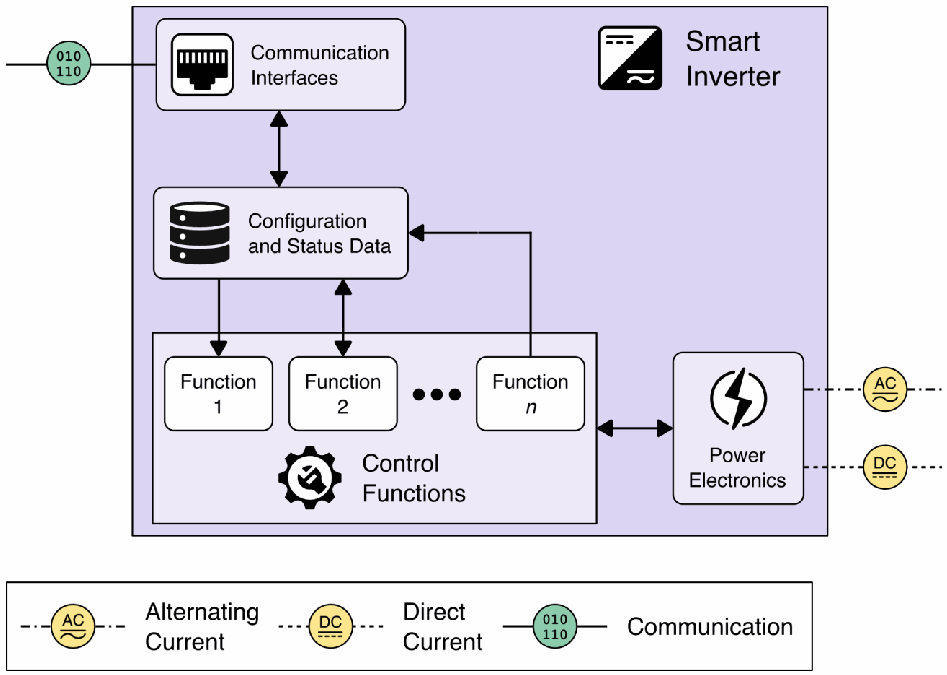
スマートインバータ内部の機能要素のブロック図です(網掛けの枠。スマートインバータのアイコン付き)。上部の Communication Interfaces(通信インタフェース。ネットワークポートのアイコン)は外部の通信の線(010/110)につながり、Configuration and Status Data(設定と状態のデータ。データベースのアイコン)と双方向の矢印で結ばれています。その下の Control Functions(制御機能。歯車のアイコン)の枠には Function 1、Function 2、省略記号、Function n があり、設定と状態のデータから Function 1 へ矢印、Function 2 とは双方向の矢印、Function n から設定と状態のデータへ戻る矢印があります。制御機能の枠は Power Electronics(パワーエレクトロニクス。稲妻のアイコン)と双方向の矢印で結ばれ、パワーエレクトロニクスはインバータの外の AC の線と DC の線につながっています。下部の凡例は線の種類を示し、Alternating Current(交流、AC)、Direct Current(直流、DC)、Communication(通信、010/110)です。
Fig. 10. Functional elements of a smart inverter
図 10. スマートインバーターの機能要素
Table 2. Non-technical cybersecurity capability recommendations
表 2. 非技術的なサイバーセキュリティ機能に関する推奨事項
| IR 8259B Non-Technical Device Cybersecurity Capability | Additional Smart-Inverter Cybersecurity Capability Recommendation Information for Manufacturers | Smart-Inverter-Specific Cybersecurity Capability Description |
|---|---|---|
| Documentation: The ability for the manufacturer and/or the manufacturer's supporting entity, to create, gather, and store information relevant to cybersecurity of the IoT device prior to customer purchase, and throughout the development of a device and its subsequent lifecycle. | The manufacturer provides and maintains a Software Bill of Materials (SBOM) for the smart inverter. This recommendation supports Guideline #4. | An SBOM provides details on the libraries and software used in a product so that owners and maintainers can determine whether a newly discovered vulnerability applies to the software in a particular device. The SBOM should be maintained throughout the life of a smart inverter and reflect the current state of system software, including changes that result from software updates. |
| The manufacturer creates documentation that enables owners and installers to perform Guidelines #1-7. | Extensive documentation may be required to enable owners and installers to perform all recommended Guidelines. This documentation may include how to:
| |
| Information and Query Reception: The ability for the manufacturer and/or supporting entity to receive information and queries from the customer and others related to cybersecurity of the IoT device. | The manufacturer initiates capabilities to receive information about smart-inverter vulnerabilities. This recommendation supports Guideline #4. | Manufacturers need to have capabilities to receive information about smart-inverter vulnerabilities and other issues with a product in order to develop software updates and improvements. |
| The manufacturer initiates capabilities to receive and respond to questions from owners and installers about the smart inverter. This recommendation supports Guidelines #1-7. | Owners and installers may encounter issues during all phases of the smart-inverter life cycle, including installation, initial configuration, and routine maintenance during system operation. Manufacturers should have a way to receive questions from owners and installers and to respond in a timely manner. | |
| Information Dissemination: The ability for the manufacturer and/or supporting entity to broadcast and distribute (e.g., to the customer or others in the IoT device ecosystem) information related to cybersecurity of the IoT device. | The manufacturer disseminates updated information that enables owners and installers to perform Guidelines #1-7. | Throughout a smart-inverter’s support life cycle, there will likely be new information about relevant threats, vulnerabilities, and risks that impact cybersecurity and the implementation of the guidelines. Manufacturers should have capabilities in place to disseminate updated documentation, bulletins, and/or notices so that owners and installers can successfully perform all recommended guidelines. |
| Education and Awareness: The ability for the manufacturer and/or supporting entity to create awareness of and educate customers and others in the IoT device ecosystem about cybersecurity-related information, considerations, features, etc., of the IoT device. | The manufacturer provides relevant information and awareness materials in a format that is easily understood by owners and installers. This recommendation supports Guidelines #1-7. | The secure and safe installation and maintenance of a smart inverter depends on effective education and awareness. Manufacturers can help ensure that owners and installers successfully perform all recommended guidelines by providing information, resources, and awareness materials in a format that can be easily used and understood. |
| IR 8259B の非技術的な機器サイバーセキュリティ機能 | 製造者向けの、スマートインバーターのサイバーセキュリティ機能に関する追加の推奨事項 | スマートインバーター固有のサイバーセキュリティ機能の説明 |
|---|---|---|
| 文書化(Documentation): 製造者および/または製造者の支援エンティティが、顧客による購入前、ならびに機器の開発期間中からその後のライフサイクルを通じて、IoT 機器のサイバーセキュリティに関連する情報を作成、収集、保存する能力。 | 製造者は、スマートインバーターのソフトウェア部品表(SBOM)を提供し、維持します。この推奨事項はガイドライン #4 を支えます。 | SBOM は、製品で使用されているライブラリとソフトウェアの詳細を提供するため、所有者や保守者は、新たに発見された脆弱性が特定の機器のソフトウェアに該当するかどうかを判断できます。 SBOM は、スマートインバーターの存続期間を通じて維持し、ソフトウェア更新による変更を含め、システムソフトウェアの現在の状態を反映すべきです。 |
| 製造者は、所有者と設置者がガイドライン #1〜7 を実施できるようにする文書を作成します。 | 推奨されるすべてのガイドラインを所有者と設置者が実施できるようにするには、広範な文書が必要になる場合があります。この文書には、次の方法が含まれる場合があります。
| |
| 情報・問い合わせの受付(Information and Query Reception): 製造者および/または支援エンティティが、IoT 機器のサイバーセキュリティに関連する情報や問い合わせを、顧客やその他から受け付ける能力。 | 製造者は、スマートインバーターの脆弱性に関する情報を受け付ける機能を整備します。この推奨事項はガイドライン #4 を支えます。 | 製造者は、ソフトウェア更新と改善を開発するために、スマートインバーターの脆弱性や製品のその他の問題に関する情報を受け付ける機能を備える必要があります。 |
| 製造者は、スマートインバーターに関する所有者や設置者からの質問を受け付け、それに回答する機能を整備します。この推奨事項はガイドライン #1〜7 を支えます。 | 所有者と設置者は、設置、初期構成、システム運用中の定期保守など、スマートインバーターのライフサイクルのあらゆる段階で問題に直面する場合があります。製造者は、所有者と設置者からの質問を受け付け、適時に回答する手段を持つべきです。 | |
| 情報の周知(Information Dissemination): 製造者および/または支援エンティティが、IoT 機器のサイバーセキュリティに関連する情報を(顧客や IoT 機器のエコシステム内のその他に対して)広く知らせ、配布する能力。 | 製造者は、所有者と設置者がガイドライン #1〜7 を実施できるようにする更新情報を周知します。 | スマートインバーターのサポートライフサイクルを通じて、サイバーセキュリティやガイドラインの実装に影響する、関連する脅威、脆弱性、リスクに関する新たな情報が生じると見込まれます。製造者は、所有者と設置者が推奨されるすべてのガイドラインを実施できるよう、更新された文書、速報、通知を周知する機能を整備しておくべきです。 |
| 教育と啓発(Education and Awareness): 製造者および/または支援エンティティが、IoT 機器のサイバーセキュリティに関連する情報、考慮事項、機能などについて、顧客や IoT 機器のエコシステム内のその他に対して啓発し、教育する能力。 | 製造者は、所有者と設置者が容易に理解できる形式で、関連する情報と啓発資料を提供します。この推奨事項はガイドライン #1〜7 を支えます。 | スマートインバーターのセキュアで安全な設置と保守は、効果的な教育と啓発に依存します。製造者は、容易に利用・理解できる形式で情報、リソース、啓発資料を提供することで、所有者と設置者が推奨されるすべてのガイドラインを実施できるよう支援できます。 |
Homeowners, small business owners, grid operators, and society reasonably expect residential and light-commercial solar energy systems to operate safely and reliably. Smart-inverter manufacturers should fully address these expectations in their products.
住宅所有者、小規模事業主、電力網の運用者、そして社会は、住宅用および小規模商業用の太陽光発電システムが安全かつ確実に動作することを当然に期待しています。スマートインバーターの製造者は、自社の製品でこれらの期待に十分に応えるべきです。
4. Conclusion
4. 結論
Smart inverters are exposed to an array of potential cybersecurity threats, creating risks that can affect their intended operation. The growing prevalence of, dependence on, and interconnection of these systems means that risks to smart inverters can create broader risks to the electrical grid.
スマートインバーターはさまざまな潜在的サイバーセキュリティ脅威にさらされており、本来の動作に影響しうるリスクが生じています。これらのシステムの普及、依存、相互接続が進んでいることは、スマートインバーターへのリスクが、電力網により広範なリスクをもたらしうることを意味します。
This report provides seven basic cybersecurity guidelines for solar energy system owners, installers, and maintainers to improve the secure installation and operation of small-scale residential and small-business solar energy systems. This report also provides cybersecurity recommendations for smart-inverter manufacturers. These recommendations provide smart-inverter-specific guidance for some of the IoT cybersecurity capability baselines in IR 8259A [1] and IR 8259B [2]. Manufacturers should consider including all of the baseline cybersecurity capabilities in their products to enable owners and installers to implement the seven basic guidelines.
本報告書は、太陽光発電システムの所有者、設置者、保守者が、小規模な住宅用および小規模事業所用の太陽光発電システムのセキュアな設置と運用を改善するための、7 つの基本的なサイバーセキュリティガイドラインを示します。本報告書はまた、スマートインバーター製造者向けのサイバーセキュリティ推奨事項も示します。これらの推奨事項は、IR 8259A [1] と IR 8259B [2] にある IoT のサイバーセキュリティ機能ベースラインの一部について、スマートインバーター固有のガイダンスを提供するものです。製造者は、所有者と設置者が 7 つの基本的なガイドラインを実装できるよう、ベースラインのサイバーセキュリティ機能のすべてを製品に含めることを検討すべきです。
These guidelines and recommendations were derived from several sources. The NVD was reviewed to identify known vulnerabilities (see Appendix F) in existing smart inverters, and the guidelines suggest actions to reduce the risks from these vulnerabilities where possible. Six sources of general cybersecurity guidance were reviewed to identify specific guidelines and recommendations for smart inverters and solar energy system component manufacturers (see Appendix E). The practicality of the guidelines was verified by applying them to five existing commercially available smart inverters, and only two could implement all seven guidelines (see Appendix D). The recommendations, if followed by manufacturers, should enable future smart inverters to implement all seven guidelines.
これらのガイドラインと推奨事項は、複数の出典から導かれたものです。既存のスマートインバーターの既知の脆弱性(付録 F を参照)を特定するために NVD を調査し、ガイドラインでは、可能な場合にそれらの脆弱性によるリスクを低減するための行動を提案しています。スマートインバーターおよび太陽光発電システムのコンポーネント製造者に対する具体的なガイドラインと推奨事項を特定するために、一般的なサイバーセキュリティガイダンスの 6 つの出典を調査しました(付録 E を参照)。ガイドラインの実用性は、市販されている既存の 5 台のスマートインバーターに適用して検証し、7 つのガイドラインすべてを実装できたのは 2 台だけでした(付録 D を参照)。製造者が推奨事項に従えば、将来のスマートインバーターが 7 つのガイドラインすべてを実装できるようになるはずです。
References
参考文献
[1] Fagan MJ, Megas KN, Scarfone KA, Smith M (2020) IoT Device Cybersecurity Capability Core Baseline. (National Institute of Standards and Technology, Gaithersburg, MD), NIST Interagency or Internal Report (IR) NIST IR 8259A. https://doi.org/10.6028/NIST.IR.8259A.
[1] Fagan MJ, Megas KN, Scarfone KA, Smith M (2020) IoT Device Cybersecurity Capability Core Baseline. (National Institute of Standards and Technology, Gaithersburg, MD), NIST Interagency or Internal Report (IR) NIST IR 8259A. https://doi.org/10.6028/NIST.IR.8259A.
[2] Fagan MJ, Marron JA, Brady KG, Jr., Cuthill BB, Megas K, Herold R (2021) IoT Non-Technical Supporting Capability Core Baseline. (National Institute of Standards and Technology, Gaithersburg, MD), NIST Interagency or Internal Report (IR) NIST IR 8259B. https://doi.org/10.6028/NIST.IR.8259B.
[2] Fagan MJ, Marron JA, Brady KG, Jr., Cuthill BB, Megas K, Herold R (2021) IoT Non-Technical Supporting Capability Core Baseline. (National Institute of Standards and Technology, Gaithersburg, MD), NIST Interagency or Internal Report (IR) NIST IR 8259B. https://doi.org/10.6028/NIST.IR.8259B.
[3] U.S. Energy Information Administration (2024) EIA expects U.S. annual solar electricity generation to surpass hydropower in 2024. Available at https://www.eia.gov/todayinenergy/detail.php?id=60922.
[3] U.S. Energy Information Administration (2024) EIA expects U.S. annual solar electricity generation to surpass hydropower in 2024. Available at https://www.eia.gov/todayinenergy/detail.php?id=60922.
[4] Grassi PA, Newton EM, Perlner RA, Regenscheid AR, Fenton JL, Burr WE, Richer JP, Lefkovitz NB, Danker JM, Choong Y-Y, Greene KK, Theofanos MF (2017) Digital Identity Guidelines: Authentication and Lifecycle Management. (National Institute of Standards and Technology, Gaithersburg, MD), NIST Special Publication (SP) NIST SP 800-63B. Includes updates as of March 02, 2020. https://doi.org/10.6028/NIST.SP.800-63B.
[4] Grassi PA, Newton EM, Perlner RA, Regenscheid AR, Fenton JL, Burr WE, Richer JP, Lefkovitz NB, Danker JM, Choong Y-Y, Greene KK, Theofanos MF (2017) Digital Identity Guidelines: Authentication and Lifecycle Management. (National Institute of Standards and Technology, Gaithersburg, MD), NIST Special Publication (SP) NIST SP 800-63B. Includes updates as of March 02, 2020. https://doi.org/10.6028/NIST.SP.800-63B.
[5] CISA (2019) Choosing and Protecting Passwords | CISA. Available at https://www.cisa.gov/news-events/news/choosing-and-protecting-passwords.
[5] CISA (2019) Choosing and Protecting Passwords | CISA. Available at https://www.cisa.gov/news-events/news/choosing-and-protecting-passwords.
[6] Brennan B, Smith K (2021) FBI Tech Tuesday: Strong Passphrases and Account Protection. Federal Bureau of Investigation. Available at https://www.fbi.gov/contact-us/field-offices/phoenix/news/press-releases/fbi-tech-tuesday-strong-passphrases-and-account-protection.
[6] Brennan B, Smith K (2021) FBI Tech Tuesday: Strong Passphrases and Account Protection. Federal Bureau of Investigation. Available at https://www.fbi.gov/contact-us/field-offices/phoenix/news/press-releases/fbi-tech-tuesday-strong-passphrases-and-account-protection.
[7] Fagan MJ, Megas KN, Scarfone KA, Smith M (2020) Foundational Cybersecurity Activities for IoT Device Manufacturers. (National Institute of Standards and Technology, Gaithersburg, MD), NIST Interagency or Internal Report (IR) NIST IR 8259. https://doi.org/10.6028/NIST.IR.8259.
[7] Fagan MJ, Megas KN, Scarfone KA, Smith M (2020) Foundational Cybersecurity Activities for IoT Device Manufacturers. (National Institute of Standards and Technology, Gaithersburg, MD), NIST Interagency or Internal Report (IR) NIST IR 8259. https://doi.org/10.6028/NIST.IR.8259.
[8] Fagan M, Megas KN, Watrobski P, Marron J, Cuthill B (2022) Profile of the IoT Core Baseline for Consumer IoT Products. (National Institute of Standards and Technology, Gaithersburg, MD), NIST Interagency or Internal Report (IR) NIST IR 8425. https://doi.org/10.6028/NIST.IR.8425.
[8] Fagan M, Megas KN, Watrobski P, Marron J, Cuthill B (2022) Profile of the IoT Core Baseline for Consumer IoT Products. (National Institute of Standards and Technology, Gaithersburg, MD), NIST Interagency or Internal Report (IR) NIST IR 8425. https://doi.org/10.6028/NIST.IR.8425.
[9] Fagan MJ, Megas KN, Marron JA, Brady KG, Jr., Cuthill BB, Herold R, Lemire D, Hoehn B (2021) IoT Device Cybersecurity Guidance for the Federal Government: IoT Device Cybersecurity Requirement Catalog. (National Institute of Standards and Technology, Gaithersburg, MD), NIST Special Publication (SP) NIST SP 800-213A. https://doi.org/10.6028/NIST.SP.800-213A.
[9] Fagan MJ, Megas KN, Marron JA, Brady KG, Jr., Cuthill BB, Herold R, Lemire D, Hoehn B (2021) IoT Device Cybersecurity Guidance for the Federal Government: IoT Device Cybersecurity Requirement Catalog. (National Institute of Standards and Technology, Gaithersburg, MD), NIST Special Publication (SP) NIST SP 800-213A. https://doi.org/10.6028/NIST.SP.800-213A.
[10] Joint Task Force (2022) Assessing Security and Privacy Controls in Information Systems and Organizations. (National Institute of Standards and Technology, Gaithersburg, MD), NIST Special Publication (SP) 800-53A, Rev. 5. https://doi.org/10.6028/NIST.SP.800-53Ar5.
[10] Joint Task Force (2022) Assessing Security and Privacy Controls in Information Systems and Organizations. (National Institute of Standards and Technology, Gaithersburg, MD), NIST Special Publication (SP) 800-53A, Rev. 5. https://doi.org/10.6028/NIST.SP.800-53Ar5.
[11] National Institute of Standards and Technology (2024) The NIST Cybersecurity Framework (CSF) 2.0. (National Institute of Standards and Technology, Gaithersburg, MD) NIST Cybersecurity White Paper (CSWP) NIST CSWP 29. https://doi.org/10.6028/NIST.CSWP.29.
[11] National Institute of Standards and Technology (2024) The NIST Cybersecurity Framework (CSF) 2.0. (National Institute of Standards and Technology, Gaithersburg, MD) NIST Cybersecurity White Paper (CSWP) NIST CSWP 29. https://doi.org/10.6028/NIST.CSWP.29.
[12] CIS (2021) CIS Critical Security Controls® v8. Available at https://www.cisecurity.org/controls/v8.
[12] CIS (2021) CIS Critical Security Controls® v8. Available at https://www.cisecurity.org/controls/v8.
[13] Joint Task Force (2020) Security and Privacy Controls for Information Systems and Organizations. (National Institute of Standards and Technology, Gaithersburg, MD), NIST Special Publication (SP) NIST SP 800-53r5. Includes updates as of December 10, 2020. https://doi.org/10.6028/NIST.SP.800-53r5.
[13] Joint Task Force (2020) Security and Privacy Controls for Information Systems and Organizations. (National Institute of Standards and Technology, Gaithersburg, MD), NIST Special Publication (SP) NIST SP 800-53r5. Includes updates as of December 10, 2020. https://doi.org/10.6028/NIST.SP.800-53r5.
[14] MITRE, MITRE ATT&CK®. Available at https://attack.mitre.org.
[14] MITRE, MITRE ATT&CK®. Available at https://attack.mitre.org.
[15] International Society of Automation/International Electrotechnical Commission (2009) ISA/IEC 62443-2-1-2009 Security for Industrial Automation and Control Systems Part 2-1: Establishing an industrial automation and control system security program. Available at https://webstore.ansi.org/search/find?in=1&st=ANSI%2FISA-62443-2-1+%2899.02.01%29-2009.
[15] International Society of Automation/International Electrotechnical Commission (2009) ISA/IEC 62443-2-1-2009 Security for Industrial Automation and Control Systems Part 2-1: Establishing an industrial automation and control system security program. Available at https://webstore.ansi.org/search/find?in=1&st=ANSI%2FISA-62443-2-1+%2899.02.01%29-2009.
Appendix A. Additional Resources
付録 A. 追加リソース
•NERC (2023) Electric Vehicle Dynamic Charging Performance Characteristics during Bulk Power System Disturbances. Available at https://www.nerc.com/comm/RSTC/Documents/Grid_Friendly_EV_Charging_Recommendations.pdf
•NERC (2023) Electric Vehicle Dynamic Charging Performance Characteristics during Bulk Power System Disturbances. Available at https://www.nerc.com/comm/RSTC/Documents/Grid_Friendly_EV_Charging_Recommendations.pdf
•Center for Internet Security CIS Controls Version 8. Available at https://www.cisecurity.org/controls/v8
•Center for Internet Security CIS Controls Version 8. 入手先: https://www.cisecurity.org/controls/v8
•National Institute of Standards and Technology (2018) Framework for Improving Critical Infrastructure Cybersecurity, Version 1.1. (National Institute of Standards and Technology, Gaithersburg, MD), NIST Cybersecurity White Paper (CSWP) NIST CSWP 6. https://doi.org/10.6028/NIST.CSWP.6
•National Institute of Standards and Technology (2018) Framework for Improving Critical Infrastructure Cybersecurity, Version 1.1. (National Institute of Standards and Technology, Gaithersburg, MD), NIST Cybersecurity White Paper (CSWP) NIST CSWP 6. https://doi.org/10.6028/NIST.CSWP.6
•NIST (2019) National Vulnerability Database – Home. Available at https://nvd.nist.gov/
•NIST (2019) National Vulnerability Database – Home. Available at https://nvd.nist.gov/
•P. Ruggiero and M. Heckathorn (2012) Data Backup Options. Available at https://www.cisa.gov/sites/default/files/publications/data_backup_options.pdf
•P. Ruggiero and M. Heckathorn (2012) Data Backup Options. Available at https://www.cisa.gov/sites/default/files/publications/data_backup_options.pdf
•M. Wilson (2022) Why solar ‘tripping’ is a grid threat for renewables. E&E News. Available at https://www.eenews.net/articles/why-solar-tripping-is-a-grid-threat-for-renewables/
•M. Wilson (2022) Why solar ‘tripping’ is a grid threat for renewables. E&E News. Available at https://www.eenews.net/articles/why-solar-tripping-is-a-grid-threat-for-renewables/
•National Security Agency (2023) Best Practices for Securing Your Home Network, Version 1.0. (National Security Agency, Ft. Meade, MD). Available at https://media.defense.gov/2023/Feb/22/2003165170/-1/-1/0/CSI_BEST_PRACTICES_FOR_SECURING_YOUR_HOME_NETWORK.PDF
•National Security Agency (2023) Best Practices for Securing Your Home Network, Version 1.0. (National Security Agency, Ft. Meade, MD). 入手先: https://media.defense.gov/2023/Feb/22/2003165170/-1/-1/0/CSI_BEST_PRACTICES_FOR_SECURING_YOUR_HOME_NETWORK.PDF
•U.S. Energy Information Administration (2020) Solar generation was 3% of U.S. electricity in 2020, but we project it will be 50% by 2050. Available at U.S. Energy Information Administration - EIA - Independent Statistics and Analysis
•U.S. Energy Information Administration (2020) Solar generation was 3% of U.S. electricity in 2020, but we project it will be 50% by 2050. 入手先: U.S. Energy Information Administration - EIA - Independent Statistics and Analysis
•U.S. Department of Energy (2023) Cyber-Informed Engineering Implementation Guide Version 1.0. Available at https://inldigitallibrary.inl.gov/sites/sti/sti/Sort_67122.pdf
•U.S. Department of Energy (2023) Cyber-Informed Engineering Implementation Guide Version 1.0. 入手先: https://inldigitallibrary.inl.gov/sites/sti/sti/Sort_67122.pdf
Appendix B. List of Symbols, Abbreviations, and Acronyms
付録 B. 記号・略語・頭字語の一覧
AC Alternating Current
AC 交流
CIS Center for Internet Security
CIS Center for Internet Security
CISA Cybersecurity and Infrastructure Security Agency
CISA Cybersecurity and Infrastructure Security Agency
DC Direct Current
DC 直流
FBI Federal Bureau of Investigation
FBI Federal Bureau of Investigation
IoT Internet of Things
IoT Internet of Things
ISA/IEC International Society of Automation/International Electrotechnical Commission
ISA/IEC International Society of Automation/International Electrotechnical Commission
ISP Internet Service Provider
ISP インターネットサービスプロバイダー
NCCoE National Cybersecurity Center of Excellence
NCCoE National Cybersecurity Center of Excellence
NIST National Institute of Standards and Technology
NIST National Institute of Standards and Technology
NIST IR NIST Interagency or Internal Report
NIST IR NIST Interagency or Internal Report
NVD National Vulnerability Database
NVD National Vulnerability Database
RBAC Role-Based Access Control
RBAC ロールベースアクセス制御
SBOM Software Bill of Material
SBOM ソフトウェア部品表
USB Universal Serial Bus
USB ユニバーサルシリアルバス
US-CERT United States Computer Emergency Readiness Team
US-CERT United States Computer Emergency Readiness Team
VPN Virtual Private Network
VPN 仮想プライベートネットワーク
Appendix C. Residential and Light Commercial Solar Energy System Setup Cybersecurity Checklist
付録 C. 住宅用および小規模商業用の太陽光発電システムのセットアップに関するサイバーセキュリティチェックリスト
| Action | Notes | |
|---|---|---|
| Guideline #1 – Change Default Passwords and Credentials | ☐ Change default or device-specific passwords to unique, secure passwords | |
| ☐ Change other default credentials to unique, secure values | ||
| ☐ Use MFA, if available | ||
| Guideline #2 – Use Role-Based Access Control (RBAC) | ☐ Create user accounts | |
| ☐ Create user roles | ||
| ☐ Assign user accounts to roles | ||
| ☐ Disable unused accounts | ||
| Guideline #3 – Configure the Recording of Events in a Log | ☐ Enable and configure logging | |
| ☐ Setup external location for logs | ||
| Guideline #4 – Update Software Regularly | ☐ Download and verify newest software/firmware version | |
| ☐ Update device with current software/firmware version | ||
| Guideline #5 – Backup and Restore System Information | ☐ Download device configuration | |
| ☐ Download all available configurations | ||
| ☐ Store configuration in retrievable location | ||
| Guideline #6 – Disable Unused Features | ☐ Disable unused interfaces, features, etc. | |
| ☐ Enable security features | ||
| Guideline #7 – Protect the Communications Connections | ☐ Device is isolated from a personal network |
| 行動 | 備考 | |
|---|---|---|
| ガイドライン #1 – 既定のパスワードと認証情報の変更 | ☐ 既定のパスワードまたは機器固有のパスワードを、一意でセキュアなパスワードに変更する | |
| ☐ その他の既定の認証情報を、一意でセキュアな値に変更する | ||
| ☐ 利用可能な場合は MFA を使用する | ||
| ガイドライン #2 – ロールベースアクセス制御(RBAC)の使用 | ☐ ユーザーアカウントを作成する | |
| ☐ ユーザーロールを作成する | ||
| ☐ ユーザーアカウントをロールに割り当てる | ||
| ☐ 未使用のアカウントを無効にする | ||
| ガイドライン #3 – イベントをログに記録する設定 | ☐ ログ記録を有効にして構成する | |
| ☐ ログの外部保存先を設定する | ||
| ガイドライン #4 – ソフトウェアの定期的な更新 | ☐ 最新のソフトウェア/ | |
| ☐ 機器を現行のソフトウェア/ | ||
| ガイドライン #5 – システム情報のバックアップと復元 | ☐ 機器の構成をダウンロードする | |
| ☐ 利用可能なすべての構成をダウンロードする | ||
| ☐ 構成を取り出し可能な場所に保存する | ||
| ガイドライン #6 – 未使用の機能の無効化 | ☐ 未使用のインターフェースや機能などを無効にする | |
| ☐ セキュリティ機能を有効にする | ||
| ガイドライン #7 – 通信接続の保護 | ☐ 機器が個人のネットワークから分離されている |
Appendix D. Smart-Inverter Testing
付録 D. スマートインバーターの試験
Five smart inverters were analyzed to determine their ability to support the cybersecurity guidelines presented in Sec. 2. This testing was performed in Fall 2022 with smart inverters that were commercially available at that time. Testing was conducted in one of two ways: Examine and Test.
5 台のスマートインバーターについて、第 2 節で示したサイバーセキュリティガイドラインを支える能力を判定するために分析しました。この試験は、2022年秋に、当時市販されていたスマートインバーターを用いて実施しました。試験は、検査(Examine)と試験(Test)の 2 通りの方法のいずれかで実施しました。
•Examine reviewed publicly available documentation to determine whether it was possible to implement the recommendation.
•検査(Examine)では、公開されている文書を確認して、推奨事項を実装することが可能かどうかを判断しました。
•Tests used interactions with an inverter through one of its communication interfaces to determine whether the guidelines could be implemented.10
•試験(Test)では、インバーターの通信インターフェースの 1 つを通じてインバーターとやり取りし、ガイドラインを実装できるかどうかを判断しました。10
Each tested inverter implemented one of three connection methods:
試験した各インバーターは、3 つの接続方法のいずれかを実装していました。
1.Direct connection to the inverter. This interface method requires the inverter itself to be capable of implementing all of the cybersecurity guidelines.
1.インバーターへの直接接続。 この接続方法では、インバーター自体がサイバーセキュリティガイドラインのすべてを実装できる必要があります。
2.Gateway device connection to the inverter. This interface method allows the gateway device to implement some of the cybersecurity guidelines.
2.インバーターへのゲートウェイ機器経由の接続。 この接続方法では、ゲートウェイ機器がサイバーセキュリティガイドラインの一部を実装できます。
3.Cloud-based service connection to the inverter. Cloud-based services typically connected to an inverter through a gateway device. This interface method allows for implementation of the cybersecurity guidelines to be distributed among the inverter, the gateway device, and the cloud-based service.
3.インバーターへのクラウドベースサービス経由の接続。 クラウドベースのサービスは、通常、ゲートウェイ機器を介してインバーターに接続されます。この接続方法では、サイバーセキュリティガイドラインの実装を、インバーター、ゲートウェイ機器、クラウドベースのサービスに分散できます。
For gateway device connections and cloud-based service connections, testing did not determine which components of the connection implemented the cybersecurity guidelines (see Fig. 11).
ゲートウェイ機器経由の接続とクラウドベースサービス経由の接続については、接続のどのコンポーネントがサイバーセキュリティガイドラインを実装しているかは、試験では判定しませんでした(図 11 を参照)。
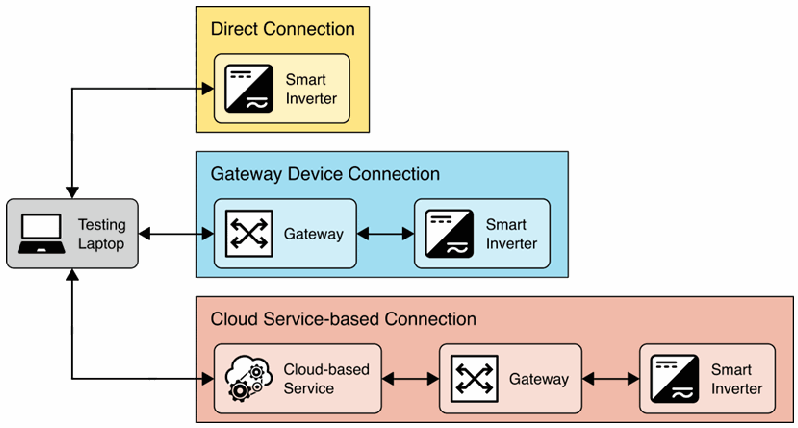
3 つのインバータ接続方式の図で、それぞれが左側の Testing Laptop(試験用ノート PC)と双方向の矢印で結ばれています。Direct Connection(直接接続。黄色の枠)では、ノート PC が Smart Inverter(スマートインバータ)に直接つながります。Gateway Device Connection(ゲートウェイ装置経由の接続。青の枠)では、ノート PC が Gateway(ゲートウェイ)につながり、ゲートウェイが双方向の矢印でスマートインバータにつながります。Cloud Service-based Connection(クラウドサービス経由の接続。赤の枠)では、ノート PC が Cloud-based Service(クラウドベースのサービス)に、それが Gateway に、さらにスマートインバータにつながり、いずれも双方向の矢印です。
Fig. 11. Inverter connection methods
図 11. インバーターの接続方法
Table 3. Characteristics of tested inverters
表 3. 試験したインバーターの特性
| System | Inverter Size11 | External Gateway12 | Cloud Connectivity13 |
|---|---|---|---|
| Inverter A | 5.5 kW | Yes | Yes |
| Inverter B | 5.5 kW | Yes | No |
| Inverter C | 10.5 kW | Yes | Yes |
| Inverter D | 5 kW | Yes | Yes |
| Inverter E | 15 kW | No | No |
| システム | インバーターの容量11 | 外部ゲートウェイ12 | クラウド接続13 |
|---|---|---|---|
| インバーター A | 5.5 kW | あり | あり |
| インバーター B | 5.5 kW | あり | なし |
| インバーター C | 10.5 kW | あり | あり |
| インバーター D | 5 kW | あり | あり |
| インバーター E | 15 kW | なし | なし |
D.1. Testing Results for Guideline #1: Change Default Passwords and Credentials
D.1. ガイドライン #1 の試験結果: 既定のパスワードと認証情報の変更
This test verified a smart-inverter’s ability to identify all default accounts and change the default credentials associated with those accounts to a unique, secure credential. This test was considered passed if:
この試験では、スマートインバーターが、すべての既定のアカウントを識別し、それらのアカウントに関連付けられた既定の認証情報を、一意でセキュアな認証情報に変更できるかどうかを検証しました。この試験は、次の場合に合格とみなしました。
•The vendor documentation identified all default account credentials
•ベンダーの文書がすべての既定のアカウントの認証情報を特定していた
•All default account credentials could be changed
•すべての既定のアカウントの認証情報を変更できた
•The inverter supported MFA
•インバーターが MFA をサポートしていた
Table 4. Guideline #1 testing results
表 4. ガイドライン #1 の試験結果
| Inverter | Default Accounts in Vendor Documentation [#] | Identified Default Accounts on Device [#] | Ability to Change Credentials [Yes/No] | Ability to implement MFA [Yes/No] |
|---|---|---|---|---|
| A | 3 | 3 | Yes | No |
| B | 2 | 2 | Yes | No |
| C | NA14 | NA | Yes | No |
| D | NA | NA | Yes | No |
| E | 2 | 2 | Yes | No |
| インバーター | ベンダーの文書にある既定のアカウント[数] | 機器上で識別された既定のアカウント[数] | 認証情報を変更する能力[あり/なし] | MFA を実装する能力[あり/なし] |
|---|---|---|---|---|
| A | 3 | 3 | あり | なし |
| B | 2 | 2 | あり | なし |
| C | NA14 | NA | あり | なし |
| D | NA | NA | あり | なし |
| E | 2 | 2 | あり | なし |
D.2. Testing Results for Guideline #2: Use Role-Based Access Control
D.2. ガイドライン #2 の試験結果: ロールベースアクセス制御の使用
This test verified a smart-inverter’s ability to manage access to features and capabilities using RBAC. Three levels of access control were identified for smart inverters:
この試験では、スマートインバーターが RBAC を使って機能や能力へのアクセスを管理できるかどうかを検証しました。スマートインバーターについて、アクセス制御の 3 つのレベルを特定しました。
1.Level 1 — Basic. The smart inverter provides a single user account. The ability to log in to the single user account provides access to all smart-inverter features and capabilities.
1.レベル 1 — 基本。 スマートインバーターは単一のユーザーアカウントを提供します。その単一のユーザーアカウントにログインできれば、スマートインバーターのすべての機能と能力にアクセスできます。
2.Level 2 — Role Account. The smart inverter provides a single account per defined role, such as Installer, Maintainer, or Owner. The role account credential is shared with people who are authorized to act in that role. The ability to log in to a role account provides access to all features and capabilities associated with that role.
2.レベル 2 — ロールアカウント。 スマートインバーターは、設置者(Installer)、保守者(Maintainer)、所有者(Owner)など、定義されたロールごとに 1 つのアカウントを提供します。ロールアカウントの認証情報は、そのロールとして行動することを認可された人々と共有されます。ロールアカウントにログインできれば、そのロールに関連付けられたすべての機能と能力にアクセスできます。
3.Level 3 — RBAC. The smart inverter provides the capability to define a collection of roles and associated access permissions. Users are granted access by assigning their accounts to those defined roles.
3.レベル 3 — RBAC。 スマートインバーターは、ロールの集合と関連するアクセス許可を定義する機能を提供します。ユーザーのアカウントを定義済みのロールに割り当てることで、ユーザーにアクセス権が付与されます。
This test assessed the level of access control supported by the inverter.
この試験では、インバーターがサポートするアクセス制御のレベルを評価しました。
Table 5. Guideline #2 testing results
表 5. ガイドライン #2 の試験結果
| Inverter | Access Control Level Supported |
|---|---|
| A | Level 3 |
| B | Level 2 |
| C | Level 3 |
| D | Level 3 |
| E | Level 2 |
| インバーター | サポートされるアクセス制御のレベル |
|---|---|
| A | レベル 3 |
| B | レベル 2 |
| C | レベル 3 |
| D | レベル 3 |
| E | レベル 2 |
Some level of access control based on roles was supported by all five of the smart inverters tested. Most smart inverters supported an “administrator/installer” account/role and a “user” account/role. Some smart inverters also supported a “Guest” account/role.
試験した 5 台のスマートインバーターはすべて、ロールに基づく何らかのレベルのアクセス制御をサポートしていました。ほとんどのスマートインバーターは、「administrator/installer」アカウント/ロールと「user」アカウント/ロールをサポートしていました。一部のスマートインバーターは、「Guest」アカウント/ロールもサポートしていました。
D.3. Testing Results for Guideline #3: Configure the Recording of Events in a Log
D.3. ガイドライン #3 の試験結果: イベントをログに記録する設定
This test verified a smart-inverter’s ability to record security-relevant events in a log and periodically export them to an external source.
この試験では、スマートインバーターが、セキュリティに関連するイベントをログに記録し、定期的に外部の情報源へエクスポートできるかどうかを検証しました。
This test was considered passed if the device could:
この試験は、機器が次のことをできた場合に合格とみなしました。
•Record the following security-related events in its log:
•次のセキュリティ関連イベントをログに記録する:
•Successful login
•ログイン成功
•Failed login
•ログイン失敗
•Configuration changes
•構成の変更
•Firmware updates
•ファームウェアの更新
•Events, including network connections
•ネットワーク接続を含むイベント
•Export the logs to an external source
•ログを外部の情報源へエクスポートする
Table 6. Guideline #3 testing results
表 6. ガイドライン #3 の試験結果
| Inverter | Supports Logging | Support Security-Related Event Logging |
|---|---|---|
| A | Yes | No |
| B | Yes | No |
| C | Yes | No |
| D | Yes | No |
| E | Yes | Yes |
| インバーター | ログ記録のサポート | セキュリティ関連イベントのログ記録のサポート |
|---|---|---|
| A | あり | なし |
| B | あり | なし |
| C | あり | なし |
| D | あり | なし |
| E | あり | あり |
While all of the tested devices supported logging, most of their logging capabilities focused on the functions related to inverter operation (e.g., power output, grid connectivity) and provided little security-related information. Only one of the tested smart inverters fully supported the test criteria.
試験したすべての機器がログ記録をサポートしていましたが、そのログ記録機能の大半は、インバーターの動作(出力電力、電力網への接続性など)に関連する機能に焦点を当てており、セキュリティ関連の情報はほとんど提供していませんでした。試験基準を完全に満たしたスマートインバーターは 1 台だけでした。
D.4. Testing Results for Guideline #4: Update Software Regularly
D.4. ガイドライン #4 の試験結果: ソフトウェアの定期的な更新
This test verified a smart-inverter’s ability to update its software in both the setup and maintenance life cycle phases.
この試験では、スマートインバーターが、セットアップと保守の両方のライフサイクル段階でソフトウェアを更新できるかどうかを検証しました。
This test was considered passed if:
この試験は、次の場合に合格とみなしました。
•The smart inverter had a mechanism to perform software updates.
•スマートインバーターに、ソフトウェア更新を実行する仕組みがありました。
•The smart-inverter manufacturer provided software updates.
•スマートインバーターの製造者がソフトウェア更新を提供していました。
•The integrity of software updates provided to the smart inverter was protected and verifiable.
•スマートインバーターに提供されるソフトウェア更新の完全性が保護され、検証可能でした。
Table 7. Guideline #4 testing results
表 7. ガイドライン #4 の試験結果
| Inverter | Fully Supports Software Update |
|---|---|
| A | Yes |
| B | Yes |
| C | Yes |
| D | Yes |
| E | Yes |
| インバーター | ソフトウェア更新の完全なサポート |
|---|---|
| A | あり |
| B | あり |
| C | あり |
| D | あり |
| E | あり |
All five of the tested smart inverters provided a complete mechanism to perform software updates. The mechanism varied among the smart-inverter vendors and included web-based interfaces, custom update applications, and pushed updates from cloud services.
試験した 5 台のスマートインバーターはすべて、ソフトウェア更新を実行する完全な仕組みを提供していました。その仕組みはスマートインバーターのベンダーによって異なり、Web ベースのインターフェース、独自の更新アプリケーション、クラウドサービスからのプッシュ更新などがありました。
D.5. Testing Results for Guideline #5: Back Up System Information
D.5. ガイドライン #5 の試験結果: システム情報のバックアップ
This test verified a smart-inverter’s ability to back up and store smart-inverter configurations in a separate location and install a pre-built configuration or restore a configuration from a backup.
この試験では、スマートインバーターが、構成を別の場所にバックアップして保存し、事前に作成された構成をインストールするか、バックアップから構成を復元できるかどうかを検証しました。
This test was considered passed if the smart inverter could:
この試験は、スマートインバーターが次のことをできた場合に合格とみなしました。
•Back up its configuration to a separate location
•構成を別の場所にバックアップする
•Restore its configuration from a backup
•バックアップから構成を復元する
Table 8. Guideline #5 testing results
表 8. ガイドライン #5 の試験結果
| Inverter | Supports Configuration Backup | Supports Configuration Restore |
|---|---|---|
| A | Yes | Yes |
| B | No | No |
| C | No | No |
| D | No | No |
| E | No | No |
| インバーター | 構成のバックアップのサポート | 構成の復元のサポート |
|---|---|---|
| A | あり | あり |
| B | なし | なし |
| C | なし | なし |
| D | なし | なし |
| E | なし | なし |
Only one of the tested smart inverters supported backing up and restoring device configurations.
試験したスマートインバーターのうち、機器の構成のバックアップと復元をサポートしていたのは 1 台だけでした。
D.6. Testing Results for Guideline #6: Disable Unused Features
D.6. ガイドライン #6 の試験結果: 未使用の機能の無効化
This test verified a smart-inverter’s ability to enable only those features and capabilities required in a particular deployment. The smart inverter should be able to enable or disable features and capabilities that are not required in all operating conditions.
この試験では、スマートインバーターが、特定の配備で必要な特徴や機能だけを有効にできるかどうかを検証しました。スマートインバーターは、すべての運用条件で必要とされるわけではない機能や能力を有効化または無効化すべきです。
This test was considered passed if:
この試験は、次の場合に合格とみなしました。
•The smart inverter has the ability to disable unused interfaces.
•スマートインバーターが未使用のインターフェースを無効にする能力を持つこと。
•The smart inverter has the ability to disable unused features and capabilities.
•スマートインバーターが未使用の機能や能力を無効にする能力を持つこと。
Table 9 Guideline #6 Testing Results
表 9 ガイドライン #6 の試験結果
| Inverter | Can Disable Functions |
|---|---|
| A | Yes, Modbus interface |
| B | Yes, Modbus and Web Server interfaces |
| C | No |
| D | No |
| E | No |
| インバーター | 機能を無効にできるか |
|---|---|
| A | できる(Modbus インターフェース) |
| B | できる(Modbus と Web サーバーのインターフェース) |
| C | できない |
| D | できない |
| E | できない |
Only two of the tested inverters had the ability to disable interfaces, features, and capabilities.
試験したインバーターのうち、インターフェース、機能、能力を無効にする能力を持っていたのは 2 台だけでした。
D.7. Testing Results for Guideline #7: Protect Communications Connections
D.7. ガイドライン #7 の試験結果: 通信接続の保護
This test verified whether a smart inverter could be located on a different network than personal devices (i.e., a device’s ability to operate on a dedicated network).
この試験では、スマートインバーターを、個人用の機器とは別のネットワーク上に配置できるかどうか(すなわち、機器が専用ネットワーク上で動作できるかどうか)を検証しました。
This test was considered passed if the smart inverter supported:
この試験は、スマートインバーターが次をサポートしていた場合に合格とみなしました。
•An Ethernet or Wi-Fi connection
•Ethernet 接続または Wi-Fi 接続
•A secondary network (e.g., cellular) connection
•二次的なネットワーク(セルラーなど)接続
Table 10. Guideline #7 testing results
表 10. ガイドライン #7 の試験結果
| Inverter | Connection Type |
|---|---|
| A | Ethernet |
| B | Ethernet |
| C | 4G |
| D | 4G |
| E | Ethernet |
| インバーター | 接続の種類 |
|---|---|
| A | Ethernet |
| B | Ethernet |
| C | 4G |
| D | 4G |
| E | Ethernet |
Only two of the tested smart inverters supported a cellular network connection, but they did not support Ethernet connectivity. Rather, they used a Wi-Fi access point or the smart-inverter’s control panel to configure their cellular connection. The ability to segment an Ethernet network or establish a dedicated Wi-Fi network for smart-inverter connectivity was a function of the network infrastructure and did not depend on smart-inverter capabilities.
試験したスマートインバーターのうち、セルラーネットワーク接続をサポートしていたのは 2 台だけで、それらは Ethernet 接続をサポートしていませんでした。それらは、セルラー接続の設定に Wi-Fi アクセスポイントまたはスマートインバーターの操作パネルを使用していました。Ethernet ネットワークを分割する、またはスマートインバーターの接続用に専用の Wi-Fi ネットワークを確立する能力は、ネットワークインフラストラクチャの機能であり、スマートインバーターの能力には依存しませんでした。
Appendix E. Mapping to General Cybersecurity Guidance
付録 E. 一般的なサイバーセキュリティガイダンスとの対応付け
This appendix provides mappings between general cybersecurity guidance and the guidelines for installing and operating smart inverters presented in Sec. 2.
本付録では、一般的なサイバーセキュリティガイダンスと、第 2 節で示したスマートインバーターの設置・運用のためのガイドラインとの対応付けを示します。
E.1. General Cybersecurity Guidance That Informs the Guidelines
E.1. ガイドラインの根拠となる一般的なサイバーセキュリティガイダンス
Six cybersecurity guidance sources informed the development of these guidelines and recommendations:
次の 6 つのサイバーセキュリティガイダンスの出典が、これらのガイドラインと推奨事項の策定の根拠となりました。
1.NIST Framework for Improving Critical Infrastructure Cybersecurity (CSF)
1.NIST Framework for Improving Critical Infrastructure Cybersecurity(CSF)
2.Center for Internet Security Critical Security Controls (CSC) v8
2.Center for Internet Security Critical Security Controls(CSC)v8
3.SP 800-53r5 (Revision 5)
3.SP 800-53r5(Revision 5)
4.SP 800-213A
4.SP 800-213A
5.MITRE ATT&CK Framework
5.MITRE ATT&CK Framework
6.ISA/IEC 62443
6.ISA/IEC 62443
E.1.1. NIST Cybersecurity Framework
E.1.1. NIST Cybersecurity Framework
The NIST Cybersecurity Framework Version 2.0 (CSF 2.0) [11] provides a taxonomy of cybersecurity outcomes that can help manage cybersecurity risks. The components of the taxonomy are a hierarchy of Functions, Categories, and Subcategories that detail each outcome. The guidelines in this report are mapped to the Subcategories of the CSF to illustrate the contribution of each guideline to achieving cybersecurity outcomes.
NIST Cybersecurity Framework Version 2.0(CSF 2.0)[11] は、サイバーセキュリティリスクの管理に役立つサイバーセキュリティの成果の分類体系を提供します。この分類体系の構成要素は、各成果を詳述する機能、カテゴリ、サブカテゴリの階層です。本報告書のガイドラインは、サイバーセキュリティの成果の達成に対する各ガイドラインの貢献を示すために、CSF のサブカテゴリに対応付けられています。
E.1.2. Center for Internet Security Critical Security Controls (CSC) Version 8
E.1.2. Center for Internet Security Critical Security Controls (CSC) Version 8
The Center for Internet Security (CIS) Critical Security Controls (CSC) version 8 [12] describes 18 prioritized controls for securing small to large enterprises. Each control is presented with implementation guidelines for enterprises of different scales as well as overview information on controls, criticality, procedures for implementation, and safeguard descriptions. CSC Version 8 also includes mappings to the NIST Framework for Improving Critical Infrastructure Cybersecurity V1.1 to align with matching controls.
Center for Internet Security(CIS)Critical Security Controls(CSC)バージョン 8 [12] は、小規模から大規模までのエンタープライズを保護するための、優先順位付けされた 18 の管理策を説明しています。各管理策は、規模の異なるエンタープライズ向けの実装ガイドラインに加え、管理策、重要度、実装手順、セーフガードの説明に関する概要情報とともに示されています。CSC バージョン 8 には、対応する管理策に合わせるため、NIST Framework for Improving Critical Infrastructure Cybersecurity V1.1 への対応付けも含まれています。
E.1.3. NIST SP 800-53r5
E.1.3. NIST SP 800-53r5
SP 800-53r5 [13] identifies 20 control families that address security and privacy risks within an organization. These controls include potential impact levels to help those with oversight responsibilities establish implementation strategies that are mandatory for federal information systems and applicable to organizations outside of the federal sphere.
SP 800-53r5 [13] は、組織内のセキュリティリスクとプライバシーリスクに対処する 20 の管理策ファミリーを特定しています。これらの管理策には潜在的な影響度が含まれており、監督責任を持つ者が、連邦情報システムに義務付けられ、連邦以外の領域の組織にも適用される実装戦略を確立するのに役立ちます。
E.1.4. NIST SP 800-213A
E.1.4. NIST SP 800-213A
NIST’s Cybersecurity for the Internet of Things (IoT) program supports the development and application of standards, guidelines, and related tools to improve the cybersecurity of connected devices and the environments in which they are deployed. By collaborating with stakeholders across government, industry, international bodies, and academia, the program aims to cultivate trust and foster an environment that enables innovation on a global scale. NIST’s Cybersecurity for IoT program has defined a baseline set of capabilities in IR 8259A [1] and IR 8259B [2] that manufacturers should consider integrating into their IoT devices and that consumers should consider enabling/configuring in those devices.
NIST の Cybersecurity for the Internet of Things(IoT)プログラムは、接続された機器とそれらが配備される環境のサイバーセキュリティを改善するための標準、ガイドライン、および関連ツールの策定と適用を支援します。政府、産業界、国際機関、学術界の関係者と協力することで、このプログラムは信頼を育み、世界規模でのイノベーションを可能にする環境を促進することを目指しています。NIST の Cybersecurity for IoT プログラムは、IR 8259A [1] と IR 8259B [2] で、製造者が IoT 機器への統合を検討し、消費者がそれらの機器で有効化・構成することを検討すべき機能のベースラインを定義しています。
Device cybersecurity capabilities are cybersecurity features or functions that IoT devices provide through their own technical means (i.e., device hardware and software). Non-technical supporting capabilities are actions that a manufacturer or third-party organization performs in support of the cybersecurity of an IoT device (e.g., providing information about software updates, instructions for configuration settings, and supply chain information). Used together, device cybersecurity capabilities and non-technical supporting capabilities can help mitigate cybersecurity risks related to the use of IoT devices while assisting customers in achieving their goals.
機器のサイバーセキュリティ機能とは、IoT 機器が自らの技術的手段(すなわち機器のハードウェアとソフトウェア)によって提供する、サイバーセキュリティ上の特徴または機能です。非技術的な支援機能とは、IoT 機器のサイバーセキュリティを支援するために製造者または第三者の組織が実施する行動です(ソフトウェアの更新に関する情報、構成設定の手順、サプライチェーン情報の提供など)。機器のサイバーセキュリティ機能と非技術的な支援機能を併せて用いることで、顧客が目標を達成するのを支援しながら、IoT 機器の使用に関連するサイバーセキュリティリスクを緩和するのに役立ちます。
NIST’s Cybersecurity for IoT Team has also published a larger catalog of device cybersecurity capabilities and non-technical supporting capabilities in SP 800-213A [9]. The capabilities in this catalog are derived from security controls in SP 800-53r5 [13] and include standardized identifiers for easy referencing within the catalog.
NIST の Cybersecurity for IoT チームは、SP 800-213A [9] で、機器のサイバーセキュリティ機能と非技術的な支援機能のより大規模なカタログも公表しています。このカタログの機能は、SP 800-53r5 [13] のセキュリティ管理策から導かれており、カタログ内で容易に参照できるよう標準化された識別子を含んでいます。
Table 11 maps the smart-inverter cybersecurity guidelines to device cybersecurity capabilities and non-technical supporting capabilities in SP 800-213A. Selecting devices and manufacturers that provide these capabilities can support the achievement of the guidelines.
表 11 は、スマートインバーターのサイバーセキュリティガイドラインを、SP 800-213A の機器のサイバーセキュリティ機能および非技術的な支援機能に対応付けています。これらの機能を提供する機器と製造者を選択することで、ガイドラインの達成を支援できます。
E.1.5. MITRE ATT&CK Framework
E.1.5. MITRE ATT&CK Framework
The MITRE Adversarial Tactics, Techniques, and Common Knowledge (ATT&CK) Framework [14] describes adversarial methods and behaviors across the life cycle of a cybersecurity event. It was developed based on observed tactics, techniques, and procedures (TTPs) from advanced persistent threats (APTs) against Microsoft Windows enterprise networks. ATT&CK consists of four core components: tactics, techniques, sub-techniques, and documented adversary usage of those techniques and procedures. Each procedure presented in the ATT&CK matrix describes tactics, techniques, examples, mitigation strategies, and detection strategies.
MITRE Adversarial Tactics, Techniques, and Common Knowledge(ATT&CK)Framework [14] は、サイバーセキュリティイベントのライフサイクル全体にわたる攻撃者の手法と行動を記述しています。これは、Microsoft Windows のエンタープライズネットワークに対する高度で持続的な脅威(APT)で観測された戦術、技術、手順(TTP)に基づいて策定されました。ATT&CK は、戦術、技術、サブ技術、およびそれらの技術と手順について文書化された攻撃者の使用という 4 つのコア構成要素からなります。ATT&CK マトリックスに示された各手順は、戦術、技術、例、緩和戦略、検知戦略を記述しています。
E.1.6. ISA/IEC 62443-2-1
E.1.6. ISA/IEC 62443-2-1
ISA/IEC 62443, Security for Industrial Automation and Control Systems (IACS) [15], is a collection of standards that address the requirements and methods for managing the cybersecurity of control systems and operational technology. The standards are organized in four layers: general, policy and procedures, system, and component. ISA-62443-2-1 defines requirements for security programs that consist of implementing and maintaining procedural, personnel, and technology-based capabilities that may reduce the cybersecurity risks of industrial automation and control systems (IACSs). The security program requirements in this document are intended to mitigate risk by addressing vulnerabilities. Failure to meet the requirements can result in the presence of such vulnerabilities.
ISA/IEC 62443 Security for Industrial Automation and Control Systems(IACS)[15] は、制御システムと運用技術のサイバーセキュリティを管理するための要件と方法を扱う標準群です。これらの標準は、全般、ポリシーと手順、システム、コンポーネントの 4 つの層で構成されています。ISA-62443-2-1 は、産業用オートメーションおよび制御システム(IACS)のサイバーセキュリティリスクを低減しうる、手順面、人員面、技術面の機能を実装し維持することからなるセキュリティプログラムの要件を定義しています。この文書のセキュリティプログラム要件は、脆弱性に対処することでリスクを緩和することを意図しています。要件を満たさない場合、そのような脆弱性が存在する結果になりえます。
E.2. Guidelines Relationship to General Cybersecurity Guidance
E.2. ガイドラインと一般的なサイバーセキュリティガイダンスとの関係
Table 11. Mapping between cybersecurity guidance documents and guidelines for installation and operation
表 11. サイバーセキュリティガイダンス文書と、設置・運用のためのガイドラインとの対応
| CSF 2.0 Subcategory | CSC v8 | SP 800-53r5 | SP 800-213A | MITRE ATT&CK Mitigation | 62443-2-1 |
|---|---|---|---|---|---|
| Guideline 1: Change Default Passwords and Credentials | |||||
| PR.AA-05 | 4.7 5.2 | Access Enforcement [AC-3] | DC: PRV(1), AUT(1), INT(1), CTL(4d) LA: AUN(1), AUN(2), ACF(2) DO: SMP(5b,c,e), MNT(1g) EA: CSC(2c), CSC(3a,b,c), RSP(1, g) | Access Management [M0801] Password Policies [M0927] | USER 1.11 |
| Guideline 2: Use Role-Based Access Control | |||||
| PR.AA-05 PR.AA-03 PR.AT-02 | 5.1 5.4 6.8 | Access Enforcement [AC-3] | DC: PRV(1), AUT(1), LA: ROL(1), ROL(2), ROL(3), ROL(4), ROL(5), ROL(6), ROL(8), ROL(9) DO: SMP(3b), SMP(5j, k.l), DSC(4b), MNT(1g) EA: CSC(2c), CSC(3a, b,c), RSP(1d,e,f,g,h) | Privileged Account Management [M1026] User Account Management [M1018] | USER 1.5 USER 1.8 |
| Guideline 3: Configure the Recording of Events in a Log | |||||
| PR.PS-04 | 8.2 | Event Logging [AU-2] | DI: AID(2) CS: AEI(2), EIM(1), EIM(2), EIM(3), LCT(1), RDL(1), RDL(2), RDL(3), RDL(4), RDL(5), RDL(6), LSR(1), LSR(2), LSR(3), LSR(4), SRT(1), SRT(2), SRT(3), SRT(4), AUP(3), AUP(4), AUP(7) DS: OPS(1) DO: SMP(8) ID: CRI(7b) | Remote Data Storage [M1029] | EVENT 1.1 |
| Guideline 4: Update Software Regularly | |||||
| PR.DS-10 | 7.3 | Flaw Remediation [SI-2] | DI: AID(3), DP: CRY(3), CRY(4), CRY(5), STX(3) SU: UPD(1), UPD(6), APP(1). APP(2), APP(3) DO: SMP(12), IQ: BUG(1a,b,c,d,e) ID: CRI(1a,b,c), CRI(2a,c), CRI(3a,b,c) EA: CSC(4a,b), EOL(1a,b), VMG(2a,b) | Update Software [M0951] | COMP 3.1 COMP 3.2 |
| Guideline 5: Back Up System Information | |||||
| ID.AM-03 PR.IR-03 RC.RP-01 | 11.1 11.2 | System Backup [CP-9] System Recovery & Reconstitution [CP-10] | DC: CTL(2) DP: STO(3) EA: BAK(1a,b,c) | Data Backup [M0953] | AVAIL 1.1 AVAIL 2.5 |
| Guideline 6: Disable Unused Features | |||||
| ID.AM-01 ID.AM-02 | 2.1 4.8 | Baseline Configuration [CM-2] Least Functionality [CM-7] | DC: CTL(1), CTL(2) LA: IFC(2), IFC(3), IFC(6) DS: OPS(8) DO: SMP(10) EA: EXP(1) | Software Configuration [M0954] Disable or Remove Feature or Program [M0942] Limit Software Installation [M1033] | CM 1.1 COMP 1.1 |
| Guideline 7: Protect Communications Connections | |||||
| PR.IR-01 | 12.2 | Boundary Protection [SC-7] | DS: COM(1) DO: SMP(5h) | Network Segmentation [M0930] | NET 1.1 |
| CSF 2.0 サブカテゴリ | CSC v8 | SP 800-53r5 | SP 800-213A | MITRE ATT&CK の緩和策 | 62443-2-1 |
|---|---|---|---|---|---|
| ガイドライン 1: 既定のパスワードと認証情報の変更 | |||||
| PR.AA-05 | 4.7 5.2 | Access Enforcement [AC-3] | DC: PRV(1), AUT(1), INT(1), CTL(4d) LA: AUN(1), AUN(2), ACF(2) DO: SMP(5b,c,e), MNT(1g) EA: CSC(2c), CSC(3a,b,c), RSP(1, g) | Access Management [M0801] Password Policies [M0927] | USER 1.11 |
| ガイドライン 2: ロールベースアクセス制御の使用 | |||||
| PR.AA-05 PR.AA-03 PR.AT-02 | 5.1 5.4 6.8 | Access Enforcement [AC-3] | DC: PRV(1), AUT(1), LA: ROL(1), ROL(2), ROL(3), ROL(4), ROL(5), ROL(6), ROL(8), ROL(9) DO: SMP(3b), SMP(5j, k.l), DSC(4b), MNT(1g) EA: CSC(2c), CSC(3a, b,c), RSP(1d,e,f,g,h) | Privileged Account Management [M1026] User Account Management [M1018] | USER 1.5 USER 1.8 |
| ガイドライン 3: イベントをログに記録する設定 | |||||
| PR.PS-04 | 8.2 | Event Logging [AU-2] | DI: AID(2) CS: AEI(2), EIM(1), EIM(2), EIM(3), LCT(1), RDL(1), RDL(2), RDL(3), RDL(4), RDL(5), RDL(6), LSR(1), LSR(2), LSR(3), LSR(4), SRT(1), SRT(2), SRT(3), SRT(4), AUP(3), AUP(4), AUP(7) DS: OPS(1) DO: SMP(8) ID: CRI(7b) | Remote Data Storage [M1029] | EVENT 1.1 |
| ガイドライン 4: ソフトウェアの定期的な更新 | |||||
| PR.DS-10 | 7.3 | Flaw Remediation [SI-2] | DI: AID(3), DP: CRY(3), CRY(4), CRY(5), STX(3) SU: UPD(1), UPD(6), APP(1). APP(2), APP(3) DO: SMP(12), IQ: BUG(1a,b,c,d,e) ID: CRI(1a,b,c), CRI(2a,c), CRI(3a,b,c) EA: CSC(4a,b), EOL(1a,b), VMG(2a,b) | Update Software [M0951] | COMP 3.1 COMP 3.2 |
| ガイドライン 5: システム情報のバックアップ | |||||
| ID.AM-03 PR.IR-03 RC.RP-01 | 11.1 11.2 | System Backup [CP-9] System Recovery & Reconstitution [CP-10] | DC: CTL(2) DP: STO(3) EA: BAK(1a,b,c) | Data Backup [M0953] | AVAIL 1.1 AVAIL 2.5 |
| ガイドライン 6: 未使用の機能の無効化 | |||||
| ID.AM-01 ID.AM-02 | 2.1 4.8 | Baseline Configuration [CM-2] Least Functionality [CM-7] | DC: CTL(1), CTL(2) LA: IFC(2), IFC(3), IFC(6) DS: OPS(8) DO: SMP(10) EA: EXP(1) | Software Configuration [M0954] Disable or Remove Feature or Program [M0942] Limit Software Installation [M1033] | CM 1.1 COMP 1.1 |
| ガイドライン 7: 通信接続の保護 | |||||
| PR.IR-01 | 12.2 | Boundary Protection [SC-7] | DS: COM(1) DO: SMP(5h) | Network Segmentation [M0930] | NET 1.1 |
Appendix F. Smart Inverter Vulnerability Survey
付録 F. スマートインバーターの脆弱性調査
The NVD was reviewed in early 2022 to better understand known cybersecurity vulnerabilities that have been identified in smart inverters. Table 12 was created from several point-in-time searches of the NVD that used both generic (e.g., solar, inverter, photovoltaic) and manufacturer-specific keywords. The entries in the table are a subset of applicable Common Vulnerabilities and Exposures (CVEs) from the NVD. This research identified real cybersecurity concerns that the guidelines should address.
2022年初頭に NVD を調査して、スマートインバーターで特定されている既知のサイバーセキュリティ上の脆弱性をよりよく理解しました。表 12 は、一般的なキーワード(solar、inverter、photovoltaic など)と製造者固有のキーワードの両方を用いた、NVD の複数の時点での検索から作成しました。表中のエントリは、NVD に掲載された該当する Common Vulnerabilities and Exposures(CVE)の一部です。この調査により、ガイドラインが対処すべき現実のサイバーセキュリティ上の懸念が特定されました。
Table 12. Smart inverter vulnerability survey
表 12. スマートインバーターの脆弱性調査
| ID | Vuln ID | Summary | Published | CVSS v3 Severity |
|---|---|---|---|---|
| 1 | CVE-2019-19229 | admincgi-bin/ | 4-Dec-19 | V3.1: 6.5 MEDIUM |
| 2 | CVE-2019-19228 | Fronius Solar Inverter devices before 3.14.1 (HM 1.12.1) allow attackers to bypass authentication because the password for the today account is stored in the /tmp/web_users.conf file. | 4-Dec-19 | V3.1: 9.8 CRITICAL |
| 3 | CVE-2018-12927 | Northern Electric & Power (NEP) inverter devices allow remote attackers to obtain potentially sensitive information via a direct request for the nep/status/index/1 URI. | 28-Jun-18 | V3.0: 7.5 HIGH |
| 4 | CVE-2018-12735 | SAJ Solar Inverter allows remote attackers to obtain potentially sensitive information via a direct request for the inverter_info.htm or english_main.htm URI. | 25-Jun-18 | V3.0: 7.5 HIGH |
| 5 | CVE-2017-9863 | ** DISPUTED ** An issue was discovered in SMA Solar Technology products. If a user simultaneously has Sunny Explorer running and visits a malicious host, cross-site request forgery can be used to change settings in the inverters (for example, issuing a POST request to change the user password). All Sunny Explorer settings available to the authenticated user are also available to the attacker. (In some cases, this also includes changing settings that the user has no access to.) This may result in complete compromise of the device. NOTE: The vendor reports that exploitation is unlikely because Sunny Explorer is used only rarely. Also, only Sunny Boy TLST-21 and TL-21 and Sunny Tripower TL-10 and TL-30 could potentially be affected. | 5-Aug-17 | V3.0: 8.8 HIGH |
| 6 | CVE-2017-9860 | ** DISPUTED ** An issue was discovered in SMA Solar Technology products. An attacker can use Sunny Explorer or the SMAdata2+ network protocol to update the device firmware without ever having to authenticate. If an attacker can create a custom firmware version that is accepted by the inverter, the inverter is compromised completely. This allows the attacker to do nearly anything: for example, giving access to the local OS, creating a botnet, using the inverters as a steppingstone into companies, etc. NOTE: the vendor reports that this attack has always been blocked by "a final integrity and compatibility check." Also, only Sunny Boy TLST-21 and TL-21 and Sunny Tripower TL-10 and TL-30 could potentially be affected. | 5-Aug-17 | V3.0: 9.8 CRITICAL |
| 7 | CVE-2017-9859 | ** DISPUTED ** An issue was discovered in SMA Solar Technology products. The inverters make use of a weak hashing algorithm to encrypt the password for REGISTER requests. This hashing algorithm can be cracked relatively easily. An attacker will likely be able to crack the password using offline crackers. This cracked password can then be used to register at the SMA servers. NOTE: the vendor's position is that "we consider the probability of the success of such manipulation to be extremely low." Also, only Sunny Boy TLST-21 and TL-21 and Sunny Tripower TL-10 and TL-30 could potentially be affected. | 5-Aug-17 | V3.0: 9.8 CRITICAL |
| 8 | CVE-2017-9858 | ** DISPUTED ** An issue was discovered in SMA Solar Technology products. By sending crafted packets to an inverter and observing the response, active and inactive user accounts can be determined. This aids in further attacks (such as a brute force attack) as one now knows exactly which users exist and which do not. NOTE: the vendor's position is that this "is not a security gap per se." Also, only Sunny Boy TLST-21 and TL-21 and Sunny Tripower TL-10 and TL-30 could potentially be affected. | 5-Aug-17 | V3.0: 7.5 HIGH |
| 9 | CVE-2017-9855 | ** DISPUTED ** An issue was discovered in SMA Solar Technology products. A secondary authentication system is available for Installers called the Grid Guard system. This system uses predictable codes, and a single Grid Guard code can be used on any SMA inverter. Any such code, when combined with the installer account, allows changing very sensitive parameters. NOTE: the vendor reports that Grid Guard is not an authentication feature; it is only a tracing feature. Also, only Sunny Boy TLST-21 and TL-21 and Sunny Tripower TL-10 and TL-30 could potentially be affected. | 5-Aug-17 | V3.0: 9.8 CRITICAL |
| 10 | CVE-2017-9853 | ** DISPUTED ** An issue was discovered in SMA Solar Technology products. All inverters have a very weak password policy for the user and installer password. No complexity requirements or length requirements are set. Also, strong passwords are impossible due to a maximum of 12 characters and a limited set of characters. NOTE: the vendor reports that the 12-character limit provides "a very high security standard." Also, only Sunny Boy TLST-21 and TL-21 and Sunny Tripower TL-10 and TL-30 could potentially be affected. | 5-Aug-17 | V3.0: 9.8 CRITICAL |
| 11 | CVE-2012-5861 | Multiple SQL injection vulnerabilities on the Sinapsi eSolar Light Photovoltaic System Monitor (aka Schneider Electric Ezylog photovoltaic SCADA management server), Sinapsi eSolar, and Sinapsi eSolar DUO with firmware before 2.0.2870_2.2.12 allow remote attackers to execute arbitrary SQL commands via (1) the inverterselect parameter in a primo action to dettagliinverter.php or (2) the lingua parameter to changelanguagesession | 23-Nov-12 | N/A |
| 12 | CVE-2019-13529 | An attacker could send a malicious link to an authenticated operator, which may allow remote attackers to perform actions with the permissions of the user on the Sunny WebBox Firmware Version 1.6 and prior. This device uses IP addresses to maintain communication after a successful login, which would increase the ease of exploitation. | 9-Oct-19 | V3.1: 8.8 HIGH |
| 13 | CVE-2017-9864 | ** DISPUTED ** An issue was discovered in SMA Solar Technology products. An attacker can change the plant time even when not authenticated in any way. This changes the system time, possibly affecting lockout policies and random-number generators based on timestamps and makes timestamps for data analysis unreliable. NOTE: the vendor reports that this is largely irrelevant because it only affects log-entry timestamps, and because the plant time would later be reset via NTP. (It has never been the case that a lockout policy or random-number generator was affected.) Also, only Sunny Boy TLST-21 and TL-21 and Sunny Tripower TL-10 and TL-30 could potentially be affected. | 5-Aug-17 | V3.0: 7.5 HIGH |
| 14 | CVE-2017-9862 | ** DISPUTED ** An issue was discovered in SMA Solar Technology products. When signed into Sunny Explorer with a wrong password, it is possible to create a debug report, disclosing information regarding the application and allowing the attacker to create and save a .txt file with contents to his liking. An attacker may use this for information disclosure, or to write a file to normally unavailable locations on the local system. NOTE: the vendor reports that "the information contained in the debug report is of marginal significance." Also, only Sunny Boy TLST-21 and TL-21 and Sunny Tripower TL-10 and TL-30 could potentially be affected. | 5-Aug-17 | V3.0: 7.5 HIGH |
| 15 | CVE-2017-9861 | ** DISPUTED ** An issue was discovered in SMA Solar Technology products. The Session Initiation Protocol (SIP) implementation does not properly use authentication with encryption: it is vulnerable to replay attacks, packet injection attacks, and man in the middle attacks. An attacker can successfully use SIP to communicate with the device from anywhere within the Local Area Network (LAN). An attacker may use this to crash the device, stop it from communicating with the SMA servers, exploit known SIP vulnerabilities, or find sensitive information from the SIP communications. Furthermore, because the SIP communication channel is unencrypted, an attacker capable of understanding the protocol can eavesdrop on communications. For example, passwords can be extracted. NOTE: the vendor's position is that authentication with encryption is not required on an isolated subnetwork. Also, only Sunny Boy TLST-21 and TL-21 and Sunny Tripower TL-10 and TL-30 could potentially be affected. | 5-Aug-17 | V3.0: 9.8 CRITICAL |
| 16 | CVE-2017-9857 | ** DISPUTED ** An issue was discovered in SMA Solar Technology products. The SMAdata2+ communication protocol does not properly use authentication with encryption: it is vulnerable to man in the middle, packet injection, and replay attacks. Any setting change, authentication packet, scouting packet, etc., can be replayed, injected, or used for a man in the middle session. All functionalities available in Sunny Explorer can effectively be done from anywhere within the network if an attacker gets the packet setup correctly. This includes the authentication process for all (including hidden) access levels and the changing of settings in accordance with the gained access rights. Furthermore, because the SMAdata2+ communication channel is unencrypted, an attacker capable of understanding the protocol can eavesdrop on communications. NOTE: the vendor's position is that authentication with encryption is not required on an isolated subnetwork. Also, only Sunny Boy TLST-21 and TL-21 and Sunny Tripower TL-10 and TL-30 could potentially be affected. | 5-Aug-17 | V3.0: 8.1 HIGH |
| 17 | CVE-2017-9856 | ** DISPUTED ** An issue was discovered in SMA Solar Technology products. Sniffed passwords from SMAdata2+ communication can be decrypted very easily. The passwords are "encrypted" using a very simple encryption algorithm. This enables an attacker to find the plaintext passwords and authenticate to the device. NOTE: the vendor reports that only Sunny Boy TLST-21 and TL-21 and Sunny Tripower TL-10 and TL-30 could potentially be affected. | 5-Aug-17 | V3.0: 9.8 CRITICAL |
| 18 | CVE-2017-9854 | ** DISPUTED ** An issue was discovered in SMA Solar Technology products. By sniffing for specific packets on the localhost, plaintext passwords can be obtained as they are typed into Sunny Explorer by the user. These passwords can then be used to compromise the overall device. NOTE: the vendor reports that exploitation likelihood is low because these packets are usually sent only once during installation. Also, only Sunny Boy TLST-21 and TL-21 and Sunny Tripower TL-10 and TL-30 could potentially be affected. | 5-Aug-17 | V3.0: 9.8 CRITICAL |
| 19 | CVE-2017-9852 | ** DISPUTED ** An Incorrect Password Management issue was discovered in SMA Solar Technology products. Default passwords exist that are rarely changed. User passwords will almost always be default. Installer passwords are expected to be default or similar across installations installed by the same company (but are sometimes changed). Hidden user accounts have (at least in some cases, though more research is required to test this for all hidden user accounts) a fixed password for all devices; it can never be changed by a user. Other vulnerabilities exist that allow an attacker to get the passwords of these hidden user accounts. NOTE: the vendor reports that it has no influence on the allocation of passwords, and that global hardcoded master passwords do not exist. Also, only Sunny Boy TLST-21 and TL-21 and Sunny Tripower TL-10 and TL-30 could potentially be affected. | 5-Aug-17 | V3.0: 9.8 CRITICAL |
| 20 | CVE-2017-9851 | ** DISPUTED ** An issue was discovered in SMA Solar Technology products. By sending nonsense data or setting up a TELNET session to the database port of Sunny Explorer, the application can be crashed. NOTE: the vendor reports that the maximum possible damage is a communication failure. Also, only Sunny Boy TLST-21 and TL-21 and Sunny Tripower TL-10 and TL-30 could potentially be affected. | 5-Aug-17 | V3.0: 7.5 HIGH |
| 21 | CVE-2015-3964 | SMA Solar Sunny WebBox has hardcoded passwords, which makes it easier for remote attackers to obtain access via unspecified vectors. | 11-Sep-15 | V3.x:(not available) |
| 22 | CVE-2018-7797 | A URL redirection vulnerability exists in Power Monitoring Expert, Energy Expert (formerly Power Manager) - EcoStruxure Power Monitoring Expert (PME) v8.2 (all editions), EcoStruxure Energy Expert 1.3 (formerly Power Manager), EcoStruxure Power SCADA Operation (PSO) 8.2 Advanced Reports and Dashboards Module, EcoStruxure Power Monitoring Expert (PME) v9.0, EcoStruxure Energy Expert v2.0, and EcoStruxure Power SCADA Operation (PSO) 9.0 Advanced Reports and Dashboards Module, which could cause a phishing attack when redirected to a malicious site. | 17-Dec-18 | V3.0: 6.1 MEDIUM |
| 23 | CVE-2012-5864 | The management web pages on the Sinapsi eSolar Light Photovoltaic System Monitor (aka Schneider Electric Ezylog photovoltaic SCADA management server), Sinapsi eSolar, and Sinapsi eSolar DUO with firmware before 2.0.2870_2.2.12 do not require authentication, which allows remote attackers to obtain administrative access via a direct request, as demonstrated by a request to ping.php. | 23-Nov-12 | V3.x:(not available) |
| 24 | CVE-2012-5863 | ping.php on the Sinapsi eSolar Light Photovoltaic System Monitor (aka Schneider Electric Ezylog photovoltaic SCADA management server), Sinapsi eSolar, and Sinapsi eSolar DUO with firmware before 2.0.2870_2.2.12 allows remote attackers to execute arbitrary commands via shell metacharacters in the ip_dominio parameter. | 23-Nov-12 | V3.x:(not available) |
| 25 | CVE-2012-5862 | login.php on the Sinapsi eSolar Light Photovoltaic System Monitor (aka Schneider Electric Ezylog photovoltaic SCADA management server), Sinapsi eSolar, and Sinapsi eSolar DUO with firmware before 2.0.2870_2.2.12 establishes multiple hardcoded accounts, which makes it easier for remote attackers to obtain administrative access by leveraging a (1) cleartext password or (2) password hash contained in this script, as demonstrated by a password of astridservice or 36e44c9b64. | 23-Nov-12 | V3.x:(not available) |
| 26 | CVE-2012-5861 | Multiple SQL injection vulnerabilities on the Sinapsi eSolar Light Photovoltaic System Monitor (aka Schneider Electric Ezylog photovoltaic SCADA management server), Sinapsi eSolar, and Sinapsi eSolar DUO with firmware before 2.0.2870_2.2.12 allow remote attackers to execute arbitrary SQL commands via (1) the inverterselect parameter in a primo action to dettagliinverter.php or (2) the lingua parameter to changelanguagesession | 23-Nov-12 | V3.x:(not available) |
| 27 | CVE-2017-6019 | An issue was discovered in Schneider Electric Conext ComBox, model 865-1058, all firmware versions prior to V3.03 BN 830. A series of rapid requests to the device may cause it to reboot. | 7-Apr-17 | V3.0: 7.5 HIGH |
| 28 | CVE-2021-33209 | An issue was discovered in Fimer Aurora Vision before 2.97.10. The response to a failed login attempt discloses whether the username or password is wrong, helping an attacker to enumerate usernames. This can make a brute-force attack easier. | 3-Nov-21 | V3.1: 5.3 MEDIUM |
| 29 | CVE-2021-33210 | An issue was discovered in Fimer Aurora Vision before 2.97.10. An attacker can (in the WebUI) obtain plant information without authentication by reading the response of APIs from a kiosk view of a plant. | 11/3/2021 | V3.1: 4.3 MEDIUM |
| 30 | CVE-2020-25755 | An issue was discovered on Enphase Envoy R3.x and D4.x (and other current) devices. The upgrade_start function in /installer/upgrade_start allows remote authenticated users to execute arbitrary commands via the force parameter. | 16-Jun-21 | V3.1: 8.8 HIGH |
| 31 | CVE-2020-25754 | An issue was discovered on Enphase Envoy R3.x and D4.x devices. There is a custom Pluggable Authentication Module (PAM) for user authentication that circumvents traditional user authentication. This module uses a password derived from the MD5 hash of the username and serial number. The serial number can be retrieved by an unauthenticated user at /info.xml. Attempts to change the user password via passwd or other tools have no effect. | 16-Jun-21 | V3.1: 7.5 HIGH |
| 32 | CVE-2020-25753 | An issue was discovered on Enphase Envoy R3.x and D4.x devices with v3 software. The default admin password is set to the last 6 digits of the serial number. The serial number can be retrieved by an unauthenticated user at /info.xml. | 16-Jun-21 | V3.1: 9.8 CRITICAL |
| 33 | CVE-2020-25752 | An issue was discovered on Enphase Envoy R3.x and D4.x devices. There are hardcoded web-panel login passwords for the installer and Enphase accounts. The passwords for these accounts are hardcoded values derived from the MD5 hash of the username and serial number mixed with some static strings. The serial number can be retrieved by an unauthenticated user at /info.xml. These passwords can be easily calculated by an attacker; users are unable to change these passwords. | 16-Jun-21 | V3.1: 5.3 MEDIUM |
| 34 | CVE-2019-7678 | A directory traversal vulnerability was discovered in Enphase Envoy R3.*.* via images/, include/, include/js, or include/css on Transmission Control Protocol (TCP) port 8888. | 9-Feb-19 | V3.0: 9.8 CRITICAL |
| 35 | CVE-2019-7677 | Cross-site Scripting (XSS) exists in Enphase Envoy R3.*.* via the profileName parameter to the /home URI on TCP port 8888. | 9-Feb-19 | V3.0: 6.1 MEDIUM |
| 36 | CVE-2019-7676 | A weak password vulnerability was discovered in Enphase Envoy R3.*.*. One can login via TCP port 8888 with the admin password for the admin account. | 9-Feb-19 | V3.0: 7.2 HIGH |
| 37 | CVE-2021-20662 | Missing authentication for critical function in SolarView Compact SV-CPT-MC310 prior to Ver.6.5 allows an attacker to alter the setting information without the access privileges via unspecified vectors. | 24-Feb-21 | V3.1: 7.5 HIGH |
| 38 | CVE-2021-20661 | Directory traversal vulnerability in SolarView Compact SV-CPT-MC310 prior to Ver.6.5 allows authenticated attackers to delete arbitrary files and/or directories on the server via unspecified vectors. | 24-Feb-21 | V3.1: 8.1 HIGH |
| 39 | CVE-2021-20660 | Cross-site scripting vulnerability in SolarView Compact SV-CPT-MC310 prior to Ver.6.5 allows an attacker to inject an arbitrary script via unspecified vectors. | 24-Feb-21 | V3.1: 6.1 MEDIUM |
| 40 | CVE-2021-20659 | SolarView Compact SV-CPT-MC310 prior to Ver.6.5 allows an authenticated attacker to upload arbitrary files via unspecified vectors. If the file is PHP script, an attacker may execute arbitrary code. | 24-Feb-21 | V3.1: 8.8 HIGH |
| 41 | CVE-2021-20658 | SolarView Compact SV-CPT-MC310 prior to Ver.6.5 allows an attacker to execute arbitrary OS commands with the web server privilege via unspecified vectors. | 24-Feb-21 | V3.1: 9.8 CRITICAL |
| 42 | CVE-2021-20657 | Improper access control vulnerability in SolarView Compact SV-CPT-MC310 prior to Ver.6.5 allows an authenticated attacker to obtain and/or alter the setting information without the access privilege via unspecified vectors. | 24-Feb-21 | V3.1: 5.4 MEDIUM |
| 43 | CVE-2021-20656 | Exposure of information through directory listing in SolarView Compact SV-CPT-MC310 prior to Ver.6.5 allows an authenticated attacker to obtain the information inside the system, such as directories and/or file configurations via unspecified vectors. | 24-Feb-21 | V3.1: 4.3 MEDIUM |
| 44 | CVE-2021-34544 | An issue was discovered in Solar-Log 500 before 2.8.2 Build 52 23.04.2013. In /export.html, email.html, and sms.html, cleartext passwords are stored. This may allow sensitive information to be read by someone with access to the device. | 7-Dec-21 | V3.1: 6.5 MEDIUM |
| 45 | CVE-2021-34543 | The web administration server in Solar-Log 500 before 2.8.2 Build 52 does not require authentication, which allows remote attackers to gain administrative privileges by connecting to the server. As a result, the attacker can modify configuration files and change the system status. | 7-Dec-21 | V3.1: 7.5 HIGH |
| ID | 脆弱性 ID | 概要 | 公表日 | CVSS v3 深刻度 |
|---|---|---|---|---|
| 1 | CVE-2019-19229 | Fronius Solar Inverter 機器の 3.14.1(HM 1.12.1)より前のバージョンの admincgi-bin/ | 4-Dec-19 | V3.1: 6.5 MEDIUM |
| 2 | CVE-2019-19228 | Fronius Solar Inverter 機器の 3.14.1(HM 1.12.1)より前のバージョンでは、today アカウントのパスワードが /tmp/web_users.conf ファイルに保存されているため、攻撃者が認証を回避できます。 | 4-Dec-19 | V3.1: 9.8 CRITICAL |
| 3 | CVE-2018-12927 | Northern Electric & Power(NEP)のインバーター機器は、nep/ | 28-Jun-18 | V3.0: 7.5 HIGH |
| 4 | CVE-2018-12735 | SAJ Solar Inverter は、inverter_info.htm または english_main.htm URI への直接のリクエストによって、リモートの攻撃者が潜在的に機微な情報を入手することを許します。 | 25-Jun-18 | V3.0: 7.5 HIGH |
| 5 | CVE-2017-9863 | ** DISPUTED ** SMA Solar Technology の製品で問題が発見されました。ユーザーが Sunny Explorer を実行中に悪意のあるホストにアクセスすると、クロスサイトリクエストフォージェリを使ってインバーターの設定を変更できます(たとえば、ユーザーパスワードを変更する POST リクエストの発行)。認証されたユーザーが利用できる Sunny Explorer のすべての設定は、攻撃者も利用できます。(場合によっては、ユーザーがアクセスできない設定の変更も含まれます。)これにより、機器が完全に危殆化する可能性があります。注記: ベンダーは、Sunny Explorer が使用されることはまれであるため、悪用は起こりにくいと報告しています。また、影響を受ける可能性があるのは、Sunny Boy TLST-21 と TL-21、および Sunny Tripower TL-10 と TL-30 のみです。 | 5-Aug-17 | V3.0: 8.8 HIGH |
| 6 | CVE-2017-9860 | ** DISPUTED ** SMA Solar Technology の製品で問題が発見されました。攻撃者は、Sunny Explorer または SMAdata2+ ネットワークプロトコルを使用して、認証することなく機器のファームウェアを更新できます。攻撃者がインバーターに受け入れられる独自のファームウェアを作成できれば、インバーターは完全に危殆化します。これにより攻撃者は、ローカル OS へのアクセス権の付与、ボットネットの作成、インバーターの企業への足がかりとしての利用など、ほぼあらゆることができます。注記: ベンダーは、この攻撃は常に「最終的な完全性と互換性のチェック」によって阻止されていると報告しています。また、影響を受ける可能性があるのは、Sunny Boy TLST-21 と TL-21、および Sunny Tripower TL-10 と TL-30 のみです。 | 5-Aug-17 | V3.0: 9.8 CRITICAL |
| 7 | CVE-2017-9859 | ** DISPUTED ** SMA Solar Technology の製品で問題が発見されました。インバーターは、REGISTER リクエストのパスワードを暗号化するために、弱いハッシュアルゴリズムを使用しています。このハッシュアルゴリズムは比較的容易に解読できます。攻撃者は、オフラインのクラッキングツールを使ってパスワードを解読できる可能性が高いです。解読されたパスワードは、SMA のサーバーへの登録に使用できます。注記: ベンダーの見解は、「そのような操作が成功する確率は極めて低いと考える」というものです。また、影響を受ける可能性があるのは、Sunny Boy TLST-21 と TL-21、および Sunny Tripower TL-10 と TL-30 のみです。 | 5-Aug-17 | V3.0: 9.8 CRITICAL |
| 8 | CVE-2017-9858 | ** DISPUTED ** SMA Solar Technology の製品で問題が発見されました。細工したパケットをインバーターに送信し、その応答を観察することで、有効なユーザーアカウントと無効なユーザーアカウントを判別できます。どのユーザーが存在し、どのユーザーが存在しないかを正確に把握できるため、これはその後の攻撃(ブルートフォース攻撃など)を助けます。注記: ベンダーの見解は、これは「それ自体はセキュリティ上の欠陥ではない」というものです。また、影響を受ける可能性があるのは、Sunny Boy TLST-21 と TL-21、および Sunny Tripower TL-10 と TL-30 のみです。 | 5-Aug-17 | V3.0: 7.5 HIGH |
| 9 | CVE-2017-9855 | ** DISPUTED ** SMA Solar Technology の製品で問題が発見されました。インストーラー向けに、Grid Guard システムと呼ばれる二次的な認証システムが用意されています。このシステムは予測可能なコードを使用しており、1 つの Grid Guard コードが任意の SMA インバーターで使用できます。このようなコードは、インストーラーアカウントと組み合わせると、非常に機微なパラメーターの変更を可能にします。注記: ベンダーは、Grid Guard は認証機能ではなく、追跡機能にすぎないと報告しています。また、影響を受ける可能性があるのは、Sunny Boy TLST-21 と TL-21、および Sunny Tripower TL-10 と TL-30 のみです。 | 5-Aug-17 | V3.0: 9.8 CRITICAL |
| 10 | CVE-2017-9853 | ** DISPUTED ** SMA Solar Technology の製品で問題が発見されました。すべてのインバーターで、ユーザーパスワードとインストーラーパスワードのパスワードポリシーが非常に弱くなっています。複雑さの要件も長さの要件も設定されていません。また、最大 12 文字、使用できる文字種も限られているため、強力なパスワードは不可能です。注記: ベンダーは、12 文字の制限は「非常に高いセキュリティ水準」を提供すると報告しています。また、影響を受ける可能性があるのは、Sunny Boy TLST-21 と TL-21、および Sunny Tripower TL-10 と TL-30 のみです。 | 5-Aug-17 | V3.0: 9.8 CRITICAL |
| 11 | CVE-2012-5861 | Sinapsi eSolar Light Photovoltaic System Monitor(別名 Schneider Electric Ezylog photovoltaic SCADA management server)、Sinapsi eSolar、および Sinapsi eSolar DUO の、ファームウェア 2.0.2870_2.2.12 より前のバージョンに複数の SQL インジェクションの脆弱性があり、リモートの攻撃者が、(1) dettagliinverter.php への primo アクションの inverterselect パラメーター、または (2) changelanguagesession | 23-Nov-12 | N/A |
| 12 | CVE-2019-13529 | 攻撃者は、認証された運用者に悪意のあるリンクを送信できます。これにより、リモートの攻撃者が、Sunny WebBox ファームウェアバージョン 1.6 以前で、そのユーザーの権限で操作を実行できる可能性があります。この機器は、ログイン成功後の通信の維持に IP アドレスを使用するため、悪用が容易になります。 | 9-Oct-19 | V3.1: 8.8 HIGH |
| 13 | CVE-2017-9864 | ** DISPUTED ** SMA Solar Technology の製品で問題が発見されました。攻撃者は、いかなる認証も行わずにプラント時刻を変更できます。これによりシステム時刻が変わり、ロックアウトポリシーやタイムスタンプに基づく乱数生成器に影響を与える可能性があり、データ分析のためのタイムスタンプが信頼できなくなります。注記: ベンダーは、これはログエントリのタイムスタンプにのみ影響し、プラント時刻は後で NTP によりリセットされるため、ほとんど無関係であると報告しています。(ロックアウトポリシーや乱数生成器が影響を受けたことは一度もありません。)また、影響を受ける可能性があるのは、Sunny Boy TLST-21 と TL-21、および Sunny Tripower TL-10 と TL-30 のみです。 | 5-Aug-17 | V3.0: 7.5 HIGH |
| 14 | CVE-2017-9862 | ** DISPUTED ** SMA Solar Technology の製品で問題が発見されました。誤ったパスワードで Sunny Explorer にサインインした場合に、デバッグレポートを作成でき、アプリケーションに関する情報が開示されるとともに、攻撃者が自分の好みの内容の .txt ファイルを作成して保存できます。攻撃者は、これを情報の開示、またはローカルシステム上の通常はアクセスできない場所へのファイルの書き込みに利用する可能性があります。注記: ベンダーは、「デバッグレポートに含まれる情報の重要性は低い」と報告しています。また、影響を受ける可能性があるのは、Sunny Boy TLST-21 と TL-21、および Sunny Tripower TL-10 と TL-30 のみです。 | 5-Aug-17 | V3.0: 7.5 HIGH |
| 15 | CVE-2017-9861 | ** DISPUTED ** SMA Solar Technology の製品で問題が発見されました。Session Initiation Protocol(SIP)の実装は、暗号化を伴う認証を適切に使用しておらず、リプレイ攻撃、パケットインジェクション攻撃、中間者攻撃に対して脆弱です。攻撃者は、ローカルエリアネットワーク(LAN)内のどこからでも SIP を使って機器との通信に成功できます。攻撃者はこれを利用して、機器をクラッシュさせたり、SMA のサーバーとの通信を止めたり、既知の SIP の脆弱性を悪用したり、SIP 通信から機微な情報を見つけたりする可能性があります。さらに、SIP 通信チャネルは暗号化されていないため、プロトコルを理解できる攻撃者は通信を盗聴できます。たとえば、パスワードを抽出できます。注記: ベンダーの見解は、分離されたサブネットワークでは暗号化を伴う認証は必要ないというものです。また、影響を受ける可能性があるのは、Sunny Boy TLST-21 と TL-21、および Sunny Tripower TL-10 と TL-30 のみです。 | 5-Aug-17 | V3.0: 9.8 CRITICAL |
| 16 | CVE-2017-9857 | ** DISPUTED ** SMA Solar Technology の製品で問題が発見されました。SMAdata2+ 通信プロトコルは、暗号化を伴う認証を適切に使用しておらず、中間者攻撃、パケットインジェクション攻撃、リプレイ攻撃に対して脆弱です。設定変更、認証パケット、スカウティングパケットなどは、再送、注入、または中間者セッションに利用できます。攻撃者がパケットの構成を正しく行えれば、Sunny Explorer で利用できるすべての機能を、ネットワーク内のどこからでも事実上実行できます。これには、すべての(隠れたものを含む)アクセスレベルの認証プロセスと、得られたアクセス権に応じた設定変更が含まれます。さらに、SMAdata2+ 通信チャネルは暗号化されていないため、プロトコルを理解できる攻撃者は通信を盗聴できます。注記: ベンダーの見解は、分離されたサブネットワークでは暗号化を伴う認証は必要ないというものです。また、影響を受ける可能性があるのは、Sunny Boy TLST-21 と TL-21、および Sunny Tripower TL-10 と TL-30 のみです。 | 5-Aug-17 | V3.0: 8.1 HIGH |
| 17 | CVE-2017-9856 | ** DISPUTED ** SMA Solar Technology の製品で問題が発見されました。SMAdata2+ 通信から盗聴したパスワードは、非常に容易に復号できます。パスワードは非常に単純な暗号化アルゴリズムで「暗号化」されています。これにより、攻撃者は平文のパスワードを見つけて機器に認証できます。注記: ベンダーは、影響を受ける可能性があるのは、Sunny Boy TLST-21 と TL-21、および Sunny Tripower TL-10 と TL-30 のみであると報告しています。 | 5-Aug-17 | V3.0: 9.8 CRITICAL |
| 18 | CVE-2017-9854 | ** DISPUTED ** SMA Solar Technology の製品で問題が発見されました。localhost 上の特定のパケットを盗聴することで、ユーザーが Sunny Explorer に入力する平文のパスワードを入手できます。これらのパスワードは、機器全体を危殆化させるために使用できます。注記: ベンダーは、これらのパケットは通常、インストール中に一度送信されるだけであるため、悪用の可能性は低いと報告しています。また、影響を受ける可能性があるのは、Sunny Boy TLST-21 と TL-21、および Sunny Tripower TL-10 と TL-30 のみです。 | 5-Aug-17 | V3.0: 9.8 CRITICAL |
| 19 | CVE-2017-9852 | ** DISPUTED ** SMA Solar Technology の製品で、パスワードの不適切な管理に関する問題が発見されました。ほとんど変更されない既定のパスワードが存在します。ユーザーパスワードはほぼ常に既定のままになります。インストーラーパスワードは、同じ会社が設置した複数の設置先で既定のものか類似のものになると予想されます(ただし、変更される場合もあります)。隠れたユーザーアカウントには、(少なくとも一部の場合には、ただしすべての隠れたユーザーアカウントについて確認するにはさらなる調査が必要です)すべての機器で固定のパスワードがあり、ユーザーはそれを変更できません。これらの隠れたユーザーアカウントのパスワードを攻撃者が入手できる、ほかの脆弱性も存在します。注記: ベンダーは、パスワードの割り当てには影響力がなく、全体で共通のハードコードされたマスターパスワードは存在しないと報告しています。また、影響を受ける可能性があるのは、Sunny Boy TLST-21 と TL-21、および Sunny Tripower TL-10 と TL-30 のみです。 | 5-Aug-17 | V3.0: 9.8 CRITICAL |
| 20 | CVE-2017-9851 | ** DISPUTED ** SMA Solar Technology の製品で問題が発見されました。無意味なデータを送信する、または Sunny Explorer のデータベースポートへの TELNET セッションを確立することで、アプリケーションをクラッシュさせることができます。注記: ベンダーは、起こりうる最大の損害は通信障害であると報告しています。また、影響を受ける可能性があるのは、Sunny Boy TLST-21 と TL-21、および Sunny Tripower TL-10 と TL-30 のみです。 | 5-Aug-17 | V3.0: 7.5 HIGH |
| 21 | CVE-2015-3964 | SMA Solar Sunny WebBox にはハードコードされたパスワードがあり、リモートの攻撃者が詳細不明の手段でアクセスを得るのを容易にします。 | 11-Sep-15 | V3.x:(not available) |
| 22 | CVE-2018-7797 | Power Monitoring Expert、Energy Expert(旧 Power Manager)— EcoStruxure Power Monitoring Expert(PME)v8 | 17-Dec-18 | V3.0: 6.1 MEDIUM |
| 23 | CVE-2012-5864 | Sinapsi eSolar Light Photovoltaic System Monitor(別名 Schneider Electric Ezylog photovoltaic SCADA management server)、Sinapsi eSolar、および Sinapsi eSolar DUO の、ファームウェア 2.0.2870_2.2.12 より前のバージョンの管理用 Web ページは認証を必要とせず、ping.php へのリクエストで実証されたように、リモートの攻撃者が直接のリクエストによって管理者アクセスを得ることを許します。 | 23-Nov-12 | V3.x:(not available) |
| 24 | CVE-2012-5863 | Sinapsi eSolar Light Photovoltaic System Monitor(別名 Schneider Electric Ezylog photovoltaic SCADA management server)、Sinapsi eSolar、および Sinapsi eSolar DUO の、ファームウェア 2.0.2870_2.2.12 より前のバージョンの ping.php は、ip_dominio パラメーター内のシェルメタ文字を介して、リモートの攻撃者が任意のコマンドを実行することを許します。 | 23-Nov-12 | V3.x:(not available) |
| 25 | CVE-2012-5862 | Sinapsi eSolar Light Photovoltaic System Monitor(別名 Schneider Electric Ezylog photovoltaic SCADA management server)、Sinapsi eSolar、および Sinapsi eSolar DUO の、ファームウェア 2.0.2870_2.2.12 より前のバージョンの login.php は、複数のハードコードされたアカウントを設定しており、astridservice や 36e44c9b64 というパスワードで実証されたように、このスクリプトに含まれる (1) 平文のパスワードまたは (2) パスワードハッシュを悪用して、リモートの攻撃者が管理者アクセスを得るのを容易にします。 | 23-Nov-12 | V3.x:(not available) |
| 26 | CVE-2012-5861 | Sinapsi eSolar Light Photovoltaic System Monitor(別名 Schneider Electric Ezylog photovoltaic SCADA management server)、Sinapsi eSolar、および Sinapsi eSolar DUO の、ファームウェア 2.0.2870_2.2.12 より前のバージョンに複数の SQL インジェクションの脆弱性があり、リモートの攻撃者が、(1) dettagliinverter.php への primo アクションの inverterselect パラメーター、または (2) changelanguagesession | 23-Nov-12 | V3.x:(not available) |
| 27 | CVE-2017-6019 | Schneider Electric Conext ComBox(モデル 865-1058、V3.03 BN 830 より前のすべてのファームウェアバージョン)で問題が発見されました。機器に対して短時間に一連のリクエストを送ると、再起動する可能性があります。 | 7-Apr-17 | V3.0: 7.5 HIGH |
| 28 | CVE-2021-33209 | Fimer Aurora Vision の 2.97.10 より前のバージョンで問題が発見されました。ログイン試行が失敗した際の応答が、ユーザー名とパスワードのどちらが誤っているかを開示するため、攻撃者によるユーザー名の列挙を助けます。これにより、ブルートフォース攻撃が容易になる可能性があります。 | 3-Nov-21 | V3.1: 5.3 MEDIUM |
| 29 | CVE-2021-33210 | Fimer Aurora Vision の 2.97.10 より前のバージョンで問題が発見されました。攻撃者は(WebUI で)、プラントのキオスクビューの API の応答を読み取ることで、認証なしにプラント情報を入手できます。 | 11/3/2021 | V3.1: 4.3 MEDIUM |
| 30 | CVE-2020-25755 | Enphase Envoy R3.x および D4 | 16-Jun-21 | V3.1: 8.8 HIGH |
| 31 | CVE-2020-25754 | Enphase Envoy R3.x および D4.x 機器で問題が発見されました。ユーザー認証用に、従来のユーザー認証を回避するカスタムの Pluggable Authentication Module(PAM)があります。このモジュールは、ユーザー名とシリアル番号の MD5 ハッシュから導出したパスワードを使用します。シリアル番号は、認証されていないユーザーが /info.xml で取得できます。passwd などのツールによるユーザーパスワードの変更の試みは、効果がありません。 | 16-Jun-21 | V3.1: 7.5 HIGH |
| 32 | CVE-2020-25753 | Enphase Envoy R3.x および D4.x 機器の v3 ソフトウェアで問題が発見されました。既定の admin パスワードが、シリアル番号の下 6 桁に設定されています。シリアル番号は、認証されていないユーザーが /info.xml で取得できます。 | 16-Jun-21 | V3.1: 9.8 CRITICAL |
| 33 | CVE-2020-25752 | Enphase Envoy R3.x および D4.x 機器で問題が発見されました。インストーラーアカウントと Enphase アカウントのウェブパネルのログインパスワードがハードコードされています。これらのアカウントのパスワードは、ユーザー名とシリアル番号の MD5 ハッシュに、いくつかの固定文字列を混ぜて導出したハードコードの値です。シリアル番号は、認証されていないユーザーが /info.xml で取得できます。これらのパスワードは攻撃者が容易に計算でき、ユーザーはこれらのパスワードを変更できません。 | 16-Jun-21 | V3.1: 5.3 MEDIUM |
| 34 | CVE-2019-7678 | Enphase Envoy R3.*.* で、Transmission Control Protocol(TCP)ポート 8888 上の images/ | 9-Feb-19 | V3.0: 9.8 CRITICAL |
| 35 | CVE-2019-7677 | Enphase Envoy R3.*.* に、TCP ポート 8888 上の /home URI への profileName パラメーターを介したクロスサイトスクリプティング(XSS)が存在します。 | 9-Feb-19 | V3.0: 6.1 MEDIUM |
| 36 | CVE-2019-7676 | Enphase Envoy R3.*.* で、弱いパスワードの脆弱性が発見されました。TCP ポート 8888 経由で、admin アカウントに admin パスワードでログインできます。 | 9-Feb-19 | V3.0: 7.2 HIGH |
| 37 | CVE-2021-20662 | SolarView Compact SV-CPT-MC310 の Ver.6.5 より前のバージョンにおける重要な機能に対する認証の欠如により、攻撃者が、詳細不明の手段で、アクセス権限なしに設定情報を変更できます。 | 24-Feb-21 | V3.1: 7.5 HIGH |
| 38 | CVE-2021-20661 | SolarView Compact SV-CPT-MC310 の Ver.6.5 より前のバージョンにディレクトリトラバーサルの脆弱性があり、認証された攻撃者が、詳細不明の手段で、サーバー上の任意のファイルまたはディレクトリ(あるいはその両方)を削除できます。 | 24-Feb-21 | V3.1: 8.1 HIGH |
| 39 | CVE-2021-20660 | SolarView Compact SV-CPT-MC310 の Ver.6.5 より前のバージョンにクロスサイトスクリプティングの脆弱性があり、攻撃者が詳細不明の手段で任意のスクリプトを注入できます。 | 24-Feb-21 | V3.1: 6.1 MEDIUM |
| 40 | CVE-2021-20659 | SolarView Compact SV-CPT-MC310 の Ver.6.5 より前のバージョンは、認証された攻撃者が詳細不明の手段で任意のファイルをアップロードすることを許します。そのファイルが PHP スクリプトの場合、攻撃者は任意のコードを実行する可能性があります。 | 24-Feb-21 | V3.1: 8.8 HIGH |
| 41 | CVE-2021-20658 | SolarView Compact SV-CPT-MC310 の Ver.6.5 より前のバージョンは、攻撃者が詳細不明の手段で、Web サーバーの権限で任意の OS コマンドを実行することを許します。 | 24-Feb-21 | V3.1: 9.8 CRITICAL |
| 42 | CVE-2021-20657 | SolarView Compact SV-CPT-MC310 の Ver.6.5 より前のバージョンに不適切なアクセス制御の脆弱性があり、認証された攻撃者が、詳細不明の手段で、アクセス権限なしに設定情報を取得または変更(あるいはその両方)できます。 | 24-Feb-21 | V3.1: 5.4 MEDIUM |
| 43 | CVE-2021-20656 | SolarView Compact SV-CPT-MC310 の Ver.6.5 より前のバージョンにおけるディレクトリリスティングによる情報の露出により、認証された攻撃者が、詳細不明の手段で、ディレクトリやファイル構成などのシステム内部の情報を取得できます。 | 24-Feb-21 | V3.1: 4.3 MEDIUM |
| 44 | CVE-2021-34544 | Solar-Log 500 の 2.8.2 Build 52 23.04.2013 より前のバージョンで問題が発見されました。/ | 7-Dec-21 | V3.1: 6.5 MEDIUM |
| 45 | CVE-2021-34543 | Solar-Log 500 の 2.8.2 Build 52 より前のバージョンの Web 管理サーバーは認証を必要とせず、リモートの攻撃者が、サーバーに接続することで管理者権限を得ることを許します。その結果、攻撃者は設定ファイルを変更し、システムの状態を変更できます。 | 7-Dec-21 | V3.1: 7.5 HIGH |