NIST IR 8523 日本語訳
英語タイトル : Multi-Factor Authentication for Criminal Justice Information Systems: Implementation Considerations for Protecting Criminal Justice Information日本語タイトル : 刑事司法情報システムのための多要素認証:刑事司法情報を保護するための実装上の考慮事項
公開日 : 2025-09-03
原文URL : https://csrc.nist.gov/pubs/ir/8523/final
翻訳編集 : 自動生成(有志による非公式の日本語訳), 原文取得日 : 2026-10-31, 訳文 : 679 / 680 ブロック
[要約] NIST IR 8523 は、多要素認証(MFA)を実装している機関に対し、全米各地の機関や刑事司法情報(CJI)関連技術のベンダーから得られた教訓を反映した実践的な情報を提供する文書です。Criminal Justice Information Services(CJIS)セキュリティポリシーは現在、CJI へのアクセスに MFA の使用を要求しており、単一要素認証から MFA に移行すると、認証情報の侵害と不正アクセスのリスクが低減するとしています。MFA の技術と概念の概要、MFA に対する CJIS の要件、アイデンティティプロバイダー、シングルサインオンとアイデンティティフェデレーション、フィッシング耐性の重要性を説明します。さらに、CJI を保護するための MFA 実装の選択として、MFA の設計原則、MFA 要件の評価、段階的な展開、展開する場所の選択を扱います。
NIST Internal Report
NIST 内部報告書
NIST IR 8523
NIST IR 8523
Multi-Factor Authentication for Criminal Justice Information Systems
刑事司法情報システムのための多要素認証
Implementation Considerations for Protecting Criminal Justice Information
刑事司法情報を保護するための実装上の考慮事項
William Fisher Jason Ajmo Sudhi Umarji Spike E. Dog Mark Russell Karen Scarfone
William Fisher Jason Ajmo Sudhi Umarji Spike E. Dog Mark Russell Karen Scarfone
This publication is available free of charge from: https://doi.org/10.6028/NIST.IR.8523
本刊行物は次のサイトから無償で入手できます: https://doi.org/10.6028/NIST.IR.8523
NIST Internal Report
NIST 内部報告書
NIST IR 8523
NIST IR 8523
Multi-Factor Authentication for Criminal Justice Information Systems
刑事司法情報システムのための多要素認証
Implementation Considerations for Protecting Criminal Justice Information
刑事司法情報を保護するための実装上の考慮事項
William Fisher Applied Cybersecurity Division Information Technology Laboratory
William Fisher 応用サイバーセキュリティ部門 情報技術研究所
Jason Ajmo Sudhi Umarji Spike E. Dog The MITRE Corporation
Jason Ajmo Sudhi Umarji Spike E. Dog The MITRE Corporation
Mark Russell Appian Logic
Mark Russell Appian Logic
Karen Scarfone Scarfone Cybersecurity
Karen Scarfone Scarfone Cybersecurity
This publication is available free of charge from: https://doi.org/10.6028/NIST.IR.8523
本刊行物は次のサイトから無償で入手できます: https://doi.org/10.6028/NIST.IR.8523
September 2025
2025 年 9 月
[米国商務省の紋章。公的な標章のため、この非公式サイトには掲載していません。原本 PDF を参照してください。]
U.S. Department of Commerce Howard Lutnick, Secretary
米国商務省 Howard Lutnick 長官
National Institute of Standards and Technology Craig Burkhardt, Acting Under Secretary of Commerce for Standards and Technology and Acting NIST Director
国立標準技術研究所 Craig Burkhardt、商務次官代理(標準・技術担当)兼 NIST 所長代理
Certain equipment, instruments, software, or materials, commercial or non-commercial, are identified in this paper in order to specify the experimental procedure adequately. Such identification does not imply recommendation or endorsement of any product or service by NIST, nor does it imply that the materials or equipment identified are necessarily the best available for the purpose.
本書では、実験手順を適切に特定するために、商用・非商用を問わず、特定の機器、計器、ソフトウェア、または資料を明示している場合があります。こうした明示は、NIST がいかなる製品やサービスも推奨または支持していることを意味するものではなく、明示された資料や機器がその目的に最適であることを意味するものでもありません。
There may be references in this publication to other publications currently under development by NIST in accordance with its assigned statutory responsibilities. The information in this publication, including concepts and methodologies, may be used by federal agencies even before the completion of such companion publications. Thus, until each publication is completed, current requirements, guidelines, and procedures, where they exist, remain operative. For planning and transition purposes, federal agencies may wish to closely follow the development of these new publications by NIST.
本刊行物には、NIST が法令で定められた責務に従って現在策定中の他の刊行物への言及が含まれる場合があります。本刊行物の情報は、概念や方法論を含め、そうした関連刊行物の完成前であっても、連邦機関が利用してもかまいません。したがって、各刊行物が完成するまでは、現行の要件、ガイドライン、手順が存在する場合は、それらが引き続き有効です。計画および移行のため、連邦機関は、NIST によるこれらの新しい刊行物の策定状況を注意深く追うことを検討してもよいです。
Organizations are encouraged to review all draft publications during public comment periods and provide feedback to NIST. Many NIST cybersecurity publications, other than the ones noted above, are available at https://csrc.nist.gov/publications.
各組織は、公開意見募集期間中にすべての草案刊行物を確認し、NIST にフィードバックを提供することが推奨されています。上記で挙げたものを除く多くの NIST サイバーセキュリティ刊行物は、https://csrc.nist.gov/publications で入手できます。
NIST Technical Series Policies
NIST 技術シリーズのポリシー
Copyright, Use, and Licensing Statements
著作権、利用、およびライセンスに関する声明
NIST Technical Series Publication Identifier Syntax
NIST 技術シリーズ刊行物の識別子の構文
Publication History
刊行の履歴
Approved by the NIST Editorial Review Board on YYYY-MM-DD [Will be added to final publication.]
NIST 編集審査委員会により YYYY-MM-DD に承認 [最終版の刊行時に追記されます。]
How to Cite this NIST Technical Series Publication
本 NIST 技術シリーズ刊行物の引用方法
Fisher W, Ajmo J, Umarji S, Dog S, Russell M, Scarfone K (2025) Multi-Factor Authentication for Criminal Justice Information Systems: Implementation Considerations for Protecting Criminal Justice Information. (National Institute of Standards and Technology, Gaithersburg, MD), NIST internal Report (IR) NIST IR 8523. https://doi.org/10.6028/NIST.IR.8523
Fisher W, Ajmo J, Umarji S, Dog S, Russell M, Scarfone K (2025) Multi-Factor Authentication for Criminal Justice Information Systems: Implementation Considerations for Protecting Criminal Justice Information. (National Institute of Standards and Technology, Gaithersburg, MD), NIST internal Report (IR) NIST IR 8523. https://doi.org/10.6028/NIST.IR.8523
Author ORCID iDs
著者の ORCID iD
William Fisher: 0009-0004-7569-5668
Jason Ajmo: 0009-0007-4046-6146
Sudhi Umarji: 0000-0001-6842-8167
Spike Dog: 0009-0000-0201-6776
Mark Russell: 0009-0004-1273-392X
Karen Scarfone: 0000-0001-6334-9486
William Fisher: 0009-0004-7569-5668
Jason Ajmo: 0009-0007-4046-6146
Sudhi Umarji: 0000-0001-6842-8167
Spike Dog: 0009-0000-0201-6776
Mark Russell: 0009-0004-1273-392X
Karen Scarfone: 0000-0001-6334-9486
Contact Information
連絡先
psfr-nccoe@nist.gov
psfr-nccoe@nist.gov
National Institute of Standards and Technology Attn: Applied Cybersecurity Division, Information Technology Laboratory 100 Bureau Drive (Mail Stop 2000) Gaithersburg, MD 20899-2000
National Institute of Standards and Technology Attn: Applied Cybersecurity Division, Information Technology Laboratory 100 Bureau Drive (Mail Stop 2000) Gaithersburg, MD 20899-2000
Additional Information
追加情報
Additional information about this publication is available at https://csrc.nist.gov/pubs/ir/8523/final, including related content, potential updates, and document history.
本刊行物に関する追加情報(関連コンテンツ、更新の可能性、文書の履歴を含む)は、https://csrc.nist.gov/pubs/ir/8523/final で入手できます。
All comments are subject to release under the Freedom of Information Act (FOIA).
すべてのコメントは、情報自由法(FOIA)に基づいて公開される場合があります。
Abstract
概要
Most recent cybersecurity breaches have involved compromised credentials. Migrating from single-factor to multi-factor authentication (MFA) reduces the risk of compromised credentials and unauthorized access. Both criminal and noncriminal justice agencies need to access criminal justice information (CJI); to reduce the risk of unauthorized access, the Criminal Justice Information Services (CJIS) Security Policy now requires the use of MFA when accessing CJI. This document provides practical information to agencies that are implementing MFA, reflecting on lessons learned from agencies around the country and from CJI-related technology vendors.
近年のサイバーセキュリティ侵害の大半は、侵害された認証情報が関与していました。単一要素認証から多要素認証(MFA)に移行すると、認証情報の侵害と不正アクセスのリスクが低減します。刑事司法機関も非刑事司法機関も、刑事司法情報(CJI)にアクセスする必要があります。不正アクセスのリスクを低減するため、Criminal Justice Information Services(CJIS)セキュリティポリシーは現在、CJI へのアクセスに MFA の使用を要求しています。本書は、MFA を実装している機関に対し、全米各地の機関や CJI 関連技術のベンダーから得られた教訓を反映した実践的な情報を提供します。
Keywords
キーワード
authentication; credentials; criminal justice information (CJI); identity; identity federation; law enforcement; multi-factor authentication (MFA); single sign-on (SSO).
認証、認証情報、刑事司法情報(CJI)、アイデンティティ、アイデンティティフェデレーション、法執行、多要素認証(MFA)、シングルサインオン(SSO)。
Reports on Computer Systems Technology
コンピュータシステム技術に関する報告書
The Information Technology Laboratory (ITL) at the National Institute of Standards and Technology (NIST) promotes the U.S. economy and public welfare by providing technical leadership for the Nation’s measurement and standards infrastructure. ITL develops tests, test methods, reference data, proof of concept implementations, and technical analyses to advance the development and productive use of information technology. ITL’s responsibilities include the development of management, administrative, technical, and physical standards and guidelines for the cost-effective security and privacy of information other than national security-related information in federal information systems.
国立標準技術研究所(NIST)の情報技術研究所(ITL)は、国の計測・標準インフラストラクチャに関する技術的リーダーシップを提供することにより、米国の経済と公共の福祉を促進しています。ITL は、情報技術の開発と生産的な利用を推進するため、テスト、テスト方法、参照データ、概念実証の実装、技術分析を策定しています。ITL の責務には、連邦情報システムにおける国家安全保障に関するもの以外の情報について、そのセキュリティとプライバシーを費用対効果の高い形で確保するための、管理上、運用上、技術上、物理上の標準とガイドラインの策定が含まれます。
Audience
想定読者
The audience for this document includes state CJIS information security officers (ISOs) and CJIS systems officers (CSOs), law enforcement agency chief information officers (CIOs) and chief information security officers (CISOs), and anyone else responsible for safeguarding CJI. The audience also includes vendors that supply CJI-related technology products and services to agencies that are subject to the CJIS Security Policy.
本書の想定読者には、州の CJIS 情報セキュリティ担当官(ISO)と CJIS システム担当官(CSO)、法執行機関の最高情報責任者(CIO)と最高情報セキュリティ責任者(CISO)、およびその他 CJI の保護に責任を負うすべての人が含まれます。また、CJIS セキュリティポリシーの適用対象である機関に CJI 関連の技術製品やサービスを提供するベンダーも含まれます。
Patent Disclosure Notice
特許開示に関する通知
NOTICE: ITL has requested that holders of patent claims whose use may be required for compliance with the guidance or requirements of this publication disclose such patent claims to ITL. However, holders of patents are not obligated to respond to ITL calls for patents and ITL has not undertaken a patent search in order to identify which, if any, patents may apply to this publication.
通知: ITL は、本刊行物のガイダンスや要件への準拠に使用が必要となる可能性のある特許請求項の保有者に対し、そのような特許請求項を ITL に開示するよう要請しました。ただし、特許の保有者には ITL の特許照会に応答する義務はなく、ITL は、本刊行物に該当する特許があるとすればどれであるかを特定するための特許調査を実施していません。
As of the date of publication and following call(s) for the identification of patent claims whose use may be required for compliance with the guidance or requirements of this publication, no such patent claims have been identified to ITL.
本刊行物のガイダンスや要件への準拠に使用が必要となる可能性のある特許請求項の特定を求める照会を行った結果、刊行日の時点で、そのような特許請求項は ITL に対して特定されていません。
No representation is made or implied by ITL that licenses are not required to avoid patent infringement in the use of this publication.
ITL は、本刊行物の使用にあたり、特許侵害を避けるためにライセンスが不要であることを表明も示唆もしていません。
Table of Contents
目次
List of Tables
表の一覧
List of Figures
図の一覧
Acknowledgments
謝辞
We are grateful to the following individuals for their generous contributions of expertise and time.
専門知識と時間を惜しみなく提供してくださった次の方々に感謝します。
| Name | Organization |
|---|---|
| Chris Weatherly | Federal Bureau of Investigation (FBI) CJIS |
| Jeff Campbell | FBI CJIS |
| Holden Cross | ECS |
| John Beltz | NIST |
| Hildegard Ferraiolo | NIST |
| Ryan Galluzzo | NIST |
| Cheri Pascoe | NIST |
| Andrew Regenscheid | NIST |
| Ron Pulivarti | NIST |
| Julie Chua | NIST |
| 氏名 | 組織 |
|---|---|
| Chris Weatherly | Federal Bureau of Investigation (FBI) CJIS |
| Jeff Campbell | FBI CJIS |
| Holden Cross | ECS |
| John Beltz | NIST |
| Hildegard Ferraiolo | NIST |
| Ryan Galluzzo | NIST |
| Cheri Pascoe | NIST |
| Andrew Regenscheid | NIST |
| Ron Pulivarti | NIST |
| Julie Chua | NIST |
Executive Summary
エグゼクティブサマリー
The Criminal Justice Information Services (CJIS) Security Policy versions 5.9.2 and later [1] require the use of multi-factor authentication (MFA) to protect access to criminal justice information (CJI). MFA is important for protecting against credential compromises and other cyber risks that may threaten CJI. Criminal and non-criminal justice agencies around the country will need to work with their technology vendors to implement this CJIS requirement.
Criminal Justice Information Services(CJIS)セキュリティポリシーのバージョン 5.9.2 以降 [1] は、刑事司法情報(CJI)へのアクセスを保護するために多要素認証(MFA)の使用を要求しています。MFA は、認証情報の侵害や、CJI を脅かす可能性のあるその他のサイバーリスクから保護するために重要です。全米の刑事司法機関および非刑事司法機関は、この CJIS 要件を実装するために、技術ベンダーと協力する必要があります。
CJI is commonly accessed using computer-aided dispatch (CAD) and record management system (RMS) software, which communicate with a state-level message switch application. CJI MFA architectures will likely need to integrate with one or both of these technologies. As agencies around the country begin to implement MFA solutions, the approaches they use require careful consideration and planning. This document provides a general overview of MFA, outlines design principles and architecture considerations for implementing MFA to protect CJI, and offers specific examples of use cases that agencies face today. It also outlines how CAD/RMS and message switch technologies can support standards and best practices that provide agencies with maximum optionality to implement MFA in a way that promotes security, interoperability, usability, and cost savings.
CJI には、コンピュータ支援ディスパッチ(CAD)ソフトウェアと記録管理システム(RMS)ソフトウェアを使ってアクセスするのが一般的で、これらは州レベルのメッセージスイッチアプリケーションと通信します。CJI のための MFA アーキテクチャは、これらの技術の一方または両方と統合する必要が生じる可能性が高いです。全米の機関が MFA ソリューションの実装を始めるにあたり、採用する手法は慎重な検討と計画を必要とします。本書は、MFA の全般的な概要を示し、CJI を保護するために MFA を実装する際の設計原則とアーキテクチャ上の考慮事項を概説し、機関が現在直面しているユースケースの具体例を提示します。また、CAD/RMS とメッセージスイッチの技術が、セキュリティ、相互運用性、使いやすさ、コスト削減を促進する形で機関が MFA を実装する際の選択肢を最大限に確保できるよう、標準とベストプラクティスをどのように支援できるかも概説します。
1. Introduction
1. はじめに
Credential compromises represent a critical and pervasive cybersecurity threat, serving as a gateway for malicious actors to infiltrate networks and systems, thus gaining access to sensitive data. Whether through phishing, brute-force attacks, or exploiting vulnerabilities in authentication mechanisms, credential compromise poses a significant risk to organizations and individuals alike. To mitigate this threat, version 5.9.2 and subsequent versions of the Federal Bureau of Investigation (FBI) Criminal Justice Information Services (CJIS) Security Policy [1] require multi-factor authentication (MFA) for all users when accessing criminal justice information (CJI). Both criminal and non-criminal justice agencies that receive CJI are subject to this requirement. In this document, we refer to these organizations generically as agencies.
認証情報の侵害は、重大かつ広く見られるサイバーセキュリティ上の脅威であり、悪意ある攻撃者がネットワークやシステムに侵入し、機微なデータにアクセスするための入口となります。フィッシング、ブルートフォース攻撃、認証メカニズムの脆弱性の悪用のいずれによるものであれ、認証情報の侵害は組織と個人の双方に重大なリスクをもたらします。この脅威を緩和するため、Federal Bureau of Investigation(FBI)の Criminal Justice Information Services(CJIS)セキュリティポリシー [1] のバージョン 5.9.2 以降は、刑事司法情報(CJI)にアクセスするすべてのユーザーに多要素認証(MFA)を要求しています。CJI を受け取る刑事司法機関と非刑事司法機関のどちらも、この要件の対象です。本書では、これらの組織を総称して機関と呼びます。
As agencies around the country begin to implement this requirement, they face several challenges that require careful consideration and planning. The purpose of this document is to help agencies identify and address their MFA implementation needs by providing insight into MFA architectures and how they can be used to meet law enforcement-specific use cases.
全米の機関がこの要件を実装し始めるにあたり、慎重な検討と計画を要するいくつかの課題に直面しています。本書の目的は、MFA アーキテクチャと、それを法執行特有のユースケースにどう活用できるかについての知見を提供することにより、機関が MFA 実装のニーズを特定して対処できるよう支援することです。
1.1. Approach
1.1. アプローチ
To ensure the relevance of this document’s contents, the NIST and FBI CJIS team engaged with agencies around the country on their current and future MFA implementations, as well as law enforcement technology vendors on their current and future support for MFA standards and best practices. The architectures, use cases, technologies, and challenges in this document are heavily based on those discussions. Though this document will promote standards and best practices for MFA and identity federation, the overarching goal of this document is to meet agencies “where they are” by providing practical MFA implementation considerations that help inform agency risk decisions while also considering cost, functional requirements, and the potential for centralized and shared MFA services.
本書の内容の妥当性を確保するため、NIST と FBI CJIS のチームは、全米の機関と、その現在および将来の MFA 実装について意見交換を行い、また、法執行技術のベンダーと、MFA の標準とベストプラクティスに対する現在および将来の対応について意見交換を行いました。本書のアーキテクチャ、ユースケース、技術、課題は、これらの議論に大きく基づいています。本書は MFA とアイデンティティフェデレーションの標準とベストプラクティスを推進しますが、本書の最終的な目標は、コスト、機能要件、MFA サービスの集約化と共有の可能性も考慮しつつ、機関のリスクに関する判断に役立つ実践的な MFA 実装上の考慮事項を示すことで、機関の「現状」に寄り添うことです。
1.2. How to Use This Document
1.2. 本書の使い方
This document is intended to aid agencies in their MFA implementations; it does not guarantee that their implementation will meet CJIS Security Policy requirements or will pass a CJIS audit. All questions about how a specific MFA implementation can meet the CJIS Security Policy should be directed to the CJIS Information Security Officer (ISO) team at iso@fbi.gov.
本書は、機関による MFA の実装を支援することを意図したものであり、その実装が CJIS セキュリティポリシーの要件を満たすこと、または CJIS 監査に合格することを保証するものではありません。特定の MFA 実装が CJIS セキュリティポリシーをどのように満たせるかに関する質問はすべて、CJIS 情報セキュリティ担当官(ISO)チーム(iso@fbi.gov)に問い合わせてください。
Many of the challenges discussed in this document require collaboration between state, local, tribal, and territorial (SLTT) agencies, as well as collaboration with law enforcement technology providers. Agencies should engage all relevant stakeholders to discuss MFA implementation plans to ensure this collaboration can occur.
本書で論じる課題の多くは、州、地方、部族、および準州(SLTT)の機関の間の協力と、法執行技術のプロバイダーとの協力を必要とします。この協力が実現するよう、機関は関連するすべてのステークホルダーと MFA 実装計画について協議すべきです。
Section 2 of this document provides an overview of MFA concepts and the importance of MFA as a cybersecurity control.
本書の第 2 節では、MFA の概念の概要と、サイバーセキュリティ対策としての MFA の重要性を示します。
Section 3 of this document details MFA design principles, agency stakeholders that should be part of MFA requirements development, considerations for a phased MFA rollout, and examples of where agencies might choose to implement MFA.
本書の第 3 節では、MFA の設計原則、MFA の要件定義に参加させるべき機関のステークホルダー、MFA の段階的な展開における考慮事項、機関が MFA を実装する場所の例を詳しく説明します。
Section 4 collects the key considerations for agencies from throughout the document.
第 4 節では、本書全体を通じた機関向けの主な考慮事項をまとめます。
The Appendices of this document include detailed MFA architectures and questionnaires that agencies can use to engage their vendors.
本書の付録には、詳細な MFA アーキテクチャと、機関がベンダーと協議する際に使用できる質問票が含まれます。
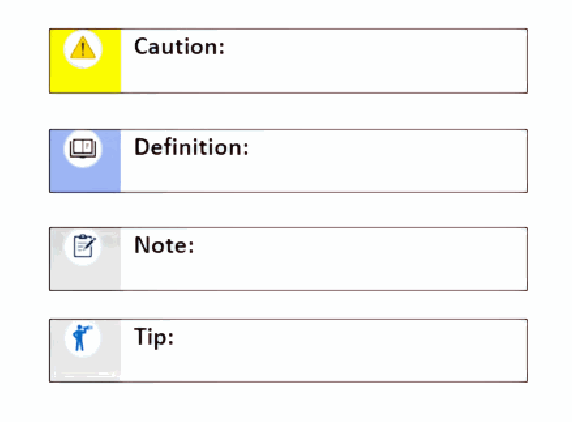
This report uses callout boxes to highlight certain types of information, as depicted in Fig. 1. With the exception of Definition boxes, which repeat the definitions of key terms or provide more formal definitions for them, callout boxes usually contain new material that is not covered elsewhere in the report. A Caution box provides a warning of a potential issue with doing or not doing something. A Note box gives additional general information on a topic. A Tip box offers advice that may be beneficial to the reader.
本報告書では、図 1 に示すように、コールアウトボックスを使って特定の種類の情報を強調します。重要な用語の定義を繰り返す、またはより正式な定義を示す定義ボックスを除き、コールアウトボックスには通常、報告書の他の箇所で扱わない新しい内容が含まれます。注意ボックスは、何かを行うこと、または行わないことで生じる可能性のある問題について警告します。備考ボックスは、あるトピックに関する追加の一般情報を示します。ヒントボックスは、読者に役立つ可能性のある助言を示します。
縦に並んだ 4 種類の空の囲み枠の見本です。いずれも左端にアイコンの帯がある長方形で、上から「Caution:」(黄色の帯と警告の三角形のアイコン)、「Definition:」(青い帯と本のアイコン)、「Note:」(灰色の帯とメモ帳のアイコン)、「Tip:」(灰色の帯と人物のアイコン)です。
Fig. 1. Callout box formats.
図 1. コールアウトボックスの形式。
2. An Overview of MFA Technologies and Concepts
2. MFA の技術と概念の概要
This section provides an overview of some key technologies and concepts relevant to MFA deployments, the understanding of which is necessary before addressing specific MFA architectures.
本節では、MFA の展開に関連する主要な技術と概念の概要を示します。具体的な MFA アーキテクチャを扱う前に、これらを理解しておく必要があります。
2.1. Introduction to MFA
2.1. MFA の概要
In 2024, 46% of public safety breaches [2] involved stolen credentials. MFA is a common security control used to reduce the risk of compromised credentials and unauthorized access. Traditional single-factor authentication relies solely on passwords, whereas MFA requires more than one distinct type of authentication factor for successful authentication. So, if an attacker obtains a user’s password, they still need access to the additional factor to successfully authenticate.
2024 年には、公共安全分野における侵害 [2] の 46% で、窃取された認証情報が関与していました。MFA は、認証情報の侵害と不正アクセスのリスクを低減するために用いられる一般的なセキュリティ対策です。従来の単一要素認証はパスワードのみに依存しますが、MFA は認証を成功させるために、複数の異なる種類の認証要素を要求します。そのため、攻撃者がユーザーのパスワードを入手しても、認証に成功するには追加の要素にアクセスする必要があります。
Definition: Authentication is “the process by which a claimant proves possession and control of one or more authenticators bound to a subscriber account to demonstrate that they are the subscriber associated with that account” [3] and involves one or more of the following factors:
定義: 認証とは、「請求者が、加入者アカウントに紐づく 1 つ以上の認証器を所持し管理していることを証明して、そのアカウントに関連付けられた加入者であることを示すプロセス」[3] であり、次の要素の 1 つ以上を伴います。
i.something you know (e.g., password/personal identification number [PIN]);
i.知識情報(例: パスワード、個人識別番号 [PIN])。
ii.something you have (e.g., cryptographic identification device, token); or
ii.所持情報(例: 暗号識別デバイス、トークン)。
iii.something you are (e.g., biometric).
iii.生体情報(例: 生体情報)。
Definition: MFA is “an authentication system that requires more than one distinct type of authentication factor for successful authentication. MFA can be performed using a multi-factor authenticator or by combining single-factor authenticators that provide different types of factors.” [3]
定義: MFAとは、「認証を成功させるために、複数の異なる種類の認証要素を要求する認証システム。MFA は、多要素認証器を使用するか、異なる種類の要素を提供する単一要素認証器を組み合わせることで実行できる」[3] ものです。
Definition: An authenticator is “[s]omething the claimant possesses and controls (typically a cryptographic module or password) that is used to authenticate the claimant’s identity.” [3]
定義: 認証器とは、「請求者が所持し管理している何か(通常は暗号モジュールまたはパスワード)で、請求者の識別情報を認証するために使われるもの」[3] です。
Authenticators used in MFA systems have a wide range of form factors that may include the use of a PIN/password, biometrics, mobile devices, security keys, one-time codes, or other form factors. For a list of different authenticator types and their requirements, see Identification and Authentication within the CJIS Security Policy [1].
MFA システムで使われる認証器の形態は多岐にわたり、PIN/パスワード、生体認証、モバイルデバイス、セキュリティキー、ワンタイムコードなどを使うものがあります。認証器の種類とその要件の一覧については、CJIS セキュリティポリシー [1] の Identification and Authentication を参照してください。
2.2. CJIS Requirements for MFA
2.2. MFA に対する CJIS の要件
NIST Special Publication (SP) 800-63 defines three Authentication Assurance Levels (AALs) that help differentiate the inherent security properties that authenticators may possess. Non-sensitive data may only require an AAL1 authenticator, typically a single-factor username and password. However, for information and systems that may cause a detrimental impact if compromised, AAL2 or AAL3 multi-factor authenticators may be required.
NIST Special Publication(SP)800-63 は、認証器が備える固有のセキュリティ特性を区別するのに役立つ、3 つの認証保証レベル(AAL)を定義しています。機微でないデータには、AAL1 の認証器(通常は、ユーザー名とパスワードによる単一要素のもの)で足りる場合があります。しかし、侵害されると有害な影響を及ぼす可能性のある情報やシステムには、AAL2 または AAL3 の多要素認証器が必要になる場合があります。
Note: NIST does not allow the combination of a something you know + a something you are factor at AAL2. To attain AAL2, NIST requires a something you have factor in combination with either a something you know or something you are factor.
備考: NIST は、AAL2 において、知識情報と生体情報の要素の組み合わせを認めていません。AAL2 を達成するには、NIST は所持情報の要素を、知識情報または生体情報の要素のいずれかと組み合わせることを要求しています。
Because the compromise of CJI would significantly impact agencies across the country, the CJIS Security Policy requires that CJI be protected by MFA at AAL2 or greater. Agencies should reference the Identification and Authentication section of the CJIS Security Policy (versions 5.9.2 or later) [1] for specific requirements.
CJI が侵害されると全米の機関に重大な影響が及ぶため、CJIS セキュリティポリシーは、CJI を AAL2 以上の MFA で保護することを要求しています。具体的な要件については、機関は CJIS セキュリティポリシー(バージョン 5.9.2 以降)[1] の Identification and Authentication の節を参照すべきです。
Caution: NIST SP 800-63 has been updated to revision 4 [3]. The latest CJIS Security Policy as of this writing is based on the final version of revision 3. Agencies should focus on the language in the CJIS Security Policy for all AAL requirements.
注意: NIST SP 800-63 は改訂第 4 版 [3] に更新されました。本書の執筆時点での最新の CJIS セキュリティポリシーは、改訂第 3 版の最終版に基づいています。AAL に関するすべての要件については、機関は CJIS セキュリティポリシーの記述を重視すべきです。
2.3. Identity Providers
2.3. アイデンティティプロバイダー
In the context of identity federation, we often use the terms identity provider (IdP) and relying party (RP) to refer to the entity that is authenticating the user—the IdP—and to the application or service that is accepting an assertion that authentication was successfully completed—the RP. In this document, we’ll refer to an IdP generally as an entity that commonly has the following roles:
アイデンティティフェデレーションの文脈では、ユーザーを認証するエンティティを指すアイデンティティプロバイダー(IdP)と、認証が正常に完了したことを示すアサーションを受け入れるアプリケーションまたはサービスを指す依拠当事者(RP)という用語がよく使われます。本書では、IdP を、一般に次の役割を持つエンティティとして扱います。
•Authentication – an application and/or service that receives the authentication request, attempts to verify the user’s credential, and determines if authentication is successful or unsuccessful.
•認証 – 認証要求を受け取り、ユーザーの認証情報の検証を試み、認証が成功したか失敗したかを判定するアプリケーションまたはサービス(あるいはその両方)。
•Credential lifecycle management – handles the issuance, management, and revocation of authenticators.
•認証情報のライフサイクル管理 – 認証器の発行、管理、失効を扱います。
•Issuance of identity assertions – provides assertions to RPs about the details of a given authentication transaction, which may include authentication success or failure, type of authentication used, and/or attributes about the user.
•ID アサーションの発行 – 特定の認証トランザクションの詳細(認証の成功または失敗、使用された認証の種類、ユーザーの属性など)に関するアサーションを RP に提供します。
When deploying an MFA solution, agencies should consider where their users might get the above services from, i.e., where the IdP resides in the overarching MFA architecture, who owns and operates the IdP, and which of the above services it will provide. There are many models that work, depending on the needs of the agencies using the service and the protocols that technology providers support.
MFA ソリューションを展開する際、機関は、ユーザーが上記のサービスをどこから得られるかを検討すべきです。すなわち、MFA アーキテクチャ全体の中で IdP がどこにあるか、誰が IdP を所有して運用するか、IdP が上記のサービスのうちどれを提供するかです。サービスを利用する機関のニーズと、技術プロバイダーが対応しているプロトコルによって、有効なモデルは多数あります。
Definition: An assertion is “a statement from an IdP to an RP that contains information about an authentication event for a subscriber” [3]. In federation, the assertion is the evidence that the IdP sends to the RP that the user has logged in. It can also contain user identifiers such as a username or email address and information about how the user logged in, such as whether MFA was used.
定義: アサーションとは、「加入者の認証イベントに関する情報を含む、IdP から RP への声明」[3] です。フェデレーションにおいて、アサーションは、ユーザーがログインしたことを示すために IdP が RP に送る証拠です。アサーションには、ユーザー名やメールアドレスなどのユーザー識別子や、MFA が使われたかどうかなど、ユーザーがどのようにログインしたかに関する情報を含めることもできます。
2.4. Single Sign-On and Identity Federation
2.4. シングルサインオンとアイデンティティフェデレーション
Though MFA enhances security, there are both monetary and user friction costs to MFA implementations. Single sign-on (SSO) and identity federation are technologies that support MFA deployments and can alleviate costs by reducing the number of credentials a user needs to manage, reducing the number of times a user needs to authenticate, and allowing users to reuse a single authentication to get access to multiple applications and/or resources.
MFA はセキュリティを強化しますが、MFA の実装には金銭的コストとユーザーの手間というコストがともないます。シングルサインオン(SSO)とアイデンティティフェデレーションは MFA の展開を支える技術であり、ユーザーが管理する認証情報の数を減らし、ユーザーが認証する回数を減らし、1 回の認証を再利用して複数のアプリケーションやリソース(あるいはその両方)にアクセスできるようにすることで、コストを軽減できます。
2.4.1. Benefits of Identity Federation
2.4.1. アイデンティティフェデレーションの利点
Federation “is a process that allows for the conveyance of identity and authentication information across a set of networked systems” [3]. Commonly, identity federation protocols such as Security Assertion Markup Language (SAML) 2.0 and OpenID Connect (OIDC) 1.0 allow users to gain access to an application or service—an RP—without the need to register a new identity or credential with that RP. Instead, users are given the option to authenticate using a credential already issued to them by an IdP, often their state or local agency, as shown in Fig. 2. For detailed technical information on identity federation, please see Appendix B.
フェデレーションとは、「ネットワーク化された一連のシステム間で、アイデンティティ情報と認証情報を伝達できるようにするプロセス」[3] です。一般に、Security Assertion Markup Language(SAML)2.0 や OpenID Connect(OIDC)1.0 などのアイデンティティフェデレーションプロトコルにより、ユーザーは、RP であるアプリケーションやサービスに新しいアイデンティティや認証情報を登録しなくても、それらにアクセスできます。代わりに、図 2 に示すように、ユーザーは、IdP(多くの場合、州または地方の機関)からすでに発行されている認証情報を使って認証するという選択肢を与えられます。アイデンティティフェデレーションの詳細な技術情報については、付録 B を参照してください。
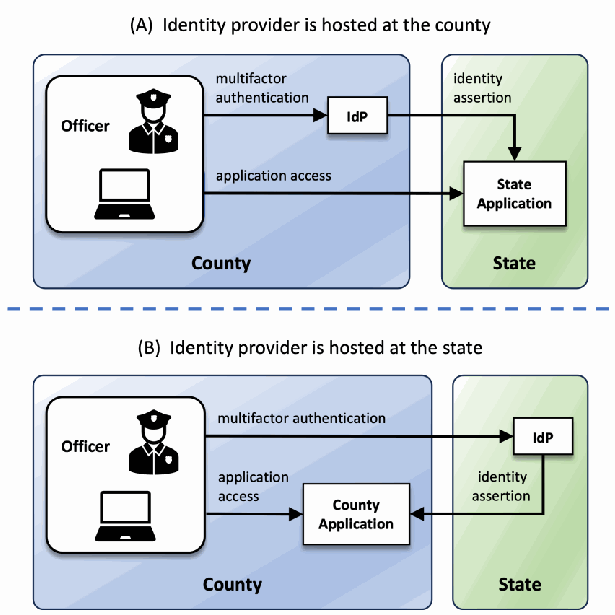
破線で区切られた2つの図です。(A) アイデンティティプロバイダーを郡に設置する場合: 青い「County」(郡)の領域内で、ノートパソコンを持つ警察官が「IdP」ボックスに「多要素認証」を送り、IdPは緑の「State」(州)の領域にある「State Application」(州のアプリケーション)ボックスに「アイデンティティアサーション」を送ります。警察官は州のアプリケーションにも直接アクセスします。(B) アイデンティティプロバイダーを州に設置する場合: 「County」(郡)の領域内の警察官が、「State」(州)の領域にある「IdP」ボックスに「多要素認証」を送り、IdPは郡の領域にある「County Application」(郡のアプリケーション)ボックスに「アイデンティティアサーション」を送ります。警察官は郡のアプリケーションにアクセスします。
Fig. 2. The identity provider (IdP) can be at hosted at the state or county, or both.
図 2. アイデンティティプロバイダー(IdP)は州、郡、またはその両方にホストできます。
Identity federation supports MFA architectures by enabling flexibility and optionality for where MFA can be implemented. For example, if a local police department (PD) has implemented MFA and its officers are required to access CJI resources at the state level, identity federation can be used to establish a trust relationship between the local PD (as the IdP) and the state CJI application (as the RP). This can enable a user to authenticate with the MFA credentials issued to them by the county without the need to be issued a second set of MFA credentials by the state.
アイデンティティフェデレーションは、MFA を実装できる場所について柔軟性と選択肢を確保することで、MFA アーキテクチャを支援します。たとえば、地元の警察署(PD)が MFA を実装済みで、その警察官が州レベルの CJI リソースにアクセスする必要がある場合、アイデンティティフェデレーションを使って、地元の PD(IdP として)と州の CJI アプリケーション(RP として)の間に信頼関係を確立できます。これにより、ユーザーは、州から 2 つ目の MFA 認証情報一式を発行されなくても、郡から発行された MFA 認証情報で認証できます。
Definition: Federation “is a process that allows for the conveyance of identity and authentication information across a set of networked systems” [3]. This is done in an interoperable way using federation protocols such as OpenID Connect or SAML.
定義: フェデレーションとは、「ネットワーク化された一連のシステム間で、アイデンティティ情報と認証情報を伝達できるようにするプロセス」[3] です。これは、OpenID Connect や SAML などのフェデレーションプロトコルを使って、相互運用可能な方法で行われます。
Note: Have you ever navigated to a webpage and been given the option to use an existing Google, Facebook, or other third-party identity rather than creating a new identity at that website? Identity federation protocols enable this capability.
備考: ある Web ページにアクセスしたとき、その Web サイトで新しいアイデンティティを作成する代わりに、既存の Google や Facebook などサードパーティのアイデンティティを使うという選択肢が示された経験はないでしょうか。アイデンティティフェデレーションプロトコルが、この機能を可能にしています。
This flexibility has multiple potential benefits. For example, identity federation can enable a shared service model in which multiple local agencies could use a single identity provided by the state identity service to get MFA credentials and access CJI. This model can reduce implementation costs and can be especially useful for small and rural agencies that may not have the resources or expertise to implement MFA but still require access to CJI. An example of this model is explored in Appendix B.4.
この柔軟性には、複数の利点が見込まれます。たとえば、アイデンティティフェデレーションにより、複数の地方機関が、州のアイデンティティサービスが提供する単一のアイデンティティを使って MFA 認証情報を取得し、CJI にアクセスする共有サービスモデルを実現できます。このモデルは実装コストを削減でき、MFA を実装するためのリソースや専門知識を持たないものの CJI へのアクセスは必要とする、小規模機関や農村部の機関にとって、特に有用です。このモデルの例は、付録 B.4 で検討します。
Identity federation protocols are also an important tool to ensure that memorized secrets, such as passwords, do not need to be shared between systems to enable authentication or authorization. For more on memorized secrets, see Sec. 3.1.3.
アイデンティティフェデレーションプロトコルは、認証や認可を可能にするために、パスワードなどの記憶された秘密情報をシステム間で共有しなくて済むようにするための重要な手段でもあります。記憶された秘密情報の詳細については、3.1.3 節を参照してください。
Agencies should work with their technology vendors, specifically CAD/RMS, state message switch, and identity services vendors, to confirm they support identity federation protocols and architectures.
機関は、技術ベンダー(特に CAD/RMS、州のメッセージスイッチ、アイデンティティサービスのベンダー)と連携して、アイデンティティフェデレーションプロトコルとアーキテクチャに対応していることを確認すべきです。
2.4.2. Benefits of Single Sign-On
2.4.2. シングルサインオンの利点
One major aspect of deploying MFA technology is the impact on user experience and expectations. Any change in the way users authenticate can result in user friction. This is particularly important in law enforcement communities where any authentication delays in the line of duty might impact the ability to respond to an emergency. SSO is one way to alleviate user friction and limit how often a user needs to authenticate. As shown in Fig. 3, SSO enables users to authenticate once and gain access to multiple system resources without the need to reauthenticate as they use each new application or service.
MFA 技術を展開する際の主要な側面の 1 つは、ユーザー体験と期待への影響です。ユーザーの認証方法を変更すると、ユーザーの手間が生じる可能性があります。これは、職務遂行中の認証の遅れが緊急事態への対応能力に影響しかねない法執行の現場では、特に重要です。SSO は、ユーザーの手間を軽減し、ユーザーが認証する頻度を抑える方法の 1 つです。図 3 に示すように、SSO により、ユーザーは一度認証すれば、新しいアプリケーションやサービスを使うたびに再認証しなくても、複数のシステムリソースにアクセスできます。
SSO is also a great way to enable MFA. Applications that do not natively support MFA can be integrated with an SSO service, improving security and reducing the number of credentials users need to manage. Agencies may consider integrating both CJI and non-CJI applications with an SSO service to gain additional return on investment and to provide users with a common authentication experience across applications, see Sec. 3.4.2.3.
SSO は、MFA を実現する優れた方法でもあります。MFA にネイティブで対応していないアプリケーションを SSO サービスと統合すれば、セキュリティが向上し、ユーザーが管理する認証情報の数を減らせます。機関は、投資対効果をさらに高め、アプリケーション間で共通の認証体験をユーザーに提供するために、CJI のアプリケーションと CJI 以外のアプリケーションの両方を SSO サービスと統合することを検討してもよいです(3.4.2.3 節を参照)。
Agencies interested in implementing SSO should work with their technology vendors, specifically CAD/RMS, state message switch, and identity services vendors, to confirm they support SSO protocols and architectures.
SSO の実装に関心のある機関は、技術ベンダー(特に CAD/RMS、州のメッセージスイッチ、アイデンティティサービスのベンダー)と連携して、SSO のプロトコルとアーキテクチャに対応していることを確認すべきです。
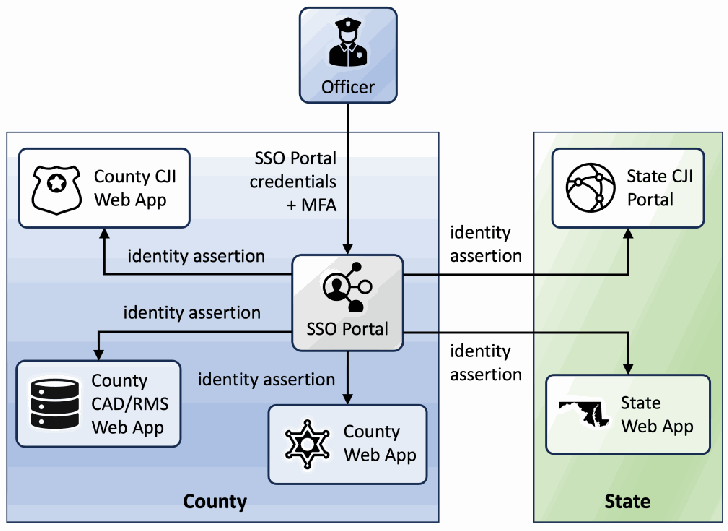
上部の「Officer」(警察官)ボックスから、青い「County」(郡)の領域にある「SSO Portal」(SSOポータル)ボックスへ「SSO Portal credentials + MFA」(SSOポータルの認証情報 + MFA)が送られます。SSO Portalは、郡の領域にある「County CJI Web App」「County CAD/RMS Web App」「County Web App」の各ボックスに「identity assertion」(アイデンティティアサーション)を送り、緑の「State」(州)の領域にある「State CJI Portal」と「State Web App」の各ボックスにも「identity assertion」を送ります。
Fig. 3. Single sign-on eliminates repeated MFA challenges to users.
図 3. シングルサインオンにより、ユーザーへの MFA チャレンジの繰り返しがなくなります。
Note: What’s the difference between federation and SSO?
備考: フェデレーションと SSO の違いは何でしょうか。
Federation and SSO have a lot in common. Both technologies allow applications to trust another system to authenticate users. The difference is that SSO systems typically function inside a single organization, whereas federation technologies focus on bridging the gap between organizations. Many organizations use both SSO and federation systems—for example, they may use Active Directory SSO for internal applications and a federation system for interacting with external partners. Federation systems can provide an SSO experience by not requiring users to authenticate when they access each application, unless policy requires a reauthentication.
フェデレーションと SSO には共通点が多くあります。どちらの技術も、アプリケーションが別のシステムを信頼してユーザーを認証することを可能にします。違いは、SSO システムが通常は単一の組織内で機能するのに対し、フェデレーション技術は組織間の隔たりを埋めることに重点を置いている点です。多くの組織は SSO とフェデレーションの両方のシステムを使っています。たとえば、内部アプリケーションには Active Directory の SSO を、外部パートナーとのやり取りにはフェデレーションシステムを使う場合があります。フェデレーションシステムは、ポリシーが再認証を要求しない限り、各アプリケーションにアクセスするたびにユーザーに認証を要求しないことで、SSO の体験を提供できます。
2.5. The Importance of Phishing Resistance
2.5. フィッシング耐性の重要性
All MFA has security benefits compared to using a single factor, but not all forms of MFA are created equal, even if they are at the same AAL. One important differentiator among various types of MFA is the ability for the authenticator to resist phishing attacks. Phishing attacks attempt to lure a user (usually through an email) into interacting with a counterfeit webpage or application and trick the user into revealing information (typically passwords or one-time codes) that can be used to masquerade as that user to the real web page or application. See Fig. 4 for an example of how a phishing attack occurs.
あらゆる MFA は、単一要素を使う場合と比べてセキュリティ上の利点がありますが、同じ AAL であっても、すべての形態の MFA が同等というわけではありません。さまざまな種類の MFA を分ける重要な違いの 1 つは、認証器がフィッシング攻撃に耐えられるかどうかです。フィッシング攻撃は、ユーザーを(通常はメールで)誘導して偽の Web ページやアプリケーションを操作させ、本物の Web ページやアプリケーションに対してそのユーザーになりすますために使える情報(通常はパスワードやワンタイムコード)をユーザーにだまして開示させようとします。フィッシング攻撃がどのように起こるかの例は、図 4 を参照してください。
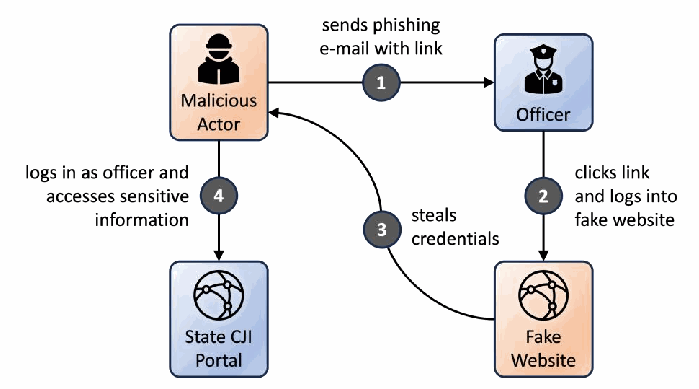
番号付きのフィッシング攻撃の流れです。(1)「悪意のある攻撃者」(Malicious Actor)が「警察官」(Officer)に「リンク付きのフィッシングメールを送ります」。(2) 警察官が「リンクをクリックし、偽の Web サイト(Fake Website)にログインします」。(3) 偽の Web サイトが「認証情報を盗み」、悪意のある攻撃者に渡します。(4) 悪意のある攻撃者が「State CJI Portal」(州の CJI ポータル)で「警察官としてログインし、機微な情報にアクセスします」。
Fig. 4. An example of a phishing attack.
図 4. フィッシング攻撃の例。
Tip: Not all authenticators are phishing resistant, but phishing-resistant MFA solutions are now commonly supported by identity platforms. Commercially, Fast Identity Online (FIDO) authenticators paired with the World Wide Web Consortium’s (W3C) Web Authentication API are the most widely available phishing-resistant authenticators. Agencies should ask vendors what phishing-resistant authentication options they support, to include support for phishing-resistant, syncable authenticators as described in NIST 800-63B-4 [4].
ヒント: すべての認証器がフィッシング耐性を備えているわけではありませんが、フィッシング耐性のある MFA ソリューションは、現在ではアイデンティティプラットフォームで広くサポートされています。商用では、Fast Identity Online(FIDO)認証器と World Wide Web Consortium(W3C)の Web Authentication API を組み合わせたものが、最も広く利用できるフィッシング耐性のある認証器です。機関は、NIST 800-63B-4 [4] で説明されているフィッシング耐性のある同期可能な認証器への対応を含め、ベンダーがどのようなフィッシング耐性のある認証オプションに対応しているかを尋ねるべきです。
Phishing attacks are a significant cybersecurity challenge, as they are often conducted remotely and at scale, meaning that an attacker may send a phishing email to thousands of employees, needing only to trick a single employee into providing their login information to gain unauthorized access to data and/or applications. Phishing-resistant authentication systems do not require the user to recognize an attack and make the right decision, but rather have phishing resistance built into the authentication protocol itself. NIST published a blog post on phishing-resistant authenticators and how they mitigate common attacks [5].
フィッシング攻撃は、多くの場合リモートで大規模に行われるため、重大なサイバーセキュリティ上の課題です。つまり、攻撃者は数千人の従業員にフィッシングメールを送り、ログイン情報をだまし取る相手が 1 人いるだけで、データやアプリケーション(あるいはその両方)への不正アクセスを得られます。フィッシング耐性のある認証システムは、ユーザーが攻撃を見抜いて正しい判断をすることを必要とせず、認証プロトコル自体にフィッシング耐性が組み込まれています。NIST は、フィッシング耐性のある認証器と、それらが一般的な攻撃をどのように緩和するかについて、ブログ記事を公開しました [5]。
Caution: What makes phishing attacks so dangerous is the way they can bypass physical and network security protections. Simply sending a phishing email to an employee of a target agency could result in the attacker gaining legitimate credentials and using them to access agency systems, potentially including CJI. Phishing attacks do not require physical access to buildings, servers, or data, nor do they require hacking or intrusion. Instead, phishing attacks rely upon tricking users into giving up valid user credentials, effectively letting the attacker through the “front door.” Phishing-resistant MFA is the best defense against these attacks. Although phishing resistance is an optional requirement at AAL2, it is recommended that agencies implement phishing-resistant MFA at AAL2, given the prevalence of phishing attacks.
注意: フィッシング攻撃が非常に危険な理由は、物理的保護とネットワークセキュリティの保護を回避できる点にあります。標的となる機関の従業員にフィッシングメールを送るだけで、攻撃者が正規の認証情報を入手し、それを使って機関のシステム(CJI を含む可能性があります)にアクセスする結果になりかねません。フィッシング攻撃は、建物、サーバー、データへの物理的なアクセスを必要とせず、ハッキングや侵入も必要としません。その代わりに、ユーザーをだまして有効なユーザー認証情報を渡させることに依拠しており、実質的に攻撃者を「正面玄関」から通すことになります。フィッシング耐性のある MFA が、こうした攻撃に対する最善の防御です。AAL2 ではフィッシング耐性は任意の要件ですが、フィッシング攻撃が蔓延していることを踏まえ、機関は AAL2 でフィッシング耐性のある MFA を実装することが推奨されます。
3. Choosing an MFA Implementation for Protecting CJI
3. CJI を保護するための MFA 実装の選択
Criminal justice information systems are used across state, local, tribal, and territorial governments with both criminal and non-criminal justice agencies. Accessing CJI often requires cross-jurisdictional connection of IT systems and collaboration between agencies. For this reason, there are many MFA architectures that could be implemented across the CJIS ecosystem.
刑事司法情報システムは、州、地方、部族、準州の各政府にまたがり、刑事司法機関と非刑事司法機関の両方で使用されています。CJI へのアクセスには、IT システムの管轄をまたぐ接続と機関間の協力が必要になることが多くあります。このため、CJIS のエコシステム全体で実装できる MFA アーキテクチャは数多くあります。
depicts a representative architecture with technology components commonly found across most agencies. As the figure demonstrates, there are many ways to implement MFA, each of which can be viable depending on the requirements of the agency. No matter which architecture is chosen, there are cross-cutting principles that agencies should consider that may improve the usability, cost, and security of their MFA solution.
ほとんどの機関で共通して見られる技術コンポーネントを備えた代表的なアーキテクチャを示しています。図が示すように、MFA を実装する方法は数多くあり、機関の要件に応じて、そのいずれも有効になりえます。どのアーキテクチャを選択するにしても、MFA ソリューションの使いやすさ、コスト、セキュリティを向上させる可能性のある横断的な原則を、機関は考慮すべきです。
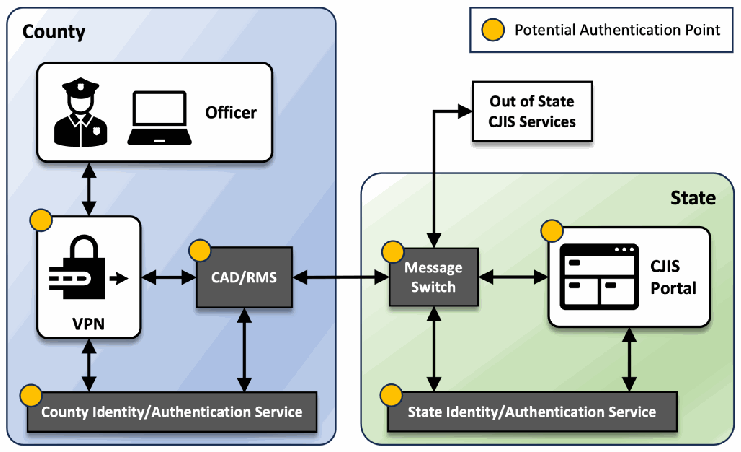
黄色の丸で認証を行いうる箇所(凡例「Potential Authentication Point」)を示した構成図です。青い「County」(郡)の領域に、ノートパソコンを持つ「Officer」(警察官)、「VPN」、「CAD/RMS」、「County Identity/Authentication Service」(郡のアイデンティティ・認証サービス)があります。Officer は VPN に、VPN は CAD/RMS に接続し、VPN と CAD/RMS はいずれも郡のアイデンティティ・認証サービスに接続します。CAD/RMS は緑の「State」(州)の領域の「Message Switch」(メッセージスイッチ)に接続します。州の領域には「CJIS Portal」と「State Identity/Authentication Service」(州のアイデンティティ・認証サービス)もあり、Message Switch は CJIS Portal、州のアイデンティティ・認証サービス、「Out of State CJIS Services」(州外の CJIS サービス)に接続します。認証箇所の印は VPN、CAD/RMS、郡のアイデンティティ・認証サービス、Message Switch、CJIS Portal、州のアイデンティティ・認証サービスに付いています。
Fig. 5. MFA implementation points.
図 5. MFA の実装ポイント。
This section presents considerations for agencies choosing an MFA implementation for protecting CJI:
本節では、CJI を保護するための MFA 実装を選択する機関向けの考慮事項を示します。
•Section 3.1 discusses MFA design principles to provide a foundation for MFA selection.
•3.1 節では、MFA を選択する際の基盤となる MFA の設計原則を論じます。
•Section 3.2 explains the need to conduct a requirements assessment before choosing an MFA solution and indicates which stakeholders may be part of that assessment.
•3.2 節では、MFA ソリューションを選択する前に要件の評価を実施する必要性を説明し、その評価にどのステークホルダーが参加する可能性があるかを示します。
•Section 3.3 provides a notional structure for a phased MFA deployment.
•3.3 節では、MFA の段階的な展開の概念的な構成を示します。
•Section 3.4 explores common MFA architectures and the trade-offs each one faces against the MFA design principles.
•3.4 節では、一般的な MFA アーキテクチャと、それぞれが MFA の設計原則に照らして抱えるトレードオフを検討します。
Note: The remainder of this document assumes that the reader is familiar with basic components commonly used to access CJI. If the reader is not familiar with these technologies, Appendix A of this document contains a brief overview of each.
備考: 本書の以降の部分は、読者が CJI へのアクセスに一般的に使われる基本コンポーネントに精通していることを前提としています。読者がこれらの技術に精通していない場合は、本書の付録 A に各技術の簡単な概要があります。
3.1. MFA Design Principles
3.1. MFA の設計原則
This section highlights four MFA design principles. These principles are not required for any given MFA solution. However, they do play an important role in the long-term efficacy and cost of an MFA solution. Agencies should consider these principles before selecting an MFA implementation. Moreover, state, local, tribal, and territorial agencies should collaborate to determine how these principles could be attained through partnership and/or shared services.
本節では、4 つの MFA 設計原則を取り上げます。これらの原則は、特定の MFA ソリューションに必須となるものではありません。しかし、MFA ソリューションの長期的な有効性とコストに重要な役割を果たします。機関は、MFA の実装を選択する前に、これらの原則を検討すべきです。さらに、州、地方、部族、準州の機関は、連携や共有サービス(あるいはその両方)を通じてこれらの原則をどのように達成できるかを判断するために、協力すべきです。
3.1.1. Principle 1: Authenticator Reusability
3.1.1. 原則 1: 認証器の再利用性
Law enforcement and other personnel accessing CJI already manage multiple user identities and may already manage multiple MFA tokens for those identities. To the greatest extent feasible, agencies should consider MFA architectures that minimize the number of separate MFA credentials that need to be issued to users and managed. For instance, if a user has an MFA credential to access a state CJIS portal and another MFA credential to get access to their CAD/RMS system, there may be opportunities to avoid the user having to manage two sets of credentials. Moreover, each MFA implementation requires a management system, a support staff to assist users with obtaining, registering, and using their MFA credentials, and administrative processes that drive costs in both time and money. Agencies should consider integrating CJI applications and/or services with existing IdPs that can or already support MFA. This might include leveraging SSO services, as mentioned in Sec. 2.4.2.
CJI にアクセスする法執行などの職員は、すでに複数のユーザーアイデンティティを管理しており、それらのアイデンティティ用の複数の MFA トークンをすでに管理している場合があります。機関は、実現可能な限り、ユーザーに発行して管理する必要のある個別の MFA 認証情報の数を最小限に抑える MFA アーキテクチャを検討すべきです。たとえば、あるユーザーが州の CJIS ポータルにアクセスするための MFA 認証情報と、自身の CAD/RMS システムにアクセスするための別の MFA 認証情報を持っている場合、ユーザーが 2 組の認証情報を管理せずに済む機会があるかもしれません。さらに、MFA の実装ごとに、管理システム、ユーザーによる MFA 認証情報の取得・登録・使用を支援するサポート担当者、そして時間と費用の両面でコストを押し上げる管理プロセスが必要になります。機関は、MFA に対応できる、またはすでに対応している既存の IdP と、CJI のアプリケーションやサービス(あるいはその両方)を統合することを検討すべきです。これには、2.4.2 節で触れたように、SSO サービスの活用が含まれる場合があります。
3.1.2. Principle 2: Authenticator Optionality
3.1.2. 原則 2: 認証器の選択可能性
Agencies typically have a diverse set of user authentication requirements. For example, mobile devices are commonly not allowed in department of corrections facilities and thus, MFA methods that use mobile phones are not viable for users inside these facilities. Agencies will benefit if their MFA solutions support multiple authenticator types and methods. This allows organizations to select the type of authenticator that best meets the needs of a given user base, context, or environment in which CJI is accessed. CAD/RMS, message switch, and virtual private network (VPN) vendors may provide multiple MFA methods, but generally, the greatest level of MFA optionality is offered by dedicated identity service providers.
機関には、通常、多様なユーザー認証要件があります。たとえば、矯正施設ではモバイルデバイスの持ち込みが認められていないことが一般的であり、このような施設内のユーザーには、携帯電話を使う MFA 方式は使えません。MFA ソリューションが複数の種類や方式の認証器に対応していれば、機関にとって有益です。これにより、組織は、特定のユーザー層、状況、または CJI にアクセスする環境のニーズに最も合う認証器の種類を選択できます。CAD/RMS、メッセージスイッチ、仮想プライベートネットワーク(VPN)のベンダーは複数の MFA 方式を提供している場合がありますが、一般に、最も高い水準の MFA の選択肢を提供するのは、専用のアイデンティティサービスプロバイダーです。
3.1.3. Principle 3: Minimize the Passing of Memorized Secrets
3.1.3. 原則 3: 記憶された秘密情報の受け渡しの最小化
The passing of memorized secrets, such as passwords, between agency applications and state message switches is a practice that is sometimes used to allow a state switch to authorize a user before getting access to CJI. However, there are security concerns with this model. To the greatest extent feasible, agencies should consider solutions that do not require the passing of memorized secrets across networked systems and amongst applications. Token-based systems such as Kerberos and identity federation protocols are viable options for integrating CJI applications and/or services with other applications and identity services.
パスワードなどの記憶された秘密情報を機関のアプリケーションと州のメッセージスイッチの間で受け渡す方法は、CJI にアクセスする前に州のスイッチがユーザーを認可できるようにするために、使われることがあります。しかし、このモデルにはセキュリティ上の懸念があります。機関は、実現可能な限り、ネットワーク化されたシステム間やアプリケーション間で記憶された秘密情報を受け渡す必要のないソリューションを検討すべきです。Kerberos やアイデンティティフェデレーションプロトコルのようなトークンベースのシステムは、CJI のアプリケーションやサービス(あるいはその両方)を、他のアプリケーションやアイデンティティサービスと統合するための有効な選択肢です。
Tip: Token-based protocols like Kerberos, SAML 2.0, and OIDC 1.0 are designed to alleviate the need to share memorized secrets between applications. They provide a greater level of flexibility and control.
ヒント: Kerberos、SAML 2.0、OIDC 1.0 のようなトークンベースのプロトコルは、アプリケーション間で記憶された秘密情報を共有する必要をなくすように設計されています。これらは、より高い水準の柔軟性と制御を提供します。
3.1.4. Principle 4: Ensure MFA Is Integrated to Protect CJI
3.1.4. 原則 4: CJI を保護するための MFA の統合の確保
When deploying an MFA solution, agencies should ensure that the MFA implemented is integrated with the application or service that contains CJI. For example, if MFA is enforced only at the network level, such as a VPN service, but not at the application level, users might have to manage two separate credentials, MFA for the VPN and a username and password for the application. Moreover, if the application is only protected by a password, even if MFA was completed to gain network access, the application itself might be at risk of phishing attacks or a password database breach if a bad actor obtains network access. This “crunchy outside, soft inside” security model is not recommended. Ideally, CJI applications would be tied into an SSO service or directly integrated with an identity service such that the MFA completed at the network level can be enforced at the application level. Section 3.4.3 provides more detail about integrating MFA with VPN services.
MFA ソリューションを展開する際、機関は、実装した MFA が CJI を含むアプリケーションやサービスと統合されていることを確保すべきです。たとえば、MFA が VPN サービスなどのネットワークレベルでのみ適用され、アプリケーションレベルでは適用されない場合、ユーザーは 2 つの別々の認証情報、すなわち VPN 用の MFA と、アプリケーション用のユーザー名およびパスワードを管理しなければならなくなる可能性があります。さらに、アプリケーションがパスワードのみで保護されている場合、ネットワークアクセスを得るために MFA を完了していたとしても、悪意ある者がネットワークアクセスを得れば、アプリケーション自体がフィッシング攻撃やパスワードデータベースの侵害のリスクにさらされる可能性があります。この「外側は堅く、内側は脆弱」というセキュリティモデルは推奨されません。理想的には、CJI のアプリケーションを SSO サービスに結び付けるか、アイデンティティサービスと直接統合して、ネットワークレベルで完了した MFA をアプリケーションレベルでも適用できるようにします。VPN サービスと MFA の統合については、3.4.3 節でさらに詳しく説明します。
3.2. MFA Requirements Assessment
3.2. MFA 要件の評価
When deploying an MFA solution, all agencies should conduct a requirements assessment to help determine the MFA solution that will best meet agency needs. This assessment should include, but is not limited to, engaging with the applicable stakeholders discussed in this section.
MFA ソリューションを展開する際、すべての機関は、機関のニーズに最も合う MFA ソリューションを判断するために、要件の評価を実施すべきです。この評価には、本節で論じる該当するステークホルダーとの協議を含めるべきですが、それに限りません。
3.2.1. MFA Users
3.2.1. MFA ユーザー
Before implementing any MFA solution, it is critical that agencies understand the common use cases and corner cases of the user population the MFA solution is intended to support. As mentioned in Sec. 3.1.2 on authenticator optionality, agencies will likely have varied requirements across their user base. For example, an MFA solution that works for individuals who reside primarily in an office environment might not be acceptable for an officer in the field.
MFA ソリューションを実装する前に、機関は、そのソリューションが対象とするユーザー層の一般的なユースケースと例外的なユースケース(コーナーケース)を理解することが極めて重要です。認証器の選択可能性に関する 3.1.2 節で述べたように、機関のユーザー層全体では、多様な要件がある可能性が高いです。たとえば、主にオフィス環境にいる個人に適した MFA ソリューションが、現場の警察官には受け入れられない場合があります。
Because the average agency user may not be familiar with MFA systems, agency personnel responsible for MFA deployment should conduct market research on potentially viable MFA solutions and present them to a representative portion of the user base to facilitate feedback and to enumerate requirements.
一般的な機関のユーザーは MFA システムに慣れていない可能性があるため、MFA の展開を担当する機関の職員は、有効と考えられる MFA ソリューションの市場調査を行い、それらをユーザー層の代表的な一部に提示して、フィードバックを得て要件を列挙すべきです。
Implementing any MFA solution likely requires users to change the way they conduct daily interactions with their IT systems. Because of this, it is important that once an MFA solution is selected, agencies educate users with clear instructions on how to obtain and use any new authenticators, as well as provide easy access to help desk or support personnel who can assist users in setting up and using the new MFA solution. Section 3.3 provides a notional plan for a phased MFA rollout to different user bases.
どの MFA ソリューションを実装しても、ユーザーは IT システムとの日常的なやり取りの方法を変更する必要が生じる可能性が高いです。そのため、MFA ソリューションを選択したら、新しい認証器の入手方法と使用方法について明確な手順をユーザーに教育するとともに、ユーザーによる新しい MFA ソリューションの設定と使用を支援できるヘルプデスクやサポート担当者に容易に連絡できるようにすることが重要です。3.3 節では、異なるユーザー層に対する MFA の段階的な展開の概念的な計画を示します。
3.2.2. IT Support Staff
3.2.2. IT サポート担当者
As with any technology change, implementing an MFA solution will result in both users and administrative staff needing support as they become familiar with new processes. Agencies should establish appropriate communication channels for their user base to work with internal IT support and/or MFA vendors to help answer questions and troubleshoot problems. Agencies should expect an initial increase in IT support and help desk calls after MFA has been deployed. Help desk and support staff should be trained to assist users with the technology, and clearly communicated processes should exist for escalating difficult cases, including processes for bringing in vendor support.
あらゆる技術の変更と同様に、MFA ソリューションを実装すると、新しいプロセスに慣れるまでの間、ユーザーと管理担当者の双方がサポートを必要とします。機関は、ユーザー層が社内の IT サポートや MFA ベンダー(あるいはその両方)と連携して、質問に答え、問題をトラブルシューティングできるように、適切なコミュニケーション経路を確立すべきです。機関は、MFA の展開後、IT サポートとヘルプデスクへの問い合わせが当初増加することを見込んでおくべきです。ヘルプデスクとサポート担当者は、ユーザーが技術を使うのを支援できるよう訓練すべきであり、ベンダーのサポートを受けるためのプロセスを含め、困難な案件をエスカレーションするプロセスを明確に周知しておくべきです。
3.2.3. Other Agencies
3.2.3. 他の機関
Before deploying an MFA solution, state agencies should consult local, tribal, and territorial agencies within their state to determine how these agencies might make use of or integrate with the state MFA solution. If the state intends to issue and manage MFA credentials for local, tribal, and territorial users, these agencies should be consulted for feedback on use cases, corner cases, and general requirements for the MFA solution. If local, tribal, and territorial agencies already have an MFA solution in place, the state should explore options to allow that solution to integrate with the state solution.
MFA ソリューションを展開する前に、州の機関は、州内の地方、部族、準州の機関に相談して、それらの機関が州の MFA ソリューションをどのように利用または統合できるかを判断すべきです。州が地方、部族、準州のユーザー向けに MFA 認証情報を発行して管理する予定である場合は、MFA ソリューションのユースケース、コーナーケース、一般的な要件に関するフィードバックを得るために、それらの機関に相談すべきです。地方、部族、準州の機関がすでに MFA ソリューションを導入している場合、州は、そのソリューションを州のソリューションと統合できるようにする選択肢を検討すべきです。
Before deploying an MFA solution, local, tribal, and territorial agencies should consult with their state agencies, as appropriate, to discern ways in which MFA requirements may be met through collaboration. For example, state agencies may already have an MFA solution that could be leveraged to meet local agency requirements. Additionally, state agencies may have purchase agreements in place that allow other agencies to cut costs through bulk purchasing or to save on procurement administration.
MFA ソリューションを展開する前に、地方、部族、準州の機関は、必要に応じて州の機関に相談し、連携によって MFA の要件を満たせる方法を見極めるべきです。たとえば、州の機関がすでに MFA ソリューションを導入していて、それを地方機関の要件を満たすために活用できる場合があります。また、州の機関が購入契約を結んでいて、他の機関が一括購入によってコストを削減したり、調達管理の手間を省いたりできる場合もあります。
Where applicable, all agencies should consult with peer agencies inside or outside their state that are in the process of or have already deployed MFA solutions. This first-hand experience can offer valuable insight into how peer agencies have solved MFA challenges, enumerate feedback on vendors and solutions, and provide examples of how MFA technology was justified with leadership and procured.
該当する場合、すべての機関は、州内外で MFA ソリューションを導入中またはすでに導入した同等の機関に相談すべきです。こうした実地経験からは、同等の機関が MFA の課題をどのように解決したかについての貴重な知見、ベンダーやソリューションに関する意見、そして MFA 技術を経営層にどのように説明して承認を得て調達したかの事例が得られます。
3.2.4. Procurement Teams
3.2.4. 調達チーム
Procurement teams play a support role in helping agencies navigate potential procurement vehicles and vendor engagement. For MFA deployments, agencies should work with procurement teams to ensure that applicable MFA requirements are written into requests for information and requests for proposal. Many of these requirements can be found under the IA-5 requirements in the Identification and Authentication section of the CJIS Security Policy [1]. Agencies should also work with procurement teams to explore and apply for potential grants that may be offered by agencies such as the Department of Homeland Security (DHS) or the Department of Justice (DOJ) [6]. Such grants could be used to assist in the procurement of hardware and software to deploy MFA capabilities.
調達チームは、機関が調達手段の候補とベンダーとの関与を進めるうえでの支援役を担います。MFA の展開にあたっては、機関は調達チームと連携して、該当する MFA 要件が情報提供依頼書と提案依頼書に盛り込まれるようにすべきです。これらの要件の多くは、CJIS セキュリティポリシー [1] の Identification and Authentication の節にある IA-5 の要件に記載されています。また、機関は調達チームと連携して、国土安全保障省(DHS)や司法省(DOJ)などの機関が提供する可能性のある助成金を調べて申請すべきです [6]。こうした助成金は、MFA 機能を展開するためのハードウェアやソフトウェアの調達を支援するために使えます。
3.2.5. Compliance Teams
3.2.5. コンプライアンスチーム
Compliance teams should be engaged early and often during any MFA deployment. Despite commonality in architectures and underlying requirements, each agency implementing MFA will likely undergo a unique process of determining how their specific MFA implementation meets compliance requirements. Agencies should enumerate the CJIS Security Policy and any other compliance requirements at the onset of their MFA deployment to ensure they can work with all the applicable stakeholders to design a solution that meets compliance needs. The FBI CJIS ISO team should be consulted on all questions on how MFA deployments might meet the CJIS Security Policy. See Sec. 1.2 of this document for more information.
コンプライアンスチームは、MFA の展開中、早期から頻繁に関与させるべきです。アーキテクチャと根本的な要件には共通点があるものの、MFA を実装する各機関は、自機関の具体的な MFA 実装がコンプライアンス要件をどのように満たすかを判断する、固有のプロセスを経る可能性が高いです。機関は、MFA の展開の開始時に CJIS セキュリティポリシーとその他のコンプライアンス要件を列挙して、該当するすべてのステークホルダーと連携し、コンプライアンスのニーズを満たすソリューションを設計できるようにすべきです。MFA の展開が CJIS セキュリティポリシーをどのように満たしうるかに関するすべての質問は、FBI CJIS ISO チームに問い合わせるべきです。詳細については、本書の 1.2 節を参照してください。
3.2.6. Legal Teams
3.2.6. 法務チーム
Agencies should consult legal teams as part of their general cybersecurity risk management program. Agencies may have legal restraints that impact which MFA authenticator types they can use. Agencies should also check state privacy laws to determine how they might impact the collection of biometric information as an authenticator.
機関は、全般的なサイバーセキュリティリスク管理プログラムの一環として、法務チームに相談すべきです。機関には、使用できる MFA 認証器の種類に影響する法的制約がある場合があります。また、機関は、州のプライバシー法を確認し、認証器としての生体情報の収集にどのような影響があるかを判断すべきです。
Caution: Mobile devices are commonly used as something-you-have authenticators and may be deployed as Corporately Owned Personally Enabled (COPE) or Bring Your Own Device (BYOD). However, if an agency allows the use of personal mobile devices as an authenticator platform, the devices may be subject to subpoena in criminal investigations. Agencies should consult their legal team to better understand the relevance of this risk to MFA implementations.
注意: モバイルデバイスは、「所持情報」の認証器として一般的に使われており、Corporately Owned Personally Enabled(COPE)または Bring Your Own Device(BYOD)として展開される場合があります。しかし、機関が個人のモバイルデバイスを認証器のプラットフォームとして使うことを認める場合、そのデバイスは刑事捜査で召喚状の対象になる可能性があります。このリスクが MFA の実装にどの程度関係するかをよく理解するため、機関は法務チームに相談すべきです。
3.2.7. Technology Vendors
3.2.7. 技術ベンダー
Agencies should work with technology vendors, including identity service providers and message switch, VPN, and CAD/RMS vendors, to determine how they can best support an MFA solution that meets agency requirements. For any vendor offering an MFA solution, agencies should request a demonstration of the solution and all available authenticator types. Agencies should also consult these vendors on how they support MFA architectures that utilize identity federation, SSO capabilities, and phishing-resistant MFA. It is important that agencies set expectations that vendors work collaboratively to help determine how each vendor solution meets agency requirements, including CJIS Security Policy requirements. Appendix C provides vendor questionnaires that may aid in this discussion.
機関は、技術ベンダー(アイデンティティサービスプロバイダーと、メッセージスイッチ、VPN、CAD/RMS のベンダーを含む)と連携して、機関の要件を満たす MFA ソリューションを最も適切に支援できる方法を判断すべきです。MFA ソリューションを提供するベンダーに対しては、機関は、そのソリューションと利用可能なすべての種類の認証器のデモンストレーションを要求すべきです。また、アイデンティティフェデレーション、SSO 機能、フィッシング耐性のある MFA を利用する MFA アーキテクチャをベンダーがどのようにサポートしているかについても、これらのベンダーに相談すべきです。機関は、CJIS セキュリティポリシーの要件を含め、各ベンダーのソリューションが機関の要件をどのように満たすかを判断するために、ベンダーが協力して取り組むことを期待として示すことが重要です。付録 C には、この議論に役立つベンダー向けの質問票を示します。
Caution: It is important to keep your overall MFA strategy in mind when engaging with vendors. Asking a CAD/RMS vendor and a message switch vendor to implement MFA may result in two different MFA implementations that are not interoperable. If MFA can be integrated with an SSO or federation system instead of each application, it may be better to ask the application vendors to support compatible federation or SSO protocols rather than to implement MFA directly in their systems.
注意: ベンダーと協議する際は、MFA 戦略の全体像を念頭に置くことが重要です。CAD/RMS ベンダーとメッセージスイッチベンダーのそれぞれに MFA の実装を依頼すると、相互運用できない 2 つの異なる MFA 実装になる可能性があります。各アプリケーションではなく、SSO システムやフェデレーションシステムに MFA を統合できる場合は、アプリケーションのベンダーにシステム内で直接 MFA を実装するよう求めるのではなく、互換性のあるフェデレーションプロトコルや SSO プロトコルに対応するよう求めるほうがよいかもしれません。
3.3. Phased MFA Deployment
3.3. MFA の段階的な展開
As with most technology deployments, MFA is best deployed in phases. Agencies should seek to grow user MFA adoption over time, eschewing the expectation that all or even a large majority of users will adopt an MFA solution as soon as it is available. Table 1 offers an example of a phased MFA deployment.
ほとんどの技術展開と同様に、MFA は段階的に展開するのが最善です。機関は、利用可能になってすぐにすべてのユーザー、あるいは大多数のユーザーが MFA ソリューションを採用するという期待は持たず、時間をかけてユーザーの MFA 採用を拡大することを目指すべきです。表 1 に、MFA の段階的な展開の例を示します。
Table 1. Example of a phased MFA deployment.
表 1. 段階的な MFA 展開の例。
| Phase | User Base | Rationale | Outcome |
|---|---|---|---|
| 1 | IT support and help desk personnel | IT support and help desk personnel are tech-savvy users who can also anticipate potential support issues that the larger user base may have with the solution. |
|
| 2 | General IT staff | This is a larger, but still technically literate, user base. |
|
| 3 | General user cohort | A representative cohort of general users can help test the MFA solution before a general user rollout. |
|
| 4 | General user rollout | Once agencies are satisfied with testing from phases 1-3, it is time to proceed to a general rollout. This may not include some user populations that fall into corner cases. |
|
| 5 | Corner case users | Corner case requirements may require alternate MFA solutions. |
|
| フェーズ | ユーザー層 | 根拠 | 成果 |
|---|---|---|---|
| 1 | IT サポートおよびヘルプデスクの担当者 | IT サポートおよびヘルプデスクの担当者は技術に精通したユーザーであり、より大きなユーザー層がソリューションに対して抱く可能性のあるサポート上の問題も予測できます。 |
|
| 2 | 一般の IT 担当者 | これはより規模が大きいものの、依然として技術的な知識を持つユーザー層です。 |
|
| 3 | 一般ユーザーのコホート | 一般ユーザーの代表的なコホートは、一般ユーザーへの展開の前に MFA ソリューションをテストするのに役立ちます。 |
|
| 4 | 一般ユーザーへの展開 | 機関がフェーズ 1~3 のテストに満足したら、一般展開に進む時期です。コーナーケースに該当する一部のユーザー層は、これに含まれない場合があります。 |
|
| 5 | コーナーケースのユーザー | コーナーケースの要件には、別の MFA ソリューションが必要になる場合があります。 |
|
3.4. Choosing Where to Deploy MFA
3.4. MFA を展開する場所の選択
As previously mentioned, there are many potential places where MFA could be deployed. This section covers architectures commonly deployed at agencies, how those architectures might change when implementing MFA, and the trade-offs different architectures face against the MFA design principles. Section 3.4.1 focuses on local agency MFA and Sec. 3.4.2 covers state agency MFA. Section 3.4.3 discusses implementing MFA with VPNs.
前述のとおり、MFA を展開できる場所は数多くあります。本節では、機関で一般的に展開されているアーキテクチャ、MFA を実装する際にそれらのアーキテクチャがどのように変わりうるか、そして異なるアーキテクチャが MFA の設計原則に照らして抱えるトレードオフを扱います。3.4.1 節では地方機関の MFA に焦点を当て、3.4.2 節では州機関の MFA を扱います。3.4.3 節では、VPN による MFA の実装を論じます。
Note: In general, agencies should seek to implement MFA once and then layer on supporting technologies such as identity federation or SSO to extend the value of that initial MFA implementation. Implementing MFA at multiple points in the architecture could result in increased technology costs as well as increased burden on users who need to manage and utilize multiple MFA credentials.
備考: 一般に、機関は、MFA を一度実装し、その後、アイデンティティフェデレーションや SSO などの補助的な技術を重ねて、最初の MFA 実装の価値を拡大することを目指すべきです。アーキテクチャ内の複数の箇所に MFA を実装すると、技術コストが増加し、複数の MFA 認証情報を管理して使用しなければならないユーザーの負担も増える可能性があります。
Appendix A provides an overview of CAD/RMS and message switch technology. See Appendix B for an in-depth look at MFA implementations based on federated identity architectures.
付録 A では、CAD/RMS とメッセージスイッチの技術の概要を示します。フェデレーション型アイデンティティのアーキテクチャに基づく MFA 実装の詳細については、付録 B を参照してください。
3.4.1. Local Agency MFA Architectures
3.4.1. 地方機関の MFA アーキテクチャ
Figure 6 details common technologies for accessing CJI at local agencies. Agencies are likely to consider implementing MFA either at an application used to access CJI, such as the CAD/RMS systems, or at a locally deployed identity and authentication service. In some cases, the state message switch that the local agency connects through may present users with an MFA challenge as well. While any of these options are viable MFA solutions, the following sections discuss the trade-offs local agencies might make involving the MFA principles, depending on which of these options they choose.
図 6 に、地方機関で CJI にアクセスするための一般的な技術を詳しく示します。機関は、CAD/RMS システムなど、CJI へのアクセスに使うアプリケーションか、ローカルに展開したアイデンティティおよび認証サービスのいずれかに、MFA を実装することを検討する可能性が高いです。場合によっては、地方機関が接続する州のメッセージスイッチも、ユーザーに MFA チャレンジを提示することがあります。これらの選択肢はいずれも有効な MFA ソリューションですが、以降の節では、地方機関がどの選択肢を選ぶかに応じて、MFA の原則に関して下す可能性のあるトレードオフを論じます。
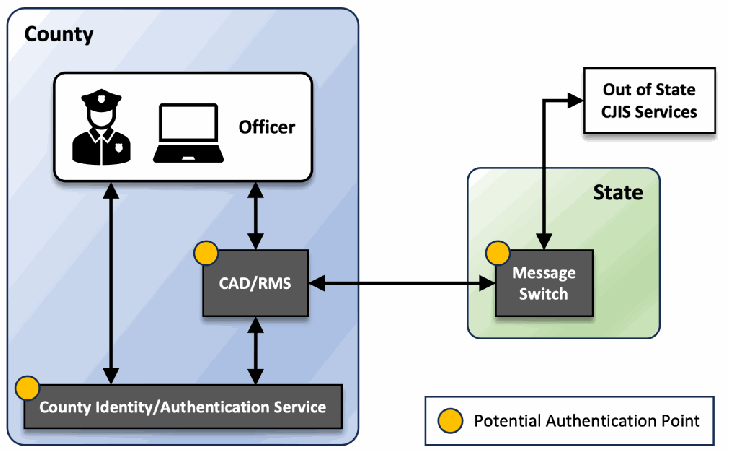
青い「County」(郡)の領域に、ノートパソコンを持つ「Officer」(警察官)、「CAD/RMS」、「County Identity/Authentication Service」(郡のアイデンティティ・認証サービス)があります。Officer は CAD/RMS と郡のアイデンティティ・認証サービスに接続し、CAD/RMS は郡のアイデンティティ・認証サービスと、緑の「State」(州)の領域の「Message Switch」(メッセージスイッチ)に接続します。Message Switch は「Out of State CJIS Services」(州外の CJIS サービス)に接続します。黄色の丸(「Potential Authentication Point」、認証を行いうる箇所)が CAD/RMS、郡のアイデンティティ・認証サービス、Message Switch に付いています。
Fig. 6. Potential authentication points for local agencies.
図 6. 地方機関における認証ポイントの候補。
3.4.1.1. MFA Provided by a CAD/RMS Application
3.4.1.1. CAD/RMS アプリケーションが提供する MFA
Figure 7 details an MFA solution implemented by the CAD/RMS application.
図 7 に、CAD/RMS アプリケーションが実装する MFA ソリューションを詳しく示します。
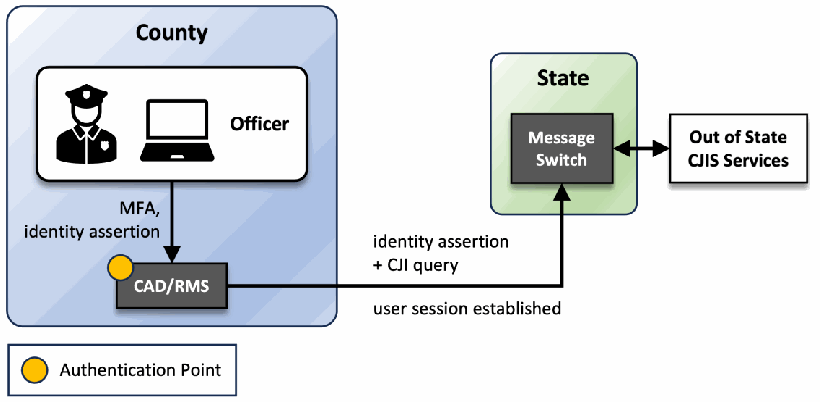
青い「County」(郡)の領域で、ノートパソコンを持つ「Officer」(警察官)が「CAD/RMS」に対して「MFA, identity assertion」(MFA とアイデンティティアサーション)を行います。CAD/RMS には黄色の丸(「Authentication Point」、認証箇所)が付いています。CAD/RMS は緑の「State」(州)の領域の「Message Switch」(メッセージスイッチ)に「identity assertion + CJI query」(アイデンティティアサーションと CJI の照会)を送り、「user session established」(ユーザーセッションが確立)と記されています。Message Switch は「Out of State CJIS Services」(州外の CJIS サービス)に接続します。
Fig. 7. MFA at the CAD/RMS application.
図 7. CAD/RMS アプリケーションでの MFA。
Agencies choosing to implement an MFA solution provided by their CAD/RMS vendor should consider a few key architecture elements:
CAD/RMS ベンダーが提供する MFA ソリューションを実装することを選択する機関は、アーキテクチャ上のいくつかの重要な要素を検討すべきです。
•Which authenticator types the CAD/RMS solution offers: It is important for agencies to work with their CAD/RMS vendors to understand the MFA options they offer. Because CAD/RMS products do not include dedicated identity solutions, there may be limited MFA options available “out of the box.” Agencies should consider if these options will adequately meet the requirements in the CJIS Security Policy and fulfill the MFA needs of agency users. If agencies cannot get the desired MFA optionality—as described in Sec. 3.1.2—from their CAD/RMS vendor, they should seek to integrate their CAD/RMS applications with a dedicated identity service that might better meet agency MFA needs.
•CAD/RMS ソリューションが提供する認証器の種類: 機関は、CAD/RMS ベンダーと連携して、ベンダーが提供する MFA の選択肢を把握することが重要です。CAD/RMS 製品には専用のアイデンティティソリューションが含まれないため、「そのまま」で利用できる MFA の選択肢は限られている可能性があります。機関は、これらの選択肢が CJIS セキュリティポリシーの要件を十分に満たし、機関のユーザーの MFA ニーズを満たすかどうかを検討すべきです。CAD/RMS ベンダーから、3.1.2 節で説明されているような希望する MFA の選択肢を得られない場合、機関は、機関の MFA ニーズをより適切に満たせる専用のアイデンティティサービスと CAD/RMS アプリケーションを統合するよう努めるべきです。
•Support for identity federation protocols: To support authenticator reuse, agencies should consult their CAD/RMS vendors to determine if their product implements identity federation standards as mentioned in Sec. 2.4. These protocols allow for the passing of identity information in a trusted and secure fashion between networked systems and may reduce the need for MFA to be implemented at downstream applications or resources. For example, if a user has successfully completed MFA at the CAD/RMS, that successful authentication could be conveyed to a state message switch via federation protocols rather than having the user complete a secondary authentication at the switch. This promotes the ability to reuse the initial MFA and can help reduce the number of credentials that users need to manage.
•アイデンティティフェデレーションプロトコルへの対応: 認証器の再利用を支援するため、機関は、2.4 節で述べたアイデンティティフェデレーションの標準が自社製品に実装されているかどうかを、CAD/RMS ベンダーに確認すべきです。これらのプロトコルにより、ネットワーク化されたシステム間で、アイデンティティ情報を信頼でき安全な方法で受け渡すことができ、下流のアプリケーションやリソースに MFA を実装する必要を減らせる可能性があります。たとえば、ユーザーが CAD/RMS で MFA を正常に完了した場合、その認証成功を、メッセージスイッチでユーザーに 2 回目の認証を完了させるのではなく、フェデレーションプロトコルを介して州のメッセージスイッチに伝達できます。これにより、最初の MFA を再利用できるようになり、ユーザーが管理する認証情報の数を減らすことができます。
If CAD/RMS applications do not support identity federation, agencies should consider the potential burden on users should they have to manage multiple MFA credentials and seek to minimize that burden when reasonable.
CAD/RMS アプリケーションがアイデンティティフェデレーションに対応していない場合、機関は、ユーザーが複数の MFA 認証情報を管理しなければならなくなったときの負担を検討し、合理的な範囲でその負担を最小限に抑えることを目指すべきです。
•Avoiding the passing of memorized secrets: When CAD/RMS applications send user queries to the state message switch, agencies should consider solutions that do not require the passing of memorized secrets between the CAD/RMS application and the state message switch, as described in Sec. 3.1.3. Instead, identity information (which might be needed downstream for auditing and logging) could be passed to the message switch using identity federation protocols such as SAML or OpenID Connect.
•記憶された秘密情報の受け渡しの回避: CAD/RMS アプリケーションが州のメッセージスイッチにユーザーのクエリを送信する際、機関は、3.1.3 節で述べたように、CAD/RMS アプリケーションと州のメッセージスイッチの間で記憶された秘密情報を受け渡す必要のないソリューションを検討すべきです。その代わりに、SAML や OpenID Connect などのアイデンティティフェデレーションプロトコルを使って、アイデンティティ情報(下流で監査やログ記録に必要となる場合があります)をメッセージスイッチに渡すことができます。
Note: Appendix C provides a sample list of questions for agencies to ask their CAD/RMS vendors about their MFA implementations.
備考: 付録 C には、機関が CAD/RMS ベンダーの MFA 実装について尋ねるための、質問の例の一覧を示します。
3.4.1.2. MFA Implemented at Local Agency Identity Service
3.4.1.2. 地方機関のアイデンティティサービスに実装する MFA
As detailed in Fig. 8, agencies may choose to integrate their CJIS applications and resources with a dedicated identity service.
図 8 に詳しく示すように、機関は、CJIS のアプリケーションとリソースを専用のアイデンティティサービスと統合することを選択できます。
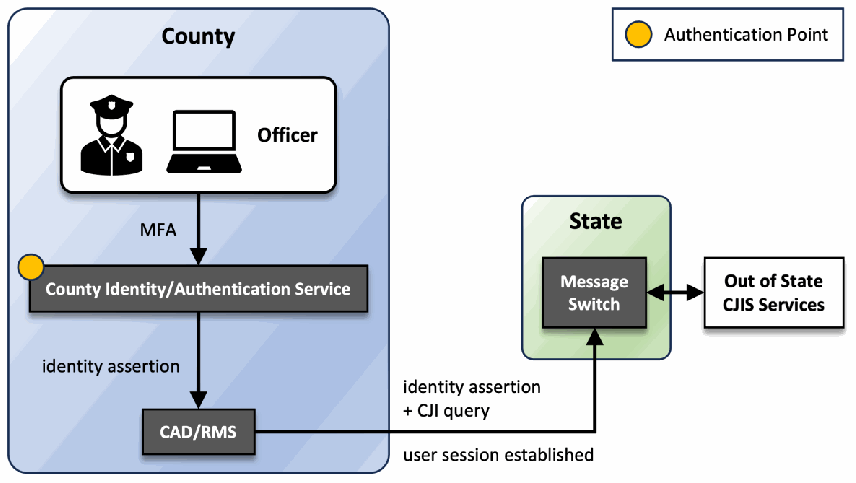
青い「County」(郡)の領域で、ノートパソコンを持つ「Officer」(警察官)が「County Identity/Authentication Service」(郡のアイデンティティ・認証サービス)に「MFA」を行います。このサービスに黄色の丸(「Authentication Point」、認証箇所)が付いています。このサービスは「CAD/RMS」に「identity assertion」(アイデンティティアサーション)を送り、CAD/RMS は緑の「State」(州)の領域の「Message Switch」(メッセージスイッチ)に「identity assertion + CJI query」(アイデンティティアサーションと CJI の照会)を送ります(「user session established」、ユーザーセッションが確立)。Message Switch は「Out of State CJIS Services」(州外の CJIS サービス)に接続します。
Fig. 8. Local agency identity service Integrated with CAD/RMS using identity federation.
図 8. アイデンティティフェデレーションを用いて CAD/RMS と統合した地方機関のアイデンティティサービス。
Agencies choosing to implement an MFA solution provided by an identity service vendor should consider a few key architecture elements:
アイデンティティサービスのベンダーが提供する MFA ソリューションを実装することを選択する機関は、アーキテクチャ上のいくつかの重要な要素を検討すべきです。
•Which authenticator types the identity service offers: These services are generally able to maximize authenticator optionality and reusability since they emphasize providing more features and functionality. As mentioned previously, agencies should consult their identity vendors to determine the types of authenticators—including phishing-resistant authenticators—supported by the identity service. It is recommended that agencies receive a demo of each authenticator type and request that the vendor provide details as to how each authenticator meets AAL2 requirements. Agencies should also inquire about technical documentation, instructions, and communication resources the vendor may have that can support an MFA deployment.
•アイデンティティサービスが提供する認証器の種類: これらのサービスは、より多くの特徴と機能の提供に重点を置いているため、一般に認証器の選択可能性と再利用性を最大化できます。前述のとおり、機関は、アイデンティティサービスのベンダーに相談して、アイデンティティサービスが対応する認証器の種類(フィッシング耐性のある認証器を含む)を判断すべきです。機関は、各種類の認証器のデモを受け、各認証器が AAL2 の要件をどのように満たすかについての詳細をベンダーに求めるべきです。また、MFA の展開を支援できる、ベンダーが用意している技術文書、手順書、コミュニケーション用の資料についても問い合わせるべきです。
•Support for integrating applications: Since identity service providers are commonly external to the applications they provide services to, agencies will need to determine how the identity service will integrate with CJIS applications. Agencies should inquire about support for federation protocols and Kerberos, as well as SSO capabilities.
•アプリケーション統合への対応: アイデンティティサービスプロバイダーは、サービスを提供する対象のアプリケーションの外部にあるのが一般的であるため、機関は、アイデンティティサービスを CJIS のアプリケーションとどのように統合するかを判断する必要があります。機関は、フェデレーションプロトコルや Kerberos への対応、および SSO 機能について問い合わせるべきです。
Appendix B provides technical details and guidelines for integrating CAD/RMS systems using federated architectures.
付録 B では、フェデレーション型アーキテクチャを使って CAD/RMS システムを統合するための技術的な詳細とガイドラインを示します。
Note: Both message switches and CAD/RMS applications may have to support compatible federation or token-based protocols for a successful integration. These protocols allow for the sharing of identity information between all these systems without sharing passwords.
備考: 統合を成功させるには、メッセージスイッチと CAD/RMS アプリケーションの両方が、互換性のあるフェデレーションプロトコルまたはトークンベースのプロトコルに対応する必要がある場合があります。これらのプロトコルにより、パスワードを共有せずに、これらすべてのシステム間でアイデンティティ情報を共有できます。
3.4.1.3. MFA Implemented by a State Identity Service for Use by Local Agencies
3.4.1.3. 地方機関が利用する、州のアイデンティティサービスに実装する MFA
State agencies that have already implemented MFA may decide to offer an MFA service to local agencies within their jurisdiction, as shown in Fig. 9. This model might be offered only to small or rural agencies who may lack the necessary funding and/or knowledge to implement MFA on their own, or the state might consider a shared service model where identity services are offered to all eligible and interested agencies within the state. Such an approach could result in economies of scale that could save costs for both state and local agencies and could also reduce the number of MFA architectures and implementations needed across the state. Establishing a state-shared service might also afford agencies greater ability to influence vendor capabilities and updates, including updates to support standards and best practices for MFA.
すでに MFA を実装している州の機関は、図 9 に示すように、管轄内の地方機関に MFA サービスを提供することを決定する場合があります。このモデルは、MFA を自力で実装するために必要な資金や知識(あるいはその両方)を欠いている可能性のある小規模機関や農村部の機関にのみ提供される場合もあれば、州が、州内の対象となるすべての関心のある機関にアイデンティティサービスを提供する共有サービスモデルを検討する場合もあります。このような手法は、州と地方機関の双方のコストを節約できるスケールメリットをもたらす可能性があり、州全体で必要な MFA アーキテクチャと実装の数も減らせる可能性があります。州で共有するサービスを確立することで、MFA の標準とベストプラクティスに対応するための更新を含め、ベンダーの機能や更新に機関が影響を及ぼす力を高められる可能性もあります。
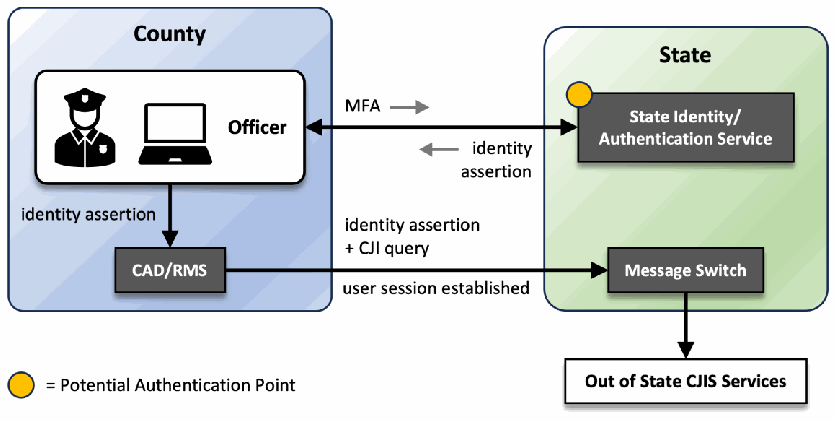
青い「County」(郡)の領域の、ノートパソコンを持つ「Officer」(警察官)が、緑の「State」(州)の領域の「State Identity/Authentication Service」(州のアイデンティティ・認証サービス)に「MFA」を行い、「identity assertion」(アイデンティティアサーション)を受け取ります。このサービスに黄色の丸(「= Potential Authentication Point」、認証を行いうる箇所)が付いています。Officer は「CAD/RMS」にアイデンティティアサーションを渡し、CAD/RMS は州の領域の「Message Switch」(メッセージスイッチ)に「identity assertion + CJI query」(アイデンティティアサーションと CJI の照会)を送ります(「user session established」、ユーザーセッションが確立)。Message Switch は「Out of State CJIS Services」(州外の CJIS サービス)に接続します。
Fig. 9. State-provided identity service for use by a local agency.
図 9. 地方機関が利用する、州が提供するアイデンティティサービス。
A few key considerations should be noted about this model:
このモデルについて、いくつかの重要な考慮事項に留意すべきです。
•The identity service would be owned and operated by the state; however, the state may grant local agencies permission to manage their own employees within the state identity service.
•アイデンティティサービスは州が所有して運用しますが、州は、地方機関が州のアイデンティティサービス内で自機関の職員を管理することを許可する場合があります。
•To integrate with local CJIS applications and limit the passing of secrets in a shared service model, both the state identity service and the local applications will likely need to support identity federation protocols. Appendix B.4.1 and B.4.2 provide technical details and guidelines for integrating architectures when the identity services at the state support both local agency (county or city) and state employees.
•ローカルの CJIS アプリケーションと統合し、共有サービスモデルでシークレットの受け渡しを制限するには、州のアイデンティティサービスとローカルのアプリケーションの両方がアイデンティティフェデレーションプロトコルに対応する必要が生じる可能性が高いです。付録 B.4.1 と B.4.2 では、州のアイデンティティサービスが地方機関(郡または市)の職員と州の職員の両方に対応する場合に、アーキテクチャを統合するための技術的な詳細とガイドラインを示します。
•Additionally, state agencies seeking to implement this model will need to enumerate MFA requirements and use cases from their local agency jurisdictions and should work with their vendor to determine the authenticator optionality that might meet these requirements.
•さらに、このモデルの実装を目指す州の機関は、管轄内の地方機関から MFA の要件とユースケースを列挙する必要があり、これらの要件を満たす可能性のある認証器の選択可能性を判断するために、ベンダーと連携すべきです。
3.4.2. State MFA Deployments
3.4.2. 州の MFA 展開
In addition to applications like CAD/RMS, most states have a portal—managed and run at the state level—through which authorized users across the state can access CJI. Figure 10 demonstrates an architecture commonly seen when accessing CJI through a state portal. Authentication might be provided by the portal application itself, or the portal could be integrated with an identity service.
CAD/RMS などのアプリケーションに加え、ほとんどの州には、州レベルで管理・運用されるポータルがあり、州全体の認可されたユーザーがこれを通じて CJI にアクセスできます。図 10 に、州のポータルを通じて CJI にアクセスする際によく見られるアーキテクチャを示します。認証はポータルアプリケーション自体が提供する場合もあれば、ポータルがアイデンティティサービスと統合される場合もあります。
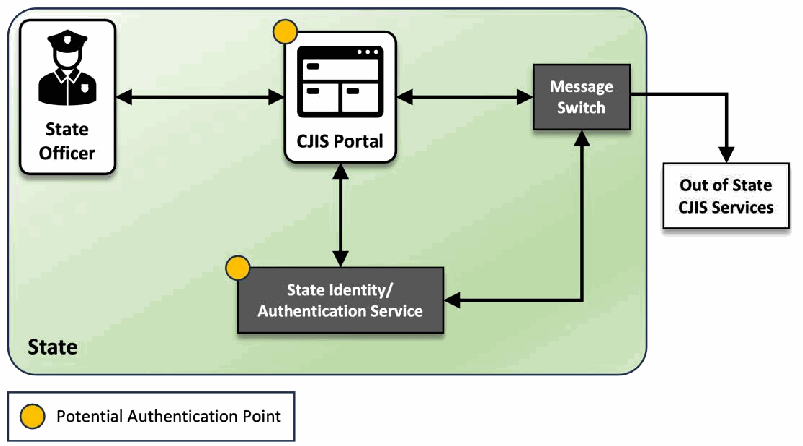
緑の「State」(州)の領域の中で、「State Officer」(州の警察官)が「CJIS Portal」に接続します。CJIS Portal は「Message Switch」(メッセージスイッチ)と「State Identity/Authentication Service」(州のアイデンティティ・認証サービス)に接続し、このサービスも Message Switch に接続します。Message Switch は領域の外の「Out of State CJIS Services」(州外の CJIS サービス)に接続します。黄色の丸(「Potential Authentication Point」、認証を行いうる箇所)が CJIS Portal と州のアイデンティティ・認証サービスに付いています。
Fig. 10. Common technology in state portal deployment.
図 10. 州ポータルの展開で一般的な技術。
3.4.2.1. MFA Implemented Directly with State Portal
3.4.2.1. 州ポータルで直接実装する MFA
Considerations for implementing MFA directly with state portal applications are similar to those discussed in Sec. 3.4.1.1 around implementing MFA directly with CAD/RMS applications. A common architecture is depicted in Fig. 11. Agencies should consider authenticator optionality and reuse when implementing MFA directly at a state portal application. Agencies will need to consult their portal vendor to determine which authenticator options might be available and determine if those options will meet the needs of the user base across the state.
州のポータルアプリケーションで MFA を直接実装する際の考慮事項は、CAD/RMS アプリケーションで MFA を直接実装することについて 3.4.1.1 節で論じたものと同様です。一般的なアーキテクチャを図 11 に示します。機関は、州のポータルアプリケーションで MFA を直接実装する際、認証器の選択可能性と再利用を検討すべきです。機関は、ポータルのベンダーに相談して、どのような認証器の選択肢が利用可能かを判断し、それらの選択肢が州全体のユーザー層のニーズを満たすかどうかを判断する必要があります。
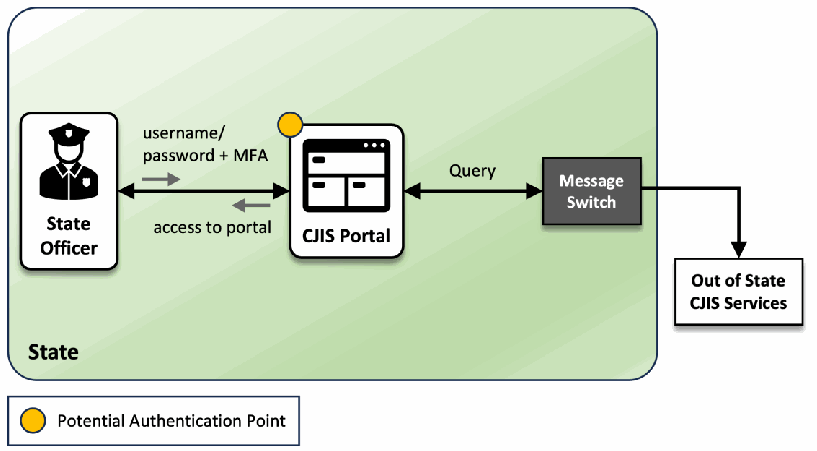
緑の「State」(州)の領域の中で、「State Officer」(州の警察官)が「CJIS Portal」に「username/ password + MFA」(ユーザー名・パスワードと MFA)を送り、「access to portal」(ポータルへのアクセス)を得ます。CJIS Portal に黄色の丸(「Potential Authentication Point」、認証を行いうる箇所)が付いています。CJIS Portal は「Message Switch」(メッセージスイッチ)に「Query」(照会)を送り、Message Switch は領域の外の「Out of State CJIS Services」(州外の CJIS サービス)に接続します。
Fig. 11. Common architecture for implementing MFA directly with state portal.
図 11. 州ポータルで直接 MFA を実装する一般的なアーキテクチャ。
Since state CJIS portals often provide services to users across the state, agencies should offer multiple MFA options to meet user needs. For example, if the state portal offers a software one-time passcode (OTP) option via an application installed on a mobile device, that solution may not meet the needs of department of corrections facilities that do not allow mobile devices into secure facilities. Since state portal applications are not dedicated identity providers, direct MFA integration will likely not provide MFA reuse. Where possible, agencies should consider implementing identity federation protocols that can integrate with identity services across the state and allow users to bring their own identity if they have already authenticated using MFA. See Appendix B for more information on implementing identity federation.
州の CJIS ポータルは、州全体のユーザーにサービスを提供することが多いため、機関は、ユーザーのニーズを満たすために複数の MFA の選択肢を提供すべきです。たとえば、州のポータルが、モバイルデバイスにインストールしたアプリケーションによるソフトウェアのワンタイムパスコード(OTP)の選択肢を提供している場合、そのソリューションは、安全な施設へのモバイルデバイスの持ち込みを認めていない矯正施設のニーズを満たさない可能性があります。州のポータルアプリケーションは専用のアイデンティティプロバイダーではないため、MFA を直接統合しても、MFA の再利用はおそらく実現しません。可能な場合、機関は、州全体のアイデンティティサービスと統合でき、すでに MFA を使って認証済みのユーザーが自分のアイデンティティを持ち込めるようにするアイデンティティフェデレーションプロトコルの実装を検討すべきです。アイデンティティフェデレーションの実装の詳細については、付録 B を参照してください。
Additionally, state CJIS portals will need to integrate with the state message switch to submit queries to resources out-of-state (and, depending on the implementation, possibly other in-state resources as well). If the portal sends user queries to the state message switch, agencies should consider solutions that do not require the passing of memorized secrets, such as passwords, as described in Sec. 3.1.3. Agencies should look towards identity federation protocols or other token-based systems that can support this integration.
さらに、州の CJIS ポータルは、州外のリソース(実装によっては、州内の他のリソースも含まれる場合があります)にクエリを送信するために、州のメッセージスイッチと統合する必要があります。ポータルが州のメッセージスイッチにユーザーのクエリを送信する場合、機関は、3.1.3 節で述べたように、パスワードなどの記憶された秘密情報の受け渡しを必要としないソリューションを検討すべきです。機関は、この統合を支援できるアイデンティティフェデレーションプロトコルやその他のトークンベースのシステムに目を向けるべきです。
3.4.2.2. MFA Implemented at State Agency Identity Service
3.4.2.2. 州機関のアイデンティティサービスに実装する MFA
Alternatively, agencies may seek to integrate their state portal with a dedicated identity service platform, as Fig. 12 depicts. This option will likely provide agencies with a greater level of authenticator optionality and potential for authenticator reuse.
別の方法として、機関は、図 12 に示すように、州のポータルを専用のアイデンティティサービスプラットフォームと統合することを目指す場合があります。この選択肢により、機関は、より高い水準の認証器の選択可能性と、認証器の再利用の可能性を得られるでしょう。
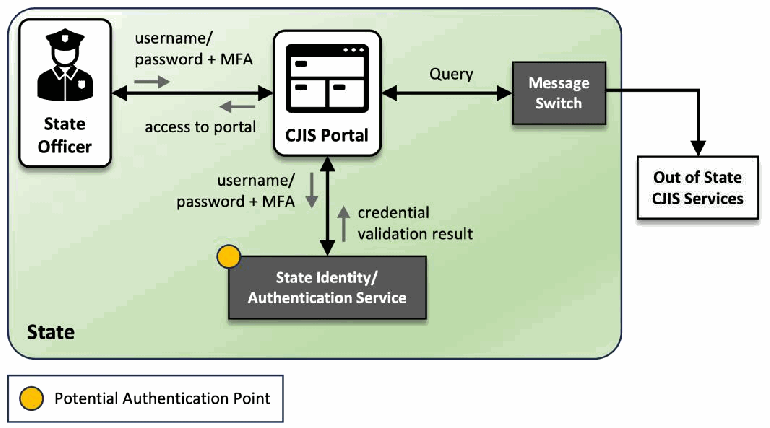
緑の「State」(州)の領域の中で、「State Officer」(州の警察官)が「CJIS Portal」に「username/ password + MFA」(ユーザー名・パスワードと MFA)を送り、「access to portal」(ポータルへのアクセス)を得ます。CJIS Portal は「State Identity/Authentication Service」(州のアイデンティティ・認証サービス)に「username/ password + MFA」を渡し、「credential validation result」(認証情報の検証結果)を受け取ります。このサービスに黄色の丸(「Potential Authentication Point」、認証を行いうる箇所)が付いています。CJIS Portal は「Message Switch」(メッセージスイッチ)に「Query」(照会)を送り、Message Switch は「Out of State CJIS Services」(州外の CJIS サービス)に接続します。
Fig. 12. Common architecture for implementing MFA at state agency identity service.
図 12. 州機関のアイデンティティサービスで MFA を実装する一般的なアーキテクチャ。
Agencies should consult with their vendor to determine which authenticator types—including phishing-resistant authenticators—are supported, as well as which identity federation protocols the vendor can implement. State agencies should discuss with vendors and local jurisdictions the possibility of integrating the state identity solution with local agency identity services so that local agency users accessing the state portal can reuse any MFA they have implemented at their home agency.
機関は、ベンダーに相談して、どの種類の認証器(フィッシング耐性のある認証器を含む)に対応しているか、またベンダーがどのアイデンティティフェデレーションプロトコルを実装できるかを判断すべきです。州の機関は、州のポータルにアクセスする地方機関のユーザーが、所属機関ですでに実装した MFA を再利用できるように、州のアイデンティティソリューションを地方機関のアイデンティティサービスと統合する可能性について、ベンダーおよび地方の管轄と協議すべきです。
Tip: State agencies commonly manage user accounts and credentials for their state CJIS portal, serving as the IdP for users across the state. The cost of this function, both in upfront costs of procuring and implementing MFA and in ongoing costs in help desk support and authenticator lifecycle management, might be alleviated if local, tribal, and territorial agencies had the option to integrate their local identity services with the state portal using identity federation protocols. Section 3.4.2.3 details an example architecture that supports this functionality.
ヒント: 州の機関は、州の CJIS ポータルのユーザーアカウントと認証情報を管理し、州全体のユーザーの IdP として機能するのが一般的です。この機能のコストは、MFA の調達と実装の初期費用と、ヘルプデスクのサポートおよび認証器のライフサイクル管理の継続的な費用の両面で、地方、部族、準州の機関が、アイデンティティフェデレーションプロトコルを使って自機関のアイデンティティサービスを州のポータルと統合する選択肢を持てば、軽減される可能性があります。3.4.2.3 節では、この機能を支援するアーキテクチャの例を詳しく説明します。
3.4.2.3. MFA Implemented in a State-Provided Dashboard
3.4.2.3. 州が提供するダッシュボードに実装する MFA
In addition to CJI, agencies may have other data, applications, or resources that warrant the use of MFA. Commonly, enterprises seek to integrate applications with an application dashboard that can serve as a front-end, providing a single interface for users to access multiple applications and act as a centralized point for implementing MFA.
CJI に加え、機関には、MFA の使用が妥当な他のデータ、アプリケーション、リソースがある場合があります。企業では、アプリケーションを、フロントエンドとして機能し、ユーザーが複数のアプリケーションにアクセスするための単一のインターフェースを提供し、MFA を実装する集中的なポイントとなりうる、アプリケーションダッシュボードと統合しようとするのが一般的です。
Figure 13 shows a state-hosted application dashboard that integrates several applications, including a CJIS portal that can be accessed by both state and local users. Many dashboard vendors are also identity services providers that support a variety of MFA authenticators and identity federation protocols. Agencies could leverage the identity and authentication services native to the dashboard or integrate the dashboard with existing agency identity services and allow the dashboard to provide an SSO service. Either way, the user would authenticate once using MFA and use SSO to access all applications available on the dashboard.
図 13 に、州がホストするアプリケーションダッシュボードを示します。これは、州のユーザーと地方のユーザーの両方がアクセスできる CJIS ポータルを含む、複数のアプリケーションを統合しています。ダッシュボードのベンダーの多くは、さまざまな MFA 認証器やアイデンティティフェデレーションプロトコルに対応するアイデンティティサービスプロバイダーでもあります。機関は、ダッシュボードにネイティブなアイデンティティおよび認証サービスを活用することも、ダッシュボードを既存の機関のアイデンティティサービスと統合して、ダッシュボードが SSO サービスを提供するようにすることもできます。いずれの場合も、ユーザーは MFA を使って一度認証し、SSO を使ってダッシュボードで利用可能なすべてのアプリケーションにアクセスします。
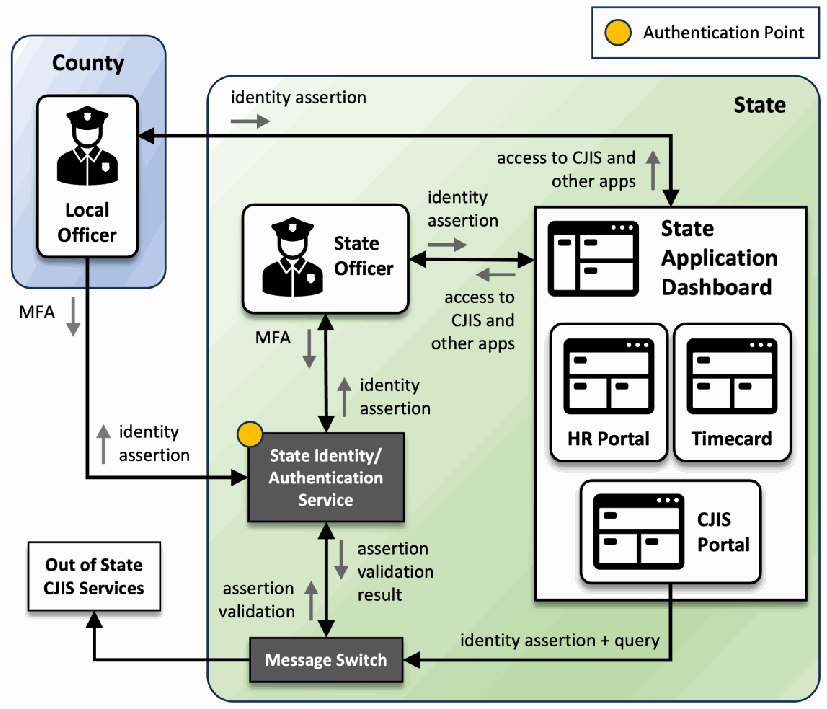
青い「County」(郡)の領域の「Local Officer」(地方の警察官)と緑の「State」(州)の領域の「State Officer」(州の警察官)が、いずれも「State Identity/Authentication Service」(州のアイデンティティ・認証サービス)に「MFA」を行い、それぞれ「identity assertion」(アイデンティティアサーション)を受け取ります。このサービスに黄色の丸(「Authentication Point」、認証箇所)が付いています。各警察官はアイデンティティアサーションを「State Application Dashboard」(州のアプリケーションダッシュボード)に示し、「access to CJIS and other apps」(CJIS とその他のアプリへのアクセス)を得ます。ダッシュボードには「HR Portal」「Timecard」「CJIS Portal」があります。CJIS Portal は「Message Switch」(メッセージスイッチ)に「identity assertion + query」(アイデンティティアサーションと照会)を送り、Message Switch は州のアイデンティティ・認証サービスと「assertion validation」(アサーションの検証)・「assertion validation result」(アサーションの検証結果)をやり取りし、「Out of State CJIS Services」(州外の CJIS サービス)に接続します。
Fig. 13. State application dashboard.
図 13. 州のアプリケーションダッシュボード。
Appendix B.4.1 and B.4.4.1 provide technical details and guidelines for integrating architectures when the state implements an application dashboard to support both local (county or city) and state employees. This model promotes authenticator reuse through SSO and authenticator optionality via integrated identity services. It also offers the potential to create a shared service model where economies of scale in pricing might be realized by bringing multiple jurisdictions under a single service. A single identity service that multiple agencies can leverage also has the potential to limit the number of architectures and integration models needed across a state.
付録 B.4.1 と B.4.4.1 では、州が地方(郡または市)の職員と州の職員の両方を支援するアプリケーションダッシュボードを実装する場合に、アーキテクチャを統合するための技術的な詳細とガイドラインを示します。このモデルは、SSO による認証器の再利用と、統合されたアイデンティティサービスによる認証器の選択可能性を促進します。また、複数の管轄を単一のサービスにまとめることで、価格面のスケールメリットが得られる可能性のある共有サービスモデルを構築できる可能性もあります。複数の機関が活用できる単一のアイデンティティサービスは、州全体で必要なアーキテクチャと統合モデルの数を抑えられる可能性もあります。
Note: Many states likely have small and rural agencies that lack the ability to implement MFA on their own. To support these agencies and to ensure that all users accessing CJI within a state are using MFA, state agencies should consider offering shared identity services that local agencies can opt into. Additionally, if local agencies choose to implement their own MFA, they should be provided an option to integrate with the state service using identity federation protocols.
備考: 多くの州には、MFA を自力で実装する能力を持たない小規模機関や農村部の機関があると考えられます。これらの機関を支援し、州内で CJI にアクセスするすべてのユーザーが MFA を使用するようにするため、州の機関は、地方機関が参加を選択できる共有アイデンティティサービスの提供を検討すべきです。さらに、地方機関が独自に MFA を実装することを選択した場合は、アイデンティティフェデレーションプロトコルを使って州のサービスと統合する選択肢を提供すべきです。
Caution: Some agencies may find that their state already owns and operates an application dashboard for non-CJI applications that could be integrated with CJIS applications. This option may save agencies time and money. However, if the application dashboard is managed by a non-criminal justice agency, the contracting agency must make sure that a Security Addendum or Management Control Agreement is in place to ensure that the application or service meets CJIS Security Policy requirements and that administrative rights for managing access to CJIS applications are given only to those personnel who are authorized to access CJI.
注意: 機関の中には、自州がすでに CJI 以外のアプリケーション向けにアプリケーションダッシュボードを所有して運用しており、それを CJIS のアプリケーションと統合できると気付くところもあるかもしれません。この選択肢は、機関の時間と費用を節約できる可能性があります。ただし、アプリケーションダッシュボードが非刑事司法機関によって管理されている場合、契約する機関は、アプリケーションまたはサービスが CJIS セキュリティポリシーの要件を満たすこと、および CJIS アプリケーションへのアクセスを管理する管理者権限が、CJI へのアクセスを認可された職員にのみ付与されることを確実にするために、Security Addendum または Management Control Agreement が締結されていることを確認しなければなりません。
3.4.3. Implementing MFA with VPNs
3.4.3. VPN による MFA の実装
Almost all agencies use a VPN service to provide secure communications when accessing agency networks. Because of this, agencies may seek to leverage MFA solutions offered by their VPN providers. In this situation, it is important that agencies consider not only how MFA is integrated with their VPN service but also how users will access the CJIS application after they have successfully completed authentication and gained network access.
ほぼすべての機関が、機関のネットワークにアクセスする際の安全な通信を提供するために VPN サービスを使用しています。このため、機関は VPN プロバイダーが提供する MFA ソリューションを活用しようとする場合があります。この場合、機関は、MFA を VPN サービスとどのように統合するかだけでなく、認証を正常に完了してネットワークアクセスを得た後で、ユーザーが CJIS アプリケーションにどのようにアクセスするかも検討することが重要です。
Figure 14 details a VPN architecture that also provides MFA services. In this example, the user authenticates to the VPN service by presenting a password, which is validated with agency directory services, along with a second authentication factor, which is validated with the MFA server. The MFA server may have several options for second factors, such as a hardware token or a software one-time code. Once the user successfully completes the MFA challenge to gain network access, they are subsequently asked to present a username and password when accessing the CJIS application.
図 14 に、MFA サービスも提供する VPN アーキテクチャを詳しく示します。この例では、ユーザーは、機関のディレクトリサービスで検証されるパスワードと、MFA サーバーで検証される 2 つ目の認証要素を提示して、VPN サービスに対して認証します。MFA サーバーには、ハードウェアトークンやソフトウェアのワンタイムコードなど、2 つ目の要素として複数の選択肢がある場合があります。ネットワークアクセスを得るための MFA チャレンジをユーザーが正常に完了すると、その後 CJIS アプリケーションにアクセスする際に、ユーザー名とパスワードの提示を求められます。
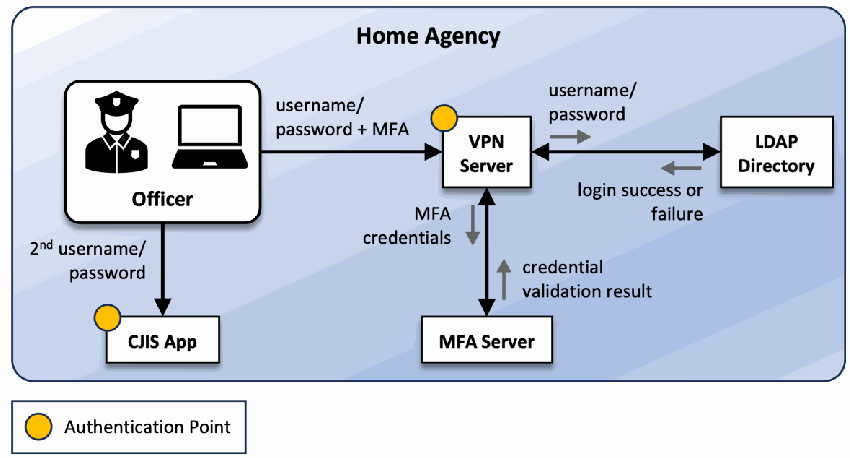
「Home Agency」(所属機関)の領域の中で、ノートパソコンを持つ「Officer」(警察官)が「VPN Server」に「username/ password + MFA」(ユーザー名・パスワードと MFA)を送ります。VPN Server に黄色の丸(「Authentication Point」、認証箇所)が付いています。VPN Server は「LDAP Directory」に「username/ password」を送って「login success or failure」(ログインの成否)を受け取り、「MFA Server」に「MFA credentials」(MFA の認証情報)を送って「credential validation result」(認証情報の検証結果)を受け取ります。これとは別に、Officer は「CJIS App」に「2nd username/ password」(2 つ目のユーザー名・パスワード)を送ります。CJIS App にも認証箇所の印が付いています。
Fig. 14. VPN with MFA is not integrated with the CJIS application.
図 14. MFA を備えた VPN が CJIS アプリケーションと統合されていない場合。
In the above example, the user must authenticate twice: despite having already completed MFA, they still need to maintain and use a secondary password with the CJIS application. This occurs because the MFA implementation is “in front” of the CJIS application but not integrated with it, resulting in MFA being enforced at the network but not at the application. If a bad actor were to get agency network access, the CJIS application might be vulnerable to phishing, brute-force password guessing attempts, or password database breaches. This architecture also does not prevent CJIS application password sharing or misuse among insiders with legitimate VPN credentials. To minimize these risks and to promote authenticator reuse, agencies should seek to integrate their CJIS application with an identity service that eliminates the need for a secondary username and password. The following sections offer two examples of how this might be accomplished.
上の例では、ユーザーは 2 回認証しなければなりません。すでに MFA を完了しているにもかかわらず、CJIS アプリケーション用の 2 つ目のパスワードを維持して使用する必要があります。これは、MFA の実装が CJIS アプリケーションの「手前」にあるものの、統合されていないために、MFA がネットワークで適用されてもアプリケーションでは適用されないことによって生じます。悪意ある者が機関のネットワークアクセスを得た場合、CJIS アプリケーションは、フィッシング、ブルートフォースによるパスワード推測の試み、パスワードデータベースの侵害に対して脆弱になる可能性があります。このアーキテクチャでは、正規の VPN 認証情報を持つ内部者による CJIS アプリケーションのパスワードの共有や不正使用も防げません。これらのリスクを最小限に抑え、認証器の再利用を促進するため、機関は、2 つ目のユーザー名とパスワードを不要にするアイデンティティサービスと CJIS アプリケーションを統合することを目指すべきです。以降の節で、これを実現する方法の例を 2 つ示します。
Caution: Agencies may meet their MFA requirements through a VPN service, but they should avoid presenting users with a secondary single-factor authentication when accessing CJIS applications on the network.
注意: 機関は VPN サービスを通じて MFA の要件を満たしてもよいですが、ネットワーク上の CJIS アプリケーションにアクセスする際に、2 つ目の単一要素認証をユーザーに提示することは避けるべきです。
3.4.3.1. Integrating VPN-Based MFA with CJIS Applications Using Kerberos
3.4.3.1. Kerberos を使った、VPN ベースの MFA と CJIS アプリケーションの統合
Figure 15 shows how MFA implemented at a VPN service might be integrated with a CJIS application using Kerberos SSO.
図 15 に、VPN サービスに実装した MFA を、Kerberos SSO を使って CJIS アプリケーションと統合する方法を示します。
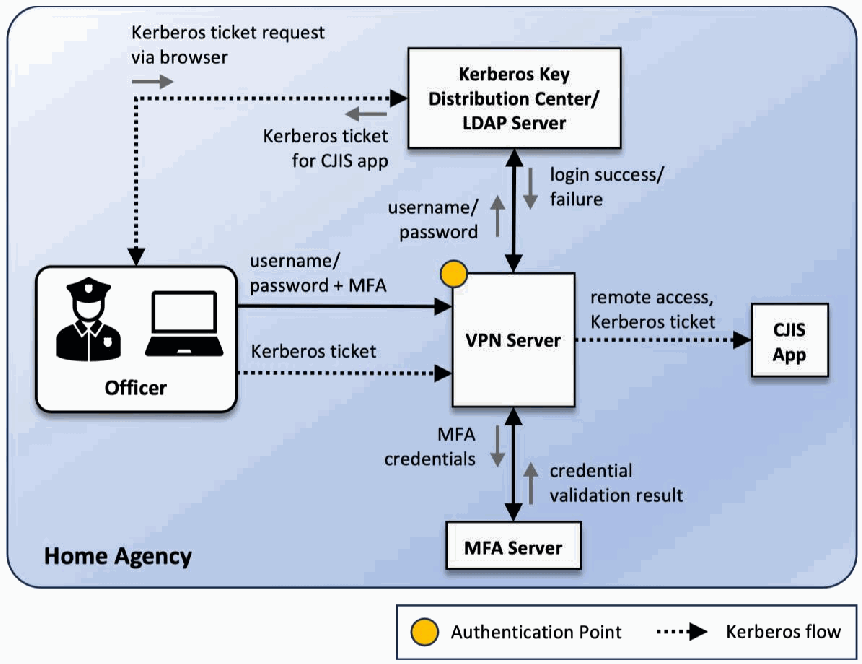
「Home Agency」(所属機関)の領域の中で、ノートパソコンを持つ「Officer」(警察官)が「VPN Server」に「username/ password + MFA」(ユーザー名・パスワードと MFA)を送ります。VPN Server に黄色の丸(「Authentication Point」、認証箇所)が付いています。VPN Server は「Kerberos Key Distribution Center/ LDAP Server」(Kerberos 鍵配布センター/LDAP サーバー)に「username/ password」を送って「login success/ failure」(ログインの成否)を受け取り、「MFA Server」に「MFA credentials」(MFA の認証情報)を送って「credential validation result」(認証情報の検証結果)を受け取ります。点線の矢印は「Kerberos flow」(Kerberos の流れ)を示します。Officer は鍵配布センターに「Kerberos ticket request via browser」(ブラウザ経由の Kerberos チケット要求)を行って「Kerberos ticket for CJIS app」(CJIS アプリ用の Kerberos チケット)を受け取り、その「Kerberos ticket」を VPN Server に示します。VPN Server は「CJIS App」に「remote access, Kerberos ticket」(リモートアクセスと Kerberos チケット)を渡します。
Fig. 15. Integrating MFA for a VPN with Kerberos.
図 15. Kerberos を用いた VPN への MFA の統合。
In this model, the user authenticates to the VPN service by presenting a password, which is validated with agency directory services, along with a second authentication factor, which is validated with the MFA server. Once the user is on the network and navigates to the CJIS app, the user is redirected to the key distribution service. This service recognizes that the user has already authenticated and issues the user a Kerberos ticket with a session key. The user’s system can then present this ticket to the CJIS application to establish a session without the need for a secondary authentication. Appendix B.5.1 provides technical details and guidelines for integrating architectures for VPN integration with Kerberos.
このモデルでは、ユーザーは、機関のディレクトリサービスで検証されるパスワードと、MFA サーバーで検証される 2 つ目の認証要素を提示して、VPN サービスに対して認証します。ユーザーがネットワーク上に入り、CJIS アプリを開くと、ユーザーは鍵配布サービスにリダイレクトされます。このサービスは、ユーザーがすでに認証済みであることを認識し、セッション鍵を含む Kerberos チケットをユーザーに発行します。その後、ユーザーのシステムは、このチケットを CJIS アプリケーションに提示して、2 回目の認証なしでセッションを確立できます。付録 B.5.1 では、Kerberos を使った VPN 統合アーキテクチャに関する技術的な詳細とガイドラインを示します。
Caution: Any agency implementing Kerberos should be aware of “Kerberoasting” attacks. Similar to password brute-force attacks, if an attacker can gain access to a legitimate user account, they may try to escalate privileges by requesting Kerberos tickets for service accounts and perform an offline brute-force attack to try and obtain control of service account credentials. Since service accounts do not have MFA controls protecting them, agencies should implement strong service account password length requirements as well as avoid weaker encryption algorithms such as RC4 [7].
注意: Kerberos を実装する機関は、「Kerberoasting」攻撃に注意すべきです。パスワードのブルートフォース攻撃と同様に、攻撃者が正規のユーザーアカウントにアクセスできる場合、サービスアカウントの Kerberos チケットを要求して権限昇格を試み、オフラインでブルートフォース攻撃を行って、サービスアカウントの認証情報の制御権の取得を試みる可能性があります。サービスアカウントには MFA による保護がないため、機関は、サービスアカウントのパスワード長に強力な要件を設けるとともに、RC4 [7] などの脆弱な暗号アルゴリズムの使用を避けるべきです。
3.4.3.2. Integrating VPN-Based MFA with CJIS Applications Using Identity Federation
3.4.3.2. アイデンティティフェデレーションを使った、VPN ベースの MFA と CJIS アプリケーションの統合
Identity federation protocols offer another approach to integrating a VPN service with a CJIS application. Figure 16 shows the VPN redirecting the user to an IdP for authentication. Upon successful authentication, the IdP issues the user an identity assertion—typically OpenID Connect or SAML federation tokens—that can be used to establish sessions with both the VPN server and the CJIS application. With this approach, users do not need to manage a secondary credential, and there is no need for the CJIS application to manage credentials. Appendix B.5.2 provides technical details and guidelines for integrating architectures for VPN integration using identity federation.
アイデンティティフェデレーションプロトコルは、VPN サービスを CJIS アプリケーションと統合するための、もう 1 つの手法を提供します。図 16 に、VPN がユーザーを認証のために IdP にリダイレクトする様子を示します。認証に成功すると、IdP はユーザーにID アサーション(通常は OpenID Connect または SAML のフェデレーショントークン)を発行し、これを VPN サーバーと CJIS アプリケーションの両方とのセッションの確立に使用できます。この手法では、ユーザーは 2 つ目の認証情報を管理する必要がなく、CJIS アプリケーションが認証情報を管理する必要もありません。付録 B.5.2 では、アイデンティティフェデレーションを使った VPN 統合のアーキテクチャを統合するための技術的な詳細とガイドラインを示します。
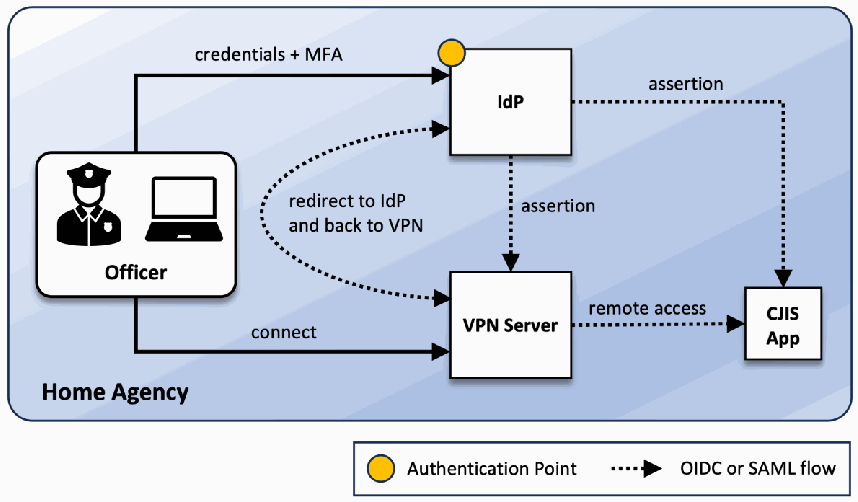
「Home Agency」(所属機関)と書かれた枠の中の構成図です。Officer(警察官のアイコンとノート PC)は IdP(黄色の認証ポイント付き)へ「credentials + MFA」(認証情報 + MFA)を送り、VPN Server へ「connect」(接続)します。VPN Server と IdP の間は「redirect to IdP and back to VPN」(IdP へリダイレクトして VPN に戻る)の点線の曲線矢印で結ばれています。IdP は VPN Server へ「assertion」(アサーション)を点線矢印で送り、CJIS App へも「assertion」を送ります。VPN Server は CJIS App へ「remote access」(リモートアクセス)を点線矢印で提供します。凡例: 黄色の円 = Authentication Point(認証ポイント)、点線矢印 = OIDC or SAML flow(OIDC または SAML のフロー)。
Fig. 16. Integrating MFA for a VPN with federation.
図 16. フェデレーションを用いた VPN への MFA の統合。
Note: The approach illustrated in Fig. 16 requires the IdP to be publicly accessible so that users can connect to it before the VPN connection is established. Identity-as-a-Service providers generally offer publicly accessible IdP services. Self-hosted IdP services are frequently not publicly accessible, depending on the agency’s risk analysis and implementation.
備考: 図 16 に示す手法では、VPN 接続が確立される前にユーザーが IdP に接続できるよう、IdP が公開アクセス可能である必要があります。Identity-as-a-Service プロバイダーは、一般に公開アクセス可能な IdP サービスを提供します。自己ホスト型の IdP サービスは、機関のリスク分析と実装によっては、公開アクセスできないことが多くあります。
4. Key Takeaways
4. 主な要点
This section collects the key takeaways for agencies from throughout the document.
本節では、本書全体を通じた機関向けの主な要点をまとめます。
Section 1, Introduction:
第 1 節 はじめに:
•Many of the challenges discussed in this document require collaboration between state, local, tribal, and territorial (SLTT) agencies, as well as collaboration with law enforcement technology providers. Engage all relevant stakeholders to discuss MFA implementation plans to ensure this collaboration can occur. All questions about how a specific MFA implementation can meet the CJIS Security Policy should be directed to the FBI CJIS ISO team at iso@fbi.gov. (from Sec. 1.2)
•本書で論じる課題の多くは、州、地方、部族、準州(SLTT)の機関の間の協力と、法執行技術のプロバイダーとの協力を必要とします。この協力が実現するよう、関連するすべてのステークホルダーと MFA 実装計画について協議してください。特定の MFA 実装が CJIS セキュリティポリシーをどのように満たせるかに関する質問はすべて、FBI CJIS ISO チーム(iso@fbi.gov)に問い合わせてください。(1.2 節より)
Section 2, An Introduction to MFA Technologies and Concepts:
第 2 節 MFA の技術と概念の概要:
•Because the compromise of CJI would significantly impact agencies across the country, the CJIS Security Policy requires that CJI be protected by MFA at AAL2 or greater. Agencies should reference the Identification and Authentication section of the CJIS Security Policy (versions 5.9.2 or later) for specific requirements. (from Sec. 2.2)
•CJI が侵害されると全米の機関に重大な影響が及ぶため、CJIS セキュリティポリシーは、CJI を AAL2 以上の MFA で保護することを要求しています。具体的な要件については、機関は CJIS セキュリティポリシー(バージョン 5.9.2 以降)の Identification and Authentication の節を参照すべきです。(2.2 節より)
•When deploying an MFA solution, consider where users might get authentication, credential lifecycle management, and identity assertion issuance services from. In other words, decide where the IdP resides in the overarching MFA architecture, who owns and operates the IdP, and which of the services it will provide. (from Sec. 2.3)
•MFA ソリューションを展開する際は、ユーザーが、認証、認証情報のライフサイクル管理、ID アサーションの発行の各サービスをどこから得られるかを検討してください。言い換えれば、MFA アーキテクチャ全体の中で IdP がどこにあるか、誰が IdP を所有して運用するか、IdP がどのサービスを提供するかを決定してください。(2.3 節より)
•Work with the agency’s technology vendors, specifically CAD/RMS, state message switch, and identity services vendors, to confirm they support identity federation protocols and architectures. (from Sec. 2.4.1)
•機関の技術ベンダー(特に CAD/RMS、州のメッセージスイッチ、アイデンティティサービスのベンダー)と連携して、アイデンティティフェデレーションプロトコルとアーキテクチャに対応していることを確認してください。(2.4.1 節より)
•Consider integrating both CJI and non-CJI applications with an SSO service to gain additional return on investment and to provide users with a common authentication experience across applications. Agencies interested in implementing SSO should work with their technology vendors, specifically CAD/RMS, state message switch, and identity services vendors, to confirm they support SSO protocols and architectures. (from Sec. 2.4.2)
•投資対効果をさらに高め、アプリケーション間で共通の認証体験をユーザーに提供するために、CJI のアプリケーションと CJI 以外のアプリケーションの両方を SSO サービスと統合することを検討してください。SSO の実装に関心のある機関は、技術ベンダー(特に CAD/RMS、州のメッセージスイッチ、アイデンティティサービスのベンダー)と連携して、SSO のプロトコルとアーキテクチャに対応していることを確認すべきです。(2.4.2 節より)
•Implement phishing-resistant MFA at AAL2, given the prevalence of phishing attacks. (from Sec. 2.5)
•フィッシング攻撃が蔓延していることを踏まえ、AAL2 でフィッシング耐性のある MFA を実装してください。(2.5 節より)
Section 3, Considerations for Implementing MFA to Protect CJI:
第 3 節 CJI を保護するための MFA 実装の考慮事項:
•To the greatest extent feasible, consider MFA architectures that minimize the number of separate MFA credentials that need to be issued to users and managed. Agencies should consider integrating CJI applications and/or services with existing IdPs that can or already support MFA. (from Sec. 3.1.1)
•実現可能な限り、ユーザーに発行して管理する必要のある個別の MFA 認証情報の数を最小限に抑える MFA アーキテクチャを検討してください。機関は、MFA に対応できる、またはすでに対応している既存の IdP と、CJI のアプリケーションやサービス(あるいはその両方)を統合することを検討すべきです。(3.1.1 節より)
•Agencies will benefit if their MFA solutions support multiple authenticator types and methods. This allows organizations to select the type of authenticator that best meets the needs of a given user base, context, or environment in which CJI is accessed. Generally, the greatest level of MFA optionality is offered by dedicated identity service providers. (from Sec. 3.1.2)
•MFA ソリューションが複数の種類や方式の認証器に対応していれば、機関にとって有益です。これにより、組織は、特定のユーザー層、状況、または CJI にアクセスする環境のニーズに最も合う認証器の種類を選択できます。一般に、最も高い水準の MFA の選択肢を提供するのは、専用のアイデンティティサービスプロバイダーです。(3.1.2 節より)
•Consider solutions that do not require passing memorized secrets across networked systems and amongst applications. Token-based systems such as Kerberos and identity federation protocols are viable options for integrating CJI applications and/or services with other applications and identity services. (from Sec. 3.1.3)
•ネットワーク化されたシステム間やアプリケーション間で記憶された秘密情報を受け渡す必要のないソリューションを検討してください。Kerberos やアイデンティティフェデレーションプロトコルのようなトークンベースのシステムは、CJI のアプリケーションやサービス(あるいはその両方)を、他のアプリケーションやアイデンティティサービスと統合するための有効な選択肢です。(3.1.3 節より)
•When deploying an MFA solution, ensure that the MFA implemented is integrated with the application or service that contains CJI. Ideally, CJI applications would be tied into an SSO service or directly integrated with an identity service such that the MFA completed at the network level can be enforced at the application level. (from Sec. 3.1.4)
•MFA ソリューションを展開する際は、実装した MFA が CJI を含むアプリケーションやサービスと統合されていることを確保してください。理想的には、CJI のアプリケーションを SSO サービスに結び付けるか、アイデンティティサービスと直接統合して、ネットワークレベルで完了した MFA をアプリケーションレベルでも適用できるようにします。(3.1.4 節より)
•When an agency is choosing its approach to MFA implementation, it should do the following (from Sec. 3.2):
•機関は、MFA 実装の手法を選択する際、次のことを行うべきです(3.2 節より)。
•Conduct a requirements assessment to help determine the MFA solution that will best meet agency needs. It is critical that agencies understand the common use cases and corner cases of the user population the MFA solution is intended to support.
•MFA ソリューションの要件の評価を実施して、機関のニーズに最も合う MFA ソリューションを判断します。機関は、そのソリューションが対象とするユーザー層の一般的なユースケースと例外的なユースケース(コーナーケース)を理解することが極めて重要です。
•Consult with other agencies within the state (state, local, tribal, and/or territorial) to discern ways in which MFA requirements may be met through collaboration.
•州内の他の機関(州、地方、部族、準州の機関)に相談し、連携によって MFA の要件を満たせる方法を見極めます。
•Consult legal teams to identify legal restraints, including state privacy laws, impacting which MFA authenticator types they can use.
•法務チームに相談し、使用できる MFA 認証器の種類に影響する、州のプライバシー法を含む法的制約を特定します。
•Work with technology vendors, including identity service providers and message switch, VPN, and CAD/RMS vendors, to determine how they can best support an MFA solution that meets agency requirements. (See Appendix C for vendor questionnaires.)
•技術ベンダー(アイデンティティサービスプロバイダーと、メッセージスイッチ、VPN、CAD/RMS のベンダーを含む)と連携して、機関の要件を満たす MFA ソリューションを最も適切に支援できる方法を判断します。(ベンダー向けの質問票については付録 C を参照してください。)
•Deploy MFA in phases and seek to grow user MFA adoption over time. It is unrealistic to expect that all or even a large majority of users will adopt an MFA solution as soon as it is available. (from Sec. 3.3)
•MFA を段階的に展開し、時間をかけてユーザーの MFA 採用を拡大することを目指します。MFA ソリューションが利用可能になってすぐに、すべてのユーザー、あるいは大多数のユーザーが採用すると期待するのは非現実的です。(3.3 節より)
•In general, seek to implement MFA once and then layer on supporting technologies such as identity federation or SSO to extend the value of that initial MFA implementation. Choosing to implement MFA at multiple points in the architecture could result in increased technology costs as well as an increased burden on users who need to manage and utilize multiple MFA credentials. See Appendix B for an in-depth look at MFA implementations based on federated identity architectures. (from Sec. 3.4)
•一般に、MFA を一度実装し、その後、アイデンティティフェデレーションや SSO などの補助的な技術を重ねて、最初の MFA 実装の価値を拡大することを目指してください。アーキテクチャ内の複数の箇所に MFA を実装することを選択すると、技術コストが増加し、複数の MFA 認証情報を管理して使用しなければならないユーザーの負担も増える可能性があります。フェデレーション型アイデンティティのアーキテクチャに基づく MFA 実装の詳細については、付録 B を参照してください。(3.4 節より)
References
参考文献
[1] U.S. Department of Justice (2024) Criminal Justice Information Services (CJIS) Security Policy, Version 6.0. CJISSECPOL v6.0. Available at https://le.fbi.gov/file-repository/cjis_security_policy_v6-0_20241227.pdf
[1] U.S. Department of Justice (2024) Criminal Justice Information Services (CJIS) Security Policy, Version 6.0. CJISSECPOL v6.0. 入手先: https://le.fbi.gov/file-repository/cjis_security_policy_v6-0_20241227.pdf
[2] Wisconsin Law Enforcement Network (2024) Public Safety Threat Report: 2024 Threat Landscape. https://wilenet.widoj.gov/sites/default/files/public_files-2025-02/ijis-2024-threat-landscape-report.pdf
[2] Wisconsin Law Enforcement Network (2024) Public Safety Threat Report: 2024 Threat Landscape. https://wilenet.widoj.gov/sites/default/files/public_files-2025-02/ijis-2024-threat-landscape-report.pdf
[3] Temoshok D, Proud-Madruga D, Choong YY, Galluzzo R, Gupta S, LaSalle C, Lefkovitz N, Regenscheid A (2025) Digital Identity Guidelines. (National Institute of Standards and Technology, Gaithersburg, MD), NIST Special Publication (SP) 800-63-4. https://doi.org/10.6028/NIST.SP.800-63-4
[3] Temoshok D, Proud-Madruga D, Choong YY, Galluzzo R, Gupta S, LaSalle C, Lefkovitz N, Regenscheid A (2025) Digital Identity Guidelines. (National Institute of Standards and Technology, Gaithersburg, MD), NIST Special Publication (SP) 800-63-4. https://doi.org/10.6028/NIST.SP.800-63-4
[4] Temoshok D, Fenton JL, Choong YY, Lefkovitz N, Regenscheid A, Galluzzo R, Richer JP (2025) Digital Identity Guidelines: Authentication and Authenticator Management. (National Institute of Standards and Technology, Gaithersburg, MD), NIST Special Publication (SP) 800-63B-4. https://doi.org/10.6028/NIST.SP.800-63B-4
[4] Temoshok D, Fenton JL, Choong YY, Lefkovitz N, Regenscheid A, Galluzzo R, Richer JP (2025) Digital Identity Guidelines: Authentication and Authenticator Management. (National Institute of Standards and Technology, Gaithersburg, MD), NIST Special Publication (SP) 800-63B-4. https://doi.org/10.6028/NIST.SP.800-63B-4
[5] Regenscheid A, Galluzzo R (2023) Phishing Resistance – Protecting the Keys to Your Kingdom. https://www.nist.gov/blogs/cybersecurity-insights/phishing-resistance-protecting-keys-your-kingdom
[5] Regenscheid A, Galluzzo R (2023) Phishing Resistance – Protecting the Keys to Your Kingdom. https://www.nist.gov/blogs/cybersecurity-insights/phishing-resistance-protecting-keys-your-kingdom
[6] Cybersecurity and Infrastructure Security Agency (2025) List of Federal Financial Assistance Programs Funding Emergency Communications. https://www.cisa.gov/safecom/emergency-comms-grants-list
[6] Cybersecurity and Infrastructure Security Agency (2025) List of Federal Financial Assistance Programs Funding Emergency Communications. https://www.cisa.gov/safecom/emergency-comms-grants-list
[7] Weston D (2024) Microsoft’s guidance to help mitigate Kerberoasting. (Microsoft Corporation, Redmond, WA.) Available at https://www.microsoft.com/en-us/security/blog/2024/10/11/microsofts-guidance-to-help-mitigate-kerberoasting/
[7] Weston D (2024) Microsoft’s guidance to help mitigate Kerberoasting. (Microsoft Corporation, Redmond, WA.) 入手先: https://www.microsoft.com/en-us/security/blog/2024/10/11/microsofts-guidance-to-help-mitigate-kerberoasting/
[8] Fisher W, Russell M, Umarji S, Scarfone K (2021) Background on Identity Federation Technologies for the Public Safety Community. (National Institute of Standards and Technology, Gaithersburg, MD), NIST Internal Report 8336. https://doi.org/10.6028/NIST.IR.8336-draft
[8] Fisher W, Russell M, Umarji S, Scarfone K (2021) Background on Identity Federation Technologies for the Public Safety Community. (National Institute of Standards and Technology, Gaithersburg, MD), NIST Internal Report 8336. https://doi.org/10.6028/NIST.IR.8336-draft
[9] Grassi PA, Nadeau EM, Richer JP, Squire SK, Fenton JL, Lefkovitz NB, Danker JM, Choong Y-Y, Greene KK, Theofanos MF (2017) Digital Identity Guidelines: Federation and Assertions. (National Institute of Standards and Technology, Gaithersburg, MD), NIST Special Publication (SP) 800-63C, Includes updates as of March 02, 2020. https://doi.org/10.6028/NIST.SP.800-63C
[9] Grassi PA, Nadeau EM, Richer JP, Squire SK, Fenton JL, Lefkovitz NB, Danker JM, Choong Y-Y, Greene KK, Theofanos MF (2017) Digital Identity Guidelines: Federation and Assertions. (National Institute of Standards and Technology, Gaithersburg, MD), NIST Special Publication (SP) 800-63C, Includes updates as of March 02, 2020. https://doi.org/10.6028/NIST.SP.800-63C
Appendix A. Technology Components Relevant to MFA for CJIS Access
付録 A. CJIS アクセスの MFA に関連する技術コンポーネント
This appendix outlines some of the technology components currently deployed by agencies to support their public safety missions. Some of these components may have to be upgraded to meet CJIS MFA requirements and have been referenced in this document. This appendix includes a brief description of each component.
本付録では、公共安全の任務を支援するために機関が現在導入している技術コンポーネントのうち、いくつかを概説します。これらのコンポーネントの中には、CJIS の MFA 要件を満たすためにアップグレードが必要になるものがあり、本書で言及しています。本付録には、各コンポーネントの簡単な説明を含めます。
•The computer-aided dispatch (CAD) system is the principal application used by public safety agencies to manage law enforcement, fire, and emergency medical services (EMS) incidents from the initial time an incident is reported to the conclusion of the incident. CAD is also used to track the status and location of resources and for post-incident analysis of the response. A CAD system consists of either a single software application or a suite of integrated software packages used to initiate a public safety call service record, dispatch and maintain the status of responding units and resources in the field, and generally manage the incident. It is typically used by emergency communications dispatchers, call takers, and telecommunicators in public safety communications centers. Modern CAD systems are usually extended out to field personnel (responders) through their mobile digital computers (MDCs), remote connections, and/or other mobile devices such as smartphones. Some CAD systems enable the user to query local and national databases containing CJI. CAD systems may also embed a message switch plug-in to enable interoperability with a state message switch.
•コンピュータ支援ディスパッチ(CAD)システムは、公共安全機関が、法執行、消防、救急医療サービス(EMS)の事案を、事案の最初の通報から終結まで管理するために使用する主要なアプリケーションです。CAD は、リソースの状況と所在の追跡や、事後の対応の分析にも使用されます。CAD システムは、単一のソフトウェアアプリケーション、または統合されたソフトウェアパッケージのスイートで構成され、公共安全に関する通報サービス記録の開始、現場の出動部隊とリソースの派遣と状況の維持、および事案の全般的な管理に使用されます。通常は、公共安全の通信センターで、緊急通信指令員、通報受付担当者、通信担当者が使用します。現代の CAD システムは、通常、モバイルデジタルコンピュータ(MDC)、リモート接続、またはスマートフォンなどのその他のモバイルデバイスを通じて、現場の職員(対応要員)にまで拡張されています。CAD システムの中には、ユーザーが CJI を含むローカルおよび全国のデータベースにクエリを実行できるものがあります。CAD システムは、州のメッセージスイッチとの相互運用性を実現するため、メッセージスイッチのプラグインを組み込んでいる場合もあります。
•A record management system (RMS) is an agency-wide system that provides for the storage, retrieval, retention, manipulation, archival, and viewing of information, records, documents, and other files pertaining to law enforcement operations. Such records include incident and accident reports, arrests, citations, warrants, case management, field contacts, and other operations-oriented records. Some agencies integrate CAD and RMS into a single function referred to as CAD/RMS.
•記録管理システム(RMS)は、法執行の運用に関する情報、記録、文書、その他のファイルの保管、取得、保持、操作、アーカイブ、閲覧を可能にする、機関全体のシステムです。こうした記録には、事件・事故の報告書、逮捕、違反切符、令状、事件管理、現場での接触、その他の運用に関する記録が含まれます。CAD と RMS を CAD/RMS と呼ばれる単一の機能に統合している機関もあります。
•Message switch systems are generally installed in agencies or bureaus within state government and are often housed within the state police, a cabinet-level agency such as the Department of Public Safety, or the Attorney General’s Office. These message switches are a hub through which all users in a state access information in other states. These message switches support the format and protocols native to each connecting system, such as FBI CJIS, Nlets, DMV IT systems, and state hot files.
•メッセージスイッチシステムは、一般に州政府内の機関や部局に設置され、多くの場合、州警察、公共安全局のような閣僚級の機関、または司法長官室に置かれます。これらのメッセージスイッチは、州内のすべてのユーザーが他の州の情報にアクセスするためのハブです。これらのメッセージスイッチは、FBI CJIS、Nlets、DMV の IT システム、州のホットファイルなど、接続する各システムに固有の形式とプロトコルに対応しています。
•Specialized third-party middleware solutions are used by some agencies to facilitate continuous, efficient communication and data exchange between systems that require different data formats. Such middleware commonly sits between the CAD/RMS system and a downstream message switch to ensure compatibility and interoperability between them. The middleware typically has no direct user interface; therefore, the user interface is provided by a CAD/RMS application. The middleware stores configuration information, processes scripts, etc., and can convert data from the CAD/RMS format to the message switch format that the message switch can understand.
•専門のサードパーティ製ミドルウェアソリューションは、異なるデータ形式を必要とするシステム間の、継続的で効率的な通信とデータ交換を円滑にするために、一部の機関で使用されています。このようなミドルウェアは、CAD/RMS システムと下流のメッセージスイッチの間に置かれ、両者の互換性と相互運用性を確保するのが一般的です。ミドルウェアには通常、直接のユーザーインターフェースがないため、ユーザーインターフェースは CAD/RMS アプリケーションが提供します。ミドルウェアは、構成情報の保存やスクリプトの処理などを行い、CAD/RMS の形式のデータを、メッセージスイッチが理解できるメッセージスイッチの形式に変換できます。
Appendix B. Federated Identity Architectures
付録 B. フェデレーション型アイデンティティのアーキテクチャ
As described in Sec. 2.4, although MFA enhances security, there are both monetary and user friction costs to MFA implementations. Technologies such as identity federation can help to alleviate these costs by reducing the number of credentials a user needs to manage, reducing the number of times a user needs to authenticate, and allowing users to reuse a single authentication to get access to multiple applications and/or resources. Section 3.4 describes common architectures that agencies are likely to consider when implementing an MFA; many of those solutions are based on federated identity architectures. This appendix provides detailed technical information regarding these architectures.
2.4 節で述べたように、MFA はセキュリティを強化しますが、MFA の実装には金銭的コストとユーザーの手間というコストがともないます。アイデンティティフェデレーションなどの技術は、ユーザーが管理する認証情報の数を減らし、ユーザーが認証する回数を減らし、1 回の認証を再利用して複数のアプリケーションやリソース(あるいはその両方)にアクセスできるようにすることで、これらのコストを軽減するのに役立ちます。3.4 節では、機関が MFA を実装する際に検討する可能性の高い一般的なアーキテクチャを説明します。それらのソリューションの多くは、フェデレーション型アイデンティティのアーキテクチャに基づいています。本付録では、これらのアーキテクチャに関する詳細な技術情報を提供します。
Though federated identity is not a new concept, very few agencies that access CJI have implemented this technology. Federation can be incorporated into the current authentication and message routing infrastructure to communicate user identity and attributes.
フェデレーション型アイデンティティは新しい概念ではありませんが、CJI にアクセスする機関でこの技術を実装しているところはごくわずかです。フェデレーションは、ユーザーのアイデンティティと属性を伝達するために、現在の認証およびメッセージルーティングのインフラストラクチャに組み込むことができます。
This section uses terms related to the authentication and authorization standards SAML, OIDC, and OAuth 2.0. These terms include identity federation, IdP, RP, and several others. For an introduction to these terms, please refer to Draft NIST IR 8336, Background on Identity Federation Technologies for the Public Safety Community [8].
本節では、認証と認可の標準である SAML、OIDC、OAuth 2.0 に関連する用語を使用します。これらの用語には、アイデンティティフェデレーション、IdP、RP など、いくつかのものが含まれます。これらの用語の概要については、Draft NIST IR 8336, Background on Identity Federation Technologies for the Public Safety Community [8] を参照してください。
B.1. Establishing Federation Trust
B.1. フェデレーションの信頼の確立
Before an RP application can interact with an IdP or authorization server using federation protocols, a relationship must be established and configured between the RP application and the IdP. Establishing this relationship typically involves both technical and administrative requirements. On the administrative side, the organization that owns the IdP and the organization that owns the RP will need to establish a trust relationship. This may include establishing points of contact between the organizations, security agreements or memoranda, or a service contract if the IdP is a commercial service provider. The technical aspects of integration include providing the IdP’s public signing key to the RP application so that it can verify the signatures on assertions. The RP may also optionally provide a public key to the IdP to use for encryption of assertions. Protocol options, such as which bindings will be used, must be configured along with the relevant URLs and endpoints for each system. SAML defines a metadata standard that IdPs and RP applications can use to generate an XML document containing the public keys and required parameters to enable automated configuration of a SAML connection.
RP アプリケーションがフェデレーションプロトコルを使って IdP や認可サーバーとやり取りできるようになる前に、RP アプリケーションと IdP の間で関係を確立して構成しなければなりません。この関係の確立には、通常、技術面と管理面の両方の要件がともないます。管理面では、IdP を所有する組織と RP を所有する組織が、信頼関係を確立する必要があります。これには、組織間の連絡窓口の設定、セキュリティに関する合意書や覚書、IdP が商用のサービスプロバイダーである場合はサービス契約の締結が含まれる場合があります。統合の技術面には、RP アプリケーションがアサーションの署名を検証できるように、IdP の公開署名鍵を RP アプリケーションに提供することが含まれます。RP は、アサーションの暗号化に IdP が使用する公開鍵を、任意で IdP に提供してもよいです。使用するバインディングなどのプロトコルのオプションは、各システムの関連する URL やエンドポイントとともに構成しなければなりません。SAML は、IdP や RP アプリケーションが、公開鍵と必要なパラメータを含む XML 文書を生成するために使用できるメタデータ標準を定義しており、SAML 接続の自動構成を可能にします。
Definition: “Trust” has multiple meanings in federation. Cryptographic trust is established through a public key that can be used to validate digital signatures provided by an IdP or other system. It provides assurance that a message came from a known entity, is genuine, and has not been altered. Federation partners also establish trust in the more traditional sense of assurance that each partner follows standards and policies and behaves in a reliable, trustworthy way. This type of trust may be formalized in contracts or trust frameworks.
定義: フェデレーションにおいて「信頼」には複数の意味があります。暗号学的な信頼は、IdP やその他のシステムが提供するデジタル署名の検証に使用できる公開鍵によって確立されます。これにより、メッセージが既知のエンティティから送られたもので、本物であり、改ざんされていないという保証が得られます。フェデレーションのパートナーは、各パートナーが標準とポリシーに従い、信頼できる形で行動するという保証という、より従来的な意味での信頼も確立します。この種の信頼は、契約や信頼フレームワークで正式なものにされる場合があります。
Public keys for SAML IdPs and RPs are typically communicated using X.509 certificates. However, in most cases it is not necessary to establish or use a trusted certificate authority to issue certificates for SAML signatures or encryption. When certificates are used to assert the identity of a website or an email address, accepting only certificates from trusted certificate authorities is critical. When establishing a SAML integration, however, trust is explicitly established in a specific signing or encryption key; it is not inherited from a trusted authority.
SAML の IdP と RP の公開鍵は、通常、X.509 証明書を使って伝達されます。ただし、ほとんどの場合、SAML の署名や暗号化のための証明書を発行する信頼された認証局を確立または使用する必要はありません。Web サイトやメールアドレスのアイデンティティを主張するために証明書を使用する場合は、信頼された認証局の証明書のみを受け入れることが重要です。しかし、SAML の統合を確立する場合、信頼は特定の署名鍵または暗号化鍵に対して明示的に確立されるものであり、信頼された機関から継承されるものではありません。
Message switches today do not commonly support SAML for user authentication. Switch vendors may take different approaches to SAML implementation. A SAML assertion could be used to authenticate a user and initiate a session for a defined period during which the user could submit multiple queries. Other designs are possible; for example, the switch might not maintain session state and instead might require a SAML assertion to be sent along with each individual query. The approach may be dependent on the specific vendor technology and implementation.
現在のメッセージスイッチは、ユーザー認証のための SAML に一般的には対応していません。スイッチのベンダーは、SAML の実装に異なる手法を取る可能性があります。SAML アサーションを使ってユーザーを認証し、ユーザーが複数のクエリを送信できる一定期間のセッションを開始することが考えられます。他の設計も可能です。たとえば、スイッチがセッション状態を維持せず、代わりに個々のクエリごとに SAML アサーションを送信するよう要求する場合もあります。この手法は、特定のベンダーの技術と実装に依存する場合があります。
The rest of this appendix covers the following topics:
本付録の残りの部分では、次のトピックを扱います。
•Challenges in using federation technologies for message switch use cases (Appendix B.2)
•メッセージスイッチのユースケースにおけるフェデレーション技術の利用上の課題(付録 B.2)
•Meeting FAL requirements in complex federation scenarios (Appendix B.3)
•複雑なフェデレーションシナリオにおける FAL 要件の充足(付録 B.3)
•Options for federated architecture configurations (Appendix B.4)
•フェデレーション型アーキテクチャの構成のオプション(付録 B.4)
•VPN integration (Appendix B.5)
•VPN の統合(付録 B.5)
B.2. Challenges in Using Federation Technologies for Message Switch Use Cases
B.2. メッセージスイッチのユースケースにおけるフェデレーション技術の利用上の課題
In a typical federation architecture, there are three parties: the user, the IdP, and the RP (for example, a CAD/RMS system). The IdP provides a user identity assertion containing proof of authentication and identity information to the CAD/RMS system. If the CAD/RMS system needs to connect to a message switch for access to CJI, the message switch also needs user identity information, but it does not fit into the typical user/IdP/RP scenario. The message switch is “behind” the RP, and the user has no direct communications with it. Figure 17 illustrates this scenario.
典型的なフェデレーションアーキテクチャには、ユーザー、IdP、RP(たとえば CAD/RMS システム)の 3 者が存在します。IdP は、認証の証明とアイデンティティ情報を含むユーザーアイデンティティアサーションを CAD/RMS システムに提供します。CAD/RMS システムが CJI にアクセスするためにメッセージスイッチに接続する必要がある場合、メッセージスイッチにもユーザーのアイデンティティ情報が必要ですが、これは典型的なユーザー/IdP/RP のシナリオには当てはまりません。メッセージスイッチは RP の「背後」にあり、ユーザーはメッセージスイッチと直接通信しません。図 17 に、このシナリオを示します。
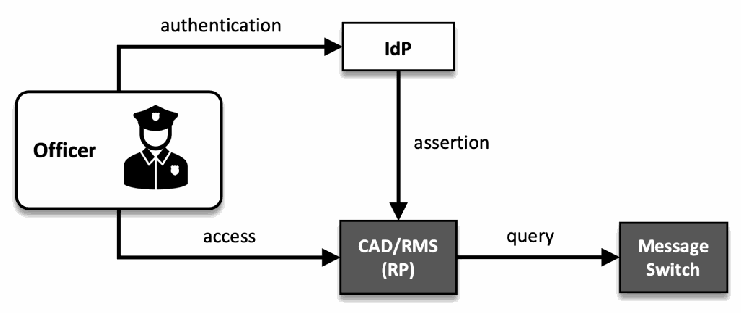
構成図です。警察官(警察官のアイコン)は IdP へ「authentication」(認証)を行い、CAD/RMS (RP) へ「access」(アクセス)します。IdP は CAD/RMS (RP) へ「assertion」(アサーション)を送ります。CAD/RMS (RP) は Message Switch(メッセージスイッチ)へ「query」(照会)を送ります。
Fig. 17. Federation in a message switch use case.
図 17. メッセージスイッチのユースケースにおけるフェデレーション
It would seem efficient for the CAD/RMS system to simply forward the assertion it has received from the IdP on to the message switch to securely convey the user information. RPs cannot forge or alter assertions since the IdP digitally signs them, so the assertion can still be trusted despite passing through the RP on its way to the message switch. However, forwarding assertions in this way can introduce vulnerabilities, and security mechanisms built into federation protocols can render this approach infeasible. These mechanisms include:
ユーザー情報を安全に伝達するため、CAD/RMS システムが IdP から受け取ったアサーションをそのままメッセージスイッチに転送するのが効率的であるように思われます。アサーションは IdP がデジタル署名しているため、RP はアサーションを偽造も改変もできず、メッセージスイッチへ向かう途中で RP を通過しても、アサーションは信頼できます。しかし、このようにアサーションを転送すると脆弱性が生じる可能性があり、フェデレーションプロトコルに組み込まれたセキュリティメカニズムによって、この手法が実現不可能になる場合があります。これらのメカニズムには、次のものがあります。
•Audience Restrictions – OIDC and SAML implement an “audience” parameter to indicate which RP is the intended recipient of the assertion. RPs check the audience parameter of any assertion they receive and reject assertions that do not contain their identifier as the audience. Without audience restrictions, a valid assertion could be passed on to any RP that trusts the IdP. Malicious or compromised RPs, or attackers who manage to intercept valid assertions, could use them to impersonate the authorized user to any RP. In Fig. 17, the audience of the assertion is the CAD/RMS system. If this assertion is passed to the message switch, the message switch should recognize that it is not the intended audience and reject the assertion. NIST SP 800-63C [9] requires that assertions include audience restrictions and that RPs enforce them.
•対象利用者の制限 – OIDC と SAML は、どの RP がアサーションの意図された受信者であるかを示す「対象利用者」パラメータを実装しています。RP は、受け取ったアサーションの対象利用者パラメータを確認し、自身の識別子が対象利用者として含まれていないアサーションを拒否します。対象利用者の制限がなければ、有効なアサーションが、IdP を信頼する任意の RP に渡される可能性があります。悪意のある RP や侵害された RP、または有効なアサーションの傍受に成功した攻撃者が、これを使って任意の RP に対し、認可されたユーザーになりすませます。図 17 では、アサーションの対象利用者は CAD/RMS システムです。このアサーションがメッセージスイッチに渡された場合、メッセージスイッチは、自身が意図された対象利用者ではないことを認識して、アサーションを拒否すべきです。NIST SP 800-63C [9] は、アサーションに対象利用者の制限を含めること、および RP がそれを強制することを要求しています。
•Encrypted Assertions – Assertions can be encrypted using the RP’s public key or a symmetric key shared between the RP and IdP. Assertions are encrypted at the message layer, in addition to transit encryption provided by Hypertext Transfer Protocol Secure (HTTPS). NIST SP 800-63C requires encrypted assertions at Federation Assurance Levels (FAL) FAL2 and FAL3. In the message switch example above, the assertion would be encrypted using a key held by the CAD/RMS system. If the assertion is forwarded to the message switch, the switch will be unable to decrypt the assertion unless key material is shared between the CAD/RMS system and the message switch, which is in violation of standard cryptographic principles. The CAD/RMS system also cannot typically send the decrypted assertion to the switch, since SAML assertions are typically signed and then encrypted, and sending a decrypted assertion would violate security requirements.
•暗号化アサーション – アサーションは、RP の公開鍵、または RP と IdP の間で共有される共通鍵を使って暗号化できます。アサーションは、Hypertext Transfer Protocol Secure(HTTPS)による通信経路の暗号化に加えて、メッセージ層で暗号化されます。NIST SP 800-63C は、フェデレーション保証レベル(FAL)の FAL2 と FAL3 で、暗号化アサーションを要求しています。上記のメッセージスイッチの例では、アサーションは CAD/RMS システムが保持する鍵を使って暗号化されます。アサーションをメッセージスイッチに転送すると、CAD/RMS システムとメッセージスイッチの間で鍵素材が共有されていない限り、スイッチはアサーションを復号できませんが、鍵素材を共有することは、標準的な暗号の原則に反します。また、SAML アサーションは通常、署名してから暗号化されるため、CAD/RMS システムが復号したアサーションをスイッチに送信することも通常はできません。復号したアサーションを送信すると、セキュリティ要件に違反することになるためです。
In some environments, additional security measures, like proof-of-possession or holder-of-key assertions, would present additional obstacles to forwarding the assertion.
環境によっては、所持証明(proof-of-possession)や鍵保持者(holder-of-key)アサーションなどの追加のセキュリティ対策が、アサーションの転送に対する追加の障害となります。
Definition: In federation systems, the audience is the application or system that is meant to receive an assertion. If an officer logs into a CAD/RMS system using an IdP, the assertion’s “audience” parameter will limit the use of that assertion to the CAD/RMS system. This can limit the damage an attacker could do by intercepting and using that assertion. They would be unable to forward it on to gain access to other agency systems or applications.
定義: フェデレーションシステムにおいて、対象システムとは、アサーションを受け取ることを意図されたアプリケーションまたはシステムです。警察官が IdP を使って CAD/RMS システムにログインする場合、アサーションの「対象システム」パラメータにより、そのアサーションの使用は CAD/RMS システムに限定されます。これにより、攻撃者がそのアサーションを傍受して使用した場合の被害を抑えられます。攻撃者は、そのアサーションを転送して、機関の他のシステムやアプリケーションにアクセスすることはできません。
Applying federation technologies to the message switch scenario is challenging because it is not a traditional identity federation scenario, but rather delegated authorization. The CAD/RMS system initiates a transaction with the message switch on the user’s behalf. The user is not directly involved in this transaction; they are one step removed from it. Authorization protocols like Kerberos and the OAuth 2.0 Authorization Framework are designed for these types of transactions. However, Kerberos is not typically deployed across organizational boundaries, and OAuth 2.0 is not yet widely deployed in the public safety environment. Therefore, this document presents two options for implementing this scenario with the widely used SAML 2.0 standards:
フェデレーション技術をメッセージスイッチのシナリオに適用するのは困難です。これは従来のアイデンティティフェデレーションのシナリオではなく、委任された認可に当たるためです。CAD/RMS システムは、ユーザーに代わってメッセージスイッチとのトランザクションを開始します。ユーザーはこのトランザクションに直接関与せず、一歩離れた位置にいます。Kerberos や OAuth 2.0 認可フレームワークのような認可プロトコルは、この種のトランザクション向けに設計されています。しかし、Kerberos は通常、組織の境界をまたいで展開されることはなく、OAuth 2.0 は公共安全の環境ではまだ広く展開されていません。そのため、本書では、広く使われている SAML 2.0 標準でこのシナリオを実装するための 2 つのオプションを示します。
•Proxy IdP – A Proxy IdP accepts an assertion from an IdP and uses it to create its own assertion to provide to another RP, effectively acting as an IdP to that other RP. In the above example, the CAD/RMS system could use the identity information received in the assertion from the IdP to craft its own assertion, sign it with its own private key, and pass it on to the message switch, adjusting the audience parameter and other fields to reflect the intended use of this new assertion. Refer to Appendix A.3.1 of [8] for more details on the Proxy IdP concept.
•プロキシ IdP – プロキシ IdP は、IdP からのアサーションを受け入れ、それを使って自身のアサーションを作成して別の RP に提供し、その別の RP に対して事実上 IdP として機能します。上の例では、CAD/RMS システムは、IdP からのアサーションで受け取ったアイデンティティ情報を使って自身のアサーションを作成し、自身の秘密鍵で署名してメッセージスイッチに渡すことができ、その際、この新しいアサーションの意図された用途を反映するよう、対象利用者パラメータやその他のフィールドを調整します。プロキシ IdP の概念の詳細については、[8] の付録 A.3.1 を参照してください。
•WS-Trust – WS-Trust is another federation standard that the CAD/RMS system can use to request a new assertion from the IdP that is intended to be presented to the message switch. The CAD/RMS system would send a WS-Trust Security Token Request to the IdP, providing the SAML assertion it received earlier, to obtain a new SAML assertion that is addressed to the message switch with the proper audience parameter value and optionally also encrypted with a key held by the message switch. Both the CAD/RMS system and message switch must be configured as RPs to the IdP in this scenario.
•WS-Trust – WS-Trust は、CAD/RMS システムが、メッセージスイッチに提示することを意図した新しいアサーションを IdP に要求するために使用できる、もう 1 つのフェデレーション標準です。CAD/RMS システムは、先に受け取った SAML アサーションを添えて WS-Trust Security Token Request を IdP に送信し、適切な対象利用者パラメータ値を持ち、メッセージスイッチが保持する鍵で任意に暗号化された、メッセージスイッチ宛ての新しい SAML アサーションを取得します。このシナリオでは、CAD/RMS システムとメッセージスイッチの両方を、IdP に対する RP として構成しなければなりません。
These two approaches are further described and illustrated in Appendix B.4.
これら 2 つの手法については、付録 B.4 でさらに詳しく説明し、図示します。
B.3. Meeting FAL Requirements in Complex Federation Scenarios
B.3. 複雑なフェデレーションシナリオにおける FAL 要件の充足
NIST SP 800-63C addresses requirements for IdP proxies and states that when proxies are used, the FAL of the overall authentication flow is equal to the lowest FAL in use between participants in a proxy scenario. This means that it is possible to meet FAL2 and FAL3 in a Proxy IdP scenario as long as the requirements of the FAL are met through all interactions between the participants. NIST SP 800-63C does not address token exchange scenarios like the WS-Trust integration described above. However, the NIST SP 800-63C principles can be applied to this WS-Trust integration to achieve a similar level of trust.
NIST SP 800-63C は IdP プロキシの要件を扱っており、プロキシを使用する場合、認証フロー全体の FAL は、プロキシのシナリオで参加者間に使用されている最も低い FAL に等しいと述べています。これは、参加者間のすべてのやり取りを通じて FAL の要件が満たされている限り、プロキシ IdP のシナリオで FAL2 と FAL3 を満たすことが可能であることを意味します。NIST SP 800-63C は、上記の WS-Trust 統合のようなトークン交換のシナリオを扱っていません。しかし、この WS-Trust 統合には NIST SP 800-63C の原則を適用でき、同様の水準の信頼を達成できます。
Definition: Federation Assurance Levels (FAL) are defined in NIST SP 800-63C and provide three security levels for federation implementations. Agencies use the guidelines in NIST SP 800-63-4 to choose the required FAL based on a risk assessment. The FALs can be summarized as follows:
定義: フェデレーション保証レベル(FAL)は NIST SP 800-63C で定義されており、フェデレーションの実装に対して 3 つのセキュリティレベルを提供します。機関は、NIST SP 800-63-4 のガイドラインを使用して、リスク評価に基づいて必要な FAL を選択します。FAL は次のように要約できます。
FAL1: Assertion digitally signed by the IdP
FAL1: IdP がデジタル署名したアサーション
FAL2: Assertion digitally signed by the IdP and encrypted
FAL2: IdP がデジタル署名し、暗号化したアサーション
FAL3: Holder-of-key assertion requiring the RP to prove possession of a cryptographic key
FAL3: RP に暗号鍵の所持の証明を要求する、鍵保持者アサーション
FAL2 requires that assertions be encrypted with a private key held by the RP. In the Proxy IdP case, this means that the assertion issued by the IdP to the CAD/RMS system must be encrypted using a key held by the CAD/RMS system, and the assertion issued by the CAD/RMS system to the message switch must be encrypted using a separate key held by the message switch. In the WS-Trust case, the assertion issued by the IdP to the CAD/RMS system must be encrypted using a key held by the CAD/RMS system, and the second assertion issued by the IdP to the message switch must be encrypted using a separate key held by the message switch. For WS-Trust, this would require the use of symmetric encryption between the IdP and the CAD/RMS system, since the CAD/RMS system sends the initial SAML assertion back to the IdP in the security token request and the IdP must be able to decrypt and read it.
FAL2 では、アサーションを RP が保持する秘密鍵で暗号化することが求められます。プロキシ IdP の場合、これは、IdP が CAD/RMS システムに発行するアサーションを CAD/RMS システムが保持する鍵で暗号化しなければならず、CAD/RMS システムがメッセージスイッチに発行するアサーションを、メッセージスイッチが保持する別の鍵で暗号化しなければならないことを意味します。WS-Trust の場合、IdP が CAD/RMS システムに発行するアサーションを CAD/RMS システムが保持する鍵で暗号化しなければならず、IdP がメッセージスイッチに発行する 2 つ目のアサーションを、メッセージスイッチが保持する別の鍵で暗号化しなければなりません。WS-Trust では、CAD/RMS システムがセキュリティトークン要求の中で最初の SAML アサーションを IdP に送り返し、IdP がそれを復号して読めなければならないため、IdP と CAD/RMS システムの間で共通鍵暗号を使用する必要があります。
FAL3 requires the use of holder-of-key assertions, which are bound to a public or shared key. When presenting a holder-of-key assertion, the presenter must prove possession of the key to which the assertion is bound, typically through mutual Transport Layer Security (TLS) authentication using a client certificate. In the Proxy IdP case, FAL3 could be met by having the user authenticate to both the IdP and the CAD/RMS system with the same client certificate, to which the assertion would be bound. The second assertion issued by the CAD/RMS system to the message switch would be bound to a client certificate held by the CAD/RMS system and used in mutual TLS authentication between the CAD/RMS system and both the IdP and the message switch. The FAL3 requirements for the WS-Trust example are similar, with the first assertion bound to the user’s client certificate and the second assertion bound to a different certificate held by the CAD/RMS system.
FAL3 は、公開鍵または共有鍵に紐づく鍵保持者アサーションの使用を要求します。鍵保持者アサーションを提示する際、提示者は、通常はクライアント証明書を使った相互 Transport Layer Security(TLS)認証を通じて、そのアサーションが紐づく鍵の所持を証明しなければなりません。プロキシ IdP の場合、ユーザーが IdP と CAD/RMS システムの両方に対して、アサーションが紐づく同じクライアント証明書で認証することにより、FAL3 を満たせます。CAD/RMS システムがメッセージスイッチに発行する 2 つ目のアサーションは、CAD/RMS システムが保持し、CAD/RMS システムと、IdP およびメッセージスイッチの両方との間の相互 TLS 認証で使用されるクライアント証明書に紐づけられます。WS-Trust の例における FAL3 の要件も同様で、最初のアサーションはユーザーのクライアント証明書に、2 つ目のアサーションは CAD/RMS システムが保持する別の証明書に紐づけられます。
The above discussion is focused on the core elements of the federation protocols as they apply to message switch scenarios. NIST SP 800-63C includes other requirements for FAL2 and FAL3 beyond those discussed here, such as cryptographic module requirements that must also be met for FAL2 and FAL3 compliance.
上記の議論は、メッセージスイッチのシナリオに適用されるフェデレーションプロトコルの中核的な要素に焦点を当てています。NIST SP 800-63C には、ここで論じたもの以外にも FAL2 と FAL3 の要件があり、たとえば FAL2 と FAL3 に準拠するために満たさなければならない暗号モジュールの要件などが含まれます。
B.4. Federated Architectures for Access to CJI
B.4. CJI へのアクセスのためのフェデレーション型アーキテクチャ
State and local agencies have several options to consider when deciding how they deploy federated architectures to suit their requirements for access to CJI. This section presents several options that agencies might consider:
州と地方の機関には、CJI へのアクセスに関する要件に合わせてフェデレーション型アーキテクチャをどのように展開するかを決める際に、検討すべきいくつかの選択肢があります。本節では、機関が検討する可能性のあるいくつかの選択肢を示します。
•Both the CAD/RMS web app and IdP at the state agency (Appendix B.4.1)
•CAD/RMS の Web アプリと IdP がともに州の機関にある場合(付録 B.4.1)
•CAD/RMS thick client at the county with the IdP at the state agency (Appendix B.4.2)
•CAD/RMS のシッククライアントが郡にあり、IdP が州の機関にある場合(付録 B.4.2)
•Both the CAD/RMS web app and IdP at the county agency (Appendix B.4.3)
•CAD/RMS の Web アプリと IdP がともに郡の機関にある場合(付録 B.4.3)
•Integrations with OAuth 2.0 and OIDC (Appendix B.4.4)
•OAuth 2.0 と OIDC による統合(付録 B.4.4)
As described in Sec. 2.4.1, federation systems can be a central integration point for providing MFA to multiple applications.
2.4.1 節で述べたように、フェデレーションシステムは、複数のアプリケーションに MFA を提供するための中心的な統合ポイントになりえます。
B.4.1. Both CAD/RMS Web App & IdP at the State Agency
B.4.1. CAD/RMS の Web アプリと IdP がともに州の機関にある場合
The architectures in this section describe a web-based CAD/RMS application (a web app) and a SAML IdP, both hosted by a state agency that is used by state, county, and other authorized local users within the state. The state also hosts a web-based application dashboard, which displays a list of applications available to each authenticated user based on their assigned authorizations and entitlements. One of the applications displayed in the list is the CAD/RMS web app. The application dashboard and CAD/RMS web app are both integrated with the IdP as RPs. From a protocol perspective, federation can be achieved by using a SAML Proxy IdP or by implementing WS-Trust. Each of these options is described in more detail below.
本節のアーキテクチャは、Web ベースの CAD/RMS アプリケーション(Web アプリ)と SAML IdP がどちらも州の機関によってホストされ、州、郡、および州内のその他の認可された地方のユーザーが利用する構成を説明します。州はまた、割り当てられた認可と権限に基づいて、認証済みの各ユーザーが利用できるアプリケーションの一覧を表示する、Web ベースのアプリケーションダッシュボードもホストしています。一覧に表示されるアプリケーションの 1 つが CAD/RMS の Web アプリです。アプリケーションダッシュボードと CAD/RMS の Web アプリは、どちらも RP として IdP と統合されています。プロトコルの観点では、フェデレーションは SAML プロキシ IdP を使用するか、WS-Trust を実装することで実現できます。これらの各オプションについては、以下でさらに詳しく説明します。
B.4.1.1. Both CAD/RMS Web App & IdP at the State Agency – IdP Proxy
B.4.1.1. CAD/RMS の Web アプリと IdP がともに州の機関にある場合 – IdP プロキシ
In the Proxy IdP approach, the CAD/RMS web app must be capable of acting as a Proxy IdP and generating a SAML assertion based on the assertion it receives from the state IdP. The CAD/RMS web app does not directly authenticate the user but rather trusts an assertion from the state IdP, to which the CAD/RMS web app is an RP, as shown in Fig. 18.
プロキシ IdP の手法では、CAD/RMS の Web アプリがプロキシ IdP として機能し、州の IdP から受け取ったアサーションに基づいて SAML アサーションを生成できなければなりません。図 18 に示すように、CAD/RMS の Web アプリはユーザーを直接認証せず、CAD/RMS の Web アプリが RP となっている州の IdP からのアサーションを信頼します。
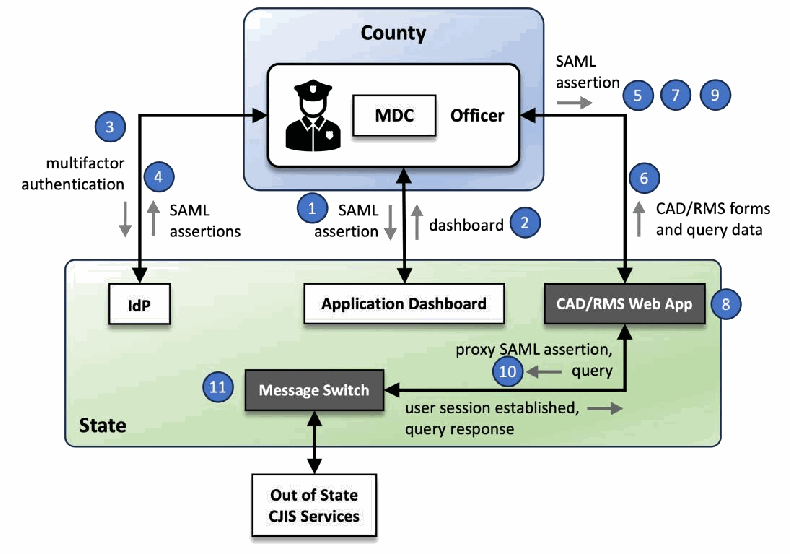
番号付きの手順を示す構成図です。上の County(郡)の枠には、MDC を持つ Officer(警察官のアイコン)があります。下の State(州)の枠には IdP、Application Dashboard(アプリケーションダッシュボード)、CAD/RMS Web App、Message Switch(メッセージスイッチ)があり、State の枠の下に Out of State CJIS Services(州外の CJIS サービス)が Message Switch とつながっています。ラベル: Officer と Application Dashboard の間に (1) SAML assertion(SAML アサーション)と (2) dashboard(ダッシュボード)、Officer と IdP の間に (3) multifactor authentication(多要素認証)と (4) SAML assertions、Officer と CAD/RMS Web App の間に (5) (7) (9) SAML assertion と (6) CAD/RMS forms and query data(CAD/RMS のフォームと照会データ)、CAD/RMS Web App に (8)、CAD/RMS Web App から Message Switch へ (10) proxy SAML assertion, query(プロキシの SAML アサーションと照会)、戻りに user session established, query response(ユーザーセッション確立、照会応答)、Message Switch に (11)。
Fig. 18. Web app and IdP at state (SAML proxy).
図 18. Web アプリと IdP が州にある場合(SAML プロキシ)。
It uses the user identifiers and other attributes it has received from the state IdP to create its own SAML assertion, sign it with its own key pair, and send this assertion to the state message switch. The state message switch must have an RP trust with the IdP function of the CAD/RMS web app, and it has no direct interaction with the state IdP. The sequence of interactions in this scenario is as follows:
Web アプリは、州の IdP から受け取ったユーザー識別子やその他の属性を使って自身の SAML アサーションを作成し、自身の鍵ペアで署名して、このアサーションを州のメッセージスイッチに送信します。州のメッセージスイッチは、CAD/RMS の Web アプリの IdP 機能との間で RP としての信頼関係を持たなければならず、州の IdP とは直接やり取りしません。このシナリオでのやり取りの順序は次のとおりです。
1.The officer accesses the application dashboard.
1.警察官がアプリケーションダッシュボードにアクセスします。
2.The application dashboard redirects the officer to the IdP to authenticate.
2.アプリケーションダッシュボードが、警察官を認証のために IdP にリダイレクトします。
3.The officer authenticates to the IdP with their credentials and MFA.
3.警察官が、認証情報と MFA で IdP に対して認証します。
4.The IdP redirects the officer’s browser to the application dashboard with a SAML assertion. The dashboard validates the SAML assertion, logs in the officer, and presents a set of application links based on their authorizations.
4.IdP が、SAML アサーションとともに警察官のブラウザーをアプリケーションダッシュボードにリダイレクトします。ダッシュボードは SAML アサーションを検証し、警察官をログインさせ、その認可に基づくアプリケーションリンクの一覧を提示します。
5.The officer clicks a link to the CAD/RMS system.
5.警察官が、CAD/RMS システムへのリンクをクリックします。
6.The CAD/RMS system redirects the officer’s browser to the IdP to authenticate.
6.CAD/RMS システムが、警察官のブラウザーを認証のために IdP にリダイレクトします。
7.Since the officer has an active session with the IdP, they do not need to authenticate. The IdP redirects the officer’s browser to the CAD/RMS system with a SAML assertion.
7.警察官は IdP との間で有効なセッションを持っているため、認証する必要はありません。IdP は、SAML アサーションとともに警察官のブラウザーを CAD/RMS システムにリダイレクトします。
8.The CAD/RMS system validates the assertion and logs in the officer.
8.CAD/RMS システムが、アサーションを検証し、警察官をログインさせます。
9.The officer submits a query to the CAD/RMS system.
9.警察官が、CAD/RMS システムにクエリを送信します。
10.The CAD/RMS system creates a new SAML assertion including the user identifiers and attributes it received from the IdP. The CAD/RMS system sends this new SAML assertion and the query to the message switch.
10.CAD/RMS システムが、IdP から受け取ったユーザー識別子と属性を含む、新しい SAML アサーションを作成します。CAD/RMS システムは、この新しい SAML アサーションとクエリをメッセージスイッチに送信します。
11.The message switch validates the assertion and extracts the user’s identity and attributes. The message switch can use these attributes to authorize the query.
11.メッセージスイッチが、アサーションを検証し、ユーザーのアイデンティティと属性を抽出します。メッセージスイッチは、これらの属性を使ってクエリを認可できます。
B.4.1.2. Both CAD/RMS Web App & IdP at the State Agency – WS-Trust
B.4.1.2. CAD/RMS の Web アプリと IdP がともに州の機関にある場合 – WS-Trust
Unlike the previous section, this approach does not require the CAD/RMS web app to act as a SAML IdP. In accordance with industry best practices for SAML, SAML assertions should be targeted to a specific recipient using the audience parameter, as explained in Appendix B.2. Instead of forwarding a response already used to log into the CAD/RMS web app, a new SAML assertion is obtained that identifies the proper audience (the state message switch). Because the end user does not connect directly to the message switch, the standard SAML SSO profile cannot be used to obtain this assertion.
前節とは異なり、この手法では、CAD/RMS の Web アプリが SAML IdP として機能する必要はありません。SAML に関する業界のベストプラクティスに従い、付録 B.2 で説明したように、SAML アサーションは audience パラメータを使って特定の受信者を対象とすべきです。CAD/RMS の Web アプリへのログインにすでに使用された応答を転送する代わりに、適切な受信対象(州のメッセージスイッチ)を識別する新しい SAML アサーションを取得します。エンドユーザーはメッセージスイッチに直接接続しないため、標準の SAML SSO プロファイルをこのアサーションの取得に使用することはできません。
The WS-Trust specification provides a standards-compliant way for the CAD/RMS web app to request a SAML assertion directly from the IdP that it can present to the message switch. For this implementation, shown in Fig. 19, the state IdP must support the Security Token Service functionality of the WS-Trust protocol, and the CAD/RMS web app must support WS-Trust as a client.
WS-Trust 仕様は、CAD/RMS の Web アプリが、メッセージスイッチに提示できる SAML アサーションを IdP に直接要求するための、標準に準拠した方法を提供します。図 19 に示すこの実装では、州の IdP が WS-Trust プロトコルの Security Token Service 機能に対応し、CAD/RMS の Web アプリがクライアントとして WS-Trust に対応しなければなりません。
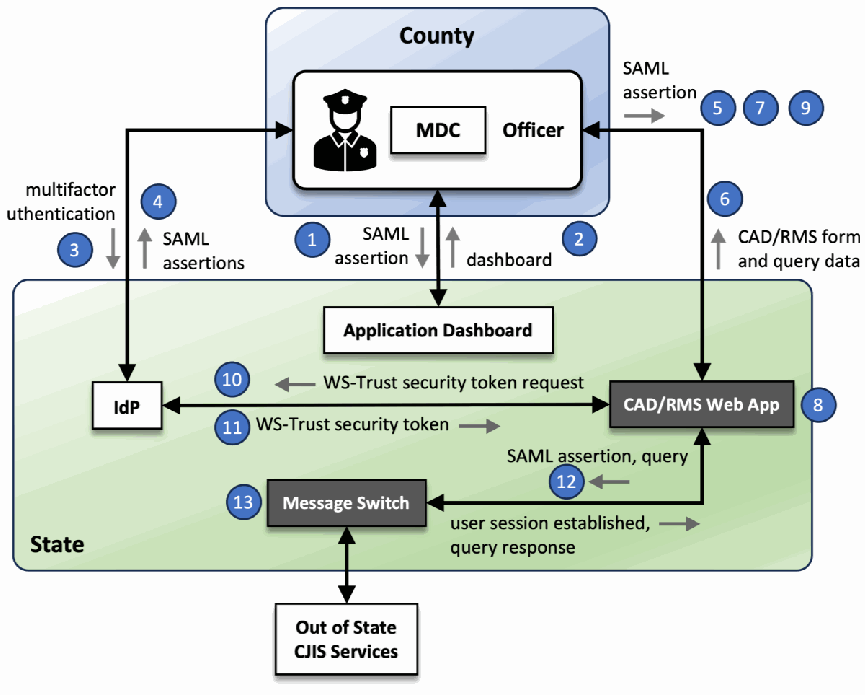
番号付きの手順を示す構成図です。上の County(郡)の枠には、MDC を持つ Officer(警察官のアイコン)があります。下の State(州)の枠には Application Dashboard、IdP、CAD/RMS Web App、Message Switch があり、その下に Out of State CJIS Services(州外の CJIS サービス)が Message Switch とつながっています。ラベル: Officer と Application Dashboard の間に (1) SAML assertion と (2) dashboard、Officer と IdP の間に (3) 多要素認証と (4) SAML assertions、Officer と CAD/RMS Web App の間に (5) (7) (9) SAML assertion と (6) CAD/RMS form and query data、CAD/RMS Web App に (8)、CAD/RMS Web App から IdP へ (10) WS-Trust security token request(WS-Trust セキュリティトークン要求)、戻りに (11) WS-Trust security token、CAD/RMS Web App から Message Switch へ (12) SAML assertion, query、戻りに user session established, query response、Message Switch に (13)。
Fig. 19. Web app and IdP at state (WS-Trust).
図 19. Web アプリと IdP が州にある場合(WS-Trust)。
The SAML and WS-Trust interactions in this scenario are as follows. Note that steps 1-9 are identical to those in the prior figure:
このシナリオでの SAML と WS-Trust のやり取りは次のとおりです。手順 1~9 は、前の図の手順と同一です。
1.The officer accesses the application dashboard.
1.警察官がアプリケーションダッシュボードにアクセスします。
2.The application dashboard redirects the officer to the IdP to authenticate.
2.アプリケーションダッシュボードが、警察官を認証のために IdP にリダイレクトします。
3.The officer authenticates to the IdP with their credentials and MFA.
3.警察官が、認証情報と MFA で IdP に対して認証します。
4.The IdP redirects the officer’s browser to the application dashboard with a SAML assertion. The dashboard validates the SAML assertion, logs in the officer, and presents a set of application links based on their authorizations.
4.IdP が、SAML アサーションとともに警察官のブラウザーをアプリケーションダッシュボードにリダイレクトします。ダッシュボードは SAML アサーションを検証し、警察官をログインさせ、その認可に基づくアプリケーションリンクの一覧を提示します。
5.The officer clicks a link to the CAD/RMS system.
5.警察官が、CAD/RMS システムへのリンクをクリックします。
6.The CAD/RMS system redirects the officer’s browser to the IdP to authenticate.
6.CAD/RMS システムが、警察官のブラウザーを認証のために IdP にリダイレクトします。
7.Since the officer has an active session with the IdP, they do not need to authenticate. The IdP redirects the officer’s browser to the CAD/RMS system with a SAML assertion.
7.警察官は IdP との間で有効なセッションを持っているため、認証する必要はありません。IdP は、SAML アサーションとともに警察官のブラウザーを CAD/RMS システムにリダイレクトします。
8.The CAD/RMS system validates the assertion and logs in the officer.
8.CAD/RMS システムが、アサーションを検証し、警察官をログインさせます。
9.The officer submits a query to the CAD/RMS system.
9.警察官が、CAD/RMS システムにクエリを送信します。
10.The CAD/RMS system sends a WS-Trust Security Token Request to the IdP, including the SAML assertion it received earlier in the onBehalfOf element to indicate that the request is for a token to present to the message switch on behalf of the previously authenticated user.
10.CAD/RMS システムが、事前に認証されたユーザーに代わってメッセージスイッチに提示するトークンの要求であることを示すため、先に受け取った SAML アサーションを onBehalfOf 要素に含めて、WS-Trust Security Token Request を IdP に送信します。
11.The IdP creates a new SAML assertion with the officer as the subject and with a suitable audience parameter for the message switch. The IdP returns this SAML assertion to the CAD/RMS system in a WS-Trust Request Security Token Response message.
11.IdP が、警察官をサブジェクトとし、メッセージスイッチに適した対象システムパラメータを持つ新しい SAML アサーションを作成します。IdP は、この SAML アサーションを WS-Trust Request Security Token Response メッセージで CAD/RMS システムに返します。
12.The CAD/RMS system sends this new SAML assertion and the query to the message switch.
12.CAD/RMS システムが、この新しい SAML アサーションとクエリをメッセージスイッチに送信します。
13.The message switch validates the assertion and extracts the user’s identity and attributes. The message switch can use these attributes to authorize the query.
13.メッセージスイッチが、アサーションを検証し、ユーザーのアイデンティティと属性を抽出します。メッセージスイッチは、これらの属性を使ってクエリを認可できます。
B.4.2. CAD Thick Client at the County with the IdP at the State Agency
B.4.2. 郡の CAD シッククライアントと州機関の IdP
This section considers the case where the CAD/RMS system is a client/server application hosted at the county level and accessed through a “thick client” software application installed on the MDC. For this section, we also assume that county users authenticate to a state-hosted IdP. The thick client introduces a challenge for SAML integration. The common SAML SSO interactions rely on web functionality such as HTTP redirect and POST messages and the use of a browser for interactive authentication to the IdP. However, the MDC operating systems typically provide mechanisms for thick client applications to interact with the web browser that can be used to implement SAML and other authentication and authorization protocols like OIDC and OAuth. Two types of interactions are required:
本節では、CAD/RMS システムが郡レベルでホストされるクライアント/サーバーアプリケーションであり、MDC にインストールされた「シッククライアント」ソフトウェアアプリケーションを通じてアクセスされる場合を検討します。本節では、郡のユーザーが州のホストする IdP に対して認証することも想定します。シッククライアントは、SAML 統合に課題をもたらします。一般的な SAML SSO のやり取りは、HTTP リダイレクトや POST メッセージなどの Web の機能と、IdP に対する対話的な認証のためのブラウザーの使用に依存しています。しかし、MDC のオペレーティングシステムは通常、シッククライアントアプリケーションが Web ブラウザーとやり取りするためのメカニズムを提供しており、これを SAML や、OIDC、OAuth などの他の認証・認可プロトコルの実装に使用できます。次の 2 種類のやり取りが必要です。
•The thick client application must be able to launch a web browser and direct it to the IdP’s SSO service endpoint, supplying a SAML authentication request as a parameter. The browser provides the user interface for authentication to the IdP.
•シッククライアントアプリケーションは、Web ブラウザーを起動し、SAML 認証要求をパラメータとして渡して、IdP の SSO サービスエンドポイントに誘導できなければなりません。ブラウザーは、IdP に対する認証のためのユーザーインターフェースを提供します。
•After the user has authenticated to the IdP, the thick client application must receive a response from the IdP using one of the standard SAML bindings (typically redirect or POST). In either case, the browser must be able to send a message to the application.
•ユーザーが IdP に対して認証した後、シッククライアントアプリケーションは、標準的な SAML バインディング(通常はリダイレクトまたは POST)のいずれかを使って、IdP からの応答を受け取れなければなりません。いずれの場合も、ブラウザーはアプリケーションにメッセージを送信できなければなりません。
Methods of accomplishing these operations are OS-specific. However, all common desktop OSs provide mechanisms for these actions. For example, applications can be registered with the OS to handle specific URLs either by defining a custom URL scheme (e.g., “vendor-name://”) or by associating ordinary HTTPS URLs with the client application. With the OS configured to recognize the thick client application as the designated handler for specific URLs, the IdP can redirect the browser (or trigger it to submit a POST message) to one of the designated URLs, and the OS will provide the message along with any parameters and POST body to the client application. The thick client can then extract and process the response, including any SAML assertions, errors, or other protocol messages.
これらの操作を実現する方法は OS に固有です。ただし、一般的なデスクトップ OS はいずれも、これらの操作のためのメカニズムを提供しています。たとえば、アプリケーションは、カスタム URL スキーム(例: 「vendor-name://」)を定義するか、通常の HTTPS URL をクライアントアプリケーションに関連付けることで、特定の URL を処理するように OS に登録できます。OS がシッククライアントアプリケーションを特定の URL の指定ハンドラーとして認識するように構成されていれば、IdP はブラウザーを、指定された URL のいずれかにリダイレクトする(または POST メッセージの送信を発生させる)ことができ、OS はメッセージを、パラメータと POST の本文とともにクライアントアプリケーションに渡します。その後、シッククライアントは、SAML アサーション、エラー、その他のプロトコルメッセージを含む応答を抽出して処理できます。
The following subsections present two variations on the thick client use case:
以下の小節では、シッククライアントのユースケースの 2 つのバリエーションを示します。
•Appendix B.4.2.1 describes a CAD/RMS thick client that supports SAML. It uses SAML to authenticate users and acts as an IdP proxy, creating a SAML assertion to pass to the message switch.
•付録 B.4.2.1 では、SAML に対応する CAD/RMS シッククライアントを説明します。これは SAML を使ってユーザーを認証し、IdP プロキシとして機能して、メッセージスイッチに渡す SAML アサーションを作成します。
•Appendix B.4.2.2 describes a CAD/RMS thick client that does not support SAML. SAML is still used in the broader architecture, but the CAD/RMS thick client uses WS-Trust to obtain a SAML assertion to pass to the message switch.
•付録 B.4.2.2 では、SAML に対応しない CAD/RMS シッククライアントを説明します。アーキテクチャ全体では引き続き SAML が使用されますが、CAD/RMS シッククライアントは、WS-Trust を使って、メッセージスイッチに渡す SAML アサーションを取得します。
B.4.2.1. CAD/RMS Thick Client at the County with IdP at the State Agency – IdP proxy
B.4.2.1. 郡の CAD/RMS シッククライアントと州機関の IdP — IdP プロキシ
In this use case, the CAD/RMS thick client acts as an IdP proxy. The CAD/RMS system supports SAML for user authentication and can act as a SAML IdP proxy, as shown in Fig. 20.
このユースケースでは、CAD/RMS シッククライアントが IdP プロキシとして機能します。図 20 に示すように、CAD/RMS システムはユーザー認証のために SAML に対応しており、SAML IdP プロキシとして機能できます。
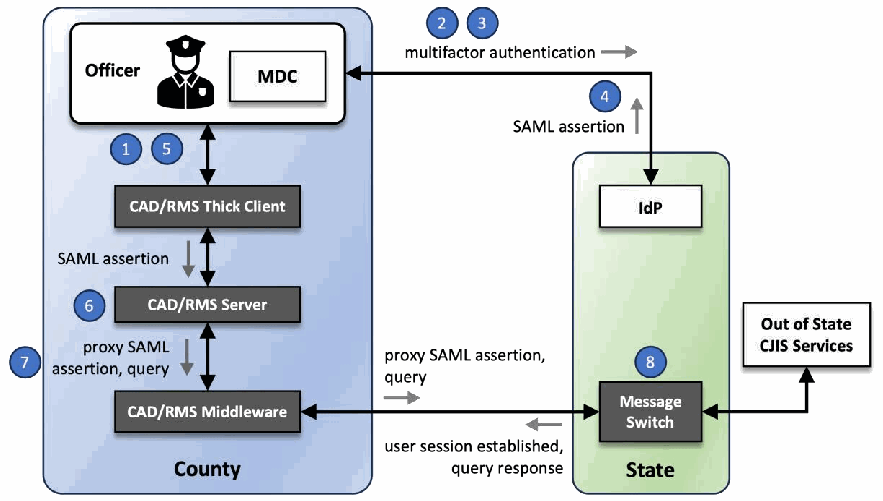
番号付きの手順を示す構成図です。左の County(郡)の枠には、MDC を持つ Officer(警察官のアイコン)、CAD/RMS Thick Client(シッククライアント)、CAD/RMS Server、CAD/RMS Middleware(ミドルウェア)が縦に並んでいます。右の State(州)の枠には IdP と Message Switch があり、Out of State CJIS Services が Message Switch とつながっています。ラベル: Officer/MDC と CAD/RMS Thick Client の間に (1) (5)、Officer と IdP の間に (2) (3) multifactor authentication(多要素認証)と (4) SAML assertion、CAD/RMS Thick Client と CAD/RMS Server の間に SAML assertion、CAD/RMS Server に (6)、CAD/RMS Server と CAD/RMS Middleware の間に (7) proxy SAML assertion, query、CAD/RMS Middleware から Message Switch へ proxy SAML assertion, query、戻りに user session established, query response、Message Switch に (8)。
Fig. 20. Thick client CAD/RMS and Proxy IdP at county, state IdP.
図 20. 郡にあるシッククライアント CAD/RMS とプロキシ IdP、州の IdP。
The sequence of interactions is as follows:
やり取りの順序は次のとおりです。
1.The officer opens the CAD/RMS thick client application, which connects to the CAD/RMS server. The CAD/RMS server recognizes that the officer does not have an active session and responds to the CAD/RMS thick client with a SAML authentication request. The details of this interaction are proprietary and depend on the specific CAD/RMS application’s design.
1.警察官が CAD/RMS シッククライアントアプリケーションを開くと、アプリケーションが CAD/RMS サーバーに接続します。CAD/RMS サーバーは、警察官が有効なセッションを持っていないことを認識し、SAML 認証要求で CAD/RMS シッククライアントに応答します。このやり取りの詳細は独自仕様であり、特定の CAD/RMS アプリケーションの設計に依存します。
2.The CAD/RMS thick client opens the login URL of the state IdP in the built-in browser on the officer’s MDC, sending the SAML authentication request as a parameter.
2.CAD/RMS シッククライアントが、警察官の MDC の組み込みブラウザーで、州の IdP のログイン URL を開き、SAML 認証要求をパラメータとして送信します。
3.The IdP prompts the officer to log in with a username/password and issues an MFA challenge to the officer after validating the officer’s login credentials.
3.IdP が、警察官にユーザー名/パスワードでのログインを促し、警察官のログイン認証情報を検証した後、警察官に MFA チャレンジを発行します。
4.The IdP validates the MFA challenge-response and creates a new user session for the officer, generates a SAML assertion, signs it with its private signing key, encrypts it with the CAD/RMS system’s public encryption key, and returns it to the browser in a redirect to the CAD/RMS thick client.
4.IdP が、MFA のチャレンジレスポンスを検証して警察官の新しいユーザーセッションを作成し、SAML アサーションを生成して、自身の署名用秘密鍵で署名し、CAD/RMS システムの暗号化用公開鍵で暗号化して、CAD/RMS シッククライアントへのリダイレクトでブラウザーに返します。
5.The browser invokes the thick client and passes the SAML assertion to it. This is done by redirecting to a URL that is configured to be handled by the CAD/RMS thick client in the MDC’s OS (e.g., using an app URI handler). The thick client sends the SAML assertion to the CAD/RMS server.
5.ブラウザーがシッククライアントを呼び出し、SAML アサーションを渡します。これは、MDC の OS で CAD/RMS シッククライアントが処理するよう構成された URL にリダイレクトすること(たとえば、アプリ URI ハンドラーを使用)で行われます。シッククライアントは、SAML アサーションを CAD/RMS サーバーに送信します。
6.The CAD/RMS server decrypts the SAML assertion using its own private encryption key and validates the signature on the SAML assertion using the IdP’s public signing key. The CAD/RMS server extracts the officer’s account identifier and any other required attributes from the assertion and establishes the officer’s session in the CAD/RMS application.
6.CAD/RMS サーバーが、自身の暗号化用秘密鍵を使って SAML アサーションを復号し、IdP の署名検証用公開鍵を使って SAML アサーションの署名を検証します。CAD/RMS サーバーは、アサーションから警察官のアカウント識別子とその他の必要な属性を抽出し、CAD/RMS アプリケーションで警察官のセッションを確立します。
7.The CAD/RMS server generates a SAML assertion acting as a Proxy IdP using the user’s identifiers and attributes received from the state IdP. It signs the assertion with its private signing key and encrypts it with the public encryption key of the message switch. The CAD/RMS server passes the SAML assertion and query parameters to the middleware layer. The middleware sends the SAML assertion to the state message switch.
7.CAD/RMS サーバーが、州の IdP から受け取ったユーザーの識別子と属性を使って、プロキシ IdP として機能する SAML アサーションを生成します。サーバーは、アサーションに自身の署名用秘密鍵で署名し、メッセージスイッチの暗号化用公開鍵で暗号化します。CAD/RMS サーバーは、SAML アサーションとクエリのパラメータをミドルウェア層に渡します。ミドルウェアは、SAML アサーションを州のメッセージスイッチに送信します。
8.The message switch validates the assertion and extracts the user’s identity and attributes. The message switch can use these attributes to authorize the query.
8.メッセージスイッチが、アサーションを検証し、ユーザーのアイデンティティと属性を抽出します。メッセージスイッチは、これらの属性を使ってクエリを認可できます。
B.4.2.2. CAD/RMS Thick Client at the County with IdP at the State Agency – WS-Trust
B.4.2.2. 郡の CAD/RMS シッククライアントと州機関の IdP — WS-Trust
In this scenario, we assume that the CAD/RMS client/server system does not support SAML. We also assume that the user authenticates to the CAD/RMS system through some other means (e.g., Kerberos). To authenticate the user to the message switch, the CAD/RMS thick client redirects the user to a URL at the state IdP that triggers an IdP-initiated SAML authentication flow. The IdP responds with a SAML assertion, which the CAD/RMS thick client sends to the CAD/RMS server, which in turn makes a WS-Trust request to the state IdP to obtain a SAML assertion that it can present to the message switch. The CAD/RMS server is not required to create a SAML authentication request or to parse or validate the SAML responses from the IdP. To the CAD/RMS server, the SAML messages themselves are opaque XML documents, and it simply passes them along. This integration requires configuring the state IdP with parameters for the CAD/RMS system as if it were an RP.
このシナリオでは、CAD/RMS のクライアント/サーバーシステムが SAML に対応していないことを想定します。また、ユーザーは何らかの他の手段(例: Kerberos)で CAD/RMS システムに対して認証することも想定します。ユーザーをメッセージスイッチに対して認証するため、CAD/RMS シッククライアントは、ユーザーを州の IdP にある、IdP 起点の SAML 認証フローを開始する URL にリダイレクトします。IdP は SAML アサーションで応答し、CAD/RMS シッククライアントはそれを CAD/RMS サーバーに送信し、CAD/RMS サーバーは次に、メッセージスイッチに提示できる SAML アサーションを取得するために、州の IdP に WS-Trust 要求を行います。CAD/RMS サーバーは、SAML 認証要求を作成する必要も、IdP からの SAML 応答を解析または検証する必要もありません。CAD/RMS サーバーにとって、SAML メッセージ自体は中身の見えない XML 文書であり、単にそれを受け渡すだけです。この統合では、州の IdP に、CAD/RMS システムをあたかも RP であるかのように扱うためのパラメータを構成する必要があります。
Further, we assume that the state IdP supports IdP-initiated SSO and has a URL configured to trigger an IdP-initiated login to the CAD/RMS thick client. Both the IdP and the CAD/RMS system must also support WS-Trust for this integration. This architecture is shown in Fig. 21.
さらに、州の IdP は IdP 起点の SSO に対応しており、CAD/RMS シッククライアントへの IdP 起点のログインを開始するよう構成された URL を持つと想定します。この統合では、IdP と CAD/RMS システムの両方が WS-Trust にも対応していなければなりません。このアーキテクチャを図 21 に示します。
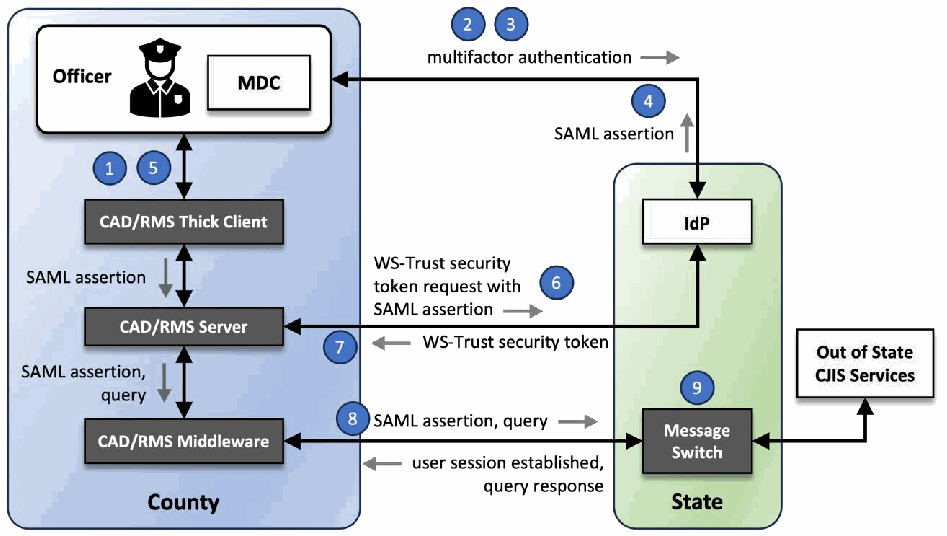
番号付きの手順を示す構成図です。左の County(郡)の枠には、MDC を持つ Officer(警察官のアイコン)、CAD/RMS Thick Client、CAD/RMS Server、CAD/RMS Middleware が縦に並んでいます。右の State(州)の枠には IdP と Message Switch があり、Out of State CJIS Services が Message Switch とつながっています。ラベル: Officer/MDC と CAD/RMS Thick Client の間に (1) (5)、Officer と IdP の間に (2) (3) multifactor authentication(多要素認証)と (4) SAML assertion、CAD/RMS Thick Client と CAD/RMS Server の間に SAML assertion、CAD/RMS Server から IdP へ (6) WS-Trust security token request with SAML assertion(SAML アサーション付きの WS-Trust セキュリティトークン要求)、戻りに (7) WS-Trust security token、CAD/RMS Server と CAD/RMS Middleware の間に SAML assertion, query、CAD/RMS Middleware から Message Switch へ (8) SAML assertion, query、戻りに user session established, query response、Message Switch に (9)。
Fig. 21. Thick client CAD/RMS at county, state IdP (WS-Trust).
図 21. シッククライアントの CAD/RMS が郡にあり、IdP が州にある場合(WS-Trust)。
The sequence of interactions is as follows:
やり取りの順序は次のとおりです。
1.The officer opens the CAD/RMS thick client application, which connects to the CAD/RMS server. The officer authenticates using a non-SAML method, such as Kerberos. The details of this interaction are proprietary and depend on the CAD/RMS application’s design.
1.警察官が CAD/RMS シッククライアントアプリケーションを開くと、アプリケーションが CAD/RMS サーバーに接続します。警察官は、Kerberos などの SAML 以外の方式で認証します。このやり取りの詳細は独自仕様であり、CAD/RMS アプリケーションの設計に依存します。
2.The officer submits a query that must be submitted to the state message switch. To authenticate the officer, the CAD/RMS thick client opens the IdP-initiated SSO URL of the state IdP in the built-in browser on the officer’s MDC.
2.警察官が、州のメッセージスイッチに送信しなければならないクエリを送信します。警察官を認証するため、CAD/RMS シッククライアントが、警察官の MDC の組み込みブラウザーで、州の IdP の IdP 起点 SSO の URL を開きます。
3.The IdP prompts the officer to log in with a username/password and issues an MFA challenge to the officer after validating the officer’s login credentials.
3.IdP が、警察官にユーザー名/パスワードでのログインを促し、警察官のログイン認証情報を検証した後、警察官に MFA チャレンジを発行します。
4.The IdP validates the MFA challenge-response and creates a new user session for the officer, generates a SAML assertion, signs it with its private signing key, encrypts it with a symmetric key shared with the CAD/RMS system, and returns it to the browser in a redirect to the CAD/RMS thick client.
4.IdP が、MFA のチャレンジレスポンスを検証して警察官の新しいユーザーセッションを作成し、SAML アサーションを生成して、自身の署名用秘密鍵で署名し、CAD/RMS システムと共有する共通鍵で暗号化して、CAD/RMS シッククライアントへのリダイレクトでブラウザーに返します。
5.The browser invokes the thick client and passes the SAML assertion to it. This is done by redirecting to a URL that is configured to be handled by the CAD/RMS thick client in the MDC’s operating system (e.g., using an app URI handler). The thick client sends the SAML assertion to the CAD/RMS server.
5.ブラウザーがシッククライアントを呼び出し、SAML アサーションを渡します。これは、MDC のオペレーティングシステムで CAD/RMS シッククライアントが処理するよう構成された URL にリダイレクトすること(たとえば、アプリ URI ハンドラーを使用)で行われます。シッククライアントは、SAML アサーションを CAD/RMS サーバーに送信します。
6.The CAD/RMS server cannot decrypt or validate the assertion. It sends a WS-Trust Security Token Request to the IdP, including the SAML assertion it received earlier in the onBehalfOf element to indicate that the request is for a token to present to the message switch on behalf of the previously authenticated user.
6.CAD/RMS サーバーは、アサーションを復号することも検証することもできません。サーバーは、事前に認証されたユーザーに代わってメッセージスイッチに提示するトークンの要求であることを示すため、先に受け取った SAML アサーションを onBehalfOf 要素に含めて、WS-Trust Security Token Request を IdP に送信します。
7.The IdP creates a new SAML assertion with the officer as the subject and with a suitable audience parameter for the message switch. The IdP returns this SAML assertion to the CAD/RMS server in a WS-Trust Request Security Token Response message.
7.IdP が、警察官をサブジェクトとし、メッセージスイッチに適した対象システムパラメータを持つ新しい SAML アサーションを作成します。IdP は、この SAML アサーションを WS-Trust Request Security Token Response メッセージで CAD/RMS サーバーに返します。
8.The CAD/RMS server sends this new SAML assertion and the query to the message switch.
8.CAD/RMS サーバーが、この新しい SAML アサーションとクエリをメッセージスイッチに送信します。
9.The message switch validates the assertion and extracts the user’s identity and attributes. The message switch can use these attributes to authorize the query.
9.メッセージスイッチが、アサーションを検証し、ユーザーのアイデンティティと属性を抽出します。メッセージスイッチは、これらの属性を使ってクエリを認可できます。
B.4.3. Both the CAD/RMS Web App and IdP at a County Agency
B.4.3. CAD/RMS の Web アプリと IdP がともに郡の機関にある場合
In this scenario, the CAD/RMS web app and IdP are both hosted by the county. For this implementation, shown in Fig. 22, the state message switch must have an RP trust with the county IdP.
このシナリオでは、CAD/RMS の Web アプリと IdP の両方を郡がホストします。図 22 に示すこの実装では、州のメッセージスイッチが郡の IdP との間で RP としての信頼関係を持たなければなりません。
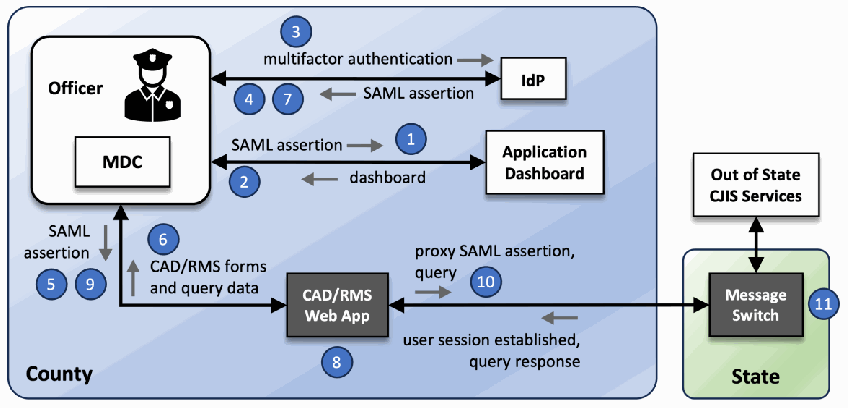
番号付きの手順を示す構成図です。大きな County(郡)の枠には、MDC を持つ Officer(警察官のアイコン)、IdP、Application Dashboard、CAD/RMS Web App があります。小さな State(州)の枠には Message Switch があり、その上の Out of State CJIS Services とつながっています。ラベル: Officer と IdP の間に (3) 多要素認証と (4) (7) SAML assertion、Officer と Application Dashboard の間に (1) SAML assertion と (2) ダッシュボード、Officer/MDC と CAD/RMS Web App の間に (5) (9) SAML assertion と (6) CAD/RMS のフォームとクエリデータ、CAD/RMS Web App に (8)、CAD/RMS Web App から Message Switch へ (10) プロキシ SAML assertion とクエリ、戻りにユーザーセッション確立とクエリ応答、Message Switch に (11)。
Fig. 22. CAD/RMS web app and IdP at county (SAML proxy).
図 22. CAD/RMS の Web アプリと IdP が郡にある場合(SAML プロキシ)。
The sequence of interactions is as follows:
やり取りの順序は次のとおりです。
1.The officer accesses the county application dashboard.
1.警察官が郡のアプリケーションダッシュボードにアクセスします。
2.The application dashboard redirects the officer to the county IdP to authenticate.
2.アプリケーションダッシュボードが、警察官を認証のために郡の IdP にリダイレクトします。
3.The officer authenticates to the IdP with their credentials and MFA.
3.警察官が、認証情報と MFA で IdP に対して認証します。
4.The IdP redirects the officer’s browser to the application dashboard with a SAML assertion. The dashboard validates the SAML assertion, logs in the officer, and presents a set of application links based on their authorizations.
4.IdP が、SAML アサーションとともに警察官のブラウザーをアプリケーションダッシュボードにリダイレクトします。ダッシュボードは SAML アサーションを検証し、警察官をログインさせ、その認可に基づくアプリケーションリンクの一覧を提示します。
5.The officer clicks a link to the county CAD/RMS system.
5.警察官が、郡の CAD/RMS システムへのリンクをクリックします。
6.The CAD/RMS system redirects the officer’s browser to the IdP to authenticate.
6.CAD/RMS システムが、警察官のブラウザーを認証のために IdP にリダイレクトします。
7.Since the officer has an active session with the IdP, they do not need to authenticate. The IdP redirects the officer’s browser to the CAD/RMS system with a SAML assertion.
7.警察官は IdP との間で有効なセッションを持っているため、認証する必要はありません。IdP は、SAML アサーションとともに警察官のブラウザーを CAD/RMS システムにリダイレクトします。
8.The CAD/RMS system validates the assertion and logs in the officer.
8.CAD/RMS システムが、アサーションを検証し、警察官をログインさせます。
9.The officer submits a query to the CAD/RMS system.
9.警察官が、CAD/RMS システムにクエリを送信します。
10.The CAD/RMS system creates a new SAML assertion including the user identifiers and attributes it received from the IdP. The CAD/RMS system sends this new SAML assertion and the query to the state message switch.
10.CAD/RMS システムが、IdP から受け取ったユーザー識別子と属性を含む、新しい SAML アサーションを作成します。CAD/RMS システムは、この新しい SAML アサーションとクエリを州のメッセージスイッチに送信します。
11.The message switch validates the assertion and extracts the user’s identity and attributes. The message switch can use these attributes to authorize the query.
11.メッセージスイッチが、アサーションを検証し、ユーザーのアイデンティティと属性を抽出します。メッセージスイッチは、これらの属性を使ってクエリを認可できます。
B.4.4. Integrations with OAuth 2.0 and OIDC
B.4.4. OAuth 2.0 と OIDC による統合
Though SAML is well-suited for integration with the XML-based web services that are prevalent in the CJIS environment, the commercial world has already adopted REST architectures and current-generation authentication and authorization protocols such as OIDC and OAuth 2.0. These protocols require new data formats such as JavaScript Object Notation (JSON) and the related JavaScript Object Signing and Encryption (JOSE) suite of standards in place of the XML signature and encryption specifications. Though OAuth and OIDC are commonly implemented in a REST environment, there is no technical obstacle to integrating them with XML-based web services.
SAML は、CJIS 環境に広く存在する XML ベースの Web サービスとの統合に適していますが、商用の世界ではすでに REST アーキテクチャと、OIDC や OAuth 2.0 などの現行世代の認証・認可プロトコルが採用されています。これらのプロトコルは、XML の署名・暗号化の仕様の代わりに、JavaScript Object Notation(JSON)や、関連する JavaScript Object Signing and Encryption(JOSE)標準群などの新しいデータ形式を必要とします。OAuth と OIDC は REST 環境で実装されるのが一般的ですが、これらを XML ベースの Web サービスと統合することに技術的な障害はありません。
OAuth 2.0 is designed for delegated authorization scenarios where a system accesses another system on behalf of a user. The scenario where a user is logged into a CAD/RMS system that must then access a message switch on the user’s behalf is exactly the type of delegation scenario for which OAuth was designed. OAuth natively supports this delegation flow in a widely supported protocol without the need for the CAD/RMS system to act as a Proxy IdP or to support WS-Trust. The following subsection provides an example of how one of the use cases described previously could be implemented using OAuth and OIDC.
OAuth 2.0 は、システムがユーザーに代わって別のシステムにアクセスする、委任された認可のシナリオ向けに設計されています。ユーザーが CAD/RMS システムにログインしていて、その CAD/RMS システムがユーザーに代わってメッセージスイッチにアクセスしなければならないというシナリオは、まさに OAuth が想定して設計された委任のシナリオです。OAuth は、CAD/RMS システムがプロキシ IdP として機能したり WS-Trust に対応したりしなくても、この委任のフローを、広くサポートされているプロトコルでネイティブにサポートします。次の小節では、前に説明したユースケースの 1 つを OAuth と OIDC を使ってどのように実装できるかの例を示します。
B.4.4.1. Both CAD/RMS Web App & IdP at the State Agency – OIDC and OAuth
B.4.4.1. CAD/RMS の Web アプリと IdP がともに州の機関にある場合 – OIDC と OAuth
This is the same scenario presented previously with SAML and WS-Trust in Appendix B 4.1.2. OIDC is used to authenticate the officer to the portal and CAD/RMS application, and OAuth 2.0 is used to authorize the officer’s request to the state message switch, as shown in Fig. 23. This sequence can be implemented using the Authorization Code flow of OAuth and OIDC. It is assumed that the state IdP is also an OAuth Authorization Server (AS) that can issue tokens for the state message switch. The officer’s identity and attributes can be passed to the message switch in the access token in JSON Web Token (JWT) format, or the message switch could retrieve them from the state IdP’s token introspection endpoint.
これは、付録 B 4.1.2 で SAML と WS-Trust を使って示したものと同じシナリオです。図 23 に示すように、OIDC は警察官をポータルと CAD/RMS アプリケーションに対して認証するために使用し、OAuth 2.0 は警察官の州のメッセージスイッチへの要求を認可するために使用します。この手順は、OAuth と OIDC の Authorization Code フローを使って実装できます。州の IdP は、州のメッセージスイッチ向けのトークンを発行できる OAuth Authorization Server(AS)でもあると想定します。警察官のアイデンティティと属性は、JSON Web Token(JWT)形式のアクセストークンでメッセージスイッチに渡すことも、メッセージスイッチが州の IdP のトークンイントロスペクションエンドポイントから取得することもできます。
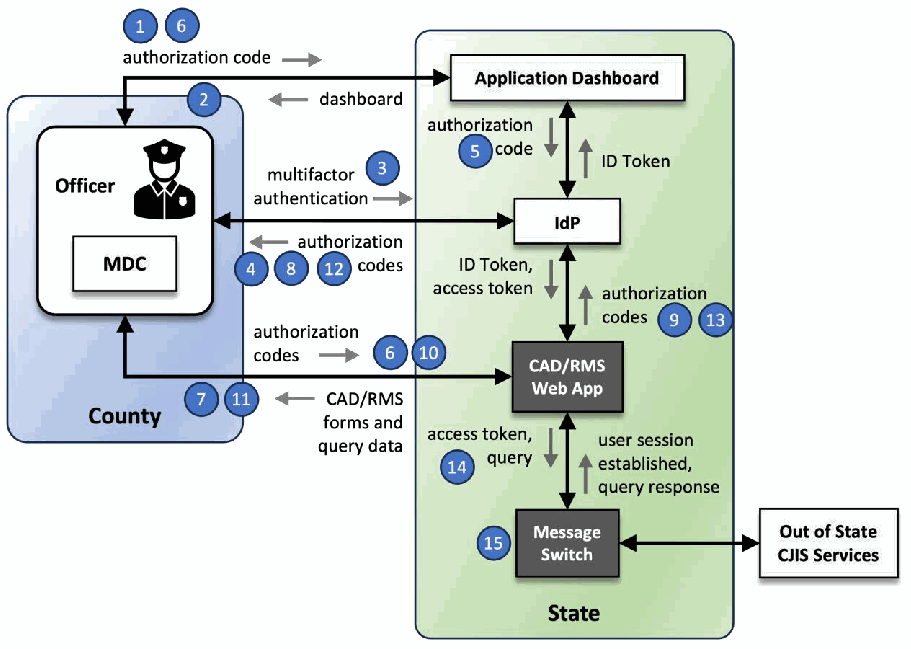
番号付きの手順を示す構成図です。左の County(郡)の枠には、MDC を持つ Officer(警察官のアイコン)があります。右の State(州)の枠には Application Dashboard、IdP、CAD/RMS Web App、Message Switch が縦に並び、Out of State CJIS Services が Message Switch とつながっています。ラベル: Officer と Application Dashboard の間に (1) (6) 認可コードと (2) ダッシュボード、Officer と IdP の間に (3) 多要素認証と (4) (8) (12) 認可コード、Application Dashboard と IdP の間に (5) 認可コードと ID Token、IdP と CAD/RMS Web App の間に ID Token、アクセストークンと (9) (13) 認可コード、Officer と CAD/RMS Web App の間に (6) (10) 認可コードと (7) (11) CAD/RMS のフォームとクエリデータ、CAD/RMS Web App から Message Switch へ (14) アクセストークンとクエリ、戻りにユーザーセッション確立とクエリ応答、Message Switch に (15)。
Fig. 23. CAD/RMS web app and IdP at state – OIDC and OAuth 2.0.
図 23. CAD/RMS の Web アプリと IdP が州にある場合 – OIDC と OAuth 2.0。
This sequence includes the following OIDC and OAuth interactions:
この手順には、次の OIDC と OAuth のやり取りが含まれます。
1.The officer accesses the application dashboard.
1.警察官がアプリケーションダッシュボードにアクセスします。
2.The application dashboard redirects the officer to the IdP to authenticate.
2.アプリケーションダッシュボードが、警察官を認証のために IdP にリダイレクトします。
3.The officer authenticates to the IdP with their credentials and MFA.
3.警察官が、認証情報と MFA で IdP に対して認証します。
4.The IdP redirects the officer’s browser to the application dashboard with an authorization code.
4.IdP が、認可コードとともに警察官のブラウザーをアプリケーションダッシュボードにリダイレクトします。
5.The application dashboard sends the authorization code to the IdP’s token endpoint, authenticating to the IdP with its own client secret or cryptographic credentials. The IdP returns an ID token to the dashboard. The dashboard validates the ID token, logs in the officer, and presents a set of application links based on their authorizations.
5.アプリケーションダッシュボードが、認可コードを IdP のトークンエンドポイントに送信し、自身のクライアントシークレットまたは暗号による認証情報で IdP に対して認証します。IdP は、ID トークンをダッシュボードに返します。ダッシュボードは ID トークンを検証し、警察官をログインさせ、その認可に基づくアプリケーションリンクの一覧を提示します。
6.The officer clicks a link to the CAD/RMS system.
6.警察官が、CAD/RMS システムへのリンクをクリックします。
7.The CAD/RMS system redirects the officer’s browser to the IdP to authenticate.
7.CAD/RMS システムが、警察官のブラウザーを認証のために IdP にリダイレクトします。
8.Since the officer has an active session with the IdP, they do not need to authenticate. The IdP redirects the officer’s browser to the CAD/RMS system with an authorization code.
8.警察官は IdP との間で有効なセッションを持っているため、認証する必要はありません。IdP は、認可コードとともに警察官のブラウザーを CAD/RMS システムにリダイレクトします。
9.The CAD/RMS system sends the authorization code to the IdP’s token endpoint, authenticating to the IdP with its own client secret or cryptographic credentials. The IdP returns an ID token to the CAD/RMS system. The CAD/RMS system validates the ID token and logs in the officer.
9.CAD/RMS システムが、認可コードを IdP のトークンエンドポイントに送信し、自身のクライアントシークレットまたは暗号による認証情報で IdP に対して認証します。IdP は、ID トークンを CAD/RMS システムに返します。CAD/RMS システムは ID トークンを検証し、警察官をログインさせます。
10.The officer submits a query to the CAD/RMS system.
10.警察官が、CAD/RMS システムにクエリを送信します。
11.The CAD/RMS system redirects the officer’s browser to the IdP with an OAuth 2.0 authorization request.
11.CAD/RMS システムが、OAuth 2.0 の認可要求とともに警察官のブラウザーを IdP にリダイレクトします。
12.Since the officer has an active session with the IdP, they do not need to authenticate. The IdP (acting as an OAuth 2.0 authorization server) redirects the officer’s browser to the CAD/RMS system with an authorization code.
12.警察官は IdP との間で有効なセッションを持っているため、認証する必要はありません。IdP(OAuth 2.0 の認可サーバーとして機能)は、認可コードとともに警察官のブラウザーを CAD/RMS システムにリダイレクトします。
13.The CAD/RMS system sends the authorization code to the IdP’s token endpoint, authenticating to the IdP with its own client secret or cryptographic credentials. The IdP returns an access token to the CAD/RMS system in the form of a JSON Web Token (JWT), cryptographically signed and encrypted using a key held by the message switch.
13.CAD/RMS システムが、認可コードを IdP のトークンエンドポイントに送信し、自身のクライアントシークレットまたは暗号による認証情報で IdP に対して認証します。IdP は、メッセージスイッチが保持する鍵を使って暗号による署名と暗号化が施された JSON Web Token(JWT)の形式で、アクセストークンを CAD/RMS システムに返します。
14.The CAD/RMS system sends the access token and the query to the message switch.
14.CAD/RMS システムが、アクセストークンとクエリをメッセージスイッチに送信します。
15.The message switch decrypts and validates the access token and extracts the user’s identity and attributes. The message switch can use these attributes to authorize the query.
15.メッセージスイッチが、アクセストークンを復号して検証し、ユーザーのアイデンティティと属性を抽出します。メッセージスイッチは、これらの属性を使ってクエリを認可できます。
B.5. VPN Integration
B.5. VPN の統合
This section only applies to agencies that use VPNs in their architecture. If your agency requires users to authenticate to both the device (e.g., laptop or mobile device) and to a VPN server (or gateway) to obtain remote access to the agency's enterprise network, this section will be of interest.
本節は、アーキテクチャに VPN を使用している機関にのみ適用されます。機関が、機関のエンタープライズネットワークにリモートアクセスするために、デバイス(例: ノート PC やモバイルデバイス)と VPN サーバー(またはゲートウェイ)の両方に対してユーザーが認証することを要求している場合は、本節が参考になります。
Figure 24 shows an implementation where both the VPN service and the CAD/RMS web app use the same LDAP directory service, such as Microsoft Active Directory. The sequence of interactions commonly implemented is as follows (it is assumed that the officer has already logged into the laptop):
図 24 に、VPN サービスと CAD/RMS の Web アプリの両方が、Microsoft Active Directory などの同じ LDAP ディレクトリサービスを使用する実装を示します。一般的に実装されるやり取りの順序は次のとおりです(警察官はすでにノート PC にログイン済みであると想定します)。
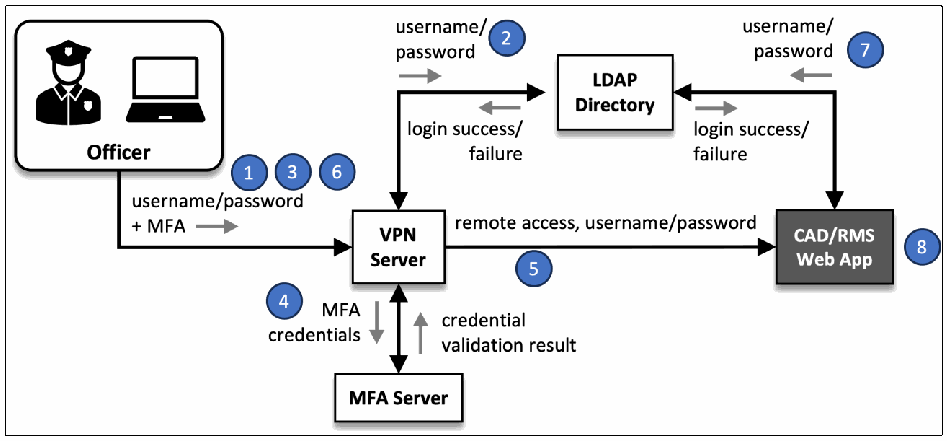
枠で囲まれた、番号付きの手順を示す構成図です。Officer(警察官とノート PC のアイコン)は VPN Server へ (1) (3) (6) username/password + MFA(ユーザー名/パスワード + MFA)を送ります。VPN Server は LDAP Directory へ (2) username/password を送り、login success/failure(ログイン成功/失敗)を受け取ります。VPN Server は MFA Server へ (4) MFA credentials(MFA の認証情報)を送り、credential validation result(認証情報の検証結果)を受け取ります。VPN Server は CAD/RMS Web App (8) へ (5) remote access, username/password(リモートアクセス、ユーザー名/パスワード)を提供します。CAD/RMS Web App は LDAP Directory へ (7) username/password を送り、login success/failure を受け取ります。
Fig. 24. VPN with an LDAP directory.
図 24. LDAP ディレクトリを用いた VPN。
1.The officer activates a VPN client on the laptop and is prompted to log in with a username and password. The VPN client sends the username and password to the VPN server.
1.警察官がノート PC 上の VPN クライアントを起動すると、ユーザー名とパスワードでのログインを促されます。VPN クライアントは、ユーザー名とパスワードを VPN サーバーに送信します。
2.The VPN server sends the submitted username and password to the LDAP server to validate the credentials. The LDAP server returns a login success message.
2.VPN サーバーが、送信されたユーザー名とパスワードを LDAP サーバーに送信して、認証情報を検証します。LDAP サーバーは、ログイン成功のメッセージを返します。
3.The VPN client prompts the officer for MFA credentials (e.g., an OTP) and sends the credentials to the VPN server.
3.VPN クライアントが、警察官に MFA 認証情報(例: OTP)の入力を促し、その認証情報を VPN サーバーに送信します。
4.The VPN server sends the MFA credentials to the MFA server for validation. The MFA server returns an authentication success message.
4.VPN サーバーが、MFA 認証情報を検証のために MFA サーバーに送信します。MFA サーバーは、認証成功のメッセージを返します。
5.Having authenticated the officer, the VPN server establishes a remote access session. The officer accesses an internal CAD/RMS web app.
5.警察官を認証した VPN サーバーは、リモートアクセスのセッションを確立します。警察官は、内部の CAD/RMS の Web アプリにアクセスします。
6.The CAD/RMS app prompts the user for a username/password. The user enters the same username and password used earlier to authenticate to the VPN. These credentials are associated with the officer’s user account in the enterprise LDAP directory.
6.CAD/RMS アプリが、ユーザーにユーザー名/パスワードの入力を促します。ユーザーは、先ほど VPN への認証に使用したものと同じユーザー名とパスワードを入力します。これらの認証情報は、エンタープライズ LDAP ディレクトリ内の警察官のユーザーアカウントに関連付けられています。
7.The CAD/RMS app sends the submitted username and password to the LDAP server to validate the credentials. The LDAP server returns a login success message.
7.CAD/RMS アプリが、送信されたユーザー名とパスワードを LDAP サーバーに送信して、認証情報を検証します。LDAP サーバーは、ログイン成功のメッセージを返します。
8.The user’s session with the CAD/RMS server is established.
8.ユーザーと CAD/RMS サーバーとの間のセッションが確立されます。
Although the officer only needs to use one username/password credential and one MFA credential, there is no SSO user experience since the user needs to enter the password twice. If MFA is not required at the CAD/RMS web app, the session is susceptible to phishing, as described in Sec. 2.5. If, on the other hand, the CAD/RMS web app enforced MFA a second time, the user would need to respond to the MFA prompt again. Repeated authentication and MFA prompts pose a burden on the user and can take focus away from the critical work they need to do.
警察官が使う必要のある認証情報は、ユーザー名/パスワード 1 組と MFA 認証情報 1 つだけですが、ユーザーがパスワードを 2 回入力する必要があるため、SSO のユーザー体験は得られません。CAD/RMS の Web アプリで MFA が要求されない場合、2.5 節で説明したように、セッションはフィッシングの影響を受けやすくなります。一方、CAD/RMS の Web アプリが MFA を 2 回目も適用した場合、ユーザーは MFA のプロンプトに再度応答する必要があります。認証と MFA のプロンプトが繰り返されると、ユーザーの負担になり、重要な業務から注意がそれる可能性があります。
B.5.1. VPN Integration with Kerberos but without Federation
B.5.1. フェデレーションを用いない Kerberos との VPN 統合
Figure 25 shows a single system acting as both a Kerberos Key Distribution Center and an LDAP Server, such as an Active Directory domain controller. The sequence in this scenario is as follows. (Again, it is assumed that the officer has already logged into the laptop with username and password.)
図 25 に、Active Directory ドメインコントローラーのように、Kerberos 鍵配布センターと LDAP サーバーの両方として機能する単一のシステムを示します。このシナリオでの順序は次のとおりです。(ここでも、警察官はすでにユーザー名とパスワードでノート PC にログイン済みであると想定します。)
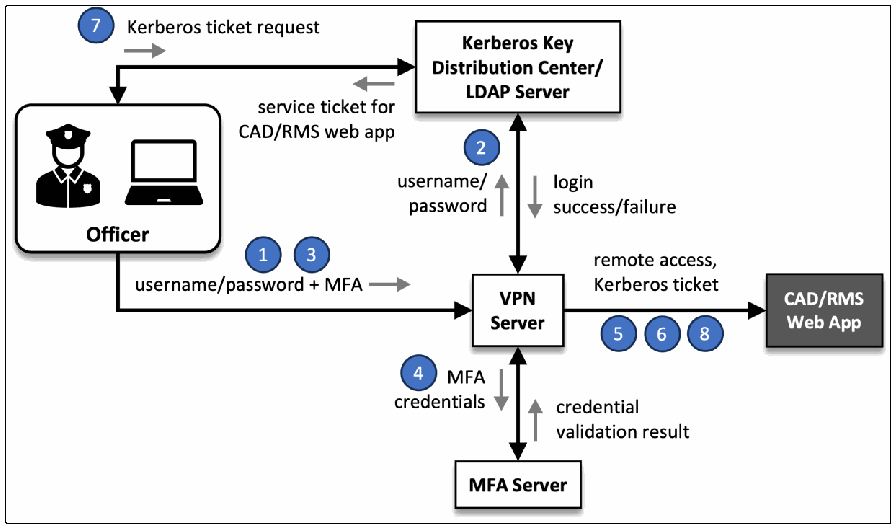
枠で囲まれた、番号付きの手順を示す構成図です。Officer(警察官とノート PC のアイコン)は VPN Server へ (1) (3) username/password + MFA を送ります。VPN Server は Kerberos Key Distribution Center/LDAP Server(Kerberos 鍵配布センター/LDAP サーバー)へ (2) username/password を送り、login success/failure を受け取ります。VPN Server は MFA Server へ (4) MFA credentials を送り、credential validation result を受け取ります。VPN Server は CAD/RMS Web App へ (5) (6) (8) remote access, Kerberos ticket(リモートアクセス、Kerberos チケット)を提供します。Officer は Kerberos Key Distribution Center/LDAP Server へ (7) Kerberos ticket request(Kerberos チケット要求)を送り、service ticket for CAD/RMS web app(CAD/RMS Web アプリ用のサービスチケット)を受け取ります。
Fig. 25. VPN with Kerberos.
図 25. Kerberos を用いた VPN。
1.The officer activates a VPN client on the laptop and is prompted to log in with a username and password. The VPN client sends the username and password to the VPN server.
1.警察官がノート PC 上の VPN クライアントを起動すると、ユーザー名とパスワードでのログインを促されます。VPN クライアントは、ユーザー名とパスワードを VPN サーバーに送信します。
2.The VPN server sends the submitted username and password to the LDAP server to validate the credentials. The LDAP server returns a login success message.
2.VPN サーバーが、送信されたユーザー名とパスワードを LDAP サーバーに送信して、認証情報を検証します。LDAP サーバーは、ログイン成功のメッセージを返します。
3.The VPN client prompts the officer for MFA credentials (e.g., an OTP) and sends the credentials to the VPN server.
3.VPN クライアントが、警察官に MFA 認証情報(例: OTP)の入力を促し、その認証情報を VPN サーバーに送信します。
4.The VPN server sends the MFA credentials to the MFA server for validation. The MFA server returns an authentication success message.
4.VPN サーバーが、MFA 認証情報を検証のために MFA サーバーに送信します。MFA サーバーは、認証成功のメッセージを返します。
5.Having authenticated the officer, the VPN server establishes a remote access session. The officer accesses an internal CAD/RMS web app.
5.警察官を認証した VPN サーバーは、リモートアクセスのセッションを確立します。警察官は、内部の CAD/RMS の Web アプリにアクセスします。
6.The CAD/RMS app returns an “unauthorized” error code to the browser with headers indicating that Kerberos authentication can be used.
6.CAD/RMS アプリが、Kerberos 認証を使用できることを示すヘッダーとともに、「unauthorized」エラーコードをブラウザーに返します。
7.Since the laptop is connected to the VPN, the Kerberos client component of the OS can connect to the Kerberos Key Distribution Center and obtain a Kerberos ticket for the CAD/RMS system.
7.ノート PC が VPN に接続されているため、OS の Kerberos クライアントコンポーネントは Kerberos 鍵配布センターに接続し、CAD/RMS システム用の Kerberos チケットを取得できます。
8.The browser sends the Kerberos ticket to the CAD/RMS system, which validates the ticket and establishes the user’s session.
8.ブラウザーが、Kerberos チケットを CAD/RMS システムに送信し、CAD/RMS システムがチケットを検証して、ユーザーのセッションを確立します。
This integration provides an SSO experience that requires the user to only provide the username/password and MFA credentials once (apart from the initial login to the laptop).
この統合により、ユーザーが(ノート PC への最初のログインを除いて)ユーザー名/パスワードと MFA 認証情報を一度だけ提供すれば済む、SSO の体験が得られます。
Though the Kerberos approach reduces the number of authentication challenges, the user’s credentials are only accepted within the organization (e.g., the local or county agency). If the users need to access additional applications at the state level, they would need different state credentials unless federation technologies are used to provide authentication across security domains. Integrating the VPN with an IdP, as described in the next section, makes this possible.
Kerberos の手法は認証チャレンジの回数を減らしますが、ユーザーの認証情報が受け入れられるのは組織内(例: 地方機関や郡の機関)に限られます。ユーザーが州レベルの追加のアプリケーションにアクセスする必要がある場合、セキュリティドメインをまたいだ認証を提供するフェデレーション技術を使用しない限り、別の州の認証情報が必要になります。次の節で説明するように、VPN を IdP と統合すると、これが可能になります。
B.5.2. VPN Integration with an Identity Provider
B.5.2. アイデンティティプロバイダーとの VPN 統合
Another approach to reducing this additional authentication burden is to integrate the VPN gateway with the IdP. In this scenario, the VPN gateway redirects the user to authenticate with the IdP using MFA. This also creates a session with the IdP that the user can then leverage to authenticate to other applications without additional MFA prompts. This approach requires the IdP to be accessible from the public internet since the user must access it prior to authenticating to the VPN. This is a common configuration for identity-as-a-service platforms but less common for internally hosted SSO systems. Figure 26 illustrates this approach with a VPN gateway integrated with an enterprise IdP.
この追加の認証の負担を減らす別の手法は、VPN ゲートウェイを IdP と統合することです。このシナリオでは、VPN ゲートウェイは、MFA を使って IdP で認証するようユーザーをリダイレクトします。これにより IdP とのセッションも作成され、ユーザーはこのセッションを活用して、追加の MFA プロンプトなしで他のアプリケーションに対して認証できます。ユーザーは VPN に対して認証する前に IdP にアクセスしなければならないため、この手法では IdP が公衆インターネットからアクセス可能である必要があります。これはアイデンティティ・アズ・ア・サービスのプラットフォームでは一般的な構成ですが、内部でホストされる SSO システムではあまり一般的ではありません。図 26 に、エンタープライズ IdP と統合された VPN ゲートウェイによるこの手法を示します。
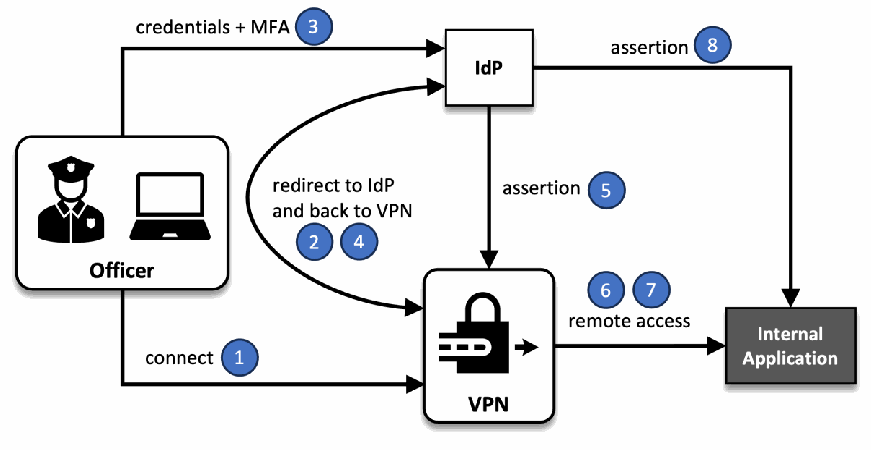
番号付きの手順を示す構成図です。Officer(警察官とノート PC のアイコン)は IdP へ (3) credentials + MFA(認証情報 + MFA)を送り、VPN(南京錠のアイコン)へ (1) connect(接続)します。VPN と IdP の間は redirect to IdP and back to VPN(IdP へリダイレクトして VPN に戻る)(2) (4) の曲線矢印で結ばれています。IdP は VPN へ (5) assertion(アサーション)を、Internal Application(内部アプリケーション)へ (8) assertion を送ります。VPN は Internal Application へ (6) (7) remote access(リモートアクセス)を提供します。
Fig. 26. VPN gateway integration with enterprise SSO.
図 26. エンタープライズ SSO との VPN ゲートウェイの統合。
The sequence of events in this scenario is as follows:
このシナリオでの一連のイベントは次のとおりです。
1.The user connects to the VPN gateway.
1.ユーザーが、VPN ゲートウェイに接続します。
2.The VPN gateway redirects the user to the IdP for authentication.
2.VPN ゲートウェイが、ユーザーを認証のために IdP にリダイレクトします。
3.The user authenticates to the IdP with their credentials and MFA.
3.ユーザーが、認証情報と MFA で IdP に対して認証します。
4.The IdP redirects the user back to the VPN gateway.
4.IdP が、ユーザーを VPN ゲートウェイにリダイレクトして戻します。
5.The VPN gateway receives the assertion from the IdP (either from the user’s browser or directly from the IdP, depending on the protocol) and establishes the user’s remote access session.
5.VPN ゲートウェイが、IdP からアサーションを受け取り(プロトコルに応じて、ユーザーのブラウザー経由または IdP から直接)、ユーザーのリモートアクセスセッションを確立します。
6.The user accesses an internal application through the VPN. The application redirects the user to the same IdP used in step 2 for authentication.
6.ユーザーが、VPN を通じて内部アプリケーションにアクセスします。アプリケーションは、ユーザーを認証のために手順 2 で使用したものと同じ IdP にリダイレクトします。
7.Because the user already has a session at the IdP, they are not required to authenticate again and are redirected back to the application.
7.ユーザーは IdP との間ですでにセッションを持っているため、再度の認証は求められず、アプリケーションにリダイレクトされて戻ります。
8.The application receives the assertion from the IdP and establishes the user’s application session.
8.アプリケーションが、IdP からアサーションを受け取り、ユーザーのアプリケーションセッションを確立します。
The impact of multiple MFA prompts can also be mitigated by choosing MFA credentials that require less user interaction. Using a smart card, for example, to authenticate to the client laptop, the VPN gateway, and an SSO system provides phishing-resistant MFA and a relatively seamless user experience. The user is required to enter a short numeric PIN to unlock the smart card. In many cases, the workstation can cache the PIN to avoid further PIN prompts as the user authenticates to additional systems. Hardware authenticators can offer similar convenience.
複数の MFA プロンプトの影響は、ユーザーの操作がより少なくて済む MFA 認証情報を選択することでも軽減できます。たとえば、スマートカードを使ってクライアントのノート PC、VPN ゲートウェイ、SSO システムに対して認証すれば、フィッシング耐性のある MFA と、比較的シームレスなユーザー体験が得られます。ユーザーは、スマートカードのロックを解除するために、短い数字の PIN を入力する必要があります。多くの場合、ワークステーションは PIN をキャッシュして、ユーザーが追加のシステムに対して認証する際の PIN のプロンプトを避けることができます。ハードウェア認証器も、同様の利便性を提供できます。
Appendix C. Questions to Ask Your Technology Vendors
付録 C. 技術ベンダーに尋ねるべき質問
This appendix provides lists of questions that agencies can ask vendors to evaluate the efficacy of their MFA implementation in meeting CJIS Security Policy requirements and the principles of MFA design as outlined in this document. Each questionnaire is specific to one of the following vendor categories:
本付録では、本書で概説した CJIS セキュリティポリシーの要件と MFA 設計の原則を、ベンダーの MFA 実装がどの程度満たしているかを評価するために、機関がベンダーに尋ねることのできる質問の一覧を示します。各質問票は、次のいずれかのベンダーのカテゴリに固有のものです。
•CAD/RMS vendors (Appendix C.1)
•CAD/RMS ベンダー(付録 C.1)
•Identity services vendors (Appendix C.2)
•アイデンティティサービスのベンダー(付録 C.2)
•Message switch vendors (Appendix C.3)
•メッセージスイッチのベンダー(付録 C.3)
•VPN vendors (Appendix C.4)
•VPN ベンダー(付録 C.4)
If you import these questions into your own custom document that you transmit to your vendor, please include a link to this document (NIST IR 8523) so that the vendors have context for the terms introduced in this document.
これらの質問を、ベンダーに送付する独自の文書に取り込む場合は、ベンダーが本書で導入した用語の背景を理解できるよう、本書(NIST IR 8523)へのリンクを含めてください。
C.1. Questionnaire for CAD/RMS Vendors
C.1. CAD/RMS ベンダー向けの質問票
1.Please identify your CAD/RMS application as:
1.CAD/RMS アプリケーションは、次のどれに当たるかを示してください。
a.Thick client
a.シッククライアント
b.Web application
b.Web アプリケーション
c.Other (Please describe in detail)
c.その他(詳しく説明してください)
2.How does your CAD/RMS application meet the AAL2 MFA requirements in the CJIS Security Policy? Please provide a detailed list of how you meet each requirement.
2.CAD/RMS アプリケーションは、CJIS セキュリティポリシーの AAL2 の MFA 要件を、どのように満たしていますか。各要件をどのように満たしているかの詳細な一覧を提供してください。
3.As part of your service, do you offer an MFA solution that comes directly integrated with your CAD/RMS application, or do you anticipate agencies having or procuring their own MFA implementation with which your CAD/RMS solution will be integrated?
3.サービスの一環として、CAD/RMS アプリケーションに直接統合された MFA ソリューションを提供していますか。それとも、機関が独自の MFA 実装を保有または調達し、それに CAD/RMS ソリューションを統合することを想定していますか。
4.If you offer MFA as part of your service, please specify which types of multi-factor authenticators your solution offers. For each type, list what the two factors are for the MFA system. Please include a detailed sequence diagram showing the authentication flow for the authenticator. Please identify the specific authenticator vendor and brand, and provide a list of agencies with reference points of contact (POCs) where your implementation has been deployed for each use case.
4.サービスの一環として MFA を提供している場合は、ソリューションが提供する多要素認証器の種類を明示してください。種類ごとに、MFA システムの 2 つの要素が何であるかを挙げてください。その認証器の認証フローを示す詳細なシーケンス図を含めてください。具体的な認証器のベンダーとブランドを明示し、ユースケースごとに、実装を展開した機関の一覧を、参照用の連絡窓口(POC)とともに提供してください。
5.Authenticator optionality is defined in IR 8523. Can the authenticators listed under question 3 be deployed alongside each other to allow agencies to offer different authenticators to different user groups (prisons, sworn law enforcement officers, detectives, dispatch centers, etc.) who may have different MFA needs and use cases? Please provide a list of agencies with reference POCs where your implementation has been deployed for each use case.
5.認証器の選択可能性は IR 8523 で定義されています。質問 3 に挙げた認証器を併せて展開して、MFA のニーズやユースケースが異なる可能性のあるさまざまなユーザーグループ(刑務所、宣誓した法執行官、刑事、指令センターなど)に、機関が異なる認証器を提供できるようにすることは可能ですか。ユースケースごとに、実装を展開した機関の一覧を、参照用の連絡窓口(POC)とともに提供してください。
6.How do you support phishing resistance with your MFA solution?
6.MFA ソリューションでは、フィッシング耐性をどのようにサポートしていますか。
7.Do you support identity federation protocols and architectures such as SAML 2.0, Open ID Connect 1.0, OAuth 2.0, and IdP proxies? If yes, can you please provide examples of how you have deployed these technologies for other agencies? Where possible, please provide a detailed sequence diagram of the authentication flow and highlight which protocols were used and between which components. Please also include the make and model of the technologies used.
7.SAML 2.0、Open ID Connect 1.0、OAuth 2.0、IdP プロキシなどのアイデンティティフェデレーションプロトコルとアーキテクチャに対応していますか。対応している場合、これらの技術を他の機関向けにどのように展開したかの例を提供してください。可能であれば、認証フローの詳細なシーケンス図を提供し、どのプロトコルがどのコンポーネント間で使用されたかを明示してください。使用した技術のメーカーと型番も記載してください。
8.Describe your integration approach with VPN solutions. Please provide a detailed sequence diagram showing the authentication flow for each use case, as well as a list of agencies with reference POCs where your implementation has been deployed for each use case below. Please include the names of specific LDAP, VPN, or other applicable vendors in each case:
8.VPN ソリューションとの統合手法を説明してください。ユースケースごとに、認証フローを示す詳細なシーケンス図と、以下の各ユースケースで実装を展開した機関の一覧を、参照用の POC とともに提供してください。各ケースについて、具体的な LDAP、VPN、その他該当するベンダーの名称を記載してください。
a.Integration using LDAP
a.LDAP を使用した統合
b.Integration using Kerberos
b.Kerberos を使用した統合
c.Integration using federated identity services (refer to IR 8523 for examples)
c.フェデレーション型アイデンティティサービスを使用した統合(例は IR 8523 を参照)
9.Refer to IR 8523, which defines the principles of MFA design. Please include a description of how your product demonstrates the principles of MFA design as outlined in IR 8523 regarding:
9.IR 8523 を参照してください。IR 8523 は MFA 設計の原則を定義しています。製品が、IR 8523 で概説されている次の MFA 設計の原則をどのように実証しているかについての説明を含めてください。
a.Authenticator Reusability – Minimize the number of separate MFA credentials that users must use and manage.
a.認証器の再利用性 – ユーザーが使用して管理しなければならない個別の MFA 認証情報の数を最小限に抑えます。
b.Authenticator Optionality – Support a diversity of use case environments such as department of corrections, law enforcement officers, dispatch centers, etc.
b.認証器の選択可能性 – 矯正局、法執行官、指令センターなど、多様なユースケースの環境をサポートします。
c.Minimize the Passing of Shared Memorized Secrets – Avoid forwarding memorized secrets such as passwords to entities such as message switches to enable authentication.
c.共有記憶シークレットの受け渡しの最小化 – 認証を可能にするために、パスワードなどの記憶シークレットをメッセージスイッチなどのエンティティに転送することを避けます。
d.Ensure MFA Is Integrated to Protect CJI – Tie into SSO services and avoid multiple challenges for MFA.
d.CJI を保護するための MFA の統合の確保 – SSO サービスと連携し、MFA のチャレンジが複数回行われることを避けます。
C.2. Questionnaire for Identity Services Vendors
C.2. アイデンティティサービスのベンダー向けの質問票
1.How does your product support the AAL2 MFA requirements in the CJIS Security Policy? Please provide a detailed list of how you meet each requirement.
1.製品は、CJIS セキュリティポリシーの AAL2 の MFA 要件を、どのようにサポートしていますか。各要件をどのように満たしているかの詳細な一覧を提供してください。
2.Please specify which types of multi-factor authenticators your solution offers. For each type, list what the two factors are for the MFA system and if it supports phishing resistance.
2.ソリューションが提供する多要素認証器の種類を明示してください。種類ごとに、MFA システムの 2 つの要素が何であるか、およびフィッシング耐性をサポートしているかどうかを挙げてください。
a.Please include a detailed sequence diagram showing the authentication flow for the authenticator. Please identify the specific authenticator vendor and brand, and provide a list of agencies with reference points of contact (POCs) where your implementation has been deployed.
a.認証器の認証フローを示す詳細なシーケンス図を含めてください。具体的な認証器のベンダーとブランドを明示し、実装を展開した機関の一覧を、参照用の連絡窓口(POC)とともに提供してください。
b.If phishing resistance is supported, list which phishing-resistant authentication protocols are used (e.g., FIDO2/WebAuthn/PIV Smart Card).
b.フィッシング耐性をサポートしている場合は、使用するフィッシング耐性のある認証プロトコル(例: FIDO2/WebAuthn/PIV スマートカード)を挙げてください。
3.Authenticator optionality is defined in IR 8523. Can the authenticators listed under question 2 be deployed alongside each other to allow agencies to offer different authenticators to different user groups (prisons, sworn law enforcement officers, detectives, dispatch centers, etc.) who may have different MFA needs and use cases? Please provide a list of agencies with reference POCs where your implementation has been deployed for each use case.
3.認証器の選択可能性は IR 8523 で定義されています。質問 2 に挙げた認証器を併せて展開して、MFA のニーズやユースケースが異なる可能性のあるさまざまなユーザーグループ(刑務所、宣誓した法執行官、刑事、指令センターなど)に、機関が異なる認証器を提供できるようにすることは可能ですか。ユースケースごとに、実装を展開した機関の一覧を、参照用の連絡窓口(POC)とともに提供してください。
4.How do you support phishing resistance with your MFA solution?
4.MFA ソリューションでは、フィッシング耐性をどのようにサポートしていますか。
5.Do you support identity federation protocols and architectures such as SAML 2.0, Open ID Connect 1.0, OAuth 2.0, and IdP proxies? If yes, can you please provide examples of how you have deployed these technologies for other agencies? Where possible, please provide a detailed sequence diagram of the authentication flow and highlight which protocols were used and between which components. Please also include the make and model of the technologies used.
5.SAML 2.0、Open ID Connect 1.0、OAuth 2.0、IdP プロキシなどのアイデンティティフェデレーションプロトコルとアーキテクチャに対応していますか。対応している場合、これらの技術を他の機関向けにどのように展開したかの例を提供してください。可能であれば、認証フローの詳細なシーケンス図を提供し、どのプロトコルがどのコンポーネント間で使用されたかを明示してください。使用した技術のメーカーと型番も記載してください。
6.Describe your integration approach with CAD/RMS applications. Please provide a detailed sequence diagram showing the authentication flow for each use case, as well as a list of agencies with reference POCs where your implementation has been deployed for each use case below. Please include the names of the specific VPN vendors in each case.
6.CAD/RMS アプリケーションとの統合手法を説明してください。ユースケースごとに、認証フローを示す詳細なシーケンス図と、以下の各ユースケースで実装を展開した機関の一覧を、参照用の POC とともに提供してください。各ケースについて、具体的な VPN ベンダーの名称を記載してください。
7.Describe your integration approach with message switch applications. Please provide a detailed sequence diagram showing the authentication flow for each use case, as well as a list of agencies with reference POCs where your implementation has been deployed for each use case below. Please include the names of the specific VPN vendors in each case.
7.メッセージスイッチアプリケーションとの統合手法を説明してください。ユースケースごとに、認証フローを示す詳細なシーケンス図と、以下の各ユースケースで実装を展開した機関の一覧を、参照用の POC とともに提供してください。各ケースについて、具体的な VPN ベンダーの名称を記載してください。
8.Describe your integration approach with VPN solutions. Please provide a detailed sequence diagram showing the authentication flow for each use case, as well as a list of agencies with reference POCs where your implementation has been deployed for each use case below. Please include the names of the specific VPN vendors in each case.
8.VPN ソリューションとの統合手法を説明してください。ユースケースごとに、認証フローを示す詳細なシーケンス図と、以下の各ユースケースで実装を展開した機関の一覧を、参照用の POC とともに提供してください。各ケースについて、具体的な VPN ベンダーの名称を記載してください。
9.Refer to IR 8523, which defines the principles of MFA design. Please include a description of how your solution demonstrates the principles of MFA design as outlined in IR 8523 regarding:
9.IR 8523 を参照してください。IR 8523 は MFA 設計の原則を定義しています。ソリューションが、IR 8523 で概説されている次の MFA 設計の原則をどのように実証しているかについての説明を含めてください。
a.Authenticator Reusability – Minimize the number of separate MFA credentials that users must use and manage.
a.認証器の再利用性 – ユーザーが使用して管理しなければならない個別の MFA 認証情報の数を最小限に抑えます。
b.Authenticator Optionality – Support a diversity of use case environments such as department of corrections, law enforcement officers, dispatch centers, etc.
b.認証器の選択可能性 – 矯正局、法執行官、指令センターなど、多様なユースケースの環境をサポートします。
c.Minimize the Passing of Shared Memorized Secrets – Avoid forwarding memorized secrets such as passwords to entities such as message switches to enable authentication.
c.共有記憶シークレットの受け渡しの最小化 – 認証を可能にするために、パスワードなどの記憶シークレットをメッセージスイッチなどのエンティティに転送することを避けます。
d.Ensure MFA Is Integrated to Protect CJI – Tie into SSO services and avoid multiple challenges for MFA.
d.CJI を保護するための MFA の統合の確保 – SSO サービスと連携し、MFA のチャレンジが複数回行われることを避けます。
C.3. Questionnaire for Message Switch Vendors
C.3. メッセージスイッチのベンダー向けの質問票
1.How does your message switch application meet the AAL2 MFA requirements in the CJIS Security Policy? Please provide a detailed list of how you meet each requirement.
1.メッセージスイッチアプリケーションは、CJIS セキュリティポリシーの AAL2 の MFA 要件を、どのように満たしていますか。各要件をどのように満たしているかの詳細な一覧を提供してください。
2.As part of your service, do you offer an MFA solution that comes directly integrated with your message switch? For agencies that have or will soon be deploying MFA at third-party applications such as CAD/RMS or identity service providers, how does your message switch integrate with these solutions?
2.サービスの一環として、メッセージスイッチに直接統合された MFA ソリューションを提供していますか。CAD/RMS などのサードパーティ製アプリケーションやアイデンティティサービスプロバイダーで MFA を展開済み、または近く展開する予定の機関に対して、メッセージスイッチはこれらのソリューションとどのように統合されますか。
3.If you offer MFA as part of your service, please specify which types of multi-factor authenticators your solution offers. For each type, list what the two factors are for the MFA system and if it supports phishing resistance.
3.サービスの一環として MFA を提供している場合は、ソリューションが提供する多要素認証器の種類を明示してください。種類ごとに、MFA システムの 2 つの要素が何であるか、およびフィッシング耐性をサポートしているかどうかを挙げてください。
a.Please include a detailed sequence diagram showing the authentication flow for the authenticator. Please identify the specific authenticator vendor and brand, and provide a list of agencies with reference points of contact (POCs) where your implementation has been deployed.
a.認証器の認証フローを示す詳細なシーケンス図を含めてください。具体的な認証器のベンダーとブランドを明示し、実装を展開した機関の一覧を、参照用の連絡窓口(POC)とともに提供してください。
b.If phishing resistance is supported, list which phishing-resistant authentication protocols are used (e.g., FIDO2/WebAuthn/PIV Smart Card).
b.フィッシング耐性をサポートしている場合は、使用するフィッシング耐性のある認証プロトコル(例: FIDO2/WebAuthn/PIV スマートカード)を挙げてください。
4.Authenticator optionality is defined in IR 8523. Can the authenticators listed under question 3 be deployed alongside each other to allow agencies to offer different authenticators to different user groups (prisons, sworn law enforcement officers, detectives, dispatch centers, etc.) who may have different MFA needs and use cases? Please provide a list of agencies with reference POCs where your implementation has been deployed for each use case.
4.認証器の選択可能性は IR 8523 で定義されています。質問 3 に挙げた認証器を併せて展開して、MFA のニーズやユースケースが異なる可能性のあるさまざまなユーザーグループ(刑務所、宣誓した法執行官、刑事、指令センターなど)に、機関が異なる認証器を提供できるようにすることは可能ですか。ユースケースごとに、実装を展開した機関の一覧を、参照用の連絡窓口(POC)とともに提供してください。
5.How do you support phishing resistance with your MFA solution?
5.MFA ソリューションでは、フィッシング耐性をどのようにサポートしていますか。
6.Do you support identity federation protocols and architectures such as SAML 2.0, Open ID Connect 1.0, OAuth 2.0, and IdP proxies? If yes, can you please provide examples of how you have deployed these technologies for other agencies? Where possible, please provide a detailed sequence diagram of the authentication flow and highlight which protocols were used and between which components. Please also include the make and model of the technologies used.
6.SAML 2.0、Open ID Connect 1.0、OAuth 2.0、IdP プロキシなどのアイデンティティフェデレーションプロトコルとアーキテクチャに対応していますか。対応している場合、これらの技術を他の機関向けにどのように展開したかの例を提供してください。可能であれば、認証フローの詳細なシーケンス図を提供し、どのプロトコルがどのコンポーネント間で使用されたかを明示してください。使用した技術のメーカーと型番も記載してください。
7.Refer to IR 8523, which defines the principles of MFA design. Please include a description of how your solution demonstrates the principles of MFA design as outlined in IR 8523 regarding:
7.IR 8523 を参照してください。IR 8523 は MFA 設計の原則を定義しています。ソリューションが、IR 8523 で概説されている次の MFA 設計の原則をどのように実証しているかについての説明を含めてください。
a.Authenticator Reusability – Minimize the number of separate MFA credentials that users must use and manage.
a.認証器の再利用性 – ユーザーが使用して管理しなければならない個別の MFA 認証情報の数を最小限に抑えます。
b.Authenticator Optionality – Support a diversity of use case environments such as department of corrections, law enforcement officers, dispatch centers, etc.
b.認証器の選択可能性 – 矯正局、法執行官、指令センターなど、多様なユースケースの環境をサポートします。
c.Minimize the Passing of Shared Memorized Secrets – Avoid forwarding memorized secrets such as passwords to entities such as message switches to enable authentication.
c.共有記憶シークレットの受け渡しの最小化 – 認証を可能にするために、パスワードなどの記憶シークレットをメッセージスイッチなどのエンティティに転送することを避けます。
d.Ensure MFA Is Integrated to Protect CJI – Tie into SSO services and avoid multiple challenges for MFA.
d.CJI を保護するための MFA の統合の確保 – SSO サービスと連携し、MFA のチャレンジが複数回行われることを避けます。
C.4. Questionnaire for VPN Vendors
C.4. VPN ベンダー向けの質問票
1.How does your VPN solution meet the AAL2 MFA requirements in the CJIS Security Policy? Please provide a detailed list of how you meet each requirement.
1.VPN ソリューションは、CJIS セキュリティポリシーの AAL2 の MFA 要件を、どのように満たしていますか。各要件をどのように満たしているかの詳細な一覧を提供してください。
2.As part of your service, do you offer an MFA solution that comes directly integrated with your VPN application, or do you anticipate agencies having or procuring their own MFA implementation with which your VPN solution will be integrated?
2.サービスの一環として、VPN アプリケーションに直接統合された MFA ソリューションを提供していますか。それとも、機関が独自の MFA 実装を保有または調達し、それに VPN ソリューションを統合することを想定していますか。
3.If you offer MFA as part of your service, please specify which types of multi-factor authenticators your solution offers. For each type, list what the two factors are for the MFA system, and if it supports phishing resistance.
3.サービスの一環として MFA を提供している場合は、ソリューションが提供する多要素認証器の種類を明示してください。種類ごとに、MFA システムの 2 つの要素が何であるか、およびフィッシング耐性をサポートしているかどうかを挙げてください。
a.Please include a detailed sequence diagram showing the authentication flow for the authenticator. Please identify the specific authenticator vendor and brand, and provide a list of agencies with reference points of contact (POCs) where your implementation has been deployed.
a.認証器の認証フローを示す詳細なシーケンス図を含めてください。具体的な認証器のベンダーとブランドを明示し、実装を展開した機関の一覧を、参照用の連絡窓口(POC)とともに提供してください。
b.If phishing resistance is supported, list which phishing-resistant authentication protocols are used (e.g., FIDO2/WebAuthn/PIV Smart Card).
b.フィッシング耐性をサポートしている場合は、使用するフィッシング耐性のある認証プロトコル(例: FIDO2/WebAuthn/PIV スマートカード)を挙げてください。
4.Authenticator optionality is defined in IR 8523. Can the authenticators listed under question 3 be deployed alongside each other to allow agencies to offer different authenticators to different user groups (prisons, sworn law enforcement officers, detectives, dispatch centers, etc.) who may have different MFA needs and use cases? Please provide a list of agencies with reference POCs where your implementation has been deployed for each use case.
4.認証器の選択可能性は IR 8523 で定義されています。質問 3 に挙げた認証器を併せて展開して、MFA のニーズやユースケースが異なる可能性のあるさまざまなユーザーグループ(刑務所、宣誓した法執行官、刑事、指令センターなど)に、機関が異なる認証器を提供できるようにすることは可能ですか。ユースケースごとに、実装を展開した機関の一覧を、参照用の連絡窓口(POC)とともに提供してください。
5.How do you support phishing resistance with your MFA solution?
5.MFA ソリューションでは、フィッシング耐性をどのようにサポートしていますか。
6.Describe your integration approach with CAD/RMS vendors. Please provide a detailed sequence diagram showing the authentication flow for each use case, and a list of agencies with reference POCs where your implementation has been deployed for each use case below. Please include the names of specific LDAP or other applicable vendors in each case:
6.CAD/RMS ベンダーとの統合手法を説明してください。ユースケースごとに、認証フローを示す詳細なシーケンス図と、以下の各ユースケースで実装を展開した機関の一覧を、参照用の POC とともに提供してください。各ケースについて、具体的な LDAP、その他該当するベンダーの名称を記載してください。
a.Integration using LDAP
a.LDAP を使用した統合
b.Integration using Kerberos
b.Kerberos を使用した統合
c.Integration using federated identity services (refer to IR 8523 for examples)
c.フェデレーション型アイデンティティサービスを使用した統合(例は IR 8523 を参照)
7.Do you support identity federation protocols and architectures such as SAML 2.0, Open ID Connect 1.0, OAuth 2.0, and IdP proxies? If yes, can you please provide examples of how you have deployed these technologies for other agencies? Where possible, please provide a detailed sequence diagram of the authentication flow and highlight which protocols were used and between which components. Please also include the make and model of the technologies used.
7.SAML 2.0、Open ID Connect 1.0、OAuth 2.0、IdP プロキシなどのアイデンティティフェデレーションプロトコルとアーキテクチャに対応していますか。対応している場合、これらの技術を他の機関向けにどのように展開したかの例を提供してください。可能であれば、認証フローの詳細なシーケンス図を提供し、どのプロトコルがどのコンポーネント間で使用されたかを明示してください。使用した技術のメーカーと型番も記載してください。
8.Refer to IR 8523, which defines the principles of MFA design. Please include a description of how your solution demonstrates the principles of MFA design as outlined in IR 8523 regarding:
8.IR 8523 を参照してください。IR 8523 は MFA 設計の原則を定義しています。ソリューションが、IR 8523 で概説されている次の MFA 設計の原則をどのように実証しているかについての説明を含めてください。
a.Authenticator Reusability – Minimize the number of separate MFA credentials that users must use and manage.
a.認証器の再利用性 – ユーザーが使用して管理しなければならない個別の MFA 認証情報の数を最小限に抑えます。
b.Authenticator Optionality – Support a diversity of use case environments such as department of corrections, law enforcement officers, dispatch centers, etc.
b.認証器の選択可能性 – 矯正局、法執行官、指令センターなど、多様なユースケースの環境をサポートします。
c.Minimize the Passing of Shared Memorized Secrets – Avoid forwarding memorized secrets, such as passwords, to other entities to enable authentication.
c.共有記憶シークレットの受け渡しの最小化 – 認証を可能にするために、パスワードなどの記憶シークレットを他のエンティティに転送することを避けます。
d.Ensure MFA Is Integrated to Protect CJI – Tie into SSO services and avoid multiple challenges for MFA.
d.CJI を保護するための MFA の統合の確保 – SSO サービスと連携し、MFA のチャレンジが複数回行われることを避けます。
Appendix D. List of Symbols, Abbreviations, and Acronyms
付録 D. 記号、略語、頭字語の一覧
AAL Authentication Assurance Level
AAL 認証保証レベル
AS Authorization Server (OAuth)
AS 認可サーバー(OAuth)
BYOD Bring Your Own Device
BYOD 私物デバイスの持ち込み
CAD Computer-Aided Dispatch
CAD コンピュータ支援指令
CIO Chief Information Officer
CIO 最高情報責任者
CISO Chief Information Security Officer
CISO 最高情報セキュリティ責任者
CJI Criminal Justice Information
CJI 刑事司法情報
CJIS Criminal Justice Information Services
CJIS 刑事司法情報サービス
COPE Corporately Owned Personally Enabled
COPE 会社所有・個人利用可
CSO CJIS Systems Officer
CSO CJIS システム担当官
DHS Department of Homeland Security
DHS 国土安全保障省
DOJ Department of Justice
DOJ 司法省
FAL Federation Assurance Level
FAL フェデレーション保証レベル
FIDO Fast Identity Online
FIDO 高速オンライン本人確認
HTTPS Hypertext Transfer Protocol Secure
HTTPS ハイパーテキスト転送プロトコルセキュア
IdP Identity Provider
IdP アイデンティティプロバイダー
IR Interagency Report or Internal Report
IR 省庁間報告書または内部報告書
ISO Information Security Officer
ISO 情報セキュリティ担当官
JOSE JavaScript Object Signing and Encryption
JOSE JavaScriptオブジェクト署名および暗号化
JSON JavaScript Object Notation
JSON JavaScriptオブジェクト表記法
JWT JSON Web Token
JWT JSONウェブトークン
LDAP Lightweight Directory Access Protocol
LDAP 軽量ディレクトリアクセスプロトコル
MDC Mobile Digital Computer
MDC モバイルデジタルコンピュータ
MFA Multi-Factor Authentication
MFA 多要素認証
OIDC OpenID Connect
OIDC OpenID Connect
OS Operating System
OS オペレーティングシステム
OTP One-Time Passcode
OTP ワンタイムパスコード
PD Police Department
PD 警察署
PIN Personal Identification Number
PIN 個人識別番号
POC Point of Contact
POC 連絡窓口
REST Representational State Transfer
REST 代表状態転送
RMS Record Management System
RMS 記録管理システム
RP Relying Party
RP 依拠当事者
SAML Security Assertion Markup Language
SAML セキュリティアサーションマークアップ言語
SLTT State, Local, Tribal, and Territorial
SLTT 州、地方、部族、準州
SP Special Publication
SP 特別刊行物
SSO Single Sign-On
SSO シングルサインオン
TLS Transport Layer Security
TLS トランスポート層セキュリティ
URI Uniform Resource Identifier
URI 統一資源識別子
VPN Virtual Private Network
VPN 仮想プライベートネットワーク
W3C World Wide Web Consortium
W3C ワールド・ワイド・ウェブ・コンソーシアム
XML Extensible Markup Language
XML 拡張可能マークアップ言語