NIST IR 8587 日本語訳
英語タイトル : Protecting Tokens and Assertions from Forgery, Theft, and Misuse: Implementation Recommendations for Agencies and Cloud Service Providers日本語タイトル : トークンとアサーションの偽造・窃取・悪用からの保護:省庁およびクラウドサービスプロバイダー向けの実装に関する推奨事項
公開日 : 2026-09-15
原文URL : https://csrc.nist.gov/pubs/ir/8587/final
翻訳編集 : 自動生成(有志による非公式の日本語訳), 原文取得日 : 2026-10-31, 訳文 : 485 / 487 ブロック
[要約] NIST IR 8587 は、連邦機関とクラウドサービスプロバイダー(CSP)が、ID トークン、アクセストークン、アサーションを偽造・窃取・悪用から保護するための実装ガイドラインを示す報告書です。NIST SP 800-53 の更新(リリース 5.1.1)を土台に、CSP と利用側の機関のための原則を示し、アイデンティティプロバイダーと認可サーバーに関するアーキテクチャ上の考慮事項を詳述します。あわせて、鍵管理、トークン検証、ライフサイクル管理の各管理策の強化を推奨します。最近の注目度の高い攻撃で実証された脅威を取り上げ、シングルサインオン(SSO)、フェデレーション、API アクセスの各シナリオを保護するための具体的な技術的推奨事項を示します。
NIST Interagency Report
NIST 省庁間報告書
NIST IR 8587
NIST IR 8587
Protecting Tokens and Assertions from Forgery, Theft, and Misuse
トークンとアサーションの偽造・窃取・悪用からの保護
Implementation Recommendations for Agencies and Cloud Service Providers
省庁およびクラウドサービスプロバイダー向けの実装に関する推奨事項
Ryan Galluzzo Andrew Regenscheid Stephanie Nelson Christine Lazcano
Ryan Galluzzo Andrew Regenscheid Stephanie Nelson Christine Lazcano
This publication is available free of charge from: https://doi.org/10.6028/NIST.IR.8587
本刊行物は次のURLから無償で入手できます: https://doi.org/10.6028/NIST.IR.8587
NIST Interagency Report
NIST 省庁間報告書
NIST IR 8587
NIST IR 8587
Protecting Tokens and Assertions from Forgery, Theft, and Misuse
トークンとアサーションの偽造・窃取・悪用からの保護
Implementation Recommendations for Agencies and Cloud Service Providers
省庁およびクラウドサービスプロバイダー向けの実装に関する推奨事項
Ryan Galluzzo Applied Cybersecurity Division Information Technology Laboratory
Ryan Galluzzo Applied Cybersecurity Division Information Technology Laboratory
Andrew Regenscheid Computer Security Division Information Technology Laboratory
Andrew Regenscheid Computer Security Division Information Technology Laboratory
Stephanie Nelson Accenture Federal Supporting the Cybersecurity and Infrastructure Security Agency
Stephanie Nelson Accenture Federal Supporting the Cybersecurity and Infrastructure Security Agency
Christine Lazcano Cybersecurity Division Cybersecurity and Infrastructure Security Agency
Christine Lazcano Cybersecurity Division Cybersecurity and Infrastructure Security Agency
This publication is available free of charge from: https://doi.org/10.6028/NIST.IR.8587
本刊行物は次のURLから無償で入手できます: https://doi.org/10.6028/NIST.IR.8587
September 2026
2026年9月
[米国商務省の紋章。公的な標章のため、この非公式サイトには掲載していません。原本 PDF を参照してください。]
U.S. Department of Commerce Howard Lutnick, Secretary
米国商務省 Howard Lutnick 長官
National Institute of Standards and Technology
米国国立標準技術研究所
Arvind Raman, NIST Director and Under Secretary of Commerce for Standards and Technology
Arvind Raman、NIST 所長兼商務次官(標準・技術担当)
Report written with:
共同執筆:
[組織・プログラムのロゴ。ロゴのため、この非公式サイトには掲載していません。原本 PDF を参照してください。]
Certain equipment, instruments, software, or materials, commercial or non-commercial, are identified in this paper in order to specify the experimental procedure adequately. Such identification does not imply recommendation or endorsement of any product or service by NIST or CISA, nor does it imply that the materials or equipment identified are necessarily the best available for the purpose.
本書では、実験手順を適切に特定するため、商用・非商用を問わず、特定の機器、計器、ソフトウェア、または資材を挙げている場合があります。このような特定は、NIST または CISA がいかなる製品やサービスも推奨または是認していることを意味せず、挙げた資材や機器がその目的に最適であるとは限らないことも意味しません。
There may be references in this publication to other publications currently under development by NIST in accordance with its assigned statutory responsibilities. The information in this publication, including concepts and methodologies, may be used by federal agencies even before the completion of such companion publications. Thus, until each publication is completed, current requirements, guidelines, and procedures, where they exist, remain operative. For planning and transition purposes, federal agencies may wish to closely follow the development of these new publications by NIST.
本刊行物には、NIST が法令上の責務に従って現在策定中の他の刊行物への言及が含まれる場合があります。概念や方法論を含む本刊行物の情報は、そうした関連刊行物の完成前であっても、連邦機関が利用できます。したがって、各刊行物が完成するまでは、現行の要件、ガイドライン、手順が存在する場合は、それらが引き続き有効です。計画および移行のため、連邦機関は、NIST によるこれらの新しい刊行物の策定状況を注意深く追うことを検討してもよいです。
Organizations are encouraged to review all draft publications during public comment periods and provide feedback to NIST. Many NIST cybersecurity publications, other than the ones noted above, are available at https://csrc.nist.gov/publications.
各組織は、パブリックコメント期間中にすべてのドラフト刊行物を確認し、NIST にフィードバックを提供することが推奨されます。上記以外の多くの NIST サイバーセキュリティ刊行物は https://csrc.nist.gov/publications で入手できます。
NIST Technical Series Policies Copyright, Use, and Licensing Statements NIST Technical Series Publication Identifier Syntax
NIST技術シリーズの方針、著作権・使用・ライセンスに関する声明、NIST技術シリーズ刊行物識別子の構文
Publication History Approved by the NIST Editorial Review Board on 2026-08-27
刊行履歴 NIST編集審査委員会による承認日: 2026-08-27
How to Cite this NIST Technical Series Publication Galluzzo R, Regenscheid A, Nelson S, Lazcano C (2026) Protecting Tokens and Assertions from Forgery, Theft, and Misuse: Implementation Recommendations for Agencies and Cloud Service Providers. (National Institute of Standards and Technology, Gaithersburg, MD), NIST Interagency Report (IR) NIST IR 8587. https://doi.org/10.6028/NIST.IR.8587
NIST技術シリーズ刊行物の引用方法 Galluzzo R, Regenscheid A, Nelson S, Lazcano C (2026) Protecting Tokens and Assertions from Forgery, Theft, and Misuse: Implementation Recommendations for Agencies and Cloud Service Providers. (National Institute of Standards and Technology, Gaithersburg, MD), NIST Interagency Report (IR) NIST IR 8587. https://doi.org/10.6028/NIST.IR.8587
Author ORCID iDs Ryan Galluzzo: 0000-0003-0304-4239 Andrew Regenscheid: 0000-0002-3930-527X
著者のORCID iD Ryan Galluzzo: 0000-0003-0304-4239 Andrew Regenscheid: 0000-0002-3930-527X
Contact Information iam@list.nist.gov National Institute of Standards and Technology Attn: Applied Cybersecurity Division, Information Technology Laboratory 100 Bureau Drive (Mail Stop 2000) Gaithersburg, MD 20899-2000
連絡先 iam@list.nist.gov National Institute of Standards and Technology Attn: Applied Cybersecurity Division, Information Technology Laboratory 100 Bureau Drive (Mail Stop 2000) Gaithersburg, MD 20899-2000
Additional Information Additional information about this publication is available at https://csrc.nist.gov/pubs/ir/8587/final, including related content, potential updates, and document history.
追加情報 本刊行物に関する追加情報は https://csrc.nist.gov/pubs/ir/8587/final で入手できます。関連コンテンツ、更新の可能性、文書の履歴も掲載されています。
All comments are subject to release under the Freedom of Information Act (FOIA).
すべてのコメントは、情報自由法(FOIA)に基づき公開される場合があります。
Abstract
要旨
This report provides implementation guidelines to help federal agencies and cloud service providers (CSPs) protect identity tokens, access tokens, and assertions from forgery, theft, and misuse. Building on updates to NIST SP 800-53 (Release 5.1.1), it outlines principles for CSPs and consuming agencies, details architectural considerations for identity providers and authorization servers, and recommends enhancements to key management, token verification, and life cycle controls. The report addresses threats demonstrated in recent high-profile attacks, emphasizes the importance of secure by design practices, configurability, interoperability, and continuous monitoring, and provides specific technical recommendations to safeguard single sign-on (SSO), federation, and application programming interface (API) access scenarios.
本報告書は、連邦機関とクラウドサービスプロバイダー(CSP)が、ID トークン、アクセストークン、アサーションを偽造・窃取・悪用から保護するための実装ガイドラインを示します。NIST SP 800-53 の更新(リリース 5.1.1)を土台に、CSP と利用側の機関のための原則を示し、アイデンティティプロバイダーと認可サーバーに関するアーキテクチャ上の考慮事項を詳述し、鍵管理、トークン検証、ライフサイクル管理の各管理策の強化を推奨します。本報告書は、最近の注目度の高い攻撃で実証された脅威を取り上げ、セキュア・バイ・デザインの実践、構成可能性、相互運用性、継続的監視の重要性を強調するとともに、シングルサインオン(SSO)、フェデレーション、アプリケーションプログラミングインターフェース(API)アクセスの各シナリオを保護するための具体的な技術的推奨事項を示します。
Keywords
キーワード
access management; federation; key management; single sign-on; token management.
アクセス管理; フェデレーション; 鍵管理; シングルサインオン; トークン管理。
Reports on Computer Systems Technology
コンピュータシステム技術に関する報告書
The Information Technology Laboratory (ITL) at the National Institute of Standards and Technology (NIST) promotes the U.S. economy and public welfare by providing technical leadership for the Nation’s measurement and standards infrastructure. ITL develops tests, test methods, reference data, proof of concept implementations, and technical analyses to advance the development and productive use of information technology. ITL’s responsibilities include the development of management, administrative, technical, and physical standards and guidelines for the cost-effective security and privacy of other than national security-related information in federal information systems.
米国国立標準技術研究所(NIST)の情報技術研究所(ITL)は、国の測定・標準のインフラに技術的なリーダーシップを提供することで、米国経済と公共の福祉の向上に貢献しています。ITL は、情報技術の開発と生産的な利用を進めるため、テスト、テスト方法、参照データ、概念実証の実装、技術分析を開発しています。ITL の責務には、連邦情報システムにおける国家安全保障に関わらない情報について、費用対効果の高いセキュリティとプライバシーのための管理、運用、技術、物理に関する標準とガイドラインの策定が含まれます。
Patent Disclosure Notice
特許開示に関する通知
NOTICE: ITL has requested that holders of patent claims whose use may be required for compliance with the recommendations or requirements of this publication disclose such patent claims to ITL. However, holders of patents are not obligated to respond to ITL calls for patents and ITL has not undertaken a patent search in order to identify which, if any, patents may apply to this publication.
通知: ITL は、本刊行物の推奨事項または要件を遵守するために使用が必要となる可能性のある特許請求の範囲の保有者に対し、当該特許請求を ITL に開示するよう求めています。ただし、特許の保有者には ITL の特許開示の求めに応じる義務はなく、ITL も、本刊行物に該当する特許があるかどうかを特定するための特許調査を実施していません。
As of the date of publication and following call(s) for the identification of patent claims whose use may be required for compliance with the recommendations or requirements of this publication, no such patent claims have been identified to ITL.
公開日の時点で、本刊行物の推奨事項または要件を遵守するために使用が必要となる可能性のある特許請求を特定するための呼びかけを行いましたが、そのような特許請求は ITL に対して特定されていません。
No representation is made or implied by ITL that licenses are not required to avoid patent infringement in the use of this publication.
本刊行物の使用にあたって特許侵害を避けるためにライセンスが不要であるとは、ITL は表明も示唆もしません。
Table of Contents
目次
List of Tables
表の一覧
List of Figures
図の一覧
Acknowledgments
謝辞
The authors wish to acknowledge the collaboration between NIST, CISA, and NSA to make this document possible. We would also like to acknowledge those subject-matter experts who participated in the Joint Cyber Defense Collaborative (JCDC) Cloud Security Workshop in June of 2025 and provided invaluable insights that informed this document.
著者らは、本書の作成を可能にした NIST、CISA、NSA の協力に謝意を表します。また、2025 年 6 月に開催された Joint Cyber Defense Collaborative(JCDC)のクラウドセキュリティワークショップに参加し、本書の内容に貴重な知見を寄せてくださった分野の専門家の方々にも謝意を表します。
1. Introduction
1. はじめに
Recent cybersecurity incidents at major cloud service providers (CSPs) have resulted from the ability to steal, modify, or forge identity tokens and assertions used by enterprise single sign-on (SSO) and identity federation systems to gain access to sensitive applications, data, and communications. In response to this critical and emerging threat, NIST issued release 5.1.1 to Special Publication (SP) 800-53, Security and Privacy Controls for Information Systems and Organizations [1]. Released in November 2023,1 the patch provided additional control and supporting control enhancements related to identity providers (IdPs), authorization servers, the protection of cryptographic keys, the verification of identity assertions and access tokens, and token management [2].
主要なクラウドサービスプロバイダー(CSP)で最近起きたサイバーセキュリティインシデントは、企業のシングルサインオン(SSO)やアイデンティティフェデレーションのシステムが用いる ID トークンやアサーションを、窃取、改変、偽造できたために、機微なアプリケーション、データ、通信へのアクセスを許したことに起因します。この重大で新たな脅威に対応するため、NIST は Special Publication(SP)800-53『Security and Privacy Controls for Information Systems and Organizations』[1] のリリース 5.1.1 を発行しました。2023 年 11 月に公開された1このパッチは、アイデンティティプロバイダー(IdP)、認可サーバー、暗号鍵の保護、アイデンティティアサーションとアクセストークンの検証、トークン管理に関する追加の管理策と、それを支える管理策の強化を示しました [2]。
With the proliferation of cloud computing services and the distribution of government data and services to external infrastructure, platforms, and software, this threat becomes even more distinct. Agencies do not always have the visibility they need into the external services they procure to identify, respond to, and remediate emerging threats. As such, while this document provides controls and considerations that expand on SP 800-53, the recommendations contained herein are equally important to cloud services, whether commercially offered to agency customers or operated by government agencies.
クラウドコンピューティングサービスが普及し、政府のデータやサービスが外部のインフラ、プラットフォーム、ソフトウェアに分散するにつれ、この脅威はいっそう顕著になります。機関は、調達する外部サービスについて、新たな脅威を特定し、対応し、是正するために必要な可視性を常に得られるとは限りません。このため、本書は SP 800-53 を拡張する管理策と考慮事項を示しますが、ここに含まれる推奨事項は、機関の顧客に商用で提供されるクラウドサービスにも、政府機関が運用するクラウドサービスにも、同じように重要です。
Federal agencies need to understand the architectures, designs, and deployment models of their CSPs to configure services that are consistent with their risk tolerance and threat environment. When providing services to federal agencies, CSPs need to deliver security mitigations that are configurable, transparent, and interoperable to empower cloud service consumers to implement risk-informed, threat-adaptive defenses across diverse environments.
連邦機関は、自らのリスク許容度と脅威環境に合致したサービスを構成するため、CSP のアーキテクチャ、設計、展開モデルを理解する必要があります。CSP は、連邦機関にサービスを提供する際、構成可能で、透明性があり、相互運用できるセキュリティ低減策を提供し、クラウドサービスの利用者が、多様な環境にわたってリスクに基づき脅威に適応する防御を実装できるようにする必要があります。
1.1. Purpose and Scope
1.1. 目的と適用範囲
This publication is scoped to federal environments and has been developed pursuant to the authorities detailed in 15 U.S.C. §278g–3.2 This document expands on the new control in SP 800-53 [1] and provides technical guidelines to support the implementation of token and assertion protections and cryptographic mechanisms. Specifically, this document covers controls that protect identity and access management (IAM) systems that rely on digitally signed assertions and tokens based on asymmetric cryptography when making access decisions. This often includes SSO, federation, application programming interface (API), and workload access scenarios. Systems that do not rely on asymmetric signed assertions and tokens (e.g., stateful management, schemes based on symmetric cryptography, API keys) are mentioned where relevant but out of scope for the controls covered.
本刊行物は連邦の環境を対象とし、15 U.S.C. §278g–3 に詳述された権限に基づいて策定されました。2本書は SP 800-53 [1] の新しい管理策を拡張し、トークンとアサーションの保護および暗号メカニズムの実装を支える技術ガイドラインを示します。具体的には、アクセスの判断を行う際に、非対称暗号に基づくデジタル署名付きのアサーションとトークンに依拠するアイデンティティおよびアクセス管理(IAM)システムを保護する管理策を扱います。これには、SSO、フェデレーション、アプリケーションプログラミングインターフェース(API)、ワークロードのアクセスのシナリオが含まれることが多くあります。非対称署名付きのアサーションとトークンに依拠しないシステム(たとえば、ステートフルな管理、共通鍵暗号に基づく方式、API キー)は、関連する箇所で言及しますが、扱う管理策の適用範囲外です。
1.1.1. Artificial Intelligence (AI) and AI Agents
1.1.1. 人工知能(AI)と AI エージェント
Artificial intelligence (AI) systems — especially agentic AI systems (AI agents) — use signed tokens or assertions in many emerging IAM schemes. Organizations should apply these guidelines when agents use signed tokens to access systems, data, tools, or APIs. This document is not a comprehensive guide to addressing AI and AI agent access risks. Those risks create additional IAM challenges that require further guidelines and, in some cases, new or expanded standards and protocols. This document excludes those topics from scope. NIST and CISA recognize this gap and continue to develop practical guidelines as AI and agentic AI systems gain traction.3
人工知能(AI)システム、特にエージェント型 AI システム(AI エージェント)は、新たに登場している多くの IAM 方式で署名付きトークンやアサーションを使用します。組織は、エージェントが署名付きトークンを使ってシステム、データ、ツール、API にアクセスする場合に、これらのガイドラインを適用すべきです。本書は、AI および AI エージェントのアクセスに伴うリスクに対処するための包括的な手引きではありません。それらのリスクは IAM に新たな課題をもたらし、さらなるガイドラインと、場合によっては新規または拡張された標準とプロトコルを必要とします。本書は、これらの話題を適用範囲から除外しています。NIST と CISA は、このギャップを認識しており、AI とエージェント型 AI システムが普及するにつれて、実践的なガイドラインの策定を続けます。3
1.2. Notations
1.2. 表記
This document uses the following typographical conventions in text to indicate the parameters for entities that claim conformance. However, conformance with these guidelines remains voluntary for CSPs and federal agencies unless otherwise determined through policy, including OMB policies, or other binding agreements (e.g., contracts, grants).
本書は、適合を主張する主体に対するパラメータを示すため、本文で次の表記上の規約を使用します。ただし、これらのガイドラインへの適合は、OMB の方針を含む政策や、その他の拘束力のある取り決め(契約、助成金など)によって別途決定されない限り、CSP と連邦機関にとって任意のままです。
•Specific terms in CAPITALS represent normative requirements. When these same terms are not in CAPITALS, the term does not represent a normative requirement.
•大文字で表記された特定の用語は、規範的な要件を表します。同じ用語が大文字でない場合、その用語は規範的な要件を表しません。
•The terms “MUST” and “MUST NOT” indicate requirements to be followed to conform to these guidelines.
•用語 “MUST” と “MUST NOT” は、これらのガイドラインに適合するために従わなければならない要件を示します。
•The terms “SHOULD” and “SHOULD NOT” indicate that a certain course of action is preferred but not necessarily required or that — in the negative form — a certain possibility or course of action is discouraged but not prohibited.
•用語 “SHOULD” と “SHOULD NOT” は、ある行動方針が推奨されるものの必ずしも必須ではないこと、または否定形では、ある可能性や行動方針が推奨されないものの禁止されてはいないことを示します。
Agencies may choose to include these requirements in whole or in part based on risk management needs.
機関は、リスク管理上のニーズに基づき、これらの要件の全部または一部を含めることを選択してもかまいません。
1.3. Identity Management in Cloud and Hybrid Environments — Managing Responsibilities
1.3. クラウドおよびハイブリッド環境におけるアイデンティティ管理 — 責任の管理
In cloud environments, security and identity management are governed by a shared responsibility model that must clarify which aspects of identity and credential hardening are managed by the CSP and which are the responsibility of the cloud consumer (i.e., organization or end user). Understanding and implementing this division is essential for maintaining robust security and preventing gaps that adversaries could exploit.
クラウド環境では、セキュリティとアイデンティティ管理は責任共有モデルによって規律されます。このモデルでは、アイデンティティと認証情報の堅牢化のどの側面を CSP が管理し、どの側面がクラウド利用者(すなわち、組織またはエンドユーザー)の責任なのかを明確にする必要があります。この区分を理解して実施することは、堅牢なセキュリティを維持し、攻撃者に悪用されかねない空白を防ぐために不可欠です。
CSP responsibilities often include securing the underlying infrastructure, maintaining core IAM services (e.g., authentication, federation, authorization), managing token issuance and signing, providing secure secrets storage, ensuring infrastructure-level logging and monitoring, and maintaining compliance with regulatory frameworks. CSPs provide the configurable security controls and tools necessary for consumers to build secure applications and services.
CSP の責任には、基盤となるインフラのセキュリティ確保、中核的な IAM サービス(認証、フェデレーション、認可など)の維持、トークンの発行と署名の管理、安全なシークレット保管の提供、インフラレベルのログ記録と監視の確保、規制の枠組みへの準拠の維持が含まれることが多くあります。CSP は、利用者が安全なアプリケーションとサービスを構築するために必要な、構成可能なセキュリティ管理策とツールを提供します。
Cloud consumer responsibilities often include securely configuring IAM policies, managing application-level secrets and credentials, enforcing strong authentication and access controls, conducting operational security activities (e.g., deployment via DevSecOps pipelines, access reviews, red team exercises), and responding to incidents. Consumers are also responsible for educating their users and teams and for enabling logging in various services (when not on by default), configuring log duration and storage, and configuring alert and notification mechanisms based on logs.
クラウド利用者の責任には、IAM ポリシーの安全な構成、アプリケーションレベルのシークレットと認証情報の管理、強力な認証とアクセス制御の実施、運用上のセキュリティ活動(DevSecOps パイプラインによる展開、アクセスレビュー、レッドチーム演習など)の実施、インシデントへの対応が含まれることが多くあります。利用者はまた、ユーザーとチームへの教育、各種サービスでのログ記録の有効化(既定で有効でない場合)、ログの保存期間と保管の設定、ログに基づくアラートと通知の仕組みの設定にも責任を負います。
Consumer configuration choices are driven by risk assessments of the cloud-hosted services and the impacts of a loss of confidentiality, integrity, and availability. In nearly all cases and deployment scenarios, the CSP and the consumer will need to coordinate on logging, monitoring, incident response, and compliance reporting to ensure that incidents are managed effectively.
利用者の構成上の選択は、クラウドでホストされるサービスのリスクアセスメントと、機密性、完全性、可用性の喪失による影響によって決まります。ほぼすべての場合と展開シナリオで、CSP と利用者は、インシデントを効果的に管理するため、ログ記録、監視、インシデント対応、コンプライアンス報告について調整する必要があります。
It is important for CSPs and consuming agencies to understand their respective roles and responsibilities for managing IAM controls to support effective collaboration and comprehensive security in cloud environments. Coordination between CSPs and consuming agencies will largely be programmatic and/or automated, but some level of manual coordination will often be necessary. Table 1 provides an example of responsibility areas in a software-as-a-service (SaaS) environment.
クラウド環境で効果的な協力と包括的なセキュリティを支えるには、CSP と利用側の機関が、IAM 管理策の管理に関するそれぞれの役割と責任を理解することが重要です。CSP と利用側の機関の間の調整は、大部分がプログラム的または自動化されたものになりますが、ある程度の手動での調整が必要になることも多くあります。表 1 は、サービスとしてのソフトウェア(SaaS)環境における責任領域の例を示します。
Table 1. Example responsibility areas
表 1. 責任領域の例
| Responsibility Area | CSP | Consumer |
|---|---|---|
| Physical Security | ● | |
| Infrastructure (Hardware/Networking) | ● | |
| Core IAM Services | ● | |
| Token Issuance/Signing | ● | |
| Secrets Vaults/Hardware Security Module | ● | |
| Infrastructure Logging/Monitoring | ● | |
| IAM Policy Configuration | ● | |
| Application/User Access Control | ● | |
| Application Secrets Management | ● | |
| Multifactor Authentication (MFA)/User Authentication Setup | ● | |
| Session Management | ● | |
| Application Logging/Monitoring | ● | |
| User Education | ● | ● |
| Incident Response | ● | ● |
| Continuous Monitoring | ● | ● |
| Token Revocation | ● | ● |
| 責任領域 | CSP | 利用者 |
|---|---|---|
| 物理的セキュリティ | ● | |
| インフラ(ハードウェア/ネットワーク) | ● | |
| 中核的な IAM サービス | ● | |
| トークンの発行/署名 | ● | |
| シークレットボールト/ハードウェアセキュリティモジュール | ● | |
| インフラのログ記録/監視 | ● | |
| IAM ポリシーの構成 | ● | |
| アプリケーション/ユーザーのアクセス制御 | ● | |
| アプリケーションのシークレット管理 | ● | |
| 多要素認証(MFA)/ユーザー認証の設定 | ● | |
| セッション管理 | ● | |
| アプリケーションのログ記録/監視 | ● | |
| ユーザー教育 | ● | ● |
| インシデント対応 | ● | ● |
| 継続的監視 | ● | ● |
| トークンの失効 | ● | ● |
Actual responsibility boundaries vary by service model, contract terms, and technical capabilities exposed by the CSPs. Coordination is often implemented through documented interfaces, telemetry, and self-service controls, not solely through manual interactions.
実際の責任の境界は、サービスモデル、契約条件、CSP が公開する技術的機能によって異なります。調整は、手動のやり取りだけでなく、文書化されたインターフェース、テレメトリ、セルフサービスの管理策を通じて実施されることが多くあります。
1.4. Principles for Cloud Service Providers
1.4. クラウドサービスプロバイダーのための原則
The following principles are necessary to effectively support a secure relationship between consuming agencies and CSPs:
利用側の機関と CSP の間の安全な関係を効果的に支えるには、次の原則が必要です。
•Secure development and design. CSP systems are an integral component of agency services and increasingly essential to modern federal agency missions and service delivery. Security must be built into the multitude of systems and offerings that CSPs manage. Such security practices should be consistent with CISA’s Secure by Design principles [3], NIST’s Secure Software Development Framework [4], and NIST’s Engineering Trustworthy Secure Systems guidelines [5]. CSP systems must also be designed with resilience in mind, including support for continuity of operations, rapid recovery from incidents, and redundant systems and services.
•セキュアな開発と設計。CSP のシステムは機関のサービスに不可欠な構成要素であり、現代の連邦機関のミッションとサービス提供にとってますます重要になっています。CSP が管理する多数のシステムと提供物に、セキュリティが組み込まれていなければなりません。そのようなセキュリティの実践は、CISA の Secure by Design の原則 [3]、NIST の Secure Software Development Framework [4]、NIST の Engineering Trustworthy Secure Systems ガイドライン [5] と整合すべきです。CSP のシステムは、業務継続、インシデントからの迅速な復旧、冗長なシステムとサービスのサポートを含め、レジリエンスを念頭に置いて設計されなければなりません。
•Transparency. Effective risk management on both sides of the CSP-to-consumer relationship requires the CSP to be transparent about their deployed technology, the architecture underpinning the technology, and system-generated data. Particularly critical is the ability of the CSP to convey alignment with consumer security requirements (e.g., IA-13: Identity Providers and Authorization Servers from SP 800-53, Rev. 5.1.1 and NIST’s Digital Identity Guidelines) and establish effective communication channels to support logging and analyzing token- and assertion-related events. The intent of this principle is to ensure that consumers have sufficient information about a CSP offering to make informed risk and configuration decisions. It is not intended to add further compliance, audit, or assessment expectations on the CSPs or consuming agencies.
•透明性。CSP と利用者の関係の双方で効果的にリスクを管理するには、CSP が、展開している技術、その技術を支えるアーキテクチャ、システムが生成するデータについて透明であることが必要です。特に重要なのは、CSP が利用者のセキュリティ要件(たとえば、SP 800-53 Rev. 5.1.1 の IA-13: Identity Providers and Authorization Servers や NIST の Digital Identity Guidelines)との整合を伝え、トークンとアサーションに関連するイベントのログ記録と分析を支える効果的なコミュニケーション経路を確立できることです。この原則の意図は、利用者がリスクや構成に関する判断を十分な情報に基づいて行えるよう、CSP の提供物について十分な情報を得られるようにすることです。CSP や利用側の機関に、コンプライアンス、監査、アセスメントに関する期待をさらに加えることは意図していません。
•Configurability. Different cloud service models (e.g., infrastructure as a service, platform as a service, SaaS) have different capabilities, and security features need to be optimizable by consumers to the greatest degree practical. This allows organizations to apply mitigations that match their risk tolerance and operational needs, such as additional logging and monitoring or incorporating additional security offerings from the CSP. CSPs should also provide critical consensus and federal risk management mitigations (e.g., those defined in this document and SP 800-53 more generally) by default with additional options for organizations with advanced requirements or specific needs. Appropriate training, documentation, and support capabilities must accompany these configurations.
•構成可能性。クラウドサービスのモデル(サービスとしてのインフラ、サービスとしてのプラットフォーム、SaaS など)によって機能は異なり、利用者がセキュリティ機能を実用上可能な最大限の範囲で最適化できる必要があります。これにより、組織は、追加のログ記録や監視、CSP が提供する追加のセキュリティ製品の組み込みなど、自らのリスク許容度と運用上のニーズに合った低減策を適用できます。CSP はまた、重要なコンセンサス上の低減策や連邦のリスク管理上の低減策(本書や、より一般的に SP 800-53 で定義されたものなど)を既定で提供し、高度な要件や特定のニーズを持つ組織向けの追加オプションも用意すべきです。これらの構成には、適切なトレーニング、文書、サポート機能が伴わなければなりません。
•Interoperability. Providing essential support for standards-based architectures facilitates integration and management across hybrid and multi-cloud environments, enabling consumers to support redundancy and resiliency. Identity, authorization, and federation standards — such as Open Identity Connect (OIDC), Open Authorization (Oauth), and Security Assertion Markup Language (SAML) — reduces the complexity introduced by custom integrations and supports a consistent security posture across the consumer’s entire enterprise. This approach enables interoperability among connected components without mandating a single method for token or assertion management.
•相互運用性。標準に基づくアーキテクチャへの不可欠なサポートを提供することで、ハイブリッド環境やマルチクラウド環境にまたがる統合と管理が容易になり、利用者は冗長性とレジリエンスをサポートできます。Open Identity Connect(OIDC)、Open Authorization(Oauth)、Security Assertion Markup Language(SAML)などのアイデンティティ、認可、フェデレーションの標準は、独自の統合によって生じる複雑さを減らし、利用者の企業全体で一貫したセキュリティ態勢をサポートします。このアプローチにより、トークンやアサーションの管理方法を単一に義務付けることなく、接続された構成要素間の相互運用性が実現します。
Implementing these principles promotes a healthy and secure relationship between the CSP and its consumers.
これらの原則を実践することで、CSP とその利用者の間に健全で安全な関係が育まれます。
1.5. Principles for Consuming Agencies
1.5. 利用側の機関のための原則
Agencies that use cloud services to support mission and service delivery are responsible for secure implementation. Agencies must ensure that procured cloud environments and services satisfy Federal Information Security Modernization Act (FISMA) risk management practices for transaction risk and sensitivity as well as resiliency goals to maintain operations in the event of incidents and outages. To effectively implement solutions that meet these responsibilities, agencies must apply the following principles to their engagement process with CSPs:
ミッションとサービス提供を支えるためにクラウドサービスを使用する機関は、安全な実装に責任を負います。機関は、調達したクラウド環境とサービスが、取引のリスクと機微性に関する連邦情報セキュリティ近代化法(FISMA)のリスク管理の実践、およびインシデントや障害の際にも運用を維持するレジリエンスの目標を満たすことを確実にしなければなりません。これらの責任を果たすソリューションを効果的に実装するため、機関は CSP との関与のプロセスに次の原則を適用しなければなりません。
•Risk assessment and control selection. While CSPs may offer baseline solutions that align with system categorization [23] and FedRAMP impact levels, the consuming agency is responsible for completing a thorough risk assessment [6] in accordance with the NIST Risk Management Framework (RMF) [7]. Agencies are also responsible for conducting a digital identity risk assessment (DIRA), as defined in SP 800-63-4, Digital Identity Guidelines [8]. This process helps define a baseline set of security controls, security outcomes, and assurance levels for any CSP-offered or in-house-developed token or assertion-based system. These frameworks do not comprehensively cover all aspects of token and assertion usage, and agencies should supplement them with the guidelines in this document.
•リスクアセスメントと管理策の選択。CSP はシステムのカテゴリ分類 [23] と FedRAMP の影響レベルに沿ったベースラインのソリューションを提供する場合がありますが、利用側の機関は、NIST リスク管理フレームワーク(RMF)[7] に従って徹底したリスクアセスメント [6] を完了する責任を負います。機関はまた、SP 800-63-4『Digital Identity Guidelines』[8] で定義されているデジタルアイデンティティリスクアセスメント(DIRA)を実施する責任も負います。このプロセスは、CSP が提供する、または自前で開発した、トークンまたはアサーションに基づくあらゆるシステムについて、セキュリティ管理策、セキュリティ成果、保証レベルのベースラインを定めるのに役立ちます。これらのフレームワークは、トークンとアサーションの使用のあらゆる側面を包括的にはカバーしておらず、機関は本書のガイドラインで補うべきです。
•Tailoring. Control baselines serve as a starting point for selecting controls; organizations further tailor the controls to manage risk in accordance with their risk management strategy and risk tolerance. Both the RMF and Digital Identity Guidelines enable agencies to further refine, select, and implement controls that are specific to their operational and threat environment and subsequently communicate these requirements to CSPs. Agencies should tailor controls based on the capabilities within selected CSP or on-premises environments.
•テーラリング。管理策のベースラインは管理策を選択する出発点となります。組織は、自らのリスク管理戦略とリスク許容度に従ってリスクを管理するため、管理策をさらにテーラリングします。RMF と Digital Identity Guidelines はいずれも、機関が自らの運用環境と脅威環境に固有の管理策をさらに洗練し、選択し、実装して、その要件を CSP に伝えることを可能にします。機関は、選択した CSP やオンプレミス環境の機能に基づいて管理策をテーラリングすべきです。
•Secure integration and configuration. As indicated above, CSP services should be configurable. In coordination with their CSPs, consuming agencies are responsible for configuring their cloud environments to align with their security categorization, control selection, tailoring outcomes, and defined assurance.
•安全な統合と構成。上記のとおり、CSP のサービスは構成可能であるべきです。利用側の機関は、CSP と調整しながら、自らのセキュリティカテゴリ分類、管理策の選択、テーラリングの成果、定義された保証に合わせてクラウド環境を構成する責任を負います。
While cloud-hosted services introduce complexity to the risk management process, they also enable substantial mission and business capabilities that agencies cannot replicate with organic systems and environments. By recognizing the shared responsibility for applying these principles, CSPs and agencies can improve threat management and enhance digital services for employees and the public. These processes are essential to supporting remote access scenarios, SSO, and the provisioning of modern API-based services.
クラウドでホストされるサービスはリスク管理のプロセスに複雑さをもたらしますが、機関が自前のシステムや環境では再現できない、ミッションと業務上の大きな能力ももたらします。これらの原則を適用する責任を共有していることを認識することで、CSP と機関は、脅威管理を改善し、職員と一般市民向けのデジタルサービスを強化できます。これらのプロセスは、リモートアクセスのシナリオ、SSO、最新の API ベースのサービスの提供を支えるために不可欠です。
1.6. Continuous Monitoring and Evaluation
1.6. 継続的な監視と評価
No security controls — particularly identity management controls — should be “set and forget.” Consistent with the RMF, CSPs and consuming agencies implement continuous monitoring capabilities for the components that they control. Consuming agencies utilize CSPs’ offerings to continuously evaluate and monitor CSP environments, implement connections to on-premises or multi-cloud environments, and access events through logs or metrics at all levels to identify potential vulnerabilities or incidents. This continuous monitoring should extend to the accounts, clients, and entities that are issuing, consuming, validating, or represented by tokens or assertions. Consuming agencies — with support from CSPs — need to regularly review access policies, entitlements, access grants, and account statuses (e.g., provisioned/deprovisioned) with appropriate support from CSPs to limit the misuse of tokens or assertions.
どのセキュリティ管理策も、特にアイデンティティ管理の管理策は、「設定したら終わり」であってはなりません。RMF に沿って、CSP と利用側の機関は、それぞれが管理する構成要素について継続的監視の機能を実装します。利用側の機関は、CSP の提供物を活用して CSP 環境を継続的に評価・監視し、オンプレミス環境やマルチクラウド環境への接続を実装し、あらゆるレベルでログやメトリクスを通じてイベントにアクセスして、潜在的な脆弱性やインシデントを特定します。この継続的監視は、トークンやアサーションを発行、利用、検証するアカウント、クライアント、エンティティと、トークンやアサーションによって表されるアカウント、クライアント、エンティティにも及ぶべきです。利用側の機関は、CSP の支援を受けて、トークンやアサーションの悪用を抑えるため、アクセスポリシー、権限、アクセス許可、アカウントの状態(プロビジョニング済み/プロビジョニング解除済みなど)を定期的に見直す必要があります。
In many real-world compromises involving tokens or assertions, agencies can detect issues only by monitoring account activity and analyzing CSP log data. CSPs are responsible for promptly notifying the consuming agency when they identify, suspect, or reasonably believe that a security incident may have caused unauthorized access, disclosure, alteration, or loss of agency data. CSPs must notify agencies in accordance with legal, regulatory, and contractual requirements and include sufficient detail for the agency to assess impact, initiate incident response procedures, and fulfill any downstream reporting obligations. CSPs are also responsible for coordinating with the consuming agency to ensure timely, accurate, and compliant communication and support follow-on investigation, containment, and remediation.
トークンやアサーションが関わる現実の侵害の多くでは、機関は、アカウントの活動を監視し、CSP のログデータを分析することによってのみ、問題を検知できます。CSP は、セキュリティインシデントによって機関のデータへの不正アクセス、開示、改ざん、損失が生じた可能性があることを特定、疑い、または合理的に信じた場合、速やかに利用側の機関に通知する責任を負います。CSP は、法律、規制、契約上の要件に従って機関に通知しなければならず、機関が影響を評価し、インシデント対応手順を開始し、下流の報告義務を果たすのに十分な詳細を含めなければなりません。CSP はまた、利用側の機関と調整し、適時で正確かつ準拠したコミュニケーションを確保するとともに、その後の調査、封じ込め、是正を支援する責任も負います。
2. Overview of Assertions and Tokens
2. アサーションとトークンの概要
In federated and SSO environments, information about identity is often conveyed through either an identity assertion or an identity token. These statements contain authentication information and attributes that can be used by protected resources (i.e., relying parties [RPs]) to make decisions to determine whether a user or software is appropriately authenticated and authorized to access a specific application, service, or data. These assertions or identity tokens are digitally signed by the issuer (i.e., IdP) using asymmetric cryptography to provide the RPs with assurance that they came from a trusted source and that the data contained in the assertion or token has not been modified. When used correctly, these objects allow an enterprise to grant users access without having to constantly authenticate the user prior to accessing services, thus improving usability and efficiency for workforce tasks. These systems also provide substantial technical benefits, including the ability to centrally manage access control and authentication policies and provide a more consistent security posture across their environment.
フェデレーション環境や SSO 環境では、アイデンティティに関する情報が、アイデンティティアサーションまたはアイデンティティトークンのいずれかを通じて伝達されることが多くあります。これらの記述には認証情報と属性が含まれ、保護対象リソース(すなわち、依拠当事者 [RP])は、それらを使って、ユーザーまたはソフトウェアが特定のアプリケーション、サービス、データにアクセスするために適切に認証され認可されているかどうかを判断します。これらのアサーションまたはアイデンティティトークンは、発行者(すなわち IdP)が公開鍵暗号を使ってデジタル署名しており、信頼できる出所から来たものであること、およびアサーションやトークンに含まれるデータが改ざんされていないことを RP に保証します。これらのオブジェクトを正しく使えば、企業は、サービスへのアクセス前にユーザーを絶えず認証しなくても、ユーザーにアクセスを許可できるため、従業員の業務の使いやすさと効率が向上します。こうしたシステムは、アクセス制御と認証のポリシーを一元的に管理でき、環境全体でより一貫したセキュリティ態勢を提供できるなど、技術面でも大きな利点をもたらします。
However, the security of these systems relies on the ability to safeguard the cryptographic keys used to sign assertions and issue tokens, as well as to appropriately verify those assertions and tokens when they are used to access RP applications. When keys are compromised (e.g., exfiltrated, copied) or verification is not done correctly, assertions and tokens can be used to enable unauthorized access and rapidly compromise multiple protected resources.
しかし、これらのシステムのセキュリティは、アサーションへの署名とトークンの発行に使う暗号鍵を保護できること、およびアサーションやトークンが RP のアプリケーションへのアクセスに使われる際にそれらを適切に検証できることに依存しています。鍵が危殆化した場合(たとえば、外部へ持ち出された、複製された場合)や、検証が正しく行われない場合、アサーションやトークンは不正アクセスに使われ、複数の保護対象リソースが短時間のうちに危殆化するおそれがあります。
Several major public incidents have exploited weaknesses in assertion and token practices. For example, a supply chain intrusion discovered in December 2020 resulted from a complex cyber attack that involved numerous tactics, techniques, and procedures (TTPs) to compromise thousands of organizations — including federal agencies — that were using a third-party security service provider. Once malware was delivered through a supply chain compromise, the attackers accessed protected resources by generating forged Security Assertion Markup Language (SAML) [9] assertions to bypass multi-factor authentication (MFA) and other application-level protections. The attackers also compromised administrator accounts with privileged access to Active Directory Federation Services, exposed signing certificates, and minted valid but forged assertions to conduct a coordinated espionage campaign on high-value emails and other sources of intelligence [10].
公に知られた複数の大規模なインシデントが、アサーションとトークンの運用上の弱点を悪用しました。たとえば、2020 年 12 月に発見されたサプライチェーン侵入は、サードパーティのセキュリティサービスプロバイダーを使っていた連邦機関を含む数千の組織を侵害した、数多くの戦術・技術・手順(TTP)を伴う複雑なサイバー攻撃によるものでした。サプライチェーンの侵害を通じてマルウェアが配布されると、攻撃者は、偽造した Security Assertion Markup Language(SAML)[9] アサーションを生成して多要素認証(MFA)やその他のアプリケーションレベルの保護を回避し、保護対象リソースにアクセスしました。攻撃者はまた、Active Directory Federation Services への特権アクセスを持つ管理者アカウントを侵害し、署名証明書を露出させ、有効でありながら偽造されたアサーションを作り出して、価値の高い電子メールやその他の情報源に対する組織的なスパイ活動を行いました [10]。
In another SSO and federation attack, foreign actors accessed multiple agency email systems using forged tokens and assertions. Rather than focusing on elevating the privileges of administrator accounts to generate forged assertions, the attackers used consumer signing keys that were inadvertently exposed. The compromised keys should only have been valid for tokens issued in the affected vendor’s commercial environments, not their enterprise or government systems. However, due to token validation failures, these stolen keys were able to generate signed tokens that were used to access email servers and personal email accounts for high-ranking enterprise and federal officials, with over 60,000 emails being exfiltrated from a single agency [11].
SSO とフェデレーションを狙った別の攻撃では、外国の攻撃者が、偽造したトークンとアサーションを使って複数の機関のメールシステムにアクセスしました。攻撃者は、偽造アサーションを生成するために管理者アカウントの権限を昇格させることに注力するのではなく、不注意で露出していた利用者向けの署名鍵を使いました。危殆化した鍵は、該当ベンダーの商用環境で発行されたトークンに対してのみ有効であるべきで、同社のエンタープライズ環境や政府システムに対して有効であってはなりませんでした。しかし、トークンの検証の不備により、これらの盗まれた鍵で署名付きトークンを生成でき、そのトークンが、企業や連邦の高官のメールサーバーと個人のメールアカウントへのアクセスに使われ、単一の機関だけで 60,000 通を超えるメールが外部へ持ち出されました [11]。
Despite this, assertions and tokens remain critical components of a modern, efficient, and secure enterprise. When managed consistently with leading practices, they can enable secure access to enterprise services and data in a manner that supports the scale and distribution of critical modern IT infrastructures. This document provides additional considerations for agencies and CSPs to further improve and secure systems that rely on these access management constructs.
それでもなお、アサーションとトークンは、最新で効率的かつ安全な企業にとって重要な構成要素であり続けています。先進的な実践に沿って一貫して管理すれば、現代の重要な IT インフラの規模と分散を支える形で、企業のサービスとデータへの安全なアクセスを可能にできます。本書は、こうしたアクセス管理の仕組みに依拠するシステムをさらに改善し、安全にするために、機関と CSP が考慮すべき事項を追加で示します。
2.1. Terms and Concepts
2.1. 用語と概念
Assertions and tokens can be used in several different architectural models for various purposes. The following sections provide a brief overview of their usage, features, and core concepts. However, implementations and deployment patterns will vary based on the enterprise that is deploying them, their objectives and outcomes, and the types of systems and access they need to support. In general, assertions and token-based schemes include the following elements,4 regardless of what protocol or technology is being used:
アサーションとトークンは、さまざまな目的のために、複数の異なるアーキテクチャモデルで使えます。以下の各節では、その用途、機能、中核となる概念を簡潔に概観します。ただし、実装と展開のパターンは、それらを展開する企業、その目的と成果、サポートする必要があるシステムとアクセスの種類によって異なります。一般に、アサーションとトークンに基づく方式は、使用するプロトコルや技術にかかわらず、次の要素4を含みます。
•End user. The individual or entity seeking access to a protected resource. This end user may be a human or non-human user, depending on the use case.
•エンドユーザー。保護対象リソースへのアクセスを求める個人またはエンティティです。ユースケースによって、このエンドユーザーは人間の場合も、人間以外の場合もあります。
•Clients. An application, browser, or other software that operates on behalf of the end user to request access to a specific resource.
•クライアント。特定のリソースへのアクセスを要求するため、エンドユーザーに代わって動作するアプリケーション、ブラウザ、その他のソフトウェアです。
•Protected resources and resource servers. Protected resources are the data, services, or applications that a client acting on behalf of a user is attempting to access. The resource server hosts the protected resource and is responsible for validating any identity or access tokens issued by the authorization server. Collectively, the protected resource and the resource server are referred to as the RP in federation or SSO scenarios.5
•保護対象リソースとリソースサーバー。保護対象リソースは、ユーザーに代わって動作するクライアントがアクセスしようとするデータ、サービス、アプリケーションです。リソースサーバーは保護対象リソースをホストし、認可サーバーが発行した ID トークンやアクセストークンを検証する責任を負います。保護対象リソースとリソースサーバーを合わせて、フェデレーションや SSO のシナリオでは RP と呼びます。5
•Authorization servers. Authorization servers manage the authentication of the end user and generate or issue tokens with authentication data and user or client attributes. In SSO and federation scenarios, authorization servers are referred to as IdPs. They may also act as a token service that manages the exchange of identity tokens for access tokens or refreshes tokens for new access tokens.6
•認可サーバー。認可サーバーは、エンドユーザーの認証を管理し、認証データとユーザーまたはクライアントの属性を含むトークンを生成または発行します。SSO とフェデレーションのシナリオでは、認可サーバーを IdP と呼びます。認可サーバーは、ID トークンとアクセストークンの交換や、トークンを更新して新しいアクセストークンを得る処理を管理するトークンサービスとしても動作する場合があります。6
In different scenarios, these terms are aligned with different entities. For example, in SSO and federation, the IdP, RP, and access management system deploy these concepts to achieve the outcomes of the specific scenario in which tokens and assertions are being used. The subsequent sections of this document map these core concepts to specific roles in each scenario.
シナリオによって、これらの用語は異なるエンティティに対応します。たとえば、SSO とフェデレーションでは、IdP、RP、アクセス管理システムが、トークンとアサーションが使われる個々のシナリオの成果を達成するために、これらの概念を展開します。本書の以降の節では、これらの中核となる概念を、各シナリオにおける具体的な役割に対応付けます。
The standards and protocols used for tokens and assertions have many different implementation patterns. This document will not define specific implementation patterns but instead focus on controls and outcomes that MUST be achieved across all implementations. These basic elements may be distributed to different physical or logical components in an architecture, reside in different domains or security boundaries (e.g., in federation scenarios), or be augmented by additional capabilities, such as fine-grained access control and authorization services used to layer additional decision-making capabilities into access determinations in front of the protected resource.
トークンとアサーションに使われる標準とプロトコルには、実装パターンが多数あります。本書は特定の実装パターンを定義せず、すべての実装で達成されなければならない(MUST)管理策と成果に焦点を当てます。これらの基本要素は、アーキテクチャ内の異なる物理的または論理的な構成要素に分散していることも、(フェデレーションのシナリオのように)異なるドメインやセキュリティ境界に存在することも、追加の機能で拡張されることもあります。追加の機能とは、たとえば、保護対象リソースの前段でアクセス判断にさらなる意思決定機能を重ねるために使う、きめ細かなアクセス制御や認可サービスです。
2.2. Types of Assertions and Tokens
2.2. アサーションとトークンの種類
Assertion and token-based access models shift authentication away from the protected resource. In place of direct authentication, they rely on the trusted nature of the assertion or token to make informed access decisions. Once a user or service is authenticated, tokens and assertions can be issued and validated to achieve several outcomes, including SSO, federation, and API access to protected resources. Three different types of tokens or assertions are typically used to achieve this:
アサーションとトークンに基づくアクセスモデルは、認証を保護対象リソースから切り離します。直接の認証に代えて、アサーションやトークンの信頼できる性質に依拠して、十分な情報に基づくアクセス判断を行います。ユーザーまたはサービスが認証されると、トークンとアサーションを発行して検証することで、SSO、フェデレーション、保護対象リソースへの API アクセスなど、いくつかの成果を達成できます。これを達成するために、通常、3 種類のトークンまたはアサーションが使われます。
1.Identity tokens and assertions. Identity tokens and assertions provide authentication and identity attributes related to a user. Protected resources evaluate these to make access decisions, and authorization servers can use them to issue access tokens for specific protected resources. They are typically used to support federation and SSO systems.
1.ID トークンとアサーション。ID トークンとアサーションは、ユーザーに関する認証とアイデンティティ属性を提供します。保護対象リソースはこれらを評価してアクセス判断を行い、認可サーバーはこれらを使って特定の保護対象リソース向けのアクセストークンを発行できます。通常、フェデレーションと SSO のシステムを支えるために使われます。
2.Access tokens. Access tokens contain authentication information and a set of attributes (e.g., unique user ID) to provide access to specific protected resources, applications, or services. They may be used on their own or in conjunction with identity tokens. They are also often used to support non-human access (e.g., to protect server-to-server communications or access to protected APIs).
2.アクセストークン。アクセストークンには、特定の保護対象リソース、アプリケーション、サービスへのアクセスを提供するための認証情報と一連の属性(たとえば、一意のユーザー ID)が含まれます。単独で使うことも、ID トークンと併用することもあります。また、人間以外のアクセス(たとえば、サーバー間通信や保護対象 API へのアクセスの保護)を支えるためにもよく使われます。
3.Refresh tokens. Refresh tokens can be used with identity tokens or access tokens to enable extended sessions. They are exchanged by user agents or clients to receive new identity tokens or access tokens at the end of validity periods.
3.リフレッシュトークン。リフレッシュトークンは、ID トークンやアクセストークンと併用して、セッションの延長を可能にします。ユーザーエージェントやクライアントが、有効期間の終了時に新しい ID トークンやアクセストークンを受け取るために交換します。
These different types of tokens are often used in conjunction during actual implementations. For example, in an enterprise SSO scenario, an end user may authenticate to an enterprise identity management service, be issued an identity token, and use or exchange that token for resource-specific access tokens [46]. Each vendor and ecosystem will have variations in how tokens and assertions are used, including the “hierarchy” of those tokens.
実際の実装では、これらの異なる種類のトークンが併用されることが多くあります。たとえば、企業の SSO のシナリオでは、エンドユーザーが企業のアイデンティティ管理サービスに認証し、ID トークンを発行され、そのトークンをリソース固有のアクセストークンに使用または交換することがあります [46]。トークンとアサーションの使われ方は、そのトークンの「階層」を含め、ベンダーやエコシステムごとに異なります。
2.3. Uses of Tokens and Assertions
2.3. トークンとアサーションの用途
There are two primary uses for signed tokens and assertions: SSO/federation and API access. These may or may not be used in conjunction with each other. For example, a user or developer first authenticates to an IdP and is issued an identity token that is then used to get access tokens used to make authenticated API calls from their machine or system.
署名付きトークンとアサーションには、主に SSO/フェデレーションと API アクセスという 2 つの用途があります。これらは、相互に併用される場合もされない場合もあります。たとえば、ユーザーや開発者がまず IdP に認証して ID トークンを発行され、そのトークンを使ってアクセストークンを取得し、自分のマシンやシステムから認証済みの API 呼び出しを行います。
Figure 1 illustrates a typical process flow for a basic token architecture and its components.
図 1 は、基本的なトークンアーキテクチャとその構成要素の典型的な処理フローを示します。
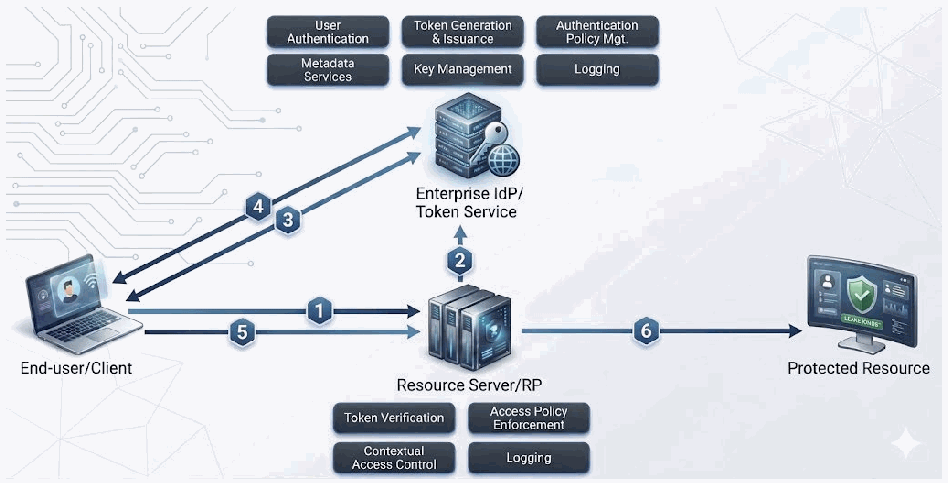
トークン・アサーションに基づくシステムの構成図です。左にエンドユーザー/クライアント(End-user/Client、ノート PC)、中央にリソースサーバー/RP(Resource Server/RP)、その上にエンタープライズ IdP/トークンサービス(Enterprise IdP/Token Service)、右に保護対象リソース(Protected Resource、盾の付いたモニター)があります。エンタープライズ IdP/トークンサービスの上には機能を示す枠として User Authentication(ユーザー認証)、Token Generation & Issuance(トークンの生成と発行)、Authentication Policy Mgt.(認証ポリシー管理)、Metadata Services(メタデータサービス)、Key Management(鍵管理)、Logging(ログ記録)があります。リソースサーバー/RP の下には Token Verification(トークン検証)、Access Policy Enforcement(アクセスポリシーの施行)、Contextual Access Control(コンテキストに基づくアクセス制御)、Logging(ログ記録)があります。番号付きの矢印は、1 がエンドユーザー/クライアントからリソースサーバー/RP へ、2 がリソースサーバー/RP からエンタープライズ IdP/トークンサービスへ、3 と 4 がエンドユーザー/クライアントとエンタープライズ IdP/トークンサービスの間の 2 本、5 がエンドユーザー/クライアントからリソースサーバー/RP へ、6 がリソースサーバー/RP から保護対象リソースへ向かいます。
Fig. 1. Representative architecture: Token- and assertion-based systems
図 1. 代表的なアーキテクチャ: トークンとアサーションに基づくシステム
While the precise order and capabilities related to an assertion or token management process may vary, they generally follow a flow that includes:
アサーションやトークンの管理プロセスに関する正確な順序や機能は異なる場合がありますが、一般に次を含むフローに従います。
1.The end user requests access (via a client) to protected resources through the resource server.
1.エンドユーザーが、(クライアントを介して)リソースサーバー経由で保護対象リソースへのアクセスを要求します。
2.The resource server redirects the end user’s request to the enterprise IdP or token service to authenticate the end user.
2.リソースサーバーが、エンドユーザーを認証するため、エンドユーザーの要求を企業の IdP またはトークンサービスにリダイレクトします。
3.The enterprise IdP/token service evaluates the authentication policy for the protected resource and requests end-user authentication.
3.企業の IdP/トークンサービスが、保護対象リソースの認証ポリシーを評価し、エンドユーザーの認証を要求します。
4.The end user authenticates to the enterprise IdP/token service, which issues an identity token, assertion, or access token to the end user or client.
4.エンドユーザーが企業の IdP/トークンサービスに認証し、IdP/トークンサービスがエンドユーザーまたはクライアントに ID トークン、アサーション、またはアクセストークンを発行します。
5.The end user’s client communicates the token/assertion to the resource server, which verifies the token and evaluates the access policy.
5.エンドユーザーのクライアントがトークンまたはアサーションをリソースサーバーに送り、リソースサーバーがトークンを検証してアクセスポリシーを評価します。
6.The resource server grants access to the protected resource.
6.リソースサーバーが保護対象リソースへのアクセスを許可します。
In the context of non-human scenarios, the methods of authentication may not interact with an end user but rather employ device or machine authentication mechanisms (e.g., client-side certificates).
人間以外のシナリオでは、認証の方法がエンドユーザーとのやり取りを伴わず、デバイス認証やマシン認証の仕組み(たとえば、クライアント側の証明書)を用いる場合があります。
2.3.1. Token Management Methods
2.3.1. トークン管理の方法
There are two primary methods for managing tokens and assertions in systems: stateless management and stateful management. Both methods grant a user or service access to a protected resource without having to authenticate them at the resource level for each access event. This is achieved by different means in each architecture. While signed tokens and assertions are a feature of stateless systems, many enterprises employ both models and even hybrid systems.
システムでトークンとアサーションを管理する主な方法は、ステートレス管理とステートフル管理の 2 つです。どちらの方法も、アクセスのたびにリソースレベルで認証しなくても、ユーザーまたはサービスに保護対象リソースへのアクセスを許可します。これを実現する手段は、アーキテクチャごとに異なります。署名付きトークンとアサーションはステートレスなシステムの特徴ですが、多くの企業は両方のモデルを併用し、ハイブリッドなシステムまで採用しています。
The controls discussed in this document primarily focus on the use of asymmetrically signed tokens, which are more prevalent in and applicable to stateless models. However, most systems will use multiple kinds of tokens, so the controls in this document should be considered based on the implemented token types.
本書で論じる管理策は、主に非対称署名付きトークンの使用に焦点を当てています。非対称署名付きトークンは、ステートレスモデルでより普及しており、適用しやすいものです。ただし、ほとんどのシステムは複数の種類のトークンを使うため、本書の管理策は、実装されているトークンの種類に基づいて検討すべきです。
Table 2. Stateful and stateless architectures
表 2. ステートフルなアーキテクチャとステートレスなアーキテクチャ
| Architecture | Description | Features & Considerations |
|---|---|---|
| Stateful | The IdP maintains a server where applications can query the current state of each subscriber or system seeking access. This allows each application to confirm the authentication state of each user through a passed session identifier. The server maintains all necessary session information for each active authentication event, including the session status, authentication times, and revocation information. Session information is passed through session headers, cookies, or unsigned tokens (e.g., JavaScript Object Notation [JSON] Web Token [JWT]) [47][50]. | Session information is actively maintained centrally and can be revoked as needed. Historically seen as less viable for large decentralized systems due to the performance of centralized session management and resiliency issues, as stateful tokens require more infrastructure complexity. There are more challenges when utilizing stateful systems for API-based access scenarios. Not typically viable for cross-domain access or federation scenarios. |
| Stateless | All necessary information is provided to the RP to manage access decisions and the identity of the user requesting access. There is no “phoning home” to a central server to manage session data. Instead, it is all encapsulated in an assertion or token used by the RP to make access decisions. This data is typically represented by a signed SAML assertion or OIDC JWT. Sessions are managed through validity times and refresh tokens that allow the session to be extended by requesting an updated token from IdP servers. | Typically seen as more effective for managing highly scaled and available services, particularly those dealing with large volumes of authenticated API calls. They also provide for cross-domain and federation capabilities, as they are self-contained and include all the information the RP requires to authenticate the end user or client. Can be implemented securely but have limited revocability of assertions and tokens. |
| アーキテクチャ | 説明 | 特徴と考慮事項 |
|---|---|---|
| ステートフル | IdP は、アクセスを求める各サブスクライバーまたはシステムの現在の状態を、アプリケーションが照会できるサーバーを維持します。これにより、各アプリケーションは、受け渡されたセッション識別子を通じて、各ユーザーの認証状態を確認できます。サーバーは、セッションの状態、認証時刻、失効情報など、アクティブな認証イベントごとに必要なセッション情報をすべて維持します。セッション情報は、セッションヘッダー、クッキー、または署名なしトークン(たとえば、JavaScript Object Notation [JSON] Web Token [JWT])で受け渡されます [47][50]。 | セッション情報は一元的に能動的に維持され、必要に応じて失効できます。 集中型のセッション管理の性能とレジリエンスの問題から、またステートフルなトークンはインフラの複雑さが増すため、従来、大規模な分散システムには適さないと見られてきました。API ベースのアクセスのシナリオでステートフルなシステムを使うと、課題がさらに増えます。ドメインをまたぐアクセスやフェデレーションのシナリオには、通常は適しません。 |
| ステートレス | アクセス判断と、アクセスを要求するユーザーのアイデンティティを管理するために必要な情報がすべて RP に提供されます。セッションデータを管理するために中央サーバーへ問い合わせる「phoning home」は行いません。代わりに、すべてが、RP がアクセス判断に使うアサーションまたはトークンにカプセル化されます。このデータは通常、署名付きの SAML アサーションまたは OIDC JWT で表現されます。セッションは、有効期間と、IdP サーバーに更新済みトークンを要求してセッションを延長できるリフレッシュトークンによって管理されます。 | 大規模でスケールし可用性の高いサービス、特に大量の認証済み API 呼び出しを扱うサービスの管理に、通常はより効果的と見られています。また、自己完結しており、RP がエンドユーザーまたはクライアントを認証するために必要な情報をすべて含むため、ドメインをまたぐ機能やフェデレーションの機能も提供します。 安全に実装できますが、アサーションとトークンの失効には限界があります。 |
When making determinations about token and assertion management, CSPs and agencies need to evaluate which architecture works best for their scenario and risk environment.
トークンとアサーションの管理について判断する際、CSP と機関は、自らのシナリオとリスク環境にどのアーキテクチャが最も適しているかを評価する必要があります。
2.3.2. Single Sign-On and Federation
2.3.2. シングルサインオンとフェデレーション
SSO and federation use a common set of roles and components to achieve desired outcomes. In SSO and Federation scenarios, the end user requests access to a protected resource and is redirected to an enterprise or trusted IDP for authentication before being issued access tokens that can be consumed by the protected resource. The following components are typical in an SSO or federation [28] system (see Fig. 1):
SSO とフェデレーションは、望ましい成果を達成するために、共通の役割と構成要素を使います。SSO とフェデレーションのシナリオでは、エンドユーザーが保護対象リソースへのアクセスを要求し、認証のために企業または信頼できる IdP にリダイレクトされたうえで、保護対象リソースが消費できるアクセストークンを発行されます。SSO またはフェデレーション [28] のシステムでは、通常、次の構成要素が使われます(図 1 を参照)。
•Subscriber and subscriber account (end user and client). The subscriber account represents the user or service that is attempting to gain access. It is typically maintained by enterprise or trusted IdPs, which stores the attributes, entitlements, and authorizations required for applications to make access control decisions.
•サブスクライバーとサブスクライバーアカウント(エンドユーザーとクライアント)。サブスクライバーアカウントは、アクセスしようとするユーザーまたはサービスを表します。通常、企業または信頼できる IdP が維持し、アプリケーションがアクセス制御の判断を行うために必要な属性、権限、認可を保管します。
•Identity provider (authorization server). The IdP authenticates the user or service that is seeking to gain access to a protected resource. The IdP then issues an assertion, token, or other mechanism that conveys the authentication event, attributes, and other information needed for the protected resource to make an access decision.
•アイデンティティプロバイダー(認可サーバー)。IdP は、保護対象リソースへのアクセスを得ようとするユーザーまたはサービスを認証します。IdP はその後、認証イベント、属性、および保護対象リソースがアクセス判断を行うために必要なその他の情報を伝えるアサーション、トークン、その他の仕組みを発行します。
•Token service (authorization server). The token service acts as an intermediary when identity tokens or assertions need to be exchanged for access tokens or when access tokens need to be refreshed to extend a session. Depending on the architecture or implementation of the SSO system, this may be a component of the IdP or operated independently of it.
•トークンサービス(認可サーバー)。トークンサービスは、ID トークンやアサーションをアクセストークンに交換する必要がある場合や、セッションを延長するためにアクセストークンを更新する必要がある場合に、仲介役として動作します。SSO システムのアーキテクチャや実装によっては、IdP の構成要素である場合も、IdP とは独立して運用される場合もあります。
•Relying party (protected resource, resource servers). The RP uses information provided by the IdP and made available through an assertion, token, or other mechanism to make access control decisions for protected resources. In most environments, the resource server is integrated with other capabilities to support more robust access policies, such as fine-grained and conditional access.
•依拠当事者(保護対象リソース、リソースサーバー)。RP は、IdP が提供し、アサーション、トークン、その他の仕組みを通じて利用可能になる情報を使って、保護対象リソースのアクセス制御の判断を行います。ほとんどの環境では、リソースサーバーは、きめ細かなアクセスや条件付きアクセスなど、より堅牢なアクセスポリシーを支える他の機能と統合されています。
2.3.3. API Access Scenarios
2.3.3. API アクセスのシナリオ
In addition to their use in SSO and federation scenarios, access tokens are commonly used to support API access from applications or services. In practice, this looks like SSO use cases in which the user (i.e., the individual accessing the API) is authenticated locally or with an enterprise IdP, and subsequent calls to a hosted API service are authorized using signed access tokens.
SSO とフェデレーションのシナリオでの使用に加えて、アクセストークンは、アプリケーションやサービスからの API アクセスを支えるためにも一般に使われます。実際には、ユーザー(すなわち API にアクセスする個人)がローカルで、または企業の IdP で認証され、その後のホスト型 API サービスへの呼び出しが、署名付きアクセストークンを使って認可される、SSO のユースケースと同様の形になります。
Typical API access scenarios include:
典型的な API アクセスのシナリオには、次のものがあります。
•Client. An application that makes access requests on behalf of the end user. In some scenarios, this may also be a server, workload, or other software that makes access requests on behalf of an organization or other non-human entity.
•クライアント。エンドユーザーに代わってアクセス要求を行うアプリケーションです。シナリオによっては、組織やその他の人間以外のエンティティに代わってアクセス要求を行うサーバー、ワークロード、その他のソフトウェアの場合もあります。
•Authorization server. The authorization server verifies that the client — and potentially, the user it represents — has been authenticated and then issues access tokens to authorize requests to protected API resources. Where this server resides in the organization’s architecture depends on the deployment model used, but the authorization server will often be integrated with other IAM systems and tools to enforce appropriate authentication and conditional access decisions before issuing valid tokens.
•認可サーバー。認可サーバーは、クライアント(および場合によっては、クライアントが代理するユーザー)が認証されたことを検証し、保護対象 API リソースへの要求を認可するアクセストークンを発行します。このサーバーが組織のアーキテクチャのどこに置かれるかは、使用する展開モデルによって異なりますが、認可サーバーは、有効なトークンを発行する前に適切な認証と条件付きアクセスの判断を実施するため、他の IAM システムやツールと統合されることが多くあります。
•Protected resource and resource servers. The protected resource (e.g., enterprise APIs or services) makes access decisions based on the information provided in access tokens. In most environments, the resource server is integrated with other capabilities to support more robust access policies, such as fine-grained and conditional access.
•保護対象リソースとリソースサーバー。保護対象リソース(たとえば、企業の API やサービス)は、アクセストークンで提供される情報に基づいてアクセス判断を行います。ほとんどの環境では、リソースサーバーは、きめ細かなアクセスや条件付きアクセスなど、より堅牢なアクセスポリシーを支える他の機能と統合されています。
In many instances, API access scenarios do not involve human users or interactive models of authentication at all. For example, a designated service account may receive an access token to call a cloud-hosted API to download data for a system or device. In these cases, a traditional “re-authentication” event is not always viable, and the validity of access tokens or associated refresh tokens will need to be determined based on other contextual information, such as device registration (e.g., is the server making the request registered as a trusted component), network address constraints (e.g., is the device coming from an approved network), transactional data (e.g., is the request exhibiting expected behavior), and, potentially, proof-of-possession techniques (e.g., device-specific certificates, message authentication techniques). Similar to other protected resources, API access typically sits behind resource servers that can act as a policy enforcement point to support the contextual security needed for access decisions.
多くの場合、API アクセスのシナリオには、人間のユーザーも対話型の認証モデルも一切関わりません。たとえば、指定されたサービスアカウントが、システムやデバイス向けにデータをダウンロードするため、クラウドでホストされる API を呼び出すアクセストークンを受け取ることがあります。このような場合、従来の「再認証」イベントは常に実行可能とは限らず、アクセストークンや関連するリフレッシュトークンの有効性は、他のコンテキスト情報に基づいて判断する必要があります。たとえば、デバイスの登録(要求を行うサーバーが信頼できる構成要素として登録されているか)、ネットワークアドレスの制約(デバイスが承認されたネットワークから来ているか)、トランザクションのデータ(要求が想定される挙動を示しているか)、さらに場合によっては、所有証明の技術(デバイス固有の証明書、メッセージ認証の技術)などです。他の保護対象リソースと同様に、API アクセスは通常、アクセス判断に必要なコンテキストに応じたセキュリティを支えるポリシー適用ポイントとして動作できるリソースサーバーの背後に置かれます。
3. Document Structure and Approach
3. 文書の構成とアプローチ
This document is built around IA-13: Identity Providers and Authorization servers, which was added to SP 800-53r5 in patch 5.1.1 in response to a series of high-visibility incidents that took advantage of vulnerabilities in the use of signed assertions and tokens. Each section restates the initial IA-13 related text (i.e., the control or a specific control enhancement) and provides more detailed requirements for achieving the specific outcomes related to its associated control text in SP 800-53. It is intended to provide a more detailed roadmap to secure the implementation of token and assertion-based systems for CSPs and agencies. Throughout the document, text from SP 800-53 is displayed with indentation and italicization to indicate the source material versus the expanded recommendations and considerations in this document.
本書は IA-13: Identity Providers and Authorization servers を軸に構成されています。この管理策は、署名付きアサーションとトークンの使用における脆弱性を突いた、注目度の高い一連のインシデントを受けて、パッチ 5.1.1 で SP 800-53r5 に追加されました。各節では、IA-13 に関連する当初の文言(すなわち、管理策または特定の管理策の強化)を再掲し、SP 800-53 の関連する管理策の文言に結び付く具体的な成果を達成するための、より詳細な要件を示します。本書は、CSP と機関に向けて、トークンとアサーションに基づくシステムを安全に実装するための、より詳細なロードマップを示すことを意図しています。本書全体を通じて、SP 800-53 の文言は、本書で拡張した推奨事項や考慮事項と区別して出典を示すため、字下げと斜体で表示します。
As noted in Sec. 1.2, the controls identified in this document are voluntary for CSPs and federal agencies. At this time, IA-13 and its control enhancements have not been added to an SP 800-53 control baseline but may be in the future. Normative statements (e.g., MUST, MAY) are provided to create clear parameters for organizations that choose to claim conformance with this document. It also provides agencies seeking compliant solutions with a direct means to evaluate alignment with the controls defined in this document.
1.2 節で述べたとおり、本書で特定する管理策は CSP と連邦機関にとって任意です。現時点では、IA-13 とその管理策の強化は SP 800-53 の管理策ベースラインに追加されていませんが、将来追加される可能性があります。規範的な記述(たとえば MUST、MAY)は、本書への適合を主張することを選ぶ組織に明確なパラメータを与えるために示されています。また、準拠したソリューションを求める機関に、本書で定義した管理策との整合を直接評価する手段も提供します。
Table 3. Document structure
表 3. 文書の構成
| Section | Topic |
|---|---|
| Section 4 | Covers the baseline IA-13 Control: IA-13: Identity Providers and Authorization servers |
| Section 5 | Covers the control enhancements |
| Section 5.1 | Covers Control Enhancement 1: Protection of Cryptographic Keys |
| Section 5.2 | Covers Control Enhancement 2: Verification of Identity Assertions and Access Tokens |
| 節 | トピック |
|---|---|
| 4 節 | ベースラインの IA-13 管理策を扱う: IA-13: Identity Providers and Authorization servers |
| 5 節 | 管理策の強化を扱う |
| 5.1 節 | 管理策の強化 1: 暗号鍵の保護 |
| 5.2 節 | 管理策の強化 2: アイデンティティアサーションとアクセストークンの検証 |
4. IA-13: Identity Providers and Authorization Servers
4. IA-13: アイデンティティプロバイダーと認可サーバー
IA-13 was added to the 5.1.1 revision of the SP 800-53 control catalog [2] in direct response to several high-profile token-related security incidents. The control can be applied by CSPs that serve Federal Government consumers, implemented by federal agencies as part of their own token and assertion-based systems, and evaluated by consumers who seek to use CSP services.
IA-13 は、注目度の高い複数のトークン関連のセキュリティインシデントに直接対応するため、SP 800-53 管理策カタログ [2] の 5.1.1 改訂版で追加されました。この管理策は、連邦政府の利用者にサービスを提供する CSP が適用でき、連邦機関が自らのトークンとアサーションに基づくシステムの一部として実装でき、CSP のサービスの利用を求める利用者が評価できます。
Control Statement: Employ IdPs and authorization servers to manage user, device, and non-person entity (NPE) identities, attributes, and access rights supporting authentication and authorization decisions in accordance with [Assignment: organization-defined identification and authentication policy] using [Assignment: organization-defined mechanisms].
管理策の記述: [Assignment: organization-defined identification and authentication policy] に従い、[Assignment: organization-defined mechanisms] を用いて、認証と認可の判断を支えるユーザー、デバイス、非人格エンティティ(NPE)のアイデンティティ、属性、アクセス権を管理するため、IdP と認可サーバーを採用します。
Discussion: IdPs, both internal and external to the organization, manage the user, device, and NPE authenticators and issue statements, often called identity assertions, attesting to identities of other systems or systems components. Authorization servers create and issue access tokens to identified and authenticated users and devices that can be used to gain access to system or information resources. For example, SSO provides IdP and authorization server functions. Authenticator management (to include credential management) is covered by IA-05.
考察: IdP は、組織の内部のものも外部のものも、ユーザー、デバイス、NPE のオーセンティケーターを管理し、他のシステムまたはシステムの構成要素のアイデンティティを証明する、しばしばアイデンティティアサーションと呼ばれる記述を発行します。認可サーバーは、識別され認証されたユーザーとデバイスに、システムや情報リソースへのアクセスを得るために使えるアクセストークンを作成して発行します。たとえば、SSO は IdP と認可サーバーの機能を提供します。オーセンティケーターの管理(認証情報の管理を含む)は IA-05 で扱われます。
4.1. Implementation Recommendations
4.1. 実装に関する推奨事項
The addition of IA-13 is intended to provide CSPs and agencies with a baseline control to support the effective management and evaluation of identity and access tokens (generated by organizational or external IdPs and authorization servers) and the access management services that evaluate those tokens when making access decisions. The following sections discuss actions and recommendations for implementing IA-13 and achieving the control’s intended outcomes.
IA-13 の追加は、CSP と機関に、(組織内または外部の IdP と認可サーバーが生成する)アイデンティティトークンとアクセストークン、およびアクセス判断の際にそれらのトークンを評価するアクセス管理サービスを、効果的に管理・評価することを支えるベースラインの管理策を提供することを意図しています。以下の各節では、IA-13 を実装し、この管理策が意図する成果を達成するための措置と推奨事項を論じます。
4.1.1. Architecture and Design
4.1.1. アーキテクチャと設計
When implementing this control, organizations MUST evaluate, design, and document an architecture that will meet organizational needs and requirements. In current IAM infrastructures, the volume of applications, the automation of processes, and the move toward distributed, mobile-friendly environments make the use of assertions, tokens, or other abstracted authentication techniques essential to supporting enterprise requirements. Critical decisions include determining whether to use a stateful or stateless architecture, deciding on protocols for assertions and tokens (e.g., SAML versus OIDC), and establishing the mechanisms and hierarchies associated with identity and access tokens within the enterprise. There is no “one-size-fits-all” answer to this question, and agencies will often need to contend with legacy systems and cloud environments, which may all have varying impacts on architectural decisions. There are benefits and risks to each of the core architectures for SSO and indirect authentication, as shown in Table 2. For example, some systems may not be capable of consuming assertions or tokens and may need to rely on agents, proxies, or translation services that introduce complexity and potential vulnerabilities to an overall system design. Additional considerations for system design and architecture are discussed in Table 3. This list should not be considered exhaustive; rather, it is a starting point for key design decisions that an agency needs to make.
この管理策を実装する際、組織は、組織のニーズと要件を満たすアーキテクチャを評価、設計、文書化しなければなりません(MUST)。現在の IAM インフラでは、アプリケーションの数、プロセスの自動化、分散型でモバイルに適した環境への移行により、アサーション、トークン、その他の抽象化された認証技術の使用が、企業の要件を支えるうえで不可欠になっています。重要な決定には、ステートフルなアーキテクチャとステートレスなアーキテクチャのどちらを使うかの判断、アサーションとトークンのプロトコル(たとえば SAML か OIDC か)の決定、企業内のアイデンティティトークンとアクセストークンに関連する仕組みと階層の確立が含まれます。この問題に対する「万能の」答えはなく、機関はレガシーシステムとクラウド環境の両方に対処する必要があることが多く、それらがアーキテクチャの判断にさまざまな影響を及ぼす可能性があります。表 2 に示すとおり、SSO と間接認証のそれぞれの中核的なアーキテクチャには、利点とリスクがあります。たとえば、アサーションやトークンを消費できないシステムもあり、エージェント、プロキシ、変換サービスに頼る必要が生じて、システム設計全体に複雑さと潜在的な脆弱性をもたらす場合があります。システムの設計とアーキテクチャに関するその他の考慮事項は、表 3 で論じます。この一覧は網羅的なものとみなすべきではなく、機関が行う必要のある主要な設計判断の出発点です。
Table 4. Design and architecture considerations
表 4. 設計とアーキテクチャに関する考慮事項
| Topic | Considerations |
|---|---|
| Stateful vs. Stateless | CSPs and agencies implementing identity management systems need to assess and implement technologies that support their customers and mission. Agencies that leverage CSP infrastructure need to understand its strengths and weaknesses and configure it appropriately to maximize the security of procured systems. This document focuses on systems that leverage signed tokens and assertions, which tend to be more prevalent in stateless systems. However, these guidelines can be applied anywhere asymmetric signatures are used for token or assertion signing. |
| Signature Approach (Symmetric vs. Asymmetric Keys) | Tokens can be signed using symmetric or asymmetric keys. In general, most SSO and token management systems implement asymmetric keys when signing assertions and tokens. Asymmetric keys bring certain benefits over symmetric schemes, most notably easier key rotation, less complexity, and — as a result — greater scalability for distributed networks. However, some systems implement signing with symmetric keys, such as those that leverage hash-based message authentication code (HMAC) with JWT and SAML assertions. Generally, symmetric signing of assertions and tokens is not recommended. It introduces complexity for key rotation, hampers scalability, and increases key protection requirements. However, such schemes can be deployed in a manner that limits the blast radius of a key exposure since proper key management requires unique keys for each pair of authorization servers and resource servers. This means that the loss of a symmetric signing key does not compromise interactions outside of the scope of those specific interactions. While implementers may choose to use symmetric key-management approaches, this document focuses on the use of asymmetrically signed tokens. Trust management is a critical component when implementing asymmetric signature approaches. Agencies need to understand the trust anchors, certificate management practices, and key hierarchies that they employ — or that are employed by CSPs — to provide the appropriate degree of confidence in token signing, signature verification, and token validation processes. |
| Protocol Selection | Consistent with the recommendations of CISA’s Hybrid Identity Solution Guidance, modern open standards are preferred for managing assertions and tokens [12]. OIDC [13] used in conjunction with OAuth [14] — specifically, the iGov Profile [15] — provides a flexible, standards-based set of protocols that can support API and mobile-based services while also supporting traditional human-centric identity systems. While SAML is a secure and proven protocol, it is more constrained in its uses and best suited to web applications due to its limited ability to support mobile or API-based systems, which are integral to most modern enterprises. Legacy considerations may result in agencies and CSPs needing to deploy a combination of these protocols to fully cover their existing protected resource base. |
| Environments (Cloud, On-Premises, Hybrid) | Both on-premises and cloud environments contain associated risks. On-premises environments might employ longer key rotation time frames, require manual rotations, and contain weak local storage but provide complete control over key isolation and cryptographic operations. While the integration of cloud environments into the modern federal enterprise comes with many opportunities, it also introduces complexity and visibility challenges. Most users — human and machine alike — access protected resources in multiple environments to execute mission-critical activities. As such, agencies need to deploy IAM, SSO, and federation systems that can integrate with a host of external environments. This will inevitably impact the decisions that are made for token and assertion services, particularly when they support cross-boundary access. |
| Non-Human Identities and Workloads | Workloads need to be uniquely identified and managed. Many modern protocols designed to support workload access management (e.g., the Secure Production Identity Framework for Everyone [SPIFFE]) leverage signed tokens as a technical mechanism for authenticating the workload [44]. Known as SPIFFE Verifiable Identity Documents (SVIDs), these documents are used consistent with other access tokens discussed in these guidelines and require similar capabilities and protections [45]. Approaches to workload and non-human identities that leverage short-lived tokens provide greater protection over those that rely on static secrets. For workload scenarios, agencies need to assess the functionality of their development life cycle and secure software engineering practices to identify how their selected architectures and those of the CSPs they work with will support IAM and secure automation goals when making architectural and design determinations. Unlike user identities, it is more likely that the authoritative source of identity information and configurations for workloads will be the CSPs, making communication and documentation between the CSP and consumer even more important to deploying effective, tailored solutions. |
| Mobile Applications | Mobile architectures often favor stateless architectures due to devices’ intermittent connectivity, availability within low-connectivity scenarios, and ability for RP to validate tokens locally without a callback. Protocols like OIDC and OAuth are designed to support native mobile application architectures, while protocols like SAML were built around web application workflows. Agencies need to determine which protocols best support their planned operating environments as well as their identified security and user experience objectives. |
| Legacy Applications | Most agencies have decades of legacy systems that introduce restrictions and constraints to any IAM deployment. Agencies will need to evaluate the state of legacy applications and understand the potential constraints they impose on new architectural plans and designs. Addressing these may require the introduction of additional system components to deal with translation, proxying, or authorization decisions. |
| トピック | 考慮事項 |
|---|---|
| ステートフルとステートレス | CSP とアイデンティティ管理システムを実装する機関は、顧客とミッションを支える技術を評価し、実装する必要があります。CSP のインフラを活用する機関は、その長所と短所を理解し、調達したシステムのセキュリティを最大化するよう適切に構成する必要があります。本書は、署名付きトークンとアサーションを活用するシステムに焦点を当てています。これらはステートレスなシステムでより広く用いられる傾向があります。ただし、これらのガイドラインは、トークンやアサーションの署名に非対称署名が使われている場面であれば、どこにでも適用できます。 |
| 署名の方式(共通鍵と非対称鍵) | トークンは、共通鍵または非対称鍵を使って署名できます。一般に、ほとんどの SSO やトークン管理システムは、アサーションやトークンに署名する際に非対称鍵を実装しています。非対称鍵には、共通鍵方式に比べて、特に鍵のローテーションが容易で、複雑さが小さく、その結果、分散ネットワークでの拡張性が高いという利点があります。ただし、JWT や SAML アサーションでハッシュベースのメッセージ認証コード(HMAC)を活用するものなど、共通鍵による署名を実装するシステムもあります。 一般に、アサーションとトークンへの共通鍵による署名は推奨されません。鍵のローテーションの複雑さが増し、拡張性が損なわれ、鍵の保護要件が高まります。ただし、適切な鍵管理では認可サーバーとリソースサーバーの組ごとに固有の鍵が必要になるため、そのような方式は、鍵の露出による影響範囲を限定する形で展開できます。つまり、共通鍵の署名鍵が失われても、それぞれの特定のやり取りの範囲外のやり取りは危殆化しません。実装者は共通鍵の鍵管理方式を選択してもよいですが、本書は、非対称署名付きトークンの使用に焦点を当てています。 トラストマネジメントは、非対称署名の方式を実装する際の重要な構成要素です。機関は、トークンの署名、署名の検証、トークンの検証の各プロセスに適切な程度の信頼を与えるため、自らが使用する、または CSP が使用するトラストアンカー、証明書管理の実践、鍵の階層を理解する必要があります。 |
| プロトコルの選択 | CISA の Hybrid Identity Solution Guidance の推奨事項に沿って、アサーションとトークンの管理には最新のオープン標準が推奨されます [12]。OAuth [14] と併用する OIDC [13]、特に iGov Profile [15] は、従来の人間中心のアイデンティティシステムをサポートしつつ、API やモバイルベースのサービスもサポートできる、柔軟で標準に基づくプロトコル群を提供します。SAML は安全で実績のあるプロトコルですが、用途がより限られており、ほとんどの最新の企業に不可欠なモバイルや API ベースのシステムをサポートする能力が限られるため、Web アプリケーションに最も適しています。レガシーを考慮した結果、機関と CSP は、既存の保護対象リソース群を完全にカバーするために、これらのプロトコルを組み合わせて展開する必要が生じる場合があります。 |
| 環境(クラウド、オンプレミス、ハイブリッド) | オンプレミス環境にもクラウド環境にも、それぞれリスクがあります。オンプレミス環境では、鍵のローテーション期間が長くなりがちで、手動でのローテーションが必要になり、ローカルの保管が脆弱な場合がありますが、鍵の分離と暗号処理を完全に制御できます。クラウド環境を現代の連邦政府のエンタープライズに統合すると多くの機会が得られる一方、複雑さと可視性の課題も生じます。ほとんどのユーザーは、人間もマシンも、ミッションクリティカルな活動を実行するために、複数の環境の保護対象リソースにアクセスします。このため機関は、多数の外部環境と統合できる IAM、SSO、フェデレーションのシステムを展開する必要があります。これは、特に境界をまたぐアクセスを支える場合に、トークンとアサーションのサービスに関する判断に必然的に影響します。 |
| 人間以外のアイデンティティとワークロード | ワークロードは、一意に識別して管理する必要があります。ワークロードのアクセス管理を支えるために設計された最新のプロトコルの多く(たとえば、Secure Production Identity Framework for Everyone [SPIFFE])は、ワークロードを認証する技術的な仕組みとして署名付きトークンを活用します [44]。SPIFFE Verifiable Identity Documents(SVID)として知られるこれらの文書は、これらのガイドラインで論じる他のアクセストークンと同様に使われ、同様の機能と保護を必要とします [45]。短命のトークンを活用するワークロードや人間以外のアイデンティティへのアプローチは、静的なシークレットに依拠するものより高い保護を提供します。 ワークロードのシナリオでは、機関は、アーキテクチャと設計の判断を行う際に、自らの開発ライフサイクルとセキュアなソフトウェアエンジニアリングの実践の機能を評価し、選択したアーキテクチャと、連携する CSP のアーキテクチャが、IAM とセキュアな自動化の目標をどのように支えるかを見極める必要があります。ユーザーのアイデンティティと異なり、ワークロードのアイデンティティ情報と構成の権威ある情報源は CSP である可能性が高いため、効果的で個別のニーズに合わせたソリューションを展開するうえで、CSP と利用者の間のコミュニケーションと文書化がいっそう重要になります。 |
| モバイルアプリケーション | モバイルのアーキテクチャは、デバイスの接続が断続的であること、接続の乏しいシナリオでも利用できること、RP がコールバックなしでローカルにトークンを検証できることから、ステートレスなアーキテクチャが好まれることがよくあります。 OIDC や OAuth などのプロトコルはネイティブのモバイルアプリケーションのアーキテクチャを支えるように設計されているのに対し、SAML などのプロトコルは Web アプリケーションのワークフローを中心に構築されています。機関は、計画している運用環境と、特定したセキュリティおよびユーザーエクスペリエンスの目標をどのプロトコルが最もよく支えるかを判断する必要があります。 |
| レガシーアプリケーション | ほとんどの機関には数十年来のレガシーシステムがあり、あらゆる IAM の展開に制約と制限をもたらします。機関は、レガシーアプリケーションの状態を評価し、それらが新しいアーキテクチャの計画と設計に課す潜在的な制約を理解する必要があります。これらに対処するには、変換、プロキシ、認可判断を扱う追加のシステム構成要素の導入が必要になる場合があります。 |
4.1.2. Risk Management and Risk Assessment
4.1.2. リスク管理とリスクアセスメント
Effective identity management requires controls and assurance levels commensurate with system risk. Frameworks such as the RMF and Federal Information Processing Standards (FIPS) 199/200 guide impact categorization (i.e., Low, Moderate, High) and inform control selection [23][24], while the Digital Identity Guidelines in SP 800-63 define assurance levels for identity proofing (IAL), authentication (AAL), and federation, as well as a Digital Identity Risk Management (DIRM) model [8].
効果的なアイデンティティ管理には、システムのリスクに見合った管理策と保証レベルが必要です。RMF や連邦情報処理標準(FIPS)199/200 などのフレームワークは、影響度の分類(すなわち、低、中程度、高)を導き、管理策の選択に情報を提供します [23][24]。SP 800-63 の Digital Identity Guidelines は、身元確認(IAL)、認証(AAL)、フェデレーションの保証レベルと、デジタルアイデンティティリスク管理(DIRM)モデルを定義しています [8]。
The DIRM — which includes conducting a DIRA — helps organizations identify baseline assurance levels and tailor and implement xAL sequences (e.g., IAL2/AAL2/FAL1) based on their mission, threat environment, and data sensitivity. DIRM is implemented by resource owners to determine access requirements and by service providers to design service assurance that supports consumers or clients. The requirements associated with federation assurance levels (FALs) establish the necessary conditions for generating, conveying, and processing identity assertions at prescribed levels.
DIRM は、DIRA の実施を含み、組織がベースラインの保証レベルを特定し、ミッション、脅威環境、データの機微性に基づいて xAL の組み合わせ(たとえば IAL2/AAL2/FAL1)をテーラリングして実装するのを支援します。DIRM は、アクセス要件を決定するためにリソースの所有者が実施し、利用者やクライアントを支えるサービス保証を設計するためにサービスプロバイダーが実施します。フェデレーション保証レベル(FAL)に関連する要件は、定められたレベルでアイデンティティアサーションを生成、伝達、処理するために必要な条件を定めます。
Taken together, these risk management frameworks complement this document by providing CSPs and agencies with system categorizations; baseline controls for authentication, federation, and identity management; and a starting point for tailoring implementations. When coupled with this document, they also provide a path to more detailed configurations to address specific risks related to token and assertion management scenarios that are not fully defined in other guidelines.
これらのリスク管理フレームワークは、全体として、CSP と機関にシステムのカテゴリ分類、認証・フェデレーション・アイデンティティ管理のベースラインの管理策、実装をテーラリングする出発点を提供することで、本書を補完します。本書と組み合わせると、他のガイドラインでは十分に定義されていない、トークンとアサーションの管理のシナリオに関する特定のリスクに対処する、より詳細な構成への道筋も得られます。
Existing laws and programs define how to apply these risk management frameworks. FISMA sets requirements for federal agencies, and FedRAMP sets requirements for CSPs.
既存の法律とプログラムが、これらのリスク管理フレームワークの適用方法を定めています。FISMA は連邦機関の要件を定め、FedRAMP は CSP の要件を定めています。
4.1.3. Security Policy and Technical Documentation
4.1.3. セキュリティポリシーと技術文書
To support the practical implementation of the architecture, agencies MUST define and document the security policies and technical requirements for token and assertion management, including both identity and access tokens. This SHOULD include addressing critical issues such as application access policies, token and assertion lifetimes, token and assertion validation process, key management practices, audit/logging (and associated data), revocation practices, session management, and incident response processes. CSPs and agencies MUST also document the specific protocols and contents of tokens and assertions. When deploying specific protocols for tokens, CSPs and agencies SHOULD consult with published best practices, such as IETF’s Best Current Practice for OAuth 2.0 Security [43], OASIS’s Security and Privacy Considerations for the OASIS Security Assertion Markup Language (SAML) V2.0 [21], and JSON Web Token Best Current Practice [20].
アーキテクチャの実際的な実装を支えるため、機関は、ID トークンとアクセストークンの両方を含む、トークンとアサーションの管理に関するセキュリティポリシーと技術要件を定義して文書化しなければなりません(MUST)。これには、アプリケーションのアクセスポリシー、トークンとアサーションの有効期間、トークンとアサーションの検証プロセス、鍵管理の実践、監査/ログ記録(および関連データ)、失効の実践、セッション管理、インシデント対応プロセスなどの重要な課題への対処を含めるべきです(SHOULD)。CSP と機関はまた、トークンとアサーションの具体的なプロトコルと内容を文書化しなければなりません(MUST)。トークン向けの特定のプロトコルを展開する際、CSP と機関は、IETF の Best Current Practice for OAuth 2.0 Security [43]、OASIS の Security and Privacy Considerations for the OASIS Security Assertion Markup Language (SAML) V2.0 [21]、JSON Web Token Best Current Practice [20] など、公開されているベストプラクティスを参照すべきです(SHOULD)。
4.1.4. Authorization Systems and Zero Trust Architectures
4.1.4. 認可システムとゼロトラストアーキテクチャ
Authorization systems (e.g., policy enforcement, policy decision points) consume assertions and tokens to make access control decisions. They sit at the heart of enterprise security and are the foundation of zero trust architectures. As such, authorization infrastructure needs to be robustly designed and documented to support zero trust principles and outcomes. Consistent with Office of Management and Budget (OMB) Memo 22-09, Moving the U.S. Government Toward Zero Trust Cybersecurity Principles [31], agencies MUST implement assertions and tokens in a manner that enables more granular and dynamically defined permissions (e.g., attribute-based access control), enforces an effective verification process for the signatures that protect these assertions, and integrates with additional sources of authorization data. Authorization systems SHOULD NOT make access decisions based solely on the validity of a token but also based on the context in which it is presented.
認可システム(たとえば、ポリシー適用ポイントやポリシー決定ポイント)は、アクセス制御の判断を行うためにアサーションとトークンを消費します。認可システムはエンタープライズセキュリティの中核にあり、ゼロトラストアーキテクチャの基盤です。このため、認可基盤は、ゼロトラストの原則と成果を支えるよう、堅牢に設計し文書化する必要があります。行政管理予算局(OMB)の覚書 22-09『Moving the U.S. Government Toward Zero Trust Cybersecurity Principles』[31] に沿って、機関は、より細かく動的に定義された権限(たとえば、属性ベースのアクセス制御)を可能にし、これらのアサーションを保護する署名に対する効果的な検証プロセスを徹底し、追加の認可データ源と統合する形で、アサーションとトークンを実装しなければなりません(MUST)。認可システムは、トークンの有効性だけに基づいてアクセス判断を行うべきではなく(SHOULD NOT)、トークンが提示される際のコンテキストにも基づくべきです。
Token and assertion-based systems MUST be integrated within a full secure identity management life cycle to ensure that token and assertion validity remains aligned with the provisioning, deprovisioning, and entitlements associated with core human and non-human identities. Identity governance tools SHOULD also be used to further augment these capabilities by integrating organizational controls around the core identity represented by a token and allowing for the enforcement of least-privilege, zero standing privileges, just-in-time approvals, and the separation of duties based on the sensitivity of the data or service being accessed.
トークンとアサーションに基づくシステムは、トークンとアサーションの有効性が、中核となる人間および人間以外のアイデンティティに関連するプロビジョニング、プロビジョニング解除、権限と整合し続けることを確実にするため、完全なセキュアなアイデンティティ管理ライフサイクルの中に統合されなければなりません(MUST)。アイデンティティガバナンスのツールも、トークンが表す中核のアイデンティティに関する組織の管理策を統合し、アクセスされるデータやサービスの機微性に基づいて、最小権限、常設権限ゼロ、ジャストインタイムの承認、職務の分離を徹底できるようにすることで、これらの機能をさらに補強するために使うべきです(SHOULD)。
5. Control Enhancements
5. 管理策の強化
Agencies can use control enhancements to further improve their implementation of a specific control. Like the base control, these enhancements can be mapped to the system categorizations to support consistent application across the federal enterprise. The following sections discuss the specific control enhancements related to IA-13 in SP 800-53 and elaborate on the control text to provide additional recommendations.
機関は、管理策の強化を使って、特定の管理策の実装をさらに改善できます。基本の管理策と同様に、これらの強化はシステムのカテゴリ分類に対応付けることができ、連邦企業全体での一貫した適用を支えます。以下の各節では、SP 800-53 の IA-13 に関連する個別の管理策の強化を論じ、管理策の文言を詳しく説明して追加の推奨事項を示します。
5.1. Control Enhancement 1: Protection of Cryptographic Keys
5.1. 管理策の強化 1: 暗号鍵の保護
Enhancement. Cryptographic keys that protect access tokens are generated, managed, and protected from disclosure and misuse.
強化。アクセストークンを保護する暗号鍵は、生成、管理され、開示や悪用から保護されます。
Discussion. Identity assertions and access tokens are typically digitally signed. The private keys used to sign these assertions and tokens are protected commensurate with the impact of the system and information resources that can be accessed.
考察。アイデンティティアサーションとアクセストークンは、通常、デジタル署名されます。これらのアサーションとトークンへの署名に使う秘密鍵は、アクセスできるシステムと情報リソースの影響度に見合うように保護されます。
5.1.1. Additional Guidelines for the Protection of Cryptographic Keys
5.1.1. 暗号鍵の保護に関する追加ガイドライン
The protection of cryptographic keys used to sign assertions and access tokens is critical to the security of SSO and federation systems. A compromised signing key enables attackers to forge digitally signed tokens and assertions to gain unauthorized access to connected systems.
アサーションとアクセストークンへの署名に使う暗号鍵の保護は、SSO とフェデレーションのシステムのセキュリティにとって極めて重要です。署名鍵が危殆化すると、攻撃者はデジタル署名されたトークンとアサーションを偽造して、接続されたシステムへの不正アクセスを得ることができます。
5.1.1.1. Generation
5.1.1.1. 生成
Cryptographic keys used by IdPs and authorization servers to digitally sign and encrypt assertions or tokens, authenticate software clients and applications, or establish secure channels MUST be generated in accordance with the guidelines in SP 800-57p1r5 (Part 1, Revision 5), Recommendations for Key Management: Part 1 – General [32].
IdP と認可サーバーが、アサーションまたはトークンのデジタル署名と暗号化、ソフトウェアクライアントとアプリケーションの認証、安全なチャネルの確立に使う暗号鍵は、SP 800-57p1r5(Part 1, Revision 5)『Recommendations for Key Management: Part 1 – General』[32] のガイドラインに従って生成されなければなりません(MUST)。
Key generation is the first phase of the key management life cycle and MUST be performed using cryptographically secure processes that ensure adequate entropy, algorithmic strength, and application suitability. Keys MUST be generated within cryptographic modules that are validated under FIPS 140 [33] and conform to NIST-approved algorithms, key sizes, and generation methods. Approved techniques will evolve as new algorithms are developed and as new threats or weaknesses are discovered. SP 800-131Ar2, Transitioning the Use of Cryptographic Algorithms and Key Lengths [34], summarizes currently approved techniques and provides timelines for expected migrations to new techniques.
鍵の生成は鍵管理ライフサイクルの最初のフェーズであり、十分なエントロピー、アルゴリズムの強度、用途への適合性を確保する、暗号学的に安全なプロセスを使って実施しなければなりません(MUST)。鍵は、FIPS 140 [33] で検証され、NIST が承認したアルゴリズム、鍵長、生成方法に適合する暗号モジュール内で生成しなければなりません(MUST)。承認された技術は、新しいアルゴリズムが開発され、新たな脅威や弱点が発見されるにつれて変化します。SP 800-131Ar2『Transitioning the Use of Cryptographic Algorithms and Key Lengths』[34] は、現在承認されている技術をまとめ、新しい技術への移行の想定時期を示しています。
Organizations MUST associate each cryptographic key with its intended purpose, system, and device. They SHOULD also maintain an inventory of the keys generated and used in their systems. This inventory SHOULD identify the type and purpose of each key, where it will be used and stored, and the expected lifetime of the key before it is replaced.
組織は、各暗号鍵を、その意図する目的、システム、デバイスに関連付けなければなりません(MUST)。また、システムで生成して使用する鍵のインベントリを維持すべきです(SHOULD)。このインベントリでは、各鍵の種類と目的、使用場所と保管場所、置き換えられるまでの想定される存続期間を特定すべきです(SHOULD)。
5.1.1.2. Distribution
5.1.1.2. 配布
Cryptographic keys need to be delivered securely to the systems and devices that are authorized to use them. Depending on the system and intended purpose, some cryptographic keys will be generated within the IdPs and authorization servers themselves. However, some cryptographic keys will be centrally generated and distributed to operational systems, such as when keys need to be provisioned onto multiple systems (e.g., to support load balancing or failover) or backed up to support incident response and recovery.
暗号鍵は、それを使用する権限のあるシステムとデバイスに安全に届ける必要があります。システムと意図する目的によっては、一部の暗号鍵は IdP や認可サーバー自体の内部で生成されます。しかし、一部の暗号鍵は集中的に生成され、運用システムに配布されます。たとえば、複数のシステムに鍵をプロビジョニングする必要がある場合(ロードバランシングやフェイルオーバーを支えるためなど)や、インシデント対応と復旧を支えるために鍵をバックアップする場合です。
Cryptographic keys need to be securely distributed using authenticated protected channels to ensure their confidentiality and integrity. In particular, secret or private cryptographic keys SHOULD never be communicated or exported in plaintext. Automation in key generation and distribution processes can help ensure that these controls are consistently applied. When manual processes are used, organizations SHOULD use dual or multi-person controls to mitigate accidental or malicious breaches of key material, particularly for long-lived or high-value keys.
暗号鍵は、機密性と完全性を確保するため、認証された保護チャネルを使って安全に配布する必要があります。特に、共通鍵または秘密鍵は、決して平文で伝達またはエクスポートすべきではありません(SHOULD)。鍵の生成と配布のプロセスを自動化すると、これらの管理策を一貫して適用しやすくなります。手動のプロセスを使う場合、組織は、特に長期にわたって使う鍵や価値の高い鍵について、鍵素材の偶発的または悪意ある漏えいを軽減するため、二人制または複数人制の管理を使うべきです(SHOULD)。
When cryptographic keys are backed up or archived, distribution procedures MUST maintain confidentiality and integrity protections that are equivalent to those applied during operational use. Backup copies of private or secret keys SHOULD be encrypted using a key-encryption key stored on a hardware cryptographic module or another hardware-protected, isolated key-management mechanism appropriate to the system impact level. The distribution of archived keys (e.g., for validating historical assertions or token records) MUST be tightly controlled and auditable with clear procedures for authorization, recovery, and eventual destruction. IdPs and authorization servers MUST document and regularly review the systems and personnel that are authorized to receive backup or archived keys, including those stored off-site or in cloud-based disaster recovery environments.
暗号鍵をバックアップまたはアーカイブする場合、配布の手順は、運用での使用時に適用するものと同等の機密性と完全性の保護を維持しなければなりません(MUST)。秘密鍵または共通鍵のバックアップコピーは、ハードウェア暗号モジュール、またはシステムの影響度レベルに適したその他のハードウェアで保護された分離型の鍵管理の仕組みに保管した鍵暗号化鍵を使って暗号化すべきです(SHOULD)。アーカイブされた鍵(たとえば、過去のアサーションやトークンの記録を検証するためのもの)の配布は、厳格に管理されなければならず(MUST)、認可、復元、最終的な破棄の明確な手順とともに、監査可能でなければなりません。IdP と認可サーバーは、オフサイトやクラウドベースの災害復旧環境に保管されるものを含め、バックアップまたはアーカイブされた鍵の受領を認められたシステムと要員を文書化し、定期的に見直さなければなりません(MUST)。
Public keys (e.g., the public component of token-signing keys) may be widely distributed but MUST still be published and transmitted in a manner that ensures their authenticity and integrity when used to verify authentication or authorization decisions. This requirement applies to public-key distribution channels, metadata, trust stores, discovery endpoints, and other mechanisms that recipients rely on to validate tokens, assertions, or related security decisions. It does not require every replication or incidental copy of a public key (e.g., logging, telemetry, archival records) to provide the same publication or transmission assurances. For example, in federated identity systems, IdPs may publish signing keys in SAML metadata [9], OAuth metadata [49], or in OIDC discovery documents [13] that reference a JSON Web Key Set (JWKS) endpoint [48]. These metadata documents or JWKS endpoints MUST be served over HTTPS and, when feasible, additionally signed or integrity-protected using a trusted certification path or external signature.
公開鍵(たとえば、トークン署名鍵の公開部分)は広く配布してもよいですが、認証または認可の判断を検証するために使う際の真正性と完全性を確保する形で公開し、送信しなければなりません(MUST)。この要件は、公開鍵の配布経路、メタデータ、トラストストア、ディスカバリーエンドポイント、および受信者がトークン、アサーション、関連するセキュリティ判断を検証するために依拠するその他の仕組みに適用されます。公開鍵のすべての複製や付随的なコピー(たとえば、ログ記録、テレメトリ、アーカイブ記録)に同じ公開や送信の保証を求めるものではありません。たとえば、フェデレーテッドアイデンティティシステムでは、IdP は署名鍵を SAML メタデータ [9]、OAuth メタデータ [49]、または JSON Web Key Set(JWKS)エンドポイント [48] を参照する OIDC ディスカバリー文書 [13] で公開する場合があります。これらのメタデータ文書や JWKS エンドポイントは HTTPS で提供しなければならず(MUST)、実現可能な場合は、信頼できる証明書パスまたは外部署名を使って、さらに署名するか完全性を保護しなければなりません。
Trust anchors and trust constraints that are used to validate published keys MUST be explicitly defined, controlled, and reviewed. Organizations MUST NOT rely on broad default platforms, domains, or enterprise trust stores unless the trusted issuers, certificate policies, name constraints, path constraints, key usages, and authorized purposes are appropriate for the identity system and are documented. Trust relationships MUST be scoped to the RP, federation, tenant, or application context in which the keys are intended to be used.
公開された鍵の検証に使うトラストアンカーと信頼の制約は、明示的に定義、管理、見直しされなければなりません(MUST)。組織は、信頼する発行者、証明書ポリシー、名前制約、パス制約、鍵用途、認められた目的が、アイデンティティシステムに適切であり、文書化されている場合を除き、広範な既定のプラットフォーム、ドメイン、企業のトラストストアに依拠してはなりません(MUST NOT)。信頼関係は、鍵を使用する意図のある RP、フェデレーション、テナント、アプリケーションのコンテキストにスコープを限定しなければなりません(MUST)。
Recipients MUST validate the authenticity of the public key and verify that its algorithm and key size are consistent with expected usage. Metadata SHOULD include information such as key usage, algorithm, and unique key identifiers to facilitate correct matching during key rollover.
受信者は、公開鍵の真正性を検証し、そのアルゴリズムと鍵長が想定される使用と一致していることを確認しなければなりません(MUST)。メタデータには、鍵のロールオーバー時に正しく対応付けられるよう、鍵用途、アルゴリズム、一意の鍵識別子などの情報を含めるべきです(SHOULD)。
When certificates are used to represent or bind signing, encryption, or verification keys, the IdPs, authorization servers, and RPs MUST document whether certificates are self-signed, issued by an enterprise PKI, provided by a cloud or external key-management service, or issued by another trusted authority. Recipients MUST verify that certificate fields (e.g., key usage, issuer, validity period, applicable policy constraints) are consistent with the intended use and application.
証明書を使って署名鍵、暗号化鍵、検証鍵を表現または結び付ける場合、IdP、認可サーバー、RP は、証明書が自己署名か、企業の PKI が発行したか、クラウドまたは外部の鍵管理サービスが提供したか、その他の信頼できる機関が発行したかを文書化しなければなりません(MUST)。受信者は、証明書のフィールド(たとえば、鍵用途、発行者、有効期間、適用されるポリシー制約)が、意図する用途とアプリケーションに一致していることを検証しなければなりません(MUST)。
Certificates and PKI-based trust models are most useful when keys are generated, distributed, or rotated at scale, and RPs validate public keys through common trust anchors, certificate paths, and associated constraints. A centralized PKI may not be necessary or appropriate if recipients instead maintain explicit trust lists of authorized public keys or use protocol-specific discovery mechanisms to obtain current public keys. However, the mechanisms used to distribute trust lists or discover new public keys are critical to the security of token-based systems. Organizations MUST document how trusted public keys are added, updated, revoked, removed, and audited and MUST protect the authenticity, integrity, timeliness, and governance of those trust lists.
証明書と PKI に基づく信頼モデルは、鍵が大規模に生成、配布、ローテーションされ、RP が共通のトラストアンカー、証明書パス、関連する制約を通じて公開鍵を検証する場合に最も有用です。受信者が、認可された公開鍵の明示的な信頼リストを維持するか、プロトコル固有のディスカバリーの仕組みを使って現在の公開鍵を取得する場合は、集中型の PKI は必要でなく、適切でもないことがあります。ただし、信頼リストの配布や新しい公開鍵の発見に使う仕組みは、トークンベースのシステムのセキュリティにとって極めて重要です。組織は、信頼できる公開鍵の追加、更新、失効、削除、監査の方法を文書化しなければならず(MUST)、これらの信頼リストの真正性、完全性、適時性、ガバナンスを保護しなければなりません(MUST)。
5.1.1.3. Storage and Isolation for Keys and Cryptographic Functions
5.1.1.3. 鍵および暗号機能の保管と分離
The exfiltration of keys and the exposure of cryptographic functions are significant threats to any system that uses assertions or tokens to manage access. If an attacker obtains a signing key or gains unauthorized access to a signing function, they could mint assertions or tokens that appear legitimate and use them to gain access to protected systems. To address these risks, systems MUST protect the keys used to sign assertions and tokens, both in storage and during cryptographic use. The appropriate protection mechanism depends on the impact level of the system, the sensitivity of the protected resources, and the operational environment.
鍵の外部への持ち出しと暗号機能の露出は、アサーションやトークンを使ってアクセスを管理するあらゆるシステムにとって重大な脅威です。攻撃者が署名鍵を入手するか、署名機能への不正アクセスを得ると、正当に見えるアサーションやトークンを作り出し、それを使って保護対象システムにアクセスできます。これらのリスクに対処するため、システムは、アサーションとトークンへの署名に使う鍵を、保管時にも暗号処理での使用時にも保護しなければなりません(MUST)。適切な保護の仕組みは、システムの影響度レベル、保護対象リソースの機微性、運用環境によって異なります。
For systems assessed at moderate impact or above, organizations MUST store signing keys using a hardware-based, hardware-backed, or otherwise isolated key storage mechanism. These mechanisms are intended to reduce the risk that signing keys can be extracted, copied, or exposed through compromise of the application, host operating system, or adjacent workloads. Signing keys and key material MUST NOT be persistently stored on the applications, servers, virtual machines, or container systems that use them. When key material must be made available to those systems, it MUST be retrieved only at system boot, launch, or runtime as necessary and protected from unauthorized access or disclosure while present.
影響度が中以上と評価されたシステムについて、組織は、ハードウェアベース、ハードウェアに裏付けられた、またはその他の分離された鍵保管の仕組みを使って、署名鍵を保管しなければなりません(MUST)。これらの仕組みは、アプリケーション、ホストのオペレーティングシステム、隣接するワークロードの侵害によって、署名鍵が抽出、複製、露出されるリスクを減らすことを意図しています。署名鍵と鍵素材は、それを使用するアプリケーション、サーバー、仮想マシン、コンテナシステムに永続的に保管してはなりません(MUST NOT)。鍵素材をそれらのシステムで利用可能にする必要がある場合は、システムの起動時、立ち上げ時、または必要に応じて実行時にのみ取得しなければならず(MUST)、存在する間は不正アクセスや開示から保護しなければなりません。
Mechanisms for protected key storage include but are not limited to:
保護された鍵保管の仕組みには、次のものが含まれますが、これらに限定されません。
•Hardware isolation using hardware security modules (HSMs). HSMs are physical or cloud-accessible devices or services that protect key generation, storage, management, and cryptographic operations. HSMs provide tamper-evident or tamper-resistant security features and are designed to prevent export of protected private keys.
•ハードウェアセキュリティモジュール(HSM)によるハードウェア分離。HSM は、鍵の生成、保管、管理、暗号処理を保護する、物理的またはクラウドからアクセスできるデバイスまたはサービスです。HSM は、改ざん検知または耐タンパのセキュリティ機能を備え、保護された秘密鍵のエクスポートを防ぐように設計されています。
•Hardware isolation using embedded processors. Embedded hardware components, secure enclaves, TPMs, and other cryptographic processors are used to protect keys from direct exposure to the host operating system or application environment. These mechanisms can provide hardware-backed key storage and restricted key use, though their security properties vary by implementation.
•組込みプロセッサによるハードウェア分離。組込みハードウェア構成要素、セキュアエンクレーブ、TPM、その他の暗号プロセッサを使って、ホストのオペレーティングシステムやアプリケーション環境への鍵の直接の露出から鍵を保護します。これらの仕組みは、ハードウェアに裏付けられた鍵保管と制限された鍵の使用を提供できますが、そのセキュリティ特性は実装によって異なります。
•Isolated key and secrets management systems. Cloud-based key management services, cloud HSM services, managed key management systems, and centralized secrets management systems can be used to store and manage signing keys or key material when they provide appropriate separation from the application, server, virtual machine, or container environment. These systems provide strong access control, administrative separation, auditing, life cycle management, and protection against unauthorized disclosure or export.
•分離された鍵およびシークレット管理システム。クラウドベースの鍵管理サービス、クラウド HSM サービス、マネージド鍵管理システム、集中型のシークレット管理システムは、アプリケーション、サーバー、仮想マシン、コンテナ環境から適切に分離されている場合に、署名鍵や鍵素材の保管と管理に使えます。これらのシステムは、強力なアクセス制御、管理の分離、監査、ライフサイクル管理、不正な開示やエクスポートに対する保護を提供します。
For systems assessed as high impact, organizations MUST additionally protect the use of signing keys and associated cryptographic functions within an isolated execution environment. This requirement is intended to reduce the risk that a compromised host, application, administrator account, or adjacent workload can directly observe, extract, or misuse signing keys or cryptographic operations.
影響度が高いと評価されたシステムについて、組織は、署名鍵と関連する暗号機能の使用も、分離された実行環境内で保護しなければなりません(MUST)。この要件は、侵害されたホスト、アプリケーション、管理者アカウント、隣接するワークロードが、署名鍵や暗号処理を直接観察、抽出、悪用できるリスクを減らすことを意図しています。
•Hardware isolation using HSMs. HSMs perform signing operations internally and do not expose private keys to the calling application or host operating system.
•HSM によるハードウェア分離。HSM は署名処理を内部で行い、呼び出し元のアプリケーションやホストのオペレーティングシステムに秘密鍵を公開しません。
•Hardware isolation using embedded processors. Embedded security coprocessors perform cryptographic operations within their hardware-protected environment.
•組込みプロセッサによるハードウェア分離。組込みのセキュリティコプロセッサが、ハードウェアで保護された環境内で暗号処理を行います。
•Isolated execution environments. Trusted execution environments, confidential computing environments, virtualization-based security environments, isolated service partitions, or comparable mechanisms can be used to isolate cryptographic operations from the general-purpose application and operating system environment. These mechanisms protect key material while in use, restrict access to signing functions, and prevent unauthorized observation, extraction, or misuse of signing keys.
•分離された実行環境。トラステッド実行環境、コンフィデンシャルコンピューティング環境、仮想化ベースのセキュリティ環境、分離されたサービスパーティション、または同等の仕組みを使って、暗号処理を汎用のアプリケーションやオペレーティングシステムの環境から分離できます。これらの仕組みは、使用中の鍵素材を保護し、署名機能へのアクセスを制限し、署名鍵の不正な観察、抽出、悪用を防ぎます。
•Remote cryptographic signing services. Cloud HSM services, managed signing services, distributed cryptographic services, or comparable remote key operation systems can be used when they store signing keys and perform signing operations within a protected service boundary. These services are intended to prevent unauthorized key export, restrict signing operations to authorized entities, protect keys in storage and during use, and provide audit logs for key access and signing operations.
•リモートの暗号署名サービス。クラウド HSM サービス、マネージド署名サービス、分散型の暗号サービス、または同等のリモート鍵操作システムは、保護されたサービス境界内で署名鍵を保管して署名処理を行う場合に使えます。これらのサービスは、鍵の不正なエクスポートを防ぎ、署名処理を認可されたエンティティに制限し、保管時と使用時の鍵を保護し、鍵へのアクセスと署名処理の監査ログを提供することを意図しています。
For systems assessed at low impact, organizations MAY implement any of the above techniques or MAY use software-based isolation. Software isolation should use appropriate mechanisms to restrict access to signing keys and cryptographic functions, protect key material from unauthorized disclosure or export, limit key use to authorized processes or services, and log key management and signing operations. Software-based controls may be acceptable for some lower-risk access scenarios but are more vulnerable to exfiltration, copying, and accidental leakage than hardware-based approaches.
影響度が低いと評価されたシステムについて、組織は、上記のいずれかの技術を実装してもよく(MAY)、ソフトウェアベースの分離を使ってもよいです(MAY)。ソフトウェアによる分離では、署名鍵と暗号機能へのアクセスを制限し、鍵素材を不正な開示やエクスポートから保護し、鍵の使用を認可されたプロセスやサービスに限定し、鍵管理と署名処理を記録する適切な仕組みを使うべきです。ソフトウェアベースの管理策は、リスクの低い一部のアクセスのシナリオでは許容できる場合がありますが、ハードウェアベースのアプローチに比べて、外部への持ち出し、複製、偶発的な漏えいに対して脆弱です。
5.1.1.4. Key Usage Periods and Rotation
5.1.1.4. 鍵の使用期間とローテーション
Key usage periods define the maximum duration that a cryptographic key may be actively used for operations such as signing, decrypting, or encrypting data. IdPs and authorization servers MUST establish and document key usage periods. The length of the key usage periods MUST be based on a risk-informed assessment that considers the sensitivity of the data and functions protected by that key, the scope of resources protected by the key, the mechanisms used to protect the key in storage and during use, and the operational complexity of safely rotating the key across RPs, clients, infrastructure, and deployment environments. Shorter cryptoperiods can promote resiliency by requiring organizations to automate key rotation, reduce dependence on manual key management processes, and regularly exercise key rollover procedures.
鍵の使用期間は、暗号鍵を署名、データの復号、データの暗号化などの処理に能動的に使用してよい最大の期間を定めます。IdP と認可サーバーは、鍵の使用期間を定めて文書化しなければなりません(MUST)。鍵の使用期間の長さは、その鍵が保護するデータと機能の機微性、その鍵が保護するリソースの範囲、保管時と使用時に鍵を保護する仕組み、RP、クライアント、インフラ、展開環境にわたって鍵を安全にローテーションする運用上の複雑さを考慮した、リスクに基づくアセスメントに基づかなければなりません(MUST)。暗号期間を短くすると、組織に鍵ローテーションの自動化を促し、手動の鍵管理プロセスへの依存を減らし、鍵のロールオーバー手順を定期的に実行させることで、レジリエンスを高められます。
To enforce consistent application of these cryptoperiods and reduce the risk of human error, organizations MUST document approved cryptoperiods and SHOULD employ automated key rotation mechanisms. These mechanisms SHOULD schedule and execute key rollover in advance of expiration to provide overlapping acceptance of old and new keys and support interoperability across RPs and clients. Systems SHOULD maintain versioning metadata (e.g., key identifiers, not-before/expiration timestamps, key usage information) so recipients can validate tokens and assertions without disruption. For federation protocols and integrations that do not provide automated key discovery or rollover mechanisms, including some SAML deployments, organizations SHOULD account for the additional coordination burden on IdPs, RPs, and other applications. Where practical, organizations SHOULD prefer architectures and protocols that support the automated publication, discovery, validation, and retirement of signing keys.
これらの暗号期間の一貫した適用を徹底し、人的ミスのリスクを減らすため、組織は、承認された暗号期間を文書化しなければならず(MUST)、自動化された鍵ローテーションの仕組みを採用すべきです(SHOULD)。これらの仕組みは、期限切れの前に鍵のロールオーバーをスケジュールして実行し、古い鍵と新しい鍵を重複して受け入れられるようにして、RP とクライアント間の相互運用性を支えるべきです(SHOULD)。システムは、受信者が中断なくトークンとアサーションを検証できるよう、バージョン管理のメタデータ(たとえば、鍵識別子、有効開始/有効期限のタイムスタンプ、鍵用途の情報)を維持すべきです(SHOULD)。一部の SAML の展開を含め、自動化された鍵の発見やロールオーバーの仕組みを提供しないフェデレーションプロトコルや統合については、組織は、IdP、RP、その他のアプリケーションにかかる追加の調整負担を考慮すべきです(SHOULD)。実用上可能な場合、組織は、署名鍵の公開、発見、検証、廃止の自動化をサポートするアーキテクチャとプロトコルを優先すべきです(SHOULD)。
Different types of cryptographic keys used by CSPs and agencies warrant distinct rotation strategies and schedules. Due to the risk of compromise, assertion and token signing keys SHOULD be rotated frequently. Rotation schedules SHOULD balance the security benefits of shorter key usage periods with secure deployment practices, the scale of systems to which they must be distributed, the need for verification pauses and rollback capability, and the strength of the key protection mechanisms.
CSP と機関が使用する暗号鍵の種類ごとに、異なるローテーションの戦略とスケジュールが妥当です。危殆化のリスクがあるため、アサーションとトークンの署名鍵は頻繁にローテーションすべきです(SHOULD)。ローテーションのスケジュールは、鍵の使用期間を短くすることによるセキュリティ上の利点と、安全な展開の実践、鍵を配布しなければならないシステムの規模、検証の一時停止とロールバックの機能の必要性、鍵保護の仕組みの強度とのバランスを取るべきです(SHOULD)。
For large-scale hosted systems, key rotation generally requires the creation of new keys and metadata, exposure of new keys to all relevant systems, selection of new keys for signing, continued acceptance of prior keys until previously issued tokens expire, removal of prior keys from trust stores or discovery mechanisms, and deletion or deactivation of prior keys. These steps may need to be performed across multiple deployment environments with appropriate buffers to support secure deployment and incident detection.
大規模なホスト型システムでは、鍵のローテーションには、一般に、新しい鍵とメタデータの作成、新しい鍵をすべての関連システムが利用できるようにすること、署名用の新しい鍵の選択、以前に発行されたトークンが期限切れになるまで以前の鍵の受け入れを継続すること、トラストストアやディスカバリーの仕組みから以前の鍵を削除すること、以前の鍵を削除または無効化することが必要になります。これらの手順は、安全な展開とインシデント検知を支える適切な余裕を持たせて、複数の展開環境にわたって実施する必要がある場合があります。
The appropriate maximum signing key usage period depends on the risk and impact associated with the system and the potential scale of a key compromise event. Organizations should consider the impact level of the system, the potential scale of users and systems that could be affected if the key is compromised, and the operational ability to rotate the key safely without disrupting service. For high-impact systems, signing keys SHOULD have a maximum active usage period of no more than 90 days. For moderate and low impact systems, longer usage periods MAY be appropriate but SHOULD be less than one year. In all cases, organizations SHOULD use shorter key usage periods if key protection mechanisms are weaker or the ability to rapidly detect and recover from compromise is limited.
署名鍵の使用期間の適切な上限は、システムに関連するリスクと影響、および鍵の危殆化が発生した場合の潜在的な規模によって決まります。組織は、システムの影響度レベル、鍵が危殆化した場合に影響を受けうるユーザーとシステムの潜在的な規模、サービスを中断せずに鍵を安全にローテーションする運用上の能力を考慮すべきです。影響度が高いシステムでは、署名鍵の有効な使用期間の上限を 90 日以内にすべきです(SHOULD)。影響度が中および低のシステムでは、より長い使用期間が適切な場合があります(MAY)が、1 年未満にすべきです(SHOULD)。いずれの場合も、鍵保護の仕組みが弱い場合や、危殆化を迅速に検知して復旧する能力が限られる場合は、組織は、より短い鍵の使用期間にすべきです(SHOULD)。
Those recommendations apply to the maximum usage period when the keys are actively used to sign tokens but are not intended to cover discovery, publication, or acceptance periods. Systems MAY publish a new verification key before it is actively used for signing and MAY continue to publish or accept a previous verification key for a limited period after signing with that key has stopped to allow previously issued tokens or assertions to expire and to prevent service disruption. Organizations MUST document the rollover process, including key creation, publication or exposure, activation for signing, overlap, deactivation, removal from discovery or trust stores, revocation when needed, and destruction.
これらの推奨事項は、鍵がトークンの署名に能動的に使われる場合の使用期間の上限に適用されるものであり、発見、公開、受け入れの期間を対象とするものではありません。システムは、新しい検証鍵を署名に能動的に使う前に公開してもよく(MAY)、以前に発行されたトークンやアサーションを期限切れにして、サービスの中断を防ぐため、その鍵での署名を止めた後も、限られた期間は以前の検証鍵を公開または受け入れ続けてもかまいません(MAY)。組織は、鍵の作成、公開または公開準備、署名のための有効化、重複期間、無効化、ディスカバリーやトラストストアからの削除、必要な場合の失効、破棄を含む、ロールオーバーのプロセスを文書化しなければなりません(MUST)。
The security of identity assertions and access tokens depends on Transport Layer Security (TLS) and web public-key infrastructure (PKI) certificates. TLS certificates used for HTTPS endpoints follow separate certificate authority policies but SHOULD be managed via automated certificate management systems. Across all key types, cryptoperiod enforcement and automated rotation workflows help maintain a strong security posture and facilitate rapid response to emerging threats or vulnerabilities.
アイデンティティアサーションとアクセストークンのセキュリティは、Transport Layer Security(TLS)と Web 公開鍵基盤(PKI)の証明書に依存しています。HTTPS エンドポイントに使う TLS 証明書は、別の認証局ポリシーに従いますが、自動化された証明書管理システムで管理すべきです(SHOULD)。あらゆる鍵の種類にわたって、暗号期間の徹底と自動化されたローテーションのワークフローは、強固なセキュリティ態勢の維持に役立ち、新たな脅威や脆弱性への迅速な対応を促進します。
5.1.1.5. Key Revocation and Destruction
5.1.1.5. 鍵の失効と破棄
Organizations SHOULD employ technical and procedural mechanisms to signal that a cryptographic key should no longer be trusted, such as when that key is outdated, no longer being used, or suspected of compromise. This is typically achieved by removing these keys from published metadata (e.g., JWKS endpoints in OIDC, SAML metadata documents) so that RPs and clients no longer recognize them as valid.
組織は、暗号鍵がもはや信頼されるべきでないこと、たとえば、その鍵が古くなった、使われなくなった、危殆化が疑われる場合に、それを知らせるための技術的および手続き上の仕組みを採用すべきです(SHOULD)。これは通常、RP とクライアントがそれらの鍵をもはや有効と認識しないよう、公開されたメタデータ(たとえば、OIDC の JWKS エンドポイント、SAML メタデータ文書)からそれらの鍵を削除することで達成されます。
Following removal from distribution, all instances of retired private or secret keys MUST be appropriately cleared or erased to prevent unauthorized recovery or reuse. This includes operational, backup, and archived copies. This process SHOULD be automated where possible, logged for accountability, and integrated into broader key life cycle processes. For ephemeral environments, terminating the environment can be considered erasure of the keys. Systems SHOULD also monitor for references to retired key identifiers as a signal of misconfiguration or attempted misuse.
配布から削除した後、廃止した秘密鍵または共通鍵のすべてのインスタンスは、不正な復元や再利用を防ぐため、適切にクリアまたは消去されなければなりません(MUST)。これには、運用中のコピー、バックアップ、アーカイブされたコピーが含まれます。このプロセスは、可能な限り自動化し(SHOULD)、説明責任のために記録し、より広範な鍵ライフサイクルのプロセスに統合すべきです。一時的な環境では、環境の終了を鍵の消去と見なせます。システムはまた、設定ミスや悪用の試みの兆候として、廃止した鍵識別子への参照を監視すべきです(SHOULD)。
5.2. Control Enhancement 2: Verification of Identity Assertions and Access Tokens
5.2. 管理策の強化 2: アイデンティティアサーションとアクセストークンの検証
Enhancement. The source and integrity of identity assertions and access tokens are verified before granting access to system and information resources.
強化。アイデンティティアサーションとアクセストークンの出所と完全性は、システムと情報リソースへのアクセスを許可する前に検証されます。
Discussion. This includes verification of digital signatures protecting identity assertions and access tokens, as well as included metadata. Metadata includes information about the access request, such as information unique to the user, system or information resource being accessed, or the transaction itself (e.g., time). Protected system and information resources could include connected networks, applications, and APIs.
考察。これには、アイデンティティアサーションとアクセストークンを保護するデジタル署名と、含まれるメタデータの検証が含まれます。メタデータには、ユーザー、アクセスされるシステムや情報リソース、トランザクション自体に固有の情報(たとえば、時刻)など、アクセス要求に関する情報が含まれます。保護対象のシステムと情報リソースには、接続されたネットワーク、アプリケーション、API が含まれる場合があります。
5.2.1. Additional Guidelines for the Verification of Identity Assertions and Access Tokens
5.2.1. アイデンティティアサーションとアクセストークンの検証に関する追加ガイドライン
Enabling appropriate access controls and protections of data and resources requires both the RP and the token or assertion issuer to execute on a set of responsibilities. Issuers MUST properly format, structure, and sign assertions so that the RP can verify the information and make informed access decisions. RPs MUST evaluate each token at the lowest level of usage (e.g., domain, application, data) to ensure that the assertion or token represents a user or software with appropriate permissions for the services they are attempting to access. In this process, it is particularly important to verify that the digital signature protecting an assertion is signed by the correct key or keys and ensure that this meets the policies of the target resource.
データとリソースに適切なアクセス制御と保護を行うには、RP とトークンまたはアサーションの発行者のそれぞれが、一連の責任を果たす必要があります。発行者は、RP が情報を検証して十分な情報に基づくアクセス判断を行えるよう、アサーションを適切に整形、構造化、署名しなければなりません(MUST)。RP は、アサーションまたはトークンが、アクセスしようとするサービスに対する適切な権限を持つユーザーまたはソフトウェアを表していることを確実にするため、使用の最も低いレベル(たとえば、ドメイン、アプリケーション、データ)で各トークンを評価しなければなりません(MUST)。このプロセスでは、特に、アサーションを保護するデジタル署名が正しい鍵(1 つまたは複数)で署名されていることを検証し、それが対象リソースのポリシーを満たしていることを確認する必要があります。
5.2.1.1. Assertion and Token Contents
5.2.1.1. アサーションとトークンの内容
The content of assertions and tokens will vary based on the specific protocols being used and the access needs of an agency. It will also vary between identity tokens (which often carry more attributes and data) and access tokens. Agencies and CSPs MUST document each type of token and assertion that is available to consuming agencies as well as the mandatory data elements within those tokens and assertions. At a minimum, this includes identity tokens and assertions that are used to convey identity data between CSPs and consuming agency systems (e.g., for federation or SSO), any tokens used to connect to federal agency-controlled endpoints or services, and any tokens that are configurable by the consuming agency.
アサーションとトークンの内容は、使用する個々のプロトコルと機関のアクセスのニーズによって異なります。ID トークン(属性やデータをより多く運ぶことが多い)とアクセストークンの間でも異なります。機関と CSP は、利用側の機関が利用できるトークンとアサーションの種類ごとに、そのトークンとアサーションに含まれる必須のデータ要素とともに、文書化しなければなりません(MUST)。最低限、これには、CSP と利用側の機関のシステムの間でアイデンティティデータを伝えるために使う ID トークンとアサーション(たとえば、フェデレーションや SSO のため)、連邦機関が管理するエンドポイントやサービスに接続するために使うトークン、利用側の機関が構成できるトークンが含まれます。
This is critical to effectively verifying the assertion and token, as well as supporting access decisions and interoperability across a specific system. Consistent with SP 800-63C, Federations and Assertions [28], assertions and tokens MUST contain at least the following information:
これは、アサーションとトークンを効果的に検証し、特定のシステム全体でアクセス判断と相互運用性を支えるために重要です。SP 800-63C『Federations and Assertions』[28] に沿って、アサーションとトークンは、少なくとも次の情報を含まなければなりません(MUST)。
1.Issuer identifier: An identifier for the issuer of the assertion or the identity token (e.g., the enterprise IdP).
1.発行者識別子: アサーションまたは ID トークンの発行者(たとえば、企業の IdP)の識別子。
2.Subject identifier or client identifier: An identifier for the user to which the assertion applies.
2.サブジェクト識別子またはクライアント識別子: アサーションが適用されるユーザーの識別子。
3.Audience identifier: An identifier for the party intended to consume the assertion or identity token (i.e., the RP or application).
3.オーディエンス識別子: アサーションまたは ID トークンを消費することを意図した当事者(すなわち、RP またはアプリケーション)の識別子。
4.Issuance time: A timestamp that indicates when the assertion or token was issued.
4.発行時刻: アサーションまたはトークンがいつ発行されたかを示すタイムスタンプ。
5.Validity time window: A period of time outside of which the assertion cannot be accepted as valid for the purposes of authenticating the user and starting an authenticated session. Session times may be extended beyond the initial access token validity time through the use of refresh tokens and subsequent access tokens (see Sec. 4.3.1.1).
5.有効期間の時間枠: それを外れると、ユーザーを認証して認証済みセッションを開始する目的ではアサーションを有効と受け入れられない時間の範囲。セッションの時間は、リフレッシュトークンとその後のアクセストークンを使うことで、最初のアクセストークンの有効時間を超えて延長される場合があります(4.3.1.1 節を参照)。
6.Assertion or token identifier or nonce: A value that uniquely identifies this assertion and is used to prevent attackers from replaying prior assertions.
6.アサーションまたはトークンの識別子もしくはナンス: このアサーションを一意に識別し、攻撃者が以前のアサーションをリプレイするのを防ぐために使われる値。
7.Authentication time: A timestamp that indicates when the last primary authentication event occurred (e.g., at an enterprise or external IdP).
7.認証時刻: 直近の一次認証イベントがいつ発生したか(たとえば、企業または外部の IdP で)を示すタイムスタンプ。
8.Signature: A digital signature or message authentication code (MAC), including the verification key identifier, that covers the entire assertion.
8.署名: 検証鍵識別子を含み、アサーション全体を対象とするデジタル署名またはメッセージ認証コード(MAC)。
Authorization tokens based on OAuth SHOULD contain scopes, which provide information about the actions that an application or user can take related to a protected resource. They can be deployed to support consent by providing users with clear information on what a service is accessing on their behalf and to enable least privilege by providing a limited set of actions or authorizations for the subject of the token. This can also be further enhanced by rich authorization requests, which provide the ability to request and relay fine-grained authorization data through access tokens [26].
OAuth に基づく認可トークンは、スコープを含むべきです(SHOULD)。スコープは、アプリケーションまたはユーザーが保護対象リソースに関して実行できる操作の情報を提供します。スコープは、サービスが自分に代わって何にアクセスしているかを明確な情報としてユーザーに示すことで同意を支え、トークンの主体に限られた一連の操作または認可を与えることで最小権限を実現するために展開できます。これは、アクセストークンを通じて細かな認可データを要求し中継する能力を提供する、リッチ認可要求(RAR)によってもさらに強化できます [26]。
5.2.1.2. Key Scoping and Usage
5.2.1.2. 鍵のスコープ設定と使用
Not all keys will be protected to the same level. For example, a CSP may have commercial signing keys that are protected differently than those used by their government clients. Keys for lower risk systems or services may have lower security requirements and are subsequently more likely to be compromised. To prevent a compromised key from being used outside of its intended environment, digital signatures on assertions and identity tokens must be validated as being correct and appropriate for use within the target environment. This protects against both accidental access and intentional or malicious acts.
すべての鍵が同じレベルで保護されるわけではありません。たとえば、CSP は、政府の顧客が使う署名鍵とは異なる方法で保護された商用の署名鍵を持つ場合があります。リスクの低いシステムやサービスの鍵はセキュリティ要件が低い場合があり、その結果、危殆化する可能性が高くなります。危殆化した鍵が意図された環境の外で使われるのを防ぐため、アサーションと ID トークンのデジタル署名は、正しく、対象環境内での使用に適切なものとして検証される必要があります。これは、偶発的なアクセスと、意図的または悪意のある行為の両方から保護します。
In addition to the isolation of components that store signing keys and execute sensitive key-management functions, organizations need to consider the potential impacts of key validity for use across different domains or cloud tenants. Failure to manage key scopes can enable a compromised signing key collected through one tenant to compromise assertions and tokens in another. CSPs and their federal customers need to determine, document, and limit key scopes and, if federation (i.e., sharing authentication or identity data between different security domains) is expected, appropriately capture these in trust agreements that define the expectations and security controls associated with assertion and token usage between the different domains. As such:
署名鍵を保管し、機微な鍵管理機能を実行する構成要素の分離に加えて、組織は、異なるドメインやクラウドテナントにまたがる使用に関する鍵の有効性がもたらし得る影響を考慮する必要があります。鍵のスコープを管理しないと、あるテナントを通じて入手された危殆化した署名鍵によって、別のテナントのアサーションとトークンが危殆化するおそれがあります。CSP とその連邦の顧客は、鍵のスコープを決定、文書化、制限する必要があり、フェデレーション(すなわち、異なるセキュリティドメイン間での認証データやアイデンティティデータの共有)が想定される場合は、異なるドメイン間でのアサーションとトークンの使用に関する期待事項とセキュリティ管理策を定める信頼契約に、これらを適切に盛り込む必要があります。そのため、次のようにします。
•Keys used to digitally sign assertions and tokens MUST be scoped at the lowest reasonable level (e.g., a single tenant, customer, set of customers) to reduce the impact of a key compromise incident.
•アサーションとトークンのデジタル署名に使う鍵は、鍵の危殆化インシデントの影響を減らすため、合理的な範囲で最も低いレベル(たとえば、単一のテナント、顧客、顧客の集合)にスコープを限定しなければなりません(MUST)。
•Keys used to digitally sign assertions MUST be scoped to a specific environment (e.g., development, testing, production).
•アサーションのデジタル署名に使う鍵は、特定の環境(たとえば、開発、テスト、本番)にスコープを限定しなければなりません(MUST)。
•Keys used to sign identity tokens or assertions for non-FedRAMP, or federally authorized environments MUST NOT be valid for signing identity tokens and assertions in FedRAMP or federally authorized environments except in instances of federation with appropriate trust agreements.
•FedRAMP または連邦が認可していない環境の ID トークンやアサーションへの署名に使う鍵は、適切な信頼契約を伴うフェデレーションの場合を除き、FedRAMP または連邦が認可した環境の ID トークンやアサーションへの署名に有効であってはなりません(MUST NOT)。
•Keys MUST not be usable outside of their defined scope.
•鍵は、定義されたスコープの外では使用できないようにしなければなりません。
•Token and assertion signing keys MUST NOT be used for any other purpose.
•トークンとアサーションの署名鍵は、ほかの目的に使用してはなりません(MUST NOT)。
•The scope, validity, source, and integrity of all identity assertions and tokens MUST be confirmed by the RP/resource server before access is granted.
•すべてのアイデンティティアサーションとトークンのスコープ、有効性、出所、完全性は、アクセスが許可される前に、RP/リソースサーバーが確認しなければなりません(MUST)。
•All federation scenarios MUST be associated with a trust agreement that is consistent with the assessed FAL, as defined by a DIRA and in accordance with SP 800-63-4 and SP 800-63-4C.
•すべてのフェデレーションのシナリオは、DIRA で定義され、SP 800-63-4 と SP 800-63-4C に従って評価された FAL と整合する信頼契約に関連付けられなければなりません(MUST)。
•All federation requests MUST come through approved IdPs that are managed through an allowable mechanism consistent with SP 800-63C-4 and based on the assessed FAL of an online service or transaction.
•すべてのフェデレーション要求は、SP 800-63C-4 と整合する許容可能な仕組みを通じて管理され、オンラインサービスまたはトランザクションの評価された FAL に基づく、承認された IdP を通じて行われなければなりません(MUST)。
•Policy enforcement points (e.g., at the application level) that rely on access tokens and identity assertions MUST confirm the validity, scope, source, and integrity of access tokens before granting access to resources.
•アクセストークンとアイデンティティアサーションに依拠するポリシー適用ポイント(たとえば、アプリケーションレベルのもの)は、リソースへのアクセスを許可する前に、アクセストークンの有効性、スコープ、出所、完全性を確認しなければなりません(MUST)。
5.3. Token Management
5.3. トークン管理
Enhancement. In accordance with [Assignment: organization-defined identification and authentication policy], assertions and access tokens are:
強化。[Assignment: organization-defined identification and authentication policy] に従い、アサーションとアクセストークンは次のとおりです。
•Generated
•生成される
•Issued
•発行される
•Refreshed
•更新される
•Revoked
•失効する
•Time-restricted
•時間制限付き
•Audience-restricted
•オーディエンス制限付き
Discussion. An access token is a piece of data that represents the authorization granted to a user or NPE to access specific systems or information resources. Access tokens enable controlled access to services and resources. Properly managing the life cycle of access tokens, including their issuance, validation, and revocation, is crucial to maintaining the confidentiality of data and systems. Restricting token validity to a specific audience (e.g., an application or security domain) and restricting token validity lifetimes are important practices. Access tokens are revoked or invalidated if they are compromised, lost, or are no longer needed to mitigate the risks associated with stolen or misused tokens.
考察。アクセストークンは、ユーザーまたは NPE に与えられた、特定のシステムや情報リソースへのアクセスの認可を表すデータです。アクセストークンは、サービスとリソースへの制御されたアクセスを可能にします。アクセストークンの発行、検証、失効を含むライフサイクルを適切に管理することは、データとシステムの機密性を維持するうえで極めて重要です。トークンの有効性を特定のオーディエンス(たとえば、アプリケーションやセキュリティドメイン)に制限することと、トークンの有効期間を制限することは、重要な実践です。アクセストークンは、盗まれたトークンや悪用されたトークンに伴うリスクを軽減するため、危殆化した場合、紛失した場合、または不要になった場合に、失効または無効化されます。
5.3.1. Additional Guidelines for Token Management
5.3.1. トークン管理に関する追加ガイドライン
In addition to the practices associated with protecting the keys used to sign assertions and tokens, the systems that manage and generate the actual assertions and tokens must be capable of providing additional security capabilities to improve the protection of assertions and tokens.
アサーションとトークンへの署名に使う鍵を保護する実践に加えて、実際のアサーションとトークンを管理・生成するシステムは、アサーションとトークンの保護を向上させる追加のセキュリティ機能を提供できなければなりません。
5.3.1.1. Token Refresh and Validity Length
5.3.1.1. トークンの更新と有効期間
Tokens need to be time-bound with short validity periods to minimize exposure if compromised. Automatic refresh mechanisms SHOULD be implemented with expiration policies tailored to token type, access scope, and usage context. The higher the risk associated with a protected resource, the shorter the validity period should be. Accordingly, access tokens and identity tokens MUST have defined, short lifetimes. Expired tokens MUST be rejected by authorization services and policy enforcement points. While a single, minimum threshold is challenging to pin down due to the availability of different security features, it is recommended that access tokens and identity tokens SHOULD be valid for no more than one hour. However, given the potential variability of consuming agency use cases and risk tolerance, CSPs SHOULD make token validity length configurable by consumers and provide baseline validity periods based on the FISMA system categorization and authentication assurance level of applications.
トークンは、危殆化した場合の露出を最小限にするため、有効期間の短い、期限付きのものにする必要があります。自動更新の仕組みは、トークンの種類、アクセスのスコープ、使用のコンテキストに合わせた有効期限のポリシーとともに実装すべきです(SHOULD)。保護対象リソースに関連するリスクが高いほど、有効期間を短くすべきです。したがって、アクセストークンと ID トークンには、定義された短い有効期間がなければなりません(MUST)。期限切れのトークンは、認可サービスとポリシー適用ポイントが拒否しなければなりません(MUST)。さまざまなセキュリティ機能が利用できるため、単一の最小のしきい値を定めるのは難しいものの、アクセストークンと ID トークンの有効期間は 1 時間以内にすべきです(SHOULD)。ただし、利用側の機関のユースケースとリスク許容度は多様でありうるため、CSP は、トークンの有効期間を利用者が構成できるようにし、FISMA のシステムカテゴリ分類とアプリケーションの認証保証レベルに基づくベースラインの有効期間を提供すべきです(SHOULD)。
Table 5. Risk mitigation capabilities
表 5. リスク低減の機能
| Capability | Description |
|---|---|
| Revocation | The ability for a token or assertion management system to revoke an existing token minimizes the risk associated with a compromised signing key or token/assertion from being reused for malicious purposes. Such a capability would need to operate together with compromise detection capabilities to be effective. Revocation is discussed in more detail in Sec. 4.3.1.2. |
| Advanced Authorization | The ability to rapidly push authorization updates to access control points and policy enforcement points at the protected resource, which can be used to terminate sessions associated with compromised tokens without requiring direct token revocation capabilities. As with revocation, this operates in conjunction with compromise detection, session analysis, and centralized policy distribution capabilities to propagate timely policies to protected resources. |
| Compromise Detection and Session Analysis | Compromise detection represents the ability to analyze and evaluate the context of a token or assertions used to determine whether it may have been compromised. Such a capability can inform decision-making at the resource server, token revocation actions, or risk signals that are distributed to connected relying parties. These systems can make use of numerous signals (e.g., geolocation, velocity) to inform decisions and actions. Session analysis, which supports compromise detection, is discussed more in Sec. 4.3.1.4. |
| Device Registration or IP Registration | Device registration allows access management systems to evaluate the trustworthiness of specific users as well as devices that are associated with the enterprise. Registration allows a specific device ID, IP address, or other identifier to be used to determine whether a user or API access request is coming from a trusted, registered device. It ensures that compromised or forged tokens cannot be used except in scenarios associated with specific devices or network endpoints. |
| Proof of Possession and Sender Constraining | Proof-of-possession schemes, like device registration, seek to augment tokens and assertions with increased trust in the endpoints, clients, and devices that request and present tokens. These schemes implement additional means (e.g., device-specific public-private key pairs Demonstrated Proof of Possession [DPoP], mutual TLS binding) to verify the identity of an endpoint or user in a transaction before granting access [16][17]. If strong sender binding is not achievable, IdPs and token services can consider channel-binding techniques that use TLS properties to constrain token usage. |
| 機能 | 説明 |
|---|---|
| 失効 | トークンまたはアサーションの管理システムが既存のトークンを失効できる能力は、危殆化した署名鍵やトークン/アサーションが悪意をもって再利用されるリスクを最小化します。この機能は、効果を発揮するために、危殆化の検知機能と連携して動作する必要があります。失効については、4 |
| 高度な認可 | 保護対象リソースのアクセス制御ポイントとポリシー適用ポイントに認可の更新を迅速にプッシュする能力。これを使うと、トークンを直接失効する機能がなくても、危殆化したトークンに関連するセッションを終了できます。失効と同様に、この機能は、保護対象リソースに適時のポリシーを伝達するため、危殆化の検知、セッション分析、集中型のポリシー配布の機能と連携して動作します。 |
| 危殆化の検知とセッション分析 | 危殆化の検知とは、使用されたトークンやアサーションのコンテキストを分析・評価して、それが危殆化した可能性があるかどうかを判断する能力を表します。この機能は、リソースサーバーでの意思決定、トークンの失効措置、接続された依拠当事者に配布されるリスクシグナルに情報を提供できます。これらのシステムは、判断と措置に情報を提供するために、多数のシグナル(たとえば、地理的位置、移動速度)を利用できます。危殆化の検知を支えるセッション分析については、4 |
| デバイス登録または IP 登録 | デバイス登録により、アクセス管理システムは、特定のユーザーと、企業に関連付けられたデバイスの信頼性を評価できます。登録により、特定のデバイス ID、IP アドレス、その他の識別子を使って、ユーザーまたは API アクセス要求が信頼できる登録済みデバイスから来ているかどうかを判断できます。これにより、危殆化したトークンや偽造されたトークンは、特定のデバイスやネットワークエンドポイントに関連するシナリオ以外では使えなくなります。 |
| 所有証明と送信者制約 | 所有証明の方式は、デバイス登録と同様に、トークンを要求して提示するエンドポイント、クライアント、デバイスへの信頼を高めることで、トークンとアサーションを補強しようとするものです。これらの方式は、アクセスを許可する前に、トランザクションにおけるエンドポイントやユーザーのアイデンティティを検証する追加の手段(たとえば、デバイス固有の公開鍵・秘密鍵ペアを用いる Demonstrated Proof of Possession [DPoP]、相互 TLS バインディング)を実装します [16][17]。強力な送信者バインディングを実現できない場合、IdP とトークンサービスは、TLS の特性を使ってトークンの使用を制約するチャネルバインディングの技術を検討できます。 |
The availability of certain features and capabilities can be used by CSPs and consuming agencies to adjust token validity periods. The availability and effectiveness of these features MUST be documented and presented to consumers by CSPs so that effective decision-making can be made about validity periods. Table 4 discusses some of these considerations.
特定の機能が利用できることを、CSP と利用側の機関がトークンの有効期間の調整に使うことができます。これらの機能の可用性と有効性は、有効期間について効果的な意思決定ができるよう、CSP が文書化して利用者に示さなければなりません(MUST)。表 4 でこれらの考慮事項の一部を論じています。
Regardless of the validity period, implementing these capabilities improves the security of access decisions. CSPs SHOULD make them available, and consumers SHOULD implement them where possible.
有効期間にかかわらず、これらの機能を実装することで、アクセス判断のセキュリティが向上します。CSP はこれらを利用可能にすべきであり(SHOULD)、利用者は可能な限りこれらを実装すべきです(SHOULD)。
Refresh token implementations allow service providers to interrupt token generation without incurring the cost of making every access token revocable. If identity tokens and access tokens are used in conjunction with refresh tokens, the refresh tokens may have a longer validity period than individual access or identity tokens. This validity period depends on the context in which the refresh token is used (e.g., mobile versus web-based applications), the type of user (e.g., human versus non-human), and the sensitivity of the protected resource being accessed. CSPs SHOULD make refresh token validity periods configurable by consuming agencies.
リフレッシュトークンの実装により、サービスプロバイダーは、すべてのアクセストークンを失効可能にするコストを負わずに、トークンの生成を中断できます。ID トークンとアクセストークンをリフレッシュトークンと併用する場合、リフレッシュトークンの有効期間は、個々のアクセストークンや ID トークンより長くてもかまいません。この有効期間は、リフレッシュトークンが使われるコンテキスト(たとえば、モバイルと Web ベースのアプリケーション)、ユーザーの種類(たとえば、人間と人間以外)、アクセスされる保護対象リソースの機微性によって異なります。CSP は、リフレッシュトークンの有効期間を利用側の機関が構成できるようにすべきです(SHOULD)。
When refresh tokens are used for human end-users in interactive sessions, the lifetime of the refresh tokens SHOULD NOT exceed reauthentication time frames, as defined in SP 800-63B-4, Digital Identity Guidelines: Authentication and Authenticator Management [27]. Consistent with tailoring practices in SP 800-63B-4, reauthentication time frames can be tailored based on the presence of session management compensating controls, such as sender constraining, proof-of-possession, or robust session analysis. Refresh tokens used for API access, workloads, and non-human interactions SHOULD be as short as possible and accompanied by additional controls, including compromise detection and device registration. Where possible, revocation and proof-of-possession schemes SHOULD also be applied.
対話型セッションの人間のエンドユーザーにリフレッシュトークンを使う場合、リフレッシュトークンの有効期間は、SP 800-63B-4『Digital Identity Guidelines: Authentication and Authenticator Management』[27] で定義された再認証の期間を超えるべきではありません(SHOULD NOT)。SP 800-63B-4 のテーラリングの実践に沿って、再認証の期間は、送信者制約、所有証明、堅牢なセッション分析など、セッション管理を補う管理策の有無に基づいてテーラリングできます。API アクセス、ワークロード、人間以外のやり取りに使うリフレッシュトークンは、可能な限り短くし(SHOULD)、危殆化の検知やデバイス登録などの追加の管理策を伴うべきです。可能な場合は、失効と所有証明の方式も適用すべきです(SHOULD)。
CSPs and agencies that use token and assertion-based systems SHOULD implement mechanisms for automatic token refresh, ensuring that the refresh tokens themselves are securely managed and subject to expiration and revocation policies. Authorization servers must protect refresh tokens from being replayed (e.g., through sender-constraining or rotation). For higher assurance processes, CSPs and agencies may choose not to implement refresh mechanisms and instead require the reauthentication and reissuance of identity or access tokens when they reach the end of their validity period or upon certain conditions, such as inactivity or session length restrictions.
トークンとアサーションに基づくシステムを使う CSP と機関は、リフレッシュトークン自体が安全に管理され、有効期限と失効のポリシーの対象となることを確実にしたうえで、自動的なトークン更新の仕組みを実装すべきです(SHOULD)。認可サーバーは、リフレッシュトークンがリプレイされること(たとえば、送信者制約やローテーションによって)から保護しなければなりません。より高い保証が必要なプロセスでは、CSP と機関は、更新の仕組みを実装せず、ID トークンやアクセストークンが有効期間の終わりに達したとき、または非アクティブ状態やセッション長の制限などの特定の条件になったときに、再認証とトークンの再発行を求めることを選んでもかまいません。
5.3.1.2. Token Revocation
5.3.1.2. トークンの失効
Immediate and global token revocation is not always possible in stateless token implementations before the expiration of token validity periods. However, when short-lived access tokens are coupled with refresh tokens or reauthentication requirements, CSPs and agencies can substantially limit the time for which a compromised token is valid. Effective implementation of this means that IdPs and token services MUST not accept refresh tokens that are associated with an identity token or assertion that has been suspected of compromise without first reauthenticating the user.
ステートレスなトークンの実装では、トークンの有効期間が満了する前に、即時かつグローバルなトークンの失効が常に可能とは限りません。ただし、短命のアクセストークンをリフレッシュトークンや再認証の要件と組み合わせれば、CSP と機関は、危殆化したトークンが有効である時間を大幅に制限できます。これを効果的に実装するには、IdP とトークンサービスは、危殆化が疑われる ID トークンやアサーションに関連するリフレッシュトークンを、ユーザーをまず再認証することなく受け入れてはなりません(MUST not)。
A compromised identity token or assertion representing an end user often has many valid access tokens associated with it. Due to the distributed nature of stateless architectures, it becomes extremely complicated if not technically impossible to cut off all associated access tokens for a given user. To the extent possible, IdPs and token services SHOULD provide token and assertion revocation capabilities. Further, IdPs and token services SHOULD provide a means to propagate revocation status to any associated RPs (e.g., token introspection endpoint, token status list, shared signaling). If this capability is available, connected RPs MUST reject tokens that have been revoked and terminate active sessions associated with revoked tokens.
エンドユーザーを表す危殆化した ID トークンやアサーションには、有効なアクセストークンが多数関連付けられていることがよくあります。ステートレスなアーキテクチャは分散しているため、特定のユーザーに関連するすべてのアクセストークンを遮断することは、技術的に不可能とまではいかなくても、極めて複雑です。IdP とトークンサービスは、可能な範囲で、トークンとアサーションの失効機能を提供すべきです(SHOULD)。さらに、IdP とトークンサービスは、失効の状態を関連するすべての RP に伝える手段(たとえば、トークンイントロスペクションエンドポイント、トークンステータスリスト、共有シグナリング)を提供すべきです(SHOULD)。この機能が利用できる場合、接続された RP は、失効したトークンを拒否し、失効したトークンに関連するアクティブなセッションを終了しなければなりません(MUST)。
The Open Identity Foundation’s Shared Signals Framework (SSF) [38] and Continuous Access Evaluation Profile (CAEP) [22] provide standardized mechanisms for conveying security risk signals throughout federation partners and connected IdPs and RPs, which includes a session revocation signal. The SSF has seen significant adoption, and CSPs and consuming agencies SHOULD implement session revocation signals to provide greater session termination capabilities.
Open Identity Foundation の Shared Signals Framework(SSF)[38] と Continuous Access Evaluation Profile(CAEP)[22] は、セッション失効のシグナルを含め、フェデレーションのパートナーと接続された IdP および RP の間でセキュリティリスクのシグナルを伝達するための標準化された仕組みを提供します。SSF は広く採用されており、CSP と利用側の機関は、より高いセッション終了能力を提供するため、セッション失効のシグナルを実装すべきです(SHOULD)。
Additionally, the Internet Engineering Task Force (IETF) Token Status List specification (an active Internet-Draft adopted by the OAuth Working Group) [29] and the Global Token Revocation specification (an individual Internet-Draft in development) [30] provide additional capabilities for the more rapid revocation of access tokens and the propagation of current token statuses to connected RPs. CSPs and consumers should track these evolving standards.
さらに、Internet Engineering Task Force(IETF)の Token Status List 仕様(OAuth ワーキンググループが採用した、活発に作業が進む Internet-Draft)[29] と Global Token Revocation 仕様(策定中の個人 Internet-Draft)[30] は、アクセストークンをより迅速に失効し、現在のトークンの状態を接続された RP に伝えるための追加の機能を提供します。CSP と利用者は、これらの進化する標準を追うべきです。
The extent and methods for revocation MUST be conveyed by CSPs to consuming agencies so that they understand and evaluate the risks associated with revocation events. Consuming agencies MUST assess the risks and impacts of revocation scenarios when integrating with CSPs.
失効の範囲と方法は、利用側の機関が失効イベントに伴うリスクを理解し評価できるよう、CSP が利用側の機関に伝えなければなりません(MUST)。利用側の機関は、CSP と統合する際に、失効のシナリオのリスクと影響を評価しなければなりません(MUST)。
5.3.1.3. Audience Restriction
5.3.1.3. オーディエンスの制限
Ensuring that tokens and assertions are only valid for their associated audience is critical to securing any indirect authentication system. As such, all tokens and assertions MUST include explicit audience fields, and all access control mechanisms MUST reject tokens with incorrect or missing audience restrictions. Access control mechanisms that receive tokens or assertions with missing or incorrect audience fields SHOULD immediately generate a security alert. Further, IdPs and token services MUST limit the scope of tokens and assertions to the minimum necessary for the intended operations.
トークンとアサーションが、関連するオーディエンスに対してのみ有効であることを確実にするのは、あらゆる間接認証システムを保護するうえで重要です。このため、すべてのトークンとアサーションには明示的なオーディエンスのフィールドを含めなければならず(MUST)、すべてのアクセス制御の仕組みは、オーディエンスの制限が正しくない、または欠けているトークンを拒否しなければなりません(MUST)。オーディエンスのフィールドが欠けている、または正しくないトークンやアサーションを受け取ったアクセス制御の仕組みは、ただちにセキュリティアラートを生成すべきです(SHOULD)。さらに、IdP とトークンサービスは、トークンとアサーションのスコープを、意図する操作に必要な最小限に制限しなければなりません(MUST)。
5.3.1.4. Session Monitoring and Analysis
5.3.1.4. セッションの監視と分析
The continuous monitoring and analysis of token usage is essential for detecting compromise, enforcing contextual access controls, and supporting forensic investigations. To do so:
トークンの使用状況の継続的な監視と分析は、危殆化の検知、コンテキストに応じたアクセス制御の徹底、フォレンジック調査の支援に不可欠です。そのためには、次のようにします。
•CSPs and consumers MUST implement capabilities to monitor token and assertion usage patterns. This can include evaluating geolocation, device data, and velocity anomalies. These capabilities SHOULD support the ability to correlate tokens and assertions (or the underlying identity) to actions taken across an enterprise or CSP services.
•CSP と利用者は、トークンとアサーションの使用パターンを監視する機能を実装しなければなりません(MUST)。これには、地理的位置、デバイスデータ、移動速度の異常の評価を含められます。これらの機能は、トークンやアサーション(または基盤となるアイデンティティ)を、企業や CSP のサービス全体で行われた操作と相関付ける能力を支えるべきです(SHOULD)。
•IdPs, token services, and access management tools should implement means of providing shared signals to enrich session management and access decision terminations. The Open ID Continuous Access Evaluation Profile supports numerous signals for communicating security event data between connected IdPs and RPs and across multi-cloud environments, and they should be implemented to improve overall session risk management capabilities.
•IdP、トークンサービス、アクセス管理ツールは、セッション管理とアクセス判断に伴う終了処理を強化するため、共有シグナルを提供する手段を実装すべきです。Open ID Continuous Access Evaluation Profile は、接続された IdP と RP の間やマルチクラウド環境全体でセキュリティイベントデータを伝達するための多数のシグナルをサポートしており、セッションのリスク管理機能全体を改善するためにそれらを実装すべきです。
•It is also essential to integrate this information with other security mechanisms so that they can be correlated with event and threat data at different levels. Specifically, token and assertion usage data MUST be provided in a format that is consumable by Security Information and Event Management (SIEM) software and — where appropriate — User and Entity Behavior Analytics (UEBA), Cloud-Native Application Protection Platforms (CNAPP), and other security mechanisms.
•この情報を他のセキュリティの仕組みと統合し、さまざまなレベルのイベントデータや脅威データと相関付けられるようにすることも不可欠です。具体的には、トークンとアサーションの使用状況データは、セキュリティ情報イベント管理(SIEM)ソフトウェアや、適切な場合は、ユーザーおよびエンティティ行動分析(UEBA)、クラウドネイティブアプリケーション保護プラットフォーム(CNAPP)、その他のセキュリティの仕組みが消費できる形式で提供されなければなりません(MUST)。
5.3.1.5. Token Protection
5.3.1.5. トークンの保護
All tokens MUST be strictly protected from exposure in system logs, CI/CD pipelines, and related build or deployment artifacts and stored exclusively in approved secure storage mechanisms that meet or exceed the requirements defined for their applicable impact level. Any location that stores or transmits build output, execution traces, or debugging information is inherently high-risk and often widely accessible to developers, automation systems, or third-party integrations. When tokens appear in logs or pipeline artifacts, they can be inadvertently captured, forwarded, or retained far longer than intended, creating opportunities for unauthorized reuse. Pipelines MUST only retrieve secrets through secret management systems, inject them ephemerally at runtime, and ensure that they are never written to logs, console outputs, cache directories, or artifact stores. Any detected exposure of tokens should be treated as a security incident and remediated according to enterprise incident response procedures.
すべてのトークンは、システムログ、CI/CD パイプライン、関連するビルド成果物や展開成果物への露出から厳格に保護されなければならず(MUST)、該当する影響度レベルで定義された要件を満たすか上回る、承認された安全な保管の仕組みにのみ保管されなければなりません。ビルド出力、実行トレース、デバッグ情報を保管または送信する場所は、本質的にリスクが高く、開発者、自動化システム、サードパーティ統合から広くアクセスできることが多くあります。トークンがログやパイプライン成果物に現れると、意図せず取得され、転送され、意図よりはるかに長く保持される可能性があり、不正な再利用の機会が生まれます。パイプラインは、シークレット管理システムを通じてのみシークレットを取得し(MUST)、実行時に一時的に注入し、ログ、コンソール出力、キャッシュディレクトリ、成果物ストアに決して書き込まれないようにしなければなりません。トークンの露出が検知された場合は、セキュリティインシデントとして扱い、企業のインシデント対応手順に従って是正すべきです。
5.3.1.6. Workload Protections
5.3.1.6. ワークロードの保護
Workload identities — including non-person entities, automated services, and machine-to-machine processes — MUST use tightly scoped, short-lived tokens that are issued exclusively through approved enterprise identity platforms and SHOULD use sender-constrained mechanisms (e.g., mTLS, DPoP [16][17]) whenever feasible. Incorporating SPIFFE-based workload identities strengthens this model by eliminating long-lived static credentials altogether. Instead, workloads obtain SPIFFE Verifiable Identity Documents (SVIDs) (e.g., SVID JWTs) dynamically from a trusted control plane [44][45]. This approach better aligns workload identity requirements with these guidelines and promotes tokens and workload credentials that are automatically rotated, cryptographically verifiable, and bound to the specific workload, reducing the risk of impersonation or stolen tokens being replayed.
ワークロードのアイデンティティ(非人格エンティティ、自動化されたサービス、マシン間プロセスを含む)は、承認された企業のアイデンティティプラットフォームを通じてのみ発行される、厳密にスコープを限定した短命のトークンを使用しなければならず(MUST)、可能な限り送信者制約の仕組み(たとえば、mTLS、DPoP [16][17])を使用すべきです(SHOULD)。SPIFFE ベースのワークロードアイデンティティを取り入れると、長期にわたる静的な認証情報を完全になくすことで、このモデルが強化されます。代わりに、ワークロードは SPIFFE Verifiable Identity Documents(SVID)(たとえば、SVID JWT)を、信頼できるコントロールプレーンから動的に取得します [44][45]。このアプローチは、ワークロードアイデンティティの要件を本ガイドラインにいっそう整合させ、自動的にローテーションされ、暗号学的に検証でき、特定のワークロードに結び付いたトークンとワークロードの認証情報を促進し、なりすましや盗まれたトークンのリプレイのリスクを減らします。
5.3.1.7. Logging
5.3.1.7. ログ記録
Logging is critical for detecting and investigating security incidents. All components MUST maintain tamper-resistant logs of token and assertion-related events and structure them to meet the requirements of SP 800-92, Guide to Computer Security Log Management [35], and OMB Memo 26-14, Ensuring Effective and Efficient Agency Logging and Network Visibility to Defend Against Evolving Cyber Threats [36]. CSPs who offer their services to federal agencies MUST enable agencies to configure their services to meet the requirements of SP 800-92 and OMB Memo 26-14. This includes providing information about what logs are available, what data is logged, and what logs and log features are enabled by default versus what logs must be enabled by the consumer. Federal consuming agencies MUST evaluate the logging capabilities available to them and should enable logs that are “not on by default” to provide the most current and detailed information possible.
ログ記録は、セキュリティインシデントの検知と調査に不可欠です。すべての構成要素は、トークンとアサーションに関連するイベントの改ざん耐性のあるログを維持し(MUST)、SP 800-92『Guide to Computer Security Log Management』[35] および OMB 覚書 26-14『Ensuring Effective and Efficient Agency Logging and Network Visibility to Defend Against Evolving Cyber Threats』[36] の要件を満たすよう構造化しなければなりません。連邦機関にサービスを提供する CSP は、機関が SP 800-92 と OMB 覚書 26-14 の要件を満たすようサービスを構成できるようにしなければなりません(MUST)。これには、どのログが利用できるか、どのデータが記録されるか、どのログとログ機能が既定で有効で、どのログを利用者が有効にしなければならないかに関する情報の提供が含まれます。連邦の利用側の機関は、自らが利用できるログ記録機能を評価しなければならず(MUST)、最新かつ詳細な情報をできる限り得るため、「既定で有効でない」ログを有効にすべきです。
Tokens and assertions have unique data that is valuable to retain for logging purposes. Exactly what data might be retained will ultimately depend on the type of token or assertion being used and the logging services that are available. Table 5 provides a non-comprehensive set of recommendations for token and assertion data that may be included in logs. The tokens and assertions themselves MUST NOT be stored in logs. Additionally, PII or personal data contained in tokens MUST NOT be stored in logs.
トークンとアサーションには、ログ記録の目的で保持する価値のある固有のデータがあります。実際にどのデータを保持できるかは、最終的には、使用するトークンやアサーションの種類と、利用できるログ記録サービスによって決まります。表 5 は、ログに含めてもよいトークンとアサーションのデータに関する、網羅的ではない推奨事項を示します。トークンやアサーション自体をログに保管してはなりません(MUST NOT)。さらに、トークンに含まれる PII や個人データもログに保管してはなりません(MUST NOT)。
Table 6. Suggested log data elements
表 6. ログに記録するデータ要素の例
| Element | Description |
|---|---|
| Token or Assertion Type | The type of token being represented in the logs |
| Issuer | Who issued the token |
| Scopes | The scopes or authorizations associated with the token or assertion |
| Client/User | An identifier or obfuscated identifier (e.g., hashed value) for the entity to which the token has been issued |
| Audience | An identifier or obfuscated identifier (e.g., hashed value) for the audience or resource server that was the intended recipient of the token or assertion |
| Events | Timestamped events related to the token or assertion, such as:
|
| 要素 | 説明 |
|---|---|
| トークンまたはアサーションの種類 | ログに表されるトークンの種類 |
| 発行者 | トークンを発行した主体 |
| スコープ | トークンまたはアサーションに関連するスコープや認可 |
| クライアント/ユーザー | トークンが発行されたエンティティの識別子、または難読化した識別子(たとえば、ハッシュ値) |
| オーディエンス | トークンまたはアサーションの受信者として意図されたオーディエンスまたはリソースサーバーの識別子、または難読化した識別子(たとえば、ハッシュ値) |
| イベント | トークンまたはアサーションに関連する、タイムスタンプ付きのイベント。たとえば次のもの:
|
Additionally, CSPs MUST log data related to tokens and assertions that are available to federal consumers and SHOULD make this information available through programmatic mechanisms. CSPs and consuming agencies SHOULD consider implementing open-source logging schemas and frameworks (e.g., Open Cybersecurity Schema Framework, OpenTelemetry, Elastic Common Schema) to support more consistent, interoperable log data.
さらに、CSP は、連邦の利用者が利用できるトークンとアサーションに関連するデータを記録しなければならず(MUST)、この情報をプログラム的な仕組みで利用できるようにすべきです(SHOULD)。CSP と利用側の機関は、より一貫して相互運用できるログデータを支えるため、オープンソースのログスキーマとフレームワーク(たとえば、Open Cybersecurity Schema Framework、OpenTelemetry、Elastic Common Schema)の実装を検討すべきです(SHOULD)。
6. Threats and Attacks
6. 脅威と攻撃
While token and assertion-based systems (e.g., SSO, federation, API access) enable scaled modern infrastructure, they also require complex coordination between multiple infrastructure technologies and are contingent upon protecting the components that support trust between those different technologies. This includes the underlying cryptographic capabilities that support the integrity and validity of tokens and assertions, as well as the contents of those structures. Table 7 summarizes the variety of threats and attacks that might target tokens and assertions and aligns with mitigations previously presented in this document. It is not an analysis of one specific event, nor is it a comprehensive set of protections against the multitude of threats to devices and endpoints involved in token and assertion-based systems (e.g., malware, compromised endpoints, insider threats).
トークンとアサーションに基づくシステム(たとえば、SSO、フェデレーション、API アクセス)は、大規模で最新のインフラを可能にしますが、複数のインフラ技術の間の複雑な調整も必要とし、それらの異なる技術の間の信頼を支える構成要素を保護できるかどうかに左右されます。これには、トークンとアサーションの完全性と有効性を支える基盤の暗号機能と、それらの構造の内容が含まれます。表 7 は、トークンとアサーションを標的にしうる多様な脅威と攻撃をまとめ、本書でこれまでに示した低減策と対応付けています。これは特定の一つの事象の分析ではなく、トークンとアサーションに基づくシステムに関わるデバイスやエンドポイントへの多数の脅威(たとえば、マルウェア、危殆化したエンドポイント、内部脅威)に対する網羅的な保護策でもありません。
Table 7. Threats to tokens and assertions
表 7. トークンとアサーションに対する脅威
| Threats | Description | Mitigation |
|---|---|---|
| Assertion or Token Manufacture or Modification | The attacker generates a false assertion or modifies an assertion or token. This is typically executed in conjunction with a signing key compromise. |
|
| Assertion or Token Redirect | The assertion/token can be used in unintended contexts. |
|
| Assertion or Token Replay | The assertion can be used more than once with same RP. |
|
| Signing Key Compromise | The IdP or authorization server’s signing key is exfiltrated or exposed. |
|
| Token Theft | The attacker gains access to a legitimate assertion/token or refresh token. |
|
| 脅威 | 説明 | 低減策 |
|---|---|---|
| アサーションまたはトークンの作成または改変 | 攻撃者が偽のアサーションを生成する、またはアサーションやトークンを改変します。これは通常、署名鍵の危殆化と併せて実行されます。 |
|
| アサーションまたはトークンのリダイレクト | アサーションまたはトークンが、意図しないコンテキストで使われることがあります。 |
|
| アサーションまたはトークンのリプレイ | アサーションは同じ RP に対して複数回使用できます。 |
|
| 署名鍵の危殆化 | IdP または認可サーバーの署名鍵が外部へ持ち出される、または露出します。 |
|
| トークンの窃取 | 攻撃者が、正当なアサーション/トークンまたはリフレッシュトークンへのアクセスを得ます。 |
|
7. Additional Considerations
7. 追加の考慮事項
This section describes additional considerations related to securing assertions, tokens, and the relationship between CSPs and consumers.
本節では、アサーションとトークンの保護、および CSP と利用者の関係に関する追加の考慮事項を述べます。
7.1. Secure Integration and Configuration Between CSPs and Consumers
7.1. CSP と利用者の間の安全な統合と構成
Consumers should leverage secure, predefined configurations to enhance security postures for IAM and secrets management.
利用者は、IAM とシークレット管理のセキュリティ態勢を強化するため、安全であらかじめ定義された構成を活用すべきです。
•Templates and design patterns. Organizations should leverage CSP predefined templates and/or validated patterns for IAM policies to streamline complexity and eliminate misconfigurations.
•テンプレートと設計パターン。組織は、複雑さを減らして構成ミスをなくすため、CSP のあらかじめ定義されたテンプレートや、検証済みの IAM ポリシーのパターンを活用すべきです。
•Interoperability profiles. Simplify interoperability across multiple CSPs by leveraging community-maintained interoperability and security technical profiles for IAM services as well as organizationally operated user provisioning and access review capabilities.
•相互運用性プロファイル。IAM サービス向けのコミュニティが維持する相互運用性とセキュリティの技術プロファイル、および組織が運用するユーザープロビジョニングとアクセスレビューの機能を活用して、複数の CSP にまたがる相互運用性を簡素化します。
•Tailored mitigations. Enable consumer organizations to configure cloud services to implement tailored mitigations based on their security, availability, and interoperability needs.
•調整された低減策。利用者組織が、自らのセキュリティ、可用性、相互運用性のニーズに基づく調整された低減策を実装するよう、クラウドサービスを構成できるようにします。
•Endpoint restrictions. Restrict API endpoints to known, trusted sources (e.g., virtual private networks, IP allowlists) to secure non-human identities and prevent unauthorized access.
•エンドポイントの制限。人間以外のアイデンティティを保護し、不正アクセスを防ぐため、API エンドポイントを既知の信頼できる送信元(たとえば、仮想プライベートネットワーク、IP 許可リスト)に制限します。
•Routine testing. Conduct regular access reviews and red team exercises to proactively identify vulnerabilities, test incident response capabilities, and strengthen the overall security posture.
•定期的なテスト。脆弱性を能動的に特定し、インシデント対応能力をテストし、セキュリティ態勢全体を強化するため、アクセスレビューとレッドチーム演習を定期的に実施します。
•Continuous education. Provide continuous education for development and platform teams to ensure they stay updated on the latest security threats, best practices, and secure coding techniques and to foster a culture of security-first thinking.
•継続的な教育。開発チームとプラットフォームチームが最新のセキュリティ脅威、ベストプラクティス、セキュアコーディング技術を常に把握し、セキュリティ第一の考え方の文化を育むよう、継続的な教育を提供します。
•Automated compliance. Leverage CSP-provided tools for continuous policy assessment and compliance to evaluate policies for misconfiguration or poor scope.
•自動化されたコンプライアンス。CSP が提供する継続的なポリシーアセスメントとコンプライアンスのツールを活用して、ポリシーの構成ミスやスコープの不備を評価します。
7.2. Token and Assertion Presentation Methods
7.2. トークンとアサーションの提示方法
Tokens and assertions can be communicated to resource servers and RPs through front-channel presentation or back-channel presentation.
トークンとアサーションは、フロントチャネルでの提示またはバックチャネルでの提示により、リソースサーバーと RP に伝達できます。
When communicated via the front channel, the assertion or token is passed through from the IdP to the RP through a user agent (e.g., a browser) or client. This exposes the token or assertion to the end user’s environment and increases the risk of leakage, interception, or manipulation. While techniques like token encryption or sender constraining can mitigate some risks, front-channel presentation is not recommended for high-risk use cases. For OAuth [43] deployments, current best-practice guidelines should be followed for Proof Key for Credential Exchange (PKCE), exact redirect URI matching, issuer validation, and related front-channel protections.
フロントチャネルで伝達する場合、アサーションまたはトークンは、ユーザーエージェント(たとえば、ブラウザ)またはクライアントを経由して、IdP から RP に受け渡されます。これにより、トークンやアサーションがエンドユーザーの環境にさらされ、漏えい、傍受、操作のリスクが高まります。トークンの暗号化や送信者制約などの技術で一部のリスクは軽減できますが、リスクの高いユースケースにはフロントチャネルでの提示は推奨されません。OAuth [43] の展開では、Proof Key for Credential Exchange(PKCE)、リダイレクト URI の完全一致、発行者の検証、関連するフロントチャネルの保護について、現行のベストプラクティスのガイドラインに従うべきです。
In contrast, back-channel presentation involves the resource server fetching the token directly from the authorization server rather than through the client seeking access to the protected resource. In these flows, the authorization server first mints the token and then provides the client with a temporary reference to that token. The client provides this reference to the resource server to retrieve the token from the authorization server. This method significantly reduces the token’s exposure to leakage, interception, and injection and provides an opportunity to detect forged tokens that were not issued by the legitimate authorization server. Similar methods can be used to communicate assertions from IdPs to RPs over a back channel.
これに対し、バックチャネルでの提示では、保護対象リソースへのアクセスを求めるクライアントを経由せず、リソースサーバーが認可サーバーから直接トークンを取得します。これらのフローでは、認可サーバーがまずトークンを作成し、そのトークンへの一時的な参照をクライアントに提供します。クライアントはこの参照をリソースサーバーに渡し、リソースサーバーが認可サーバーからトークンを取得します。この方法は、トークンの漏えい、傍受、インジェクションにさらされる度合いを大幅に減らし、正当な認可サーバーが発行していない偽造トークンを検知する機会を提供します。同様の方法で、バックチャネルを通じて IdP から RP にアサーションを伝達することもできます。
7.3. Token and Assertion Encryption
7.3. トークンとアサーションの暗号化
The need to encrypt the payload of tokens and identity assertions beyond expected transport-layer protections (e.g., TLS) depends on the sensitivity of the claims they contain and the exposure risk in their transmission and storage.
想定されるトランスポート層の保護(たとえば、TLS)を超えて、トークンとアイデンティティアサーションのペイロードを暗号化する必要があるかどうかは、それらに含まれるクレームの機微性と、送信時および保管時の露出リスクによって決まります。
Tokens and assertions that contain personal information or privileged access indicators (e.g., roles, group membership, administrative flags) SHOULD be encrypted at the payload level between the issuer and the protected resource (or RP), especially when passed through potentially untrusted environments, such as browser redirects or mobile clients.
個人情報や特権アクセスの指標(たとえば、ロール、グループメンバーシップ、管理者フラグ)を含むトークンとアサーションは、特にブラウザのリダイレクトやモバイルクライアントなど、信頼できない可能性のある環境を通過する場合には、発行者と保護対象リソース(または RP)の間でペイロードレベルで暗号化すべきです(SHOULD)。
Even when personal information is not explicitly present, unencrypted tokens can still expose metadata (e.g., usernames, email addresses, issuer identifiers, scopes) that enable reconnaissance by adversaries, particularly in targeted attacks. For example, an unencrypted access token that includes an email address or role claim may help an attacker identify administrative accounts worth phishing or impersonating in a social engineering campaign.
個人情報が明示的に存在しない場合でも、暗号化されていないトークンは、特に標的型攻撃において、攻撃者による偵察を可能にするメタデータ(たとえば、ユーザー名、メールアドレス、発行者識別子、スコープ)を露出する可能性があります。たとえば、メールアドレスやロールのクレームを含む暗号化されていないアクセストークンは、攻撃者が、ソーシャルエンジニアリングのキャンペーンでフィッシングやなりすましの価値がある管理者アカウントを特定する助けになる場合があります。
Agencies and organizations SHOULD evaluate the sensitivity of the token or assertion payload as well as its exposure to leakage or interception through logs, browser or client storage, or redirects. The use of encryption mechanisms, such as JSON Web Encryption (JWE) for JWTs or SAML Encrypted Assertions, SHOULD be considered in contexts where exposure could facilitate privilege escalation, user targeting, or cross-tenant information leakage.
機関と組織は、トークンまたはアサーションのペイロードの機微性と、ログ、ブラウザやクライアントのストレージ、リダイレクトを通じた漏えいや傍受にさらされる度合いを評価すべきです(SHOULD)。JWT 向けの JSON Web Encryption(JWE)や SAML Encrypted Assertions などの暗号化の仕組みの使用は、露出が権限昇格、ユーザーの標的化、テナントをまたぐ情報漏えいを助長しうるコンテキストで検討すべきです(SHOULD)。
7.4. FAL3 Assertions
7.4. FAL3 アサーション
In some high-risk scenarios, RPs may choose not to rely on the indirect authentication of users from a federated partner or even an enterprise IdP and instead take advantage of assertions and tokens to provision users (i.e., IdP-asserted attributes) while independently authenticating them. SP 800-63C, Federation and Assertions, provides two primary means to achieve this at FAL3: holder-of-key (HoK) assertions and RP-bound authenticators.
リスクの高い一部のシナリオでは、RP は、フェデレーションのパートナーや企業の IdP によるユーザーの間接認証に依拠せず、代わりにアサーションとトークンを使ってユーザーをプロビジョニングし(すなわち、IdP がアサートする属性)、ユーザーを独自に認証することを選ぶ場合があります。SP 800-63C『Federation and Assertions』は、FAL3 でこれを実現する主な手段として、鍵保持者(HoK)アサーションと RP バウンドオーセンティケーターの 2 つを示しています。
•Holder-of-key assertions. An HoK assertion includes a unique identifier for an authenticator that can be verified independently by the RP, such as the public key of a certificate controlled by the subscriber (e.g., smart card authenticated mutual TLS).
•鍵保持者アサーション。HoK アサーションには、RP が独立して検証できるオーセンティケーターの一意の識別子が含まれます。たとえば、サブスクライバーが管理する証明書の公開鍵(スマートカードで認証される相互 TLS など)です。
•RP-bound authenticators. This type of authenticator is bound to the RP subscriber account and managed by the RP. It can be given to the subscriber by the RP or provided by the subscriber (e.g., an RP or a user-provided hardware security key).
•RP バウンドオーセンティケーター。この種のオーセンティケーターは、RP のサブスクライバーアカウントに結び付けられ、RP が管理します。RP がサブスクライバーに渡す場合も、サブスクライバーが用意する場合もあります(たとえば、RP が提供する、またはユーザーが用意するハードウェアセキュリティキー)。
Since FAL3 with HoK or bound authenticators presents a high-friction user experience, it is not expected to be deployed for most use cases, even in high-assurance scenarios. However, it remains a viable option for specific protected resources with elevated risk or if an RP trusts the accuracy of user attributes from an external domain but lacks confidence in IdP authentication because of the heightened risk of token or assertion theft or forgery. CSPs SHOULD make this available to consuming federal agencies if the agency risk assessment indicates a need for enhanced protections. This would require integration with agency certificate authorities or functionality to support bound authenticators.
HoK またはバウンドオーセンティケーターを使う FAL3 はユーザーエクスペリエンスの摩擦が大きいため、高保証のシナリオであっても、ほとんどのユースケースで展開されることは想定されていません。ただし、リスクが高い特定の保護対象リソースや、RP が外部ドメインのユーザー属性の正確性を信頼する一方で、トークンやアサーションの窃取や偽造のリスクが高まっているために IdP の認証に確信を持てない場合には、依然として実行可能な選択肢です。CSP は、機関のリスクアセスメントが強化された保護の必要性を示す場合、連邦の利用側の機関がこれを利用できるようにすべきです(SHOULD)。これには、機関の認証局との統合、またはバウンドオーセンティケーターをサポートする機能が必要になります。
7.5. Device-Bound Session Credentials
7.5. デバイスバインドセッション認証情報
Device-bound session credentials (DBSC) [37] are an emerging technology that is designed to help protect against cookies and session hijacking threats. The protocol uses the secure enclave on devices to generate a JWT with a public-private key pair associated with a user’s device. This is then shared with the browser to create a strong binding between that specific device and the session in which the user is interacting with the browser and a specific web application. DBSC aids substantially in ensuring that an ongoing, authenticated session between a device and a web application remains secure and has not shifted to a new, potentially compromised device or attacker who may have been able to compromise a session cookie or access token. It can be used to extend session times or validity periods for an access token used in browser-based workflows.
デバイスバインドセッション認証情報(DBSC)[37] は、クッキーとセッションハイジャックの脅威から保護する助けとなるよう設計された、新たに登場している技術です。このプロトコルは、デバイスのセキュアエンクレーブを使って、ユーザーのデバイスに関連付けられた公開鍵と秘密鍵のペアを持つ JWT を生成します。これをブラウザと共有することで、その特定のデバイスと、ユーザーがブラウザや特定の Web アプリケーションとやり取りしているセッションの間に、強力なバインディングを作ります。DBSC は、デバイスと Web アプリケーションの間の進行中の認証済みセッションの安全を保ち、セッションクッキーやアクセストークンを侵害できた攻撃者や、危殆化した可能性のある新しいデバイスにセッションが移っていないことを確実にするうえで、大きく役立ちます。ブラウザベースのワークフローで使うアクセストークンのセッション時間や有効期間の延長にも使えます。
7.6. Risk and Shared Signal Frameworks
7.6. リスクと共有シグナルのフレームワーク
Risk and shared signal frameworks consist of data structures and protocols that can enable the conveyance of event information between different participants in a federation or SSO scheme. Specific events (e.g., password reset, account compromise) can be sent between connected partners to limit the impact of a security event in a federated or SSO scheme. Protocols (e.g., OpenID Foundation’s Shared Signal Framework [38]) create a means and method for improving the security of cross-domain scenarios that involve the use of tokens, assertions, and federated account information. As recommended in SP 800-63C, both agencies and CSPs should consider adopting this or similar models based on their available technologies. The value and risk mitigation capabilities of shared signals models will depend on the signals, timeliness, and accuracy of the information. Agencies and CSPs will need to evaluate the degree to which risk signals can integrate with revocation and verification capabilities.
リスクと共有シグナルのフレームワークは、フェデレーションや SSO 方式の異なる参加者の間でイベント情報を伝達できるようにするデータ構造とプロトコルで構成されます。特定のイベント(たとえば、パスワードリセット、アカウントの危殆化)を接続されたパートナー間で送信することで、フェデレーションや SSO 方式におけるセキュリティイベントの影響を抑えられます。プロトコル(たとえば、OpenID Foundation の Shared Signal Framework [38])は、トークン、アサーション、フェデレーテッドアカウント情報の使用を伴うドメイン間のシナリオのセキュリティを向上させる手段と方法を作ります。SP 800-63C で推奨されているとおり、機関と CSP はいずれも、利用可能な技術に基づいて、このモデルまたは同様のモデルの採用を検討すべきです。共有シグナルモデルの価値とリスク低減の能力は、シグナル、適時性、情報の正確性によって決まります。機関と CSP は、リスクシグナルを失効と検証の機能とどの程度統合できるかを評価する必要があります。
7.7. Post-Quantum Cryptography Migration
7.7. 耐量子暗号への移行
Token and assertion-based systems rely on public-key cryptography to sign and verify assertions, identity tokens, access tokens, metadata, certificates, and related trust-management artifacts and to establish the protected channels used to distribute keys and convey sensitive security information. Public-key mechanisms currently used in these systems — including RSA, ECDSA, and ECDH — are vulnerable to attacks by a cryptographically relevant quantum computer. Migration to post-quantum cryptography (PQC) impacts both the systems that issue and sign tokens or assertions and the RPs, resource servers, gateways, clients, and other components that validate, consume, store, transmit, or route them. Standardized in FIPS 203, ML-KEM specifies a key-encapsulation mechanism to support quantum-resistant encryption. Standardized in FIPS 204, ML-DSA specifies a quantum-resistant digital signature algorithm. Compared to many of the public-key mechanisms used today, these algorithms have larger public keys, signatures, and ciphertexts that affect protocol design, token size, certificate and metadata handling, storage, transmission, and hardware-backed key protection.
トークンとアサーションに基づくシステムは、アサーション、ID トークン、アクセストークン、メタデータ、証明書、関連するトラストマネジメントの成果物の署名と検証、および鍵の配布や機微なセキュリティ情報の伝達に使う保護されたチャネルの確立に、公開鍵暗号に依拠しています。これらのシステムで現在使われている公開鍵の仕組み(RSA、ECDSA、ECDH を含む)は、暗号解読に関連する量子コンピュータによる攻撃に対して脆弱です。耐量子暗号(PQC)への移行は、トークンやアサーションを発行して署名するシステムと、それらを検証、消費、保管、送信、ルーティングする RP、リソースサーバー、ゲートウェイ、クライアント、その他の構成要素の両方に影響します。FIPS 203 で標準化された ML-KEM は、量子耐性のある暗号化を支える鍵カプセル化メカニズムを規定します。FIPS 204 で標準化された ML-DSA は、量子耐性のあるデジタル署名アルゴリズムを規定します。現在使われている多くの公開鍵の仕組みと比べ、これらのアルゴリズムは公開鍵、署名、暗号文が大きく、プロトコルの設計、トークンのサイズ、証明書とメタデータの扱い、保管、送信、ハードウェアに裏付けられた鍵保護に影響します。
PQC migration for identity systems will depend on the maturity of protocol standards, product support, and deployment infrastructures. The standards used by identity federation and access-token protocols (e.g., OIDC, OAuth, JOSE, COSE, SAML, X.509), related metadata, and discovery mechanisms are still being updated to support PQC algorithms. Legacy federation systems, including some SAML deployments, might not be updated to support PQC. Hardware can also be a limiting factor when keys are protected or used in HSMs, embedded cryptographic processors, secure elements, or other isolated execution environments, since those components may require firmware, product, validation, or architecture updates before they can generate, store, or use PQC keys.
アイデンティティシステムの PQC への移行は、プロトコル標準の成熟度、製品のサポート、展開インフラに左右されます。アイデンティティフェデレーションとアクセストークンのプロトコル(たとえば、OIDC、OAuth、JOSE、COSE、SAML、X.509)が使う標準、関連するメタデータ、ディスカバリーの仕組みは、PQC アルゴリズムをサポートするため、まだ更新の途上にあります。一部の SAML の展開を含むレガシーのフェデレーションシステムは、PQC をサポートするよう更新されない可能性があります。HSM、組込み暗号プロセッサ、セキュアエレメント、その他の分離された実行環境で鍵を保護または使用する場合は、ハードウェアも制約要因になりえます。これらの構成要素は、PQC 鍵を生成、保管、使用できるようになるまでに、ファームウェア、製品、検証、アーキテクチャの更新が必要になる場合があるためです。
Agencies and CSPs should inventory uses of public-key cryptography in their token and assertion ecosystems and assess whether existing token conveyance patterns remain viable as PQC algorithms are introduced. Many PQC public keys and signatures are significantly larger than the elliptic-curve and RSA keys and signatures commonly used today, which may create challenges for stateless access tokens, such as signed JWTs. Browser cookies are commonly constrained to approximately 4 kb per cookie, making them increasingly unsuitable for storing or conveying PQC-signed JWT access tokens. HTTP request headers are also commonly subject to implementation-specific limits around 8 kb, which may constrain the space available for claims, scopes, and other authorization data. Where these constraints are significant, organizations may need to use more compact token formats, back-channel presentations, reference tokens, token introspection, session-state mechanisms, or other architectures that avoid repeatedly carrying large, signed objects through constrained channels.
機関と CSP は、トークンとアサーションのエコシステムにおける公開鍵暗号の用途をインベントリ化し、PQC アルゴリズムが導入されても既存のトークン伝達パターンが引き続き実行可能かどうかを評価すべきです。多くの PQC 公開鍵と署名は、現在一般に使われている楕円曲線や RSA の鍵と署名よりはるかに大きく、署名付き JWT のようなステートレスなアクセストークンに課題を生じさせる可能性があります。ブラウザのクッキーは、一般にクッキー 1 つあたり約 4 kb に制限されているため、PQC で署名された JWT アクセストークンの保管や伝達にはますます適さなくなっています。HTTP リクエストヘッダーも、一般に実装固有の約 8 kb の制限を受けるため、クレーム、スコープ、その他の認可データに使える領域を制約する可能性があります。これらの制約が重大な場合、組織は、より簡潔なトークン形式、バックチャネルでの提示、参照トークン、トークンイントロスペクション、セッション状態の仕組み、または制約のあるチャネルで大きな署名付きオブジェクトを繰り返し運ぶことを避ける他のアーキテクチャを使う必要が生じることがあります。
References
参考文献
[1] Joint Task Force (2020) Security and Privacy Controls for Information Systems and Organizations. (National Institute of Standards and Technology, Gaithersburg, MD), NIST Special Publication (SP) NIST SP 800-53r5, Includes updates as of December 10, 2020. https://doi.org/10.6028/NIST.SP.800-53r5
[1] Joint Task Force (2020) Security and Privacy Controls for Information Systems and Organizations. (National Institute of Standards and Technology, Gaithersburg, MD), NIST Special Publication (SP) NIST SP 800-53r5, 2020 年 12 月 10 日時点の更新を含みます。 https://doi.org/10.6028/NIST.SP.800-53r5
[2] Joint Task Force (2025) Cybersecurity and Privacy Reference Tool. (National Institute of Standards and Technology, Gaithersburg, MD). Available at https://csrc.nist.gov/projects/cprt/catalog#/cprt/framework/version/SP_800_53_5_2_0/home
[2] Joint Task Force (2025) Cybersecurity and Privacy Reference Tool. (National Institute of Standards and Technology, Gaithersburg, MD). 入手先: https://csrc.nist.gov/projects/cprt/catalog#/cprt/framework/version/SP_800_53_5_2_0/home
[3] Cybersecurity and Infrastructure Security Agency (2023) Shifting the Balance of Cybersecurity Risk: Principles and Approaches for Secure by Design Software. (Cybersecurity and Infrastructure Security Agency, Washington, D.C.). Available at https://www.cisa.gov/resources-tools/resources/secure-by-design
[3] Cybersecurity and Infrastructure Security Agency (2023) Shifting the Balance of Cybersecurity Risk: Principles and Approaches for Secure by Design Software. (Cybersecurity and Infrastructure Security Agency, Washington, D.C.). 入手先: https://www.cisa.gov/resources-tools/resources/secure-by-design
[4] Souppaya MP, Scarfone KA, Dodson DF (2022) Secure Software Development Framework (SSDF) Version 1.1: Recommendations for Mitigating the Risk of Software Vulnerabilities. (National Institute of Standards and Technology, Gaithersburg, MD), NIST Special Publication (SP) NIST SP 800-218. https://doi.org/10.6028/NIST.SP.800-218
[4] Souppaya MP, Scarfone KA, Dodson DF (2022) Secure Software Development Framework (SSDF) Version 1.1: Recommendations for Mitigating the Risk of Software Vulnerabilities. (National Institute of Standards and Technology, Gaithersburg, MD), NIST Special Publication (SP) NIST SP 800-218. https://doi.org/10.6028/NIST.SP.800-218
[5] Ross R, McEvilley M, Winstead M (2022) Engineering Trustworthy Secure Systems. (National Institute of Standards and Technology, Gaithersburg, MD), NIST Special Publication (SP) NIST SP 800-160v1r1. https://doi.org/10.6028/NIST.SP.800-160v1r1
[5] Ross R, McEvilley M, Winstead M (2022) Engineering Trustworthy Secure Systems. (National Institute of Standards and Technology, Gaithersburg, MD), NIST Special Publication (SP) NIST SP 800-160v1r1. https://doi.org/10.6028/NIST.SP.800-160v1r1
[6] Joint Task Force (2012) Guide for Conducting Risk Assessments. (National Institute of Standards and Technology, Gaithersburg, MD) NIST Special Publication (SP) NIST SP 800-30r1. https://doi.org/10.6028/NIST.SP.800-30r1
[6] Joint Task Force (2012) Guide for Conducting Risk Assessments. (National Institute of Standards and Technology, Gaithersburg, MD) NIST Special Publication (SP) NIST SP 800-30r1. https://doi.org/10.6028/NIST.SP.800-30r1
[7] Joint Task Force (2018) Risk Management Framework for Information Systems and Organizations: A System Life Cycle Approach for Security and Privacy. (National Institute of Standards and Technology, Gaithersburg, MD), NIST Special Publication (SP) NIST SP 800-37r2. https://doi.org/10.6028/NIST.SP.800-37r2
[7] Joint Task Force (2018) Risk Management Framework for Information Systems and Organizations: A System Life Cycle Approach for Security and Privacy. (National Institute of Standards and Technology, Gaithersburg, MD), NIST Special Publication (SP) NIST SP 800-37r2. https://doi.org/10.6028/NIST.SP.800-37r2
[8] Temoshok D, Galluzzo R, LaSalle C, Lefkovitz N, Regenscheid A, Choong YY, Proud-Madruga D, Gupta S (2025) Digital Identity Guidelines. (National Institute of Standards and Technology, Gaithersburg, MD), NIST Special Publication (SP) NIST SP 800-63-4. https://doi.org/10.6028/NIST.SP.800-63-4
[8] Temoshok D, Galluzzo R, LaSalle C, Lefkovitz N, Regenscheid A, Choong YY, Proud-Madruga D, Gupta S (2025) Digital Identity Guidelines. (National Institute of Standards and Technology, Gaithersburg, MD), NIST Special Publication (SP) NIST SP 800-63-4. https://doi.org/10.6028/NIST.SP.800-63-4
[9] Ragouzis N, Hughes J, Philpott R, Maler E, Madsen P, Scavo T (2008) Security Assertion Markup Language (SAML) V2.0 Technical Overview. (Organization for Advancement of Structured Information Standards (OASIS) Open, Woburn, MA), SAML 2.0. Available at https://docs.oasis-open.org/security/saml/Post2.0/sstc-saml-tech-overview-2.0.html
[9] Ragouzis N, Hughes J, Philpott R, Maler E, Madsen P, Scavo T (2008) Security Assertion Markup Language (SAML) V2.0 Technical Overview. (Organization for Advancement of Structured Information Standards (OASIS) Open, Woburn, MA), SAML 2.0. 入手先: https://docs.oasis-open.org/security/saml/Post2.0/sstc-saml-tech-overview-2.0.html
[10] Cybersecurity and Infrastructure Security Agency (2021) Advanced Persistent Threat Compromise of Government Agencies, Critical Infrastructure, and Private Sector Organizations (Cybersecurity and Infrastructure Security Agency, Washington, D.C.), Cybersecurity Advisory AA20-352A. Available at https://us-cert.cisa.gov/ncas/alerts/aa20-352a
[10] Cybersecurity and Infrastructure Security Agency (2021) Advanced Persistent Threat Compromise of Government Agencies, Critical Infrastructure, and Private Sector Organizations (Cybersecurity and Infrastructure Security Agency, Washington, D.C.), Cybersecurity Advisory AA20-352A. 入手先: https://us-cert.cisa.gov/ncas/alerts/aa20-352a
[11] Microsoft (2023) Analysis of Storm-0558 techniques for unauthorized email access. (Microsoft, Redmond, WA). Available at https://www.microsoft.com/en-us/security/blog/2023/07/14/analysis-of-storm-0558-techniques-for-unauthorized-email-access/
[11] Microsoft (2023) Analysis of Storm-0558 techniques for unauthorized email access. (Microsoft, Redmond, WA). 入手先: https://www.microsoft.com/en-us/security/blog/2023/07/14/analysis-of-storm-0558-techniques-for-unauthorized-email-access/
[12] Cybersecurity and Infrastructure Security Agency (2024) Hybrid Identity Solutions Guidance. (Cybersecurity and Infrastructure Security Agency, Washington, D.C.). Available at https://www.cisa.gov/resources-tools/services/hybrid-identity-solutions-guidance-hisg
[12] Cybersecurity and Infrastructure Security Agency (2024) Hybrid Identity Solutions Guidance. (Cybersecurity and Infrastructure Security Agency, Washington, D.C.). 入手先: https://www.cisa.gov/resources-tools/services/hybrid-identity-solutions-guidance-hisg
[13] Sakimura N, Bradley J, Jones M, de Medeiros B, Mortimore C (2023) OpenID Connect Core 1.0 incorporating errata set 1 (OpenID Foundation, San Ramon, CA). Available at https://openid.net/specs/openid-connect-core-1_0.html
[13] Sakimura N, Bradley J, Jones M, de Medeiros B, Mortimore C (2023) OpenID Connect Core 1.0 incorporating errata set 1 (OpenID Foundation, San Ramon, CA). 入手先: https://openid.net/specs/openid-connect-core-1_0.html
[14] Hardt D (2012) The OAuth 2.0 Authorization Framework. (Internet Engineering Task Force (IETF)), IETF Request for Comments (RFC) RFC 6749. https://doi.org/10.17487/RFC6749
[14] Hardt D (2012) The OAuth 2.0 Authorization Framework. (Internet Engineering Task Force (IETF)), IETF Request for Comments (RFC) RFC 6749. https://doi.org/10.17487/RFC6749
[15] Burgin K, Clancy T (2025) International Government Assurance Profile (iGov) for OAuth 2.0 – draft 09 (OpenID iGov Working Group, Internet Draft). Available at https://openid.net/specs/openid-igov-oauth2-1_0.html
[15] Burgin K, Clancy T (2025) International Government Assurance Profile (iGov) for OAuth 2.0 – draft 09 (OpenID iGov Working Group, Internet Draft). 入手先: https://openid.net/specs/openid-igov-oauth2-1_0.html
[16] Campbell B, Bradley J, Sakamura N, Lodderstedt T, (2020) OAuth 2.0 Mutual-TLS Authentication and Certificate-Bound Access Tokens. (Internet Engineering Task Force (IETF)), IETF Request for Comment (RFC) RFC 8705. https://datatracker.ietf.org/doc/html/rfc8705
[16] Campbell B, Bradley J, Sakamura N, Lodderstedt T, (2020) OAuth 2.0 Mutual-TLS Authentication and Certificate-Bound Access Tokens. (Internet Engineering Task Force (IETF)), IETF Request for Comment (RFC) RFC 8705. https://datatracker.ietf.org/doc/html/rfc8705
[17] Fett D, Campbell B, Bradley J, Lodderstedt T, Jones M, Waite D, (2023) OAuth 2.0 Demonstrating Proof-of-Possession (DPoP). (Internet Engineering Task Force (IETF)), IETF Request for Comments (RFC) RFC 9449. Available at https://www.rfc-editor.org/rfc/rfc9449.html
[17] Fett D, Campbell B, Bradley J, Lodderstedt T, Jones M, Waite D, (2023) OAuth 2.0 Demonstrating Proof-of-Possession (DPoP). (Internet Engineering Task Force (IETF)), IETF Request for Comments (RFC) RFC 9449. 入手先: https://www.rfc-editor.org/rfc/rfc9449.html
[18] Burgin K and Clancy T, eds. (2025) International Government Assurance Profile (iGov) for OAuth 2.0. OpenID Foundation, OpenID iGov Working Group, draft 09. Available at https://openid.net/specs/openid-igov-oauth2-1_0.html
[18] Burgin K and Clancy T, eds. (2025) International Government Assurance Profile (iGov) for OAuth 2.0. OpenID Foundation, OpenID iGov Working Group, draft 09. 入手先: https://openid.net/specs/openid-igov-oauth2-1_0.html
[19] Sheffer Y, Hardt D, and Jones MB (2026) JSON Web Token Best Current Practices. Internet Engineering Task Force (IETF), Internet-Draft draft-ietf-oauth-rfc8725bis-04. Work in progress. Available at https://datatracker.ietf.org/doc/draft-ietf-oauth-rfc8725bis/
[19] Sheffer Y, Hardt D, and Jones MB (2026) JSON Web Token Best Current Practices. Internet Engineering Task Force (IETF), Internet-Draft draft-ietf-oauth-rfc8725bis-04. 進行中の作業。 入手先: https://datatracker.ietf.org/doc/draft-ietf-oauth-rfc8725bis/
[20] Würtele T, Hosseyni P, Luo K, and Fung A (2026) Updates to OAuth 2.0 Security Best Current Practice. Internet Engineering Task Force (IETF), Internet-Draft draft-ietf-oauth-security-topics-update-01. Work in progress. Available at https://datatracker.ietf.org/doc/draft-ietf-oauth-security-topics-update/
[20] Würtele T, Hosseyni P, Luo K, and Fung A (2026) Updates to OAuth 2.0 Security Best Current Practice. Internet Engineering Task Force (IETF), Internet-Draft draft-ietf-oauth-security-topics-update-01. 進行中の作業。 入手先: https://datatracker.ietf.org/doc/draft-ietf-oauth-security-topics-update/
[21] Frederick H, Rob P, Eve M (2005) Security and Privacy Considerations for the OASIS Security Assertion Markup Language (SAML) V2.0. OASIS Open, saml-sec-consider-2.0-os. Available at https://docs.oasis-open.org/security/saml/v2.0/saml-sec-consider-2.0-os.pdf
[21] Frederick H, Rob P, Eve M (2005) Security and Privacy Considerations for the OASIS Security Assertion Markup Language (SAML) V2.0. OASIS Open, saml-sec-consider-2.0-os. 入手先: https://docs.oasis-open.org/security/saml/v2.0/saml-sec-consider-2.0-os.pdf
[22] Cappali T, Tulshigawale, A, (2025) OpenID Continuous Access Evaluation Profile 1.0 (Open ID Foundation, San Ramon, California). Available at https://openid.net/specs/openid-caep-1_0-final.html
[22] Cappali T, Tulshigawale, A, (2025) OpenID Continuous Access Evaluation Profile 1.0 (Open ID Foundation, San Ramon, California). 入手先: https://openid.net/specs/openid-caep-1_0-final.html
[23] Federal Information Processing Standards Publication 199, Standards for Security Categorization of Federal Information and Information Systems, February 2004. https://nvlpubs.nist.gov/nistpubs/fips/nist.fips.199.pdf
[23] Federal Information Processing Standards Publication 199, Standards for Security Categorization of Federal Information and Information Systems, February 2004. https://nvlpubs.nist.gov/nistpubs/fips/nist.fips.199.pdf
[24] National Institute of Standards and Technology (2006) Minimum Security Requirements for Federal Information and Information Systems. (Department of Commerce, Washington, D.C.), Federal Information Processing Standards Publications (FIPS) NIST FIPS 200. https://doi.org/10.6028/NIST.FIPS.200
[24] National Institute of Standards and Technology (2006) Minimum Security Requirements for Federal Information and Information Systems. (Department of Commerce, Washington, D.C.), Federal Information Processing Standards Publications (FIPS) NIST FIPS 200. https://doi.org/10.6028/NIST.FIPS.200
[25] Temoshok D, Abruzzi C, Choong YY, Fenton JL, Galluzzo R, LaSalle C, Lefkovitz N, Regenscheid A, Vachino M (2025) Digital Identity Guidelines: Identity Proofing and Enrollment. (National Institute of Standards and Technology, Gaithersburg, MD), NIST Special Publication (SP) NIST SP 800-63A-4. https://doi.org/10.6028/NIST.SP.800-63A-4
[25] Temoshok D, Abruzzi C, Choong YY, Fenton JL, Galluzzo R, LaSalle C, Lefkovitz N, Regenscheid A, Vachino M (2025) Digital Identity Guidelines: Identity Proofing and Enrollment. (National Institute of Standards and Technology, Gaithersburg, MD), NIST Special Publication (SP) NIST SP 800-63A-4. https://doi.org/10.6028/NIST.SP.800-63A-4
[26] Lodderstedt T, Richer J, Campbell B, (2023) OAuth 2.0 Rich Authorization Requests. (Internet Engineering Task Force (IETF)), IETF Request for Comments (RFC) RFC 9396. https://www.rfc-editor.org/rfc/rfc9396
[26] Lodderstedt T, Richer J, Campbell B, (2023) OAuth 2.0 Rich Authorization Requests. (Internet Engineering Task Force (IETF)), IETF Request for Comments (RFC) RFC 9396. https://www.rfc-editor.org/rfc/rfc9396
[27] Temoshok D, Fenton JL, Choong YY, Lefkovitz N, Regenscheid A, Galluzzo R, Richer JP (2025) Digital Identity Guidelines: Authentication and Authenticator Management. (National Institute of Standards and Technology, Gaithersburg, MD), NIST Special Publication (SP) NIST SP 800-63B-4. https://doi.org/10.6028/NIST.SP.800-63B-4
[27] Temoshok D, Fenton JL, Choong YY, Lefkovitz N, Regenscheid A, Galluzzo R, Richer JP (2025) Digital Identity Guidelines: Authentication and Authenticator Management. (National Institute of Standards and Technology, Gaithersburg, MD), NIST Special Publication (SP) NIST SP 800-63B-4. https://doi.org/10.6028/NIST.SP.800-63B-4
[28] Temoshok D, Richer JP, Choong YY, Fenton JL, Lefkovitz N, Regenscheid A, Galluzzo R (2025) Digital Identity Guidelines: Federation and Assertions. (National Institute of Standards and Technology, Gaithersburg, MD), NIST Special Publication (SP) NIST SP 800-63C-4. https://doi.org/10.6028/NIST.SP.800-63C-4
[28] Temoshok D, Richer JP, Choong YY, Fenton JL, Lefkovitz N, Regenscheid A, Galluzzo R (2025) Digital Identity Guidelines: Federation and Assertions. (National Institute of Standards and Technology, Gaithersburg, MD), NIST Special Publication (SP) NIST SP 800-63C-4. https://doi.org/10.6028/NIST.SP.800-63C-4
[29] Looker T, Bastian P, Bormann C (2025) Token Status List. (Internet Engineering Task Force (IETF)), IETF Internet Draft. Available at https://datatracker.ietf.org/doc/draft-ietf-oauth-status-list/
[29] Looker T, Bastian P, Bormann C (2025) Token Status List. (Internet Engineering Task Force (IETF)), IETF Internet Draft. 入手先: https://datatracker.ietf.org/doc/draft-ietf-oauth-status-list/
[30] Parecki A (2025) Global Token Revocation. (Internet Engineering Task Force (IETF)), IETF Internet Draft. Available at https://datatracker.ietf.org/doc/draft-parecki-oauth-global-token-revocation/
[30] Parecki A (2025) Global Token Revocation. (Internet Engineering Task Force (IETF)), IETF Internet Draft. 入手先: https://datatracker.ietf.org/doc/draft-parecki-oauth-global-token-revocation/
[31] Office of Management and Budget Memorandum M-22-09, Moving the U.S. Government Toward Zero Trust Cybersecurity Principles. January 2022. Available at https://www.whitehouse.gov/wp-content/uploads/2022/01/M-22-09.pdf
[31] Office of Management and Budget Memorandum M-22-09, Moving the U.S. Government Toward Zero Trust Cybersecurity Principles. January 2022. 入手先: https://www.whitehouse.gov/wp-content/uploads/2022/01/M-22-09.pdf
[32] Barker EB (2020) Recommendation for Key Management: Part 1 – General. (National Institute of Standards and Technology, Gaithersburg, MD), NIST Special Publication (SP) NIST SP 800-57pt1r5. https://doi.org/10.6028/NIST.SP.800-57pt1r5
[32] Barker EB (2020) Recommendation for Key Management: Part 1 – General. (National Institute of Standards and Technology, Gaithersburg, MD), NIST Special Publication (SP) NIST SP 800-57pt1r5. https://doi.org/10.6028/NIST.SP.800-57pt1r5
[33] National Institute of Standards and Technology (2019) Security Requirements for Cryptographic Modules. (Department of Commerce, Washington, D.C.), Federal Information Processing Standards Publication (FIPS) NIST FIPS 140-3. https://doi.org/10.6028/NIST.FIPS.140-3
[33] National Institute of Standards and Technology (2019) Security Requirements for Cryptographic Modules. (Department of Commerce, Washington, D.C.), Federal Information Processing Standards Publication (FIPS) NIST FIPS 140-3. https://doi.org/10.6028/NIST.FIPS.140-3
[34] Barker E, Roginsky A. (2019) Transitioning the Use of Cryptographic Algorithms and Key Lengths. (National Institute of Standards and Technology, Gaithersburg, MD), NIST Special Publication (SP) NIST SP 800-131Ar2. https://doi.org/10.6028/NIST.SP.800-131Ar2
[34] Barker E, Roginsky A. (2019) Transitioning the Use of Cryptographic Algorithms and Key Lengths. (National Institute of Standards and Technology, Gaithersburg, MD), NIST Special Publication (SP) NIST SP 800-131Ar2. https://doi.org/10.6028/NIST.SP.800-131Ar2
[35] Kent K, Souppaya MP (2006) Guide to Computer Security Log Management. (National Institute of Standards and Technology, Gaithersburg, MD), NIST Special Publication (SP) NIST SP 800-92. https://doi.org/10.6028/NIST.SP.800-92
[35] Kent K, Souppaya MP (2006) Guide to Computer Security Log Management. (National Institute of Standards and Technology, Gaithersburg, MD), NIST Special Publication (SP) NIST SP 800-92. https://doi.org/10.6028/NIST.SP.800-92
[36] Office of Management and Budget Memorandum M-26-14, Ensuring Effective and Efficient Agency Logging and Network Visibility to Defend Against Evolving Cyber Threats. May 2026. Available at https://www.whitehouse.gov/wp-content/uploads/2026/05/M-26-14-Ensuring-Effective-and-Efficient-Agency-Logging-and-Network-Visibility-to-Defend-Against-Evolving-Cyber-Threats.pdf
[36] Office of Management and Budget Memorandum M-26-14, Ensuring Effective and Efficient Agency Logging and Network Visibility to Defend Against Evolving Cyber Threats. May 2026. 入手先: https://www.whitehouse.gov/wp-content/uploads/2026/05/M-26-14-Ensuring-Effective-and-Efficient-Agency-Logging-and-Network-Visibility-to-Defend-Against-Evolving-Cyber-Threats.pdf
[37] W3C (2025) Device Bound Session Credentials. Available at https://github.com/w3c/webappsec-dbsc
[37] W3C (2025) Device Bound Session Credentials. 入手先: https://github.com/w3c/webappsec-dbsc
[38] Tulshibagwale A, Cappalli T, Scurtescu M, Backman A, Bradley J, Miel S (2025) OpenID Shared Signals Framework Specification 1.0 (OpenID Foundation, San Ramon, CA). Available at https://openid.net/specs/openid-sharedsignals-framework-1_0.html
[38] Tulshibagwale A, Cappalli T, Scurtescu M, Backman A, Bradley J, Miel S (2025) OpenID Shared Signals Framework Specification 1.0 (OpenID Foundation, San Ramon, CA). 入手先: https://openid.net/specs/openid-sharedsignals-framework-1_0.html
[39] Campbell B, Bradley J, Sakimura N, Lodderstedt T (2020) OAuth 2.0 Mutual-TLS Client Authentication and Certificate-Bound Access Tokens. (Internet Engineering Task Force (IETF) IETF Internet Draft). Available at https://www.rfc-editor.org/rfc/rfc8705.pdf
[39] Campbell B, Bradley J, Sakimura N, Lodderstedt T (2020) OAuth 2.0 Mutual-TLS Client Authentication and Certificate-Bound Access Tokens. (Internet Engineering Task Force (IETF) IETF Internet Draft). 入手先: https://www.rfc-editor.org/rfc/rfc8705.pdf
[40] Fett D, Campbell B, Bradley J, Lodderstedt T, Jones M, Waite D (2023) OAuth 2.0 Demonstrating Proof of Possession (DPoP). (Internet Engineering Task Force (IETF), IETF Internet Draft). Available at https://datatracker.ietf.org/doc/html/rfc9449
[40] Fett D, Campbell B, Bradley J, Lodderstedt T, Jones M, Waite D (2023) OAuth 2.0 Demonstrating Proof of Possession (DPoP). (Internet Engineering Task Force (IETF), IETF Internet Draft). 入手先: https://datatracker.ietf.org/doc/html/rfc9449
[41] Sheffer Y, Hardt D, Jones M (2020) JSON Web Token Best Current Practices. (Internet Engineering Task Force (IETF), IETF Internet Draft). Available at https://datatracker.ietf.org/doc/html/rfc8725
[41] Sheffer Y, Hardt D, Jones M (2020) JSON Web Token Best Current Practices. (Internet Engineering Task Force (IETF), IETF Internet Draft). 入手先: https://datatracker.ietf.org/doc/html/rfc8725
[42] Wurtele T, Hosseyni P, Luo K, Fung A (2026) Updates to OAuth 2.0 Security Best Current Practice. (Internet Engineering Task Force (IETF), IETF Internet Draft). Available at https://datatracker.ietf.org/doc/draft-ietf-oauth-security-topics-update/
[42] Wurtele T, Hosseyni P, Luo K, Fung A (2026) Updates to OAuth 2.0 Security Best Current Practice. (Internet Engineering Task Force (IETF), IETF Internet Draft). 入手先: https://datatracker.ietf.org/doc/draft-ietf-oauth-security-topics-update/
[43] Lodderstedt T, Bradley J, Labunets A, Fett D (2025) Best Current Practice for OAuth 2.0 Security. (Internet Engineering Task Force (IETF), IETF Internet Draft). Available at https://datatracker.ietf.org/doc/rfc9700/
[43] Lodderstedt T, Bradley J, Labunets A, Fett D (2025) Best Current Practice for OAuth 2.0 Security. (Internet Engineering Task Force (IETF), IETF Internet Draft). 入手先: https://datatracker.ietf.org/doc/rfc9700/
[44] Spiffe (2026) X.509-SVID. (Spiffe, Internet Draft). Available at https://spiffe.io/docs/latest/spiffe-specs/x509-svid/
[44] Spiffe (2026) X.509-SVID. (Spiffe, Internet Draft). 入手先: https://spiffe.io/docs/latest/spiffe-specs/x509-svid/
[45] Spiffe (2022) JWT-SVID. (Spiffe, Internet Draft). Available at https://spiffe.io/docs/latest/spiffe-specs/jwt-svid/
[45] Spiffe (2022) JWT-SVID. (Spiffe, Internet Draft). 入手先: https://spiffe.io/docs/latest/spiffe-specs/jwt-svid/
[46] Parecki A, McGuinness K, Campbell B (2026) Identity Assertion JWT Authorization Grant. (Internet Engineering Task Force (IETF), IETF Internet Draft). Available at https://datatracker.ietf.org/doc/draft-ietf-oauth-identity-assertion-authz-grant/
[46] Parecki A, McGuinness K, Campbell B (2026) Identity Assertion JWT Authorization Grant. (Internet Engineering Task Force (IETF), IETF Internet Draft). 入手先: https://datatracker.ietf.org/doc/draft-ietf-oauth-identity-assertion-authz-grant/
[47] Jones M, Bradley J, Sakimura N (2015) JSON Web Token (JWT). (Internet Engineering Task Force (IETF), IETF Internet Draft). Available at https://datatracker.ietf.org/doc/html/rfc7519
[47] Jones M, Bradley J, Sakimura N (2015) JSON Web Token (JWT). (Internet Engineering Task Force (IETF), IETF Internet Draft). 入手先: https://datatracker.ietf.org/doc/html/rfc7519
[48] Jones M (2015) JSON Web Key (JWK). (Internet Engineering Task Force (IETF), IETF Internet Draft). Available at https://datatracker.ietf.org/doc/html/rfc7517
[48] Jones M (2015) JSON Web Key (JWK). (Internet Engineering Task Force (IETF), IETF Internet Draft). 入手先: https://datatracker.ietf.org/doc/html/rfc7517
[49] Jones M, Sakimura N, Bradley J (2018) OAuth 2.0 Authorization Server Metadata. (Internet Engineering Task Force (IETF), IETF Internet Draft). Available at https://datatracker.ietf.org/doc/html/rfc8414
[49] Jones M, Sakimura N, Bradley J (2018) OAuth 2.0 Authorization Server Metadata. (Internet Engineering Task Force (IETF), IETF Internet Draft). 入手先: https://datatracker.ietf.org/doc/html/rfc8414
[50] Bertocci V (2021) JSON Web Token (JWT) Profile for OAuth 2.0 Access Tokens. (Internet Engineering Task Force (IETF), IETF Internet Draft). Available at https://datatracker.ietf.org/doc/html/rfc9068
[50] Bertocci V (2021) JSON Web Token (JWT) Profile for OAuth 2.0 Access Tokens. (Internet Engineering Task Force (IETF), IETF Internet Draft). 入手先: https://datatracker.ietf.org/doc/html/rfc9068
Appendix A. List of Symbols, Abbreviations, and Acronyms
付録 A. 記号、略語、頭字語の一覧
AAL Authentication Assurance Level
AAL 認証保証レベル(Authentication Assurance Level)
API Application Programming Interface
API アプリケーションプログラミングインターフェース(Application Programming Interface)
CSP Cloud Service Provider
CSP クラウドサービスプロバイダー(Cloud Service Provider)
DIRA Digital Identity Risk Assessment
DIRA デジタルアイデンティティリスクアセスメント(Digital Identity Risk Assessment)
FAL Federation Assurance Level
FAL フェデレーション保証レベル(Federation Assurance Level)
FISMA Federal Information Security Modernization Act
FISMA 連邦情報セキュリティ近代化法(Federal Information Security Modernization Act)
HMAC Hash-Based Message Authentication Code
HMAC ハッシュベースのメッセージ認証コード(Hash-Based Message Authentication Code)
HSM Hardware Security Module
HSM ハードウェアセキュリティモジュール(Hardware Security Module)
IaaS Infrastructure as a Service
IaaS サービスとしてのインフラストラクチャ(Infrastructure as a Service)
IAL Identity Assurance Level
IAL 身元保証レベル(Identity Assurance Level)
IAM Identity and Access Management
IAM アイデンティティおよびアクセス管理(Identity and Access Management)
IdP Identity Provider
IdP アイデンティティプロバイダー(Identity Provider)
JSON JavaScript Object Notation
JSON JavaScript Object Notation
JWKS JSON Web Key Set
JWKS JSON Web Key Set
JWT JSON Web Token
JWT JSON Web Token
MFA Multi-Factor Authentication
MFA 多要素認証(Multi-Factor Authentication)
NPE Non-Person Entity
NPE 非人格エンティティ(Non-Person Entity)
OAuth Open Authorization
OAuth Open Authorization
OIDC OpenID Connect
OIDC OpenID Connect
PaaS Platform as a Service
PaaS サービスとしてのプラットフォーム(Platform as a Service)
RMF Risk Management Framework
RMF リスク管理フレームワーク(Risk Management Framework)
RP Relying Party
RP 依拠当事者(Relying Party)
SaaS Software as a Service
SaaS サービスとしてのソフトウェア(Software as a Service)
SAML Security Assertion Markup Language
SAML Security Assertion Markup Language
SPIFFE Secure Production Identity Framework for Everyone
SPIFFE Secure Production Identity Framework for Everyone
SSO Single Sign-On
SSO シングルサインオン(Single Sign-On)
SVID SPIFFE Verifiable Identity Documents
SVID SPIFFE Verifiable Identity Documents
TTP Tactics, Techniques, and Procedures
TTP 戦術・技術・手順(Tactics, Techniques, and Procedures)
Appendix B. Glossary
付録 B. 用語集
assertion A statement from an IdP to an RP that contains information about an authentication event for a subscriber. Assertions can also contain identity attributes for the subscriber in the form of attribute values, derived attribute values, and attribute bundles.
assertion IdP から RP への、サブスクライバーの認証イベントに関する情報を含む記述。アサーションには、属性値、導出属性値、属性バンドルの形で、サブスクライバーのアイデンティティ属性を含めることもできます。
assertion reference A data object that is created in conjunction with an assertion and used by the RP to retrieve an assertion over an authenticated protected channel.
assertion reference アサーションと併せて作成されるデータオブジェクト。RP が、認証された保護チャネルを通じてアサーションを取得するために使います。
asymmetric keys Two related cryptographic keys comprised of a public key and a private key that are used to perform complementary operations, such as encryption and decryption or signature verification and generation.
asymmetric keys 公開鍵と秘密鍵からなる、関連する 2 つの暗号鍵。暗号化と復号、署名の検証と生成のような、相補的な処理を行うために使われます。
authenticated protected channel An encrypted communication channel that uses approved cryptography in which the connection initiator (client) has authenticated the recipient (server). Authenticated protected channels are encrypted to provide confidentiality and protection against active intermediaries and are frequently used in the user authentication process. Transport Layer Security (TLS) and Datagram Transport Layer Security (DTLS) are examples of authenticated protected channels in which the certificate presented by the recipient is verified by the initiator. Unless otherwise specified, authenticated protected channels do not require the server to authenticate the client. Authentication of the server is often accomplished through a certificate chain that leads to a trusted root rather than individually with each server.
authenticated protected channel 承認された暗号技術を使う暗号化された通信チャネルで、接続の開始側(クライアント)が受信側(サーバー)を認証済みのもの。認証された保護チャネルは、機密性と能動的な中間者に対する保護を提供するために暗号化され、ユーザー認証のプロセスでよく使われます。Transport Layer Security(TLS)と Datagram Transport Layer Security(DTLS)は、受信側が提示した証明書を開始側が検証する、認証された保護チャネルの例です。特に指定がない限り、認証された保護チャネルは、サーバーがクライアントを認証することを要求しません。サーバーの認証は、個々のサーバーごとではなく、信頼されたルートに至る証明書チェーンによって行われることが多いです。
authorization server Authorization servers manage the authentication of the end user and generate or issue tokens with authentication data and user or client attributes.
authorization server 認可サーバーは、エンドユーザーの認証を管理し、認証データとユーザーまたはクライアントの属性を含むトークンを生成または発行します。
credential An object or data structure that authoritatively binds an identity — via an identifier — and (optionally) additional attributes to at least one authenticator that is possessed and controlled by a subscriber. A credential is issued, stored, and maintained by the CSP. Copies of information from the credential can be possessed by the subscriber, typically in the form of one or more digital certificates that are often contained in an authenticator along with their associated private keys.
credential 識別子を介してアイデンティティと、(任意で)追加の属性を、サブスクライバーが所持し管理する少なくとも 1 つのオーセンティケーターに権威をもって結び付けるオブジェクトまたはデータ構造。クレデンシャルは CSP が発行、保管、維持します。クレデンシャルの情報の写しをサブスクライバーが所持することがあり、通常は 1 つ以上のデジタル証明書の形をとります。それらの証明書は、関連する秘密鍵とともにオーセンティケーターに含まれることがよくあります。
cryptographic key A value used to control cryptographic operations, such as decryption, encryption, signature generation, or signature verification. See asymmetric keys or symmetric key.
cryptographic key 復号、暗号化、署名生成、署名検証などの暗号処理を制御するために使う値。asymmetric keys または symmetric key を参照してください。
federation A process that allows for the conveyance of identity and authentication information across a set of networked systems.
federation ネットワーク化されたシステム群にわたって、アイデンティティ情報と認証情報を伝達できるようにするプロセス。
identity provider (IdP) The party in a federation transaction that creates an assertion for the subscriber and transmits the assertion to the RP.
identity provider (IdP) フェデレーションのトランザクションで、サブスクライバーのアサーションを作成し、そのアサーションを RP に送信する当事者。
message authentication code (MAC) A cryptographic checksum on data that uses a symmetric key to detect both accidental and intentional modifications of the data. MACs provide authenticity and integrity protection but not non-repudiation protection.
message authentication code (MAC) 共通鍵を使い、データの偶発的な改変と意図的な改変の両方を検知するための、データに対する暗号学的なチェックサム。MAC は、真正性と完全性の保護を提供しますが、否認防止の保護は提供しません。
private key A cryptographic key used with a public-key cryptographic algorithm that is uniquely associated with an entity and is not made public. In an asymmetric-key (public-key) cryptosystem, the private key has a corresponding public key. Depending on the algorithm, the private key may be used to 1) compute the corresponding public key, 2) compute a digital signature that may be verified by the corresponding public key, 3) decrypt keys that were encrypted by the corresponding public key, or 4) compute a shared secret during a key-agreement transaction.
private key 公開鍵暗号アルゴリズムとともに使う暗号鍵で、あるエンティティに固有に関連付けられ、公開されないもの。非対称鍵(公開鍵)暗号システムでは、秘密鍵に対応する公開鍵があります。アルゴリズムによっては、秘密鍵を、1) 対応する公開鍵の計算、2) 対応する公開鍵で検証できるデジタル署名の計算、3) 対応する公開鍵で暗号化された鍵の復号、4) 鍵合意のトランザクションにおける共有シークレットの計算、に使うことがあります。
protected resource The data, services, or applications that a client acting on behalf of a user is attempting to access.
protected resource ユーザーに代わって動作するクライアントがアクセスしようとする、データ、サービス、アプリケーション。
public key A cryptographic key used with a public-key cryptographic algorithm that is uniquely associated with an entity and that may be made public. In an asymmetric-key (public-key) cryptosystem, the public key has a corresponding private key. The public key may be known by anyone and, depending on the algorithm, may be used to 1) verify a digital signature that was generated using the corresponding private key, 2) encrypt keys that can be decrypted using the corresponding private key, or 3) compute a shared secret during a key-agreement transaction.
public key 公開鍵暗号アルゴリズムとともに使う暗号鍵で、あるエンティティに固有に関連付けられ、公開してもよいもの。非対称鍵(公開鍵)暗号システムでは、公開鍵に対応する秘密鍵があります。公開鍵は誰でも知ることができ、アルゴリズムによっては、1) 対応する秘密鍵を使って生成されたデジタル署名の検証、2) 対応する秘密鍵で復号できる鍵の暗号化、3) 鍵合意のトランザクションにおける共有シークレットの計算、に使うことがあります。
public-key certificate A digital document issued and digitally signed by the private key of a certificate authority that binds an identifier to a subscriber’s public key. The certificate indicates that the subscriber identified in the certificate has sole control of and access to the private key.
public-key certificate 認証局の秘密鍵でデジタル署名して発行される、識別子をサブスクライバーの公開鍵に結び付けるデジタル文書。証明書は、その証明書で識別されるサブスクライバーが秘密鍵を単独で管理し、それにアクセスできることを示します。
public-key infrastructure (PKI) A set of policies, processes, server platforms, software, and workstations used to administer certificates and public-private key pairs, including the ability to issue, maintain, and revoke public-key certificates.
public-key infrastructure (PKI) 証明書と公開鍵と秘密鍵のペアを管理するために使う、ポリシー、プロセス、サーバープラットフォーム、ソフトウェア、ワークステーションの集合。公開鍵証明書を発行、維持、失効する機能を含みます。
resource server The resource server hosts the protected resource and is responsible for validating any identity or access tokens issued by the authorization server.
resource server リソースサーバーは保護対象リソースをホストし、認可サーバーが発行した ID トークンやアクセストークンを検証する責任を負います。
session A persistent interaction between a subscriber and an endpoint, either an RP or a credential service provider. A session begins with an authentication event and ends with a session termination event. A session is bound using a session secret that the subscriber’s software (e.g., browser, application, OS) can present to the RP to prove association of the session with the authentication event.
session サブスクライバーとエンドポイント(RP またはクレデンシャルサービスプロバイダー)との間の持続的なやり取り。セッションは認証イベントで始まり、セッション終了イベントで終わります。セッションは、サブスクライバーのソフトウェア(たとえば、ブラウザ、アプリケーション、OS)が RP に提示して、そのセッションと認証イベントとの関連を証明できるセッションシークレットを使って結び付けられます。
shared secret A secret used in authentication that is known to the subscriber and the verifier.
shared secret 認証で使われる共有シークレットで、サブスクライバーと検証者が知っているもの。
signing key The cryptographic key used to create a signature. In asymmetric cryptography, the signing key refers to the private key of the cryptographic key pair. In symmetric cryptography, the signing key is the symmetric key.
signing key 署名の作成に使う暗号鍵。公開鍵暗号では、署名鍵は暗号鍵ペアの秘密鍵を指します。共通鍵暗号では、署名鍵は共通鍵です。
single sign-on (SSO) An authentication process by which one account and its authenticators are used to access multiple applications in a seamless manner, generally implemented with a federation protocol.
single sign-on (SSO) 1 つのアカウントとそのオーセンティケーターを使って、複数のアプリケーションにシームレスにアクセスする認証プロセス。一般にフェデレーションプロトコルで実装されます。
symmetric key A cryptographic key used to perform both the cryptographic operation and its inverse (e.g., to encrypt and decrypt or to create a message authentication code and verify the code).
symmetric key 暗号処理とその逆の処理の両方を行うために使う暗号鍵(たとえば、暗号化と復号、またはメッセージ認証コードの作成とその検証)。