NIST SP 800-147B 日本語訳
英語タイトル : BIOS Protection Guidelines for Servers日本語タイトル : サーバー向けBIOS保護ガイドライン
公開日 : 2014-08-28
原文URL : https://csrc.nist.gov/pubs/sp/800/147/b/final
翻訳編集 : 自動生成(有志による非公式の日本語訳), 原文取得日 : 2026-09-30, 訳文 : 345 / 365 ブロック
[要約] SP 800-147B は、サーバーの BIOS 更新を保護し、悪意あるまたは破損した BIOS コードの実行を緩和するための要件と推奨事項を示すガイドラインです。システム BIOS とサーバーアーキテクチャ、更新メカニズム、脅威、更新用のルート・オブ・トラストを整理し、更新の認証、セキュアなローカル更新、完全性の保護、迂回不能性といった原則を述べます。BIOS 保護に関する一連の刊行物の第2巻で、デスクトップとノートパソコン向けの SP 800-147 を補い、サーバープラットフォームベンダーに安全な更新プロセスの指針を提供します。
NIST Special Publication 800-147B
NIST 特別刊行物800-147B
BIOS Protection Guidelines
BIOS保護指針
for Servers
サーバー向け
Andrew Regenscheid
Andrew Regenscheid
http://dx.doi.org/10.6028/NIST.SP.800-147B
http://dx.doi.org/10.6028/NIST.SP.800-147B
C O M P U T E R S E C U R I T Y
コンピューターセキュリティ
[NIST のロゴ。公的な標章のため、この非公式サイトには掲載していません。原本 PDF を参照してください。]
NIST Special Publication 800-147B
NIST 特別刊行物800-147B
BIOS Protection Guidelines
BIOS保護指針
for Servers
サーバー向け
Andrew Regenscheid
Andrew Regenscheid
Computer Security Division
コンピューターセキュリティ部門
Information Technology Laboratory
情報技術研究所
This publication is available free of charge from: http://dx.doi.org/10.6028/NIST.SP.800-147B
本刊行物は次のURLから無料で入手できる:http://dx.doi.org/10.6028/NIST.SP.800-147B
August 2014
2014年8月
U.S. Department of Commerce
米国商務省
Penny Pritzker, Secretary
Penny Pritzker長官
National Institute of Standards and Technology
米国国立標準技術研究所
Willie May, Acting Under Secretary of Commerce for Standards and Technology and Acting Director
Willie May、商務省標準技術担当次官代行兼所長代行
Authority
権限
This publication has been developed by NIST to further its statutory responsibilities under the Federal Information Security Management Act (FISMA), Public Law (P.L.) 107-347. NIST is responsible for developing information security standards and guidelines, including minimum requirements for Federal information systems, but such standards and guidelines shall not apply to national security systems without the express approval of appropriate Federal officials exercising policy authority over such systems. This guideline is consistent with the requirements of the Office of Management and Budget (OMB) Circular A-130, Section 8b(3), Securing Agency Information Systems, as analyzed in Circular A-130, Appendix IV: Analysis of Key Sections. Supplemental information is provided in Circular A-130, Appendix III, Security of Federal Automated Information Resources.
本刊行物は、連邦情報セキュリティ管理法(FISMA)、Public Law(P.L.)107-347に基づく法定責任を果たすため、NISTが作成しました。NISTは、連邦情報システムの最低要件を含む情報セキュリティ標準および指針を策定する責任を負います。ただし、当該システムに関する政策権限を行使する適切な連邦当局者の明示的な承認がない限り、そのような標準および指針は国家安全保障システムには適用されません。本指針は、OMB通達A-130第8b(3)節「機関情報システムの保護」の要件と整合しており、通達A-130付録IV「主要節の分析」で分析されています。補足情報は通達A-130付録III「連邦自動化情報資源のセキュリティ」に記載されています。
Nothing in this publication should be taken to contradict the standards and guidelines made mandatory and binding on Federal agencies by the Secretary of Commerce under statutory authority. Nor should these guidelines be interpreted as altering or superseding the existing authorities of the Secretary of Commerce, Director of the OMB, or any other Federal official. This publication may be used by nongovernmental organizations on a voluntary basis and is not subject to copyright in the United States. Attribution would, however, be appreciated by NIST.
本刊行物のいかなる記述も、法定権限に基づき商務長官が連邦機関に義務付け、拘束力を持たせた標準および指針に矛盾するものと解釈してはなりません。また、本指針を、商務長官、OMB長官、その他の連邦当局者の既存の権限を変更または置き換えるものと解釈してはなりません。本刊行物は、非政府組織が任意に利用でき、米国内では著作権の対象ではありません。ただし、NISTへの帰属表示を歓迎します。
National Institute of Standards and Technology Special Publication 800-147B Natl. Inst. Stand. Technol. Spec. Publ. 800-147B, 32 pages (August 2014) http://dx.doi.org/10.6028/NIST.SP.800-147B CODEN: NSPUE2
National Institute of Standards and Technology Special Publication 800-147B Natl. Inst. Stand. Technol. Spec. Publ. 800-147B、32ページ(2014年8月)http://dx.doi.org/10.6028/NIST.SP.800-147B CODEN: NSPUE2
This publication is available free of charge from: http://dx.doi.org/10.6028/NIST.SP.800-147B
本刊行物は次のURLから無料で入手できる:http://dx.doi.org/10.6028/NIST.SP.800-147B
Certain commercial entities, equipment, or materials may be identified in this document in order to describe an experimental procedure or concept adequately. Such identification is not intended to imply recommendation or endorsement by NIST, nor is it intended to imply that the entities, materials, or equipment are necessarily the best available for the purpose. There may be references in this publication to other publications currently under development by NIST in accordance with its assigned statutory responsibilities. The information in this publication, including concepts and methodologies, may be used by Federal agencies even before the completion of such companion publications. Thus, until each publication is completed, current requirements, guidelines, and procedures, where they exist, remain operative. For planning and transition purposes, Federal agencies may wish to closely follow the development of these new publications by NIST. Organizations are encouraged to review all draft publications during public comment periods and provide feedback to NIST. All NIST Computer Security Division publications, other than the ones noted above, are available at http://csrc.nist.gov/publications.
実験手順または概念を十分に説明するため、本書では特定の商業事業体、機器、または材料を挙げる場合があります。このような記載は、NISTによる推奨または承認を意味するものではなく、また当該事業体、材料、機器が目的に対して必ずしも最適であることを意味するものでもありません。本刊行物では、法定責任に従ってNISTが現在策定中の他の刊行物を参照する場合があります。本刊行物に記載された情報(概念および方法論を含む)は、関連刊行物の完成前であっても連邦機関が利用できます。したがって、各刊行物が完成するまでは、既存の要件、指針、手順がある場合には、それらが引き続き有効です。計画および移行の目的で、連邦機関はNISTによるこれら新刊行物の策定状況を注意深く追うことを望む場合があります。組織は、公開コメント期間中にすべての草案刊行物を確認し、NISTに意見を提出することが推奨されます。上記以外のNISTコンピューターセキュリティ部門の刊行物は、http://csrc.nist.gov/publications で入手できます。
Comments on this publication may be submitted to: National Institute of Standards and Technology Attn: Computer Security Division, Information Technology Laboratory 100 Bureau Drive (Mail Stop 8930) Gaithersburg, MD 20899-8930 Email: 800-147comments@nist.gov
本刊行物に関するコメントの送付先:米国国立標準技術研究所 宛先:情報技術研究所コンピューターセキュリティ部門 100 Bureau Drive(Mail Stop 8930)Gaithersburg, MD 20899-8930 電子メール:800-147comments@nist.gov
Reports on Computer Systems Technology
コンピューターシステム技術に関する報告書
The Information Technology Laboratory (ITL) at the National Institute of Standards and Technology (NIST) promotes the U.S. economy and public welfare by providing technical leadership for the Nation’s measurement and standards infrastructure. ITL develops tests, test methods, reference data, proof of concept implementations, and technical analyses to advance the development and productive use of information technology. ITL’s responsibilities include the development of management, administrative, technical, and physical standards and guidelines for the cost-effective security and privacy of other than national security-related information in Federal information systems. The Special Publication 800-series reports on ITL’s research, guidelines, and outreach efforts in information system security, and its collaborative activities with industry, government, and academic organizations.
米国国立標準技術研究所(NIST)の情報技術研究所(ITL)は、国家の計測・標準インフラに技術的なリーダーシップを提供し、米国経済と公共の福祉を促進します。ITLは、情報技術の発展と生産的利用を推進するため、試験、試験方法、参照データ、概念実証の実装、技術分析を開発します。ITLの責務には、連邦情報システムにおける国家安全保障関連以外の情報の費用対効果に優れたセキュリティとプライバシーのための、管理、運用、技術、物理的な標準および指針の策定が含まれます。特別刊行物800シリーズは、情報システムセキュリティに関するITLの研究、指針、普及活動、および産業界、政府、学術機関との協力活動を報告します。
Abstract
要旨
Modern computers rely on fundamental system firmware, commonly known as the Basic Input/Output System (BIOS), to facilitate the hardware initialization process and transition control to the hypervisor or operating system. Unauthorized modification of BIOS firmware by malicious software constitutes a significant threat because of the BIOS’s unique and privileged position within the PC architecture. The guidelines in this document include requirements on servers to mitigate the execution of malicious or corrupt BIOS code. They apply to BIOS firmware stored in the BIOS flash, including the BIOS code, the cryptographic keys that are part of the Root of Trust for Update, and static BIOS data. This guide is intended to provide server platform vendors with recommendations and guidelines for a secure BIOS update process.
現代のコンピューターは、一般に基本入出力システム(BIOS)と呼ばれる基盤的なシステムファームウェアに依存し、ハードウェアの初期化処理を支援して制御をハイパーバイザーまたはオペレーティングシステムへ移行します。BIOSファームウェアはPCアーキテクチャ内で独自の特権的な位置を占めるため、悪意あるソフトウェアによる不正な改変は重大な脅威となります。本書の指針には、悪意ある、または破損したBIOSコードの実行を緩和するためのサーバー向け要件が含まれます。適用対象はBIOSフラッシュに保存されたBIOSファームウェアであり、BIOSコード、更新のためのルート・オブ・トラストを構成する暗号鍵、静的BIOSデータを含みます。本指針は、サーバープラットフォームベンダーに安全なBIOS更新プロセスの推奨事項および指針を提供することを意図しています。
Keywords
キーワード
Basic Input/Output System (BIOS); information security; patch management; server security; firmware; Root of Trust; Root of Trust for Update
基本入出力システム(BIOS);情報セキュリティ;パッチ管理;サーバーセキュリティ;ファームウェア;ルート・オブ・トラスト;更新のためのルート・オブ・トラスト
Acknowledgements
謝辞
The author, Andrew Regenscheid of the National Institute of Standards and Technology (NIST), wishes to thank his colleagues who reviewed drafts of this document and contributed to its technical content. In particular, NIST appreciates the contributions from experts from industry and government who helped guide this work. These experts included Gary Simpson from AMD; Anthony Grieco, Bill Jacobs and Chirag Schroff from Cisco; Mukund Khatri and Frank Molsberry from Dell; Scott Dunham and Charles Palmer from IBM; and Lelia Barlow, Bob Hale and David Riss from Intel Corporation.
著者である米国国立標準技術研究所(NIST)のAndrew Regenscheidは、本書の草稿をレビューし、技術的内容に貢献した同僚に感謝します。特に、本作業の方向付けを支援した産業界および政府の専門家の貢献にNISTは謝意を表します。専門家には、AMDのGary Simpson、CiscoのAnthony Grieco、Bill Jacobs、Chirag Schroff、DellのMukund Khatri、Frank Molsberry、IBMのScott Dunham、Charles Palmer、Intel CorporationのLelia Barlow、Bob Hale、David Rissが含まれます。
NIST would also like to acknowledge and thank Mike Boyle, Tom Broström, Bob Clemons, and Patrick Hagerty from the National Security Agency, who also provided substantial contributions to this document.
NISTはまた、本書に大きく貢献した国家安全保障局のMike Boyle、Tom Broström、Bob Clemons、Patrick Hagertyに謝意を表し、感謝します。
Table of Contents
目次
List of Appendices
付録一覧
Executive Summary
エグゼクティブサマリー
Modern computers rely on fundamental system firmware, commonly known as the Basic Input/Output System (BIOS), to facilitate the hardware initialization process and transition control to the hypervisor or operating system. The BIOS is typically developed by both original equipment manufacturers (OEMs) and independent BIOS vendors, and is distributed to end-users by motherboard or computer manufacturers. Manufacturers frequently update system firmware to fix bugs, patch vulnerabilities, and support new hardware. This document is the second in a series of publications on BIOS protections. The first document, SP800-147, BIOS Protection Guidelines, was released in April 2011 and provides guidelines for desktop and laptop systems deployed in enterprise environments.
現代のコンピューターは、ハードウェアの初期化処理を行い、制御をハイパーバイザーまたはオペレーティングシステムへ移行するために、一般にBasic Input/Output System(BIOS)として知られる基本的なシステムファームウェアに依存しています。BIOSは通常、相手先ブランド製造業者(OEM)と独立系BIOSベンダーの双方が開発し、マザーボードまたはコンピューターの製造業者を通じてエンドユーザーに配布されます。製造業者は、バグの修正、脆弱性へのパッチ適用、新しいハードウェアへの対応のため、システムファームウェアを頻繁に更新します。本書は、BIOS保護に関する一連の刊行物の第2巻です。第1巻のSP800-147『BIOS保護指針』は2011年4月に公開され、企業環境に導入されるデスクトップおよびノートパソコン向けの指針を示しています。
Unauthorized modification of BIOS firmware by malicious software constitutes a significant threat because of the BIOS’s unique and privileged position within modern computing architectures. Malicious BIOS modification could be part of a sophisticated, targeted attack on an organization—either a permanent denial of service or a persistent malware presence.
BIOSは現代のコンピューティングアーキテクチャ内で独自の特権的な位置を占めるため、悪意あるソフトウェアによるBIOSファームウェアの不正な改変は重大な脅威となります。悪意あるBIOS改変は、組織を標的とした高度な攻撃の一部となり、永続的なサービス拒否、または持続的なマルウェアの存在につながる可能性があります。
This document covers BIOS protections for basic, managed and blade servers. These types of servers often contain Service Processors—specialized microcontrollers that provide administrators with an interface to manage the host server. Servers, particularly those with Service Processors, may implement multiple BIOS update mechanisms. Servers implementing a single BIOS update mechanism may implement the guidelines in SP800-147, if the update mechanism is sufficiently similar to those in PC client systems, or they may implement the guidelines in this document.
本書は、ベーシックサーバー、マネージドサーバー、ブレードサーバーにおけるBIOS保護を対象とします。これらの種類のサーバーは、管理者がホストサーバーを管理するためのインターフェースを提供する専用マイクロコントローラーであるサービスプロセッサを備えていることが多くあります。サーバー、特にサービスプロセッサを備えたサーバーは、複数のBIOS更新メカニズムを実装している場合があります。単一のBIOS更新メカニズムを実装するサーバーは、その更新メカニズムがPCクライアントシステムのものと十分に類似していれば、SP800-147の指針を実装してもよく、本書の指針を実装してもよいです。
The security guidelines in this publication do not attempt to prevent installation of an inauthentic BIOS through the supply chain, by physical replacement of the BIOS chip, or through secure local update procedures.
本刊行物のセキュリティ指針は、サプライチェーンを通じた、BIOSチップの物理的な交換による、または安全なローカル更新手順を通じた、真正でないBIOSのインストールを防ぐことを目的としていません。
Security guidelines are specified for four system BIOS security features:
セキュリティ指針は、システムBIOSの4つのセキュリティ機能について規定しています。
•Authenticated BIOS update mechanisms, where digital signatures prevent the execution of BIOS update images that are not authentic.
•認証済みBIOS更新メカニズム。デジタル署名により、真正でないBIOS更新イメージの実行を防ぎます。
•An optional secure local update mechanism, which requires that an administrator be physically present at the machine in order to install BIOS images without signature verification.
•任意の安全なローカル更新メカニズム。署名検証を行わずにBIOSイメージをインストールするには、管理者がマシンの前に物理的に居合わせる必要があります。
•Firmware integrity protections, to prevent unintended or malicious modification of the BIOS outside the authenticated BIOS update process.
•ファームウェア完全性保護。認証済みBIOS更新プロセス以外で、BIOSが意図せず、または悪意をもって改変されることを防ぎます。
•Non-bypassability features, to ensure that there are no mechanisms that allow the main processor or any other system component to bypass the BIOS protections.
•バイパス不可能性機能。メインプロセッサやその他のシステムコンポーネントがBIOS保護をバイパスできるメカニズムが存在しないことを確保します。
This document also provides additional information and recommendations for implementing BIOS protections using three BIOS update mechanisms that are commonly implemented in servers. This material is intended to help implementers design systems that meet the security requirements in this publication.
本書はまた、サーバーで一般的に実装されている3つのBIOS更新メカニズムを用いてBIOS保護を実装するための追加情報と推奨事項を示します。この内容は、実装者が本刊行物のセキュリティ要件を満たすシステムを設計する助けとなることを意図しています。
Service Processors are critical management components in many modern server designs. They are responsible for various management features, depending on the implementation of the system. Some, but not all, Service Processors are able to update the system BIOS. This document describes the possible roles of Service Processors in the system BIOS update process, and describes how the security guidelines apply to systems containing these components.
サービスプロセッサは、現代の多くのサーバー設計において重要な管理コンポーネントです。システムの実装に応じて、さまざまな管理機能を担います。すべてではないが一部のサービスプロセッサは、システムBIOSを更新できます。本書は、システムBIOS更新プロセスにおけるサービスプロセッサの役割の可能性を説明し、これらのコンポーネントを含むシステムにセキュリティ指針がどのように適用されるかを述べます。
1. Introduction
1. はじめに
1.1 Purpose and Scope
1.1 目的と適用範囲
This document provides guidelines for BIOS protections in server-class systems. It is the second in a series of publications on BIOS protections. The first document, SP800-147, BIOS Protection Guidelines, was released in April 2011 and provides guidelines for desktop and laptop systems deployed in enterprise environments.
本書はサーバークラスのシステムにおけるBIOS保護指針を示します。BIOS保護に関する一連の刊行物の第2巻です。第1巻のSP 800-147『BIOS保護指針』は2011年4月に公開され、企業環境に導入されるデスクトップおよびノートパソコン向けの指針を示します。
Unauthorized modification of BIOS firmware by malicious software constitutes a significant threat because of the BIOS’s unique and privileged position within modern computer system architectures. Malicious BIOS modification could be part of a sophisticated, targeted attack on an organization—either a permanent denial of service (if the BIOS is corrupted) or a persistent malware presence (if the BIOS is implanted with malware).
BIOSファームウェアは現代のコンピューターシステムアーキテクチャ内で独自の特権的な位置を占めるため、悪意あるソフトウェアによる不正な改変は重大な脅威となります。悪意あるBIOS改変は、組織を標的とした高度な攻撃の一部となる可能性があり、永続的なサービス拒否(BIOSが破損した場合)またはマルウェアの持続的な存在(BIOSにマルウェアが埋め込まれた場合)につながり得ます。
The three core principles of BIOS protection outlined in NIST SP 800-147 for client systems— authenticated firmware updates, integrity protection, and non-bypassability of protection mechanisms— apply to server-class machines. However, the architectural and operational complexity in servers due to the need to remotely manage them makes it more difficult to implement BIOS security protections in the same manner as clients; the core reason for the increased difficulty is that servers typically possess multiple BIOS update mechanisms. In addition, some servers have one or more Service Processors (SPs). SPs perform various management functions for the hosts, which may include BIOS updates. This introduces the SP as a security-critical component, and thus this document includes guidelines for SPs that are part of the BIOS update process.
NIST SP 800-147でクライアントシステム向けに概説されたBIOS保護の3つの中核原則、すなわち認証済みファームウェア更新、完全性保護、保護メカニズムのバイパス不可能性は、サーバークラスのマシンにも適用されます。ただし、サーバーを遠隔管理する必要があるため、サーバーのアーキテクチャおよび運用は複雑であり、クライアントと同じ方法でBIOSセキュリティ保護を実装することが困難です。難しさが増す主な理由は、サーバーが通常複数のBIOS更新メカニズムを備えることです。さらに、一部のサーバーには1つ以上のサービスプロセッサー(SP)があります。SPはホスト向けのさまざまな管理機能を実行し、BIOS更新を含む場合があります。これによりSPはセキュリティ上重要な構成要素となるため、本書にはBIOS更新プロセスに関与するSP向けの指針も含まれます。
Boot firmware refers to software or firmware used to facilitate the hardware initialization process and transition control to the hypervisor or operating system. This publication uses the term BIOS as a generic, recognized term for system boot firmware in servers, including, but not limited to, boot firmware based on conventional BIOS, Extensible Firmware Interface (EFI) BIOS, and Unified Extensible Firmware Interface (UEFI) BIOS. The guidelines in this document include requirements on servers to mitigate the execution of malicious or corrupt BIOS code. They apply to BIOS firmware stored in the BIOS flash memory, including the BIOS code, the cryptographic keys that are part of the Root of Trust for Update (RTU), and static BIOS data. Device firmware that is stored with the system BIOS firmware and is updated by the same mechanism is considered part of the BIOS for the purposes of this document (e.g., Option ROMs embedded in the BIOS flash). These guidelines do not apply to other device firmware or Option ROMs stored elsewhere in a server, such as on an option card itself.
ブートファームウェアとは、ハードウェア初期化処理を支援し、制御をハイパーバイザーまたはオペレーティングシステムへ移行するために用いるソフトウェアまたはファームウェアです。本刊行物では、サーバーのシステムブートファームウェアを指す一般的で広く認識された用語としてBIOSを用います。これには、従来型BIOS、拡張ファームウェアインターフェース(EFI)BIOS、統合拡張ファームウェアインターフェース(UEFI)BIOSに基づくブートファームウェアが含まれますが、これらに限定されません。本書の指針には、悪意ある、または破損したBIOSコードの実行を緩和するためのサーバー向け要件が含まれます。適用対象はBIOSフラッシュメモリに保存されたBIOSファームウェアであり、BIOSコード、更新のためのルート・オブ・トラスト(RTU)を構成する暗号鍵、静的BIOSデータを含みます。システムBIOSファームウェアとともに保存され、同じメカニズムで更新されるデバイスファームウェアは、本書の目的上BIOSの一部とみなします(例:BIOSフラッシュに組み込まれたオプションROM)。これらの指針は、サーバー内の他の場所(オプションカード自体など)に保存されるその他のデバイスファームウェアやオプションROMには適用されません。
This guide is intended to provide server platform vendors with recommendations and guidelines for a secure BIOS update process. System administrators should consult Section 3.2 of NIST SP 800-147 for recommended best practices for managing BIOS in client and server systems.
本ガイドは、安全なBIOS更新プロセスに関する推奨事項と指針をサーバープラットフォームのベンダーに示すことを目的とします。クライアントシステムおよびサーバーシステムのBIOS管理に関する推奨ベストプラクティスについては、システム管理者はNIST SP 800-147の3.2節を参照すべきです。
1.2 Audience
1.2 対象読者
The intended audience for this document includes BIOS and platform vendors of server-class systems, and information system security professionals who are responsible for managing the servers’ security. The material may also be of use when developing enterprise-wide procurement strategies and deployment.
本書の対象読者には、サーバークラスシステムのBIOSおよびプラットフォームベンダーと、サーバーのセキュリティ管理を担当する情報システムセキュリティ専門家が含まれます。本書の内容は、全社的な調達戦略や導入戦略の策定にも役立つ場合があります。
The material in this document is technically oriented, and it is assumed that readers have at least a basic understanding of system and network security. The document provides background information to help such readers understand the topics that are discussed. Readers are encouraged to take advantage of other resources (including those listed in this document) for more detailed information.
本書の内容は技術的なものであり、読者がシステムおよびネットワークセキュリティの基本的な知識を少なくとも有していることを前提とします。本書は、読者が取り上げるトピックを理解できるよう背景情報を提供します。読者には、より詳細な情報を得るため、他の資料(本書に掲載する資料を含む)も活用することが推奨されます。
1.3 Document Structure
1.3 文書の構成
The remainder of this document is organized into the following major sections:
本書の残りの部分は、次の主要な節で構成されます。
■ Section 2 presents an overview of the BIOS, describes server architectures and update mechanisms, identifies potential threats to BIOS in servers, and explains the Root of Trust for Update.
■ 第2節では、BIOSの概要を示し、サーバーアーキテクチャと更新メカニズムを説明し、サーバーのBIOSに対する潜在的な脅威を特定するとともに、更新用Root of Trustについて説明します。
■ Section 3 identifies security controls for BIOS implementations that are required or recommended to mitigate threats to BIOS in servers.
■ 第3節では、サーバーのBIOSに対する脅威を軽減するために必要または推奨される、BIOS実装のセキュリティ管理策を特定します。
■ Section 4 provides additional security guidelines for each of the three update mechanisms.
■ 第4節では、3種類の更新メカニズムそれぞれに対する追加のセキュリティ指針を示します。
■ Section 5 provides additional security guidelines for Service Processors.
■ 第5節では、サービスプロセッサに関する追加のセキュリティ指針を示します。
The document also contains appendices with supporting material:
本書には、参考資料を収めた付録も含まれます。
■ Appendix A contains a summary of the security guidelines for system BIOS implementations.
■ 付録Aには、システムBIOS実装のセキュリティ指針の要約を示します。
■ Appendices B, C, and D describe examples of possible system designs for implementing the BIOS protections in servers.
■ 付録B、C、Dでは、サーバーでBIOS保護を実装するためのシステム設計例を示します。
■ Appendix E defines terms used in this document.
■ 付録Eでは、本書で使用する用語を定義します。
■ Appendix F contains a list of acronyms and abbreviations used in this document.
■ 付録Fには、本書で使用する頭字語と略語を掲載します。
■ Appendix G contains a list of references used in the development of this document.
■ 付録Gには、本書の作成に使用した参考文献を掲載します。
2. Background
2. 背景
This section provides background information on the system BIOS and types of server architectures. It identifies the primary methods used for updating the system BIOS, and it also discusses security issues and threats to the system BIOS. Finally, it discusses Root of Trust for Update components.
本節では、システムBIOSおよびサーバーアーキテクチャの種類について背景情報を示します。システムBIOSの更新に使用する主な方法を特定し、システムBIOSのセキュリティ上の問題と脅威についても論じます。最後に、更新用Root of Trustの構成要素について説明します。
2.1 System BIOS
2.1 システムBIOS
Exclusive of certain configuration and security code that may be embedded into a platform’s silicon components, e.g., processor, the system BIOS is the first software executed on the main central processing unit (CPU) when a computer is powered on. While the system BIOS was originally responsible for providing operating systems access to hardware, its primary role on modern machines is to initialize and test hardware components and load the operating system. In addition, the BIOS loads and initializes important system management functions, such as power and thermal management. The system BIOS may also load CPU microcode patches during the boot process.
プラットフォームのプロセッサなどのシリコン部品に組み込まれる一部の構成・セキュリティコードを除き、システムBIOSは、コンピューターの電源投入時にメインの中央処理装置(CPU)が最初に実行するソフトウェアです。システムBIOSは当初、オペレーティングシステムからハードウェアにアクセスする機能を担っていましたが、現代のコンピューターでは主にハードウェア構成要素の初期化と試験、およびオペレーティングシステムの読み込みを行います。また、電源管理や熱管理などの重要なシステム管理機能を読み込んで初期化します。システムBIOSは、起動プロセス中にCPUマイクロコードのパッチを読み込む場合もあります。
There are several different types of BIOS firmware. Some computers use a 16-bit conventional BIOS, while many newer systems use boot firmware based on the UEFI specifications [UEFI], or use other customized boot firmware. In this document we refer to all types of boot firmware as BIOS firmware, the system BIOS, or simply BIOS. When necessary, we differentiate conventional BIOS firmware from UEFI firmware by calling them the conventional BIOS and UEFI BIOS, respectively.
BIOSファームウェアにはいくつかの種類があります。一部のコンピューターは16ビットの従来型BIOSを使用する一方、新しいシステムの多くはUEFI仕様[UEFI]に基づくブートファームウェアや、その他のカスタマイズされたブートファームウェアを使用します。本書では、あらゆる種類のブートファームウェアをBIOSファームウェア、システムBIOS、または単にBIOSと呼びます。従来型BIOSファームウェアとUEFIファームウェアを区別する必要がある場合は、それぞれ従来型BIOSおよびUEFI BIOSと呼びます。
System BIOS is typically developed by the original equipment manufacturer (OEM) of the server. Manufacturers frequently update system firmware to fix bugs, patch vulnerabilities, and support new hardware. The system BIOS is typically stored on electrically erasable programmable read-only memory (EEPROM) or other forms of flash memory. Typically, system BIOS firmware is updated using a utility or tool that has special knowledge of the non-volatile storage components in which the BIOS is stored. This tool may run on one of the CPUs in the server itself, or it could run on a management processor within the server chassis.
システムBIOSは通常、サーバーの相手先ブランド製造業者(OEM)が開発します。製造業者は、バグの修正、脆弱性へのパッチ適用、新しいハードウェアへの対応のため、システムファームウェアを頻繁に更新します。システムBIOSは通常、電気的消去可能プログラマブル読み取り専用メモリ(EEPROM)または他の種類のフラッシュメモリに保存されます。通常、BIOSが保存されている不揮発性記憶部品を特別に扱うユーティリティまたはツールを用いて、システムBIOSファームウェアを更新します。このツールはサーバー自体のCPUのいずれかで動作する場合も、サーバー筐体内の管理プロセッサ上で動作する場合もあります。
A given computer system can have BIOS in several different locations. In addition to the motherboard, BIOS may be found on hard drive controllers, video cards, network cards and other add-in cards. This additional firmware generally takes the form of Option ROMs (containing conventional BIOS and/or UEFI drivers). These are loaded by the system firmware during the boot process and executed on the host CPU. Option ROMs should not be confused with device firmware; there are many system devices in a server with microcontrollers that run their own firmware.
1台のコンピューターシステム内でも、BIOSは複数の場所に存在することがあります。マザーボードに加え、ハードディスクコントローラー、ビデオカード、ネットワークカード、その他の増設カードにもBIOSが存在する場合があります。こうした追加ファームウェアは一般に、オプションROM(従来型BIOSドライバーおよび/またはUEFIドライバーを含む)として実装されます。これらは起動プロセス中にシステムファームウェアによって読み込まれ、ホストCPUで実行されます。オプションROMをデバイスファームウェアと混同すべきではありません。サーバーには、独自のファームウェアを実行するマイクロコントローラーを備えたシステムデバイスが多数存在します。
The guidelines in this document apply to BIOS firmware stored in the BIOS flash memory, including the BIOS code, the cryptographic keys that are part of the Root of Trust for Update, and static BIOS data. Option ROMs that are stored with the system BIOS firmware and are updated by the same mechanism are considered part of the BIOS for the purposes of this document. However, the guidelines do not apply to Option ROMs and other device firmware stored elsewhere in a server, such as on an add-on card.
本書の指針は、BIOSコード、更新用Root of Trustを構成する暗号鍵、および静的なBIOSデータを含め、BIOSフラッシュメモリに保存されたBIOSファームウェアに適用されます。システムBIOSファームウェアとともに保存され、同じメカニズムで更新されるオプションROMは、本書の目的上、BIOSの一部とみなします。ただし、本書の指針は、増設カード上など、サーバー内の別の場所に保存されるオプションROMやその他のデバイスファームウェアには適用されません。
For more information on system BIOS fundamentals, see Section 2 of NIST SP 800-147.
システムBIOSの基礎情報については、NIST SP 800-147の第2節を参照します。
2.2 Server Architectures
2.2 サーバーアーキテクチャ
In this subsection, we differentiate servers into three classes: Basic Servers, Managed Servers, and Blade Servers. The distinctions made here have to do with the mechanisms employed to update the system BIOS.
本小節では、サーバーをベーシックサーバー、マネージドサーバー、ブレードサーバーの3種類に分類します。ここでの区別は、システムBIOSの更新に用いられるメカニズムに関するものです。
A Basic Server is architecturally similar to a client PC system with a single BIOS update mechanism. The requirements for protecting BIOS updates for a Basic Server can be satisfied by meeting the requirements listed in this document or those in Section 3.1 of NIST SP 800-147. Typically the Root of Trust for Update (RTU) on a Basic Server is part of the system BIOS (see Section 2.5 for more on RTUs).
ベーシックサーバーは、BIOS更新メカニズムを1つ備えるクライアントPCシステムにアーキテクチャ上類似しています。ベーシックサーバーのBIOS更新を保護する要件は、本書に記載された要件、またはNIST SP 800-147の3.1節に記載された要件を満たすことで達成できます。通常、ベーシックサーバーの更新用Root of Trust(RTU)はシステムBIOSの一部です(RTUの詳細は2.5節を参照してください)。
A Managed Server is a computer system with a dedicated management channel used for device maintenance and additional server management features. In addition to host processors, a Managed Server may have a Service Processor (see below) capable of performing system management, possibly including BIOS updates. It is critical to prevent the execution of malicious or corrupt code on the Service Processor since it has direct control over other operational aspects of the server. As a potential BIOS update mechanism, the code executed on the Service Processor may contain an RTU and must be protected from unauthorized modification.
マネージドサーバーは、デバイス保守や追加のサーバー管理機能のための専用管理チャネルを備えたコンピューターシステムです。ホストプロセッサに加え、マネージドサーバーは、BIOS更新を含むシステム管理を実行できるサービスプロセッサ(後述)を備える場合があります。サービスプロセッサはサーバーの他の運用面を直接制御するため、悪意あるコードまたは破損したコードの実行を防ぐことが重要です。BIOS更新メカニズムとなる可能性があるサービスプロセッサ上のコードは、RTUを含む場合があり、不正な変更から保護しなければなりません。
A Blade Server is a specialized server hardware platform design that is configured as a mounted device in a chassis/enclosure that can be installed in a rack system. These platforms often have shared power and cooling and a shared management interface. Blades function either autonomously in a chassis/enclosure/rack as a bank of servers or they may be controlled by a central bus manager. This system configuration also may have multiple paths for updating the BIOS used to run the individual blades. From the BIOS update perspective, a Blade Server is typically similar to a managed server. Industry also uses the term multi-node (or modular) servers which have the same requirements as the Blade Servers for BIOS protections.
ブレードサーバーは、ラックシステムに設置できるシャーシ/筐体内に搭載するよう構成された、特殊なサーバーハードウェアプラットフォームです。これらのプラットフォームでは、電源と冷却、および管理インターフェースを共有することが多くあります。ブレードは、シャーシ/筐体/ラック内で自律的なサーバー群として動作する場合と、中央バスマネージャーで制御される場合があります。このシステム構成では、個々のブレードを動作させるBIOSを更新する経路が複数存在する場合もあります。BIOS更新の観点では、ブレードサーバーは通常マネージドサーバーに類似します。業界ではマルチノード(またはモジュラー)サーバーという用語も使われ、BIOS保護についてはブレードサーバーと同じ要件が適用されます。
Server architectures vary greatly. While most servers fit into one of the classes list above, in some cases it may be difficult to classify a server as strictly belonging to one of those classes. The classes are provided as examples to help clarify requirements, however the security guidelines in this document are intended to have broad applicability to any type of server.
サーバーアーキテクチャには大きな違いがあります。ほとんどのサーバーは上記のいずれかの種類に当てはまりますが、厳密に分類することが難しい場合もあります。これらの種類は要件を明確にするための例ですが、本書のセキュリティ指針はあらゆる種類のサーバーに幅広く適用することを意図しています。
A server may have a Service Processor, sometimes called a Baseboard Management Controller, which is a specialized microcontroller. The Service Processor is often a special add-in card or embedded on the server motherboard. The Service Processor microcontroller runs a specialized operating system typically stored in flash memory, and provides administrators with an interface to manage the host server. The Service Processor is typically a highly privileged component in modern servers, often capable of updating firmware and software on the system, changing configuration settings, and reading from system memory. This document assumes administrators will implement proper computer, network, and physical security controls to mitigate the unique risks to Service Processors. For instance, typically administrators interact with the Service Processor over a network interface. Security best practices dictate that the Service Processor should be on a private LAN accessible only to system administrators.
サーバーは、専用マイクロコントローラーであるサービスプロセッサを備える場合があり、ベースボード管理コントローラーと呼ばれることもあります。サービスプロセッサは、多くの場合、専用の増設カードであるか、サーバーのマザーボードに組み込まれています。サービスプロセッサのマイクロコントローラーは通常フラッシュメモリに保存された専用OSを実行し、管理者にホストサーバーを管理するためのインターフェースを提供します。現代のサーバーにおいてサービスプロセッサは非常に高い権限を持つ構成要素であり、システム上のファームウェアやソフトウェアの更新、構成設定の変更、システムメモリの読み取りを行える場合が多くあります。本書は、管理者がサービスプロセッサ固有のリスクを軽減するため、適切なコンピューター、ネットワークおよび物理セキュリティ管理策を実装することを前提とします。たとえば、管理者は通常ネットワークインターフェース経由でサービスプロセッサを操作します。セキュリティのベストプラクティスでは、サービスプロセッサをシステム管理者だけがアクセスできるプライベートLANに接続すべきであるとされています。
Service Processors are responsible for various features, depending on the implementation of the system. The Service Processor will typically monitor various sensors in the server, such as temperature and power sensors for thermal and power management. It might provide administrators with a mechanism to update software or firmware on the server and host operating system. Maintaining the security of the Service Processor is critical to maintaining the integrity and availability of the server. See Section 5 for security requirements for Service Processors.
サービスプロセッサは、システムの実装に応じてさまざまな機能を担います。通常は、熱管理や電力管理のため、温度センサーや電力センサーなど、サーバー内の各種センサーを監視します。また、サーバーやホストOS上のソフトウェアまたはファームウェアを更新する手段を管理者に提供することもあります。サーバーの完全性と可用性を維持するには、サービスプロセッサのセキュリティを維持することが重要です。サービスプロセッサのセキュリティ要件は第5節を参照します。
2.3 System BIOS Update Mechanisms
2.3 システムBIOSの更新メカニズム
The guidelines in this publication are intended to secure BIOS update mechanisms so that only authentic, authorized BIOS images are written to BIOS flash memory, a process sometimes referred to as “flashing” the image. While client systems typically only have one path for updating the BIOS, server systems may implement several update mechanisms to allow administrators to update the BIOS from different environments. This publication identifies three general types of authenticated BIOS update mechanisms. A server will typically implement one or more of these update mechanisms. Each mechanism is briefly described below:
本刊行物の指針は、真正で認可されたBIOSイメージだけがBIOSフラッシュメモリに書き込まれるようにBIOS更新メカニズムを保護することを目的とします。この処理は、イメージの「フラッシュ」と呼ばれることもあります。クライアントシステムでは通常、BIOS更新経路は1つだけですが、サーバーシステムでは、管理者が異なる環境からBIOSを更新できるよう、複数の更新メカニズムを実装する場合があります。本刊行物では、認証済みBIOS更新メカニズムを大きく3種類に分類します。サーバーには通常、これらの更新メカニズムのうち1つ以上が実装されます。それぞれのメカニズムについて、以下に簡単に説明します。
•Update Mechanism 1 – Authenticated BIOS update that can occur anytime. This update mechanism allows the BIOS flash memory to be securely updated irrespective of the operating state of the server. This includes being able to update the BIOS flash while the server operates, without requiring a reboot. This mechanism must protect the BIOS flash memory from unauthorized modifications.
•更新メカニズム1 – いつでも実行できる認証済みBIOS更新。この更新メカニズムでは、サーバーの動作状態にかかわらず、BIOSフラッシュメモリを安全に更新できます。これには、再起動を必要とせず、サーバーの稼働中にBIOSフラッシュを更新できることが含まれます。このメカニズムは、BIOSフラッシュメモリを不正な改変から保護しなければなりません。
•Update Mechanism 2 – Authenticated BIOS update on reboot. This BIOS update mechanism allows the flash process to be initiated during server runtime, but the actual update of the BIOS flash memory does not occur until the system reboots. Like the previous mechanism, this mechanism must protect the BIOS flash memory from unauthorized modifications.
•更新メカニズム2 – 再起動時に実行する認証済みBIOS更新。このBIOS更新メカニズムでは、サーバーの稼働中にフラッシュ処理を開始できますが、BIOSフラッシュメモリの実際の更新はシステムが再起動されるまで行われません。前のメカニズムと同様、このメカニズムは、BIOSフラッシュメモリを不正な改変から保護しなければなりません。
•Update Mechanism 3 – BIOS update at runtime and verification of BIOS on reboot. With this BIOS update mechanism, the BIOS is verified to be authentic before it is executed on every boot. This mechanism is necessary if the BIOS flash locking mechanism is inadequate to protect the integrity of a running system’s BIOS flash memory. If the BIOS flash memory is determined to be inauthentic during boot, a recovery process is initiated and the inauthentic BIOS is not executed.
•更新メカニズム3 – 稼働中のBIOS更新と再起動時のBIOS検証。このBIOS更新メカニズムでは、BIOSは、起動のたびに実行される前に真正であることが検証されます。このメカニズムは、BIOSフラッシュのロック機構が、稼働中のシステムのBIOSフラッシュメモリの完全性を保護するのに不十分な場合に必要となります。起動中にBIOSフラッシュメモリが真正でないと判断された場合は、リカバリプロセスが開始され、真正でないBIOSは実行されません。
In addition, some servers may include a secure local update mechanism that updates the system BIOS without using any of the three authenticated update mechanisms discussed above. A secure local update mechanism ensures the authenticity and integrity of the BIOS update image by requiring that an administrator be physically present at the server to conduct the update. The requirement for physical presence mitigates the risk of remote attacks against the system BIOS.
加えて、一部のサーバーは、上記の3つの認証済み更新メカニズムのいずれも使わずにシステムBIOSを更新する、安全なローカル更新メカニズムを備えている場合があります。安全なローカル更新メカニズムは、更新の実施に管理者がサーバーの前に物理的に居合わせることを求めることで、BIOS更新イメージの真正性と完全性を確保します。物理的な居合わせを求めることで、システムBIOSに対する遠隔攻撃のリスクが軽減されます。
2.4 Threats to the System BIOS
2.4 システムBIOSに対する脅威
A server is susceptible to the same forms of attack that threaten a client system. Execution of operating system-level malware on servers could precede a BIOS attack. Server BIOS updates that are executed without being authenticated as coming from a trusted source are vulnerable to attacks. Since servers may have multiple BIOS update mechanisms, each mechanism has a risk of vulnerability. The interaction between update mechanisms potentially can also introduce vulnerabilities.
サーバーは、クライアントシステムを脅かすものと同じ形態の攻撃を受けやすい傾向があります。サーバー上でのオペレーティングシステムレベルのマルウェアの実行は、BIOS攻撃に先行する可能性があります。信頼できる出所からのものであることが認証されないまま実行されるサーバーのBIOS更新は、攻撃に対して脆弱です。サーバーには複数のBIOS更新メカニズムが存在し得るため、各メカニズムに脆弱性のリスクがあります。更新メカニズム間の相互作用が、脆弱性をもたらす可能性もあります。
The Service Processor in servers has elevated privileges to perform system management, which may include modifying BIOS. While the Service Processor might be controlled through an isolated communication channel, unauthorized access to this channel exposes great risk to the server. While many security practices focus on the data network, the management network might be less vetted and less protected without special efforts.
サーバーのサービスプロセッサは、システム管理を行うための昇格された権限を有しており、これにはBIOSの改変が含まれる場合があります。サービスプロセッサは隔離された通信チャネルで制御される場合がありますが、このチャネルへの不正アクセスは、サーバーに大きなリスクをもたらします。多くのセキュリティ施策はデータネットワークに重点を置いていますが、特別な取り組みがなければ、管理ネットワークはデータネットワークほど精査も保護もされていない可能性があります。
If insufficiently protected, BIOS image backups on servers (often maintained for recovery features) are vulnerable to rewrite attacks even while the primary BIOS is protected from modification. Subsequent to successful subversion of a BIOS backup, an adversary could employ other means to cause the server to reboot with the infected backup image.
サーバー上のBIOSイメージのバックアップ(リカバリ機能のために保持されることが多い)は、保護が不十分な場合、主BIOSが改変から保護されていても、書き換え攻撃に対して脆弱です。BIOSバックアップの改ざんに成功した後、攻撃者は別の手段を用いて、感染したバックアップイメージでサーバーを再起動させることができます。
2.5 Root of Trust for Update
2.5 更新用Root of Trust
A Root of Trust for Update (RTU) is an inherently trusted combination of hardware and firmware that performs a secure update of the BIOS and maintains the integrity of the BIOS. The RTU may comprise functionality for verifying digitally signed BIOS images, engaging and disengaging write-protection mechanisms, writing BIOS updates to flash, performing BIOS recovery, and updating the RTU itself.
更新用Root of Trust(RTU)とは、BIOSの安全な更新を実行し、BIOSの完全性を維持する、本質的に信頼されたハードウェアとファームウェアの組み合わせです。RTUは、デジタル署名されたBIOSイメージの検証、書き込み保護機構の有効化と無効化、BIOS更新のフラッシュへの書き込み、BIOSのリカバリの実行、およびRTU自体の更新といった機能から構成される場合があります。
Section 3 specifies requirements on the RTU for performing secure BIOS updates and maintaining BIOS integrity. The inherent trust of the RTU is derived from an isolated execution environment—minimizing the risk to subvert the functionality of the RTU and hence maintaining the inherent trust of the RTU.
第3節では、安全なBIOS更新を実行し、BIOSの完全性を維持するためのRTUに対する要件を規定します。RTUの本質的な信頼性は、隔離された実行環境に由来します。これにより、RTUの機能が不正に操作されるリスクが最小化され、したがってRTUの本質的な信頼性が維持されます。
Each functional component of the RTU may be considered a Root of Trust for the specific function:
RTUの各機能コンポーネントは、それぞれの機能に対するRoot of Trustと見なすことができます。
•The Verification Component is responsible for verifying a digitally signed BIOS image to determine if control should be passed to the image. This component has a trusted execution path since it is entered from a known good state of the machine. The verification component can be used to extend trusted execution to code in unprotected memory locations. The verification component verifies the BIOS image and if the verification is successful then it passes control to the image. If the verification fails then the verification component returns to the trusted execution path and does not pass control to the image.
•検証コンポーネントは、デジタル署名されたBIOSイメージを検証し、そのイメージに制御を渡すべきかどうかを判断します。このコンポーネントは、マシンの既知の正常な状態から呼び出されるため、信頼できる実行経路を持ちます。検証コンポーネントは、信頼された実行を、保護されていないメモリ位置にあるコードにまで拡張するために使用できます。検証コンポーネントはBIOSイメージを検証し、検証に成功すれば、そのイメージに制御を渡します。検証に失敗した場合は、検証コンポーネントは信頼できる実行経路に戻り、イメージに制御を渡しません。
•The Recovery Component is responsible for initiating a return of the system to a known good state.
•リカバリコンポーネントは、システムを既知の正常な状態に戻す処理を開始します。
•The Integrity Component is responsible for maintaining the integrity of a BIOS image. This may include engaging hardware and firmware based locking mechanisms to prevent unauthorized modification of the image. It also prevents race/logic conditions from unauthorized modification of a BIOS image.
•完全性コンポーネントは、BIOSイメージの完全性を維持します。これには、イメージの不正な改変を防ぐための、ハードウェアおよびファームウェアベースのロック機構の有効化が含まれる場合があります。また、競合状態や論理条件を利用したBIOSイメージの不正な改変も防ぎます。
•The Update Component is responsible for performing a secure update of the RTU and maintaining the integrity of the RTU.
•更新コンポーネントは、RTUの安全な更新を実行し、RTUの完全性を維持します。
3. BIOS Security Principles
3. BIOSのセキュリティ原則
The security principles presented in NIST SP 800-147 for client systems—update authentication, flash region integrity, and non-bypassability—apply directly to server class machines. These security principles are intended to mitigate threats targeting the system BIOS. The complexity of server architectures and the multiple update paths for BIOS on servers require the extension of the guidelines in NIST SP 800-147. This section enumerates the requirements for servers to assert the security principles for BIOS update. The principles use the terms authorize and authenticate in the following context. Authentication of an image assures the integrity and origin of the image. It is typically rooted at the firmware or server manufacturer. Authentication is performed cryptographically using digital signatures. Authorization is permission for an update to be performed by the system. Authorization of updates is typically rooted in the server administrator.
クライアントシステム向けにNIST SP 800-147で提示されたセキュリティ原則—更新の認証、フラッシュ領域の完全性、迂回不能性—は、サーバークラスの機器にもそのまま適用されます。これらの原則は、システムBIOSを狙う脅威を軽減することを目的とします。サーバーアーキテクチャの複雑さと、サーバー上でのBIOS更新経路の多さを考慮し、NIST SP 800-147のガイドラインを拡張する必要があります。本節では、BIOS更新に関するセキュリティ原則を満たすためにサーバーが実装すべき要件を列挙します。ここでは「認可」と「認証」を次の意味で使用します。イメージの認証は、その完全性と出所を保証します。通常、認証の信頼の起点はファームウェアまたはサーバーの製造元にあります。認証はデジタル署名を用いて暗号学的に実施します。認可とは、システムが更新を実行する許可を得ることです。通常、更新の認可の信頼の起点はサーバー管理者にあります。
3.1 BIOS Update Authentication
3.1 BIOS更新の認証
Authenticated BIOS update mechanisms shall be implemented in an RTU (see Section 2.5). These mechanisms employ digital signatures to ensure the authenticity and integrity of BIOS update images. The Verification Component of the RTU shall contain the digital signature verification algorithm and a key store. The key store shall include the public key needed to verify the signature of the BIOS update image or an approved cryptographic hash [FIPS180-4] of the key. In the latter case, the update mechanism shall hash the public key provided with the BIOS update image and ensure that it matches a hash which appears in the key store before using the provided public key to verify the signature on the BIOS update image.
認証済みBIOS更新メカニズムはRTUに実装しなければなりません(第2.5節を参照してください)。これらのメカニズムはデジタル署名を用いて、BIOS更新イメージの真正性と完全性を確保します。RTUの検証コンポーネントには、デジタル署名検証アルゴリズムと鍵ストアを含めなければなりません。鍵ストアには、BIOS更新イメージの署名検証に必要な公開鍵、またはその鍵の承認済み暗号学的ハッシュ[FIPS180-4]を含めなければなりません。後者の場合、更新メカニズムはBIOS更新イメージとともに提供される公開鍵をハッシュし、その公開鍵をBIOS更新イメージの署名検証に使用する前に、得られたハッシュが鍵ストア内のハッシュと一致することを確認しなければなりません。
BIOS images shall be signed in conformance with NIST SP 800-89, Recommendation for Obtaining Assurances for Digital Signature Applications [SP800-89], using an approved digital signature algorithm as specified in NIST FIPS 186-4, Digital Signature Standard (DSS) [FIPS186-4], that provides at least 112 bits of security strength, in accordance with NIST SP 800-131A, Transitions: Recommendation for Transitioning the Use of Cryptographic Algorithms and Key Lengths [SP800-131A].
BIOSイメージには、NIST SP 800-89「デジタル署名アプリケーションのための保証取得に関する推奨事項」[SP800-89]に準拠し、NIST FIPS 186-4「デジタル署名標準(DSS)」[FIPS186-4]で規定された承認済みデジタル署名アルゴリズムを用いて署名しなければなりません。このアルゴリズムは少なくとも112ビットのセキュリティ強度を提供し、NIST SP 800-131A「移行: 暗号アルゴリズムおよび鍵長の使用に関する移行推奨事項」[SP800-131A]に従うものとします。
Authenticated update mechanisms shall ensure that BIOS update images have been digitally signed and that the digital signature can be verified using a key stored or verified by the RTU before updating the BIOS. These mechanisms may also verify digital signatures over BIOS code in flash memory prior to execution, particularly if the BIOS flash is not protected (see Section 3.3). Recovery mechanisms should also use an authenticated update mechanism, unless the recovery process meets the guidelines for a secure local update.
認証済み更新メカニズムは、BIOS更新イメージにデジタル署名が付与され、その署名をRTUに保存またはRTUによって検証された鍵で検証できることを確認してから、BIOSを更新しなければなりません。これらのメカニズムは、特にBIOSフラッシュが保護されていない場合(第3.3節を参照)、実行前にフラッシュメモリ内のBIOSコードのデジタル署名も検証してもよいです。復旧メカニズムも、復旧処理がセキュアなローカル更新のガイドラインを満たす場合を除き、認証済み更新メカニズムを使用すべきです。
The system should provide mechanisms capable of preventing unauthorized update of the BIOS to an earlier authentic version. This limitation of the rollback mechanism may be accomplished, for example, by verifying that the version number of the BIOS image is higher than the currently installed BIOS image’s version number. Appropriate rollback protections will depend upon the environment in which the server is used and the security and availability needs of the organization operating the server. The system may allow administrators to authorize rollback to an earlier version, disable these mechanisms, or otherwise configure these mechanisms based on their needs.
システムは、BIOSを以前の真正なバージョンへ不正に更新することを防止できるメカニズムを備えるべきです。たとえば、BIOSイメージのバージョン番号が現在インストールされているBIOSイメージのバージョン番号より大きいことを検証することで、ロールバックを制限できます。適切なロールバック保護は、サーバーが使用される環境と、そのサーバーを運用する組織のセキュリティおよび可用性の要件によって異なります。システムは、管理者が以前のバージョンへのロールバックを認可できるようにしたり、これらのメカニズムを無効にしたり、ニーズに応じて構成したりできるようにしてもよいです。
3.2 Secure Local Update
3.2 セキュアなローカル更新
Servers may optionally include a secure local update mechanism that updates the system BIOS without using the authenticated update mechanism. Secure local update mechanisms shall authorize and authenticate the BIOS update image by requiring that an administrator be physically present at the server to conduct the update. This requirement for physical presence mitigates the risk of a remote attacker conducting a malicious update to an inauthentic system BIOS image.
サーバーには、認証済み更新メカニズムを使わずにシステムBIOSを更新するセキュアなローカル更新メカニズムを任意で含めてもよいです。セキュアなローカル更新メカニズムは、更新を実施する管理者がサーバーの物理的な場所に立ち会うことを必須とすることで、BIOS更新イメージを認可および認証しなければなりません。この物理的な立ち会いの要件は、リモート攻撃者が真正でないシステムBIOSイメージへの悪意ある更新を行うリスクを軽減します。
Interacting with a server via a remote console does not satisfy this requirement for physical presence. A secure local update mechanism can be used, for example, to recover from a corrupted BIOS that cannot be updated using an authenticated update or an automated recovery mechanism. The secure local update mechanism could also be used by a physically-present administrator to update to an earlier BIOS version on a system that does not allow rollback.
リモートコンソールを介してサーバーを操作しても、この物理的な立ち会い要件を満たしません。たとえば、認証済み更新または自動復旧メカニズムでは更新できない破損BIOSから復旧するために、セキュアなローカル更新メカニズムを使用できます。また、ロールバックを許可しないシステムで、物理的に立ち会った管理者が以前のBIOSバージョンへ更新するために、このメカニズムを使用してもよいです。
However, note that systems that implement the secure local update mechanism are potentially vulnerable to attacks by rogue administrators or other attacks with physical access to the server. Therefore, additional physical, environmental and technical security measures are essential to protecting these servers, but they are beyond the scope of this document.
ただし、セキュアなローカル更新メカニズムを実装するシステムは、不正な管理者による攻撃や、サーバーへの物理アクセスを伴うその他の攻撃に対して脆弱となる可能性があります。このため、これらのサーバーを保護するには、追加の物理的、環境的および技術的なセキュリティ対策が不可欠ですが、本書の対象範囲外です。
3.3 Firmware Integrity Protection
3.3 ファームウェア完全性の保護
To prevent the execution of inauthentic or malicious BIOS code, the integrity of the system BIOS shall be maintained between the verification of the system BIOS by the RTU and the execution of the system BIOS during the boot process.
真正でない、または悪意のあるBIOSコードの実行を防ぐため、RTUがシステムBIOSを検証してから、起動処理中にシステムBIOSが実行されるまでの間、システムBIOSの完全性を維持しなければなりません。
To prevent unintended or malicious modification of the system BIOS outside the authenticated BIOS update process, the system flash memory containing BIOS (i.e., BIOS flash), excluding configuration data used by the system BIOS that is stored in non-volatile memory, should be protected from modifications outside the authenticated BIOS update mechanisms. If implemented, BIOS flash protections shall be engaged prior to execution of code outside of the RTU and shall be enforced by hardware mechanisms that are disengaged only by an authorized mechanism (e.g., system reset).
認証済みBIOS更新処理の外で、システムBIOSが意図せず、または悪意を持って改変されるのを防ぐため、システムBIOSが使用する構成データ(不揮発性メモリに保存されるもの)を除き、BIOSを含むシステムのフラッシュメモリ(すなわちBIOSフラッシュ)を、認証済みBIOS更新メカニズムの外からの改変に対して保護すべきです。BIOSフラッシュ保護を実装する場合、RTU以外のコードを実行する前に保護を有効にしなければならず、認可されたメカニズム(例: システムリセット)によってのみ解除されるハードウェア機構で強制しなければなりません。
If BIOS flash protections are not implemented, then BIOS integrity shall be verified prior to each execution, using the Verification Component of the RTU to authenticate the BIOS image. If the verification fails, then the system shall initiate a recovery procedure, which may involve operator intervention or be automatic. Automatic recovery mechanisms which initiate recovery to a protected authentic BIOS should be supported. Automatic recovery mechanisms mitigate the risk of a denial of service attack, whereby an attacker would load an inauthentic BIOS and put the system in an unbootable state. The system may allow authorized administrators to configure security policies on the server that drive these recovery procedures.
BIOSフラッシュ保護を実装しない場合、RTUの検証コンポーネントを使ってBIOSイメージを認証し、実行のたびに事前にBIOSの完全性を検証しなければなりません。検証に失敗した場合、システムは復旧手順を開始しなければなりません。この手順には、オペレーターの介入を伴う場合と自動で行う場合があります。保護された真正なBIOSへの復旧を開始する自動復旧メカニズムをサポートすべきです。自動復旧メカニズムは、攻撃者が真正でないBIOSを読み込んでシステムを起動不能な状態にするサービス拒否攻撃のリスクを軽減します。システムは、認可された管理者が、復旧手順を決定するサーバーのセキュリティポリシーを構成できるようにしてもよいです。
Each RTU shall be protected from modifications outside the authenticated update mechanisms. Protection mechanisms that ensure the integrity of the RTU shall be engaged prior to execution of code outside of the RTU. RTU integrity protections shall be enforced by hardware mechanisms that are disengaged only by an authorized mechanism, for example system reset.
各RTUは、認証済み更新メカニズムの外からの改変に対して保護しなければなりません。RTUの完全性を確保する保護メカニズムは、RTU以外のコードを実行する前に有効にしなければなりません。RTUの完全性保護は、たとえばシステムリセットなど、認可されたメカニズムによってのみ解除されるハードウェア機構で強制しなければなりません。
3.4 Non-Bypassability
3.4 迂回不能性
The design of the system and accompanying system components and firmware shall ensure that there are no mechanisms to install and execute unauthenticated BIOS code, except through physical intervention and the secure local update mechanism.
システムおよび付随するシステムコンポーネントとファームウェアの設計では、物理的な介入およびセキュアなローカル更新メカニズムを通じる場合を除き、未認証のBIOSコードをインストールして実行する手段が存在しないことを保証しなければなりません。
In particular, the authenticated update mechanisms shall be the exclusive mechanisms for modifying the RTU absent physical intervention through the secure local update mechanism. The design of the system and accompanying system components and firmware shall ensure that there are no mechanisms that allow the host processor or any other system component to bypass the authenticated update mechanism for updating the RTU, except for the secure local update mechanism.
特に、認証済み更新メカニズムは、セキュアなローカル更新メカニズムによる物理的介入がない限り、RTUを変更するための唯一のメカニズムでなければなりません。システムおよび付随するシステムコンポーネントとファームウェアの設計では、次のことを可能にするメカニズムが存在しないことを保証しなければならない:ホストプロセッサまたはその他のシステムコンポーネントがRTUを更新する際に認証済み更新メカニズムを迂回すること。ただし、セキュアなローカル更新メカニズムによる場合を除きます。
A modern platform includes design features that give system components direct access to the RTU or system BIOS for performance and management improvements, such as shadowing the BIOS in RAM or for system management mode operations. A system component may have read access to system flash memory, but it shall not be able to directly modify the RTU unless that component serves as an extension to the RTU or as an RTU itself.
最新のプラットフォームには、BIOSをRAMにシャドーイングすることやシステム管理モードの処理など、性能や管理を改善する目的で、システムコンポーネントからRTUまたはシステムBIOSに直接アクセスさせる設計機能が含まれます。システムコンポーネントはシステムフラッシュメモリへの読取りアクセスを持つ場合がありますが、そのコンポーネントがRTUの拡張機能またはRTUそのものとして機能する場合を除き、RTUを直接改変できてはなりません。
4. Security Guidelines by Update Mechanism
4. 更新メカニズム別のセキュリティ指針
The following provides detailed recommendations for implementing the security guidelines in this document for three typical secure BIOS update mechanisms. A server may implement one or more of these mechanisms, and the method(s) implemented by a given server may be dictated by the hardware support on the platform. These methods differ on when an RTU can be established and the availability of a secure locking mechanism for the flash to prevent unintended or malicious modification of the code and data stored in the BIOS flash memory. All mechanisms depend on a digitally signed BIOS update image and the ability of the verification component of an RTU, using a public key, to verify the signature of that image.
以下では、3つの代表的な安全なBIOS更新メカニズムについて、本書のセキュリティ指針を実装するための詳細な推奨事項を示します。サーバーはこれらのメカニズムを1つ以上実装することができ、特定のサーバーが実装する方式は、プラットフォームのハードウェア支援によって左右される場合があります。これらの方式は、RTUをいつ確立できるか、およびBIOSフラッシュメモリに格納されたコードとデータの意図しない、または悪意のある改変を防ぐための安全なロック機構を利用できるかどうかが異なります。いずれのメカニズムも、デジタル署名されたBIOS更新イメージと、RTUの検証コンポーネントが公開鍵を用いてそのイメージの署名を検証する能力に依存しています。
4.1 Update Mechanism 1: Secure BIOS Update at Anytime
4.1 更新メカニズム1:いつでも実行できる安全なBIOS更新
With this BIOS update mechanism, the secure update of the BIOS flash memory may occur during numerous operating states of the server. This includes being able to update the BIOS flash while the server operates, without requiring a reboot. While the new BIOS is not expected to execute until reboot, the flash can be updated at runtime using a System Management Interrupt (SMI) handler, a Service Processor, or other secure methods. The reboot that causes the new BIOS to execute could occur at any later time (potentially months after the actual flash update takes place).
このBIOS更新メカニズムでは、BIOSフラッシュメモリの安全な更新を、サーバーのさまざまな動作状態で行うことができます。これには、再起動を必要とせず、サーバーの稼働中にBIOSフラッシュを更新できることが含まれます。新しいBIOSは再起動するまで実行されないと想定されますが、フラッシュは稼働中に、システム管理割り込み(SMI)ハンドラー、サービスプロセッサ、またはその他の安全な方法を用いて更新できます。新しいBIOSを実行させる再起動は、実際のフラッシュ更新の後、いつでも(場合によっては数か月後に)行われる可能性があります。
Because this secure update mechanism prevents writing inauthentic code to the BIOS flash memory, it is not necessary to verify the BIOS during boot.
この安全な更新メカニズムは、真正でないコードがBIOSフラッシュメモリに書き込まれることを防ぐため、起動時にBIOSを検証する必要はありません。
The relevant guidelines for implementing this BIOS update mechanism are listed below:
このBIOS更新メカニズムを実装するための関連する指針を以下に示します。
•The BIOS update image must be digitally signed in accordance with the BIOS Update Authentication requirements in Section 3.1. An implementation may divide the BIOS update image into multiple, individually digitally signed parts.
•BIOS更新イメージは、3.1節のBIOS更新認証要件に従ってデジタル署名されなければなりません。実装では、BIOS更新イメージを、それぞれ個別にデジタル署名された複数の部分に分割してもよいです。
•An RTU, as defined in Section 2.5, must be available at runtime (and may be available during other operating states of the server) to update the BIOS flash memory.
•2.5節で定義するRTUが、BIOSフラッシュメモリを更新するために、稼働中に利用可能でなければなりません(サーバーの他の動作状態でも利用可能であってもよいです)。
•A locking mechanism must exist such that only an RTU can write to the BIOS flash. Only an RTU should be able to unlock the flash and, when unlocked, only the RTU may have the ability to write to the BIOS flash memory. An RTU may always have access to write to the BIOS flash memory.
•RTUだけがBIOSフラッシュに書き込めるようにするロック機構が存在しなければなりません。フラッシュのロックを解除できるのはRTUだけであるべきであり、ロック解除時にBIOSフラッシュメモリへ書き込む能力を持つのはRTUだけでなければなりません。RTUは、常にBIOSフラッシュメモリに書き込めるようにしておいてもよいです。
•The digitally signed BIOS update image must be transferred to an RTU. The RTU must have the ability to store the BIOS update image in a location that does not allow unauthorized write access to the BIOS update image.
•デジタル署名されたBIOS更新イメージは、RTUに転送されなければなりません。RTUは、BIOS更新イメージへの不正な書き込みアクセスを許さない場所に、そのイメージを保管できなければなりません。
The general steps for implementing this mechanism are:
このメカニズムを実装するための一般的な手順は次のとおりです。
1.A digitally signed BIOS update image is transferred to the RTU.
1.デジタル署名されたBIOS更新イメージがRTUに転送されます。
2.The RTU stores the BIOS update image in a location that can only be written to by an RTU.
2.RTUは、BIOS更新イメージを、RTUだけが書き込める場所に保管します。
3.The RTU verifies the BIOS update image is authentic. If the BIOS update image is determined to be inauthentic, the BIOS update image will not be written to the BIOS flash memory. If the BIOS update image is authentic, the RTU configures the locking mechanism such that only an RTU has access to write the BIOS flash memory. A viable locking mechanism design could allow the RTU to always have access to write the BIOS flash memory as long as only RTUs have the same capability.
3.RTUは、BIOS更新イメージが真正であることを検証します。BIOS更新イメージが真正でないと判断された場合、そのBIOS更新イメージはBIOSフラッシュメモリに書き込まれません。BIOS更新イメージが真正である場合、RTUは、RTUだけがBIOSフラッシュメモリに書き込めるようにロック機構を設定します。実現可能なロック機構の設計として、RTUだけが同じ能力を持つ限り、RTUが常にBIOSフラッシュメモリに書き込めるようにしておく設計が考えられます。
4.The RTU writes the BIOS update image into the BIOS flash memory.
4.RTUは、BIOS更新イメージをBIOSフラッシュメモリに書き込みます。
5.The RTU ensures that the BIOS flash memory is locked prior to transferring control to code outside the RTU (e.g., Option ROMs), per the Firmware Integrity Protection requirements in Section 3.3.
5.RTUは、3.3節のファームウェア完全性保護要件に従い、RTU外のコード(オプションROMなど)に制御を移す前に、BIOSフラッシュメモリが確実にロックされているようにします。
See Appendix B for an example of this update mechanism.
この更新メカニズムの例については、付録Bを参照のこと。
4.2 Update Mechanism 2: Secure BIOS Update at Reboot
4.2 更新メカニズム2:再起動時に実行する安全なBIOS更新
With this BIOS update mechanism, the BIOS flash memory process is initiated at server runtime. However, the actual update of the BIOS flash memory does not occur until a server reboot. This BIOS update mechanism prevents inauthentic code from ever being written to the BIOS flash memory.
このBIOS更新メカニズムでは、BIOSフラッシュメモリの処理はサーバーの稼働中に開始されます。ただし、BIOSフラッシュメモリの実際の更新は、サーバーが再起動されるまで行われません。このBIOS更新メカニズムは、真正でないコードがBIOSフラッシュメモリに書き込まれることを確実に防ぎます。
The relevant guidelines for implementing this BIOS update mechanism are listed below:
このBIOS更新メカニズムを実装するための関連する指針を以下に示します。
•The BIOS update image must be digitally signed in accordance with the BIOS Update Authentication requirements in Section 3.1. An implementation may divide the BIOS update image into multiple, individually digitally signed parts.
•BIOS更新イメージは、3.1節のBIOS更新認証要件に従ってデジタル署名されなければなりません。実装では、BIOS更新イメージを、それぞれ個別にデジタル署名された複数の部分に分割してもよいです。
•A locking mechanism must exist for the BIOS flash memory such that no entity except an RTU has write access to the BIOS flash memory at runtime. Although it is not necessary for an RTU to have write access to the BIOS flash memory for this update mechanism, additional BIOS update mechanisms may be supported that do have this requirement.
•稼働中にRTU以外のどのエンティティもBIOSフラッシュメモリへの書き込みアクセス権を持たないようにする、BIOSフラッシュメモリのロック機構が存在しなければなりません。この更新メカニズムでは、RTUがBIOSフラッシュメモリへの書き込みアクセス権を持つ必要はありませんが、それを必要とする追加のBIOS更新メカニズムをサポートしてもよいです。
•An RTU, as defined in Section 2.5, must be available during system boot that can update the BIOS flash memory at runtime. The RTU must execute on reboot before the BIOS flash memory is updated. The RTU will verify the BIOS update image’s digital signature before any changes to the flash occur.
•2.5節で定義するRTUが、システム起動中に利用可能であり、稼働中にBIOSフラッシュメモリを更新できなければなりません。RTUは、BIOSフラッシュメモリが更新される前の再起動時に実行されなければなりません。RTUは、フラッシュに変更が加えられる前に、BIOS更新イメージのデジタル署名を検証します。
•A memory location whose contents are preserved on reboot must exist in which the signed BIOS update image can be buffered at runtime and which the RTU can access during the reboot to verify the BIOS update image’s digital signature before updating the contents of the BIOS flash memory. During reboot, the memory location holding the BIOS update image during verification must not be accessible by any entities other than an RTU.
•内容が再起動後も保持されるメモリ位置が存在しなければなりません。稼働中には、このメモリ位置に署名付きBIOS更新イメージをバッファリングでき、再起動中には、RTUが、BIOSフラッシュメモリの内容を更新する前にBIOS更新イメージのデジタル署名を検証するために、このメモリ位置にアクセスできます。再起動中、検証の間BIOS更新イメージを保持するメモリ位置には、RTU以外のどのエンティティもアクセスできてはなりません。
The general steps for implementing this mechanism are:
このメカニズムを実装するための一般的な手順は次のとおりです。
1.A digitally signed BIOS update image is buffered into a storage location whose contents are preserved when the server is rebooted.
1.デジタル署名されたBIOS更新イメージが、サーバーの再起動時にも内容が保持される保管場所にバッファリングされます。
2.When the server is rebooted, execution is transferred to the RTU.
2.サーバーが再起動されると、実行がRTUに移ります。
3.The RTU verifies the BIOS update image is authentic. If found to be authentic, the RTU will unlock the BIOS flash memory if necessary and write the update into the BIOS flash memory. If the BIOS update image is determined to be inauthentic, the BIOS flash memory will not be updated.
3.RTUは、BIOS更新イメージが真正であることを検証します。真正であることが確認された場合、RTUは、必要に応じてBIOSフラッシュメモリのロックを解除し、更新をBIOSフラッシュメモリに書き込みます。BIOS更新イメージが真正でないと判断された場合、BIOSフラッシュメモリは更新されません。
4.The locking mechanism for the BIOS flash memory is enabled before executing untrusted code, including Option ROMs.
4.BIOSフラッシュメモリのロック機構は、オプションROMを含む信頼されないコードを実行する前に有効化されます。
See Appendix C for an example of this update mechanism.
この更新メカニズムの例については、付録Cを参照のこと。
4.3 Update Mechanism 3: Secure BIOS Update Requiring Verification at Boot
4.3 更新メカニズム3:起動時の検証を必要とする安全なBIOS更新
With this BIOS update mechanism, a locking mechanism to protect the BIOS flash memory at runtime does not exist or has limitations such that writes to the BIOS flash memory by an entity other than an RTU are not prevented. A rogue update of the BIOS flash memory might occur as the BIOS flash memory is not write-protected or locked. However, the contents of the BIOS flash memory shall be authenticated before being executed on every boot. If the BIOS flash memory is determined to be inauthentic during boot, a recovery process is initiated and the inauthentic BIOS is not executed.
このBIOS更新メカニズムでは、稼働中にBIOSフラッシュメモリを保護するロック機構が存在しないか、RTU以外のエンティティによるBIOSフラッシュメモリへの書き込みを防げないといった制限があります。BIOSフラッシュメモリは書き込み保護もロックもされていないため、不正なBIOSフラッシュメモリの更新が行われる可能性があります。ただし、BIOSフラッシュメモリの内容は、起動のたびに、実行される前に認証されなければなりません。起動中にBIOSフラッシュメモリが真正でないと判断された場合は、リカバリプロセスが開始され、真正でないBIOSは実行されません。
The relevant guidelines for implementing this BIOS update mechanism are listed below:
このBIOS更新メカニズムを実装するための関連する指針を以下に示します。
•The BIOS image must be digitally signed in accordance with the BIOS Update Authentication requirements in Section 3.1.
•BIOSイメージは、3.1節のBIOS更新認証要件に従ってデジタル署名されなければなりません。
•An RTU, as defined in Section 2.5, must verify the digital signature of the BIOS update image before writing the image to the BIOS flash memory.
•2.5節で定義するRTUは、BIOS更新イメージをBIOSフラッシュメモリに書き込む前に、そのイメージのデジタル署名を検証しなければなりません。
•As the system BIOS is not protected from modification at runtime, the RTU must include a verification component capable of verifying the system BIOS prior to execution, per the Firmware Integrity Protection requirements in Section 3.3. The verification component must execute on boot and verify the system BIOS before any updatable BIOS code is executed.
•システムBIOSは稼働中の改変から保護されていないため、RTUは、3.3節のファームウェア完全性保護要件に従い、実行前にシステムBIOSを検証できる検証コンポーネントを含まなければなりません。検証コンポーネントは、起動時に実行され、更新可能なBIOSコードが実行される前にシステムBIOSを検証しなければなりません。
•If it is determined that the system BIOS is inauthentic, the RTU must initiate a recovery process, and the inauthentic system BIOS must never be executed.
•システムBIOSが真正でないと判断された場合、RTUはリカバリプロセスを開始しなければならず、真正でないシステムBIOSを決して実行してはなりません。
The general steps for implementing this mechanism are:
このメカニズムを実装するための一般的な手順は次のとおりです。
1.A digitally signed BIOS image is verified and written into the BIOS flash memory.
1.デジタル署名されたBIOSイメージが検証され、BIOSフラッシュメモリに書き込まれます。
2.On every boot, execution is transferred to the RTU.
2.起動のたびに、実行がRTUに移ります。
3.If the verification component of the RTU determines the BIOS flash memory is authentic, execution is transferred to the BIOS.
3.RTUの検証コンポーネントがBIOSフラッシュメモリを真正であると判断した場合、実行がBIOSに移ります。
4.If it is determined that the BIOS flash memory is inauthentic, the RTU initiates a recovery process, and the inauthentic BIOS is never executed.
4.BIOSフラッシュメモリが真正でないと判断された場合、RTUはリカバリプロセスを開始し、真正でないBIOSは決して実行されません。
See Appendix D for an example of this update mechanism.
この更新メカニズムの例については、付録Dを参照のこと。
5. Guidelines for Service Processors
5. サービスプロセッサに関するガイドライン
A key distinction between servers and clients is the inclusion of a Service Processor in the system. The Service Processor plays a critical role in managing and monitoring the server, and may have a role in updating the system BIOS. This section describes the Service Processor and provides more detailed security requirements for systems that contain a Service Processor.
サーバーとクライアントの主な違いの一つは、システムにサービスプロセッサが含まれることです。サービスプロセッサはサーバーの管理と監視で重要な役割を果たし、システムBIOSの更新にも関与する場合があります。本節ではサービスプロセッサを説明し、サービスプロセッサを含むシステムに対する、より詳細なセキュリティ要件を示します。
5.1 Service Processor as a Root of Trust
5.1 信頼の基点としてのサービスプロセッサ
Service Processors in managed and blade servers might have the ability to directly update the BIOS flash memory, the BIOS execution memory, or their own flash or other storage media. In these cases, some or all of the Service Processor environment may be employed as an RTU for the system BIOS. This applies to Service Processors that are capable of updating BIOS flash on systems that use BIOS flash protection mechanisms to prevent unauthorized modifications to BIOS code (e.g., those that employ update mechanism 1 or 2, as described in Section 4). It also applies to Service Processors that are capable of modifying the RTU used to verify BIOS code in systems that verify BIOS code prior to execution (e.g., those that employ update mechanism 3).
管理型サーバーおよびブレードサーバーのサービスプロセッサは、BIOSフラッシュメモリ、BIOS実行メモリ、または自身のフラッシュメモリその他の記憶媒体を直接更新できる場合があります。このような場合、サービスプロセッサ環境の一部または全部を、システムBIOSのRTUとして使用できます。これは、BIOSコードの不正な改変を防ぐBIOSフラッシュ保護機構を用いるシステム(例: 更新メカニズム1または2。第4節を参照)で、BIOSフラッシュを更新できるサービスプロセッサに当てはまります。また、実行前にBIOSコードを検証するシステム(例: 更新メカニズム3)で、BIOSコードの検証に使うRTUを改変できるサービスプロセッサにも当てはまります。
In these situations, the execution environment of the Service Processor (SP) must be protected from malicious code that could update the BIOS or the SP flash. To comply with the BIOS security principles in Section 3, Service Processors employed as a Root of Trust to protect BIOS shall meet the following guidelines:
このような状況では、BIOSまたはサービスプロセッサ(SP)のフラッシュを更新し得る悪意あるコードから、サービスプロセッサ(SP)の実行環境を保護しなければなりません。第3節のBIOSセキュリティ原則に準拠するため、BIOS保護の信頼の基点として使用するサービスプロセッサは、以下のガイドラインを満たさなければなりません。
1.Updates to the SP code, cryptographic keys, and static data stored on the SP flash shall be by way of an authenticating update mechanism.
1.SPフラッシュに保存されるSPコード、暗号鍵および静的データの更新は、認証を行う更新メカニズムによって行わなければなりません。
2.The SP environment shall be controlled such that only authenticated code can be executed on the SP.
2.SP環境は、認証済みコードのみをその環境上で実行できるように制御しなければなりません。
3.Authorization should be required for user interaction with the Service Processor.
3.サービスプロセッサとのユーザー操作には認可を要求すべきです。
5.2 Non-Bypassability of BIOS Protections by Service Processor
5.2 サービスプロセッサによるBIOS保護の迂回不能性
Some servers with Service Processors might not employ the Service Processor as an RTU for BIOS updates. To ensure the SP environment cannot bypass BIOS protections, Service Processors in these systems shall not have direct write access to the BIOS flash memory from which the BIOS code is verified or executed. Furthermore, the Service Processor shall be restricted such that is not capable of interfering with BIOS update processes, nor the memory from which the BIOS or RTU code is executed.
サービスプロセッサをBIOS更新用のRTUとして使用しないサーバーもあります。SP環境がBIOS保護を迂回できないようにするため、そのようなシステムのサービスプロセッサは、BIOSコードの検証または実行元となるBIOSフラッシュメモリに直接書き込めてはなりません。さらに、サービスプロセッサは、BIOS更新プロセスにも、BIOSまたはRTUコードの実行元メモリにも干渉できないよう制限しなければなりません。
Service Processors that do not implement these restrictions may be capable of bypassing the BIOS protections outlined in this document. As such, they must be trusted to protect BIOS, even if in their normal operation they are not used for BIOS update. Such Service Processors shall be considered Roots of Trust and meet the requirements in Section 5.1.
これらの制限を実装しないサービスプロセッサは、本書に示すBIOS保護を迂回できる場合があります。そのため、通常運用時にBIOS更新に使用しない場合でも、BIOSを保護するものとして信頼されなければなりません。そのようなサービスプロセッサはルート・オブ・トラストとみなし、5.1節の要件を満たさなければなりません。
Appendix A— Summary of Requirements
付録A— 要件の概要
This appendix contains a summary of the secure BIOS update guidelines for system BIOS implementations found in Section 3. These guidelines are intended for platform vendors designing, implementing, or selecting a system BIOS implementation. Readers should consult the relevant sections in the main body of this document for additional informative text that further describes the intent and context of the guidelines.
本付録では、3節に示したシステムBIOS実装向けのセキュアなBIOS更新ガイドラインを要約します。これらのガイドラインは、システムBIOS実装を設計、実装又は選択するプラットフォームベンダーを対象としています。ガイドラインの意図及び背景をさらに説明する参考情報については、本書本文の該当節を参照すること。
1. BIOS Update Authentication
1. BIOS更新の認証
1-A Authenticated BIOS update mechanisms shall be implemented in an RTU (see Section 2.5). 1-B The Verification Component of the RTU shall contain the digital signature verification algorithm and a key store. The key store shall include the public key needed to verify the signature of the BIOS update image or an approved cryptographic hash [FIPS180-4] of the key. In the latter case, the update mechanism shall hash the public key provided with the BIOS update image and ensure that it matches a hash which appears in the key store before using the provided public key to verify the signature on the BIOS update image.
1-A 認証済みBIOS更新メカニズムはRTUに実装しなければなりません(2.5節を参照してください)。1-B RTUの検証コンポーネントは、デジタル署名検証アルゴリズム及び鍵ストアを備えなければなりません。鍵ストアには、BIOS更新イメージの署名検証に必要な公開鍵、又はその鍵の承認済み暗号学的ハッシュ([FIPS180-4])を含めなければなりません。後者の場合、更新メカニズムは、BIOS更新イメージとともに提供される公開鍵をハッシュし、そのハッシュが鍵ストアに含まれるハッシュと一致することを確認した後、その提供された公開鍵を使用してBIOS更新イメージの署名を検証しなければなりません。
1-C BIOS images shall be signed in conformance with NIST SP 800-89, Recommendation for Obtaining Assurances for Digital Signature Applications [SP800-89], using an approved digital signature algorithm as specified in NIST FIPS 186-4, Digital Signature Standard [FIPS186-4], that provides at least 112 bits of security strength, in accordance with NIST SP 800-131A, Transitions: Recommendation for Transitioning the Use of Cryptographic Algorithms and Key Lengths [SP800-131A].
1-C BIOSイメージには、NIST SP 800-89「デジタル署名アプリケーションの保証取得に関する勧告」[SP800-89]に準拠して、NIST FIPS 186-4「デジタル署名標準」[FIPS186-4]で規定された承認済みデジタル署名アルゴリズムであって、NIST SP 800-131A「暗号アルゴリズムの使用及び鍵長の移行に関する勧告」[SP800-131A]に従い少なくとも112ビットのセキュリティ強度を提供するものを使用して、署名しなければなりません。
1-D Authenticated update mechanisms shall ensure that BIOS update images have been digitally signed and that the digital signature can be verified using a key stored or verified the RTU before updating the BIOS.
1-D 認証済み更新メカニズムは、BIOSを更新する前に、BIOS更新イメージがデジタル署名されており、そのデジタル署名をRTUに保存されている、又はRTUで検証された鍵を使って検証できることを確認しなければなりません。
1-E Recovery mechanisms should also use an authenticated update mechanism, unless the recovery process meets the guidelines for a secure local update.
1-E リカバリメカニズムにも認証済み更新メカニズムを使用すべきです。ただし、リカバリプロセスがセキュアなローカル更新のガイドラインを満たす場合を除きます。
1-F The system should provide mechanisms capable of preventing unauthorized update of the BIOS to an earlier authentic version.
1-F システムは、BIOSを以前の真正なバージョンに不正に更新することを防止できるメカニズムを備えるべきです。
2. Secure Local Update (Optional)
2. セキュアなローカル更新(任意)
Servers may optionally include a secure local update mechanism, where physical presence authorizes installation of BIOS update images without necessarily using the authenticated update mechanisms. 2-A Secure local update mechanisms shall authorize and authenticate the BIOS update image by requiring that an administrator physically touch the server itself to conduct the update.
サーバーには、物理的な存在をもって認可とし、必ずしも認証済み更新メカニズムを使わずにBIOS更新イメージをインストールできる、セキュアなローカル更新メカニズムを任意で含めてもかまいません。2-A セキュアなローカル更新メカニズムは、更新を実施する際に管理者がサーバー本体に物理的に触れることを要求することにより、BIOS更新イメージを認可及び認証しなければなりません。
3. Integrity Protection
3. 完全性保護
3-A The integrity of the system BIOS shall be maintained between the verification of the system BIOS by the RTU, and the execution of the system BIOS during the boot process. 3-B System flash memory containing BIOS, excluding configuration data based by the system BIOS that is stored in non-volatile memory, should be protected from modifications outside the authenticated BIOS update mechanisms. 3-B.i If implemented, BIOS flash protections shall be engaged prior to execution of code outside the RTU.
3-A RTUがシステムBIOSを検証してから、起動プロセス中にシステムBIOSを実行するまでの間、システムBIOSの完全性を維持しなければなりません。3-B BIOSを含むシステムフラッシュメモリは、システムBIOSが使用し不揮発性メモリに保存される構成データを除き、認証済みBIOS更新メカニズム以外による変更から保護すべきです。3-B.i 実装する場合、BIOSフラッシュ保護は、RTU外のコードを実行する前に有効化しなければなりません。
3-B.ii If implemented, BIOS flash protections shall be enforced by hardware mechanisms that are disengaged only by an authorized mechanism (e.g., system reset). 3-C If BIOS flash protections are not implemented, then BIOS integrity shall be verified prior to each execution, using the Verification Component of the RTU to authenticate the BIOS image. 3-C.i If verification fails, then the system shall initiate a recovery procedure. 3-C.ii Automatic recovery mechanisms which initiate recovery to a protected, authentic BIOS should be supported.
3-B.ii 実装する場合、BIOSフラッシュ保護は、認可されたメカニズム(例えばシステムリセット)によってのみ解除されるハードウェアメカニズムで実施しなければなりません。3-C BIOSフラッシュ保護を実装しない場合、RTUの検証コンポーネントを使ってBIOSイメージを認証し、毎回の実行前にBIOSの完全性を検証しなければなりません。3-C.i 検証に失敗した場合、システムはリカバリ手順を開始しなければなりません。3-C.ii 保護された真正なBIOSへの復旧を開始する自動リカバリメカニズムをサポートすべきです。
3-D Each RTU shall be protected from modifications outside the authenticated update mechanisms. 3-D.i Protection mechanisms that ensure the integrity of the RTU shall be engaged prior to execution of code outside of the RTU.
3-D 各RTUは、認証済み更新メカニズム以外による変更から保護しなければなりません。3-D.i RTUの完全性を確保する保護メカニズムは、RTU以外のコードを実行する前に有効化しなければなりません。
3-D.ii RTU integrity protections shall be enforced by hardware mechanisms that are disengaged only by an authorized mechanism, for example system reset.
3-D.ii RTUの完全性保護は、例えばシステムリセットなど、認可されたメカニズムによってのみ解除されるハードウェアメカニズムで実施しなければなりません。
4. Non-Bypassability
4. 迂回不能性
4-A The design of the system and accompanying system components and firmware shall ensure that there are no mechanisms to install and execute unauthenticated BIOS code, except through physical intervention and the secure local update mechanism.
4-A システム、その構成要素及びファームウェアの設計では、物理的介入及びセキュアなローカル更新メカニズムによる場合を除き、認証されていないBIOSコードをインストール及び実行するメカニズムが存在しないことを保証しなければなりません。
4-B The authenticated BIOS update mechanism shall be the exclusive mechanism for modifying the RTU absent physical intervention through the secure local update mechanism. 4-C The design of the system and accompanying system components and firmware shall ensure that there are no mechanisms that allow the host processor or any other system component to bypass the authenticated update mechanism for updating the RTU, except for the secure local update mechanism.
4-B 物理的介入を伴うセキュアなローカル更新メカニズムによる場合を除き、RTUを変更する唯一のメカニズムは認証済みBIOS更新メカニズムでなければなりません。4-C システム、その構成要素及びファームウェアの設計では、ホストプロセッサ又はその他のシステム構成要素がRTUを更新するために認証済み更新メカニズムを迂回できるメカニズムが存在しないことを保証しなければなりません。ただし、セキュアなローカル更新メカニズムによる場合を除きます。
4-D While a system component may have read access to system flash memory, it shall not be able to directly modify the RTU unless that component serves as an RTU itself.
4-D システム構成要素はシステムフラッシュメモリへの読み取りアクセスを持つ場合がありますが、その構成要素自体がRTUとして機能する場合を除き、RTUを直接変更できてはなりません。
5. Service Processors
5. サービスプロセッサ
5-A Service Processors employed as a Root of Trust to protect BIOS, shall meet the following requirements: 5-A.i Updates to the SP code, cryptographic keys, and static data stored on the SP flash memory shall be by way of an authenticating update mechanism. 5-A.ii The SP environment shall be controlled such that only authenticated code can be executed on the SP.
5-A BIOS保護のルート・オブ・トラストとして使用するサービスプロセッサは、次の要件を満たさなければなりません。5-A.i SPフラッシュメモリに保存されたSPコード、暗号鍵及び静的データの更新には、認証を行う更新メカニズムを使用しなければなりません。5-A.ii SP環境は、認証済みコードのみがSP上で実行されるように制御しなければなりません。
5-A.iii Authorization should be required for user interaction with the SP. 5-B Service Processors that are not employed as a Root of Trust to protect BIOS shall meet the following requirements: 5-B.i SPs shall not have direct write access to the BIOS flash memory which the BIOS code is verified or executed.
5-A.iii SPとのユーザー操作には認可を要求すべきです。5-B BIOS保護のルート・オブ・トラストとして使用しないサービスプロセッサは、次の要件を満たさなければなりません。5-B.i SPは、BIOSコードの検証又は実行元となるBIOSフラッシュメモリに直接書き込めてはなりません。
5-B.ii SPs shall be restricted such that it is not capable of interfering with BIOS update processes, nor the memory from which the BIOS or RTU code is executed.
5-B.ii SPは、BIOS更新プロセスにも、BIOS又はRTUコードの実行元メモリにも干渉できないよう制限しなければなりません。
Appendix B—Example of Update Mechanism 1
付録B—更新メカニズム1の例
This appendix provides an example of how Update Mechanism 1 could be implemented in a server. Update Mechanism 1 includes authenticated BIOS updates at server runtime. In this example, runtime BIOS updates are performed by the Service Processor (SP). Figure 1, a system block diagram for this example, shows the BIOS flash SPI controller accessible by both the host and the SP. Extra logic along the host-to-SPI controller path may be needed to prevent write access by the host to the BIOS flash memory. This logic may either be internal chipset registers or external to the chipset. Because it has write access to the system flash, the SP environment in this example must be a secure, protected environment as described in Section 5.
本付録では、サーバーに更新メカニズム1を実装する方法の例を示します。更新メカニズム1は、サーバーの実行時に行う認証済みBIOS更新を含みます。この例では、実行時のBIOS更新はサービスプロセッサ(SP)が行います。この例のシステムブロック図である図1では、ホストとSPの両方からBIOSフラッシュSPIコントローラーにアクセスできます。ホストからSPIコントローラーへの経路に追加ロジックを設け、ホストがBIOSフラッシュメモリに書き込めないようにする必要がある場合があります。このロジックは、チップセット内部のレジスターでも、チップセット外部に配置するものでもかまいません。システムフラッシュへの書き込みアクセスを持つため、この例のSP環境は5節に記載されたセキュアで保護された環境でなければなりません。
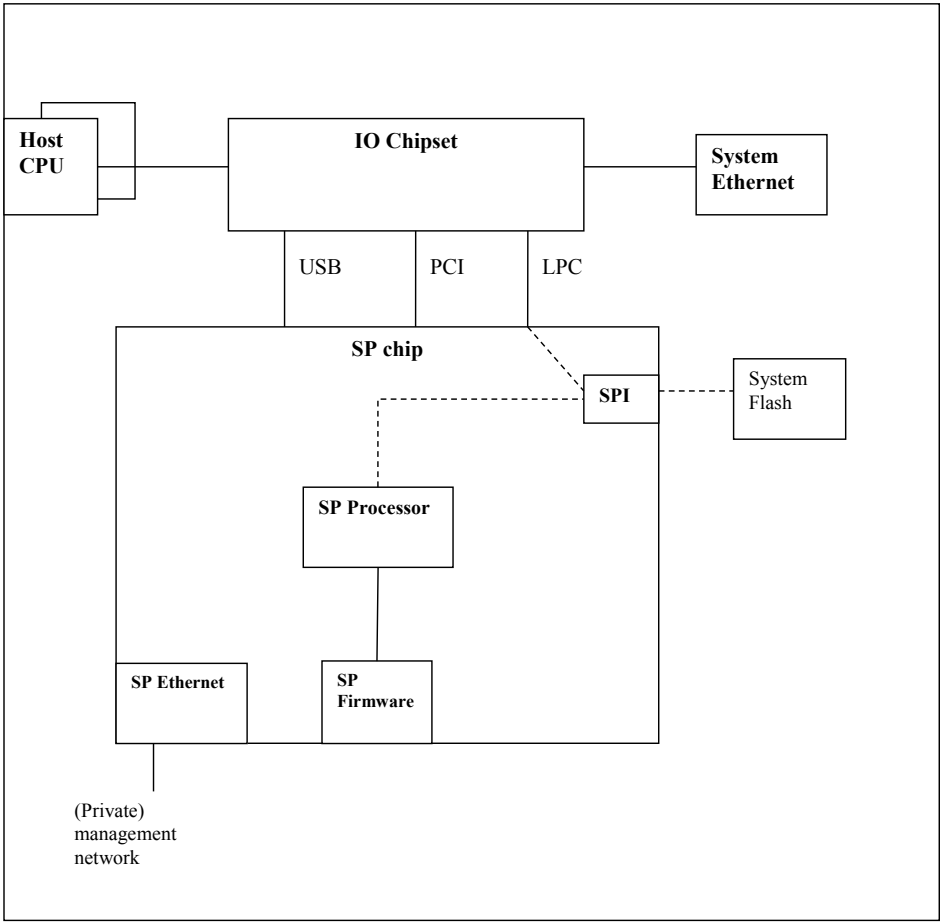
図1:更新メカニズム1のシステムブロック図の例。枠の中で、「Host CPU」(ホストCPU、後ろにずらした箱が重ねて描かれている)の箱が線で横長の「IO Chipset」(I/Oチップセット)の箱につながり、IO Chipset は右側で「System Ethernet」(システムEthernet)の箱につながる。IO Chipset から「USB」「PCI」「LPC」と記した3本の線が下の大きな「SP chip」(SPチップ)の箱へ伸びる。SP chip の中では、右上の「SPI」の箱が、LPC の線から来る破線、「SP Processor」(SPプロセッサー)の箱への破線、SP chip の外にある「System Flash」(システムフラッシュ)の箱への破線で結ばれている。SP Processor は実線で下の「SP Firmware」(SPファームウェア)の箱につながる。SP chip の左下の「SP Ethernet」の箱からは、線が「(Private) management network」((非公開)管理ネットワーク)へ伸びる。
Figure 1: Example System Block Diagram for Update Mechanism 1
図1:更新メカニズム1のシステムブロック図の例
In this example, the system BIOS is given control of the host CPU at system reset. All SPI flash sectors are unlocked at system reset. The system BIOS, prior to allowing execution of untrusted code (e.g., Option ROMs, bootloaders) locks host-side write access to the system flash sectors containing the system BIOS. This locking is done via interaction with the logic to “lock until reset” the sectors containing the BIOS image. When the lock is set, the access to this lock register becomes read-only so that the “lock until reset” setting itself cannot be modified. Write access to the BIOS flash sectors remains available to the SP.
この例では、システムリセット時にシステムBIOSがホストCPUの制御を得ます。システムリセット時には、すべてのSPIフラッシュセクターのロックが解除されています。システムBIOSは、信頼されていないコード(例えばオプションROMやブートローダー)の実行を許可する前に、システムBIOSを含むシステムフラッシュセクターへのホスト側の書き込みアクセスをロックします。このロックは、BIOSイメージを含むセクターを「リセットまでロック」するロジックとの連携によって行います。ロックが設定されると、このロックレジスターへのアクセスは読み取り専用となるため、「リセットまでロック」の設定自体を変更できません。BIOSフラッシュセクターへの書き込みアクセスはSPに引き続き許可されます。
When conducting a BIOS update, system management software on the host can interact with the SP to send a candidate update image to the SP. Alternatively, the BIOS update image can arrive at the SP through out of band communication via the SP Ethernet. The SP, as an RTU for the system BIOS, verifies the BIOS update image using the digital signature verification algorithm and key store on the SP. If the image is authenticated, then the SP, which continues to have write access to the BIOS flash memory even after host OS boot, can perform the flash update via interaction with the SPI controller of the BIOS flash memory.
BIOS更新を行う際、ホスト上のシステム管理ソフトウェアはSPと連携して、更新候補イメージをSPに送信できます。あるいは、SP Ethernetを介した帯域外通信により、BIOS更新イメージをSPに送信することもできます。システムBIOSのRTUであるSPは、SP上のデジタル署名検証アルゴリズム及び鍵ストアを使ってBIOS更新イメージを検証します。イメージが認証された場合、ホストOSの起動後もBIOSフラッシュメモリへの書き込みアクセスを保持するSPは、BIOSフラッシュメモリのSPIコントローラーと連携してフラッシュを更新できます。
Appendix C—Example of Update Mechanism 2
付録C—更新メカニズム2の例
This appendix provides an example of how Update Mechanism 2 could be implemented in a server. In this example, BIOS update images are verified and flashed during the boot process, while the RTU implemented as part of the BIOS has control of the system. Figure 2 shows an example system block diagram for a server using this update mechanism. The BIOS flash SPI controller is accessible by just the host. A potential BIOS update image is stored in the SP environment.
本付録では、サーバーに更新メカニズム2を実装する方法の例を示します。この例では、RTUとしてBIOSの一部に実装されたコードがシステムを制御している間に、起動プロセス中にBIOS更新イメージを検証し、フラッシュに書き込みます。図2は、この更新メカニズムを使用するサーバーのシステムブロック図の例を示します。BIOSフラッシュSPIコントローラーにアクセスできるのはホストのみです。BIOS更新候補イメージはSP環境に保存されます。
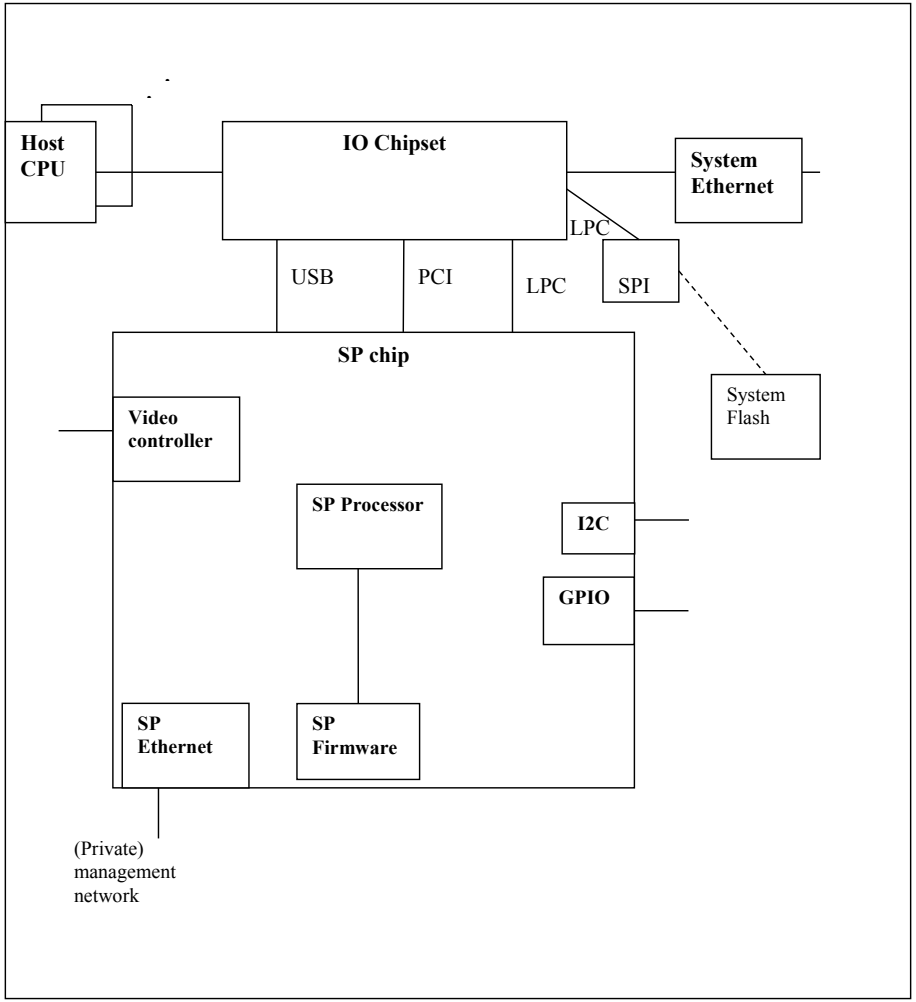
図2:更新メカニズム2のシステムブロック図の例。枠の中で、「Host CPU」(ホストCPU、後ろにずらした箱が重ねて描かれている)の箱が線で横長の「IO Chipset」(I/Oチップセット)の箱につながり、IO Chipset は右側で「System Ethernet」(システムイーサネット)の箱につながる(その先にも線が右へ伸びる)。IO Chipset から「LPC」と記した斜めの線が SP chip の外にある「SPI」の箱へ伸び、SPI の箱は破線で「System Flash」(システムフラッシュ)の箱につながる。IO Chipset から「USB」「PCI」「LPC」と記した3本の線が下の大きな「SP chip」(SPチップ)の箱へ伸びる。SP chip の中には、「Video controller」(ビデオコントローラー、左外へ線が伸びる)の箱、線で下の「SP Firmware」(SPファームウェア)の箱につながる「SP Processor」(SPプロセッサー)の箱、右端の「I2C」と「GPIO」の箱(それぞれ右外へ線が伸びる)、左下の「SP Ethernet」の箱がある。SP Ethernet からは線が「(Private) management network」((非公開)管理ネットワーク)へ伸びる。
Figure 2: Example System Block Diagram for Update Mechanism 2
図2:更新メカニズム2のシステムブロック図の例
In this example, to initiate a BIOS update, system management software on the host can interact with the SP to send a BIOS update image to be stored in the SP environment for later access by BIOS. Alternatively, the candidate BIOS update image can arrive at the SP through out of band communication via the SP Ethernet.
この例では、BIOS更新を開始するため、ホスト上のシステム管理ソフトウェアがサービスプロセッサ(SP)と連携し、後でBIOSがアクセスできるようSP環境に保存するBIOS更新イメージを送信できます。代わりに、SPイーサネット経由の帯域外通信によって、候補となるBIOS更新イメージをSPに送ることもできます。
The RTU, implemented as part of the system BIOS, gets control of the host side at system reset. All SPI flash sectors are unlocked at system reset. Within the system flash, the RTU is not separated from the remainder of the system BIOS. The system BIOS, prior to executing untrusted code (e.g., Option ROMs) is the RTU. It communicates with the SP to check for a candidate BIOS update image. If one exists, it is read from the SP into host memory (which is only writable by the system BIOS during RTU execution) and performs verification. If the BIOS update image is authentic, the system BIOS performs the update of the system flash via interaction with the SPI flash controller. At completion of the BIOS update, the system BIOS forces a system reset and restarts execution from the new image.
システムBIOSの一部として実装されたRTUは、システムリセット時にホスト側の制御を取得します。システムリセット時にはSPIフラッシュの全セクターがロック解除されます。システムフラッシュ内では、RTUはシステムBIOSの残りの部分から分離されていません。信頼されていないコード(例:オプションROM)を実行する前のシステムBIOSがRTUとして動作します。RTUはSPと通信して、候補となるBIOS更新イメージがあるか確認します。存在する場合、イメージをSPからホストメモリ(RTU実行中に書き込みできるのはシステムBIOSだけ)に読み込み、検証します。BIOS更新イメージが真正であれば、システムBIOSはSPIフラッシュコントローラーを介してシステムフラッシュを更新します。BIOS更新の完了後、システムBIOSはシステムリセットを実行し、新しいイメージから処理を再開します。
If the SP indicated that no candidate BIOS update image existed, or if the candidate BIOS update image failed verification, BIOS locks the BIOS flash memory via SPI controller interaction to “lock until reset” the sectors containing the BIOS image. When the lock is set, the access to this SPI sector lock register becomes read-only so that the “lock until reset” setting itself cannot be modified. This sector lock is done prior to exiting the RTU portion of the BIOS.
SPが候補となるBIOS更新イメージは存在しないと示した場合、または候補イメージの検証に失敗した場合、BIOSはSPIコントローラーを介してBIOSフラッシュメモリをロックし、BIOSイメージを含むセクターを「リセットまでロック」します。ロックを設定すると、このSPIセクターロックレジスターへのアクセスは読み取り専用となり、「リセットまでロック」という設定自体を変更できなくなります。このセクターロックは、BIOSのRTU部分を終了する前に行います。
Appendix D—Example of Update Mechanism 3
付録D — 更新メカニズム3の例
This appendix provides an example of how Update Mechanism 3 could be implemented in a server. In this example, the BIOS flash is not strongly protected and therefore the integrity of the BIOS code is verified during the boot process. An example system block diagram for update mechanism 3 shows the BIOS flash SPI controller accessible by both the host and the SP. Because it has write access to the BIOS flash memory, the SP environment in this example must be a secure, protected environment as described in Section 5.
本付録では、更新メカニズム3をサーバーに実装する方法の例を示します。この例ではBIOSフラッシュは強固に保護されておらず、そのため起動プロセス中にBIOSコードの完全性を検証します。更新メカニズム3のシステムブロック図の例では、ホストとSPの両方からBIOSフラッシュのSPIコントローラーにアクセスできます。SPはBIOSフラッシュメモリへの書き込み権限を持つため、この例では第5節で説明するとおり、SP環境を安全に保護しなければなりません。
原本PDFの抜粋画像
IO Chipset
I/Oチップセット
System Ethernet
システムイーサネット
| USB | PCI |
LPC
LPC
SP chip
SPチップ
BIOS ROM
BIOS ROM
Video controller
ビデオコントローラー
SPI
SPI
SP Processor
SPプロセッサ
I2C
I2C
GPIO
GPIO
SP
SP Ethernet
SPイーサネット
Firmware
ファームウェア
(Private) management network
(プライベート)管理ネットワーク
Figure 3: Example System Block Diagram for Update Mechanism 3
図3:更新メカニズム3のシステムブロック図の例
In this example, to initiate a BIOS update, system management software on the host can interact with the SP to send a BIOS update image to the SP. Alternatively, the BIOS update image can arrive at the SP through out of band communication via the SP Ethernet. The SP, acting as part of the RTU, then authenticates the BIOS update image. If the image is authentic, then the SP, which continues to have write access to the system flash even after host OS boot, can then perform the flash update via interaction with the SPI controller of the system flash.
この例では、BIOS更新を開始するため、ホスト上のシステム管理ソフトウェアがSPと連携し、BIOS更新イメージをSPに送信できます。代わりに、SPイーサネット経由の帯域外通信によってBIOS更新イメージをSPに送ることもできます。その後、RTUの一部として動作するSPがBIOS更新イメージを認証します。イメージが真正であれば、ホストOSの起動後もシステムフラッシュへの書き込み権限を保持するSPが、システムフラッシュのSPIコントローラーを介してフラッシュを更新できます。
In this example, the system BIOS contains its own verification component of the RTU, which authenticates the remainder of the system BIOS each boot. This verification component resides in the system flash and will be labeled the RTU-V for the purposes of describing this update mechanism. The RTU-V is given control of the host side at system reset. System reset also unlocks all of the SPI flash sectors. Within the system flash, the RTU-V is lockable, independently of the remainder of system BIOS. The RTU-V is also updatable as follows: Similar to update mechanism example 2, the RTU-V update occurs upon reboot and is updated by the RTU-V itself. It communicates with the SP to check for a candidate RTU-V update image. If one exists, it is read from the SP into host memory and performs authentication. If the image authenticates, the RTU-V does the update of the RTU-V portion of the BIOS flash ROM via interaction with the SPI flash controller. At completion of the RTU-V update, the RTU-V forces a system reset and restarts execution from the new image.
この例では、システムBIOSにRTUの独自の検証コンポーネントが含まれており、起動のたびにシステムBIOSの残りの部分を認証します。この検証コンポーネントはシステムフラッシュ内に配置されており、この更新メカニズムの説明ではRTU-Vと呼びます。システムリセット時にRTU-Vがホスト側の制御を取得します。システムリセットによりSPIフラッシュの全セクターもロック解除されます。システムフラッシュ内では、RTU-VはシステムBIOSの残りの部分とは独立してロックできます。また、RTU-Vは次のように更新できます。更新メカニズム2の例と同様に、RTU-V自体が再起動時にRTU-Vを更新します。RTU-VはSPと通信し、候補となるRTU-V更新イメージがあるかを確認します。存在する場合、イメージをSPからホストメモリに読み込み、認証を実行します。イメージが認証された場合、RTU-VはSPIフラッシュコントローラーを介してBIOSフラッシュROM内のRTU-V部分を更新します。RTU-Vの更新完了後、RTU-Vはシステムリセットを実行し、新しいイメージから処理を再開します。
If the SP indicated that no candidate RTU-V update image existed, or if the candidate RTU-V update image failed verification, the RTU-V locks until reset the RTU-V sectors of the flash via interactions with the SPI controller. When the lock is set, the access to this SPI sector lock register becomes read-only so that the “lock until reset” setting itself cannot be modified. This sector lock is done prior to exiting the RTU-V (e.g., before execution of the rest of BIOS).
SPが候補となるRTU-V更新イメージは存在しないと示した場合、または候補イメージの検証に失敗した場合、RTU-VはSPIコントローラーを介してフラッシュ内のRTU-Vセクターを「リセットまでロック」します。ロックを設定すると、このSPIセクターロックレジスターへのアクセスは読み取り専用となり、「リセットまでロック」という設定自体を変更できなくなります。このセクターロックは、RTU-Vを終了する前(例:BIOSの残りの部分の実行前)に行います。
Because the system flash regions containing BIOS code are not lockable and are subject to modification by malicious code, the RTU-V authenticates the remainder of system BIOS. The remainder of the system BIOS is kept in separate flash sectors in the system flash. If authentication passes, the RTU-V passes control to the remainder of the system BIOS. In this example, the remainder of system BIOS does not lock the flash sectors containing the remainder of the system BIOS. A possible reason for not locking the flash sectors may be to simplify access to those sectors by the BIOS RTU at runtime. Another possible reason would be that a portion of these sectors need to be writeable at runtime and the sector locking granularity is not sufficient to lock the BIOS without also locking the area that needs to be writeable.
BIOSコードを含むシステムフラッシュ領域はロックできず、悪意あるコードによる変更を受ける可能性があるため、RTU-VはシステムBIOSの残りの部分を認証します。システムBIOSの残りの部分は、システムフラッシュ内の別個のフラッシュセクターに保存されます。認証に成功すると、RTU-VはシステムBIOSの残りの部分に制御を渡します。この例では、システムBIOSの残りの部分は、そのコードを含むフラッシュセクターをロックしません。フラッシュセクターをロックしない理由として、実行時にBIOSのRTUがそれらのセクターにアクセスしやすくすることが挙げられます。また、実行時に書き込み可能でなければならない領域がセクター内にあり、セクターロックの粒度が粗く、書き込み可能領域とBIOSを分離してロックできない可能性もあります。
If authentication of the BIOS fails, it is not executed. Instead, the RTU-V communicates with the BIOS RTU on the SP to inform it of the failure. The SP must then access an authentic BIOS image previously stored in the SP environment (possibly from the previous authenticated BIOS update), authenticate it and perform the flash update. The SP then forces a system reset to restart the RTU-V which will subsequently authenticate and execute the remainder of system BIOS.
BIOSの認証に失敗した場合、そのBIOSは実行しません。代わりにRTU-Vは、失敗を知らせるため、SP上のBIOS RTUと通信します。その後SPは、SP環境に以前保存された真正なBIOSイメージ(以前の認証済みBIOS更新で保存した可能性がある)にアクセスし、それを認証してフラッシュを更新しなければなりません。続いてSPはシステムリセットを実行し、RTU-Vを再起動します。RTU-Vはその後、システムBIOSの残りの部分を認証して実行します。
Appendix E—Glossary
付録E — 用語集
Selected terms used in the publication are defined below.
本刊行物で使用する一部の用語を以下に定義します。
Basic Input/Output System (BIOS): Refers collectively to boot firmware based on the conventional BIOS, Extensible Firmware Interface (EFI), and the Unified Extensible Firmware Interface (UEFI).
基本入出力システム(BIOS):従来型BIOS、拡張可能ファームウェアインターフェース(EFI)、および統合拡張可能ファームウェアインターフェース(UEFI)に基づく起動ファームウェアの総称。
Conventional BIOS: Legacy boot firmware used in many x86-compatible computer systems. Also known as the legacy BIOS.
従来型BIOS:多くのx86互換コンピューターシステムで使用されるレガシー起動ファームウェア。レガシーBIOSとも呼ばれます。
Extensible Firmware Interface (EFI): A specification for the interface between the operating system and the platform firmware. Version 1.10 of the EFI specifications was the final version of the EFI specifications, and subsequent revisions made by the Unified EFI Forum are part of the UEFI specifications.
拡張可能ファームウェアインターフェース(EFI):オペレーティングシステムとプラットフォームファームウェアの間のインターフェースに関する仕様。EFI仕様の最終版はバージョン1.10であり、その後に統合EFIフォーラムが行った改訂はUEFI仕様の一部です。
Firmware: Software that is included in read-only memory (ROM).
ファームウェア:読み取り専用メモリ(ROM)に含まれるソフトウェア。
Option ROM: Firmware that is called by the system BIOS. Option ROMs include BIOS firmware on add-on cards (e.g., video card, hard drive controller, network card) as well as modules which extend the capabilities of the system BIOS.
オプションROM:システムBIOSから呼び出されるファームウェア。オプションROMには、増設カード(例:ビデオカード、ハードディスクコントローラー、ネットワークカード)上のBIOSファームウェアや、システムBIOSの機能を拡張するモジュールが含まれます。
System Management Mode (SMM): A high-privilege operating mode found in x86-compatible processors used for low-level system management functions. System Management Mode is only entered after the system generates a System Management Interrupt and only executes code from a segregated block of memory.
システム管理モード(SMM):x86互換プロセッサーに搭載される、特権レベルの高い動作モードで、低レベルのシステム管理機能に使用します。SMMには、システムがシステム管理割り込みを生成した後に限り移行し、隔離されたメモリーブロック内のコードだけを実行します。
System Flash Memory: The non-volatile storage location of system BIOS, typically in electronically erasable programmable read-only memory (EEPROM) flash memory on the motherboard. While system flash memory is a technology-specific term, guidelines in this document referring to the system flash memory are intended to apply to any non-volatile storage medium containing the system BIOS.
システムフラッシュメモリ:システムBIOSを格納する不揮発性ストレージ領域。通常はマザーボード上の電気的消去可能プログラマブル読み取り専用メモリ(EEPROM)フラッシュメモリです。システムフラッシュメモリは特定技術を指す用語ですが、本書でシステムフラッシュメモリに言及する指針は、システムBIOSを含むあらゆる不揮発性記憶媒体に適用することを意図しています。
Trusted Platform Module (TPM): A tamper-resistant integrated circuit built into some computer motherboards that can perform cryptographic operations (including key generation) and protect small amounts of sensitive information, such as passwords and cryptographic keys.
トラステッド・プラットフォーム・モジュール(TPM):一部のコンピューターのマザーボードに組み込まれる耐タンパー性集積回路であり、暗号鍵の生成を含む暗号処理を実行し、パスワードや暗号鍵など少量の機密情報を保護できます。
Unified Extensible Firmware Interface (UEFI): A possible replacement for the conventional BIOS that is becoming widely deployed in new x86-based computer systems. The UEFI specifications were preceded by the EFI specifications.
統合拡張可能ファームウェアインターフェース(UEFI):従来型BIOSの後継候補であり、新しいx86ベースのコンピューターシステムで広く導入されつつあります。UEFI仕様に先立ち、EFI仕様が策定されました。
Appendix F—Acronyms and Abbreviations
付録F — 頭字語および略語
This appendix contains a list of selected acronyms and abbreviations used in the guide.
本付録には、本ガイドで使用する主な頭字語および略語を示します。
ACPI
ACPI
Advanced Configuration and Power Interface
高度構成・電源インターフェース
BIOS
BIOS
Basic Input/Output System
基本入出力システム
CPU
CPU
Central Processing Unit
中央処理装置
EEPROM
EEPROM
Electrically Erasable Programmable Read-Only Memory
電気的消去可能プログラマブル読み取り専用メモリ
EFI
EFI
Extensible Firmware Interface
拡張可能ファームウェアインターフェース
FIPS
FIPS
Federal Information Processing Standard
連邦情報処理標準
FISMA
FISMA
Federal Information Security Management Act
連邦情報セキュリティ管理法
GPIO
GPIO
General Purpose Input/Output
汎用入出力
I2C
I2C
Inter-Integrated Circuit
相互集積回路(I²C)
IO
I/O
Input/Output
入出力
IT
IT
Information Technology
情報技術
ITL
ITL
Information Technology Laboratory
情報技術研究所
LAN
LAN
Local Area Network
ローカルエリアネットワーク
LPC
LPC
Low Pin Count
低ピン数
NIST
NIST
National Institute of Standards and Technology
米国国立標準技術研究所
OEM
OEM
Original Equipment Manufacturer
相手先ブランド製造業者
OMB
OMB
Office of Management and Budget
行政管理予算局
OS
OS
Operating System
オペレーティングシステム
PC
PC
Personal Computer
パーソナルコンピューター
PCI
PCI
Peripheral Component Interconnect
周辺機器相互接続
ROM
ROM
Read-Only Memory
読み取り専用メモリ
RTU
RTU
Root of Trust for Update
更新の信頼基点
RTU-V
RTU-V
Root of Trust for Update verification component
更新の信頼基点の検証コンポーネント
SMI
SMI
System Management Interrupt
システム管理割り込み
SMM
SMM
System Management Mode
システム管理モード
SP
SP
Service Processor
サービスプロセッサ
SP
SP
Special Publication
特別刊行物
TPM
TPM
Trusted Platform Module
トラステッド・プラットフォーム・モジュール
UEFI
UEFI
Unified Extensible Firmware Interface
統合拡張可能ファームウェアインターフェース
USB
USB
Universal Serial Bus
ユニバーサルシリアルバス
Appendix G—References
付録G — 参考文献
The list below provides references for this publication.
本刊行物で参照する文献を以下に示します。
[DuGr09] Loïc Duflot, Olivier Grumelard, Olivier Levillain and Benjamin Morin. “ACPI and SMI handlers: some limits to trusted computing.” Journal in Computer Virology. Volume 6, Number 4, 353-374.
原文のみ
[EFI] EFI 1.10 Specification. Intel. 1 November 2003. http://www.intel.com/technology/efi/
原文のみ
[EmSp08] Shawn Embleton, Sherri Sparks, and Cliff C. Zou. "SMM Rootkits: A New Breed of OS Independent Malware," Proceedings of 4th International Conference on Security and Privacy in Communication Networks (SecureComm), Istanbul, Turkey, September 22-25, 2008.
原文のみ
[FIPS180-4] FIPS 180-4, Secure Hash Standard. March 2012.
原文のみ
[FIPS186-4] FIPS 186-4, Digital Signature Standard. July 2013.
原文のみ
[Graw09] D. Grawrock. Dynamics of a Trusted Platform: A Building Block Approach. Hillsboro, OR: Intel Press, 2009.
原文のみ
[Heas07a] J. Heasman. “Firmware Rootkits: A Threat to the Enterprise.” Black Hat DC. Washington, DC. 28 February 2007. http://www.nccgroup.com/Libraries/Document_Downloads/02_07_Firmware_Rootkits_The_Threat_to_the_Enterprise_Black_Hat_Washington_2007_sflb.sflb.ashx
原文のみ
[Heas07b] J. Heasman. “Hacking the Extensible Firmware Interface.” Black Hat USA. Las Vegas, NV. 2 August 2007. https://www.blackhat.com/presentations/bh-usa-07/Heasman/Presentation/bh-usa-07-heasman.pdf
原文のみ
[Intel03] Intel Platform Innovation Framework for EFI- Architecture Specification v0.9. Intel. September 2003. http://www.intel.com/technology/framework/
原文のみ
[KGH09] A. Kumar, G. Purushottam, and Y. Saint-Hilaire. Active Platform Management Demystified. Hillsboro, OR: Intel Press, 2009.
原文のみ
[Sal07] Salihun, Darmawan. BIOS Disassembly Ninjutsu Uncovered. Wayne, PA: A-LIST, 2007.
原文のみ
[SaOr09] A. Sacco, A. Ortéga. “Persistant BIOS Infection.” Phrack. Issue 66. 6 November 2009. http://www.phrack.com/issues.html?issue=66&id=7
原文のみ
[SP800-57] NIST SP 800-57 Part 1, Recommendation for Key Management – Part 1: General (Revision 3). July 2012.
原文のみ
[SP800-89] NIST SP 800-89, Recommendation for Obtaining Assurances for Digital Signature Applications. November 2006.
原文のみ
[SP800-131A] NIST SP 800-131A, Transitions: Recommendation for Transitioning the Use of Cryptographic Algorithms and Key Lengths. January 2011.
原文のみ
[Sym02] W95.CIH Technical Details. Symantec. 25 April 2002. http://www.symantec.com/security_response/writeup.jsp?docid=2000-122010-2655-99
原文のみ
[TCG05] PC Client Work Group Specific Implementation Specification for Conventional Bios Specification, Version 1.2. Trusted Computing Group. July 2005. http://www.trustedcomputinggroup.org/resources/pc_client_work_group_specific_implementation_specification_for_conventional_bios_specification_version_12
原文のみ
[UEFI] UEFI Specification Version 2.3. Unified EFI Forum. May 2009. http://www.uefi.org/specs/
原文のみ
[Wech09] F. Wecherowski. “A Real SMM Rootkit: Reversing and Hooking BIOS SMI Handlers.” Phrack. Issue 66. 6 November 2009. http://www.phrack.com/issues.html?issue=66&id=11
原文のみ
[WoTe09] R. Wojtczuk and A. Tereshkin. “Attacking Intel BIOS.” Black Hat USA. Las Vegas, NV. 30 July 2009. http://www.blackhat.com/presentations/bh-usa-09/WOJTCZUK/BHUSA09-Wojtczuk-AtkIntelBios-SLIDES.pdf
原文のみ