NIST SP 800-157 日本語訳
英語タイトル : Guidelines for Derived Personal Identity Verification (PIV) Credentials日本語タイトル : 派生個人識別検証(PIV)資格情報に関するガイドライン
公開日 : 2014-12-19
原文URL : https://csrc.nist.gov/pubs/sp/800/157/final
翻訳編集 : 自動生成(有志による非公式の日本語訳), 原文取得日 : 2026-09-30, 訳文 : 406 / 406 ブロック
[要約] SP 800-157 は、有効な PIV カードを所有する個人に連邦省庁・機関が発行する、PKI ベースの派生 PIV 資格情報を実装するための技術ガイドラインを示します。資格情報の初回発行と保守、PIV カードとの関連付けといったライフサイクル活動の要件に加え、証明書ポリシー、暗号仕様、暗号トークンの種類とアクティベーションデータを定めます。標準ベースで安全、信頼性が高く、相互運用可能な ID クレデンシャルの実現を目的とし、取り外し可能な暗号トークンのコマンドインターフェースの技術仕様も含みます。
NIST Special Publication 800-157
NIST特別刊行物800-157
Guidelines for Derived
ガイドライン:派生
Personal Identity Verification (PIV)
個人ID検証(PIV)
Credentials
クレデンシャル
Hildegard Ferraiolo David Cooper Salvatore Francomacaro Andrew Regenscheid Jason Mohler Sarbari Gupta William Burr
Hildegard Ferraiolo、David Cooper、Salvatore Francomacaro、Andrew Regenscheid、Jason Mohler、Sarbari Gupta、William Burr
This publication is available free of charge from:
本刊行物は以下から無料で入手できる:
http://dx.doi.org/10.6028/NIST.SP.800-157
http://dx.doi.org/10.6028/NIST.SP.800-157
I N F O R M A T I O N S E C U R I T Y
情報セキュリティ
[NIST のロゴ。公的な標章のため、この非公式サイトには掲載していません。原本 PDF を参照してください。]
NIST Special Publication 800-157
NIST特別刊行物800-157
Guidelines for Derived Personal Identity Verification (PIV) Credentials
派生個人識別検証(PIV)認証情報に関するガイドライン
Hildegard Ferraiolo David Cooper Salvatore Francomacaro Andrew Regenscheid Computer Security Division Information Technology Laboratory
Hildegard Ferraiolo David Cooper Salvatore Francomacaro Andrew Regenscheid コンピュータセキュリティ部門 情報技術研究所
William Burr Dakota Consulting, Inc. Silver Spring, MD
William Burr Dakota Consulting, Inc. メリーランド州シルバースプリング
Jason Mohler Sarbari Gupta Electrosoft Services, Inc. Reston, VA
Jason Mohler Sarbari Gupta Electrosoft Services, Inc. バージニア州レストン
This publication is available free of charge from: http://dx.doi.org/10.6028/NIST.SP.800-157
本刊行物は以下から無料で入手できます:http://dx.doi.org/10.6028/NIST.SP.800-157
December 2014
2014年12月
U.S. Department of Commerce Penny Pritzker, Secretary
米国商務省 Penny Pritzker 長官
National Institute of Standards and Technology Willie May, Acting Under Secretary of Commerce for Standards and Technology and Acting Director
国立標準技術研究所 Willie May 商務次官(標準・技術担当)代行兼所長代行
Authority
権限
This publication has been developed by NIST to further its statutory responsibilities under the Federal Information Security Management Act (FISMA), Public Law (P.L.) 107-347. NIST is responsible for developing information security standards and guidelines, including minimum requirements for Federal information systems, but such standards and guidelines shall not apply to national security systems without the express approval of appropriate Federal officials exercising policy authority over such systems. This guideline is consistent with the requirements of the Office of Management and Budget (OMB) Circular A-130, Section 8b(3), Securing Agency Information Systems, as analyzed in Circular A-130, Appendix IV: Analysis of Key Sections. Supplemental information is provided in Circular A-130, Appendix III, Security of Federal Automated Information Resources.
本刊行物は、連邦情報セキュリティマネジメント法(FISMA)(公法(P.L.)107-347)に基づくNISTの法定責任をさらに果たすために作成されました。NISTは、連邦情報システムの最低要件を含む情報セキュリティ標準およびガイドラインを策定する責任を負います。ただし、これらの標準およびガイドラインは、当該システムに対する政策権限を行使する適切な連邦当局者の明示的な承認がない限り、国家安全保障システムには適用されません。本ガイドラインは、通達A-130付録IV「主要セクションの分析」で分析されているとおり、行政管理予算局(OMB)通達A-130第8b(3)節「機関情報システムの保護」の要件と整合しています。補足情報は、通達A-130付録III「連邦自動化情報資源のセキュリティ」に示されています。
Nothing in this publication should be taken to contradict the standards and guidelines made mandatory and binding on Federal agencies by the Secretary of Commerce under statutory authority. Nor should these guidelines be interpreted as altering or superseding the existing authorities of the Secretary of Commerce, Director of the OMB, or any other Federal official. This publication may be used by nongovernmental organizations on a voluntary basis and is not subject to copyright in the United States. Attribution would, however, be appreciated by NIST.
本刊行物のいかなる内容も、法定権限に基づき商務長官が連邦機関に義務付け、拘束力を持たせた標準およびガイドラインに反するものと解釈してはなりません。また、本ガイドラインは、商務長官、OMB長官、その他の連邦政府職員の既存の権限を変更または置き換えるものと解釈してはなりません。本刊行物は非政府組織が任意で利用でき、米国では著作権の対象ではありません。ただし、NISTへの出典表示が望まれます。
National Institute of Standards and Technology Special Publication 800-157 Natl. Inst. Stand. Technol. Spec. Publ. 800-157, 33 pages (December 2014) http://dx.doi.org/10.6028/NIST.SP.800-157 CODEN: NSPUE2
National Institute of Standards and Technology Special Publication 800-157 Natl. Inst. Stand. Technol. Spec. Publ. 800-157, 33 pages (December 2014) http://dx.doi.org/10.6028/NIST.SP.800-157 CODEN: NSPUE2
Certain commercial entities, equipment, or materials may be identified in this document in order to describe an experimental procedure or concept adequately. Such identification is not intended to imply recommendation or endorsement by NIST, nor is it intended to imply that the entities, materials, or equipment are necessarily the best available for the purpose.
本文書では、実験的な手順や概念を適切に説明するために、特定の商業団体、機器、または資材を挙げている場合があります。そのような記載は、NIST による推奨または推薦を意味するものではなく、当該の団体、資材、または機器がその目的に対して必ずしも最良であることを意味するものでもありません。
There may be references in this publication to other publications currently under development by NIST in accordance with its assigned statutory responsibilities. The information in this publication, including concepts and methodologies, may be used by Federal agencies even before the completion of such companion publications. Thus, until each publication is completed, current requirements, guidelines, and procedures, where they exist, remain operative. For planning and transition purposes, Federal agencies may wish to closely follow the development of these new publications by NIST.
本文書には、NISTが割り当てられた法定責任に従って現在策定中の他の文書への参照が含まれることがあります。本文書に含まれる情報は、概念や方法論を含め、それらの関連文書の完成前であっても連邦政府機関が利用してもよいです。したがって、各文書が完成するまでは、現行の要件、ガイドライン、および手順は、存在する場合には引き続き有効です。計画立案および移行の目的のため、連邦政府機関は、NISTによるこれらの新しい文書の策定状況を注意深く追うことが望まれます。
Organizations are encouraged to review all draft publications during public comment periods and provide feedback to NIST. All NIST publications, other than the ones noted above, are available at http://csrc.nist.gov/publications.
組織には、パブリックコメント期間中にすべての草案文書をレビューし、NISTにフィードバックを提供することが推奨されます。上記の文書を除くすべてのNIST文書は、http://csrc.nist.gov/publications で入手できます。
Comments on this publication may be submitted to:
本刊行物に関するコメントの送付先:
National Institute of Standards and Technology Attn: Computer Security Division, Information Technology Laboratory 100 Bureau Drive (Mail Stop 8930), Gaithersburg, MD 20899-8930 Email: piv_derived@nist.gov
National Institute of Standards and Technology Attn: Computer Security Division, Information Technology Laboratory 100 Bureau Drive (Mail Stop 8930), Gaithersburg, MD 20899-8930 Email: piv_derived@nist.gov
Reports on Computer Systems Technology
コンピューターシステム技術に関する報告
The Information Technology Laboratory (ITL) at the National Institute of Standards and Technology (NIST) promotes the U.S. economy and public welfare by providing technical leadership for the Nation’s measurement and standards infrastructure. ITL develops tests, test methods, reference data, proof of concept implementations, and technical analyses to advance the development and productive use of information technology. ITL’s responsibilities include the development of management, administrative, technical, and physical standards and guidelines for the cost-effective security and privacy of other than national security-related information in Federal information systems. The Special Publication 800-series reports on ITL’s research, guidelines, and outreach efforts in information system security, and its collaborative activities with industry, government, and academic organizations.
米国国立標準技術研究所(NIST)の情報技術研究所(ITL)は、国の計量・標準インフラに技術的リーダーシップを提供し、米国経済および公共の福祉を促進します。ITLは、情報技術の開発と生産的利用を促進するため、試験、試験方法、参照データ、概念実証の実装、および技術分析を開発します。ITLの責務には、国家安全保障関連以外の連邦情報システムにおける情報の費用対効果に優れたセキュリティとプライバシーのための管理上、運用上、技術上および物理上の標準・ガイドラインの策定が含まれます。特別刊行物800シリーズは、情報システムセキュリティに関するITLの研究、ガイドライン、普及活動、および産業界、政府、学術機関との協力活動を報告します。
Abstract
要旨
This recommendation provides technical guidelines for the implementation of standards-based, secure, reliable, interoperable public key infrastructure (PKI) based identity credentials that are issued by Federal departments and agencies to individuals who possess and prove control over a valid PIV Card. The scope of this document includes requirements for initial issuance and maintenance of these credentials, certificate policies and cryptographic specifications, technical specifications for permitted cryptographic token types and the command interfaces for the removable implementations of such cryptographic tokens.
本勧告は、有効なPIVカードを所有し、その管理を証明する個人に連邦省庁・機関が発行する、標準ベースで安全、信頼性が高く、相互運用可能な公開鍵基盤(PKI)ベースのIDクレデンシャルを実装するための技術ガイドラインを示します。本書の適用範囲には、これらのクレデンシャルの初回発行と保守に関する要件、証明書ポリシーと暗号仕様、ならびに許可される暗号トークンの種類と、取り外し可能な暗号トークン実装のコマンドインターフェースに関する技術仕様が含まれます。
Keywords
キーワード
authentication; credentials; derived PIV credentials; electronic authentication; electronic credentials; mobile devices; personal identity verification; PIV
認証、クレデンシャル、派生PIVクレデンシャル、電子認証、電子クレデンシャル、モバイルデバイス、個人ID検証、PIV
Acknowledgments
謝辞
The authors, David Cooper, Hildegard Ferraiolo, Salvatore Francomacaro and Andrew Regenscheid of the National Institute of Standards and Technology (NIST), William Burr of Dakota Consulting, Inc., and Sarbari Gupta and Jason Mohler of Electrosoft Services, Inc., wish to thank their colleagues who reviewed drafts of this document and contributed to its technical content and development. Special thanks to the Federal Identity, Credential and Access Management (FICAM) Logical Access Working Group (LAWG) for the review and contributions to the document.
米国国立標準技術研究所(NIST)のDavid Cooper、Hildegard Ferraiolo、Salvatore Francomacaro、Andrew Regenscheid、Dakota Consulting, Inc.のWilliam Burr、Electrosoft Services, Inc.のSarbari GuptaおよびJason Mohlerから成る著者は、本書の草案をレビューし、技術内容と策定に貢献した同僚に謝意を表します。特に、文書をレビューし貢献したFederal Identity, Credential and Access Management(FICAM)Logical Access Working Group(LAWG)に感謝します。
Trademark Information
商標情報
All registered trademarks or trademarks belong to their respective organizations.
登録商標または商標はすべて、それぞれの組織に帰属します。
Executive Summary
エグゼクティブサマリー
The deployment of PIV Cards and their supporting infrastructure was initiated in 2004 by Homeland Security Presidential Directive-12 (HSPD-12) with a directive to eliminate the wide variations in the quality and security of authentication mechanisms used across Federal agencies. The mandate called for a common identification standard to promote interoperable authentication mechanisms at graduated levels of security based on the environment and the sensitivity of data. In response, the 2005 Federal Information Processing Standard (FIPS) 201 specified a common set of credentials in a smart card form factor, known as the Personal Identity Verification (PIV) Card, which is currently used government-wide, as intended, for both physical access to government facilities and logical access to Federal information systems.
PIVカードとその支援基盤の導入は、連邦機関間で使用される認証メカニズムの品質とセキュリティに大きなばらつきがある状態を解消する指令を掲げた、2004年の国土安全保障大統領指令第12号(HSPD-12)によって開始されました。この指令は、環境とデータの機微性に基づき段階的なセキュリティレベルで相互運用可能な認証メカニズムを促進する、共通の識別標準を求めました。これを受け、2005年の連邦情報処理標準(FIPS)201は、スマートカード形式の共通クレデンシャル群を規定しました。これは個人ID検証(PIV)カードとして知られ、意図どおり現在は政府全体で、政府施設への物理アクセスと連邦情報システムへの論理アクセスの両方に使用されています。
At the time that FIPS 201 was first published, logical access was geared towards traditional computing devices (i.e., desktop and laptop computers) where the PIV Card provides common authentication mechanisms through integrated readers across the federal government. With the emergence of a newer generation of computing devices and in particular with mobile devices,1 the use of PIV Cards has proved challenging. Mobile devices lack the integrated smart card readers found in laptop and desktop computers and require separate card readers attached to devices to provide authentication services from the device. For some departments and agencies, the use of PIV Cards and separate card readers is a practical solution for authentication from mobile devices. Other departments and agencies may plan to take advantage of Near Field Communication (NFC) to communicate with the PIV Card from NFC-enabled mobile devices. These solutions are summarized in Section 1.1, Background, and provide the complete picture of mobile device PIV-enablement.
FIPS 201 が最初に公表された当時、論理アクセスは従来型のコンピューティングデバイス(すなわちデスクトップおよびノートパソコン)を想定しており、PIV カードは、連邦政府全体で、内蔵リーダーを通じて共通の認証メカニズムを提供していました。新世代のコンピューティングデバイス、とりわけモバイルデバイス1の登場により、PIV カードの利用は困難であることが明らかになりました。モバイルデバイスには、ノートパソコンやデスクトップパソコンにあるような内蔵スマートカードリーダーがなく、デバイスからの認証サービスを提供するには、デバイスに接続する別のカードリーダーが必要となります。一部の省庁および機関にとっては、PIV カードと別のカードリーダーの使用が、モバイルデバイスからの認証における現実的な解決策です。ほかの省庁および機関は、近距離無線通信(NFC)を利用して、NFC 対応のモバイルデバイスから PIV カードと通信することを計画する場合があります。これらの解決策は 1.1 節「背景」にまとめられており、モバイルデバイスの PIV 対応化の全体像を示しています。
NIST Special Publication (SP) 800-157 does not address use of the PIV Card with mobile devices, but instead provides an alternative to the PIV Card in cases in which it would be impractical to use the PIV Card. Instead of the PIV Card, SP 800-157 provides an alternative token, which can be implemented and deployed directly with mobile devices (such as smart phones and tablets). The PIV credential associated with this alternative token is called a Derived PIV Credential. The use of a different type of token greatly improves the usability of electronic authentication from mobile devices to remote IT resources.
NIST特別刊行物(SP)800-157は、PIVカードをモバイルデバイスで使用する方法を扱うのではなく、PIVカードの使用が実用的でない場合の代替手段を示します。SP 800-157はPIVカードの代わりに、スマートフォンやタブレットなどのモバイルデバイスに直接実装・配備できる代替トークンを規定します。この代替トークンに関連付けられたPIVクレデンシャルを派生PIVクレデンシャルと呼びます。異なる種類のトークンを用いることで、モバイルデバイスからリモートITリソースへの電子認証のユーザビリティが大幅に向上します。
Derived PIV Credentials are based on the general concept of derived credentials in SP 800-63-2, which leverages identity proofing and vetting results of current and valid credentials. When applied to PIV, identity proofing and vetting processes do not have to be repeated to issue a Derived PIV Credential. Instead, the user proves possession of a valid PIV Card to receive a Derived PIV Credential. To achieve interoperability with the PIV infrastructure and its applications, a Derived PIV Credential is a PKI credential.2
派生 PIV 認証情報は、SP 800-63-2 の派生認証情報という一般概念に基づいています。この概念は、現行かつ有効な認証情報の本人確認(identity proofing)および審査(vetting)の結果を活用します。PIV に適用する場合、派生 PIV 認証情報の発行にあたり、本人確認と審査のプロセスを繰り返す必要はありません。代わりに、利用者は有効な PIV カードを所持していることを証明して派生 PIV 認証情報を受け取ります。PIV 基盤およびそのアプリケーションとの相互運用性を実現するため、派生 PIV 認証情報は PKI 認証情報です。2
Table of Contents
目次
List of Appendices
付録一覧
List of Tables
表一覧
1. Introduction
1. はじめに
FIPS 201 specifies a common set of identity credentials for the purpose of HSPD-12 in a smart card form factor, known as the Personal Identity Verification (PIV) Card. This publication is a companion document to FIPS 201 that specifies use of an additional common identity credential, a Derived PIV Credential, which is issued by a Federal department or agency and may be used with mobile devices where the use of a PIV Card is not practical. Consistent with the goals of HSPD-12, the Derived PIV Credential is designed to serve as a Federal government-wide standard for a secure and reliable identity credential that is interoperable across agencies.
FIPS 201は、HSPD-12の目的で使用する共通のID認証情報をスマートカード形式で規定しており、これを個人本人確認(PIV)カードと呼びます。本刊行物はFIPS 201の補完文書であり、連邦省庁または機関が発行する追加の共通ID認証情報である派生PIV認証情報の使用方法を規定します。派生PIV認証情報は、PIVカードの使用が実用的でない場合にモバイルデバイスで使用できます。HSPD-12の目標に沿って、派生PIV認証情報は、安全で信頼性が高く、機関間で相互運用可能な連邦政府全体の標準ID認証情報となるよう設計されています。
1.1 Background
1.1 背景
FIPS 201 originally required that all PIV credentials and associated keys be stored in a PIV Card. While the use of the PIV Card for electronic authentication works well with traditional desktop and laptop computers, it is not optimized for mobile devices. In response to the growing use of mobile devices within the Federal government, FIPS 201 was revised to permit the issuance of an additional credential, a Derived PIV Credential, for which the corresponding private key is stored in a cryptographic module with an alternative form factor to the PIV Card. Derived PIV Credentials leverage the current investment in the PIV infrastructure for electronic authentication and build upon the solid foundation of well-vetted and trusted identity of the PIV cardholder – achieving substantial cost savings by leveraging the identity-proofing results that were already performed to issue PIV cards. This document provides the technical guidelines for the implementation of Derived PIV Credentials.
FIPS 201は当初、すべてのPIV認証情報と関連鍵をPIVカードに格納するよう求めていました。従来型のデスクトップやノートPCでは、電子認証にPIVカードを使用する方法は有効ですが、モバイルデバイス向けに最適化されていません。連邦政府内でモバイルデバイスの利用が拡大したことを受け、FIPS 201は追加の認証情報である派生PIV認証情報の発行を認めるよう改訂されました。この認証情報に対応する秘密鍵は、PIVカードとは異なるフォームファクターの暗号モジュールに格納されます。派生PIV認証情報は、電子認証のために既存のPIV基盤への投資を活用し、十分に審査され信頼されているPIVカード保有者の本人確認基盤を引き継ぎます。PIVカード発行時にすでに実施された本人確認結果を活用するため、大幅なコスト削減が可能になります。本書は、派生PIV認証情報の実装に関する技術ガイドラインを示します。
The use of a Derived PIV Credential is one possible way to PIV-enable a mobile device. In other cases it may be practical to use the PIV Card itself with the mobile device, using either the PIV Card’s contact or contactless interface, rather than issuing a Derived PIV Credential. Mobile devices are generally too small to integrate smart card readers into the device itself, requiring alternative approaches for communicating between the PIV Card and the mobile device. Some of these approaches are possible by today’s set of available products. Other, newer technologies are addressed by new guidelines in the existing set of PIV Special Publications.
派生PIV認証情報の使用は、モバイルデバイスをPIV対応にする方法の一つです。場合によっては、派生PIV認証情報を発行せず、PIVカードの接触型または非接触型インターフェースを使って、PIVカード自体をモバイルデバイスで使用する方が実用的なこともあります。モバイルデバイスは一般に、スマートカードリーダーを本体に組み込むには小さすぎるため、PIVカードとモバイルデバイス間の通信には別の方法が必要となります。こうした方法の一部は、現在入手可能な製品で実現できます。新しい技術については、既存のPIV特別刊行物群の新たなガイドラインで扱われています。
The current solution for PIV enablement directly uses PIV Cards with mobile devices through smart card readers. This has the advantage of avoiding the additional time and expense required to issue and manage Derived PIV Credentials. The approach requires smart card readers that are separate from, but attached to, the mobile device itself. These readers interface with the mobile device over a wired interface (e.g., USB) or wireless interface. The use of PIV Cards with mobile devices is functionally similar to their use with laptop and desktop computers. It does not involve new or different requirements to communicate with the PIV Card. Instead, the existing contact interface specifications of the PIV Card, as outlined in SP 800-73, form the basis for these types of readers to communicate with the PIV Card.
現在のPIV対応方法では、スマートカードリーダーを介してPIVカードをモバイルデバイスと直接使用します。この方法には、派生PIV認証情報の発行と管理に必要な追加の時間と費用を避けられる利点があります。この方法では、モバイルデバイス本体とは別体で、デバイスに接続するスマートカードリーダーが必要となります。リーダーは、有線インターフェース(例:USB)または無線インターフェースを介してモバイルデバイスと接続します。PIVカードをモバイルデバイスで使う機能は、ノートPCやデスクトップで使う場合と同様です。PIVカードとの通信に新たな要件や異なる要件は生じない。代わりに、SP 800-73に示されているPIVカードの既存の接触型インターフェース仕様を、こうしたリーダーがPIVカードと通信するための基礎とします。
Newer technology on mobile devices can directly communicate with and use PIV Cards over a contactless interface using Near Field Communication (NFC). Similarly to the mobile devices and attached reader scenario, the use of NFC technology with PIV cards also avoids the additional time and expense required to issue and manage Derived PIV Credentials. NFC uses radio frequency to establish communication between NFC-enabled devices. An NFC-enabled mobile device can interact with a PIV Card over its contactless interface at a very close range, allowing the mobile device to use the keys on the PIV Card without a physical connection. The user would need to hold or place the card next to the mobile device. Earlier PIV specifications did not allow the use of certain keys over the contactless interface, as existing technologies and standards did not support a secure channel between the smart card and the mobile device over NFC. SP 800-73-4 will include a new capability to enable access to all non-card-management functionalities of the PIV Card over a secure wireless channel using the virtual contact interface.
モバイルデバイスの新しい技術では、近距離無線通信(NFC)を用いた非接触型インターフェースを介して、PIVカードと直接通信し、カードを利用できます。モバイルデバイスと接続型リーダーを使う場合と同様に、PIVカードでNFC技術を使うことでも、派生PIV認証情報の発行と管理に必要な追加の時間と費用を避けられます。NFCは無線周波数を用いてNFC対応デバイス間の通信を確立します。NFC対応モバイルデバイスは、非常に近い距離でPIVカードの非接触型インターフェースを介してカードと通信し、物理的に接続せずにPIVカード内の鍵を利用できます。利用者はカードをモバイルデバイスの横にかざすか、置く必要があります。従来のPIV仕様では、既存の技術や標準がNFC経由でスマートカードとモバイルデバイス間のセキュアチャネルをサポートしていなかったため、非接触型インターフェース経由で一部の鍵を使用できませんでした。SP 800-73-4では、仮想接触型インターフェースを用いたセキュアな無線チャネルを介して、カード管理以外のPIVカード機能すべてにアクセスできる新機能を含める予定です。
1.2 Purpose and Scope
1.2 目的と適用範囲
This document provides guidelines for cases in which the use of PIV Cards with mobile devices, using either contact card readers or NFC, is deemed impractical. This guideline specifies the use of tokens with alternative form factors to the PIV Card that may be inserted into mobile devices, such as Secure Digital (SD) cards, USB tokens, Universal Integrated Circuit Cards (UICC, the new generation of SIM cards), or that are embedded in the mobile device. The embedded tokens may be either hardware or software cryptographic modules. The use of tokens with alternative form factors greatly improves the usability of electronic authentication from mobile devices to remote IT resources, while at the same time maintaining the goals of HSPD-12 for common identification that is secure, reliable and interoperable government-wide.
本書は、接触型カードリーダーまたはNFCを用いたPIVカードのモバイルデバイスでの使用が実用的でないと判断される場合のガイドラインを示します。本ガイドラインは、PIVカードとは異なるフォームファクターのトークンを使用する方法を規定します。トークンは、Secure Digital(SD)カード、USBトークン、Universal Integrated Circuit Card(UICC、新世代のSIMカード)のようにモバイルデバイスに挿入するもの、またはモバイルデバイスに組み込むものがあります。組込みトークンは、ハードウェアまたはソフトウェアの暗号モジュールのいずれでもよいです。異なるフォームファクターのトークンを使うことで、モバイルデバイスからリモートのITリソースへの電子認証のユーザビリティが大きく向上すると同時に、安全で信頼性が高く、政府全体で相互運用可能な共通識別というHSPD-12の目標を維持できます。
The scope of the Derived PIV Credential is to provide PIV-enabled authentication services on the mobile device to authenticate the credential holder to remote systems as illustrated in Figure 1-1. This publication also includes an informative annex that provides recommendations for the inclusion of digital signature and key management keys on mobile devices.
派生PIV認証情報の適用範囲は、図1-1に示すように、モバイルデバイス上でPIV対応の認証サービスを提供し、認証情報の保有者をリモートシステムに対して認証することです。本刊行物には、モバイルデバイスにデジタル署名鍵および鍵管理鍵を含めるための推奨事項を示す参考情報の付属書も含まれます。
To achieve interoperability with the PIV infrastructure and its applications, public key infrastructure (PKI) technology has been selected as the basis for the Derived PIV Credential. The PKI-based Derived PIV Credentials specified in this document are issued at levels of assurance (LOA) 3 and 4.3
PIV基盤およびそのアプリケーションとの相互運用性を実現するため、派生PIV認証情報の基盤として公開鍵基盤(PKI)技術を選択しました。本書で規定するPKIベースの派生PIV認証情報は、保証レベル(LOA)3および4³で発行されます。
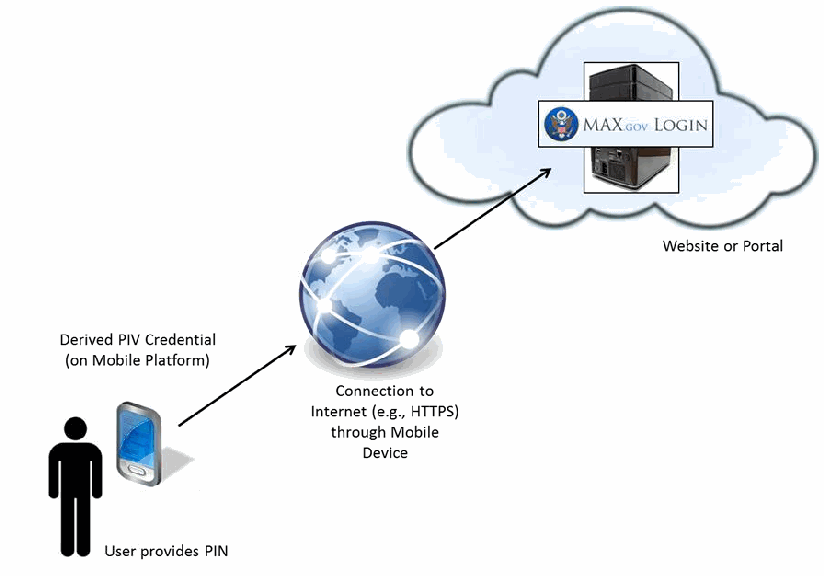
図1-1 派生PIV認証情報の使用。左下に「User provides PIN」と記された人物のシルエットがあり、「Derived PIV Credential (on Mobile Platform)」と記されたモバイルデバイスを持っている。デバイスから中央の地球儀へ矢印が延び、地球儀には「Connection to Internet (e.g., HTTPS) through Mobile Device」と記されている。地球儀から右上の「Website or Portal」と記された雲へもう1本の矢印が延び、雲の中には円形の紋章と「MAX.gov LOGIN」の表示が付いたサーバーがある。
Figure 1-1 Use of Derived PIV Credential
図1-1 派生PIV認証情報の使用
Derived PIV Credentials are based on the general concept of derived credential in [SP800-63], which leverages identity proofing and vetting results of current and valid credentials. When applied to PIV, identity proofing and vetting processes do not have to be repeated to issue a Derived PIV Credential. Instead, the user proves possession of a valid PIV Card to receive a Derived PIV Credential. The Derived PIV Credential is a Derived PIV Authentication certificate, which is an X.509 public key certificate that has been issued in accordance with the requirements of this document and the X.509 Certificate Policy for the U.S. Federal PKI Common Policy Framework [COMMON]. While the PIV Card may be used as the basis for issuing other types of derived credentials, the issuance of these other credentials is outside the scope of this document. Only derived credentials issued based on the PIV Card and in accordance with this document are considered to be Derived PIV credentials.
派生PIV認証情報は、現行かつ有効な認証情報の本人確認および審査結果を活用する、[SP800-63]の派生認証情報に関する一般概念に基づきます。PIVに適用する場合、派生PIV認証情報の発行にあたり、本人確認と審査のプロセスを繰り返す必要はありません。代わりに、利用者は有効なPIVカードを所持していることを証明し、派生PIV認証情報を受け取ります。派生PIV認証情報は派生PIV認証証明書であり、本書の要件および米国連邦PKI共通ポリシー・フレームワークのX.509証明書ポリシー[COMMON]に従って発行されたX.509公開鍵証明書です。PIVカードを他の種類の派生認証情報の発行基盤として使用することもできますが、そうした他の認証情報の発行は本書の適用範囲外です。PIVカードに基づき、本書に従って発行された派生認証情報のみを派生PIV認証情報とみなします。
This document provides the technical guidelines on:
本書では、次の技術ガイドラインを示します。
•The primary lifecycle activities for the Derived PIV Credential – initial issuance and maintenance – and the requirements for each activity to ensure security; and
•派生PIV認証情報の主なライフサイクル活動(初回発行および保守)と、セキュリティを確保するための各活動の要件。
•Technical requirements for the Derived PIV Credential including certificate policies, cryptographic specifications, types of cryptographic implementation that are permitted and mechanisms for activation and use of the credential.
•派生PIV認証情報に関する技術要件。これには、証明書ポリシー、暗号仕様、許可される暗号実装の種類、認証情報の有効化および使用の仕組みが含まれます。
The publication also includes an informative annex that provides recommendations for the inclusion of digital signature and key management keys on mobile devices.
本刊行物には、モバイルデバイスにデジタル署名鍵および鍵管理鍵を含めるための推奨事項を示す参考情報の付属書も含まれます。
1.3 Audience:
1.3 対象読者:
This document is targeted at stakeholders who will be responsible for procuring, designing, implementing, and managing deployments of Derived PIV Credentials for mobile devices.
本書の対象読者は、モバイルデバイス向けの派生PIV認証情報の導入について、調達、設計、実装、管理を担う関係者です。
1.4 Document Structure
1.4 文書の構成
The structure of the rest of this document is as follows. Each section is labeled as either normative (i.e., mandatory for compliance) or informative (i.e., non-mandatory).
本書の以降の構成は次のとおりです。各節には、規範的(すなわち適合に必須)または参考情報(すなわち非必須)のいずれかが明記されています。
•Section 2 describes Derived PIV Credential lifecycle activities and related requirements. This section is normative, with the exception of Section 2.1, which is informative.
•第2節では、派生PIV認証情報のライフサイクル活動と関連要件を説明します。この節は規範的です。ただし、第2.1節は参考情報です。
•Section 3 describes the technical requirements for implementing Derived PIV Credentials. This section is normative.
•第3節では、派生PIV認証情報を実装するための技術要件を説明します。この節は規範的です。
•Appendix A contains guidance on digital signature and key management keys. This appendix is informative.
•付録Aでは、デジタル署名鍵および鍵管理鍵に関するガイダンスを示します。この付録は参考情報です。
•Appendix B provides detailed interface requirements for the removable hardware implementations. This appendix is normative for implementation of Derived PIV Credentials on removable (non-embedded) hardware cryptographic tokens.
•付録Bでは、取り外し可能なハードウェア実装の詳細なインターフェース要件を示します。この付録は、取り外し可能な(非組込み型)ハードウェア暗号トークン上で派生PIV認証情報を実装する場合に規範的です。
•Appendix C provides example issuance processes for Derived PIV Credentials. This appendix is informative.
•付録Cでは、派生PIV認証情報の発行プロセスの例を示します。この付録は参考情報です。
•Appendix D summarizes the association of the Derived PIV Credentials’ token types with the electronic authentication policies in OMB memoranda M-06-16 and M-07-16. This appendix is informative.
•付録Dでは、派生PIV認証情報のトークン種別と、OMB覚書M-06-16およびM-07-16の電子認証ポリシーとの対応関係を要約します。この付録は参考情報です。
•Appendix E contains a glossary defining selected terms from this document. This appendix is informative.
•付録Eには、本書で使われる選定用語を定義する用語集が含まれます。この付録は参考情報です。
•Appendix F defines acronyms and other abbreviations used in this document. This appendix is informative.
•付録Fでは、本書で使われる頭字語およびその他の略語を定義します。この付録は参考情報です。
•Appendix G provides a list of references for this document. This appendix is informative.
•付録Gでは、本書の参考文献一覧を示します。この付録は参考情報です。
1.5 Key Terminology
1.5 重要な用語
Certain key PIV terms have assigned meanings within the context of this document. The term “PIV cardholder” refers to a person who possesses a valid PIV Card, regardless of whether they have been issued a Derived PIV Credential. The term “Applicant” refers to a PIV cardholder who is pending issuance of a Derived PIV Credential, and the term “Subscriber” refers to a PIV cardholder who has already been issued a Derived PIV Credential.
本書の文脈では、いくつかの重要なPIV用語に特定の意味を割り当てています。「PIVカード保有者」とは、派生PIV認証情報が発行されているかどうかにかかわらず、有効なPIVカードを所持する人を指します。「申請者」とは、派生PIV認証情報の発行を待つPIVカード保有者を指し、「登録者」とは、すでに派生PIV認証情報が発行されたPIVカード保有者を指します。
2. Lifecycle Activities and Related Requirements
2. ライフサイクル活動と関連要件
The lifecycle activities (phases) for a Derived PIV Credential are initial issuance and maintenance. This section describes these lifecycle activities and provides requirements and recommendations as appropriate.
派生PIV認証情報のライフサイクル活動(段階)は、初回発行と保守です。本節では、これらのライフサイクル活動を説明し、該当する要件および推奨事項を示します。
Issuers of Derived PIV Credentials must document the process for each of the lifecycle activities described below. In accordance with [HSPD-12], the reliability of the Derived PIV Credential issuer shall be established through an official accreditation process. The process, as outlined in [SP800-79], shall include an independent (third-party) assessment.
派生PIV認証情報の発行者は、以下に説明する各ライフサイクル活動のプロセスを文書化しなければなりません。[HSPD-12]に従い、派生PIV認証情報の発行者の信頼性は、正式な認定プロセスを通じて確立しなければなりません。[SP800-79]に示すとおり、このプロセスには独立した(第三者による)評価を含めなければなりません。
2.1 Derived PIV Credential Lifecycle Activities
2.1 派生PIV認証情報のライフサイクル活動
The Derived PIV Credential lifecycle consists of five activities. The activities that take place at the manufacturer during fabrication and pre-personalization of the cryptographic token are not considered part of this lifecycle model. Figure 2-1 presents these Derived PIV Credential activities alongside the PIV Card lifecycle activities.
派生PIV認証情報のライフサイクルは五つの活動で構成されます。暗号トークンの製造者がトークンの製造および事前個人化の過程で行う活動は、このライフサイクルモデルには含まれません。図2-1に、派生PIV認証情報の活動とPIVカードのライフサイクル活動を並べて示します。
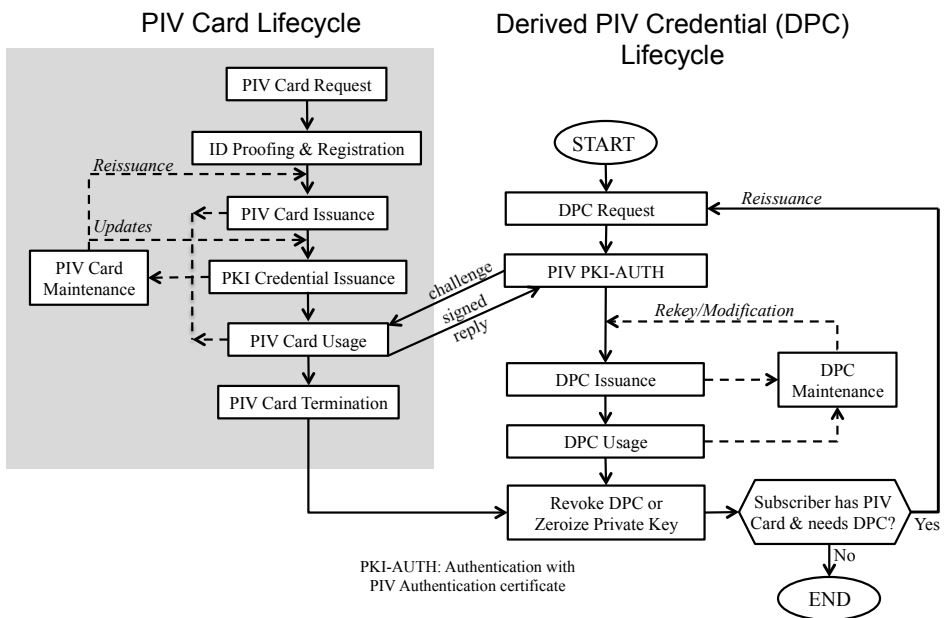
図2-1 派生PIV認証情報のライフサイクル活動。2 つの流れ図が横に並んでいる。左は灰色の背景で PIV Card Lifecycle(PIV カードのライフサイクル)と題され、PIV Card Request(PIV カードの申請)、ID Proofing & Registration(本人確認と登録)、PIV Card Issuance(PIV カードの発行)、PKI Credential Issuance(PKI 認証情報の発行)、PIV Card Usage(PIV カードの使用)、PIV Card Termination(PIV カードの利用終了)が下向きの矢印で結ばれている。PIV カードの発行、PKI 認証情報の発行、PIV カードの使用から、左の PIV Card Maintenance(PIV カードの保守)の箱へ破線の矢印が延び、PIV カードの保守からは Reissuance(再発行)と Updates(更新)と記された破線の矢印が、それぞれ PIV カードの発行の上と PKI 認証情報の発行の上の流れへ戻る。右は Derived PIV Credential (DPC) Lifecycle(派生 PIV 認証情報(DPC)のライフサイクル)と題され、START(開始)、DPC Request(DPC の申請)、PIV PKI-AUTH、DPC Issuance(DPC の発行)、DPC Usage(DPC の使用)、Revoke DPC or Zeroize Private Key(DPC を失効させる、または秘密鍵をゼロ化する)が下向きの矢印で結ばれている。PIV PKI-AUTH から PIV カードの使用へ challenge(チャレンジ)と記された矢印が延び、PIV カードの使用から signed reply(署名付きの応答)と記された矢印が戻る。DPC の発行と DPC の使用から DPC Maintenance(DPC の保守)の箱へ破線の矢印が延び、DPC の保守から Rekey/Modification(鍵の更新/変更)と記された破線の矢印が DPC の発行の上の流れへ戻る。PIV カードの利用終了からも線が「DPC を失効させる、または秘密鍵をゼロ化する」へ延び、そこから判断「Subscriber has PIV Card & needs DPC?」(登録者は PIV カードを保有し、DPC を必要とするか)へ矢印が延びる。Yes(はい)は DPC の申請へ戻り(Reissuance と記されている)、No(いいえ)は END(終了)へ向かう。注記に「PKI-AUTH: PIV 認証証明書による認証」とある。
Figure 2-1 Derived PIV Credential Lifecycle Activities
図2-1 派生PIV認証情報のライフサイクル活動
The Derived PIV Credential lifecycle begins with a request for the issuance of a Derived PIV Credential to the Applicant and validation of the request. This request may be part of the process of provisioning a PIV cardholder with a government-issued mobile device or of approving the use of a personally-owned mobile device to access government information systems (see [SP800-96] Draft NIST Special Publication 800-96, PIV Card to Reader Interoperability Guidelines, NIST, September 2006, or as amended. Available at http://csrc.nist.gov.
派生PIV認証情報のライフサイクルは、申請者への派生PIV認証情報の発行申請と、その申請の検証から始まります。この申請は、PIVカード保有者に政府支給のモバイルデバイスを提供する手続きの一部、または政府の情報システムにアクセスするために個人所有のモバイルデバイスを使用することを承認する手続きの一部となる場合がある([SP800-96] を参照してください。Draft NIST Special Publication 800-96, PIV Card to Reader Interoperability Guidelines, NIST, September 2006、または改訂版。入手先:http://csrc.nist.gov.
[SP800-124]).
[SP800-124])。
Once the request has been submitted the Applicant needs to authenticate to the Derived PIV Credential issuer using his/her PIV Card. The authentication is performed using the PKI-AUTH authentication mechanism from Section 6.2.3.1 of [FIPS201]. If the credential is being issued at LOA-3 this authentication may be performed remotely. At LOA-4, the authentication needs to be performed in person and has to be accompanied by a biometric authentication. In addition to authenticating the cardholder, performing the PKI-AUTH authentication mechanism verifies that the Applicant is currently eligible to possess PIV credentials. After the Applicant has been authenticated the Derived PIV Credential may be issued by the certification authority. The Derived PIV Credential may then be used for authentication to remote systems in the same way as the PIV Authentication certificate on the PIV Card is used.
申請を提出した後、申請者はPIVカードを用いて派生PIV認証情報の発行者に対する認証を行う必要があります。認証には、[FIPS201]の第6.2.3.1節に示すPKI-AUTH認証メカニズムを用います。LOA-3で認証情報を発行する場合、この認証を遠隔で実施してもよいです。LOA-4では、対面で認証を行い、生体認証も併せて実施する必要があります。カード保有者の認証に加え、PKI-AUTH認証メカニズムを実行することで、申請者が現在もPIV認証情報を保有する資格があることを確認します。申請者の認証後、認証局が派生PIV認証情報を発行してもよいです。その後、派生PIV認証情報は、PIVカード上のPIV認証証明書と同じ方法でリモートシステムへの認証に使用できます。
The maintenance activities for a Derived PIV Credential are the same as for other X.509 public key certificate. Certificate re-key is typically used to replace a certificate that is nearing expiration. Certificate modification is used to replace a certificate if information about the Subscriber that appears in the certificate needs to be changed.
派生PIV認証情報の保守活動は、他のX.509公開鍵証明書の場合と同じです。証明書の鍵更新は、通常、有効期限が近づいた証明書を置き換えるために行います。証明書の変更は、証明書に記載された登録者に関する情報を変更する必要がある場合に、その証明書を置き換えるために行います。
When the token containing the private key corresponding to the Derived PIV Credential is lost, stolen, damaged, or is being transferred to another individual, or when the Subscriber becomes ineligible to possess a PIV credential, the issuer needs to prevent further use of the Derived PIV Credential. If the private key corresponding to the Derived PIV Credential is created and stored on a hardware token that does not permit the key to be exported then this may be accomplished by zeroizing the private key or by destroying the token. In other cases, including when the token has been lost or stolen, the Derived PIV Credential (i.e., the Derived PIV Authentication certificate) needs to be revoked in order to ensure that it will no longer be accepted by relying parties. If the Derived PIV Credential was revoked (or the private key was zeroized) because the Subscriber is no longer eligible to possess a PIV Card or because the Subscriber no longer has a need for a Derived PIV Credential, then a new Derived PIV Credential cannot be issued. Otherwise, a new Derived PIV Credential may be issued by following the initial issuance process.
派生PIV認証情報に対応する秘密鍵を格納したトークンを紛失、盗難、破損した場合、別の個人に移転する場合、または登録者がPIV認証情報を保有する資格を失った場合、発行者は派生PIV認証情報をそれ以降使用できないようにする必要があります。派生PIV認証情報に対応する秘密鍵が、鍵のエクスポートを許可しないハードウェアトークン上で生成・保管されている場合、秘密鍵をゼロ化するかトークンを破壊することでこれを実現できます。トークンを紛失または盗難された場合を含むその他のケースでは、依拠当事者に受け入れられなくなるよう、派生PIV認証情報(すなわち派生PIV認証証明書)を失効させる必要があります。登録者がPIVカードを保有する資格を失ったため、または派生PIV認証情報を必要としなくなったために派生PIV認証情報を失効させた(または秘密鍵をゼロ化した)場合、新たな派生PIV認証情報を発行することはできません。それ以外の場合、新たな派生PIV認証情報は初回発行プロセスに従って発行してもよいです。
2.2 Initial Issuance
2.2 初回発行
The initial issuance activity deals with the identification of an Applicant and the issuance of the Derived PIV Credential and other related data.
初回発行活動では、申請者を識別し、派生PIV認証情報およびその他の関連データを発行します。
A Derived PIV Credential shall be issued following verification of the Applicant’s identity using the PIV Authentication key on his or her existing PIV Card. Verification is demonstrated by proving possession and control of the PIV Card through the PKI-AUTH authentication mechanism as per section 6.2.3.1 of [FIPS201]. The revocation status of the Applicant’s PIV Authentication certificate should be rechecked seven (7) calendar days following issuance of the Derived PIV Credential – this step can detect the use of a compromised PIV Card to obtain a Derived PIV Credential.
派生PIV認証情報は、既存のPIVカード上のPIV認証鍵を用いて申請者の本人確認を行った後に発行しなければなりません。本人確認は、[FIPS201]の6.2.3.1節に従い、PKI-AUTH認証メカニズムを通じてPIVカードの所持および制御を証明することで実証します。派生PIV認証情報の発行から7(七)暦日後に、申請者のPIV認証証明書の失効状態を再確認すべきです。この手順により、侵害されたPIVカードを使って派生PIV認証情報を取得したケースを検出できます。
Derived PIV Credentials can be issued at identity assurance levels three or four (LOA-3 or LOA-4). The credential resides on a hardware or software security token as illustrated in Table D-1. Appendix C provides example issuance processes for Derived PIV Credentials.
派生PIV認証情報は、本人確認保証レベル3または4(LOA-3またはLOA-4)で発行できます。この認証情報は、表D-1に示すように、ハードウェアまたはソフトウェアのセキュリティトークン上に格納されます。付録Cに、派生PIV認証情報の発行プロセスの例を示します。
An LOA-3 Derived PIV Credential may be issued remotely or in person in accordance with [SP800-63]. If the credential is issued remotely, all communications shall be authenticated and protected from modification (e.g., using Transport Layer Security (TLS)), and encryption shall be used, if necessary, to protect the confidentiality of any private or secret data. Moreover, if the issuance process involves two or more electronic transactions, the Applicant must identify himself/herself in each new encounter by presenting a temporary secret that was issued in a previous transaction, as described in Section 5.3.1 of [SP800-63].
LOA-3の派生PIV資格情報は、[SP800-63]に従い、遠隔または対面で発行できます。遠隔で発行する場合、すべての通信を認証し、改変から保護しなければならない(例:トランスポート層セキュリティ(TLS)を使用)。また、秘密データまたは機密データの機密性を保護するために必要な場合は、暗号化を使用しなければなりません。さらに、発行プロセスに2回以上の電子的な取引が含まれる場合、申請者は、[SP800-63]の5.3.1節に記載のとおり、前の取引で発行された一時的な秘密情報を提示し、新たなやり取りのたびに本人を識別しなければなりません。
An LOA-4 Derived PIV Credential shall be issued in person, in accordance with [SP800-63], and the Applicant shall identify himself/herself using a biometric sample that can be verified against the Applicant’s PIV Card. If there are two or more transactions during the issuance process, the Applicant shall identify himself/herself using a biometric sample that can either be verified against the PIV Card or against a biometric that was recorded in a previous transaction. The issuer shall retain for future reference the biometric sample used to validate the Applicant.4
LOA-4の派生PIV資格情報は、[SP800-63]に従って対面で発行しなければならず、申請者は、PIVカードと照合できる生体サンプルを用いて本人を識別しなければなりません。発行プロセス中に2回以上の取引がある場合、申請者は、PIVカードと照合できる生体サンプル、または前の取引で記録された生体情報と照合できる生体サンプルを用いて本人を識別しなければなりません。発行者は、申請者の検証に使用した生体サンプルを、将来参照できるよう保持しなければなりません。4
It may be noted that this guideline doesn’t preclude the issuance of multiple Derived PIV Credentials to the same Applicant on the basis of the same PIV Card. Issuing several Derived PIV Credentials to an individual, however, could increase the risk that one of the tokens will be lost/stolen without the loss being reported, or that the Subscriber will inappropriately provide one of the tokens to someone else.
この指針は、同じPIVカードに基づき、同一の申請者に複数の派生PIV認証情報を発行することを妨げません。ただし、個人に複数の派生PIV認証情報を発行すると、トークンの紛失または盗難が届け出られないままになるリスクや、登録者がトークンの1つを不適切に他者へ渡すリスクが高まる可能性があります。
2.3 Maintenance
2.3 保守
Derived PIV Credentials may require typical maintenance activities applicable to asymmetric cryptographic credentials – these maintenance activities include rekey, modification, and revocation. These activities may be performed either remotely or in-person and shall be performed in accordance with the certificate policy under which the Derived PIV Authentication certificate is issued. When certificate re-key or modification is performed remotely for an LOA-4 Derived PIV Credential, the following shall apply:
派生PIV認証情報には、公開鍵暗号認証情報に一般的に適用される保守作業が必要となる場合があります。これには鍵更新、変更、および失効が含まれます。これらの作業は遠隔または対面で実施でき、派生PIV認証証明書が発行された証明書ポリシーに従って実施しなければなりません。LOA-4の派生PIV認証情報について、証明書の鍵更新または変更を遠隔で行う場合、以下を適用しなければなりません。
•Communication between the issuer and the cryptographic module in which the Derived PIV Authentication private key is stored shall occur only over mutually authenticated secure sessions between tested and validated cryptographic modules.5
•発行者と、派生PIV認証用秘密鍵が格納されている暗号モジュールとの間の通信は、試験および検証済みの暗号モジュール間で相互認証されたセキュアセッションを介してのみ行わなければなりません。5
•Data transmitted between the issuer and the cryptographic module in which the Derived PIV Authentication private key is stored shall be encrypted and contain data integrity checks.
•発行者と、派生PIV認証秘密鍵が格納されている暗号モジュールとの間で送信されるデータは、暗号化され、データ完全性検査を含まなければなりません。
The initial issuance process (Section 2.2, above) shall be followed for:
以下については、初回発行プロセス(上記2.2節)に従わなければなりません。
1) re-key of an expired or compromised Derived PIV credential or
1) 期限切れまたは侵害された派生PIV資格情報の鍵更新、または
2) re-key of a Derived PIV Credential at LOA-4 to a new hardware token.
2) LOA-4の派生PIV認証情報の、新しいハードウェアトークンへの鍵更新。
The Derived PIV Authentication certificate shall be revoked or the token containing the corresponding private key shall be either zeroized or destroyed when the binding between the Subscriber and the token containing the private key corresponding to the certificate is no longer considered valid or when the Subscriber no longer requires a Derived PIV Credential. Examples of circumstances that require one of these actions are–
加入者と、証明書に対応する秘密鍵を格納するトークンとの結び付きがもはや有効とみなされない場合、または加入者が派生PIV資格情報を必要としなくなった場合、派生PIV認証証明書を失効させるか、対応する秘密鍵を含むトークンをゼロ化または破壊しなければなりません。これらの措置が必要となる状況の例を以下に示します。
•The token containing the private key corresponding to the Derived PIV Credential is lost, stolen, damaged or compromised.6
•派生PIV資格情報に対応する秘密鍵を含むトークンが紛失、盗難、損傷、または侵害されました。6
•The token containing the private key corresponding to the Derived PIV Credential is transferred to another individual, including when a mobile device with an embedded cryptographic module is transferred to another individual.
•派生PIV資格情報に対応する秘密鍵を含むトークンが別の個人に譲渡された場合。これには、暗号モジュールを内蔵したモバイルデバイスを別の個人に譲渡する場合も含まれます。
•The department or agency that issued the credential determines that the Subscriber is no longer eligible to have a PIV Card (i.e., PIV Card is terminated7).
•資格情報を発行した省庁または機関が、加入者はPIVカードを保有する資格をもはや有しないと判断した場合(すなわち、PIVカードの利用が終了した場合7)。
•The department or agency that issued the credential determines that the Subscriber no longer requires a Derived PIV Credential, even if the Subscriber’s PIV Card is not being terminated. This may happen, for example, when the Subscriber’s role in the agency changes such that he/she no longer has the need to access agency resources from a mobile device using a Derived PIV Credential.
•資格情報を発行した省庁または機関が、加入者のPIVカードを利用停止にしない場合であっても、加入者は派生PIV資格情報をもはや必要としないと判断した場合。例えば、機関内で加入者の役割が変わり、派生PIV資格情報を用いてモバイルデバイスから機関のリソースにアクセスする必要がなくなった場合がこれに該当します。
If the Derived PIV Authentication private key was created and stored on a hardware cryptographic token that does not permit export of the private key and the token was collected and either zeroized or destroyed, then revocation of the Derived PIV Authentication certificate is optional. In all other cases, revocation of the Derived PIV Authentication certificate is mandatory. The Derived PIV Credential is unaffected when the Subscriber replaces his/her PIV Card (reissuance) with a new PIV Card, including when the PIV Card is lost, stolen, or damaged.8,9 The ability to use the Derived PIV Credential is especially useful in such circumstances because the PIV Card is unavailable, yet, while waiting to be issued a new PIV Card, the Subscriber is able to use the Derived PIV Credential to gain logical access to remote Federally controlled information systems from his/her mobile device. Similarly, the Derived PIV Credential is not necessarily affected by the revocation of the PIV Authentication certificate. Some maintenance activities for the Subscriber’s PIV Card may trigger corresponding maintenance activities for the Derived PIV Credential, since the Derived PIV Credential will need to be reissued if any information about the Subscriber that appears in the credential changes. For example, if the Subscriber’s PIV Card is reissued as a result of the Subscriber’s name changing and the Subscriber’s name appears in the Derived PIV Authentication certificate, a new Derived PIV Authentication certificate with the new name will also need to be issued.
派生PIV認証用秘密鍵が、秘密鍵のエクスポートを認めないハードウェア暗号トークン上で生成・保管され、そのトークンが回収されてゼロ化または破壊された場合、派生PIV認証証明書の失効は任意です。それ以外の場合、派生PIV認証証明書の失効は必須です。加入者がPIVカードを新しいPIVカードに交換(再発行)する場合、PIVカードの紛失、盗難、または損傷を理由に交換する場合も含め、派生PIV認証情報には影響しません。8,9 このような状況では、PIVカードを利用できない一方、新しいPIVカードの発行を待つ間、加入者は派生PIV認証情報を使ってモバイルデバイスから連邦政府管理下の遠隔情報システムに論理アクセスできるため、特に有用です。同様に、PIV認証証明書が失効しても、派生PIV認証情報が必ず影響を受けるとは限りません。加入者のPIVカードに関する保守作業により、派生PIV認証情報にも対応する保守作業が必要になる場合があります。派生PIV認証情報に記載された加入者情報に変更があれば、再発行する必要があるためです。例えば、加入者の氏名変更に伴いPIVカードが再発行され、加入者の氏名が派生PIV認証証明書に記載されている場合、新しい氏名を記載した派生PIV認証証明書も発行する必要があります。
2.4 Linkage with PIV Card
2.4 PIVカードとの連携
A Derived PIV Credential issuer shall only issue a Derived PIV Credential to an Applicant if it has access to information about the Applicant’s PIV Card from the issuer of the PIV Card. In particular the Derived PIV Credential issuer shall have a mechanism to periodically check with the PIV Card issuer to determine if the PIV Card has been terminated or if information about the individual that will appear in the Derived PIV Credential (e.g., name) has changed, as these would require revocation or modification of the Derived PIV Credential.
派生PIV認証情報の発行者は、PIVカード発行者から申請者のPIVカードに関する情報を入手できる場合に限り、申請者に派生PIV認証情報を発行しなければなりません。特に、派生PIV認証情報の発行者は、PIVカードが終了されているか、または派生PIV認証情報に記載される個人情報(例:氏名)が変更されたかを確認するため、PIVカード発行者に定期的に照会する仕組みを備えなければなりません。このような状況では、派生PIV認証情報の失効または変更が必要となります。
Section 2.9.4 of FIPS 201-2 requires PIV Card termination to be performed within 18 hours for cases where the PIV card cannot be collected. To maintain up-to-date status of the PIV Card, it is recommended that a Derived PIV Credential issuer check every 18 hours on the termination status. The periodic checking requirement can also be met if: 1) a notification mechanism is in place between the PIV Card issuer and Derived PIV Credential issuer or 2) the PIV Card record and the Derived PIV Credential record are stored in the same system and termination of the PIV Card automatically triggers termination of the Derived PIV Credential.
FIPS 201-2の2.9.4節では、PIVカードを回収できない場合、18時間以内にPIVカードを利用停止にすることを求めています。PIVカードの状態を最新に保つため、派生PIV資格情報の発行者は、利用停止状態を18時間ごとに確認することが推奨されます。次のいずれかの場合にも、PIVカードの利用停止状態を定期確認する要件を満たすことができます。1) PIVカード発行者と派生PIV資格情報発行者との間に通知メカニズムがある場合、または2) PIVカードの記録と派生PIV資格情報の記録が同じシステムに保存され、PIVカードの利用停止によって派生PIV資格情報も自動的に利用停止になる場合。
The issuer of the Derived PIV Credential shall not solely rely on tracking the revocation status of the PIV Authentication certificate as a means of tracking the termination status of the PIV Card. This is because there are scenarios where the card’s PIV Authentication certificate is not revoked even though the PIV Card has been terminated. This may happen, for example, when a terminated PIV Card is collected and either zeroized or destroyed by an agency – in this case, in accordance with [FIPS201], the corresponding PIV Authentication certificate does not need to be revoked.
派生PIV資格情報の発行者は、PIVカードの利用停止状態を追跡する手段として、PIV認証証明書の失効状態の追跡だけに依存してはなりません。PIVカードが利用停止になっていても、そのカードのPIV認証証明書が失効しない状況があるためです。例えば、利用停止されたPIVカードが機関によって回収され、ゼロ化または破壊された場合がこれに該当します。この場合、[FIPS201]に従い、対応するPIV認証証明書を失効させる必要はありません。
Additional methods must be employed for obtaining information about the PIV Card from the PIV Card issuer. Some example mechanisms are listed below – however, any other mechanism that meets the above requirements is also acceptable.
PIVカード発行者からPIVカードに関する情報を取得するため、追加の方法を採用しなければなりません。以下にメカニズムの例を示しますが、上記要件を満たす他のメカニズムも許容されます。
•If the Derived PIV Credential is issued by the same agency or issuer that issued the Subscriber’s PIV Card, then the Derived PIV Credential issuer may have direct access to the Identity Management System (IDMS) database implemented by the issuing agency that contains the relevant information about the Subscriber.
•派生PIV資格情報が、加入者のPIVカードを発行した機関または発行者によって発行される場合、派生PIV資格情報の発行者は、発行機関が実装したID管理システム(IDMS)データベースに直接アクセスできる場合があります。このデータベースには、加入者に関する関連情報が含まれます。
•When the issuer of the Derived PIV Credential is different from the PIV Card Issuer, the following mechanisms may be applied:
•派生PIV資格情報の発行者がPIVカード発行者と異なる場合、次のメカニズムを適用できます。
•The Backend Attribute Exchange [BAE] can be queried for the termination status of the PIV Card, if an attribute providing this information is defined and the issuer of the PIV Card maintains this attribute for the Subscriber. The BAE can also be queried for other attributes about the Subscriber (e.g., name) that may appear in the Derived PIV Authentication certificate.
•バックエンド属性交換(BAE)は、この情報を提供する属性が定義され、PIVカード発行者が加入者についてその属性を維持している場合、PIVカードの利用停止状態について照会できます。BAEには、派生PIV認証証明書に記載される可能性のある加入者の他の属性(例:氏名)についても照会できます。
•The issuer of the Derived PIV Credential notifies the original PIV issuer when a Derived PIV Credential is created. The issuer of the PIV Card maintains a list of corresponding Derived PIV Credential issuers and sends notification to the latter set when the PIV Card is terminated or when attributes about the cardholder change. Such notification should provide evidence of receipt and the integrity of the message.
•派生PIV資格情報の発行者は、派生PIV資格情報の作成時に元のPIV発行者へ通知します。PIVカード発行者は、対応する派生PIV資格情報の発行者一覧を維持し、PIVカードが利用停止になったとき、またはカード保有者の属性が変更されたときに、その発行者群へ通知します。このような通知では、受領の証拠およびメッセージの完全性を示すべきです。
•If a Uniform Reliability and Revocation Service (URRS) is implemented in accordance with Section 3.7 of [NISTIR7817], the issuer of a Derived PIV Credential may obtain termination status of the Subscriber’s PIV Card through the URRS.
•[NISTIR7817]の3.7節に従って統合信頼性・失効サービス(URRS)が実装されている場合、派生PIV資格情報の発行者は、URRSを通じて加入者のPIVカードの利用停止状態を取得できます。
3. Technical Requirements
3. 技術要件
This section describes technical requirements related to Derived PIV Credentials and their tokens.
本節では、派生PIV資格情報およびそのトークンに関する技術要件を説明します。
3.1 Certificate Policies
3.1 証明書ポリシー
Derived PIV Authentication certificates shall be issued under either the id-fpki-common-pivAuth-derived-hardware (LOA-4) or the id-fpki-common-pivAuth-derived (LOA-3) policy of the X.509 Certificate Policy for the U.S. Federal PKI Common Policy Framework [COMMON]. A Derived PIV Credential shall be deemed to satisfy e-Authentication LOA-4 if it is issued in conformance with the id-fpki-common-pivAuth-derived-hardware certificate policy, and e-Authentication LOA-3 if it is issued in conformance with the id-fpki-common-pivAuth-derived certificate policy.
派生PIV認証証明書は、米国連邦PKI共通ポリシーフレームワークのX.509証明書ポリシー[COMMON]に定める、id-fpki-common-pivAuth-derived-hardware(LOA-4)またはid-fpki-common-pivAuth-derived(LOA-3)のいずれかのポリシーに基づき発行しなければなりません。派生PIV資格情報は、id-fpki-common-pivAuth-derived-hardware証明書ポリシーに準拠して発行された場合、e-Authentication LOA-4を満たすものとみなさなければならず、id-fpki-common-pivAuth-derived証明書ポリシーに準拠して発行された場合、e-Authentication LOA-3を満たすものとみなさなければなりません。
The Derived PIV Authentication certificate shall comply with Worksheet 10: Derived PIV Authentication Certificate Profile in [PROF].
派生PIV認証証明書は、[PROF]のワークシート10「派生PIV認証証明書プロファイル」に準拠しなければなりません。
The expiration date of the Derived PIV Authentication certificate is based on the certificate policy of the issuer. There is no requirement to align the expiration date of the Derived PIV Authentication certificate with the expiration date of the PIV Authentication certificate or the expiration of the PIV Card; however, in many cases aligning the expiration dates will simplify lifecycle management.
派生PIV認証証明書の有効期限は発行者の証明書ポリシーに基づきます。派生PIV認証証明書の有効期限を、PIV認証証明書またはPIVカードの有効期限に合わせる要件はありません。ただし、多くの場合、有効期限を合わせるとライフサイクル管理が簡素化されます。
3.2 Cryptographic Specifications
3.2 暗号仕様
The cryptographic algorithm and key size requirements for the Derived PIV Authentication certificate and private key are the same as the requirements for the PIV Authentication certificate and private key, as specified in [SP800-78].
派生PIV認証証明書および秘密鍵に関する暗号アルゴリズムと鍵長の要件は、[SP800-78]に規定されるPIV認証証明書および秘密鍵の要件と同じです。
For Derived PIV Authentication certificates issued under id-fpki-common-pivAuth-derived-hardware (LOA-4), the Derived PIV Authentication key pair shall be generated within a hardware cryptographic module that has been validated to [FIPS140] Level 2 or higher that provides Level 3 physical security to protect the Derived PIV Authentication private key while in storage and that does not permit exportation of the private key.
id-fpki-common-pivAuth-derived-hardware(LOA-4)に基づいて発行される派生PIV認証証明書については、派生PIV認証鍵ペアを、[FIPS140]レベル2以上で検証され、保存中の派生PIV認証秘密鍵を保護するレベル3の物理セキュリティを提供し、秘密鍵のエクスポートを認めないハードウェア暗号モジュール内で生成しなければなりません。
For Derived PIV Authentication certificates issued under id-fpki-common-pivAuth-derived (LOA-3), the Derived PIV Authentication key pair shall be generated within a cryptographic module that has been validated to [FIPS140] Level 1 or higher.
id-fpki-common-pivAuth-derived(LOA-3)に基づいて発行される派生PIV認証証明書については、派生PIV認証鍵ペアを、[FIPS140]レベル1以上で検証された暗号モジュール内で生成しなければなりません。
3.3 Cryptographic Token Types
3.3 暗号トークンの種類
The Derived PIV Credentials and their corresponding private keys may be used in a variety of cryptographic tokens available for use on mobile devices. These tokens may be hardware or software-only implementations.
派生PIV資格情報およびそれに対応する秘密鍵は、モバイルデバイスで使用可能なさまざまな暗号トークンで使用できます。これらのトークンは、ハードウェア実装またはソフトウェアのみの実装であってもよいです。
Hardware tokens may either be removable or embedded within a mobile device. Three kinds of removable hardware tokens are permitted, each with well-defined physical and logical interfaces, to facilitate token portability between mobile devices in a manner analogous to PIV Card interchangeability. Embedded hardware tokens are not removable from the mobile device, and may be accessed by software using the underlying cryptographic interface of the mobile device; however, nothing here is intended to either require or prohibit emulation of PIV Card or a removable token software interface. Similar rules apply to embedded software tokens; nothing here is intended to either require or prohibit the emulation of the software interfaces to PIV Cards or other removable tokens.
ハードウェアトークンは、取り外し可能なものとモバイルデバイスに組み込まれたもののいずれでもよいです。取り外し可能なハードウェアトークンは、PIVカードの相互交換性と同様に、モバイルデバイス間でトークンを移動できるよう、明確に定義された物理インターフェースおよび論理インターフェースを持つ3種類が許可されます。組み込み型ハードウェアトークンはモバイルデバイスから取り外せず、デバイスの基盤となる暗号インターフェースを使用するソフトウェアからアクセスできます。ただし、本書は、PIVカードまたは取り外し可能なトークンのソフトウェアインターフェースのエミュレーションを要求も禁止もしません。組み込み型ソフトウェアトークンにも同様の規則が適用されます。本書は、PIVカードまたはその他の取り外し可能なトークンのソフトウェアインターフェースのエミュレーションを要求も禁止もしません。
The cryptographic tokens permitted for Derived PIV Credentials are described in the subsections below.
派生PIV資格情報に使用が許可される暗号トークンについて、以下の各小節で説明します。
3.3.1 Removable (Non-Embedded) Hardware Cryptographic Tokens
3.3.1 取り外し可能(非組み込み型)ハードウェア暗号トークン
This section provides requirements for implementations where the Derived PIV Authentication private key resides in a hardware cryptographic module (or token) that can be removed from the mobile device. In such cases, a Derived PIV Application, as defined in Appendix B, shall be installed on the hardware cryptographic token. The use of this data model and its interface supports interoperability and ensures the Derived PIV Credential interface is aligned with the interface of the PIV Card.
派生PIV認証秘密鍵が、モバイルデバイスから取り外せるハードウェア暗号モジュール(またはトークン)に格納される実装について、本節では要件を定めます。この場合、付録Bで定義する派生PIVアプリケーションをハードウェア暗号トークンにインストールしなければなりません。このデータモデルおよびインターフェースを使用することで、相互運用性が支援され、派生PIV資格情報のインターフェースがPIVカードのインターフェースと整合します。
The permitted types of removable hardware cryptographic tokens are described in the following subsections. Each token type is a standards-based hardware form-factor that supports compatibility and portability across a variety of mobile computing devices. In each case, the form-factor supports a secure element (SE), a tamper resistant cryptographic component that provides security and confidentiality.
使用が許可される取り外し可能なハードウェア暗号トークンの種類について、以下の各小節で説明します。各トークンの種類は、さまざまなモバイルコンピューティングデバイス間の互換性と可搬性を支える、標準ベースのハードウェアフォームファクターです。いずれのフォームファクターも、セキュリティと機密性を提供する耐タンパー性の暗号コンポーネントであるセキュアエレメント(SE)を備えます。
The Application Protocol Data Units (APDUs) for the Derived PIV Application command interface (as defined in Appendix B) are transported to the secure element within each form-factor over a transport protocol appropriate for that form factor. Further details of the required transport protocols are provided below.
派生PIVアプリケーションのコマンドインターフェース(付録Bで定義)のアプリケーションプロトコルデータユニット(APDU)は、各フォームファクターに適したトランスポートプロトコルを介して、そのフォームファクター内のセキュアエレメントに転送されます。必要なトランスポートプロトコルの詳細を以下に示します。
As described in Appendix B, the Derived PIV Application may include digital signature and key management private keys and their corresponding certificates in addition to the Derived PIV Authentication private key and its corresponding certificate.
付録Bに記載のとおり、派生PIVアプリケーションには、派生PIV認証秘密鍵およびそれに対応する証明書に加えて、電子署名用および鍵管理用の秘密鍵ならびにそれらに対応する証明書を含めてもよいです。
3.3.1.1 SD Card with Cryptographic Module
3.3.1.1 暗号モジュールを備えたSDカード
A Secure Digital (SD) Card is a non-volatile memory card format for use in portable devices such as mobile phones and tablet computers. The SD format is available in three different physical sizes – "original," "mini," and "micro." While any size is permissible for Derived PIV Credential issuance, the microSD form factor is the most likely to be available for use within a mobile device.
セキュアデジタル(SD)カードは、携帯電話やタブレット型コンピュータなどの携帯機器で使用される不揮発性メモリカード形式です。SD形式には「original」、「mini」、および「micro」の3種類の物理サイズがあります。派生PIV資格情報の発行にはいずれのサイズも使用できますが、モバイルデバイス内で使用できる可能性が最も高いのはmicroSDフォームファクターです。
A Derived PIV Application may reside on an SD Card implementation that includes an on-board secure element or security system. An example of a security system is an implementation of the smartSD standard, which describes a smart card element within an SD memory card.
派生PIVアプリケーションは、オンボードのセキュアエレメントまたはセキュリティシステムを備えるSDカード実装上に格納してもよいです。セキュリティシステムの例として、SDメモリカード内のスマートカード要素を規定するsmartSD規格の実装があります。
The secure element used for the Derived PIV Application shall support an interface with the card commands specified in Appendix B of this document. It should be noted that there is no widely adopted interoperable standard transport mechanism for the APDUs, which may limit portability between devices.
派生PIVアプリケーションに使用するセキュアエレメントは、本書の付録Bに規定するカードコマンドとのインターフェースをサポートしなければなりません。APDU用に広く採用された相互運用可能な標準トランスポート機構が存在しないため、デバイス間の可搬性が制限される場合があることに留意されました。
3.3.1.2 Removable UICC with Cryptographic Module
3.3.1.2 暗号モジュールを備えた取り外し可能なUICC
The Universal Integrated Circuit Card (UICC) configuration is based on the GlobalPlatform Card Specification v2.2.1 [GP-SPEC]. The UICC configuration standardizes a minimum level of interoperability for mobile products that support remote application management. UICC represents a new generation Subscriber Identity Module (SIM) card.
ユニバーサル集積回路カード(UICC)の構成は、[GP-SPEC]のGlobalPlatform Card Specification v2.2.1に基づきます。UICC構成は、リモートアプリケーション管理をサポートするモバイル製品において、最低限の相互運用性を標準化します。UICCは、新世代の加入者識別モジュール(SIM)カードです。
The UICC includes storage and processing, as well as input/output capabilities. Unlike the SIM card, the UICC can also support a variety of other applications and services and multiple security domains.10 [GP-A] defines a mechanism for an application provider to manage (i.e., load, install and personalize) its application in a confidential manner while using a third party communication network. The Derived PIV Application shall be installed in a security domain that is separate from other security domains, dedicated to the Derived PIV Credential, and under the explicit control of the issuing agency. The APDUs as specified in Appendix B shall be used with this secure element containing the PIV Derived Application.11
UICCは、記憶機能、処理機能、および入出力機能を備えます。SIMカードと異なり、UICCはその他のさまざまなアプリケーションやサービス、ならびに複数のセキュリティドメインもサポートできます。10 [GP-A]は、アプリケーション提供者が、第三者の通信ネットワークを利用しながら、自らのアプリケーションを機密性を保って管理(すなわち、ロード、インストール、個人化)するための仕組みを定義しています。派生PIVアプリケーションは、他のセキュリティドメインとは分離され、派生PIV資格情報専用で、かつ発行機関の明示的な管理下にあるセキュリティドメインにインストールしなければなりません。付録Bに規定するAPDUは、この派生PIVアプリケーションを格納するセキュアエレメントとともに使用しなければなりません。11
A UICC is a secure element, which may be capable of hosting a Derived PIV Application. A UICC used to host a Derived PIV Credential shall implement the GlobalPlatform Card Secure Element Configuration v1.0 [GP-SE].
UICCは、派生PIVアプリケーションを格納できる場合があるセキュアエレメントです。派生PIV資格情報を格納するために使用するUICCは、GlobalPlatform Card Secure Element Configuration v1.0 [GP-SE]を実装しなければなりません。
3.3.1.3 USB Token with Cryptographic Module
3.3.1.3 暗号モジュールを備えたUSBトークン
A Universal Serial Bus (USB) token is a device that plugs into the USB port on various IT computing platforms, including mobile devices. USB tokens typically include onboard storage and may also include cryptographic processing capabilities (e.g., cryptographic mechanisms to verify the identity of users).
ユニバーサルシリアルバス(USB)トークンは、モバイルデバイスを含むさまざまなITコンピューティングプラットフォームのUSBポートに接続するデバイスです。USBトークンは通常、オンボードストレージを備え、暗号処理機能(例:ユーザーの本人確認に用いる暗号メカニズム)を備える場合もあります。
USB token implementations that contain an integrated secure element (an Integrated Circuit Card or ICC) are suitable for issuance of Derived PIV Credentials. Such implementations are called USB Integrated Circuit(s) Card Devices (ICCD) and shall comply with the Universal Serial Bus Device Class: Smart Card ICCD Specification for USB Integrated Circuit(s) Card Devices [ICCDSPEC].
集積セキュアエレメント(集積回路カード、ICC)を含むUSBトークンの実装は、派生PIV資格情報の発行に適しています。このような実装はUSB集積回路カードデバイス(ICCD)と呼ばれ、Universal Serial Bus Device Class: Smart Card ICCD Specification for USB Integrated Circuit(s) Card Devices [ICCDSPEC]に準拠しなければなりません。
The APDUs for the Derived PIV Application (as specified in Appendix B) shall be transported to the secure element using the Bulk-Out command pipe and the responses shall be received from the secure element using the Bulk-In command pipe.
派生PIVアプリケーション用APDU(付録Bに規定)は、Bulk-Outコマンドパイプを用いてセキュアエレメントに転送し、応答はBulk-Inコマンドパイプを用いてセキュアエレメントから受信しなければなりません。
USB tokens with cryptographic modules that support a Derived PIV Application shall also be compliant with the specifications in [SP800-96] for APDU support for contact card readers. The requirements for the Application Programming Interface (API) for Derived PIV Application implementations are beyond the scope of this document.
派生PIVアプリケーションをサポートする暗号モジュールを備えたUSBトークンは、接触型カードリーダーのAPDUサポートに関する[SP800-96]の仕様にも準拠しなければなりません。派生PIVアプリケーション実装向けアプリケーションプログラミングインターフェース(API)の要件は、本書の対象範囲外です。
3.3.2 Embedded Cryptographic Tokens
3.3.2 組み込み型暗号トークン
A Derived PIV Credential and its associated private key may be used in cryptographic modules that are embedded within mobile devices (see Draft NIST Interagency Report 7981, Mobile, PIV, and Authentication [NISTIR7981]). These modules may either be in the form of a hardware cryptographic module that is a component of the mobile device or in the form of a software cryptographic module that runs on the device.
派生PIV資格情報およびそれに関連する秘密鍵は、モバイルデバイスに組み込まれた暗号モジュール内で使用してもよいです(草案NIST省庁間報告書7981「モバイル、PIV、および認証」[NISTIR7981]を参照してください)。これらのモジュールは、モバイルデバイスの構成要素であるハードウェア暗号モジュール、またはデバイス上で動作するソフトウェア暗号モジュールのいずれでもよいです。
Protecting and using the Derived PIV Credential’s corresponding private key in software may potentially increase the risk that the key could be stolen or compromised. For this reason, software-based Derived PIV Credentials cannot be issued at LOA-4.
派生PIV資格情報に対応する秘密鍵をソフトウェア内で保護し使用することにより、その鍵が盗まれたり侵害されたりするリスクが高まる可能性があります。このため、ソフトウェアベースの派生PIV資格情報をLOA-4で発行することはできません。
Note: Many mobile devices on the market provide a hybrid approach where the key is stored in hardware, but a software cryptographic module uses the key during an authentication operation. While the hybrid approach is a LOA-3 solution, it does provide many security benefits over software-only approaches.
注:市場に出回っている多くのモバイルデバイスは、鍵をハードウェアに格納しつつ、認証操作の際にはソフトウェア暗号モジュールがその鍵を使用するというハイブリッド方式を採用しています。このハイブリッド方式はLOA-3のソリューションではありますが、ソフトウェアのみの方式に比べて多くのセキュリティ上の利点があります。
Therefore the hybrid approach is recommended when supported by mobile devices and applications.
したがって、モバイルデバイスおよびアプリケーションがサポートする場合、ハイブリッド方式が推奨されます。
The cryptographic module shall satisfy the requirements in Section 3.2 for either certificates issued under id-fpki-common-pivAuth-derived-hardware or id-fpki-common-pivAuth-derived. As described in Appendix A, these same cryptographic modules may also hold other keys, such as digital signature and key management private keys and their corresponding certificates.
暗号モジュールは、id-fpki-common-pivAuth-derived-hardware または id-fpki-common-pivAuth-derived の下で発行される証明書について、3.2節の要件を満たさなければなりません。付録Aに記載のとおり、これらと同じ暗号モジュールに、電子署名用および鍵管理用の秘密鍵ならびにそれらに対応する証明書など、他の鍵を格納してもよいです。
3.4 Activation Data
3.4 アクティベーションデータ
Use of the Derived PIV Authentication private key, or access to the plaintext or wrapped private key, shall be blocked prior to password-based Subscriber authentication.12 The password should not be easily guessable or otherwise individually identifiable in nature (e.g., part of a Social Security Number, phone number). The required password length shall be a minimum of six characters.13
加入者がパスワード認証を受ける前に、派生PIV認証用秘密鍵の使用、または平文もしくはラップ済み秘密鍵へのアクセスを阻止しなければなりません。12パスワードは、容易に推測できるものや、その他の個人を特定できる性質のもの(例:社会保障番号や電話番号の一部)であるべきではありません。パスワードの長さは6文字以上でなければなりません。13
There shall be a mechanism to block use of the Derived PIV Authentication private key after a number of consecutive failed activation attempts as stipulated by the department or agency. Throttling mechanisms may be used to limit the number of attempts that may be performed over a given period of time.
省庁または機関が定める連続したアクティベーション失敗回数に達した後、派生PIV認証秘密鍵の使用を阻止する仕組みを設けなければなりません。一定期間内に実行できる試行回数を制限するため、スロットリング機構を使用してもよいです。
For embedded tokens at LOA-3, the authentication mechanism may be implemented by hardware or software mechanisms outside the boundary of the cryptographic module, provided that the strength of the authentication mechanism meets the requirements in this section. For removable tokens, or embedded tokens at LOA-4, the authentication mechanism shall be implemented and enforced by the cryptographic module itself.
LOA-3の組み込み型トークンでは、本節の要件を認証メカニズムの強度が満たす場合、暗号モジュールの境界外にあるハードウェアまたはソフトウェアのメカニズムで認証を実装してもよいです。取り外し可能なトークン、またはLOA-4の組み込み型トークンでは、認証メカニズムを暗号モジュール自体で実装し、適用しなければなりません。
The password may need to be reset if the Subscriber has forgotten the password or if password-lockout has occurred following repeated use of invalid passwords.14 Password reset may be performed at the issuer’s facility, at an unattended kiosk operated by the issuer, or remotely via a general computing platform.
加入者がパスワードを忘れた場合、または無効なパスワードを繰り返し使用した結果パスワードロックアウトが発生した場合、パスワードのリセットが必要となることがあります。14パスワードは、発行者の施設、発行者が運営する無人キオスク、または汎用コンピューティングプラットフォームを介した遠隔手段でリセットしてもよいです。
•When password reset is performed in-person at the issuer's facility, or at an unattended kiosk operated by the issuer, it shall be implemented through one of the following processes:
•パスワードリセットを発行者の施設で対面で行う場合、または発行者が運用する無人キオスクで行う場合は、次のいずれかのプロセスにより実施しなければなりません。
•The Subscriber’s PIV Card shall be used to authenticate the Subscriber (via PKI-AUTH mechanism as per Section 6.2.3.1 of [FIPS201]) prior to password reset. The issuer shall verify that the Derived PIV Credential is for the same Subscriber that authenticated using the PIV Card.
•パスワードをリセットする前に、加入者のPIVカードを用いて、[FIPS201]の6.2.3.1節に従ったPKI-AUTHメカニズムで加入者を認証しなければなりません。発行者は、派生PIV資格情報が、PIVカードで認証された加入者本人のものであることを確認しなければなりません。
•A 1:1 biometric match shall be performed against the biometric sample retained during initial issuance of the Derived PIV Credential, a stored biometric on the PIV Card, or biometric data stored in the chain-of-trust [FIPS201]. The issuer shall verify that the Derived PIV Credential is for the same Subscriber for whom the biometric match was completed.
•派生PIV資格情報の初回発行時に保持された生体サンプル、PIVカード上に保存された生体情報、または信頼の連鎖に保存された生体データ [FIPS201] と1対1の生体照合を実施しなければなりません。発行者は、派生PIV資格情報が、生体照合の対象となった加入者本人のものであることを確認しなければなりません。
•For remote password reset the Subscriber’s PIV Card shall be used to authenticate the Subscriber (via PKI-AUTH authentication mechanism as per Section 6.2.3.1 of [FIPS201]) prior to password reset. If the reset occurs over a session that is separate from the session over which the PKI-AUTH authentication mechanism was completed, strong linkage (e.g., using a temporary secret) must be established between the two sessions. The issuer shall verify that the Derived PIV Credential is for the same Subscriber that authenticated using the PIV Card. The remote password reset shall be completed over a protected session (e.g., using TLS).
•リモートでパスワードをリセットする場合、パスワードリセットの前に、加入者のPIVカードを用いて、[FIPS201]の6.2.3.1節に従ったPKI-AUTH認証メカニズムで加入者を認証しなければなりません。リセットがPKI-AUTH認証メカニズムを完了したセッションとは別のセッションで行われる場合は、2つのセッション間に強固な紐付け(例:一時的な秘密情報の使用)を確立しなければなりません。発行者は、派生PIV資格情報が、PIVカードで認証された加入者本人のものであることを確認しなければなりません。リモートでのパスワードリセットは、保護されたセッション(例:TLSの使用)で完了しなければなりません。
Removable hardware tokens shall support the password reset functionality as per Appendix B. At LOA-3 support for password reset is not required, and implementations may instead choose to issue a new certificate following the initial issuance process if the password is forgotten.
取り外し可能なハードウェアトークンは、付録Bに従ったパスワードリセット機能をサポートしなければなりません。LOA-3ではパスワードリセットのサポートは必須ではなく、パスワードを忘れた場合、実装は初回発行プロセスに従って新しい証明書を発行することを選択してもよいです。
Appendix A—Digital Signature and Key Management Keys (Informative)
付録A―デジタル署名鍵と鍵管理鍵(参考情報)
In addition to the PIV Authentication key, [FIPS201] also requires each PIV Card to have a digital signature key and a key management key, unless the cardholder does not have a government-issued email account at the time of credential issuance. A Subscriber who has been issued a Derived PIV Authentication certificate for use with a mobile device may also have a need to use a digital signature and key management key with that mobile device.
PIV認証鍵に加えて、[FIPS201]は、資格情報の発行時にカード保有者が政府発行のメールアカウントを持たない場合を除き、各PIVカードにデジタル署名鍵と鍵管理鍵を備えることも求めています。モバイルデバイスで使用する派生PIV認証証明書を発行された加入者は、そのデバイスでデジタル署名鍵と鍵管理鍵を使う必要が生じる場合もあります。
For most Subscribers, it will be necessary for the key management private key and certificate on the mobile device to be the same key as the one on the PIV Card. Similarly it will be necessary for copies of all of the retired key management private keys and certificates on the PIV Card to be on the mobile device as well. Neither [FIPS201] nor [COMMON] precludes a key management private key from being used on more than one device (e.g., the PIV Card and a smart phone) as long as all of the requirements of the policy under which the key management certificate was issued are satisfied. Note that this means that in order to be able to use a copy of a key management private key in a [FIPS140] Level 1 software cryptographic module, the corresponding certificate would have to be issued under a certificate policy, such as id-fpki-common-policy, that does not require the use of a [FIPS140] Level 2 hardware cryptographic module. This should be taken into account at the time that the key management certificate that will be placed on the PIV Card is issued. Key recovery mechanisms are encouraged for key management keys issued to mobile devices.
ほとんどの加入者では、モバイルデバイス上の鍵管理用秘密鍵にPIVカード上と同一の秘密鍵を用い、その鍵に対応する証明書も格納する必要があります。同様に、PIVカード上で使用を終了した鍵管理用秘密鍵と証明書の複製もすべて、モバイルデバイス上に置く必要があります。[FIPS201]も[COMMON]も、鍵管理証明書が発行されたポリシーのすべての要件を満たす限り、鍵管理用秘密鍵を複数のデバイス(例:PIVカードとスマートフォン)で使用することを禁止していません。これは、[FIPS140]レベル1のソフトウェア暗号モジュールで鍵管理用秘密鍵の複製を使用するには、対応する証明書が、[FIPS140]レベル2のハードウェア暗号モジュールの使用を求めないid-fpki-common-policyなどの証明書ポリシーの下で発行されている必要があることを意味します。PIVカードに格納する鍵管理証明書の発行時に、この点を考慮すべきです。モバイルデバイスに発行する鍵管理鍵には、鍵回復メカニズムを設けることが推奨されます。
As the digital signature key on a PIV Card cannot be copied, a mobile device will have to be issued a new digital signature private key and certificate. The issuance of this private key and certificate is completely independent of the issuance of the PIV Card, although the issuer may choose to leverage the Applicant’s PIV Card to identity proof the Applicant prior to issuing the digital signature certificate. As the certificate policies associated with digital signature certificates in [COMMON] (id-fpki-common-policy, id-fpki-common-hardware, and id-fpki-common-High) are not limited to use with PIV Cards, a digital signature certificate for a mobile device may be issued under one of these policies, as long as all of the requirements of the policy are satisfied.
PIV カード上のデジタル署名鍵はコピーできないため、モバイルデバイスには、新しいデジタル署名用秘密鍵と証明書を発行する必要があります。この秘密鍵と証明書の発行は PIV カードの発行とは完全に独立していますが、発行者は、デジタル署名証明書を発行する前に、申請者の本人確認に申請者の PIV カードを活用することを選択してもよいです。[COMMON] のデジタル署名証明書に関連付けられた証明書ポリシー(id-fpki-common-policy、id-fpki-common-hardware、および id-fpki-common-High)は PIV カードでの使用に限定されないため、ポリシーのすべての要件が満たされる限り、モバイルデバイス用のデジタル署名証明書は、これらのいずれかのポリシーに基づいて発行してもよいです。
Appendix B—Data Model and Interfaces for Removable (Non-Embedded) Hardware Cryptographic Tokens (Normative)
原本PDFの抜粋画像

付録B — 取り外し可能(非埋め込み型)ハードウェア暗号トークンのデータモデルとインターフェース(規範)
This appendix provides data model and interface requirements for the Derived PIV Applications implemented on removable hardware cryptographic tokens.
この付録では、取り外し可能なハードウェア暗号トークンに実装される派生PIVアプリケーションのデータモデルおよびインターフェース要件を示します。
B.1 Derived PIV Application Data Model and Representation
B.1 派生PIVアプリケーションのデータモデルと表現
The data model and representation requirements for Derived PIV Applications are based on the requirements for PIV Card Applications as described in [SP800-73Part1] . The specifications for the mandatory and optional data objects listed below are the same as the specifications of the corresponding data objects on a PIV Card Application as described in [SP800-73Part1] , except for the general difference that the contactless interface is not supported by the Derived PIV Application.
派生PIVアプリケーションのデータモデルおよび表現に関する要件は、[SP800-73Part1]に記載されたPIVカードアプリケーションの要件に基づきます。以下に示す必須および任意のデータオブジェクトの仕様は、派生PIVアプリケーションが非接触インターフェースをサポートしないという一般的な違いを除き、[SP800-73Part1]に記載されたPIVカードアプリケーションの対応するデータオブジェクトの仕様と同じです。
B.1.1 Derived PIV Application Identifier
B.1.1 派生PIVアプリケーション識別子
The Application Identifier (AID) of the Derived PIV Application shall be:
派生PIVアプリケーションのアプリケーション識別子(AID)は、次のとおりでなければなりません。
'A0 00 00 03 08 00 00 20 00 01 00'
'A0 00 00 03 08 00 00 20 00 01 00'
The Derived PIV Application can be selected as the current application on the removable hardware cryptographic token by providing the full AID listed above or by providing the right truncated version, as follows:
上記に示した完全なAID、または次に示す右側を切り詰めたAIDを提示することで、取り外し可能なハードウェア暗号トークン上の派生PIVアプリケーションを現在のアプリケーションとして選択できます。
'A0 00 00 03 08 00 00 20 00'
'A0 00 00 03 08 00 00 20 00'
B.1.2 Derived PIV Application Data Model Elements
B.1.2 派生PIVアプリケーションのデータモデル要素
The Derived PIV Application shall contain the following mandatory interoperable data object:
派生PIVアプリケーションには、次の必須かつ相互運用可能なデータオブジェクトを含めなければなりません。
•X.509 Certificate for Derived PIV Authentication—The read access control rule for X.509 Certificate for Derived PIV Authentication and the PKI cryptographic function access rule for the corresponding private key are as described for the X.509 Certificate for PIV Authentication in Section 3.1.3 of [SP800-73Part1] .
•派生 PIV 認証用 X.509 証明書―派生 PIV 認証用 X.509 証明書の読み取りアクセス制御規則と、対応する秘密鍵の PKI 暗号機能アクセス規則は、[SP800-73Part1] の 3.1.3 節に示す PIV 認証用 X.509 証明書のものと同じです。
The optional data objects are as follows:
任意のデータオブジェクトは次のとおりです。
•X.509 Certificate for Digital Signature—The read access control rule for the X.509 Certificate for Digital Signature and the PKI cryptographic function access rule for the corresponding private key are as described in Section 3.2.1 of [SP800-73Part1] .
•X.509デジタル署名証明書 — X.509デジタル署名証明書の読み取りアクセス制御規則、および対応する秘密鍵のPKI暗号機能アクセス規則は、[SP800-73Part1]の3.2.1節に記載されたとおりです。
•X.509 Certificate for Key Management—The read access control rule for the X.509 Certificate for Key Management and the PKI cryptographic function access rule for the corresponding private key are as described in Section 3.2.2 of [SP800-73Part1] .
•X.509鍵管理証明書 — X.509鍵管理証明書の読み取りアクセス制御規則、および対応する秘密鍵のPKI暗号機能アクセス規則は、[SP800-73Part1]の3.2.2節に記載されたとおりです。
•Discovery Object—The requirements for the Discovery Object are as described in Section 3.3.2 of [SP800-73Part1] except for the following:
•Discovery Object — Discovery Objectの要件は、次の点を除き、[SP800-73Part1]の3.3.2節に記載されたとおりです。
•References to “PIV Card Application AID” are replaced by “Derived PIV Application AID.”
•「PIV Card Application AID」への参照は「Derived PIV Application AID」に置き換えます。
•References to “PIV Card Application PIN” are replaced by “Derived PIV Application Password.”
•「PIV カードアプリケーション PIN」への言及は、「派生 PIV アプリケーションパスワード」に置き換えます。
•The first byte of the PIN Usage Policy shall be set to 0x40. (This means that neither the Global PIN nor On-Card Biometric Comparison (OCC) satisfy the access control rules for command execution and data object access within the Derived PIV Application.)
•PIN使用方針の最初のバイトを0x40に設定しなければなりません。これは、グローバルPINもカード上生体照合(OCC)も、派生PIVアプリケーション内のコマンド実行およびデータオブジェクトへのアクセスに対するアクセス制御規則を満たさないことを意味します。
•Key History Object—Up to 20 retired key management private keys may be stored in the Derived PIV Application. The Key History object shall be present in the Derived PIV Application if the Derived PIV Application contains any retired key management private keys, but may be present even if no such keys are present in the Derived PIV Application. The requirements for the Key History object are as described in Section 3.3.3 of [SP800-73Part1] except for the following:
•Key History Object — 派生PIVアプリケーションには、使用を終えた鍵管理用秘密鍵を最大20個まで保存してもよいです。派生PIVアプリケーションに使用を終えた鍵管理用秘密鍵が含まれる場合、Key History Objectを同アプリケーションに含めなければなりません。該当する鍵が含まれない場合でも、Key History Objectを含めてもよいです。Key History Objectの要件は、次の点を除き、[SP800-73Part1]の3.3.3節に記載されたとおりです。
•References to “keysWithOnCardCerts” should be interpreted as keys for which the corresponding certificate is populated within the Derived PIV Application.
•「keysWithOnCardCerts」への参照は、対応する証明書が派生PIVアプリケーション内に格納されている鍵を指すものと解釈すべきです。
•References to “keysWithOffCardCerts” should be interpreted as keys for which the corresponding certificate is not populated within the Derived PIV Application.
•「keysWithOffCardCerts」への参照は、対応する証明書が派生PIVアプリケーション内に格納されていない鍵を指すものと解釈すべきです。
•References to “offCardCertURL” should be interpreted as a URL that points to a file containing the certificates corresponding to all of the retired key management private keys within the Derived PIV Application including those for which the corresponding certificate is stored within the Derived PIV Application.
•「offCardCertURL」への参照は、派生PIVアプリケーション内のすべての使用を終えた鍵管理用秘密鍵に対応する証明書(対応する証明書が派生PIVアプリケーション内に格納されている鍵のものを含む)を含むファイルを指すURLと解釈すべきです。
•Retired X.509 Certificates for Key Management—The read access control rules for the Retired X.509 Certificates for Key Management and PKI cryptographic function access rules for corresponding private keys are as described in Section 3.3.4 of [SP800-73Part1] .
•使用を終えたX.509鍵管理証明書 — 使用を終えたX.509鍵管理証明書の読み取りアクセス制御規則、および対応する秘密鍵のPKI暗号機能アクセス規則は、[SP800-73Part1]の3.3.4節に記載されたとおりです。
•Security Object—The Security Object shall be present in the Derived PIV Application if either the Discovery Object or the Key History object is present, and shall be absent otherwise. The requirements for the Security Object are as described in Section 3.1.7 of [SP800-73Part1] , except for the following:
•Security Object — Discovery ObjectまたはKey History Objectのいずれかが派生PIVアプリケーションに含まれる場合、Security Objectを同アプリケーションに含めなければならず、それ以外の場合は含めてはなりません。Security Objectの要件は、次の点を除き、[SP800-73Part1]の3.1.7節に記載されたとおりです。
•The Security Object for a Derived PIV Application is signed using a private key whose corresponding public key is contained in a PIV content signing certificate that satisfies the requirements for certificates used to verify signatures on Cardholder Unique Identifiers (CHUID), as specified in Section 4.2.1 of [FIPS201].
•派生PIVアプリケーションのSecurity Objectは、対応する公開鍵が、[FIPS201]の4.2.1節に規定されたカード保有者一意識別子(CHUID)の署名検証用証明書の要件を満たすPIVコンテンツ署名証明書に含まれる秘密鍵によって署名されます。
•The signature field of the Security Object, tag 0xBB, shall include the Derived PIV Credential Issuer’s certificate.
•Security Objectの署名フィールド(タグ0xBB)には、派生PIV資格情報の発行者の証明書を含めなければなりません。
•All unsigned data objects (i.e., the Discovery Object and the Key History object) within the Derived PIV Application shall be included in the Security Object.
•派生PIVアプリケーション内のすべての未署名データオブジェクト(すなわちDiscovery ObjectおよびKey History Object)をSecurity Objectに含めなければなりません。
B.1.2.1 Derived PIV Application Data Object Containers and associated Access Rules
B.1.2.1 派生 PIV アプリケーションのデータオブジェクトコンテナと関連するアクセス規則
Section 3.5 of [SP800-73Part1] provides the container IDs and Access Rules for the mandatory and optional data objects for a Derived PIV Application with the following mappings:
[SP800-73Part1]の3.5節では、次の対応関係に基づき、派生PIVアプリケーションの必須および任意のデータオブジェクトに対するコンテナIDとアクセス規則を定めています。
| Derived PIV Application Data Object | PIV Card Application Data Object |
|---|---|
| X.509 Certificate for Derived PIV Authentication | X.509 Certificate for PIV Authentication |
| Security Object | Security Object |
| X.509 Certificate for Digital Signature | X.509 Certificate for Digital Signature |
| X.509 Certificate for Key Management | X.509 Certificate for Key Management |
| Discovery Object | Discovery Object |
| Key History Object | Key History Object |
| Retired X.509 Certificate for Key Management n | Retired X.509 Certificate for Key Management n |
| 派生PIVアプリケーションのデータオブジェクト | PIVカードアプリケーションのデータオブジェクト |
|---|---|
| 派生PIV認証用X.509証明書 | PIV認証用X.509証明書 |
| Security Object | Security Object |
| デジタル署名用X.509証明書 | デジタル署名用X.509証明書 |
| 鍵管理用X.509証明書 | 鍵管理用X.509証明書 |
| Discovery Object | Discovery Object |
| Key History Object | Key History Object |
| 廃止済み鍵管理用X.509証明書 n | 廃止済み鍵管理用X.509証明書 n |
Table B-1 Mapping of Data Objects
表B-1 データオブジェクトの対応関係
The detailed data model specifications for each of the data objects of the Derived PIV Application are the same as the specifications of the corresponding data objects (mapped per the table above) of the PIV Card Application as described in Appendix A of [SP800-73Part1] , except for the following:
派生PIVアプリケーションの各データオブジェクトに関する詳細なデータモデル仕様は、次の点を除き、[SP800-73Part1]の付録Aに記載されたPIVカードアプリケーションの対応するデータオブジェクト(上記の表に従って対応付けられる)の仕様と同じです。
•References to contactless interface are not applicable. The Derived PIV Application only supports a contact interface.
•非接触インターフェースへの参照は適用されません。派生PIVアプリケーションがサポートするのは接触型インターフェースのみです。
•The Security Object for the Derived PIV Application is optional. It is required if either the optional Discovery Object or the optional Key History object is present.
•派生PIVアプリケーションのSecurity Objectは任意です。ただし、任意のDiscovery ObjectまたはKey History Objectのいずれかが存在する場合は必須となります。
•The minimum capacity for the Security Object container shall be 3000 bytes, in order to allow space for the Derived PIV Credential Issuer’s certificate.
•Security Objectコンテナの最小容量は、派生PIV資格情報の発行者の証明書を格納できるよう、3,000バイトでなければなりません。
B.1.3 Derived PIV Application Data Objects Representation
B.1.3 派生PIVアプリケーションのデータオブジェクト表現
The ASN.1 object identifiers (OID) and “basic encoding rules – tag length value” (BER-TLV) tags for the various mandatory and optional data objects within the Derived PIV Application are the same as for the corresponding data objects (mapped per the table above) of the PIV Card Application as described in Section 4 of [SP800-73Part1] .
派生PIVアプリケーション内の各必須および任意データオブジェクトに関するASN.1オブジェクト識別子(OID)と「基本符号化規則(BER)—タグ長値(TLV)」タグは、上記の表に示す対応するPIVカードアプリケーションのデータオブジェクトと同じであり、[SP800-73Part1]の4節に記載されています。
B.1.4 Derived PIV Application Data Types and their Representation
B.1.4 派生PIVアプリケーションのデータ型とその表現
This appendix provides a description of the data types used in the Derived PIV Application Command Interface.
この付録では、派生PIVアプリケーションのコマンドインターフェースで使用されるデータ型を説明します。
B.1.4.1 Derived PIV Application Key References and Security Conditions of Use
B.1.4.1 派生PIVアプリケーションの鍵参照と使用時のセキュリティ条件
Key references are assigned to keys and passwords of the Derived PIV Application. Table 6-1 of [SP800-78] and Table 4 of [SP800-73Part1] define the key reference values that shall be used on the Derived PIV Application interfaces with the following mappings:
派生PIVアプリケーションの鍵およびパスワードには鍵参照値を割り当てます。[SP800-78]の表6-1と[SP800-73Part1]の表4では、次の対応関係に基づき、派生PIVアプリケーションのインターフェースで使用しなければならない鍵参照値を定めています。
| Derived PIV Key Type | PIV Key Type |
|---|---|
| Derived PIV Application Password | PIV Card Application PIN |
| Password Unblocking Key | PIN Unblocking Key |
| 派生PIVの鍵種別 | PIVの鍵種別 |
|---|---|
| 派生PIVアプリケーションのパスワード | PIVカードアプリケーションのPIN |
| パスワード解除鍵 | PIN解除鍵 |
| Derived PIV Key Type | PIV Key Type |
|---|---|
| Derived PIV Authentication Key | PIV Authentication Key |
| Derived PIV Token Management Key | Card Management Key |
| Digital Signature Key | Digital Signature Key |
| Key Management Key | Key Management Key |
| Retired Key Management Key | Retired Key Management Key |
| 派生PIVの鍵種別 | PIVの鍵種別 |
|---|---|
| 派生PIV認証鍵 | PIV認証鍵 |
| 派生PIVトークン管理鍵 | カード管理鍵 |
| デジタル署名鍵 | デジタル署名鍵 |
| 鍵管理鍵 | 鍵管理鍵 |
| 廃止済み鍵管理鍵 | 廃止済み鍵管理鍵 |
Table B-2 Mapping of Key Types
表B-2 鍵種別の対応関係
The key reference specifications in Section 5.1 of [SP800-73Part1] are applicable to the corresponding keys included in the Derived PIV Application (mapped per the table above) except for the following:
[SP800-73Part1]の5.1節に記載された鍵参照の仕様は、次の点を除き、上記の表に基づき派生PIVアプリケーションに含まれる対応する鍵に適用されます。
•References to “PIV Card Application” are replaced by “Derived PIV Application”
•「PIV Card Application」への参照は「Derived PIV Application」に置き換えます。
•References in the “Security Conditions for Use” column to “PIN or OCC” are replaced by “Derived PIV Application Password”
•「Security Conditions for Use」列にある「PIN or OCC」への参照は「Derived PIV Application Password」に置き換えます。
B.1.4.2 Derived PIV Application Cryptographic Algorithm and Mechanism Identifiers
B.1.4.2 派生PIVアプリケーションの暗号アルゴリズム識別子およびメカニズム識別子
The algorithm identifiers for the cryptographic algorithms that may be recognized on the Derived PIV Application interfaces are the asymmetric and symmetric identifiers specified in Table 6-2 and Table 6-3 of [SP800-78]. The cryptographic mechanism identifiers that may be recognized on the Derived PIV Application interfaces are those specified in Table 5 of [SP800-73Part1] .
派生PIVアプリケーションのインターフェースで認識してよい暗号アルゴリズムのアルゴリズム識別子は、[SP800-78]の表6-2および表6-3に規定された非対称識別子と対称識別子です。派生PIVアプリケーションのインターフェースで認識してよい暗号メカニズム識別子は、[SP800-73Part1]の表5に規定されたものです。
B.1.4.3 Derived PIV Application Status Words
B.1.4.3 派生PIVアプリケーションのステータスワード
The status words that may be returned on the Derived PIV Application command interface are as specified in Section 5.6 of [SP800-73Part1] .
派生PIVアプリケーションのコマンドインターフェースから返されるステータスワードは、[SP800-73Part1]の5.6節に規定されたとおりです。
B.1.5 Derived PIV Authentication Mechanisms
B.1.5 派生PIVの認証メカニズム
The Derived PIV Application supports the following validation steps:
派生PIVアプリケーションは、次の検証手順をサポートします。
•Credential Validation (CredV) through verification of the certificates retrieved from the Derived PIV Application and checking of the revocation status of these certificates.
•資格情報検証(CredV):派生PIVアプリケーションから取得した証明書を検証し、それらの証明書の失効状態を確認します。
•Derived PIV Application Holder Validation (HolderV) through matching the password provided by the token holder with the password within the Derived PIV Application.
•派生PIVアプリケーション保有者検証(HolderV):トークン保有者が入力したパスワードと、派生PIVアプリケーション内のパスワードを照合します。
The Derived PIV Application facilitates a single authentication mechanism, which is a cryptographic challenge and response authentication protocol using the Derived PIV Authentication private key as described in Appendix B.1.2 of [SP800-73Part1] with the following translations:
派生PIVアプリケーションが提供する認証メカニズムは1つです。これは、[SP800-73Part1]の付録B.1.2に記載された、派生PIV認証秘密鍵を用いる暗号チャレンジ・レスポンス認証プロトコルであり、以下の用語置換を適用します。
•References to “PIV Application” are replaced by “Derived PIV Application.”
•「PIV Application」への参照は「Derived PIV Application」に置き換えます。
•References to “PIV Auth Certificate” are replaced by “Derived PIV Authentication Certificate.”
•「PIV Auth Certificate」への参照は「Derived PIV Authentication Certificate」に置き換えます。
•References to “PIV Card App ID” are replaced with “Derived PIV Application ID.”
•「PIV Card App ID」への参照は「Derived PIV Application ID」に置き換えます。
B.2 Derived PIV Application Token Command Interface
B.2 派生PIVアプリケーションのトークンコマンドインターフェース
This appendix contains the technical specifications of the command interface to the Derived PIV Application surfaced by the card edge of the Integrated Circuit Card (ICC) that represents the removable hardware cryptographic token. The command interface for the Derived PIV Application shall implement all of the card commands supported by the PIV Card Application as described in [SP800-73Part2] , which include:
この付録では、取り外し可能なハードウェア暗号トークンを構成するICカード(ICC)のカード接点部から提供される、派生PIVアプリケーションのコマンドインターフェースの技術仕様を示します。派生PIVアプリケーションのコマンドインターフェースは、[SP800-73Part2]に記載されたPIVカードアプリケーションがサポートするすべてのカードコマンドを実装しなければなりません。これには次が含まれます。
•SELECT
•SELECT
•GET DATA
•GET DATA
•VERIFY
•VERIFY
•CHANGE REFERENCE DATA
•CHANGE REFERENCE DATA
•RESET RETRY COUNTER
•RESET RETRY COUNTER
•GENERAL AUTHENTICATE
•GENERAL AUTHENTICATE
•PUT DATA
•PUT DATA
•GENERATE ASYMMETRIC KEY PAIR
•GENERATE ASYMMETRIC KEY PAIR
The specifications for the token command interface shall be the same as the specifications for the corresponding card edge commands for a PIV Card as described in [SP800-73Part2] , except for the following deviations:
トークンコマンドインターフェースの仕様は、次の逸脱を除き、[SP800-73Part2] に記載されたPIVカードの対応するカードエッジコマンドの仕様と同じでなければなりません。
•References to “PIV Card Application” are replaced by “Derived PIV Application”
•「PIVカードアプリケーション」への参照は「派生PIVアプリケーション」に置き換えます。
•References to the contactless interface are ignored
•非接触インターフェースへの参照は無視します。
•References to “PIV Data Objects” are replaced by “Derived PIV Data Objects”
•「PIVデータオブジェクト」への参照は「派生PIVデータオブジェクト」に置き換えます。
•References to “PIV Authentication Key” are replaced with “Derived PIV Authentication Key”
•「PIV認証鍵」への参照は「派生PIV認証鍵」に置き換えます。
•The Derived PIV Application Password shall satisfy the criteria specified in Appendix B.2.1 of this document rather than Section 2.4.3 of [SP800-73Part2] .
•派生PIVアプリケーションのパスワードは、本書の付録B.2.1に規定する基準を満たさなければならず、2.4.3節([SP800-73Part2])の基準ではありません。
•In Appendix A:
•付録Aでは:
•References to “PIV Card Application Administrator” are replaced by “Derived PIV Application Administrator”
•「PIVカードアプリケーション管理者」への参照は「派生PIVアプリケーション管理者」に置き換えます。
•References to “Card Management Key” are replaced by “Derived PIV Token Management Key”
•「カード管理鍵」への参照は「派生PIVトークン管理鍵」に置き換えます。
The token platform shall support a default selected application. In other words, there shall be a currently selected application immediately after a cold or warm reset. This application is the default selected application. The default application may be the Derived PIV Application, or it may be another application.
トークンプラットフォームは、既定で選択されるアプリケーションをサポートしなければなりません。つまり、コールドリセットまたはウォームリセットの直後に、現在選択されているアプリケーションが存在しなければなりません。このアプリケーションが既定で選択されるアプリケーションです。既定のアプリケーションは派生PIVアプリケーションでも、別のアプリケーションでもよいです。
B.2.1 Authentication of an Individual
B.2.1 個人の認証
Knowledge of a password is the means by which an individual can be authenticated to the Derived PIV Application.
個人を派生PIVアプリケーションに認証する手段は、パスワードを知っていることです。
The Derived PIV Application Password shall be between 6 and 8 bytes in length. If the actual length of Derived PIV Application Password is less than 8 bytes it shall be padded to 8 bytes with 'FF' when presented to the token command interface. The 'FF' padding bytes shall be appended to the actual value of the password. The bytes comprising the Derived PIV Application Password shall be limited to values 0x30 – 0x39, 0x41 – 0x5A, and 0x61 – 0x7A, the ASCII values for the decimal digits '0' – '9', upper case characters 'A' – 'Z', and lower case characters 'a' – 'z'. For example,
派生PIVアプリケーションのパスワードは6~8バイトでなければなりません。実際のパスワード長が8バイト未満の場合、トークンコマンドインターフェースに提示する際、8バイトまで'FF'を使ってパディングしなければなりません。'FF'のパディングバイトは、実際のパスワード値の末尾に付加しなければなりません。派生PIVアプリケーションのパスワードを構成するバイト値は、0x30 – 0x39、0x41 – 0x5A、0x61 – 0x7Aに限定しなければなりません。これらは、数字'0' – '9'、大文字'A' – 'Z'、小文字'a' – 'z'のASCII値です。例:
+ Actual Derived PIV Application Password: “Pass12” or '50 61 73 73 31 32'
+ 実際の派生PIVアプリケーションパスワード:「Pass12」または '50 61 73 73 31 32'
+ Padded Derived PIV Application Password presented to the card command interface: '50 61 73 73 31 32 FF FF'
+ カードコマンドインターフェースに提示するパディング済み派生PIVアプリケーションパスワード:'50 61 73 73 31 32 FF FF'
The Derived PIV Application shall enforce the minimum length requirement of six bytes for the Derived PIV Application Password (i.e., shall verify that at least the first six bytes of the value presented to the card command interface are in the range [0x30 – 0x39, 0x41 – 0x5A, 0x61 – 0x7A]) as well as the other formatting requirements specified in this section.
派生PIVアプリケーションは、派生PIVアプリケーションパスワードの最小長要件である六バイトを適用しなければならない(すなわち、カードコマンドインターフェースに提示される値の最初の六バイト以上が[0x30 – 0x39, 0x41 – 0x5A, 0x61 – 0x7A]の範囲内であることを検証します)。また、本節で規定される他の書式要件も適用しなければなりません。
Appendix C—Example Issuance Processes (Informative)
付録C—発行プロセスの例(参考情報)
The issuance process for a Derived PIV Credential varies depending whether the Derived PIV Credential is issued at LOA-3 or LOA-4. Section 2.2 specifies the requirements for initial issuance. This appendix provides two example issuance processes that satisfy those requirements, one at LOA-3 and another at LOA-4.
派生PIVクレデンシャルの発行プロセスは、派生PIVクレデンシャルをLOA-3で発行するかLOA-4で発行するかによって異なります。2.2節では初回発行の要件を規定します。本付録では、それらの要件を満たす発行プロセスの例を二つ示します。一方はLOA-3、もう一方はLOA-4の場合です。
C.1 Example Issuance of Derived PIV Credentials at Level of Identity Assurance 3
C.1 ID保証レベル3での派生PIVクレデンシャル発行例
An employee requires a mobile device for work. The mobile device is ordered and a request for the issuance of a Derived PIV Credential is submitted to the agency’s approval authority.
従業員は業務用のモバイルデバイスを必要としています。モバイルデバイスが発注され、派生PIVクレデンシャルの発行申請が機関の承認機関に提出されます。
Once the employee has received the device and the request has been approved the employee starts the issuance process by visiting a Web site operated by a registration authority (RA) that is associated with the certification authority (CA) that will issue the Derived PIV Credential. The Web site requires TLS client authentication using the PIV Authentication certificate on the employee’s PIV Card. Since the employee cannot use the PIV Card with the mobile device the employee performs this step from a desktop computer. By requiring the use of the PIV Authentication certificate when connecting to the Web site and by validating the certificate, the server not only authenticates the employee, but also verifies that the employee is still eligible to possess a PIV credential. If the employee successfully authenticates to the server then the RA issues the employee a one-time password (OTP).
従業員がデバイスを受け取り、申請が承認されると、従業員は派生PIVクレデンシャルを発行する認証局(CA)と連携する登録機関(RA)が運用するWebサイトにアクセスして発行プロセスを開始します。このWebサイトでは、従業員のPIVカード上のPIV認証証明書を使ったTLSクライアント認証が必要となります。従業員はモバイルデバイスでPIVカードを使用できないため、この手順をデスクトップコンピューターで行います。Webサイトへの接続時にPIV認証証明書の使用を求め、証明書を検証することで、サーバーは従業員を認証するだけでなく、その従業員が引き続きPIVクレデンシャルを所持する資格があることも確認します。従業員がサーバーに正常に認証されると、RAは従業員にワンタイムパスワード(OTP)を発行します。
The employee then runs a provisioning application on the mobile device. The application asks the employee to enter the OTP that was previously provided and to create a password, which will subsequently be used to authenticate to the cryptographic module. The application generates a key pair within the device’s cryptographic module and submits the OTP and newly generated public key to the RA as part of a certificate request. The RA authenticates the employee by verifying that the OTP in the certificate request matches the one that it previously issued, signs the certificate request, and forwards it to the CA, which issues the Derived PIV Credential (i.e., the Derived PIV Authentication certificate). The provisioning application loads the Derived PIV Authentication certificate on the mobile device.
次に従業員はモバイルデバイス上でプロビジョニングアプリケーションを実行します。アプリケーションは、先ほど受け取ったOTPの入力と、その後に暗号モジュールの認証に使用するパスワードの作成を求めます。アプリケーションはデバイスの暗号モジュール内で鍵ペアを生成し、証明書要求の一部としてOTPと新たに生成した公開鍵をRAに送信します。RAは、証明書要求内のOTPが先に発行したものと一致することを検証して従業員を認証し、証明書要求に署名してCAに転送します。CAは派生PIVクレデンシャル(すなわち派生PIV認証証明書)を発行します。プロビジョニングアプリケーションは、派生PIV認証証明書をモバイルデバイスに読み込みます。
C.2 Example Issuance of Derived PIV Credentials at Level of Identity Assurance 4
C.2 ID保証レベル4での派生PIVクレデンシャル発行例
An employee requests a mobile device and Derived PIV Credential for work. The request is approved by the agency’s approval authority.
従業員は業務用にモバイルデバイスと派生PIVクレデンシャルを申請します。申請は機関の承認機関によって承認されます。
The IT department sets up an appointment for Derived PIV Credential issuance and device pickup. At the appointment, the IT staff directs the employee to an issuance station where the employee is asked to insert the PIV Card into the issuance workstation and provide the password and a fingerprint. The issuance station performs the PKI-AUTH and BIO authentication mechanisms from Section 6.2 of [FIPS201].
IT部門は、派生PIV認証情報の発行とデバイス受け取りの予約を設定します。予約時にIT担当者は従業員を発行ステーションに案内し、PIVカードを発行ワークステーションに挿入してパスワードと指紋を提示するよう求めます。発行ステーションは、[FIPS201]の6.2節に記載されたPKI-AUTHおよびBIO認証メカニズムを実行します。
An IT staff member assigns a USB token to the employee and inserts it into the USB port of the issuance station. The issuance station generates the Derived PIV Credential’s key pair on the USB token, creates a certificate request that includes the newly generated public key, and forwards the request to the CA, which issues the Derived PIV Credential (i.e., the Derived PIV Authentication certificate). The employee is asked to set the password to activate the cryptographic module on the USB token. As a last step, the issuance station loads the Derived PIV Authentication certificate on the USB token.
IT担当者が従業員にUSBトークンを割り当て、発行ステーションのUSBポートに挿入します。発行ステーションはUSBトークン上で派生PIVクレデンシャルの鍵ペアを生成し、新しく生成された公開鍵を含む証明書要求を作成してCAに転送します。CAは派生PIVクレデンシャル(すなわち派生PIV認証証明書)を発行します。従業員はUSBトークン上の暗号モジュールを有効化するパスワードを設定するよう求められます。最後に、発行ステーションが派生PIV認証証明書をUSBトークンに読み込みます。
Appendix D—Derived PIV Credentials in Relation to OMB Memoranda (Informative)
付録D—OMB覚書に関連する派生PIVクレデンシャル(参考情報)
This document provides a spectrum of choices for two-factor remote authentication with a mobile device, all of which are subject to OMB guidance on remote electronic authentication.
本書は、モバイルデバイスを用いた二要素リモート認証の選択肢を幅広く示します。いずれも、リモート電子認証に関するOMBガイダンスの適用を受けます。
Table D-1 summarizes the association of Derived PIV Credentials’ token types with the existing remote electronic authentication policies in OMB memoranda M-06-16 [M0616] and M-07-16 [M0716]. Both memoranda specify a “Control Remote Access” provision that calls for two-factor authentication where one of the two factors is provided by a device that is separate from the device accessing the remote resource.
表D-1は、派生PIVクレデンシャルのトークン種類と、OMB覚書M-06-16 [M0616]およびM-07-16 [M0716]における既存のリモート電子認証ポリシーとの対応をまとめます。両覚書には「リモートアクセスの統制」に関する規定があり、二要素認証を求めています。その二つの要素の一方は、リモートリソースにアクセスするデバイスとは別のデバイスによって提供されます。
Increasingly, mobile devices are becoming thinner and/or lighter. These constraints limit external ports and force the integration of authentication tokens and security features. As indicated by column 6 in Table D-1,15 four of the five tokens with Derived PIV Credentials are integrated. For these tokens, guidance will be made available by OMB to provide an alternative to the remote authentication policy in M-06-16 and M-07-16. With integrated tokens, authentication factors are not provided by a separate token and sensitive government information may be at greater risk of loss. OMB’s alternative guidance intends to also address these risks by pointing to NIST guidelines for compensating controls (e.g., SP 800-53, SP 800-124, SP 800-164).
モバイルデバイスはますます薄型化および/または軽量化しています。こうした制約により外部ポートが制限され、認証トークンとセキュリティ機能を統合せざるを得ません。表D-1の第6列に示すとおり(注15)、派生PIV認証情報を搭載する五種類のトークンのうち四種類は統合型です。これらのトークンについて、OMBはM-06-16およびM-07-16のリモート認証ポリシーに代わるガイダンスを提供する予定です。統合型トークンでは、認証要素が別個のトークンから提供されないため、機微な政府情報の喪失リスクが高まる可能性があります。OMBの代替ガイダンスは、補完的統制に関するNISTガイドライン(例:SP 800-53、SP 800-124、SP 800-164)を参照し、これらのリスクにも対処することを意図しています。
Note: To provide a complete set of options for PIV-enabled remote access with mobile devices, the PIV Card as token type has been included.
注:モバイルデバイスを用いたPIV対応リモートアクセスの選択肢を網羅するため、トークンの種類としてPIVカードを含めました。
| Credential Type | Token Type | PIV Assurance Level | Comparable OMB E-Authentication Level | Target Guidance: | |
|---|---|---|---|---|---|
| M-06-16/M-07-16 for Separate Tokens | Alternate OMB Guidance for Integrated Tokens | ||||
| Derived PIV Authentication certificate | MicroSD Token | Very High | 4 | ✓ | |
| USB Security Token | Very High | 4 | ✓ | ||
| Software Token | High | 3 | ✓ | ||
| Embedded Hardware Token | Very High | 4 | ✓ | ||
| UICC Token | Very High | 4 | ✓ | ||
| PIV Card’s PIV Authentication certificate credential | PIV Card (via attached reader or NFC) | Very High | 4 | ✓ | |
| クレデンシャルの種類 | トークンの種類 | PIV保証レベル | 同等のOMB電子認証レベル | 対象ガイダンス: | |
|---|---|---|---|---|---|
| 分離型トークン向けのM-06-16/ | 統合型トークン向けのOMB代替ガイダンス | ||||
| 派生PIV認証証明書 | MicroSDトークン | 非常に高い | 4 | ✓ | |
| USBセキュリティトークン | 非常に高い | 4 | ✓ | ||
| ソフトウェアトークン | 高い | 3 | ✓ | ||
| 組み込み型ハードウェアトークン | 非常に高い | 4 | ✓ | ||
| UICCトークン | 非常に高い | 4 | ✓ | ||
| PIVカードのPIV認証証明書クレデンシャル | PIVカード(接続リーダーまたはNFC経由) | 非常に高い | 4 | ✓ | |
Table D-1 Token types and Relation to OMB’s Electronic Authentication Guidelines
表D-1 トークンの種類とOMB電子認証ガイドラインとの関係

付録E—用語集(参考情報)
Selected terms used in the guide are defined below.
本ガイドで使用する主な用語を以下に定義します。
Applicant: An individual who has applied for, but has not yet been issued, a Derived PIV Credential.
申請者:派生PIVクレデンシャルを申請しましたが、まだ発行を受けていない個人。
Application Protocol Data Unit: A part of the application layer in the Open Systems Interconnection Reference model that is used for communication between two separate device's applications. In the context of smart cards, an APDU is the communication unit between a smart card reader and a smart card. The structure of the APDU is defined by [ISO7816-4].
アプリケーションプロトコルデータユニット:2つの別個のデバイスのアプリケーション間の通信に使用される、開放型システム間相互接続(OSI)参照モデルのアプリケーション層の一部。スマートカードの文脈では、APDUはスマートカードリーダーとスマートカード間の通信単位です。APDUの構造は[ISO7816-4]で定義されます。
Derived PIV Application: A standardized application residing on a removable, hardware cryptographic token that hosts a Derived PIV Credential and associated mandatory and optional elements.
派生PIVアプリケーション:派生PIVクレデンシャルと、関連する必須要素および任意要素をホストする、取り外し可能なハードウェア暗号トークン上に存在する標準化アプリケーション。
Derived PIV Credential: An X.509 Derived PIV Authentication certificate, which is issued in accordance with the requirements specified in this document where the PIV Authentication certificate on the Applicant’s PIV Card serves as the original credential. The Derived PIV Credential is an additional common identity credential under HSPD-12 and FIPS 201 that is issued by a Federal department or agency and that is used with mobile devices.
派生PIVクレデンシャル:申請者のPIVカード上のPIV認証証明書を元のクレデンシャルとして、本書の要件に従って発行されるX.509派生PIV認証証明書。派生PIVクレデンシャルは、HSPD-12およびFIPS 201に基づく追加の共通IDクレデンシャルであり、連邦省庁・機関が発行し、モバイルデバイスで使用します。
Mobile Device: A portable computing device that: (i) has a small form factor such that it can easily be carried by a single individual; (ii) is designed to operate without a physical connection (e.g., wirelessly transmit or receive information); (iii) possesses local, non-removable or removable data storage; and (iv) includes a self-contained power source. Mobile devices may also include voice communication capabilities, on-board sensors that allow the devices to capture information, and/or built-in features for synchronizing local data with remote locations. Examples include smart phones, tablets, and e-readers.
モバイルデバイス:次の性質を持つ携帯型コンピューティングデバイス。(i) 一人で容易に持ち運べる小型フォームファクターを持ちます。(ii) 物理接続なしに動作するよう設計されています(例:無線で情報を送受信します)。(iii) ローカルの、取り外し不可または取り外し可能なデータストレージを備えます。(iv) 自給式電源を備えます。モバイルデバイスには、音声通信機能、情報を取得するオンボードセンサー、および/またはローカルデータを遠隔地と同期する組み込み機能が含まれる場合もあります。例としてスマートフォン、タブレット、電子書籍リーダーがあります。
Subscriber: The individual who is the subject named or identified in a Derived PIV Authentication certificate and who holds the token that contains the private key that corresponds to the public key in the certificate.
加入者:派生PIV認証証明書で名前が記載または識別され、その証明書内の公開鍵に対応する秘密鍵を格納したトークンを保有する個人。
All other significant technical terms used within this document are defined in other key documents including [FIPS201], [SP800-63] and [SP800-73] Revised Draft NIST Special Publication 800-73-4, Interfaces for Personal Identity Verification, NIST, May 2014, or as amended. Available at http://csrc.nist.gov.
本書で使用するその他の重要な技術用語は、[FIPS201]、[SP800-63]、[SP800-73](Revised Draft NIST Special Publication 800-73-4, Interfaces for Personal Identity Verification, NIST, May 2014)またはその改訂版など、他の主要文書で定義されています。http://csrc.nist.gov で入手可能。
[SP800-73Part1] Revised Draft NIST Special Publication 800-73-4, Interfaces for Personal Identity Verification, Part 1- PIV Card Application Namespace, Data Model and Representation, NIST, May 2014, or as amended. Available at http://csrc.nist.gov.
[SP800-73Part1] Revised Draft NIST Special Publication 800-73-4, Interfaces for Personal Identity Verification, Part 1- PIV Card Application Namespace, Data Model and Representation, NIST, May 2014、またはその改訂版。http://csrc.nist.gov で入手可能。
[SP800-73Part2] Revised Draft NIST Special Publication 800-73-4, Interfaces for Personal Identity Verification, Part 2- PIV Card Application Card Command Interface, May 2014 or as amended. Available at http://csrc.nist.gov.
[SP800-73Part2] Revised Draft NIST Special Publication 800-73-4, Interfaces for Personal Identity Verification, Part 2- PIV Card Application Card Command Interface, May 2014、またはその改訂版。http://csrc.nist.gov で入手可能。
Appendix F—Acronyms and Abbreviations (Informative)
付録F―略語(参考情報)
Selected acronyms and abbreviations used in the guide are defined below.
本ガイドで使用する主な頭字語と略語を以下に定義します。
AID — Application Identifier
AID — アプリケーション識別子
APDU — Application Protocol Data Unit
APDU — Application Protocol Data Unit(アプリケーションプロトコルデータユニット)
API — Application Programming Interface
API — Application Programming Interface(アプリケーションプログラミングインターフェース)
ASN.1 — Abstract Syntax Notation One
ASN.1 — Abstract Syntax Notation One(抽象構文記法1)
BER — Basic Encoding Rules
BER — Basic Encoding Rules(基本符号化規則)
CA — Certification Authority
CA — 認証局(Certification Authority)
FIPS — Federal Information Processing Standard
FIPS — Federal Information Processing Standard(連邦情報処理標準)
HSPD — Homeland Security Presidential Directive
HSPD — Homeland Security Presidential Directive(国土安全保障大統領指令)
ICC — Integrated Circuit Card
ICC — 集積回路カード
ICCD — Integrated Circuit(s) Card Device
ICCD — Integrated Circuit(s) Card Device(集積回路カードデバイス)
IDMS — Identity Management System
IDMS — アイデンティティ管理システム(Identity Management System)
IT — Information Technology
IT — Information Technology(情報技術)
ITL — Information Technology Laboratory
ITL — Information Technology Laboratory(情報技術研究所)
LOA — Level of Assurance
LOA — Level of Assurance(保証レベル)
NFC — Near Field Communication
NFC — Near Field Communication(近距離無線通信)
NIST IR — National Institute of Standards and Technology Interagency or Internal Reports
NIST IR — National Institute of Standards and Technology Interagency or Internal Reports(国立標準技術研究所 省庁間報告書または内部報告書)
NIST — National Institute of Standards and Technology
NIST — National Institute of Standards and Technology(国立標準技術研究所)
OID — Object Identifier
OID — Object Identifier(オブジェクト識別子)
OMB — Office of Management and Budget
OMB — Office of Management and Budget(行政管理予算局)
OTP — One-time password
OTP — One-time password(ワンタイムパスワード)
PCI — PIV Card Issuer
PCI — PIV Card Issuer(PIV カード発行者)
PIN — Personal Identification Number
PIN — Personal Identification Number(個人識別番号)
PIV — Personal Identity Verification
PIV — Personal Identity Verification(個人識別検証)
PKI — Public Key Infrastructure
PKI — Public Key Infrastructure(公開鍵基盤)
P.L. — Public Law
P.L. — Public Law(公法)
RA — Registration Authority
RA — 登録局(Registration Authority)
SD — Secure Digital
SD — Secure Digital
SE — Secure Element
SE — Secure Element(セキュアエレメント)
SIM — Subscriber Identity Module
SIM — Subscriber Identity Module(加入者識別モジュール)
SP — Special Publication
SP — Special Publication(特別刊行物)
TLS — Transport Layer Security
TLS — Transport Layer Security
TLV — Tag-Length-Value
TLV — タグ・長さ・値
UICC — Universal Integrated Circuit Card
UICC — Universal Integrated Circuit Card(汎用集積回路カード)
URL — Uniform Resource Locator
URL — Uniform Resource Locator
USB — Universal Serial Bus
USB — Universal Serial Bus
Appendix G—References (Informative)
付録G—参考文献(参考情報)
This appendix provides references for the document.
本付録では、本書の参考文献を示します。
[BAE] Backend Attribute Exchange (BAE) v2.0 Overview, January 2012. Available at http://idmanagement.gov/sites/default/files/documents/BAE_v2_Overview_Document_Final_v1.0.0.pdf.
[BAE] Backend Attribute Exchange (BAE) v2.0 Overview, January 2012. 入手先: http://idmanagement.gov/sites/default/files/documents/BAE_v2_Overview_Document_Final_v1.0.0.pdf.
[COMMON] X.509 Certificate Policy for the U.S. Federal PKI Common Policy Framework, Version 1.21, December 2012. Available at http://www.idmanagement.gov/documents/common-policy-framework-certificate-policy. [Note: A change proposal that would add the id-fpki-common-pivAuth-derived and id-fpki-common-pivAuth-derived-hardware policies to this certificate policy has been submitted to the Federal PKI Policy Authority.]
[COMMON] X.509 Certificate Policy for the U.S. Federal PKI Common Policy Framework, Version 1.21, December 2012. 入手先: http://www.idmanagement.gov/documents/common-policy-framework-certificate-policy. [注:id-fpki-common-pivAuth-derivedおよびid-fpki-common-pivAuth-derived-hardwareの各ポリシーをこの証明書ポリシーに追加する変更提案が、連邦PKIポリシー機関に提出されています。]
[FIPS140] FIPS Publication 140-2, Security Requirements for Cryptographic Modules, NIST, May 25, 2001, or as amended. Available at http://csrc.nist.gov/publications/fips/fips140-2/fips1402.pdf.
[FIPS140] FIPS Publication 140-2, Security Requirements for Cryptographic Modules, NIST, May 25, 2001, or as amended. 入手先: http://csrc.nist.gov/publications/fips/fips140-2/fips1402.pdf.
[FIPS201] FIPS Publication 201-2, Personal Identity Verification (PIV) of Federal Employees and Contractors, NIST, August 2013, or as amended. Available at http://nvlpubs.nist.gov/nistpubs/FIPS/NIST.FIPS.201-2.pdf.
[FIPS201] FIPS Publication 201-2, Personal Identity Verification (PIV) of Federal Employees and Contractors, NIST, August 2013, or as amended. 入手先: http://nvlpubs.nist.gov/nistpubs/FIPS/NIST.FIPS.201-2.pdf.
[GP-A] Confidential Card Content Management – GlobalPlatform Card Specification v2.2 - Amendment A v1.0.1, January 2011. Available at http://www.globalplatform.org/specificationscard.asp.
[GP-A] Confidential Card Content Management – GlobalPlatform Card Specification v2.2 - Amendment A v1.0.1, January 2011. 入手先: http://www.globalplatform.org/specificationscard.asp.
[GP-SPEC] GlobalPlatform Card Specification Version 2.2.1, January 2011. Available at http://www.globalplatform.org/specificationscard.asp.
[GP-SPEC] GlobalPlatform Card Specification Version 2.2.1, January 2011. 入手先: http://www.globalplatform.org/specificationscard.asp.
[GP-SE] GlobalPlatform Card Secure Element Configuration v1.0, October 2012. Available at http://www.globalplatform.org/specificationscard.asp.
[GP-SE] GlobalPlatform Card Secure Element Configuration v1.0, October 2012. 入手先: http://www.globalplatform.org/specificationscard.asp.
[HSPD-12] Homeland Security Presidential Directive-12, Policy for a Common Identification Standard for Federal Employees and Contractors, August 27, 2004.
[HSPD-12] Homeland Security Presidential Directive-12, Policy for a Common Identification Standard for Federal Employees and Contractors, August 27, 2004.
[ICCDSPEC] Universal Serial Bus Device Class: Smart Card ICCD Specification for USB Integrated Circuit(s) Card Devices, Revision 1.0, April 2005. Available at http://www.usb.org/developers/devclass_docs/DWG_Smart-Card_USB-ICC_ICCD_rev10.pdf.
[ICCDSPEC] Universal Serial Bus Device Class: Smart Card ICCD Specification for USB Integrated Circuit(s) Card Devices, Revision 1.0, April 2005. 入手先: http://www.usb.org/developers/devclass_docs/DWG_Smart-Card_USB-ICC_ICCD_rev10.pdf.
[ISO7816-4] ISO/IEC 7816-4, Identification cards — Integrated circuit cards – Part 4: Organzation, security and commands for interchange.
[ISO7816-4] ISO/IEC 7816-4, Identification cards — Integrated circuit cards – Part 4: Organzation, security and commands for interchange.
[M0404] OMB Memorandum M-04-04, E-Authentication Guidance for Federal Agencies, OMB, December 2003.
[M0404] OMB Memorandum M-04-04, E-Authentication Guidance for Federal Agencies, OMB, December 2003.
[M0616] OMB Memorandum M-06-16, Protection of Sensitive Agency Information, OMB, December 2006.
[M0616] OMB Memorandum M-06-16, Protection of Sensitive Agency Information, OMB, December 2006.
[M0716] OMB Memorandum M-07-16, Safeguarding Against and Responding to the Breach of Personally Identifiable Information, OMB, May 2007.
[M0716] OMB Memorandum M-07-16, Safeguarding Against and Responding to the Breach of Personally Identifiable Information, OMB, May 2007.
[NISTIR7817] NIST Interagency Report 7817, A Credential Reliability and Revocation Model for Federated Identities, November 2012. Available at http://csrc.nist.gov.
[NISTIR7817] NIST Interagency Report 7817, A Credential Reliability and Revocation Model for Federated Identities, November 2012. 入手先: http://csrc.nist.gov.
[NISTIR7981] Draft NIST Interagency Report 7981, Mobile, PIV, and Authentication, March 2014. Available at http://csrc.nist.gov.
[NISTIR7981] Draft NIST Interagency Report 7981, Mobile, PIV, and Authentication, March 2014. 入手先: http://csrc.nist.gov.
[PROF] X.509 Certificate and Certificate Revocation List (CRL) Profile for the Shared Service Providers (SSP) Program, Version 1.5, January 2008, or as amended. Available at http://csrc.nist.gov. [Note: A change proposal that would add Worksheet 10 has been submitted to the Federal PKI Policy Authority.]
[PROF] X.509 Certificate and Certificate Revocation List (CRL) Profile for the Shared Service Providers (SSP) Program, Version 1.5, January 2008、またはその改訂版。http://csrc.nist.gov で入手可能。[注:ワークシート10を追加する変更提案が、連邦PKIポリシー機関に提出されています。]
[SP800-53] NIST Special Publication 800-53 Revision 4, Security and Privacy Controls for Federal Information Systems and Organizations, NIST, April 2013, or as amended. Available at http://csrc.nist.gov.
[SP800-53] NIST Special Publication 800-53 Revision 4, Security and Privacy Controls for Federal Information Systems and Organizations, NIST, April 2013, or as amended. 入手先: http://csrc.nist.gov.
[SP800-61] NIST Special Publication 800-61 Revision 2, Computer Security Incident Handling Guide, August 2012, or as amended. Available at http://csrc.nist.gov.
[SP800-61] NIST Special Publication 800-61 Revision 2, Computer Security Incident Handling Guide, August 2012, or as amended. 入手先: http://csrc.nist.gov.
[SP800-63] NIST Special Publication 800-63-2, Electronic Authentication Guideline, NIST, August 2013, or as amended. Available at http://csrc.nist.gov.
[SP800-63] NIST Special Publication 800-63-2, Electronic Authentication Guideline, NIST, August 2013, or as amended. 入手先: http://csrc.nist.gov.
[SP800-73] Revised Draft NIST Special Publication 800-73-4, Interfaces for Personal Identity Verification, NIST, May 2014, or as amended. Available at http://csrc.nist.gov.
[SP800-73] Revised Draft NIST Special Publication 800-73-4, Interfaces for Personal Identity Verification, NIST, May 2014、またはその改訂版。http://csrc.nist.gov で入手可能。
[SP800-73Part1] Revised Draft NIST Special Publication 800-73-4, Interfaces for Personal Identity Verification, Part 1- PIV Card Application Namespace, Data Model and Representation, NIST, May 2014, or as amended. Available at http://csrc.nist.gov.
[SP800-73Part1] Revised Draft NIST Special Publication 800-73-4, Interfaces for Personal Identity Verification, Part 1- PIV Card Application Namespace, Data Model and Representation, NIST, May 2014, or as amended. 入手先: http://csrc.nist.gov.
[SP800-73Part2] Revised Draft NIST Special Publication 800-73-4, Interfaces for Personal Identity Verification, Part 2- PIV Card Application Card Command Interface, May 2014 or as amended. Available at http://csrc.nist.gov.
[SP800-73Part2] Revised Draft NIST Special Publication 800-73-4, Interfaces for Personal Identity Verification, Part 2- PIV Card Application Card Command Interface, May 2014 or as amended. 入手先: http://csrc.nist.gov.
[SP800-78] Revised Draft NIST Special Publication 800-78-4, Cryptographic Algorithms and Key Sizes for Personal Identity Verification, NIST, May 2014, or as amended. Available at http://csrc.nist.gov.
[SP800-78] Revised Draft NIST Special Publication 800-78-4, Cryptographic Algorithms and Key Sizes for Personal Identity Verification, NIST, May 2014、または改訂版。入手先:http://csrc.nist.gov.
[SP800-79] Draft NIST Special Publication 800-79-2, Guidelines for the Authorization of Personal Identity Verification Card Issuers and Derived PIV Credential Issuers, NIST, June 2014, or as amended. Available at http://csrc.nist.gov.
[SP800-79] Draft NIST Special Publication 800-79-2, Guidelines for the Authorization of Personal Identity Verification Card Issuers and Derived PIV Credential Issuers, NIST, June 2014、またはその改訂版。http://csrc.nist.gov で入手可能。
[SP800-96] Draft NIST Special Publication 800-96, PIV Card to Reader Interoperability Guidelines, NIST, September 2006, or as amended. Available at http://csrc.nist.gov.
[SP800-96] Draft NIST Special Publication 800-96, PIV Card to Reader Interoperability Guidelines, NIST, September 2006, or as amended. 入手先: http://csrc.nist.gov.
[SP800-124] NIST Special Publication 800-124 Revision 1, Guidelines for Managing the Security of Mobile Devices in the Enterprise, NIST, June 2013, or as amended. Available at http://csrc.nist.gov.
[SP800-124] NIST Special Publication 800-124 Revision 1, Guidelines for Managing the Security of Mobile Devices in the Enterprise, NIST, June 2013, or as amended. 入手先: http://csrc.nist.gov.
[SP800-164] Draft NIST Special Publication 800-164, Guidelines on Hardware-Rooted Security in Mobile Devices, NIST, October 2012, or as amended. Available at http://csrc.nist.gov.
[SP800-164] Draft NIST Special Publication 800-164, Guidelines on Hardware-Rooted Security in Mobile Devices, NIST, October 2012, or as amended. 入手先: http://csrc.nist.gov.