NIST SP 800-160 Vol. 2 Rev. 1 日本語訳
英語タイトル : Developing Cyber-Resilient Systems: A Systems Security Engineering Approach日本語タイトル : サイバー・レジリエントなシステムの開発
公開日 : 2021-12-09
原文URL : https://csrc.nist.gov/pubs/sp/800/160/v2/r1/final
翻訳編集 : 自動生成(有志による非公式の日本語訳), 原文取得日 : 2026-09-30, 訳文 : 1592 / 1681 ブロック
[要約] SP 800-160 Vol. 2 Rev. 1 は、サイバーレジリエンス工学に焦点を当て、サイバー資源に関わる脅威や障害を予見し、耐え、回復し、適応できるシステムの開発指針を示す文書です。サイバーレジリエンスの概念、構成要素、エンジニアリング実践を、システムと組織のシステムセキュリティエンジニアリングやリスク管理に適用する方法を扱います。サイバーレジリエンス工学は、システムセキュリティエンジニアリングやレジリエンス工学と組み合わせて適用され、本書は ISO/IEC/IEEE 15288 などと併用できます。
NIST Special Publication 800-160, Volume 2
NIST特別刊行物800-160 第2巻
Revision 1
改訂第1版
Developing Cyber-Resilient Systems:
サイバーレジリエントシステムの開発:
A Systems Security Engineering Approach
システムセキュリティエンジニアリングのアプローチ
RON ROSS
ロン・ロス
VICTORIA PILLITTERI
ビクトリア・ピリッテリ
RICHARD GRAUBART
リチャード・グラウバート
DEBORAH BODEAU
デボラ・ボドー
ROSALIE MCQUAID
ロザリー・マクエイド
This publication is available free of charge from: https://doi.org/10.6028/NIST.SP.800-160v2r1
本刊行物は次のURLから無料で入手できます:https://doi.org/10.6028/NIST.SP.800-160v2r1
NIST Special Publication 800-160, Volume 2
NIST Special Publication 800-160, Volume 2
Revision 1
Revision 1
Developing Cyber-Resilient Systems:
サイバーレジリエントシステムの開発:
A Systems Security Engineering Approach
システムセキュリティエンジニアリングのアプローチ
RON ROSS
RON ROSS
VICTORIA PILLITTERI
VICTORIA PILLITTERI
Computer Security Division National Institute of Standards and Technology
米国国立標準技術研究所 コンピュータセキュリティ部門
RICHARD GRAUBART
RICHARD GRAUBART
DEBORAH BODEAU
DEBORAH BODEAU
ROSALIE MCQUAID
ROSALIE MCQUAID
Cyber Resiliency and Innovative Mission Engineering Department The MITRE Corporation McLean, VA
サイバーレジリエンスおよび革新的ミッションエンジニアリング部門 The MITRE Corporation McLean, VA
This publication is available free of charge from: https://doi.org/10.6028/NIST.SP.800-160v2r1
本刊行物は次のURLから無料で入手できます:https://doi.org/10.6028/NIST.SP.800-160v2r1
December 2021
2021年12月
U.S. Department of Commerce
米国商務省
Gina M. Raimondo, Secretary
Gina M. Raimondo, 長官
National Institute of Standards and Technology
米国国立標準技術研究所
James K. Olthoff, Performing the Non-Exclusive Functions and Duties of the Under Secretary of Commerce for Standards and Technology & Director, National Institute of Standards and Technology
James K. Olthoff, 標準技術担当商務次官の非専属的職務代行 & 米国国立標準技術研究所 所長
AUTHORITY
権限
This publication has been developed by NIST to further its statutory responsibilities under the Federal Information Security Modernization Act (FISMA), 44 U.S.C. § 3551 et seq., Public Law (P.L.) 113-283. NIST is responsible for developing information security standards and guidelines, including minimum requirements for federal information systems, but such standards and guidelines shall not apply to national security systems without the express approval of the appropriate federal officials exercising policy authority over such systems. This guideline is consistent with requirements of the Office of Management and Budget (OMB) Circular A-130.
本刊行物は、連邦情報セキュリティ近代化法(FISMA)、44 U.S.C. § 3551 et seq.、公法(P.L.)113-283に基づく法定責務を果たすため、NISTが策定しました。NISTは、連邦情報システムに対する最低要件を含む情報セキュリティ標準およびガイドラインを策定する責任を負います。ただし、国家安全保障システムに関する政策権限を行使する適切な連邦当局者の明示的な承認がない限り、そのような標準およびガイドラインは国家安全保障システムには適用されません。本ガイドラインは行政管理予算局(OMB)通達A-130の要件と整合しています。
Nothing in this publication should be taken to contradict the standards and guidelines made mandatory and binding on federal agencies by the Secretary of Commerce under statutory authority. Nor should these guidelines be interpreted as altering or superseding the existing authorities of the Secretary of Commerce, OMB Director, or any other federal official. This publication may be used by nongovernmental organizations on a voluntary basis and is not subject to copyright in the United States. Attribution would, however, be appreciated by NIST.
本刊行物のいかなる内容も、法定権限に基づき商務長官が連邦機関に義務付け拘束力を持たせた標準およびガイドラインに反すると解釈すべきではありません。また、これらのガイドラインを、商務長官、OMB長官、その他の連邦当局者の既存の権限を変更または置き換えるものと解釈すべきでもありません。本刊行物は、政府機関以外の組織が任意で使用でき、米国内では著作権の対象ではありません。ただし、NISTへの出典表示が望まれます。
National Institute of Standards and Technology Special Publication 800-160, Vol. 2, Rev. 1
米国国立標準技術研究所 Special Publication 800-160, Vol. 2, Rev. 1
Natl. Inst. Stand. Technol. Spec. Publ. 800-160, Vol. 2, Rev. 1, 310 pages (December 2021)
Natl. Inst. Stand. Technol. Spec. Publ. 800-160, Vol. 2, Rev. 1, 310ページ(2021年12月)
CODEN: NSPUE2
CODEN: NSPUE2
This publication is available free of charge from: https://doi.org/10.6028/NIST.SP.800-160v2r1
本書は次から無料で入手できる:https://doi.org/10.6028/NIST.SP.800-160v2r1
Certain commercial entities, equipment, or materials may be identified in this document to describe an experimental procedure or concept adequately. Such identification is not intended to imply recommendation or endorsement by NIST, nor is it intended to imply that the entities, materials, or equipment are necessarily the best available for the purpose.
本書では、実験手順や概念を適切に説明するために、特定の商業事業者、機器、または材料を挙げることがあります。そのような記載は、NISTによる推奨や支持を意味するものではなく、また、それらの事業者、材料、または機器が当該目的にとって必ずしも最良のものであることを意味するものでもありません。
There may be references in this publication to other publications currently under development by NIST in accordance with its assigned statutory responsibilities. The information contained in this publication, including concepts, practices, and methodologies, may be used by federal agencies before the completion of such companion publications. Thus, until each publication is completed, current NIST requirements, guidelines, and procedures, where they exist, remain operative. For planning and transition purposes, federal agencies may wish to closely follow the development of these new publications by NIST.
本書では、NISTが法定の責務に従って現在策定中の他の文書を参照していることがあります。本書に含まれる情報(概念、実践、方法論を含む)は、そうした関連文書の完成前であっても連邦政府機関が利用してもよいです。したがって、各文書が完成するまでは、現行のNISTの要件、ガイドライン、および手順が存在する場合には、それらが引き続き有効です。計画立案および移行のために、連邦政府機関はNISTによるこれら新しい文書の策定状況を注意深く追うことが望まれます。
Organizations are encouraged to review draft publications during the public comment periods and provide feedback to NIST. Many NIST publications, other than the ones noted above, are available at https://csrc.nist.gov/publications.
組織には、パブリックコメント期間中に草案を確認し、NISTにフィードバックを提供することが推奨されます。上記以外の多くのNIST文書は https://csrc.nist.gov/publications で入手できます。
Comments on this publication may be submitted to:
本書へのコメントの提出先:
National Institute of Standards and Technology Attn: Computer Security Division, Information Technology Laboratory 100 Bureau Drive (Mail Stop 8930) Gaithersburg, MD 20899-8930 Email: security-engineering@nist.gov
National Institute of Standards and Technology Attn: Computer Security Division, Information Technology Laboratory 100 Bureau Drive (Mail Stop 8930) Gaithersburg, MD 20899-8930 Email: security-engineering@nist.gov
All comments are subject to release under the Freedom of Information Act (FOIA) [FOIA96].
すべてのコメントは、情報自由法(Freedom of Information Act:FOIA)[FOIA96]に基づき公開の対象となります。
REPORTS ON COMPUTER SYSTEMS TECHNOLOGY
コンピューターシステム技術に関する報告書
The National Institute of Standards and Technology (NIST) Information Technology Laboratory (ITL) promotes the U.S. economy and public welfare by providing technical leadership for the Nation’s measurement and standards infrastructure. ITL develops tests, test methods, reference data, proof of concept implementations, and technical analyses to advance the development and productive use of information technology (IT). ITL’s responsibilities include the development of management, administrative, technical, and physical standards and guidelines for the cost-effective security of other than national security-related information in federal information systems. The Special Publication 800-series reports on ITL’s research, guidelines, and outreach efforts in information systems security and privacy and its collaborative activities with industry, government, and academic organizations.
米国国立標準技術研究所(NIST)の情報技術ラボラトリ(ITL)は、米国の計測および標準の基盤に対して技術的リーダーシップを発揮することにより、米国経済と公共の福祉を促進しています。ITLは、情報技術(IT)の開発と生産的な利用を推進するため、テスト、テスト手法、参照データ、概念実証の実装、および技術的分析を開発します。ITLの責務には、連邦政府の情報システムにおける国家安全保障関連以外の情報を費用対効果の高い形でセキュリティを確保するための、マネジメント上、管理上、技術上、および物理上の標準とガイドラインの策定が含まれます。Special Publication 800シリーズは、情報システムのセキュリティとプライバシーに関するITLの研究、ガイドライン、普及活動、ならびに産業界、政府、学術機関との協力活動について報告するものです。
ABSTRACT
要旨
NIST Special Publication (SP) 800-160, Volume 2, focuses on cyber resiliency engineering—an emerging specialty systems engineering discipline applied in conjunction with systems security engineering and resilience engineering to develop survivable, trustworthy secure systems. Cyber resiliency engineering intends to architect, design, develop, implement, maintain, and sustain the trustworthiness of systems with the capability to anticipate, withstand, recover from, and adapt to adverse conditions, stresses, attacks, or compromises that use or are enabled by cyber resources. From a risk management perspective, cyber resiliency is intended to help reduce the mission, business, organizational, enterprise, or sector risk of depending on cyber resources.
NIST特別刊行物(SP)800-160第2巻は、サイバーレジリエンス工学に焦点を当てます。これは、存続可能で信頼できるセキュアなシステムを開発するため、システムセキュリティエンジニアリングおよびレジリエンス工学と組み合わせて適用される新興の専門システム工学分野です。サイバーレジリエンス工学は、サイバー資源を利用する、またはサイバー資源によって可能となる有害な状況、ストレス、攻撃、侵害を予見し、耐え、そこから回復し、適応する能力を備えたシステムのトラストワーシネスを構築、設計、開発、実装、保守、維持することを目的とします。リスク管理の観点から、サイバーレジリエンスは、サイバー資源に依存することによるミッション、ビジネス、組織、エンタープライズ、またはセクターのリスクの低減を助けることを意図しています。
This publication can be used in conjunction with ISO/IEC/IEEE 15288:2015, Systems and software engineering—Systems life cycle processes; NIST Special Publication (SP) 800-160, Volume 1, Systems Security Engineering—Considerations for a Multidisciplinary Approach in the Engineering of Trustworthy Secure Systems; NIST SP 800-37, Risk Management Framework for Information Systems and Organizations—A System Life Cycle Approach for Security and Privacy; and NIST SP 800-53, Security and Privacy Controls for Information Systems and Organizations. It can be viewed as a handbook for achieving the identified cyber resiliency outcomes based on a systems engineering perspective on system life cycle and risk management processes, allowing the experience and expertise of the implementing organization to help determine how the content will be used for its purpose. Organizations can select, adapt, and use some or all of the cyber resiliency constructs (i.e., goals, objectives, techniques, approaches, and design principles) described in this publication and apply the constructs to the technical, operational, and threat environments for which systems need to be engineered.
本刊行物は、ISO/IEC/IEEE 15288:2015『システムおよびソフトウェアエンジニアリング―システムライフサイクルプロセス』、NIST特別刊行物(SP)800-160第1巻『システムセキュリティエンジニアリング―信頼できるセキュアシステムのエンジニアリングにおける学際的アプローチの考慮事項』、NIST SP 800-37『情報システムおよび組織のリスク管理フレームワーク―セキュリティとプライバシーのためのシステムライフサイクルアプローチ』、およびNIST SP 800-53『情報システムおよび組織のセキュリティとプライバシー管理策』と併用できます。本書は、システムライフサイクルおよびリスク管理プロセスに関するシステム工学の観点から、特定されたサイバーレジリエンスの成果を達成するためのハンドブックとみなすことができ、実装組織の経験と専門知識が、目的に応じて内容をどのように使うかを判断する助けとなります。組織は、本刊行物に記載されたサイバーレジリエンスの構成概念(すなわち目標、目的、技法、アプローチ、設計原則)の一部または全部を選択、適応、使用し、システムをエンジニアリングする必要がある技術、運用、脅威環境にそれらの構成要素を適用できます。
KEYWORDS
キーワード
Advanced persistent threat; controls; cyber resiliency; cyber resiliency approaches; cyber resiliency design principles; cyber resiliency engineering framework; cyber resiliency goals; cyber resiliency objectives; cyber resiliency techniques; risk management strategy; system life cycle; systems security engineering; trustworthiness.
高度持続的脅威;管理策;サイバーレジリエンス;サイバーレジリエンスのアプローチ;サイバーレジリエンスの設計原則;サイバーレジリエンス工学フレームワーク;サイバーレジリエンスの目標;サイバーレジリエンスの目的;サイバーレジリエンス技法;リスク管理戦略;システムライフサイクル;システムセキュリティエンジニアリング;信頼性。
ACKNOWLEDGMENTS
謝辞
The authors gratefully acknowledge and appreciate the contributions from DJ Anand, Jon Boyens, Nicolas Chaillan, Ramaswamy Chandramouli, Ken Colerick, Ed Custeau, Holly Dunlap, David Ferraiolo, Avi Gopstein, Suzanne Hassell, Bill Heinbockel, Daryl Hild, Scott Jackson, Linda Jones, Lauren Knausenberger, Ellen Laderman, Logan Mailloux, Jeff Marron, Cory Ocker, Rebecca Onuskanich, James Reilly, Thom Schoeffling, Martin Stanley, Shane Steiger, Mike Thomas, Beth Wilson, and David Wollman whose thoughtful comments improved the overall quality, thoroughness, and usefulness of this publication. The authors would also like to acknowledge the INCOSE Systems Security Engineering and Resiliency Working Groups, the Air Force Research Laboratory (AFRL), and the National Defense Industrial Association (NDIA) Systems Security Engineering Committee for their feedback on the initial drafts of this publication.
著者らは、本刊行物の全体的な品質、網羅性、有用性の向上につながる洞察に富んだコメントを寄せたDJ Anand、Jon Boyens、Nicolas Chaillan、Ramaswamy Chandramouli、Ken Colerick、Ed Custeau、Holly Dunlap、David Ferraiolo、Avi Gopstein、Suzanne Hassell、Bill Heinbockel、Daryl Hild、Scott Jackson、Linda Jones、Lauren Knausenberger、Ellen Laderman、Logan Mailloux、Jeff Marron、Cory Ocker、Rebecca Onuskanich、James Reilly、Thom Schoeffling、Martin Stanley、Shane Steiger、Mike Thomas、Beth Wilson、David Wollmanの貢献に深く感謝します。また、本刊行物の初期草案にフィードバックを寄せたINCOSEシステムセキュリティエンジニアリングおよびレジリエンス作業部会、空軍研究所(AFRL)、全米防衛産業協会(NDIA)システムセキュリティエンジニアリング委員会にも謝意を表します。
In addition to the above acknowledgments, a special note of thanks goes to Jeff Brewer, Jim Foti, Jeff Marron, Isabel Van Wyk, Eduardo Takamura, and the NIST web services team for their outstanding administrative support. The authors also wish to recognize the professional staff from the NIST Computer Security Division and the Applied Cybersecurity Division for their contributions in helping to improve the technical content of the publication. Finally, the authors gratefully acknowledge the significant contributions from individuals and organizations in the public and private sectors, nationally and internationally, whose insightful, thoughtful, and constructive comments improved the quality, thoroughness, and usefulness of this publication.
上記の謝辞に加え、卓越した事務支援を提供したJeff Brewer、Jim Foti、Jeff Marron、Isabel Van Wyk、Eduardo Takamura、およびNISTウェブサービスチームに特に感謝します。また、本刊行物の技術的内容の改善に貢献したNISTコンピューターセキュリティ部門および応用サイバーセキュリティ部門の専門職員にも謝意を表します。最後に、本刊行物の品質、網羅性、有用性を高める洞察に富んだ、思慮深く建設的なコメントを寄せた、国内外の公共部門および民間部門の個人と組織の多大な貢献に深く感謝します。
Patent Disclosure Notice
特許開示に関する通知
NOTICE: The Information Technology Laboratory (ITL) has requested that holders of patent claims whose use may be required for compliance with the guidance or requirements of this publication disclose such patent claims to ITL. However, holders of patents are not obligated to respond to ITL calls for patents, and ITL has not undertaken a patent search in order to identify which, if any, patents may apply to this publication.
通知:情報技術研究所(ITL)は、本刊行物のガイダンスまたは要件を遵守するために使用が必要となる可能性のある特許請求の保有者に対し、その特許請求をITLに開示するよう要請しています。ただし、特許保有者はITLからの特許に関する照会に応答する義務を負わず、またITLは、本刊行物に適用される可能性のある特許が存在するかどうかを特定するための特許調査を実施していません。
As of the date of publication and following call(s) for the identification of patent claims whose use may be required for compliance with the guidance or requirements of this publication, no such patent claims have been identified to ITL.
本刊行物の発行日現在、本刊行物のガイダンスまたは要件を遵守するために使用が必要となる可能性のある特許請求の特定を求めた後も、そのような特許請求はITLに申告されていません。
No representation is made or implied by ITL that licenses are not required to avoid patent infringement in the use of this publication.
本刊行物の使用にあたり特許侵害を回避するためのライセンスが不要であると、ITLが表明または示唆するものではありません。
EXECUTIVE SUMMARY
エグゼクティブサマリー
The goal of the NIST Systems Security Engineering initiative is to address security, safety, and resiliency issues from the perspective of stakeholder requirements and protection needs using established engineering processes to ensure that those requirements and needs are addressed across the entire system life cycle to develop more trustworthy systems.1 To that end, NIST Special Publication (SP) 800-160, Volume 2, focuses on cyber resiliency engineering—an emerging specialty systems engineering discipline applied in conjunction with resilience engineering and systems security engineering to develop more survivable, trustworthy systems. Cyber resiliency engineering intends to architect, design, develop, maintain, and sustain the trustworthiness of systems with the capability to anticipate, withstand, recover from, and adapt to adverse conditions, stresses, attacks, or compromises that use or are enabled by cyber resources. From a risk management perspective, cyber resiliency is intended to reduce the mission, business, organizational, or sector risk of depending on cyber resources.
NISTシステムセキュリティエンジニアリング構想の目標は、確立された工学プロセスを用い、ステークホルダーの要求事項と保護ニーズの観点からセキュリティ、安全性、レジリエンスの課題に取り組み、システムライフサイクル全体を通じてそれらの要求とニーズを満たし、より信頼できるシステムを開発することです。1この目的のため、NIST特別刊行物(SP)800-160第2巻は、より高い存続性と信頼性を備えたシステムを開発するため、レジリエンス工学およびシステムセキュリティエンジニアリングと併せて適用される新興の専門システム工学分野であるサイバーレジリエンス工学に焦点を当てます。サイバーレジリエンス工学は、サイバー資源を利用する、またはサイバー資源によって可能となる有害な状況、ストレス、攻撃、侵害を予見し、耐え、そこから回復し、適応する能力を備えたシステムの信頼性を構築、設計、開発、保守、維持することを目的とします。リスク管理の観点から、サイバーレジリエンスは、サイバー資源に依存することによるミッション、ビジネス、組織、またはセクターのリスク低減を意図しています。
This publication can be used in conjunction with ISO/IEC/IEEE 15288:2015, Systems and software engineering—Systems life cycle processes; NIST SP 800-160, Volume 1, Systems Security Engineering—Considerations for a Multidisciplinary Approach in the Engineering of Trustworthy Secure Systems; NIST SP 800-37, Risk Management Framework for Information Systems and Organizations—A System Life Cycle Approach for Security and Privacy; and NIST SP 800-53, Security and Privacy Controls for Information Systems and Organizations. The application of the concepts in this publication—in combination with the system life cycle processes in SP 800-160, Volume 1, and the risk management methodology in SP 800-37—can be viewed as a handbook for achieving cyber resiliency outcomes. Guided and informed by stakeholder protection needs, mission and business assurance needs, and stakeholder concerns with cost, schedule, and performance, the cyber resiliency constructs and analysis approach can be applied to critical systems to identify, prioritize, and implement solutions to meet the unique cyber resiliency needs of organizations.
本刊行物は、ISO/IEC/IEEE 15288:2015『システムおよびソフトウェアエンジニアリング―システムライフサイクルプロセス』、NIST SP 800-160第1巻『システムセキュリティエンジニアリング―信頼できるセキュアシステムのエンジニアリングにおける学際的アプローチの考慮事項』、NIST SP 800-37『情報システムおよび組織のリスク管理フレームワーク―セキュリティとプライバシーのためのシステムライフサイクルアプローチ』、およびNIST SP 800-53『情報システムおよび組織のセキュリティとプライバシー管理策』と併用できます。本刊行物の概念の適用は、SP 800-160第1巻のシステムライフサイクルプロセスおよびSP 800-37のリスク管理方法論と組み合わせることで、サイバーレジリエンスの成果を達成するためのハンドブックとみなすことができます。ステークホルダーの保護ニーズ、ミッションおよびビジネスの保証ニーズ、ならびにコスト、スケジュール、性能に関するステークホルダーの懸念に導かれ、それらを踏まえたサイバーレジリエンスの構成概念および分析アプローチを重要システムに適用し、組織固有のサイバーレジリエンスニーズを満たす解決策を特定、優先順位付け、実装できます。
NIST SP 800-160, Volume 2, presents a cyber resiliency engineering framework to aid in understanding and applying cyber resiliency, a concept of use for the framework, and the engineering considerations for implementing cyber resiliency in the system life cycle. The framework constructs include goals, objectives, techniques, implementation approaches, and design principles. Organizations can select, adapt, and use some or all of the cyber resiliency constructs in this publication and apply the constructs to the technical, operational, and threat environments for which systems need to be engineered.
NIST SP 800-160第2巻は、サイバーレジリエンスの理解と適用を支援するサイバーレジリエンス工学フレームワーク、そのフレームワークの利用概念、およびシステムライフサイクルにサイバーレジリエンスを実装する際の工学的考慮事項を示します。フレームワークの構成要素には、目標、目的、技法、実装アプローチ、設計原則が含まれます。組織は、本刊行物のサイバーレジリエンス構成要素の一部または全部を選択、適応、使用し、システムを設計する必要がある技術、運用、脅威環境に適用できます。
Building from the cyber resiliency engineering framework, this publication also identifies considerations for determining which cyber resiliency constructs are most relevant to a system of interest and a tailorable cyber resiliency analysis approach to apply the cyber resiliency concepts, constructs, and practices to a system. The cyber resiliency analysis is intended to
サイバーレジリエンス工学フレームワークを基礎として、本刊行物は、対象システムに最も関連するサイバーレジリエンス構成要素を判断するための考慮事項と、サイバーレジリエンスの概念、構成要素、慣行をシステムに適用するための調整可能な分析アプローチも示します。サイバーレジリエンス分析は、
The cyber resiliency engineering framework is supplemented by several technical appendices that provide additional information to support its application, including:
サイバーレジリエンス工学フレームワークには、その適用を支援する追加情報を提供する複数の技術付録があり、以下を含みます。
•Background and contextual information on cyber resiliency
•サイバーレジリエンスに関する背景情報と文脈情報
•Detailed descriptions of the individual cyber resiliency constructs (i.e., goals, objectives, techniques, implementation approaches, design principles) that are part of the cyber resiliency engineering framework
•サイバーレジリエンスエンジニアリングフレームワークを構成する個々のサイバーレジリエンスの構成概念(すなわち、ゴール、目標、技法、実装アプローチ、設計原則)の詳細な説明
•Controls in [SP 800-53] that directly support cyber resiliency (including the questions used to determine if controls support cyber resiliency, the relevant controls, and cyber resiliency techniques and implementation approaches)
•サイバーレジリエンスを直接支援する[SP 800-53]の管理策(管理策がサイバーレジリエンスを支援するかどうかを判断するために用いる質問、関連する管理策、ならびにサイバーレジリエンスの技法と実装アプローチを含む)
•An approach for adversary-oriented analysis of a system and applications of cyber resiliency, a vocabulary to describe the current or potential effects of a set of mitigations, and a representative analysis of how cyber resiliency approaches and controls could mitigate adversary tactics, techniques, and procedures
•システムに対する敵対者指向の分析とサイバーレジリエンスの適用のためのアプローチ、一連の緩和策の現在または潜在的な効果を記述するための語彙、およびサイバーレジリエンスのアプローチと管理策が敵対者の戦術、技法および手順をどのように緩和しうるかについての代表的な分析
•An analysis of the potential effects of cyber resiliency on adversary tactics, techniques, and procedures used to attack operational technologies (e.g., Industrial Control Systems)
•運用技術(例:産業制御システム)の攻撃に用いられる敵対者の戦術、技法および手順に対してサイバーレジリエンスが及ぼしうる効果の分析
TABLE OF CONTENTS
目次
D.5.1 Strategic Design Principles
D.5.1 戦略的設計原則
D.5.2 Structural Design Principles
D.5.2 構造的設計原則
F.2.2 Potential Uses of Analysis
F.2.2 分析の潜在的用途
F.2.4 Candidate Mitigations
F.2.4 緩和策候補
DISCLAIMER
免責事項
This publication is intended to be used in conjunction with and as a supplement to International Standard ISO/IEC/IEEE 15288, Systems and software engineering — System life cycle processes. It is strongly recommended that organizations using this publication obtain the standard in order to fully understand the context of the security-related activities and tasks in each of the system life cycle processes. Content from the international standard that is referenced in this publication is used with permission from the Institute of Electrical and Electronics Engineers and is noted as follows:
本書は、国際規格ISO/IEC/IEEE 15288, Systems and software engineering — System life cycle processesと併せて、その補足として使用することを意図しています。本書を使用する組織は、各システムライフサイクルプロセスにおけるセキュリティ関連のアクティビティとタスクの文脈を十分に理解するために、同規格を入手することが強く推奨されます。本書で参照する国際規格の内容は、Institute of Electrical and Electronics Engineersの許諾を得て使用しており、次のように表記する:
[ISO 15288]. Reprinted with permission from IEEE, Copyright IEEE 2015, All rights reserved.
[ISO 15288]. IEEEの許諾を得て転載。Copyright IEEE 2015, All rights reserved.
RELATIONSHIP BETWEEN ISO 15288 AND OPERATIONAL RESILIENCE
ISO 15288と運用レジリエンスの関係
Although the focus of [ISO 15288] is systems and software engineering processes, operational resilience, which includes cyber resiliency for systems that include or depend on cyber resources, is addressed indirectly by requiring organization-wide commitment, resources, practices, and processes. The interacting elements in the definition of a system include layers of resilience in hardware, software, data, information, humans, processes, procedures, facilities, materials, and naturally occurring physical entities. This is important because if the organization’s missions or business functions require sustainability during perturbations, disruptions, disturbances, or cyber-attacks, then operational resilience practices and procedures must be applied to all of the system’s assets. It would be of limited value to have resilience measures implemented in the software architecture if there is no redundancy and survivability in the hardware, if the communications networks are fragile, if critical personnel are not available (e.g., in a natural disaster or inclement weather) to operate and maintain the system, or if there are no facilities available for producing the organization’s products and/or services.
[ISO 15288]の焦点はシステムおよびソフトウェアのエンジニアリングプロセスにありますが、運用レジリエンス(サイバーリソースを含む、またはサイバーリソースに依存するシステムのサイバーレジリエンシーを含む)は、組織全体のコミットメント、リソース、実践、およびプロセスを要求することによって間接的に扱われています。システムの定義における相互作用する要素には、ハードウェア、ソフトウェア、データ、情報、人、プロセス、手順、施設、資材、および自然に存在する物理的実体におけるレジリエンスの層が含まれます。これが重要なのは、組織のミッションまたは業務機能が摂動、途絶、擾乱、またはサイバー攻撃の最中にも持続することを求めるのであれば、運用レジリエンスの実践と手順をシステムのすべての資産に適用しなければならないからです。ハードウェアに冗長性と生存性がない場合、通信ネットワークが脆弱な場合、システムを運用・保守する重要な要員が(たとえば自然災害や悪天候のために)対応できない場合、あるいは組織の製品やサービスを生産する施設が利用できない場合には、ソフトウェアアーキテクチャにレジリエンス対策を実装しても、その価値は限られます。
ADVERSARY PERSISTENCE AND LONG-TERM PRESENCE
敵対者の持続性と長期的な潜伏
Numerous reports of cyber incidents and cyber breaches indicate that extended periods of time transpired between the time an adversary initially established a presence in an organizational system by exploiting a vulnerability and when that presence was revealed or detected. In certain instances, the time period before detection can be as long as months or years. In the worst case, the adversary’s presence may never be detected.
サイバーインシデントやサイバー侵害に関する多数の報告によれば、敵対者が脆弱性を悪用して組織のシステム内に最初に足場を築いてから、その存在が発覚または検知されるまでに長い期間が経過しています。場合によっては、検知までの期間が数か月から数年に及ぶこともあります。最悪の場合、敵対者の存在は検知されないままとなることもあります。
The following examples illustrate the types of situations in which an adversary can maintain a long-term presence or persistence in a system without attacking the system via cyberspace:
次の例は、敵対者がサイバー空間経由でシステムを攻撃することなく、システム内に長期間潜伏し、または持続的に存在し続けることができる状況の種類を示している:
•Compromising the pre-execution environment of a system through a hardware or software implant (e.g., compromise of the firmware or microcode of a system element, such as a network switch or a router, that activates before initialization in the system's environment of operation). This is extremely difficult to detect and can result in compromise of the entire environment.
•ハードウェアまたはソフトウェアのインプラントを通じてシステムの実行前環境を侵害すること(たとえば、ネットワークスイッチやルータなどのシステム要素のファームウェアまたはマイクロコードであって、システムの運用環境で初期化の前に起動するものを侵害すること)。これは検知が極めて難しく、環境全体の侵害につながりうます。
•Compromising the software development toolchain (e.g., compilers, linkers, interpreters, continuous integration tools, code repositories). This allows malicious code to be inserted by the adversary without modifying the source code or without the knowledge of the software developers.
•ソフトウェア開発ツールチェーン(たとえば、コンパイラ、リンカ、インタプリタ、継続的インテグレーションツール、コードリポジトリ)を侵害すること。これにより敵対者は、ソースコードを改変することなく、またはソフトウェア開発者に知られることなく、悪意のあるコードを挿入できます。
•Compromising a semiconductor product or process (e.g., maliciously altering the hardware description language [HDL] of a microprocessor, a field-programmable gate array [FPGA], a digital signal processor [DSP], or an application-specific integrated circuit [ASIC]).
•半導体製品またはその製造工程を侵害すること(たとえば、マイクロプロセッサ、フィールドプログラマブルゲートアレイ[FPGA]、デジタルシグナルプロセッサ[DSP]、または特定用途向け集積回路[ASIC]のハードウェア記述言語[HDL]を悪意をもって改変すること)。
THREAT DETECTION AND CYBER RESILIENCY
脅威の検知とサイバーレジリエンシー
Cyber resiliency is based on the recognition that adversaries can establish and maintain a covert presence in systems. Therefore, many cyber resiliency techniques and approaches are not predicated on the assumption of successfully detecting adversity, including cyber-attacks. These include the Coordinated Protection, Deception, Diversity, Non-Persistence, Realignment, Redundancy, Substantiated Integrity, and Unpredictability techniques, and the Fragmentation, Distributed Functionality, Predefined Segmentation, Attribute-Based Usage Restriction, and Trust-Based Privilege Management approaches.
サイバーレジリエンシーは、敵対者がシステム内に秘密裏に存在を確立し、維持できるという認識に基づいています。したがって、多くのサイバーレジリエンシー技法とアプローチは、サイバー攻撃を含む有害事象の検知に成功することを前提としていません。これには、Coordinated Protection、Deception、Diversity、Non-Persistence、Realignment、Redundancy、Substantiated Integrity、およびUnpredictabilityの各技法と、Fragmentation、Distributed Functionality、Predefined Segmentation、Attribute-Based Usage Restriction、およびTrust-Based Privilege Managementの各アプローチが含まれます。
Other techniques and approaches can provide automatic responses or support cyber defender responses to detected indicators of possible or suspected adversity or to warnings of potential forthcoming adverse conditions (including announcements of planned outages of supporting services or the predictions of increased system load). These include the Adaptive Response technique and the Functional Relocation of Sensors, Functional Relocation of Cyber Resources, Asset Mobility, Dynamic Privileges, and Dynamic Segmentation and Isolation approaches.
その他の技法とアプローチは、有害事象の可能性または疑いを示す兆候の検知や、今後起こりうる有害な状況の警告(支援サービスの計画停止の告知やシステム負荷増大の予測を含む)に対して、自動的な対応を提供し、またはサイバー防御者による対応を支援することができます。これには、Adaptive Response技法と、Functional Relocation of Sensors、Functional Relocation of Cyber Resources、Asset Mobility、Dynamic Privileges、およびDynamic Segmentation and Isolationの各アプローチが含まれます。
Two cyber resiliency techniques directly involve the detection of adversity or its effects: Analytic Monitoring and Contextual Awareness. The Substantiated Integrity technique and the Consistency Analysis approach support detection of some effects of adversity.
有害事象またはその影響の検知に直接関わるサイバーレジリエンシー技法は、Analytic MonitoringとContextual Awarenessの二つです。Substantiated Integrity技法とConsistency Analysisアプローチは、有害事象の影響の一部の検知を支援します。
ERRATA
正誤表
This table contains changes that have been incorporated into Special Publication 800-160, Volume 2, Revision 1. Errata updates can include corrections, clarifications, or other minor changes in the publication that are either editorial or substantive. Any potential updates for this document that are not yet published in a formal errata update or revision—including additional issues and potential corrections—will be posted as they are identified (see SP 800-160 Volume 2, Revision 1 publication details).
この表には、Special Publication 800-160 Volume 2 Revision 1に反映された変更が含まれます。正誤表の更新には、編集上または内容上の訂正、明確化、その他の軽微な変更が含まれる場合があります。正式な正誤表更新または改訂として未公表の本書の更新候補(追加課題および訂正候補を含む)は、特定され次第掲載します(SP 800-160 Volume 2 Revision 1の刊行情報を参照してください)。
| DATE | TYPE | REVISION | PAGE |
|---|---|---|---|
| 日付 | 種別 | 改訂 | ページ |
|---|---|---|---|
PAGE xiii
ページ xiii
PROLOGUE
序文
“Providing satisfactory security controls in a computer system is in itself a system design problem. A combination of hardware, software, communications, physical, personnel and administrative-procedural safeguards is required for comprehensive security. In particular, software safeguards alone are not sufficient.”
「コンピュータシステムにおいて満足のいくセキュリティ管理策を提供することは、それ自体がシステム設計の問題です。包括的なセキュリティには、ハードウェア、ソフトウェア、通信、物理、人的、および管理手続き上の安全対策を組み合わせることが必要です。特に、ソフトウェアによる安全対策だけでは十分ではありません。」
The Ware Report Defense Science Board Task Force on Computer Security, 1970.
コンピューターセキュリティに関するDefense Science Board Task Force、Ware報告書、1970年。
“Mission assurance requires systems that behave with predictability and proportionality.”
「ミッション保証には、予測可能かつ均衡の取れた挙動を示すシステムが必要です。」
General Michael Hayden Former NSA and CIA Director, Syracuse University, October 2009
Michael Hayden将軍(元NSA・CIA長官)、Syracuse University、2009年10月
“In the past, it has been assumed that to show that a system is safe, it is sufficient to provide assurance that the process for identifying the hazards has been as comprehensive as possible, and that each identified hazard has one or more associated controls. While historically this approach has been used reasonably effectively to ensure that known risks are controlled, it has become increasingly apparent that evolution to a more holistic approach is needed as systems become more complex and the cost of designing, building, and operating them become more of an issue.”
「従来、システムが安全であることを示すには、危険源を特定するプロセスが可能な限り包括的であり、特定された各危険源に1つ以上の管理策が対応していることを保証すれば十分と考えられてきました。この方法は既知のリスクを管理する上で歴史的にかなり有効でしたが、システムが複雑化し、その設計、構築、運用のコストが問題となるにつれて、より包括的なアプローチへ進化する必要性が次第に明らかになっています。」
Preface, NASA System Safety Handbook, Volume 1, November 2011
序文、NASA System Safety Handbook、第1巻、2011年11月
“This whole economic boom in cybersecurity seems largely to be a consequence of poor engineering.”
「サイバーセキュリティ分野のこの経済的な活況は、主としてエンジニアリングの不備がもたらしたもののようです。」
Carl Landwehr Communications of the ACM, February 2015
Carl Landwehr、Communications of the ACM、2015年2月
CHAPTER ONE
第1章
INTRODUCTION
はじめに
THE NEED FOR CYBER-RESILIENT SYSTEMS
サイバーレジリエントなシステムの必要性
The need for trustworthy secure systems2 stems from a variety of stakeholder needs that are driven by mission, business, and other objectives and concerns. The principles, concepts, and practices for engineering trustworthy secure systems can be expressed in various ways, depending on which aspect of trustworthiness is of concern to stakeholders. NIST Special Publication (SP) 800-160, Volume 1 [SP 800-160 v1], provides guidance on systems security engineering with an emphasis on protection against asset loss.3 In addition to security, other aspects of trustworthiness include reliability, safety, and resilience. Specialty engineering disciplines address different aspects of trustworthiness. While each discipline frames the problem domain and the potential solution space for its aspect of trustworthiness somewhat differently, [SP 800-160 v1] includes systems engineering processes to align the concepts, frameworks, and analytic processes from multiple disciplines to make trade-offs within and between the various aspects of trustworthiness applicable to a system of interest.4
信頼できるセキュアなシステム2の必要性は、ミッション、業務、その他の目的や懸念によって生じる、さまざまなステークホルダーのニーズに由来します。信頼できるセキュアなシステムをエンジニアリングするための原則、概念、および実践は、ステークホルダーが信頼性のどの側面に関心を持つかに応じて、さまざまな形で表現できます。NIST Special Publication(SP)800-160, Volume 1 [SP 800-160 v1]は、資産の損失からの保護に重点を置いたシステムセキュリティエンジニアリングに関するガイダンスを提供しています。3セキュリティに加え、信頼性の他の側面には、信頼度、安全性、およびレジリエンスがあります。専門エンジニアリング分野は、信頼性の異なる側面をそれぞれ扱います。各分野は、自らが扱う信頼性の側面について、問題領域と潜在的な解決空間をいくぶん異なる形で捉えますが、[SP 800-160 v1]には、複数の分野の概念、フレームワーク、および分析プロセスを整合させ、対象システムに適用される信頼性のさまざまな側面の内部および相互間でトレードオフを行うためのシステムエンジニアリングプロセスが含まれています。4
NIST SP 800-160, Volume 2, focuses on the property of cyber resiliency, which has a strong relationship to security and resilience but provides a distinctive framework for its identified problem domain and solution space. Cyber resiliency is the ability to anticipate, withstand, recover from, and adapt to adverse conditions, stresses, attacks, or compromises on systems that use or are enabled by cyber resources.5
NIST SP 800-160, Volume 2は、サイバーレジリエンシーという特性に焦点を当てます。サイバーレジリエンシーは、セキュリティおよびレジリエンスと強い関係を持ちますが、その問題領域と解決空間について独自のフレームワークを提供します。サイバーレジリエンシーとは、サイバーリソースを使用する、またはサイバーリソースによって実現されるシステムに対する有害な状況、ストレス、攻撃、または侵害を予測し、それに耐え、そこから回復し、それに適応する能力です。5
Cyber resiliency can be sought at multiple levels, including for system elements, systems, missions or business functions and the system-of-systems that support those functions, organizations, sectors, regions, the Nation, or transnational missions/business functions. From an engineering perspective, cyber resiliency is an emergent quality property of an engineered system, where an “engineered system” can be a system element made up of constituent components, a system, or a system-of-systems. Cyber-resilient systems are systems that have security measures or safeguards “built in” as a foundational part of the architecture and design and that display a high level of resiliency. Thus, cyber-resilient systems can withstand cyber-attacks, faults, and failures and continue to operate in a degraded or debilitated state to carry out the mission-essential functions of the organization. From an enterprise risk management perspective, cyber resiliency is intended to reduce the mission, business, organizational, or sector risk of potentially compromised cyber resources.
サイバーレジリエンシーは、システム要素、システム、ミッションまたは業務機能とそれを支えるシステムオブシステムズ、組織、セクター、地域、国家、あるいは国際的なミッション/業務機能を含む、複数のレベルで追求できます。エンジニアリングの観点からは、サイバーレジリエンシーはエンジニアリングされたシステムの創発的な品質特性です。ここで「エンジニアリングされたシステム」とは、構成コンポーネントから成るシステム要素、システム、またはシステムオブシステムズのいずれでもありうます。サイバーレジリエントなシステムとは、アーキテクチャと設計の基礎的な部分としてセキュリティ対策または安全対策が「組み込まれ」、高いレベルのレジリエンシーを示すシステムです。したがって、サイバーレジリエントなシステムは、サイバー攻撃、障害、および故障に耐え、劣化または弱体化した状態でも動作を継続して、組織のミッション遂行に不可欠な機能を果たすことができます。エンタープライズリスク管理の観点からは、サイバーレジリエンシーは、侵害される可能性のあるサイバーリソースに起因するミッション、業務、組織、またはセクターのリスクを低減することを目的としています。
Cyber resiliency supports mission assurance in a contested environment for missions that depend on systems that include cyber resources. A cyber resource is an information resource that creates, stores, processes, manages, transmits, or disposes of information in electronic form and that can be accessed via a network or using networking methods. However, some information resources are specifically designed to be accessed using a networking method only intermittently (e.g., via a low-power connection to check the status of an insulin pump, via a wired connection to upgrade software in an embedded avionic device). These cyber resources are characterized as operating primarily in a disconnected or non-networked mode.6
サイバーレジリエンシーは、サイバーリソースを含むシステムに依存するミッションについて、競合環境におけるミッション保証を支援します。サイバーリソースとは、電子形式の情報を作成、保存、処理、管理、送信、または廃棄する情報リソースであって、ネットワーク経由またはネットワーキング手法を用いてアクセスできるものをいいます。ただし、一部の情報リソースは、ネットワーキング手法によるアクセスが断続的にのみ行われるよう特に設計されています(たとえば、インスリンポンプの状態を確認するための低電力接続や、組込み型航空電子機器のソフトウェアを更新するための有線接続)。こうしたサイバーリソースは、主に非接続またはネットワーク外のモードで動作するものとして特徴づけられます。6
CYBER-RESILIENT SYSTEMS
サイバーレジリエントなシステム
Cyber-resilient systems operate like the human body. The human body has an effective immune system that can readily absorb a continuous barrage of environmental hazards and provides the necessary defense mechanisms to maintain a healthy state. The body also has self-repair systems to recover from illnesses and injuries when defenses are breached. But cyber-resilient systems, like the human body, cannot defend against all hazards at all times. While the body cannot always recover to the same state of health as before an injury or illness, it can adapt. Similarly, cyber-resilient systems can recover minimal essential functionality (e.g., functionality to meet critical mission needs). Understanding the limitations of individuals, organizations, and systems is fundamental to managing risk.
サイバーレジリエントなシステムは人体のように機能します。人体には、絶え間なく押し寄せる環境上の危険を容易に吸収できる効果的な免疫系があり、健康な状態を維持するために必要な防御機構を備えています。また人体には、防御が破られたときに病気やけがから回復するための自己修復系もあります。しかし、サイバーレジリエントなシステムも人体と同様に、あらゆる危険を常に防御できるわけではありません。人体は、けがや病気の前と同じ健康状態まで常に回復できるとは限りませんが、適応することはできます。同様に、サイバーレジリエントなシステムは、必要最小限の機能(たとえば、重要なミッションのニーズを満たす機能)を回復できます。個人、組織、およびシステムの限界を理解することは、リスクを管理するうえで基本となります。
Systems incorporate cyber resources as system elements and may be susceptible to harm7 resulting from the effects of adversity8 on those resources and particularly to harm resulting from cyber-attacks. In some cases, susceptibility to harm may exist even with the employment of traditional cybersecurity safeguards and countermeasures intended to protect systems from adversity. The cyber resiliency problem is defined as how to achieve adequate mission resilience by providing (1) adequate system resilience9 and (2) adequate mission/business function and operational/organizational resilience in the presence of possible adversities that affect cyber resources. The cyber resiliency problem domain overlaps with the security problem domain since a system should be securely resilient.10
システムはサイバーリソースをシステム要素として組み込んでおり、それらのリソースに対する有害事象8の影響から生じる危害7、特にサイバー攻撃から生じる危害を受けやすいことがあります。場合によっては、システムを有害事象から保護することを意図した従来のサイバーセキュリティの安全対策や対抗策を採用していても、危害を受けやすさが存在することがあります。サイバーレジリエンシー問題は、サイバーリソースに影響を及ぼす有害事象が起こりうる状況で、(1)十分なシステムレジリエンス9と(2)十分なミッション/業務機能および運用/組織のレジリエンスを提供することによって、いかに十分なミッションレジリエンスを達成するか、と定義されます。システムはセキュアにレジリエントであるべきであるから、サイバーレジリエンシーの問題領域はセキュリティの問題領域と重なります。10
The cyber resiliency problem domain is informed by an understanding of the threat landscape and, in particular, the advanced persistent threat (APT). The APT stems from an adversary that possesses significant levels of expertise and resources that allow it to create opportunities to achieve its objectives by using multiple attack vectors, including cyber, physical, and deception. These objectives include establishing and extending footholds within the systems of targeted organizations for the express purposes of exfiltrating information; undermining or impeding critical aspects of a mission, program, or organization; or positioning itself to carry out these objectives in the future. The APT pursues its objectives repeatedly over an extended period, adapts to defenders’ efforts to resist it, and is determined to maintain the level of interaction needed to execute its objectives [SP 800-39] [CNSSI 4009].11 In addition, the APT can take advantage of human errors (e.g., lapses in basic cybersecurity), exploit other stresses on systems (e.g., increased or unusual system use in response to a natural disaster or other event), and execute sophisticated supply chain attacks.
サイバーレジリエンシーの問題領域は、脅威の状況、とりわけ高度で持続的な脅威(APT)の理解に基づいて形づくられます。APTは、相当な水準の専門知識とリソースを有する敵対者に由来します。そうした敵対者は、サイバー、物理、欺瞞を含む複数の攻撃ベクトルを用いることで、自らの目的を達成する機会を作り出すことができます。その目的には、情報の窃取、ミッション、プログラム、または組織の重要な側面の弱体化や妨害、あるいは将来これらの目的を遂行するための態勢づくりを明確な目的として、標的とする組織のシステム内に足場を確立し、拡大することが含まれます。APTは、長期間にわたって繰り返し目的を追求し、抵抗しようとする防御者の取り組みに適応し、目的の遂行に必要な水準の関与を維持しようとします [SP 800-39] [CNSSI 4009]。11さらにAPTは、人為的ミス(たとえば、基本的なサイバーセキュリティの不備)につけ込み、システムに対するその他のストレス(たとえば、自然災害などの事象に対応するためのシステム利用の増加や異常な利用)を悪用し、高度なサプライチェーン攻撃を実行することもあります。
All discussions of cyber resiliency focus on assuring mission or business functions and are predicated on the assumption that the adversary will breach defenses and establish a long-term presence in organizational systems. A cyber-resilient system is a system that provides a degree of cyber resiliency commensurate with the system’s criticality.
サイバーレジリエンスに関する議論はすべてミッションまたは業務機能の保証に焦点を当て、敵対者が防御を突破し、組織のシステム内に長期的な足場を築くという前提に立ちます。サイバーレジリエントなシステムとは、システムの重要度に見合う程度のサイバーレジリエンスを提供するシステムです。
1.1 PURPOSE AND APPLICABILITY
1.1 目的および適用範囲
The purpose of this publication is to provide guidance on how to apply cyber resiliency concepts, constructs, and engineering practices to systems security engineering and risk management for systems and organizations.12 This publication identifies considerations for the engineering of the following types of systems that depend on cyber resources:13
本書の目的は、サイバーレジリエンシーの概念、構成要素、およびエンジニアリング実践を、システムと組織のシステムセキュリティエンジニアリングおよびリスク管理に適用する方法についてガイダンスを提供することです。12本書は、サイバーリソースに依存する次の種類のシステムのエンジニアリングに関する考慮事項を示す:13
•General-purpose or multi-use systems (e.g., enterprise information technology [EIT]), shared services, or common infrastructures
•汎用または多目的システム(例:組織情報技術 [EIT])、共有サービス、共通インフラストラクチャ
•Dedicated or special-purpose systems (e.g., security-dedicated/purposed systems)
•専用または特定目的システム(例:セキュリティ専用/目的特化システム)
•Large-scale processing environments
•大規模処理環境
•Cyber-physical systems [CPS]14
•サイバーフィジカルシステム[CPS]14
•Internet of Things [IoT] or Network of Things [NoT]15 devices
•Internet of Things[IoT]またはNetwork of Things[NoT]15のデバイス
•Systems-of-systems (e.g., critical infrastructure systems [CIS])
•システムオブシステムズ(たとえば、重要インフラシステム[CIS])
The guidance in this publication can be applied to new systems, reactive modifications to fielded systems, planned upgrades to fielded systems while continuing to sustain day-to-day operations, evolving systems, and systems identified for retirement.
本書のガイダンスは、新規システム、配備済みシステムへの事後対応的な改修、日々の運用を維持しながら行う配備済みシステムの計画的な更新、進化するシステム、および廃止が決まったシステムに適用できます。
1.2 TARGET AUDIENCE
1.2 対象読者
This publication is intended for systems security engineering and other professionals who are responsible for the activities and tasks related to the system life cycle processes in [SP 800-160 v1], the risk management processes in [SP 800-39], or the Risk Management Framework (RMF) in [SP 800-37].16 The term systems security engineer is used in this publication to include those security professionals who perform any of the activities and tasks in [SP 800-160 v1]. This publication can also be used by professionals who perform other system life cycle activities that impact trustworthiness or who perform activities related to the education or training of systems engineers and systems security engineers. These include but are not limited to:
本書は、[SP 800-160 v1]のシステムライフサイクルプロセス、[SP 800-39]のリスク管理プロセス、または[SP 800-37]のリスク管理フレームワーク(RMF)に関連するアクティビティとタスクに責任を負う、システムセキュリティエンジニアリングの専門家およびその他の専門家を対象とします。16本書では、システムセキュリティエンジニアという用語を、[SP 800-160 v1]のアクティビティとタスクのいずれかを実施するセキュリティ専門家を含む意味で用います。本書は、信頼性に影響を与える他のシステムライフサイクルアクティビティを実施する専門家や、システムエンジニアおよびシステムセキュリティエンジニアの教育または訓練に関わるアクティビティを実施する専門家も使用できます。これには次の者が含まれますが、これらに限定されない:
•Individuals with systems engineering, architecture, design, development, and integration responsibilities
•システムエンジニアリング、アーキテクチャ、設計、開発、統合の責任を担う者
•Individuals with software engineering, architecture, design, development, integration, and software maintenance responsibilities
•ソフトウェアエンジニアリング、アーキテクチャ、設計、開発、統合、ソフトウェア保守の責任を担う者
•Individuals with acquisition, budgeting, and project management responsibilities
•調達、予算編成、プロジェクト管理の責任を担う者
•Individuals with security governance, risk management, and oversight responsibilities, particularly those defined in [SP 800-37]
•セキュリティガバナンス、リスク管理、監督の責任を担う者(特に[SP 800-37]で定義される者)
•Individuals with forensic and threat analysis responsibilities
•フォレンジックおよび脅威分析を担当する者
•Individuals with independent security verification, validation, testing, evaluation, auditing, assessment, inspection, and monitoring responsibilities
•独立したセキュリティ検証、妥当性確認、試験、評価、監査、アセスメント、検査、監視を担当する者
•Individuals with system security administration, operations, maintenance, sustainment, logistics, and support responsibilities
•システムセキュリティの管理、運用、保守、維持、ロジスティクス、支援を担当する者
•Providers of technology products, systems, or services
•技術製品、システムまたはサービスの提供者
•Academic institutions offering systems security engineering and related programs
•システムセキュリティエンジニアリングおよび関連プログラムを提供する学術機関
This publication assumes that the systems security engineering activities in [SP 800-160 v1] and risk management processes in [SP 800-37] are performed under the auspices of, or within, an organization (referred to as “the organization” in this document).17 The activities and processes take into consideration the concerns of a variety of stakeholders, within and external to the organization. The organization—through systems security engineering and risk management activities—identifies stakeholders, elicits their concerns, and represents those concerns in the systems security engineering and risk management activities.
本書は、[SP 800-160 v1]のシステムセキュリティエンジニアリングのアクティビティと[SP 800-37]のリスク管理プロセスが、組織(本書では「組織」と呼ぶ)の主導の下で、またはその内部で実施されることを前提とします。17これらのアクティビティとプロセスでは、組織内外のさまざまなステークホルダーの懸念を考慮します。組織は、システムセキュリティエンジニアリングとリスク管理のアクティビティを通じて、ステークホルダーを特定し、その懸念を引き出し、それらの懸念をシステムセキュリティエンジニアリングとリスク管理のアクティビティに反映します。
1.3 HOW TO USE THIS PUBLICATION
1.3 本書の利用方法
This publication is intended to be used in conjunction with [SP 800-160 v1] and is designed to be flexible in its application to meet the diverse and changing needs of systems and organizations. It is not intended to provide a “recipe” for execution or a “cookbook” approach to developing cyber-resilient systems. Rather, the publication can be viewed as a tutorial for achieving the identified cyber resiliency outcomes from a systems engineering perspective, leveraging the experience and expertise of the individuals in the organization to determine what is correct for its purpose.
本書は[SP 800-160 v1]と併用することを意図しており、システムや組織の多様で変化するニーズに応じて柔軟に適用できるよう設計されています。サイバーレジリエントなシステムを開発するための「レシピ」や「料理本」式の手順を示すものではありません。むしろ、組織の人々の経験と専門知識を活用し、目的に照らして適切な方法を判断するための、システムエンジニアリングの観点からサイバーレジリエンスの成果を達成するチュートリアルとみなせます。
Stakeholders who choose to use this guidance can employ some or all of the cyber resiliency constructs (i.e., goals, objectives, techniques, approaches, and design principles) as well as the analytic and life cycle processes, tailoring them to the technical, operational, and threat environments for which systems need to be engineered. In addition, organizations that choose to use this guidance for their systems security engineering efforts can select and employ some or all of the 30 processes in [ISO 15288] and some or all of the security-related activities and tasks defined for each process. Note that there are process dependencies in [ISO 15288]. The successful completion of some activities and tasks invokes other processes or leverages the results of other processes.
この指針を利用するステークホルダーは、サイバーレジリエンスの構成概念(目標、目的、技法、アプローチ、設計原則)の一部または全部に加え、分析プロセスやライフサイクルプロセスを利用し、システムを設計する対象となる技術環境、運用環境、脅威環境に合わせて調整できます。また、この指針をシステムセキュリティエンジニアリングに用いる組織は、[ISO 15288]の30のプロセスの一部または全部、および各プロセスで定義されたセキュリティ関連活動・タスクの一部または全部を選択して利用できます。[ISO 15288]にはプロセス間の依存関係があることに留意します。一部の活動およびタスクを正常に完了すると、他のプロセスが呼び出されたり、他のプロセスの結果が活用されたりします。
The system life cycle processes can be used for new systems, system upgrades, or systems that are being repurposed. The processes can be employed at any stage of the system life cycle and can take advantage of any system or software development methodology, including waterfall, spiral, or agile. The life cycle processes can also be applied recursively, iteratively, concurrently, sequentially, or in parallel and to any system regardless of its size, complexity, purpose, scope, environment of operation, or special nature.
システムライフサイクルプロセスは、新規システム、システムのアップグレード、または用途変更するシステムに利用できます。システムライフサイクルのどの段階でも適用でき、ウォーターフォール、スパイラル、アジャイルなど、あらゆるシステム・ソフトウェア開発手法を活用できます。また、ライフサイクルプロセスは再帰的、反復的、並行的、順次的、または並列的に適用でき、規模、複雑さ、目的、範囲、運用環境、特殊性を問わず、あらゆるシステムに適用できます。
The full extent of the application of the content in this publication is informed by stakeholder needs, organizational capabilities, cyber resiliency goals and objectives, cost, schedule, and performance. The tailorable nature of the engineering activities and tasks and the system life cycle processes help to ensure that the systems resulting from the application of the security design principles and concepts have a level of trustworthiness deemed sufficient to protect stakeholders from suffering unacceptable losses of assets and the associated consequences. Such trustworthiness is made possible by the rigorous application of these cyber resiliency constructs within a structured set of processes that provides the necessary evidence and transparency to support risk-informed decision making and trades.
本書の内容をどこまで適用するかは、ステークホルダーのニーズ、組織の能力、サイバーレジリエンスの目標と目的、コスト、日程、性能に基づいて決まります。エンジニアリング活動・タスクおよびシステムライフサイクルプロセスを調整可能にすることで、セキュリティ設計原則と概念の適用によって得られるシステムが、許容できない資産損失やその結果からステークホルダーを保護するのに十分と見なされる水準のトラストワーシネスを持つようにできます。このトラストワーシネスは、リスク情報に基づく意思決定とトレードオフを支えるために必要な証拠と透明性を提供する、体系的なプロセス群の中で、サイバーレジリエンスの構成概念を厳格に適用することで実現します。
1.4 PUBLICATION ORGANIZATION
1.4 本書の構成
The remainder of this special publication is organized as follows:
本特別刊行物の残りは、次のように構成されます。
•Chapter Two describes the framework for cyber resiliency engineering.
•第2章では、サイバーレジリエンス工学のフレームワークを説明します。
•Chapter Three describes considerations for selecting and prioritizing cyber resiliency techniques and implementation approaches and presents a tailorable process for applying cyber resiliency concepts, constructs, and practices to a system.
•第3章では、サイバーレジリエンス技法と実装アプローチの選択・優先順位付けに関する考慮事項を説明し、サイバーレジリエンスの概念、構成概念、実践をシステムに適用するための調整可能なプロセスを提示します。
The following sections provide additional cyber resiliency-related information, including:
以下の節では、次のものを含む、サイバーレジリエンスに関連する追加情報を示します。
•References18
•参考文献18
•Appendix A: Glossary
•付録A:用語集
•Appendix B: Acronyms
•付録B:略語
•Appendix C: Background
•付録C:背景
•Appendix D: Cyber Resiliency Constructs
•付録D:サイバーレジリエンスの構成概念
•Appendix E: Controls Supporting Cyber Resiliency
•付録E:サイバーレジリエンスを支援する管理策
•Appendix F: Adversary-Oriented Analysis
•付録F:敵対者指向の分析
•Appendix G: Operational Technologies
•付録G:運用技術
FLEXIBLE APPLICATION OF CYBER RESILIENCY GUIDANCE
サイバーレジリエンスに関するガイダンスの柔軟な適用
While this publication focuses on cyber resiliency engineering, the higher-level cyber resiliency constructs (i.e., cyber resiliency goals, objectives, and techniques) are defined to have broad applicability. The definitions of these constructs are written in a technology-neutral manner and are silent with regard to cyber resources. Thus, while these constructs can be applied to “cyber systems” (i.e., systems entirely constituted of cyber resources or for which cyber components are viewed as central), they can also be readily applied to “non-cyber systems”— that is, systems that include no cyber resources (e.g., water-powered sawmills). For the lower-level construct of cyber resiliency implementation approaches, the definitions become technology-specific and focus on cyber resources. Moreover, except for the Deception and Unpredictability techniques, the higher-level constructs are defined so that they can be applied to adversarial (e.g., cyber-attacks) and non-adversarial (e.g., fires, floods) threat events.
本書はサイバーレジリエンスエンジニアリングに焦点を当てていますが、上位レベルのサイバーレジリエンス構成要素(すなわち、サイバーレジリエンスの目標、目的、および手法)は、幅広く適用できるように定義されています。これらの構成要素の定義は技術中立的な形で記述されており、サイバーリソースについては言及していません。したがって、これらの構成要素は「サイバーシステム」(すなわち、全体がサイバーリソースで構成されるシステム、またはサイバーコンポーネントが中核とみなされるシステム)に適用できるだけでなく、「非サイバーシステム」、すなわちサイバーリソースを一切含まないシステム(例:水力製材所)にも容易に適用できます。下位レベルの構成要素であるサイバーレジリエンス実装アプローチについては、定義は技術固有のものとなり、サイバーリソースに焦点を当てます。さらに、欺瞞(Deception)と予測不可能性(Unpredictability)の手法を除き、上位レベルの構成要素は、敵対的な脅威事象(例:サイバー攻撃)と非敵対的な脅威事象(例:火災、洪水)の両方に適用できるように定義されています。
The technology-neutral (and largely threat-neutral) nature of the higher-level cyber resiliency constructs reflects the fact that they are drawn from well-established, cross-cutting resilience concepts. In addition, it means that stakeholders and systems engineers for non-cyber systems (or systems for which cyber components are not viewed as central) can apply many of the constructs described in this publication, as can systems that are not concerned with adversarial threat events. This may prove beneficial given the rapid convergence of cyber and physical systems that reflects a movement of cyber into traditional non-cyber realms (e.g., vehicles, medical devices) and the growth of bio-integrated technology.
上位レベルのサイバーレジリエンス構成要素が技術中立的(かつ概ね脅威中立的)であることは、これらが確立された分野横断的なレジリエンスの概念から導かれていることを反映しています。加えて、このことは、非サイバーシステム(またはサイバーコンポーネントが中核とみなされないシステム)のステークホルダーやシステムエンジニアが、本書で説明する構成要素の多くを適用できることを意味し、敵対的な脅威事象を考慮しないシステムについても同様です。これは、サイバーが従来の非サイバー領域(例:車両、医療機器)に進出していることを反映したサイバーシステムと物理システムの急速な融合や、生体統合技術の拡大を踏まえると、有益であると考えられます。
Finally, while much of the cyber resiliency analysis in this publication uses the MITRE Adversarial Tactics, Techniques, and Common Knowledge (ATT&CK™) framework [Strom17], organizations can employ any framework that is suitable to their organizational needs.
最後に、本書のサイバーレジリエンス分析の多くは MITRE Adversarial Tactics, Techniques, and Common Knowledge(ATT&CK™)フレームワーク[Strom17]を用いていますが、組織は自らのニーズに適した任意のフレームワークを利用できます。
CHAPTER TWO
第2章
THE FUNDAMENTALS
基本事項
UNDERSTANDING THE CONCEPTS ASSOCIATED WITH CYBER RESILIENCY
サイバーレジリエンスに関する概念の理解
This section presents an engineering framework for understanding and applying cyber resiliency, the cyber resiliency constructs that are part of the framework, a concept of use for the framework, and engineering considerations for implementing cyber resiliency in the system life cycle. The discussion relies on several terms including cyber resiliency concepts and constructs, engineering practices, and solutions.
本節では、サイバーレジリエンスを理解し適用するためのエンジニアリングフレームワーク、そのフレームワークを構成するサイバーレジリエンスの構成概念、フレームワークの利用概念、およびシステムライフサイクルにおいてサイバーレジリエンスを実装する際のエンジニアリング上の考慮事項を提示します。この議論では、サイバーレジリエンスの概念および構成概念、エンジニアリング実践、ソリューションなど、いくつかの用語を用います。
Cyber resiliency concepts are related to the problem domain and the solution set for cyber resiliency. The concepts are represented in cyber resiliency risk models and by cyber resiliency constructs.19 The constructs are the basic elements (i.e., building blocks) of the cyber resiliency engineering framework and include goals, objectives, techniques, implementation approaches, and design principles.20 The framework provides a way to understand the cyber resiliency problem and solution domain. Cyber resiliency goals and objectives identify the “what” of cyber resiliency—that is, what properties and behaviors are integral to cyber-resilient systems. Cyber resiliency techniques, implementation approaches, and design principles characterize the ways of achieving or improving resilience in the face of threats to systems and system components (i.e., the “how” of cyber resiliency). Cyber resiliency constructs address both adversarial and non-adversarial threats from cyber and non-cyber sources.
サイバーレジリエンスの概念は、サイバーレジリエンスの問題領域と解決策の集合に関係します。これらの概念は、サイバーレジリエンスのリスクモデルとサイバーレジリエンス構成要素によって表されます。19構成要素は、サイバーレジリエンスエンジニアリングフレームワークの基本要素(すなわち、ビルディングブロック)であり、目標、目的、手法、実装アプローチ、および設計原則を含みます。20このフレームワークは、サイバーレジリエンスの問題領域と解決領域を理解する手段を提供します。サイバーレジリエンスの目標と目的は、サイバーレジリエンスの「何を」、すなわち、どのような特性と振る舞いがサイバーレジリエントなシステムに不可欠であるかを特定します。サイバーレジリエンスの手法、実装アプローチ、および設計原則は、システムおよびシステムコンポーネントに対する脅威に直面した際にレジリエンスを達成または向上させる方法(すなわち、サイバーレジリエンスの「どのように」)を特徴付けます。サイバーレジリエンス構成要素は、サイバーおよび非サイバーの発生源からの敵対的脅威と非敵対的脅威の両方に対処します。
Cyber resiliency engineering practices are the methods, processes, modeling, and analytical techniques used to identify and analyze proposed solutions. The application of these practices in system life cycle processes ensures that cyber resiliency solutions are driven by stakeholder requirements and protection needs, which, in turn, guide and inform the development of system requirements for the system of interest [ISO 15288, SP 800-160 v1]. Such solutions consist of combinations of technologies, architectural decisions, systems engineering processes, and operational policies, processes, procedures, or practices that solve problems in the cyber resiliency domain. They provide a sufficient level of cyber resiliency to meet stakeholder needs and reduce risks to organizational mission or business capabilities in the presence of a variety of threat sources, including the APT.
サイバーレジリエンス工学の実践は、提案されたソリューションの特定・分析に用いる手法、プロセス、モデリング、分析技法です。これらをシステムライフサイクルプロセスに適用することで、ソリューションがステークホルダー要件と保護ニーズに基づくようになり、それらが対象システムのシステム要件の策定を導き、支援します[ISO 15288, SP 800-160 v1]。ソリューションは、サイバーレジリエンス領域の問題を解決する技術、アーキテクチャ上の判断、システムエンジニアリングプロセス、運用方針・プロセス・手順・実践の組合せです。APTを含むさまざまな脅威源が存在する状況でも、ステークホルダーのニーズを満たし、組織の任務・事業能力に対するリスクを低減する十分なサイバーレジリエンスを提供します。
Cyber resiliency solutions use cyber resiliency techniques and approaches to implementing those techniques, as described in Section 2.1.3. Cyber resiliency solutions apply the design principles described in Section 2.1.4 and implement mechanisms (e.g., controls and control enhancements defined in [SP 800-53]) that apply one or more cyber resiliency techniques or implementation approaches or that are intended to achieve one or more cyber resiliency objectives. These mechanisms are selected in response to the security and cyber resiliency requirements defined as part of the system life cycle and requirements engineering process described in [SP 800-160 v1] or to mitigate security and cyber resiliency risks that arise from architectural or design decisions.
サイバーレジリエンスソリューションは、2.1.3節で説明する技法とその実装アプローチを用います。また、2.1.4節の設計原則を適用し、1つ以上のサイバーレジリエンス技法または実装アプローチを適用する、あるいは1つ以上の目的達成を意図するメカニズム(例:[SP 800-53]で定義される管理策および管理策の強化)を実装します。これらのメカニズムは、システムライフサイクルと要件エンジニアリングプロセスの一部として定義されたセキュリティおよびサイバーレジリエンス要件[SP 800-160 v1]への対応、またはアーキテクチャ・設計上の判断から生じるセキュリティおよびサイバーレジリエンスリスクの軽減のために選択されます。
2.1 CYBER RESILIENCY ENGINEERING FRAMEWORK
2.1 サイバーレジリエンス工学フレームワーク
The following sections provide a description of the framework for cyber resiliency engineering.21 The framework constructs include cyber resiliency goals, objectives, techniques, implementation approaches, and design principles. The relationship among constructs is also described. These constructs, like cyber resiliency, can be applied at levels beyond the system (e.g., mission or business function level, organizational level, or sector level). Table 1 summarizes the definition and purpose of each construct, and how each construct is applied at the system level.
以下の節では、サイバーレジリエンスエンジニアリングのフレームワークについて説明します。21フレームワークの構成要素には、サイバーレジリエンスの目標、目的、手法、実装アプローチ、および設計原則が含まれます。構成要素間の関係についても説明します。これらの構成要素は、サイバーレジリエンスと同様に、システムを超えるレベル(例:ミッションまたは業務機能のレベル、組織のレベル、またはセクターのレベル)でも適用できます。表 1 は、各構成要素の定義と目的、および各構成要素をシステムレベルでどのように適用するかをまとめたものです。
TABLE 1: CYBER RESILIENCY CONSTRUCTS
表1:サイバーレジリエンスの構成概念
| CONSTRUCT | DEFINITION, PURPOSE, AND APPLICATION AT THE SYSTEM LEVEL |
|---|---|
| GOAL | A high-level statement supporting (or focusing on) one aspect (i.e., anticipate, withstand, recover, adapt) in the definition of cyber resiliency. |
| Purpose: Align the definition of cyber resiliency with definitions of other types of resilience. Application: Can be used to express high-level stakeholder concerns, goals, or priorities. | |
| OBJECTIVE | A high-level statement (designed to be restated in system-specific and stakeholder-specific terms) of what a system must achieve in its operational environment and throughout its life cycle to meet stakeholder needs for mission assurance and resilient security. The objectives are more specific than goals and more relatable to threats. |
| Purpose: Enable stakeholders and systems engineers to reach a common understanding of cyber resiliency concerns and priorities; facilitate the definition of metrics or measures of effectiveness (MOEs). Application: Used in scoring methods or summaries of analyses (e.g., cyber resiliency posture assessments). | |
| Sub-Objective | A statement, subsidiary to a cyber resiliency objective, that emphasizes different aspects of that objective or identifies methods to achieve that objective. |
| Purpose: Serve as a step in the hierarchical refinement of an objective into activities or capabilities for which performance measures can be defined. Application: Used in scoring methods or analyses; may be reflected in system functional requirements. | |
| Activity or Capability | A statement of a capability or action that supports the achievement of a sub-objective and, hence, an objective. |
| Purpose: Facilitate the definition of metrics or MOEs. While a representative set of activities or capabilities have been identified in [Bodeau18b], these are intended solely as a starting point for selection, tailoring, and prioritization. Application: Used in scoring methods or analyses; reflected in system functional requirements. | |
| STRATEGIC DESIGN PRINCIPLE | A high-level statement that reflects an aspect of the risk management strategy that informs systems security engineering practices for an organization, mission, or system. |
| Purpose: Guide and inform engineering analyses and risk analyses throughout the system life cycle. Highlight different structural design principles, cyber resiliency techniques, and implementation approaches. Application: Included, cited, or restated in system non-functional requirements (e.g., requirements in a Statement of Work [SOW] for analyses or documentation). |
| 構成要素 | システムレベルにおける定義、目的、適用 |
|---|---|
| 目標 | サイバーレジリエンスの定義における1つの側面(すなわち、予測、耐える、回復、適応)を支える(またはそれに焦点を当てる)高レベルの記述。 |
| 目的:サイバーレジリエンスの定義を、他の種類のレジリエンスの定義と整合させることです。 適用:ステークホルダーの高レベルの懸念、目標、または優先事項を表現するために用いることができます。 | |
| 目的 | ステークホルダーのミッション保証およびレジリエントなセキュリティに対するニーズを満たすために、システムがその運用環境においてライフサイクル全体を通じて達成しなければならないことについての、高レベルの記述(システム固有およびステークホルダー固有の用語で言い換えられるように設計されたもの)。目的は目標よりも具体的であり、脅威とより関連づけやすい傾向があります。 |
| 目的:ステークホルダーとシステムエンジニアが、サイバーレジリエンスに関する懸念と優先事項について共通の理解に到達できるようにします。指標または有効性指標(MOE)の定義を容易にします。 適用:スコアリング手法や分析の要約(例:サイバーレジリエンス態勢の評価)で用います。 | |
| サブ目的 | サイバーレジリエンス目的に従属し、その目的の異なる側面を強調する、またはその目的を達成する方法を特定する記述。 |
| 目的:目的を、性能指標を定義できる活動または能力へと段階的に詳細化する際の一段階として機能させることです。 適用:スコアリング手法や分析で用います。システムの機能要求事項に反映される場合があります。 | |
| 活動または能力 | サブ目的の達成、ひいては目的の達成を支える能力または行動の記述。 |
| 目的:指標またはMOEの定義を容易にします。代表的な活動または能力の集合が[Bodeau18b]で特定されていますが、これらは選択、調整、優先順位付けの出発点としてのみ意図されています。 適用:スコアリング手法や分析で用います。システムの機能要求事項に反映されます。 | |
| 戦略的設計原則 | 組織、ミッション、またはシステムにおけるシステムセキュリティエンジニアリングの実践に情報を与える、リスク管理戦略の一側面を反映した高レベルの記述。 |
| 目的:システムライフサイクルを通じて、エンジニアリング分析およびリスク分析を導き、それらに情報を与えます。異なる構造的設計原則、サイバーレジリエンス技法、実装アプローチを強調します。 適用:システムの非機能要求事項(例:分析または文書化のための作業範囲記述書[SOW]の要求事項)に含める、引用する、または言い換えます。 |
| CONSTRUCT | DEFINITION, PURPOSE, AND APPLICATION AT THE SYSTEM LEVEL |
|---|---|
| STRUCTURAL DESIGN PRINCIPLE | A statement that captures experience in defining system architectures and designs. |
| Purpose: Guide and inform design and implementation decisions throughout the system life cycle. Highlight different cyber resiliency techniques and implementation approaches. Application: Included, cited, or restated in system non-functional requirements (e.g., Statement of Work [SOW] requirements for analyses or documentation); used in systems engineering to guide the use of techniques, implementation approaches, technologies, and practices. | |
| TECHNIQUE | A set or class of technologies, processes, or practices providing capabilities to achieve one or more cyber resiliency objectives. |
| Purpose: Characterize technologies, practices, products, controls, or requirements so that their contribution to cyber resiliency can be understood. Application: Used in engineering analysis to screen technologies, practices, products, controls, solutions, or requirements; used in the system by implementing or integrating technologies, practices, products, or solutions. | |
| IMPLEMENTATION APPROACH | A subset of the technologies and processes of a cyber resiliency technique defined by how the capabilities are implemented. |
| Purpose: Characterize technologies, practices, products, controls, or requirements so that their contribution to cyber resiliency and their potential effects on threat events can be understood. Application: Used in engineering analysis to screen technologies, practices, products, controls, solutions, or requirements; used in the system by implementing or integrating technologies, practices, products, or solutions. | |
| SOLUTION | A combination of technologies, architectural decisions, systems engineering processes, and operational processes, procedures, or practices that solves a problem in the cyber resiliency domain. |
| Purpose: Provide a sufficient level of cyber resiliency to meet stakeholder needs and reduce risks to mission or business capabilities in the presence of advanced persistent threats. Application: Integrated into the system or its operational environment. | |
| MITIGATION | An action or practice using a technology, control, solution, or a set of these that reduces the level of risk associated with a threat event or threat scenario. |
| Purpose: Characterize actions, practices, approaches, controls, solutions, or combinations of these in terms of their potential effects on threat events, threat scenarios, or risks. Application: Integrated into the system as it is used. |
| 構成要素 | システムレベルにおける定義、目的、適用 |
|---|---|
| 構造的設計原則 | システムのアーキテクチャおよび設計を定義する際の経験を捉えた記述。 |
| 目的:システムライフサイクルを通じて、設計および実装に関する判断を導き、それらに情報を与えます。異なるサイバーレジリエンス技法と実装アプローチを強調します。 適用:システムの非機能要求事項(例:分析または文書化のための作業範囲記述書[SOW]の要求事項)に含める、引用する、または言い換えます。システムエンジニアリングにおいて、技法、実装アプローチ、技術、実践の利用を導くために用います。 | |
| 技法 | 1つ以上のサイバーレジリエンス目的を達成する能力を提供する、技術、プロセス、または実践の集合またはクラス。 |
| 目的:サイバーレジリエンスへの寄与を理解できるように、技術、実践、製品、管理策、または要求事項を特徴づけます。 適用:技術、実践、製品、管理策、ソリューション、または要求事項を選別するエンジニアリング分析で用います。技術、実践、製品、またはソリューションを実装または統合することでシステムに用います。 | |
| 実装アプローチ | 能力がどのように実装されるかによって定義される、サイバーレジリエンス技法の技術およびプロセスの部分集合。 |
| 目的:サイバーレジリエンスへの寄与と脅威事象への潜在的効果を理解できるように、技術、実践、製品、管理策、または要求事項を特徴づけます。 適用:技術、実践、製品、管理策、ソリューション、または要求事項を選別するエンジニアリング分析で用います。技術、実践、製品、またはソリューションを実装または統合することでシステムに用います。 | |
| ソリューション | サイバーレジリエンス領域の問題を解決する、技術、アーキテクチャ上の決定、システムエンジニアリングのプロセス、および運用上のプロセス、手順、または実践の組合せ。 |
| 目的:高度で持続的な脅威が存在する状況で、ステークホルダーのニーズを満たし、ミッションまたは業務能力へのリスクを低減するのに十分なレベルのサイバーレジリエンスを提供します。 適用:システムまたはその運用環境に組み込みます。 | |
| 緩和策 | 技術、管理策、ソリューション、またはそれらの集合を用いて、脅威事象または脅威シナリオに関連するリスクのレベルを低減する行動または実践。 |
| 目的:脅威事象、脅威シナリオ、またはリスクへの潜在的効果の観点から、行動、実践、アプローチ、管理策、ソリューション、またはそれらの組合せを特徴づけます。 適用:利用時にシステムに組み込みます。 |
2.1.1 Cyber Resiliency Goals
2.1.1 サイバーレジリエンスの目標
Cyber resiliency, like security, is a concern at multiple levels in an organization. The four cyber resiliency goals, which are common to many resilience definitions, are included in the definition and the cyber resiliency engineering framework to provide linkage between risk management decisions at the system level, the mission and business process level, and the organizational level. Organizational risk management strategies can use cyber resiliency goals and associated strategies to incorporate cyber resiliency.22
サイバーレジリエンスは、セキュリティと同様に、組織内の複数のレベルにおける関心事です。4 つのサイバーレジリエンス目標は、多くのレジリエンスの定義に共通するものであり、システムレベル、ミッションおよび業務プロセスのレベル、組織レベルにおけるリスク管理の意思決定を結び付けるために、定義とサイバーレジリエンスエンジニアリングフレームワークに含まれています。組織のリスク管理戦略は、サイバーレジリエンスの目標と関連する戦略を用いて、サイバーレジリエンスを取り込むことができます。22
For cyber resiliency engineering analysis, cyber resiliency objectives rather than goals are the starting point. The term adversity, as used in the cyber resiliency goals in Table 2, includes stealthy, persistent, sophisticated, and well-resourced adversaries (i.e., the APT) who may have compromised system components and established a foothold within an organization’s systems.
サイバーレジリエンスエンジニアリングの分析では、目標ではなくサイバーレジリエンス目的が出発点となります。表 2 のサイバーレジリエンス目標で用いられる「逆境(adversity)」という用語には、システムコンポーネントを侵害し、組織のシステム内に足場を築いている可能性のある、ステルス性が高く、持続的で、高度な技術を持ち、十分なリソースを有する敵対者(すなわち、APT)が含まれます。
TABLE 2: CYBER RESILIENCY GOALS
表2:サイバーレジリエンスの目標
| GOAL | DESCRIPTION |
|---|---|
| ANTICIPATE | Maintain a state of informed preparedness for adversity. |
| Discussion: Adversity refers to adverse conditions, stresses, attacks, or compromises on cyber resources. Adverse conditions can include natural disasters and structural failures (e.g., power failures). Stresses can include unexpectedly high-performance loads. Adversity can be caused or taken advantage of by an APT actor. Informed preparedness involves contingency planning, including plans for mitigating and investigating threat events as well as for responding to discoveries of vulnerabilities or supply chain compromises. Cyber threat intelligence (CTI) provides vital information for informed preparedness. | |
| WITHSTAND | Continue essential mission or business functions despite adversity. |
| Discussion: Detection is not required for this goal to be meaningful and achievable. An APT actor’s activities may be undetected, or they may be detected but incorrectly attributed to user error or other stresses. The identification of essential organizational missions or business functions is necessary to achieve this goal. In addition, supporting processes, systems, services, networks, and infrastructures must also be identified. The criticality of resources and capabilities of essential functions can vary over time. | |
| RECOVER | Restore mission or business functions during and after adversity. |
| Discussion: The restoration of functions and data can be incremental. A key challenge is determining how much trust can be placed in restored functions and data as restoration progresses. Other threat events or conditions in the operational or technical environment can interfere with recovery, and an APT actor may seek to take advantage of confusion about recovery processes to establish a new foothold in the organization’s systems. | |
| ADAPT | Modify mission or business functions and/or supporting capabilities in response to predicted changes in the technical, operational, or threat environments. |
| Discussion: Change can occur at different scales and over different time frames, so tactical and strategic adaption may be needed. Modification can be applied to processes and procedures as well as technology. Changes in the technical environment can include emerging technologies (e.g., artificial intelligence, 5th generation mobile network [5G], Internet of Things) and the retirement of obsolete products. Changes in the operational environment of the organization can result from regulatory or policy changes, as well as the introduction of new business processes or workflows. Analyses of such changes and of interactions between changes can reveal how these could modify the attack surface or introduce fragility. |
| 目標 | 説明 |
|---|---|
| 予測 | 逆境に対して、情報に基づく備えの状態を維持します。 |
| 考察:逆境とは、サイバー資源に対する有害な状況、ストレス、攻撃、または侵害を指します。有害な状況には、自然災害や構造的な障害(例:停電)が含まれうます。ストレスには、想定外の高い性能負荷が含まれうます。逆境は、APT主体によって引き起こされる、または利用されることがあります。情報に基づく備えには、脅威事象を緩和・調査する計画や、脆弱性の発見またはサプライチェーンの侵害への対応計画を含む、コンティンジェンシープランニングが含まれます。サイバー脅威インテリジェンス(CTI)は、情報に基づく備えに不可欠な情報を提供します。 | |
| 耐える | 逆境にもかかわらず、不可欠なミッションまたは業務機能を継続します。 |
| 考察:この目標が意味を持ち、達成可能であるために、検知は必須ではありません。APT主体の活動は検知されないことがあり、また、検知されても、ユーザーの誤りやその他のストレスに誤って帰属されることがあります。この目標を達成するには、組織の不可欠なミッションまたは業務機能を特定する必要があります。加えて、それを支えるプロセス、システム、サービス、ネットワーク、インフラストラクチャも特定しなければなりません。不可欠な機能のリソースと能力の重要度は、時間とともに変化することがあります。 | |
| 回復 | 逆境の最中およびその後に、ミッションまたは業務機能を復旧します。 |
| 考察:機能とデータの復旧は段階的でもよいです。重要な課題は、復旧が進むにつれて、復旧した機能とデータにどの程度の信頼を置けるかを判断することです。運用環境または技術環境における他の脅威事象や状況が復旧を妨げることがあり、APT主体は、復旧プロセスをめぐる混乱につけ込んで、組織のシステム内に新たな足がかりを築こうとする場合があります。 | |
| 適応 | 技術環境、運用環境、または脅威環境における予測される変化に応じて、ミッションまたは業務機能および/または支援能力を修正します。 |
| 考察:変化はさまざまな規模と期間で生じうるため、戦術的および戦略的な適応が必要になる場合があります。修正は、技術だけでなく、プロセスや手順にも適用できます。技術環境の変化には、新興技術(例:人工知能、第5世代移動通信システム[5G]、モノのインターネット)や、陳腐化した製品の廃止が含まれうます。組織の運用環境の変化は、規制や方針の変更、新たな業務プロセスやワークフローの導入によって生じうます。こうした変化や、変化どうしの相互作用を分析することで、それらが攻撃対象領域をどのように変更しうるか、あるいはフラジリティをどのように生じさせうるかが明らかになる場合があります。 |
2.1.2 Cyber Resiliency Objectives
2.1.2 サイバーレジリエンスの目的
Cyber resiliency objectives23 are specific statements of what a system is intended to achieve in its operational environment and throughout its life cycle to meet stakeholder needs for mission assurance and resilient security. Cyber resiliency objectives, as described in Table 3, support interpretation,24 facilitate prioritization and assessment, and enable development of questions such as:
サイバーレジリエンス目的23とは、ミッション保証とレジリエントなセキュリティに対するステークホルダーのニーズを満たすために、システムがその運用環境においてライフサイクル全体を通じて達成することを意図したものを具体的に記述したものです。表 3 に示すサイバーレジリエンス目的は、解釈を支援し、24優先順位付けと評価を容易にし、次のような問いの作成を可能にします。
•What does each cyber resiliency objective mean in the context of the organization and the mission or business process that the system is intended to support?
•各サイバーレジリエンスの目的は、組織、およびシステムが支援する任務・事業プロセスの文脈で何を意味しますか。
•Which cyber resiliency objectives are most important to a given stakeholder?
•特定のステークホルダーにとって、どのサイバーレジリエンス目的が最も重要か。
•To what degree can each cyber resiliency objective be achieved?
•各サイバーレジリエンス目的をどの程度達成できますか。
•How quickly and cost-effectively can each cyber resiliency objective be achieved?
•各サイバーレジリエンス目的を、どれほど速く、費用対効果よく達成できますか。
•With what degree of confidence or trust can each cyber resiliency objective be achieved?
•どの程度の確信または信頼性をもって各サイバーレジリエンス目的を達成できますか。
TABLE 3: CYBER RESILIENCY OBJECTIVES25
表 3:サイバーレジリエンス目的25
| OBJECTIVE | DESCRIPTION |
|---|---|
| PREVENT OR AVOID | Preclude the successful execution of an attack or the realization of adverse conditions. |
| Discussion: This objective relates to an organization’s preferences for different risk response approaches. Risk avoidance or threat avoidance is one possible risk response approach and is feasible under restricted circumstances. Preventing a threat event from occurring is another possible risk response, similarly feasible under restricted circumstances. | |
| PREPARE | Maintain a set of realistic courses of action that address predicted or anticipated adversity. |
| Discussion: This objective is driven by the recognition that adversity will occur. It specifically relates to an organization’s contingency planning, continuity of operations plan (COOP), training, exercises, and incident response and recovery plans for critical systems and infrastructures. | |
| CONTINUE | Maximize the duration and viability of essential mission or business functions during adversity. |
| Discussion: This objective specifically relates to essential functions. Its assessment is aligned with the definition of performance parameters, analysis of functional dependencies, and identification of critical assets. Note that shared services and common infrastructures, while not identified as essential per se, may be necessary to essential functions and, thus, related to this objective. | |
| CONSTRAIN | Limit damage26 from adversity. |
| Discussion: This objective specifically applies to critical or high-value assets—those cyber assets that contain or process sensitive information, are mission-essential, or provide infrastructure services to mission-essential capabilities. | |
| RECONSTITUTE | Restore as much mission or business functionality as possible after adversity. |
| Discussion: This objective relates to essential functions, critical assets, and the services and infrastructures on which they depend. A key aspect of achieving this objective is ensuring that |
| 目的 | 説明 |
|---|---|
| 防止または回避 | 攻撃の実行の成功、または有害な状況の実現を未然に防ぎます。 |
| 考察:この目的は、組織がリスク対応アプローチについて持つ選好に関連します。リスク回避または脅威回避は、考えられるリスク対応アプローチの1つであり、限られた状況でのみ実現可能です。脅威事象の発生を防止することも、同様に限られた状況でのみ実現可能な、別のリスク対応です。 | |
| 準備 | 予測された、または予期される逆境に対処する、現実的な行動方針の集合を維持します。 |
| 考察:この目的は、逆境が発生するという認識に基づいています。具体的には、組織のコンティンジェンシープランニング、事業継続計画(COOP)、訓練、演習、ならびに重要なシステムおよびインフラストラクチャに対するインシデント対応・復旧計画に関連します。 | |
| 継続 | 逆境の最中における、不可欠なミッションまたは業務機能の継続期間と存続可能性を最大化します。 |
| 考察:この目的は、とりわけ不可欠な機能に関連します。その評価は、性能パラメータの定義、機能依存関係の分析、重要資産の特定と整合します。共有サービスや共通インフラストラクチャは、それ自体は不可欠なものとして特定されていなくても、不可欠な機能に必要となる場合があり、したがってこの目的に関連することに留意します。 | |
| 制約 | 逆境による損害26を限定します。 |
| 考察:この目的は、とりわけ重要資産または高価値資産、すなわち、機微な情報を保持または処理する、ミッションに不可欠である、あるいはミッションに不可欠な能力にインフラストラクチャサービスを提供するサイバー資産に適用されます。 | |
| 再構成 | 逆境の後に、可能な限り多くのミッションまたは業務機能を復元します。 |
| 考察:この目的は、不可欠な機能、重要資産、およびそれらが依存するサービスとインフラストラクチャに関連します。この目的を達成するうえで重要な点は、 |
| OBJECTIVE | DESCRIPTION |
|---|---|
| recovery, restoration, or reconstitution efforts result in trustworthy resources. This objective is not predicated on analysis of the source of adversity (e.g., attribution) and can be achieved even without detection of adversity via ongoing efforts to ensure the timely and correct availability of resources. | |
| UNDERSTAND | Maintain useful representations of mission and business dependencies and the status of resources with respect to possible adversity. |
| Discussion: This objective supports the achievement of all other objectives, most notably Prepare, Reconstitute, Transform, and Re-Architect. An organization’s plans for continuous diagnostics and mitigation (CDM), infrastructure services, and other services support this objective. The detection of anomalies, particularly suspicious or unexpected events or conditions, also supports achieving this objective. However, this objective includes understanding resource dependencies and status independent of detection. This objective also relates to an organization’s use of forensics and cyber threat intelligence information sharing. | |
| TRANSFORM | Modify mission or business functions and supporting processes to handle adversity and address environmental changes more effectively. |
| Discussion: This objective specifically applies to workflows for essential functions, supporting processes, and incident response and recovery plans for critical assets and essential functions. Tactical modifications are usually procedural or configuration-related; longer-term modifications can involve restructuring operational processes or governance responsibilities while leaving the underlying technical architecture unchanged. | |
| RE-ARCHITECT | Modify architectures to handle adversity and address environmental changes more effectively. |
| Discussion: This objective specifically applies to system architectures and mission architectures, which include the technical architecture of the system-of-systems supporting a mission or business function. In addition, this objective applies to architectures for critical infrastructures and services, which frequently support multiple essential functions. |
| 目的 | 説明 |
|---|---|
| 復旧、復元、または再構成の取り組みによって、信頼できるリソースが得られるようにすることです。この目的は、逆境の発生源の分析(例:帰属)を前提としておらず、リソースが適時かつ正しく利用可能であることを確実にする継続的な取り組みを通じて、逆境を検知しなくても達成できます。 | |
| 理解 | 起こりうる逆境に関して、ミッションおよび業務の依存関係とリソースの状態を表す有用な表現を維持します。 |
| 考察:この目的は、他のすべての目的、とりわけ準備、再構成、変革、再アーキテクチャ化の達成を支えます。継続的な診断と緩和(CDM)、インフラストラクチャサービス、その他のサービスに関する組織の計画が、この目的を支えます。異常、特に不審または予期しない事象や状況の検知も、この目的の達成を支えます。ただし、この目的には、検知とは独立に、リソースの依存関係と状態を理解することが含まれます。この目的は、組織によるフォレンジックおよびサイバー脅威インテリジェンスの情報共有の利用にも関連します。 | |
| 変革 | 逆境により効果的に対処し、環境の変化に対応するために、ミッションまたは業務機能およびそれを支えるプロセスを修正します。 |
| 考察:この目的は、とりわけ不可欠な機能のワークフロー、支援プロセス、および重要資産と不可欠な機能に対するインシデント対応・復旧計画に適用されます。戦術的な修正は通常、手続的または構成に関するものです。より長期的な修正には、基盤となる技術アーキテクチャは変えないまま、運用プロセスやガバナンス上の責任を再構築することが含まれうます。 | |
| 再アーキテクチャ化 | 逆境により効果的に対処し、環境の変化に対応するために、アーキテクチャを修正します。 |
| 考察:この目的は、とりわけシステムアーキテクチャおよびミッションアーキテクチャに適用され、これにはミッションまたは業務機能を支えるシステム・オブ・システムズの技術アーキテクチャが含まれます。加えて、この目的は、複数の不可欠な機能を支えることが多い重要インフラストラクチャおよびサービスのアーキテクチャにも適用されます。 |
Because stakeholders may find the cyber resiliency objectives difficult to relate to their specific concerns, the objectives can be tailored to reflect the organization’s missions and business functions or operational concept for the system of interest. Tailoring the cyber resiliency objectives can also help stakeholders determine which objectives apply and the priority to assign to each objective. Cyber resiliency objectives can be hierarchically refined to emphasize the different aspects of an objective or the methods to achieve an objective, thus creating sub-objectives.27 Cyber resiliency objectives (and sub-objectives as needed to help stakeholders interpret the objectives for their concerns) enable stakeholders to assert their different resiliency priorities based on organizational missions or business functions.
ステークホルダーは、サイバーレジリエンス目的を自らの具体的な関心事に関連付けることが難しいと感じる場合があるため、目的は、組織のミッションおよび業務機能、または対象システムの運用構想を反映するようにテーラリングできます。サイバーレジリエンス目的をテーラリングすることは、ステークホルダーがどの目的が該当するか、および各目的にどの優先順位を割り当てるかを判断する助けにもなります。サイバーレジリエンス目的は、目的の異なる側面や目的を達成する方法を強調するように階層的に詳細化でき、それによりサブ目的が作成されます。27サイバーレジリエンス目的(および、ステークホルダーが自らの関心事に照らして目的を解釈できるよう、必要に応じて設けるサブ目的)により、ステークホルダーは組織のミッションまたは業務機能に基づいて、それぞれ異なるレジリエンスの優先順位を表明できます。
2.1.3 Cyber Resiliency Techniques and Approaches
2.1.3 サイバーレジリエンスの技法とアプローチ
Cyber resiliency goals and objectives provide a vocabulary for describing what properties and capabilities are needed. Cyber resiliency techniques, approaches, and design principles (discussed in Section 2.1.4) provide a vocabulary for discussing how a system can achieve its cyber resiliency goals and objectives. A cyber resiliency technique is a set or class of practices and technologies intended to achieve one or more goals or objectives by providing capabilities.
サイバーレジリエンスの目標と目的は、必要な特性・能力を記述する語彙を提供します。技法、アプローチ、設計原則(2.1.4節)は、システムが目標・目的を達成する方法を議論する語彙を提供します。サイバーレジリエンス技法とは、能力を提供することで1つ以上の目標または目的を達成することを意図した実践・技術の集合または分類です。
The following 14 techniques are part of the cyber resiliency engineering framework:
次の14の技法は、サイバーレジリエンス工学フレームワークの一部です。
1.Adaptive Response: Implement agile courses of action to manage risks.
1.Adaptive Response:リスクを管理するため、機敏な行動方針を実施します。
2.Analytic Monitoring: Monitor and analyze a wide range of properties and behaviors on an ongoing basis and in a coordinated way.
2.Analytic Monitoring:幅広い特性と振る舞いを継続的かつ協調的に監視・分析します。
3.Contextual Awareness: Construct and maintain current representations of the posture of missions or business functions while considering threat events and courses of action.
3.Contextual Awareness:脅威事象と行動方針を考慮しつつ、任務または事業機能の態勢を表す最新の表現を構築し、維持します。
4.Coordinated Protection: Ensure that protection mechanisms operate in a coordinated and effective manner.
4.Coordinated Protection:保護メカニズムが協調して効果的に機能するようにします。
5.Deception: Mislead, confuse, hide critical assets from, or expose covertly tainted assets to the adversary.
5.Deception:敵対者を誤導・混乱させる、重要資産を隠す、または密かに汚染された資産を敵対者にさらします。
6.Diversity: Use heterogeneity to minimize common mode failures, particularly threat events exploiting common vulnerabilities.
6.Diversity:特に共通脆弱性を悪用する脅威事象による共通モード障害を最小化するため、異種性を利用します。
7.Dynamic Positioning: Distribute and dynamically relocate functionality or system resources.
7.Dynamic Positioning:機能またはシステム資源を分散し、動的に再配置します。
8.Non-Persistence: Generate and retain resources as needed or for a limited time.
8.Non-Persistence:必要に応じて、または限られた期間だけ資源を生成・保持します。
9.Privilege Restriction: Restrict privileges based on attributes of users and system elements, as well as on environmental factors.
9.Privilege Restriction:ユーザーとシステム要素の属性、および環境要因に基づき特権を制限します。
10.Realignment: Structure systems and resource uses to align with mission or business function needs, reduce current and anticipated risks, and accommodate the evolution of technical, operational, and threat environments.
10.Realignment:システムと資源の利用を任務・事業機能のニーズに整合させ、現在および予測されるリスクを低減し、技術・運用・脅威環境の変化に対応できるよう構成します。
11.Redundancy: Provide multiple protected instances of critical resources.
11.Redundancy:重要資源の保護された複数のインスタンスを提供します。
12.Segmentation: Define and separate system elements based on criticality and trustworthiness.
12.Segmentation:重要度と信頼性に基づき、システム要素を定義・分離します。
13.Substantiated Integrity: Ascertain whether critical system elements have been corrupted.
13.Substantiated Integrity:重要なシステム要素が破損しているかどうかを確認します。
14.Unpredictability: Make changes randomly or unpredictably.
14.Unpredictability:無作為または予測不能な変更を加えます。
The cyber resiliency techniques are described in Appendix D. Each technique is characterized by both the capabilities it provides and the intended consequences of using the technologies or the processes it includes. The cyber resiliency techniques reflect an understanding of the threats as well as the technologies, processes, and concepts related to improving cyber resiliency to address the threats. The cyber resiliency engineering framework assumes the cyber resiliency techniques will be selectively applied to the architecture or design of organizational mission or business functions and their supporting system resources. Since natural synergies and conflicts exist among the cyber resiliency techniques, system engineering trade-offs must be made. Cyber resiliency techniques are expected to change over time as threats evolve, technology advances are made based on research, security practices evolve, and new ideas emerge.
サイバーレジリエンス技法は付録Dで説明します。各技法は、提供する能力と、それに含まれる技術・プロセスを利用した場合に意図される結果の両面から特徴付けられます。サイバーレジリエンス技法は、脅威についての理解と、脅威に対処するためのサイバーレジリエンス向上に関係する技術、プロセス、概念についての理解を反映しています。サイバーレジリエンス工学フレームワークは、組織のミッション/業務機能とそれを支援するシステム資源のアーキテクチャまたは設計に、技法を選択的に適用することを前提とします。技法間には自然な相乗効果と競合があるため、システムエンジニアリング上のトレードオフを行わなければなりません。脅威の進化、研究に基づく技術進歩、セキュリティ実践の進化、新しい考え方の登場に応じて、サイバーレジリエンス技法も時間とともに変化すると想定されます。
Twelve of the 14 cyber resiliency techniques can be applied to adversarial or non-adversarial threats (including cyber-related and non-cyber-related threats). The cyber resiliency techniques specific to adversarial threats are Deception and Unpredictability. Cyber resiliency techniques are also interdependent. For example, the Analytic Monitoring technique supports Contextual
14のサイバーレジリエンス技法のうち12は、敵対的または非敵対的な脅威(サイバー関連および非サイバー関連の脅威を含む)に適用できます。敵対的脅威に特有のサイバーレジリエンス技法はDeceptionとUnpredictabilityです。サイバーレジリエンス技法は相互にも依存します。たとえば、Analytic Monitoring技法は Contextual
Awareness. The Unpredictability technique, however, is different from the other techniques in that it is always applied in conjunction with some other technique (e.g., working with the Dynamic Positioning technique to establish unpredictable times for repositioning potential targets of interest). The definitions of cyber resiliency techniques are intentionally broad to insulate the definitions from changing technologies and threats, thus limiting the need for frequent changes to the set of techniques.
Awareness。ただし、Unpredictability技法は、常に他の何らかの技法と組み合わせて適用される点で、他の技法とは異なります(例:Dynamic Positioning技法と連携して、関心対象となる潜在的標的を再配置する時刻を予測できないようにします)。サイバーレジリエンス技法の定義は、変化する技術や脅威から定義を切り離すために意図的に広く定められており、それによって技法の集合を頻繁に変更する必要性が抑えられています。
To support engineering analysis, multiple representative approaches to implementing each technique are identified. As illustrated in Figure 1, an implementation approach (or, for brevity, an approach) is a subset of the technologies and processes included in a technique that are defined by how the capabilities are implemented or how the intended outcomes are achieved.
エンジニアリング分析を支援するため、各技法を実装するための代表的なアプローチを複数特定しています。図1に示すように、実装アプローチ(簡潔のため、単にアプローチとも呼ぶ)とは、技法に含まれる技術とプロセスのうち、能力の実装方法または意図した成果の達成方法によって定義される部分集合です。
Table D-4 in Appendix D defines representative approaches and gives representative examples of technologies and practices. The set of approaches for a specific technique is not exhaustive and represents relatively mature technologies and practices. Thus, technologies emerging from research can be characterized in terms of the techniques they apply while not being covered by any of the representative approaches.28
付録Dの表D-4では、代表的なアプローチを定義し、技術とプラクティスの代表例を示しています。特定の技法に対するアプローチの集合は網羅的なものではなく、比較的成熟した技術とプラクティスを表しています。したがって、研究から生まれつつある技術は、どの代表的なアプローチにも該当しないものの、適用する技法の観点で特徴付けることができます。28
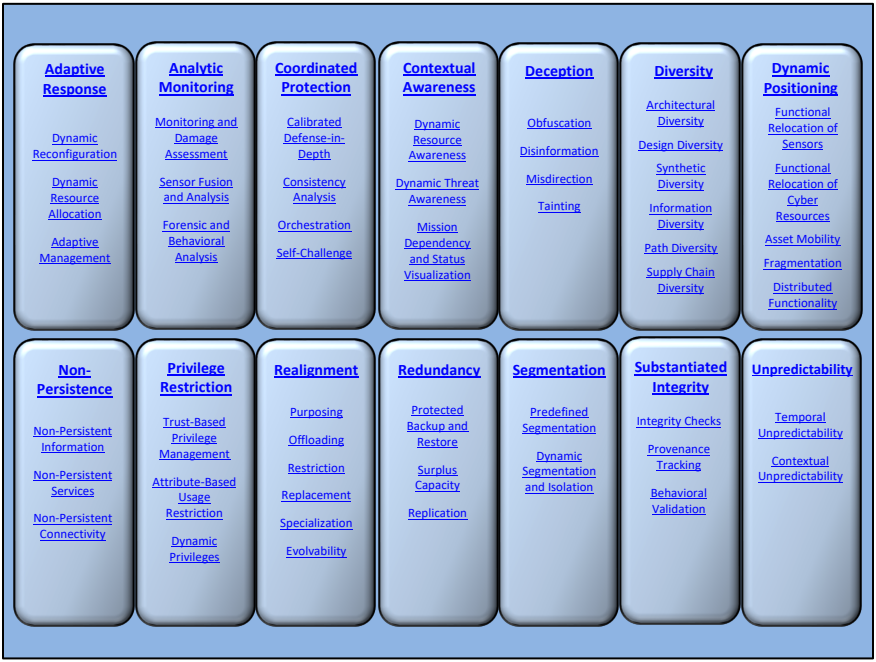
図1:Cyber Resiliency Techniques and Implementation Approaches。角の丸い 14 枚のパネルが 7 枚ずつ 2 段に並び、各パネルの見出しは技法、その下には実装アプローチが列挙されている。上段:Adaptive Response(Dynamic Reconfiguration、Dynamic Resource Allocation、Adaptive Management)、Analytic Monitoring(Monitoring and Damage Assessment、Sensor Fusion and Analysis、Forensic and Behavioral Analysis)、Coordinated Protection(Calibrated Defense-in-Depth、Consistency Analysis、Orchestration、Self-Challenge)、Contextual Awareness(Dynamic Resource Awareness、Dynamic Threat Awareness、Mission Dependency and Status Visualization)、Deception(Obfuscation、Disinformation、Misdirection、Tainting)、Diversity(Architectural Diversity、Design Diversity、Synthetic Diversity、Information Diversity、Path Diversity、Supply Chain Diversity)、Dynamic Positioning(Functional Relocation of Sensors、Functional Relocation of Cyber Resources、Asset Mobility、Fragmentation、Distributed Functionality)。下段:Non-Persistence(Non-Persistent Information、Non-Persistent Services、Non-Persistent Connectivity)、Privilege Restriction(Trust-Based Privilege Management、Attribute-Based Usage Restriction、Dynamic Privileges)、Realignment(Purposing、Offloading、Restriction、Replacement、Specialization、Evolvability)、Redundancy(Protected Backup and Restore、Surplus Capacity、Replication)、Segmentation(Predefined Segmentation、Dynamic Segmentation and Isolation)、Substantiated Integrity(Integrity Checks、Provenance Tracking、Behavioral Validation)、Unpredictability(Temporal Unpredictability、Contextual Unpredictability)。
FIGURE 1: CYBER RESILIENCY TECHNIQUES AND IMPLEMENTATION APPROACHES
図1:サイバーレジリエンス技法と実装アプローチ
2.1.4 Cyber Resiliency Design Principles
2.1.4 サイバーレジリエンスの設計原則
Systems engineers and architects use design principles29 as guidance in design decisions and analysis. A design principle takes the form of a terse statement or a phrase identifying a key concept accompanied by one or more statements that describe how that concept applies to system design (where “system” is broadly construed to include operational processes and procedures and may also include development and maintenance environments) [Bodeau17]. Design principles are defined for many specialty engineering disciplines using the terminology, experience, and research results that are specific to the specialty.
システムエンジニアとアーキテクトは、設計上の意思決定と分析の指針として設計原則29を用います。設計原則は、主要な概念を特定する簡潔な文または語句と、その概念がシステム設計にどのように適用されるかを説明する一つ以上の文とで構成される(ここでいう「システム」は、運用プロセスと手順を含み、開発環境と保守環境も含みうる広い意味で解釈する)[Bodeau17]。設計原則は、多くの専門エンジニアリング分野について、その分野に固有の用語、経験および研究成果を用いて定義されています。
Cyber resiliency design principles, like those from other specialty disciplines, can be applied in different ways at multiple stages in the system life cycle, including the operations and maintenance stage. The design principles can also be used in a variety of system development models, including agile and spiral development. The cyber resiliency design principles identified in this publication can serve as a starting point for systems engineers and architects. For any given situation, only a subset of the design principles is selected, and those principles are tailored or “re-expressed” in terms more meaningful to the program, system, or system-of-systems to which they apply.
サイバーレジリエンスの設計原則は、他の専門分野の設計原則と同様に、運用・保守段階を含むシステムライフサイクルの複数の段階で、さまざまな方法で適用できます。設計原則は、アジャイル開発やスパイラル開発を含むさまざまなシステム開発モデルでも利用できます。本書で特定するサイバーレジリエンスの設計原則は、システムエンジニアとアーキテクトにとっての出発点となりうます。所与の状況では設計原則の一部のみが選択され、それらの原則は、適用対象のプログラム、システムまたはシステムオブシステムズにとってより意味のある表現へと調整、すなわち「言い換え」られます。
The cyber resiliency design principles are strongly informed by and can be aligned with design principles from other specialty disciplines, such as the security design principles in [SP 800-160 v1]. Many of the cyber resiliency design principles are based on design principles for security, resilience engineering, or both. Design principles can be characterized as strategic (i.e., applied throughout the systems engineering process, guiding the direction of engineering analyses) or structural (i.e., directly affecting the architecture and design of the system or system elements) [Ricci14]. Both strategic and structural cyber resiliency design principles can be reflected in security-related systems engineering artifacts. A complete list of strategic and structural cyber resiliency design principles is provided in Appendix D.
サイバーレジリエンス設計原則は、[SP 800-160 v1]のセキュリティ設計原則など、他の専門分野の設計原則から強い影響を受けており、それらと整合させることができます。サイバーレジリエンス設計原則の多くは、セキュリティ、レジリエンス工学、またはその両方の設計原則に基づきます。設計原則は、戦略的原則(すなわち、システムエンジニアリングプロセス全体を通じて適用され、エンジニアリング分析の方向性を導く原則)と、構造的原則(すなわち、システムまたはシステム要素のアーキテクチャや設計に直接影響する原則)に分類できます[Ricci14]。戦略的・構造的のいずれのサイバーレジリエンス設計原則も、セキュリティ関連のシステムエンジニアリング成果物に反映できます。戦略的・構造的なサイバーレジリエンス設計原則の完全な一覧は付録Dに示します。
2.1.5 Relationship Among Cyber Resiliency Constructs
2.1.5 サイバーレジリエンス構成要素の相互関係
Cyber resiliency constructs, including goals, objectives, techniques, implementation approaches, and design principles, enable systems engineers to express cyber resiliency concepts and the relationships among them. The cyber resiliency constructs also relate to risk management. That relationship leads systems engineers to analyze cyber resiliency solutions in terms of potential effects on risk and on specific threat events or types of malicious cyber activities. The selection and relative priority of these cyber resiliency constructs is determined by the organization’s strategy for managing the risks of depending on systems, which include cyber resources—in particular, by the organization’s risk framing.30 The relative priority of the cyber resiliency goals and objectives and relevance of the cyber resiliency design principles are determined by the risk management strategy of the organization, which takes into consideration the concerns of, constraints on, and equities of all stakeholders (including those who are not part of the organization). Figure 2 illustrates the relationships among the cyber resiliency constructs. These relationships are represented by mapping tables in Appendix D. As Figure 2 illustrates, a cyber-resilient system is the result of the engineering selection, prioritization, and application of cyber resiliency design principles, techniques, and implementation approaches. The risk management strategy for the organization is translated into specific interpretations and prioritizations of cyber resiliency goals and objectives, which guide and inform trade-offs among different forms of risk mitigation.
ゴール、目標、技法、実装アプローチ、設計原則を含むサイバーレジリエンスの構成概念により、システムエンジニアはサイバーレジリエンスの概念とそれらの間の関係を表現できます。サイバーレジリエンスの構成概念はリスク管理にも関係します。この関係により、システムエンジニアは、リスクに対する潜在的な効果や、特定の脅威事象または悪意あるサイバー活動の種類に対する潜在的な効果の観点から、サイバーレジリエンスの解決策を分析することになります。これらのサイバーレジリエンスの構成概念の選択と相対的な優先度は、サイバー資源を含むシステムに依存することのリスクを管理するための組織の戦略、特に組織のリスクフレーミングによって決定されます。30サイバーレジリエンスのゴールと目標の相対的な優先度、および設計原則の関連性は、すべてのステークホルダー(組織に属さない者を含む)の懸念、制約および利害を考慮した組織のリスク管理戦略によって決定されます。図2は、サイバーレジリエンスの構成概念間の関係を示しています。これらの関係は、付録Dの対応表で表されています。図2に示すように、サイバーレジリエント(cyber-resilient)なシステムは、サイバーレジリエンスの設計原則、技法および実装アプローチをエンジニアリングにおいて選択し、優先順位付けし、適用した結果です。組織のリスク管理戦略は、サイバーレジリエンスのゴールと目標の具体的な解釈と優先順位付けへと落とし込まれ、それがさまざまな形態のリスク緩和の間のトレードオフを導き、その判断材料となります。
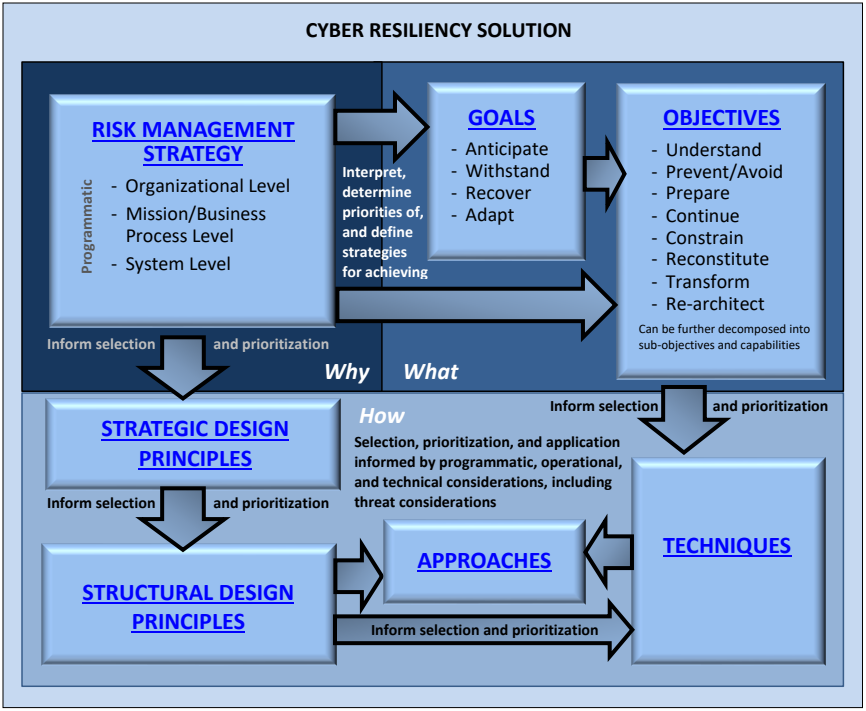
図2:Relationships Among Cyber Resiliency Constructs。CYBER RESILIENCY SOLUTION と題した外枠の中に、次の要素がある。左上(Why)に RISK MANAGEMENT STRATEGY の箱があり、Organizational Level、Mission/Business Process Level、System Level が列挙され、横に Programmatic と縦書きされている。この箱から「Interpret, determine priorities of, and define strategies for achieving」と記された矢印が GOALS(Anticipate、Withstand、Recover、Adapt)へ向かい、GOALS から OBJECTIVES(Understand、Prevent/Avoid、Prepare、Continue、Constrain、Reconstitute、Transform、Re-architect。さらに下位の目的や能力に分解できる)へ矢印が向かう。RISK MANAGEMENT STRATEGY から OBJECTIVES へ直接向かう矢印もある。GOALS と OBJECTIVES は What の領域にある。下の領域(How。「Selection, prioritization, and application informed by programmatic, operational, and technical considerations, including threat considerations」と注記)では、「Inform selection and prioritization」と記された矢印が、RISK MANAGEMENT STRATEGY から STRATEGIC DESIGN PRINCIPLES へ、STRATEGIC DESIGN PRINCIPLES から STRUCTURAL DESIGN PRINCIPLES へ、OBJECTIVES から TECHNIQUES へ、STRUCTURAL DESIGN PRINCIPLES から TECHNIQUES へ向かう。STRUCTURAL DESIGN PRINCIPLES と TECHNIQUES からは、APPROACHES へ矢印が向かう。
FIGURE 2: RELATIONSHIPS AMONG CYBER RESILIENCY CONSTRUCTS
図2:サイバーレジリエンス構成要素の相互関係
2.2 CYBER RESILIENCY IN THE SYSTEM LIFE CYCLE
2.2 システムライフサイクルにおけるサイバーレジリエンス
The following section describes general considerations for applying cyber resiliency concepts and framework constructs to system life cycle stages and processes.31 Considerations include addressing the similarities and differences in security and cyber resiliency terminology and how the application of cyber resiliency goals, objectives, techniques, implementation approaches, and design principles can impact systems at key stages in the life cycle. Figure 3 lists the system life cycle processes and illustrates their application across all stages of the system life cycle. It must be emphasized, however, that cyber resiliency engineering does not assume any specific life cycle or system development process, and cyber resiliency analysis can be performed at any point in and iteratively throughout the life cycle.32
以下の節では、サイバーレジリエンスの概念とフレームワークの構成要素をシステムライフサイクルの段階とプロセスに適用する際の一般的な考慮事項について説明します。31考慮事項には、セキュリティとサイバーレジリエンスの用語の類似点と相違点への対処や、サイバーレジリエンスの目標、目的、手法、実装アプローチ、および設計原則の適用が、ライフサイクルの主要な段階でシステムにどのような影響を及ぼしうるかが含まれます。図 3 は、システムライフサイクルプロセスを列挙し、システムライフサイクルの全段階にわたるその適用を示しています。ただし、サイバーレジリエンスエンジニアリングは特定のライフサイクルやシステム開発プロセスを前提とするものではなく、サイバーレジリエンス分析はライフサイクルのどの時点でも、またライフサイクル全体を通じて反復的に実施できることを強調しておかなければなりません。32
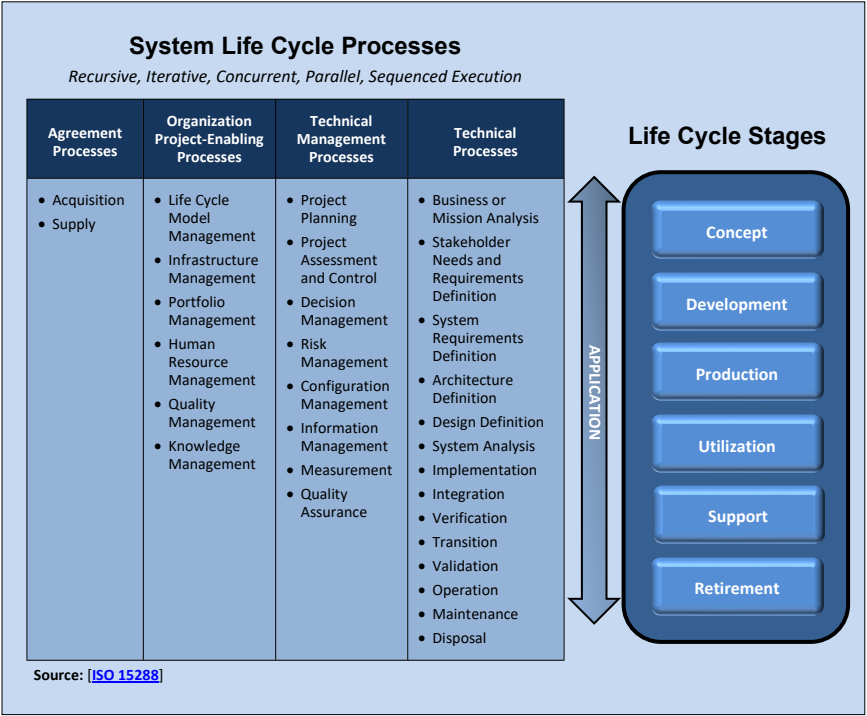
図3:システムライフサイクルのプロセスと段階。左側に、System Life Cycle Processes(システムライフサイクルプロセス。再帰的、反復的、並行的、並列的、逐次的に実行される)と題した 4 列の表がある。合意プロセス(取得、供給)、組織のプロジェクト実現プロセス(ライフサイクルモデル管理、インフラストラクチャ管理、ポートフォリオ管理、人的資源管理、品質管理、知識管理)、技術管理プロセス(プロジェクト計画、プロジェクトの評価と統制、意思決定管理、リスク管理、構成管理、情報管理、測定、品質保証)、技術プロセス(ビジネスまたはミッションの分析、利害関係者のニーズと要求事項の定義、システム要求事項の定義、アーキテクチャ定義、設計定義、システム分析、実装、統合、検証、移行、妥当性確認、運用、保守、廃棄)である。右側には Life Cycle Stages(ライフサイクル段階)と題した角の丸い枠があり、上から構想、開発、製造、利用、支援、廃棄の各段階が並ぶ。表と段階の間は、APPLICATION(適用)と記された上下両方向の矢印で結ばれている。表の下に「出典:[ISO 15288]」とある。
FIGURE 3: SYSTEM LIFE CYCLE PROCESSES AND LIFE CYCLE STAGES
図3:システムライフサイクルのプロセスと段階
Cyber resiliency constructs are interpreted and cyber resiliency engineering practices are applied in different ways depending on the system life cycle stages. During the Concept stage, cyber resiliency goals and objectives are tailored in terms of the concept of use for the system of interest. Tailoring actions are used to elicit stakeholder priorities for the cyber resiliency goals and objectives. The organization’s risk management strategy is used to help determine which strategic design principles are most relevant. The strategic design principles and corresponding structural design principles are aligned with design principles from other specialty engineering disciplines. Notional or candidate system architectures are analyzed with respect to how well the prioritized cyber resiliency goals and objectives can be achieved and how well the relevant strategic cyber resiliency design principles can be applied. The tailoring of objectives can also be used to identify or define potential metrics or measures of effectiveness for proposed cyber resiliency solutions. Once again, the risk management strategy that constrains risk response or risk treatment (e.g., commitment to specific technologies, requirements for interoperability with or dependence on other systems) is used to help determine which techniques and approaches can or cannot be used in cyber resiliency solutions. In addition, during the Concept stage, cyber resiliency concerns for enabling systems for production, integration, validation, and supply chain management are identified, and strategies for addressing those concerns are defined.
サイバーレジリエンス構成要素の解釈やサイバーレジリエンスエンジニアリングの実践の適用の仕方は、システムライフサイクルの段階によって異なります。構想段階では、サイバーレジリエンスの目標と目的は、対象システムの利用構想に即してテーラリングされます。テーラリングの作業は、サイバーレジリエンスの目標と目的に対するステークホルダーの優先順位を引き出すために用いられます。組織のリスク管理戦略は、どの戦略的設計原則が最も関連するかを判断する助けとして用いられます。戦略的設計原則と対応する構造的設計原則は、他の専門エンジニアリング分野の設計原則と整合させます。概念上または候補となるシステムアーキテクチャは、優先順位付けされたサイバーレジリエンスの目標と目的をどの程度達成できるか、および関連する戦略的サイバーレジリエンス設計原則をどの程度適用できるかという観点から分析されます。目的のテーラリングは、提案されたサイバーレジリエンスソリューションの潜在的なメトリクスまたは有効性の尺度を特定または定義するためにも用いることができます。ここでもまた、リスク対応またはリスク対処を制約するリスク管理戦略(例:特定の技術への関与、他のシステムとの相互運用性または他のシステムへの依存に関する要件)は、サイバーレジリエンスソリューションでどの手法とアプローチを使用できるか、または使用できないかを判断する助けとして用いられます。加えて、構想段階では、製造、統合、妥当性確認、およびサプライチェーン管理のための支援システムに関するサイバーレジリエンス上の懸念が特定され、それらの懸念に対処するための戦略が定義されます。
During the Development stage, the relevant structural cyber resiliency design principles (i.e., those principles that can be applied to the selected system architecture and that support the strategic cyber resiliency design principles) are identified and prioritized based on how well the design principles enable the prioritized cyber resiliency objectives to be achieved. The cyber resiliency techniques and approaches indicated by the structural design principles are analyzed with respect to whether and where they can be used in the selected system architecture given the constraints identified earlier. Cyber resiliency solutions are defined and analyzed with respect to potential effectiveness and compatibility with other aspects of trustworthiness.
開発段階では、関連する構造的サイバーレジリエンス設計原則(すなわち、選定したシステムアーキテクチャに適用でき、戦略的サイバーレジリエンス設計原則を支える原則)を特定し、優先順位を付けます。これは、各設計原則が優先されたサイバーレジリエンス目的をどの程度達成可能にするかに基づきます。構造的設計原則が示すサイバーレジリエンス技法とアプローチについて、先に特定した制約の下で、選定したシステムアーキテクチャのどこに、またそもそも使用できるかどうかを分析します。サイバーレジリエンス・ソリューションを定義し、その潜在的有効性と、トラストワーシネスの他の側面との適合性を分析します。
Analysis of potential effectiveness considers the relative effectiveness of the solution against potential threat events or scenarios [SP 800-30] and the measures of effectiveness for cyber resiliency objectives. Analysis of compatibility with other aspects of trustworthiness considers potential synergies or conflicts associated with technologies, design principles, or practices specific to other specialty engineering disciplines, particularly security, reliability, survivability, and safety. In addition, specific measures for assessing whether or not the prerequisite requirements have been satisfied within the solution space are defined. This may include, for example, a determination of the baseline reliability of the technology components needed to deliver cyber-resilient capabilities within a system element.
潜在的有効性の分析では、想定される脅威事象またはシナリオ[SP 800-30]に対するソリューションの相対的有効性と、サイバーレジリエンスの目的に対する有効性指標を考慮します。トラストワーシネスの他の側面との適合性の分析では、他の専門エンジニアリング分野、とりわけセキュリティ、信頼性、存続可能性、安全性に固有の技術、設計原則、慣行に関連する相乗効果や競合の可能性を考慮します。また、ソリューションの範囲内で前提要件が満たされているか否かを評価するための具体的な指標を定義します。これには、例えば、システム要素内でサイバーレジリエント能力を実現するために必要な技術コンポーネントの基準信頼性の判定が含まれることがあります。
In addition, during the Development stage, the implementation of cyber resiliency solutions is analyzed and evaluated. The verification strategy for cyber resiliency solutions at this stage typically includes adversarial testing or demonstration of mission or business function measures of performance in a stressed environment with adversarial activities. The operational processes and procedures for using technical solutions are defined, refined, and validated with respect to the ability to meet mission and business objectives despite the adversity involving systems containing cyber resources. The cyber resiliency perspective calls for testing and other forms of validation or verification that include adversarial threats among (and in combination with) other stresses on the system. During this life cycle stage, resources (e.g., diverse implementations of critical system elements, alternative processing facilities) required to implement specific courses of action are also developed.
さらに開発段階では、サイバーレジリエンス・ソリューションの実装を分析・評価します。この段階の検証戦略には通常、敵対的な活動があるストレス環境で、ミッションまたはビジネス機能の性能指標を敵対的試験や実証によって確認することが含まれます。技術的ソリューションの利用に関する運用プロセスと手順を定義、改良、妥当性確認し、サイバー資源を含むシステムに逆境が生じてもミッション・ビジネス目標を達成できるかを評価します。サイバーレジリエンスの観点では、他のストレス要因と併せて、敵対的脅威を含む試験、妥当性確認、検証を求めます。この段階では、特定の行動方針を実施するために必要な資源(例:重要なシステム要素の多様な実装、代替処理施設)も開発します。
During the Production stage, the verification strategy is applied to instances or versions of the system of interest and associated spare parts or components. The verification strategy for the cyber resiliency requirements as applied to such instances and system elements includes adversarial testing or demonstration in a stressed environment. In addition, during the Production stage, cyber resiliency concerns for enabling systems for production, integration, validation, and supply chain management continue to be identified and addressed.
製造段階では、対象システムのインスタンスまたはバージョンと、関連する予備部品またはコンポーネントに対して検証戦略を適用します。そのようなインスタンスおよびシステム要素に適用されるサイバーレジリエンス要件の検証戦略には、ストレス環境での敵対的試験または実証が含まれます。さらに製造段階では、製造、統合、妥当性確認、サプライチェーン管理のためのイネーブリングシステムに関するサイバーレジリエンス上の懸念を引き続き特定し、対処します。
During the Utilization stage, the effectiveness of cyber resiliency solutions in the operational environment is monitored. Effectiveness may decrease due to changes in the operational environment (e.g., new mission or business processes, new stakeholders, increased user population, configuration drift, deployment in new locations, addition or removal of systems or system elements with which the system of interest interacts), the threat environment (e.g., new threat actors, new vulnerabilities in commonly used technologies), or the technical environment (e.g., the introduction of new technologies into other systems with which the system of interest interacts). Cyber resiliency solutions may need to be adapted to address such changes (e.g., defining new courses of action, reconfiguring system elements, changing mission or business processes and procedures). The relative priorities of cyber resiliency objectives may shift based on changes to stakeholders, stakeholder concerns, mission or business processes, or project funding. Finally, changes in the threat or technical environment may make some techniques or approaches less feasible, while changes in the technical or operational environment may make others more viable.
利用段階では、運用環境におけるサイバーレジリエンス・ソリューションの有効性を監視します。有効性は、運用環境の変化(例:新しいミッション・ビジネスプロセス、新たなステークホルダー、利用者数の増加、構成の逸脱、新しい場所への展開、対象システムが相互作用するシステムまたはシステム要素の追加・削除)、脅威環境の変化(例:新たな脅威主体、広く使われる技術の新たな脆弱性)、または技術環境の変化(例:対象システムが相互作用する他のシステムへの新技術の導入)によって低下する場合があります。こうした変化に対応するため、サイバーレジリエンス・ソリューションの適応が必要になる場合があります(例:新たな行動方針の策定、システム要素の再構成、ミッション・ビジネスプロセスおよび手順の変更)。サイバーレジリエンスの目的の相対的な優先順位は、ステークホルダー、ステークホルダーの懸念、ミッション・ビジネスプロセス、またはプロジェクト資金の変化に応じて変わり得ます。最後に、脅威環境または技術環境の変化によって一部の技法またはアプローチの実現可能性が下がる一方、技術環境または運用環境の変化によって別の技法またはアプローチが実行しやすくなる場合があります。
During the Support stage, maintenance and upgrade of the system or system elements can include integration of new cyber resiliency solutions into the system of interest. This stage also provides opportunities to revisit the prioritization and tailoring of cyber resiliency objectives. Upgrades to or modifications of system capabilities can include significant architectural changes that address accumulated changes to the operational, threat, and technical environments. System modifications and upgrades can also introduce additional vulnerabilities, particularly with architectural changes.
支援段階では、システムまたはシステム要素の保守・アップグレードに、対象システムへの新たなサイバーレジリエンス・ソリューションの統合を含められます。また、この段階は、サイバーレジリエンス目的の優先順位付けと調整を見直す機会にもなります。システム能力のアップグレードや変更には、運用、脅威、技術環境の累積的な変化に対応する大規模なアーキテクチャ変更が含まれることがあります。システムの変更やアップグレードは、特にアーキテクチャ変更の際に、追加の脆弱性を生む可能性もあります。
During the Retirement stage, system elements or the entire system of interest are removed from operations. The retirement process can affect other systems with which the system of interest interacts and can decrease the cyber resiliency of those systems and of the supported mission or business processes. Retirement strategies can include phased removal of system elements, turnkey removal of all system elements, phased replacement of system elements, and turnkey replacement of the entire system of interest. Cyber resiliency objectives and priorities are identified for the systems, missions, and business functions in the operational environment to inform analysis of the potential or expected effects of different retirement strategies on the ability to achieve those objectives. Like the support stage, the retirement stage can introduce significant vulnerabilities, particularly during disposal and unintended residue remaining from decommissioned assets.33
廃棄段階では、システム要素または対象システム全体が運用から除外されます。廃棄プロセスは、対象システムが相互作用する他のシステムに影響を及ぼす可能性があり、それらのシステムや支援対象のミッションまたは業務プロセスのサイバーレジリエンスを低下させる可能性があります。廃棄戦略には、システム要素の段階的な除去、全システム要素の一括除去、システム要素の段階的な置き換え、および対象システム全体の一括置き換えが含まれうます。運用環境におけるシステム、ミッション、および業務機能についてサイバーレジリエンス目的と優先順位を特定し、異なる廃棄戦略がそれらの目的の達成能力に及ぼす潜在的または予想される影響の分析に役立てます。支援段階と同様に、廃棄段階は、特に処分の際や、運用を終了した資産に意図せず残存するものによって、重大な脆弱性をもたらす可能性があります。33
Table 4 illustrates changes in emphasis for the different cyber resiliency constructs, particularly with respect to cyber resiliency objectives (bolded).
表4は、サイバーレジリエンスの各構成要素について、特にサイバーレジリエンス目的(太字)に関する重点の変化を示します。
TABLE 4: CYBER RESILIENCY IN LIFE CYCLE STAGES
表4:ライフサイクル段階におけるサイバーレジリエンス
| LIFE CYCLE STAGES | ROLE OF CYBER RESILIENCY CONSTRUCTS |
|---|---|
| CONCEPT | - Prioritize and tailor objectives. - Prioritize design principles and align with other disciplines. - Limit the set of techniques and approaches to use in solutions. |
| DEVELOPMENT | - Apply design principles to analyze and shape architecture and design. - Use techniques and approaches to define alternative solutions. - Develop capabilities to achieve the Prevent/Avoid, Continue, Constrain, Reconstitute , and Understand objectives. |
| ライフサイクル段階 | サイバーレジリエンスの構成要素の役割 |
|---|---|
| 概念 | - 目的の優先順位付けと調整を行います。 - 設計原則の優先順位付けを行い、他の分野と整合させます。 - ソリューションで用いる技法とアプローチの集合を限定します。 |
| 開発 | - 設計原則を適用して、アーキテクチャと設計を分析し、形作ります。 - 技法とアプローチを用いて、代替ソリューションを定義します。 - 防止/回避、継続、制約、再構成、理解の各目的を達成する能力を開発します。 |
| LIFE CYCLE STAGES | ROLE OF CYBER RESILIENCY CONSTRUCTS |
|---|---|
| PRODUCTION | - Implement and evaluate the effectiveness of cyber resiliency solutions. - Provide resources (or ensure that resources will be provided) to achieve the Prepare objective. |
| UTILIZATION | - Monitor the effectiveness of cyber resiliency solutions using capabilities to achieve Understand and Prepare objectives. - Reprioritize and tailor objectives as needed, and adapt mission, business, and/or security processes to address environmental changes (Transform objective). |
| SUPPORT | - Revisit the prioritization and tailoring of objectives; use the results of monitoring to identify new or modified requirements. - Revisit constraints on techniques and approaches. - Modify or upgrade capabilities consistent with changes as noted (Re-Architect objective). |
| RETIREMENT | - Prioritize and tailor objectives for the environment of operation. - Ensure that disposal processes enable those objectives to be achieved, modifying or upgrading capabilities of other systems as necessary (Re-Architect objective). |
| ライフサイクル段階 | サイバーレジリエンスの構成要素の役割 |
|---|---|
| 生産 | - サイバーレジリエンスソリューションを実装し、その有効性を評価します。 - 準備の目的を達成するためのリソースを提供します(またはリソースが提供されることを確実にします)。 |
| 利用 | - 理解および準備の各目的を達成する能力を用いて、サイバーレジリエンスソリューションの有効性を監視します。 - 必要に応じて目的の優先順位付けと調整をやり直し、環境の変化に対処するため、ミッション、業務、および/またはセキュリティのプロセスを適応させる(変革の目的)。 |
| 支援 | - 目的の優先順位付けと調整を見直します。監視の結果を用いて、新規または変更された要求事項を特定します。 - 技法とアプローチに対する制約を見直します。 - 上述の変化に合わせて能力を修正またはアップグレードします(再アーキテクチャ化の目的)。 |
| 退役 | - 運用環境に合わせて、目的の優先順位付けと調整を行います。 - 廃棄プロセスがそれらの目的の達成を可能にするようにし、必要に応じて他のシステムの能力を修正またはアップグレードします(再アーキテクチャ化の目的)。 |
2.3 RISK MANAGEMENT AND CYBER RESILIENCY
2.3 リスク管理とサイバーレジリエンス
Organizations manage the missions, business functions, and operational risks related to dependencies on systems that include cyber resources as part of a larger portfolio of risks,34 including financial and reputational risks; programmatic or project-related risks associated with developing a system (e.g., cost, schedule, performance); security risks associated with the organization’s mission or business activities, information the organization processes or handles, or requirements arising from legislation, regulations, policies, or standards; and cybersecurity risks. A proposed cyber resiliency solution, while intended primarily to reduce mission, business, or operational risk, can also reduce other types of risk (e.g., security risk, reputational risk, supply chain risk, performance risk). However, like any solution to a risk management problem, it can also increase other types of risk (e.g., financial, cost, or schedule risk). As part of a multidisciplinary systems engineering effort, systems security engineers and risk management professionals are responsible for articulating the potential adverse impacts of alternative solutions, determining whether those impacts fall within the organizational risk tolerance, deciding whether the adoption of a proposed solution is consistent with the organization’s risk management strategy, and informing the organization’s risk executive of risk trade-offs.35
組織は、サイバーリソースを含むシステムへの依存に関連するミッション、業務機能、および運用上のリスクを、より大きなリスクのポートフォリオの一部として管理します。34このポートフォリオには、財務上のリスクや評判上のリスク、システムの開発に伴うプログラムまたはプロジェクト関連のリスク(例:コスト、スケジュール、性能)、組織のミッションもしくは業務活動、組織が処理もしくは取り扱う情報、または法律、規則、ポリシー、もしくは標準から生じる要件に関連するセキュリティリスク、およびサイバーセキュリティリスクが含まれます。提案されたサイバーレジリエンスソリューションは、主としてミッション、業務、または運用上のリスクを低減することを意図していますが、他の種類のリスク(例:セキュリティリスク、評判上のリスク、サプライチェーンリスク、性能リスク)も低減できます。しかし、リスク管理の問題に対するあらゆる解決策と同様に、他の種類のリスク(例:財務、コスト、またはスケジュールのリスク)を増大させる可能性もあります。学際的なシステムエンジニアリングの取り組みの一環として、システムセキュリティエンジニアとリスク管理の専門家は、代替ソリューションの潜在的な悪影響を明確に示し、それらの影響が組織のリスク許容度の範囲内にあるかどうかを判断し、提案されたソリューションの採用が組織のリスク管理戦略と整合しているかどうかを決定し、組織のリスクエグゼクティブにリスクのトレードオフを伝える責任を負います。35
At the organizational level, a cyber resiliency perspective on risk management can lead to the analysis and management of risks associated with programs and initiatives at multiple levels, which involve investment in, transition to, use of, or transition away from different cyber technologies. The environment in which a system of interest is engineered is rarely static. Related programs, initiatives, or other efforts at federal agencies, driven by [EO 14028], can include efforts to transition to a zero trust architecture, reduce software supply chain risks, and transition from IPv4 to IPv6. Such organization-level programs and initiatives can affect the execution of efforts at lower levels (e.g., an acquisition program for a specific system or service, an initiative to redefine a mission or business process to better accommodate telework).
組織レベルでは、サイバーレジリエンスの観点から、サイバー技術への投資、移行、利用、または移行終了を伴うプログラムや取り組みのリスクを複数レベルで分析・管理できます。対象システムが設計される環境が静的であることはまれです。[EO 14028]により連邦機関で進む関連プログラムや取り組みには、ゼロトラスト・アーキテクチャへの移行、ソフトウェア・サプライチェーンリスクの低減、IPv4からIPv6への移行などがあります。こうした組織レベルのプログラムや取り組みは、下位レベルの活動(特定のシステム・サービスの調達プログラム、テレワークにより適したミッション・ビジネスプロセスへの再定義など)の実施に影響し得ます。
Motivated by the cyber resiliency Adapt goal, an organization’s risk management strategy can also consider the following questions:
サイバーレジリエンスの「適応する」目標を踏まえ、組織のリスク管理戦略では、次の問いも考慮できます。
•How does each step in a transition plan or an investment plan change the attack surface?
•移行計画または投資計画の各ステップは、攻撃対象領域をどのように変えますか。
•Are new attack vectors enabled by a given step? How will they be mitigated? Will they be removed in a later step?
•あるステップによって新たな攻撃ベクトルが可能になりますか。それらをどのように緩和しますか。後続のステップで取り除かれますか。
•Does this step increase fragility, complexity, or instability? If so, how will those risks be managed?
•このステップによって脆弱性、複雑さ、不安定性が増しますか。増す場合、それらのリスクをどのように管理しますか。
•On what other programs or initiatives does this step depend? If those efforts do not achieve the expected objectives, how will the risks be managed?
•このステップは他のどのプログラムまたは取り組みに依存しますか。それらの取り組みが期待された目的を達成しない場合、リスクをどのように管理しますか。
•What new or modified operational procedures and processes are assumed? How will they be resourced and staffed?
•どのような新規または変更後の運用手順およびプロセスを前提としていますか。それらにどのように資源を割り当て、要員を配置しますか。
•What policy or governance changes are assumed? How will they be achieved? What risks would result if they are not achieved?
•どのような方針またはガバナンスの変更を前提としていますか。どのように実現しますか。実現できない場合、どのようなリスクが生じますか。
•How will the cyber resiliency objectives (as interpreted and prioritized by the organization) continue to be achieved in the face of changes resulting from different programs and initiatives?
•組織が解釈し優先順位を付けたサイバーレジリエンスの目的を、さまざまなプログラムや取り組みによる変化に直面しても、どのように達成し続けますか。
GENERALIZED CYBER RESILIENCY CONSTRUCTS
一般化されたサイバーレジリエンス構成要素
Cyber resiliency goals, objectives, and techniques are generally defined so they can be applied to all types of threats (not solely cyber threats) and all types of systems (not solely systems that include or are enabled by cyber resources). However, the motivation for these definitions and for the selection of objectives and techniques for inclusion in the cyber resiliency engineering framework is the recognition of dependence on systems involving cyber resources in a threat environment that includes the APT.
サイバーレジリエンスの目標、目的、および手法は、あらゆる種類の脅威(サイバー脅威に限らない)とあらゆる種類のシステム(サイバーリソースを含む、またはサイバーリソースによって実現されるシステムに限らない)に適用できるように、一般化して定義されています。しかし、これらの定義の動機、およびサイバーレジリエンスエンジニアリングフレームワークに含める目的と手法の選定の動機は、APT を含む脅威環境において、サイバーリソースを伴うシステムに依存しているという認識にあります。
CYBER RESILIENCY IN THE SYSTEM LIFE CYCLE
システムライフサイクルにおけるサイバーレジリエンス
NIST is working with the United States Air Force and the Air Force Research Laboratory (AFRL) to explore ways to incorporate the cyber resiliency constructs in this publication into the system development life cycle through the use of automated support tools. The use of such tools can help ensure that cyber resiliency requirements are clearly defined and more easily integrated into the system development life cycle. Automated tools can provide an efficient and effective vehicle for incorporating cyber resiliency capabilities into a variety of systems (e.g., weapons systems, space systems, command and control systems, industrial control systems, enterprise IT systems) using any established life cycle development process or approach (e.g., agile, waterfall, spiral, DevOps). Automation can also support the rapid testing and evaluation of cyber resiliency capabilities in critical systems to reduce the time to operational deployment.
NIST は、米国空軍および空軍研究所(AFRL)と協力して、自動化された支援ツールを用いて本書のサイバーレジリエンス構成要素をシステム開発ライフサイクルに組み込む方法を探っています。こうしたツールを用いることは、サイバーレジリエンス要件が明確に定義され、システム開発ライフサイクルにより容易に統合されることを確実にする助けとなりうます。自動化ツールは、確立された任意のライフサイクル開発プロセスまたはアプローチ(例:アジャイル、ウォーターフォール、スパイラル、DevOps)を用いて、さまざまなシステム(例:兵器システム、宇宙システム、指揮統制システム、産業用制御システム、企業 IT システム)にサイバーレジリエンス機能を組み込むための効率的かつ効果的な手段を提供できます。自動化は、重要なシステムにおけるサイバーレジリエンス機能の迅速なテストと評価を支援し、運用配備までの時間を短縮することもできます。
CHAPTER THREE
第3章
CYBER RESILIENCY IN PRACTICE
実践におけるサイバーレジリエンス
APPLYING CYBER RESILIENCY CONCEPTS, CONSTRUCTS, PRACTICES
サイバーレジリエンスの概念、構成要素、慣行の適用
This chapter identifies considerations for determining which cyber resiliency constructs are most relevant to a system of interest and describes a tailorable process for applying cyber resiliency concepts, constructs, and practices to a system. It also includes guidance on the cyber resiliency analysis carried out during the system life cycle to determine whether the cyber resiliency properties and behaviors of a system of interest, regardless of its life cycle stage, are sufficient for the organization using that system to meet its mission assurance, business continuity, or other security requirements in a threat environment and contested cyberspace that includes the APT.
本章では、どのサイバーレジリエンス構成要素が対象システムに最も関連するかを判断するための考慮事項を特定し、サイバーレジリエンスの概念、構成要素、および実践をシステムに適用するためのテーラリング可能なプロセスを説明します。また、対象システムのサイバーレジリエンスの特性と振る舞いが、そのライフサイクル段階にかかわらず、そのシステムを使用する組織が、APT を含む脅威環境と争奪されるサイバー空間においてミッション保証、事業継続、またはその他のセキュリティ要件を満たすのに十分であるかどうかを判断するために、システムライフサイクルの間に実施するサイバーレジリエンス分析に関するガイダンスも含みます。
3.1 SELECTING AND PRIORITIZING CYBER RESILIENCY CONSTRUCTS
3.1 サイバーレジリエンス構成要素の選択と優先順位付け
The variety of concerns, technologies, and practices related to cyber resiliency results in an extensive framework for cyber resiliency engineering. For example, the engineering framework identifies 14 cyber resiliency techniques and 50 cyber resiliency implementation approaches. The engineering framework is also complex, with relationships among the constructs of goals, objectives, design principles, techniques, and approaches, as discussed in Appendix D. Cyber resiliency design principles, techniques, and approaches build on, complement, or function in synergy with mechanisms intended to ensure other quality properties (e.g., security, safety, and system resilience).
サイバーレジリエンスに関する懸念、技術、慣行が多岐にわたるため、サイバーレジリエンス工学のフレームワークは広範なものとなります。たとえば、この工学フレームワークは14のサイバーレジリエンス技法と50のサイバーレジリエンス実装アプローチを特定しています。また、付録Dで説明するように、目標、目的、設計原則、技法、アプローチという構成要素間の関係を含み、複雑でもあります。サイバーレジリエンスの設計原則、技法、アプローチは、他の品質特性(例:セキュリティ、安全性、システムレジリエンス)の確保を意図した仕組みを基礎とし、それらを補完し、または相乗的に機能します。
The variety of circumstances and types of systems for which cyber resiliency can be applied means that no single cyber resiliency technique, approach, or set of approaches is universally optimal or applicable. Systems security engineering seeks to manage risk rather than provide a universal solution. The choice of a risk-appropriate set of cyber resiliency techniques and approaches depends on various trade space considerations and risk factors that are assessed during the systems engineering processes. Employment of all cyber resiliency techniques and approaches is not needed to achieve the cyber resiliency objectives prioritized by stakeholders. In fact, it is not possible to employ all techniques and approaches simultaneously. The following subsections describe factors to consider when selecting a set of cyber resiliency techniques and implementation approaches that best fits the system of interest.
サイバーレジリエンスを適用できる状況やシステムの種類が多様であるため、単一のサイバーレジリエンス技法、アプローチ、またはアプローチの組み合わせが常に最適または適用可能とは限りません。システムセキュリティエンジニアリングは、普遍的な解決策を提供するのではなく、リスクの管理を目指します。リスクに適したサイバーレジリエンス技法とアプローチの組み合わせの選択は、システムエンジニアリングプロセスで評価されるさまざまなトレードスペース上の考慮事項およびリスク要因に左右されます。ステークホルダーが優先したサイバーレジリエンスの目的を達成するために、すべてのサイバーレジリエンス技法およびアプローチを用いる必要はありません。実際、すべての技法とアプローチを同時に用いることはできません。以下の各節では、対象システムに最も適したサイバーレジリエンス技法および実装アプローチの組み合わせを選択する際に考慮すべき要因を説明します。
3.1.1 Achievement of Goals and Objectives
3.1.1 目標および目的の達成
Cyber resiliency techniques and associated implementation approaches are employed to achieve mission or business objectives. The relative priorities of cyber resiliency goals and objectives are determined by the mission or business objectives. The selection of specific cyber resiliency techniques and approaches is, therefore, driven in part by the relative priorities of the objectives they support.36
サイバーレジリエンスの手法と関連する実装アプローチは、ミッションまたは業務の目的を達成するために用いられます。サイバーレジリエンスの目標と目的の相対的な優先順位は、ミッションまたは業務の目的によって決まります。したがって、具体的なサイバーレジリエンスの手法とアプローチの選択は、部分的には、それらが支援する目的の相対的な優先順位によって左右されます。36
3.1.2 Cyber Risk Management Strategy
3.1.2 サイバーリスク管理戦略
An organization’s cyber risk management strategy (i.e., its strategy for managing risks stemming from dependencies on systems that include cyber resources) is part of its risk management strategy and includes its risk framing for cyber risks.37 The organization’s risk frame identifies which risks or risk factors (i.e., potential impacts or consequences) are unacceptable. For cyber resiliency, the risk frame assumes an adversary with a persistent presence in organizational systems. The risk response portion of the risk management strategy can include priorities or preferences for the types of effects on adversary activities38 to seek in cyber resiliency solutions.
組織のサイバーリスク管理戦略(すなわち、サイバーリソースを含むシステムへの依存から生じるリスクを管理するための戦略)は、組織のリスク管理戦略の一部であり、サイバーリスクに関するリスクフレーミングを含みます。37組織のリスクフレームは、どのリスクまたはリスク要因(すなわち、潜在的な影響または結果)が許容できないかを特定します。サイバーレジリエンスについては、リスクフレームは組織のシステム内に持続的に存在する敵対者を想定します。リスク管理戦略のリスク対応の部分には、サイバーレジリエンスソリューションにおいて追求する、敵対者の活動に対する効果38の種類についての優先順位または選好を含めることができます。
An organization’s risk management strategy is constrained by such factors as legal, regulatory, and contractual requirements as reflected in organizational policies and procedures, financial resources, legacy investments, and organizational culture. These constraints imply the need to consider the costs, ease of use, and operational impacts of security and cyber resiliency solutions. The constraints can be reflected in the selection and tailoring of cyber resiliency techniques, approaches, and design principles. For example, organizational policies and culture can influence whether and how the cyber resiliency technique of Deception is used. The risk management strategy can define an order of precedence for responding to identified risks analogous to the safety order of precedence, such as “harden, sensor, isolate, obfuscate.” Together with the strategic design principles selected and specifically tailored to a given program, mission, business function, or system, the order of precedence can guide the selection and application of structural design principles at different locations in an architecture.39
組織のリスク管理戦略は、組織のポリシーと手順に反映された法令上、規制上、および契約上の要件、財務資源、既存の投資、組織文化といった要因によって制約されます。これらの制約は、セキュリティおよびサイバーレジリエンスソリューションのコスト、使いやすさ、運用への影響を考慮する必要があることを意味します。これらの制約は、サイバーレジリエンスの手法、アプローチ、および設計原則の選択とテーラリングに反映させることができます。例えば、組織のポリシーや文化は、サイバーレジリエンス手法である欺瞞(Deception)を用いるかどうか、またどのように用いるかに影響を及ぼしうます。リスク管理戦略では、安全性の優先順位に類似した、特定されたリスクへの対応の優先順位(例えば「強化、センサー設置、隔離、難読化」)を定義することができます。この優先順位は、特定のプログラム、ミッション、業務機能、またはシステム向けに選択され具体的にテーラリングされた戦略的設計原則とともに、アーキテクチャ内のさまざまな位置における構造的設計原則の選択と適用の指針となりうます。39
3.1.3 System Type
3.1.3 システムの種類
The set of cyber resiliency techniques and approaches that are most relevant to and useful in a system depends on the type of system. The following present some general examples of system types and the techniques and approaches that might be appropriate for those types of systems. In addition to the techniques and approaches listed in the examples below, there may be other techniques and approaches that could be useful for a particular type of system. The specific aspects of the system in question will impact the selection as well.
システムに最も関連し有用なサイバーレジリエンス技法およびアプローチの組み合わせは、システムの種類によって異なります。以下に、システムの種類と、その種類に適切である可能性のある技法およびアプローチの一般例を示します。以下の例に挙げたもの以外にも、特定の種類のシステムに有用な技法やアプローチがある場合があります。対象システムの具体的な特性も選択に影響します。
•Enterprise IT Systems, Shared Services, and Common Infrastructures
•エンタープライズITシステム、共有サービス、共通インフラストラクチャ
Enterprise IT (EIT) systems are typically general-purpose computing systems—very often with significant processing, storage, and bandwidth—capable of delivering information resources that can meet the business or other mission needs of an enterprise or a large stakeholder community. As such, all of the cyber resiliency techniques and associated approaches may potentially be viable, although their selection would depend on the other considerations noted in this section.
エンタープライズIT(EIT)システムは、通常、汎用コンピューティングシステムであり、多くの場合、処理能力、記憶容量、帯域幅が大きく、エンタープライズまたは大規模なステークホルダーコミュニティのビジネスその他のミッションニーズを満たせる情報資源を提供します。このため、他の考慮事項に基づく選択となるものの、すべてのサイバーレジリエンス技法および関連アプローチが利用可能となる場合があります。
•Large-Scale Processing Environments
•大規模処理環境
Large-scale processing environments (LSPEs) handle large numbers of events and data (e.g., process transactions) with high confidence in service delivery. The scale of such systems makes them highly sensitive to disruptions to or degradation of service. Therefore, the selective use of the Offloading and Restriction implementations approaches can make the scale of such systems more manageable. This, in turn, will support the application of Analytic Monitoring and the Mission Dependency and Status Visualization approach to Contextual Awareness in a manner that does not significantly affect performance. LSPEs often implement Dynamic Positioning functionality that can be repurposed to help improve cyber resiliency via the Functional Relocation of Cyber Resources, Fragmentation, and Distributed Functionality approaches.
大規模処理環境(LSPE)は、多数のイベントおよびデータ(例:取引処理)を扱い、サービスを高い信頼性で提供します。このようなシステムは規模が大きいため、サービスの中断や劣化に非常に敏感です。したがって、OffloadingおよびRestrictionの実装アプローチを選択的に用いることで、システムの規模を管理しやすくできます。これにより、性能に大きな影響を与えずに、Analytic Monitoring、およびContextual AwarenessのMission Dependency and Status Visualizationアプローチを適用できます。LSPEはDynamic Positioning機能を実装していることが多く、Functional Relocation of Cyber Resources、Fragmentation、Distributed Functionalityの各アプローチを通じてサイバーレジリエンスを高めるよう転用できます。
•System-of-Systems
•システム・オブ・システムズ
Many cyber resiliency techniques are likely to be applicable to a system-of-systems, but some techniques and approaches can offer greater benefits than others. For example, Contextual Awareness implemented via Mission Dependency and Status Visualization can be applied to predict the potential mission impacts of cyber effects of adversary activities on constituent systems or system elements. The Calibrated Defense-in-Depth and Consistency Analysis approaches to the technique of Coordinated Protection can help ensure that the disparate protections of the constituent systems operate consistently and in a coordinated manner to prevent or delay the advance of an adversary across those systems. For a system-of-systems involving constituent systems that were not designed to work together and that were developed with different missions, functions, and risk frames, Realignment could also be beneficial. In particular, the Offloading and Restriction approaches could be used to ensure that the core system elements are appropriately aligned to the overall system-of-system mission.
多くのサイバーレジリエンス技法はシステム・オブ・システムズに適用できる可能性が高いですが、技法やアプローチによって得られる便益の大きさは異なります。例えば、Mission Dependency and Status Visualization によって実装した Contextual Awareness は、構成システムやシステム要素に対する敵対者の活動のサイバー効果がミッションに及ぼしうる影響を予測するために適用できます。Coordinated Protection 技法に対する Calibrated Defense-in-Depth アプローチと Consistency Analysis アプローチは、構成システムのばらばらな保護策が一貫して協調的に動作し、それらのシステムをまたいだ敵対者の侵攻を阻止または遅延させることを確実にするのに役立ちます。共に動作するよう設計されておらず、異なるミッション、機能、リスクフレームのもとで開発された構成システムを含むシステム・オブ・システムズでは、Realignment も有益となりうます。特に、Offloading アプローチと Restriction アプローチを用いれば、中核となるシステム要素をシステム・オブ・システムズ全体のミッションに適切に整合させることができます。
•Critical Infrastructure Systems
•重要インフラシステム
Critical infrastructure systems are often specialized, high confidence, dedicated, purpose-built systems that have highly deterministic properties. Therefore, the availability and integrity of the functionality of the systems are very important as the corruption or lack of availability of some of the key system elements could result in significant harm. For these reasons, techniques adapted from system resilience, such as Redundancy (particularly the Protected Backup and Restore and Surplus Capacity approaches) coupled with aspects of Diversity (e.g., Architectural Diversity, Supply Chain Diversity), could prevent attacks from having mission or business consequences and also maximize the chance of continuation of the critical or essential mission or business operations. Segmentation can isolate highly critical system elements to protect them from an adversary’s activities. Approaches such as Trust-Based Privilege Management and Attribute-Based Usage Restriction could constrain the potential damage that an adversary could inflict on a system.
重要インフラシステムは、多くの場合、高度に決定論的な特性を持つ、特化した高信頼の専用システムであり、特定の目的のために構築されています。したがって、主要なシステム要素の一部が改ざんされたり利用できなくなったりすると重大な危害が生じうるため、システムの機能の可用性と完全性が非常に重要です。こうした理由から、システムレジリエンスから応用した技法、例えば Redundancy(特に Protected Backup and Restore アプローチと Surplus Capacity アプローチ)を Diversity の諸側面(例:Architectural Diversity、Supply Chain Diversity)と組み合わせれば、攻撃がミッションやビジネスに影響を及ぼすことを防ぐとともに、重要または不可欠なミッションやビジネスの運用を継続できる可能性を最大化できます。Segmentation は、極めて重要なシステム要素を隔離し、敵対者の活動から保護することができます。Trust-Based Privilege Management や Attribute-Based Usage Restriction などのアプローチは、敵対者がシステムに与えうる損害を抑えることができます。
•Cyber-Physical Systems
•サイバーフィジカルシステム
As with critical infrastructure systems, cyber-physical systems (CPS) may have limitations regarding storage capacity, processing capabilities, and bandwidth. In addition, many of these systems have a high degree of autonomy with limited human interaction. Some cyber-physical systems operate with no active network connection, although they may connect to a network under specific circumstances (e.g., scheduled maintenance). Non-Persistent Services support the periodic refreshing of software and firmware from a trusted source (e.g., an offline redundant component), in effect flushing out any malware. However, that approach applies only if the organization can allow for the periodic downtime that the refresh would entail. Similarly, the Integrity Checks approach to Substantiated Integrity implemented via cryptographic checksums on critical software could help enable embedded systems to detect corrupted software components.
重要インフラシステムと同様に、サイバーフィジカルシステム(CPS)には、記憶容量、処理能力、帯域幅に関する制約がある場合があります。加えて、こうしたシステムの多くは自律性が高く、人間とのやり取りが限られています。サイバーフィジカルシステムの中には、アクティブなネットワーク接続なしで動作するものもありますが、特定の状況(例:定期保守)ではネットワークに接続することがあります。Non-Persistent Services は、信頼できる供給元(例:オフラインの冗長コンポーネント)からソフトウェアとファームウェアを定期的にリフレッシュすることを支援し、事実上マルウェアを一掃します。ただし、このアプローチを適用できるのは、リフレッシュに伴う定期的な停止時間を組織が許容できる場合に限られます。同様に、重要なソフトウェアに対する暗号学的チェックサムによって実装した、Substantiated Integrity に対する Integrity Checks アプローチは、組込みシステムが改ざんされたソフトウェアコンポーネントを検知できるようにするのに役立ちうます。
•Internet of Things
•モノのインターネット
An Internet of Things (IoT) system consists of system elements with network connectivity and that communicate with an Internet-accessible software application. That software application, which is part of the IoT system, orchestrates the behavior of or aggregates the data provided by constituent system elements. The system elements have limitations in the areas of power consumption, processing, storage capacity, and bandwidth, which in turn may limit the potential for such processing-intensive cyber resiliency approaches such as Obfuscation or Adaptive Management at the device level. Because many “things” (e.g., light bulbs, door locks) are small and relatively simple, they often lack the capacity for basic protection. However, the Integrity Checks approach to Substantiated Integrity could still be viable when applied in conjunction with reliability mechanisms. An IoT system assumes Internet connectivity, although the set of “things” is usually capable of functioning independently if not connected. Because many IoT systems do not assume technical expertise on the part of users, cyber resiliency techniques and approaches that involve human interaction (e.g., Disinformation, Misdirection) may not be appropriate. In addition, the design of IoT systems accommodates flexibility and repurposing of the capabilities of constituent “things.” Thus, an application that orchestrated the behavior of one set of “things” may be upgraded to orchestrate additional sets, the members of which were not designed with that application in mind. Such changes to the IoT systems to which that application or the additional sets originally belong can benefit from the application of Realignment. At the level of an IoT system (rather than at the level of individual system elements), Segmentation and Consistency Analysis can be applied.
モノのインターネット(IoT)システムは、ネットワーク接続機能を持ち、インターネットからアクセス可能なソフトウェアアプリケーションと通信するシステム要素で構成されます。IoTシステムの一部であるこのアプリケーションは、構成システム要素の振る舞いを調整するか、それらが提供するデータを集約します。システム要素には、電力消費、処理、記憶容量、帯域幅の制約があり、その結果、ObfuscationやAdaptive Managementなど、処理負荷の高いサイバーレジリエンスアプローチをデバイスレベルで適用できる可能性が制限されることがあります。「モノ」(例:電球、ドアロック)の多くは小型で比較的単純なため、基本的な保護機能を備える能力がないことが多くあります。しかし、信頼性機構と組み合わせて適用すれば、Substantiated IntegrityのIntegrity Checksアプローチはなお有効な場合があります。IoTシステムはインターネット接続を前提としますが、通常、「モノ」の集合は未接続でも独立して機能できます。多くのIoTシステムは、利用者に技術的専門知識があることを前提としないため、DisinformationやMisdirectionなど、人とのやり取りを伴うサイバーレジリエンス技法およびアプローチは適切でない場合があります。また、IoTシステムの設計では、構成要素である「モノ」の能力を柔軟に転用できます。したがって、ある「モノ」の集合の振る舞いを調整するアプリケーションがアップグレードされ、そのアプリケーションを想定して設計されていない追加の集合を制御することもあり得ます。そのアプリケーションまたは追加集合が当初属していたIoTシステムに対するこのような変更には、Realignmentの適用が有益となる場合があります。個々のシステム要素のレベルではなく、IoTシステムのレベルで、SegmentationおよびConsistency Analysisを適用できます。
3.1.4 Cyber Resiliency Conflicts and Synergies
3.1.4 サイバーレジリエンスの対立と相乗効果
Cyber resiliency techniques can interact in several ways. One technique can depend on another so that the first cannot be implemented without the second; for example, Adaptive Response depends on Analytic Monitoring or Contextual Awareness since a response requires a stimulus. One technique can support another, making the second more effective; for example, Diversity and Redundancy are mutually supportive. One technique can use another so that more design options are available than if the techniques were applied independently; for example, Analytic Monitoring can use Diversity in a design, which includes a diverse set of monitoring tools.
サイバーレジリエンス技法は複数の形で相互作用し得ます。ある技法が別の技法に依存し、後者なしでは前者を実装できない場合があります。たとえば、Adaptive Responseは、応答には刺激が必要であるため、Analytic MonitoringまたはContextual Awarenessに依存します。ある技法が別の技法を支援し、後者の有効性を高める場合もあります。たとえば、DiversityとRedundancyは相互に支援します。さらに、技法を独立に適用する場合よりも多くの設計選択肢を得るため、ある技法が別の技法を利用する場合もあります。たとえば、Analytic Monitoringでは、多様な監視ツールを含む設計においてDiversityを利用できます。
However, one technique can also conflict with or complicate the use of another. For example, Diversity and Segmentation can each make Analytic Monitoring and Contextual Awareness more difficult. A design that incorporates Diversity requires monitoring tools that can handle the diverse set of system elements, while implementation of Segmentation can limit the visibility of such tools. By selecting techniques in accordance with the risk management strategy and design principles, synergies and conflicts between various techniques are taken into consideration. The text below offers three illustrative examples of the interplay, focusing on the techniques that increase an adversary’s work factor.
一方、ある技法が別の技法と競合したり、その使用を複雑にしたりする場合もあります。たとえば、DiversityとSegmentationはそれぞれ、Analytic MonitoringおよびContextual Awarenessをより困難にし得ます。Diversityを取り入れた設計には、多様なシステム要素の集合を扱える監視ツールが必要となる一方、Segmentationを実装すると、そのようなツールの可視性が制限される場合があります。リスク管理戦略および設計原則に従って技法を選択することで、さまざまな技法間の相乗効果と競合を考慮できます。以下では、敵対者の作業負荷を増やす技法に焦点を当て、相互作用の例を3つ示します。
As a first example, Dynamic Positioning and Non-Persistence enable operational agility by making it more difficult for an adversary to target critical resources. These techniques support the Continue, Constrain, and Reconstitute objectives and are part of applying the Support agility and architect for adaptability strategic design principle and the Change or disrupt the attack surface structural design principle. At the same time, these techniques (and the associated implementation approaches) also make it more difficult for an organization to maintain situational awareness of its security posture. That is, Dynamic Positioning and Non-Persistence complicate the use of Contextual Awareness and aspects of Analytic Monitoring and, thus, can conflict with the Maintain situational awareness structural design principle.
最初の例として、Dynamic Positioning と Non-Persistence は、敵対者が重要な資源を標的にするのを難しくすることで、運用上の俊敏性を実現します。これらの技法は、継続、制約、再構成の各目的を支援し、「俊敏性を支援し、適応性を考慮して設計する」という戦略的設計原則、および「攻撃対象領域を変更または撹乱する」という構造的設計原則の適用に含まれます。同時に、これらの技法(および関連する実装アプローチ)は、組織が自らのセキュリティ態勢に関する状況認識を維持することも難しくします。つまり、Dynamic Positioning と Non-Persistence は、Contextual Awareness と Analytic Monitoring の一部の利用を複雑にし、その結果、「状況認識を維持する」という構造的設計原則と競合する場合があります。
As a second example, Redundancy and Diversity together are effective at resisting adversary attacks. These techniques enhance the system’s ability to achieve the Continue and Reconstitute objectives and apply the Plan and manage diversity and Maintain redundancy structural design principles. However, the implementation of both Redundancy and Diversity will increase the system’s attack surface.
2つ目の例として、RedundancyとDiversityを組み合わせると、敵対者の攻撃に対する耐性が高まります。これらの技法は、継続および再構成の目的を達成するシステムの能力を高め、「多様性を計画・管理する」および「冗長性を維持する」という構造的設計原則を適用します。しかし、RedundancyとDiversityの両方を実装すると、システムの攻撃対象領域が拡大します。
As a final example, Deception can lead the adversary to waste effort and reveal tactics, techniques, and procedures (TTP), but it can also complicate the use of aspects of Analytic Monitoring and Contextual Awareness. In general, while Redundancy, Diversity, Deception, Dynamic Positioning, and Unpredictability will likely greatly increase the adversary work factor, they come at a cost to some other cyber resiliency objectives, techniques, and design principles.
最後の例として、Deceptionは敵対者に労力を浪費させ、戦術、技法、手順(TTP)を明らかにさせ得る一方、Analytic MonitoringおよびContextual Awarenessの一部の利用を複雑にすることもあります。一般に、Redundancy、Diversity、Deception、Dynamic Positioning、Unpredictabilityは、敵対者の作業負荷を大幅に増やす可能性が高いですが、その代償として他のサイバーレジリエンスの目的、技法、設計原則の一部が損なわれます。
No technique or set of techniques is optimal with respect to all decision factors. There are always ramifications for employing any given technique. The determination of the appropriate selection of techniques is a trade decision that systems engineers make considering all relevant factors. A more complete identification of potential interactions (e.g., synergies and conflicts) between cyber resiliency techniques is presented in Table D-3.
あらゆる意思決定要因に関して最適となる技法または技法の組み合わせはありません。どの技法を採用しても必ず影響が生じます。適切な技法の選択は、すべての関連要因を考慮してシステムエンジニアが行うトレードオフ判断です。サイバーレジリエンス技法間の潜在的な相互作用(例:相乗効果および競合)のより完全な特定を表D-3に示します。
3.1.5 Other Disciplines and Existing Investments
3.1.5 他の分野および既存の投資
Many of the techniques and implementation approaches that support cyber resiliency are well established. Some technologies or processes are drawn from other disciplines (e.g., Continuity of Operations [COOP], cybersecurity) but are used or executed in a different manner to support cyber resiliency. These include Adaptive Response, Analytic Monitoring, Coordinated Protection, Privilege Restriction, Redundancy, and Segmentation. Others are drawn from disciplines that deal with non-adversarial threats (e.g., safety, reliability). These include Contextual Awareness, Diversity, Non-Persistence, Realignment, and Substantiated Integrity. Still others are cyber adaptations of non-cyber concepts drawn from disciplines that deal with adversarial threats (e.g., medicine, military/defense, sports). These include Deception, Dynamic Positioning, and Unpredictability. Legacy investments made by an organization in these other disciplines can influence which cyber resiliency techniques and approaches are most appropriate to pursue.
サイバーレジリエンスを支援する技法および実装アプローチの多くは十分に確立されています。一部の技術またはプロセスは、他の分野(例:業務継続計画[COOP]、サイバーセキュリティ)から取り入れられていますが、サイバーレジリエンスを支援するために異なる方法で使用または実施されます。これには、Adaptive Response、Analytic Monitoring、Coordinated Protection、Privilege Restriction、Redundancy、Segmentationが含まれます。安全性や信頼性など、非敵対的脅威を扱う分野に由来するものもあり、Contextual Awareness、Diversity、Non-Persistence、Realignment、Substantiated Integrityが含まれます。また、医学、軍事/防衛、スポーツなど、敵対的脅威を扱う分野の非サイバー概念をサイバー向けに適応したものもあり、Deception、Dynamic Positioning、Unpredictabilityが含まれます。組織がこれら他分野に行ってきたレガシー投資は、どのサイバーレジリエンス技法およびアプローチを追求するのが最適かに影響し得ます。
3.1.5.1 Investments from Cybersecurity, COOP, and Resilience Engineering
3.1.5.1 サイバーセキュリティ、COOP、レジリエンス工学からの投資
Redundancy-supporting approaches—such as backup, surplus capacity, and replication—are well established in COOP programs. From a cyber resiliency perspective, however, these approaches are not sufficient to protect against the APT. A threat actor might choose to target backup servers as optimum locations to implant malware if those servers are not sufficiently protected. In addition, remote backup servers that employ the same architecture as the primary server are vulnerable to malware that has compromised the primary server. However, if an organization has already invested in backup services (in support of COOP or cybersecurity), those services can be enhanced by requiring an adversary to navigate multiple distinct defenses, authentication challenges (Calibrated Defense-in-Depth approach to Coordinated Protection), or some form of Synthetic Diversity to compensate for known attack vectors.
バックアップ、余剰容量、複製など、Redundancyを支援するアプローチは、COOPプログラムで十分に確立されています。しかし、サイバーレジリエンスの観点では、これらのアプローチだけではAPTから保護するのに十分でありません。バックアップサーバーが十分に保護されていない場合、脅威主体はマルウェアを埋め込む最適な場所としてそれらを標的に選ぶ可能性があります。さらに、プライマリサーバーと同じアーキテクチャを採用するリモートバックアップサーバーは、プライマリサーバーを侵害したマルウェアに対して脆弱です。しかし、組織が(COOPまたはサイバーセキュリティを支援するために)バックアップサービスへ既に投資しているなら、複数の異なる防御、認証上の課題(Coordinated ProtectionのCalibrated Defense-in-Depthアプローチ)、または既知の攻撃ベクトルを補う何らかの形のSynthetic Diversityを敵対者に突破させるようにすることで、それらのサービスを強化できます。
Contextual Awareness and Analytic Monitoring capabilities are often provided by performance management and cybersecurity functions, including cyber situational awareness, anomaly detection, and performance monitoring. However, the off-the-shelf implementations of these functions are generally insufficient to detect threats from advanced adversaries. Enhancing existing investments in both detection and monitoring by integrating data from sensor and monitor readings from disparate sources is a way to take these existing investments and make them an effective cyber resiliency tool. Another way to make existing technology more cyber-resilient is to complement the existing monitoring services with information from threat intelligence sources, enabling these tools to be better tuned to look for known observables (e.g., indicators of adversary TTPs).
Contextual Awareness と Analytic Monitoring の能力は、多くの場合、サイバー状況認識、異常検知、性能監視などの性能管理機能やサイバーセキュリティ機能によって提供されます。しかし、これらの機能の既製の実装は、一般に、高度な敵対者からの脅威を検知するには不十分です。ばらばらな情報源のセンサーやモニターの測定値から得られるデータを統合して、検知と監視の両方への既存の投資を強化することは、既存の投資を有効なサイバーレジリエンスのツールにする方法の一つです。既存の技術のサイバーレジリエンスを高めるもう一つの方法は、脅威インテリジェンス情報源からの情報で既存の監視サービスを補完し、既知の観測対象(例:敵対者の TTP の指標)を探すようにこれらのツールをよりよく調整できるようにすることです。
Some approaches to Segmentation and Coordinated Protection appear in information security or cybersecurity. Predefined Segmentation, as reflected in boundary demilitarized zones (DMZs), is a well-established construct in cybersecurity. One important distinction of cyber resiliency is that the segmentation is applied throughout the system, not just at the system boundary. In addition, the Dynamic Segmentation and Isolation approach allows for changing the placement and/or activation of the protected segments. For Coordinated Protection, the defense-in-depth approach is often used for security or system resilience. Ensuring that those protections work in a coordinated fashion is one of the distinguishing aspects of cyber resiliency.
SegmentationおよびCoordinated Protectionのアプローチには、情報セキュリティまたはサイバーセキュリティ分野に見られるものがあります。境界の非武装地帯(DMZ)に反映されるPredefined Segmentationは、サイバーセキュリティで十分に確立された構成要素です。サイバーレジリエンスでは、システム境界だけでなく、システム全体にわたってセグメンテーションを適用する点が重要な違いです。さらに、Dynamic Segmentation and Isolationアプローチでは、保護対象セグメントの配置および/または有効化を変更できます。Coordinated Protectionでは、セキュリティまたはシステムレジリエンスのために多層防御アプローチがしばしば用いられます。それらの保護策が協調して機能するようにする点が、サイバーレジリエンスの特徴の1つです。
3.1.5.2 Investments from Non-Adversarial Disciplines
3.1.5.2 非敵対的分野からの投資
Some cyber resiliency techniques and approaches come from disciplines such as safety or performance management. Diversity and certain implementations of Substantiated Integrity, such as Byzantine quorum systems40 or checksums on critical software, can be traced back to the safety discipline.41 Therefore, systems that have been designed with safety in mind may already have implemented some of these capabilities. However, the safety capabilities were designed with the assumption that they were countering non-adversarial threat events. To make these capabilities useful against the APT, certain changes are needed. From a safety perspective, it may be sufficient to only employ checksums that are polynomial hash-based (e.g., a cyclic redundancy check used to detect accidental changes) on critical software to ensure that the software has not been corrupted over time. However, such checksums are not sufficient when dealing with the APT, which is able to corrupt the software and data and then recalculate or even construct the modified data to duplicate the original checksum. Instead, what is needed in those instances are checksums generated by cryptographic-based secure hash functions that are also cryptographically signed so that they fulfill Integrity Checks and Provenance Tracking to a specified cryptographic strength.
サイバーレジリエンスの技法やアプローチの中には、セーフティや性能管理などの分野に由来するものがあります。Diversity や、Substantiated Integrity の特定の実装、例えばビザンチン・クオラムシステム40や重要なソフトウェアに対するチェックサムは、その起源をセーフティ分野にたどることができます。41したがって、セーフティを念頭に設計されたシステムでは、これらの能力の一部がすでに実装されている場合があります。しかし、セーフティの能力は、敵対的でない脅威事象に対抗するという前提で設計されています。これらの能力を APT に対して有用なものにするには、一定の変更が必要です。セーフティの観点からは、ソフトウェアが時間の経過とともに破損していないことを確認するために、重要なソフトウェアに対して多項式ハッシュに基づくチェックサム(例:偶発的な変更を検知するために用いる巡回冗長検査)を用いるだけで十分な場合があります。しかし、そのようなチェックサムは、ソフトウェアやデータを改ざんしたうえで、元のチェックサムと一致するように再計算したり、さらには改変データを構築したりできる APT に対処するには不十分です。そうした場合に必要となるのは、暗号学的な安全なハッシュ関数によって生成され、さらに暗号学的に署名されたチェックサムであり、これにより、指定された暗号強度で Integrity Checks と Provenance Tracking を満たすことができます。
Other capabilities such as Non-Persistence and Adaptive Response are very common in cloud and virtualization architectures. Again, these capabilities were not designed or employed to specifically counter the APT but to facilitate the rapid deployment of implementations. From a system design and implementation perspective, it is easier to employ existing virtualization technology and change the criteria of when and why to refresh critical services (e.g., periodically refresh the software and firmware with the goal of flushing out malware) than it is to deploy Non-Persistence in a system that cannot implement the capability.
Non-PersistenceやAdaptive Responseなどの他の能力は、クラウドおよび仮想化アーキテクチャで非常によく用いられます。ここでも、これらの能力はAPTに特化して対抗するために設計・採用されたのではなく、実装を迅速に展開するためのものです。システムの設計および実装の観点では、能力を実装できないシステムにNon-Persistenceを導入するよりも、既存の仮想化技術を利用して、重要サービスをいつ、なぜ更新するかの基準を変更する方が容易です(例:マルウェアの一掃を目的にソフトウェアとファームウェアを定期更新します)。
3.1.5.3 Investments from Adversarial Disciplines
3.1.5.3 敵対者を扱う分野からの投資
Several of the cyber resiliency techniques and approaches are cyber adaptions of non-cyber methods used in adversary-oriented disciplines (e.g., medicine, military, sports). These include the Deception, Unpredictability, and Dynamic Positioning techniques and the Dynamic Threat Awareness and Evolvability approaches. None of those techniques or approaches are used in non-adversarial disciplines. There is no reason in resilience engineering to attempt to “mislead” a hurricane, nor is there any benefit in safety engineering to include an element of purposeful unpredictability. The value of these constructs in non-cyber environments is well established. Because these adversarial-derived techniques and approaches are not typically found in disciplines such as safety, resilience engineering, or COOP, it is much more challenging to provide them by enhancing existing constructs. Therefore, they may be more challenging to integrate into an existing system.
サイバーレジリエンス技法およびアプローチのいくつかは、敵対者を扱う分野(例:医学、軍事、スポーツ)で用いられる非サイバー手法をサイバー向けに適応したものです。これには、Deception、Unpredictability、Dynamic Positioningの技法、ならびにDynamic Threat AwarenessとEvolvabilityのアプローチが含まれます。これらの技法やアプローチは、敵対者を想定しない分野では用いられません。レジリエンス工学でハリケーンを「欺く」必要はなく、安全工学に意図的な予測不能性を含めても利点はありません。非サイバー環境におけるこれらの構成要素の価値は十分に確立されています。安全性、レジリエンス工学、COOPなどの分野では敵対者に由来するこれらの技法やアプローチが通常見られないため、既存の構成要素を強化して提供するのはより困難です。そのため、既存システムへの統合も困難な場合があります。
3.1.6 Architectural Locations
3.1.6 アーキテクチャ上の配置
The selection of cyber resiliency techniques or approaches depends, in part, on where (i.e., at what layers, to which components or system elements, at which interfaces between layers or system elements) in the system architecture cyber resiliency solutions can be applied. The set of layers, like the set of system components or system elements, in an architecture depends on the type of system. For example, an embedded system offers a different set of possible locations than an enterprise architecture that includes applications running in a cloud. The set of layers can include an operational (people-and-processes) layer, a support layer (e.g., programmatic, systems engineering, maintenance, and sustainment), and a layer to represent the physical environment.
サイバーレジリエンス技法またはアプローチの選択は、一部には、システムアーキテクチャ内のどこ(すなわち、どの層、どのコンポーネントまたはシステム要素、層またはシステム要素間のどのインターフェース)にサイバーレジリエンスソリューションを適用できるかによります。アーキテクチャに含まれる層の集合は、システムコンポーネントまたはシステム要素の集合と同様、システムの種類に応じて異なります。たとえば、組み込みシステムで可能な配置は、クラウド上で動作するアプリケーションを含むエンタープライズアーキテクチャで可能な配置とは異なります。層には、運用(人とプロセス)層、支援層(例:プログラム管理、システム工学、保守、維持)、物理環境を表す層を含めることができます。
Different cyber resiliency techniques or approaches lend themselves to implementation at different architectural layers.42 Some approaches can be implemented at multiple layers in different ways and with varying degrees of maturity. Other approaches are highly specific to a layer; for example, Asset Mobility is implemented in the operations layer or in the physical environment. For some layers, many approaches may be applicable; for others, relatively few approaches may be available. For example, relatively few approaches can be implemented at the hardware layer. These include Dynamic Reconfiguration, Architectural Diversity, Design Diversity, Replication, Predefined Segmentation, and Integrity Checks.
サイバーレジリエンスの技法やアプローチは、それぞれ異なるアーキテクチャ層での実装に適しています。42アプローチの中には、複数の層で、異なる方法と異なる成熟度で実装できるものがあります。一方、層に強く特化したアプローチもあります。例えば、Asset Mobility は運用層または物理環境で実装されます。層によっては多くのアプローチが適用可能な場合もあれば、利用できるアプローチが比較的少ない場合もあります。例えば、ハードウェア層で実装できるアプローチは比較的少ない。それらには、Dynamic Reconfiguration、Architectural Diversity、Design Diversity、Replication、Predefined Segmentation、Integrity Checks が含まれます。
Similarly, some cyber resiliency approaches lend themselves to specific types of components or system elements. For example, Fragmentation applies to information stores. Some approaches assume that a system element or set of system elements has been included in the architecture specifically to support cyber defense. These include Dynamic Threat Awareness, Forensic and
同様に、サイバーレジリエンスのアプローチの中には、特定の種類のコンポーネントやシステム要素に適したものがあります。例えば、Fragmentation は情報ストアに適用されます。アプローチの中には、サイバー防御を支援することを特に目的として、あるシステム要素またはシステム要素の集合がアーキテクチャに組み込まれていることを前提とするものがあります。それらには、Dynamic Threat Awareness、Forensic and
Behavioral Analysis, and Misdirection. Other cyber resiliency approaches assume that a system element has been included in the architecture, explicitly or virtually, to support the mission, security, or business operations. These include Sensor Fusion and Analysis, Consistency Analysis, Orchestration, and all of the approaches to Privilege Restriction.
Behavioral Analysis、および Misdirection が含まれます。他のサイバーレジリエンスアプローチは、ミッション、セキュリティ、または業務運用を支援するため、明示的または仮想的にシステム要素がアーキテクチャに含まれていることを前提とします。これには、Sensor Fusion and Analysis、Consistency Analysis、Orchestration、および Privilege Restriction に関するすべてのアプローチが含まれます。
Finally, some techniques or approaches lend themselves to implementation at interfaces between layers or between system elements. These include Segmentation, Monitoring and Damage Assessment, and Behavior Validation.
最後に、一部の技法またはアプローチは、層間またはシステム要素間のインターフェースへの実装に適しています。これには、Segmentation、Monitoring and Damage Assessment、Behavior Validationが含まれます。
3.1.7 Effects on Adversaries, Threats, and Risks
3.1.7 敵対者、脅威、リスクへの影響
The selection of cyber resiliency techniques and approaches can be motivated by potential effects on adversary activities or on risk. Two resiliency techniques or approaches listed as both potentially having the same effect may differ in how strongly that effect applies to a given threat event, scope (i.e., the set of threat events for which the effect is or can be produced), and affected risk factors. For example, all approaches to Non-Persistence can degrade an adversary’s ability to maintain a covert presence via the malicious browser extension TTP; closing the browser session when it is no longer needed, a use of Non-Persistent Services, degrades the adversary’s activity more than other Non-Persistence approaches do. Some techniques or approaches will affect more risk factors (e.g., reduce the likelihood of impact or reduce the level of impact) than others. The security mechanisms or processes used to implement a particular cyber resiliency approach will also vary with respect to their scope and strength. For example, a Misdirection approach to the Deception technique, implemented via a deception net, and the Sensor Fusion and Analysis approach to Analytic Monitoring, implemented via a holistic suite of intrusion detection systems, will both achieve the detect effect. However, the effectiveness and scope of the two vary widely. For this reason, engineering trade-offs among techniques, approaches, and implementations should consider the actual effects to be expected in the context of the system’s architecture, design, and operational environment.
サイバーレジリエンス技法およびアプローチの選択は、敵対者の活動またはリスクへの潜在的な影響を動機とする場合があります。同じ影響をもたらす可能性があるとされる2つのレジリエンス技法またはアプローチでも、その影響が特定の脅威事象にどの程度適用されるか、適用範囲(すなわち、その影響が生じる、または生じ得る脅威事象の集合)、影響を受けるリスク要因は異なり得ます。たとえば、Non-Persistenceのすべてのアプローチは、悪意あるブラウザー拡張機能というTTPを介して敵対者が密かな存在を維持する能力を低下させ得ます。ブラウザーセッションが不要になった時点で閉じることは、Non-Persistent Servicesの一例であり、他のNon-Persistenceアプローチより敵対者の活動を大きく低下させます。一部の技法やアプローチは、他の技法やアプローチよりも多くのリスク要因(例:影響の発生可能性の低減または影響度の低減)に作用します。特定のサイバーレジリエンスアプローチを実装するために用いるセキュリティ機構またはプロセスも、その範囲および強度が異なります。たとえば、欺瞞ネットを用いて実装するDeception技法のMisdirectionアプローチと、包括的な侵入検知システム群を用いて実装するAnalytic MonitoringのSensor Fusion and Analysisアプローチは、どちらも検知の効果を達成しますが、その有効性と適用範囲は大きく異なります。このため、技法、アプローチ、実装間の工学的トレードオフでは、システムのアーキテクチャ、設計、運用環境において実際に期待される効果を考慮すべきです。
In general, systems security engineering decisions seek to provide as complete a set of effects as possible and to maximize those effects with the recognition that this optimization problem will not have a single solution. The rationale for selecting cyber resiliency techniques or approaches that have complete coverage of the potential effects relates to the long-term nature of the threat campaigns. Potentially, engagements with the APT may go on for months, if not years, possibly starting while a system is in development or even earlier in the life cycle. Given the nature of the threat, its attacks will likely evolve over time in response to a defender’s actions. Having a selection of techniques and approaches—where each technique and approach supports (to different degrees and in different ways) multiple effects on the adversary, and the union of the techniques and approaches allows for all potential effects on an adversary— provides the systems engineers with the flexibility to evolve and tailor the effects to the adversary’s changing actions. This is analogous to team sports where a team will change its game plan in response to player injuries and the changing game plan of the other team. A team with players who can play multiple positions gives it the flexibility to respond to changes by the opposition and to potentially replace injured players.
一般に、システムセキュリティエンジニアリングの意思決定では、可能な限り完全な影響の集合を提供し、それらの影響を最大化することを目指します。ただし、この最適化問題に唯一の解はありません。潜在的影響を網羅するサイバーレジリエンス技法またはアプローチを選ぶ理由は、脅威活動が長期にわたることに関係します。APTとの交戦は数か月、場合によっては数年続き、システム開発中、またはライフサイクルのさらに早い時点で始まることもあります。脅威の性質上、防御側の行動に応じて攻撃は時間とともに進化する可能性が高いです。それぞれが敵対者への複数の影響を(程度や方法は異なるものの)支援し、技法とアプローチを組み合わせると敵対者への潜在的影響をすべて実現できるような選択肢を持つことで、システムエンジニアは敵対者の行動の変化に合わせて影響を進化・調整する柔軟性を得ます。これは、選手の負傷や相手チームの戦術変更に応じて試合計画を変えるチームスポーツに似ています。複数のポジションでプレーできる選手がいるチームは、相手の変化に対応し、負傷した選手を交代させる柔軟性を持ちます。
Different cyber resiliency techniques and approaches can have different effects on threat events and risk. No single technique or approach can create all possible effects on a threat event, and no technique or approach or set of techniques or approaches can eliminate risk. However, by considering the desired effects, systems engineers can select a set of techniques that will collectively achieve those effects.43
サイバーレジリエンスの技法およびアプローチは、その種類によって脅威事象とリスクに異なる影響を及ぼし得ます。単一の技法またはアプローチで脅威事象に対するすべての潜在的影響を生じさせることはできず、いかなる技法またはアプローチ、あるいはそれらの組み合わせもリスクをなくすことはできません。しかし、望ましい影響を考慮することで、システムエンジニアはそれらの影響を総体として達成する技法の組み合わせを選択できます。43
3.1.8 Maturity and Potential Adoption
3.1.8 成熟度および導入の可能性
Approaches to applying cyber resiliency techniques vary in maturity and adoption. The decision to use less mature technologies depends on the organization’s risk management strategy and its strategy for managing technical risks. Many highly mature and widely adopted technologies and processes that were developed to meet the general needs of performance, dependability, or security can be used or repurposed to address cyber resiliency concerns. These pose little, if any, technical risk. Changes in operational processes, procedures, and configuration changes may be needed to make these technologies and processes effective against the APT and, thus, part of cyber resiliency solutions.
サイバーレジリエンス技法の適用アプローチは、成熟度と導入状況が異なります。成熟度の低い技術を使用するかどうかは、組織のリスク管理戦略および技術リスク管理戦略によります。性能、確実性、またはセキュリティに関する一般的なニーズを満たすために開発された、成熟度が高く広く導入された技術やプロセスの多くは、サイバーレジリエンス上の懸念に対処するためにも使用または転用できます。これらに伴う技術リスクはほとんど、または全くありません。APTに対して有効にするため、またサイバーレジリエンスソリューションの一部とするために、運用プロセス、手順、構成の変更が必要となる場合があります。
A growing number of technologies are specifically oriented toward cyber resiliency, including moving target defenses and deception toolkits. These technologies are currently focused on enterprise IT environments. As these technologies become more widely adopted, the decision to include the technologies is influenced more by policy than by technical risk considerations. This is particularly the case for applications of the Deception and Unpredictability cyber resiliency techniques.
移動標的防御や欺瞞ツールキットなど、サイバーレジリエンスに特化した技術が増えています。現在、これらの技術は主にエンタープライズIT環境を対象としています。導入がさらに広がるにつれて、技術を採用するかどうかの判断は、技術リスクの考慮よりも方針の影響を強く受けます。これは特に、DeceptionおよびUnpredictabilityのサイバーレジリエンス技法を適用する場合に当てはまります。
Cyber resiliency is an active research area. Technologies are being explored to improve the cyber resiliency of cyber-physical systems, high-confidence, dedicated-purpose systems, and large-scale processing environments. The integration of solutions involving new technologies to reduce risks due to the APT should be balanced against risks associated with perturbing such systems.
サイバーレジリエンスは活発な研究分野です。サイバーフィジカルシステム、高確信度の専用目的システム、大規模処理環境のサイバーレジリエンスを高める技術が研究されています。APTによるリスクを低減する新技術を用いたソリューションの統合は、そのようなシステムを撹乱することに伴うリスクとのバランスを取るべきです。
3.2 ANALYTIC PRACTICES AND PROCESSES
3.2 分析の慣行およびプロセス
In the context of systems security engineering, cyber resiliency analysis is intended to determine whether the cyber resiliency properties and behaviors of a system of interest, regardless of its system life cycle stage, are sufficient for the organization using that system to meet its mission assurance, business continuity, or other security requirements in a threat environment that includes the APT. Cyber resiliency analysis is performed with the expectation that such analysis will support systems engineering and risk management decisions about the system of interest. Depending on the life cycle stage, programmatic considerations, and other factors discussed above, a cyber resiliency analysis could recommend architectural changes, the integration of new products or technologies into the system, changes in how existing products or technologies are used, or changes in operating procedures or environmental protections consistent with and designed to implement the organization’s risk management strategy.
システムセキュリティエンジニアリングの文脈において、サイバーレジリエンス分析は、システムライフサイクルの段階を問わず、対象システムのサイバーレジリエンス特性および振る舞いが、APTを含む脅威環境において、そのシステムを利用する組織がミッション保証、事業継続、その他のセキュリティ要件を満たすのに十分かを判定することを意図しています。サイバーレジリエンス分析は、対象システムに関するシステム工学およびリスク管理の意思決定を支援することを期待して実施されます。ライフサイクルの段階、プログラム上の考慮事項、前述のその他の要因に応じ、分析では、アーキテクチャの変更、新製品または新技術のシステムへの統合、既存の製品または技術の使用方法の変更、あるいは組織のリスク管理戦略に沿ってこれを実装する運用手順または環境保護策の変更を推奨できます。
The following subsections describe a general, tailorable process for cyber resiliency analysis consisting of steps and tasks, as summarized in Table 5. A variety of motivations for a cyber resiliency analysis are possible, including ensuring that cyber risks due to the APT are fully considered as part of the RMF process or other risk management process, supporting systems security engineering tasks, and recalibrating assessments of risk and risk responses based on information about new threats (e.g., information about a cyber incident or an APT actor), newly discovered vulnerabilities (e.g., discovery of a common design flaw), and problematic dependencies (e.g., discovery of a supply chain issue). Although described in terms of a broad analytic scope, the process can be tailored to have a narrow scope, such as analyzing the potential cyber resiliency improvement that could be achieved by integrating a specific technology or identifying ways to ensure adequate cyber resiliency against a specific threat scenario.
以下の各節では、表5に要約するステップとタスクから成る、一般的で調整可能なサイバーレジリエンス分析プロセスを説明します。サイバーレジリエンス分析を行う動機は多様であり、APTによるサイバーリスクがRMFプロセスまたは他のリスク管理プロセスで十分に考慮されていることの確認、システムセキュリティエンジニアリングのタスク支援、新たな脅威(例:サイバーインシデントまたはAPT攻撃者に関する情報)、新たに発見された脆弱性(例:共通設計上の欠陥の発見)、問題のある依存関係(例:サプライチェーン上の問題の発見)に関する情報に基づくリスク評価およびリスク対応の再調整などが含まれます。広範な分析範囲で説明していますが、特定技術の統合で達成できるサイバーレジリエンス向上の可能性を分析する、または特定の脅威シナリオに対して十分なサイバーレジリエンスを確保する方法を特定するなど、狭い範囲に調整できます。
The analytic processes and practices related to cyber resiliency are intended to be integrated with those for other specialty engineering disciplines, including security, systems engineering, resilience engineering, safety, cybersecurity, and mission assurance.44 In addition, analytic processes and practices related to cyber resiliency can leverage system representations offered by model-based systems engineering (MBSE) and analytic methods (including those involving artificial intelligence [AI] and machine learning [ML]) integrated into MBSE. Cyber resiliency analysis, like other types of engineering analysis (e.g., safety, security), should be performed repeatedly throughout the life cycle as changes arise in the operational, technical, and threat environments.
サイバーレジリエンスに関連する分析プロセスと実践は、セキュリティ、システムエンジニアリング、レジリエンスエンジニアリング、セーフティ、サイバーセキュリティ、ミッション保証など、他の専門エンジニアリング分野の分析プロセスと実践と統合することを意図しています。44加えて、サイバーレジリエンスに関連する分析プロセスと実践は、モデルベースシステムエンジニアリング(MBSE)が提供するシステム表現や、MBSE に統合された分析手法(人工知能[AI]や機械学習[ML]を用いるものを含む)を活用できます。サイバーレジリエンス分析は、他の種類のエンジニアリング分析(例:セーフティ、セキュリティ)と同様に、運用環境、技術環境、脅威環境に変化が生じるたびに、ライフサイクル全体を通じて繰り返し実施すべきです。
A variety of artifacts can provide information used in a cyber resiliency analysis depending on its scope, the life cycle stage of the system or systems within the scope of the analysis, the step in the RMF of the in-scope system or systems, the extent to which the organization relying on the system or systems has done contingency planning, and (for systems in the Utilization life cycle stage) reports on security posture and incident response. These artifacts can include engineering project plans, system security plans, supply chain risk management plans [SP 800-161], reports on security posture [SP 800-37], penetration test results, contingency plans [SP 800-34], risk analyses [SP 800-30], after-action reports from exercises, incident reports, and recovery plans.
分析範囲、その範囲に含まれるシステムのライフサイクル段階、対象システムのRMF上のステップ、当該システムに依存する組織がどの程度の緊急時対応計画を策定しているか、ならびに(利用ライフサイクル段階のシステムについては)セキュリティ態勢およびインシデント対応に関する報告に応じて、サイバーレジリエンス分析に用いる情報をさまざまな成果物から得られます。これらには、工学プロジェクト計画、システムセキュリティ計画、サプライチェーンリスク管理計画[SP 800-161]、セキュリティ態勢報告[SP 800-37]、侵入テスト結果、緊急時対応計画[SP 800-34]、リスク分析[SP 800-30]、演習の事後報告、インシデント報告、復旧計画が含まれます。
Cyber resiliency analysis complements both system life cycle and RMF tasks. The life cycle and RMF tasks produce information that can be used in cyber resiliency analysis, and cyber resiliency analysis enables cyber risks to be considered more fully in life cycle and RMF tasks.
サイバーレジリエンス分析は、システムライフサイクルとRMFの両方のタスクを補完します。ライフサイクルおよびRMFのタスクからサイバーレジリエンス分析に利用できる情報が得られ、サイバーレジリエンス分析によってライフサイクルおよびRMFのタスクでサイバーリスクをより十分に検討できます。
TABLE 5: TAILORABLE PROCESS FOR CYBER RESILIENCY ANALYSIS
表5:調整可能なサイバーレジリエンス分析プロセス
| ANALYSIS STEP | MOTIVATING QUESTION | TASKS |
|---|---|---|
| Understand the context | How do stakeholder concerns and priorities translate into cyber resiliency constructs and priorities? | • Identify the programmatic context. • Identify the architectural context. • Identify the operational context. • Identify the threat context. • Interpret and prioritize cyber resiliency constructs. |
| Establish the initial cyber resiliency baseline | How well is the system doing (i.e., how well does it meet stakeholder needs and address stakeholder concerns) with respect to the aspects of cyber resiliency that matter to stakeholders? | • Identify existing capabilities. • Identify gaps and issues. • Define evaluation criteria and make an initial assessment. |
| Analyze the system | How do cyber risks affect mission, business, or operational risks? | • Identify critical resources, sources of fragility, and attack surfaces. • Represent the adversary perspective. |
| 分析ステップ | 動機となる問い | タスク |
|---|---|---|
| コンテキストを理解する | ステークホルダーの懸念と優先事項は、どのようにサイバーレジリエンスの構成要素と優先事項に置き換えられますか。 | • プログラムコンテキストを特定します。 • アーキテクチャコンテキストを特定します。 • 運用コンテキストを特定します。 • 脅威コンテキストを特定します。 • サイバーレジリエンスの構成要素を解釈し、優先順位付けします。 |
| 初期サイバーレジリエンスベースラインを確立する | ステークホルダーにとって重要なサイバーレジリエンスの側面について、システムはどの程度うまく機能していますか(すなわち、ステークホルダーのニーズをどの程度満たし、ステークホルダーの懸念にどの程度対処していますか)。 | • 既存の能力を特定します。 • ギャップと問題を特定します。 • 評価基準を定義し、初期評価を行います。 |
| システムを分析する | サイバーリスクは、ミッション、業務、または運用上のリスクにどのような影響を及ぼしますか。 | • 重要リソース、フラジリティの原因、攻撃対象領域を特定します。 • 敵対者の観点を表現します。 |
| ANALYSIS STEP | MOTIVATING QUESTION | TASKS |
|---|---|---|
| • Identify and prioritize opportunities for improvement. | ||
| Define and analyze specific alternatives | How can mission or operational resilience be improved by improving cyber resiliency? | • Define potential technical and procedural solutions. • Define potential solutions for supporting systems and processes. • Analyze potential solutions with respect to criteria. |
| Develop recommendations | What is the recommended plan of action? | • Identify and analyze alternatives. • Assess alternatives. • Recommend a plan of action. |
| 分析ステップ | 動機となる問い | タスク |
|---|---|---|
| • 改善機会を特定し、優先順位付けします。 | ||
| 具体的な代替案を定義し、分析する | サイバーレジリエンスを向上させることで、ミッションまたは運用のレジリエンスをどのように向上できますか。 | • 技術的および手続的なソリューション候補を定義します。 • 支援システムおよびプロセスのソリューション候補を定義します。 • 基準に照らしてソリューション候補を分析します。 |
| 推奨事項を策定する | 推奨される行動計画は何か。 | • 代替案を特定し、分析します。 • 代替案を評価します。 • 行動計画を推奨します。 |
3.2.1 Understand the Context
3.2.1 コンテキストの理解
The problem of providing sufficient cyber resiliency properties and behaviors is inherently situated in a programmatic, operational, architectural, and threat context. This step is intended to ensure that the context is sufficiently understood and that cyber resiliency constructs can be interpreted in that context, the relative priorities of cyber resiliency objectives can be assessed, and the applicability of cyber resiliency design principles, techniques, and approaches can be determined. The activities in this step can and should be integrated into activities under the Technical Management Processes in [SP 800-160 v1] and the Prepare and Categorize steps of the RMF [SP 800-37].
十分なサイバーレジリエンス特性と挙動を提供する課題は、本質的にプログラム、運用、アーキテクチャ、脅威の各コンテキストに位置づけられます。本ステップは、コンテキストを十分理解し、その中でサイバーレジリエンスの構成概念を解釈できるようにし、サイバーレジリエンス目的の相対的優先度を評価し、設計原則・技法・アプローチの適用可能性を判定することを意図します。本ステップの活動は、[SP 800-160 v1]の技術管理プロセスおよび[SP 800-37]のRMF Prepare・Categorize段階の活動に統合でき、統合すべきです。
3.2.1.1 Identify the Programmatic Context
3.2.1.1 プログラムコンテキストの特定
The programmatic context identifies how the system of interest is being acquired, developed, modified, or repurposed, including the life cycle stage, life cycle model, or system development approach (e.g., spiral, waterfall, agile, DevOps). Identification of the life cycle stage, life cycle model, and system development approach enables maturity as a consideration in defining cyber resiliency solutions. The programmatic context also identifies the stakeholders for the system of interest, roles and responsibilities related to the system of interest, and entities (organizations, organizational units, or individuals) in those roles.
プログラムコンテキストは、対象システムがどのように調達、開発、変更、または転用されているかを特定します。これにはライフサイクル段階、ライフサイクルモデル、システム開発アプローチ(例:スパイラル、ウォーターフォール、アジャイル、DevOps)が含まれます。これらを特定することで、サイバーレジリエンス解決策の定義に成熟度を考慮できます。また、対象システムのステークホルダー、関連する役割と責任、およびその役割を担う主体(組織、組織単位、個人)を特定します。
In particular, the programmatic context identifies the entities responsible for directing, executing, and determining the acceptability of the results of engineering efforts related to the system (e.g., program office, systems engineer, systems integrator, authorizing official, and mission or business function owner). Each of these key stakeholders has a risk management strategy focused on different potential risks (e.g., cost, schedule, and technical or performance risks for a program office or systems engineer; security risks for an authorizing official; mission or business risks for a mission or business function owner). When these entities are part of the same organization, the risk management strategies for their respective areas of responsibility instantiate or are aligned with the organization’s cyber risk management strategy.45
特に、プログラム上のコンテキストは、システムに関連するエンジニアリング作業の指揮、実行、およびその結果の受容可能性の判断に責任を負う主体(例:プログラムオフィス、システムエンジニア、システムインテグレーター、認可権限者、ミッションまたはビジネス機能の所有者)を特定します。これらの主要な利害関係者はそれぞれ、異なる潜在的リスクに焦点を当てたリスク管理戦略を持つ(例:プログラムオフィスやシステムエンジニアにとってはコスト、スケジュール、技術または性能のリスク、認可権限者にとってはセキュリティリスク、ミッションまたはビジネス機能の所有者にとってはミッションまたはビジネスのリスク)。これらの主体が同一組織に属する場合、各自の責任領域に関するリスク管理戦略は、組織のサイバーリスク管理戦略を具体化したものであるか、それと整合しています。45
Technical or performance risks can include risks that quality properties (e.g., security, safety, system resilience, cyber resiliency) are insufficiently provided, as evidenced by the absence or poor execution of behaviors that should demonstrate those properties. The programmatic risk management strategy can reflect the relative priorities that other stakeholders—in particular, the mission or business process owner and the authorizing official—assign to different quality properties. The programmatic risk management strategy can also include constraints on less mature technologies, less commonly used products, or less commonly applied operational practices as part of managing technical or performance risks.46
技術または性能のリスクには、品質特性(例:セキュリティ、セーフティ、システムレジリエンス、サイバーレジリエンス)が十分に提供されないリスクが含まれうます。これは、それらの特性を示すはずの振る舞いがない、または不十分にしか実行されないことによって明らかになります。プログラム上のリスク管理戦略は、他の利害関係者、特にミッションまたはビジネスプロセスの所有者と認可権限者が、さまざまな品質特性に割り当てる相対的な優先度を反映できます。プログラム上のリスク管理戦略には、技術または性能のリスクの管理の一環として、成熟度の低い技術、使用実績の少ない製品、適用実績の少ない運用実践に対する制約を含めることもできます。46
In addition, other stakeholders may have their own risk management strategies or may be represented by an official within these entities (e.g., a system security officer to represent the security concerns of program managers whose proprietary information is handled by the system of interest) with a corresponding risk management strategy. An appreciation of the different risk management strategies (i.e., how the various stakeholders frame risk, including what threats and potential harms or adverse consequences are of concern to them, what their risk tolerances are, and what risk trade-offs they are willing to make) will enable the threat model to be defined and cyber resiliency constructs to be interpreted and prioritized in subsequent steps.
さらに、他のステークホルダーも独自のリスク管理戦略を持つ場合や、対応する戦略を持つ担当者(例:対象システムで専有情報を扱うプログラム管理者のセキュリティ上の懸念を代表するシステムセキュリティ担当者)をこれらの主体内に置く場合があります。各種リスク管理戦略(すなわち各ステークホルダーがリスクをどう捉え、どの脅威・潜在的損害/有害な結果を懸念し、どの程度のリスクを許容し、どのようなリスク上のトレードオフを受け入れるか)を理解することにより、後続段階で脅威モデルを定義し、サイバーレジリエンス構成概念を解釈・優先順位付けできます。
The programmatic context is not static. Technical, schedule, or security risks can include risks related to other programs or initiatives within the organization, its partners, or its suppliers. The design of the system of interest could assume successful completion of milestones by other programs or initiatives prior to a step in its development, contributing to technical or schedule risks. Schedule slips or failures to meet specific requirements by other programs or initiatives could also increase the attack surface of the system of interest or make it more fragile. Thus, understanding which other programs or initiatives could affect the system of interest is part of identifying the programmatic context.47
プログラムコンテキストは固定的ではありません。技術、スケジュール、セキュリティリスクには、組織、パートナー、サプライヤーの他のプログラム/取り組みに関係するものがあります。対象システムの設計が、開発段階に先立つ他プログラムのマイルストーン達成を前提とし、技術/スケジュールリスクを生む場合があります。他プログラムの遅延や要件未達は、対象システムの攻撃対象領域を拡大したり、脆弱性を高めたりする可能性があります。したがって、対象システムに影響し得る他のプログラム/取り組みの把握も、プログラムコンテキストの特定に含まれます。47
Identification of the programmatic context highlights the aspects of the programmatic risk management strategy that constrain possible solutions. One aspect is the relative priority of such quality attributes as safety, security, reliability, maintainability, system resilience, and cyber resiliency. Another is the relative preference for operational changes versus technical changes. Depending on the life cycle stage and the programmatic risk management strategy, changes to operational processes and procedures may be preferred to technical changes to the system.
プログラムコンテキストを特定すると、プログラムのリスク管理戦略が可能な解決策を制約する側面が明らかになります。1つは、安全性、セキュリティ、信頼性、保守性、システムレジリエンス、サイバーレジリエンスなどの品質属性の相対的優先度です。もう1つは、技術的変更より運用変更を選好する度合いです。ライフサイクル段階とプログラムのリスク管理戦略によっては、システムへの技術的変更より運用プロセス・手順の変更が望ましい場合があります。
3.2.1.2 Identify the Architectural Context
3.2.1.2 アーキテクチャコンテキストの特定
The architectural context identifies the type of system; its architecture or architectural patterns, if already defined; and its interfaces with or dependencies on other systems with consideration of whether it is (or is intended to be) part of a larger system-of-systems or a participant in a larger ecosystem. Key technologies, technical standards, or products included (or expected to be included) in the system are identified. Depending on the life cycle stage, identification of the architectural context can also include system locations, sub-systems or components, or layers in the architecture where cyber resiliency solutions could be applied. If this information is not yet available, it will be developed in a subsequent step.48
アーキテクチャコンテキストでは、システムの種類、すでに定義されている場合はそのアーキテクチャまたはアーキテクチャパターン、および他のシステムとのインターフェースや依存関係を特定します。その際、当該システムがより大きなシステムオブシステムズの一部であるか(またはその一部とする予定か)、あるいはより大きなエコシステムの参加者であるかを考慮します。システムに含まれる(または含まれる予定の)主要な技術、技術標準、または製品を特定します。ライフサイクル段階によっては、アーキテクチャコンテキストの特定に、サイバーレジリエンスソリューションを適用しうるシステムの所在場所、サブシステムまたはコンポーネント、アーキテクチャ上の層を含めることもできます。この情報がまだ得られていない場合は、後続のステップで作成します。48
The identification of the type of system begins with the identification of its general type (e.g., CPS,49 application, enterprise service, common infrastructure as part of EIT or LSPE, EIT as a whole, or LSPE as a whole). The type of system determines which cyber resiliency techniques and approaches are most relevant.50 Each type of system has an associated set of architectural patterns. For example, a CPS device typically includes a sensor, a controller (which is present in cyberspace), an actuator, and a physical layer. EIT typically includes enterprise services (e.g., identity and access management, mirroring and backup, email), common infrastructures (e.g., an internal communications network, a storage area network, a virtualization, or a cloud infrastructure), a demilitarized zone (DMZ) for interfacing with the Internet, and a collection of enterprise applications.
システムの種類の特定は、まず一般的な種類(例:CPS、49アプリケーション、エンタープライズサービス、EITまたはLSPEの共通インフラ、EIT全体、LSPE全体)を特定することから始まります。システムの種類によって最も関連性の高いサイバーレジリエンス技法・アプローチが決まります。50各種類には対応するアーキテクチャパターンがあります。例えばCPSデバイスは通常、センサー、コントローラー(サイバー空間に存在)、アクチュエーター、物理層を含みます。EITは通常、エンタープライズサービス(例:ID・アクセス管理、ミラーリング・バックアップ、電子メール)、共通インフラ(例:内部通信ネットワーク、ストレージエリアネットワーク、仮想化基盤、クラウド基盤)、インターネット接続用の非武装地帯 (DMZ)、エンタープライズアプリケーション群を含みます。
Identification of other systems with which the system of interest interfaces or on which it depends includes consideration of federation, networking, and scope. Federation typically restricts the set of solutions that can be applied and the metrics that can be defined and used since different system owners may be unwilling or unable to use the same technologies or share certain types or forms of information. Some systems are designed to operate without a network connection, at least transiently and often normally. The cyber resiliency solutions and means of assessing system cyber resiliency or solution effectiveness will be limited by whether the system is operating in detached mode. Depending on the programmatic context, the scope of “other systems” can include those constituting the system’s development, test, or maintenance environment.
対象システムが接続する、または依存する他システムの特定では、フェデレーション、ネットワーク接続、範囲を考慮します。システム所有者が同じ技術を使うことや、特定の種類・形式の情報を共有することを望まない、またはできない場合があるため、フェデレーションは適用可能な解決策や定義・利用可能な指標を制限することが多くあります。少なくとも一時的に、また多くの場合通常時にも、ネットワーク接続なしで動作するシステムがあります。システムが切り離しモードで動作するかどうかにより、サイバーレジリエンス解決策やシステムのサイバーレジリエンス/解決策の有効性評価手段が制限されます。プログラムコンテキストによっては「他システム」の範囲に対象システムの開発、試験、保守環境も含まれます。
3.2.1.3 Identify the Operational Context
3.2.1.3 運用コンテキストの特定
The operational context identifies how the system of interest is used or will be used (i.e., its usage context, which is closely related to the architectural context), how it will be administered and maintained (i.e., its support context, which is closely related to the programmatic and architectural contexts), how it interacts with or depends on other systems (i.e., its dependency context), and how usage and dependencies change depending on the time or circumstances (i.e., its temporal context).
運用コンテキストは、対象システムの使用状況(使用コンテキスト。アーキテクチャコンテキストと密接に関連)、管理・保守方法(支援コンテキスト。プログラムおよびアーキテクチャコンテキストと密接に関連)、他システムとの相互作用・依存関係(依存コンテキスト)、ならびに時期や状況に応じた使用状況・依存関係の変化(時間コンテキスト)を特定します。
The usage context identifies the primary mission or business functions that the system supports, any secondary or supporting missions or business functions, and the criticality and reliability with which the missions or business functions are to be achieved. Thus, the usage context can:
使用コンテキストは、システムが支援する主要なミッション/業務機能、副次的または支援的なミッション/業務機能、およびそれらを達成すべき重要度と信頼性を特定します。したがって、使用コンテキストでは以下が可能となる:
•Describe the system in terms of its intended uses, which include not only its primary mission or business function but also secondary or likely additional uses. The description includes the identification of external interfaces—to networks, other supporting infrastructures and services, and end users—in a functional sense, keeping in mind that these interfaces can vary.
•意図された用途に基づいてシステムを説明します。主要なミッション/業務機能だけでなく、副次的または追加の可能性が高い用途も含めます。説明ではネットワーク、他の支援インフラ・サービス、エンドユーザーへの外部インターフェースを機能面から特定し、それらが変化し得る点に留意します。
•Describe the system’s criticality to its missions, stakeholders, end users, or the general public. Criticality is “an attribute assigned to an asset that reflects its relative importance or necessity in achieving or contributing to the achievement of stated goals” [SP 800-160 v1] and relates strongly to the potential impacts of system malfunction, degraded or denied
•システムがミッション、ステークホルダー、エンドユーザー、または一般市民にとってどれほど重要かを説明します。重要度とは「資産に付与される属性であり、明示された目標の達成または達成への寄与における相対的重要性・必要性を示す」[SP 800-160 v1]であり、次のものがもたらす潜在的な影響と強く関係します。すなわち、システムの誤動作、低下した、または拒否された
performance, or not performing to the missions it supports, human life or safety, national security, or economic security (e.g., as in the context of critical infrastructure [NIST CSF]).
性能、あるいはシステムが支援するミッションを果たさないことによる、そのミッション、人命・安全、国家安全保障、または経済安全保障への影響(例:重要インフラの文脈 [NIST CSF])。
•Identify whether the system is or contains a high-value asset (HVA) (e.g., as defined in [OMB M-19-03], repositories of large volumes of PII or financial assets) or plays a central role (even if non-critical) in a critical infrastructure sector (e.g., financial services, Defense Industrial Base [DIB]) since these characteristics could attract specific types of adversaries.
•システムが高価値資産 (HVA) を含む、またはそれに該当するか(例:[OMB M-19-03]で定義されるもの、大量のPIIや金融資産のリポジトリ)、あるいは重要インフラ部門(例:金融サービス、防衛産業基盤 [DIB])で中心的役割(重要でなくても)を果たすかを特定します。こうした特性は特定の敵対者を引き寄せる可能性があります。
•If possible, identify measures of effectiveness (MOEs) and measures of performance (MOPs) for organizational missions or business functions. Cyber resiliency effectiveness metrics, which can be defined and used later in the analysis process,51 can sometimes repurpose mission MOEs, MOPs, or data collected to evaluate MOEs and MOPs and can often be related to MOEs and MOPs, particularly for cyber resiliency metrics related to Withstand or Recover.
•可能であれば、組織のミッション/業務機能について有効性指標 (MOE) と性能指標 (MOP) を特定します。後の分析段階で定義・使用できるサイバーレジリエンス有効性指標51は、ミッションMOE/MOPまたはその評価データを転用できる場合があり、特に耐性 (Withstand) や回復 (Recover) に関する指標ではMOE/MOPと関連づけられることが多くあります。
The usage context also provides a general characterization of the system user population, including its size, scope, and assumed user awareness of and ability to respond to cyber threats. The usage context also indicates whether cyber defenders are actively involved in monitoring the system and responding to indications and warnings (I&W) of adverse conditions or behaviors.
使用コンテキストは、ユーザー集団の規模・範囲、ならびにサイバー脅威に対する想定認識度と対応能力を含む一般的特徴も示します。また、サイバー防御担当者がシステムを積極的に監視し、有害な状態・挙動の兆候および警告 (I&W) に対応しているかも示します。
The support context similarly provides a general characterization of the administrative and maintenance population, describes how system maintenance or updates are performed, and describes operational restrictions on maintenance activities or updates. For example, updates to embedded control units (ECUs) in a vehicle should be disallowed when driving. These aspects of the operational context determine the extent to which procedural solutions can be applied to the system of interest.
支援コンテキストも、管理・保守要員の一般的特徴を示し、システム保守・更新の方法と、それらに関する運用上の制限を説明します。例えば、車両の組込み制御ユニット (ECU) の更新は走行中は禁止すべきです。これらの運用コンテキストの側面が、対象システムに手順上の解決策をどの程度適用できるかを決めます。
The dependency context identifies adjacent systems (i.e., systems with which the system of interest is connected, for example, through procedure calls or information sharing); describes the types of information received from, supplied to, or exchanged with those systems; and identifies the criticality of the information connection to the system of interest and to the mission or business functions it supports. The dependency context also identifies infrastructures on which the system of interest depends (e.g., networks, power suppliers, and environmental control systems). These aspects of the operational context are used to bound the scope of the analysis (e.g., whether and for which adjacent or infrastructure systems changes are in scope, whether characteristics and behavior of these systems can be investigated or must be assumed). If the system of interest is part of a system-of-systems or is a participant in a larger ecosystem, the dependency context identifies the implications of aggregation or federation for governance, system administration, and information sharing with other organizations or systems.
依存コンテキストは、隣接システム(例:手続き呼出しや情報共有で対象システムと接続するシステム)を特定し、それらから受信、提供、交換する情報の種類を説明し、情報接続が対象システムおよびそれが支援するミッション/業務機能にとってどれほど重要かを特定します。また、対象システムが依存するインフラ(例:ネットワーク、電力供給、環境制御システム)も特定します。これらの運用コンテキストを用いて分析範囲を定めます(例:隣接/インフラシステムへの変更を範囲に含めるか、その特性・挙動を調査できるか、前提とする必要がありますか)。対象システムがシステムオブシステムズの一部、または大規模エコシステムの参加者である場合、集約またはフェデレーションがガバナンス、システム管理、他組織/システムとの情報共有に及ぼす影響を特定します。
The temporal context identifies whether and how the usage and dependency contexts can change, depending on whether the system is operating under normal, stressed, or maintenance conditions; whether the system is being used for one of its secondary purposes; and how the system’s usage and dependencies change over time during the course of executing mission or business functions.
時間コンテキストは、システムが通常、ストレス下、保守中のいずれで動作するか、副次目的に使用されるか、ミッション/業務機能の遂行中に時間の経過とともに使用状況や依存関係がどう変わるかに応じて、それらが変化するか、またどのように変化するかを特定します。
Information about the support and dependency contexts can be used at this point in the analysis to characterize and subsequently identify the system’s attack surfaces.52 The operational context can be communicated by defining a motivating operational scenario or a small set of operational scenarios.
この段階では、支援および依存コンテキストの情報を用いて、システムの攻撃対象領域を特徴づけ、特定できます。52運用コンテキストは、動機づけとなる運用シナリオ、または少数の運用シナリオを定義して伝達できます。
3.2.1.4 Identify the Threat Context
3.2.1.4 脅威コンテキストの特定
The threat context identifies threat sources, threat events, and threat scenarios of concern for the system of interest. In particular, the threat context helps to identify the characteristics and behaviors of adversaries whose attacks would necessarily undermine the system’s ability to execute or support its missions, as well as the characteristics of relevant non-adversarial threats. Adversaries can include insiders as well as individuals or groups located outside of the system’s physical and logical security perimeter. Adversary goals are identified and translated into cyber and mission effects. Adversary behaviors (i.e., threat events, attack scenarios, or TTPs) are also identified.
脅威コンテキストは、対象システムに懸念される脅威源、脅威事象、脅威シナリオを特定します。特に、システムがミッションを実行・支援する能力を必然的に損なう攻撃を行う敵対者の特性・挙動と、関連する非敵対的脅威の特性を特定します。敵対者には内部関係者のほか、システムの物理的・論理的なセキュリティ境界外にいる個人・集団も含まれます。敵対者の目標を特定し、サイバー影響およびミッション影響に変換します。敵対者の挙動(脅威事象、攻撃シナリオ、TTP)も特定します。
The threat context can:
脅威コンテキストでは以下が可能である:
•Identify the types of threats considered in programmatic or organizational risk framing. In addition to adversarial threats, these can include non-adversarial threats of human error, faults and failures, and natural disasters. A cyber resiliency analysis can identify scenarios in which adversaries can take advantage of the consequences of non-adversarial threat events.
•プログラムまたは組織のリスクフレーミングで考慮される脅威の種類を特定します。敵対的脅威に加え、人的ミス、故障・障害、自然災害などの非敵対的脅威も含められます。サイバーレジリエンス分析により、敵対者が非敵対的脅威事象の結果を利用するシナリオを特定できます。
•Identify the adversary’s characteristics, to construct an adversary profile. Characteristics can include the adversary’s ultimate goals and intended cyber effects, the specific time frame over which the adversary operates, the adversary’s persistence (or, alternately, how easily the adversary can be deterred, discouraged, or redirected to a different target), the adversary’s concern for stealth, and the adversary’s targeting, which relates to the scope or scale of the effects that the adversary intends to achieve. Note that multiple adversaries can be profiled.
•敵対者プロファイルを作成するため、敵対者の特性を特定します。これには究極の目標と意図するサイバー影響、活動期間、持続性(または抑止・断念させる/別標的へ誘導する容易さ)、秘匿性への関心、標的選定(意図する影響の範囲・規模)が含まれます。複数の敵対者をプロファイル化してもよいです。
•Identify the types of threat events or adversarial behaviors of concern. Behaviors are described in terms of adversary TTPs and can be categorized using the categories of the Adversarial Tactics, Techniques, and Common Knowledge (ATT&CK™) framework [Strom17] or .govCAR [DHSCDM].
•懸念される脅威事象または敵対者の挙動の種類を特定します。挙動は敵対者のTTPとして記述し、Adversarial Tactics, Techniques, and Common Knowledge (ATT&CK™) フレームワーク [Strom17] または .govCAR [DHSCDM] の分類を用いて分類できます。
•Identify the potential attack scenarios of concern and describe each scenario with a phrase or a sentence. A set of attack scenarios (e.g., as identified in [Bodeau18a] [Bodeau16]) can serve as a starting point. The attack scenarios of concern in the cyber resiliency use case should be clearly related to the system’s mission. Note that a cyber resiliency analysis can focus on a single attack scenario or consider a set of scenarios.
•懸念される潜在的攻撃シナリオを特定し、それぞれを語句または文で説明します。[Bodeau18a] [Bodeau16]などで特定された一連の攻撃シナリオを出発点にできます。サイバーレジリエンスのユースケースにおける懸念シナリオは、システムのミッションと明確に関連づけるべきです。なお、サイバーレジリエンス分析は単一の攻撃シナリオに焦点を当てることも、複数シナリオを扱うこともできます。
A threat model can also include potential threat scenarios related to non-adversarial threat sources. For these threat sources, the scope or scale of effects, duration or time frame, and types of assets affected are identified. If possible, provide a reference to a publicly available description of a similar scenario to serve as an anchoring example.
脅威モデルには、非敵対的脅威源に関する潜在的シナリオも含められます。これらについては、影響の範囲・規模、継続期間、影響を受ける資産の種類を特定します。可能であれば、基準となる例として同様のシナリオの公開記述を参照します。
Depending on its scope and purpose, a cyber resiliency analysis can focus on a single threat scenario. For example, a cyber resiliency analysis can be motivated by a publicized incident with the purpose of the analysis being to determine the extent to which a particular system, mission or business function, or organization could be affected by a similar incident.
範囲と目的によっては、サイバーレジリエンス分析を単一の脅威シナリオに絞ってもよいです。例えば、公表されたインシデントを契機として分析を行い得ます。その分析の目的は、特定のシステム、ミッション/業務機能、または組織が同様のインシデントからどの程度影響を受け得るかを判定することです。
3.2.1.5 Interpret and Prioritize Cyber Resiliency Constructs
3.2.1.5 サイバーレジリエンス構成概念の解釈と優先順位付け
To ensure that cyber resiliency concepts and constructs are meaningful in the identified contexts, one or more of the following sub-tasks can be performed:
特定したコンテキストにおいてサイバーレジリエンスの概念・構成概念が意味を持つよう、以下のサブタスクを1つ以上実施できる:
•Restate and prioritize cyber resiliency objectives53 and sub-objectives.54 Identify, restate, and prioritize capabilities or activities that are needed to achieve relevant sub-objectives based on the identified threat context. These constructs are restated in terms that are meaningful in the architectural and operational contexts and prioritized based on programmatic considerations and stakeholder concerns. Note that responsibility for some capabilities or activities may be allocated to system elements outside of the scope of the engineering or risk management decisions that the cyber resiliency analysis is intended to support.
•サイバーレジリエンスの目的53と下位目的54を言い換え、優先順位付けします。特定した脅威コンテキストに基づき、関連する下位目的の達成に必要な能力・活動を特定し、言い換え、優先順位付けします。これらの構成概念はアーキテクチャおよび運用コンテキストで意味のある表現にし、プログラム上の考慮事項とステークホルダーの懸念に基づき優先順位を付けます。一部の能力・活動の責任が、サイバーレジリエンス分析が支援しようとするエンジニアリングまたはリスク管理上の意思決定の範囲外にあるシステム要素に割り当てられる場合がある点に留意します。
•Determine the potential applicability of cyber resiliency design principles. This involves considering organizational and programmatic risk management strategies to determine which strategic design principles may apply. It also involves considering the architecture, operational context, and threat environment to identify the relevance of structural design principles to this situation. Relevant structural design principles are restated in situation-specific terms (e.g., in terms of the technologies that are part of the system).
•サイバーレジリエンス設計原則の適用可能性を判断します。組織およびプログラムのリスク管理戦略を考慮し、適用可能な戦略的設計原則を特定します。また、アーキテクチャ、運用コンテキスト、脅威環境を考慮し、この状況における構造的設計原則の関連性を特定します。関連する構造的設計原則は状況に即した表現(例:システムを構成する技術に即した表現)に改めます。
•Determine the potential applicability of cyber resiliency techniques and (depending on the level of detail with which the architectural context is defined) implementation approaches. This involves considering the architecture, operational context, and threat context. The relevance of the techniques and of the approaches to this situation is described and assessed. Relevant techniques and approaches can be restated and described in terms of architectural elements (e.g., allocating an implementation approach to a specific system element or identifying an architectural layer at which a technique can be applied). However, detailed descriptions are generally deferred to a later stage in a cyber resiliency analysis.55
•サイバーレジリエンス技法および(アーキテクチャコンテキストの詳細度に応じて)実装アプローチの適用可能性を判断します。アーキテクチャ、運用コンテキスト、脅威コンテキストを考慮し、この状況における技法・アプローチの関連性を記述・評価します。関連する技法・アプローチは、アーキテクチャ要素に即して言い換え、記述できます(例:特定のシステム要素への実装アプローチ割当て、技法を適用できるアーキテクチャ層の特定)。ただし詳細な記述は通常、分析の後段階まで行いません。55
The determination that some cyber resiliency constructs are not applicable, based on the considerations discussed in Section 3.1, narrows the focus of subsequent steps in the cyber resiliency analysis, which saves work and increases the usefulness of the results.
Section 3.1で述べた考慮事項に基づき一部の構成概念を適用外と判定することで、後続分析の焦点が絞られ、作業が節約され、結果の有用性が高まります。
3.2.2 Develop the Cyber Resiliency Baseline
3.2.2 サイバーレジリエンスのベースラインの策定
In order to determine whether cyber resiliency improvement is needed, the baseline for the system (as it is understood at the stage in the life cycle when the cyber resiliency analysis is performed) must be established.
サイバーレジリエンス改善の必要性を判定するため、分析実施時のライフサイクル段階で把握されているシステムのベースラインを確立しなければなりません。
3.2.2.1 Establish the Initial Cyber Resiliency Baseline
3.2.2.1 初期サイバーレジリエンスベースラインの確立
As discussed in Section 3.1.5.1, a system reflects architectural and design decisions and investments in specific technologies and products motivated by other specialty engineering disciplines. Capabilities are identified from such functional areas as COOP and contingency planning; security, cybersecurity, and cyber defense; performance management; reliability, maintainability, and availability (RMA); safety; and survivability. Identification of capabilities can involve decomposition of the system of interest into constituent sub-systems, functional areas, and/or architectural locations.56
Section 3.1.5.1で述べたように、システムには、他の専門エンジニアリング分野が動機となったアーキテクチャ/設計上の判断と、特定技術・製品への投資が反映されます。能力はCOOP・緊急時対応計画、セキュリティ・サイバーセキュリティ・サイバー防御、性能管理、信頼性・保守性・可用性 (RMA)、安全性、生存性などの機能分野から特定します。能力の特定には、対象システムを構成サブシステム、機能分野、および/またはアーキテクチャ上の位置に分解することがあります。56
Capabilities can be characterized in terms of the cyber resiliency techniques and approaches they can implement and/or the cyber resiliency design principles they can be used to apply. Capabilities can also be characterized in terms of how easily their configuration or operational use can be adapted to address specific cyber resiliency concerns, how dynamically they can be reconfigured or repurposed, and how compatible they are with other cyber resiliency techniques and approaches (e.g., deception, unpredictability).
能力は、それによって実装できるサイバーレジリエンス技法・アプローチ、および適用に利用できる設計原則で特徴づけられます。また、特定の懸念に対処するため設定や運用をどれほど容易に変更できるか、どれだけ動的に再構成・転用できるか、他のサイバーレジリエンス技法・アプローチ(例:欺瞞、予測不能性)とどれほど両立するかでも特徴づけられます。
3.2.2.2 Identify Gaps and Issues
3.2.2.2 ギャップと問題の特定
Depending on the life cycle stage, issues may already be tracked, or it may be possible to identify gaps in required capabilities and issues with the system’s design, implementation, or use. Such information can be found in after-action reports from exercises, penetration test reports, incident reports, and reporting related to ongoing assessments and ongoing risk response actions (RMF tasks M-2 and M-3) [SP 800-37]. Security gaps may also have been identified from a coverage analysis with respect to a taxonomy of attack events or TTPs [DHSCDM].
ライフサイクル段階によっては、問題が既に追跡されている場合や、必要な能力のギャップ、システムの設計・実装・利用上の問題を特定できる場合があります。情報源には演習の事後報告書、侵入テスト報告書、インシデント報告書、継続的評価および継続的リスク対応活動に関する報告(RMFタスクM-2、M-3)[SP 800-37]があります。攻撃事象またはTTPの分類体系に対するカバレッジ分析からセキュリティギャップが特定されている場合もあります [DHSCDM]。
Because senior leadership is often aware of issues and gaps, recommended cyber resiliency solutions will need to be characterized in terms of how and how well the solutions address the issues and gaps, as well as in terms of other benefits that the recommended solutions provide (e.g., improved stability, improved performance).
上級幹部は問題やギャップを把握していることが多いため、推奨するサイバーレジリエンス解決策は、問題・ギャップにどのように、どの程度対処するかに加え、他の便益(例:安定性や性能の改善)の観点からも特徴づける必要があります。
3.2.2.3 Define Evaluation Criteria and Make Initial Assessment
3.2.2.3 評価基準の定義と初期評価の実施
One or more evaluation criteria are established and used to make an initial assessment. Cyber resiliency can be evaluated in multiple ways, including:
1つ以上の評価基準を設定し、初期評価に用います。サイバーレジリエンスは、以下を含む複数の方法で評価できる:
•How well the system achieves (or, assuming it meets its requirements, will achieve) cyber resiliency objectives and sub-objectives (considering the priority weighting established earlier).57 An initial assessment can be expressed as high-level qualitative assessments (e.g., on a scale from Very Low to Very High) for the cyber resiliency objectives and subsequently refined based on analysis of the system. An initial assessment can also take the form of a cyber resiliency coverage map that indicates whether and how well the cyber resiliency constructs that were determined to be relevant have been applied.58 Alternately (if the information is available) or subsequently (based on the analysis described in Section 3.2.3.1 and Section 3.2.3.3),59 this assessment can be expressed as a cyber resiliency score.
•システムがサイバーレジリエンスの目的・下位目的をどの程度達成するか(または要件を満たす場合に達成しますか。先に定めた優先度の重み付けを考慮)。57初期評価は目的ごとに高レベルの定性的評価(例:Very LowからVery Highの尺度)で表し、システム分析に基づき精緻化できます。また、関連すると判定された構成概念が適用されているか、どの程度適用されているかを示すサイバーレジリエンス・カバレッジマップでも表せます。58または後に(Section 3.2.3.1および3.2.3.3の分析に基づき)59、情報があればサイバーレジリエンススコアで表せます。
•How well the system’s capabilities cover (i.e., have at least one effect on) adversary activities as identified by the threat context.60 This can be expressed as a threat heat map [DHSCDM] or a simple threat coverage score. For an initial assessment, coverage can be in terms of attack stages.61 Alternately or subsequently, a more nuanced threat coverage score based on the organization’s risk management strategy can be computed using the relative priorities of the general types of effects (e.g., increase adversary cost, decrease adversary benefits, increase adversary risk) and of the specific effects (e.g., redirect, preclude, impede, detect, limit, expose) if the risk management strategy establishes such priorities.
•脅威コンテキストによって特定された敵対者の活動を、システムの能力がどの程度カバーしていますか(すなわち、少なくとも一つの効果を及ぼしますか)。60これは、脅威ヒートマップ[DHSCDM]または単純な脅威カバレッジスコアとして表現できます。初期評価では、カバレッジを攻撃段階の観点で表すことができます。61あるいはその後に、リスク管理戦略が優先度を定めている場合は、一般的な効果の種類(例:敵対者のコストの増加、敵対者の利益の減少、敵対者のリスクの増加)と個別の効果(例:redirect、preclude、impede、detect、limit、expose)の相対的な優先度を用いて、組織のリスク管理戦略に基づくよりきめ細かな脅威カバレッジスコアを算出できます。
•The level of cyber risk in terms of risk to missions, business functions, or other forms of risk (e.g., security, safety, reputation). An assessment of this form is possible if the organization has established a risk model, or at least a consequence model, for such forms of risk. An initial assessment will typically rely on an existing security risk assessment [SP 800-30].
•ミッション、業務機能、または他の種類のリスク(例:セキュリティ、安全性、評判)に対するサイバーリスク水準。組織がそのリスク種別のリスクモデル、または少なくとも結果モデルを確立していれば、この形式の評価が可能です。初期評価では通常、既存のセキュリティリスク評価 [SP 800-30] を用います。
•The level of operational resilience (i.e., mission or business function resilience) in terms of functional performance measures under stress. An assessment of this form is possible if the organization has established such performance measures. An initial assessment will typically rely on an existing performance assessment, which describes operational resilience in the face of prior incidents and will be subject to uncertainty since prior incidents may be poor predictors of future ones.
•ストレス下における機能性能指標で表す運用レジリエンス(すなわちミッション/業務機能のレジリエンス)の水準。組織がそのような性能指標を確立していれば、この形式の評価が可能です。初期評価では通常、既存の性能評価を用います。この評価は過去のインシデントに直面した際の運用レジリエンスを記述するものであり、過去のインシデントは将来のインシデントの予測指標として不十分な場合があるため、不確実性を伴います。
Additional evaluation criteria can consider how well the system meets its security requirements or achieves its security objectives and how well the system satisfies its mission or business function requirements. While such evaluations are independent of cyber resiliency analysis, they can form part of the baseline against which potential solutions can be evaluated.
追加の評価基準として、システムがセキュリティ要件をどの程度満たすか、セキュリティ目的をどの程度達成するか、ミッション/業務機能要件をどの程度満たすかを考慮できます。これらの評価はサイバーレジリエンス分析とは独立していますが、解決策候補の評価基準となるベースラインの一部を構成できます。
Stakeholder concerns and priorities are used to determine which (or which combination) of these will be used to evaluate alternative solutions. Approaches to assessment (e.g., scoring systems, qualitative assessment scales, metrics and measures of effectiveness) and candidate metrics can be identified for use in subsequent steps. In addition, evaluation criteria can involve assessments of potential costs in terms of financial investment over subsequent life cycle stages (e.g., acquiring, integrating, operating, and maintaining a cyber resiliency solution), opportunity costs (e.g., constraints on future engineering decisions or system uses), and increased programmatic risk (e.g., potential cost risk, schedule impacts, performance impacts).
ステークホルダーの懸念・優先事項に基づき、代替解決策の評価にどの基準(または組合せ)を用いるか決めます。後続ステップで使用する評価アプローチ(例:スコアリング、定性的評価尺度、有効性指標)と候補指標を特定できます。また、後続ライフサイクル段階(例:サイバーレジリエンス解決策の調達、統合、運用、保守)における金銭投資、機会費用(例:将来のエンジニアリング判断やシステム用途への制約)、プログラムリスク増加(例:費用リスク、スケジュール・性能への影響)を評価基準に含められます。
3.2.3 Analyze the System
3.2.3 システムの分析
In this step, the system is analyzed in its operational context from two perspectives. First, a mission or business function perspective is applied to identify critical resources (i.e., those resources for which damage or destruction would severely impact operations) and sources of system fragility. Second, an adversarial perspective is applied to identify high-value primary and secondary targets of APT actors [OMB M-19-03] and develop representative attack scenarios. Based on this analysis and the results of the previous baseline assessment, opportunities for improvement are identified.
本ステップでは運用コンテキストにおけるシステムを2つの観点から分析します。第一に、ミッション/業務機能の観点から、重要資源(損傷・破壊が運用に重大な影響を及ぼす資源)とシステムの脆さ(フラジリティ)の原因を特定します。第二に、敵対者の観点から、APT主体の高価値な主要・副次標的 [OMB M-19-03] を特定し、代表的な攻撃シナリオを策定します。この分析と前段階のベースライン評価の結果に基づき、改善機会を特定します。
3.2.3.1 Identify Critical Resources, Sources of Fragility, and Attack Surfaces
3.2.3.1 重要資源、脆さ(フラジリティ)の原因、攻撃対象領域の特定
A critical resource can be a resource for which damage (e.g., corruption or reduced availability), denial of service, or destruction results in the inability to complete a critical task. In addition, if a resource is used in multiple tasks, it can be highly critical overall even if it is not critical to any of those functions individually if its damage, denial, or destruction results in a delay for a time-critical mission or business function. Critical resources can be identified using a variety of methods specific to contingency planning, resilience engineering, and mission assurance. These include Criticality Analysis [IR 8179], Mission Impact Analysis (MIA), Business Impact Analysis (BIA) [SP 800-34], Crown Jewels Analysis (CJA), and cyber mission impact analysis (CMIA).
重要リソースとなりうるのは、その損傷(例:破損や可用性の低下)、サービス妨害、または破壊によって、重要なタスクを完了できなくなるリソースです。加えて、あるリソースが複数のタスクで使用される場合、その損傷、妨害、または破壊が時間的制約の厳しいミッションまたはビジネス機能に遅延をもたらすのであれば、それらの機能のいずれにとっても個別には重要でなくても、全体としては極めて重要となりうます。重要リソースは、コンティンジェンシー計画、レジリエンスエンジニアリング、ミッション保証に特有のさまざまな手法を用いて特定できます。それらには、重要度分析(Criticality Analysis)[IR 8179]、ミッション影響分析(MIA)、ビジネス影響分析(BIA)[SP 800-34]、クラウンジュエル分析(CJA)、サイバーミッション影響分析(CMIA)が含まれます。
For cyber resiliency analysis, the identification of critical resources is based on an understanding of functional flows or of mission or business function threads. A resource can be highly critical at one point in a functional flow or a mission thread and of very low criticality at other points. A functional flow analysis or a mission thread analysis can reveal such time dependencies.
サイバーレジリエンス分析では、機能フローまたはミッション/業務機能スレッドの理解に基づいて重要資源を特定します。ある資源が機能フローやミッションスレッドの一時点では極めて重要でも、他の時点では重要度が非常に低いことがあります。機能フロー分析またはミッションスレッド分析により、そのような時間依存性を明らかにできます。
Systems can also be analyzed to identify sources of fragility or brittleness. While identification of single points of failure is a result of the analysis methods mentioned above, network analysis or graph analysis (i.e., analysis of which system elements are connected, how and how tightly the system elements are connected, and whether some sets of system elements are more central) can determine whether the system is fragile (i.e., whether it will break if a stress beyond a well-defined set is applied). Similarly, graphical analysis of the distribution of different types of components can help determine how easily a given stress (e.g., exploitation of a zero-day vulnerability) could propagate.
システムを分析して、脆弱さや脆さの原因を特定することもできます。単一障害点の特定は上述の分析手法の結果として得られますが、ネットワーク分析やグラフ分析(すなわち、どのシステム要素が接続されているか、システム要素がどのように、どの程度密に接続されているか、一部のシステム要素の集合がより中心的であるかの分析)によって、システムが脆弱かどうか(すなわち、明確に定義された範囲を超えるストレスが加えられたときに壊れるかどうか)を判断できます。同様に、さまざまな種類のコンポーネントの分布をグラフで分析すれば、あるストレス(例:ゼロデイ脆弱性の悪用)がどれほど容易に伝播しうるかを判断するのに役立ちます。
Finally, the attack surfaces to which cyber resiliency solutions can be applied can be identified. Information about the programmatic, architectural, and operational context determines which attack surfaces are within the scope of potential cyber resiliency solutions. For example, if the programmatic context determines support systems to be in scope, those systems are an attack surface in addition to the interfaces and procedures by which updates are made to the system of interest; if the system of interest is an enterprise service (architectural context), its interfaces to other services on which it depends as well as to applications which use it are also attack surfaces; if the system has users (operational context), the user community is an attack surface.62
最後に、サイバーレジリエンスのソリューションを適用できる攻撃対象領域を特定できます。プログラム上、アーキテクチャ上、運用上のコンテキストに関する情報によって、どの攻撃対象領域が潜在的なサイバーレジリエンスのソリューションの範囲に入るかが決まります。例えば、プログラム上のコンテキストによって支援システムが範囲内とされた場合、対象システムの更新に用いるインタフェースや手順に加えて、それらの支援システムも攻撃対象領域となります。対象システムがエンタープライズサービスである場合(アーキテクチャ上のコンテキスト)、そのシステムが依存する他のサービスへのインタフェースや、そのシステムを使用するアプリケーションへのインタフェースも攻撃対象領域となります。システムに利用者がいる場合(運用上のコンテキスト)、利用者のコミュニティが攻撃対象領域となります。62
3.2.3.2 Represent the Adversary Perspective
3.2.3.2 敵対者の観点の表現
Cyber resiliency analysis assumes an architectural, operational, and threat context for the system being analyzed.63 These contextual assumptions provide the starting point for a detailed analysis of how an adversary could affect the system and thereby cause harm to the mission or business functions it supports, the organization, individuals for whom the system handles PII or whose safety depends on the system, or the operational environment. The attack scenarios of concern that were identified as part of the threat context serve as a starting point.64 Depending on the scope of the analysis,65 these attack scenarios can be complemented by scenarios driven by adversary goals, scenarios targeting critical assets or high-value assets,66 or scenarios that take advantage of sources of fragility.
サイバーレジリエンス分析は、分析対象のシステムについて、アーキテクチャ、運用および脅威の文脈を前提とします。63これらの文脈上の前提は、敵対者がどのようにシステムに影響を及ぼし、それによって、システムが支援するミッションまたは業務機能、組織、システムがPIIを扱う個人またはその安全がシステムに依存する個人、あるいは運用環境に危害を与えうるかを詳細に分析するための出発点となります。脅威の文脈の一部として特定された、懸念される攻撃シナリオが出発点となります。64分析の範囲によっては、65これらの攻撃シナリオを、敵対者のゴールに基づくシナリオ、重要資産または高価値資産を標的とするシナリオ、66あるいは脆弱さの要因を悪用するシナリオで補完することができます。
The adversary perspective (i.e., what harm can be done, how easily, and at what cost to the attacker) can be represented in different ways, depending on the stage of the system life cycle and the corresponding level and amount of information about the system architecture, design, implementation, and operations. At a minimum, an attack scenario can identify stages in the attack (e.g., administer, engage, persist, cause effect, and maintain ongoing presence), the adversary objectives or categories of TTPs at each stage (e.g., reconnaissance, exploitation, lateral movement, denial), and the system elements compromised in each stage. Depending on the system life cycle stage, it may be possible to identify individual TTPs (e.g., pass the hash) or examples of specific malware.67
敵対者の視点(すなわち、どのような危害を、どれほど容易に、攻撃者にとってどれだけのコストで与えうるか)は、システムライフサイクルの段階と、それに応じたシステムのアーキテクチャ、設計、実装および運用に関する情報の水準と量に応じて、さまざまな方法で表現できます。少なくとも、攻撃シナリオでは、攻撃の段階(例:管理、交戦、持続、効果の発生、継続的な存在の維持)、各段階における敵対者の目的またはTTPの分類(例:偵察、エクスプロイト、横展開、妨害)、および各段階で侵害されるシステム要素を特定できます。システムライフサイクルの段階によっては、個々のTTP(例:pass the hash)や特定のマルウェアの例を特定できる場合もあります。67
Attack scenarios can be represented as part of a model-based engineering effort; using attack tree or attack graph analysis; in terms of fault tree analysis or failure modes, effects, and criticality analysis (FMECA); or based on the identification of loss scenarios from System-Theoretic Process Analysis (STPA). Common elements across the attack scenarios (e.g., recurring adversary TTPs) can be starting points for identifying potential alternative solutions.
攻撃シナリオは、モデルベースエンジニアリングの取組みの一部として表現することも、アタックツリー分析またはアタックグラフ分析を用いて表現することも、故障の木解析または故障モード・影響・致命度解析(FMECA)の観点で表現することも、System-Theoretic Process Analysis(STPA)による損失シナリオの特定に基づいて表現することもできます。攻撃シナリオに共通する要素(例:繰り返し現れる敵対者のTTP)は、代替となりうる解決策を特定するための出発点となりうます。
Depending on the scope of the cyber resiliency analysis, attack scenarios can be developed that target supporting systems. Such attack scenarios may be the result of a supply chain risk analysis or a cyber resiliency or cybersecurity analysis of systems or organizations responsible for development, integration, testing, or maintenance.
サイバーレジリエンス分析の範囲に応じて、支援システムを標的とする攻撃シナリオを作成できます。このようなシナリオは、サプライチェーンリスク分析、または開発、統合、試験、保守を担うシステム・組織に対するサイバーレジリエンス分析やサイバーセキュリティ分析から得られる場合があります。
3.2.3.3 Identify and Prioritize Opportunities for Improvement
3.2.3.3 改善機会の特定と優先順位付け
The identification of potential areas of improvement typically relies on the interpretation and prioritization of cyber resiliency constructs performed earlier.68 Potential cyber resiliency techniques or implementation approaches can be identified in system-specific terms, mapped to system elements or architectural layers, and stated as desired improvements to system elements or to the system as a whole. Desired improvements are prioritized based on how and how well they are expected to reduce risks as identified by stakeholders.69
改善の可能性のある領域の特定は、通常、先に実施したサイバーレジリエンスの構成概念の解釈と優先順位付けに依拠します。68候補となるサイバーレジリエンスの技法または実装アプローチは、システム固有の用語で特定し、システム要素またはアーキテクチャ層に対応付け、システム要素またはシステム全体に対する望ましい改善として記述することができます。望ましい改善は、ステークホルダーが特定したリスクをどのように、またどの程度低減すると期待されるかに基づいて優先順位付けされます。69
In more detail, this task in the analysis process can include the following sub-tasks:
分析プロセスにおけるこのタスクには、より具体的には、次のサブタスクを含めることができます。
•Identify potentially applicable techniques or approaches. If the set of potentially applicable techniques and approaches has already been identified,70 it can be narrowed by identifying the set of techniques and approaches related to prioritized objectives using Appendix D, Table D-13 or to potentially applicable structural design principles using Table D-15. (If only the applicable strategic design principles were identified, Table D-14 can be used to identify relevant objectives and Table D-10 can be used to identify relevant structural design principles.) Otherwise, the set of techniques and approaches related to prioritized objectives or structural design principles can be refined by taking the architectural and programmatic context into consideration. The potentially applicable techniques or approaches are described in system-specific terms.
•適用可能性のある技法またはアプローチを特定します。適用可能性のある技法とアプローチの集合がすでに特定されている場合は、70付録Dの表D-13を用いて優先順位付けされた目標に関連する技法とアプローチの集合を特定するか、表D-15を用いて適用可能性のある構造的設計原則に関連する技法とアプローチの集合を特定することで、その集合を絞り込むことができます。(適用可能な戦略的設計原則のみが特定されている場合は、表D-14を用いて関連する目標を、表D-10を用いて関連する構造的設計原則を特定できます。)そうでない場合は、アーキテクチャ上およびプログラム上の文脈を考慮することで、優先順位付けされた目標または構造的設計原則に関連する技法とアプローチの集合を洗練することができます。適用可能性のある技法またはアプローチは、システム固有の用語で記述します。
•Identify locations where cyber resiliency solutions could be applied.71 The set of locations (i.e., sub-systems or components, layers in the architecture, or interfaces between sub-systems or between layers) where cyber resiliency solutions could be applied is determined by the system architecture as constrained by context.72 For example, the programmatic context may prioritize cyber resiliency solutions that change how existing technologies are used over changes to the system architecture (e.g., replacing specific system elements); the architectural context may restrict locations to specific interfaces (e.g., if the system of interest is an enterprise service, solutions may be applied to its interfaces with sub-systems or applications that use it or with supporting services, particularly security services); or the operational context may constrain the extent to which new user procedures can be made part of the system (e.g., depending on the size of, cyber expertise of, or organizational control over the user population).
•サイバーレジリエンスソリューションを適用し得る場所を特定します。71サイバーレジリエンスソリューションを適用し得る場所(すなわち、サブシステムもしくはコンポーネント、アーキテクチャの層、またはサブシステム間もしくは層間のインタフェース)の集合は、コンテキストによる制約を受けたシステムアーキテクチャによって決まります。72例えば、プログラム上のコンテキストでは、システムアーキテクチャの変更(例:特定のシステム要素の置換え)よりも、既存技術の使い方を変えるサイバーレジリエンスソリューションが優先される場合があります。アーキテクチャ上のコンテキストでは、適用場所が特定のインタフェースに限定される場合がある(例:対象システムがエンタープライズサービスであれば、ソリューションは、そのサービスを利用するサブシステムやアプリケーションとのインタフェース、または支援サービス(特にセキュリティサービス)とのインタフェースに適用され得ます)。また、運用上のコンテキストでは、新たな利用者手順をシステムの一部とできる範囲が制約される場合があります(例:利用者集団の規模、サイバーに関する専門知識、または利用者集団に対する組織の統制の程度に応じて)。
•Identify desired improvements to system elements or to the system of interest as a whole. Statements of desired improvements described in terms specific to the architectural and operational context can be more meaningful to stakeholders than general statements about improved use of a cyber resiliency technique or a more effective application of a cyber resiliency design principle. Potential improvements can be described in terms of improved protection for critical resources, reduced fragility, or the ability to address threats more effectively.
•システム要素または対象システム全体に望まれる改善を特定します。アーキテクチャおよび運用上の文脈に固有の表現で記述した改善の記述は、サイバーレジリエンス技法の利用改善やサイバーレジリエンス設計原則のより効果的な適用といった一般的な記述よりも、ステークホルダーにとって意味のあるものになり得ます。重要資源の保護向上、脆さの低減、または脅威へのより効果的な対処能力として改善候補を記述できます。
•Prioritize desired improvements using the identified evaluation criteria (e.g., improve the ability of a given system element to continue functioning by enabling that element to be dynamically isolated, decrease adversary benefits by reducing the concentration of highly sensitive information in a single asset, or reduce mission risks by providing extra resources for high-criticality tasks).
•特定した評価基準を用いて改善案に優先順位を付ける(例:システム要素を動的に隔離可能にして機能継続能力を高める、機微情報の単一資産への集中を減らして敵対者の利益を減らす、重要度の高いタスク向けの追加資源を用意してミッションリスクを低減します)。
3.2.4 Define and Analyze Specific Alternatives
3.2.4 具体的な代替案の定義と分析
In this step, specific ways to make desired improvements (i.e., architectural changes, ways to implement cyber resiliency techniques in the context of the existing architecture, ways to use existing system capabilities more effectively to improve resilience) are identified and analyzed in terms of potential effectiveness. These specific alternatives form a solution set that will be used in the final step to construct potential courses of action.
このステップでは、望ましい改善を実現する具体的な方法(すなわち、アーキテクチャ変更、既存アーキテクチャの文脈でサイバーレジリエンス技法を実装する方法、既存システム能力をより効果的に用いてレジリエンスを高める方法)を特定し、期待される有効性の観点から分析します。これらの具体的な代替案はソリューション候補群となり、最終ステップで行動方針候補を構成するために用います。
3.2.4.1 Define Potential Technical and Procedural Solutions
3.2.4.1 技術的・手続的なソリューション候補の定義
Potential applications of cyber resiliency techniques and implementation approaches to the system of interest in its environment of operations in order to provide one or more desired improvements are identified.73 These applications (i.e., potential solutions to the problem of improving mission or operational resilience by improving cyber resiliency) can be purely technical, purely procedural, or combinations of the two.
一つ以上の望ましい改善をもたらすために、運用環境にある対象システムへサイバーレジリエンス技法と実装アプローチを適用する候補を特定します。73これらの適用(すなわち、サイバーレジリエンスの向上によってミッションまたは運用のレジリエンスを向上させるという課題に対する候補ソリューション)は、純粋に技術的なもの、純粋に手続的なもの、またはその両者の組合せのいずれでもあり得ます。
Potential solutions can incorporate or build on investments from other disciplines.74 The set of technologies and products that is available at some level of maturity75 for incorporation into the system depends on the system type.76 The degree to which relatively immature technologies can be considered depends on the programmatic risk management strategy.77
潜在的なソリューションは、他の分野からの投資を取り込んだり、それを基盤としたりできます。74システムに組み込むために一定の成熟度で利用可能な75技術と製品の集合は、システムの種類によって異なります。76比較的未成熟な技術をどの程度検討できるかは、プログラム上のリスク管理戦略によって決まります。77
The level of detail with which a potential solution is described depends on how specifically the context was described in the first step.78 In particular, if the architectural and operational contexts were described in general terms, potential solutions will necessarily be described at a high level. Alternatively, if the cyber resiliency analysis is being performed for an existing system, a potential solution can be described in terms of specific technologies or products to be integrated into the system, where in the system those technologies will be used, how they will interface with other system elements, configuration settings or ranges of settings for products, and processes or procedures to make effective use of existing or newly acquired technologies.
潜在的なソリューションをどの程度詳細に記述するかは、最初のステップでコンテキストをどの程度具体的に記述したかによって決まります。78特に、アーキテクチャ上と運用上のコンテキストを一般的な言葉で記述した場合、潜在的なソリューションは必然的に高いレベルで記述されることになります。一方、既存のシステムに対してサイバーレジリエンス分析を実施する場合は、潜在的なソリューションを、システムに統合する特定の技術や製品、それらの技術をシステムのどこで使用するか、それらが他のシステム要素とどのようにインタフェースするか、製品の構成設定または設定範囲、既存の技術や新たに取得した技術を有効に活用するためのプロセスや手順の観点で記述できます。
The description of a potential solution can include identification of the gaps it is expected to address,79 the threats (e.g., attack scenarios, adversary objectives or categories of TTPs, or adversary actions) it is intended to address,80 or the reduced exposure of critical resources, sources of fragility, or attack surfaces to threats.81 These different elements of a potential solution’s description can be used to evaluate the solution.82
潜在的なソリューションの記述には、それが対処すると期待されるギャップ、79対処を意図する脅威(例:攻撃シナリオ、敵対者の目的や TTP のカテゴリ、敵対者の行動)、80または重要リソース、脆弱さの原因、攻撃対象領域の脅威への露出の低減を含めることができます。81潜在的なソリューションの記述を構成するこれらのさまざまな要素は、ソリューションの評価に使用できます。82
3.2.4.2 Define Potential Solutions for Supporting Systems and Processes
3.2.4.2 支援システム・プロセスのソリューション候補の定義
If programmatic and operational contexts support improvements to supporting systems and processes, the potential applications of cyber resiliency techniques and approaches to these systems and processes are also identified. Such applications can include modifications to contracting to help ensure that controlled unclassified information (CUI) or other sensitive information is protected [SP 800-171], improvements to supply chain risk management (SCRM) as determined by SCRM analysis [SP 800-161], and restrictions on or re-architecting of system development, testing, or maintenance environments to improve the cyber resiliency of those environments.
プログラム上および運用上の文脈が支援システム・プロセスの改善を支持する場合、これらのシステム・プロセスに対するサイバーレジリエンス技法・アプローチの適用候補も特定します。このような適用には、管理対象非機密情報(CUI)その他の機微情報の保護を確実にしやすくするための契約変更 [SP 800-171]、SCRM分析 [SP 800-161] で特定されたサプライチェーンリスク管理(SCRM)の改善、開発・試験・保守環境のサイバーレジリエンスを高めるための、これらの環境に対する制限または再設計が含まれ得ます。
3.2.4.3 Analyze Potential Solutions with Respect to Criteria
3.2.4.3 基準に照らしたソリューション候補の分析
Potential solutions can be analyzed with respect to one or more criteria.83 Evaluation can employ qualitative or semi-quantitative assessments (using subject matter expert [SME] judgments) or quantitative metrics (evaluated in a model-based environment, laboratory, cyber range, or test environment; metrics to support analysis of alternatives are typically not evaluated in an operational environment). For example, potential solutions can be analyzed to determine:
潜在的なソリューションは、一つ以上の基準に照らして分析できます。83評価には、定性的または半定量的なアセスメント(対象分野の専門家[SME]の判断を用いる)、あるいは定量的なメトリクス(モデルベースの環境、実験室、サイバーレンジ、またはテスト環境で評価します。代替案分析を支援するメトリクスは、通常、運用環境では評価しない)を用いることができます。例えば、潜在的なソリューションを分析して、次の事項を判断できます。
•How much the solution could improve the ability of the system to achieve its (priority-weighted) cyber resiliency objectives or sub-objectives. This can be expressed as a change in a cyber resiliency score or as a coverage map for the relevant cyber resiliency constructs. Alternately or in support of scoring, performance metrics for activities or capabilities related to cyber resiliency sub-objectives can be evaluated.
•そのソリューションによって、システムが(優先度で重み付けした)サイバーレジリエンスの目標またはサブ目標を達成する能力をどの程度向上させうますか。これは、サイバーレジリエンススコアの変化として、あるいは関連するサイバーレジリエンスの構成概念に関するカバレッジマップとして表現できます。あるいはスコアリングを補完するものとして、サイバーレジリエンスのサブ目標に関連する活動や能力の性能メトリクスを評価できます。
•How well the system, with the solution applied, addresses adversary activities or attack scenarios as identified by the threat context. As noted in Section 3.2.2.3, this can take the form of a threat heat map or a threat coverage score using a taxonomy of adversary activities (e.g., [MITRE18]). It can also take the form of an adversary return on investment (ROI) score or a more nuanced threat coverage score.84 Alternately or in support of scoring, performance metrics for specific types of effects on adversary actions can be defined and evaluated before and after the solution is applied (e.g., length of time it takes an adversary to move laterally across a system or an enclave).
•ソリューションを適用したシステムが、脅威コンテキストによって特定された敵対者の活動や攻撃シナリオにどの程度対処しますか。Section 3.2.2.3 で述べたように、これは、敵対者の活動の分類体系(例:[MITRE18])を用いた脅威ヒートマップや脅威カバレッジスコアの形をとりうます。また、敵対者の投資対効果(ROI)スコアや、よりきめ細かな脅威カバレッジスコアの形をとることもできます。84あるいはスコアリングを補完するものとして、敵対者の行動に対する特定の種類の効果に関する性能メトリクスを定義し、ソリューション適用前後で評価できます(例:敵対者がシステムやエンクレーブ内を横移動するのに要する時間の長さ)。
•How much the solution could improve the system’s coverage of adversary TTPs using capabilities defined in [NIST CSF]. This can be expressed as a change in a score or using a threat heat map [DHSCDM].
•ソリューションが[NIST CSF]で定義された能力を用いて、敵対者のTTPに対するシステムのカバレッジをどの程度改善しますか。スコアの変化または脅威ヒートマップ[DHSCDM]で示せます。
•How much the solution could decrease the level of cyber risk or a specific component of risk (e.g., level of consequence). As discussed in Appendix F,85 effects on adversary activities have associated effects on risk.
•そのソリューションによって、サイバーリスクのレベル、またはリスクの特定の構成要素(例:結果の重大度のレベル)をどの程度低減しうるか。Appendix F で述べたように、85敵対者の活動に対する効果には、それに対応するリスクへの効果が伴います。
•How much the solution could improve the level of operational resilience in terms of functional performance measures under stress. As discussed in Section D.5.1, some strategic design principles for cyber resiliency are closely related to design principles for Resilience Engineering. Thus, a solution that applies one or more of those design principles can be expected to improve resilience against non-adversarial as well as adversarial threats.
•ストレス下の機能性能指標で見た運用レジリエンスを、ソリューションがどの程度高めますか。D.5.1節で述べるように、サイバーレジリエンスの戦略設計原則の一部はレジリエンスエンジニアリングの設計原則と密接に関連します。そのため、これらの原則を適用するソリューションは、敵対的脅威だけでなく非敵対的脅威に対するレジリエンスも高めると期待できます。
•Whether and how much the solution could improve the system’s ability to meet its security requirements. Evaluation with respect to this criterion can involve qualitative assessments by subject matter experts (SME), an explanatory description, a list of previously unmet requirements that the solution can help meet, or specific security performance metrics that can be evaluated before and after the solution is applied.
•ソリューションがシステムのセキュリティ要件達成能力を高めるかどうか、また高める場合にどの程度か。この基準に関する評価には、分野専門家(SME)による定性的評価、説明、ソリューションが達成に役立つ未達成要件一覧、またはソリューション適用前後に評価できる具体的なセキュリティ性能指標を用いることができます。
•Whether and how much the solution could improve the system’s ability to meet its mission or business function performance requirements. Similar to a security requirements criterion, evaluation with respect to this criterion can involve an explanatory description, qualitative assessments by SMEs, a list of previously unmet requirements that the solution can help meet, or specific functional performance metrics that can be evaluated before and after the solution is applied.
•ソリューションがシステムのミッション/業務機能の性能要件達成能力を高めるかどうか、また高める場合にどの程度か。セキュリティ要件の基準と同様に、この基準に関する評価には、説明、SMEによる定性的評価、ソリューションが達成に役立つ未達成要件一覧、または適用前後に評価できる具体的な機能性能指標を用いることができます。
In addition, the potential costs of a solution can be identified or assessed. The product of this step is a list of alternative solutions, with each alternative characterized (e.g., using a coverage map or a description) or assessed with respect to the identified criteria.
さらに、ソリューションの潜在的コストを特定または評価できます。このステップの成果物は代替ソリューション一覧であり、各案は特定基準に照らして特徴付け(例:カバレッジマップまたは説明を利用)または評価されます。
3.2.5 Develop Recommendations
3.2.5 推奨事項の策定
This step results in a plan of action to address recommended implementation approaches. Unless the scope of the cyber resiliency analysis is narrow, the number and variety of potential solutions may be large. Potential solutions that could be implemented at the same time can be constructed and analyzed to ensure compatibility, identify possible synergies, and determine whether specific solutions should be applied sequentially rather than simultaneously. In addition, programmatic and operational risks associated with alternative solutions can be identified.
このステップでは、推奨する実装アプローチに対処する行動計画を作成します。サイバーレジリエンス分析の範囲が狭くない限り、ソリューション候補の数と種類は多くなる可能性があります。同時に実施できる候補を組み合わせて分析し、互換性を確認し、相乗効果を特定し、特定のソリューションを同時ではなく順次適用すべきか判断できます。また、代替案に伴うプログラム上および運用上のリスクも特定できます。
3.2.5.1 Identify and Analyze Alternatives
3.2.5.1 代替案の特定と分析
One or more alternatives (i.e., sets of potential solutions that could be implemented at the same time or sequentially such as in successive spirals) can be identified using either total cost or a requirement for a consistent level of maturity86 (e.g., requiring all technical solutions in the set to be available as commercial products by a specific milestone) to bound each set. Where possible, a set of potential solutions should be defined to take advantage of synergies (as discussed in Section 3.1.4 and identified in Appendix D, Table D-3). At a minimum, each set should be analyzed to ensure that there are no internal conflicts. If the solutions in a set are to be implemented sequentially, functional dependencies among those solutions should be identified. In addition, functional dependencies on other system elements (particularly those involving investments due to other disciplines)87 should be identified since changes in system elements can be made for a variety of reasons. Finally, functional dependencies on other organizational efforts (e.g., programs, initiatives) should be identified to ensure that changes to the attack surfaces of the system of interest, the organization’s infrastructure and supporting services, and other systems or assets are understood and the associated risks managed.88
一つ以上の代替案(すなわち、同時に、または連続するスパイラルのように順次実装しうる潜在的なソリューションの集合)は、各集合の範囲を区切るものとして、総コスト、または一貫した成熟度の要件86(例:集合内のすべての技術的ソリューションが特定のマイルストーンまでに市販製品として入手可能であることを求める)のいずれかを用いて特定できます。可能な場合は、相乗効果(Section 3.1.4 で述べ、Appendix D の 表D-3 で特定したもの)を活用するように潜在的なソリューションの集合を定義すべきです。少なくとも、各集合を分析して内部に矛盾がないことを確認すべきです。集合内のソリューションを順次実装する場合は、それらのソリューション間の機能的依存関係を特定すべきです。加えて、システム要素はさまざまな理由で変更されうるため、他のシステム要素(特に他の分野による投資を伴うもの)87への機能的依存関係も特定すべきです。最後に、対象システム、組織のインフラストラクチャと支援サービス、その他のシステムや資産の攻撃対象領域に対する変更を把握し、関連するリスクを管理するために、組織の他の取り組み(例:プログラム、イニシアティブ)への機能的依存関係を特定すべきです。88
3.2.5.2 Assess Alternatives
3.2.5.2 代替案の評価
Each alternative can be assessed or characterized in terms of the evaluation criteria.89 To support assessments, the adversarial analysis90 can be revisited for each alternative. Due to synergies or other interactions between cyber resiliency techniques, changes in scores, heat maps, or coverage maps must be determined by analysis rather than by simply combining previously determined values. In addition, each alternative should be analyzed to determine whether it makes new attack scenarios (or non-adversarial threat scenarios) possible. If it does, those scenarios should be analyzed to determine whether changes should be made to the alternative.
各代替案は、評価基準の観点からアセスメントまたは特性評価できます。89アセスメントを支援するため、代替案ごとに敵対的分析90を見直すことができます。サイバーレジリエンス技法間の相乗効果やその他の相互作用があるため、スコア、ヒートマップ、カバレッジマップの変化は、以前に求めた値を単純に組み合わせるのではなく、分析によって求めなければなりません。加えて、各代替案を分析して、それが新たな攻撃シナリオ(または敵対的でない脅威シナリオ)を可能にしないかを判断すべきです。可能にする場合は、それらのシナリオを分析して、代替案を変更すべきかどうかを判断すべきです。
Each alternative can also be described in terms of the issues it resolves, the gaps it fills,91 or whether it provides improved protection for critical resources, reduced fragility, or the ability to address threats more effectively. Finally, each alternative can be assessed or described in terms of its effects on programmatic risk (e.g., total costs, changes to schedule risk, changes to technical or performance risk) or other risks of concern to stakeholders. If an alternative diverges from the risk management strategies of one or more stakeholders, this divergence should be noted so that a compensating risk management approach can be made part of the recommendation if the alternative is in fact recommended.
各代替案は、それが解決する問題、埋めるギャップ91、あるいは重要リソースの保護の向上、脆弱さ(fragility)の低減、脅威へのより効果的な対処能力をもたらすかどうかという観点からも記述できます。最後に、各代替案は、プログラム上のリスク(例:総コスト、スケジュールリスクの変化、技術リスクや性能リスクの変化)またはステークホルダーが懸念するその他のリスクに対する影響の観点から評価または記述できます。代替案が1つ以上のステークホルダーのリスク管理戦略から乖離する場合は、その乖離を記録しておくべきです。そうすれば、その代替案が実際に推奨されるときに、補完的なリスク管理アプローチを推奨事項の一部に含めることができます。
3.2.5.3 Recommend a Plan of Action
3.2.5.3 行動計画の推奨
A recommended plan of action resulting from a cyber resiliency analysis can take the form of a set of selected alternatives to be implemented in successive phases. For each phase, the costs, benefits, and risk management approaches can be identified, accompanied by the identification of circumstances that could indicate the need to revisit the recommendations. However, as noted in Section 3.1, a cyber resiliency analysis can be narrowly focused. If this is the case, the recommendations resulting from the analysis will take a form directed by the focus of the analysis.
サイバーレジリエンス分析から得られる推奨行動計画は、段階的に実施する代替案の集合として提示できます。各段階について、コスト、便益、リスク管理アプローチを特定し、推奨事項を再検討すべき状況を示すことができます。ただし、3.1節で述べたとおり、分析の範囲が狭い場合もあります。その場合、分析結果の推奨事項は、分析の焦点に沿った形式となります。
REFERENCES
参考文献
LAWS, POLICIES, DIRECTIVES, REGULATIONS, STANDARDS, AND GUIDELINES
法律、方針、指令、規則、規格および指針

法律および大統領令
[FISMA] Federal Information Security Modernization Act (P.L. 113-283), December 2014. https://www.govinfo.gov/app/details/PLAW-113publ283
[FISMA] Federal Information Security Modernization Act (P.L. 113-283), 2014年12月. https://www.govinfo.gov/app/details/PLAW-113publ283
[FOIA96] Freedom of Information Act (FOIA), 5 U.S.C. § 552, As Amended By Public Law No. 104-231, 110 Stat. 3048, Electronic Freedom of Information Act Amendments of 1996. https://www.govinfo.gov/app/details/PLAW-104publ231
[FOIA96] Freedom of Information Act (FOIA), 5 U.S.C. § 552, As Amended By Public Law No. 104-231, 110 Stat. 3048, Electronic Freedom of Information Act Amendments of 1996. https://www.govinfo.gov/app/details/PLAW-104publ231
[EO 13800] Executive Order 13800 (2017), Strengthening the Cybersecurity of Federal Networks and Critical Infrastructure. (The White House, Washington, DC), DCPD-201700327, May 11, 2017. https://www.govinfo.gov/app/details/DCPD-201700327
[EO 13800] Executive Order 13800(2017年)、Strengthening the Cybersecurity of Federal Networks and Critical Infrastructure。(The White House、ワシントンD.C.)、DCPD-201700327、2017年5月11日。https://www.govinfo.gov/app/details/DCPD-201700327
[EO 14028] Executive Order 14028 (2021), Improving the Nation’s Cybersecurity. (The White House, Washington, DC), May 12, 2021. https://www.federalregister.gov/d/2021-10460
[EO 14028] Executive Order 14028 (2021), Improving the Nation’s Cybersecurity. (The White House, Washington, DC), 2021年5月12日. https://www.federalregister.gov/d/2021-10460

規則、指令、指示、計画および方針
[OMB A-130] Office of Management and Budget (2016) Managing Information as a Strategic Resource (The White House, Washington, DC), OMB Circular A-130, July 2016. https://www.whitehouse.gov/sites/whitehouse.gov/files/omb/circulars/A130/a130revised.pdf
[OMB A-130] Office of Management and Budget(2016年)Managing Information as a Strategic Resource(The White House、ワシントンD.C.)、OMB Circular A-130、2016年7月。https://www.whitehouse.gov/sites/whitehouse.gov/files/omb/circulars/A130/a130revised.pdf
[CNSSI 1253] Committee on National Security Systems (2014) Security Categorization and Control Selection for National Security Systems. (National Security Agency, Fort George G. Meade, MD), CNSS Instruction 1253. https://www.cnss.gov/CNSS/issuances/Instructions.cfm
[CNSSI 1253] Committee on National Security Systems(2014年)Security Categorization and Control Selection for National Security Systems。(National Security Agency、メリーランド州フォート・ジョージ・G・ミード)、CNSS Instruction 1253。https://www.cnss.gov/CNSS/issuances/Instructions.cfm
[CNSSI 4009] Committee on National Security Systems (2015) Committee on National Security Systems (CNSS) Glossary. (National Security Agency, Fort George G. Meade, MD), CNSS Instruction 4009. https://www.cnss.gov/CNSS/issuances/Instructions.cfm
[CNSSI 4009] Committee on National Security Systems(2015年)Committee on National Security Systems (CNSS) Glossary。(National Security Agency、メリーランド州フォート・ジョージ・G・ミード)、CNSS Instruction 4009。https://www.cnss.gov/CNSS/issuances/Instructions.cfm
[HSPD23] National Security Presidential Directive/NSPD-54 Homeland Security Presidential Directive/HSPD-23, Cybersecurity Policy, January 2008.
[HSPD23] National Security Presidential Directive/NSPD-54 Homeland Security Presidential Directive/HSPD-23, Cybersecurity Policy, 2008年1月.
[OMB M-19-03] Office of Management and Budget (2018) Management of High Value Assets. (The White House, Washington, DC), OMB Memorandum M-19-03, December 2018. https://www.whitehouse.gov/wp-content/uploads/2018/12/M-19-03.pdf
[OMB M-19-03] Office of Management and Budget (2018) Management of High Value Assets. (The White House, Washington, DC), OMB Memorandum M-19-03, 2018年12月. https://www.whitehouse.gov/wp-content/uploads/2018/12/M-19-03.pdf
[PPD8] Presidential Policy Directive (PPD) 8, National Preparedness, March 2011, last published August 2018. https://www.dhs.gov/presidential-policy-directive-8-national-preparedness
[PPD8] Presidential Policy Directive (PPD) 8, National Preparedness, 2011年3月(最終公開2018年8月). https://www.dhs.gov/presidential-policy-directive-8-national-preparedness
[FMRS20] Federal Mission Resilience Strategy 2020, December 2020. https://www.hsdl.org/?view&did=848323
[FMRS20] Federal Mission Resilience Strategy 2020, 2020年12月. https://www.hsdl.org/?view&did=848323
REFERENCES
原文のみ
[PPD21] Presidential Policy Directive (PPD) 21, Critical Infrastructure Security and Resilience, February 2013. https://obamawhitehouse.archives.gov/the-press-office/2013/02/12/presidential-policy-directive-critical-infrastructure-security-and-resil
[PPD21] Presidential Policy Directive (PPD) 21, Critical Infrastructure Security and Resilience, 2013年2月. https://obamawhitehouse.archives.gov/the-press-office/2013/02/12/presidential-policy-directive-critical-infrastructure-security-and-resil

標準、ガイドライン、および報告書
[IEC 62443-3-3] International Electrotechnical Commission (2013) IEC 62443-3-3:2013, Industrial communication networks – Network and system security – Part 3-3: System security requirements and security levels. https://webstore.iec.ch/publication/7033
[IEC 62443-3-3] International Electrotechnical Commission(2013年)IEC 62443-3-3:2013, Industrial communication networks – Network and system security – Part 3-3: System security requirements and security levels。https://webstore.iec.ch/publication/7033
[IEC 62443-4-2] International Electrotechnical Commission (2019) IEC 62443-4-2:2019, Security for industrial automation and control systems – Part 4-2: Technical security requirements for IACS components. https://webstore.iec.ch/publication/34421
[IEC 62443-4-2] International Electrotechnical Commission (2019) IEC 62443-4-2:2019, Security for industrial automation and control systems – Part 4-2: Technical security requirements for IACS components. https://webstore.iec.ch/publication/34421
[ISO 73] International Organization for Standardization (2009) ISO Guide 73:2009 – Risk management – Vocabulary (ISO, Geneva, Switzerland). https://www.iso.org/standard/44651.html
[ISO 73] International Organization for Standardization (2009) ISO Guide 73:2009 – Risk management – Vocabulary (ISO, Geneva, Switzerland). https://www.iso.org/standard/44651.html
[ISO 15288] International Organization for Standardization/International Electrotechnical Commission/Institute of Electrical and Electronics Engineers (2015) ISO/IEC/IEEE 15288:2015 – Systems and software engineering — Systems life cycle processes (ISO, Geneva, Switzerland). https://www.iso.org/standard/63711.html
[ISO 15288] International Organization for Standardization/International Electrotechnical Commission/Institute of Electrical and Electronics Engineers(2015年)ISO/IEC/IEEE 15288:2015 – Systems and software engineering — Systems life cycle processes(ISO、スイス、ジュネーブ)。https://www.iso.org/standard/63711.html
[ISO 24765] International Organization for Standardization/International Electrotechnical Commission/Institute of Electrical and Electronics Engineers (2017) ISO/IEC/IEEE 24765-2017 – Systems and software engineering – Vocabulary (ISO, Geneva, Switzerland). https://www.iso.org/standard/71952.html
[ISO 24765] International Organization for Standardization/International Electrotechnical Commission/Institute of Electrical and Electronics Engineers(2017年)ISO/IEC/IEEE 24765-2017 – Systems and software engineering – Vocabulary(ISO、スイス、ジュネーブ)。https://www.iso.org/standard/71952.html
[FIPS 199] National Institute of Standards and Technology (2004) Standards for Security Categorization of Federal Information and Information Systems. (U.S. Department of Commerce, Washington, DC), Federal Information Processing Standards Publication (FIPS) 199. https://doi.org/10.6028/NIST.FIPS.199
[FIPS 199] National Institute of Standards and Technology (2004) Standards for Security Categorization of Federal Information and Information Systems. (U.S. Department of Commerce, Washington, DC), Federal Information Processing Standards Publication (FIPS) 199. https://doi.org/10.6028/NIST.FIPS.199
[SP 800-30] Joint Task Force Transformation Initiative (2012) Guide for Conducting Risk Assessments. (National Institute of Standards and Technology, Gaithersburg, MD), NIST Special Publication (SP) 800-30, Rev. 1. https://doi.org/10.6028/NIST.SP.800-30r1
[SP 800-30] Joint Task Force Transformation Initiative (2012) Guide for Conducting Risk Assessments. (National Institute of Standards and Technology, Gaithersburg, MD), NIST Special Publication (SP) 800-30, Rev. 1. https://doi.org/10.6028/NIST.SP.800-30r1
[SP 800-34] Swanson MA, Bowen P, Phillips AW, Gallup D, Lynes D (2010) Contingency Planning Guide for Federal Information Systems. (National Institute of Standards and Technology, Gaithersburg, MD), NIST Special Publication (SP) 800-34, Rev. 1, Includes updates as of November 11, 2010. https://doi.org/10.6028/NIST.SP.800-34r1
[SP 800-34] Swanson MA, Bowen P, Phillips AW, Gallup D, Lynes D(2010年)Contingency Planning Guide for Federal Information Systems。(National Institute of Standards and Technology、メリーランド州ゲイサーズバーグ)、NIST Special Publication (SP) 800-34, Rev. 1、2010年11月11日時点の更新を含みます。https://doi.org/10.6028/NIST.SP.800-34r1
[SP 800-37] Joint Task Force (2018) Risk Management Framework for Information Systems and Organizations: A System Life Cycle Approach for Security and Privacy. (National Institute of Standards and Technology, Gaithersburg, MD), NIST Special Publication (SP) 800-37, Rev. 2. https://doi.org/10.6028/NIST.SP.800-37r2
[SP 800-37] Joint Task Force(2018年)Risk Management Framework for Information Systems and Organizations: A System Life Cycle Approach for Security and Privacy。(National Institute of Standards and Technology、メリーランド州ゲイサーズバーグ)、NIST Special Publication (SP) 800-37, Rev. 2。https://doi.org/10.6028/NIST.SP.800-37r2
REFERENCES
原文のみ
[SP 800-39] Joint Task Force Transformation Initiative (2011) Managing Information Security Risk: Organization, Mission, and Information System View. (National Institute of Standards and Technology, Gaithersburg, MD), NIST Special Publication (SP) 800-39. https://doi.org/10.6028/NIST.SP.800-39
[SP 800-39] Joint Task Force Transformation Initiative(2011年)Managing Information Security Risk: Organization, Mission, and Information System View。(National Institute of Standards and Technology、メリーランド州ゲイサーズバーグ)、NIST Special Publication (SP) 800-39。https://doi.org/10.6028/NIST.SP.800-39
[SP 800-53] Joint Task Force Transformation Initiative (2020) Security and Privacy Controls for Information Systems and Organizations. (National Institute of Standards and Technology, Gaithersburg, MD), NIST Special Publication (SP) 800-53, Rev. 5, Includes updates as of December 10, 2020. https://doi.org/10.6028/NIST.SP.800-53r5
[SP 800-53] Joint Task Force Transformation Initiative(2020年)Security and Privacy Controls for Information Systems and Organizations。(National Institute of Standards and Technology、メリーランド州ゲイサーズバーグ)、NIST Special Publication (SP) 800-53, Rev. 5、2020年12月10日時点の更新を含みます。https://doi.org/10.6028/NIST.SP.800-53r5
[SP 800-53B] Joint Task Force Transformation Initiative (2019) Control Baselines for Systems and Organizations. (National Institute of Standards and Technology, Gaithersburg, MD), NIST Special Publication (SP) 800-53B, Includes updates as of December 10, 2020. https://doi.org/10.6028/NIST.SP.800-53B
[SP 800-53B] Joint Task Force Transformation Initiative(2019年)Control Baselines for Systems and Organizations。(National Institute of Standards and Technology、メリーランド州ゲイサーズバーグ)、NIST Special Publication (SP) 800-53B、2020年12月10日時点の更新を含みます。https://doi.org/10.6028/NIST.SP.800-53B
[SP 800-82] Stouffer KA, Lightman S, Pillitteri VY, Abrams M, Hahn A (2015) Guide to Industrial Control Systems (ICS) Security. (National Institute of Standards and Technology, Gaithersburg, MD), NIST Special Publication (SP) 800-82, Rev. 2. https://doi.org/10.6028/NIST.SP.800-82r2
[SP 800-82] Stouffer KA, Lightman S, Pillitteri VY, Abrams M, Hahn A(2015年)Guide to Industrial Control Systems (ICS) Security。(National Institute of Standards and Technology、メリーランド州ゲイサーズバーグ)、NIST Special Publication (SP) 800-82, Rev. 2。https://doi.org/10.6028/NIST.SP.800-82r2
[SP 800-88] Kissel R, Regenscheid A, Scholl M, Stine K (2014) Guidelines for Media Sanitization. (National Institute of Standards and Technology, Gaithersburg, MD), NIST Special Publication (SP) 800-88, Rev. 1. https://doi.org/10.6028/NIST.SP.800-88r1
[SP 800-88] Kissel R, Regenscheid A, Scholl M, Stine K (2014) Guidelines for Media Sanitization. (National Institute of Standards and Technology, Gaithersburg, MD), NIST Special Publication (SP) 800-88, Rev. 1. https://doi.org/10.6028/NIST.SP.800-88r1
[SP 800-95] Singhal A, Winograd T, Scarfone KA (2007) Guide to Secure Web Services. (National Institute of Standards and Technology, Gaithersburg, MD), NIST Special Publication (SP) 800-95. https://doi.org/10.6028/NIST.SP.800-95
[SP 800-95] Singhal A, Winograd T, Scarfone KA (2007) Guide to Secure Web Services. (National Institute of Standards and Technology, Gaithersburg, MD), NIST Special Publication (SP) 800-95. https://doi.org/10.6028/NIST.SP.800-95
[SP 800-125B] Chandramouli R (2016) Secure Virtual Network Configuration for Virtual Machine (VM) Protection. (National Institute of Standards and Technology, Gaithersburg, MD), NIST Special Publication (SP) 800-125B. https://doi.org/10.6028/NIST.SP.800-125B
[SP 800-125B] Chandramouli R(2016年)Secure Virtual Network Configuration for Virtual Machine (VM) Protection。(National Institute of Standards and Technology、メリーランド州ゲイサーズバーグ)、NIST Special Publication (SP) 800-125B。https://doi.org/10.6028/NIST.SP.800-125B
[SP 800-160 v1] Ross RS, Oren JC, McEvilley M (2016) Systems Security Engineering: Considerations for a Multidisciplinary Approach in the Engineering of Trustworthy Secure Systems. (National Institute of Standards and Technology, Gaithersburg, MD), NIST Special Publication (SP) 800-160, Vol. 1, Includes updates as of March 21, 2018. https://doi.org/10.6028/NIST.SP.800-160v1
[SP 800-160 v1] Ross RS, Oren JC, McEvilley M (2016) Systems Security Engineering: Considerations for a Multidisciplinary Approach in the Engineering of Trustworthy Secure Systems. (National Institute of Standards and Technology, Gaithersburg, MD), NIST Special Publication (SP) 800-160, Vol. 1, 2018年3月21日時点の更新を含む. https://doi.org/10.6028/NIST.SP.800-160v1
[SP 800-161] Boyens JM, Paulsen C, Moorthy R, Bartol N (2015) Supply Chain Risk Management Practices for Federal Information Systems and Organizations. (National Institute of Standards and Technology, Gaithersburg, MD), NIST Special Publication (SP) 800-161. https://doi.org/10.6028/NIST.SP.800-161
[SP 800-161] Boyens JM, Paulsen C, Moorthy R, Bartol N(2015年)Supply Chain Risk Management Practices for Federal Information Systems and Organizations。(National Institute of Standards and Technology、メリーランド州ゲイサーズバーグ)、NIST Special Publication (SP) 800-161。https://doi.org/10.6028/NIST.SP.800-161
REFERENCES
原文のみ
[SP 800-171] Ross RS, Dempsey KL, Viscuso P, Riddle M, Guissanie G (2016) Protecting Controlled Unclassified Information in Nonfederal Systems and Organizations. (National Institute of Standards and Technology, Gaithersburg, MD), NIST Special Publication (SP) 800-171, Rev. 1, Includes updates as of June 7, 2018. https://doi.org/10.6028/NIST.SP.800-171r1
[SP 800-171] Ross RS, Dempsey KL, Viscuso P, Riddle M, Guissanie G(2016年)Protecting Controlled Unclassified Information in Nonfederal Systems and Organizations。(National Institute of Standards and Technology、メリーランド州ゲイサーズバーグ)、NIST Special Publication (SP) 800-171, Rev. 1、2018年6月7日時点の更新を含みます。https://doi.org/10.6028/NIST.SP.800-171r1
[SP 800-183] Voas, J (2016) Networks of ‘Things’. (National Institute of Standards and Technology, Gaithersburg, MD), NIST Special Publication (SP) 800-183. https://doi.org/10.6028/NIST.SP.800-183
[SP 800-183] Voas, J(2016年)Networks of ‘Things’。(National Institute of Standards and Technology、メリーランド州ゲイサーズバーグ)、NIST Special Publication (SP) 800-183。https://doi.org/10.6028/NIST.SP.800-183
[SP 800-207] Rose S, Borchert O, Mitchell S, Connelly S (2020) Zero Trust Architecture.
[SP 800-207] Rose S, Borchert O, Mitchell S, Connelly S (2020) Zero Trust Architecture.
(National Institute of Standards and Technology, Gaithersburg, MD), NIST Special Publication (SP) 800-207. https://doi.org/10.6028/NIST.SP.800-207
(National Institute of Standards and Technology, Gaithersburg, MD), NIST Special Publication (SP) 800-207. https://doi.org/10.6028/NIST.SP.800-207
[SP 1500-201] Burns MJ, Greer C, Griffor ER, Wollman DA (2017) Framework for Cyber-Physical Systems: Volume 1, Overview, Version 1.0. (National Institute of Standards and Technology, Gaithersburg, MD), NIST Special Publication (SP) 1500-201. https://doi.org/10.6028/NIST.SP.1500-201
[SP 1500-201] Burns MJ, Greer C, Griffor ER, Wollman DA(2017年)Framework for Cyber-Physical Systems: Volume 1, Overview, Version 1.0。(National Institute of Standards and Technology、メリーランド州ゲイサーズバーグ)、NIST Special Publication (SP) 1500-201。https://doi.org/10.6028/NIST.SP.1500-201
[SP 1190]
[SP 1190]
Butry D, et al. (2016) Community Resilience Planning Guide for Buildings and Infrastructure Systems, Volume I. (National Institute of Standards and Technology, Gaithersburg, MD), NIST Special Publication (SP) 1190, Vol. 1. https://doi.org/10.6028/NIST.SP.1190v1
Butry D, et al. (2016) Community Resilience Planning Guide for Buildings and Infrastructure Systems, Volume I. (National Institute of Standards and Technology, Gaithersburg, MD), NIST Special Publication (SP) 1190, Vol. 1. https://doi.org/10.6028/NIST.SP.1190v1
[IR 8179]
[IR 8179]
Paulsen C, Boyens JM, Bartol N, Winkler K (2018) Criticality Analysis Process Model: Prioritizing Systems and Components. (National Institute of Standards and Technology, Gaithersburg, MD), NIST Interagency or Internal Report (IR) 8179. https://doi.org/10.6028/NIST.IR.8179
Paulsen C, Boyens JM, Bartol N, Winkler K (2018) Criticality Analysis Process Model: Prioritizing Systems and Components. (National Institute of Standards and Technology, Gaithersburg, MD), NIST Interagency or Internal Report (IR) 8179. https://doi.org/10.6028/NIST.IR.8179
[IR 8202]
[IR 8202]
Yaga DJ, Mell PM, Roby N, Scarfone KA (2018) Blockchain Technology Overview. (National Institute of Standards and Technology, Gaithersburg, MD), NIST Interagency or Internal Report (IR) 8202. https://doi.org/10.6028/NIST.IR.8202
Yaga DJ, Mell PM, Roby N, Scarfone KA (2018) Blockchain Technology Overview. (National Institute of Standards and Technology, Gaithersburg, MD), NIST Interagency or Internal Report (IR) 8202. https://doi.org/10.6028/NIST.IR.8202
[IR 8259]
[IR 8259]
Fagan M, Megas KN, Scarfone KA, Smith M (2019) Foundational Cybersecurity Activities for IoT Device Manufacturers. (National Institute of Standards and Technology, Gaithersburg, MD), NIST Interagency or Internal Report (IR) 8259. https://doi.org/10.6028/NIST.IR.8259
Fagan M, Megas KN, Scarfone KA, Smith M (2019) Foundational Cybersecurity Activities for IoT Device Manufacturers. (National Institute of Standards and Technology, Gaithersburg, MD), NIST Interagency or Internal Report (IR) 8259. https://doi.org/10.6028/NIST.IR.8259
[IR 8286]
[IR 8286]
Stine K, Quinn S, Witte G, Gardner RK (2020) Integrating Cybersecurity and Enterprise Risk Management (ERM). (National Institute of Standards and Technology, Gaithersburg, MD), NIST Interagency or Internal Report (IR) 8286. https://doi.org/10.6028/NIST.IR.8286
Stine K, Quinn S, Witte G, Gardner RK (2020) Integrating Cybersecurity and Enterprise Risk Management (ERM). (National Institute of Standards and Technology, Gaithersburg, MD), NIST Interagency or Internal Report (IR) 8286. https://doi.org/10.6028/NIST.IR.8286
[IR 8301]
[IR 8301]
Lesavre L, Varin P, Yaga D (2021) Blockchain Networks: Token Design and Management Overview. National Institute of Standards and Technology, Gaithersburg, MD), NIST Interagency or Internal Report (IR) 8301. https://doi.org/10.6028/NIST.IR.8301
Lesavre L, Varin P, Yaga D (2021) Blockchain Networks: Token Design and Management Overview. National Institute of Standards and Technology, Gaithersburg, MD), NIST Interagency or Internal Report (IR) 8301. https://doi.org/10.6028/NIST.IR.8301
REFERENCES
原文のみ
[IR 8360]
[IR 8360]
Hu VC (2021) Machine Learning for Access Control Policy Verification. (National Institute of Standards and Technology, Gaithersburg, MD), NIST Interagency or Internal Report (IR) 8360. https://doi.org/10.6028/NIST.IR.8360
Hu VC (2021) Machine Learning for Access Control Policy Verification. (National Institute of Standards and Technology, Gaithersburg, MD), NIST Interagency or Internal Report (IR) 8360. https://doi.org/10.6028/NIST.IR.8360
[MIL-STD-882E] Department of Defense (2012) MIL-STD-882E – Standard Practice: System Safety (U.S. Department of Defense, Washington, DC).
[MIL-STD-882E] Department of Defense (2012) MIL-STD-882E – Standard Practice: System Safety (U.S. Department of Defense, Washington, DC).
https://www.dau.edu/cop/armyesoh/DAU%20Sponsored%20Documents/MIL-STD-882E.pdf
https://www.dau.edu/cop/armyesoh/DAU%20Sponsored%20Documents/MIL-STD-882E.pdf

その他の刊行物およびウェブサイト
[Avizienis04] Avižienis A, Laprie JC, Randell B (2004) Dependability and Its Threats: A Taxonomy. Building the Information Society, IFIP International Federation for Information Processing, ed Jacquart R (Springer, Boston, MA), Vol. 156, pp 91-120. https://doi.org/10.1007/978-1-4020-8157-6_13
[Avizienis04] Avižienis A、Laprie JC、Randell B(2004)Dependability and Its Threats: A Taxonomy。Building the Information Society、IFIP International Federation for Information Processing、Jacquart R 編(Springer、マサチューセッツ州ボストン)、第156巻、91-120頁。https://doi.org/10.1007/978-1-4020-8157-6_13
[Bodeau11] Bodeau D, Graubart R (2011) Cyber Resiliency Engineering Framework, Version 1.0. https://www.mitre.org/sites/default/files/pdf/11_4436.pdf
[Bodeau11] Bodeau D、Graubart R(2011)Cyber Resiliency Engineering Framework、バージョン1.0。https://www.mitre.org/sites/default/files/pdf/11_4436.pdf
[Bodeau15] Bodeau D, Graubart R, Heinbockel W, Laderman E (2015) Cyber Resiliency Engineering Aid – The Updated Cyber Resiliency Engineering Framework and Guidance on Applying Cyber Resiliency Techniques. (The MITRE Corporation, Bedford, MA), MITRE Technical Report MTR-140499R1. http://www.mitre.org/sites/default/files/publications/pr-15-1334-cyber-resiliency-engineering-aid-framework-update.pdf
[Bodeau15] Bodeau D、Graubart R、Heinbockel W、Laderman E(2015)Cyber Resiliency Engineering Aid – The Updated Cyber Resiliency Engineering Framework and Guidance on Applying Cyber Resiliency Techniques。(The MITRE Corporation、マサチューセッツ州ベッドフォード)、MITRE技術報告書 MTR-140499R1。http://www.mitre.org/sites/default/files/publications/pr-15-1334-cyber-resiliency-engineering-aid-framework-update.pdf
[Bodeau16] Bodeau D, Graubart R (2016) Cyber Prep 2.0: Motivating Organizational Cyber Strategies in Terms of Threat Preparedness. (The MITRE Corporation, Bedford, MA), MITRE Technical Report MTR-150264.
[Bodeau16] Bodeau D, Graubart R (2016) Cyber Prep 2.0: Motivating Organizational Cyber Strategies in Terms of Threat Preparedness. (The MITRE Corporation, Bedford, MA), MITRE Technical Report MTR-150264.
https://www.mitre.org/sites/default/files/publications/15-0797-cyber-prep-2-motivating-organizational-cyber-strategies.pdf
https://www.mitre.org/sites/default/files/publications/15-0797-cyber-prep-2-motivating-organizational-cyber-strategies.pdf
[Bodeau17] Bodeau D, Graubart R (2017) Cyber Resiliency Design Principles: Selective Use Throughout the Life Cycle and in Conjunction with Related Disciplines. (The MITRE Corporation, Bedford, MA), MITRE Technical Report MTR-170001. https://www.mitre.org/sites/default/files/publications/PR%2017-0103%20Cyber%20Resiliency%20Design%20Principles%20MTR17001.pdf
[Bodeau17] Bodeau D、Graubart R(2017)Cyber Resiliency Design Principles: Selective Use Throughout the Life Cycle and in Conjunction with Related Disciplines。(The MITRE Corporation、マサチューセッツ州ベッドフォード)、MITRE技術報告書 MTR-170001。https://www.mitre.org/sites/default/files/publications/PR%2017-0103%20Cyber%20Resiliency%20Design%20Principles%20MTR17001.pdf
[Bodeau18a] Bodeau DJ, McCollum CD, Fox DB (2018) Cyber Threat Modeling: Survey, Assessment, and Representative Framework. (The MITRE Corporation, McLean, VA), PR 18-1174. https://www.mitre.org/sites/default/files/publications/pr_18-1174-ngci-cyber-threat-modeling.pdf
[Bodeau18a] Bodeau DJ、McCollum CD、Fox DB(2018)Cyber Threat Modeling: Survey, Assessment, and Representative Framework。(The MITRE Corporation、バージニア州マクリーン)、PR 18-1174。https://www.mitre.org/sites/default/files/publications/pr_18-1174-ngci-cyber-threat-modeling.pdf
REFERENCES
原文のみ
[Bodeau18b] Bodeau D, Graubart R, McQuaid R, Woodill J (2018) Cyber Resiliency Metrics, Measures of Effectiveness, and Scoring: Enabling Systems Engineers and Program Managers to Select the Most Useful Assessment Methods. (The MITRE Corporation, Bedford, MA), MITRE Technical Report MTR-180314. https://www.mitre.org/sites/default/files/publications/pr-18-2579-cyber-resiliency-metrics-measures-of-effectiveness-and-scoring.pdf
[Bodeau18b] Bodeau D、Graubart R、McQuaid R、Woodill J(2018)Cyber Resiliency Metrics, Measures of Effectiveness, and Scoring: Enabling Systems Engineers and Program Managers to Select the Most Useful Assessment Methods。(The MITRE Corporation、マサチューセッツ州ベッドフォード)、MITRE技術報告書 MTR-180314。https://www.mitre.org/sites/default/files/publications/pr-18-2579-cyber-resiliency-metrics-measures-of-effectiveness-and-scoring.pdf
[Bodeau21] Bodeau D, Graubart R, Jones LK, Laderman E (2021). Cyber Resiliency Approaches and Controls to Mitigate Adversary Tactics, Techniques, and Procedures (TTPs): Mapping Cyber Resiliency to the ATT&CK® Framework – Revision 2. (The MITRE Corporation, Bedford, MA), MITRE Technical Report MTR-200286R2.
[Bodeau21] Bodeau D、Graubart R、Jones LK、Laderman E(2021)。Cyber Resiliency Approaches and Controls to Mitigate Adversary Tactics, Techniques, and Procedures (TTPs): Mapping Cyber Resiliency to the ATT&CK® Framework – Revision 2。(The MITRE Corporation、マサチューセッツ州ベッドフォード)、MITRE技術報告書 MTR-200286R2。
[Brtis16] Brtis J (2016) How to Think about Resilience in a DoD Context. (The MITRE Corporation, Colorado Springs, CO), MITRE Technical Report MTR-160138.
[Brtis16] Brtis J (2016) How to Think about Resilience in a DoD Context. (The MITRE Corporation, Colorado Springs, CO), MITRE Technical Report MTR-160138.
[CISA HVA] Cybersecurity and Infrastructure Security Agency, Secure High Value Assets. https://www.cisa.gov/publication/secure-high-value-assets
[CISA HVA] Cybersecurity and Infrastructure Security Agency, Secure High Value Assets. https://www.cisa.gov/publication/secure-high-value-assets
[Clemen13] Clemen RT, Reilly T (2013) Making Hard Decisions with the Decision Tools Suite (South-Western Cengage Learning, Mason, OH), 3rd Ed., pp 848.
[Clemen13] Clemen RT, Reilly T (2013) Making Hard Decisions with the Decision Tools Suite (South-Western Cengage Learning, Mason, OH), 3rd Ed., pp 848.
[DHS10] Department of Homeland Security Risk Steering Committee (2010) DHS Risk Lexicon. (U.S. Department of Homeland Security, Washington, DC), 2010 Edition. https://www.dhs.gov/xlibrary/assets/dhs-risk-lexicon-2010.pdf
[DHS10] Department of Homeland Security Risk Steering Committee (2010) DHS Risk Lexicon. (U.S. Department of Homeland Security, Washington, DC), 2010 Edition. https://www.dhs.gov/xlibrary/assets/dhs-risk-lexicon-2010.pdf
[DHSCDM] Department of Homeland Security, “CDM Program What is .govCAR?” https://www.cisa.gov/sites/default/files/publications/2020%2009%2003_%20CDM%20Program%20govCAR_Fact%20Sheet_2.pdf
[DHSCDM] Department of Homeland Security, “CDM Program What is .govCAR?” https://www.cisa.gov/sites/default/files/publications/2020%2009%2003_%20CDM%20Program%20govCAR_Fact%20Sheet_2.pdf
[DOD20] Department of Defense, “Department of Defense Cybersecurity Test and Evaluation Guidebook,” Version 2.0, Change 1, February 2020. https://www.dau.edu/cop/test/DAU%20Sponsored%20Documents/Cybersecurity-Test-and-Evaluation-Guidebook-Version2-change-1.pdf
[DOD20] Department of Defense, “Department of Defense Cybersecurity Test and Evaluation Guidebook,” Version 2.0, Change 1, 2020年2月. https://www.dau.edu/cop/test/DAU%20Sponsored%20Documents/Cybersecurity-Test-and-Evaluation-Guidebook-Version2-change-1.pdf
[DOD16] Department of Defense (2016) Mission Assurance (U.S. Department of Defense, Washington, DC), DoD Directive (DODD) 3020.40. https://www.esd.whs.mil/Portals/54/Documents/DD/issuances/dodd/302040p.pdf?ver=2018-09-11-131221-983
[DOD16] Department of Defense (2016) Mission Assurance (U.S. Department of Defense, Washington, DC), DoD Directive (DODD) 3020.40. https://www.esd.whs.mil/Portals/54/Documents/DD/issuances/dodd/302040p.pdf?ver=2018-09-11-131221-983
[DSB13] Defense Science Board (2013) Resilient Military Systems and the Advanced Cyber Threat. (U.S. Department of Defense, Washington, DC). https://dsb.cto.mil/reports/2010s/ResilientMilitarySystemsCyberThreat.pdf
[DSB13] Defense Science Board (2013) Resilient Military Systems and the Advanced Cyber Threat. (U.S. Department of Defense, Washington, DC). https://dsb.cto.mil/reports/2010s/ResilientMilitarySystemsCyberThreat.pdf
[Folk15] Folk C, Hurley DC, Kaplow WK, Payne JF (2015) The Security Implications of the Internet of Things. (AFCEA International Cyber Committee). https://www.afcea.org/site/sites/default/files/files/AFC_WhitePaper_Revised_Out.pdf
[Folk15] Folk C, Hurley DC, Kaplow WK, Payne JF (2015) The Security Implications of the Internet of Things. (AFCEA International Cyber Committee). https://www.afcea.org/site/sites/default/files/files/AFC_WhitePaper_Revised_Out.pdf
REFERENCES
原文のみ
[GAO18] Government Accountability Office (2018) Weapon Systems Cybersecurity. (Government Accountability Office, Washington, DC), GAO-19-128, October 2018. https://www.gao.gov/assets/700/694913.pdf
[GAO18] Government Accountability Office (2018) Weapon Systems Cybersecurity. (Government Accountability Office, Washington, DC), GAO-19-128, 2018年10月. https://www.gao.gov/assets/700/694913.pdf
[Heckman15] Heckman KE, Stech FJ, Thomas RK, Schmoder B, Tsow AW (2015) Cyber Denial, Deception and Counter Deception: A Framework for Supporting Active Cyber Defense, Advances in Information Security (Springer, Cham, Switzerland), Vol. 63.
[Heckman15] Heckman KE、Stech FJ、Thomas RK、Schmoder B、Tsow AW(2015)Cyber Denial, Deception and Counter Deception: A Framework for Supporting Active Cyber Defense、Advances in Information Security(Springer、スイス・シャム)、第63巻。
[Höller15] Höller A, Rauter T, Iber J, Kreiner C (2015) Towards Dynamic Software Diversity for Resilient Redundant Embedded Systems. Proceedings of Software Engineering for Resilient Systems: 7th International Workshop, SERENE 2015 (Springer, Paris, France), pp 16-30. https://doi.org/10.1007/978-3-319-23129-7_2
[Höller15] Höller A, Rauter T, Iber J, Kreiner C (2015) Towards Dynamic Software Diversity for Resilient Redundant Embedded Systems. Proceedings of Software Engineering for Resilient Systems: 7th International Workshop, SERENE 2015 (Springer, Paris, France), pp 16-30. https://doi.org/10.1007/978-3-319-23129-7_2
[Hutchins11] Hutchins EM, Cloppert MJ, Amin RM (2011) Intelligence-driven computer network defense informed by analysis of adversary campaigns and intrusion kill chains. Leading Issues in Information Warfare & Security Research, ed Ryan J (Academic Publishing International, Reading, UK), Vol. 1, pp 78-104.
[Hutchins11] Hutchins EM, Cloppert MJ, Amin RM (2011) Intelligence-driven computer network defense informed by analysis of adversary campaigns and intrusion kill chains. Leading Issues in Information Warfare & Security Research, ed Ryan J (Academic Publishing International, Reading, UK), Vol. 1, pp 78-104.
[IEEE90] Institute of Electrical and Electronics Engineers (1990) IEEE Standard Computer Dictionary: A Compilation of IEEE Standard Computer Glossaries, (IEEE, New York, NY).
[IEEE90] Institute of Electrical and Electronics Engineers (1990) IEEE Standard Computer Dictionary: A Compilation of IEEE Standard Computer Glossaries, (IEEE, New York, NY).
[IEEE17] Institute of Electrical and Electronics Engineers, Association for Computing Machinery (2017) Enterprise IT Body of Knowledge – Glossary. Enterprise IT Body of Knowledge. http://eitbokwiki.org/Glossary#eit
[IEEE17] Institute of Electrical and Electronics Engineers, Association for Computing Machinery (2017) Enterprise IT Body of Knowledge – Glossary. Enterprise IT Body of Knowledge. http://eitbokwiki.org/Glossary#eit
[INCOSE11] International Council for Systems Engineering (2011) Resilient Systems Working Group Charter. (INCOSE, San Diego, CA).
[INCOSE11] International Council for Systems Engineering (2011) Resilient Systems Working Group Charter. (INCOSE, San Diego, CA).
[INCOSE14] International Council on Systems Engineering (2015) System Engineering Handbook—A Guide for System Engineering Life Cycle Processes and Activities. (John Wiley & Sons, Hoboken, NJ), 4th Ed.
[INCOSE14] International Council on Systems Engineering (2015) System Engineering Handbook—A Guide for System Engineering Life Cycle Processes and Activities. (John Wiley & Sons, Hoboken, NJ), 4th Ed.
[ISACA] ISACA (2019) ISACA Glossary of Terms. https://www.isaca.org/pages/glossary.aspx
[ISACA] ISACA (2019) ISACA Glossary of Terms. https://www.isaca.org/pages/glossary.aspx
[Jackson07] Jackson S (2007) A Multidisciplinary Framework for Resilience to Disasters and Disruptions. Transactions of the Society for Design and Process Science 11(2):91-108.
[Jackson07] Jackson S(2007)A Multidisciplinary Framework for Resilience to Disasters and Disruptions。Transactions of the Society for Design and Process Science 11(2):91-108。
[Jackson13] Jackson S, Ferris T (2013) Resilience Principles for Engineered Systems. Systems Engineering 16(2): 152-164.
[Jackson13] Jackson S, Ferris T (2013) Resilience Principles for Engineered Systems. Systems Engineering 16(2): 152-164.
Systems Engineering 16(2): 152-164.
『Systems Engineering』16(2):152–164。
[Jajodia11] Jajodia S, Ghosh AK, Swarup V, Wang C, Wang XS (eds.) (2011) Moving Target Defense: Creating Asymmetric Uncertainty for Cyber Threats (Springer-Verlag, New York, NY), Advances in Information Security, Vol. 54, pp 184. https://doi.org/10.1007/978-1-4614-0977-9
[Jajodia11] Jajodia S、Ghosh AK、Swarup V、Wang C、Wang XS(編)(2011)Moving Target Defense: Creating Asymmetric Uncertainty for Cyber Threats(Springer-Verlag、ニューヨーク州ニューヨーク)、Advances in Information Security、第54巻、184頁。https://doi.org/10.1007/978-1-4614-0977-9
REFERENCES
原文のみ
[Jajodia12] Jajodia S, Ghosh AK, Subrahmanian VS, Swarup V, Wang C, Wang XS (eds.) (2013) Moving Target Defense II: Application of Game Theory and Adversarial Modeling (Springer-Verlag, New York, NY), Advances in Information Security, Vol. 100, pp 204.
[Jajodia12] Jajodia S、Ghosh AK、Subrahmanian VS、Swarup V、Wang C、Wang XS(編)(2013)Moving Target Defense II: Application of Game Theory and Adversarial Modeling(Springer-Verlag、ニューヨーク州ニューヨーク)、Advances in Information Security、第100巻、204頁。
[JCS17] Joint Chiefs of Staff (2017) Cyber Survivability Endorsement Implementation Guide (CSEIG). (U.S. Department of Defense, Washington, DC), v1.01.
[JCS17] Joint Chiefs of Staff (2017) Cyber Survivability Endorsement Implementation Guide (CSEIG). (U.S. Department of Defense, Washington, DC), v1.01.
[King12] King S (2012) National and Defense S&T Strategies & Initiatives.
[King12] King S (2012) National and Defense S&T Strategies & Initiatives.
[Leveson12] Leveson NG (2012) Engineering a Safer World: Systems Thinking Applied to Safety (MIT Press, Cambridge, MA), pp 560.
[Leveson12] Leveson NG (2012) Engineering a Safer World: Systems Thinking Applied to Safety (MIT Press, Cambridge, MA), pp 560.
[Madni07] Madni AM (2007) Designing for Resilience. ISTI Lecture Notes on Advanced Topics in Systems Engineering (University of California at Los Angeles (UCLA), Los Angeles, CA).
[Madni07] Madni AM (2007) Designing for Resilience. ISTI Lecture Notes on Advanced Topics in Systems Engineering (University of California at Los Angeles (UCLA), Los Angeles, CA).
[Madni09] Madni AM, Jackson S (2009) Towards a Conceptual Framework for Resilience Engineering, IEEE Systems Journal 3(2):181-191.
[Madni09] Madni AM, Jackson S (2009) Towards a Conceptual Framework for Resilience Engineering, IEEE Systems Journal 3(2):181-191.
[MITRE07] The MITRE Corporation (2019) Common Attack Pattern Enumeration and Classification (CAPEC). https://capec.mitre.org/index.html
[MITRE07] The MITRE Corporation(2019)Common Attack Pattern Enumeration and Classification (CAPEC)。https://capec.mitre.org/index.html
[MITRE18] The MITRE Corporation (2018) Adversarial Tactics, Techniques & Common Knowledge (ATT&CK™). https://attack.mitre.org
[MITRE18] The MITRE Corporation(2018)Adversarial Tactics, Techniques & Common Knowledge (ATT&CK™)。https://attack.mitre.org
[MITRE21] The MITRE Corporation (2021) CALDERA™: A Scalable, Automated Adversary Emulation Platform. https://caldera.mitre.org
[MITRE21] The MITRE Corporation(2021)CALDERA™: A Scalable, Automated Adversary Emulation Platform。https://caldera.mitre.org
[Musman18] Musman S, Agbolosu-Amison S, Crowther K (2019) Metrics Based on the Mission Risk Perspective. Cyber Resilience of Systems and Networks, eds Kott A, Linkov I (Springer International Publishing, Cham, Switzerland) Chapter 3, pp 41-65. https://doi.org/10.1007/978-3-319-77492-3
[Musman18] Musman S、Agbolosu-Amison S、Crowther K(2019)Metrics Based on the Mission Risk Perspective。Cyber Resilience of Systems and Networks、Kott A、Linkov I 編(Springer International Publishing、スイス・シャム)第3章、41-65頁。https://doi.org/10.1007/978-3-319-77492-3
[NASA19] National Aeronautics and Space Administration (2019) Systems Engineering Handbook, Section 6.4: Technical Risk Management. https://www.nasa.gov/seh/6-4-technical-risk-management
[NASA19] National Aeronautics and Space Administration (2019) Systems Engineering Handbook, Section 6.4: Technical Risk Management. https://www.nasa.gov/seh/6-4-technical-risk-management
[Neumann04] Neumann P (2004) Principled Assuredly Trustworthy Composable Architectures. (SRI International, Menlo Park, CA), CDRL A001 Final Report. http://www.csl.sri.com/users/neumann/chats4.pdf
[Neumann04] Neumann P(2004)Principled Assuredly Trustworthy Composable Architectures。(SRI International、カリフォルニア州メンローパーク)、CDRL A001 最終報告書。http://www.csl.sri.com/users/neumann/chats4.pdf
[NIAC10] National Infrastructure Advisory Council (NIAC) (2010) A Framework for Establishing Critical Infrastructure Resilience Goals: Final Report and Recommendations by the Council. (U.S. Department of Homeland Security, Washington, DC). https://www.dhs.gov/xlibrary/assets/niac/niac-a-framework-for-establishing-critical-infrastructure-resilience-goals-2010-10-19.pdf
[NIAC10] National Infrastructure Advisory Council (NIAC) (2010) A Framework for Establishing Critical Infrastructure Resilience Goals: Final Report and Recommendations by the Council. (U.S. Department of Homeland Security, Washington, DC). https://www.dhs.gov/xlibrary/assets/niac/niac-a-framework-for-establishing-critical-infrastructure-resilience-goals-2010-10-19.pdf
REFERENCES
原文のみ
[NIST16] National Institute of Standards and Technology Workshop (2016) Exploring the Dimensions of Trustworthiness: Challenges and Opportunities. https://www.nist.gov/news-events/events/2016/08/exploring-dimensions-trustworthiness-challenges-and-opportunities
[NIST16] National Institute of Standards and Technology Workshop (2016) Exploring the Dimensions of Trustworthiness: Challenges and Opportunities. https://www.nist.gov/news-events/events/2016/08/exploring-dimensions-trustworthiness-challenges-and-opportunities
[NIST CSF] National Institute of Standards and Technology (2018) Framework for Improving Critical Infrastructure Cybersecurity, Version 1.1. (National Institute of Standard, Gaithersburg, MD). https://doi.org/10.6028/NIST.CSWP.04162018
[NIST CSF] National Institute of Standards and Technology(2018)Framework for Improving Critical Infrastructure Cybersecurity、バージョン1.1。(National Institute of Standard、メリーランド州ゲイサーズバーグ)。https://doi.org/10.6028/NIST.CSWP.04162018
[ODNI17] Office of the Director of National Intelligence (2017) Cyber Threat Framework. https://www.dni.gov/index.php/cyber-threat-framework
[ODNI17] Office of the Director of National Intelligence (2017) Cyber Threat Framework. https://www.dni.gov/index.php/cyber-threat-framework
[Okhravi13] Okhravi H, Rabe MA, Mayberry TJ, Leonard WG, Hobson TR, Bigelow D, Streilein WW (2013) Survey of Cyber Moving Targets. (Lincoln Laboratory, Lexington, MA), Technical Report 1166. http://web.mit.edu/ha22286/www/papers/LLTechRep.pdf
[Okhravi13] Okhravi H, Rabe MA, Mayberry TJ, Leonard WG, Hobson TR, Bigelow D, Streilein WW (2013) Survey of Cyber Moving Targets.(Lincoln Laboratory、マサチューセッツ州レキシントン)、Technical Report 1166。http://web.mit.edu/ha22286/www/papers/LLTechRep.pdf
[Pitcher19] Pitcher S (2019) New DoD Approaches on the Cyber Survivability of Weapon Systems [presentation]. https://www.itea.org/wp-content/uploads/2019/03/Pitcher-Steve.pdf
[Pitcher19] Pitcher S (2019) New DoD Approaches on the Cyber Survivability of Weapon Systems[発表資料]。https://www.itea.org/wp-content/uploads/2019/03/Pitcher-Steve.pdf
[Pitcher21] Pitcher S, Andress T (2021) Cyber Survivability for Future and Legacy DoD Weapon Systems [presentation]. https://www.ndia.org/-/media/sites/ndia/divisions/systems-engineering/se---june-2021-meeting/cse-support-to-future-and-legacy-dod-systems-10-jun-2021-for-ndia.ashx
[Pitcher21] Pitcher S, Andress T (2021) Cyber Survivability for Future and Legacy DoD Weapon Systems[発表資料]。https://www.ndia.org/-/media/sites/ndia/divisions/systems-engineering/se---june-2021-meeting/cse-support-to-future-and-legacy-dod-systems-10-jun-2021-for-ndia.ashx
[Reilly19] Reilly J (2019) Cyber Survivability Attributes: CSA Tool (8ABW-2019-2267) (Air Force Research Laboratory, Rome, NY).
[Reilly19] Reilly J (2019) Cyber Survivability Attributes: CSA Tool (8ABW-2019-2267) (Air Force Research Laboratory, Rome, NY).
[Ricci14] Ricci N, Rhodes DH, Ross AM (2014) Evolvability-Related Options in Military Systems of Systems. Procedia Computer Science 28:314-321. https://doi.org/10.1016/j.procs.2014.03.039
[Ricci14] Ricci N, Rhodes DH, Ross AM (2014) Evolvability-Related Options in Military Systems of Systems. Procedia Computer Science 28:314-321. https://doi.org/10.1016/j.procs.2014.03.039
[Richards08] Richards MG, Ross AM, Hastings DE, Rhodes DH (2008) Empirical Validation of Design Principles for Survivable System Architecture. Proceedings of the 2nd Annual IEEE Systems Conference, (IEEE, Montreal, Quebec, Canada), pp 1-8. https://doi.org/10.1109/SYSTEMS.2008.4518999
[Richards08] Richards MG, Ross AM, Hastings DE, Rhodes DH (2008) Empirical Validation of Design Principles for Survivable System Architecture. Proceedings of the 2nd Annual IEEE Systems Conference(IEEE、カナダ・ケベック州モントリオール)、1-8頁。https://doi.org/10.1109/SYSTEMS.2008.4518999
[Richards09] Richards MG, Hastings DE, Rhodes DH, Ross AM, Weigel AL (2009) Design for Survivability: Concept Generation and Evaluation in Dynamic Tradespace Exploration. Second International Symposium on Engineering Systems (Massachusetts Institute of Technology, Cambridge, MA). https://pdfs.semanticscholar.org/3734/7b58123c16e84e2f51a4e172ddee0a8755c0.pdf
[Richards09] Richards MG, Hastings DE, Rhodes DH, Ross AM, Weigel AL (2009) Design for Survivability: Concept Generation and Evaluation in Dynamic Tradespace Exploration. Second International Symposium on Engineering Systems(Massachusetts Institute of Technology、マサチューセッツ州ケンブリッジ)。https://pdfs.semanticscholar.org/3734/7b58123c16e84e2f51a4e172ddee0a8755c0.pdf
REFERENCES
原文のみ
[SEBoK] BKCASE Editorial Board (2019) The Guide to the Systems Engineering Body of Knowledge (SEBoK), v. 2.0, ed Cloutier RJ (The Trustees of the Stevens Institute of Technology, Hoboken, NJ). BKCASE is managed and maintained by the Stevens Institute of Technology Systems Engineering Research Center, the International Council on Systems Engineering, and the Institute of Electrical and Electronics Engineers Computer Society. https://www.sebokwiki.org/wiki/Guide_to_the_Systems_Engineering_Body_of_Knowledge_(SEBoK)
[SEBoK] BKCASE Editorial Board (2019) The Guide to the Systems Engineering Body of Knowledge (SEBoK), v. 2.0, ed Cloutier RJ (The Trustees of the Stevens Institute of Technology, Hoboken, NJ). BKCASEは、Stevens Institute of Technology Systems Engineering Research Center、International Council on Systems Engineering、およびInstitute of Electrical and Electronics Engineers Computer Societyが管理・維持しています。 https://www.sebokwiki.org/wiki/Guide_to_the_Systems_Engineering_Body_of_Knowledge_(SEBoK)
[Sheard08] Sheard S (2008) A Framework for System Resilience Discussions. INCOSE International Symposium 18 (Wiley, Utrecht, The Netherlands), pp 1243–1257. https://doi.org/10.1002/j.2334-5837.2008.tb00875.x
[Sheard08] Sheard S (2008) A Framework for System Resilience Discussions. INCOSE International Symposium 18(Wiley、オランダ・ユトレヒト)、1243–1257頁。https://doi.org/10.1002/j.2334-5837.2008.tb00875.x
[Shetty16] Shetty S, Yuchi X, Song M (2016) Moving Target Defense for Distributed Systems (Springer International, Switzerland), pp 76. https://doi.org/10.1007/978-3-319-31032-9
[Shetty16] Shetty S, Yuchi X, Song M (2016) Moving Target Defense for Distributed Systems (Springer International, Switzerland), pp 76. https://doi.org/10.1007/978-3-319-31032-9
[Sterbenz06] Sterbenz J, Hutchinson D (2006) ResiliNets: Multilevel Resilient and Survivable Networking Initiative.
[Sterbenz06] Sterbenz J, Hutchinson D (2006) ResiliNets: Multilevel Resilient and Survivable Networking Initiative.
[Sterbenz10] Sterbenz JPG, Hutchison D, Çetinkaya EK, Jabbar A, Rohrer JP, Schöller M, Smith P (2010) Resilience and survivability in communication networks: Strategies, principles, and survey of disciplines. Computer Networks 54:1245-1265. http://www.ittc.ku.edu/resilinets/papers/Sterbenz-Hutchison-Cetinkaya-Jabbar-Rohrer-Scholler-Smith-2010.pdf
[Sterbenz10] Sterbenz JPG, Hutchison D, Çetinkaya EK, Jabbar A, Rohrer JP, Schöller M, Smith P (2010) Resilience and survivability in communication networks: Strategies, principles, and survey of disciplines. Computer Networks 54:1245-1265。http://www.ittc.ku.edu/resilinets/papers/Sterbenz-Hutchison-Cetinkaya-Jabbar-Rohrer-Scholler-Smith-2010.pdf
[Sterbenz14] Sterbenz JP, Hutchison D, Çetinkaya EK, Jabbar A, Rohrer JP, Schöller M, Smith P (2014) Redundancy, diversity, and connectivity to achieve multilevel network resilience, survivability, and disruption tolerance. Journal of Telecommunications Systems 56(1):17-31. https://doi.org/10.1007/s11235-013-9816-9
[Sterbenz14] Sterbenz JP, Hutchison D, Çetinkaya EK, Jabbar A, Rohrer JP, Schöller M, Smith P (2014) Redundancy, diversity, and connectivity to achieve multilevel network resilience, survivability, and disruption tolerance. Journal of Telecommunications Systems 56(1):17-31。https://doi.org/10.1007/s11235-013-9816-9
[Strom17] Strom BE, Battaglia JA, Kemmerer MS, Kupersanin W, Miller DP, Wampler C, Whitley SM, Wolf RD (2017) Finding Cyber Threats with ATT&CK-Based Analytics. (The MITRE Corporation, Annapolis Junction, MD), MITRE Technical Report MTR-170202. https://www.mitre.org/sites/default/files/publications/16-3713-finding-cyber-threats%20with%20att%26ck-based-analytics.pdf
[Strom17] Strom BE, Battaglia JA, Kemmerer MS, Kupersanin W, Miller DP, Wampler C, Whitley SM, Wolf RD (2017) Finding Cyber Threats with ATT&CK-Based Analytics.(The MITRE Corporation、メリーランド州アナポリスジャンクション)、MITRE Technical Report MTR-170202。https://www.mitre.org/sites/default/files/publications/16-3713-finding-cyber-threats%20with%20att%26ck-based-analytics.pdf
[Temin10] Temin A, Musman S (2010) A Language for Capturing Cyber Impact Effects. (The MITRE Corporation, Bedford, MA), MITRE Technical Report MTR-100344.
[Temin10] Temin A, Musman S (2010) A Language for Capturing Cyber Impact Effects. (The MITRE Corporation, Bedford, MA), MITRE Technical Report MTR-100344.
[Zimmerman14] Zimmerman C (2014) Ten Strategies of a World-Class Cybersecurity Operations Center. (The MITRE Corporation, Bedford, MA). http://www.mitre.org/sites/default/files/publications/pr-13-1028-mitre-10-strategies-cyber-ops-center.pdf
[Zimmerman14] Zimmerman C (2014) Ten Strategies of a World-Class Cybersecurity Operations Center. (The MITRE Corporation, Bedford, MA). http://www.mitre.org/sites/default/files/publications/pr-13-1028-mitre-10-strategies-cyber-ops-center.pdf
REFERENCES
原文のみ
APPENDIX A
付録A
GLOSSARY
用語集
COMMON TERMS AND DEFINITIONS
共通の用語と定義
Appendix A provides definitions for terminology used in NIST SP 800-160, Volume 2. Sources for terms used in this publication are cited as applicable. Where no citation is noted, the source of the definition is SP 800-160, Volume 2.
付録Aでは、NIST SP 800-160 Vol.2で使用する用語を定義します。本刊行物で使用する用語の出典は、該当する場合に記載します。引用の記載がない場合、定義の出典はSP 800-160 Vol.2です。
adaptability — The property of an architecture, design, and implementation that can accommodate changes to the threat model, mission or business functions, systems, and technologies without major programmatic impacts.
adaptability — アーキテクチャ、設計、および実装の特性であって、事業計画・管理上の大きな影響を伴わずに、脅威モデル、ミッションまたは業務機能、システム、および技術の変化に対応できるもの。
advanced cyber threat — See advanced persistent threat. Note 1: The phrase “advanced cyber threat” implies either that an adversary executes a cyber-attack or that an adversary subverts the supply chain in order to compromise cyber resources.
advanced cyber threat — 「advanced persistent threat」を参照してください。 注1:「高度なサイバー脅威」という語句は、敵対者がサイバー攻撃を実行する場合、またはサイバー資源を侵害するためにサプライチェーンを侵害する場合を意味します。
advanced persistent threat [SP 800-39] — An adversary that possesses sophisticated levels of expertise and significant resources that allow it to create opportunities to achieve its objectives by using multiple attack vectors including, for example, cyber, physical, and deception. These objectives typically include establishing and extending footholds within the IT infrastructure of the targeted organizations for purposes of exfiltrating information, undermining or impeding critical aspects of a mission, program, or organization, or positioning itself to carry out these objectives in the future. The advanced persistent threat pursues its objectives repeatedly over an extended period; adapts to defenders’ efforts to resist it; and is determined to maintain the level of interaction needed to execute its objectives. Note 1: While some sources define APT (or advanced cyber threat) as an adversary at Tier V or Tier VI in the threat model in [DSB13]—in particular, to be a state actor—the definition used here includes criminal actors. Note 2: For brevity, “the APT” refers to any adversary with the characteristics described above or to the set of all such adversaries; “an APT actor” refers to a representative member of that set. Note 3: The APT may establish its foothold by subverting the supply chain in order to compromise cyber resources. Thus, the APT may be able to achieve its objectives without executing a cyber-attack against the organization’s systems (e.g., by inserting a logic bomb or time). Note 4: The term “APT” does not include the insider threat. However, if an APT actor establishes and extends its foothold by masquerading as a legitimate system user and taking advantage of that user’s authorized access privileges, it may be indistinguishable from an insider threat.
advanced persistent threat [SP 800-39] — 敵対者であって、高度な水準の専門知識と豊富なリソースを持ち、例えばサイバー、物理、欺瞞など複数の攻撃ベクトルを用いて、目的を達成する機会を作り出せるもの。これらの目的には通常、情報を持ち出すこと、ミッション、プログラム、または組織の重要な側面を損なうか妨げること、あるいは将来これらの目的を遂行できる位置につくことを目的として、標的組織の IT インフラストラクチャ内に足がかりを確立し拡大することが含まれます。高度で持続的な脅威は、長期間にわたって繰り返し目的を追求し、防御者の抵抗の努力に適応し、目的の遂行に必要なやり取りの水準を維持する決意を持ちます。 注1:APT(または高度なサイバー脅威)を、[DSB13] の脅威モデルにおける Tier V または Tier VI の敵対者、特に国家主体と定義する文献もありますが、ここで用いる定義には犯罪主体も含まれます。 注2:簡潔さのため、「APT」は上記の特性を持つ任意の敵対者、またはそのような敵対者すべての集合を指し、「APT 主体」はその集合の代表的な構成員を指します。 注3:APT は、サイバー資源を侵害するためにサプライチェーンを侵害することで足がかりを確立する場合があります。したがって APT は、組織のシステムに対してサイバー攻撃を実行せずに(例:ロジックボムまたは時限爆弾を挿入することで)目的を達成できる場合があります。 注4:「APT」という用語にはインサイダー脅威は含まれません。ただし、APT 主体が正当なシステム利用者になりすまし、その利用者の許可されたアクセス権限を悪用して足がかりを確立し拡大する場合、インサイダー脅威と区別がつかないことがあります。
adversity — Adverse conditions, stresses, attacks, or compromises. Note 1: The definition of adversity is consistent with the use of the term in [SP 800-160 v1] as disruptions, hazards, and threats. Note 2: Adversity in the context of the definition of cyber resiliency specifically includes but is not limited to cyber-attacks.
adversity — 有害な状況、ストレス、攻撃、または侵害。 注1:有害事象の定義は、[SP 800-160 v1] における中断、危険源、脅威という用法と整合します。 注2:サイバーレジリエンスの定義における有害事象には、特にサイバー攻撃が含まれますが、それに限りません。
agility — The property of a system or an infrastructure that can be reconfigured, in which resources can be reallocated, and in which components can be reused or repurposed so that cyber defenders can define, select, and tailor cyber courses of action for a broad range of disruptions or malicious cyber activities.
agility — システムまたはインフラストラクチャの特性であって、再構成でき、リソースを再配分でき、コンポーネントを再利用または転用できるものであり、それによってサイバー防御担当者は、幅広い中断や悪意あるサイバー活動に対して、サイバー対処方針を策定、選択、調整できます。
approach — See cyber resiliency implementation approach.
approach — 「cyber resiliency implementation approach」を参照してください。
asset [SP 800-160 v1] — An item of value to stakeholders. An asset may be tangible (e.g., a physical item such as hardware, firmware, computing platform, network device, or other technology component) or intangible (e.g., humans, data, information, software, capability, function, service, trademark, copyright, patent, intellectual property, image, or reputation). The value of an asset is determined by stakeholders in consideration of loss concerns across the entire system life cycle. Such concerns include but are not limited to business or mission concerns.
asset [SP 800-160 v1] — ステークホルダーにとって価値のある項目。資産は有形の場合があります(例:ハードウェア、ファームウェア、コンピューティングプラットフォーム、ネットワーク機器、その他の技術コンポーネントなどの物理的項目)。または無形の場合があります(例:人、データ、情報、ソフトウェア、能力、機能、サービス、商標、著作権、特許、知的財産、イメージ、評判)。資産の価値は、システムライフサイクル全体の損失懸念を考慮してステークホルダーが決定します。こうした懸念には、業務またはミッション上の懸念などが含まれますが、これらに限りません。
attack surface [SP 800-53, adapted] — The set of points on the boundary of a system, a system element, or an environment where an attacker can try to enter, cause an effect on, or extract data from. Note: An attack surface can be reduced by removing points on the boundary (reducing the extent of the attack surface, such as by reducing the amount of code running) or reducing the exposure of some points to an attacker (e.g., by placing inessential functions on a different system element than essential functions, by layering defenses, by reducing the period of exposure); changed by changing the set of points on the boundary (e.g., by moving some points), by changing the exposure of some points to an attacker (e.g., by adding logic to check data or commands), or by changing the properties of some points (e.g., by applying principles of least privilege and least functionality); or disrupted by making changes unpredictably or by reducing its extent or exposure for limited time periods (e.g., by temporarily isolating components).
attack surface [SP 800-53, adapted] — システム、システム要素、または環境の境界上の点の集合であって、攻撃者が侵入を試みたり、影響を及ぼしたり、データを持ち出したりできるもの。 注:攻撃対象領域は、境界上の点を除去する(例:実行コード量を減らすなど、範囲を縮小する)、一部の点を攻撃者にさらす度合いを下げる(例:不可欠でない機能を不可欠な機能とは別のシステム要素に置く、防御を多層化する、露出期間を短縮する)ことで縮小できます。境界上の点の集合を変える(例:一部の点を移動する)、一部の点の攻撃者への露出を変える(例:データやコマンドを検査するロジックを追加する)、一部の点の特性を変える(例:最小権限・最小機能の原則を適用する)ことで変更できます。また、予測不能な変更を加える、または範囲や露出を一時的に減らす(例:コンポーネントを一時的に隔離する)ことで妨害できます。
authorization [CNSSI 4009] — Access privileges granted to a user, program, or process or the act of granting those privileges.
authorization [CNSSI 4009] — ユーザ、プログラム、もしくはプロセスに付与されるアクセス特権、またはそれらの特権を付与する行為。
blockchain [IR 8202] [IR 8301] — A distributed digital ledger of cryptographically-signed transactions that are grouped into blocks. Each block is cryptographically linked to the previous one (making it tamper evident) after validation and undergoing a consensus decision. As new blocks are added, older blocks become more difficult to modify (creating tamper resistance). New blocks are replicated across copies of the ledger within the network, and any conflicts are resolved automatically using established rules.
blockchain [IR 8202] [IR 8301] — 暗号署名されたトランザクションからなる分散型デジタル台帳であって、トランザクションはブロックにまとめられます。各ブロックは、検証され合意判定を経た後、前のブロックと暗号技術により連結されます(改ざんの痕跡が残ります)。ブロックが追加されるほど、過去のブロックの変更は困難になります(改ざん耐性が生じます)。新しいブロックはネットワーク内の台帳コピーに複製され、競合は確立された規則により自動的に解決されます。
boundary [CNSSI 4009] — A physical or logical perimeter of a system.
boundary [CNSSI 4009] — システムの物理的または論理的な境界。
contested cyber environment — An environment in which APT actors, competing entities, and entities with similar resource needs contend for control or use of cyber resources.
contested cyber environment — APT 主体、競合主体、および同様にリソースを必要とする主体が、サイバー資源の制御または利用をめぐって争う環境。
control [ISACA] — The means of managing risk, including policies, procedures, guidelines, practices, or organizational structures, which can be of an administrative, technical, management, or legal nature. Note: See security control.
control [ISACA] — リスクを管理する手段。方針、手順、ガイドライン、実務、または組織構造が含まれ、管理的、技術的、経営的、または法的性質を持ち得ます。 注:「security control」を参照してください。
criticality [SP 800-160 v1] — An attribute assigned to an asset that reflects its relative importance or necessity in achieving or contributing to the achievement of stated goals.
criticality [SP 800-160 v1] — 資産に割り当てられる属性であって、明示された目標の達成、またはその達成への寄与における相対的な重要性・必要性を示します。
cyber incident [CNSSI 4009] — Actions taken through the use of an information system or network that result in an actual or potentially adverse effect on an information system, network, and/or the information residing therein.
cyber incident [CNSSI 4009] — 情報システムまたはネットワークを通じて行われ、情報システム、ネットワーク、および/またはそこに格納された情報に実際の、または潜在的に有害な影響をもたらす行為。
cyber resiliency — The ability to anticipate, withstand, recover from, and adapt to adverse conditions, stresses, attacks, or compromises on systems that use or are enabled by cyber resources. Cyber resiliency is intended to enable mission or business objectives that depend on cyber resources to be achieved in a contested cyber environment. Note: Cyber resiliency can be a property of a system, network, service, system-of-systems, mission or business function, organization, critical infrastructure sector or sub-sector, region, or nation.
cyber resiliency — サイバー資源を使用する、またはサイバー資源によって可能になるシステムに対する有害な状況、ストレス、攻撃、侵害を予測し、それに耐え、そこから回復し、適応する能力。サイバーレジリエンスは、係争中のサイバー環境においてサイバー資源に依存するミッション/業務目標の達成を可能にすることを意図します。 注:サイバーレジリエンスは、システム、ネットワーク、サービス、システムオブシステムズ、ミッション/業務機能、組織、重要インフラ部門/サブセクター、地域、または国家の特性となり得ます。
cyber resiliency concept — A concept related to the problem domain and/or solution set for cyber resiliency. Cyber resiliency concepts are represented in cyber resiliency risk models as well as by cyber resiliency constructs.
cyber resiliency concept — サイバーレジリエンスの問題領域および/または解決策の集合に関連する概念。サイバーレジリエンスの概念は、サイバーレジリエンスのリスクモデルのほか、サイバーレジリエンスの構成概念によっても表現されます。
cyber resiliency construct — Element of the cyber resiliency engineering framework (i.e., a goal, objective, technique, implementation approach, or design principle). Additional constructs (e.g., sub-objectives or methods, capabilities or activities) may be used in some modeling and analytic practices.
cyber resiliency construct — サイバーレジリエンスエンジニアリングフレームワークの要素(すなわち、目標、目的、技法、実装アプローチ、または設計原則)。一部のモデル化・分析実務では、下位目的や方法、能力・活動など、追加の構成概念を用いる場合があります。
cyber resiliency control — A control (i.e., a base control or a control enhancement), as defined in [SP 800-53], that applies one or more cyber resiliency techniques or approaches or that is intended to achieve one or more cyber resiliency objectives.
cyber resiliency control — 管理策(すなわち、基本管理策または管理策の拡張)で、[SP 800-53] で定義される、1つ以上のサイバーレジリエンス技法またはアプローチを適用するか、1つ以上のサイバーレジリエンス目的の達成を意図するもの。
cyber resiliency design principle — A guideline for how to select and apply cyber resiliency analysis methods, techniques, approaches, and solutions when making architectural or design decisions.
cyber resiliency design principle — アーキテクチャまたは設計上の判断を行う際に、サイバーレジリエンスの分析手法、技法、アプローチ、解決策を選択し適用する方法についての指針。
cyber resiliency engineering practice — A method, process, modeling technique, or analytical technique used to identify and analyze cyber resiliency solutions.
cyber resiliency engineering practice — サイバーレジリエンス解決策の特定と分析に用いる、方法、プロセス、モデル化手法、または分析手法。
cyber resiliency goal — A high-level statement supporting (or focusing on) one aspect (i.e., anticipate, withstand, recover, adapt) in the definition of cyber resiliency.
cyber resiliency goal — サイバーレジリエンスの定義における1つの側面(すなわち、予測、耐える、回復、適応)を支える(またはそれに焦点を当てる)高レベルの記述。
cyber resiliency implementation approach — A subset of the technologies and processes of a cyber resiliency technique defined by how the capabilities are implemented or how the intended consequences are achieved.
cyber resiliency implementation approach — サイバーレジリエンス技法の技術およびプロセスの部分集合であって、能力がどのように実装されるか、または意図した結果がどのように達成されるかによって定義されるもの。
cyber resiliency objective — A statement of what must be performed (e.g., what a system must achieve in its operational environment and throughout its life cycle) to meet stakeholder needs for mission assurance and resilient security.
cyber resiliency objective — ミッション保証とレジリエントなセキュリティに対するステークホルダーのニーズを満たすために、何を実行しなければならないか(例:システムが運用環境およびライフサイクル全体で何を達成しなければならないか)を示す記述。
cyber resiliency risk model — A risk model that explicitly represents the threats and classes of harm considered by those concerned with cyber resiliency. (This accommodates other stakeholders in addition to systems security engineers.)
cyber resiliency risk model — サイバーレジリエンスに関わる者が考慮する脅威と被害の種類を明示的に表すリスクモデル。(これにより、システムセキュリティエンジニア以外のステークホルダーにも対応できます。)
Note: A cyber resiliency risk model emphasizes (but is not limited to) the APT as a threat source and emphasizes the effects of malicious cyber activities on missions, organizations, and systems that include cyber resources.
注:サイバーレジリエンスリスクモデルは、脅威源としての APT を重視し(ただしそれに限らない)、悪意あるサイバー活動が、ミッション、組織、およびサイバー資源を含むシステムに及ぼす影響を重視します。
cyber resiliency solution — A combination of technologies, architectural decisions, systems engineering processes, and operational processes, procedures, or practices that solves a problem in the cyber resiliency domain. A cyber resiliency solution provides enough cyber resiliency to meet stakeholder needs and to reduce risks to mission or business capabilities in the presence of advanced persistent threats.
cyber resiliency solution — 技術、アーキテクチャ上の判断、システムエンジニアリングプロセス、運用プロセス、手順、または実務の組合せであって、サイバーレジリエンス領域の問題を解決するもの。サイバーレジリエンス解決策は、ステークホルダーのニーズを満たし、高度で持続的な脅威が存在する状況でミッションまたは業務能力に対するリスクを低減するのに十分なサイバーレジリエンスを提供します。
cyber resiliency sub-objective — A statement, subsidiary to a cyber resiliency objective, that emphasizes different aspects of that objective or identifies methods to achieve that objective.
cyber resiliency sub-objective — サイバーレジリエンス目的に従属する記述で、その目的の異なる側面を強調するか、その目的を達成する方法を特定するもの。
cyber resiliency technique — A set or class of technologies and processes intended to achieve one or more objectives by providing capabilities to anticipate, withstand, recover from, and adapt to adverse conditions, stresses, attacks, or compromises on systems that include cyber resources. The definition or statement of a technique describes the capabilities it provides and/or the intended consequences of using the technologies or processes it includes.
cyber resiliency technique — 技術およびプロセスの集合または種類であって、サイバー資源を含むシステムに対する有害な状況、ストレス、攻撃、侵害を予測し、それに耐え、そこから回復し、適応する能力を提供することで、1つ以上の目的を達成することを意図するもの。技法の定義または記述は、その技法が提供する能力、および/またはそれに含まれる技術やプロセスを用いた場合に意図される結果を述べます。
cyber resource — An information resource that creates, stores, processes, manages, transmits, or disposes of information in electronic form, and that can be accessed via a network or using networking methods.
cyber resource — 電子的な形式の情報を作成、保存、処理、管理、送信、または廃棄する情報リソースであって、ネットワークを介して、またはネットワーク技法を用いてアクセスできるもの。
Note: A cyber resource is an element of a system that exists in or intermittently includes a presence in cyberspace.
注:サイバー資源は、サイバー空間に存在する、または断続的にサイバー空間上に存在するシステムの要素です。
cyber risk — The risk of depending on cyber resources (i.e., the risk of depending on a system or system elements that exist in or intermittently have a presence in cyberspace).
cyber risk — サイバー資源に依存することのリスク(すなわち、サイバー空間に存在する、または断続的にサイバー空間上に存在するシステムまたはシステム要素に依存することのリスク)。
Note: Cyber risk overlaps with security risk [SP 800-160 v1], information security risk [SP 800-30] [CNSSI 4009], and cybersecurity risk [IR 8286], and includes risks due to cyber incidents, cybersecurity events, and cyberspace attacks.
注:サイバーリスクは、セキュリティリスク [SP 800-160 v1]、情報セキュリティリスク [SP 800-30] [CNSSI 4009]、およびサイバーセキュリティリスク [IR 8286] と重なり、サイバーインシデント、サイバーセキュリティイベント、およびサイバー空間攻撃に起因するリスクを含みます。
cybersecurity [NIST CSF] — The process of protecting information by preventing, detecting, and responding to attacks.
cybersecurity [NIST CSF] — 攻撃を防止、検知し、それに対応することで情報を保護するプロセス。
[CNSSI 4009] — Prevention of damage to, protection of, and restoration of computers, electronic communications systems, electronic communications services, wire communication, and electronic communication, including information contained therein, to ensure its availability, integrity, authentication, confidentiality, and nonrepudiation.
[CNSSI 4009] — コンピュータ、電子通信システム、電子通信サービス、有線通信、および電子通信(そこに含まれる情報を含む)の損傷を防止し、それらを保護し、復旧させて、可用性、完全性、認証、機密性、および否認防止を確保すること。
cybersecurity event [NIST CSF] — A cybersecurity change that may have an impact on organizational operations (including mission, capabilities, or reputation).
cybersecurity event [NIST CSF] — サイバーセキュリティ上の変化であって、組織の運営(ミッション、能力、評判を含む)に影響を及ぼし得るもの。
cyberspace [CNSSI 4009] [HSPD23] — The interdependent network of information technology infrastructures that includes the Internet, telecommunications networks, computer systems, and embedded processors and controllers in critical industries.
cyberspace [CNSSI 4009] [HSPD23] — 情報技術インフラストラクチャの相互依存的なネットワークであり、インターネット、電気通信ネットワーク、コンピュータシステム、および重要産業における組込みプロセッサとコントローラを含みます。
cyberspace attack [CNSSI 4009] — Cyberspace actions that create various direct denial effects (i.e., degradation, disruption, or destruction) and manipulation that leads to denial and that is hidden or that manifests in the physical domains.
cyberspace attack [CNSSI 4009] — さまざまな直接的な拒否効果(すなわち、劣化、妨害、または破壊)と、拒否につながり、かつ隠蔽されているか物理的領域に現れる操作とを生み出す、サイバー空間における行為。
cyber survivability [Pitcher21] — The ability of warfighter systems to prevent, mitigate, recover from and adapt to adverse cyber-events that could impact mission-related functions by applying a risk-managed approach to achieve and maintain an operationally relevant risk posture throughout its life cycle.
cyber survivability [Pitcher21] — 戦闘員システムが、ミッション関連機能に影響を及ぼし得る有害なサイバーイベントを防止し、緩和し、そこから回復し、それに適応する能力。ライフサイクル全体を通じて、運用上妥当なリスク態勢を達成し維持するために、リスク管理に基づくアプローチを適用します。
damage — Harm caused to something in such a way as to reduce or destroy its value, usefulness, or normal function.
damage — あるものの価値、有用性、または正常な機能を低下させる、または破壊するように、そのものに与えられた害。
Note 1: From the perspective of cyber resiliency, damage can be to the organization (e.g., loss of reputation, increased existential risk), organizational missions or business functions (e.g., decrease in the ability to complete the current mission and to accomplish future missions), security (e.g., decrease in the ability to achieve the security objectives of confidentiality, integrity, and availability or to prevent, detect, and respond to cyber incidents), the system (e.g., decrease in the ability to meet system requirements, unauthorized use of system resources); or specific system elements (e.g., physical destruction; corruption, modification, or fabrication of information).
注1:サイバーレジリエンスの観点では、損害は、組織(例:評判の喪失、存続リスクの増大)、組織のミッションまたは業務機能(例:現在のミッションを完遂し、将来のミッションを達成する能力の低下)、セキュリティ(例:機密性、完全性、可用性というセキュリティ目的を達成する能力、またはサイバーインシデントを防止、検知、対処する能力の低下)、システム(例:システム要件を満たす能力の低下、システム資源の不正使用)、または特定のシステム要素(例:物理的破壊、情報の破損、改変、または捏造)に及ぶ場合があります。
Note 2: Damage includes, and in some circumstances can be identified with, asset loss as discussed in [SP 800-160 v1].
注2:損害には、[SP 800-160 v1] で論じられている資産の喪失が含まれ、状況によってはそれと同一視できます。
design principle — A distillation of experience designing, implementing, integrating, and upgrading systems that systems engineers and architects can use to guide design decisions and analysis. A design principle typically takes the form of a terse statement or a phrase identifying a key concept, accompanied by one or more statements that describe how that concept applies to system design (where “system” is construed broadly to include operational processes and procedures, and may also include development and maintenance environments).
design principle — システムの設計、実装、統合、アップグレードの経験を凝縮したものであり、システムエンジニアやアーキテクトが設計上の判断や分析の指針として用いることができます。設計原則は通常、鍵となる概念を示す簡潔な記述または語句と、その概念がシステム設計にどのように適用されるかを説明する1つ以上の記述からなります(ここで「システム」は広義に解釈され、運用プロセスや手順を含み、開発環境や保守環境を含む場合もあります)。
enabling system [ISO 15288] — A system that provides support to the life cycle activities associated with the system of interest. Enabling systems are not necessarily delivered with the system of interest and do not necessarily exist in the operational environment of the system of interest.
enabling system [ISO 15288] — 対象システムに関連するライフサイクル活動を支援するシステム。イネーブリングシステムは、必ずしも対象システムとともに納入されるわけではなく、また必ずしも対象システムの運用環境に存在するわけではありません。
enterprise information technology [IEEE17] — The application of computers and telecommunications equipment to store, retrieve, transmit, and manipulate data, in the context of a business or other enterprise.
enterprise information technology [IEEE17] — ビジネスその他の企業の文脈において、データを保存、検索、送信、操作するためにコンピュータおよび電気通信機器を適用すること。
fault tolerant [SP 800-82] — Of a system, having the built-in capability to provide continued, correct execution of its assigned function in the presence of a hardware and/or software fault.
fault tolerant [SP 800-82] — システムについて、ハードウェアまたはソフトウェア(あるいはその両方)の障害が存在する状況でも、割り当てられた機能を正しく継続して実行する能力を組み込んで備えていること。
federation [SP 800-95] — A collection of realms (domains) that have established trust among themselves. The level of trust may vary but typically includes authentication and may include authorization.
federation [SP 800-95] — 相互に信頼を確立したレルム(ドメイン)の集合。信頼のレベルはさまざまですが、通常は認証を含み、認可を含む場合もあります。
high-value asset [CISA HVA] — Information or an information system that is so critical to an organization that the loss or corruption of this information or loss of access to the system would have serious impacts on the organization’s ability to perform its mission or conduct business.
high-value asset [CISA HVA] — 組織にとって極めて重要であるため、その情報の喪失や破損、またはそのシステムへのアクセスの喪失が、組織の使命遂行や業務遂行の能力に深刻な影響を及ぼすような情報または情報システム。
information resources [OMB A-130] — Information and related resources, such as personnel, equipment, funds, and information technology.
information resources [OMB A-130] — 情報、および要員、機器、資金、情報技術などの関連リソース。
information security [OMB A-130] — The protection of information and information systems from unauthorized access, use, disclosure, disruption, modification, or destruction in order to provide confidentiality, integrity, and availability.
information security [OMB A-130] — 機密性、完全性、可用性を提供するために、情報および情報システムを認可されていないアクセス、使用、開示、中断、改変、破壊から保護すること。
information system [OMB A-130] — A discrete set of information resources organized for the collection, processing, maintenance, use, sharing, dissemination, or disposition of information.
information system [OMB A-130] — 情報の収集、処理、維持、使用、共有、配布、または処分のために編成された、個別の情報リソースの集合。
Note: Information systems also include specialized systems such as industrial/process controls systems, telephone switching and private branch exchange (PBX) systems, and environmental control systems.
注:情報システムには、産業用/プロセス制御システム、電話交換・構内交換機(PBX)システム、環境制御システムなどの特殊なシステムも含まれます。
information technology [OMB A-130] — Any services, equipment, or interconnected system(s) or subsystem(s) of equipment, that are used in the automatic acquisition, storage, analysis, evaluation, manipulation, management, movement, control, display, switching, interchange, transmission, or reception of data or information by the agency. For purposes of this definition, such services or equipment if used by the agency directly or is used by a contractor under a contract with the agency that requires its use; or to a significant extent, its use in the performance of a service or the furnishing of a product. Information technology includes computers, ancillary equipment (including imaging peripherals, input, output, and storage devices necessary for security and surveillance), peripheral equipment designed to be controlled by the central processing unit of a computer, software, firmware and similar procedures, services (including cloud computing and help-desk services or other professional services which support any point of the life cycle of the equipment or service), and related resources. Information technology does not include any equipment that is acquired by a contractor incidental to a contract which does not require its use.
information technology [OMB A-130] — 機関がデータまたは情報の自動的な取得、保存、分析、評価、操作、管理、移動、制御、表示、切替え、交換、送信、または受信に使用する、あらゆるサービス、機器、または相互接続された機器のシステムもしくはサブシステム。この定義の目的上、そのようなサービスまたは機器は、機関が直接使用するもの、または機関との契約に基づいて請負業者が使用するものであり、その契約は、それらの使用、あるいはサービスの実施または製品の提供における相当程度の使用を要求するものです。情報技術には、コンピュータ、付属機器(セキュリティおよび監視に必要な画像周辺機器、入力装置、出力装置、記憶装置を含む)、コンピュータの中央処理装置によって制御されるよう設計された周辺機器、ソフトウェア、ファームウェアおよび類似の手順、サービス(クラウドコンピューティングやヘルプデスクサービス、または機器やサービスのライフサイクルのいずれかの時点を支援するその他の専門サービスを含む)、ならびに関連するリソースが含まれます。情報技術には、その使用を必要としない契約に付随して請負業者が取得する機器は含まれません。
mission assurance [DOD16, adapted] — A process to protect or ensure the continued function and resilience of capabilities and assets—including personnel, equipment, facilities, networks, information and information systems, infrastructure, and supply chains—critical to the execution of organizational mission-essential functions in any operating environment or condition.
mission assurance [DOD16, adapted] — あらゆる運用環境または条件において、組織のミッション上不可欠な機能の遂行に不可欠な能力と資産(要員、機器、施設、ネットワーク、情報および情報システム、インフラストラクチャ、サプライチェーンを含む)の継続的な機能とレジリエンスを保護または確保するプロセス。
Note: This definition differs from the DoD definition by replacing “DoD” with “organizational.”
注:この定義は、「DoD」を「組織の」に置き換えている点で、DoD の定義と異なります。
mission resilience [FMRS20, adapted] — The ability to continuously maintain the capability and capacity to perform essential functions and services, without time delay, regardless of threats or conditions, and with the understanding that adequate warning of a threat may not be available.
mission resilience [FMRS20, adapted] — 脅威や状況にかかわらず、また脅威の十分な警告が得られない場合があることを理解した上で、時間的遅延なく不可欠な機能とサービスを遂行する能力と容量を継続的に維持する能力。
Note: This definition differs from the source definition by omitting “of the Federal executive branch” after “the ability.” Because essential functions and services are performed using systems, mission resilience can often be identified with operational resilience; usage depends on the intended emphasis.
注:この定義は、「the ability」の後の「of the Federal executive branch」を省略している点で、出典の定義と異なります。不可欠な機能とサービスはシステムを用いて遂行されるため、ミッションレジリエンスは運用レジリエンスと同一視できることが多くあります。どちらを用いるかは、意図する強調点によります。
mitigation — A decision, action, or practice intended to reduce the level of risk associated with one or more threat events, threat scenarios, or vulnerabilities.
mitigation — 1つ以上の脅威事象、脅威シナリオ、または脆弱性に関連するリスクのレベルを低減することを意図した、決定、行動、または実務。
non-adversarial threat — A threat associated with accident or human error, structural failure, or environmental causes.
non-adversarial threat — 事故もしくは人為的ミス、構造的故障、または環境的原因に関連する脅威。
Note: See [SP 800-30].
注:[SP 800-30] を参照してください。
operational resilience [CNSSI 4009] — The ability of systems to resist, absorb, and recover from, or adapt to an adverse occurrence during operation that may cause harm, destruction, or loss of the ability to perform mission-related functions.
operational resilience [CNSSI 4009] — システムが、運用中に生じ、損害、破壊、またはミッション関連機能を遂行する能力の喪失を引き起こし得る有害な事象に抵抗し、それを吸収し、そこから回復し、またはそれに適応する能力。
operational technology — Programmable systems or devices that interact with the physical environment (or manage devices that interact with the physical environment). These systems or devices detect or cause a direct change through the monitoring or control of devices, processes, and events. Examples include industrial control systems, building management systems, fire control systems, and physical access control mechanisms.
operational technology — 物理的環境と相互作用する(または物理的環境と相互作用するデバイスを管理する)プログラム可能なシステムまたはデバイス。これらのシステムまたはデバイスは、デバイス、プロセス、およびイベントの監視または制御を通じて、直接的な変化を検知または引き起こします。例として、産業用制御システム、ビル管理システム、火災制御システム、物理アクセス制御メカニズムがあります。
other system [ISO 15288] — A system that the system of interest interacts with in the operational environment. These systems may provide services to the system of interest (i.e., the system of interest is dependent on the other systems) or be the beneficiaries of services provided by the system of interest (i.e., other systems are dependent on the system of interest).
other system [ISO 15288] — 対象システムが運用環境で相互作用するシステム。これらのシステムは、対象システムにサービスを提供する場合(すなわち、対象システムが他のシステムに依存する場合)と、対象システムが提供するサービスの受益者となる場合(すなわち、他のシステムが対象システムに依存する場合)があります。
protection [SP 800-160 v1] — In the context of systems security engineering, a control objective that applies across all types of asset types and the corresponding consequences of loss. A system protection capability is a system control objective and a system design problem. The solution to the problem is optimized through a balanced proactive strategy and a reactive strategy that is not limited to prevention. The strategy also encompasses avoiding asset loss and consequences; detecting asset loss and consequences; minimizing (i.e., limiting, containing, restricting) asset loss and consequences; responding to asset loss and consequences; recovering from asset loss and consequences; and forecasting or predicting asset loss and consequences.
protection [SP 800-160 v1] — システムセキュリティエンジニアリングの文脈では、あらゆる種類の資産と、それに対応する損失の結果に適用される管理目的。システム保護能力は、システムの管理目的であり、システム設計上の問題です。この問題の解決策は、予防にとどまらない、積極的な戦略と事後対応的な戦略をバランスさせることで最適化されます。この戦略には、資産の損失と結果の回避、資産の損失と結果の検知、資産の損失と結果の最小化(すなわち、制限、封じ込め、抑制)、資産の損失と結果への対応、資産の損失と結果からの回復、および資産の損失と結果の予測または予見も含まれます。
quality property [SP 800-160 v1] — An emergent property of a system that includes, for example: safety, security, maintainability, resilience, reliability, availability, agility, and survivability. This property is also referred to as a systemic property across many engineering domains.
quality property [SP 800-160 v1] — システムの創発特性であり、例えば、安全性、セキュリティ、保守性、レジリエンス、信頼性、可用性、俊敏性、残存性が含まれます。この特性は、多くのエンジニアリング領域でシステム特性(systemic property)とも呼ばれます。
reliability [IEEE90] — The ability of a system or component to function under stated conditions for a specified period of time.
reliability [IEEE90] — システムまたはコンポーネントが、規定の条件下で、規定の期間にわたって機能する能力。
resilience [OMB A-130] — The ability to prepare for and adapt to changing conditions and withstand and recover rapidly from disruption. Resilience includes the ability to withstand and recover from deliberate attacks, accidents, or naturally occurring threats or incidents.
resilience [OMB A-130] — 変化する状況に備えて適応し、中断に耐えて迅速に回復する能力。レジリエンスには、意図的な攻撃、事故、または自然発生的な脅威もしくはインシデントに耐え、そこから回復する能力が含まれます。
[INCOSE14] — The ability to maintain required capability in the face of adversity.
[INCOSE14] — 有害事象に直面しても必要な能力を維持する能力。
resilient otherwise [SP 800-160 v1] — Security considerations applied to enable system operation despite disruption while not maintaining a secure mode, state, or transition; or only being able to provide for partial security within a given system mode, state, or transition.
resilient otherwise [SP 800-160 v1] — システムがセキュアなモード、状態、または遷移を維持できない場合、あるいは所与のシステムのモード、状態、または遷移において部分的なセキュリティしか提供できない場合に、中断にもかかわらずシステムの運用を可能にするために適用されるセキュリティ上の考慮事項。
See securely resilient.
「securely resilient」を参照してください。
risk [CNSSI 4009] [OMB A-130] — A measure of the extent to which an entity is threatened by a potential circumstance or event, and typically a function of the adverse impacts that would arise if the circumstance or event occurs; and the likelihood of occurrence.
risk [CNSSI 4009] [OMB A-130] — エンティティが潜在的な状況または事象によって脅かされる程度の尺度であり、通常は、その状況または事象が発生した場合に生じる有害な影響と、発生の起こりやすさの関数です。
risk analysis [ISO 73] — Process to comprehend the nature of risk and to determine the level of risk.
risk analysis [ISO 73] — リスクの特質を理解し、リスクレベルを決定するプロセス。
risk assessment [ISO 73] [SP 800-39, adapted] — The process of identifying risks to organizational operations (including mission, functions, image, reputation), organizational assets, individuals, other organizations, and the Nation, resulting from the operation of an information system. A part of risk management incorporates threat and vulnerability analyses, and considers mitigations provided by security controls planned or in place.
risk assessment [ISO 73] [SP 800-39, adapted] — 情報システムの運用に起因する、組織の運営(ミッション、機能、イメージ、評判を含む)、組織の資産、個人、他の組織、および国家に対するリスクを特定するプロセス。リスク管理の一部であり、脅威分析と脆弱性分析を含み、計画された、または実施中のセキュリティ管理策によってもたらされる緩和策を考慮します。
Overall process of risk identification, risk analysis, and risk evaluation.
リスク特定、リスク分析、およびリスク評価を行う全体的なプロセス。
risk-adaptive access control [SP 800-95] — Access privileges are granted based on a combination of a user’s identity, mission need, and the level of security risk that exists between the system being accessed and a user. RAdAC will use security metrics, such as the strength of the authentication method, the level of assurance of the session connection between the system and a user, and the physical location of a user, to make its risk determination.
risk-adaptive access control [SP 800-95] — アクセス権限を、利用者の識別情報、ミッション上の必要性、およびアクセス対象のシステムと利用者の間に存在するセキュリティリスクのレベルの組合せに基づいて付与する方式。RAdAC は、リスク判定を行うために、認証方式の強度、システムと利用者の間のセッション接続の保証レベル、利用者の物理的な所在地などのセキュリティ指標を用います。
risk factor [SP 800-30] — A characteristic used in a risk model as an input for determining the level of risk in a risk assessment.
risk factor [SP 800-30] — リスクアセスメントにおいてリスクレベルを決定するための入力として、リスクモデルで用いられる特性。
risk framing [SP 800-39] — Risk framing is the set of assumptions, constraints, risk tolerances, and priorities/trade-offs that shape an organization’s approach for managing risk.
risk framing [SP 800-39] — リスクフレーミングとは、組織のリスク管理へのアプローチを形作る、前提、制約、リスク許容度、および優先順位/トレードオフの集合です。
risk management strategy [SP 800-39] — Strategy that addresses how organizations intend to assess risk, respond to risk, and monitor risk—making explicit and transparent the risk perceptions that organizations routinely use in making both investment and operational decisions.
risk management strategy [SP 800-39] — 組織がリスクをどのようにアセスメントし、リスクにどのように対応し、リスクをどのように監視するつもりかを扱う戦略であり、組織が投資判断と運用判断の双方で日常的に用いるリスク認識を、明示的かつ透明にします。
risk model [SP 800-30] — A key component of a risk assessment methodology (in addition to assessment approach and analysis approach) that defines key terms and assessable risk factors.
risk model [SP 800-30] — リスクアセスメント手法の主要な構成要素(アセスメントアプローチおよび分析アプローチに加えるもの)であり、主要な用語とアセスメント可能なリスク要因を定義します。
risk response [SP 800-39] — Accepting, avoiding, mitigating, sharing, or transferring risk to organizational operations (i.e., mission, functions, image, or reputation), organizational assets, individuals, other organizations, or the Nation.
risk response [SP 800-39] — 組織の運営(すなわち、ミッション、機能、イメージ、評判)、組織の資産、個人、他の組織、または国家に対するリスクを、受容し、回避し、緩和し、共有し、または移転すること。
safety [SP 800-82] [MIL-STD-882E] — Freedom from conditions that can cause death, injury, occupational illness, damage to or loss of equipment or property, or damage to the environment.
safety [SP 800-82] [MIL-STD-882E] — 死亡、負傷、職業性疾病、機器もしくは財産の損傷や損失、または環境への損害を引き起こし得る状況がないこと。
securely resilient [SP 800-160 v1] — The ability of a system to preserve a secure state despite disruption, to include the system transitions between normal and degraded modes. Securely resilient is a primary objective of systems security engineering.
securely resilient [SP 800-160 v1] — システムが、通常モードと縮退モードの間のシステム遷移を含め、中断にもかかわらずセキュアな状態を保持する能力。セキュアなレジリエンスは、システムセキュリティエンジニアリングの主要な目的です。
security [SP 800-160 v1] — Freedom from those conditions that can cause loss of assets with unacceptable consequences.
security [SP 800-160 v1] — 受け入れられない結果を伴う資産の損失を引き起こし得る状況がないこと。
[ISO 15288] — Protection against intentional subversion or forced failure. A composite of four attributes – confidentiality, integrity, availability, and accountability – plus aspects of a fifth, usability, all of which have the related issue of their assurance.
[ISO 15288] — 意図的な破壊工作や強制的な故障に対する保護。機密性、完全性、可用性、責任追跡性の4つの属性に、第5の属性である使用性の側面を加えた複合体であり、そのすべてに、保証という関連する課題があります。
[CNSSI 4009] [SP 800-37] — A condition that results from the establishment and maintenance of protective measures that enable an enterprise to perform its mission or critical functions despite risks posed by threats to its use of information systems. Protective measures may involve a combination of deterrence, avoidance, prevention, detection, recovery, and correction that should form part of the enterprise’s risk management approach.
[CNSSI 4009] [SP 800-37] — 保護手段の確立と維持によって生じる状態であり、情報システムの利用に対する脅威によってもたらされるリスクがあっても、企業がそのミッションまたは重要機能を遂行できるようにするもの。保護手段には、抑止、回避、防止、検知、復旧、是正の組合せが含まれることがあり、それらは企業のリスク管理アプローチの一部を構成すべきです。
Note: See also information security and cybersecurity.
注:「information security」および「cybersecurity」も参照。
security control [SP 800-160 v1] — A mechanism designed to address needs as specified by a set of security requirements.
security control [SP 800-160 v1] — 一連のセキュリティ要件で規定されたニーズに対処するために設計されたメカニズム。
security controls [OMB A-130] — The safeguards or countermeasures prescribed for an information system or an organization to protect the confidentiality, integrity, and availability of the system and its information.
security controls [OMB A-130] — システムとその情報の機密性、完全性、可用性を保護するために、情報システムまたは組織に対して規定される保護措置または対抗措置。
security criteria — Criteria related to a supplier’s ability to conform to security-relevant laws, directives, regulations, policies, or business processes; a supplier’s ability to deliver the requested product or service in satisfaction of the stated security requirements and in conformance with secure business practices; the ability of a mechanism, system element, or system to meet its security requirements; whether movement from one life cycle stage or process to another (e.g., to accept a baseline into configuration management, to accept delivery of a product or service) is acceptable in terms of security policy; how a delivered product or service is handled, distributed, and accepted; how to perform security verification and validation; or how to store system elements securely in disposal.
security criteria — 供給者がセキュリティ関連の法律、指令、規制、方針、またはビジネスプロセスに適合する能力、供給者が明示されたセキュリティ要件を満たす形で、かつ安全なビジネス慣行に適合して、要求された製品またはサービスを提供する能力、メカニズム、システム要素、またはシステムがそのセキュリティ要件を満たす能力、ライフサイクルの一段階またはプロセスから別のものへの移行(例:ベースラインを構成管理に受け入れること、製品またはサービスの納品を受け入れること)がセキュリティポリシーの観点から許容できるかどうか、納品された製品またはサービスをどのように取り扱い、配布し、受け入れるか、セキュリティの検証および妥当性確認をどのように行うか、あるいは、廃棄時にシステム要素をどのように安全に保管するか、に関する基準。
security function [SP 800-160 v1] — The capability provided by the system or a system element. The capability may be expressed generally as a concept or specified precisely in requirements.
security function [SP 800-160 v1] — システムまたはシステム要素が提供する能力。この能力は、概念として一般的に表現される場合も、要件で正確に規定される場合もあります。
security relevance [SP 800-160 v1] — The term used to describe those functions or mechanisms that are relied upon, directly or indirectly, to enforce a security policy that governs confidentiality, integrity, and availability protections.
security relevance [SP 800-160 v1] — 機密性、完全性、可用性の保護を規定するセキュリティポリシーを実施するために、直接的または間接的に依拠される機能またはメカニズムを表す用語。
security requirement [SP 800-160 v1] — A requirement that specifies the functional, assurance, and strength characteristics for a mechanism, system, or system element.
security requirement [SP 800-160 v1] — メカニズム、システム、またはシステム要素の機能的特性、保証上の特性、および強度の特性を規定する要件。
survivability [Richards09] — The ability of a system to minimize the impact of a finite-duration disturbance on value delivery (i.e., stakeholder benefit at cost), achieved through the reduction of the likelihood or magnitude of a disturbance; the satisfaction of a minimally acceptable level of value delivery during and after a disturbance; and/or a timely recovery.
survivability [Richards09] — システムが、有限期間の擾乱が価値提供(すなわち、コストを伴うステークホルダーの便益)に及ぼす影響を最小化する能力。これは、擾乱の起こりやすさまたは大きさの低減、擾乱中および擾乱後における価値提供の最低限許容できる水準の充足、および/または適時の回復によって達成されます。
system [ISO 15288] [SP 800-160 v1] — Combination of interacting elements organized to achieve one or more stated purposes.
system [ISO 15288] [SP 800-160 v1] — 1つ以上の明示された目的を達成するように編成された、相互作用する要素の組合せ。
Note 1: There are many types of systems. Examples include: general and special-purpose information systems; command, control, and communication systems; crypto modules; central processing unit and graphics processor boards; industrial/process control systems; flight control systems; weapons, targeting, and fire control systems; medical devices and treatment systems; financial, banking, and merchandising transaction systems; and social networking systems.
注1:システムには多くの種類があります。例として、汎用および特殊用途の情報システム、指揮・統制・通信システム、暗号モジュール、中央処理装置の基板およびグラフィックスプロセッサの基板、産業用/プロセス制御システム、飛行制御システム、兵器・照準・射撃管制システム、医療機器および治療システム、金融・銀行・商取引システム、ソーシャルネットワーキングシステムがあります。
Note 2: The interacting elements in the definition of system include hardware, software, data, humans, processes, facilities, materials, and naturally occurring physical entities.
注 2:システムの定義における相互に作用する要素には、ハードウェア、ソフトウェア、データ、人間、プロセス、施設、材料、および自然に存在する物理的実体が含まれます。
Note 3: System-of-systems is included in the definition of system.
注 3:システムの定義には、システムオブシステムズも含まれます。
system component [SP 800-53] — Discrete identifiable information technology assets that represent a building block of a system and include hardware, software, firmware, and virtual machines.
system component [SP 800-53] — システムの構成要素を表す、個別に識別可能な情報技術資産であり、ハードウェア、ソフトウェア、ファームウェア、および仮想マシンを含みます。
system element [ISO 15288] [SP 800-160 v1] — Member of a set of elements that constitute a system.
system element [ISO 15288] [SP 800-160 v1] — システムを構成する要素の集合の構成員。
Note 1: A system element can be a discrete component, product, service, subsystem, system, infrastructure, or enterprise.
注1:システム要素は、個別のコンポーネント、製品、サービス、サブシステム、システム、インフラストラクチャ、または企業のいずれにもなり得ます。
Note 2: Each element of the system is implemented to fulfill specified requirements.
注2:システムの各要素は、規定された要件を満たすように実装されます。
Note 3: The recursive nature of the term allows the term system to apply equally when referring to a discrete component or to a large, complex, geographically distributed system-of-systems.
注3:この用語は再帰的な性質を持つため、個別のコンポーネントを指す場合にも、大規模で複雑な地理的に分散したシステムオブシステムズを指す場合にも、システムという用語を同様に適用できます。
Note 4: System elements are implemented by: hardware, software, and firmware that perform operations on data / information; physical structures, devices, and components in the environment of operation; and the people, processes, and procedures for operating, sustaining, and supporting the system elements.
注4:システム要素は、データ/情報に対する操作を行うハードウェア、ソフトウェア、およびファームウェア、運用環境にある物理的構造、デバイス、およびコンポーネント、ならびにシステム要素を運用、維持、支援するための人、プロセス、および手順によって実装されます。
system of interest [ISO 15288] [SP 800-160 v1] — A system whose life cycle is under consideration in the context of [ISO/IEC/IEEE 15288:2015].
system of interest [ISO 15288] [SP 800-160 v1] — [ISO/IEC/IEEE 15288:2015] の文脈で、そのライフサイクルが検討対象となっているシステム。
Note: A system of interest can be viewed as the system that is the focus of the systems engineering effort. The system of interest contains system elements, system element interconnections, and the environment in which they are placed.
注:対象システムは、システムエンジニアリングの取り組みの焦点となるシステムと見なすことができます。対象システムには、システム要素、システム要素間の相互接続、およびそれらが置かれる環境が含まれます。
system-of-systems [SP 800-160 v1] [INCOSE14] — System of interest whose system elements are themselves systems; typically, these entail large-scale interdisciplinary problems with multiple heterogeneous distributed systems.
system-of-systems [SP 800-160 v1] [INCOSE14] — システム要素自体がシステムである対象システム。通常、複数の異種分散システムを伴う大規模な学際的問題を含みます。
Note: In the system-of-systems environment, constituent systems may not have a single owner, may not be under a single authority, or may not operate within a single set of priorities.
注:システムオブシステムズ環境では、構成システムは、単一の所有者を持たない場合、単一の権限の下にない場合、または単一の優先事項の集合の下で運用されない場合があります。
technical risk [NASA19] — The risk associated with the evolution of the design and the production of the system of interest affecting the level of performance necessary to meet the stakeholder expectations and technical requirements.
technical risk [NASA19] — 対象システムの設計の進展と生産に関連するリスクであって、ステークホルダーの期待と技術要件を満たすために必要な性能の水準に影響を及ぼすもの。
Note: Technical risk is often associated with novel technologies being proposed for integration into the system of interest or being used in systems that interact with the system of interest. It can also be associated with new discoveries of inherent vulnerabilities in technologies, or with products being withdrawn from use or losing support.
注:技術的リスクは、対象システムへの統合が提案されている新技術、または対象システムと相互作用するシステムで使用される新技術に関連することが多くあります。また、技術に内在する脆弱性の新たな発見、または製品の使用中止や支援の喪失に関連する場合もあります。
technique — See cyber resiliency technique.
technique — 「cyber resiliency technique」を参照してください。
threat event [SP 800-30] — An event or situation that has the potential for causing undesirable consequences or impact.
threat event [SP 800-30] — 望ましくない結果または影響を引き起こす可能性のある事象または状況。
threat scenario [SP 800-30] — A set of discrete threat events, associated with a specific threat source or multiple threat sources, partially ordered in time.
threat scenario [SP 800-30] — 特定の脅威源または複数の脅威源に関連する、個別の脅威事象の集合であって、時間的に部分的に順序付けられたもの。
threat source [CNSSI 4009] — Any circumstance or event with the potential to adversely impact organizational operations (including mission, functions, image, or reputation), organizational assets, individuals, other organizations, or the Nation through an information system via unauthorized access, destruction, disclosure, or modification of information, and/or denial of service.
threat source [CNSSI 4009] — 情報システムを通じた、情報への不正アクセス、破壊、開示、改変、および/またはサービス妨害によって、組織の運営(ミッション、機能、イメージ、評判を含む)、組織の資産、個人、他の組織、または国家に悪影響を及ぼす可能性のある、あらゆる状況または事象。
trustworthiness [SP 800-160 v1] — Worthy of being trusted to fulfill whatever critical requirements may be needed for a particular component, subsystem, system, network, application, mission, business function, enterprise, or other entity.
trustworthiness [SP 800-160 v1] — 特定のコンポーネント、サブシステム、システム、ネットワーク、アプリケーション、ミッション、業務機能、企業、またはその他のエンティティに必要とされ得る、どのような重要要件であっても、それを満たすものとして信頼するに値すること。
zero trust architecture [EO 14028] — A security model, a set of system design principles, and a coordinated cybersecurity and system management strategy based on an acknowledgement that threats exist both inside and outside traditional network boundaries. The zero trust security model eliminates implicit trust in any one element, component, node, or service and instead requires continuous verification of the operational picture via real-time information from multiple sources to determine access and other system responses.
zero trust architecture [EO 14028] — 脅威は従来のネットワーク境界の内側にも外側にも存在するという認識に基づく、セキュリティモデル、システム設計原則の集合、ならびに協調されたサイバーセキュリティおよびシステム管理の戦略。ゼロトラストセキュリティモデルは、いずれかの要素、コンポーネント、ノード、またはサービスに対する暗黙の信頼を排除し、代わりに、アクセスおよびその他のシステムの応答を決定するために、複数の情報源からのリアルタイム情報による運用状況の継続的な検証を求めます。
APPENDIX A
原文のみ
APPENDIX B
付録B
ACRONYMS
頭字語
COMMON ABBREVIATIONS
一般的な略語
ABAC Attribute-Based Access Control AFRL Air Force Research Laboratory Artificial Intelligence AI
ABAC:属性ベースアクセス制御、AFRL:米国空軍研究所、AI:人工知能
Application Programming Interface
アプリケーション・プログラミング・インターフェース
API
API
Advanced Persistent Threat
高度持続的脅威
APT
APT
Address Resolution Protocol
アドレス解決プロトコル
ARP ASIC Application-Specific Integrated Circuit ATT&CK Adversarial Tactics, Techniques & Common Knowledge
ARP、ASIC:特定用途向け集積回路、ATT&CK:攻撃者の戦術・技法・共通知識
Business Impact Analysis
ビジネス影響分析
BIA
BIA
BMS Building Management Systems (BMS)
BMS:ビル管理システム(BMS)
Command, Control, and Communications
指揮・統制・通信
C3
CAN Controller Area Network CAPEC Common Attack Pattern Enumeration and Classification
CAN:コントローラ・エリア・ネットワーク、CAPEC:共通攻撃パターン列挙・分類
CCoA Cyber Courses of Action CDM Continuous Diagnostics and Mitigation CERT Computer Emergency Response Team
CCoA:サイバー対処行動、CDM:継続的診断と緩和、CERT:コンピューター緊急対応チーム
Critical Infrastructure System
重要インフラシステム
CIS
CIS
Crown Jewels Analysis
重要資産分析
CJA
CJA
Command Line Interface
コマンドライン・インターフェース
CLI CMIA Cyber Mission Impact Analysis
CLI、CMIA:サイバー・ミッション影響分析
CNSS Committee on National Security Systems
CNSS:国家安全保障システム委員会
CNSSI Committee on National Security Systems Instruction COOP Continuity of Operations or Continuity of Operations Plan COTS Commercial Off-The-Shelf Cyber-Physical System or Systems CPS
CNSSI:国家安全保障システム委員会指令、COOP:業務継続または業務継続計画、COTS:市販既製品、CPS:サイバー・フィジカル・システム
Cyber Resilience Review
サイバーレジリエンス・レビュー
CRR
CRR
Cyber Survivability Attributes
サイバー・サバイバビリティ属性
CSA
CSA
CSRC Computer Security Resource Center Cyber Threat Intelligence CTI
CSRC:コンピューターセキュリティ・リソースセンター、CTI:サイバー脅威インテリジェンス
APPENDIX B
原文のみ
Controlled Unclassified Information
管理対象非機密情報
CUI
CUI
Department of Homeland Security
米国国土安全保障省
DHS
DHS
Defense Industrial Base
防衛産業基盤
DIB DMZ Demilitarized Zone
DIB、DMZ:非武装地帯
Domain Name System
ドメイン・ネーム・システム
DNS
DNS
DoD Department of Defense Defense Science Board DSB Digital Signal Processor DSP Embedded Control Unit ECU E-ISAC Electricity ISAC
DoD:米国国防総省、DSB:国防科学委員会、DSP:デジタル信号プロセッサ、ECU:組込み制御ユニット、E-ISAC:電力情報共有・分析センター
Enterprise Information Technology
エンタープライズ情報技術
EIT EMS Energy Management System
EIT、EMS:エネルギー管理システム
ERM Enterprise Risk Management FDNA Functional Dependency Network Analysis
ERM:エンタープライズリスク管理、FDNA:機能依存ネットワーク分析
FPGA Field-Programmable Gate Array FMECA Failure Modes, Effects, and Criticality Analysis Federal Information Processing Standard(s) FIPS
FPGA:フィールド・プログラマブル・ゲート・アレイ、FMECA:故障モード・影響・致命度解析、FIPS:連邦情報処理規格
FISMA Federal Information Security Modernization Act FOIA Freedom of Information Act
FISMA:連邦情報セキュリティ近代化法、FOIA:情報公開法
FOSS Free and Open-Source Software Global Positioning System GPS
FOSS:フリー/オープンソース・ソフトウェア、GPS:全地球測位システム
HACS Highly Adaptive Cybersecurity Services
HACS:高度適応型サイバーセキュリティ・サービス
Hardware Description Language
ハードウェア記述言語
HDL HMI Human-Machine Interface HVA High-Value Asset HVAC Heating, Ventilation, and Air Conditioning
HDL、HMI:人間・機械インターフェース、HVA:高価値資産、HVAC:暖房・換気・空調
Input/Output
入出力
I/O I&W Indications and Warnings
I/O、I&W:兆候と警告
IdAM Identity and Access Management IACD Integrated Adaptive Cyber Defense
IdAM:IDおよびアクセス管理、IACD:統合適応型サイバー防御
ICAM Identity, Credential, and Access Management
ICAM:ID・クレデンシャル・アクセス管理
Industrial Control System
産業制御システム
ICS
ICS
Information and Communications Technology
情報通信技術
ICT
ICT
APPENDIX B
原文のみ
Intrusion Detection System
侵入検知システム
IDS
IDS
International Electrotechnical Commission
国際電気標準会議
IEC
IEC
Intelligent Electronic Device
インテリジェント電子装置
IED
IED
Institute of Electrical and Electronics Engineers
電気電子技術者協会
IEEE INCOSE International Council on Systems Engineering
IEEE、INCOSE:国際システムズエンジニアリング評議会
Internet of Things
モノのインターネット
IoT
IoT
International Organization for Standardization
国際標準化機構
ISO
ISO
Information Technology
情報技術
IT
Information Technology Laboratory
情報技術研究所
ITL LSPE Large-Scale Processing Environment
ITL、LSPE:大規模処理環境
MCU Master Control Unit MFA Multi-Factor Authentication
MCU:マスター制御ユニット、MFA:多要素認証
Mission Impact Analysis
ミッション影響分析
MIA MIL-STD Military Standard
MIA、MIL-STD:軍用規格
M&S Modeling and Simulation MBSE Model-Based Systems Engineering Machine Learning ML
M&S:モデリングとシミュレーション、MBSE:モデルベース・システムズエンジニアリング、ML:機械学習
MOE Measure of Effectiveness MOP Measure of Performance
MOE:有効性尺度、MOP:性能尺度
MTD Moving Target Defense NASA National Aeronautics and Space Administration
MTD:移動標的防御、NASA:米国航空宇宙局
NDIA National Defense Industrial Association
NDIA:米国防衛産業協会
NIAC National Infrastructure Advisory Council NIST National Institute of Standards and Technology
NIAC:国家インフラ諮問委員会、NIST:米国国立標準技術研究所
Network of Things
モノのネットワーク
NoT OEM Original Equipment Manufacturer
NoT、OEM:相手先ブランド製造業者
OMB Office of Management and Budget OPSEC Operations Security
OMB:行政管理予算局、OPSEC:作戦保全
Operational Technology
運用技術
OT
Private Branch Exchange
構内交換機
PBX
PBX
PETE Potential Efforts on Threat Events
PETE:脅威事象に対する想定される取り組み
Personally Identifiable Information
個人を特定できる情報
PII
PII
Programmable Logic Controller
プログラマブル・ロジック・コントローラ
PLC
PLC
APPENDIX B
原文のみ
Presidential Policy Directive
大統領政策指令
PPD
PPD
RAdAC Risk-Adaptive Access Control RAID Redundant Array of Independent Disks RBAC Role-Based Access Control RMA Reliability, Maintainability, Availability
RAdAC:リスク適応型アクセス制御、RAID:独立ディスク冗長アレイ、RBAC:ロールベース・アクセス制御、RMA:信頼性・保守性・可用性
RMF Risk Management Framework RMM Resilience Management Model Return on Investment ROI Remote Terminal Unit RTU RSWG (INCOSE) Resilient Systems Working Group
RMF:リスク管理フレームワーク、RMM:レジリエンス管理モデル、ROI:投資収益率、RTU:遠隔端末装置、RSWG(INCOSE):レジリエントシステム作業部会
Society of Automotive Engineers
自動車技術者協会
SAE SCADA Supervisory Control and Data Acquisition
SAE、SCADA:監視制御・データ収集
SCRM Supply Chain Risk Management Software Defined Networking SDN
SCRM:サプライチェーンリスク管理、SDN:ソフトウェア定義ネットワーク
Software Engineering Institute
ソフトウェア工学研究所
SEI
SEI
Safety Instrumented System
安全計装システム
SIS SME Subject Matter Expert
SIS SME:対象分野の専門家
Security Operations Center
セキュリティ運用センター
SOC SOW Statement of Work
SOC SOW:作業記述書
Special Publication
特別刊行物
SP
Systems Security Engineering
システムセキュリティエンジニアリング
SSE
SSE
STAMP Systems-Theoretic Accident Model and Processes
STAMP システム理論に基づく事故モデルおよびプロセス
STPA System-Theoretic Process Analysis
STPA システム理論に基づくプロセス分析
Tactics, Techniques, and Procedures
戦術、技法、手順
TTP
TTP
Table Top Exercise
机上演習
TTX
TTX
Uninterruptible Power Supply
無停電電源装置
UPS
UPS
VCU Vehicle Control Unit VOA Voice of the Adversary
VCU 車両制御ユニット VOA 敵対者の視点
VOIP Voice over Internet Protocol VPN Virtual Private Network
VOIP インターネット電話 VPN 仮想プライベートネットワーク
Zero Trust
ゼロトラスト
ZT
Zero Trust Architecture
ゼロトラストアーキテクチャ
ZTA
ZTA
APPENDIX B
原文のみ
APPENDIX C
付録C
BACKGROUND
背景
CYBER RESILIENCY IN CONTEXT
文脈におけるサイバーレジリエンス
This appendix provides background and contextual information on cyber resiliency. It describes how the definition of cyber resiliency relates to other forms of resilience; the distinguishing characteristics of cyber resiliency, including the assumptions that underpin this specialty engineering discipline; the relationship between cyber resiliency engineering and other specialty engineering disciplines; and the relationship between cyber resiliency and risk.
この付録は、サイバーレジリエンシーに関する背景情報と文脈情報を提供します。サイバーレジリエンシーの定義が他の形態のレジリエンスとどのように関係するか、この専門工学分野の基盤となる前提を含むサイバーレジリエンシーの際立った特性、サイバーレジリエンシー工学と他の専門工学分野との関係、ならびにサイバーレジリエンシーとリスクとの関係について述べます。
C.1 DEFINING CYBER RESILIENCY
C.1 サイバーレジリエンスの定義
Cyber resiliency92 is defined as “the ability to anticipate, withstand, recover from, and adapt to adverse conditions, stresses, attacks, or compromises on systems that include cyber resources.” This definition can be applied to a variety of entities, including:
サイバーレジリエンシー92は、「サイバー資源を含むシステムに対する有害な状況、ストレス、攻撃、または侵害を予測し、それに耐え、そこから回復し、それに適応する能力」と定義されます。この定義は、次のようなさまざまな実体に適用できます。
•A system
•システム
•A mechanism, component, or system element
•機構、コンポーネント、またはシステム要素
•A shared service, common infrastructure, or system-of-systems identified with a mission or business function
•ミッションまたはビジネス機能に関連付けられた共有サービス、共通インフラストラクチャ、またはシステム・オブ・システムズ
•An organization93
•組織93
•A critical infrastructure sector or a region
•重要インフラセクターまたは地域
•A system-of-systems in a critical infrastructure sector or sub-sector
•重要インフラセクターまたはサブセクターのシステム・オブ・システムズ
•The Nation
•国家
Cyber resiliency is emerging as a key element in any effective strategy for mission assurance, business assurance, or operational resilience. The definition of cyber resiliency is informed by the definitions of the terms resilience and resiliency across various communities of interest, as illustrated in the following examples (italics added to highlight common goals):
サイバーレジリエンスは、ミッション保証、ビジネス保証、または運用レジリエンスの有効な戦略における重要な要素として注目されています。サイバーレジリエンスの定義は、さまざまな関係者コミュニティにおけるレジリエンスおよびレジリエンシーの定義を参考にしています。以下の例では、共通の目標を明確にするため斜体を付しています。
•Resilience for the Nation: The ability to adapt to changing conditions and withstand and rapidly recover from emergencies [PPD8].
•国家のレジリエンス:変化する状況に適応し、緊急事態に耐え、迅速に回復する能力[PPD8]。
•Critical Infrastructure Resilience: The ability to reduce the magnitude or duration of disruptive events. The effectiveness of a resilient infrastructure or enterprise depends upon its ability to anticipate, absorb, adapt to, and/or rapidly recover from a potentially disruptive event [NIAC10].
•重要インフラのレジリエンス:破壊的事象の規模または継続時間を低減する能力。レジリエントなインフラストラクチャまたはエンタープライズの有効性は、破壊を引き起こす可能性のある事象を予見し、吸収し、適応し、および/または迅速に回復する能力に依存します[NIAC10]。
•Resilience for National Security Systems: The ability to prepare for and adapt to changing conditions and withstand and recover rapidly from disruptions. Resilience includes the ability to withstand and recover from deliberate attacks, accidents, or naturally occurring threats or incidents [CNSSI 1253] [SP 800-37].
•国家安全保障システムのレジリエンス:変化する状況に備え適応し、混乱に耐えて迅速に回復する能力。レジリエンスには、意図的な攻撃、事故、自然に発生する脅威または事象に耐え、そこから回復する能力が含まれます[CNSSI 1253][SP 800-37]。
•Community Resilience: The ability of a community to prepare for anticipated hazards, adapt to changing conditions, withstand and recover rapidly from disruptions [SP 1190].
•コミュニティのレジリエンス:予想される危険に備え、変化する状況に適応し、混乱に耐え、迅速に回復するコミュニティの能力[SP 1190]。
•Critical Infrastructure Security and Resilience: The ability to prepare for and adapt to changing conditions and withstand and recover rapidly from disruptions. Resilience includes the ability to withstand and recover from deliberate attacks, accidents, or naturally occurring threats or incidents [PPD21].
•重要インフラのセキュリティおよびレジリエンス:変化する状況に備え適応し、混乱に耐えて迅速に回復する能力。レジリエンスには、意図的な攻撃、事故、自然に発生する脅威または事象に耐え、そこから回復する能力が含まれます[PPD21]。
•Information System Resilience: The ability of a system to continue to operate under adverse conditions or stress, even if in a degraded or debilitated state, while maintaining essential operational capabilities and recover to an effective operational posture in a time frame consistent with mission needs [SP 800-53].
•情報システムのレジリエンス:劣化または機能低下した状態であっても、有害な状況またはストレスの下でシステムが運用を継続し、不可欠な運用能力を維持し、ミッションニーズに合致する期間内に効果的な運用態勢へ回復する能力[SP 800-53]。
•Resilience in Cyberspace: The ability to adapt to changing conditions and prepare for, withstand, and rapidly recover from disruption [DHS10].
•サイバー空間のレジリエンス:変化する状況に適応し、混乱に備え、耐え、迅速に回復する能力[DHS10]。
•Network Resilience: The ability of the network to provide and maintain an acceptable level of service in the face of various faults and challenges to normal operation [Sterbenz06].
•ネットワークのレジリエンス:さまざまな障害や通常運用への課題に直面しても、許容可能な水準のサービスを提供し維持するネットワークの能力[Sterbenz06]。
•Operational Resilience: The ability of systems to resist, absorb, and recover from or adapt to an adverse occurrence during operation that may cause harm, destruction, or loss of ability to perform mission-related functions [CNSS 4009].
•運用レジリエンス:損害、破壊、またはミッション関連機能を実行する能力の喪失を引き起こす可能性がある運用中の有害事象に対して、システムが抵抗し、吸収し、回復し、または適応する能力[CNSS 4009]。
•Resilience Engineering: The ability to build systems that can anticipate and circumvent accidents, survive disruptions through appropriate learning and adaptation, and recover from disruptions by restoring the pre-disruption state as closely as possible [Madni09].
•レジリエンス工学:事故を予見・回避し、適切な学習と適応を通じて混乱を乗り切り、混乱前の状態を可能な限り復元して回復できるシステムを構築する能力[Madni09]。
Despite the different scope covered by each definition, there are some commonalities across the definitions. Each definition expresses a common theme of addressing those situations or conditions in which disruption, adversity, errors, faults, or failures occur. The definitions express consistent resiliency goals (shown in italics above) when encountering specific situations or conditions causing disruption, adversity, and faults. The definition of cyber resiliency adopted for use in this publication is consistent with the definitions cited above.
各定義が対象とする範囲は異なりますが、共通点もあります。すべての定義は、混乱、逆境、誤り、障害、故障が発生する状況または条件に対処するという共通テーマを示します。特定の状況または条件が混乱、逆境、障害を引き起こす場合に目指すレジリエンス目標も、各定義で一貫しています(上記の斜体部分)。本刊行物で採用するサイバーレジリエンスの定義は、上記の引用定義と整合しています。
C.2 DISTINGUISHING CHARACTERISTICS OF CYBER RESILIENCY
C.2 サイバーレジリエンスの特徴
Any discussion of cyber resiliency is distinguished by its focus and a priori threat assumptions. These are reflected in cyber resiliency constructs and engineering practices.
サイバーレジリエンスに関する議論は、その焦点と事前の脅威想定によって特徴付けられます。これらはサイバーレジリエンスの構成概念および工学慣行に反映されます。
APPENDIX C
原文のみ
•Focus on the mission or business functions. Discussions of cyber resiliency focus on capabilities supporting organizational missions or business functions in order to maximize the ability of organizations to complete critical or essential missions or business functions despite an adversarial presence in their systems and infrastructure threatening mission-critical systems and system components. This is in contrast to focusing on the protection of information or on ensuring capabilities in a non-adversarial environment. It is also in contrast to focusing on ensuring the resilience of system elements or of constituent systems in a system-of-systems. From the perspective of cyber resiliency, system elements or constituent systems that are less critical to mission or business effectiveness can be sacrificed to contain a cyber-attack and maximize mission assurance.
•ミッションまたはビジネス機能に焦点を当てます。サイバーレジリエンスに関する議論は、システムやインフラストラクチャ内の敵対者の存在がミッションクリティカルなシステムおよびシステムコンポーネントを脅かしていても、組織が重要または不可欠なミッションやビジネス機能を完遂する能力を最大化できるよう、それらを支援する能力に焦点を当てます。これは、情報の保護や、敵対者が存在しない環境における能力の確保に焦点を当てることとは異なります。また、システム要素またはシステム・オブ・システムズの構成システムのレジリエンス確保に焦点を当てることとも異なります。サイバーレジリエンスの観点からは、ミッションまたはビジネスの有効性にとって重要度の低いシステム要素や構成システムを犠牲にして、サイバー攻撃を封じ込め、ミッション保証を最大化することができます。
•Assume a changing environment. Discussions related to cyber resiliency assume ongoing and episodic changes in the threat environment, the operational environment, and the technical environment. APT actors learn from experience. Their motives can change in response to economic and political factors, and their TTPs can become commodity tools for lower-level actors. The ways technology is used by individuals and organizations change due to events such as the COVID-19 pandemic, broader or more cost-effective availability of services such as cloud computing, and growing familiarity with and acceptance of newer technologies. The technical environment continues to evolve, such as with the rapid convergence of information technology and operational technology, the increasing maturity of artificial intelligence and machine learning, and the transition to zero trust architectures. These changes can interact in many ways, increasing the complexity and reducing the transparency of systems, services, infrastructures, and ecosystems. From the perspective of cyber resiliency, changes can simultaneously present risks and opportunities for risk reduction. Risk management needs to consider differences in scale and time frame.
•変化する環境を前提とします。サイバーレジリエンスに関する議論では、脅威環境、運用環境、技術環境が継続的かつ断続的に変化することを前提とします。APTの攻撃者は経験から学びます。動機は経済的・政治的要因に応じて変化し、TTPは下位レベルの攻撃者向けの汎用ツールとなる場合があります。COVID-19パンデミック、クラウドコンピューティングなどのサービスの普及や費用対効果の向上、新技術への習熟と受容の広がりといった事象により、個人や組織の技術利用方法も変化します。情報技術と運用技術の急速な融合、人工知能および機械学習の成熟度向上、ゼロトラストアーキテクチャへの移行など、技術環境も進化し続けます。これらの変化は多様な形で相互作用し、システム、サービス、インフラストラクチャ、エコシステムの複雑さを増し、透明性を低下させる場合があります。サイバーレジリエンスの観点では、変化はリスクとリスク低減の機会を同時にもたらし得ます。リスク管理では規模および時間枠の違いを考慮する必要があります。
•Focus on the effects of the advanced persistent threat. The definition of cyber resiliency encompasses all threats to systems containing cyber resources, whether such threats are cyber or non-cyber (e.g., kinetic) in nature. However, cyber resiliency analysis focuses on the effects that the APT can have on the system of interest and, thereby, on the missions or business functions, organization, or external stakeholders.
•高度持続的脅威の影響に焦点を当てます。サイバーレジリエンスの定義は、サイバー資源を含むシステムに対する、サイバーまたは非サイバー(例:物理的)なあらゆる脅威を対象とします。しかし、サイバーレジリエンス分析は、APTが対象システム、ひいてはミッションまたはビジネス機能、組織、外部ステークホルダーに及ぼす影響に焦点を当てます。
In addition to immediately detectable effects (e.g., destruction of data, malfunction of a CPS, denial of service), the APT can produce effects that are detectable only after extended observation or forensic analysis of the system of interest (e.g., escalation of privileges, modification or fabrication of data or services, exfiltration of data). Consideration of cyber resiliency in systems security engineering seeks to mitigate such effects, independent of when or whether they may be detected.
データの破壊、CPSの誤動作、サービス拒否など、直ちに検知できる影響に加えて、APTは、対象システムの長期観察またはフォレンジック分析後に初めて検知される影響(例:特権昇格、データまたはサービスの改変・捏造、データ流出)を生じさせる場合があります。システムセキュリティエンジニアリングにおいてサイバーレジリエンスを考慮するのは、影響がいつ検知されるか、あるいは検知されるかどうかにかかわらず、そのような影響を緩和するためです。
The resources associated with the APT, its stealthy nature, its persistent focus on the target of interest, and its ability to adapt in the face of defender actions make it a highly dangerous threat. Moreover, the APT can take advantage of or make its behavior appear to result from other forms of adversity, including human error, structural failure, or natural disaster. By focusing on APT activities and their potential effects, systems engineers produce systems that can anticipate, withstand, recover from, and adapt to a broad and diverse suite of adverse conditions and stresses on systems containing cyber resources.
APTに関連する資源、その隠密性、標的への持続的な注力、防御側の行動に応じて適応する能力により、APTは極めて危険な脅威となります。さらにAPTは、人的過誤、構造的故障、自然災害など、他の逆境によるものに見せかけたり、それらを利用したりできます。APTの活動と潜在的影響に焦点を当てることで、システムエンジニアは、サイバー資源を含むシステムに対する多様な有害状況およびストレスを予見し、耐え、回復し、適応できるシステムを実現します。
APPENDIX C
原文のみ
•Assume the adversary will compromise or breach the system or organization. A fundamental assumption in any discussion of cyber resiliency is that a sophisticated adversary cannot always be kept out of a system or be quickly detected and removed from that system, despite the quality of the system design, the functional effectiveness of the security components, and the trustworthiness of the selected components. This assumption acknowledges that modern systems are large and complex entities, and adversaries will always be able to find and exploit weaknesses and flaws in the systems (e.g., unpatched vulnerabilities, misconfigurations), environments of operation (e.g., social engineering, user vulnerability), and supply chains. As a result, a sophisticated adversary can penetrate an organizational system and achieve a presence within the organization’s infrastructure.
•敵対者がシステムまたは組織を侵害することを前提とします。サイバーレジリエンスに関する議論の基本的な前提は、システム設計の品質、セキュリティコンポーネントの機能上の有効性、選択したコンポーネントの信頼性にかかわらず、高度な敵対者を常にシステムから排除したり、侵入後すぐに検知・除去したりできるとは限らないということです。この前提は、現代のシステムが大規模で複雑な実体であり、敵対者は常にシステム(例:未適用パッチの脆弱性、設定ミス)、運用環境(例:ソーシャルエンジニアリング、ユーザーの脆弱性)、サプライチェーンに弱点や欠陥を見つけて悪用できることを認めます。その結果、高度な敵対者は組織のシステムに侵入し、組織のインフラストラクチャ内に足場を築く可能性があります。
•Assume the adversary will maintain a presence in the system or organization. Any discussion of cyber resiliency assumes that the adversary presence may be a persistent and long-term issue and recognizes that the stealthy nature of the APT makes it difficult for an organization to be certain that the threat has been eradicated. It also recognizes that the ability of the APT to adapt implies that previously successful mitigations may no longer be effective. Finally, it recognizes that the persistent nature of the APT means that even if an organization has succeeded in eradicating its presence, it may return. In some situations, the best outcome that an organization can achieve is containing the adversary’s malicious code or slowing its lateral movement across the system (or transitively across multiple systems) long enough that the organization is able to achieve its primary mission prior to losing its critical or essential mission capability.
•敵対者がシステムまたは組織内に存在し続けることを前提とします。サイバーレジリエンスに関する議論では、敵対者の存在が持続的かつ長期的な問題となる可能性を前提とし、APTの隠密性により、脅威が根絶されたと組織が確信することは難しいと認識します。また、APTの適応能力は、以前は成功した緩和策がもはや有効でない場合があることを意味すると認識します。さらに、APTの持続性は、組織がその存在を根絶できたとしても、再び現れる可能性があることを意味すると認識します。状況によっては、組織が達成できる最善の結果は、敵対者の悪意あるコードを封じ込めること、またはシステム内(または推移的に複数のシステム間)での横展開を、組織が重要または不可欠なミッション能力を失う前に主要ミッションを達成できるだけの時間にわたって遅らせることです。
C.3 RELATIONSHIP WITH OTHER SPECIALITY ENGINEERING DISCIPLINES
C.3 他の専門工学分野との関係
Cyber resiliency is an aspect of trustworthiness, as are safety, system resilience, survivability, reliability, and security.94 Cyber resiliency concepts and engineering practices assume a basic foundation of security and reliability. Many cyber resiliency techniques use or rely on security, reliability, resilience, and fault-tolerance mechanisms, and many cyber resiliency techniques and design principles are relevant to zero trust architectures. The concepts and engineering practices described in this publication build on work in the specialty engineering disciplines of resilience engineering and dependable computing, including survivability engineering and fault tolerance.
サイバーレジリエンスは、安全性、システムレジリエンス、存続性、信頼性(reliability)、セキュリティと同様に、トラストワージネス(trustworthiness)の一側面です。94サイバーレジリエンスの概念および工学慣行は、セキュリティと信頼性の基本的基盤を前提とします。多くのサイバーレジリエンス技法は、セキュリティ、信頼性、レジリエンス、フォールトトレランスの機構を使用または活用し、多くのサイバーレジリエンス技法および設計原則はゼロトラストアーキテクチャにも関連します。本刊行物の概念および工学慣行は、存続性工学およびフォールトトレランスを含む、レジリエンス工学およびディペンダブルコンピューティングの専門工学分野の成果を基礎としています。
•Safety Safety is defined as “freedom from conditions that can cause death, injury, occupational illness, damage to or loss of equipment or property, or damage to the environment” [SP 800-82]. Safety engineering focuses on identifying unacceptable system behaviors, outcomes, and interactions and helping to ensure that the system does not enter an unacceptable state (i.e., a state in which such behaviors, interactions, or outcomes are possible, thus creating or being an instance of a condition that can cause one of the harms identified above). System safety engineering is based on analytic processes rather than design principles or constructs.
•安全性 安全性は「死亡、負傷、職業上の疾病、機器もしくは財産の損傷または喪失、あるいは環境への損害を引き起こし得る状況がないこと」と定義されます[SP 800-82]。安全工学は、許容できないシステムの振る舞い、結果、相互作用を特定し、システムが許容できない状態(すなわち、そのような振る舞い、相互作用、結果が可能となり、したがって上記の損害のいずれかを引き起こし得る状況を生み出す、またはその一例となる状態)に入らないよう支援することに焦点を当てます。システム安全工学は、設計原則や設計上の構成概念ではなく、分析プロセスに基づきます。
[SP 800-160 v1] states that “the system aspects of secure operation may intersect, complement, or be in direct conflict or contradiction with those of safe operation of the system.” A similar statement may be made with respect to cyber-resilient operations. The set of unacceptable states defined by safety engineering may constitute a constraint on cyber resiliency solutions or may be used in trade-off analyses. As part of achieving a specific cyber resiliency objective, such as Continue or Reconstitute,95 a system may need to operate transiently in an unsafe (or insecure) state, depending on how stakeholders prioritize and trade off required system properties and behaviors.
[SP 800-160 v1]は、「システムのセキュアな運用に関する側面は、システムの安全な運用に関する側面と交差、補完、または直接的に競合・矛盾する場合がある」と述べます。サイバーレジリエントな運用についても同様のことが言えます。安全工学で定義される許容できない状態の集合は、サイバーレジリエンスソリューションの制約となる場合があり、トレードオフ分析に用いることもできます。継続または再構成95などの特定のサイバーレジリエンス目標を達成する過程で、ステークホルダーが必要なシステム特性および振る舞いの優先順位を付け、トレードオフする方法によっては、システムが一時的に安全でない(またはセキュアでない)状態で動作する必要がある場合があります。
•Security The relationship between cyber resiliency and security depends on which definition of security is considered. [SP 800-37] defines security as:
•セキュリティ サイバーレジリエンスとセキュリティの関係は、どのセキュリティの定義を用いるかによって異なります。[SP 800-37]はセキュリティを次のように定義します。
“A condition that results from the establishment and maintenance of protective measures that enable an organization to perform its mission or critical functions despite risks posed by threats to its use of systems. Protective measures may involve a combination of deterrence, avoidance, prevention, detection, recovery, and correction that should form part of the organization’s risk management approach.”
「脅威によるシステム利用上のリスクが存在しても、組織がミッションまたは重要機能を遂行できるようにする保護措置を確立し維持することで得られる状態。保護措置には、抑止、回避、防止、検知、回復、是正を組み合わせる場合があり、組織のリスク管理アプローチの一部を構成するべきです。」
This definition of security overlaps with but does not subsume cyber resiliency since “protective measures,” as listed in the definition, do not fully cover risk management strategies related to cyber resiliency.96
このセキュリティの定義はサイバーレジリエンスと重なるが、サイバーレジリエンス関連のリスク管理戦略を「保護措置」が完全に網羅していないため、サイバーレジリエンスを包含するものではありません。96
Cyber resiliency engineering may be viewed as a specialty discipline of systems security engineering. [SP 800-160 v1] defines security as the “freedom from those conditions that can cause loss of assets with unacceptable consequences.”97 In that context, security is concerned with the protection of assets and is primarily oriented to the concept of asset loss.98 It includes but is not limited to cybersecurity.99 Cyber resiliency engineering is oriented toward capabilities and harms to systems containing cyber resources. This orientation is consistent with the concept of asset loss since a capability is a form of intangible asset. As noted above, cyber resiliency engineering focuses on capabilities that support missions or business functions and on the effects of adversarial actions on systems.
サイバーレジリエンス工学は、システムセキュリティエンジニアリングの専門分野とみなすことができます。[SP 800-160 v1]はセキュリティを「許容できない結果を伴う資産喪失を引き起こす状況がないこと」と定義します。97この文脈でセキュリティは資産の保護に関わり、主に資産喪失の概念を中心とします。98サイバーセキュリティを含みますが、それに限定されません。99サイバーレジリエンス工学は、サイバー資源を含むシステムの能力および損害を重視します。この方向性は、能力が無形資産の一形態であるため、資産喪失の概念と整合します。前述のとおり、サイバーレジリエンス工学は、ミッションまたはビジネス機能を支援する能力、およびシステムに対する敵対的行為の影響に焦点を当てます。
While [SP 800-160 v1] views security, asset loss, and protection broadly, much of the security literature and many security practitioners focus narrowly on the security objectives of confidentiality, integrity, and availability of information and information systems [FIPS 199].100 Cyber resiliency engineering considers a broader range of cyber effects (i.e., effects in cyberspace) than the loss of confidentiality, integrity, or availability of information or of system services. Cyber effects of concern to cyber resiliency engineering do include the effects of concern to security, including service degradation and denial or interruption of service; non-disruptive modification, fabrication, corruption, or destruction of information resources; and unauthorized disclosure of information. In addition, they include the usurpation or unauthorized use of resources, even when such use is non-disruptive to the system of interest; reduced confidence in system capabilities, which can alter system usage behavior; and alterations in behaviors that affect external systems, which can result in cascading failures beyond the system of interest.
[SP 800-160 v1]はセキュリティ、資産喪失、保護を広く捉えていますが、セキュリティ関連文献の多くと多くのセキュリティ実務者は、情報および情報システムの機密性、完全性、可用性というセキュリティ目標に狭く焦点を当てます[FIPS 199]。100サイバーレジリエンス工学は、情報またはシステムサービスの機密性、完全性、可用性の喪失より広範なサイバー影響(すなわちサイバー空間での影響)を考慮します。サイバーレジリエンス工学が懸念するサイバー影響には、サービスの劣化、拒否または中断、情報資源の非破壊的な改変・捏造・破損・破壊、情報の不正開示など、セキュリティが懸念する影響も含まれます。さらに、対象システムの運用を妨げない場合でも資源を奪取または不正使用すること、システム能力への信頼低下によるシステム使用行動の変化、外部システムに影響する振る舞いの変化によって対象システム外に連鎖障害が生じることも含みます。
As noted above, cyber resiliency concepts and engineering practices assume a foundation of security. Some cyber resiliency techniques101 rely on the correct and effective application of security controls. Some cyber resiliency design principles102 adapt to, or are strongly aligned with, the security design principles described in [SP 800-160 v1].
前述のとおり、サイバーレジリエンスの概念および工学慣行は、セキュリティを基盤とすることを前提とします。一部のサイバーレジリエンス技法101は、セキュリティ管理策の適切かつ効果的な適用に依存します。一部のサイバーレジリエンス設計原則102は、[SP 800-160 v1]で説明するセキュリティ設計原則に適応するか、強く整合しています。
•Zero Trust Zero trust is a security paradigm for enterprise computing with extensions to other computing environments (e.g., operational technology networks). A zero trust architecture (ZTA) can be characterized as a security model, a set of system design principles, and a coordinated cybersecurity and system management strategy based on an acknowledgement that threats exist both inside and outside of traditional network boundaries [EO 14028]. Thus, cyber resiliency and zero trust share assumptions about cyber threats. However, where cyber resiliency is motivated by mission assurance in a contested cyber environment, zero trust is focused on preventing unauthorized access to data and services [SP 800-207].
•ゼロトラスト ゼロトラストは、エンタープライズコンピューティングのセキュリティパラダイムであり、運用技術ネットワークなど他のコンピューティング環境にも拡張されます。ゼロトラストアーキテクチャ(ZTA)は、従来のネットワーク境界の内外に脅威が存在することを認めるセキュリティモデル、システム設計原則の集合、協調的なサイバーセキュリティおよびシステム管理戦略として特徴付けられます[EO 14028]。したがって、サイバーレジリエンスとゼロトラストはサイバー脅威に関する前提を共有します。しかし、サイバーレジリエンスが敵対者に争われるサイバー環境でのミッション保証を動機とするのに対し、ゼロトラストはデータおよびサービスへの不正アクセスの防止に焦点を当てます[SP 800-207]。
Cyber resiliency includes a large number of constructs with the assumption that these will be interpreted, prioritized, and down selected for a given organization, mission or business function, or system of interest. Thus, two architectures can be equally cyber-resilient while providing radically different capabilities. In contrast, the expectation for a ZTA is that it will provide comprehensive security monitoring, granular risk-based access controls, and system security automation [EO 14028]. As noted in Section D.4 and Section D.5, multiple cyber resiliency techniques, approaches, and design principles can be integrated into the design and deployment of a ZTA, and some cyber resiliency techniques (e.g., Segmentation, Privilege Restriction) are essential to ZT.
サイバーレジリエンスには多数の構成概念があり、特定の組織、ミッションまたはビジネス機能、あるいは対象システムに合わせて解釈、優先順位付け、選別することを前提とします。そのため、2つのアーキテクチャが大きく異なる能力を提供しながら、同等にサイバーレジリエントであることもあり得ます。これに対し、ZTAには包括的なセキュリティ監視、粒度の細かいリスクベースのアクセス制御、システムセキュリティ自動化の提供が期待されます[EO 14028]。セクションD.4およびD.5で述べるように、複数のサイバーレジリエンス技法、アプローチ、設計原則をZTAの設計および導入に統合でき、一部のサイバーレジリエンス技法(例:Segmentation、Privilege Restriction)はZTに不可欠です。
•Resilience Engineering and Survivability Engineering The specialty disciplines of resilience engineering and survivability engineering address system resilience whether or not the system of interest contains cyber resources. Cyber resiliency concepts and engineering practices assume that some of the system elements are cyber resources. Resilience engineering is “the ability to build systems that can anticipate and circumvent accidents, survive disruptions through appropriate learning and adaptation,
•レジリエンス工学および存続性工学 レジリエンス工学および存続性工学の専門分野は、対象システムがサイバー資源を含むかどうかにかかわらず、システムのレジリエンスを扱います。サイバーレジリエンスの概念および工学慣行では、一部のシステム要素がサイバー資源であることを前提とします。レジリエンス工学とは、「事故を予見して回避し、適切な学習と適応を通じて混乱を乗り切り、
and recover from disruptions by restoring the pre-disruption state as closely as possible” [Madni07, Madni09]. Survivability engineering can be viewed as the subset of systems engineering concerned with minimizing the impact of environmental disturbances on system performance. Survivability is defined in [Richards09] as: “…the ability of a system to minimize the impact of a finite-duration disturbance on value delivery (i.e., stakeholder benefit at cost), achieved through (1) the reduction of the likelihood or magnitude of a disturbance; (2) the satisfaction of a minimally acceptable level of value delivery during and after a disturbance; and/or (3) a timely recovery.”
、混乱前の状態を可能な限り忠実に復元することによって混乱から回復する」[Madni07, Madni09]。生存性工学は、環境的な擾乱がシステム性能に及ぼす影響を最小化することに関わる、システム工学の一部分とみなすことができます。生存性は、[Richards09] において次のように定義されています。「…有限期間の擾乱が価値提供(すなわち、コストに対するステークホルダーの便益)に及ぼす影響を最小化するシステムの能力であり、(1) 擾乱の発生可能性または規模の低減、(2) 擾乱の最中および事後における最低限許容できる水準の価値提供の充足、および/または (3) 適時の回復、によって達成されます。」
Cyber resiliency engineering draws upon concepts and design principles from resilience engineering and survivability engineering. However, as discussed further in Section D.4, the threat model for cyber resiliency differs from the model typically used in these specialty engineering disciplines, which assume detectable disruptions. The concepts and design principles for survivability and resilience are adapted or extended to reflect malicious cyber activities that can remain undetected for extended periods.
サイバーレジリエンス工学は、レジリエンス工学および存続性工学の概念と設計原則を活用します。しかし、セクションD.4でさらに説明するように、サイバーレジリエンスの脅威モデルは、検知可能な混乱を前提とするこれら専門工学分野で一般に用いられるモデルとは異なります。存続性およびレジリエンスの概念・設計原則は、長期間検知されないままの悪意あるサイバー活動を反映するよう適応または拡張されます。
•Cyber Survivability Cyber survivability is defined in [Pitcher19], [Pitcher21], and [JCS17] as:
•サイバー上の存続性 サイバー上の存続性は[Pitcher19]、[Pitcher21]、[JCS17]で次のように定義される:
“…the ability of warfighter systems to prevent, mitigate, recover from and adapt to adverse cyber-events that could impact mission-related functions by applying a risk-managed approach to achieve and maintain an operationally-relevant risk posture, throughout its life cycle.”
「…ライフサイクル全体を通じて、リスク管理アプローチを適用して運用上適切なリスク態勢を達成・維持することにより、ミッション関連機能に影響し得る有害なサイバー事象を戦闘員システムが防止し、緩和し、そこから回復し、それに適応する能力。」
Cyber survivability is defined for warfighter systems (e.g., weapons systems, supporting critical infrastructures) and, in that context, is conceptually identical to cyber resiliency.
サイバー上の存続性は戦闘員システム(例:兵器システム、支援する重要インフラ)について定義され、その文脈では概念上サイバーレジリエンスと同一です。
Engineering for cyber survivability focuses on defining and evaluating Cyber Survivability Attributes (CSAs), which are system capabilities that support and serve as indicators of cyber survivability. The CSAs align with the cyber resiliency goals: CSA01-06 with Anticipate, CSA07-08 with Withstand, CSA09 with Recover, and CSA10 with Adapt. Many CSAs depend on the same security measures and other functionality as cyber resiliency techniques and implementation approaches (e.g., performance monitoring; identity, credential, and access management; and logging and auditing). Systems engineers can employ cyber resiliency techniques in the design and implementation of a system to provide the CSA-required functionality or to make that functionality more effective against threat actions.103
サイバー上の存続性のためのエンジニアリングは、サイバー存続性属性(CSA)の定義と評価に焦点を当てます。CSAは、サイバー上の存続性を支援し、その指標となるシステム能力です。CSAはサイバーレジリエンスの目標に対応する:CSA01–06は予見、CSA07–08は耐性、CSA09は回復、CSA10は適応に対応します。多くのCSAは、サイバーレジリエンス技法および実装アプローチと同じセキュリティ対策やその他の機能(例:性能監視、ID・資格情報・アクセス管理、ログ記録および監査)に依存します。システムエンジニアは、CSAが必要とする機能を提供するため、またはその機能を脅威の行為に対してより有効にするために、システムの設計および実装においてサイバーレジリエンス技法を用いることができます。103
•Reliability Reliability is defined as “the ability of a system or component to function under stated conditions for a specified period of time” [IEEE90]. Reliability engineering shares many analytic techniques with safety engineering but focuses on failures of systems or system components rather than on potential harms. Cyber resiliency engineering assumes that reliability, including the consideration of degradation and failure, is addressed in the overall systems engineering process. The threat model, including the stated conditions for reliability, typically does not include deliberate adversarial behavior and necessarily excludes new and unanticipated attack methods developed by advanced adversaries.
•信頼性 信頼性は「システムまたはコンポーネントが、所定の期間、明示された条件下で機能する能力」と定義されます[IEEE90]。信頼性工学は安全工学と多くの分析技法を共有しますが、潜在的損害よりもシステムまたはシステムコンポーネントの故障に焦点を当てます。サイバーレジリエンス工学では、劣化および故障の考慮を含む信頼性が、システム工学プロセス全体で扱われることを前提とします。信頼性の明示条件を含む脅威モデルは、通常、意図的な敵対的行動を含まず、高度な敵対者が開発した新しい未予測の攻撃手法を必然的に除外します。
APPENDIX C
原文のみ
•Fault Tolerance A fault-tolerant system is one with “the built-in capability to provide continued, correct execution of its assigned function in the presence of a hardware and/or software fault” [SP 800-82]. Classes of faults include development faults, physical faults, and interaction faults. Faults can be characterized by the phase of creation or occurrence whether they are internal or external to a system, natural or human-made, or in hardware, software, persistence, and properties related to human-made faults [Avizienis04]. An advanced adversary can cause, emulate, or take advantage of a fault. Cyber resiliency engineering draws some techniques or approaches104 from fault tolerance and leverages these capabilities while assuming that the actions of an advanced adversary may go undetected.
•フォールトトレランス フォールトトレラントシステムとは、「ハードウェアおよび/またはソフトウェアの障害が存在する場合に、割り当てられた機能を継続して正しく実行する組み込み能力」を備えたシステムです[SP 800-82]。障害の種類には、開発上の障害、物理的障害、相互作用上の障害があります。障害は、生成または発生した段階、システムの内部か外部か、自然発生か人為的か、ハードウェアかソフトウェアか、持続性、および人為的障害に関する特性によって分類できます[Avizienis04]。高度な敵対者は障害を引き起こし、模倣し、または利用できます。サイバーレジリエンス工学はフォールトトレランスから一部の技法またはアプローチ104を取り入れ、その能力を活用する一方、高度な敵対者の行為が検知されない場合があることを前提とします。
The analytic processes and practices related to cyber resiliency are intended to be integrated with those for other specialty engineering disciplines, including security, systems engineering, resilience engineering, safety, cybersecurity, and mission assurance. Examples of analytic practices from these disciplines include:
サイバーレジリエンスに関する分析プロセスおよび慣行は、セキュリティ、システム工学、レジリエンス工学、安全性、サイバーセキュリティ、ミッション保証など、他の専門工学分野のものと統合することを意図しています。これらの分野における分析慣行の例を以下に示します。
•Security, Information Security, and Cybersecurity: Operations security (OPSEC) analysis (see SC-38 in [SP 800-53]), information security risk analysis [SP 800-30], coverage analysis with respect to a taxonomy of attack events or TTPs [DHSCDM], attack tree or attack graph analysis, attack surface analysis, adversary emulation [MITRE21], and Red Team or penetration testing analysis
•セキュリティ、情報セキュリティ、サイバーセキュリティ:運用セキュリティ(OPSEC)分析([SP 800-53]のSC-38を参照)、情報セキュリティリスク分析[SP 800-30]、攻撃事象またはTTPの分類体系に照らした網羅性分析[DHSCDM]、攻撃ツリーまたは攻撃グラフ分析、攻撃対象領域分析、敵対者エミュレーション[MITRE21]、レッドチーム分析または侵入テスト分析。
•Resilience Engineering: Criticality Analysis [IR 8179], Mission Impact Analysis (MIA), Business Impact Analysis (BIA) [SP 800-34], fault tree analysis, and Failure Modes, Effects, and Criticality Analysis (FMECA)
•レジリエンス工学:重要度分析[IR 8179]、ミッション影響分析(MIA)、ビジネス影響分析(BIA)[SP 800-34]、フォールトツリー分析、故障モード・影響・重要度分析(FMECA)。
•Systems Engineering: Modeling and simulation (M&S), model-based systems engineering (MBSE), and Functional Dependency Network Analysis (FDNA)
•システムエンジニアリング:モデル化とシミュレーション (M&S)、モデルベースシステムズエンジニアリング (MBSE)、機能依存ネットワーク分析 (FDNA)
•Safety: Fault tree analysis, FMECA, System-Theoretic Process Analysis (STPA), and Systems-Theoretic Accident Model and Processes (STAMP) [Leveson12]
•安全性:フォールトツリー分析、FMECA、システム理論的プロセス分析 (STPA)、システム理論的事故モデルおよびプロセス (STAMP) [Leveson12]
•Mission Assurance: Crown Jewels Analysis (CJA), mission thread analysis, cyber mission impact analysis (CMIA), and supply chain risk management (SCRM) analysis [SP 800-161]
•ミッション保証:クラウンジュエル分析 (CJA)、ミッションスレッド分析、サイバーミッション影響分析 (CMIA)、サプライチェーンリスク管理 (SCRM) 分析 [SP 800-161]
These existing analytic practices are extensible (and in practice have been extended) to include cyber resiliency concepts and concerns, particularly the growing concern that an advanced adversary can establish a covert and persistent presence on a specific system of interest, an enabling system, or another system in the environment of operation of the system of interest. Additional analytic practices include structured analysis of the system architecture and design with respect to cyber resiliency design principles, techniques, and approaches and adaptation of coverage analysis to include effects on adversary activities described in Appendix F.
これらの既存分析実務は拡張可能であり(実際に拡張されてきた)、サイバーレジリエンスの概念・懸念を含められます。特に、高度な敵対者が対象システム、支援システム、または対象システムの運用環境内の別システムに、密かで持続的な足場を築く懸念が高まっています。追加の分析実務には、サイバーレジリエンス設計原則・技法・アプローチに照らしたシステムアーキテクチャ/設計の構造化分析、および敵対者の活動への影響(Appendix F)を含むようカバレッジ分析を適応させることがあります。
C.4 RELATIONSHIP BETWEEN CYBER RESILIENCY AND RISK
C.4 サイバーレジリエンスとリスクの関係
Cyber resiliency solutions are intended to reduce the risk to missions or business functions, organizations, and individuals that depend on systems containing cyber resources. This cyber risk arises in several ways. For example, cyber resources and the systems that incorporate those
サイバーレジリエンス解決策は、サイバー資源を含むシステムに依存するミッション/業務機能、組織、個人へのリスクを低減することを意図します。このサイバーリスクは複数の要因から生じます。例えば、サイバー資源とそれらを組み込むシステムが
Cyber resiliency solutions are intended to reduce the risk of depending on systems that contain cyber resources by reducing the extent of the harm from threat events,106 the likelihood of the occurrence of threat events, and the likelihood that threat events will cause harm.107 The risk model for cyber resiliency identifies the types of threat events and the classes of harm of interest to systems security engineers concerned with cyber resiliency. The extent of potential risk mitigation due to a cyber resiliency solution can be analyzed and assessed in the context of that risk model.
サイバーレジリエンスソリューションは、脅威事象による被害の程度、106脅威事象の発生可能性、および脅威事象が被害をもたらす可能性を低減することにより、サイバー資源を含むシステムに依存することのリスクを低減することを意図しています。107サイバーレジリエンスのリスクモデルは、サイバーレジリエンスに関わるシステムセキュリティエンジニアが関心を持つ脅威事象の種類と被害の分類を特定します。サイバーレジリエンスソリューションによって見込めるリスク軽減の程度は、そのリスクモデルのコンテキストにおいて分析し、評価することができます。
The risk model for cyber resiliency builds on risk models for security, cybersecurity, resilience engineering, and survivability. However, the cyber resiliency risk model emphasizes the APT and the effects on missions and organizations of malicious cyber activities or of harm to systems that include cyber resources. Thus, the threat model and the consequence model components of the cyber resiliency threat model have distinctive characteristics.
サイバーレジリエンスのリスクモデルは、セキュリティ、サイバーセキュリティ、レジリエンス工学、存続可能性のリスクモデルを基礎とします。ただし、APTと、悪意あるサイバー活動またはサイバー資源を含むシステムへの損害がミッション・組織に及ぼす影響を重視します。そのため、サイバーレジリエンス脅威モデルの脅威モデル要素と結果モデル要素には独自の特性があります。
The threat model for cyber resiliency encompasses conventional security threat models that consider threat sources, including accident and human error, structural failure of system elements or supporting infrastructures, natural disasters, and deliberate human actions (including those by malicious insiders). Similarly, the threat model for cyber resiliency encompasses typical cybersecurity risk models.108 However, the cyber resiliency threat model emphasizes the APT as a primary or secondary threat source. As a primary threat source, sophisticated adversaries execute cyber campaigns that can involve multiple systems and organizations and extend for periods of months or even years.109 In addition, these adversaries can use TTPs typical of less sophisticated cyber threat actors. As a secondary threat source, the APT can take advantage of threat events due to infrastructure failure or natural disasters and imitate or leverage human error or the loss of component reliability. Therefore, when cyber resiliency engineering analysis considers a potential disruption with a non-adversarial source, that analysis includes looking for ways in which the APT could take advantage of the disruption.
サイバーレジリエンスの脅威モデルは、事故や人為的ミス、システム要素や支援インフラの構造的な故障、自然災害、および(悪意ある内部者によるものを含む)意図的な人間の行為などの脅威源を考慮する従来のセキュリティ脅威モデルを包含します。同様に、サイバーレジリエンスの脅威モデルは、典型的なサイバーセキュリティリスクモデルも包含します。108ただし、サイバーレジリエンスの脅威モデルは、APTを一次的または二次的な脅威源として重視します。一次的な脅威源としては、高度な敵対者が、複数のシステムや組織に及び、数か月から数年にわたって続き得るサイバーキャンペーンを実行します。109加えて、これらの敵対者は、より高度でないサイバー脅威アクターに典型的なTTPを用いることもできます。二次的な脅威源としては、APTは、インフラの故障や自然災害に起因する脅威事象につけ込み、人為的ミスやコンポーネントの信頼性喪失を装ったり利用したりすることができます。したがって、サイバーレジリエンスのエンジニアリング分析において敵対的でない脅威源による潜在的な混乱を検討する場合、その分析には、APTがその混乱をどのように利用し得るかを探ることが含まれます。
APPENDIX C
原文のみ
The consequence model for cyber resiliency encompasses consequences to information and information systems (i.e., a loss of confidentiality, integrity, or availability, as defined in [FIPS 199]). These general consequences can be translated into more specific harms to information and systems that include or are enabled by cyber resources: degraded or disrupted functionality or performance; modified, corrupted, or fabricated information; usurped or misused system resources; or exfiltrated or exposed information. However, the consequence model for cyber resiliency also considers the potential consequences to the missions or business functions supported by the system, to the organization, and sometimes to other stakeholders (e.g., individuals whose personal information may be exfiltrated or exposed, members of the public affected by environmental harms resulting from the failure of a critical infrastructure system). In general, a cyber resiliency solution identified and implemented for a given scope is intended to reduce risks at the next level; for example, implementing a solution at the system level can mitigate risks to mission or business functions.
サイバーレジリエンシーの結果モデルは、情報および情報システムに対する結果(すなわち、[FIPS 199] で定義される機密性、完全性、または可用性の喪失)を包含します。これらの一般的な結果は、サイバー資源を含む、またはサイバー資源によって実現される情報およびシステムに対する、より具体的な損害に置き換えることができます。すなわち、機能または性能の低下または中断、情報の改変、破損、または捏造、システム資源の奪取または悪用、あるいは情報の持ち出しまたは露出です。しかし、サイバーレジリエンシーの結果モデルは、システムが支援するミッションまたは業務機能、組織、そして場合によっては他のステークホルダー(例えば、個人情報が持ち出されたり露出したりするおそれのある個人、重要インフラシステムの障害に起因する環境被害の影響を受ける一般市民)に対する潜在的な結果も考慮します。一般に、ある範囲に対して特定され実装されたサイバーレジリエンシーソリューションは、その次のレベルにおけるリスクを低減することを意図しています。例えば、システムレベルでソリューションを実装することにより、ミッションまたは業務機能に対するリスクを緩和できます。
Consequences to a mission or business function or to an organization can be defined in terms of impacts on the performance of required functions or on preserving required properties. The risk model for cyber resiliency, therefore, aligns well with mission risk models [Musman18]. It can also be used in conjunction with risk models that represent quality properties, such as security, survivability, and resilience.110
ミッションもしくは業務機能、または組織に対する結果は、必要な機能の遂行に対する影響、または必要な特性の維持に対する影響の観点から定義できます。したがって、サイバーレジリエンシーのリスクモデルは、ミッションリスクモデル [Musman18] とよく整合します。また、セキュリティ、生存性、レジリエンスなどの品質特性を表すリスクモデルと組み合わせて使用することもできます。110
•Security: The threat model for cyber resiliency encompasses the security threat model but emphasizes the APT. Depending on how broadly (e.g., all stakeholder trustworthiness concerns) or narrowly (e.g., specific stakeholder concerns for confidentiality, integrity, or availability) security is construed, the cyber resiliency consequence model can coincide with or include the security consequence model. The consequence model requires the systems engineers analyzing risks to view the system of interest in terms of how its environment of operation111 imposes constraints and also how adversity involving cyber resources and, consequently, the system of interest affect that environment.
•セキュリティ:サイバーレジリエンシーの脅威モデルは、セキュリティの脅威モデルを包含しますが、APTに重点を置きます。セキュリティをどの程度広く(例えば、ステークホルダーの信頼性に関する懸念のすべて)または狭く(例えば、機密性、完全性、または可用性に関するステークホルダーの特定の懸念)解釈するかによって、サイバーレジリエンシーの結果モデルは、セキュリティの結果モデルと一致する場合もあれば、それを包含する場合もあります。この結果モデルは、リスクを分析するシステムエンジニアに対し、対象システムを、その運用環境111がどのように制約を課すか、またサイバー資源が関与する逆境、ひいては対象システムがその環境にどのように影響するか、という観点から捉えることを求めます。
•Resilience engineering and survivability: The threat model for resilience engineering and survivability focuses on an event or a set of circumstances that disrupts performance. Survivability considers finite-duration events, while resilience engineering also considers multiple or repeated events and changes in the operational environment. In either case, the threat model implicitly assumes that the event or its immediate consequences can be detected. The threat model for cyber resiliency, by contrast, assumes that an advanced adversary can operate covertly in the system for an extended period before causing a detectable disruption. The consequence model is also different. Adversary-caused harms, such as the fabrication of user accounts or the exfiltration of sensitive information, may be non-disruptive. Disruption of normal system performance may, in fact, result from defensive actions taken after such harms are detected (e.g., removing compromised or suspect components from the system). Thus, the consequence model for cyber resiliency encompasses the consequence model for resilience and survivability.
•レジリエンス工学および生存性:これらの脅威モデルは、性能を妨げる事象または状況群に焦点を当てます。生存性は有限期間の事象を、レジリエンス工学は複数/反復事象や運用環境の変化も考慮します。いずれも事象またはその直接的結果を検知できることを暗黙に前提とします。これに対しサイバーレジリエンスの脅威モデルでは、高度な敵対者が検知可能な中断を起こすまで長期間システム内で秘匿的に活動し得ると想定します。結果モデルも異なります。ユーザーアカウントの捏造や機微情報の持ち出しなど、敵対者による損害は中断を伴わない場合があります。通常のシステム性能の中断は、そうした損害の検知後に取られる防御措置(例:侵害/疑義のあるコンポーネントの除去)が原因となる場合もあります。したがって、サイバーレジリエンスの結果モデルはレジリエンスと生存性の結果モデルを包含します。
APPENDIX C
原文のみ
APPENDIX D
付録D
CYBER RESILIENCY CONSTRUCTS
サイバーレジリエンス構成概念
ENGINEERING FRAMEWORK CONSTRUCTS AND RELATIONSHIPS
エンジニアリングフレームワークの構成概念と関係
This appendix provides an in-depth description of the cyber resiliency constructs that are part of the cyber resiliency engineering framework. The constructs include cyber resiliency goals, objectives, techniques, implementation approaches, strategic design principles, and structural design principles. The appendix also describes the relationships among constructs to assist stakeholders in the application of the constructs.
この付録では、サイバーレジリエンス・エンジニアリングフレームワークを構成するサイバーレジリエンス構成概念を詳述します。構成概念には、サイバーレジリエンスの目標、目的、技法、実装アプローチ、戦略的設計原則、構造的設計原則が含まれます。また、この付録では、ステークホルダーが構成概念を適用するのを支援するため、構成概念間の関係も説明します。
D.1 CYBER RESILIENCY GOALS
D.1 サイバーレジリエンスの目標
Cyber resiliency, similar to security, is a concern at multiple levels in an organization. The cyber resiliency goals (i.e., anticipate, withstand, recover, and adapt) support the linkage between the risk management decisions at the mission or business process and system levels and the organization’s risk management strategy [SP 800-39].
セキュリティと同様、サイバーレジリエンスは組織の複数レベルで考慮すべき事項です。サイバーレジリエンスの目標(予測、耐性、回復、適応)は、ミッション/業務プロセスおよびシステムレベルのリスク管理判断と組織のリスク管理戦略との連携を支援します [SP 800-39]。
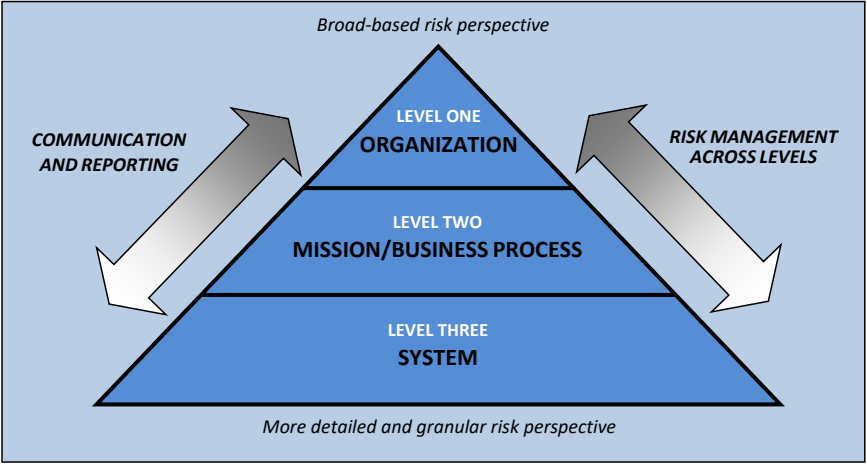
図D-1:組織全体のリスク管理アプローチ。三角形が 3 層に分かれ、上から第 1 層 組織、第 2 層 ミッション/業務プロセス、第 3 層 システムである。頂点の上に「広範なリスクの観点」、底辺の下に「より詳細できめ細かいリスクの観点」と記されている。左側には「コミュニケーションと報告」と記された斜めの両方向の矢印、右側には「レベル間のリスク管理」と記された斜めの両方向の矢印がある。
FIGURE D-1: ORGANIZATION-WIDE RISK MANAGEMENT APPROACH
図D-1:組織全体のリスク管理アプローチ
To address cyber resiliency, an organization’s risk management strategy needs to include its threat-framing with respect to cyber threats, its strategies for achieving cyber resiliency goals, and its choice of factors to use when prioritizing and interpreting cyber resiliency objectives at the mission or business process level and at the system level. Strategies for achieving cyber resiliency goals include:
サイバーレジリエンスに取り組むには、組織のリスク管理戦略に、サイバー脅威に関する脅威フレーミング、サイバーレジリエンス目標を達成する戦略、ミッション/業務プロセスレベルおよびシステムレベルで目的を優先順位付け・解釈する際に用いる要因の選択を含める必要があります。目標達成戦略には以下がある:
•Anticipate: Deterrence, avoidance, and prevention are strategies for anticipating potential threats. Other strategies include planning (i.e., identifying available resources and creating plans for using those resources if a threat materializes), preparation (i.e., changing the set of available resources and exercising plans), and morphing (i.e., changing the system on an ongoing basis in order to change the attack surface).
•予測:潜在的脅威を予測する戦略には、抑止、回避、防止があります。その他に計画(脅威顕在化時に利用可能な資源を特定し活用計画を作成)、準備(利用可能な資源群を変更し計画を演習)、変容(攻撃対象領域を変えるためシステムを継続的に変更)があります。
APPENDIX D
原文のみ
•Withstand: Strategies for withstanding the realization of potential threats, even when those threats are not detected, include absorption (i.e., accepting some level of damage to a given set of system elements, taking actions to reduce the impacts to other system elements or to the system as a whole, and repairing damage automatically), deflection (i.e., transferring threat events or their effects to different system elements or to systems other than those that were targeted or initially affected), and discarding (i.e., removing system elements or even a system as a whole based on indications of damage and either replacing those elements or enabling the system or mission or business process to operate without them).
•耐性:脅威が検知されない場合も含め、顕在化した脅威に耐える戦略には、吸収(システム要素群への一定の損害を受け入れ、他の要素またはシステム全体への影響を減らす措置を取り、自動的に修復する)、転嫁(脅威事象または影響を別のシステム要素、あるいは標的/初期影響対象とは別のシステムへ移す)、破棄(損害の兆候に基づきシステム要素またはシステム全体を除去し、要素を交換するか、それらなしでシステム/ミッション/業務プロセスを運用できるようにする)があります。
•Recover: Strategies for recovery include reversion (i.e., replicating a prior state that is known to be acceptable), reconstitution (i.e., replicating critical and supporting functions to an acceptable level or using existing system resources), and replacement (i.e., replacing damaged, suspect, or selected system elements with new ones or repurposing existing system elements to serve different functions in order to perform critical and supporting functions, possibly in different ways). Detection can support the selection of a recovery strategy. However, a system can apply these strategies independent of detection to change the attack surface.
•回復:回復戦略には、許容可能と判明している以前の状態を複製する復帰、重要機能と支援機能を許容水準まで復元する、または既存資源を使う再構成、ならびに損傷・疑義のある要素や選定要素を新品に置換する、または既存要素を転用して(場合によって異なる方法で)重要機能・支援機能を実行する交換があります。検知は回復戦略の選択を支援できますが、検知に依存せず攻撃対象領域を変えるためにこれらの戦略を適用できます。
•Adapt: Strategies for adaptation include correction (i.e., removing or applying new controls to compensate for identified vulnerabilities or weaknesses), hardening (i.e., reducing or manipulating attack surfaces), and reorientation (i.e., proactively orienting controls, practices, and capabilities to prospective, emerging, or potential threats). These strategies may result in redefinition (i.e., changing the system’s requirements, architecture, design, configuration, acquisition processes, or operational processes).
•適応:適応戦略には、特定された脆弱性・弱点を補うために管理策を除去または新たに適用する修正、攻撃対象領域の縮小・操作である堅牢化、将来/新興/潜在的脅威に向けて管理策・実務・能力を先回りして方向づける再方向付けがあります。これらの戦略は、要件、アーキテクチャ、設計、構成、調達プロセス、運用プロセスを変更する再定義につながる場合があります。
The organizational risk management strategy includes aspects that can limit the set of cyber resiliency solutions it will consider. These aspects include:112
組織のリスク管理戦略には、検討対象となるサイバーレジリエンス解決策を制限し得る側面が含まれます。これには以下がある:112
•The organization’s risk mitigation philosophy (e.g., following standards and guidelines, incorporating state-of-the-art technologies and making trade-offs between standards and leading-edge protection technologies, pushing the state-of-the-art through cyber defense DevOps)
•組織のリスク緩和方針(例:標準・ガイドラインへの準拠、最先端技術の導入と標準・先端保護技術間のトレードオフ、サイバー防御DevOpsによる最先端技術の推進)
•Dependencies and interactions among the organization’s programs, initiatives, and other efforts at multiple levels that involve investment in, transition to, or use of cyber technologies (e.g., transition to a zero trust architecture)
•サイバー技術への投資、移行、利用を伴う、複数レベルの組織プログラム、取り組み、その他活動間の依存関係・相互作用(例:ゼロトラストアーキテクチャへの移行)
•The types of external coordination in which the organization will participate (e.g., consumer of threat intelligence, bi-directional threat information-sharing, cooperation or coordination to counter threats, collaboration)
•組織が参加する外部調整の種類(例:脅威インテリジェンスの利用者、双方向の脅威情報共有、脅威対抗の協力・調整、連携)
•Whether and how deception can be used
•欺瞞を使用するか、またどのように使用するか
D.2 CYBER RESILIENCY OBJECTIVES
D.2 サイバーレジリエンスの目的
Table D-1 provides representative examples of sub-objectives for each cyber resiliency objective defined in Table 3. A sub-objective motivates the definition of requirements and the selection and tailoring of controls. The representative sub-objectives can be used as a starting point for eliciting restatements of objectives and for defining metrics, as illustrated in the table. The
表D-1は表3で定義された各サイバーレジリエンス目的の下位目的の代表例を示します。下位目的は要件の定義や管理策の選択・調整の動機となります。代表的な下位目的は、表のように、目的の言い換えを引き出し指標を定義する出発点として使用できます。
representative sub-objectives, suitably restated for the system of interest, can be further decomposed into capabilities of (or activities performed by) that system, and threshold and objective values can be stated.113
代表的なサブ目標は、対象システムに合わせて適切に言い換えたうえで、そのシステムの能力(またはそのシステムが実行する活動)にさらに分解でき、閾値と目標値を記述できます。113
TABLE D-1: CYBER RESILIENCY SUB-OBJECTIVES
表D-1:サイバーレジリエンス下位目的
| OBJECTIVE | REPRESENTATIVE SUB-OBJECTIVES | REPRESENTATIVE EXAMPLES OF METRICS |
|---|---|---|
| PREVENT OR AVOID Definition: Preclude the successful execution of an attack or the realization of adverse conditions. | • Apply basic protection measures and controls tailored to the risks of the system of interest. • Limit exposure to threat events. • Decrease the adversary’s perceived benefits. • Modify configurations based on threat intelligence. | • Time to patch or to apply configuration changes. • Percentage of resources for which configuration changes are randomly made. Percentage of resources for which lifespan limits are applied. • Percentage of sensitive data assets that are encrypted. Adversary dwell time in a deception environment. • Percentage of resources to which more restrictive privileges are automatically applied in response to threat indicators. |
| PREPARE Definition: Maintain a set of realistic courses of action that address predicted or anticipated adversity. | • Create and maintain cyber courses of action. • Maintain the resources needed to execute cyber courses of action. • Validate the realism of cyber courses of action using testing or exercises. | • Number of cyber courses of action (CCoAs) in the cyber playbook. Percentage of identified threat types, categories of threat actions, or TTPs (with reference to an identified threat model) addressed by at least one CCoA in the cyber playbook. • Percentage of cyber resources that are backed up. Time since the last exercise of alternative communications paths. Percentage of administrative staff who have been trained in their CCoA responsibilities. • Time since last (random, scheduled) exercise or simulation of one or more CCoAs. |
| CONTINUE Definition: Maximize the duration and viability of essential mission or business functions during adversity. | • Minimize the degradation of service delivery. • Minimize interruptions in service delivery. • Ensure that ongoing functioning is correct. | • Time to perform mission or business function damage assessment. Length of time performance of specified mission or business function remained below acceptable levels. • Time from initial disruption to availability (at minimum level of acceptability) of essential functions. • Percentage of essential data assets for which data quality has been validated. Percentage of essential processing services for which correctness of functioning has been validated. |
| CONSTRAIN Definition: Limit damage from adversity. | • Identify potential damage. • Isolate resources to limit future or further damage. • Move resources to limit future or further damage. | • Percentage of critical components that employ anti-tamper, shielding, and power line filtering. Time from initial indication or warning to completion of scans for potentially damaged resources. |
| 目的 | 代表的なサブ目的 | 代表的な指標の例 |
|---|---|---|
| 防止または回避 定義:攻撃の実行の成功、または有害な状況の実現を未然に防ぎます。 | • 対象システムのリスクに合わせて調整した基本的な防護措置および管理策を適用します。 • 脅威事象にさらされる範囲を限定します。 • 敵対者が認識する利益を減らします。 • 脅威インテリジェンスに基づいて構成を修正します。 | • パッチの適用または構成変更の適用にかかる時間。 • 構成変更がランダムに行われるリソースの割合。寿命の制限が適用されるリソースの割合。 • 暗号化されている機微なデータ資産の割合。欺瞞環境における敵対者の滞留時間。 • 脅威指標に応じて、より制限的な権限が自動的に適用されるリソースの割合。 |
| 準備 定義:予測された、または予期される逆境に対処する、現実的な行動方針の集合を維持します。 | • サイバー行動方針を作成し、維持します。 • サイバー行動方針の実行に必要なリソースを維持します。 • 試験または演習を用いて、サイバー行動方針の現実性を検証します。 | • サイバープレイブックにあるサイバー行動方針(CCoA)の数。(特定された脅威モデルに照らして)特定された脅威の種類、脅威行動の分類、またはTTPのうち、サイバープレイブックの少なくとも1つのCCoAで対処されているものの割合。 • バックアップされているサイバー資源の割合。代替通信経路を最後に演習してからの経過時間。CCoA上の責任について訓練を受けた管理担当要員の割合。 • 1つ以上のCCoAを最後に(無作為に、または計画に従って)演習またはシミュレーションしてからの経過時間。 |
| 継続 定義:逆境の最中における、不可欠なミッションまたは業務機能の継続期間と存続可能性を最大化します。 | • サービス提供の低下を最小限に抑えます。 • サービス提供の中断を最小限に抑えます。 • 継続的な機能の動作が正しいことを確実にします。 | • ミッションまたは業務機能の損害評価を行うまでの時間。指定されたミッションまたは業務機能の性能が許容レベルを下回っていた期間の長さ。 • 最初の中断から、不可欠な機能が(許容できる最低限のレベルで)利用可能になるまでの時間。 • データ品質が検証された不可欠なデータ資産の割合。動作の正しさが検証された不可欠な処理サービスの割合。 |
| 制約 定義:逆境による損害を限定します。 | • 潜在的な損害を特定します。 • リソースを隔離して、将来の損害またはさらなる損害を限定します。 • リソースを移動して、将来の損害またはさらなる損害を限定します。 | • 耐タンパー、シールド、電源ラインフィルタリングを採用している重要コンポーネントの割合。最初の兆候または警告から、損害を受けた可能性のあるリソースのスキャン完了までの時間。 |
APPENDIX D
原文のみ
| OBJECTIVE | REPRESENTATIVE SUB-OBJECTIVES | REPRESENTATIVE EXAMPLES OF METRICS |
|---|---|---|
| • Change or remove resources and how they are used in order to limit future or further damage. | • Time from initial indication or warning to the completion of component isolation. • Time from initial indication or warning to the completion of resource relocation. • Time from initial indication or warning to the completion of switch to an alternative. | |
| RECONSTITUTE Definition: Restore as much mission or business functionality as possible after adversity. | • Identify untrustworthy resources and damage.114 • Restore functionality. • Heighten protections during reconstitution. • Determine the trustworthiness of restored or reconstructed resources. | • Time to identify unavailable resources and represent damage in status visualization. • Time between the initiation of recovery procedures and the completion of documented milestones in the recovery, contingency, or continuity of operations plan. Percentage of cyber resources for which access control is maintained throughout the recovery process. • Percentage of cyber resources for which additional auditing or monitoring is applied during and after the recovery process. Time to bring a backup network intrusion detection system online. Percentage of reconstituted cyber resources that are placed in a restricted enclave for a period after reconstitution. • Percentage of restored or reconstructed (mission-critical, security-critical, supporting) data assets for which data integrity/quality is checked. |
| UNDERSTAND Definition: Maintain useful representations of mission and business dependencies and the status of resources with respect to possible adversity. | • Understand adversaries. • Understand dependencies on and among systems containing cyber resources. • Understand the status of resources with respect to threat events. • Understand the effectiveness of security controls and controls supporting cyber resiliency. | • Time between the receipt of threat intelligence and the determination of its relevance. Adversary dwell time in deception environment. • Time since the most recent refresh of mission dependency or functional dependency map. Time since the last cyber table-top exercise, Red Team exercise, or execution of controlled automated disruption. • Percentage of system elements for which failure or the indication of potential faults can be detected. Percentage of cyber resources monitored. • Number of attempted intrusions stopped at a network perimeter. Average length of time to recover from incidents. |
| TRANSFORM Definition: Modify mission or business | • Redefine mission or business process threads for agility. • Redefine mission or business functions to mitigate risks. | • Percentage of mission or business process threads that have been analyzed with respect to common dependencies and potential single points of failure. Percentage |
| 目的 | 代表的なサブ目的 | 代表的な指標の例 |
|---|---|---|
| • 将来の損害またはさらなる損害を限定するために、リソースおよびその使い方を変更または削除します。 | • 最初の兆候または警告から、コンポーネントの隔離完了までの時間。 • 最初の兆候または警告から、リソースの再配置完了までの時間。 • 最初の兆候または警告から、代替への切替え完了までの時間。 | |
| 再構成 定義:逆境の後に、可能な限り多くのミッションまたは業務機能を復元します。 | • 信頼できないリソースと損害を特定します。114 • 機能を復元します。 • 再構成の間、保護を強化します。 • 復元または再構築されたリソースの信頼性を判断します。 | • 利用不能なリソースを特定し、状態可視化に損害を表現するまでの時間。 • 復旧手順の開始から、復旧計画、コンティンジェンシー計画、または事業継続計画に記載されたマイルストーンの達成までの時間。復旧プロセス全体を通じてアクセス制御が維持されるサイバー資源の割合。 • 復旧プロセスの最中および後に、追加の監査または監視が適用されるサイバー資源の割合。バックアップのネットワーク侵入検知システムをオンラインにするまでの時間。再構成後の一定期間、制限されたエンクレーブに配置される再構成済みサイバー資源の割合。 • データの完全性/品質が検査される、復元または再構築された(ミッションクリティカル、セキュリティクリティカル、支援の)データ資産の割合。 |
| 理解 定義:起こりうる逆境に関して、ミッションおよび業務の依存関係とリソースの状態を表す有用な表現を維持します。 | • 敵対者を理解します。 • サイバー資源を含むシステムへの依存関係、およびそれらのシステム間の依存関係を理解します。 • 脅威事象に関するリソースの状態を理解します。 • セキュリティ管理策およびサイバーレジリエンスを支える管理策の有効性を理解します。 | • 脅威インテリジェンスの受領から、その関連性の判断までの時間。欺瞞環境における敵対者の滞留時間。 • ミッション依存関係マップまたは機能依存関係マップを最後に更新してからの経過時間。サイバーテーブルトップ演習、レッドチーム演習、または制御された自動化された妨害の実行を最後に行ってからの経過時間。 • 障害または潜在的な障害の兆候を検知できるシステム要素の割合。監視されているサイバー資源の割合。 • ネットワーク境界で阻止された侵入試行の数。インシデントからの平均復旧時間。 |
| 変革 定義:ミッションまたは業務 | • 俊敏性を高めるために、ミッションまたは業務プロセスのスレッドを再定義します。 • リスクを緩和するために、ミッションまたは業務機能を再定義します。 | • 共通の依存関係と潜在的な単一障害点について分析されたミッションまたは業務プロセスのスレッドの割合。 |
114 Damage need not be identified with specific resources. For example, degraded service can be systemic. Resources (e.g., processes) can be untrustworthy even if they appear to be performing correctly.
114 損害を特定の資源に結び付ける必要はありません。例えば、サービス低下はシステム全体に及ぶことがあります。資源(例:プロセス)は、正しく機能しているように見えても信頼できない場合があります。
APPENDIX D
原文のみ
| OBJECTIVE | REPRESENTATIVE SUB-OBJECTIVES | REPRESENTATIVE EXAMPLES OF METRICS |
|---|---|---|
| functions and supporting processes to handle adversity and address environmental changes more effectively. | of mission or business process threads for which alternative courses of action are documented. • Percentage of essential functions for which no dependencies on resources shared with nonessential functions can be identified. Percentage of problematic data feeds to which risk mitigations have been applied since last analysis. | |
| RE-ARCHITECT Definition: Modify architectures to handle adversity and address environmental changes more effectively. | • Restructure systems or sub-systems to reduce risks. • Modify systems or sub-systems to reduce risks. | • Size of the (hardware, software, supply chain, user, privileged user) attack surface. Percentage of system components for which provenance can be determined. Percentage of system components that can be selectively isolated. • Percentage of cyber resources for which custom analytics have been developed. Percentage of mission-critical components for which one or more custom-built alternatives are implemented. |
| 目的 | 代表的なサブ目的 | 代表的な指標の例 |
|---|---|---|
| の機能および支援プロセスを、逆境により効果的に対処し、環境の変化に対応するために修正します。 | 代替の行動方針が文書化されているミッションまたは業務プロセスのスレッドの割合。 • 不可欠でない機能と共有するリソースへの依存関係が特定できない不可欠な機能の割合。前回の分析以降、リスク緩和策が適用された問題のあるデータフィードの割合。 | |
| 再アーキテクチャ化 定義:逆境により効果的に対処し、環境の変化に対応するために、アーキテクチャを修正します。 | • リスクを低減するために、システムまたはサブシステムを再構築します。 • リスクを低減するために、システムまたはサブシステムを修正します。 | • (ハードウェア、ソフトウェア、サプライチェーン、ユーザー、特権ユーザーの)攻撃対象領域の大きさ。来歴を判断できるシステムコンポーネントの割合。選択的に隔離できるシステムコンポーネントの割合。 • 独自の分析が開発されているサイバー資源の割合。1つ以上の独自開発の代替が実装されているミッションクリティカルなコンポーネントの割合。 |
D.3 CYBER RESILIENCY TECHNIQUES
D.3 サイバーレジリエンス技法
This section provides definitions for cyber resiliency techniques, one of the fundamental cyber resiliency constructs, which also include goals, objectives, approaches, and design principles. The objectives support goals, the techniques support objectives, the approaches support techniques, and the design principles support the realization of the goals and objectives. The relationship among the cyber resiliency constructs, including specific mapping tables for the constructs, is provided in Section D.6. Table D-2 lists each cyber resiliency technique and its purpose. Table D-3 identifies potential interactions (e.g., synergies, conflicts) between cyber resiliency techniques.
本節では、目標、目的、アプローチ、設計原則と並ぶ基本的なサイバーレジリエンス構成概念の1つである、サイバーレジリエンス技法を定義します。目的は目標を支え、技法は目的を支え、アプローチは技法を支え、設計原則は目標・目的の実現を支援します。構成概念間の関係と具体的な対応表はSection D.6に示します。表D-2は各技法とその目的を、表D-3は技法間の潜在的相互作用(例:相乗効果、競合)を示します。
TABLE D-2: CYBER RESILIENCY TECHNIQUES
表D-2:サイバーレジリエンス技法
| TECHNIQUE | PURPOSE |
|---|---|
| ADAPTIVE RESPONSE Definition: Implement agile courses of action to manage risks. | Optimize the ability to respond in a timely and appropriate manner to adverse conditions, stresses, attacks, or indicators of these, thus maximizing the ability to maintain mission or business operations, limit consequences, and avoid destabilization. |
| ANALYTIC MONITORING Definition: Monitor and analyze a wide range of properties and behaviors on an ongoing basis and in a coordinated way. | Maximize the ability to detect potential adverse conditions; reveal the extent of adverse conditions, stresses, or attacks; identify potential or actual damage, and investigate adversary TTPs. Provide the data needed for situational awareness. |
| 技法 | 目的 |
|---|---|
| 適応型対応 定義:リスクを管理するために、俊敏な行動方針を実施します。 | 有害な状況、ストレス、攻撃、またはそれらの指標に、適時かつ適切に対応する能力を最適化し、それによってミッションまたは業務運用を維持し、影響を限定し、不安定化を回避する能力を最大化します。 |
| 分析的監視 定義:広範な特性と振る舞いを、継続的かつ連携した形で監視・分析します。 | 潜在的な逆境を検知する能力を最大化します。逆境、ストレス、または攻撃の範囲を明らかにします。潜在的または実際の損害を特定し、敵対者のTTPを調査します。状況認識に必要なデータを提供します。 |
APPENDIX D
原文のみ
| TECHNIQUE | PURPOSE |
|---|---|
| CONTEXTUAL AWARENESS Definition: Construct and maintain current representations of the posture of organizational missions or business functions while considering threat events and courses of action. | Support situational awareness. Enhance understanding of dependencies among cyber and non-cyber resources. Reveal patterns or trends in adversary behavior. |
| COORDINATED PROTECTION Definition: Ensure that protection mechanisms operate in a coordinated and effective manner. | Require a threat event to overcome multiple safeguards (i.e., employ a strategy of defense-in-depth). In the case of an adversarial threat event, increase the difficulty for an adversary to successfully attack critical resources by increasing the cost to the adversary and raising the likelihood of adversary detection. Regardless of the type of threat event, ensure that the use of any given protection mechanism does not create adverse, unintended consequences by interfering with other protection mechanisms. Validate the realism of cyber courses of action. |
| DECEPTION Definition: Mislead, confuse, hide critical assets from, or expose covertly tainted assets to the adversary. | Mislead, confuse, or hide critical assets from the adversary, thereby making the adversary uncertain of how to proceed, delaying the effect of the attack, increasing the risk of being discovered, causing the adversary to misdirect or waste its resources, and exposing the adversary tradecraft prematurely. |
| DIVERSITY Definition: Use heterogeneity to minimize common mode failures, particularly threat events exploiting common vulnerabilities. | Limit the possibility of the loss of critical functions due to the failure of replicated common critical components. In the case of an adversarial threat event, cause an adversary to expend more effort by developing malware or other TTPs that are appropriate for multiple targets; increase the probability that the adversary will waste or expose TTPs by applying them to targets for which they are inappropriate; and maximize the probability that some of the defending organization’s systems will survive the adversary’s attack. |
| DYNAMIC POSITIONING Definition: Distribute and dynamically relocate functionality or system resources. | Increase the ability to rapidly recover from non-adversarial events (e.g., fires, floods) as well as from adversarial threat events (e.g., cyber-attacks). Impede an adversary’s ability to locate, eliminate, or corrupt mission or business assets, and cause the adversary to spend more time and effort finding the organization’s critical assets, thereby increasing the probability of the adversary revealing their presence, actions, and tradecraft prematurely. |
| NON-PERSISTENCE Definition: Generate and retain resources as needed or for a limited time. | Reduce exposure to corruption, modification, or compromise. In the case of adversarial threat events, provide a means of curtailing an adversary’s intrusion and advance and potentially removing malware or damaged resources from the system. Limit the availability of resources the adversary could target. |
| PRIVILEGE RESTRICTION Definition: Restrict privileges based on the attributes of users and system elements as well as on environmental factors. | Limit the impact and probability that unintended actions by authorized individuals will compromise information or services. Impede an adversary by requiring them to invest more time and effort in obtaining credentials. Curtail the adversary’s ability to take full advantage of credentials that they have obtained. |
| 技法 | 目的 |
|---|---|
| 状況認識 定義:脅威事象と行動方針を考慮しながら、組織のミッションまたは業務機能の態勢について、最新の表現を構築し、維持します。 | 状況認識を支援します。サイバーリソースと非サイバーリソースの間の依存関係の理解を高めます。敵対者の振る舞いのパターンや傾向を明らかにします。 |
| 連携した保護 定義:保護メカニズムが、連携して効果的に動作するようにします。 | 脅威事象が複数の安全対策を突破しなければならないようにします(すなわち、多層防御の戦略を採用します)。敵対的な脅威事象の場合は、敵対者にかかるコストを増やし、敵対者が検知される可能性を高めることで、敵対者が重要リソースへの攻撃を成功させる難易度を高めます。脅威事象の種類にかかわらず、ある保護メカニズムの使用が他の保護メカニズムの妨げとなって、意図しない悪影響を生じさせないようにします。サイバー行動方針の現実性を検証します。 |
| 欺瞞 定義:敵対者を欺き、混乱させ、重要資産を敵対者から隠し、または密かに汚染された資産を敵対者に晒します。 | 敵対者を欺き、混乱させ、または重要資産を敵対者から隠すことで、敵対者にどう進めるべきかを分からなくさせ、攻撃の効果を遅らせ、発見されるリスクを高め、敵対者にリソースを誤って振り向けさせ、または浪費させ、敵対者の手口を早期に暴露させます。 |
| 多様性 定義:異種性を用いて、共通原因故障、特に共通の脆弱性を悪用する脅威事象を最小限に抑えます。 | 複製された共通の重要コンポーネントの故障による、重要機能の喪失の可能性を限定します。敵対的な脅威事象の場合は、複数の標的に適したマルウェアやその他のTTPを開発させることで敵対者により多くの労力を費やさせます。不適切な標的にTTPを適用させることで、敵対者がTTPを浪費または暴露する確率を高めます。防御側組織のシステムの一部が敵対者の攻撃を生き延びる確率を最大化します。 |
| 動的配置 定義:機能またはシステムリソースを分散し、動的に再配置します。 | 非敵対的な事象(例:火災、洪水)および敵対的な脅威事象(例:サイバー攻撃)の双方から迅速に復旧する能力を高めます。ミッションまたは業務資産を敵対者が特定、排除、または破損させる能力を妨げ、組織の重要資産の発見により多くの時間と労力を費やさせることで、敵対者が自らの存在、行動、手口を早期に露呈する確率を高めます。 |
| 非永続性 定義:リソースを必要に応じて、または限られた期間に限って生成し、保持します。 | 破損、改変、または侵害にさらされる範囲を減らします。敵対的な脅威事象の場合は、敵対者の侵入と進行を食い止める手段を提供し、システムからマルウェアや損傷したリソースを取り除くことも可能にします。敵対者が標的にしうるリソースの可用性を限定します。 |
| 権限の制限 定義:ユーザーおよびシステム要素の属性と、環境要因に基づいて、権限を制限します。 | 認可された個人による意図しない行動が、情報やサービスを侵害する影響と確率を限定します。敵対者に認証情報の入手へより多くの時間と労力を費やさせることで、敵対者を妨げます。敵対者が入手した認証情報を最大限に利用する能力を抑えます。 |
APPENDIX D
原文のみ
| TECHNIQUE | PURPOSE |
|---|---|
| REALIGNMENT Definition: Structure systems and resource uses to meet mission or business function needs, reduce current and anticipated risks, and accommodate the evolution of technical, operational, and threat environments. | Minimize the connections between mission-critical and non-critical services, thus reducing the likelihood that a failure of non-critical services will impact mission-critical services. Reduce the attack surface of the defending organization by minimizing the probability that non-mission or business functions could be used as an attack vector. Accommodate changing mission or business function needs. Accommodate changes in the technical environment. |
| REDUNDANCY Definition: Provide multiple protected instances of critical resources. | Reduce the consequences of the loss of information or services. Facilitate recovery from the effects of an adverse cyber event. Limit the time during which critical services are denied or limited. |
| SEGMENTATION Definition: Define and separate system elements based on criticality and trustworthiness. | Contain adversary activities and non-adversarial stresses (e.g., fires, floods) to the enclave, system segment, or facility in which they have established a presence. Limit the set of possible targets to which malware can be easily propagated. |
| SUBSTANTIATED INTEGRITY Definition: Ascertain whether critical system elements have been corrupted. | Facilitate the determination of correct results in case of conflicts between diverse services or inputs. Detect attempts by an adversary to deliver compromised data, software, or hardware, as well as successful modification or fabrication. |
| UNPREDICTABILITY Definition: Make changes randomly or unpredictably. | Increase an adversary’s uncertainty regarding the system protections that they may encounter, thus making it more difficult for them to ascertain the appropriate course of action. Serve as a force multiplier for other techniques. |
| 技法 | 目的 |
|---|---|
| 再整列 定義:ミッションまたは業務機能のニーズを満たし、現在および予測されるリスクを低減し、技術環境、運用環境、脅威環境の進化に対応できるよう、システムとリソースの利用を構成します。 | ミッションクリティカルなサービスと非クリティカルなサービスの間の接続を最小限に抑え、非クリティカルなサービスの障害がミッションクリティカルなサービスに影響する可能性を低減します。ミッションまたは業務機能以外の機能が攻撃ベクトルとして利用される確率を最小限に抑えることで、防御側組織の攻撃対象領域を縮小します。ミッションまたは業務機能のニーズの変化に対応します。技術環境の変化に対応します。 |
| 冗長性 定義:重要リソースの保護されたインスタンスを複数提供します。 | 情報またはサービスの喪失による影響を低減します。有害なサイバー事象の影響からの復旧を容易にします。重要なサービスが拒否または制限される時間を限定します。 |
| セグメンテーション 定義:重要度と信頼性に基づいて、システム要素を定義し、分離します。 | 敵対者の活動および非敵対的なストレス(例:火災、洪水)を、それらが拠点を確立したエンクレーブ、システムセグメント、または施設の内部に封じ込めます。マルウェアが容易に伝播しうる標的の集合を限定します。 |
| 実証された完全性 定義:重要なシステム要素が破損していないかを確認します。 | 異なるサービスまたは入力の間で矛盾が生じた場合に、正しい結果の判定を容易にします。敵対者が侵害されたデータ、ソフトウェア、またはハードウェアを送り込もうとする試み、ならびに成功した改変や偽造を検知します。 |
| 予測不能性 定義:変更をランダムに、または予測不能な形で行います。 | 敵対者が遭遇しうるシステムの保護について不確実性を高め、適切な行動方針を見極めることをより困難にします。他の技法の効果を高めるフォースマルチプライヤーとして機能します。 |
TABLE D-3: POTENTIAL INTERACTIONS BETWEEN CYBER RESILIENCY TECHNIQUES
表D-3:サイバーレジリエンス技法間の潜在的相互作用
| Adaptive Response | Analytic Monitoring | Contextual Awareness | Coordinated Protection | Deception | Diversity | Dynamic Positioning | Non-Persistence | Privilege Restriction | Realignment | Redundancy | Segmentation | Substantiated Integrity | Unpredictability | |
|---|---|---|---|---|---|---|---|---|---|---|---|---|---|---|
| ADAPTIVE RESPONSE | - | D | U | S | U | U/S | U/S | U/S | U | U/S | U | U | ||
| ANALYTIC MONITORING | S | - | S | D | U | U | U | U/S | ||||||
| CONTEXTUAL AWARENESS | S | U | - | S | S | U | ||||||||
| COORDINATED PROTECTION | U | S | - | U | U | U | U/S | U | U | U | ||||
| DECEPTION | U/S | U/C | C/S | - | U | U | S | U | ||||||
| DIVERSITY | S | C/S | C | C/S | - | S | U | U | U/S | U | S |
APPENDIX D
原文のみ
| Adaptive Response | Analytic Monitoring | Contextual Awareness | Coordinated Protection | Deception | Diversity | Dynamic Positioning | Non-Persistence | Privilege Restriction | Realignment | Redundancy | Segmentation | Substantiated Integrity | Unpredictability | |
|---|---|---|---|---|---|---|---|---|---|---|---|---|---|---|
| DYNAMIC POSITIONING | U/S | C/S | S | U | - | U | U | U/S | ||||||
| NON-PERSISTENCE | U/S | C | C | S | - | S | U | S | ||||||
| PRIVILEGE RESTRICTION | S | U | - | S | U | |||||||||
| REALIGNMENT | C | U | C/S | C/S | S | - | C | |||||||
| REDUNDANCY | S | U | S | - | U | |||||||||
| SEGMENTATION | U/S | C | S | S | - | U | ||||||||
| SUBSTANTIATED INTEGRITY | S | S/U | S | U | S | S | S | S | - | |||||
| UNPREDICTABILITY | C/S | C | C | S | U | U/S | U | - | ||||||
| Key: - S indicates that the technique in the row (Technique A) supports the one in the column (Technique B). Technique B is made more effective by Technique A. - D indicates that Technique A depends on Technique or Enabler B. Technique A will be ineffective if not used in conjunction with Technique or Enabler B. - U indicates that Technique A can use Technique or Enabler B. Technique A can be implemented effectively in the absence of Technique B. However, more options become available if Technique B is also used. - C indicates that Technique A can conflict with or complicate Technique B. Some or all implementations of Technique A could undermine the effectiveness of Technique B. | ||||||||||||||
| Adaptive Response | Analytic Monitoring | Contextual Awareness | Coordinated Protection | Deception | Diversity | Dynamic Positioning | Non-Persistence | Privilege Restriction | Realignment | Redundancy | Segmentation | Substantiated Integrity | Unpredictability | |
|---|---|---|---|---|---|---|---|---|---|---|---|---|---|---|
| 動的配置 | U/S | C/S | S | U | - | U | U | U/S | ||||||
| 非永続性 | U/S | C | C | S | - | S | U | S | ||||||
| 権限の制限 | S | U | - | S | U | |||||||||
| 再整列 | C | U | C/S | C/S | S | - | C | |||||||
| 冗長性 | S | U | S | - | U | |||||||||
| セグメンテーション | U/S | C | S | S | - | U | ||||||||
| 実証された完全性 | S | S/U | S | U | S | S | S | S | - | |||||
| 予測不能性 | C/S | C | C | S | U | U/S | U | - | ||||||
| 凡例: - S は、行の技法(技法A)が列の技法(技法B)を支援することを示します。技法Bは、技法Aによってより効果的になります。 - D は、技法Aが技法またはイネーブラーBに依存することを示します。技法Aは、技法またはイネーブラーBと併用しなければ効果がありません。 - U は、技法Aが技法またはイネーブラーBを利用できることを示します。技法Aは、技法Bがなくても効果的に実装できます。ただし、技法Bも用いると、選択肢が増えます。 - C は、技法Aが技法Bと競合する、または技法Bを複雑にする場合があることを示します。技法Aの実装の一部またはすべてが、技法Bの有効性を損なう可能性があります。 | ||||||||||||||
D.4 CYBER RESILIENCY IMPLEMENTATION APPROACHES
D.4 サイバーレジリエンス実装アプローチ
This section identifies representative cyber resiliency approaches to implementing cyber resiliency techniques. A cyber resiliency approach is a subset of the technologies and processes included in a cyber resiliency technique and is defined by how the capabilities are implemented or how the intended consequences are achieved. Table D-4 lists each cyber resiliency technique, representative approaches that can be used to implement the technique, and representative examples. Where possible, examples are drawn from discussions associated with the controls and control enhancements in [SP 800-53], even when these controls or enhancements do not directly support cyber resiliency as described in Appendix E. However, [SP 800-53] does not address all approaches or all aspects of any individual approach. Therefore, some examples are drawn from system reliability and system resilience practices and technologies and/or from emerging cyber resiliency technologies. The set of approaches for a specific technique is not exhaustive and represents relatively mature technologies and practices. Thus, technologies emerging from research can be characterized in terms of the techniques they apply while not being covered by any of the representative approaches.
本節では、サイバーレジリエンス技法を実装する代表的なアプローチを示します。サイバーレジリエンスアプローチは、技法に含まれる技術・プロセスの一部であり、能力の実装方法または意図した結果の達成方法で定義されます。表D-4は各技法、実装に使える代表的アプローチ、および代表例を示します。可能な限り、例は[SP 800-53]の管理策・管理策拡張に関する説明から採用します(Appendix Eで述べるサイバーレジリエンスを直接支援しないものも含みます)。ただし[SP 800-53]はすべてのアプローチや個々のアプローチの全側面を扱いません。そのため、一部の例はシステム信頼性・レジリエンスの実務/技術や新興サイバーレジリエンス技術から採用します。各技法のアプローチ一覧は網羅的でなく、比較的成熟した技術・実務を示します。したがって、研究から生まれた技術は、代表的アプローチに含まれなくても、適用技法に基づいて特徴づけられます。
APPENDIX D
原文のみ
TABLE D-4: CYBER RESILIENCY APPROACHES
表D-4:サイバーレジリエンスアプローチ
| TECHNIQUES | APPROACHES | EXAMPLES |
|---|---|---|
| ADAPTIVE RESPONSE Definition: Implement agile courses of action to manage risks. Discussion: Inform courses of action with situational awareness and predictive analytics for increased agility. All approaches can leverage virtualization and are compatible with zero trust architecture (ZTA) and cloud computing strategies. All approaches can also be applied to the processes and reporting within a Security Operations Center (SOC), as well as to the use of deception. | DYNAMIC RECONFIGURATION Definition: Make changes to individual systems, system elements, components, or sets of resources to change functionality or behavior without interrupting service. Informal description: Change how resources are or can be used. Discussion: Reconfiguration needs to be executed without significantly degrading or interrupting service. | • Dynamically change router rules, access control lists, intrusion detection and prevention system parameters, and filter rules for firewalls and gateways. • Reassign responsibilities among staff within a security operations center (SOC) based on expertise with a technology for which new warnings have been shared. |
| DYNAMIC RESOURCE ALLOCATION Definition: Change the allocation of resources to tasks or functions without terminating critical functions or processes. Informal description: Change how much of a resource can be used. Discussion: Reallocate resources to tasks or functions without terminating critical functions or processes. | • Employ dynamic provisioning. • Reprioritize messages or services. • Implement load-balancing. • Provide emergency shutoff capabilities. • Preempt communications. • Instruct SOC staff to prioritize analysis and response to one incident among multiple suspected incidents. | |
| ADAPTIVE MANAGEMENT Definition: Change how mechanisms are used based on changes in the operational environment as well as changes in the threat environment. Informal description: Change in response to change. Discussion: Manage how mechanisms can be used based on changes in the operational environment as well as changes in the threat environment. | • Disable access dynamically. • Implement adaptive authentication. • Provide for the automatic disabling of a system or service. • Provide dynamic deployment of new or replacement resources or capabilities. • Use automated decision-making supported by artificial intelligence (AI) or machine learning (ML) for rapid response and dynamic changes when human operators are not available. • Create a temporary incident-focused team reporting structure within an SOC. | |
| ANALYTIC MONITORING Definition: Monitor and analyze a wide range of properties and behaviors on an ongoing basis and in a coordinated way. Discussion: Systems can accumulate vast amounts of monitoring or logging data. Use monitoring data | MONITORING AND DAMAGE ASSESSMENT Definition: Monitor and analyze behavior and characteristics of components and resources to look for indicators of adversary activity or precursor conditions or indications of other threat events and to detect and assess damage from adversity. Informal description: Look for indications that something might be | • Use hardware fault detection. • Employ Continuous Diagnostics and Mitigation (CDM) or other vulnerability scanning tools. • Deploy intrusion detection systems (IDSs) and other monitoring tools. • Use insider threat monitoring tools. • Perform telemetry analysis. • Detect malware beaconing. |
| 技法 | アプローチ | 例 |
|---|---|---|
| ADAPTIVE RESPONSE 定義:リスクを管理するために、俊敏な行動方針を実施します。 考察:俊敏性を高めるため、状況認識と予測分析によって行動方針に情報を与えます。すべてのアプローチは仮想化を活用でき、ゼロトラストアーキテクチャ(ZTA)およびクラウドコンピューティングの戦略と互換性があります。すべてのアプローチは、セキュリティオペレーションセンター(SOC)内のプロセスと報告、ならびに欺瞞の利用にも適用できます。 | DYNAMIC RECONFIGURATION 定義:サービスを中断することなく機能または振る舞いを変更するために、個々のシステム、システム要素、コンポーネント、またはリソースの集合に変更を加えます。 非公式な説明:リソースの使われ方、または使い方を変更します。 考察:再構成は、サービスを著しく低下させたり中断させたりすることなく実行する必要があります。 | • ルータのルール、アクセス制御リスト、侵入検知・防止システムのパラメータ、ファイアウォールやゲートウェイのフィルタルールを動的に変更します。 • 新たな警告が共有された技術に関する専門知識に基づいて、セキュリティオペレーションセンター(SOC)の要員間で責任を再割り当てします。 |
| DYNAMIC RESOURCE ALLOCATION 定義:重要な機能やプロセスを終了させることなく、タスクや機能へのリソースの割当てを変更します。 非公式な説明:リソースをどれだけ使えるかを変更します。 考察:重要な機能やプロセスを終了させることなく、リソースをタスクや機能に再割当てします。 | • 動的プロビジョニングを採用します。 • メッセージまたはサービスの優先順位を付け直します。 • 負荷分散を実装します。 • 緊急遮断機能を提供します。 • 通信をプリエンプトします。 • 複数の疑いのあるインシデントのうち1つの分析と対応を優先するよう、SOC要員に指示します。 | |
| ADAPTIVE MANAGEMENT 定義:運用環境の変化および脅威環境の変化に基づいて、メカニズムの使い方を変更します。 非公式な説明:変化に応じて変化します。 考察:運用環境の変化および脅威環境の変化に基づいて、メカニズムをどのように使用できるかを管理します。 | • アクセスを動的に無効化します。 • 適応型認証を実装します。 • システムまたはサービスの自動無効化を可能にします。 • 新規または代替のリソースや能力の動的な配備を提供します。 • 人間のオペレーターが対応できない場合に、迅速な対応と動的な変更のため、人工知能(AI)または機械学習(ML)に支えられた自動意思決定を用います。 • SOC内に、インシデントに特化した臨時のチーム報告体制を設けます。 | |
| ANALYTIC MONITORING 定義:広範な特性と振る舞いを、継続的かつ連携した形で監視・分析します。 考察:システムは膨大な量の監視データまたはログデータを蓄積することがあります。監視データを | MONITORING AND DAMAGE ASSESSMENT 定義:敵対者の活動の指標、その前兆となる状況、またはその他の脅威事象の兆候を探し、逆境による損害を検知・評価するために、コンポーネントおよびリソースの振る舞いと特性を監視・分析します。 非公式な説明:何かがおかしい可能性と、 | • ハードウェア障害検知を用います。 • 継続的な診断と緩和(CDM)またはその他の脆弱性スキャンツールを採用します。 • 侵入検知システム(IDS)およびその他の監視ツールを配備します。 • 内部脅威監視ツールを用います。 • テレメトリ分析を行います。 • マルウェアのビーコニングを検知します。 |
APPENDIX D
原文のみ
| TECHNIQUES | APPROACHES | EXAMPLES |
|---|---|---|
| strategically to inform defensive activities. | awry and what damage might have occurred. Discussion: Leverage Continuous Diagnostics and Mitigation (CDM) and other monitoring capabilities, including those related to health and status (H&S). Integrate with threat hunting and insider threat monitoring. | • Monitor open-source information for indicators of disclosure or compromise. |
| SENSOR FUSION AND ANALYSIS Definition: Fuse and analyze monitoring data and analysis results from different information sources or at different times together with externally provided threat intelligence. Informal description: Put the pieces together from many different sources. Discussion: Consider all possible sources of monitoring information, including CDM, H&S, physical access logs, and insider threat monitoring. | • Enable organization-wide situational awareness. • Implement cross-organizational auditing. • Correlate data from different tools. • Fuse data from physical access control systems and information systems. | |
| FORENSIC AND BEHAVIORAL ANALYSIS Definition: Analyze indicators and adversary TTPs, including observed behavior, malware, and other artifacts left behind by adverse events. Informal description: Analyze adversary activities and artifacts to develop an understanding and attribution of adversary goals, capabilities, and practices. Discussion: Ensure that policies and practices are in place to capture evidence and support analysis. | • Deploy an integrated team of forensic and malware analysts, developers, and operations personnel. • Use reverse engineering and other malware analysis tools. | |
| CONTEXTUAL AWARENESS Definition: Construct and maintain current representations of the posture of missions or business functions while considering threat events and courses of action. Discussion: Maintain cyber situational awareness to support mission continuity. | DYNAMIC RESOURCE AWARENESS Definition: Maintain current information about resources, the status of resources, and resource connectivity. Informal description: Maintain awareness of systems’ performance and security posture. Discussion: Integrate network performance, system performance, and continuous diagnostics as part of situational awareness. | • Maintain a real-time network map. • Integrate health and status (H&S) data with outputs of CDM tools. |
| DYNAMIC THREAT AWARENESS Definition: Maintain current information about threat actors, | • Track predicted or impending natural disasters. |
| 技法 | アプローチ | 例 |
|---|---|---|
| 戦略的に活用して、防御活動に情報を与えます。 | 何かがおかしい可能性と、どのような損害が生じた可能性があるかを示す兆候を探します。 考察:継続的な診断と緩和(CDM)や、健全性・状態(H&S)に関するものを含むその他の監視能力を活用します。脅威ハンティングおよび内部脅威監視と統合します。 | • 開示または侵害の指標を求めて、オープンソース情報を監視します。 |
| SENSOR FUSION AND ANALYSIS 定義:異なる情報源または異なる時点の監視データと分析結果を、外部から提供される脅威インテリジェンスとともに融合し、分析します。 非公式な説明:多数の異なる情報源から断片を組み合わせます。 考察:CDM、H&S、物理アクセスログ、内部脅威監視を含め、監視情報のあらゆる情報源を検討します。 | • 組織全体の状況認識を可能にします。 • 組織横断的な監査を実施します。 • 異なるツールからのデータを相関させます。 • 物理アクセス制御システムと情報システムからのデータを融合します。 | |
| FORENSIC AND BEHAVIORAL ANALYSIS 定義:指標と敵対者のTTP(観測された振る舞い、マルウェア、有害な事象が残したその他のアーティファクトを含む)を分析します。 非公式な説明:敵対者の活動とアーティファクトを分析して、敵対者の目標、能力、実践についての理解と帰属を進めます。 考察:証拠を収集し、分析を支援するための方針と実践が整備されていることを確実にします。 | • フォレンジックおよびマルウェアの分析者、開発者、運用要員からなる統合チームを配置します。 • リバースエンジニアリングやその他のマルウェア分析ツールを用います。 | |
| CONTEXTUAL AWARENESS 定義:脅威事象と行動方針を考慮しながら、ミッションまたは業務機能の態勢について、最新の表現を構築し、維持します。 考察:ミッションの継続性を支えるため、サイバー状況認識を維持します。 | DYNAMIC RESOURCE AWARENESS 定義:リソース、リソースの状態、およびリソースの接続性についての最新情報を維持します。 非公式な説明:システムの性能とセキュリティ態勢の認識を維持します。 考察:ネットワーク性能、システム性能、継続的な診断を、状況認識の一部として統合します。 | • リアルタイムのネットワークマップを維持します。 • 健全性・状態(H&S)データをCDMツールの出力と統合します。 |
| DYNAMIC THREAT AWARENESS 定義:脅威主体、 | • 予測される、または差し迫った自然災害を追跡します。 |
APPENDIX D
原文のみ
| TECHNIQUES | APPROACHES | EXAMPLES |
|---|---|---|
| indicators, and potential, predicted, and observed adverse events. Informal description: Maintain a current awareness of threats that are both observed and anticipated. Discussion: Ensure that the organization’s security operations center (SOC) ingests cyber threat intelligence. | • Dynamically ingest incident and threat data. • Track ownership changes of suppliers and other depended-on parties. • Facilitate integrated situational awareness of threats. • Track attribution of threat actions. | |
| MISSION DEPENDENCY AND STATUS VISUALIZATION Definition: Maintain current information about the status of missions or business functions, dependencies on resources, and the status of those resources with respect to threats. Informal description: Maintain an up-to-date cyber operational picture. Discussion: Maintain an up-to-date dependency map for mission-essential or business-essential functions. Integrate resource and threat awareness into situational awareness and enable focused visualization for high-value assets and infrastructure services. | • Maintain a mission-wide or organization-wide operational picture or dashboard. • Maintain a current security posture assessment for critical resources or high-value assets. | |
| COORDINATED PROTECTION Definition: Ensure that protection mechanisms operate in a coordinated and effective manner. Discussion: Lack of coordination introduces fragility and creates exposures to threats. | CALIBRATED DEFENSE-IN-DEPTH Definition: Provide complementary protective mechanisms at different architectural layers or in different locations, calibrating the strength and number of mechanisms to resource value. Informal description: Do not expect one defense to suffice. Apply layered defenses based on risk. Discussion: Avoid creating single points of failure. | • Design for defense-in-depth. • Employ multiple, distinct authentication challenges over the course of a session to confirm identity. • Combine network and host-based intrusion detection. • Provide increasing levels of protection to access more sensitive or critical resources. • Conduct sensitivity and criticality analyses. |
| CONSISTENCY ANALYSIS Definition: Determine whether and how protections can be applied in a coordinated, consistent way that minimizes interference, potential cascading failures, or coverage gaps. Informal description: Minimize opportunities for the system’s security capabilities to be used incompletely or inconsistently. Discussion: Over time, changing access policies for information, | • Employ unified Identity, Credential, and Access Management (ICAM) administration tools. • Analyze mission and business process flows and threads. • Employ privilege analysis tools to support an ongoing review of whether user privileges are assigned consistently. • Interpret attributes consistently. |
| 技法 | アプローチ | 例 |
|---|---|---|
| 指標、ならびに潜在的、予測された、および観測された有害事象。 非公式な説明:観測された脅威と予期される脅威の双方について、最新の認識を維持します。 考察:組織のセキュリティオペレーションセンター(SOC)がサイバー脅威インテリジェンスを取り込むようにします。 | • インシデントデータおよび脅威データを動的に取り込みます。 • サプライヤーおよびその他の依存される関係者の所有者変更を追跡します。 • 脅威に関する統合的な状況認識を促進します。 • 脅威行動の帰属を追跡します。 | |
| MISSION DEPENDENCY AND STATUS VISUALIZATION 定義:ミッションまたは業務機能の状態、リソースへの依存関係、およびそれらのリソースの脅威に関する状態についての最新情報を維持します。 非公式な説明:最新のサイバー運用状況図を維持します。 考察:ミッションまたは業務に不可欠な機能について、最新の依存関係マップを維持します。リソースと脅威の認識を状況認識に統合し、高価値資産やインフラストラクチャサービスに焦点を当てた可視化を可能にします。 | • ミッション全体または組織全体の運用状況図またはダッシュボードを維持します。 • 重要リソースまたは高価値資産について、最新のセキュリティ態勢評価を維持します。 | |
| COORDINATED PROTECTION 定義:保護メカニズムが、連携して効果的に動作するようにします。 考察:連携の欠如はフラジリティを生み、脅威にさらされる箇所を生じさせます。 | CALIBRATED DEFENSE-IN-DEPTH 定義:異なるアーキテクチャ層または異なる場所に補完的な保護メカニズムを設け、メカニズムの強度と数をリソースの価値に応じて調整します。 非公式な説明:1つの防御で十分だとは期待しません。リスクに基づいて多層防御を適用します。 考察:単一障害点を作らないようにします。 | • 多層防御を前提に設計します。 • 身元を確認するため、セッション中に複数の異なる認証チャレンジを用います。 • ネットワーク型とホスト型の侵入検知を組み合わせます。 • より機微な、または重要なリソースにアクセスするほど、保護のレベルを高めます。 • 機微性および重要度の分析を実施します。 |
| CONSISTENCY ANALYSIS 定義:干渉、連鎖的障害の可能性、または適用範囲の抜けを最小限に抑える、連携した一貫性のある形で保護を適用できるかどうか、およびその方法を判断します。 非公式な説明:システムのセキュリティ能力が不完全に、または一貫性なく使われる機会を最小限に抑えます。 考察:時間の経過とともに、情報に関するアクセスポリシー、 | • 統合されたID・認証情報・アクセス管理(ICAM)の管理ツールを採用します。 • ミッションおよび業務プロセスのフローとスレッドを分析します。 • ユーザー権限が一貫して割り当てられているかの継続的な見直しを支援するため、権限分析ツールを採用します。 • 属性を一貫して解釈します。 |
APPENDIX D
原文のみ
| TECHNIQUES | APPROACHES | EXAMPLES |
|---|---|---|
| allowable uses of capabilities, and dependencies among systems and components can produce fragility and provide adversaries with opportunities. | • Use machine learning for access control policy verification [IR 8360]. • Design for facilitating coordination and mutual support among safeguards. | |
| ORCHESTRATION Definition: Coordinate modifications to and the ongoing behavior of mechanisms and processes at different layers, in different locations, or implemented for different aspects of trustworthiness to avoid causing cascading failures, interference, or coverage gaps. Informal description: Coordinate security capabilities at different layers and in different systems or system components to avoid coverage gaps or interference. Discussion: Orchestrate updates of capabilities and policies, particularly, for identity, credentialing, and access management (ICAM) across systems. Orchestrate monitoring across architectural layers. Use a cyber playbook to orchestrate incident response efforts. | • Coordinate incident handling with mission and business process continuity of operations and organizational processes. • Coordinate the planning, training, and testing of incident response, contingency planning, etc. • Make software updates in a consistent, coordinated way across the organization. • Deploy ICAM policy updates in a consistent, coordinated way across the organization. • Conduct coverage planning and management for sensors. • Use cyber playbooks. | |
| SELF-CHALLENGE Definition: Affect mission or business processes or system elements adversely in a controlled manner to validate the effectiveness of protections and enable proactive response and improvement. Informal description: Validate the effectiveness of capabilities and processes in action. Discussion: Use tabletop exercises (TTXs), Red Teams, penetration testing, or automated fault injection throughout the system life cycle and with different scopes. | • Hardware power-on self-test. • Conduct role-based training exercises. • Conduct penetration testing and Red Team exercises. • Test automated incident response. • Employ fault injection. • Conduct tabletop exercises. | |
| DECEPTION Definition: Mislead, confuse, hide critical assets from, or | OBFUSCATION Definition: Hide, transform, or otherwise obscure the contents, properties, or presence of information or other assets from the adversary. | • Encrypt data at rest. • Use steganographic encoding (e.g., digital watermarking). • Encrypt transmitted data (e.g., using a Virtual Private Network [VPN]). • Encrypt authenticators. |
| 技法 | アプローチ | 例 |
|---|---|---|
| 能力の許容される使用、およびシステムとコンポーネント間の依存関係は、フラジリティを生み、敵対者に機会を与えうます。 | • アクセス制御ポリシーの検証に機械学習を用います [IR 8360]。 • 安全対策間の連携と相互支援を促進するよう設計します。 | |
| ORCHESTRATION 定義:連鎖的障害、干渉、または適用範囲の抜けを生じさせないよう、異なる層、異なる場所、または信頼性の異なる側面のために実装されたメカニズムおよびプロセスの変更と継続的な振る舞いを調整します。 非公式な説明:適用範囲の抜けや干渉を避けるため、異なる層、異なるシステム、またはシステムコンポーネントにおけるセキュリティ能力を調整します。 考察:特にシステム間のID・認証情報・アクセス管理(ICAM)について、能力とポリシーの更新をオーケストレーションします。アーキテクチャ層をまたいだ監視をオーケストレーションします。インシデント対応の取り組みをオーケストレーションするために、サイバープレイブックを用います。 | • インシデント対応を、ミッションおよび業務プロセスの運用継続および組織のプロセスと連携させます。 • インシデント対応、コンティンジェンシープランニングなどの計画、訓練、試験を連携させます。 • ソフトウェア更新を、組織全体で一貫して連携した形で行います。 • ICAMポリシーの更新を、組織全体で一貫して連携した形で展開します。 • センサーのカバレッジ計画と管理を実施します。 • サイバープレイブックを用います。 | |
| SELF-CHALLENGE 定義:保護の有効性を検証し、先回りした対応と改善を可能にするため、ミッションまたは業務プロセスもしくはシステム要素に、制御された形で悪影響を与えます。 非公式な説明:能力とプロセスの有効性を、実際の動作の中で検証します。 考察:システムライフサイクル全体を通じて、さまざまな範囲で、机上演習(TTX)、レッドチーム、ペネトレーションテスト、または自動化された障害注入を用います。 | • ハードウェアの電源投入時自己診断。 • 役割別の訓練演習を実施します。 • ペネトレーションテストおよびレッドチーム演習を実施します。 • 自動化されたインシデント対応を試験します。 • 障害注入を採用します。 • 机上演習を実施します。 | |
| DECEPTION 定義:敵対者を欺き、混乱させ、重要資産を敵対者から隠し、または | OBFUSCATION 定義:情報またはその他の資産の内容、特性、または存在を、敵対者から隠し、変換し、またはその他の方法で不明瞭にします。 | • 保存データを暗号化します。 • ステガノグラフィによる符号化(例:電子透かし)を用います。 • 送信データを暗号化します(例:仮想プライベートネットワーク[VPN]を用います)。 • オーセンティケータを暗号化します。 |
APPENDIX D
原文のみ
| TECHNIQUES | APPROACHES | EXAMPLES |
|---|---|---|
| expose covertly tainted assets to the adversary.115 Discussion: Apply deception strategically, tactically, or both. Ensure that cyber risk governance and SOC operations allow for deception and maintain deception resources. Deception can support the analysis and attribution of adversary TTPs and the development of cyber threat intelligence. | Informal description: Make information difficult for the adversary to find and understand. Discussion: Encryption is a key method for obfuscation. | • Randomize communications patterns. • Conceal the presence of system components on an internal network. • Mask, encrypt, hash, or replace identifiers. • Obfuscate traffic via onion routing. • Apply chaffing to communications traffic. • Add a large amount of valid but useless information to a data store. • Perform encrypted processing. |
| DISINFORMATION Definition: Provide deliberately misleading information to adversaries. Informal description: Deceive adversaries. Discussion: Typical forms of disinformation include decoy accounts and decoy credentials. | • Post questions to a public forum based on false information about the system. • Create false (“canary”) credentials and tokens (e.g., honeytokens). | |
| MISDIRECTION Definition: Maintain deception resources or environments, and direct adversary activities there. Informal description: Direct adversary activities to deception environments or resources. Discussion: Commercial products can be used to create and maintain a deception network, but ongoing effort is needed to keep it current, engage with adversaries, and analyze adversary TTPs. | • Establish and maintain honeypots, honeynets, or decoy files. • Maintain a full-scale, all-encompassing deception environment. | |
| TAINTING Definition: Embed covert capabilities in resources. Informal description: Make whatever adversaries steal also identify those adversaries or even harm them. Discussion: Enable exfiltrated data to “phone home.” | • Use beacon traps. • Employ internal network table cache poisoning (e.g., Domain Name System [DNS], Address Resolution Protocol [ARP]). • Include false entries or steganographic data in files to enable them to be found via open-source analysis. |
| 技法 | アプローチ | 例 |
|---|---|---|
| 密かに汚染された資産を敵対者に晒します。115 考察:欺瞞を戦略的に、戦術的に、またはその両方で適用します。サイバーリスクガバナンスとSOCの運用が欺瞞を許容し、欺瞞用のリソースを維持できるようにします。欺瞞は、敵対者のTTPの分析と帰属、およびサイバー脅威インテリジェンスの開発を支援できます。 | 非公式な説明:敵対者が情報を見つけにくく、理解しにくくします。 考察:暗号化は、難読化の主要な手法です。 | • 通信パターンをランダム化します。 • 内部ネットワーク上のシステムコンポーネントの存在を隠蔽します。 • 識別子をマスク、暗号化、ハッシュ化、または置換します。 • オニオンルーティングによってトラフィックを難読化します。 • 通信トラフィックにチャフィングを適用します。 • 有効だが無用な情報を大量にデータストアに追加します。 • 暗号化したまま処理を行います。 |
| DISINFORMATION 定義:敵対者に意図的に誤解を招く情報を提供します。 非公式な説明:敵対者を欺きます。 考察:偽情報の典型的な形態には、おとりアカウントやおとり認証情報があります。 | • システムに関する虚偽の情報に基づいて、公開フォーラムに質問を投稿します。 • 偽の(「カナリア」)認証情報とトークン(例:ハニートークン)を作成します。 | |
| MISDIRECTION 定義:欺瞞用のリソースや環境を維持し、敵対者の活動をそこへ誘導します。 非公式な説明:敵対者の活動を欺瞞環境またはリソースへ誘導します。 考察:市販製品を使って欺瞞ネットワークを構築・維持できますが、最新の状態に保ち、敵対者と関わり、敵対者のTTPを分析するには、継続的な取り組みが必要です。 | • ハニーポット、ハニーネット、またはおとりファイルを構築し、維持します。 • 全面的で包括的な欺瞞環境を維持します。 | |
| TAINTING 定義:リソースに隠れた能力を埋め込みます。 非公式な説明:敵対者が盗んだものから、その敵対者を特定させ、あるいは害を与えさえします。 考察:持ち出されたデータが「本拠に連絡する」ようにします。 | • ビーコントラップを用います。 • 内部ネットワークのテーブルキャッシュポイズニング(例:ドメインネームシステム[DNS]、アドレス解決プロトコル[ARP])を採用します。 • ファイルに偽のエントリやステガノグラフィデータを含め、オープンソース分析によって発見されるようにします。 |
115 The Deception technique could more properly be described as Deception and Denial (D&D). The implementation approaches for deception correspond to the D&D framework provided by [Heckman15]: Obfuscation – Conceal Facts; Disinformation – Reveal Fictions; Misdirection – Conceal Fictions; and Tainting – Reveal Facts. To avoid any possible confusion with denial of service (DoS), the technique is referred to simply as Deception.
115 Deception技法は、より正確には欺瞞・拒否(Deception and Denial:D&D)と呼ぶことができます。欺瞞の実装アプローチは、[Heckman15]が示すD&Dフレームワークに対応する:Obfuscation(事実を隠す)、Disinformation(虚構を明らかにする)、Misdirection(虚構を隠す)、Tainting(事実を明らかにします)。サービス拒否(DoS)との混同の可能性を避けるため、この技法は単にDeceptionと呼びます。
APPENDIX D
原文のみ
| TECHNIQUES | APPROACHES | EXAMPLES |
|---|---|---|
| DIVERSITY Definition: Use heterogeneity to minimize common mode failures, particularly threat events that exploit common vulnerabilities. Discussion: Enterprise systems often include some incidental diversity as a result of procurements by different programs or at different times. Poorly managed, this can be costly and create security risks; well managed, it can make an adversary’s job harder. Due to reliance on common libraries and infrastructures, diversity can be more apparent than real. Therefore, analysis is needed to verify the extent of diversity. | ARCHITECTURAL DIVERSITY Definition: Use multiple sets of technical standards, different technologies, and different architectural patterns. Informal description: Use different technical architectures. Discussion: An organization can use, for example, both Windows and Linux. An organization’s cloud strategy can involve multiple cloud infrastructures. | • Use auditing/logging systems on different OSs to acquire and store audit/logging data. • Apply different audit/logging regimes at different architectural layers. • Deploy diverse operating systems. • Support multiple protocol standards. • [Non-cyber example] Use both airplanes and lighter-than-air aircraft for air transportation. |
| DESIGN DIVERSITY Definition: Use different designs within a given architecture to meet the same requirements or provide equivalent functionality. Informal description: Provide multiple ways to meet requirements. Discussion: Within the context of a given architecture, parallel design teams can solve the same problem in different ways, thus producing different attack surfaces. | • Employ N-version programming. • Employ mixed-signal design diversity (using both analog and digital signals). • Employ mixed-level design diversity (using both hardware and software implementations). • [Non-cyber example] Use both helium-filled and hot air dirigibles. | |
| SYNTHETIC DIVERSITY Definition: Transform implementations of software to produce a variety of instances. Informal description: Use automation to tweak software implementations. Discussion: Synthetic diversity can be applied to IoT devices. | • Implement address space layout randomization. • Use randomizing compilers. | |
| INFORMATION DIVERSITY Definition: Provide information from different sources or transform information in different ways. Informal description: Use multiple sources for the same information. Discussion: Use of information from different sources can reveal adversary injection or modification. | • Apply different analog-to-digital conversion methods to non-digitally-obtained data. • Use multiple data sources. | |
| PATH DIVERSITY Definition: Provide multiple independent paths for command, control, and communications. Informal description: Do not rely on a single mode of communication. Discussion: In particular, ensure alternative lines of communications | • Establish alternate telecommunications services (e.g., ground-based circuits, satellite communications). • Employ alternate communications protocols. • Use out-of-band channels. |
| 技法 | アプローチ | 例 |
|---|---|---|
| DIVERSITY 定義:異種性を用いて、共通原因故障、特に共通の脆弱性を悪用する脅威事象を最小限に抑えます。 考察:エンタープライズシステムには、異なるプログラムによる、あるいは異なる時期の調達の結果として、偶発的な多様性がいくらか含まれていることが多くあります。管理が不十分だとコストがかかりセキュリティリスクを生みますが、適切に管理すれば敵対者の作業を困難にできます。共通のライブラリやインフラストラクチャに依存しているため、多様性は実際よりも見かけ上のものになりうます。したがって、多様性の範囲を検証する分析が必要です。 | ARCHITECTURAL DIVERSITY 定義:複数の技術標準、異なる技術、異なるアーキテクチャパターンを用います。 非公式な説明:異なる技術アーキテクチャを用います。 考察:組織は、たとえばWindowsとLinuxの両方を使用できます。組織のクラウド戦略に、複数のクラウドインフラストラクチャが含まれることもあります。 | • 異なるOS上の監査/ログ取得システムを用いて、監査/ログデータを取得・保存します。 • アーキテクチャ層ごとに異なる監査/ログ取得方式を適用します。 • 多様なオペレーティングシステムを配備します。 • 複数のプロトコル標準をサポートします。 • [サイバー以外の例] 航空輸送に飛行機と軽航空機の両方を用います。 |
| DESIGN DIVERSITY 定義:同じ要求事項を満たす、または同等の機能を提供するために、所与のアーキテクチャ内で異なる設計を用います。 非公式な説明:要求事項を満たす方法を複数用意します。 考察:所与のアーキテクチャの文脈では、並行する設計チームが同じ問題を異なる方法で解決でき、その結果、異なる攻撃対象領域が生じます。 | • N バージョンプログラミングを採用します。 • (アナログ信号とデジタル信号の両方を用いる)混合信号の設計多様性を採用します。 • (ハードウェアとソフトウェアの両方の実装を用いる)混合レベルの設計多様性を採用します。 • [サイバー以外の例] ヘリウム充填飛行船と熱気飛行船の両方を用います。 | |
| SYNTHETIC DIVERSITY 定義:ソフトウェアの実装を変換して、さまざまなインスタンスを生成します。 非公式な説明:自動化を用いて、ソフトウェアの実装に手を加えます。 考察:合成的多様性は、IoTデバイスにも適用できます。 | • アドレス空間配置のランダム化を実装します。 • ランダム化コンパイラを用います。 | |
| INFORMATION DIVERSITY 定義:異なる情報源から情報を提供する、または情報を異なる方法で変換します。 非公式な説明:同じ情報に複数の情報源を用います。 考察:異なる情報源の情報を用いることで、敵対者による注入や改変が明らかになることがあります。 | • デジタル形式で取得されていないデータに、異なるアナログ-デジタル変換方式を適用します。 • 複数のデータソースを用います。 | |
| PATH DIVERSITY 定義:指揮、統制、通信のために、複数の独立した経路を提供します。 非公式な説明:単一の通信手段に頼りません。 考察:特に、代替の通信回線を確保する | • 代替の電気通信サービス(例:地上回線、衛星通信)を確立します。 • 代替の通信プロトコルを採用します。 • 帯域外チャネルを用います。 |
APPENDIX D
原文のみ
| TECHNIQUES | APPROACHES | EXAMPLES |
|---|---|---|
| for incident response and continuity of an organization’s essential functions. | ||
| SUPPLY CHAIN DIVERSITY Definition: Use multiple independent supply chains for critical components. Informal description: Look for ways to avoid relying on a single supply chain. Discussion: Determine when and how to use supply chain diversity as part of the organization’s SCRM strategy. | • Use a diverse set of suppliers. • Analyze components from different suppliers to determine whether they contain common elements (e.g., included software libraries). | |
| DYNAMIC POSITIONING Definition: Distribute and dynamically relocate functionality or system resources. Discussion: Use moving target defenses to make an adversary’s job harder. | FUNCTIONAL RELOCATION OF SENSORS Definition: Relocate sensors or reallocate responsibility for specific sensing tasks to look for indicators of adverse events. Informal description: Keep your eyes moving. Discussion: Relocating sensors compensates for blind spots and makes it harder for an adversary to hide. | • Relocate (using virtualization) or reconfigure IDSs or IDS sensors. |
| FUNCTIONAL RELOCATION OF CYBER RESOURCES Definition: Change the location of cyber resources that provide functionality or information, either by moving the assets or by transferring functional responsibility. Informal description: Keep your cyber resources moving. Discussion: Make the adversary’s discovery and network mapping efforts go stale quickly. | • Change processing locations (e.g., switch to a virtual machine on a different physical component). • Change storage sites (e.g., switch to an alternate data store on a different storage area network). | |
| ASSET MOBILITY Definition: Securely move physical resources. Informal description: Do not confine physical resources to one location. Discussion: This approach is applicable to cyber-physical and tactical systems. | • Move a mobile device or system component (e.g., a router) from one room in a facility to another while monitoring its movement. • Move storage media securely from one room or facility to another room or facility. • Move a platform or vehicle to avoid collision or other physical harm while retaining knowledge of its location. | |
| FRAGMENTATION Definition: Partition information and distribute it across multiple components. | • Strategically implement data fragmentation and partitioning to maintain performance while ensuring quality. |
| 技法 | アプローチ | 例 |
|---|---|---|
| インシデント対応および組織の不可欠な機能の継続のための | ||
| SUPPLY CHAIN DIVERSITY 定義:重要コンポーネントに、複数の独立したサプライチェーンを用います。 非公式な説明:単一のサプライチェーンへの依存を避ける方法を探します。 考察:組織のSCRM戦略の一部として、サプライチェーンの多様性をいつ、どのように用いるかを判断します。 | • 多様なサプライヤーの集合を用います。 • 異なるサプライヤーのコンポーネントを分析して、共通の要素(例:含まれるソフトウェアライブラリ)が含まれているかを判断します。 | |
| DYNAMIC POSITIONING 定義:機能またはシステムリソースを分散し、動的に再配置します。 考察:ムービングターゲットディフェンスを用いて、敵対者の作業を困難にします。 | FUNCTIONAL RELOCATION OF SENSORS 定義:有害な事象の指標を探すため、センサーを再配置する、または特定の検知タスクの責任を再割当てします。 非公式な説明:目を動かし続けます。 考察:センサーを再配置することで、死角を補い、敵対者が身を隠すことを難しくします。 | • (仮想化を用いて)IDSまたはIDSセンサーを再配置または再構成します。 |
| FUNCTIONAL RELOCATION OF CYBER RESOURCES 定義:資産を移動する、または機能上の責任を移管することで、機能または情報を提供するサイバー資源の場所を変更します。 非公式な説明:サイバー資源を動かし続けます。 考察:敵対者による探索やネットワークマッピングの成果を、すぐに陳腐化させます。 | • 処理場所を変更します(例:別の物理コンポーネント上の仮想マシンに切り替えます)。 • 保存先を変更します(例:別のストレージエリアネットワーク上の代替データストアに切り替えます)。 | |
| ASSET MOBILITY 定義:物理的なリソースを安全に移動します。 非公式な説明:物理的なリソースを1か所に固定しません。 考察:このアプローチは、サイバーフィジカルシステムおよび戦術システムに適用できます。 | • モバイルデバイスまたはシステムコンポーネント(例:ルータ)を、その移動を監視しながら、施設内のある部屋から別の部屋へ移動します。 • 記憶媒体を、ある部屋または施設から別の部屋または施設へ安全に移動します。 • 衝突その他の物理的被害を避けるため、位置情報を把握し続けながら、プラットフォームまたは車両を移動します。 | |
| FRAGMENTATION 定義:情報を分割し、複数のコンポーネントに分散します。 | • 品質を確保しつつ性能を維持するため、データの断片化とパーティショニングを戦略的に実装します。 |
APPENDIX D
原文のみ
| TECHNIQUES | APPROACHES | EXAMPLES |
|---|---|---|
| Informal description: Create an information jigsaw puzzle. Discussion: Manage fragmented data to ensure its ongoing quality, minimize its exposure, and minimize performance inefficiencies. | ||
| DISTRIBUTED FUNCTIONALITY Definition: Decompose a function or application into smaller functions, and distribute those functions across multiple components. Informal description: Use fine-grained control of resource use. Discussion: Distributed functionality can be used with micro-segmentation and ZTA. | • Architect applications so that constituent functions can be located on different system components. | |
| NON-PERSISTENCE Definition: Generate and retain resources as needed or for a limited time. Discussion: Reduce the attack surface in the temporal dimension, and reduce costs with just-in-time provisioning. | NON-PERSISTENT INFORMATION Definition: Refresh information periodically, or generate information on demand and delete it when no longer needed. Informal description: Limit how long information is exposed. Discussion: Determine how temporary “temporary” files are. | • Delete high-value mission information after it is processed. • Offload audit records to offline storage. • Use one-time passwords or nonces. |
| NON-PERSISTENT SERVICES Definition: Refresh services periodically, or generate services on demand and terminate services when no longer needed. Informal description: Do not allow a service to run indefinitely. It may have been compromised while executing. Discussion: Instantiating services on demand and expunging them when inactive can be a performance management strategy as well. | • Employ time-based or inactivity-based session termination. • Reimage components. • Refresh services using virtualization. | |
| NON-PERSISTENT CONNECTIVITY Definition: Establish connections on demand, and terminate connections when no longer needed. Informal description: Do not leave a communications line open. Discussion: Leverage software-defined networking (SDN), particularly in a ZTA. | • Implement software-defined networking. • Employ time-based or inactivity-based network disconnection. | |
| PRIVILEGE RESTRICTION Definition: Restrict privileges based on attributes of users | TRUST-BASED PRIVILEGE MANAGEMENT Definition: Define, assign, and maintain privileges based on | • Implement least privilege. • Employ location-based account restrictions. |
| 技法 | アプローチ | 例 |
|---|---|---|
| 非公式な説明:情報のジグソーパズルを作ります。 考察:断片化されたデータを管理して、その品質を継続的に確保し、露出を最小限に抑え、性能上の非効率を最小限に抑えます。 | ||
| DISTRIBUTED FUNCTIONALITY 定義:機能またはアプリケーションをより小さな機能に分解し、それらの機能を複数のコンポーネントに分散します。 非公式な説明:リソースの利用を細かい粒度で制御します。 考察:分散機能は、マイクロセグメンテーションやZTAとともに用いることができます。 | • 構成する機能を異なるシステムコンポーネント上に配置できるよう、アプリケーションを設計します。 | |
| NON-PERSISTENCE 定義:リソースを必要に応じて、または限られた期間に限って生成し、保持します。 考察:時間的な側面で攻撃対象領域を縮小し、ジャストインタイムのプロビジョニングによってコストを削減します。 | NON-PERSISTENT INFORMATION 定義:情報を定期的に更新する、または必要に応じて生成し、不要になったら削除します。 非公式な説明:情報が露出する期間を限定します。 考察:「一時」ファイルがどの程度一時的なのかを見極めます。 | • 高価値のミッション情報を、処理後に削除します。 • 監査記録をオフライン保存先へ移します。 • ワンタイムパスワードまたはナンスを用います。 |
| NON-PERSISTENT SERVICES 定義:サービスを定期的に更新する、または必要に応じて生成し、不要になったら終了します。 非公式な説明:サービスを無期限に稼働させません。稼働中に侵害された可能性があります。考察:サービスを必要に応じてインスタンス化し、非稼働時に消去することは、性能管理の戦略にもなりうます。 | • 時間または無活動に基づくセッション終了を採用します。 • コンポーネントを再イメージします。 • 仮想化を用いてサービスを更新します。 | |
| NON-PERSISTENT CONNECTIVITY 定義:接続を必要に応じて確立し、不要になったら終了します。 非公式な説明:通信回線を開いたままにしません。考察:特にZTAにおいて、ソフトウェア定義ネットワーク(SDN)を活用します。 | • ソフトウェア定義ネットワークを実装します。 • 時間または無活動に基づくネットワーク切断を採用します。 | |
| PRIVILEGE RESTRICTION 定義:ユーザーの属性に基づいて権限を制限する | TRUST-BASED PRIVILEGE MANAGEMENT 定義:権限を、次に基づいて定義し、割り当て、維持する: | • 最小権限を実装します。 • 場所に基づくアカウント制限を採用します。 |
APPENDIX D
原文のみ
| TECHNIQUES | APPROACHES | EXAMPLES |
|---|---|---|
| and system elements as well as on environmental factors. Discussion: Apply existing capabilities more stringently and integrate ZT technologies. | established trust criteria consistent with the principles of least privilege. Informal description: Trust no more than necessary. Discussion: Separate roles and responsibilities and use dual authorization. | • Employ time-based restrictions on automated processes. • Require dual authorization for critical actions. |
| ATTRIBUTE-BASED USAGE RESTRICTION Definition: Define, assign, maintain, and apply usage restrictions on cyber resources based on the criticality of missions or business functions and other attributes (e.g., data sensitivity). Informal description: Restrict use narrowly. Discussion: Avoid treating a system or an application as a Swiss Army knife. | • Employ role-based access control (RBAC). • Employ attribute-based access control (ABAC). • Restrict the use of maintenance tools. • Apply asset tag policy restrictions to the use of cloud services. • Use dynamic data masking. | |
| DYNAMIC PRIVILEGES Definition: Elevate or decrease privileges assigned to a user, process, or service based on transient or contextual factors. Informal description: Make privileges context sensitive. Discussion: Make access and usage decisions based on the current state and recent history. | • Implement time-based adjustments to privileges due to the status of mission or business tasks. • Employ dynamic account provisioning. • Disable privileges based on a determination that an individual or process is high risk. • Implement dynamic revocation of access authorizations. • Implement dynamic association of attributes with cyber resources and active entities. • Implement dynamic credential binding. | |
| REALIGNMENT Definition: Structure systems and resource uses to meet mission or business function needs, reduce current and anticipated risks, and accommodate the evolution of the technical, operational, and threat environments. Discussion: Look for restructuring opportunities related to new systems and programs, as well as planned upgrades to existing systems. | PURPOSING Definition: Ensure that cyber resources are used consistently with mission or business function purposes and approved uses, thereby avoiding unnecessary sharing and complexity. Informal description: Ensure that resources are used consistently with mission or business function purposes and approved uses. Discussion: Avoid “mission creep,” which can increase a system’s attack surface. | • Use allow-listing to prevent the installation of unapproved applications, such as games or peer-to-peer music sharing. • Use allow-listing to restrict communications to a specified set of addresses. • Ensure that privileged accounts are not used for non-privileged functions. • Ensure that no resource is designated as trusted unless a mission or business reason justifies that designation. |
| OFFLOADING Definition: Offload supportive but nonessential functions to other systems or to an external provider | • Outsource nonessential services to a managed service provider. • Impose requirements on and perform oversight of external system services. |
| 技法 | アプローチ | 例 |
|---|---|---|
| ユーザーおよびシステム要素、ならびに環境要因に基づいて。 考察:既存の能力をより厳格に適用し、ゼロトラスト技術を統合します。 | 最小権限の原則と整合する確立された信頼基準に基づいて、権限を定義し、割り当て、維持します。 非公式な説明:必要以上に信頼しません。 考察:役割と責任を分離し、二重認可を用います。 | • 自動化されたプロセスに、時間に基づく制限を採用します。 • 重要な行動に二重認可を要求します。 |
| ATTRIBUTE-BASED USAGE RESTRICTION 定義:ミッションまたは業務機能の重要度とその他の属性(例:データの機微性)に基づいて、サイバー資源に対する使用制限を定義、割当て、維持し、適用します。 非公式な説明:使用を狭く制限します。 考察:システムやアプリケーションを万能ナイフのように扱うことを避けます。 | • ロールベースアクセス制御(RBAC)を採用します。 • 属性ベースアクセス制御(ABAC)を採用します。 • 保守ツールの使用を制限します。 • クラウドサービスの使用に、資産タグポリシーによる制限を適用します。 • 動的データマスキングを用います。 | |
| DYNAMIC PRIVILEGES 定義:一時的な要因または文脈上の要因に基づいて、ユーザー、プロセス、またはサービスに割り当てられた権限を引き上げる、または引き下げます。 非公式な説明:権限を文脈に応じたものにします。 考察:現在の状態と最近の履歴に基づいて、アクセスと使用に関する判断を行います。 | • ミッションまたは業務タスクの状態に応じて、権限を時間に基づいて調整します。 • 動的なアカウントプロビジョニングを採用します。 • 個人またはプロセスが高リスクであるとの判断に基づいて、権限を無効化します。 • アクセス認可の動的な失効を実装します。 • サイバー資源および能動的なエンティティへの属性の動的な関連付けを実装します。 • 動的なクレデンシャルバインディングを実装します。 | |
| REALIGNMENT 定義:ミッションまたは業務機能のニーズを満たし、現在および予測されるリスクを低減し、技術環境、運用環境、脅威環境の進化に対応できるよう、システムとリソースの利用を構成します。 考察:新しいシステムやプログラム、および既存システムの計画的なアップグレードに関連する再構築の機会を探します。 | PURPOSING 定義:サイバー資源が、ミッションまたは業務機能の目的および承認された用途と一致して使用されるようにし、それによって不要な共有や複雑さを避けます。 非公式な説明:リソースが、ミッションまたは業務機能の目的および承認された用途と一致して使用されるようにします。 考察:システムの攻撃対象領域を増やしかねない「ミッションクリープ」を避けます。 | • ゲームやピアツーピアの音楽共有など、承認されていないアプリケーションのインストールを、許可リストで防止します。 • 通信を指定したアドレスの集合に限定するために、許可リストを用います。 • 特権アカウントが非特権の機能に使われないようにします。 • ミッションまたは業務上の理由でその指定が正当化されない限り、いかなるリソースも信頼できるものとして指定しません。 |
| OFFLOADING 定義:支援的だが不可欠でない機能を、他のシステムまたは外部プロバイダーにオフロードする | • 不可欠でないサービスを、マネージドサービスプロバイダーに外部委託します。 • 外部システムサービスに対する要求事項を課し、監督を行います。 |
APPENDIX D
原文のみ
| TECHNIQUES | APPROACHES | EXAMPLES |
|---|---|---|
| that is better able to perform the functions securely. Informal description: Offload functions when an external provider can do a better job. Discussion: Offloading reduces the attack surface and motivates ongoing consideration of what is essential. | ||
| RESTRICTION Definition: Remove or disable unneeded functionality or connectivity, or add mechanisms to reduce the chance of vulnerability or failure. Informal description: Lock capabilities down. Discussion: Lock capabilities down even though that reduces agility and leaves some capabilities unused. | • Configure the system to provide only essential capabilities. • Minimize non-security functionality. | |
| REPLACEMENT Definition: Replace low-assurance or poorly understood implementations with trustworthy implementations. Informal description: Replace those components that cannot be trusted. Discussion: In certain circumstances, it is best to discard components, particularly in light of supply chain risks. However, the decommissioning and replacement processes need to be secure. | • Remove or replace unsupported system components to reduce risk. | |
| SPECIALIZATION Definition: Uniquely augment, configure, or modify the design of critical cyber resources for missions or business functions to improve trustworthiness. Informal description: Build special-purpose components or develop non-standard implementations. Discussion: Prevent the adversary from being able to mirror your system. | • Reimplement or custom develop critical components. • Develop custom system elements covertly. • Define and apply customized configurations. | |
| EVOLVABILITY Definition: Provide mechanisms and structure resources to enable the system to be maintained, modified, extended, or used in new ways without increasing security or mission risk. | • Use function, driver, and object wrappers to facilitate the rapid removal and replacement of components. • Use microservices to support incremental changes. |
| 技法 | アプローチ | 例 |
|---|---|---|
| より安全に機能を実行できます。 非公式な説明:外部プロバイダーのほうがうまく実行できる場合に、機能をオフロードします。 考察:オフロードは攻撃対象領域を縮小し、何が不可欠かを継続的に検討する動機となります。 | ||
| RESTRICTION 定義:不要な機能または接続性を削除または無効化する、または脆弱性や障害の可能性を減らすメカニズムを追加します。 非公式な説明:能力をロックダウンします。 考察:俊敏性が低下し、一部の能力が使われなくなるとしても、能力をロックダウンします。 | • システムが不可欠な能力のみを提供するよう構成します。 • セキュリティ以外の機能を最小限に抑えます。 | |
| REPLACEMENT 定義:保証水準の低い、または理解が不十分な実装を、信頼できる実装に置き換えます。 非公式な説明:信頼できないコンポーネントを置き換えます。 考察:状況によっては、特にサプライチェーンリスクを考慮して、コンポーネントを廃棄するのが最善です。ただし、廃止と置換のプロセスは安全でなければなりません。 | • リスクを低減するため、サポート対象外のシステムコンポーネントを削除または置換します。 | |
| SPECIALIZATION 定義:信頼性を向上させるため、ミッションまたは業務機能のための重要なサイバー資源の設計を、独自に拡張、構成、または修正します。 非公式な説明:専用コンポーネントを構築する、または非標準の実装を開発します。 考察:敵対者が自システムを模倣できないようにします。 | • 重要なコンポーネントを再実装する、または独自に開発します。 • 独自のシステム要素を秘密裏に開発します。 • カスタマイズした構成を定義して適用します。 | |
| EVOLVABILITY 定義:セキュリティリスクやミッションリスクを増やすことなく、システムを保守、修正、拡張、または新たな方法で使用できるように、メカニズムを提供し、リソースを構成します。 | • 機能、ドライバ、オブジェクトのラッパーを用いて、コンポーネントの迅速な削除と置換を容易にします。 • 段階的な変更を支援するため、マイクロサービスを用います。 |
APPENDIX D
原文のみ
| TECHNIQUES | APPROACHES | EXAMPLES |
|---|---|---|
| Informal description: Do not commit to a static architecture or an architecture that is difficult to change. Discussion: Expect a broader range of “plug and play” capabilities over time. | • Use virtualization to enable new or different applications and OSs to be installed rapidly. • Integrate ongoing training into mission or business processes to accommodate change. | |
| REDUNDANCY Definition: Provide multiple protected instances of critical resources. Discussion: Redundancy is integral to system resilience, but it must be carefully managed to avoid redundant vulnerabilities and an increased attack surface. | PROTECTED BACKUP AND RESTORE Definition: Back up information and software (including configuration data and virtualized resources) in a way that protects its confidentiality, integrity, and authenticity. Enable safe and secure restoration in case of disruption or corruption. Informal description: Back up resources securely and defend the restore process from adversary exploitation. Discussion: Keep in mind that transitions are often periods of exposure, and backups can be compromised. | • Retain previous baseline configurations. • Maintain and protect system-level backup information (e.g., operating system, application software, system configuration data). • Increase monitoring and analysis during restore operations. |
| SURPLUS CAPACITY Definition: Maintain extra capacity for information storage, processing, or communications. Informal description: Do not economize on resources; provide surge capacity. Discussion: Where possible, use diverse resources to provide surplus capacity. | • Maintain spare parts (i.e., system components). • Address surplus capacity in service-level agreements with external systems. | |
| REPLICATION Definition: Duplicate hardware, information, backups, or functionality in multiple locations, and keep them synchronized. Informal description: Replicate capabilities in multiple locations and keep them synchronized. Discussion: Where possible, replicate capabilities using diverse resources. | • Provide an alternate audit capability. • Create a shadow database. • Maintain one or more alternate processing and/or storage sites. • Maintain a redundant secondary system. • Provide alternative security mechanisms. • Implement a redundant name and address resolution service. | |
| SEGMENTATION Definition: Define and separate system elements based on criticality and trustworthiness. Discussion: Reduce the adversary’s scope for lateral | PREDEFINED SEGMENTATION Definition: Define enclaves, segments, micro-segments, or other restricted types of resource sets based on criticality and trustworthiness so that they can be | • Use virtualization to maintain separate processing domains based on user privileges. • Use cryptographic separation for maintenance. • Partition applications from system functionality. |
| 技法 | アプローチ | 例 |
|---|---|---|
| 非公式な説明:静的なアーキテクチャ、あるいは変更が困難なアーキテクチャに固執しません。 考察:時間の経過とともに、より広範な「プラグアンドプレイ」能力が登場すると予想します。 | • 仮想化を用いて、新規または異なるアプリケーションやOSを迅速にインストールできるようにします。 • 変化に対応するため、継続的な訓練をミッションまたは業務プロセスに組み込みます。 | |
| REDUNDANCY 定義:重要リソースの保護されたインスタンスを複数提供します。 考察:冗長性はシステムのレジリエンスに不可欠ですが、冗長な脆弱性や攻撃対象領域の拡大を避けるため、慎重に管理しなければなりません。 | PROTECTED BACKUP AND RESTORE 定義:機密性、完全性、真正性を保護する形で、情報とソフトウェア(構成データと仮想化リソースを含む)をバックアップします。中断または破損が生じた場合に、安全かつセキュアな復元を可能にします。 非公式な説明:リソースを安全にバックアップし、復元プロセスを敵対者による悪用から守ります。 考察:移行期は露出しやすい期間であることが多く、バックアップも侵害されうることに留意します。 | • 以前のベースライン構成を保持します。 • システムレベルのバックアップ情報(例:オペレーティングシステム、アプリケーションソフトウェア、システム構成データ)を維持し、保護します。 • 復元作業中の監視と分析を強化します。 |
| SURPLUS CAPACITY 定義:情報の保存、処理、または通信のための余剰容量を維持します。 非公式な説明:リソースを切り詰めず、急増に対応できる容量を提供します。 考察:可能な場合は、多様なリソースを用いて余剰容量を提供します。 | • 予備部品(すなわち、システムコンポーネント)を維持します。 • 外部システムとのサービスレベル合意において、余剰容量に対処します。 | |
| REPLICATION 定義:ハードウェア、情報、バックアップ、または機能を複数の場所に複製し、同期を保ちます。 非公式な説明:能力を複数の場所に複製し、同期を保ちます。 考察:可能な場合は、多様なリソースを用いて能力を複製します。 | • 代替の監査能力を提供します。 • シャドウデータベースを作成します。 • 1つ以上の代替処理サイトおよび/または代替保存サイトを維持します。 • 冗長なセカンダリシステムを維持します。 • 代替のセキュリティメカニズムを提供します。 • 冗長な名前解決およびアドレス解決サービスを実装します。 | |
| SEGMENTATION 定義:重要度と信頼性に基づいて、システム要素を定義し、分離します。 考察:敵対者による横方向への | PREDEFINED SEGMENTATION 定義:重要度と信頼性に基づいて、エンクレーブ、セグメント、マイクロセグメント、またはその他の制限された種類のリソース集合を定義し、 | • 仮想化を用いて、ユーザー権限に基づく個別の処理ドメインを維持します。 • 保守に暗号による分離を用います。 • アプリケーションをシステム機能から分割します。 |
APPENDIX D
原文のみ
| TECHNIQUES | APPROACHES | EXAMPLES |
|---|---|---|
| movement or command and control (C2). | protected separately and, if necessary, isolated. Informal description: Define enclaves, segments, or micro-segments to protect them separately. Discussion: Predefined enclaves and micro-segmentation facilitate the risk-calibrated use of other security and cyber resiliency techniques. | • Isolate security functions from non-security functions. • Use physical separation (air gap) to isolate security tools and capabilities. • Isolate components based on organizational missions or business functions. • Separate subnets that connect to different security domains. In particular, provide a DMZ for Internet connectivity. • Use cross-domain solutions to separate security domains. • Employ system partitioning. • Implement micro-segmentation using software agents. • Employ process isolation. • Implement sandboxes and other confined environments. • Implement memory protection. |
| DYNAMIC SEGMENTATION AND ISOLATION Definition: Change the configuration of enclaves or protected segments, or isolate resources while minimizing operational disruption. Informal description: Isolate resources dynamically to reduce transient risks. Discussion: The use of dynamic segmentation and isolation, consistent with ZT principles, can be useful for high-value assets. | • Implement dynamic isolation of components. • Implement software-defined networking (SDN), network function virtualization (NFV), and VPNs to define new enclaves. • Create a virtualized sandbox or detonation chamber for untrusted attachments or URLs. | |
| SUBSTANTIATED INTEGRITY Definition: Ascertain whether critical system elements have been corrupted. Discussion: Verify that critical system elements can be trusted and have not been subjected to tampering or other malicious activity. | INTEGRITY CHECKS Definition: Apply and validate checks of the integrity or quality of information, components, or services to guard against surreptitious modification. Informal description: Check for modifications to data and software. Discussion: Integrity checks can be applied to information, metadata, components, or services. | • Use tamper-evident seals and anti-tamper coatings. • Use automated tools for data quality checking. • Use blockchain technology. • Use non-modifiable executables. • Use polling techniques to identify potential damage. • Implement cryptographic hashes to address the modification of checksums as well as data. • Validate the trustworthiness of a cloud server platform before launching a container worker node and periodically during container runtime execution. |
| 技法 | アプローチ | 例 |
|---|---|---|
| 移動またはコマンドアンドコントロール(C2) | 個別に保護し、必要に応じて隔離できるようにします。 非公式な説明:エンクレーブ、セグメント、またはマイクロセグメントを定義し、個別に保護します。 考察:事前定義されたエンクレーブとマイクロセグメンテーションにより、他のセキュリティ技法およびサイバーレジリエンス技法を、リスクに応じて調整して用いやすくなります。 | • セキュリティ機能を非セキュリティ機能から分離します。 • セキュリティツールと能力を隔離するため、物理的分離(エアギャップ)を用います。 • 組織のミッションまたは業務機能に基づいてコンポーネントを分離します。 • 異なるセキュリティドメインに接続するサブネットを分離します。特にインターネット接続には、DMZを設けます。 • セキュリティドメインを分離するため、クロスドメインソリューションを用います。 • システムのパーティショニングを採用します。 • ソフトウェアエージェントを用いて、マイクロセグメンテーションを実装します。 • プロセス分離を採用します。 • サンドボックスその他の閉じた環境を実装します。 • メモリ保護を実装します。 |
| DYNAMIC SEGMENTATION AND ISOLATION 定義:運用への支障を最小限に抑えながら、エンクレーブまたは保護セグメントの構成を変更する、またはリソースを隔離します。 非公式な説明:一時的なリスクを低減するため、リソースを動的に隔離します。 考察:ZTの原則に沿った動的なセグメンテーションと隔離の利用は、高価値資産に有用でありうます。 | • コンポーネントの動的な隔離を実装します。 • ソフトウェア定義ネットワーク(SDN)、ネットワーク機能仮想化(NFV)、VPNを実装して、新たなエンクレーブを定義します。 • 信頼できない添付ファイルやURLのために、仮想化されたサンドボックスまたはデトネーションチャンバーを作成します。 | |
| SUBSTANTIATED INTEGRITY 定義:重要なシステム要素が破損していないかを確認します。 考察:重要なシステム要素が信頼でき、改ざんまたはその他の悪意ある活動を受けていないことを検証します。 | INTEGRITY CHECKS 定義:秘密裏の改変から守るため、情報、コンポーネント、またはサービスの完全性もしくは品質を確認するチェックを適用し、検証します。 非公式な説明:データやソフトウェアの改変を確認します。 考察:完全性チェックは、情報、メタデータ、コンポーネント、サービスに適用できます。 | • 改ざん検知シールおよび耐タンパーコーティングを用います。 • データ品質チェックに自動化ツールを用います。 • ブロックチェーン技術を用います。 • 変更不可能な実行ファイルを用います。 • 潜在的な損害を特定するため、ポーリング技法を用います。 • データだけでなくチェックサムの改変にも対処する暗号学的ハッシュを実装します。 • コンテナワーカーノードを起動する前、およびコンテナの実行中は定期的に、クラウドサーバープラットフォームの信頼性を検証します。 |
APPENDIX D
原文のみ
| TECHNIQUES | APPROACHES | EXAMPLES |
|---|---|---|
| • Employ information input validation. • Validate components as part of SCRM. • Employ integrity checking on external systems. | ||
| PROVENANCE TRACKING Definition: Identify and track the provenance of data, software, or hardware elements. Informal description: Verify the source of the system elements on which the organization depends. Discussion: Make provenance tracking part of SCRM. | • Employ component traceability as part of SCRM. • Employ provenance tracking as part of SCRM. • Implement anti-counterfeit protections. • Implement a trusted path. • Implement code signing. | |
| BEHAVIOR VALIDATION Definition: Validate the behavior of a system, service, device, or individual user against defined or emergent criteria (e.g., requirements, patterns of prior usage). Informal description: Validate behavior against defined or emergent criteria. Discussion: Learn what activities or behaviors are normal and what activities or behaviors are suspicious. Coordinate with insider threat mitigation. | • Employ detonation chambers. • Implement function verification. • Verify boot process integrity. • Implement fault injection to observe potential anomalies in error handling. | |
| UNPREDICTABILITY Definition: Make changes randomly or unpredictably. Discussion: Maintain an environment of uncertainty for the adversary. Keep the adversary guessing. | TEMPORAL UNPREDICTABILITY Definition: Change behavior or state at times that are determined randomly or by complex functions. Informal description: Keep the adversary from extrapolating from past events. Discussion: Do not let the present conditions or circumstances duplicate the past. | • Require reauthentication at random intervals. • Perform routine actions at different times of the day. |
| CONTEXTUAL UNPREDICTABILITY Definition: Change behavior or state in ways that are determined randomly or by complex functions. Informal description: Keep the adversary from extrapolating from similar events. Discussion: Do not let the adversary take advantage of consistency. | • Rotate roles and responsibilities. • Implement random channel-hopping. • Use random masking in dynamic data masking. |
| 技法 | アプローチ | 例 |
|---|---|---|
| • 情報入力の検証を採用します。 • SCRMの一環として、コンポーネントを検証します。 • 外部システムに対して完全性チェックを採用します。 | ||
| PROVENANCE TRACKING 定義:データ、ソフトウェア、またはハードウェアの要素の来歴を特定し、追跡します。 非公式な説明:組織が依存するシステム要素の出所を検証します。 考察:来歴追跡をSCRMの一部とします。 | • SCRMの一環として、コンポーネントのトレーサビリティを採用します。 • SCRMの一環として、来歴追跡を採用します。 • 偽造品対策の保護を実装します。 • トラステッドパスを実装します。 • コード署名を実装します。 | |
| BEHAVIOR VALIDATION 定義:システム、サービス、デバイス、または個々のユーザーの振る舞いを、定義された基準または創発的な基準(例:要求事項、過去の使用パターン)に照らして検証します。 非公式な説明:振る舞いを、定義された基準または創発的な基準に照らして検証します。 考察:どのような活動や振る舞いが正常で、どのような活動や振る舞いが不審かを学習します。内部脅威の緩和と連携します。 | • デトネーションチャンバーを採用します。 • 機能検証を実装します。 • ブートプロセスの完全性を検証します。 • エラー処理における潜在的な異常を観察するため、障害注入を実装します。 | |
| UNPREDICTABILITY 定義:変更をランダムに、または予測不能な形で行います。 考察:敵対者にとって不確実な環境を維持します。敵対者に推測を続けさせます。 | TEMPORAL UNPREDICTABILITY 定義:ランダムに、または複雑な関数によって決まる時点で、振る舞いまたは状態を変更します。 非公式な説明:敵対者に、過去の事象から推測させません。 考察:現在の状況や状態が過去と同じにならないようにします。 | • ランダムな間隔で再認証を要求します。 • 日常的な作業を、1日のうち異なる時刻に行います。 |
| CONTEXTUAL UNPREDICTABILITY 定義:ランダムに、または複雑な関数によって決まる形で、振る舞いまたは状態を変更します。 非公式な説明:敵対者に、類似の事象から推測させません。 考察:敵対者に一貫性を利用させません。 | • 役割と責任をローテーションします。 • ランダムなチャネルホッピングを実装します。 • 動的データマスキングにおいて、ランダムマスキングを用います。 |
APPENDIX D
原文のみ
As the examples in Table D-4 illustrate, cyber resiliency techniques and approaches can be applied at a variety of architectural layers or system elements, including elements of the technical system (e.g., hardware, networking, software, and information stores) and system elements that are part of the larger socio-technical system: operations (e.g., people and processes supporting cyber defense, system administration, and mission or business function tasks), support (e.g., programmatic, systems engineering, maintenance, and sustainment), and environment of operation (e.g., physical access restrictions and physical location). For a representative set of architectural layers, Table D-5 indicates approaches that could be applied at those layers. In Table D-5, “other software” includes specialized software intended to implement cyber resiliency or cybersecurity capabilities. Some approaches (e.g., Calibrated Defense-in-Depth, Consistency Analysis) can involve working across multiple layers or at multiple locations.
表D-4の例が示すように、サイバーレジリエンス技法とアプローチは、さまざまなアーキテクチャ層またはシステム要素に適用できます。これには、技術システムの要素(例:ハードウェア、ネットワーク、ソフトウェア、情報ストア)と、より大きな社会技術システムの一部であるシステム要素、すなわち運用(例:サイバー防御、システム管理、ミッションまたはビジネス機能のタスクを支える人とプロセス)、支援(例:プログラム面の支援、システムエンジニアリング、保守、維持)、運用環境(例:物理的アクセス制限、物理的所在地)が含まれます。代表的なアーキテクチャ層について、表D-5は、それらの層に適用できるアプローチを示します。表D-5における「その他のソフトウェア」には、サイバーレジリエンスまたはサイバーセキュリティの能力を実装するための専用ソフトウェアが含まれます。一部のアプローチ(例:Calibrated Defense-in-Depth、Consistency Analysis)は、複数の層にまたがる、または複数の場所での作業を伴う場合があります。
TABLE D-5: ARCHITECTURAL LAYERS AT WHICH CYBER RESILIENCY APPROACHES CAN BE USED
表D-5:サイバーレジリエンスアプローチを適用できるアーキテクチャ層
| TECHNIQUES | APPROACHES | SOCIO-TECHNICAL SYSTEM | ||||||||||
|---|---|---|---|---|---|---|---|---|---|---|---|---|
| TECHNICAL SYSTEM | OPERATIONS | SUPPORT | ENVIRONMENT OF OPERATION | |||||||||
| HARDWARE AND FIRMWARE | NETWORKING AND COMMUNICATIONS | SOFTWARE | INFORMATION STORAGE MANAGEMENT | TECHNICAL SYSTEM AS A WHOLE | ||||||||
| OTHER SOFTWARE | OPERATING SYSTEM | CLOUD, VIRTUALIZATION MIDDLEWARE, INFRASTRUCTURE | APPLICATION | |||||||||
| ADAPTIVE RESPONSE | Dynamic Reconfiguration | X | X | X | X | X | X | X | ||||
| Dynamic Resource Allocation | X | X | X | X | X | X | ||||||
| Adaptive Management | X | X | X | X | X | |||||||
| ANALYTIC MONITORING | Monitoring and Damage Assessment | X | X | X | X | |||||||
| Sensor Fusion and Analysis | X | X | X | X | X | |||||||
| Forensic and Behavioral Analysis | X | X | X | |||||||||
| COORDINATED PROTECTION | Calibrated Defense-in-Depth | X | X | X | ||||||||
| Consistency Analysis | X | X | X | X | ||||||||
| 技法 | アプローチ | 社会技術システム | ||||||||||
|---|---|---|---|---|---|---|---|---|---|---|---|---|
| 技術システム | 運用 | 支援 | 運用環境 | |||||||||
| ハードウェアおよびファームウェア | ネットワークおよび通信 | ソフトウェア | 情報ストレージ管理 | 技術システム全体 | ||||||||
| その他のソフトウェア | オペレーティングシステム | クラウド、仮想化ミドルウェア、インフラストラクチャ | アプリケーション | |||||||||
| ADAPTIVE RESPONSE | Dynamic Reconfiguration | X | X | X | X | X | X | X | ||||
| Dynamic Resource Allocation | X | X | X | X | X | X | ||||||
| Adaptive Management | X | X | X | X | X | |||||||
| ANALYTIC MONITORING | Monitoring and Damage Assessment | X | X | X | X | |||||||
| Sensor Fusion and Analysis | X | X | X | X | X | |||||||
| Forensic and Behavioral Analysis | X | X | X | |||||||||
| COORDINATED PROTECTION | Calibrated Defense-in-Depth | X | X | X | ||||||||
| Consistency Analysis | X | X | X | X | ||||||||
APPENDIX D
原文のみ
| TECHNIQUES | APPROACHES | SOCIO-TECHNICAL SYSTEM | ||||||||||
|---|---|---|---|---|---|---|---|---|---|---|---|---|
| TECHNICAL SYSTEM | OPERATIONS | SUPPORT | ENVIRONMENT OF OPERATION | |||||||||
| HARDWARE AND FIRMWARE | NETWORKING AND COMMUNICATIONS | SOFTWARE | INFORMATION STORAGE MANAGEMENT | TECHNICAL SYSTEM AS A WHOLE | ||||||||
| OTHER SOFTWARE | OPERATING SYSTEM | CLOUD, VIRTUALIZATION MIDDLEWARE, INFRASTRUCTURE | APPLICATION | |||||||||
| Orchestration | X | X | X | |||||||||
| Self-Challenge | X | X | X | X | X | X | ||||||
| CONTEXTUAL AWARENESS | Dynamic Resource Awareness | X | X | X | X | |||||||
| Dynamic Threat Awareness | X | X | X | |||||||||
| Mission Dependency and Status Visualization | X | X | X | |||||||||
| DECEPTION | Obfuscation | X | X | X | X | X | X | X | X | |||
| Disinformation | X | X | X | X | ||||||||
| Misdirection | X | X | X | X | X | |||||||
| Tainting | X | X | X | |||||||||
| DIVERSITY | Architectural Diversity | X | X | X | X | X | X | |||||
| Design Diversity | X | X | X | X | X | X | ||||||
| Synthetic Diversity | X | X | X | |||||||||
| Information Diversity | X | X | ||||||||||
| Path Diversity | X | X | ||||||||||
| Supply Chain Diversity | X | X | ||||||||||
| DYNAMIC POSITIONING | Functional Relocation of Sensors | X | X | X | X | X | X | |||||
| Functional Relocation of Cyber Resources | X | X | X | X | X | X | X | |||||
| Asset Mobility | X | X | ||||||||||
| 技法 | アプローチ | 社会技術システム | ||||||||||
|---|---|---|---|---|---|---|---|---|---|---|---|---|
| 技術システム | 運用 | 支援 | 運用環境 | |||||||||
| ハードウェアおよびファームウェア | ネットワークおよび通信 | ソフトウェア | 情報ストレージ管理 | 技術システム全体 | ||||||||
| その他のソフトウェア | オペレーティングシステム | クラウド、仮想化ミドルウェア、インフラストラクチャ | アプリケーション | |||||||||
| Orchestration | X | X | X | |||||||||
| Self-Challenge | X | X | X | X | X | X | ||||||
| CONTEXTUAL AWARENESS | Dynamic Resource Awareness | X | X | X | X | |||||||
| Dynamic Threat Awareness | X | X | X | |||||||||
| Mission Dependency and Status Visualization | X | X | X | |||||||||
| DECEPTION | Obfuscation | X | X | X | X | X | X | X | X | |||
| Disinformation | X | X | X | X | ||||||||
| Misdirection | X | X | X | X | X | |||||||
| Tainting | X | X | X | |||||||||
| DIVERSITY | Architectural Diversity | X | X | X | X | X | X | |||||
| Design Diversity | X | X | X | X | X | X | ||||||
| Synthetic Diversity | X | X | X | |||||||||
| Information Diversity | X | X | ||||||||||
| Path Diversity | X | X | ||||||||||
| Supply Chain Diversity | X | X | ||||||||||
| DYNAMIC POSITIONING | Functional Relocation of Sensors | X | X | X | X | X | X | |||||
| Functional Relocation of Cyber Resources | X | X | X | X | X | X | X | |||||
| Asset Mobility | X | X | ||||||||||
APPENDIX D
原文のみ
| TECHNIQUES | APPROACHES | SOCIO-TECHNICAL SYSTEM | ||||||||||
|---|---|---|---|---|---|---|---|---|---|---|---|---|
| TECHNICAL SYSTEM | OPERATIONS | SUPPORT | ENVIRONMENT OF OPERATION | |||||||||
| HARDWARE AND FIRMWARE | NETWORKING AND COMMUNICATIONS | SOFTWARE | INFORMATION STORAGE MANAGEMENT | TECHNICAL SYSTEM AS A WHOLE | ||||||||
| OTHER SOFTWARE | OPERATING SYSTEM | CLOUD, VIRTUALIZATION MIDDLEWARE, INFRASTRUCTURE | APPLICATION | |||||||||
| Fragmentation | X | |||||||||||
| Distributed Functionality | X | X | X | X | X | |||||||
| NON-PERSISTENCE | Non-Persistent Information | X | X | X | X | X | ||||||
| Non-Persistent Services | X | X | X | |||||||||
| Non-Persistent Connectivity | X | X | X | X | ||||||||
| PRIVILEGE RESTRICTION | Trust-Based Privilege Management | X | X | X | X | |||||||
| Attribute-Based Usage Restriction | X | X | X | X | X | X | ||||||
| Dynamic Privileges | X | X | X | X | ||||||||
| REALIGNMENT | Purposing | X | X | X | X | X | X | |||||
| Offloading | X | X | X | |||||||||
| Restriction | X | X | X | X | X | X | ||||||
| Replacement | X | X | X | |||||||||
| Specialization | X | X | X | X | ||||||||
| Evolvability | X | X | X | X | X | X | X | |||||
| REDUNDANCY | Protected Backup and Restore | X | X | X | X | X | X | |||||
| Surplus Capacity | X | X | X | X | X | X | ||||||
| Replication | X | X | X | X | X | X | X | |||||
| SEGMENTATION | Predefined Segmentation | X | X | X | X | X | X | X | X | |||
| Dynamic Segmentation and Isolation | X | X | X | X | X | X | X | |||||
| 技法 | アプローチ | 社会技術システム | ||||||||||
|---|---|---|---|---|---|---|---|---|---|---|---|---|
| 技術システム | 運用 | 支援 | 運用環境 | |||||||||
| ハードウェアおよびファームウェア | ネットワークおよび通信 | ソフトウェア | 情報ストレージ管理 | 技術システム全体 | ||||||||
| その他のソフトウェア | オペレーティングシステム | クラウド、仮想化ミドルウェア、インフラストラクチャ | アプリケーション | |||||||||
| Fragmentation | X | |||||||||||
| Distributed Functionality | X | X | X | X | X | |||||||
| NON-PERSISTENCE | Non-Persistent Information | X | X | X | X | X | ||||||
| Non-Persistent Services | X | X | X | |||||||||
| Non-Persistent Connectivity | X | X | X | X | ||||||||
| PRIVILEGE RESTRICTION | Trust-Based Privilege Management | X | X | X | X | |||||||
| Attribute-Based Usage Restriction | X | X | X | X | X | X | ||||||
| Dynamic Privileges | X | X | X | X | ||||||||
| REALIGNMENT | Purposing | X | X | X | X | X | X | |||||
| Offloading | X | X | X | |||||||||
| Restriction | X | X | X | X | X | X | ||||||
| Replacement | X | X | X | |||||||||
| Specialization | X | X | X | X | ||||||||
| Evolvability | X | X | X | X | X | X | X | |||||
| REDUNDANCY | Protected Backup and Restore | X | X | X | X | X | X | |||||
| Surplus Capacity | X | X | X | X | X | X | ||||||
| Replication | X | X | X | X | X | X | X | |||||
| SEGMENTATION | Predefined Segmentation | X | X | X | X | X | X | X | X | |||
| Dynamic Segmentation and Isolation | X | X | X | X | X | X | X | |||||
APPENDIX D
原文のみ
| TECHNIQUES | APPROACHES | SOCIO-TECHNICAL SYSTEM | ||||||||||
|---|---|---|---|---|---|---|---|---|---|---|---|---|
| TECHNICAL SYSTEM | OPERATIONS | SUPPORT | ENVIRONMENT OF OPERATION | |||||||||
| HARDWARE AND FIRMWARE | NETWORKING AND COMMUNICATIONS | SOFTWARE | INFORMATION STORAGE MANAGEMENT | TECHNICAL SYSTEM AS A WHOLE | ||||||||
| OTHER SOFTWARE | OPERATING SYSTEM | CLOUD, VIRTUALIZATION MIDDLEWARE, INFRASTRUCTURE | APPLICATION | |||||||||
| SUBSTANTIATED INTEGRITY | Integrity Checks | X | X | X | X | X | X | X | X | |||
| Provenance Tracking | X | X | X | X | X | X | ||||||
| Behavior Validation | X | X | X | X | X | X | X | |||||
| UNPREDICTABILITY | Temporal Unpredictability | X | X | X | X | X | X | |||||
| Contextual Unpredictability | X | X | X | X | X | X | ||||||
| 技法 | アプローチ | 社会技術システム | ||||||||||
|---|---|---|---|---|---|---|---|---|---|---|---|---|
| 技術システム | 運用 | 支援 | 運用環境 | |||||||||
| ハードウェアおよびファームウェア | ネットワークおよび通信 | ソフトウェア | 情報ストレージ管理 | 技術システム全体 | ||||||||
| その他のソフトウェア | オペレーティングシステム | クラウド、仮想化ミドルウェア、インフラストラクチャ | アプリケーション | |||||||||
| SUBSTANTIATED INTEGRITY | Integrity Checks | X | X | X | X | X | X | X | X | |||
| Provenance Tracking | X | X | X | X | X | X | ||||||
| Behavior Validation | X | X | X | X | X | X | X | |||||
| UNPREDICTABILITY | Temporal Unpredictability | X | X | X | X | X | X | |||||
| Contextual Unpredictability | X | X | X | X | X | X | ||||||
D.5 CYBER RESILIENCY DESIGN PRINCIPLES
D.5 サイバーレジリエンス設計原則
This section provides a description of strategic and structural cyber resiliency design principles— key constructs in the cyber resiliency engineering framework. It also describes relationships with the design principles from other disciplines, the analytic practices necessary to implement the principles, and how the application of the principles affects risk. In particular, relationships to security design principles as described in [SP 800-160 v1] are identified.116 As noted in Section 2.1.4, strategic design principles express the organization’s risk management strategy, and structural design principles support the strategic design principles.
本節では、サイバーレジリエンス工学フレームワークの主要な構成概念である、戦略的および構造的なサイバーレジリエンス設計原則を説明します。また、これらの原則と他分野の設計原則との関係、原則の実装に必要な分析実践、および原則の適用がリスクにどう影響するかについても述べます。特に、[SP 800-160 v1]で説明されているセキュリティ設計原則との関係を明らかにします。116 2.1.4節で述べたとおり、戦略設計原則は組織のリスク管理戦略を表現し、構造設計原則は戦略設計原則を支えます。
D.5.1 Strategic Design Principles Strategic cyber resiliency design principles guide and inform engineering analyses and risk analyses throughout the system life cycle and highlight different structural design principles, cyber resiliency techniques, and approaches to applying those techniques. Table D-6 describes
D.5.1 戦略設計原則 戦略的サイバーレジリエンス設計原則は、システムライフサイクル全体にわたる工学分析およびリスク分析を導き、それらに情報を与えるとともに、異なる構造設計原則、サイバーレジリエンス技法、およびそれらの技法を適用するアプローチを際立たせます。表D-6が説明するのは
Strategic cyber resiliency design principles guide and inform engineering analyses and risk analyses throughout the system life cycle and highlight different structural design principles, cyber resiliency techniques, and approaches to applying those techniques. Table D-6 describes five strategic cyber resiliency design principles and identifies the related design principles from other disciplines.117 118
戦略的サイバーレジリエンス設計原則は、システムライフサイクル全体を通じてエンジニアリング分析とリスク分析を導き、それに情報を与えるとともに、異なる構造的設計原則、サイバーレジリエンス技法、およびそれらの技法を適用するアプローチを示します。表D-6は、5つの戦略的サイバーレジリエンス設計原則を説明し、他の分野における関連する設計原則を特定します。117 118
TABLE D-6: STRATEGIC CYBER RESILIENCY DESIGN PRINCIPLES
表D-6:戦略的サイバーレジリエンス設計原則
| STRATEGIC DESIGN PRINCIPLES | KEY IDEAS | RELATED DESIGN PRINCIPLES FROM OTHER DISCIPLINES |
|---|---|---|
| FOCUS ON COMMON CRITICAL ASSETS. | Motivation: Limited organizational and programmatic resources need to be applied where they can provide the greatest benefit. This results in a strategy of focusing first on assets that are both critical and common followed by those that are either critical or common. Guidance: Know which mission or business functions, tasks, capabilities, and assets are critical. Know which resources, assets, or services are essential to the successful performance of critical functions and tasks or to the protection of critical assets. Focus first on ensuring the security and cyber resiliency of those essential resources that are common across multiple functions as high-value adversary targets. | Security: Inverse Modification Threshold. Resilience Engineering: Physical Redundancy, Layered Defense, Loose Coupling. Survivability: Failure Mode Reduction, Fail-Safe, Evolution. |
| 戦略的設計原則 | 主要な考え方 | 他分野の関連設計原則 |
|---|---|---|
| 共通の重要資産に焦点を当てます。 | 動機:組織およびプログラムの限られたリソースは、最大の便益をもたらしうる箇所に適用する必要があります。その結果、まず重要かつ共通の資産に焦点を当て、次に重要または共通のいずれかである資産に焦点を当てる戦略となります。 指針:どのミッションまたは業務機能、タスク、能力、資産が重要かを把握します。重要な機能やタスクの遂行、または重要資産の保護に不可欠なリソース、資産、サービスを把握します。まず、複数の機能にまたがって共通する不可欠なリソースについて、敵対者にとって価値の高い標的であるものとして、そのセキュリティとサイバーレジリエンスの確保に焦点を当てます。 | セキュリティ:Inverse Modification Threshold。 レジリエンス工学:Physical Redundancy、Layered Defense、Loose Coupling。 生存性:Failure Mode Reduction、Fail-Safe、Evolution。 |
APPENDIX D
原文のみ
| STRATEGIC DESIGN PRINCIPLES | KEY IDEAS | RELATED DESIGN PRINCIPLES FROM OTHER DISCIPLINES |
|---|---|---|
| SUPPORT AGILITY AND ARCHITECT FOR ADAPTABILITY. | Motivation: Not only does the threat landscape change as adversaries evolve, so do technologies and the ways in which individuals and organizations use them. Both agility and adaptability are integral to the risk management strategy in response to the risk framing assumption that unforeseen changes will occur in the threat, technical, and operational environment through a system’s lifespan. Guidance: Prepare for changes in the technical, operational, and threat environments. Leverage existing and emerging standards to support interoperability. Recognizing that the organization could invest in capabilities or create programs for varying purposes and with different time frames, manage risks due to dependencies or other interactions among programs or initiatives. | Security: Secure Evolvability, Minimized Sharing, Reduced Complexity, Secure System Modification. Resilience Engineering: Reorganization, Human Backup, Inter-Node Interaction. Survivability: Mobility, Evolution. |
| REDUCE ATTACK SURFACES. | Motivation: A large attack surface is difficult to defend and requires ongoing effort to monitor, analyze, and respond to anomalies. Reducing attack surfaces reduces ongoing protection scope costs and makes the adversary concentrate efforts on a small set of locations, resources, or environments that can be more effectively monitored and defended. Guidance: Understand the organization’s attack surfaces—not only the exposed elements of systems but also people and processes. Consider how an adversary could attack development, operational, and maintenance environments. Consider attack surfaces in the cyber supply chain. Consider social media exposure and insider threats. | Security: Least Common Mechanism, Minimized Sharing, Reduced Complexity, Minimized Security Elements, Least Privilege, Predicate Permission. Resilience Engineering: Complexity Avoidance, Drift Correction. Survivability: Prevention, Failure Mode Reduction. |
| ASSUME COMPROMISED RESOURCES. | Motivation: Systems and system components, ranging from chips to software modules to running services, can be compromised for extended periods without detection. In fact, some compromises may never be detected. Nonetheless, systems must remain capable of meeting performance and quality requirements. Guidance: Structure systems and mission or business processes to minimize the harm that could result from a specific | Security: Trusted Components, Self-Reliant Trustworthiness, Trusted Communications Channels. Incompatible with Security: Hierarchical Protection. Resilience Engineering: Human Backup, Localized Capacity, Loose Coupling. |
| 戦略的設計原則 | 主要な考え方 | 他分野の関連設計原則 |
|---|---|---|
| アジリティを支援し、適応性を備えたアーキテクチャを設計します。 | 動機:敵対者の進化に伴って脅威の状況が変化するだけでなく、技術や、個人・組織による技術の使い方も変化します。システムの存続期間を通じて、脅威環境、技術環境、運用環境に予期しない変化が生じるというリスクフレーミングの前提に対応するため、俊敏性と適応性はいずれもリスク管理戦略に不可欠です。 指針:技術環境、運用環境、脅威環境の変化に備えます。相互運用性を支援するため、既存および新興の標準を活用します。組織がさまざまな目的で、異なる期間を想定して能力に投資したりプログラムを作成したりしうることを認識し、プログラムやイニシアティブ間の依存関係やその他の相互作用に起因するリスクを管理します。 | セキュリティ:Secure Evolvability、Minimized Sharing、Reduced Complexity、Secure System Modification。 レジリエンス工学:Reorganization、Human Backup、Inter-Node Interaction。 生存性:Mobility、Evolution。 |
| 攻撃対象領域を縮小します。 | 動機:大きな攻撃対象領域は防御が難しく、異常の監視、分析、対応に継続的な取り組みを要します。攻撃対象領域を縮小すると、継続的な保護の範囲に係るコストが減り、敵対者は、より効果的に監視・防御できる少数の場所、リソース、環境に労力を集中せざるを得なくなります。 指針:組織の攻撃対象領域を理解します。これにはシステムの露出した要素だけでなく、人とプロセスも含まれます。敵対者が開発環境、運用環境、保守環境をどのように攻撃しうるかを検討します。サイバーサプライチェーンにおける攻撃対象領域を検討します。ソーシャルメディアでの露出と内部脅威を検討します。 | セキュリティ:Least Common Mechanism、Minimized Sharing、Reduced Complexity、Minimized Security Elements、Least Privilege、Predicate Permission。 レジリエンス工学:Complexity Avoidance、Drift Correction。 生存性:Prevention、Failure Mode Reduction。 |
| 侵害済みリソースを前提とします。 | 動機:チップからソフトウェアモジュール、稼働中のサービスに至るシステムおよびシステムコンポーネントは、検知されないまま長期間にわたり侵害されうます。実際、侵害が検知されないままとなる場合もあります。それでも、システムは性能要求と品質要求を満たし続けられなければなりません。 指針:システムおよびミッションまたは業務プロセスを構造化し、特定の | セキュリティ:Trusted Components、Self-Reliant Trustworthiness、Trusted Communications Channels。セキュリティのHierarchical Protectionとは両立しません。 レジリエンス工学:Human Backup、Localized Capacity、Loose Coupling。 |
APPENDIX D
原文のみ
| STRATEGIC DESIGN PRINCIPLES | KEY IDEAS | RELATED DESIGN PRINCIPLES FROM OTHER DISCIPLINES |
|---|---|---|
| product or type of technology being compromised. Consider the potential for lateral movement by an adversary as well as for cascading failures. Analyze and prepare to manage the potential consequences of learning that a key component, service, or technology has been compromised or found vulnerable. | ||
| EXPECT ADVERSARIES TO EVOLVE. | Motivation: Advanced cyber adversaries invest time, effort, and intelligence gathering to improve existing TTPs and develop new TTPs. Adversaries evolve in response to opportunities offered by new technologies or uses of technology, as well as to the knowledge they gain about defender TTPs. In time, the tools developed by advanced adversaries become available to less sophisticated adversaries. Therefore, systems and missions need to be resilient in the face of unexpected attacks. Guidance: Incorporate an adversarial perspective when analyzing architectural changes, design modifications, and changes in operational procedures and governance structures. Use cyber threat intelligence (CTI) but do not be limited by it—take a longer-term view, and expect the threat landscape to continue to change. | Security: Trusted Communications Channels. Resilience Engineering: Reorganization, Drift Correction. Survivability: Evolution. |
| 戦略的設計原則 | 主要な考え方 | 他分野の関連設計原則 |
|---|---|---|
| 侵害された製品または技術の種類。敵対者による横方向移動の可能性や、連鎖的障害の可能性を検討します。主要なコンポーネント、サービス、または技術が侵害された、あるいは脆弱であると判明した場合に生じうる結果を分析し、それを管理する準備をします。 | ||
| 敵対者の進化を想定します。 | 動機:高度なサイバー敵対者は、時間、労力、情報収集に投資して、既存のTTPを改善し、新たなTTPを開発します。敵対者は、新技術や技術の新たな利用がもたらす機会や、防御側のTTPについて得た知識に応じて進化します。やがて、高度な敵対者が開発したツールは、より洗練されていない敵対者にも利用可能になります。したがって、システムとミッションは、予期しない攻撃に直面してもレジリエントである必要があります。 指針:アーキテクチャの変更、設計の修正、運用手順およびガバナンス構造の変更を分析する際に、敵対者の視点を取り入れます。サイバー脅威インテリジェンス(CTI)を利用しますが、それに制約されません。より長期的な視点を持ち、脅威の状況が今後も変化し続けると想定します。 | セキュリティ:Trusted Communications Channels。 レジリエンス工学:Reorganization、Drift Correction。 生存性:Evolution。 |
Strategic design principles are driven by an organization’s risk management strategy and, in particular, by its risk framing. Risk framing may include assumptions about the threats the organization should be prepared for, the constraints on risk management decision-making (including which risk response alternatives are irrelevant), and organizational priorities and trade-offs.119 From the standpoint of cyber resiliency, one way to express priorities is in terms of which cyber resiliency objectives are most important. Each strategic design principle supports the achievement of one or more cyber resiliency objectives and relates to the design principles, concerns, or analysis processes associated with other specialty engineering disciplines. The relationships between strategic cyber resiliency design principles, risk framing, and analytic practices are indicated in Table D-7. Relationships between design principles and other cyber resiliency constructs are identified in Section D.6.
戦略設計原則は、組織のリスク管理戦略、特にそのリスクの枠組み設定によって駆動されます。リスクの枠組み設定には、組織が備えるべき脅威に関する前提、リスク管理の意思決定に対する制約(どのリスク対応の代替案が無関係かを含む)、ならびに組織の優先事項とトレードオフが含まれる場合があります。119サイバーレジリエンスの観点からは、優先事項を表現する一つの方法は、どのサイバーレジリエンス目標が最も重要かで表すことです。各戦略設計原則は、一つ以上のサイバーレジリエンス目標の達成を支援し、他の専門工学分野に関連する設計原則、懸念事項、または分析プロセスに関係付けられます。戦略的サイバーレジリエンス設計原則、リスクの枠組み設定、および分析実践の間の関係を表D-7に示します。設計原則と他のサイバーレジリエンス構成概念との関係は、D.6節で明らかにします。
APPENDIX D
原文のみ
TABLE D-7: STRATEGIC DESIGN PRINCIPLES DRIVE ANALYSIS AND RELATE TO RISK MANAGEMENT
表D-7:戦略設計原則は分析を導き、リスク管理に関連付けられる
| STRATEGIC DESIGN PRINCIPLES AND ANALYTIC PRACTICES | RISK FRAMING ELEMENTS OF RISK MANAGEMENT STRATEGY |
|---|---|
| FOCUS ON COMMON CRITICAL ASSETS. Practices: Criticality Analysis, Business Impact Analysis (BIA), Mission Impact Analysis (MIA), Mission Thread Analysis | Threat assumptions: Conventional adversary; advanced adversary seeking path of least resistance Risk response constraints: Limited programmatic resources Risk response priorities: Anticipate, Withstand, Recover |
| SUPPORT AGILITY AND ARCHITECT FOR ADAPTABILITY. Practices: Analysis of standards conformance, interoperability analysis, reusability analysis | Threat assumptions: Adaptive, agile adversary Risk response constraints: Missions to be supported and mission needs can change rapidly Risk response priorities: Recover, Adapt |
| REDUCE ATTACK SURFACES. Practices: Supply Chain Risk Management (SCRM) analysis, vulnerability and exposure analysis, Operations Security (OPSEC) analysis, Cyber-attack modeling and simulation | Threat assumptions: Conventional adversary; advanced adversary seeking path of least resistance Risk response constraints: Limited operational resources to monitor and actively defend systems Risk response priorities: Anticipate |
| ASSUME COMPROMISED RESOURCES. Practices: Cascading failure analysis, Insider Threat analysis, Cyber-attack modeling and simulation | Threat assumptions: Advanced adversary Risk response constraints: Ability to assure the trustworthiness of system elements is limited Risk response priorities: Anticipate, Withstand |
| EXPECT ADVERSARIES TO EVOLVE. Practices: Adversary-driven Cyber Resiliency (ACR) analysis, Red Teaming | Threat assumptions: Advanced adversary; adversary can change TTPs and goals unpredictably Risk response priorities: Anticipate, Adapt |
| 戦略的設計原則と分析実践 | リスク管理戦略のリスクフレーミング要素 |
|---|---|
| 共通の重要資産に焦点を当てます。 実践:重要度分析、ビジネスインパクト分析(BIA)、ミッションインパクト分析(MIA)、ミッションスレッド分析 | 脅威の想定:通常の敵対者。最も抵抗の少ない経路を探す高度な敵対者 リスク対応の制約:限られたプログラムのリソース リスク対応の優先事項:予測、耐える、回復 |
| アジリティを支援し、適応性を備えたアーキテクチャを設計します。 実践:標準への適合性の分析、相互運用性の分析、再利用性の分析 | 脅威の想定:適応的で俊敏な敵対者 リスク対応の制約:支援すべきミッションとミッションのニーズが急速に変化しうる リスク対応の優先事項:回復、適応 |
| 攻撃対象領域を縮小します。 実践:サプライチェーンリスク管理(SCRM)の分析、脆弱性および露出の分析、運用セキュリティ(OPSEC)の分析、サイバー攻撃のモデリングとシミュレーション | 脅威の想定:通常の敵対者。最も抵抗の少ない経路を探す高度な敵対者 リスク対応の制約:システムを監視し、能動的に防御するための運用リソースが限られている リスク対応の優先事項:予測 |
| 侵害済みリソースを前提とします。 実践:連鎖的障害の分析、内部脅威の分析、サイバー攻撃のモデリングとシミュレーション | 脅威の想定:高度な敵対者 リスク対応の制約:システム要素の信頼性を保証する能力が限られている リスク対応の優先事項:予測、耐える |
| 敵対者の進化を想定します。 実践:敵対者主導のサイバーレジリエンス(ACR)分析、レッドチーミング | 脅威の想定:高度な敵対者。敵対者はTTPと目標を予測不能な形で変更しうる リスク対応の優先事項:予測、適応 |
Sections D.5.1.1 through D.5.1.5 provide descriptions of the strategic cyber resiliency principles.
第D.5.1.1節から第D.5.1.5節では、戦略的サイバーレジリエンス原則を説明します。
D.5.1.1 Focus on Common Critical Assets
D.5.1.1 共通の重要資産に焦点を当てる
A focus on critical assets (i.e., resources valued due to their importance to mission or business accomplishment)120 is central to contingency planning, continuity of operations planning, operational resilience, and safety analysis. Critical assets can be identified using a variety of mission-oriented analysis techniques, including Mission Impact Analysis (MIA), Business Impact Analysis (BIA),121Functional Dependency Network Analysis (FDNA), Crown Jewels Analysis (CJA), and Mission Thread Analysis. In some instances, failure modes, effects, and criticality analysis (FMECA) can reflect a safety-oriented approach.
重要資産(すなわち、ミッションまたはビジネスの達成における重要性のために価値を持つ資源)120に焦点を当てることは、緊急時対応計画、業務継続計画、運用レジリエンス、安全性分析の中心です。重要資産は、ミッション影響分析(MIA)、ビジネス影響分析(BIA)、121機能依存ネットワーク分析(FDNA)、クラウン・ジュエル分析(CJA)、ミッションスレッド分析など、ミッション指向のさまざまな分析手法を用いて特定できます。場合によっては、故障モード・影響・致命度解析(FMECA)が安全性指向のアプローチを反映することもあります。
Assets that are common to multiple missions or business functions are potential high-value targets for adversaries either because those assets are critical or because their compromise increases the adversaries’ options for lateral motion122 or persistence [OMB M-19-03]. Once an asset is identified as critical or common, further analysis involves:
複数の任務または事業機能に共通する資産は、重要であるため、または侵害によって敵対者の横展開122や持続の選択肢が増えるため、高価値標的となり得ます[OMB M-19-03]。資産が重要または共通と特定された後、追加分析では次を扱います。
APPENDIX D
原文のみ
•Identifying how the asset is used in different operational contexts (e.g., normal operations, abnormal operations, crisis or emergency operations, failover). An asset that is common to multiple missions may be critical to one mission in one context but not in a second or critical to a second mission only in the second context.
•資産がさまざまな運用状況(例:通常運用、異常運用、危機・緊急運用、フェイルオーバー)でどのように使われるかを特定します。複数のミッションに共通する資産でも、ある状況では一方のミッションにとって重要だが別の状況ではそうでない場合や、別のミッションではその状況に限って重要となる場合があります。
•Determining which properties or attributes make the asset critical (e.g., correctness, non-observability, availability) or high value (e.g., providing access to a set of critical system elements, providing information that could be used in further malicious cyber activities) and what would constitute an acceptable (e.g., safe, secure) failure mode. Again, properties that are critical to one mission may be nonessential to another, and a failure mode that is acceptable from the standpoint of security may be unacceptable from the standpoint of safety.
•資産を重要(例:正確性、非可観測性、可用性)または高価値(例:重要なシステム要素群へのアクセス提供、追加の悪意あるサイバー活動に利用できる情報の提供)にする特性・属性と、許容可能な(例:安全な、セキュアな)故障モードを特定します。ここでも、あるミッションで重要な特性が別のミッションでは不可欠でないことがあり、セキュリティの観点では許容できる故障モードが安全性の観点では許容できない場合もあります。
•Determining which strategies to use to ensure critical properties, taking into consideration the different usage contexts and potential malicious cyber activities. Strategies for ensuring the correctness and non-observability properties include disabling non-critical functionality, restoring to default or known-good settings, and selectively isolating or disabling data flows to or from system components. Articulating trade-offs among critical properties and acceptable failure modes is central to effective risk management.
•異なる利用状況と潜在的な悪意あるサイバー活動を考慮し、重要な特性を確保する戦略を決めます。正確性と非可観測性を確保する方法には、重要でない機能の無効化、既定または既知の正常な設定への復元、システム・コンポーネントとのデータフローの選択的な分離または無効化があります。重要な特性と許容可能な故障モードの間のトレードオフを明確にすることは、効果的なリスク管理の要です。
Based on the strategy or strategies that best fit a given type of asset, the most appropriate or relevant structural design principles can be determined.
資産の種類に最も適した戦略に基づき、適切または関連性の高い構造的設計原則を決定できます。
This strategic design principle makes common infrastructures (e.g., networks), shared services (e.g., identity and access management services), and shared data repositories high priorities for the application of selected cyber resiliency techniques. It recognizes that the resources for risk mitigation are limited and enables systems engineers to focus resources where they will have the greatest potential impact on risk mitigation.
この戦略的設計原則は、共通インフラ(例:ネットワーク)、共有サービス(例:ID・アクセス管理サービス)、共有データ・リポジトリを、選択したサイバーレジリエンス技法の適用における優先対象とします。リスク緩和のリソースには限りがあることを踏まえ、緩和効果が最も大きく見込まれる領域にシステムエンジニアがリソースを集中できるようにします。
D.5.1.2 Support Agility and Architect for Adaptability
D.5.1.2 アジリティを支援し、適応性を備えたアーキテクチャを設計する
In Resilience Engineering, agility means “the effective response to opportunity and problem, within a mission” [Jackson07] [Sheard08]. In that context, resilience supports agility and counters brittleness. In the context of cyber resiliency, agility is the property of an infrastructure or a system that can be reconfigured, in which components can be reused or repurposed, and in which resources can be reallocated so that cyber defenders can define, select, and tailor cyber courses of action (CCoA) for a broad range of disruptions or malicious cyber activities. This strategy is consistent with the vision that the “infrastructure allows systems and missions to be reshaped nimbly to meet tactical goals or environment changes” [King12]. Agility enables system and operational processes to incorporate new technologies and/or adapt to changing adversary capabilities.
レジリエンス工学におけるアジリティとは、「ミッション内で機会と問題に効果的に対応すること」[Jackson07] [Sheard08]を意味します。この文脈では、レジリエンスはアジリティを支え、もろさを抑えます。サイバーレジリエンスにおけるアジリティとは、インフラまたはシステムを再構成でき、コンポーネントを再利用・転用でき、リソースを再配分できる特性です。これによりサイバー防御担当者は、幅広い中断や悪意あるサイバー活動に対するサイバー対処行動(CCoA)を策定、選択、調整できます。この戦略は、「インフラによって、戦術目標や環境の変化に合わせてシステムとミッションを機敏に再構成できる」という構想[King12]と整合します。アジリティにより、システムと運用プロセスは新技術を取り入れ、敵対者の能力の変化に適応できます。
Adaptability is the property of an architecture, a design, and/or an implementation that can accommodate changes to the threat model, mission or business functions, technologies, and systems without major programmatic impacts. A variety of strategies for agility and adaptability have been defined. These include modularity and controlled interfaces to support plug-and-play, the externalization of rules and configuration data, and the removal or disabling of unused components to reduce complexity. Application of this design principle early in the system life cycle can reduce sustainment costs and modernization efforts.
適応性とは、脅威モデル、ミッションまたは業務機能、技術、システムの変化を、プログラム上の大きな影響を伴わず受け入れられるアーキテクチャ、設計、実装の特性です。アジリティと適応性を実現する戦略には、プラグ・アンド・プレイを支えるモジュール化と制御されたインターフェース、規則や構成データの外部化、複雑さを抑える未使用コンポーネントの除去・無効化があります。この設計原則をシステム・ライフサイクルの早期に適用すると、維持コストと近代化の労力を削減できます。
APPENDIX D
原文のみ
This design principle means that analyses of alternative architectures and designs need to search for sources of brittleness (e.g., reliance on a single operating system or communications channel, allowing single points of failure, reliance on proprietary interface standards, use of large and hard-to-analyze multi-function modules). Therefore, the analyses need to focus on Realignment and consider Redundancy, Adaptive Response, Diversity, and the Coordinated Protection capabilities that enable cyber defenders to make effective use of these techniques. In addition, analyses need to consider where and how to use “cyber maneuver,” or moving target defenses, and Deception. Finally, analyses need to consider where and how an architecture, design, or as-deployed system is bound to designated assumptions about the threat, operational, and/or technical environments.
この設計原則は、代替アーキテクチャや設計の分析において、もろさの原因(例:単一のOSや通信チャネルへの依存、単一障害点の許容、独自インターフェース規格への依存、大規模で分析困難な多機能モジュールの使用)を探す必要があることを意味します。したがって、分析ではRealignmentに注目し、Redundancy、Adaptive Response、Diversity、およびサイバー防御担当者がこれらの技法を効果的に使えるようにするCoordinated Protectionの能力を検討する必要があります。さらに、「サイバー・マヌーバ」すなわち移動標的型防御とDeceptionをどこでどのように使うかを検討する必要があります。最後に、アーキテクチャ、設計、または配備済みシステムが、脅威・運用・技術環境に関する所定の前提にどこでどのように拘束されているかを検討する必要があります。
D.5.1.3 Reduce Attack Surfaces
D.5.1.3 攻撃対象領域を縮小する
The term attack surface refers to the set of points on the boundary of a system, a system element, or an environment where an attacker can try to enter, cause an effect on, or extract data from that system, system element, or environment. The system’s attack surface can be characterized as the accessible areas where weaknesses or deficiencies (including in hardware, software, and firmware system components) provide opportunities for adversaries to exploit vulnerabilities [SP 800-53] or as its exposure to reachable and exploitable vulnerabilities: any hardware, software, connection, data exchange, service, or removable media that might expose the system to potential threat access [DOD20].
攻撃対象領域とは、システム、システム要素、または環境の境界上にあり、攻撃者が侵入、影響の付与、データの取得を試みられる点の集合を指します。システムの攻撃対象領域は、脆弱性の悪用機会となる弱点や欠陥(ハードウェア、ソフトウェア、ファームウェアの各コンポーネントを含む)が存在するアクセス可能な領域[SP 800-53]、または到達・悪用可能な脆弱性への露出として表せます。後者には、脅威によるアクセスにシステムをさらす可能性があるハードウェア、ソフトウェア、接続、データ交換、サービス、リムーバブル・メディアが含まれます[DOD20]。
Some uses of the term focus on externally exposed vulnerabilities (i.e., the attack surface of a system that connects to a network includes access control points for remote access). However, the assumption that an adversary will penetrate an organization’s systems means that internal exposures (i.e., vulnerabilities that can be reached by lateral movement within a system or infrastructure) are also part of the attack surface. Conceptually, the term attack surface can also cover aspects of the development, operational, and maintenance environments that an adversary can reach and that could contain vulnerabilities. The supply chain for a system can also present additional attack surfaces. More broadly, an organization can be said to have an attack surface that includes its personnel, external users of organizational systems (if any), and its supply chain both for mission or business operations and information and communications technology (ICT). To accommodate these broader interpretations of the term, the design principle refers to “attack surfaces.”
この用語は外部に露出した脆弱性を指す場合があります(例:ネットワークに接続するシステムの攻撃対象領域には、リモートアクセス用のアクセス制御点が含まれます)。しかし、敵対者が組織のシステムに侵入すると想定するなら、システムやインフラ内の横方向移動で到達できる脆弱性も攻撃対象領域に含まれます。概念上、この用語は敵対者が到達でき、脆弱性を含み得る開発・運用・保守環境の側面も含みます。システムのサプライチェーンも新たな攻撃対象領域となり得ます。より広くは、組織の人員、組織システムの外部利用者(いる場合)、ミッション・業務運用と情報通信技術(ICT)の双方に関わるサプライチェーンも組織の攻撃対象領域に含まれます。このような広い意味に対応するため、この設計原則では「攻撃対象領域」を複数形で扱います。
This design principle is often used in conjunction with the Focus on common critical assets principle. Analysis of internal attack surfaces can reveal unplanned and unexpected paths to critical assets. It makes the identification or discovery of attack surfaces a priority in system design analyses,123 as well as analyses of development, configuration, and maintenance environments (e.g., by considering how using free and open-source software [FOSS] or commercial off-the-shelf [COTS] products that cannot be tailored in those environments expands attack surfaces). It may be infeasible in some architectures (e.g., Internet of Things, bring-your-own-device) or procurement environments (e.g., limited supply chain) for which the Assume compromised resources principle is highly relevant.
この設計原則は「共通する重要資産に注目する」原則と併用されることが多くあります。内部の攻撃対象領域を分析すると、重要資産へ至る計画外・予期しない経路が見つかることがあります。この原則は、システム設計の分析123、ならびに開発、構成、保守の各環境の分析(例:環境に合わせて調整できないフリー/オープンソース・ソフトウェア(FOSS)や市販既製品(COTS)の利用が、攻撃対象領域をどう広げるかを検討する)において、攻撃対象領域の特定・発見を優先事項とします。モノのインターネット(IoT)、BYODなど一部のアーキテクチャ、またはサプライチェーンが限られる調達環境では実施が困難な場合があり、そのような環境では「侵害済みリソースを前提とする」原則が特に重要となります。
APPENDIX D
原文のみ
As indicated in Table D-8, several alternative strategies for reducing an attack surface can be identified. These strategies are expressed by different controls in [SP 800-53] and apply different cyber resiliency techniques. In Table D-8, the bolding in the discussion of the control indicates how the control supports the strategy. These strategies can be reflected by different structural principles. For example, design decisions related to the Maximize transience and Change or disrupt the attack surface structural principles can reduce the duration of exposure; application of the Limit the need for trust principle can reduce exposure. While the controls in Table D-8 focus on attack surfaces within a system, the strategies apply more broadly to the attack surfaces of a mission or an organization. For example, Operations Security (OPSEC) can reduce exposure of the mission or organization to adversary reconnaissance. Supply chain protections can reduce the exposure of key components to tampering.
表D-8に示すように、攻撃対象領域を縮小するための複数の代替戦略があります。これらの戦略は[SP 800-53]の異なる管理策に表れ、異なるサイバーレジリエンス技法を適用します。表D-8では、管理策の説明中の太字が、その管理策による戦略の支援箇所を示します。戦略は異なる構造的原則にも反映できます。例えば、「一時性を最大化する」および「攻撃対象領域を変更・妨害する」原則に基づく設計判断は露出期間を短縮し、「信頼の必要性を限定する」原則は露出を減らします。表D-8の管理策はシステム内の攻撃対象領域に焦点を当てますが、戦略はミッションや組織の攻撃対象領域にも適用できます。例えば、作戦保全(OPSEC)は敵対者の偵察に対するミッションや組織の露出を抑え、サプライチェーン防護は主要コンポーネントの改ざんに対する露出を抑えられます。
TABLE D-8: STRATEGIES FOR REDUCING ATTACK SURFACES124
表D-8:攻撃対象領域を縮小する戦略124
| STRATEGY | SECURITY CONTROL SUPPORTING STRATEGY | RELATED TECHNIQUES |
|---|---|---|
| REDUCE THE EXTENT OF THE ATTACK SURFACE. | Attack surface reduction includes implementing the concept of layered defenses, applying the principles of least privilege and least functionality, deprecating unsafe functions, and applying secure software development practices, including reducing entry points available to unauthorized users, reducing the amount of code that executes, and eliminating application programming interfaces (APIs) that are vulnerable to cyber-attacks. SA-15(5) DEVELOPMENT PROCESS, STANDARDS, AND TOOLS | ATTACK SURFACE REDUCTION [SP 800-53] | Coordinated Protection Privilege Restriction Realignment |
| REDUCE THE EXPOSURE (STRUCTURAL ACCESSIBILITY) OF THE ATTACK SURFACE. | Attack surface reduction includes implementing the concept of layered defenses and applying the principles of least privilege and least functionality. SA-15(5) DEVELOPMENT PROCESS, STANDARDS, AND TOOLS | ATTACK SURFACE REDUCTION [SP 800-53] | Privilege Restriction Coordinated Protection |
| Component isolation reduces the attack surface of organizational systems. SC-7(20) BOUNDARY PROTECTION | DYNAMIC ISOLATION AND SEGREGATION [SP 800-53] | Adaptive Response Segmentation | |
| REDUCE THE DURATION (TEMPORAL ACCESSIBILITY) OF ATTACK SURFACE EXPOSURE. | The implementation of non-persistent components and services mitigates risk from advanced persistent threats (APTs) by reducing the targeting capability of adversaries (i.e., window of opportunity and available attack surface) to initiate and complete attacks. SI-14 NON-PERSISTENCE [SP 800-53] | Non-Persistence |
| 戦略 | 戦略を支援するセキュリティ管理策 | 関連する技法 |
|---|---|---|
| 攻撃対象領域の範囲を縮小します。 | 攻撃対象領域の縮小には、多層防御の概念の実装、最小権限と最小機能の原則の適用、安全でない機能の非推奨化、ならびに、権限のない利用者が利用できる入口の削減、実行されるコード量の削減、サイバー攻撃に対して脆弱なアプリケーションプログラミングインタフェース(API)の排除を含む、セキュアなソフトウェア開発手法の適用が含まれます。 SA-15(5) 開発プロセス、標準、およびツール | 攻撃対象領域の縮小 [SP 800-53] | Coordinated Protection Privilege Restriction Realignment |
| 攻撃対象領域の露出(構造的なアクセス可能性)を縮小します。 | 攻撃対象領域の縮小には、多層防御の概念の実装、ならびに最小権限と最小機能の原則の適用が含まれます。 SA-15(5) 開発プロセス、標準、およびツール | 攻撃対象領域の縮小 [SP 800-53] | Privilege Restriction Coordinated Protection |
| コンポーネントの隔離は、組織のシステムの攻撃対象領域を縮小します。 SC-7(20) 境界保護 | 動的な隔離と分離 [SP 800-53] | Adaptive Response Segmentation | |
| 攻撃対象領域が露出する期間(時間的なアクセス可能性)を短縮します。 | 非永続的なコンポーネントとサービスの実装は、敵対者が攻撃を開始し完遂するための標的化能力(すなわち、機会の窓と利用可能な攻撃対象領域)を低下させることで、高度で持続的な脅威(APT)によるリスクを緩和します。 SI-14 非永続性 [SP 800-53] | Non-Persistence |
This design principle in conjunction with the Support agility and architect for adaptability principle motivates analyses of the effects on the attack surface of a system of interest due to changes in its overall environment. Analyses consider changes in the organizational, operational,
この設計原則は、「アジリティを支援し、適応性を備えたアーキテクチャを設計する」原則と併せて、対象システムの環境全体の変化が攻撃対象領域に及ぼす影響の分析を促します。分析では、組織上、運用上、
124 The security control supporting strategy includes examples and excerpts from relevant [SP 800-53] controls.
124 戦略を支えるセキュリティ管理策には、該当する[SP 800-53]管理策の例と抜粋を示します。
and programmatic environments, which can change physical, supply chain, personnel, technical, and procedural aspects of the attack surface, as well as technical aspects.
およびプログラム上の環境であり、これらは技術的側面だけでなく、攻撃対象領域の物理的、サプライチェーン、人員、技術的、および手続き的な側面を変化させ得ます。
D.5.1.4 Assume Compromised Resources
D.5.1.4 侵害済みリソースを前提とする
A significant number of system architectures treat many, if not all, resources as non-malicious. This assumption is particularly prevalent in cyber-physical systems (CPS) and Internet of Things (IoT) architectures [Folk15]. However, systems and their components, ranging from chips to software modules to running services, can be compromised for extended periods without detection [DSB13]. In fact, some compromises may never be detected. Thus, the assumption that some system resources have been compromised is prudent. While the assumption that some resources cannot be trusted is well established from the standpoint of security (i.e., the compromised resources cannot be trusted to follow established security policies), the concept of trustworthiness is broader. By compromising a resource, an adversary can affect its reliability, the ability to enforce other policies, or the safety of the larger system or environment of which the resource is a part or can use the resource in an attack on other systems [SP 1500-201] [NIST16].
多くのシステム・アーキテクチャでは、リソースの多く、場合によってはすべてを悪意のないものと扱います。この前提はサイバー・フィジカル・システム(CPS)やIoTのアーキテクチャで特に一般的です[Folk15]。しかし、チップからソフトウェア・モジュール、実行中のサービスまで、システムやそのコンポーネントは長期間検知されないまま侵害され得ます[DSB13]。侵害が一度も検知されない場合さえあります。したがって、一部のシステム・リソースは侵害されていると前提するのが慎重です。セキュリティの観点では、一部のリソースを信頼できない(確立済みのセキュリティ方針に従うと期待できない)とする考え方が定着していますが、信頼に値すること(trustworthiness)の概念はより広いものです。リソースを侵害すると、敵対者はその信頼性(reliability)、他の方針を実施する能力、リソースが属する上位システムまたは環境の安全性に影響を与えたり、そのリソースを他システムへの攻撃に利用したりできます[SP 1500-201] [NIST16]。
This design principle implies the need for analysis of how the system architecture reduces the potential consequences of a successful compromise—in particular, the duration and degree of adversary-caused disruption and the speed and extent of malware propagation. An increasing number of modeling and simulation techniques support the analysis of the potential systemic consequences stemming from the compromise of a given resource or set of resources. Such analysis includes identifying different types or forms of systemic consequences (e.g., unreliable or unpredictable behavior of services, unreliable or unpredictable availability of capabilities, or data of indeterminate quality) and subsequently linking these systemic consequences to mission consequences (e.g., mission failure, safety failure) or organizational consequences (e.g., loss of trust or reputation).
この設計原則は、システム・アーキテクチャが侵害成功による潜在的影響をどう抑えるかを分析する必要性を示します。特に、敵対者が引き起こす中断の期間と程度、マルウェアの伝播速度と範囲を分析します。モデリングやシミュレーション技法が増え、特定のリソースまたはリソース群の侵害による潜在的なシステム全体への影響を分析できます。分析では、サービスの信頼できない/予測不能な挙動、能力の信頼できない/予測不能な可用性、品質が不確かなデータなど、影響の種類を特定し、その後、ミッション上の影響(例:ミッション失敗、安全上の失敗)や組織上の影響(例:信頼や評判の喪失)に結び付けます。
D.5.1.5 Expect Adversaries to Evolve
D.5.1.5 敵対者の進化を想定する
Advanced cyber adversaries invest time, effort, and intelligence gathering to improve existing TTPs and develop new TTPs. Adversaries evolve in response to opportunities offered by new technologies or uses of technology, as well as to the knowledge they gain about defender TTPs. In (increasingly short) time, the tools developed by advanced adversaries become available to less sophisticated adversaries. Therefore, systems and missions need to be resilient in the face of unexpected attacks. This design principle supports a risk management strategy that includes and goes beyond the common practice of searching for and seeking ways to remediate known vulnerabilities (or classes of vulnerabilities). A system that has been hardened in the sense of remediating known vulnerabilities will remain exposed to evolving adversaries.
高度なサイバー敵対者は、既存のTTPを改善し新たなTTPを開発するために、時間と労力を投じ、情報を収集します。敵対者は新技術や技術の新たな利用がもたらす機会、そして防御側のTTPについて得た知識に応じて進化します。時間がたつにつれて(その期間は短くなっている)、高度な敵対者が開発したツールは、より高度でない敵対者にも利用可能となります。したがって、システムとミッションは予期しない攻撃にも耐えられる必要があります。この設計原則は、既知の脆弱性(または脆弱性クラス)の探索と是正という一般的な実務を含み、それを超えるリスク管理戦略を支えます。既知の脆弱性を是正して堅牢化したシステムであっても、進化する敵対者に対しては露出が残ります。
This design principle implies the need for analyses in which the adversary perspective is explicitly represented by intelligent actors who can play the role of an adaptive or evolving adversary. For implemented systems, such analyses are typically part of red teaming or war gaming. Analyses can use threat intelligence or repositories of attack patterns (e.g., ATT&CK [MITRE18], CAPEC [MITRE07]) to provide concrete examples, but care should be taken not to be constrained by those examples. Voice of the Adversary (VoA) is a design analysis technique in which one or more team members play the role of an adversary to critique alternatives by taking into consideration possible goals, behaviors, and cyber effects assuming varying degrees of system access or penetration. This type of design analysis can use models or taxonomies of adversary behaviors (e.g., the cyber-attack life cycle or cyber kill chain models [Hutchins11], CAPEC [MITRE07] or ATT&CK [MITRE18] classes) and languages or taxonomies of cyber effects (e.g., [Temin10]).
この設計原則は、適応または進化する敵対者の役割を演じることができる知的な主体によって、敵対者の視点を明示的に表す分析が必要であることを意味します。実装済みシステムでは、このような分析は通常、レッドチーム演習またはウォーゲームの一部です。分析では、具体例を示すために脅威インテリジェンスまたは攻撃パターンのリポジトリ(例:ATT&CK [MITRE18]、CAPEC [MITRE07])を利用できますが、それらの例に縛られないよう注意すべきです。敵対者の視点(VoA)は、1人以上のチームメンバーが敵対者の役割を演じ、さまざまな程度のシステムアクセスまたは侵入を想定して、考えられる目標、行動、サイバー上の影響を考慮しながら選択肢を批評する設計分析技法です。この種の設計分析では、敵対者の行動のモデルまたは分類体系(例:サイバー攻撃ライフサイクルまたはサイバーキルチェーンのモデル [Hutchins11]、CAPEC [MITRE07] または ATT&CK [MITRE18] のクラス)、およびサイバー上の影響を表す言語または分類体系(例:[Temin10])を利用できます。
This design principle also highlights the value of the Deception and Diversity techniques. Deception can cause adversaries to reveal their TTPs prematurely from the perspective of their cyber campaign plans, enabling defenders to develop countermeasures or defensive TTPs. Diversity can force an adversary to develop a range of TTPs to achieve the same objectives.
この設計原則は、DeceptionとDiversityの技法の価値も強調します。Deceptionは、サイバー作戦計画の観点から敵対者にTTPを早期に明かさせ、防御側が対抗策や防御用TTPを開発できるようにします。Diversityは、同じ目標を達成するために敵対者へ幅広いTTPの開発を強います。
D.5.2 Structural Design Principles Structural cyber resiliency design principles guide and inform design and implementation decisions throughout the system life cycle. As indicated in Table D-9, many of the structural design principles are consistent with or leverage the design principles for security and/or resilience.125 The first four design principles are closely related to protection strategies and security design principles and can be applied in mutually supportive ways. The next three design principles are closely related to design principles for resilience engineering and survivability; are driven by the concern for an operational environment (including cyber threats), which changes on an ongoing basis; and are closely related to design principles for evolvability. The final four principles are strongly driven by the need to manage the effects of malicious cyber activities, even when those activities are not observed. Descriptions of how structural design principles are applied or could be applied to a system of interest can help stakeholders understand how their concerns are being addressed.
D.5.2 構造的設計原則 構造的なサイバーレジリエンス設計原則は、システム・ライフサイクルを通じた設計・実装の判断を導き、それに情報を与えます。表D-9に示すように、構造的設計原則の多くは、セキュリティまたはレジリエンス(あるいはその両方)の設計原則と整合するか、それを活用しています。125最初の4つの設計原則は、防護戦略およびセキュリティ設計原則と密接に関連しており、相互に補完する形で適用できます。次の3つの設計原則は、レジリエンス・エンジニアリングおよびサバイバビリティの設計原則と密接に関連し、サイバー脅威を含み継続的に変化する運用環境への懸念に動機づけられており、さらに進化可能性の設計原則とも密接に関連します。最後の4つの原則は、悪意あるサイバー活動が観測されない場合であってもその影響を管理する必要性に強く動機づけられています。構造的設計原則が対象システムにどのように適用されているか、または適用され得るかを記述することは、ステークホルダーが自らの懸念にどう対処されているかを理解する助けとなります。
TABLE D-9: STRUCTURAL CYBER RESILIENCY DESIGN PRINCIPLES
表D-9:構造的サイバーレジリエンス設計原則
| STRUCTURAL DESIGN PRINCIPLES | KEY IDEAS | RELATED DESIGN PRINCIPLES FROM OTHER DISCIPLINES |
|---|---|---|
| LIMIT THE NEED FOR TRUST. | Limiting the number of system elements that need to be trusted (or the length of time for which an element needs to be trusted) reduces the level of effort needed for assurance, ongoing protection, and monitoring. | Security: Least Common Mechanism, Trusted Components, Inverse Modification Threshold, Minimized Security Elements, Least Privilege, Predicate Permission, Self-Reliant Trustworthiness, Trusted Communications Channels. Resilience Engineering: Localized Capacity, Loose Coupling. Survivability: Prevention. |
| CONTROL VISIBILITY AND USE. | Controlling what can be discovered, observed, and used increases the effort needed by an adversary seeking to expand its foothold in or increase its impacts on systems containing cyber resources. | Security: Clear Abstraction, Least Common Mechanism, Least Privilege, Predicate Permission. Resilience Engineering: Localized Capacity, Loose Coupling. Survivability: Concealment, Hardness. |
| CONTAIN AND EXCLUDE BEHAVIORS. | Limiting what can be done and where actions can be taken reduces the possibility or extent of the spread of | Security: Trusted Components, Least Privilege, Predicate Permission. |
| 構造的設計原則 | 主要な考え方 | 他分野の関連設計原則 |
|---|---|---|
| 信頼の必要性を限定します。 | 信頼する必要のあるシステム要素の数(または要素を信頼する必要のある期間の長さ)を限定すると、保証、継続的な保護、監視に必要な労力のレベルが下がります。 | セキュリティ:Least Common Mechanism、Trusted Components、Inverse Modification Threshold、Minimized Security Elements、Least Privilege、Predicate Permission、Self-Reliant Trustworthiness、Trusted Communications Channels。 レジリエンス工学:Localized Capacity、Loose Coupling。 生存性:Prevention。 |
| 可視性と利用を制御します。 | 発見、観察、使用できるものを制御すると、サイバー資源を含むシステムでの足がかりを拡大しようとする、またはシステムへの影響を増大させようとする敵対者に必要な労力が増えます。 | セキュリティ:Clear Abstraction、Least Common Mechanism、Least Privilege、Predicate Permission。 レジリエンス工学:Localized Capacity、Loose Coupling。 生存性:Concealment、Hardness。 |
| 行動を封じ込め、排除します。 | 実行できる内容と、行動を取れる場所を限定することで、 | セキュリティ:Trusted Components、Least Privilege、Predicate Permission。 |
APPENDIX D
原文のみ
| STRUCTURAL DESIGN PRINCIPLES | KEY IDEAS | RELATED DESIGN PRINCIPLES FROM OTHER DISCIPLINES |
|---|---|---|
| compromises or disruptions across components or services. | Resilience Engineering: Localized Capacity, Loose Coupling. Survivability: Preemption, Hardness, Distribution. | |
| LAYER DEFENSES AND PARTITION RESOURCES. | The combination of defense-in-depth and partitioning increases the effort required by an adversary to overcome multiple defenses. | Security: Modularity and Layering, Partially Ordered Dependencies, Minimized Sharing, Self-Reliant Trustworthiness, Secure Distributed Composition. Resilience Engineering: Layered Defense. Survivability: Hardness, Fail-Safe |
| PLAN AND MANAGE DIVERSITY. | Diversity is a well-established resilience technique that removes single points of attack or failure. However, architectures and designs should take cost and manageability into consideration to avoid introducing new risks. | Resilience Engineering: Absorption, Repairability. Survivability: Heterogeneity. |
| MAINTAIN REDUNDANCY. | Redundancy is key to many resilience strategies but can degrade over time as configurations are updated or connectivity changes. | Resilience Engineering: Absorption, Physical Redundancy, Functional Redundancy. Survivability: Redundancy, Margin. |
| MAKE RESOURCES LOCATION-VERSATILE. | A resource bound to a single location (e.g., a service running only on a single hardware component, a database located in a single datacenter) can become a single point of failure and, thus, a high-value target. | Resilience Engineering: Localized Capacity, Repairability. Survivability: Mobility, Avoidance, Distribution. |
| LEVERAGE HEALTH AND STATUS DATA. | Health and status data can be useful in supporting situational awareness, indicating potentially suspicious behaviors, and predicting the need for adaptation to changing operational demands. | Resilience Engineering: Drift Correction, Inter-Node Interaction. |
| MAINTAIN SITUATIONAL AWARENESS. | Situational awareness, including the awareness of possible performance trends and the emergence of anomalies, informs decisions about cyber courses of action to ensure mission completion. | Resilience Engineering: Drift Correction, Inter-Node Interaction. |
| MANAGE RESOURCES (RISK-) ADAPTIVELY. | Risk-adaptive management supports agility and provides supplemental risk mitigation throughout critical operations despite disruptions or outages of components. | Security: Trusted Components, Hierarchical Trust, Inverse Modification Threshold, Secure Distributed Composition, Trusted Communications Channels, Secure Defaults, Secure Failure and Recovery. Resilience Engineering: Reorganization, Repairability, Inter-Node Interaction. Survivability: Avoidance. |
| 構造的設計原則 | 主要な考え方 | 他分野の関連設計原則 |
|---|---|---|
| コンポーネントまたはサービス間での侵害や中断の拡大可能性または範囲を縮小します。 | レジリエンス工学:Localized Capacity、Loose Coupling。 生存性:Preemption、Hardness、Distribution。 | |
| 防御を重ね、リソースを分割します。 | 多層防御とパーティショニングを組み合わせると、敵対者が複数の防御を突破するのに必要な労力が増えます。 | セキュリティ:Modularity and Layering、Partially Ordered Dependencies、Minimized Sharing、Self-Reliant Trustworthiness、Secure Distributed Composition。 レジリエンス工学:Layered Defense。 生存性:Hardness、Fail-Safe |
| 多様性を計画・管理します。 | 多様性は、単一の攻撃点や障害点を除去する、確立されたレジリエンス技法です。ただし、新たなリスクを持ち込まないよう、アーキテクチャと設計ではコストと管理しやすさを考慮すべきです。 | レジリエンス工学:Absorption、Repairability。 生存性:Heterogeneity。 |
| 冗長性を維持します。 | 冗長性は多くのレジリエンス戦略の鍵ですが、構成の更新や接続性の変化に伴い、時間の経過とともに劣化することがあります。 | レジリエンス工学:Absorption、Physical Redundancy、Functional Redundancy。 生存性:Redundancy、Margin。 |
| リソースの配置を柔軟にします。 | 単一の場所に束縛されたリソース(例:単一のハードウェアコンポーネント上でのみ稼働するサービス、単一のデータセンターに置かれたデータベース)は、単一障害点となり、したがって高価値の標的となりうます。 | レジリエンス工学:Localized Capacity、Repairability。 生存性:Mobility、Avoidance、Distribution。 |
| 健全性・状態データを活用します。 | 健全性・状態データは、状況認識の支援、潜在的に不審な振る舞いの示唆、運用上の需要の変化に対する適応の必要性の予測に役立ちうます。 | レジリエンス工学:Drift Correction、Inter-Node Interaction。 |
| 状況認識を維持します。 | 起こりうる性能傾向や異常の出現についての認識を含む状況認識は、ミッションの完遂を確実にするためのサイバー行動方針に関する判断に情報を与えます。 | レジリエンス工学:Drift Correction、Inter-Node Interaction。 |
| リソースを(リスクに)適応させて管理します。 | リスク適応型の管理は、俊敏性を支え、コンポーネントの中断や停止があっても重要な運用の全体を通じて、補完的なリスク緩和を提供します。 | セキュリティ:Trusted Components、Hierarchical Trust、Inverse Modification Threshold、Secure Distributed Composition、Trusted Communications Channels、Secure Defaults、Secure Failure and Recovery。 レジリエンス工学:Reorganization、Repairability、Inter-Node Interaction。 生存性:Avoidance。 |
APPENDIX D
原文のみ
| STRUCTURAL DESIGN PRINCIPLES | KEY IDEAS | RELATED DESIGN PRINCIPLES FROM OTHER DISCIPLINES |
|---|---|---|
| MAXIMIZE TRANSIENCE. | Use of transient system elements minimizes the duration of exposure to adversary activities, while periodically refreshing to a known (secure) state can expunge malware or corrupted data. | Resilience Engineering: Localized Capacity, Loose Coupling. Survivability: Avoidance. |
| DETERMINE ONGOING TRUSTWORTHINESS. | Periodic or ongoing verification and/or validation of the integrity or correctness of data or software can increase the effort needed by an adversary seeking to modify or fabricate data or functionality. Similarly, periodic or ongoing analysis of the behavior of individual users, system components, and services can increase suspicion and trigger responses such as closer monitoring, more restrictive privileges, or quarantine. | Security: Self-Reliant Trustworthiness, Continuous Protection, Secure Metadata Management, Self-Analysis, Accountability and Traceability. Resilience Engineering: Neutral State. Survivability: Fail-Safe. |
| CHANGE OR DISRUPT THE ATTACK SURFACE. | Disruption of the attack surface can cause the adversary to waste resources, make incorrect assumptions about the system or the defender, or prematurely launch attacks or disclose information. | Resilience Engineering: Drift Correction. Survivability: Mobility, Deterrence, Preemption, Avoidance. |
| MAKE THE EFFECTS OF DECEPTION AND UNPREDICTABILITY USER-TRANSPARENT. | Deception and unpredictability can be highly effective techniques against an adversary, leading the adversary to reveal its presence or TTPs or to waste effort. However, when improperly applied, these techniques can also confuse users. | Security: Efficiently Mediated Access, Performance Security, Human Factored Security, Acceptable Security. Survivability: Concealment. |
| 構造的設計原則 | 主要な考え方 | 他分野の関連設計原則 |
|---|---|---|
| 一時性を最大化します。 | 一時的なシステム要素を使用すると、敵対者の活動にさらされる期間が最小限に抑えられ、既知の(セキュアな)状態に定期的に更新すると、マルウェアや破損したデータを消去できます。 | レジリエンス工学:Localized Capacity、Loose Coupling。 生存性:Avoidance。 |
| 継続的な信頼性を判断します。 | データまたはソフトウェアの完全性や正しさについて定期的または継続的に検証および/または妥当性確認を行うと、データや機能を改変または偽造しようとする敵対者に必要な労力が増えます。同様に、個々のユーザー、システムコンポーネント、サービスの振る舞いを定期的または継続的に分析すると、疑いが高まり、より綿密な監視、より制限的な権限、隔離などの対応の契機となりうます。 | セキュリティ:Self-Reliant Trustworthiness、Continuous Protection、Secure Metadata Management、Self-Analysis、Accountability and Traceability。 レジリエンス工学:Neutral State。 生存性:Fail-Safe。 |
| 攻撃対象領域を変更または撹乱します。 | 攻撃対象領域を撹乱すると、敵対者にリソースを浪費させたり、システムや防御側について誤った想定をさせたり、攻撃を早まって開始させたり、情報を開示させたりすることがあります。 | レジリエンス工学:Drift Correction。 生存性:Mobility、Deterrence、Preemption、Avoidance。 |
| 欺瞞と予測不能性の効果をユーザーに意識させません。 | 欺瞞と予測不能性は、敵対者に対して非常に効果的な技法となりえ、敵対者に自らの存在やTTPを露呈させたり、労力を浪費させたりします。ただし、不適切に適用すると、ユーザーを混乱させることもあります。 | セキュリティ:Efficiently Mediated Access、Performance Security、Human Factored Security、Acceptable Security。 生存性:Concealment。 |
The selection of structural design principles is driven by strategic design principles, as shown in Table D-10.
表D-10に示すように、構造的設計原則の選択は戦略的設計原則によって決まります。
TABLE D-10: STRATEGIC DESIGN PRINCIPLES DRIVE STRUCTURAL DESIGN PRINCIPLES
表D-10:戦略的設計原則が構造的設計原則を導く
| STRUCTURAL DESIGN PRINCIPLES | STRATEGIC DESIGN PRINCIPLES | ||||
|---|---|---|---|---|---|
| Focus on common critical assets | Support agility and architect for adaptability | Reduce attack surfaces | Assume compromised resources | Expect adversaries to evolve | |
| LIMIT THE NEED FOR TRUST. | X | X | |||
| CONTROL VISIBILITY AND USE. | X | X | X | ||
| CONTAIN AND EXCLUDE BEHAVIORS. | X | X | X | ||
| LAYER DEFENSES AND PARTITION RESOURCES. | X | X | |||
| 構造的設計原則 | 戦略的設計原則 | ||||
|---|---|---|---|---|---|
| 共通の重要資産に焦点を当てる | アジリティを支援し、適応性を備えたアーキテクチャを設計する | 攻撃対象領域を縮小する | 侵害済みリソースを前提とする | 敵対者の進化を想定する | |
| 信頼の必要性を限定します。 | X | X | |||
| 可視性と利用を制御します。 | X | X | X | ||
| 行動を封じ込め、排除します。 | X | X | X | ||
| 防御を重ね、リソースを分割します。 | X | X | |||
APPENDIX D
原文のみ
| PLAN AND MANAGE DIVERSITY. | X | X | X | ||
| MAINTAIN REDUNDANCY. | X | X | X | ||
| MAKE RESOURCES LOCATION-VERSATILE. | X | X | X | ||
| LEVERAGE HEALTH AND STATUS DATA. | X | X | X | X | |
| MAINTAIN SITUATIONAL AWARENESS. | X | X | |||
| MANAGE RESOURCES (RISK-) ADAPTIVELY. | X | X | X | ||
| MAXIMIZE TRANSIENCE. | X | X | X | ||
| DETERMINE ONGOING TRUSTWORTHINESS. | X | X | X | ||
| CHANGE OR DISRUPT THE ATTACK SURFACE. | X | X | X | ||
| MAKE THE EFFECTS OF DECEPTION AND UNPREDICTABILITY USER-TRANSPARENT. | X | X |
| 多様性を計画・管理します。 | X | X | X | ||
| 冗長性を維持します。 | X | X | X | ||
| リソースの配置を柔軟にします。 | X | X | X | ||
| 健全性・状態データを活用します。 | X | X | X | X | |
| 状況認識を維持します。 | X | X | |||
| リソースを(リスクに)適応させて管理します。 | X | X | X | ||
| 一時性を最大化します。 | X | X | X | ||
| 継続的な信頼性を判断します。 | X | X | X | ||
| 攻撃対象領域を変更または撹乱します。 | X | X | X | ||
| 欺瞞と予測不能性の効果をユーザーに透過的にします。 | X | X |
Structural design principles provide guidance for design decisions intended to reduce risk.126 This guidance affects the selection and the application of cyber resiliency techniques. Table D-15 describes the relationship between structural design principles and cyber resiliency techniques. Table D-11 briefly describes the structural design principles and identifies the intended effects of each structural design principle on risk.
構造的設計原則は、リスク低減を目的とする設計判断の指針となります。126この指針は、サイバーレジリエンス技法の選択と適用に影響します。表D-15は構造的設計原則とサイバーレジリエンス技法の関係を示します。表D-11は構造的設計原則を簡潔に説明し、それぞれがリスクに及ぼす意図した効果を示します。
TABLE D-11: STRUCTURAL DESIGN PRINCIPLES AND EFFECTS ON RISK
表D-11:構造的設計原則とリスクへの効果
| STRUCTURAL DESIGN PRINCIPLES | INTENDED EFFECTS ON RISK |
|---|---|
| LIMIT THE NEED FOR TRUST. | Reduce the likelihood of harm due to malice, error, or failure. Discussion: Limit the number of system elements that need to be trusted (or the length of time an element needs to be trusted). This reduces the level of effort needed for assurance, ongoing protection, and monitoring. This principle is consistent with ZT tenets. |
| CONTROL VISIBILITY AND USE. | Reduce the likelihood of occurrence of adversarial events; reduce the likelihood of harm due to malice, error, or failure. Discussion: Control what can be discovered, observed, and used. This increases the effort needed by an adversary seeking to expand a foothold or increase impacts. This principle is consistent with ZT tenets. |
| 構造的設計原則 | リスクへの意図された効果 |
|---|---|
| 信頼の必要性を限定します。 | 悪意、誤り、または障害による被害の可能性を低減します。 考察:信頼する必要のあるシステム要素の数(または要素を信頼する必要のある期間の長さ)を限定します。これにより、保証、継続的な保護、監視に必要な労力のレベルが下がります。この原則はZTの信条と整合します。 |
| 可視性と利用を制御します。 | 敵対的事象の発生可能性を低減します。悪意、誤り、または障害による被害の可能性を低減します。 考察:発見、観察、使用できるものを制御します。これにより、足がかりの拡大や影響の増大を図る敵対者に必要な労力が増えます。この原則はZTの信条と整合します。 |
APPENDIX D
原文のみ
| STRUCTURAL DESIGN PRINCIPLES | INTENDED EFFECTS ON RISK |
|---|---|
| CONTAIN AND EXCLUDE BEHAVIORS. | Reduce the likelihood of occurrence of adversarial events; reduce the likelihood of harm due to malice, error, or failure. Discussion: Limit what and where actions can be taken. This reduces the possibility or extent of the spread of compromises or disruptions across components or services. This principle is consistent with ZT tenets. |
| LAYER DEFENSES AND PARTITION RESOURCES. | Reduce the likelihood of harm due to malice, error, or failure; reduce the extent of harm. Discussion: The combination of defense-in-depth and partitioning increases the effort required by an adversary to overcome multiple defenses. This principle is consistent with ZT tenets. |
| PLAN AND MANAGE DIVERSITY. | Reduce the likelihood of harm due to malice, error, or failure; reduce the extent of disruption. Discussion: Diversity is a well-established system resilience technique that removes single points of attack or failure. However, it can also increase attack surfaces. The development of architectures and designs should take cost and complexity into consideration to identify and manage new risks. |
| MAINTAIN REDUNDANCY. | Reduce the likelihood of harm due to malice, error, or failure; reduce the extent of disruption or degradation. Discussion: Redundancy is key to many system resilience strategies but can degrade over time as configurations are updated or connectivity changes. |
| MAKE RESOURCES LOCATION-VERSATILE. | Reduce the likelihood of occurrence of adversarial events; reduce the extent of disruption or degradation. Discussion: A resource bound to a single location (e.g., a service running only on a single hardware component, a database located in a single datacenter) can become a single point of failure and, thus, a high-value target. |
| LEVERAGE HEALTH AND STATUS DATA. | Reduce the likelihood of harm due to malice, error, or failure by enabling responses to changes in system state; reduce the extent of harm by enabling the detection of and response to indicators of damage. Discussion: Health and status data can be useful in supporting situational awareness, indicating potentially suspicious behaviors, and predicting the need for adaptation to changing operational demands. |
| MAINTAIN SITUATIONAL AWARENESS. | Reduce the likelihood of harm due to malice, error, or failure by enabling responses to indicators; reduce the extent of harm by enabling the detection of and response to indicators of damage. Discussion: Situational awareness, including awareness of possible performance trends and the emergence of anomalies, informs decisions about cyber courses of action to ensure mission completion. |
| 構造的設計原則 | リスクへの意図された効果 |
|---|---|
| 行動を封じ込め、排除します。 | 敵対的事象の発生可能性を低減します。悪意、誤り、または障害による被害の可能性を低減します。 考察:実行できる内容と、行動を取れる場所を限定します。これにより、侵害や中断がコンポーネントまたはサービス間に広がる可能性や範囲が縮小します。この原則はZTの信条と整合します。 |
| 防御を重ね、リソースを分割します。 | 悪意、誤り、または障害による被害の可能性を低減します。被害の範囲を縮小します。 考察:多層防御とパーティショニングを組み合わせると、敵対者が複数の防御を突破するのに必要な労力が増えます。この原則はZTの信条と整合します。 |
| 多様性を計画・管理します。 | 悪意、誤り、または障害による被害の可能性を低減します。中断の範囲を縮小します。 考察:多様性は、単一の攻撃点や障害点を除去する、確立されたシステムレジリエンス技法です。ただし、攻撃対象領域を増やす場合もあります。アーキテクチャと設計の策定では、新たなリスクを特定し管理するために、コストと複雑さを考慮すべきです。 |
| 冗長性を維持します。 | 悪意、誤り、または障害による被害の可能性を低減します。中断または劣化の範囲を縮小します。 考察:冗長性は多くのシステムレジリエンス戦略の鍵ですが、構成の更新や接続性の変化に伴い、時間の経過とともに劣化することがあります。 |
| リソースの配置を柔軟にします。 | 敵対的事象の発生可能性を低減します。中断または劣化の範囲を縮小します。 考察:単一の場所に束縛されたリソース(例:単一のハードウェアコンポーネント上でのみ稼働するサービス、単一のデータセンターに置かれたデータベース)は、単一障害点となり、したがって高価値の標的となりうます。 |
| 健全性・状態データを活用します。 | システム状態の変化に対する対応を可能にすることで、悪意、誤り、または障害による被害の可能性を低減します。被害の兆候の検知とそれへの対応を可能にすることで、被害の範囲を縮小します。 考察:健全性・状態データは、状況認識の支援、潜在的に不審な振る舞いの示唆、運用上の需要の変化に対する適応の必要性の予測に役立ちうます。 |
| 状況認識を維持します。 | 兆候への対応を可能にすることで、悪意、誤り、または障害による被害の可能性を低減します。被害の兆候の検知とそれへの対応を可能にすることで、被害の範囲を縮小します。 考察:起こりうる性能傾向や異常の出現についての認識を含む状況認識は、ミッションの完遂を確実にするためのサイバー行動方針に関する判断に情報を与えます。 |
APPENDIX D
原文のみ
| STRUCTURAL DESIGN PRINCIPLES | INTENDED EFFECTS ON RISK |
|---|---|
| MANAGE RESOURCES (RISK-) ADAPTIVELY. | Reduce the likelihood of harm due to malice, error, or failure by enabling responses to changes in the operational environment; reduce the extent of harm. Discussion: Risk-adaptive management supports agility and provides supplemental risk mitigation throughout critical operations despite disruptions or outages of components. |
| MAXIMIZE TRANSIENCE. | Reduce the likelihood of occurrence by reducing the time during which an adverse event could occur; reduce the likelihood of harm due to malice, error, or failure by reducing the time during which an event could result in harm. Discussion: The use of transient system elements (e.g., data, services, connectivity) minimizes the duration of exposure to adversary activities. Periodically refreshing to a known (secure) state can expunge malware or corrupted data. |
| DETERMINE ONGOING TRUSTWORTHINESS. | Reduce the likelihood of harm due to corrupted, modified, or fabricated information by enabling untrustworthy information to be identified; reduce the extent of harm by reducing the propagation of untrustworthy information. Discussion: Do not assume that the properties of a resource, service, process, or connection are stable over time. Perform periodic or ongoing verification and/or validation of properties related to trustworthiness, and perform ongoing monitoring and analysis of behavior. This principle is consistent with ZT tenets. |
| CHANGE OR DISRUPT THE ATTACK SURFACE. | Reduce the likelihood of occurrence by removing the circumstances in which an adversarial event is feasible; reduce the likelihood of harm due to adversarial events by making such events ineffective. Discussion: Disruption of the attack surface can cause the adversary to waste resources, make incorrect assumptions about the system or the defender, prematurely launch attacks, or disclose information. |
| MAKE THE EFFECTS OF DECEPTION AND UNPREDICTABILITY USER-TRANSPARENT. | Reduce the likelihood of the occurrence of errors; when Deception techniques are applied, reduce the likelihood of the occurrence of adversarial events. Discussion: Deception and unpredictability can be highly effective techniques against an adversary, leading the adversary to reveal its presence or TTPs or to waste effort. However, when improperly applied, these techniques can also confuse users. |
| 構造的設計原則 | リスクへの意図された効果 |
|---|---|
| リソースを(リスクに)適応させて管理します。 | 運用環境の変化に対する対応を可能にすることで、悪意、誤り、または障害による被害の可能性を低減します。被害の範囲を縮小します。 考察:リスク適応型の管理は、俊敏性を支え、コンポーネントの中断や停止があっても重要な運用の全体を通じて、補完的なリスク緩和を提供します。 |
| 一時性を最大化します。 | 有害な事象が発生しうる時間を短縮することで、発生可能性を低減します。事象が被害をもたらしうる時間を短縮することで、悪意、誤り、または障害による被害の可能性を低減します。 考察:一時的なシステム要素(例:データ、サービス、接続性)を使用すると、敵対者の活動にさらされる期間が最小限に抑えられます。既知の(セキュアな)状態に定期的に更新すると、マルウェアや破損したデータを消去できます。 |
| 継続的な信頼性を判断します。 | 信頼できない情報を特定できるようにすることで、破損、改変、または偽造された情報による被害の可能性を低減します。信頼できない情報の伝播を減らすことで、被害の範囲を縮小します。 考察:リソース、サービス、プロセス、または接続の特性が時間の経過とともに安定していると想定しません。信頼性に関連する特性の定期的または継続的な検証および/または妥当性確認を行い、振る舞いの継続的な監視と分析を行います。この原則はZTの信条と整合します。 |
| 攻撃対象領域を変更または撹乱します。 | 敵対的事象が実行可能となる状況を取り除くことで、発生可能性を低減します。そのような事象を無効にすることで、敵対的事象による被害の可能性を低減します。 考察:攻撃対象領域を撹乱すると、敵対者にリソースを浪費させたり、システムや防御側について誤った想定をさせたり、攻撃を早まって開始させたり、情報を開示させたりすることがあります。 |
| 欺瞞と予測不能性の効果をユーザーに透過的にします。 | 誤りの発生可能性を低減します。Deception技法を適用する場合は、敵対的事象の発生可能性を低減します。 考察:欺瞞と予測不能性は、敵対者に対して非常に効果的な技法となりえ、敵対者に自らの存在やTTPを露呈させたり、労力を浪費させたりします。ただし、不適切に適用すると、ユーザーを混乱させることもあります。 |
Sections D.5.2.1 through D.5.2.14 provide more detailed descriptions of the 14 structural cyber resiliency principles.
第D.5.2.1節から第D.5.2.14節では、14の構造的サイバーレジリエンス原則を詳しく説明します。
D.5.2.1 Limit the Need for Trust
D.5.2.1 信頼の必要性を限定する
Trustworthiness can be defined as a state in which an entity can be relied upon to fulfill whatever critical requirements may be needed for a component, subsystem, system, network, application, mission, enterprise, or other entity [Neumann04]. Trustworthiness has also been defined as the attribute of an entity that provides confidence to others of the qualifications, capabilities, and reliability of that entity to perform specific tasks and to fulfill assigned responsibilities [CNSSI 4009]. Assertions of trustworthiness (e.g., “this software can be relied upon to enforce the following security policies with a high level of confidence”) are meaningless without some form of verification, validation, or demonstration (e.g., design analysis, testing). In the absence of some credible form of assurance (which can be costly and invalidated by changes in the system or the environment), assertions of trustworthiness constitute assumptions. Reducing the size of the set of trusted entities (whether individuals, software components, or hardware components) by minimizing assumptions about what is or can be trusted reduces the attack surface and lowers assurance costs.
信頼性は、コンポーネント、サブシステム、システム、ネットワーク、アプリケーション、ミッション、エンタープライズ、その他の主体に必要となり得るあらゆる重要要件を満たすものとして、ある主体を頼りにできる状態と定義できます [Neumann04]。信頼性はまた、特定のタスクを遂行し、割り当てられた責任を果たすための資格、能力、信頼度について他者に確信を与える、主体の属性とも定義されています [CNSSI 4009]。信頼性の主張(例:「このソフトウェアは高い確信度で次のセキュリティ方針を実施するものとして頼りにできる」)は、何らかの形の検証、妥当性確認、または実証(例:設計分析、試験)がなければ意味をなしません。信頼に足る何らかの形の保証(これは費用がかかることがあり、システムまたは環境の変更によって無効になり得る)がない場合、信頼性の主張は前提にすぎません。何が信頼されているか、または信頼できるかに関する前提を最小限にして、信頼される主体(個人、ソフトウェア・コンポーネント、ハードウェア・コンポーネントのいずれであれ)の集合を小さくすることで、攻撃対象領域が縮小し、保証コストが下がります。
The application of this design principle is most effective early in the system life cycle when the motivation of the Prevent/Avoid objective is clearest. When a system already exists, changes to the operational concept (consistent with the Transform objective) or the system architecture (applying the Re-Architect objective and the Realignment technique) can increase costs. One approach to applying this design principle (using the Coordinated Protection and Privilege Restriction techniques) is through limitations on inheritance so that privileges or access rights associated with one class of system component are not automatically propagated to classes or instances created from the original one. While limitations on inheritance can initially increase the burden on developers or administrators, they can also reduce the complexity associated with multiple inheritance.
この設計原則は、Prevent/Avoid目標の動機が最も明確なシステム・ライフサイクル初期に適用するのが最も効果的です。既存システムでは、運用概念(Transform目標に整合)またはシステム・アーキテクチャ(Re-Architect目標とRealignment技法を適用)の変更によりコストが増す場合があります。この原則を適用する方法の一つは、(Coordinated ProtectionとPrivilege Restrictionの技法を用い)継承を制限することです。これにより、あるクラスのシステム・コンポーネントに関連付けられた権限・アクセス権が、元のクラスから作られたクラスやインスタンスへ自動的に伝播しないようにします。継承制限は当初、開発者や管理者の負担を増す場合がある一方、多重継承に伴う複雑さを減らせます。
This design principle supports the strategic design principles of Reduce attack surfaces and Assume compromised resources. However, its application increases the difficulty of applying the Support agility and architect for adaptability strategic design principle. This design principle can also be used in conjunction with Determine ongoing trustworthiness. If a system element is assumed or required to have a given level of trustworthiness, some attestation mechanism is needed to verify that it has and continues to retain that trustworthiness level. Minimizing the number of elements with trustworthiness requirements reduces the level of effort involved in determining ongoing trustworthiness. Finally, this design principle can be used in conjunction with Plan and manage diversity. The managed use of multiple sources of system elements, services, or information can enable behavior or data quality to be validated by comparison.
この設計原則は、「攻撃対象領域を縮小する」「侵害済みリソースを前提とする」という戦略的設計原則を支えます。一方、「アジリティを支援し、適応性を備えたアーキテクチャを設計する」原則の適用を難しくする場合があります。「信頼性を継続的に確認する」と併用することもできます。システム要素が一定の信頼性水準を持つと想定または要求されるなら、その水準を保持していることを継続的に確認するための証明メカニズムが必要です。信頼性要件を持つ要素数を最小化すれば、継続的な確認の労力を減らせます。また「多様性を計画・管理する」と併用し、複数のシステム要素、サービス、情報源を管理して使うことで、比較により挙動やデータ品質を検証できます。
D.5.2.2 Control Visibility and Use
D.5.2.2 可視性と利用を制御する
Controlling visibility counters adversary attempts at reconnaissance from outside or within the system. Thus, the adversary must exert greater effort to identify potential targets, whether for exfiltration, modification, or disruption. The visibility of data can be controlled by mechanisms such as encryption, data hiding, or data obfuscation. Visibility into how some resources are used can also be controlled directly, such as by adding chaff to network traffic. Visibility into the supply chain, development process, or system design can be limited via operations security (OPSEC), deception [Heckman15], and split or distributed design and manufacturing. Process obfuscation is an area of active research. An increasing number and variety of deception technologies (e.g., deception nets) can be applied at the system level.
可視性の制御は、システム外部または内部からの敵対者による偵察を妨げます。そのため、敵対者が情報の持ち出し、変更、中断の標的候補を特定するには、より大きな労力が必要となります。暗号化、データ秘匿、データ難読化などでデータの可視性を制御できます。ネットワーク通信への囮データの追加などにより、リソースの利用状況を直接見えにくくすることもできます。作戦保全(OPSEC)、欺瞞[Heckman15]、設計・製造の分割または分散により、サプライチェーン、開発プロセス、システム設計の可視性を制限できます。プロセスの難読化は活発な研究領域です。欺瞞ネットなど、種類も数も増える欺瞞技術をシステム・レベルで適用できます。
Controlling use counters adversary activities and actions in the Control, Execute, and Maintain phases of the cyber-attack life cycle [MITRE18]. To limit visibility or control use, access to system resources can be controlled from the perspectives of multiple security disciplines, including physical, logical (see the discussion of privileges below), and hybrid (e.g., physical locations in a geographically distributed system or in a complex, embedded system). Restrictions on access and use can be guided by information sensitivity, as in standard security practices. Restrictions can also be based on criticality (i.e., the importance to achieving mission objectives). While some resources can be determined to be mission-critical or mission-essential a priori, the criticality of other resources can change dynamically. For example, a resource that is vital to one phase of mission processing can become unimportant after that phase is completed.
利用の制御は、サイバー攻撃ライフサイクル [MITRE18] のControl、Execute、Maintainの各段階における敵対者の活動および行為に対抗します。可視性を制限するため、または利用を制御するために、物理、論理(下記の権限に関する説明を参照)、ハイブリッド(例:地理的に分散したシステムまたは複雑な組込みシステムにおける物理的位置)など、複数のセキュリティ分野の観点からシステム・リソースへのアクセスを制御できます。アクセスおよび利用の制限は、標準的なセキュリティ実務と同様に、情報の機微性を指針とすることができます。制限は、重要度(すなわち、ミッション目的の達成にとっての重要性)に基づくこともできます。一部のリソースは事前にミッション上重要またはミッション上必須と判定できますが、他のリソースの重要度は動的に変わり得ます。例えば、ミッション処理のある段階で不可欠なリソースが、その段階の完了後は重要でなくなる場合があります。
Many systems or system components provide the capability to define and manage privileges associated with software, services, processes, hardware, communications channels, and individual users. The assignment of privileges should ideally reflect judgments of operational need (e.g., need-to-know, need-to-use) as well as trustworthiness. The restriction of privileges is well established as a security design principle (i.e., least privilege). Privilege restrictions force adversaries to focus efforts on a restricted set of targets, which can be assured (in the case of software), validated (in the case of data), or monitored (in the case of individuals, processes, communications channels, and services). Non-Persistence and Segmentation can also limit visibility. Thus, this principle can be applied in conjunction with the Contain and exclude behaviors and Maximize transience principles.
多くのシステムやシステム・コンポーネントには、ソフトウェア、サービス、プロセス、ハードウェア、通信チャネル、個々の利用者に関する権限を定義・管理する機能があります。権限の割り当ては、理想的には、信頼性だけでなく運用上の必要性(例:知る必要性、利用する必要性)に関する判断を反映すべきです。権限の制限は、最小権限というセキュリティ設計原則として定着しています。権限の制限により、敵対者は限られた標的に労力を集中せざるを得ず、それらは保証(ソフトウェアの場合)、妥当性確認(データの場合)、または監視(個人、プロセス、通信チャネル、サービスの場合)できます。Non-PersistenceとSegmentationも可視性を制限できます。したがって、この原則は「行動を封じ込め、排除する」行動および「一時性を最大化する」原則と併用できます。
D.5.2.3 Contain and Exclude Behaviors
D.5.2.3 行動を封じ込め、排除する
The behavior of a system or system element—including what resources it uses, which systems or system elements it interacts with, or when it takes a given action—can vary based on many legitimate circumstances. However, analysis of the organizational missions or business functions and the processes that carry out those missions and functions [SP 800-39] can identify some behaviors that are always unacceptable and others that are acceptable only under specific circumstances. Therefore, excluding behaviors prevents them from having undesirable consequences. Behaviors can be excluded a priori with varying degrees of assurance, from removing functionality to restricting functionality or use, with trade-offs between assurance and flexibility. For example, user activity outside of specific time windows can be precluded. In addition, behaviors can be interrupted based on ongoing monitoring when that monitoring provides a basis for suspicion.
システムまたはシステム要素の挙動(利用するリソース、相互作用するシステム/要素、特定の行動を取る時点など)は、正当なさまざまな状況によって変わり得ます。しかし、組織のミッションや業務機能、およびそれらを実行するプロセスの分析[SP 800-39]により、常に許容できない挙動と、特定の状況でのみ許容できる挙動を特定できます。したがって、挙動を排除することで望ましくない結果を防げます。機能の除去から機能・利用の制限まで、保証度と柔軟性のトレードオフを考慮しつつ、さまざまな保証水準で事前に挙動を排除できます。例えば、特定の時間帯以外の利用者活動を禁止できます。また、継続的監視で疑う根拠が得られた場合、挙動を中断できます。
Containing behaviors involves restricting the set of resources or system elements that can be affected by the behavior of a given system element. Such restrictions can but do not necessarily involve a temporal aspect. Containment can be achieved a priori, via predefined privileges and segmentation. Alternately, or perhaps additionally, Dynamic Segmentation and Isolation and Adaptive Response and can be applied. For example, a sandbox or deception environment can be dynamically created in response to suspicious behavior, and subsequent activities can be diverted there.
挙動の封じ込めでは、あるシステム要素の挙動によって影響を受け得るリソースまたはシステム要素の集合を制限します。この制限には時間的側面が伴う場合もありますが、必須ではありません。事前に定義した権限とセグメンテーションにより、あらかじめ封じ込められます。代替的に、または追加的に、Dynamic Segmentation and IsolationおよびAdaptive Responseを適用できます。例えば、疑わしい挙動に応じてサンドボックスや欺瞞環境を動的に作成し、その後の活動をそこへ誘導できます。
D.5.2.4 Layer Defenses and Partition Resources
D.5.2.4 防御を重ね、リソースを分割する
Defense-in-depth is the integration of people, technology, and operations capabilities to establish variable barriers across multiple layers and missions [CNSSI 4009] and is a well-established security strategy. It describes security architectures constructed through the application of multiple mechanisms to create a series of barriers to prevent, delay, or deter an attack by an adversary [SP 800-160 v1]. Multiple mechanisms to achieve the same objective or provide equivalent functionality can be used at a single layer (e.g., different COTS firewalls to separate zones in a DMZ) or at different layers (e.g., detection of suspicious behavior at the application, operating system, and network layers). To avoid inconsistencies that could result in errors or vulnerabilities, such (multiple) mechanisms should be managed consistently.
多層防御とは、人、技術、運用の能力を統合し、複数の階層とミッションにわたって可変的な障壁を設けることであり[CNSSI 4009]、確立されたセキュリティ戦略です。複数のメカニズムを適用して一連の障壁を構築し、敵対者による攻撃を防止、遅延、抑止するセキュリティ・アーキテクチャを表します[SP 800-160 v1]。同じ目標や同等の機能を実現する複数のメカニズムは、単一階層(例:DMZ内の区域を分離する異なるCOTSファイアウォール)または別々の階層(例:アプリケーション、OS、ネットワーク各層での不審な挙動の検知)で利用できます。誤りや脆弱性につながる不整合を避けるため、複数のメカニズムは一貫して管理すべきです。
APPENDIX D
原文のみ
Layering defenses restricts the adversary’s movement vertically in a layered security architecture (i.e., a defense at one layer prevents a compromise at an adjacent layer from propagating). Partitioning (i.e., separating sets of resources into effectively separate systems) with controlled interfaces (e.g., cross-domain solutions) between them restricts the lateral movement of the adversary. Partitioning can limit the adversary’s visibility (see Control visibility and use) and serve to Contain and exclude behaviors. Partitioning can be based on policy and administration, as in security domains [SP 800-160 v1], or be informed by the organizational missions or business functions that the system elements in the partition support. Partitions can be implemented physically, logically, at the network layer, or within a platform (e.g., via hard or soft partitioning). Partitioning may involve limiting resource-sharing or making fewer resources common. If resources are replicated, the Maintain redundancy principle should be applied.
防御の階層化は、階層型セキュリティ・アーキテクチャにおける敵対者の垂直移動を制限します(ある階層の防御によって隣接階層での侵害の伝播を防ぎます)。分割(リソース群を実質的に別々のシステムに分けること)を行い、それらのシステム間に制御されたインターフェース(例:クロスドメイン・ソリューション)を設けることで、敵対者の横方向移動を制限します。分割は敵対者の可視性を制限し(「可視性と利用を制御する」を参照)、「行動を封じ込め、排除する」役割も果たせます。分割は、セキュリティ・ドメイン[SP 800-160 v1]のように方針や管理に基づく場合もあれば、区画内のシステム要素が支える組織のミッションや業務機能を考慮する場合もあります。分割は物理的・論理的に、ネットワーク層で、またはプラットフォーム内(例:ハード分割またはソフト分割によって)に実装できます。分割には、リソース共有の制限、または共通で使用するリソースの数の削減が伴う場合があります。リソースを複製する場合は、「冗長性を維持する」原則を適用すべきです。
D.5.2.5 Plan and Manage Diversity
D.5.2.5 多様性を計画・管理する
Diversity (usually in conjunction with Redundancy [Sterbenz14]) is a well-established technique for improving system resilience [Sterbenz10, Höller15]. For cyber resiliency, Diversity avoids the risk of system homogeneity, in which the compromise of one component can propagate to all other similar components. Diversity offers the benefit of providing alternative ways to deliver required functionality so that if a component is compromised, one or more alternative components that provide the same functionality can be used.
Diversityは(通常、Redundancy[Sterbenz14]と併用して)システム・レジリエンスを向上させる確立された技法です[Sterbenz10, Höller15]。サイバーレジリエンスでは、あるコンポーネントの侵害が類似する他のすべてのコンポーネントへ伝播するシステムの同質性リスクをDiversityによって避けます。Diversityにより必要な機能を提供する代替手段を確保でき、あるコンポーネントが侵害されても、同じ機能を持つ一つ以上の代替コンポーネントを使えます。
Multiple approaches to diversity can be identified. These include architectural diversity; design diversity; synthetic (or automated) diversity;127 information diversity; diversity of command, control, and communications (C3) paths (including out-of-band communications); geographic diversity;128 supply chain diversity [SP 800-160 v1] [Bodeau15]; and diversity in operating procedures. In addition, some incidental architectural diversity often results from procurement over time and differing user preferences. Incidental diversity is often more apparent than real (i.e., different products can present significantly different interfaces to administrators or users while incorporating identical components).
多様性には、アーキテクチャ、設計、合成(自動化)、127情報、指揮・統制・通信(C3)の経路(帯域外通信を含む)、地理、128サプライチェーン[SP 800-160 v1] [Bodeau15]、運用手順における多様性など、複数の方法があります。また、長期にわたる調達や利用者の嗜好の違いから、偶発的なアーキテクチャの多様性が生じることもあります。偶発的な多様性は、実際以上に見えることが多い(異なる製品が管理者や利用者に大きく異なるインターフェースを示しても、同一コンポーネントを含むことがあります)。
However, diversity can be problematic in several ways. First, it can increase the attack surface of the system. Rather than trying to compromise a single component and propagate across all such components, an adversary can attack any component in the set of alternatives, looking for a path of least resistance to establish a foothold. Second, it can increase demands on developers, system administrators, maintenance staff, and users by forcing them to deal with multiple interfaces to equivalent components. This can result in increased system life cycle costs129 and increase the risk that inconsistencies will be introduced, particularly if the configuration alternatives for the equivalent components are organized differently. Third, diversity can be more apparent than real (e.g., different implementations of the same mission functionality all running on the same underlying operating system, applications that reuse selected software components). Thus, analysis of the architectural approach to using diversity is critical. For embedded systems, some approaches to diversity raise a variety of research challenges. Finally,
ただし、多様性にはいくつかの問題があります。第一に、システムの攻撃対象領域を拡大し得ます。単一コンポーネントを侵害して同種の全コンポーネントへ伝播させる代わりに、敵対者は代替コンポーネント群のどれでも攻撃し、最も抵抗の少ない経路から足場を築こうとできます。第二に、同等のコンポーネントが持つ複数のインターフェースへの対応を強いることで、開発者、システム管理者、保守担当者、利用者の負担を増やします。その結果、システム・ライフサイクル・コスト129が増すほか、特に同等コンポーネントの構成上の代替案の整理の仕方が異なる場合、不整合が持ち込まれるリスクも高まります。第三に、多様性が実態以上に見える場合があります(例:同じミッション機能の異なる実装がすべて同一の基盤OS上で稼働する、選択したソフトウェア・コンポーネントを再利用するアプリケーション)。したがって、多様性を利用するアーキテクチャ上のアプローチの分析が重要です。組込みシステムでは、多様性の一部のアプローチがさまざまな研究課題を生みます。最後に、
the effectiveness of diversity against adversaries is not an absolute, and an analysis of diversity strategies is needed to determine the best alternative in the context of adversary TTPs.
敵対者に対する多様性の有効性は絶対的なものではなく、敵対者のTTPの文脈において最善の代替案を決定するためには、多様性戦略の分析が必要です。
Given these considerations, this design principle calls for the use of Diversity in system architecture and design to also take manageability into consideration. It also calls for the consideration of diversity in operational processes and practices, including non-cyber alternatives such as out-of-band measures [SP 800-53] for critical capabilities. To reduce cost and other impacts, this design principle is most effective when used in conjunction with the Focus on common critical assets strategic design principle and the Maintain redundancy and Layer and partition defenses structural principles. Measurements related to this design principle can focus on the degree of diversity, the degree of manageability, or both.
これらの考慮事項を踏まえ、この設計原則は、システムのアーキテクチャと設計にDiversityを取り入れる際、管理のしやすさも考慮するよう求めます。また、重要な能力に対する帯域外手段など、非サイバーの代替策[SP 800-53]を含め、運用プロセスと実務における多様性も検討するよう求めます。コストその他の影響を抑えるため、この原則は「共通の重要資産に注力する」戦略設計原則、および「冗長性を維持する」「防御を階層化し、分割する」構造設計原則と組み合わせると最も効果的です。この原則に関する測定では、多様性の程度、管理のしやすさ、またはその両方に着目できます。
D.5.2.6 Maintain Redundancy
D.5.2.6 冗長性を維持する
Redundancy is a well-established design principle in Resilience Engineering and Survivability [Sterbenz10]. Approaches to Redundancy include surplus capacity and replication (e.g., cold spares, hot or inline spares) and can be implemented in conjunction with backup and failover procedures. It can enhance the availability of critical capabilities but requires that redundant resources be protected.
Redundancyは、レジリエンス工学および生存可能性において確立された設計原則です[Sterbenz10]。Redundancyのアプローチには、余剰容量や複製(コールド・スペア、ホット・スペア、インライン・スペアなど)があり、バックアップおよびフェイルオーバー手順と組み合わせて実装できます。Redundancyは重要な能力の可用性を高める一方、冗長リソースを保護する必要があります。
Because malware can propagate across homogeneous resources, Redundancy for cyber resiliency should be applied in conjunction with Diversity and considered at multiple levels or layers in a layered architecture [Sterbenz14]. However, Redundancy can increase complexity and present scalability challenges when used in conjunction with Diversity.
マルウェアは均質なリソース間で伝播する可能性があるため、サイバーレジリエンスのためのRedundancyは、Diversityと組み合わせ、多層アーキテクチャの複数のレベルまたは層で検討すべきです[Sterbenz14]。ただし、Diversityと組み合わせたRedundancyは複雑さを増し、拡張性の課題をもたらすことがあります。
The extent of Redundancy is established and maintained through analysis that looks for single points of failure and shared resources. Trends to convergence can undermine Redundancy. For example, an organization using Voice over Internet Protocol (VOIP) for its phone system cannot assert alternate communications paths for phone, email, and instant messaging.
単一障害点と共有リソースを特定する分析を通じて、Redundancyの範囲を定め、維持します。システムの収束傾向はRedundancyを損ない得ます。例えば、電話システムにVoice over Internet Protocol(VOIP)を採用している組織は、電話、電子メール、インスタントメッセージングにそれぞれ代替の通信経路があるとは主張できません。
Because maintaining surplus capacity or spare components increases system life cycle costs, this design principle is most effective when used in conjunction with the Focus on common critical assets strategic principle, as well as the Plan and manage diversity and Layer and partition defenses structural principles.
余剰容量や予備コンポーネントを維持するとシステムのライフサイクルコストが増加するため、この設計原則は「共通の重要資産に注力する」戦略原則に加え、「多様性を計画・管理する」「防御を階層化し、分割する」構造原則と組み合わせると最も効果的です。
D.5.2.7 Make Resources Location-Versatile
D.5.2.7 リソースの配置を柔軟にする
Location-versatile resources do not require a fixed location and can be relocated or reconstituted to maximize performance, avoid disruptions, and better avoid becoming a high-value target for an adversary. Different approaches can be used to provide location-versatile resources, including virtualization, replication, distribution (of functionality or stored data), physical mobility, and functional relocation. Replication is a well-established approach for high-availability systems using multiple, parallel processes, and high-availability data (sometimes referred to as data resilience) with database sharding130 (although this can present security challenges).
配置に柔軟性のあるリソースは固定の場所を必要とせず、性能を最大化し、混乱を回避し、敵対者にとって価値の高い標的となる可能性を低減するために、移転または再構成できます。仮想化、複製、機能や保存データの分散、物理的な移動、機能の移転など、さまざまな方法で配置の柔軟性を実現できます。複製は、複数の並列プロセスを用いる高可用性システムや、データベースのシャーディング130を用いた高可用性データ(データレジリエンスとも呼ばれる)で確立された方法です(ただし、セキュリティ上の課題が生じる場合があります)。
APPENDIX D
原文のみ
Replication and distribution can be across geographic locations, hardware platforms, or (in the case of services) virtual machines. While replication can take the form of redundancy, it can also involve providing ways to reconfigure system resources to provide equivalent functionality. Data virtualization (i.e., data management that enables applications to retrieve and use data without specific knowledge of the location or format) supports distribution and reduces the likelihood that local (persistent and unmaintained) data stores will proliferate. Composable services enable the alternative reconstitution of mission capabilities, and diverse information sources can be used for the alternative reconstitution of mission or business data.
複製と分散は、地理的な場所、ハードウェア・プラットフォーム、または(サービスの場合)仮想マシンをまたいで行えます。複製は冗長化の形を取ることも、同等の機能を提供できるようシステムリソースを再構成する方法を用意することもできます。データ仮想化(データの場所や形式をアプリケーションが具体的に把握しなくても、データを取得・利用できるようにするデータ管理)は、分散を支援し、ローカルに永続保存され保守されないデータストアの増殖を抑えます。コンポーザブル・サービスによりミッション能力を別の形で再構成でき、多様な情報源によりミッションまたは業務データを別の形で再構成できます。
Application of this principle involves the use of Dynamic Positioning, often in conjunction with Redundancy and/or Diversity. This principle supports the Support agility and architect for adaptability strategic principle and can be employed in conjunction with the Maximize transience and Change or disrupt the attack surface structural principles. Some approaches to the reconstitution of mission capabilities can conflict with the Control visibility and use structural principle.
この原則の適用には、多くの場合、RedundancyやDiversityと組み合わせてDynamic Positioningを用います。この原則は「俊敏性を支援し、適応性を考慮して設計する」戦略原則を支援し、「一時性を最大化する」「攻撃対象領域を変更または撹乱する」構造原則と組み合わせて適用できます。ミッション能力の再構成方法によっては、「可視性と使用を制御する」構造原則と相反する場合があります。
D.5.2.8 Leverage Health and Status Data
D.5.2.8 健全性・状態データを活用する
In some architectures, many system components are security-unaware, incapable of enforcing a security policy (e.g., an access control policy), and therefore incapable of monitoring policy compliance (e.g., auditing or alerting to unauthorized access attempts). However, most system components provide health and status data to indicate component availability or unavailability for use. These may include components of CPS (particularly components in space systems) and in the emerging IoT. In addition, system components present health and status data to providers (e.g., application or service on a virtual platform in a cloud to a cloud provider) or service-providing components (e.g., application to operating system, device to network) so that the components can allocate and scale resources effectively. Monitoring data, including health and status data, from multiple layers or types of components in the architecture can help identify potential problems early so they can be averted or contained.
一部のアーキテクチャでは、多くのシステム・コンポーネントがセキュリティを認識せず、セキュリティ方針(アクセス制御方針など)を適用できないため、方針への準拠(不正アクセス試行の監査や警告など)も監視できません。しかし、ほとんどのシステム・コンポーネントは、利用可能かどうかを示す健全性・状態データを提供します。これには、CPSのコンポーネント(特に宇宙システムのコンポーネント)や、新興のIoTのコンポーネントが含まれます。また、システム・コンポーネントは、リソースを効果的に割り当て拡張できるよう、プロバイダー(クラウド・プロバイダーに対する仮想基盤上のアプリケーションやサービスなど)またはサービス提供側のコンポーネント(オペレーティング・システムに対するアプリケーション、ネットワークに対するデバイスなど)に健全性・状態データを提示します。アーキテクチャ内の複数の層や種類のコンポーネントから得た健全性・状態データを含む監視データは、潜在的な問題を早期に特定し、問題の発生を防いだり封じ込めたりするのに役立ちます。
As architectural convergence between information technology (IT) and operational technology (OT) or the IoT increases [SP 1500-201], application of this structural principle will support the Expect adversaries to evolve strategic principle. Given the increasing number and variety of “smart” components in the IoT, application of this principle may be driven by the Focus on common critical assets principle. In addition, components can erroneously or maliciously report health and status data by design or due to compromise. Thus, application of this principle may be more effective in conjunction with the Determine ongoing trustworthiness principle.
情報技術(IT)と運用技術(OT)、またはIoTのアーキテクチャ上の融合が進むにつれて[SP 1500-201]、この構造原則の適用は「敵対者の進化を想定する」戦略原則を支援します。IoTにおける「スマート」コンポーネントの数と種類が増えていることから、この原則の適用は「共通の重要資産に注力する」原則によって促される場合があります。また、コンポーネントが設計上の理由や侵害によって、誤った、または悪意ある健全性・状態データを報告する可能性があります。したがって、この原則は「継続的なトラストワーシネスを判断する」原則と組み合わせると、より効果的な場合があります。
D.5.2.9 Maintain Situational Awareness
D.5.2.9 状況認識を維持する
For security and cyber resiliency, situational awareness encompasses awareness of system elements, threats, and mission dependencies on system elements.131 An awareness of system elements can rely on security status assessments, security monitoring, and performance monitoring and can be achieved in conjunction with the Leverage health and status data design
セキュリティとサイバーレジリエンスにおける状況認識には、システム要素、脅威、およびシステム要素へのミッション依存関係の認識が含まれます。131システム要素の認識は、セキュリティ状態評価、セキュリティ監視、性能監視に依拠でき、「健全性・状態データを活用する」設計
principle. Threat awareness involves ingesting and using threat intelligence and recognizing that adversaries evolve. An awareness of system elements and threats (via gathered data, correlated data, and processing capabilities) can be centralized or distributed and either enterprise-internal or cross-enterprise (e.g., via a managed security service provider).
原則と併せて達成できます。脅威の認識には、脅威インテリジェンスを取り込んで利用すること、および敵対者が進化することを認識することが含まれます。システム要素と脅威の認識(収集されたデータ、相関付けられたデータ、および処理能力による)は、集中型にも分散型にもでき、また、エンタープライズ内部にも、エンタープライズ横断(例えば、マネージドセキュリティサービスプロバイダ経由)にもできます。
An awareness of mission dependencies can be determined a priori as part of system design (e.g., using CJA, MIA, or BIA). Alternately or additionally, mission dependencies can be identified during mission operations by tracking and analyzing resource use. This more dynamic approach supports agility, adaptability, and capabilities to Control visibility and use and Contain and exclude behaviors. While cyber situational awareness remains an active area of research, analytic capabilities are increasingly being offered, and cyber situational awareness is maturing through tailored applications in specific environments.
ミッション依存関係の認識は、システム設計の一環として事前に(CJA、MIA、BIAなどを用いて)特定できます。あるいは、ミッション運用中にリソースの使用状況を追跡・分析して特定できます。このより動的な方法は、俊敏性、適応性、「可視性と使用の制御」および「行動の封じ込めと排除」の能力を支援します。サイバー状況認識は現在も研究が進む分野ですが、分析能力の提供が広がり、特定環境に合わせたアプリケーションを通じて成熟しつつあります。
D.5.2.10 Manage Resources (Risk-) Adaptively
D.5.2.10 リソースを(リスクに)適応させて管理する
Risk-adaptive management has been developed in multiple contexts. Cybersecurity mechanisms include risk-adaptive access control (RAdAC) for systems—highly adaptive cybersecurity services (HACS) that provide such functionalities as penetration testing, incident response, cyber hunting, and risk and vulnerability assessment for programs—and integrated adaptive cyber defense (IACD) for the enterprise and beyond. Strategies for risk-adaptive management include:
リスク適応型管理は、複数の領域で発展してきました。サイバーセキュリティの仕組みには、システム向けのリスク適応型アクセス制御(RAdAC)、侵入テスト、インシデント対応、サイバー・ハンティング、リスク・脆弱性評価などを提供するプログラム向けの高度適応型サイバーセキュリティ・サービス(HACS)、および企業内外向けの統合適応型サイバー防御(IACD)があります。リスク適応型管理の戦略には、次のものがあります。
•Changing the frequency of planned changes (e.g., resetting encryption keys, switching between operating systems or platforms, or changing the configuration of internal routers)
•計画済み変更の頻度を変える(暗号鍵のリセット、オペレーティング・システムやプラットフォームの切り替え、内部ルーターの構成変更など)
•Increasing security restrictions (e.g., requiring reauthentication periodically within a single session, two-factor authentication for requests from remote locations, or two-person control on specific actions, increasing privilege requirements based on changing criticality)
•セキュリティ制限を強化する(単一セッション中に定期的な再認証を求める、遠隔地からの要求に二要素認証を求める、特定の操作に二者承認を求める、重要度の変化に応じて必要な権限を引き上げるなど)
•Reallocating resources (e.g., reallocating processing, communications, or storage resources to enable graceful degradation and the repurposing of resources)
•リソースを再配分する(段階的な縮退やリソースの転用を可能にするため、処理、通信、またはストレージのリソースを再配分するなど)
•Discarding or isolating suspected system elements (e.g., terminating a service or locking out a user account, diverting communications to a deception environment, or quarantining processing)
•疑わしいシステム要素を破棄または隔離する(サービスを終了する、ユーザー・アカウントをロックする、通信を欺瞞環境へ転送する、処理を隔離するなど)
Strategies for implementing this design principle can be applied in conjunction with strategies for implementing Control visibility and use (dynamically changing privileges), Contain and exclude behaviors (disabling resources and dynamic isolation), Layer defenses and partition resources (dynamic partitioning), Plan and manage diversity (switching from one resource to an equivalent resource), and Make resources location-versatile (reconstituting resources).
この設計原則の実装戦略は、「可視性と使用の制御」(権限の動的変更)、「行動の封じ込めと排除」(リソースの無効化と動的隔離)、「防御の階層化とリソースの分割」(動的分割)、「多様性の計画と管理」(あるリソースから同等のリソースへの切り替え)、「リソースの配置の柔軟化」(リソースの再構成)の実装戦略と組み合わせて適用できます。
To be risk-adaptive, the selection and application of a strategy should be based on situational awareness—that is, management decisions are based on indications of changes in adversary characteristics, characteristics of system elements, or patterns of operational use that change the risk posture of the system or the mission or business function it supports. Alternately, strategies can be applied unpredictably to address unknown risks.
リスク適応型にするには、状況認識に基づいて戦略を選択し適用するべきです。つまり、敵対者の特性、システム要素の特性、または運用上の使用パターンの変化が、システムやそれが支援するミッションまたは業務機能のリスク態勢を変化させたことを示す情報に基づいて、管理上の意思決定を行います。あるいは、未知のリスクに対処するため、戦略を予測不能に適用することもできます。
D.5.2.11 Maximize Transience
D.5.2.11 一時性を最大化する
Non-persistence is a cyber resiliency strategy to Reduce attack surfaces in the temporal dimension. Virtualization technologies, which simulate the hardware and/or software on which other software executes [SP 800-125B], enable processes, services, and applications to be transient. At the network layer, technologies for network virtualization, network functions virtualization, software-defined networking, and just-in-time connectivity can support non-persistence. Data virtualization provides a strategy for reducing persistent local data stores. As noted above, this principle is synergistic with Make resources location-versatile. Since transient resources can be virtually isolated, this principle can also be used in conjunction with Contain and exclude behaviors.
非永続性は、時間的側面の攻撃対象領域を縮小するためのサイバーレジリエンス戦略です。仮想化技術は、他のソフトウェアが実行される基盤となるハードウェアやソフトウェアを模擬するものであり[SP 800-125B]、プロセス、サービス、アプリケーションを一時的なものにすることを可能にします。ネットワーク層では、ネットワーク仮想化、ネットワーク機能仮想化、ソフトウェア定義ネットワーク、ジャストインタイム接続の技術が非永続性を支援できます。データ仮想化は、ローカルに永続保存されるデータストアを減らす方法となります。前述のとおり、この原則は「リソースの配置を柔軟にする」と相乗効果があります。一時的なリソースは仮想的に隔離できるため、この原則は「行動の封じ込めと排除」と組み合わせて用いることもできます。
Logical transient system elements (e.g., processes, files, connections) need to be expunged (i.e., removed in such a way that no data remains on the shared resources).132 If an executing process or service has been compromised by malicious software that changes its behavior or corrupts the data it offers to other system elements, expunging it—either by bringing it down or by moving it and deleting the prior instance—also mitigates the compromise. This can be done in response to suspicious behavior or be deliberately unpredictable.
論理的に一時的なシステム要素(プロセス、ファイル、接続など)は、消去する必要があります(すなわち、共有リソースにデータが一切残らない方法で除去します)。132実行中のプロセスまたはサービスが、挙動を変える、または他のシステム要素に提供するデータを破損する悪意あるソフトウェアに侵害された場合、その要素を終了するか、移動後に以前のインスタンスを削除して消去すれば、侵害の影響も軽減できます。これは疑わしい挙動への対応として、または意図的に予測不能な形で実施できます。
In addition, system elements can be made attritable and expendable, such as in the case of unmanned air systems. These physically transient system elements also need mechanisms for ensuring that no data is left behind.
さらに、無人航空システムの場合のように、システム要素を消耗可能・使い捨て可能にできます。こうした物理的に一時的なシステム要素にも、データを残さないための仕組みが必要です。
The instantiation of a transient resource depends on being able to Determine ongoing trustworthiness of the resources from which it is constructed. Support for such verification and/or validation can include gold copies of software and configuration data, policy data for network function virtualization, and data quality validation as part of data virtualization.
一時的なリソースをインスタンス化するには、その構築元となるリソースの継続的な信頼性を判断できなければなりません。この検証や妥当性確認の支援には、ソフトウェアおよび構成データのゴールド・コピー、ネットワーク機能仮想化用のポリシー・データ、データ仮想化におけるデータ品質検証などが含まれます。
D.5.2.12 Determine Ongoing Trustworthiness
D.5.2.12 継続的な信頼性を判断する
In the Command and Control and Defense Evasion phases of the cyber-attack life cycle [MITRE18], an adversary can modify system components (e.g., modify software, replace legitimate software with malware), system data (e.g., modify configuration files, fabricate entries in an authorization database, fabricate or delete audit data), or mission or business data (e.g., deleting, changing, or inserting entries in a mission or business database; replacing user-created files with fabricated versions). These modifications enable the adversary to take actions in the Impact and Persistence phases of the cyber-attack life cycle. Periodic or ongoing validation can detect the effects of adversary activities before they become too significant or irremediable.
サイバー攻撃ライフサイクルのコマンド・アンド・コントロール段階および防御回避段階[MITRE18]で、敵対者はシステム・コンポーネント(ソフトウェアの変更、正規ソフトウェアのマルウェアへの置換など)、システム・データ(構成ファイルの変更、認可データベースへの偽造エントリーの挿入、監査データの偽造や削除など)、またはミッション・データや業務データ(ミッション・データベースや業務データベースのエントリーの削除・変更・挿入、ユーザー作成ファイルの偽造版への置換など)を変更し得ます。こうした変更は、サイバー攻撃ライフサイクルの影響段階や永続化段階で敵対者が行動することを可能にします。定期的または継続的な検証により、敵対者の活動による影響が過大または回復不能になる前に検知できます。
A variety of Substantiated Integrity mechanisms can be used to identify suspicious changes to properties or behavior. Some behaviors (e.g., the frequency with which a service makes requests, the latency between a request to it and its response, and the size of requests or responses it makes) can be verified or validated by other services. Other behaviors (e.g., processor, memory, disk, or network) can be verified or validated by other system components (e.g., the operating system’s task manager). Note that making the behavior capable of being verified or validated can impede the use of unpredictability.
疑わしい特性や挙動の変化を特定するには、さまざまなSubstantiated Integrityの仕組みを利用できます。サービスが要求を送る頻度、要求から応答までの遅延、送受信する要求や応答のサイズなど、一部の挙動は他のサービスによって検証または妥当性確認できます。プロセッサー、メモリー、ディスク、ネットワークの使用状況など、他の挙動は、オペレーティング・システムのタスク・マネージャーなど別のシステム・コンポーネントによって検証または妥当性確認できます。ただし、挙動を検証・妥当性確認できるようにすると、予測不能性の利用が妨げられることがあります。
This principle is strongly synergistic with Manage resources (risk-) adaptively. Some changes can trigger the use of Privilege Restriction or Analytic Monitoring mechanisms. Other changes can trigger quarantine via Segmentation. However, such mechanisms can add storage, processing,
この原則は「リソースを(リスクに)適応させて管理する」と強い相乗効果があります。変化によって、Privilege RestrictionやAnalytic Monitoringの仕組みを起動する場合があります。別の変化によって、Segmentationを通じて隔離する場合があります。ただし、こうした仕組みはストレージ、処理、
and transmission overhead. Therefore, this structural principle is most effective in support of the Focus on common critical assets strategic principle.
および伝送のオーバーヘッド。したがって、この構造的原則は、「共通の重要資産に焦点を当てる」という戦略的原則を支援する場合に最も効果的です。
Ideally, any system element that cannot be determined to be trustworthy—initially via hardware and software assurance processes and subsequently via Substantiated Integrity— should be assumed to be compromised. However, in practice, that assumption is difficult to apply. This principle is consistent with the weaker assumption that some resources will be compromised and calls for mechanisms to detect and respond to evidence of compromise.
理想的には、ハードウェアおよびソフトウェアの保証プロセスを通じて当初に、またSubstantiated Integrityを通じてその後に、信頼できると判断できないシステム要素は、侵害されているものとみなすべきです。しかし、実際にはこの前提を適用するのは困難です。この原則は、一部のリソースが侵害されるという、より緩やかな前提と整合し、侵害の証拠を検知して対応する仕組みを求めます。
Mechanisms to determine trustworthiness need to be applied in a coordinated manner, across architectural layers, among different types of system elements, and (if applicable) with insider threat controls.
信頼性を判断する仕組みは、アーキテクチャの層をまたぎ、異なる種類のシステム要素間で、また該当する場合には内部脅威対策とも連携して適用する必要があります。
D.5.2.13 Change or Disrupt the Attack Surface
D.5.2.13 攻撃対象領域を変更または撹乱する
Disruption of the attack surface can also lead an adversary to reveal its presence. A growing set of moving target defenses is intended to change or disrupt the attack surface of a system. Moving Target Defense (MTD) is an active area of research and development. MTD can be categorized in terms of the layer or level at which the defenses are applied (e.g., software, runtime environment, data, platform, and network). However, MTD can be applied at other layers. For example, when this design principle is used in conjunction with the Make resources location-versatile principle, MTD can also be applied at the physical or geographic levels. MTD is particularly well-suited to cloud architectures [Shetty16] where implementation is at the middleware level.
攻撃対象領域を撹乱すると、敵対者の存在が明らかになることもあります。システムの攻撃対象領域を変更または撹乱することを目的としたムービング・ターゲット防御が増えています。ムービング・ターゲット・ディフェンス(MTD)は、研究開発が進む分野です。MTDは、適用する層やレベル(ソフトウェア、実行環境、データ、プラットフォーム、ネットワークなど)で分類できますが、他の層にも適用できます。例えば、この設計原則を「リソースの配置を柔軟にする」と組み合わせれば、物理的または地理的なレベルにもMTDを適用できます。ミドルウェア層で実装されるクラウド・アーキテクチャでは、MTDが特に適しています[Shetty16]。
MTD can also be categorized in terms of strategy: move, morph, or switch. Resources can be moved (e.g., execution of a service can be moved from one platform or virtual machine to another). This approach, which leverages the design principle of Dynamic Positioning, can be used in conjunction with the Make resources location-versatile principle. The terms “cyber maneuver” and MTD are often reserved for morphing—that is, making specific changes to the properties of the data, runtime environment, software, platform, or network [Okhravi13] or by using configuration changes in conjunction with the techniques of Diversity and Unpredictability or randomization [Jajodia11, Jajodia12] rather than including relocation or distribution. Data or software can be morphed using synthetic diversity; the behavior of system elements can be morphed via configuration or resource allocation changes. Morphing can also be part of a Deception strategy. Finally, switching can leverage diversity and distributed resources. Mission applications that rely on a supporting service can switch from one implementation of the service to another. Switching can also be used in conjunction with Deception, as when adversary interactions with the system are switched to a deception environment.
MTDは戦略によって、移動、変形、切り替えにも分類できます。リソースは移動できます(例:サービスの実行を、あるプラットフォームまたは仮想マシンから別のものへ移せます)。この方法はDynamic Positioningの設計原則を活用し、「リソースの配置を柔軟化する」原則と組み合わせて用いることができます。「サイバー機動」やMTDという用語は、移転や分散を含めず、データ、実行環境、ソフトウェア、プラットフォーム、ネットワークの特性に特定の変更を加えること[Okhravi13]、またはDiversityやUnpredictabilityの技法あるいはランダム化と構成変更を組み合わせること[Jajodia11, Jajodia12]、すなわち変形に限って用いられることが多くあります。合成的多様性を用いてデータやソフトウェアを変形でき、構成やリソース割当ての変更を通じてシステム要素の挙動を変形できます。変形はDeception戦略の一部にもなり得ます。最後に、切り替えでは多様性と分散リソースを活用できます。支援サービスに依存するミッション・アプリケーションは、そのサービスの別の実装に切り替えられます。敵対者とのシステムのやり取りを欺瞞環境に切り替えるなど、Deceptionと組み合わせて切り替えることもできます。
This structural design principle supports the Expect adversaries to evolve strategic principle. It can also support the Reduce attack surfaces strategic principle. Alternately, the principle can support the Assume compromised resources principle. When Unpredictability is part of the way this principle is applied, it should be used in conjunction with the Make the effects of deception and unpredictability user-transparent structural principle.
この構造設計原則は「敵対者の進化を想定する」戦略原則を支援し、「攻撃対象領域を縮小する」戦略原則も支援できます。また、「侵害されたリソースを前提とする」原則を支援する場合もあります。この原則の適用にUnpredictabilityを含める場合は、「欺瞞と予測不能性の効果をユーザーに透過的にする」構造原則と組み合わせるべきです。
D.5.2.14 Make Deception and Unpredictability Effects User-Transparent
D.5.2.14 欺瞞と予測不能性の効果をユーザーに透過的にする
Deception and unpredictability are intended to increase an adversary’s uncertainty about the system’s structure and behavior, what effects an adversary might be able to achieve, and what actions cyber defenders might take in response to suspected malicious cyber-related activities. [Heckman15] provides a detailed discussion of deception and its role in active cyber defense. Deception includes obfuscation, which increases the effort needed by the adversary and can hide mission activities long enough for the mission to complete without adversary disruption. Active deception can divert adversary activities, causing the adversary to waste resources and reveal TTPs, intent, and targeting.
欺瞞と予測不能性は、システムの構造や挙動、敵対者が実現し得る影響、そして悪意あるサイバー関連活動の疑いに対してサイバー防御担当者が取り得る対応について、敵対者の不確実性を高めることを目的とします。[Heckman15]は、欺瞞と能動的サイバー防御におけるその役割を詳しく論じています。欺瞞には難読化が含まれます。難読化は敵対者に必要な労力を増大させ、敵対者による妨害を受けずにミッションを完了できるだけの時間、ミッション活動を隠せます。能動的な欺瞞は敵対者の活動をそらし、敵対者にリソースを浪費させるとともに、TTP、意図、標的を明らかにさせます。
Unpredictability can apply to structure, characteristics, or behavior. Unpredictable structure (e.g., dynamically changing partitions or isolating components) undermines the adversary’s reconnaissance efforts. Unpredictable characteristics (e.g., configurations, selection of an equivalent element from a diverse set) force the adversary to develop a broader range of TTPs. Unpredictable behavior (e.g., response latency) increases uncertainty about effects and whether system behavior indicates defender awareness of malicious cyber activities.
予測不能性は、構造、特性、挙動に適用できます。予測不能な構造(動的に変化するパーティションやコンポーネントの隔離など)は敵対者の偵察を妨げます。予測不能な特性(構成や、多様な集合から同等の要素を選ぶことなど)は、敵対者により広範なTTPの開発を強います。予測不能な挙動(応答遅延など)は、影響や、システムの挙動が悪意あるサイバー活動に対する防御側の認識を示しているかどうかについて、不確実性を高めます。
Unpredictability and deception can be applied separately and synergistically. These two techniques can be highly effective against advanced adversaries. However, if implemented poorly, deception and unpredictability can also increase the uncertainty of end-users and administrators about how the system will behave. Such user and administrator confusion can reduce overall resilience, reliability, and security. This uncertainty can, in turn, make the detection of unauthorized or suspicious behavior more difficult. This design principle calls for a sound implementation, which makes system behaviors directed at the adversary transparent to end-users and system administrators.
予測不能性と欺瞞は、個別にも相乗的にも適用できます。この2つの技法は高度な敵対者に対して非常に効果的になり得ます。しかし、実装が不適切だと、システムの挙動に関するエンドユーザーや管理者の不確実性も高める可能性があります。ユーザーや管理者の混乱は、全体的なレジリエンス、信頼性、セキュリティを低下させ得ます。さらに、この不確実性によって、不正または疑わしい挙動の検知が難しくなることがあります。この設計原則は、敵対者に向けたシステムの挙動をエンドユーザーとシステム管理者に透過させる、適切な実装を求めます。
D.6 RELATIONSHIPS AMONG CYBER RESILIENCY CONSTRUCTS
D.6 サイバーレジリエンスの構成要素間の関係
Sections D.1 through D.5 presented and described the cyber resiliency constructs of goals, objectives, techniques, approaches, and design principles. Table D-12 and Table D-13 illustrate that the mapping between the goals and objectives is many-to-many, as are the mappings between techniques (including the approaches to implementing or applying techniques) and objectives.
D.1からD.5では、サイバーレジリエンスの目標、目的、技法、アプローチ、設計原則を提示し説明しました。表D-12と表D-13は、目標と目的の対応が多対多であること、また技法(技法の実装・適用アプローチを含む)と目的の対応も多対多であることを示します。
TABLE D-12: CYBER RESILIENCY OBJECTIVES SUPPORTING CYBER RESILIENCY GOALS
表D-12:サイバーレジリエンスの目標を支援するサイバーレジリエンス目的
| Goals Objectives | ANTICIPATE | WITHSTAND | RECOVER | ADAPT |
|---|---|---|---|---|
| PREVENT/AVOID | X | X | ||
| PREPARE | X | X | X | X |
| CONTINUE | X | X | ||
| CONSTRAIN | X | X | ||
| RECONSTITUTE | X | |||
| UNDERSTAND | X | X | X | X |
| TRANSFORM | X | X | ||
| RE-ARCHITECT | X | X |
| 目標/目的 | 予測 | 耐える | 回復 | 適応 |
|---|---|---|---|---|
| 防止/回避 | X | X | ||
| 準備 | X | X | X | X |
| 継続 | X | X | ||
| 制約 | X | X | ||
| 再構成 | X | |||
| 理解 | X | X | X | X |
| 変革 | X | X | ||
| 再アーキテクチャ化 | X | X |
APPENDIX D
原文のみ
TABLE D-13: TECHNIQUES AND IMPLEMENTATION APPROACHES TO ACHIEVE OBJECTIVES
表D-13:目的を達成するための技法と実装アプローチ
| Objectives Techniques/Approaches | Prevent / Avoid | Prepare | Continue | Constrain | Reconstitute | Understand | Transform | Re-Architect |
|---|---|---|---|---|---|---|---|---|
| ADAPTIVE RESPONSE | X | X | X | X | X | X | ||
| Dynamic Reconfiguration | X | X | X | X | X | |||
| Dynamic Resource Allocation | X | X | X | X | ||||
| Adaptive Management | X | X | X | X | X | X | ||
| ANALYTIC MONITORING | X | X | X | X | ||||
| Monitoring and Damage Assessment | X | X | X | X | ||||
| Sensor Fusion and Analysis | X | |||||||
| Forensic and Behavioral Analysis | X | |||||||
| CONTEXTUAL AWARENESS | X | X | X | X | ||||
| Dynamic Resource Awareness | X | X | ||||||
| Dynamic Threat Awareness | X | |||||||
| Mission Dependency and Status Visualization | X | X | X | X | ||||
| COORDINATED PROTECTION | X | X | X | X | X | X | X | |
| Calibrated Defense-in-Depth | X | X | X | |||||
| Consistency Analysis | X | X | X | X | X | X | ||
| Orchestration | X | X | X | X | X | X | X | |
| Self-Challenge | X | X | ||||||
| DECEPTION | X | X | ||||||
| Obfuscation | X | |||||||
| Disinformation | X | |||||||
| Misdirection | X | X | ||||||
| Tainting | X | |||||||
| DIVERSITY | X | X | X | X | X | |||
| Architectural Diversity | X | X | X | |||||
| Design Diversity | X | X | X | |||||
| Synthetic Diversity | X | X | X | X | ||||
| Information Diversity | X | X | X | |||||
| Path Diversity | X | X | X | |||||
| Supply Chain Diversity | X | X | X | |||||
| DYNAMIC POSITIONING | X | X | X | X | X |
| 目的 技法/アプローチ | 防止/回避 | 準備 | 継続 | 制約 | 再構成 | 理解 | 変革 | 再アーキテクチャ化 |
|---|---|---|---|---|---|---|---|---|
| ADAPTIVE RESPONSE | X | X | X | X | X | X | ||
| Dynamic Reconfiguration | X | X | X | X | X | |||
| Dynamic Resource Allocation | X | X | X | X | ||||
| Adaptive Management | X | X | X | X | X | X | ||
| ANALYTIC MONITORING | X | X | X | X | ||||
| Monitoring and Damage Assessment | X | X | X | X | ||||
| Sensor Fusion and Analysis | X | |||||||
| Forensic and Behavioral Analysis | X | |||||||
| CONTEXTUAL AWARENESS | X | X | X | X | ||||
| Dynamic Resource Awareness | X | X | ||||||
| Dynamic Threat Awareness | X | |||||||
| Mission Dependency and Status Visualization | X | X | X | X | ||||
| COORDINATED PROTECTION | X | X | X | X | X | X | X | |
| Calibrated Defense-in-Depth | X | X | X | |||||
| Consistency Analysis | X | X | X | X | X | X | ||
| Orchestration | X | X | X | X | X | X | X | |
| Self-Challenge | X | X | ||||||
| DECEPTION | X | X | ||||||
| Obfuscation | X | |||||||
| Disinformation | X | |||||||
| Misdirection | X | X | ||||||
| Tainting | X | |||||||
| DIVERSITY | X | X | X | X | X | |||
| Architectural Diversity | X | X | X | |||||
| Design Diversity | X | X | X | |||||
| Synthetic Diversity | X | X | X | X | ||||
| Information Diversity | X | X | X | |||||
| Path Diversity | X | X | X | |||||
| Supply Chain Diversity | X | X | X | |||||
| DYNAMIC POSITIONING | X | X | X | X | X |
APPENDIX D
原文のみ
| Objectives Techniques/Approaches | Prevent / Avoid | Prepare | Continue | Constrain | Reconstitute | Understand | Transform | Re-Architect |
|---|---|---|---|---|---|---|---|---|
| Functional Relocation of Sensors | X | X | ||||||
| Functional Relocation of Cyber Resources | X | X | X | |||||
| Asset Mobility | X | X | X | |||||
| Fragmentation | X | X | ||||||
| Distributed Functionality | X | X | ||||||
| NON-PERSISTENCE | X | X | X | X | ||||
| Non-Persistent Information | X | X | X | X | ||||
| Non-Persistent Services | X | X | X | X | ||||
| Non-Persistent Connectivity | X | X | X | X | ||||
| PRIVILEGE RESTRICTION | X | X | X | |||||
| Trust-Based Privilege Management | X | X | ||||||
| Attribute-Based Usage Restriction | X | X | ||||||
| Dynamic Privileges | X | X | X | |||||
| REALIGNMENT | X | X | X | |||||
| Purposing | X | X | ||||||
| Offloading | X | X | ||||||
| Restriction | X | X | ||||||
| Replacement | X | X | ||||||
| Specialization | X | X | ||||||
| Evolvability | X | X | ||||||
| REDUNDANCY | X | X | X | X | X | X | ||
| Protected Backup and Restore | X | X | X | |||||
| Surplus Capacity | X | X | ||||||
| Replication | X | X | X | X | X | |||
| SEGMENTATION | X | X | X | X | ||||
| Predefined Segmentation | X | X | X | X | ||||
| Dynamic Segmentation and Isolation | X | X | X | |||||
| SUBSTANTIATED INTEGRITY | X | X | X | X | ||||
| Integrity Checks | X | X | X | X | ||||
| Provenance Tracking | X | X | X |
| 目的 技法/アプローチ | 防止/回避 | 準備 | 継続 | 制約 | 再構成 | 理解 | 変革 | 再アーキテクチャ化 |
|---|---|---|---|---|---|---|---|---|
| Functional Relocation of Sensors | X | X | ||||||
| Functional Relocation of Cyber Resources | X | X | X | |||||
| Asset Mobility | X | X | X | |||||
| Fragmentation | X | X | ||||||
| Distributed Functionality | X | X | ||||||
| NON-PERSISTENCE | X | X | X | X | ||||
| Non-Persistent Information | X | X | X | X | ||||
| Non-Persistent Services | X | X | X | X | ||||
| Non-Persistent Connectivity | X | X | X | X | ||||
| PRIVILEGE RESTRICTION | X | X | X | |||||
| Trust-Based Privilege Management | X | X | ||||||
| Attribute-Based Usage Restriction | X | X | ||||||
| Dynamic Privileges | X | X | X | |||||
| REALIGNMENT | X | X | X | |||||
| Purposing | X | X | ||||||
| Offloading | X | X | ||||||
| Restriction | X | X | ||||||
| Replacement | X | X | ||||||
| Specialization | X | X | ||||||
| Evolvability | X | X | ||||||
| REDUNDANCY | X | X | X | X | X | X | ||
| Protected Backup and Restore | X | X | X | |||||
| Surplus Capacity | X | X | ||||||
| Replication | X | X | X | X | X | |||
| SEGMENTATION | X | X | X | X | ||||
| Predefined Segmentation | X | X | X | X | ||||
| Dynamic Segmentation and Isolation | X | X | X | |||||
| SUBSTANTIATED INTEGRITY | X | X | X | X | ||||
| Integrity Checks | X | X | X | X | ||||
| Provenance Tracking | X | X | X |
APPENDIX D
原文のみ
| Objectives Techniques/Approaches | Prevent / Avoid | Prepare | Continue | Constrain | Reconstitute | Understand | Transform | Re-Architect |
|---|---|---|---|---|---|---|---|---|
| Behavior Validation | X | X | X | X | ||||
| UNPREDICTABILITY | X | X | ||||||
| Temporal Unpredictability | X | X | ||||||
| Contextual Unpredictability | X | X |
| 目的 技法/アプローチ | 防止/回避 | 準備 | 継続 | 制約 | 再構成 | 理解 | 変革 | 再アーキテクチャ化 |
|---|---|---|---|---|---|---|---|---|
| Behavior Validation | X | X | X | X | ||||
| UNPREDICTABILITY | X | X | ||||||
| Temporal Unpredictability | X | X | ||||||
| Contextual Unpredictability | X | X |
Section D.5 identifies cyber resiliency design principles. Strategic design principles support achieving cyber resiliency objectives as shown in Table D-14, while structural design principles provide guidance on how to apply cyber resiliency techniques as shown in Table D-15. Some techniques are required by a design principle (shown in bold text). Other techniques (not bolded) are typically used in conjunction with required techniques to apply the design principle more effectively, depending on the type of system to which the principle is applied.
D.5節では、サイバーレジリエンスの設計原則を特定します。表D-14に示すように、戦略設計原則はサイバーレジリエンスの目的達成を支援し、表D-15に示すように、構造設計原則はサイバーレジリエンス技法の適用方法を示します。一部の技法は設計原則に必須であり(太字で表示)、その他の技法(太字でないもの)は、適用するシステムの種類に応じて、原則をより効果的に適用するため、通常は必須技法と組み合わせて用います。
TABLE D-14: STRATEGIC DESIGN PRINCIPLES AND CYBER RESILIENCY OBJECTIVES
表D-14:戦略設計原則とサイバーレジリエンスの目的
| Objectives Strategic Design Principles | Prevent / Avoid | Prepare | Continue | Constrain | Reconstitute | Understand | Transform | Re-Architect |
|---|---|---|---|---|---|---|---|---|
| FOCUS ON COMMON CRITICAL ASSETS. | X | X | X | X | X | |||
| SUPPORT AGILITY AND ARCHITECT FOR ADAPTABILITY. | X | X | X | X | X | |||
| REDUCE ATTACK SURFACES. | X | X | X | X | X | |||
| ASSUME COMPROMISED RESOURCES. | X | X | X | X | X | X | X | |
| EXPECT ADVERSARIES TO EVOLVE. | X | X | X | X |
| 目的 戦略的設計原則 | 防止/回避 | 準備 | 継続 | 制約 | 再構成 | 理解 | 変革 | 再アーキテクチャ化 |
|---|---|---|---|---|---|---|---|---|
| 共通の重要資産に焦点を当てます。 | X | X | X | X | X | |||
| アジリティを支援し、適応性を備えたアーキテクチャを設計します。 | X | X | X | X | X | |||
| 攻撃対象領域を縮小します。 | X | X | X | X | X | |||
| 侵害済みリソースを前提とします。 | X | X | X | X | X | X | X | |
| 敵対者の進化を想定します。 | X | X | X | X |
TABLE D-15: STRUCTURAL DESIGN PRINCIPLES AND CYBER RESILIENCY TECHNIQUES
表D-15:構造設計原則とサイバーレジリエンス技法
| STRUCTURAL DESIGN PRINCIPLE | RELATED TECHNIQUE |
|---|---|
| LIMIT THE NEED FOR TRUST. | Coordinated Protection, Privilege Restriction, Realignment, Substantiated Integrity |
| CONTROL VISIBILITY AND USE. | Deception, Non-Persistence, Privilege Restriction, Segmentation |
| CONTAIN AND EXCLUDE BEHAVIORS. | Analytic Monitoring, Diversity, Non-Persistence, Privilege Restriction, Segmentation , Substantiated Integrity |
| 構造的設計原則 | 関連する技法 |
|---|---|
| 信頼の必要性を限定します。 | Coordinated Protection, Privilege Restriction, Realignment, Substantiated Integrity |
| 可視性と利用を制御します。 | Deception, Non-Persistence, Privilege Restriction, Segmentation |
| 行動を封じ込め、排除します。 | Analytic Monitoring, Diversity, Non-Persistence, Privilege Restriction, Segmentation , Substantiated Integrity |
APPENDIX D
原文のみ
| STRUCTURAL DESIGN PRINCIPLE | RELATED TECHNIQUE |
|---|---|
| LAYER DEFENSES AND PARTITION RESOURCES. | Analytic Monitoring, Coordinated Protection, Diversity, Dynamic Positioning, Redundancy, Segmentation |
| PLAN AND MANAGE DIVERSITY. | Coordinated Protection, Diversity, Redundancy |
| MAINTAIN REDUNDANCY. | Coordinated Protection, Diversity, Realignment, Redundancy |
| MAKE RESOURCES LOCATION-VERSATILE. | Adaptive Response, Diversity, Dynamic Positioning, Non-Persistence, Redundancy, Unpredictability |
| LEVERAGE HEALTH AND STATUS DATA. | Analytic Monitoring, Contextual Awareness, Substantiated Integrity |
| MAINTAIN SITUATIONAL AWARENESS. | Analytic Monitoring, Contextual Awareness, |
| MANAGE RESOURCES (RISK-) ADAPTIVELY. | Adaptive Response, Coordinated Protection, Deception, Dynamic Positioning, Non-Persistence, Privilege Restriction, Realignment, Redundancy, Segmentation, Unpredictability |
| MAXIMIZE TRANSIENCE. | Analytic Monitoring, Dynamic Positioning, Non-Persistence, Substantiated Integrity, Unpredictability |
| DETERMINE ONGOING TRUSTWORTHINESS. | Coordinated Protection, Substantiated Integrity |
| CHANGE OR DISRUPT THE ATTACK SURFACE. | Adaptive Response, Deception, Diversity, Dynamic Positioning, Non-Persistence, Unpredictability |
| MAKE THE EFFECTS OF DECEPTION AND UNPREDICTABILITY USER-TRANSPARENT. | Adaptive Response, Coordinated Protection, Deception, Unpredictability |
| 構造的設計原則 | 関連する技法 |
|---|---|
| 防御を重ね、リソースを分割します。 | Analytic Monitoring, Coordinated Protection, Diversity, Dynamic Positioning, Redundancy, Segmentation |
| 多様性を計画・管理します。 | Coordinated Protection, Diversity, Redundancy |
| 冗長性を維持します。 | Coordinated Protection, Diversity, Realignment, Redundancy |
| リソースの配置を柔軟にします。 | Adaptive Response, Diversity, Dynamic Positioning, Non-Persistence, Redundancy, Unpredictability |
| 健全性・状態データを活用します。 | Analytic Monitoring, Contextual Awareness, Substantiated Integrity |
| 状況認識を維持します。 | Analytic Monitoring, Contextual Awareness, |
| リソースを(リスクに)適応させて管理します。 | Adaptive Response, Coordinated Protection, Deception, Dynamic Positioning, Non-Persistence, Privilege Restriction, Realignment, Redundancy, Segmentation, Unpredictability |
| 一時性を最大化します。 | Analytic Monitoring, Dynamic Positioning, Non-Persistence, Substantiated Integrity, Unpredictability |
| 継続的な信頼性を判断します。 | Coordinated Protection, Substantiated Integrity |
| 攻撃対象領域を変更または撹乱します。 | Adaptive Response, Deception, Diversity, Dynamic Positioning, Non-Persistence, Unpredictability |
| 欺瞞と予測不能性の効果をユーザーに透過的にします。 | Adaptive Response, Coordinated Protection, Deception, Unpredictability |
D.7 APPLICATION OF CYBER RESILIENCY CONSTRUCTS
D.7 サイバーレジリエンスの構成要素の適用
Cyber resiliency is addressed in conjunction with the closely related concerns of system resilience and security. Engineering analysis for cyber resiliency emphasizes the need to meet system requirements and address stakeholder concerns in the face of the APT. Cyber resiliency focuses on the capabilities used to ensure the accomplishment of organizational missions or business functions, such as to continue minimum essential operations throughout an attack after the adversary has established a presence in the system as opposed to capabilities to harden the system and to keep the adversary out. The cyber resiliency goals of anticipate, withstand, recover, and adapt are oriented toward organizational missions or business functions and, thus, complement such security objectives as confidentiality, integrity, and availability that apply to information and information systems [SP 800-37]. Similarly, the cyber resiliency objectives complement the cybersecurity functions of identify, protect, detect, respond, and recover that an organization can use to achieve specific cybersecurity outcomes [NIST CSF].
サイバーレジリエンスは、密接に関連するシステム・レジリエンスおよびセキュリティの課題と併せて扱います。サイバーレジリエンスのためのエンジニアリング分析では、APTに直面してもシステム要件を満たし、ステークホルダーの懸念に対処する必要性を重視します。サイバーレジリエンスが重視するのは、システムを堅牢化して敵対者の侵入を防ぐ能力ではなく、敵対者がシステム内に足場を確立した後も攻撃下で最低限必要な運用を継続するなど、組織のミッションまたは業務機能の達成を確実にするための能力です。「予測する」「耐える」「回復する」「適応する」というサイバーレジリエンスの目標は、組織のミッションまたは業務機能を対象とするため、情報および情報システムに適用される機密性、完全性、可用性などのセキュリティ目標を補完します[SP 800-37]。同様に、サイバーレジリエンスの目的は、組織が特定のサイバーセキュリティ成果を達成するために利用できる、特定、保護、検知、対応、復旧というサイバーセキュリティ機能を補完します[NIST CSF]。
Due to this complementarity, cyber resiliency can also be incorporated into existing security activities and tasks described in the systems life cycle processes in [SP 800-160 v1]. No new processes are needed, nor are any new activities or tasks needed for the existing processes. Several phrases are integral to the statement and elaboration of the activities and tasks in the systems security engineering processes in [SP 800-160 v1]. These include security aspects, security objectives, security models, concept of security function, security criteria, security-driven constraints, security requirements, and security relevance as applied to a variety of terms. To overcome any potential confusion, the tailoring of statements and elaborations to address cyber resiliency will frequently replace the term security with security and cyber resiliency. Cyber resiliency offers new considerations for these existing processes, activities, and tasks. However, given that the language in the processes is not specific to cyber resiliency, it may not always be obvious how and where cyber resiliency might be injected into the engineering processes. The experience and expertise of systems security engineers can guide and inform the use of the cyber resiliency constructs described in this publication.
この補完関係により、[SP 800-160 v1]のシステム・ライフサイクル・プロセスに記載された既存のセキュリティ活動およびタスクに、サイバーレジリエンスを組み込むこともできます。新たなプロセスも、既存プロセス向けの新たな活動やタスクも必要ありません。[SP 800-160 v1]のシステムセキュリティエンジニアリング・プロセスにおける活動やタスクの記述と詳述には、いくつかの表現が不可欠です。これには、セキュリティの側面、セキュリティ目標、セキュリティ・モデル、セキュリティ機能の概念、セキュリティ基準、セキュリティに基づく制約、セキュリティ要件、およびさまざまな用語に適用されるセキュリティ関連性が含まれます。混乱の可能性を避けるため、サイバーレジリエンスに対応するように記述や詳述を調整する際には、セキュリティという用語をセキュリティとサイバーレジリエンスに置き換えることが多くあります。サイバーレジリエンスは、これら既存のプロセス、活動、タスクに新たな考慮事項をもたらします。しかし、プロセスの文言はサイバーレジリエンスに特化していないため、エンジニアリング・プロセスのどこにどのようにサイバーレジリエンスを組み込めるかが必ずしも明白とは限りません。本書で説明するサイバーレジリエンスの構成概念を利用する際には、システムセキュリティエンジニアの経験と専門知識が指針と判断材料になります。
SECONDARY EFFECTS OF APPLYING CYBER RESILIENCY CONSTRUCTS
サイバーレジリエンスの構成要素を適用した場合の二次的効果
In addition to the first-order effects realized by organizations due to the application of individual cyber resiliency techniques (or combination of techniques) defined in this publication, there may also be beneficial second-order effects. For example, the “noise” (i.e., distracting information) created by organizations that implement the cyber resiliency techniques of Diversity, Deception, and Unpredictability can help improve their detection capabilities and potentially reveal the presence of adversaries. Second-order effects are beyond the scope of this publication.
本書で定義する個々のサイバーレジリエンス技法(または技法の組み合わせ)の適用によって組織が得る一次的効果に加え、有益な二次的効果が生じる場合もあります。例えば、Diversity、Deception、Unpredictabilityの技法を実装する組織が生み出す「ノイズ」(注意をそらす情報)は、検知能力の向上に役立ち、敵対者の存在を明らかにする可能性もあります。二次的効果は本書の対象範囲外です。
APPENDIX D
原文のみ
APPENDIX E
付録E
CONTROLS SUPPORTING CYBER RESILIENCY
サイバーレジリエンスを支援する管理策
NIST SP 800-53 SECURITY CONTROLS RELATED TO CYBER RESILIENCY
サイバーレジリエンスに関連するNIST SP 800-53セキュリティ管理策
This appendix identifies controls133 in [SP 800-53] that directly support cyber resiliency. The methodology for determining whether a control directly supports cyber resiliency is outlined below. One of the challenges is that many controls can be considered to provide cybersecurity as well as cyber resiliency. In addition, many security practices that might, in principle, be considered good cybersecurity practices are not widely employed. Therefore, in these cases, if the control satisfies the other screening questions, the control is included in the listing. For each control in [SP 800-53], the following questions were used to identify controls that support cyber resiliency.
この付録は、サイバーレジリエンシーを直接支援する [SP 800-53] の管理策133を特定します。ある管理策がサイバーレジリエンシーを直接支援するかどうかを判断する方法論を以下に概説します。課題の一つは、多くの管理策がサイバーレジリエンシーだけでなくサイバーセキュリティも提供するとみなし得ることです。加えて、原理的には優れたサイバーセキュリティの実践とみなされ得る多くのセキュリティ実践が、広く採用されていません。したがって、そのような場合、管理策が他の選別質問を満たすのであれば、その管理策を一覧に含めます。[SP 800-53] の各管理策について、サイバーレジリエンシーを支援する管理策を特定するために、次の質問を用いました。
•Is the control primarily focused on helping the system achieve a level of confidentiality, integrity, or availability134 in situations where threats, excluding APT, are considered? If so, the control supports conventional information security. The control may provide functional, architectural, governance, or procedural capabilities that establish a necessary foundation for cyber resiliency. However, the control does not support cyber resiliency as a primary consideration.
•その管理策は、APTを除く脅威が考慮される状況において、システムが一定水準の機密性、完全性、または可用性134を達成するのを支援することに主眼を置いていますか。そうであれば、その管理策は従来の情報セキュリティを支援するものです。その管理策は、サイバーレジリエンシーに必要な基盤を確立する機能的、アーキテクチャ的、ガバナンス的、または手続き的な能力を提供する場合があります。しかし、その管理策は、主たる考慮事項としてサイバーレジリエンシーを支援するものではありません。
•Is the control primarily focused on ensuring the continuity of operations against threats of natural disasters, infrastructure failures, or cascading failures in which software or human errors are implicated? If so, the control supports organizational or operational resilience in the face of conventional threats. The control may provide functional, architectural, governance, or procedural capabilities that establish a necessary foundation for cyber resiliency. However, it does not support cyber resiliency, per se.
•その管理策は、自然災害、インフラ障害、またはソフトウェアや人為的誤りが関係する連鎖障害の脅威に対し、運用の継続を確保することを主な目的としていますか。該当する場合、その管理策は従来型の脅威に対する組織または運用のレジリエンスを支援します。その管理策が、サイバーレジリエンスに必要な基盤となる機能、アーキテクチャ、ガバナンス、または手続き上の能力を提供することはあります。しかし、それ自体がサイバーレジリエンスを支援するものではありません。
•Does the control map to one or more of the 14 cyber resiliency techniques? The techniques characterize ways to achieve one or more cyber resiliency objectives. For some controls, mapping to a technique or an approach is trivial. For example, the control SI-14 (Non-Persistence) maps to the cyber resiliency technique of Non-Persistence as the control and cyber resiliency technique share the same name and achieve the same outcome. In other instances, the mapping is relatively straightforward, although not quite as trivial. For example, SC-29 (Heterogeneity) is about the use of diverse information resources, so it supports the cyber resiliency Diversity technique. In other instances, the mapping is not as straightforward, and the guidance listed below should be employed to help identify cyber resiliency controls.
•その管理策は、14のサイバーレジリエンシー手法の1つ以上に対応付けられますか。手法は、1つ以上のサイバーレジリエンシー目標を達成する方法を特徴付けるものです。一部の管理策については、手法またはアプローチへの対応付けは自明です。例えば、管理策 SI-14(非永続性)は、管理策とサイバーレジリエンシー手法が同じ名称を持ち、同じ成果を達成するため、サイバーレジリエンシー手法のNon-Persistenceに対応付けられます。また別の場合には、それほど自明ではないものの、対応付けは比較的わかりやすい傾向があります。例えば、SC-29(異種性)は多様な情報資源の使用に関するものであるため、サイバーレジリエンシーのDiversity手法を支援します。さらに別の場合には、対応付けはそれほどわかりやすくなく、サイバーレジリエンシー管理策の特定を助けるために、以下に挙げる指針を用いるべきです。
•Does the control map to one of the cyber resiliency approaches that support the 14 cyber resiliency techniques? For example, SC-30(4) (Concealment and Misdirection | Misleading Information) maps to the Disinformation approach of the Deception technique. Since the approaches provide a finer granularity than the techniques, this question provides a more detailed analysis of the controls, and a control that maps to an approach is likely to be a resiliency control.
•その管理策は、14のサイバーレジリエンス技法を支援するアプローチの1つに対応付けられますか。例えば、SC-30(4)(隠蔽および誤誘導|誤解を招く情報)は、Deception技法のDisinformationアプローチに対応付けられます。アプローチは技法より粒度が細かいため、この質問は管理策をより詳細に分析するものであり、アプローチに対応付けられる管理策はレジリエンス管理策である可能性が高いです。
APPENDIX E
原文のみ
Many of the controls in [SP 800-53] address other important types of safeguards that are not necessarily related to cyber resiliency. Controls of this type are generally not included in the set of controls that support cyber resiliency. These controls include:
[SP 800-53] の管理策の多くは、必ずしもサイバーレジリエンシーに関係しない、他の重要な種類の保護策を扱っています。この種の管理策は、一般に、サイバーレジリエンシーを支援する管理策の集合には含まれません。これらの管理策には次のものがあります。
•Policy controls (the -1 controls)
•方針に関する管理策(-1管理策)
The -1 controls (the policy and procedure controls) do not directly map to cyber resiliency techniques or approaches. Only a policy control that is specifically written to address the APT should be identified as a cyber resiliency control.
-1管理策(方針および手順に関する管理策)は、サイバーレジリエンス技法またはアプローチに直接対応しません。APTへの対処を明示的に定めた方針管理策のみを、サイバーレジリエンス管理策として特定するべきです。
•Documentation controls
•文書化に関する管理策
Like the policy controls, documentation controls generally do not satisfy the conditions listed above. A documentation control would have to be narrowly focused (e.g., document how to respond to the presence of the advanced persistent threat) for it to be considered a cyber resiliency control.
方針管理策と同様、文書化に関する管理策は通常、上記の条件を満たしません。文書化管理策をサイバーレジリエンス管理策とみなすには、APTの存在に対する対応方法を文書化するなど、対象が限定されている必要があります。
•Environmental controls (e.g., A/C, heating, found in PE family)
•環境に関する管理策(例:PEファミリーに含まれる空調、暖房)
Environmental controls do not satisfy the conditions listed above unless they are narrowly focused (e.g., controls that address intentional power surges).
環境に関する管理策は、意図的な電力サージに対処する管理策など、対象が限定されている場合を除き、上記の条件を満たしません。
•Personnel security controls
•要員セキュリティ統制
Personnel security controls do not satisfy the conditions listed above.
要員セキュリティ統制は、上記の条件を満たしません。
•Compliance controls (e.g., those checking to ensure that all patches are up to date)
•コンプライアンス統制(例:すべてのパッチが最新であることを確認する統制)
Cyber resiliency focuses primarily on evolving and adapting rather than on compliance. Thus, unless a control is explicitly focused on ensuring that some specific (already established) cyber resiliency capability is implemented correctly and operating as intended, compliance controls are generally not considered part of cyber resiliency.
サイバーレジリエンスは、コンプライアンスよりも主に進化と適応に重点を置きます。したがって、既に確立された特定のサイバーレジリエンス能力が正しく実装され、意図どおりに動作していることを確保する目的が管理策に明示されていない限り、コンプライアンス管理策は一般にサイバーレジリエンスの一部とは見なされません。
•Vulnerability assessment controls
•脆弱性評価の管理策
While adversaries take advantage of vulnerabilities, identifying such vulnerabilities is not the focus of cyber resiliency.
敵対者は脆弱性を悪用しますが、そのような脆弱性を特定することはサイバーレジリエンシーの焦点ではありません。
Some control families are more likely to support cyber resiliency than others. The Contingency Planning (CP), Incident Response (IR), System and Communications Protection (SC), and System and Information Integrity (SI) families have a high percentage of controls that are cyber resiliency oriented. However, controls that support cyber resiliency are not confined to these families nor are all controls in these families automatically controls supporting cyber resiliency.
一部の統制ファミリーは、他よりサイバーレジリエンスを支援する可能性が高いです。緊急時対応計画(CP)、インシデント対応(IR)、システムおよび通信の保護(SC)、システムおよび情報の完全性(SI)の各ファミリーには、サイバーレジリエンス指向の統制が高い割合で含まれます。ただし、支援統制はこれらのファミリーに限られず、これらのファミリーの全統制が自動的に支援統制となるわけでもありません。
After the above criteria are applied, there may still be some ambiguity for some controls as to whether or not they are cyber resiliency in their focus. This is due in part to the overlap between aspects of cybersecurity and cyber resiliency. Delineation between the two is not easy to discern. To illustrate the distinction, it is useful to reference first principles.
上記の基準を適用した後でも、一部の管理策については、それがサイバーレジリエンシーに焦点を置いたものかどうかについて、なお曖昧さが残る場合があります。これは、一部には、サイバーセキュリティとサイバーレジリエンシーの側面が重なり合っていることによります。両者の境界を見極めることは容易ではありません。その区別を説明するには、第一原理を参照することが有用です。
Cyber resiliency is essentially about ensuring continued mission operations despite the fact that an adversary has established a foothold in the organization’s systems and cyber infrastructure.
サイバーレジリエンシーとは、本質的に、敵対者が組織のシステムおよびサイバーインフラストラクチャ内に足場を確立しているにもかかわらず、ミッション運用の継続を確保することです。
•• Controls that are largely focused on keeping the adversary out of systems and infrastructure are generally not resiliency controls. For example, identification and authentication controls such as IA-4 (Identifier Management) are generally not focused on combating an adversary after they have achieved a foothold in an organizational system. Similarly, physical access controls (e.g., PE-2, PE-4) are generally considered basic information security measures, not cyber resiliency measures.
•• 敵対者をシステムおよびインフラストラクチャから締め出すことに主眼を置く管理策は、通常、レジリエンス管理策ではありません。たとえば、IA-4(識別子管理)などの識別・認証管理策は、敵対者が組織システムに足掛かりを築いた後の対処を通常は目的としません。同様に、物理アクセス管理策(例:PE-2、PE-4)は、通常、基本的な情報セキュリティ対策と見なされ、サイバーレジリエンス対策とは見なされません。
•One area where there is likely to be some confusion is between Auditing and Analytic Monitoring. Controls that are focused on the correlation of collected information are more likely to be Analytic Monitoring-focused. Controls that are focused on storage capacity for audit trails, what information should be captured in an audit trail, or retention of the audit trail are more likely to fall into the Audit domain.
•混同が生じやすい領域の一つは、監査とAnalytic Monitoringの違いです。収集情報の相関に重点を置く管理策は、Analytic Monitoringに分類される可能性が高いです。監査証跡の保存容量、監査証跡に記録すべき情報、または監査証跡の保持に重点を置く管理策は、監査領域に分類される可能性が高いです。
•In many instances, cyber resiliency capabilities are reflected in control enhancements instead of base controls. In those situations, [SP 800-53] requires that a parent control be selected if one or more of its control enhancements are selected. This means that for any cyber resiliency control enhancement selected, the associated base control is also selected and included in the security plan for the system.
•多くの場合、サイバーレジリエンス能力は基本管理策ではなく管理策の強化項目に反映されます。その場合、[SP 800-53]では、1つ以上の強化項目を選択するとき親管理策も選択するよう求めています。したがって、選択したサイバーレジリエンスの強化項目には関連する基本管理策も選択され、システムのセキュリティ計画に含められます。
Table E-1 identifies the controls and control enhancements in [SP 800-53] that support cyber resiliency using the criteria outlined above. For each of the selected cyber resiliency controls or control enhancements, the table specifies the corresponding cyber resiliency technique and approach. In many instances, more than one cyber resiliency technique or approach is provided because many of the controls and control enhancements support more than one technique or approach. If there are multiple corresponding cyber resiliency techniques, they are listed in a prioritized order where the technique with the strongest linkage is listed first.
表E-1は、上記の基準を用いて、サイバーレジリエンスを支援する[SP 800-53]の統制および統制強化項目を示します。選択した各統制または強化項目について、対応するサイバーレジリエンス技法とアプローチを示します。複数の技法またはアプローチを支援する場合が多いため、複数を示すことがあります。対応する技法が複数ある場合は、最も強い関連性の技法を先頭とする優先順位で列挙します。
TABLE E-1: CONTROLS SUPPORTING CYBER RESILIENCY TECHNIQUES
表E-1:サイバーレジリエンス技法を支援する管理策
| CONTROL NO. | CONTROL NAME | RESILIENCY TECHNIQUE [APPROACHES] |
|---|---|---|
| ACCESS CONTROL | ||
| AC-2(6) | ACCOUNT MANAGEMENT | DYNAMIC PRIVILEGE MANAGEMENT | Privilege Restriction [Dynamic Privileges] Adaptive Response [Dynamic Reconfiguration] |
| AC-2(8) | ACCOUNT MANAGEMENT | DYNAMIC ACCOUNT MANAGEMENT | Adaptive Response [Dynamic Resource Allocation, Dynamic Reconfiguration, Adaptive Management] Privilege Restriction [Dynamic Privileges] |
| AC-2(12) | ACCOUNT MANAGEMENT | ACCOUNT MONITORING FOR ATYPICAL USAGE | Analytic Monitoring [Monitoring and Damage Assessment] Substantiated Integrity [Behavior Validation] |
| AC-3(2) | ACCESS ENFORCEMENT | DUAL AUTHORIZATION | Privilege Restriction [Trust-Based Privilege Management] |
| AC-3(7) | ACCESS ENFORCEMENT | ROLE-BASED ACCESS CONTROL | Privilege Restriction [Attribute-Based Usage Restriction] |
| AC-3(11) | ACCESS ENFORCEMENT | RESTRICT ACCESS TO SPECIFIC INFORMATION TYPES | Privilege Restriction [Attribute-Based Usage Restriction] |
| AC-3(12) | ACCESS ENFORCEMENT | ASSERT AND ENFORCE APPLICATION ACCESS | Privilege Restriction [Attribute-Based Usage Restriction] |
| AC-3(13) | ACCESS ENFORCEMENT | ATTRIBUTE-BASED ACCESS CONTROL | Privilege Restriction [Attribute-Based Usage Restriction] |
| AC-4(2) | INFORMATION FLOW ENFORCEMENT | PROCESSING DOMAINS | Segmentation [Predefined Segmentation] |
| 管理策番号 | 管理策名 | サイバーレジリエンス技法 [アプローチ] |
|---|---|---|
| アクセス制御 | ||
| AC-2(6) | アカウント管理 | 動的な特権管理 | Privilege Restriction [Dynamic Privileges] Adaptive Response [Dynamic Reconfiguration] |
| AC-2(8) | アカウント管理 | 動的なアカウント管理 | Adaptive Response [Dynamic Resource Allocation, Dynamic Reconfiguration, Adaptive Management] Privilege Restriction [Dynamic Privileges] |
| AC-2(12) | アカウント管理 | 通常とは異なる使用に対するアカウント監視 | Analytic Monitoring [Monitoring and Damage Assessment] Substantiated Integrity [Behavior Validation] |
| AC-3(2) | アクセス強制 | 二重認可 | Privilege Restriction [Trust-Based Privilege Management] |
| AC-3(7) | アクセス強制 | 役割に基づくアクセス制御 | Privilege Restriction [Attribute-Based Usage Restriction] |
| AC-3(11) | アクセス強制 | 特定の情報種別へのアクセス制限 | Privilege Restriction [Attribute-Based Usage Restriction] |
| AC-3(12) | アクセス強制 | アプリケーションアクセスの申告および強制 | Privilege Restriction [Attribute-Based Usage Restriction] |
| AC-3(13) | アクセス強制 | 属性に基づくアクセス制御 | Privilege Restriction [Attribute-Based Usage Restriction] |
| AC-4(2) | 情報フロー実施 | 処理ドメイン | Segmentation [Predefined Segmentation] |
APPENDIX E
付録E
| CONTROL NO. | CONTROL NAME | RESILIENCY TECHNIQUE [APPROACHES] |
|---|---|---|
| AC-4(3) | INFORMATION FLOW ENFORCEMENT | DYNAMIC INFORMATION FLOW CONTROL | Adaptive Response [Dynamic Reconfiguration, Adaptive Management] |
| AC-4(8) | INFORMATION FLOW ENFORCEMENT | SECURITY AND PRIVACY POLICY FILTERS | Substantiated Integrity [Integrity Checks] |
| AC-4(12) | INFORMATION FLOW ENFORCEMENT | DATA TYPE IDENTIFIERS | Substantiated Integrity [Integrity Checks] |
| AC-4(17) | INFORMATION FLOW ENFORCEMENT | DOMAIN AUTHENTICATION | Substantiated Integrity [Provenance Tracking] |
| AC-4(21) | INFORMATION FLOW ENFORCEMENT | PHYSICAL OR LOGICAL SEPARATION OF INFORMATION FLOWS | Segmentation [Predefined Segmentation] |
| AC-4(27) | INFORMATION FLOW ENFORCEMENT | REDUNDANT/INDEPENDENT FILTERING MECHANISMS | Diversity [Design Diversity] Redundancy [Replication] |
| AC-4(29) | INFORMATION FLOW ENFORCEMENT | FILTER ORCHESTRATION ENGINES | Coordinated Protection [Orchestration] |
| AC-4(30) | INFORMATION FLOW ENFORCEMENT | FILTER MECHANISMS USING MULTIPLE PROCESSES | Diversity [Design Diversity] Redundancy [Replication] |
| AC-6 | LEAST PRIVILEGE | Privilege Restriction [Trust-Based Privilege Management, Attribute-Based Usage Restriction] |
| AC-6(1) | LEAST PRIVILEGE | AUTHORIZE ACCESS TO SECURITY FUNCTIONS | Privilege Restriction [Attribute-Based Usage Restriction] |
| AC-6(2) | LEAST PRIVILEGE | NON-PRIVILEGED ACCESS FOR NONSECURITY FUNCTIONS | Privilege Restriction [Trust-Based Privilege Management] Realignment [Purposing] |
| AC-6(3) | LEAST PRIVILEGE | NETWORK ACCESS TO PRIVILEGED COMMANDS | Privilege Restriction [Trust-Based Privilege Management] |
| AC-6(4) | LEAST PRIVILEGE | SEPARATE PROCESSING DOMAINS | Privilege Restriction [Trust-Based Privilege Management, Attribute-Based Usage Restriction] Segmentation [Predefined Segmentation] |
| AC-6(5) | LEAST PRIVILEGE | PRIVILEGED ACCOUNTS | Privilege Restriction [Trust-Based Privilege Management] |
| AC-6(6) | LEAST PRIVILEGE | PRIVILEGED ACCESS BY NON-ORGANIZATIONAL USERS | Privilege Restriction [Trust-Based Privilege Management] |
| AC-6(7) | LEAST PRIVILEGE | REVIEW OF USER PRIVILEGES | Coordinated Protection [Consistency Analysis] Privilege Restriction [Trust-Based Privilege Management] |
| AC-6(8) | LEAST PRIVILEGE | PRIVILEGE LEVELS FOR CODE EXECUTION | Privilege Restriction [Attribute-Based Usage Restriction, Dynamic Privileges] |
| AC-6(10) | LEAST PRIVILEGE | PROHIBIT NON-PRIVILEGED USERS FROM EXECUTING PRIVILEGED FUNCTIONS | Privilege Restriction [Attribute-Based Usage Restriction, Trust-Based Privilege Management] |
| AC-7(4) | UNSUCCESSFUL LOGON ATTEMPTS | USE OF ALTERNATE AUTHENTICATION FACTOR | Diversity [Path Diversity] |
| 管理策番号 | 管理策名 | サイバーレジリエンス技法 [アプローチ] |
|---|---|---|
| AC-4(3) | 情報フロー実施 | 動的な情報フロー制御 | Adaptive Response [Dynamic Reconfiguration, Adaptive Management] |
| AC-4(8) | 情報フロー実施 | セキュリティ方針およびプライバシー方針のフィルタ | Substantiated Integrity [Integrity Checks] |
| AC-4(12) | 情報フロー実施 | データ型識別子 | Substantiated Integrity [Integrity Checks] |
| AC-4(17) | 情報フロー実施 | ドメイン認証 | Substantiated Integrity [Provenance Tracking] |
| AC-4(21) | 情報フロー実施 | 情報フローの物理的または論理的分離 | Segmentation [Predefined Segmentation] |
| AC-4(27) | 情報フロー実施 | 冗長かつ独立したフィルタリングメカニズム | Diversity [Design Diversity] Redundancy [Replication] |
| AC-4(29) | 情報フロー実施 | フィルタオーケストレーションエンジン | Coordinated Protection [Orchestration] |
| AC-4(30) | 情報フロー実施 | 複数のプロセスを使用するフィルタメカニズム | Diversity [Design Diversity] Redundancy [Replication] |
| AC-6 | 最小権限 | Privilege Restriction [Trust-Based Privilege Management, Attribute-Based Usage Restriction] |
| AC-6(1) | 最小権限 | セキュリティ機能へのアクセスの認可 | Privilege Restriction [Attribute-Based Usage Restriction] |
| AC-6(2) | 最小権限 | セキュリティ以外の機能への非特権アクセス | Privilege Restriction [Trust-Based Privilege Management] Realignment [Purposing] |
| AC-6(3) | 最小権限 | 特権コマンドへのネットワークアクセス | Privilege Restriction [Trust-Based Privilege Management] |
| AC-6(4) | 最小権限 | 処理ドメインの分離 | Privilege Restriction [Trust-Based Privilege Management, Attribute-Based Usage Restriction] Segmentation [Predefined Segmentation] |
| AC-6(5) | 最小権限 | 特権アカウント | Privilege Restriction [Trust-Based Privilege Management] |
| AC-6(6) | 最小権限 | 組織外ユーザーによる特権アクセス | Privilege Restriction [Trust-Based Privilege Management] |
| AC-6(7) | 最小権限 | ユーザー特権のレビュー | Coordinated Protection [Consistency Analysis] Privilege Restriction [Trust-Based Privilege Management] |
| AC-6(8) | 最小権限 | コード実行の特権レベル | Privilege Restriction [Attribute-Based Usage Restriction, Dynamic Privileges] |
| AC-6(10) | 最小権限 | 非特権ユーザーによる特権機能の実行の禁止 | Privilege Restriction [Attribute-Based Usage Restriction, Trust-Based Privilege Management] |
| AC-7(4) | ログオン試行の失敗 | 代替認証要素の使用 | Diversity [Path Diversity] |
APPENDIX E
付録E
| CONTROL NO. | CONTROL NAME | RESILIENCY TECHNIQUE [APPROACHES] |
|---|---|---|
| AC-12 | SESSION TERMINATION | Non-Persistence [Non-Persistent Services] |
| AC-23 | DATA MINING PROTECTION | Analytic Monitoring [Monitoring and Damage Assessment] Privilege Restriction [Trust-Based Privilege Management, Attribute-Based Usage Restriction, Dynamic Privileges] |
| AWARENESS AND TRAINING | ||
| AT-2(1) | AWARENESS TRAINING | PRACTICAL EXERCISES | Contextual Awareness [Dynamic Threat Awareness] Coordinated Protection [Self-Challenge] |
| AT-2(3) | AWARENESS TRAINING | SOCIAL ENGINEERING AND MINING | Contextual Awareness [Dynamic Threat Awareness] |
| AT-2(5) | AWARENESS TRAINING | ADVANCED PERSISTENT THREAT | Contextual Awareness [Dynamic Threat Awareness] |
| AT-3(3) | ROLE-BASED TRAINING | PRACTICAL EXERCISES | Contextual Awareness [Dynamic Threat Awareness] Coordinated Protection [Self-Challenge] |
| AUDIT AND ACCOUNTABILITY | ||
| AU-5(3) | RESPONSE TO AUDIT PROCESSING FAILURES | CONFIGURABLE TRAFFIC VOLUME THRESHOLDS | Adaptive Response [Dynamic Resource Allocation, Adaptive Management] |
| AU-6 | AUDIT RECORD REVIEW, ANALYSIS, AND REPORTING | Adaptive Response [Adaptive Management] Analytic Monitoring [Monitoring and Damage Assessment] Substantiated Integrity [Behavior Validation] |
| AU-6(3) | AUDIT RECORD REVIEW, ANALYSIS, AND REPORTING | CORRELATE AUDIT REPOSITORIES | Analytic Monitoring [Sensor Fusion and Analysis] |
| AU-6(5) | AUDIT RECORD REVIEW, ANALYSIS, AND REPORTING | INTEGRATED ANALYSIS OF AUDIT RECORDS | Analytic Monitoring [Sensor Fusion and Analysis] |
| AU-6(6) | AUDIT RECORD REVIEW, ANALYSIS, AND REPORTING | CORRELATION WITH PHYSICAL MONITORING | Analytic Monitoring [Sensor Fusion and Analysis] |
| AU-6(8) | AUDIT RECORD REVIEW, ANALYSIS, AND REPORTING | FULL TEXT ANALYSIS OF PRIVILEGED COMMANDS | Analytic Monitoring [Monitoring and Damage Assessment] Segmentation [Predefined Segmentation] |
| AU-6(9) | AUDIT RECORD REVIEW, ANALYSIS, AND REPORTING | CORRELATION WITH INFORMATION FROM NONTECHNICAL SOURCES | Analytic Monitoring [Sensor Fusion and Analysis] |
| AU-9(1) | PROTECTION OF AUDIT INFORMATION | HARDWARE WRITE-ONCE MEDIA | Substantiated Integrity [Integrity Checks] |
| AU-9(2) | PROTECTION OF AUDIT INFORMATION | STORE ON SEPARATE PHYSICAL SYSTEMS AND COMPONENTS | Segmentation [Predefined Segmentation] |
| AU-9(3) | PROTECTION OF AUDIT INFORMATION | CRYPTOGRAPHIC PROTECTION | Substantiated Integrity [Integrity Checks] |
| 管理策番号 | 管理策名 | サイバーレジリエンス技法 [アプローチ] |
|---|---|---|
| AC-12 | セッションの終了 | Non-Persistence [Non-Persistent Services] |
| AC-23 | データマイニングからの保護 | Analytic Monitoring [Monitoring and Damage Assessment] Privilege Restriction [Trust-Based Privilege Management, Attribute-Based Usage Restriction, Dynamic Privileges] |
| 意識向上および訓練 | ||
| AT-2(1) | 意識向上訓練 | 実践演習 | Contextual Awareness [Dynamic Threat Awareness] Coordinated Protection [Self-Challenge] |
| AT-2(3) | 意識向上訓練 | ソーシャルエンジニアリングおよびマイニング | Contextual Awareness [Dynamic Threat Awareness] |
| AT-2(5) | 意識向上訓練 | 高度で持続的な脅威 | Contextual Awareness [Dynamic Threat Awareness] |
| AT-3(3) | 役割ベースの訓練 | 実践演習 | Contextual Awareness [Dynamic Threat Awareness] Coordinated Protection [Self-Challenge] |
| 監査および説明責任 | ||
| AU-5(3) | 監査ログ記録プロセスの障害への対応 | 設定可能なトラフィック量のしきい値 | Adaptive Response [Dynamic Resource Allocation, Adaptive Management] |
| AU-6 | 監査記録のレビュー、分析および報告 | Adaptive Response [Adaptive Management] Analytic Monitoring [Monitoring and Damage Assessment] Substantiated Integrity [Behavior Validation] |
| AU-6(3) | 監査記録のレビュー、分析および報告 | 監査リポジトリ間の相関付け | Analytic Monitoring [Sensor Fusion and Analysis] |
| AU-6(5) | 監査記録のレビュー、分析および報告 | 監査記録の統合分析 | Analytic Monitoring [Sensor Fusion and Analysis] |
| AU-6(6) | 監査記録のレビュー、分析および報告 | 物理的監視との相関付け | Analytic Monitoring [Sensor Fusion and Analysis] |
| AU-6(8) | 監査記録のレビュー、分析および報告 | 特権コマンドの全文分析 | Analytic Monitoring [Monitoring and Damage Assessment] Segmentation [Predefined Segmentation] |
| AU-6(9) | 監査記録のレビュー、分析および報告 | 技術以外の情報源から得た情報との相関付け | Analytic Monitoring [Sensor Fusion and Analysis] |
| AU-9(1) | 監査情報の保護 | 一度だけ書き込めるハードウェアメディア | Substantiated Integrity [Integrity Checks] |
| AU-9(2) | 監査情報の保護 | 別の物理システムおよび構成要素に保存 | Segmentation [Predefined Segmentation] |
| AU-9(3) | 監査情報の保護 | 暗号による保護 | Substantiated Integrity [Integrity Checks] |
APPENDIX E
付録E
| CONTROL NO. | CONTROL NAME | RESILIENCY TECHNIQUE [APPROACHES] |
|---|---|---|
| AU-9(5) | PROTECTION OF AUDIT INFORMATION | DUAL AUTHORIZATION | Privilege Restriction [Trust-Based Privilege Management] |
| AU-9(6) | PROTECTION OF AUDIT INFORMATION | READ-ONLY ACCESS | Privilege Restriction [Trust-Based Privilege Management, Attribute-Based Usage Restriction] Substantiated Integrity [Integrity Checks] |
| AU-9(7) | PROTECTION OF AUDIT INFORMATION | STORE ON COMPONENT WITH DIFFERENT OPERATING SYSTEM | Diversity [Architectural Diversity] |
| AU-10(2) | NON-REPUDIATION | VALIDATE BINDING OF INFORMATION PRODUCER IDENTITY | Substantiated Integrity [Provenance Tracking] |
| AU-13 | MONITORING FOR INFORMATION DISCLOSURE | Adaptive Response [Adaptive Management] Analytic Monitoring [Monitoring and Damage Assessment] |
| AU-13(3) | MONITORING FOR INFORMATION DISCLOSURE | UNAUTHORIZED REPLICATION OF INFORMATION | Analytic Monitoring [Monitoring and Damage Assessment] |
| ASSESSMENT, AUTHORIZATION, AND MONITORING | ||
| CA-7(3) | CONTINUOUS MONITORING | TREND ANALYSES | Contextual Awareness [Dynamic Resource Awareness, Dynamic Threat Awareness] |
| CA-7(5) | CONTINUOUS MONITORING | CONSISTENCY ANALYSIS | Coordinated Protection [Consistency Analysis] |
| CA-7(6) | CONTINUOUS MONITORING | AUTOMATION SUPPORT FOR MONITORING | Analytic Monitoring [Monitoring and Damage Assessment] |
| CA-8 | PENETRATION TESTING | Coordinated Protection [Self-Challenge] |
| CA-8(1) | PENETRATION TESTING | INDEPENDENT PENETRATION TESTING AGENT OR TEAM | Coordinated Protection [Self-Challenge] |
| CA-8(2) | PENETRATION TESTING | RED TEAM EXERCISES | Coordinated Protection [Self-Challenge] |
| CA-8(3) | PENETRATION TESTING | FACILITY PENETRATION TESTING | Coordinated Protection [Self-Challenge] |
| CONFIGURATION MANAGEMENT | ||
| CM-2(7) | BASELINE CONFIGURATION | CONFIGURE SYSTEMS AND COMPONENTS FOR HIGH-RISK AREAS | Analytic Monitoring [Monitoring and Damage Assessment, Forensic and Behavioral Analysis] Realignment [Restriction] |
| CM-4(1) | IMPACT ANALYSES | SEPARATE TEST ENVIRONMENTS | Segmentation [Predefined Segmentation] |
| CM-5(4) | ACCESS RESTRICTIONS FOR CHANGE | DUAL AUTHORIZATION | Privilege Restriction [Trust-Based Privilege Management] |
| CM-5(5) | ACCESS RESTRICTIONS FOR CHANGE | PRIVILEGE LIMITATION FOR PRODUCTION AND OPERATION | Privilege Restriction [Trust-Based Privilege Management] |
| CM-5(6) | ACCESS RESTRICTIONS FOR CHANGE | LIMIT LIBRARY PRIVILEGES | Privilege Restriction Trust-Based Privilege Management] |
| CM-7(2) | LEAST FUNCTIONALITY | PREVENT PROGRAM EXECUTION | Realignment [Restriction] |
| CM-7(4) | LEAST FUNCTIONALITY | UNAUTHORIZED SOFTWARE | Realignment [Purposing] |
| 管理策番号 | 管理策名 | サイバーレジリエンス技法 [アプローチ] |
|---|---|---|
| AU-9(5) | 監査情報の保護 | 二者による認可 | Privilege Restriction [Trust-Based Privilege Management] |
| AU-9(6) | 監査情報の保護 | 読み取り専用アクセス | Privilege Restriction [Trust-Based Privilege Management, Attribute-Based Usage Restriction] Substantiated Integrity [Integrity Checks] |
| AU-9(7) | 監査情報の保護 | 異なるオペレーティングシステムを使用する構成要素への保存 | Diversity [Architectural Diversity] |
| AU-10(2) | 否認防止 | 情報作成者の識別情報との結び付けの検証 | Substantiated Integrity [Provenance Tracking] |
| AU-13 | 情報開示の監視 | Adaptive Response [Adaptive Management] Analytic Monitoring [Monitoring and Damage Assessment] |
| AU-13(3) | 情報開示の監視 | 情報の無許可の複製 | Analytic Monitoring [Monitoring and Damage Assessment] |
| アセスメント、認可、および監視 | ||
| CA-7(3) | 継続的監視 | 傾向分析 | Contextual Awareness [Dynamic Resource Awareness, Dynamic Threat Awareness] |
| CA-7(5) | 継続的監視 | 一貫性の分析 | Coordinated Protection [Consistency Analysis] |
| CA-7(6) | 継続的監視 | 監視のための自動化支援 | Analytic Monitoring [Monitoring and Damage Assessment] |
| CA-8 | ペネトレーションテスト | Coordinated Protection [Self-Challenge] |
| CA-8(1) | ペネトレーションテスト | 独立した侵入テストの実施者またはチーム | Coordinated Protection [Self-Challenge] |
| CA-8(2) | ペネトレーションテスト | レッドチーム演習 | Coordinated Protection [Self-Challenge] |
| CA-8(3) | ペネトレーションテスト | 施設への侵入テスト | Coordinated Protection [Self-Challenge] |
| 構成管理 | ||
| CM-2(7) | ベースライン構成 | 高リスク地域向けのシステムおよび構成要素の構成 | Analytic Monitoring [Monitoring and Damage Assessment, Forensic and Behavioral Analysis] Realignment [Restriction] |
| CM-4(1) | 影響分析 | 分離したテスト環境 | Segmentation [Predefined Segmentation] |
| CM-5(4) | 変更に対するアクセス制限 | 二者による認可 | Privilege Restriction [Trust-Based Privilege Management] |
| CM-5(5) | 変更に対するアクセス制限 | 本番環境および運用における権限の制限 | Privilege Restriction [Trust-Based Privilege Management] |
| CM-5(6) | 変更に対するアクセス制限 | ライブラリーに対する権限の制限 | Privilege Restriction Trust-Based Privilege Management] |
| CM-7(2) | 最小機能 | プログラム実行の防止 | Realignment [Restriction] |
| CM-7(4) | 最小機能 | 認可されていないソフトウェア | Realignment [Purposing] |
APPENDIX E
付録E
| CONTROL NO. | CONTROL NAME | RESILIENCY TECHNIQUE [APPROACHES] |
|---|---|---|
| CM-7(5) | LEAST FUNCTIONALITY | AUTHORIZED SOFTWARE | Privilege Restriction [Trust-Based Privilege Management] Realignment [Purposing] |
| CM-7(6) | LEAST FUNCTIONALITY | CONFINED ENVIRONMENTS WITH LIMITED PRIVILEGES | Privilege Restriction [Trust-Based Privilege Management] Segmentation [Predefined Segmentation, Dynamic Segmentation and Isolation] |
| CM-7(7) | LEAST FUNCTIONALITY | CODE EXECUTION IN PROTECTED ENVIRONMENTS | Segmentation [Predefined Segmentation] |
| CM-8(3) | SYSTEM COMPONENT INVENTORY | AUTOMATED UNAUTHORIZED COMPONENT DETECTION | Analytic Monitoring [Monitoring and Damage Assessment] |
| CM-14 | SIGNED COMPONENTS | Substantiated Integrity [Integrity Checks, Provenance Tracking] |
| CONTINGENCY PLANNING | ||
| CP-2(1) | CONTINGENCY PLAN | COORDINATE WITH RELATED PLANS | Coordinated Protection [Consistency Analysis] |
| CP-2(5) | CONTINGENCY PLAN | CONTINUE MISSIONS AND BUSINESS FUNCTIONS | Coordinated Protection [Orchestration] Adaptive Response [Dynamic Reconfiguration, Adaptive Management] |
| CP-2(8) | CONTINGENCY PLAN | IDENTIFY CRITICAL ASSETS | Contextual Awareness [Mission Dependency and Status Visualization] |
| CP-4(5) | SELF-CHALLENGE | Coordinated Protection [Self-Challenge] |
| CP-8(3) | TELECOMMUNICATIONS SERVICES | SEPARATION OF PRIMARY AND ALTERNATE PROVIDERS | Diversity [Architectural Diversity] |
| CP-9 | SYSTEM BACKUP | Redundancy [Protected Backup and Restore] |
| CP-9(1) | SYSTEM BACKUP | TESTING FOR RELIABILITY AND INTEGRITY | Coordinated Protection [Self-Challenge] Redundancy [Protected Backup and Restore] Substantiated Integrity [Integrity Checks] |
| CP-9(6) | SYSTEM BACKUP | REDUNDANT SECONDARY SYSTEM | Redundancy [Replication] |
| CP-9(7) | SYSTEM BACKUP | DUAL AUTHORIZATION | Privilege Restriction [Trust-Based Privilege Management] |
| CP-9(8) | SYSTEM BACKUP | CRYPTOGRAPHIC PROTECTION | Deception [ Obfuscation] Redundancy [Protected Backup and Restore] Substantiated Integrity [Integrity Checks] |
| CP-11 | ALTERNATE COMMUNICATIONS PROTOCOLS | Diversity [Architectural Diversity, Design Diversity] |
| CP-12 | SAFE MODE | Adaptive Response [Adaptive Management] Realignment [Restriction] |
| CP-13 | ALTERNATIVE SECURITY MECHANISMS | Diversity [Architectural Diversity, Design Diversity] Adaptive Response [Adaptive Management] |
| 管理策番号 | 管理策名 | サイバーレジリエンス技法 [アプローチ] |
|---|---|---|
| CM-7(5) | 最小機能 | 認可されたソフトウェア | Privilege Restriction [Trust-Based Privilege Management] Realignment [Purposing] |
| CM-7(6) | 最小機能 | 権限を制限した隔離環境 | Privilege Restriction [Trust-Based Privilege Management] Segmentation [Predefined Segmentation, Dynamic Segmentation and Isolation] |
| CM-7(7) | 最小機能 | 保護された環境でのコード実行 | Segmentation [Predefined Segmentation] |
| CM-8(3) | システム・コンポーネント資産目録 | 認可されていない構成要素の自動検出 | Analytic Monitoring [Monitoring and Damage Assessment] |
| CM-14 | 署名付きコンポーネント | Substantiated Integrity [Integrity Checks, Provenance Tracking] |
| コンティンジェンシープランニング | ||
| CP-2(1) | 緊急時対応計画 | 関連する計画との調整 | Coordinated Protection [Consistency Analysis] |
| CP-2(5) | 緊急時対応計画 | ミッションおよび業務機能の継続 | Coordinated Protection [Orchestration] Adaptive Response [Dynamic Reconfiguration, Adaptive Management] |
| CP-2(8) | 緊急時対応計画 | 重要な資産の特定 | Contextual Awareness [Mission Dependency and Status Visualization] |
| CP-4(5) | 自ら障害を発生させる試験(セルフチャレンジ) | Coordinated Protection [Self-Challenge] |
| CP-8(3) | 電気通信サービス | 主提供者と代替提供者の分離 | Diversity [Architectural Diversity] |
| CP-9 | システムバックアップ | Redundancy [Protected Backup and Restore] |
| CP-9(1) | システムバックアップ | 信頼性および完全性のテスト | Coordinated Protection [Self-Challenge] Redundancy [Protected Backup and Restore] Substantiated Integrity [Integrity Checks] |
| CP-9(6) | システムバックアップ | 冗長な副システム | Redundancy [Replication] |
| CP-9(7) | システムバックアップ | 二者による認可 | Privilege Restriction [Trust-Based Privilege Management] |
| CP-9(8) | システムバックアップ | 暗号による保護 | Deception [ Obfuscation] Redundancy [Protected Backup and Restore] Substantiated Integrity [Integrity Checks] |
| CP-11 | 代替通信プロトコル | Diversity [Architectural Diversity, Design Diversity] |
| CP-12 | セーフ・モード | Adaptive Response [Adaptive Management] Realignment [Restriction] |
| CP-13 | 代替セキュリティ・メカニズム | Diversity [Architectural Diversity, Design Diversity] Adaptive Response [Adaptive Management] |
APPENDIX E
付録E
| CONTROL NO. | CONTROL NAME | RESILIENCY TECHNIQUE [APPROACHES] |
|---|---|---|
| IDENTIFICATION AND AUTHENTICATION | ||
| IA-2(6) | IDENTIFICATION AND AUTHENTICATION | ACCESS TO ACCOUNTS – SEPARATE DEVICE | Diversity [Path Diversity] Coordinated Protection [Calibrated Defense-in-Depth, Orchestration] |
| IA-2(13) | IDENTIFICATION AND AUTHENTICATION | OUT-OF-BAND AUTHENTICATION | Diversity [Path Diversity] Coordinated Protection [Calibrated Defense-in-Depth, Orchestration] Segmentation [Predefined Segmentation] |
| IA-3(1) | DEVICE IDENTIFICATION AND AUTHENTICATION | CRYPTOGRAPHIC BIDIRECTIONAL AUTHENTICATION | Deception [Obfuscation] Substantiated Integrity [Integrity Checks] |
| IA-10 | ADAPTIVE AUTHENTICATION | Adaptive Response [Adaptive Management] Privilege Restriction [Dynamic Privileges] Coordinated Protection [Calibrated Defense-in-Depth] |
| INCIDENT RESPONSE | ||
| IR-4(2) | INCIDENT HANDLING | DYNAMIC RECONFIGURATION | Adaptive Response [Dynamic Reconfiguration] Dynamic Positioning [Functional Relocation of Sensors] |
| IR-4(3) | INCIDENT HANDLING | CONTINUITY OF OPERATIONS | Adaptive Response [Dynamic Reconfiguration, Adaptive Management] Coordinated Protection [Orchestration] |
| IR-4(4) | INCIDENT HANDLING | INFORMATION CORRELATION | Coordinated Protection [Orchestration] Analytic Monitoring [Sensor Fusion and Analysis] Contextual Awareness [Dynamic Threat Awareness] |
| IR-4(9) | INCIDENT HANDLING | DYNAMIC RESPONSE CAPABILITY | Adaptive Response [Dynamic Reconfiguration] |
| IR-4(10) | INCIDENT HANDLING | SUPPLY CHAIN COORDINATION | Coordinated Protection [Orchestration] |
| IR-4(11) | INCIDENT HANDLING | INTEGRATED INCIDENT RESPONSE TEAM | Adaptive Response [Dynamic Reconfiguration, Adaptive Management] Analytic Monitoring [Forensic and Behavioral Analysis] Coordinated Protection [Orchestration] |
| IR-4(12) | INCIDENT HANDLING | MALICIOUS CODE AND FORENSIC ANALYSIS | Analytic Monitoring [Forensic and Behavioral Analysis] Segmentation [Predefined Segmentation] |
| IR-4(13) | INCIDENT HANDLING | BEHAVIOR ANALYSIS | Analytic Monitoring [Monitoring and Damage Assessment] Substantiated Integrity [Behavior Validation] |
| IR-5 | INCIDENT MONITORING | Analytic Monitoring [Monitoring and Damage Assessment, Forensic and Behavioral Analysis] |
| 管理策番号 | 管理策名 | サイバーレジリエンス技法 [アプローチ] |
|---|---|---|
| 識別および認証 | ||
| IA-2(6) | 識別および認証 | アカウントへのアクセス – 別のデバイス | Diversity [Path Diversity] Coordinated Protection [Calibrated Defense-in-Depth, Orchestration] |
| IA-2(13) | 識別および認証 | 帯域外認証 | Diversity [Path Diversity] Coordinated Protection [Calibrated Defense-in-Depth, Orchestration] Segmentation [Predefined Segmentation] |
| IA-3(1) | デバイスの識別および認証 | 暗号による双方向 認証 | Deception [Obfuscation] Substantiated Integrity [Integrity Checks] |
| IA-10 | 適応型認証 | Adaptive Response [Adaptive Management] Privilege Restriction [Dynamic Privileges] Coordinated Protection [Calibrated Defense-in-Depth] |
| インシデント対応 | ||
| IR-4(2) | インシデント対応 | 動的な再構成 | Adaptive Response [Dynamic Reconfiguration] Dynamic Positioning [Functional Relocation of Sensors] |
| IR-4(3) | インシデント対応 | 業務の継続 | Adaptive Response [Dynamic Reconfiguration, Adaptive Management] Coordinated Protection [Orchestration] |
| IR-4(4) | インシデント対応 | 情報の相関付け | Coordinated Protection [Orchestration] Analytic Monitoring [Sensor Fusion and Analysis] Contextual Awareness [Dynamic Threat Awareness] |
| IR-4(9) | インシデント対応 | 動的な対応能力 | Adaptive Response [Dynamic Reconfiguration] |
| IR-4(10) | インシデント対応 | サプライチェーンの調整 | Coordinated Protection [Orchestration] |
| IR-4(11) | インシデント対応 | 統合されたインシデント対応チーム | Adaptive Response [Dynamic Reconfiguration, Adaptive Management] Analytic Monitoring [Forensic and Behavioral Analysis] Coordinated Protection [Orchestration] |
| IR-4(12) | インシデント対応 | 悪意のあるコードの分析およびフォレンジック分析 | Analytic Monitoring [Forensic and Behavioral Analysis] Segmentation [Predefined Segmentation] |
| IR-4(13) | インシデント対応 | 行動分析 | Analytic Monitoring [Monitoring and Damage Assessment] Substantiated Integrity [Behavior Validation] |
| IR-5 | インシデント監視 | Analytic Monitoring [Monitoring and Damage Assessment, Forensic and Behavioral Analysis] |
APPENDIX E
付録E
| CONTROL NO. | CONTROL NAME | RESILIENCY TECHNIQUE [APPROACHES] |
|---|---|---|
| MAINTENANCE | ||
| MA-4(4) | NONLOCAL MAINTENANCE | AUTHENTICATION AND SEPARATION OF MAINTENANCE SESSIONS | Segmentation [Predefined Segmentation] |
| PHYSICAL AND ENVIRONMENTAL PROTECTION | ||
| PE-3(5) | PHYSICAL ACCESS CONTROL | TAMPER PROTECTION | Substantiated Integrity [Integrity Checks] |
| PE-6 | MONITORING PHYSICAL ACCESS | Analytic Monitoring [Monitoring and Damage Assessment] |
| PE-6(2) | MONITORING PHYSICAL ACCESS | AUTOMATED INTRUSION RECOGNITION AND RESPONSES | Analytic Monitoring [Monitoring and Damage Assessment] Adaptive Response [Adaptive Management] Coordinated Protection [Orchestration] |
| PE-6(4) | MONITORING PHYSICAL ACCESS | MONITORING PHYSICAL ACCESS TO SYSTEMS | Analytic Monitoring [Monitoring and Damage Assessment] Coordinated Protection [Calibrated Defense-in-Depth] |
| PE-9(1) | POWER EQUIPMENT AND CABLING | REDUNDANT CABLING | Redundancy [Replication] |
| PE-11(1) | EMERGENCY POWER | ALTERNATE POWER SUPPLY – MINIMAL OPERATIONAL CAPABILITY | Redundancy [Replication] |
| PE-11(2) | EMERGENCY POWER | ALTERNATE POWER SUPPLY – SELF-CONTAINED | Redundancy [Replication] |
| PE-17 | ALTERNATE WORK SITE | Redundancy [Replication] |
| PLANNING | ||
| PL-8(1) | SECURITY AND PRIVACY ARCHITECTURE | DEFENSE IN DEPTH | Coordinated Protection [Calibrated Defense-in-Depth] |
| PL-8(2) | SECURITY AND PRIVACY ARCHITECTURE | SUPPLIER DIVERSITY | Diversity [Supply Chain Diversity] |
| PROGRAM MANAGEMENT | ||
| PM-7(1) | ENTERPRISE ARCHITECTURE | OFFLOADING | Realignment [Offloading] |
| PM-16 | THREAT AWARENESS PROGRAM | Contextual Awareness [Dynamic Threat Awareness] |
| PM-16(1) | THREAT AWARENESS PROGRAM | AUTOMATED MEANS FOR SHARING THREAT INTELLIGENCE | Contextual Awareness [Dynamic Threat Awareness] |
| PM-30(1) | SUPPLY CHAIN RISK MANAGEMENT | SUPPLIERS OF CRITICAL OR MISSION-ESSENTIAL ITEMS | Substantiated Integrity [Provenance Tracking] |
| PM-31 | CONTINUOUS MONITORING STRATEGY | Analytic Monitoring [Monitoring and Damage Assessment, Sensor Fusion and Analysis] |
| PM-32 | PURPOSING | Realignment [Purposing] |
| RISK ASSESSMENT | ||
| RA-3(2) | RISK ASSESSMENT | USE OF ALL-SOURCE INTELLIGENCE | Contextual Awareness [Dynamic Threat Awareness] |
| 管理策番号 | 管理策名 | サイバーレジリエンス技法 [アプローチ] |
|---|---|---|
| 保守 | ||
| MA-4(4) | 非ローカル保守 | 保守セッションの認証および分離 | Segmentation [Predefined Segmentation] |
| 物理的および環境的保護 | ||
| PE-3(5) | 物理アクセス制御 | 不正な改変からの保護 | Substantiated Integrity [Integrity Checks] |
| PE-6 | 物理アクセスの監視 | Analytic Monitoring [Monitoring and Damage Assessment] |
| PE-6(2) | 物理アクセスの監視 | 侵入の自動認識および対応 | Analytic Monitoring [Monitoring and Damage Assessment] Adaptive Response [Adaptive Management] Coordinated Protection [Orchestration] |
| PE-6(4) | 物理アクセスの監視 | システムへの物理的アクセスの監視 | Analytic Monitoring [Monitoring and Damage Assessment] Coordinated Protection [Calibrated Defense-in-Depth] |
| PE-9(1) | 電源設備および配線 | 冗長な配線 | Redundancy [Replication] |
| PE-11(1) | 緊急電源 | 代替電源 – 最小限の運用能力 | Redundancy [Replication] |
| PE-11(2) | 緊急電源 | 代替電源 – 独立型 | Redundancy [Replication] |
| PE-17 | 代替作業サイト | Redundancy [Replication] |
| 計画 | ||
| PL-8(1) | セキュリティおよびプライバシーアーキテクチャ | 縦深防御 | Coordinated Protection [Calibrated Defense-in-Depth] |
| PL-8(2) | セキュリティおよびプライバシーアーキテクチャ | 供給者の多様性 | Diversity [Supply Chain Diversity] |
| プログラム管理 | ||
| PM-7(1) | 企業アーキテクチャ | 機能・サービスの他システム等への移管(オフロード) | Realignment [Offloading] |
| PM-16 | 脅威認識プログラム | Contextual Awareness [Dynamic Threat Awareness] |
| PM-16(1) | 脅威認識プログラム | 脅威インテリジェンスを共有するための自動化手段 | Contextual Awareness [Dynamic Threat Awareness] |
| PM-30(1) | サプライチェーンリスク管理戦略 | 重要な品目またはミッションに不可欠な品目の供給者 | Substantiated Integrity [Provenance Tracking] |
| PM-31 | 継続的監視戦略 | Analytic Monitoring [Monitoring and Damage Assessment, Sensor Fusion and Analysis] |
| PM-32 | 目的適合性 | Realignment [Purposing] |
| リスクアセスメント | ||
| RA-3(2) | リスクアセスメント | 全情報源のインテリジェンスの利用 | Contextual Awareness [Dynamic Threat Awareness] |
APPENDIX E
付録E
| CONTROL NO. | CONTROL NAME | RESILIENCY TECHNIQUE [APPROACHES] |
|---|---|---|
| RA-3(3) | RISK ASSESSMENT | DYNAMIC THREAT AWARENESS | Contextual Awareness [Dynamic Threat Awareness] Adaptive Response [Adaptive Management] |
| RA-3(4) | RISK ASSESSMENT | PREDICTIVE CYBER ANALYTICS | Contextual Awareness [ Dynamic Threat Awareness] |
| RA-5(4) | VULNERABILITY MONITORING AND SCANNING | DISCOVERABLE INFORMATION | Analytic Monitoring [Monitoring and Damage Assessment] |
| RA-5(5) | VULNERABILITY MONITORING AND SCANNING | PRIVILEGED ACCESS | Analytic Monitoring [Monitoring and Damage Assessment] Privilege Restriction [Attribute-Based Usage Restriction] |
| RA-5(6) | VULNERABILITY MONITORING AND SCANNING | AUTOMATED TREND ANALYSES | Analytic Monitoring [Sensor Fusion and Analysis] |
| RA-5(8) | VULNERABILITY MONITORING AND SCANNING | REVIEW HISTORIC AUDIT LOGS | Analytic Monitoring [Sensor Fusion and Analysis] |
| RA-5(10) | VULNERABILITY MONITORING AND SCANNING | CORRELATE SCANNING INFORMATION | Analytic Monitoring [Sensor Fusion and Analysis] |
| RA-9 | CRITICALITY ANALYSIS | Contextual Awareness [Mission Dependency and Status Visualization] Realignment [Offloading] |
| RA-10 | THREAT HUNTING | Analytic Monitoring [Monitoring and Damage Assessment] Contextual Awareness [Dynamic Threat Awareness] |
| SYSTEM AND SERVICES ACQUISITION | ||
| SA-3(2) | SYSTEM DEVELOPMENT LIFECYCLE | USE OF LIVE OR OPERATIONAL DATA | Segmentation [Predefined Segmentation] |
| SA-8(2) | SECURITY AND PRIVACY ENGINEERING PRINCIPLES | LEAST COMMON MECHANISM | Realignment [Offloading, Restriction] |
| SA-8(3) | SECURITY AND PRIVACY ENGINEERING PRINCIPLES | MODULARITY AND LAYERING | Coordinated Protection [Calibrated Defense-in-Depth] Realignment [Evolvability, Specialization] Segmentation [Predefined Segmentation] |
| SA-8(4) | SECURITY AND PRIVACY ENGINEERING PRINCIPLES | PARTIALLY ORDERED DEPENDENCIES | Coordinated Protection [Consistency Analysis] |
| SA-8(6) | SECURITY AND PRIVACY ENGINEERING PRINCIPLES | MINIMIZED SHARING | Realignment [Purposing, Restriction] Segmentation [Predefined Segmentation] |
| SA-8(7) | SECURITY AND PRIVACY ENGINEERING PRINCIPLES | REDUCED COMPLEXITY | Realignment [Purposing, Specialization] |
| SA-8(8) | SECURITY AND PRIVACY ENGINEERING PRINCIPLES | SECURE EVOLVABILITY | Coordinated Protection [Orchestration] Realignment [Evolvability] |
| SA-8(13) | SECURITY AND PRIVACY ENGINEERING PRINCIPLES | MINIMIZED SECURITY ELEMENTS | Realignment [Purposing, Restriction] |
| SA-8(15) | SECURITY AND PRIVACY ENGINEERING PRINCIPLES | PREDICATE PERMISSION | Privilege Restriction [Trust-Based Privilege Management, Attribute-Based Usage Restriction] |
| 管理策番号 | 管理策名 | サイバーレジリエンス技法 [アプローチ] |
|---|---|---|
| RA-3(3) | リスクアセスメント | 動的な脅威認識 | Contextual Awareness [Dynamic Threat Awareness] Adaptive Response [Adaptive Management] |
| RA-3(4) | リスクアセスメント | 予測型サイバー分析 | Contextual Awareness [ Dynamic Threat Awareness] |
| RA-5(4) | 脆弱性の監視およびスキャン | 発見可能な情報 | Analytic Monitoring [Monitoring and Damage Assessment] |
| RA-5(5) | 脆弱性の監視およびスキャン | 特権アクセス | Analytic Monitoring [Monitoring and Damage Assessment] Privilege Restriction [Attribute-Based Usage Restriction] |
| RA-5(6) | 脆弱性の監視およびスキャン | 傾向分析の自動化 | Analytic Monitoring [Sensor Fusion and Analysis] |
| RA-5(8) | 脆弱性の監視およびスキャン | 過去の監査ログのレビュー | Analytic Monitoring [Sensor Fusion and Analysis] |
| RA-5(10) | 脆弱性の監視およびスキャン | スキャン情報の相関付け | Analytic Monitoring [Sensor Fusion and Analysis] |
| RA-9 | 重要度分析 | Contextual Awareness [Mission Dependency and Status Visualization] Realignment [Offloading] |
| RA-10 | 脅威ハンティング | Analytic Monitoring [Monitoring and Damage Assessment] Contextual Awareness [Dynamic Threat Awareness] |
| システムおよびサービスの取得 | ||
| SA-3(2) | システム開発ライフサイクル | 実データまたは運用データの使用 | Segmentation [Predefined Segmentation] |
| SA-8(2) | セキュリティおよびプライバシーのエンジニアリング原則 | 最小共通メカニズム | Realignment [Offloading, Restriction] |
| SA-8(3) | セキュリティおよびプライバシーのエンジニアリング原則 | モジュール性および階層化 | Coordinated Protection [Calibrated Defense-in-Depth] Realignment [Evolvability, Specialization] Segmentation [Predefined Segmentation] |
| SA-8(4) | セキュリティおよびプライバシーのエンジニアリング原則 | 半順序の依存関係 | Coordinated Protection [Consistency Analysis] |
| SA-8(6) | セキュリティおよびプライバシーのエンジニアリング原則 | 共有の最小化 | Realignment [Purposing, Restriction] Segmentation [Predefined Segmentation] |
| SA-8(7) | セキュリティおよびプライバシーのエンジニアリング原則 | 複雑さの低減 | Realignment [Purposing, Specialization] |
| SA-8(8) | セキュリティおよびプライバシーのエンジニアリング原則 | 安全な進化可能性 | Coordinated Protection [Orchestration] Realignment [Evolvability] |
| SA-8(13) | セキュリティおよびプライバシーのエンジニアリング原則 | セキュリティ要素の最小化 | Realignment [Purposing, Restriction] |
| SA-8(15) | セキュリティおよびプライバシーのエンジニアリング原則 | 条件付き許可 | Privilege Restriction [Trust-Based Privilege Management, Attribute-Based Usage Restriction] |
APPENDIX E
付録E
| CONTROL NO. | CONTROL NAME | RESILIENCY TECHNIQUE [APPROACHES] |
|---|---|---|
| SA-8(16) | SECURITY AND PRIVACY ENGINEERING PRINCIPLES | SELF-RELIANT TRUSTWORTHINESS | Adaptive Response [Adaptive Management] Segmentation [Dynamic Segmentation and Isolation] Substantiated Integrity [Integrity Checks] |
| SA-8(17) | SECURITY AND PRIVACY ENGINEERING PRINCIPLES | SECURE DISTRIBUTED COMPOSITION | Dynamic Positioning [Distributed Functionality] |
| SA-8(18) | SECURITY AND PRIVACY ENGINEERING PRINCIPLES | TRUSTED COMMUNICATIONS CHANNELS | Privilege Restriction [Attribute-Based Usage Restriction] |
| SA-8(19) | SECURITY AND PRIVACY ENGINEERING PRINCIPLES | CONTINUOUS PROTECTION | Redundancy [Protected Backup and Restore] Substantiated Integrity [Integrity Checks] |
| SA-8(31) | SECURITY AND PRIVACY ENGINEERING PRINCIPLES | SECURE SYSTEM MODIFICATION | Realignment [Evolvability] |
| SA-9(7) | EXTERNAL SYSTEM SERVICES | ORGANIZATION-CONTROLLED INTEGRITY CHECKING | Substantiated Integrity [Integrity Checks] |
| SA-11(2) | DEVELOPER TESTING AND EVALUATION | THREAT MODELING AND VULNERABILITY ANALYSIS | Contextual Awareness [Dynamic Threat Awareness] |
| SA-11(5) | DEVELOPER TESTING AND EVALUATION | PENETRATION TESTING | Coordinated Protection [Self-Challenge] |
| SA-11(6) | DEVELOPER TESTING AND EVALUATION | ATTACK SURFACE REVIEWS | Realignment [Replacement] |
| SA-15(5) | DEVELOPMENT PROCESS, STANDARDS, AND TOOLS | ATTACK SURFACE REDUCTION | Realignment [Replacement] |
| SA-17(6) | DEVELOPER SECURITY ARCHITECTURE AND DESIGN | STRUCTURE FOR TESTING | Realignment [Evolvability] |
| SA-17(8) | DEVELOPER SECURITY ARCHITECTURE AND DESIGN | ORCHESTRATION | Coordinated Protection [Orchestration] |
| SA-17(9) | DEVELOPER SECURITY ARCHITECTURE AND DESIGN | DESIGN DIVERSITY | Diversity [Design Diversity] |
| SA-20 | CUSTOMIZED DEVELOPMENT OF CRITICAL COMPONENTS | Realignment [Specialization] |
| SA-23 | SPECIALIZATION | Realignment [Specialization] |
| SYSTEM AND COMMUNICATIONS PROTECTION | ||
| SC-2 | SEPARATION OF SYSTEM AND USER FUNCTIONALITY | Segmentation [Predefined Segmentation] |
| SC-2(1) | SEPARATION OF SYSTEM AND USER FUNCTIONALITY | INTERFACES FOR NON-PRIVILEGED USERS | Segmentation [Predefined Segmentation] |
| SC-3 | SECURITY FUNCTION ISOLATION | Segmentation [Predefined Segmentation] |
| SC-3(1) | SECURITY FUNCTION ISOLATION | HARDWARE SEPARATION | Segmentation [Predefined Segmentation] |
| SC-3(2) | SECURITY FUNCTION ISOLATION | ACCESS AND FLOW CONTROL FUNCTIONS | Segmentation [Predefined Segmentation] |
| SC-3(3) | SECURITY FUNCTION ISOLATION | MINIMIZE NONSECURITY FUNCTIONALITY | Realignment [Restriction] |
| 管理策番号 | 管理策名 | サイバーレジリエンス技法 [アプローチ] |
|---|---|---|
| SA-8(16) | セキュリティおよびプライバシーのエンジニアリング原則 | 自己依存型の信頼性 | Adaptive Response [Adaptive Management] Segmentation [Dynamic Segmentation and Isolation] Substantiated Integrity [Integrity Checks] |
| SA-8(17) | セキュリティおよびプライバシーのエンジニアリング原則 | 安全な分散合成 | Dynamic Positioning [Distributed Functionality] |
| SA-8(18) | セキュリティおよびプライバシーのエンジニアリング原則 | 信頼できる通信チャネル | Privilege Restriction [Attribute-Based Usage Restriction] |
| SA-8(19) | セキュリティおよびプライバシーのエンジニアリング原則 | 継続的な保護 | Redundancy [Protected Backup and Restore] Substantiated Integrity [Integrity Checks] |
| SA-8(31) | セキュリティおよびプライバシーのエンジニアリング原則 | 安全なシステム変更 | Realignment [Evolvability] |
| SA-9(7) | 外部システムサービス | 組織が管理する完全性検査 | Substantiated Integrity [Integrity Checks] |
| SA-11(2) | 開発者によるテストおよび評価 | 脅威モデリングおよび脆弱性分析 | Contextual Awareness [Dynamic Threat Awareness] |
| SA-11(5) | 開発者によるテストおよび評価 | 侵入テスト | Coordinated Protection [Self-Challenge] |
| SA-11(6) | 開発者によるテストおよび評価 | 攻撃対象領域のレビュー | Realignment [Replacement] |
| SA-15(5) | 開発プロセス、標準およびツール | 攻撃対象領域の削減 | Realignment [Replacement] |
| SA-17(6) | 開発者によるセキュリティおよびプライバシーのアーキテクチャおよび設計 | テストのための構造 | Realignment [Evolvability] |
| SA-17(8) | 開発者によるセキュリティおよびプライバシーのアーキテクチャおよび設計 | オーケストレーション | Coordinated Protection [Orchestration] |
| SA-17(9) | 開発者によるセキュリティおよびプライバシーのアーキテクチャおよび設計 | 設計の多様性 | Diversity [Design Diversity] |
| SA-20 | 重要構成要素のカスタマイズ開発 | Realignment [Specialization] |
| SA-23 | 特化 | Realignment [Specialization] |
| システムおよび通信の保護 | ||
| SC-2 | システム機能とユーザー機能の分離 | Segmentation [Predefined Segmentation] |
| SC-2(1) | システム機能とユーザー機能の分離 | 非特権ユーザー向けのインターフェース | Segmentation [Predefined Segmentation] |
| SC-3 | セキュリティ機能の隔離 | Segmentation [Predefined Segmentation] |
| SC-3(1) | セキュリティ機能の隔離 | ハードウェアによる分離 | Segmentation [Predefined Segmentation] |
| SC-3(2) | セキュリティ機能の隔離 | アクセス制御機能およびフロー制御機能 | Segmentation [Predefined Segmentation] |
| SC-3(3) | セキュリティ機能の隔離 | セキュリティ以外の機能の最小化 | Realignment [Restriction] |
APPENDIX E
付録E
| CONTROL NO. | CONTROL NAME | RESILIENCY TECHNIQUE [APPROACHES] |
|---|---|---|
| SC-3(5) | SECURITY FUNCTION ISOLATION | LAYERED STRUCTURES | Coordinated Protection [Orchestration] Segmentation [Predefined Segmentation] Realignment [Offloading] |
| SC-5(2) | DENIAL OF SERVICE PROTECTION | CAPACITY, BANDWIDTH, AND REDUNDANCY | Adaptive Response [Dynamic Resource Allocation] Redundancy [Surplus Capacity] |
| SC-5(3) | DENIAL OF SERVICE PROTECTION | DETECTION AND MONITORING | Analytic Monitoring [Monitoring and Damage Assessment] |
| SC-7 | BOUNDARY PROTECTION | Segmentation [Predefined Segmentation] |
| SC-7(10) | BOUNDARY PROTECTION | PREVENT EXFILTRATION | Analytic Monitoring [Monitoring and Damage Assessment] Non-Persistence [Non-Persistent Information, Non-Persistent Connectivity] Coordinated Protection [Self-Challenge] |
| SC-7(11) | BOUNDARY PROTECTION | RESTRICT INCOMING COMMUNICATIONS TRAFFIC | Substantiated Integrity [Provenance Tracking] |
| SC-7(13) | BOUNDARY PROTECTION | ISOLATION OF SECURITY TOOLS, MECHANISMS, AND SUPPORT COMPONENTS | Segmentation [Predefined Segmentation] |
| SC-7(15) | BOUNDARY PROTECTION | NETWORK PRIVILEGE ACCESSES | Realignment [Offloading] Segmentation [Predefined Segmentation] Privilege Restriction [Trust-Based Privileged Management] |
| SC-7(16) | BOUNDARY PROTECTION | PREVENT DISCOVERY OF SYSTEM COMPONENTS | Deception [Obfuscation] Dynamic Positioning [Functional Relocation of Cyber Resources] |
| SC-7(20) | BOUNDARY PROTECTION | DYNAMIC ISOLATION AND SEGREGATION | Segmentation [Dynamic Segmentation and Isolation] Adaptive Response [Dynamic Reconfiguration] |
| SC-7(21) | BOUNDARY PROTECTION | ISOLATION OF SYSTEM COMPONENTS | Segmentation [Predefined Segmentation] |
| SC-7(22) | BOUNDARY PROTECTION | SEPARATE SUBNETS FOR CONNECTING TO DIFFERENT SECURITY DOMAINS | Segmentation [Predefined Segmentation] |
| SC-7(29) | BOUNDARY PROTECTION | SEPARATE SUBNETS TO ISOLATE FUNCTIONS | Segmentation [Predefined Segmentation] |
| SC-8(1) | TRANSMISSION CONFIDENTIALITY AND INTEGRITY | CRYPTOGRAPHIC PROTECTION | Deception [Obfuscation] Substantiated Integrity [Integrity Checks] |
| SC-8(4) | TRANSMISSION CONFIDENTIALITY AND INTEGRITY | CONCEAL OR RANDOMIZE COMMUNICATIONS | Deception [Obfuscation] Unpredictability [Contextual Unpredictability] |
| SC-8(5) | TRANSMISSION CONFIDENTIALITY AND INTEGRITY | PROTECTED DISTRIBUTION SYSTEM | Substantiated Integrity [Integrity Checks] Segmentation [Predefined Segmentation] |
| SC-10 | NETWORK DISCONNECT | Non-Persistence [Non-Persistent Connectivity] |
| SC-11 | TRUSTED PATH | Segmentation [Predefined Segmentation] Substantiated Integrity [Provenance Tracking] |
| 管理策番号 | 管理策名 | サイバーレジリエンス技法 [アプローチ] |
|---|---|---|
| SC-3(5) | セキュリティ機能の隔離 | 階層構造 | Coordinated Protection [Orchestration] Segmentation [Predefined Segmentation] Realignment [Offloading] |
| SC-5(2) | サービス拒否からの保護 | 容量、帯域幅および冗長性 | Adaptive Response [Dynamic Resource Allocation] Redundancy [Surplus Capacity] |
| SC-5(3) | サービス拒否からの保護 | 検出および監視 | Analytic Monitoring [Monitoring and Damage Assessment] |
| SC-7 | 境界保護 | Segmentation [Predefined Segmentation] |
| SC-7(10) | 境界保護 | データの不正持出しの防止 | Analytic Monitoring [Monitoring and Damage Assessment] Non-Persistence [Non-Persistent Information, Non-Persistent Connectivity] Coordinated Protection [Self-Challenge] |
| SC-7(11) | 境界保護 | 内向き通信トラフィックの制限 | Substantiated Integrity [Provenance Tracking] |
| SC-7(13) | 境界保護 | セキュリティツール、仕組みおよび支援構成要素の隔離 | Segmentation [Predefined Segmentation] |
| SC-7(15) | 境界保護 | ネットワーク経由の特権アクセス | Realignment [Offloading] Segmentation [Predefined Segmentation] Privilege Restriction [Trust-Based Privileged Management] |
| SC-7(16) | 境界保護 | システム構成要素の発見の防止 | Deception [Obfuscation] Dynamic Positioning [Functional Relocation of Cyber Resources] |
| SC-7(20) | 境界保護 | 動的な隔離および分離 | Segmentation [Dynamic Segmentation and Isolation] Adaptive Response [Dynamic Reconfiguration] |
| SC-7(21) | 境界保護 | システム構成要素の隔離 | Segmentation [Predefined Segmentation] |
| SC-7(22) | 境界保護 | 異なるセキュリティドメインへ接続するためのサブネットの分離 | Segmentation [Predefined Segmentation] |
| SC-7(29) | 境界保護 | 機能を隔離するためのサブネットの分離 | Segmentation [Predefined Segmentation] |
| SC-8(1) | 伝送の機密性および完全性 | 暗号による保護 | Deception [Obfuscation] Substantiated Integrity [Integrity Checks] |
| SC-8(4) | 伝送の機密性および完全性 | 通信の隠蔽またはランダム化 | Deception [Obfuscation] Unpredictability [Contextual Unpredictability] |
| SC-8(5) | 伝送の機密性および完全性 | 保護された配信システム | Substantiated Integrity [Integrity Checks] Segmentation [Predefined Segmentation] |
| SC-10 | ネットワーク切断 | Non-Persistence [Non-Persistent Connectivity] |
| SC-11 | 信頼された経路 | Segmentation [Predefined Segmentation] Substantiated Integrity [Provenance Tracking] |
APPENDIX E
付録E
| CONTROL NO. | CONTROL NAME | RESILIENCY TECHNIQUE [APPROACHES] |
|---|---|---|
| SC-15(1) | COLLABORATIVE COMPUTING DEVICES | PHYSICAL OR LOGICAL DISCONNECT | Non-Persistence [Non-Persistent Connectivity] |
| SC-16(1) | TRANSMISSION OF SECURITY AND PRIVACY ATTRIBUTES | INTEGRITY VERIFICATION | Substantiated Integrity [Integrity Checks] |
| SC-16(3) | TRANSMISSION OF SECURITY AND PRIVACY ATTRIBUTES | CRYPTOGRAPHIC BINDING | Substantiated Integrity [Integrity Checks] |
| SC-18(5) | MOBILE CODE | ALLOW EXECUTION ONLY IN CONFINED ENVIRONMENTS | Segmentation [Dynamic Segmentation and Isolation] |
| SC-22 | ARCHITECTURE AND PROVISIONING FOR NAME/ADDRESS RESOLUTION SERVICE | Redundancy [Replication] |
| SC-23(3) | SESSION AUTHENTICITY | UNIQUE SYSTEM-GENERATED SESSION IDENTIFIERS | Non-Persistence [Non-Persistent Information] Unpredictability [Temporal Unpredictability] |
| SC-25 | THIN NODES | Realignment [Offloading, Restriction] Non-Persistence [Non-Persistent Services, Non-Persistent Information] |
| SC-26 | DECOYS | Deception [Misdirection] Analytic Monitoring [Monitoring and Damage Assessment, Forensic and Behavioral Analysis] |
| SC-27 | PLATFORM-INDEPENDENT APPLICATIONS | Diversity [Architectural Diversity] Realignment [Evolvability] |
| SC-28(1) | PROTECTION OF INFORMATION AT REST | CRYPTOGRAPHIC PROTECTION | Deception [Obfuscation] Substantiated Integrity [Integrity Checks] |
| SC-29 | HETEROGENEITY | Diversity [Architectural Diversity] |
| SC-29(1) | HETEROGENEITY | VIRTUALIZATION TECHNIQUES | Diversity [Architectural Diversity] Non-Persistence [Non-Persistent Services] |
| SC-30 | CONCEALMENT AND MISDIRECTION | Deception [Obfuscation, Misdirection] |
| SC-30(2) | CONCEALMENT AND MISDIRECTION | RANDOMNESS | Unpredictability [Temporal Unpredictability, Contextual Unpredictability] |
| SC-30(3) | CONCEALMENT AND MISDIRECTION | CHANGE PROCESSING AND STORAGE LOCATIONS | Dynamic Positioning [Asset Mobility, Functional Relocation of Cyber Resources] Unpredictability [Temporal Unpredictability] |
| SC-30(4) | CONCEALMENT AND MISDIRECTION | MISLEADING INFORMATION | Deception [Disinformation] |
| SC-30(5) | CONCEALMENT AND MISDIRECTION | CONCEALMENT OF SYSTEM COMPONENTS | Deception [Obfuscation] |
| SC-32 | SYSTEM PARTITIONING | Segmentation [Predefined Segmentation] |
| SC-32(1) | SYSTEM PARTITIONING | SEPARATE PHYSICAL DOMAINS FOR PRIVILEGED FUNCTIONS | Segmentation [Predefined Segmentation, Dynamic Segmentation and Isolation] |
| SC-34 | NON-MODIFIABLE EXECUTABLE PROGRAMS | Substantiated Integrity [Integrity Checks] |
| SC-34(1) | NON-MODIFIABLE EXECUTABLE PROGRAMS | NO WRITABLE STORAGE | Non-Persistence [Non-Persistent Information] |
| SC-34(2) | NON-MODIFIABLE EXECUTABLE PROGRAMS | INTEGRITY PROTECTION ON READ-ONLY MEDIA | Substantiated Integrity [Integrity Checks] |
| 管理策番号 | 管理策名 | サイバーレジリエンス技法 [アプローチ] |
|---|---|---|
| SC-15(1) | 協調コンピューティングデバイス | 物理的または論理的な切断 | Non-Persistence [Non-Persistent Connectivity] |
| SC-16(1) | セキュリティおよびプライバシー属性の伝送 | 完全性の検証 | Substantiated Integrity [Integrity Checks] |
| SC-16(3) | セキュリティおよびプライバシー属性の伝送 | 暗号による結び付け | Substantiated Integrity [Integrity Checks] |
| SC-18(5) | モバイルコード | 隔離環境内だけでの実行の許可 | Segmentation [Dynamic Segmentation and Isolation] |
| SC-22 | 名前・アドレス解決サービスのアーキテクチャおよびプロビジョニング | Redundancy [Replication] |
| SC-23(3) | セッションの真正性 | システムが生成する一意のセッション識別子 | Non-Persistence [Non-Persistent Information] Unpredictability [Temporal Unpredictability] |
| SC-25 | シンノード | Realignment [Offloading, Restriction] Non-Persistence [Non-Persistent Services, Non-Persistent Information] |
| SC-26 | おとり | Deception [Misdirection] Analytic Monitoring [Monitoring and Damage Assessment, Forensic and Behavioral Analysis] |
| SC-27 | プラットフォーム非依存アプリケーション | Diversity [Architectural Diversity] Realignment [Evolvability] |
| SC-28(1) | 保存時の情報の保護 | 暗号による保護 | Deception [Obfuscation] Substantiated Integrity [Integrity Checks] |
| SC-29 | 異種性 | Diversity [Architectural Diversity] |
| SC-29(1) | 異種性 | 仮想化技法 | Diversity [Architectural Diversity] Non-Persistence [Non-Persistent Services] |
| SC-30 | 隠蔽およびミスディレクション | Deception [Obfuscation, Misdirection] |
| SC-30(2) | 隠蔽およびミスディレクション | ランダム性 | Unpredictability [Temporal Unpredictability, Contextual Unpredictability] |
| SC-30(3) | 隠蔽およびミスディレクション | 処理および保管場所の変更 | Dynamic Positioning [Asset Mobility, Functional Relocation of Cyber Resources] Unpredictability [Temporal Unpredictability] |
| SC-30(4) | 隠蔽およびミスディレクション | 誤誘導情報 | Deception [Disinformation] |
| SC-30(5) | 隠蔽およびミスディレクション | システム構成要素の隠蔽 | Deception [Obfuscation] |
| SC-32 | システムの分割 | Segmentation [Predefined Segmentation] |
| SC-32(1) | システムの分割 | 特権機能用の物理ドメインの分離 | Segmentation [Predefined Segmentation, Dynamic Segmentation and Isolation] |
| SC-34 | 変更不可能な実行可能プログラム | Substantiated Integrity [Integrity Checks] |
| SC-34(1) | 変更不可能な実行可能プログラム | 書込み可能なストレージなし | Non-Persistence [Non-Persistent Information] |
| SC-34(2) | 変更不可能な実行可能プログラム | 読取り専用媒体における完全性の保護 | Substantiated Integrity [Integrity Checks] |
APPENDIX E
付録E
| CONTROL NO. | CONTROL NAME | RESILIENCY TECHNIQUE [APPROACHES] |
|---|---|---|
| SC-35 | EXTERNAL MALICIOUS CODE IDENTIFICATION | Analytic Monitoring [Monitoring and Damage Assessment, Forensic and Behavioral Analysis] Deception [Misdirection] Segmentation [Dynamic Segmentation and Isolation] |
| SC-36 | DISTRIBUTED PROCESSING AND STORAGE | Dynamic Positioning [Distributed Functionality, Functional Relocation of Cyber Resources] Redundancy [Replication] |
| SC-36(1) | DISTRIBUTED PROCESSING AND STORAGE | POLLING TECHNIQUES | Adaptive Response [Adaptive Management] Substantiated Integrity [Behavior Validation] |
| SC-36(2) | DISTRIBUTED PROCESSING AND STORAGE | SYNCHRONIZATION | Redundancy [Replication] Coordinated Protection [Orchestration] |
| SC-37 | OUT-OF-BAND CHANNELS | Diversity [Path Diversity] |
| SC-39 | PROCESS ISOLATION | Segmentation [Predefined Segmentation, Dynamic Segmentation and Isolation] |
| SC-39(1) | PROCESS ISOLATION | HARDWARE SEPARATION | Segmentation [Predefined Segmentation, Dynamic Segmentation and Isolation] |
| SC-39(2) | PROCESS ISOLATION | SEPARATION EXECUTION DOMAINS PER THREAD | Segmentation [Predefined Segmentation, Dynamic Segmentation and Isolation] |
| SC-40(2) | WIRELESS LINK PROTECTION | REDUCE DETECTION POTENTIAL | Deception [Obfuscation] |
| SC-40(3) | WIRELESS LINK PROTECTION | IMITATIVE OR MANIPULATIVE COMMUNICATIONS DECEPTION | Deception [Obfuscation] Unpredictability [Temporal Unpredictability, Contextual Unpredictability] |
| SC-44 | DETONATION CHAMBERS | Segmentation [Predefined Segmentation] Analytic Monitoring [Forensic and Behavioral Analysis] Deception [Misdirection] |
| SC-46 | CROSS-DOMAIN POLICY ENFORCEMENT | Segmentation [Predefined Segmentation] |
| SC-47 | ALTERNATE COMMUNICATION PATHS | Diversity [Path Diversity] |
| SC-48 | SENSOR RELOCATION | Dynamic Positioning [Functional Relocation of Sensors] |
| SC-48(1) | SENSOR RELOCATION | DYNAMIC RELOCATION OF SENSORS OR MONITORING CAPABILITIES | Dynamic Positioning [Functional Relocation of Sensors] |
| SC-49 | HARDWARE-ENFORCED SEPARATION AND POLICY ENFORCEMENT | Segmentation [Predefined Segmentation] |
| SC-50 | SOFTWARE-ENFORCED SEPARATION AND POLICY ENFORCEMENT | Segmentation [Predefined Segmentation] |
| SC-51 | NON-MODIFIABLE EXECUTABLE PROGRAMS | HARDWARE-BASED PROTECTION | Substantiated Integrity [Integrity Checks] |
| SYSTEM AND INFORMATION INTEGRITY | ||
| SI-3(10) | MALICIOUS CODE PROTECTION | MALICIOUS CODE ANALYSIS | Analytic Monitoring [Forensic and Behavioral Analysis] |
| 管理策番号 | 管理策名 | サイバーレジリエンス技法 [アプローチ] |
|---|---|---|
| SC-35 | 外部の悪意のあるコードの識別 | Analytic Monitoring [Monitoring and Damage Assessment, Forensic and Behavioral Analysis] Deception [Misdirection] Segmentation [Dynamic Segmentation and Isolation] |
| SC-36 | 分散処理および分散ストレージ | Dynamic Positioning [Distributed Functionality, Functional Relocation of Cyber Resources] Redundancy [Replication] |
| SC-36(1) | 分散処理および分散ストレージ | ポーリング技法 | Adaptive Response [Adaptive Management] Substantiated Integrity [Behavior Validation] |
| SC-36(2) | 分散処理および分散ストレージ | 同期 | Redundancy [Replication] Coordinated Protection [Orchestration] |
| SC-37 | 帯域外チャネル | Diversity [Path Diversity] |
| SC-39 | プロセスの隔離 | Segmentation [Predefined Segmentation, Dynamic Segmentation and Isolation] |
| SC-39(1) | プロセスの隔離 | ハードウェアによる分離 | Segmentation [Predefined Segmentation, Dynamic Segmentation and Isolation] |
| SC-39(2) | プロセスの隔離 | スレッドごとの実行ドメインの分離 | Segmentation [Predefined Segmentation, Dynamic Segmentation and Isolation] |
| SC-40(2) | 無線リンクの保護 | 検出される可能性の低減 | Deception [Obfuscation] |
| SC-40(3) | 無線リンクの保護 | 模倣または操作による通信欺瞞 | Deception [Obfuscation] Unpredictability [Temporal Unpredictability, Contextual Unpredictability] |
| SC-44 | デトネーションチャンバー | Segmentation [Predefined Segmentation] Analytic Monitoring [Forensic and Behavioral Analysis] Deception [Misdirection] |
| SC-46 | クロスドメインポリシーの強制 | Segmentation [Predefined Segmentation] |
| SC-47 | 代替通信経路 | Diversity [Path Diversity] |
| SC-48 | センサーの再配置 | Dynamic Positioning [Functional Relocation of Sensors] |
| SC-48(1) | センサーの再配置 | センサーまたは監視機能の動的な再配置 | Dynamic Positioning [Functional Relocation of Sensors] |
| SC-49 | ハードウェアによる分離およびポリシーの強制 | Segmentation [Predefined Segmentation] |
| SC-50 | ソフトウェアによる分離およびポリシーの強制 | Segmentation [Predefined Segmentation] |
| SC-51 | 変更不可能な実行可能プログラム | ハードウェアベースの保護 | Substantiated Integrity [Integrity Checks] |
| システムおよび情報の完全性 | ||
| SI-3(10) | 悪意のあるコードからの保護 | 悪意のあるコードの分析 | Analytic Monitoring [Forensic and Behavioral Analysis] |
APPENDIX E
付録E
| CONTROL NO. | CONTROL NAME | RESILIENCY TECHNIQUE [APPROACHES] |
|---|---|---|
| SI-4(1) | SYSTEM MONITORING | SYSTEM-WIDE INTRUSION DETECTION SYSTEM | Analytic Monitoring [Sensor Fusion and Analysis] Contextual Awareness [Mission Dependency and Status Visualization] |
| SI-4(2) | SYSTEM MONITORING | AUTOMATED TOOLS AND MECHANISMS FOR REAL-TIME ANALYSIS | Analytic Monitoring [Monitoring and Damage Assessment] Contextual Awareness [Mission Dependency and Status Visualization] Substantiated Integrity [Behavior Validation] |
| SI-4(3) | SYSTEM MONITORING | AUTOMATED TOOL AND MECHANISM INTEGRATION | Analytic Monitoring [Sensor Fusion and Analysis] Adaptive Response [Adaptive Management] |
| SI-4(4) | SYSTEM MONITORING | INBOUND AND OUTBOUND COMMUNICATIONS TRAFFIC | Analytic Monitoring [Monitoring and Damage Assessment] Substantiated Integrity [Behavior Validation] |
| SI-4(7) | SYSTEM MONITORING | AUTOMATED RESPONSE TO SUSPICIOUS EVENTS | Analytic Monitoring [Monitoring and Damage Assessment] Adaptive Response [Adaptive Management] |
| SI-4(10) | SYSTEM MONITORING | VISIBILITY OF ENCRYPTED COMMUNICATIONS | Analytic Monitoring [Monitoring and Damage Assessment] |
| SI-4(11) | SYSTEM MONITORING | ANALYZE COMMUNICATIONS TRAFFIC ANOMALIES | Analytic Monitoring [Monitoring and Damage Assessment] |
| SI-4(13) | SYSTEM MONITORING | ANALYZE TRAFFIC AND EVENT PATTERNS | Analytic Monitoring [Monitoring and Damage Assessment] Substantiated Integrity [Behavior Validation] |
| SI-4(16) | SYSTEM MONITORING | CORRELATE MONITORING INFORMATION | Analytic Monitoring [Sensor Fusion and Analysis] Contextual Awareness [Dynamic Resource Awareness] |
| SI-4(17) | SYSTEM MONITORING | INTEGRATED SITUATIONAL AWARENESS | Analytic Monitoring [Sensor Fusion and Analysis] Contextual Awareness [Dynamic Resource Awareness] |
| SI-4(18) | SYSTEM MONITORING | ANALYZE TRAFFIC AND COVERT EXFILTRATION | Analytic Monitoring [Monitoring and Damage Assessment] |
| SI-4(24) | SYSTEM MONITORING | INDICATORS OF COMPROMISE | Analytic Monitoring [Monitoring and Damage Assessment, Sensor Fusion and Analysis] |
| SI-4(25) | SYSTEM MONITORING | OPTIMIZE NETWORK TRAFFIC ANALYSIS | Analytic Monitoring [Monitoring and Damage Assessment, Sensor Fusion and Analysis] |
| SI-6 | SECURITY AND PRIVACY FUNCTION VERIFICATION | Substantiated Integrity [Integrity Checks] |
| SI-7 | SOFTWARE, FIRMWARE, AND INFORMATION INTEGRITY | Substantiated Integrity [Integrity Checks] |
| SI-7(1) | SOFTWARE, FIRMWARE, AND INFORMATION INTEGRITY | INTEGRITY CHECKS | Substantiated Integrity [Integrity Checks] |
| 管理策番号 | 管理策名 | サイバーレジリエンス技法 [アプローチ] |
|---|---|---|
| SI-4(1) | システム監視 | システム全体の侵入検知システム | Analytic Monitoring [Sensor Fusion and Analysis] Contextual Awareness [Mission Dependency and Status Visualization] |
| SI-4(2) | システム監視 | リアルタイム分析用の自動化ツールおよび仕組み | Analytic Monitoring [Monitoring and Damage Assessment] Contextual Awareness [Mission Dependency and Status Visualization] Substantiated Integrity [Behavior Validation] |
| SI-4(3) | システム監視 | 自動化ツールおよび仕組みの統合 | Analytic Monitoring [Sensor Fusion and Analysis] Adaptive Response [Adaptive Management] |
| SI-4(4) | システム監視 | 内向きおよび外向き通信トラフィック | Analytic Monitoring [Monitoring and Damage Assessment] Substantiated Integrity [Behavior Validation] |
| SI-4(7) | システム監視 | 疑わしい事象への対応の自動化 | Analytic Monitoring [Monitoring and Damage Assessment] Adaptive Response [Adaptive Management] |
| SI-4(10) | システム監視 | 暗号化通信の可視性 | Analytic Monitoring [Monitoring and Damage Assessment] |
| SI-4(11) | システム監視 | 通信トラフィックの異常の分析 | Analytic Monitoring [Monitoring and Damage Assessment] |
| SI-4(13) | システム監視 | トラフィックおよび事象のパターンの分析 | Analytic Monitoring [Monitoring and Damage Assessment] Substantiated Integrity [Behavior Validation] |
| SI-4(16) | システム監視 | 監視情報の相関付け | Analytic Monitoring [Sensor Fusion and Analysis] Contextual Awareness [Dynamic Resource Awareness] |
| SI-4(17) | システム監視 | 統合的な状況認識 | Analytic Monitoring [Sensor Fusion and Analysis] Contextual Awareness [Dynamic Resource Awareness] |
| SI-4(18) | システム監視 | トラフィックおよび隠れたデータ持出しの分析 | Analytic Monitoring [Monitoring and Damage Assessment] |
| SI-4(24) | システム監視 | 侵害の兆候 | Analytic Monitoring [Monitoring and Damage Assessment, Sensor Fusion and Analysis] |
| SI-4(25) | システム監視 | ネットワークトラフィック分析の最適化 | Analytic Monitoring [Monitoring and Damage Assessment, Sensor Fusion and Analysis] |
| SI-6 | セキュリティおよびプライバシー機能の検証 | Substantiated Integrity [Integrity Checks] |
| SI-7 | ソフトウェア、ファームウェアおよび情報の完全性 | Substantiated Integrity [Integrity Checks] |
| SI-7(1) | ソフトウェア、ファームウェアおよび情報の完全性 | 完全性検査 | Substantiated Integrity [Integrity Checks] |
APPENDIX E
付録E
| CONTROL NO. | CONTROL NAME | RESILIENCY TECHNIQUE [APPROACHES] |
|---|---|---|
| SI-7(5) | SOFTWARE, FIRMWARE, AND INFORMATION INTEGRITY | AUTOMATED RESPONSE TO INTEGRITY VIOLATIONS | Substantiated Integrity [Integrity Checks] Adaptive Response [Adaptive Management] |
| SI-7(6) | SOFTWARE, FIRMWARE, AND INFORMATION INTEGRITY | CRYPTOGRAPHIC PROTECTION | Substantiated Integrity [Integrity Checks] |
| SI-7(7) | SOFTWARE, FIRMWARE, AND INFORMATION INTEGRITY | INTEGRATION OF DETECTION AND RESPONSE | Substantiated Integrity [Integrity Checks] Analytic Monitoring [Monitoring and Damage Assessment] |
| SI-7(9) | SOFTWARE, FIRMWARE, AND INFORMATION INTEGRITY | VERIFY BOOT PROCESS | Substantiated Integrity [Integrity Checks] |
| SI-7(10) | SOFTWARE, FIRMWARE, AND INFORMATION INTEGRITY | PROTECTION OF BOOT FIRMWARE | Substantiated Integrity [Integrity Checks] |
| SI-7(12) | SOFTWARE, FIRMWARE, AND INFORMATION INTEGRITY | INTEGRITY VERIFICATION | Substantiated Integrity [Integrity Checks] |
| SI-7(15) | SOFTWARE, FIRMWARE, AND INFORMATION INTEGRITY | CODE AUTHENTICATION | Substantiated Integrity [Provenance Tracking] |
| SI-10(3) | INFORMATION INPUT VALIDATION |PREDICTABLE BEHAVIOR | Substantiated Integrity [Behavior Validation] |
| SI-10(5) | INFORMATION INPUT VALIDATION | RESTRICT INPUTS TO TRUSTED SOURCES AND APPROVED FORMATS | Substantiated Integrity [Provenance Tracking] |
| SI-14 | NON-PERSISTENCE | Non-Persistence [Non-Persistent Services] |
| SI-14(1) | NON-PERSISTENCE | REFRESH FROM TRUSTED SOURCES | Non-Persistence [Non-Persistent Services, Non-Persistent Information] Substantiated Integrity [Provenance Tracking] |
| SI-14(2) | NON-PERSISTENCE | NON-PERSISTENT INFORMATION | Non-Persistence [Non-Persistent Information] |
| SI-14(3) | NON-PERSISTENCE | NON-PERSISTENT CONNECTIVITY | Non-Persistence [Non-Persistent Connectivity] |
| SI-15 | INFORMATION OUTPUT FILTERING | Substantiated Integrity [Integrity Checks] |
| SI-16 | MEMORY PROTECTION | Diversity [Synthetic Diversity] Realignment [Restriction] Unpredictability [Temporal Unpredictability] |
| SI-19(4) | DE-IDENTIFICATION | REMOVAL, MASKING, ENCRYPTION, HASHING, OR REPLACEMENT OF DIRECT IDENTIFIERS | Deception [Obfuscation] |
| SI-19(6) | DE-IDENTIFICATION | DIFFERENTIAL PRIVACY | Deception [Obfuscation] Uncertainty [Contextual Uncertainty] |
| SI-19(8) | DE-IDENTIFICATION | MOTIVATED INTRUDER | Coordinated Protection [Self-Challenge] |
| SI-20 | TAINTING | Deception [Tainting] |
| SI-21 | INFORMATION REFRESH | Non-Persistence [Non-Persistent Information] |
| SI-22 | INFORMATION DIVERSITY | Diversity [Information Diversity] |
| SI-23 | INFORMATION FRAGMENTATION | Dynamic Positioning [Fragmentation] |
| 管理策番号 | 管理策名 | サイバーレジリエンス技法 [アプローチ] |
|---|---|---|
| SI-7(5) | ソフトウェア、ファームウェアおよび情報の完全性 | 完全性違反への対応の自動化 | Substantiated Integrity [Integrity Checks] Adaptive Response [Adaptive Management] |
| SI-7(6) | ソフトウェア、ファームウェアおよび情報の完全性 | 暗号による保護 | Substantiated Integrity [Integrity Checks] |
| SI-7(7) | ソフトウェア、ファームウェアおよび情報の完全性 | 検出および対応の統合 | Substantiated Integrity [Integrity Checks] Analytic Monitoring [Monitoring and Damage Assessment] |
| SI-7(9) | ソフトウェア、ファームウェアおよび情報の完全性 | ブートプロセスの検証 | Substantiated Integrity [Integrity Checks] |
| SI-7(10) | ソフトウェア、ファームウェアおよび情報の完全性 | ブートファームウェアの保護 | Substantiated Integrity [Integrity Checks] |
| SI-7(12) | ソフトウェア、ファームウェアおよび情報の完全性 | 完全性の検証 | Substantiated Integrity [Integrity Checks] |
| SI-7(15) | ソフトウェア、ファームウェアおよび情報の完全性 | コードの認証 | Substantiated Integrity [Provenance Tracking] |
| SI-10(3) | 情報入力の検証 | 予測可能な動作 | Substantiated Integrity [Behavior Validation] |
| SI-10(5) | 情報入力の検証 | 入力の信頼できる情報源および承認された形式への制限 | Substantiated Integrity [Provenance Tracking] |
| SI-14 | 非永続性 | Non-Persistence [Non-Persistent Services] |
| SI-14(1) | 非永続性 | 信頼できる情報源からの更新 | Non-Persistence [Non-Persistent Services, Non-Persistent Information] Substantiated Integrity [Provenance Tracking] |
| SI-14(2) | 非永続性 | 非永続的な情報 | Non-Persistence [Non-Persistent Information] |
| SI-14(3) | 非永続性 | 非永続的な接続 | Non-Persistence [Non-Persistent Connectivity] |
| SI-15 | 情報出力のフィルタリング | Substantiated Integrity [Integrity Checks] |
| SI-16 | メモリ保護 | Diversity [Synthetic Diversity] Realignment [Restriction] Unpredictability [Temporal Unpredictability] |
| SI-19(4) | 非識別化 | 直接識別子の削除、マスキング、暗号化、ハッシュ化または置換 | Deception [Obfuscation] |
| SI-19(6) | 非識別化 | 差分プライバシー | Deception [Obfuscation] Uncertainty [Contextual Uncertainty] |
| SI-19(8) | 非識別化 | 動機を持つ侵入者 | Coordinated Protection [Self-Challenge] |
| SI-20 | タインティング(識別用データの埋込み) | Deception [Tainting] |
| SI-21 | 情報の更新 | Non-Persistence [Non-Persistent Information] |
| SI-22 | 情報の多様性 | Diversity [Information Diversity] |
| SI-23 | 情報の断片化 | Dynamic Positioning [Fragmentation] |
APPENDIX E
付録E
| CONTROL NO. | CONTROL NAME | RESILIENCY TECHNIQUE [APPROACHES] |
|---|---|---|
| SUPPLY CHAIN RISK MANAGEMENT | ||
| SR-3(1) | SUPPLY CHAIN CONTROLS AND PROCESSES | DIVERSE SUPPLY CHAIN | Diversity [Supply Chain Diversity] |
| SR-3(2) | SUPPLY CHAIN CONTROLS AND PROCESSES | LIMITATION OF HARM | Diversity [Supply Chain Diversity] Deception [Obfuscation] |
| SR-4 | PROVENANCE | Substantiated Integrity [Provenance Tracking] |
| SR-4(1) | PROVENANCE | IDENTITY | Substantiated Integrity [Provenance Tracking] |
| SR-4(2) | PROVENANCE | TRACK AND TRACE | Substantiated Integrity [Provenance Tracking] |
| SR-4(3) | PROVENANCE | VALIDATE AS GENUINE AND NOT ALTERED | Substantiated Integrity [Integrity Checks, Provenance Tracking] |
| SR-4(4) | PROVENANCE | SUPPLY CHAIN INTEGRITY – PEDIGREE | Substantiated Integrity [Provenance Tracking] |
| SR-5 | ACQUISITION STRATEGIES, TOOLS, AND METHODS | Substantiated Integrity [Integrity Checks, Provenance Tracking] Deception [Obfuscation] |
| SR-5(1) | ACQUISITION STRATEGIES, TOOLS, AND METHODS | ADEQUATE SUPPLY | Redundancy [Replication] Diversity [Supply Chain Diversity] |
| SR-6(1) | SUPPLIER ASSESSMENTS AND REVIEWS | TESTING AND ANALYSIS | Coordinated Protection [Self-Challenge] Analytic Monitoring [Monitoring and Damage Assessment] |
| SR-7 | SUPPLY CHAIN OPERATIONS SECURITY | Deception [Obfuscation, Disinformation, Self-Challenge] |
| SR-9 | TAMPER RESISTANCE AND DETECTION | Substantiated Integrity [Integrity Checks] |
| SR-9(1) | TAMPER RESISTANCE AND DETECTION | MULTIPLE STAGES OF SYSTEM DEVELOPMENT LIFE CYCLE | Substantiated Integrity [Integrity Checks] Deception [Obfuscation] |
| SR-10 | INSPECTION OF SYSTEMS OR COMPONENTS | Substantiated Integrity [Integrity Checks] Analytic Monitoring [Monitoring and Damage Assessment, Forensic and Behavioral Analysis] |
| SR-11 | COMPONENT AUTHENTICITY | Substantiated Integrity [Integrity Checks, Provenance Tracking] |
| SR-11(3) | COMPONENT AUTHENTICITY | ANTI-COUNTERFEIT SCANNING | Substantiated Integrity [Integrity Checks] |
| 管理策番号 | 管理策名 | サイバーレジリエンス技法 [アプローチ] |
|---|---|---|
| サプライチェーンリスク管理 | ||
| SR-3(1) | サプライチェーンの管理策およびプロセス | 多様なサプライチェーン | Diversity [Supply Chain Diversity] |
| SR-3(2) | サプライチェーンの管理策およびプロセス | 被害の制限 | Diversity [Supply Chain Diversity] Deception [Obfuscation] |
| SR-4 | 来歴 | Substantiated Integrity [Provenance Tracking] |
| SR-4(1) | 来歴 | 識別情報 | Substantiated Integrity [Provenance Tracking] |
| SR-4(2) | 来歴 | 追跡およびトレース | Substantiated Integrity [Provenance Tracking] |
| SR-4(3) | 来歴 | 真正で改変されていないことの検証 | Substantiated Integrity [Integrity Checks, Provenance Tracking] |
| SR-4(4) | 来歴 | サプライチェーンの完全性 – ペディグリー | Substantiated Integrity [Provenance Tracking] |
| SR-5 | 調達戦略、ツールおよび方法 | Substantiated Integrity [Integrity Checks, Provenance Tracking] Deception [Obfuscation] |
| SR-5(1) | 調達戦略、ツールおよび方法 | 十分な供給 | Redundancy [Replication] Diversity [Supply Chain Diversity] |
| SR-6(1) | 供給者の評価およびレビュー | テストおよび分析 | Coordinated Protection [Self-Challenge] Analytic Monitoring [Monitoring and Damage Assessment] |
| SR-7 | サプライチェーン運用セキュリティ | Deception [Obfuscation, Disinformation, Self-Challenge] |
| SR-9 | 改ざん耐性および検知 | Substantiated Integrity [Integrity Checks] |
| SR-9(1) | 改ざん耐性および検知 | システム開発ライフサイクルの複数段階 | Substantiated Integrity [Integrity Checks] Deception [Obfuscation] |
| SR-10 | システムまたはコンポーネントの検査 | Substantiated Integrity [Integrity Checks] Analytic Monitoring [Monitoring and Damage Assessment, Forensic and Behavioral Analysis] |
| SR-11 | コンポーネントの真正性 | Substantiated Integrity [Integrity Checks, Provenance Tracking] |
| SR-11(3) | コンポーネントの真正性 | 偽造品検出のスキャン | Substantiated Integrity [Integrity Checks] |
APPENDIX E
付録E
APPENDIX F
付録F
ADVERSARY-ORIENTED ANALYSIS
敵対者指向分析
APPROACHES FOR TAKING ADVERSARIAL ACTIVITIES INTO CONSIDERATION
敵対者の活動を考慮するためのアプローチ
原文のみ
This appendix supports an adversary-oriented analysis of a system and applications of cyber resiliency, as discussed in Section 3.1.7, Section 3.2.3.2, and Section 3.2.4.3. Section F.1 provides a vocabulary to describe the current or potential effects that a set of mitigations (i.e., risk-reducing actions or decisions, such as the application of cyber resiliency design principles, techniques, implementation approaches, requirements, controls, technologies, or solutions) could have on threat events, classes of threat events, or threat scenarios.135 Each intended effect is characterized in terms of its potential impact on risk and the expected changes in adversary behavior. Section F.2 presents the results of an analysis of the potential effects of mitigations that apply cyber resiliency approaches and controls on adversary TTPs using ATT&CK™ for Enterprise.
この付録は、Section 3.1.7、Section 3.2.3.2、および Section 3.2.4.3 で論じたように、システムの敵対者指向の分析およびサイバーレジリエンシーの適用を支援します。Section F.1 は、一連の緩和策(すなわち、サイバーレジリエンシーの設計原則、手法、実装アプローチ、要求事項、管理策、技術、またはソリューションの適用など、リスクを低減する行動または決定)が、脅威事象、脅威事象のクラス、または脅威シナリオに及ぼし得る現在または潜在的な効果を記述するための語彙を提供します。135意図された各効果は、リスクに及ぼし得る影響と、予想される敵対者の行動の変化という観点から特徴付けられます。Section F.2 は、ATT&CK™ for Enterprise を用いて、サイバーレジリエンシーのアプローチと管理策を適用する緩和策が敵対者のTTPに及ぼし得る効果を分析した結果を示します。
F.1 POTENTIAL EFFECTS ON THREAT EVENTS
F.1 脅威イベントへの潜在的効果
Cyber resiliency solutions are relevant only if they have some effect on risk, specifically by reducing the likelihood of the occurrence of threat events,136 the ability of threat events to cause harm, and the extent of that harm.137 The types of analysis of system architectures, designs, implementations, and operations that are indicated for cyber resiliency can include consideration of what effects alternatives could have on the threat events that are part of threat scenarios of concern to stakeholders.
サイバーレジリエンシーソリューションが意味を持つのは、リスクに何らかの効果を及ぼす場合、具体的には、脅威事象の発生可能性136、脅威事象が損害を引き起こす能力、およびその損害の程度を低減する場合に限られます。137サイバーレジリエンシーのために示されるシステムのアーキテクチャ、設計、実装、および運用の分析の種類には、ステークホルダーが懸念する脅威シナリオの一部である脅威事象に対して、代替案がどのような効果を及ぼし得るかの検討を含めることができます。
From the perspective of protecting a system against adversarial threats, five high-level, desired effects on the adversary can be identified: redirect, preclude, impede, limit, and expose. These effects are useful for discussion but are often too general to facilitate the definition of specific measures of effectiveness. Therefore, more specific classes of effects are defined:
敵対的脅威からシステムを保護する観点では、敵対者に対する望ましい高水準の効果として、方向転換、阻止、妨害、限定、暴露の5つがあります。これらは議論には有用ですが、具体的な有効性指標の定義には一般的すぎることが多くあります。そのため、より具体的な効果のクラスを定義します。
•Deter, divert, and deceive in support of redirect
•方向転換を支援する抑止、迂回、欺瞞
•Expunge, preempt, and negate in support of preclude
•阻止を支援する排除、先制、無効化
•Contain, degrade, delay, and exert in support of impede
•妨害を支援する封じ込め、劣化、遅延、負荷の付与
•Shorten and reduce in support of limit
•限定を支援する短縮、低減
•Detect, reveal, and scrutinize in support of expose
•暴露を支援する検知、露呈、精査
These effects are tactical (i.e., local to a specific threat event or scenario), although it is possible that their repeated achievement could have strategic effects as well. All effects except deter, deceive, and exert apply to non-adversarial and adversarial threat events; deter, deceive, and exert are applicable only to adversarial threat events.
これらの効果は戦術的(特定の脅威イベントまたはシナリオに局所的)ですが、繰り返し達成されれば戦略的効果をもたらす可能性もあります。抑止、欺瞞、強制を除くすべての効果は、非敵対的および敵対的な脅威イベントに適用されます。抑止、欺瞞、強制は敵対的脅威イベントにのみ適用されます。
Table F-1 defines the effects and provides informal notes in italics. It also indicates how each effect could reduce risk and illustrates how the use of certain approaches to implementing cyber resiliency techniques for protection against attack could have the identified effect. The term defender refers to the organization or organizational personnel responsible for providing or applying protections. It should be noted that likelihoods and impact can be reduced, but risk cannot be eliminated. Thus, no effect can be assumed to be complete, even those with names that suggest completeness, such as negate, detect, or expunge. Table F-2 shows the potential effects of cyber resiliency techniques on risk factors.
表F-1は効果を定義し、斜体で非公式な注記を示します。また、各効果がリスクをどう低減し得るかを示し、攻撃からの保護を目的としてサイバーレジリエンス技法を実装する特定のアプローチを用いることで、特定された効果がどのようにもたらされ得るかを例示します。防御者とは、保護を提供または適用する責任を負う組織もしくは組織要員を指します。発生可能性と影響は低減できますが、リスクを排除することはできない点に留意します。したがって、無効化、検知、抹消など、完全性を示唆する名称であっても、どの効果も完全に達成されるとは仮定できません。表F-2はサイバーレジリエンス技法がリスク要因に及ぼす潜在的効果を示します。
TABLE F-1: EFFECTS OF CYBER RESILIENCY TECHNIQUES ON ADVERSARIAL THREAT EVENTS
表F-1:敵対的脅威イベントに対するサイバーレジリエンス技法の効果
| INTENDED EFFECT | IMPACT ON RISK | EXPECTED RESULTS |
|---|---|---|
| REDIRECT (includes deter, divert, and deceive) Direct the threat event away from defender-chosen resources. | Reduce the likelihood of occurrence, and (to a lesser extent) reduce the likelihood of impact. | • The adversary’s efforts cease. • The adversary actions are mistargeted or misinformed. |
| DETER Discourage the adversary from taking an action by instilling fear (e.g., of attribution or retribution) or doubt that the action would achieve intended effects (e.g., that targets exist). This effect is relevant only to adversarial threat events and involves influencing the adversary’s decision-making process. | Reduce the likelihood of occurrence. | • The adversary ceases or suspends activities. Example: The defender uses disinformation to make it appear that the organization is better able to detect attacks than it is, and that it is willing to launch major counter-strikes. Therefore, the adversary chooses to not launch an attack due to fear of detection and reprisal. |
| DIVERT Direct the threat event toward or away from defender-chosen resources. The event affects resources that the defender does not care about or for which the defender can manage consequences. | Reduce the likelihood of occurrence. | • The adversary refocuses activities on defender-chosen resources. • The adversary directs activities toward targets beyond the defender’s purview (e.g., other organizations). • The adversary does not affect resources that the defender has not selected to be targets. Example: The defender maintains an Internet-visible enclave with which untrusted external entities can interact and a private enclave accessible only via a VPN for trusted suppliers, partners, or customers (predefined segmentation). Example: The defender uses non-persistent information and obfuscation to hide critical resources combined with functional relocation of cyber resources and disinformation to lure the adversary toward a sandboxed |
| 意図された効果 | リスクへの影響 | 期待される結果 |
|---|---|---|
| 方向転換(抑止、迂回、欺瞞を含む) 脅威事象を、防御側が選んだリソースから逸らします。 | 発生可能性を低減し、(程度は小さいが)影響の可能性を低減します。 | • 敵対者の取り組みが止まります。 • 敵対者の行動の標的が誤る、または敵対者が誤情報を与えられます。 |
| 抑止 恐れ(例:帰属や報復への恐れ)や、その行動が意図した効果をもたらす(例:標的が存在する)ことへの疑念を植え付けることで、敵対者に行動を思いとどまらせます。 この効果は敵対的な脅威事象にのみ関連し、敵対者の意思決定プロセスに影響を与えることを伴います。 | 発生可能性を低減します。 | • 敵対者が活動を停止または中断します。 例:防御側は、組織が実際よりも攻撃を検知する能力が高く、大規模な反撃を行う意思があるかのように見せるため、偽情報を用います。その結果、敵対者は検知と報復を恐れて、攻撃を開始しないことを選びます。 |
| 迂回 脅威事象を、防御側が選んだリソースへ、またはそこから逸らします。 事象は、防御側が気にかけないリソース、または防御側が結果を管理できるリソースに影響を及ぼします。 | 発生可能性を低減します。 | • 敵対者が活動の焦点を、防御側が選んだリソースに向け直します。 • 敵対者が活動を、防御側の管轄外の標的(例:他の組織)に向けます。 • 敵対者が、防御側が標的として選んでいないリソースに影響を及ぼしません。 例:防御側は、信頼されない外部エンティティが対話できるインターネットから見えるエンクレーブと、信頼できるサプライヤー、パートナー、顧客のみがVPN経由でアクセスできるプライベートエンクレーブを維持します(事前定義されたセグメンテーション)。 例:防御側は、非永続的な情報と難読化で重要リソースを隠し、サイバー資源の機能的再配置と偽情報を組み合わせて、敵対者を、サンドボックス化された |
| INTENDED EFFECT | IMPACT ON RISK | EXPECTED RESULTS |
|---|---|---|
| enclave where adversary actions cannot harm critical resources. | ||
| DECEIVE Lead the adversary to believe false information about individuals, systems, missions, organizations, defender capabilities, or TTPs. This effect is relevant only to adversarial threat events and involves influencing the adversary’s actions. | Reduce the likelihood of occurrence, and/or reduce the likelihood of impact. | • The adversary’s efforts are wasted as the assumptions on which the adversary bases attacks are false. • The adversary takes actions based on false information, thus revealing that they have obtained that information. Example: The defender strategically places false information (disinformation) about the cybersecurity investments that it plans to make. As a result, the adversary’s malware development is wasted by being focused on countering non-existent cybersecurity protections. Example: The defender uses selectively planted false information (disinformation) and honeynets (misdirection) to cause an adversary to focus its malware on virtual sandboxes while simultaneously employing obfuscation to hide the actual resources. |
| PRECLUDE (includes expunge, preempt, and negate) Ensure that the threat event does not have an impact. | Reduce the likelihood of occurrence, and/or reduce the likelihood of impact. | • The adversary’s efforts or resources cannot be applied or are wasted. |
| EXPUNGE Remove resources that are known to be or suspected of being unsafe, incorrect, or corrupted. | Reduce the likelihood of impact of subsequent events in the same threat scenario. | • A malfunctioning, misbehaving, or suspect resource is restored to normal operation. • The adversary loses a capability for some period, as adversary-directed threat mechanisms (e.g., malicious code) are removed. • Adversary-controlled resources are so badly damaged that they cannot perform any function or be restored to a usable condition without being entirely rebuilt. Example: The defender uses virtualization to refresh critical software (non-persistent services) from a known good copy at random intervals (temporal unpredictability). As a result, malware that was implanted in the software is deleted. |
| PREEMPT Forestall or avoid conditions under which the threat event could occur. The threat event cannot have any consequences because it cannot actually occur. | Reduce the likelihood of occurrence. | • The adversary’s resources cannot be applied, or the adversary cannot perform activities (e.g., because resources the adversary requires are destroyed or made inaccessible). Example: An unneeded network connection is disabled (non-persistent connectivity) so that an attack via that interface cannot be made. Example: A resource is repositioned (asset mobility) so that it cannot be affected by a threat event in its new location. |
| NEGATE Create conditions under which the threat event cannot be expected to result in an impact. | Reduce the likelihood of impact. | • The adversary can launch an attack, but it will not even partially succeed. The adversary’s efforts are wasted as the assumptions on which the adversary based its attack are no longer valid, and as a result, the intended effects cannot be achieved. |
| 意図された効果 | リスクへの影響 | 期待される結果 |
|---|---|---|
| 敵対者の行動が重要リソースに害を及ぼせないエンクレーブ。 | ||
| 欺瞞 個人、システム、ミッション、組織、防御側の能力、またはTTPについて、敵対者に誤った情報を信じ込ませます。 この効果は敵対的な脅威事象にのみ関連し、敵対者の行動に影響を与えることを伴います。 | 発生可能性を低減する、および/または影響の可能性を低減します。 | • 敵対者が攻撃の根拠とする前提が誤りであるため、敵対者の取り組みが無駄になります。 • 敵対者が誤った情報に基づいて行動し、その情報を入手したことが明らかになります。 例:防御側は、実施を計画しているサイバーセキュリティ投資について、虚偽の情報(偽情報)を戦略的に配置します。その結果、敵対者のマルウェア開発は、存在しないサイバーセキュリティ防御への対抗に集中して無駄になります。 例:防御側は、選択的に仕込んだ虚偽の情報(偽情報)とハニーネット(ミスディレクション)を用い、実際のリソースを隠すための難読化を同時に採用しながら、敵対者のマルウェアを仮想サンドボックスに向けさせます。 |
| 阻止(排除、先制、無効化を含む) 脅威事象が影響を及ぼさないようにします。 | 発生可能性を低減する、および/または影響の可能性を低減します。 | • 敵対者の取り組みやリソースを適用できない、または無駄になります。 |
| 排除 安全でない、誤っている、または破損していることが分かっている、あるいはその疑いがあるリソースを取り除きます。 | 同じ脅威シナリオにおける後続の事象の影響の可能性を低減します。 | • 誤動作している、不適切に動作している、または疑わしいリソースが、通常の動作に復旧します。 • 敵対者が指示する脅威メカニズム(例:悪意のあるコード)が除去されるため、敵対者が一定期間、能力を失います。 • 敵対者が制御するリソースが、完全に再構築しなければいかなる機能も果たせず、使用可能な状態にも復旧できないほど深刻に損傷します。 例:防御側は、仮想化を用いて、既知の正常なコピーから重要なソフトウェアを(非永続サービスとして)ランダムな間隔で更新します(時間的予測不能性)。その結果、ソフトウェアに埋め込まれたマルウェアが削除されます。 |
| 先制 脅威事象が発生しうる状況を未然に防ぐ、または回避します。 脅威事象は実際には発生することがないため、いかなる結果ももたらすことがありません。 | 発生可能性を低減します。 | • 敵対者のリソースを適用できない、または敵対者が活動を行えません(例:敵対者が必要とするリソースが破壊される、またはアクセス不能にされるため)。 例:不要なネットワーク接続を無効化し(非永続接続)、そのインタフェースを経由した攻撃を行えないようにします。 例:リソースを再配置し(資産の移動性)、新しい場所では脅威事象の影響を受けないようにします。 |
| 無効化 脅威事象が影響をもたらすとは期待できない状況を作り出します。 | 影響の可能性を低減します。 | • 敵対者は攻撃を開始できますが、部分的にも成功しません。敵対者が攻撃の根拠とした前提がもはや有効でないため、敵対者の取り組みは無駄になり、その結果、意図した効果を達成できません。 |
| INTENDED EFFECT | IMPACT ON RISK | EXPECTED RESULTS |
|---|---|---|
| The threat event may produce consequences, but those consequences cannot produce an impact. | Example: Subtle variations in critical software are implemented (synthetic diversity) and prevent the adversary’s malware from compromising the targeted software. | |
| IMPEDE (includes contain, degrade, delay, and exert) Make it more difficult for the threat event to cause adverse impacts or consequences. For adversarial threats, this involves decreasing the adversary’s return on investment (ROI) for the threat event. | Reduce the likelihood of impact and reduce the level of impact. | • Adversary activities are restricted in scope, fail to achieve full effect, do not take place in accordance with the adversary timeline, or require greater resources than the adversary had planned. |
| CONTAIN Restrict the effects of the threat event to a limited set of resources. The consequences of the threat event are less extensive than they might otherwise be. | Reduce the level of impact. | • The adversary can affect fewer resources than planned. The value of the activity to the adversary, in terms of achieving the adversary’s goals, is reduced. Example: The defender organization makes changes to a combination of internal firewalls and logically separated networks (dynamic segmentation and isolation) to isolate enclaves in response to the detection of malware, limiting the effects of the malware to initially infected enclaves. |
| DEGRADE Decrease the expected consequences of the threat event. Because the consequences of the threat event are less severe than they would be without the mitigation, they could fail to produce an impact, or their impact could be lessened. | Reduce the likelihood of impact, and/or reduce the level of impact. | • Not all of the resources targeted by the adversary are affected, or the targeted resources are affected to a lesser degree than the adversary sought. Example: The defender uses multiple browsers and operating systems (architectural diversity) on both end-user systems and some critical servers. The result is that malware targeted at specific software can only compromise a subset of the targeted systems; a sufficient number continue to operate to complete the mission or business function. |
| DELAY Increase the amount of time needed for the threat event to result in adverse impacts. Because the consequences of the threat event occur later than they would without the mitigation, they could fail to produce an impact, or their impact could be lessened. | Reduce the likelihood of impact, and/or reduce the level of impact. | • The adversary achieves the intended effects but not within the intended period. Example: The protection measures (e.g., access controls, encryption) allocated to resources increase in number and strength based on resource criticality (calibrated defense-in-depth). The frequency of authentication challenges varies randomly (temporal unpredictability) and more often for more critical resources. The result is that it takes the attacker more time to successfully compromise the targeted resources. |
| EXERT Increase the level of effort or resources needed for an adversary to achieve a given result. | Reduce the likelihood of impact. | • The adversary gives up planned or partially completed activities in response to finding that additional effort or resources are needed. • The adversary achieves the intended effects in their desired time frame but only by applying more |
| 意図された効果 | リスクへの影響 | 期待される結果 |
|---|---|---|
| 脅威事象は結果を生じさせる場合がありますが、その結果が影響をもたらすことはありません。 | 例:重要なソフトウェアにわずかな差異を実装し(合成的多様性)、敵対者のマルウェアが標的のソフトウェアを侵害できないようにします。 | |
| 妨害(封じ込め、劣化、遅延、負荷の付与を含む) 脅威事象が有害な影響や結果をもたらすことを、より困難にします。 敵対的な脅威の場合、これは、脅威事象に対する敵対者の投資対効果(ROI)を低下させることを伴います。 | 影響の可能性を低減し、影響のレベルを低減します。 | • 敵対者の活動は、範囲が制限される、完全な効果を達成できない、敵対者のタイムラインどおりに進まない、または敵対者が計画していたよりも多くのリソースを必要とします。 |
| 封じ込め 脅威事象の効果を、限られたリソースの集合に制限します。 脅威事象の結果は、そうでない場合よりも範囲が狭くなります。 | 影響のレベルを低減します。 | • 敵対者が影響を及ぼせるリソースが、計画より少なくなります。敵対者の目標達成という観点で、その活動の敵対者にとっての価値が低下します。 例:防御側組織は、マルウェアの検知に応じて、内部ファイアウォールと論理的に分離されたネットワークの組合せに変更を加えてエンクレーブを隔離し(動的セグメンテーションと隔離)、マルウェアの影響を最初に感染したエンクレーブに限定します。 |
| 劣化 脅威事象の想定される結果を軽減します。 脅威事象の結果が、緩和策がない場合より深刻でなくなるため、影響をもたらさない場合や、影響が小さくなる場合があります。 | 影響の可能性を低減する、および/または影響のレベルを低減します。 | • 敵対者が標的としたリソースのすべてが影響を受けるわけではない、または標的としたリソースが、敵対者が意図したよりも小さな程度でしか影響を受けません。 例:防御側は、エンドユーザーシステムと一部の重要なサーバーの両方で、複数のブラウザとオペレーティングシステムを用います(アーキテクチャの多様性)。その結果、特定のソフトウェアを標的とするマルウェアは、標的システムの一部しか侵害できず、ミッションまたは業務機能を完遂するのに十分な数が動作し続けます。 |
| 遅延 脅威事象が有害な影響をもたらすまでに要する時間を延ばします。 脅威事象の結果が、緩和策がない場合より遅く生じるため、影響をもたらさない場合や、影響が小さくなる場合があります。 | 影響の可能性を低減する、および/または影響のレベルを低減します。 | • 敵対者は意図した効果を達成しますが、意図した期間内には達成できません。 例:リソースに割り当てる保護措置(例:アクセス制御、暗号化)の数と強度を、リソースの重要度に応じて増やします(調整された多層防御)。認証チャレンジの頻度はランダムに変化し(時間的予測不能性)、より重要なリソースほど頻繁になります。その結果、攻撃者が標的のリソースの侵害に成功するまでに、より多くの時間がかかります。 |
| 負荷の付与 敵対者が所定の結果を達成するために必要な労力またはリソースの水準を引き上げます。 | 影響の可能性を低減します。 | • 敵対者は、追加の労力やリソースが必要だと判明したことを受けて、計画した、または部分的に完了した活動を断念します。 • 敵対者は、望む期間内に意図した効果を達成しますが、そのためにはより多くの |
| INTENDED EFFECT | IMPACT ON RISK | EXPECTED RESULTS |
|---|---|---|
| This effect is relevant only to adversarial threat events and involves increasing the adversary’s costs. | resources. Thus, the adversary’s return on investment (ROI) is decreased. • The adversary reveals TTPs they had planned to reserve for future use. Example: The defender enhances the defenses of moderate-criticality components with additional mitigations (calibrated defense-in-depth). To overcome these, the adversary must tailor and deploy TTPs that they were planning to reserve for use against higher value defender targets. Example: The defender adds a large amount of valid but useless information to a data store (obfuscation), requiring the adversary to exfiltrate and analyze more data before taking further actions. | |
| LIMIT (includes shorten and reduce) Restrict the impacts of a realized threat event by limiting the damage or effects it causes in terms of time, system resources, and/or mission or business impacts. | Reduce the level of impact, and reduce the likelihood of impact of subsequent events in the same threat scenario. | • The adversary’s effectiveness is restricted. |
| SHORTEN Limit the duration of adverse consequences of a threat event. Because the consequences of the threat event do not persist as long as they would without the mitigation, they could fail to produce an impact, or their impact could be lessened. | Reduce the level of impact. | • The time period during which the adversary’s activities affect defender resources is limited. Example: The defender employs a diverse set of suppliers (supply chain diversity) for time-critical components. As a result, when an adversary’s attack on one supplier causes it to shut down, the defender can increase its use of the other suppliers, thus shortening the time during which it is without the critical components. |
| REDUCE Decrease the degree of damage from a threat event. The degree of damage can have two dimensions: breadth (i.e., number of affected resources) and depth (i.e., level of harm to a given resource). A decrease in the degree of damage lessens the impact. | Reduce the level of impact. | • The level of damage to organizational missions or business operations from adversary activities is reduced due to partial restoration or reconstitution of all affected resources. Example: Resources determined to be corrupted or suspect (integrity checks, behavior validation) are restored from older, uncorrupted resources (protected backup and restore) with reduced functionality. • The level of damage to organizational missions or business operations from adversary activities is reduced due to full restoration or reconstitution of some of the affected resources. Example: The organization removes one of three compromised resources and provides a new resource (replacement, specialization) for the same or equivalent mission or business functionality. |
| 意図された効果 | リスクへの影響 | 期待される結果 |
|---|---|---|
| この効果は敵対的な脅威事象にのみ関連し、敵対者のコストを増やすことを伴います。 | リソースを投入しなければなりません。したがって、敵対者の投資対効果(ROI)が低下します。 • 敵対者は、将来の使用のために温存するつもりだったTTPを露呈します。例:防御側は、中程度の重要度のコンポーネントの防御を追加の緩和策で強化します(調整された多層防御)。これを突破するため、敵対者は、より価値の高い防御側の標的に対して使うために温存するつもりだったTTPを調整して展開しなければなりません。 例:防御側は、有効だが無用な情報を大量にデータストアに追加し(難読化)、敵対者が次の行動を取る前に、より多くのデータを持ち出して分析しなければならないようにします。 | |
| 限定(短縮と低減を含む) 発生した脅威事象がもたらす損害や影響を、時間、システムリソース、および/またはミッションや業務への影響の観点から制限することで、その影響を抑えます。 | 影響のレベルを低減し、同じ脅威シナリオにおける後続の事象の影響の可能性を低減します。 | • 敵対者の有効性が制限されます。 |
| 短縮 脅威事象による有害な結果の継続期間を制限します。 脅威事象の結果が、緩和策がない場合ほど長く続かないため、影響をもたらさない場合や、影響が小さくなる場合があります。 | 影響のレベルを低減します。 | • 敵対者の活動が防御側のリソースに影響を及ぼす期間が制限されます。 例:防御側は、時間的に重要なコンポーネントについて、多様なサプライヤーの集合を用います(サプライチェーンの多様性)。その結果、敵対者の攻撃により1社のサプライヤーが停止しても、防御側は他のサプライヤーの利用を増やせるため、重要なコンポーネントを入手できない期間が短縮されます。 |
| 低減 脅威事象による損害の程度を軽減します。損害の程度には、広がり(すなわち、影響を受けるリソースの数)と深さ(すなわち、特定のリソースへの被害のレベル)の2つの次元があります。 損害の程度が軽減されると、影響が小さくなります。 | 影響のレベルを低減します。 | • 影響を受けたすべてのリソースを部分的に復元または再構成することで、敵対者の活動による組織のミッションまたは業務運用への損害のレベルが低減されます。 例:破損している、または疑わしいと判断された(完全性チェック、振る舞いの検証)リソースを、破損していない古いリソースから、機能を縮小して復元します(保護されたバックアップと復元)。 • 影響を受けたリソースの一部を完全に復元または再構成することで、敵対者の活動による組織のミッションまたは業務運用への損害のレベルが低減されます。 例:組織は、侵害された3つのリソースのうち1つを取り除き、同じまたは同等のミッションまたは業務機能のために新しいリソースを提供します(置換、専門化)。 |
| INTENDED EFFECT | IMPACT ON RISK | EXPECTED RESULTS |
|---|---|---|
| EXPOSE (includes detect, scrutinize, and reveal) Reduce risk due to ignorance of threat events and possible replicated or similar threat events in the same or similar environments. | Reduce the likelihood of impact. | • The adversary loses the advantage of stealth as defenders are better prepared by developing and sharing threat intelligence. |
| DETECT Identify a threat event or its effects by discovering or discerning the fact that the event is occurring, has occurred, or (based on indicators, warnings, and precursor activities) is about to occur. Detection informs corrective actions. | Reduce the likelihood of impact, and reduce the level of impact (depending on responses). | • The adversary’s activities become susceptible to defensive responses. Example: The defender continually moves its sensors (functional relocation of sensors), often at random times (temporal unpredictability), to common points of egress from the organization. They combine this with the use of beacon traps (tainting). The result is that the defender can quickly detect efforts by the adversary to exfiltrate sensitive information. |
| SCRUTINIZE Analyze threat events and artifacts associated with threat events to develop indicators, determine sources of events, assess damage, and identify patterns of exploiting vulnerabilities, predisposing conditions, and weaknesses. Scrutiny informs more effective detection and risk response. | Reduce the likelihood of impact. | • The adversary loses the advantages of uncertainty, confusion, and doubt. • The defender has a better understanding the adversary, based on an analysis of the adversary’s activities, including the artifacts (e.g., malicious code) and effects associated with those activities and the correlation of activity-specific observations with other activities (as feasible), and, thus, can recognize adversary TTPs. Example: The defender deploys honeynets (misdirection), inviting attacks by the adversary and allowing the adversary to apply its TTPs in a safe environment. The defender then analyzes (forensic and behavioral analysis) the malware captured in the honeynet to determine the nature of the attacker’s TTPs, allowing it to develop appropriate defenses. |
| REVEAL Share information about risk factors and the relative effectiveness of remediation approaches with partners, stakeholder community, or the general public. Threat information sharing supports common, joint, or coordinated risk responses. Information about threat events can be shared broadly or with a limited set of threat intelligence information-sharing partners. | Reduce the likelihood of impact, particularly in the future. | • The adversary loses the advantage of surprise and plausible deniability. • The adversary’s ability to compromise one organization’s systems to attack another organization is impaired as awareness of adversary characteristics and behavior across the stakeholder community (e.g., across all computer security incident response teams that support a given sector that might be expected to be attacked by the same actor or actors) is increased. Example: The defender participates in threat information sharing and uses dynamically updated threat intelligence data feeds (dynamic threat awareness) to inform actions (adaptive management). |
| 意図された効果 | リスクへの影響 | 期待される結果 |
|---|---|---|
| 暴露(検知、精査、露呈を含む) 脅威事象、および同じまたは類似の環境で起こりうる複製された、あるいは類似した脅威事象についての認識不足によるリスクを低減します。 | 影響の可能性を低減します。 | • 防御側が脅威インテリジェンスを開発・共有することでより良い備えを整えるため、敵対者は秘匿性という利点を失います。 |
| 検知 事象が発生している、発生した、または(指標、警告、前兆活動に基づいて)発生しようとしているという事実を発見または識別することで、脅威事象またはその影響を特定します。 検知は是正措置の判断に役立ちます。 | 影響の可能性を低減し、(対応に応じて)影響のレベルを低減します。 | • 敵対者の活動が、防御側の対応を受けやすくなります。 例:防御側は、センサーを、組織からの一般的な出口に絶えず移動させ(センサーの機能的再配置)、その時期はしばしばランダムです(時間的予測不能性)。これをビーコントラップの利用(タグ付け)と組み合わせます。その結果、防御側は、敵対者による機微な情報の持ち出しの試みを迅速に検知できます。 |
| 精査 脅威事象および脅威事象に関連するアーティファクトを分析して、指標を作成し、事象の発生源を判断し、損害を評価し、脆弱性、素因となる条件、弱点を悪用するパターンを特定します。 精査は、より効果的な検知とリスク対応に役立ちます。 | 影響の可能性を低減します。 | • 敵対者は、不確実性、混乱、疑念という利点を失います。 • 防御側は、敵対者の活動の分析(その活動に関連するアーティファクト[例:悪意のあるコード]と影響、および可能な範囲で活動固有の観測結果と他の活動との相関を含む)に基づいて敵対者についてより深く理解し、したがって敵対者のTTPを認識できます。 例:防御側はハニーネットを配備し(ミスディレクション)、敵対者の攻撃を誘い込み、敵対者が安全な環境でTTPを適用できるようにします。次に防御側は、ハニーネットで捕捉したマルウェアを分析し(フォレンジックおよび振る舞い分析)、攻撃者のTTPの性質を判断して、適切な防御を開発します。 |
| 露呈 リスク要因と是正アプローチの相対的な有効性についての情報を、パートナー、ステークホルダーのコミュニティ、または一般に共有します。 脅威情報の共有は、共通の、共同の、または連携したリスク対応を支えます。脅威事象に関する情報は、広く共有することも、脅威インテリジェンス情報共有のパートナーの限られた集合と共有することもできます。 | 影響の可能性、特に将来の影響の可能性を低減します。 | • 敵対者は、奇襲と、もっともらしい否認という利点を失います。 • ステークホルダーのコミュニティ全体(例:同じ攻撃者から攻撃されると予想される特定のセクターを支援するすべてのコンピュータセキュリティインシデント対応チーム)で、敵対者の特性と振る舞いについての認識が高まるため、ある組織のシステムを侵害して別の組織を攻撃する敵対者の能力が損なわれます。 例:防御側は脅威情報の共有に参加し、動的に更新される脅威インテリジェンスデータフィードを用いて(動的な脅威認識)、行動に役立てる(適応的管理)。 |
TABLE F-2: EFFECTS OF CYBER RESILIENCY TECHNIQUES ON RISK FACTORS
表F-2:サイバーレジリエンス技法がリスク要因に及ぼす効果
| Risk Factors Techniques | REDUCE IMPACT | REDUCE LIKELIHOOD OF IMPACT | REDUCE LIKELIHOOD OF OCCURENCE |
|---|---|---|---|
| ADAPTIVE RESPONSE | X | X | |
| ANALYTIC MONITORING | X | ||
| CONTEXTUAL AWARENESS | X | X | |
| COORDINATED PROTECTION | X | X | |
| DECEPTION | X | X | |
| DIVERSITY | X | X | |
| DYNAMIC POSITIONING | X | X | X |
| NON-PERSISTENCE | X | X | X |
| PRIVILEGE RESTRICTION | X | X | |
| REALIGNMENT | X | X | X |
| REDUNDANCY | X | X | |
| SEGMENTATION | X | X | |
| SUBSTANTIATED INTEGRITY | X | X | |
| UNPREDICTABILITY | X | X |
| リスク要因 技法 | 影響の低減 | 影響の可能性の低減 | 発生可能性の低減 |
|---|---|---|---|
| ADAPTIVE RESPONSE | X | X | |
| ANALYTIC MONITORING | X | ||
| CONTEXTUAL AWARENESS | X | X | |
| COORDINATED PROTECTION | X | X | |
| DECEPTION | X | X | |
| DIVERSITY | X | X | |
| DYNAMIC POSITIONING | X | X | X |
| 非永続性 | X | X | X |
| PRIVILEGE RESTRICTION | X | X | |
| REALIGNMENT | X | X | X |
| REDUNDANCY | X | X | |
| SEGMENTATION | X | X | |
| SUBSTANTIATED INTEGRITY | X | X | |
| UNPREDICTABILITY | X | X |
F.2 ANALYSIS OF POTENTIAL EFFECTS OF CYBER RESILIENCY
F.2 サイバーレジリエンスの潜在的効果の分析
The focus of cyber resiliency is on mitigating attacks on systems and organizations from the APT. It is important to understand what effects these mitigations have on adversaries. Mapping the current or potential effects of mitigations to a threat taxonomy provides a structured way to facilitate this understanding. This appendix presents the results of such analysis using ATT&CK for Enterprise [MITRE18].
サイバーレジリエンスは、APTによるシステムおよび組織への攻撃の緩和に重点を置きます。緩和策が敵対者にどのような効果を及ぼすかを理解することが重要です。緩和策の現在または潜在的効果を脅威分類体系に対応付けることで、この理解を構造的に促進できます。本付録ではATT&CK for Enterprise [MITRE18]を用いた分析結果を示します。
ATT&CK provides a knowledge base of adversary tactics, techniques, and associated information based on curated data sets of real-world observations. ATT&CK reflects the phases of an adversary’s attack life cycle and the platforms (e.g., Windows) adversaries are known to target, providing a taxonomy of adversarial TTPs with a focus on those used by external adversaries executing cyber-attacks against networked systems. For purposes of this analysis, the following components of ATT&CK are relevant:
ATT&CKは、実世界の観測に基づくキュレーション済みデータセットを基盤として、敵対者の戦術、技法および関連情報のナレッジベースを提供します。敵対者の攻撃ライフサイクルの各段階と、標的とすることが知られているプラットフォーム(例:Windows)を反映し、ネットワーク接続システムにサイバー攻撃を行う外部敵対者が用いるものを中心とした敵対者TTPの分類体系を提供します。本分析では、ATT&CKの次の要素が関係します。
•Tactics, denoting short-term, tactical adversary goals during an attack
•戦術:攻撃中の短期的・戦術的な敵対者の目標を示します。
•Techniques, describing the means by which adversaries achieve tactical goals, and given identifiers of the form T#### (where #### represents a numeric identifier)
•技法:敵対者が戦術目標を達成する手段を記述し、T####形式の識別子(####は数値識別子)を付与します。
•Detection methods for each technique, captured as descriptive text in ATT&CK™
•各技法の検知方法:ATT&CK™で説明文として記録されます。
•Mitigations, describing technologies and practices which have been observed (in one or more of the curated data sets) to mitigate the techniques with which they are associated, and given identifiers of the form M#### (where #### represents a numeric identifier)
•緩和策:関連する技法を緩和すると、1つ以上のキュレーション済みデータセットで観測された技術および慣行を記述し、M####形式の識別子(####は数値識別子)を付与します。
ATT&CK also defines sub-techniques, describing more specific means by which adversaries achieve tactical goals at a lower level than techniques (typically related to specific technologies or platforms), and associates mitigations and detection methods with sub-techniques. ATT&CK provides information about APT groups and about malware used by one or more APT actors. However, the analysis presented below does not consider sub-techniques, groups, malware, or other information included in ATT&CK™.
ATT&CKはサブ技法も定義します。サブ技法は、技法より低い階層で敵対者が戦術目標を達成する、より具体的な手段(通常は特定の技術またはプラットフォームに関連)を記述します。ATT&CKはサブ技法に緩和策および検知方法を関連付けます。また、ATT&CKはAPTグループに関する情報と、1つ以上のAPT行為者が使用するマルウェアに関する情報も提供します。ただし、以下の分析ではサブ技法、グループ、マルウェア、その他ATT&CK™に含まれる情報を考慮しません。
F.2.1. Assumptions and Caveats
F.2.1. 前提と注意事項
The analysis is restricted to mitigations that apply one or more cyber resiliency approaches and use one or more cyber resiliency controls,138 as identified in Table E-1 and in the ATT&CK knowledge base from curated datasets of real-world data and assigned identifiers of the form M10##. The analysis also uses candidate mitigations139 defined by engineering analysis but not part of the ATT&CK knowledge base. Candidate mitigations are discussed in Section F.2.4, presented in Tables F-17 through F-19, and assigned identifiers of the form CM11##, CM13##, and CM20##. The analysis excludes from consideration those ATT&CK mitigations that do not apply a cyber resiliency approach but instead use conventional security methods to mitigate the ATT&CK technique. While such security methods can be effective, they are out of scope for this publication. The analysis is restricted to ATT&CK techniques and does not include ATT&CK sub-techniques. Sub-techniques generally focus on specific platforms or technologies (e.g., SaaS, Windows), and controls are not platform- or technology-specific.
この分析は、1つ以上のサイバーレジリエンシーアプローチを適用し、1つ以上のサイバーレジリエンシー管理策138を用いる緩和策であって、表E-1 および ATT&CK ナレッジベースにおいて実世界のデータを精選したデータセットから特定され、M10## の形式の識別子が割り当てられたものに限定されます。この分析では、エンジニアリング分析によって定義されたが ATT&CK ナレッジベースには含まれない候補緩和策139も用います。候補緩和策は Section F.2.4 で論じ、表F-17 から 表F-19 に示し、CM11##、CM13##、および CM20## の形式の識別子を割り当てます。この分析では、サイバーレジリエンシーアプローチを適用せず、従来のセキュリティ手法を用いて ATT&CK テクニックを緩和する ATT&CK 緩和策は検討の対象外とします。そのようなセキュリティ手法は有効であり得ますが、本書の範囲外です。この分析は ATT&CK テクニックに限定され、ATT&CK サブテクニックは含みません。サブテクニックは一般に特定のプラットフォームまたは技術(例えば、SaaS、Windows)に焦点を当てますが、管理策はプラットフォームや技術に固有のものではありません。
The analysis considers only the direct effects that a particular control could have when implemented and used as described in the context of the mitigation or candidate mitigation. Indirect effects are not identified. Therefore, this analysis does not consider related controls (i.e., base controls for identified cyber resiliency control enhancements, controls identified as related for cyber resiliency controls). Similarly, this analysis does not map controls that influence the system architecture (e.g., control enhancements to SA-8, Security and Privacy Engineering Principles).
本分析は、特定の管理策が、緩和策または候補緩和策の文脈で説明されたとおりに実装され使用された場合に直接もたらし得る効果のみを考慮します。間接的な効果は特定しません。したがって、本分析は関連する管理策(すなわち、特定されたサイバーレジリエンスの強化項目に対する基本管理策や、サイバーレジリエンス管理策の関連管理策として特定された管理策)を考慮しません。同様に、システムアーキテクチャに影響を与える管理策(例:SA-8「セキュリティおよびプライバシーのエンジニアリング原則」の強化項目)も対応付けません。
Some cyber resiliency controls do not appear in Tables F-3 through F-16. There are two reasons for a control not being referenced in the ATT&CK mapping. First, a control could be intended to address threats not represented in ATT&CK for Enterprise (e.g., insider threats, threats against ICS, threats from maintenance staff, attacks on wireless communications). Second, a control could have no effect on any specific adversary TTP, either directly or by intensifying the effectiveness of an existing mitigation or candidate mitigation. This is particularly the case for design principles and requirements on system development. The effects of these controls are inherently indirect.
サイバーレジリエンス管理策のうち、表F-3~F-16に現れないものがあります。ATT&CK対応付けに管理策が記載されない理由は2つあります。第一に、ATT&CK for Enterpriseに表されていない脅威(例:内部脅威、ICSへの脅威、保守要員からの脅威、無線通信への攻撃)を対象とする管理策である可能性があります。第二に、特定の敵対者TTPに対して、直接的にも、既存の緩和策または候補緩和策の有効性を高めることによっても、影響しない場合があります。これはシステム開発の設計原則や要件に特に当てはまります。これらの管理策の効果は本質的に間接的です。
Note that this analysis simply identifies the potential effects of the implementation approaches. It does not and cannot assess how strongly any identified effect will be experienced by an APT actor.140 A more detailed analysis would require knowledge of the type of system (including the system architecture and the types of technologies used) and the organization to which the requirements are to be applied. In addition, more detailed analysis could go beyond mapping to adversary objectives and map to adversary actions or individual adversary TTPs (e.g., as defined by the ATT&CK framework). Finally, some effects are beyond what can be designed and implemented in a technical system or the system’s supporting processes and practices. For example, the detection of adversary Resource Development actions requires cyber and other types of intelligence gathering and analyses, which are beyond the scope of cyber resiliency. Similarly, the Reveal effect involves the use of cyber threat intelligence by other organizations.
この分析は、実装アプローチがもたらす可能性のある効果を特定するにすぎません。特定された効果をAPT攻撃者がどの程度受けるかを評価するものではなく、評価することもできません。140より詳細な分析には、要件を適用するシステムの種類(システムアーキテクチャや使用技術を含む)および組織についての知識が必要となります。さらに、より詳細な分析では、敵対者の目標への対応付けにとどまらず、敵対者の行動や個別のTTP(例:ATT&CKフレームワークで定義されるもの)に対応付けることもできます。最後に、技術システムまたはその支援プロセス・慣行で設計・実装できる範囲を超える効果もあります。例えば、敵対者のResource Development活動を検知するには、サイバーレジリエンスの範囲外であるサイバーその他の情報収集・分析が必要となります。同様に、開示効果には他組織によるサイバー脅威インテリジェンスの利用が関わります。
F.2.2 Potential Uses of Analysis By observing which effects a given approach could potentially have on a threat event, the systems engineer can determine which approaches (and corresponding controls) could maximize the system’s chances of mitigating the adversary’s actions. Thus, using the tables of this appendix may reveal to a systems engineer that the approaches (and correspondingly, the controls) that they are planning to invest in are largely focused on detecting an adversary, containing an adversary’s assault, shortening the duration of a successful adversary attack, and reducing the damage from such an attack. Correspondingly, such an assessment would reveal to the system engineer that the organization’s planned investments may be lacking in controls that have other effects, such as diverting or deceiving the adversary or preempting or negating the adversary’s attempted attack. Such information can help the engineer and other stakeholders reconsider their cyber security investments so that they might be more balanced.
F.2.2 分析の潜在的用途 所与のアプローチが脅威事象にどのような効果を及ぼし得るかを確認すれば、システムエンジニアは敵対者の行動を緩和する可能性を最大化するアプローチ(および対応する管理策)を決定できます。この付録の表を使うと、計画中の投資が、敵対者の検知、攻撃の封じ込め、攻撃成功期間の短縮、損害の低減に偏っていることが分かる場合があります。また、敵対者の転換・欺瞞、攻撃の先制・無効化など別の効果をもつ管理策への投資が不足していることも明らかになり得ます。こうした情報により、エンジニアや他の利害関係者はサイバーセキュリティ投資のバランスを見直せます。
The tables also reveal which approaches and correspondingly, which controls have multiple potential effects on the adversary and which have only a few potential effects on the adversary. Such information might help inform investment decisions by guiding stakeholders to controls that have multiple effects, including those in which the organization has not previously invested.
表は、どのアプローチおよび対応する管理策が敵対者に複数の潜在的効果を与え、どれが少数の効果にとどまるかも示します。この情報は、組織がこれまで投資していないものも含め、複数の効果をもつ管理策へ利害関係者を導き、投資判断に役立つ可能性があります。
A control or a cyber resiliency approach per se will not have an effect on an adversary TTP— effects are achieved by threat-aware implementation and use of controls and approaches. More specifically, the descriptions of mitigations and candidate mitigations provide guidance on how to tailor statements of controls (via selections and assignments) to achieve the intended effects. Note that if a control enhancement is tailored, its base control will typically also need to be tailored. The descriptions of the candidate mitigations in Section F.2.4 and [Bodeau21] indicate how the implementation and use of controls could have the identified effects. The descriptions of candidate mitigations, which are at a higher level of abstraction than cyber resiliency controls and approaches and often involve multiple controls and approaches, could also serve as the starting points for system requirements.
管理策そのもの、またはサイバーレジリエンス・アプローチそのものが敵対者TTPに効果をもたらすわけではありません。脅威を考慮して管理策とアプローチを実装・使用することで効果が得られます。より具体的には、緩和策および候補緩和策の記述は、意図した効果を得るために管理策の記述(選択および割当て)をどのように調整するかを示します。管理策強化を調整する場合、通常はそのベース管理策も調整する必要があります。F.2.4節および[Bodeau21]の候補緩和策の記述は、管理策の実装・使用が特定の効果をどう生み得るかを示します。サイバーレジリエンス管理策・アプローチより抽象度が高く、複数の管理策・アプローチを含む候補緩和策は、システム要件の出発点にもなり得ます。
Note that not all adversary tactics are affected by all approaches. Some tactics are affected only by one or two approaches. This is generally the case for adversary tactics in the early stages (e.g., Reconnaissance, Resource Development), which largely involve adversary actions done prior to accessing a defender’s system.
すべての敵対者の戦術がすべてのアプローチの影響を受けるわけではありません。1つまたは2つのアプローチのみが影響する戦術もあります。これは、敵対者が防御側システムにアクセスする前に行う行動を主に含む初期段階(例:Reconnaissance、Resource Development)の戦術で一般的です。
F.2.3 Results of Analysis
F.2.3 分析結果
Tables F-3 through F-16 present the results of the analysis of potential effects of cyber resiliency on ATT&CK for Enterprise techniques. For each ATT&CK technique, the analysis includes all relevant mitigations or candidate mitigations,141 cyber resiliency implementation approaches, the potential effects on the adversary when the approaches are applied, and the controls142 that can be employed to achieve the intended effects.
表F-3 から 表F-16 は、サイバーレジリエンシーが ATT&CK for Enterprise のテクニックに及ぼし得る効果の分析結果を示します。各 ATT&CK テクニックについて、分析には、関連するすべての緩和策または候補緩和策141、サイバーレジリエンシーの実装アプローチ、それらのアプローチを適用した場合に敵対者に及ぼし得る効果、および意図した効果を達成するために採用できる管理策142が含まれます。
TABLE F-3: POTENTIAL EFFECTS OF CYBER RESILIENCY ON RECONNAISSANCE TECHNIQUES
表F-3:偵察技法に対するサイバーレジリエンスの潜在的効果
| ATT&CK Technique | Mitigation or Candidate Mitigation | Cyber Resiliency Implementation Approaches | Potential Effects | Cyber Resiliency Controls |
|---|---|---|---|---|
| Active Scanning (T1595) | Present Deceptive Information (CM1101) | Disinformation | Deceive | SC-30(4) |
| Tainting | Detect | SI-20 | ||
| Passive Decoys (CM1104) | Misdirection | Divert, Deceive | SC-26 | |
| Architectural Diversity | Divert, Exert | SC-29 | ||
| Conceal Resources from Discovery (CM1160) | Obfuscation, Functional Relocation of Cyber Resources | Degrade, Exert, Shorten | SC-7(16) | |
| Obfuscation | Degrade, Exert | SC-28(1), SC-30, SC-30(5) | ||
| Inspect and Analyze Network Traffic (CM2002) | Monitoring and Damage Assessment | Detect | IR-4(13), SI-4(2), SI-4(4) | |
| Gather Victim Host Information (T1592) | Present Deceptive Information (CM1101) | Disinformation | Deceive | SC-30(4) |
| Passive Decoys (CM1104) | Misdirection | Divert, Deceive | SC-26 | |
| Architectural Diversity | Divert, Exert | SC-29 | ||
| Present Decoy Data (CM1113) | Disinformation | Deceive | SC-30(4) | |
| Tainting | Detect | SI-20 | ||
| Conceal Resources from Discovery (CM1160) | Obfuscation | Degrade, Exert | SC-28(1), SC-30, SC-30(5) | |
| Gather Victim Identity Information (T1589) | Present Deceptive Information (CM1101) | Disinformation | Deceive | SC-30(4) |
| Tainting | Detect | SI-20 | ||
| Present Decoy Data (CM1113) | Disinformation | Deceive | SC-30(4) | |
| Tainting | Detect | SI-20 |
| ATT&CK 技法 | 緩和策または候補緩和策 | サイバーレジリエンス実装アプローチ | 潜在的効果 | サイバーレジリエンス管理策 |
|---|---|---|---|---|
| Active Scanning (T1595) | Present Deceptive Information (CM1101) | Disinformation | 欺瞞 | SC-30(4) |
| Tainting | 検知 | SI-20 | ||
| Passive Decoys (CM1104) | Misdirection | 迂回、欺瞞 | SC-26 | |
| Architectural Diversity | 迂回、負荷の付与 | SC-29 | ||
| Conceal Resources from Discovery (CM1160) | Obfuscation, Functional Relocation of Cyber Resources | 劣化、負荷の付与、短縮 | SC-7(16) | |
| Obfuscation | 劣化、負荷の付与 | SC-28(1), SC-30, SC-30(5) | ||
| Inspect and Analyze Network Traffic (CM2002) | Monitoring and Damage Assessment | 検知 | IR-4(13), SI-4(2), SI-4(4) | |
| Gather Victim Host Information (T1592) | Present Deceptive Information (CM1101) | Disinformation | 欺瞞 | SC-30(4) |
| Passive Decoys (CM1104) | Misdirection | 迂回、欺瞞 | SC-26 | |
| Architectural Diversity | 迂回、負荷の付与 | SC-29 | ||
| Present Decoy Data (CM1113) | Disinformation | 欺瞞 | SC-30(4) | |
| Tainting | 検知 | SI-20 | ||
| Conceal Resources from Discovery (CM1160) | Obfuscation | 劣化、負荷の付与 | SC-28(1), SC-30, SC-30(5) | |
| Gather Victim Identity Information (T1589) | Present Deceptive Information (CM1101) | Disinformation | 欺瞞 | SC-30(4) |
| Tainting | 検知 | SI-20 | ||
| Present Decoy Data (CM1113) | Disinformation | 欺瞞 | SC-30(4) | |
| Tainting | 検知 | SI-20 |
| ATT&CK Technique | Mitigation or Candidate Mitigation | Cyber Resiliency Implementation Approaches | Potential Effects | Cyber Resiliency Controls |
|---|---|---|---|---|
| Enhance User Preparedness (CM1159) | Dynamic Threat Awareness | Exert | AT-2(1), AT-2(5) | |
| Self-Challenge | Exert | AT-2(1), AT-3(3) | ||
| Inspect and Analyze Network Traffic (CM2002) | Monitoring and Damage Assessment | Detect | IR-4(13), SI-4(2), SI-4(4) | |
| Gather Victim Network Information (T1590) | Maintain Deception Environment (CM1102) | Monitoring and Damage Assessment, Forensic and Behavioral Analysis | Detect | SC-26 |
| Misdirection | Deceive, Divert | SC-26 | ||
| Predefined Segmentation | Negate, Contain | SC-7(21) | ||
| Disinformation | Deceive | SC-30(4) | ||
| Present Decoy Data (CM1113) | Disinformation | Deceive | SC-30(4) | |
| Tainting | Detect | SI-20 | ||
| Inspect and Analyze Network Traffic (CM2002) | Monitoring and Damage Assessment | Detect | IR-4(13), SI-4(2), SI-4(4) | |
| Gather Victim Org Information (T1591) | Present Deceptive Information (CM1101) | Disinformation | Deceive | SC-30(4) |
| Tainting | Detect | SI-20 | ||
| Present Decoy Data (CM1113) | Disinformation | Deceive | SC-30(4) | |
| Tainting | Detect | SI-20 | ||
| Phishing for Information (T1598) | User Training (M1017) | Dynamic Threat Awareness | Preempt, Exert, Negate, Detect | AT-2(5) |
| Adversarial Simulation (CM1107) | Dynamic Threat Awareness, Self-Challenge | Preempt | AT-2(1), AT-3(3) | |
| Present Deceptive Information (CM1101) | Disinformation | Deceive | SC-30(4) | |
| Active Decoys (CM1123) | Misdirection, Forensic and Behavioral Analysis | Detect | SC-35 | |
| Enhance User Preparedness (CM1159) | Dynamic Threat Awareness | Detect | AT-2(1), AT-2(3), AT-2(5), AT-3(3) | |
| Analyze Network Traffic Content (CM2041) | Monitoring and Damage Assessment, Behavior Validation | Detect | IR-4(13) | |
| Search Closed Sources (T1597) | Adversarial Simulation (CM1107) | Self-Challenge | Detect | CA-8, CA-8(2) |
| Collaborate to Counter Adversaries (CM1161) | Disinformation, Tainting | Deceive, Detect | SC-30(4), SI-20 |
| ATT&CK 技法 | 緩和策または候補緩和策 | サイバーレジリエンス実装アプローチ | 潜在的効果 | サイバーレジリエンス管理策 |
|---|---|---|---|---|
| Enhance User Preparedness (CM1159) | Dynamic Threat Awareness | 負荷の付与 | AT-2(1), AT-2(5) | |
| Self-Challenge | 負荷の付与 | AT-2(1), AT-3(3) | ||
| Inspect and Analyze Network Traffic (CM2002) | Monitoring and Damage Assessment | 検知 | IR-4(13), SI-4(2), SI-4(4) | |
| Gather Victim Network Information (T1590) | Maintain Deception Environment (CM1102) | Monitoring and Damage Assessment, Forensic and Behavioral Analysis | 検知 | SC-26 |
| Misdirection | 欺瞞、迂回 | SC-26 | ||
| Predefined Segmentation | 無効化、封じ込め | SC-7(21) | ||
| Disinformation | 欺瞞 | SC-30(4) | ||
| Present Decoy Data (CM1113) | Disinformation | 欺瞞 | SC-30(4) | |
| Tainting | 検知 | SI-20 | ||
| Inspect and Analyze Network Traffic (CM2002) | Monitoring and Damage Assessment | 検知 | IR-4(13), SI-4(2), SI-4(4) | |
| Gather Victim Org Information (T1591) | Present Deceptive Information (CM1101) | Disinformation | 欺瞞 | SC-30(4) |
| Tainting | 検知 | SI-20 | ||
| Present Decoy Data (CM1113) | Disinformation | 欺瞞 | SC-30(4) | |
| Tainting | 検知 | SI-20 | ||
| Phishing for Information (T1598) | User Training (M1017) | Dynamic Threat Awareness | 先制、負荷の付与、無効化、検知 | AT-2(5) |
| Adversarial Simulation (CM1107) | Dynamic Threat Awareness, Self-Challenge | 先制 | AT-2(1), AT-3(3) | |
| Present Deceptive Information (CM1101) | Disinformation | 欺瞞 | SC-30(4) | |
| Active Decoys (CM1123) | Misdirection, Forensic and Behavioral Analysis | 検知 | SC-35 | |
| Enhance User Preparedness (CM1159) | Dynamic Threat Awareness | 検知 | AT-2(1), AT-2(3), AT-2(5), AT-3(3) | |
| Analyze Network Traffic Content (CM2041) | Monitoring and Damage Assessment, Behavior Validation | 検知 | IR-4(13) | |
| Search Closed Sources (T1597) | Adversarial Simulation (CM1107) | Self-Challenge | 検知 | CA-8, CA-8(2) |
| Collaborate to Counter Adversaries (CM1161) | Disinformation, Tainting | 欺瞞、検知 | SC-30(4), SI-20 |
| ATT&CK Technique | Mitigation or Candidate Mitigation | Cyber Resiliency Implementation Approaches | Potential Effects | Cyber Resiliency Controls |
|---|---|---|---|---|
| Dynamic Threat Awareness | Detect | PM-16 | ||
| Restrict Supply Chain Exposures (CM1162) | Obfuscation, Supply Chain Diversity | Exert | SR-3(2) | |
| Disinformation | Deceive | SR-7 | ||
| Self-Challenge | Detect | SR-6(1), SR-7 | ||
| Search Open Technical Databases (T1596) | Present Deceptive Information (CM1101) | Disinformation | Deceive | SC-30(4) |
| Tainting | Detect | SI-20 | ||
| Adversarial Simulation (CM1107) | Self-Challenge | Detect | CA-8, CA-8(2) | |
| Restrict Supply Chain Exposures (CM1162) | Obfuscation, Supply Chain Diversity | Exert | SR-3(2) | |
| Disinformation | Deceive | SR-7 | ||
| Self-Challenge | Detect | SR-6(1), SR-7 | ||
| Search Open Websites or Domains (T1593) | Present Deceptive Information (CM1101) | Disinformation | Deceive | SC-30(4) |
| Tainting | Detect | SI-20 | ||
| Search Victim-Owned Websites (T1594) | Present Deceptive Information (CM1101) | Disinformation | Deceive | SC-30(4) |
| Tainting | Detect | SI-20 | ||
| Present Decoy Data (CM1113) | Disinformation | Deceive | SC-30(4) |
| ATT&CK 技法 | 緩和策または候補緩和策 | サイバーレジリエンス実装アプローチ | 潜在的効果 | サイバーレジリエンス管理策 |
|---|---|---|---|---|
| Dynamic Threat Awareness | 検知 | PM-16 | ||
| Restrict Supply Chain Exposures (CM1162) | Obfuscation, Supply Chain Diversity | 負荷の付与 | SR-3(2) | |
| Disinformation | 欺瞞 | SR-7 | ||
| Self-Challenge | 検知 | SR-6(1), SR-7 | ||
| Search Open Technical Databases (T1596) | Present Deceptive Information (CM1101) | Disinformation | 欺瞞 | SC-30(4) |
| Tainting | 検知 | SI-20 | ||
| Adversarial Simulation (CM1107) | Self-Challenge | 検知 | CA-8, CA-8(2) | |
| Restrict Supply Chain Exposures (CM1162) | Obfuscation, Supply Chain Diversity | 負荷の付与 | SR-3(2) | |
| Disinformation | 欺瞞 | SR-7 | ||
| Self-Challenge | 検知 | SR-6(1), SR-7 | ||
| Search Open Websites or Domains (T1593) | Present Deceptive Information (CM1101) | Disinformation | 欺瞞 | SC-30(4) |
| Tainting | 検知 | SI-20 | ||
| Search Victim-Owned Websites (T1594) | Present Deceptive Information (CM1101) | Disinformation | 欺瞞 | SC-30(4) |
| Tainting | 検知 | SI-20 | ||
| Present Decoy Data (CM1113) | Disinformation | 欺瞞 | SC-30(4) |
TABLE F-4: POTENTIAL EFFECTS OF CYBER RESILIENCY ON RESOURCE DEVELOPMENT TECHNIQUES
表F-4:サイバーレジリエンスが資源開発技法に及ぼす潜在的効果
| ATT&CK Technique | Mitigation or Candidate Mitigation | Cyber Resiliency Implementation Approaches | Potential Effects | Cyber Resiliency Controls |
|---|---|---|---|---|
| Acquire Infrastructure (T1583) | Present Deceptive Information (CM1101) | Disinformation | Preempt, Detect | SC-30(4) |
| Adversarial Simulation (CM1107) | Self-Challenge | Detect | CA-8, CA-8(2) | |
| Collaborate to Counter Adversaries (CM1161) | Dynamic Threat Awareness | Detect | PM-16 |
| ATT&CK 技法 | 緩和策または候補緩和策 | サイバーレジリエンス実装アプローチ | 潜在的効果 | サイバーレジリエンス管理策 |
|---|---|---|---|---|
| Acquire Infrastructure (T1583) | Present Deceptive Information (CM1101) | Disinformation | 先制、検知 | SC-30(4) |
| Adversarial Simulation (CM1107) | Self-Challenge | 検知 | CA-8, CA-8(2) | |
| Collaborate to Counter Adversaries (CM1161) | Dynamic Threat Awareness | 検知 | PM-16 |
| ATT&CK Technique | Mitigation or Candidate Mitigation | Cyber Resiliency Implementation Approaches | Potential Effects | Cyber Resiliency Controls |
|---|---|---|---|---|
| Compromise Accounts (T1586) | Enhance User Preparedness (CM1159) | Dynamic Threat Awareness | Detect | AT-2(1), AT-2(3), AT-2(5), AT-3(3) |
| Monitor External Sources (CM2043) | Monitoring and Damage Assessment, Dynamic Threat Awareness | Detect | AU-13, AU-13(3), RA-5(4), RA-10 | |
| Compromise Infrastructure (T1584) | Monitor External Sources (CM2043) | Monitoring and Damage Assessment, Dynamic Threat Awareness | Detect, Scrutinize, Reveal | AU-13, AU-13(3), PM-16, RA-5(4), RA-10 |
| Develop Capabilities (T1587) | Monitor External Sources (CM2043) | Monitoring and Damage Assessment, Dynamic Threat Awareness | Detect | PM-16, RA-10 |
| Establish Accounts (T1585) | Enhance User Preparedness (CM1159) | Dynamic Threat Awareness | Detect | AT-2(1), AT-2(5), AT-3(3) |
| Monitor External Sources (CM2043) | Monitoring and Damage Assessment, Dynamic Threat Awareness | Detect | AU-13, AU-13(3), RA-5(4), RA-10 | |
| Obtain Capabilities (T1588) | Enhance User Preparedness (CM1159) | Dynamic Threat Awareness | Detect | AT-2(1), AT-2(5), AT-3(3) |
| Monitor External Sources (CM2043) | Monitoring and Damage Assessment, Dynamic Threat Awareness | Detect | PM-16, RA-10 | |
| Stage Capabilities (T1608) | Restrict Supply Chain Exposures (CM1162) | Integrity Checks, Provenance Tracking | Detect | SR-5, SR-11 |
| Monitoring and Damage Assessment | Detect | SR-6(1), SR-10 | ||
| Forensic and Behavioral Analysis | Detect, Scrutinize | SR-10 | ||
| Predefined Segmentation | Contain | CM-7(7) | ||
| Monitor External Sources (CM2043) | Monitoring and Damage Assessment, Dynamic Threat Awareness | Detect | PM-16, RA-10 |
| ATT&CK 技法 | 緩和策または候補緩和策 | サイバーレジリエンス実装アプローチ | 潜在的効果 | サイバーレジリエンス管理策 |
|---|---|---|---|---|
| Compromise Accounts (T1586) | Enhance User Preparedness (CM1159) | Dynamic Threat Awareness | 検知 | AT-2(1), AT-2(3), AT-2(5), AT-3(3) |
| Monitor External Sources (CM2043) | Monitoring and Damage Assessment, Dynamic Threat Awareness | 検知 | AU-13, AU-13(3), RA-5(4), RA-10 | |
| Compromise Infrastructure (T1584) | Monitor External Sources (CM2043) | Monitoring and Damage Assessment, Dynamic Threat Awareness | 検知、精査、露呈 | AU-13, AU-13(3), PM-16, RA-5(4), RA-10 |
| Develop Capabilities (T1587) | Monitor External Sources (CM2043) | Monitoring and Damage Assessment, Dynamic Threat Awareness | 検知 | PM-16, RA-10 |
| Establish Accounts (T1585) | Enhance User Preparedness (CM1159) | Dynamic Threat Awareness | 検知 | AT-2(1), AT-2(5), AT-3(3) |
| Monitor External Sources (CM2043) | Monitoring and Damage Assessment, Dynamic Threat Awareness | 検知 | AU-13, AU-13(3), RA-5(4), RA-10 | |
| Obtain Capabilities (T1588) | Enhance User Preparedness (CM1159) | Dynamic Threat Awareness | 検知 | AT-2(1), AT-2(5), AT-3(3) |
| Monitor External Sources (CM2043) | Monitoring and Damage Assessment, Dynamic Threat Awareness | 検知 | PM-16, RA-10 | |
| Stage Capabilities (T1608) | Restrict Supply Chain Exposures (CM1162) | Integrity Checks, Provenance Tracking | 検知 | SR-5, SR-11 |
| Monitoring and Damage Assessment | 検知 | SR-6(1), SR-10 | ||
| Forensic and Behavioral Analysis | 検知、精査 | SR-10 | ||
| Predefined Segmentation | 封じ込め | CM-7(7) | ||
| Monitor External Sources (CM2043) | Monitoring and Damage Assessment, Dynamic Threat Awareness | 検知 | PM-16, RA-10 |
TABLE F-5: POTENTIAL EFFECTS OF CYBER RESILIENCY ON INITIAL ACCESS
表F-5:初期アクセスに対するサイバーレジリエンスの潜在的効果
| ATT&CK Technique | Mitigation or Candidate Mitigation | Cyber Resiliency Implementation Approaches | Potential Effects | Cyber Resiliency Controls |
|---|---|---|---|---|
| Drive-By Compromise (T1189) | Application Isolation and Sandboxing (M1048) | Predefined Segmentation | Contain, Exert | AC-4(21), AC-6(4), SC-18(5), SC-39, CM-7(6) |
| Exploit Protection (M1050) | Integrity Checks | Delay, Exert | AC-4(8) | |
| Behavior Validation | Detect, Exert | IR-4(13) | ||
| Active Decoys (CM1123) | Misdirection | Deceive, Negate, Contain | SC-26 | |
| Misdirection | Detect, Scrutinize | SC-35 | ||
| Dynamic Segmentation and Isolation | Contain | SC-35 | ||
| Inspect and Analyze Network Traffic (CM2002) | Monitoring and Damage Assessment | Detect | IR-4(13), SI-4(2), SI-4(4) | |
| Endpoint Behavior Analysis (CM2003) | Monitoring and Damage Assessment | Detect | AC-2(12) | |
| Exploit Public-Facing Application (T1190) | Application Isolation and Sandboxing (M1048) | Predefined Segmentation | Contain, Exert | AC-4(21), AC-6(4), SC-18(5), SC-39, CM-7(6) |
| Privileged Account Management (M1026) | Trust-Based Privilege Management | Negate, Exert | AC-6(2) | |
| Monitor Logs (CM2004) | Behavior Validation | Detect | AU-6 | |
| Present Deceptive Information (CM1101) | Disinformation | Delay, Deter, Deceive, Exert | SC-30(4) | |
| Maintain Deception Environment (CM1102) | Monitoring and Damage Assessment, Forensic and Behavioral Analysis | Detect | SC-26 | |
| Misdirection | Deceive, Divert | SC-26 | ||
| Predefined Segmentation | Negate, Contain | SC-7(21) | ||
| Disinformation | Deceive | SC-30(4) | ||
| Adversarial Simulation (CM1107) | Self-Challenge | Preempt | CA-8, CA-8(2) | |
| External Remote Services (T1133) | Network Segmentation (M1030) | Predefined Segmentation | Preempt, Exert, Contain | AC-4(2), AC-4(21), SC-7, SC-7(21), SC-7(22) |
| Disable or Remove Feature or Program (M1042) | Restriction | Preempt, Negate | CM-7(2) |
| ATT&CK 技法 | 緩和策または候補緩和策 | サイバーレジリエンス実装アプローチ | 潜在的効果 | サイバーレジリエンス管理策 |
|---|---|---|---|---|
| Drive-By Compromise (T1189) | Application Isolation and Sandboxing (M1048) | Predefined Segmentation | 封じ込め、負荷の付与 | AC-4(21), AC-6(4), SC-18(5), SC-39, CM-7(6) |
| Exploit Protection (M1050) | Integrity Checks | 遅延、負荷の付与 | AC-4(8) | |
| Behavior Validation | 検知、負荷の付与 | IR-4(13) | ||
| Active Decoys (CM1123) | Misdirection | 欺瞞、無効化、封じ込め | SC-26 | |
| Misdirection | 検知、精査 | SC-35 | ||
| Dynamic Segmentation and Isolation | 封じ込め | SC-35 | ||
| Inspect and Analyze Network Traffic (CM2002) | Monitoring and Damage Assessment | 検知 | IR-4(13), SI-4(2), SI-4(4) | |
| Endpoint Behavior Analysis (CM2003) | Monitoring and Damage Assessment | 検知 | AC-2(12) | |
| Exploit Public-Facing Application (T1190) | Application Isolation and Sandboxing (M1048) | Predefined Segmentation | 封じ込め、負荷の付与 | AC-4(21), AC-6(4), SC-18(5), SC-39, CM-7(6) |
| Privileged Account Management (M1026) | Trust-Based Privilege Management | 無効化、負荷の付与 | AC-6(2) | |
| Monitor Logs (CM2004) | Behavior Validation | 検知 | AU-6 | |
| Present Deceptive Information (CM1101) | Disinformation | 遅延、抑止、欺瞞、負荷の付与 | SC-30(4) | |
| Maintain Deception Environment (CM1102) | Monitoring and Damage Assessment, Forensic and Behavioral Analysis | 検知 | SC-26 | |
| Misdirection | 欺瞞、迂回 | SC-26 | ||
| Predefined Segmentation | 無効化、封じ込め | SC-7(21) | ||
| Disinformation | 欺瞞 | SC-30(4) | ||
| Adversarial Simulation (CM1107) | Self-Challenge | 先制 | CA-8, CA-8(2) | |
| External Remote Services (T1133) | Network Segmentation (M1030) | Predefined Segmentation | 先制、負荷の付与、封じ込め | AC-4(2), AC-4(21), SC-7, SC-7(21), SC-7(22) |
| Disable or Remove Feature or Program (M1042) | Restriction | 先制、無効化 | CM-7(2) |
| ATT&CK Technique | Mitigation or Candidate Mitigation | Cyber Resiliency Implementation Approaches | Potential Effects | Cyber Resiliency Controls |
|---|---|---|---|---|
| Enhanced Authentication (CM1126) | Calibrated Defense-in-Depth, Path Diversity | Delay, Exert | IA-2(13) | |
| Minimize Duration of Connection or Session (CM1127) | Non-Persistent Connectivity | Preempt, Shorten | SC-10, SI-14(3) | |
| Minimize Data Retention or (CM1124) | Non-Persistent Information | Degrade, Preempt | SC-23(3) | |
| Analyze Logs (CM2005) | Monitoring and Damage Assessment, Behavior Validation | Detect | SI-4(13) | |
| Sensor Fusion and Analysis | Detect | SI-4(16) | ||
| Hardware Additions (T1200) | Limit Access to Resource over Network (M1035) | Trust-Based Privilege Management | Preempt | AC-6(3), AC-6(10) |
| Limit Hardware Installation (M1034) | Restriction | Preempt, Negate | CM-8(3) | |
| Authenticate Devices (CM1125) | Obfuscation, Integrity Checks | Preempt, Negate | IA-3(1) | |
| Host Event Detection (CM2007) | Monitoring and Damage Assessment | Detect | CM-8(3) | |
| Present Deceptive Information (CM1101) | Disinformation | Deceive, Preempt | SC-30(4) | |
| Phishing (T1566) | User Training (M1017) | Dynamic Threat Awareness | Negate, Exert | AT-2(1), AT-2(3), AT-2(5) |
| Present Deceptive Information (CM1101) | Disinformation | Deceive, Preempt | SC-30(4) | |
| Detonation Chamber (CM1103) | Forensic and Behavioral Analysis | Detect, Scrutinize | SC-44 | |
| Misdirection | Divert, Negate | SC-44 | ||
| Predefined Segmentation | Contain, Delay, Exert | SC-44 | ||
| Active Decoys (CM1123) | Misdirection | Deceive, Negate, Contain | SC-26 | |
| Misdirection | Detect, Scrutinize | SC-35, SC-44 | ||
| Dynamic Segmentation and Isolation | Contain | SC-35, SC-44 |
| ATT&CK 技法 | 緩和策または候補緩和策 | サイバーレジリエンス実装アプローチ | 潜在的効果 | サイバーレジリエンス管理策 |
|---|---|---|---|---|
| Enhanced Authentication (CM1126) | Calibrated Defense-in-Depth, Path Diversity | 遅延、負荷の付与 | IA-2(13) | |
| Minimize Duration of Connection or Session (CM1127) | Non-Persistent Connectivity | 先制、短縮 | SC-10, SI-14(3) | |
| Minimize Data Retention or (CM1124) | Non-Persistent Information | 劣化、先制 | SC-23(3) | |
| Analyze Logs (CM2005) | Monitoring and Damage Assessment, Behavior Validation | 検知 | SI-4(13) | |
| Sensor Fusion and Analysis | 検知 | SI-4(16) | ||
| Hardware Additions (T1200) | Limit Access to Resource over Network (M1035) | Trust-Based Privilege Management | 先制 | AC-6(3), AC-6(10) |
| Limit Hardware Installation (M1034) | Restriction | 先制、無効化 | CM-8(3) | |
| Authenticate Devices (CM1125) | Obfuscation, Integrity Checks | 先制、無効化 | IA-3(1) | |
| Host Event Detection (CM2007) | Monitoring and Damage Assessment | 検知 | CM-8(3) | |
| Present Deceptive Information (CM1101) | Disinformation | 欺瞞、 先制 | SC-30(4) | |
| Phishing (T1566) | User Training (M1017) | Dynamic Threat Awareness | 無効化、負荷の付与 | AT-2(1), AT-2(3), AT-2(5) |
| Present Deceptive Information (CM1101) | Disinformation | 欺瞞、 先制 | SC-30(4) | |
| Detonation Chamber (CM1103) | Forensic and Behavioral Analysis | 検知、精査 | SC-44 | |
| Misdirection | 迂回、無効化 | SC-44 | ||
| Predefined Segmentation | 封じ込め、遅延、負荷の付与 | SC-44 | ||
| Active Decoys (CM1123) | Misdirection | 欺瞞、無効化、封じ込め | SC-26 | |
| Misdirection | 検知、精査 | SC-35, SC-44 | ||
| Dynamic Segmentation and Isolation | 封じ込め | SC-35, SC-44 |
| ATT&CK Technique | Mitigation or Candidate Mitigation | Cyber Resiliency Implementation Approaches | Potential Effects | Cyber Resiliency Controls |
|---|---|---|---|---|
| Replication Through Removable Media (T1091) | Disable or Remove Feature or Program (M1042) | Restriction | Exert, Preempt | CM-7(2) |
| Virtual Sandbox (CM1109) | Non-Persistent Services | Preempt, Shorten | SC-7(20) | |
| Dynamic Segmentation and Isolation | Delay, Contain | SC-7(20) | ||
| Removable Device Usage Detection (CM2008) | Monitoring and Damage Assessment | Detect | CM-8(3) | |
| Supply Chain Compromise (T1195) | Vulnerability Scanning (M1016) | Integrity Checks | Preempt, Detect | SA-9(7) |
| Provenance Tracking | Detect, Scrutinize | SR-4(3), SR-4(4) | ||
| Software Integrity Check (CM2009) | Integrity Checks | Detect | SI-7, SI-7(1) | |
| Integrity Checks, Provenance Tracking | Detect | CM-14, SR-4(3) | ||
| Software Stress Testing (CM2010) | Self-Challenge | Detect | SR-6(1) | |
| Physical Inspection (CM2011) | Integrity Checks | Detect | SR-9, SR-10 | |
| Component Provenance Validation (CM1105) | Provenance Tracking | Detect, Delay, Exert | SR-4, SR-4(1), SR-4(2), SR-4(3), SR-4(4) | |
| Supply Chain Diversity (CM1106) | Supply Chain Diversity | Exert | PL-8(2), SR-3(1), SR-3(2) | |
| Trusted Relationship (T1199) | Network Segmentation (M1030) | Predefined Segmentation | Contain, Exert | SC-7, SC-7(21) |
| Monitor Trusted Parties (CM2012) | Dynamic Threat Awareness | Detect | PM-16 | |
| Behavior Validation | Detect | SI-10(3) | ||
| Provenance Tracking | Detect | PM-30(1) | ||
| Valid Accounts (T1078) | Privileged Account Management (M1026) | Trust-Based Privilege Management, Consistency Analysis | Preempt | AC-6(7) |
| Present Deceptive Information (CM1101) | Disinformation | Exert | SC-30(4) | |
| Tainting | Detect | SI-20 | ||
| Cross-Enterprise Account Usage Analysis (CM2013) | Sensor Fusion and Analysis | Detect | AU-6(3), SI-4(16) |
| ATT&CK 技法 | 緩和策または候補緩和策 | サイバーレジリエンス実装アプローチ | 潜在的効果 | サイバーレジリエンス管理策 |
|---|---|---|---|---|
| Replication Through Removable Media (T1091) | Disable or Remove Feature or Program (M1042) | Restriction | 負荷の付与、先制 | CM-7(2) |
| Virtual Sandbox (CM1109) | Non-Persistent Services | 先制、短縮 | SC-7(20) | |
| Dynamic Segmentation and Isolation | 遅延、封じ込め | SC-7(20) | ||
| Removable Device Usage Detection (CM2008) | Monitoring and Damage Assessment | 検知 | CM-8(3) | |
| Supply Chain Compromise (T1195) | Vulnerability Scanning (M1016) | Integrity Checks | 先制、検知 | SA-9(7) |
| Provenance Tracking | 検知、精査 | SR-4(3), SR-4(4) | ||
| Software Integrity Check (CM2009) | Integrity Checks | 検知 | SI-7, SI-7(1) | |
| Integrity Checks, Provenance Tracking | 検知 | CM-14, SR-4(3) | ||
| Software Stress Testing (CM2010) | Self-Challenge | 検知 | SR-6(1) | |
| Physical Inspection (CM2011) | Integrity Checks | 検知 | SR-9, SR-10 | |
| Component Provenance Validation (CM1105) | Provenance Tracking | 検知、遅延、負荷の付与 | SR-4, SR-4(1), SR-4(2), SR-4(3), SR-4(4) | |
| Supply Chain Diversity (CM1106) | Supply Chain Diversity | 負荷の付与 | PL-8(2), SR-3(1), SR-3(2) | |
| Trusted Relationship (T1199) | Network Segmentation (M1030) | Predefined Segmentation | 封じ込め、負荷の付与 | SC-7, SC-7(21) |
| Monitor Trusted Parties (CM2012) | Dynamic Threat Awareness | 検知 | PM-16 | |
| Behavior Validation | 検知 | SI-10(3) | ||
| Provenance Tracking | 検知 | PM-30(1) | ||
| Valid Accounts (T1078) | Privileged Account Management (M1026) | Trust-Based Privilege Management, Consistency Analysis | 先制 | AC-6(7) |
| Present Deceptive Information (CM1101) | Disinformation | 負荷の付与 | SC-30(4) | |
| Tainting | 検知 | SI-20 | ||
| Cross-Enterprise Account Usage Analysis (CM2013) | Sensor Fusion and Analysis | 検知 | AU-6(3), SI-4(16) |
TABLE F-6: POTENTIAL EFFECTS OF CYBER RESILIENCY ON EXECUTION
表F-6:実行に対するサイバーレジリエンスの潜在的効果
| ATT&CK Technique | Mitigation or Candidate Mitigation | Cyber Resiliency Implementation Approaches | Potential Effects | Cyber Resiliency Controls |
|---|---|---|---|---|
| Command and Scripting Interpreter (T1059) | Code Signing (M1045) | Provenance Tracking | Preempt | SI-7(15) |
| Disable or Remove Feature or Program (M1042) | Restriction | Exert, Preempt | CM-7(2), SC-3(3) | |
| Execution Prevention (M1038) | Purposing | Negate, Delay, Degrade, Exert | CM-7(4), CM-7(5) | |
| Monitor Script Execution (CM2029) | Monitoring and Damage Assessment | Detect | IR-4(13), SI-4(2), SI-4(13) | |
| Monitor Command Line Use (CM2038) | Monitoring and Damage Assessment | Detect | IR-4(13), SI-4(13) | |
| Minimize Local Functionality (CM1119) | Restriction | Preempt, Contain | SC-25 | |
| Quarantine or Delete Suspicious Files (CM1132) | Provenance Tracking | Detect | SR-4(3) | |
| Dynamic Segmentation and Isolation | Contain, Delay, Degrade, Exert | CM-7(6) | ||
| Non-Persistent Information | Expunge | SI-14, SI-14(2) | ||
| Active Deception (CM1131) | Dynamic Reconfiguration | Contain, Delay, Degrade, Exert | AC-4(3), IR-4(2) | |
| Adaptive Management | Contain, Delay, Degrade, Exert | AC-4(3), IR-4(3) | ||
| Predefined Segmentation | Contain, Divert, Delay, Degrade, Exert | SC-7(21) | ||
| Disinformation | Delay, Degrade, Exert | SC-30(4) | ||
| Misdirection | Contain, Divert, Delay, Degrade, Exert | SC-26 | ||
| Monitoring and Damage Assessment | Detect | SC-26 | ||
| Forensic and Behavioral Analysis | Detect, Scrutinize | SC-26, SI-3(10) | ||
| Container Administration Command (T1609) | Execution Prevention (M1038) | Non-Persistent Services, Provenance Tracking | Negate, Exert | SI-14(1) |
| Execution Prevention (CM1111) | Attribute-Based Usage Restriction | Degrade, Exert | AC-3(13) | |
| Analyze Logs (CM2005) | Monitoring and Damage Assessment, Behavior Validation | Detect | AC-2(12), SI-4(16) |
| ATT&CK 技法 | 緩和策または候補緩和策 | サイバーレジリエンス実装アプローチ | 潜在的効果 | サイバーレジリエンス管理策 |
|---|---|---|---|---|
| Command and Scripting Interpreter (T1059) | Code Signing (M1045) | Provenance Tracking | 先制 | SI-7(15) |
| Disable or Remove Feature or Program (M1042) | Restriction | 負荷の付与、先制 | CM-7(2), SC-3(3) | |
| Execution Prevention (M1038) | Purposing | 無効化、遅延、劣化、負荷の付与 | CM-7(4), CM-7(5) | |
| Monitor Script Execution (CM2029) | Monitoring and Damage Assessment | 検知 | IR-4(13), SI-4(2), SI-4(13) | |
| Monitor Command Line Use (CM2038) | Monitoring and Damage Assessment | 検知 | IR-4(13), SI-4(13) | |
| Minimize Local Functionality (CM1119) | Restriction | 先制、封じ込め | SC-25 | |
| Quarantine or Delete Suspicious Files (CM1132) | Provenance Tracking | 検知 | SR-4(3) | |
| Dynamic Segmentation and Isolation | 封じ込め、遅延、劣化、負荷の付与 | CM-7(6) | ||
| Non-Persistent Information | 排除 | SI-14, SI-14(2) | ||
| Active Deception (CM1131) | Dynamic Reconfiguration | 封じ込め、遅延、劣化、負荷の付与 | AC-4(3), IR-4(2) | |
| Adaptive Management | 封じ込め、遅延、劣化、負荷の付与 | AC-4(3), IR-4(3) | ||
| Predefined Segmentation | 封じ込め、迂回、遅延、劣化、負荷の付与 | SC-7(21) | ||
| Disinformation | 遅延、劣化、負荷の付与 | SC-30(4) | ||
| Misdirection | 封じ込め、迂回、遅延、劣化、負荷の付与 | SC-26 | ||
| Monitoring and Damage Assessment | 検知 | SC-26 | ||
| Forensic and Behavioral Analysis | 検知、精査 | SC-26, SI-3(10) | ||
| Container Administration Command (T1609) | Execution Prevention (M1038) | Non-Persistent Services, Provenance Tracking | 無効化、負荷の付与 | SI-14(1) |
| Execution Prevention (CM1111) | Attribute-Based Usage Restriction | 劣化、負荷の付与 | AC-3(13) | |
| Analyze Logs (CM2005) | Monitoring and Damage Assessment, Behavior Validation | 検知 | AC-2(12), SI-4(16) |
| ATT&CK Technique | Mitigation or Candidate Mitigation | Cyber Resiliency Implementation Approaches | Potential Effects | Cyber Resiliency Controls |
|---|---|---|---|---|
| Deploy Container (T1610) | User Account Management (M1018) | Trust-Based Privilege Management | Degrade, Exert | AC-6(7) |
| Calibrate Administrative Access (CM1164) | Attribute-Based Usage Restriction | Degrade, Exert | AC-6 | |
| Trust-Based Privilege Management | Degrade, Exert | AC-6(5) | ||
| Restriction | Degrade, Exert | CM-7(2) | ||
| Analyze Logs (CM2005) | Sensor Fusion and Analysis | Detect | SI-4(16) | |
| Host Event Detection (CM2007) | Monitoring and Damage Assessment, Behavior Validation | Detect | IR-4(13), SI-4(2) | |
| Exploitation for Client Execution (T1203) | Application Isolation and Sandboxing (M1048) | Predefined Segmentation | Negate, Delay, Degrade, Exert | AC-4(21), AC-6(4), SC-39, CM-7(6) |
| Detonation Chamber (CM1103) | Predefined Segmentation | Negate | SC-44 | |
| Endpoint Behavior Analysis (CM2003) | Monitoring and Damage Assessment | Detect | AC-2(12) | |
| Endpoint Scrutiny (CM2019) | Forensic and Behavioral Analysis | Scrutinize, Detect | IR-4(12) | |
| Active Deception (CM1131) | Dynamic Reconfiguration | Contain, Delay, Degrade, Exert | IR-4(2) | |
| Adaptive Management | Contain, Delay, Degrade, Exert | AC-4(3), IR-4(3) | ||
| Predefined Segmentation | Contain, Divert, Delay, Degrade, Exert | SC-7(21) | ||
| Disinformation | Delay, Degrade, Exert | SC-30(4) | ||
| Misdirection | Contain, Divert, Delay, Degrade, Exert | SC-26 | ||
| Monitoring and Damage Assessment | Detect | SC-26 | ||
| Forensic and Behavioral Analysis | Detect, Scrutinize | SC-26 | ||
| Inter-Process Communication (T1559) | Behavior Prevention on Endpoint (M1040) | Restriction | Exert, Preempt | CM-7(2) |
| Disable or Remove Feature or Program (M1042) | Restriction | Exert, Preempt | CM-7(2) |
| ATT&CK 技法 | 緩和策または候補緩和策 | サイバーレジリエンス実装アプローチ | 潜在的効果 | サイバーレジリエンス管理策 |
|---|---|---|---|---|
| Deploy Container (T1610) | User Account Management (M1018) | Trust-Based Privilege Management | 劣化、負荷の付与 | AC-6(7) |
| Calibrate Administrative Access (CM1164) | Attribute-Based Usage Restriction | 劣化、負荷の付与 | AC-6 | |
| Trust-Based Privilege Management | 劣化、負荷の付与 | AC-6(5) | ||
| Restriction | 劣化、負荷の付与 | CM-7(2) | ||
| Analyze Logs (CM2005) | Sensor Fusion and Analysis | 検知 | SI-4(16) | |
| Host Event Detection (CM2007) | Monitoring and Damage Assessment, Behavior Validation | 検知 | IR-4(13), SI-4(2) | |
| Exploitation for Client Execution (T1203) | Application Isolation and Sandboxing (M1048) | Predefined Segmentation | 無効化、遅延、劣化、負荷の付与 | AC-4(21), AC-6(4), SC-39, CM-7(6) |
| Detonation Chamber (CM1103) | Predefined Segmentation | 無効化 | SC-44 | |
| Endpoint Behavior Analysis (CM2003) | Monitoring and Damage Assessment | 検知 | AC-2(12) | |
| Endpoint Scrutiny (CM2019) | Forensic and Behavioral Analysis | 精査、検知 | IR-4(12) | |
| Active Deception (CM1131) | Dynamic Reconfiguration | 封じ込め、遅延、劣化、負荷の付与 | IR-4(2) | |
| Adaptive Management | 封じ込め、遅延、劣化、負荷の付与 | AC-4(3), IR-4(3) | ||
| Predefined Segmentation | 封じ込め、迂回、遅延、劣化、負荷の付与 | SC-7(21) | ||
| Disinformation | 遅延、劣化、負荷の付与 | SC-30(4) | ||
| Misdirection | 封じ込め、迂回、遅延、劣化、負荷の付与 | SC-26 | ||
| Monitoring and Damage Assessment | 検知 | SC-26 | ||
| Forensic and Behavioral Analysis | 検知、精査 | SC-26 | ||
| Inter-Process Communication (T1559) | Behavior Prevention on Endpoint (M1040) | Restriction | 負荷の付与、先制 | CM-7(2) |
| Disable or Remove Feature or Program (M1042) | Restriction | 負荷の付与、先制 | CM-7(2) |
| ATT&CK Technique | Mitigation or Candidate Mitigation | Cyber Resiliency Implementation Approaches | Potential Effects | Cyber Resiliency Controls |
|---|---|---|---|---|
| Monitor Use of Libraries and Utilities (CM2040) | Monitoring and Damage Assessment | Detect | IR-4(13), SI-4(2), SI-4(4), SI-4(13) | |
| Monitor Network Usage (CM2047) | Monitoring and Damage Assessment, Behavior Validation | Detect | IR-4(13) | |
| Monitoring and Damage Assessment | Detect | SI-4(11), SI-4(13) | ||
| Active Deception (CM1131) | Dynamic Reconfiguration | Contain, Delay, Degrade, Exert | IR-4(2) | |
| Adaptive Management | Contain, Delay, Degrade, Exert | AC-4(3), IR-4(3) | ||
| Predefined Segmentation | Contain, Divert, Delay, Degrade, Exert | SC-7(21) | ||
| Disinformation | Delay, Degrade, Exert | SC-30(4) | ||
| Misdirection | Contain, Divert, Delay, Degrade, Exert | SC-26 | ||
| Monitoring and Damage Assessment | Detect | SC-26 | ||
| Forensic and Behavioral Analysis | Detect, Scrutinize | SC-26 | ||
| Native API (T1106) | Execution Prevention (M1038) | Purposing | Negate, Delay, Degrade, Exert | CM-7(5) |
| Host-Local Event Correlation (CM2022) | Sensor Fusion and Analysis | Detect | IR-4(13), SI-4(16) | |
| Active Deception (CM1131) | Dynamic Reconfiguration | Contain, Delay, Degrade, Exert | IR-4(2) | |
| Adaptive Management | Contain, Delay, Degrade, Exert | AC-4(3), IR-4(3) | ||
| Predefined Segmentation | Contain, Divert, Delay, Degrade, Exert | SC-7(21) | ||
| Disinformation | Delay, Degrade, Exert | SC-30(4) | ||
| Misdirection | Contain, Divert, Delay, Degrade, Exert | SC-26 | ||
| Monitoring and Damage Assessment | Detect | SC-26 |
| ATT&CK 技法 | 緩和策または候補緩和策 | サイバーレジリエンス実装アプローチ | 潜在的効果 | サイバーレジリエンス管理策 |
|---|---|---|---|---|
| Monitor Use of Libraries and Utilities (CM2040) | Monitoring and Damage Assessment | 検知 | IR-4(13), SI-4(2), SI-4(4), SI-4(13) | |
| Monitor Network Usage (CM2047) | Monitoring and Damage Assessment, Behavior Validation | 検知 | IR-4(13) | |
| Monitoring and Damage Assessment | 検知 | SI-4(11), SI-4(13) | ||
| Active Deception (CM1131) | Dynamic Reconfiguration | 封じ込め、遅延、劣化、負荷の付与 | IR-4(2) | |
| Adaptive Management | 封じ込め、遅延、劣化、負荷の付与 | AC-4(3), IR-4(3) | ||
| Predefined Segmentation | 封じ込め、迂回、遅延、劣化、負荷の付与 | SC-7(21) | ||
| Disinformation | 遅延、劣化、負荷の付与 | SC-30(4) | ||
| Misdirection | 封じ込め、迂回、遅延、劣化、負荷の付与 | SC-26 | ||
| Monitoring and Damage Assessment | 検知 | SC-26 | ||
| Forensic and Behavioral Analysis | 検知、精査 | SC-26 | ||
| Native API (T1106) | Execution Prevention (M1038) | Purposing | 無効化、遅延、劣化、負荷の付与 | CM-7(5) |
| Host-Local Event Correlation (CM2022) | Sensor Fusion and Analysis | 検知 | IR-4(13), SI-4(16) | |
| Active Deception (CM1131) | Dynamic Reconfiguration | 封じ込め、遅延、劣化、負荷の付与 | IR-4(2) | |
| Adaptive Management | 封じ込め、遅延、劣化、負荷の付与 | AC-4(3), IR-4(3) | ||
| Predefined Segmentation | 封じ込め、迂回、遅延、劣化、負荷の付与 | SC-7(21) | ||
| Disinformation | 遅延、劣化、負荷の付与 | SC-30(4) | ||
| Misdirection | 封じ込め、迂回、遅延、劣化、負荷の付与 | SC-26 | ||
| Monitoring and Damage Assessment | 検知 | SC-26 |
| ATT&CK Technique | Mitigation or Candidate Mitigation | Cyber Resiliency Implementation Approaches | Potential Effects | Cyber Resiliency Controls |
|---|---|---|---|---|
| Forensic and Behavioral Analysis | Detect, Scrutinize | SC-26 | ||
| Scheduled Task/Job (T1053) | Audit (M1047) | Sensor Fusion and Analysis | Detect | AU-6(5), RA-5(10) |
| Passive Decoys (CM1104) | Misdirection | Deceive, Detect, Scrutinize | SC-26 | |
| Monitor Logs (CM2004) | Monitoring and Damage Assessment, Behavior Validation | Detect | AU-6 | |
| Monitor Specific Files (CM2035) | Monitoring and Damage Assessment | Detect | AU-6 | |
| Shared Modules (T1129) | Execution Prevention (M1038) | Purposing | Negate, Delay, Degrade, Exert | CM-7(5) |
| Execution Restriction (CM1111) | Attribute-Based Usage Restriction | Negate, Delay, Degrade, Exert | AC-3(13) | |
| Host-Local Event Correlation (CM2022) | Sensor Fusion and Analysis | Detect | IR-4(13), SI-4(16) | |
| Active Deception (CM1131) | Dynamic Reconfiguration | Contain, Delay, Degrade, Exert | IR-4(2) | |
| Adaptive Management | Contain, Delay, Degrade, Exert | AC-4(3), IR-4(3) | ||
| Predefined Segmentation | Contain, Divert, Delay, Degrade, Exert | SC-7(21) | ||
| Disinformation | Delay, Degrade, Exert | SC-30(4) | ||
| Misdirection | Contain, Divert, Delay, Degrade, Exert | SC-26 | ||
| Monitoring and Damage Assessment | Detect | SC-26 | ||
| Forensic and Behavioral Analysis | Detect, Scrutinize | SC-26 | ||
| Software Deployment Tools (T1072) | Privileged Account Management (M1026) | Trust-Based Privilege Management | Exert | AC-6(5) |
| Remote Data Storage (M1029) | Predefined Segmentation, Trust-Based Privilege Management | Exert | AC-6(4) | |
| User Account Management (M1018) | Trust-Based Privilege Management | Degrade, Exert, Shorten, Reduce | AC-6(7) | |
| Consistency Analysis | Degrade, Exert, Shorten, Reduce | AC-6(7) |
| ATT&CK 技法 | 緩和策または候補緩和策 | サイバーレジリエンス実装アプローチ | 潜在的効果 | サイバーレジリエンス管理策 |
|---|---|---|---|---|
| Forensic and Behavioral Analysis | 検知、精査 | SC-26 | ||
| Scheduled Task/Job (T1053) | Audit (M1047) | Sensor Fusion and Analysis | 検知 | AU-6(5), RA-5(10) |
| Passive Decoys (CM1104) | Misdirection | 欺瞞、検知、精査 | SC-26 | |
| Monitor Logs (CM2004) | Monitoring and Damage Assessment, Behavior Validation | 検知 | AU-6 | |
| Monitor Specific Files (CM2035) | Monitoring and Damage Assessment | 検知 | AU-6 | |
| Shared Modules (T1129) | Execution Prevention (M1038) | Purposing | 無効化、遅延、劣化、負荷の付与 | CM-7(5) |
| Execution Restriction (CM1111) | Attribute-Based Usage Restriction | 無効化、遅延、劣化、負荷の付与 | AC-3(13) | |
| Host-Local Event Correlation (CM2022) | Sensor Fusion and Analysis | 検知 | IR-4(13), SI-4(16) | |
| Active Deception (CM1131) | Dynamic Reconfiguration | 封じ込め、遅延、劣化、負荷の付与 | IR-4(2) | |
| Adaptive Management | 封じ込め、遅延、劣化、負荷の付与 | AC-4(3), IR-4(3) | ||
| Predefined Segmentation | 封じ込め、迂回、遅延、劣化、負荷の付与 | SC-7(21) | ||
| Disinformation | 遅延、劣化、負荷の付与 | SC-30(4) | ||
| Misdirection | 封じ込め、迂回、遅延、劣化、負荷の付与 | SC-26 | ||
| Monitoring and Damage Assessment | 検知 | SC-26 | ||
| Forensic and Behavioral Analysis | 検知、精査 | SC-26 | ||
| Software Deployment Tools (T1072) | Privileged Account Management (M1026) | Trust-Based Privilege Management | 負荷の付与 | AC-6(5) |
| Remote Data Storage (M1029) | Predefined Segmentation, Trust-Based Privilege Management | 負荷の付与 | AC-6(4) | |
| User Account Management (M1018) | Trust-Based Privilege Management | 劣化、負荷の付与、短縮、低減 | AC-6(7) | |
| Consistency Analysis | 劣化、負荷の付与、短縮、低減 | AC-6(7) |
| ATT&CK Technique | Mitigation or Candidate Mitigation | Cyber Resiliency Implementation Approaches | Potential Effects | Cyber Resiliency Controls |
|---|---|---|---|---|
| Isolate or Contain Selected Applications or Components (CM1133) | Trust-Based Privilege Management | Degrade, Exert, Shorten, Reduce | CM-7(6) | |
| Predefined Segmentation | Contain | CM-7(6) | ||
| Refresh Selected Applications or Components (CM1134) | Non-Persistent Services | Expunge, Shorten | SI-14(1) | |
| Monitor Trusted Parties (CM2012) | Dynamic Threat Awareness | Detect | PM-16 | |
| Provenance Tracking | Detect | PM-30(1) | ||
| Dynamic Resource Awareness | Detect | SI-4(17) | ||
| Cross-Enterprise Behavior Analysis (CM2018) | Sensor Fusion and Analysis | Detect | AU-6(5), AU-6(3) | |
| Active Deception (CM1131) | Dynamic Reconfiguration | Contain, Delay, Degrade, Exert | IR-4(2) | |
| Adaptive Management | Contain, Delay, Degrade, Exert | AC-4(3), IR-4(3) | ||
| Predefined Segmentation | Contain, Divert, Delay, Degrade, Exert | SC-7(21) | ||
| Disinformation | Delay, Degrade, Exert | SC-30(4) | ||
| Misdirection | Contain, Divert, Delay, Degrade, Exert | SC-26 | ||
| Monitoring and Damage Assessment | Detect | SC-26 | ||
| Forensic and Behavioral Analysis | Detect, Scrutinize | SC-26 | ||
| System Services (T1569) | Privileged Account Management (M1026) | Trust-Based Privilege Management | Negate, Exert | AC-6(8) |
| User Account Management (M1018) | Attribute-Based Usage Restriction | Negate, Exert | AC-3(13) | |
| Monitor Logs (CM2004) | Monitoring and Damage Assessment | Detect | AU-6 | |
| Monitor Command Line Use (CM2038) | Monitoring and Damage Assessment | Detect | IR-4(13), SI-4(2) | |
| Monitor Specific Files (CM2035) | Monitoring and Damage Assessment | Detect | AU-6 | |
| Active Deception (CM1131) | Dynamic Reconfiguration | Contain, Delay, Degrade, Exert | IR-4(2) |
| ATT&CK 技法 | 緩和策または候補緩和策 | サイバーレジリエンス実装アプローチ | 潜在的効果 | サイバーレジリエンス管理策 |
|---|---|---|---|---|
| Isolate or Contain Selected Applications or Components (CM1133) | Trust-Based Privilege Management | 劣化、負荷の付与、短縮、低減 | CM-7(6) | |
| Predefined Segmentation | 封じ込め | CM-7(6) | ||
| Refresh Selected Applications or Components (CM1134) | Non-Persistent Services | 排除、短縮 | SI-14(1) | |
| Monitor Trusted Parties (CM2012) | Dynamic Threat Awareness | 検知 | PM-16 | |
| Provenance Tracking | 検知 | PM-30(1) | ||
| Dynamic Resource Awareness | 検知 | SI-4(17) | ||
| Cross-Enterprise Behavior Analysis (CM2018) | Sensor Fusion and Analysis | 検知 | AU-6(5), AU-6(3) | |
| Active Deception (CM1131) | Dynamic Reconfiguration | 封じ込め、遅延、劣化、負荷の付与 | IR-4(2) | |
| Adaptive Management | 封じ込め、遅延、劣化、負荷の付与 | AC-4(3), IR-4(3) | ||
| Predefined Segmentation | 封じ込め、迂回、遅延、劣化、負荷の付与 | SC-7(21) | ||
| Disinformation | 遅延、劣化、負荷の付与 | SC-30(4) | ||
| Misdirection | 封じ込め、迂回、遅延、劣化、負荷の付与 | SC-26 | ||
| Monitoring and Damage Assessment | 検知 | SC-26 | ||
| Forensic and Behavioral Analysis | 検知、精査 | SC-26 | ||
| System Services (T1569) | Privileged Account Management (M1026) | Trust-Based Privilege Management | 無効化、負荷の付与 | AC-6(8) |
| User Account Management (M1018) | Attribute-Based Usage Restriction | 無効化、負荷の付与 | AC-3(13) | |
| Monitor Logs (CM2004) | Monitoring and Damage Assessment | 検知 | AU-6 | |
| Monitor Command Line Use (CM2038) | Monitoring and Damage Assessment | 検知 | IR-4(13), SI-4(2) | |
| Monitor Specific Files (CM2035) | Monitoring and Damage Assessment | 検知 | AU-6 | |
| Active Deception (CM1131) | Dynamic Reconfiguration | 封じ込め、遅延、劣化、負荷の付与 | IR-4(2) |
| ATT&CK Technique | Mitigation or Candidate Mitigation | Cyber Resiliency Implementation Approaches | Potential Effects | Cyber Resiliency Controls |
|---|---|---|---|---|
| Adaptive Management | Contain, Delay, Degrade, Exert | AC-4(3), IR-4(3) | ||
| Predefined Segmentation | Contain, Divert, Delay, Degrade, Exert | SC-7(21) | ||
| Disinformation | Delay, Degrade, Exert | SC-30(4) | ||
| Misdirection | Contain, Divert, Delay, Degrade, Exert | SC-26 | ||
| Monitoring and Damage Assessment | Detect | SC-26 | ||
| Forensic and Behavioral Analysis | Detect, Scrutinize | SC-26 | ||
| User Execution (T1204) | Restrict Web-Based Content (M1021) | Integrity Checks | Preempt, Exert | AC-4(8) |
| Minimize Local Functionality (CM1119) | Restriction | Contain, Preempt | CM-7(2), SC-25 | |
| Identify External Malware (CM1136) | Monitoring and Damage Assessment | Detect | SC-35 | |
| Forensic and Behavioral Analysis | Scrutinize | SC-35 | ||
| Misdirection | Detect, Scrutinize | SC-35 | ||
| Dynamic Segmentation and Isolation | Contain | SC-35 | ||
| Application- or Utility-Specific Monitoring (CM2020) | Monitoring and Damage Assessment, Behavior Validation | Detect | IR-4(13), SI-4(2) | |
| Windows Management Instrumentation (T1047) | Privileged Account Management (M1026) | Trust-Based Privilege Management | Negate, Degrade, Delay, Exert | AC-6(5) |
| Trust-Based Privilege Management | Negate, Degrade, Delay, Exert | AC-6(7) | ||
| Consistency Analysis | Degrade, Delay, Exert | AC-6(7) | ||
| Calibrate Administrative Access (CM1164) | Attribute-Based Usage Restriction | Exert | AC-6 | |
| Trust-Based Usage Restriction | Exert | AC-6(5) | ||
| Restriction | Exert | CM-7(2) |
| ATT&CK 技法 | 緩和策または候補緩和策 | サイバーレジリエンス実装アプローチ | 潜在的効果 | サイバーレジリエンス管理策 |
|---|---|---|---|---|
| Adaptive Management | 封じ込め、遅延、劣化、負荷の付与 | AC-4(3), IR-4(3) | ||
| Predefined Segmentation | 封じ込め、迂回、遅延、劣化、負荷の付与 | SC-7(21) | ||
| Disinformation | 遅延、劣化、負荷の付与 | SC-30(4) | ||
| Misdirection | 封じ込め、迂回、遅延、劣化、負荷の付与 | SC-26 | ||
| Monitoring and Damage Assessment | 検知 | SC-26 | ||
| Forensic and Behavioral Analysis | 検知、精査 | SC-26 | ||
| User Execution (T1204) | Restrict Web-Based Content (M1021) | Integrity Checks | 先制、負荷の付与 | AC-4(8) |
| Minimize Local Functionality (CM1119) | Restriction | 封じ込め、先制 | CM-7(2), SC-25 | |
| Identify External Malware (CM1136) | Monitoring and Damage Assessment | 検知 | SC-35 | |
| Forensic and Behavioral Analysis | 精査 | SC-35 | ||
| Misdirection | 検知、精査 | SC-35 | ||
| Dynamic Segmentation and Isolation | 封じ込め | SC-35 | ||
| Application- or Utility-Specific Monitoring (CM2020) | Monitoring and Damage Assessment, Behavior Validation | 検知 | IR-4(13), SI-4(2) | |
| Windows Management Instrumentation (T1047) | Privileged Account Management (M1026) | Trust-Based Privilege Management | 無効化、劣化、遅延、負荷の付与 | AC-6(5) |
| Trust-Based Privilege Management | 無効化、劣化、遅延、負荷の付与 | AC-6(7) | ||
| Consistency Analysis | 劣化、遅延、負荷の付与 | AC-6(7) | ||
| Calibrate Administrative Access (CM1164) | Attribute-Based Usage Restriction | 負荷の付与 | AC-6 | |
| Trust-Based Usage Restriction | 負荷の付与 | AC-6(5) | ||
| Restriction | 負荷の付与 | CM-7(2) |
| ATT&CK Technique | Mitigation or Candidate Mitigation | Cyber Resiliency Implementation Approaches | Potential Effects | Cyber Resiliency Controls |
|---|---|---|---|---|
| Inspect and Analyze Network Traffic (CM2002) | Monitoring and Damage Assessment | Detect | IR-4(13), SI-4(2), SI-4(4) | |
| Process Monitoring (CM2015) | Monitoring and Damage Assessment | Detect | IR-4(13), SI-4(2) | |
| Active Deception (CM1131) | Dynamic Reconfiguration | Contain, Delay, Degrade, Exert | IR-4(2) | |
| Adaptive Management | Contain, Delay, Degrade, Exert | AC-4(3), IR-4(3) | ||
| Predefined Segmentation | Contain, Divert, Delay, Degrade, Exert | SC-7(21) | ||
| Disinformation | Delay, Degrade, Exert | SC-30(4) | ||
| Misdirection | Contain, Divert, Delay, Degrade, Exert | SC-26 | ||
| Monitoring and Damage Assessment | Detect | SC-26 | ||
| Forensic and Behavioral Analysis | Detect, Scrutinize | SC-26 |
| ATT&CK 技法 | 緩和策または候補緩和策 | サイバーレジリエンス実装アプローチ | 潜在的効果 | サイバーレジリエンス管理策 |
|---|---|---|---|---|
| Inspect and Analyze Network Traffic (CM2002) | Monitoring and Damage Assessment | 検知 | IR-4(13), SI-4(2), SI-4(4) | |
| Process Monitoring (CM2015) | Monitoring and Damage Assessment | 検知 | IR-4(13), SI-4(2) | |
| Active Deception (CM1131) | Dynamic Reconfiguration | 封じ込め、遅延、劣化、負荷の付与 | IR-4(2) | |
| Adaptive Management | 封じ込め、遅延、劣化、負荷の付与 | AC-4(3), IR-4(3) | ||
| Predefined Segmentation | 封じ込め、迂回、遅延、劣化、負荷の付与 | SC-7(21) | ||
| Disinformation | 遅延、劣化、負荷の付与 | SC-30(4) | ||
| Misdirection | 封じ込め、迂回、遅延、劣化、負荷の付与 | SC-26 | ||
| Monitoring and Damage Assessment | 検知 | SC-26 | ||
| Forensic and Behavioral Analysis | 検知、精査 | SC-26 |
TABLE F-7: POTENTIAL EFFECTS OF CYBER RESILIENCY ON PERSISTENCE
表F-7:永続化に対するサイバーレジリエンスの潜在的効果
| ATT&CK Technique | Mitigation or Candidate Mitigation | Cyber Resiliency Implementation Approaches | Potential Effects | Cyber Resiliency Controls |
|---|---|---|---|---|
| Account Manipulation (T1098) | Network Segmentation (M1030) | Predefined Segmentation | Contain, Delay, Preempt | AC-4(21), SC-7, SC-7(20), SC-7(21) |
| Privileged Account Management (M1026) | Trust-Based Privilege Management | Negate, Delay, Degrade, Exert | AC-6(2) | |
| Present Deceptive Information (CM1101) | Disinformation | Deceive, Delay, Degrade, Exert | SC-30(4) | |
| Tainting | Detect | SI-20 | ||
| Cross-Enterprise Behavior Analysis (CM2018) | Sensor Fusion and Analysis | Detect | AU-6(5) | |
| Enhanced Authentication (CM1126) | Calibrated Defense-in-Depth, Path Diversity | Degrade, Exert | IA-2(13) |
| ATT&CK 技法 | 緩和策または候補緩和策 | サイバーレジリエンス実装アプローチ | 潜在的効果 | サイバーレジリエンス管理策 |
|---|---|---|---|---|
| Account Manipulation (T1098) | Network Segmentation (M1030) | Predefined Segmentation | 封じ込め、遅延、先制 | AC-4(21), SC-7, SC-7(20), SC-7(21) |
| Privileged Account Management (M1026) | Trust-Based Privilege Management | 無効化、遅延、劣化、負荷の付与 | AC-6(2) | |
| Present Deceptive Information (CM1101) | Disinformation | 欺瞞、遅延、劣化、負荷の付与 | SC-30(4) | |
| Tainting | 検知 | SI-20 | ||
| Cross-Enterprise Behavior Analysis (CM2018) | Sensor Fusion and Analysis | 検知 | AU-6(5) | |
| Enhanced Authentication (CM1126) | Calibrated Defense-in-Depth, Path Diversity | 劣化、負荷の付与 | IA-2(13) |
| ATT&CK Technique | Mitigation or Candidate Mitigation | Cyber Resiliency Implementation Approaches | Potential Effects | Cyber Resiliency Controls |
|---|---|---|---|---|
| Account Monitoring (CM2021) | Monitoring and Damage Assessment, Behavior Validation | Detect | AC-2(12) | |
| BITS Jobs (T1197) | Maintain Deception Environment (CM1102) | Monitoring and Damage Assessment, Forensic and Behavioral Analysis | Detect | SC-26 |
| Misdirection | Deceive, Divert | SC-26 | ||
| Predefined Segmentation | Negate, Contain | SC-7(21) | ||
| Disinformation | Deceive | SC-30(4) | ||
| Application- or Utility-Specific Monitoring (CM2020) | Monitoring and Damage Assessment | Detect | IR-4(13), SI-4(2) | |
| Boot or Logon Autostart Execution (T1547) | Maintain Deception Environment (CM1102) | Monitoring and Damage Assessment, Forensic and Behavioral Analysis | Detect | SC-26 |
| Misdirection | Deceive, Divert | SC-26 | ||
| Predefined Segmentation | Negate, Contain | SC-7(21) | ||
| Disinformation | Deceive | SC-30(4) | ||
| Passive Decoys (CM1104) | Misdirection | Deceive, Negate, Contain | SC-26 | |
| Lock Down Thin Nodes (CM1115) | Non-Persistent Services | Preempt | SC-25 | |
| Non-Persistent Information | Preempt | SC-25, SC-34(1) | ||
| Restriction | Preempt | SC-25 | ||
| Integrity Checks | Preempt | SC-34 | ||
| Refresh Selected Applications or Components (CM1134) | Non-Persistent Information | Expunge, Negate | SI-14(2) | |
| Monitor Platform Status (CM2044) | Monitoring and Damage Assessment | Detect | IR-4(13), SI-4(2) | |
| Boot or Logon Initialization Scripts (T1037) | Passive Decoys (CM1104) | Misdirection | Deceive, Negate, Contain | SC-26 |
| Lock Down Thin Nodes (CM1115) | Non-Persistent Services | Preempt | SC-25 | |
| Non-Persistent Information | Preempt | SC-25, SC-34(1) | ||
| Restriction | Preempt | SC-25 |
| ATT&CK 技法 | 緩和策または候補緩和策 | サイバーレジリエンス実装アプローチ | 潜在的効果 | サイバーレジリエンス管理策 |
|---|---|---|---|---|
| Account Monitoring (CM2021) | Monitoring and Damage Assessment, Behavior Validation | 検知 | AC-2(12) | |
| BITS Jobs (T1197) | Maintain Deception Environment (CM1102) | Monitoring and Damage Assessment, Forensic and Behavioral Analysis | 検知 | SC-26 |
| Misdirection | 欺瞞、迂回 | SC-26 | ||
| Predefined Segmentation | 無効化、封じ込め | SC-7(21) | ||
| Disinformation | 欺瞞 | SC-30(4) | ||
| Application- or Utility-Specific Monitoring (CM2020) | Monitoring and Damage Assessment | 検知 | IR-4(13), SI-4(2) | |
| Boot or Logon Autostart Execution (T1547) | Maintain Deception Environment (CM1102) | Monitoring and Damage Assessment, Forensic and Behavioral Analysis | 検知 | SC-26 |
| Misdirection | 欺瞞、迂回 | SC-26 | ||
| Predefined Segmentation | 無効化、封じ込め | SC-7(21) | ||
| Disinformation | 欺瞞 | SC-30(4) | ||
| Passive Decoys (CM1104) | Misdirection | 欺瞞、無効化、封じ込め | SC-26 | |
| Lock Down Thin Nodes (CM1115) | Non-Persistent Services | 先制 | SC-25 | |
| Non-Persistent Information | 先制 | SC-25, SC-34(1) | ||
| Restriction | 先制 | SC-25 | ||
| Integrity Checks | 先制 | SC-34 | ||
| Refresh Selected Applications or Components (CM1134) | Non-Persistent Information | 排除、無効化 | SI-14(2) | |
| Monitor Platform Status (CM2044) | Monitoring and Damage Assessment | 検知 | IR-4(13), SI-4(2) | |
| Boot or Logon Initialization Scripts (T1037) | Passive Decoys (CM1104) | Misdirection | 欺瞞、無効化、封じ込め | SC-26 |
| Lock Down Thin Nodes (CM1115) | Non-Persistent Services | 先制 | SC-25 | |
| Non-Persistent Information | 先制 | SC-25, SC-34(1) | ||
| Restriction | 先制 | SC-25 |
| ATT&CK Technique | Mitigation or Candidate Mitigation | Cyber Resiliency Implementation Approaches | Potential Effects | Cyber Resiliency Controls |
|---|---|---|---|---|
| Integrity Checks | Preempt | SC-34 | ||
| Refresh Selected Applications or Components (CM1134) | Non-Persistent Services | Expunge, Negate | SI-14(1) | |
| Process Monitoring (CM2015) | Monitoring and Damage Assessment, Behavior Validation | Detect | IR-4(13), SI-4(2) | |
| Monitor Script Execution (CM2029) | Monitoring and Damage Assessment | Detect | IR-4(13), SI-4(2), SI-4(13) | |
| Monitor Platform Status (CM2044) | Monitoring and Damage Assessment | Detect | IR-4(13), SI-4(2) | |
| Browser Extensions (T1176) | Audit (M1047) | Provenance Tracking | Detect, Negate | AU-10(2) |
| Active Decoys (CM1123) | Misdirection | Deceive, Negate, Contain | SC-26 | |
| Misdirection | Detect, Scrutinize | SC-35 | ||
| Dynamic Segmentation and Isolation | Contain | SC-35 | ||
| Application- or Utility-Specific Monitoring (CM2020) | Monitoring and Damage Assessment | Detect | IR-4(13) | |
| Process Monitoring (CM2015) | Monitoring and Damage Assessment | Detect | IR-4(13), SI-4(2) | |
| Compromise Client Software Binary (T1554) | Code Signing (M1045) | Provenance Tracking | Detect | SI-7(15) |
| Lock Down Thin Nodes (CM1115) | Non-Persistent Services | Preempt | SC-25 | |
| Non-Persistent Information | Preempt | SC-25, SC-34(1) | ||
| Restriction | Preempt | SC-25 | ||
| Integrity Checks | Preempt | SC-34 | ||
| Endpoint Scrutiny (CM2019) | Forensic and Behavioral Analysis | Detect, Scrutinize | IR-4(12) | |
| Software Integrity Check (CM2009) | Integrity Checks | Detect, Scrutinize | SI-7(1), SI-7(6) | |
| Create Account (T1136) | Check Policy Consistency (CM1129) | Consistency Analysis | Degrade, Exert, Detect | CA-7(5) |
| Process Monitoring (CM2015) | Monitoring and Damage Assessment | Detect | IR-4(13), SI-4(2) |
| ATT&CK 技法 | 緩和策または候補緩和策 | サイバーレジリエンス実装アプローチ | 潜在的効果 | サイバーレジリエンス管理策 |
|---|---|---|---|---|
| Integrity Checks | 先制 | SC-34 | ||
| Refresh Selected Applications or Components (CM1134) | Non-Persistent Services | 排除、無効化 | SI-14(1) | |
| Process Monitoring (CM2015) | Monitoring and Damage Assessment, Behavior Validation | 検知 | IR-4(13), SI-4(2) | |
| Monitor Script Execution (CM2029) | Monitoring and Damage Assessment | 検知 | IR-4(13), SI-4(2), SI-4(13) | |
| Monitor Platform Status (CM2044) | Monitoring and Damage Assessment | 検知 | IR-4(13), SI-4(2) | |
| Browser Extensions (T1176) | Audit (M1047) | Provenance Tracking | 検知、無効化 | AU-10(2) |
| Active Decoys (CM1123) | Misdirection | 欺瞞、無効化、封じ込め | SC-26 | |
| Misdirection | 検知、精査 | SC-35 | ||
| Dynamic Segmentation and Isolation | 封じ込め | SC-35 | ||
| Application- or Utility-Specific Monitoring (CM2020) | Monitoring and Damage Assessment | 検知 | IR-4(13) | |
| Process Monitoring (CM2015) | Monitoring and Damage Assessment | 検知 | IR-4(13), SI-4(2) | |
| Compromise Client Software Binary (T1554) | Code Signing (M1045) | Provenance Tracking | 検知 | SI-7(15) |
| Lock Down Thin Nodes (CM1115) | Non-Persistent Services | 先制 | SC-25 | |
| Non-Persistent Information | 先制 | SC-25, SC-34(1) | ||
| Restriction | 先制 | SC-25 | ||
| Integrity Checks | 先制 | SC-34 | ||
| Endpoint Scrutiny (CM2019) | Forensic and Behavioral Analysis | 検知、精査 | IR-4(12) | |
| Software Integrity Check (CM2009) | Integrity Checks | 検知、精査 | SI-7(1), SI-7(6) | |
| Create Account (T1136) | Check Policy Consistency (CM1129) | Consistency Analysis | 劣化、負荷の付与、検知 | CA-7(5) |
| Process Monitoring (CM2015) | Monitoring and Damage Assessment | 検知 | IR-4(13), SI-4(2) |
| ATT&CK Technique | Mitigation or Candidate Mitigation | Cyber Resiliency Implementation Approaches | Potential Effects | Cyber Resiliency Controls |
|---|---|---|---|---|
| Create or Modify System Process (T1543) | Audit (M1047) | Consistency Analysis | Detect | CA-7(5) |
| Passive Decoys (CM1104) | Misdirection | Deceive, Negate, Contain | SC-26 | |
| Refresh Selected Applications or Components (CM1134) | Non-Persistent Services | Expunge, Shorten | SI-14(1) | |
| Software Integrity Check (CM2009) | Integrity Checks | Detect | SI-7, SI-7(1) | |
| Event Triggered Execution (T1546) | Monitor Specific Files (CM2035) | Monitoring and Damage Assessment, Behavior Validation | Detect | AU-6 |
| Process Monitoring (CM2015) | Monitoring and Damage Assessment | Detect | IR-4(13), SI-4(2) | |
| Passive Decoys (CM1104) | Misdirection | Deceive, Negate, Contain | SC-26 | |
| Refresh Selected Applications or Components (CM1134) | Non-Persistent Services | Expunge, Shorten | SI-14(1) | |
| Software Integrity Check (CM2009) | Integrity Checks | Detect | SI-7, SI-7(1) | |
| External Remote Services (T1133) | Network Segmentation (M1030) | Predefined Segmentation | Preempt, Exert, Contain | AC-4(2), AC-4(21), SC-7, SC-7(21), SC-7(22) |
| Disable or Remove Feature or Program (M1042) | Restriction | Preempt, Negate | CM-7(2) | |
| Enhanced Authentication (CM1126) | Calibrated Defense-in-Depth, Path Diversity | Delay, Exert | IA-2(13) | |
| Minimize Duration of Connection or Session (CM1127) | Non-Persistent Connectivity | Expunge, Shorten | SC-10, SI-14(3) | |
| Minimize Data Retention or Lifespan (CM1124) | Non-Persistent Information | Exert, Preempt | SC-23(3) | |
| Analyze Logs (CM2005) | Monitoring and Damage Assessment, Behavior Validation | Detect | SI-4(13) | |
| Sensor Fusion and Analysis | Detect | SI-4(16) | ||
| Hijack Execution Flow (T1574) | Audit (M1047) | Non-Persistent Information | Preempt, Exert | SI-14(2) |
| Execution Prevention (M1038) | Purposing | Negate, Delay, Degrade, Exert | CM-7(5) |
| ATT&CK 技法 | 緩和策または候補緩和策 | サイバーレジリエンス実装アプローチ | 潜在的効果 | サイバーレジリエンス管理策 |
|---|---|---|---|---|
| Create or Modify System Process (T1543) | Audit (M1047) | Consistency Analysis | 検知 | CA-7(5) |
| Passive Decoys (CM1104) | Misdirection | 欺瞞、無効化、封じ込め | SC-26 | |
| Refresh Selected Applications or Components (CM1134) | Non-Persistent Services | 排除、短縮 | SI-14(1) | |
| Software Integrity Check (CM2009) | Integrity Checks | 検知 | SI-7, SI-7(1) | |
| Event Triggered Execution (T1546) | Monitor Specific Files (CM2035) | Monitoring and Damage Assessment, Behavior Validation | 検知 | AU-6 |
| Process Monitoring (CM2015) | Monitoring and Damage Assessment | 検知 | IR-4(13), SI-4(2) | |
| Passive Decoys (CM1104) | Misdirection | 欺瞞、無効化、封じ込め | SC-26 | |
| Refresh Selected Applications or Components (CM1134) | Non-Persistent Services | 排除、短縮 | SI-14(1) | |
| Software Integrity Check (CM2009) | Integrity Checks | 検知 | SI-7, SI-7(1) | |
| External Remote Services (T1133) | Network Segmentation (M1030) | Predefined Segmentation | 先制、負荷の付与、封じ込め | AC-4(2), AC-4(21), SC-7, SC-7(21), SC-7(22) |
| Disable or Remove Feature or Program (M1042) | Restriction | 先制、無効化 | CM-7(2) | |
| Enhanced Authentication (CM1126) | Calibrated Defense-in-Depth, Path Diversity | 遅延、負荷の付与 | IA-2(13) | |
| Minimize Duration of Connection or Session (CM1127) | Non-Persistent Connectivity | 排除、短縮 | SC-10, SI-14(3) | |
| Minimize Data Retention or Lifespan (CM1124) | Non-Persistent Information | 負荷の付与、先制 | SC-23(3) | |
| Analyze Logs (CM2005) | Monitoring and Damage Assessment, Behavior Validation | 検知 | SI-4(13) | |
| Sensor Fusion and Analysis | 検知 | SI-4(16) | ||
| Hijack Execution Flow (T1574) | Audit (M1047) | Non-Persistent Information | 先制、負荷の付与 | SI-14(2) |
| Execution Prevention (M1038) | Purposing | 無効化、遅延、劣化、負荷の付与 | CM-7(5) |
| ATT&CK Technique | Mitigation or Candidate Mitigation | Cyber Resiliency Implementation Approaches | Potential Effects | Cyber Resiliency Controls |
|---|---|---|---|---|
| Restrict File and Directory Permissions (M1022) | Integrity Checks | Preempt, Exert | SC-34 | |
| Active Decoys (CM1123) | Misdirection | Deceive, Negate, Contain | SC-26 | |
| Misdirection | Detect, Scrutinize | SC-35 | ||
| Dynamic Segmentation and Isolation | Contain | SC-35 | ||
| Validate Data Properties (CM1137) | Integrity Checks | Detect | SI-7, SI-7(1) | |
| Calibrated Defense-in-Depth | Delay, Degrade | PL-8(1) | ||
| Process Monitoring (CM2015) | Monitoring and Damage Assessment | Detect | IR-4(13), SI-4(2) | |
| Monitor the File System (CM2033) | Monitoring and Damage Assessment | Detect | IR-4(13), SI-4(2) | |
| Sensor Fusion and Analysis | Detect | SI-4(24) | ||
| Implant Internal Image (T1525) | Audit (M1047) | Integrity Checks | Detect | SI-7, SI-7(1) |
| Code Signing (M1045) | Provenance Tracking | Preempt | SI-7(15) | |
| Account Monitoring (CM2021) | Monitoring and Damage Assessment, Behavior Validation | Detect | IR-4(13), SI-4(2) | |
| Refresh Selected Applications or Components (CM1134) | Non-Persistent Services | Expunge, Shorten | SI-14(1) | |
| Monitor the File System (CM2033) | Monitoring and Damage Assessment | Detect | IR-4(13), SI-4(2) | |
| Office Application Startup (T1137) | Refresh Selected Applications or Components (CM1134) | Non-Persistent Services | Expunge, Shorten | SI-14(1) |
| Monitor Logs (CM2004) | Monitoring and Damage Assessment, Behavior Validation | Detect | AU-6, SI-4(2) | |
| Application- or Utility-Specific Monitoring (CM2020) | Monitoring and Damage Assessment | Detect | IR-4(13), SI-4(2) | |
| Monitor the File System (CM2033) | Monitoring and Damage Assessment | Detect | IR-4(13), SI-4(2) |
| ATT&CK 技法 | 緩和策または候補緩和策 | サイバーレジリエンス実装アプローチ | 潜在的効果 | サイバーレジリエンス管理策 |
|---|---|---|---|---|
| Restrict File and Directory Permissions (M1022) | Integrity Checks | 先制、負荷の付与 | SC-34 | |
| Active Decoys (CM1123) | Misdirection | 欺瞞、無効化、封じ込め | SC-26 | |
| Misdirection | 検知、精査 | SC-35 | ||
| Dynamic Segmentation and Isolation | 封じ込め | SC-35 | ||
| Validate Data Properties (CM1137) | Integrity Checks | 検知 | SI-7, SI-7(1) | |
| Calibrated Defense-in-Depth | 遅延、劣化 | PL-8(1) | ||
| Process Monitoring (CM2015) | Monitoring and Damage Assessment | 検知 | IR-4(13), SI-4(2) | |
| Monitor the File System (CM2033) | Monitoring and Damage Assessment | 検知 | IR-4(13), SI-4(2) | |
| Sensor Fusion and Analysis | 検知 | SI-4(24) | ||
| Implant Internal Image (T1525) | Audit (M1047) | Integrity Checks | 検知 | SI-7, SI-7(1) |
| Code Signing (M1045) | Provenance Tracking | 先制 | SI-7(15) | |
| Account Monitoring (CM2021) | Monitoring and Damage Assessment, Behavior Validation | 検知 | IR-4(13), SI-4(2) | |
| Refresh Selected Applications or Components (CM1134) | Non-Persistent Services | 排除、短縮 | SI-14(1) | |
| Monitor the File System (CM2033) | Monitoring and Damage Assessment | 検知 | IR-4(13), SI-4(2) | |
| Office Application Startup (T1137) | Refresh Selected Applications or Components (CM1134) | Non-Persistent Services | 排除、短縮 | SI-14(1) |
| Monitor Logs (CM2004) | Monitoring and Damage Assessment, Behavior Validation | 検知 | AU-6, SI-4(2) | |
| Application- or Utility-Specific Monitoring (CM2020) | Monitoring and Damage Assessment | 検知 | IR-4(13), SI-4(2) | |
| Monitor the File System (CM2033) | Monitoring and Damage Assessment | 検知 | IR-4(13), SI-4(2) |
| ATT&CK Technique | Mitigation or Candidate Mitigation | Cyber Resiliency Implementation Approaches | Potential Effects | Cyber Resiliency Controls |
|---|---|---|---|---|
| Pre-OS Boot (T1542) | Boot Integrity (M1046) | Integrity Checks | Detect | SI-6, SI-7, SI-7(1), SI-7(9) |
| Refresh Selected Applications or Components (CM1134) | Non-Persistent Information | Expunge, Shorten | SI-14(1) | |
| Endpoint Scrutiny (CM2019) | Forensic and Behavioral Analysis | Detect | IR-4(12) | |
| Hardware-Based Protection of Firmware (CM1154) | Integrity Checks | Negate, Preempt | SC-51 | |
| Host-Local Event Correlation (CM2022) | Sensor Fusion and Analysis | Detect | IR-4(13), SI-4(16) | |
| Scheduled Task/Job (T1053) | Audit (M1047) | Sensor Fusion and Analysis | Detect | AU-6(5), RA-5(10) |
| Passive Decoys (CM1104) | Misdirection | Deceive, Detect, Scrutinize | SC-26 | |
| Monitor Logs (CM2004) | Monitoring and Damage Assessment, Behavior Validation | Detect | AU-6 | |
| Monitor Specific Files (CM2035) | Monitoring and Damage Assessment | Detect | AU-6 | |
| Server Software Component (T1505) | Audit (M1047) | Integrity Checks | Detect | SI-7, SI-7(1) |
| Code Signing (M1045) | Provenance Tracking | Preempt | SI-7(15) | |
| Analyze Logs (CM2005) | Monitoring and Damage Assessment | Detect | AC-2(12) | |
| Sensor Fusion and Analysis | Detect | SI-4(16) | ||
| Process Monitoring (CM2015) | Monitoring and Damage Assessment | Detect | IR-4(13), SI-4(2) | |
| Traffic Signaling (T1205) | Minimize Duration of Connection or Session (CM1127) | Non-Persistent Connectivity | Preempt, Exert | SC-10, SI-14(3) |
| Inspect and Analyze Network Traffic (CM2002) | Monitoring and Damage Assessment | Detect | IR-4(13), SI-4(2), SI-4(4) | |
| Valid Accounts (T1078) | Privileged Account Management (M1026) | Trust-Based Privilege Management, Consistency Analysis | Degrade, Exert, Shorten, Reduce | AC-6(7) |
| Consistency Analysis | Degrade, Exert, Shorten, Reduce | AC-6(7) | ||
| Present Deceptive Information (CM1101) | Disinformation | Deceive, Delay, Degrade, Exert | SC-30(4) | |
| Tainting | Detect | SI-20 |
| ATT&CK 技法 | 緩和策または候補緩和策 | サイバーレジリエンス実装アプローチ | 潜在的効果 | サイバーレジリエンス管理策 |
|---|---|---|---|---|
| Pre-OS Boot (T1542) | Boot Integrity (M1046) | Integrity Checks | 検知 | SI-6, SI-7, SI-7(1), SI-7(9) |
| Refresh Selected Applications or Components (CM1134) | Non-Persistent Information | 排除、短縮 | SI-14(1) | |
| Endpoint Scrutiny (CM2019) | Forensic and Behavioral Analysis | 検知 | IR-4(12) | |
| Hardware-Based Protection of Firmware (CM1154) | Integrity Checks | 無効化、先制 | SC-51 | |
| Host-Local Event Correlation (CM2022) | Sensor Fusion and Analysis | 検知 | IR-4(13), SI-4(16) | |
| Scheduled Task/Job (T1053) | Audit (M1047) | Sensor Fusion and Analysis | 検知 | AU-6(5), RA-5(10) |
| Passive Decoys (CM1104) | Misdirection | 欺瞞、検知、精査 | SC-26 | |
| Monitor Logs (CM2004) | Monitoring and Damage Assessment, Behavior Validation | 検知 | AU-6 | |
| Monitor Specific Files (CM2035) | Monitoring and Damage Assessment | 検知 | AU-6 | |
| Server Software Component (T1505) | Audit (M1047) | Integrity Checks | 検知 | SI-7, SI-7(1) |
| Code Signing (M1045) | Provenance Tracking | 先制 | SI-7(15) | |
| Analyze Logs (CM2005) | Monitoring and Damage Assessment | 検知 | AC-2(12) | |
| Sensor Fusion and Analysis | 検知 | SI-4(16) | ||
| Process Monitoring (CM2015) | Monitoring and Damage Assessment | 検知 | IR-4(13), SI-4(2) | |
| Traffic Signaling (T1205) | Minimize Duration of Connection or Session (CM1127) | Non-Persistent Connectivity | 先制、負荷の付与 | SC-10, SI-14(3) |
| Inspect and Analyze Network Traffic (CM2002) | Monitoring and Damage Assessment | 検知 | IR-4(13), SI-4(2), SI-4(4) | |
| Valid Accounts (T1078) | Privileged Account Management (M1026) | Trust-Based Privilege Management, Consistency Analysis | 劣化、負荷の付与、短縮、低減 | AC-6(7) |
| Consistency Analysis | 劣化、負荷の付与、短縮、低減 | AC-6(7) | ||
| Present Deceptive Information (CM1101) | Disinformation | 欺瞞、遅延、劣化、負荷の付与 | SC-30(4) | |
| Tainting | 検知 | SI-20 |
| ATT&CK Technique | Mitigation or Candidate Mitigation | Cyber Resiliency Implementation Approaches | Potential Effects | Cyber Resiliency Controls |
|---|---|---|---|---|
| Cross-Enterprise Account Usage Analysis (CM2013) | Sensor Fusion and Analysis | Detect | AU-6(3), SI-4(16) |
| ATT&CK 技法 | 緩和策または候補緩和策 | サイバーレジリエンス実装アプローチ | 潜在的効果 | サイバーレジリエンス管理策 |
|---|---|---|---|---|
| Cross-Enterprise Account Usage Analysis (CM2013) | Sensor Fusion and Analysis | 検知 | AU-6(3), SI-4(16) |
TABLE F-8: POTENTIAL EFFECTS OF CYBER RESILIENCY ON PRIVILEGE ESCALATION
表F-8:権限昇格に対するサイバーレジリエンスの潜在的効果
| ATT&CK Technique | Mitigation or Candidate Mitigation | Cyber Resiliency Implementation Approaches | Potential Effects | Cyber Resiliency Controls |
|---|---|---|---|---|
| Abuse Elevation Control Mechanism (T1548) | Execution Prevention (M1038) | Purposing | Negate | CM-7(5) |
| Audit (M1047) | Sensor Fusion and Analysis | Detect | AU-6(5), RA-5(10) | |
| Partition Host (CM1118) | Predefined Segmentation | Delay, Negate, Contain | SC-2, SC-2(1), SC-32, SC-32(1) | |
| Analyze Logs (CM2005) | Monitoring and Damage Assessment | Detect | AC-2(12) | |
| Monitor the File System (CM2033) | Monitoring and Damage Assessment | Detect | IR-4(13), SI-4(2) | |
| Access Token Manipulation (T1134) | Present Decoy Data (CM1113) | Disinformation, Misdirection | Deceive, Degrade | SC-26, SC-30(4) |
| Tainting | Detect, Scrutinize | SI-20 | ||
| Partition Host (CM1118) | Predefined Segmentation | Delay, Negate, Contain | SC-2, SC-2(1), SC-32, SC-32(1) | |
| Enhanced Authentication (CM1126) | Adaptive Management, Calibrated Defense-in-Depth, Dynamic Privileges | Delay, Exert | IA-10 | |
| Architectural Diversity, Design Diversity, Adaptive Management | Delay, Exert | CP-13 | ||
| Path Diversity | Delay, Exert | SC-47 | ||
| Validate Data Properties (CM1137) | Integrity Checks | Negate, Detect | SC-16(1), SC-16(3) | |
| Monitor Command Line Use (CM2038) | Monitoring and Damage Assessment | Detect | IR-4(13), SI-4(2) | |
| Process Analysis (CM2014) | Monitoring and Damage Assessment | Detect | IR-4(13), SI-4(2) |
| ATT&CK 技法 | 緩和策または候補緩和策 | サイバーレジリエンス実装アプローチ | 潜在的効果 | サイバーレジリエンス管理策 |
|---|---|---|---|---|
| Abuse Elevation Control Mechanism (T1548) | Execution Prevention (M1038) | Purposing | 無効化 | CM-7(5) |
| Audit (M1047) | Sensor Fusion and Analysis | 検知 | AU-6(5), RA-5(10) | |
| Partition Host (CM1118) | Predefined Segmentation | 遅延、無効化、封じ込め | SC-2, SC-2(1), SC-32, SC-32(1) | |
| Analyze Logs (CM2005) | Monitoring and Damage Assessment | 検知 | AC-2(12) | |
| Monitor the File System (CM2033) | Monitoring and Damage Assessment | 検知 | IR-4(13), SI-4(2) | |
| Access Token Manipulation (T1134) | Present Decoy Data (CM1113) | Disinformation, Misdirection | 欺瞞、劣化 | SC-26, SC-30(4) |
| Tainting | 検知、精査 | SI-20 | ||
| Partition Host (CM1118) | Predefined Segmentation | 遅延、無効化、封じ込め | SC-2, SC-2(1), SC-32, SC-32(1) | |
| Enhanced Authentication (CM1126) | Adaptive Management, Calibrated Defense-in-Depth, Dynamic Privileges | 遅延、負荷の付与 | IA-10 | |
| Architectural Diversity, Design Diversity, Adaptive Management | 遅延、負荷の付与 | CP-13 | ||
| Path Diversity | 遅延、負荷の付与 | SC-47 | ||
| Validate Data Properties (CM1137) | Integrity Checks | 無効化、検知 | SC-16(1), SC-16(3) | |
| Monitor Command Line Use (CM2038) | Monitoring and Damage Assessment | 検知 | IR-4(13), SI-4(2) | |
| Process Analysis (CM2014) | Monitoring and Damage Assessment | 検知 | IR-4(13), SI-4(2) |
| ATT&CK Technique | Mitigation or Candidate Mitigation | Cyber Resiliency Implementation Approaches | Potential Effects | Cyber Resiliency Controls |
|---|---|---|---|---|
| Boot or Logon Autostart Execution (T1547) | Maintain Deception Environment (CM1102) | Monitoring and Damage Assessment, Forensic and Behavioral Analysis | Detect | SC-26 |
| Misdirection | Deceive, Divert | SC-26 | ||
| Predefined Segmentation | Negate, Contain | SC-7(21) | ||
| Disinformation | Deceive | SC-30(4) | ||
| Passive Decoys (CM1104) | Misdirection | Deceive, Negate, Contain | SC-26 | |
| Lock Down Thin Nodes (CM1115) | Non-Persistent Services | Preempt | SC-25 | |
| Non-Persistent Information | Preempt | SC-25, SC-34(1) | ||
| Restriction | Preempt | SC-25 | ||
| Integrity Checks | Preempt | SC-34 | ||
| Refresh Selected Applications or Components (CM1134) | Non-Persistent Information | Expunge, Negate | SI-14(2) | |
| Monitor Platform Status (CM2044) | Monitoring and Damage Assessment | Detect | IR-4(13), SI-4(2) | |
| Boot or Logon Initialization Scripts (T1037) | Passive Decoys (CM1104) | Misdirection | Deceive, Negate, Contain | SC-26 |
| Lock Down Thin Nodes (CM1115) | Non-Persistent Services | Preempt | SC-25 | |
| Non-Persistent Information | Preempt | SC-25, SC-34(1) | ||
| Restriction | Preempt | SC-25 | ||
| Integrity Checks | Preempt | SC-34 | ||
| Refresh Selected Applications or Components (CM1134) | Non-Persistent Services | Expunge, Negate | SI-14(1) | |
| Process Monitoring (CM2015) | Monitoring and Damage Assessment, Behavior Validation | Detect | IR-4(13), SI-4(2) | |
| Monitor Script Execution (CM2029) | Monitoring and Damage Assessment | Detect | IR-4(13), SI-4(2), SI-4(13) | |
| Monitor Platform Status (CM2044) | Monitoring and Damage Assessment | Detect | IR-4(13), SI-4(2) | |
| Create or Modify System Process (T1543) | Audit (M1047) | Consistency Analysis | Detect | CA-7(5) |
| Passive Decoys (CM1104) | Misdirection | Deceive, Negate, Contain | SC-26 |
| ATT&CK 技法 | 緩和策または候補緩和策 | サイバーレジリエンス実装アプローチ | 潜在的効果 | サイバーレジリエンス管理策 |
|---|---|---|---|---|
| Boot or Logon Autostart Execution (T1547) | Maintain Deception Environment (CM1102) | Monitoring and Damage Assessment, Forensic and Behavioral Analysis | 検知 | SC-26 |
| Misdirection | 欺瞞、迂回 | SC-26 | ||
| Predefined Segmentation | 無効化、封じ込め | SC-7(21) | ||
| Disinformation | 欺瞞 | SC-30(4) | ||
| Passive Decoys (CM1104) | Misdirection | 欺瞞、無効化、封じ込め | SC-26 | |
| Lock Down Thin Nodes (CM1115) | Non-Persistent Services | 先制 | SC-25 | |
| Non-Persistent Information | 先制 | SC-25, SC-34(1) | ||
| Restriction | 先制 | SC-25 | ||
| Integrity Checks | 先制 | SC-34 | ||
| Refresh Selected Applications or Components (CM1134) | Non-Persistent Information | 排除、無効化 | SI-14(2) | |
| Monitor Platform Status (CM2044) | Monitoring and Damage Assessment | 検知 | IR-4(13), SI-4(2) | |
| Boot or Logon Initialization Scripts (T1037) | Passive Decoys (CM1104) | Misdirection | 欺瞞、無効化、封じ込め | SC-26 |
| Lock Down Thin Nodes (CM1115) | Non-Persistent Services | 先制 | SC-25 | |
| Non-Persistent Information | 先制 | SC-25, SC-34(1) | ||
| Restriction | 先制 | SC-25 | ||
| Integrity Checks | 先制 | SC-34 | ||
| Refresh Selected Applications or Components (CM1134) | Non-Persistent Services | 排除、無効化 | SI-14(1) | |
| Process Monitoring (CM2015) | Monitoring and Damage Assessment, Behavior Validation | 検知 | IR-4(13), SI-4(2) | |
| Monitor Script Execution (CM2029) | Monitoring and Damage Assessment | 検知 | IR-4(13), SI-4(2), SI-4(13) | |
| Monitor Platform Status (CM2044) | Monitoring and Damage Assessment | 検知 | IR-4(13), SI-4(2) | |
| Create or Modify System Process (T1543) | Audit (M1047) | Consistency Analysis | 検知 | CA-7(5) |
| Passive Decoys (CM1104) | Misdirection | 欺瞞、無効化、封じ込め | SC-26 |
| ATT&CK Technique | Mitigation or Candidate Mitigation | Cyber Resiliency Implementation Approaches | Potential Effects | Cyber Resiliency Controls |
|---|---|---|---|---|
| Refresh Selected Applications or Components (CM1134) | Non-Persistent Services | Expunge, Shorten | SI-14(1) | |
| Software Integrity Check (CM2009) | Integrity Checks | Detect | SI-7, SI-7(1) | |
| Escape to Host (T1611) | Application Isolation and Sandboxing (M1048) | Restriction | Contain, Exert | CM-7(2) |
| Execution Prevention (M1038) | Non-Persistent Services | Negate, Exert | SC-34, SC-34(1) | |
| Privileged Account Management (M1026) | Attribute-Based Usage Restriction | Exert | AC-6 | |
| Analyze Logs (CM2005) | Sensor Fusion and Analysis | Detect | SI-4(16) | |
| Host Event Detection (CM2007) | Monitoring and Damage Assessment, Behavior Validation | Detect | IR-4(13), SI-4(2) | |
| Event Triggered Execution (T1546) | Monitor Specific Files (CM2035) | Monitoring and Damage Assessment, Behavior Validation | Detect | AU-6 |
| Process Monitoring (CM2015) | Monitoring and Damage Assessment | Detect | IR-4(13), SI-4(2) | |
| Passive Decoys (CM1104) | Misdirection | Deceive, Negate, Contain | SC-26 | |
| Refresh Selected Applications or Components (CM1134) | Non-Persistent Services | Expunge, Shorten | SI-14(1) | |
| Software Integrity Check (CM2009) | Integrity Checks | Detect | SI-7, SI-7(1) | |
| Exploitation for Privilege Escalation (T1068) | Application Isolation and Sandboxing (M1048) | Predefined Segmentation | Contain, Exert | AC-4(21), AC-6(4), SC-18(5), SC-39, CM-7(6) |
| Exploit Protection (M1050) | Integrity Checks | Delay, Exert | AC-4(8) | |
| Behavior Validation | Detect, Exert | IR-4(13) | ||
| Restriction, Synthetic Diversity | Preempt, Exert | SI-16 | ||
| Threat Intelligence Program (M1019) | Dynamic Threat Awareness | Negate, Exert | PM-16, RA-3(3) | |
| Present Deceptive Information (CM1101) | Disinformation | Deceive, Delay, Degrade, Exert | SC-30(4) |
| ATT&CK 技法 | 緩和策または候補緩和策 | サイバーレジリエンス実装アプローチ | 潜在的効果 | サイバーレジリエンス管理策 |
|---|---|---|---|---|
| Refresh Selected Applications or Components (CM1134) | Non-Persistent Services | 消去、短縮 | SI-14(1) | |
| Software Integrity Check (CM2009) | Integrity Checks | 検知 | SI-7, SI-7(1) | |
| Escape to Host (T1611) | Application Isolation and Sandboxing (M1048) | Restriction | 封じ込め、負荷の付与 | CM-7(2) |
| Execution Prevention (M1038) | Non-Persistent Services | 無効化、負荷の付与 | SC-34, SC-34(1) | |
| Privileged Account Management (M1026) | Attribute-Based Usage Restriction | 負荷の付与 | AC-6 | |
| Analyze Logs (CM2005) | Sensor Fusion and Analysis | 検知 | SI-4(16) | |
| Host Event Detection (CM2007) | Monitoring and Damage Assessment, Behavior Validation | 検知 | IR-4(13), SI-4(2) | |
| Event Triggered Execution (T1546) | Monitor Specific Files (CM2035) | Monitoring and Damage Assessment, Behavior Validation | 検知 | AU-6 |
| Process Monitoring (CM2015) | Monitoring and Damage Assessment | 検知 | IR-4(13), SI-4(2) | |
| Passive Decoys (CM1104) | Misdirection | 欺瞞、無効化、封じ込め | SC-26 | |
| Refresh Selected Applications or Components (CM1134) | Non-Persistent Services | 消去、短縮 | SI-14(1) | |
| Software Integrity Check (CM2009) | Integrity Checks | 検知 | SI-7, SI-7(1) | |
| Exploitation for Privilege Escalation (T1068) | Application Isolation and Sandboxing (M1048) | Predefined Segmentation | 封じ込め、負荷の付与 | AC-4(21), AC-6(4), SC-18(5), SC-39, CM-7(6) |
| Exploit Protection (M1050) | Integrity Checks | 遅延、負荷の付与 | AC-4(8) | |
| Behavior Validation | 検知、負荷の付与 | IR-4(13) | ||
| Restriction, Synthetic Diversity | 先制、負荷の付与 | SI-16 | ||
| Threat Intelligence Program (M1019) | Dynamic Threat Awareness | 無効化、負荷の付与 | PM-16, RA-3(3) | |
| Present Deceptive Information (CM1101) | Disinformation | 欺瞞、遅延、劣化、負荷の付与 | SC-30(4) |
| ATT&CK Technique | Mitigation or Candidate Mitigation | Cyber Resiliency Implementation Approaches | Potential Effects | Cyber Resiliency Controls |
|---|---|---|---|---|
| Tainting | Exert, Scrutinize, Reveal143 | SI-20 | ||
| Refresh Selected Applications or Components (CM1134) | Non-Persistent Information | Expunge, Shorten | SI-14(1) | |
| Endpoint Behavior Analysis (CM2003) | Monitoring and Damage Assessment, Behavior Validation | Detect | AC-2(12) | |
| Domain Policy Modification (T1484) | User Account Management (M1018) | Attribute-Based Usage Restriction | Negate, Exert | AC-3(13) |
| Audit (M1047) | Sensor Fusion and Analysis | Detect | AU-6(5), RA-5(10) | |
| Passive Decoys (CM1104) | Misdirection | Deceive, Detect | SC-26 | |
| Lock Down Visibility or Access (CM1149) | Attribute-Based Usage Restriction | Negate, Exert | AC-3(11) | |
| Analyze Logs (CM2005) | Monitoring and Damage Assessment | Detect | AC-2(12) | |
| Hijack Execution Flow (T1574) | Audit (M1047) | Non-Persistent Information | Preempt, Exert | SI-14(2) |
| Execution Prevention (M1038) | Purposing | Negate, Delay, Degrade, Exert | CM-4(4), CM-7(5) | |
| Restrict File and Directory Permissions (M1022) | Integrity Checks | Preempt, Exert | SC-34 | |
| Active Decoys (CM1123) | Misdirection | Deceive, Negate, Contain | SC-26 | |
| Misdirection | Detect, Scrutinize | SC-35 | ||
| Dynamic Segmentation and Isolation | Contain | SC-35 | ||
| Validate Data Properties (CM1137) | Integrity Checks | Detect | SI-7, SI-7(1) | |
| Calibrated Defense-in-Depth | Delay, Degrade | PL-8(1) | ||
| Process Monitoring (CM2015) | Monitoring and Damage Assessment | Detect | IR-4(13), SI-4(2) | |
| Monitor the File System (CM2033) | Monitoring and Damage Assessment | Detect | IR-4(13), SI-4(2) | |
| Sensor Fusion and Analysis | Detect | SI-4(24) |
| ATT&CK 技法 | 緩和策または候補緩和策 | サイバーレジリエンス実装アプローチ | 潜在的効果 | サイバーレジリエンス管理策 |
|---|---|---|---|---|
| Tainting | 負荷の付与、精査、露呈143 | SI-20 | ||
| Refresh Selected Applications or Components (CM1134) | Non-Persistent Information | 排除、短縮 | SI-14(1) | |
| Endpoint Behavior Analysis (CM2003) | Monitoring and Damage Assessment, Behavior Validation | 検知 | AC-2(12) | |
| Domain Policy Modification (T1484) | User Account Management (M1018) | Attribute-Based Usage Restriction | 無効化、負荷の付与 | AC-3(13) |
| Audit (M1047) | Sensor Fusion and Analysis | 検知 | AU-6(5), RA-5(10) | |
| Passive Decoys (CM1104) | Misdirection | 欺瞞、検知 | SC-26 | |
| Lock Down Visibility or Access (CM1149) | Attribute-Based Usage Restriction | 無効化、負荷の付与 | AC-3(11) | |
| Analyze Logs (CM2005) | Monitoring and Damage Assessment | 検知 | AC-2(12) | |
| Hijack Execution Flow (T1574) | Audit (M1047) | Non-Persistent Information | 先制、負荷の付与 | SI-14(2) |
| Execution Prevention (M1038) | Purposing | 無効化、遅延、劣化、負荷の付与 | CM-4(4), CM-7(5) | |
| Restrict File and Directory Permissions (M1022) | Integrity Checks | 先制、負荷の付与 | SC-34 | |
| Active Decoys (CM1123) | Misdirection | 欺瞞、無効化、封じ込め | SC-26 | |
| Misdirection | 検知、精査 | SC-35 | ||
| Dynamic Segmentation and Isolation | 封じ込め | SC-35 | ||
| Validate Data Properties (CM1137) | Integrity Checks | 検知 | SI-7, SI-7(1) | |
| Calibrated Defense-in-Depth | 遅延、劣化 | PL-8(1) | ||
| Process Monitoring (CM2015) | Monitoring and Damage Assessment | 検知 | IR-4(13), SI-4(2) | |
| Monitor the File System (CM2033) | Monitoring and Damage Assessment | 検知 | IR-4(13), SI-4(2) | |
| Sensor Fusion and Analysis | 検知 | SI-4(24) |
143 The Reveal effect is identified only for some uses of CM1101. Reveal can be an effect if the organization uses the PM-16 control—which is cited by M1019, CM2012, and CM1301—to share threat information that it develops with other organizations rather than simply being a consumer of threat information developed by other organizations.
143 開示効果は、CM1101の一部の使用方法に限って特定されます。組織がPM-16管理策(M1019、CM2012、CM1301が引用)を用い、自ら作成した脅威情報を他組織と共有する場合、他組織が作成した脅威情報を単に利用するだけでなく、開示が効果となり得ます。
| ATT&CK Technique | Mitigation or Candidate Mitigation | Cyber Resiliency Implementation Approaches | Potential Effects | Cyber Resiliency Controls |
|---|---|---|---|---|
| Process Injection (T1055) | Privileged Account Management (M1026) | Trust-Based Privilege Management | Negate, Degrade | AC-6(7) |
| Attribute-Based Usage Restriction | Negate, Degrade | AC-6(8) | ||
| Dynamically Relocate and Refresh Processing (CM1150) | Functional Relocation of Cyber Resources | Shorten | SC-30(3) | |
| Non-Persistent Services | Shorten | SI-14(1) | ||
| Host Event Detection (CM2007) | Monitoring and Damage Assessment, Behavior Validation | Detect | IR-4(13), SI-4(2) | |
| Process Analysis (CM2014) | Monitoring and Damage Assessment | Detect | IR-4(13), SI-4(2) | |
| Scheduled Task/Job (T1053) | Audit (M1047) | Sensor Fusion and Analysis | Detect | AU-6(5), RA-5(10) |
| Passive Decoys (CM1104) | Misdirection | Deceive, Detect, Scrutinize | SC-26 | |
| Monitor Logs (CM2004) | Monitoring and Damage Assessment, Behavior Validation | Detect | AU-6 | |
| Monitor Specific Files (CM2035) | Monitoring and Damage Assessment | Detect | AU-6 | |
| Valid Accounts (T1078) | Privileged Account Management (M1026) | Trust-Based Privilege Management | Degrade, Exert, Shorten, Reduce | AC-6(7) |
| Present Deceptive Information (CM1101) | Disinformation | Deceive, Delay, Degrade, Exert | SC-30(4) | |
| Tainting | Detect | SI-20 | ||
| Cross-Enterprise Account Usage Analysis (CM2013) | Sensor Fusion and Analysis | Detect | AU-6(3) SI-4(16) |
| ATT&CK 技法 | 緩和策または候補緩和策 | サイバーレジリエンス実装アプローチ | 潜在的効果 | サイバーレジリエンス管理策 |
|---|---|---|---|---|
| Process Injection (T1055) | Privileged Account Management (M1026) | Trust-Based Privilege Management | 無効化、劣化 | AC-6(7) |
| Attribute-Based Usage Restriction | 無効化、劣化 | AC-6(8) | ||
| Dynamically Relocate and Refresh Processing (CM1150) | Functional Relocation of Cyber Resources | 短縮 | SC-30(3) | |
| Non-Persistent Services | 短縮 | SI-14(1) | ||
| Host Event Detection (CM2007) | Monitoring and Damage Assessment, Behavior Validation | 検知 | IR-4(13), SI-4(2) | |
| Process Analysis (CM2014) | Monitoring and Damage Assessment | 検知 | IR-4(13), SI-4(2) | |
| Scheduled Task/Job (T1053) | Audit (M1047) | Sensor Fusion and Analysis | 検知 | AU-6(5), RA-5(10) |
| Passive Decoys (CM1104) | Misdirection | 欺瞞、検知、精査 | SC-26 | |
| Monitor Logs (CM2004) | Monitoring and Damage Assessment, Behavior Validation | 検知 | AU-6 | |
| Monitor Specific Files (CM2035) | Monitoring and Damage Assessment | 検知 | AU-6 | |
| Valid Accounts (T1078) | Privileged Account Management (M1026) | Trust-Based Privilege Management | 劣化、負荷の付与、短縮、低減 | AC-6(7) |
| Present Deceptive Information (CM1101) | Disinformation | 欺瞞、遅延、劣化、負荷の付与 | SC-30(4) | |
| Tainting | 検知 | SI-20 | ||
| Cross-Enterprise Account Usage Analysis (CM2013) | Sensor Fusion and Analysis | 検知 | AU-6(3) SI-4(16) |
TABLE F-9: POTENTIAL EFFECTS OF CYBER RESILIENCY ON DEFENSE EVASION
表F-9:サイバーレジリエンスが防御回避に及ぼす潜在的効果
| ATT&CK Technique | Mitigation or Candidate Mitigation | Cyber Resiliency Implementation Approaches | Potential Effects | Cyber Resiliency Controls |
|---|---|---|---|---|
| Abuse Elevation Control Mechanism (T1548) | Execution Prevention (M1038) | Purposing | Negate | CM-7(5) |
| Audit (M1047) | Sensor Fusion and Analysis | Detect | AU-6(5), RA-5(10) |
| ATT&CK 技法 | 緩和策または候補緩和策 | サイバーレジリエンス実装アプローチ | 潜在的効果 | サイバーレジリエンス管理策 |
|---|---|---|---|---|
| Abuse Elevation Control Mechanism (T1548) | Execution Prevention (M1038) | Purposing | 無効化 | CM-7(5) |
| Audit (M1047) | Sensor Fusion and Analysis | 検知 | AU-6(5), RA-5(10) |
| ATT&CK Technique | Mitigation or Candidate Mitigation | Cyber Resiliency Implementation Approaches | Potential Effects | Cyber Resiliency Controls |
|---|---|---|---|---|
| Partition Host (CM1118) | Predefined Segmentation | Delay, Negate, Contain | SC-2, SC-2(1), SC-32, SC-32(1) | |
| Analyze Logs (CM2005) | Monitoring and Damage Assessment | Detect | AC-2(12) | |
| Monitor the File System (CM2033) | Monitoring and Damage Assessment | Detect | IR-4(13), SI-4(2) | |
| Access Token Manipulation (T1134) | Present Decoy Data (CM1113) | Disinformation, Misdirection | Deceive, Degrade | SC-26, SC-30(4) |
| Tainting | Detect, Scrutinize | SI-20 | ||
| Partition Host (CM1118) | Predefined Segmentation | Delay, Negate, Contain | SC-2, SC-2(1), SC-32, SC-32(1) | |
| Validate Data Properties (CM1137) | Integrity Checks | Negate, Detect | SC-16(1), SC-16(3) | |
| Monitor Command Line Use (CM2038) | Monitoring and Damage Assessment | Detect | IR-4(13), SI-4(2) | |
| Process Analysis (CM2014) | Monitoring and Damage Assessment | Detect | IR-4(13), SI-4(2) | |
| BITS Jobs (T1197) | Maintain Deception Environment (CM1102) | Monitoring and Damage Assessment, Forensic and Behavioral Analysis | Detect | SC-26 |
| Misdirection | Deceive, Divert | SC-26 | ||
| Predefined Segmentation | Negate, Contain | SC-7(21) | ||
| Disinformation | Deceive | SC-30(4) | ||
| Application- or Utility-Specific Monitoring (CM2020) | Monitoring and Damage Assessment | Detect | IR-4(13), SI-4(2) | |
| Build Image on Host (T1612) | Audit (M1047) | Integrity Checks | Detect | SI-7, SI-7(1) |
| Network Segmentation (M1030) | Predefined Segmentation | Negate, Exert, Degrade | SC-7, SC-7(22), SC-7(29) | |
| Execution Prevention (CM1111) | Attribute-Based Usage Restriction | Degrade, Exert | AC-3(12) | |
| Lock Down Visibility or Access (CM1149) | Attribute-Based Usage Restriction | Negate, Exert | AC-3(11) | |
| Inspect and Analyze Network Traffic (CM2002) | Monitoring and Damage Assessment | Detect | IR-4(13), SI-4(2), SI-4(4) | |
| Process Monitoring (CM2015) | Monitoring and Damage Assessment | Detect | IR-4(13), SI-4(2) |
| ATT&CK 技法 | 緩和策または候補緩和策 | サイバーレジリエンス実装アプローチ | 潜在的効果 | サイバーレジリエンス管理策 |
|---|---|---|---|---|
| Partition Host (CM1118) | Predefined Segmentation | 遅延、無効化、封じ込め | SC-2, SC-2(1), SC-32, SC-32(1) | |
| Analyze Logs (CM2005) | Monitoring and Damage Assessment | 検知 | AC-2(12) | |
| Monitor the File System (CM2033) | Monitoring and Damage Assessment | 検知 | IR-4(13), SI-4(2) | |
| Access Token Manipulation (T1134) | Present Decoy Data (CM1113) | Disinformation, Misdirection | 欺瞞、劣化 | SC-26, SC-30(4) |
| Tainting | 検知、精査 | SI-20 | ||
| Partition Host (CM1118) | Predefined Segmentation | 遅延、無効化、封じ込め | SC-2, SC-2(1), SC-32, SC-32(1) | |
| Validate Data Properties (CM1137) | Integrity Checks | 無効化、検知 | SC-16(1), SC-16(3) | |
| Monitor Command Line Use (CM2038) | Monitoring and Damage Assessment | 検知 | IR-4(13), SI-4(2) | |
| Process Analysis (CM2014) | Monitoring and Damage Assessment | 検知 | IR-4(13), SI-4(2) | |
| BITS Jobs (T1197) | Maintain Deception Environment (CM1102) | Monitoring and Damage Assessment, Forensic and Behavioral Analysis | 検知 | SC-26 |
| Misdirection | 欺瞞、迂回 | SC-26 | ||
| Predefined Segmentation | 無効化、封じ込め | SC-7(21) | ||
| Disinformation | 欺瞞 | SC-30(4) | ||
| Application- or Utility-Specific Monitoring (CM2020) | Monitoring and Damage Assessment | 検知 | IR-4(13), SI-4(2) | |
| Build Image on Host (T1612) | Audit (M1047) | Integrity Checks | 検知 | SI-7, SI-7(1) |
| Network Segmentation (M1030) | Predefined Segmentation | 無効化、負荷の付与、劣化 | SC-7, SC-7(22), SC-7(29) | |
| Execution Prevention (CM1111) | Attribute-Based Usage Restriction | 劣化、負荷の付与 | AC-3(12) | |
| Lock Down Visibility or Access (CM1149) | Attribute-Based Usage Restriction | 無効化、負荷の付与 | AC-3(11) | |
| Inspect and Analyze Network Traffic (CM2002) | Monitoring and Damage Assessment | 検知 | IR-4(13), SI-4(2), SI-4(4) | |
| Process Monitoring (CM2015) | Monitoring and Damage Assessment | 検知 | IR-4(13), SI-4(2) |
| ATT&CK Technique | Mitigation or Candidate Mitigation | Cyber Resiliency Implementation Approaches | Potential Effects | Cyber Resiliency Controls |
|---|---|---|---|---|
| Deobfuscate/Decode Files or Information (T1140) | Application- or Utility-Specific Data Removal (CM1110) | Monitoring and Damage Assessment | Detect | IR-4(13), SI-4(2) |
| Integrity Checks | Detect | SI-7(1), SI-7(7) | ||
| Dynamic Reconfiguration | Expunge | IR-4(2) | ||
| Host-Local Event Correlation (CM2022) | Monitoring and Damage Assessment | Detect | IR-4(13), SI-4(16) | |
| Deploy Container (T1610) | Network Segmentation (M1030) | Predefined Segmentation | Contain, Exert | SC-7, SC-7(22), SC-7(29) |
| User Account Management (M1018) | Trust-Based Privilege Management | Degrade, Exert | AC-6(7) | |
| Calibrate Administrative Access (CM1164) | Attribute-Based Usage Restriction | Degrade, Exert | AC-6 | |
| Trust-Based Privilege Management | Degrade, Exert | AC-6(5) | ||
| Restriction | Degrade, Exert | CM-7(2) | ||
| Analyze Logs (CM2005) | Sensor Fusion and Analysis | Detect | SI-4(16) | |
| Host Event Detection (CM2007) | Monitoring and Damage Assessment, Behavior Validation | Detect | IR-4(13), SI-4(2) | |
| Direct Volume Access (T1006) | Present Decoy Data (CM1113) | Disinformation | Deceive | SC-30(4) |
| Tainting | Detect, Scrutinize | SI-20 | ||
| Process Monitoring (CM2015) | Monitoring and Damage Assessment | Detect | IR-4(13), SI-4(2) | |
| Monitor Script Execution (CM2029) | Monitoring and Damage Assessment | Detect | IR-4(13), SI-4(2), SI-4(13) | |
| Execution Guardrails (T1480) | Active Deception (CM1131) | Dynamic Reconfiguration | Contain, Delay, Degrade, Exert | IR-4(2) |
| Adaptive Management | Contain, Delay, Degrade, Exert | AC-4(3), IR-4(3) | ||
| Predefined Segmentation | Contain, Divert, Delay, Degrade, Exert | SC-7(21) | ||
| Disinformation | Delay, Degrade, Exert | SC-30(4) | ||
| Misdirection | Contain, Divert, Delay, Degrade, Exert | SC-26 | ||
| Monitoring and Damage Assessment | Detect | SC-26 |
| ATT&CK 技法 | 緩和策または候補緩和策 | サイバーレジリエンス実装アプローチ | 潜在的効果 | サイバーレジリエンス管理策 |
|---|---|---|---|---|
| Deobfuscate/Decode Files or Information (T1140) | Application- or Utility-Specific Data Removal (CM1110) | Monitoring and Damage Assessment | 検知 | IR-4(13), SI-4(2) |
| Integrity Checks | 検知 | SI-7(1), SI-7(7) | ||
| Dynamic Reconfiguration | 消去 | IR-4(2) | ||
| Host-Local Event Correlation (CM2022) | Monitoring and Damage Assessment | 検知 | IR-4(13), SI-4(16) | |
| Deploy Container (T1610) | Network Segmentation (M1030) | Predefined Segmentation | 封じ込め、負荷の付与 | SC-7, SC-7(22), SC-7(29) |
| User Account Management (M1018) | Trust-Based Privilege Management | 劣化、負荷の付与 | AC-6(7) | |
| Calibrate Administrative Access (CM1164) | Attribute-Based Usage Restriction | 劣化、負荷の付与 | AC-6 | |
| Trust-Based Privilege Management | 劣化、負荷の付与 | AC-6(5) | ||
| Restriction | 劣化、負荷の付与 | CM-7(2) | ||
| Analyze Logs (CM2005) | Sensor Fusion and Analysis | 検知 | SI-4(16) | |
| Host Event Detection (CM2007) | Monitoring and Damage Assessment, Behavior Validation | 検知 | IR-4(13), SI-4(2) | |
| Direct Volume Access (T1006) | Present Decoy Data (CM1113) | Disinformation | 欺瞞 | SC-30(4) |
| Tainting | 検知、精査 | SI-20 | ||
| Process Monitoring (CM2015) | Monitoring and Damage Assessment | 検知 | IR-4(13), SI-4(2) | |
| Monitor Script Execution (CM2029) | Monitoring and Damage Assessment | 検知 | IR-4(13), SI-4(2), SI-4(13) | |
| Execution Guardrails (T1480) | Active Deception (CM1131) | Dynamic Reconfiguration | 封じ込め、遅延、劣化、負荷の付与 | IR-4(2) |
| Adaptive Management | 封じ込め、遅延、劣化、負荷の付与 | AC-4(3), IR-4(3) | ||
| Predefined Segmentation | 封じ込め、迂回、遅延、劣化、負荷の付与 | SC-7(21) | ||
| Disinformation | 遅延、劣化、負荷の付与 | SC-30(4) | ||
| Misdirection | 封じ込め、迂回、遅延、劣化、負荷の付与 | SC-26 | ||
| Monitoring and Damage Assessment | 検知 | SC-26 |
| ATT&CK Technique | Mitigation or Candidate Mitigation | Cyber Resiliency Implementation Approaches | Potential Effects | Cyber Resiliency Controls |
|---|---|---|---|---|
| Forensic and Behavioral Analysis | Detect, Scrutinize | SC-26 | ||
| Exploitation for Defense Evasion (T1211) | Application Isolation and Sandboxing (M1048) | Predefined Segmentation | Contain, Exert | AC-4(21), AC-6(4), SC-39, CM-7(6) |
| Exploit Protection (M1050) | Integrity Checks | Delay, Exert | AC-4(8) | |
| Restriction, Synthetic Diversity | Preempt, Exert | SI-16 | ||
| Threat Intelligence Program (M1019) | Dynamic Threat Awareness | Negate, Exert | PM-16, RA-3(3) | |
| Active Deception (CM1131) | Dynamic Reconfiguration | Contain, Delay, Degrade, Exert | IR-4(2) | |
| Adaptive Management | Contain, Delay, Degrade, Exert | AC-4(3), IR-4(3) | ||
| Predefined Segmentation | Contain, Divert, Delay, Degrade, Exert | SC-7(21) | ||
| Disinformation | Delay, Degrade, Exert | SC-30(4) | ||
| Misdirection | Contain, Divert, Delay, Degrade, Exert | SC-26 | ||
| Monitoring and Damage Assessment | Detect | SC-26 | ||
| Forensic and Behavioral Analysis | Detect, Scrutinize | SC-26 | ||
| File and Directory Permissions Modification (T1222) | Privileged Account Management (M1026) | Trust-Based Privilege Management | Negate, Delay, Degrade, Exert | AC-6(7) |
| Attribute-Based Usage Restriction | Negate, Delay, Degrade, Exert | AC-6(8) | ||
| Present Deceptive Information (CM1101) | Disinformation | Deceive, Delay, Degrade, Exert | SC-30(4) | |
| Tainting | Exert, Scrutinize, Reveal | SI-20 | ||
| Analyze Logs (CM2005) | Monitoring and Damage Assessment | Detect | AC-2(12) | |
| Sensor Fusion and Analysis | Detect | SI-4(16) | ||
| Domain Policy Modification (T1484) | User Account Management (M1018) | Attribute-Based Usage Restriction | Negate, Exert | AC-3(13) |
| Audit (M1047) | Sensor Fusion and Analysis | Detect | AU-6(5), RA-5(10) |
| ATT&CK 技法 | 緩和策または候補緩和策 | サイバーレジリエンス実装アプローチ | 潜在的効果 | サイバーレジリエンス管理策 |
|---|---|---|---|---|
| Forensic and Behavioral Analysis | 検知、精査 | SC-26 | ||
| Exploitation for Defense Evasion (T1211) | Application Isolation and Sandboxing (M1048) | Predefined Segmentation | 封じ込め、負荷の付与 | AC-4(21), AC-6(4), SC-39, CM-7(6) |
| Exploit Protection (M1050) | Integrity Checks | 遅延、負荷の付与 | AC-4(8) | |
| Restriction, Synthetic Diversity | 先制、負荷の付与 | SI-16 | ||
| Threat Intelligence Program (M1019) | Dynamic Threat Awareness | 無効化、負荷の付与 | PM-16, RA-3(3) | |
| Active Deception (CM1131) | Dynamic Reconfiguration | 封じ込め、遅延、劣化、負荷の付与 | IR-4(2) | |
| Adaptive Management | 封じ込め、遅延、劣化、負荷の付与 | AC-4(3), IR-4(3) | ||
| Predefined Segmentation | 封じ込め、迂回、遅延、劣化、負荷の付与 | SC-7(21) | ||
| Disinformation | 遅延、劣化、負荷の付与 | SC-30(4) | ||
| Misdirection | 封じ込め、迂回、遅延、劣化、負荷の付与 | SC-26 | ||
| Monitoring and Damage Assessment | 検知 | SC-26 | ||
| Forensic and Behavioral Analysis | 検知、精査 | SC-26 | ||
| File and Directory Permissions Modification (T1222) | Privileged Account Management (M1026) | Trust-Based Privilege Management | 無効化、遅延、劣化、負荷の付与 | AC-6(7) |
| Attribute-Based Usage Restriction | 無効化、遅延、劣化、負荷の付与 | AC-6(8) | ||
| Present Deceptive Information (CM1101) | Disinformation | 欺瞞、遅延、劣化、負荷の付与 | SC-30(4) | |
| Tainting | 負荷の付与、精査、露呈 | SI-20 | ||
| Analyze Logs (CM2005) | Monitoring and Damage Assessment | 検知 | AC-2(12) | |
| Sensor Fusion and Analysis | 検知 | SI-4(16) | ||
| Domain Policy Modification (T1484) | User Account Management (M1018) | Attribute-Based Usage Restriction | 無効化、負荷の付与 | AC-3(13) |
| Audit (M1047) | Sensor Fusion and Analysis | 検知 | AU-6(5), RA-5(10) |
| ATT&CK Technique | Mitigation or Candidate Mitigation | Cyber Resiliency Implementation Approaches | Potential Effects | Cyber Resiliency Controls |
|---|---|---|---|---|
| Passive Decoys (CM1104) | Misdirection | Deceive, Detect | SC-26 | |
| Lock Down Visibility or Access (CM1149) | Attribute-Based Usage Restriction | Negate, Exert | AC-3(11) | |
| Analyze Logs (CM2005) | Monitoring and Damage Assessment | Detect | AC-2(12) | |
| Hide Artifacts (T1564) | Lock Down Thin Nodes (CM1115) | Non-Persistent Services | Preempt | SC-25 |
| Non-Persistent Information | Preempt | SC-25, SC-34(1) | ||
| Restriction | Preempt | SC-25 | ||
| Integrity Checks | Preempt | SC-34 | ||
| Monitor Logs (CM2004) | Monitoring and Damage Assessment | Detect | IR-4(13), SI-4(2) | |
| Monitor the File System (CM2033) | Monitoring and Damage Assessment | Detect | IR-4(13), SI-4(2) | |
| Sensor Fusion and Analysis | Detect | SI-4(24) | ||
| Hijack Execution Flow (T1574) | Audit (M1047) | Non-Persistent Information | Preempt, Exert | SI-14(2) |
| Execution Prevention (M1038) | Purposing | Negate, Delay, Degrade, Exert | CM-7(5) | |
| Restrict File and Directory Permissions (M1022) | Integrity Checks | Preempt, Exert | SC-34 | |
| Active Decoys (CM1123) | Misdirection | Deceive, Negate, Contain | SC-26 | |
| Misdirection | Detect, Scrutinize | SC-35 | ||
| Dynamic Segmentation and Isolation | Contain | SC-35 | ||
| Validate Data Properties (CM1137) | Integrity Checks | Detect | SI-7, SI-7(1) | |
| Calibrated Defense-in-Depth | Delay, Degrade | PL-8(1) | ||
| Process Monitoring (CM2015) | Monitoring and Damage Assessment | Detect | IR-4(13), SI-4(2) | |
| Monitor the File System (CM2033) | Monitoring and Damage Assessment | Detect | IR-4(13), SI-4(2) | |
| Sensor Fusion and Analysis | Detect | SI-4(24) | ||
| Impair Defenses (T1562) | Restrict File and Directory Permissions (M1022) | Attribute-Based Usage Restriction | Negate, Degrade, Exert | AC-6(1) |
| ATT&CK 技法 | 緩和策または候補緩和策 | サイバーレジリエンス実装アプローチ | 潜在的効果 | サイバーレジリエンス管理策 |
|---|---|---|---|---|
| Passive Decoys (CM1104) | Misdirection | 欺瞞、検知 | SC-26 | |
| Lock Down Visibility or Access (CM1149) | Attribute-Based Usage Restriction | 無効化、負荷の付与 | AC-3(11) | |
| Analyze Logs (CM2005) | Monitoring and Damage Assessment | 検知 | AC-2(12) | |
| Hide Artifacts (T1564) | Lock Down Thin Nodes (CM1115) | Non-Persistent Services | 先制 | SC-25 |
| Non-Persistent Information | 先制 | SC-25, SC-34(1) | ||
| Restriction | 先制 | SC-25 | ||
| Integrity Checks | 先制 | SC-34 | ||
| Monitor Logs (CM2004) | Monitoring and Damage Assessment | 検知 | IR-4(13), SI-4(2) | |
| Monitor the File System (CM2033) | Monitoring and Damage Assessment | 検知 | IR-4(13), SI-4(2) | |
| Sensor Fusion and Analysis | 検知 | SI-4(24) | ||
| Hijack Execution Flow (T1574) | Audit (M1047) | Non-Persistent Information | 先制、負荷の付与 | SI-14(2) |
| Execution Prevention (M1038) | Purposing | 無効化、遅延、劣化、負荷の付与 | CM-7(5) | |
| Restrict File and Directory Permissions (M1022) | Integrity Checks | 先制、負荷の付与 | SC-34 | |
| Active Decoys (CM1123) | Misdirection | 欺瞞、無効化、封じ込め | SC-26 | |
| Misdirection | 検知、精査 | SC-35 | ||
| Dynamic Segmentation and Isolation | 封じ込め | SC-35 | ||
| Validate Data Properties (CM1137) | Integrity Checks | 検知 | SI-7, SI-7(1) | |
| Calibrated Defense-in-Depth | 遅延、劣化 | PL-8(1) | ||
| Process Monitoring (CM2015) | Monitoring and Damage Assessment | 検知 | IR-4(13), SI-4(2) | |
| Monitor the File System (CM2033) | Monitoring and Damage Assessment | 検知 | IR-4(13), SI-4(2) | |
| Sensor Fusion and Analysis | 検知 | SI-4(24) | ||
| Impair Defenses (T1562) | Restrict File and Directory Permissions (M1022) | Attribute-Based Usage Restriction | 無効化、劣化、負荷の付与 | AC-6(1) |
| ATT&CK Technique | Mitigation or Candidate Mitigation | Cyber Resiliency Implementation Approaches | Potential Effects | Cyber Resiliency Controls |
|---|---|---|---|---|
| User Account Management (M1018) | Attribute-Based Usage Restriction | Negate, Degrade, Exert | AC-6(1) | |
| Maintain Deception Environment (CM1102) | Monitoring and Damage Assessment | Detect | SC-26 | |
| Predefined Segmentation | Negate, Contain | SC-7(21) | ||
| Disinformation | Deceive | SC-30(4) | ||
| Lock Down Thin Nodes (CM1115) | Non-Persistent Services | Preempt | SC-25 | |
| Non-Persistent Information | Preempt | SC-25, SC-34(1) | ||
| Restriction | Preempt | SC-25 | ||
| Integrity Checks | Preempt | SC-34 | ||
| Process Monitoring (CM2015) | Monitoring and Damage Assessment | Detect | IR-4(13), SI-4(2) | |
| Indicator Removal on Host (T1070) | Encrypt Sensitive Information (M1041) | Obfuscation | Degrade, Exert | AU-9(3), SC-8(4), SC-28(1) |
| Remote Data Storage (M1029) | Predefined Segmentation | Degrade, Exert | AU-9(2) | |
| Non-Persistent Information | Degrade, Exert | SI-14(2) | ||
| Integrity Checks | Degrade, Exert | AU-9(6) | ||
| Restrict File and Directory Permissions (M1022) | Trust-Based Privilege Management | Degrade, Exert | AU-9(6) | |
| Passive Decoys (CM1104) | Misdirection | Deceive, Detect | SC-26 | |
| Defend Audit Data (CM1158) | Integrity Checks | Negate | AU-9(1) | |
| Monitor the File System (CM2033) | Monitoring and Damage Assessment | Detect | IR-4(13), SI-4(2) | |
| Indirect Command Execution (T1202) | Maintain Deception Environment (CM1102) | Monitoring and Damage Assessment | Detect | SC-26 |
| Predefined Segmentation | Negate, Contain | SC-7(21) | ||
| Disinformation | Deceive | SC-30(4) | ||
| Analyze Logs (CM2005) | Monitoring and Damage Assessment | Detect | AC-2(12) | |
| Sensor Fusion and Analysis | Detect | SI-4(16) | ||
| Masquerading (T1036) | Execution Prevention (M1038) | Restriction | Preempt, Exert | CM-7(4) |
| Code Signing (M1045) | Provenance Tracking | Detect | SI-7(15) |
| ATT&CK 技法 | 緩和策または候補緩和策 | サイバーレジリエンス実装アプローチ | 潜在的効果 | サイバーレジリエンス管理策 |
|---|---|---|---|---|
| User Account Management (M1018) | Attribute-Based Usage Restriction | 無効化、劣化、負荷の付与 | AC-6(1) | |
| Maintain Deception Environment (CM1102) | Monitoring and Damage Assessment | 検知 | SC-26 | |
| Predefined Segmentation | 無効化、封じ込め | SC-7(21) | ||
| Disinformation | 欺瞞 | SC-30(4) | ||
| Lock Down Thin Nodes (CM1115) | Non-Persistent Services | 先制 | SC-25 | |
| Non-Persistent Information | 先制 | SC-25, SC-34(1) | ||
| Restriction | 先制 | SC-25 | ||
| Integrity Checks | 先制 | SC-34 | ||
| Process Monitoring (CM2015) | Monitoring and Damage Assessment | 検知 | IR-4(13), SI-4(2) | |
| Indicator Removal on Host (T1070) | Encrypt Sensitive Information (M1041) | Obfuscation | 劣化、負荷の付与 | AU-9(3), SC-8(4), SC-28(1) |
| Remote Data Storage (M1029) | Predefined Segmentation | 劣化、負荷の付与 | AU-9(2) | |
| Non-Persistent Information | 劣化、負荷の付与 | SI-14(2) | ||
| Integrity Checks | 劣化、負荷の付与 | AU-9(6) | ||
| Restrict File and Directory Permissions (M1022) | Trust-Based Privilege Management | 劣化、負荷の付与 | AU-9(6) | |
| Passive Decoys (CM1104) | Misdirection | 欺瞞、検知 | SC-26 | |
| Defend Audit Data (CM1158) | Integrity Checks | 無効化 | AU-9(1) | |
| Monitor the File System (CM2033) | Monitoring and Damage Assessment | 検知 | IR-4(13), SI-4(2) | |
| Indirect Command Execution (T1202) | Maintain Deception Environment (CM1102) | Monitoring and Damage Assessment | 検知 | SC-26 |
| Predefined Segmentation | 無効化、封じ込め | SC-7(21) | ||
| Disinformation | 欺瞞 | SC-30(4) | ||
| Analyze Logs (CM2005) | Monitoring and Damage Assessment | 検知 | AC-2(12) | |
| Sensor Fusion and Analysis | 検知 | SI-4(16) | ||
| Masquerading (T1036) | Execution Prevention (M1038) | Restriction | 先制、負荷の付与 | CM-7(4) |
| Code Signing (M1045) | Provenance Tracking | 検知 | SI-7(15) |
| ATT&CK Technique | Mitigation or Candidate Mitigation | Cyber Resiliency Implementation Approaches | Potential Effects | Cyber Resiliency Controls |
|---|---|---|---|---|
| Maintain Deception Environment (CM1102) | Monitoring and Damage Assessment, Forensic and Behavioral Analysis | Detect | SC-26 | |
| Misdirection | Deceive, Divert | SC-26 | ||
| Predefined Segmentation | Negate, Contain | SC-7(21) | ||
| Disinformation | Deceive | SC-30(4) | ||
| Monitor the File System (CM2033) | Monitoring and Damage Assessment | Detect | IR-4(13), SI-4(2) | |
| Sensor Fusion and Analysis | Detect | SI-4(24) | ||
| Modify Authentication Process (T1556) | Privileged Account Management (M1026) | Consistency Analysis, Trust-Based Privilege Management | Degrade, Exert, Shorten | AC-6(7) |
| Enhanced Authentication (CM1126) | Adaptive Management, Calibrated Defense-in-Depth, Dynamic Privileges | Delay, Exert | IA-10 | |
| Architectural Diversity, Design Diversity, Adaptive Management | Delay, Exert | CP-13 | ||
| Path Diversity | Delay, Exert | SC-47 | ||
| Cross-Enterprise Behavior Analysis (CM2018) | Sensor Fusion and Analysis | Detect | AU-6(5) | |
| Account Monitoring (CM2021) | Monitoring and Damage Assessment, Behavior Validation | Detect | AC-2(12) | |
| Modify Cloud Compute Infrastructure (T1578) | Centralize and Analyze Instance Logging (CM2023) | Sensor Fusion and Analysis | Detect | AU-6(5), IR-4(4) |
| Modify Registry (T1112) | Maintain Deception Environment (CM1102) | Monitoring and Damage Assessment | Detect | SC-26 |
| Predefined Segmentation | Negate, Contain | SC-7(21) | ||
| Disinformation | Deceive | SC-30(4) | ||
| Monitor Platform Status (CM2044) | Monitoring and Damage Assessment | Detect | IR-4(13), SI-4(2) | |
| Process Monitoring (CM2015) | Monitoring and Damage Assessment | Detect | IR-4(13), SI-4(2) |
| ATT&CK 技法 | 緩和策または候補緩和策 | サイバーレジリエンス実装アプローチ | 潜在的効果 | サイバーレジリエンス管理策 |
|---|---|---|---|---|
| Maintain Deception Environment (CM1102) | Monitoring and Damage Assessment, Forensic and Behavioral Analysis | 検知 | SC-26 | |
| Misdirection | 欺瞞、迂回 | SC-26 | ||
| Predefined Segmentation | 無効化、封じ込め | SC-7(21) | ||
| Disinformation | 欺瞞 | SC-30(4) | ||
| Monitor the File System (CM2033) | Monitoring and Damage Assessment | 検知 | IR-4(13), SI-4(2) | |
| Sensor Fusion and Analysis | 検知 | SI-4(24) | ||
| Modify Authentication Process (T1556) | Privileged Account Management (M1026) | Consistency Analysis, Trust-Based Privilege Management | 劣化、負荷の付与、短縮 | AC-6(7) |
| Enhanced Authentication (CM1126) | Adaptive Management, Calibrated Defense-in-Depth, Dynamic Privileges | 遅延、負荷の付与 | IA-10 | |
| Architectural Diversity, Design Diversity, Adaptive Management | 遅延、負荷の付与 | CP-13 | ||
| Path Diversity | 遅延、負荷の付与 | SC-47 | ||
| Cross-Enterprise Behavior Analysis (CM2018) | Sensor Fusion and Analysis | 検知 | AU-6(5) | |
| Account Monitoring (CM2021) | Monitoring and Damage Assessment, Behavior Validation | 検知 | AC-2(12) | |
| Modify Cloud Compute Infrastructure (T1578) | Centralize and Analyze Instance Logging (CM2023) | Sensor Fusion and Analysis | 検知 | AU-6(5), IR-4(4) |
| Modify Registry (T1112) | Maintain Deception Environment (CM1102) | Monitoring and Damage Assessment | 検知 | SC-26 |
| Predefined Segmentation | 無効化、封じ込め | SC-7(21) | ||
| Disinformation | 欺瞞 | SC-30(4) | ||
| Monitor Platform Status (CM2044) | Monitoring and Damage Assessment | 検知 | IR-4(13), SI-4(2) | |
| Process Monitoring (CM2015) | Monitoring and Damage Assessment | 検知 | IR-4(13), SI-4(2) |
| ATT&CK Technique | Mitigation or Candidate Mitigation | Cyber Resiliency Implementation Approaches | Potential Effects | Cyber Resiliency Controls |
|---|---|---|---|---|
| Modify System Image (T1601) | Boot Integrity (M1046) | Integrity Checks | Detect | SI-7, SI-7(1), SI-7(6), SI-7(9) |
| Code Signing (M1045) | Provenance Tracking | Preempt | SI-7(15), SR-4(3) | |
| Credential Access Protection (M1043) | Standard practice | Delay, Exert | IA-5(7), SC-28(1) | |
| Privileged Account Management (M1026) | Consistency Analysis, Trust-Based Privilege Management | Negate, Delay, Degrade, Exert | AC-6(5) | |
| Validate Data Properties (CM1137) | Integrity Checks | Negate, Detect | SC-16(1), SC-16(3) | |
| Refresh Selected Applications or Components (CM1134) | Non-Persistent Services, Non-Persistent Information, Provenance Tracking | Expunge, Exert, Shorten | SI-14(1) | |
| Software Integrity Check (CM2009) | Integrity Checks | Detect | SI-7(6) | |
| Network Boundary Bridging (T1599) | Filter Network Traffic (M1037) | Adaptive Management | Degrade, Reduce | AC-4(3) |
| Dynamic Reconfiguration | Degrade, Reduce | IR-4(2) | ||
| Monitoring and Damage Assessment | Detect | SI-4(4) | ||
| Privileged Account Management (M1026) | Consistency Analysis, Trust-Based Privilege Management | Negate, Delay, Degrade, Exert | AC-6(5 | |
| Refresh Selected Applications or Components (CM1134) | Non-Persistent Services, Non-Persistent Information | Expunge, Exert, Shorten | SI-14(1) | |
| Inspect and Analyze Network Traffic (CM2002) | Monitoring and Damage Assessment | Detect | IR-4(13), SI-4(2), SI-4(4) | |
| Enhance via Heterogeneity (CM1305) | Architectural Diversity | Exert | AU-9(7), SC-29, SC-29(1) | |
| Monitor Platform Status (CM2044) | Monitoring and Damage Assessment | Detect | IR-4(13), SI-4(2) | |
| Obfuscated Files or Information (T1027) | Detonation Chamber (CM1103) | Forensic and Behavioral Analysis | Detect, Scrutinize | SC-44 |
| Application- or Utility-Specific Data Removal (CM1110) | Monitoring and Damage Assessment | Detect | IR-4(13), SI-4(2) | |
| Integrity Checks | Detect | SI-7(1), SI-7(7) | ||
| Dynamic Reconfiguration | Expunge | IR-4(2) |
| ATT&CK 技法 | 緩和策または候補緩和策 | サイバーレジリエンス実装アプローチ | 潜在的効果 | サイバーレジリエンス管理策 |
|---|---|---|---|---|
| Modify System Image (T1601) | Boot Integrity (M1046) | Integrity Checks | 検知 | SI-7, SI-7(1), SI-7(6), SI-7(9) |
| Code Signing (M1045) | Provenance Tracking | 先制 | SI-7(15), SR-4(3) | |
| Credential Access Protection (M1043) | 標準的な実践 | 遅延、負荷の付与 | IA-5(7), SC-28(1) | |
| Privileged Account Management (M1026) | Consistency Analysis, Trust-Based Privilege Management | 無効化、遅延、劣化、負荷の付与 | AC-6(5) | |
| Validate Data Properties (CM1137) | Integrity Checks | 無効化、検知 | SC-16(1), SC-16(3) | |
| Refresh Selected Applications or Components (CM1134) | Non-Persistent Services, Non-Persistent Information, Provenance Tracking | 排除、負荷の付与、短縮 | SI-14(1) | |
| Software Integrity Check (CM2009) | Integrity Checks | 検知 | SI-7(6) | |
| Network Boundary Bridging (T1599) | Filter Network Traffic (M1037) | Adaptive Management | 劣化、低減 | AC-4(3) |
| Dynamic Reconfiguration | 劣化、低減 | IR-4(2) | ||
| Monitoring and Damage Assessment | 検知 | SI-4(4) | ||
| Privileged Account Management (M1026) | Consistency Analysis, Trust-Based Privilege Management | 無効化、遅延、劣化、負荷の付与 | AC-6(5 | |
| Refresh Selected Applications or Components (CM1134) | Non-Persistent Services, Non-Persistent Information | 排除、負荷の付与、短縮 | SI-14(1) | |
| Inspect and Analyze Network Traffic (CM2002) | Monitoring and Damage Assessment | 検知 | IR-4(13), SI-4(2), SI-4(4) | |
| Enhance via Heterogeneity (CM1305) | Architectural Diversity | 負荷の付与 | AU-9(7), SC-29, SC-29(1) | |
| Monitor Platform Status (CM2044) | Monitoring and Damage Assessment | 検知 | IR-4(13), SI-4(2) | |
| Obfuscated Files or Information (T1027) | Detonation Chamber (CM1103) | Forensic and Behavioral Analysis | 検知、精査 | SC-44 |
| Application- or Utility-Specific Data Removal (CM1110) | Monitoring and Damage Assessment | 検知 | IR-4(13), SI-4(2) | |
| Integrity Checks | 検知 | SI-7(1), SI-7(7) | ||
| Dynamic Reconfiguration | 排除 | IR-4(2) |
| ATT&CK Technique | Mitigation or Candidate Mitigation | Cyber Resiliency Implementation Approaches | Potential Effects | Cyber Resiliency Controls |
|---|---|---|---|---|
| Monitor Command Line Use (CM2038) | Monitoring and Damage Assessment | Detect | IR-4(13), SI-4(2) | |
| Pre-OS Boot (T1542) | Boot Integrity (M1046) | Integrity Checks | Detect | SI-6, SI-7, SI-7(1), SI-7(9) |
| Refresh Selected Applications or Components (CM1134) | Non-Persistent Information | Expunge, Shorten | SI-14(1) | |
| Hardware-Based Protection of Firmware (CM1154) | Integrity Checks | Negate, Preempt | SC-51 | |
| Endpoint Scrutiny (CM2019) | Forensic and Behavioral Analysis | Detect | IR-4(12) | |
| Process Injection (T1055) | Privileged Account Management (M1026) | Trust-Based Privilege Management | Negate, Degrade | AC-6(7) |
| Attribute-Based Usage Restriction | Negate, Degrade | AC-6(8) | ||
| Dynamically Relocate and Refresh Processing (CM1150) | Functional Relocation of Cyber Resources | Shorten | SC-30(3) | |
| Non-Persistent Services | Shorten | SI-14(1) | ||
| Defend Against Memory Attacks (CM1152) | Synthetic Diversity, Temporal Unpredictability | Negate, Exert | SI-16 | |
| Host Event Detection (CM2007) | Monitoring and Damage Assessment, Behavior Validation | Detect | IR-4(13), SI-4(2) | |
| Process Analysis (CM2014) | Monitoring and Damage Assessment | Detect | IR-4(13), SI-4(2) | |
| Rogue Domain Controller (T1207) | Validate Data Quality (CM1130) | Integrity Checks | Detect, Shorten | SI-7(1) |
| Inspect and Analyze Network Traffic (CM2002) | Monitoring and Damage Assessment | Detect | IR-4(13), SI-4(2) | |
| Rootkit (T1014) | Maintain Deception Environment (CM1102) | Monitoring and Damage Assessment, Forensic and Behavioral Analysis | Detect | SC-26 |
| Misdirection | Deceive, Divert | SC-26 | ||
| Predefined Segmentation | Negate, Contain | SC-7(21) | ||
| Disinformation | Deceive | SC-30(4) | ||
| Calibrate Administrative Access (CM1164) | Attribute-Based Usage Restriction | Exert | AC-6 | |
| Trust-Based Usage Restriction | Exert | AC-6(5) |
| ATT&CK 技法 | 緩和策または候補緩和策 | サイバーレジリエンス実装アプローチ | 潜在的効果 | サイバーレジリエンス管理策 |
|---|---|---|---|---|
| Monitor Command Line Use (CM2038) | Monitoring and Damage Assessment | 検知 | IR-4(13), SI-4(2) | |
| Pre-OS Boot (T1542) | Boot Integrity (M1046) | Integrity Checks | 検知 | SI-6, SI-7, SI-7(1), SI-7(9) |
| Refresh Selected Applications or Components (CM1134) | Non-Persistent Information | 排除、短縮 | SI-14(1) | |
| Hardware-Based Protection of Firmware (CM1154) | Integrity Checks | 無効化、先制 | SC-51 | |
| Endpoint Scrutiny (CM2019) | Forensic and Behavioral Analysis | 検知 | IR-4(12) | |
| Process Injection (T1055) | Privileged Account Management (M1026) | Trust-Based Privilege Management | 無効化、劣化 | AC-6(7) |
| Attribute-Based Usage Restriction | 無効化、劣化 | AC-6(8) | ||
| Dynamically Relocate and Refresh Processing (CM1150) | Functional Relocation of Cyber Resources | 短縮 | SC-30(3) | |
| Non-Persistent Services | 短縮 | SI-14(1) | ||
| Defend Against Memory Attacks (CM1152) | Synthetic Diversity, Temporal Unpredictability | 無効化、負荷の付与 | SI-16 | |
| Host Event Detection (CM2007) | Monitoring and Damage Assessment, Behavior Validation | 検知 | IR-4(13), SI-4(2) | |
| Process Analysis (CM2014) | Monitoring and Damage Assessment | 検知 | IR-4(13), SI-4(2) | |
| Rogue Domain Controller (T1207) | Validate Data Quality (CM1130) | Integrity Checks | 検知、短縮 | SI-7(1) |
| Inspect and Analyze Network Traffic (CM2002) | Monitoring and Damage Assessment | 検知 | IR-4(13), SI-4(2) | |
| Rootkit (T1014) | Maintain Deception Environment (CM1102) | Monitoring and Damage Assessment, Forensic and Behavioral Analysis | 検知 | SC-26 |
| Misdirection | 欺瞞、迂回 | SC-26 | ||
| Predefined Segmentation | 無効化、封じ込め | SC-7(21) | ||
| Disinformation | 欺瞞 | SC-30(4) | ||
| Calibrate Administrative Access (CM1164) | Attribute-Based Usage Restriction | 負荷の付与 | AC-6 | |
| Trust-Based Usage Restriction | 負荷の付与 | AC-6(5) |
| ATT&CK Technique | Mitigation or Candidate Mitigation | Cyber Resiliency Implementation Approaches | Potential Effects | Cyber Resiliency Controls |
|---|---|---|---|---|
| Restriction | Exert | CM-7(2) | ||
| Monitor Platform Status (CM2044) | Monitoring and Damage Assessment | Detect | IR-4(13), SI-4(2) | |
| Signed Binary Proxy Execution (T1218) | Privileged Account Management (M1026) | Trust-Based Privilege Management | Negate, Delay, Degrade, Exert | AC-6(7) |
| Attribute-Based Usage Restriction | Negate, Delay, Degrade, Exert | AC-6(8) | ||
| Disable or Remove Feature or Program (M1042) | Restriction | Exert, Preempt | CM-7(2), SC-3(3) | |
| Minimize Local Functionality (CM1119) | Restriction | Preempt, Contain | SC-25 | |
| Quarantine or Delete Suspicious Files (CM1132) | Provenance Tracking | Detect | SR-4(3) | |
| Dynamic Segmentation and Isolation | Contain, Delay, Degrade, Exert | CM-7(6) | ||
| Non-Persistent Information | Expunge | SI-14, SI-14(2) | ||
| Active Deception (CM1131) | Dynamic Reconfiguration | Contain, Delay, Degrade, Exert | IR-4(2) | |
| Adaptive Management | Contain, Delay, Degrade, Exert | AC-4(3), IR-4(3) | ||
| Predefined Segmentation | Contain, Divert, Delay, Degrade, Exert | SC-7(21) | ||
| Disinformation | Delay, Degrade, Exert | SC-30(4) | ||
| Misdirection | Contain, Divert, Delay, Degrade, Exert | SC-26 | ||
| Monitoring and Damage Assessment | Detect | SC-26 | ||
| Forensic and Behavioral Analysis | Detect, Scrutinize | SC-26 | ||
| Process Monitoring (CM2015) | Monitoring and Damage Assessment | Detect | SI-4(2) | |
| Application- or Utility-Specific Monitoring (CM2020) | Monitoring and Damage Assessment, Behavior Validation | Detect | IR-4(13), SI-4(2) |
| ATT&CK 技法 | 緩和策または候補緩和策 | サイバーレジリエンス実装アプローチ | 潜在的効果 | サイバーレジリエンス管理策 |
|---|---|---|---|---|
| Restriction | 負荷の付与 | CM-7(2) | ||
| Monitor Platform Status (CM2044) | Monitoring and Damage Assessment | 検知 | IR-4(13), SI-4(2) | |
| Signed Binary Proxy Execution (T1218) | Privileged Account Management (M1026) | Trust-Based Privilege Management | 無効化、遅延、劣化、負荷の付与 | AC-6(7) |
| Attribute-Based Usage Restriction | 無効化、遅延、劣化、負荷の付与 | AC-6(8) | ||
| Disable or Remove Feature or Program (M1042) | Restriction | 負荷の付与、先制 | CM-7(2), SC-3(3) | |
| Minimize Local Functionality (CM1119) | Restriction | 先制、封じ込め | SC-25 | |
| Quarantine or Delete Suspicious Files (CM1132) | Provenance Tracking | 検知 | SR-4(3) | |
| Dynamic Segmentation and Isolation | 封じ込め、遅延、劣化、負荷の付与 | CM-7(6) | ||
| Non-Persistent Information | 排除 | SI-14, SI-14(2) | ||
| Active Deception (CM1131) | Dynamic Reconfiguration | 封じ込め、遅延、劣化、負荷の付与 | IR-4(2) | |
| Adaptive Management | 封じ込め、遅延、劣化、負荷の付与 | AC-4(3), IR-4(3) | ||
| Predefined Segmentation | 封じ込め、迂回、遅延、劣化、負荷の付与 | SC-7(21) | ||
| Disinformation | 遅延、劣化、負荷の付与 | SC-30(4) | ||
| Misdirection | 封じ込め、迂回、遅延、劣化、負荷の付与 | SC-26 | ||
| Monitoring and Damage Assessment | 検知 | SC-26 | ||
| Forensic and Behavioral Analysis | 検知、精査 | SC-26 | ||
| Process Monitoring (CM2015) | Monitoring and Damage Assessment | 検知 | SI-4(2) | |
| Application- or Utility-Specific Monitoring (CM2020) | Monitoring and Damage Assessment, Behavior Validation | 検知 | IR-4(13), SI-4(2) |
| ATT&CK Technique | Mitigation or Candidate Mitigation | Cyber Resiliency Implementation Approaches | Potential Effects | Cyber Resiliency Controls |
|---|---|---|---|---|
| Signed Script Proxy Execution (T1216) | Minimize Local Functionality (CM1119) | Restriction | Preempt, Contain | SC-25 |
| Quarantine or Delete Suspicious Files (CM1132) | Provenance Tracking | Detect | SR-4(3) | |
| Dynamic Segmentation and Isolation | Contain, Delay, Degrade, Exert | CM-7(6) | ||
| Non-Persistent Information | Expunge | SI-14, SI-14(2) | ||
| Process Monitoring (CM2015) | Monitoring and Damage Assessment | Detect | SI-4(2) | |
| Monitor Script Execution (CM2029) | Monitoring and Damage Assessment | Detect | IR-4(13) , SI-4(2), SI-4(13) | |
| Monitor Command Line Use (CM2038) | Monitoring and Damage Assessment | Detect | IR-4(13), SI-4(2) | |
| Active Deception (CM1131) | Dynamic Reconfiguration | Contain, Delay, Degrade, Exert | IR-4(2) | |
| Adaptive Management | Contain, Delay, Degrade, Exert | AC-4(3), IR-4(3) | ||
| Predefined Segmentation | Contain, Divert, Delay, Degrade, Exert | SC-7(21) | ||
| Disinformation | Delay, Degrade, Exert | SC-30(4) | ||
| Misdirection | Contain, Divert, Delay, Degrade, Exert | SC-26 | ||
| Monitoring and Damage Assessment | Detect | SC-26 | ||
| Forensic and Behavioral Analysis | Detect, Scrutinize | SC-26 | ||
| Subvert Trust Controls (T1553) | Execution Prevention (M1038) | Purposing | Negate, Exert | CM-7(5) |
| Software Configuration (M1054) | Provenance Tracking | Negate, Exert | AC-4(17) | |
| Minimize Local Functionality (CM1119) | Restriction | Preempt, Contain | SC-25 | |
| Minimize Data Retention or Lifespan (CM1124) | Non-Persistent Information | Expunge, Shorten | SC-23(3), SI-14(2), SI-21 | |
| Active Deception (CM1131) | Dynamic Reconfiguration | Contain, Delay, Degrade, Exert | IR-4(2) | |
| Adaptive Management | Contain, Delay, Degrade, Exert | AC-4(3), IR-4(3) |
| ATT&CK 技法 | 緩和策または候補緩和策 | サイバーレジリエンス実装アプローチ | 潜在的効果 | サイバーレジリエンス管理策 |
|---|---|---|---|---|
| Signed Script Proxy Execution (T1216) | Minimize Local Functionality (CM1119) | Restriction | 先制、封じ込め | SC-25 |
| Quarantine or Delete Suspicious Files (CM1132) | Provenance Tracking | 検知 | SR-4(3) | |
| Dynamic Segmentation and Isolation | 封じ込め、遅延、劣化、負荷の付与 | CM-7(6) | ||
| Non-Persistent Information | 排除 | SI-14, SI-14(2) | ||
| Process Monitoring (CM2015) | Monitoring and Damage Assessment | 検知 | SI-4(2) | |
| Monitor Script Execution (CM2029) | Monitoring and Damage Assessment | 検知 | IR-4(13) , SI-4(2), SI-4(13) | |
| Monitor Command Line Use (CM2038) | Monitoring and Damage Assessment | 検知 | IR-4(13), SI-4(2) | |
| Active Deception (CM1131) | Dynamic Reconfiguration | 封じ込め、遅延、劣化、負荷の付与 | IR-4(2) | |
| Adaptive Management | 封じ込め、遅延、劣化、負荷の付与 | AC-4(3), IR-4(3) | ||
| Predefined Segmentation | 封じ込め、迂回、遅延、劣化、負荷の付与 | SC-7(21) | ||
| Disinformation | 遅延、劣化、負荷の付与 | SC-30(4) | ||
| Misdirection | 封じ込め、迂回、遅延、劣化、負荷の付与 | SC-26 | ||
| Monitoring and Damage Assessment | 検知 | SC-26 | ||
| Forensic and Behavioral Analysis | 検知、精査 | SC-26 | ||
| Subvert Trust Controls (T1553) | Execution Prevention (M1038) | Purposing | 無効化、負荷の付与 | CM-7(5) |
| Software Configuration (M1054) | Provenance Tracking | 無効化、負荷の付与 | AC-4(17) | |
| Minimize Local Functionality (CM1119) | Restriction | 先制、封じ込め | SC-25 | |
| Minimize Data Retention or Lifespan (CM1124) | Non-Persistent Information | 排除、短縮 | SC-23(3), SI-14(2), SI-21 | |
| Active Deception (CM1131) | Dynamic Reconfiguration | 封じ込め、遅延、劣化、負荷の付与 | IR-4(2) | |
| Adaptive Management | 封じ込め、遅延、劣化、負荷の付与 | AC-4(3), IR-4(3) |
| ATT&CK Technique | Mitigation or Candidate Mitigation | Cyber Resiliency Implementation Approaches | Potential Effects | Cyber Resiliency Controls |
|---|---|---|---|---|
| Predefined Segmentation | Contain, Divert, Delay, Degrade, Exert | SC-7(21) | ||
| Disinformation | Delay, Degrade, Exert | SC-30(4) | ||
| Misdirection | Contain, Divert, Delay, Degrade, Exert | SC-26 | ||
| Monitoring and Damage Assessment | Detect | SC-26 | ||
| Forensic and Behavioral Analysis | Detect, Scrutinize | SC-26 | ||
| Analyze Logs (CM2005) | Monitoring and Damage Assessment, Behavior Validation | Detect | SI-4(13) | |
| Software Integrity Check (CM2009) | Integrity Checks | Detect | SI-7(6) | |
| Template Injection (T1221) | Antivirus/Antimalware (M1049) | Predefined Segmentation | Negate, Contain | SC-44 |
| Disable or Remove Feature or Program (M1042) | Restriction | Negate, Degrade | CM-7(2) | |
| Network Intrusion Prevention (M1031) | Predefined Segmentation | Negate, Contain | SC-44 | |
| Passive Decoys (CM1104) | Misdirection | Deceive, Detect | SC-26 | |
| Application- or Utility-Specific Monitoring (CM2020) | Monitoring and Damage Assessment, Behavior Validation | Detect | IR-4(13), SI-4(2) | |
| Traffic Signaling (T1205) | Passive Decoys (CM1104) | Misdirection | Deceive, Detect | SC-26 |
| Minimize Duration of Connection or Session (CM1127) | Non-Persistent Connectivity | Preempt, Exert | SC-10, SI-14(3) | |
| Inspect and Analyze Network Traffic (CM2002) | Monitoring and Damage Assessment | Detect | IR-4(13), SI-4(2), SI-4(4) | |
| Trusted Developer Utilities Proxy Execution (T1127) | Disable or Remove Feature or Program (M1042) | Restriction | Exert, Preempt | CM-7(2), SC-3(3) |
| Execution Prevention (M1038) | Purposing | Exert, Preempt | CM-7(5) | |
| Process Monitoring (CM2015) | Monitoring and Damage Assessment, Behavior Validation | Detect | IR-4(13), SI-4(2) | |
| Unused/Unsupported | Software Configuration (M1054) | Attribute-Based Usage Restriction | Negate | AC-3(13) |
| ATT&CK 技法 | 緩和策または候補緩和策 | サイバーレジリエンス実装アプローチ | 潜在的効果 | サイバーレジリエンス管理策 |
|---|---|---|---|---|
| Predefined Segmentation | 封じ込め、迂回、遅延、劣化、負荷の付与 | SC-7(21) | ||
| Disinformation | 遅延、劣化、負荷の付与 | SC-30(4) | ||
| Misdirection | 封じ込め、迂回、遅延、劣化、負荷の付与 | SC-26 | ||
| Monitoring and Damage Assessment | 検知 | SC-26 | ||
| Forensic and Behavioral Analysis | 検知、精査 | SC-26 | ||
| Analyze Logs (CM2005) | Monitoring and Damage Assessment, Behavior Validation | 検知 | SI-4(13) | |
| Software Integrity Check (CM2009) | Integrity Checks | 検知 | SI-7(6) | |
| Template Injection (T1221) | Antivirus/Antimalware (M1049) | Predefined Segmentation | 無効化、封じ込め | SC-44 |
| Disable or Remove Feature or Program (M1042) | Restriction | 無効化、劣化 | CM-7(2) | |
| Network Intrusion Prevention (M1031) | Predefined Segmentation | 無効化、封じ込め | SC-44 | |
| Passive Decoys (CM1104) | Misdirection | 欺瞞、検知 | SC-26 | |
| Application- or Utility-Specific Monitoring (CM2020) | Monitoring and Damage Assessment, Behavior Validation | 検知 | IR-4(13), SI-4(2) | |
| Traffic Signaling (T1205) | Passive Decoys (CM1104) | Misdirection | 欺瞞、検知 | SC-26 |
| Minimize Duration of Connection or Session (CM1127) | Non-Persistent Connectivity | 先制、負荷の付与 | SC-10, SI-14(3) | |
| Inspect and Analyze Network Traffic (CM2002) | Monitoring and Damage Assessment | 検知 | IR-4(13), SI-4(2), SI-4(4) | |
| Trusted Developer Utilities Proxy Execution (T1127) | Disable or Remove Feature or Program (M1042) | Restriction | 負荷の付与、先制 | CM-7(2), SC-3(3) |
| Execution Prevention (M1038) | Purposing | 負荷の付与、先制 | CM-7(5) | |
| Process Monitoring (CM2015) | Monitoring and Damage Assessment, Behavior Validation | 検知 | IR-4(13), SI-4(2) | |
| Unused/Unsupported | Software Configuration (M1054) | Attribute-Based Usage Restriction | 無効化 | AC-3(13) |
| ATT&CK Technique | Mitigation or Candidate Mitigation | Cyber Resiliency Implementation Approaches | Potential Effects | Cyber Resiliency Controls |
|---|---|---|---|---|
| Cloud Regions (T1535) | Monitor Logs (CM2004) | Monitoring and Damage Assessment | Detect | AU-6, SI-4(11) |
| Use Alternate Authentication Material (T1550) | Minimize Data Retention or Lifespan (CM1124) | Non-Persistent Information | Exert | SC-23(3), SI-14(2), SI-21 |
| Temporal Unpredictability | Exert | SC-23(3) | ||
| Enhanced Authentication (CM1126) | Calibrated Defense-in-Depth, Dynamic Privileges | Delay, Exert | IA-10 | |
| Cross-Enterprise Account Usage Analysis (CM2013) | Sensor Fusion and Analysis | Detect | AU-6(3), SI-4(16) | |
| Valid Accounts (T1078) | Privileged Account Management (M1026) | Consistency Analysis, Trust-Based Privilege Management | Preempt | AC-6(7) |
| Present Deceptive Information (CM1101) | Disinformation | Exert | SC-30(4) | |
| Tainting | Detect | SI-20 | ||
| Cross-Enterprise Account Usage Analysis (CM2013) | Sensor Fusion and Analysis | Detect | AU-6(3), SI-4(16) | |
| Virtualization/Sandbox Evasion (T1497) | Maintain Deception Environment (CM1102) | Monitoring and Damage Assessment, Forensic and Behavioral Analysis | Detect | SC-26 |
| Misdirection | Deceive, Divert | SC-26 | ||
| Predefined Segmentation | Negate, Contain | SC-7(21) | ||
| Disinformation | Deceive | SC-30(4) | ||
| Active Decoys (CM1123) | Misdirection | Deceive, Negate, Contain | SC-26 | |
| Misdirection | Detect, Scrutinize | SC-35 | ||
| Dynamic Segmentation and Isolation | Contain | SC-35 | ||
| Weaken Encryption (T1600) | Execution Restriction (CM1111) | Attribute-Based Usage Restriction | Negate, Degrade, Exert | AC-3(13) |
| Refresh Selected Applications or Components (CM1134) | Non-Persistent Services, Non-Persistent Information, Provenance Tracking | Expunge, Exert, Shorten | SI-14(1) |
| ATT&CK 技法 | 緩和策または候補緩和策 | サイバーレジリエンス実装アプローチ | 潜在的効果 | サイバーレジリエンス管理策 |
|---|---|---|---|---|
| Cloud Regions (T1535) | Monitor Logs (CM2004) | Monitoring and Damage Assessment | 検知 | AU-6, SI-4(11) |
| Use Alternate Authentication Material (T1550) | Minimize Data Retention or Lifespan (CM1124) | Non-Persistent Information | 負荷の付与 | SC-23(3), SI-14(2), SI-21 |
| Temporal Unpredictability | 負荷の付与 | SC-23(3) | ||
| Enhanced Authentication (CM1126) | Calibrated Defense-in-Depth, Dynamic Privileges | 遅延、負荷の付与 | IA-10 | |
| Cross-Enterprise Account Usage Analysis (CM2013) | Sensor Fusion and Analysis | 検知 | AU-6(3), SI-4(16) | |
| Valid Accounts (T1078) | Privileged Account Management (M1026) | Consistency Analysis, Trust-Based Privilege Management | 先制 | AC-6(7) |
| Present Deceptive Information (CM1101) | Disinformation | 負荷の付与 | SC-30(4) | |
| Tainting | 検知 | SI-20 | ||
| Cross-Enterprise Account Usage Analysis (CM2013) | Sensor Fusion and Analysis | 検知 | AU-6(3), SI-4(16) | |
| Virtualization/Sandbox Evasion (T1497) | Maintain Deception Environment (CM1102) | Monitoring and Damage Assessment, Forensic and Behavioral Analysis | 検知 | SC-26 |
| Misdirection | 欺瞞、迂回 | SC-26 | ||
| Predefined Segmentation | 無効化、封じ込め | SC-7(21) | ||
| Disinformation | 欺瞞 | SC-30(4) | ||
| Active Decoys (CM1123) | Misdirection | 欺瞞、無効化、封じ込め | SC-26 | |
| Misdirection | 検知、精査 | SC-35 | ||
| Dynamic Segmentation and Isolation | 封じ込め | SC-35 | ||
| Weaken Encryption (T1600) | Execution Restriction (CM1111) | Attribute-Based Usage Restriction | 無効化、劣化、負荷の付与 | AC-3(13) |
| Refresh Selected Applications or Components (CM1134) | Non-Persistent Services, Non-Persistent Information, Provenance Tracking | 排除、負荷の付与、短縮 | SI-14(1) |
| ATT&CK Technique | Mitigation or Candidate Mitigation | Cyber Resiliency Implementation Approaches | Potential Effects | Cyber Resiliency Controls |
|---|---|---|---|---|
| XSL Script Processing (T1220) | Minimize Local Functionality (CM1119) | Restriction | Preempt, Contain | SC-25 |
| Quarantine or Delete Suspicious Files (CM1132) | Provenance Tracking | Detect | SR-4(3) | |
| Dynamic Segmentation and Isolation | Contain, Delay, Degrade, Exert | CM-7(6) | ||
| Non-Persistent Information | Expunge | SI-14(2) | ||
| Process Monitoring (CM2015) | Monitoring and Damage Assessment | Detect | IR-4(13), SI-4(2) |
| ATT&CK 技法 | 緩和策または候補緩和策 | サイバーレジリエンス実装アプローチ | 潜在的効果 | サイバーレジリエンス管理策 |
|---|---|---|---|---|
| XSL Script Processing (T1220) | Minimize Local Functionality (CM1119) | Restriction | 先制、封じ込め | SC-25 |
| Quarantine or Delete Suspicious Files (CM1132) | Provenance Tracking | 検知 | SR-4(3) | |
| Dynamic Segmentation and Isolation | 封じ込め、遅延、劣化、負荷の付与 | CM-7(6) | ||
| Non-Persistent Information | 排除 | SI-14(2) | ||
| Process Monitoring (CM2015) | Monitoring and Damage Assessment | 検知 | IR-4(13), SI-4(2) |
TABLE F-10: POTENTIAL EFFECTS OF CYBER RESILIENCY ON CREDENTIAL ACCESS
表F-10:認証情報アクセスに対するサイバーレジリエンスの潜在的効果
| ATT&CK Technique | Mitigation or Candidate Mitigation | Cyber Resiliency Implementation Approaches | Potential Effects | Cyber Resiliency Controls |
|---|---|---|---|---|
| Brute Force (T1110) | Enhanced Authentication (CM1126) | Calibrated Defense-in-Depth, Path Diversity | Degrade, Exert | IA-2(13) |
| Design Diversity (CM1128) | Design Diversity | Delay, Exert | SA-17(9) | |
| Present Deceptive Information (CM1101) | Disinformation | Delay, Deter, Deceive, Exert | SC-30(4) | |
| Tainting | Detect, Scrutinize | SI-20 | ||
| Monitor Logs (CM2004) | Monitoring and Damage Assessment, Behavior Validation | Detect | AU-6 | |
| Check Policy Consistency (CM1129) | Consistency Analysis | Degrade, Exert | CA-7(5) | |
| Credentials from Password Stores (T1555) | Present Deceptive Information (CM1101) | Disinformation | Delay, Deter, Deceive, Exert | SC-30(4) |
| Tainting | Detect, Scrutinize | SI-20 | ||
| Monitor the File System (CM2033) | Monitoring and Damage Assessment | Detect | IR-4(13), SI-4(2) | |
| Exploitation for Credential Access (T1212) | Application Isolation and Sandboxing (M1048) | Predefined Segmentation | Contain, Delay, Preempt | AC-4(21), AC-6(4), SC-39, CM-7(6) |
| Exploit Protection (M1050) | Integrity Checks | Delay, Exert | AC-4(8) | |
| Threat Intelligence Program (M1019) | Dynamic Threat Awareness | Negate, Exert | PM-16, RA-3(3) |
| ATT&CK 技法 | 緩和策または候補緩和策 | サイバーレジリエンス実装アプローチ | 潜在的効果 | サイバーレジリエンス管理策 |
|---|---|---|---|---|
| Brute Force (T1110) | Enhanced Authentication (CM1126) | Calibrated Defense-in-Depth, Path Diversity | 劣化、負荷の付与 | IA-2(13) |
| Design Diversity (CM1128) | Design Diversity | 遅延、負荷の付与 | SA-17(9) | |
| Present Deceptive Information (CM1101) | Disinformation | 遅延、抑止、欺瞞、負荷の付与 | SC-30(4) | |
| Tainting | 検知、精査 | SI-20 | ||
| Monitor Logs (CM2004) | Monitoring and Damage Assessment, Behavior Validation | 検知 | AU-6 | |
| Check Policy Consistency (CM1129) | Consistency Analysis | 劣化、負荷の付与 | CA-7(5) | |
| Credentials from Password Stores (T1555) | Present Deceptive Information (CM1101) | Disinformation | 遅延、抑止、欺瞞、負荷の付与 | SC-30(4) |
| Tainting | 検知、精査 | SI-20 | ||
| Monitor the File System (CM2033) | Monitoring and Damage Assessment | 検知 | IR-4(13), SI-4(2) | |
| Exploitation for Credential Access (T1212) | Application Isolation and Sandboxing (M1048) | Predefined Segmentation | 封じ込め、遅延、先制 | AC-4(21), AC-6(4), SC-39, CM-7(6) |
| Exploit Protection (M1050) | Integrity Checks | 遅延、負荷の付与 | AC-4(8) | |
| Threat Intelligence Program (M1019) | Dynamic Threat Awareness | 無効化、負荷の付与 | PM-16, RA-3(3) |
| ATT&CK Technique | Mitigation or Candidate Mitigation | Cyber Resiliency Implementation Approaches | Potential Effects | Cyber Resiliency Controls |
|---|---|---|---|---|
| Endpoint Behavior Analysis (CM2003) | Monitoring and Damage Assessment, Behavior Validation | Detect | AC-2(12) | |
| Forced Authentication (T1187) | Inspect and Analyze Network Traffic (CM2002) | Monitoring and Damage Assessment | Detect | AC-2(12) |
| Endpoint Behavior Analysis (CM2003) | Monitoring and Damage Assessment | Detect | AC-2(12) | |
| Input Capture (T1056) | Trusted Path (CM1120) | Predefined Segmentation | Negate, Contain | SC-11 |
| Present Deceptive Information (CM1101) | Disinformation | Deceive, Delay, Degrade, Exert | SC-30(4) | |
| Tainting | Detect, Scrutinize | SI-20 | ||
| Analyze Logs (CM2005) | Monitoring and Damage Assessment | Detect | AC-2(12), SI-4(16) | |
| Dynamic Resource Awareness | Detect | SI-4(16) | ||
| Monitor the File System (CM2033) | Monitoring and Damage Assessment, Behavior Validation | Detect | IR-4(13) | |
| Man-in-the-Middle (T1557) | Disable or Remove Feature or Program (M1042) | Restriction | Negate, Exert | CM-7(2), SC-3(3) |
| Filter Network Traffic (M1037) | Provenance Tracking | Negate, Exert | SC-7(11), SI-10(5) | |
| Limit Access to Resource Over Network (M1035) | Trust-Based Privilege Management | Negate, Exert | AC-6(3) | |
| Network Intrusion Prevention (M1031) | Monitoring and Damage Assessment, Behavior Validation | Detect | SI-4(4) | |
| Network Segmentation (M1030) | Predefined Segmentation | Contain, Degrade, Exert | SC-7, SC-7(21), SC-7(22) | |
| Inspect and Analyze Network Traffic (CM2002) | Monitoring and Damage Assessment, Behavior Validation | Detect | IR-4(13) | |
| Active Deception (CM1131) | Dynamic Reconfiguration | Contain, Delay, Degrade, Exert | IR-4(2) | |
| Adaptive Management | Contain, Delay, Degrade, Exert | AC-4(3), IR-4(3) | ||
| Misdirection | Contain, Divert, Delay, Degrade, Exert | SC-26 |
| ATT&CK 技法 | 緩和策または候補緩和策 | サイバーレジリエンス実装アプローチ | 潜在的効果 | サイバーレジリエンス管理策 |
|---|---|---|---|---|
| Endpoint Behavior Analysis (CM2003) | Monitoring and Damage Assessment, Behavior Validation | 検知 | AC-2(12) | |
| Forced Authentication (T1187) | Inspect and Analyze Network Traffic (CM2002) | Monitoring and Damage Assessment | 検知 | AC-2(12) |
| Endpoint Behavior Analysis (CM2003) | Monitoring and Damage Assessment | 検知 | AC-2(12) | |
| Input Capture (T1056) | Trusted Path (CM1120) | Predefined Segmentation | 無効化、封じ込め | SC-11 |
| Present Deceptive Information (CM1101) | Disinformation | 欺瞞、遅延、劣化、負荷の付与 | SC-30(4) | |
| Tainting | 検知、精査 | SI-20 | ||
| Analyze Logs (CM2005) | Monitoring and Damage Assessment | 検知 | AC-2(12), SI-4(16) | |
| Dynamic Resource Awareness | 検知 | SI-4(16) | ||
| Monitor the File System (CM2033) | Monitoring and Damage Assessment, Behavior Validation | 検知 | IR-4(13) | |
| Man-in-the-Middle (T1557) | Disable or Remove Feature or Program (M1042) | Restriction | 無効化、負荷の付与 | CM-7(2), SC-3(3) |
| Filter Network Traffic (M1037) | Provenance Tracking | 無効化、負荷の付与 | SC-7(11), SI-10(5) | |
| Limit Access to Resource Over Network (M1035) | Trust-Based Privilege Management | 無効化、負荷の付与 | AC-6(3) | |
| Network Intrusion Prevention (M1031) | Monitoring and Damage Assessment, Behavior Validation | 検知 | SI-4(4) | |
| Network Segmentation (M1030) | Predefined Segmentation | 封じ込め、劣化、負荷の付与 | SC-7, SC-7(21), SC-7(22) | |
| Inspect and Analyze Network Traffic (CM2002) | Monitoring and Damage Assessment, Behavior Validation | 検知 | IR-4(13) | |
| Active Deception (CM1131) | Dynamic Reconfiguration | 封じ込め、遅延、劣化、負荷の付与 | IR-4(2) | |
| Adaptive Management | 封じ込め、遅延、劣化、負荷の付与 | AC-4(3), IR-4(3) | ||
| Misdirection | 封じ込め、迂回、遅延、劣化、負荷の付与 | SC-26 |
| ATT&CK Technique | Mitigation or Candidate Mitigation | Cyber Resiliency Implementation Approaches | Potential Effects | Cyber Resiliency Controls |
|---|---|---|---|---|
| Monitoring and Damage Assessment | Detect | SC-26 | ||
| Forensic and Behavioral Analysis | Detect, Scrutinize | SC-26 | ||
| Modify Authentication Process (T1556) | Privileged Account Management (M1026) | Consistency Analysis, Trust-Based Privilege Management | Negate, Delay, Degrade, Exert | AC-6(7) |
| Enhanced Authentication (CM1126) | Adaptive Management, Calibrated Defense-in-Depth, Dynamic Privileges | Delay, Exert | IA-10 | |
| Architectural Diversity, Design Diversity, Adaptive Management | Delay, Exert | CP-13 | ||
| Path Diversity | Delay, Exert | SC-47 | ||
| Cross-Enterprise Behavior Analysis (CM2018) | Sensor Fusion and Analysis | Detect | AU-6(5) | |
| Account Monitoring (CM2021) | Monitoring and Damage Assessment, Behavior Validation | Detect | AC-2(12) | |
| Network Sniffing (T1040) | Present Deceptive Information (CM1101) | Disinformation | Deceive, Delay, Degrade, Exert | SC-30(4) |
| Tainting | Detect, Scrutinize | SI-20 | ||
| Enhanced Authentication (CM1126) | Calibrated Defense-in-Depth, Path Diversity | Degrade, Exert | IA-2(13) | |
| Privileged Account Monitoring (CM2017) | Monitoring and Damage Assessment | Detect | AU-6(8)144 | |
| OS Credential Dumping (T1003) | Credential Access Protection (M1043) | Standard practice | Preempt, Exert | IA-5, SC-29(1) |
| Operating System Configuration (M1028) | Restriction | Preempt | CM-7(2) | |
| Privileged Process Integrity (M1025) | Restriction | Preempt | CM-7(2) | |
| Hide Sensitive Information (CM1135) | Obfuscation | Delay, Exert | SC-28(1) |
| ATT&CK 技法 | 緩和策または候補緩和策 | サイバーレジリエンス実装アプローチ | 潜在的効果 | サイバーレジリエンス管理策 |
|---|---|---|---|---|
| Monitoring and Damage Assessment | 検知 | SC-26 | ||
| Forensic and Behavioral Analysis | 検知、精査 | SC-26 | ||
| Modify Authentication Process (T1556) | Privileged Account Management (M1026) | Consistency Analysis, Trust-Based Privilege Management | 無効化、遅延、劣化、負荷の付与 | AC-6(7) |
| Enhanced Authentication (CM1126) | Adaptive Management, Calibrated Defense-in-Depth, Dynamic Privileges | 遅延、負荷の付与 | IA-10 | |
| Architectural Diversity, Design Diversity, Adaptive Management | 遅延、負荷の付与 | CP-13 | ||
| Path Diversity | 遅延、負荷の付与 | SC-47 | ||
| Cross-Enterprise Behavior Analysis (CM2018) | Sensor Fusion and Analysis | 検知 | AU-6(5) | |
| Account Monitoring (CM2021) | Monitoring and Damage Assessment, Behavior Validation | 検知 | AC-2(12) | |
| Network Sniffing (T1040) | Present Deceptive Information (CM1101) | Disinformation | 欺瞞、遅延、劣化、負荷の付与 | SC-30(4) |
| Tainting | 検知、精査 | SI-20 | ||
| Enhanced Authentication (CM1126) | Calibrated Defense-in-Depth, Path Diversity | 劣化、負荷の付与 | IA-2(13) | |
| Privileged Account Monitoring (CM2017) | Monitoring and Damage Assessment | 検知 | AU-6(8)144 | |
| OS Credential Dumping (T1003) | Credential Access Protection (M1043) | 標準的な実践 | 先制、負荷の付与 | IA-5, SC-29(1) |
| Operating System Configuration (M1028) | Restriction | 先制 | CM-7(2) | |
| Privileged Process Integrity (M1025) | Restriction | 先制 | CM-7(2) | |
| Hide Sensitive Information (CM1135) | Obfuscation | 遅延、負荷の付与 | SC-28(1) |
144 AU-6(8) also applies Predefined Segmentation. However, that aspect of the control is intended to address Defense Evasion.
144 AU-6(8)はPredefined Segmentationにも適用されます。ただし、この管理策の該当側面は防御回避への対処を意図しています。
| ATT&CK Technique | Mitigation or Candidate Mitigation | Cyber Resiliency Implementation Approaches | Potential Effects | Cyber Resiliency Controls |
|---|---|---|---|---|
| Monitor Logs (CM2004) | Monitoring and Damage Assessment, Behavior Validation | Detect | AU-6 | |
| Monitor Command Line Use (CM2038) | Monitoring and Damage Assessment | Detect | IR-4(13) | |
| Adversarial Simulation (CM1107) | Self-Challenge | Preempt | CA-8, CA-8(2) | |
| Steal Application Access Token (T1528) | Audit (M1047) | Standard practice | ||
| Restrict Web-Based Content (M1021) | Trust-Based Privilege Management | Negate, Exert | AC-6(4) | |
| Enhance User Preparedness (CM1159) | Dynamic Threat Awareness | Detect | AT-2(1), AT-2(3), AT-2(5), AT-3(3) | |
| Hunt for Malicious Processes (CM2048) | Forensic and Behavioral Analysis | Detect | IR-5 | |
| Steal or Forge Kerberos Tickets (T1558) | Encrypt Sensitive Information (M1041) | Obfuscation | Delay, Exert | SC-30 |
| Present Decoy Data (CM1113) | Disinformation, Misdirection | Deceive, Exert | SC-30(4) | |
| Steal Web Session Cookie (T1539) | Software Configuration (M1054) | Non-Persistent Information | Degrade, Exert | SI-14(2), SI-21 |
| Minimize Data Retention or Lifespan (CM1124) | Non-Persistent Information | Expunge, Shorten | SI-14(2) | |
| Two-Factor Authentication Interception (T1111) | Monitor Logs (CM2004) | Monitoring and Damage Assessment, Behavior Validation | Detect | AU-6 |
| Unsecured Credentials (T1552) | Encrypt Sensitive Information (M1041) | Calibrated Defense-in-Depth, Obfuscation | Negate, Degrade, Exert | SC-28(1), IA-2(6) |
| Filter Network Traffic (M1037) | Restriction | Negate, Degrade, Exert | SC-3(3) | |
| Present Deceptive Information (CM1101) | Disinformation | Deceive, Delay, Degrade, Exert | SC-30(4) | |
| Tainting | Detect, Scrutinize | SI-20 | ||
| Partition Host (CM1118) | Predefined Segmentation | Contain, Delay, Exert | SC-2, SC-2(1), SC-32, SC-32(1) | |
| Cross-Enterprise Behavior Analysis (CM2018) | Sensor Fusion and Analysis | Detect | AU-6(3), AU-6(5) |
| ATT&CK 技法 | 緩和策または候補緩和策 | サイバーレジリエンス実装アプローチ | 潜在的効果 | サイバーレジリエンス管理策 |
|---|---|---|---|---|
| Monitor Logs (CM2004) | Monitoring and Damage Assessment, Behavior Validation | 検知 | AU-6 | |
| Monitor Command Line Use (CM2038) | Monitoring and Damage Assessment | 検知 | IR-4(13) | |
| Adversarial Simulation (CM1107) | Self-Challenge | 先制 | CA-8, CA-8(2) | |
| Steal Application Access Token (T1528) | Audit (M1047) | 標準的な実践 | ||
| Restrict Web-Based Content (M1021) | Trust-Based Privilege Management | 無効化、負荷の付与 | AC-6(4) | |
| Enhance User Preparedness (CM1159) | Dynamic Threat Awareness | 検知 | AT-2(1), AT-2(3), AT-2(5), AT-3(3) | |
| Hunt for Malicious Processes (CM2048) | Forensic and Behavioral Analysis | 検知 | IR-5 | |
| Steal or Forge Kerberos Tickets (T1558) | Encrypt Sensitive Information (M1041) | Obfuscation | 遅延、負荷の付与 | SC-30 |
| Present Decoy Data (CM1113) | Disinformation, Misdirection | 欺瞞、負荷の付与 | SC-30(4) | |
| Steal Web Session Cookie (T1539) | Software Configuration (M1054) | Non-Persistent Information | 劣化、負荷の付与 | SI-14(2), SI-21 |
| Minimize Data Retention or Lifespan (CM1124) | Non-Persistent Information | 排除、短縮 | SI-14(2) | |
| Two-Factor Authentication Interception (T1111) | Monitor Logs (CM2004) | Monitoring and Damage Assessment, Behavior Validation | 検知 | AU-6 |
| Unsecured Credentials (T1552) | Encrypt Sensitive Information (M1041) | Calibrated Defense-in-Depth, Obfuscation | 無効化、劣化、負荷の付与 | SC-28(1), IA-2(6) |
| Filter Network Traffic (M1037) | Restriction | 無効化、劣化、負荷の付与 | SC-3(3) | |
| Present Deceptive Information (CM1101) | Disinformation | 欺瞞、遅延、劣化、負荷の付与 | SC-30(4) | |
| Tainting | 検知、精査 | SI-20 | ||
| Partition Host (CM1118) | Predefined Segmentation | 封じ込め、遅延、負荷の付与 | SC-2, SC-2(1), SC-32, SC-32(1) | |
| Cross-Enterprise Behavior Analysis (CM2018) | Sensor Fusion and Analysis | 検知 | AU-6(3), AU-6(5) |
TABLE F-11: POTENTIAL EFFECTS OF CYBER RESILIENCY ON DISCOVERY
表F-11:探索に対するサイバーレジリエンスの潜在的効果
| ATT&CK Technique | Mitigation or Candidate Mitigation | Cyber Resiliency Implementation Approaches | Potential Effects | Cyber Resiliency Controls |
|---|---|---|---|---|
| Account Discovery (T1087) | Present Deceptive Information (CM1101) | Disinformation | Deceive, Delay, Degrade, Exert | SC-30(4) |
| Tainting | Exert, Reveal, Scrutinize | SI-20 | ||
| Process Monitoring (CM2015) | Monitoring and Damage Assessment, Behavior Validation | Detect | IR-4(13), SI-4(2) | |
| Application- or Utility-Specific Monitoring (CM2020) | Monitoring and Damage Assessment, Behavior Validation | Detect | IR-4(13), SI-4(2) | |
| Application Window Discovery (T1010) | Process Monitoring (CM2015) | Monitoring and Damage Assessment, Behavior Validation | Detect | IR-4(13), SI-4(2) |
| Application- or Utility-Specific Monitoring (CM2020) | Monitoring and Damage Assessment, Behavior Validation | Detect | IR-4(13), SI-4(2) | |
| Browser Bookmark Discovery (T1217) | Process Monitoring (CM2015) | Monitoring and Damage Assessment, Behavior Validation | Detect | IR-4(13), SI-4(2) |
| Application- or Utility-Specific Monitoring (CM2020) | Monitoring and Damage Assessment, Behavior Validation | Detect | IR-4(13), SI-4(2) | |
| Cloud Infrastructure Discovery (T1580) | User Account Management (M1018) | Trust-Based Privilege Management | Degrade | AC-6 |
| Consistency Analysis | Exert | AC-6(7) | ||
| Monitor Logs (CM2004) | Monitoring and Damage Assessment | Detect | AU-6 | |
| Cloud Service Dashboard (T1538) | User Account Management (M1018) | Trust-Based Privilege Management | Degrade | AC-6 |
| Consistency Analysis | Exert | AC-6(7) | ||
| Monitor Logs (CM2004) | Monitoring and Damage Assessment | Detect | AU-6 | |
| Cloud Service Discovery (T1526) | Present Deceptive Information (CM1101) | Disinformation | Deceive, Delay, Degrade, Exert | SC-30(4) |
| Passive Decoys (CM1104) | Misdirection | Divert, Deceive, Degrade, Exert | SC-26 | |
| Architectural Diversity | Divert, Deceive, Degrade, Exert | SC-29 | ||
| Application- or Utility-Specific Monitoring (CM2020 | Monitoring and Damage Assessment, Behavior Validation | Detect | IR-4(13), SI-4(2) |
| ATT&CK 技法 | 緩和策または候補緩和策 | サイバーレジリエンス実装アプローチ | 潜在的効果 | サイバーレジリエンス管理策 |
|---|---|---|---|---|
| Account Discovery (T1087) | Present Deceptive Information (CM1101) | Disinformation | 欺瞞、遅延、劣化、負荷の付与 | SC-30(4) |
| Tainting | 負荷の付与、露呈、精査 | SI-20 | ||
| Process Monitoring (CM2015) | Monitoring and Damage Assessment, Behavior Validation | 検知 | IR-4(13), SI-4(2) | |
| Application- or Utility-Specific Monitoring (CM2020) | Monitoring and Damage Assessment, Behavior Validation | 検知 | IR-4(13), SI-4(2) | |
| Application Window Discovery (T1010) | Process Monitoring (CM2015) | Monitoring and Damage Assessment, Behavior Validation | 検知 | IR-4(13), SI-4(2) |
| Application- or Utility-Specific Monitoring (CM2020) | Monitoring and Damage Assessment, Behavior Validation | 検知 | IR-4(13), SI-4(2) | |
| Browser Bookmark Discovery (T1217) | Process Monitoring (CM2015) | Monitoring and Damage Assessment, Behavior Validation | 検知 | IR-4(13), SI-4(2) |
| Application- or Utility-Specific Monitoring (CM2020) | Monitoring and Damage Assessment, Behavior Validation | 検知 | IR-4(13), SI-4(2) | |
| Cloud Infrastructure Discovery (T1580) | User Account Management (M1018) | Trust-Based Privilege Management | 劣化 | AC-6 |
| Consistency Analysis | 負荷の付与 | AC-6(7) | ||
| Monitor Logs (CM2004) | Monitoring and Damage Assessment | 検知 | AU-6 | |
| Cloud Service Dashboard (T1538) | User Account Management (M1018) | Trust-Based Privilege Management | 劣化 | AC-6 |
| Consistency Analysis | 負荷の付与 | AC-6(7) | ||
| Monitor Logs (CM2004) | Monitoring and Damage Assessment | 検知 | AU-6 | |
| Cloud Service Discovery (T1526) | Present Deceptive Information (CM1101) | Disinformation | 欺瞞、遅延、劣化、負荷の付与 | SC-30(4) |
| Passive Decoys (CM1104) | Misdirection | 迂回、欺瞞、劣化、負荷の付与 | SC-26 | |
| Architectural Diversity | 迂回、欺瞞、劣化、負荷の付与 | SC-29 | ||
| Application- or Utility-Specific Monitoring (CM2020 | Monitoring and Damage Assessment, Behavior Validation | 検知 | IR-4(13), SI-4(2) |
| ATT&CK Technique | Mitigation or Candidate Mitigation | Cyber Resiliency Implementation Approaches | Potential Effects | Cyber Resiliency Controls |
|---|---|---|---|---|
| Container and Resource Discovery (T1613) | Network Segmentation (M1030) | Predefined Segmentation | Negate, Degrade, Exert | SC-7, SC-7(21) |
| User Account Management (M1018) | Attribute-Based Usage Restriction | Degrade | AC-6 | |
| Consistency Analysis | Exert | AC-6(7) | ||
| Defend Audit Data (CM1158) | Predefined Segmentation | Negate, Exert | AU-9(2) | |
| Centralize and Analyze Instance Logging (CM2023) | Sensor Fusion and Analysis | Detect | AU-6(5), IR-4(4) | |
| Domain Trust Discovery (T1482) | Audit (M1047) | Consistency Analysis | Exert | CA-7(5) |
| Network Segmentation (M1030) | Predefined Segmentation | Contain, Exert | AC-4(2), AC-4(21), SC-7 | |
| Present Deceptive Information (CM1101) | Disinformation | Delay, Deter, Deceive, Exert | SC-30(4) | |
| Tainting | Detect, Scrutinize | SI-20 | ||
| Process Monitoring (CM2015) | Monitoring and Damage Assessment, Behavior Validation | Detect | IR-4(13), SI-4(2) | |
| Application- or Utility-Specific Monitoring (CM2020) | Monitoring and Damage Assessment, Behavior Validation | Detect | IR-4(13), SI-4(2) | |
| File and Directory Discovery (T1083) | Passive Decoys (CM1104) | Misdirection | Deceive, Divert, Delay | SC-26 |
| Lock Down Thin Nodes (CM1115) | Restriction | Preempt | SC-25 | |
| Dynamic Data Location (CM1116) | Functional Relocation of Cyber Resources | Preempt | SC-30(3) | |
| Temporal Unpredictability | Preempt, Exert | SC-30(3) | ||
| Process Monitoring (CM2015) | Monitoring and Damage Assessment, Behavior Validation | Detect | IR-4(13), SI-4(2) | |
| Application- or Utility-Specific Monitoring (CM2020) | Monitoring and Damage Assessment, Behavior Validation | Detect | IR-4(13), SI-4(2) | |
| Network Service Scanning (T1046) | Network Segmentation (M1030) | Predefined Segmentation | Contain, Exert | AC-4(2), AC-4(21), SC-7 |
| Passive Decoys (CM1104) | Misdirection | Deceive, Divert, Delay | SC-26 | |
| Inspect and Analyze Network Traffic (CM2002) | Monitoring and Damage Assessment | Detect | IR-4(13), SI-4(2), SI-4(4) |
| ATT&CK 技法 | 緩和策または候補緩和策 | サイバーレジリエンス実装アプローチ | 潜在的効果 | サイバーレジリエンス管理策 |
|---|---|---|---|---|
| Container and Resource Discovery (T1613) | Network Segmentation (M1030) | Predefined Segmentation | 無効化、劣化、負荷の付与 | SC-7, SC-7(21) |
| User Account Management (M1018) | Attribute-Based Usage Restriction | 劣化 | AC-6 | |
| Consistency Analysis | 負荷の付与 | AC-6(7) | ||
| Defend Audit Data (CM1158) | Predefined Segmentation | 無効化、負荷の付与 | AU-9(2) | |
| Centralize and Analyze Instance Logging (CM2023) | Sensor Fusion and Analysis | 検知 | AU-6(5), IR-4(4) | |
| Domain Trust Discovery (T1482) | Audit (M1047) | Consistency Analysis | 負荷の付与 | CA-7(5) |
| Network Segmentation (M1030) | Predefined Segmentation | 封じ込め、負荷の付与 | AC-4(2), AC-4(21), SC-7 | |
| Present Deceptive Information (CM1101) | Disinformation | 遅延、抑止、欺瞞、負荷の付与 | SC-30(4) | |
| Tainting | 検知、精査 | SI-20 | ||
| Process Monitoring (CM2015) | Monitoring and Damage Assessment, Behavior Validation | 検知 | IR-4(13), SI-4(2) | |
| Application- or Utility-Specific Monitoring (CM2020) | Monitoring and Damage Assessment, Behavior Validation | 検知 | IR-4(13), SI-4(2) | |
| File and Directory Discovery (T1083) | Passive Decoys (CM1104) | Misdirection | 欺瞞、迂回、遅延 | SC-26 |
| Lock Down Thin Nodes (CM1115) | Restriction | 先制 | SC-25 | |
| Dynamic Data Location (CM1116) | Functional Relocation of Cyber Resources | 先制 | SC-30(3) | |
| Temporal Unpredictability | 先制、負荷の付与 | SC-30(3) | ||
| Process Monitoring (CM2015) | Monitoring and Damage Assessment, Behavior Validation | 検知 | IR-4(13), SI-4(2) | |
| Application- or Utility-Specific Monitoring (CM2020) | Monitoring and Damage Assessment, Behavior Validation | 検知 | IR-4(13), SI-4(2) | |
| Network Service Scanning (T1046) | Network Segmentation (M1030) | Predefined Segmentation | 封じ込め、負荷の付与 | AC-4(2), AC-4(21), SC-7 |
| Passive Decoys (CM1104) | Misdirection | 欺瞞、迂回、遅延 | SC-26 | |
| Inspect and Analyze Network Traffic (CM2002) | Monitoring and Damage Assessment | 検知 | IR-4(13), SI-4(2), SI-4(4) |
| ATT&CK Technique | Mitigation or Candidate Mitigation | Cyber Resiliency Implementation Approaches | Potential Effects | Cyber Resiliency Controls |
|---|---|---|---|---|
| Network Share Discovery (T1135) | Passive Decoys (CM1104) | Misdirection | Deceive, Divert, Delay | SC-26 |
| Conceal Resources from Discovery (CM1160) | Obfuscation, Functional Relocation of Cyber Resources | Degrade, Exert, Shorten | SC-7(16), SC-30, SC-30(5) | |
| Process Monitoring (CM2015) | Monitoring and Damage Assessment, Behavior Validation | Detect | IR-4(13), SI-4(2) | |
| Application- or Utility-Specific Monitoring (CM2020) | Monitoring and Damage Assessment, Behavior Validation | Detect | IR-4(13), SI-4(2) | |
| Network Sniffing (T1040) | Encrypt Sensitive Information (M1041) | Obfuscation | Delay, Degrade, Preempt | SC-8(1) |
| Conceal or Randomize Network Traffic (CM1148) | Obfuscation, Contextual Unpredictability | Delay, Exert | SC-8(5), SC-30 | |
| Enhanced Authentication (CM1126) | Calibrated Defense-in-Depth, Path Diversity | Degrade, Exert | IA-2(13) | |
| Minimize Duration of Connection or Session (CM1127) | Non-Persistent Connectivity | Delay, Preempt | SI-14(3) | |
| Inspect and Analyze Network Traffic (CM2002) | Monitoring and Damage Assessment | Detect | IR-4(13), SI-4(2), SI-4(4) | |
| Password Policy Discovery (T1201) | Process Monitoring (CM2015) | Monitoring and Damage Assessment, Behavior Validation | Detect | IR-4(13), SI-4(2) |
| Peripheral Device Discovery (T1120) | Lock Down Thin Nodes (CM1115) | Restriction | Preempt | SC-25 |
| Conceal Resources from Discovery (CM1160) | Obfuscation, Functional Relocation of Cyber Resources | Degrade, Exert, Shorten | SC-7(16), SC-30, SC-30(5) | |
| Process Monitoring (CM2015) | Monitoring and Damage Assessment, Behavior Validation | Detect | IR-4(13), SI-4(2) | |
| Permission Groups Discovery (T1069) | Present Deceptive Information (CM1101) | Disinformation | Deceive, Delay, Degrade, Exert | SC-30(4) |
| Tainting | Scrutinize, Reveal | SI-20 | ||
| Process Monitoring (CM2015) | Monitoring and Damage Assessment, Behavior Validation | Detect | IR-4(13), SI-4(2) |
| ATT&CK 技法 | 緩和策または候補緩和策 | サイバーレジリエンス実装アプローチ | 潜在的効果 | サイバーレジリエンス管理策 |
|---|---|---|---|---|
| Network Share Discovery (T1135) | Passive Decoys (CM1104) | Misdirection | 欺瞞、迂回、遅延 | SC-26 |
| Conceal Resources from Discovery (CM1160) | Obfuscation, Functional Relocation of Cyber Resources | 劣化、負荷の付与、短縮 | SC-7(16), SC-30, SC-30(5) | |
| Process Monitoring (CM2015) | Monitoring and Damage Assessment, Behavior Validation | 検知 | IR-4(13), SI-4(2) | |
| Application- or Utility-Specific Monitoring (CM2020) | Monitoring and Damage Assessment, Behavior Validation | 検知 | IR-4(13), SI-4(2) | |
| Network Sniffing (T1040) | Encrypt Sensitive Information (M1041) | Obfuscation | 遅延、劣化、先制 | SC-8(1) |
| Conceal or Randomize Network Traffic (CM1148) | Obfuscation, Contextual Unpredictability | 遅延、負荷の付与 | SC-8(5), SC-30 | |
| Enhanced Authentication (CM1126) | Calibrated Defense-in-Depth, Path Diversity | 劣化、負荷の付与 | IA-2(13) | |
| Minimize Duration of Connection or Session (CM1127) | Non-Persistent Connectivity | 遅延、先制 | SI-14(3) | |
| Inspect and Analyze Network Traffic (CM2002) | Monitoring and Damage Assessment | 検知 | IR-4(13), SI-4(2), SI-4(4) | |
| Password Policy Discovery (T1201) | Process Monitoring (CM2015) | Monitoring and Damage Assessment, Behavior Validation | 検知 | IR-4(13), SI-4(2) |
| Peripheral Device Discovery (T1120) | Lock Down Thin Nodes (CM1115) | Restriction | 先制 | SC-25 |
| Conceal Resources from Discovery (CM1160) | Obfuscation, Functional Relocation of Cyber Resources | 劣化、負荷の付与、短縮 | SC-7(16), SC-30, SC-30(5) | |
| Process Monitoring (CM2015) | Monitoring and Damage Assessment, Behavior Validation | 検知 | IR-4(13), SI-4(2) | |
| Permission Groups Discovery (T1069) | Present Deceptive Information (CM1101) | Disinformation | 欺瞞、遅延、劣化、負荷の付与 | SC-30(4) |
| Tainting | 精査、露呈 | SI-20 | ||
| Process Monitoring (CM2015) | Monitoring and Damage Assessment, Behavior Validation | 検知 | IR-4(13), SI-4(2) |
| ATT&CK Technique | Mitigation or Candidate Mitigation | Cyber Resiliency Implementation Approaches | Potential Effects | Cyber Resiliency Controls |
|---|---|---|---|---|
| Process Discovery (T1057) | Lock Down Thin Nodes (CM1115) | Restriction | Preempt | SC-25 |
| Process Monitoring (CM2015) | Monitoring and Damage Assessment, Behavior Validation | Detect | IR-4(13), SI-4(2) | |
| Query Registry (T1012) | Present Deceptive Information (CM1101) | Disinformation | Deceive, Delay, Degrade, Exert | SC-30(4) |
| Tainting | Exert, Scrutinize, Reveal | SI-20 | ||
| Lock Down Thin Nodes (CM1115) | Restriction | Preempt | SC-25 | |
| Process Monitoring (CM2015) | Monitoring and Damage Assessment, Behavior Validation | Detect | IR-4(13), SI-4(2) | |
| Remote System Discovery (T1018) | Passive Decoys (CM1104) | Misdirection | Deceive, Divert, Delay | SC-26 |
| Conceal Resources from Discovery (CM1160) | Obfuscation, Functional Relocation of Cyber Resources | Degrade, Exert, Shorten | SC-7(16), SC-30, SC-30(5) | |
| Process Monitoring (CM2015) | Monitoring and Damage Assessment, Behavior Validation | Detect | IR-4(13), SI-4(2) | |
| Software Discovery (T1518) | Lock Down Thin Nodes (CM1115) | Restriction | Preempt | SC-25 |
| Process Monitoring (CM2015) | Monitoring and Damage Assessment, Behavior Validation | Detect | IR-4(13), SI-4(2) | |
| System Information Discovery (T1082) | Present Deceptive Information (CM1101) | Disinformation | Deceive, Degrade, Exert | SC-30(4) |
| Process Monitoring (CM2015) | Monitoring and Damage Assessment, Behavior Validation | Detect | IR-4(13), SI-4(2) | |
| System Location Discovery (T1614) | Present Deceptive Information (CM1101) | Disinformation | Deceive | SC-30(4) |
| Tainting | Detect | SI-20 | ||
| Physically Relocate Resources (CM1156) | Asset Mobility | Expunge, Exert | SC-30(3) | |
| Process Monitoring (CM2015) | Monitoring and Damage Assessment | Detect | IR-4(13) | |
| Monitor Command Line Use (CM2038) | Monitoring and Damage Assessment | Detect | IR-4(13) | |
| System Network | Present Deceptive Information (CM1101) | Disinformation | Deceive, Degrade, Exert | SC-30(4) |
| ATT&CK 技法 | 緩和策または候補緩和策 | サイバーレジリエンス実装アプローチ | 潜在的効果 | サイバーレジリエンス管理策 |
|---|---|---|---|---|
| Process Discovery (T1057) | Lock Down Thin Nodes (CM1115) | Restriction | 先制 | SC-25 |
| Process Monitoring (CM2015) | Monitoring and Damage Assessment, Behavior Validation | 検知 | IR-4(13), SI-4(2) | |
| Query Registry (T1012) | Present Deceptive Information (CM1101) | Disinformation | 欺瞞、遅延、劣化、負荷の付与 | SC-30(4) |
| Tainting | 負荷の付与、精査、露呈 | SI-20 | ||
| Lock Down Thin Nodes (CM1115) | Restriction | 先制 | SC-25 | |
| Process Monitoring (CM2015) | Monitoring and Damage Assessment, Behavior Validation | 検知 | IR-4(13), SI-4(2) | |
| Remote System Discovery (T1018) | Passive Decoys (CM1104) | Misdirection | 欺瞞、迂回、遅延 | SC-26 |
| Conceal Resources from Discovery (CM1160) | Obfuscation, Functional Relocation of Cyber Resources | 劣化、負荷の付与、短縮 | SC-7(16), SC-30, SC-30(5) | |
| Process Monitoring (CM2015) | Monitoring and Damage Assessment, Behavior Validation | 検知 | IR-4(13), SI-4(2) | |
| Software Discovery (T1518) | Lock Down Thin Nodes (CM1115) | Restriction | 先制 | SC-25 |
| Process Monitoring (CM2015) | Monitoring and Damage Assessment, Behavior Validation | 検知 | IR-4(13), SI-4(2) | |
| System Information Discovery (T1082) | Present Deceptive Information (CM1101) | Disinformation | 欺瞞、劣化、負荷の付与 | SC-30(4) |
| Process Monitoring (CM2015) | Monitoring and Damage Assessment, Behavior Validation | 検知 | IR-4(13), SI-4(2) | |
| System Location Discovery (T1614) | Present Deceptive Information (CM1101) | Disinformation | 欺瞞 | SC-30(4) |
| Tainting | 検知 | SI-20 | ||
| Physically Relocate Resources (CM1156) | Asset Mobility | 排除、負荷の付与 | SC-30(3) | |
| Process Monitoring (CM2015) | Monitoring and Damage Assessment | 検知 | IR-4(13) | |
| Monitor Command Line Use (CM2038) | Monitoring and Damage Assessment | 検知 | IR-4(13) | |
| System Network | Present Deceptive Information (CM1101) | Disinformation | 欺瞞、劣化、負荷の付与 | SC-30(4) |
| ATT&CK Technique | Mitigation or Candidate Mitigation | Cyber Resiliency Implementation Approaches | Potential Effects | Cyber Resiliency Controls |
|---|---|---|---|---|
| Configuration Discovery (T1016) | Process Monitoring (CM2015) | Monitoring and Damage Assessment, Behavior Validation | Detect | IR-4(13), SI-4(2) |
| System Network Connections Discovery (T1049) | Conceal Resources from Discovery (CM1160) | Obfuscation, Functional Relocation of Cyber Resources | Degrade, Exert, Shorten | SC-7(16), SC-30, SC-30(5) |
| Process Monitoring (CM2015) | Monitoring and Damage Assessment, Behavior Validation | Detect | IR-4(13), SI-4(2) | |
| System Owner/User Discovery (T1033) | Present Deceptive Information (CM1101) | Disinformation | Deceive, Delay, Degrade, Exert | SC-30(4) |
| Tainting | Exert, Scrutinize, Reveal | SI-20 | ||
| Lock Down Thin Nodes (CM1115) | Restriction | Preempt | SC-25 | |
| Minimize Duration of Connection or Session (CM1127) | Non-Persistent Services | Shorten | AC-12 | |
| Process Monitoring (CM2015) | Monitoring and Damage Assessment, Behavior Validation | Detect | IR-4(13), SI-4(2) | |
| System Service Discovery (T1007) | Lock Down Thin Nodes (CM1115) | Restriction | Preempt | SC-25 |
| Process Monitoring (CM2015) | Monitoring and Damage Assessment, Behavior Validation | Detect | IR-4(13), SI-4(2) | |
| System Time Discovery (T1124) | Monitor Command Line Use (CM2038) | Monitoring and Damage Assessment, Behavior Validation | Detect | IR-4(13), SI-4(2), SI-4(4) |
| Virtualization/Sandbox Evasion (T1497) | Maintain Deception Environment (CM1102) | Monitoring and Damage Assessment, Forensic and Behavioral Analysis | Detect | SC-26 |
| Misdirection | Deceive, Divert | SC-26 | ||
| Predefined Segmentation | Negate, Contain | SC-7(21) | ||
| Disinformation | Deceive | SC-30(4) | ||
| Active Decoys (CM1123) | Misdirection | Deceive, Negate, Contain | SC-26 | |
| Misdirection | Detect, Scrutinize | SC-35 |
| ATT&CK 技法 | 緩和策または候補緩和策 | サイバーレジリエンス実装アプローチ | 潜在的効果 | サイバーレジリエンス管理策 |
|---|---|---|---|---|
| Configuration Discovery (T1016) | Process Monitoring (CM2015) | Monitoring and Damage Assessment, Behavior Validation | 検知 | IR-4(13), SI-4(2) |
| System Network Connections Discovery (T1049) | Conceal Resources from Discovery (CM1160) | Obfuscation, Functional Relocation of Cyber Resources | 劣化、負荷の付与、短縮 | SC-7(16), SC-30, SC-30(5) |
| Process Monitoring (CM2015) | Monitoring and Damage Assessment, Behavior Validation | 検知 | IR-4(13), SI-4(2) | |
| System Owner/User Discovery (T1033) | Present Deceptive Information (CM1101) | Disinformation | 欺瞞、遅延、劣化、負荷の付与 | SC-30(4) |
| Tainting | 負荷の付与、精査、露呈 | SI-20 | ||
| Lock Down Thin Nodes (CM1115) | Restriction | 先制 | SC-25 | |
| Minimize Duration of Connection or Session (CM1127) | Non-Persistent Services | 短縮 | AC-12 | |
| Process Monitoring (CM2015) | Monitoring and Damage Assessment, Behavior Validation | 検知 | IR-4(13), SI-4(2) | |
| System Service Discovery (T1007) | Lock Down Thin Nodes (CM1115) | Restriction | 先制 | SC-25 |
| Process Monitoring (CM2015) | Monitoring and Damage Assessment, Behavior Validation | 検知 | IR-4(13), SI-4(2) | |
| System Time Discovery (T1124) | Monitor Command Line Use (CM2038) | Monitoring and Damage Assessment, Behavior Validation | 検知 | IR-4(13), SI-4(2), SI-4(4) |
| Virtualization/Sandbox Evasion (T1497) | Maintain Deception Environment (CM1102) | Monitoring and Damage Assessment, Forensic and Behavioral Analysis | 検知 | SC-26 |
| Misdirection | 欺瞞、迂回 | SC-26 | ||
| Predefined Segmentation | 無効化、封じ込め | SC-7(21) | ||
| Disinformation | 欺瞞 | SC-30(4) | ||
| Active Decoys (CM1123) | Misdirection | 欺瞞、無効化、封じ込め | SC-26 | |
| Misdirection | 検知、精査 | SC-35 |
| ATT&CK Technique | Mitigation or Candidate Mitigation | Cyber Resiliency Implementation Approaches | Potential Effects | Cyber Resiliency Controls |
|---|---|---|---|---|
| Dynamic Segmentation and Isolation | Contain | SC-35 |
| ATT&CK 技法 | 緩和策または候補緩和策 | サイバーレジリエンス実装アプローチ | 潜在的効果 | サイバーレジリエンス管理策 |
|---|---|---|---|---|
| Dynamic Segmentation and Isolation | 封じ込め | SC-35 |
TABLE F-12: POTENTIAL EFFECTS OF CYBER RESILIENCY ON LATERAL MOVEMENT
表F-12:サイバーレジリエンスがラテラルムーブメントに及ぼす潜在的な効果
| ATT&CK Technique | Mitigation or Candidate Mitigation | Cyber Resiliency Implementation Approaches | Potential Effects | Cyber Resiliency Controls |
|---|---|---|---|---|
| Exploitation of Remote Services (T1210) | Application Isolation and Sandboxing (M1048) | Predefined Segmentation | Contain, Delay, Preempt | AC-4(21), AC-6(4), CM-7(6), SC-39 |
| Disable or Remove Feature or Program (M1042) | Restriction | Exert, Preempt | CM-7(2) | |
| Exploit Protection (M1050) | Integrity Checks | Delay, Exert, Detect | AC-4(8) | |
| Behavior Validation | Detect | IR-4(13) | ||
| Restriction, Synthetic Diversity | Preempt, Exert | SI-16 | ||
| Network Segmentation (M1030) | Predefined Segmentation | Contain, Exert | AC-4(2), SC-3, SC-7, SC-7(29) | |
| Threat Intelligence Program (M1019) | Dynamic Threat Awareness | Negate, Exert | PM-16, RA-3(3) | |
| Maintain Deception Environment (CM1102) | Monitoring and Damage Assessment, Forensic and Behavioral Analysis | Detect | SC-26 | |
| Misdirection | Deceive, Divert | SC-26 | ||
| Predefined Segmentation | Negate, Contain | SC-7(21) | ||
| Disinformation | Deceive | SC-30(4) | ||
| Endpoint Behavior Analysis (CM2003) | Monitoring and Damage Assessment, Behavior Validation | Detect | AC-2(12) | |
| Monitor Network Usage (CM2047) | Monitoring and Damage Assessment | Detect | IR-4(13), SI-4(11), SI-4(13) | |
| Internal Spear-Phishing (T1534) | Present Deceptive Information (CM1101) | Disinformation | Deceive | SC-30(4) |
| Tainting | Detect | SI-20 | ||
| Enhance User Preparedness (CM1159) | Dynamic Threat Awareness | Detect | AT-2(1), AT-2(3), AT-2(5), AT-3(3) |
| ATT&CK 技法 | 緩和策または候補緩和策 | サイバーレジリエンス実装アプローチ | 潜在的効果 | サイバーレジリエンス管理策 |
|---|---|---|---|---|
| Exploitation of Remote Services (T1210) | Application Isolation and Sandboxing (M1048) | Predefined Segmentation | 封じ込め、遅延、先制 | AC-4(21), AC-6(4), CM-7(6), SC-39 |
| Disable or Remove Feature or Program (M1042) | Restriction | 負荷の付与、先制 | CM-7(2) | |
| Exploit Protection (M1050) | Integrity Checks | 遅延、負荷の付与、検知 | AC-4(8) | |
| Behavior Validation | 検知 | IR-4(13) | ||
| Restriction, Synthetic Diversity | 先制、負荷の付与 | SI-16 | ||
| Network Segmentation (M1030) | Predefined Segmentation | 封じ込め、負荷の付与 | AC-4(2), SC-3, SC-7, SC-7(29) | |
| Threat Intelligence Program (M1019) | Dynamic Threat Awareness | 打ち消し、負荷の付与 | PM-16, RA-3(3) | |
| Maintain Deception Environment (CM1102) | Monitoring and Damage Assessment, Forensic and Behavioral Analysis | 検知 | SC-26 | |
| Misdirection | 欺瞞、迂回 | SC-26 | ||
| Predefined Segmentation | 打ち消し、封じ込め | SC-7(21) | ||
| Disinformation | 欺瞞 | SC-30(4) | ||
| Endpoint Behavior Analysis (CM2003) | Monitoring and Damage Assessment, Behavior Validation | 検知 | AC-2(12) | |
| Monitor Network Usage (CM2047) | Monitoring and Damage Assessment | 検知 | IR-4(13), SI-4(11), SI-4(13) | |
| Internal Spear-Phishing (T1534) | Present Deceptive Information (CM1101) | Disinformation | 欺瞞 | SC-30(4) |
| Tainting | 検知 | SI-20 | ||
| Enhance User Preparedness (CM1159) | Dynamic Threat Awareness | 検知 | AT-2(1), AT-2(3), AT-2(5), AT-3(3) |
| ATT&CK Technique | Mitigation or Candidate Mitigation | Cyber Resiliency Implementation Approaches | Potential Effects | Cyber Resiliency Controls |
|---|---|---|---|---|
| Application- or Utility-Specific Monitoring (CM2020) | Monitoring and Damage Assessment, Behavior Validation | Detect | IR-4(13), SI-4(2) | |
| Lateral Tool Transfer (T1570) | Maintain Deception Environment (CM1102) | Monitoring and Damage Assessment, Forensic and Behavioral Analysis | Detect | SC-26 |
| Misdirection | Deceive, Divert | SC-26 | ||
| Predefined Segmentation | Negate, Contain | SC-7(21) | ||
| Disinformation | Deceive | SC-30(4) | ||
| Dynamically Restrict Traffic or Isolate Resources (CM1108) | Dynamic Reconfiguration | Contain, Shorten, Reduce | IR-4(2) | |
| Dynamic Reconfiguration, Dynamic Segmentation and Isolation | Contain, Shorten, Reduce | SC-7(20) | ||
| Modulate Information Flows (CM1153) | Design Diversity, Replication | Negate, Exert | AC-4(27), AC-4(30) | |
| Orchestration | Exert | AC-4(29) | ||
| Lock Down Thin Nodes (CM1115) | Non-Persistent Services | Preempt | SC-25 | |
| Non-Persistent Information | Preempt | SC-25 | ||
| Restriction | Preempt | SC-25 | ||
| Integrity Checks | Preempt | SC-34 | ||
| Monitor the File System (CM2033) | Monitoring and Damage Assessment | Detect | IR-4(13), SI-4(2), SI-4(24) | |
| Remote Service Session Hijacking (T1563) | Network Segmentation (M1030) | Predefined Segmentation | Contain, Exert | AC-4(2), AC-4(21), SC-7 |
| Minimize Duration of Connection or Session (CM1127) | Non-Persistent Services | Expunge, Shorten | AC-12 | |
| Refresh Sessions or Connections (CM1146) | Non-Persistent Connectivity | Preempt, Shorten | SI-14(3) | |
| Temporal Unpredictability | Preempt, Shorten | SC-23(3), SC-30(2) | ||
| Account Monitoring (CM2021) | Monitoring and Damage Assessment, Behavior Validation | Detect | AC-2(12) |
| ATT&CK 技法 | 緩和策または候補緩和策 | サイバーレジリエンス実装アプローチ | 潜在的効果 | サイバーレジリエンス管理策 |
|---|---|---|---|---|
| Application- or Utility-Specific Monitoring (CM2020) | Monitoring and Damage Assessment, Behavior Validation | 検知 | IR-4(13), SI-4(2) | |
| Lateral Tool Transfer (T1570) | Maintain Deception Environment (CM1102) | Monitoring and Damage Assessment, Forensic and Behavioral Analysis | 検知 | SC-26 |
| Misdirection | 欺瞞、迂回 | SC-26 | ||
| Predefined Segmentation | 打ち消し、封じ込め | SC-7(21) | ||
| Disinformation | 欺瞞 | SC-30(4) | ||
| Dynamically Restrict Traffic or Isolate Resources (CM1108) | Dynamic Reconfiguration | 封じ込め、短縮、低減 | IR-4(2) | |
| Dynamic Reconfiguration, Dynamic Segmentation and Isolation | 封じ込め、短縮、低減 | SC-7(20) | ||
| Modulate Information Flows (CM1153) | Design Diversity, Replication | 打ち消し、負荷の付与 | AC-4(27), AC-4(30) | |
| Orchestration | 負荷の付与 | AC-4(29) | ||
| Lock Down Thin Nodes (CM1115) | Non-Persistent Services | 先制 | SC-25 | |
| Non-Persistent Information | 先制 | SC-25 | ||
| Restriction | 先制 | SC-25 | ||
| Integrity Checks | 先制 | SC-34 | ||
| Monitor the File System (CM2033) | Monitoring and Damage Assessment | 検知 | IR-4(13), SI-4(2), SI-4(24) | |
| Remote Service Session Hijacking (T1563) | Network Segmentation (M1030) | Predefined Segmentation | 封じ込め、負荷の付与 | AC-4(2), AC-4(21), SC-7 |
| Minimize Duration of Connection or Session (CM1127) | Non-Persistent Services | 排除、短縮 | AC-12 | |
| Refresh Sessions or Connections (CM1146) | Non-Persistent Connectivity | 先制、短縮 | SI-14(3) | |
| Temporal Unpredictability | 先制、短縮 | SC-23(3), SC-30(2) | ||
| Account Monitoring (CM2021) | Monitoring and Damage Assessment, Behavior Validation | 検知 | AC-2(12) |
| ATT&CK Technique | Mitigation or Candidate Mitigation | Cyber Resiliency Implementation Approaches | Potential Effects | Cyber Resiliency Controls |
|---|---|---|---|---|
| Remote Services (T1021) | User Account Management (M1018) | Consistency Analysis, Trust-Based Privilege Management | Delay, Exert | AC-6(7) |
| Maintain Deception Environment (CM1102) | Monitoring and Damage Assessment, Forensic and Behavioral Analysis | Detect | SC-26 | |
| Misdirection | Deceive, Divert | SC-26 | ||
| Predefined Segmentation | Negate, Contain | SC-7(21) | ||
| Disinformation | Deceive | SC-30(4) | ||
| Dynamically Restrict Traffic or Isolate Resources (CM1108) | Dynamic Reconfiguration | Contain, Shorten, Reduce | IR-4(2) | |
| Dynamic Reconfiguration, Dynamic Segmentation and Isolation | Contain, Shorten, Reduce | SC-7(20) | ||
| Controlled Interfaces (CM1153) | Predefined Segmentation, Trust-Based Privilege Management | Negate, Exert | SC-7(15) | |
| Cross-Enterprise Behavior Analysis (CM2018) | Sensor Fusion and Analysis | Detect | AU-6(3), AU-6(5) | |
| Replication Through Removable Media (T1091) | Disable or Remove Feature or Program (M1042) | Restriction | Exert, Preempt | CM-7(2) |
| Virtual Sandbox (CM1109) | Non-Persistent Services | Preempt Shorten | SI-14 | |
| Dynamic Segmentation and Isolation | Delay, Contain | SC-7(20) | ||
| Removable Device Usage Detection (CM2008) | Monitoring and Damage Assessment | Detect | CM-8(3) | |
| Software Deployment Tools (T1072) | Remote Data Storage (M1029) | Predefined Segmentation, Trust-Based Privilege Management | Exert | AC-6(4) |
| User Account Management (M1018) | Trust-Based Privilege Management | Degrade, Exert, Shorten, Reduce | AC-6(7) | |
| Consistency Analysis | Degrade, Exert, Shorten, Reduce | AC-6(7) |
| ATT&CK 技法 | 緩和策または候補緩和策 | サイバーレジリエンス実装アプローチ | 潜在的効果 | サイバーレジリエンス管理策 |
|---|---|---|---|---|
| Remote Services (T1021) | User Account Management (M1018) | Consistency Analysis, Trust-Based Privilege Management | 遅延、負荷の付与 | AC-6(7) |
| Maintain Deception Environment (CM1102) | Monitoring and Damage Assessment, Forensic and Behavioral Analysis | 検知 | SC-26 | |
| Misdirection | 欺瞞、迂回 | SC-26 | ||
| Predefined Segmentation | 打ち消し、封じ込め | SC-7(21) | ||
| Disinformation | 欺瞞 | SC-30(4) | ||
| Dynamically Restrict Traffic or Isolate Resources (CM1108) | Dynamic Reconfiguration | 封じ込め、短縮、低減 | IR-4(2) | |
| Dynamic Reconfiguration, Dynamic Segmentation and Isolation | 封じ込め、短縮、低減 | SC-7(20) | ||
| Controlled Interfaces (CM1153) | Predefined Segmentation, Trust-Based Privilege Management | 打ち消し、負荷の付与 | SC-7(15) | |
| Cross-Enterprise Behavior Analysis (CM2018) | Sensor Fusion and Analysis | 検知 | AU-6(3), AU-6(5) | |
| Replication Through Removable Media (T1091) | Disable or Remove Feature or Program (M1042) | Restriction | 負荷の付与、先制 | CM-7(2) |
| Virtual Sandbox (CM1109) | Non-Persistent Services | 先制 短縮 | SI-14 | |
| Dynamic Segmentation and Isolation | 遅延、封じ込め | SC-7(20) | ||
| Removable Device Usage Detection (CM2008) | Monitoring and Damage Assessment | 検知 | CM-8(3) | |
| Software Deployment Tools (T1072) | Remote Data Storage (M1029) | Predefined Segmentation, Trust-Based Privilege Management | 負荷の付与 | AC-6(4) |
| User Account Management (M1018) | Trust-Based Privilege Management | 劣化、負荷の付与、短縮、低減 | AC-6(7) | |
| Consistency Analysis | 劣化、負荷の付与、短縮、低減 | AC-6(7) |
| ATT&CK Technique | Mitigation or Candidate Mitigation | Cyber Resiliency Implementation Approaches | Potential Effects | Cyber Resiliency Controls |
|---|---|---|---|---|
| Isolate or Contain Selected Applications or Components (CM1133) | Trust-Based Privilege Management | Degrade, Exert, Shorten, Reduce | CM-7(6) | |
| Predefined Segmentation | Contain | CM-7(6) | ||
| Refresh Selected Applications or Components (CM1134) | Non-Persistent Services | Expunge, Shorten | SI-14(1) | |
| Monitor Trusted Parties (CM2012) | Dynamic Threat Awareness | Detect | PM-16 | |
| Dynamic Resource Awareness | Detect | SI-4(17) | ||
| Cross-Enterprise Behavior Analysis (CM2018) | Sensor Fusion and Analysis | Detect | AU-6(5), AU-6(3) | |
| Active Deception (CM1131) | Dynamic Reconfiguration | Contain, Delay, Degrade, Exert | IR-4(2) | |
| Adaptive Management | Contain, Delay, Degrade, Exert | AC-4(3), IR-4(3) | ||
| Predefined Segmentation | Contain, Divert, Delay, Degrade, Exert | SC-7(21) | ||
| Disinformation | Delay, Degrade, Exert | SC-30(4) | ||
| Misdirection | Contain, Divert, Delay, Degrade, Exert | SC-26 | ||
| Monitoring and Damage Assessment | Detect | SC-26 | ||
| Forensic and Behavioral Analysis | Detect, Scrutinize | SC-26 | ||
| Taint Shared Content (T1080) | Active Deception (CM1131) | Dynamic Reconfiguration | Contain, Delay, Degrade, Exert | AC-4(3), IR-4(2) |
| Adaptive Management | Contain, Delay, Degrade, Exert | AC-4(3), IR-4(3) | ||
| Predefined Segmentation | Contain, Divert, Delay, Degrade, Exert | SC-7(21) | ||
| Disinformation | Delay, Degrade, Exert | SC-30(4) | ||
| Misdirection | Contain, Divert, Delay, Degrade, Exert | SC-26 |
| ATT&CK 技法 | 緩和策または候補緩和策 | サイバーレジリエンス実装アプローチ | 潜在的効果 | サイバーレジリエンス管理策 |
|---|---|---|---|---|
| Isolate or Contain Selected Applications or Components (CM1133) | Trust-Based Privilege Management | 劣化、負荷の付与、短縮、低減 | CM-7(6) | |
| Predefined Segmentation | 封じ込め | CM-7(6) | ||
| Refresh Selected Applications or Components (CM1134) | Non-Persistent Services | 排除、短縮 | SI-14(1) | |
| Monitor Trusted Parties (CM2012) | Dynamic Threat Awareness | 検知 | PM-16 | |
| Dynamic Resource Awareness | 検知 | SI-4(17) | ||
| Cross-Enterprise Behavior Analysis (CM2018) | Sensor Fusion and Analysis | 検知 | AU-6(5), AU-6(3) | |
| Active Deception (CM1131) | Dynamic Reconfiguration | 封じ込め、遅延、劣化、負荷の付与 | IR-4(2) | |
| Adaptive Management | 封じ込め、遅延、劣化、負荷の付与 | AC-4(3), IR-4(3) | ||
| Predefined Segmentation | 封じ込め、迂回、遅延、劣化、負荷の付与 | SC-7(21) | ||
| Disinformation | 遅延、劣化、負荷の付与 | SC-30(4) | ||
| Misdirection | 封じ込め、迂回、遅延、劣化、負荷の付与 | SC-26 | ||
| Monitoring and Damage Assessment | 検知 | SC-26 | ||
| Forensic and Behavioral Analysis | 検知、精査 | SC-26 | ||
| Taint Shared Content (T1080) | Active Deception (CM1131) | Dynamic Reconfiguration | 封じ込め、遅延、劣化、負荷の付与 | AC-4(3), IR-4(2) |
| Adaptive Management | 封じ込め、遅延、劣化、負荷の付与 | AC-4(3), IR-4(3) | ||
| Predefined Segmentation | 封じ込め、迂回、遅延、劣化、負荷の付与 | SC-7(21) | ||
| Disinformation | 遅延、劣化、負荷の付与 | SC-30(4) | ||
| Misdirection | 封じ込め、迂回、遅延、劣化、負荷の付与 | SC-26 |
| ATT&CK Technique | Mitigation or Candidate Mitigation | Cyber Resiliency Implementation Approaches | Potential Effects | Cyber Resiliency Controls |
|---|---|---|---|---|
| Monitoring and Damage Assessment | Detect | SC-26 | ||
| Forensic and Behavioral Analysis | Detect, Scrutinize | SC-26, SI-3(10) | ||
| Validate Data Properties (CM1137) | Integrity Checks | Negate, Detect | SI-7 | |
| Process Monitoring (CM2015) | Monitoring and Damage Assessment | Detect | IR-4(13), SI-4(2) | |
| Behavior Validation | Detect | IR-4(13), SI-4(2) | ||
| Monitor Specific Files (CM2035) | Monitoring and Damage Assessment | Detect | AU-6 | |
| Use Alternate Authentication Material (T1550) | Minimize Data Retention or Lifespan (CM1124) | Non-Persistent Information | Exert | SC-23(3), SI-14(2), SI-21 |
| Temporal Unpredictability | Exert | SC-23(3) | ||
| Enhanced Authentication (CM1126) | Calibrated Defense-in-Depth, Dynamic Privileges | Delay, Exert | IA-10 | |
| Cross-Enterprise Account Usage Analysis (CM2013) | Sensor Fusion and Analysis | Detect | AU-6(3), SI-4(16) |
| ATT&CK 技法 | 緩和策または候補緩和策 | サイバーレジリエンス実装アプローチ | 潜在的効果 | サイバーレジリエンス管理策 |
|---|---|---|---|---|
| Monitoring and Damage Assessment | 検知 | SC-26 | ||
| Forensic and Behavioral Analysis | 検知、精査 | SC-26, SI-3(10) | ||
| Validate Data Properties (CM1137) | Integrity Checks | 打ち消し、検知 | SI-7 | |
| Process Monitoring (CM2015) | Monitoring and Damage Assessment | 検知 | IR-4(13), SI-4(2) | |
| Behavior Validation | 検知 | IR-4(13), SI-4(2) | ||
| Monitor Specific Files (CM2035) | Monitoring and Damage Assessment | 検知 | AU-6 | |
| Use Alternate Authentication Material (T1550) | Minimize Data Retention or Lifespan (CM1124) | Non-Persistent Information | 負荷の付与 | SC-23(3), SI-14(2), SI-21 |
| Temporal Unpredictability | 負荷の付与 | SC-23(3) | ||
| Enhanced Authentication (CM1126) | Calibrated Defense-in-Depth, Dynamic Privileges | 遅延、負荷の付与 | IA-10 | |
| Cross-Enterprise Account Usage Analysis (CM2013) | Sensor Fusion and Analysis | 検知 | AU-6(3), SI-4(16) |
TABLE F-13: POTENTIAL EFFECTS OF CYBER RESILIENCY ON COLLECTION
表F-13:収集に対するサイバーレジリエンスの潜在的効果
| ATT&CK Technique | Mitigation or Candidate Mitigation | Cyber Resiliency Implementation Approaches | Potential Effects | Cyber Resiliency Controls |
|---|---|---|---|---|
| Archive Collected Data (T1560) | Audit (M1047) | Sensor Fusion and Analysis | Detect | AU-6(5) |
| Monitor the File System (CM2033) | Monitoring and Damage Assessment, Behavior Validation | Detect | IR-4(13), SI-4(2) | |
| Audio Capture (T1123) | Process Monitoring (CM2015) | Monitoring and Damage Assessment, Behavior Validation | Detect | IR-4(13), SI-4(2) |
| Dynamically Disable or Suspend (CM1121) | Non-Persistent Connectivity | Preempt, Delay | SC-15(1) | |
| Dynamic Reconfiguration | Preempt, Delay | AC-2(8) |
| ATT&CK 技法 | 緩和策または候補緩和策 | サイバーレジリエンス実装アプローチ | 潜在的効果 | サイバーレジリエンス管理策 |
|---|---|---|---|---|
| Archive Collected Data (T1560) | Audit (M1047) | Sensor Fusion and Analysis | 検知 | AU-6(5) |
| Monitor the File System (CM2033) | Monitoring and Damage Assessment, Behavior Validation | 検知 | IR-4(13), SI-4(2) | |
| Audio Capture (T1123) | Process Monitoring (CM2015) | Monitoring and Damage Assessment, Behavior Validation | 検知 | IR-4(13), SI-4(2) |
| Dynamically Disable or Suspend (CM1121) | Non-Persistent Connectivity | 先制、遅延 | SC-15(1) | |
| Dynamic Reconfiguration | 先制、遅延 | AC-2(8) |
| ATT&CK Technique | Mitigation or Candidate Mitigation | Cyber Resiliency Implementation Approaches | Potential Effects | Cyber Resiliency Controls |
|---|---|---|---|---|
| Automated Collection (T1119) | Encrypt Sensitive Information (M1041) | Obfuscation | Delay, Degrade, Preempt | SC-28(1) |
| Remote Data Storage (M1029) | Predefined Segmentation | Delay | AU-9(2),145 SC-7(21) | |
| Present Deceptive Information (CM1101) | Disinformation | Deceive, Delay, Degrade, Exert | SC-30(4) | |
| Tainting | Scrutinize, Reveal | SI-20 | ||
| Dynamic Data Location (CM1116) | Functional Relocation of Cyber Resources, Temporal Unpredictability | Negate, Delay, Degrade, Exert | SC-30(3) | |
| Fragment Information (CM1114) | Fragmentation | Delay, Exert | SI-23 | |
| Defend Against Data Mining (CM1157) | Monitoring and Damage Assessment, Trust-Based Privilege Management, Attribute-Based Usage Restriction, Dynamic Privileges | Delay, Degrade, Exert, Detect | AC-23 | |
| Process Monitoring (CM2015) | Monitoring and Damage Assessment, Behavior Validation | Detect | IR-4(13), SI-4(2) | |
| Clipboard Data (T1115) | Cross-Enterprise Behavior Analysis (CM2018) | Sensor Fusion and Analysis | Detect | AU-6(5) |
| Data from Cloud Storage Object (T1530) | Encrypt Sensitive Information (M1041) | Obfuscation | Delay, Degrade, Preempt | SC-28(1) |
| Enhanced Authentication (CM1126) | Calibrated Defense-in-Depth, Dynamic Privileges | Delay, Exert | IA-2(13), IA-10 | |
| Cloud Account Monitoring (CM2016) | Monitoring and Damage Assessment, Behavior Validation | Detect | AC-2(12) | |
| Data from Configuration Repository (T1602) | Encrypt Sensitive Information (M1041) | Obfuscation | Delay, Degrade, Preempt | SC-28(1) |
| Network Segmentation (M1030) | Predefined Segmentation | Contain, Exert | SC-7, SC-7(21) | |
| Present Deceptive Information (CM1101) | Disinformation | Deceive, Detect | SC-30(4) |
| ATT&CK 技法 | 緩和策または候補緩和策 | サイバーレジリエンス実装アプローチ | 潜在的効果 | サイバーレジリエンス管理策 |
|---|---|---|---|---|
| Automated Collection (T1119) | Encrypt Sensitive Information (M1041) | Obfuscation | 遅延、劣化、先制 | SC-28(1) |
| Remote Data Storage (M1029) | Predefined Segmentation | 遅延 | AU-9(2),145 SC-7(21) | |
| Present Deceptive Information (CM1101) | Disinformation | 欺瞞、遅延、劣化、負荷の付与 | SC-30(4) | |
| Tainting | 精査、露呈 | SI-20 | ||
| Dynamic Data Location (CM1116) | Functional Relocation of Cyber Resources, Temporal Unpredictability | 打ち消し、遅延、劣化、負荷の付与 | SC-30(3) | |
| Fragment Information (CM1114) | Fragmentation | 遅延、負荷の付与 | SI-23 | |
| Defend Against Data Mining (CM1157) | Monitoring and Damage Assessment, Trust-Based Privilege Management, Attribute-Based Usage Restriction, Dynamic Privileges | 遅延、劣化、負荷の付与、検知 | AC-23 | |
| Process Monitoring (CM2015) | Monitoring and Damage Assessment, Behavior Validation | 検知 | IR-4(13), SI-4(2) | |
| Clipboard Data (T1115) | Cross-Enterprise Behavior Analysis (CM2018) | Sensor Fusion and Analysis | 検知 | AU-6(5) |
| Data from Cloud Storage Object (T1530) | Encrypt Sensitive Information (M1041) | Obfuscation | 遅延、劣化、先制 | SC-28(1) |
| Enhanced Authentication (CM1126) | Calibrated Defense-in-Depth, Dynamic Privileges | 遅延、負荷の付与 | IA-2(13), IA-10 | |
| Cloud Account Monitoring (CM2016) | Monitoring and Damage Assessment, Behavior Validation | 検知 | AC-2(12) | |
| Data from Configuration Repository (T1602) | Encrypt Sensitive Information (M1041) | Obfuscation | 遅延、劣化、先制 | SC-28(1) |
| Network Segmentation (M1030) | Predefined Segmentation | 封じ込め、負荷の付与 | SC-7, SC-7(21) | |
| Present Deceptive Information (CM1101) | Disinformation | 欺瞞、検知 | SC-30(4) |
145 AU-9(2) applies only to audit information.
145 AU-9(2)は監査情報にのみ適用されます。
| ATT&CK Technique | Mitigation or Candidate Mitigation | Cyber Resiliency Implementation Approaches | Potential Effects | Cyber Resiliency Controls |
|---|---|---|---|---|
| Inspect and Analyze Network Traffic (CM2002) | Monitoring and Damage Assessment | Detect | IR-4(13), SI-4(2), SI-4(4) | |
| Data from Information Repositories (T1213) | Audit (M1047) | Sensor Fusion and Analysis | Detect | AU-6(5), RA-5(10) |
| Fragment Information (CM1114) | Fragmentation | Delay, Exert | SI-23 | |
| Present Deceptive Information (CM1101) | Disinformation | Deceive, Delay, Degrade, Exert | SC-30(4) | |
| Tainting | Scrutinize, Reveal | SI-20 | ||
| Adversarial Simulation (CM1107) | Self-Challenge | Negate | SI-19(8) | |
| Minimize Data Retention or Lifespan (CM1124) | Non-Persistent Information | Delay, Exert, Preempt | SI-14(2), SI-21 | |
| Hide Sensitive Information (CM1135) | Obfuscation | Preempt, Negate, Exert | SI-19(4) | |
| Privileged Account Monitoring (CM2017) | Monitoring and Damage Assessment | Detect | AU-6(8) | |
| Account Monitoring (CM2021) | Monitoring and Damage Assessment, Behavior Validation | Detect | AC-2(12) | |
| Dynamic Account Management (CM1117) | Dynamic Reconfiguration | Contain, Shorten, Reduce | AC-2(6) | |
| Dynamic Privileges | Exert, Delay | AC-2(6), AC-2(8) | ||
| Data from Local System (T1005) | Partition Host (CM1118) | Predefined Segmentation | Contain, Degrade, Exert | SC-2, SC-2(1), SC-32, SC-32(1) |
| Process Monitoring (CM2015) | Monitoring and Damage Assessment, Behavior Validation | Detect | IR-4(13), SI-4(2) | |
| Hide Sensitive Information (CM1135) | Obfuscation | Delay, Degrade, Preempt | SC-28(1) | |
| Data from Network Shared Drive (T1039) | Partition Host (CM1118) | Predefined Segmentation | Contain, Degrade, Exert | SC-32 |
| Present Deceptive Information (CM1101) | Disinformation | Deceive, Delay, Degrade, Exert | SC-30(4) | |
| Tainting | Scrutinize, Reveal | SI-20 | ||
| Minimize Duration of Connection or Session (CM1127) | Non-Persistent Connectivity | Delay, Preempt | SI-14(3) |
| ATT&CK 技法 | 緩和策または候補緩和策 | サイバーレジリエンス実装アプローチ | 潜在的効果 | サイバーレジリエンス管理策 |
|---|---|---|---|---|
| Inspect and Analyze Network Traffic (CM2002) | Monitoring and Damage Assessment | 検知 | IR-4(13), SI-4(2), SI-4(4) | |
| Data from Information Repositories (T1213) | Audit (M1047) | Sensor Fusion and Analysis | 検知 | AU-6(5), RA-5(10) |
| Fragment Information (CM1114) | Fragmentation | 遅延、負荷の付与 | SI-23 | |
| Present Deceptive Information (CM1101) | Disinformation | 欺瞞、遅延、劣化、負荷の付与 | SC-30(4) | |
| Tainting | 精査、露呈 | SI-20 | ||
| Adversarial Simulation (CM1107) | Self-Challenge | 無効化 | SI-19(8) | |
| Minimize Data Retention or Lifespan (CM1124) | Non-Persistent Information | 遅延、負荷の付与、先制 | SI-14(2), SI-21 | |
| Hide Sensitive Information (CM1135) | Obfuscation | 先制、無効化、負荷の付与 | SI-19(4) | |
| Privileged Account Monitoring (CM2017) | Monitoring and Damage Assessment | 検知 | AU-6(8) | |
| Account Monitoring (CM2021) | Monitoring and Damage Assessment, Behavior Validation | 検知 | AC-2(12) | |
| Dynamic Account Management (CM1117) | Dynamic Reconfiguration | 封じ込め、短縮、低減 | AC-2(6) | |
| Dynamic Privileges | 負荷の付与、遅延 | AC-2(6), AC-2(8) | ||
| Data from Local System (T1005) | Partition Host (CM1118) | Predefined Segmentation | 封じ込め、劣化、負荷の付与 | SC-2, SC-2(1), SC-32, SC-32(1) |
| Process Monitoring (CM2015) | Monitoring and Damage Assessment, Behavior Validation | 検知 | IR-4(13), SI-4(2) | |
| Hide Sensitive Information (CM1135) | Obfuscation | 遅延、劣化、先制 | SC-28(1) | |
| Data from Network Shared Drive (T1039) | Partition Host (CM1118) | Predefined Segmentation | 封じ込め、劣化、負荷の付与 | SC-32 |
| Present Deceptive Information (CM1101) | Disinformation | 欺瞞、 遅延、劣化、負荷の付与 | SC-30(4) | |
| Tainting | 精査、露呈 | SI-20 | ||
| Minimize Duration of Connection or Session (CM1127) | Non-Persistent Connectivity | 遅延、先制 | SI-14(3) |
| ATT&CK Technique | Mitigation or Candidate Mitigation | Cyber Resiliency Implementation Approaches | Potential Effects | Cyber Resiliency Controls |
|---|---|---|---|---|
| Hide Sensitive Information (CM1135) | Obfuscation | Delay, Degrade, Preempt | SC-28(1) | |
| Process Monitoring (CM2015) | Monitoring and Damage Assessment, Behavior Validation | Detect | IR-4(13), SI-4(2) | |
| Monitor the File System (CM2033) | Monitoring and Damage Assessment, Behavior Validation | Detect | IR-4(13), SI-4(2) | |
| Data from Removable Media (T1025) | Minimize Local Functionality (CM1119) | Restriction | Preempt, Contain | SC-25 |
| Dynamically Disable or Suspend (CM1121) | Adaptive Management, Dynamic Reconfiguration | Preempt, Delay | AC-2(8) | |
| Monitor Command Line Use (CM2038) | Monitoring and Damage Assessment | Detect | IR-4(13), SI-4(2) | |
| Application- or Utility-Specific Monitoring (CM2020) | Monitoring and Damage Assessment | Detect | IR-4(13), SI-4(2) | |
| Data Staged (T1074) | Dynamic Data Location (CM1116) | Functional Relocation of Cyber Resources, Temporal Unpredictability | Preempt, Delay, Degrade, Exert | SC-30(3) |
| Process Monitoring (CM2015) | Monitoring and Damage Assessment, Behavior Validation | Detect | IR-4(13), SI-4(2) | |
| Monitor the File System (CM2033) | Monitoring and Damage Assessment, Behavior Validation | Detect | IR-4(13), SI-4(2) | |
| Monitor Command Line Use (CM2038) | Monitoring and Damage Assessment | Detect | IR-4(13), SI-4(2) | |
| Application- or Utility-Specific Monitoring (CM2020) | Monitoring and Damage Assessment | Detect | IR-4(13), SI-4(2) | |
| Covert Signaling (CM1112) | Tainting | Detect, Reveal | SI-20 | |
| Email Collection (T1114) | Audit (M1047) | Sensor Fusion and Analysis | Detect | AU-6(5), RA-5(10) |
| Encrypt Sensitive Information (M1041) | Obfuscation | Degrade, Exert | SC-8(4) | |
| Present Deceptive Information (CM1101) | Disinformation | Deceive, Delay, Degrade, Exert | SC-30(4) | |
| Tainting | Scrutinize, Reveal | SI-20 |
| ATT&CK 技法 | 緩和策または候補緩和策 | サイバーレジリエンス実装アプローチ | 潜在的効果 | サイバーレジリエンス管理策 |
|---|---|---|---|---|
| Hide Sensitive Information (CM1135) | Obfuscation | 遅延、劣化、先制 | SC-28(1) | |
| Process Monitoring (CM2015) | Monitoring and Damage Assessment, Behavior Validation | 検知 | IR-4(13), SI-4(2) | |
| Monitor the File System (CM2033) | Monitoring and Damage Assessment, Behavior Validation | 検知 | IR-4(13), SI-4(2) | |
| Data from Removable Media (T1025) | Minimize Local Functionality (CM1119) | Restriction | 先制、封じ込め | SC-25 |
| Dynamically Disable or Suspend (CM1121) | Adaptive Management, Dynamic Reconfiguration | 先制、遅延 | AC-2(8) | |
| Monitor Command Line Use (CM2038) | Monitoring and Damage Assessment | 検知 | IR-4(13), SI-4(2) | |
| Application- or Utility-Specific Monitoring (CM2020) | Monitoring and Damage Assessment | 検知 | IR-4(13), SI-4(2) | |
| Data Staged (T1074) | Dynamic Data Location (CM1116) | Functional Relocation of Cyber Resources, Temporal Unpredictability | 先制、遅延、劣化、負荷の付与 | SC-30(3) |
| Process Monitoring (CM2015) | Monitoring and Damage Assessment, Behavior Validation | 検知 | IR-4(13), SI-4(2) | |
| Monitor the File System (CM2033) | Monitoring and Damage Assessment, Behavior Validation | 検知 | IR-4(13), SI-4(2) | |
| Monitor Command Line Use (CM2038) | Monitoring and Damage Assessment | 検知 | IR-4(13), SI-4(2) | |
| Application- or Utility-Specific Monitoring (CM2020) | Monitoring and Damage Assessment | 検知 | IR-4(13), SI-4(2) | |
| Covert Signaling (CM1112) | Tainting | 検知、露呈 | SI-20 | |
| Email Collection (T1114) | Audit (M1047) | Sensor Fusion and Analysis | 検知 | AU-6(5), RA-5(10) |
| Encrypt Sensitive Information (M1041) | Obfuscation | 劣化、負荷の付与 | SC-8(4) | |
| Present Deceptive Information (CM1101) | Disinformation | 欺瞞、遅延、劣化、負荷の付与 | SC-30(4) | |
| Tainting | 精査、露呈 | SI-20 |
| ATT&CK Technique | Mitigation or Candidate Mitigation | Cyber Resiliency Implementation Approaches | Potential Effects | Cyber Resiliency Controls |
|---|---|---|---|---|
| Enhanced Authentication (CM1126) | Calibrated Defense-in-Depth, Path Diversity | Delay, Exert | IA-2(13) | |
| Monitor Specific Servers (CM2034) | Monitoring and Damage Assessment | Detect | IR-4(13), SI-4(2) | |
| Process Monitoring (CM2015) | Monitoring and Damage Assessment, Behavior Validation | Detect | IR-4(13), SI-4(2) | |
| Monitor Command Line Use (CM2038) | Monitoring and Damage Assessment | Detect | IR-4(13), SI-4(2) | |
| Application- or Utility-Specific Monitoring (CM2020) | Monitoring and Damage Assessment | Detect | IR-4(13), SI-4(2) | |
| Inspect and Analyze Network Traffic (CM2002) | Monitoring and Damage Assessment | Detect | IR-4(13), SI-4(2), SI-4(4) | |
| Input Capture (T1056) | Trusted Path (CM1120)146 | Predefined Segmentation | Contain | SC-11 |
| Analyze Logs (CM2005) | Monitoring and Damage Assessment | Detect | AC-2(12) | |
| Dynamic Resource Awareness | Detect | SI-4(16) | ||
| Present Deceptive Information (CM1101) | Disinformation | Deceive, Delay, Degrade, Exert | SC-30(4) | |
| Monitor the File System (CM2033) | Monitoring and Damage Assessment, Behavior Validation | Detect | IR-4(13), SI-4(2) | |
| Man-in-the-Browser (T1185) | User Account Management (M1018) | Attribute-Based Usage Restriction | Negate, Exert | AC-3(13) |
| Application- or Utility-Specific Monitoring (CM2020) | Monitoring and Damage Assessment | Detect | IR-4(13), SI-4(2) | |
| Dynamically Disable or Suspend (CM1121) | Non-Persistent Connectivity | Preempt, Delay | SC-15(1) | |
| Dynamic Reconfiguration | Preempt, Delay | AC-2(8) | ||
| Man-in-the-Middle (T1557) | Disable or Remove Feature or Program (M1042) | Restriction | Negate, Exert | CM-7(2), SC-3(3) |
| Filter Network Traffic (M1037) | Restriction | Negate, Exert | SC-3(3) | |
| Limit Access to Resource Over Network (M1035) | Trust-Based Privilege Management | Negate, Exert | AC-6(3) |
| ATT&CK 技法 | 緩和策または候補緩和策 | サイバーレジリエンス実装アプローチ | 潜在的効果 | サイバーレジリエンス管理策 |
|---|---|---|---|---|
| Enhanced Authentication (CM1126) | Calibrated Defense-in-Depth, Path Diversity | 遅延、負荷の付与 | IA-2(13) | |
| Monitor Specific Servers (CM2034) | Monitoring and Damage Assessment | 検知 | IR-4(13), SI-4(2) | |
| Process Monitoring (CM2015) | Monitoring and Damage Assessment, Behavior Validation | 検知 | IR-4(13), SI-4(2) | |
| Monitor Command Line Use (CM2038) | Monitoring and Damage Assessment | 検知 | IR-4(13), SI-4(2) | |
| Application- or Utility-Specific Monitoring (CM2020) | Monitoring and Damage Assessment | 検知 | IR-4(13), SI-4(2) | |
| Inspect and Analyze Network Traffic (CM2002) | Monitoring and Damage Assessment | 検知 | IR-4(13), SI-4(2), SI-4(4) | |
| Input Capture (T1056) | Trusted Path (CM1120)146 | Predefined Segmentation | 封じ込め | SC-11 |
| Analyze Logs (CM2005) | Monitoring and Damage Assessment | 検知 | AC-2(12) | |
| Dynamic Resource Awareness | 検知 | SI-4(16) | ||
| Present Deceptive Information (CM1101) | Disinformation | 欺瞞、遅延、劣化、負荷の付与 | SC-30(4) | |
| Monitor the File System (CM2033) | Monitoring and Damage Assessment, Behavior Validation | 検知 | IR-4(13), SI-4(2) | |
| Man-in-the-Browser (T1185) | User Account Management (M1018) | Attribute-Based Usage Restriction | 打ち消し、負荷の付与 | AC-3(13) |
| Application- or Utility-Specific Monitoring (CM2020) | Monitoring and Damage Assessment | 検知 | IR-4(13), SI-4(2) | |
| Dynamically Disable or Suspend (CM1121) | Non-Persistent Connectivity | 先制、遅延 | SC-15(1) | |
| Dynamic Reconfiguration | 先制、遅延 | AC-2(8) | ||
| Man-in-the-Middle (T1557) | Disable or Remove Feature or Program (M1042) | Restriction | 打ち消し、負荷の付与 | CM-7(2), SC-3(3) |
| Filter Network Traffic (M1037) | Restriction | 打ち消し、負荷の付与 | SC-3(3) | |
| Limit Access to Resource Over Network (M1035) | Trust-Based Privilege Management | 打ち消し、負荷の付与 | AC-6(3) |
146 Note that this mitigation applies to the capture of credentials and not to keylogging or other input capture of more general data types. Thus, it mitigates only part of the Input Capture technique.
146 この緩和策は、キーロギングやより一般的なデータ型の入力キャプチャではなく、認証情報のキャプチャに適用されます。したがって、入力キャプチャ技法の一部のみを緩和します。
| ATT&CK Technique | Mitigation or Candidate Mitigation | Cyber Resiliency Implementation Approaches | Potential Effects | Cyber Resiliency Controls |
|---|---|---|---|---|
| Network Intrusion Prevention (M1031) | Monitoring and Damage Assessment, Behavior Validation | Detect | SI-4(4) | |
| Network Segmentation (M1030) | Predefined Segmentation | Contain, Degrade, Exert | SC-7, SC-7(21), SC-7(22) | |
| Inspect and Analyze Network Traffic (CM2002) | Monitoring and Damage Assessment, Behavior Validation | Detect | IR-4(13) | |
| Active Deception (CM1131) | Dynamic Reconfiguration | Contain, Delay, Degrade, Exert | IR-4(2) | |
| Adaptive Management | Contain, Delay, Degrade, Exert | AC-4(3), IR-4(3) | ||
| Misdirection | Contain, Divert, Delay, Degrade, Exert | SC-26 | ||
| Monitoring and Damage Assessment | Detect | SC-26 | ||
| Forensic and Behavioral Analysis | Detect, Scrutinize | SC-26 | ||
| Screen Capture (T1113) | Application- or Utility-Specific Monitoring (CM2020) | Monitoring and Damage Assessment | Detect | IR-4(13), SI-4(2) |
| Analyze Logs (CM2005) | Monitoring and Damage Assessment | Detect | AC-2(12) | |
| Dynamic Resource Awareness | Detect | SI-4(16) | ||
| Video Capture (T1125) | Dynamically Disable or Suspend (CM1121) | Adaptive Management, Dynamic Reconfiguration | Preempt, Delay | AC-2(8) |
| Trusted Path (CM1120) | Predefined Segmentation | Contain, Delay, Exert | SC-11 | |
| Application- or Utility-Specific Monitoring (CM2020) | Monitoring and Damage Assessment | Detect | IR-4(13), SI-4(2) | |
| Analyze Logs (CM2005) | Monitoring and Damage Assessment | Detect | AC-2(12) | |
| Dynamic Resource Awareness | Detect | SI-4(16) |
| ATT&CK 技法 | 緩和策または候補緩和策 | サイバーレジリエンス実装アプローチ | 潜在的効果 | サイバーレジリエンス管理策 |
|---|---|---|---|---|
| Network Intrusion Prevention (M1031) | Monitoring and Damage Assessment, Behavior Validation | 検知 | SI-4(4) | |
| Network Segmentation (M1030) | Predefined Segmentation | 封じ込め、劣化、負荷の付与 | SC-7, SC-7(21), SC-7(22) | |
| Inspect and Analyze Network Traffic (CM2002) | Monitoring and Damage Assessment, Behavior Validation | 検知 | IR-4(13) | |
| Active Deception (CM1131) | Dynamic Reconfiguration | 封じ込め、遅延、劣化、負荷の付与 | IR-4(2) | |
| Adaptive Management | 封じ込め、遅延、劣化、負荷の付与 | AC-4(3), IR-4(3) | ||
| Misdirection | 封じ込め、迂回、遅延、劣化、負荷の付与 | SC-26 | ||
| Monitoring and Damage Assessment | 検知 | SC-26 | ||
| Forensic and Behavioral Analysis | 検知、精査 | SC-26 | ||
| Screen Capture (T1113) | Application- or Utility-Specific Monitoring (CM2020) | Monitoring and Damage Assessment | 検知 | IR-4(13), SI-4(2) |
| Analyze Logs (CM2005) | Monitoring and Damage Assessment | 検知 | AC-2(12) | |
| Dynamic Resource Awareness | 検知 | SI-4(16) | ||
| Video Capture (T1125) | Dynamically Disable or Suspend (CM1121) | Adaptive Management, Dynamic Reconfiguration | 先制、遅延 | AC-2(8) |
| Trusted Path (CM1120) | Predefined Segmentation | 封じ込め、遅延、負荷の付与 | SC-11 | |
| Application- or Utility-Specific Monitoring (CM2020) | Monitoring and Damage Assessment | 検知 | IR-4(13), SI-4(2) | |
| Analyze Logs (CM2005) | Monitoring and Damage Assessment | 検知 | AC-2(12) | |
| Dynamic Resource Awareness | 検知 | SI-4(16) |
TABLE F-14: POTENTIAL EFFECTS OF CYBER RESILIENCY ON COMMAND AND CONTROL
表F-14:サイバーレジリエンスがコマンド・アンド・コントロールに及ぼす潜在的効果
| ATT&CK Technique | Mitigation or Candidate Mitigation | Cyber Resiliency Implementation Approaches | Potential Effects | Cyber Resiliency Controls |
|---|---|---|---|---|
| Application Layer Protocol (T1071) | Isolate or Contain Selected Applications or Components (CM1133) | Predefined Segmentation, Dynamic Segmentation and Isolation | Preempt, Negate, Contain, Exert | CM-7(6) |
| Predefined Segmentation | Preempt, Exert, Negate, Contain | SC-7(21) | ||
| Defend Enclave Boundaries (CM1151) | Predefined Segmentation | Negate, Exert | AC-4(21), SC-7(21), SC-7(22) | |
| Integrity Checks | Negate, Exert | AC-4(8), AC-4(12) | ||
| Provenance Tracking | Negate, Exert | AC-4(17) | ||
| Modulate Information Flows (CM1153) | Design Diversity, Replication | Negate, Exert | AC-4(27), AC-4(30) | |
| Orchestration | Exert | AC-4(29) | ||
| Predefined Segmentation | Negate, Exert | SC-46 | ||
| Inspect and Analyze Network Traffic (CM2002) | Monitoring and Damage Assessment | Detect | IR-4(13), SI-4(4) | |
| Analyze Network Traffic Content (CM2041) | Monitoring and Damage Assessment, Behavior Validation | Detect | IR-4(13) | |
| Communication Through Removable Media (T1092) | Operating System Configuration (M1028) | Restriction | Preempt | CM-7(2) |
| Disable or Remove Feature or Program (M1042) | Restriction | Exert, Preempt | CM-7(2) | |
| Virtual Sandbox (CM1109) | Non-Persistent Services | Preempt Shorten | SI-14 | |
| Dynamic Segmentation and Isolation | Delay, Contain | SC-7(20) | ||
| Removable Device Usage Detection (CM2008) | Monitoring and Damage Assessment | Detect | CM-8(3) | |
| Data Encoding (T1132) | Inspect and Analyze Network Traffic (CM2002) | Monitoring and Damage Assessment | Detect | IR-4(13), SI-4(4), SI-4(10) |
| Analyze Network Traffic Content (CM2041) | Monitoring and Damage Assessment, Behavior Validation | Detect | IR-4(13) | |
| Data Obfuscation (T1001) | Modulate Information Flows (CM1153) | Design Diversity, Replication | Negate, Exert | AC-4(27), AC-4(30) |
| Orchestration | Exert | AC-4(29) |
| ATT&CK 技法 | 緩和策または候補緩和策 | サイバーレジリエンス実装アプローチ | 潜在的効果 | サイバーレジリエンス管理策 |
|---|---|---|---|---|
| Application Layer Protocol (T1071) | Isolate or Contain Selected Applications or Components (CM1133) | Predefined Segmentation, Dynamic Segmentation and Isolation | 先制、無効化、封じ込め、負荷の付与 | CM-7(6) |
| Predefined Segmentation | 先制、負荷の付与、無効化、封じ込め | SC-7(21) | ||
| Defend Enclave Boundaries (CM1151) | Predefined Segmentation | 無効化、負荷の付与 | AC-4(21), SC-7(21), SC-7(22) | |
| Integrity Checks | 無効化、負荷の付与 | AC-4(8), AC-4(12) | ||
| Provenance Tracking | 無効化、負荷の付与 | AC-4(17) | ||
| Modulate Information Flows (CM1153) | Design Diversity, Replication | 無効化、負荷の付与 | AC-4(27), AC-4(30) | |
| Orchestration | 負荷の付与 | AC-4(29) | ||
| Predefined Segmentation | 無効化、負荷の付与 | SC-46 | ||
| Inspect and Analyze Network Traffic (CM2002) | Monitoring and Damage Assessment | 検知 | IR-4(13), SI-4(4) | |
| Analyze Network Traffic Content (CM2041) | Monitoring and Damage Assessment, Behavior Validation | 検知 | IR-4(13) | |
| Communication Through Removable Media (T1092) | Operating System Configuration (M1028) | Restriction | 先制 | CM-7(2) |
| Disable or Remove Feature or Program (M1042) | Restriction | 負荷の付与、先制 | CM-7(2) | |
| Virtual Sandbox (CM1109) | Non-Persistent Services | 先制 短縮 | SI-14 | |
| Dynamic Segmentation and Isolation | 遅延、封じ込め | SC-7(20) | ||
| Removable Device Usage Detection (CM2008) | Monitoring and Damage Assessment | 検知 | CM-8(3) | |
| Data Encoding (T1132) | Inspect and Analyze Network Traffic (CM2002) | Monitoring and Damage Assessment | 検知 | IR-4(13), SI-4(4), SI-4(10) |
| Analyze Network Traffic Content (CM2041) | Monitoring and Damage Assessment, Behavior Validation | 検知 | IR-4(13) | |
| Data Obfuscation (T1001) | Modulate Information Flows (CM1153) | Design Diversity, Replication | 無効化、負荷の付与 | AC-4(27), AC-4(30) |
| Orchestration | 負荷の付与 | AC-4(29) |
| ATT&CK Technique | Mitigation or Candidate Mitigation | Cyber Resiliency Implementation Approaches | Potential Effects | Cyber Resiliency Controls |
|---|---|---|---|---|
| Predefined Segmentation | Negate, Exert | SC-46 | ||
| Inspect and Analyze Network Traffic (CM2002) | Monitoring and Damage Assessment | Detect | IR-4(13), SI-4(4), SI-4(10) | |
| Analyze Network Traffic Content (CM2041) | Monitoring and Damage Assessment, Behavior Validation | Detect | IR-4(13) | |
| Dynamic Resolution (T1568) | Restrict Web-Based Content (M1021) | Disinformation | Negate | SC-30(4) |
| Maintain Deception Environment (CM1102) | Monitoring and Damage Assessment, Forensic and Behavioral Analysis | Detect | SC-26 | |
| Misdirection | Deceive, Divert | SC-26 | ||
| Predefined Segmentation | Negate, Contain | SC-7(21) | ||
| Disinformation | Deceive | SC-30(4) | ||
| Inspect and Analyze Network Traffic (CM2002) | Monitoring and Damage Assessment | Detect | IR-4(13), SI-4(4) | |
| Encrypted Channel (T1573) | SSL/TLS Inspection (M1020) | Monitoring and Damage Assessment | Detect | IR-4(13), SI-4(10), SI-4(25) |
| Defend Enclave Boundaries (CM1151) | Predefined Segmentation | Negate, Exert | AC-4(21), SC-7(21), SC-7(22) | |
| Integrity Checks | Negate, Exert | AC-4(8) | ||
| Provenance Tracking | Negate, Exert | AC-4(17) | ||
| Inspect and Analyze Network Traffic (CM2002) | Monitoring and Damage Assessment | Detect | IR-4(13), SI-4(4), SI-4(10) | |
| Analyze Network Traffic Content (CM2041) | Monitoring and Damage Assessment | Detect | IR-4(13), SI-4(10), SI-4(25) | |
| Fallback Channels (T1008) | Maintain Deception Environment (CM1102) | Monitoring and Damage Assessment, Forensic and Behavioral Analysis | Detect | SC-26 |
| Misdirection | Deceive, Divert | SC-26 | ||
| Predefined Segmentation | Negate, Contain | SC-7(21) | ||
| Disinformation | Deceive | SC-30(4) | ||
| Refresh Sessions or Connections (CM1146) | Non-Persistent Connectivity | Degrade, Exert | SI-14(3) | |
| Temporal Unpredictability | Degrade, Exert | SC-30(2) |
| ATT&CK 技法 | 緩和策または候補緩和策 | サイバーレジリエンス実装アプローチ | 潜在的効果 | サイバーレジリエンス管理策 |
|---|---|---|---|---|
| Predefined Segmentation | 無効化、負荷の付与 | SC-46 | ||
| Inspect and Analyze Network Traffic (CM2002) | Monitoring and Damage Assessment | 検知 | IR-4(13), SI-4(4), SI-4(10) | |
| Analyze Network Traffic Content (CM2041) | Monitoring and Damage Assessment, Behavior Validation | 検知 | IR-4(13) | |
| Dynamic Resolution (T1568) | Restrict Web-Based Content (M1021) | Disinformation | 無効化 | SC-30(4) |
| Maintain Deception Environment (CM1102) | Monitoring and Damage Assessment, Forensic and Behavioral Analysis | 検知 | SC-26 | |
| Misdirection | 欺瞞、迂回 | SC-26 | ||
| Predefined Segmentation | 無効化、封じ込め | SC-7(21) | ||
| Disinformation | 欺瞞 | SC-30(4) | ||
| Inspect and Analyze Network Traffic (CM2002) | Monitoring and Damage Assessment | 検知 | IR-4(13), SI-4(4) | |
| Encrypted Channel (T1573) | SSL/TLS Inspection (M1020) | Monitoring and Damage Assessment | 検知 | IR-4(13), SI-4(10), SI-4(25) |
| Defend Enclave Boundaries (CM1151) | Predefined Segmentation | 無効化、負荷の付与 | AC-4(21), SC-7(21), SC-7(22) | |
| Integrity Checks | 無効化、負荷の付与 | AC-4(8) | ||
| Provenance Tracking | 無効化、負荷の付与 | AC-4(17) | ||
| Inspect and Analyze Network Traffic (CM2002) | Monitoring and Damage Assessment | 検知 | IR-4(13), SI-4(4), SI-4(10) | |
| Analyze Network Traffic Content (CM2041) | Monitoring and Damage Assessment | 検知 | IR-4(13), SI-4(10), SI-4(25) | |
| Fallback Channels (T1008) | Maintain Deception Environment (CM1102) | Monitoring and Damage Assessment, Forensic and Behavioral Analysis | 検知 | SC-26 |
| Misdirection | 欺瞞、迂回 | SC-26 | ||
| Predefined Segmentation | 無効化、封じ込め | SC-7(21) | ||
| Disinformation | 欺瞞 | SC-30(4) | ||
| Refresh Sessions or Connections (CM1146) | Non-Persistent Connectivity | 劣化、負荷の付与 | SI-14(3) | |
| Temporal Unpredictability | 劣化、負荷の付与 | SC-30(2) |
| ATT&CK Technique | Mitigation or Candidate Mitigation | Cyber Resiliency Implementation Approaches | Potential Effects | Cyber Resiliency Controls |
|---|---|---|---|---|
| Defend Enclave Boundaries (CM1151) | Predefined Segmentation | Negate, Exert | AC-4(21), SC-7(21), SC-7(22) | |
| Integrity Checks | Negate, Exert | AC-4(8) | ||
| Provenance Tracking | Negate, Exert | AC-4(17) | ||
| Inspect and Analyze Network Traffic (CM2002) | Monitoring and Damage Assessment | Detect | IR-4(13), SI-4(4) | |
| Analyze Network Traffic Content (CM2041) | Monitoring and Damage Assessment, Behavior Validation | Detect | IR-4(13) | |
| Ingress Tool Transfer (T1105) | Defend Enclave Boundaries (CM1151) | Predefined Segmentation | Negate, Exert | AC-4(21), SC-7(21), SC-7(22) |
| Integrity Checks | Negate, Exert | AC-4(8), AC-4(12) | ||
| Provenance Tracking | Negate, Exert | AC-4(17) | ||
| Process Monitoring (CM2015) | Monitoring and Damage Assessment | Detect | IR-4(13), SI-4(2) | |
| Inspect and Analyze Network Traffic (CM2002) | Monitoring and Damage Assessment | Detect | IR-4(13), SI-4(4) | |
| Monitor the File System (CM2033) | Monitoring and Damage Assessment | Detect | IR-4(13), SI-4(2) | |
| Analyze Network Traffic Content (CM2041) | Monitoring and Damage Assessment, Behavior Validation | Detect | IR-4(13) | |
| Multi-Stage Channels (T1104) | Refresh Sessions or Connections (CM1146) | Non-Persistent Connectivity | Degrade, Exert | SI-14(3) |
| Temporal Unpredictability | Degrade, Exert | SC-30(2) | ||
| Defend Enclave Boundaries (CM1151) | Predefined Segmentation | Negate, Exert | AC-4(21), SC-7(21), SC-7(22) | |
| Integrity Checks | Negate, Exert | AC-4(8), AC-4(12) | ||
| Provenance Tracking | Negate, Exert | AC-4(17) | ||
| Modulate Information Flows (CM1153) | Design Diversity, Replication | Negate, Exert | AC-4(27), AC-4(30) | |
| Orchestration | Exert | AC-4(29) | ||
| Predefined Segmentation | Negate, Exert | SC-46 | ||
| Cross-Enterprise Behavior Analysis (CM2018) | Sensor Fusion and Analysis | Detect | AU-6(3), AU-6(5) |
| ATT&CK 技法 | 緩和策または候補緩和策 | サイバーレジリエンス実装アプローチ | 潜在的効果 | サイバーレジリエンス管理策 |
|---|---|---|---|---|
| Defend Enclave Boundaries (CM1151) | Predefined Segmentation | 無効化、負荷の付与 | AC-4(21), SC-7(21), SC-7(22) | |
| Integrity Checks | 無効化、負荷の付与 | AC-4(8) | ||
| Provenance Tracking | 無効化、負荷の付与 | AC-4(17) | ||
| Inspect and Analyze Network Traffic (CM2002) | Monitoring and Damage Assessment | 検知 | IR-4(13), SI-4(4) | |
| Analyze Network Traffic Content (CM2041) | Monitoring and Damage Assessment, Behavior Validation | 検知 | IR-4(13) | |
| Ingress Tool Transfer (T1105) | Defend Enclave Boundaries (CM1151) | Predefined Segmentation | 無効化、負荷の付与 | AC-4(21), SC-7(21), SC-7(22) |
| Integrity Checks | 無効化、負荷の付与 | AC-4(8), AC-4(12) | ||
| Provenance Tracking | 無効化、負荷の付与 | AC-4(17) | ||
| Process Monitoring (CM2015) | Monitoring and Damage Assessment | 検知 | IR-4(13), SI-4(2) | |
| Inspect and Analyze Network Traffic (CM2002) | Monitoring and Damage Assessment | 検知 | IR-4(13), SI-4(4) | |
| Monitor the File System (CM2033) | Monitoring and Damage Assessment | 検知 | IR-4(13), SI-4(2) | |
| Analyze Network Traffic Content (CM2041) | Monitoring and Damage Assessment, Behavior Validation | 検知 | IR-4(13) | |
| Multi-Stage Channels (T1104) | Refresh Sessions or Connections (CM1146) | Non-Persistent Connectivity | 劣化、負荷の付与 | SI-14(3) |
| Temporal Unpredictability | 劣化、負荷の付与 | SC-30(2) | ||
| Defend Enclave Boundaries (CM1151) | Predefined Segmentation | 無効化、負荷の付与 | AC-4(21), SC-7(21), SC-7(22) | |
| Integrity Checks | 無効化、負荷の付与 | AC-4(8), AC-4(12) | ||
| Provenance Tracking | 無効化、負荷の付与 | AC-4(17) | ||
| Modulate Information Flows (CM1153) | Design Diversity, Replication | 無効化、負荷の付与 | AC-4(27), AC-4(30) | |
| Orchestration | 負荷の付与 | AC-4(29) | ||
| Predefined Segmentation | 無効化、負荷の付与 | SC-46 | ||
| Cross-Enterprise Behavior Analysis (CM2018) | Sensor Fusion and Analysis | 検知 | AU-6(3), AU-6(5) |
| ATT&CK Technique | Mitigation or Candidate Mitigation | Cyber Resiliency Implementation Approaches | Potential Effects | Cyber Resiliency Controls |
|---|---|---|---|---|
| Non-Application Layer Protocol (T1095) | Network Segmentation (M1030) | Predefined Segmentation | Negate, Exert, Degrade, Preempt | SC-7(3), SC-7(5), SI-4(4) |
| Defend Enclave Boundaries (CM1151) | Predefined Segmentation | Negate, Exert | AC-4(21), SC-7(21), SC-7(22) | |
| Integrity Checks | Negate, Exert | AC-4(8) | ||
| Provenance Tracking | Negate, Exert | AC-4(17) | ||
| Modulate Information Flows (CM1153) | Design Diversity, Replication | Negate, Exert | AC-4(27), AC-4(30) | |
| Orchestration | Exert | AC-4(29) | ||
| Predefined Segmentation | Negate, Exert | SC-46 | ||
| Inspect and Analyze Network Traffic (CM2002) | Monitoring and Damage Assessment | Detect | IR-4(13), SI-4(4) | |
| Analyze Network Traffic Content (CM2041) | Monitoring and Damage Assessment, Behavior Validation | Detect | IR-4(13) | |
| Non-Standard Port (T1571) | Network Segmentation (M1030) | Predefined Segmentation | Negate, Contain | AC-4(21), SC-7 |
| Inspect and Analyze Network Traffic (CM2002) | Monitoring and Damage Assessment | Detect | IR-4(13), SI-4(4) | |
| Analyze Network Traffic Content (CM2041) | Monitoring and Damage Assessment, Behavior Validation | Detect | IR-4(13) | |
| Protocol Tunneling (T1572) | Defend Enclave Boundaries (CM1151) | Predefined Segmentation | Negate, Exert | AC-4(21), SC-7(21), SC-7(22) |
| Integrity Checks | Negate, Exert | AC-4(8) | ||
| Provenance Tracking | Negate, Exert | AC-4(17) | ||
| Inspect and Analyze Network Traffic (CM2002) | Monitoring and Damage Assessment | Detect | IR-4(13), SI-4(4) | |
| Analyze Network Traffic Content (CM2041) | Monitoring and Damage Assessment, Behavior Validation | Detect | IR-4(13) | |
| Monitor Network Usage (CM2047) | Monitoring and Damage Assessment | Detect | IR-4(13), SI-4(11) | |
| Behavior Validation | Detect | IR-4(13) | ||
| Monitoring and Damage Assessment, Behavior Validation | Detect | SI-4(13) |
| ATT&CK 技法 | 緩和策または候補緩和策 | サイバーレジリエンス実装アプローチ | 潜在的効果 | サイバーレジリエンス管理策 |
|---|---|---|---|---|
| Non-Application Layer Protocol (T1095) | Network Segmentation (M1030) | Predefined Segmentation | 無効化、負荷の付与、劣化、先制 | SC-7(3), SC-7(5), SI-4(4) |
| Defend Enclave Boundaries (CM1151) | Predefined Segmentation | 無効化、負荷の付与 | AC-4(21), SC-7(21), SC-7(22) | |
| Integrity Checks | 無効化、負荷の付与 | AC-4(8) | ||
| Provenance Tracking | 無効化、負荷の付与 | AC-4(17) | ||
| Modulate Information Flows (CM1153) | Design Diversity, Replication | 無効化、負荷の付与 | AC-4(27), AC-4(30) | |
| Orchestration | 負荷の付与 | AC-4(29) | ||
| Predefined Segmentation | 無効化、負荷の付与 | SC-46 | ||
| Inspect and Analyze Network Traffic (CM2002) | Monitoring and Damage Assessment | 検知 | IR-4(13), SI-4(4) | |
| Analyze Network Traffic Content (CM2041) | Monitoring and Damage Assessment, Behavior Validation | 検知 | IR-4(13) | |
| Non-Standard Port (T1571) | Network Segmentation (M1030) | Predefined Segmentation | 無効化、封じ込め | AC-4(21), SC-7 |
| Inspect and Analyze Network Traffic (CM2002) | Monitoring and Damage Assessment | 検知 | IR-4(13), SI-4(4) | |
| Analyze Network Traffic Content (CM2041) | Monitoring and Damage Assessment, Behavior Validation | 検知 | IR-4(13) | |
| Protocol Tunneling (T1572) | Defend Enclave Boundaries (CM1151) | Predefined Segmentation | 無効化、負荷の付与 | AC-4(21), SC-7(21), SC-7(22) |
| Integrity Checks | 無効化、負荷の付与 | AC-4(8) | ||
| Provenance Tracking | 無効化、負荷の付与 | AC-4(17) | ||
| Inspect and Analyze Network Traffic (CM2002) | Monitoring and Damage Assessment | 検知 | IR-4(13), SI-4(4) | |
| Analyze Network Traffic Content (CM2041) | Monitoring and Damage Assessment, Behavior Validation | 検知 | IR-4(13) | |
| Monitor Network Usage (CM2047) | Monitoring and Damage Assessment | 検知 | IR-4(13), SI-4(11) | |
| Behavior Validation | 検知 | IR-4(13) | ||
| Monitoring and Damage Assessment, Behavior Validation | 検知 | SI-4(13) |
| ATT&CK Technique | Mitigation or Candidate Mitigation | Cyber Resiliency Implementation Approaches | Potential Effects | Cyber Resiliency Controls |
|---|---|---|---|---|
| Proxy (T1090) | SSL/TLS Inspection (M1020) | Monitoring and Damage Assessment | Detect | IR-4(13), SI-4(10), SI-4(25) |
| Defend Enclave Boundaries (CM1151) | Predefined Segmentation | Negate, Exert | AC-4(21), SC-7(21), SC-7(22) | |
| Integrity Checks | Negate, Exert | AC-4(8) | ||
| Provenance Tracking | Negate, Exert | AC-4(17) | ||
| Modulate Information Flows (CM1153) | Design Diversity, Replication | Negate, Exert | AC-4(27), AC-4(30) | |
| Orchestration | Exert | AC-4(29) | ||
| Predefined Segmentation | Negate, Exert | SC-46 | ||
| Inspect and Analyze Network Traffic (CM2002) | Monitoring and Damage Assessment | Detect | IR-4(13), SI-4(4) | |
| Analyze Network Traffic Content (CM2041) | Monitoring and Damage Assessment, Behavior Validation | Detect | IR-4(13) | |
| Remote Access Software (T1219) | Passive Decoys (CM1104) | Misdirection | Deceive, Detect, Divert | SC-26 |
| Lock Down Thin Nodes (CM1115) | Non-Persistent Services | Preempt | SC-25 | |
| Non-Persistent Information | Preempt | SC-25, SC-34(1) | ||
| Restriction | Preempt | SC-25 | ||
| Integrity Checks | Preempt | SC-34 | ||
| Inspect and Analyze Network Traffic (CM2002) | Monitoring and Damage Assessment | Detect | IR-4(13), SI-4(4) | |
| Analyze Network Traffic Content (CM2041) | Monitoring and Damage Assessment, Behavior Validation | Detect | IR-4(13) | |
| Traffic Signaling (T1205) | Passive Decoys (CM1104) | Misdirection | Deceive, Detect | SC-26 |
| Minimize Duration of Connection or Session (CM1127) | Non-Persistent Connectivity | Preempt, Exert | SC-10, SI-14(3) | |
| Inspect and Analyze Network Traffic (CM2002) | Monitoring and Damage Assessment | Detect | IR-4(13), SI-4(4) | |
| Web Service (T1102) | Passive Decoys (CM1104) | Misdirection | Deceive, Detect, Divert | SC-26 |
| Cross-Enterprise Behavior Analysis (CM2018) | Sensor Fusion and Analysis | Detect | AU-6(3), AU-6(5) |
| ATT&CK 技法 | 緩和策または候補緩和策 | サイバーレジリエンス実装アプローチ | 潜在的効果 | サイバーレジリエンス管理策 |
|---|---|---|---|---|
| Proxy (T1090) | SSL/TLS Inspection (M1020) | Monitoring and Damage Assessment | 検知 | IR-4(13), SI-4(10), SI-4(25) |
| Defend Enclave Boundaries (CM1151) | Predefined Segmentation | 無効化、負荷の付与 | AC-4(21), SC-7(21), SC-7(22) | |
| Integrity Checks | 無効化、負荷の付与 | AC-4(8) | ||
| Provenance Tracking | 無効化、負荷の付与 | AC-4(17) | ||
| Modulate Information Flows (CM1153) | Design Diversity, Replication | 無効化、負荷の付与 | AC-4(27), AC-4(30) | |
| Orchestration | 負荷の付与 | AC-4(29) | ||
| Predefined Segmentation | 無効化、負荷の付与 | SC-46 | ||
| Inspect and Analyze Network Traffic (CM2002) | Monitoring and Damage Assessment | 検知 | IR-4(13), SI-4(4) | |
| Analyze Network Traffic Content (CM2041) | Monitoring and Damage Assessment, Behavior Validation | 検知 | IR-4(13) | |
| Remote Access Software (T1219) | Passive Decoys (CM1104) | Misdirection | 欺瞞、検知、迂回 | SC-26 |
| Lock Down Thin Nodes (CM1115) | Non-Persistent Services | 先制 | SC-25 | |
| Non-Persistent Information | 先制 | SC-25, SC-34(1) | ||
| Restriction | 先制 | SC-25 | ||
| Integrity Checks | 先制 | SC-34 | ||
| Inspect and Analyze Network Traffic (CM2002) | Monitoring and Damage Assessment | 検知 | IR-4(13), SI-4(4) | |
| Analyze Network Traffic Content (CM2041) | Monitoring and Damage Assessment, Behavior Validation | 検知 | IR-4(13) | |
| Traffic Signaling (T1205) | Passive Decoys (CM1104) | Misdirection | 欺瞞、検知 | SC-26 |
| Minimize Duration of Connection or Session (CM1127) | Non-Persistent Connectivity | 先制、負荷の付与 | SC-10, SI-14(3) | |
| Inspect and Analyze Network Traffic (CM2002) | Monitoring and Damage Assessment | 検知 | IR-4(13), SI-4(4) | |
| Web Service (T1102) | Passive Decoys (CM1104) | Misdirection | 欺瞞、検知、迂回 | SC-26 |
| Cross-Enterprise Behavior Analysis (CM2018) | Sensor Fusion and Analysis | 検知 | AU-6(3), AU-6(5) |
| ATT&CK Technique | Mitigation or Candidate Mitigation | Cyber Resiliency Implementation Approaches | Potential Effects | Cyber Resiliency Controls |
|---|---|---|---|---|
| Analyze Outgoing Traffic Patterns (CM2042) | Monitoring and Damage Assessment, Behavior Validation | Detect | IR-4(13) |
| ATT&CK 技法 | 緩和策または候補緩和策 | サイバーレジリエンス実装アプローチ | 潜在的効果 | サイバーレジリエンス管理策 |
|---|---|---|---|---|
| Analyze Outgoing Traffic Patterns (CM2042) | Monitoring and Damage Assessment, Behavior Validation | 検知 | IR-4(13) |
TABLE F-15: POTENTIAL EFFECTS OF CYBER RESILIENCY ON EXFILTRATION
表F-15:サイバーレジリエンスが持ち出しに及ぼす潜在的効果
| ATT&CK Technique | Mitigation or Candidate Mitigation | Cyber Resiliency Implementation Approaches | Potential Effects | Cyber Resiliency Controls |
|---|---|---|---|---|
| Automated Exfiltration (T1020) | Adversarial Simulation (CM1107) | Self-Challenge | Detect | CA-8, SC-7(10) |
| Covert Signaling (CM1112) | Tainting | Detect, Scrutinize | SI-20 | |
| Present Decoy Data (CM1113) | Disinformation, Misdirection | Deceive, Degrade | SC-30(4), SC-26 | |
| Tainting | Detect, Scrutinize | SI-20 | ||
| Fragment Information (CM1114) | Fragmentation | Delay, Exert | SI-23 | |
| Modulate Information Flows (CM1153) | Design Diversity, Replication | Negate, Exert | AC-4(27), AC-4(30) | |
| Orchestration | Exert | AC-4(29) | ||
| Process Monitoring (CM2015) | Monitoring and Damage Assessment, Behavior Validation | Detect | IR-4(13), SI-4(2) | |
| Inspect and Analyze Network Traffic (CM2002) | Monitoring and Damage Assessment | Detect | AU-6, SI-4(4), SI-4(18) | |
| Data Transfer Size Limits (T1030) | Covert Signaling (CM1112) | Tainting | Detect, Reveal | SI-20 |
| Present Decoy Data (CM1113) | Disinformation, Misdirection | Deceive, Degrade | SC-30(4), SC-26 | |
| Tainting | Detect, Scrutinize | SI-20 | ||
| Fragment Information (CM1114) | Fragmentation | Delay, Exert | SI-23 | |
| Analyze Outgoing Traffic Patterns (CM2042) | Monitoring and Damage Assessment, Behavior Validation | Detect | SI-4(18), IR-4(13) | |
| Monitor Network Usage (CM2047) | Monitoring and Damage Assessment, Behavior Validation | Detect | IR-4(13) |
| ATT&CK 技法 | 緩和策または候補緩和策 | サイバーレジリエンス実装アプローチ | 潜在的効果 | サイバーレジリエンス管理策 |
|---|---|---|---|---|
| Automated Exfiltration (T1020) | Adversarial Simulation (CM1107) | Self-Challenge | 検知 | CA-8, SC-7(10) |
| Covert Signaling (CM1112) | Tainting | 検知、精査 | SI-20 | |
| Present Decoy Data (CM1113) | Disinformation, Misdirection | 欺瞞、劣化 | SC-30(4), SC-26 | |
| Tainting | 検知、精査 | SI-20 | ||
| Fragment Information (CM1114) | Fragmentation | 遅延、負荷の付与 | SI-23 | |
| Modulate Information Flows (CM1153) | Design Diversity, Replication | 無効化、負荷の付与 | AC-4(27), AC-4(30) | |
| Orchestration | 負荷の付与 | AC-4(29) | ||
| Process Monitoring (CM2015) | Monitoring and Damage Assessment, Behavior Validation | 検知 | IR-4(13), SI-4(2) | |
| Inspect and Analyze Network Traffic (CM2002) | Monitoring and Damage Assessment | 検知 | AU-6, SI-4(4), SI-4(18) | |
| Data Transfer Size Limits (T1030) | Covert Signaling (CM1112) | Tainting | 検知、露呈 | SI-20 |
| Present Decoy Data (CM1113) | Disinformation, Misdirection | 欺瞞、劣化 | SC-30(4), SC-26 | |
| Tainting | 検知、精査 | SI-20 | ||
| Fragment Information (CM1114) | Fragmentation | 遅延、負荷の付与 | SI-23 | |
| Analyze Outgoing Traffic Patterns (CM2042) | Monitoring and Damage Assessment, Behavior Validation | 検知 | SI-4(18), IR-4(13) | |
| Monitor Network Usage (CM2047) | Monitoring and Damage Assessment, Behavior Validation | 検知 | IR-4(13) |
| ATT&CK Technique | Mitigation or Candidate Mitigation | Cyber Resiliency Implementation Approaches | Potential Effects | Cyber Resiliency Controls |
|---|---|---|---|---|
| Analyze Network Traffic Content (CM2041) | Monitoring and Damage Assessment, Behavior Validation | Detect | IR-4(13) | |
| Exfiltration Over Alternative Protocol (T1048) | Network Segmentation (M1030) | Predefined Segmentation | Degrade, Delay, Exert | SI-4(4), SC-7, SC-7(3), SC-7(5) |
| Network Intrusion Prevention (M1031) | Monitoring and Damage Assessment, Behavior Validation | Detect, Negate | SI-4(4) | |
| Covert Signaling (CM1112) | Tainting | Detect, Reveal | SI-20 | |
| Present Decoy Data (CM1113) | Disinformation, Misdirection | Deceive, Degrade | SC-30(4), SC-26 | |
| Tainting | Detect, Scrutinize | SI-20 | ||
| Fragment Information (CM1114) | Fragmentation | Delay, Exert | SI-23 | |
| Analyze Network Traffic Content (CM2041) | Monitoring and Damage Assessment, Behavior Validation | Detect | IR-4(13) | |
| Analyze Outgoing Traffic Patterns (CM2042) | Monitoring and Damage Assessment, Behavior Validation | Detect | SI-4(18), IR-4(13) | |
| Exfiltration Over C2 Channel (T1041) | Network Intrusion Prevention (M1031) | Monitoring and Damage Assessment, Behavior Validation | Detect, Negate | SI-4(4) |
| Covert Signaling (CM1112) | Tainting | Detect, Reveal | SI-20 | |
| Present Decoy Data (CM1113) | Disinformation, Misdirection | Deceive, Degrade | SC-30(4), SC-26 | |
| Tainting | Detect, Scrutinize | SI-20 | ||
| Fragment Information (CM1114) | Fragmentation | Delay, Exert | SI-23 | |
| Minimize Duration of Connection or Session (CM1127) | Non-Persistent Connectivity | Delay, Preempt, Shorten, Reduce | SC-7(10), SC-10, SI-14(3) | |
| Analyze Outgoing Traffic Patterns (CM2042) | Monitoring and Damage Assessment, Behavior Validation | Detect | IR-4(13) | |
| Monitor Network Usage (CM2047) | Monitoring and Damage Assessment, Behavior Validation | Detect | IR-4(13) | |
| Analyze Network Traffic Content (CM2041) | Monitoring and Damage Assessment, Behavior Validation | Detect | IR-4(13) |
| ATT&CK 技法 | 緩和策または候補緩和策 | サイバーレジリエンス実装アプローチ | 潜在的効果 | サイバーレジリエンス管理策 |
|---|---|---|---|---|
| Analyze Network Traffic Content (CM2041) | Monitoring and Damage Assessment, Behavior Validation | 検知 | IR-4(13) | |
| Exfiltration Over Alternative Protocol (T1048) | Network Segmentation (M1030) | Predefined Segmentation | 劣化、遅延、負荷の付与 | SI-4(4), SC-7, SC-7(3), SC-7(5) |
| Network Intrusion Prevention (M1031) | Monitoring and Damage Assessment, Behavior Validation | 検知、無効化 | SI-4(4) | |
| Covert Signaling (CM1112) | Tainting | 検知、露呈 | SI-20 | |
| Present Decoy Data (CM1113) | Disinformation, Misdirection | 欺瞞、劣化 | SC-30(4), SC-26 | |
| Tainting | 検知、精査 | SI-20 | ||
| Fragment Information (CM1114) | Fragmentation | 遅延、負荷の付与 | SI-23 | |
| Analyze Network Traffic Content (CM2041) | Monitoring and Damage Assessment, Behavior Validation | 検知 | IR-4(13) | |
| Analyze Outgoing Traffic Patterns (CM2042) | Monitoring and Damage Assessment, Behavior Validation | 検知 | SI-4(18), IR-4(13) | |
| Exfiltration Over C2 Channel (T1041) | Network Intrusion Prevention (M1031) | Monitoring and Damage Assessment, Behavior Validation | 検知、無効化 | SI-4(4) |
| Covert Signaling (CM1112) | Tainting | 検知、露呈 | SI-20 | |
| Present Decoy Data (CM1113) | Disinformation, Misdirection | 欺瞞、劣化 | SC-30(4), SC-26 | |
| Tainting | 検知、精査 | SI-20 | ||
| Fragment Information (CM1114) | Fragmentation | 遅延、負荷の付与 | SI-23 | |
| Minimize Duration of Connection or Session (CM1127) | Non-Persistent Connectivity | 遅延、先制、短縮、低減 | SC-7(10), SC-10, SI-14(3) | |
| Analyze Outgoing Traffic Patterns (CM2042) | Monitoring and Damage Assessment, Behavior Validation | 検知 | IR-4(13) | |
| Monitor Network Usage (CM2047) | Monitoring and Damage Assessment, Behavior Validation | 検知 | IR-4(13) | |
| Analyze Network Traffic Content (CM2041) | Monitoring and Damage Assessment, Behavior Validation | 検知 | IR-4(13) |
| ATT&CK Technique | Mitigation or Candidate Mitigation | Cyber Resiliency Implementation Approaches | Potential Effects | Cyber Resiliency Controls |
|---|---|---|---|---|
| Exfiltration Over Other Network Medium (T1011) | Covert Signaling (CM1112) | Tainting | Detect, Reveal | SI-20 |
| Present Decoy Data (CM1113) | Disinformation, Misdirection | Deceive, Degrade | SC-30(4), SC-26 | |
| Tainting | Detect, Scrutinize | SI-20 | ||
| Fragment Information (CM1114) | Fragmentation | Delay, Exert | SI-23 | |
| Minimize Duration of Connection or Session (CM1127) | Non-Persistent Connectivity | Delay, Preempt, Shorten, Reduce | SC-7(10), SC-10, SI-14(3) | |
| Process Monitoring (CM2015) | Monitoring and Damage Assessment, Behavior Validation | Detect | IR-4(13), SI-4(2) | |
| Monitor Specific Files (CM2035) | Monitoring and Damage Assessment | Detect | AU-6 | |
| Exfiltration Over Physical Medium (T1052) | Disable or Remove Feature or Program (M1042) | Restriction | Exert, Preempt | CM-7(2) |
| Covert Signaling (CM1112) | Tainting | Detect, Reveal | SI-20 | |
| Present Decoy Data (CM1113) | Disinformation, Misdirection | Deceive, Degrade | SC-30(4), SC-26 | |
| Tainting | Detect, Scrutinize | SI-20 | ||
| Fragment Information (CM1114) | Fragmentation | Delay, Exert | SI-23 | |
| Host Event Detection (CM2007) | Monitoring and Damage Assessment | Detect | IR-4(13), SI-4(2) | |
| Removable Device Usage Detection (CM2008) | Monitoring and Damage Assessment | Detect | CM-8(3) | |
| Exfiltration Over Web Service (T1567) | Covert Signaling (CM1112) | Tainting | Detect, Reveal | SI-20 |
| Present Decoy Data (CM1113) | Disinformation, Misdirection | Deceive, Degrade | SC-30(4), SC-26 | |
| Tainting | Detect, Scrutinize | SI-20 | ||
| Fragment Information (CM1114) | Fragmentation | Delay, Exert | SI-23 | |
| Modulate Information Flows (CM1153) | Design Diversity, Replication | Negate, Exert | AC-4(27), AC-4(30) | |
| Orchestration | Exert | AC-4(29) | ||
| Analyze Outgoing Traffic Patterns (CM2042) | Monitoring and Damage Assessment, Behavior Validation | Detect | IR-4(13), SI-4(18) |
| ATT&CK 技法 | 緩和策または候補緩和策 | サイバーレジリエンス実装アプローチ | 潜在的効果 | サイバーレジリエンス管理策 |
|---|---|---|---|---|
| Exfiltration Over Other Network Medium (T1011) | Covert Signaling (CM1112) | Tainting | 検知、露呈 | SI-20 |
| Present Decoy Data (CM1113) | Disinformation, Misdirection | 欺瞞、劣化 | SC-30(4), SC-26 | |
| Tainting | 検知、精査 | SI-20 | ||
| Fragment Information (CM1114) | Fragmentation | 遅延、負荷の付与 | SI-23 | |
| Minimize Duration of Connection or Session (CM1127) | Non-Persistent Connectivity | 遅延、先制、短縮、低減 | SC-7(10), SC-10, SI-14(3) | |
| Process Monitoring (CM2015) | Monitoring and Damage Assessment, Behavior Validation | 検知 | IR-4(13), SI-4(2) | |
| Monitor Specific Files (CM2035) | Monitoring and Damage Assessment | 検知 | AU-6 | |
| Exfiltration Over Physical Medium (T1052) | Disable or Remove Feature or Program (M1042) | Restriction | 負荷の付与、先制 | CM-7(2) |
| Covert Signaling (CM1112) | Tainting | 検知、露呈 | SI-20 | |
| Present Decoy Data (CM1113) | Disinformation, Misdirection | 欺瞞、劣化 | SC-30(4), SC-26 | |
| Tainting | 検知、精査 | SI-20 | ||
| Fragment Information (CM1114) | Fragmentation | 遅延、負荷の付与 | SI-23 | |
| Host Event Detection (CM2007) | Monitoring and Damage Assessment | 検知 | IR-4(13), SI-4(2) | |
| Removable Device Usage Detection (CM2008) | Monitoring and Damage Assessment | 検知 | CM-8(3) | |
| Exfiltration Over Web Service (T1567) | Covert Signaling (CM1112) | Tainting | 検知、露呈 | SI-20 |
| Present Decoy Data (CM1113) | Disinformation, Misdirection | 欺瞞、劣化 | SC-30(4), SC-26 | |
| Tainting | 検知、精査 | SI-20 | ||
| Fragment Information (CM1114) | Fragmentation | 遅延、負荷の付与 | SI-23 | |
| Modulate Information Flows (CM1153) | Design Diversity, Replication | 無効化、負荷の付与 | AC-4(27), AC-4(30) | |
| Orchestration | 負荷の付与 | AC-4(29) | ||
| Analyze Outgoing Traffic Patterns (CM2042) | Monitoring and Damage Assessment, Behavior Validation | 検知 | IR-4(13), SI-4(18) |
| ATT&CK Technique | Mitigation or Candidate Mitigation | Cyber Resiliency Implementation Approaches | Potential Effects | Cyber Resiliency Controls |
|---|---|---|---|---|
| Scheduled Transfer (T1029) | Network Intrusion Prevention (M1031) | Monitoring and Damage Assessment | Detect | SI-4(4) |
| Covert Signaling (CM1112) | Tainting | Detect, Reveal | SI-20 | |
| Present Decoy Data (CM1113) | Disinformation, Misdirection | Deceive, Degrade | SC-30(4), SC-26 | |
| Tainting | Detect, Scrutinize | SI-20 | ||
| Fragment Information (CM1114) | Fragmentation | Delay, Exert | SI-23 | |
| Modulate Information Flows (CM1153) | Design Diversity, Replication | Negate, Exert | AC-4(27), AC-4(30) | |
| Orchestration | Exert | AC-4(29) | ||
| Process Monitoring (CM2015) | Monitoring and Damage Assessment, Behavior Validation | Detect | AU-6, IR-4(13) | |
| Analyze Outgoing Traffic Patterns (CM2042) | Monitoring and Damage Assessment, Behavior Validation | Detect | SI-4(18), IR-4(13) | |
| Transfer Data to Cloud Account (T1537) | Covert Signaling (CM1112) | Tainting | Detect, Reveal | SI-20 |
| Present Decoy Data (CM1113) | Disinformation, Misdirection | Deceive, Degrade | SC-30(4), SC-26 | |
| Tainting | Detect, Scrutinize | SI-20 | ||
| Fragment Information (CM1114) | Fragmentation | Delay, Exert | SI-23 | |
| Cloud Account Monitoring (CM2016) | Monitoring and Damage Assessment, Behavior Validation | Detect | AC-2(12) |
| ATT&CK 技法 | 緩和策または候補緩和策 | サイバーレジリエンス実装アプローチ | 潜在的効果 | サイバーレジリエンス管理策 |
|---|---|---|---|---|
| Scheduled Transfer (T1029) | Network Intrusion Prevention (M1031) | Monitoring and Damage Assessment | 検知 | SI-4(4) |
| Covert Signaling (CM1112) | Tainting | 検知、露呈 | SI-20 | |
| Present Decoy Data (CM1113) | Disinformation, Misdirection | 欺瞞、劣化 | SC-30(4), SC-26 | |
| Tainting | 検知、精査 | SI-20 | ||
| Fragment Information (CM1114) | Fragmentation | 遅延、負荷の付与 | SI-23 | |
| Modulate Information Flows (CM1153) | Design Diversity, Replication | 無効化、負荷の付与 | AC-4(27), AC-4(30) | |
| Orchestration | 負荷の付与 | AC-4(29) | ||
| Process Monitoring (CM2015) | Monitoring and Damage Assessment, Behavior Validation | 検知 | AU-6, IR-4(13) | |
| Analyze Outgoing Traffic Patterns (CM2042) | Monitoring and Damage Assessment, Behavior Validation | 検知 | SI-4(18), IR-4(13) | |
| Transfer Data to Cloud Account (T1537) | Covert Signaling (CM1112) | Tainting | 検知、露呈 | SI-20 |
| Present Decoy Data (CM1113) | Disinformation, Misdirection | 欺瞞、劣化 | SC-30(4), SC-26 | |
| Tainting | 検知、精査 | SI-20 | ||
| Fragment Information (CM1114) | Fragmentation | 遅延、負荷の付与 | SI-23 | |
| Cloud Account Monitoring (CM2016) | Monitoring and Damage Assessment, Behavior Validation | 検知 | AC-2(12) |
TABLE F-16: POTENTIAL EFFECTS OF CYBER RESILIENCY ON IMPACT
表F-16:影響に対するサイバーレジリエンスの潜在的効果
| ATT&CK Technique | Mitigation or Candidate Mitigation | Cyber Resiliency Implementation Approaches | Potential Effects | Cyber Resiliency Controls |
|---|---|---|---|---|
| Account Access Removal (T1531) | Use Alternate Communications (CM1140) | Path Diversity | Shorten, Reduce | AC-7(4), SC-47 |
| Dynamic Account Management (CM1117) | Dynamic Privilege, Dynamic Reconfiguration | Shorten, Reduce | AC-2(6) | |
| Dynamic Reconfiguration | Shorten, Reduce | AC-2(8) |
| ATT&CK 技法 | 緩和策または候補緩和策 | サイバーレジリエンス実装アプローチ | 潜在的効果 | サイバーレジリエンス管理策 |
|---|---|---|---|---|
| Account Access Removal (T1531) | Use Alternate Communications (CM1140) | Path Diversity | 短縮、低減 | AC-7(4), SC-47 |
| Dynamic Account Management (CM1117) | Dynamic Privilege, Dynamic Reconfiguration | 短縮、低減 | AC-2(6) | |
| Dynamic Reconfiguration | 短縮、低減 | AC-2(8) |
| ATT&CK Technique | Mitigation or Candidate Mitigation | Cyber Resiliency Implementation Approaches | Potential Effects | Cyber Resiliency Controls |
|---|---|---|---|---|
| Process Monitoring (CM2015) | Monitoring and Damage Assessment, Behavior Validation | Detect | IR-4(13), SI-4(2) | |
| Data Destruction (T1485) | Data Backup (M1053) | Protected Backup and Restore | Shorten, Reduce | CP-9 |
| Replication | Shorten, Reduce | CP-9(6) | ||
| Dynamic Data Location (CM1116) | Functional Relocation of Cyber Resources | Preempt | SC-30(3) | |
| Temporal Unpredictability | Preempt, Exert | SC-30(3) | ||
| Validate Data Quality (CM1130) | Integrity Checks | Detect | SA-9(7), SI-7(1) | |
| Process Monitoring (CM2015) | Monitoring and Damage Assessment, Behavior Validation | Detect | IR-4(13), SI-4(2) | |
| Perform Mission Damage Assessment (CM1122) | Mission Dependency and Status Visualization | Detect, Scrutinize | CP-2(8), RA-9 | |
| Sensor Fusion and Analysis, Mission Dependency and Status Visualization | Detect, Scrutinize | SI-4(1) | ||
| Integrity Checks | Detect, Scrutinize | SI-7, SI-7(1) | ||
| Switch to Alternative Data Sources (CM1138) | Information Diversity | Reduce, Shorten | SI-22 | |
| Dynamic Reconfiguration | Contain, Reduce, Shorten | IR-4(2) | ||
| Dynamically Reprovision (CM1139) | Adaptive Management | Shorten, Reduce | AC-4(3) | |
| Dynamic Reconfiguration | Shorten, Reduce | IR-4(2) | ||
| Reconstruct Compromised Assets (CM1141) | Information Diversity | Exert, Reduce | SI-22 | |
| Fragmentation | Exert, Reduce | SI-23 | ||
| Replication | Exert, Reduce | SC-36 | ||
| Dynamic Reconfiguration | Reduce, Shorten | IR-4(9) | ||
| Switch to Protected Hot Shadow (CM1142) | Replication | Shorten, Reduce | CP-9(6) | |
| Predefined Segmentation | Contain, Exert | AC-4(2) | ||
| Integrity Checks | Negate, Exert | AC-4(8) |
| ATT&CK 技法 | 緩和策または候補緩和策 | サイバーレジリエンス実装アプローチ | 潜在的効果 | サイバーレジリエンス管理策 |
|---|---|---|---|---|
| Process Monitoring (CM2015) | Monitoring and Damage Assessment, Behavior Validation | 検知 | IR-4(13), SI-4(2) | |
| Data Destruction (T1485) | Data Backup (M1053) | Protected Backup and Restore | 短縮、低減 | CP-9 |
| Replication | 短縮、低減 | CP-9(6) | ||
| Dynamic Data Location (CM1116) | Functional Relocation of Cyber Resources | 先制 | SC-30(3) | |
| Temporal Unpredictability | 先制、負荷の付与 | SC-30(3) | ||
| Validate Data Quality (CM1130) | Integrity Checks | 検知 | SA-9(7), SI-7(1) | |
| Process Monitoring (CM2015) | Monitoring and Damage Assessment, Behavior Validation | 検知 | IR-4(13), SI-4(2) | |
| Perform Mission Damage Assessment (CM1122) | Mission Dependency and Status Visualization | 検知、精査 | CP-2(8), RA-9 | |
| Sensor Fusion and Analysis, Mission Dependency and Status Visualization | 検知、精査 | SI-4(1) | ||
| Integrity Checks | 検知、精査 | SI-7, SI-7(1) | ||
| Switch to Alternative Data Sources (CM1138) | Information Diversity | 低減、短縮 | SI-22 | |
| Dynamic Reconfiguration | 封じ込め、低減、短縮 | IR-4(2) | ||
| Dynamically Reprovision (CM1139) | Adaptive Management | 短縮、低減 | AC-4(3) | |
| Dynamic Reconfiguration | 短縮、低減 | IR-4(2) | ||
| Reconstruct Compromised Assets (CM1141) | Information Diversity | 負荷の付与、低減 | SI-22 | |
| Fragmentation | 負荷の付与、低減 | SI-23 | ||
| Replication | 負荷の付与、低減 | SC-36 | ||
| Dynamic Reconfiguration | 低減、短縮 | IR-4(9) | ||
| Switch to Protected Hot Shadow (CM1142) | Replication | 短縮、低減 | CP-9(6) | |
| Predefined Segmentation | 封じ込め、負荷の付与 | AC-4(2) | ||
| Integrity Checks | 無効化、負荷の付与 | AC-4(8) |
| ATT&CK Technique | Mitigation or Candidate Mitigation | Cyber Resiliency Implementation Approaches | Potential Effects | Cyber Resiliency Controls |
|---|---|---|---|---|
| Dynamic Reconfiguration | Shorten, Reduce | IR-4(2) | ||
| Dynamic Reconfiguration, Adaptive Management, Orchestration | Shorten, Reduce | CP-2(5) | ||
| Data Encrypted for Impact (T1486) | Data Backup (M1053) | Protected Backup and Restore | Shorten, Reduce | CP-9, CP-9(8) |
| Replication | Shorten, Reduce | CP-9(6) | ||
| Passive Decoys (CM1104) | Misdirection | Deceive, Divert, Negate, Contain | SC-26 | |
| Fragment Information (CM1114) | Fragmentation | Delay, Exert | SI-23 | |
| Dynamic Data Location (CM1116) | Functional Relocation of Cyber Resources | Preempt | SC-30(3) | |
| Temporal Unpredictability | Preempt, Exert | SC-30(3) | ||
| Process Monitoring (CM2015) | Monitoring and Damage Assessment, Behavior Validation | Detect | IR-4(13), SI-4(2) | |
| Perform Mission Damage Assessment (CM1122) | Mission Dependency and Status Visualization | Detect, Scrutinize | CP-2(8), RA-9 | |
| Sensor Fusion and Analysis, Mission Dependency and Status Visualization | Detect, Scrutinize | SI-4(1) | ||
| Integrity Checks | Detect, Scrutinize | SI-7, SI-7(1) | ||
| Switch to Alternative Data Sources (CM1138) | Information Diversity | Reduce, Shorten | SI-22 | |
| Dynamic Reconfiguration | Contain, Reduce, Shorten | IR-4(2) | ||
| Dynamically Reprovision (CM1139) | Adaptive Management | Shorten, Reduce | AC-4(3) | |
| Dynamic Reconfiguration | Shorten, Reduce | IR-4(2) | ||
| Reconstruct Compromised Assets (CM1141) | Information Diversity | Exert, Reduce | SI-22 | |
| Fragmentation | Exert, Reduce | SI-23 | ||
| Replication | Exert, Reduce | SC-36 | ||
| Dynamic Reconfiguration | Reduce, Shorten | IR-4(9) |
| ATT&CK 技法 | 緩和策または候補緩和策 | サイバーレジリエンス実装アプローチ | 潜在的効果 | サイバーレジリエンス管理策 |
|---|---|---|---|---|
| Dynamic Reconfiguration | 短縮、低減 | IR-4(2) | ||
| Dynamic Reconfiguration, Adaptive Management, Orchestration | 短縮、低減 | CP-2(5) | ||
| Data Encrypted for Impact (T1486) | Data Backup (M1053) | Protected Backup and Restore | 短縮、低減 | CP-9, CP-9(8) |
| Replication | 短縮、低減 | CP-9(6) | ||
| Passive Decoys (CM1104) | Misdirection | 欺瞞、迂回、無効化、封じ込め | SC-26 | |
| Fragment Information (CM1114) | Fragmentation | 遅延、負荷の付与 | SI-23 | |
| Dynamic Data Location (CM1116) | Functional Relocation of Cyber Resources | 先制 | SC-30(3) | |
| Temporal Unpredictability | 先制、負荷の付与 | SC-30(3) | ||
| Process Monitoring (CM2015) | Monitoring and Damage Assessment, Behavior Validation | 検知 | IR-4(13), SI-4(2) | |
| Perform Mission Damage Assessment (CM1122) | Mission Dependency and Status Visualization | 検知、精査 | CP-2(8), RA-9 | |
| Sensor Fusion and Analysis, Mission Dependency and Status Visualization | 検知、精査 | SI-4(1) | ||
| Integrity Checks | 検知、精査 | SI-7, SI-7(1) | ||
| Switch to Alternative Data Sources (CM1138) | Information Diversity | 低減、短縮 | SI-22 | |
| Dynamic Reconfiguration | 封じ込め、低減、短縮 | IR-4(2) | ||
| Dynamically Reprovision (CM1139) | Adaptive Management | 短縮、低減 | AC-4(3) | |
| Dynamic Reconfiguration | 短縮、低減 | IR-4(2) | ||
| Reconstruct Compromised Assets (CM1141) | Information Diversity | 負荷の付与、低減 | SI-22 | |
| Fragmentation | 負荷の付与、低減 | SI-23 | ||
| Replication | 負荷の付与、低減 | SC-36 | ||
| Dynamic Reconfiguration | 低減、短縮 | IR-4(9) |
| ATT&CK Technique | Mitigation or Candidate Mitigation | Cyber Resiliency Implementation Approaches | Potential Effects | Cyber Resiliency Controls |
|---|---|---|---|---|
| Switch to Protected Hot Shadow (CM1142) | Replication | Shorten, Reduce | CP-9(6) | |
| Predefined Segmentation | Contain, Exert | AC-4(2) | ||
| Integrity Checks | Negate, Exert | AC-4(8) | ||
| Dynamic Reconfiguration, | Shorten, Reduce | IR-4(2) | ||
| Dynamic Reconfiguration, Adaptive Management, Orchestration | Shorten, Reduce | CP-2(5) | ||
| Data Manipulation (T1565) | Network Segmentation (M1030) | Predefined Segmentation | Contain, Exert | AC-4(2), AC-4(21), SC-7(29) |
| Encrypt Sensitive Information (M1041) | Obfuscation | Degrade, Exert | SC-28(1) | |
| Passive Decoys (CM1104) | Misdirection | Deceive, Divert, Negate, Contain | SC-26 | |
| Trusted Path (CM1120) | Predefined Segmentation | Negate, Contain | SC-11 | |
| Validate Data Properties (CM1137) | Integrity Checks | Delay, Degrade, Exert | SI-7, SI-7(1) | |
| Calibrated Defense-in-Depth | Delay, Degrade | PL-8(1) | ||
| Switch to Alternative Data Sources (CM1138) | Information Diversity | Reduce, Shorten | SI-22 | |
| Dynamic Reconfiguration | Contain, Reduce, Shorten | IR-4(2) | ||
| Validate Output Data (CM1155) | Integrity Checks | Detect, Reduce | SI-15 | |
| Analyze File Contents (CM2006) | Forensic and Behavioral Analysis | Detect | SR-10 | |
| Defacement (T1491) | Data Backup (M1053) | Protected Backup and Restore | Shorten, Reduce | CP-9 |
| Replication | Shorten, Reduce | CP-9(6) | ||
| Protected Backup and Restore, Obfuscation, Integrity Checks | Exert | CP-9(8) | ||
| Passive Decoys (CM1104) | Misdirection | Deceive, Divert, Negate, Contain | SC-26 | |
| Dynamic Data Location (CM1116) | Functional Relocation of Cyber Resources | Preempt | SC-30(3) |
| ATT&CK 技法 | 緩和策または候補緩和策 | サイバーレジリエンス実装アプローチ | 潜在的効果 | サイバーレジリエンス管理策 |
|---|---|---|---|---|
| Switch to Protected Hot Shadow (CM1142) | Replication | 短縮、低減 | CP-9(6) | |
| Predefined Segmentation | 封じ込め、負荷の付与 | AC-4(2) | ||
| Integrity Checks | 無効化、負荷の付与 | AC-4(8) | ||
| Dynamic Reconfiguration, | 短縮、低減 | IR-4(2) | ||
| Dynamic Reconfiguration, Adaptive Management, Orchestration | 短縮、低減 | CP-2(5) | ||
| Data Manipulation (T1565) | Network Segmentation (M1030) | Predefined Segmentation | 封じ込め、負荷の付与 | AC-4(2), AC-4(21), SC-7(29) |
| Encrypt Sensitive Information (M1041) | Obfuscation | 劣化、負荷の付与 | SC-28(1) | |
| Passive Decoys (CM1104) | Misdirection | 欺瞞、迂回、無効化、封じ込め | SC-26 | |
| Trusted Path (CM1120) | Predefined Segmentation | 無効化、封じ込め | SC-11 | |
| Validate Data Properties (CM1137) | Integrity Checks | 遅延、劣化、負荷の付与 | SI-7, SI-7(1) | |
| Calibrated Defense-in-Depth | 遅延、劣化 | PL-8(1) | ||
| Switch to Alternative Data Sources (CM1138) | Information Diversity | 低減、短縮 | SI-22 | |
| Dynamic Reconfiguration | 封じ込め、低減、短縮 | IR-4(2) | ||
| Validate Output Data (CM1155) | Integrity Checks | 検知、低減 | SI-15 | |
| Analyze File Contents (CM2006) | Forensic and Behavioral Analysis | 検知 | SR-10 | |
| Defacement (T1491) | Data Backup (M1053) | Protected Backup and Restore | 短縮、低減 | CP-9 |
| Replication | 短縮、低減 | CP-9(6) | ||
| Protected Backup and Restore, Obfuscation, Integrity Checks | 負荷の付与 | CP-9(8) | ||
| Passive Decoys (CM1104) | Misdirection | 欺瞞、迂回、無効化、封じ込め | SC-26 | |
| Dynamic Data Location (CM1116) | Functional Relocation of Cyber Resources | 先制 | SC-30(3) |
| ATT&CK Technique | Mitigation or Candidate Mitigation | Cyber Resiliency Implementation Approaches | Potential Effects | Cyber Resiliency Controls |
|---|---|---|---|---|
| Temporal Unpredictability | Preempt, Exert | SC-30(3) | ||
| Validate Data Quality (CM1130) | Integrity Checks | Detect | SA-9(7), SI-7(1) | |
| Process Monitoring (CM2015) | Monitoring and Damage Assessment, Behavior Validation | Detect | IR-4(13), SI-4(2) | |
| Disk Wipe (T1561) | Data Backup (M1053) | Protected Backup and Restore | Shorten, Reduce | CP-9 |
| Replication | Shorten, Reduce | CP-9(6) | ||
| Passive Decoys (CM1104) | Misdirection | Deceive, Divert, Negate, Contain | SC-26 | |
| Dynamic Data Location (CM1116) | Functional Relocation of Cyber Resources | Preempt | SC-30(3) | |
| Temporal Unpredictability | Preempt, Exert | SC-30(3) | ||
| Host Event Detection (CM2007) | Monitoring and Damage Assessment, Behavior Validation | Detect | IR-4(13), SI-4(2) | |
| Perform Mission Damage Assessment (CM1122) | Mission Dependency and Status Visualization | Detect, Scrutinize | CP-2(8), RA-9 | |
| Sensor Fusion and Analysis, Mission Dependency and Status Visualization | Detect, Scrutinize | SI-4(1) | ||
| Integrity Checks | Detect, Scrutinize | SI-7, SI-7(1) | ||
| Switch to Alternative Data Sources (CM1138) | Information Diversity | Reduce, Shorten | SI-22 | |
| Dynamic Reconfiguration | Contain, Reduce, Shorten | IR-4(2) | ||
| Dynamically Reprovision (CM1139) | Adaptive Management | Shorten, Reduce | AC-4(3) | |
| Dynamic Reconfiguration | Shorten, Reduce | IR-4(2) | ||
| Reconstruct Compromised Assets (CM1141) | Protected Backup and Restore | Exert, Reduce | CP-9 | |
| Information Diversity | Exert, Reduce | SI-22 | ||
| Fragmentation | Exert, Reduce | SI-23 |
| ATT&CK 技法 | 緩和策または候補緩和策 | サイバーレジリエンス実装アプローチ | 潜在的効果 | サイバーレジリエンス管理策 |
|---|---|---|---|---|
| Temporal Unpredictability | 先制、負荷の付与 | SC-30(3) | ||
| Validate Data Quality (CM1130) | Integrity Checks | 検知 | SA-9(7), SI-7(1) | |
| Process Monitoring (CM2015) | Monitoring and Damage Assessment, Behavior Validation | 検知 | IR-4(13), SI-4(2) | |
| Disk Wipe (T1561) | Data Backup (M1053) | Protected Backup and Restore | 短縮、低減 | CP-9 |
| Replication | 短縮、低減 | CP-9(6) | ||
| Passive Decoys (CM1104) | Misdirection | 欺瞞、迂回、無効化、封じ込め | SC-26 | |
| Dynamic Data Location (CM1116) | Functional Relocation of Cyber Resources | 先制 | SC-30(3) | |
| Temporal Unpredictability | 先制、負荷の付与 | SC-30(3) | ||
| Host Event Detection (CM2007) | Monitoring and Damage Assessment, Behavior Validation | 検知 | IR-4(13), SI-4(2) | |
| Perform Mission Damage Assessment (CM1122) | Mission Dependency and Status Visualization | 検知、精査 | CP-2(8), RA-9 | |
| Sensor Fusion and Analysis, Mission Dependency and Status Visualization | 検知、精査 | SI-4(1) | ||
| Integrity Checks | 検知、精査 | SI-7, SI-7(1) | ||
| Switch to Alternative Data Sources (CM1138) | Information Diversity | 低減、短縮 | SI-22 | |
| Dynamic Reconfiguration | 封じ込め、低減、短縮 | IR-4(2) | ||
| Dynamically Reprovision (CM1139) | Adaptive Management | 短縮、低減 | AC-4(3) | |
| Dynamic Reconfiguration | 短縮、低減 | IR-4(2) | ||
| Reconstruct Compromised Assets (CM1141) | Protected Backup and Restore | 負荷の付与、低減 | CP-9 | |
| Information Diversity | 負荷の付与、低減 | SI-22 | ||
| Fragmentation | 負荷の付与、低減 | SI-23 |
| ATT&CK Technique | Mitigation or Candidate Mitigation | Cyber Resiliency Implementation Approaches | Potential Effects | Cyber Resiliency Controls |
|---|---|---|---|---|
| Replication, Distributed Functionality | Exert, Reduce | SC-36 | ||
| Dynamic Reconfiguration | Reduce, Shorten | IR-4(9) | ||
| Switch to Protected Hot Shadow (CM1142) | Replication | Shorten, Reduce | CP-9(6) | |
| Predefined Segmentation | Contain, Exert | AC-4(2) | ||
| Integrity Checks | Negate, Exert | AC-4(8) | ||
| Dynamic Reconfiguration | Shorten, Reduce | IR-4(2) | ||
| Dynamic Reconfiguration, Adaptive Management, Orchestration | Shorten, Reduce | CP-2(5) | ||
| Switch to Alternate System or Component (CM1143) | Architectural Diversity | Shorten, Reduce | SC-29 | |
| Design Diversity | Shorten, Reduce | SA-17(9) | ||
| Dynamic Reconfiguration | Shorten, Reduce | IR-4(2) | ||
| Dynamic Reconfiguration, Adaptive Management, Orchestration | Shorten, Reduce | CP-2(5) | ||
| Defend Failover and Recovery (CM1145) | Adaptive Management, Dynamic Reconfiguration, Orchestration | Shorten, Reduce, Exert | IR-4(3) | |
| Functional Relocation of Sensors | Detect | SC-48, SC-48(1) | ||
| Dynamic Reconfiguration, Functional Relocation of Sensors | Detect | IR-4(2) | ||
| Dynamic Segmentation and Isolation | Shorten, Reduce, Contain, Exert | SC-7(20) | ||
| Mission Dependency and Status Visualization | Detect | SI-4(1) |
| ATT&CK 技法 | 緩和策または候補緩和策 | サイバーレジリエンス実装アプローチ | 潜在的効果 | サイバーレジリエンス管理策 |
|---|---|---|---|---|
| Replication, Distributed Functionality | 負荷の付与、低減 | SC-36 | ||
| Dynamic Reconfiguration | 低減、短縮 | IR-4(9) | ||
| Switch to Protected Hot Shadow (CM1142) | Replication | 短縮、低減 | CP-9(6) | |
| Predefined Segmentation | 封じ込め、負荷の付与 | AC-4(2) | ||
| Integrity Checks | 無効化、負荷の付与 | AC-4(8) | ||
| Dynamic Reconfiguration | 短縮、低減 | IR-4(2) | ||
| Dynamic Reconfiguration, Adaptive Management, Orchestration | 短縮、低減 | CP-2(5) | ||
| Switch to Alternate System or Component (CM1143) | Architectural Diversity | 短縮、低減 | SC-29 | |
| Design Diversity | 短縮、低減 | SA-17(9) | ||
| Dynamic Reconfiguration | 短縮、低減 | IR-4(2) | ||
| Dynamic Reconfiguration, Adaptive Management, Orchestration | 短縮、低減 | CP-2(5) | ||
| Defend Failover and Recovery (CM1145) | Adaptive Management, Dynamic Reconfiguration, Orchestration | 短縮、低減、負荷の付与 | IR-4(3) | |
| Functional Relocation of Sensors | 検知 | SC-48, SC-48(1) | ||
| Dynamic Reconfiguration, Functional Relocation of Sensors | 検知 | IR-4(2) | ||
| Dynamic Segmentation and Isolation | 短縮、低減、封じ込め、負荷の付与 | SC-7(20) | ||
| Mission Dependency and Status Visualization | 検知 | SI-4(1) |
| ATT&CK Technique | Mitigation or Candidate Mitigation | Cyber Resiliency Implementation Approaches | Potential Effects | Cyber Resiliency Controls |
|---|---|---|---|---|
| Dynamic Privileges | Contain, Exert | AC-2(6) | ||
| Endpoint Denial of Service (T1499) | Filter Network Traffic (M1037) | Adaptive Management | Degrade, Reduce | AC-4(3), SC-7(11) |
| Maintain Deception Environment (CM1102) | Misdirection | Deceive, Divert | SC-26 | |
| Monitoring and Damage Assessment, Forensic and Behavioral Analysis | Detect | SC-26 | ||
| Predefined Segmentation | Negate, Contain | SC-7(21) | ||
| Disinformation | Deceive | SC-30(4) | ||
| Dynamically Restrict Traffic or Isolate Resources (CM1108) | Dynamic Resource Allocation, Adaptive Management | Degrade, Reduce | AU-5(3), IR-4(2), SC-7(20) | |
| Partition Host (CM1118) | Predefined Segmentation | Degrade, Reduce | SC-2, SC-32 | |
| Defend Against DoS (CM1147) | Dynamic Resource Allocation, Surplus Capacity | Shorten, Reduce | SC-5(2) | |
| Monitoring and Damage Assessment | Detect | SC-5(3) | ||
| Monitor Network Usage (CM2047) | Monitoring and Damage Assessment, Behavior Validation | Detect | IR-4(13) | |
| Perform Mission Damage Assessment (CM1122) | Mission Dependency and Status Visualization | Detect, Scrutinize | CP-2(8), RA-9 | |
| Sensor Fusion and Analysis, Mission Dependency and Status Visualization | Detect, Scrutinize | SI-4(1) | ||
| Integrity Checks | Detect, Scrutinize | SI-7, SI-7(1) | ||
| Firmware Corruption (T1495) | Boot Integrity (M1046) | Integrity Checks | Detect | SI-7, SI-7(9), SI-7(10) |
| Privileged Account Management (M1026) | Trust-Based Privilege Management | Negate, Exert | AC-6(5), CM-5(5) | |
| Switch to Alternate System or Component (CM1143) | Architectural Diversity | Shorten, Reduce | SC-29 | |
| Design Diversity | Shorten, Reduce | SA-17(9) | ||
| Dynamic Reconfiguration | Shorten, Reduce | IR-4(2) |
| ATT&CK 技法 | 緩和策または候補緩和策 | サイバーレジリエンス実装アプローチ | 潜在的効果 | サイバーレジリエンス管理策 |
|---|---|---|---|---|
| Dynamic Privileges | 封じ込め、負荷の付与 | AC-2(6) | ||
| Endpoint Denial of Service (T1499) | Filter Network Traffic (M1037) | Adaptive Management | 劣化、低減 | AC-4(3), SC-7(11) |
| Maintain Deception Environment (CM1102) | Misdirection | 欺瞞、迂回 | SC-26 | |
| Monitoring and Damage Assessment, Forensic and Behavioral Analysis | 検知 | SC-26 | ||
| Predefined Segmentation | 無効化、封じ込め | SC-7(21) | ||
| Disinformation | 欺瞞 | SC-30(4) | ||
| Dynamically Restrict Traffic or Isolate Resources (CM1108) | Dynamic Resource Allocation, Adaptive Management | 劣化、低減 | AU-5(3), IR-4(2), SC-7(20) | |
| Partition Host (CM1118) | Predefined Segmentation | 劣化、低減 | SC-2, SC-32 | |
| Defend Against DoS (CM1147) | Dynamic Resource Allocation, Surplus Capacity | 短縮、低減 | SC-5(2) | |
| Monitoring and Damage Assessment | 検知 | SC-5(3) | ||
| Monitor Network Usage (CM2047) | Monitoring and Damage Assessment, Behavior Validation | 検知 | IR-4(13) | |
| Perform Mission Damage Assessment (CM1122) | Mission Dependency and Status Visualization | 検知、精査 | CP-2(8), RA-9 | |
| Sensor Fusion and Analysis, Mission Dependency and Status Visualization | 検知、精査 | SI-4(1) | ||
| Integrity Checks | 検知、精査 | SI-7, SI-7(1) | ||
| Firmware Corruption (T1495) | Boot Integrity (M1046) | Integrity Checks | 検知 | SI-7, SI-7(9), SI-7(10) |
| Privileged Account Management (M1026) | Trust-Based Privilege Management | 無効化、負荷の付与 | AC-6(5), CM-5(5) | |
| Switch to Alternate System or Component (CM1143) | Architectural Diversity | 短縮、低減 | SC-29 | |
| Design Diversity | 短縮、低減 | SA-17(9) | ||
| Dynamic Reconfiguration | 短縮、低減 | IR-4(2) |
| ATT&CK Technique | Mitigation or Candidate Mitigation | Cyber Resiliency Implementation Approaches | Potential Effects | Cyber Resiliency Controls |
|---|---|---|---|---|
| Dynamic Reconfiguration, Adaptive Management, Orchestration | Shorten, Reduce | CP-2(5) | ||
| Activate Alternate (CM1144) | Architectural Diversity | Shorten, Reduce, Exert | SC-29 | |
| Design Diversity | Shorten, Reduce, Exert | SA-17(9) | ||
| Specialization | Shorten, Reduce, Exert | SA-20, SA-23 | ||
| Dynamic Reconfiguration | Shorten, Reduce | IR-4(2) | ||
| Dynamic Reconfiguration, Adaptive Management, Orchestration | Shorten, Reduce | CP-2(5) | ||
| Defend Failover and Recovery (CM1145) | Adaptive Management, Dynamic Reconfiguration, Orchestration | Shorten, Reduce, Exert | IR-4(3) | |
| Functional Relocation of Sensors | Detect | SC-48, SC-48(1) | ||
| Dynamic Segmentation and Isolation | Shorten, Reduce, Contain, Exert | SC-7(20) | ||
| Mission Dependency and Status Visualization | Detect | SI-4(1) | ||
| Dynamic Privileges | Contain, Exert | AC-2(6) | ||
| Hardware-Based Protection of Firmware (CM1154) | Integrity Checks | Negate, Preempt | SC-51 | |
| Inhibit System Recovery (T1490) | Data Backup (M1053) | Protected Backup and Restore | Shorten, Reduce | CP-9 |
| Replication | Shorten, Reduce | CP-9(6) | ||
| Protected Backup and Restore, Obfuscation, Integrity Checks | Exert | CP-9(8) | ||
| Process Monitoring (CM2015) | Monitoring and Damage Assessment | Detect | IR-4(13) | |
| Monitor the File System (CM2033) | Monitoring and Damage Assessment | Detect | IR-4(13), SI-4(2) |
| ATT&CK 技法 | 緩和策または候補緩和策 | サイバーレジリエンス実装アプローチ | 潜在的効果 | サイバーレジリエンス管理策 |
|---|---|---|---|---|
| Dynamic Reconfiguration, Adaptive Management, Orchestration | 短縮、低減 | CP-2(5) | ||
| Activate Alternate (CM1144) | Architectural Diversity | 短縮、低減、負荷の付与 | SC-29 | |
| Design Diversity | 短縮、低減、負荷の付与 | SA-17(9) | ||
| Specialization | 短縮、低減、負荷の付与 | SA-20, SA-23 | ||
| Dynamic Reconfiguration | 短縮、低減 | IR-4(2) | ||
| Dynamic Reconfiguration, Adaptive Management, Orchestration | 短縮、低減 | CP-2(5) | ||
| Defend Failover and Recovery (CM1145) | Adaptive Management, Dynamic Reconfiguration, Orchestration | 短縮、低減、負荷の付与 | IR-4(3) | |
| Functional Relocation of Sensors | 検知 | SC-48, SC-48(1) | ||
| Dynamic Segmentation and Isolation | 短縮、低減、封じ込め、負荷の付与 | SC-7(20) | ||
| Mission Dependency and Status Visualization | 検知 | SI-4(1) | ||
| Dynamic Privileges | 封じ込め、負荷の付与 | AC-2(6) | ||
| Hardware-Based Protection of Firmware (CM1154) | Integrity Checks | 無効化、先制 | SC-51 | |
| Inhibit System Recovery (T1490) | Data Backup (M1053) | Protected Backup and Restore | 短縮、低減 | CP-9 |
| Replication | 短縮、低減 | CP-9(6) | ||
| Protected Backup and Restore, Obfuscation, Integrity Checks | 負荷の付与 | CP-9(8) | ||
| Process Monitoring (CM2015) | Monitoring and Damage Assessment | 検知 | IR-4(13) | |
| Monitor the File System (CM2033) | Monitoring and Damage Assessment | 検知 | IR-4(13), SI-4(2) |
| ATT&CK Technique | Mitigation or Candidate Mitigation | Cyber Resiliency Implementation Approaches | Potential Effects | Cyber Resiliency Controls |
|---|---|---|---|---|
| Sensor Fusion and Analysis | Detect | SI-4(24) | ||
| Perform Mission Damage Assessment (CM1122) | Mission Dependency and Status Visualization | Detect, Scrutinize | CP-2(8), RA-9 | |
| Sensor Fusion and Analysis, Mission Dependency and Status Visualization | Detect, Scrutinize | SI-4(1) | ||
| Integrity Checks | Detect, Scrutinize | SI-7, SI-7(1) | ||
| Switch to Alternate System or Component (CM1143) | Architectural Diversity | Shorten, Reduce, Exert | SC-29 | |
| Design Diversity | Shorten, Reduce, Exert | SA-17(9) | ||
| Dynamic Reconfiguration | Shorten, Reduce | IR-4(2) | ||
| Dynamic Reconfiguration, Adaptive Management, Orchestration | Shorten, Reduce | CP-2(5) | ||
| Activate Alternate (CM1144) | Architectural Diversity | Shorten, Reduce, Exert | SC-29 | |
| Design Diversity | Shorten, Reduce, Exert | SA-17(9) | ||
| Specialization | Shorten, Reduce, Exert | SA-20, SA-23 | ||
| Dynamic Reconfiguration | Shorten, Reduce | IR-4(2) | ||
| Dynamic Reconfiguration, Adaptive Management, Orchestration | Shorten, Reduce | CP-2(5) | ||
| Defend Failover and Recovery (CM1145) | Adaptive Management, Dynamic Reconfiguration, Orchestration | Shorten, Reduce, Exert | IR-4(3) | |
| Functional Relocation of Sensors | Detect | SC-48, SC-48(1) | ||
| Dynamic Reconfiguration, | Detect | IR-4(2) |
| ATT&CK 技法 | 緩和策または候補緩和策 | サイバーレジリエンス実装アプローチ | 潜在的効果 | サイバーレジリエンス管理策 |
|---|---|---|---|---|
| Sensor Fusion and Analysis | 検知 | SI-4(24) | ||
| Perform Mission Damage Assessment (CM1122) | Mission Dependency and Status Visualization | 検知、精査 | CP-2(8), RA-9 | |
| Sensor Fusion and Analysis, Mission Dependency and Status Visualization | 検知、精査 | SI-4(1) | ||
| Integrity Checks | 検知、精査 | SI-7, SI-7(1) | ||
| Switch to Alternate System or Component (CM1143) | Architectural Diversity | 短縮、低減、負荷の付与 | SC-29 | |
| Design Diversity | 短縮、低減、負荷の付与 | SA-17(9) | ||
| Dynamic Reconfiguration | 短縮、低減 | IR-4(2) | ||
| Dynamic Reconfiguration, Adaptive Management, Orchestration | 短縮、低減 | CP-2(5) | ||
| Activate Alternate (CM1144) | Architectural Diversity | 短縮、低減、負荷の付与 | SC-29 | |
| Design Diversity | 短縮、低減、負荷の付与 | SA-17(9) | ||
| Specialization | 短縮、低減、負荷の付与 | SA-20, SA-23 | ||
| Dynamic Reconfiguration | 短縮、低減 | IR-4(2) | ||
| Dynamic Reconfiguration, Adaptive Management, Orchestration | 短縮、低減 | CP-2(5) | ||
| Defend Failover and Recovery (CM1145) | Adaptive Management, Dynamic Reconfiguration, Orchestration | 短縮、低減、負荷の付与 | IR-4(3) | |
| Functional Relocation of Sensors | 検知 | SC-48, SC-48(1) | ||
| Dynamic Reconfiguration, | 検知 | IR-4(2) |
| ATT&CK Technique | Mitigation or Candidate Mitigation | Cyber Resiliency Implementation Approaches | Potential Effects | Cyber Resiliency Controls |
|---|---|---|---|---|
| Functional Relocation of Sensors | ||||
| Dynamic Segmentation and Isolation | Shorten, Reduce, Contain, Exert | SC-7(20) | ||
| Mission Dependency and Status Visualization | Detect | SI-4(1) | ||
| Dynamic Privileges | Contain, Exert | AC-2(6) | ||
| Network Denial of Service (T1498) | Filter Network Traffic (M1037) | Adaptive Management | Degrade, Reduce | AC-4(3) |
| Provenance Tracking | Degrade, Reduce | SC-7(11) | ||
| Dynamically Restrict Traffic or Isolate Resources (CM1108) | Dynamic Resource Allocation, Adaptive Management | Degrade, Reduce | AU-5(3), IR-4(2), SC-7(20) | |
| Monitor Network Usage (CM2047) | Monitoring and Damage Assessment, Behavior Validation | Detect | IR-4(13) | |
| Switch to Alternate System or Component (CM1143) | Replication | Degrade, Reduce | SC-22 | |
| Defend Against DoS (CM1147) | Dynamic Resource Allocation, Surplus Capacity | Shorten, Reduce | SC-5(2) | |
| Monitoring and Damage Assessment | Detect | SC-5(3) | ||
| Resource Hijacking (T1496) | Monitor Platform Status (CM2044) | Monitoring and Damage Assessment | Detect | IR-4(13), SI-4(2) |
| Monitor Network Usage (CM2047) | Monitoring and Damage Assessment | Detect | IR-4(13), SI-4(11), SI-4(13) | |
| Dynamically Reprovision (CM1139) | Dynamic Reconfiguration | Shorten | IR-4(2) | |
| Dynamic Segmentation and Isolation | Reduce | SC-7(20) | ||
| Dynamically Disable or Suspend (CM1121) | Adaptive Management | Preempt, Delay | SC-15(1) | |
| Dynamic Reconfiguration | Preempt, Delay | AC-2(8) | ||
| Service Stop (T1489) | Network Segmentation (M1030) | Predefined Segmentation | Contain, Shorten, Reduce | IR-4(14), SC-3, SC-7(29) |
| Process Monitoring (CM2015) | Monitoring and Damage Assessment | Detect | IR-4(13) |
| ATT&CK 技法 | 緩和策または候補緩和策 | サイバーレジリエンス実装アプローチ | 潜在的効果 | サイバーレジリエンス管理策 |
|---|---|---|---|---|
| Functional Relocation of Sensors | ||||
| Dynamic Segmentation and Isolation | 短縮、低減、封じ込め、負荷の付与 | SC-7(20) | ||
| Mission Dependency and Status Visualization | 検知 | SI-4(1) | ||
| Dynamic Privileges | 封じ込め、負荷の付与 | AC-2(6) | ||
| Network Denial of Service (T1498) | Filter Network Traffic (M1037) | Adaptive Management | 劣化、低減 | AC-4(3) |
| Provenance Tracking | 劣化、低減 | SC-7(11) | ||
| Dynamically Restrict Traffic or Isolate Resources (CM1108) | Dynamic Resource Allocation, Adaptive Management | 劣化、低減 | AU-5(3), IR-4(2), SC-7(20) | |
| Monitor Network Usage (CM2047) | Monitoring and Damage Assessment, Behavior Validation | 検知 | IR-4(13) | |
| Switch to Alternate System or Component (CM1143) | Replication | 劣化、低減 | SC-22 | |
| Defend Against DoS (CM1147) | Dynamic Resource Allocation, Surplus Capacity | 短縮、低減 | SC-5(2) | |
| Monitoring and Damage Assessment | 検知 | SC-5(3) | ||
| Resource Hijacking (T1496) | Monitor Platform Status (CM2044) | Monitoring and Damage Assessment | 検知 | IR-4(13), SI-4(2) |
| Monitor Network Usage (CM2047) | Monitoring and Damage Assessment | 検知 | IR-4(13), SI-4(11), SI-4(13) | |
| Dynamically Reprovision (CM1139) | Dynamic Reconfiguration | 短縮 | IR-4(2) | |
| Dynamic Segmentation and Isolation | 低減 | SC-7(20) | ||
| Dynamically Disable or Suspend (CM1121) | Adaptive Management | 先制、遅延 | SC-15(1) | |
| Dynamic Reconfiguration | 先制、遅延 | AC-2(8) | ||
| Service Stop (T1489) | Network Segmentation (M1030) | Predefined Segmentation | 封じ込め、短縮、低減 | IR-4(14), SC-3, SC-7(29) |
| Process Monitoring (CM2015) | Monitoring and Damage Assessment | 検知 | IR-4(13) |
| ATT&CK Technique | Mitigation or Candidate Mitigation | Cyber Resiliency Implementation Approaches | Potential Effects | Cyber Resiliency Controls |
|---|---|---|---|---|
| Monitor Platform Status (CM2044) | Monitoring and Damage Assessment | Detect | IR-4(13), SI-4(2) | |
| Perform Mission Damage Assessment (CM1122) | Mission Dependency and Status Visualization | Detect, Scrutinize | CP-2(8), RA-9 | |
| Sensor Fusion and Analysis, Mission Dependency and Status Visualization | Detect, Scrutinize | SI-4(1) | ||
| Integrity Checks | Detect, Scrutinize | SI-7, SI-7(1) | ||
| System Shutdown/Reboot (T1529) | Passive Decoys (CM1104) | Misdirection | Deceive, Detect, Divert | SC-26 |
| Process Monitoring (CM2015) | Monitoring and Damage Assessment | Detect | IR-4(13), SI-4(2) | |
| Perform Mission Damage Assessment (CM1122) | Mission Dependency and Status Visualization | Detect, Scrutinize | CP-2(8), RA-9 | |
| Sensor Fusion and Analysis, Mission Dependency and Status Visualization | Detect, Scrutinize | SI-4(1) | ||
| Integrity Checks | Detect, Scrutinize | SI-7, SI-7(1) | ||
| Switch to Alternate System or Component (CM1143) | Architectural Diversity | Shorten, Reduce, Exert | SC-29 | |
| Design Diversity | Shorten, Reduce, Exert | SA-17(9) | ||
| Dynamic Reconfiguration | Shorten, Reduce | IR-4(2) | ||
| Dynamic Reconfiguration, Adaptive Management, Orchestration | Shorten, Reduce | CP-2(5) |
| ATT&CK 技法 | 緩和策または候補緩和策 | サイバーレジリエンス実装アプローチ | 潜在的効果 | サイバーレジリエンス管理策 |
|---|---|---|---|---|
| Monitor Platform Status (CM2044) | Monitoring and Damage Assessment | 検知 | IR-4(13), SI-4(2) | |
| Perform Mission Damage Assessment (CM1122) | Mission Dependency and Status Visualization | 検知、精査 | CP-2(8), RA-9 | |
| Sensor Fusion and Analysis, Mission Dependency and Status Visualization | 検知、精査 | SI-4(1) | ||
| Integrity Checks | 検知、精査 | SI-7, SI-7(1) | ||
| System Shutdown/Reboot (T1529) | Passive Decoys (CM1104) | Misdirection | 欺瞞、検知、迂回 | SC-26 |
| Process Monitoring (CM2015) | Monitoring and Damage Assessment | 検知 | IR-4(13), SI-4(2) | |
| Perform Mission Damage Assessment (CM1122) | Mission Dependency and Status Visualization | 検知、精査 | CP-2(8), RA-9 | |
| Sensor Fusion and Analysis, Mission Dependency and Status Visualization | 検知、精査 | SI-4(1) | ||
| Integrity Checks | 検知、精査 | SI-7, SI-7(1) | ||
| Switch to Alternate System or Component (CM1143) | Architectural Diversity | 短縮、低減、負荷の付与 | SC-29 | |
| Design Diversity | 短縮、低減、負荷の付与 | SA-17(9) | ||
| Dynamic Reconfiguration | 短縮、低減 | IR-4(2) | ||
| Dynamic Reconfiguration, Adaptive Management, Orchestration | 短縮、低減 | CP-2(5) |
Neither a cyber resiliency implementation approach nor a security control per se has a potential effect on an adversary TTP or other threat event. Rather, it is the way the cyber resiliency approaches and controls are implemented and used that can produce an effect. In the Potential Effects on Threat Events (PETE) analysis for ATT&CK™, descriptions of potential uses of cyber resiliency implementation approaches and controls are captured via ATT&CK mitigations or candidate mitigations. A candidate mitigation is defined in the context of ATT&CK and given an identifier in the form CM####, which is derived from engineering analysis rather than from a curated data set. It is designated as a “candidate” to differentiate it from the mitigations in the ATT&CK knowledge base. A mitigation or candidate mitigation is given an identifier and a name (a short phrase). These identifiers and names appear in the mapping tables in Section F.2.3.
サイバーレジリエンスの実装アプローチもセキュリティ管理策も、それ自体が敵対者のTTPやその他の脅威事象に潜在的効果を及ぼすわけではありません。効果を生み出し得るのは、サイバーレジリエンスのアプローチと管理策を実装し、使用する方法です。ATT&CK™の「脅威事象に対する潜在的効果(PETE)」分析では、サイバーレジリエンスの実装アプローチと管理策の潜在的な利用方法の記述を、ATT&CKの軽減策または候補となる軽減策によって表します。候補となる軽減策はATT&CKの文脈で定義され、CM####形式の識別子が付与されます。候補となる軽減策は、キュレーションされたデータセットではなくエンジニアリング分析から導かれます。「候補」と呼ぶのは、ATT&CKナレッジベースに含まれる軽減策と区別するためです。軽減策または候補となる軽減策には識別子と名称(短い句)が付与されます。これらの識別子と名称は、F.2.3節の対応表に示します。
Tables F-17 through F-19 define the candidate mitigations.147 The structure of a candidate mitigation is similar to that of mitigations described in the ATT&CK knowledge base (i.e., an identifier, a name, a brief general description). In addition, the cyber resiliency approaches and controls that implement the mitigation are identified. The description tailored to individual techniques serves to improve consistency in the analysis of how defender actions or decisions could affect adversary activities as described in ATT&CK™. However, because the candidate mitigations are not part of the ATT&CK knowledge base, the identification and numbering scheme is different—that is, candidate mitigation identifiers begin with “CM.”
表F-17 から 表F-19 は候補緩和策を定義します。147候補緩和策の構造は、ATT&CK ナレッジベースに記述されている緩和策の構造(すなわち、識別子、名称、簡潔な一般的説明)と類似しています。加えて、その緩和策を実装するサイバーレジリエンシーアプローチと管理策が特定されています。個々のテクニックに合わせて調整された説明は、ATT&CK™ に記述された敵対者の活動に防御側の行動または決定がどのように影響し得るかの分析において、一貫性を高めるのに役立ちます。ただし、候補緩和策は ATT&CK ナレッジベースの一部ではないため、識別と番号付けの方式は異なります。すなわち、候補緩和策の識別子は「CM」で始まります。
Table F-17 identifies candidate mitigations that are intended to have an effect other than Expose, with identifiers of the form CM11##. Table F-18 identifies candidate mitigations that are solely intended to have the Expose effect, with identifiers of the form CM20##. These candidate mitigations are derived from the Detection descriptions in ATT&CK. Many of the Detection mitigations use the same cyber resiliency controls, particularly IR-4(13) and SI-4(2). However, as indicated by the different names of the candidate mitigations, the implementation of those controls and the use of as-implemented capabilities can vary significantly. Table F-19 identifies candidate mitigations that could increase the effectiveness of other candidate mitigations or ATT&CK mitigations, with identifiers of the form CM13##.148 Since these candidate mitigations have no direct effect on threat events, they are not included in the PETE analysis for ATT&CK™. For each candidate mitigation, one or more cyber resiliency controls (i.e., base controls or control enhancements as listed in Table E-1) are identified, and the cyber resiliency approaches associated with the identified set of controls are also identified. A high-level description of the candidate mitigation is also given.
表F-17 は、Expose 以外の効果を持つことを意図した候補緩和策を特定しており、その識別子は CM11## の形式です。表F-18 は、Expose 効果のみを持つことを意図した候補緩和策を特定しており、その識別子は CM20## の形式です。これらの候補緩和策は、ATT&CK の Detection の記述から導出されています。Detection の緩和策の多くは同じサイバーレジリエンシー管理策、特に IR-4(13) と SI-4(2) を用います。しかし、候補緩和策の名称が異なることが示すように、それらの管理策の実装と、実装された能力の使い方は大きく異なり得ます。表F-19 は、他の候補緩和策または ATT&CK 緩和策の有効性を高め得る候補緩和策を特定しており、その識別子は CM13## の形式です。148 これらの候補緩和策は脅威事象に直接の効果を持たないため、ATT&CK™ の PETE 分析には含まれません。各候補緩和策について、1つ以上のサイバーレジリエンシー管理策(すなわち、表E-1 に列挙された基本管理策または管理策強化)が特定され、特定された管理策の集合に関連するサイバーレジリエンシーアプローチも特定されます。候補緩和策の概要説明も示します。
The controls (and associated cyber resiliency approaches) used by a candidate mitigation to mitigate different threat events can vary. Thus, for a given threat event, only a subset of the controls identified in Tables F-17 through F-19 could be used. The effects of a mitigation or candidate mitigation on different threat events can also vary, depending on the details of the threat events and how the mitigation or candidate mitigation is used.149 The list of candidate mitigations in Tables F-17, F-18, and F-19 is not exhaustive. Other candidate mitigations that employ conventional security measures (not cyber resiliency mitigations) to address ATT&CK techniques could be identified through engineering analysis.
候補緩和策がさまざまな脅威事象を緩和するために用いる管理策(および関連するサイバーレジリエンシーアプローチ)は、異なり得ます。したがって、ある脅威事象に対しては、表F-17 から 表F-19 で特定された管理策の一部のみが用いられ得ます。緩和策または候補緩和策がさまざまな脅威事象に及ぼす効果も、脅威事象の詳細と、緩和策または候補緩和策の使い方によって異なり得ます。149表F-17、F-18、および F-19 の候補緩和策の一覧は網羅的なものではありません。従来のセキュリティ対策(サイバーレジリエンシーの緩和策ではない)を用いて ATT&CK テクニックに対処する他の候補緩和策も、エンジニアリング分析によって特定され得ます。
TABLE F-17: CANDIDATE MITIGATIONS TO REDIRECT, PRECLUDE, IMPEDE, OR LIMIT THREAT EVENTS
表F-17:脅威イベントのリダイレクト、事前排除、妨害、または制限を目的とする候補軽減策
| Identifier | Name | Description | Cyber Resiliency Approaches | Controls |
|---|---|---|---|---|
| CM1101 | Present Deceptive Information | Present deceptive information about systems, data, processes, and users. Monitor uses or search for presence of that information. | Disinformation, Tainting | SC-30(4), SI-20 |
| CM1102 | Maintain Deception Environment | Maintain a distinct subsystem or a set of components specifically designed to be the target of malicious attacks for detecting, deflecting, and analyzing such attacks. | Monitoring and Damage Assessment, Forensic and Behavioral Analysis, Misdirection, Disinformation, Predefined Segmentation | SC-7(21), SC-26, SC-30(4) |
| CM1103 | Detonation Chamber | Use a dynamic execution environment to handle potentially harmful incoming data. | Forensic and Behavioral Analysis, Misdirection, Predefined Segmentation | SC-44 |
| CM1104 | Passive Decoys | Use a factitious system or resource to decoy adversary attacks away from operational resources, to increase the adversary’s workload, or to observe adversary activities. | Misdirection, Architectural Diversity | SC-26, SC-29 |
| CM1105 | Component Provenance Validation | Validate the provenance of system components. | Integrity Checks, Provenance Tracking | SR-4, SR-4(1), SR-4(2), SR-4(3), SR-4(4), SR-11 |
| CM1106 | Supply Chain Diversity | Provide multiple distinct supply chains for system components. | Supply Chain Diversity | PL-8(2), SR-3(1), SR-3(2) |
| CM1107 | Adversarial Simulation | Simulate adversary activities to test the effectiveness of system protections and detection mechanisms. | Self-Challenge | AT-2(1), AT-3(3), CA-8, CA-8(2), SC-7(10), SI-19(8) |
| CM1108 | Dynamically Restrict Traffic or Isolate Resources | Dynamically reconfigure networks to restrict network traffic or isolate resources. | Dynamic Resource Allocation, Adaptive Management, Dynamic Reconfiguration, Dynamic Segmentation and Isolation | AU-5(3), IR-4(2), SC-7(20) |
| CM1109 | Virtual Sandbox | Use virtualization to create a controlled execution environment, which is expunged after execution terminates. | Non-Persistent Services, Dynamic Segmentation and Isolation | SC-7(20), SI-14 |
| CM1110 | Application- or Utility-Specific Data Removal | Analyze files and data structures specific to an application or utility for anomalies, and delete them. | Monitoring and Damage Assessment, Integrity Checks, Dynamic Reconfiguration | IR-4(2), IR-4(13), SI-4(2), SI-7(1), SI-7(7) |
| 識別子 | 名称 | 説明 | サイバーレジリエンスのアプローチ | 管理策 |
|---|---|---|---|---|
| CM1101 | Present Deceptive Information | システム、データ、プロセス、ユーザーに関する欺瞞的な情報を提示します。その情報の使用を監視する、またはその存在を検索します。 | Disinformation, Tainting | SC-30(4), SI-20 |
| CM1102 | Maintain Deception Environment | 悪意のある攻撃を検知、逸らし、分析するために、そのような攻撃の標的となるよう特別に設計された、独立したサブシステムまたはコンポーネントの集合を維持します。 | Monitoring and Damage Assessment, Forensic and Behavioral Analysis, Misdirection, Disinformation, Predefined Segmentation | SC-7(21), SC-26, SC-30(4) |
| CM1103 | Detonation Chamber | 動的な実行環境を用いて、有害となりうる着信データを処理します。 | Forensic and Behavioral Analysis, Misdirection, Predefined Segmentation | SC-44 |
| CM1104 | Passive Decoys | 攻撃を運用中のリソースから逸らし、敵対者の作業負荷を増やし、または敵対者の活動を観察するために、擬似システムまたは擬似リソースを用います。 | Misdirection, Architectural Diversity | SC-26, SC-29 |
| CM1105 | Component Provenance Validation | システムコンポーネントの来歴を検証します。 | Integrity Checks, Provenance Tracking | SR-4, SR-4(1), SR-4(2), SR-4(3), SR-4(4), SR-11 |
| CM1106 | Supply Chain Diversity | システムコンポーネントについて、複数の異なるサプライチェーンを用意します。 | Supply Chain Diversity | PL-8(2), SR-3(1), SR-3(2) |
| CM1107 | Adversarial Simulation | システムの保護および検知メカニズムの有効性を試験するために、敵対者の活動を模擬します。 | Self-Challenge | AT-2(1), AT-3(3), CA-8, CA-8(2), SC-7(10), SI-19(8) |
| CM1108 | Dynamically Restrict Traffic or Isolate Resources | ネットワークトラフィックを制限する、またはリソースを隔離するために、ネットワークを動的に再構成します。 | Dynamic Resource Allocation, Adaptive Management, Dynamic Reconfiguration, Dynamic Segmentation and Isolation | AU-5(3), IR-4(2), SC-7(20) |
| CM1109 | Virtual Sandbox | 仮想化を用いて、実行の終了後に消去される制御された実行環境を作成します。 | Non-Persistent Services, Dynamic Segmentation and Isolation | SC-7(20), SI-14 |
| CM1110 | Application- or Utility-Specific Data Removal | アプリケーションまたはユーティリティに固有のファイルとデータ構造を異常について分析し、それらを削除します。 | Monitoring and Damage Assessment, Integrity Checks, Dynamic Reconfiguration | IR-4(2), IR-4(13), SI-4(2), SI-7(1), SI-7(7) |
| Identifier | Name | Description | Cyber Resiliency Approaches | Controls |
|---|---|---|---|---|
| CM1111 | Execution Restriction | Restrict the sources of executables and the locations in which execution can occur, or implement other constraints on execution access. | Attribute-Based Usage Restriction | AC-3(12), AC-3(13) |
| CM1112 | Covert Signaling | Use hidden logic to enable exfiltrated data to signal its location or embed hidden data that can be the subject of a search. | Tainting | SI-20 |
| CM1113 | Present Decoy Data | Present plausible but factitious data assets to attract the adversary. Monitor uses of those assets, or search for the presence of decoy information. | Disinformation, Misdirection, Tainting | SC-26, SC-30(4), SI-20 |
| CM1114 | Fragment Information | Fragment information, and distribute it across multiple locations. | Fragmentation | SI-23 |
| CM1115 | Lock Down Thin Nodes | Minimize local functionality, and disallow writable storage. | Non-Persistent Services, Non-Persistent Information, Restriction, Integrity Checks | SC-25, SC-34, SC-34(1) |
| CM1116 | Dynamic Data Location | Dynamically move data resources. | Functional Relocation of Cyber Resources, Temporal Unpredictability | SC-30(3) |
| CM1117 | Dynamic Account Management | Dynamically update an account’s authorizations or privileges. | Dynamic Privileges, Dynamic Reconfiguration | AC-2(6), AC-2(8) |
| CM1118 | Partition Host | Partition a host (e.g., server, endpoint system) into separate logical domains. | Predefined Segmentation | SC-2, SC-2(1), SC-32, SC-32(1) |
| CM1119 | Minimize Local Functionality | Construct or configure systems or applications to minimize their inherent functionality. | Restriction | CM-7(2), SC-25 |
| CM1120 | Trusted Path | Provide an isolated communications path between the user and security functions. | Predefined Segmentation | SC-11 |
| CM1121 | Dynamically Disable or Suspend | Terminate processes or disable capabilities upon triggering conditions. | Adaptive Management, Dynamic Reconfiguration | AC-2(8), SC-15(1) |
| 識別子 | 名称 | 説明 | サイバーレジリエンスのアプローチ | 管理策 |
|---|---|---|---|---|
| CM1111 | Execution Restriction | 実行可能ファイルの入手元と実行を許可する場所を制限する、または実行アクセスに対するその他の制約を実装します。 | Attribute-Based Usage Restriction | AC-3(12), AC-3(13) |
| CM1112 | Covert Signaling | 隠しロジックを用いて、持ち出されたデータが自らの場所を知らせるようにする、または検索の対象となりうる隠しデータを埋め込みます。 | Tainting | SI-20 |
| CM1113 | Present Decoy Data | 敵対者を引き付けるため、もっともらしいが偽のデータ資産を提示します。それらの資産の使用を監視する、またはおとり情報の存在を検索します。 | Disinformation, Misdirection, Tainting | SC-26, SC-30(4), SI-20 |
| CM1114 | Fragment Information | 情報を断片化し、複数の場所に分散します。 | Fragmentation | SI-23 |
| CM1115 | Lock Down Thin Nodes | ローカルの機能を最小限に抑え、書込み可能なストレージを禁止します。 | Non-Persistent Services, Non-Persistent Information, Restriction, Integrity Checks | SC-25, SC-34, SC-34(1) |
| CM1116 | Dynamic Data Location | データリソースを動的に移動します。 | Functional Relocation of Cyber Resources, Temporal Unpredictability | SC-30(3) |
| CM1117 | Dynamic Account Management | アカウントの認可または権限を動的に更新します。 | Dynamic Privileges, Dynamic Reconfiguration | AC-2(6), AC-2(8) |
| CM1118 | Partition Host | ホスト(例:サーバー、エンドポイントシステム)を、別々の論理ドメインにパーティション分割します。 | Predefined Segmentation | SC-2, SC-2(1), SC-32, SC-32(1) |
| CM1119 | Minimize Local Functionality | 固有の機能を最小限に抑えるよう、システムまたはアプリケーションを構築または構成します。 | Restriction | CM-7(2), SC-25 |
| CM1120 | Trusted Path | ユーザーとセキュリティ機能の間に、隔離された通信経路を提供します。 | Predefined Segmentation | SC-11 |
| CM1121 | Dynamically Disable or Suspend | トリガーとなる条件が成立したときに、プロセスを終了する、または能力を無効化します。 | Adaptive Management, Dynamic Reconfiguration | AC-2(8), SC-15(1) |
| Identifier | Name | Description | Cyber Resiliency Approaches | Controls |
|---|---|---|---|---|
| CM1122 | Perform Mission Damage Assessment | Determine the mission consequences of adversary activities (e.g., which resources can be relied on; how quickly, how completely, and with what confidence mission-essential services, data, and communications can be restored from backups or alternative resources). | Sensor Fusion and Analysis, Mission Dependency and Status Visualization, Integrity Checks | CP-2(8), RA-9, SI-4(1), SI-7, SI-7(1) |
| CM1123 | Active Decoys | Use one or more factitious systems or other resources to identify malicious sites, interact with the adversary, actively probe for malicious code, and observe adversary TTPs. | Forensic and Behavioral Analysis, Misdirection, Dynamic Segmentation and Isolation | SC-26, SC-35, SC-44 |
| CM1124 | Minimize Data Retention or Lifespan | Minimize the lifespan or retention of data, and ensure that deleted data cannot be retrieved. | Non-Persistent Information, Temporal Unpredictability | SC-23(3), SI-14(2), SI-21 |
| CM1125 | Authenticate Devices | Authenticate a device before establishing a connection to it. | Obfuscation, Integrity Checks | IA-3(1) |
| CM1126 | Enhanced Authentication | Use situation-specific, risk-adaptive, or out-of-band authentication. | Adaptive Management, Calibrated Defense-in-Depth, Architectural Diversity, Design Diversity, Path Diversity, Dynamic Privileges | IA-2(13), IA-10, CP-13, SC-47 |
| CM1127 | Minimize Duration of Connection or Session | Minimize the time period for which a connection remains open or a session remains active, requiring reauthorization to reestablish connectivity. | Non-Persistent Services, Non-Persistent Connectivity | AC-12, SC-7(10), SC-10, SI-14(3) |
| CM1128 | Design Diversity | Use multiple designs to implement the same functionality. | Design Diversity | SA-17(9) |
| CM1129 | Check Policy Consistency | Ensure that policies are applied consistently across systems, applications, and services. | Consistency Analysis | CA-7(5) |
| CM1130 | Validate Data Quality | Validate data quality (e.g., integrity, consistency, correctness). | Integrity Checks | SA-9(7), SI-7(1) |
| 識別子 | 名称 | 説明 | サイバーレジリエンスのアプローチ | 管理策 |
|---|---|---|---|---|
| CM1122 | Perform Mission Damage Assessment | 敵対者の活動がミッションに及ぼす結果(例:どのリソースを当てにできるか、ミッションに不可欠なサービス、データ、通信を、バックアップや代替リソースからどれだけ迅速に、どれだけ完全に、どの程度の確信をもって復旧できるか)を判断します。 | Sensor Fusion and Analysis, Mission Dependency and Status Visualization, Integrity Checks | CP-2(8), RA-9, SI-4(1), SI-7, SI-7(1) |
| CM1123 | Active Decoys | 悪意のあるサイトを特定し、敵対者とやり取りし、悪意のあるコードを能動的に探り、敵対者のTTPを観察するために、1つ以上の擬似システムまたはその他のリソースを用います。 | Forensic and Behavioral Analysis, Misdirection, Dynamic Segmentation and Isolation | SC-26, SC-35, SC-44 |
| CM1124 | Minimize Data Retention or Lifespan | データの存続期間または保持期間を最小限に抑え、削除したデータを取得できないようにします。 | Non-Persistent Information, Temporal Unpredictability | SC-23(3), SI-14(2), SI-21 |
| CM1125 | Authenticate Devices | デバイスへの接続を確立する前に、そのデバイスを認証します。 | Obfuscation, Integrity Checks | IA-3(1) |
| CM1126 | Enhanced Authentication | 状況固有の認証、リスク適応型の認証、または帯域外認証を用います。 | Adaptive Management, Calibrated Defense-in-Depth, Architectural Diversity, Design Diversity, Path Diversity, Dynamic Privileges | IA-2(13), IA-10, CP-13, SC-47 |
| CM1127 | Minimize Duration of Connection or Session | 接続が開いたままである期間、またはセッションが有効な期間を最小限に抑え、接続性を再確立するには再認可を要求します。 | Non-Persistent Services, Non-Persistent Connectivity | AC-12, SC-7(10), SC-10, SI-14(3) |
| CM1128 | Design Diversity | 同じ機能を実装するために、複数の設計を用います。 | Design Diversity | SA-17(9) |
| CM1129 | Check Policy Consistency | ポリシーが、システム、アプリケーション、サービスをまたいで一貫して適用されるようにします。 | Consistency Analysis | CA-7(5) |
| CM1130 | Validate Data Quality | データの品質(例:完全性、一貫性、正確性)を検証します。 | Integrity Checks | SA-9(7), SI-7(1) |
| Identifier | Name | Description | Cyber Resiliency Approaches | Controls |
|---|---|---|---|---|
| CM1131 | Active Deception | Maintain an internal deception environment, divert suspicious traffic to that environment, and interact with and analyze behavior to determine whether it is malicious and whether to investigate adversary TTPs. | Dynamic Reconfiguration, Adaptive Management, Misdirection, Monitoring and Damage Assessment, Forensic and Behavioral Analysis | AC-4(3), IR-4(2), IR-4(3), SC-7(21), SC-26, SC-30(4), SI-3(10) |
| CM1132 | Quarantine or Delete Suspicious Files | Move and make inaccessible or delete suspicious files. | Provenance Tracking, Dynamic Segmentation and Isolation, Non-Persistent Information | SR-4(3), CM-7(6), SI-14, SI-14(2) |
| CM1133 | Isolate or Contain Selected Applications or Components | Isolate or contain (e.g., using internal firewalls or virtual environments) selected applications or components based on risk profiles. | Trust-Based Privilege Management, Predefined Segmentation, Dynamic Segmentation and Isolation | CM-7(6), SC-7(21) |
| CM1134 | Refresh Selected Applications or Components | Refresh software, firmware, or data from a trusted source. | Non-Persistent Services, Non-Persistent Information | SI-14(1), SI-14(2) |
| CM1135 | Hide Sensitive Information | Conceal (e.g., via encryption or data hiding) or remove sensitive information (including metadata). | Obfuscation | SC-28(1), SI-19(4) |
| CM1136 | Identify External Malware | Identify and redirect malware found on external systems. | Monitoring and Damage Assessment, Forensic and Behavioral Analysis, Misdirection, Dynamic Segmentation and Isolation | SC-35 |
| CM1137 | Validate Data Properties | Validate data properties (including binaries, metadata, and cryptographic bindings) to defend against modification or fabrication. | Integrity Checks, Calibrated Defense-in-Depth | PL-8(1), SC-16(1), SC-16(3), SI-7, SI-7(1) |
| CM1138 | Switch to Alternative Data Sources | Switch to one or more alternative data sources to ensure adequate data quality or rebuild destroyed data. | Information Diversity, Dynamic Reconfiguration | SI-22, IR-4(2) |
| CM1139 | Dynamically Reprovision | Reconfigure or reallocate resources to route around damage. | Adaptive Management, Dynamic Reconfiguration, Dynamic Segmentation and Isolation | AC-4(3), IR-4(2), SC-7(20) |
| CM1140 | Use Alternate Communications | Use alternative communications paths. | Path Diversity | AC-7(4), SC-47 |
| 識別子 | 名称 | 説明 | サイバーレジリエンスのアプローチ | 管理策 |
|---|---|---|---|---|
| CM1131 | Active Deception | 内部の欺瞞環境を維持し、不審なトラフィックをその環境に振り向け、その環境でやり取りを行い、振る舞いを分析して、それが悪意のあるものかどうか、また敵対者のTTPを調査すべきかどうかを判断します。 | Dynamic Reconfiguration, Adaptive Management, Misdirection, Monitoring and Damage Assessment, Forensic and Behavioral Analysis | AC-4(3), IR-4(2), IR-4(3), SC-7(21), SC-26, SC-30(4), SI-3(10) |
| CM1132 | Quarantine or Delete Suspicious Files | 不審なファイルを移動してアクセス不能にする、または削除します。 | Provenance Tracking, Dynamic Segmentation and Isolation, Non-Persistent Information | SR-4(3), CM-7(6), SI-14, SI-14(2) |
| CM1133 | Isolate or Contain Selected Applications or Components | リスクプロファイルに基づいて、選択したアプリケーションまたはコンポーネントを(例:内部ファイアウォールや仮想環境を用いて)隔離または封じ込めます。 | Trust-Based Privilege Management, Predefined Segmentation, Dynamic Segmentation and Isolation | CM-7(6), SC-7(21) |
| CM1134 | Refresh Selected Applications or Components | 信頼できる入手元から、ソフトウェア、ファームウェア、またはデータを更新します。 | Non-Persistent Services, Non-Persistent Information | SI-14(1), SI-14(2) |
| CM1135 | Hide Sensitive Information | 機微な情報(メタデータを含む)を(例:暗号化やデータ隠蔽によって)秘匿する、または削除します。 | Obfuscation | SC-28(1), SI-19(4) |
| CM1136 | Identify External Malware | 外部システムで見つかったマルウェアを特定し、リダイレクトします。 | Monitoring and Damage Assessment, Forensic and Behavioral Analysis, Misdirection, Dynamic Segmentation and Isolation | SC-35 |
| CM1137 | Validate Data Properties | 改変や偽造から守るため、データの特性(バイナリ、メタデータ、暗号学的バインディングを含む)を検証します。 | Integrity Checks, Calibrated Defense-in-Depth | PL-8(1), SC-16(1), SC-16(3), SI-7, SI-7(1) |
| CM1138 | Switch to Alternative Data Sources | 十分なデータ品質を確保する、または破壊されたデータを再構築するために、1つ以上の代替データソースに切り替えます。 | Information Diversity, Dynamic Reconfiguration | SI-22, IR-4(2) |
| CM1139 | Dynamically Reprovision | 損害を受けた箇所を迂回するために、リソースを再構成または再割当てします。 | Adaptive Management, Dynamic Reconfiguration, Dynamic Segmentation and Isolation | AC-4(3), IR-4(2), SC-7(20) |
| CM1140 | Use Alternate Communications | 代替の通信経路を用います。 | Path Diversity | AC-7(4), SC-47 |
| Identifier | Name | Description | Cyber Resiliency Approaches | Controls |
|---|---|---|---|---|
| CM1141 | Reconstruct Compromised Assets | Reconstruct assets (e.g., files, software components) that have been damaged, destroyed, or modified in a way that makes them suspect. | Information Diversity, Fragmentation, Distributed Functionality, Protected Backup and Restore, Replication, Dynamic Reconfiguration | SC-36, SI-22, SI-23, IR-4(9), CP-9 |
| CM1142 | Switch to Protected Hot Shadow | Switch (failover) to a duplicate system in a protected enclave that, subject to additional quality controls on data and software updates, mirrors the system that has been compromised. | Dynamic Reconfiguration, Adaptive Management, Orchestration, Replication, Predefined Segmentation, Integrity Checks | AC-4(2), AC-4(8), CP-2(5), CP-9(6), IR-4(2) |
| CM1143 | Switch to Alternate System or Component | Switch (failover) to another system or system component that provides approximately the same functionality in a different way. | Architectural Diversity, Design Diversity, Dynamic Reconfiguration, Adaptive Management, Orchestration, Replication | CP-2(5), IR-4(2), SA-17(9), SC-22, SC-29 |
| CM1144 | Activate Alternate | Activate an alternate system or system component (e.g., from a war-time reserve) that provides approximately the same function in a novel or specialized way, and failover. | Architectural Diversity, Design Diversity, Dynamic Reconfiguration, Adaptive Management, Orchestration, Specialization | CP-2(5), IR-4(2), SA-17(9), SA-20, SA-23, SC-29 |
| CM1145 | Defend Failover and Recovery | Increase sensor activity and restrict privileges to defend against an adversary taking advantage of failover or recovery activities. | Adaptive Management, Dynamic Reconfiguration, Orchestration, Functional Relocation of Sensors, Dynamic Segmentation and Isolation, Mission Dependency and Status Visualization, Dynamic Privileges | AC-2(6), IR-4(2), IR-4(3), SC-7(20), SC-48, SC-48(1), SI-4(1) |
| CM1146 | Refresh Sessions or Connections | Terminate and re-establish sessions or network connections unpredictably to disrupt adversary use. | Non-Persistent Connectivity, Temporal Unpredictability | SC-23(3), SC-30(2), SI-14(3) |
| CM1147 | Defend Against DoS | Adapt to reduce the impacts of denial-of-service attacks. | Dynamic Resource Allocation, Surplus Capacity, Monitoring and Damage Assessment | SC-5(2), SC-5(3) |
| 識別子 | 名称 | 説明 | サイバーレジリエンスのアプローチ | 管理策 |
|---|---|---|---|---|
| CM1141 | Reconstruct Compromised Assets | 損傷、破壊、または疑わしくなるような改変を受けた資産(例:ファイル、ソフトウェアコンポーネント)を再構築します。 | Information Diversity, Fragmentation, Distributed Functionality, Protected Backup and Restore, Replication, Dynamic Reconfiguration | SC-36, SI-22, SI-23, IR-4(9), CP-9 |
| CM1142 | Switch to Protected Hot Shadow | データとソフトウェア更新に対する追加の品質管理を条件として、侵害されたシステムを写し取る、保護されたエンクレーブ内の複製システムに切り替えます(フェイルオーバーします)。 | Dynamic Reconfiguration, Adaptive Management, Orchestration, Replication, Predefined Segmentation, Integrity Checks | AC-4(2), AC-4(8), CP-2(5), CP-9(6), IR-4(2) |
| CM1143 | Switch to Alternate System or Component | ほぼ同じ機能を異なる方法で提供する別のシステムまたはシステムコンポーネントに切り替えます(フェイルオーバーします)。 | Architectural Diversity, Design Diversity, Dynamic Reconfiguration, Adaptive Management, Orchestration, Replication | CP-2(5), IR-4(2), SA-17(9), SC-22, SC-29 |
| CM1144 | Activate Alternate | ほぼ同じ機能を新しい方法または専門化された方法で提供する代替のシステムまたはシステムコンポーネント(例:戦時予備から)を有効化し、フェイルオーバーします。 | Architectural Diversity, Design Diversity, Dynamic Reconfiguration, Adaptive Management, Orchestration, Specialization | CP-2(5), IR-4(2), SA-17(9), SA-20, SA-23, SC-29 |
| CM1145 | Defend Failover and Recovery | 敵対者がフェイルオーバーや復旧活動を悪用することから守るため、センサーの活動を増やし、権限を制限します。 | Adaptive Management, Dynamic Reconfiguration, Orchestration, Functional Relocation of Sensors, Dynamic Segmentation and Isolation, Mission Dependency and Status Visualization, Dynamic Privileges | AC-2(6), IR-4(2), IR-4(3), SC-7(20), SC-48, SC-48(1), SI-4(1) |
| CM1146 | Refresh Sessions or Connections | 敵対者による利用を妨害するため、セッションまたはネットワーク接続を予測不能な形で終了し、再確立します。 | Non-Persistent Connectivity, Temporal Unpredictability | SC-23(3), SC-30(2), SI-14(3) |
| CM1147 | Defend Against DoS | サービス拒否攻撃の影響を低減するように適応します。 | Dynamic Resource Allocation, Surplus Capacity, Monitoring and Damage Assessment | SC-5(2), SC-5(3) |
| Identifier | Name | Description | Cyber Resiliency Approaches | Controls |
|---|---|---|---|---|
| CM1148 | Conceal or Randomize Network Traffic | Conceal (via encryption or insertion of fabricated traffic) or randomize network traffic patterns. | Obfuscation, Contextual Unpredictability | SC-8(5), SC-30 |
| CM1149 | Lock Down Visibility or Access | Restrict the visibility of or access to data based on the nature or attributes of that data. | Attribute-Based Usage Restriction | AC-3(11) |
| CM1150 | Dynamically Relocate and Refresh Processing | Suspend a process and re-instantiate it in a different location. | Functional Relocation of Cyber Resources, Non-Persistent Services | SC-30(3), SI-14(1) |
| CM1151 | Defend Enclave Boundaries | Maintain distinct enclaves based on security characteristics, and use stringent filtering to defend the enclave boundary. | Predefined Segmentation, Integrity Checks, Provenance Tracking | AC-4(8), AC-4(12), AC-4(17), AC-4(21), SC-7(21), SC-7(22), SC-46 |
| CM1152 | Defend Against Memory Attacks | Provide defenses against attacks against system memory. | Synthetic Diversity, Temporal Unpredictability | SI-16 |
| CM1153 | Modulate Information Flows | Use controlled interfaces and communication paths to provide access to risky capabilities or filter communications between enclaves. | Orchestration Design Diversity, Replication, Trust-Based Privilege Management, Predefined Segmentation | AC-4(27), AC-4(29), AC-4(30), SC-7(15), SC-46 |
| CM1154 | Hardware-Based Protection of Firmware | Use hardware-based protections for firmware. | Integrity Checks | SC-51 |
| CM1155 | Validate Output Data | Validate information output from processes or applications against defined criteria. | Integrity Checks | SI-15 |
| CM1156 | Physically Relocate Resources | Physically move resources (e.g., storage devices, servers, end-user devices) with concomitant changes to network location. | Asset Mobility | SC-30(3) |
| CM1157 | Defend Against Data Mining | Enforce access restrictions, and provide alerting to defend against data mining. | Monitoring and Damage Assessment, Trust-Based Privilege Management, Attribute-Based Usage Restriction, Dynamic Privileges | AC-23 |
| CM1158 | Defend Audit Data | Provide mechanisms to protect audit data from modification or observation. | Integrity Checks | AU-9(1), AU-9(2), AU-9(3), AU-9(6) |
| 識別子 | 名称 | 説明 | サイバーレジリエンスのアプローチ | 管理策 |
|---|---|---|---|---|
| CM1148 | Conceal or Randomize Network Traffic | ネットワークトラフィックのパターンを(暗号化や偽のトラフィックの挿入によって)秘匿する、またはランダム化します。 | Obfuscation, Contextual Unpredictability | SC-8(5), SC-30 |
| CM1149 | Lock Down Visibility or Access | データの性質または属性に基づいて、データの可視性やデータへのアクセスを制限します。 | Attribute-Based Usage Restriction | AC-3(11) |
| CM1150 | Dynamically Relocate and Refresh Processing | プロセスを一時停止し、別の場所で再インスタンス化します。 | Functional Relocation of Cyber Resources, Non-Persistent Services | SC-30(3), SI-14(1) |
| CM1151 | Defend Enclave Boundaries | セキュリティ特性に基づいて独立したエンクレーブを維持し、厳格なフィルタリングによってエンクレーブの境界を防御します。 | Predefined Segmentation, Integrity Checks, Provenance Tracking | AC-4(8), AC-4(12), AC-4(17), AC-4(21), SC-7(21), SC-7(22), SC-46 |
| CM1152 | Defend Against Memory Attacks | システムメモリに対する攻撃への防御を提供します。 | Synthetic Diversity, Temporal Unpredictability | SI-16 |
| CM1153 | Modulate Information Flows | リスクのある能力へのアクセスを提供する、またはエンクレーブ間の通信をフィルタリングするために、制御されたインタフェースと通信経路を用います。 | Orchestration Design Diversity, Replication, Trust-Based Privilege Management, Predefined Segmentation | AC-4(27), AC-4(29), AC-4(30), SC-7(15), SC-46 |
| CM1154 | Hardware-Based Protection of Firmware | ファームウェアに、ハードウェアベースの保護を用います。 | Integrity Checks | SC-51 |
| CM1155 | Validate Output Data | プロセスまたはアプリケーションが出力する情報を、定義された基準に照らして検証します。 | Integrity Checks | SI-15 |
| CM1156 | Physically Relocate Resources | ネットワーク上の場所の変更を伴って、リソース(例:ストレージデバイス、サーバー、エンドユーザーデバイス)を物理的に移動します。 | Asset Mobility | SC-30(3) |
| CM1157 | Defend Against Data Mining | データマイニングへの防御として、アクセス制限を適用し、アラートを提供します。 | Monitoring and Damage Assessment, Trust-Based Privilege Management, Attribute-Based Usage Restriction, Dynamic Privileges | AC-23 |
| CM1158 | Defend Audit Data | 監査データを改変や観察から保護するメカニズムを提供します。 | Integrity Checks | AU-9(1), AU-9(2), AU-9(3), AU-9(6) |
| Identifier | Name | Description | Cyber Resiliency Approaches | Controls |
|---|---|---|---|---|
| CM1159 | Enhance User Preparedness | Keep users, administrators, and operators aware of existing and emerging threats and attack techniques that they can counter in practice. | Dynamic Threat Awareness, Self-Challenge | AT-2(1), AT-2(3), AT-2(5), AT-3(3) |
| CM1160 | Conceal Resources from Discovery | Protect the network addresses of system components that are part of managed interfaces from discovery through common tools and techniques, such as hiding or relocation. | Obfuscation, Functional Relocation of Cyber Resources | SC-7(16), SC-30, SC-30(5) |
| CM1161 | Collaborate to Counter Adversaries | Collaborate with other entities to counter adversary activities. | Disinformation, Tainting, Dynamic Threat Awareness | PM-16, SC-30(4), SI-20 |
| CM1162 | Restrict Supply Chain Exposures | Limit an adversary’s ability to determine or manipulate the organization’s cyber supply chain. | Obfuscation, Disinformation, Self-Challenge, Supply Chain Diversity | CM-7(7), PM-30(1), SI-4(10), SR-3(2), SR-5, SR-6(1), SR-7, SR-11 |
| CM1163 | Redefine System | Redefine the system in terms of components, interfaces, and dependencies. | Orchestration, Architectural Diversity, Supply Chain Diversity, Evolvability, Replication | IR-4(10), SC-27, SC-29, SR-5(1) |
| CM1164 | Calibrate Administrative Access | Configure administrator access to resources based on active defense strategies. | Attribute-Based Usage Restriction, Trust-Based Privilege Management, Restriction | AC-6, AC-6(5), CM-7(2) |
| 識別子 | 名称 | 説明 | サイバーレジリエンスのアプローチ | 管理策 |
|---|---|---|---|---|
| CM1159 | Enhance User Preparedness | ユーザー、管理者、運用者に、実際に対抗できる既存および新たな脅威と攻撃技法を認識させ続けます。 | Dynamic Threat Awareness, Self-Challenge | AT-2(1), AT-2(3), AT-2(5), AT-3(3) |
| CM1160 | Conceal Resources from Discovery | 管理されたインタフェースの一部であるシステムコンポーネントのネットワークアドレスを、隠蔽や再配置などにより、一般的なツールや技法による探索から保護します。 | Obfuscation, Functional Relocation of Cyber Resources | SC-7(16), SC-30, SC-30(5) |
| CM1161 | Collaborate to Counter Adversaries | 敵対者の活動に対抗するため、他のエンティティと協力します。 | Disinformation, Tainting, Dynamic Threat Awareness | PM-16, SC-30(4), SI-20 |
| CM1162 | Restrict Supply Chain Exposures | 組織のサイバーサプライチェーンを敵対者が把握または操作する能力を制限します。 | Obfuscation, Disinformation, Self-Challenge, Supply Chain Diversity | CM-7(7), PM-30(1), SI-4(10), SR-3(2), SR-5, SR-6(1), SR-7, SR-11 |
| CM1163 | Redefine System | システムを、コンポーネント、インタフェース、依存関係の観点から再定義します。 | Orchestration, Architectural Diversity, Supply Chain Diversity, Evolvability, Replication | IR-4(10), SC-27, SC-29, SR-5(1) |
| CM1164 | Calibrate Administrative Access | アクティブディフェンスの戦略に基づいて、リソースへの管理者アクセスを構成します。 | Attribute-Based Usage Restriction, Trust-Based Privilege Management, Restriction | AC-6, AC-6(5), CM-7(2) |
TABLE F-18: CANDIDATE MITIGATIONS TO EXPOSE THREAT EVENTS
原文のみ
| Identifier | Name | Description | Cyber Resiliency Approaches | Controls |
|---|---|---|---|---|
| CM2002 | Inspect and Analyze Network Traffic | Analyze network traffic for unusual data flows. Traffic inspection and analysis can be performed at the enterprise boundary, at internal boundaries between enclaves, or within enclaves. | Monitoring and Damage Assessment | AC-2 (12), AU-6, IR-4(13), SI-4(2), SI-4(4), SI-4(10), SI-4 (18), SI-4(25) |
| CM2003 | Endpoint Behavior Analysis | Analyze the behavior of endpoint (i.e., end-user, client) systems for anomalous behavior. | Monitoring and Damage Assessment, Behavior Validation | AC-2(12) |
| CM2004 | Monitor Logs | Monitor system and application logs for anomalous or suspicious behavior. | Monitoring and Damage Assessment, Behavior Validation | AU-6, IR-4(13), SI-4(2), SI-4(11) |
| 識別子 | 名称 | 説明 | サイバーレジリエンスのアプローチ | 管理策 |
|---|---|---|---|---|
| CM2002 | Inspect and Analyze Network Traffic | 異常なデータフローがないか、ネットワークトラフィックを分析します。トラフィックの検査と分析は、エンタープライズ境界、エンクレーブ間の内部境界、またはエンクレーブ内で実施できます。 | Monitoring and Damage Assessment | AC-2 (12), AU-6, IR-4(13), SI-4(2), SI-4(4), SI-4(10), SI-4 (18), SI-4(25) |
| CM2003 | Endpoint Behavior Analysis | エンドポイント(すなわち、エンドユーザー、クライアント)システムの異常な振る舞いを分析します。 | Monitoring and Damage Assessment, Behavior Validation | AC-2(12) |
| CM2004 | Monitor Logs | システムログおよびアプリケーションログに記録された異常または不審な振る舞いを監視します。 | Monitoring and Damage Assessment, Behavior Validation | AU-6, IR-4(13), SI-4(2), SI-4(11) |
| Identifier | Name | Description | Cyber Resiliency Approaches | Controls |
|---|---|---|---|---|
| CM2005 | Analyze Logs | Analyze logs (individually or with some correlation across logs) for anomalous or suspicious patterns of behavior. | Monitoring and Damage Assessment, Sensor Fusion and Analysis, Dynamic Resource Analysis, Behavior Validation | AC-2(12), SI-4(13), SI-4(16) |
| CM2006 | Analyze File Contents | Analyze the contents of specific files or types of files for suspicious contents. | Forensic and Behavioral Analysis | SR-10 |
| CM2007 | Host Event Detection | Detect anomalous or unauthorized events on hosts (e.g., servers, endpoint systems). | Monitoring and Damage Assessment, Behavior Validation | CM-8(3), IR-4(13), SI-4(2) |
| CM2008 | Removable Device Usage Detection | Detect anomalous or unauthorized events involving the use of removable devices. | Monitoring and Damage Assessment | CM-8(3) |
| CM2009 | Software Integrity Check | Perform integrity checks (e.g., using checksums, hashes, or digital signatures) on software, software certificates, or metadata. | Integrity Checks, Provenance Tracking | SI-7, SI-7(1), SI-7(6), CM-14, SR-4(3) |
| CM2010 | Software Stress Testing | Perform software stress testing (e.g., using out-of-bounds input values) prior to installation. | Self-Challenge | SR-6(1) |
| CM2011 | Physical Inspection | Perform a physical inspection of hardware components for indicators of tampering. | Integrity Checks | SR-9, SR-10 |
| CM2012 | Monitor Trusted Parties | Monitor the behavior and status (e.g., change in ownership) of second or third parties. | Dynamic Resource Awareness, Dynamic Threat Awareness, Behavior Validation, Provenance Tracking | PM-16, PM-30(1), SI-4(17) |
| CM2013 | Cross-Enterprise Account Usage Analysis | Analyze user account usage across the enterprise for anomalies or suspicious behavior. | Sensor Fusion and Analysis | AU-6(3), SI-4(16) |
| CM2014 | Process Analysis | Analyze process attributes or behavior for indications of unusual, unauthorized, or suspicious use. | Monitoring and Damage Assessment | IR-4(13), SI-4(2) |
| CM2015 | Process Monitoring | Monitor the behavior of processes for indications of unusual, unauthorized, or suspicious use. | Monitoring and Damage Assessment, Behavior Validation | AU-6, IR-4(13), SI-4(2) |
| CM2016 | Cloud Account Monitoring | Monitor activity associated with cloud accounts for indications of unusual, unauthorized, or suspicious use. | Monitoring and Damage Assessment, Behavior Validation | AC-2(12) |
| 識別子 | 名称 | 説明 | サイバーレジリエンスのアプローチ | 管理策 |
|---|---|---|---|---|
| CM2005 | Analyze Logs | ログを(個別に、またはログ間の何らかの相関を用いて)異常または不審な振る舞いのパターンについて分析します。 | Monitoring and Damage Assessment, Sensor Fusion and Analysis, Dynamic Resource Analysis, Behavior Validation | AC-2(12), SI-4(13), SI-4(16) |
| CM2006 | Analyze File Contents | 特定のファイルまたは種類のファイルに、不審な内容が含まれていないか分析します。 | Forensic and Behavioral Analysis | SR-10 |
| CM2007 | Host Event Detection | ホスト(例:サーバー、エンドポイントシステム)上の異常または不正な事象を検知します。 | Monitoring and Damage Assessment, Behavior Validation | CM-8(3), IR-4(13), SI-4(2) |
| CM2008 | Removable Device Usage Detection | リムーバブルデバイスの使用を伴う異常または不正な事象を検知します。 | Monitoring and Damage Assessment | CM-8(3) |
| CM2009 | Software Integrity Check | ソフトウェア、ソフトウェア証明書、またはメタデータに対して、(例:チェックサム、ハッシュ、デジタル署名を用いた)完全性チェックを実施します。 | Integrity Checks, Provenance Tracking | SI-7, SI-7(1), SI-7(6), CM-14, SR-4(3) |
| CM2010 | Software Stress Testing | インストールの前に、(例:範囲外の入力値を用いた)ソフトウェアのストレステストを実施します。 | Self-Challenge | SR-6(1) |
| CM2011 | Physical Inspection | 改ざんの兆候がないか、ハードウェアコンポーネントを物理的に検査します。 | Integrity Checks | SR-9, SR-10 |
| CM2012 | Monitor Trusted Parties | 第二者または第三者の振る舞いと状態(例:所有者の変更)を監視します。 | Dynamic Resource Awareness, Dynamic Threat Awareness, Behavior Validation, Provenance Tracking | PM-16, PM-30(1), SI-4(17) |
| CM2013 | Cross-Enterprise Account Usage Analysis | エンタープライズ全体のユーザーアカウントの使用状況を、異常または不審な振る舞いについて分析します。 | Sensor Fusion and Analysis | AU-6(3), SI-4(16) |
| CM2014 | Process Analysis | プロセスの属性または振る舞いを分析し、異常、不正、または不審な使用の兆候を調べます。 | Monitoring and Damage Assessment | IR-4(13), SI-4(2) |
| CM2015 | Process Monitoring | プロセスの振る舞いに、異常、不正、または不審な使用の兆候がないか監視します。 | Monitoring and Damage Assessment, Behavior Validation | AU-6, IR-4(13), SI-4(2) |
| CM2016 | Cloud Account Monitoring | クラウドアカウントに関連する活動に、異常、不正、または不審な使用の兆候がないか監視します。 | Monitoring and Damage Assessment, Behavior Validation | AC-2(12) |
| Identifier | Name | Description | Cyber Resiliency Approaches | Controls |
|---|---|---|---|---|
| CM2017 | Privileged Account Monitoring | Monitor and analyze activity associated with privileged accounts for indications of unusual or suspicious use. | Monitoring and Damage Assessment | AU-6(8) |
| CM2018 | Cross-Enterprise Behavior Analysis | Correlate and analyze the behavior of multiple systems. | Sensor Fusion and Analysis | AU-6(3), AU-6(5) |
| CM2019 | Endpoint Scrutiny | Scrutinize the contents and behavior patterns of an endpoint system. | Forensic and Behavioral Analysis | IR-4(12) |
| CM2020 | Application- or Utility-Specific Monitoring | Monitor and analyze events in the context of a specific application or utility. | Monitoring and Damage Assessment, Behavior Validation | IR-4(13), SI-4(2) |
| CM2021 | Account Monitoring | Monitor and analyze activity associated with user accounts for indications of unusual or suspicious use. | Monitoring and Damage Assessment, Behavior Validation | AC-2(12), IR-4(13), SI-4(2) |
| CM2022 | Host-Local Event Correlation | Correlate and analyze events occurring on a single host. | Sensor Fusion and Analysis, Monitoring and Damage Assessment | IR-4(13), SI-4(16) |
| CM2023 | Centralize and Analyze Instance Logging | Centralize instance logging in a cloud or container environment and analyze. | Sensor Fusion and Analysis | AU-6(5), IR-4(4) |
| CM2029 | Monitor Script Execution | Monitor for the execution of scripts that are unknown or used in suspicious ways. | Monitoring and Damage Assessment | IR-4(13), SI-4(2), SI-4(13) |
| CM2030 | Monitor and Analyze API Use | Monitor and analyze uses of application interfaces (APIs). | Monitoring and Damage Assessment | IR-4(13), SI-4(2), SI-4(13) |
| CM2033 | Monitor the File System | Monitor the file system to identify the unexpected presence and atypical use of specific types of files or atypical patterns of access. | Monitoring and Damage Assessment, Sensor Fusion and Analysis, Behavior Validation | IR-4(13), SI-4(2), SI-4(24) |
| CM2034 | Monitor Specific Servers | Monitor specific servers for anomalous or suspicious uses or access attempts. | Monitoring and Damage Assessment | IR-4(13), SI-4(2) |
| CM2035 | Monitor Specific Files | Monitor the use of specific files or directories for anomalous or suspicious uses or access attempts. | Behavior Validation, Monitoring and Damage Assessment | AU-6 |
| CM2038 | Monitor Command Line Use | Monitor command line interface use for common utilities (part of the system or installed by an adversary) and suspicious behavior. | Monitoring and Damage Assessment, Behavior Validation | IR-4(13), SI-4(2), SI-4(4), SI-4(13) |
| CM2040 | Monitor Use of Libraries and Utilities | Monitor the use of libraries and utilities that are commonly used to support adversary actions. | Monitoring and Damage Assessment | IR-4(13), SI-4(2), SI-4(4), SI-4(13) |
| 識別子 | 名称 | 説明 | サイバーレジリエンスのアプローチ | 管理策 |
|---|---|---|---|---|
| CM2017 | Privileged Account Monitoring | 特権アカウントに関連する活動を、異常または不審な使用の兆候について監視し、分析します。 | Monitoring and Damage Assessment | AU-6(8) |
| CM2018 | Cross-Enterprise Behavior Analysis | 複数のシステムの振る舞いを相関させて分析します。 | Sensor Fusion and Analysis | AU-6(3), AU-6(5) |
| CM2019 | Endpoint Scrutiny | エンドポイントシステムの内容と振る舞いパターンを精査します。 | Forensic and Behavioral Analysis | IR-4(12) |
| CM2020 | Application- or Utility-Specific Monitoring | 特定のアプリケーションまたはユーティリティの文脈で、事象を監視し、分析します。 | Monitoring and Damage Assessment, Behavior Validation | IR-4(13), SI-4(2) |
| CM2021 | Account Monitoring | ユーザーアカウントに関連する活動を、異常または不審な使用の兆候について監視し、分析します。 | Monitoring and Damage Assessment, Behavior Validation | AC-2(12), IR-4(13), SI-4(2) |
| CM2022 | Host-Local Event Correlation | 単一のホスト上で発生する事象を相関させて分析します。 | Sensor Fusion and Analysis, Monitoring and Damage Assessment | IR-4(13), SI-4(16) |
| CM2023 | Centralize and Analyze Instance Logging | クラウド環境またはコンテナ環境におけるインスタンスのログを集約し、分析します。 | Sensor Fusion and Analysis | AU-6(5), IR-4(4) |
| CM2029 | Monitor Script Execution | 未知のスクリプト、または不審な使われ方をするスクリプトの実行を監視します。 | Monitoring and Damage Assessment | IR-4(13), SI-4(2), SI-4(13) |
| CM2030 | Monitor and Analyze API Use | アプリケーションインタフェース(API)の使用を監視し、分析します。 | Monitoring and Damage Assessment | IR-4(13), SI-4(2), SI-4(13) |
| CM2033 | Monitor the File System | 特定の種類のファイルの予期しない存在と通常とは異なる使用、または通常とは異なるアクセスパターンを特定するため、ファイルシステムを監視します。 | Monitoring and Damage Assessment, Sensor Fusion and Analysis, Behavior Validation | IR-4(13), SI-4(2), SI-4(24) |
| CM2034 | Monitor Specific Servers | 特定のサーバーを、異常または不審な使用やアクセス試行について監視します。 | Monitoring and Damage Assessment | IR-4(13), SI-4(2) |
| CM2035 | Monitor Specific Files | 特定のファイルまたはディレクトリの使用を、異常または不審な使用やアクセス試行について監視します。 | Behavior Validation, Monitoring and Damage Assessment | AU-6 |
| CM2038 | Monitor Command Line Use | (システムの一部または敵対者がインストールしたものを含む)一般的なユーティリティのコマンドラインインタフェースの使用と、不審な振る舞いを監視します。 | Monitoring and Damage Assessment, Behavior Validation | IR-4(13), SI-4(2), SI-4(4), SI-4(13) |
| CM2040 | Monitor Use of Libraries and Utilities | 敵対者の行動を支えるために一般的に使われるライブラリとユーティリティの使用を監視します。 | Monitoring and Damage Assessment | IR-4(13), SI-4(2), SI-4(4), SI-4(13) |
| Identifier | Name | Description | Cyber Resiliency Approaches | Controls |
|---|---|---|---|---|
| CM2041 | Analyze Network Traffic Content | Analyze the contents of network traffic. | Monitoring and Damage Assessment, Behavior Validation | IR-4(13), SI-4(10), SI-4(25) |
| CM2042 | Analyze Outgoing Traffic Patterns | Analyze outgoing traffic for patterns of behavior that indicate adversary communications. | Monitoring and Damage Assessment, Behavior Validation | IR4(13), SI-4(18) |
| CM2043 | Monitor External Sources | Monitor and analyze external information sources for indicators of adversary activities, especially those targeting the organization. | Monitoring and Damage Assessment, Dynamic Threat Awareness | PM-16, RA-10 |
| CM2044 | Monitor Platform Status | Monitor the status of platforms (e.g., user endpoints, servers, network devices). | Monitoring and Damage Assessment | IR-4(13), SI-4(2) |
| CM2047 | Monitor Network Usage | Monitor network usage for anomalous behavior. | Monitoring and Damage Assessment, Behavior Validation | IR-4(13), SI-4(11), SI-4(13) |
| CM2048 | Hunt for Malicious Processes | Hunt for applications or processes that display specific malicious or suspect behaviors. | Forensic and Behavioral Analysis | IR-5 |
| 識別子 | 名称 | 説明 | サイバーレジリエンスのアプローチ | 管理策 |
|---|---|---|---|---|
| CM2041 | Analyze Network Traffic Content | ネットワークトラフィックの内容を分析します。 | Monitoring and Damage Assessment, Behavior Validation | IR-4(13), SI-4(10), SI-4(25) |
| CM2042 | Analyze Outgoing Traffic Patterns | 送信トラフィックを、敵対者の通信を示す振る舞いのパターンについて分析します。 | Monitoring and Damage Assessment, Behavior Validation | IR4(13), SI-4(18) |
| CM2043 | Monitor External Sources | 外部の情報源を、敵対者の活動、特に組織を標的とする活動の指標について監視し、分析します。 | Monitoring and Damage Assessment, Dynamic Threat Awareness | PM-16, RA-10 |
| CM2044 | Monitor Platform Status | プラットフォーム(例:ユーザーのエンドポイント、サーバー、ネットワーク機器)の状態を監視します。 | Monitoring and Damage Assessment | IR-4(13), SI-4(2) |
| CM2047 | Monitor Network Usage | ネットワークの使用状況を、異常な振る舞いについて監視します。 | Monitoring and Damage Assessment, Behavior Validation | IR-4(13), SI-4(11), SI-4(13) |
| CM2048 | Hunt for Malicious Processes | 特定の悪意のある振る舞い、または疑わしい振る舞いを示すアプリケーションやプロセスを探索します。 | Forensic and Behavioral Analysis | IR-5 |
TABLE F-19: CANDIDATE MITIGATIONS TO INCREASE THE EFFECTIVENESS OF OTHER MITIGATIONS
表F-19:他の緩和策の有効性を高めるための緩和策候補
| Identifier | Name | Description | Cyber Resiliency Approaches | Controls |
|---|---|---|---|---|
| CM1301 | Dynamic Threat Awareness and Response | Use awareness of the current threat landscape to inform threat hunting and threat-adaptive defenses. | Adaptive Management, Sensor Fusion and Analysis, Dynamic Threat Awareness | RA-3(2), RA-3(3), RA-3(4), RA-5(10), RA-10, PM-16, PM-16(1) |
| CM1302 | Mission-Oriented Cyber Situational Awareness | Maintain awareness of mission dependencies and the current status of mission-critical assets to inform threat-adaptive responses. | Sensor Fusion and Analysis, Mission Dependency and Status Visualization | SI-4(1), SI-4(2) |
| CM1303 | Integrated Non-Disruptive Response | Integrate automated and human-directed response to suspicious events to minimize disruption. | Monitoring and Damage Assessment, Sensor Fusion and Analysis, Adaptive Management | SI-4(3), SI-4(7), SI-7(5) |
| CM1304 | Enhance via Unpredictability | Enhance the effectiveness of defender actions by using capabilities unpredictably or by adding noise or false information to query responses. | Contextual Unpredictability, Temporal Unpredictability | SC-30(2), SI-19(6) |
| 識別子 | 名称 | 説明 | サイバーレジリエンスのアプローチ | 管理策 |
|---|---|---|---|---|
| CM1301 | Dynamic Threat Awareness and Response | 現在の脅威の状況の認識を活用して、脅威ハンティングと脅威適応型の防御に情報を与えます。 | Adaptive Management, Sensor Fusion and Analysis, Dynamic Threat Awareness | RA-3(2), RA-3(3), RA-3(4), RA-5(10), RA-10, PM-16, PM-16(1) |
| CM1302 | Mission-Oriented Cyber Situational Awareness | 脅威適応型の対応に情報を与えるため、ミッションの依存関係とミッションクリティカルな資産の現在の状態についての認識を維持します。 | Sensor Fusion and Analysis, Mission Dependency and Status Visualization | SI-4(1), SI-4(2) |
| CM1303 | Integrated Non-Disruptive Response | 混乱を最小限に抑えるため、不審な事象に対する自動化された対応と人間が主導する対応を統合します。 | Monitoring and Damage Assessment, Sensor Fusion and Analysis, Adaptive Management | SI-4(3), SI-4(7), SI-7(5) |
| CM1304 | Enhance via Unpredictability | 能力を予測不能な形で用いる、または問い合わせへの応答にノイズや偽の情報を加えることで、防御側の行動の有効性を高めます。 | Contextual Unpredictability, Temporal Unpredictability | SC-30(2), SI-19(6) |
| Identifier | Name | Description | Cyber Resiliency Approaches | Controls |
|---|---|---|---|---|
| CM1305 | Enhance via Heterogeneity | Increase barriers to adversary effectiveness by providing architecturally diverse system components. | Architectural Diversity | AU-9(7), SC-29, SC-29(1) |
| CM1306 | Lock Down Usage | Restrict access to applications and configurations as part of the installation process, and narrowly restrict modifications or other uses of privileged functions. | Attribute-Based Usage Restriction, Trust-Based Privilege Management | AC-3(12), AC-6(10), CM-5(5), CM-5(6), CM-7(4) |
| CM1307 | Enhance via Layered Protections | Provide similar capabilities or mechanisms at multiple architectural layers. | Calibrated Defense-in-Depth | PL-8(1), SC-3(5) |
| CM1308 | Separate Environments with Specific Risks | Provide environments separate from the operational environment for activities with specific risks. | Monitoring and Damage Assessment, Predefined Segmentation | AU-6(8), CM-4(1), SC-7(13) |
| CM1309 | Vulnerability-Oriented Cyber Situational Awareness | Maintain awareness of the vulnerability posture over time to inform the calibration of detection and proactive responses. | Sensor Fusion and Analysis | RA-5(6), RA-5(8), RA-5(10) |
| CM1310 | Protect Distributed Processing and Storage | Provide supporting protections for distributed processing and distributed or replicated storage. | Behavior Validation, Replication | SC-36(1), SC-36(2) |
| CM1311 | Enhance via Isolation | Enhance the effectiveness of or confidence in security functions via system mechanisms for isolation. | Predefined Segmentation, Dynamic Segmentation and Isolation | SC-3(2), SC-39(2), SC-50 |
| CM1312 | Enhance Isolation via Hardware Features | Enhance the effectiveness of or confidence in isolation by using underlying hardware features. | Predefined Segmentation, Dynamic Segmentation and Isolation | SC-3(1), SC-39(1), SC-49 |
| CM1313 | Validate or Assess Control Effectiveness in Practice | Validate or assess the effectiveness of controls as implemented and used in practice. | Self-Challenge, Protected Backup and Restore, Integrity Checks | CP-4(5), CP-9(1), SI-19(8) |
| CM1314 | Enhance via Automation | Use automation to increase the effectiveness or quality of capabilities or practices. | Adaptive Management, Monitoring and Damage Assessment, Sensor Fusion and Analysis, Dynamic Threat Awareness, Integrity Checks, Behavior Validation | CA-7(6) , PE-6(2), PM-16(1), RA-5(6), SI-4(2), SI-4(3), SI-4(7), SI-7(5) |
| 識別子 | 名称 | 説明 | サイバーレジリエンスのアプローチ | 管理策 |
|---|---|---|---|---|
| CM1305 | Enhance via Heterogeneity | アーキテクチャ的に多様なシステムコンポーネントを提供することで、敵対者が有効性を発揮するうえでの障壁を高めます。 | Architectural Diversity | AU-9(7), SC-29, SC-29(1) |
| CM1306 | Lock Down Usage | インストールプロセスの一環として、アプリケーションと構成へのアクセスを制限し、特権機能の変更やその他の使用を厳しく制限します。 | Attribute-Based Usage Restriction, Trust-Based Privilege Management | AC-3(12), AC-6(10), CM-5(5), CM-5(6), CM-7(4) |
| CM1307 | Enhance via Layered Protections | 複数のアーキテクチャ層に、類似の能力またはメカニズムを提供します。 | Calibrated Defense-in-Depth | PL-8(1), SC-3(5) |
| CM1308 | Separate Environments with Specific Risks | 特定のリスクを伴う活動のために、運用環境とは別の環境を提供します。 | Monitoring and Damage Assessment, Predefined Segmentation | AU-6(8), CM-4(1), SC-7(13) |
| CM1309 | Vulnerability-Oriented Cyber Situational Awareness | 検知と先回りの対応の調整に情報を与えるため、脆弱性態勢についての認識を長期にわたって維持します。 | Sensor Fusion and Analysis | RA-5(6), RA-5(8), RA-5(10) |
| CM1310 | Protect Distributed Processing and Storage | 分散処理、および分散または複製されたストレージに対する支援的な保護を提供します。 | Behavior Validation, Replication | SC-36(1), SC-36(2) |
| CM1311 | Enhance via Isolation | システムの隔離メカニズムを通じて、セキュリティ機能の有効性またはそれへの確信を高めます。 | Predefined Segmentation, Dynamic Segmentation and Isolation | SC-3(2), SC-39(2), SC-50 |
| CM1312 | Enhance Isolation via Hardware Features | 基盤となるハードウェア機能を用いて、隔離の有効性またはそれへの確信を高めます。 | Predefined Segmentation, Dynamic Segmentation and Isolation | SC-3(1), SC-39(1), SC-49 |
| CM1313 | Validate or Assess Control Effectiveness in Practice | 実装され、実際に使用されている管理策の有効性を検証または評価します。 | Self-Challenge, Protected Backup and Restore, Integrity Checks | CP-4(5), CP-9(1), SI-19(8) |
| CM1314 | Enhance via Automation | 自動化を用いて、能力または実践の有効性や品質を高めます。 | Adaptive Management, Monitoring and Damage Assessment, Sensor Fusion and Analysis, Dynamic Threat Awareness, Integrity Checks, Behavior Validation | CA-7(6) , PE-6(2), PM-16(1), RA-5(6), SI-4(2), SI-4(3), SI-4(7), SI-7(5) |
| Identifier | Name | Description | Cyber Resiliency Approaches | Controls |
|---|---|---|---|---|
| CM1315 | Maintain a War-Time Reserve | Maintain a reserve of critical components, both special-purpose and acquired, for use in a crisis situation. | Mission Dependency and Status Visualization, Specialization, Replication | RA-9, SA-20, SA-23, SR-5(1) |
| CM1316 | Enhance via Coordination | Coordinate across the organization and with external stakeholders to increase the effectiveness or timeliness of responsive capabilities and practices. | Adaptive Management, Orchestration | CP-2(1), IR-4(10), IR-4(11) |
| 識別子 | 名称 | 説明 | サイバーレジリエンスのアプローチ | 管理策 |
|---|---|---|---|---|
| CM1315 | Maintain a War-Time Reserve | 危機的状況で使用するために、専用目的のものと調達したものの両方の重要コンポーネントの予備を維持します。 | Mission Dependency and Status Visualization, Specialization, Replication | RA-9, SA-20, SA-23, SR-5(1) |
| CM1316 | Enhance via Coordination | 対応能力や対応実践の有効性または適時性を高めるため、組織全体および外部のステークホルダーと連携します。 | Adaptive Management, Orchestration | CP-2(1), IR-4(10), IR-4(11) |
APPENDIX G
付録G
OPERATIONAL TECHNOLOGIES150
運用技術150
AN ANALYSIS OF THE EFFECTS OF CYBER RESILIENCY ON ADVERSARY TTPs
サイバーレジリエンスが敵対者のTTPに及ぼす効果の分析
This appendix provides an analysis of the potential effects of cyber resiliency on operational technologies—and in particular, on the adversary TTPs identified in the ATT&CK™ for Industrial Control Systems (ICS) knowledge base.151 This analysis is similar to the analysis presented in Appendix F (ATT&CK for Enterprise).152 Section G.1 describes the analysis approach based on the general methodology and results of analysis of ATT&CK for Enterprise. Section G.2 presents the results of the analysis and the candidate mitigations used in the analysis.
この付録では、運用技術、特にATT&CK™ for Industrial Control Systems(ICS)のナレッジベースで特定された敵対者のTTPに対するサイバーレジリエンスの潜在的効果を分析します。151 この分析は付録F(ATT&CK for Enterprise)で示した分析に類似します。152 G.1節では、ATT&CK for Enterpriseの分析の一般的な方法論と結果に基づく分析アプローチを説明します。G.2節では、分析結果と分析に用いた候補となる軽減策を示します。
G.1 ANALYSIS APPROACH
G.1 分析アプローチ
ATT&CK for ICS closely parallels ATT&CK for Enterprise but differs in several ways. ATT&CK for ICS provides its own numbering scheme for Tactics, Techniques, and Mitigations. About half of the mitigations in ATT&CK for ICS (i.e., mitigations with identifiers of the form M09##) correspond to mitigations in ATT&CK for Enterprise (i.e., mitigations with identifiers of the form M10##). The remainder of the mitigations (i.e., mitigations with identifiers of the form M08##) are unique to ATT&CK for ICS. Many mitigations in ATT&CK for ICS have associated identified controls from one or more of [SP 800-53], [IEC 62443-3-3], and [IEC 62443-4-2]. Many of the techniques in ATT&CK for ICS share names with techniques in ATT&CK for Enterprise. However, the descriptions and identified mitigations are different. Therefore, the ATT&CK for ICS mappings are presented as separate tables.
ATT&CK for ICSはATT&CK for Enterpriseと多くの点で類似しますが、いくつかの違いがあります。ATT&CK for ICSは、戦術、技法、緩和策に独自の番号体系を用います。ATT&CK for ICSの緩和策のおよそ半数(識別子がM09##形式の緩和策)は、ATT&CK for Enterpriseの緩和策(識別子がM10##形式)に対応します。残り(識別子がM08##形式)はATT&CK for ICS独自のものです。ATT&CK for ICSの多くの緩和策には、[SP 800-53]、[IEC 62443-3-3]、[IEC 62443-4-2]の1つ以上から特定された統制が関連付けられています。ATT&CK for ICSの多くの技法はATT&CK for Enterpriseの技法と同じ名称を持ちますが、説明および特定される緩和策は異なります。そのため、ATT&CK for ICSの対応付けは別の表に示します。
G.1.1 Assumptions and Caveats
G.1.1 前提と留意事項
Industrial control systems can have significant architectural variations, depending on how the systems are used. To make the identification of techniques generally useful, ATT&CK for ICS makes as few architectural assumptions as possible. These assumptions include:
産業用制御システムは、その使い方によってアーキテクチャが大きく異なり得ます。技法の特定を一般に有用なものにするため、ATT&CK for ICS は、アーキテクチャ上の前提を可能な限り少なくしています。これらの前提には次のものが含まれます。
•The architecture includes an information technology (IT) network, a separate operational technology (OT) network, and a few systems (e.g., Data Historian, Engineering Workstation) or devices (e.g., firewalls) that bridge the IT and OT networks.
•アーキテクチャには、情報技術(IT)ネットワーク、分離された運用技術(OT)ネットワーク、およびITとOTのネットワークを橋渡しする少数のシステム(例:データヒストリアン、エンジニアリングワークステーション)またはデバイス(例:ファイアウォール)が含まれます。
•The IT network has an interface to the Internet. A demilitarized zone (DMZ) between the IT network and the Internet is standard practice.
•ITネットワークはインターネットに接続するインターフェースを持ちます。ITネットワークとインターネットの間に非武装地帯(DMZ)を設けるのが標準的な実務です。
•Examples of devices or systems on the OT network include:
•OTネットワーク上のデバイスまたはシステムの例:
•Base Process Control Systems, including input/output (I/O) servers; field controllers, remote terminal units (RTUs), programmable line controllers (PLCs), and intelligent electronic devices (IEDs); operator interfaces and monitoring; data collection (real-time and historical) and monitoring; and alarm systems
•基本プロセス制御システム。入出力(I/O)サーバ、フィールドコントローラ、遠隔端末装置(RTU)、プログラマブルラインコントローラ(PLC)、インテリジェント電子デバイス(IED)、オペレータインターフェースと監視、データ収集(リアルタイムおよび履歴)と監視、ならびに警報システムを含みます。
•Safety Instrumented Systems (SIS) and protection systems
•安全計装システム(SIS)および保護システム
•Engineering and maintenance systems
•エンジニアリングおよび保守システム
In general, the systems or devices on the OT network have limited storage capacity, and capabilities for monitoring and self-analysis are limited to providing basic health and status data. The OT network may also have limited bandwidth or may be functionally segmented into higher-bandwidth subnets within remote facilities with lower-bandwidth connectivity between facilities. Human-machine interfaces (HMIs) can be part of these types of devices or systems. While security products and training for the ICS domain are becoming more sophisticated, it should generally not be assumed that a well-resourced cadre of cyber defenders can operate on the OT network.
一般に、OTネットワーク上のシステムまたはデバイスはストレージ容量が限られ、監視および自己分析の能力は基本的な健全性・状態データの提供に限られます。OTネットワークは帯域幅も限られる場合があり、遠隔施設内の高帯域サブネットに機能的に分割されつつ、施設間の接続帯域は低い場合もあります。ヒューマンマシンインターフェース(HMI)がこれらのデバイスまたはシステムの一部を構成することがあります。ICS分野向けのセキュリティ製品や訓練は高度化していますが、十分なリソースを持つサイバー防御担当者集団がOTネットワーク上で運用できると一般に想定すべきではありません。
In addition to the assumptions described above, there are several caveats to the analysis presented in this appendix that must be understood for the results to be used correctly. These caveats include:
上記の前提に加え、この付録で示す分析結果を正しく利用するために理解しておかなければならない注意事項がいくつかあります。これらの注意事項には次のものが含まれる:
•Mappings based on analysis rather than observation. The mappings of cyber resiliency controls and approaches to ATT&CK techniques presented in this document are based on engineering analysis rather than on operational experience and curated data sets. The candidate mitigations defined in Table G-13 are not part of the ATT&CK knowledge base. Rather, they are intended to facilitate understanding of how cyber resiliency approaches and controls can be used to mitigate different techniques.
•観測ではなく分析に基づく対応付け。この文書に示すサイバーレジリエンス統制およびアプローチとATT&CK技法との対応付けは、運用経験や整理されたデータセットではなく、エンジニアリング分析に基づきます。表G-13の緩和策候補はATT&CKナレッジベースの一部ではありません。これは、異なる技法の緩和にサイバーレジリエンスのアプローチおよび統制をどう活用できるかの理解を促すためのものです。
•Assumed use of controls. The inclusion of a control in a system’s requirements does not in itself guarantee any effect on adversary activities. The effects on threat events (whether adversarial or not) depend on (1) how the controls are specified (e.g., using assignment or selection operations), (2) how the control is implemented, and (3) how the implementation is used. The intended use of the control is indicated in the technique-specific description of the mitigation or candidate mitigation.
•統制の使用に関する前提。統制がシステム要件に含まれているだけでは、敵対者の活動への効果は保証されません。脅威イベント(敵対的か否かを問わない)への効果は、(1) 統制の指定方法(例:割当て操作または選択操作)、(2) 統制の実装方法、(3) 実装の使用方法に依存します。統制の意図された使用方法は、緩和策または緩和策候補の技法別説明に示します。
•Direct effects only. Only the direct effects that a given control could have (in the context of an ATT&CK mitigation or of a candidate mitigation) on an ATT&CK technique are identified. Indirect effects are not considered. Therefore, this analysis does not consider related controls.
•直接効果のみ。特定の統制がATT&CK技法に及ぼし得る直接効果(ATT&CK緩和策または緩和策候補の文脈における)のみを特定します。間接効果は考慮しません。そのため、この分析では関連する統制を考慮しません。
•Cyber resiliency focus. The analysis does not include mitigations that apply fundamental cybersecurity or standard cybersecurity controls or practices. Therefore, the entry for an ATT&CK technique will typically include only a subset of the mitigations listed in ATT&CK for ICS (i.e., mitigations that apply one or more cyber resiliency implementation approaches).
•サイバーレジリエンスへの重点。この分析には、基本的なサイバーセキュリティまたは標準的なサイバーセキュリティ統制・実務に適用される緩和策を含めません。したがって、ATT&CK技法の項目には通常、ATT&CK for ICSに記載された緩和策の一部(1つ以上のサイバーレジリエンス実装アプローチを適用する緩和策)のみが含まれます。
G.1.2 Analysis Process
G.1.2 分析プロセス
The following steps describe the process used to analyze the potential effects of cyber resiliency on adversary TTPs identified in ATT&CK for Industrial Control Systems (ICS):
以下の手順は、ATT&CK for Industrial Control Systems(ICS)で特定された敵対者の TTP に対するサイバーレジリエンスの潜在的な効果を分析するために用いたプロセスを説明します。
•• Look for Parallels in ATT&CK for Enterprise. Determine whether and how the ATT&CK for ICS technique relates to techniques in ATT&CK for Enterprise. Some of the ATT&CK for ICS techniques are executed on an organization’s IT network rather than on its OT network. If the ATT&CK for ICS technique resembles the techniques included under an ATT&CK for Enterprise tactic, the mapping of its mitigations and the identification of candidate mitigations are informed by the prior analysis of ATT&CK for Enterprise.
•• ATT&CK for Enterpriseに類似の技法がないか確認します。ATT&CK for ICSの技法がATT&CK for Enterpriseの技法に関連するか、またどのように関連するかを判断します。ATT&CK for ICSの技法には、組織のOTネットワークではなくITネットワーク上で実行されるものもあります。ATT&CK for ICSの技法がATT&CK for Enterpriseの戦術に含まれる技法に類似する場合、その軽減策の対応付けおよび候補となる軽減策の特定には、ATT&CK for Enterpriseの先行分析を利用します。
Many of the candidate mitigations in the ATT&CK for Enterprise mapping involve the Deception cyber resiliency technique. Options for using Deception in an ICS environment, particularly on the OT network, are more limited than in an EIT environment. However, commercial offerings do exist for ICS, including deceptive PLCs and HMI systems. Active engagement with an adversary—whether via a decoy system or a full-blown deception environment—is resource-intensive and potentially disruptive. In the ATT&CK for ICS mapping, preference has been given to deception candidate mitigations, which are less resource-intensive (e.g., passive decoys rather than active decoys; deception environment limited to the IT network).
ATT&CK for Enterpriseの対応付けに含まれる緩和策候補の多くは、サイバーレジリエンス技法Deceptionを用います。ICS環境、とりわけOTネットワークでDeceptionを使う選択肢はEIT環境より限られます。ただし、欺瞞PLCやHMIシステムなど、ICS向けの商用製品も存在します。デコイシステムまたは包括的な欺瞞環境を通じた敵対者との積極的な関与は、資源を多く要し、運用を妨げる可能性があります。ATT&CK for ICSの対応付けでは、より少ない資源で実施できる欺瞞の緩和策候補(例:能動型デコイではなく受動型デコイ、ITネットワークに限定した欺瞞環境)を優先しました。
•Map Mitigations. As in the ATT&CK for Enterprise mapping, the next step in analyzing an ATT&CK for ICS technique involves looking at the mitigations identified in the ATT&CK for ICS entry for that technique. Each mitigation, as used for the technique, is analyzed to determine whether it applies any cyber resiliency approaches. If so, the potential effects of the mitigation are then identified, together with the corresponding controls in [SP 800-53]. Otherwise, the mitigation is not considered further and is not listed in the mapping tables.
•緩和策を対応付けます。ATT&CK for Enterpriseの対応付けと同様に、次にATT&CK for ICSの技法を分析する際、その技法の項目に記載された緩和策を確認します。技法への適用方法ごとに、サイバーレジリエンスのアプローチを適用するか分析します。適用する場合は、緩和策の潜在的効果と対応する[SP 800-53]統制を特定します。そうでない緩和策は以降の検討対象とせず、対応付け表にも記載しません。
Control identification considers any controls from [SP 800-53] identified in ATT&CK for ICS that correspond to a cyber resiliency control as identified in Appendix E. If the ATT&CK for ICS mitigation corresponds to an ATT&CK for Enterprise mitigation (indicated by its identifier having the form M09##), the uses of the ATT&CK for Enterprise mitigation are reviewed. In many cases, the ATT&CK for ICS mitigation includes actions and assumes capabilities beyond those associated with the corresponding ATT&CK for Enterprise mitigation. If one or more uses of the ATT&CK for ICS mitigation applies a different set of controls than those previously identified for ATT&CK for Enterprise, those controls are reviewed.
統制の特定では、ATT&CK for ICSに示され、付録Eで特定されるサイバーレジリエンス統制に対応する[SP 800-53]統制を検討します。ATT&CK for ICSの緩和策がATT&CK for Enterpriseの緩和策に対応する場合(識別子がM09##形式)、ATT&CK for Enterpriseでの緩和策の使用方法を確認します。多くの場合、ATT&CK for ICSの緩和策は、対応するATT&CK for Enterpriseの緩和策に関連付けられたものを超える動作を含み、追加能力を前提とします。ATT&CK for ICSの緩和策のいずれかの使用方法で、それまでに特定したATT&CK for Enterpriseの統制とは異なる統制を適用する場合、その統制を確認します。
While in many cases the ATT&CK for ICS technique-specific description of an ATT&CK for ICS mitigation includes both basic (i.e., cyber hygiene or standard practice) aspects and cyber resiliency aspects, the controls identified for the ATT&CK for ICS mitigation focus solely on the basic aspect. If the controls from the ATT&CK for Enterprise mapping or the controls identified from the analysis of the ATT&CK for ICS-specific description of the mitigation appear to be a better match for the ATT&CK for ICS mitigation than the [SP 800-53] controls identified in ATT&CK for ICS, they are presented in the mapping table in bold to indicate the divergence from the original ATT&CK for ICS mapping.
多くの場合、ATT&CK for ICSの緩和策の技法別説明には、基本的側面(サイバー衛生または標準的実務)とサイバーレジリエンスの側面の両方が含まれる一方、ATT&CK for ICSの緩和策について特定された統制は基本的側面だけに焦点を当てます。ATT&CK for Enterpriseの対応付けから得た統制、またはATT&CK for ICS固有の緩和策説明の分析で特定した統制が、ATT&CK for ICSに示された[SP 800-53]統制より適切に緩和策に合致すると判断した場合、元のATT&CK for ICSの対応付けとの差異を示すため、対応付け表で太字にします。
•Identify and Map Candidate Mitigations. As in the ATT&CK for Enterprise mapping in Appendix F, the next step is to identify candidate mitigations. If ATT&CK for Enterprise parallels exist, they are reviewed to identify corresponding candidate mitigations. Additional candidate mitigations are identified by analysis of the technique description, its supporting literature, and review of information related to cyber resiliency techniques, approaches, technologies, and practices in the ICS domain. For each identified candidate mitigation, a technique-specific description is defined. Note, however, that ATT&CK for ICS does not include a section on Detection. Therefore, relatively few Detection candidate mitigations are identified using parallels with ATT&CK for Enterprise techniques. Potential effects are identified with corresponding controls in [SP 800-53].
•緩和策候補を特定し対応付けます。付録FのATT&CK for Enterprise対応付けと同様に、次に緩和策候補を特定します。ATT&CK for Enterpriseに類似技法があれば、対応する緩和策候補を特定するために確認します。さらに、技法の説明と関連文献の分析、およびICS分野のサイバーレジリエンス技法、アプローチ、技術、実務に関する情報の検討により候補を特定します。特定した各緩和策候補について技法別説明を定義します。ただし、ATT&CK for ICSには「検知」の節がないため、ATT&CK for Enterpriseの技法との類似性を用いて特定する検知の緩和策候補は比較的少ない。潜在的効果を対応する[SP 800-53]統制とともに特定します。
APPENDIX G
付録G
•Cross-Check Consistency. Analysis of mapping consistency for mitigations is captured in an annotation of the listing of ATT&CK for ICS mitigations, as presented in [Bodeau21]. The consistency of mappings for candidate mitigations was addressed through a review of the technique-specific descriptions. Uses of mitigations and candidate mitigations for ATT&CK for ICS with corresponding ATT&CK for Enterprise mitigations and candidate mitigations were analyzed for consistency. Note, however, that the general and technique-specific descriptions are often at different levels of detail, and consequently, different controls may be identified.
•一貫性の相互確認。緩和策の対応付けの一貫性の分析は、[Bodeau21]に示すATT&CK for ICS緩和策一覧の注記として記録されています。候補緩和策の対応付けの一貫性は、技法別の説明のレビューを通じて検討しました。ATT&CK for ICSの緩和策および候補緩和策の使用方法と、対応するATT&CK for Enterpriseの緩和策および候補緩和策の使用方法について、一貫性の観点から分析しました。ただし、一般的な説明と技法別の説明は詳細度が異なることが多く、その結果、異なる管理策が特定される場合があることに注意します。
G.2 ANALYSIS RESULTS
G.2 分析結果
Tables G-1 through G-12 present the results of the analysis of potential effects of cyber resiliency on ATT&CK for ICS techniques. For each ATT&CK technique, the analysis includes relevant mitigations or candidate mitigations, cyber resiliency implementation approaches, potential effects on the adversary when the approaches are applied, and controls153 that can be employed to achieve the intended effects. A notes section following each table describes the relationships among ATT&CK for ICS and ATT&CK for Enterprise TTPs.
表G-1から表G-12は、ATT&CK for ICS技法に対するサイバーレジリエンスの潜在的効果の分析結果を示します。各ATT&CK技法について、分析には、関連する緩和策または候補緩和策、サイバーレジリエンス実装アプローチ、アプローチ適用時に敵対者に及ぼす潜在的効果、および意図した効果を達成するために使用できる管理策153を含めます。各表の後の注記では、ATT&CK for ICSとATT&CK for EnterpriseのTTP間の関係を説明します。
TABLE G-1: POTENTIAL EFFECTS OF CYBER RESILIENCY ON INITIAL ACCESS TECHNIQUES
表G-1:初期アクセス技法に対するサイバーレジリエンスの潜在的効果
| ATT&CK Technique | Mitigation or Candidate Mitigation | Cyber Resiliency Implementation Approaches | Potential Effects | Cyber Resiliency Controls |
|---|---|---|---|---|
| Data Historian Compromise (T0810) | Disable or Remove Feature or Program (M0942) | Restriction | Preempt, Negate, Degrade, Exert | CM-7(2) |
| Network Segmentation (M0930) | Predefined Segmentation | Negate, Contain, Degrade, Exert | AC-4(2), AC-4(21), SC-7, SC-7(21), SC-7(22), SC-7(29) | |
| Adversarial Simulation (CM1207) | Self-Challenge | Preempt | CA-8, CA-8(2) | |
| Active Decoys (CM1223) | Misdirection | Deceive, Negate, Contain | SC-26 | |
| Misdirection | Detect, Scrutinize | SC-35 | ||
| Inspect and Analyze Network Traffic (CM2102) | Monitoring and Damage Assessment | Detect | IR-4(13), SI-4(2), SI-4(4) | |
| Monitor Logs (CM2104) | Monitoring and Damage Assessment, Behavior Validation | Detect | AU-6 | |
| Drive-by Compromise (T0817) | Application Isolation and Sandboxing (M0948) | Predefined Segmentation | Contain, Exert | AC-4(21), AC-6(4), SC-18 (5), SC-39, CM-7(6), SI-3 |
| ATT&CK 技法 | 緩和策または候補緩和策 | サイバーレジリエンス実装アプローチ | 潜在的効果 | サイバーレジリエンス管理策 |
|---|---|---|---|---|
| Data Historian Compromise (T0810) | Disable or Remove Feature or Program (M0942) | Restriction | 先制、無効化、劣化、負荷の付与 | CM-7(2) |
| Network Segmentation (M0930) | Predefined Segmentation | 無効化、封じ込め、劣化、負荷の付与 | AC-4(2), AC-4(21), SC-7, SC-7(21), SC-7(22), SC-7(29) | |
| Adversarial Simulation (CM1207) | Self-Challenge | 先制 | CA-8, CA-8(2) | |
| Active Decoys (CM1223) | Misdirection | 欺瞞、無効化、封じ込め | SC-26 | |
| Misdirection | 検知、精査 | SC-35 | ||
| Inspect and Analyze Network Traffic (CM2102) | Monitoring and Damage Assessment | 検知 | IR-4(13), SI-4(2), SI-4(4) | |
| Monitor Logs (CM2104) | Monitoring and Damage Assessment, Behavior Validation | 検知 | AU-6 | |
| Drive-by Compromise (T0817) | Application Isolation and Sandboxing (M0948) | Predefined Segmentation | 封じ込め、負荷の付与 | AC-4(21), AC-6(4), SC-18 (5), SC-39, CM-7(6), SI-3 |
APPENDIX G
付録G
| ATT&CK Technique | Mitigation or Candidate Mitigation | Cyber Resiliency Implementation Approaches | Potential Effects | Cyber Resiliency Controls |
|---|---|---|---|---|
| Exploit Protection (M0950) | Restriction | Delay, Exert | SI-16 | |
| Integrity Checks | Delay, Exert | AC-4(8) | ||
| Behavior Validation | Detect, Exert | IR-4(13) | ||
| Active Decoys (CM1223) | Misdirection | Deceive, Negate, Contain | SC-26 | |
| Misdirection | Detect, Scrutinize | SC-35 | ||
| Dynamic Segmentation and Isolation | Contain | SC-35 | ||
| Inspect and Analyze Network Traffic (CM2102) | Monitoring and Damage Assessment | Detect | IR-4(13), SI-4(2), SI-4(4) | |
| Endpoint Behavior Analysis (CM2103) | Monitoring and Damage Assessment | Detect | AC-2(12) | |
| Engineering Workstation Compromise (T0818) | Audit (M0947) | Integrity Checks | Detect | SI-7, SI-7(1), SI-7(9), SI-7(10) |
| Encrypt Sensitive Information (M0941) | Obfuscation | Negate, Delay, Exert | SC-28(1) | |
| Network Segmentation (M0930) | Predefined Segmentation | Negate, Contain, Degrade, Exert | AC-4(2), AC-4(21), SC-7, SC-7(22), SC-7(29) | |
| Adversarial Simulation (CM1207) | Self-Challenge | Preempt | CA-8, CA-8(1), CA-8(2) | |
| Active Decoys (CM1223) | Misdirection | Deceive, Negate, Contain | SC-26 | |
| Misdirection | Detect, Scrutinize | SC-35 | ||
| Inspect and Analyze Network Traffic (CM2102) | Monitoring and Damage Assessment | Detect | IR-4(13), SI-4(2), SI-4(4) | |
| Monitor Logs (CM2104) | Monitoring and Damage Assessment, Behavior Validation | Detect | AU-6 | |
| Exploit Public-Facing Application (T0819) | Application Isolation and Sandboxing (M0948) | Predefined Segmentation | Contain, Exert | AC-4(21), AC-6(4), SC-18(5), SC-39, CM-7(6) |
| Network Segmentation (M0930) | Predefined Segmentation | Degrade, Preempt, Contain, Reduce | AC-4(2), SC-7(29), SC-7(22) | |
| Privileged Account Management (M0926) | Trust-Based Privilege Management | Negate, Exert | AC-6(5) | |
| Present Deceptive Information | Disinformation | Delay, Deter, Deceive, Exert | SC-30(4) |
| ATT&CK 技法 | 緩和策または候補緩和策 | サイバーレジリエンス実装アプローチ | 潜在的効果 | サイバーレジリエンス管理策 |
|---|---|---|---|---|
| Exploit Protection (M0950) | Restriction | 遅延、負荷の付与 | SI-16 | |
| Integrity Checks | 遅延、負荷の付与 | AC-4(8) | ||
| Behavior Validation | 検知、負荷の付与 | IR-4(13) | ||
| Active Decoys (CM1223) | Misdirection | 欺瞞、無効化、封じ込め | SC-26 | |
| Misdirection | 検知、精査 | SC-35 | ||
| Dynamic Segmentation and Isolation | 封じ込め | SC-35 | ||
| Inspect and Analyze Network Traffic (CM2102) | Monitoring and Damage Assessment | 検知 | IR-4(13), SI-4(2), SI-4(4) | |
| Endpoint Behavior Analysis (CM2103) | Monitoring and Damage Assessment | 検知 | AC-2(12) | |
| Engineering Workstation Compromise (T0818) | Audit (M0947) | Integrity Checks | 検知 | SI-7, SI-7(1), SI-7(9), SI-7(10) |
| Encrypt Sensitive Information (M0941) | Obfuscation | 無効化、遅延、負荷の付与 | SC-28(1) | |
| Network Segmentation (M0930) | Predefined Segmentation | 無効化、封じ込め、劣化、負荷の付与 | AC-4(2), AC-4(21), SC-7, SC-7(22), SC-7(29) | |
| Adversarial Simulation (CM1207) | Self-Challenge | 先制 | CA-8, CA-8(1), CA-8(2) | |
| Active Decoys (CM1223) | Misdirection | 欺瞞、無効化、封じ込め | SC-26 | |
| Misdirection | 検知、精査 | SC-35 | ||
| Inspect and Analyze Network Traffic (CM2102) | Monitoring and Damage Assessment | 検知 | IR-4(13), SI-4(2), SI-4(4) | |
| Monitor Logs (CM2104) | Monitoring and Damage Assessment, Behavior Validation | 検知 | AU-6 | |
| Exploit Public-Facing Application (T0819) | Application Isolation and Sandboxing (M0948) | Predefined Segmentation | 封じ込め、負荷の付与 | AC-4(21), AC-6(4), SC-18(5), SC-39, CM-7(6) |
| Network Segmentation (M0930) | Predefined Segmentation | 劣化、先制、封じ込め、低減 | AC-4(2), SC-7(29), SC-7(22) | |
| Privileged Account Management (M0926) | Trust-Based Privilege Management | 無効化、負荷の付与 | AC-6(5) | |
| Present Deceptive Information | Disinformation | 遅延、抑止、欺瞞、負荷の付与 | SC-30(4) |
APPENDIX G
原文のみ
| ATT&CK Technique | Mitigation or Candidate Mitigation | Cyber Resiliency Implementation Approaches | Potential Effects | Cyber Resiliency Controls |
|---|---|---|---|---|
| Maintain Deception Environment (CM1202) | Monitoring and Damage Assessment, Forensic and Behavioral Analysis | Detect | SC-26 | |
| Misdirection | Deceive, Divert | SC-26 | ||
| Predefined Segmentation | Negate, Contain | SC-7(21) | ||
| Disinformation | Deceive | SC-30(4) | ||
| Monitor Logs (CM2104) | Behavior Validation | Detect | AU-6 | |
| Exploitation of Remote Services (T0866) | Application Isolation and Sandboxing (M0948) | Predefined Segmentation | Contain, Delay, Preempt | AC-4(21), AC-6(4), SC-39, CM-7(6) |
| Disable or Remove Feature or Program (M0942) | Restriction | Exert, Preempt | CM-7(2) | |
| Exploit Protection (M0950) | Integrity Checks | Delay, Exert, Detect | AC-4(8) | |
| Behavior Validation | Detect | IR-4(13) | ||
| Synthetic Diversity, Restriction | Preempt, Exert | SI-16 | ||
| Network Segmentation (M0930) | Predefined Segmentation | Contain, Exert | AC-4(2), SC-3, SC-7, SC-7(22), SC-7(29) | |
| Privileged Account Management (M0926) | Trust-Based Privilege Management | Degrade, Exert | AC-6(5) | |
| Threat Intelligence Program (M0919) | Dynamic Threat Awareness | Exert, Preempt | PM-16, RA-3(3) | |
| Maintain Deception Environment (CM1202) | Monitoring and Damage Assessment, Forensic and Behavioral Analysis | Detect | SC-26 | |
| Misdirection | Deceive, Divert | SC-26 | ||
| Predefined Segmentation | Negate, Contain | SC-7(21) | ||
| Disinformation | Deceive | SC-30(4) | ||
| Endpoint Behavior Analysis (CM2103) | Monitoring and Damage Assessment, Behavior Validation | Detect | AC-2(12) | |
| Monitor Network Usage (CM2147) | Monitoring and Damage Assessment | Detect | IR-4(13), SI-4(11), SI-4(13) | |
| External Remote | Disable or Remove Feature or Program (M0942) | Restriction | Preempt, Negate, Degrade, Exert | CM-7(2) |
| ATT&CK 技法 | 緩和策または候補緩和策 | サイバーレジリエンス実装アプローチ | 潜在的効果 | サイバーレジリエンス管理策 |
|---|---|---|---|---|
| Maintain Deception Environment (CM1202) | Monitoring and Damage Assessment, Forensic and Behavioral Analysis | 検知 | SC-26 | |
| Misdirection | 欺瞞、迂回 | SC-26 | ||
| Predefined Segmentation | 無効化、封じ込め | SC-7(21) | ||
| Disinformation | 欺瞞 | SC-30(4) | ||
| Monitor Logs (CM2104) | Behavior Validation | 検知 | AU-6 | |
| Exploitation of Remote Services (T0866) | Application Isolation and Sandboxing (M0948) | Predefined Segmentation | 封じ込め、遅延、先制 | AC-4(21), AC-6(4), SC-39, CM-7(6) |
| Disable or Remove Feature or Program (M0942) | Restriction | 負荷の付与、先制 | CM-7(2) | |
| Exploit Protection (M0950) | Integrity Checks | 遅延、負荷の付与、検知 | AC-4(8) | |
| Behavior Validation | 検知 | IR-4(13) | ||
| Synthetic Diversity, Restriction | 先制、負荷の付与 | SI-16 | ||
| Network Segmentation (M0930) | Predefined Segmentation | 封じ込め、負荷の付与 | AC-4(2), SC-3, SC-7, SC-7(22), SC-7(29) | |
| Privileged Account Management (M0926) | Trust-Based Privilege Management | 劣化、負荷の付与 | AC-6(5) | |
| Threat Intelligence Program (M0919) | Dynamic Threat Awareness | 負荷の付与、先制 | PM-16, RA-3(3) | |
| Maintain Deception Environment (CM1202) | Monitoring and Damage Assessment, Forensic and Behavioral Analysis | 検知 | SC-26 | |
| Misdirection | 欺瞞、迂回 | SC-26 | ||
| Predefined Segmentation | 無効化、封じ込め | SC-7(21) | ||
| Disinformation | 欺瞞 | SC-30(4) | ||
| Endpoint Behavior Analysis (CM2103) | Monitoring and Damage Assessment, Behavior Validation | 検知 | AC-2(12) | |
| Monitor Network Usage (CM2147) | Monitoring and Damage Assessment | 検知 | IR-4(13), SI-4(11), SI-4(13) | |
| External Remote | Disable or Remove Feature or Program (M0942) | Restriction | 先制、無効化、劣化、負荷の付与 | CM-7(2) |
APPENDIX G
原文のみ
| ATT&CK Technique | Mitigation or Candidate Mitigation | Cyber Resiliency Implementation Approaches | Potential Effects | Cyber Resiliency Controls |
|---|---|---|---|---|
| Services (T0822) | Network Segmentation (M0930) | Predefined Segmentation | Preempt, Contain, Exert | AC-4(21), AC-4(2), SC-7, SC-7(21), SC-7(22) |
| Enhanced Authentication (CM1226) | Calibrated Defense-in-Depth, Path Diversity | Delay, Exert | IA-2(13), IA-10 | |
| Minimize Duration of Connection or Session (CM1227) | Non-Persistent Connectivity | Preempt, Shorten | SC-10, SI-14(3) | |
| Monitor Logs (CM2104) | Monitoring and Damage Assessment, Behavior Validation | Detect | AU-6 | |
| Internet Accessible Device (T0883) | Network Segmentation (M0930) | Predefined Segmentation | Preempt, Contain, Exert | AC-4(21), AC-4(2), SC-7, SC-7(21), SC-7(22) |
| Maintain Deception Environment (CM1202) | Monitoring and Damage Assessment, Forensic and Behavioral Analysis | Detect | SC-26 | |
| Misdirection | Deceive, Divert | SC-26 | ||
| Predefined Segmentation | Negate, Contain | SC-7(21) | ||
| Disinformation | Deceive | SC-30(4) | ||
| Monitor Logs (CM2104) | Behavior Validation | Detect | AU-6 | |
| Remote Services (T0886) | Authorization Enforcement (M0800) | Attribute-Based Usage Restriction | Negate, Degrade, Exert | AC-3(7), AC-3(13) |
| Access Management (M0801) | Architectural Diversity | Delay, Degrade, Exert | SC-29 | |
| Network Segmentation (M0930) | Predefined Segmentation | Preempt, Contain, Exert | AC-4(21), AC-4(2), SC-7, SC-7(21), SC-7(22) | |
| Maintain Deception Environment (CM1202) | Monitoring and Damage Assessment, Forensic and Behavioral Analysis | Detect | SC-26 | |
| Misdirection | Deceive, Divert | SC-26 | ||
| Predefined Segmentation | Negate, Contain | SC-7(21) | ||
| Disinformation | Deceive | SC-30(4) | ||
| Dynamically Restrict Traffic or Isolate Resources (CM1208) | Dynamic Reconfiguration | Contain, Shorten, Reduce | IR-4(2) | |
| Dynamic Reconfiguration, Dynamic | Preempt, Contain, Shorten, Reduce | SC-7(20) |
| ATT&CK 技法 | 緩和策または候補緩和策 | サイバーレジリエンス実装アプローチ | 潜在的効果 | サイバーレジリエンス管理策 |
|---|---|---|---|---|
| Services (T0822) | Network Segmentation (M0930) | Predefined Segmentation | 先制、封じ込め、負荷の付与 | AC-4(21), AC-4(2), SC-7, SC-7(21), SC-7(22) |
| Enhanced Authentication (CM1226) | Calibrated Defense-in-Depth, Path Diversity | 遅延、負荷の付与 | IA-2(13), IA-10 | |
| Minimize Duration of Connection or Session (CM1227) | Non-Persistent Connectivity | 先制、短縮 | SC-10, SI-14(3) | |
| Monitor Logs (CM2104) | Monitoring and Damage Assessment, Behavior Validation | 検知 | AU-6 | |
| Internet Accessible Device (T0883) | Network Segmentation (M0930) | Predefined Segmentation | 先制、封じ込め、負荷の付与 | AC-4(21), AC-4(2), SC-7, SC-7(21), SC-7(22) |
| Maintain Deception Environment (CM1202) | Monitoring and Damage Assessment, Forensic and Behavioral Analysis | 検知 | SC-26 | |
| Misdirection | 欺瞞、迂回 | SC-26 | ||
| Predefined Segmentation | 無効化、封じ込め | SC-7(21) | ||
| Disinformation | 欺瞞 | SC-30(4) | ||
| Monitor Logs (CM2104) | Behavior Validation | 検知 | AU-6 | |
| Remote Services (T0886) | Authorization Enforcement (M0800) | Attribute-Based Usage Restriction | 無効化、劣化、負荷の付与 | AC-3(7), AC-3(13) |
| Access Management (M0801) | Architectural Diversity | 遅延、劣化、負荷の付与 | SC-29 | |
| Network Segmentation (M0930) | Predefined Segmentation | 先制、封じ込め、負荷の付与 | AC-4(21), AC-4(2), SC-7, SC-7(21), SC-7(22) | |
| Maintain Deception Environment (CM1202) | Monitoring and Damage Assessment, Forensic and Behavioral Analysis | 検知 | SC-26 | |
| Misdirection | 欺瞞、迂回 | SC-26 | ||
| Predefined Segmentation | 無効化、封じ込め | SC-7(21) | ||
| Disinformation | 欺瞞 | SC-30(4) | ||
| Dynamically Restrict Traffic or Isolate Resources (CM1208) | Dynamic Reconfiguration | 封じ込め、短縮、低減 | IR-4(2) | |
| Dynamic Reconfiguration, Dynamic | 先制、封じ込め、短縮、低減 | SC-7(20) |
APPENDIX G
原文のみ
| ATT&CK Technique | Mitigation or Candidate Mitigation | Cyber Resiliency Implementation Approaches | Potential Effects | Cyber Resiliency Controls |
|---|---|---|---|---|
| Segmentation and Isolation | ||||
| Modulate Information Flows (CM1253) | Predefined Segmentation, Trust-Based Privilege Management | Negate, Exert | SC-7(15) | |
| Cross-Enterprise Behavior Analysis (CM2118) | Sensor Fusion and Analysis | Detect | AU-6(3), AU-6(5) | |
| Replication Through Removable Media (T0847) | Disable or Remove Feature or Program (M0942) | Restriction | Exert, Preempt | CM-7(2) |
| Operating System Configuration (M0928) | Restriction | Exert, Preempt | CM-7(2) | |
| Virtual Sandbox (CM1209) | Non-Persistent Services | Preempt, Shorten | SC-7(20) | |
| Dynamic Segmentation and Isolation | Delay, Contain | SC-7(20) | ||
| Removable Device Usage Detection (CM2108) | Monitoring and Damage Assessment | Detect | CM-8(3) | |
| Rogue Master (T0848) | Communication Authenticity (M0802) | Provenance Tracking | Negate, Degrade, Exert | AU-10(2) |
| Integrity Checks | Negate, Degrade, Exert | SC-8(1) | ||
| Architectural Diversity | Negate, Degrade, Exert | SC-29 | ||
| Network Allowlists (M0807) | Provenance Tracking | Negate, Delay, Degrade, Exert | AC-4(17) | |
| Network Segmentation (M0930) | Predefined Segmentation | Preempt, Contain, Exert | AC-4(21), AC-4(2), SC-7, SC-7(21), SC-7(22) | |
| Filter Network Traffic (M0937) | Attribute-Based Usage Restriction | Negate, Delay, Degrade, Exert | AC-3(13) | |
| Provenance Tracking | Negate, Delay, Degrade, Exert | AC-4(17) | ||
| Adversarial Simulation (CM1207) | Self-Challenge | Preempt | CA-8, CA-8(1), CA-8(2) | |
| Active Decoys (CM1223) | Misdirection | Deceive, Divert, Negate, Contain | SC-26 | |
| Misdirection | Detect, Scrutinize | SC-35 | ||
| Inspect and Analyze Network Traffic (CM2102) | Monitoring and Damage Assessment | Detect | IR-4(13), SI-4(2), SI-4(4) |
| ATT&CK 技法 | 緩和策または候補緩和策 | サイバーレジリエンス実装アプローチ | 潜在的効果 | サイバーレジリエンス管理策 |
|---|---|---|---|---|
| Segmentation and Isolation | ||||
| Modulate Information Flows (CM1253) | Predefined Segmentation, Trust-Based Privilege Management | 無効化、負荷の付与 | SC-7(15) | |
| Cross-Enterprise Behavior Analysis (CM2118) | Sensor Fusion and Analysis | 検知 | AU-6(3), AU-6(5) | |
| Replication Through Removable Media (T0847) | Disable or Remove Feature or Program (M0942) | Restriction | 負荷の付与、先制 | CM-7(2) |
| Operating System Configuration (M0928) | Restriction | 負荷の付与、先制 | CM-7(2) | |
| Virtual Sandbox (CM1209) | Non-Persistent Services | 先制、短縮 | SC-7(20) | |
| Dynamic Segmentation and Isolation | 遅延、封じ込め | SC-7(20) | ||
| Removable Device Usage Detection (CM2108) | Monitoring and Damage Assessment | 検知 | CM-8(3) | |
| Rogue Master (T0848) | Communication Authenticity (M0802) | Provenance Tracking | 無効化、劣化、負荷の付与 | AU-10(2) |
| Integrity Checks | 無効化、劣化、負荷の付与 | SC-8(1) | ||
| Architectural Diversity | 無効化、劣化、負荷の付与 | SC-29 | ||
| Network Allowlists (M0807) | Provenance Tracking | 無効化、遅延、劣化、負荷の付与 | AC-4(17) | |
| Network Segmentation (M0930) | Predefined Segmentation | 先制、封じ込め、負荷の付与 | AC-4(21), AC-4(2), SC-7, SC-7(21), SC-7(22) | |
| Filter Network Traffic (M0937) | Attribute-Based Usage Restriction | 無効化、遅延、劣化、負荷の付与 | AC-3(13) | |
| Provenance Tracking | 無効化、遅延、劣化、負荷の付与 | AC-4(17) | ||
| Adversarial Simulation (CM1207) | Self-Challenge | 先制 | CA-8, CA-8(1), CA-8(2) | |
| Active Decoys (CM1223) | Misdirection | 欺瞞、迂回、無効化、封じ込め | SC-26 | |
| Misdirection | 検知、精査 | SC-35 | ||
| Inspect and Analyze Network Traffic (CM2102) | Monitoring and Damage Assessment | 検知 | IR-4(13), SI-4(2), SI-4(4) |
APPENDIX G
原文のみ
| ATT&CK Technique | Mitigation or Candidate Mitigation | Cyber Resiliency Implementation Approaches | Potential Effects | Cyber Resiliency Controls |
|---|---|---|---|---|
| Spearphishing Attachment (T0865) | Present Deceptive Information (CM1201) | Disinformation | Deceive, Detect | SC-30(4) |
| Enhance User Preparedness (CM1259) | Dynamic Threat Awareness | Negate, Degrade, Exert, Detect | AT-2(1), AT-2(3), AT-2(5) | |
| Analyze Network Traffic Content (CM2141) | Monitoring and Damage Assessment, Behavior Validation | Detect | SI-4(13) | |
| Supply Chain Compromise (T0862) | Code Signing (M0945) | Integrity Checks | Detect | SI-7, CM-14 |
| Provenance Tracking | Detect | CM-14, SI-7(15), SR-4, SR-4(1), SR-4(2) | ||
| Audit (M0947) | Integrity Checks | Shorten | CM-14, SI-7, SI-7(6), SI-7(12), SI-7(15) | |
| Vulnerability Scanning (M0916) | Integrity Checks | Detect, Reveal, Shorten | SA-9(7), SA-11(4) | |
| Restrict Supply Chain Exposures (CM1262) | Integrity Checks, Provenance Tracking | Detect | SR-5, SR-11 | |
| Monitoring and Damage Assessment | Detect | SR-6(1), SR-10 | ||
| Forensic and Behavioral Analysis | Detect | SR-10 | ||
| Predefined Segmentation | Contain | CM-7(7) | ||
| Software Integrity Check (CM2109) | Integrity Checks | Detect | SI-7, SI-7(1) | |
| Integrity Checks, Provenance Tracking | Detect | CM-14, SR-4(3) | ||
| Software Stress Testing (CM2110) | Self-Challenge | Detect | SR-6(1) | |
| Physical Inspection (CM2111) | Integrity Checks | Detect | SR-9, SR-10 | |
| Component Provenance Validation (CM1205) | Provenance Tracking | Detect, Delay, Exert | SR-4, SR-4(1), SR-4(2), SR-4(3), SR-4(4) | |
| Integrity Checks | Detect, Exert | SR-11(3) | ||
| Wireless Compromise (T0860) | Communication Authenticity (M0802) | Provenance Tracking | Negate, Degrade, Exert | AU-10(2) |
| Integrity Checks | Negate, Degrade, Exert | SC-8(1) | ||
| Encrypt Network Traffic (M0808) | Integrity Checks | Negate, Degrade, Exert | SC-8(1) |
| ATT&CK 技法 | 緩和策または候補緩和策 | サイバーレジリエンス実装アプローチ | 潜在的効果 | サイバーレジリエンス管理策 |
|---|---|---|---|---|
| Spearphishing Attachment (T0865) | Present Deceptive Information (CM1201) | Disinformation | 欺瞞、検知 | SC-30(4) |
| Enhance User Preparedness (CM1259) | Dynamic Threat Awareness | 無効化、劣化、負荷の付与、検知 | AT-2(1), AT-2(3), AT-2(5) | |
| Analyze Network Traffic Content (CM2141) | Monitoring and Damage Assessment, Behavior Validation | 検知 | SI-4(13) | |
| Supply Chain Compromise (T0862) | Code Signing (M0945) | Integrity Checks | 検知 | SI-7, CM-14 |
| Provenance Tracking | 検知 | CM-14, SI-7(15), SR-4, SR-4(1), SR-4(2) | ||
| Audit (M0947) | Integrity Checks | 短縮 | CM-14, SI-7, SI-7(6), SI-7(12), SI-7(15) | |
| Vulnerability Scanning (M0916) | Integrity Checks | 検知、露呈、短縮 | SA-9(7), SA-11(4) | |
| Restrict Supply Chain Exposures (CM1262) | Integrity Checks, Provenance Tracking | 検知 | SR-5, SR-11 | |
| Monitoring and Damage Assessment | 検知 | SR-6(1), SR-10 | ||
| Forensic and Behavioral Analysis | 検知 | SR-10 | ||
| Predefined Segmentation | 封じ込め | CM-7(7) | ||
| Software Integrity Check (CM2109) | Integrity Checks | 検知 | SI-7, SI-7(1) | |
| Integrity Checks, Provenance Tracking | 検知 | CM-14, SR-4(3) | ||
| Software Stress Testing (CM2110) | Self-Challenge | 検知 | SR-6(1) | |
| Physical Inspection (CM2111) | Integrity Checks | 検知 | SR-9, SR-10 | |
| Component Provenance Validation (CM1205) | Provenance Tracking | 検知、遅延、負荷の付与 | SR-4, SR-4(1), SR-4(2), SR-4(3), SR-4(4) | |
| Integrity Checks | 検知、負荷の付与 | SR-11(3) | ||
| Wireless Compromise (T0860) | Communication Authenticity (M0802) | Provenance Tracking | 無効化、劣化、負荷の付与 | AU-10(2) |
| Integrity Checks | 無効化、劣化、負荷の付与 | SC-8(1) | ||
| Encrypt Network Traffic (M0808) | Integrity Checks | 無効化、劣化、負荷の付与 | SC-8(1) |
APPENDIX G
原文のみ
| ATT&CK Technique | Mitigation or Candidate Mitigation | Cyber Resiliency Implementation Approaches | Potential Effects | Cyber Resiliency Controls |
|---|---|---|---|---|
| Software Process and Device Authentication (M0813) | Calibrated Defense-in-Depth | Negate, Degrade, Exert | PL-8(1) | |
| Architectural Diversity | Negate, Degrade, Exert | SC-29 | ||
| Obfuscation, Integrity Checks | Negate, Degrade, Exert | IA-3(1) | ||
| Minimize Wireless Signal Propagation (M0806) | Obfuscation | Negate, Degrade, Exert | SC-40(2) |
| ATT&CK 技法 | 緩和策または候補緩和策 | サイバーレジリエンス実装アプローチ | 潜在的効果 | サイバーレジリエンス管理策 |
|---|---|---|---|---|
| Software Process and Device Authentication (M0813) | Calibrated Defense-in-Depth | 無効化、劣化、負荷の付与 | PL-8(1) | |
| Architectural Diversity | 無効化、劣化、負荷の付与 | SC-29 | ||
| Obfuscation, Integrity Checks | 無効化、劣化、負荷の付与 | IA-3(1) | ||
| Minimize Wireless Signal Propagation (M0806) | Obfuscation | 無効化、劣化、負荷の付与 | SC-40(2) |
Notes: The Initial Access tactic in ATT&CK for ICS reflects elements of ATT&CK for Enterprise under multiple tactics. Data Historian Compromise (T0810) and Engineering Workstation Compromise (T0818) are examples of Lateral Movement. The adversary already has a presence in the IT environment and compromises a data historian or engineering workstation to gain a foothold in the control system environment. Drive-by Compromise (T0817) is similar to the corresponding ATT&CK for Enterprise technique since it involves an attack on the IT network. Other ATT&CK for ICS techniques with corresponding ATT&CK for Enterprise techniques of the same name include Exploit Public-Facing Application (T0819) with T1190, Exploitation of Remote Services (T0866) with T1210, External Remote Services (T0822) with T1133, Remote Services (T0886) with T1021, Replication Through Removable Media (T0847) with T1091, and Supply Chain Compromise (T0862) with T1195. Spearphishing Attachment (T0865) corresponds to a sub-technique under Phishing for Information (T1598) and Phishing (T1566). No ATT&CK for Enterprise technique corresponds to Internet Accessible Device (T0883), Rogue Master (T0848), or Wireless Compromise (T0860).
注:ATT&CK for ICSのInitial Access戦術は、ATT&CK for Enterpriseの複数の戦術に含まれる要素を反映しています。Data Historian Compromise(T0810)およびEngineering Workstation Compromise(T0818)はLateral Movementの例です。敵対者はすでにIT環境内に存在し、制御システム環境への足掛かりを得るためにデータヒストリアンまたはエンジニアリングワークステーションを侵害します。Drive-by Compromise(T0817)は、ITネットワークへの攻撃を伴うため、対応するATT&CK for Enterprise技法と類似します。対応するATT&CK for Enterprise技法が同名であるその他のATT&CK for ICS技法には、Exploit Public-Facing Application(T0819)とT1190、Exploitation of Remote Services(T0866)とT1210、External Remote Services(T0822)とT1133、Remote Services(T0886)とT1021、Replication Through Removable Media(T0847)とT1091、Supply Chain Compromise(T0862)とT1195があります。Spearphishing Attachment(T0865)は、Phishing for Information(T1598)およびPhishing(T1566)のサブ技法に対応します。Internet Accessible Device(T0883)、Rogue Master(T0848)、Wireless Compromise(T0860)には、対応するATT&CK for Enterprise技法がありません。
TABLE G-2: POTENTIAL EFFECTS OF CYBER RESILIENCY ON EXECUTION TECHNIQUES
表G-2:サイバーレジリエンスが実行技法に及ぼす潜在的効果
| ATT&CK Technique | Mitigation or Candidate Mitigation | Cyber Resiliency Implementation Approaches | Potential Effects | Cyber Resiliency Controls |
|---|---|---|---|---|
| Change Operating Mode (T0858) | Authorization Enforcement (M0800) | Attribute-Based Usage Restriction | Negate, Degrade, Exert | AC-3(12), AC-3(13) |
| Access Management (M0801) | Architectural Diversity | Delay, Degrade, Exert | SC-29 | |
| Network Segmentation (M0930) | Predefined Segmentation | Contain, Exert | AC-4(2), SC-7, SC-7(22), SC-7(29) | |
| Passive Decoys (CM1204) | Misdirection | Deceive, Divert, Detect | SC-26 | |
| Monitor Platform Status (CM2144) | Monitoring and Damage Assessment | Detect | IR-4(13) |
| ATT&CK 技法 | 緩和策または候補緩和策 | サイバーレジリエンス実装アプローチ | 潜在的効果 | サイバーレジリエンス管理策 |
|---|---|---|---|---|
| Change Operating Mode (T0858) | Authorization Enforcement (M0800) | Attribute-Based Usage Restriction | 無効化、劣化、負荷の付与 | AC-3(12), AC-3(13) |
| Access Management (M0801) | Architectural Diversity | 遅延、劣化、負荷の付与 | SC-29 | |
| Network Segmentation (M0930) | Predefined Segmentation | 封じ込め、負荷の付与 | AC-4(2), SC-7, SC-7(22), SC-7(29) | |
| Passive Decoys (CM1204) | Misdirection | 欺瞞、迂回、検知 | SC-26 | |
| Monitor Platform Status (CM2144) | Monitoring and Damage Assessment | 検知 | IR-4(13) |
APPENDIX G
原文のみ
| ATT&CK Technique | Mitigation or Candidate Mitigation | Cyber Resiliency Implementation Approaches | Potential Effects | Cyber Resiliency Controls |
|---|---|---|---|---|
| Command-Line Interface (T0807) | Disable or Remove Feature or Program (M0942) | Restriction | Preempt | CM-7(2) |
| Execution Prevention (M0938) | Restriction | Preempt | CM-7(2) | |
| Purposing | Preempt | CM-7(4) | ||
| Passive Decoys (CM1204) | Misdirection | Deceive, Divert, Detect | SC-26 | |
| Monitor Command Line Use (CM2138) | Monitoring and Damage Assessment | Detect | IR-4(13), SI-4(13) | |
| Execution through API (T0871) | Authorization Enforcement (M0800) | Attribute-Based Usage Restriction | Negate, Degrade, Exert | AC-3(12), AC-3(13) |
| Access Management (M0801) | Architectural Diversity | Delay, Degrade, Exert | SC-29 | |
| Execution Prevention (M0938) | Restriction | Preempt | CM-7(2) | |
| Host-Local Event Correlation (CM2122) | Monitoring and Damage Assessment | Detect | IR-4(13) | |
| Graphical User Interface (T0823) | Passive Decoys (CM1204) | Misdirection | Deceive, Divert, Detect | SC-26 |
| Hooking (T0874) | Restrict Library Loading (M0944) | Purposing | Preempt, Exert | CM-7, CM-7(4) |
| Audit (M0947) | Integrity Checks | Detect, Shorten | CM-14, SI-7, SI-7(6), SI-7(12), SI-7(15) | |
| Analyze Logs (CM2105) | Monitoring and Damage Assessment | Detect | AC-2(12), SI-4(16) | |
| Dynamic Resource Awareness | Detect | SI-4(16) | ||
| Modify Controller Tasking (T0821) | Audit (M0947) | Integrity Checks | Detect, Shorten | CM-14 , SI-7, SI-7(6), SI-7(12) |
| Provenance Tracking | Detect, Exert | SI-7(15) | ||
| Code Signing (M0945) | Integrity Checks | Detect | SI-7, SI-7(1), SI-7(6) | |
| Passive Decoys (CM1204) | Misdirection | Deceive, Divert, Detect | SC-26 | |
| Native API (T0834) | Execution Prevention (M0938) | Restriction | Preempt | CM-7(2) |
| Host-Local Event Correlation (CM2122) | Monitoring and Damage Assessment | Detect | IR-4(13) |
| ATT&CK 技法 | 緩和策または候補緩和策 | サイバーレジリエンス実装アプローチ | 潜在的効果 | サイバーレジリエンス管理策 |
|---|---|---|---|---|
| Command-Line Interface (T0807) | Disable or Remove Feature or Program (M0942) | Restriction | 先制 | CM-7(2) |
| Execution Prevention (M0938) | Restriction | 先制 | CM-7(2) | |
| Purposing | 先制 | CM-7(4) | ||
| Passive Decoys (CM1204) | Misdirection | 欺瞞、迂回、検知 | SC-26 | |
| Monitor Command Line Use (CM2138) | Monitoring and Damage Assessment | 検知 | IR-4(13), SI-4(13) | |
| Execution through API (T0871) | Authorization Enforcement (M0800) | Attribute-Based Usage Restriction | 無効化、劣化、負荷の付与 | AC-3(12), AC-3(13) |
| Access Management (M0801) | Architectural Diversity | 遅延、劣化、負荷の付与 | SC-29 | |
| Execution Prevention (M0938) | Restriction | 先制 | CM-7(2) | |
| Host-Local Event Correlation (CM2122) | Monitoring and Damage Assessment | 検知 | IR-4(13) | |
| Graphical User Interface (T0823) | Passive Decoys (CM1204) | Misdirection | 欺瞞、迂回、検知 | SC-26 |
| Hooking (T0874) | Restrict Library Loading (M0944) | Purposing | 先制、負荷の付与 | CM-7, CM-7(4) |
| Audit (M0947) | Integrity Checks | 検知、短縮 | CM-14, SI-7, SI-7(6), SI-7(12), SI-7(15) | |
| Analyze Logs (CM2105) | Monitoring and Damage Assessment | 検知 | AC-2(12), SI-4(16) | |
| Dynamic Resource Awareness | 検知 | SI-4(16) | ||
| Modify Controller Tasking (T0821) | Audit (M0947) | Integrity Checks | 検知、短縮 | CM-14 , SI-7, SI-7(6), SI-7(12) |
| Provenance Tracking | 検知、負荷の付与 | SI-7(15) | ||
| Code Signing (M0945) | Integrity Checks | 検知 | SI-7, SI-7(1), SI-7(6) | |
| Passive Decoys (CM1204) | Misdirection | 欺瞞、迂回、検知 | SC-26 | |
| Native API (T0834) | Execution Prevention (M0938) | Restriction | 先制 | CM-7(2) |
| Host-Local Event Correlation (CM2122) | Monitoring and Damage Assessment | 検知 | IR-4(13) |
APPENDIX G
原文のみ
| ATT&CK Technique | Mitigation or Candidate Mitigation | Cyber Resiliency Implementation Approaches | Potential Effects | Cyber Resiliency Controls |
|---|---|---|---|---|
| Scripting (T0853) | Application Isolation and Sandboxing (M0948) | Predefined Segmentation | Contain, Delay, Preempt | AC-4(21), AC-6(4), SC-39, CM-7(6) |
| Disable or Remove Feature or Program (M0942) | Restriction | Exert, Preempt | CM-7(2) | |
| Execution Prevention (M0938) | Restriction | Preempt | CM-7(2) | |
| Purposing | Preempt | CM-7(4) | ||
| Passive Decoys (CM1204) | Misdirection | Deceive, Divert, Detect | SC-26 | |
| Monitor Script Execution (CM2129) | Monitoring and Damage Assessment | Detect | IR-4(13), SI-4(2), SI-4(13) | |
| User Execution (T0863) | Code Signing (M0945) | Integrity Checks | Detect | CM-14, SI-7 |
| Provenance Tracking | Negate, Exert | SI-7(15) | ||
| Trust-Based Privilege Management | Negate, Exert | CM-7(5) | ||
| Execution Prevention (M0938) | Restriction | Preempt | CM-7(2) | |
| Purposing | Preempt | CM-7(4) | ||
| Restrict Web-Based Content (M0921) | Integrity Checks | Preempt, Exert | AC-4(8) | |
| Trust-Based Privilege Management | Negate, Degrade, Exert | CM-7(5) | ||
| Enhance User Preparedness (CM1259) | Dynamic Threat Awareness | Negate, Degrade, Exert, Detect | AT-2(1), AT-2(3), AT-2(5) | |
| Application- or Utility-Specific Monitoring (CM2120) | Monitoring and Damage Assessment, Behavior Validation | Detect | IR-4(13), SI-4(2) |
| ATT&CK 技法 | 緩和策または候補緩和策 | サイバーレジリエンス実装アプローチ | 潜在的効果 | サイバーレジリエンス管理策 |
|---|---|---|---|---|
| Scripting (T0853) | Application Isolation and Sandboxing (M0948) | Predefined Segmentation | 封じ込め、遅延、先制 | AC-4(21), AC-6(4), SC-39, CM-7(6) |
| Disable or Remove Feature or Program (M0942) | Restriction | 負荷の付与、先制 | CM-7(2) | |
| Execution Prevention (M0938) | Restriction | 先制 | CM-7(2) | |
| Purposing | 先制 | CM-7(4) | ||
| Passive Decoys (CM1204) | Misdirection | 欺瞞、迂回、検知 | SC-26 | |
| Monitor Script Execution (CM2129) | Monitoring and Damage Assessment | 検知 | IR-4(13), SI-4(2), SI-4(13) | |
| User Execution (T0863) | Code Signing (M0945) | Integrity Checks | 検知 | CM-14, SI-7 |
| Provenance Tracking | 無効化、負荷の付与 | SI-7(15) | ||
| Trust-Based Privilege Management | 無効化、負荷の付与 | CM-7(5) | ||
| Execution Prevention (M0938) | Restriction | 先制 | CM-7(2) | |
| Purposing | 先制 | CM-7(4) | ||
| Restrict Web-Based Content (M0921) | Integrity Checks | 先制、負荷の付与 | AC-4(8) | |
| Trust-Based Privilege Management | 無効化、劣化、負荷の付与 | CM-7(5) | ||
| Enhance User Preparedness (CM1259) | Dynamic Threat Awareness | 無効化、劣化、負荷の付与、検知 | AT-2(1), AT-2(3), AT-2(5) | |
| Application- or Utility-Specific Monitoring (CM2120) | Monitoring and Damage Assessment, Behavior Validation | 検知 | IR-4(13), SI-4(2) |
Notes: Techniques with ATT&CK for Enterprise counterparts include Command-Line Interface (T0807), which has some similarities to Command and Scripting Interpreter (T1059); Scripting (T0853), which is related to Command and Scripting Interpreter (T1059) and Command-Line Use (T0807); Execution through API (T0871), which is related to Native API (T1106); Hooking (T0874), which corresponds to (T1056.004); Credential API Hooking, a sub-technique of Input Capture; Native API (T0834), which is related to Native API (T1106) and Execution through API (T0871); and User Execution (T0863), which corresponds to T1204. Change Operating Mode (T0858)154 has no ATT&CK for Enterprise counterparts.
注:ATT&CK for Enterpriseに対応する技法には、コマンドラインインターフェース(T0807)が含まれ、これはコマンドおよびスクリプトインタープリター(T1059)といくつかの類似点があります。スクリプティング(T0853)はコマンドおよびスクリプトインタープリター(T1059)およびコマンドライン使用(T0807)に関連します。API経由の実行(T0871)はネイティブAPI(T1106)に関連します。フッキング(T0874)は(T1056.004)に対応します。認証情報APIフッキングは入力取得のサブ技法です。ネイティブAPI(T0834)はネイティブAPI(T1106)およびAPI経由の実行(T0871)に関連します。ユーザー実行(T0863)はT1204に対応します。動作モードの変更(T0858)154にはATT&CK for Enterpriseの対応技法がありません。
APPENDIX G
付録G
TABLE G-3: POTENTIAL EFFECTS OF CYBER RESILIENCY ON PERSISTENCE
表G-3:永続化に対するサイバーレジリエンスの潜在的効果
| ATT&CK Technique | Mitigation or Candidate Mitigation | Cyber Resiliency Implementation Approaches | Potential Effects | Cyber Resiliency Controls |
|---|---|---|---|---|
| Modify Program (T0889) | Audit (M0947) | Integrity Checks | Detect | SI-7, SI-7(1) |
| Code Signing (M0945) | Integrity Checks | Detect | CM-14, SI-7 | |
| Provenance Tracking | Detect | CM-14, SI-7(15) | ||
| Passive Decoys (CM1204) | Misdirection | Deceive, Divert, Negate, Contain | SC-26 | |
| Module Firmware (T0839) | Encrypt Network Traffic (M0808) | Obfuscation, Integrity Checks | Negate, Degrade, Exert | SC-8(1) |
| Access Management (M0801) | Architectural Diversity | Negate, Delay, Degrade, Exert | SC-29 | |
| Boot Integrity (M0946) | Integrity Checks | Detect | SI-6, SI-7, SI-7(1), SI-7(9), SI-7(10) | |
| Code Signing (M0945) | Integrity Checks | Detect | SI-7, SI-7(1), CM-14 | |
| Provenance Tracking | Detect | CM-14, SI-7(15), SR-4, SR-4(1), SR-4(3) | ||
| Encrypt Sensitive Information (M0941) | Obfuscation | Negate, Delay, Exert | SC-28(1) | |
| Network Segmentation (M0930) | Predefined Segmentation | Negate, Contain, Degrade, Exert | AC-4(2), SC-3, SC-7, SC-7(21), SC-7(29) | |
| Audit (M0947) | Integrity Checks | Detect | SI-7, SI-7(1), SI-7(9), SI-7(10) | |
| Hardware-Based Protection of Firmware (CM1254) | Integrity Checks | Negate, Preempt | SC-51 | |
| Project File Infection (T0873) | Code Signing (M0945) | Integrity Checks | Detect | SI-7, SI-7(1), SI-7(6) |
| Encrypt Sensitive Information (M0941) | Obfuscation, Integrity Checks | Negate, Exert | SC-28(1) | |
| Restrict File and Directory Permissions (M0922) | Trust-Based Privilege Management | Negate, Delay, Exert | AC-6 | |
| Audit (M0947) | Integrity Checks | Detect | SI-7, SI-7(1) | |
| Passive Decoys (CM1204) | Misdirection | Deceive, Divert, Negate, Contain | SC-26 | |
| Validate Data Properties (CM1237) | Integrity Checks | Delay, Degrade, Exert, Detect | SI-7, SI-7(1) |
| ATT&CK 技法 | 緩和策または候補緩和策 | サイバーレジリエンス実装アプローチ | 潜在的効果 | サイバーレジリエンス管理策 |
|---|---|---|---|---|
| Modify Program (T0889) | Audit (M0947) | Integrity Checks | 検知 | SI-7, SI-7(1) |
| Code Signing (M0945) | Integrity Checks | 検知 | CM-14, SI-7 | |
| Provenance Tracking | 検知 | CM-14, SI-7(15) | ||
| Passive Decoys (CM1204) | Misdirection | 欺瞞、迂回、無効化、封じ込め | SC-26 | |
| Module Firmware (T0839) | Encrypt Network Traffic (M0808) | Obfuscation, Integrity Checks | 無効化、劣化、負荷の付与 | SC-8(1) |
| Access Management (M0801) | Architectural Diversity | 無効化、遅延、劣化、負荷の付与 | SC-29 | |
| Boot Integrity (M0946) | Integrity Checks | 検知 | SI-6, SI-7, SI-7(1), SI-7(9), SI-7(10) | |
| Code Signing (M0945) | Integrity Checks | 検知 | SI-7, SI-7(1), CM-14 | |
| Provenance Tracking | 検知 | CM-14, SI-7(15), SR-4, SR-4(1), SR-4(3) | ||
| Encrypt Sensitive Information (M0941) | Obfuscation | 無効化、遅延、負荷の付与 | SC-28(1) | |
| Network Segmentation (M0930) | Predefined Segmentation | 無効化、封じ込め、劣化、負荷の付与 | AC-4(2), SC-3, SC-7, SC-7(21), SC-7(29) | |
| Audit (M0947) | Integrity Checks | 検知 | SI-7, SI-7(1), SI-7(9), SI-7(10) | |
| Hardware-Based Protection of Firmware (CM1254) | Integrity Checks | 無効化、先制 | SC-51 | |
| Project File Infection (T0873) | Code Signing (M0945) | Integrity Checks | 検知 | SI-7, SI-7(1), SI-7(6) |
| Encrypt Sensitive Information (M0941) | Obfuscation, Integrity Checks | 無効化、負荷の付与 | SC-28(1) | |
| Restrict File and Directory Permissions (M0922) | Trust-Based Privilege Management | 無効化、遅延、負荷の付与 | AC-6 | |
| Audit (M0947) | Integrity Checks | 検知 | SI-7, SI-7(1) | |
| Passive Decoys (CM1204) | Misdirection | 欺瞞、迂回、無効化、封じ込め | SC-26 | |
| Validate Data Properties (CM1237) | Integrity Checks | 遅延、劣化、負荷の付与、検知 | SI-7, SI-7(1) |
APPENDIX G
付録G
| ATT&CK Technique | Mitigation or Candidate Mitigation | Cyber Resiliency Implementation Approaches | Potential Effects | Cyber Resiliency Controls |
|---|---|---|---|---|
| System Firmware (T0857) | Encrypt Network Traffic (M0808) | Obfuscation, Integrity Checks | Negate, Degrade, Exert | SC-8(1) |
| Access Management (M0801) | Architectural Diversity | Negate, Delay, Degrade, Exert | SC-29 | |
| Boot Integrity (M0946) | Integrity Checks | Detect | SI-6, SI-7, SI-7(1), SI-7(9), SI-7(10) | |
| Code Signing (M0945) | Integrity Checks | Detect | CM-14, SI-7, SI-7(1), SI-7(6) | |
| Provenance Tracking | Detect | CM-14, SI-7(15), SR-4, SR-4(1), SR-4(2) | ||
| Encrypt Sensitive Information (M0941) | Obfuscation | Negate, Delay, Exert | SC-28(1) | |
| Network Segmentation (M0930) | Predefined Segmentation | Negate, Contain, Degrade, Exert | AC-4(2), SC-3, SC-7, SC-7(21), SC-7(29) | |
| Filter Network Traffic (M0937) | Integrity Checks | Negate, Contain, Degrade, Exert | AC-4(8) | |
| Audit (M0947) | Integrity Checks | Detect | SI-7, SI-7(1), SI-7(9), SI-7(10) | |
| Hardware-Based Protection of Firmware (CM1254) | Integrity Checks | Negate, Preempt | SC-51 | |
| Valid Accounts (T0859) | Active Directory Configuration (M0915) | Consistency Analysis | Negate, Delay, Degrade, Exert | AC-6(7) |
| Privileged Account Management (M0926) | Trust-Based Privilege Management | Negate, Exert | AC-6(5) | |
| Trust-Based Privilege Management, Consistency Analysis | Negate, Exert | AC-6(7) | ||
| User Account Management (M0918) | Trust-Based Privilege Management, Consistency Analysis | Negate, Exert | AC-6(7) | |
| Audit (M0947) | Consistency Analysis | Detect | CA-7(5) | |
| Present Deceptive Information (CM1201) | Disinformation | Exert | SC-30(4) | |
| Tainting | Detect | SI-20 | ||
| Cross Enterprise Account Usage Analysis (CM2113) | Sensor Fusion and Analysis | Detect | AU-6(3), SI-4(16) |
| ATT&CK 技法 | 緩和策または候補緩和策 | サイバーレジリエンス実装アプローチ | 潜在的効果 | サイバーレジリエンス管理策 |
|---|---|---|---|---|
| System Firmware (T0857) | Encrypt Network Traffic (M0808) | Obfuscation, Integrity Checks | 無効化、劣化、負荷の付与 | SC-8(1) |
| Access Management (M0801) | Architectural Diversity | 無効化、遅延、劣化、負荷の付与 | SC-29 | |
| Boot Integrity (M0946) | Integrity Checks | 検知 | SI-6, SI-7, SI-7(1), SI-7(9), SI-7(10) | |
| Code Signing (M0945) | Integrity Checks | 検知 | CM-14, SI-7, SI-7(1), SI-7(6) | |
| Provenance Tracking | 検知 | CM-14, SI-7(15), SR-4, SR-4(1), SR-4(2) | ||
| Encrypt Sensitive Information (M0941) | Obfuscation | 無効化、遅延、負荷の付与 | SC-28(1) | |
| Network Segmentation (M0930) | Predefined Segmentation | 無効化、封じ込め、劣化、負荷の付与 | AC-4(2), SC-3, SC-7, SC-7(21), SC-7(29) | |
| Filter Network Traffic (M0937) | Integrity Checks | 無効化、封じ込め、劣化、負荷の付与 | AC-4(8) | |
| Audit (M0947) | Integrity Checks | 検知 | SI-7, SI-7(1), SI-7(9), SI-7(10) | |
| Hardware-Based Protection of Firmware (CM1254) | Integrity Checks | 無効化、先制 | SC-51 | |
| Valid Accounts (T0859) | Active Directory Configuration (M0915) | Consistency Analysis | 無効化、遅延、劣化、負荷の付与 | AC-6(7) |
| Privileged Account Management (M0926) | Trust-Based Privilege Management | 無効化、負荷の付与 | AC-6(5) | |
| Trust-Based Privilege Management, Consistency Analysis | 無効化、負荷の付与 | AC-6(7) | ||
| User Account Management (M0918) | Trust-Based Privilege Management, Consistency Analysis | 無効化、負荷の付与 | AC-6(7) | |
| Audit (M0947) | Consistency Analysis | 検知 | CA-7(5) | |
| Present Deceptive Information (CM1201) | Disinformation | 負荷の付与 | SC-30(4) | |
| Tainting | 検知 | SI-20 | ||
| Cross Enterprise Account Usage Analysis (CM2113) | Sensor Fusion and Analysis | 検知 | AU-6(3), SI-4(16) |
APPENDIX G
付録G
Notes: Modify Program (T0889) is somewhat related to Modify System Process (T1543). Module Firmware (T0839) and System Firmware (T0857) share some similarity with Firmware Corruption (T1495), though T1495 is more oriented to denial-of-service. Project File Infection (T0873) is similar to Data Manipulation (T1565) and Modify Program (T0889). Valid Accounts (T0859) corresponds to T1078.
注:プログラムの変更(T0889)はシステムプロセスの変更(T1543)にある程度関連します。モジュールファームウェア(T0839)およびシステムファームウェア(T0857)はファームウェア破損(T1495)と類似しますが、T1495はサービス拒否をより主眼としています。プロジェクトファイルへの感染(T0873)はデータ操作(T1565)およびプログラムの変更(T0889)に類似します。有効なアカウント(T0859)はT1078に対応します。
TABLE G-4: POTENTIAL EFFECTS OF CYBER RESILIENCY ON PRIVILEGE ESCALATION
表G-4:特権昇格に対するサイバーレジリエンスの潜在的効果
| ATT&CK Technique | Mitigation or Candidate Mitigation | Cyber Resiliency Implementation Approaches | Potential Effects | Cyber Resiliency Controls |
|---|---|---|---|---|
| Exploitation for Privilege Escalation (T0890) | Application Isolation and Sandboxing (M0948) | Predefined Segmentation | Contain, Delay, Preempt | AC-4(21), AC-6(4), SC-39, CM-7(6) |
| Exploit Protection (M0950) | Integrity Checks | Delay, Exert, Detect | AC-4(8) | |
| Behavior Validation | Detect | IR-4(13) | ||
| Synthetic Diversity, Restriction | Preempt, Exert | SI-16 | ||
| Threat Intelligence Program (M0919) | Dynamic Threat Awareness | Exert, Preempt | PM-16, RA-3(3) | |
| Present Deceptive Information (CM1201) | Disinformation | Deceive, Delay, Degrade, Exert | SC-30(4) | |
| Tainting | Exert, Scrutinize, Reveal | SI-20 | ||
| Refresh Selected Applications or Components (CM1234) | Non-Persistent Information | Expunge, Shorten | SI-14(1) | |
| Endpoint Behavior Analysis (CM2103) | Monitoring and Damage Assessment, Behavior Validation | Detect | AC-2(12) | |
| Hooking (T0874) | Restrict Library Loading (M0944) | Purposing | Preempt, Exert | CM-7, CM-7(4) |
| Audit (M0947) | Integrity Checks | Detect, Shorten | CM-14 , SI-7, SI-7(6), SI-7(12), SI-7(15) | |
| Analyze Logs (CM2105) | Monitoring and Damage Assessment | Detect | AC-2(12), SI-4(16) | |
| Dynamic Resource Awareness | Detect | SI-4(16) |
| ATT&CK 技法 | 緩和策または候補緩和策 | サイバーレジリエンス実装アプローチ | 潜在的効果 | サイバーレジリエンス管理策 |
|---|---|---|---|---|
| Exploitation for Privilege Escalation (T0890) | Application Isolation and Sandboxing (M0948) | Predefined Segmentation | 封じ込め、遅延、先制 | AC-4(21), AC-6(4), SC-39, CM-7(6) |
| Exploit Protection (M0950) | Integrity Checks | 遅延、負荷の付与、検知 | AC-4(8) | |
| Behavior Validation | 検知 | IR-4(13) | ||
| Synthetic Diversity, Restriction | 先制、負荷の付与 | SI-16 | ||
| Threat Intelligence Program (M0919) | Dynamic Threat Awareness | 負荷の付与、先制 | PM-16, RA-3(3) | |
| Present Deceptive Information (CM1201) | Disinformation | 欺瞞、遅延、劣化、負荷の付与 | SC-30(4) | |
| Tainting | 負荷の付与、精査、露呈 | SI-20 | ||
| Refresh Selected Applications or Components (CM1234) | Non-Persistent Information | 排除、短縮 | SI-14(1) | |
| Endpoint Behavior Analysis (CM2103) | Monitoring and Damage Assessment, Behavior Validation | 検知 | AC-2(12) | |
| Hooking (T0874) | Restrict Library Loading (M0944) | Purposing | 先制、負荷の付与 | CM-7, CM-7(4) |
| Audit (M0947) | Integrity Checks | 検知、短縮 | CM-14 , SI-7, SI-7(6), SI-7(12), SI-7(15) | |
| Analyze Logs (CM2105) | Monitoring and Damage Assessment | 検知 | AC-2(12), SI-4(16) | |
| Dynamic Resource Awareness | 検知 | SI-4(16) |
Notes: Exploitation for Privilege Escalation (T0890) corresponds to T1068. Hooking (T0874) also appears under Execution.
注:特権昇格を目的とした悪用(T0890)はT1068に対応します。フッキング(T0874)は実行の項にもあります。
APPENDIX G
付録G
TABLE G-5: POTENTIAL EFFECTS OF CYBER RESILIENCY ON EVASION
表G-5:回避に対するサイバーレジリエンスの潜在的効果
| ATT&CK Technique | Mitigation or Candidate Mitigation | Cyber Resiliency Implementation Approaches | Potential Effects | Cyber Resiliency Controls |
|---|---|---|---|---|
| Change Operating Mode (T0858) | Authorization Enforcement (M0800) | Attribute-Based Usage Restriction | Negate, Degrade, Exert | AC-3, AC-3(12), AC-3(13) |
| Access Management (M0801) | Architectural Diversity | Delay, Degrade, Exert | SC-29 | |
| Network Segmentation (M0930) | Predefined Segmentation | Contain, Exert | AC-4(2), SC-7, SC-7(22), SC-7(29) | |
| Passive Decoys (CM1204) | Misdirection | Deceive, Divert, Detect | SC-26 | |
| Monitor Platform Status (CM2144) | Monitoring and Damage Assessment | Detect | IR-4(13), SI-4(2) | |
| Exploitation for Evasion (T0820) | Application Isolation and Sandboxing (M0948) | Predefined Segmentation | Contain, Exert | AC-4(21), AC-6(4), SC-39, CM-7(6) |
| Privileged Account Management (M0926) | Trust-Based Privilege Management | Negate, Exert | AC-6(5) | |
| Exploit Protection (M0950) | Synthetic Diversity, Restriction | Delay, Exert | SI-16 | |
| Integrity Checks | Delay, Exert | AC-4(8) | ||
| Behavior Validation | Detect, Exert | IR-4(13) | ||
| Threat Intelligence Program (M0919) | Dynamic Threat Awareness | Exert, Preempt | PM-16, RA-3(3) | |
| Indicator Removal on Host (T0872) | Restrict File and Directory Permissions (M0922) | Trust-Based Privilege Management | Negate, Delay, Exert | AC-6 |
| Passive Decoys (CM1204) | Misdirection | Deceive, Divert, Detect | SC-26 | |
| Monitor the File System (CM2133) | Monitoring and Damage Assessment | Detect | IR-4(13), SI-4(2) | |
| Masquerading (T0849) | Code Signing (M0945) | Integrity Checks | Detect | SI-7, SI-7(1), SI-7(6) |
| Provenance Tracking | Detect | SI-7(15) | ||
| Execution Prevention (M0938) | Restriction | Preempt | CM-7(2) | |
| Purposing | Preempt | CM-7(4) | ||
| Restrict File and Directory Permissions (M0922) | Attribute-Based Usage Restriction | Negate, Delay, Exert | AC-6 | |
| Passive Decoys (CM1204) | Misdirection | Deceive, Divert, Negate, Contain | SC-26 |
| ATT&CK 技法 | 緩和策または候補緩和策 | サイバーレジリエンス実装アプローチ | 潜在的効果 | サイバーレジリエンス管理策 |
|---|---|---|---|---|
| Change Operating Mode (T0858) | Authorization Enforcement (M0800) | Attribute-Based Usage Restriction | 無効化、劣化、負荷の付与 | AC-3, AC-3(12), AC-3(13) |
| Access Management (M0801) | Architectural Diversity | 遅延、劣化、負荷の付与 | SC-29 | |
| Network Segmentation (M0930) | Predefined Segmentation | 封じ込め、負荷の付与 | AC-4(2), SC-7, SC-7(22), SC-7(29) | |
| Passive Decoys (CM1204) | Misdirection | 欺瞞、迂回、検知 | SC-26 | |
| Monitor Platform Status (CM2144) | Monitoring and Damage Assessment | 検知 | IR-4(13), SI-4(2) | |
| Exploitation for Evasion (T0820) | Application Isolation and Sandboxing (M0948) | Predefined Segmentation | 封じ込め、負荷の付与 | AC-4(21), AC-6(4), SC-39, CM-7(6) |
| Privileged Account Management (M0926) | Trust-Based Privilege Management | 無効化、負荷の付与 | AC-6(5) | |
| Exploit Protection (M0950) | Synthetic Diversity, Restriction | 遅延、負荷の付与 | SI-16 | |
| Integrity Checks | 遅延、負荷の付与 | AC-4(8) | ||
| Behavior Validation | 検知、負荷の付与 | IR-4(13) | ||
| Threat Intelligence Program (M0919) | Dynamic Threat Awareness | 負荷の付与、先制 | PM-16, RA-3(3) | |
| Indicator Removal on Host (T0872) | Restrict File and Directory Permissions (M0922) | Trust-Based Privilege Management | 無効化、遅延、負荷の付与 | AC-6 |
| Passive Decoys (CM1204) | Misdirection | 欺瞞、迂回、検知 | SC-26 | |
| Monitor the File System (CM2133) | Monitoring and Damage Assessment | 検知 | IR-4(13), SI-4(2) | |
| Masquerading (T0849) | Code Signing (M0945) | Integrity Checks | 検知 | SI-7, SI-7(1), SI-7(6) |
| Provenance Tracking | 検知 | SI-7(15) | ||
| Execution Prevention (M0938) | Restriction | 先制 | CM-7(2) | |
| Purposing | 先制 | CM-7(4) | ||
| Restrict File and Directory Permissions (M0922) | Attribute-Based Usage Restriction | 無効化、遅延、負荷の付与 | AC-6 | |
| Passive Decoys (CM1204) | Misdirection | 欺瞞、迂回、無効化、封じ込め | SC-26 |
APPENDIX G
付録G
| ATT&CK Technique | Mitigation or Candidate Mitigation | Cyber Resiliency Implementation Approaches | Potential Effects | Cyber Resiliency Controls |
|---|---|---|---|---|
| Monitor the File System (CM2133) | Monitoring and Damage Assessment | Detect | IR-4(13), SI-4(2) | |
| Sensor Fusion and Analysis | Detect | SI-4(24) | ||
| Rootkit (T0851) | Code Signing (M0945) | Integrity Checks | Detect, Negate | SI-7, SI-7(1), SI-7(6) |
| Audit (M0947) | Integrity Checks | Shorten | SI-7, SI-7(6), SI-7(12), SI-7(15) | |
| Passive Decoys (CM1204) | Misdirection | Deceive, Divert, Negate, Contain | SC-26 | |
| Monitor Platform Status (CM2144) | Monitoring and Damage Assessment | Detect | IR-4(13), SI-4(2) | |
| Spoof Reporting Message (T0856) | Communication Authenticity (M0802) | Provenance Tracking | Negate, Degrade, Exert | AU-10(2) |
| Integrity Checks | Negate, Degrade, Exert | SC-8(1) | ||
| Architectural Diversity | Negate, Degrade, Exert | SC-29 | ||
| Network Allowlists (M0807) | Provenance Tracking | Negate, Delay, Degrade, Exert | AC-4(17) | |
| Network Segmentation (M0930) | Predefined Segmentation | Contain, Exert | SC-7, SC-7(21), SC-7(29) | |
| Filter Network Traffic (M0937) | Attribute-Based Usage Restriction | Negate, Delay, Degrade, Exert | AC-3(13) | |
| Passive Decoys (CM1204) | Misdirection | Deceive, Divert, Negate, Contain | SC-26 | |
| Inspect and Analyze Network Traffic (CM2102) | Monitoring and Damage Assessment | Detect | IR-4(13), SI-4(2), SI-4(4) |
| ATT&CK 技法 | 緩和策または候補緩和策 | サイバーレジリエンス実装アプローチ | 潜在的効果 | サイバーレジリエンス管理策 |
|---|---|---|---|---|
| Monitor the File System (CM2133) | Monitoring and Damage Assessment | 検知 | IR-4(13), SI-4(2) | |
| Sensor Fusion and Analysis | 検知 | SI-4(24) | ||
| Rootkit (T0851) | Code Signing (M0945) | Integrity Checks | 検知、無効化 | SI-7, SI-7(1), SI-7(6) |
| Audit (M0947) | Integrity Checks | 短縮 | SI-7, SI-7(6), SI-7(12), SI-7(15) | |
| Passive Decoys (CM1204) | Misdirection | 欺瞞、迂回、無効化、封じ込め | SC-26 | |
| Monitor Platform Status (CM2144) | Monitoring and Damage Assessment | 検知 | IR-4(13), SI-4(2) | |
| Spoof Reporting Message (T0856) | Communication Authenticity (M0802) | Provenance Tracking | 無効化、劣化、負荷の付与 | AU-10(2) |
| Integrity Checks | 無効化、劣化、負荷の付与 | SC-8(1) | ||
| Architectural Diversity | 無効化、劣化、負荷の付与 | SC-29 | ||
| Network Allowlists (M0807) | Provenance Tracking | 無効化、遅延、劣化、負荷の付与 | AC-4(17) | |
| Network Segmentation (M0930) | Predefined Segmentation | 封じ込め、負荷の付与 | SC-7, SC-7(21), SC-7(29) | |
| Filter Network Traffic (M0937) | Attribute-Based Usage Restriction | 無効化、遅延、劣化、負荷の付与 | AC-3(13) | |
| Passive Decoys (CM1204) | Misdirection | 欺瞞、迂回、無効化、封じ込め | SC-26 | |
| Inspect and Analyze Network Traffic (CM2102) | Monitoring and Damage Assessment | 検知 | IR-4(13), SI-4(2), SI-4(4) |
Notes: Change Operating Mode (T0858) also appears under Execution. Exploitation for Evasion (T0820) is similar to Exploitation for Defense Evasion (T1211). However, the systems and devices affected by this technique do not accommodate the Active Deception candidate mitigation. Indicator Removal on Host (T0872) corresponds to T1070; Masquerading (T0849) corresponds to T1076; and Rootkit (T0851) corresponds to T1014. Spoof Reporting Message (T0856) has no corresponding ATT&CK for Enterprise technique.
注:動作モードの変更(T0858)は実行の項にもあります。回避を目的とした悪用(T0820)は防御回避を目的とした悪用(T1211)に類似します。ただし、この技法の影響を受けるシステムおよびデバイスは、アクティブな欺瞞という候補緩和策に対応できません。ホスト上の痕跡削除(T0872)はT1070に対応し、偽装(T0849)はT1076に対応し、ルートキット(T0851)はT1014に対応します。報告メッセージの偽装(T0856)にはATT&CK for Enterpriseの対応技法がありません。
APPENDIX G
付録G
TABLE G-6: POTENTIAL EFFECTS OF CYBER RESILIENCY ON DISCOVERY
表G-6:探索に対するサイバーレジリエンスの潜在的効果
| ATT&CK Technique | Mitigation or Candidate Mitigation | Cyber Resiliency Implementation Approaches | Potential Effects | Cyber Resiliency Controls |
|---|---|---|---|---|
| Network Connection Enumeration (T0840) | Passive Decoys (CM1204) | Misdirection | Divert, Deceive, Delay | SC-26 |
| Conceal Resources from Discovery (CM1260) | Obfuscation, Functional Relocation of Cyber Resources | Degrade, Exert, Shorten | SC-7(16), SC-30, SC-30(5) | |
| Process Monitoring (CM2115) | Monitoring and Damage Assessment, Behavior Validation | Detect | IR-4(13), SI-4(2) | |
| Network Sniffing (T0842) | Encrypt Network Traffic (M0808) | Obfuscation | Negate, Degrade, Exert | SC-8(1) |
| Multi-factor Authentication (M0932) | Calibrated Defense-in-Depth | Negate, Exert | IA-2(6) | |
| Network Segmentation (M0930) | Predefined Segmentation | Preempt, Contain, Exert | SC-7, SC-7(21), SC-7(22) | |
| Privileged Account Management (M0926) | Trust-Based Privilege Management | Degrade, Exert | AC-6(5) | |
| Present Deceptive Information (CM1201) | Disinformation | Deceive, Delay, Degrade, Exert | SC-30(4) | |
| Tainting | Detect, Scrutinize | SI-20 | ||
| Enhanced Authentication (CM1226) | Calibrated Defense-in-Depth, Path Diversity | Degrade, Exert | IA-2(13) | |
| Conceal or Randomize Network Traffic (CM1248) | Obfuscation, Contextual Unpredictability | Delay, Exert | SC-8(5), SC-30 | |
| Privileged Account Monitoring (CM2117) | Monitoring and Damage Assessment | Detect | AU-6(8) | |
| Remote System Discovery (T0846) | Network Segmentation (M0930) | Predefined Segmentation | Contain, Exert | AC-4(2), AC-4(21), SC-7, SC-7(22) |
| Passive Decoys (CM1204) | Misdirection | Divert, Deceive, Delay | SC-26 | |
| Conceal Resources from Discovery (CM1260) | Obfuscation, Functional Relocation of Cyber Resources | Degrade, Exert, Shorten | SC-7(16), SC-30, SC-30(5) | |
| Process Monitoring (CM2115) | Monitoring and Damage Assessment, Behavior Validation | Detect | IR-4(13), SI-4(2) | |
| Remote System Information | Network Segmentation (M0930) | Predefined Segmentation | Contain, Exert | AC-4(2), AC-4(21), SC-7, SC-7(22) |
| ATT&CK 技法 | 緩和策または候補緩和策 | サイバーレジリエンス実装アプローチ | 潜在的効果 | サイバーレジリエンス管理策 |
|---|---|---|---|---|
| Network Connection Enumeration (T0840) | Passive Decoys (CM1204) | Misdirection | 迂回、欺瞞、遅延 | SC-26 |
| Conceal Resources from Discovery (CM1260) | Obfuscation, Functional Relocation of Cyber Resources | 劣化、負荷の付与、短縮 | SC-7(16), SC-30, SC-30(5) | |
| Process Monitoring (CM2115) | Monitoring and Damage Assessment, Behavior Validation | 検知 | IR-4(13), SI-4(2) | |
| Network Sniffing (T0842) | Encrypt Network Traffic (M0808) | Obfuscation | 無効化、劣化、負荷の付与 | SC-8(1) |
| Multi-factor Authentication (M0932) | Calibrated Defense-in-Depth | 無効化、負荷の付与 | IA-2(6) | |
| Network Segmentation (M0930) | Predefined Segmentation | 先制、封じ込め、負荷の付与 | SC-7, SC-7(21), SC-7(22) | |
| Privileged Account Management (M0926) | Trust-Based Privilege Management | 劣化、負荷の付与 | AC-6(5) | |
| Present Deceptive Information (CM1201) | Disinformation | 欺瞞、遅延、劣化、負荷の付与 | SC-30(4) | |
| Tainting | 検知、精査 | SI-20 | ||
| Enhanced Authentication (CM1226) | Calibrated Defense-in-Depth, Path Diversity | 劣化、負荷の付与 | IA-2(13) | |
| Conceal or Randomize Network Traffic (CM1248) | Obfuscation, Contextual Unpredictability | 遅延、負荷の付与 | SC-8(5), SC-30 | |
| Privileged Account Monitoring (CM2117) | Monitoring and Damage Assessment | 検知 | AU-6(8) | |
| Remote System Discovery (T0846) | Network Segmentation (M0930) | Predefined Segmentation | 封じ込め、負荷の付与 | AC-4(2), AC-4(21), SC-7, SC-7(22) |
| Passive Decoys (CM1204) | Misdirection | 迂回、欺瞞、遅延 | SC-26 | |
| Conceal Resources from Discovery (CM1260) | Obfuscation, Functional Relocation of Cyber Resources | 劣化、負荷の付与、短縮 | SC-7(16), SC-30, SC-30(5) | |
| Process Monitoring (CM2115) | Monitoring and Damage Assessment, Behavior Validation | 検知 | IR-4(13), SI-4(2) | |
| Remote System Information | Network Segmentation (M0930) | Predefined Segmentation | 封じ込め、負荷の付与 | AC-4(2), AC-4(21), SC-7, SC-7(22) |
APPENDIX G
付録G
| ATT&CK Technique | Mitigation or Candidate Mitigation | Cyber Resiliency Implementation Approaches | Potential Effects | Cyber Resiliency Controls |
|---|---|---|---|---|
| Discovery (T0888) | Conceal Resources from Discovery (CM1260) | Obfuscation, Functional Relocation of Cyber Resources | Degrade, Exert, Shorten | SC-7(16), SC-30, SC-30(5) |
| Process Monitoring (CM2115) | Monitoring and Damage Assessment, Behavior Validation | Detect | IR-4(13), SI-4(2) | |
| Wireless Sniffing (T0887) | Encrypt Network Traffic (M0808) | Obfuscation | Negate, Degrade, Exert | SC-8(1) |
| Minimize Wireless Signal Propagation (M0806) | Obfuscation | Negate, Degrade, Exert | SC-40(2) |
| ATT&CK 技法 | 緩和策または候補緩和策 | サイバーレジリエンス実装アプローチ | 潜在的効果 | サイバーレジリエンス管理策 |
|---|---|---|---|---|
| Discovery (T0888) | Conceal Resources from Discovery (CM1260) | Obfuscation, Functional Relocation of Cyber Resources | 劣化、負荷の付与、短縮 | SC-7(16), SC-30, SC-30(5) |
| Process Monitoring (CM2115) | Monitoring and Damage Assessment, Behavior Validation | 検知 | IR-4(13), SI-4(2) | |
| Wireless Sniffing (T0887) | Encrypt Network Traffic (M0808) | Obfuscation | 無効化、劣化、負荷の付与 | SC-8(1) |
| Minimize Wireless Signal Propagation (M0806) | Obfuscation | 無効化、劣化、負荷の付与 | SC-40(2) |
Notes: Network Connection Enumeration (T0840) is similar to Remote System Discovery (T1018) and System Network Connections Discovery (T1016). Remote System Information Discovery (T0888) includes elements of System Information Discovery (T1082) and Peripheral Device Discovery (T1120). Network Sniffing (T0842) corresponds to T1040, and Remote System Discovery (T0846) corresponds to T1018.
注:ネットワーク接続の列挙(T0840)はリモートシステム探索(T1018)およびシステムネットワーク接続の探索(T1016)に類似します。リモートシステム情報の探索(T0888)はシステム情報の探索(T1082)および周辺機器の探索(T1120)の要素を含みます。ネットワークスニッフィング(T0842)はT1040に対応し、リモートシステム探索(T0846)はT1018に対応します。
TABLE G-7: POTENTIAL EFFECTS OF CYBER RESILIENCY ON LATERAL MOVEMENT
表G-7:横展開に対するサイバーレジリエンスの潜在的効果
| ATT&CK Technique | Mitigation or Candidate Mitigation | Cyber Resiliency Implementation Approaches | Potential Effects | Cyber Resiliency Controls |
|---|---|---|---|---|
| Default Credentials (T0812) | No cyber resiliency mitigations or candidate mitigations | --- | --- | --- |
| Exploitation of Remote Services (T0866) | Application Isolation and Sandboxing (M0948) | Predefined Segmentation | Contain, Delay, Preempt | AC-4(21), AC-6(4), SC-39, CM-7(6) |
| Disable or Remove Feature or Program (M0942) | Restriction | Exert, Preempt | CM-7(2) | |
| Exploit Protection (M0950) | Integrity Checks | Delay, Exert, Detect | AC-4(8) | |
| Behavior Validation | Detect | IR-4(13) | ||
| Synthetic Diversity, Restriction | Preempt, Exert | SI-16 | ||
| Network Segmentation (M0930) | Predefined Segmentation | Contain, Exert | AC-4(2), AC-4(21), SC-3, SC-7, SC-7(21), SC-7(22) | |
| Privileged Account Management (M0926) | Trust-Based Privilege Management | Degrade, Exert | AC-6(5) |
| ATT&CK 技法 | 緩和策または候補緩和策 | サイバーレジリエンス実装アプローチ | 潜在的効果 | サイバーレジリエンス管理策 |
|---|---|---|---|---|
| Default Credentials (T0812) | 該当するサイバーレジリエンスの緩和策または候補緩和策はない | --- | --- | --- |
| Exploitation of Remote Services (T0866) | Application Isolation and Sandboxing (M0948) | Predefined Segmentation | 封じ込め、遅延、先制 | AC-4(21), AC-6(4), SC-39, CM-7(6) |
| Disable or Remove Feature or Program (M0942) | Restriction | 負荷の付与、先制 | CM-7(2) | |
| Exploit Protection (M0950) | Integrity Checks | 遅延、負荷の付与、検知 | AC-4(8) | |
| Behavior Validation | 検知 | IR-4(13) | ||
| Synthetic Diversity, Restriction | 先制、負荷の付与 | SI-16 | ||
| Network Segmentation (M0930) | Predefined Segmentation | 封じ込め、負荷の付与 | AC-4(2), AC-4(21), SC-3, SC-7, SC-7(21), SC-7(22) | |
| Privileged Account Management (M0926) | Trust-Based Privilege Management | 劣化、負荷の付与 | AC-6(5) |
APPENDIX G
付録G
| ATT&CK Technique | Mitigation or Candidate Mitigation | Cyber Resiliency Implementation Approaches | Potential Effects | Cyber Resiliency Controls |
|---|---|---|---|---|
| Threat Intelligence Program (M0919) | Dynamic Threat Awareness | Exert, Preempt | PM-16, RA-3(3) | |
| Maintain Deception Environment (CM1202) | Monitoring and Damage Assessment, Forensic and Behavioral Analysis | Detect | SC-26 | |
| Misdirection | Deceive, Divert | SC-26 | ||
| Predefined Segmentation | Negate, Contain | SC-7(21) | ||
| Disinformation | Deceive | SC-30(4) | ||
| Endpoint Behavior Analysis (CM2103) | Monitoring and Damage Assessment, Behavior Validation | Detect | AC-2(12) | |
| Monitor Network Usage (CM2147) | Monitoring and Damage Assessment | Detect | IR-4(13), SI-4(11), SI-4(13) | |
| Lateral Tool Transfer (T0867) | Network Intrusion Prevention (M0931) | Monitoring and Damage Assessment | Detect | SI-4(4) |
| Dynamic Threat Awareness | Degrade, Exert, Detect | PM-16(1) | ||
| Maintain Deception Environment (CM1202) | Monitoring and Damage Assessment, Forensic and Behavioral Analysis | Detect | SC-26 | |
| Misdirection | Deceive, Divert | SC-26 | ||
| Predefined Segmentation | Negate, Contain | SC-7(21) | ||
| Disinformation | Deceive | SC-30(4) | ||
| Monitor the File System (CM2133) | Monitoring and Damage Assessment | Detect | IR-4(13), SI-4(24) | |
| Program Download (T0843) | Authorization Enforcement (M0800) | Attribute-Based Usage Restriction | Negate, Degrade, Exert | AC-3(12), AC-3(7) |
| Code Signing (M0945) | Integrity Checks | Detect | SI-7, SI-7(1), SI-7(6) | |
| Network Segmentation (M0930) | Predefined Segmentation | Contain, Exert | AC-4(2), SC-3, SC-7, SC-7(21) | |
| Filter Network Traffic (M0937) | Integrity Checks | Negate, Contain, Degrade, Exert | AC-4(8) | |
| Audit (M0947) | Integrity Checks | Detect, Shorten | CM-14 , SI-7, SI-7(6), SI-7(12) | |
| Provenance Tracking | Detect, Exert | SI-7(15) |
| ATT&CK 技法 | 緩和策または候補緩和策 | サイバーレジリエンス実装アプローチ | 潜在的効果 | サイバーレジリエンス管理策 |
|---|---|---|---|---|
| Threat Intelligence Program (M0919) | Dynamic Threat Awareness | 負荷の付与、先制 | PM-16, RA-3(3) | |
| Maintain Deception Environment (CM1202) | Monitoring and Damage Assessment, Forensic and Behavioral Analysis | 検知 | SC-26 | |
| Misdirection | 欺瞞、迂回 | SC-26 | ||
| Predefined Segmentation | 無効化、封じ込め | SC-7(21) | ||
| Disinformation | 欺瞞 | SC-30(4) | ||
| Endpoint Behavior Analysis (CM2103) | Monitoring and Damage Assessment, Behavior Validation | 検知 | AC-2(12) | |
| Monitor Network Usage (CM2147) | Monitoring and Damage Assessment | 検知 | IR-4(13), SI-4(11), SI-4(13) | |
| Lateral Tool Transfer (T0867) | Network Intrusion Prevention (M0931) | Monitoring and Damage Assessment | 検知 | SI-4(4) |
| Dynamic Threat Awareness | 劣化、負荷の付与、検知 | PM-16(1) | ||
| Maintain Deception Environment (CM1202) | Monitoring and Damage Assessment, Forensic and Behavioral Analysis | 検知 | SC-26 | |
| Misdirection | 欺瞞、迂回 | SC-26 | ||
| Predefined Segmentation | 無効化、封じ込め | SC-7(21) | ||
| Disinformation | 欺瞞 | SC-30(4) | ||
| Monitor the File System (CM2133) | Monitoring and Damage Assessment | 検知 | IR-4(13), SI-4(24) | |
| Program Download (T0843) | Authorization Enforcement (M0800) | Attribute-Based Usage Restriction | 無効化、劣化、負荷の付与 | AC-3(12), AC-3(7) |
| Code Signing (M0945) | Integrity Checks | 検知 | SI-7, SI-7(1), SI-7(6) | |
| Network Segmentation (M0930) | Predefined Segmentation | 封じ込め、負荷の付与 | AC-4(2), SC-3, SC-7, SC-7(21) | |
| Filter Network Traffic (M0937) | Integrity Checks | 無効化、封じ込め、劣化、負荷の付与 | AC-4(8) | |
| Audit (M0947) | Integrity Checks | 検知、短縮 | CM-14 , SI-7, SI-7(6), SI-7(12) | |
| Provenance Tracking | 検知、負荷の付与 | SI-7(15) |
APPENDIX G
付録G
| ATT&CK Technique | Mitigation or Candidate Mitigation | Cyber Resiliency Implementation Approaches | Potential Effects | Cyber Resiliency Controls |
|---|---|---|---|---|
| Passive Decoys (CM1204) | Misdirection | Deceive, Divert, Detect | SC-26 | |
| Remote Services (T0886) | Authorization Enforcement (M0800) | Attribute-Based Usage Restriction | Negate, Degrade, Exert | AC-3(7), AC-3(13) |
| Access Management (M0801) | Architectural Diversity | Delay, Degrade, Exert | SC-29 | |
| Network Segmentation (M0930) | Predefined Segmentation | Preempt, Contain, Exert | AC-4(21), AC-4(2), SC-7, SC-7(21), SC-7(22) | |
| Maintain Deception Environment (CM1202) | Monitoring and Damage Assessment, Forensic and Behavioral Analysis | Detect | SC-26 | |
| Misdirection | Deceive, Divert | SC-26 | ||
| Predefined Segmentation | Negate, Contain | SC-7(21) | ||
| Disinformation | Deceive | SC-30(4) | ||
| Dynamically Restrict Traffic or Isolate Resources (CM1208) | Dynamic Reconfiguration | Contain, Shorten, Reduce | IR-4(2) | |
| Dynamic Reconfiguration, Dynamic Segmentation and Isolation | Preempt, Contain, Shorten, Reduce | SC-7(20) | ||
| Modulate Information Flows (CM1253) | Predefined Segmentation, Trust-Based Privilege Management | Negate, Exert | SC-7(15) | |
| Cross-Enterprise Behavior Analysis (CM2118) | Sensor Fusion and Analysis | Detect | AU-6(3), AU-6(5) | |
| Valid Accounts (T0859) | Active Directory Configuration (M0915) | Consistency Analysis | Negate, Delay, Degrade, Exert | AC-6(7) |
| Privileged Account Management (M0926) | Trust-Based Privilege Management | Negate, Exert | AC-6(5) | |
| Trust-Based Privilege Management, Consistency Analysis | Negate, Exert | AC-6(7) | ||
| User Account Management (M0918) | Trust-Based Privilege Management, Consistency Analysis | Negate, Exert | AC-6(7) | |
| Audit (M0947) | Consistency Analysis | Detect | CA-7(5) | |
| Present Deceptive Information (CM1201) | Disinformation | Deceive, Exert | SC-30(4) | |
| Tainting | Detect | SI-20 |
| ATT&CK 技法 | 緩和策または候補緩和策 | サイバーレジリエンス実装アプローチ | 潜在的効果 | サイバーレジリエンス管理策 |
|---|---|---|---|---|
| Passive Decoys (CM1204) | Misdirection | 欺瞞、迂回、検知 | SC-26 | |
| Remote Services (T0886) | Authorization Enforcement (M0800) | Attribute-Based Usage Restriction | 無効化、劣化、負荷の付与 | AC-3(7), AC-3(13) |
| Access Management (M0801) | Architectural Diversity | 遅延、劣化、負荷の付与 | SC-29 | |
| Network Segmentation (M0930) | Predefined Segmentation | 先制、封じ込め、負荷の付与 | AC-4(21), AC-4(2), SC-7, SC-7(21), SC-7(22) | |
| Maintain Deception Environment (CM1202) | Monitoring and Damage Assessment, Forensic and Behavioral Analysis | 検知 | SC-26 | |
| Misdirection | 欺瞞、迂回 | SC-26 | ||
| Predefined Segmentation | 無効化、封じ込め | SC-7(21) | ||
| Disinformation | 欺瞞 | SC-30(4) | ||
| Dynamically Restrict Traffic or Isolate Resources (CM1208) | Dynamic Reconfiguration | 封じ込め、短縮、低減 | IR-4(2) | |
| Dynamic Reconfiguration, Dynamic Segmentation and Isolation | 先制、封じ込め、短縮、低減 | SC-7(20) | ||
| Modulate Information Flows (CM1253) | Predefined Segmentation, Trust-Based Privilege Management | 無効化、負荷の付与 | SC-7(15) | |
| Cross-Enterprise Behavior Analysis (CM2118) | Sensor Fusion and Analysis | 検知 | AU-6(3), AU-6(5) | |
| Valid Accounts (T0859) | Active Directory Configuration (M0915) | Consistency Analysis | 無効化、遅延、劣化、負荷の付与 | AC-6(7) |
| Privileged Account Management (M0926) | Trust-Based Privilege Management | 無効化、負荷の付与 | AC-6(5) | |
| Trust-Based Privilege Management, Consistency Analysis | 無効化、負荷の付与 | AC-6(7) | ||
| User Account Management (M0918) | Trust-Based Privilege Management, Consistency Analysis | 無効化、負荷の付与 | AC-6(7) | |
| Audit (M0947) | Consistency Analysis | 検知 | CA-7(5) | |
| Present Deceptive Information (CM1201) | Disinformation | 欺瞞、負荷の付与 | SC-30(4) | |
| Tainting | 検知 | SI-20 |
APPENDIX G
原文のみ
| ATT&CK Technique | Mitigation or Candidate Mitigation | Cyber Resiliency Implementation Approaches | Potential Effects | Cyber Resiliency Controls |
|---|---|---|---|---|
| Cross Enterprise Account Usage Analysis (CM2113) | Sensor Fusion and Analysis | Detect | AU-6(3), SI-4(16) |
| ATT&CK 技法 | 緩和策または候補緩和策 | サイバーレジリエンス実装アプローチ | 潜在的効果 | サイバーレジリエンス管理策 |
|---|---|---|---|---|
| Cross Enterprise Account Usage Analysis (CM2113) | Sensor Fusion and Analysis | 検知 | AU-6(3), SI-4(16) |
Notes: Default Credentials (T0812) is similar to T1078.001, Valid Accounts: Default Accounts. Since T0812 involves vendor default passwords, Present Deceptive Information and Cross Enterprise Usage Analysis (used for T1078) are not relevant. Exploitation of Remote Services (T0866) and Remote Services (T0886) have already appeared under Initial Access. Lateral Tool Transfer (T0867) is similar to the corresponding technique in ATT&CK for Enterprise (T1570). Valid Accounts (T0859) appears under Persistence and is similar to the corresponding technique in ATT&CK for Enterprise (T1078).
注記:デフォルト資格情報(T0812)は、有効なアカウント:デフォルト・アカウント(T1078.001)と類似しています。T0812はベンダーのデフォルト・パスワードを扱うため、有効なアカウント(T1078)で用いられる欺瞞情報の提示および企業横断的アカウント使用状況分析は関連しません。リモート・サービスの悪用(T0866)とリモート・サービス(T0886)は、初期アクセスの項ですでに扱いました。ラテラル・ツールの移送(T0867)は、ATT&CK for Enterpriseの対応する技法(T1570)と類似しています。有効なアカウント(T0859)は永続化の項にあり、ATT&CK for Enterpriseの対応する技法(T1078)と類似しています。
TABLE G-8: POTENTIAL EFFECTS OF CYBER RESILIENCY ON COLLECTION
表G-8:サイバーレジリエンスが収集に及ぼす潜在的な効果
| ATT&CK Technique | Mitigation or Candidate Mitigation | Cyber Resiliency Implementation Approaches | Potential Effects | Cyber Resiliency Controls |
|---|---|---|---|---|
| Automated Collection (T0802) | Network Segmentation (M0930) | Predefined Segmentation | Negate, Contain, Degrade, Exert | AC-4(2), AC-4(21), SC-7, SC-7(21), SC-7(22), SC-7(29) |
| Present Deceptive Information (CM1201) | Disinformation | Deceive, Delay, Degrade, Exert | SC-30(4) | |
| Tainting | Scrutinize, Reveal | SI-20 | ||
| Passive Decoys (CM1204) | Misdirection | Deceive, Detect | SC-26 | |
| Endpoint Behavior Analysis (CM2103) | Monitoring and Damage Assessment, Behavior Validation | Detect | AC-2(12) | |
| Data from Information Repositories (T0811) | Encrypt Sensitive Information (M0941) | Obfuscation | Negate, Delay, Exert | SC-28(1) |
| Privileged Account Management (M0926) | Trust-Based Privilege Management | Negate, Exert | AC-6(5) | |
| Restrict File and Directory Permissions (M0922) | Trust-Based Privilege Management | Negate, Delay, Exert | AC-6 | |
| User Account Management (M0918) | Trust-Based Privilege Management, Consistency Analysis | Negate, Exert | AC-6(7) | |
| Audit (M0947) | Consistency Analysis | Negate, Exert | AC-6(7) | |
| Present Deceptive Information (CM1201) | Disinformation | Deceive, Delay, Degrade, Exert | SC-30(4) |
| ATT&CK 技法 | 緩和策または候補緩和策 | サイバーレジリエンス実装アプローチ | 潜在的効果 | サイバーレジリエンス管理策 |
|---|---|---|---|---|
| Automated Collection (T0802) | Network Segmentation (M0930) | Predefined Segmentation | 無効化、封じ込め、劣化、負荷の付与 | AC-4(2), AC-4(21), SC-7, SC-7(21), SC-7(22), SC-7(29) |
| Present Deceptive Information (CM1201) | Disinformation | 欺瞞、遅延、劣化、負荷の付与 | SC-30(4) | |
| Tainting | 精査、露呈 | SI-20 | ||
| Passive Decoys (CM1204) | Misdirection | 欺瞞、検知 | SC-26 | |
| Endpoint Behavior Analysis (CM2103) | Monitoring and Damage Assessment, Behavior Validation | 検知 | AC-2(12) | |
| Data from Information Repositories (T0811) | Encrypt Sensitive Information (M0941) | Obfuscation | 無効化、遅延、負荷の付与 | SC-28(1) |
| Privileged Account Management (M0926) | Trust-Based Privilege Management | 無効化、負荷の付与 | AC-6(5) | |
| Restrict File and Directory Permissions (M0922) | Trust-Based Privilege Management | 無効化、遅延、負荷の付与 | AC-6 | |
| User Account Management (M0918) | Trust-Based Privilege Management, Consistency Analysis | 無効化、負荷の付与 | AC-6(7) | |
| Audit (M0947) | Consistency Analysis | 無効化、負荷の付与 | AC-6(7) | |
| Present Deceptive Information (CM1201) | Disinformation | 欺瞞、遅延、劣化、負荷の付与 | SC-30(4) |
APPENDIX G
原文のみ
| ATT&CK Technique | Mitigation or Candidate Mitigation | Cyber Resiliency Implementation Approaches | Potential Effects | Cyber Resiliency Controls |
|---|---|---|---|---|
| Tainting | Scrutinize, Reveal | SI-20 | ||
| Account Monitoring (CM2121) | Monitoring and Damage Assessment, Behavior Validation | Detect | AC-2(12), IR-4(13) | |
| Detect Operating Mode (T0868) | Authorization Enforcement (M0800) | Attribute-Based Usage Restriction | Negate, Degrade, Exert | AC-3, AC-3(12), AC-3(13) |
| Communication Authenticity (M0802) | Provenance Tracking | Negate, Degrade, Exert | AU-10(2) | |
| Integrity Checks | Negate, Degrade, Exert | SC-8(1) | ||
| Architectural Diversity | Negate, Degrade, Exert | SC-29 | ||
| Network Segmentation (M0930) | Predefined Segmentation | Contain, Exert | AC-4(2), SC-7, SC-7(21), SC-7(29) | |
| Passive Decoys (CM1204) | Misdirection | Deceive | SC-26 | |
| I/O Image (T0877) | Inspect and Analyze Network Traffic (CM2102) | Monitoring and Damage Assessment | Detect | IR-4(13), SI-4(2), SI-4(4) |
| Passive Decoys (CM1204) | Monitoring and Damage Assessment | Detect | SC-26 | |
| Misdirection | Deceive, Divert | SC-26 | ||
| Man in the Middle (T0830) | Out-of-Band Communications Channel (M0810) | Path Diversity | Shorten, Detect | SC-37 |
| Integrity Checks | Shorten, Detect | SI-7 | ||
| Software Process and Device Authentication (M0813) | Obfuscation, Integrity Checks | Negate, Degrade, Exert | IA-3(1) | |
| Disable or Remove Feature or Program (M0942) | Restriction | Preempt, Negate, Degrade, Exert | CM-7(2) | |
| Network Segmentation (M0930) | Predefined Segmentation | Negate, Contain, Degrade, Exert | SC-7, SC-7(21), SC-7(22) | |
| Inspect and Analyze Network Traffic (CM2102) | Monitoring and Damage Assessment, Behavior Validation | Detect | IR-4(13), SI-4(4), SI-4(25) | |
| Monitor Process State (T0801) | Inspect and Analyze Network Traffic (CM2102) | Monitoring and Damage Assessment, Behavior Validation | Detect | IR-4(13), SI-4(4), SI-4(25) |
| ATT&CK 技法 | 緩和策または候補緩和策 | サイバーレジリエンス実装アプローチ | 潜在的効果 | サイバーレジリエンス管理策 |
|---|---|---|---|---|
| Tainting | 精査、露呈 | SI-20 | ||
| Account Monitoring (CM2121) | Monitoring and Damage Assessment, Behavior Validation | 検知 | AC-2(12), IR-4(13) | |
| Detect Operating Mode (T0868) | Authorization Enforcement (M0800) | Attribute-Based Usage Restriction | 無効化、劣化、負荷の付与 | AC-3, AC-3(12), AC-3(13) |
| Communication Authenticity (M0802) | Provenance Tracking | 無効化、劣化、負荷の付与 | AU-10(2) | |
| Integrity Checks | 無効化、劣化、負荷の付与 | SC-8(1) | ||
| Architectural Diversity | 無効化、劣化、負荷の付与 | SC-29 | ||
| Network Segmentation (M0930) | Predefined Segmentation | 封じ込め、負荷の付与 | AC-4(2), SC-7, SC-7(21), SC-7(29) | |
| Passive Decoys (CM1204) | Misdirection | 欺瞞 | SC-26 | |
| I/O Image (T0877) | Inspect and Analyze Network Traffic (CM2102) | Monitoring and Damage Assessment | 検知 | IR-4(13), SI-4(2), SI-4(4) |
| Passive Decoys (CM1204) | Monitoring and Damage Assessment | 検知 | SC-26 | |
| Misdirection | 欺瞞、迂回 | SC-26 | ||
| Man in the Middle (T0830) | Out-of-Band Communications Channel (M0810) | Path Diversity | 短縮、検知 | SC-37 |
| Integrity Checks | 短縮、検知 | SI-7 | ||
| Software Process and Device Authentication (M0813) | Obfuscation, Integrity Checks | 無効化、劣化、負荷の付与 | IA-3(1) | |
| Disable or Remove Feature or Program (M0942) | Restriction | 先制、無効化、劣化、負荷の付与 | CM-7(2) | |
| Network Segmentation (M0930) | Predefined Segmentation | 無効化、封じ込め、劣化、負荷の付与 | SC-7, SC-7(21), SC-7(22) | |
| Inspect and Analyze Network Traffic (CM2102) | Monitoring and Damage Assessment, Behavior Validation | 検知 | IR-4(13), SI-4(4), SI-4(25) | |
| Monitor Process State (T0801) | Inspect and Analyze Network Traffic (CM2102) | Monitoring and Damage Assessment, Behavior Validation | 検知 | IR-4(13), SI-4(4), SI-4(25) |
APPENDIX G
原文のみ
| ATT&CK Technique | Mitigation or Candidate Mitigation | Cyber Resiliency Implementation Approaches | Potential Effects | Cyber Resiliency Controls |
|---|---|---|---|---|
| Point & Tag Identification (T0861) | Communication Authenticity (M0802) | Provenance Tracking | Negate, Degrade, Exert | AU-10(2) |
| Integrity Checks | Negate, Degrade, Exert | SC-8(1) | ||
| Architectural Diversity | Negate, Degrade, Exert | SC-29 | ||
| Network Segmentation (M0930) | Predefined Segmentation | Contain, Exert | AC-4(2), SC-7, SC-7(21), SC-7(29) | |
| Present Deceptive Information (CM1201) | Disinformation | Exert | SC-30(4) | |
| Tainting | Detect | SI-20 | ||
| Passive Decoys (CM1204) | Misdirection | Deceive | SC-26 | |
| Program Upload (T0845) | Authorization Enforcement (M0800) | Attribute-Based Usage Restriction | Negate, Degrade, Exert | AC-3(12), AC-3(7) |
| Network Segmentation (M0930) | Predefined Segmentation | Negate, Contain, Degrade, Exert | AC-4(2), SC-3, SC-7, SC-7(21), SC-7(29) | |
| Filter Network Traffic (M0937) | Integrity Checks | Negate, Contain, Degrade, Exert | AC-4(8) | |
| Passive Decoys (CM1204) | Misdirection | Deceive, Detect | SC-26 | |
| Inspect and Analyze Network Traffic (CM2102) | Monitoring and Damage Assessment | Detect | IR-4(13), SI-4(4) | |
| Screen Capture (T0852) | Application- or Utility-Specific Monitoring (CM2120) | Monitoring and Damage Assessment | Detect | IR-4(13), SI-4(2) |
| Analyze Logs (CM2105) | Monitoring and Damage Assessment | Detect | AC-2(12) | |
| Dynamic Resource Awareness | Detect | SI-4(16) | ||
| Wireless Sniffing (T0887) | Encrypt Network Traffic (M0808) | Obfuscation | Negate, Degrade, Exert | SC-8(1) |
| Minimize Wireless Signal Propagation (M0806) | Obfuscation | Negate, Degrade, Exert | SC-40(2) |
| ATT&CK 技法 | 緩和策または候補緩和策 | サイバーレジリエンス実装アプローチ | 潜在的効果 | サイバーレジリエンス管理策 |
|---|---|---|---|---|
| Point & Tag Identification (T0861) | Communication Authenticity (M0802) | Provenance Tracking | 無効化、劣化、負荷の付与 | AU-10(2) |
| Integrity Checks | 無効化、劣化、負荷の付与 | SC-8(1) | ||
| Architectural Diversity | 無効化、劣化、負荷の付与 | SC-29 | ||
| Network Segmentation (M0930) | Predefined Segmentation | 封じ込め、負荷の付与 | AC-4(2), SC-7, SC-7(21), SC-7(29) | |
| Present Deceptive Information (CM1201) | Disinformation | 負荷の付与 | SC-30(4) | |
| Tainting | 検知 | SI-20 | ||
| Passive Decoys (CM1204) | Misdirection | 欺瞞 | SC-26 | |
| Program Upload (T0845) | Authorization Enforcement (M0800) | Attribute-Based Usage Restriction | 無効化、劣化、負荷の付与 | AC-3(12), AC-3(7) |
| Network Segmentation (M0930) | Predefined Segmentation | 無効化、封じ込め、劣化、負荷の付与 | AC-4(2), SC-3, SC-7, SC-7(21), SC-7(29) | |
| Filter Network Traffic (M0937) | Integrity Checks | 無効化、封じ込め、劣化、負荷の付与 | AC-4(8) | |
| Passive Decoys (CM1204) | Misdirection | 欺瞞、検知 | SC-26 | |
| Inspect and Analyze Network Traffic (CM2102) | Monitoring and Damage Assessment | 検知 | IR-4(13), SI-4(4) | |
| Screen Capture (T0852) | Application- or Utility-Specific Monitoring (CM2120) | Monitoring and Damage Assessment | 検知 | IR-4(13), SI-4(2) |
| Analyze Logs (CM2105) | Monitoring and Damage Assessment | 検知 | AC-2(12) | |
| Dynamic Resource Awareness | 検知 | SI-4(16) | ||
| Wireless Sniffing (T0887) | Encrypt Network Traffic (M0808) | Obfuscation | 無効化、劣化、負荷の付与 | SC-8(1) |
| Minimize Wireless Signal Propagation (M0806) | Obfuscation | 無効化、劣化、負荷の付与 | SC-40(2) |
Notes: A number of the ATT&CK for ICS techniques are similar to those of the same name in ATT&CK for Enterprise, including Automated Collection (T0802) and T1119; Data from Information Repositories (T0811) and T1213; Man in the Middle (T0830) and T1557; and Screen Capture (T0852) and T1113. However, differences can be noted. For Automated Collection, T1119 uses M1041, Encrypt Sensitive Information, and M1029, Remote Data Storage. Those mitigations are not used in ATT&CK for ICS since they are not applicable to operational data on controllers and relays. Many of the candidate mitigations for T1119 are similarly inapplicable (e.g., Dynamic Data Location, Fragment Information). Active uses of Deception for T1557 are inapplicable in ATT&CK for ICS. No ATT&CK for Enterprise technique corresponds to Detect Operating Mode (T0868), Monitor Process State (T0801), Point & Tag Identification (T0861), I/O Image (T0877), and Program Upload (T0845). Wireless Sniffing (T0887) has been covered under Discovery.
注記:ATT&CK for ICSの技法の一部は、ATT&CK for Enterpriseの同名の技法と類似しています。自動収集(T0802)とT1119、情報リポジトリのデータ(T0811)とT1213、中間者(T0830)とT1557、画面キャプチャ(T0852)とT1113が該当します。ただし、相違点もあります。自動収集について、T1119はM1041「機密情報の暗号化」とM1029「リモート・データ・ストレージ」を用います。これらの軽減策は、制御装置やリレー上の運用データには適用できないため、ATT&CK for ICSでは用いられません。T1119の候補となる軽減策の多くも同様に適用できません(例:動的データ配置、情報の断片化)。T1557に対するDeceptionの能動的な利用は、ATT&CK for ICSでは適用できません。ATT&CK for Enterpriseには、運転モードの検知(T0868)、プロセス状態の監視(T0801)、ポイントおよびタグの識別(T0861)、I/Oイメージ(T0877)、プログラムのアップロード(T0845)に対応する技法がありません。ワイヤレス・スニッフィング(T0887)は探索の項で扱いました。
TABLE G-9: POTENTIAL EFFECTS OF CYBER RESILIENCY ON COMMAND AND CONTROL
表G-9:サイバーレジリエンスがコマンド・アンド・コントロールに及ぼす潜在的な効果
| ATT&CK Technique | Mitigation or Candidate Mitigation | Cyber Resiliency Implementation Approaches | Potential Effects | Cyber Resiliency Controls |
|---|---|---|---|---|
| Commonly Used Port (T0885) | Disable or Remove Feature or Program (M0942) | Restriction | Exert, Preempt | CM-7(2) |
| Network Intrusion Prevention (M0931) | Monitoring and Damage Assessment | Detect | SI-4(4) | |
| Dynamic Threat Awareness | Degrade, Exert, Detect | PM-16(1) | ||
| Network Segmentation (M0930) | Predefined Segmentation | Preempt, Negate, Degrade, Exert | AC-4(2), AC-4(21), SC-7, SC-7(22) | |
| Inspect and Analyze Network Traffic (CM2102) | Monitoring and Damage Assessment | Detect | IR-4(13), SI-4(4) | |
| Analyze Network Traffic Content (CM2141) | Monitoring and Damage Assessment | Detect | IR-4(13), SI-4(10), SI-4(25) | |
| Connection Proxy (T0884) | Network Intrusion Prevention (M0931) | Monitoring and Damage Assessment | Detect | SI-4(4) |
| Dynamic Threat Awareness | Degrade, Exert, Detect | PM-16(1) | ||
| SSL/TLS Inspection (M0920) | Monitoring and Damage Assessment | Detect | IR-4(13), SI-4(10), SI-4(25) | |
| Standard Application Layer Protocol (T0869) | Network Segmentation (M0930) | Predefined Segmentation | Negate, Contain, Degrade, Exert | AC-4(2), AC-4(21), SC-7, SC-7(22) |
| Inspect and Analyze Network Traffic (CM2102) | Monitoring and Damage Assessment | Detect | IR-4(13), SI-4(4), SI-4(10) | |
| Analyze Network Traffic Content (CM2141) | Monitoring and Damage Assessment | Detect | IR-4(13), SI-4(10), SI-4(25) |
| ATT&CK 技法 | 緩和策または候補緩和策 | サイバーレジリエンス実装アプローチ | 潜在的効果 | サイバーレジリエンス管理策 |
|---|---|---|---|---|
| Commonly Used Port (T0885) | Disable or Remove Feature or Program (M0942) | Restriction | 負荷の付与、先制 | CM-7(2) |
| Network Intrusion Prevention (M0931) | Monitoring and Damage Assessment | 検知 | SI-4(4) | |
| Dynamic Threat Awareness | 劣化、負荷の付与、検知 | PM-16(1) | ||
| Network Segmentation (M0930) | Predefined Segmentation | 先制、無効化、劣化、負荷の付与 | AC-4(2), AC-4(21), SC-7, SC-7(22) | |
| Inspect and Analyze Network Traffic (CM2102) | Monitoring and Damage Assessment | 検知 | IR-4(13), SI-4(4) | |
| Analyze Network Traffic Content (CM2141) | Monitoring and Damage Assessment | 検知 | IR-4(13), SI-4(10), SI-4(25) | |
| Connection Proxy (T0884) | Network Intrusion Prevention (M0931) | Monitoring and Damage Assessment | 検知 | SI-4(4) |
| Dynamic Threat Awareness | 劣化、負荷の付与、検知 | PM-16(1) | ||
| SSL/TLS Inspection (M0920) | Monitoring and Damage Assessment | 検知 | IR-4(13), SI-4(10), SI-4(25) | |
| Standard Application Layer Protocol (T0869) | Network Segmentation (M0930) | Predefined Segmentation | 無効化、封じ込め、劣化、負荷の付与 | AC-4(2), AC-4(21), SC-7, SC-7(22) |
| Inspect and Analyze Network Traffic (CM2102) | Monitoring and Damage Assessment | 検知 | IR-4(13), SI-4(4), SI-4(10) | |
| Analyze Network Traffic Content (CM2141) | Monitoring and Damage Assessment | 検知 | IR-4(13), SI-4(10), SI-4(25) |
Notes: Commonly Used Port (T0885) is similar to Application Layer Protocol (T1071) in ATT&CK for Enterprise. However, T0885 focuses on ports (and associated protocols) while T1071 focuses solely on protocols. Standard Application Layer Protocol (T0869) is similar to Application Layer Protocol (T1071). Connection Proxy (T0884) is similar to Proxy (T1090).
注記:一般的に使用されるポート(T0885)は、ATT&CK for Enterpriseのアプリケーション層プロトコル(T1071)に類似します。ただし、T0885はポート(および関連プロトコル)に焦点を当てる一方、T1071はプロトコルのみを対象とします。標準アプリケーション層プロトコル(T0869)はアプリケーション層プロトコル(T1071)に類似します。接続プロキシ(T0884)はプロキシ(T1090)に類似します。
APPENDIX G
原文のみ
TABLE G-10: POTENTIAL EFFECTS OF CYBER RESILIENCY ON INHIBIT RESPONSE FUNCTION
表G-10:応答機能阻害に対するサイバーレジリエンスの潜在的効果
| ATT&CK Technique | Mitigation or Candidate Mitigation | Cyber Resiliency Implementation Approaches | Potential Effects | Cyber Resiliency Controls |
|---|---|---|---|---|
| Activate Firmware Update Mode (T0800) | Authorization Enforcement (M0800) | Attribute-Based Usage Restriction | Negate, Degrade, Exert | AC-3(12), AC-3(13) |
| Network Segmentation (M0930) | Predefined Segmentation | Contain, Exert | AC-4(2), SC-7, SC-7(21), SC-7(29) | |
| Monitor Platform Status (CM2144) | Monitoring and Damage Assessment | Detect | IR-4(13) | |
| Alarm Suppression (T0878) | Network Segmentation (M0930) | Predefined Segmentation | Contain, Exert | AC-4(2), SC-3, SC-7, SC-7(21), SC-7(29) |
| Out-of-Band Communications Channel (M0810) | Path Diversity | Negate, Detect | SC-37 | |
| Monitor Platform Status (CM2144) | Monitoring and Damage Assessment | Detect | IR-4(13), SI-4(2) | |
| Block Command Message (T0803) | Out-of-Band Communications Channel (M0810) | Path Diversity | Negate, Shorten, Detect | SC-37 |
| Monitor Platform Status (CM2144) | Monitoring and Damage Assessment | Detect | IR-4(13), SI-4(2) | |
| Block Reporting Message (T0804) | Out-of-Band Communications Channel (M0810) | Path Diversity | Negate, Shorten, Detect | SC-37 |
| Inspect and Analyze Network Traffic (CM2102) | Monitoring and Damage Assessment | Detect | IR-4(13), SI-4(2), SI-4(4) | |
| Monitor Platform Status (CM2144) | Monitoring and Damage Assessment | Detect | IR-4(13), SI-4(2) | |
| Block Serial COM (T0805) | Out-of-Band Communications Channel (M0810) | Path Diversity | Negate, Shorten, Detect | SC-37 |
| Monitor Platform Status (CM2144) | Monitoring and Damage Assessment | Detect | IR-4(13), SI-4(2) | |
| Data Destruction (T0809) | Privileged Account Management (M0926) | Trust-Based Privilege Management | Degrade, Exert | AC-6(5) |
| Restrict File and Directory Permissions (M0922) | Trust-Based Privilege Management | Negate, Delay, Exert | AC-6 | |
| Data Backup (M0953) | Protected Backup and Restore | Shorten, Reduce | CP-9 | |
| Replication | Shorten, Reduce | CP-9(6) | ||
| Validate Data Quality (CM1230) | Integrity Checks | Detect | SA-9(7), SI-7(1) |
| ATT&CK 技法 | 緩和策または候補緩和策 | サイバーレジリエンス実装アプローチ | 潜在的効果 | サイバーレジリエンス管理策 |
|---|---|---|---|---|
| Activate Firmware Update Mode (T0800) | Authorization Enforcement (M0800) | Attribute-Based Usage Restriction | 無効化、劣化、負荷の付与 | AC-3(12), AC-3(13) |
| Network Segmentation (M0930) | Predefined Segmentation | 封じ込め、負荷の付与 | AC-4(2), SC-7, SC-7(21), SC-7(29) | |
| Monitor Platform Status (CM2144) | Monitoring and Damage Assessment | 検知 | IR-4(13) | |
| Alarm Suppression (T0878) | Network Segmentation (M0930) | Predefined Segmentation | 封じ込め、負荷の付与 | AC-4(2), SC-3, SC-7, SC-7(21), SC-7(29) |
| Out-of-Band Communications Channel (M0810) | Path Diversity | 無効化、検知 | SC-37 | |
| Monitor Platform Status (CM2144) | Monitoring and Damage Assessment | 検知 | IR-4(13), SI-4(2) | |
| Block Command Message (T0803) | Out-of-Band Communications Channel (M0810) | Path Diversity | 無効化、短縮、検知 | SC-37 |
| Monitor Platform Status (CM2144) | Monitoring and Damage Assessment | 検知 | IR-4(13), SI-4(2) | |
| Block Reporting Message (T0804) | Out-of-Band Communications Channel (M0810) | Path Diversity | 無効化、短縮、検知 | SC-37 |
| Inspect and Analyze Network Traffic (CM2102) | Monitoring and Damage Assessment | 検知 | IR-4(13), SI-4(2), SI-4(4) | |
| Monitor Platform Status (CM2144) | Monitoring and Damage Assessment | 検知 | IR-4(13), SI-4(2) | |
| Block Serial COM (T0805) | Out-of-Band Communications Channel (M0810) | Path Diversity | 無効化、短縮、検知 | SC-37 |
| Monitor Platform Status (CM2144) | Monitoring and Damage Assessment | 検知 | IR-4(13), SI-4(2) | |
| Data Destruction (T0809) | Privileged Account Management (M0926) | Trust-Based Privilege Management | 劣化、負荷の付与 | AC-6(5) |
| Restrict File and Directory Permissions (M0922) | Trust-Based Privilege Management | 無効化、遅延、負荷の付与 | AC-6 | |
| Data Backup (M0953) | Protected Backup and Restore | 短縮、低減 | CP-9 | |
| Replication | 短縮、低減 | CP-9(6) | ||
| Validate Data Quality (CM1230) | Integrity Checks | 検知 | SA-9(7), SI-7(1) |
APPENDIX G
原文のみ
| ATT&CK Technique | Mitigation or Candidate Mitigation | Cyber Resiliency Implementation Approaches | Potential Effects | Cyber Resiliency Controls |
|---|---|---|---|---|
| Perform Mission Damage Assessment (CM1222) | Mission Dependency and Status Visualization | Detect, Scrutinize | CP-2(8), RA-9 | |
| Sensor Fusion and Analysis, Mission Dependency and Status Visualization | Detect, Scrutinize | SI-4(1) | ||
| Integrity Checks | Detect, Scrutinize | SI-7, SI-7(1) | ||
| Switch to Protected Hot Standby (CM1242) | Replication | Shorten, Reduce | CP-9(6) | |
| Predefined Segmentation | Contain, Exert | AC-4(2) | ||
| Integrity Checks | Negate, Exert | AC-4(8) | ||
| Dynamic Reconfiguration | Shorten, Reduce | IR-4(2) | ||
| Dynamic Reconfiguration, Adaptive Management, Orchestration | Shorten, Reduce | CP-2(5) | ||
| Process Monitoring (CM2115) | Monitoring and Damage Assessment, Behavior Validation | Detect | IR-4(13), SI-4(2) | |
| Denial of Service (T0814) | Watchdog Timers (M0815) | Behavior Validation, Adaptive Management | Detect, Shorten | SC-36(1) |
| Passive Decoys (CM1204) | Misdirection | Deceive, Divert, Detect | SC-26 | |
| Defend Against DoS (CM1247) | Adaptive Management | Shorten | AC-4(3) | |
| Surplus Capacity, Dynamic Resource Allocation | Shorten | SC-5(2) | ||
| Monitoring and Damage Assessment | Detect | SC-5(3) | ||
| Device Restart/Shutdown (T0816) | Disable or Remove Feature or Program (M0942) | Restriction | Preempt | CM-7(2) |
| Authorization Enforcement (M0800) | Attribute-Based Usage Restriction | Negate, Degrade, Exert | AC-3(12), AC-3(13) | |
| Communication Authenticity (M0802) | Provenance Tracking | Negate, Degrade, Exert | AU-10(2) |
| ATT&CK 技法 | 緩和策または候補緩和策 | サイバーレジリエンス実装アプローチ | 潜在的効果 | サイバーレジリエンス管理策 |
|---|---|---|---|---|
| Perform Mission Damage Assessment (CM1222) | Mission Dependency and Status Visualization | 検知、精査 | CP-2(8), RA-9 | |
| Sensor Fusion and Analysis, Mission Dependency and Status Visualization | 検知、精査 | SI-4(1) | ||
| Integrity Checks | 検知、精査 | SI-7, SI-7(1) | ||
| Switch to Protected Hot Standby (CM1242) | Replication | 短縮、低減 | CP-9(6) | |
| Predefined Segmentation | 封じ込め、負荷の付与 | AC-4(2) | ||
| Integrity Checks | 無効化、負荷の付与 | AC-4(8) | ||
| Dynamic Reconfiguration | 短縮、低減 | IR-4(2) | ||
| Dynamic Reconfiguration, Adaptive Management, Orchestration | 短縮、低減 | CP-2(5) | ||
| Process Monitoring (CM2115) | Monitoring and Damage Assessment, Behavior Validation | 検知 | IR-4(13), SI-4(2) | |
| Denial of Service (T0814) | Watchdog Timers (M0815) | Behavior Validation, Adaptive Management | 検知、短縮 | SC-36(1) |
| Passive Decoys (CM1204) | Misdirection | 欺瞞、迂回、検知 | SC-26 | |
| Defend Against DoS (CM1247) | Adaptive Management | 短縮 | AC-4(3) | |
| Surplus Capacity, Dynamic Resource Allocation | 短縮 | SC-5(2) | ||
| Monitoring and Damage Assessment | 検知 | SC-5(3) | ||
| Device Restart/Shutdown (T0816) | Disable or Remove Feature or Program (M0942) | Restriction | 先制 | CM-7(2) |
| Authorization Enforcement (M0800) | Attribute-Based Usage Restriction | 無効化、劣化、負荷の付与 | AC-3(12), AC-3(13) | |
| Communication Authenticity (M0802) | Provenance Tracking | 無効化、劣化、負荷の付与 | AU-10(2) |
APPENDIX G
付録G
| ATT&CK Technique | Mitigation or Candidate Mitigation | Cyber Resiliency Implementation Approaches | Potential Effects | Cyber Resiliency Controls |
|---|---|---|---|---|
| Integrity Checks | Negate, Degrade, Exert | SC-8(1) | ||
| Architectural Diversity | Exert | SC-29 | ||
| Access Management (M0801) | Architectural Diversity | Delay, Degrade, Exert | SC-29 | |
| Network Segmentation (M0930) | Predefined Segmentation | Contain, Exert | AC-4(2), SC-7, SC-7(22), SC-7(29) | |
| Monitor Platform Status (CM2144) | Monitoring and Damage Assessment | Detect | IR-4(13), SI-4(2) | |
| Manipulate I/O Image (T0835) | Passive Decoys (CM1204) | Misdirection | Divert, Deceive, Delay | SC-26 |
| Modify Alarm Settings (T0838) | Authorization Enforcement (M0800) | Attribute-Based Usage Restriction | Negate, Degrade, Exert | AC-3(12), AC-3(13) |
| Access Management (M0801) | Architectural Diversity | Delay, Degrade, Exert | SC-29 | |
| Network Segmentation (M0930) | Predefined Segmentation | Contain, Exert | AC-4(2), SC-7, SC-7(22), SC-7(29) | |
| Monitor Platform Status (CM2144) | Monitoring and Damage Assessment | Detect | IR-4(13), SI-4(2) | |
| Rootkit (T0851) | Code Signing (M0945) | Integrity Checks | Detect, Negate | SI-7, SI-7(1), SI-7(6) |
| Audit (M0947) | Integrity Checks | Shorten, Detect | CM-14, SI-7, SI-7(6), SI-7(12), SI-7(15) | |
| Passive Decoys (CM1204) | Misdirection | Deceive, Divert, Negate, Contain | SC-26 | |
| Monitor Platform Status (CM2144) | Monitoring and Damage Assessment | Detect | IR-4(13), SI-4(2) | |
| Service Stop (T0881) | Network Segmentation (M0930) | Predefined Segmentation | Contain, Exert | AC-4(2), SC-3, SC-7, SC-7(22), SC-7(29) |
| Restrict File and Directory Permissions (M0922) | Attribute-Based Usage Restriction | Negate, Delay, Exert | AC-6 | |
| Restrict Registry Permissions (M0924) | Attribute-Based Usage Restriction | Negate, Delay, Exert | AC-6 | |
| User Account Management (M0918) | Trust-Based Privilege Management, Consistency Analysis | Negate, Exert | AC-6(7) | |
| Monitor Platform Status (CM2144) | Monitoring and Damage Assessment | Detect | IR-4(13), SI-4(2) |
| ATT&CK 技法 | 緩和策または候補緩和策 | サイバーレジリエンス実装アプローチ | 潜在的効果 | サイバーレジリエンス管理策 |
|---|---|---|---|---|
| Integrity Checks | 無効化、劣化、負荷の付与 | SC-8(1) | ||
| Architectural Diversity | 負荷の付与 | SC-29 | ||
| Access Management (M0801) | Architectural Diversity | 遅延、劣化、負荷の付与 | SC-29 | |
| Network Segmentation (M0930) | Predefined Segmentation | 封じ込め、負荷の付与 | AC-4(2), SC-7, SC-7(22), SC-7(29) | |
| Monitor Platform Status (CM2144) | Monitoring and Damage Assessment | 検知 | IR-4(13), SI-4(2) | |
| Manipulate I/O Image (T0835) | Passive Decoys (CM1204) | Misdirection | 迂回、欺瞞、遅延 | SC-26 |
| Modify Alarm Settings (T0838) | Authorization Enforcement (M0800) | Attribute-Based Usage Restriction | 無効化、劣化、負荷の付与 | AC-3(12), AC-3(13) |
| Access Management (M0801) | Architectural Diversity | 遅延、劣化、負荷の付与 | SC-29 | |
| Network Segmentation (M0930) | Predefined Segmentation | 封じ込め、負荷の付与 | AC-4(2), SC-7, SC-7(22), SC-7(29) | |
| Monitor Platform Status (CM2144) | Monitoring and Damage Assessment | 検知 | IR-4(13), SI-4(2) | |
| Rootkit (T0851) | Code Signing (M0945) | Integrity Checks | 検知、無効化 | SI-7, SI-7(1), SI-7(6) |
| Audit (M0947) | Integrity Checks | 短縮、検知 | CM-14, SI-7, SI-7(6), SI-7(12), SI-7(15) | |
| Passive Decoys (CM1204) | Misdirection | 欺瞞、迂回、無効化、封じ込め | SC-26 | |
| Monitor Platform Status (CM2144) | Monitoring and Damage Assessment | 検知 | IR-4(13), SI-4(2) | |
| Service Stop (T0881) | Network Segmentation (M0930) | Predefined Segmentation | 封じ込め、負荷の付与 | AC-4(2), SC-3, SC-7, SC-7(22), SC-7(29) |
| Restrict File and Directory Permissions (M0922) | Attribute-Based Usage Restriction | 無効化、遅延、負荷の付与 | AC-6 | |
| Restrict Registry Permissions (M0924) | Attribute-Based Usage Restriction | 無効化、遅延、負荷の付与 | AC-6 | |
| User Account Management (M0918) | Trust-Based Privilege Management, Consistency Analysis | 無効化、負荷の付与 | AC-6(7) | |
| Monitor Platform Status (CM2144) | Monitoring and Damage Assessment | 検知 | IR-4(13), SI-4(2) |
APPENDIX G
付録G
| ATT&CK Technique | Mitigation or Candidate Mitigation | Cyber Resiliency Implementation Approaches | Potential Effects | Cyber Resiliency Controls |
|---|---|---|---|---|
| System Firmware (T0857) | Encrypt Network Traffic (M0808) | Obfuscation | Negate, Degrade, Exert | SC-8, SC-8(1) |
| Access Management (M0801) | Architectural Diversity | Negate, Delay, Degrade, Exert | SC-29 | |
| Boot Integrity (M0946) | Integrity Checks | Detect | SI-6, SI-7, SI-7(1), SI-7(9), SI-7(10) | |
| Code Signing (M0945) | Integrity Checks | Detect | CM-14, SI-7, SI-7(1), SI-7(6) | |
| Provenance Tracking | Detect | CM-14, SI-7(15), SR-4, SR-4(1), SR-4(2) | ||
| Encrypt Sensitive Information (M0941) | Obfuscation | Negate, Delay, Exert | SC-28, SC-28(1) | |
| Network Segmentation (M0930) | Predefined Segmentation | Negate, Contain, Degrade, Exert | AC-4(2), SC-3, SC-7, SC-7(21), SC-7(29) | |
| Filter Network Traffic (M0937) | Integrity Checks | Negate, Contain, Degrade, Exert | AC-4(8) | |
| Audit (M0947) | Integrity Checks | Detect | SI-7, SI-7(1), SI-7(9), SI-7(10) | |
| Hardware-Based Protection of Firmware (CM1254) | Integrity Checks | Negate, Preempt | SC-51 |
| ATT&CK 技法 | 緩和策または候補緩和策 | サイバーレジリエンス実装アプローチ | 潜在的効果 | サイバーレジリエンス管理策 |
|---|---|---|---|---|
| System Firmware (T0857) | Encrypt Network Traffic (M0808) | Obfuscation | 無効化、劣化、負荷の付与 | SC-8, SC-8(1) |
| Access Management (M0801) | Architectural Diversity | 無効化、遅延、劣化、負荷の付与 | SC-29 | |
| Boot Integrity (M0946) | Integrity Checks | 検知 | SI-6, SI-7, SI-7(1), SI-7(9), SI-7(10) | |
| Code Signing (M0945) | Integrity Checks | 検知 | CM-14, SI-7, SI-7(1), SI-7(6) | |
| Provenance Tracking | 検知 | CM-14, SI-7(15), SR-4, SR-4(1), SR-4(2) | ||
| Encrypt Sensitive Information (M0941) | Obfuscation | 無効化、遅延、負荷の付与 | SC-28, SC-28(1) | |
| Network Segmentation (M0930) | Predefined Segmentation | 無効化、封じ込め、劣化、負荷の付与 | AC-4(2), SC-3, SC-7, SC-7(21), SC-7(29) | |
| Filter Network Traffic (M0937) | Integrity Checks | 無効化、封じ込め、劣化、負荷の付与 | AC-4(8) | |
| Audit (M0947) | Integrity Checks | 検知 | SI-7, SI-7(1), SI-7(9), SI-7(10) | |
| Hardware-Based Protection of Firmware (CM1254) | Integrity Checks | 無効化、先制 | SC-51 |
Notes: Many of the ATT&CK for ICS techniques under this tactic have no corresponding ATT&CK for Enterprise technique. These include Activate Firmware Update Mode (T0800), Alarm Suppression (T0878), Block Command Message (T0803), Block Reporting Message (T0804), and Block Serial COM (T0805). Some correspond to techniques under the Impact tactic in ATT&CK for Enterprise: Data Destruction (T0809) corresponds to T1485, Denial of Service (T0814) corresponds to T1499 (and to a lesser extent T1498), and Device Restart/Shutdown (T0816) corresponds to System Shutdown/Reboot (T1529). Rootkit (T0851) has appeared under Evasion. System Firmware (T0857) has appeared under Persistence.
注:この戦術に属するATT&CK for ICS技法の多くには、対応するATT&CK for Enterprise技法がありません。これには、ファームウェア更新モードの有効化(T0800)、アラーム抑制(T0878)、コマンドメッセージのブロック(T0803)、レポートメッセージのブロック(T0804)、シリアルCOMのブロック(T0805)が含まれます。一部はATT&CK for Enterpriseの影響戦術に属する技法に対応します。データ破壊(T0809)はT1485に、サービス拒否(T0814)はT1499(および程度は低いがT1498)に、デバイスの再起動/シャットダウン(T0816)はシステムのシャットダウン/再起動(T1529)に対応します。ルートキット(T0851)は回避の下に掲載されています。システムファームウェア(T0857)は永続化の下に掲載されています。
TABLE G-11: POTENTIAL EFFECTS OF CYBER RESILIENCY ON IMPAIR PROCESS CONTROL
表G-11:プロセス制御の妨害に対するサイバーレジリエンスの潜在的効果
| ATT&CK Technique | Mitigation or Candidate Mitigation | Cyber Resiliency Implementation Approaches | Potential Effects | Cyber Resiliency Controls |
|---|---|---|---|---|
| Brute Force I/O (T0806) | Network Segmentation (M0930) | Predefined Segmentation | Contain, Exert | AC-4(2), SC-7, SC-7(21), SC-7(29) |
| ATT&CK 技法 | 緩和策または候補緩和策 | サイバーレジリエンス実装アプローチ | 潜在的効果 | サイバーレジリエンス管理策 |
|---|---|---|---|---|
| Brute Force I/O (T0806) | Network Segmentation (M0930) | Predefined Segmentation | 封じ込め、負荷の付与 | AC-4(2), SC-7, SC-7(21), SC-7(29) |
APPENDIX G
付録G
| ATT&CK Technique | Mitigation or Candidate Mitigation | Cyber Resiliency Implementation Approaches | Potential Effects | Cyber Resiliency Controls |
|---|---|---|---|---|
| Filter Network Traffic (M0937) | Adaptive Management | Shorten | AC-4(3), SI-4(7) | |
| Dynamically Restrict Traffic or Isolate Resources (CM1208) | Dynamic Reconfiguration | Degrade, Reduce | IR-4(2), SC-7(20) | |
| Monitor Network Usage (CM2147) | Monitoring and Damage Assessment | Detect | IR-4(13), SI-4(11), SI-4(13) | |
| Modify Parameter (T0836) | Authorization Enforcement (M0800) | Attribute-Based Usage Restriction | Negate, Degrade, Exert | AC-3(12), AC-3(7) |
| Audit (M0947) | Integrity Checks | Negate, Detect | SI-7, SI-7(1), SI-7(6), SI-7(12) | |
| Passive Decoys (CM1204) | Misdirection | Deceive, Divert, Negate, Contain | SC-26 | |
| Validate Data Properties (CM1237) | Integrity Checks | Delay, Degrade, Exert | SI-7, SI-7(1) | |
| Calibrated Defense-in-Depth | Delay, Degrade | PL-8(1) | ||
| Validate Output Data (CM1255) | Integrity Checks | Detect, Reduce | SI-15 | |
| Analyze File Contents (CM2106) | Forensic and Behavioral Analysis | Detect | SR-10 | |
| Module Firmware (T0839) | Encrypt Network Traffic (M0808) | Obfuscation, Integrity Checks | Negate, Degrade, Exert | SC-8(1) |
| Access Management (M0801) | Architectural Diversity | Negate, Delay, Degrade, Exert | SC-29 | |
| Boot Integrity (M0946) | Integrity Checks | Detect | SI-6, SI-7, SI-7(1), SI-7(9), SI-7(10) | |
| Code Signing (M0945) | Integrity Checks | Detect | SI-7, SI-7(1), SI-7(6), CM-14 | |
| Provenance Tracking | Detect | CM-14, SI-7(15), SR-4, SR-4(1), SR-4(3) | ||
| Encrypt Sensitive Information (M0941) | Obfuscation | Negate, Delay, Exert | SC-28(1) | |
| Network Segmentation (M0930) | Predefined Segmentation | Negate, Contain, Degrade, Exert | AC-4(2), SC-3, SC-7, SC-7(21), SC-7(29) | |
| Audit (M0947) | Integrity Checks | Detect | SI-7, SI-7(1), SI-7(9), SI-7(10) | |
| Hardware-Based Protection of Firmware (CM1254) | Integrity Checks | Negate, Preempt | SC-51 |
| ATT&CK 技法 | 緩和策または候補緩和策 | サイバーレジリエンス実装アプローチ | 潜在的効果 | サイバーレジリエンス管理策 |
|---|---|---|---|---|
| Filter Network Traffic (M0937) | Adaptive Management | 短縮 | AC-4(3), SI-4(7) | |
| Dynamically Restrict Traffic or Isolate Resources (CM1208) | Dynamic Reconfiguration | 劣化、低減 | IR-4(2), SC-7(20) | |
| Monitor Network Usage (CM2147) | Monitoring and Damage Assessment | 検知 | IR-4(13), SI-4(11), SI-4(13) | |
| Modify Parameter (T0836) | Authorization Enforcement (M0800) | Attribute-Based Usage Restriction | 無効化、劣化、負荷の付与 | AC-3(12), AC-3(7) |
| Audit (M0947) | Integrity Checks | 無効化、検知 | SI-7, SI-7(1), SI-7(6), SI-7(12) | |
| Passive Decoys (CM1204) | Misdirection | 欺瞞、迂回、無効化、封じ込め | SC-26 | |
| Validate Data Properties (CM1237) | Integrity Checks | 遅延、劣化、負荷の付与 | SI-7, SI-7(1) | |
| Calibrated Defense-in-Depth | 遅延、劣化 | PL-8(1) | ||
| Validate Output Data (CM1255) | Integrity Checks | 検知、低減 | SI-15 | |
| Analyze File Contents (CM2106) | Forensic and Behavioral Analysis | 検知 | SR-10 | |
| Module Firmware (T0839) | Encrypt Network Traffic (M0808) | Obfuscation, Integrity Checks | 無効化、劣化、負荷の付与 | SC-8(1) |
| Access Management (M0801) | Architectural Diversity | 無効化、遅延、劣化、負荷の付与 | SC-29 | |
| Boot Integrity (M0946) | Integrity Checks | 検知 | SI-6, SI-7, SI-7(1), SI-7(9), SI-7(10) | |
| Code Signing (M0945) | Integrity Checks | 検知 | SI-7, SI-7(1), SI-7(6), CM-14 | |
| Provenance Tracking | 検知 | CM-14, SI-7(15), SR-4, SR-4(1), SR-4(3) | ||
| Encrypt Sensitive Information (M0941) | Obfuscation | 無効化、遅延、負荷の付与 | SC-28(1) | |
| Network Segmentation (M0930) | Predefined Segmentation | 無効化、封じ込め、劣化、負荷の付与 | AC-4(2), SC-3, SC-7, SC-7(21), SC-7(29) | |
| Audit (M0947) | Integrity Checks | 検知 | SI-7, SI-7(1), SI-7(9), SI-7(10) | |
| Hardware-Based Protection of Firmware (CM1254) | Integrity Checks | 無効化、先制 | SC-51 |
APPENDIX G
付録G
| ATT&CK Technique | Mitigation or Candidate Mitigation | Cyber Resiliency Implementation Approaches | Potential Effects | Cyber Resiliency Controls |
|---|---|---|---|---|
| Spoof Reporting Message (T0856) | Communication Authenticity (M0802) | Provenance Tracking | Negate, Degrade, Exert | AU-10(2) |
| Integrity Checks | Negate, Degrade, Exert | SC-8(1) | ||
| Architectural Diversity | Exert | SC-29 | ||
| Network Allowlists (M0807) | Provenance Tracking | Negate, Delay, Degrade, Exert | AC-4(17) | |
| Network Segmentation (M0930) | Predefined Segmentation | Contain, Exert | SC-7, SC-7(21), SC-7(29) | |
| Filter Network Traffic (M0937) | Attribute-Based Usage Restriction | Negate, Delay, Degrade, Exert | AC-3(13) | |
| Passive Decoys (CM1204) | Misdirection | Deceive, Divert, Negate, Contain | SC-26 | |
| Inspect and Analyze Network Traffic (CM2102) | Monitoring and Damage Assessment | Detect | IR-4(13), SI-4(2), SI-4(4) | |
| Unauthorized Command Message (T0855) | Communication Authenticity (M0802) | Provenance Tracking | Negate, Degrade, Exert | AU-10(2) |
| Integrity Checks | Negate, Degrade, Exert | SC-8(1) | ||
| Architectural Diversity | Exert | SC-29 | ||
| Network Allowlists (M0807) | Provenance Tracking | Negate, Delay, Degrade, Exert | AC-4(17) | |
| Network Segmentation (M0930) | Predefined Segmentation | Contain, Exert | SC-7, SC-7(21), SC-7(29) | |
| Filter Network Traffic (M0937) | Attribute-Based Usage Restriction | Negate, Delay, Degrade, Exert | AC-3(13) | |
| Passive Decoys (CM1204) | Misdirection | Deceive, Divert, Negate, Contain | SC-26 | |
| Inspect and Analyze Network Traffic (CM2102) | Monitoring and Damage Assessment | Detect | IR-4(13), SI-4(2), SI-4(4) |
| ATT&CK 技法 | 緩和策または候補緩和策 | サイバーレジリエンス実装アプローチ | 潜在的効果 | サイバーレジリエンス管理策 |
|---|---|---|---|---|
| Spoof Reporting Message (T0856) | Communication Authenticity (M0802) | Provenance Tracking | 無効化、劣化、負荷の付与 | AU-10(2) |
| Integrity Checks | 無効化、劣化、負荷の付与 | SC-8(1) | ||
| Architectural Diversity | 負荷の付与 | SC-29 | ||
| Network Allowlists (M0807) | Provenance Tracking | 無効化、遅延、劣化、負荷の付与 | AC-4(17) | |
| Network Segmentation (M0930) | Predefined Segmentation | 封じ込め、負荷の付与 | SC-7, SC-7(21), SC-7(29) | |
| Filter Network Traffic (M0937) | Attribute-Based Usage Restriction | 無効化、遅延、劣化、負荷の付与 | AC-3(13) | |
| Passive Decoys (CM1204) | Misdirection | 欺瞞、迂回、無効化、封じ込め | SC-26 | |
| Inspect and Analyze Network Traffic (CM2102) | Monitoring and Damage Assessment | 検知 | IR-4(13), SI-4(2), SI-4(4) | |
| Unauthorized Command Message (T0855) | Communication Authenticity (M0802) | Provenance Tracking | 無効化、劣化、負荷の付与 | AU-10(2) |
| Integrity Checks | 無効化、劣化、負荷の付与 | SC-8(1) | ||
| Architectural Diversity | 負荷の付与 | SC-29 | ||
| Network Allowlists (M0807) | Provenance Tracking | 無効化、遅延、劣化、負荷の付与 | AC-4(17) | |
| Network Segmentation (M0930) | Predefined Segmentation | 封じ込め、負荷の付与 | SC-7, SC-7(21), SC-7(29) | |
| Filter Network Traffic (M0937) | Attribute-Based Usage Restriction | 無効化、遅延、劣化、負荷の付与 | AC-3(13) | |
| Passive Decoys (CM1204) | Misdirection | 欺瞞、迂回、無効化、封じ込め | SC-26 | |
| Inspect and Analyze Network Traffic (CM2102) | Monitoring and Damage Assessment | 検知 | IR-4(13), SI-4(2), SI-4(4) |
Notes: While Brute Force I/O (T0806) does not correspond directly to an ATT&CK for Enterprise technique, some overlap with Endpoint Denial of Service (T1499) can be found. Similarly, Modify Parameter (T0836) has some overlap with Date Manipulation (T1565). Module Firmware (T0839) has some similarity with Firmware Corruption (T1495), though T1495 is more oriented to denial of service. No ATT&CK for Enterprise techniques correspond to Spoof Reporting Message (T0856) or Unauthorized Command Message (T0855).
注:ブルートフォースI/O(T0806)はATT&CK for Enterpriseの技法に直接対応しませんが、エンドポイントサービス拒否(T1499)と一部重複します。同様に、パラメーターの変更(T0836)は日付操作(T1565)と一部重複します。モジュールファームウェア(T0839)はファームウェア破損(T1495)と類似しますが、T1495はサービス拒否により重点を置きます。レポートメッセージの偽装(T0856)および未認可コマンドメッセージ(T0855)に対応するATT&CK for Enterprise技法はありません。
APPENDIX G
付録G
TABLE G-12: POTENTIAL EFFECTS OF CYBER RESILIENCY ON IMPACT
表G-12:影響に対するサイバーレジリエンスの潜在的効果
| ATT&CK Technique | Mitigation or Candidate Mitigation | Cyber Resiliency Implementation Approaches | Potential Effects | Cyber Resiliency Controls |
|---|---|---|---|---|
| Damage to Property (T0879) | Mechanical Protection Layers (M0805) | Calibrated Defense-in-Depth | Preempt, Negate, Exert | PL-8(1), SA-8(3) |
| Restriction | Preempt, Negate, Exert | SA-8(2) | ||
| Architectural Diversity | Preempt, Negate, Exert | CP-13 | ||
| Safety Instrumented Systems (M0812) | Predefined Segmentation | Negate, Contain, Degrade, Exert | SC-7 | |
| Architectural Diversity | Detect, Negate | SC-29 | ||
| Perform Mission Damage Assessment (CM1222) | Mission Dependency and Status Visualization | Detect, Scrutinize | CP-2(8), RA-9 | |
| Sensor Fusion and Analysis, Mission Dependency and Status Visualization | Detect, Scrutinize | SI-4(1) | ||
| Integrity Checks | Detect, Scrutinize | SI-7, SI-7(1) | ||
| Emergency Shutdown (CM1275) | Dynamic Reconfiguration | Shorten, Reduce | IR-4(2), IR-4(3) | |
| Architectural Diversity | Exert | SC-29 | ||
| Safe Mode Restart (CM1276) | Adaptive Management | Reduce | CP-12 | |
| Coordinate Responses to Adversity (CM1277) | Consistency Analysis | Shorten, Reduce | CP-2(1) | |
| Orchestration | Shorten, Reduce | CP-2(5) | ||
| Self-Challenge | Shorten, Reduce | CP-4(5) | ||
| Denial of Control (T0813) | Out-of-Band Communications Channel (M0810) | Path Diversity | Negate, Shorten, Reduce | SC-37 |
| Redundancy of Service (M0811) | Protected Backup and Restore | Shorten, Reduce | CP-9 | |
| Design Diversity | Exert | CP-11 | ||
| Replication | Shorten, Reduce | CP-9(6) | ||
| Predefined Segmentation | Exert | AC-4(2) | ||
| Integrity Checks | Exert | AC-4(8) | ||
| Dynamic Reconfiguration | Shorten, Reduce | IR-4(2) | ||
| Dynamic Reconfiguration, | Shorten, Reduce | CP-2(5) |
| ATT&CK 技法 | 緩和策または候補緩和策 | サイバーレジリエンス実装アプローチ | 潜在的効果 | サイバーレジリエンス管理策 |
|---|---|---|---|---|
| Damage to Property (T0879) | Mechanical Protection Layers (M0805) | Calibrated Defense-in-Depth | 先制、無効化、負荷の付与 | PL-8(1), SA-8(3) |
| Restriction | 先制、無効化、負荷の付与 | SA-8(2) | ||
| Architectural Diversity | 先制、無効化、負荷の付与 | CP-13 | ||
| Safety Instrumented Systems (M0812) | Predefined Segmentation | 無効化、封じ込め、劣化、負荷の付与 | SC-7 | |
| Architectural Diversity | 検知、無効化 | SC-29 | ||
| Perform Mission Damage Assessment (CM1222) | Mission Dependency and Status Visualization | 検知、精査 | CP-2(8), RA-9 | |
| Sensor Fusion and Analysis, Mission Dependency and Status Visualization | 検知、精査 | SI-4(1) | ||
| Integrity Checks | 検知、精査 | SI-7, SI-7(1) | ||
| Emergency Shutdown (CM1275) | Dynamic Reconfiguration | 短縮、低減 | IR-4(2), IR-4(3) | |
| Architectural Diversity | 負荷の付与 | SC-29 | ||
| Safe Mode Restart (CM1276) | Adaptive Management | 低減 | CP-12 | |
| Coordinate Responses to Adversity (CM1277) | Consistency Analysis | 短縮、低減 | CP-2(1) | |
| Orchestration | 短縮、低減 | CP-2(5) | ||
| Self-Challenge | 短縮、低減 | CP-4(5) | ||
| Denial of Control (T0813) | Out-of-Band Communications Channel (M0810) | Path Diversity | 無効化、短縮、低減 | SC-37 |
| Redundancy of Service (M0811) | Protected Backup and Restore | 短縮、低減 | CP-9 | |
| Design Diversity | 負荷の付与 | CP-11 | ||
| Replication | 短縮、低減 | CP-9(6) | ||
| Predefined Segmentation | 負荷の付与 | AC-4(2) | ||
| Integrity Checks | 負荷の付与 | AC-4(8) | ||
| Dynamic Reconfiguration | 短縮、低減 | IR-4(2) | ||
| Dynamic Reconfiguration, | 短縮、低減 | CP-2(5) |
APPENDIX G
原文のみ
| ATT&CK Technique | Mitigation or Candidate Mitigation | Cyber Resiliency Implementation Approaches | Potential Effects | Cyber Resiliency Controls |
|---|---|---|---|---|
| Adaptive Management, Orchestration | ||||
| Data Backup (M0953) | Protected Backup and Restore | Shorten, Reduce | CP-9 | |
| Replication | Shorten, Reduce | CP-9(6) | ||
| Protected Backup and Restore, Obfuscation, Integrity Checks | Exert | CP-9(8) | ||
| Defend Failover and Recovery (CM1245) | Adaptive Management, Dynamic Reconfiguration, Orchestration | Shorten, Reduce, Exert | IR-4(3) | |
| Functional Relocation of Sensors | Detect | SC-48, SC-48(1) | ||
| Dynamic Reconfiguration, Functional Relocation of Sensors | Detect | IR-4(2) | ||
| Dynamic Segmentation and Isolation | Shorten, Reduce, Contain, Exert | SC-7(20) | ||
| Mission Dependency and Status Visualization | Detect | SI-4(1) | ||
| Dynamic Privileges | Contain, Exert | AC-2(6) | ||
| Emergency Shutdown (CM1275) | Dynamic Reconfiguration | Shorten, Reduce | IR-4(2), IR-4(3) | |
| Architectural Diversity | Exert | SC-29 | ||
| Safe Mode Restart (CM1276) | Adaptive Management | Reduce | CP-12 | |
| Coordinate Responses to Adversity (CM1277) | Consistency Analysis | Shorten, Reduce | CP-2(1) | |
| Orchestration | Shorten, Reduce | CP-2(5) | ||
| Denial of View (T0815) | Out-of-Band Communications Channel (M0810) | Path Diversity | Negate, Shorten, Reduce | SC-37 |
| Redundancy of Service (M0811) | Protected Backup and Restore | Shorten, Reduce | CP-9 | |
| Design Diversity | Negate, Exert | CP-11 | ||
| Replication | Negate, Shorten, Reduce | CP-9(6) | ||
| Predefined Segmentation | Shorten, Reduce | AC-4(2) | ||
| Integrity Checks | Exert | AC-4(8) |
| ATT&CK 技法 | 緩和策または候補緩和策 | サイバーレジリエンス実装アプローチ | 潜在的効果 | サイバーレジリエンス管理策 |
|---|---|---|---|---|
| Adaptive Management, Orchestration | ||||
| Data Backup (M0953) | Protected Backup and Restore | 短縮、低減 | CP-9 | |
| Replication | 短縮、低減 | CP-9(6) | ||
| Protected Backup and Restore, Obfuscation, Integrity Checks | 負荷の付与 | CP-9(8) | ||
| Defend Failover and Recovery (CM1245) | Adaptive Management, Dynamic Reconfiguration, Orchestration | 短縮、低減、負荷の付与 | IR-4(3) | |
| Functional Relocation of Sensors | 検知 | SC-48, SC-48(1) | ||
| Dynamic Reconfiguration, Functional Relocation of Sensors | 検知 | IR-4(2) | ||
| Dynamic Segmentation and Isolation | 短縮、低減、封じ込め、負荷の付与 | SC-7(20) | ||
| Mission Dependency and Status Visualization | 検知 | SI-4(1) | ||
| Dynamic Privileges | 封じ込め、負荷の付与 | AC-2(6) | ||
| Emergency Shutdown (CM1275) | Dynamic Reconfiguration | 短縮、低減 | IR-4(2), IR-4(3) | |
| Architectural Diversity | 負荷の付与 | SC-29 | ||
| Safe Mode Restart (CM1276) | Adaptive Management | 低減 | CP-12 | |
| Coordinate Responses to Adversity (CM1277) | Consistency Analysis | 短縮、低減 | CP-2(1) | |
| Orchestration | 短縮、低減 | CP-2(5) | ||
| Denial of View (T0815) | Out-of-Band Communications Channel (M0810) | Path Diversity | 無効化、短縮、低減 | SC-37 |
| Redundancy of Service (M0811) | Protected Backup and Restore | 短縮、低減 | CP-9 | |
| Design Diversity | 無効化、負荷の付与 | CP-11 | ||
| Replication | 無効化、短縮、低減 | CP-9(6) | ||
| Predefined Segmentation | 短縮、低減 | AC-4(2) | ||
| Integrity Checks | 負荷の付与 | AC-4(8) |
APPENDIX G
原文のみ
| ATT&CK Technique | Mitigation or Candidate Mitigation | Cyber Resiliency Implementation Approaches | Potential Effects | Cyber Resiliency Controls |
|---|---|---|---|---|
| Dynamic Reconfiguration | Exert | IR-4(2) | ||
| Dynamic Reconfiguration, Adaptive Management, Orchestration | Shorten, Reduce | CP-2(5) | ||
| Data Backup (M0953) | Protected Backup and Restore | Shorten, Reduce | CP-9 | |
| Replication | Shorten, Reduce | CP-9(6) | ||
| Protected Backup and Restore, Obfuscation, Integrity Checks | Exert | CP-9(8) | ||
| Defend Failover and Recovery (CM1245) | Adaptive Management, Dynamic Reconfiguration, Orchestration | Shorten, Reduce, Exert | IR-4(3) | |
| Functional Relocation of Sensors | Detect | SC-48, SC-48(1) | ||
| Dynamic Reconfiguration, Functional Relocation of Sensors | Detect | IR-4(2) | ||
| Dynamic Segmentation and Isolation | Shorten, Reduce, Contain, Exert | SC-7(20) | ||
| Mission Dependency and Status Visualization | Detect | SI-4(1) | ||
| Dynamic Privileges | Contain, Exert | AC-2(6) | ||
| Loss of Availability (T0826) | Out-of-Band Communications Channel (M0810) | Path Diversity | Negate, Shorten, Reduce | SC-37 |
| Redundancy of Service (M0811) | Protected Backup and Restore | Shorten, Reduce | CP-9 | |
| Design Diversity | Shorten, Reduce | CP-11 | ||
| Replication | Negate, Shorten, Reduce | CP-9(6) | ||
| Predefined Segmentation | Exert | AC-4(2) | ||
| Integrity Checks | Exert | AC-4(8) | ||
| Dynamic Reconfiguration | Shorten, Reduce | IR-4(2) | ||
| Dynamic Reconfiguration, | Shorten, Reduce | CP-2(5) |
| ATT&CK 技法 | 緩和策または候補緩和策 | サイバーレジリエンス実装アプローチ | 潜在的効果 | サイバーレジリエンス管理策 |
|---|---|---|---|---|
| Dynamic Reconfiguration | 負荷の付与 | IR-4(2) | ||
| Dynamic Reconfiguration, Adaptive Management, Orchestration | 短縮、低減 | CP-2(5) | ||
| Data Backup (M0953) | Protected Backup and Restore | 短縮、低減 | CP-9 | |
| Replication | 短縮、低減 | CP-9(6) | ||
| Protected Backup and Restore, Obfuscation, Integrity Checks | 負荷の付与 | CP-9(8) | ||
| Defend Failover and Recovery (CM1245) | Adaptive Management, Dynamic Reconfiguration, Orchestration | 短縮、低減、負荷の付与 | IR-4(3) | |
| Functional Relocation of Sensors | 検知 | SC-48, SC-48(1) | ||
| Dynamic Reconfiguration, Functional Relocation of Sensors | 検知 | IR-4(2) | ||
| Dynamic Segmentation and Isolation | 短縮、低減、封じ込め、負荷の付与 | SC-7(20) | ||
| Mission Dependency and Status Visualization | 検知 | SI-4(1) | ||
| Dynamic Privileges | 封じ込め、負荷の付与 | AC-2(6) | ||
| Loss of Availability (T0826) | Out-of-Band Communications Channel (M0810) | Path Diversity | 無効化、短縮、低減 | SC-37 |
| Redundancy of Service (M0811) | Protected Backup and Restore | 短縮、低減 | CP-9 | |
| Design Diversity | 短縮、低減 | CP-11 | ||
| Replication | 無効化、短縮、低減 | CP-9(6) | ||
| Predefined Segmentation | 負荷の付与 | AC-4(2) | ||
| Integrity Checks | 負荷の付与 | AC-4(8) | ||
| Dynamic Reconfiguration | 短縮、低減 | IR-4(2) | ||
| Dynamic Reconfiguration, | 短縮、低減 | CP-2(5) |
APPENDIX G
原文のみ
| ATT&CK Technique | Mitigation or Candidate Mitigation | Cyber Resiliency Implementation Approaches | Potential Effects | Cyber Resiliency Controls |
|---|---|---|---|---|
| Adaptive Management, Orchestration | ||||
| Data Backup (M0953) | Protected Backup and Restore | Shorten, Reduce | CP-9 | |
| Replication | Shorten, Reduce | CP-9(6) | ||
| Protected Backup and Restore, Obfuscation, Integrity Checks | Exert | CP-9(8) | ||
| Defend Failover and Recovery (CM1245) | Adaptive Management, Dynamic Reconfiguration, Orchestration | Shorten, Reduce, Exert | IR-4(3) | |
| Functional Relocation of Sensors | Detect | SC-48, SC-48(1) | ||
| Dynamic Reconfiguration, Functional Relocation of Sensors | Detect | IR-4(2) | ||
| Dynamic Segmentation and Isolation | Shorten, Reduce, Contain, Exert | SC-7(20) | ||
| Mission Dependency and Status Visualization | Detect | SI-4(1) | ||
| Dynamic Privileges | Contain, Exert | AC-2(6) | ||
| Defend Against DoS (CM1247) | Dynamic Resource Allocation, Surplus Capacity | Shorten, Reduce | SC-5(2) | |
| Monitoring and Damage Assessment | Detect | SC-5(3) | ||
| Loss of Control (T0827) | Out-of-Band Communications Channel (M0810) | Path Diversity | Negate, Shorten, Reduce | SC-37 |
| Redundancy of Service (M0811) | Protected Backup and Restore | Shorten, Reduce | CP-9 | |
| Design Diversity | Negate, Shorten, Reduce | CP-11 | ||
| Replication | Shorten, Reduce | CP-9(6) | ||
| Predefined Segmentation | Exert | AC-4(2) | ||
| Integrity Checks | Exert | AC-4(8) | ||
| Dynamic Reconfiguration | Shorten, Reduce | IR-4(2) | ||
| Dynamic Reconfiguration, | Shorten, Reduce | CP-2(5) |
| ATT&CK 技法 | 緩和策または候補緩和策 | サイバーレジリエンス実装アプローチ | 潜在的効果 | サイバーレジリエンス管理策 |
|---|---|---|---|---|
| Adaptive Management, Orchestration | ||||
| Data Backup (M0953) | Protected Backup and Restore | 短縮、低減 | CP-9 | |
| Replication | 短縮、低減 | CP-9(6) | ||
| Protected Backup and Restore, Obfuscation, Integrity Checks | 負荷の付与 | CP-9(8) | ||
| Defend Failover and Recovery (CM1245) | Adaptive Management, Dynamic Reconfiguration, Orchestration | 短縮、低減、負荷の付与 | IR-4(3) | |
| Functional Relocation of Sensors | 検知 | SC-48, SC-48(1) | ||
| Dynamic Reconfiguration, Functional Relocation of Sensors | 検知 | IR-4(2) | ||
| Dynamic Segmentation and Isolation | 短縮、低減、封じ込め、負荷の付与 | SC-7(20) | ||
| Mission Dependency and Status Visualization | 検知 | SI-4(1) | ||
| Dynamic Privileges | 封じ込め、負荷の付与 | AC-2(6) | ||
| Defend Against DoS (CM1247) | Dynamic Resource Allocation, Surplus Capacity | 短縮、低減 | SC-5(2) | |
| Monitoring and Damage Assessment | 検知 | SC-5(3) | ||
| Loss of Control (T0827) | Out-of-Band Communications Channel (M0810) | Path Diversity | 無効化、短縮、低減 | SC-37 |
| Redundancy of Service (M0811) | Protected Backup and Restore | 短縮、低減 | CP-9 | |
| Design Diversity | 無効化、短縮、低減 | CP-11 | ||
| Replication | 短縮、低減 | CP-9(6) | ||
| Predefined Segmentation | 負荷の付与 | AC-4(2) | ||
| Integrity Checks | 負荷の付与 | AC-4(8) | ||
| Dynamic Reconfiguration | 短縮、低減 | IR-4(2) | ||
| Dynamic Reconfiguration, | 短縮、低減 | CP-2(5) |
APPENDIX G
原文のみ
| ATT&CK Technique | Mitigation or Candidate Mitigation | Cyber Resiliency Implementation Approaches | Potential Effects | Cyber Resiliency Controls |
|---|---|---|---|---|
| Adaptive Management, Orchestration | ||||
| Data Backup (M0953) | Protected Backup and Restore | Shorten, Reduce | CP-9 | |
| Replication | Shorten, Reduce | CP-9(6) | ||
| Protected Backup and Restore, Obfuscation, Integrity Checks | Exert | CP-9(8) | ||
| Emergency Shutdown (CM1275) | Dynamic Reconfiguration | Shorten, Reduce | IR-4(2), IR-4(3) | |
| Architectural Diversity | Degrade, Exert | SC-29 | ||
| Safe Mode Restart (CM1276) | Adaptive Management | Reduce | CP-12 | |
| Coordinate Responses to Adversity (CM1277) | Consistency Analysis | Shorten, Reduce | CP-2(1) | |
| Orchestration | Shorten, Reduce | CP-2(5) | ||
| Self-Challenge | Shorten, Reduce | CP-4(5) | ||
| Loss of Productivity and Revenue (T0828) | Data Backup (M0953) | Protected Backup and Restore | Shorten, Reduce | CP-9 |
| Replication | Shorten, Reduce | CP-9(6) | ||
| Protected Backup and Restore, Obfuscation, Integrity Checks | Exert | CP-9(8) | ||
| Perform Mission Damage Assessment (CM1222) | Mission Dependency and Status Visualization | Detect, Scrutinize | CP-2(8), RA-9 | |
| Sensor Fusion and Analysis, Mission Dependency and Status Visualization | Detect, Scrutinize | SI-4(1) | ||
| Integrity Checks | Detect, Scrutinize | SI-7, SI-7(1) | ||
| Coordinate Responses to Adversity (CM1277) | Consistency Analysis | Shorten, Reduce | CP-2(1) | |
| Orchestration | Shorten, Reduce | CP-2(5) | ||
| Self-Challenge | Shorten, Reduce | CP-4(5) | ||
| Loss of Protection (T0837) | Monitor Health and Status of Protective Systems (CM2124) | Monitoring and Damage Assessment, Sensor Fusion and Analysis | Detect | PM-31 |
| Loss of Safety (T0880) | Mechanical Protection Layers (M0805) | Calibrated Defense-in-Depth | Preempt, Negate, Exert | PL-8(1), SA-8(3) |
| Monitoring and Damage Assessment | Detect | PE-14(2) |
| ATT&CK 技法 | 緩和策または候補緩和策 | サイバーレジリエンス実装アプローチ | 潜在的効果 | サイバーレジリエンス管理策 |
|---|---|---|---|---|
| Adaptive Management, Orchestration | ||||
| Data Backup (M0953) | Protected Backup and Restore | 短縮、低減 | CP-9 | |
| Replication | 短縮、低減 | CP-9(6) | ||
| Protected Backup and Restore, Obfuscation, Integrity Checks | 負荷の付与 | CP-9(8) | ||
| Emergency Shutdown (CM1275) | Dynamic Reconfiguration | 短縮、低減 | IR-4(2), IR-4(3) | |
| Architectural Diversity | 劣化、負荷の付与 | SC-29 | ||
| Safe Mode Restart (CM1276) | Adaptive Management | 低減 | CP-12 | |
| Coordinate Responses to Adversity (CM1277) | Consistency Analysis | 短縮、低減 | CP-2(1) | |
| Orchestration | 短縮、低減 | CP-2(5) | ||
| Self-Challenge | 短縮、低減 | CP-4(5) | ||
| Loss of Productivity and Revenue (T0828) | Data Backup (M0953) | Protected Backup and Restore | 短縮、低減 | CP-9 |
| Replication | 短縮、低減 | CP-9(6) | ||
| Protected Backup and Restore, Obfuscation, Integrity Checks | 負荷の付与 | CP-9(8) | ||
| Perform Mission Damage Assessment (CM1222) | Mission Dependency and Status Visualization | 検知、精査 | CP-2(8), RA-9 | |
| Sensor Fusion and Analysis, Mission Dependency and Status Visualization | 検知、精査 | SI-4(1) | ||
| Integrity Checks | 検知、精査 | SI-7, SI-7(1) | ||
| Coordinate Responses to Adversity (CM1277) | Consistency Analysis | 短縮、低減 | CP-2(1) | |
| Orchestration | 短縮、低減 | CP-2(5) | ||
| Self-Challenge | 短縮、低減 | CP-4(5) | ||
| Loss of Protection (T0837) | Monitor Health and Status of Protective Systems (CM2124) | Monitoring and Damage Assessment, Sensor Fusion and Analysis | 検知 | PM-31 |
| Loss of Safety (T0880) | Mechanical Protection Layers (M0805) | Calibrated Defense-in-Depth | 先制、無効化、負荷の付与 | PL-8(1), SA-8(3) |
| Monitoring and Damage Assessment | 検知 | PE-14(2) |
APPENDIX G
原文のみ
| ATT&CK Technique | Mitigation or Candidate Mitigation | Cyber Resiliency Implementation Approaches | Potential Effects | Cyber Resiliency Controls |
|---|---|---|---|---|
| Restriction | Preempt, Negate, Exert | SA-8(2) | ||
| Architectural Diversity | Preempt, Negate, Exert | CP-13 | ||
| Safety Instrumented Systems (M0812) | Predefined Segmentation | Negate, Contain, Degrade, Exert | SC-7 | |
| Architectural Diversity | Detect, Negate | SC-29 | ||
| Monitor Health and Status of Protective Systems (CM2124) | Monitoring and Damage Assessment, Sensor Fusion and Analysis | Detect | PM-31 | |
| Loss of View (T0829) | Out-of-Band Communications Channel (M0810) | Path Diversity | Negate, Shorten, Reduce | SC-37 |
| Redundancy of Service (M0811) | Protected Backup and Restore | Shorten, Reduce | CP-9 | |
| Design Diversity | Negate, Shorten, Reduce | CP-11 | ||
| Replication | Shorten, Reduce | CP-9(6) | ||
| Predefined Segmentation | Exert | AC-4(2) | ||
| Integrity Checks | Exert | AC-4(8) | ||
| Dynamic Reconfiguration | Shorten, Reduce | IR-4(2) | ||
| Dynamic Reconfiguration, Adaptive Management, Orchestration | Shorten, Reduce | CP-2(5) | ||
| Data Backup (M0953) | Protected Backup and Restore | Shorten, Reduce | CP-9 | |
| Replication | Shorten, Reduce | CP-9(6) | ||
| Protected Backup and Restore, Obfuscation, Integrity Checks | Exert | CP-9(8) | ||
| Manipulation of Control (T0831) | Communication Authenticity (M0802) | Provenance Tracking | Negate, Degrade, Exert | AU-10(2) |
| Integrity Checks | Negate, Degrade, Exert | SC-8(1) | ||
| Architectural Diversity | Exert | SC-29 | ||
| Out-of-Band Communications Channel (M0810) | Path Diversity | Negate, Shorten, Reduce | SC-37 |
| ATT&CK 技法 | 緩和策または候補緩和策 | サイバーレジリエンス実装アプローチ | 潜在的効果 | サイバーレジリエンス管理策 |
|---|---|---|---|---|
| Restriction | 先制、無効化、負荷の付与 | SA-8(2) | ||
| Architectural Diversity | 先制、無効化、負荷の付与 | CP-13 | ||
| Safety Instrumented Systems (M0812) | Predefined Segmentation | 無効化、封じ込め、劣化、負荷の付与 | SC-7 | |
| Architectural Diversity | 検知、無効化 | SC-29 | ||
| Monitor Health and Status of Protective Systems (CM2124) | Monitoring and Damage Assessment, Sensor Fusion and Analysis | 検知 | PM-31 | |
| Loss of View (T0829) | Out-of-Band Communications Channel (M0810) | Path Diversity | 無効化、短縮、低減 | SC-37 |
| Redundancy of Service (M0811) | Protected Backup and Restore | 短縮、低減 | CP-9 | |
| Design Diversity | 無効化、短縮、低減 | CP-11 | ||
| Replication | 短縮、低減 | CP-9(6) | ||
| Predefined Segmentation | 負荷の付与 | AC-4(2) | ||
| Integrity Checks | 負荷の付与 | AC-4(8) | ||
| Dynamic Reconfiguration | 短縮、低減 | IR-4(2) | ||
| Dynamic Reconfiguration, Adaptive Management, Orchestration | 短縮、低減 | CP-2(5) | ||
| Data Backup (M0953) | Protected Backup and Restore | 短縮、低減 | CP-9 | |
| Replication | 短縮、低減 | CP-9(6) | ||
| Protected Backup and Restore, Obfuscation, Integrity Checks | 負荷の付与 | CP-9(8) | ||
| Manipulation of Control (T0831) | Communication Authenticity (M0802) | Provenance Tracking | 無効化、劣化、負荷の付与 | AU-10(2) |
| Integrity Checks | 無効化、劣化、負荷の付与 | SC-8(1) | ||
| Architectural Diversity | 負荷の付与 | SC-29 | ||
| Out-of-Band Communications Channel (M0810) | Path Diversity | 無効化、短縮、低減 | SC-37 |
APPENDIX G
原文のみ
| ATT&CK Technique | Mitigation or Candidate Mitigation | Cyber Resiliency Implementation Approaches | Potential Effects | Cyber Resiliency Controls |
|---|---|---|---|---|
| Data Backup (M0953) | Protected Backup and Restore | Shorten, Reduce | CP-9 | |
| Replication | Shorten, Reduce | CP-9(6) | ||
| Protected Backup and Restore, Obfuscation, Integrity Checks | Exert | CP-9(8) | ||
| Defend Failover and Recovery (CM1245) | Adaptive Management, Dynamic Reconfiguration, Orchestration | Shorten, Reduce, Exert | IR-4(3) | |
| Functional Relocation of Sensors | Detect | SC-48, SC-48(1) | ||
| Dynamic Reconfiguration, Functional Relocation of Sensors | Detect | IR-4(2) | ||
| Dynamic Segmentation and Isolation | Shorten, Reduce, Contain, Exert | SC-7(20) | ||
| Mission Dependency and Status Visualization | Detect | SI-4(1) | ||
| Dynamic Privileges | Contain, Exert | AC-2(6) | ||
| Emergency Shutdown (CM1275) | Dynamic Reconfiguration | Shorten, Reduce | IR-4(2), IR-4(3) | |
| Architectural Diversity | Exert | SC-29 | ||
| Safe Mode Restart (CM1276) | Adaptive Management | Reduce | CP-12 | |
| Coordinate Responses to Adversity (CM1277) | Consistency Analysis | Shorten, Reduce | CP-2(1) | |
| Orchestration | Shorten, Reduce | CP-2(5) | ||
| Manipulation of View (T0832) | Communication Authenticity (M0802) | Provenance Tracking | Negate, Degrade, Exert | AU-10(2) |
| Integrity Checks | Negate, Degrade, Exert | SC-8(1) | ||
| Architectural Diversity | Exert | SC-29 | ||
| Out-of-Band Communications Channel (M0810) | Path Diversity | Negate, Shorten, Reduce | SC-37 | |
| Data Backup (M0953) | Protected Backup and Restore | Shorten, Reduce | CP-9 | |
| Replication | Shorten, Reduce | CP-9(6) | ||
| Protected Backup and Restore, Obfuscation, Integrity Checks | Exert | CP-9(8) |
| ATT&CK 技法 | 緩和策または候補緩和策 | サイバーレジリエンス実装アプローチ | 潜在的効果 | サイバーレジリエンス管理策 |
|---|---|---|---|---|
| Data Backup (M0953) | Protected Backup and Restore | 短縮、低減 | CP-9 | |
| Replication | 短縮、低減 | CP-9(6) | ||
| Protected Backup and Restore, Obfuscation, Integrity Checks | 負荷の付与 | CP-9(8) | ||
| Defend Failover and Recovery (CM1245) | Adaptive Management, Dynamic Reconfiguration, Orchestration | 短縮、低減、負荷の付与 | IR-4(3) | |
| Functional Relocation of Sensors | 検知 | SC-48, SC-48(1) | ||
| Dynamic Reconfiguration, Functional Relocation of Sensors | 検知 | IR-4(2) | ||
| Dynamic Segmentation and Isolation | 短縮、低減、封じ込め、負荷の付与 | SC-7(20) | ||
| Mission Dependency and Status Visualization | 検知 | SI-4(1) | ||
| Dynamic Privileges | 封じ込め、負荷の付与 | AC-2(6) | ||
| Emergency Shutdown (CM1275) | Dynamic Reconfiguration | 短縮、低減 | IR-4(2), IR-4(3) | |
| Architectural Diversity | 負荷の付与 | SC-29 | ||
| Safe Mode Restart (CM1276) | Adaptive Management | 低減 | CP-12 | |
| Coordinate Responses to Adversity (CM1277) | Consistency Analysis | 短縮、低減 | CP-2(1) | |
| Orchestration | 短縮、低減 | CP-2(5) | ||
| Manipulation of View (T0832) | Communication Authenticity (M0802) | Provenance Tracking | 無効化、劣化、負荷の付与 | AU-10(2) |
| Integrity Checks | 無効化、劣化、負荷の付与 | SC-8(1) | ||
| Architectural Diversity | 負荷の付与 | SC-29 | ||
| Out-of-Band Communications Channel (M0810) | Path Diversity | 無効化、短縮、低減 | SC-37 | |
| Data Backup (M0953) | Protected Backup and Restore | 短縮、低減 | CP-9 | |
| Replication | 短縮、低減 | CP-9(6) | ||
| Protected Backup and Restore, Obfuscation, Integrity Checks | 負荷の付与 | CP-9(8) |
APPENDIX G
付録G
| ATT&CK Technique | Mitigation or Candidate Mitigation | Cyber Resiliency Implementation Approaches | Potential Effects | Cyber Resiliency Controls |
|---|---|---|---|---|
| Theft of Operational Information (T0882) | Operational Information Confidentiality (M0809) | Obfuscation | Exert | SC-30 |
| Data Loss Prevention (M0803) | Integrity Checks | Exert, Detect | AC-4(8) | |
| Monitoring and Damage Assessment | Detect | SC-7(10) | ||
| Encrypt Sensitive Information (M0941) | Obfuscation | Negate, Delay, Exert | SC-28(1) | |
| Restrict File and Directory Permissions (M0922) | Trust-Based Privilege Management | Negate, Delay, Exert | AC-6 | |
| Present Deceptive Information (CM1201) | Disinformation | Deceive | SC-30(4) |
| ATT&CK 技法 | 緩和策または候補緩和策 | サイバーレジリエンス実装アプローチ | 潜在的効果 | サイバーレジリエンス管理策 |
|---|---|---|---|---|
| Theft of Operational Information (T0882) | Operational Information Confidentiality (M0809) | Obfuscation | 負荷の付与 | SC-30 |
| Data Loss Prevention (M0803) | Integrity Checks | 負荷の付与、検知 | AC-4(8) | |
| Monitoring and Damage Assessment | 検知 | SC-7(10) | ||
| Encrypt Sensitive Information (M0941) | Obfuscation | 無効化、遅延、負荷の付与 | SC-28(1) | |
| Restrict File and Directory Permissions (M0922) | Trust-Based Privilege Management | 無効化、遅延、負荷の付与 | AC-6 | |
| Present Deceptive Information (CM1201) | Disinformation | 欺瞞 | SC-30(4) |
Notes: Most of the ATT&CK for ICS techniques under this tactic have no counterpart in ATT&CK for Enterprise. These include Damage to Property (T0879), Denial of Control (T0813), Denial of View (T0815), Loss of Control (T0827), Loss of Productivity and Revenue (T0828), Loss of Protection (T0837), Loss of Safety (T0880), Loss of View (T0829), Manipulation of Control (T0831), Manipulation of View (T0832), and Theft of Operational Information (T0882). Loss of Availability (T0826) has some similarities to Endpoint Denial of Service (T1499).
注:この戦術に含まれるATT&CK for ICS技法の多くには、ATT&CK for Enterpriseに対応する技法がありません。これには、物的損害(T0879)、制御の拒否(T0813)、表示の拒否(T0815)、制御の喪失(T0827)、生産性および収益の喪失(T0828)、保護の喪失(T0837)、安全性の喪失(T0880)、表示の喪失(T0829)、制御の操作(T0831)、表示の操作(T0832)、運用情報の窃取(T0882)が含まれます。可用性の喪失(T0826)はエンドポイントサービス拒否(T1499)といくつかの類似点があります。
Table G-13 lists the candidate mitigations defined for ATT&CK for ICS.
表G-13は、ATT&CK for ICS向けに定義された候補緩和策を列挙します。
TABLE G-13: CANDIDATE MITIGATIONS FOR ATT&CK FOR ICS
表G-13:ATT&CK for ICSの候補緩和策
| Identifier | Name | Description | Cyber Resiliency Approaches | Controls |
|---|---|---|---|---|
| CM1201 | Present Deceptive Information | Present deceptive information about systems, data, processes, and users. Monitor uses or search for presence of that information. | Disinformation, Tainting | SC-30(4), SI-20 |
| CM1202 | Maintain Deception Environment | Maintain a distinct subsystem or a set of components specifically designed to be the target of malicious attacks for detecting, deflecting, and analyzing such attacks. | Monitoring and Damage Assessment, Forensic and Behavioral Analysis, Misdirection, Disinformation, Predefined Segmentation | SC-7(21), SC-26, SC-30(4) |
| CM1204 | Passive Decoys | Use factitious systems or resources to decoy adversary attacks away from operational resources, to increase the adversary’s workload, or to observe adversary activities. | Misdirection | SC-26, SC-29 |
| 識別子 | 名称 | 説明 | サイバーレジリエンスのアプローチ | 管理策 |
|---|---|---|---|---|
| CM1201 | Present Deceptive Information | システム、データ、プロセス、ユーザーに関する欺瞞的な情報を提示します。その情報の使用を監視する、またはその存在を検索します。 | Disinformation, Tainting | SC-30(4), SI-20 |
| CM1202 | Maintain Deception Environment | 悪意のある攻撃を検知、逸らし、分析するために、そのような攻撃の標的となるよう特別に設計された、独立したサブシステムまたはコンポーネントの集合を維持します。 | Monitoring and Damage Assessment, Forensic and Behavioral Analysis, Misdirection, Disinformation, Predefined Segmentation | SC-7(21), SC-26, SC-30(4) |
| CM1204 | Passive Decoys | 攻撃を運用中のリソースから逸らし、敵対者の作業負荷を増やし、または敵対者の活動を観察するために、偽のシステムまたはリソースを用います。 | Misdirection | SC-26, SC-29 |
APPENDIX G
付録G
| Identifier | Name | Description | Cyber Resiliency Approaches | Controls |
|---|---|---|---|---|
| CM1205 | Component Provenance Validation | Validate the provenance of system components. | Provenance Tracking | SR-4, SR-4(1), SR-4(2), SR-4(3), SR-4(4), SR-11(3) |
| CM1207 | Adversarial Simulation | Simulate adversary activities to test the effectiveness of system protections and detection mechanisms. | Self-Challenge | CA-8, CA-8(1), CA-8(2), SC-7(10) |
| CM1208 | Dynamically Restrict Traffic or Isolate Resources | Dynamically reconfigure networking to restrict network traffic or isolate resources. | Dynamic Resource Allocation, Adaptive Management, Dynamic Reconfiguration, Dynamic Segmentation and Isolation | AU-5(3), IR-4(2), SC-7(20) |
| CM1209 | Virtual Sandbox | Use virtualization to create a controlled execution environment that is expunged after execution terminates. | Non-Persistent Services, Dynamic Segmentation and Isolation | SC-7(20), SI-14 |
| CM1222 | Perform Mission Damage Assessment | Determine the mission consequences of adversary activities. | Sensor Fusion and Analysis, Mission Dependency and Status Visualization, Integrity Checks | CP-2(8), RA-9, SI-4(1), SI-7, SI-7(1) |
| CM1223 | Active Decoys | Use one or more factitious systems or other resources to identify malicious sites, interact with the adversary, actively probe for malicious code, and observe adversary TTPs. | Forensic and Behavioral Analysis, Misdirection, Dynamic Segmentation and Isolation, Specialization | SC-26, SC-35, SC-44, SA-23 |
| CM1226 | Enhanced Authentication | Use situation-specific, risk-adaptive, or out-of-band authentication. | Adaptive Management, Calibrated Defense-in-Depth, Architectural Diversity, Design Diversity, Path Diversity, Dynamic Privileges | IA-2(13), IA-10, CP-13, SC-47 |
| CM1227 | Minimize Duration of Connection or Session | Minimize the time period for which a connection remains open or a session remains active, requiring reauthorization to reestablish connectivity. | Non-Persistent Services, Non-Persistent Connectivity | AC-12, SC-7(10), SC-10, SI-14(3) |
| CM1230 | Validate Data Quality | Validate data quality (e.g., integrity, consistency, correctness). | Integrity Checks | SA-9(7), SI-7(1) |
| CM1234 | Refresh Selected Applications or Components | Refresh software, firmware, or data from a trusted source. | Non-Persistent Services, Non-Persistent Information, Provenance Tracking | SI-14(1) |
| 識別子 | 名称 | 説明 | サイバーレジリエンスのアプローチ | 管理策 |
|---|---|---|---|---|
| CM1205 | Component Provenance Validation | システムコンポーネントの来歴を検証します。 | Provenance Tracking | SR-4, SR-4(1), SR-4(2), SR-4(3), SR-4(4), SR-11(3) |
| CM1207 | Adversarial Simulation | システムの保護および検知メカニズムの有効性を試験するために、敵対者の活動を模擬します。 | Self-Challenge | CA-8, CA-8(1), CA-8(2), SC-7(10) |
| CM1208 | Dynamically Restrict Traffic or Isolate Resources | ネットワークトラフィックを制限する、またはリソースを隔離するために、ネットワーキングを動的に再構成します。 | Dynamic Resource Allocation, Adaptive Management, Dynamic Reconfiguration, Dynamic Segmentation and Isolation | AU-5(3), IR-4(2), SC-7(20) |
| CM1209 | Virtual Sandbox | 仮想化を用いて、実行の終了後に消去される制御された実行環境を作成します。 | Non-Persistent Services, Dynamic Segmentation and Isolation | SC-7(20), SI-14 |
| CM1222 | Perform Mission Damage Assessment | 敵対者の活動がミッションに及ぼす結果を判断します。 | Sensor Fusion and Analysis, Mission Dependency and Status Visualization, Integrity Checks | CP-2(8), RA-9, SI-4(1), SI-7, SI-7(1) |
| CM1223 | Active Decoys | 悪意のあるサイトを特定し、敵対者とやり取りし、悪意のあるコードを能動的に探り、敵対者のTTPを観察するために、1つ以上の擬似システムまたはその他のリソースを用います。 | Forensic and Behavioral Analysis, Misdirection, Dynamic Segmentation and Isolation, Specialization | SC-26, SC-35, SC-44, SA-23 |
| CM1226 | Enhanced Authentication | 状況固有の認証、リスク適応型の認証、または帯域外認証を用います。 | Adaptive Management, Calibrated Defense-in-Depth, Architectural Diversity, Design Diversity, Path Diversity, Dynamic Privileges | IA-2(13), IA-10, CP-13, SC-47 |
| CM1227 | Minimize Duration of Connection or Session | 接続が開いたままである期間、またはセッションが有効な期間を最小限に抑え、接続性を再確立するには再認可を要求します。 | Non-Persistent Services, Non-Persistent Connectivity | AC-12, SC-7(10), SC-10, SI-14(3) |
| CM1230 | Validate Data Quality | データの品質(例:完全性、一貫性、正確性)を検証します。 | Integrity Checks | SA-9(7), SI-7(1) |
| CM1234 | Refresh Selected Applications or Components | 信頼できる入手元から、ソフトウェア、ファームウェア、またはデータを更新します。 | Non-Persistent Services, Non-Persistent Information, Provenance Tracking | SI-14(1) |
APPENDIX G
付録G
| Identifier | Name | Description | Cyber Resiliency Approaches | Controls |
|---|---|---|---|---|
| CM1237 | Validate Data Properties | Validate data properties (including binaries, metadata, and cryptographic bindings) to defend against modification or fabrication. | Integrity Checks, Calibrated Defense-in-Depth | PL-8(1), SC-16(1), SC-16(3), SI-7, SI-7(1) |
| CM1242 | Switch to Protected Hot Standby | Switch (failover) to a duplicate system in a protected enclave that— subject to additional quality controls on data and software updates—mirrors the system that has been compromised. | Dynamic Reconfiguration, Adaptive Management, Orchestration, Replication, Predefined Segmentation, Integrity Checks | AC-4(2), AC-4(8), CP-2(5), CP-9(6), IR-4(2) |
| CM1245 | Defend Failover and Recovery | Increase sensor activity and restrict privileges to defend against an adversary taking advantage of failover or recovery activities. | Adaptive Management, Dynamic Reconfiguration, Orchestration, Functional Relocation of Sensors, Dynamic Segmentation and Isolation, Mission Dependency and Status Visualization, Dynamic Privileges | AC-2(6), IR-4(2), IR-4(3), SC-7(20), SC-48, SC-48(1), SI-4(1) |
| CM1247 | Defend Against DoS | Adapt to reduce the impacts of denial-of-service attacks. | Dynamic Resource Allocation, Adaptive Management, Surplus Capacity, Monitoring and Damage Assessment | AC-4(3), SC-5(2), SC-5(3) |
| CM1248 | Conceal or Randomize Network Traffic | Conceal (via encryption or insertion of fabricated traffic) or randomize network traffic patterns. | Obfuscation, Contextual Unpredictability | SC-8(5), SC-30 |
| CM1253 | Modulate Information Flows | Use controlled interfaces and communication paths to provide access to risky capabilities or to filter communications between enclaves. | Orchestration, Design Diversity, Replication, Predefined Segmentation, Trust-Based Privilege Management | AC-4(27), AC-4(29), AC-4(30), SC-7(15), SC-46 |
| CM1254 | Hardware-Based Protection of Firmware | Use hardware-based protections for firmware. | Integrity Checks | SC-51 |
| CM1255 | Validate Output Data | Validate information output from processes or applications against defined criteria. | Integrity Checks | SI-15 |
| CM1259 | Enhance User Preparedness | Keep users, administrators, and operators aware of existing and emerging threats and attack techniques that they can counter in practice. | Dynamic Threat Awareness, Self-Challenge | AT-2(1), AT-2(3), AT-2(5), AT-3(3) |
| 識別子 | 名称 | 説明 | サイバーレジリエンスのアプローチ | 管理策 |
|---|---|---|---|---|
| CM1237 | Validate Data Properties | 改変や偽造から守るため、データの特性(バイナリ、メタデータ、暗号学的バインディングを含む)を検証します。 | Integrity Checks, Calibrated Defense-in-Depth | PL-8(1), SC-16(1), SC-16(3), SI-7, SI-7(1) |
| CM1242 | Switch to Protected Hot Standby | データとソフトウェア更新に対する追加の品質管理を条件として、侵害されたシステムを写し取る、保護されたエンクレーブ内の複製システムに切り替えます(フェイルオーバーします)。 | Dynamic Reconfiguration, Adaptive Management, Orchestration, Replication, Predefined Segmentation, Integrity Checks | AC-4(2), AC-4(8), CP-2(5), CP-9(6), IR-4(2) |
| CM1245 | Defend Failover and Recovery | 敵対者がフェイルオーバーや復旧活動を悪用することから守るため、センサーの活動を増やし、権限を制限します。 | Adaptive Management, Dynamic Reconfiguration, Orchestration, Functional Relocation of Sensors, Dynamic Segmentation and Isolation, Mission Dependency and Status Visualization, Dynamic Privileges | AC-2(6), IR-4(2), IR-4(3), SC-7(20), SC-48, SC-48(1), SI-4(1) |
| CM1247 | Defend Against DoS | サービス拒否攻撃の影響を低減するように適応します。 | Dynamic Resource Allocation, Adaptive Management, Surplus Capacity, Monitoring and Damage Assessment | AC-4(3), SC-5(2), SC-5(3) |
| CM1248 | Conceal or Randomize Network Traffic | ネットワークトラフィックのパターンを(暗号化や偽のトラフィックの挿入によって)秘匿する、またはランダム化します。 | Obfuscation, Contextual Unpredictability | SC-8(5), SC-30 |
| CM1253 | Modulate Information Flows | リスクのある能力へのアクセスを提供する、またはエンクレーブ間の通信をフィルタリングするために、制御されたインタフェースと通信経路を用います。 | Orchestration, Design Diversity, Replication, Predefined Segmentation, Trust-Based Privilege Management | AC-4(27), AC-4(29), AC-4(30), SC-7(15), SC-46 |
| CM1254 | Hardware-Based Protection of Firmware | ファームウェアに、ハードウェアベースの保護を用います。 | Integrity Checks | SC-51 |
| CM1255 | Validate Output Data | プロセスまたはアプリケーションが出力する情報を、定義された基準に照らして検証します。 | Integrity Checks | SI-15 |
| CM1259 | Enhance User Preparedness | ユーザー、管理者、運用者に、実際に対抗できる既存および新たな脅威と攻撃技法を認識させ続けます。 | Dynamic Threat Awareness, Self-Challenge | AT-2(1), AT-2(3), AT-2(5), AT-3(3) |
APPENDIX G
原文のみ
| Identifier | Name | Description | Cyber Resiliency Approaches | Controls |
|---|---|---|---|---|
| CM1260 | Conceal Resources from Discovery | Protect network addresses of system components that are part of managed interfaces from discovery through common tools and techniques via hiding or relocation. | Obfuscation, Functional Relocation of Cyber Resources | SC-7(16), SC-28(1), SC-30, SC-30(5) |
| CM1262 | Restrict Supply Chain Exposures | Restrict adversaries’ ability to determine or manipulate the organization’s cyber supply chain. | Orchestration, Obfuscation, Disinformation, Self-Challenge, Supply Chain Diversity, Replication, Predefined Segmentation, Integrity Checks, Provenance Tracking | CM-7(7), SR-3(2), SR-5, SR-6(1), SR-7, SR-10, SR-11 |
| CM1275 | Emergency Shutdown | Safely shut down physical processes. | Dynamic Reconfiguration, Architectural Diversity | IR-4(2), IR-4(3), SC-29 |
| CM1276 | Safe Mode Restart | Safely reboot devices and restart physical processes. | Adaptive Management, Restriction | CP-12 |
| CM1277 | Coordinate Responses to Adversity | Coordinate responses to adversity to minimize impacts on service delivery. | Consistency Analysis, Orchestration, Self-Challenge | CP-2(1), CP-2(5), CP-4(5) |
| CM2102 | Inspect and Analyze Network Traffic | Analyze network traffic for unusual data flows. | Monitoring and Damage Assessment, Behavior Analysis | IR-4(13), SI-4(2), SI-4(4), SI-4(10), SI-4(25) |
| CM2103 | Endpoint Behavior Analysis | Analyze the behavior of endpoint (i.e., end-user, client) systems for anomalous behavior. | Monitoring and Damage Assessment, Behavior Validation | AC-2(12) |
| CM2104 | Monitor Logs | Monitor system and application logs for anomalous or suspicious behavior. | Monitoring and Damage Assessment, Behavior Validation | AU-6, IR-4(13), SI-4(2), SI-4(11) |
| CM2105 | Analyze Logs | Analyze logs (individually or with some correlation across logs) for anomalous or suspicious patterns of behavior. | Monitoring and Damage Assessment, Dynamic Resource Awareness, Behavior Validation | AC-2(12), SI-4(13), SI-4(16) |
| CM2106 | Analyze File Contents | Analyze specific files or types of files for suspicious content. | Forensic and Behavioral Analysis | SR-10 |
| CM2108 | Removable Device Usage Detection | Detect anomalous or unauthorized events involving use of removable devices. | Monitoring and Damage Assessment | CM-8(3) |
| CM2109 | Software Integrity Check | Perform integrity checks (e.g., using checksums, hashes, or digital signatures) on software, software certificates, or metadata. | Integrity Checks, Provenance Tracking | SI-7, SI-7(1), SI-7(6), CM-14, SR-4(3) |
| 識別子 | 名称 | 説明 | サイバーレジリエンスのアプローチ | 管理策 |
|---|---|---|---|---|
| CM1260 | Conceal Resources from Discovery | 管理されたインタフェースの一部であるシステムコンポーネントのネットワークアドレスを、隠蔽や再配置により、一般的なツールや技法による探索から保護します。 | Obfuscation, Functional Relocation of Cyber Resources | SC-7(16), SC-28(1), SC-30, SC-30(5) |
| CM1262 | Restrict Supply Chain Exposures | 組織のサイバーサプライチェーンを敵対者が把握または操作する能力を制限します。 | Orchestration, Obfuscation, Disinformation, Self-Challenge, Supply Chain Diversity, Replication, Predefined Segmentation, Integrity Checks, Provenance Tracking | CM-7(7), SR-3(2), SR-5, SR-6(1), SR-7, SR-10, SR-11 |
| CM1275 | Emergency Shutdown | 物理プロセスを安全にシャットダウンします。 | Dynamic Reconfiguration, Architectural Diversity | IR-4(2), IR-4(3), SC-29 |
| CM1276 | Safe Mode Restart | デバイスを安全に再起動し、物理プロセスを再開します。 | Adaptive Management, Restriction | CP-12 |
| CM1277 | Coordinate Responses to Adversity | サービス提供への影響を最小限に抑えるため、逆境への対応を調整します。 | Consistency Analysis, Orchestration, Self-Challenge | CP-2(1), CP-2(5), CP-4(5) |
| CM2102 | Inspect and Analyze Network Traffic | ネットワークトラフィックを、異常なデータフローについて分析します。 | Monitoring and Damage Assessment, Behavior Analysis | IR-4(13), SI-4(2), SI-4(4), SI-4(10), SI-4(25) |
| CM2103 | Endpoint Behavior Analysis | エンドポイント(すなわち、エンドユーザー、クライアント)システムの振る舞いを、異常な振る舞いについて分析します。 | Monitoring and Damage Assessment, Behavior Validation | AC-2(12) |
| CM2104 | Monitor Logs | システムログおよびアプリケーションログを、異常または不審な振る舞いについて監視します。 | Monitoring and Damage Assessment, Behavior Validation | AU-6, IR-4(13), SI-4(2), SI-4(11) |
| CM2105 | Analyze Logs | ログを(個別に、またはログ間の何らかの相関を用いて)異常または不審な振る舞いのパターンについて分析します。 | Monitoring and Damage Assessment, Dynamic Resource Awareness, Behavior Validation | AC-2(12), SI-4(13), SI-4(16) |
| CM2106 | Analyze File Contents | 特定のファイルまたはファイルの種類を、不審な内容について分析します。 | Forensic and Behavioral Analysis | SR-10 |
| CM2108 | Removable Device Usage Detection | リムーバブルデバイスの使用を伴う異常または不正な事象を検知します。 | Monitoring and Damage Assessment | CM-8(3) |
| CM2109 | Software Integrity Check | ソフトウェア、ソフトウェア証明書、またはメタデータに対して、(例:チェックサム、ハッシュ、デジタル署名を用いた)完全性チェックを実施します。 | Integrity Checks, Provenance Tracking | SI-7, SI-7(1), SI-7(6), CM-14, SR-4(3) |
APPENDIX G
原文のみ
| Identifier | Name | Description | Cyber Resiliency Approaches | Controls |
|---|---|---|---|---|
| CM2110 | Software Stress Testing | Perform software stress testing (e.g., using out-of-bounds input values) prior to installation. | Self-Challenge | SR-6(1) |
| CM2111 | Physical Inspection | Physically inspect hardware components for indications of tampering. | Integrity Checks | SR-9, SR-10 |
| CM2113 | Cross Enterprise Account Usage Analysis | Analyze user account usage across the enterprise for anomalies or suspicious behavior. | Sensor Fusion and Analysis | AU-6(3), SI-4(16) |
| CM2115 | Process Monitoring | Monitor the behavior of processes for indications of unusual, unauthorized, or suspicious use. | Monitoring and Damage Assessment, Behavior Validation | IR-4(13), SI-4(2) |
| CM2117 | Privileged Account Monitoring | Monitor and analyze activity associated with privileged accounts for indications of unusual or suspicious use. | Monitoring and Damage Assessment | AC-6(8) |
| CM2118 | Cross-Enterprise Behavior Analysis | Correlate and analyze the behavior of multiple systems. | Sensor Fusion and Analysis | AU-6(3), AU-6(5) |
| CM2120 | Application- or Utility-Specific Monitoring | Monitor and analyze events in the context of a specific application or utility. | Monitoring and Damage Assessment, Behavior Validation | IR-4(13), SI-4(2) |
| CM2121 | Account Monitoring | Monitor and analyze activity associated with user accounts for indications of unusual or suspicious use. | Monitoring and Damage Assessment, Behavior Validation | AC-2(12), IR-4(13), SI-4(2) |
| CM2122 | Host-Local Event Correlation | Correlate and analyze events that occur on a single host. | Sensor Fusion and Analysis, Monitoring and Damage Assessment | IR-4(13), SI-4(16) |
| CM2124 | Monitor Health and Status of Protective Systems | Monitor the health and status of protective systems. | Monitoring and Damage Assessment, Sensor Fusion and Analysis | PM-31 |
| CM2129 | Monitor Script Execution | Monitor for the execution of scripts that are unknown or used in suspicious ways. | Monitoring and Damage Assessment | IR-4(13), SI-4(2), SI-4(13) |
| CM2133 | Monitor the File System | Monitor the file system to identify the unexpected presence and atypical use of files of specific types or atypical patterns of access. | Monitoring and Damage Assessment, Sensor Fusion and Analysis, Behavior Validation | IR-4(13), SI-4(2), SI-4(24) |
| 識別子 | 名称 | 説明 | サイバーレジリエンスのアプローチ | 管理策 |
|---|---|---|---|---|
| CM2110 | Software Stress Testing | インストールの前に、(例:範囲外の入力値を用いた)ソフトウェアのストレステストを実施します。 | Self-Challenge | SR-6(1) |
| CM2111 | Physical Inspection | 改ざんの兆候がないか、ハードウェアコンポーネントを物理的に検査します。 | Integrity Checks | SR-9, SR-10 |
| CM2113 | Cross Enterprise Account Usage Analysis | エンタープライズ全体のユーザーアカウントの使用状況を、異常または不審な振る舞いについて分析します。 | Sensor Fusion and Analysis | AU-6(3), SI-4(16) |
| CM2115 | Process Monitoring | プロセスの振る舞いを、異常、不正、または不審な使用の兆候について監視します。 | Monitoring and Damage Assessment, Behavior Validation | IR-4(13), SI-4(2) |
| CM2117 | Privileged Account Monitoring | 特権アカウントに関連する活動を、異常または不審な使用の兆候について監視し、分析します。 | Monitoring and Damage Assessment | AC-6(8) |
| CM2118 | Cross-Enterprise Behavior Analysis | 複数のシステムの振る舞いを相関させて分析します。 | Sensor Fusion and Analysis | AU-6(3), AU-6(5) |
| CM2120 | Application- or Utility-Specific Monitoring | 特定のアプリケーションまたはユーティリティの文脈で、事象を監視し、分析します。 | Monitoring and Damage Assessment, Behavior Validation | IR-4(13), SI-4(2) |
| CM2121 | Account Monitoring | ユーザーアカウントに関連する活動を、異常または不審な使用の兆候について監視し、分析します。 | Monitoring and Damage Assessment, Behavior Validation | AC-2(12), IR-4(13), SI-4(2) |
| CM2122 | Host-Local Event Correlation | 単一のホスト上で発生する事象を相関させて分析します。 | Sensor Fusion and Analysis, Monitoring and Damage Assessment | IR-4(13), SI-4(16) |
| CM2124 | Monitor Health and Status of Protective Systems | 防護システムの健全性と状態を監視します。 | Monitoring and Damage Assessment, Sensor Fusion and Analysis | PM-31 |
| CM2129 | Monitor Script Execution | 未知のスクリプト、または不審な使われ方をするスクリプトの実行を監視します。 | Monitoring and Damage Assessment | IR-4(13), SI-4(2), SI-4(13) |
| CM2133 | Monitor the File System | 特定の種類のファイルの予期しない存在と通常とは異なる使用、または通常とは異なるアクセスパターンを特定するため、ファイルシステムを監視します。 | Monitoring and Damage Assessment, Sensor Fusion and Analysis, Behavior Validation | IR-4(13), SI-4(2), SI-4(24) |
APPENDIX G
原文のみ
| Identifier | Name | Description | Cyber Resiliency Approaches | Controls |
|---|---|---|---|---|
| CM2138 | Monitor Command Line Use | Monitor use of the command line interface for the use of common utilities (part of the system or installed by the adversary), and look for suspicious behavior. | Monitoring and Damage Assessment, Behavior Validation | IR-4(13), SI-4(2), SI-4(4), SI-4(13) |
| CM2141 | Analyze Network Traffic Content | Analyze the contents of network traffic. | Monitoring and Damage Assessment, Behavior Validation | IR-4(13), SI-4(25) |
| CM2144 | Monitor Platform Status | Poll platforms (e.g., user endpoints, servers, network devices) and other devices to determine their status. | Monitoring and Damage Assessment | IR-4(13), SI-4(2) |
| CM2147 | Monitor Network Usage | Monitor network usage for anomalous behavior. | Monitoring and Damage Assessment, Behavior Validation | IR-4(13), SI-4(11), SI-4(13) |
| 識別子 | 名称 | 説明 | サイバーレジリエンスのアプローチ | 管理策 |
|---|---|---|---|---|
| CM2138 | Monitor Command Line Use | (システムの一部または敵対者がインストールしたものを含む)一般的なユーティリティの使用についてコマンドラインインタフェースの使用を監視し、不審な振る舞いを探します。 | Monitoring and Damage Assessment, Behavior Validation | IR-4(13), SI-4(2), SI-4(4), SI-4(13) |
| CM2141 | Analyze Network Traffic Content | ネットワークトラフィックの内容を分析します。 | Monitoring and Damage Assessment, Behavior Validation | IR-4(13), SI-4(25) |
| CM2144 | Monitor Platform Status | プラットフォーム(例:ユーザーのエンドポイント、サーバー、ネットワーク機器)およびその他のデバイスをポーリングして、その状態を判断します。 | Monitoring and Damage Assessment | IR-4(13), SI-4(2) |
| CM2147 | Monitor Network Usage | ネットワークの使用状況を、異常な振る舞いについて監視します。 | Monitoring and Damage Assessment, Behavior Validation | IR-4(13), SI-4(11), SI-4(13) |
APPENDIX G
原文のみ